EP2125718B1 - New substituted arylsulphonylglycines, the preparation thereof and the use thereof as pharmaceutical compositions - Google Patents
New substituted arylsulphonylglycines, the preparation thereof and the use thereof as pharmaceutical compositions Download PDFInfo
- Publication number
- EP2125718B1 EP2125718B1 EP08735421A EP08735421A EP2125718B1 EP 2125718 B1 EP2125718 B1 EP 2125718B1 EP 08735421 A EP08735421 A EP 08735421A EP 08735421 A EP08735421 A EP 08735421A EP 2125718 B1 EP2125718 B1 EP 2125718B1
- Authority
- EP
- European Patent Office
- Prior art keywords
- carbonyl
- alkyl
- amino
- aminocarbonyl
- phenylsulphonyl
- Prior art date
- Legal status (The legal status is an assumption and is not a legal conclusion. Google has not performed a legal analysis and makes no representation as to the accuracy of the status listed.)
- Not-in-force
Links
- 239000008194 pharmaceutical composition Substances 0.000 title claims abstract description 18
- 238000002360 preparation method Methods 0.000 title description 14
- 239000000203 mixture Substances 0.000 claims abstract description 129
- 150000003839 salts Chemical class 0.000 claims abstract description 35
- HBAQYPYDRFILMT-UHFFFAOYSA-N 8-[3-(1-cyclopropylpyrazol-4-yl)-1H-pyrazolo[4,3-d]pyrimidin-5-yl]-3-methyl-3,8-diazabicyclo[3.2.1]octan-2-one Chemical class C1(CC1)N1N=CC(=C1)C1=NNC2=C1N=C(N=C2)N1C2C(N(CC1CC2)C)=O HBAQYPYDRFILMT-UHFFFAOYSA-N 0.000 claims abstract description 7
- -1 hydroxy, amino Chemical group 0.000 claims description 302
- 150000001875 compounds Chemical class 0.000 claims description 145
- 238000006243 chemical reaction Methods 0.000 claims description 40
- 125000000623 heterocyclic group Chemical group 0.000 claims description 33
- 125000003917 carbamoyl group Chemical group [H]N([H])C(*)=O 0.000 claims description 31
- 238000000034 method Methods 0.000 claims description 24
- 125000004432 carbon atom Chemical group C* 0.000 claims description 21
- 125000006273 (C1-C3) alkyl group Chemical group 0.000 claims description 20
- 125000003178 carboxy group Chemical group [H]OC(*)=O 0.000 claims description 20
- 125000004093 cyano group Chemical group *C#N 0.000 claims description 17
- 125000002496 methyl group Chemical group [H]C([H])([H])* 0.000 claims description 16
- 125000004433 nitrogen atom Chemical group N* 0.000 claims description 15
- 125000006563 (C1-3) alkylaminocarbonyl group Chemical group 0.000 claims description 14
- 229910052757 nitrogen Inorganic materials 0.000 claims description 13
- 125000004178 (C1-C4) alkyl group Chemical group 0.000 claims description 12
- 125000004169 (C1-C6) alkyl group Chemical group 0.000 claims description 12
- 229910052799 carbon Inorganic materials 0.000 claims description 11
- 239000000460 chlorine Substances 0.000 claims description 11
- 229910052801 chlorine Inorganic materials 0.000 claims description 11
- 239000000126 substance Substances 0.000 claims description 11
- 125000006698 (C1-C3) dialkylamino group Chemical group 0.000 claims description 10
- 125000003118 aryl group Chemical group 0.000 claims description 10
- 125000006576 di-(C1-C3-alkyl)-aminocarbonyl group Chemical group 0.000 claims description 10
- 125000003236 benzoyl group Chemical group [H]C1=C([H])C([H])=C(C([H])=C1[H])C(*)=O 0.000 claims description 9
- 125000000449 nitro group Chemical group [O-][N+](*)=O 0.000 claims description 9
- 125000004214 1-pyrrolidinyl group Chemical group [H]C1([H])N(*)C([H])([H])C([H])([H])C1([H])[H] 0.000 claims description 8
- 125000001495 ethyl group Chemical group [H]C([H])([H])C([H])([H])* 0.000 claims description 8
- 125000004573 morpholin-4-yl group Chemical group N1(CCOCC1)* 0.000 claims description 8
- 125000001997 phenyl group Chemical group [H]C1=C([H])C([H])=C(*)C([H])=C1[H] 0.000 claims description 8
- 125000004194 piperazin-1-yl group Chemical group [H]N1C([H])([H])C([H])([H])N(*)C([H])([H])C1([H])[H] 0.000 claims description 8
- 125000000587 piperidin-1-yl group Chemical group [H]C1([H])N(*)C([H])([H])C([H])([H])C([H])([H])C1([H])[H] 0.000 claims description 8
- ZAMOUSCENKQFHK-UHFFFAOYSA-N Chlorine atom Chemical compound [Cl] ZAMOUSCENKQFHK-UHFFFAOYSA-N 0.000 claims description 7
- 229910052794 bromium Inorganic materials 0.000 claims description 7
- 239000003085 diluting agent Substances 0.000 claims description 7
- 125000006559 (C1-C3) alkylamino group Chemical group 0.000 claims description 6
- 125000000217 alkyl group Chemical group 0.000 claims description 6
- 239000000969 carrier Substances 0.000 claims description 6
- 125000001309 chloro group Chemical group Cl* 0.000 claims description 6
- 125000004029 hydroxymethyl group Chemical group [H]OC([H])([H])* 0.000 claims description 6
- 125000004458 methylaminocarbonyl group Chemical group [H]N(C(*)=O)C([H])([H])[H] 0.000 claims description 6
- WKBOTKDWSSQWDR-UHFFFAOYSA-N Bromine atom Chemical compound [Br] WKBOTKDWSSQWDR-UHFFFAOYSA-N 0.000 claims description 5
- HSFWRNGVRCDJHI-UHFFFAOYSA-N alpha-acetylene Chemical group C#C HSFWRNGVRCDJHI-UHFFFAOYSA-N 0.000 claims description 5
- GDTBXPJZTBHREO-UHFFFAOYSA-N bromine Substances BrBr GDTBXPJZTBHREO-UHFFFAOYSA-N 0.000 claims description 5
- 125000002534 ethynyl group Chemical group [H]C#C* 0.000 claims description 5
- 229910052736 halogen Inorganic materials 0.000 claims description 5
- 150000002367 halogens Chemical class 0.000 claims description 5
- 238000004519 manufacturing process Methods 0.000 claims description 5
- 125000004674 methylcarbonyl group Chemical group CC(=O)* 0.000 claims description 5
- 125000006239 protecting group Chemical group 0.000 claims description 5
- 208000001072 type 2 diabetes mellitus Diseases 0.000 claims description 5
- 125000006526 (C1-C2) alkyl group Chemical group 0.000 claims description 4
- 125000004191 (C1-C6) alkoxy group Chemical group 0.000 claims description 4
- 125000006650 (C2-C4) alkynyl group Chemical group 0.000 claims description 4
- 125000005913 (C3-C6) cycloalkyl group Chemical group 0.000 claims description 4
- GGSOZCUVFWAINP-UHFFFAOYSA-N 2-[(3,5-dichlorophenyl)sulfonyl-[1-(methylcarbamoyl)-2,3-dihydroindol-5-yl]amino]acetic acid Chemical compound C=1C=C2N(C(=O)NC)CCC2=CC=1N(CC(O)=O)S(=O)(=O)C1=CC(Cl)=CC(Cl)=C1 GGSOZCUVFWAINP-UHFFFAOYSA-N 0.000 claims description 4
- 206010067584 Type 1 diabetes mellitus Diseases 0.000 claims description 4
- 125000005100 aryl amino carbonyl group Chemical group 0.000 claims description 4
- 125000001160 methoxycarbonyl group Chemical group [H]C([H])([H])OC(*)=O 0.000 claims description 4
- PUOQFQXJDVPBKJ-UHFFFAOYSA-N 2-[(1-acetyl-2,3-dihydroindol-5-yl)-(3,5-dichlorophenyl)sulfonylamino]acetic acid Chemical compound C=1C=C2N(C(=O)C)CCC2=CC=1N(CC(O)=O)S(=O)(=O)C1=CC(Cl)=CC(Cl)=C1 PUOQFQXJDVPBKJ-UHFFFAOYSA-N 0.000 claims description 3
- SCMWFHHDOKKALH-UHFFFAOYSA-N 2-[(2,6-dichloropyridin-4-yl)sulfonyl-(9-ethylcarbazol-3-yl)amino]acetic acid Chemical compound C=1C=C2N(CC)C3=CC=CC=C3C2=CC=1N(CC(O)=O)S(=O)(=O)C1=CC(Cl)=NC(Cl)=C1 SCMWFHHDOKKALH-UHFFFAOYSA-N 0.000 claims description 3
- ZYXYTKGFUFSYBH-UHFFFAOYSA-N 2-[(3,5-dichlorophenyl)sulfonyl-[1-(phenylcarbamoyl)-2,3-dihydroindol-5-yl]amino]acetic acid Chemical compound C=1C(Cl)=CC(Cl)=CC=1S(=O)(=O)N(CC(=O)O)C(C=C1CC2)=CC=C1N2C(=O)NC1=CC=CC=C1 ZYXYTKGFUFSYBH-UHFFFAOYSA-N 0.000 claims description 3
- JAYIVBVZGJWSSK-UHFFFAOYSA-N 2-[(3,5-dichlorophenyl)sulfonyl-[1-(phenylcarbamoyl)indol-5-yl]amino]acetic acid Chemical compound C=1C(Cl)=CC(Cl)=CC=1S(=O)(=O)N(CC(=O)O)C(C=C1C=C2)=CC=C1N2C(=O)NC1=CC=CC=C1 JAYIVBVZGJWSSK-UHFFFAOYSA-N 0.000 claims description 3
- CIVWHOBJZOISLN-UHFFFAOYSA-N 2-[(3,5-dichlorophenyl)sulfonyl-[1-(pyridin-3-ylcarbamoyl)-2,3-dihydroindol-5-yl]amino]acetic acid Chemical compound C=1C(Cl)=CC(Cl)=CC=1S(=O)(=O)N(CC(=O)O)C(C=C1CC2)=CC=C1N2C(=O)NC1=CC=CN=C1 CIVWHOBJZOISLN-UHFFFAOYSA-N 0.000 claims description 3
- QTCMEGGMQTVZQB-UHFFFAOYSA-N 2-[(3,5-dichlorophenyl)sulfonyl-[1-(pyridin-4-ylcarbamoyl)-2,3-dihydroindol-5-yl]amino]acetic acid Chemical compound C=1C(Cl)=CC(Cl)=CC=1S(=O)(=O)N(CC(=O)O)C(C=C1CC2)=CC=C1N2C(=O)NC1=CC=NC=C1 QTCMEGGMQTVZQB-UHFFFAOYSA-N 0.000 claims description 3
- BAEAQZXUAAAWBD-UHFFFAOYSA-N 2-[(3,5-dichlorophenyl)sulfonyl-[1-[(2-nitrophenyl)carbamoyl]-2,3-dihydroindol-5-yl]amino]acetic acid Chemical compound C=1C(Cl)=CC(Cl)=CC=1S(=O)(=O)N(CC(=O)O)C(C=C1CC2)=CC=C1N2C(=O)NC1=CC=CC=C1[N+]([O-])=O BAEAQZXUAAAWBD-UHFFFAOYSA-N 0.000 claims description 3
- PGXLRRYGNCEZLL-UHFFFAOYSA-N 2-[(3,5-dichlorophenyl)sulfonyl-[1-[(3-nitrophenyl)carbamoyl]-2,3-dihydroindol-5-yl]amino]acetic acid Chemical compound C=1C(Cl)=CC(Cl)=CC=1S(=O)(=O)N(CC(=O)O)C(C=C1CC2)=CC=C1N2C(=O)NC1=CC=CC([N+]([O-])=O)=C1 PGXLRRYGNCEZLL-UHFFFAOYSA-N 0.000 claims description 3
- FUODTCUABYXNJF-UHFFFAOYSA-N 2-[(3,5-dichlorophenyl)sulfonyl-[1-methyl-3-(pyrrolidine-1-carbonyl)indol-6-yl]amino]acetic acid Chemical compound C12=CC=C(N(CC(O)=O)S(=O)(=O)C=3C=C(Cl)C=C(Cl)C=3)C=C2N(C)C=C1C(=O)N1CCCC1 FUODTCUABYXNJF-UHFFFAOYSA-N 0.000 claims description 3
- MYFYKCZSTCOHMZ-UHFFFAOYSA-N 2-[(3,5-dichlorophenyl)sulfonyl-[3-(3-hydroxypyrrolidine-1-carbonyl)-1-methylindol-6-yl]amino]acetic acid Chemical compound C12=CC=C(N(CC(O)=O)S(=O)(=O)C=3C=C(Cl)C=C(Cl)C=3)C=C2N(C)C=C1C(=O)N1CCC(O)C1 MYFYKCZSTCOHMZ-UHFFFAOYSA-N 0.000 claims description 3
- DORJFCIEWIBHMA-UHFFFAOYSA-N 2-[(3,5-dichlorophenyl)sulfonyl-[3-(dimethylcarbamoyl)-1-methylindol-6-yl]amino]acetic acid Chemical compound C=1C=C2C(C(=O)N(C)C)=CN(C)C2=CC=1N(CC(O)=O)S(=O)(=O)C1=CC(Cl)=CC(Cl)=C1 DORJFCIEWIBHMA-UHFFFAOYSA-N 0.000 claims description 3
- WMRHPYBFEXHLKX-UHFFFAOYSA-N 2-[(3,5-dichlorophenyl)sulfonyl-[3-(hydroxymethyl)-1-(methylcarbamoyl)-2,3-dihydroindol-5-yl]amino]acetic acid Chemical compound C=1C=C2N(C(=O)NC)CC(CO)C2=CC=1N(CC(O)=O)S(=O)(=O)C1=CC(Cl)=CC(Cl)=C1 WMRHPYBFEXHLKX-UHFFFAOYSA-N 0.000 claims description 3
- PURFAXVQWQAGNC-UHFFFAOYSA-N 2-[(3,5-dichlorophenyl)sulfonyl-[3-(methylcarbamoyl)-1-benzothiophen-6-yl]amino]acetic acid Chemical compound C=1C=C2C(C(=O)NC)=CSC2=CC=1N(CC(O)=O)S(=O)(=O)C1=CC(Cl)=CC(Cl)=C1 PURFAXVQWQAGNC-UHFFFAOYSA-N 0.000 claims description 3
- QQNWLGOQSDGWIW-UHFFFAOYSA-N 2-[(3,5-dichlorophenyl)sulfonyl-[3-(morpholine-4-carbonyl)-1h-indol-6-yl]amino]acetic acid Chemical compound C=1C(Cl)=CC(Cl)=CC=1S(=O)(=O)N(CC(=O)O)C(C=C1NC=2)=CC=C1C=2C(=O)N1CCOCC1 QQNWLGOQSDGWIW-UHFFFAOYSA-N 0.000 claims description 3
- LMABDGXECCIQFR-UHFFFAOYSA-N 2-[(3,5-dimethylphenyl)sulfonyl-[1-(methylcarbamoyl)-2,3-dihydroindol-5-yl]amino]acetic acid Chemical compound C=1C=C2N(C(=O)NC)CCC2=CC=1N(CC(O)=O)S(=O)(=O)C1=CC(C)=CC(C)=C1 LMABDGXECCIQFR-UHFFFAOYSA-N 0.000 claims description 3
- HVMQVCZZNAATBE-UHFFFAOYSA-N 2-[(3,5-dimethylphenyl)sulfonyl-[1-methyl-3-(pyrrolidine-1-carbonyl)indol-6-yl]amino]acetic acid Chemical compound CC1=CC(C)=CC(S(=O)(=O)N(CC(O)=O)C=2C=C3N(C)C=C(C3=CC=2)C(=O)N2CCCC2)=C1 HVMQVCZZNAATBE-UHFFFAOYSA-N 0.000 claims description 3
- BPMQMEWKTGVCSV-UHFFFAOYSA-N 2-[(3-chloro-5-methylphenyl)sulfonyl-[1-methyl-3-(pyrrolidine-1-carbonyl)indol-6-yl]amino]acetic acid Chemical compound CC1=CC(Cl)=CC(S(=O)(=O)N(CC(O)=O)C=2C=C3N(C)C=C(C3=CC=2)C(=O)N2CCCC2)=C1 BPMQMEWKTGVCSV-UHFFFAOYSA-N 0.000 claims description 3
- NVZUMSKHQQZTPD-UHFFFAOYSA-N 2-[[3-(azetidine-1-carbonyl)-1-methylindol-6-yl]-(3,5-dichlorophenyl)sulfonylamino]acetic acid Chemical compound C12=CC=C(N(CC(O)=O)S(=O)(=O)C=3C=C(Cl)C=C(Cl)C=3)C=C2N(C)C=C1C(=O)N1CCC1 NVZUMSKHQQZTPD-UHFFFAOYSA-N 0.000 claims description 3
- VCFLKMXHJFWMPA-UHFFFAOYSA-N 2-[[3-[cyclopropyl(methyl)carbamoyl]-1-methylindol-6-yl]-(3,5-dichlorophenyl)sulfonylamino]acetic acid Chemical compound C=1N(C)C2=CC(N(CC(O)=O)S(=O)(=O)C=3C=C(Cl)C=C(Cl)C=3)=CC=C2C=1C(=O)N(C)C1CC1 VCFLKMXHJFWMPA-UHFFFAOYSA-N 0.000 claims description 3
- 229920001774 Perfluoroether Polymers 0.000 claims description 3
- 150000007522 mineralic acids Chemical class 0.000 claims description 3
- 150000007524 organic acids Chemical class 0.000 claims description 3
- 125000000229 (C1-C4)alkoxy group Chemical group 0.000 claims description 2
- 125000004916 (C1-C6) alkylcarbonyl group Chemical group 0.000 claims description 2
- 125000006593 (C2-C3) alkynyl group Chemical group 0.000 claims description 2
- 125000006656 (C2-C4) alkenyl group Chemical group 0.000 claims description 2
- 125000003006 2-dimethylaminoethyl group Chemical group [H]C([H])([H])N(C([H])([H])[H])C([H])([H])C([H])([H])* 0.000 claims description 2
- 125000004195 4-methylpiperazin-1-yl group Chemical group [H]C([H])([H])N1C([H])([H])C([H])([H])N(*)C([H])([H])C1([H])[H] 0.000 claims description 2
- 125000004202 aminomethyl group Chemical group [H]N([H])C([H])([H])* 0.000 claims description 2
- 125000000638 benzylaminocarbonyl group Chemical group C(C1=CC=CC=C1)NC(=O)* 0.000 claims description 2
- 235000005985 organic acids Nutrition 0.000 claims description 2
- 125000000286 phenylethyl group Chemical group [H]C1=C([H])C([H])=C(C([H])=C1[H])C([H])([H])C([H])([H])* 0.000 claims description 2
- 150000001721 carbon Chemical group 0.000 claims 4
- 125000004356 hydroxy functional group Chemical group O* 0.000 claims 4
- 125000004454 (C1-C6) alkoxycarbonyl group Chemical group 0.000 claims 1
- 108010046163 Glycogen Phosphorylase Proteins 0.000 abstract description 17
- 102000007390 Glycogen Phosphorylase Human genes 0.000 abstract description 17
- 229920002527 Glycogen Polymers 0.000 abstract description 13
- 229940096919 glycogen Drugs 0.000 abstract description 13
- 230000003993 interaction Effects 0.000 abstract description 13
- 108010059000 Protein Phosphatase 1 Proteins 0.000 abstract description 12
- 102000005569 Protein Phosphatase 1 Human genes 0.000 abstract description 12
- 230000000144 pharmacologic effect Effects 0.000 abstract description 2
- 230000001629 suppression Effects 0.000 abstract 1
- XEKOWRVHYACXOJ-UHFFFAOYSA-N Ethyl acetate Chemical compound CCOC(C)=O XEKOWRVHYACXOJ-UHFFFAOYSA-N 0.000 description 363
- 238000001819 mass spectrum Methods 0.000 description 307
- YMWUJEATGCHHMB-UHFFFAOYSA-N Dichloromethane Chemical compound ClCCl YMWUJEATGCHHMB-UHFFFAOYSA-N 0.000 description 291
- WYURNTSHIVDZCO-UHFFFAOYSA-N Tetrahydrofuran Chemical compound C1CCOC1 WYURNTSHIVDZCO-UHFFFAOYSA-N 0.000 description 156
- OKKJLVBELUTLKV-UHFFFAOYSA-N Methanol Chemical compound OC OKKJLVBELUTLKV-UHFFFAOYSA-N 0.000 description 139
- 239000002904 solvent Substances 0.000 description 137
- RTZKZFJDLAIYFH-UHFFFAOYSA-N Diethyl ether Chemical compound CCOCC RTZKZFJDLAIYFH-UHFFFAOYSA-N 0.000 description 118
- ZMXDDKWLCZADIW-UHFFFAOYSA-N N,N-Dimethylformamide Chemical compound CN(C)C=O ZMXDDKWLCZADIW-UHFFFAOYSA-N 0.000 description 114
- VYPSYNLAJGMNEJ-UHFFFAOYSA-N Silicium dioxide Chemical compound O=[Si]=O VYPSYNLAJGMNEJ-UHFFFAOYSA-N 0.000 description 89
- 239000000243 solution Substances 0.000 description 89
- 239000000741 silica gel Substances 0.000 description 85
- 229910002027 silica gel Inorganic materials 0.000 description 85
- CSNNHWWHGAXBCP-UHFFFAOYSA-L Magnesium sulfate Chemical compound [Mg+2].[O-][S+2]([O-])([O-])[O-] CSNNHWWHGAXBCP-UHFFFAOYSA-L 0.000 description 84
- YLQBMQCUIZJEEH-UHFFFAOYSA-N tetrahydrofuran Natural products C=1C=COC=1 YLQBMQCUIZJEEH-UHFFFAOYSA-N 0.000 description 78
- ZMANZCXQSJIPKH-UHFFFAOYSA-N Triethylamine Chemical compound CCN(CC)CC ZMANZCXQSJIPKH-UHFFFAOYSA-N 0.000 description 60
- VEXZGXHMUGYJMC-UHFFFAOYSA-N Hydrochloric acid Chemical compound Cl VEXZGXHMUGYJMC-UHFFFAOYSA-N 0.000 description 59
- XLYOFNOQVPJJNP-UHFFFAOYSA-N water Substances O XLYOFNOQVPJJNP-UHFFFAOYSA-N 0.000 description 55
- HEMHJVSKTPXQMS-UHFFFAOYSA-M Sodium hydroxide Chemical compound [OH-].[Na+] HEMHJVSKTPXQMS-UHFFFAOYSA-M 0.000 description 51
- BWHMMNNQKKPAPP-UHFFFAOYSA-L potassium carbonate Chemical compound [K+].[K+].[O-]C([O-])=O BWHMMNNQKKPAPP-UHFFFAOYSA-L 0.000 description 48
- WEVYAHXRMPXWCK-UHFFFAOYSA-N Acetonitrile Chemical compound CC#N WEVYAHXRMPXWCK-UHFFFAOYSA-N 0.000 description 42
- 229910052943 magnesium sulfate Inorganic materials 0.000 description 42
- 235000019341 magnesium sulphate Nutrition 0.000 description 42
- 239000012074 organic phase Substances 0.000 description 39
- LFQSCWFLJHTTHZ-UHFFFAOYSA-N Ethanol Chemical compound CCO LFQSCWFLJHTTHZ-UHFFFAOYSA-N 0.000 description 38
- 239000013543 active substance Substances 0.000 description 37
- YXFVVABEGXRONW-UHFFFAOYSA-N Toluene Chemical compound CC1=CC=CC=C1 YXFVVABEGXRONW-UHFFFAOYSA-N 0.000 description 36
- 0 Cc1n[n](*)c2c1cc(*)cc2 Chemical compound Cc1n[n](*)c2c1cc(*)cc2 0.000 description 35
- 239000003208 petroleum Substances 0.000 description 35
- JUJWROOIHBZHMG-UHFFFAOYSA-N Pyridine Chemical compound C1=CC=NC=C1 JUJWROOIHBZHMG-UHFFFAOYSA-N 0.000 description 34
- 239000007787 solid Substances 0.000 description 34
- QTBSBXVTEAMEQO-UHFFFAOYSA-N Acetic acid Chemical compound CC(O)=O QTBSBXVTEAMEQO-UHFFFAOYSA-N 0.000 description 28
- QGZKDVFQNNGYKY-UHFFFAOYSA-N Ammonia Chemical compound N QGZKDVFQNNGYKY-UHFFFAOYSA-N 0.000 description 27
- RYHBNJHYFVUHQT-UHFFFAOYSA-N 1,4-Dioxane Chemical compound C1COCCO1 RYHBNJHYFVUHQT-UHFFFAOYSA-N 0.000 description 26
- FAPWRFPIFSIZLT-UHFFFAOYSA-M Sodium chloride Chemical class [Na+].[Cl-] FAPWRFPIFSIZLT-UHFFFAOYSA-M 0.000 description 25
- JGFZNNIVVJXRND-UHFFFAOYSA-N N,N-Diisopropylethylamine (DIPEA) Chemical compound CCN(C(C)C)C(C)C JGFZNNIVVJXRND-UHFFFAOYSA-N 0.000 description 24
- DTQVDTLACAAQTR-UHFFFAOYSA-N Trifluoroacetic acid Chemical compound OC(=O)C(F)(F)F DTQVDTLACAAQTR-UHFFFAOYSA-N 0.000 description 24
- 239000002585 base Substances 0.000 description 24
- 229910000027 potassium carbonate Inorganic materials 0.000 description 24
- 235000002639 sodium chloride Nutrition 0.000 description 24
- 239000000047 product Substances 0.000 description 23
- 239000008346 aqueous phase Substances 0.000 description 22
- XDTMQSROBMDMFD-UHFFFAOYSA-N Cyclohexane Chemical compound C1CCCCC1 XDTMQSROBMDMFD-UHFFFAOYSA-N 0.000 description 21
- KRKNYBCHXYNGOX-UHFFFAOYSA-N citric acid Chemical compound OC(=O)CC(O)(C(O)=O)CC(O)=O KRKNYBCHXYNGOX-UHFFFAOYSA-N 0.000 description 21
- 239000012043 crude product Substances 0.000 description 19
- CDBYLPFSWZWCQE-UHFFFAOYSA-L Sodium Carbonate Chemical compound [Na+].[Na+].[O-]C([O-])=O CDBYLPFSWZWCQE-UHFFFAOYSA-L 0.000 description 18
- 239000002253 acid Substances 0.000 description 18
- FJDQFPXHSGXQBY-UHFFFAOYSA-L caesium carbonate Chemical compound [Cs+].[Cs+].[O-]C([O-])=O FJDQFPXHSGXQBY-UHFFFAOYSA-L 0.000 description 18
- IXCSERBJSXMMFS-UHFFFAOYSA-N hydrogen chloride Substances Cl.Cl IXCSERBJSXMMFS-UHFFFAOYSA-N 0.000 description 17
- 229910000041 hydrogen chloride Inorganic materials 0.000 description 17
- UMJSCPRVCHMLSP-UHFFFAOYSA-N pyridine Natural products COC1=CC=CN=C1 UMJSCPRVCHMLSP-UHFFFAOYSA-N 0.000 description 17
- 229960000583 acetic acid Drugs 0.000 description 16
- HQKMJHAJHXVSDF-UHFFFAOYSA-L magnesium stearate Chemical compound [Mg+2].CCCCCCCCCCCCCCCCCC([O-])=O.CCCCCCCCCCCCCCCCCC([O-])=O HQKMJHAJHXVSDF-UHFFFAOYSA-L 0.000 description 16
- 239000003054 catalyst Substances 0.000 description 15
- 239000003826 tablet Substances 0.000 description 15
- 238000004587 chromatography analysis Methods 0.000 description 14
- 238000001035 drying Methods 0.000 description 14
- 239000003112 inhibitor Substances 0.000 description 13
- 230000008569 process Effects 0.000 description 13
- ZAFNJMIOTHYJRJ-UHFFFAOYSA-N Diisopropyl ether Chemical compound CC(C)OC(C)C ZAFNJMIOTHYJRJ-UHFFFAOYSA-N 0.000 description 12
- PMZURENOXWZQFD-UHFFFAOYSA-L Sodium Sulfate Chemical compound [Na+].[Na+].[O-]S([O-])(=O)=O PMZURENOXWZQFD-UHFFFAOYSA-L 0.000 description 12
- SECXISVLQFMRJM-UHFFFAOYSA-N N-Methylpyrrolidone Chemical compound CN1CCCC1=O SECXISVLQFMRJM-UHFFFAOYSA-N 0.000 description 11
- 125000000484 butyl group Chemical group [H]C([*])([H])C([H])([H])C([H])([H])C([H])([H])[H] 0.000 description 11
- 238000003756 stirring Methods 0.000 description 11
- NGNBDVOYPDDBFK-UHFFFAOYSA-N 2-[2,4-di(pentan-2-yl)phenoxy]acetyl chloride Chemical compound CCCC(C)C1=CC=C(OCC(Cl)=O)C(C(C)CCC)=C1 NGNBDVOYPDDBFK-UHFFFAOYSA-N 0.000 description 10
- RAHZWNYVWXNFOC-UHFFFAOYSA-N Sulphur dioxide Chemical group O=S=O RAHZWNYVWXNFOC-UHFFFAOYSA-N 0.000 description 10
- 230000015572 biosynthetic process Effects 0.000 description 10
- FYSNRJHAOHDILO-UHFFFAOYSA-N thionyl chloride Chemical compound ClS(Cl)=O FYSNRJHAOHDILO-UHFFFAOYSA-N 0.000 description 10
- PNEYBMLMFCGWSK-UHFFFAOYSA-N Alumina Chemical compound [O-2].[O-2].[O-2].[Al+3].[Al+3] PNEYBMLMFCGWSK-UHFFFAOYSA-N 0.000 description 9
- PEDCQBHIVMGVHV-UHFFFAOYSA-N Glycerine Chemical compound OCC(O)CO PEDCQBHIVMGVHV-UHFFFAOYSA-N 0.000 description 9
- 229910000024 caesium carbonate Inorganic materials 0.000 description 9
- 238000001816 cooling Methods 0.000 description 9
- 230000008030 elimination Effects 0.000 description 9
- 238000003379 elimination reaction Methods 0.000 description 9
- 230000002265 prevention Effects 0.000 description 9
- 229910000029 sodium carbonate Inorganic materials 0.000 description 9
- 238000003786 synthesis reaction Methods 0.000 description 9
- FXHOOIRPVKKKFG-UHFFFAOYSA-N N,N-Dimethylacetamide Chemical compound CN(C)C(C)=O FXHOOIRPVKKKFG-UHFFFAOYSA-N 0.000 description 8
- UIIMBOGNXHQVGW-UHFFFAOYSA-M Sodium bicarbonate Chemical class [Na+].OC([O-])=O UIIMBOGNXHQVGW-UHFFFAOYSA-M 0.000 description 8
- 125000004453 alkoxycarbonyl group Chemical group 0.000 description 8
- 150000001412 amines Chemical class 0.000 description 8
- 239000002775 capsule Substances 0.000 description 8
- 235000019359 magnesium stearate Nutrition 0.000 description 8
- 229910000104 sodium hydride Inorganic materials 0.000 description 8
- LPXPTNMVRIOKMN-UHFFFAOYSA-M sodium nitrite Chemical compound [Na+].[O-]N=O LPXPTNMVRIOKMN-UHFFFAOYSA-M 0.000 description 8
- 229920002261 Corn starch Polymers 0.000 description 7
- KWYUFKZDYYNOTN-UHFFFAOYSA-M Potassium hydroxide Chemical compound [OH-].[K+] KWYUFKZDYYNOTN-UHFFFAOYSA-M 0.000 description 7
- KEAYESYHFKHZAL-UHFFFAOYSA-N Sodium Chemical compound [Na] KEAYESYHFKHZAL-UHFFFAOYSA-N 0.000 description 7
- 239000002168 alkylating agent Substances 0.000 description 7
- 229940100198 alkylating agent Drugs 0.000 description 7
- 235000015165 citric acid Nutrition 0.000 description 7
- 239000008120 corn starch Substances 0.000 description 7
- 206010012601 diabetes mellitus Diseases 0.000 description 7
- 239000001267 polyvinylpyrrolidone Substances 0.000 description 7
- 229920000036 polyvinylpyrrolidone Polymers 0.000 description 7
- 235000013855 polyvinylpyrrolidone Nutrition 0.000 description 7
- 239000012312 sodium hydride Substances 0.000 description 7
- RSACYYKYIKWFGW-UHFFFAOYSA-N tert-butyl 2-[(3,5-dichlorophenyl)sulfonyl-(2,3-dihydro-1h-indol-5-yl)amino]acetate Chemical compound C=1C=C2NCCC2=CC=1N(CC(=O)OC(C)(C)C)S(=O)(=O)C1=CC(Cl)=CC(Cl)=C1 RSACYYKYIKWFGW-UHFFFAOYSA-N 0.000 description 7
- WFDIJRYMOXRFFG-UHFFFAOYSA-N Acetic anhydride Chemical compound CC(=O)OC(C)=O WFDIJRYMOXRFFG-UHFFFAOYSA-N 0.000 description 6
- CSCPPACGZOOCGX-UHFFFAOYSA-N Acetone Chemical compound CC(C)=O CSCPPACGZOOCGX-UHFFFAOYSA-N 0.000 description 6
- IJGRMHOSHXDMSA-UHFFFAOYSA-N Atomic nitrogen Chemical compound N#N IJGRMHOSHXDMSA-UHFFFAOYSA-N 0.000 description 6
- UHOVQNZJYSORNB-UHFFFAOYSA-N Benzene Chemical compound C1=CC=CC=C1 UHOVQNZJYSORNB-UHFFFAOYSA-N 0.000 description 6
- ROSDSFDQCJNGOL-UHFFFAOYSA-N Dimethylamine Chemical compound CNC ROSDSFDQCJNGOL-UHFFFAOYSA-N 0.000 description 6
- IAZDPXIOMUYVGZ-UHFFFAOYSA-N Dimethylsulphoxide Chemical compound CS(C)=O IAZDPXIOMUYVGZ-UHFFFAOYSA-N 0.000 description 6
- KFZMGEQAYNKOFK-UHFFFAOYSA-N Isopropanol Chemical compound CC(C)O KFZMGEQAYNKOFK-UHFFFAOYSA-N 0.000 description 6
- GUBGYTABKSRVRQ-QKKXKWKRSA-N Lactose Natural products OC[C@H]1O[C@@H](O[C@H]2[C@H](O)[C@@H](O)C(O)O[C@@H]2CO)[C@H](O)[C@@H](O)[C@H]1O GUBGYTABKSRVRQ-QKKXKWKRSA-N 0.000 description 6
- WMFOQBRAJBCJND-UHFFFAOYSA-M Lithium hydroxide Chemical compound [Li+].[OH-] WMFOQBRAJBCJND-UHFFFAOYSA-M 0.000 description 6
- 239000005557 antagonist Substances 0.000 description 6
- 239000000470 constituent Substances 0.000 description 6
- 229960001760 dimethyl sulfoxide Drugs 0.000 description 6
- 239000008101 lactose Substances 0.000 description 6
- 208000030159 metabolic disease Diseases 0.000 description 6
- 229910052938 sodium sulfate Inorganic materials 0.000 description 6
- 235000011152 sodium sulphate Nutrition 0.000 description 6
- 239000000725 suspension Substances 0.000 description 6
- 125000000999 tert-butyl group Chemical group [H]C([H])([H])C(*)(C([H])([H])[H])C([H])([H])[H] 0.000 description 6
- CSRZQMIRAZTJOY-UHFFFAOYSA-N trimethylsilyl iodide Chemical compound C[Si](C)(C)I CSRZQMIRAZTJOY-UHFFFAOYSA-N 0.000 description 6
- KDLHZDBZIXYQEI-UHFFFAOYSA-N Palladium Chemical compound [Pd] KDLHZDBZIXYQEI-UHFFFAOYSA-N 0.000 description 5
- 239000000556 agonist Substances 0.000 description 5
- 230000029936 alkylation Effects 0.000 description 5
- 238000005804 alkylation reaction Methods 0.000 description 5
- PFKFTWBEEFSNDU-UHFFFAOYSA-N carbonyldiimidazole Chemical compound C1=CN=CN1C(=O)N1C=CN=C1 PFKFTWBEEFSNDU-UHFFFAOYSA-N 0.000 description 5
- 150000001732 carboxylic acid derivatives Chemical class 0.000 description 5
- 230000003197 catalytic effect Effects 0.000 description 5
- 201000010099 disease Diseases 0.000 description 5
- 208000037265 diseases, disorders, signs and symptoms Diseases 0.000 description 5
- 239000001257 hydrogen Substances 0.000 description 5
- 229910052739 hydrogen Inorganic materials 0.000 description 5
- 125000002887 hydroxy group Chemical group [H]O* 0.000 description 5
- 239000005457 ice water Substances 0.000 description 5
- JBFYUZGYRGXSFL-UHFFFAOYSA-N imidazolide Chemical compound C1=C[N-]C=N1 JBFYUZGYRGXSFL-UHFFFAOYSA-N 0.000 description 5
- 239000000543 intermediate Substances 0.000 description 5
- 239000013067 intermediate product Substances 0.000 description 5
- STBOFTOCJWQHMR-UHFFFAOYSA-N methyl 2-methyl-6-nitroindazole-3-carboxylate Chemical compound C1=C([N+]([O-])=O)C=CC2=C(C(=O)OC)N(C)N=C21 STBOFTOCJWQHMR-UHFFFAOYSA-N 0.000 description 5
- 239000012452 mother liquor Substances 0.000 description 5
- WSLDOOZREJYCGB-UHFFFAOYSA-N 1,2-Dichloroethane Chemical compound ClCCCl WSLDOOZREJYCGB-UHFFFAOYSA-N 0.000 description 4
- FHZBBQZHAMFAMH-UHFFFAOYSA-N 1058740-77-4 Chemical compound C1=C([N+]([O-])=O)C=C2N(C)N=C(C(O)=O)C2=C1 FHZBBQZHAMFAMH-UHFFFAOYSA-N 0.000 description 4
- SWSODTYWIXQKPN-UHFFFAOYSA-N 2-methyl-6-nitroindazole-3-carboxylic acid Chemical compound C1=C([N+]([O-])=O)C=CC2=C(C(O)=O)N(C)N=C21 SWSODTYWIXQKPN-UHFFFAOYSA-N 0.000 description 4
- NUDZDMPPQNYVSY-UHFFFAOYSA-N 3,5-dichloro-n-(1h-indol-5-yl)benzenesulfonamide Chemical compound ClC1=CC(Cl)=CC(S(=O)(=O)NC=2C=C3C=CNC3=CC=2)=C1 NUDZDMPPQNYVSY-UHFFFAOYSA-N 0.000 description 4
- VHYFNPMBLIVWCW-UHFFFAOYSA-N 4-Dimethylaminopyridine Chemical compound CN(C)C1=CC=NC=C1 VHYFNPMBLIVWCW-UHFFFAOYSA-N 0.000 description 4
- PJPXDBJMAOLQDZ-UHFFFAOYSA-N 5-nitro-1-benzothiophene-3-carboxylic acid Chemical compound C1=C([N+]([O-])=O)C=C2C(C(=O)O)=CSC2=C1 PJPXDBJMAOLQDZ-UHFFFAOYSA-N 0.000 description 4
- NPEOZMXABVSKFX-UHFFFAOYSA-N 6-nitro-1-benzothiophene-3-carboxylic acid Chemical compound [O-][N+](=O)C1=CC=C2C(C(=O)O)=CSC2=C1 NPEOZMXABVSKFX-UHFFFAOYSA-N 0.000 description 4
- 239000007821 HATU Substances 0.000 description 4
- UFHFLCQGNIYNRP-UHFFFAOYSA-N Hydrogen Chemical compound [H][H] UFHFLCQGNIYNRP-UHFFFAOYSA-N 0.000 description 4
- YGYAWVDWMABLBF-UHFFFAOYSA-N Phosgene Chemical compound ClC(Cl)=O YGYAWVDWMABLBF-UHFFFAOYSA-N 0.000 description 4
- CLZISMQKJZCZDN-UHFFFAOYSA-N [benzotriazol-1-yloxy(dimethylamino)methylidene]-dimethylazanium Chemical compound C1=CC=C2N(OC(N(C)C)=[N+](C)C)N=NC2=C1 CLZISMQKJZCZDN-UHFFFAOYSA-N 0.000 description 4
- PASDCCFISLVPSO-UHFFFAOYSA-N benzoyl chloride Chemical compound ClC(=O)C1=CC=CC=C1 PASDCCFISLVPSO-UHFFFAOYSA-N 0.000 description 4
- 125000001797 benzyl group Chemical group [H]C1=C([H])C([H])=C(C([H])=C1[H])C([H])([H])* 0.000 description 4
- 239000012362 glacial acetic acid Substances 0.000 description 4
- 239000002480 mineral oil Substances 0.000 description 4
- 235000010446 mineral oil Nutrition 0.000 description 4
- CTSLXHKWHWQRSH-UHFFFAOYSA-N oxalyl chloride Chemical compound ClC(=O)C(Cl)=O CTSLXHKWHWQRSH-UHFFFAOYSA-N 0.000 description 4
- LPNYRYFBWFDTMA-UHFFFAOYSA-N potassium tert-butoxide Chemical compound [K+].CC(C)(C)[O-] LPNYRYFBWFDTMA-UHFFFAOYSA-N 0.000 description 4
- 235000010288 sodium nitrite Nutrition 0.000 description 4
- YBBRCQOCSYXUOC-UHFFFAOYSA-N sulfuryl dichloride Chemical compound ClS(Cl)(=O)=O YBBRCQOCSYXUOC-UHFFFAOYSA-N 0.000 description 4
- 239000004291 sulphur dioxide Substances 0.000 description 4
- 235000010269 sulphur dioxide Nutrition 0.000 description 4
- 239000000829 suppository Substances 0.000 description 4
- DYHSDKLCOJIUFX-UHFFFAOYSA-N tert-butoxycarbonyl anhydride Chemical compound CC(C)(C)OC(=O)OC(=O)OC(C)(C)C DYHSDKLCOJIUFX-UHFFFAOYSA-N 0.000 description 4
- QAEDZJGFFMLHHQ-UHFFFAOYSA-N trifluoroacetic anhydride Chemical compound FC(F)(F)C(=O)OC(=O)C(F)(F)F QAEDZJGFFMLHHQ-UHFFFAOYSA-N 0.000 description 4
- 125000002023 trifluoromethyl group Chemical group FC(F)(F)* 0.000 description 4
- BDNKZNFMNDZQMI-UHFFFAOYSA-N 1,3-diisopropylcarbodiimide Chemical compound CC(C)N=C=NC(C)C BDNKZNFMNDZQMI-UHFFFAOYSA-N 0.000 description 3
- SVMYKCBIUQUCKY-UHFFFAOYSA-N 1-chloro-3-methoxy-5-nitrobenzene Chemical compound COC1=CC(Cl)=CC([N+]([O-])=O)=C1 SVMYKCBIUQUCKY-UHFFFAOYSA-N 0.000 description 3
- LMDZBCPBFSXMTL-UHFFFAOYSA-N 1-ethyl-3-(3-dimethylaminopropyl)carbodiimide Chemical compound CCN=C=NCCCN(C)C LMDZBCPBFSXMTL-UHFFFAOYSA-N 0.000 description 3
- OISVCGZHLKNMSJ-UHFFFAOYSA-N 2,6-dimethylpyridine Chemical compound CC1=CC=CC(C)=N1 OISVCGZHLKNMSJ-UHFFFAOYSA-N 0.000 description 3
- RJSQINMKOSOUGT-UHFFFAOYSA-N 3,5-dichlorobenzenesulfonyl chloride Chemical compound ClC1=CC(Cl)=CC(S(Cl)(=O)=O)=C1 RJSQINMKOSOUGT-UHFFFAOYSA-N 0.000 description 3
- HIZPNTCIGGXRIF-UHFFFAOYSA-N 3-chloro-5-nitrophenol Chemical compound OC1=CC(Cl)=CC([N+]([O-])=O)=C1 HIZPNTCIGGXRIF-UHFFFAOYSA-N 0.000 description 3
- OZZBPOMHSGZIDU-UHFFFAOYSA-N 5-[(3,5-dichlorophenyl)sulfonylamino]-1-benzothiophene-3-carboxamide Chemical compound C1=C2C(C(=O)N)=CSC2=CC=C1NS(=O)(=O)C1=CC(Cl)=CC(Cl)=C1 OZZBPOMHSGZIDU-UHFFFAOYSA-N 0.000 description 3
- STRPGOKXXQCJHS-UHFFFAOYSA-N 5-nitro-1-(2-phenylethyl)benzimidazole Chemical compound C1=NC2=CC([N+](=O)[O-])=CC=C2N1CCC1=CC=CC=C1 STRPGOKXXQCJHS-UHFFFAOYSA-N 0.000 description 3
- MQSDITHBBIREOL-UHFFFAOYSA-N 6-[(3,5-dichlorophenyl)sulfonylamino]-1-benzothiophene-3-carboxamide Chemical compound C=1C=C2C(C(=O)N)=CSC2=CC=1NS(=O)(=O)C1=CC(Cl)=CC(Cl)=C1 MQSDITHBBIREOL-UHFFFAOYSA-N 0.000 description 3
- QEJMSBZRGNMHMQ-UHFFFAOYSA-N 6-nitro-1-(2-phenylethyl)benzimidazole Chemical compound C12=CC([N+](=O)[O-])=CC=C2N=CN1CCC1=CC=CC=C1 QEJMSBZRGNMHMQ-UHFFFAOYSA-N 0.000 description 3
- PSWCIARYGITEOY-UHFFFAOYSA-N 6-nitro-1h-indole Chemical compound [O-][N+](=O)C1=CC=C2C=CNC2=C1 PSWCIARYGITEOY-UHFFFAOYSA-N 0.000 description 3
- MWFVAHOPRCFNCA-UHFFFAOYSA-N 6-nitro-1h-indole-3-carboxylic acid Chemical compound [O-][N+](=O)C1=CC=C2C(C(=O)O)=CNC2=C1 MWFVAHOPRCFNCA-UHFFFAOYSA-N 0.000 description 3
- NLXLAEXVIDQMFP-UHFFFAOYSA-N Ammonia chloride Chemical class [NH4+].[Cl-] NLXLAEXVIDQMFP-UHFFFAOYSA-N 0.000 description 3
- FBPFZTCFMRRESA-FSIIMWSLSA-N D-Glucitol Natural products OC[C@H](O)[C@H](O)[C@@H](O)[C@H](O)CO FBPFZTCFMRRESA-FSIIMWSLSA-N 0.000 description 3
- FEWJPZIEWOKRBE-JCYAYHJZSA-N Dextrotartaric acid Chemical compound OC(=O)[C@H](O)[C@@H](O)C(O)=O FEWJPZIEWOKRBE-JCYAYHJZSA-N 0.000 description 3
- 208000002249 Diabetes Complications Diseases 0.000 description 3
- QOSSAOTZNIDXMA-UHFFFAOYSA-N Dicylcohexylcarbodiimide Chemical compound C1CCCCC1N=C=NC1CCCCC1 QOSSAOTZNIDXMA-UHFFFAOYSA-N 0.000 description 3
- 239000001828 Gelatine Substances 0.000 description 3
- 206010020772 Hypertension Diseases 0.000 description 3
- AFVFQIVMOAPDHO-UHFFFAOYSA-M Methanesulfonate Chemical compound CS([O-])(=O)=O AFVFQIVMOAPDHO-UHFFFAOYSA-M 0.000 description 3
- DNIAPMSPPWPWGF-UHFFFAOYSA-N Propylene glycol Chemical compound CC(O)CO DNIAPMSPPWPWGF-UHFFFAOYSA-N 0.000 description 3
- FEWJPZIEWOKRBE-UHFFFAOYSA-N Tartaric acid Natural products [H+].[H+].[O-]C(=O)C(O)C(O)C([O-])=O FEWJPZIEWOKRBE-UHFFFAOYSA-N 0.000 description 3
- 150000008065 acid anhydrides Chemical class 0.000 description 3
- 150000007513 acids Chemical class 0.000 description 3
- 125000002252 acyl group Chemical group 0.000 description 3
- 239000002333 angiotensin II receptor antagonist Substances 0.000 description 3
- 239000000010 aprotic solvent Substances 0.000 description 3
- 150000001735 carboxylic acids Chemical class 0.000 description 3
- 239000003638 chemical reducing agent Substances 0.000 description 3
- 230000000875 corresponding effect Effects 0.000 description 3
- BGRWYRAHAFMIBJ-UHFFFAOYSA-N diisopropylcarbodiimide Natural products CC(C)NC(=O)NC(C)C BGRWYRAHAFMIBJ-UHFFFAOYSA-N 0.000 description 3
- 239000002934 diuretic Substances 0.000 description 3
- 229920000159 gelatin Polymers 0.000 description 3
- 235000019322 gelatine Nutrition 0.000 description 3
- 150000002430 hydrocarbons Chemical group 0.000 description 3
- 238000005984 hydrogenation reaction Methods 0.000 description 3
- 239000001866 hydroxypropyl methyl cellulose Substances 0.000 description 3
- 235000010979 hydroxypropyl methyl cellulose Nutrition 0.000 description 3
- 229920003088 hydroxypropyl methyl cellulose Polymers 0.000 description 3
- UFVKGYZPFZQRLF-UHFFFAOYSA-N hydroxypropyl methyl cellulose Chemical compound OC1C(O)C(OC)OC(CO)C1OC1C(O)C(O)C(OC2C(C(O)C(OC3C(C(O)C(O)C(CO)O3)O)C(CO)O2)O)C(CO)O1 UFVKGYZPFZQRLF-UHFFFAOYSA-N 0.000 description 3
- 238000011065 in-situ storage Methods 0.000 description 3
- 230000002401 inhibitory effect Effects 0.000 description 3
- NOESYZHRGYRDHS-UHFFFAOYSA-N insulin Chemical compound N1C(=O)C(NC(=O)C(CCC(N)=O)NC(=O)C(CCC(O)=O)NC(=O)C(C(C)C)NC(=O)C(NC(=O)CN)C(C)CC)CSSCC(C(NC(CO)C(=O)NC(CC(C)C)C(=O)NC(CC=2C=CC(O)=CC=2)C(=O)NC(CCC(N)=O)C(=O)NC(CC(C)C)C(=O)NC(CCC(O)=O)C(=O)NC(CC(N)=O)C(=O)NC(CC=2C=CC(O)=CC=2)C(=O)NC(CSSCC(NC(=O)C(C(C)C)NC(=O)C(CC(C)C)NC(=O)C(CC=2C=CC(O)=CC=2)NC(=O)C(CC(C)C)NC(=O)C(C)NC(=O)C(CCC(O)=O)NC(=O)C(C(C)C)NC(=O)C(CC(C)C)NC(=O)C(CC=2NC=NC=2)NC(=O)C(CO)NC(=O)CNC2=O)C(=O)NCC(=O)NC(CCC(O)=O)C(=O)NC(CCCNC(N)=N)C(=O)NCC(=O)NC(CC=3C=CC=CC=3)C(=O)NC(CC=3C=CC=CC=3)C(=O)NC(CC=3C=CC(O)=CC=3)C(=O)NC(C(C)O)C(=O)N3C(CCC3)C(=O)NC(CCCCN)C(=O)NC(C)C(O)=O)C(=O)NC(CC(N)=O)C(O)=O)=O)NC(=O)C(C(C)CC)NC(=O)C(CO)NC(=O)C(C(C)O)NC(=O)C1CSSCC2NC(=O)C(CC(C)C)NC(=O)C(NC(=O)C(CCC(N)=O)NC(=O)C(CC(N)=O)NC(=O)C(NC(=O)C(N)CC=1C=CC=CC=1)C(C)C)CC1=CN=CN1 NOESYZHRGYRDHS-UHFFFAOYSA-N 0.000 description 3
- PNDPGZBMCMUPRI-UHFFFAOYSA-N iodine Chemical compound II PNDPGZBMCMUPRI-UHFFFAOYSA-N 0.000 description 3
- INQOMBQAUSQDDS-UHFFFAOYSA-N iodomethane Chemical compound IC INQOMBQAUSQDDS-UHFFFAOYSA-N 0.000 description 3
- ZGTKFHNSAMTKIO-UHFFFAOYSA-N methyl 1-methyl-6-nitroindazole-3-carboxylate Chemical compound [O-][N+](=O)C1=CC=C2C(C(=O)OC)=NN(C)C2=C1 ZGTKFHNSAMTKIO-UHFFFAOYSA-N 0.000 description 3
- VOXAOSJZLOYENH-UHFFFAOYSA-N methyl 5-[(3,5-dichlorophenyl)sulfonyl-[2-[(2-methylpropan-2-yl)oxy]-2-oxoethyl]amino]-1-(methylcarbamoyl)-2,3-dihydroindole-3-carboxylate Chemical compound C=1C=C2N(C(=O)NC)CC(C(=O)OC)C2=CC=1N(CC(=O)OC(C)(C)C)S(=O)(=O)C1=CC(Cl)=CC(Cl)=C1 VOXAOSJZLOYENH-UHFFFAOYSA-N 0.000 description 3
- LFRGIKBXIOKXHM-UHFFFAOYSA-N methyl 5-[(3,5-dichlorophenyl)sulfonyl-[2-[(2-methylpropan-2-yl)oxy]-2-oxoethyl]amino]-1-benzothiophene-2-carboxylate Chemical compound C=1C=C2SC(C(=O)OC)=CC2=CC=1N(CC(=O)OC(C)(C)C)S(=O)(=O)C1=CC(Cl)=CC(Cl)=C1 LFRGIKBXIOKXHM-UHFFFAOYSA-N 0.000 description 3
- PSHKMPUSSFXUIA-UHFFFAOYSA-N n,n-dimethylpyridin-2-amine Chemical compound CN(C)C1=CC=CC=N1 PSHKMPUSSFXUIA-UHFFFAOYSA-N 0.000 description 3
- GGGSZIUZSYKXOO-UHFFFAOYSA-N n-(9h-carbazol-3-yl)-3,5-dichlorobenzenesulfonamide Chemical compound ClC1=CC(Cl)=CC(S(=O)(=O)NC=2C=C3C4=CC=CC=C4NC3=CC=2)=C1 GGGSZIUZSYKXOO-UHFFFAOYSA-N 0.000 description 3
- VLKZOEOYAKHREP-UHFFFAOYSA-N n-Hexane Chemical compound CCCCCC VLKZOEOYAKHREP-UHFFFAOYSA-N 0.000 description 3
- 239000012071 phase Substances 0.000 description 3
- DGTNSSLYPYDJGL-UHFFFAOYSA-N phenyl isocyanate Chemical compound O=C=NC1=CC=CC=C1 DGTNSSLYPYDJGL-UHFFFAOYSA-N 0.000 description 3
- 229940002612 prodrug Drugs 0.000 description 3
- 239000000651 prodrug Substances 0.000 description 3
- 239000000600 sorbitol Substances 0.000 description 3
- 239000011975 tartaric acid Substances 0.000 description 3
- 235000002906 tartaric acid Nutrition 0.000 description 3
- AJHAENFWPIEWNN-UHFFFAOYSA-N tert-butyl 5-[(3,5-dichlorophenyl)sulfonylamino]-2,3-dihydroindole-1-carboxylate Chemical compound C=1C=C2N(C(=O)OC(C)(C)C)CCC2=CC=1NS(=O)(=O)C1=CC(Cl)=CC(Cl)=C1 AJHAENFWPIEWNN-UHFFFAOYSA-N 0.000 description 3
- JOXIMZWYDAKGHI-UHFFFAOYSA-N toluene-4-sulfonic acid Chemical compound CC1=CC=C(S(O)(=O)=O)C=C1 JOXIMZWYDAKGHI-UHFFFAOYSA-N 0.000 description 3
- ITMCEJHCFYSIIV-UHFFFAOYSA-M triflate Chemical compound [O-]S(=O)(=O)C(F)(F)F ITMCEJHCFYSIIV-UHFFFAOYSA-M 0.000 description 3
- NOOLISFMXDJSKH-KXUCPTDWSA-N (-)-Menthol Chemical compound CC(C)[C@@H]1CC[C@@H](C)C[C@H]1O NOOLISFMXDJSKH-KXUCPTDWSA-N 0.000 description 2
- HSINOMROUCMIEA-FGVHQWLLSA-N (2s,4r)-4-[(3r,5s,6r,7r,8s,9s,10s,13r,14s,17r)-6-ethyl-3,7-dihydroxy-10,13-dimethyl-2,3,4,5,6,7,8,9,11,12,14,15,16,17-tetradecahydro-1h-cyclopenta[a]phenanthren-17-yl]-2-methylpentanoic acid Chemical compound C([C@@]12C)C[C@@H](O)C[C@H]1[C@@H](CC)[C@@H](O)[C@@H]1[C@@H]2CC[C@]2(C)[C@@H]([C@H](C)C[C@H](C)C(O)=O)CC[C@H]21 HSINOMROUCMIEA-FGVHQWLLSA-N 0.000 description 2
- FIARMZDBEGVMLV-UHFFFAOYSA-N 1,1,2,2,2-pentafluoroethanolate Chemical group [O-]C(F)(F)C(F)(F)F FIARMZDBEGVMLV-UHFFFAOYSA-N 0.000 description 2
- GFJKASVFAWFUNI-UHFFFAOYSA-N 1-chloro-3,5-dinitrobenzene Chemical compound [O-][N+](=O)C1=CC(Cl)=CC([N+]([O-])=O)=C1 GFJKASVFAWFUNI-UHFFFAOYSA-N 0.000 description 2
- YUYNLLXXLKNYJG-UHFFFAOYSA-N 1-methyl-6-nitroindole-3-carboxylic acid Chemical compound C1=C([N+]([O-])=O)C=C2N(C)C=C(C(O)=O)C2=C1 YUYNLLXXLKNYJG-UHFFFAOYSA-N 0.000 description 2
- CNGASWCHKORNNV-UHFFFAOYSA-N 2,2,2-trifluoro-1-(6-nitro-1h-indol-3-yl)ethanone Chemical compound [O-][N+](=O)C1=CC=C2C(C(=O)C(F)(F)F)=CNC2=C1 CNGASWCHKORNNV-UHFFFAOYSA-N 0.000 description 2
- HZAXFHJVJLSVMW-UHFFFAOYSA-N 2-Aminoethan-1-ol Chemical compound NCCO HZAXFHJVJLSVMW-UHFFFAOYSA-N 0.000 description 2
- QKGRZGISTZXSMY-UHFFFAOYSA-N 2-[(3,5-dichlorophenyl)sulfonyl-[1-(2-phenylethyl)indol-5-yl]amino]acetic acid Chemical compound C=1C(Cl)=CC(Cl)=CC=1S(=O)(=O)N(CC(=O)O)C(C=C1C=C2)=CC=C1N2CCC1=CC=CC=C1 QKGRZGISTZXSMY-UHFFFAOYSA-N 0.000 description 2
- AVPHMLJXURNWEN-UHFFFAOYSA-N 2-[(3-chloro-5-ethynylphenyl)sulfonyl-(9-ethylcarbazol-3-yl)amino]acetic acid Chemical compound C=1C=C2N(CC)C3=CC=CC=C3C2=CC=1N(CC(O)=O)S(=O)(=O)C1=CC(Cl)=CC(C#C)=C1 AVPHMLJXURNWEN-UHFFFAOYSA-N 0.000 description 2
- PRZJGAZKFVPWRK-UHFFFAOYSA-N 2-[6-[(3,5-dichlorophenyl)sulfonylamino]-1-methylindol-3-yl]-2-oxoacetyl chloride Chemical compound C1=C2N(C)C=C(C(=O)C(Cl)=O)C2=CC=C1NS(=O)(=O)C1=CC(Cl)=CC(Cl)=C1 PRZJGAZKFVPWRK-UHFFFAOYSA-N 0.000 description 2
- BFVCWGOGDBNUSE-UHFFFAOYSA-N 2-[[3-chloro-5-(2-trimethylsilylethynyl)phenyl]sulfonyl-(9-ethylcarbazol-3-yl)amino]acetic acid Chemical compound C=1C=C2N(CC)C3=CC=CC=C3C2=CC=1N(CC(O)=O)S(=O)(=O)C1=CC(Cl)=CC(C#C[Si](C)(C)C)=C1 BFVCWGOGDBNUSE-UHFFFAOYSA-N 0.000 description 2
- SBLXIIZNFZHVIC-UHFFFAOYSA-N 3,5-dichloro-n-(1-methylindol-6-yl)benzenesulfonamide Chemical compound C1=C2N(C)C=CC2=CC=C1NS(=O)(=O)C1=CC(Cl)=CC(Cl)=C1 SBLXIIZNFZHVIC-UHFFFAOYSA-N 0.000 description 2
- PLSXMHDJGBYJLO-UHFFFAOYSA-N 3,5-dichloro-n-(9-ethylcarbazol-3-yl)benzenesulfonamide Chemical compound C=1C=C2N(CC)C3=CC=CC=C3C2=CC=1NS(=O)(=O)C1=CC(Cl)=CC(Cl)=C1 PLSXMHDJGBYJLO-UHFFFAOYSA-N 0.000 description 2
- DLJUJJYEESABPI-UHFFFAOYSA-N 3,5-dichloro-n-[3-(2-phenylethyl)benzimidazol-5-yl]benzenesulfonamide Chemical compound ClC1=CC(Cl)=CC(S(=O)(=O)NC=2C=C3N(CCC=4C=CC=CC=4)C=NC3=CC=2)=C1 DLJUJJYEESABPI-UHFFFAOYSA-N 0.000 description 2
- XUZCJDBXXYJXDD-UHFFFAOYSA-N 3-chloro-5-methylaniline Chemical compound CC1=CC(N)=CC(Cl)=C1 XUZCJDBXXYJXDD-UHFFFAOYSA-N 0.000 description 2
- SHVVSKCXWMEDRW-UHFFFAOYSA-N 3-isocyanatopyridine Chemical compound O=C=NC1=CC=CN=C1 SHVVSKCXWMEDRW-UHFFFAOYSA-N 0.000 description 2
- ATSLDDJCEIYBLH-UHFFFAOYSA-N 4-amino-n-phenyl-2,3-dihydroindole-1-carboxamide Chemical compound C1CC=2C(N)=CC=CC=2N1C(=O)NC1=CC=CC=C1 ATSLDDJCEIYBLH-UHFFFAOYSA-N 0.000 description 2
- NUKYPUAOHBNCPY-UHFFFAOYSA-N 4-aminopyridine Chemical compound NC1=CC=NC=C1 NUKYPUAOHBNCPY-UHFFFAOYSA-N 0.000 description 2
- ITYJQAQYBBQUBN-UHFFFAOYSA-N 5-[(3,5-dichlorophenyl)sulfonylamino]-1h-indole-2-carboxylic acid Chemical compound C=1C=C2NC(C(=O)O)=CC2=CC=1NS(=O)(=O)C1=CC(Cl)=CC(Cl)=C1 ITYJQAQYBBQUBN-UHFFFAOYSA-N 0.000 description 2
- UZNATAVWRZYYNN-UHFFFAOYSA-N 5-amino-1-benzothiophene-3-carboxamide Chemical compound C1=C(N)C=C2C(C(=O)N)=CSC2=C1 UZNATAVWRZYYNN-UHFFFAOYSA-N 0.000 description 2
- JKXGSCKJEXJKQT-UHFFFAOYSA-N 5-nitro-1-benzothiophene-3-carboxamide Chemical compound C1=C([N+]([O-])=O)C=C2C(C(=O)N)=CSC2=C1 JKXGSCKJEXJKQT-UHFFFAOYSA-N 0.000 description 2
- XGKXPSSBMCQVQN-UHFFFAOYSA-N 6-[(3,5-dichlorophenyl)sulfonylamino]-n-phenyl-1h-indole-3-carboxamide Chemical compound ClC1=CC(Cl)=CC(S(=O)(=O)NC=2C=C3NC=C(C3=CC=2)C(=O)NC=2C=CC=CC=2)=C1 XGKXPSSBMCQVQN-UHFFFAOYSA-N 0.000 description 2
- GJURZIIAIBYKFM-UHFFFAOYSA-N 6-amino-1-benzothiophene-3-carboxamide Chemical compound NC1=CC=C2C(C(=O)N)=CSC2=C1 GJURZIIAIBYKFM-UHFFFAOYSA-N 0.000 description 2
- DOEHLLJJYRFWIS-UHFFFAOYSA-N 6-nitro-1-benzothiophene-3-carboxamide Chemical compound [O-][N+](=O)C1=CC=C2C(C(=O)N)=CSC2=C1 DOEHLLJJYRFWIS-UHFFFAOYSA-N 0.000 description 2
- ZYNGQQUAXSHFSR-UHFFFAOYSA-N 6-nitro-1h-indole-3-carbonitrile Chemical compound [O-][N+](=O)C1=CC=C2C(C#N)=CNC2=C1 ZYNGQQUAXSHFSR-UHFFFAOYSA-N 0.000 description 2
- OUVBHHZNTVZHOP-UHFFFAOYSA-N 9-[2-(benzenesulfonyl)ethyl]-3-nitrocarbazole Chemical compound C12=CC=CC=C2C2=CC([N+](=O)[O-])=CC=C2N1CCS(=O)(=O)C1=CC=CC=C1 OUVBHHZNTVZHOP-UHFFFAOYSA-N 0.000 description 2
- IJDYTSGRKIKOHC-UHFFFAOYSA-N 9-[2-(benzenesulfonyl)ethyl]carbazole Chemical compound C12=CC=CC=C2C2=CC=CC=C2N1CCS(=O)(=O)C1=CC=CC=C1 IJDYTSGRKIKOHC-UHFFFAOYSA-N 0.000 description 2
- UJOBWOGCFQCDNV-UHFFFAOYSA-N 9H-carbazole Chemical compound C1=CC=C2C3=CC=CC=C3NC2=C1 UJOBWOGCFQCDNV-UHFFFAOYSA-N 0.000 description 2
- LRSYZHFYNDZXMU-UHFFFAOYSA-N 9h-carbazol-3-amine Chemical compound C1=CC=C2C3=CC(N)=CC=C3NC2=C1 LRSYZHFYNDZXMU-UHFFFAOYSA-N 0.000 description 2
- PAYRUJLWNCNPSJ-UHFFFAOYSA-N Aniline Chemical compound NC1=CC=CC=C1 PAYRUJLWNCNPSJ-UHFFFAOYSA-N 0.000 description 2
- XKRFYHLGVUSROY-UHFFFAOYSA-N Argon Chemical compound [Ar] XKRFYHLGVUSROY-UHFFFAOYSA-N 0.000 description 2
- 201000001320 Atherosclerosis Diseases 0.000 description 2
- 210000002237 B-cell of pancreatic islet Anatomy 0.000 description 2
- KZMGYPLQYOPHEL-UHFFFAOYSA-N Boron trifluoride etherate Chemical compound FB(F)F.CCOCC KZMGYPLQYOPHEL-UHFFFAOYSA-N 0.000 description 2
- OKTJSMMVPCPJKN-UHFFFAOYSA-N Carbon Chemical compound [C] OKTJSMMVPCPJKN-UHFFFAOYSA-N 0.000 description 2
- 206010007558 Cardiac failure chronic Diseases 0.000 description 2
- HEDRZPFGACZZDS-UHFFFAOYSA-N Chloroform Chemical compound ClC(Cl)Cl HEDRZPFGACZZDS-UHFFFAOYSA-N 0.000 description 2
- NOOLISFMXDJSKH-UHFFFAOYSA-N DL-menthol Natural products CC(C)C1CCC(C)CC1O NOOLISFMXDJSKH-UHFFFAOYSA-N 0.000 description 2
- 206010012655 Diabetic complications Diseases 0.000 description 2
- VZCYOOQTPOCHFL-OWOJBTEDSA-N Fumaric acid Chemical compound OC(=O)\C=C\C(O)=O VZCYOOQTPOCHFL-OWOJBTEDSA-N 0.000 description 2
- DTHNMHAUYICORS-KTKZVXAJSA-N Glucagon-like peptide 1 Chemical compound C([C@@H](C(=O)N[C@@H]([C@@H](C)CC)C(=O)N[C@@H](C)C(=O)N[C@@H](CC=1C2=CC=CC=C2NC=1)C(=O)N[C@@H](CC(C)C)C(=O)N[C@@H](C(C)C)C(=O)N[C@@H](CCCCN)C(=O)NCC(=O)N[C@@H](CCCNC(N)=N)C(N)=O)NC(=O)[C@H](CCC(O)=O)NC(=O)[C@H](CCCCN)NC(=O)[C@H](C)NC(=O)[C@H](C)NC(=O)[C@H](CCC(N)=O)NC(=O)CNC(=O)[C@H](CCC(O)=O)NC(=O)[C@H](CC(C)C)NC(=O)[C@H](CC=1C=CC(O)=CC=1)NC(=O)[C@H](CO)NC(=O)[C@H](CO)NC(=O)[C@@H](NC(=O)[C@H](CC(O)=O)NC(=O)[C@H](CO)NC(=O)[C@@H](NC(=O)[C@H](CC=1C=CC=CC=1)NC(=O)[C@@H](NC(=O)CNC(=O)[C@H](CCC(O)=O)NC(=O)[C@H](C)NC(=O)[C@@H](N)CC=1N=CNC=1)[C@@H](C)O)[C@@H](C)O)C(C)C)C1=CC=CC=C1 DTHNMHAUYICORS-KTKZVXAJSA-N 0.000 description 2
- WQZGKKKJIJFFOK-GASJEMHNSA-N Glucose Natural products OC[C@H]1OC(O)[C@H](O)[C@@H](O)[C@@H]1O WQZGKKKJIJFFOK-GASJEMHNSA-N 0.000 description 2
- 101001067946 Homo sapiens Protein phosphatase 1 regulatory subunit 3A Proteins 0.000 description 2
- UEZVMMHDMIWARA-UHFFFAOYSA-N Metaphosphoric acid Chemical compound OP(=O)=O UEZVMMHDMIWARA-UHFFFAOYSA-N 0.000 description 2
- BAVYZALUXZFZLV-UHFFFAOYSA-N Methylamine Chemical compound NC BAVYZALUXZFZLV-UHFFFAOYSA-N 0.000 description 2
- JLTDJTHDQAWBAV-UHFFFAOYSA-N N,N-dimethylaniline Chemical compound CN(C)C1=CC=CC=C1 JLTDJTHDQAWBAV-UHFFFAOYSA-N 0.000 description 2
- MZRVEZGGRBJDDB-UHFFFAOYSA-N N-Butyllithium Chemical compound [Li]CCCC MZRVEZGGRBJDDB-UHFFFAOYSA-N 0.000 description 2
- JRNVZBWKYDBUCA-UHFFFAOYSA-N N-chlorosuccinimide Chemical compound ClN1C(=O)CCC1=O JRNVZBWKYDBUCA-UHFFFAOYSA-N 0.000 description 2
- PVNIIMVLHYAWGP-UHFFFAOYSA-N Niacin Chemical compound OC(=O)C1=CC=CN=C1 PVNIIMVLHYAWGP-UHFFFAOYSA-N 0.000 description 2
- GRYLNZFGIOXLOG-UHFFFAOYSA-N Nitric acid Chemical compound O[N+]([O-])=O GRYLNZFGIOXLOG-UHFFFAOYSA-N 0.000 description 2
- 208000008589 Obesity Diseases 0.000 description 2
- 102100038831 Peroxisome proliferator-activated receptor alpha Human genes 0.000 description 2
- NBIIXXVUZAFLBC-UHFFFAOYSA-N Phosphoric acid Chemical compound OP(O)(O)=O NBIIXXVUZAFLBC-UHFFFAOYSA-N 0.000 description 2
- 102100034503 Protein phosphatase 1 regulatory subunit 3A Human genes 0.000 description 2
- 239000007868 Raney catalyst Substances 0.000 description 2
- NPXOKRUENSOPAO-UHFFFAOYSA-N Raney nickel Chemical compound [Al].[Ni] NPXOKRUENSOPAO-UHFFFAOYSA-N 0.000 description 2
- 229910000564 Raney nickel Inorganic materials 0.000 description 2
- YASAKCUCGLMORW-UHFFFAOYSA-N Rosiglitazone Chemical compound C=1C=CC=NC=1N(C)CCOC(C=C1)=CC=C1CC1SC(=O)NC1=O YASAKCUCGLMORW-UHFFFAOYSA-N 0.000 description 2
- WQDUMFSSJAZKTM-UHFFFAOYSA-N Sodium methoxide Chemical compound [Na+].[O-]C WQDUMFSSJAZKTM-UHFFFAOYSA-N 0.000 description 2
- QAOWNCQODCNURD-UHFFFAOYSA-N Sulfuric acid Chemical compound OS(O)(=O)=O QAOWNCQODCNURD-UHFFFAOYSA-N 0.000 description 2
- 150000001242 acetic acid derivatives Chemical class 0.000 description 2
- 125000002777 acetyl group Chemical group [H]C([H])([H])C(*)=O 0.000 description 2
- 230000004913 activation Effects 0.000 description 2
- 125000003282 alkyl amino group Chemical group 0.000 description 2
- 150000001408 amides Chemical class 0.000 description 2
- 229910021529 ammonia Inorganic materials 0.000 description 2
- RDOXTESZEPMUJZ-UHFFFAOYSA-N anisole Chemical compound COC1=CC=CC=C1 RDOXTESZEPMUJZ-UHFFFAOYSA-N 0.000 description 2
- 239000002220 antihypertensive agent Substances 0.000 description 2
- 229940030600 antihypertensive agent Drugs 0.000 description 2
- 125000001584 benzyloxycarbonyl group Chemical group C(=O)(OCC1=CC=CC=C1)* 0.000 description 2
- 239000003613 bile acid Substances 0.000 description 2
- IXDHDWNWJULEGL-UHFFFAOYSA-N butyl 2-[(3,5-dichlorophenyl)sulfonyl-[1-(2-phenylethyl)benzimidazol-5-yl]amino]acetate Chemical compound C=1C(Cl)=CC(Cl)=CC=1S(=O)(=O)N(CC(=O)OCCCC)C(C=C1N=C2)=CC=C1N2CCC1=CC=CC=C1 IXDHDWNWJULEGL-UHFFFAOYSA-N 0.000 description 2
- ITTQTYAKNQUCKT-UHFFFAOYSA-N butyl 2-[(3,5-dichlorophenyl)sulfonyl-[1-(2-phenylethyl)indol-5-yl]amino]acetate Chemical compound C=1C(Cl)=CC(Cl)=CC=1S(=O)(=O)N(CC(=O)OCCCC)C(C=C1C=C2)=CC=C1N2CCC1=CC=CC=C1 ITTQTYAKNQUCKT-UHFFFAOYSA-N 0.000 description 2
- UTTSUUFDTDDKLE-UHFFFAOYSA-N butyl 2-[(3,5-dichlorophenyl)sulfonyl-[3-(2-phenylethyl)benzimidazol-5-yl]amino]acetate Chemical compound C=1C(Cl)=CC(Cl)=CC=1S(=O)(=O)N(CC(=O)OCCCC)C(C=C12)=CC=C1N=CN2CCC1=CC=CC=C1 UTTSUUFDTDDKLE-UHFFFAOYSA-N 0.000 description 2
- YBCCXHGGWOIWNJ-UHFFFAOYSA-N butyl n-[1-(methylamino)-1-oxopropan-2-yl]carbamate Chemical compound CCCCOC(=O)NC(C)C(=O)NC YBCCXHGGWOIWNJ-UHFFFAOYSA-N 0.000 description 2
- 239000006227 byproduct Substances 0.000 description 2
- 239000001506 calcium phosphate Substances 0.000 description 2
- 229910000389 calcium phosphate Inorganic materials 0.000 description 2
- 235000011010 calcium phosphates Nutrition 0.000 description 2
- 210000004027 cell Anatomy 0.000 description 2
- PAFZNILMFXTMIY-UHFFFAOYSA-N cyclohexylamine Chemical compound NC1CCCCC1 PAFZNILMFXTMIY-UHFFFAOYSA-N 0.000 description 2
- 239000012954 diazonium Substances 0.000 description 2
- 150000001989 diazonium salts Chemical class 0.000 description 2
- 230000006806 disease prevention Effects 0.000 description 2
- 229940030606 diuretics Drugs 0.000 description 2
- 239000012154 double-distilled water Substances 0.000 description 2
- 239000003814 drug Substances 0.000 description 2
- 230000000694 effects Effects 0.000 description 2
- NOBXBYDGNNFTAA-UHFFFAOYSA-N ethyl 5-[(3,5-dichlorophenyl)sulfonylamino]-1h-indole-2-carboxylate Chemical compound C=1C=C2NC(C(=O)OCC)=CC2=CC=1NS(=O)(=O)C1=CC(Cl)=CC(Cl)=C1 NOBXBYDGNNFTAA-UHFFFAOYSA-N 0.000 description 2
- 229910052731 fluorine Inorganic materials 0.000 description 2
- 238000009472 formulation Methods 0.000 description 2
- 239000008103 glucose Substances 0.000 description 2
- 239000008187 granular material Substances 0.000 description 2
- 229910052740 iodine Inorganic materials 0.000 description 2
- JVTAAEKCZFNVCJ-UHFFFAOYSA-N lactic acid Chemical compound CC(O)C(O)=O JVTAAEKCZFNVCJ-UHFFFAOYSA-N 0.000 description 2
- ZCSHNCUQKCANBX-UHFFFAOYSA-N lithium diisopropylamide Chemical compound [Li+].CC(C)[N-]C(C)C ZCSHNCUQKCANBX-UHFFFAOYSA-N 0.000 description 2
- 210000004185 liver Anatomy 0.000 description 2
- 229910052751 metal Inorganic materials 0.000 description 2
- 239000002184 metal Substances 0.000 description 2
- KEYYAEBCMALOFJ-UHFFFAOYSA-N methyl 2-[(3,5-dichlorophenyl)sulfonyl-(9-ethylcarbazol-3-yl)amino]acetate Chemical compound C=1C=C2N(CC)C3=CC=CC=C3C2=CC=1N(CC(=O)OC)S(=O)(=O)C1=CC(Cl)=CC(Cl)=C1 KEYYAEBCMALOFJ-UHFFFAOYSA-N 0.000 description 2
- BKHDUGFTIYQIMT-UHFFFAOYSA-N methyl 5-[(3,5-dichlorophenyl)sulfonyl-[2-[(2-methylpropan-2-yl)oxy]-2-oxoethyl]amino]-2,3-dihydroindole-1-carboxylate Chemical compound C=1C=C2N(C(=O)OC)CCC2=CC=1N(CC(=O)OC(C)(C)C)S(=O)(=O)C1=CC(Cl)=CC(Cl)=C1 BKHDUGFTIYQIMT-UHFFFAOYSA-N 0.000 description 2
- CPSPBSRCCCUBPU-UHFFFAOYSA-N methyl 5-[(3,5-dichlorophenyl)sulfonylamino]-1-benzothiophene-2-carboxylate Chemical compound C=1C=C2SC(C(=O)OC)=CC2=CC=1NS(=O)(=O)C1=CC(Cl)=CC(Cl)=C1 CPSPBSRCCCUBPU-UHFFFAOYSA-N 0.000 description 2
- MMDKJGMVXBELQV-UHFFFAOYSA-N methyl 5-nitro-1h-indole-3-carboxylate Chemical compound C1=C([N+]([O-])=O)C=C2C(C(=O)OC)=CNC2=C1 MMDKJGMVXBELQV-UHFFFAOYSA-N 0.000 description 2
- AMDHYPVXMSAIAH-UHFFFAOYSA-N methyl 6-[(3,5-dichlorophenyl)sulfonylamino]-1h-indole-3-carboxylate Chemical compound C=1C=C2C(C(=O)OC)=CNC2=CC=1NS(=O)(=O)C1=CC(Cl)=CC(Cl)=C1 AMDHYPVXMSAIAH-UHFFFAOYSA-N 0.000 description 2
- QXAUTQFAWKKNLM-UHFFFAOYSA-N methyl indole-3-carboxylate Chemical compound C1=CC=C2C(C(=O)OC)=CNC2=C1 QXAUTQFAWKKNLM-UHFFFAOYSA-N 0.000 description 2
- 235000010270 methyl p-hydroxybenzoate Nutrition 0.000 description 2
- DILRJUIACXKSQE-UHFFFAOYSA-N n',n'-dimethylethane-1,2-diamine Chemical compound CN(C)CCN DILRJUIACXKSQE-UHFFFAOYSA-N 0.000 description 2
- CAGKSYFYTAAWRU-UHFFFAOYSA-N n-[9-[2-(benzenesulfonyl)ethyl]carbazol-3-yl]-3,5-dichlorobenzenesulfonamide Chemical compound ClC1=CC(Cl)=CC(S(=O)(=O)NC=2C=C3C4=CC=CC=C4N(CCS(=O)(=O)C=4C=CC=CC=4)C3=CC=2)=C1 CAGKSYFYTAAWRU-UHFFFAOYSA-N 0.000 description 2
- XXXJPQBHDOALDA-UHFFFAOYSA-N n-benzyl-5-[(3,5-dichlorophenyl)sulfonylamino]indole-1-carboxamide Chemical compound ClC1=CC(Cl)=CC(S(=O)(=O)NC=2C=C3C=CN(C3=CC=2)C(=O)NCC=2C=CC=CC=2)=C1 XXXJPQBHDOALDA-UHFFFAOYSA-N 0.000 description 2
- DGTLXKAPYRAHEW-UHFFFAOYSA-N n-methyl-6-nitro-1h-indole-3-carboxamide Chemical compound [O-][N+](=O)C1=CC=C2C(C(=O)NC)=CNC2=C1 DGTLXKAPYRAHEW-UHFFFAOYSA-N 0.000 description 2
- 229910017604 nitric acid Inorganic materials 0.000 description 2
- 235000020824 obesity Nutrition 0.000 description 2
- 125000006340 pentafluoro ethyl group Chemical group FC(F)(F)C(F)(F)* 0.000 description 2
- 108091008725 peroxisome proliferator-activated receptors alpha Proteins 0.000 description 2
- XHXFXVLFKHQFAL-UHFFFAOYSA-N phosphoryl trichloride Chemical compound ClP(Cl)(Cl)=O XHXFXVLFKHQFAL-UHFFFAOYSA-N 0.000 description 2
- HYAFETHFCAUJAY-UHFFFAOYSA-N pioglitazone Chemical compound N1=CC(CC)=CC=C1CCOC(C=C1)=CC=C1CC1C(=O)NC(=O)S1 HYAFETHFCAUJAY-UHFFFAOYSA-N 0.000 description 2
- IWELDVXSEVIIGI-UHFFFAOYSA-N piperazin-2-one Chemical compound O=C1CNCCN1 IWELDVXSEVIIGI-UHFFFAOYSA-N 0.000 description 2
- 238000002953 preparative HPLC Methods 0.000 description 2
- 125000002924 primary amino group Chemical group [H]N([H])* 0.000 description 2
- 235000010232 propyl p-hydroxybenzoate Nutrition 0.000 description 2
- QELSKZZBTMNZEB-UHFFFAOYSA-N propylparaben Chemical compound CCCOC(=O)C1=CC=C(O)C=C1 QELSKZZBTMNZEB-UHFFFAOYSA-N 0.000 description 2
- 238000000746 purification Methods 0.000 description 2
- 150000003254 radicals Chemical class 0.000 description 2
- 229920006395 saturated elastomer Polymers 0.000 description 2
- 239000011780 sodium chloride Substances 0.000 description 2
- 239000007858 starting material Substances 0.000 description 2
- 125000001424 substituent group Chemical group 0.000 description 2
- 239000001117 sulphuric acid Substances 0.000 description 2
- 235000011149 sulphuric acid Nutrition 0.000 description 2
- RMMXLENWKUUMAY-UHFFFAOYSA-N telmisartan Chemical compound CCCC1=NC2=C(C)C=C(C=3N(C4=CC=CC=C4N=3)C)C=C2N1CC(C=C1)=CC=C1C1=CC=CC=C1C(O)=O RMMXLENWKUUMAY-UHFFFAOYSA-N 0.000 description 2
- JTLUSFVWHVIZGT-UHFFFAOYSA-N tert-butyl 2-(methylcarbamoyl)pyrrolidine-1-carboxylate Chemical compound CNC(=O)C1CCCN1C(=O)OC(C)(C)C JTLUSFVWHVIZGT-UHFFFAOYSA-N 0.000 description 2
- OHKVOGNTELAUCT-UHFFFAOYSA-N tert-butyl 2-[(3,5-dichlorophenyl)sulfonyl-(1h-indol-5-yl)amino]acetate Chemical compound C=1C=C2NC=CC2=CC=1N(CC(=O)OC(C)(C)C)S(=O)(=O)C1=CC(Cl)=CC(Cl)=C1 OHKVOGNTELAUCT-UHFFFAOYSA-N 0.000 description 2
- PYCIRMDJGQLKBR-UHFFFAOYSA-N tert-butyl 2-[(3,5-dichlorophenyl)sulfonyl-[1-(methylcarbamoyl)-2,3-dihydroindol-4-yl]amino]acetate Chemical compound CNC(=O)N1CCC2=C1C=CC=C2N(CC(=O)OC(C)(C)C)S(=O)(=O)C1=CC(Cl)=CC(Cl)=C1 PYCIRMDJGQLKBR-UHFFFAOYSA-N 0.000 description 2
- QPDVUSZXHMVHMZ-UHFFFAOYSA-N tert-butyl 2-[(3,5-dichlorophenyl)sulfonyl-[1-(phenylcarbamoyl)-2,3-dihydroindol-5-yl]amino]acetate Chemical compound C=1C(Cl)=CC(Cl)=CC=1S(=O)(=O)N(CC(=O)OC(C)(C)C)C(C=C1CC2)=CC=C1N2C(=O)NC1=CC=CC=C1 QPDVUSZXHMVHMZ-UHFFFAOYSA-N 0.000 description 2
- GXDGWSAYCFTGER-UHFFFAOYSA-N tert-butyl 2-[[3-chloro-5-(2-trimethylsilylethynyl)phenyl]sulfonyl-(9-ethylcarbazol-3-yl)amino]acetate Chemical compound C=1C=C2N(CC)C3=CC=CC=C3C2=CC=1N(CC(=O)OC(C)(C)C)S(=O)(=O)C1=CC(Cl)=CC(C#C[Si](C)(C)C)=C1 GXDGWSAYCFTGER-UHFFFAOYSA-N 0.000 description 2
- QDCFVWLCFLCSLU-UHFFFAOYSA-N tert-butyl 2-[[3-chloro-5-(trifluoromethylsulfonyloxy)phenyl]sulfonyl-(9-ethylcarbazol-3-yl)amino]acetate Chemical compound C=1C=C2N(CC)C3=CC=CC=C3C2=CC=1N(CC(=O)OC(C)(C)C)S(=O)(=O)C1=CC(Cl)=CC(OS(=O)(=O)C(F)(F)F)=C1 QDCFVWLCFLCSLU-UHFFFAOYSA-N 0.000 description 2
- UHAUPVVXRJNDQO-UHFFFAOYSA-N tert-butyl 5-[(3,5-dichlorophenyl)sulfonyl-(2-methoxy-2-oxoethyl)amino]-2,3-dihydroindole-1-carboxylate Chemical compound C=1C=C2N(C(=O)OC(C)(C)C)CCC2=CC=1N(CC(=O)OC)S(=O)(=O)C1=CC(Cl)=CC(Cl)=C1 UHAUPVVXRJNDQO-UHFFFAOYSA-N 0.000 description 2
- XAHXDZHKYXQFKW-UHFFFAOYSA-N tert-butyl 5-nitro-2,3-dihydroindole-1-carboxylate Chemical compound [O-][N+](=O)C1=CC=C2N(C(=O)OC(C)(C)C)CCC2=C1 XAHXDZHKYXQFKW-UHFFFAOYSA-N 0.000 description 2
- VZCYOOQTPOCHFL-UHFFFAOYSA-N trans-butenedioic acid Natural products OC(=O)C=CC(O)=O VZCYOOQTPOCHFL-UHFFFAOYSA-N 0.000 description 2
- 230000009466 transformation Effects 0.000 description 2
- QORWJWZARLRLPR-UHFFFAOYSA-H tricalcium bis(phosphate) Chemical compound [Ca+2].[Ca+2].[Ca+2].[O-]P([O-])([O-])=O.[O-]P([O-])([O-])=O QORWJWZARLRLPR-UHFFFAOYSA-H 0.000 description 2
- 125000000876 trifluoromethoxy group Chemical group FC(F)(F)O* 0.000 description 2
- 229940075966 (+)- menthol Drugs 0.000 description 1
- DBGIVFWFUFKIQN-VIFPVBQESA-N (+)-Fenfluramine Chemical compound CCN[C@@H](C)CC1=CC=CC(C(F)(F)F)=C1 DBGIVFWFUFKIQN-VIFPVBQESA-N 0.000 description 1
- NOOLISFMXDJSKH-AEJSXWLSSA-N (+)-menthol Chemical compound CC(C)[C@H]1CC[C@H](C)C[C@@H]1O NOOLISFMXDJSKH-AEJSXWLSSA-N 0.000 description 1
- LRFMFZQILKDDJI-UHFFFAOYSA-N (1-methyl-6-nitroindazol-3-yl)-pyrrolidin-1-ylmethanone Chemical compound C12=CC=C([N+]([O-])=O)C=C2N(C)N=C1C(=O)N1CCCC1 LRFMFZQILKDDJI-UHFFFAOYSA-N 0.000 description 1
- HYZQWYLZLXMENE-UHFFFAOYSA-N (1-methyl-6-nitroindol-3-yl)-pyrrolidin-1-ylmethanone Chemical compound C12=CC=C([N+]([O-])=O)C=C2N(C)C=C1C(=O)N1CCCC1 HYZQWYLZLXMENE-UHFFFAOYSA-N 0.000 description 1
- MEFKFJOEVLUFAY-UHFFFAOYSA-N (2,2,2-trichloroacetyl) 2,2,2-trichloroacetate Chemical compound ClC(Cl)(Cl)C(=O)OC(=O)C(Cl)(Cl)Cl MEFKFJOEVLUFAY-UHFFFAOYSA-N 0.000 description 1
- QBYIENPQHBMVBV-HFEGYEGKSA-N (2R)-2-hydroxy-2-phenylacetic acid Chemical compound O[C@@H](C(O)=O)c1ccccc1.O[C@@H](C(O)=O)c1ccccc1 QBYIENPQHBMVBV-HFEGYEGKSA-N 0.000 description 1
- XUFXOAAUWZOOIT-SXARVLRPSA-N (2R,3R,4R,5S,6R)-5-[[(2R,3R,4R,5S,6R)-5-[[(2R,3R,4S,5S,6R)-3,4-dihydroxy-6-methyl-5-[[(1S,4R,5S,6S)-4,5,6-trihydroxy-3-(hydroxymethyl)-1-cyclohex-2-enyl]amino]-2-oxanyl]oxy]-3,4-dihydroxy-6-(hydroxymethyl)-2-oxanyl]oxy]-6-(hydroxymethyl)oxane-2,3,4-triol Chemical compound O([C@H]1O[C@H](CO)[C@H]([C@@H]([C@H]1O)O)O[C@H]1O[C@@H]([C@H]([C@H](O)[C@H]1O)N[C@@H]1[C@@H]([C@@H](O)[C@H](O)C(CO)=C1)O)C)[C@@H]1[C@@H](CO)O[C@@H](O)[C@H](O)[C@H]1O XUFXOAAUWZOOIT-SXARVLRPSA-N 0.000 description 1
- QQSHPHVHKKPGQJ-UHFFFAOYSA-N (3-amino-5-chlorophenyl) trifluoromethanesulfonate Chemical compound NC1=CC(Cl)=CC(OS(=O)(=O)C(F)(F)F)=C1 QQSHPHVHKKPGQJ-UHFFFAOYSA-N 0.000 description 1
- FTOBZBLHOFRHML-UHFFFAOYSA-N (3-chloro-5-chlorosulfonylphenyl) trifluoromethanesulfonate Chemical compound FC(F)(F)S(=O)(=O)OC1=CC(Cl)=CC(S(Cl)(=O)=O)=C1 FTOBZBLHOFRHML-UHFFFAOYSA-N 0.000 description 1
- ZNKGUOFUFGBTHE-UHFFFAOYSA-N (3-chloro-5-nitrophenyl) trifluoromethanesulfonate Chemical compound [O-][N+](=O)C1=CC(Cl)=CC(OS(=O)(=O)C(F)(F)F)=C1 ZNKGUOFUFGBTHE-UHFFFAOYSA-N 0.000 description 1
- AAWZDTNXLSGCEK-LNVDRNJUSA-N (3r,5r)-1,3,4,5-tetrahydroxycyclohexane-1-carboxylic acid Chemical compound O[C@@H]1CC(O)(C(O)=O)C[C@@H](O)C1O AAWZDTNXLSGCEK-LNVDRNJUSA-N 0.000 description 1
- XUTIHDRANBIXLG-UHFFFAOYSA-N (6-amino-1-methylindazol-3-yl)-pyrrolidin-1-ylmethanone Chemical compound C12=CC=C(N)C=C2N(C)N=C1C(=O)N1CCCC1 XUTIHDRANBIXLG-UHFFFAOYSA-N 0.000 description 1
- CHVYTBMNUSIHOT-UHFFFAOYSA-N (6-amino-1-methylindol-3-yl)-pyrrolidin-1-ylmethanone Chemical compound C12=CC=C(N)C=C2N(C)C=C1C(=O)N1CCCC1 CHVYTBMNUSIHOT-UHFFFAOYSA-N 0.000 description 1
- 125000006272 (C3-C7) cycloalkyl group Chemical group 0.000 description 1
- BJEPYKJPYRNKOW-REOHCLBHSA-N (S)-malic acid Chemical compound OC(=O)[C@@H](O)CC(O)=O BJEPYKJPYRNKOW-REOHCLBHSA-N 0.000 description 1
- FKTXDTWDCPTPHK-UHFFFAOYSA-N 1,1,1,2,3,3,3-heptafluoropropane Chemical group FC(F)(F)[C](F)C(F)(F)F FKTXDTWDCPTPHK-UHFFFAOYSA-N 0.000 description 1
- HGEXWKZJLRGOOB-UHFFFAOYSA-N 1,3-dimethyl-5-nitrobenzimidazol-2-one Chemical compound C1=C([N+]([O-])=O)C=C2N(C)C(=O)N(C)C2=C1 HGEXWKZJLRGOOB-UHFFFAOYSA-N 0.000 description 1
- GWEHVDNNLFDJLR-UHFFFAOYSA-N 1,3-diphenylurea Chemical compound C=1C=CC=CC=1NC(=O)NC1=CC=CC=C1 GWEHVDNNLFDJLR-UHFFFAOYSA-N 0.000 description 1
- GDEVCABGFZBWGH-UHFFFAOYSA-N 1-(5-amino-2-ethylphenyl)-1-methyl-3-phenylurea Chemical compound CCC1=CC=C(N)C=C1N(C)C(=O)NC1=CC=CC=C1 GDEVCABGFZBWGH-UHFFFAOYSA-N 0.000 description 1
- QNUWGGLBGYSXED-UHFFFAOYSA-N 1-(5-nitroindol-1-yl)-2-phenylethanone Chemical compound C1=CC2=CC([N+](=O)[O-])=CC=C2N1C(=O)CC1=CC=CC=C1 QNUWGGLBGYSXED-UHFFFAOYSA-N 0.000 description 1
- AXBLBDFYIFRNSL-UHFFFAOYSA-N 1-[5-[(3,5-dichlorophenyl)sulfonylamino]-2-ethylphenyl]-1-methyl-3-phenylurea Chemical compound C1=C(N(C)C(=O)NC=2C=CC=CC=2)C(CC)=CC=C1NS(=O)(=O)C1=CC(Cl)=CC(Cl)=C1 AXBLBDFYIFRNSL-UHFFFAOYSA-N 0.000 description 1
- FSGSSHDHSXJPSB-UHFFFAOYSA-N 1-[6-[(3,5-dichlorophenyl)sulfonylamino]-1-methylindole-3-carbonyl]-n-methylpyrrolidine-2-carboxamide Chemical compound CNC(=O)C1CCCN1C(=O)C1=CN(C)C2=CC(NS(=O)(=O)C=3C=C(Cl)C=C(Cl)C=3)=CC=C12 FSGSSHDHSXJPSB-UHFFFAOYSA-N 0.000 description 1
- DRBLTQNCQJXSNU-UHFFFAOYSA-N 1-benzothiophene-3-carboxylic acid Chemical compound C1=CC=C2C(C(=O)O)=CSC2=C1 DRBLTQNCQJXSNU-UHFFFAOYSA-N 0.000 description 1
- 125000004973 1-butenyl group Chemical group C(=CCC)* 0.000 description 1
- 125000004972 1-butynyl group Chemical group [H]C([H])([H])C([H])([H])C#C* 0.000 description 1
- IYHHGLULQDOFGC-UHFFFAOYSA-N 1-chloro-3-methyl-5-nitrobenzene Chemical compound CC1=CC(Cl)=CC([N+]([O-])=O)=C1 IYHHGLULQDOFGC-UHFFFAOYSA-N 0.000 description 1
- 125000006039 1-hexenyl group Chemical group 0.000 description 1
- AYGFFYXMDIOSFO-UHFFFAOYSA-N 1-methyl-6-nitroindole Chemical compound C1=C([N+]([O-])=O)C=C2N(C)C=CC2=C1 AYGFFYXMDIOSFO-UHFFFAOYSA-N 0.000 description 1
- QVYGIWDAFQMSHT-UHFFFAOYSA-N 1-methyl-6-nitroindole-3-carbonitrile Chemical compound C1=C([N+]([O-])=O)C=C2N(C)C=C(C#N)C2=C1 QVYGIWDAFQMSHT-UHFFFAOYSA-N 0.000 description 1
- MTZOSTDWLSSPHA-UHFFFAOYSA-N 1-methylindol-6-amine Chemical compound C1=C(N)C=C2N(C)C=CC2=C1 MTZOSTDWLSSPHA-UHFFFAOYSA-N 0.000 description 1
- 125000006023 1-pentenyl group Chemical group 0.000 description 1
- 125000006017 1-propenyl group Chemical group 0.000 description 1
- 125000000530 1-propynyl group Chemical group [H]C([H])([H])C#C* 0.000 description 1
- ZCBIFHNDZBSCEP-UHFFFAOYSA-N 1H-indol-5-amine Chemical compound NC1=CC=C2NC=CC2=C1 ZCBIFHNDZBSCEP-UHFFFAOYSA-N 0.000 description 1
- WRMIGTAVYLRMLC-UHFFFAOYSA-N 2,2,2-trifluoro-1-(1-methyl-6-nitroindol-3-yl)ethanone Chemical compound C1=C([N+]([O-])=O)C=C2N(C)C=C(C(=O)C(F)(F)F)C2=C1 WRMIGTAVYLRMLC-UHFFFAOYSA-N 0.000 description 1
- PUZBKXUISZMSFP-UHFFFAOYSA-N 2,2,2-trifluoro-1-(5-nitro-1h-indol-3-yl)ethanone Chemical compound [O-][N+](=O)C1=CC=C2NC=C(C(=O)C(F)(F)F)C2=C1 PUZBKXUISZMSFP-UHFFFAOYSA-N 0.000 description 1
- GUSYCQCKYADFHZ-UHFFFAOYSA-N 2,6-dichloro-n-(9-ethylcarbazol-3-yl)pyridine-4-sulfonamide Chemical compound C=1C=C2N(CC)C3=CC=CC=C3C2=CC=1NS(=O)(=O)C1=CC(Cl)=NC(Cl)=C1 GUSYCQCKYADFHZ-UHFFFAOYSA-N 0.000 description 1
- WAEZOSSWRXDWAX-UHFFFAOYSA-N 2,6-dichloropyridin-4-amine Chemical compound NC1=CC(Cl)=NC(Cl)=C1 WAEZOSSWRXDWAX-UHFFFAOYSA-N 0.000 description 1
- OBGNAAWMAHWYDA-UHFFFAOYSA-N 2-(dimethylamino)ethyl 2-[(3,5-dichlorophenyl)sulfonyl-[1-(methylcarbamoyl)-2,3-dihydroindol-5-yl]amino]acetate Chemical compound C=1C=C2N(C(=O)NC)CCC2=CC=1N(CC(=O)OCCN(C)C)S(=O)(=O)C1=CC(Cl)=CC(Cl)=C1 OBGNAAWMAHWYDA-UHFFFAOYSA-N 0.000 description 1
- MXDNSRSDZRHZFO-UHFFFAOYSA-N 2-[(1-benzoyl-2,3-dihydroindol-5-yl)-(3,5-dichlorophenyl)sulfonylamino]acetic acid Chemical compound C=1C(Cl)=CC(Cl)=CC=1S(=O)(=O)N(CC(=O)O)C(C=C1CC2)=CC=C1N2C(=O)C1=CC=CC=C1 MXDNSRSDZRHZFO-UHFFFAOYSA-N 0.000 description 1
- NTPIVWZMTGQXRH-UHFFFAOYSA-N 2-[(1-benzoylindol-5-yl)-(3,5-dichlorophenyl)sulfonylamino]acetic acid Chemical compound C=1C(Cl)=CC(Cl)=CC=1S(=O)(=O)N(CC(=O)O)C(C=C1C=C2)=CC=C1N2C(=O)C1=CC=CC=C1 NTPIVWZMTGQXRH-UHFFFAOYSA-N 0.000 description 1
- RXLXARCCBQRNSE-UHFFFAOYSA-N 2-[(1-benzylsulfonyl-2,3-dihydroindol-5-yl)-(3,5-dichlorophenyl)sulfonylamino]acetic acid Chemical compound C=1C(Cl)=CC(Cl)=CC=1S(=O)(=O)N(CC(=O)O)C(C=C1CC2)=CC=C1N2S(=O)(=O)CC1=CC=CC=C1 RXLXARCCBQRNSE-UHFFFAOYSA-N 0.000 description 1
- RAYALICUFIRASC-UHFFFAOYSA-N 2-[(2-carbamoyl-1-benzothiophen-5-yl)-(3,5-dichlorophenyl)sulfonylamino]acetic acid Chemical compound C=1C=C2SC(C(=O)N)=CC2=CC=1N(CC(O)=O)S(=O)(=O)C1=CC(Cl)=CC(Cl)=C1 RAYALICUFIRASC-UHFFFAOYSA-N 0.000 description 1
- QVLQYAQPCWAHPX-UHFFFAOYSA-N 2-[(3,5-dichlorophenyl)sulfonyl-(1,3-dimethyl-2-oxobenzimidazol-5-yl)amino]acetic acid Chemical compound C1=C2N(C)C(=O)N(C)C2=CC=C1N(CC(O)=O)S(=O)(=O)C1=CC(Cl)=CC(Cl)=C1 QVLQYAQPCWAHPX-UHFFFAOYSA-N 0.000 description 1
- FWWFISXLTCIQOD-UHFFFAOYSA-N 2-[(3,5-dichlorophenyl)sulfonyl-(1-methoxycarbonyl-2,3-dihydroindol-5-yl)amino]acetic acid Chemical compound C=1C=C2N(C(=O)OC)CCC2=CC=1N(CC(O)=O)S(=O)(=O)C1=CC(Cl)=CC(Cl)=C1 FWWFISXLTCIQOD-UHFFFAOYSA-N 0.000 description 1
- OASBJGTUYRYAAH-UHFFFAOYSA-N 2-[(3,5-dichlorophenyl)sulfonyl-(2,3-dihydro-1h-indol-5-yl)amino]acetic acid Chemical compound C=1C=C2NCCC2=CC=1N(CC(=O)O)S(=O)(=O)C1=CC(Cl)=CC(Cl)=C1 OASBJGTUYRYAAH-UHFFFAOYSA-N 0.000 description 1
- KSTBOIUZNVOGAD-UHFFFAOYSA-N 2-[(3,5-dichlorophenyl)sulfonyl-(2-methoxycarbonyl-1-benzothiophen-5-yl)amino]acetic acid Chemical compound C=1C=C2SC(C(=O)OC)=CC2=CC=1N(CC(O)=O)S(=O)(=O)C1=CC(Cl)=CC(Cl)=C1 KSTBOIUZNVOGAD-UHFFFAOYSA-N 0.000 description 1
- WEIHFXNHGOEXNP-UHFFFAOYSA-N 2-[(3,5-dichlorophenyl)sulfonyl-(9-ethylcarbazol-3-yl)amino]acetic acid Chemical compound C=1C=C2N(CC)C3=CC=CC=C3C2=CC=1N(CC(O)=O)S(=O)(=O)C1=CC(Cl)=CC(Cl)=C1 WEIHFXNHGOEXNP-UHFFFAOYSA-N 0.000 description 1
- XUEORLSLGNFWNT-UHFFFAOYSA-N 2-[(3,5-dichlorophenyl)sulfonyl-[1-(2-phenylethyl)-3-(2,2,2-trifluoroacetyl)indol-5-yl]amino]acetic acid Chemical compound C=1C(Cl)=CC(Cl)=CC=1S(=O)(=O)N(CC(=O)O)C(C=C1C(C(=O)C(F)(F)F)=C2)=CC=C1N2CCC1=CC=CC=C1 XUEORLSLGNFWNT-UHFFFAOYSA-N 0.000 description 1
- CTKSMNBMGJJVFX-UHFFFAOYSA-N 2-[(3,5-dichlorophenyl)sulfonyl-[1-(2-phenylethyl)benzimidazol-5-yl]amino]acetic acid Chemical compound C=1C(Cl)=CC(Cl)=CC=1S(=O)(=O)N(CC(=O)O)C(C=C1N=C2)=CC=C1N2CCC1=CC=CC=C1 CTKSMNBMGJJVFX-UHFFFAOYSA-N 0.000 description 1
- ZHOAQGSIOXMHTH-UHFFFAOYSA-N 2-[(3,5-dichlorophenyl)sulfonyl-[1-(3-oxopiperazine-1-carbonyl)-2,3-dihydroindol-5-yl]amino]acetic acid Chemical compound C=1C(Cl)=CC(Cl)=CC=1S(=O)(=O)N(CC(=O)O)C(C=C1CC2)=CC=C1N2C(=O)N1CCNC(=O)C1 ZHOAQGSIOXMHTH-UHFFFAOYSA-N 0.000 description 1
- QHWKJMNRQOWZKA-UHFFFAOYSA-N 2-[(3,5-dichlorophenyl)sulfonyl-[1-(dimethylcarbamoyl)-2,3-dihydroindol-5-yl]amino]acetic acid Chemical compound C=1C=C2N(C(=O)N(C)C)CCC2=CC=1N(CC(O)=O)S(=O)(=O)C1=CC(Cl)=CC(Cl)=C1 QHWKJMNRQOWZKA-UHFFFAOYSA-N 0.000 description 1
- RUHSJRQRTRNCFC-UHFFFAOYSA-N 2-[(3,5-dichlorophenyl)sulfonyl-[1-(methylcarbamoyl)-2,3-dihydroindol-4-yl]amino]acetic acid Chemical compound CNC(=O)N1CCC2=C1C=CC=C2N(CC(O)=O)S(=O)(=O)C1=CC(Cl)=CC(Cl)=C1 RUHSJRQRTRNCFC-UHFFFAOYSA-N 0.000 description 1
- ZNNCEEUFBAYNTQ-UHFFFAOYSA-N 2-[(3,5-dichlorophenyl)sulfonyl-[1-(phenylcarbamoyl)-2,3-dihydroindol-4-yl]amino]acetic acid Chemical compound C=1C(Cl)=CC(Cl)=CC=1S(=O)(=O)N(CC(=O)O)C(C=1CC2)=CC=CC=1N2C(=O)NC1=CC=CC=C1 ZNNCEEUFBAYNTQ-UHFFFAOYSA-N 0.000 description 1
- BBOFIODVAFNUPR-UHFFFAOYSA-N 2-[(3,5-dichlorophenyl)sulfonyl-[1-(phenylcarbamoyl)-2,3-dihydroindol-6-yl]amino]acetic acid Chemical compound C=1C(Cl)=CC(Cl)=CC=1S(=O)(=O)N(CC(=O)O)C(C=C12)=CC=C1CCN2C(=O)NC1=CC=CC=C1 BBOFIODVAFNUPR-UHFFFAOYSA-N 0.000 description 1
- WSZJGNCZTSANPJ-UHFFFAOYSA-N 2-[(3,5-dichlorophenyl)sulfonyl-[1-(pyrazin-2-ylcarbamoyl)-2,3-dihydroindol-5-yl]amino]acetic acid Chemical compound C=1C(Cl)=CC(Cl)=CC=1S(=O)(=O)N(CC(=O)O)C(C=C1CC2)=CC=C1N2C(=O)NC1=CN=CC=N1 WSZJGNCZTSANPJ-UHFFFAOYSA-N 0.000 description 1
- ZHGMTLOTURGNCN-UHFFFAOYSA-N 2-[(3,5-dichlorophenyl)sulfonyl-[1-(pyridin-3-ylcarbamoyl)-2,3-dihydroindol-4-yl]amino]acetic acid Chemical compound C=1C(Cl)=CC(Cl)=CC=1S(=O)(=O)N(CC(=O)O)C(C=1CC2)=CC=CC=1N2C(=O)NC1=CC=CN=C1 ZHGMTLOTURGNCN-UHFFFAOYSA-N 0.000 description 1
- GAYRNCNMMUMJAR-UHFFFAOYSA-N 2-[(3,5-dichlorophenyl)sulfonyl-[1-[2-(dimethylamino)ethylcarbamoyl]-2,3-dihydroindol-5-yl]amino]acetic acid Chemical compound C=1C=C2N(C(=O)NCCN(C)C)CCC2=CC=1N(CC(O)=O)S(=O)(=O)C1=CC(Cl)=CC(Cl)=C1 GAYRNCNMMUMJAR-UHFFFAOYSA-N 0.000 description 1
- KVQBMAQKUZNBEM-UHFFFAOYSA-N 2-[(3,5-dichlorophenyl)sulfonyl-[1-[2-(methylcarbamoyl)pyrrolidine-1-carbonyl]-2,3-dihydroindol-5-yl]amino]acetic acid Chemical compound CNC(=O)C1CCCN1C(=O)N1C2=CC=C(N(CC(O)=O)S(=O)(=O)C=3C=C(Cl)C=C(Cl)C=3)C=C2CC1 KVQBMAQKUZNBEM-UHFFFAOYSA-N 0.000 description 1
- UMVRXRAIGUEEOF-UHFFFAOYSA-N 2-[(3,5-dichlorophenyl)sulfonyl-[1-[[1-(methylamino)-1-oxopropan-2-yl]carbamoyl]-2,3-dihydroindol-5-yl]amino]acetic acid Chemical compound C=1C=C2N(C(=O)NC(C)C(=O)NC)CCC2=CC=1N(CC(O)=O)S(=O)(=O)C1=CC(Cl)=CC(Cl)=C1 UMVRXRAIGUEEOF-UHFFFAOYSA-N 0.000 description 1
- XWHRUBOHXMCGBG-UHFFFAOYSA-N 2-[(3,5-dichlorophenyl)sulfonyl-[1-methyl-3-(2-oxo-2-pyrrolidin-1-ylacetyl)indol-6-yl]amino]acetic acid Chemical compound C12=CC=C(N(CC(O)=O)S(=O)(=O)C=3C=C(Cl)C=C(Cl)C=3)C=C2N(C)C=C1C(=O)C(=O)N1CCCC1 XWHRUBOHXMCGBG-UHFFFAOYSA-N 0.000 description 1
- ROFUCAFTFIJIMI-UHFFFAOYSA-N 2-[(3,5-dichlorophenyl)sulfonyl-[1-methyl-3-(methylcarbamoyl)indazol-6-yl]amino]acetic acid Chemical compound C=1C=C2C(C(=O)NC)=NN(C)C2=CC=1N(CC(O)=O)S(=O)(=O)C1=CC(Cl)=CC(Cl)=C1 ROFUCAFTFIJIMI-UHFFFAOYSA-N 0.000 description 1
- CUYVQIQRCWHFOW-UHFFFAOYSA-N 2-[(3,5-dichlorophenyl)sulfonyl-[1-methyl-3-(methylcarbamoyl)indol-6-yl]amino]acetic acid Chemical compound C=1C=C2C(C(=O)NC)=CN(C)C2=CC=1N(CC(O)=O)S(=O)(=O)C1=CC(Cl)=CC(Cl)=C1 CUYVQIQRCWHFOW-UHFFFAOYSA-N 0.000 description 1
- RQCFMRAVQRDWKG-UHFFFAOYSA-N 2-[(3,5-dichlorophenyl)sulfonyl-[1-methyl-3-(morpholine-4-carbonyl)indol-6-yl]amino]acetic acid Chemical compound C12=CC=C(N(CC(O)=O)S(=O)(=O)C=3C=C(Cl)C=C(Cl)C=3)C=C2N(C)C=C1C(=O)N1CCOCC1 RQCFMRAVQRDWKG-UHFFFAOYSA-N 0.000 description 1
- GXVRNJGSWKLGFZ-UHFFFAOYSA-N 2-[(3,5-dichlorophenyl)sulfonyl-[1-methyl-3-(phenylcarbamoyl)indol-6-yl]amino]acetic acid Chemical compound C12=CC=C(N(CC(O)=O)S(=O)(=O)C=3C=C(Cl)C=C(Cl)C=3)C=C2N(C)C=C1C(=O)NC1=CC=CC=C1 GXVRNJGSWKLGFZ-UHFFFAOYSA-N 0.000 description 1
- ODCJNTAVWHLHMP-UHFFFAOYSA-N 2-[(3,5-dichlorophenyl)sulfonyl-[1-methyl-3-(piperidine-1-carbonyl)indol-6-yl]amino]acetic acid Chemical compound C12=CC=C(N(CC(O)=O)S(=O)(=O)C=3C=C(Cl)C=C(Cl)C=3)C=C2N(C)C=C1C(=O)N1CCCCC1 ODCJNTAVWHLHMP-UHFFFAOYSA-N 0.000 description 1
- OQWABSWXFLZEJX-UHFFFAOYSA-N 2-[(3,5-dichlorophenyl)sulfonyl-[1-methyl-3-(pyrrolidine-1-carbonyl)indazol-6-yl]amino]acetic acid Chemical compound C12=CC=C(N(CC(O)=O)S(=O)(=O)C=3C=C(Cl)C=C(Cl)C=3)C=C2N(C)N=C1C(=O)N1CCCC1 OQWABSWXFLZEJX-UHFFFAOYSA-N 0.000 description 1
- XFQUEFGCSRTLSM-UHFFFAOYSA-N 2-[(3,5-dichlorophenyl)sulfonyl-[1-methyl-3-[2-(methylcarbamoyl)pyrrolidine-1-carbonyl]indol-6-yl]amino]acetic acid Chemical compound CNC(=O)C1CCCN1C(=O)C1=CN(C)C2=CC(N(CC(O)=O)S(=O)(=O)C=3C=C(Cl)C=C(Cl)C=3)=CC=C12 XFQUEFGCSRTLSM-UHFFFAOYSA-N 0.000 description 1
- GHRKTYYAJJTNDM-UHFFFAOYSA-N 2-[(3,5-dichlorophenyl)sulfonyl-[2-(dimethylcarbamoyl)-1h-indol-5-yl]amino]acetic acid Chemical compound C=1C=C2NC(C(=O)N(C)C)=CC2=CC=1N(CC(O)=O)S(=O)(=O)C1=CC(Cl)=CC(Cl)=C1 GHRKTYYAJJTNDM-UHFFFAOYSA-N 0.000 description 1
- HXDZTWYNCSHILQ-UHFFFAOYSA-N 2-[(3,5-dichlorophenyl)sulfonyl-[3-(3-oxopiperazine-1-carbonyl)-1h-indol-6-yl]amino]acetic acid Chemical compound C=1C(Cl)=CC(Cl)=CC=1S(=O)(=O)N(CC(=O)O)C(C=C1NC=2)=CC=C1C=2C(=O)N1CCNC(=O)C1 HXDZTWYNCSHILQ-UHFFFAOYSA-N 0.000 description 1
- GFICXDQBMXZVGK-UHFFFAOYSA-N 2-[(3,5-dichlorophenyl)sulfonyl-[3-(dimethylcarbamoyl)-1h-indol-6-yl]amino]acetic acid Chemical compound C=1C=C2C(C(=O)N(C)C)=CNC2=CC=1N(CC(O)=O)S(=O)(=O)C1=CC(Cl)=CC(Cl)=C1 GFICXDQBMXZVGK-UHFFFAOYSA-N 0.000 description 1
- FPBOFCSHJRFPPM-UHFFFAOYSA-N 2-[(3,5-dichlorophenyl)sulfonyl-[3-(methylcarbamoyl)-1-benzothiophen-5-yl]amino]acetic acid Chemical compound C1=C2C(C(=O)NC)=CSC2=CC=C1N(CC(O)=O)S(=O)(=O)C1=CC(Cl)=CC(Cl)=C1 FPBOFCSHJRFPPM-UHFFFAOYSA-N 0.000 description 1
- PFASPXFNTPCOSF-UHFFFAOYSA-N 2-[(3,5-dichlorophenyl)sulfonyl-[3-(methylcarbamoyl)-1h-indol-6-yl]amino]acetic acid Chemical compound C=1C=C2C(C(=O)NC)=CNC2=CC=1N(CC(O)=O)S(=O)(=O)C1=CC(Cl)=CC(Cl)=C1 PFASPXFNTPCOSF-UHFFFAOYSA-N 0.000 description 1
- XFCAFGQWBCCMIG-UHFFFAOYSA-N 2-[(3,5-dichlorophenyl)sulfonyl-[3-(phenylcarbamoyl)-1h-indol-6-yl]amino]acetic acid Chemical compound C=1C(Cl)=CC(Cl)=CC=1S(=O)(=O)N(CC(=O)O)C(C=C1NC=2)=CC=C1C=2C(=O)NC1=CC=CC=C1 XFCAFGQWBCCMIG-UHFFFAOYSA-N 0.000 description 1
- MQRLVHHSHBVSFZ-UHFFFAOYSA-N 2-[(3,5-dichlorophenyl)sulfonyl-[3-(piperazine-1-carbonyl)-1h-indol-6-yl]amino]acetic acid Chemical compound C=1C(Cl)=CC(Cl)=CC=1S(=O)(=O)N(CC(=O)O)C(C=C1NC=2)=CC=C1C=2C(=O)N1CCNCC1 MQRLVHHSHBVSFZ-UHFFFAOYSA-N 0.000 description 1
- NBWVUYLNQRGYHC-UHFFFAOYSA-N 2-[(3,5-dichlorophenyl)sulfonyl-[3-[[1-(methylamino)-1-oxopropan-2-yl]carbamoyl]-1h-indol-6-yl]amino]acetic acid Chemical compound C=1C=C2C(C(=O)NC(C)C(=O)NC)=CNC2=CC=1N(CC(O)=O)S(=O)(=O)C1=CC(Cl)=CC(Cl)=C1 NBWVUYLNQRGYHC-UHFFFAOYSA-N 0.000 description 1
- AKCARQRHUSCZBD-UHFFFAOYSA-N 2-[(3-carbamoyl-1-benzothiophen-5-yl)-(3,5-dichlorophenyl)sulfonylamino]acetic acid Chemical compound C1=C2C(C(=O)N)=CSC2=CC=C1N(CC(O)=O)S(=O)(=O)C1=CC(Cl)=CC(Cl)=C1 AKCARQRHUSCZBD-UHFFFAOYSA-N 0.000 description 1
- KHIDTRKODHTWCH-UHFFFAOYSA-N 2-[(3-carbamoyl-1-benzothiophen-6-yl)-(3,5-dichlorophenyl)sulfonylamino]acetic acid Chemical compound C=1C=C2C(C(=O)N)=CSC2=CC=1N(CC(O)=O)S(=O)(=O)C1=CC(Cl)=CC(Cl)=C1 KHIDTRKODHTWCH-UHFFFAOYSA-N 0.000 description 1
- WQXZJUFTPANFSX-UHFFFAOYSA-N 2-[(3-carbamoyl-1-methylindol-6-yl)-(3,5-dichlorophenyl)sulfonylamino]acetic acid Chemical compound C1=C2N(C)C=C(C(N)=O)C2=CC=C1N(CC(O)=O)S(=O)(=O)C1=CC(Cl)=CC(Cl)=C1 WQXZJUFTPANFSX-UHFFFAOYSA-N 0.000 description 1
- OSGSCYMWBZKFFV-UHFFFAOYSA-N 2-[(3-carbamoyl-1h-indol-6-yl)-(3,5-dichlorophenyl)sulfonylamino]acetic acid Chemical compound C=1C=C2C(C(=O)N)=CNC2=CC=1N(CC(O)=O)S(=O)(=O)C1=CC(Cl)=CC(Cl)=C1 OSGSCYMWBZKFFV-UHFFFAOYSA-N 0.000 description 1
- YOYSGRWLPMIUST-UHFFFAOYSA-N 2-[(3-chloro-5-ethylphenyl)sulfonyl-(9-ethylcarbazol-3-yl)amino]acetic acid Chemical compound CCC1=CC(Cl)=CC(S(=O)(=O)N(CC(O)=O)C=2C=C3C4=CC=CC=C4N(CC)C3=CC=2)=C1 YOYSGRWLPMIUST-UHFFFAOYSA-N 0.000 description 1
- GEZHATZMLPZKFS-UHFFFAOYSA-N 2-[(3-chloro-5-methoxyphenyl)sulfonyl-(9-ethylcarbazol-3-yl)amino]acetic acid Chemical compound C=1C=C2N(CC)C3=CC=CC=C3C2=CC=1N(CC(O)=O)S(=O)(=O)C1=CC(Cl)=CC(OC)=C1 GEZHATZMLPZKFS-UHFFFAOYSA-N 0.000 description 1
- VKXWSMFGKIUIIB-UHFFFAOYSA-N 2-[(3-cyano-1-methylindol-6-yl)-(3,5-dichlorophenyl)sulfonylamino]acetic acid Chemical compound C1=C2N(C)C=C(C#N)C2=CC=C1N(CC(O)=O)S(=O)(=O)C1=CC(Cl)=CC(Cl)=C1 VKXWSMFGKIUIIB-UHFFFAOYSA-N 0.000 description 1
- AAERSVBMVLMRCU-UHFFFAOYSA-N 2-[6-[(3,5-dichlorophenyl)sulfonylamino]-1-methylindol-3-yl]-2-oxoacetamide Chemical compound C1=C2N(C)C=C(C(=O)C(N)=O)C2=CC=C1NS(=O)(=O)C1=CC(Cl)=CC(Cl)=C1 AAERSVBMVLMRCU-UHFFFAOYSA-N 0.000 description 1
- WRMRDHIDKGZSFD-UHFFFAOYSA-N 2-[6-[(3,5-dichlorophenyl)sulfonylamino]-1-methylindol-3-yl]-n,n-dimethyl-2-oxoacetamide Chemical compound C=1C=C2C(C(=O)C(=O)N(C)C)=CN(C)C2=CC=1NS(=O)(=O)C1=CC(Cl)=CC(Cl)=C1 WRMRDHIDKGZSFD-UHFFFAOYSA-N 0.000 description 1
- LYUMYLCIEKHFNZ-UHFFFAOYSA-N 2-[6-[(3,5-dichlorophenyl)sulfonylamino]-1-methylindol-3-yl]-n-methyl-2-oxoacetamide Chemical compound C=1C=C2C(C(=O)C(=O)NC)=CN(C)C2=CC=1NS(=O)(=O)C1=CC(Cl)=CC(Cl)=C1 LYUMYLCIEKHFNZ-UHFFFAOYSA-N 0.000 description 1
- KQYPCKUKCHUUJL-UHFFFAOYSA-N 2-[6-[carboxymethyl-(3,5-dichlorophenyl)sulfonylamino]-3-(phenylcarbamoyl)indol-1-yl]acetic acid Chemical compound C=1C(Cl)=CC(Cl)=CC=1S(=O)(=O)N(CC(=O)O)C(C=C1N(CC(O)=O)C=2)=CC=C1C=2C(=O)NC1=CC=CC=C1 KQYPCKUKCHUUJL-UHFFFAOYSA-N 0.000 description 1
- MNAFOVXNEORDNX-UHFFFAOYSA-N 2-[9h-carbazol-3-yl-(3,5-dichlorophenyl)sulfonylamino]acetic acid Chemical compound C=1C=C2NC3=CC=CC=C3C2=CC=1N(CC(=O)O)S(=O)(=O)C1=CC(Cl)=CC(Cl)=C1 MNAFOVXNEORDNX-UHFFFAOYSA-N 0.000 description 1
- HSLIIMDRZYRORR-UHFFFAOYSA-N 2-[[1-(5-chloro-1h-indole-2-carbonyl)-2,3-dihydroindol-5-yl]-(3,5-dichlorophenyl)sulfonylamino]acetic acid Chemical compound C=1C=C2N(C(=O)C=3NC4=CC=C(Cl)C=C4C=3)CCC2=CC=1N(CC(=O)O)S(=O)(=O)C1=CC(Cl)=CC(Cl)=C1 HSLIIMDRZYRORR-UHFFFAOYSA-N 0.000 description 1
- XGANCRQGTPPXAK-UHFFFAOYSA-N 2-[[1-(benzenesulfonyl)-2,3-dihydroindol-5-yl]-(3,5-dichlorophenyl)sulfonylamino]acetic acid Chemical compound C=1C(Cl)=CC(Cl)=CC=1S(=O)(=O)N(CC(=O)O)C(C=C1CC2)=CC=C1N2S(=O)(=O)C1=CC=CC=C1 XGANCRQGTPPXAK-UHFFFAOYSA-N 0.000 description 1
- HKDYGYDXGJLMOL-UHFFFAOYSA-N 2-[[1-(benzylcarbamoyl)-2,3-dihydroindol-5-yl]-(3,5-dichlorophenyl)sulfonylamino]acetic acid Chemical compound C=1C(Cl)=CC(Cl)=CC=1S(=O)(=O)N(CC(=O)O)C(C=C1CC2)=CC=C1N2C(=O)NCC1=CC=CC=C1 HKDYGYDXGJLMOL-UHFFFAOYSA-N 0.000 description 1
- PWIOQTSQUDPWJB-UHFFFAOYSA-N 2-[[1-(benzylcarbamoyl)indol-4-yl]-(3,5-dichlorophenyl)sulfonylamino]acetic acid Chemical compound C=1C(Cl)=CC(Cl)=CC=1S(=O)(=O)N(CC(=O)O)C(C=1C=C2)=CC=CC=1N2C(=O)NCC1=CC=CC=C1 PWIOQTSQUDPWJB-UHFFFAOYSA-N 0.000 description 1
- RBFGHDPBOAZGBU-UHFFFAOYSA-N 2-[[1-(benzylcarbamoyl)indol-5-yl]-(3,5-dichlorophenyl)sulfonylamino]acetic acid Chemical compound C=1C(Cl)=CC(Cl)=CC=1S(=O)(=O)N(CC(=O)O)C(C=C1C=C2)=CC=C1N2C(=O)NCC1=CC=CC=C1 RBFGHDPBOAZGBU-UHFFFAOYSA-N 0.000 description 1
- HYMHUVAPEGJUNR-UHFFFAOYSA-N 2-[[2-[2-(3,5-dichlorophenyl)sulfonyl-2-oxoacetyl]-3-(dimethylamino)-1-methylindol-6-yl]amino]acetic acid Chemical compound CN1C2=CC(NCC(O)=O)=CC=C2C(N(C)C)=C1C(=O)C(=O)S(=O)(=O)C1=CC(Cl)=CC(Cl)=C1 HYMHUVAPEGJUNR-UHFFFAOYSA-N 0.000 description 1
- APPGMCKXVPYXIC-UHFFFAOYSA-N 2-[[3-(benzylcarbamoyl)-1-methylindol-6-yl]-(3,5-dichlorophenyl)sulfonylamino]acetic acid Chemical compound C12=CC=C(N(CC(O)=O)S(=O)(=O)C=3C=C(Cl)C=C(Cl)C=3)C=C2N(C)C=C1C(=O)NCC1=CC=CC=C1 APPGMCKXVPYXIC-UHFFFAOYSA-N 0.000 description 1
- AQTLGMPYHNQJFP-UHFFFAOYSA-N 2-[[3-(benzylcarbamoyl)-1h-indol-6-yl]-(3,5-dichlorophenyl)sulfonylamino]acetic acid Chemical compound C=1C(Cl)=CC(Cl)=CC=1S(=O)(=O)N(CC(=O)O)C(C=C1NC=2)=CC=C1C=2C(=O)NCC1=CC=CC=C1 AQTLGMPYHNQJFP-UHFFFAOYSA-N 0.000 description 1
- FLLUOOAWPKYITR-UHFFFAOYSA-N 2-[[3-(cyclopropylcarbamoyl)-1-methylindol-6-yl]-(3,5-dichlorophenyl)sulfonylamino]acetic acid Chemical compound C12=CC=C(N(CC(O)=O)S(=O)(=O)C=3C=C(Cl)C=C(Cl)C=3)C=C2N(C)C=C1C(=O)NC1CC1 FLLUOOAWPKYITR-UHFFFAOYSA-N 0.000 description 1
- ZNWAAUCHECCFAS-UHFFFAOYSA-N 2-[[3-carbamoyl-1-(methylcarbamoyl)-2,3-dihydroindol-5-yl]-(3,5-dichlorophenyl)sulfonylamino]acetic acid Chemical compound C=1C=C2N(C(=O)NC)CC(C(N)=O)C2=CC=1N(CC(O)=O)S(=O)(=O)C1=CC(Cl)=CC(Cl)=C1 ZNWAAUCHECCFAS-UHFFFAOYSA-N 0.000 description 1
- PGGPCVRTUBKDSV-UHFFFAOYSA-N 2-[[9-[2-(benzenesulfonyl)ethyl]carbazol-3-yl]-(3,5-dichlorophenyl)sulfonylamino]acetic acid Chemical compound C=1C(Cl)=CC(Cl)=CC=1S(=O)(=O)N(CC(=O)O)C(C=C1C2=CC=CC=C22)=CC=C1N2CCS(=O)(=O)C1=CC=CC=C1 PGGPCVRTUBKDSV-UHFFFAOYSA-N 0.000 description 1
- CKQYFZPCICOPMQ-UHFFFAOYSA-N 2-amino-n-methylpropanamide Chemical compound CNC(=O)C(C)N CKQYFZPCICOPMQ-UHFFFAOYSA-N 0.000 description 1
- KMGUEILFFWDGFV-UHFFFAOYSA-N 2-benzoyl-2-benzoyloxy-3-hydroxybutanedioic acid Chemical compound C=1C=CC=CC=1C(=O)C(C(C(O)=O)O)(C(O)=O)OC(=O)C1=CC=CC=C1 KMGUEILFFWDGFV-UHFFFAOYSA-N 0.000 description 1
- 125000004974 2-butenyl group Chemical group C(C=CC)* 0.000 description 1
- 125000000069 2-butynyl group Chemical group [H]C([H])([H])C#CC([H])([H])* 0.000 description 1
- 125000006040 2-hexenyl group Chemical group 0.000 description 1
- 125000006020 2-methyl-1-propenyl group Chemical group 0.000 description 1
- XWKFPIODWVPXLX-UHFFFAOYSA-N 2-methyl-5-methylpyridine Natural products CC1=CC=C(C)N=C1 XWKFPIODWVPXLX-UHFFFAOYSA-N 0.000 description 1
- 125000006024 2-pentenyl group Chemical group 0.000 description 1
- VMZCDNSFRSVYKQ-UHFFFAOYSA-N 2-phenylacetyl chloride Chemical compound ClC(=O)CC1=CC=CC=C1 VMZCDNSFRSVYKQ-UHFFFAOYSA-N 0.000 description 1
- WMPPDTMATNBGJN-UHFFFAOYSA-N 2-phenylethylbromide Chemical compound BrCCC1=CC=CC=C1 WMPPDTMATNBGJN-UHFFFAOYSA-N 0.000 description 1
- 125000003903 2-propenyl group Chemical group [H]C([*])([H])C([H])=C([H])[H] 0.000 description 1
- 125000001494 2-propynyl group Chemical group [H]C#CC([H])([H])* 0.000 description 1
- DALUVTBYHQPKTL-UHFFFAOYSA-N 3,5-dichloro-n-(1,3-dimethyl-2-oxobenzimidazol-5-yl)benzenesulfonamide Chemical compound C1=C2N(C)C(=O)N(C)C2=CC=C1NS(=O)(=O)C1=CC(Cl)=CC(Cl)=C1 DALUVTBYHQPKTL-UHFFFAOYSA-N 0.000 description 1
- RIGKNDRJJQOTCT-UHFFFAOYSA-N 3,5-dichloro-n-(1h-indazol-5-yl)benzenesulfonamide Chemical compound ClC1=CC(Cl)=CC(S(=O)(=O)NC=2C=C3C=NNC3=CC=2)=C1 RIGKNDRJJQOTCT-UHFFFAOYSA-N 0.000 description 1
- DQQXBYSPZQPBGD-UHFFFAOYSA-N 3,5-dichloro-n-(1h-indol-4-yl)benzenesulfonamide Chemical compound ClC1=CC(Cl)=CC(S(=O)(=O)NC=2C=3C=CNC=3C=CC=2)=C1 DQQXBYSPZQPBGD-UHFFFAOYSA-N 0.000 description 1
- VWCKEJCZBZXUAV-UHFFFAOYSA-N 3,5-dichloro-n-(2,3-dihydro-1h-indol-5-yl)-1h-indole-2-sulfonamide Chemical compound C1=C2NCCC2=CC(NS(=O)(=O)C2=C(C3=CC(Cl)=CC=C3N2)Cl)=C1 VWCKEJCZBZXUAV-UHFFFAOYSA-N 0.000 description 1
- GLXYXVGPDNXTHH-UHFFFAOYSA-N 3,5-dichloro-n-(2-methyl-1,3-benzothiazol-5-yl)benzenesulfonamide Chemical compound C=1C=C2SC(C)=NC2=CC=1NS(=O)(=O)C1=CC(Cl)=CC(Cl)=C1 GLXYXVGPDNXTHH-UHFFFAOYSA-N 0.000 description 1
- BVSMRWDCUWIGCT-UHFFFAOYSA-N 3,5-dichloro-n-(3-cyano-1-methylindol-6-yl)benzenesulfonamide Chemical compound C1=C2N(C)C=C(C#N)C2=CC=C1NS(=O)(=O)C1=CC(Cl)=CC(Cl)=C1 BVSMRWDCUWIGCT-UHFFFAOYSA-N 0.000 description 1
- MVPRFCDFLCKMFN-UHFFFAOYSA-N 3,5-dichloro-n-[1-(1-phenylethyl)benzimidazol-5-yl]benzenesulfonamide Chemical compound C1=NC2=CC(NS(=O)(=O)C=3C=C(Cl)C=C(Cl)C=3)=CC=C2N1C(C)C1=CC=CC=C1 MVPRFCDFLCKMFN-UHFFFAOYSA-N 0.000 description 1
- UVABYMLSUIAPTO-UHFFFAOYSA-N 3,5-dichloro-n-[1-(2-phenylethyl)benzimidazol-5-yl]benzenesulfonamide Chemical compound ClC1=CC(Cl)=CC(S(=O)(=O)NC=2C=C3N=CN(CCC=4C=CC=CC=4)C3=CC=2)=C1 UVABYMLSUIAPTO-UHFFFAOYSA-N 0.000 description 1
- RTYUNXTWPRUALS-UHFFFAOYSA-N 3,5-dichloro-n-[1-(2-phenylethyl)indol-5-yl]benzenesulfonamide Chemical compound ClC1=CC(Cl)=CC(S(=O)(=O)NC=2C=C3C=CN(CCC=4C=CC=CC=4)C3=CC=2)=C1 RTYUNXTWPRUALS-UHFFFAOYSA-N 0.000 description 1
- XVDTZFCGTJFMDZ-UHFFFAOYSA-N 3,5-dichloro-n-[1-(3,5-dichlorophenyl)sulfonyl-3-methylindazol-5-yl]benzenesulfonamide Chemical compound C1=C2C(C)=NN(S(=O)(=O)C=3C=C(Cl)C=C(Cl)C=3)C2=CC=C1NS(=O)(=O)C1=CC(Cl)=CC(Cl)=C1 XVDTZFCGTJFMDZ-UHFFFAOYSA-N 0.000 description 1
- FEGFUGZAQQJUAT-UHFFFAOYSA-N 3,5-dichloro-n-[1-methyl-3-(2-oxo-2-pyrrolidin-1-ylacetyl)indol-6-yl]benzenesulfonamide Chemical compound C12=CC=C(NS(=O)(=O)C=3C=C(Cl)C=C(Cl)C=3)C=C2N(C)C=C1C(=O)C(=O)N1CCCC1 FEGFUGZAQQJUAT-UHFFFAOYSA-N 0.000 description 1
- LKYVFGSEQPAELT-UHFFFAOYSA-N 3,5-dichloro-n-[1-methyl-3-(morpholine-4-carbonyl)indol-6-yl]benzenesulfonamide Chemical compound C12=CC=C(NS(=O)(=O)C=3C=C(Cl)C=C(Cl)C=3)C=C2N(C)C=C1C(=O)N1CCOCC1 LKYVFGSEQPAELT-UHFFFAOYSA-N 0.000 description 1
- ILBKUFAFESEQAO-UHFFFAOYSA-N 3,5-dichloro-n-[1-methyl-3-(piperidine-1-carbonyl)indol-6-yl]benzenesulfonamide Chemical compound C12=CC=C(NS(=O)(=O)C=3C=C(Cl)C=C(Cl)C=3)C=C2N(C)C=C1C(=O)N1CCCCC1 ILBKUFAFESEQAO-UHFFFAOYSA-N 0.000 description 1
- BQIUVIGTDMEJSN-UHFFFAOYSA-N 3,5-dichloro-n-[1-methyl-3-(pyrrolidine-1-carbonyl)indazol-6-yl]benzenesulfonamide Chemical compound C12=CC=C(NS(=O)(=O)C=3C=C(Cl)C=C(Cl)C=3)C=C2N(C)N=C1C(=O)N1CCCC1 BQIUVIGTDMEJSN-UHFFFAOYSA-N 0.000 description 1
- WBDSZKWYNVRWBC-UHFFFAOYSA-N 3,5-dichloro-n-[1-methyl-3-(pyrrolidine-1-carbonyl)indol-6-yl]benzenesulfonamide Chemical compound C12=CC=C(NS(=O)(=O)C=3C=C(Cl)C=C(Cl)C=3)C=C2N(C)C=C1C(=O)N1CCCC1 WBDSZKWYNVRWBC-UHFFFAOYSA-N 0.000 description 1
- HVOZHPWTMLQPEO-UHFFFAOYSA-N 3,5-dimethyl-n-[1-methyl-3-(pyrrolidine-1-carbonyl)indol-6-yl]benzenesulfonamide Chemical compound CC1=CC(C)=CC(S(=O)(=O)NC=2C=C3N(C)C=C(C3=CC=2)C(=O)N2CCCC2)=C1 HVOZHPWTMLQPEO-UHFFFAOYSA-N 0.000 description 1
- MPBZUKLDHPOCLS-UHFFFAOYSA-N 3,5-dinitroaniline Chemical compound NC1=CC([N+]([O-])=O)=CC([N+]([O-])=O)=C1 MPBZUKLDHPOCLS-UHFFFAOYSA-N 0.000 description 1
- BMYNFMYTOJXKLE-UHFFFAOYSA-N 3-azaniumyl-2-hydroxypropanoate Chemical compound NCC(O)C(O)=O BMYNFMYTOJXKLE-UHFFFAOYSA-N 0.000 description 1
- 125000004975 3-butenyl group Chemical group C(CC=C)* 0.000 description 1
- 125000000474 3-butynyl group Chemical group [H]C#CC([H])([H])C([H])([H])* 0.000 description 1
- XLAVBRTYEPFKSD-UHFFFAOYSA-N 3-chloro-5-methoxyaniline Chemical compound COC1=CC(N)=CC(Cl)=C1 XLAVBRTYEPFKSD-UHFFFAOYSA-N 0.000 description 1
- ACOLYCXJBCTGHZ-UHFFFAOYSA-N 3-chloro-5-methoxybenzenesulfonyl chloride Chemical compound COC1=CC(Cl)=CC(S(Cl)(=O)=O)=C1 ACOLYCXJBCTGHZ-UHFFFAOYSA-N 0.000 description 1
- BZPGXFHRRMKQKX-UHFFFAOYSA-N 3-chloro-5-methyl-n-[1-methyl-3-(pyrrolidine-1-carbonyl)indol-6-yl]benzenesulfonamide Chemical compound CC1=CC(Cl)=CC(S(=O)(=O)NC=2C=C3N(C)C=C(C3=CC=2)C(=O)N2CCCC2)=C1 BZPGXFHRRMKQKX-UHFFFAOYSA-N 0.000 description 1
- XEUCFELODGWVMQ-UHFFFAOYSA-N 3-chloro-5-methylbenzenesulfonyl chloride Chemical compound CC1=CC(Cl)=CC(S(Cl)(=O)=O)=C1 XEUCFELODGWVMQ-UHFFFAOYSA-N 0.000 description 1
- AXWACYCDOMMZGS-UHFFFAOYSA-N 3-chloro-n-(9-ethylcarbazol-3-yl)-5-methoxybenzenesulfonamide Chemical compound C=1C=C2N(CC)C3=CC=CC=C3C2=CC=1NS(=O)(=O)C1=CC(Cl)=CC(OC)=C1 AXWACYCDOMMZGS-UHFFFAOYSA-N 0.000 description 1
- NHQDETIJWKXCTC-UHFFFAOYSA-N 3-chloroperbenzoic acid Chemical compound OOC(=O)C1=CC=CC(Cl)=C1 NHQDETIJWKXCTC-UHFFFAOYSA-N 0.000 description 1
- 125000006041 3-hexenyl group Chemical group 0.000 description 1
- ZYNHZTIMNJKVLK-UHFFFAOYSA-N 3-nitro-9h-carbazole Chemical compound C1=CC=C2C3=CC([N+](=O)[O-])=CC=C3NC2=C1 ZYNHZTIMNJKVLK-UHFFFAOYSA-N 0.000 description 1
- 239000003148 4 aminobutyric acid receptor blocking agent Substances 0.000 description 1
- FNGZMRAZJQHSBG-UHFFFAOYSA-N 4-(6-nitro-1h-indole-3-carbonyl)piperazin-2-one Chemical compound C=1NC2=CC([N+](=O)[O-])=CC=C2C=1C(=O)N1CCNC(=O)C1 FNGZMRAZJQHSBG-UHFFFAOYSA-N 0.000 description 1
- CHLKWOIULJXELP-UHFFFAOYSA-N 4-[(3,5-dichlorophenyl)sulfonylamino]-n-methyl-2,3-dihydroindole-1-carboxamide Chemical compound CNC(=O)N1CCC2=C1C=CC=C2NS(=O)(=O)C1=CC(Cl)=CC(Cl)=C1 CHLKWOIULJXELP-UHFFFAOYSA-N 0.000 description 1
- XKGDTZIVXBHKPZ-UHFFFAOYSA-N 4-[(3,5-dichlorophenyl)sulfonylamino]-n-phenyl-2,3-dihydroindole-1-carboxamide Chemical compound ClC1=CC(Cl)=CC(S(=O)(=O)NC=2C=3CCN(C=3C=CC=2)C(=O)NC=2C=CC=CC=2)=C1 XKGDTZIVXBHKPZ-UHFFFAOYSA-N 0.000 description 1
- UUSFZJOMCICXPP-UHFFFAOYSA-N 4-[(3,5-dichlorophenyl)sulfonylamino]-n-pyridin-3-yl-2,3-dihydroindole-1-carboxamide Chemical compound ClC1=CC(Cl)=CC(S(=O)(=O)NC=2C=3CCN(C=3C=CC=2)C(=O)NC=2C=NC=CC=2)=C1 UUSFZJOMCICXPP-UHFFFAOYSA-N 0.000 description 1
- YJKUKDPTZDXDQJ-UHFFFAOYSA-N 4-amino-n-methyl-2,3-dihydroindole-1-carboxamide Chemical compound C1=CC=C(N)C2=C1N(C(=O)NC)CC2 YJKUKDPTZDXDQJ-UHFFFAOYSA-N 0.000 description 1
- XXOPEWCGZHTYMG-UHFFFAOYSA-N 4-amino-n-pyridin-3-yl-2,3-dihydroindole-1-carboxamide Chemical compound C1CC=2C(N)=CC=CC=2N1C(=O)NC1=CC=CN=C1 XXOPEWCGZHTYMG-UHFFFAOYSA-N 0.000 description 1
- 125000006042 4-hexenyl group Chemical group 0.000 description 1
- LFTBBRAVDLWAKL-UHFFFAOYSA-N 4-nitro-n-phenyl-2,3-dihydroindole-1-carboxamide Chemical compound C1CC=2C([N+](=O)[O-])=CC=CC=2N1C(=O)NC1=CC=CC=C1 LFTBBRAVDLWAKL-UHFFFAOYSA-N 0.000 description 1
- XERFBWYLHSRMOW-UHFFFAOYSA-N 4-nitro-n-pyridin-3-yl-2,3-dihydroindole-1-carboxamide Chemical compound C1CC=2C([N+](=O)[O-])=CC=CC=2N1C(=O)NC1=CC=CN=C1 XERFBWYLHSRMOW-UHFFFAOYSA-N 0.000 description 1
- 102000006902 5-HT2C Serotonin Receptor Human genes 0.000 description 1
- 108010072553 5-HT2C Serotonin Receptor Proteins 0.000 description 1
- NFFXEUUOMTXWCX-UHFFFAOYSA-N 5-[(2,4-dioxo-1,3-thiazolidin-5-yl)methyl]-2-methoxy-n-[[4-(trifluoromethyl)phenyl]methyl]benzamide Chemical compound C1=C(C(=O)NCC=2C=CC(=CC=2)C(F)(F)F)C(OC)=CC=C1CC1SC(=O)NC1=O NFFXEUUOMTXWCX-UHFFFAOYSA-N 0.000 description 1
- IATSLEYUZNMWPK-UHFFFAOYSA-N 5-[(3,5-dichlorophenyl)sulfonylamino]-n,n-dimethyl-1h-indole-2-carboxamide Chemical compound C=1C=C2NC(C(=O)N(C)C)=CC2=CC=1NS(=O)(=O)C1=CC(Cl)=CC(Cl)=C1 IATSLEYUZNMWPK-UHFFFAOYSA-N 0.000 description 1
- VFQXOKPJFCUJJS-UHFFFAOYSA-N 5-[(3,5-dichlorophenyl)sulfonylamino]-n-methyl-1-benzothiophene-3-carboxamide Chemical compound C1=C2C(C(=O)NC)=CSC2=CC=C1NS(=O)(=O)C1=CC(Cl)=CC(Cl)=C1 VFQXOKPJFCUJJS-UHFFFAOYSA-N 0.000 description 1
- COPIQCXKBPUERN-UHFFFAOYSA-N 5-[(3,5-dichlorophenyl)sulfonylamino]-n-methyl-2,3-dihydroindole-1-carboxamide Chemical compound C=1C=C2N(C(=O)NC)CCC2=CC=1NS(=O)(=O)C1=CC(Cl)=CC(Cl)=C1 COPIQCXKBPUERN-UHFFFAOYSA-N 0.000 description 1
- UEOBTRHVTXWUGH-UHFFFAOYSA-N 5-[(3,5-dichlorophenyl)sulfonylamino]-n-phenylindole-1-carboxamide Chemical compound ClC1=CC(Cl)=CC(S(=O)(=O)NC=2C=C3C=CN(C3=CC=2)C(=O)NC=2C=CC=CC=2)=C1 UEOBTRHVTXWUGH-UHFFFAOYSA-N 0.000 description 1
- XPKHYIUZVGXJBP-UHFFFAOYSA-N 5-[(3,5-dimethylphenyl)sulfonylamino]-n-methyl-2,3-dihydroindole-1-carboxamide Chemical compound C=1C=C2N(C(=O)NC)CCC2=CC=1NS(=O)(=O)C1=CC(C)=CC(C)=C1 XPKHYIUZVGXJBP-UHFFFAOYSA-N 0.000 description 1
- SUFXEMVRAAGEQZ-UHFFFAOYSA-N 5-[carboxymethyl-(3,5-dichlorophenyl)sulfonylamino]-1-(methylcarbamoyl)-2,3-dihydroindole-3-carboxylic acid Chemical compound C=1C=C2N(C(=O)NC)CC(C(O)=O)C2=CC=1N(CC(O)=O)S(=O)(=O)C1=CC(Cl)=CC(Cl)=C1 SUFXEMVRAAGEQZ-UHFFFAOYSA-N 0.000 description 1
- VLZFXOQDVXLGRZ-UHFFFAOYSA-N 5-amino-n-methyl-1-benzothiophene-3-carboxamide Chemical compound C1=C(N)C=C2C(C(=O)NC)=CSC2=C1 VLZFXOQDVXLGRZ-UHFFFAOYSA-N 0.000 description 1
- YPHZBKGLGOMMGW-UHFFFAOYSA-N 5-amino-n-methyl-2,3-dihydroindole-1-carboxamide Chemical compound NC1=CC=C2N(C(=O)NC)CCC2=C1 YPHZBKGLGOMMGW-UHFFFAOYSA-N 0.000 description 1
- FUQOTYRCMBZFOL-UHFFFAOYSA-N 5-chloro-1H-indole-2-carboxylic acid Chemical compound ClC1=CC=C2NC(C(=O)O)=CC2=C1 FUQOTYRCMBZFOL-UHFFFAOYSA-N 0.000 description 1
- IMVDZFOSXJSXFP-UHFFFAOYSA-N 5-chloro-2-propyl-3-[[4-[2-(2h-tetrazol-5-yl)phenyl]phenyl]methyl]imidazole-4-carbaldehyde Chemical compound CCCC1=NC(Cl)=C(C=O)N1CC1=CC=C(C=2C(=CC=CC=2)C2=NNN=N2)C=C1 IMVDZFOSXJSXFP-UHFFFAOYSA-N 0.000 description 1
- 125000006043 5-hexenyl group Chemical group 0.000 description 1
- AUDVUEJMTRDUSN-UHFFFAOYSA-N 5-nitro-1-(2-phenylethyl)indole Chemical compound C1=CC2=CC([N+](=O)[O-])=CC=C2N1CCC1=CC=CC=C1 AUDVUEJMTRDUSN-UHFFFAOYSA-N 0.000 description 1
- OZFPSOBLQZPIAV-UHFFFAOYSA-N 5-nitro-1h-indole Chemical compound [O-][N+](=O)C1=CC=C2NC=CC2=C1 OZFPSOBLQZPIAV-UHFFFAOYSA-N 0.000 description 1
- OOOJXNVTVWRZMA-UHFFFAOYSA-N 5-nitro-1h-indole-3-carboxylic acid Chemical compound C1=C([N+]([O-])=O)C=C2C(C(=O)O)=CNC2=C1 OOOJXNVTVWRZMA-UHFFFAOYSA-N 0.000 description 1
- WJQWYAJTPPYORB-UHFFFAOYSA-N 5-nitro-2,3-dihydro-1h-indole Chemical compound [O-][N+](=O)C1=CC=C2NCCC2=C1 WJQWYAJTPPYORB-UHFFFAOYSA-N 0.000 description 1
- CTYVGSIRSWZMSQ-UHFFFAOYSA-N 6-[(3,5-dichlorophenyl)sulfonylamino]-1-methyl-n-phenylindole-3-carboxamide Chemical compound C12=CC=C(NS(=O)(=O)C=3C=C(Cl)C=C(Cl)C=3)C=C2N(C)C=C1C(=O)NC1=CC=CC=C1 CTYVGSIRSWZMSQ-UHFFFAOYSA-N 0.000 description 1
- NAKYYGMFGIVNTO-UHFFFAOYSA-N 6-[(3,5-dichlorophenyl)sulfonylamino]-1-methylindole-3-carboxamide Chemical compound C1=C2N(C)C=C(C(N)=O)C2=CC=C1NS(=O)(=O)C1=CC(Cl)=CC(Cl)=C1 NAKYYGMFGIVNTO-UHFFFAOYSA-N 0.000 description 1
- RGWIVPWUKAQRBA-UHFFFAOYSA-N 6-[(3,5-dichlorophenyl)sulfonylamino]-1-methylindole-3-carboxylic acid Chemical compound C1=C2N(C)C=C(C(O)=O)C2=CC=C1NS(=O)(=O)C1=CC(Cl)=CC(Cl)=C1 RGWIVPWUKAQRBA-UHFFFAOYSA-N 0.000 description 1
- GZJLVRUDRWJQBG-UHFFFAOYSA-N 6-[(3,5-dichlorophenyl)sulfonylamino]-n,1-dimethylindazole-3-carboxamide Chemical compound C=1C=C2C(C(=O)NC)=NN(C)C2=CC=1NS(=O)(=O)C1=CC(Cl)=CC(Cl)=C1 GZJLVRUDRWJQBG-UHFFFAOYSA-N 0.000 description 1
- YUBPRKJKINTXBF-UHFFFAOYSA-N 6-[(3,5-dichlorophenyl)sulfonylamino]-n,1-dimethylindole-3-carboxamide Chemical compound C=1C=C2C(C(=O)NC)=CN(C)C2=CC=1NS(=O)(=O)C1=CC(Cl)=CC(Cl)=C1 YUBPRKJKINTXBF-UHFFFAOYSA-N 0.000 description 1
- UBIVUXNJVQYQRO-UHFFFAOYSA-N 6-[(3,5-dichlorophenyl)sulfonylamino]-n,n,1-trimethylindole-3-carboxamide Chemical compound C=1C=C2C(C(=O)N(C)C)=CN(C)C2=CC=1NS(=O)(=O)C1=CC(Cl)=CC(Cl)=C1 UBIVUXNJVQYQRO-UHFFFAOYSA-N 0.000 description 1
- DGGKHQMYUCXLDI-UHFFFAOYSA-N 6-[(3,5-dichlorophenyl)sulfonylamino]-n-[1-(methylamino)-1-oxopropan-2-yl]-1h-indole-3-carboxamide Chemical compound C=1C=C2C(C(=O)NC(C)C(=O)NC)=CNC2=CC=1NS(=O)(=O)C1=CC(Cl)=CC(Cl)=C1 DGGKHQMYUCXLDI-UHFFFAOYSA-N 0.000 description 1
- VSYPJEPLHOEHCL-UHFFFAOYSA-N 6-[(3,5-dichlorophenyl)sulfonylamino]-n-methyl-1-benzothiophene-3-carboxamide Chemical compound C=1C=C2C(C(=O)NC)=CSC2=CC=1NS(=O)(=O)C1=CC(Cl)=CC(Cl)=C1 VSYPJEPLHOEHCL-UHFFFAOYSA-N 0.000 description 1
- HNHMMWBURNQSHP-UHFFFAOYSA-N 6-amino-1-methylindole-3-carbonitrile Chemical compound C1=C(N)C=C2N(C)C=C(C#N)C2=C1 HNHMMWBURNQSHP-UHFFFAOYSA-N 0.000 description 1
- UDBHAWXAHRQVEX-UHFFFAOYSA-N 6-amino-1-methylindole-3-carboxylic acid Chemical compound C1=C(N)C=C2N(C)C=C(C(O)=O)C2=C1 UDBHAWXAHRQVEX-UHFFFAOYSA-N 0.000 description 1
- NPZSVRXIMGKXCE-UHFFFAOYSA-N 6-amino-n,1-dimethylindazole-3-carboxamide Chemical compound NC1=CC=C2C(C(=O)NC)=NN(C)C2=C1 NPZSVRXIMGKXCE-UHFFFAOYSA-N 0.000 description 1
- RFWUCGMXFCEAFD-UHFFFAOYSA-N 6-amino-n-[1-(methylamino)-1-oxopropan-2-yl]-1h-indole-3-carboxamide Chemical compound NC1=CC=C2C(C(=O)NC(C)C(=O)NC)=CNC2=C1 RFWUCGMXFCEAFD-UHFFFAOYSA-N 0.000 description 1
- NMMKXDOMKZFDFG-UHFFFAOYSA-N 6-amino-n-methyl-1-benzothiophene-3-carboxamide Chemical compound NC1=CC=C2C(C(=O)NC)=CSC2=C1 NMMKXDOMKZFDFG-UHFFFAOYSA-N 0.000 description 1
- XPAZGLFMMUODDK-UHFFFAOYSA-N 6-nitro-1h-benzimidazole Chemical compound [O-][N+](=O)C1=CC=C2N=CNC2=C1 XPAZGLFMMUODDK-UHFFFAOYSA-N 0.000 description 1
- AZQFFHKDZNETBK-UHFFFAOYSA-N 6-nitro-1h-indazole-3-carboxylic acid Chemical compound [O-][N+](=O)C1=CC=C2C(C(=O)O)=NNC2=C1 AZQFFHKDZNETBK-UHFFFAOYSA-N 0.000 description 1
- DVPUXSBELOVWMU-UHFFFAOYSA-N 6-nitro-1h-indole-3-carboxamide Chemical compound [O-][N+](=O)C1=CC=C2C(C(=O)N)=CNC2=C1 DVPUXSBELOVWMU-UHFFFAOYSA-N 0.000 description 1
- HRZUMHBTUQUBFN-UHFFFAOYSA-N 6-nitro-n-phenyl-1h-indole-3-carboxamide Chemical compound C=1NC2=CC([N+](=O)[O-])=CC=C2C=1C(=O)NC1=CC=CC=C1 HRZUMHBTUQUBFN-UHFFFAOYSA-N 0.000 description 1
- FTWMALKYTONEMK-UHFFFAOYSA-N 6-nitro-n-phenyl-2,3-dihydroindole-1-carboxamide Chemical compound C12=CC([N+](=O)[O-])=CC=C2CCN1C(=O)NC1=CC=CC=C1 FTWMALKYTONEMK-UHFFFAOYSA-N 0.000 description 1
- BGLQDPNERBOVKD-UHFFFAOYSA-N 9-[2-(benzenesulfonyl)ethyl]carbazol-3-amine Chemical compound C12=CC=CC=C2C2=CC(N)=CC=C2N1CCS(=O)(=O)C1=CC=CC=C1 BGLQDPNERBOVKD-UHFFFAOYSA-N 0.000 description 1
- XVXNETSCJSQSCN-UHFFFAOYSA-N 9-ethyl-n-methylcarbazol-3-amine Chemical compound CNC1=CC=C2N(CC)C3=CC=CC=C3C2=C1 XVXNETSCJSQSCN-UHFFFAOYSA-N 0.000 description 1
- 239000005541 ACE inhibitor Substances 0.000 description 1
- 208000010444 Acidosis Diseases 0.000 description 1
- 208000009304 Acute Kidney Injury Diseases 0.000 description 1
- 229940077274 Alpha glucosidase inhibitor Drugs 0.000 description 1
- GUBGYTABKSRVRQ-XLOQQCSPSA-N Alpha-Lactose Chemical compound O[C@@H]1[C@@H](O)[C@@H](O)[C@@H](CO)O[C@H]1O[C@@H]1[C@@H](CO)O[C@H](O)[C@H](O)[C@H]1O GUBGYTABKSRVRQ-XLOQQCSPSA-N 0.000 description 1
- USFZMSVCRYTOJT-UHFFFAOYSA-N Ammonium acetate Chemical compound N.CC(O)=O USFZMSVCRYTOJT-UHFFFAOYSA-N 0.000 description 1
- 239000005695 Ammonium acetate Substances 0.000 description 1
- VHUUQVKOLVNVRT-UHFFFAOYSA-N Ammonium hydroxide Chemical compound [NH4+].[OH-] VHUUQVKOLVNVRT-UHFFFAOYSA-N 0.000 description 1
- 101100460776 Arabidopsis thaliana NPY2 gene Proteins 0.000 description 1
- 101100460788 Arabidopsis thaliana NPY5 gene Proteins 0.000 description 1
- 239000004475 Arginine Substances 0.000 description 1
- XUKUURHRXDUEBC-KAYWLYCHSA-N Atorvastatin Chemical compound C=1C=CC=CC=1C1=C(C=2C=CC(F)=CC=2)N(CC[C@@H](O)C[C@@H](O)CC(O)=O)C(C(C)C)=C1C(=O)NC1=CC=CC=C1 XUKUURHRXDUEBC-KAYWLYCHSA-N 0.000 description 1
- XUKUURHRXDUEBC-UHFFFAOYSA-N Atorvastatin Natural products C=1C=CC=CC=1C1=C(C=2C=CC(F)=CC=2)N(CCC(O)CC(O)CC(O)=O)C(C(C)C)=C1C(=O)NC1=CC=CC=C1 XUKUURHRXDUEBC-UHFFFAOYSA-N 0.000 description 1
- PTQXTEKSNBVPQJ-UHFFFAOYSA-N Avasimibe Chemical compound CC(C)C1=CC(C(C)C)=CC(C(C)C)=C1CC(=O)NS(=O)(=O)OC1=C(C(C)C)C=CC=C1C(C)C PTQXTEKSNBVPQJ-UHFFFAOYSA-N 0.000 description 1
- 239000004072 C09CA03 - Valsartan Substances 0.000 description 1
- 239000002947 C09CA04 - Irbesartan Substances 0.000 description 1
- 239000002081 C09CA05 - Tasosartan Substances 0.000 description 1
- 239000005537 C09CA07 - Telmisartan Substances 0.000 description 1
- XNKYMYXZGBHRFG-UHFFFAOYSA-N CC(C)(C)OC(N(C)C(c1c[n](C(OC(C)(C)C)=O)c2cc(C(OC)=O)ccc12)=O)=O Chemical compound CC(C)(C)OC(N(C)C(c1c[n](C(OC(C)(C)C)=O)c2cc(C(OC)=O)ccc12)=O)=O XNKYMYXZGBHRFG-UHFFFAOYSA-N 0.000 description 1
- SFEFFCNNIHVFNC-QBORHASGSA-N CC(C)(C)OC(N(CC1)CCN1C(/C(/c1c(C=N)cc(C)cc1)=C/C)=O)=O Chemical compound CC(C)(C)OC(N(CC1)CCN1C(/C(/c1c(C=N)cc(C)cc1)=C/C)=O)=O SFEFFCNNIHVFNC-QBORHASGSA-N 0.000 description 1
- YNNKTXKJWDIBSD-UHFFFAOYSA-N CC(C)(C)OC(N(Cc1ccccc1)C(c1c[n](C(OC(C)(C)C)=O)c2cc([NH+]([O-])[O-])ccc12)=O)=O Chemical compound CC(C)(C)OC(N(Cc1ccccc1)C(c1c[n](C(OC(C)(C)C)=O)c2cc([NH+]([O-])[O-])ccc12)=O)=O YNNKTXKJWDIBSD-UHFFFAOYSA-N 0.000 description 1
- MLKFCOYNGYAJFX-UHFFFAOYSA-N CC(C)C(C)CC(O1)=C(C)OC1=O Chemical compound CC(C)C(C)CC(O1)=C(C)OC1=O MLKFCOYNGYAJFX-UHFFFAOYSA-N 0.000 description 1
- HQHIOYDYJRLSAT-UHFFFAOYSA-N CC1C=C(C(N2CCCC2)=O)c2ccc(CC(C3CC(OC(C)(C)C)=O)[S]3(C3=CC(C)=CC(C)C3)(=O)=O)cc2C1 Chemical compound CC1C=C(C(N2CCCC2)=O)c2ccc(CC(C3CC(OC(C)(C)C)=O)[S]3(C3=CC(C)=CC(C)C3)(=O)=O)cc2C1 HQHIOYDYJRLSAT-UHFFFAOYSA-N 0.000 description 1
- QRNDZUVRLYBPAR-UHFFFAOYSA-N CCOC(C(N1)=CC(C2)C1=CC=C2NS(c1cc(C)cc(C)c1)(=O)=O)=O Chemical compound CCOC(C(N1)=CC(C2)C1=CC=C2NS(c1cc(C)cc(C)c1)(=O)=O)=O QRNDZUVRLYBPAR-UHFFFAOYSA-N 0.000 description 1
- USAPYVHFXNVQNE-UHFFFAOYSA-N CNC(C(CCc1c2)c1ccc2[N+]([O-])=O)=O Chemical compound CNC(C(CCc1c2)c1ccc2[N+]([O-])=O)=O USAPYVHFXNVQNE-UHFFFAOYSA-N 0.000 description 1
- SGDQSJFCFWIGAF-ZWKOTPCHSA-N CO[C@@H]1O[C@@H]1Nc1ccc(c(C(Nc2ccccc2)=O)c[nH]2)c2c1 Chemical compound CO[C@@H]1O[C@@H]1Nc1ccc(c(C(Nc2ccccc2)=O)c[nH]2)c2c1 SGDQSJFCFWIGAF-ZWKOTPCHSA-N 0.000 description 1
- CSQPWODLSMRLJB-BUAFLGJXSA-N C[C@@H](CC(O)=O)C(c1ccc2C(C(N3CCOCC3)=O)=CC(C)c2c1)S(c1cc(Cl)cc(Cl)c1)(=O)=O Chemical compound C[C@@H](CC(O)=O)C(c1ccc2C(C(N3CCOCC3)=O)=CC(C)c2c1)S(c1cc(Cl)cc(Cl)c1)(=O)=O CSQPWODLSMRLJB-BUAFLGJXSA-N 0.000 description 1
- GHOSNRCGJFBJIB-UHFFFAOYSA-N Candesartan cilexetil Chemical compound C=12N(CC=3C=CC(=CC=3)C=3C(=CC=CC=3)C3=NNN=N3)C(OCC)=NC2=CC=CC=1C(=O)OC(C)OC(=O)OC1CCCCC1 GHOSNRCGJFBJIB-UHFFFAOYSA-N 0.000 description 1
- 229920002134 Carboxymethyl cellulose Polymers 0.000 description 1
- JZUFKLXOESDKRF-UHFFFAOYSA-N Chlorothiazide Chemical compound C1=C(Cl)C(S(=O)(=O)N)=CC2=C1NCNS2(=O)=O JZUFKLXOESDKRF-UHFFFAOYSA-N 0.000 description 1
- 229920001268 Cholestyramine Polymers 0.000 description 1
- AAWZDTNXLSGCEK-UHFFFAOYSA-N Cordycepinsaeure Natural products OC1CC(O)(C(O)=O)CC(O)C1O AAWZDTNXLSGCEK-UHFFFAOYSA-N 0.000 description 1
- 208000008960 Diabetic foot Diseases 0.000 description 1
- 102100025012 Dipeptidyl peptidase 4 Human genes 0.000 description 1
- 208000032928 Dyslipidaemia Diseases 0.000 description 1
- 241000588724 Escherichia coli Species 0.000 description 1
- 108010011459 Exenatide Proteins 0.000 description 1
- 102000027487 Fructose-Bisphosphatase Human genes 0.000 description 1
- 108010017464 Fructose-Bisphosphatase Proteins 0.000 description 1
- 229940098788 GABA receptor antagonist Drugs 0.000 description 1
- 101710198884 GATA-type zinc finger protein 1 Proteins 0.000 description 1
- 108091007911 GSKs Proteins 0.000 description 1
- 229940122904 Glucagon receptor antagonist Drugs 0.000 description 1
- FAEKWTJYAYMJKF-QHCPKHFHSA-N GlucoNorm Chemical compound C1=C(C(O)=O)C(OCC)=CC(CC(=O)N[C@@H](CC(C)C)C=2C(=CC=CC=2)N2CCCCC2)=C1 FAEKWTJYAYMJKF-QHCPKHFHSA-N 0.000 description 1
- 102000003638 Glucose-6-Phosphatase Human genes 0.000 description 1
- 108010086800 Glucose-6-Phosphatase Proteins 0.000 description 1
- WHUUTDBJXJRKMK-UHFFFAOYSA-N Glutamic acid Natural products OC(=O)C(N)CCC(O)=O WHUUTDBJXJRKMK-UHFFFAOYSA-N 0.000 description 1
- 108010001483 Glycogen Synthase Proteins 0.000 description 1
- 102000004103 Glycogen Synthase Kinases Human genes 0.000 description 1
- 201000005569 Gout Diseases 0.000 description 1
- 102100030488 HEAT repeat-containing protein 6 Human genes 0.000 description 1
- 229940121710 HMGCoA reductase inhibitor Drugs 0.000 description 1
- 101000990566 Homo sapiens HEAT repeat-containing protein 6 Proteins 0.000 description 1
- 101000801684 Homo sapiens Phospholipid-transporting ATPase ABCA1 Proteins 0.000 description 1
- 101000684208 Homo sapiens Prolyl endopeptidase FAP Proteins 0.000 description 1
- 206010060378 Hyperinsulinaemia Diseases 0.000 description 1
- 201000001431 Hyperuricemia Diseases 0.000 description 1
- 208000013016 Hypoglycemia Diseases 0.000 description 1
- 102000004877 Insulin Human genes 0.000 description 1
- 108090001061 Insulin Proteins 0.000 description 1
- 206010022489 Insulin Resistance Diseases 0.000 description 1
- 102000036770 Islet Amyloid Polypeptide Human genes 0.000 description 1
- 108010041872 Islet Amyloid Polypeptide Proteins 0.000 description 1
- 208000007976 Ketosis Diseases 0.000 description 1
- ODKSFYDXXFIFQN-BYPYZUCNSA-P L-argininium(2+) Chemical compound NC(=[NH2+])NCCC[C@H]([NH3+])C(O)=O ODKSFYDXXFIFQN-BYPYZUCNSA-P 0.000 description 1
- CKLJMWTZIZZHCS-REOHCLBHSA-N L-aspartic acid Chemical compound OC(=O)[C@@H](N)CC(O)=O CKLJMWTZIZZHCS-REOHCLBHSA-N 0.000 description 1
- WHUUTDBJXJRKMK-VKHMYHEASA-N L-glutamic acid Chemical compound OC(=O)[C@@H](N)CCC(O)=O WHUUTDBJXJRKMK-VKHMYHEASA-N 0.000 description 1
- 239000012448 Lithium borohydride Substances 0.000 description 1
- 206010054805 Macroangiopathy Diseases 0.000 description 1
- 208000001145 Metabolic Syndrome Diseases 0.000 description 1
- 206010027417 Metabolic acidosis Diseases 0.000 description 1
- AFVFQIVMOAPDHO-UHFFFAOYSA-N Methanesulfonic acid Chemical compound CS(O)(=O)=O AFVFQIVMOAPDHO-UHFFFAOYSA-N 0.000 description 1
- 229920000168 Microcrystalline cellulose Polymers 0.000 description 1
- IBAQFPQHRJAVAV-ULAWRXDQSA-N Miglitol Chemical compound OCCN1C[C@H](O)[C@@H](O)[C@H](O)[C@H]1CO IBAQFPQHRJAVAV-ULAWRXDQSA-N 0.000 description 1
- JOWHHNJQONYXMA-UHFFFAOYSA-N N=C1c(ccc([N+]([O-])=O)c2)c2-c2ccccc12 Chemical compound N=C1c(ccc([N+]([O-])=O)c2)c2-c2ccccc12 JOWHHNJQONYXMA-UHFFFAOYSA-N 0.000 description 1
- 101150111774 NPY5R gene Proteins 0.000 description 1
- VXBXRWTZGKHUFD-UHFFFAOYSA-N Nc(cc1)cc2c1[n](CCS(c1ccccc1)=O)c1ccccc21 Chemical compound Nc(cc1)cc2c1[n](CCS(c1ccccc1)=O)c1ccccc21 VXBXRWTZGKHUFD-UHFFFAOYSA-N 0.000 description 1
- 102000003729 Neprilysin Human genes 0.000 description 1
- 108090000028 Neprilysin Proteins 0.000 description 1
- PKVJALAVVIULMR-UHFFFAOYSA-N O=C(Nc1ccccc1)N1c2cc(NS(c3cc(Cl)cc(Cl)c3)(=O)=O)ccc2CC1 Chemical compound O=C(Nc1ccccc1)N1c2cc(NS(c3cc(Cl)cc(Cl)c3)(=O)=O)ccc2CC1 PKVJALAVVIULMR-UHFFFAOYSA-N 0.000 description 1
- QZVYNSLAHKDFAB-UHFFFAOYSA-N OC(CN(c1ccc(c(C(Nc2ccccc2)=O)c[nH]2)c2c1)S(c1cc(O)cc(O)c1)(=O)=O)=O Chemical compound OC(CN(c1ccc(c(C(Nc2ccccc2)=O)c[nH]2)c2c1)S(c1cc(O)cc(O)c1)(=O)=O)=O QZVYNSLAHKDFAB-UHFFFAOYSA-N 0.000 description 1
- 206010030113 Oedema Diseases 0.000 description 1
- 239000005480 Olmesartan Substances 0.000 description 1
- 108010016731 PPAR gamma Proteins 0.000 description 1
- 102100038824 Peroxisome proliferator-activated receptor delta Human genes 0.000 description 1
- 102100038825 Peroxisome proliferator-activated receptor gamma Human genes 0.000 description 1
- 102000014750 Phosphorylase Kinase Human genes 0.000 description 1
- 108010064071 Phosphorylase Kinase Proteins 0.000 description 1
- 239000002202 Polyethylene glycol Substances 0.000 description 1
- ZLMJMSJWJFRBEC-LZFNBGRKSA-N Potassium-45 Chemical compound [45K] ZLMJMSJWJFRBEC-LZFNBGRKSA-N 0.000 description 1
- 102100040918 Pro-glucagon Human genes 0.000 description 1
- OFOBLEOULBTSOW-UHFFFAOYSA-N Propanedioic acid Natural products OC(=O)CC(O)=O OFOBLEOULBTSOW-UHFFFAOYSA-N 0.000 description 1
- 229940123924 Protein kinase C inhibitor Drugs 0.000 description 1
- LCTONWCANYUPML-UHFFFAOYSA-M Pyruvate Chemical compound CC(=O)C([O-])=O LCTONWCANYUPML-UHFFFAOYSA-M 0.000 description 1
- AAWZDTNXLSGCEK-ZHQZDSKASA-N Quinic acid Natural products O[C@H]1CC(O)(C(O)=O)C[C@H](O)C1O AAWZDTNXLSGCEK-ZHQZDSKASA-N 0.000 description 1
- IWYDHOAUDWTVEP-UHFFFAOYSA-N R-2-phenyl-2-hydroxyacetic acid Natural products OC(=O)C(O)C1=CC=CC=C1 IWYDHOAUDWTVEP-UHFFFAOYSA-N 0.000 description 1
- 208000033626 Renal failure acute Diseases 0.000 description 1
- 208000017442 Retinal disease Diseases 0.000 description 1
- 206010038923 Retinopathy Diseases 0.000 description 1
- RYMZZMVNJRMUDD-UHFFFAOYSA-N SJ000286063 Natural products C12C(OC(=O)C(C)(C)CC)CC(C)C=C2C=CC(C)C1CCC1CC(O)CC(=O)O1 RYMZZMVNJRMUDD-UHFFFAOYSA-N 0.000 description 1
- 101100189627 Saccharomyces cerevisiae (strain ATCC 204508 / S288c) PTC5 gene Proteins 0.000 description 1
- 101100082911 Schizosaccharomyces pombe (strain 972 / ATCC 24843) ppp1 gene Proteins 0.000 description 1
- 229940123518 Sodium/glucose cotransporter 2 inhibitor Drugs 0.000 description 1
- 229920002472 Starch Polymers 0.000 description 1
- KDYFGRWQOYBRFD-UHFFFAOYSA-N Succinic acid Natural products OC(=O)CCC(O)=O KDYFGRWQOYBRFD-UHFFFAOYSA-N 0.000 description 1
- 229940123464 Thiazolidinedione Drugs 0.000 description 1
- JLRGJRBPOGGCBT-UHFFFAOYSA-N Tolbutamide Chemical compound CCCCNC(=O)NS(=O)(=O)C1=CC=C(C)C=C1 JLRGJRBPOGGCBT-UHFFFAOYSA-N 0.000 description 1
- GSEJCLTVZPLZKY-UHFFFAOYSA-N Triethanolamine Chemical compound OCCN(CCO)CCO GSEJCLTVZPLZKY-UHFFFAOYSA-N 0.000 description 1
- 239000007983 Tris buffer Substances 0.000 description 1
- 102000008316 Type 4 Melanocortin Receptor Human genes 0.000 description 1
- 108010021436 Type 4 Melanocortin Receptor Proteins 0.000 description 1
- 101710204865 Tyrosine-protein phosphatase 1 Proteins 0.000 description 1
- 208000025865 Ulcer Diseases 0.000 description 1
- LEHOTFFKMJEONL-UHFFFAOYSA-N Uric Acid Chemical compound N1C(=O)NC(=O)C2=C1NC(=O)N2 LEHOTFFKMJEONL-UHFFFAOYSA-N 0.000 description 1
- TVWHNULVHGKJHS-UHFFFAOYSA-N Uric acid Natural products N1C(=O)NC(=O)C2NC(=O)NC21 TVWHNULVHGKJHS-UHFFFAOYSA-N 0.000 description 1
- 229940116731 Uricosuric agent Drugs 0.000 description 1
- FZNCGRZWXLXZSZ-CIQUZCHMSA-N Voglibose Chemical compound OCC(CO)N[C@H]1C[C@](O)(CO)[C@@H](O)[C@H](O)[C@H]1O FZNCGRZWXLXZSZ-CIQUZCHMSA-N 0.000 description 1
- FDKIDFYIEWFERB-UHFFFAOYSA-N [2-butyl-5-chloro-3-[[4-[2-(2h-tetrazol-5-yl)phenyl]phenyl]methyl]imidazol-4-yl]methanol;potassium Chemical compound [K].CCCCC1=NC(Cl)=C(CO)N1CC1=CC=C(C=2C(=CC=CC=2)C=2NN=NN=2)C=C1 FDKIDFYIEWFERB-UHFFFAOYSA-N 0.000 description 1
- YYYBIPSPHJWULR-UHFFFAOYSA-N [3-chloro-5-[(9-ethylcarbazol-3-yl)sulfamoyl]phenyl] trifluoromethanesulfonate Chemical compound C=1C=C2N(CC)C3=CC=CC=C3C2=CC=1NS(=O)(=O)C1=CC(Cl)=CC(OS(=O)(=O)C(F)(F)F)=C1 YYYBIPSPHJWULR-UHFFFAOYSA-N 0.000 description 1
- CBLSCTYLTBCCFT-UHFFFAOYSA-M [O-][IH](c(cc1)cc2c1ncc(CCc1ccccc1)c2)=O Chemical compound [O-][IH](c(cc1)cc2c1ncc(CCc1ccccc1)c2)=O CBLSCTYLTBCCFT-UHFFFAOYSA-M 0.000 description 1
- 201000000690 abdominal obesity-metabolic syndrome Diseases 0.000 description 1
- 229960002632 acarbose Drugs 0.000 description 1
- XUFXOAAUWZOOIT-UHFFFAOYSA-N acarviostatin I01 Natural products OC1C(O)C(NC2C(C(O)C(O)C(CO)=C2)O)C(C)OC1OC(C(C1O)O)C(CO)OC1OC1C(CO)OC(O)C(O)C1O XUFXOAAUWZOOIT-UHFFFAOYSA-N 0.000 description 1
- DPXJVFZANSGRMM-UHFFFAOYSA-N acetic acid;2,3,4,5,6-pentahydroxyhexanal;sodium Chemical compound [Na].CC(O)=O.OCC(O)C(O)C(O)C(O)C=O DPXJVFZANSGRMM-UHFFFAOYSA-N 0.000 description 1
- 230000009471 action Effects 0.000 description 1
- 201000011040 acute kidney failure Diseases 0.000 description 1
- 208000012998 acute renal failure Diseases 0.000 description 1
- 230000010933 acylation Effects 0.000 description 1
- 238000005917 acylation reaction Methods 0.000 description 1
- 125000005073 adamantyl group Chemical group C12(CC3CC(CC(C1)C3)C2)* 0.000 description 1
- YKIOKAURTKXMSB-UHFFFAOYSA-N adams's catalyst Chemical compound O=[Pt]=O YKIOKAURTKXMSB-UHFFFAOYSA-N 0.000 description 1
- 239000000670 adrenergic alpha-2 receptor antagonist Substances 0.000 description 1
- 229940127252 advanced glycation end product inhibitor Drugs 0.000 description 1
- 230000001476 alcoholic effect Effects 0.000 description 1
- 150000001298 alcohols Chemical class 0.000 description 1
- 239000003288 aldose reductase inhibitor Substances 0.000 description 1
- 229940090865 aldose reductase inhibitors used in diabetes Drugs 0.000 description 1
- 229910052783 alkali metal Inorganic materials 0.000 description 1
- 150000001340 alkali metals Chemical class 0.000 description 1
- 125000004448 alkyl carbonyl group Chemical group 0.000 description 1
- 230000002152 alkylating effect Effects 0.000 description 1
- 239000003888 alpha glucosidase inhibitor Substances 0.000 description 1
- 102000030484 alpha-2 Adrenergic Receptor Human genes 0.000 description 1
- 108020004101 alpha-2 Adrenergic Receptor Proteins 0.000 description 1
- BJEPYKJPYRNKOW-UHFFFAOYSA-N alpha-hydroxysuccinic acid Natural products OC(=O)C(O)CC(O)=O BJEPYKJPYRNKOW-UHFFFAOYSA-N 0.000 description 1
- 229910000147 aluminium phosphate Inorganic materials 0.000 description 1
- VSCWAEJMTAWNJL-UHFFFAOYSA-K aluminium trichloride Chemical compound Cl[Al](Cl)Cl VSCWAEJMTAWNJL-UHFFFAOYSA-K 0.000 description 1
- 125000003277 amino group Chemical group 0.000 description 1
- 235000019257 ammonium acetate Nutrition 0.000 description 1
- 229940043376 ammonium acetate Drugs 0.000 description 1
- 235000011114 ammonium hydroxide Nutrition 0.000 description 1
- 229940126317 angiotensin II receptor antagonist Drugs 0.000 description 1
- 229940044094 angiotensin-converting-enzyme inhibitor Drugs 0.000 description 1
- 150000001448 anilines Chemical class 0.000 description 1
- 229940125708 antidiabetic agent Drugs 0.000 description 1
- 239000003472 antidiabetic agent Substances 0.000 description 1
- 239000003524 antilipemic agent Substances 0.000 description 1
- 239000003705 antithrombocytic agent Substances 0.000 description 1
- 230000006907 apoptotic process Effects 0.000 description 1
- 239000007864 aqueous solution Substances 0.000 description 1
- 239000003125 aqueous solvent Substances 0.000 description 1
- ODKSFYDXXFIFQN-UHFFFAOYSA-N arginine Natural products OC(=O)C(N)CCCNC(N)=N ODKSFYDXXFIFQN-UHFFFAOYSA-N 0.000 description 1
- 229910052786 argon Inorganic materials 0.000 description 1
- 150000001499 aryl bromides Chemical class 0.000 description 1
- 125000005129 aryl carbonyl group Chemical group 0.000 description 1
- 150000001503 aryl iodides Chemical class 0.000 description 1
- 235000003704 aspartic acid Nutrition 0.000 description 1
- 125000004429 atom Chemical group 0.000 description 1
- QVGXLLKOCUKJST-UHFFFAOYSA-N atomic oxygen Chemical compound [O] QVGXLLKOCUKJST-UHFFFAOYSA-N 0.000 description 1
- 229960005370 atorvastatin Drugs 0.000 description 1
- 229950010046 avasimibe Drugs 0.000 description 1
- 108010014210 axokine Proteins 0.000 description 1
- HKVFISRIUUGTIB-UHFFFAOYSA-O azanium;cerium;nitrate Chemical compound [NH4+].[Ce].[O-][N+]([O-])=O HKVFISRIUUGTIB-UHFFFAOYSA-O 0.000 description 1
- 210000000227 basophil cell of anterior lobe of hypophysis Anatomy 0.000 description 1
- 239000011324 bead Substances 0.000 description 1
- 235000013871 bee wax Nutrition 0.000 description 1
- 239000012166 beeswax Substances 0.000 description 1
- CSKNSYBAZOQPLR-UHFFFAOYSA-N benzenesulfonyl chloride Chemical compound ClS(=O)(=O)C1=CC=CC=C1 CSKNSYBAZOQPLR-UHFFFAOYSA-N 0.000 description 1
- NDKBVBUGCNGSJJ-UHFFFAOYSA-M benzyltrimethylammonium hydroxide Chemical compound [OH-].C[N+](C)(C)CC1=CC=CC=C1 NDKBVBUGCNGSJJ-UHFFFAOYSA-M 0.000 description 1
- 239000002876 beta blocker Substances 0.000 description 1
- 229940097320 beta blocking agent Drugs 0.000 description 1
- WQZGKKKJIJFFOK-VFUOTHLCSA-N beta-D-glucose Chemical compound OC[C@H]1O[C@@H](O)[C@H](O)[C@@H](O)[C@@H]1O WQZGKKKJIJFFOK-VFUOTHLCSA-N 0.000 description 1
- OQFSQFPPLPISGP-UHFFFAOYSA-N beta-carboxyaspartic acid Natural products OC(=O)C(N)C(C(O)=O)C(O)=O OQFSQFPPLPISGP-UHFFFAOYSA-N 0.000 description 1
- 229960000516 bezafibrate Drugs 0.000 description 1
- IIBYAHWJQTYFKB-UHFFFAOYSA-N bezafibrate Chemical compound C1=CC(OC(C)(C)C(O)=O)=CC=C1CCNC(=O)C1=CC=C(Cl)C=C1 IIBYAHWJQTYFKB-UHFFFAOYSA-N 0.000 description 1
- 239000000872 buffer Substances 0.000 description 1
- KDYFGRWQOYBRFD-NUQCWPJISA-N butanedioic acid Chemical compound O[14C](=O)CC[14C](O)=O KDYFGRWQOYBRFD-NUQCWPJISA-N 0.000 description 1
- SAXCRWUDVPAOTP-UHFFFAOYSA-N butyl 2-[(1-benzylsulfonyl-2,3-dihydroindol-5-yl)-(3,5-dichlorophenyl)sulfonylamino]acetate Chemical compound C=1C(Cl)=CC(Cl)=CC=1S(=O)(=O)N(CC(=O)OCCCC)C(C=C1CC2)=CC=C1N2S(=O)(=O)CC1=CC=CC=C1 SAXCRWUDVPAOTP-UHFFFAOYSA-N 0.000 description 1
- IQCAUQWRAXJIMP-UHFFFAOYSA-N butyl 2-[(2,6-dichloropyridin-4-yl)sulfonyl-(9-ethylcarbazol-3-yl)amino]acetate Chemical compound C=1C=C2N(CC)C3=CC=CC=C3C2=CC=1N(CC(=O)OCCCC)S(=O)(=O)C1=CC(Cl)=NC(Cl)=C1 IQCAUQWRAXJIMP-UHFFFAOYSA-N 0.000 description 1
- DQVHHDJFQFWSGQ-UHFFFAOYSA-N butyl 2-[(3,5-dichlorophenyl)sulfonyl-(1,3-dimethyl-2-oxobenzimidazol-5-yl)amino]acetate Chemical compound C=1C=C2N(C)C(=O)N(C)C2=CC=1N(CC(=O)OCCCC)S(=O)(=O)C1=CC(Cl)=CC(Cl)=C1 DQVHHDJFQFWSGQ-UHFFFAOYSA-N 0.000 description 1
- ALKOUHGGAXYJGU-UHFFFAOYSA-N butyl 2-[(3,5-dichlorophenyl)sulfonyl-(1h-indazol-5-yl)amino]acetate Chemical compound C=1C=C2NN=CC2=CC=1N(CC(=O)OCCCC)S(=O)(=O)C1=CC(Cl)=CC(Cl)=C1 ALKOUHGGAXYJGU-UHFFFAOYSA-N 0.000 description 1
- XZPRWHHYEMTGKL-UHFFFAOYSA-N butyl 2-[(3,5-dichlorophenyl)sulfonyl-(2-methyl-1,3-benzothiazol-5-yl)amino]acetate Chemical compound C=1C=C2SC(C)=NC2=CC=1N(CC(=O)OCCCC)S(=O)(=O)C1=CC(Cl)=CC(Cl)=C1 XZPRWHHYEMTGKL-UHFFFAOYSA-N 0.000 description 1
- QBYUNNCYBJSROJ-UHFFFAOYSA-N butyl 2-[(3,5-dichlorophenyl)sulfonyl-(3-methyl-2h-indazol-5-yl)amino]acetate Chemical compound C1=CC2=NNC(C)=C2C=C1N(CC(=O)OCCCC)S(=O)(=O)C1=CC(Cl)=CC(Cl)=C1 QBYUNNCYBJSROJ-UHFFFAOYSA-N 0.000 description 1
- BBKIXWRANMQCDX-UHFFFAOYSA-N butyl 2-[(3,5-dichlorophenyl)sulfonyl-[1-(3,5-dichlorophenyl)sulfonyl-3-methylindazol-5-yl]amino]acetate Chemical compound C=1C(Cl)=CC(Cl)=CC=1S(=O)(=O)N(CC(=O)OCCCC)C(C=C1C(C)=N2)=CC=C1N2S(=O)(=O)C1=CC(Cl)=CC(Cl)=C1 BBKIXWRANMQCDX-UHFFFAOYSA-N 0.000 description 1
- KEBOUIWZPRRROD-UHFFFAOYSA-N butyl 2-[(3,5-dichlorophenyl)sulfonyl-[1-(dimethylcarbamoyl)-2,3-dihydroindol-5-yl]amino]acetate Chemical compound C=1C=C2N(C(=O)N(C)C)CCC2=CC=1N(CC(=O)OCCCC)S(=O)(=O)C1=CC(Cl)=CC(Cl)=C1 KEBOUIWZPRRROD-UHFFFAOYSA-N 0.000 description 1
- MVXRFJFRARWMTI-UHFFFAOYSA-N butyl 2-[(3,5-dichlorophenyl)sulfonyl-[1-(methylcarbamoyl)-2,3-dihydroindol-5-yl]amino]acetate Chemical compound C=1C=C2N(C(=O)NC)CCC2=CC=1N(CC(=O)OCCCC)S(=O)(=O)C1=CC(Cl)=CC(Cl)=C1 MVXRFJFRARWMTI-UHFFFAOYSA-N 0.000 description 1
- GVCDIAIQUFYRLK-UHFFFAOYSA-N butyl 2-[(3,5-dichlorophenyl)sulfonyl-[1-(phenylcarbamoyl)-2,3-dihydroindol-4-yl]amino]acetate Chemical compound C=1C(Cl)=CC(Cl)=CC=1S(=O)(=O)N(CC(=O)OCCCC)C(C=1CC2)=CC=CC=1N2C(=O)NC1=CC=CC=C1 GVCDIAIQUFYRLK-UHFFFAOYSA-N 0.000 description 1
- ACFUFGZEVWKESD-UHFFFAOYSA-N butyl 2-[(3,5-dichlorophenyl)sulfonyl-[1-(phenylcarbamoyl)-2,3-dihydroindol-6-yl]amino]acetate Chemical compound C=1C(Cl)=CC(Cl)=CC=1S(=O)(=O)N(CC(=O)OCCCC)C(C=C12)=CC=C1CCN2C(=O)NC1=CC=CC=C1 ACFUFGZEVWKESD-UHFFFAOYSA-N 0.000 description 1
- NAXZNNQNOKKKGP-UHFFFAOYSA-N butyl 2-[(3,5-dichlorophenyl)sulfonyl-[1-(phenylcarbamoyl)indol-5-yl]amino]acetate Chemical compound C=1C(Cl)=CC(Cl)=CC=1S(=O)(=O)N(CC(=O)OCCCC)C(C=C1C=C2)=CC=C1N2C(=O)NC1=CC=CC=C1 NAXZNNQNOKKKGP-UHFFFAOYSA-N 0.000 description 1
- UHIPZUWUAPUTOF-UHFFFAOYSA-N butyl 2-[(3,5-dichlorophenyl)sulfonyl-[1-(pyrazin-2-ylcarbamoyl)-2,3-dihydroindol-5-yl]amino]acetate Chemical compound C=1C(Cl)=CC(Cl)=CC=1S(=O)(=O)N(CC(=O)OCCCC)C(C=C1CC2)=CC=C1N2C(=O)NC1=CN=CC=N1 UHIPZUWUAPUTOF-UHFFFAOYSA-N 0.000 description 1
- BUBOUSFLUZURTJ-UHFFFAOYSA-N butyl 2-[(3,5-dichlorophenyl)sulfonyl-[1-(pyridin-3-ylcarbamoyl)-2,3-dihydroindol-4-yl]amino]acetate Chemical compound C=1C(Cl)=CC(Cl)=CC=1S(=O)(=O)N(CC(=O)OCCCC)C(C=1CC2)=CC=CC=1N2C(=O)NC1=CC=CN=C1 BUBOUSFLUZURTJ-UHFFFAOYSA-N 0.000 description 1
- SXTKPQVQMYFWNO-UHFFFAOYSA-N butyl 2-[(3,5-dichlorophenyl)sulfonyl-[1-(pyridin-3-ylcarbamoyl)-2,3-dihydroindol-5-yl]amino]acetate Chemical compound C=1C(Cl)=CC(Cl)=CC=1S(=O)(=O)N(CC(=O)OCCCC)C(C=C1CC2)=CC=C1N2C(=O)NC1=CC=CN=C1 SXTKPQVQMYFWNO-UHFFFAOYSA-N 0.000 description 1
- DBVSEZBQZAKISA-UHFFFAOYSA-N butyl 2-[(3,5-dichlorophenyl)sulfonyl-[1-[(2-nitrophenyl)carbamoyl]-2,3-dihydroindol-5-yl]amino]acetate Chemical compound C=1C(Cl)=CC(Cl)=CC=1S(=O)(=O)N(CC(=O)OCCCC)C(C=C1CC2)=CC=C1N2C(=O)NC1=CC=CC=C1[N+]([O-])=O DBVSEZBQZAKISA-UHFFFAOYSA-N 0.000 description 1
- FDQHFBCKRGAWLR-UHFFFAOYSA-N butyl 2-[(3,5-dichlorophenyl)sulfonyl-[1-[(3-nitrophenyl)carbamoyl]-2,3-dihydroindol-5-yl]amino]acetate Chemical compound C=1C(Cl)=CC(Cl)=CC=1S(=O)(=O)N(CC(=O)OCCCC)C(C=C1CC2)=CC=C1N2C(=O)NC1=CC=CC([N+]([O-])=O)=C1 FDQHFBCKRGAWLR-UHFFFAOYSA-N 0.000 description 1
- UZZOXFSPQJCRBX-UHFFFAOYSA-N butyl 2-[(3,5-dichlorophenyl)sulfonyl-[1-[2-(methylcarbamoyl)pyrrolidine-1-carbonyl]-2,3-dihydroindol-5-yl]amino]acetate Chemical compound C=1C(Cl)=CC(Cl)=CC=1S(=O)(=O)N(CC(=O)OCCCC)C(C=C1CC2)=CC=C1N2C(=O)N1CCCC1C(=O)NC UZZOXFSPQJCRBX-UHFFFAOYSA-N 0.000 description 1
- SDDGEBMQXKODNM-UHFFFAOYSA-N butyl 2-[(3,5-dichlorophenyl)sulfonyl-[1-[[1-(methylamino)-1-oxopropan-2-yl]carbamoyl]-2,3-dihydroindol-5-yl]amino]acetate Chemical compound C=1C=C2N(C(=O)NC(C)C(=O)NC)CCC2=CC=1N(CC(=O)OCCCC)S(=O)(=O)C1=CC(Cl)=CC(Cl)=C1 SDDGEBMQXKODNM-UHFFFAOYSA-N 0.000 description 1
- ZLJUTZXKEMNLDP-UHFFFAOYSA-N butyl 2-[(3,5-dichlorophenyl)sulfonyl-[1-methyl-3-(2-oxo-2-pyrrolidin-1-ylacetyl)indol-6-yl]amino]acetate Chemical compound C=1C(Cl)=CC(Cl)=CC=1S(=O)(=O)N(CC(=O)OCCCC)C(C=C1N(C)C=2)=CC=C1C=2C(=O)C(=O)N1CCCC1 ZLJUTZXKEMNLDP-UHFFFAOYSA-N 0.000 description 1
- IVZVLNCGUOVTDY-UHFFFAOYSA-N butyl 2-[(3,5-dichlorophenyl)sulfonyl-[1-methyl-3-(methylcarbamoyl)indazol-6-yl]amino]acetate Chemical compound C=1C=C2C(C(=O)NC)=NN(C)C2=CC=1N(CC(=O)OCCCC)S(=O)(=O)C1=CC(Cl)=CC(Cl)=C1 IVZVLNCGUOVTDY-UHFFFAOYSA-N 0.000 description 1
- ADOMGVRICAQSOR-UHFFFAOYSA-N butyl 2-[(3,5-dichlorophenyl)sulfonyl-[1-methyl-3-(methylcarbamoyl)indol-6-yl]amino]acetate Chemical compound C=1C=C2C(C(=O)NC)=CN(C)C2=CC=1N(CC(=O)OCCCC)S(=O)(=O)C1=CC(Cl)=CC(Cl)=C1 ADOMGVRICAQSOR-UHFFFAOYSA-N 0.000 description 1
- DLBKVNFSDSLZCU-UHFFFAOYSA-N butyl 2-[(3,5-dichlorophenyl)sulfonyl-[1-methyl-3-(morpholine-4-carbonyl)indol-6-yl]amino]acetate Chemical compound C=1C(Cl)=CC(Cl)=CC=1S(=O)(=O)N(CC(=O)OCCCC)C(C=C1N(C)C=2)=CC=C1C=2C(=O)N1CCOCC1 DLBKVNFSDSLZCU-UHFFFAOYSA-N 0.000 description 1
- LWYPMYDLZXMFIK-UHFFFAOYSA-N butyl 2-[(3,5-dichlorophenyl)sulfonyl-[1-methyl-3-(piperidine-1-carbonyl)indol-6-yl]amino]acetate Chemical compound C=1C(Cl)=CC(Cl)=CC=1S(=O)(=O)N(CC(=O)OCCCC)C(C=C1N(C)C=2)=CC=C1C=2C(=O)N1CCCCC1 LWYPMYDLZXMFIK-UHFFFAOYSA-N 0.000 description 1
- NFWNXLXMQIVXSY-UHFFFAOYSA-N butyl 2-[(3,5-dichlorophenyl)sulfonyl-[1-methyl-3-(pyrrolidine-1-carbonyl)indazol-6-yl]amino]acetate Chemical compound C=1C(Cl)=CC(Cl)=CC=1S(=O)(=O)N(CC(=O)OCCCC)C(C=C1N(C)N=2)=CC=C1C=2C(=O)N1CCCC1 NFWNXLXMQIVXSY-UHFFFAOYSA-N 0.000 description 1
- XBIOFJMQKLENTK-UHFFFAOYSA-N butyl 2-[(3,5-dichlorophenyl)sulfonyl-[1-methyl-3-(pyrrolidine-1-carbonyl)indol-6-yl]amino]acetate Chemical compound C=1C(Cl)=CC(Cl)=CC=1S(=O)(=O)N(CC(=O)OCCCC)C(C=C1N(C)C=2)=CC=C1C=2C(=O)N1CCCC1 XBIOFJMQKLENTK-UHFFFAOYSA-N 0.000 description 1
- MABJMRFXCJVOCY-UHFFFAOYSA-N butyl 2-[(3,5-dichlorophenyl)sulfonyl-[1-methyl-3-[2-(methylcarbamoyl)pyrrolidine-1-carbonyl]indol-6-yl]amino]acetate Chemical compound C=1C(Cl)=CC(Cl)=CC=1S(=O)(=O)N(CC(=O)OCCCC)C(C=C1N(C)C=2)=CC=C1C=2C(=O)N1CCCC1C(=O)NC MABJMRFXCJVOCY-UHFFFAOYSA-N 0.000 description 1
- IBLKXYSORUHBRD-UHFFFAOYSA-N butyl 2-[(3,5-dichlorophenyl)sulfonyl-[2-(dimethylcarbamoyl)-1h-indol-5-yl]amino]acetate Chemical compound C=1C=C2NC(C(=O)N(C)C)=CC2=CC=1N(CC(=O)OCCCC)S(=O)(=O)C1=CC(Cl)=CC(Cl)=C1 IBLKXYSORUHBRD-UHFFFAOYSA-N 0.000 description 1
- CKJAFYHJRBAPJS-UHFFFAOYSA-N butyl 2-[(3,5-dichlorophenyl)sulfonyl-[3-(3-hydroxypyrrolidine-1-carbonyl)-1-methylindol-6-yl]amino]acetate Chemical compound C=1C(Cl)=CC(Cl)=CC=1S(=O)(=O)N(CC(=O)OCCCC)C(C=C1N(C)C=2)=CC=C1C=2C(=O)N1CCC(O)C1 CKJAFYHJRBAPJS-UHFFFAOYSA-N 0.000 description 1
- QCRAQSLQLMQPJW-UHFFFAOYSA-N butyl 2-[(3,5-dichlorophenyl)sulfonyl-[3-(dimethylcarbamoyl)-1-methylindol-6-yl]amino]acetate Chemical compound C=1C=C2C(C(=O)N(C)C)=CN(C)C2=CC=1N(CC(=O)OCCCC)S(=O)(=O)C1=CC(Cl)=CC(Cl)=C1 QCRAQSLQLMQPJW-UHFFFAOYSA-N 0.000 description 1
- FEJZKJHRPRMXFG-UHFFFAOYSA-N butyl 2-[(3,5-dichlorophenyl)sulfonyl-[3-(methylcarbamoyl)-1-benzothiophen-5-yl]amino]acetate Chemical compound C=1C=C2SC=C(C(=O)NC)C2=CC=1N(CC(=O)OCCCC)S(=O)(=O)C1=CC(Cl)=CC(Cl)=C1 FEJZKJHRPRMXFG-UHFFFAOYSA-N 0.000 description 1
- LNZWQFGBLCOAOF-UHFFFAOYSA-N butyl 2-[(3,5-dichlorophenyl)sulfonyl-[3-(methylcarbamoyl)-1-benzothiophen-6-yl]amino]acetate Chemical compound C=1C=C2C(C(=O)NC)=CSC2=CC=1N(CC(=O)OCCCC)S(=O)(=O)C1=CC(Cl)=CC(Cl)=C1 LNZWQFGBLCOAOF-UHFFFAOYSA-N 0.000 description 1
- ARSQSJOGIZGIOH-UHFFFAOYSA-N butyl 2-[(3,5-dichlorophenyl)sulfonyl-[3-[[1-(methylamino)-1-oxopropan-2-yl]carbamoyl]-1h-indol-6-yl]amino]acetate Chemical compound C=1C=C2C(C(=O)NC(C)C(=O)NC)=CNC2=CC=1N(CC(=O)OCCCC)S(=O)(=O)C1=CC(Cl)=CC(Cl)=C1 ARSQSJOGIZGIOH-UHFFFAOYSA-N 0.000 description 1
- PGGWNPWRFIGGJH-UHFFFAOYSA-N butyl 2-[(3,5-dimethylphenyl)sulfonyl-[1-(methylcarbamoyl)-2,3-dihydroindol-5-yl]amino]acetate Chemical compound C=1C=C2N(C(=O)NC)CCC2=CC=1N(CC(=O)OCCCC)S(=O)(=O)C1=CC(C)=CC(C)=C1 PGGWNPWRFIGGJH-UHFFFAOYSA-N 0.000 description 1
- XIDMWKSWIVZLHI-UHFFFAOYSA-N butyl 2-[(3,5-dimethylphenyl)sulfonyl-[1-methyl-3-(pyrrolidine-1-carbonyl)indol-6-yl]amino]acetate Chemical compound C=1C(C)=CC(C)=CC=1S(=O)(=O)N(CC(=O)OCCCC)C(C=C1N(C)C=2)=CC=C1C=2C(=O)N1CCCC1 XIDMWKSWIVZLHI-UHFFFAOYSA-N 0.000 description 1
- QVZVVLDHUGXSGC-UHFFFAOYSA-N butyl 2-[(3-carbamoyl-1-benzothiophen-5-yl)-(3,5-dichlorophenyl)sulfonylamino]acetate Chemical compound C=1C=C2SC=C(C(N)=O)C2=CC=1N(CC(=O)OCCCC)S(=O)(=O)C1=CC(Cl)=CC(Cl)=C1 QVZVVLDHUGXSGC-UHFFFAOYSA-N 0.000 description 1
- ZGWNFGBXHYVRHO-UHFFFAOYSA-N butyl 2-[(3-carbamoyl-1-benzothiophen-6-yl)-(3,5-dichlorophenyl)sulfonylamino]acetate Chemical compound C=1C=C2C(C(N)=O)=CSC2=CC=1N(CC(=O)OCCCC)S(=O)(=O)C1=CC(Cl)=CC(Cl)=C1 ZGWNFGBXHYVRHO-UHFFFAOYSA-N 0.000 description 1
- LMXJETZWMXGUOX-UHFFFAOYSA-N butyl 2-[(3-carbamoyl-1-methylindol-6-yl)-(3,5-dichlorophenyl)sulfonylamino]acetate Chemical compound C=1C=C2C(C(N)=O)=CN(C)C2=CC=1N(CC(=O)OCCCC)S(=O)(=O)C1=CC(Cl)=CC(Cl)=C1 LMXJETZWMXGUOX-UHFFFAOYSA-N 0.000 description 1
- SKJLRNWNUGFUHX-UHFFFAOYSA-N butyl 2-[(3-chloro-5-methoxyphenyl)sulfonyl-(9-ethylcarbazol-3-yl)amino]acetate Chemical compound C=1C=C2N(CC)C3=CC=CC=C3C2=CC=1N(CC(=O)OCCCC)S(=O)(=O)C1=CC(Cl)=CC(OC)=C1 SKJLRNWNUGFUHX-UHFFFAOYSA-N 0.000 description 1
- LWRUGGUYWJPSGS-UHFFFAOYSA-N butyl 2-[(3-chloro-5-methylphenyl)sulfonyl-[1-methyl-3-(pyrrolidine-1-carbonyl)indol-6-yl]amino]acetate Chemical compound C=1C(C)=CC(Cl)=CC=1S(=O)(=O)N(CC(=O)OCCCC)C(C=C1N(C)C=2)=CC=C1C=2C(=O)N1CCCC1 LWRUGGUYWJPSGS-UHFFFAOYSA-N 0.000 description 1
- ADVWFLWMHOKZPL-UHFFFAOYSA-N butyl 2-[(3-cyano-1-methylindol-6-yl)-(3,5-dichlorophenyl)sulfonylamino]acetate Chemical compound C=1C=C2C(C#N)=CN(C)C2=CC=1N(CC(=O)OCCCC)S(=O)(=O)C1=CC(Cl)=CC(Cl)=C1 ADVWFLWMHOKZPL-UHFFFAOYSA-N 0.000 description 1
- JUNNOTVSBFLRSE-UHFFFAOYSA-N butyl 2-[6-[(3,5-dichlorophenyl)sulfonyl-[2-[(2-methylpropan-2-yl)oxy]-2-oxoethyl]amino]-3-(phenylcarbamoyl)indol-1-yl]acetate Chemical compound C12=CC=C(N(CC(=O)OC(C)(C)C)S(=O)(=O)C=3C=C(Cl)C=C(Cl)C=3)C=C2N(CC(=O)OCCCC)C=C1C(=O)NC1=CC=CC=C1 JUNNOTVSBFLRSE-UHFFFAOYSA-N 0.000 description 1
- UCKHGWMFQPSRQQ-UHFFFAOYSA-N butyl 2-[9h-carbazol-3-yl-(3,5-dichlorophenyl)sulfonylamino]acetate Chemical compound C=1C=C2NC3=CC=CC=C3C2=CC=1N(CC(=O)OCCCC)S(=O)(=O)C1=CC(Cl)=CC(Cl)=C1 UCKHGWMFQPSRQQ-UHFFFAOYSA-N 0.000 description 1
- PINOPXAYWHLJJZ-UHFFFAOYSA-N butyl 2-[[1-(benzenesulfonyl)-2,3-dihydroindol-5-yl]-(3,5-dichlorophenyl)sulfonylamino]acetate Chemical compound C=1C(Cl)=CC(Cl)=CC=1S(=O)(=O)N(CC(=O)OCCCC)C(C=C1CC2)=CC=C1N2S(=O)(=O)C1=CC=CC=C1 PINOPXAYWHLJJZ-UHFFFAOYSA-N 0.000 description 1
- QSBXOFSCAHSBNO-UHFFFAOYSA-N butyl 2-[[1-(benzylcarbamoyl)-2,3-dihydroindol-5-yl]-(3,5-dichlorophenyl)sulfonylamino]acetate Chemical compound C=1C(Cl)=CC(Cl)=CC=1S(=O)(=O)N(CC(=O)OCCCC)C(C=C1CC2)=CC=C1N2C(=O)NCC1=CC=CC=C1 QSBXOFSCAHSBNO-UHFFFAOYSA-N 0.000 description 1
- UEZSRNIDAMYDLL-UHFFFAOYSA-N butyl 2-[[1-(benzylcarbamoyl)indol-4-yl]-(3,5-dichlorophenyl)sulfonylamino]acetate Chemical compound C=1C(Cl)=CC(Cl)=CC=1S(=O)(=O)N(CC(=O)OCCCC)C(C=1C=C2)=CC=CC=1N2C(=O)NCC1=CC=CC=C1 UEZSRNIDAMYDLL-UHFFFAOYSA-N 0.000 description 1
- WWRLEZPXAOANMR-UHFFFAOYSA-N butyl 2-[[2-[2-(3,5-dichlorophenyl)sulfonyl-2-oxoacetyl]-3-(dimethylamino)-1-methylindol-6-yl]amino]acetate Chemical compound ClC=1C=C(C=C(C1)Cl)S(=O)(=O)C(C(=O)C=1N(C2=CC(=CC=C2C1N(C)C)NCC(=O)OCCCC)C)=O WWRLEZPXAOANMR-UHFFFAOYSA-N 0.000 description 1
- SMGHYNAKEGATJF-UHFFFAOYSA-N butyl 2-[[3-(azetidine-1-carbonyl)-1-methylindol-6-yl]-(3,5-dichlorophenyl)sulfonylamino]acetate Chemical compound C=1C(Cl)=CC(Cl)=CC=1S(=O)(=O)N(CC(=O)OCCCC)C(C=C1N(C)C=2)=CC=C1C=2C(=O)N1CCC1 SMGHYNAKEGATJF-UHFFFAOYSA-N 0.000 description 1
- ZQJULCQFUBUYAC-UHFFFAOYSA-N butyl 2-[[3-(benzylcarbamoyl)-1-methylindol-6-yl]-(3,5-dichlorophenyl)sulfonylamino]acetate Chemical compound C=1C(Cl)=CC(Cl)=CC=1S(=O)(=O)N(CC(=O)OCCCC)C(C=C1N(C)C=2)=CC=C1C=2C(=O)NCC1=CC=CC=C1 ZQJULCQFUBUYAC-UHFFFAOYSA-N 0.000 description 1
- SZIFZLNNJRFQDY-UHFFFAOYSA-N butyl 2-[[3-(cyclopropylcarbamoyl)-1-methylindol-6-yl]-(3,5-dichlorophenyl)sulfonylamino]acetate Chemical compound C=1C(Cl)=CC(Cl)=CC=1S(=O)(=O)N(CC(=O)OCCCC)C(C=C1N(C)C=2)=CC=C1C=2C(=O)NC1CC1 SZIFZLNNJRFQDY-UHFFFAOYSA-N 0.000 description 1
- QMGUABRGGHQIHE-UHFFFAOYSA-N butyl 2-[[3-[cyclopropyl(methyl)carbamoyl]-1-methylindol-6-yl]-(3,5-dichlorophenyl)sulfonylamino]acetate Chemical compound C=1C(Cl)=CC(Cl)=CC=1S(=O)(=O)N(CC(=O)OCCCC)C(C=C1N(C)C=2)=CC=C1C=2C(=O)N(C)C1CC1 QMGUABRGGHQIHE-UHFFFAOYSA-N 0.000 description 1
- GMMIDXSGQMFYJZ-UHFFFAOYSA-N butyl 2-[[3-carbamoyl-1-(methylcarbamoyl)-2,3-dihydroindol-5-yl]-(3,5-dichlorophenyl)sulfonylamino]acetate Chemical compound C=1C=C2N(C(=O)NC)CC(C(N)=O)C2=CC=1N(CC(=O)OCCCC)S(=O)(=O)C1=CC(Cl)=CC(Cl)=C1 GMMIDXSGQMFYJZ-UHFFFAOYSA-N 0.000 description 1
- GIISRNNBWWJJRZ-UHFFFAOYSA-N butyl 2-[[9-[2-(benzenesulfonyl)ethyl]carbazol-3-yl]-(3,5-dichlorophenyl)sulfonylamino]acetate Chemical compound C=1C(Cl)=CC(Cl)=CC=1S(=O)(=O)N(CC(=O)OCCCC)C(C=C1C2=CC=CC=C22)=CC=C1N2CCS(=O)(=O)C1=CC=CC=C1 GIISRNNBWWJJRZ-UHFFFAOYSA-N 0.000 description 1
- 125000004744 butyloxycarbonyl group Chemical group 0.000 description 1
- MIOPJNTWMNEORI-UHFFFAOYSA-N camphorsulfonic acid Chemical compound C1CC2(CS(O)(=O)=O)C(=O)CC1C2(C)C MIOPJNTWMNEORI-UHFFFAOYSA-N 0.000 description 1
- 229960004349 candesartan cilexetil Drugs 0.000 description 1
- 239000001768 carboxy methyl cellulose Substances 0.000 description 1
- 235000010948 carboxy methyl cellulose Nutrition 0.000 description 1
- 125000002057 carboxymethyl group Chemical group [H]OC(=O)C([H])([H])[*] 0.000 description 1
- 239000008112 carboxymethyl-cellulose Substances 0.000 description 1
- JUFFVKRROAPVBI-PVOYSMBESA-N chembl1210015 Chemical compound C([C@@H](C(=O)N[C@@H]([C@@H](C)CC)C(=O)N[C@@H](CCC(O)=O)C(=O)N[C@@H](CC=1C2=CC=CC=C2NC=1)C(=O)N[C@@H](CC(C)C)C(=O)N[C@@H](CCCCN)C(=O)N[C@@H](CC(=O)N[C@H]1[C@@H]([C@@H](O)[C@H](O[C@H]2[C@@H]([C@@H](O)[C@@H](O)[C@@H](CO[C@]3(O[C@@H](C[C@H](O)[C@H](O)CO)[C@H](NC(C)=O)[C@@H](O)C3)C(O)=O)O2)O)[C@@H](CO)O1)NC(C)=O)C(=O)NCC(=O)NCC(=O)N1[C@@H](CCC1)C(=O)N[C@@H](CO)C(=O)N[C@@H](CO)C(=O)NCC(=O)N[C@@H](C)C(=O)N1[C@@H](CCC1)C(=O)N1[C@@H](CCC1)C(=O)N1[C@@H](CCC1)C(=O)N[C@@H](CO)C(N)=O)NC(=O)[C@H](CC(C)C)NC(=O)[C@H](CCCNC(N)=N)NC(=O)[C@@H](NC(=O)[C@H](C)NC(=O)[C@H](CCC(O)=O)NC(=O)[C@H](CCC(O)=O)NC(=O)[C@H](CCC(O)=O)NC(=O)[C@H](CCSC)NC(=O)[C@H](CCC(N)=O)NC(=O)[C@H](CCCCN)NC(=O)[C@H](CO)NC(=O)[C@H](CC(C)C)NC(=O)[C@H](CC(O)=O)NC(=O)[C@H](CO)NC(=O)[C@@H](NC(=O)[C@H](CC=1C=CC=CC=1)NC(=O)[C@@H](NC(=O)CNC(=O)[C@H](CCC(O)=O)NC(=O)CNC(=O)[C@@H](N)CC=1NC=NC=1)[C@@H](C)O)[C@@H](C)O)C(C)C)C1=CC=CC=C1 JUFFVKRROAPVBI-PVOYSMBESA-N 0.000 description 1
- 239000003153 chemical reaction reagent Substances 0.000 description 1
- 239000003795 chemical substances by application Substances 0.000 description 1
- 150000001805 chlorine compounds Chemical class 0.000 description 1
- WRJWRGBVPUUDLA-UHFFFAOYSA-N chlorosulfonyl isocyanate Chemical compound ClS(=O)(=O)N=C=O WRJWRGBVPUUDLA-UHFFFAOYSA-N 0.000 description 1
- 230000001906 cholesterol absorption Effects 0.000 description 1
- 239000003354 cholesterol ester transfer protein inhibitor Substances 0.000 description 1
- 239000008119 colloidal silica Substances 0.000 description 1
- 239000012050 conventional carrier Substances 0.000 description 1
- 125000001995 cyclobutyl group Chemical group [H]C1([H])C([H])([H])C([H])(*)C1([H])[H] 0.000 description 1
- 125000000582 cycloheptyl group Chemical group [H]C1([H])C([H])([H])C([H])([H])C([H])([H])C([H])(*)C([H])([H])C1([H])[H] 0.000 description 1
- 125000000113 cyclohexyl group Chemical group [H]C1([H])C([H])([H])C([H])([H])C([H])(*)C([H])([H])C1([H])[H] 0.000 description 1
- 125000006547 cyclononyl group Chemical group [H]C1([H])C([H])([H])C([H])([H])C([H])([H])C([H])([H])C([H])(*)C([H])([H])C([H])([H])C1([H])[H] 0.000 description 1
- 125000000640 cyclooctyl group Chemical group [H]C1([H])C([H])([H])C([H])([H])C([H])([H])C([H])(*)C([H])([H])C([H])([H])C1([H])[H] 0.000 description 1
- 125000001511 cyclopentyl group Chemical group [H]C1([H])C([H])([H])C([H])([H])C([H])(*)C1([H])[H] 0.000 description 1
- 125000001559 cyclopropyl group Chemical group [H]C1([H])C([H])([H])C1([H])* 0.000 description 1
- 230000007850 degeneration Effects 0.000 description 1
- 230000002074 deregulated effect Effects 0.000 description 1
- 229960004597 dexfenfluramine Drugs 0.000 description 1
- LWJYMKDMGMOTSB-UHFFFAOYSA-L dichlorotin;hydrate Chemical compound O.Cl[Sn]Cl LWJYMKDMGMOTSB-UHFFFAOYSA-L 0.000 description 1
- ZBCBWPMODOFKDW-UHFFFAOYSA-N diethanolamine Chemical compound OCCNCCO ZBCBWPMODOFKDW-UHFFFAOYSA-N 0.000 description 1
- VAYGXNSJCAHWJZ-UHFFFAOYSA-N dimethyl sulfate Chemical compound COS(=O)(=O)OC VAYGXNSJCAHWJZ-UHFFFAOYSA-N 0.000 description 1
- 239000012153 distilled water Substances 0.000 description 1
- 230000001882 diuretic effect Effects 0.000 description 1
- 229940079593 drug Drugs 0.000 description 1
- 229960000573 eprosartan mesylate Drugs 0.000 description 1
- DJSLTDBPKHORNY-XMMWENQYSA-N eprosartan methanesulfonate Chemical compound CS(O)(=O)=O.C=1C=C(C(O)=O)C=CC=1CN1C(CCCC)=NC=C1\C=C(C(O)=O)/CC1=CC=CS1 DJSLTDBPKHORNY-XMMWENQYSA-N 0.000 description 1
- 150000002148 esters Chemical class 0.000 description 1
- UJTPZISIAWDGFF-UHFFFAOYSA-N ethenylsulfonylbenzene Chemical compound C=CS(=O)(=O)C1=CC=CC=C1 UJTPZISIAWDGFF-UHFFFAOYSA-N 0.000 description 1
- 125000003754 ethoxycarbonyl group Chemical group C(=O)(OCC)* 0.000 description 1
- ODWGCZLGFRMSAK-UHFFFAOYSA-N ethyl 2-[(3,5-dichlorophenyl)sulfonyl-(1h-indol-5-yl)amino]acetate Chemical compound C=1C=C2NC=CC2=CC=1N(CC(=O)OCC)S(=O)(=O)C1=CC(Cl)=CC(Cl)=C1 ODWGCZLGFRMSAK-UHFFFAOYSA-N 0.000 description 1
- HLMKJBVEIOILMK-UHFFFAOYSA-N ethyl 2-[(3,5-dichlorophenyl)sulfonyl-[1-(methylcarbamoyl)-2,3-dihydroindol-5-yl]amino]acetate Chemical compound C=1C=C2N(C(=O)NC)CCC2=CC=1N(CC(=O)OCC)S(=O)(=O)C1=CC(Cl)=CC(Cl)=C1 HLMKJBVEIOILMK-UHFFFAOYSA-N 0.000 description 1
- WCGCOZXVVVIAEF-UHFFFAOYSA-N ethyl 5-amino-1h-indole-2-carboxylate Chemical compound NC1=CC=C2NC(C(=O)OCC)=CC2=C1 WCGCOZXVVVIAEF-UHFFFAOYSA-N 0.000 description 1
- DNJIEGIFACGWOD-UHFFFAOYSA-N ethyl mercaptane Natural products CCS DNJIEGIFACGWOD-UHFFFAOYSA-N 0.000 description 1
- 125000004672 ethylcarbonyl group Chemical group [H]C([H])([H])C([H])([H])C(*)=O 0.000 description 1
- DEFVIWRASFVYLL-UHFFFAOYSA-N ethylene glycol bis(2-aminoethyl)tetraacetic acid Chemical compound OC(=O)CN(CC(O)=O)CCOCCOCCN(CC(O)=O)CC(O)=O DEFVIWRASFVYLL-UHFFFAOYSA-N 0.000 description 1
- 229960001519 exenatide Drugs 0.000 description 1
- OLNTVTPDXPETLC-XPWALMASSA-N ezetimibe Chemical compound N1([C@@H]([C@H](C1=O)CC[C@H](O)C=1C=CC(F)=CC=1)C=1C=CC(O)=CC=1)C1=CC=C(F)C=C1 OLNTVTPDXPETLC-XPWALMASSA-N 0.000 description 1
- 229960000815 ezetimibe Drugs 0.000 description 1
- 229960004979 fampridine Drugs 0.000 description 1
- ZZCHHVUQYRMYLW-HKBQPEDESA-N farglitazar Chemical compound N([C@@H](CC1=CC=C(C=C1)OCCC=1N=C(OC=1C)C=1C=CC=CC=1)C(O)=O)C1=CC=CC=C1C(=O)C1=CC=CC=C1 ZZCHHVUQYRMYLW-HKBQPEDESA-N 0.000 description 1
- 229960002297 fenofibrate Drugs 0.000 description 1
- YMTINGFKWWXKFG-UHFFFAOYSA-N fenofibrate Chemical compound C1=CC(OC(C)(C)C(=O)OC(C)C)=CC=C1C(=O)C1=CC=C(Cl)C=C1 YMTINGFKWWXKFG-UHFFFAOYSA-N 0.000 description 1
- 229940125753 fibrate Drugs 0.000 description 1
- 238000011049 filling Methods 0.000 description 1
- 239000007941 film coated tablet Substances 0.000 description 1
- 239000012065 filter cake Substances 0.000 description 1
- 239000000706 filtrate Substances 0.000 description 1
- 238000001914 filtration Methods 0.000 description 1
- 125000002485 formyl group Chemical group [H]C(*)=O 0.000 description 1
- 238000001640 fractional crystallisation Methods 0.000 description 1
- 239000001530 fumaric acid Substances 0.000 description 1
- 229960004580 glibenclamide Drugs 0.000 description 1
- WIGIZIANZCJQQY-RUCARUNLSA-N glimepiride Chemical compound O=C1C(CC)=C(C)CN1C(=O)NCCC1=CC=C(S(=O)(=O)NC(=O)N[C@@H]2CC[C@@H](C)CC2)C=C1 WIGIZIANZCJQQY-RUCARUNLSA-N 0.000 description 1
- 229960004346 glimepiride Drugs 0.000 description 1
- 235000001727 glucose Nutrition 0.000 description 1
- 230000009229 glucose formation Effects 0.000 description 1
- 208000018914 glucose metabolism disease Diseases 0.000 description 1
- 239000004220 glutamic acid Substances 0.000 description 1
- 235000013922 glutamic acid Nutrition 0.000 description 1
- ZNNLBTZKUZBEKO-UHFFFAOYSA-N glyburide Chemical compound COC1=CC=C(Cl)C=C1C(=O)NCCC1=CC=C(S(=O)(=O)NC(=O)NC2CCCCC2)C=C1 ZNNLBTZKUZBEKO-UHFFFAOYSA-N 0.000 description 1
- 230000005484 gravity Effects 0.000 description 1
- 229940093915 gynecological organic acid Drugs 0.000 description 1
- 229940116364 hard fat Drugs 0.000 description 1
- 238000010438 heat treatment Methods 0.000 description 1
- 125000006341 heptafluoro n-propyl group Chemical group FC(F)(F)C(F)(F)C(F)(F)* 0.000 description 1
- 229960002003 hydrochlorothiazide Drugs 0.000 description 1
- 150000002431 hydrogen Chemical class 0.000 description 1
- 125000004435 hydrogen atom Chemical group [H]* 0.000 description 1
- 238000007327 hydrogenolysis reaction Methods 0.000 description 1
- 230000007062 hydrolysis Effects 0.000 description 1
- 238000006460 hydrolysis reaction Methods 0.000 description 1
- 239000002471 hydroxymethylglutaryl coenzyme A reductase inhibitor Substances 0.000 description 1
- 230000035879 hyperinsulinaemia Effects 0.000 description 1
- 238000001727 in vivo Methods 0.000 description 1
- 150000007529 inorganic bases Chemical class 0.000 description 1
- 229940125396 insulin Drugs 0.000 description 1
- 238000001990 intravenous administration Methods 0.000 description 1
- 229960002198 irbesartan Drugs 0.000 description 1
- YCPOHTHPUREGFM-UHFFFAOYSA-N irbesartan Chemical compound O=C1N(CC=2C=CC(=CC=2)C=2C(=CC=CC=2)C=2[N]N=NN=2)C(CCCC)=NC21CCCC2 YCPOHTHPUREGFM-UHFFFAOYSA-N 0.000 description 1
- 125000006328 iso-butylcarbonyl group Chemical group [H]C([H])([H])C([H])(C(*)=O)C([H])([H])[H] 0.000 description 1
- 125000000959 isobutyl group Chemical group [H]C([H])([H])C([H])(C([H])([H])[H])C([H])([H])* 0.000 description 1
- 239000012948 isocyanate Substances 0.000 description 1
- 150000002513 isocyanates Chemical class 0.000 description 1
- YDNLNVZZTACNJX-UHFFFAOYSA-N isocyanatomethylbenzene Chemical compound O=C=NCC1=CC=CC=C1 YDNLNVZZTACNJX-UHFFFAOYSA-N 0.000 description 1
- 125000004491 isohexyl group Chemical group C(CCC(C)C)* 0.000 description 1
- 125000001972 isopentyl group Chemical group [H]C([H])([H])C([H])(C([H])([H])[H])C([H])([H])C([H])([H])* 0.000 description 1
- 125000000555 isopropenyl group Chemical group [H]\C([H])=C(\*)C([H])([H])[H] 0.000 description 1
- 125000001449 isopropyl group Chemical group [H]C([H])([H])C([H])(*)C([H])([H])[H] 0.000 description 1
- 230000004140 ketosis Effects 0.000 description 1
- 208000017169 kidney disease Diseases 0.000 description 1
- 239000004310 lactic acid Substances 0.000 description 1
- 235000014655 lactic acid Nutrition 0.000 description 1
- 229960004873 levomenthol Drugs 0.000 description 1
- 229910052744 lithium Inorganic materials 0.000 description 1
- YNESATAKKCNGOF-UHFFFAOYSA-N lithium bis(trimethylsilyl)amide Chemical compound [Li+].C[Si](C)(C)[N-][Si](C)(C)C YNESATAKKCNGOF-UHFFFAOYSA-N 0.000 description 1
- UBJFKNSINUCEAL-UHFFFAOYSA-N lithium;2-methylpropane Chemical compound [Li+].C[C-](C)C UBJFKNSINUCEAL-UHFFFAOYSA-N 0.000 description 1
- WGOPGODQLGJZGL-UHFFFAOYSA-N lithium;butane Chemical compound [Li+].CC[CH-]C WGOPGODQLGJZGL-UHFFFAOYSA-N 0.000 description 1
- ZEUXAIYYDDCIRX-UHFFFAOYSA-N losartan carboxylic acid Chemical compound CCCCC1=NC(Cl)=C(C(O)=O)N1CC1=CC=C(C=2C(=CC=CC=2)C2=NNN=N2)C=C1 ZEUXAIYYDDCIRX-UHFFFAOYSA-N 0.000 description 1
- 239000000314 lubricant Substances 0.000 description 1
- VZCYOOQTPOCHFL-UPHRSURJSA-N maleic acid Chemical compound OC(=O)\C=C/C(O)=O VZCYOOQTPOCHFL-UPHRSURJSA-N 0.000 description 1
- 239000011976 maleic acid Substances 0.000 description 1
- 239000001630 malic acid Substances 0.000 description 1
- 235000011090 malic acid Nutrition 0.000 description 1
- 229960002510 mandelic acid Drugs 0.000 description 1
- 238000005259 measurement Methods 0.000 description 1
- 239000000155 melt Substances 0.000 description 1
- XZWYZXLIPXDOLR-UHFFFAOYSA-N metformin Chemical compound CN(C)C(=N)NC(N)=N XZWYZXLIPXDOLR-UHFFFAOYSA-N 0.000 description 1
- 229960003105 metformin Drugs 0.000 description 1
- UZKWTJUDCOPSNM-UHFFFAOYSA-N methoxybenzene Substances CCCCOC=C UZKWTJUDCOPSNM-UHFFFAOYSA-N 0.000 description 1
- NIIPWVYXFPJSDR-UHFFFAOYSA-N methyl 4-nitro-1h-indole-3-carboxylate Chemical compound C1=CC([N+]([O-])=O)=C2C(C(=O)OC)=CNC2=C1 NIIPWVYXFPJSDR-UHFFFAOYSA-N 0.000 description 1
- PHPFRBPTQASWGO-UHFFFAOYSA-N methyl 5-[(3,5-dichlorophenyl)sulfonylamino]-1-(methylcarbamoyl)-2,3-dihydroindole-3-carboxylate Chemical compound C=1C=C2N(C(=O)NC)CC(C(=O)OC)C2=CC=1NS(=O)(=O)C1=CC(Cl)=CC(Cl)=C1 PHPFRBPTQASWGO-UHFFFAOYSA-N 0.000 description 1
- DDPKJWDXDDGRJP-UHFFFAOYSA-N methyl 5-[(3,5-dichlorophenyl)sulfonylamino]-2,3-dihydro-1h-indole-3-carboxylate Chemical compound C1=C2C(C(=O)OC)CNC2=CC=C1NS(=O)(=O)C1=CC(Cl)=CC(Cl)=C1 DDPKJWDXDDGRJP-UHFFFAOYSA-N 0.000 description 1
- RUUDKWNUIUBVTH-UHFFFAOYSA-N methyl 6-nitro-1h-indole-3-carboxylate Chemical compound [O-][N+](=O)C1=CC=C2C(C(=O)OC)=CNC2=C1 RUUDKWNUIUBVTH-UHFFFAOYSA-N 0.000 description 1
- 150000004702 methyl esters Chemical class 0.000 description 1
- 239000004292 methyl p-hydroxybenzoate Substances 0.000 description 1
- MGJXBDMLVWIYOQ-UHFFFAOYSA-N methylazanide Chemical compound [NH-]C MGJXBDMLVWIYOQ-UHFFFAOYSA-N 0.000 description 1
- LXCFILQKKLGQFO-UHFFFAOYSA-N methylparaben Chemical compound COC(=O)C1=CC=C(O)C=C1 LXCFILQKKLGQFO-UHFFFAOYSA-N 0.000 description 1
- 239000008108 microcrystalline cellulose Substances 0.000 description 1
- 235000019813 microcrystalline cellulose Nutrition 0.000 description 1
- 229940016286 microcrystalline cellulose Drugs 0.000 description 1
- 229960001110 miglitol Drugs 0.000 description 1
- 125000002950 monocyclic group Chemical group 0.000 description 1
- PVTUFXQKYDVHFI-UHFFFAOYSA-N morpholin-4-yl-(6-nitro-1h-indol-3-yl)methanone Chemical compound C=1NC2=CC([N+](=O)[O-])=CC=C2C=1C(=O)N1CCOCC1 PVTUFXQKYDVHFI-UHFFFAOYSA-N 0.000 description 1
- KTESHEMHTWLIBH-UHFFFAOYSA-N n,1-dimethyl-6-nitroindazole-3-carboxamide Chemical compound [O-][N+](=O)C1=CC=C2C(C(=O)NC)=NN(C)C2=C1 KTESHEMHTWLIBH-UHFFFAOYSA-N 0.000 description 1
- RYZIAAJPORRXSC-UHFFFAOYSA-N n,n-dimethyl-6-nitro-1h-indole-3-carboxamide Chemical compound [O-][N+](=O)C1=CC=C2C(C(=O)N(C)C)=CNC2=C1 RYZIAAJPORRXSC-UHFFFAOYSA-N 0.000 description 1
- GPHHQPDROPAPBU-UHFFFAOYSA-N n-[1-(methylamino)-1-oxopropan-2-yl]-6-nitro-1h-indole-3-carboxamide Chemical compound [O-][N+](=O)C1=CC=C2C(C(=O)NC(C)C(=O)NC)=CNC2=C1 GPHHQPDROPAPBU-UHFFFAOYSA-N 0.000 description 1
- GOPUELPUSUXHOO-UHFFFAOYSA-N n-[3-(azetidine-1-carbonyl)-1-methylindol-6-yl]-3,5-dichlorobenzenesulfonamide Chemical compound C12=CC=C(NS(=O)(=O)C=3C=C(Cl)C=C(Cl)C=3)C=C2N(C)C=C1C(=O)N1CCC1 GOPUELPUSUXHOO-UHFFFAOYSA-N 0.000 description 1
- JOQJDBVHOFHMAI-UHFFFAOYSA-N n-benzyl-4-[(3,5-dichlorophenyl)sulfonylamino]indole-1-carboxamide Chemical compound ClC1=CC(Cl)=CC(S(=O)(=O)NC=2C=3C=CN(C=3C=CC=2)C(=O)NCC=2C=CC=CC=2)=C1 JOQJDBVHOFHMAI-UHFFFAOYSA-N 0.000 description 1
- DJLPYXKXNXQXMT-UHFFFAOYSA-N n-benzyl-6-[(3,5-dichlorophenyl)sulfonylamino]-1-methylindole-3-carboxamide Chemical compound C12=CC=C(NS(=O)(=O)C=3C=C(Cl)C=C(Cl)C=3)C=C2N(C)C=C1C(=O)NCC1=CC=CC=C1 DJLPYXKXNXQXMT-UHFFFAOYSA-N 0.000 description 1
- RHSANOUUFLZEKK-UHFFFAOYSA-N n-benzyl-6-nitro-1h-indole-3-carboxamide Chemical compound C=1NC2=CC([N+](=O)[O-])=CC=C2C=1C(=O)NCC1=CC=CC=C1 RHSANOUUFLZEKK-UHFFFAOYSA-N 0.000 description 1
- LSXNOTADTVBUHU-UHFFFAOYSA-N n-cyclopropyl-6-[(3,5-dichlorophenyl)sulfonylamino]-1-methylindole-3-carboxamide Chemical compound C12=CC=C(NS(=O)(=O)C=3C=C(Cl)C=C(Cl)C=3)C=C2N(C)C=C1C(=O)NC1CC1 LSXNOTADTVBUHU-UHFFFAOYSA-N 0.000 description 1
- VBOGEAIXLWGTDS-UHFFFAOYSA-N n-cyclopropyl-6-[(3,5-dichlorophenyl)sulfonylamino]-n,1-dimethylindole-3-carboxamide Chemical compound C=1N(C)C2=CC(NS(=O)(=O)C=3C=C(Cl)C=C(Cl)C=3)=CC=C2C=1C(=O)N(C)C1CC1 VBOGEAIXLWGTDS-UHFFFAOYSA-N 0.000 description 1
- 125000001280 n-hexyl group Chemical group C(CCCCC)* 0.000 description 1
- VSMMDGFDWZCRIM-UHFFFAOYSA-N n-methyl-4-nitro-2,3-dihydroindole-1-carboxamide Chemical compound C1=CC=C([N+]([O-])=O)C2=C1N(C(=O)NC)CC2 VSMMDGFDWZCRIM-UHFFFAOYSA-N 0.000 description 1
- ZJYSOJXTWTULMG-UHFFFAOYSA-N n-methyl-5-nitro-1-benzothiophene-3-carboxamide Chemical compound C1=C([N+]([O-])=O)C=C2C(C(=O)NC)=CSC2=C1 ZJYSOJXTWTULMG-UHFFFAOYSA-N 0.000 description 1
- VKKVYBIZZVFXGA-UHFFFAOYSA-N n-methyl-5-nitro-2,3-dihydroindole-1-carboxamide Chemical compound [O-][N+](=O)C1=CC=C2N(C(=O)NC)CCC2=C1 VKKVYBIZZVFXGA-UHFFFAOYSA-N 0.000 description 1
- PCFOLUCVANULOM-UHFFFAOYSA-N n-methyl-6-nitro-1-benzothiophene-3-carboxamide Chemical compound [O-][N+](=O)C1=CC=C2C(C(=O)NC)=CSC2=C1 PCFOLUCVANULOM-UHFFFAOYSA-N 0.000 description 1
- URHXQSTYLJNJMT-UHFFFAOYSA-N n-methylpyrrolidine-2-carboxamide Chemical compound CNC(=O)C1CCCN1 URHXQSTYLJNJMT-UHFFFAOYSA-N 0.000 description 1
- 125000000740 n-pentyl group Chemical group [H]C([H])([H])C([H])([H])C([H])([H])C([H])([H])C([H])([H])* 0.000 description 1
- 125000004123 n-propyl group Chemical group [H]C([H])([H])C([H])([H])C([H])([H])* 0.000 description 1
- 125000006252 n-propylcarbonyl group Chemical group [H]C([H])([H])C([H])([H])C([H])([H])C(*)=O 0.000 description 1
- OELFLUMRDSZNSF-BRWVUGGUSA-N nateglinide Chemical compound C1C[C@@H](C(C)C)CC[C@@H]1C(=O)N[C@@H](C(O)=O)CC1=CC=CC=C1 OELFLUMRDSZNSF-BRWVUGGUSA-N 0.000 description 1
- 229960000698 nateglinide Drugs 0.000 description 1
- 230000017074 necrotic cell death Effects 0.000 description 1
- 125000001971 neopentyl group Chemical group [H]C([*])([H])C(C([H])([H])[H])(C([H])([H])[H])C([H])([H])[H] 0.000 description 1
- 201000001119 neuropathy Diseases 0.000 description 1
- 230000007823 neuropathy Effects 0.000 description 1
- 235000001968 nicotinic acid Nutrition 0.000 description 1
- 229960003512 nicotinic acid Drugs 0.000 description 1
- 239000011664 nicotinic acid Substances 0.000 description 1
- 238000006902 nitrogenation reaction Methods 0.000 description 1
- 125000002868 norbornyl group Chemical group C12(CCC(CC1)C2)* 0.000 description 1
- 125000005482 norpinyl group Chemical group 0.000 description 1
- 125000002347 octyl group Chemical group [H]C([*])([H])C([H])([H])C([H])([H])C([H])([H])C([H])([H])C([H])([H])C([H])([H])C([H])([H])[H] 0.000 description 1
- VTRAEEWXHOVJFV-UHFFFAOYSA-N olmesartan Chemical compound CCCC1=NC(C(C)(C)O)=C(C(O)=O)N1CC1=CC=C(C=2C(=CC=CC=2)C=2NN=NN=2)C=C1 VTRAEEWXHOVJFV-UHFFFAOYSA-N 0.000 description 1
- 229960005117 olmesartan Drugs 0.000 description 1
- 230000003287 optical effect Effects 0.000 description 1
- 150000007530 organic bases Chemical class 0.000 description 1
- 229910052760 oxygen Inorganic materials 0.000 description 1
- 239000001301 oxygen Substances 0.000 description 1
- NXJCBFBQEVOTOW-UHFFFAOYSA-L palladium(2+);dihydroxide Chemical compound O[Pd]O NXJCBFBQEVOTOW-UHFFFAOYSA-L 0.000 description 1
- 108091008765 peroxisome proliferator-activated receptors β/δ Proteins 0.000 description 1
- 239000000546 pharmaceutical excipient Substances 0.000 description 1
- OAHKWDDSKCRNFE-UHFFFAOYSA-N phenylmethanesulfonyl chloride Chemical compound ClS(=O)(=O)CC1=CC=CC=C1 OAHKWDDSKCRNFE-UHFFFAOYSA-N 0.000 description 1
- UYWQUFXKFGHYNT-UHFFFAOYSA-N phenylmethyl ester of formic acid Natural products O=COCC1=CC=CC=C1 UYWQUFXKFGHYNT-UHFFFAOYSA-N 0.000 description 1
- 229930029653 phosphoenolpyruvate Natural products 0.000 description 1
- DTBNBXWJWCWCIK-UHFFFAOYSA-N phosphoenolpyruvic acid Chemical compound OC(=O)C(=C)OP(O)(O)=O DTBNBXWJWCWCIK-UHFFFAOYSA-N 0.000 description 1
- 230000026731 phosphorylation Effects 0.000 description 1
- 238000006366 phosphorylation reaction Methods 0.000 description 1
- 229960005095 pioglitazone Drugs 0.000 description 1
- 229940096701 plain lipid modifying drug hmg coa reductase inhibitors Drugs 0.000 description 1
- 229920001223 polyethylene glycol Polymers 0.000 description 1
- 229940093430 polyethylene glycol 1500 Drugs 0.000 description 1
- 229940093429 polyethylene glycol 6000 Drugs 0.000 description 1
- 239000001818 polyoxyethylene sorbitan monostearate Substances 0.000 description 1
- 235000010989 polyoxyethylene sorbitan monostearate Nutrition 0.000 description 1
- IUBQJLUDMLPAGT-UHFFFAOYSA-N potassium bis(trimethylsilyl)amide Chemical compound C[Si](C)(C)N([K])[Si](C)(C)C IUBQJLUDMLPAGT-UHFFFAOYSA-N 0.000 description 1
- NTTOTNSKUYCDAV-UHFFFAOYSA-N potassium hydride Chemical compound [KH] NTTOTNSKUYCDAV-UHFFFAOYSA-N 0.000 description 1
- 229910000105 potassium hydride Inorganic materials 0.000 description 1
- TYJJADVDDVDEDZ-UHFFFAOYSA-M potassium hydrogencarbonate Chemical class [K+].OC([O-])=O TYJJADVDDVDEDZ-UHFFFAOYSA-M 0.000 description 1
- 230000003389 potentiating effect Effects 0.000 description 1
- 239000000843 powder Substances 0.000 description 1
- 125000001844 prenyl group Chemical group [H]C([*])([H])C([H])=C(C([H])([H])[H])C([H])([H])[H] 0.000 description 1
- 150000003140 primary amides Chemical class 0.000 description 1
- 108090000765 processed proteins & peptides Proteins 0.000 description 1
- 239000004405 propyl p-hydroxybenzoate Substances 0.000 description 1
- 239000003881 protein kinase C inhibitor Substances 0.000 description 1
- AOJFQRQNPXYVLM-UHFFFAOYSA-N pyridin-1-ium;chloride Chemical compound [Cl-].C1=CC=[NH+]C=C1 AOJFQRQNPXYVLM-UHFFFAOYSA-N 0.000 description 1
- JWEQRJSCTFBRSI-PCLIKHOPSA-N rboxylate Chemical compound COC(=O)C1C(N2C3=O)C4=CC=CC=C4OC1(C)N=C2S\C3=C\C(C=1)=CC=C(OC)C=1COC1=CC=CC=C1C JWEQRJSCTFBRSI-PCLIKHOPSA-N 0.000 description 1
- 239000011541 reaction mixture Substances 0.000 description 1
- 239000000018 receptor agonist Substances 0.000 description 1
- 229940044601 receptor agonist Drugs 0.000 description 1
- 239000002464 receptor antagonist Substances 0.000 description 1
- 229940044551 receptor antagonist Drugs 0.000 description 1
- 102000005962 receptors Human genes 0.000 description 1
- 108020003175 receptors Proteins 0.000 description 1
- 238000001953 recrystallisation Methods 0.000 description 1
- 230000009467 reduction Effects 0.000 description 1
- 229960002354 repaglinide Drugs 0.000 description 1
- 238000012552 review Methods 0.000 description 1
- 229960004586 rosiglitazone Drugs 0.000 description 1
- 125000002914 sec-butyl group Chemical group [H]C([H])([H])C([H])([H])C([H])(*)C([H])([H])[H] 0.000 description 1
- UNAANXDKBXWMLN-UHFFFAOYSA-N sibutramine Chemical compound C=1C=C(Cl)C=CC=1C1(C(N(C)C)CC(C)C)CCC1 UNAANXDKBXWMLN-UHFFFAOYSA-N 0.000 description 1
- 229960004425 sibutramine Drugs 0.000 description 1
- 239000000377 silicon dioxide Substances 0.000 description 1
- 229960002855 simvastatin Drugs 0.000 description 1
- RYMZZMVNJRMUDD-HGQWONQESA-N simvastatin Chemical compound C([C@H]1[C@@H](C)C=CC2=C[C@H](C)C[C@@H]([C@H]12)OC(=O)C(C)(C)CC)C[C@@H]1C[C@@H](O)CC(=O)O1 RYMZZMVNJRMUDD-HGQWONQESA-N 0.000 description 1
- MFFMDFFZMYYVKS-SECBINFHSA-N sitagliptin Chemical compound C([C@H](CC(=O)N1CC=2N(C(=NN=2)C(F)(F)F)CC1)N)C1=CC(F)=C(F)C=C1F MFFMDFFZMYYVKS-SECBINFHSA-N 0.000 description 1
- ODZPKZBBUMBTMG-UHFFFAOYSA-N sodium amide Chemical compound [NH2-].[Na+] ODZPKZBBUMBTMG-UHFFFAOYSA-N 0.000 description 1
- WRIKHQLVHPKCJU-UHFFFAOYSA-N sodium bis(trimethylsilyl)amide Chemical compound C[Si](C)(C)N([Na])[Si](C)(C)C WRIKHQLVHPKCJU-UHFFFAOYSA-N 0.000 description 1
- 235000019812 sodium carboxymethyl cellulose Nutrition 0.000 description 1
- 235000019698 starch Nutrition 0.000 description 1
- 239000008107 starch Substances 0.000 description 1
- 125000000547 substituted alkyl group Chemical group 0.000 description 1
- 125000006253 t-butylcarbonyl group Chemical group [H]C([H])([H])C(C(*)=O)(C([H])([H])[H])C([H])([H])[H] 0.000 description 1
- 229960000651 tasosartan Drugs 0.000 description 1
- ADXGNEYLLLSOAR-UHFFFAOYSA-N tasosartan Chemical compound C12=NC(C)=NC(C)=C2CCC(=O)N1CC(C=C1)=CC=C1C1=CC=CC=C1C=1N=NNN=1 ADXGNEYLLLSOAR-UHFFFAOYSA-N 0.000 description 1
- 229960005187 telmisartan Drugs 0.000 description 1
- XNAXRZJQRXUYFZ-UHFFFAOYSA-N tert-butyl 2-[(1-benzoyl-2,3-dihydroindol-5-yl)-(3,5-dichlorophenyl)sulfonylamino]acetate Chemical compound C=1C(Cl)=CC(Cl)=CC=1S(=O)(=O)N(CC(=O)OC(C)(C)C)C(C=C1CC2)=CC=C1N2C(=O)C1=CC=CC=C1 XNAXRZJQRXUYFZ-UHFFFAOYSA-N 0.000 description 1
- GPYFXEJHMQASFP-UHFFFAOYSA-N tert-butyl 2-[(1-benzoylindol-5-yl)-(3,5-dichlorophenyl)sulfonylamino]acetate Chemical compound C=1C(Cl)=CC(Cl)=CC=1S(=O)(=O)N(CC(=O)OC(C)(C)C)C(C=C1C=C2)=CC=C1N2C(=O)C1=CC=CC=C1 GPYFXEJHMQASFP-UHFFFAOYSA-N 0.000 description 1
- VCDIULITQVHPRR-UHFFFAOYSA-N tert-butyl 2-[(2-carbamoyl-1-benzothiophen-5-yl)-(3,5-dichlorophenyl)sulfonylamino]acetate Chemical compound C=1C=C2SC(C(N)=O)=CC2=CC=1N(CC(=O)OC(C)(C)C)S(=O)(=O)C1=CC(Cl)=CC(Cl)=C1 VCDIULITQVHPRR-UHFFFAOYSA-N 0.000 description 1
- HHNOAQPIMULMQY-UHFFFAOYSA-N tert-butyl 2-[(3,5-dichlorophenyl)sulfonyl-[1-(pyridin-3-ylcarbamoyl)-2,3-dihydroindol-5-yl]amino]acetate Chemical compound C=1C(Cl)=CC(Cl)=CC=1S(=O)(=O)N(CC(=O)OC(C)(C)C)C(C=C1CC2)=CC=C1N2C(=O)NC1=CC=CN=C1 HHNOAQPIMULMQY-UHFFFAOYSA-N 0.000 description 1
- XFSHXYWFAQIZHY-UHFFFAOYSA-N tert-butyl 2-[(3,5-dichlorophenyl)sulfonyl-[1-(pyridin-4-ylcarbamoyl)-2,3-dihydroindol-5-yl]amino]acetate Chemical compound C=1C(Cl)=CC(Cl)=CC=1S(=O)(=O)N(CC(=O)OC(C)(C)C)C(C=C1CC2)=CC=C1N2C(=O)NC1=CC=NC=C1 XFSHXYWFAQIZHY-UHFFFAOYSA-N 0.000 description 1
- VBPOMBPSGZTWLJ-UHFFFAOYSA-N tert-butyl 2-[(3,5-dichlorophenyl)sulfonyl-[1-[2-(dimethylamino)ethylcarbamoyl]-2,3-dihydroindol-5-yl]amino]acetate Chemical compound C=1C=C2N(C(=O)NCCN(C)C)CCC2=CC=1N(CC(=O)OC(C)(C)C)S(=O)(=O)C1=CC(Cl)=CC(Cl)=C1 VBPOMBPSGZTWLJ-UHFFFAOYSA-N 0.000 description 1
- LEVXSYGWWIDAEL-UHFFFAOYSA-N tert-butyl 2-[(3,5-dichlorophenyl)sulfonyl-[3-(hydroxymethyl)-1-(methylcarbamoyl)-2,3-dihydroindol-5-yl]amino]acetate Chemical compound C=1C=C2N(C(=O)NC)CC(CO)C2=CC=1N(CC(=O)OC(C)(C)C)S(=O)(=O)C1=CC(Cl)=CC(Cl)=C1 LEVXSYGWWIDAEL-UHFFFAOYSA-N 0.000 description 1
- UYHDLNBLDXJEFB-UHFFFAOYSA-N tert-butyl 2-[[1-(benzylcarbamoyl)indol-5-yl]-(3,5-dichlorophenyl)sulfonylamino]acetate Chemical compound C=1C(Cl)=CC(Cl)=CC=1S(=O)(=O)N(CC(=O)OC(C)(C)C)C(C=C1C=C2)=CC=C1N2C(=O)NCC1=CC=CC=C1 UYHDLNBLDXJEFB-UHFFFAOYSA-N 0.000 description 1
- BNWCETAHAJSBFG-UHFFFAOYSA-N tert-butyl 2-bromoacetate Chemical compound CC(C)(C)OC(=O)CBr BNWCETAHAJSBFG-UHFFFAOYSA-N 0.000 description 1
- MRMOXHCZTPPOKG-UHFFFAOYSA-N tert-butyl 3-(dimethylcarbamoyl)-6-nitroindole-1-carboxylate Chemical compound [O-][N+](=O)C1=CC=C2C(C(=O)N(C)C)=CN(C(=O)OC(C)(C)C)C2=C1 MRMOXHCZTPPOKG-UHFFFAOYSA-N 0.000 description 1
- PEMFBKTVJCSMOE-UHFFFAOYSA-N tert-butyl 3-(morpholine-4-carbonyl)-6-nitroindole-1-carboxylate Chemical compound C12=CC=C([N+]([O-])=O)C=C2N(C(=O)OC(C)(C)C)C=C1C(=O)N1CCOCC1 PEMFBKTVJCSMOE-UHFFFAOYSA-N 0.000 description 1
- QYRMJTZEFWJLHJ-UHFFFAOYSA-N tert-butyl 3-[(2-methylpropan-2-yl)oxycarbonyl-phenylcarbamoyl]-6-nitroindole-1-carboxylate Chemical compound C=1N(C(=O)OC(C)(C)C)C2=CC([N+]([O-])=O)=CC=C2C=1C(=O)N(C(=O)OC(C)(C)C)C1=CC=CC=C1 QYRMJTZEFWJLHJ-UHFFFAOYSA-N 0.000 description 1
- DWEPKEOTPIZAGC-UHFFFAOYSA-N tert-butyl 3-[4-[(2-methylpropan-2-yl)oxycarbonyl]-3-oxopiperazine-1-carbonyl]-6-nitroindole-1-carboxylate Chemical compound C1C(=O)N(C(=O)OC(C)(C)C)CCN1C(=O)C1=CN(C(=O)OC(C)(C)C)C2=CC([N+]([O-])=O)=CC=C12 DWEPKEOTPIZAGC-UHFFFAOYSA-N 0.000 description 1
- FPWPNASSXOFFAW-UHFFFAOYSA-N tert-butyl 3-[4-[(2-methylpropan-2-yl)oxycarbonyl]piperazine-1-carbonyl]-6-nitroindole-1-carboxylate Chemical compound C1CN(C(=O)OC(C)(C)C)CCN1C(=O)C1=CN(C(=O)OC(C)(C)C)C2=CC([N+]([O-])=O)=CC=C12 FPWPNASSXOFFAW-UHFFFAOYSA-N 0.000 description 1
- WHMBPVUQIZZPIN-UHFFFAOYSA-N tert-butyl 3-[benzyl-[(2-methylpropan-2-yl)oxycarbonyl]carbamoyl]-6-[(3,5-dichlorophenyl)sulfonyl-[2-[(2-methylpropan-2-yl)oxy]-2-oxoethyl]amino]indole-1-carboxylate Chemical compound C=1C(Cl)=CC(Cl)=CC=1S(=O)(=O)N(CC(=O)OC(C)(C)C)C(C=C1N(C(=O)OC(C)(C)C)C=2)=CC=C1C=2C(=O)N(C(=O)OC(C)(C)C)CC1=CC=CC=C1 WHMBPVUQIZZPIN-UHFFFAOYSA-N 0.000 description 1
- IBMBZGGQXTUYDV-UHFFFAOYSA-N tert-butyl 3-[benzyl-[(2-methylpropan-2-yl)oxycarbonyl]carbamoyl]-6-[(3,5-dichlorophenyl)sulfonylamino]indole-1-carboxylate Chemical compound C=1N(C(=O)OC(C)(C)C)C2=CC(NS(=O)(=O)C=3C=C(Cl)C=C(Cl)C=3)=CC=C2C=1C(=O)N(C(=O)OC(C)(C)C)CC1=CC=CC=C1 IBMBZGGQXTUYDV-UHFFFAOYSA-N 0.000 description 1
- YKINONHIRDODMB-UHFFFAOYSA-N tert-butyl 3-[methyl-[(2-methylpropan-2-yl)oxycarbonyl]carbamoyl]-6-nitroindole-1-carboxylate Chemical compound [O-][N+](=O)C1=CC=C2C(C(=O)N(C(=O)OC(C)(C)C)C)=CN(C(=O)OC(C)(C)C)C2=C1 YKINONHIRDODMB-UHFFFAOYSA-N 0.000 description 1
- HLSZRYKGORELHP-UHFFFAOYSA-N tert-butyl 4-(6-nitro-1h-indole-3-carbonyl)piperazine-1-carboxylate Chemical compound C1CN(C(=O)OC(C)(C)C)CCN1C(=O)C1=CNC2=CC([N+]([O-])=O)=CC=C12 HLSZRYKGORELHP-UHFFFAOYSA-N 0.000 description 1
- JSNLQWAGJJGYOB-UHFFFAOYSA-N tert-butyl 5-amino-2,3-dihydroindole-1-carboxylate Chemical compound NC1=CC=C2N(C(=O)OC(C)(C)C)CCC2=C1 JSNLQWAGJJGYOB-UHFFFAOYSA-N 0.000 description 1
- GSHXPDVMVVLYLH-UHFFFAOYSA-N tert-butyl 5-nitroindole-1-carboxylate Chemical compound [O-][N+](=O)C1=CC=C2N(C(=O)OC(C)(C)C)C=CC2=C1 GSHXPDVMVVLYLH-UHFFFAOYSA-N 0.000 description 1
- LTXROSFCWNLBRV-UHFFFAOYSA-N tert-butyl 6-[(3,5-dichlorophenyl)sulfonyl-[2-[(2-methylpropan-2-yl)oxy]-2-oxoethyl]amino]-3-(dimethylcarbamoyl)indole-1-carboxylate Chemical compound C=1C=C2C(C(=O)N(C)C)=CN(C(=O)OC(C)(C)C)C2=CC=1N(CC(=O)OC(C)(C)C)S(=O)(=O)C1=CC(Cl)=CC(Cl)=C1 LTXROSFCWNLBRV-UHFFFAOYSA-N 0.000 description 1
- SEKBMOXPWCLPCA-UHFFFAOYSA-N tert-butyl 6-[(3,5-dichlorophenyl)sulfonyl-[2-[(2-methylpropan-2-yl)oxy]-2-oxoethyl]amino]-3-(morpholine-4-carbonyl)indole-1-carboxylate Chemical compound C=1C(Cl)=CC(Cl)=CC=1S(=O)(=O)N(CC(=O)OC(C)(C)C)C(C=C1N(C(=O)OC(C)(C)C)C=2)=CC=C1C=2C(=O)N1CCOCC1 SEKBMOXPWCLPCA-UHFFFAOYSA-N 0.000 description 1
- LHGOYVQFPYQCGL-UHFFFAOYSA-N tert-butyl 6-[(3,5-dichlorophenyl)sulfonyl-[2-[(2-methylpropan-2-yl)oxy]-2-oxoethyl]amino]-3-[(2-methylpropan-2-yl)oxycarbonyl-phenylcarbamoyl]indole-1-carboxylate Chemical compound C=1C(Cl)=CC(Cl)=CC=1S(=O)(=O)N(CC(=O)OC(C)(C)C)C(C=C1N(C(=O)OC(C)(C)C)C=2)=CC=C1C=2C(=O)N(C(=O)OC(C)(C)C)C1=CC=CC=C1 LHGOYVQFPYQCGL-UHFFFAOYSA-N 0.000 description 1
- BILCXAQJNFGRJL-UHFFFAOYSA-N tert-butyl 6-[(3,5-dichlorophenyl)sulfonyl-[2-[(2-methylpropan-2-yl)oxy]-2-oxoethyl]amino]-3-[4-[(2-methylpropan-2-yl)oxycarbonyl]-3-oxopiperazine-1-carbonyl]indole-1-carboxylate Chemical compound C=1C(Cl)=CC(Cl)=CC=1S(=O)(=O)N(CC(=O)OC(C)(C)C)C(C=C1N(C(=O)OC(C)(C)C)C=2)=CC=C1C=2C(=O)N1CCN(C(=O)OC(C)(C)C)C(=O)C1 BILCXAQJNFGRJL-UHFFFAOYSA-N 0.000 description 1
- HQBUVUARKYEDMR-UHFFFAOYSA-N tert-butyl 6-[(3,5-dichlorophenyl)sulfonyl-[2-[(2-methylpropan-2-yl)oxy]-2-oxoethyl]amino]-3-[4-[(2-methylpropan-2-yl)oxycarbonyl]piperazine-1-carbonyl]indole-1-carboxylate Chemical compound C=1C(Cl)=CC(Cl)=CC=1S(=O)(=O)N(CC(=O)OC(C)(C)C)C(C=C1N(C(=O)OC(C)(C)C)C=2)=CC=C1C=2C(=O)N1CCN(C(=O)OC(C)(C)C)CC1 HQBUVUARKYEDMR-UHFFFAOYSA-N 0.000 description 1
- JAXBKFLOLJGZOK-UHFFFAOYSA-N tert-butyl 6-[(3,5-dichlorophenyl)sulfonyl-[2-[(2-methylpropan-2-yl)oxy]-2-oxoethyl]amino]-3-[methyl-[(2-methylpropan-2-yl)oxycarbonyl]carbamoyl]indole-1-carboxylate Chemical compound C=1C=C2C(C(=O)N(C(=O)OC(C)(C)C)C)=CN(C(=O)OC(C)(C)C)C2=CC=1N(CC(=O)OC(C)(C)C)S(=O)(=O)C1=CC(Cl)=CC(Cl)=C1 JAXBKFLOLJGZOK-UHFFFAOYSA-N 0.000 description 1
- LLEMHVICBAGOKR-UHFFFAOYSA-N tert-butyl 6-[(3,5-dichlorophenyl)sulfonylamino]-3-(dimethylcarbamoyl)indole-1-carboxylate Chemical compound C=1C=C2C(C(=O)N(C)C)=CN(C(=O)OC(C)(C)C)C2=CC=1NS(=O)(=O)C1=CC(Cl)=CC(Cl)=C1 LLEMHVICBAGOKR-UHFFFAOYSA-N 0.000 description 1
- DYMQDPBQLAEXRB-UHFFFAOYSA-N tert-butyl 6-[(3,5-dichlorophenyl)sulfonylamino]-3-(morpholine-4-carbonyl)indole-1-carboxylate Chemical compound C12=CC=C(NS(=O)(=O)C=3C=C(Cl)C=C(Cl)C=3)C=C2N(C(=O)OC(C)(C)C)C=C1C(=O)N1CCOCC1 DYMQDPBQLAEXRB-UHFFFAOYSA-N 0.000 description 1
- BLQAWHZPYKGPML-UHFFFAOYSA-N tert-butyl 6-[(3,5-dichlorophenyl)sulfonylamino]-3-[(2-methylpropan-2-yl)oxycarbonyl-phenylcarbamoyl]indole-1-carboxylate Chemical compound C=1C=CC=CC=1N(C(=O)OC(C)(C)C)C(=O)C(C1=CC=2)=CN(C(=O)OC(C)(C)C)C1=CC=2NS(=O)(=O)C1=CC(Cl)=CC(Cl)=C1 BLQAWHZPYKGPML-UHFFFAOYSA-N 0.000 description 1
- IACCPSVCHAXXDO-UHFFFAOYSA-N tert-butyl 6-[(3,5-dichlorophenyl)sulfonylamino]-3-[4-[(2-methylpropan-2-yl)oxycarbonyl]-3-oxopiperazine-1-carbonyl]indole-1-carboxylate Chemical compound C1C(=O)N(C(=O)OC(C)(C)C)CCN1C(=O)C1=CN(C(=O)OC(C)(C)C)C2=CC(NS(=O)(=O)C=3C=C(Cl)C=C(Cl)C=3)=CC=C12 IACCPSVCHAXXDO-UHFFFAOYSA-N 0.000 description 1
- GTHNVTCFZLTLFC-UHFFFAOYSA-N tert-butyl 6-[(3,5-dichlorophenyl)sulfonylamino]-3-[4-[(2-methylpropan-2-yl)oxycarbonyl]piperazine-1-carbonyl]indole-1-carboxylate Chemical compound C1CN(C(=O)OC(C)(C)C)CCN1C(=O)C1=CN(C(=O)OC(C)(C)C)C2=CC(NS(=O)(=O)C=3C=C(Cl)C=C(Cl)C=3)=CC=C12 GTHNVTCFZLTLFC-UHFFFAOYSA-N 0.000 description 1
- WGPXEKBCTWECPX-UHFFFAOYSA-N tert-butyl 6-[(3,5-dichlorophenyl)sulfonylamino]-3-[methyl-[(2-methylpropan-2-yl)oxycarbonyl]carbamoyl]indole-1-carboxylate Chemical compound C=1C=C2C(C(=O)N(C(=O)OC(C)(C)C)C)=CN(C(=O)OC(C)(C)C)C2=CC=1NS(=O)(=O)C1=CC(Cl)=CC(Cl)=C1 WGPXEKBCTWECPX-UHFFFAOYSA-N 0.000 description 1
- YMLKEZGAALGPFW-UHFFFAOYSA-N tert-butyl 6-amino-3-(dimethylcarbamoyl)indole-1-carboxylate Chemical compound NC1=CC=C2C(C(=O)N(C)C)=CN(C(=O)OC(C)(C)C)C2=C1 YMLKEZGAALGPFW-UHFFFAOYSA-N 0.000 description 1
- FYXWJGBUGHIUFX-UHFFFAOYSA-N tert-butyl 6-amino-3-(morpholine-4-carbonyl)indole-1-carboxylate Chemical compound C12=CC=C(N)C=C2N(C(=O)OC(C)(C)C)C=C1C(=O)N1CCOCC1 FYXWJGBUGHIUFX-UHFFFAOYSA-N 0.000 description 1
- UFPWJLPTPAVYNV-UHFFFAOYSA-N tert-butyl 6-amino-3-[(2-methylpropan-2-yl)oxycarbonyl-phenylcarbamoyl]indole-1-carboxylate Chemical compound C=1N(C(=O)OC(C)(C)C)C2=CC(N)=CC=C2C=1C(=O)N(C(=O)OC(C)(C)C)C1=CC=CC=C1 UFPWJLPTPAVYNV-UHFFFAOYSA-N 0.000 description 1
- QWIZTTLAJILIKC-UHFFFAOYSA-N tert-butyl 6-amino-3-[4-[(2-methylpropan-2-yl)oxycarbonyl]-3-oxopiperazine-1-carbonyl]indole-1-carboxylate Chemical compound C1C(=O)N(C(=O)OC(C)(C)C)CCN1C(=O)C1=CN(C(=O)OC(C)(C)C)C2=CC(N)=CC=C12 QWIZTTLAJILIKC-UHFFFAOYSA-N 0.000 description 1
- XSTKUEOXIAJSCK-UHFFFAOYSA-N tert-butyl 6-amino-3-[4-[(2-methylpropan-2-yl)oxycarbonyl]piperazine-1-carbonyl]indole-1-carboxylate Chemical compound C1CN(C(=O)OC(C)(C)C)CCN1C(=O)C1=CN(C(=O)OC(C)(C)C)C2=CC(N)=CC=C12 XSTKUEOXIAJSCK-UHFFFAOYSA-N 0.000 description 1
- BRNZEUOVNPABDV-UHFFFAOYSA-N tert-butyl 6-amino-3-[benzyl-[(2-methylpropan-2-yl)oxycarbonyl]carbamoyl]indole-1-carboxylate Chemical compound C=1N(C(=O)OC(C)(C)C)C2=CC(N)=CC=C2C=1C(=O)N(C(=O)OC(C)(C)C)CC1=CC=CC=C1 BRNZEUOVNPABDV-UHFFFAOYSA-N 0.000 description 1
- HMFXWUKDQCOAEU-UHFFFAOYSA-N tert-butyl 6-amino-3-[methyl-[(2-methylpropan-2-yl)oxycarbonyl]carbamoyl]indole-1-carboxylate Chemical compound NC1=CC=C2C(C(=O)N(C(=O)OC(C)(C)C)C)=CN(C(=O)OC(C)(C)C)C2=C1 HMFXWUKDQCOAEU-UHFFFAOYSA-N 0.000 description 1
- 125000001973 tert-pentyl group Chemical group [H]C([H])([H])C([H])([H])C(*)(C([H])([H])[H])C([H])([H])[H] 0.000 description 1
- 125000001412 tetrahydropyranyl group Chemical group 0.000 description 1
- OULAJFUGPPVRBK-UHFFFAOYSA-N tetratriacontan-1-ol Chemical compound CCCCCCCCCCCCCCCCCCCCCCCCCCCCCCCCCCO OULAJFUGPPVRBK-UHFFFAOYSA-N 0.000 description 1
- 229940124597 therapeutic agent Drugs 0.000 description 1
- 230000001225 therapeutic effect Effects 0.000 description 1
- 150000001467 thiazolidinediones Chemical class 0.000 description 1
- 238000004809 thin layer chromatography Methods 0.000 description 1
- FWPIDFUJEMBDLS-UHFFFAOYSA-L tin(II) chloride dihydrate Chemical compound O.O.Cl[Sn]Cl FWPIDFUJEMBDLS-UHFFFAOYSA-L 0.000 description 1
- YONPGGFAJWQGJC-UHFFFAOYSA-K titanium(iii) chloride Chemical compound Cl[Ti](Cl)Cl YONPGGFAJWQGJC-UHFFFAOYSA-K 0.000 description 1
- 229960005371 tolbutamide Drugs 0.000 description 1
- WJKHJLXJJJATHN-UHFFFAOYSA-N triflic anhydride Chemical compound FC(F)(F)S(=O)(=O)OS(=O)(=O)C(F)(F)F WJKHJLXJJJATHN-UHFFFAOYSA-N 0.000 description 1
- 125000004044 trifluoroacetyl group Chemical group FC(C(=O)*)(F)F 0.000 description 1
- CWMFRHBXRUITQE-UHFFFAOYSA-N trimethylsilylacetylene Chemical group C[Si](C)(C)C#C CWMFRHBXRUITQE-UHFFFAOYSA-N 0.000 description 1
- LENZDBCJOHFCAS-UHFFFAOYSA-N tris Chemical compound OCC(N)(CO)CO LENZDBCJOHFCAS-UHFFFAOYSA-N 0.000 description 1
- 231100000397 ulcer Toxicity 0.000 description 1
- 229940116269 uric acid Drugs 0.000 description 1
- 230000003424 uricosuric effect Effects 0.000 description 1
- 229960004699 valsartan Drugs 0.000 description 1
- SJSNUMAYCRRIOM-QFIPXVFZSA-N valsartan Chemical compound C1=CC(CN(C(=O)CCCC)[C@@H](C(C)C)C(O)=O)=CC=C1C1=CC=CC=C1C1=NN=N[N]1 SJSNUMAYCRRIOM-QFIPXVFZSA-N 0.000 description 1
- 125000000391 vinyl group Chemical group [H]C([*])=C([H])[H] 0.000 description 1
- 229960001729 voglibose Drugs 0.000 description 1
- DGVVWUTYPXICAM-UHFFFAOYSA-N β‐Mercaptoethanol Chemical compound OCCS DGVVWUTYPXICAM-UHFFFAOYSA-N 0.000 description 1
Classifications
-
- C—CHEMISTRY; METALLURGY
- C07—ORGANIC CHEMISTRY
- C07D—HETEROCYCLIC COMPOUNDS
- C07D209/00—Heterocyclic compounds containing five-membered rings, condensed with other rings, with one nitrogen atom as the only ring hetero atom
- C07D209/02—Heterocyclic compounds containing five-membered rings, condensed with other rings, with one nitrogen atom as the only ring hetero atom condensed with one carbocyclic ring
- C07D209/04—Indoles; Hydrogenated indoles
- C07D209/08—Indoles; Hydrogenated indoles with only hydrogen atoms or radicals containing only hydrogen and carbon atoms, directly attached to carbon atoms of the hetero ring
-
- A—HUMAN NECESSITIES
- A61—MEDICAL OR VETERINARY SCIENCE; HYGIENE
- A61P—SPECIFIC THERAPEUTIC ACTIVITY OF CHEMICAL COMPOUNDS OR MEDICINAL PREPARATIONS
- A61P13/00—Drugs for disorders of the urinary system
- A61P13/12—Drugs for disorders of the urinary system of the kidneys
-
- A—HUMAN NECESSITIES
- A61—MEDICAL OR VETERINARY SCIENCE; HYGIENE
- A61P—SPECIFIC THERAPEUTIC ACTIVITY OF CHEMICAL COMPOUNDS OR MEDICINAL PREPARATIONS
- A61P25/00—Drugs for disorders of the nervous system
-
- A—HUMAN NECESSITIES
- A61—MEDICAL OR VETERINARY SCIENCE; HYGIENE
- A61P—SPECIFIC THERAPEUTIC ACTIVITY OF CHEMICAL COMPOUNDS OR MEDICINAL PREPARATIONS
- A61P27/00—Drugs for disorders of the senses
- A61P27/02—Ophthalmic agents
-
- A—HUMAN NECESSITIES
- A61—MEDICAL OR VETERINARY SCIENCE; HYGIENE
- A61P—SPECIFIC THERAPEUTIC ACTIVITY OF CHEMICAL COMPOUNDS OR MEDICINAL PREPARATIONS
- A61P3/00—Drugs for disorders of the metabolism
-
- A—HUMAN NECESSITIES
- A61—MEDICAL OR VETERINARY SCIENCE; HYGIENE
- A61P—SPECIFIC THERAPEUTIC ACTIVITY OF CHEMICAL COMPOUNDS OR MEDICINAL PREPARATIONS
- A61P3/00—Drugs for disorders of the metabolism
- A61P3/04—Anorexiants; Antiobesity agents
-
- A—HUMAN NECESSITIES
- A61—MEDICAL OR VETERINARY SCIENCE; HYGIENE
- A61P—SPECIFIC THERAPEUTIC ACTIVITY OF CHEMICAL COMPOUNDS OR MEDICINAL PREPARATIONS
- A61P3/00—Drugs for disorders of the metabolism
- A61P3/06—Antihyperlipidemics
-
- A—HUMAN NECESSITIES
- A61—MEDICAL OR VETERINARY SCIENCE; HYGIENE
- A61P—SPECIFIC THERAPEUTIC ACTIVITY OF CHEMICAL COMPOUNDS OR MEDICINAL PREPARATIONS
- A61P3/00—Drugs for disorders of the metabolism
- A61P3/08—Drugs for disorders of the metabolism for glucose homeostasis
- A61P3/10—Drugs for disorders of the metabolism for glucose homeostasis for hyperglycaemia, e.g. antidiabetics
-
- A—HUMAN NECESSITIES
- A61—MEDICAL OR VETERINARY SCIENCE; HYGIENE
- A61P—SPECIFIC THERAPEUTIC ACTIVITY OF CHEMICAL COMPOUNDS OR MEDICINAL PREPARATIONS
- A61P35/00—Antineoplastic agents
-
- A—HUMAN NECESSITIES
- A61—MEDICAL OR VETERINARY SCIENCE; HYGIENE
- A61P—SPECIFIC THERAPEUTIC ACTIVITY OF CHEMICAL COMPOUNDS OR MEDICINAL PREPARATIONS
- A61P43/00—Drugs for specific purposes, not provided for in groups A61P1/00-A61P41/00
-
- A—HUMAN NECESSITIES
- A61—MEDICAL OR VETERINARY SCIENCE; HYGIENE
- A61P—SPECIFIC THERAPEUTIC ACTIVITY OF CHEMICAL COMPOUNDS OR MEDICINAL PREPARATIONS
- A61P7/00—Drugs for disorders of the blood or the extracellular fluid
- A61P7/10—Antioedematous agents; Diuretics
-
- A—HUMAN NECESSITIES
- A61—MEDICAL OR VETERINARY SCIENCE; HYGIENE
- A61P—SPECIFIC THERAPEUTIC ACTIVITY OF CHEMICAL COMPOUNDS OR MEDICINAL PREPARATIONS
- A61P9/00—Drugs for disorders of the cardiovascular system
-
- A—HUMAN NECESSITIES
- A61—MEDICAL OR VETERINARY SCIENCE; HYGIENE
- A61P—SPECIFIC THERAPEUTIC ACTIVITY OF CHEMICAL COMPOUNDS OR MEDICINAL PREPARATIONS
- A61P9/00—Drugs for disorders of the cardiovascular system
- A61P9/10—Drugs for disorders of the cardiovascular system for treating ischaemic or atherosclerotic diseases, e.g. antianginal drugs, coronary vasodilators, drugs for myocardial infarction, retinopathy, cerebrovascula insufficiency, renal arteriosclerosis
-
- A—HUMAN NECESSITIES
- A61—MEDICAL OR VETERINARY SCIENCE; HYGIENE
- A61P—SPECIFIC THERAPEUTIC ACTIVITY OF CHEMICAL COMPOUNDS OR MEDICINAL PREPARATIONS
- A61P9/00—Drugs for disorders of the cardiovascular system
- A61P9/12—Antihypertensives
-
- C—CHEMISTRY; METALLURGY
- C07—ORGANIC CHEMISTRY
- C07D—HETEROCYCLIC COMPOUNDS
- C07D209/00—Heterocyclic compounds containing five-membered rings, condensed with other rings, with one nitrogen atom as the only ring hetero atom
- C07D209/02—Heterocyclic compounds containing five-membered rings, condensed with other rings, with one nitrogen atom as the only ring hetero atom condensed with one carbocyclic ring
- C07D209/04—Indoles; Hydrogenated indoles
- C07D209/10—Indoles; Hydrogenated indoles with substituted hydrocarbon radicals attached to carbon atoms of the hetero ring
- C07D209/18—Radicals substituted by carbon atoms having three bonds to hetero atoms with at the most one bond to halogen, e.g. ester or nitrile radicals
-
- C—CHEMISTRY; METALLURGY
- C07—ORGANIC CHEMISTRY
- C07D—HETEROCYCLIC COMPOUNDS
- C07D209/00—Heterocyclic compounds containing five-membered rings, condensed with other rings, with one nitrogen atom as the only ring hetero atom
- C07D209/02—Heterocyclic compounds containing five-membered rings, condensed with other rings, with one nitrogen atom as the only ring hetero atom condensed with one carbocyclic ring
- C07D209/04—Indoles; Hydrogenated indoles
- C07D209/30—Indoles; Hydrogenated indoles with hetero atoms or with carbon atoms having three bonds to hetero atoms with at the most one bond to halogen, directly attached to carbon atoms of the hetero ring
- C07D209/42—Carbon atoms having three bonds to hetero atoms with at the most one bond to halogen, e.g. ester or nitrile radicals
-
- C—CHEMISTRY; METALLURGY
- C07—ORGANIC CHEMISTRY
- C07D—HETEROCYCLIC COMPOUNDS
- C07D209/00—Heterocyclic compounds containing five-membered rings, condensed with other rings, with one nitrogen atom as the only ring hetero atom
- C07D209/56—Ring systems containing three or more rings
- C07D209/80—[b, c]- or [b, d]-condensed
- C07D209/82—Carbazoles; Hydrogenated carbazoles
- C07D209/88—Carbazoles; Hydrogenated carbazoles with hetero atoms or with carbon atoms having three bonds to hetero atoms with at the most one bond to halogen, e.g. ester or nitrile radicals, directly attached to carbon atoms of the ring system
-
- C—CHEMISTRY; METALLURGY
- C07—ORGANIC CHEMISTRY
- C07D—HETEROCYCLIC COMPOUNDS
- C07D231/00—Heterocyclic compounds containing 1,2-diazole or hydrogenated 1,2-diazole rings
- C07D231/54—Heterocyclic compounds containing 1,2-diazole or hydrogenated 1,2-diazole rings condensed with carbocyclic rings or ring systems
- C07D231/56—Benzopyrazoles; Hydrogenated benzopyrazoles
-
- C—CHEMISTRY; METALLURGY
- C07—ORGANIC CHEMISTRY
- C07D—HETEROCYCLIC COMPOUNDS
- C07D235/00—Heterocyclic compounds containing 1,3-diazole or hydrogenated 1,3-diazole rings, condensed with other rings
- C07D235/02—Heterocyclic compounds containing 1,3-diazole or hydrogenated 1,3-diazole rings, condensed with other rings condensed with carbocyclic rings or ring systems
- C07D235/04—Benzimidazoles; Hydrogenated benzimidazoles
- C07D235/06—Benzimidazoles; Hydrogenated benzimidazoles with only hydrogen atoms, hydrocarbon or substituted hydrocarbon radicals, directly attached in position 2
-
- C—CHEMISTRY; METALLURGY
- C07—ORGANIC CHEMISTRY
- C07D—HETEROCYCLIC COMPOUNDS
- C07D235/00—Heterocyclic compounds containing 1,3-diazole or hydrogenated 1,3-diazole rings, condensed with other rings
- C07D235/02—Heterocyclic compounds containing 1,3-diazole or hydrogenated 1,3-diazole rings, condensed with other rings condensed with carbocyclic rings or ring systems
- C07D235/04—Benzimidazoles; Hydrogenated benzimidazoles
- C07D235/24—Benzimidazoles; Hydrogenated benzimidazoles with hetero atoms or with carbon atoms having three bonds to hetero atoms with at the most one bond to halogen, e.g. ester or nitrile radicals, directly attached in position 2
- C07D235/26—Oxygen atoms
-
- C—CHEMISTRY; METALLURGY
- C07—ORGANIC CHEMISTRY
- C07D—HETEROCYCLIC COMPOUNDS
- C07D277/00—Heterocyclic compounds containing 1,3-thiazole or hydrogenated 1,3-thiazole rings
- C07D277/60—Heterocyclic compounds containing 1,3-thiazole or hydrogenated 1,3-thiazole rings condensed with carbocyclic rings or ring systems
- C07D277/62—Benzothiazoles
- C07D277/64—Benzothiazoles with only hydrocarbon or substituted hydrocarbon radicals attached in position 2
-
- C—CHEMISTRY; METALLURGY
- C07—ORGANIC CHEMISTRY
- C07D—HETEROCYCLIC COMPOUNDS
- C07D333/00—Heterocyclic compounds containing five-membered rings having one sulfur atom as the only ring hetero atom
- C07D333/50—Heterocyclic compounds containing five-membered rings having one sulfur atom as the only ring hetero atom condensed with carbocyclic rings or ring systems
- C07D333/52—Benzo[b]thiophenes; Hydrogenated benzo[b]thiophenes
- C07D333/62—Benzo[b]thiophenes; Hydrogenated benzo[b]thiophenes with hetero atoms or with carbon atoms having three bonds to hetero atoms with at the most one bond to halogen, e.g. ester or nitrile radicals, directly attached to carbon atoms of the hetero ring
- C07D333/68—Carbon atoms having three bonds to hetero atoms with at the most one bond to halogen
-
- C—CHEMISTRY; METALLURGY
- C07—ORGANIC CHEMISTRY
- C07D—HETEROCYCLIC COMPOUNDS
- C07D333/00—Heterocyclic compounds containing five-membered rings having one sulfur atom as the only ring hetero atom
- C07D333/50—Heterocyclic compounds containing five-membered rings having one sulfur atom as the only ring hetero atom condensed with carbocyclic rings or ring systems
- C07D333/52—Benzo[b]thiophenes; Hydrogenated benzo[b]thiophenes
- C07D333/62—Benzo[b]thiophenes; Hydrogenated benzo[b]thiophenes with hetero atoms or with carbon atoms having three bonds to hetero atoms with at the most one bond to halogen, e.g. ester or nitrile radicals, directly attached to carbon atoms of the hetero ring
- C07D333/68—Carbon atoms having three bonds to hetero atoms with at the most one bond to halogen
- C07D333/70—Carbon atoms having three bonds to hetero atoms with at the most one bond to halogen attached in position 2
-
- C—CHEMISTRY; METALLURGY
- C07—ORGANIC CHEMISTRY
- C07D—HETEROCYCLIC COMPOUNDS
- C07D401/00—Heterocyclic compounds containing two or more hetero rings, having nitrogen atoms as the only ring hetero atoms, at least one ring being a six-membered ring with only one nitrogen atom
- C07D401/02—Heterocyclic compounds containing two or more hetero rings, having nitrogen atoms as the only ring hetero atoms, at least one ring being a six-membered ring with only one nitrogen atom containing two hetero rings
- C07D401/12—Heterocyclic compounds containing two or more hetero rings, having nitrogen atoms as the only ring hetero atoms, at least one ring being a six-membered ring with only one nitrogen atom containing two hetero rings linked by a chain containing hetero atoms as chain links
-
- C—CHEMISTRY; METALLURGY
- C07—ORGANIC CHEMISTRY
- C07D—HETEROCYCLIC COMPOUNDS
- C07D403/00—Heterocyclic compounds containing two or more hetero rings, having nitrogen atoms as the only ring hetero atoms, not provided for by group C07D401/00
- C07D403/02—Heterocyclic compounds containing two or more hetero rings, having nitrogen atoms as the only ring hetero atoms, not provided for by group C07D401/00 containing two hetero rings
- C07D403/06—Heterocyclic compounds containing two or more hetero rings, having nitrogen atoms as the only ring hetero atoms, not provided for by group C07D401/00 containing two hetero rings linked by a carbon chain containing only aliphatic carbon atoms
-
- C—CHEMISTRY; METALLURGY
- C07—ORGANIC CHEMISTRY
- C07D—HETEROCYCLIC COMPOUNDS
- C07D403/00—Heterocyclic compounds containing two or more hetero rings, having nitrogen atoms as the only ring hetero atoms, not provided for by group C07D401/00
- C07D403/02—Heterocyclic compounds containing two or more hetero rings, having nitrogen atoms as the only ring hetero atoms, not provided for by group C07D401/00 containing two hetero rings
- C07D403/12—Heterocyclic compounds containing two or more hetero rings, having nitrogen atoms as the only ring hetero atoms, not provided for by group C07D401/00 containing two hetero rings linked by a chain containing hetero atoms as chain links
-
- C—CHEMISTRY; METALLURGY
- C07—ORGANIC CHEMISTRY
- C07F—ACYCLIC, CARBOCYCLIC OR HETEROCYCLIC COMPOUNDS CONTAINING ELEMENTS OTHER THAN CARBON, HYDROGEN, HALOGEN, OXYGEN, NITROGEN, SULFUR, SELENIUM OR TELLURIUM
- C07F7/00—Compounds containing elements of Groups 4 or 14 of the Periodic Table
- C07F7/02—Silicon compounds
- C07F7/08—Compounds having one or more C—Si linkages
- C07F7/0803—Compounds with Si-C or Si-Si linkages
- C07F7/081—Compounds with Si-C or Si-Si linkages comprising at least one atom selected from the elements N, O, halogen, S, Se or Te
- C07F7/0812—Compounds with Si-C or Si-Si linkages comprising at least one atom selected from the elements N, O, halogen, S, Se or Te comprising a heterocyclic ring
Definitions
- the present invention relates to substituted arylsulphonylglycines of general formula I wherein the groups R, X, Y and Z are defined as hereinafter, including the tautomers, stereoisomers, mixtures thereof and salts thereof.
- This invention further relates to pharmaceutical compositions containing a compound of formula I according to the invention as well as the use of a compound according to the invention for preparing a pharmaceutical composition for the treatment of metabolic disorders, particularly type 1 or type 2 diabetes mellitus.
- the invention also relates to processes for preparing a pharmaceutical composition as well as a compound according to the invention.
- Compounds of formula I are suitable for preventing the inhibiting effect of glycogen phosphorylase on the activity of glycogen synthase by stopping the interaction of glycogen phosphorylase a with the G L subunit of glycogen-associated protein phosphatase 1 (PP1). Compounds with these properties stimulate glycogen synthesis and are proposed for the treatment of metabolic disorders, particularly diabetes ( P. Cohen, Nature Reviews Molecular Cell Biology 2006, 7, 867-874 ).
- the aim of the present invention is to provide new arylsulphonylglycines that suppress the interaction of glycogen phosphorylase a with the G L subunit of glycogen-associated protein phosphatase 1 (PP1).
- a further aim of the present invention is to provide new pharmaceutical compositions that are suitable for the prevention and/or treatment of metabolic disorders, particularly diabetes.
- Another aim of this invention is to provide a process for preparing the compounds according to the invention.
- the present invention relates to new substituted arylsulphonylglycines of general formula wherein
- the invention also relates to the tautomers, stereoisomers, mixtures and salts, particularly the physiologically acceptable salts, of the compounds according to the invention.
- the compounds of general formula I according to the invention and the physiologically acceptable salts thereof have valuable pharmacological properties, in particular they suppress the interaction of glycogen phosphorylase a with the G L -subunit of glycogen-associated protein phosphatase 1 (PP1).
- this invention also relates to the use of the compounds according to the invention, including the physiologically acceptable salts, as pharmaceutical compositions.
- prodrugs compounds that are not active per se but are converted into the corresponding active compound in vivo, cleaving the prodrug group.
- This invention further relates to pharmaceutical compositions containing at least one compound according to the invention or a physiologically acceptable salt according to the invention, optionally together with one or more inert carriers and/or diluents.
- a further object of this invention is the use of at least one compound according to the invention or a physiologically acceptable salt of such a compound for preparing a pharmaceutical composition that is suitable for the treatment or prevention of diseases or conditions that can be influenced by suppressing the interaction of glycogen phosphorylase a with the G L -subunit of glycogen-associated protein phosphatase 1 (PP1).
- PP1 glycogen-associated protein phosphatase 1
- the invention also relates to the use of at least one compound according to the invention for preparing a pharmaceutical composition which is suitable for the treatment of metabolic disorders, for example type I or II diabetes mellitus.
- the invention also relates to the use of at least one compound according to the invention for preparing a pharmaceutical composition for suppressing the interaction of glycogen phosphorylase a with the G L -subunit of glycogen-associated protein phosphatase 1 (PP1).
- PP1 glycogen-associated protein phosphatase 1
- a further object of this invention is a process for preparing a pharmaceutical composition according to the invention, characterised in that a compound according to the invention is incorporated in one or more inert carriers and/or diluents by a non-chemical method.
- the present invention also relates to a process for preparing the compounds of general formula I according to the invention.
- halogen denotes an atom selected from among F, Cl, Br and I, particularly F, Cl and Br.
- C 1-n -alkyl wherein n may have a value as defined hereinbefore or hereinafter, denotes a saturated, branched or unbranched hydrocarbon group with 1 to n C atoms.
- groups include methyl, ethyl, n-propyl, iso-propyl, butyl, iso-butyl, sec-butyl, tert-butyl, n-pentyl, iso-pentyl, neopentyl, tert-pentyl, n-hexyl, iso-hexyl, etc.
- C 2-n -alkynyl wherein n has a value as defined hereinbefore, denotes a branched or unbranched hydrocarbon group with 2 to n C atoms and a C ⁇ C triple bond.
- groups include ethynyl, 1-propynyl, 2-propynyl, iso-propynyl, 1-butynyl, 2-butynyl, 3-butynyl, 2-methyl-1-propynyl, 1-pentynyl, 2-pentynyl, 3-pentynyl, 4-pentynyl, 3-methyl-2-butynyl, 1-hexynyl, 2-hexynyl, 3-hexynyl, 4-hexynyl, 5-hexynyl etc..
- groups include ethenyl, 1-propenyl, 2-propenyl, iso-propenyl, 1-butenyl, 2-butenyl, 3-butenyl, 2-methyl-1-propenyl, 1-pentenyl, 2-pentenyl, 3-pentenyl, 4-pentenyl, 3-methyl-2-butenyl, 1-hexenyl, 2-hexenyl, 3-hexenyl, 4-hexenyl, 5-hexenyl etc..
- C 1-n -alkoxy or C 1-n -alkyloxy denotes a C 1-n -alkyl-O group, wherein C 1-n -alkyl is as hereinbefore defined.
- groups include methoxy, ethoxy, n-propoxy, iso-propoxy, n-butoxy, iso-butoxy, sec-butoxy, tert-butoxy, n-pentoxy, iso-pentoxy, neo-pentoxy, tert-pentoxy, n-hexoxy, iso-hexoxy etc.
- groups include methylcarbonyl, ethylcarbonyl, n-propylcarbonyl, iso-propylcarbonyl, n-butylcarbonyl, iso-butylcarbonyl, sec-butylcarbonyl, tert-butylcarbonyl, n-pentylcarbonyl, iso-pentylcarbonyl, neo-pentylcarbonyl, tert-pentylcarbonyl, n-hexylcarbonyl, iso-hexylcarbonyl, etc..
- C 3-n -cycloalkyl denotes a saturated mono-, bi-, tri- or spirocarbocyclic group with 3 to n C atoms.
- groups include cyclopropyl, cyclobutyl, cyclopentyl, cyclohexyl, cycloheptyl, cyclooctyl, cyclononyl, cyclododecyl, bicyclo[3.2.1.]octyl, spiro[4.5]decyl, norpinyl, norbornyl, norcaryl, adamantyl, etc.
- the term C 3-7 -cycloalkyl includes saturated monocyclic groups.
- Examples of such groups include cyclopropyloxy, cyclobutyloxy, cyclopentyloxy, cyclohexyloxy, cycloheptyloxy, etc..
- C 1-n -alkyl-amino and di-(C 1-n -alkyl)-amino denote a C 1-n -alkyl-NH- or a di-(C 1-n -alkyl)-N group, respectively, wherein C 1-n -alkyl is as hereinbefore defined.
- C 3-n -cycloalkyl-amino denotes a C 3-n -cycloalkyl-NH group, wherein C 3-n -cycloalkyl is as hereinbefore defined.
- N-(C 3-n -cycloalkyl)-N-(C 1-n -alkyl)-amino denotes an N-(C 3-n -cycloalkyl)-N-(C 1-n -alkyl)-N group, wherein C 3-n -cycloalkyl and C 1-n -alkyl are as hereinbefore defined.
- C 1-n -perfluoroalkyl denotes a F-(CF2) n group.
- groups include trifluoromethyl, pentafluoroethyl, heptafluoro-n-propyl, heptafluoro-iso-propyl etc., but preferably trifluoromethyl, pentafluoroethyl.
- C 1-n -perfluoroalkoxy denotes a F-(CF2) n -O group.
- groups include trifluoromethoxy, pentafluoroethoxy, heptafluoro-n-propoxy, heptafluoro-iso-propoxy etc., but preferably trifluoromethoxy, pentafluoroethoxy.
- the compounds according to the invention may be obtained using methods of synthesis that are known in principle.
- the compounds are obtained by methods of preparation according to the invention that are described more fully hereinafter.
- compounds of general formula III are obtained by reacting a compound of general formula II with a reducing agent.
- the starting compounds of general formula II or III are either commercially obtainable or may be prepared by synthesising the heterocyclic group and/or nitrogenation ( Houben-Weyl, Methoden der organischen Chemie, Volume X/1, 463-890 ) using methods known per se starting from commercially obtainable compounds.
- a suitable reducing agent is for example hydrogen in the presence of a catalyst, such as palladium on charcoal, palladium hydroxide on charcoal or Raney nickel, while palladium on charcoal is particularly suitable.
- the hydrogenation is carried out in a suitable solvent such as methanol, ethanol, isopropanol, tetrahydrofuran, dichloromethane or ethyl acetate, but preferably methanol, ethanol or tetrahydrofuran, at a pressure between 0.5 and 7 bar, but preferably at a pressure between 0.5 and 3 bar, and at a temperature between 0°C and 60°C, but preferably at a temperature between 15°C and 40°C.
- a suitable solvent such as methanol, ethanol, isopropanol, tetrahydrofuran, dichloromethane or ethyl acetate, but preferably methanol, ethanol or tetrahydrofuran, at a pressure between 0.5 and 7 bar, but
- tin dichloride hydrate in lower alcoholic solvents such as methanol or ethanol at a temperature between ambient temperature and 80°C.
- titanium trichloride may be used as reducing agent.
- Suitable solvents are mixtures of acetone and water. The reaction is carried out between 0°C and 60°C, but preferably between 15°C and 40°C and in the presence of ammonium acetate.
- the sulphonylation is carried out with aromatic sulphonyl chlorides in the presence of a base, such as triethylamine, N,N-diisopropyl-N-ethyl-amine, pyridine, or 4-dimethylamino-pyridine, but preferably pyridine.
- a base such as triethylamine, N,N-diisopropyl-N-ethyl-amine, pyridine, or 4-dimethylamino-pyridine, but preferably pyridine.
- the reaction may be carried out in suitable solvents, such as diethyl ether, tetrahydrofuran, toluene, pyridine, dichloromethane, or chloroform, but preferably dichloromethane.
- the temperature may be between 0°C and 60°C, but preferably between 15°C and 40°C.
- Suitable alkylating agents are acetic acid derivatives that contain a leaving group such as chlorine, bromine, iodine, p-tolylsulphonate, methylsulphonate, or trifluoromethylsulphonate in the 2-position.
- the alkylation is carried out in a solvent such as dimethylformamide, dimethylacetamide, tetrahydrofuran, acetonitrile, N-methylpyrrolidone or dimethylsulphoxide, but preferably in dimethylformamide, in the presence of a base such as sodium carbonate, potassium carbonate or caesium carbonate, but preferably potassium carbonate, and at a temperature between 0°C and 100°C, but preferably between 15°C and 50°C.
- a base such as sodium carbonate, potassium carbonate or caesium carbonate, but preferably potassium carbonate
- the cleaving of the tert.-butyl group is preferably carried out by treatment with an acid such as trifluoroacetic acid or hydrochloric acid or by treatment with iodotrimethylsilane optionally using a solvent such as methylene chloride, dioxane, methanol or diethyl ether.
- Acyl groups may be introduced by reacting a compound of general formula V with an acylating reagent such as for example an acid chloride or acid anhydride.
- the reaction may be carried out in the presence of a base such as sodium hydroxide, sodium hydride, sodium carbonate, potassium carbonate, caesium carbonate, triethylamine or N,N-diisopropyl-N-ethyl-amine as well as in a solvent such as dichloromethane, tetrahydrofuran, dioxane or dimethylformamide at temperatures between -30°C and 200°C, but preferably between 0°C and 160°C.
- the reaction may be carried out by acylation with an acid.
- the acid is activated in situ by the addition of diisopropylcarbodiimide, dicyclohexylcarbodiimide, N-(3-dimethylaminopropyl)-N'-ethyl-carbodiimide, O-(benzotriazol-1-yl)-N,N,N',N'-tetramethyluronium-tetrafluoroborate (TBTU), O-(benzotriazol-1-yl)-N,N,N',N'-tetramethyluronium-hexafluorophosphate (HBTU), O-(7-azabenzotriazol-1-yl)-N,N,N',N'-tetramethyluronium-hexafluorophosphate (HATU), (benzotriazol-1-yloxy)-tris-(dimethylamino)-phosphonium-hexafluorophosphate (BOP), (benzotriazol-1-yloxy
- Sulphonyl groups may be introduced by reacting with a sulphonyl chloride in the presence of a base such as for example sodium carbonate, potassium carbonate, caesium carbonate, triethylamine or N,N-diisopropyl-N-ethylamine, but preferably potassium carbonate, in a solvent such as dichloromethane, tetrahydrofuran, dioxane or N,N-dimethylformamide at temperatures between -30°C and 100°C, but preferably between 0°C and 60°C.
- a base such as for example sodium carbonate, potassium carbonate, caesium carbonate, triethylamine or N,N-diisopropyl-N-ethylamine, but preferably potassium carbonate
- a solvent such as dichloromethane, tetrahydrofuran, dioxane or N,N-dimethylformamide at temperatures between -30°C and 100°C, but preferably between
- Alkoxycarbonyl groups may be introduced by reacting with an alkyl chloroformate in the presence of a base such as for example sodium carbonate, potassium carbonate, caesium carbonate, triethylamine or N,N-diisopropyl-N-ethyl-amine, but preferably potassium carbonate, in a solvent such as dichloromethane, tetrahydrofuran, dioxane or N,N-dimethylformamide at temperatures between -30°C and 100°C, but preferably between 0°C and 60°C.
- a base such as for example sodium carbonate, potassium carbonate, caesium carbonate, triethylamine or N,N-diisopropyl-N-ethyl-amine, but preferably potassium carbonate
- a solvent such as dichloromethane, tetrahydrofuran, dioxane or N,N-dimethylformamide at temperatures between -30°C and 100°C, but preferably
- alkoxycarbonyl groups are obtained by reacting a compound of general formula V with phosgene in a solvent such as dichloromethane, tetrahydrofuran or dioxane in the presence of a base such as for example sodium carbonate, potassium carbonate, caesium carbonate, triethylamine or N,N-diisopropyl-N-ethyl-amine, but preferably triethylamine or N,N-diisopropyl-N-ethyl-amine, and subsequently treating with an alcohol at temperatures between -20°C and 100°C, but preferably between 0°C and 50°C.
- a base such as for example sodium carbonate, potassium carbonate, caesium carbonate, triethylamine or N,N-diisopropyl-N-ethyl-amine, but preferably triethylamine or N,N-diisopropyl-N-ethyl-amine
- Aminocarbonyl groups may be introduced by reacting with an isocyanate, optionally in the presence of a base such as for example sodium carbonate, potassium carbonate, caesium carbonate, triethylamine or N,N-diisopropyl-N-ethyl-amine in a solvent such as dichloromethane, tetrahydrofuran, dioxane or dimethylformamide at temperatures between -30°C and 150°C, but preferably between 0°C and 100°C.
- a base such as for example sodium carbonate, potassium carbonate, caesium carbonate, triethylamine or N,N-diisopropyl-N-ethyl-amine
- a solvent such as dichloromethane, tetrahydrofuran, dioxane or dimethylformamide
- aminocarbonyl groups are obtained by reacting a compound of general formula V with phosgene in a solvent such as dichloromethane, tetrahydrofuran or dioxane in the presence of a base such as for example sodium hydride, sodium carbonate, potassium carbonate, caesium carbonate, triethylamine or N,N-diisopropyl-N-ethyl-amine, but preferably sodium hydride, triethylamine or N,N-diisopropyl-N-ethyl-amine and subsequently treating with an amine at temperatures between -20°C and 100°C, but preferably between 0°C and 50°C.
- a base such as for example sodium hydride, sodium carbonate, potassium carbonate, caesium carbonate, triethylamine or N,N-diisopropyl-N-ethyl-amine, but preferably sodium hydride, triethylamine or N,N-di
- the compounds of general formula V are reacted with a base such as for example sodium hydride, potassium hydride, sodium amide, lithium diisopropylamide, lithium hexamethyldisilazide, potassium hexamethyldisilazide or sodium hexamethyldisilazide and an alkylating agent.
- a base such as for example sodium hydride, potassium hydride, sodium amide, lithium diisopropylamide, lithium hexamethyldisilazide, potassium hexamethyldisilazide or sodium hexamethyldisilazide and an alkylating agent.
- the reaction is carried out in a solvent such as for example tetrahydrofuran, 1,4-dioxane, dimethylformamide, dimethylacetamide, N-methylpyrrolidone or acetonitrile at temperatures between -40°C and 120°C, but preferably between -10°C and 100°C.
- the transformation may be carried out by first converting the acid into an acid chloride.
- a compound of general formula VII is combined with thionyl chloride, optionally in the presence of a solvent such as toluene or benzene heating it to temperatures between 50°C and 150°C, but preferably between 80°C and 120°C.
- the acid chloride thus obtained is reacted with the alcohol or amine in a solvent such as dichloromethane, tetrahydrofuran, dioxane or dimethylformamide, but preferably tetrahydrofuran at temperatures between -30°C and 150°C, but preferably between 0°C and 80°C and optionally in the presence of a base such as triethylamine, N,N-diisopropyl-N-ethyl-amine and optionally in the presence of a catalyst such as 4-N,N-dimethylaminopyridine.
- a solvent such as dichloromethane, tetrahydrofuran, dioxane or dimethylformamide, but preferably tetrahydrofuran at temperatures between -30°C and 150°C, but preferably between 0°C and 80°C and optionally in the presence of a base such as triethylamine, N,N-diisopropyl-N-ethyl-
- the acid may be converted into an acid imidazolide.
- a compound of general formula VII is reacted with carbonyldiimidazole in a solvent such as dichloromethane, tetrahydrofuran or dioxane at temperatures between 20°C and 100°C.
- the acid imidazolide thus obtained is reacted with the alcohol or amine in a solvent such as dichloromethane, tetrahydrofuran, dioxane or dimethylformamide, but preferably tetrahydrofuran, at temperatures between -30°C and 150°C, but preferably between 0°C and 80°C, and optionally in the presence of a base such as triethylamine, N,N-diisopropyl-N-ethyl-amine and optionally in the presence of a catalyst such as 4-N,N-dimethylaminopyridine.
- a solvent such as dichloromethane, tetrahydrofuran, dioxane or dimethylformamide, but preferably tetrahydrofuran, at temperatures between -30°C and 150°C, but preferably between 0°C and 80°C, and optionally in the presence of a base such as triethylamine, N,N-diisopropyl-
- compounds of general formula VIII may be prepared by in situ activation of the carboxylic acid.
- the acid is activated by the addition of diisopropylcarbodiimide, dicyclohexylcarbodiimide, N-(3-dimethylaminopropyl)-N'-ethyl-carbodiimide, O-(benzotriazol-1-yl)-N,N,N',N'-tetramethyluronium-tetrafluoroborate (TBTU), O-(benzotriazol-1-yl)-N,N,N',N'-tetramethyluronium-hexafluorophosphate (HBTU), O-(7-azabenzotriazol-1-yl)-N,N,N',N'-tetramethyluronium-hexafluorophosphate (HATU), (benzotriazol-1-yloxy)-tris-(dimethylamino)-phosphonium-hex
- Compounds of general formula VIII wherein R 4 denotes alkoxy-carbonyl may also be prepared by alkylating carboxylic acids of general formula VII. For this, the carboxylic acid is reacted with an alkylating agent.
- Suitable alkylating agents are alkyl derivatives that contain a leaving group such as chlorine, bromine, iodine, p-tolylsulphonate, methylsulphonate or trifluoromethylsulphonate.
- the alkylation is carried out in a solvent such as dimethylformamide, dimethylacetamide, tetrahydrofuran, acetonitrile, N-methylpyrrolidone or dimethylsulphoxide, but preferably in dimethylformamide, in the presence of a base such as sodium carbonate, potassium carbonate or caesium carbonate, but preferably potassium carbonate, at a temperature between 0°C and 100°C, but preferably between 15°C and 50°C.
- a solvent such as dimethylformamide, dimethylacetamide, tetrahydrofuran, acetonitrile, N-methylpyrrolidone or dimethylsulphoxide, but preferably in dimethylformamide
- a base such as sodium carbonate, potassium carbonate or caesium carbonate, but preferably potassium carbonate
- the reaction may be carried out without a solvent or with a solvent such as for example dichloromethane, 1,2-dichloroethane, toluene, tetrahydrofuran, 1,4-dioxane, dimethylformamide, dimethylacetamide or N-methyl-pyrrolidone and optionally in the presence of a catalyst such as for example aluminium trichloride or boron trifluoride etherate and at temperatures between -10°C and 180°C, but preferably between 0°C and 120°C.
- a catalyst such as for example aluminium trichloride or boron trifluoride etherate
- carboxylic acid obtained as described hereinbefore may be combined with thionyl chloride, optionally in the presence of a solvent such as toluene or benzene, and heated to temperatures between 50°C and 150°C, but preferably between 80°C and 120°C.
- a solvent such as toluene or benzene
- the acid chloride thus obtained is reacted with the alcohol or amine in a solvent such as dichloromethane, tetrahydrofuran, dioxane or dimethylformamide, but preferably tetrahydrofuran at temperatures between - 30°C and 150°C, but preferably between 0°C and 80°C and optionally in the presence of a base such as triethylamine, N,N-diisopropyl-N-ethyl-amine and optionally in the presence of a catalyst such as 4-N,N-dimethylaminopyridine.
- a solvent such as dichloromethane, tetrahydrofuran, dioxane or dimethylformamide, but preferably tetrahydrofuran at temperatures between - 30°C and 150°C, but preferably between 0°C and 80°C and optionally in the presence of a base such as triethylamine, N,N-diisopropyl-N-ethy
- the acid imidazolide thus obtained is reacted with the alcohol or amine in a solvent such as dichloromethane, tetrahydrofuran, dioxane or dimethylformamide, but preferably tetrahydrofuran, at temperatures between -30°C and 150°C, but preferably between 0°C and 80°C, and optionally in the presence of a base such as triethylamine, N,N-diisopropyl-N-ethylamine and optionally in the presence of a catalyst such as 4-N,N-dimethylaminopyridine.
- a solvent such as dichloromethane, tetrahydrofuran, dioxane or dimethylformamide, but preferably tetrahydrofuran, at temperatures between -30°C and 150°C, but preferably between 0°C and 80°C, and optionally in the presence of a base such as triethylamine, N,N-diisopropyl-N
- the acid is activated by the addition of diisopropylcarbodiimide, dicyclohexylcarbodiimide, N-(3-dimethylaminopropyl)-N'-ethyl-carbodiimide, O-(benzotriazol-1-yl)-N,N,N',N'-tetramethyluronium-tetrafluoroborate (TBTU), O-(benzotriazol-1-yl)-N,N,N',N'-tetramethyluronium-hexafluorophosphate (HBTU), O-(7-azabenzotriazol-1-yl)-N,N,N',N'-tetramethyluronium-hexafluorophosphate (HATU), (benzotriazol-1-yloxy)-tris-(dimethylamino)-phosphonium-hexafluorophosphate (BOP), (benzotriazol-1-yloxy)-tris
- the alkylation is carried out in a solvent such as dimethylformamide, dimethylacetamide, tetrahydrofuran, acetonitrile, N-methylpyrrolidone or dimethylsulphoxide, but preferably in dimethylformamide, in the presence of a base such as sodium carbonate, potassium carbonate or caesium carbonate, but preferably potassium carbonate, at a temperature between 0°C and 100°C, but preferably between 15°C and 50°C.
- a solvent such as dimethylformamide, dimethylacetamide, tetrahydrofuran, acetonitrile, N-methylpyrrolidone or dimethylsulphoxide, but preferably in dimethylformamide
- a base such as sodium carbonate, potassium carbonate or caesium carbonate, but preferably potassium carbonate
- compounds of general formula IX are converted into the chlorocarbonyl-carbonyl derivatives by reaction with oxalyl chloride in a solvent such as dichloromethane, diethyl ether, tetrahydrofuran, dioxane or toluene, but preferably diethyl ether, at temperatures between -20°C and 80°C, but preferably between 0°C and 50°C.
- a solvent such as dichloromethane, diethyl ether, tetrahydrofuran, dioxane or toluene, but preferably diethyl ether
- a solvent such as dichloromethane, tetrahydrofuran, dioxane or dimethylformamide, but preferably tetrahydrofuran, at temperatures between -30°C and 70°C, but preferably between 0°C and 50°C and optionally in the presence of a base such as triethylamine, N,N-diisopropyl-N-ethyl-amine and optionally in the presence of a catalyst such as 4-N,N-dimethylaminopyridine to form the compounds of general formula X.
- a base such as triethylamine, N,N-diisopropyl-N-ethyl-amine and optionally in the presence of a catalyst such as 4-N,N-dimethylaminopyridine to form the compounds of general formula X.
- Cyano functionalities may in each case be prepared from primary amides obtained in the syntheses. Suitable methods for this transformation are, for example, reaction with thionyl chloride and optionally catalytic amounts of dimethylformamide in a solvent such as dichloromethane, 1,2-dichloroethane, toluene or acetone at temperatures between 0°C and 100°C, reaction with trifluoroacetic anhydride or trichloroacetic anhydride, a base such as for example pyridine, triethylamine or N,N-diisopropyl-N-ethyl-amine in a solvent such as for example dichloromethane, 1,2-dichloroethane, tetrahydrofuran, 1,4-dioxane or toluene at temperatures between -10°C and 100°C, as well as reaction with phosphorus oxychloride and optionally a base such as pyridine or N,N-dimethylaniline in
- Sulphonyl chlorides may be prepared from anilines.
- the aniline is first diazotised by reacting with sodium nitrite in hydrochloric acid at temperatures between - 30°C and 10°C.
- the diazonium salt solution thus prepared is then added dropwise to copper-II-chloride and water in a 30% sulphur dioxide solution in glacial acetic acid at temperatures between - 30°C and 10°C. Then it is left to warm up to temperatures between 5°C and 50°C.
- the sulphonyl chlorides may be prepared from aryl metal compounds such as aryl lithium or aryl magnesium chloride compounds.
- Aryl lithium compounds are obtained from the aryl bromides or aryl iodides by reacting with n-butyllithium, sec-butyllithium or tert.-butyllithium in a solvent such as diethyl ether or tetrahydrofuran at temperatures between - 60°C and - 85°C.
- Arylmagnesium chloride compounds are obtained by a process as described in Angew. Chem. 2006, 118, 3024-3027 .
- the aryl metal compounds thus obtained are further reacted at temperatures between -78°C and -20°C by piping sulphur dioxide through. This produces metal sulphinates, which can optionally be precipitated by the addition of hexane.
- the metal sulphinates are dissolved in dichloromethane and combined with N-chlorosuccinimide at temperatures between -20°C and 30°C. After the reaction the solid is filtered off, to obtain a dichloromethane solution of the sulphonyl chloride.
- any reactive groups present such as carboxy, hydroxy, amino or alkylamino groups may be protected during the reaction by conventional protecting groups which are cleaved again after the reaction.
- a protecting group for a carboxy group may be a methyl, ethyl, tert.butyl or benzyl group.
- a protecting group for a hydroxy group may be an acetyl, benzyl or tetrahydropyranyl group.
- Protecting groups for an amino or alkylamino may be a formyl, acetyl, trifluoroacetyl, ethoxycarbonyl, tert.butoxycarbonyl, benzyloxycarbonyl, benzyl, methoxybenzyl or 2,4-dimethoxybenzyl group.
- a carboxymethyl or carboxyethyl unit is cleaved for example by hydrolysis in an aqueous solvent, e.g. In water, methanol/water, isopropanol/water, acetic acid/water, tetrahydrofuran/water or dioxane/water, but preferably in methanol/water, in the presence of an acid such as trifluoroacetic acid, hydrochloric acid or sulphuric acid or in the presence of an alkali metal base such as lithium hydroxide, sodium hydroxide or potassium hydroxide, but preferably sodium hydroxide, or aprotically, e.g. In the presence of iodotrimethylsilane, at temperatures between 0 and 120°C, preferably at temperatures between 10 and 100°C.
- an aqueous solvent e.g. In water, methanol/water, isopropanol/water, acetic acid/water, tetrahydrofuran/water or diox
- a benzyl, methoxybenzyl or benzyloxycarbonyl group is advantageously cleaved by hydrogenolysis, e.g. with hydrogen in the presence of a catalyst such as palladium on charcoal in a suitable solvent such as methanol, ethanol, ethyl acetate or glacial acetic acid, optionally with the addition of an acid such as hydrochloric acid, at temperatures between 0 and 100°C, but preferably at temperatures between 20 and 60°C, and under a hydrogen pressure of 1 to 7 bar, but preferably 1 to 3 bar.
- a 2,4-dimethoxybenzyl group is preferably cleaved in trifluoroacetic acid in the presence of anisole.
- a tert.-butyl or tert.-butyloxycarbonyl group is preferably cleaved by treating with an acid such as trifluoroacetic acid or hydrochloric acid or by treating with iodotrimethylsilane, optionally using a solvent such as methylene chloride, dioxane, methanol or diethyl ether.
- the compounds of general formula I obtained, or intermediate products from the synthesis of compounds of general formula I, as already mentioned hereinbefore, may be resolved into their enantiomers and/or diastereomers.
- cis/trans mixtures may be resolved into their cis and trans isomers, and compounds with at least one stereocentre may be resolved into their enantiomers.
- the cis/trans mixtures may be resolved by chromatography into the cis and trans isomers thereof, the compounds of general formula I obtained, or intermediate products from the synthesis of compounds of general formula I, which occur as racemates may be separated by methods known per se (cf. Allinger N. L. And Eliel E. L. In “Topics in Stereochemistry", Vol. 6, Wiley Interscience, 1971 ) into their optical antipodes and compounds of general formula I, or intermediate products from the synthesis of compounds of general formula I, with at least 2 asymmetric carbon atoms may be resolved into their diastereomers on the basis of their physical-chemical differences using methods known per se, e.g. by chromatography and/or fractional crystallisation, and, if these compounds are obtained in racemic form, they may subsequently be resolved into the enantiomers as mentioned above.
- the enantiomers are preferably separated by chromatography on chiral phases or by recrystallisation from an optically active solvent or by reacting with an optically active substance which forms salts or derivatives such as e.g. Esters or amides with the racemic compound, particularly acids and the activated derivatives or alcohols thereof, and separating the diastereomeric mixture of salts or derivatives thus obtained, e.g. on the basis of their differences in solubility, whilst the free antipodes may be released from the pure diastereomeric salts or derivatives by the action of suitable agents.
- Optically active acids in common use are e.g.
- An optically active alcohol may be for example (+) or (-)-menthol and an optically active acyl group in amides, for example, may be a (+)-or (-)-menthyloxycarbonyl.
- the compounds of formula I obtained, or intermediate products from the synthesis of compounds of general formula I may be converted into the salts thereof, particularly for pharmaceutical use into the physiologically acceptable salts thereof with inorganic or organic acids.
- Acids which may be used for this purpose include for example hydrochloric acid, hydrobromic acid, sulphuric acid, methanesulphonic acid, phosphoric acid, fumaric acid, succinic acid, lactic acid, citric acid, tartaric acid or maleic acid.
- the new compounds of general formula I obtained, or intermediate products from the synthesis of compounds of general formula I, if they contain a carboxy group, may subsequently, if desired, be converted into the salts thereof with inorganic or organic bases, particularly for pharmaceutical use into the physiologically acceptable salts thereof.
- Suitable bases for this purpose include for example sodium hydroxide, potassium hydroxide, arginine, cyclohexylamine, ethanolamine, diethanolamine and triethanolamine.
- the compounds of general formula I are inhibitors of the interaction between human liver glycogen phosphorylase (HLGP) and protein PPP1R3 (G L -subunit of glycogen-associated protein phosphatase 1 (PP1)).
- HLGP human liver glycogen phosphorylase
- protein PPP1R3 G L -subunit of glycogen-associated protein phosphatase 1 (PP1)).
- the effect of the compounds on the binding of the protein PPP1R3 and the glycogen phosphorylase activated by phosphorylation is determined in a binding test based on SPA technology (Amersham Pharmacia).
- the binding of the substances inhibits the interaction of the glycogen phosphorylase with the protein PPP1 R3B. All measurements were made in triplicate in the 384-well format (Optiplate, Perkin Elmer).
- Human glycogen phosphorylase is recombinantly expressed in E. Coli and purified.
- the isolated non-phosphorylated HLGP is radioactively labelled in a marking reaction with phosphorylase kinase (200-500 U/ mg, P2014, Sigma) and 33 P-gamma ATP (110 TBq/ mmol, Hartmann Analytic) (Ref.: Cohen et al.,Methods Enzymol. 1988, Vol 159 pp 390 ).
- test buffer 50 mM Tris/HCl pH 7.0, 0.1 mM EGTA, 0.1 % mercaptoethanol
- test buffer 50 mM Tris/HCl pH 7.0, 0.1 mM EGTA, 0.1 % mercaptoethanol
- different amounts of a test substance final concentration: 1 nM to 30 ⁇ M
- 100000 cpm of labelled HLGP, 375 ⁇ g streptavidin-SPA Beads RPNQ 0007, Amersham Pharmacia
- 0.1 ⁇ g GL-peptide Biotin-FPEWPSYLGYEKLGPYY
- the cpm values measured are used to calculate the IC 50 values specified.
- the basal value is determined in the absence of the peptide and the maximum value is determined in the absence of the test substance.
- the compounds of general formula I have IC 50 values in the range from 100 nM to 15 ⁇ M.
- the compounds of general formula I according to the invention and the corresponding pharmaceutically acceptable salts thereof are theoretically suitable for treating and/or preventatively treating all those conditions or diseases that can be influenced by inhibiting the interaction of glycogen phosphorylase a with the GL-subunit of glycogen-associated protein phosphatase 1 (PP1). Therefore the compounds according to the invention are particularly suitable for the prevention or treatment of diseases, particularly metabolic disorders, or conditions such as type 1 and type 2 diabetes mellitus, complications of diabetes (such as e.g.
- retinopathy retinopathy, nephropathy or neuropathies, diabetic foot, ulcers, macroangiopathies
- metabolic acidosis or ketosis reactive hypoglycaemia, hyperinsulinaemia, glucose metabolic disorder, insulin resistance, metabolic syndrome, dyslipidaemias of different origins, atherosclerosis and related diseases, obesity, high blood pressure, chronic heart failure, oedema and hyperuricaemia.
- beta-cell degeneration such as e.g. Apoptosis or necrosis of pancreatic beta cells.
- the substances are also suitable for improving or restoring the functionality of pancreatic cells, and also for increasing the number and size of pancreatic beta cells.
- the compounds according to the invention may also be used as diuretics or antihypertensives and are suitable for the prevention and treatment of acute renal failure.
- the compounds according to the invention are suitable for the prevention or treatment of diabetes, particularly type 1 and type 2 diabetes mellitus, and/or diabetic complications.
- the dosage required to achieve the corresponding activity for treatment or prevention usually depends on the compound which is to be administered, the patient, the nature and gravity of the illness or condition and the method and frequency of administration and is for the patient's doctor to decide.
- the dosage may be from 0.1 to 1000 mg, preferably 0.5 to 500 mg, by intravenous route, and 1 to 1000 mg, preferably 10 to 500 mg, by oral route, in each case administered 1 to 4 times a day.
- the compounds of formula I prepared according to the invention may be formulated, optionally together with other active substances, together with one or more inert conventional carriers and/or diluents, e.g.
- the compounds according to the invention may also be used in conjunction with other active substances, particularly for the treatment and/or prevention of the diseases and conditions mentioned above.
- Other active substances which are suitable for such combinations include in particular those which potentiate the therapeutic effect of an inhibitor of the interaction of glycogen phosphorylase a with the G L subunit of glycogen-associated protein phosphatase 1 (PP1) according to the invention with respect to one of the indications mentioned and/or which allow the dosage of an an inhibitor of the interaction of glycogen phosphorylase a with the GL subunit of glycogen-associated protein phosphatase 1 (PP1) according to the invention to be reduced.
- Therapeutic agents which are suitable for such a combination include, for example, antidiabetic agents such as metformin, sulphonylureas (e.g. glibenclamide, tolbutamide, glimepiride), nateglinide, repaglinide, thiazolidinediones (e.g. rosiglitazone, pioglitazone), PPAR-gamma-agonists (e.g. GI 262570) and antagonists, PPAR-gamma/alpha modulators (e.g. KRP 297), alpha-glucosidase inhibitors (e.g.
- antidiabetic agents such as metformin, sulphonylureas (e.g. glibenclamide, tolbutamide, glimepiride), nateglinide, repaglinide, thiazolidinediones (e.g. rosiglitazone, pioglitazone), PP
- miglitol miglitol, acarbose, voglibose
- DPPIV inhibitors e.g. sitagliptine, vildagliptine
- SGLT2-inhibitors alpha2-antagonists
- insulin and insulin analogues GLP-1 and GLP-1 analogues (e.g. Exendin-4) or amylin.
- Other active substances suitable as combination partners are inhibitors of protein tyrosinephosphatase 1, substances that affect deregulated glucose production in the liver, such as e.g.
- Avasimibe or cholesterol absorption inhibitors such as, for example, ezetimibe, bile acid-binding substances such as, for example, cholestyramine, inhibitors of ileac bile acid transport, HDL-raising compounds such as CETP inhibitors or ABC1 regulators or active substances for treating obesity, such as sibutramine or tetrahydrolipostatin, dexfenfluramine, axokine, antagonists of the cannabinoid1 receptor, MCH-1 receptor antagonists, MC4 receptor agonists, NPY5 or NPY2 antagonists or ⁇ 3-agonists such as SB-418790 or AD-9677 and agonists of the 5HT2c receptor.
- bile acid-binding substances such as, for example, cholestyramine, inhibitors of ileac bile acid transport
- HDL-raising compounds such as CETP inhibitors or ABC1 regulators or active substances for treating obesity, such as sibutramine or tetrahydrolipostatin
- drugs for influencing high blood pressure, chronic heart failure or atherosclerosis such as e.g. A-II antagonists or ACE inhibitors, ECE inhibitors, diuretics, ⁇ -blockers, Ca-antagonists, centrally acting antihypertensives, antagonists of the alpha-2-adrenergic receptor, inhibitors of neutral endopeptidase, thrombocyte aggregation inhibitors and others or combinations thereof are suitable.
- drugs for influencing high blood pressure, chronic heart failure or atherosclerosis such as e.g. A-II antagonists or ACE inhibitors, ECE inhibitors, diuretics, ⁇ -blockers, Ca-antagonists, centrally acting antihypertensives, antagonists of the alpha-2-adrenergic receptor, inhibitors of neutral endopeptidase, thrombocyte aggregation inhibitors and others or combinations thereof are suitable.
- angiotensin II receptor antagonists examples include candesartan cilexetil, potassium losartan, eprosartan mesylate, valsartan, telmisartan, irbesartan, EXP-3174, L-158809, EXP-3312, olmesartan, medoxomil, tasosartan, KT-3-671, GA-0113, RU-64276, EMD-90423, BR-9701, etc.
- Angiotensin II receptor antagonists are preferably used for the treatment or prevention of high blood pressure and complications of diabetes, often combined with a diuretic such as hydrochlorothiazide.
- a combination with uric acid synthesis inhibitors or uricosurics is suitable for the treatment or prevention of gout.
- a combination with GABA-receptor antagonists, Na-channel blockers, topiramat, protein-kinase C inhibitors, advanced glycation end product inhibitors or aldose reductase inhibitors may be used for the treatment or prevention of complications of diabetes.
- the dosage for the combination partners mentioned above is usefully 1/5 of the lowest dose normally recommended up to 1/1 of the normally recommended dose.
- this invention relates to the use of a compound according to the invention or a physiologically acceptable salt of such a compound combined with at least one of the active substances described above as a combination partner, for preparing a pharmaceutical composition which is suitable for the treatment or prevention of diseases or conditions which can be affected by inhibiting the interaction of glycogen phosphorylase a with the G L subunit of glycogen-associated protein phosphatase 1 (PP1).
- a compound according to the invention or a physiologically acceptable salt of such a compound combined with at least one of the active substances described above as a combination partner for preparing a pharmaceutical composition which is suitable for the treatment or prevention of diseases or conditions which can be affected by inhibiting the interaction of glycogen phosphorylase a with the G L subunit of glycogen-associated protein phosphatase 1 (PP1).
- PP1 glycogen-associated protein phosphatase 1
- metabolic diseases particularly one of the diseases or conditions listed above, most particularly diabetes or diabetic complications.
- the use of the compound according to the invention, or a physiologically acceptable salt thereof, in combination with another active substance may take place simultaneously or at staggered times, but particularly within a short space of time. If they are administered simultaneously, the two active substances are given to the patient together; if they are used at staggered times the two active substances are given to the patient within a period of less than or equal to 12 hours, but particularly less than or equal to 6 hours.
- this invention relates to a pharmaceutical composition which comprises a compound according to the invention or a physiologically acceptable salt of such a compound and at least one of the active substances described above as combination partners, optionally together with one or more inert carriers and/or diluents.
- a pharmaceutical composition according to the invention comprises a combination of a compound of formula I according to the invention or a physiologically acceptable salt of such a compound and at least one angiotensin II receptor antagonist optionally together with one or more inert carriers and/or diluents.
- the compound according to the invention, or a physiologically acceptable salt thereof, and the additional active substance to be combined therewith may both be present together in one formulation, for example a tablet or capsule, or separately in two identical or different formulations, for example as a so-called kit-of-parts.
- 4-Pyridylamine is used instead of N,N-dimethylethylenediamine. Carried out overnight at ambient temperature. Then the solvents are eliminated in vacuo, the residue is taken up in methanol and purified by chromatography on silica gel.
- Example 1 The product is further reacted directly in Example 1 (3).
- Example 6 The product is further reacted directly in Example 6.
- Dimethylformamide is used instead of tetrahydrofuran.
- Phenylmethanesulphonyl chloride is used instead of benzoyl chloride.
- the reaction is carried out in dichloromethane/pyridine 5:1.
- Example VI The product is further reacted directly in Example VI (24).
- the product additionally contains 3,5-dichloro-N-[1-(3,5-dichlorophenylsulphonyl)-3-methyl-1H-indazol-5-yl]-phenylsulphonamide.
- Mass spectrum (ESI - ): m/z 340 [M-H] - R f value: 0.60 (silica gel: ethyl acetate/petroleum ether 2:1)
- Tetrahydrofuran is used as solvent.
- the product is further reacted directly in XVII (2).
- Tetrahydrofuran is used as solvent.
- R f value 0.42 (silica gel: petroleum ether/ethyl acetate 2:1)
- Tetrahydrofuran is used as solvent.
- R f value 0.21 (silica gel: petroleum ether/ethyl acetate 1:1)
- Tetrahydrofuran is used as solvent.
- R f value 0.33 (silica gel: petroleum ether/ethyl acetate 1:1)
- Tetrahydrofuran is used as solvent.
- R f value 0.44 (silica gel: petroleum ether/ethyl acetate 2:1)
- Tetrahydrofuran is used as solvent.
- R f value 0.62 (silica gel: petroleum ether/ethyl acetate 2:1)
- Tetrahydrofuran is used as solvent.
- R f value 0.45 (silica gel: petroleum ether/ethyl acetate 2:1)
- Tetrahydrofuran/methanol 2:1 is used as solvent.
- the crude product is further reacted directly in XI (29).
- Tetrahydrofuran/methanol 2:1 is used as solvent.
- the crude product is further reacted directly in XI (30).
- Tetrahydrofuran is used as solvent.
- R f value 0.54 (silica gel: petroleum ether/ethyl acetate 1:1)
- Tetrahydrofuran is used as solvent.
- R f value 0.46 (silica gel: dichloromethane/methanol 5:1)
- Tetrahydrofuran is used as solvent.
- R f value 0.32 (silica gel: petroleum ether/ethyl acetate 1:2)
- Example IXXX (9) Obtained as a mixture from the reaction of a mixture of 6-nitro-benzo[b]thiophene-3-carboxylic acid-amide and 5-nitro-benzo[b]thiophene-3-carboxylic acid-amide.
- the crude product is further reacted directly in Example XI (42).
- Example XI(14) The product is further reacted directly in Example XI(14) without any further purification.
- tert-butyl [(3-chloro-5-trifluoromethylsulphonyloxy-phenylsulphonyl)-(9-ethyl-9H-carbazol-3-yl)-amino]-acetate are dissolved in 4 ml dimethylformamide.
- 20 mg copper-I-iodide, 40 mg bis-triphenylphosphine-palladium-dichloride and 210 ⁇ l trimethylsilylacetylene are added under argon. Then the mixture is heated to 60°C for 6 hours and then stirred overnight at ambient temperature. The mixture is then divided between saturated potassium carbonate solution and ethyl acetate.
- the reaction is carried out in the presence of a catalytic amount of 4-N,N-dimethylamino-pyridine at 60°C.
- the product is obtained in admixture with 3-(bis-tert.-butoxycarbonyl)-aminocarbonyl-6-nitro-1H-indole.
- R f value 0.50 (silica gel; petroleum ether/ethyl acetate 4:1)
- Example XLV 5-nitro-benzo[b]thiophene-3-carboxylic acid-amide are obtained as a mixture during the reaction of a mixture of 6-nitro-benzo[b]-thiophene-3-carboxylic acid and 5-nitro-benzo[b]thiophene-3-carboxylic acid (Example XLV).
- the crude product is chromatographed on silica gel, while the two products are obtained as a mixture and further reacted directly in Example XII (30).
- tert-butyl 2-methylcarbamoyl-pyrrolidine-1-carboxylate 200 mg tert-butyl 2-methylcarbamoyl-pyrrolidine-1-carboxylate are dissolved in 2 ml dichloromethane, combined with 1 ml trifluoroacetic acid and stirred for 2 hours at ambient temperature. Then the volatile constituents are eliminated in vacuo, the residue is dissolved in dichloromethane and diethyl ether and combined with some activated charcoal. Then the solution is filtered, evaporated down in vacuo and the residue is dried in vacuo.
- Example LV a mixture of methyl 1-methyl-6-nitro-1H-indazole-3-carboxylate and methyl 2-methyl-6-nitro-2H-indazole-3-carboxylate (Example LV) are dissolved in 20 ml of ethanol, combined with 10 ml of 1 M sodium hydroxide solution and stirred for 2 hours. Then 10 ml of 1 M hydrochloric acid are added, the mixture is diluted with water and the precipitated solid is suction filtered. Then the solid is dissolved in dichloromethane/methanol 90:10. After drying with magnesium sulphate the solvents are eliminated in vacuo and the residue is dried in vacuo.
Landscapes
- Chemical & Material Sciences (AREA)
- Organic Chemistry (AREA)
- Health & Medical Sciences (AREA)
- Veterinary Medicine (AREA)
- General Health & Medical Sciences (AREA)
- Engineering & Computer Science (AREA)
- Public Health (AREA)
- Chemical Kinetics & Catalysis (AREA)
- General Chemical & Material Sciences (AREA)
- Medicinal Chemistry (AREA)
- Nuclear Medicine, Radiotherapy & Molecular Imaging (AREA)
- Bioinformatics & Cheminformatics (AREA)
- Pharmacology & Pharmacy (AREA)
- Life Sciences & Earth Sciences (AREA)
- Animal Behavior & Ethology (AREA)
- Diabetes (AREA)
- Hematology (AREA)
- Obesity (AREA)
- Cardiology (AREA)
- Heart & Thoracic Surgery (AREA)
- Urology & Nephrology (AREA)
- Ophthalmology & Optometry (AREA)
- Neurosurgery (AREA)
- Emergency Medicine (AREA)
- Endocrinology (AREA)
- Vascular Medicine (AREA)
- Biomedical Technology (AREA)
- Neurology (AREA)
- Child & Adolescent Psychology (AREA)
- Pharmaceuticals Containing Other Organic And Inorganic Compounds (AREA)
- Plural Heterocyclic Compounds (AREA)
- Indole Compounds (AREA)
- Peptides Or Proteins (AREA)
- Medicines That Contain Protein Lipid Enzymes And Other Medicines (AREA)
- Enzymes And Modification Thereof (AREA)
- Preparation Of Compounds By Using Micro-Organisms (AREA)
Abstract
Description
- The present invention relates to substituted arylsulphonylglycines of general formula I

- Compounds of formula I are suitable for preventing the inhibiting effect of glycogen phosphorylase on the activity of glycogen synthase by stopping the interaction of glycogen phosphorylase a with the GL subunit of glycogen-associated protein phosphatase 1 (PP1). Compounds with these properties stimulate glycogen synthesis and are proposed for the treatment of metabolic disorders, particularly diabetes (P. Cohen, Nature Reviews Molecular Cell Biology 2006, 7, 867-874).
- The aim of the present invention is to provide new arylsulphonylglycines that suppress the interaction of glycogen phosphorylase a with the GL subunit of glycogen-associated protein phosphatase 1 (PP1).
- A further aim of the present invention is to provide new pharmaceutical compositions that are suitable for the prevention and/or treatment of metabolic disorders, particularly diabetes.
- Another aim of this invention is to provide a process for preparing the compounds according to the invention.
- Other aims of the present invention will become directly apparent to the skilled man from the foregoing remarks and those that follow.
- In a first aspect the present invention relates to new substituted arylsulphonylglycines of general formula

- R
- denotes a group of formula

R1 denotes H, C1-6-alkyl or a group of formula
R2 and R3 independently of one another denote halogen, C1-3- alkyl, C2-4-alkynyl, C1-3-perfluoroalkyl, C1-3-perfluoroalkoxy, C1-3- alkoxy, cyano, nitro or hydroxy,
and
A denotes CH or N, and the heterocyclic group


wherein the above-mentioned heterocyclic group of formula (Ib) may optionally be substituted at the nitrogen atom of the 5-ring by methyl or hydroxycarbonylmethyl, and wherein - R4
- denotes H, cyano, C1-6-alkyl, phenyl-C1-6-alkyl, phenylsulphonyl-C1-6- alkyl,
C1-6-alkyl-carbonyl, carboxyl, C1-6-alkoxy-carbonyl phenylcarbonyl, phenyl-C1-6-alkyl-carbonyl, 5-chloro-1H-indol-2-yl-carbonyl,
aminocarbonyl, C1-6-alkyl-aminocarbonyl, di-(C1-6-alkyl)-aminocarbonyl, C3-6-cycloalkyl-aminocarbonyl, N-(C3-6-cycloalkyl)-N-(C1-6-alkyl)-amino- carbonyl, aryl-amino-carbonyl, N-oxy-pyridylamino-carbonyl,
4- to 7-membered cycloalkyleneimino-carbonyl optionally substituted by hydroxy or C1-3-alkyl-aminocarbonyl,
morpholin-4-yl-carbonyl, piperazin-1-yl-carbonyl, 4-(C1-3-alkyl)- piperazin-1-yl-carbonyl, (piperazin-2-on-4-yl)-carbonyl,
aminocarbonyl-carbonyl, C1-3-alkylaminocarbonyl-carbonyl, di-(C1-3- alkyl)-aminocarbonyl-carbonyl, pyrrolidin-1-ylcarbonyl-carbonyl, piperidin-1-ylcarbonyl-carbonyl, morpholin-4-ylcarbonyl-carbonyl, piperazin-1-ylcarbonyl-carbonyl, 4-methyl-piperazin-1-ylcarbonyl- carbonyl,
C1-3-alkyl-sulphonyl, phenyl-C1-3-alkylsulphonyl or phenylsulphonyl optionally substituted in the phenyl moiety by one or two chlorine atoms,
wherein the C1-6-alkyl-aminocarbonyl, di-(C1-6-alkyl)- aminocarbonyl and N-(C3-6-cycloalkyl)-N-(C1-6-alkyl)-amino- carbonyl group mentioned above in the definition of R4 may each be substituted in the alkyl moiety by aryl, C1-3-alkyl-amino, di-(C1- 3-alkyl)-amino, C3-6-cycloalkyl-amino, N-(C3-6-cycloalkyl)-N-(C1-6 alkyl)-amino, pyrrolidin-1-yl, piperidin-1-yl, morpholin-4-yl, piperazin-1-yl, 4-methyl-piperazin-1-yl or C1-3- alkylaminocarbonyl, and
wherein the aryl group mentioned above in the definition of R4 is a 6-membered aromatic system that may contain 0 to 3 nitrogen atoms and may be substituted by nitro. - The invention also relates to the tautomers, stereoisomers, mixtures and salts, particularly the physiologically acceptable salts, of the compounds according to the invention.
- The compounds of general formula I according to the invention and the physiologically acceptable salts thereof have valuable pharmacological properties, in particular they suppress the interaction of glycogen phosphorylase a with the GL-subunit of glycogen-associated protein phosphatase 1 (PP1).
- Therefore this invention also relates to the use of the compounds according to the invention, including the physiologically acceptable salts, as pharmaceutical compositions.
- The compounds of the above general formula I, wherein R1 does not represent hydrogen, but denotes one of the other groups specified, are so-called prodrugs. By prodrugs are meant compounds that are not active per se but are converted into the corresponding active compound in vivo, cleaving the prodrug group.
- This invention further relates to pharmaceutical compositions containing at least one compound according to the invention or a physiologically acceptable salt according to the invention, optionally together with one or more inert carriers and/or diluents.
- A further object of this invention is the use of at least one compound according to the invention or a physiologically acceptable salt of such a compound for preparing a pharmaceutical composition that is suitable for the treatment or prevention of diseases or conditions that can be influenced by suppressing the interaction of glycogen phosphorylase a with the GL-subunit of glycogen-associated protein phosphatase 1 (PP1).
- The invention also relates to the use of at least one compound according to the invention for preparing a pharmaceutical composition which is suitable for the treatment of metabolic disorders, for example type I or II diabetes mellitus.
- The invention also relates to the use of at least one compound according to the invention for preparing a pharmaceutical composition for suppressing the interaction of glycogen phosphorylase a with the GL-subunit of glycogen-associated protein phosphatase 1 (PP1).
- A further object of this invention is a process for preparing a pharmaceutical composition according to the invention, characterised in that a compound according to the invention is incorporated in one or more inert carriers and/or diluents by a non-chemical method.
- The present invention also relates to a process for preparing the compounds of general formula I according to the invention.
- Unless stated otherwise, the groups, radicals and substituents, particularly R, R1 to R4, X, Y, Z and A have the meanings given hereinbefore and hereinafter.
- If groups, substituents or radicals occur more than once in a compound, they may have the same or different meanings.
- Preferred compounds of the above general formula I are those wherein
- R
- denotes a group of the above-mentioned formula wherein
R1 denotes H, C1-6-alkyl or a group of formula
R2 and R3 independently of one another denote halogen, C1-3-alkyl, C2- 4-alkynyl, C1-3-perfluoroalkyl, C1-2-alkoxy or cyano and A denotes CH or N, and the heterocyclic group


wherein the above-mentioned heterocyclic group of formula (Ib) may optionally be substituted at the nitrogen atom of the 5-ring by methyl or hydroxycarbonylmethyl, and wherein - R4
- denotes H, cyano, C1-4-alkyl, phenyl-C1-4-alkyl, phenylsulphonyl-C1-4- alkyl,
C1-4-alkyl-carbonyl, carboxyl, C1-4-alkoxy-carbonyl, phenylcarbonyl, phenyl-C1-4-alkyl-carbonyl, 5-chloro-1H-indol-2-yl-carbonyl,
aminocarbonyl, C1-4-alkyl-aminocarbonyl, di-(C1-4-alkyl)-aminocarbonyl, C3-6-cycloalkyl-aminocarbonyl, N-(C3-6-cycloalkyl)-N-(C1-4-alkyl)-amino- carbonyl, [N,N-di-(C1-4-alkyl)-amino]-C1-3-alkyl-amino-carbonyl, 1- (methylaminocarbonyl)-ethyl-amino-carbonyl, aryl-amino-carbonyl, aryl- C1-3-alkyl-amino-carbonyl, N-oxy-pyridylamino-carbonyl,
4- to 7-membered cycloalkyleneimino-carbonyl optionally substituted by hydroxy or methylaminocarbonyl,
morpholin-4-yl-carbonyl, piperazin-1-yl-carbonyl, 4-(methyl)-piperazin- 1-yl-carbonyl, (piperazin-2-on-4-yl)-carbonyl,
aminocarbonyl-carbonyl, C1-2-alkylaminocarbonyl-carbonyl, di-(C1-2- alkyl)-aminocarbonyl-carbonyl, pyrrolidin-1-ylcarbonyl-carbonyl, piperidin-1-ylcarbonyl-carbonyl, morpholin-4-ylcarbonyl-carbonyl,
C1-2-alkyl-sulphonyl, phenyl-C1-2-alkyl-sulphonyl or phenylsulphonyl optionally substituted in the phenyl moiety by one or two chlorine atoms,
while the aryl group mentioned above in the definition of R4 is a 6-membered aromatic system that may contain 0 to 2 nitrogen atoms and may be substituted by nitro. - Particularly preferred are those compounds of the above general formula I, wherein
- R
- denotes a group of the above-mentioned formula wherein
R1 denotes H, C1-4-alkyl or a group of formula
R2 and R3 independently of one another denote chlorine, bromine, C1-2- alkoxy, C2-3-alkynyl or C1-2-alkyl and
A denotes CH or N,
and the heterocyclic group


wherein the above-mentioned heterocyclic group of formula (Ib1) may optionally be substituted at the nitrogen atom of the 5 ring by methyl or hydroxycarbonylmethyl, and wherein - R4
- denotes H, cyano, C1-4-alkyl, phenyl-C1-4-alkyl, phenylsulphonyl-C1-4- alkyl,
C1-4-alkyl-carbonyl, carboxyl, C1-4-alkoxy-carbonyl, phenylcarbonyl, phenyl-C1-4-alkyl-carbonyl, 5-chloro-1H-indol-2-yl-carbonyl,
aminocarbonyl, C1-4-alkyl-aminocarbonyl, di-(C1-4-alkyl)-aminocarbonyl, C3-6-cycloalkyl-aminocarbonyl, N-(C3-6-cycloalkyl)-N-(C1-4-alkyl)-amino- carbonyl, N,N-di-(C1-3-alkyl)-amino-C1-3-alkyl-amino-carbonyl, 1- (methylaminocarbonyl)-ethyl-amino-carbonyl, phenylamino-carbonyl, (nitrophenyl)-amino-carbonyl, phenyl-C1-2-alkyl-amino-carbonyl, pyridinylamino-carbonyl, pyrazinylamino-carbonyl, N-oxy-pyridylamino- carbonyl,
azetidin-1-yl-carbonyl, pyrrolidin-1-yl-carbonyl, 3-hydroxy-pyrrolidin-1- yl-carbonyl, 2-(methylaminocarbonyl)-pyrrolidin-1-yl-carbonyl, piperidin- 1-yl-carbonyl, morpholin-4-yl-carbonyl, piperazin-1-yl-carbonyl, (piperazin-2-on-4-yl)-carbonyl,
aminocarbonyl-carbonyl, C1-2-alkylaminocarbonyl-carbonyl, di-(C1-2- alkyl)-aminocarbonyl-carbonyl, pyrrolidin-1-ylcarbonyl-carbonyl, piperidin-1-ylcarbonyl-carbonyl, morpholin-4-ylcarbonyl-carbonyl,
benzyl-sulphonyl, phenylsulphonyl or 3,5-dichloro-phenyl-sulphonyl, - R
- denotes a group of the above-mentioned formula wherein
R1 denotes H or a C1-3-alkyl group optionally substituted by a di-(C1- 3-alkyl)-amino group,
R2 and R3 independently of one another represent chlorine, ethynyl, methoxy, methyl or ethyl and
A denotes CH or N, and the heterocyclic group


wherein the above-mentioned heterocyclic group of formula (Ib1) may optionally be substituted at the nitrogen atom of the 5-ring by methyl or hydroxycarbonylmethyl, and wherein - R4
- denotes H, cyano, C1-3-alkyl, phenyl-C1-2-alkyl, phenylsulphonyl-C1-2- alkyl,
C1-3-alkyl-carbonyl, C1-2-alkoxy-carbonyl, phenylcarbonyl, phenyl-C1-2- alkyl-carbonyl, 5-chloro-1H-indol-2-yl-carbonyl,
aminocarbonyl, C1-3-alkyl-aminocarbonyl, di-(C1-3-alkyl)-aminocarbonyl, cyclopropyl-aminocarbonyl, N-(cyclopropyl)-N-(C1-2-alkyl)-amino- carbonyl, (N,N-dimethyl-amino)-ethyl-amino-carbonyl, 1- (methylaminocarbonyl)-ethyl-amino-carbonyl, phenylamino-carbonyl, (nitrophenyl)-amino-carbonyl, phenyl-C1-3-alkyl-carbonyl, phenyl-C1-2- alkyl-amino-carbonyl, pyridinylamino-carbonyl, pyrazinylamino- carbonyl, N-oxy-pyridin-3-ylamino-carbonyl,
azetidin-1-yl-carbonyl, pyrrolidin-1-yl-carbonyl, 3-hydroxy-pyrrolidin-1- yl-carbonyl, 2-(methylaminocarbonyl)-pyrrolidin-1-yl-carbonyl, piperidin- 1-yl-carbonyl, morpholin-4-yl-carbonyl, piperazin-1-yl-carbonyl, (piperazin-2-on-4-yl)-carbonyl,
aminocarbonyl-carbonyl, C1-2-alkylaminocarbonyl-carbonyl, di-(C1-2- alkyl)-aminocarbonyl-carbonyl, pyrrolidin-1-ylcarbonyl-carbonyl,
benzyl-sulphonyl or phenyl-sulphonyl. - Most particularly preferred are those compounds of the above general formula I, wherein
- R
- denotes a group of the above-mentioned formula wherein
R1 denotes H, methyl, ethyl or 2-dimethylamino-ethyl,
R2 and R3 independently of one another denote chlorine, ethynyl, methoxy, methyl or ethyl and
A denotes CH or N, and the heterocyclic group


wherein the above-mentioned heterocyclic group of formula (Ie1) may optionally be substituted by carboxyl, amino-carbonyl or hydroxymethyl at the carbon atom of the 5-ring adjacent to the phenyl ring, and
wherein the above-mentioned heterocyclic group of formula (Ib1) may optionally be substituted by methyl or hydroxycarbonylmethyl at the nitrogen atom of the 5 ring, and wherein - R4
- denotes H, cyano, ethyl, phenyl-ethyl, phenylsulphonyl-ethyl,
methyl-carbonyl, methoxy-carbonyl, phenylcarbonyl, benzylcarbonyl, 5- chloro-1H-indol-2-yl-carbonyl,
aminocarbonyl, methyl-aminocarbonyl, dimethyl-aminocarbonyl, cyclopropyl-aminocarbonyl, N-(cyclopropyl)-N-(methyl)-aminocarbonyl, (N,N-dimethyl-amino)-ethyl-amino-carbonyl, 1-(methylaminocarbonyl)- ethyl-amino-carbonyl, phenylamino-carbonyl, benzylamino-carbonyl, 3- nitro-phenylamino-carbonyl, 2-nitro-phenylamino-carbonyl, pyridin-3- ylamino-carbonyl, pyridin-4-ylamino-carbonyl, pyrazinylamino-carbonyl, N-oxy-pyridin-3-ylamino-carbonyl,
azetidin-1-yl-carbonyl, pyrrolidin-1-yl-carbonyl, 3-hydroxy-pyrrolidin-1- yl-carbonyl, 2-(methylaminocarbonyl)-pyrrolidin-1-yl-carbonyl, piperidin- 1-yl-carbonyl, morpholin-4-yl-carbonyl, piperazin-1-yl-carbonyl, (piperazin-2-on-4-yl)-carbonyl,
aminocarbonyl-carbonyl, methylaminocarbonyl-carbonyl, dimethyl- aminocarbonyl-carbonyl, pyrrolidin-1-ylcarbonyl-carbonyl,
benzyl-sulphonyl or phenyl-sulphonyl. - The following preferred compounds may be mentioned by way of example:
- (1) [(3,5-dichloro-phenylsulphonyl)-(1-phenylcarbamoyl-1H-indol-5-yl)-amino]-acetic acid,
- (2) [(3,5-dichloro-phenylsulphonyl)-(1-phenylcarbamoyl-2,3-dihydro-1H-indol-5-yl)-amino]-acetic acid,
- (3) {(3,5-dichloro-phenylsulphonyl)-[1-(3-nitro-phenylcarbamoyl)-2,3-dihydro-1H-indol-5-yl]-amino}-acetic acid,
- (4) {(3,5-dichloro-phenylsulphonyl)-[1-(pyridin-3-ylcarbamoyl)-2,3-dihydro-1H-indol-5-yl]-amino}-acetic acid,
- (5) {(3,5-dichloro-phenylsulphonyl)-[1-(2-nitro-phenylcarbamoyl)-2,3-dihydro-1H-indol-5-yl]-amino}-acetic acid,
- (6) [(1-acetyl-2,3-dihydro-1H-indol-5-yl)-(3,5-dichloro-phenylsulphonyl)-amino]-acetic acid,
- (7) [(3,5-dichloro-phenylsulphonyl)-(1-methylcarbamoyl-2,3-dihydro-1H-indol-5-yl)-amino]-acetic acid,
- (8) {(3,5-dichloro-phenylsulphonyl)-[1-(pyridin-4-ylcarbamoyl)-2,3-dihydro-1H-indol-5-yl]-amino}-acetic acid,
- (9) [(2,6-dichloro-pyridine-4-sulphonyl)-(9-ethyl-9H-carbazol-3-yl)-amino]-acetic acid,
- (10) {(3,5-dichloro-phenylsulphonyl)-[3-(morpholine-4-carbonyl)-1H-indol-6-yl]-amino}-acetic acid,
- (11) [(3,5-dichloro-phenylsulphonyl)-(3-dimethylcarbamoyl-1-methyl-1H-indol-6-yl)-amino]-acetic acid,
- (12) [(3,5-dichloro-phenylsulphonyl)-(3-methylcarbamoyl-benzo[b]thiophen-6-yl)-amino]-acetic acid,
- (13) {(3,5-dichloro-phenylsulphonyl)-[1-methyl-3-(pyrrolidine-1-carbonyl)-1H-indol-6-yl]-amino}-acetic acid,
- (14) [(3,5-dimethyl-phenylsulphonyl)-(1-methylcarbamoyl-2,3-dihydro-1H-indol-5-yl)-amino]-acetic acid,
- (15) [[3-(azetidine-1-carbonyl)-1-methyl-1H-indol-6-yl]-(3,5-dichlorophenylsulphonyl)-amino]-acetic acid,
- (16) {(3,5-dichloro-phenylsulphonyl)-[3-(3-hydroxy-pyrrolidine-1-carbonyl)-1-methyl-1H-indol-6-yl]-amino}-acetic acid,
- (17) [[3-(cyclopropyl-methyl-carbamoyl)-1-methyl-1H-indol-6-yl]-(3,5-dichloro-phenylsulphonyl)-amino]-acetic acid,
- (18) {(3-chloro-5-methyl-phenylsulphonyl)-[1-methyl-3-(pyrrolidine-1-carbonyl)-1H-indol-6-yl]-amino}-acetic acid,
- (19) {(3,5-dimethyl-phenylsulphonyl)-[1-methyl-3-(pyrrolidine-1-carbonyl)-1H-indol-6-yl]-amino}-acetic acid and
- (20) [(3,5-dichloro-phenylsulphonyl)-(3-hydroxymethyl-1-methylcarbamoyl-2,3-dihydro-1H-indol-5-yl)-amino]-acetic acid,
- Some terms used hereinbefore and hereinafter to describe the compounds according to the invention are defined more specifically below.
- The term halogen denotes an atom selected from among F, Cl, Br and I, particularly F, Cl and Br.
- The term C1-n-alkyl, wherein n may have a value as defined hereinbefore or hereinafter, denotes a saturated, branched or unbranched hydrocarbon group with 1 to n C atoms. Examples of such groups include methyl, ethyl, n-propyl, iso-propyl, butyl, iso-butyl, sec-butyl, tert-butyl, n-pentyl, iso-pentyl, neopentyl, tert-pentyl, n-hexyl, iso-hexyl, etc..
- The term C2-n-alkynyl, wherein n has a value as defined hereinbefore, denotes a branched or unbranched hydrocarbon group with 2 to n C atoms and a C≡C triple bond. Examples of such groups include ethynyl, 1-propynyl, 2-propynyl, iso-propynyl, 1-butynyl, 2-butynyl, 3-butynyl, 2-methyl-1-propynyl, 1-pentynyl, 2-pentynyl, 3-pentynyl, 4-pentynyl, 3-methyl-2-butynyl, 1-hexynyl, 2-hexynyl, 3-hexynyl, 4-hexynyl, 5-hexynyl etc..
- The term C2-n-alkenyl, wherein n has a value as defined hereinbefore, denotes a branched or unbranched hydrocarbon group with 2 to n C atoms and a C=C double bond. Examples of such groups include ethenyl, 1-propenyl, 2-propenyl, iso-propenyl, 1-butenyl, 2-butenyl, 3-butenyl, 2-methyl-1-propenyl, 1-pentenyl, 2-pentenyl, 3-pentenyl, 4-pentenyl, 3-methyl-2-butenyl, 1-hexenyl, 2-hexenyl, 3-hexenyl, 4-hexenyl, 5-hexenyl etc..
- The term C1-n-alkoxy or C1-n-alkyloxy denotes a C1-n-alkyl-O group, wherein C1-n-alkyl is as hereinbefore defined. Examples of such groups include methoxy, ethoxy, n-propoxy, iso-propoxy, n-butoxy, iso-butoxy, sec-butoxy, tert-butoxy, n-pentoxy, iso-pentoxy, neo-pentoxy, tert-pentoxy, n-hexoxy, iso-hexoxy etc..
- The term C1-n-alkyl-carbonyl denotes a C1-n-alkyl-C(=O) group, wherein C1-n-alkyl is as hereinbefore defined. Examples of such groups include methylcarbonyl, ethylcarbonyl, n-propylcarbonyl, iso-propylcarbonyl, n-butylcarbonyl, iso-butylcarbonyl, sec-butylcarbonyl, tert-butylcarbonyl, n-pentylcarbonyl, iso-pentylcarbonyl, neo-pentylcarbonyl, tert-pentylcarbonyl, n-hexylcarbonyl, iso-hexylcarbonyl, etc..
- The term C3-n-cycloalkyl denotes a saturated mono-, bi-, tri- or spirocarbocyclic group with 3 to n C atoms. Examples of such groups include cyclopropyl, cyclobutyl, cyclopentyl, cyclohexyl, cycloheptyl, cyclooctyl, cyclononyl, cyclododecyl, bicyclo[3.2.1.]octyl, spiro[4.5]decyl, norpinyl, norbornyl, norcaryl, adamantyl, etc.. Preferably the term C3-7-cycloalkyl includes saturated monocyclic groups.
- The term C3-n-cycloalkyloxy or C3-n-cycloalkoxy d a C3-n-cycloalkyl-O group, wherein C3-n-cycloalkyl is as hereinbefore defined. Examples of such groups include cyclopropyloxy, cyclobutyloxy, cyclopentyloxy, cyclohexyloxy, cycloheptyloxy, etc..
- The term C1-n-alkoxy-carbonyl denotes a C1-n-alkyl-O-C(=O) group, wherein C1-n-alkyl is as hereinbefore defined.
- The term C3-n-cycloalkyl-carbonyl denotes a C3-n-cycloalkyl-C(=O) group, wherein C3-n-cycloalkyl is as hereinbefore defined.
- The terms C1-n-alkyl-amino and di-(C1-n-alkyl)-amino denote a C1-n-alkyl-NH- or a di-(C1-n-alkyl)-N group, respectively, wherein C1-n-alkyl is as hereinbefore defined.
- The term C3-n-cycloalkyl-amino denotes a C3-n-cycloalkyl-NH group, wherein C3-n-cycloalkyl is as hereinbefore defined.
- The term N-(C3-n-cycloalkyl)-N-(C1-n-alkyl)-amino denotes an N-(C3-n-cycloalkyl)-N-(C1-n-alkyl)-N group, wherein C3-n-cycloalkyl and C1-n-alkyl are as hereinbefore defined.
- The terms C1-n-alkyl-aminocarbonyl and di-(C1-n-alkyl)-aminocarbonyl denote a C1-n-alkyl-NH-C(=O)- or a di-(C1-n-alkyl)-N-C(=O) group, respectively, wherein C1-n-alkyl is as hereinbefore defined.
- The term C3-n-cycloalkyl-aminocarbonyl denotes a C3-n-cycloalkyl-NH-C(=O) group, wherein C3-n-cycloalkyl is as hereinbefore defined.
- The term N-(C3-n-cycloalkyl)-N-(C1-n-alkyl)-amino denotes an N-(C3-n-cycloalkyl)-N-(C1-n-alkyl)-N-C(=O) group, wherein C3-n-cycloalkyl and C1-n-alkyl are as hereinbefore defined.
- The terms di-(C1-n-alkyl)amino and di-(C1-n-alkyl)aminocarbonyl, wherein n has a value as defined hereinbefore, encompass amino groups which have the same or two different alkyl groups.
- The term C1-n-perfluoroalkyl denotes a F-(CF2)n group. Examples of such groups include trifluoromethyl, pentafluoroethyl, heptafluoro-n-propyl, heptafluoro-iso-propyl etc., but preferably trifluoromethyl, pentafluoroethyl.
- The term C1-n-perfluoroalkoxy denotes a F-(CF2)n-O group. Examples of such groups include trifluoromethoxy, pentafluoroethoxy, heptafluoro-n-propoxy, heptafluoro-iso-propoxy etc., but preferably trifluoromethoxy, pentafluoroethoxy.
- The term C1-n-alkylsulphonyl denotes a C1-n-alkyl-S(=O)2 group, wherein C1-n-alkyl is as hereinbefore defined.
- The compounds according to the invention may be obtained using methods of synthesis that are known in principle. Preferably the compounds are obtained by methods of preparation according to the invention that are described more fully hereinafter.
- The preparation of compounds of general formula I may be carried out according to Process a) according to the invention shown in Scheme 1, wherein X, Y, Z, R1, R2, R3 and A are as hereinbefore defined, starting from a compound of general formula II.

- Here, compounds of general formula III are obtained by reacting a compound of general formula II with a reducing agent. The starting compounds of general formula II or III are either commercially obtainable or may be prepared by synthesising the heterocyclic group and/or nitrogenation (Houben-Weyl, Methoden der organischen Chemie, Volume X/1, 463-890) using methods known per se starting from commercially obtainable compounds.
- A suitable reducing agent is for example hydrogen in the presence of a catalyst, such as palladium on charcoal, palladium hydroxide on charcoal or Raney nickel, while palladium on charcoal is particularly suitable. The hydrogenation is carried out in a suitable solvent such as methanol, ethanol, isopropanol, tetrahydrofuran, dichloromethane or ethyl acetate, but preferably methanol, ethanol or tetrahydrofuran, at a pressure between 0.5 and 7 bar, but preferably at a pressure between 0.5 and 3 bar, and at a temperature between 0°C and 60°C, but preferably at a temperature between 15°C and 40°C.
- Also suitable for the reduction is tin dichloride hydrate in lower alcoholic solvents such as methanol or ethanol at a temperature between ambient temperature and 80°C.
- Alternatively titanium trichloride may be used as reducing agent. Suitable solvents are mixtures of acetone and water. The reaction is carried out between 0°C and 60°C, but preferably between 15°C and 40°C and in the presence of ammonium acetate.
- Compounds of general formula IV are obtained by sulphonylation of compounds of general formula III.
- The sulphonylation is carried out with aromatic sulphonyl chlorides in the presence of a base, such as triethylamine, N,N-diisopropyl-N-ethyl-amine, pyridine, or 4-dimethylamino-pyridine, but preferably pyridine. The reaction may be carried out in suitable solvents, such as diethyl ether, tetrahydrofuran, toluene, pyridine, dichloromethane, or chloroform, but preferably dichloromethane. The temperature may be between 0°C and 60°C, but preferably between 15°C and 40°C.
- Compounds of general formulae I are obtained from compounds of general formula IV by alkylation.
- Suitable alkylating agents are acetic acid derivatives that contain a leaving group such as chlorine, bromine, iodine, p-tolylsulphonate, methylsulphonate, or trifluoromethylsulphonate in the 2-position. The alkylation is carried out in a solvent such as dimethylformamide, dimethylacetamide, tetrahydrofuran, acetonitrile, N-methylpyrrolidone or dimethylsulphoxide, but preferably in dimethylformamide, in the presence of a base such as sodium carbonate, potassium carbonate or caesium carbonate, but preferably potassium carbonate, and at a temperature between 0°C and 100°C, but preferably between 15°C and 50°C.
- If acetic acid derivatives with a tert.-butyl ester unit are used as alkylating agents, compounds of general formula I are obtained wherein R1 = tert.-butyl. The cleaving of the tert.-butyl group is preferably carried out by treatment with an acid such as trifluoroacetic acid or hydrochloric acid or by treatment with iodotrimethylsilane optionally using a solvent such as methylene chloride, dioxane, methanol or diethyl ether.
- b) Compounds of general formula VI, wherein R4 is bound to X and X denotes nitrogen, may be obtained by Process b) according to the invention shown in Scheme 2 from compounds of general formula V, wherein -Y···Z→ has the meaning -CH=CH→, -CH2-CH2→ or -N=CH→, but preferably has the meaning -CH=CH→ or -CH2-CH2→, while the carbon atoms therein may be substituted as hereinbefore defined and R4 denotes an acyl, sulphonyl, alkoxy-carbonyl, substituted amino-carbonyl or optionally substituted alkyl group denotes and R5 denotes the group R defined as hereinbefore, a nitro group or a group of formula


- Acyl groups may be introduced by reacting a compound of general formula V with an acylating reagent such as for example an acid chloride or acid anhydride. The reaction may be carried out in the presence of a base such as sodium hydroxide, sodium hydride, sodium carbonate, potassium carbonate, caesium carbonate, triethylamine or N,N-diisopropyl-N-ethyl-amine as well as in a solvent such as dichloromethane, tetrahydrofuran, dioxane or dimethylformamide at temperatures between -30°C and 200°C, but preferably between 0°C and 160°C. Alternatively the reaction may be carried out by acylation with an acid. For this, the acid is activated in situ by the addition of diisopropylcarbodiimide, dicyclohexylcarbodiimide, N-(3-dimethylaminopropyl)-N'-ethyl-carbodiimide, O-(benzotriazol-1-yl)-N,N,N',N'-tetramethyluronium-tetrafluoroborate (TBTU), O-(benzotriazol-1-yl)-N,N,N',N'-tetramethyluronium-hexafluorophosphate (HBTU), O-(7-azabenzotriazol-1-yl)-N,N,N',N'-tetramethyluronium-hexafluorophosphate (HATU), (benzotriazol-1-yloxy)-tris-(dimethylamino)-phosphonium-hexafluorophosphate (BOP), (benzotriazol-1-yloxy)-tripyrrolidinophosphonium-hexafluorophosphate (PyBOP) and reacted in a dipolar aprotic solvent such as for example N,N-dimethylformamide, dimethylacetamide, tetrahydrofuran, acetonitrile, N-methylpyrrolidone or dimethylsulphoxide, but preferably in N,N-dimethylformamide or N-methylpyrrolidone with a compound of general formula V in the presence of a base such as triethylamine, N,N-diisopropyl-N-ethyl-amine and optionally a catalyst such as 4-N,N-dimethylaminopyridine at temperatures between -20°C and 80°C, but preferably between 0°C and 50°C.
- Sulphonyl groups may be introduced by reacting with a sulphonyl chloride in the presence of a base such as for example sodium carbonate, potassium carbonate, caesium carbonate, triethylamine or N,N-diisopropyl-N-ethylamine, but preferably potassium carbonate, in a solvent such as dichloromethane, tetrahydrofuran, dioxane or N,N-dimethylformamide at temperatures between -30°C and 100°C, but preferably between 0°C and 60°C.
- Alkoxycarbonyl groups may be introduced by reacting with an alkyl chloroformate in the presence of a base such as for example sodium carbonate, potassium carbonate, caesium carbonate, triethylamine or N,N-diisopropyl-N-ethyl-amine, but preferably potassium carbonate, in a solvent such as dichloromethane, tetrahydrofuran, dioxane or N,N-dimethylformamide at temperatures between -30°C and 100°C, but preferably between 0°C and 60°C. Alternatively, alkoxycarbonyl groups are obtained by reacting a compound of general formula V with phosgene in a solvent such as dichloromethane, tetrahydrofuran or dioxane in the presence of a base such as for example sodium carbonate, potassium carbonate, caesium carbonate, triethylamine or N,N-diisopropyl-N-ethyl-amine, but preferably triethylamine or N,N-diisopropyl-N-ethyl-amine, and subsequently treating with an alcohol at temperatures between -20°C and 100°C, but preferably between 0°C and 50°C.
- Aminocarbonyl groups may be introduced by reacting with an isocyanate, optionally in the presence of a base such as for example sodium carbonate, potassium carbonate, caesium carbonate, triethylamine or N,N-diisopropyl-N-ethyl-amine in a solvent such as dichloromethane, tetrahydrofuran, dioxane or dimethylformamide at temperatures between -30°C and 150°C, but preferably between 0°C and 100°C. Alternatively aminocarbonyl groups are obtained by reacting a compound of general formula V with phosgene in a solvent such as dichloromethane, tetrahydrofuran or dioxane in the presence of a base such as for example sodium hydride, sodium carbonate, potassium carbonate, caesium carbonate, triethylamine or N,N-diisopropyl-N-ethyl-amine, but preferably sodium hydride, triethylamine or N,N-diisopropyl-N-ethyl-amine and subsequently treating with an amine at temperatures between -20°C and 100°C, but preferably between 0°C and 50°C.
- In order to introduce alkyl groups the compounds of general formula V are reacted with a base such as for example sodium hydride, potassium hydride, sodium amide, lithium diisopropylamide, lithium hexamethyldisilazide, potassium hexamethyldisilazide or sodium hexamethyldisilazide and an alkylating agent. The reaction is carried out in a solvent such as for example tetrahydrofuran, 1,4-dioxane, dimethylformamide, dimethylacetamide, N-methylpyrrolidone or acetonitrile at temperatures between -40°C and 120°C, but preferably between -10°C and 100°C.
- The compounds of general formula VI thus obtained correspond to intermediates from Scheme 1 and may be converted into the end compounds of general formula I according to Process a).
- c) Compounds of general formula VIII, wherein R4 is bound to X and X denotes a carbon atom or CH, may be obtained according to Process c) according to the invention shown in Scheme 3 from compounds of general formula VII wherein ···Y···Z→ denotes =CH-N(H)→, =CH-N(Me)→, =N-N(Me)→ or =CH-S→, while the carbon atoms therein may be substituted as hereinbefore defined and R4 denotes an optionally substituted amino-carbonyl or an alkoxy-carbonyl group and R6 denotes nitro or


- The transformation may be carried out by first converting the acid into an acid chloride. For this, a compound of general formula VII is combined with thionyl chloride, optionally in the presence of a solvent such as toluene or benzene heating it to temperatures between 50°C and 150°C, but preferably between 80°C and 120°C. After the elimination of the volatile constituents the acid chloride thus obtained is reacted with the alcohol or amine in a solvent such as dichloromethane, tetrahydrofuran, dioxane or dimethylformamide, but preferably tetrahydrofuran at temperatures between -30°C and 150°C, but preferably between 0°C and 80°C and optionally in the presence of a base such as triethylamine, N,N-diisopropyl-N-ethyl-amine and optionally in the presence of a catalyst such as 4-N,N-dimethylaminopyridine.
- Alternatively the acid may be converted into an acid imidazolide. For this a compound of general formula VII is reacted with carbonyldiimidazole in a solvent such as dichloromethane, tetrahydrofuran or dioxane at temperatures between 20°C and 100°C. The acid imidazolide thus obtained is reacted with the alcohol or amine in a solvent such as dichloromethane, tetrahydrofuran, dioxane or dimethylformamide, but preferably tetrahydrofuran, at temperatures between -30°C and 150°C, but preferably between 0°C and 80°C, and optionally in the presence of a base such as triethylamine, N,N-diisopropyl-N-ethyl-amine and optionally in the presence of a catalyst such as 4-N,N-dimethylaminopyridine.
- Moreover, compounds of general formula VIII may be prepared by in situ activation of the carboxylic acid. For this, the acid is activated by the addition of diisopropylcarbodiimide, dicyclohexylcarbodiimide, N-(3-dimethylaminopropyl)-N'-ethyl-carbodiimide, O-(benzotriazol-1-yl)-N,N,N',N'-tetramethyluronium-tetrafluoroborate (TBTU), O-(benzotriazol-1-yl)-N,N,N',N'-tetramethyluronium-hexafluorophosphate (HBTU), O-(7-azabenzotriazol-1-yl)-N,N,N',N'-tetramethyluronium-hexafluorophosphate (HATU), (benzotriazol-1-yloxy)-tris-(dimethylamino)-phosphonium-hexafluorophosphate (BOP), (benzotriazol-1-yloxy)-tripyrrolidinophosphonium-hexafluorophosphate (PyBOP) and reacted in a dipolar aprotic solvent such as for example dimethylformamide, dimethylacetamide, tetrahydrofuran, acetonitrile, N-methylpyrrolidone or dimethylsulphoxide, but preferably in dimethylformamide or N-methylpyrrolidone, with an alcohol or an amine in the presence of a base such as triethylamine, N,N-diisopropyl-N-ethyl-amine and optionally a catalyst such as 4-N,N-dimethylaminopyridine at temperatures between -20°C and 80°C, but preferably between 0°C and 50°C.
- Compounds of general formula VIII wherein R4 denotes alkoxy-carbonyl may also be prepared by alkylating carboxylic acids of general formula VII. For this, the carboxylic acid is reacted with an alkylating agent. Suitable alkylating agents are alkyl derivatives that contain a leaving group such as chlorine, bromine, iodine, p-tolylsulphonate, methylsulphonate or trifluoromethylsulphonate. The alkylation is carried out in a solvent such as dimethylformamide, dimethylacetamide, tetrahydrofuran, acetonitrile, N-methylpyrrolidone or dimethylsulphoxide, but preferably in dimethylformamide, in the presence of a base such as sodium carbonate, potassium carbonate or caesium carbonate, but preferably potassium carbonate, at a temperature between 0°C and 100°C, but preferably between 15°C and 50°C.
- The compounds of general formula VIII thus obtained correspond to intermediates from Scheme 1 and may be converted into the end compounds of general formula I according to Process a).
- d) Compounds of general formula III, wherein Y and Z are as hereinbefore defined and X denotes a group of formula -C(R4)=, wherein R4 is an alkylcarbonyl or arylcarbonyl group optionally substituted as mentioned hereinbefore, may be obtained by Process d) from compounds of general formula III, wherein Y and Z are as hereinbefore defined and X denotes a group of formula -CH=.
- For this a compound of general formula III, wherein Y and Z are as hereinbefore defined and X denotes a group of formula -CH=, is reacted with an acid chloride or an acid anhydride, but preferably an acid anhydride. The reaction may be carried out without a solvent or with a solvent such as for example dichloromethane, 1,2-dichloroethane, toluene, tetrahydrofuran, 1,4-dioxane, dimethylformamide, dimethylacetamide or N-methyl-pyrrolidone and optionally in the presence of a catalyst such as for example aluminium trichloride or boron trifluoride etherate and at temperatures between -10°C and 180°C, but preferably between 0°C and 120°C.
- The compounds thus obtained correspond to intermediates from Scheme 1 and and may be converted into the end compounds of general formula I according to Process a).
- e) Compounds of general formula III, wherein Y and Z are as hereinbefore defined and X denotes a group of formula -G(R4)=, wherein R4 denotes an aminocarbonyl or alkoxycarbonyl group optionally substituted as mentioned hereinbefore, may be obtained by Process e) from compounds of general formula III, wherein Y and Z are as hereinbefore defined and X denotes a group of formula -C(CF3)=.
- The compounds of general formula III, wherein Y and Z are as hereinbefore defined and X denotes a group of formula -C(CF3)=, are reacted with 5 to 50 %, but preferably 40 % sodium hydroxide solution or potassium hydroxide solution at temperatures between 0°C and 200°C, but preferably between ambient temperature and 150°C. The carboxylic acids of general formula III thus obtained, wherein Y and Z are as hereinbefore defined and X denotes a group of formula -C(COOH)=, may for example be converted into an acid chloride.
- For this the carboxylic acid obtained as described hereinbefore may be combined with thionyl chloride, optionally in the presence of a solvent such as toluene or benzene, and heated to temperatures between 50°C and 150°C, but preferably between 80°C and 120°C. After elimination of the volatile constituents the acid chloride thus obtained is reacted with the alcohol or amine in a solvent such as dichloromethane, tetrahydrofuran, dioxane or dimethylformamide, but preferably tetrahydrofuran at temperatures between - 30°C and 150°C, but preferably between 0°C and 80°C and optionally in the presence of a base such as triethylamine, N,N-diisopropyl-N-ethyl-amine and optionally in the presence of a catalyst such as 4-N,N-dimethylaminopyridine. Alternatively the acid may be converted into an acid imidazolide. For this a compound of general formula III, wherein Y and Z are as hereinbefore defined and X denotes a group of formula -C(COOH)= is reacted with carbonyldiimidazole in a solvent such as dichloromethane, tetrahydrofuran or dioxane at temperatures between 20°C and 100°C. The acid imidazolide thus obtained is reacted with the alcohol or amine in a solvent such as dichloromethane, tetrahydrofuran, dioxane or dimethylformamide, but preferably tetrahydrofuran, at temperatures between -30°C and 150°C, but preferably between 0°C and 80°C, and optionally in the presence of a base such as triethylamine, N,N-diisopropyl-N-ethylamine and optionally in the presence of a catalyst such as 4-N,N-dimethylaminopyridine.
- Moreover, compounds of general formula III, wherein Y and Z are as hereinbefore defined and X denotes a group of formula -C(R4)=, where R4 denotes an aminocarbonyl or alkoxycarbonyl group optionally substituted as mentioned hereinbefore, are prepared by in situ activation of the carboxylic acid. For this the acid is activated by the addition of diisopropylcarbodiimide, dicyclohexylcarbodiimide, N-(3-dimethylaminopropyl)-N'-ethyl-carbodiimide, O-(benzotriazol-1-yl)-N,N,N',N'-tetramethyluronium-tetrafluoroborate (TBTU), O-(benzotriazol-1-yl)-N,N,N',N'-tetramethyluronium-hexafluorophosphate (HBTU), O-(7-azabenzotriazol-1-yl)-N,N,N',N'-tetramethyluronium-hexafluorophosphate (HATU), (benzotriazol-1-yloxy)-tris-(dimethylamino)-phosphonium-hexafluorophosphate (BOP), (benzotriazol-1-yloxy)-tripyrrolidinophosphonium-hexafluorophosphate (PyBOP) and reacted in a dipolar aprotic solvent such as for example dimethylformamide, dimethylacetamide, tetrahydrofuran, acetonitrile, N-methylpyrrolidone or dimethylsulphoxide, but preferably in dimethylformamide or N-methylpyrrolidone, with an alcohol or amine in the presence of a base such as triethylamine, N,N-diisopropyl-N-ethyl-amine and optionally a catalyst such as 4-N,N-dimethylaminopyridine at temperatures between -20°C and 80°C, but preferably between 0°C and 50°C.
- Compounds of general formula III, wherein Y and Z are as hereinbefore defined and X denotes a group of formula -C(R4)=, where R4 denotes an alkoxycarbonyl group optionally substituted as mentioned hereinbefore, may also be prepared by alkylation of carboxylic acids of general formula VII. For this the carboxylic acid is reacted with an alkylating agent. Suitable alkylating agents are alkyl derivatives that contain a leaving group such as chlorine, bromine, iodine, p-tolylsulphonate, methylsulphonate or trifluoromethylsulphonate. The alkylation is carried out in a solvent such as dimethylformamide, dimethylacetamide, tetrahydrofuran, acetonitrile, N-methylpyrrolidone or dimethylsulphoxide, but preferably in dimethylformamide, in the presence of a base such as sodium carbonate, potassium carbonate or caesium carbonate, but preferably potassium carbonate, at a temperature between 0°C and 100°C, but preferably between 15°C and 50°C.
- The compounds thus obtained correspond to intermediates from Scheme 1 and may be converted into the end compounds of general formula I according to Process a).
- Compounds of general formula X wherein X and Y are defined as stated hereinafter and R4 denotes an aminocarbonyl-carbonyl group, may be obtained by Process f) shown in Scheme 4 from compounds of general formula IX wherein ···Y→Z→ has the meaning =CH-N(H)→, =CH-N(Me)→, =N-N(Me)→ or =CH-S→ where the carbon atoms therein may be substituted as hereinbefore defined, and R denotes nitro or


- In this, compounds of general formula IX are converted into the chlorocarbonyl-carbonyl derivatives by reaction with oxalyl chloride in a solvent such as dichloromethane, diethyl ether, tetrahydrofuran, dioxane or toluene, but preferably diethyl ether, at temperatures between -20°C and 80°C, but preferably between 0°C and 50°C. After elimination of the volatile constituents they are reacted with an amine in a solvent such as dichloromethane, tetrahydrofuran, dioxane or dimethylformamide, but preferably tetrahydrofuran, at temperatures between -30°C and 70°C, but preferably between 0°C and 50°C and optionally in the presence of a base such as triethylamine, N,N-diisopropyl-N-ethyl-amine and optionally in the presence of a catalyst such as 4-N,N-dimethylaminopyridine to form the compounds of general formula X.
- The compounds of general formula X thus obtained correspond to intermediates from Scheme 1 and may be converted according to Process a) into the end compounds of general formula I.
- Cyano functionalities may in each case be prepared from primary amides obtained in the syntheses. Suitable methods for this transformation are, for example, reaction with thionyl chloride and optionally catalytic amounts of dimethylformamide in a solvent such as dichloromethane, 1,2-dichloroethane, toluene or acetone at temperatures between 0°C and 100°C, reaction with trifluoroacetic anhydride or trichloroacetic anhydride, a base such as for example pyridine, triethylamine or N,N-diisopropyl-N-ethyl-amine in a solvent such as for example dichloromethane, 1,2-dichloroethane, tetrahydrofuran, 1,4-dioxane or toluene at temperatures between -10°C and 100°C, as well as reaction with phosphorus oxychloride and optionally a base such as pyridine or N,N-dimethylaniline in the presence or absence of a solvent such as for example dichloromethane, 1,2-dichloroethane, tetrahydrofuran, 1,4-dioxane or toluene, at temperatures between -10°C and 120°C.
- Sulphonyl chlorides may be prepared from anilines. For this, the aniline is first diazotised by reacting with sodium nitrite in hydrochloric acid at temperatures between - 30°C and 10°C. The diazonium salt solution thus prepared is then added dropwise to copper-II-chloride and water in a 30% sulphur dioxide solution in glacial acetic acid at temperatures between - 30°C and 10°C. Then it is left to warm up to temperatures between 5°C and 50°C. Alternatively the sulphonyl chlorides may be prepared from aryl metal compounds such as aryl lithium or aryl magnesium chloride compounds. Aryl lithium compounds are obtained from the aryl bromides or aryl iodides by reacting with n-butyllithium, sec-butyllithium or tert.-butyllithium in a solvent such as diethyl ether or tetrahydrofuran at temperatures between - 60°C and - 85°C. Arylmagnesium chloride compounds are obtained by a process as described in Angew. Chem. 2006, 118, 3024-3027. The aryl metal compounds thus obtained are further reacted at temperatures between -78°C and -20°C by piping sulphur dioxide through. This produces metal sulphinates, which can optionally be precipitated by the addition of hexane. The metal sulphinates are dissolved in dichloromethane and combined with N-chlorosuccinimide at temperatures between -20°C and 30°C. After the reaction the solid is filtered off, to obtain a dichloromethane solution of the sulphonyl chloride.
- In the reactions described hereinbefore, any reactive groups present such as carboxy, hydroxy, amino or alkylamino groups may be protected during the reaction by conventional protecting groups which are cleaved again after the reaction.
- For example, a protecting group for a carboxy group may be a methyl, ethyl, tert.butyl or benzyl group.
- For example, a protecting group for a hydroxy group may be an acetyl, benzyl or tetrahydropyranyl group.
- Protecting groups for an amino or alkylamino may be a formyl, acetyl, trifluoroacetyl, ethoxycarbonyl, tert.butoxycarbonyl, benzyloxycarbonyl, benzyl, methoxybenzyl or 2,4-dimethoxybenzyl group.
- A carboxymethyl or carboxyethyl unit is cleaved for example by hydrolysis in an aqueous solvent, e.g. In water, methanol/water, isopropanol/water, acetic acid/water, tetrahydrofuran/water or dioxane/water, but preferably in methanol/water, in the presence of an acid such as trifluoroacetic acid, hydrochloric acid or sulphuric acid or in the presence of an alkali metal base such as lithium hydroxide, sodium hydroxide or potassium hydroxide, but preferably sodium hydroxide, or aprotically, e.g. In the presence of iodotrimethylsilane, at temperatures between 0 and 120°C, preferably at temperatures between 10 and 100°C.
- A benzyl, methoxybenzyl or benzyloxycarbonyl group is advantageously cleaved by hydrogenolysis, e.g. with hydrogen in the presence of a catalyst such as palladium on charcoal in a suitable solvent such as methanol, ethanol, ethyl acetate or glacial acetic acid, optionally with the addition of an acid such as hydrochloric acid, at temperatures between 0 and 100°C, but preferably at temperatures between 20 and 60°C, and under a hydrogen pressure of 1 to 7 bar, but preferably 1 to 3 bar. However, a 2,4-dimethoxybenzyl group is preferably cleaved in trifluoroacetic acid in the presence of anisole.
- A tert.-butyl or tert.-butyloxycarbonyl group is preferably cleaved by treating with an acid such as trifluoroacetic acid or hydrochloric acid or by treating with iodotrimethylsilane, optionally using a solvent such as methylene chloride, dioxane, methanol or diethyl ether.
- Moreover, the compounds of general formula I obtained, or intermediate products from the synthesis of compounds of general formula I, as already mentioned hereinbefore, may be resolved into their enantiomers and/or diastereomers. Thus, for example, cis/trans mixtures may be resolved into their cis and trans isomers, and compounds with at least one stereocentre may be resolved into their enantiomers.
- Thus, for example, the cis/trans mixtures may be resolved by chromatography into the cis and trans isomers thereof, the compounds of general formula I obtained, or intermediate products from the synthesis of compounds of general formula I, which occur as racemates may be separated by methods known per se (cf. Allinger N. L. And Eliel E. L. In "Topics in Stereochemistry", Vol. 6, Wiley Interscience, 1971) into their optical antipodes and compounds of general formula I, or intermediate products from the synthesis of compounds of general formula I, with at least 2 asymmetric carbon atoms may be resolved into their diastereomers on the basis of their physical-chemical differences using methods known per se, e.g. by chromatography and/or fractional crystallisation, and, if these compounds are obtained in racemic form, they may subsequently be resolved into the enantiomers as mentioned above.
- The enantiomers are preferably separated by chromatography on chiral phases or by recrystallisation from an optically active solvent or by reacting with an optically active substance which forms salts or derivatives such as e.g. Esters or amides with the racemic compound, particularly acids and the activated derivatives or alcohols thereof, and separating the diastereomeric mixture of salts or derivatives thus obtained, e.g. on the basis of their differences in solubility, whilst the free antipodes may be released from the pure diastereomeric salts or derivatives by the action of suitable agents. Optically active acids in common use are e.g. The D- and L-forms of tartaric acid or dibenzoyltartaric acid, di-O-p-toluoyltartaric acid, malic acid, mandelic acid, camphorsulphonic acid, glutamic acid, aspartic acid or quinic acid. An optically active alcohol may be for example (+) or (-)-menthol and an optically active acyl group in amides, for example, may be a (+)-or (-)-menthyloxycarbonyl.
- Furthermore, the compounds of formula I obtained, or intermediate products from the synthesis of compounds of general formula I, may be converted into the salts thereof, particularly for pharmaceutical use into the physiologically acceptable salts thereof with inorganic or organic acids. Acids which may be used for this purpose include for example hydrochloric acid, hydrobromic acid, sulphuric acid, methanesulphonic acid, phosphoric acid, fumaric acid, succinic acid, lactic acid, citric acid, tartaric acid or maleic acid.
- Moreover, the new compounds of general formula I obtained, or intermediate products from the synthesis of compounds of general formula I, if they contain a carboxy group, may subsequently, if desired, be converted into the salts thereof with inorganic or organic bases, particularly for pharmaceutical use into the physiologically acceptable salts thereof. Suitable bases for this purpose include for example sodium hydroxide, potassium hydroxide, arginine, cyclohexylamine, ethanolamine, diethanolamine and triethanolamine.
- The compounds of general formula I are inhibitors of the interaction between human liver glycogen phosphorylase (HLGP) and protein PPP1R3 (GL-subunit of glycogen-associated protein phosphatase 1 (PP1)). The effect of the compounds on the binding of the protein PPP1R3 and the glycogen phosphorylase activated by phosphorylation is determined in a binding test based on SPA technology (Amersham Pharmacia). The binding of the substances inhibits the interaction of the glycogen phosphorylase with the protein PPP1 R3B. All measurements were made in triplicate in the 384-well format (Optiplate, Perkin Elmer).
- Human glycogen phosphorylase is recombinantly expressed in E. Coli and purified. The isolated non-phosphorylated HLGP is radioactively labelled in a marking reaction with phosphorylase kinase (200-500 U/ mg, P2014, Sigma) and 33P-gamma ATP (110 TBq/ mmol, Hartmann Analytic) (Ref.: Cohen et al.,Methods Enzymol. 1988, Vol 159 pp 390). In a binding test, in a volume of 100 µl (test buffer: 50 mM Tris/HCl pH 7.0, 0.1 mM EGTA, 0.1 % mercaptoethanol), different amounts of a test substance (final concentration: 1 nM to 30 µM) are incubated at ambient temperature for 16 hours with 100000 cpm of labelled HLGP, 375 µg streptavidin-SPA Beads (RPNQ 0007, Amersham Pharmacia), 0.1 µg GL-peptide (Biotin-FPEWPSYLGYEKLGPYY). After centrifuging for 5 minutes at 500 g the plate is measured (Topcount, Packard). The cpm values measured are used to calculate the IC50 values specified. The basal value is determined in the absence of the peptide and the maximum value is determined in the absence of the test substance.
- The compounds of general formula I have IC50 values in the range from 100 nM to 15 µM.
- In view of their ability to suppress the interaction of glycogen phosphorylase a with the GL-subunit of glycogen-associated protein phosphatase 1 (PP1), the compounds of general formula I according to the invention and the corresponding pharmaceutically acceptable salts thereof are theoretically suitable for treating and/or preventatively treating all those conditions or diseases that can be influenced by inhibiting the interaction of glycogen phosphorylase a with the GL-subunit of glycogen-associated protein phosphatase 1 (PP1). Therefore the compounds according to the invention are particularly suitable for the prevention or treatment of diseases, particularly metabolic disorders, or conditions such as type 1 and type 2 diabetes mellitus, complications of diabetes (such as e.g. retinopathy, nephropathy or neuropathies, diabetic foot, ulcers, macroangiopathies), metabolic acidosis or ketosis, reactive hypoglycaemia, hyperinsulinaemia, glucose metabolic disorder, insulin resistance, metabolic syndrome, dyslipidaemias of different origins, atherosclerosis and related diseases, obesity, high blood pressure, chronic heart failure, oedema and hyperuricaemia. These substances are also suitable for preventing beta-cell degeneration such as e.g. Apoptosis or necrosis of pancreatic beta cells. The substances are also suitable for improving or restoring the functionality of pancreatic cells, and also for increasing the number and size of pancreatic beta cells. The compounds according to the invention may also be used as diuretics or antihypertensives and are suitable for the prevention and treatment of acute renal failure.
- In particular, the compounds according to the invention, including the physiologically acceptable salts thereof, are suitable for the prevention or treatment of diabetes, particularly type 1 and type 2 diabetes mellitus, and/or diabetic complications.
- The dosage required to achieve the corresponding activity for treatment or prevention usually depends on the compound which is to be administered, the patient, the nature and gravity of the illness or condition and the method and frequency of administration and is for the patient's doctor to decide. Expediently, the dosage may be from 0.1 to 1000 mg, preferably 0.5 to 500 mg, by intravenous route, and 1 to 1000 mg, preferably 10 to 500 mg, by oral route, in each case administered 1 to 4 times a day. For this purpose, the compounds of formula I prepared according to the invention may be formulated, optionally together with other active substances, together with one or more inert conventional carriers and/or diluents, e.g. with corn starch, lactose, glucose, microcrystalline cellulose, magnesium stearate, polyvinyl pyrrolidone, citric acid, tartaric acid, water, water/ethanol, water/glycerol, water/sorbitol, water/polyethylene glycol, propylene glycol, cetylstearyl alcohol, carboxymethylcellulose or fatty substances such as hard fat or suitable mixtures thereof, to produce conventional galenic preparations such as plain or coated tablets, capsules, powders, suspensions or suppositories.
- The compounds according to the invention may also be used in conjunction with other active substances, particularly for the treatment and/or prevention of the diseases and conditions mentioned above. Other active substances which are suitable for such combinations include in particular those which potentiate the therapeutic effect of an inhibitor of the interaction of glycogen phosphorylase a with the GL subunit of glycogen-associated protein phosphatase 1 (PP1) according to the invention with respect to one of the indications mentioned and/or which allow the dosage of an an inhibitor of the interaction of glycogen phosphorylase a with the GL subunit of glycogen-associated protein phosphatase 1 (PP1) according to the invention to be reduced. Therapeutic agents which are suitable for such a combination include, for example, antidiabetic agents such as metformin, sulphonylureas (e.g. glibenclamide, tolbutamide, glimepiride), nateglinide, repaglinide, thiazolidinediones (e.g. rosiglitazone, pioglitazone), PPAR-gamma-agonists (e.g. GI 262570) and antagonists, PPAR-gamma/alpha modulators (e.g. KRP 297), alpha-glucosidase inhibitors (e.g. miglitol, acarbose, voglibose), DPPIV inhibitors (e.g. sitagliptine, vildagliptine), SGLT2-inhibitors, alpha2-antagonists, insulin and insulin analogues, GLP-1 and GLP-1 analogues (e.g. Exendin-4) or amylin. Other active substances suitable as combination partners are inhibitors of protein tyrosinephosphatase 1, substances that affect deregulated glucose production in the liver, such as e.g. Inhibitors of glucose-6-phosphatase, or fructose-1,6-bisphosphatase, glycogen phosphorylase, glucagon receptor antagonists and inhibitors of phosphoenol pyruvate carboxykinase, glycogen synthase kinase or pyruvate dehydrokinase, lipid lowering agents such as for example HMG-CoA-reductase inhibitors (e.g. simvastatin, atorvastatin), fibrates (e.g. bezafibrate, fenofibrate), nicotinic acid and the derivatives thereof, PPAR-alpha agonists, PPAR-delta agonists, ACAT inhibitors (e.g. Avasimibe) or cholesterol absorption inhibitors such as, for example, ezetimibe, bile acid-binding substances such as, for example, cholestyramine, inhibitors of ileac bile acid transport, HDL-raising compounds such as CETP inhibitors or ABC1 regulators or active substances for treating obesity, such as sibutramine or tetrahydrolipostatin, dexfenfluramine, axokine, antagonists of the cannabinoid1 receptor, MCH-1 receptor antagonists, MC4 receptor agonists, NPY5 or NPY2 antagonists or β3-agonists such as SB-418790 or AD-9677 and agonists of the 5HT2c receptor.
- Moreover, combinations with drugs for influencing high blood pressure, chronic heart failure or atherosclerosis such as e.g. A-II antagonists or ACE inhibitors, ECE inhibitors, diuretics, β-blockers, Ca-antagonists, centrally acting antihypertensives, antagonists of the alpha-2-adrenergic receptor, inhibitors of neutral endopeptidase, thrombocyte aggregation inhibitors and others or combinations thereof are suitable. Examples of angiotensin II receptor antagonists are candesartan cilexetil, potassium losartan, eprosartan mesylate, valsartan, telmisartan, irbesartan, EXP-3174, L-158809, EXP-3312, olmesartan, medoxomil, tasosartan, KT-3-671, GA-0113, RU-64276, EMD-90423, BR-9701, etc. Angiotensin II receptor antagonists are preferably used for the treatment or prevention of high blood pressure and complications of diabetes, often combined with a diuretic such as hydrochlorothiazide.
- A combination with uric acid synthesis inhibitors or uricosurics is suitable for the treatment or prevention of gout.
- A combination with GABA-receptor antagonists, Na-channel blockers, topiramat, protein-kinase C inhibitors, advanced glycation end product inhibitors or aldose reductase inhibitors may be used for the treatment or prevention of complications of diabetes.
- The dosage for the combination partners mentioned above is usefully 1/5 of the lowest dose normally recommended up to 1/1 of the normally recommended dose.
- Therefore, in another aspect, this invention relates to the use of a compound according to the invention or a physiologically acceptable salt of such a compound combined with at least one of the active substances described above as a combination partner, for preparing a pharmaceutical composition which is suitable for the treatment or prevention of diseases or conditions which can be affected by inhibiting the interaction of glycogen phosphorylase a with the GL subunit of glycogen-associated protein phosphatase 1 (PP1).
- These are preferably metabolic diseases, particularly one of the diseases or conditions listed above, most particularly diabetes or diabetic complications.
- The use of the compound according to the invention, or a physiologically acceptable salt thereof, in combination with another active substance may take place simultaneously or at staggered times, but particularly within a short space of time. If they are administered simultaneously, the two active substances are given to the patient together; if they are used at staggered times the two active substances are given to the patient within a period of less than or equal to 12 hours, but particularly less than or equal to 6 hours.
- Consequently, in another aspect, this invention relates to a pharmaceutical composition which comprises a compound according to the invention or a physiologically acceptable salt of such a compound and at least one of the active substances described above as combination partners, optionally together with one or more inert carriers and/or diluents.
- Thus, for example, a pharmaceutical composition according to the invention comprises a combination of a compound of formula I according to the invention or a physiologically acceptable salt of such a compound and at least one angiotensin II receptor antagonist optionally together with one or more inert carriers and/or diluents.
- The compound according to the invention, or a physiologically acceptable salt thereof, and the additional active substance to be combined therewith may both be present together in one formulation, for example a tablet or capsule, or separately in two identical or different formulations, for example as a so-called kit-of-parts.
- In the foregoing and following text, H atoms of oxygen and nitrogen atoms are not explicitly shown in every case in structural formulae. The Examples that follow are intended to illustrate the present invention without restricting it:
-

- 990 mg tert. butyl [(3,5-dichloro-phenylsulphonyl)-(2,3-dihydro-1H-indol-5-yl)-amino]-acetate are dissolved in 10 ml dichloromethane. 598 mg potassium carbonate and 247 µl phenylisocyanate are added. After stirring overnight the solid is filtered off and washed twice with dichloromethane. The combined organic phases are evaporated down in vacuo and the residue is purified by chromatography on silica gel (cyclohexane/ethyl acetate 10:1 to 1:2).
Yield: 1.24 g (99 % of theory)
Mass spectrum (ESI+): m/z = 576 [M+H]+ - The following compounds are obtained analogously to Example I:
-

- Carried out without potassium carbonate for 3 hours.
Mass spectrum (ESI+): m/z = 589 [M+H]+ -

- Carried out for 3 hours. Then the mixture is divided between water and ethyl acetate. The aqueous phase is extracted with ethyl acetate. The combined organic phases are dried on sodium sulphate, the solvents are eliminated in vacuo, and the residue is extracted from diisopropylether.
Mass spectrum (ESI+): m/z = 621 [M+H]+ -

- Carried out for 3 hours. The mixture is diluted with ethyl acetate and washed successively with dilute citric acid solution and saturated sodium chloride solution. After drying with magnesium sulphate the solvents are eliminated in vacuo and the residue is extracted from diethyl ether. The solid is filtered off. The mother liquor is evaporated down in vacuo, and the residue is purified by chromatography on silica gel.
Mass spectrum (ESI+): m/z = 621 [M+H]+ -

- Carried out for 3 hours. The mixture is diluted with ethyl acetate and washed successively with dilute citric acid solution and saturated sodium chloride solution. After drying with magnesium sulphate the solvents are eliminated in vacuo.
Mass spectrum (ESI+): m/z = 577 [M+H]+ -

- After the reaction the mixture is diluted with dichloromethane and washed twice with saturated sodium chloride solution. Then it is dried on magnesium sulphate, the solvents are eliminated in vacuo and the residue is extracted from diisopropylether.
Mass spectrum (ESI+): m/z = 284 [M+H]+ -

- After the reaction the mixture is diluted with dichloromethane and washed twice with saturated sodium chloride solution. Then it is dried on magnesium sulphate and the solvent is eliminated in vacuo.
Mass spectrum (ESI+): m/z = 285 [M+H]+ -

- After the reaction the mixture is diluted with dichloromethane and washed with semi-saturated sodium chloride solution. Then it is dried on magnesium sulphate and the solvent is eliminated in vacuo. The residue is chromatographed on silica gel.
Mass spectrum (ESI+): m/z = 284 [M+H]+ -

- 130 mg 3,5-dichloro-N-(1H-indol-5-yl)-phenylsulphonamide are dissolved in 5 ml dichloromethane and 14 mg dimethylaminopyridine and 56 µl benzylisocyanate are added. The mixture is stirred overnight at ambient temperature, divided between 1 N HCl and ethyl acetate, the aqueous phase is extracted with ethyl acetate and the combined organic phases are dried with magnesium sulphate. The solvents are eliminated in vacuo and the residue is chromatographed on silica gel (cyclohexane/ethyl acetate 10:1 to 1:3).
Yield: 152 mg (84 % of theory)
Mass spectrum (ESI+): m/z = 474 [M+H]+ - The following compounds are obtained analogously to Example II:
-

-

- 100 mg 3,5-dichloro-N-(1H-indol-5-yl)-phenylsulphonamide are dissolved in 3 ml dimethylformamide. 38 µl phenylisocyanate and 10 dimethylaminopyridine are added and the mixture is heated to 80°C for 5 minutes in the microwave. Then another 30 µl phenylisocyanate are added and the mixture is heated to 100°C for 15 minutes in the microwave. The solvent is then eliminated in vacuo and the residue is chromatographed on silica gel (cyclohexane/ethyl acetate 10:1 to 1:3).
Yield: 124 mg (the product also contains 3,5-dichloro-N-(1H-indol-5-yl)-phenylsulphonamide and diphenylurea)
Mass spectrum (ESI-): m/z = 458 [M-H]- -

- 215 mg tert. butyl [(3,5-dichloro-phenylsulphonyl)-(2,3-dihydro-1H-indol-5-yl)-amino]-acetate are dissolved in 10 ml dichloromethane. For this 75 µl diisopropylethylamine and 1 ml of a 20 % solution of phosgene in toluene are added. The mixture is stirred for another 2 hours and then the solvents are eliminated in a nitrogen current. The residue is taken up in 10 ml of tetrahydrofuran. To this is added a solution prepared by the addition of 75 mg 4-aminopyridine to a solution of 30 mg sodium hydride (60 % suspension in mineral oil) in 10 ml of tetrahydrofuran and 30 minutes' stirring. The mixture is stirred overnight at ambient temperature and then refluxed for 24 hours. The solvents are eliminated in vacuo and the residue is purified by chromatography on silica gel (cyclohexane/ethyl acetate 10:1 to 1:3).
Yield: 190 mg (70 % of theory)
Mass spectrum (ESI+): m/z = 577 [M+H]+ - The following compounds are obtained analogously to Example IV:
-

- Carried out for 2 nours at ambient temperature.
Mass spectrum (ESI+): m/z = 578 [M+H]+ -

- 800 µl of a 20 % solution of phosgene in toluene are dissolved in 10 ml dichloromethane and cooled to 0°C. To this are added 35 µl diisopropylethylamine and 100 mg tert. butyl [(3,5-dichloro-phenylsulphonyl)-(2,3-dihydro-1H-indol-5-yl)-amino]-acetate. The mixture is stirred for a further 1 hour and then the solvents are eliminated in a nitrogen current. The residue is taken up in 10 ml of tetrahydrofuran, 200 µl N,N-dimethylethylenediamine are added and the mixture is stirred for 3 hours at ambient temperature. Then it is diluted with ethyl acetate and washed with semi-saturated sodium chloride solution. The organic phase is dried on magnesium sulphate, the solvents are eliminated in vacuo and the residue is purified by chromatography on aluminium oxide (cyclohexane/ethyl acetate 3:7 to ethyl acetate).
Yield: 75 mg (60 % of theory)
Mass spectrum (ESI+): m/z = 571 [M+H]+ - The following compounds are obtained analogously to Example V:
-

- Carried out for 3 hours at 60°C.
Mass spectrum (ESI+): m/z = 528 [M+H]+ -

- 4-Pyridylamine is used instead of N,N-dimethylethylenediamine. Carried out overnight at ambient temperature. Then the solvents are eliminated in vacuo, the residue is taken up in methanol and purified by chromatography on silica gel. It is not the desired product 5-[tert-butoxycarbonylmethyl-(3,5-dichlorophenylsulphonyl)-amino]-2,3-dihydro-indole-1-carboxylic acid-pyridin-3-yl-amide, but methyl 5-[tert-butoxycarbonylmethyl-(3,5-dichlorophenylsulphonyl)-amino]-2,3-dihydro-indole-1-carboxylate that is isolated. Mass spectrum (ESI+): m/z = 532 [M+NH4]+
-

- The crude product is extracted from 1 N HCl.
Mass spectrum (ESI+): m/z = 222 [M+H]+ -
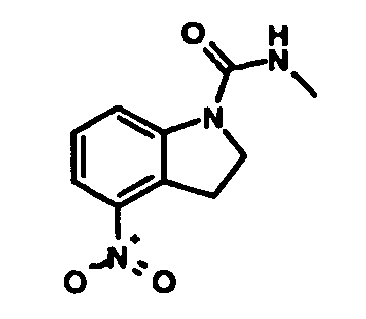
-

-

-

-

-
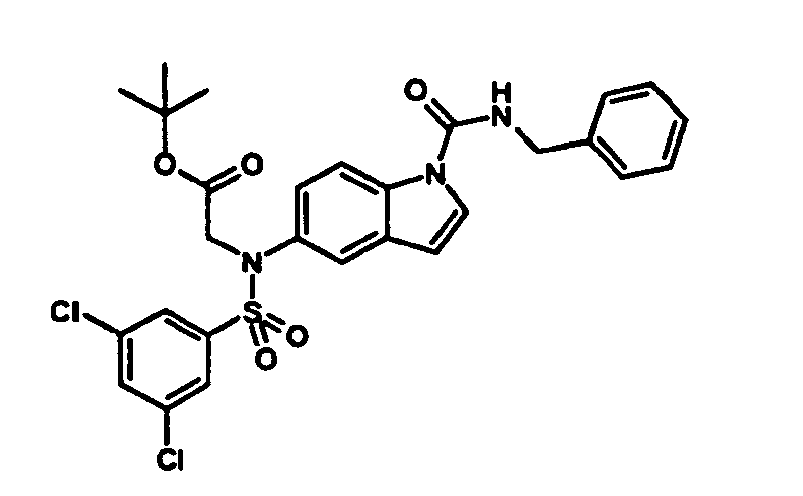
- 150 mg 5-(3,5-dichloro-phenylsulphonylamino)-indole-1-carboxylic acid-benzylamide are dissolved in 5 ml dimethylformamide. 109 mg potassium carbonate and 51 µl tert. butyl bromoacetate are added thereto. The mixture is stirred for 4 hours at ambient temperature, the solvent is eliminated in vacuo and the residue is divided between water and ethyl acetate. The aqueous phase is extracted with ethyl acetate and the combined organic phases are dried on magnesium sulphate. The solvents are eliminated in vacuo and the residue is purified by chromatography on silica gel (cyclohexane/ethyl acetate 10:1 to 1:3).
Yield: 127 mg (68 % of theory)
Mass spectrum (ESI-): m/z = 586 [M-H]- - The following compounds are obtained analogously to Example VI:
-

-

- The product is further reacted directly in Example 1 (3).
-

-

-

-

-

-

-

-

-

-

-

-

-

-

-

-

-

-

- This is isolated as a by-product of the formation of VI (21) from XI (13).
Mass spectrum (ESI+): m/z = 678 [M+H]+
Rf value: 0.80 (silica gel: petroleum ether/ethyl acetate 2:1) -

Rf value: 0.32 (silica gel: petroleum ether/ethyl acetate 2:1) -

-
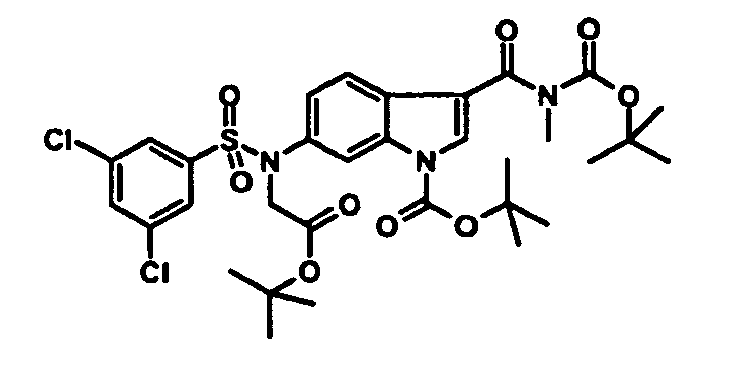
-

- The product is further reacted directly in Example 6.
-

-

-

-

- Obtained from the reaction of 6-(3,5-dichloro-phenylsulphonylamino)-1H-indole-3-carboxylic acid-phenylamide.
- The product is further reacted directly in 1 (38).
-

tert. butyl {(3,5-dichloro-phenylsulphonyl)-[3-(phenylethyl)-3H-benzoimidazol-5-yl]-amino}-acetate
- Obtained from the reaction of a mixture of 3,5-dichloro-N-(1-phenylethyl-1H-benzoimidazol-5-yl)-phenylsulphonamide and 3,5-dichloro-N-[3-(phenylethyl)-3H-benzoimidazol-5-yl]-phenylsulphonamide. The products may be separated by chromatography on silica gel.
- Mass spectrum (ESI+): m/z = 560 [M+H]+ tert. butyl {(3,5-dichlorophenylsulphonyl)-[1-(phenylethyl)-1H-benzoimidazol-5-yl]-amino}-acetate and Mass spectrum (ESI+): m/z = 560 [M+H]+ tert. butyl {(3,5-dichlorophenylsulphonyl)-[3-(phenylethyl)-3H-benzoimidazol-5-yl]-amino}-acetate
-

-

-

-

-

-

-

-

-

-

-

-

-

-

-

-

-

-

-

-

-

-

-

-
-

-

-

-

-

-

-

-

-

-

-

-

-
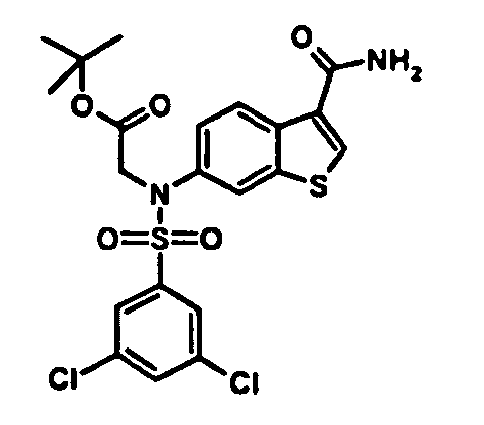
-

-
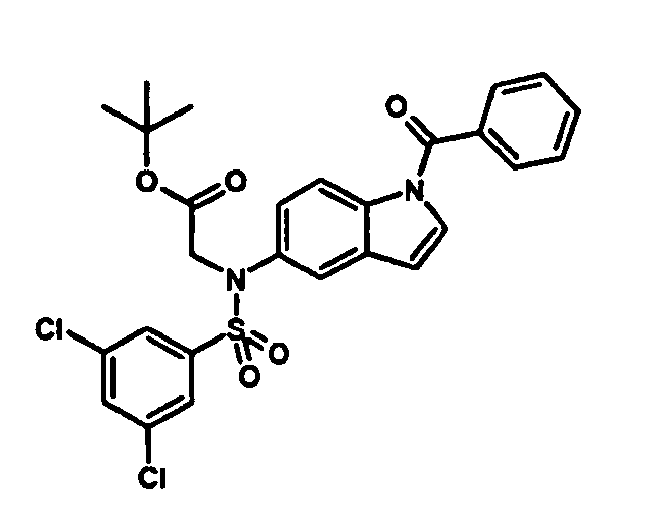
- 50 mg tert. butyl [(3,5-dichloro-phenylsulphonyl)-(1H-indol-5-yl)-amino]-acetate are dissolved in 2 ml dichloromethane. 5 mg powdered sodium hydroxide and 19 µl benzoyl chloride are added. Then the mixture is stirred for 4 hours at ambient temperature, divided between 1 N sodium hydroxide solution and ethyl acetate, the aqueous phase is extracted with ethyl acetate and the combined organic phases are dried with magnesium sulphate. The solvents are eliminated in vacuo and the residue is chromatographed on silica gel (cyclohexane/ethyl acetate 10:1 to 1:2).
Yield: 15 mg (24 % of theory)
Mass spectrum (ESI+): m/z = 576 [M+NH4]+ -

- 300 mg 5-nitroindole are dissolved in 10 ml of tetrahydrofuran. 81 mg sodium hydride (60 % in mineral oil) are added and the mixture is stirred for 1 hour at ambient temperature. Then 294 µl phenylacetic acid chloride are added dropwise and the mixture is stirred for another 3 hours. It is divided between saturated ammonium chloride solution and ethyl acetate. The aqueous phase is extracted with ethyl acetate and the combined organic phases are dried on magnesium sulphate. The solvents are eliminated in vacuo and the residue is chromatographed on silica gel (cyclohexane/ethyl acetate 10:1 to 1:3).
Yield: 250 mg (48 % of theory)
Mass spectrum (ESI+): m/z = 281 [M+H]+ - The following compounds are obtained analogously to Example VIII:
-

- Dimethylformamide is used instead of tetrahydrofuran.
Mass spectrum (ESI+): m/z = 267 [M+H]+ -

6-nitro-1-(phenylethyl)-1H-benzimidazole
- Dimethylformamide is used instead of tetrahydrofuran.
- The compounds are obtained as a mixture of regioisomers. Mass spectrum (ESI+): m/z = 268 [M+H]+
-

- 150 mg tert. butyl [(3,5-dichloro-phenylsulphonyl)-(2,3-dihydro-1H-indol-5-yl)-amino]-acetate are dissolved in 5 ml dichloromethane. 110 mg potassium carbonate and 45 µl benzoyl chloride are added, the mixture is stirred for 3 hours at ambient temperature and then divided between dichloromethane and water. The organic phase is washed with water and then dried on magnesium sulphate. The solvents are eliminated in vacuo.
Yield: 170 mg (92 % of theory)
Mass spectrum (ESI+): m/z = 561 [M+H]+ - The following compounds are obtained analogously to Example IX:
-

- Phenylsulphonyl chloride is used instead of benzoyl chloride.
Mass spectrum (ESI+): m/z = 614 [M+NH4]+ -

- Phenylmethanesulphonyl chloride is used instead of benzoyl chloride.
Mass spectrum (ESI+): m/z = 628 [M+NH4]+ -
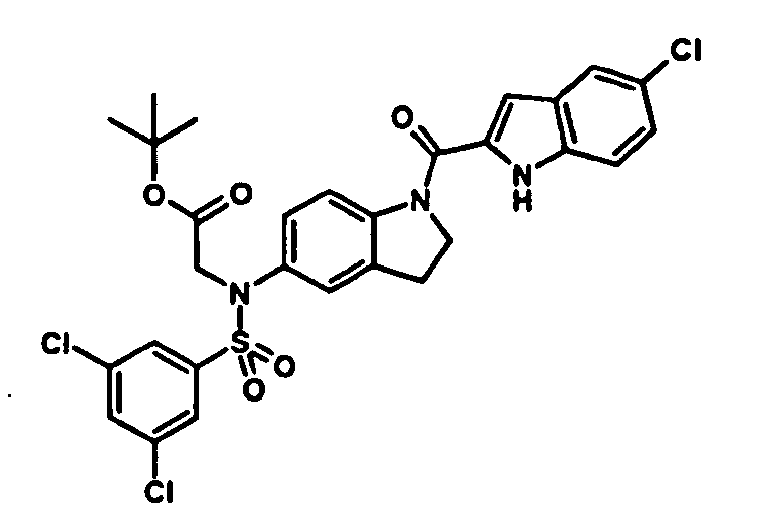
- 55 mg 5-chloro-1H-indol-2-carboxylic acid are dissolved in 2 ml of thionyl chloride and heated to 80°C for 1 hour. The solvent is eliminated in vacuo and the residue is twice combined with dichloromethane and the latter is eliminated again in vacuo. The residue is taken up in 5 ml dichloromethane and the solution is added dropwise to a mixture of 100 mg tert. butyl [(3,5-dichloro-phenylsulphonyl)-(2,3-dihydro-1H-indol-5-yl)-amino]-acetate and 60 mg potassium carbonate in 2 ml dimethylformamide. The mixture is stirred for 2 hours at ambient temperature, diluted with ethyl acetate and washed with 1 N HCl and saturated sodium chloride solution. After drying with magnesium sulphate the solvents are eliminated in vacuo and the residue is chromatographed on silica gel (cyclohexane/ethyl acetate 10:1 to 1:2).
Yield: 60 mg (43 % of theory)
Mass spectrum (ESI+): m/z = 634 [M+H]+ -

- 100 mg 5-aminoindole are dissolved in 10 ml of pyridine. 186 mg 3,5-dichlorophenylsulphonyl chloride are added thereto and the mixture is stirred for 4 hours at ambient temperature. The solvent is eliminated in vacuo and the residue is divided between water and ethyl acetate. The aqueous phase is extracted with ethyl acetate and the combined organic phases are washed with saturated sodium chloride solution. After drying with magnesium sulphate the solvents are eliminated in vacuo and the residue is chromatographed on silica gel (cyclohexane/ethyl acetate 10:1 to 1:5).
Yield: 240 mg (93 % of theory)
Mass spectrum (ESI+): m/z = 341 [M+H]+ - The following compounds are obtained analogously to Example XI:
-

-

-

- The crude product is extracted from diisopropylether.
Mass spectrum (ESI+): m/z = 400 [M+H]+ -

-

-

- Mass spectrum (ESI+): m/z = 463 [M+H]+
-

- The reaction is carried out in dichloromethanelpyridine 2:1. The crude product is extracted from diisopropylether.
Mass spectrum (ESI+): m/z = 462 [M+H]+ -

- The reaction is carried out in dichloromethane with 2 equivalents of triethylamine.
Mass spectrum (ESI+): m/z = 373 [M+H]+ -

-

- The reaction is carried out in dichloromethane/pyridine 5:1.
- The product is further reacted directly in Example VI (24).
-

- The reaction is carried out in dichloromethane/pyridine 5:1.
Mass spectrum (ESI+): m/z = 389 [M+H]+ -

-
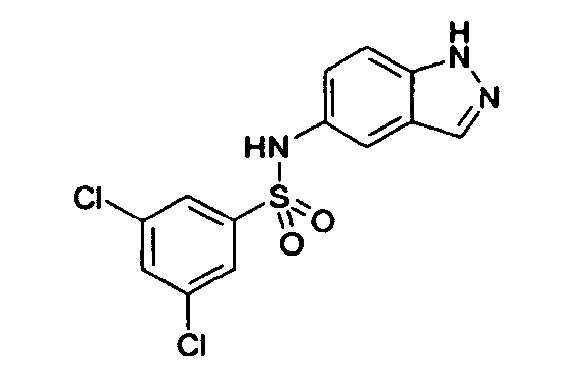
- The product additionally contains 3,5-dichloro-N-[1-(3,5-dichlorophenylsulphonyl)-3-methyl-1H-indazol-5-yl]-phenylsulphonamide.
Mass spectrum (ESI-): m/z = 340 [M-H]-
Rf value: 0.60 (silica gel: ethyl acetate/petroleum ether 2:1) -

-

-

-

-

-
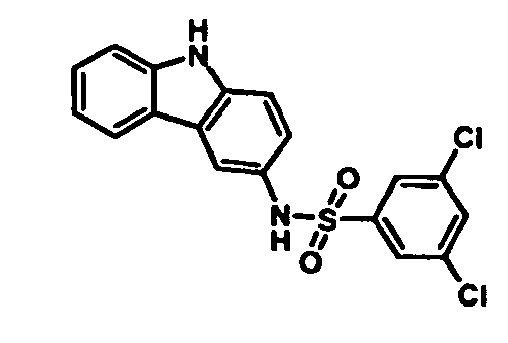
-

-

-

-

- The reaction is carried out in dichloromethane. 1.4 equivalents 2,6-lutidine are used as the base.
Mass spectrum (ESI-): m/z = 411 [M-H]- -

-

-
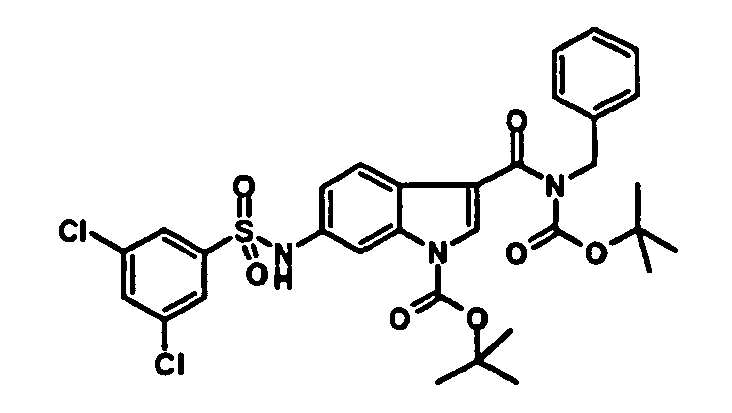
-

-

-

-

-

-

-

-

-

-

-

-

-

-

-

-

-


- Obtained from the reaction of a mixture of 6-amino-benzo[b]thiophene-3-carboxylic acid-amide and 5-amino-benzo[b]thiophene-3-carboxylic acid-amide (Example XII (30)). The crude product is dissolved in hot ethyl acetate. After cooling to ambient temperature the precipitated solid (5-(3,5-dichloro-phenylsulphonylamino)-benzo[b]thiophene-3-carboxylic acid-amide) is filtered off. The mother liquor is freed from the solvents in vacuo and the residue is chromatographed on silica gel, to obtain 6-(3,5-dichloro-phenylsulphonylamino)-benzo[b]thiophene-3-carboxylic acid-amide.
Mass spectrum (ESI+): m/z = 401 [M+H]+
6-(3,5-dichloro-phenylsulphonylamino)-benzo[b]thiophene-3-carboxylic acid-amide and 5-(3,5-dichloro-phenylsulphonylamino)-benzo[b]thiophene-3-carboxylic acid-amide -

- 6.8 g tert-butyl 5-nitro-indole-1-carboxylate are dissolved in 120 ml of methanol. 600 mg palladium on charcoal (10%) are added thereto and the mixture is hydrogenated for 1.5 hours at ambient temperature. Then the catalyst is filtered off and the solvent is eliminated in vacuo.
Yield: 6 g (100 % of theory)
Mass spectrum (ESI+): m/z = 235 [M+H]+ - The following compounds are obtained analogously to Example XII:
-

-

-

-

-

-

Mass spectrum (ESI+): m/z = 183 [M+H]+ -

Mass spectrum (ESI+): m/z = 158 [M+H]+ -

The product is further reacted directly in XVII (2). -

Rf value: 0.42 (silica gel: petroleum ether/ethyl acetate 2:1) -

-

-

- A 3:2:2 mixture of ethyl acetate, methanol and tetrahydrofuran is used as solvent.
Mass spectrum (ESI+): m/z = 205 [M+H]+ -
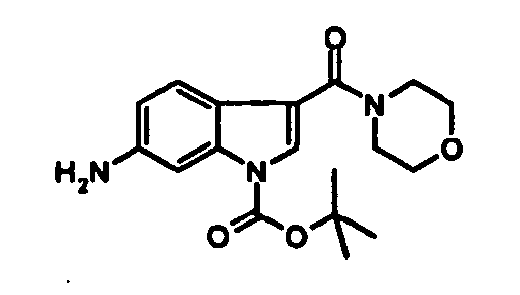
Rf value: 0.21 (silica gel: petroleum ether/ethyl acetate 1:1) -

Rf value: 0.33 (silica gel: petroleum ether/ethyl acetate 1:1) -

Rf value: 0.44 (silica gel: petroleum ether/ethyl acetate 2:1) -

Rf value: 0.62 (silica gel: petroleum ether/ethyl acetate 2:1) -

Rf value: 0.45 (silica gel: petroleum ether/ethyl acetate 2:1) -

Mass spectrum (ESI+): m/z = 172 [M+H]+ -

-

-

Rf value: 0.54 (silica gel: petroleum ether/ethyl acetate 1:1) -

Rf value: 0.46 (silica gel: dichloromethane/methanol 5:1) -

Rf value: 0.32 (silica gel: petroleum ether/ethyl acetate 1:2) -

Mass spectrum (ESI+): m/z = 147 [M+H]+ -
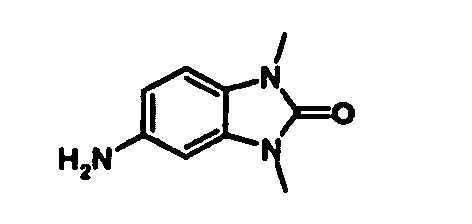
Mass spectrum (ESI+): m/z = 178 [M+H]+ -

- Obtained from the hydrogenation of 1-tert-butyl-3-methyl 5-nitro-indole-1,3-dicarboxylate in ethyl acetate/methanol/tetrahydrofuran 10:7:7. It is hydrogenated at 50°C and 15 bar.
Rf value: 0.30 (silica gel: petroleum ether/ethyl acetate 1:1) -

-

-

-

5-amino-benzo[b]thiophene-3-carboxylic acid-amide
- Obtained as a mixture from the reaction of a mixture of 6-nitro-benzo[b]thiophene-3-carboxylic acid-amide and 5-nitro-benzo[b]thiophene-3-carboxylic acid-amide (Example IXXX (9)). The crude product is further reacted directly in Example XI (42).
-

- 6.6 g tert-butyl 5-nitro-2,3-dihydro-indole-1-carboxylate are dissolved in 120 ml of methanol. 600 mg palladium on charcoal (10%) are added and the mixture is hydrogenated until no more educt can be detected by thin layer chromatography. The catalyst is suction filtered and washed with methanol. The solvent is eliminated in vacuo and the residue is taken up in 30 ml of pyridine. 6.1 g of 3,5-dichlorophenylsulphonyl chloride are added and the mixture is stirred for 5 hours at ambient temperature. Then the pyridine is eliminated in vacuo and the residue is divided between 1 N HCl and ethyl acetate. The organic phase is washed with saturated sodium hydrogen carbonate solution and with saturated sodium chloride solution. After drying with magnesium sulphate the solvent is eliminated in vacuo.
Yield: 11 g (99 % of theory)
Mass spectrum (ESI-): m/z = 441 [M-H]- - The following compounds are obtained analogously to Example XIII:
-


- The hydrogenation is carried out in the presence of 1.2 equivalents of 1N HCl. The crude product is chromatographed on silica gel.
Mass spectrum (ESI-): m/z = 457 [M-H]- (3,5-dichloro-N-(1-phenylacetyl-1H-indol-5-yl)-phenylsulphonamide)
Mass spectrum (ESI-): m/z = 459 [M-H]- (3,5-dichloro-N-(1-phenylacetyl-2,3-dihydro-1H-indol-5-yl)-phenylsulphonamide) -

-

- 5 g 5-nitro-2,3-dihydro-1H-indole are dissolved in 70 ml acetonitrile. 7.3 g di-tert-butyl-dicarbonate and 900 mg 4-dimethylaminopyridine are added thereto. After stirring for 24 hours at ambient temperature the mixture is divided between 1 N HCl and ethyl acetate. The aqueous phase is extracted with ethyl acetate and the combined organic phases are washed with saturated sodium hydrogen carbonate solution and saturated sodium chloride solution. After drying with magnesium sulphate the solvents are eliminated in vacuo. The residue is extracted from diisopropylether/petroleum ether.
Yield: 6.6 g (82 % of theory)
Mass spectrum (ESI+): m/z = 265 [M+H]+ -

- 4.08 g tert-butyl 5-(3,5-dichloro-phenylsulphonylamino)-2,3-dihydro-indole-1-carboxylate are dissolved in 70 ml dichloromethane. To this are added 25 ml trifluoroacetic acid and the solution is stirred for 2 hours at ambient temperature. The solvents are eliminated in vacuo and the residue is divided between saturated sodium hydrogen carbonate solution and ethyl acetate. The aqueous phase is extracted with ethyl acetate and the combined organic phases are washed with saturated sodium chloride solution. After drying with magnesium sulphate the solvents are eliminated in vacuo.
Yield: 3.0 g (97 % of theory)
Mass spectrum (ESI-): m/z = 341 [M-H]- - The following compounds are obtained analogously to Example XV:
-

-

- 85 mg tert. butyl (3,5-dichloro-phenylsulphonyl)-[1-(pyridin-3-ylcarbamoyl)-2,3-dihydro-1H-indol-5-yl]-amino}-acetate are dissolved in 3 ml dichloromethane and 100 mg 3-chloro-perbenzoic acid are added. The mixture is stirred overnight at ambient temperature, diluted with ethyl acetate and washed with saturated sodium hydrogen carbonate solution and saturated sodium chloride solution. After drying with magnesium sulphate the solvents are eliminated in vacuo and the residue is chromatographed on silica gel (dichloromethane/methanol 99:1 to 4:1).
Yield: 75 mg (86 % of theory)
Mass spectrum (ESI-): m/z = 591 [M-H]- -

- 300 mg 3-chloro-5-methyl-phenylamine are dissolved in 1 ml concentrated HCl and cooled to 0°C. A solution of 170 mg sodium nitrite in 0.3 ml of water is added dropwise thereto. The solution thus prepared is added dropwise at 0°C to a solution of 85 mg copper-II-chloride, 0.3 ml of water and 7 ml sulphur dioxide in glacial acetic acid (30%). The cooling bath is removed and the mixture is stirred for another 20 minutes at ambient temperature. Then it is heated to 40°C for 10 minutes. It is then diluted with ice water, the solid is suction filtered and dried in the desiccator. The product is further reacted directly in Example XI without any further purification.
Yield: 370 mg (78 % of theory) - The following compounds are obtained analogously to Example XVII:
-

- The aqueous phase is twice extracted with ethyl acetate. The combined organic phases are dried on magnesium sulphate and the solvent is eliminated in vacuo.
Rf value: 0.95 (silica gel; dichloromethane) -

- The product is further reacted directly in Example XI(14) without any further purification.
-

- 250 mg methyl 5-[tert-butoxycarbonylmethyl-(3,5-dichloro-phenylsulphonyl)-amino]-benzo[b]thiophen-2-carboxylate are dissolved in 30 ml ammonia-saturated methanol and stirred for 24 hours at ambient temperature. Then the solution is heated to 80°C in a pressurised vessel for 8 hours. Then the solvent is eliminated in vacuo and the residue is extracted from diisopropylether. The product thus obtained is chromatographed on silica gel with cyclohexane/ethyl acetate (9:1 to 1:4).
Yield: 141 mg (58 % of theory)
Mass spectrum (ESI+): m/z = 515 [M+H]+ -

- 10 g 3-chloro-5-nitrophenol are dissolved in 250 ml of ethanol. 11.9 g potassium carbonate and 6 ml dimethylsulphate are added and the mixture is stirred for 12 hours at ambient temperature. Then 3 ml of a 33 % ammonia solution are added and then the ethanol is eliminated in vacuo. The residue is taken up in water and the precipitated solid is suction filtered and dried.
Yield: 10.37 g (96% of theory)
Mass spectrum (EI): m/z = 187 [M]+ -
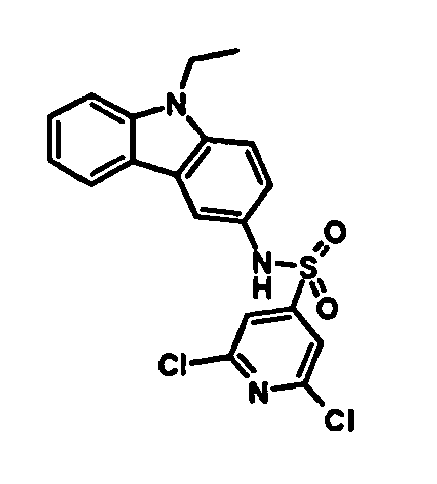
- 2 g 4-amino-2,6-dichloropyridine are dissolved in 8 ml concentrated HCl and cooled to 0°C. A solution of 900 mg sodium nitrite in 2 ml of water is added dropwise thereto. The solution thus prepared is added dropwise at 0°C to a solution of 550 mg copper-II-chloride, 1 ml of water and 10 ml sulphur dioxide in glacial acetic acid (30%). The cooling bath is removed and the mixture is stirred for 15 minutes at ambient temperature. Then it is diluted with ice water and the solid is suction filtered. The aqueous phase is extracted with ethyl acetate. The solid filtered off is dissolved in ethyl acetate. The combined ethyl acetate phases are dried on magnesium sulphate and the solvent is eliminated in vacuo. 1.2 g of (9-ethyl-9H-carbazol-3-yl)-methyl-amine and 15 ml of pyridine are added to the residue. The mixture is stirred for 12 hours at ambient temperature, the solvent is eliminated in vacuo and the residue is chromatographed on silica gel with dichloromethane.
Yield: 210 mg (10% of theory)
Mass spectrum (ESI-): m/z = 418 [M-H]- -
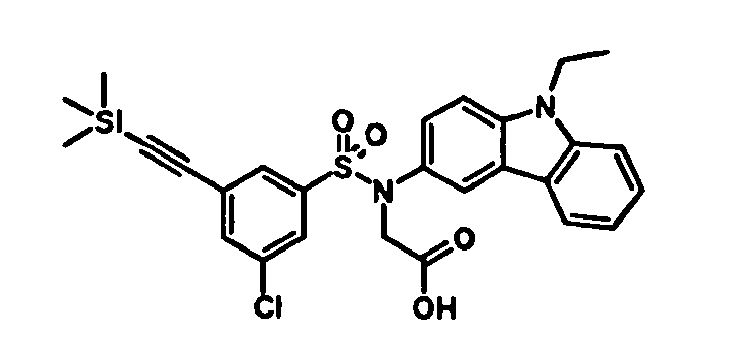
- 180 mg tert-butyl [(3-chloro-5-trimethylsilylethynyl-phenylsulphonyl)-(9-ethyl-9H-carbazol-3-yl)-amino]-acetate are dissolved in 5 ml dichloromethane. 1 ml of trifluoroacetic acid is added with stirring. The mixtures is stirred overnight at ambient temperature and then the solvents are eliminated in vacuo. The residue is chromatographed on silica gel (dichloromethane/methanol 100:0 to 95:5).
Yield: 134 mg (74 % of theory)
Mass spectrum (ESI-): m/z = 537 [M-H]- -

- 320 mg tert-butyl [(3-chloro-5-trifluoromethylsulphonyloxy-phenylsulphonyl)-(9-ethyl-9H-carbazol-3-yl)-amino]-acetate are dissolved in 4 ml dimethylformamide. 20 mg copper-I-iodide, 40 mg bis-triphenylphosphine-palladium-dichloride and 210 µl trimethylsilylacetylene are added under argon. Then the mixture is heated to 60°C for 6 hours and then stirred overnight at ambient temperature. The mixture is then divided between saturated potassium carbonate solution and ethyl acetate. The organic phase is dried on magnesium sulphate and the solvents are eliminated in vacuo. The residue is chromatographed on silica gel (dichloromethane/methanol 100:0 to 95:5).
Yield: 223 mg (76 % of theory)
Mass spectrum (ESI+): m/z = 595 [M+H]+ -

- 2.2 g 3-chloro-5-nitrophenol are dissolved in 30 ml dichloromethane, combined with 1.1 ml of pyridine and cooled to -10°C. A solution of 2.2 ml trifluoromethanesulphonic acid anhydride in 5 ml dichloromethane is added thereto, the mixture is left overnight to warm up to ambient temperature and then divided between dichloromethane and saturated sodium hydrogen carbonate solution. The organic phase is washed with saturated sodium chloride solution and dried on magnesium sulphate. The solvent is eliminated in vacuo.
Yield: 3.5 g (81 % of theory)
Rf value: 0.90 (silica gel: dichloromethane) -
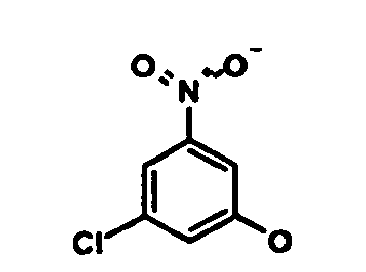
- 1.65 g 3-chloro-5-nitroanisole are combined with 20.3 g pyridinium hydrochloride and heated to 200°C for 1 hour. Then the mixture is left overnight to come up to ambient temperature, 200 ml of water are added, the precipitated solid is suction filtered and dried in vacuo.
Yield: 860 mg (56 % of theory)
Mass spectrum (ESI-): m/z = 162 [M-H]- -

- 11.1 g 1-chloro-3,5-dinitrobenzene are dissolved in 100 ml of methanol and combined with 3 g sodium methoxide. Then the mixture is refluxed for 48 hours, cooled to ambient temperature and the solid is suction filtered.
Yield: 2.27 g (22 % of theory)
Mass spectrum (EI): m/z = 187 [M]+ -

- 18 g 3,5-dinitroaniline are suspended in 45 ml concentrated hydrochloric acid and 15 ml of water and cooled to 0°C. A solution of 7.6 g sodium nitrite in 25 ml of water is added dropwise thereto. Then the diazonium salt solution thus obtained is added dropwise at 0°C to a solution of 13 g of copper-I-chloride in 45 ml concentrated hydrochloric acid. Then the mixture is refluxed for 10 minutes. After cooling to ambient temperature it is extracted 3 times with 150 ml of ethyl acetate and the combined organic phases are washed with water.
- Then the mixture is dried on magnesium sulphate, the solvents are eliminated in vacuo and the residue is chromatographed on silica gel with petroleum ether/ ethyl acetate.
Yield: 11.15 g (58 % of theory)
Mass spectrum (EI): m/z = 202 [M]+ -

- 220 mg of 6-nitro-1H-indole-3-carboxylic acid-methylamide are dissolved in 10 ml of tetrahydrofuran. 350 mg di-tert.-butyl-dicarbonate are added thereto and the mixture is stirred for 3 hours at ambient temperature. Then the solvent is eliminated in vacuo and the residue is chromatographed on silica gel (cyclohexane/ethyl acetate 90:10 to 20:80)
Yield: 95 mg (23 % of theory)
Mass spectrum (ESI+): m/z = 420 [M+H]+ - The following compounds are obtained analogously to Example XXVII:
-

-

-

-

- The reaction is carried out in the presence of a catalytic amount of 4-N,N-dimethylamino-pyridine at 60°C. The product is obtained in admixture with 3-(bis-tert.-butoxycarbonyl)-aminocarbonyl-6-nitro-1H-indole.
Rf value: 0.50 (silica gel; petroleum ether/ethyl acetate 4:1) -

- The reaction is carried out in the presence of a catalytic amount of 4-N,N-dimethylamino-pyridine at 60°C.
Rf value: 0.39 (silica gel; petroleum ether/ethyl acetate 4:1)
Mass spectrum (ESI+): m/z = 482 [M+H]+ -

- The reaction is carried out in the presence of a catalytic amount of 4-N,N-dimethylamino-pyridine at 60°C.
Mass spectrum (ESI+): m/z = 489 [M+H]+ -

- The reaction is carried out in the presence of a catalytic amount of 4-N,N-dimethylamino-pyridine.
Mass spectrum (ESI+): m/z = 334 [M+H]+ -

- 250 mg 6-nitro-1H-indole-3-carboxylic acid are dissolved in 10 ml of tetrahydrofuran, combined with 240 mg carbonyl-diimidazole and stirred for 30 minutes at 60°C. Then 750 µl of a 2 M solution of methylamine in tetrahydrofuran is added and the mixture is stirred overnight at 60°C. Then 1 N hydrochloric acid is added and the precipitated solid is suction filtered. Then the solid is extracted from ethyl acetate, suction filtered and dried.
Yield: 225 mg (82 % of theory)
Mass spectrum (ESI+): m/z = 220 [M+H]+ - The following compounds are obtained analogously to Example XXVIII:
-
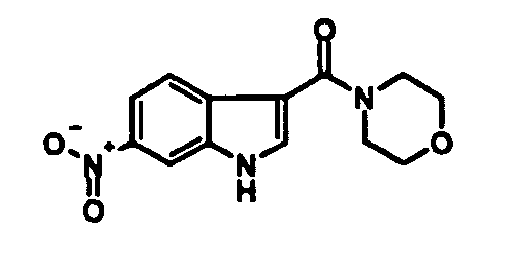
-

-

-

- The crude product is chromatographed on silica gel (cyclohexane/ethyl acetate 40:60 to 0:100).
Mass spectrum (ESI+): m/z = 398 [M+H]+ -

-

-

- After the reaction has ended the mixture is diluted with ethyl acetate, washed with 1 M phosphoric acid solution and dried on magnesium sulphate. The solvents are then eliminated in vacuo.
Mass spectrum (ESI+): m/z = 203 [M+H]+ -

- After the reaction has ended the mixture is divided between ethyl acetate and 1 M phosphoric acid solution. The organic phase is washed with 1 M sodium hydroxide solution and dried on magnesium sulphate. The solvents are eliminated in vacuo.
Mass spectrum (ESI+): m/z = 229 [M+H]+ -

5-nitro-benzo[b]thiophene-3-carboxylic acid-amide
-

- 3.7 g 2,2,2-trifluoro-1-(6-nitro-1H-indol-3-yl)-ethanone are combined with 20 ml of a 40 % sodium hydroxide solution solution and refluxed for 4 hours. After cooling to 0°C the mixture is diluted with a little water and adjusted to pH 1 by the careful addition of concentrated hydrochloric acid. The precipitated solid is suction filtered and dissolved in dichloromethane/methanol 10:1. After drying with magnesium sulphate the solvents are eliminated in vacuo and the residue is extracted from diethyl ether.
Yield: 3 g (100 % of theory)
Mass spectrum (ESI-): m/z = 205 [M-H]- - The following compounds are obtained analogously to Example XXIX:
-

-

-

- 2.5 g 6-nitro-1H-indole are dissolved in 10 ml dimethylformamide. 5 ml trifluoroacetic anhydride are added thereto and the mixture is heated to 60°C for 3 hours. Then the mixture is diluted with ethyl acetate and the organic phase is washed with saturated sodium hydrogen carbonate solution and with saturated sodium chloride solution. After drying with magnesium sulphate the solvents are eliminated in vacuo and the residue is extracted from dichloromethane.
Yield: 3.7 g (96 % of theory)
Mass spectrum (ESI-): m/z = 257 [M-H]- - The following compounds are obtained analogously to Example XXX:
-

Mass spectrum (ESI-): m/z = 317 [M-HCOO]- -

- The reaction is carried out overnight at ambient temperature. The product is extracted from ethyl acetate.
Rf value: 0.50 (silica gel: petroleum ether/ethyl acetate 1:1) -

- 3.39 g 9-(2-phenylsulphonyl-ethyl)-9H-carbazole are dissolved in 120 ml acetonitrile, and combined with 6.4 g ammonium-cerium-nitrate and 5 g silica gel. Then the mixture is heated to 70°C for 4 hours, filtered hot and the solid is washed with hot acetonitrile. The mother liquor is freed from the solvent in vacuo and the residue is chromatographed on silica gel (dichloromethane/methanol 100:0 to 98:2).
Yield: 1.53 g (40 % of theory)
Mass spectrum (ESI+): m/z = 381 [M+H]+ -

- 1.8 g 9H-carbazole and 9.8 g phenylvinylsulphone are suspended in 3 ml of tetrahydrofuran, cooled to 0°C, combined with 60 µl benzyltrimethylammonium hydroxide (40 % solution in water) and stirred for 20 minutes. Then the mixture is heated to 115°C for 7 hours. Then it is divided between ethyl acetate and 1 N hydrochloric acid, the organic phase is dried on magnesium sulphate and the solvent is eliminated in vacuo. The residue is chromatographed on silica gel (cyclohexane/ethyl acetate 2:1).
Yield: 2.35 g (65 % of theory)
Mass spectrum (ESI+): m/z = 336 [M+H]+ -

- 2.2 g 9-(2-phenylsulphonyl-ethyl)-3-nitro-9H-carbazole are dissolved in 40 ml of tetrahydrofuran, combined with 700 mg potassium-tert.-butoxide and stirred for 2 hours at ambient temperature. A further 100 mg potassium-tert.-butoxide are added and the mixture is stirred for 4 hours at ambient temperature. Then another 100 mg potassium-tert.-butoxide are added. The mixture is heated for 2 hours to 50°C, divided between ethyl acetate and 1 N hydrochloric acid, the organic phase is washed with saturated sodium chloride solution and dried with magnesium sulphate. After elimination of the solvents in vacuo the residue is chromatographed on silica gel (cyclohexane/ethyl acetate 90:10 to 80:20).
Yield: 900 mg (73 % of theory)
Mass spectrum (ESI+): m/z = 213 [M+H]+ -

- 100 mg methyl 6-(3,5-dichloro-phenylsulphonylamino)-1H-indole-3-carboxylate are dissolved in 5 ml of methanol, combined with 2 ml 1 N sodium hydroxide solution and stirred for 2 hours at ambient temperature. Then the mixture is divided between ethyl acetate and 2 N hydrochloric acid, the aqueous phase is extracted twice with ethyl acetate and the combined organic phases are dried on sodium sulphate. The solvents are eliminated in vacuo and the residue is taken up in 3 ml dimethylformamide. 114 mg O-(7-azabenzotriazol-1-yl)-N,N,N',N'-tetramethyluronium-hexafluorophosphate (HATU) and 65 µl N,N-diisopropyl-N-ethyl-amine are added and the mixture is stirred for 3 hours at 50°C. Then it is divided between water and ethyl acetate, the aqueous phase is extracted twice with ethyl acetate and the combined organic phases are dried on sodium sulphate. After elimination of the solvents in vacuo the residue is chromatographed on silica gel (cyclohexane/ethyl acetate 90:10 to 20:80). The product thus obtained is further reacted directly in VI (28).
-

- 1 g methyl 1H-indole-3-carboxylate is dissolved in 5 ml acetic acid, combined with 500 µl concentrated nitric acid (>90%) and heated to 60°C for 1 hour. The mixture is divided between water and dichloromethane and the aqueous phase is extracted twice with dichloromethane. The combined organic phases are dried on sodium sulphate, freed from the solvent in vacuo and the residue is chromatographed on silica gel (cyclohexane/ethyl acetate 90:10 to 40:60).
Yield: 290 mg (23 % of theory)
Mass spectrum (ESI-): m/z = 219 [M-H]- - In addition 275 mg of methyl 4-nitro-1H-indole-3-carboxylate are obtained.
-

and
- 1 g 5-nitro-1H-benzimidazole is dissolved in 10 ml dimethylformamide and combined with 270 mg NaH (60 % in mineral oil). The mixture is left for 1 hour with stirring and 1 ml phenylethylbromide is added. Then the mixture is stirred for 3 hours at ambient temperature and divided between saturated ammonium chloride solution and ethyl acetate. The aqueous phase is extracted with ethyl acetate and the combined organic phases are dried on magnesium sulphate. After elimination of the solvents in vacuo the residue is chromatographed on silica gel (cyclohexane/ethyl acetate 90:10 to 60:40). Yield: 820 mg (50 % of theory) as an isomer mixture of 5-nitro-1-(phenylethyl)-1H-benzimidazole and 6-nitro-1-(phenylethyl)-1H-benzimidazole
Mass spectrum (ESI+): m/z = 268 [M+H]+ -

- 55 mg 5-(3,5-dichloro-phenylsulphonylamino)-1H-indole-2-carboxylic acid are dissolved in 2 ml of tetrahydrofuran, combined with 25 mg carbonyldiimidazole, stirred for 3 hours at ambient temperature and for 1 hour at 40°C. Then the mixture is combined with 300 µl dimethylamine (2 M in tetrahydrofuran) and stirred overnight. The solvent is eliminated in vacuo and the residue is divided between ethyl acetate and 0.5 N hydrochloric acid. The organic phase is washed with water and saturated sodium chloride solution and dried on magnesium sulphate. After elimination of the solvents in vacuo the residue is chromatographed on silica gel (cyclohexane/ethyl acetate 90:10 to 30:70).
Yield: 26 mg (44 % of theory)
Mass spectrum (ESI-): m/z = 410 [M-H]- - The following compounds are obtained analogously to Example XXXVII:
-

- To form the imidazolide the mixture is heated to 60°C for 1 hour. To form the methylamide the mixture is heated to 60°C overnight. After the reaction has ended the mixture is divided between ethyl acetate and water and the organic phase is washed with saturated sodium chloride solution.
Mass spectrum (ESI+): m/z = 557 [M+H]+ -

- 100 mg ethyl 5-(3,5-dichloro-phenylsulphonylamino)-1H-indole-2-carboxylate are dissolved in 2 ml of tetrahydrofuran and combined with 2 ml of 1 N sodium hydroxide solution. The mixture is stirred for 48 hours at ambient temperature, the tetrahydrofuran is eliminated in vacuo, the residue is diluted with water, and 1 N hydrochloric acid is added until the pH is 2. The precipitated solid is suction filtered, washed with water and dried in vacuo.
Yield: 60 mg (64 % of theory)
Mass spectrum (ESI-): m/z = 383 [M-H]- -
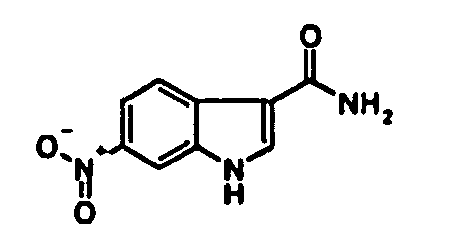
- 250 mg 6-nitro-1H-indole-3-carboxylic acid are dissolved in 10 ml of toluene, combined with 3 ml of thionyl chloride and refluxed for 1 hour. Then the volatile constituents are eliminated in vacuo, the residue is taken up in dichloromethane and this is in turn eliminated in vacuo. Then it is taken up in 10 ml of tetrahydrofuran, combined with 6 ml of a 0.5 M solution of ammonia in dioxane and heated to 60°C for 12 hours. The solvents are eliminated in vacuo, the residue is extracted from 1 N hydrochloric acid and the solid obtained is suction filtered and dried in vacuo.
Yield: 230 mg (92 % of theory)
Mass spectrum (ESI+): m/z = 206 [M+H]+ - The following compounds are obtained analogously to Example XXXIX:
-

-

- The acid chloride formed is reacted in dichloromethane with 2-oxo-piperazine in the presence of 1 equivalent of pyridine.
Mass spectrum (ESI-): m/z = 287 [M-H]- -

- The acid chloride formed is reacted in dichloromethane with 2-oxo-piperazine in the presence of 1 equivalent of pyridine.
Mass spectrum (ESI+): m/z = 291 [M+H]+ -

- The acid chloride formed is reacted in dichloromethane with dimethylamine (2M in tetrahydrofuran) in the presence of 1 equivalent of pyridine.
Mass spectrum (ESI+): m/z = 234 [M+H]+ -

- During the formation of the acid chloride, 2 drops of dimethylformamide are added and the mixture is refluxed for 5 hours. To form the methylester the mixture is refluxed in methanol for 5 hours. After cooling to ambient temperature the precipitated solid is suction filtered and dried in vacuo.
Rf value: 0.40 (silica gel: dichloromethane/methanol 40:1) -

- 1.6 g 6-nitro-1H-indole-3-carbonitrile are dissolved in 45 ml of tetrahydrofuran, combined with 1 g potassium-tert.-butoxide and stirred for 30 minutes. Then a solution of 560 µl methyl iodide in 5 ml of tetrahydrofuran is slowly added dropwise and the mixture is stirred for 5 hours. The solvents are eliminated in vacuo, water is added and the pH is adjusted to 4 by the addition of citric acid. The solid is suction filtered and washed with water and some cold methanol.
Yield: 1.59 g (65 % of theory)
Mass spectrum (ESI+): m/z = 219 [M+NH4]+ -

- 6.1 g 6-nitro-1H-indole are dissolved in 100 ml acetonitrile and cooled to 0°C. A solution of 3.2 ml chlorosulphonyl isocyanate in 25 ml acetonitrile is added dropwise and the mixture is stirred for 2 hours. Then a solution of 5 ml triethylamine in 25 ml acetonitrile is added dropwise. The mixture is stirred for 1 hour at ambient temperature and for 50 minutes at 80°C. Then the solvents are eliminated in vacuo, the residue is extracted from cold water, the solid is suction filtered and washed successively with water, saturated sodium hydrogen carbonate solution and water. The solid thus obtained is dried in the desiccator. Then the solid is taken up in 500 ml dichloromethane/methanol 95:5 and stirred with some aluminium oxide. It is suction filtered through a thin layer of aluminium oxide and washed with 400 ml dichloromethane/methanol 95:5. The filtrate is evaporated down in vacuo and the residue is dried in vacuo.
Yield: 2.76 g (40 % of theory)
Mass spectrum (ESI-): m/z = 186 [M-H]- -

- 300 mg 6-(3,5-dichloro-phenylsulphonylamino)-1-methyl-1H-indole-3-carboxylic acid are dissolved in 2 ml dimethylformamide, combined with 319 µl N,N-diisopropyl-N-ethyl-amine and 241 mg O-(benzotriazol-1-yl)-N,N,N',N'-tetramethyluronium-tetrafluoroborate (TBTU) and stirred for 15 minutes at ambient temperature. 751 µl of a 2 M solution of dimethylamine in tetrahydrofuran are added and the mixture is stirred overnight at ambient temperature. Then it is divided between water and ethyl acetate, the aqueous phase is extracted with ethyl acetate and the combined organic phases are dried on magnesium sulphate. The solvents are eliminated in vacuo.
Yield: 360 mg (112 % of theory)
Mass spectrum (ESI-): m/z = 424 [M-H]- - The following compounds are obtained analogously to Example XLII:
-

-

-

-

-

-

-

-

-

-

-

-

-

- Obtained during the reaction of a mixture of 1-methyl-6-nitro-1H-indazole-3-carboxylic acid and 2-methyl-6-nitro-2H-indazole-3-carboxylic acid. The product is purified by chromatography on silica gel.
Mass spectrum (ESI+): m/z = 275 [M+H]+ -
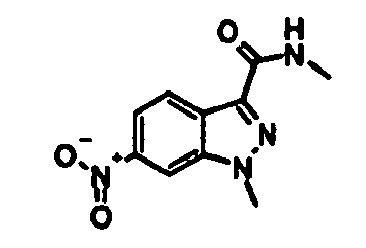
- Obtained during the reaction of a mixture of 1-methyl-6-nitro-1H-indazole-3-carboxylic acid and 2-methyl-6-nitro-2H-indazole-3-carboxylic acid. The product is purified by chromatography on silica gel.
Mass spectrum (ESI+): m/z = 235 [M+H]+ -

- 12 g 6-nitro-1-methyl-1H-indole-3-carboxylic acid are dissolved in 500 ml of water, 60 ml 1 N sodium hydroxide solution and 30 ml of methanol. 1.2 g Raney nickel are added and the mixture is hydrogenated for 26 hours at 1.5 bar. Then the catalyst is filtered off and the solvent is eliminated in vacuo. The residue is suspended in 100 ml of pyridine. 16.3 g 3,5-dichlorophenylsulphonyl chloride are added and the mixture is stirred overnight at ambient temperature. The pyridine is eliminated in vacuo. The residue is divided between water and ethyl acetate and the pH is adjusted to 5 by the addition of citric acid. The aqueous phase is extracted 3 times with ethyl acetate and the combined organic phases are dried on magnesium sulphate. After elimination of the solvents the residue is chromatographed on silica gel (dichloromethane/methanol/acetic acid 95:5:1 to 89:10:1)
Yield: 2.5 g (9 % of theory)
Mass spectrum (ESI-): m/z = 397 [M-H]- -

- 4 g of 6-nitro-1H-indole are added batchwise at 0°C to 800 mg sodium hydride (60 % in mineral oil) in 20 mg dimethylformamide. The mixture is stirred for 10 minutes, then 1.86 ml methyl iodide are added dropwise and the mixture is left overnight to come up to ambient temperature. Then it is divided between water and ethyl acetate, the aqueous phase is extracted with ethyl acetate and the combined organic phases are washed with saturated sodium chloride solution. After drying with magnesium sulphate the solvents are eliminated in vacuo.
Yield: 4.54 g (104 % of theory)
Mass spectrum (ESI+): m/z = 177 [M+H]+ - The following compounds are obtained analogously to Example XLIV:
-

- The product is extracted from ethyl acetate/methanol 95:5.
Mass spectrum (ESI+): m/z = 208 [M+H]+ -

and
- 2 g benzo[b]thiophene-3-carboxylic acid are dissolved in 11 ml acetic anhydride and cooled to 0°C. A solution of 4.4 ml concentrated nitric acid in 10 ml acetic acid is added dropwise, while not allowing the temperature to rise above 5°C. Then the mixture is stirred for 1.5 hours and then combined with 200 ml ice water. The solid is suction filtered and dried in vacuo. Then it is dissolved in hot ethanol. After cooling to ambient temperature the solid (5-nitro-benzo[b]thiophene-3-carboxylic acid, approximately 80 %) is suction filtered. By elimination of the solvent in vacuo, 6-nitro-benzo[b]thiophene-3-carboxylic acid (approx. 66 %) is obtained from the mother liquor.
Yield: 250 mg (10 % of theory, about 80 %) 5-nitro-benzo[b]thiophene-3-carboxylic acid
Mass spectrum (ESI-): m/z = 222 [M-H]-
Yield: 624 mg (25 % of theory, about 66 %) 6-nitro-benzo[b]thiophene-3-carboxylic acid
Mass spectrum (ESI-): m/z = 222 [M-H]- -

- 2 g tert. butyl (1-methylcarbamoyl-ethyl)-carbamate are dissolved in 20 ml dichloromethane, combined with 3.7 ml of a 4 M solution of hydrogen chloride in dioxane and stirred for 24 hours at ambient temperature. The solvents are eliminated in vacuo and the residue is divided between 10 ml 1 N sodium hydroxide solution and dichloromethane. The aqueous phase is extracted with dichloromethane and the combined organic phases are dried on magnesium sulphate. The solvents are eliminated in vacuo.
Yield: 400 mg (40 % of theory)
Mass spectrum (ESI+): m/z = 103 [M+H]+ -
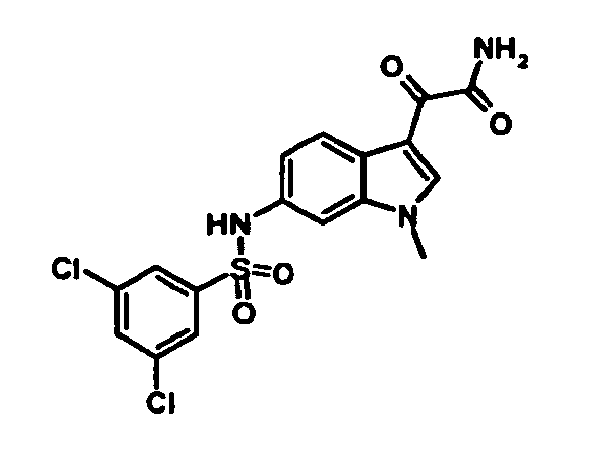
- 400 mg [6-(3,5-dichloro-phenylsulphonylamino)-1-methyl-1H-indol-3-yl]-oxo-acetyl-chloride are dissolved in 1.5 ml tetrahydroduran, combined with 550 µl concentrated ammonia (32 % solution in water) and stirred for 3.5 hours. The solvent is eliminated in vacuo and the residue is extracted from a little methanol. The solid is suction filtered and dried in vacuo.
Yield: 140 mg (37 % of theory)
Mass spectrum (ESI4): m/z = 426 [M+H]4 - The following compounds are obtained analogously to Example XLVII:
-

-

-

-

- 1.1 g 3,5-dichloro-N-(1-methyl-1H-indol-6-yl)-phenylsulphonamide are dissolved in 15 ml diethyl ether, cooled to 0°C and combined with 296 µl oxalyl chloride. Then the mixture is stirred for 2 hours at 0°C and for 12 hours at ambient temp. The solvents are distilled off at 50°C. The crude product thus obtained is further reacted directly (XLVII).
Yield: 1.34 g (96 % of theory) -

- 100 mg methyl 5-[tert-butoxycarbonylmethyl-(3,5-dichloro-phenylsulphonyl)-amino]-1-methylcarbamoyl-2,3-dihydro-1H-indole-3-carboxylate are dissolved in 1.2 ml of tetrahydrofuran, combined with 349 µl of a 1 M solution of lithium hydroxide in water and stirred overnight at ambient temperature. Then the mixture is cooled to 0°C, combined with 350 µl 1M hydrochloric acid and divided between ethyl acetate and saturated sodium chloride solution. The organic phase is dried on magnesium sulphate and the solvents are eliminated in vacuo. The residue is chromatographed on silica gel (dichloromethane/methanol 20:1).
Yield: 40 mg (41 % of theory)
Mass spectrum (ESI+): m/z = 558 [M+H]+ -

- 5.9 g methyl 5-nitro-1H-indole-3-carboxylate are dissolved in 100 ml acetonitrile, combined with 100 mg N,N-dimethylamino-pyridine and a solution of 6.4 g di-tert.-butyl-dicarbonate in 20 ml of tetrahydrofuran is added dropwise thereto. The mixture is stirred overnight at ambient temperature, then heated to 30°C for 30 minutes and cooled to 0°C. The solid thus precipitated is suction filtered. The mother liquor is freed from the solvents in vacuo and the residue is extracted from petroleum ether/ethyl acetate.
Yield: 7.4 g (86 % of theory)
Rf value: 0.50 (silica gel: petroleum ether/ethyl acetate 3:1) -
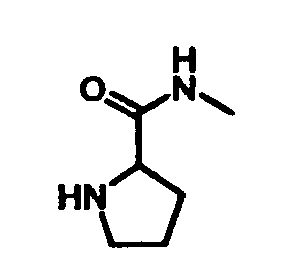
- 200 mg tert-butyl 2-methylcarbamoyl-pyrrolidine-1-carboxylate are dissolved in 2 ml dichloromethane, combined with 1 ml trifluoroacetic acid and stirred for 2 hours at ambient temperature. Then the volatile constituents are eliminated in vacuo, the residue is dissolved in dichloromethane and diethyl ether and combined with some activated charcoal. Then the solution is filtered, evaporated down in vacuo and the residue is dried in vacuo.
- The product thus obtained is further reacted directly in V (8).
-

- 2.4 g of 3-chloro-5-nitro-toluene are dissolved in 35 ml of ethanol, combined with 15.8 g tin dichloride-dihydrate and refluxed for 3 hours. The solvent is eliminated in vacuo, the residue is taken up in 4 M sodium hydroxide solution and filtered through kieselguhr. The filter cake is washed thoroughly with ethyl acetate. The aqueous phase is extracted 3 times with ethyl acetate and the combined organic phases are washed with saturated sodium chloride solution and dried on magnesium sulphate. The solvent is eliminated in vacuo and the residue is chromatographed on silica gel (cyclohexane/ethyl acetate 81:15 to 70:30).
Yield: 1.59 g (80 % of theory)
Mass spectrum (ESI+): m/z = 142 [M+H]+ -


- 670 mg of a mixture of methyl 1-methyl-6-nitro-1H-indazole-3-carboxylate and methyl 2-methyl-6-nitro-2H-indazole-3-carboxylate (Example LV) are dissolved in 20 ml of ethanol, combined with 10 ml of 1 M sodium hydroxide solution and stirred for 2 hours. Then 10 ml of 1 M hydrochloric acid are added, the mixture is diluted with water and the precipitated solid is suction filtered. Then the solid is dissolved in dichloromethane/methanol 90:10. After drying with magnesium sulphate the solvents are eliminated in vacuo and the residue is dried in vacuo. 640 mg of a mixture of 1-methyl-6-nitro-1H-indazole-3-carboxylic acid and 2-methyl-6-nitro-2H-indazole-3-carboxylic acid is obtained, which is further reacted directly in Example XLII (13) or in XLII (14).
-


- 830 mg of 6-nitro-1H-indazole-3-carboxylic acid are dissolved in 16 ml dimethylformamide, combined with 1.66 g potassium carbonate and 823 µl methyl iodide and stirred for 4 hours at 50°C. After cooling to ambient temperature the mixture is divided between water and ethyl acetate. The aqueous phase is extracted twice with ethyl acetate and the combined organic phases are washed with saturated sodium chloride solution. After drying with magnesium sulphate the solvents are eliminated in vacuo. The residue is dissolved in hot dimethylformamide and after cooling to ambient temperature the precipitated solid is suction filtered and washed with diethyl ether. 670 mg of a mixture of methyl 1-methyl-6-nitro-1H-indazole-3-carboxylate and methyl 2-methyl-6-nitro-2H-indazole-3-carboxylate is obtained, which is further reacted directly in Example LIII.
-

- 110 mg methyl 5-[tert-butoxycarbonylmethyl-(3,5-dichloro-phenylsulphonyl)-amino]-1-methylcarbamoyl-2,3-dihydro-1H-indole-3-carboxylate are dissolved in 3 ml of tetrahydrofuran, cooled to 0°C, combined with 4.2 mg lithium borohydride and stirred for 1 hour. Then the mixture is allowed to come up to ambient temperature and stirred overnight. Then it is divided between ethyl acetate and ice water, the pH is adjusted to 4 by the addition of citric acid and the phases are separated. The organic phase is washed with water and saturated sodium chloride solution, dried on magnesium sulphate and freed from the solvents in vacuo. The residue is chromatographed on silica gel (ethyl acetate).
Yield: 43 mg (41 % of theory)
Mass spectrum (ESI+): m/z = 544 [M+H]+ -

- 1.24 g tert. butyl [(3,5-dichloro-phenylsulphonyl)-(1-phenylcarbamoyl-2,3-dihydro-1H-indol-5-yl)-amino]-acetate are dissolved in 10 ml dichloromethane. 5 ml of trifluoroacetic acid is added with stirring. The mixture is stirred for 2 hours at ambient temperature and then the solvents are eliminated in vacuo. The residue is extracted from diisopropylether and cyclohexane.
Yield: 1.09 g (97 % of theory)
Mass spectrum (ESI+): m/z = 520 [M+H]+ - The following compounds are obtained analogously to Example 1:
-

-
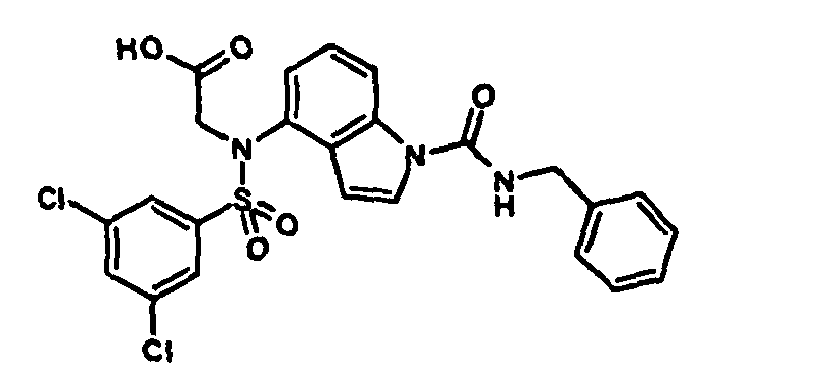
-

-

-

-

-

-

- Obtained as a by-product of the cleaving of tert. butyl {(3,5-dichlorophenylsulphonyl)-[1-(phenylethyl)-1H-indol-5-yl]-amino}-acetate to form {(3,5-dichloro-phenylsulphonyl)-[1-(phenylethyl)-1H-indol-5-yl]-amino}-acetic acid. The products are separated by preparative HPLC.
Mass spectrum (ESI-): m/z = 597 [M-H]- -

-

-

-

-

-

-
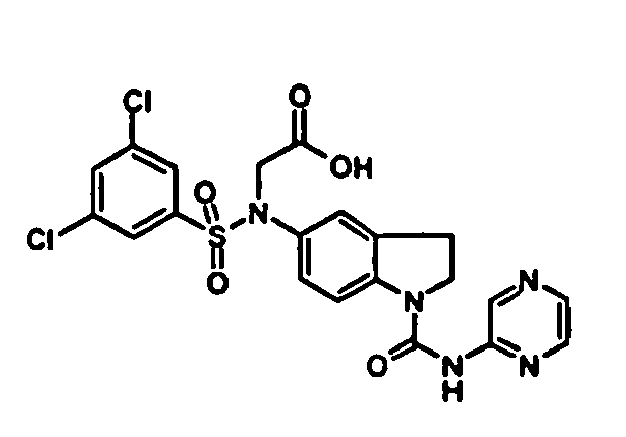
-

-

-

-

-

-

-

-

-

-

-

- The crude product is chromatographed on silica gel.
Mass spectrum (ESI+): m/z = 449 [M+H]+ -

- The crude product is chromatographed on silica gel.
Mass spectrum (ESI+): m/z = 473 [M+H]+ -

-

Rf value: 0.30 (silica gel: dichloromethane/methanol 95:5) -

-

-

-

-

-

-

-

-

-

-

-

-

-
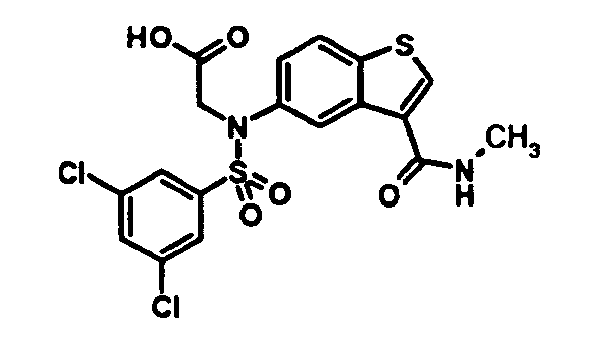
-

-

-

-

-

-

-

-

-

-

-

-
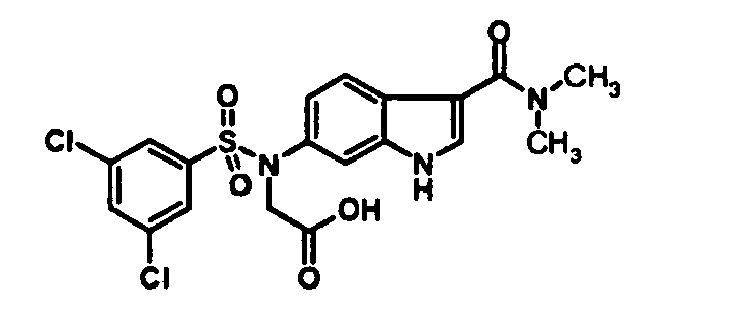
-

-

-

-

-
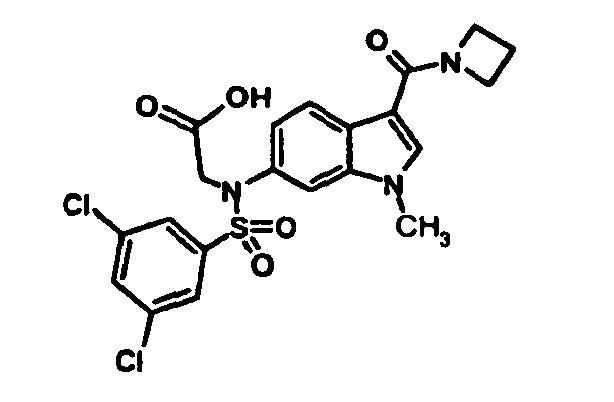
-

-

-

-

-

-

-

-

-

-

-

-

-

-

-

-

- 610 mg tert-butyl 5-[(3,5-dichloro-phenylsulphonyl)-methoxycarbonylmethyl-amino]-2,3-dihydro-indole-1-carboxylate are dissolved in 8 ml dichloromethane. 4 ml of trifluoroacetic acid are added with stirring. The mixture is stirred for 2 hours at ambient temperature and then the solvents are eliminated in vacuo. The residue is divided between saturated sodium hydrogen carbonate solution and ethyl acetate. The aqueous phase is extracted twice with ethyl acetate. The combined organic phases are dried on sodium sulphate. The solvents are eliminated in vacuo and the residue is taken up in 10 ml dichloromethane. 245 mg potassium carbonate and 150 mg 3-pyridylisocyanate are added and the mixture is stirred overnight at ambient temperature. The solvent is eliminated in vacuo and the residue is divided between water and ethyl acetate. A solid is precipitated which is suction filtered and dried in vacuo.
Yield: 340 mg (54 % of theory)
Mass spectrum (ESI+): m/z = 535 [M+H]+ -

- 220 mg tert. butyl [(3,5-dichloro-phenylsulphonyl)-(2,3-dihydro-1H-indol-5-yl)-amino]-acetate are dissolved in 10 ml dichloromethane. 166 mg potassium carbonate and 121 mg 3-pyridylisocyanate are added and the mixture is stirred overnight at ambient temperature. The reaction mixture is divided between water and dichloromethane. The aqueous phase is extracted twice with dichloromethane and the combined organic phases are dried on sodium sulphate. The solvent is eliminated in vacuo and the residue is taken up in 8 ml dichloromethane. 4 ml trifluoroacetic acid are added and the mixture is stirred for 2 hours at ambient temperature. The solvents are eliminated in vacuo and the residue is extracted from diisopropylether and petroleum ether. The solid is suction filtered and dried in vacuo.
Mass spectrum (ESI+): m/z = 521 [M+H]+ -

- 40 mg [(3,5-dichloro-phenytsulphonyl)-(2,3-dihydro-1H-indol-5-yl)-amino]-acetic acid are dissolved in 2 ml dichloromethane. 100 µl acetic anhydride are added and the mixture is stirred overnight at ambient temperature. The volatile constituents are eliminated in vacuo and the residue is purified by chromatography on silica gel with dichloromethane/methanol (99:1 to 85:15). The product thus obtained is extracted from diethyl ether/diisopropylether. The solid is suction filtered and dried in vacuo.
Yield: 15 mg (34 % of theory)
Mass spectrum (ESI+): m/z = 443 [M+H]+ -

- 300 mg tert. butyl [(3,5-dichloro-phenylsulphonyl)-(1-methylcarbamoyl-2,3-dihydro-1H-indol-4-yl)-amino]-acetate are dissolved in 4 ml of a 4 N solution of HCl in dioxane. The mixture is stirred overnight at RT and the solvents are then eliminated in vacuo. The residue is extracted from dichloromethane.
Yield: 155 mg (58 % of theory)
Mass spectrum (ESI+): m/z = 458 [M+H]+ - The following compounds are obtained analogously to Example 5:
-

-

- The crude product is extracted from diethyl ether.
Mass spectrum (ESI+): m/z = 521 [M+H]+ -

- After the end of the reaction the dioxane is eliminated in vacuo. The residue is taken up in diethyl ether and the solid is filtered off. The solvent is eliminated in vacuo and the residue is purified by chromatography on silica gel. The product thus obtained is extracted from diisopropylether.
Mass spectrum (ESI+): m/z = 476 [M+H]+ -

- The crude product is extracted from diethyl ether.
Mass spectrum (ESI+): m/z = 520 [M+H]+ -
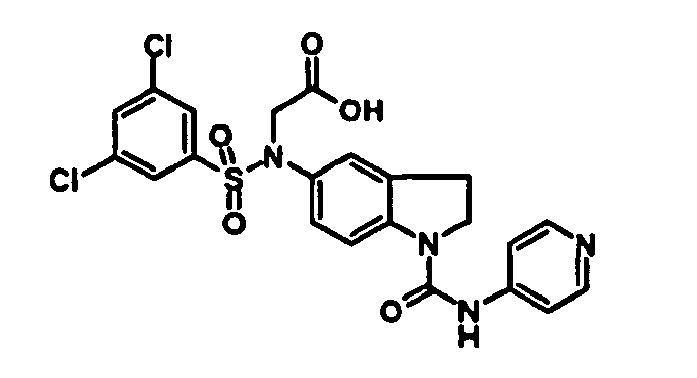
-

- The crude product is extracted from diethyl ether.
Mass spectrum (EI): m/z = 398 [M]+ -

- 512 mg methyl [(3,5-dichloro-phenylsulphonyl)-(9-ethyl-9H-carbazol-3-yl)-amino]-acetate are dissolved in 5 ml of tetrahydrofuran. 3 ml 1 N sodium hydroxide solution are added and the mixture is stirred for 3 hours at ambient temperature. It is diluted with ice water and the precipitated solid is suction filtered. The solid is taken up in 15 ml dichloromethane and the organic phase is dried on magnesium sulphate. The solvent is eliminated in vacuo and the residue is chromatographed on silica gel with dichloromethane/methanol (10:0 to 9:1).
Yield: 24 mg (5 % of theory)
Mass spectrum (ESI-): m/z = 475 [M-H]- -

- 104 mg [(3-chloro-5-ethynyl-phenylsulphonyl)-(9-ethyl-9H-carbazol-3-yl)-amino]-acetic acid are dissolved in 5 ml of ethyl acetate. 30 mg of platinum dioxide are added and the mixture is hydrogenated for 5.5 hours at 3 bar hydrogen pressure. Then the catalyst is removed by suction filtering, the solvent is eliminated in vacuo and the residue is purified by preparative HPLC.
Yield: 38 mg (36 % of theory)
Mass spectrum (ESI-): m/z = 469 [M-H]- -

- 115 mg [(3,5-dichloro-phenylsulphonyl)-(1-methylcarbamoyl-2,3-dihydro-1H-indol-5-yl)-amino]-acetic acid are dissolved in 5 ml of tetrahydrofuran. 90 mg carbonyldiimidazole are added thereto and the mixture is refluxed for 1 hour. After another hour's stirring at ambient temperature 56 µl of 2-dimethylamine-ethanol are added. The mixture is refluxed for 2 hours and stirred for 1 hour at ambient temperature. Then the solvent is eliminated in vacuo and the residue is divided between ethyl acetate and 1 N sodium hydroxide solution. The organic phase is washed once with water and once with saturated sodium chloride solution. After drying with magnesium sulphate the solvent is eliminated in vacuo and the residue is taken up in 4 ml dichloromethane. 100 µl of a 4 N solution of hydrogen chloride in dioxane are added dropwise thereto. The solvent is then eliminated in vacuo and the residue is taken up twice in toluene and the latter is again eliminated in vacuo.
Yield: 105 mg (74 % of theory)
Mass spectrum (ESI+): m/z = 529 [M+H]+ -

- After the aqueous working up the crude product is extracted from ethyl acetate, diisopropylether and petroleum ether.
Mass spectrum (ESI+): m/z = 486 [M+H]+ -

- 134 mg [(3-chloro-5-trimethylsilylethynyl-phenylsulphonyl)-(9-ethyl-9H-carbazol-3-yl)-amino]-acetic acid are dissolved in 2 ml of methanol, combined with 50 mg potassium carbonate and stirred for 2 hours at ambient temperature. Then the mixture is diluted with dichloromethane and washed with 4 M hydrochloric acid. The organic phase is dried on magnesium sulphate and the solvent is then eliminated in vacuo. The residue is chromatographed on silica gel (dichloromethane/methanol 100:0 to 95:5).
Yield: 108 mg (93 % of theory)
Mass spectrum (ESI-): m/z = 465 [M-H]- - Coated tablets containing 75 mg of active substance
- 1 tablet core contains:
active substance 75.0 mg calcium phosphate 93.0 mg corn starch 35.5 mg polyvinylpyrrolidone 10.0 mg hydroxypropylmethylcellulose 15.0 mg magnesium stearate 1.5 mg 230.0 mg - The active substance is mixed with calcium phosphate, corn starch, polyvinylpyrrolidone, hydroxypropylmethylcellulose and half the specified amount of magnesium stearate. Blanks 13 mm in diameter are produced in a tablet-making machine and these are then rubbed through a screen with a mesh size of 1.5 mm using a suitable machine and mixed with the rest of the magnesium stearate. This granulate is compressed in a tablet-making machine to form tablets of the desired shape.
- Weight of core: 230 mg
- die: 9 mm, convex
- The tablet cores thus produced are coated with a film consisting essentially of hydroxypropylmethylcellulose. The finished film-coated tablets are polished with beeswax.
- Weight of coated tablet: 245 mg.
- Tablets containing 100 mg of active substance
- 1 tablet contains:
active substance 100.0 mg lactose 80.0 mg corn starch 34.0 mg polyvinylpyrrolidone 4.0 mg magnesium stearate 2.0 mg 220.0 mg - The active substance, lactose and starch are mixed together and uniformly moistened with an aqueous solution of the polyvinylpyrrolidone. After the moist composition has been screened (2.0 mm mesh size) and dried in a rack-type drier at 50°C it is screened again (1.5 mm mesh size) and the lubricant is added. The finished mixture is compressed to form tablets.
- Weight of tablet: 220 mg
- Diameter: 10 mm, biplanar, facetted on both sides and notched on one side.
- Tablets containing 150 mg of active substance
- 1 tablet contains:
active substance 50.0 mg powdered lactose 89.0 mg corn starch 40.0 mg colloidal silica 10.0 mg polyvinylpyrrolidone 10.0 mg magnesium stearate 1.0 mg 300.0 mg - The active substance mixed with lactose, corn starch and silica is moistened with a 20% aqueous polyvinylpyrrolidone solution and passed through a screen with a mesh size of 1.5 mm. The granules, dried at 45°C, are passed through the same screen again and mixed with the specified amount of magnesium stearate. Tablets are pressed from the mixture.
- Weight of tablet: 300 mg
- die: 10 mm, flat
- Hard gelatine capsules containing 150 mg of active substance
- 1 capsule contains:
active substance 50.0 mg corn starch (dried approx. 80.0 mg lactose (powdered) approx. 87.0 mg magnesium stearate 3.0 mg approx. 420.0 mg - The active substance is mixed with the excipients, passed through a screen with a mesh size of 0.75 mm and homogeneously mixed using a suitable apparatus. The finished mixture is packed into size 1 hard gelatine capsules.
- Capsule filling: approx. 320 mg
- Capsule shell: size 1 hard gelatine capsule.
- Suppositories containing 150 mg of active substance
- 1 suppository contains:
active substance 150.0 mg polyethyleneglycol 1500 550.0 mg polyethyleneglycol 6000 460.0 mg polyoxyethylene sorbitan monostearate 840.0 mg 2,000.0 mg - After the suppository mass has been melted the active substance is homogeneously distributed therein and the melt is poured into chilled moulds.
- Suspension containing 50 mg of active substance
- 100 ml of suspension contain:
active substance 1.00 g carboxymethylcellulose-Na-salt 0.10 g methyl p-hydroxybenzoate 0.05 g propyl p-hydroxybenzoate 0.01 g glucose 10.00 g glycerol 5.00 g 70% sorbitol solution 20.00 g flavouring 0.30 g dist. water ad 100 ml - The distilled water is heated to 70°C. The methyl and propyl p-hydroxybenzoates together with the glycerol and sodium salt of carboxymethylcellulose are dissolved therein with stirring. The solution is cooled to ambient temperature and the active substance is added and homogeneously dispersed therein with stirring. After the sugar, the sorbitol solution and the flavouring have been added and dissolved, the suspension is evacuated with stirring to eliminate air.
- 5 ml of suspension contain 50 mg of active substance.
- Ampoules containing 10 mg active substance
-
active substance 10.0 mg 0.01 N hydrochloric acid q.s. double-distilled water ad 2.0 ml - The active substance is dissolved in the necessary amount of 0.01 N HCl, made isotonic with common salt, filtered sterile and transferred into 2 ml ampoules.
- Ampoules containing 50 mg of active substance
-
active substance 50.0 mg 0.01 N hydrochloric acid q.s. double-distilled water ad 10.0 ml - The active substance is dissolved in the necessary amount of 0.01 N HCl, made isotonic with common salt, filtered sterile and transferred into 10 ml ampoules.
Claims (11)
- Compounds of general formula (I)
 R denotes a group of formula
 R1 denotes H, C1-6-alkyl or a group of formula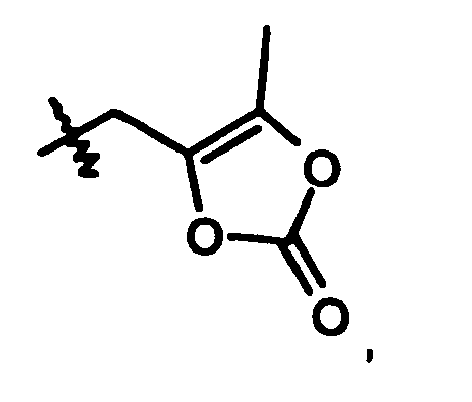
R2 and R3 independently of one another denote halogen, C1-3- alkyl, C2-4-alkynyl, C1-3-perfluoroalkyl, C1-3-perfluoroalkoxy, C1-3- alkoxy, cyano, nitro or hydroxy,
andA denotes CH or N,and the heterocyclic group


wherein the above-mentioned heterocyclic group of formula (Ib) may optionally be substituted at the nitrogen atom of the 5 ring by methyl or hydroxycarbonylmethyl, and whereinR4 denotes H, cyano, C1-6-alkyl, phenyl-C1-6-alkyl, phenylsulphonyl-C1-6- alkyl,and the tautomers, stereoisomers, mixtures thereof and the salts thereof.
C1-6-alkyl-carbonyl, carboxyl, C1-6-alkoxy-carbonyl, phenylcarbonyl, phenyl-C1-6-alkyl-carbonyl, 5-chloro-1H-indol-2-yl-carbonyl,
aminocarbonyl, C1-6-alkyl-aminocarbonyl, di-(C1-6-alkyl)-aminocarbonyl, C3-6-cycloalkyl-aminocarbonyl, N-(C3-6-cydoalkyl)-N-(C1-6-alkyl)-amino- carbonyl, aryl-amino-carbonyl, N-oxy-pyridylamino-carbonyl,
4- to 7-membered cycloalkyleneimino-carbonyl optionally substituted by hydroxy or C1-3-alkyl-aminocarbonyl,
morpholin-4-yl-carbonyl, piperazin-1-yl-carbonyl, 4-(C1-3-alkyl)- piperazin-1-yl-carbonyl, (piperazin-2-on-4-yl)-carbonyl,
aminocarbonyl-carbonyl, C1-3-alkylaminocarbonyl-carbonyl, di-(C1-3- alkyl)-aminocarbonyl-carbonyl, pyrrolidin-1-ylcarbonyl-carbonyl, piperidin-1-ylcarbonyl-carbonyl, morpholin-4-ylcarbonyl-carbonyl, piperazin-1-ylcarbonyl-carbonyl, 4-methyl-piperazin-1-ylcarbonyl- carbonyl,
C1-3-alkyl-sulphonyl, phenyl-C1-3-alkylsulphonyl or phenylsulphonyl optionally substituted in the phenyl moiety by one or two chlorine atoms,
wherein the C1-6-alkyl-aminocarbonyl, di-(C1-6-alkyl)- aminocarbonyl and N-(C3-6-cycloalkyl)-N-(C1-6-alkyl)-amino- carbonyl group mentioned above in the definition of R4 may each be substituted in the alkyl moiety by aryl, C1-3-alkyl-amino, di-(C1- 3-alkyl)-amino, C3-6-cycloalkyl-amino, N-(C3-6-cycloalkyl)-N-(C1-6- alkyl)-amino, pyrrolidin-1-yl, piperidin-1-yl, morpholin-4-yl, piperazin-1-yl, 4-methyl-piperazin-1-yl or C1-3- alkylaminocarbonyl, and
wherein the aryl group mentioned above in the definition of R4 is a 6-membered aromatic system that may contain 0 to 3 nitrogen atoms and may be substituted by nitro. - Compounds of general formula (I) according to claim 1, whereinR denotes a group of the formula given in claim 1, whereinR1 denotes H, C1-6-alkyl or a group of formula
 A denotes CH or N,and the heterocyclic group


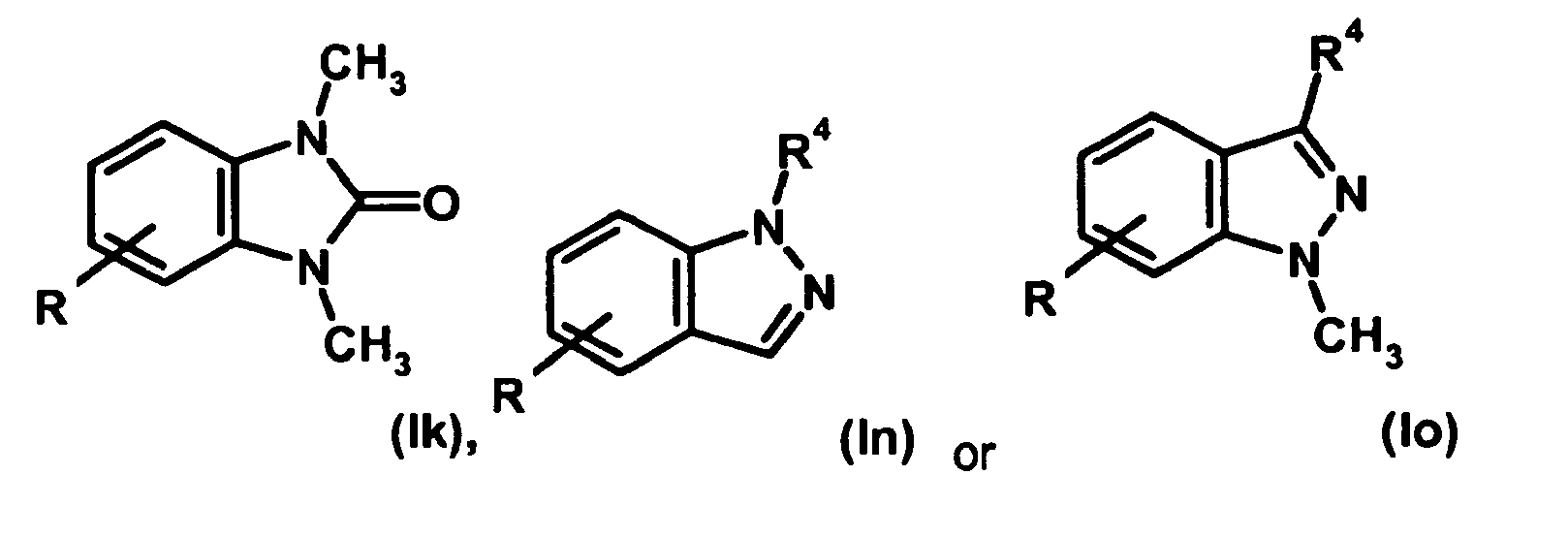
wherein the above-mentioned heterocyclic group of formula (Ib) may optionally be substituted at the nitrogen atom of the 5 ring by methyl or hydroxycarbonylmethyl, and whereinR4 denotes H, cyano, C1-4-alkyl, phenyl-C1-4-alkyl, phenylsulphonyl-C1-4- alkyl,the tautomers, stereoisomers, mixtures thereof and the salts thereof.
C1-4-alkyl-carbonyl, carboxyl, C1-4-alkoxy-carbonyl, phenylcarbonyl, phenyl-C1-4-alkyl-carbonyl, 5-chloro-1H-indol-2-yl-carbonyl,
aminocarbonyl, C1-4-alkyl-aminocarbonyl, di-(C1-4-alkyl)-aminocarbonyl, C3-6-cycloalkyl-aminocarbonyl; N-(C3-6-cycloalkyl)-N-(C1-4-alkyl)-amino- carbonyl, [N,N-di-(C1-4-alkyl)-amino]-C1-3-alkyl-amino-carbonyl, 1- (methylaminocarbonyl)-ethyl-amino-carbonyl, aryl-amino-carbonyl, aryl- C1-3-alkyl-amino-carbonyl, N-oxy-pyridylamino-carbonyl,
4- to 7-membered cycloalkyleneimino-carbonyl optionally substituted by hydroxy or methylaminocarbonyl,
morpholin-4-yl-carbonyl, piperazin-1-yl-carbonyl, 4-(methyl)-piperazin- 1-yl-carbonyl, (piperazin-2-on-4-yl)-carbonyl, aminocarbonyl-carbonyl, C1-2-alkylaminocarbonyl-carbonyl, di-(C1-2- alkyl)-aminocarbonyl-carbonyl, pyrrolidin-1-ylcarbonyl-carbonyl, piperidin-1-ylcarbonyl-carbonyl, morpholin-4-ylcarbonyl-carbonyl,
C1-2-alkyl-sulphonyl, phenyl-C1-2-alkyl-sulphonyl or phenylsulphonyl optionally substituted in the phenyl moiety by one or two chlorine atoms,
while the aryl group mentioned above in the definition of R4 is a 6-membered aromatic system that may contain 0 to 2 nitrogen atoms and may be substituted by nitro, - Compounds of general formula (I) according to claim 2, whereinR denotes a group of the formula given in claim 1, whereinR1 denotes H, C1-4-alkyl or a group of formula
 R2 and R3 independently of one another denote chlorine, bromine, C1-2- alkoxy, C2-3-alkynyl or C1-2-alkyl andA denotes CH or N,and the heterocyclic group
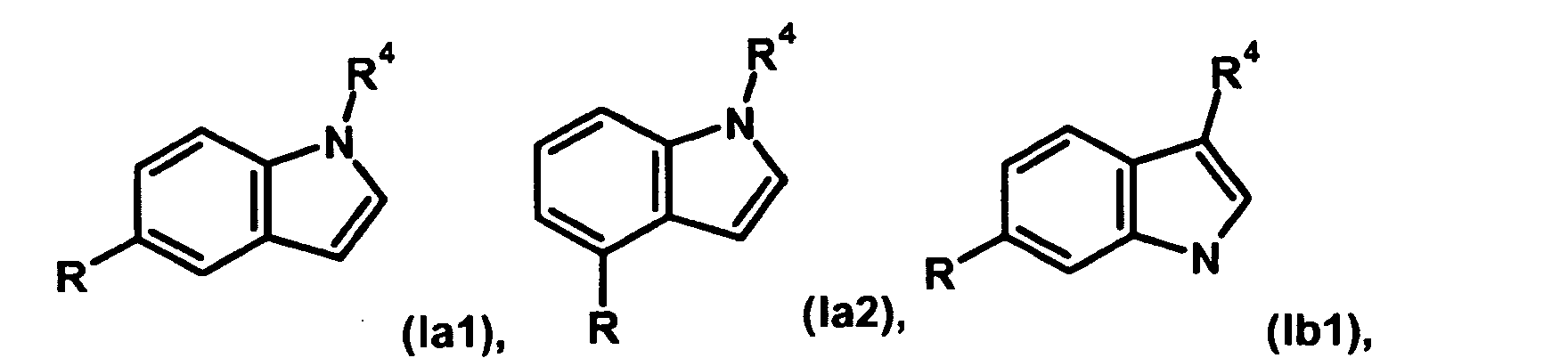


wherein the above-mentioned heterocyclic group of formula (Ib1) may optionally be substituted at the nitrogen atom of the 5 ring by methyl or hydroxycarbonylmethyl, and whereinR4 denotes H, cyano, C1-4-alkyl, phenyl-C1-4-alkyl, phenylsulphonyl-C1-4- alkyl,the tautomers, stereoisomers, mixtures thereof and the salts thereof.
C1-4-alkyl-carbonyl, carboxyl, C1-4-alkoxy-carbonyl, phenylcarbonyl, phenyl-C1-4-alkyl-carbonyl, 5-chloro-1H-indol-2-yl-carbonyl,
aminocarbonyl, C1-4-alkyl-aminocarbonyl, di-(C1-4-alkyl)-aminocarbonyl, C3-6-cycloalkyl-aminocarbonyl, N-(C3-6-cycloalkyl)-N-(C1-4-alkyl)-amino- carbonyl, N,N-di-(C1-3-alkyl)-amino-C1-3-alkyl-amino-carbonyl, 1- (methylaminocarbonyl)-ethyl-amino-carbonyl, phenylamino-carbonyl, (nitrophenyl)-amino-carbonyl, phenyl-C1-2-alkyl-amino-carbonyl, pyridinylamino-carbonyl, pyrazinylamino-carbonyl, N-oxy-pyridylamino- carbonyl,
azetidin-1-yl-carbonyl, pyrrolidin-1-yl-carbonyl, 3-hydroxy-pyrrolidin-1- yl-carbonyl, 2-(methylaminocarbonyl)-pyrrolidin-1-yl-carbonyl, piperidin- 1-yl-carbonyl, morpholin-4-yl-carbonyl, piperazin-1-yl-carbonyl, (piperazin-2-on-4-yl)-carbonyl,
aminocarbonyl-carbonyl, C1-2-alkylaminocarbonyl-carbonyl, di-(C1-2- alkyl)-aminocarbonyl-carbonyl, pyrrolidin-1-ylcarbonyl-carbonyl, piperidin-1-ylcarbonyl-carbonyl, morpholin-4-ylcarbonyl-carbonyl,
benzyl-sulphonyl, phenylsulphonyl or 3,5-dichloro-phenyl-sulphonyl, - Compounds of general formula (I) according to claim 3, whereinR denotes a group of the formula given in claim 1, whereinR1 denotes H or a C1-3-alkyl group optionally substituted by a di-(C1- 3-alkyl)-amino group,R2 and R3 independently of one another represent chlorine, ethynyl, methoxy, methyl or ethyl andA denotes CH or N, and the heterocyclic group


wherein the above-mentioned heterocyclic group of formula (Ib1) may optionally be substituted at the nitrogen atom of the 5 ring by methyl or hydroxycarbonylmethyl, and whereinR4 denotes H, cyano, C1-3-alkyl, phenyl-C1-2-alkyl, phenylsulphonyl-C1-2- alkyl,the tautomers, stereoisomers, mixtures thereof and the salts thereof.
C1-3-alkyl-carbonyl, C1-2-alkoxy-carbonyl, phenylcarbonyl, phenyl-C1-2- alkyl-carbonyl, 5-chloro-1H-indol-2-yl-carbonyl,
aminocarbonyl, C1-3-alkyl-aminocarbonyl, di-(C1-3-alkyl)-aminocarbonyl, cyclopropyl-aminocarbonyl, N-(cyclopropyl)-N-(C1-2-alkyl)-amino- carbonyl, (N,N-dimethyl-amino)-ethyl-amino-carbonyl, 1- (methylaminocarbonyl)-ethyl-amino-carbonyl, phenylamino-carbonyl, (nitrophenyl)-amino-carbonyl, phenyl-C1-3-alkyl-carbonyl, phenyl-C1-2- alkyl-amino-carbonyl, pyridinylamino-carbonyl, pyrazinylamino- carbonyl, N-oxy-pyridin-3-ylamino-carbonyl,
azetidin-1-yl-carbonyl, pyrrolidin-1-yl-carbonyl, 3-hydroxy-pyrrolidin-1- yl-carbonyl, 2-(methylaminocarbonyl)-pyrrolidin-1-yl-carbonyl, piperidin- 1-yl-carbonyl, morpholin-4-yl-carbonyl, piperazin-1-yl-carbonyl, (piperazin-2-on-4-yl)-carbonyl,
aminocarbonyl-carbonyl, C1-2-alkylaminocarbonyl-carbonyl, di-(C1-2- alkyl)-aminocarbonyl-carbonyl, pyrrolidin-1-ylcarbonyl-carbonyl,
benzyl-sulphonyl or phenyl-sulphonyl, - Compounds of general formula (I) according to claim 4, whereinR denotes a group of the formula given in claim 1, whereinR1 denotes H, methyl, ethyl or 2-dimethylamino-ethyl,R2 and R3 independently of one another denote chlorine, ethynyl, methoxy, methyl or ethyl andA denotes CH or N,and the heterocyclic group


wherein the above-mentioned heterocyclic group of formula (Ie1) may optionally be substituted by carboxyl, amino-carbonyl or hydroxymethyl at the carbon atom of the 5 ring adjacent to the phenyl ring, and
wherein the above-mentioned heterocyclic group of formula (Ib1) may optionally be substituted by methyl or hydroxycarbonylmethyl at the nitrogen atom of the 5 ring, and whereinR4 denotes H, cyano, ethyl, phenyl-ethyl, phenylsulphonyl-ethyl,the tautomers, stereoisomers, mixtures thereof and the salts thereof.
methyl-carbonyl, methoxy-carbonyl, phenylcarbonyl, benzylcarbonyl, 5- chloro-1H-indol-2-yl-carbonyl,
aminocarbonyl, methyl-aminocarbonyl, dimethyl-aminocarbonyl, cyclopropyl-aminocarbonyl, N-(cyclopropyl)-N-(methyl)-aminocarbonyl, (N,N-dimethyl-amino)-ethyl-amino-carbonyl, 1-(methylaminocarbonyl)- ethyl-amino-carbonyl, phenylamino-carbonyl, benzylamino-carbonyl, 3- nitro-phenylamino-carbonyl, 2-nitro-phenylamino-carbonyl, pyridin-3- ylamino-carbonyl, pyridin-4-ylamino-carbonyl, pyrazinylamino-carbonyl, N-oxy-pyridin-3-ylamino-carbonyl, azetidin-1-yl-carbonyl, pyrrolidin-1-yl-carbonyl, 3-hydroxy-pyrrolidin-1- yl-carbonyl, 2-(methylaminocarbonyl)-pyrrolidin-1-yl-carbonyl, piperidin- 1-yl-carbonyl, morpholin-4-yl-carbonyl, piperazin-1-yl-carbonyl, (piperazin-2-on-4-yl)-carbonyl,
aminocarbonyl-carbonyl, methylaminocarbonyl-carbonyl, dimethyl- aminocarbonyl-carbonyl, pyrrolidin-1-ylcarbonyl-carbonyl,
benzyl-sulphonyl or phenyl-sulphonyl, - The following compounds according to claim 1:(1) [(3,5-dichloro-phenylsulphonyl)-(1-phenylcarbamoyl-1H-indol-5-yl)-amino]-acetic acid,(2) [(3,5-dichloro-phenylsulphonyl)-(1-phenylcarbamoyl-2,3-dihydro-1H-indol-5-yl)-amino]-acetic acid,(3) {(3,5-dichloro-phenylsulphonyl)-[1-(3-nitro-phenylcarbamoyl)-2,3-dihydro-1H-indol-5-yl]-amino}-acetic acid,(4) {(3,5-dichloro-phenylsulphonyl)-[1-(pyridin-3-ylcarbamoyl)-2,3-dihydro-1H-indol-5-yl]-amino}-acetic acid,(5) {(3,5-dichloro-phenylsulphonyl)-[1-(2-nitro-phenylcarbamoyl)-2,3-dihydro-1H-indol-5-yl]-amino}-acetic acid,(6) [(1-acetyl-2,3-dihydro-1H-indol-5-yl)-(3,5-dichloro-phenylsulphonyl)-amino]-acetic acid,(7) [(3,5-dichloro-phenylsulphonyl)-(1-methylcarbamoyl-2,3-dihydro-1H-indol-5-yl)-amino]-acetic acid,(8) {(3,5-dichloro-phenylsulphonyl)-[1-(pyridin-4-ylcarbamoyl)-2,3-dihydro-1H-indol-5-yl]-amino}-acetic acid,(9) [(2,6-dichloro-pyridine-4-sulphonyl)-(9-ethyl-9H-carbazol-3-yl)-amino]-acetic acid,(10) {(3,5-dichloro-phenylsulphonyl)-[3-(morpholine-4-carbonyl)-1H-indol-6-yl]-amino}-acetic acid,(11) [(3,5-dichloro-phenylsulphonyl)-(3-dimethylcarbamoyl-1-methyl-1H-indol-6-yl)-amino]-acetic acid,(12) [(3,5-dichloro-phenylsulphonyl)-(3-methylcarbamoyl-benzo[b]thiophen-6-yl)-amino]-acetic acid,(13) {(3,5-dichloro-phenylsulphonyl)-[1-methyl-3-(pyrrolidine-1-carbonyl)-1H-indol-6-yl]-amino}-acetic acid,(14) [(3,5-dimethyl-phenylsulphonyl)-(1-methylcarbamoyl-2,3-dihydro-1H-indol-5-yl)-amino]-acetic acid,(15) [[3-(azetidine-1-carbonyl)-1-methyl-1H-indol-6-yl]-(3,5-dichlorophenylsulphonyl)-amino]-acetic acid,(16) {(3,5-dichloro-phenylsulphonyl)-[3-(3-hydroxy-pyrrolidine-1-carbonyl)-1-methyl-1H-indol-6-yl]-amino}-acetic acid,(17) [[3-(cyclopropyl-methyl-carbamoyl)-1-methyl-1H-indol-6-yl]-(3,5-dichloro-phenylsulphonyl)-amino]-acetic acid,(18) {(3-chloro-5-methyl-phenylsulphonyl)-[1-methyl-3-(pyrrolidine-1-carbonyl)-1H-indol-6-yl]-amino}-acetic acid,(19) {(3,5-dimethyl-phenylsulphonyl)-[1-methyl-3-(pyrrolidine-1-carbonyl)-1H-indol-6-yl]-amino}-acetic acid and(20) [(3,5-dichloro-phenylsulphonyl)-(3-hydroxymethyl-1-methylcarbamoyl-2,3-dihydro-1H-indol-5-yl)-amino]-acetic acid,the enantiomers, the mixtures and the salts thereof.
- Physiologically acceptable salts of the compounds according to claims 1 to 6 with inorganic or organic acids or bases.
- Pharmaceutical compositions, containing a compound according to at least one of claims 1 to 6 or a salt according to claim 7 optionally together with one or more inert carriers and/or diluents.
- Use of a compound according to at least one of claims 1 to 6 or a salt according to claim 7 for preparing a pharmaceutical composition that is suitable for the treatment of type I and type II diabetes mellitus.
- Process for preparing a pharmaceutical composition according to claim 8, characterised in that a compound according to at least one of claim 1 to 6 or a salt according to claim 7 is incorporated in one or more inert carriers and/or diluents by a non-chemical method.
- Process for preparing the compounds of general formula I according to claims 1 to 7, characterised in thata) a compound of general formula (IV)
 b) if desired any protective group used to protect reactive groups during the reactions is cleaved afterwards or simultaneously and/orc) a compound of general formula I thus obtained is resolved into its stereoisomers and/ord) a compound of general formula I thus obtained is converted into the salts thereof, particularly for pharmaceutical use into the physiologically acceptable salts thereof with an inorganic or organic acid or base.
Applications Claiming Priority (2)
| Application Number | Priority Date | Filing Date | Title |
|---|---|---|---|
| DE102007012284A DE102007012284A1 (en) | 2007-03-16 | 2007-03-16 | Novel substituted arylsulfonylglycines, their preparation and their use as pharmaceuticals |
| PCT/EP2008/053087 WO2008113760A2 (en) | 2007-03-16 | 2008-03-14 | Arylsulphonyglycine derivatives as suppressors of the interaction of glycogen phosphorylase a with the gl subunit of glycogen-associated protein phosphatase 1 (ppl) for the treatment of metabolic disorders, particulary diabetes |
Publications (2)
| Publication Number | Publication Date |
|---|---|
| EP2125718A2 EP2125718A2 (en) | 2009-12-02 |
| EP2125718B1 true EP2125718B1 (en) | 2010-09-15 |
Family
ID=39688104
Family Applications (1)
| Application Number | Title | Priority Date | Filing Date |
|---|---|---|---|
| EP08735421A Not-in-force EP2125718B1 (en) | 2007-03-16 | 2008-03-14 | New substituted arylsulphonylglycines, the preparation thereof and the use thereof as pharmaceutical compositions |
Country Status (8)
| Country | Link |
|---|---|
| US (1) | US8232312B2 (en) |
| EP (1) | EP2125718B1 (en) |
| JP (1) | JP2010521515A (en) |
| AT (1) | ATE481382T1 (en) |
| CA (1) | CA2681124A1 (en) |
| DE (2) | DE102007012284A1 (en) |
| ES (1) | ES2349331T3 (en) |
| WO (1) | WO2008113760A2 (en) |
Cited By (1)
| Publication number | Priority date | Publication date | Assignee | Title |
|---|---|---|---|---|
| US9650375B2 (en) | 2013-03-14 | 2017-05-16 | Merck Sharp & Dohme Corp. | Indole derivatives useful as anti-diabetic agents |
Families Citing this family (17)
| Publication number | Priority date | Publication date | Assignee | Title |
|---|---|---|---|---|
| DE102007012284A1 (en) | 2007-03-16 | 2008-09-18 | Boehringer Ingelheim Pharma Gmbh & Co. Kg | Novel substituted arylsulfonylglycines, their preparation and their use as pharmaceuticals |
| DE102007035333A1 (en) * | 2007-07-27 | 2009-01-29 | Boehringer Ingelheim Pharma Gmbh & Co. Kg | Novel substituted arylsulfonylglycines, their preparation and their use as pharmaceuticals |
| DE102007035334A1 (en) * | 2007-07-27 | 2009-01-29 | Boehringer Ingelheim Pharma Gmbh & Co. Kg | Novel substituted arylsulfonylglycines, their preparation and their use as pharmaceuticals |
| DE102007042154A1 (en) * | 2007-09-05 | 2009-03-12 | Boehringer Ingelheim Pharma Gmbh & Co. Kg | Arylsulfonylaminomethyphosphonsäure derivatives, their preparation and their use as medicaments |
| DE102008019838A1 (en) * | 2008-04-19 | 2009-12-10 | Boehringer Ingelheim International Gmbh | New arylsulfonylglycine derivatives, their preparation and their use as pharmaceuticals |
| CN102014897B (en) | 2008-04-21 | 2015-08-05 | 西格纳姆生物科学公司 | Compound, compositions and its preparation method |
| US8278302B2 (en) | 2009-04-08 | 2012-10-02 | Boehringer Ingelheim International Gmbh | Substituted piperidines as CCR3 antagonists |
| GB0909671D0 (en) | 2009-06-04 | 2009-07-22 | Xention Discovery Ltd | Compounds |
| GB0909672D0 (en) | 2009-06-04 | 2009-07-22 | Xention Discovery Ltd | Compounds |
| WO2011107494A1 (en) | 2010-03-03 | 2011-09-09 | Sanofi | Novel aromatic glycoside derivatives, medicaments containing said compounds, and the use thereof |
| US8933024B2 (en) | 2010-06-18 | 2015-01-13 | Sanofi | Azolopyridin-3-one derivatives as inhibitors of lipases and phospholipases |
| US8530413B2 (en) | 2010-06-21 | 2013-09-10 | Sanofi | Heterocyclically substituted methoxyphenyl derivatives with an oxo group, processes for preparation thereof and use thereof as medicaments |
| TW201215387A (en) | 2010-07-05 | 2012-04-16 | Sanofi Aventis | Spirocyclically substituted 1,3-propane dioxide derivatives, processes for preparation thereof and use thereof as a medicament |
| TW201215388A (en) | 2010-07-05 | 2012-04-16 | Sanofi Sa | (2-aryloxyacetylamino)phenylpropionic acid derivatives, processes for preparation thereof and use thereof as medicaments |
| TW201221505A (en) | 2010-07-05 | 2012-06-01 | Sanofi Sa | Aryloxyalkylene-substituted hydroxyphenylhexynoic acids, process for preparation thereof and use thereof as a medicament |
| WO2013037390A1 (en) | 2011-09-12 | 2013-03-21 | Sanofi | 6-(4-hydroxy-phenyl)-3-styryl-1h-pyrazolo[3,4-b]pyridine-4-carboxylic acid amide derivatives as kinase inhibitors |
| WO2013045413A1 (en) | 2011-09-27 | 2013-04-04 | Sanofi | 6-(4-hydroxy-phenyl)-3-alkyl-1h-pyrazolo[3,4-b]pyridine-4-carboxylic acid amide derivatives as kinase inhibitors |
Family Cites Families (31)
| Publication number | Priority date | Publication date | Assignee | Title |
|---|---|---|---|---|
| DE3432320A1 (en) | 1984-09-03 | 1986-03-13 | Behringwerke Ag, 3550 Marburg | CIS-PLATINUM COMPLEXES WITH A PENTAERYTHRITE DERIVATIVE AS A LIGAND, METHOD FOR THE PRODUCTION THEREOF AND PHARMACEUTICAL AGENT CONTAINING THESE COMPOUNDS |
| PT604657E (en) | 1992-05-21 | 2000-04-28 | Otsuka Pharma Co Ltd | DERIVED FROM PHOSPHONIC DIESTER |
| TW260664B (en) | 1993-02-15 | 1995-10-21 | Otsuka Pharma Factory Inc | |
| DE19753522A1 (en) | 1997-12-03 | 1999-06-10 | Boehringer Ingelheim Pharma | Substituted indoles, their preparation and their use as pharmaceuticals |
| US6114532A (en) * | 1998-02-03 | 2000-09-05 | Boehringer Ingelheim Pharma Kg | Bicyclic heterocycles, the preparation thereof, and their use as pharmaceuticals |
| JP2000247949A (en) * | 1999-02-26 | 2000-09-12 | Eisai Co Ltd | Indole compound containing sulfonamide |
| WO2001070753A1 (en) | 2000-03-22 | 2001-09-27 | Merck Frosst Canada & Co. | Sulfur substituted aryldifluoromethylphosphonic acids as ptp-1b inhibitors |
| PE20021091A1 (en) * | 2001-05-25 | 2003-02-04 | Aventis Pharma Gmbh | DERIVATIVES OF PHENYLUREA SUBSTITUTED WITH CARBONAMIDE AND PROCEDURE FOR THEIR PREPARATION |
| DE10215907A1 (en) | 2002-04-11 | 2003-11-06 | Aventis Pharma Gmbh | Acyl-4-carboxyphenyl-urea derivatives, processes for their preparation and their use |
| US7223796B2 (en) * | 2002-04-11 | 2007-05-29 | Sanofi-Aventis Deutschland Gmbh | Acyl-4-carboxyphenylurea derivatives, processes for preparing them and their use |
| US7262220B2 (en) * | 2002-07-11 | 2007-08-28 | Sanofi-Aventis Deutschland Gmbh | Urea- and urethane-substituted acylureas, process for their preparation and their use |
| MXPA05000055A (en) | 2002-07-11 | 2005-04-08 | Aventis Pharma Gmbh | Urea-substituted and urethane-substituted acylureas, methods for the production thereof and their use as medicaments. |
| ATE452879T1 (en) | 2002-07-12 | 2010-01-15 | Sanofi Aventis Deutschland | HETEROCYCLIC SUBSTITUTED BENZOYL UREASES, METHOD FOR THEIR PRODUCTION AND THEIR USE AS MEDICINAL PRODUCTS |
| PL376301A1 (en) * | 2002-10-24 | 2005-12-27 | Sterix Limited | Inhibitors of 11-beta-hydroxy steroid dehydrogenase type 1 and type 2 |
| JP2006528702A (en) | 2003-05-21 | 2006-12-21 | プロシディオン・リミテッド | Pyrropyridine-2-carboxylic acid amide inhibitor of glycogen phosphorylase |
| ES2222832B1 (en) * | 2003-07-30 | 2006-02-16 | Laboratorios Del Dr. Esteve, S.A. | DERIVATIVES OF 6-INDOLILSULFONAMIDS, ITS PREPARATION AND ITS APPLICATION AS MEDICINES. |
| ES2222829B1 (en) * | 2003-07-30 | 2006-03-01 | Laboratorios Del Dr. Esteve, S.A. | DERIVATIVES OF 4-INDOLILSULFONAMIDS, ITS PREPARATION AND ITS APPLICATION AS MEDICATIONS. |
| ES2222827B1 (en) * | 2003-07-30 | 2006-03-01 | Laboratorios Del Dr. Esteve, S.A. | DERIVATIVES OF 5-INDOLILSULFONAMIDS, ITS PREPARATION AND ITS APPLICATION AS MEDICINES. |
| EP1513085A1 (en) | 2003-09-08 | 2005-03-09 | Abb Research Ltd. | Method of scheduling maintenance actions |
| JP2005206492A (en) | 2004-01-21 | 2005-08-04 | Sankyo Co Ltd | Sulfonamide compound |
| WO2006034418A2 (en) | 2004-09-21 | 2006-03-30 | Athersys, Inc. | Benzimidazole acetic acids exhibiting crth2 receptor antagonism and uses thereof |
| BRPI0517567A (en) | 2004-11-09 | 2008-06-17 | Smithkline Beecham Corp | compound or a pharmaceutically acceptable salt, solvate, or physiologically functional derivative thereof, pharmaceutical composition, uses of a compound or a pharmaceutically acceptable salt, solvate, or derivative thereof and a pharmaceutical composition, and process for preparing a compound |
| CA2586363A1 (en) * | 2004-11-15 | 2006-05-26 | Ceptyr, Inc. | Protein tyrosine phosphatase inhibitors and methods of use thereof |
| JP5094394B2 (en) * | 2005-04-20 | 2012-12-12 | 武田薬品工業株式会社 | Fused heterocyclic compounds |
| AU2006302179C1 (en) * | 2005-10-07 | 2013-06-20 | Exelixis, Inc. | N- (3-amino-quinoxalin-2-yl) -sulfonamide derivatives and their use as phosphatidylinositol 3-kinase inhibitors |
| DE102007007751A1 (en) | 2007-02-16 | 2008-08-21 | Boehringer Ingelheim Pharma Gmbh & Co. Kg | Novel substituted arylsulfonylglycines, their preparation and their use as pharmaceuticals |
| WO2008103354A2 (en) | 2007-02-20 | 2008-08-28 | Cropsolution, Inc. | Modulators of acetyl-coenzyme a carboxylase and methods of use thereof |
| DE102007012284A1 (en) | 2007-03-16 | 2008-09-18 | Boehringer Ingelheim Pharma Gmbh & Co. Kg | Novel substituted arylsulfonylglycines, their preparation and their use as pharmaceuticals |
| DE102007035333A1 (en) | 2007-07-27 | 2009-01-29 | Boehringer Ingelheim Pharma Gmbh & Co. Kg | Novel substituted arylsulfonylglycines, their preparation and their use as pharmaceuticals |
| DE102007035334A1 (en) * | 2007-07-27 | 2009-01-29 | Boehringer Ingelheim Pharma Gmbh & Co. Kg | Novel substituted arylsulfonylglycines, their preparation and their use as pharmaceuticals |
| DE102007042154A1 (en) | 2007-09-05 | 2009-03-12 | Boehringer Ingelheim Pharma Gmbh & Co. Kg | Arylsulfonylaminomethyphosphonsäure derivatives, their preparation and their use as medicaments |
-
2007
- 2007-03-16 DE DE102007012284A patent/DE102007012284A1/en not_active Withdrawn
-
2008
- 2008-03-14 EP EP08735421A patent/EP2125718B1/en not_active Not-in-force
- 2008-03-14 CA CA002681124A patent/CA2681124A1/en not_active Abandoned
- 2008-03-14 ES ES08735421T patent/ES2349331T3/en active Active
- 2008-03-14 JP JP2009554009A patent/JP2010521515A/en active Pending
- 2008-03-14 DE DE602008002567T patent/DE602008002567D1/en active Active
- 2008-03-14 WO PCT/EP2008/053087 patent/WO2008113760A2/en not_active Ceased
- 2008-03-14 US US12/530,507 patent/US8232312B2/en active Active
- 2008-03-14 AT AT08735421T patent/ATE481382T1/en active
Cited By (1)
| Publication number | Priority date | Publication date | Assignee | Title |
|---|---|---|---|---|
| US9650375B2 (en) | 2013-03-14 | 2017-05-16 | Merck Sharp & Dohme Corp. | Indole derivatives useful as anti-diabetic agents |
Also Published As
| Publication number | Publication date |
|---|---|
| WO2008113760A2 (en) | 2008-09-25 |
| EP2125718A2 (en) | 2009-12-02 |
| JP2010521515A (en) | 2010-06-24 |
| ATE481382T1 (en) | 2010-10-15 |
| DE602008002567D1 (en) | 2010-10-28 |
| DE102007012284A1 (en) | 2008-09-18 |
| US20100130557A1 (en) | 2010-05-27 |
| ES2349331T3 (en) | 2010-12-30 |
| WO2008113760A3 (en) | 2008-11-13 |
| CA2681124A1 (en) | 2008-09-25 |
| US8232312B2 (en) | 2012-07-31 |
Similar Documents
| Publication | Publication Date | Title |
|---|---|---|
| US8232312B2 (en) | Substituted arylsulphonylglycines, the preparation thereof and the use thereof as pharmaceutical compositions | |
| US8211923B2 (en) | Substituted arylsulfonylaminomethylphosphonic acid derivatives, their preparation and their use in the treatment of type I and II diabetes mellitus | |
| US8357689B2 (en) | Substituted arylsulfonylaminomethylphosphonic acid derivatives, their preparation and their use in the treatment of type I and II diabetes mellitus | |
| EP2121600B1 (en) | Substituted arylsulphonylglycines, the preparation thereof and the use thereof as pharmaceutical compositions | |
| US20050233982A1 (en) | Glucopyranosyloxy-pyrazoles, pharmaceutical compositions containing these compounds, the use thereof and processed for the preparation thereof | |
| EP2318355B1 (en) | 1,1'-diadamantyl carboxylic acids, medicaments containing such compounds and their use | |
| EP2200606B1 (en) | Process for the preparation of compounds useful as inhibitors of sglt | |
| US7897781B2 (en) | Cold menthol receptor-1 antagonists | |
| EP2200987A1 (en) | Arylsulfonylaminomethylphosphonic acid derivatives, the preparation thereof and the use thereof as pharmaceutical compositions | |
| EP2513054B1 (en) | Bicyclic derivatives useful as inhibitors of dpp-1 | |
| US20080287398A1 (en) | Cold menthol receptor-1 antagonists | |
| US8629281B2 (en) | Cold menthol receptor-1 antagonists | |
| US8558011B2 (en) | Cold menthol receptor-1 antagonists | |
| EP1610776A2 (en) | Ophthalmic compositions for treating ocular hypertension |
Legal Events
| Date | Code | Title | Description |
|---|---|---|---|
| PUAI | Public reference made under article 153(3) epc to a published international application that has entered the european phase |
Free format text: ORIGINAL CODE: 0009012 |
|
| 17P | Request for examination filed |
Effective date: 20091016 |
|
| AK | Designated contracting states |
Kind code of ref document: A2 Designated state(s): AT BE BG CH CY CZ DE DK EE ES FI FR GB GR HR HU IE IS IT LI LT LU LV MC MT NL NO PL PT RO SE SI SK TR |
|
| GRAP | Despatch of communication of intention to grant a patent |
Free format text: ORIGINAL CODE: EPIDOSNIGR1 |
|
| GRAS | Grant fee paid |
Free format text: ORIGINAL CODE: EPIDOSNIGR3 |
|
| DAX | Request for extension of the european patent (deleted) | ||
| GRAA | (expected) grant |
Free format text: ORIGINAL CODE: 0009210 |
|
| AK | Designated contracting states |
Kind code of ref document: B1 Designated state(s): AT BE BG CH CY CZ DE DK EE ES FI FR GB GR HR HU IE IS IT LI LT LU LV MC MT NL NO PL PT RO SE SI SK TR |
|
| REG | Reference to a national code |
Ref country code: GB Ref legal event code: FG4D Ref country code: CH Ref legal event code: EP |
|
| REG | Reference to a national code |
Ref country code: IE Ref legal event code: FG4D |
|
| REF | Corresponds to: |
Ref document number: 602008002567 Country of ref document: DE Date of ref document: 20101028 Kind code of ref document: P |
|
| REG | Reference to a national code |
Ref country code: ES Ref legal event code: FG2A Effective date: 20101217 |
|
| REG | Reference to a national code |
Ref country code: NL Ref legal event code: VDEP Effective date: 20100915 |
|
| PG25 | Lapsed in a contracting state [announced via postgrant information from national office to epo] |
Ref country code: LT Free format text: LAPSE BECAUSE OF FAILURE TO SUBMIT A TRANSLATION OF THE DESCRIPTION OR TO PAY THE FEE WITHIN THE PRESCRIBED TIME-LIMIT Effective date: 20100915 Ref country code: FI Free format text: LAPSE BECAUSE OF FAILURE TO SUBMIT A TRANSLATION OF THE DESCRIPTION OR TO PAY THE FEE WITHIN THE PRESCRIBED TIME-LIMIT Effective date: 20100915 Ref country code: NO Free format text: LAPSE BECAUSE OF FAILURE TO SUBMIT A TRANSLATION OF THE DESCRIPTION OR TO PAY THE FEE WITHIN THE PRESCRIBED TIME-LIMIT Effective date: 20101215 |
|
| LTIE | Lt: invalidation of european patent or patent extension |
Effective date: 20100915 |
|
| PG25 | Lapsed in a contracting state [announced via postgrant information from national office to epo] |
Ref country code: SI Free format text: LAPSE BECAUSE OF FAILURE TO SUBMIT A TRANSLATION OF THE DESCRIPTION OR TO PAY THE FEE WITHIN THE PRESCRIBED TIME-LIMIT Effective date: 20100915 Ref country code: HR Free format text: LAPSE BECAUSE OF FAILURE TO SUBMIT A TRANSLATION OF THE DESCRIPTION OR TO PAY THE FEE WITHIN THE PRESCRIBED TIME-LIMIT Effective date: 20100915 Ref country code: CY Free format text: LAPSE BECAUSE OF FAILURE TO SUBMIT A TRANSLATION OF THE DESCRIPTION OR TO PAY THE FEE WITHIN THE PRESCRIBED TIME-LIMIT Effective date: 20100915 Ref country code: PL Free format text: LAPSE BECAUSE OF FAILURE TO SUBMIT A TRANSLATION OF THE DESCRIPTION OR TO PAY THE FEE WITHIN THE PRESCRIBED TIME-LIMIT Effective date: 20100915 |
|
| PG25 | Lapsed in a contracting state [announced via postgrant information from national office to epo] |
Ref country code: GR Free format text: LAPSE BECAUSE OF FAILURE TO SUBMIT A TRANSLATION OF THE DESCRIPTION OR TO PAY THE FEE WITHIN THE PRESCRIBED TIME-LIMIT Effective date: 20101216 Ref country code: LV Free format text: LAPSE BECAUSE OF FAILURE TO SUBMIT A TRANSLATION OF THE DESCRIPTION OR TO PAY THE FEE WITHIN THE PRESCRIBED TIME-LIMIT Effective date: 20100915 Ref country code: SE Free format text: LAPSE BECAUSE OF FAILURE TO SUBMIT A TRANSLATION OF THE DESCRIPTION OR TO PAY THE FEE WITHIN THE PRESCRIBED TIME-LIMIT Effective date: 20100915 |
|
| PG25 | Lapsed in a contracting state [announced via postgrant information from national office to epo] |
Ref country code: SK Free format text: LAPSE BECAUSE OF FAILURE TO SUBMIT A TRANSLATION OF THE DESCRIPTION OR TO PAY THE FEE WITHIN THE PRESCRIBED TIME-LIMIT Effective date: 20100915 Ref country code: NL Free format text: LAPSE BECAUSE OF FAILURE TO SUBMIT A TRANSLATION OF THE DESCRIPTION OR TO PAY THE FEE WITHIN THE PRESCRIBED TIME-LIMIT Effective date: 20100915 Ref country code: CZ Free format text: LAPSE BECAUSE OF FAILURE TO SUBMIT A TRANSLATION OF THE DESCRIPTION OR TO PAY THE FEE WITHIN THE PRESCRIBED TIME-LIMIT Effective date: 20100915 Ref country code: IS Free format text: LAPSE BECAUSE OF FAILURE TO SUBMIT A TRANSLATION OF THE DESCRIPTION OR TO PAY THE FEE WITHIN THE PRESCRIBED TIME-LIMIT Effective date: 20110115 Ref country code: RO Free format text: LAPSE BECAUSE OF FAILURE TO SUBMIT A TRANSLATION OF THE DESCRIPTION OR TO PAY THE FEE WITHIN THE PRESCRIBED TIME-LIMIT Effective date: 20100915 Ref country code: EE Free format text: LAPSE BECAUSE OF FAILURE TO SUBMIT A TRANSLATION OF THE DESCRIPTION OR TO PAY THE FEE WITHIN THE PRESCRIBED TIME-LIMIT Effective date: 20100915 Ref country code: PT Free format text: LAPSE BECAUSE OF FAILURE TO SUBMIT A TRANSLATION OF THE DESCRIPTION OR TO PAY THE FEE WITHIN THE PRESCRIBED TIME-LIMIT Effective date: 20110117 |
|
| PG25 | Lapsed in a contracting state [announced via postgrant information from national office to epo] |
Ref country code: BE Free format text: LAPSE BECAUSE OF FAILURE TO SUBMIT A TRANSLATION OF THE DESCRIPTION OR TO PAY THE FEE WITHIN THE PRESCRIBED TIME-LIMIT Effective date: 20100915 |
|
| PLBE | No opposition filed within time limit |
Free format text: ORIGINAL CODE: 0009261 |
|
| STAA | Information on the status of an ep patent application or granted ep patent |
Free format text: STATUS: NO OPPOSITION FILED WITHIN TIME LIMIT |
|
| 26N | No opposition filed |
Effective date: 20110616 |
|
| PG25 | Lapsed in a contracting state [announced via postgrant information from national office to epo] |
Ref country code: DK Free format text: LAPSE BECAUSE OF FAILURE TO SUBMIT A TRANSLATION OF THE DESCRIPTION OR TO PAY THE FEE WITHIN THE PRESCRIBED TIME-LIMIT Effective date: 20100915 |
|
| REG | Reference to a national code |
Ref country code: DE Ref legal event code: R097 Ref document number: 602008002567 Country of ref document: DE Effective date: 20110616 |
|
| PG25 | Lapsed in a contracting state [announced via postgrant information from national office to epo] |
Ref country code: MC Free format text: LAPSE BECAUSE OF NON-PAYMENT OF DUE FEES Effective date: 20110331 |
|
| PG25 | Lapsed in a contracting state [announced via postgrant information from national office to epo] |
Ref country code: MT Free format text: LAPSE BECAUSE OF FAILURE TO SUBMIT A TRANSLATION OF THE DESCRIPTION OR TO PAY THE FEE WITHIN THE PRESCRIBED TIME-LIMIT Effective date: 20100915 |
|
| REG | Reference to a national code |
Ref country code: IE Ref legal event code: MM4A |
|
| PG25 | Lapsed in a contracting state [announced via postgrant information from national office to epo] |
Ref country code: IE Free format text: LAPSE BECAUSE OF NON-PAYMENT OF DUE FEES Effective date: 20110314 |
|
| PGFP | Annual fee paid to national office [announced via postgrant information from national office to epo] |
Ref country code: ES Payment date: 20130326 Year of fee payment: 6 |
|
| PG25 | Lapsed in a contracting state [announced via postgrant information from national office to epo] |
Ref country code: LU Free format text: LAPSE BECAUSE OF NON-PAYMENT OF DUE FEES Effective date: 20110314 |
|
| PG25 | Lapsed in a contracting state [announced via postgrant information from national office to epo] |
Ref country code: BG Free format text: LAPSE BECAUSE OF FAILURE TO SUBMIT A TRANSLATION OF THE DESCRIPTION OR TO PAY THE FEE WITHIN THE PRESCRIBED TIME-LIMIT Effective date: 20101215 Ref country code: TR Free format text: LAPSE BECAUSE OF FAILURE TO SUBMIT A TRANSLATION OF THE DESCRIPTION OR TO PAY THE FEE WITHIN THE PRESCRIBED TIME-LIMIT Effective date: 20100915 |
|
| PG25 | Lapsed in a contracting state [announced via postgrant information from national office to epo] |
Ref country code: HU Free format text: LAPSE BECAUSE OF FAILURE TO SUBMIT A TRANSLATION OF THE DESCRIPTION OR TO PAY THE FEE WITHIN THE PRESCRIBED TIME-LIMIT Effective date: 20100915 |
|
| PGFP | Annual fee paid to national office [announced via postgrant information from national office to epo] |
Ref country code: CH Payment date: 20140319 Year of fee payment: 7 Ref country code: DE Payment date: 20140319 Year of fee payment: 7 |
|
| PGFP | Annual fee paid to national office [announced via postgrant information from national office to epo] |
Ref country code: IT Payment date: 20140324 Year of fee payment: 7 Ref country code: AT Payment date: 20140312 Year of fee payment: 7 Ref country code: FR Payment date: 20140319 Year of fee payment: 7 |
|
| PGFP | Annual fee paid to national office [announced via postgrant information from national office to epo] |
Ref country code: GB Payment date: 20140319 Year of fee payment: 7 |
|
| REG | Reference to a national code |
Ref country code: DE Ref legal event code: R119 Ref document number: 602008002567 Country of ref document: DE |
|
| REG | Reference to a national code |
Ref country code: CH Ref legal event code: PL |
|
| REG | Reference to a national code |
Ref country code: AT Ref legal event code: MM01 Ref document number: 481382 Country of ref document: AT Kind code of ref document: T Effective date: 20150314 |
|
| GBPC | Gb: european patent ceased through non-payment of renewal fee |
Effective date: 20150314 |
|
| PG25 | Lapsed in a contracting state [announced via postgrant information from national office to epo] |
Ref country code: IT Free format text: LAPSE BECAUSE OF NON-PAYMENT OF DUE FEES Effective date: 20150314 |
|
| REG | Reference to a national code |
Ref country code: FR Ref legal event code: ST Effective date: 20151130 |
|
| PG25 | Lapsed in a contracting state [announced via postgrant information from national office to epo] |
Ref country code: CH Free format text: LAPSE BECAUSE OF NON-PAYMENT OF DUE FEES Effective date: 20150331 Ref country code: DE Free format text: LAPSE BECAUSE OF NON-PAYMENT OF DUE FEES Effective date: 20151001 Ref country code: LI Free format text: LAPSE BECAUSE OF NON-PAYMENT OF DUE FEES Effective date: 20150331 Ref country code: GB Free format text: LAPSE BECAUSE OF NON-PAYMENT OF DUE FEES Effective date: 20150314 |
|
| PG25 | Lapsed in a contracting state [announced via postgrant information from national office to epo] |
Ref country code: FR Free format text: LAPSE BECAUSE OF NON-PAYMENT OF DUE FEES Effective date: 20150331 Ref country code: AT Free format text: LAPSE BECAUSE OF NON-PAYMENT OF DUE FEES Effective date: 20150314 |
|
| REG | Reference to a national code |
Ref country code: ES Ref legal event code: FD2A Effective date: 20160427 |
|
| PG25 | Lapsed in a contracting state [announced via postgrant information from national office to epo] |
Ref country code: ES Free format text: LAPSE BECAUSE OF NON-PAYMENT OF DUE FEES Effective date: 20150315 |