EP2124352B1 - Verfahren zum Senden und/oder Empfangen von Daten in einem Kommunikationssystem und Vorrichtung dafür - Google Patents
Verfahren zum Senden und/oder Empfangen von Daten in einem Kommunikationssystem und Vorrichtung dafür Download PDFInfo
- Publication number
- EP2124352B1 EP2124352B1 EP20090011779 EP09011779A EP2124352B1 EP 2124352 B1 EP2124352 B1 EP 2124352B1 EP 20090011779 EP20090011779 EP 20090011779 EP 09011779 A EP09011779 A EP 09011779A EP 2124352 B1 EP2124352 B1 EP 2124352B1
- Authority
- EP
- European Patent Office
- Prior art keywords
- pdcch
- code
- packet data
- pdch
- walsh
- Prior art date
- Legal status (The legal status is an assumption and is not a legal conclusion. Google has not performed a legal analysis and makes no representation as to the accuracy of the status listed.)
- Expired - Lifetime
Links
- 238000000034 method Methods 0.000 title claims description 93
- 238000004891 communication Methods 0.000 title claims description 14
- 230000005540 biological transmission Effects 0.000 claims description 68
- 238000010295 mobile communication Methods 0.000 claims description 5
- 108091006146 Channels Proteins 0.000 description 179
- WCJNRJDOHCANAL-UHFFFAOYSA-N n-(4-chloro-2-methylphenyl)-4,5-dihydro-1h-imidazol-2-amine Chemical compound CC1=CC(Cl)=CC=C1NC1=NCCN1 WCJNRJDOHCANAL-UHFFFAOYSA-N 0.000 description 13
- 102100030986 Transgelin-3 Human genes 0.000 description 7
- 238000012546 transfer Methods 0.000 description 6
- 108050006165 Transgelin-3 Proteins 0.000 description 5
- 230000008569 process Effects 0.000 description 4
- 230000007480 spreading Effects 0.000 description 4
- 230000008859 change Effects 0.000 description 3
- 238000001514 detection method Methods 0.000 description 3
- 238000010586 diagram Methods 0.000 description 3
- 230000009977 dual effect Effects 0.000 description 3
- 230000000873 masking effect Effects 0.000 description 3
- 101000652720 Homo sapiens Transgelin-3 Proteins 0.000 description 2
- 239000000470 constituent Substances 0.000 description 2
- 125000004122 cyclic group Chemical group 0.000 description 2
- 230000003247 decreasing effect Effects 0.000 description 2
- 230000006872 improvement Effects 0.000 description 2
- 238000012986 modification Methods 0.000 description 2
- 230000004048 modification Effects 0.000 description 2
- 230000002441 reversible effect Effects 0.000 description 2
- 230000011664 signaling Effects 0.000 description 2
- 230000005465 channeling Effects 0.000 description 1
- 238000012937 correction Methods 0.000 description 1
- 238000012217 deletion Methods 0.000 description 1
- 230000037430 deletion Effects 0.000 description 1
- 230000001419 dependent effect Effects 0.000 description 1
- 230000000670 limiting effect Effects 0.000 description 1
- 238000013507 mapping Methods 0.000 description 1
- 238000012545 processing Methods 0.000 description 1
- 230000002829 reductive effect Effects 0.000 description 1
- 230000003252 repetitive effect Effects 0.000 description 1
- 238000000926 separation method Methods 0.000 description 1
- 230000009897 systematic effect Effects 0.000 description 1
Images






Classifications
-
- H—ELECTRICITY
- H04—ELECTRIC COMMUNICATION TECHNIQUE
- H04L—TRANSMISSION OF DIGITAL INFORMATION, e.g. TELEGRAPHIC COMMUNICATION
- H04L1/00—Arrangements for detecting or preventing errors in the information received
- H04L1/12—Arrangements for detecting or preventing errors in the information received by using return channel
- H04L1/16—Arrangements for detecting or preventing errors in the information received by using return channel in which the return channel carries supervisory signals, e.g. repetition request signals
- H04L1/18—Automatic repetition systems, e.g. Van Duuren systems
- H04L1/1867—Arrangements specially adapted for the transmitter end
- H04L1/1896—ARQ related signaling
-
- H—ELECTRICITY
- H04—ELECTRIC COMMUNICATION TECHNIQUE
- H04J—MULTIPLEX COMMUNICATION
- H04J13/00—Code division multiplex systems
- H04J13/0007—Code type
- H04J13/004—Orthogonal
- H04J13/0048—Walsh
-
- H—ELECTRICITY
- H04—ELECTRIC COMMUNICATION TECHNIQUE
- H04J—MULTIPLEX COMMUNICATION
- H04J13/00—Code division multiplex systems
- H04J13/16—Code allocation
- H04J13/18—Allocation of orthogonal codes
-
- H—ELECTRICITY
- H04—ELECTRIC COMMUNICATION TECHNIQUE
- H04W—WIRELESS COMMUNICATION NETWORKS
- H04W52/00—Power management, e.g. Transmission Power Control [TPC] or power classes
- H04W52/04—Transmission power control [TPC]
- H04W52/30—Transmission power control [TPC] using constraints in the total amount of available transmission power
- H04W52/32—TPC of broadcast or control channels
- H04W52/325—Power control of control or pilot channels
-
- H—ELECTRICITY
- H04—ELECTRIC COMMUNICATION TECHNIQUE
- H04W—WIRELESS COMMUNICATION NETWORKS
- H04W72/00—Local resource management
- H04W72/20—Control channels or signalling for resource management
- H04W72/23—Control channels or signalling for resource management in the downlink direction of a wireless link, i.e. towards a terminal
-
- H—ELECTRICITY
- H04—ELECTRIC COMMUNICATION TECHNIQUE
- H04W—WIRELESS COMMUNICATION NETWORKS
- H04W72/00—Local resource management
- H04W72/50—Allocation or scheduling criteria for wireless resources
- H04W72/56—Allocation or scheduling criteria for wireless resources based on priority criteria
- H04W72/566—Allocation or scheduling criteria for wireless resources based on priority criteria of the information or information source or recipient
- H04W72/569—Allocation or scheduling criteria for wireless resources based on priority criteria of the information or information source or recipient of the traffic information
Definitions
- the present invention relates to a communication system, and more particularly, to a method for transferring a packet data in a mobile communication system.
- radio communication systems for transferring packet data use physical channels, such as, Packet Data Channel (hereinafter referred to as PDCH), Packet Data Control Channel (hereinafter referred to as PDCCH) and so forth.
- PDCH Packet Data Channel
- PDCCH Packet Data Control Channel
- the PDCH is a channel for use of transferring packet data that actually needs to be transferred to a relevant terminal, mobile station or user (hereinafter being used interchangeably). Many users prefer the PDCH based on the Time Division Multiplexing system (hereinafter referred to as TDM system).
- TDM system Time Division Multiplexing system
- the PDCCH contains control information, enabling a terminal to receive the data being transferred through the PDCH without error.
- the packet data which is transmitted to every terminal, always uses all of the available resources, e.g., Walsh codes, in the PDCH. Even when only a part of the available resources needs to be used, all of the resources are still used for the packet data. As a result thereof, most of other resources are wasted at the same time.
- the available resources e.g., Walsh codes
- data sent on PDCH need to be coded and decoded based on Walsh codes.
- Serial bits are converted to parallel, and the parallel bits are coded using the Walsh codes.
- the information regarding the Walsh codes is sent on the PDCCH.
- TDM system there are plurality of time intervals 1, 2, 3, 4, 5, 6, etc, and only one of a plurality of terminals is allotted for each time interval where a PDCH and PDCCH are sent to the terminal during this allotted time interval
- a PDCH and PDCCH are sent to the terminal during this allotted time interval
- the BS broadcasts such information using a Walsh Code Space Identification Identifier (WSI) field in the PDCCH (without PDCH) with MAC_ID field information bit of (000000)2 before time interval 3 to all terminals within a cell.
- WI Walsh Code Space Identification Identifier
- a base station regularly or irregularly broadcasts WSI on the PDCCH without the PDCH to all terminals under its management.
- the base station uses every possible power for all terminals (even including terminals in the worst environment) to be able to receive the information such that even the terminals in the worst environment can receive the WSL Hence, the broadcasting consumes much power.
- the base station has to inform the changes to all terminal every time. In those cases, the base station cannot transmit PDCH, so the transmission efficiency of the entire system is consequently reduced.
- Still another object of the invention is to provide a method for transferring packet data for use of a system based on Code Division Multiplexing mode (CDM)/Time Division Multiplexing (TDM) mode.
- CDM Code Division Multiplexing mode
- TDM Time Division Multiplexing
- WCI Walsh Code Indices
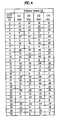
- Figure 4 illustrates a 32-ary Walsh Code, but as can be appreciated by one of ordinary skill in the art, this can be different, e.g., 64-ary Walsh Code, based on the system requirements.
- Walsh_Max is illustrated herein as exemplary, and not limited to a value of 28.
- the WCI table may be pre-stored in a mobile station and base station, and the usable WCI table may be predetermined by signal channeling between each other.
- the allocation may be based on priority (priority allocation) where the lowest code indexed Walsh codes are used before the higher code indexed Walsh codes, or priorities do not matter (non-priority allocation), e.g., a Walsh code with the lowest priority may be used first before a Walsh code with the highest priority code index.
- power ranking is preferably used to determine which terminal is assigned to which PDCCH physical channel. Unless specifically indicated in the foregoing examples, power ranking may or may not be used.
- the modulation symbols transmitted on PDCCH (i) should be transmitted using at least as much energy as the modulation symbols transmitted on PDCCH(i+1) which is transmitted simultaneously with PDCCH(i).
- the power ranking generally assures that all terminals properly receive the information sent on the Packet Data Control Channel (PDCCH).
- Power ranking may be based on the required transmission power of the PDCCH of each scheduled user, i.e., when N PDCCH(i)/PDCH(j) are used at some time interval, user requiring the most power is assigned PDCCH(0) and user requiring the least power is assigned PDCCH(N-1). Alternatively, a user with the worst environment is assigned to PDCCH(0) and a user with the best environment is assigned to PDCCH(N-1).
- the terminal furthest away from base station i.e., the terminal using the laxgest amount of power
- the terminal second furthest away from the base station is assigned PDCH(1) and PDCCH(1)
- terminal 1 requires 3mW and terminal 3 requires 7mW, e.g., terminal 3 is further away from the base station than terminal 1 or terminal 3 is located in an environment which is worse than the environment of terminal 1, then PDCH(0) and PDCCH(0) is assigned or allocated to terminal 3 and PDCH(1) and PDCCH(1) is assigned or allocated to terminal 1.
- Walsh Code list is used to differentiate the different PDCCH(i) channels, whereas, WCA(i) is a field included in each PDCCH(i) to indicate a number of corresponding Walsh codes or a general/specific set of Walsh codes which is used to decode the data received via PDCH(i).
- WCL is preferably stored in a mobile station and a base station, and the usable WCL may be obtained by channel signaling between each other.
- the WCA(i) field may be indicative of the code index to form a set of Walsh codes or the WCA(i) field is indicative of a general set number of Walsh codes based on the code indices in the WCI table, the interpretation is preferably dependent upon other WCAs, where in order to interpret: WCA(i), the terminal preferably refers to another WCA(j)(i ⁇ j) based upon a predetermined condition for more accurate interpretation of its own WCA(i) value.
- the predetermined condition for the WCA(i) may be based on WCA(i-1) being found.
- a terminal or a user who is assigned to receive the WCA(i) of PDCCH(i) should be able to receive the corresponding WCA values that are being transferred on PDCCH(0), PDCCH(1), ...,PDCCH(i-1) or at least a terminal assigned to receive the WCA(1) of PDCCH(1) should be able to receive the WCA(i-1) that is being transferred on PDCCH(i-1).
- this sequential decoding may or may not be used in the forgoing examples
- the LWCI field is based upon the use of the code indices based on priority allocation, e.g., the PDCCH(0) physical channel is allocated a first set of Walsh codes corresponding to the lower code indices and the PDCCH(1) physical channel is thereafter allocated to second set of Walsh codes corresponding to the higher code indices after the first set of lower code indices have been assigned.
- the available Walsh codes in the Walsh code space is divided into a plurality of sets of Walsh codes, where the lower code indices are allocated or assigned to a lower numbered PDCCH.
- this priority can be reversed, where higher code indices are first allocated to a lower number PDCCH in an alternative case (non-priority allocation).
- Power ranking is also preferably used with the LWCI field, i.e., the terminal requiring the most power is assigned to PDCCH(0), and the terminal requiring the least power is assigned PDCCH(1).
- power ranking is preferable especially when there are more than two terminals.
- power ranking may or may not be needed when two physical channels for two corresponding terminals are used, but is preferable.
- the available Walsh codes can change even though there are 28 Walsh codes in the Wash codes space. For example, based on power ranking, terminal 1 is assigned to PDCCH(0) and terminal 3 is assigned to PDCCH(1).
- the Walsh codes are divided into two sets, where Walsh codes corresponding to indices 0-3 would be allocated to PDCCH(0) and Walsh codes corresponding to indices 4-9 would be allocated to PDCCH(1).
- the PDCH(0) for terminal 1 is transmitted on Walsh codes 31, 15, 23, and 7 while the PDCH(1) for terminal 3 is transmitted on Walsh codes 27, 11, 19, 3, 30 and 14.
- the present invention does not use all the Walsh codes in the WCI Table, and Walsh codes from code index 10 to code index 27 can be used for other purposes.
- the WCI Table is divided into two sets and allocated for PDCCH(0) and PDCCH(1) transmission of PDCH(0) and PDCCH(1), respectively.
- this allocation of the WCI Table can be readily applicable to situations where more than two physical channel assignments are required. With such CDM scheduling, the base station is no longer required to broadcast within an entire cell the available codes.
- the LWCI field (lwci0) of PDCCH(0) is used to indicate the available Walsh code space in TDM scheduling. Only PDCCH(0) is used and PDCCH(1) is suspended. Further, if there are more than two physical channels, PDCCH(1) to PDCCH(N max_PDCH -1) are suspended. Likewise, not all available Walsh codes need to be used, and broadcasting is not required in this preferred embodiment.
- terminal 1 when PDCCH(0) has been assigned to terminal 1 for transmission of PDCH(0), terminal 1 decodes the PDCCH(0) to determine lwci0. Since the code indices are based on priority allocation, terminal 1 can determine that PDCH(0) has been transmitted based on Walsh codes from index 0 to index lwci0 of the WCI table. However, for terminal 3 assigned to PDCCH(1) for transmission of PDCH(1), terminal 3 needs to collect the lwci0 in order to determine the Walsh codes from index lwci0+1 to index lwci1. Although terminal 3 can readily collect the lwci1 based on the MAC_ID of the PDCCH(1), terminal 3 still needs to obtain lwci0 from PDCCH(0).
- terminal 3 can ascertain that PDCCH(0) is transmitted with a higher power than itself or at least a equal power. Based on power, terminal 3 can obtain the lwci0 from PDCCH(0) to decode the PDCH(1) using the Walsh codes corresponding to index lwci0+1 to index lwci1.
- the Walsh codes in the WCI table may be masked, and the terminal needs to receive the information regarding the masked Walsh codes to properly determine lwci(i), e.g., lwci0 and lwci1.
- Figures 6A illustrates the masking of Walsh codes corresponding to indices 1-3 (lightly shaded with italic text and underling). It is noted that Walsh codes from indices 13-27 (darkly shaded with bold text and underling) are used for other purposes.
- the base station notifies all the terminals by sending on PDCCH(0) with a MAC_ID field of '00000000' and the WALSH_MASK field indicating which corresponding indices in the WCI table need to be omitted or deleted during a first prescribed time interval. Further, lwci0 is equal to -1 (negative 1). Thereafter, during the PDCCH(1) transmission of PDCH(1) within the first prescribed time interval, the corresponding terminal deletes the Walsh codes corresponding to the indices indicated to be omitted from PDCCH(0). Based upon such deletion, the decoding of PDCH(1) is based upon the WCI table illustrated in Figure 6A .
- the PDCH(1) is decoded using Walsh codes 31, 27,11, 19, 3, 30, 14, 22, 6 and 26 (Walsh codes corresponding to indices 0- 12).
- the WALSH_MASK is applied to walsh codes determined by lwci0 and lwci1.
- a terminal is assigned to the PDCCH(0) transmission of the PDCH(0) includes a message format having a lwci0 field of 4 and another terminal is assigned to the PDCCH(1) transmission of the PDCH(1) includes a message format having a lwci1 field of 12.
- the terminal assigned to PDCCH(0) obtains the lwci0 of 4, the masked Walsh codes are deleted as shown in Figure 6A , and Walsh codes used for decoding PDCH(0) are 31 and 27.
- LWCI is used as a field for the PDCCH.
- the base station preferably sets this field to the last Walsh code index for the PDCH subpacket transmission concurrent with the transmission of this message on the PDCCH. If this message is being transmitted on the PDCCH(0) physical channel, the base station preferably sets this field to indicate that the Walsh code set includes the 0th through LWCIth entries in the WCI table. Otherwise, if this message is being transmitted on the PDCCH(1) physical channel, the base station preferably sets this field to indicate that the Walsh code set includes the (lwci0+1)th through LWCIth entries in the WCI table.
- lwci is the last Walsh code index in the PDCCH(0) message. If the MAC_ID in the PDCCH(0) message is less than '01000000', lwci0 is -1.
- Figure 6B is a diagram illustrating one of WCA interpretation method using 5-bit WCA in accordance with another example.
- the Walsh codes disposed between a position corresponding to WCA(m-1) value and WCA(m) value are the ones used for the transmission of PDCH(m).
- the code index number and location within the WCI table can be arbitrary decoded.
- N or M both refer to Walsh code users for transferring the PDCH, and are just arbitrary labels.
- N max_PDCH greater than 1 When there are a plurality of physical channels, N max_PDCH greater than 1, i of Figure 1 has a range from 0,1,..., to (N max_PDCH -1).
- the WCA(i) of PDCCH(i) is the information about those codes that are used for transferring PDCH(i).
- the number of bits x_i of the WCA field does not have to be a fixed number of bits, but can vary depending upon the whether this field indicates the number of Walsh codes based on the code index, and/or this field indicates a specific set of the codes belong to the Walsh code space of the WCI table.
- every message format of the PDCCH(i) has an identical configuration, i.e., the number of information control bits x_i is 5 for every PDCCH(i).
- the WCA(0) on the PDCCH(0) indicates that the same number of Walsh codes with the WCA(0) value is used from the WCI table, starting from the code index indicative of higher priority Walsh codes. If i is greater than zero, the CWSI on the PDCCH(i) means a specific set of the codes taken from the Walsh code space of the Code priority table, following a specific rule. Specifically, the WCA(i) (i>0), of the PDCCH(i) indicates that the data is being transferred on the PDCH(i) using the Walsh codes from a relevant set based on the code index.
- the WCA(i) on the PDCCH(i) indicates that the WCA(i) value corresponds to the code index in the WCI table such that the number of Walsh codes indicated by the code index in the WCI table (except for the Walsh codes used by PDCH(0), PDCH(1), PDCH(2),..,and PDCH(i-1)) is used based on priority allocation for transferring PDCH(i).
- the base station performs scheduling to make the transmission power of PDCCH(i) equal to or stronger than that of PDCCH(i+1) based on the assumption that the terminal for transmission of PDCCH(i) is located in a better or similar communication environment than the terminal for transmission of PDCCH(i+1), i.e., power ranking. Further, when a terminal interprets a WCA(i) value of PDCCH(i), it preferably uses the WCA(j) information of other PDCCH(j) other than PDCCH(i), i.e., sequential decoding.
- N max_PDCH 2
- broadcasting is not used.
- two of each PDCH(0), PDCCH(0), PDCH(1), and PDCCH(1) are used.
- the WCA(0) field of the PDCCH(0) corresponds to the index code 4 of the WCI table
- Figure 7A illustrates another example, where the code indices for WCA are used as start code numbers (SCN) and end code numbers (ECN).
- SCN start code numbers
- ECN end code numbers
- the message format of Figure 1 will include SCN and/or ECN (SCN/ECN) field for PDCCH(i) having either 0 or x_i number of bits rather than LWCI/CWSI field.
- SCN/ECN indicates a specific set of Walsh codes in the WCI Table based on the code indices.
- the SCN/ECN field for the 2nd user of PDCCH(i) will include a SCN(1) of 4 (ENC(0)+1) and a ECN(1) of 9, ....
- the SCN/ECN field for the Nth user of PDCCH(i) will include a SCN(N-1) of 13 (ECN(N-2)+1) and ECN(N-1) of 16 within a prescribed time interval for CDM scheduling.
- the PDCH(i) for the 1st user is transmitted on Walsh codes 31, 15, 23, and 7, the PDCH(i) for the 2nd user is transmitted on Walsh codes 27, 11, 19, 3, 29 and 13, ..., and the PDCH(i) for the Nth user is transmitted on Walsh codes 9, 30, 14 and 22.
- the 1st user searches for the corresponding MAC_ID field to obtain or collect the SCN and the ECN information bits
- the 2nd user searches for the corresponding MAC_ID field to obtain or collect the SCN and the ECN information bits
- the Nth user searches for the corresponding MAC_ID field to obtain or collect the SCN and the ECN information bits in control message of the PDCCH(i).
- the priority, power ranking and/or sequential decoding may or may not be used due to the flexibility of this Walsh code allocation.
- the SCN and ECN fields would comprise, for example, 10 bits, where 5 bits is would be representative of the SCN information bits and the other 5 bits would be representative of the ECN information bits.
- the different users search for the corresponding MAC_ID field in corresponding PDCCH transmission of the PDCH, and use the Walsh codes corresponding to the SCN and the ECN in the WCI table.
- the PDCCH(0) will be allocated with the lowest code indices or the highest code indices, depending upon the order of priority. In such an instance, there is no need for the SCN(0) for the PDCCH(0) since this will be equal to 0 or the highest code index in the WCI table.
- the Nth user can readily utilize the Walsh codes corresponding to the set of code indices starting from the ECN(N-1) to the ECN(n-2) + 1.
- SCN/ECN field become the same as the LWCI field.
- the SCN/ECN would preferable contain ECN information bits, which would be the same as LWCI field.
- the description above regarding the LWCI field is readily applicable to this preferred embodiment.
- the discussion regarding masking is also readily applicable to this preferred embodiment whether or not priority or priority allocation, power ranking and/or sequential decoding is applied.
- CDM Code division multiple access
- TDM available Walsh space indication
- Fig. 7B illustrates another embodiment of WCA interpretation. This example is similar to the embodiment of Figure 7A .
- the index numbering and location on the WCI table to reference the Walsh codes can be arbitrary decided.
- the WCA(m) field of the PDCCH(m) will contain a value which would indicate that Walsh codes disposed between a starting position calculated by Equation 1 and an ending position calculated by Equation 2 are used.
- ⁇ i 0 m - 1 WCA i
- ⁇ i 0 m WCA i
- the WCA(m) can be interpreted by a terminal independently and once WCA(m) of PDCCH(m) including a terminal's MAC identifier is interpreted, any arbitrary terminal can get the information about the Walsh codes that are used by PDCH(m) where its packet data is being transferred.
- the independent interpretation on WCA(m) by a terminal is largely divided into two cases. In the first case, all WCA(m) values have the same meaning. In the second case, one of the WCA value among all other WCA values has a different meaning.
- Walsh(i) is a set of Walsh codes the PDCH(i) uses at a particular time of transmission. It is composed of the components of the Walsh code space. Although the Walsh code space does not change, the Walsh codes included in the Walsh(i) changes based on time. In other words, a previous Walsh(i) and a current Walsh(i) have different components and the total number of their components.
- the Walsh code unit for the Walsh(i) is x, and the number of components of each Walsh(i) is a multiple of x., i.e., 1x, 2x, 3x and so forth. Here, the number of components of Walsh(i) is independent of the number of Walsh(all).
- the bit number of the WCA field is 6 based on WCA field indicates the number of Walsh codes (vs. WCA field containing the information about the set, in which case the number of bits of the WCA field can be as many as necessary.)
- the 11 points e.g., P_0, P_1,...,P_10, as shown in Figure 8
- there is is a one to one (1:1) correspondence of the 11-point set WCA value but the remaining WCA values, '64-55 9', may be used for different purposes
- Figure 9 illustrates another preferred embodiment, where the WCA is used as Walsh code index set values (WCISV), in which case the message format of Figure 1 will include CISV field for PDCCH(i) having either 0 or x_i number of bits rather than LWCI/CWSI field.
- the code indices divided into sets based on the value indicated in the WCISV field of the PDCCH(i).
- the WCISV field is indicative of a general set of Walsh codes of the WCI table based on the code indices.
- priority, power ranking and sequential decoding is used.
- the WCISV(0) field of PDCCH(0) would equal 4 for the 1st user, which would indicate that the Walsh codes corresponding to the 1st four code indices of the WCI table is preferably used to for transmission of the PDCH(0).
- the WCISV(1) field would equal 6 for the 2nd user, which would indicate that the Walsh codes corresponding to code indices from WCISV(0)+1 to WCISV(0)+WCISV(1) is preferably used for transmission of the PDCH(1).
- the WCISV(n) field would equal 4 for the nth user, which would indicate that Walsh codes corresponding to code indices from WCISV(0)+WCISV(1)+....+WCISV(n-1) to WCISV(0)+WCISV(1)+....+WCISV(n-1)+WCISV(n) is preferably used for transmission of the PDCH(n). Due to sequential decoding, the user can collect the WCISV fields from PDCCH(0) to PDCCH(n). The number of information bits for this field is preferably be 5, but can be different depending upon the number of possible variations of the Walsh code allocation.
- the PDCCH(0) physical channel can be used to transmit the available Walsh codes with the WCISV(0) field. Again, no broadcasting is required and the various advantages described above can be readily applicable to this embodiment
- the WCA(i) bit number, x_i, of the PDCCH(i) can be set to zero.
- the number of bits of WCA of the control channel that is to be transmitted is 0.
- Figure 10 illustrates control channels in terms of time when the number of bits of WCA(M,t2) is set to 0 bit in accordance with this example.
- PDCCH(i) transferred during a prescribed time interval t is PDCCH(i, t)
- WCA on the PDCCHC(i, t) is WCA(i, t)
- the PDCH corresponding to the PDCCH(i, t) is PDCH(i, t).
- the control channels that a base station transfers during a specific time interval t1 are PDCCH(1, t1), PDCCH(2, t1), ...
- PDCCH(L, t1), and the control channels during the next time interval t2 are PDCCH(1, t2), PDCCH(2, t2), ... , PDCCH(M, t2), where L and M are arbitrary natural numbers.
- the number of bits for WCA(M,t2) of PDCCH(M, t2) could be 0.
- the transmission power of PDCCH(L, t1) is equal or greater than the transmission power of PDCCH(1, t2).
- the Walsh codes for transferring PDCH(M,t2) are the remaining codes except for the Walsh codes that are used for transferring PDCCH(1, t2), PDCCH(2, t2), ... , and PDCCH(M-1, t2) ⁇ among the Walsh codes used for transferring PDCCH(1, t1), PDCCH(2, t1), ... , and PDCCH(L, t1).
- the terminal may collectively regard part or all of the PDCHs corresponding to the PDCCHs having the same MAC identifier as one PDCH, and the terminal may undertake the reception procedure thereof (e.g., performing decoding, or error correction code check) and performs signal processing thereon.
- the terminal determines, with reference to the other information bits besides the MAC_ID, whether it should collectively regard certain PDCHs among the plurality of PDCHs corresponding to PDCCHs with the same MAC identifier as one PDCH/PDCCH.
- the terminal regards the two PDCHs and two corresponding PDCCHs as different, and the terminal undertakes the reception procedure for each PDCH separately.
- the terminal collectively regards the two PDCHs and PDCCHs as one PDCH and PDCCH, and the terminal initiates the reception procedure for one PDCH/PDCCH.
- the Walsh codes that are used for transferring PDCH at this time are the ones that are used by the relevant PDCHs for relevant PDCCHs.
- the terminal can readily determine that Walsh codes 31, 15, 23, 22, 6, 26, 10, 18 is to be used for decoding.
- the terminal may include an additional device for detecting different bit number of the CDMI.
- One example of the additional devices is generating error detection bits in accordance with the bit number of y_i when PDCCH is generated.
- the Walsh codes for use of the transmission of PDCH(i) corresponding to PDCCH(i) includes the Walsh codes that are allocated for transferring PDCH(i) in the WCI table, and the Walsh codes that are not yet used by PDCCH(0), PDCCH(1), ..., PDCCH(i) in the WCI table. For instance, suppose that PDCCH(1) indicates a PDCCH whose CDMI value is 0. Then, among wcl(2) and wcl(3), the codes, which satisfy the predetermined requirements between the terminal and the base station, are used additionally for transferring PDCH(1).
- the WCA can be used for the TDM system or TDM scheduling.
- N max_PDCH is equal to 1, and hence, TDM system uses only one PDCH(i) and one PDCCH(i), and the other PDCHs and PDCCHs are suspended.
- the WCA can be used as WSI, but without the need to broadcast regularly or intermittently. Further, the WCA serving as the WSI can allocate the resources such that not all available Walsh codes are used for transmission of the PDCH(i) and PDCCH(i).
- the 5-bit WCA, 2-bit ACID, and the 3-bit EP_SIZE are preferably used.
- the value of the WCA represents the code index on the WCI table, and represent the number of codes from the highest priority code indexed Walsh code to the lower priority code index Walsh code of the WCI table, e.g., LWCI.
- the WCA can be used to decode the data on the PDCH by the terminal.
- the PDCCH(i) includes the MAC_ID, broadcasting is not needed and such that the WCA need not be transferred to all terminals, but only to a particular relevant terminal requiring the WCA.
- the information bits on the PDCCH(0) are set up in a particular way, e.g., MAC_ID equals '00000000', and SPID is set up as '11' and the 2-bit ACID is added with the x_0 bits, e.g., 5 bits, of the WCA. This can be broadcasted to all the terminals to notify the available Walsh codes.
- the 5 bit WCA can indicate the number of Walsh codes in the WCI table, e.g., LWCI, a general set of Walsh codes in the WCI table or a specific set of Walsh codes in the WCI table.
- the PDCCH(1) physical channel can be used for such broadcasting.
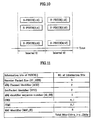
- the Packet Data Channel preferably transmits a prescribed number of information bits, e.g., 386, 770, 1538, 2306, 3074, or 3842 bits. Sixteen packet frame quality indicator bits and six turbo encoder tail allowance bits are added to the information bits to form encoder packets.
- the encoder packets are encoded with a rate-1/5 turbo encoder, interleaved, and scrambled. Thereafter, symbols from the scrambled sequence are selected for transmission as a subpacket. The selected symbols may not include all of the scrambled output symbols or they may include all of the scrambled output symbols with some symbols repeated one or more times.
- a turbo encoder 12 discards the turbo encoder tail allowance bits and adds turbo encoder output tail bits such that the number of bits out of the rate-1/5 turbo encoder is five times the number of bits in an encoder packet.
- the encoder packets are turbo encoded with a code rate of 1 /5.
- the turbo encoder output sequence is interleaved by a channel interleaver 13.
- the interleaving comprises symbol separation, subblock interleaving, and symbol grouping of the turbo encoder output sequence. Every interleaver output symbol are exclusive-OR'd with the corresponding bit of the scrambling sequence generated by a scrambler 13 based on a public long code mask or a private long code mask to yield a scrambled output bit.
- the symbols from the subpacket symbol selection process are modulated.
- the modulator 16 maps the symbols from the subpacket symbol selection process into a sequence of QPSK, 8-PSK, or 16-QAM modulation symbols.
- the type of modulation depends on the encoder packet size, number of Walsh channels, and number of slots.
- the demultiplexed streams with labels Ik and Qk are assigned to the in-phase and quadrature phases, respectively, of the kth Walsh code that appears in the WCI_SET.
- the spread subpacket modulation symbols from the Walsh channels are summed by a summer 18 to form a single sequence of (I, Q) symbols.
- each code channel is spread in quadrature by a spreader.
- the spreading sequence is preferably a quadrature sequence of a prescribed length, e.g., 215 (i.e., 32768 PN chips in length). This sequence is called the pilot PN sequence.
- the I and Q impulses are applied to the inputs of the I and Q baseband filters 20a and 20b. Thereafter, the outputs of the filters 20a and 20b are mixed, summed and transmitted over the PDCH.
- the decoding is substantially the reverse of this encoding process.
- This added bit is provided with tail bits for sending a final state of the encoder from a tail bit adding blocks 102 trellis termination.
- the bits with tail bit are encoded to convolutional code at the encoder 103.
- the I and Q pilot PN sequences for the Forward Packet Data Control Channel preferably use the same pilot PN sequence offset as for the Forward Pilot Channel.
Landscapes
- Engineering & Computer Science (AREA)
- Computer Networks & Wireless Communication (AREA)
- Signal Processing (AREA)
- Mobile Radio Communication Systems (AREA)
- Communication Control (AREA)
- Data Exchanges In Wide-Area Networks (AREA)
Claims (12)
- Verfahren zum Senden von Paketdaten an einer Basisstation in einem Kommunikationssystem, wobei das Verfahren aufweist:Senden einer Codeliste, die einen Satz von Codes angibt, die zum Paketdatensteuerkanal-Senden zu einer mobilen Station zu verwenden sind;Senden einer Steuermeldung für einen Paketdatenkanal über einen Paketdatensteuerkanal unter Verwendung eines Codes des Codesatzes zu der mobilen Station, wobei die Steuermeldung eine Startcodezahl und eine Endcodezahl aufweist, die unter vordefinierten Codes einen Bereich von Codes definieren, die der mobilen Station zum Paketdaten-Senden zugeordnet sind, sowie Paketgrößeninformation, die eine Informationsmenge angibt, die auf dem Paketdatenkanal gesendet wird; undSenden der Paketdaten über den Paketdatenkanal basierend auf der Steuermeldung zu der mobilen Station.
- Das Verfahren nach Anspruch 1, wobei die Paketdaten nach Verzögerung für eine Zeitdauer nach dem Senden der Steuermeldung gesendet werden.
- Das Verfahren von Anspruch 1 oder 2, wobei die Codeliste einen Satz von Codezahlen wcl(0) bis wcl(Nmax-1) enthält, der einem Satz von Paketdatensteuerkanälen PDCCH(0) bis PDCCH(Nmax-1) eins zu eins entspricht oder dieser ist, wobei Nmax eine maximale Anzahl von Paketdatensteuerkanälen ist.
- Verfahren zum Empfangen von Paketdaten an einer mobilen Station in einem Kommunikationssystem, wobei das Verfahren aufweist:Empfangen einer Codeliste, die einen Satz von Codes angibt, die zum Paketdatensteuerkanal-Empfang von einer Basisstation zu verwenden sind;Empfangen einer Steuermeldung für einen Paketdatenkanal über einen Paketdatensteuerkanal unter Verwendung eines Codes des Codesatzes von der Basisstation, wobei die Steuermeldung eine Startcodezahl und eine Endcodezahl aufweist, die unter vordefinierten Codes einen Bereich von Codes definieren, die der mobilen Station zum Paketdaten-Empfang zugeordnet sind, sowie Paketgrößeninformation, die eine Informationsmenge angibt, die auf dem Paketdatenkanal empfangen wird; undEmpfangen der Paketdaten über den Paketdatenkanal basierend auf der Steuermeldung von der Basisstation.
- Das Verfahren von Anspruch 4, wobei die Codeliste einen Satz von Codezahlen wcl(0) bis wd(Nmax-1) enthält, der einem Satz von Paketdatensteuerkanälen PDCCH(0) bis PDCCH(Nmax-1) eins zu eins entspricht oder dieser ist, wobei Nmax eine maximale Anzahl von Paketdatensteuerkanälen ist, und das Empfangen der Steuermeldung aufweist:Decodieren von PDCCH(i) unter Verwendung von wcl(i), wobei i = 0,...,Nmax-1, um den Paketdatensteuerkanal zu finden.
- Das Verfahren nach einem der Ansprüche 1 bis 5, wobei eine Übertragungseinheit des Paketdatensteuerkanals eine feste Zeitlänge aufweist und eine Übertragungseinheit des Paketdatenkanals eine feste Zeitlänge aufweist.
- Das Verfahren nach einem der Ansprüche 1 bis 5, wobei eine Übertragungseinheit des Paketdatensteuerkanals eine erste Zeitlänge aufweist, und eine Übertragungseinheit des Paketdatenkanals eine zweite Zeitlänge aufweist, wobei die erste Zeitlänge und die zweite Zeitlänge gleich sind.
- Das Verfahren nach einem der Ansprüche 1 bis 7, wobei die Steuermeldung ferner einen Identifizierer zum Identifizieren eines Benutzers aufweist, der die Paketdaten auf dem Paketdatenkanal empfangen soll.
- Das Verfahren nach einem der Ansprüche 1 bis 8, wobei die Steuermeldung ferner eine automatische Wiederholungsanfrage-(ARQ)-Kanalidentifizierer aufweist, zum Identifizieren, ob die Paketdaten erneut übertragene Daten sind.
- Das Verfahren nach einem der Ansprüche 1 bis 9, wobei die Steuermeldung ferner einen Teilpaketidentifizierer aufweist, zum Identifizieren, ob der Paketdatenkanal Daten erneut übertragen hat oder nicht.
- Das Verfahren nach einem der Ansprüche 1 bis 10, wobei die vordefinierten Codes Orthogonalität miteinander haben.
- Kommunikationsvorrichtung zur Verwendung in einem mobilen Kommunikationssystem, wobei die Kommunikationsvorrichtung dazu ausgelegt ist, ein Verfahren nach einem der Ansprüche 4 bis 11 durchzuführen.
Applications Claiming Priority (8)
| Application Number | Priority Date | Filing Date | Title |
|---|---|---|---|
| KR1020010060963A KR100786067B1 (ko) | 2001-09-29 | 2001-09-29 | 통신 시스템에서 패킷 데이터 전송 방법 |
| KR20010060964A KR100797461B1 (ko) | 2001-09-29 | 2001-09-29 | 통신 시스템에서 패킷 데이터 전송 방법 |
| KR1020010060962A KR100747525B1 (ko) | 2001-09-29 | 2001-09-29 | 통신 시스템에서 패킷 데이터의 전송 방법 |
| KR20010063248 | 2001-10-13 | ||
| KR1020010063261A KR100797462B1 (ko) | 2001-10-13 | 2001-10-13 | 통신 시스템에서 패킷 데이터 전송 방법 |
| KR20010064014 | 2001-10-17 | ||
| KR1020010068403A KR100878800B1 (ko) | 2001-10-13 | 2001-11-03 | 통신 시스템에서 패킷 데이터 전송 방법 |
| EP02800291A EP1438795B1 (de) | 2001-09-29 | 2002-09-27 | Verfahren zum transferieren und/oder empfangen von daten in einem kommunikationssystem und vorrichtung dafür |
Related Parent Applications (2)
| Application Number | Title | Priority Date | Filing Date |
|---|---|---|---|
| EP02800291A Division EP1438795B1 (de) | 2001-09-29 | 2002-09-27 | Verfahren zum transferieren und/oder empfangen von daten in einem kommunikationssystem und vorrichtung dafür |
| EP02800291.3 Division | 2002-09-27 |
Publications (3)
| Publication Number | Publication Date |
|---|---|
| EP2124352A2 EP2124352A2 (de) | 2009-11-25 |
| EP2124352A3 EP2124352A3 (de) | 2010-05-19 |
| EP2124352B1 true EP2124352B1 (de) | 2015-05-13 |
Family
ID=36146984
Family Applications (3)
| Application Number | Title | Priority Date | Filing Date |
|---|---|---|---|
| EP07024103A Expired - Lifetime EP1895684B1 (de) | 2001-09-29 | 2002-09-27 | Verfahren zum Senden und/oder Empfangen von Daten in einem Kommunikationssystem und Vorrichtung dafür |
| EP20090011779 Expired - Lifetime EP2124352B1 (de) | 2001-09-29 | 2002-09-27 | Verfahren zum Senden und/oder Empfangen von Daten in einem Kommunikationssystem und Vorrichtung dafür |
| EP02800291A Expired - Lifetime EP1438795B1 (de) | 2001-09-29 | 2002-09-27 | Verfahren zum transferieren und/oder empfangen von daten in einem kommunikationssystem und vorrichtung dafür |
Family Applications Before (1)
| Application Number | Title | Priority Date | Filing Date |
|---|---|---|---|
| EP07024103A Expired - Lifetime EP1895684B1 (de) | 2001-09-29 | 2002-09-27 | Verfahren zum Senden und/oder Empfangen von Daten in einem Kommunikationssystem und Vorrichtung dafür |
Family Applications After (1)
| Application Number | Title | Priority Date | Filing Date |
|---|---|---|---|
| EP02800291A Expired - Lifetime EP1438795B1 (de) | 2001-09-29 | 2002-09-27 | Verfahren zum transferieren und/oder empfangen von daten in einem kommunikationssystem und vorrichtung dafür |
Country Status (7)
| Country | Link |
|---|---|
| US (3) | US7376076B2 (de) |
| EP (3) | EP1895684B1 (de) |
| CN (1) | CN100527646C (de) |
| AU (1) | AU2002362426B2 (de) |
| CA (1) | CA2462135C (de) |
| MX (1) | MXPA04002849A (de) |
| WO (1) | WO2003030407A1 (de) |
Families Citing this family (48)
| Publication number | Priority date | Publication date | Assignee | Title |
|---|---|---|---|---|
| KR100770897B1 (ko) * | 2001-11-07 | 2007-10-26 | 삼성전자주식회사 | 통신 시스템에서 패킷 데이터 제어 채널의 송수신 장치 및방법 |
| TWI276313B (en) * | 2002-04-19 | 2007-03-11 | Interdigital Tech Corp | Receiving station for CDMA wireless system and method |
| WO2004015873A1 (en) * | 2002-08-13 | 2004-02-19 | Vanu, Inc. | Convolutional decoding |
| AU2003259782A1 (en) | 2002-08-13 | 2004-03-11 | Vanu, Inc. | Noise-adaptive decoding |
| CA2504688A1 (en) * | 2002-11-15 | 2004-06-03 | Vanu, Inc. | A communications system |
| ATE527782T1 (de) * | 2003-03-05 | 2011-10-15 | Samsung Electronics Co Ltd | Verfahren und vorrichtung zum steuern der rückverkehrsrate in einem mobilkommunikationssystem |
| CA2519534A1 (en) | 2003-03-18 | 2004-09-30 | Nikhil Jain | Internetworking between a first network and a second network |
| US20050002529A1 (en) * | 2003-06-17 | 2005-01-06 | Rath Vannithamby | Extended walsh code space for forward packet data channel in IS-2000 system |
| US20050007974A1 (en) * | 2003-07-07 | 2005-01-13 | Subramanian Vasudevan | Method for identifying walsh code space |
| KR100918759B1 (ko) * | 2003-10-14 | 2009-09-24 | 삼성전자주식회사 | 패킷 데이터 서비스를 제공하는 이동통신 시스템에서 패킷데이터 제어 채널의 제어 메시지 송신 장치 및 방법 |
| US7668078B2 (en) * | 2004-03-05 | 2010-02-23 | Telefonaktiebolaget Lm Ericsson (Publ) | Allocation of walsh codes to support calls in wireless communication networks |
| CA2557614A1 (en) * | 2004-03-05 | 2005-09-22 | Vanu, Inc. | Controlling jitter effects |
| CA2567995A1 (en) * | 2004-06-09 | 2005-12-29 | Vanu, Inc. | Reducing backhaul bandwidth |
| US20060009236A1 (en) * | 2004-06-09 | 2006-01-12 | Vanu Bose | Determining a location |
| US7554960B2 (en) * | 2004-06-09 | 2009-06-30 | Vanu, Inc. | Reducing cost of cellular backhaul |
| US7751305B2 (en) * | 2004-06-25 | 2010-07-06 | Samsung Electronics Co., Ltd. | Method for transmitting and receiving broadcast service data in an OFDMA wireless communication system |
| US7643406B2 (en) * | 2004-12-06 | 2010-01-05 | Nextel Communications Company L.P. | System and method for enhancing capacity for a wireless communication system |
| US8125947B2 (en) * | 2005-09-30 | 2012-02-28 | Alcatel Lucent | Mapping control information to a dedicated physical control channel |
| US7580451B2 (en) * | 2005-10-07 | 2009-08-25 | Vanu, Inc. | Decoding of Walsh codes |
| US20070091840A1 (en) * | 2005-10-20 | 2007-04-26 | Samsung Electronics Co., Ltd. | Decoupled MAC index for enhanced EVDO systems |
| US8229398B2 (en) * | 2006-01-30 | 2012-07-24 | Qualcomm Incorporated | GSM authentication in a CDMA network |
| WO2007132912A1 (ja) * | 2006-05-17 | 2007-11-22 | Nec Corporation | ターボ符号器及びそれに用いるharq処理方法 |
| US20080076435A1 (en) * | 2006-09-22 | 2008-03-27 | Vanu, Inc. | Wireless Backhaul |
| US20080076406A1 (en) * | 2006-09-22 | 2008-03-27 | Vanu, Inc. | Wireless Backhaul |
| US8144731B2 (en) * | 2006-10-24 | 2012-03-27 | Qualcomm Incorporated | Control channel signaling in wireless communications |
| US8238295B2 (en) * | 2007-01-30 | 2012-08-07 | Qualcomm Incorporated | Demodulation of a subset of available link assignment blocks |
| US7782749B2 (en) * | 2007-03-21 | 2010-08-24 | Samsung Electronics Co., Ltd | Method for mapping physical downlink control channel to resources and apparatus for transmitting/receiving the mapped physical downlink control channel in a wireless communication system |
| KR101422014B1 (ko) | 2007-05-10 | 2014-07-23 | 엘지전자 주식회사 | 기본 코드 반복 방식에 의한 긴 코드 생성 방법 및 이를이용한 제어 정보 전송 방법 |
| EP3739776B1 (de) | 2007-08-13 | 2021-07-07 | Godo Kaisha IP Bridge 1 | Funkübertragungsvorrichtung und funkübertragungsverfahren |
| CN101370242B (zh) * | 2007-08-13 | 2012-12-26 | 华为技术有限公司 | 一种上行控制信道的码分配方法、装置及系统 |
| US9306709B2 (en) * | 2007-09-14 | 2016-04-05 | Futurewei Technologies, Inc. | Method and apparatus for associating a packet with an H-ARQ channel identifier |
| TWI489809B (zh) * | 2007-10-24 | 2015-06-21 | Qualcomm Inc | 無線通訊中的控制通道傳信號 |
| US8155683B2 (en) * | 2008-02-05 | 2012-04-10 | Motorola Mobility, Inc. | Physical downlink control channel specific scrambling |
| US8724636B2 (en) * | 2008-03-31 | 2014-05-13 | Qualcomm Incorporated | Methods of reliably sending control signal |
| CN101605356B (zh) * | 2008-06-12 | 2011-11-02 | 电信科学技术研究院 | 一种指示资源的方法、装置及系统 |
| US8892983B2 (en) * | 2008-11-04 | 2014-11-18 | Alcatel Lucent | Method and apparatus for error detection in a communication system |
| EP2200391B1 (de) * | 2008-12-16 | 2011-05-04 | Alcatel Lucent | Verfahren zur Zuteilung von Ressourcen an Benutzerendgeräte, Basisstation, Benutzerendgerät und Kommunikationsnetz dafür |
| KR101633955B1 (ko) * | 2009-06-02 | 2016-07-08 | 블랙베리 리미티드 | 캐리어 집성을 위한 블라인드 디코딩을 감소시키는 시스템 및 방법 |
| CN107104780B (zh) * | 2009-10-01 | 2020-10-16 | 交互数字专利控股公司 | 上行链路控制数据传输 |
| EP2522095A2 (de) | 2010-01-08 | 2012-11-14 | InterDigital Patent Holdings, Inc. | Übertragung von kanalzustandsinformationen für mehrere träger |
| CN102804873A (zh) * | 2010-02-22 | 2012-11-28 | 高通股份有限公司 | 基于接入终端排序来控制接入点发射功率 |
| CN102804875B (zh) | 2010-02-22 | 2015-10-21 | 高通股份有限公司 | 基于事件触发的接入终端消息发送来控制接入点发射功率 |
| CN102036397B (zh) * | 2011-01-21 | 2013-03-20 | 大唐移动通信设备有限公司 | Td-lte系统的资源调度方法及装置 |
| WO2012167489A1 (zh) * | 2011-07-27 | 2012-12-13 | 华为技术有限公司 | 传输数据的方法和设备 |
| BR112014010289B1 (pt) * | 2011-11-07 | 2022-05-17 | Telefonaktiebolaget Lm Ericsson (Publ) | Método em um nó de transmissão para transmitir um canal de controle de downlink aprimorado, nó de transmissão, método em um equipamento de usuário para receber um canal de controle de downlink aprimorado, e, nó de recebimento |
| WO2013068195A1 (en) * | 2011-11-08 | 2013-05-16 | Nokia Siemens Networks Oy | Code-distributed physical channel definition |
| US8817735B1 (en) * | 2012-09-28 | 2014-08-26 | Sprint Spectrum L.P. | Systems and methods for allocating fully-orthogonal and quasi-orthogonal spreading codes to access terminals in radio access networks based on a tolerance level for additional interference on a per-access-terminal basis |
| CN113703413B (zh) * | 2021-11-01 | 2022-01-25 | 西安热工研究院有限公司 | 基于二级索引的数据交互方法和系统、设备及存储介质 |
Family Cites Families (39)
| Publication number | Priority date | Publication date | Assignee | Title |
|---|---|---|---|---|
| SE9304119D0 (sv) | 1993-12-10 | 1993-12-10 | Ericsson Ge Mobile Communicat | Apparatuses and mobile stations for providing packet data communication in digital TDMA cellular systems |
| DE4402903A1 (de) * | 1994-02-02 | 1995-08-03 | Deutsche Telekom Mobil | Verfahren zur paketweisen Datenübertragung in einem Mobilfunknetz |
| FI973205L (fi) | 1995-02-02 | 1997-10-01 | Smithkline Beecham Plc | Indolijohdannaisia 5-HT-reseptoriantagonisteina |
| US6091717A (en) | 1997-05-05 | 2000-07-18 | Nokia Mobile Phones Limited | Method for scheduling packet data transmission |
| KR100279944B1 (ko) * | 1997-12-09 | 2001-02-01 | 윤종용 | 씨디엠에이셀룰러시스템에서의왈쉬코드그룹할당방법 |
| US6028889A (en) * | 1998-02-25 | 2000-02-22 | Lucent Technologies, Inc. | Pipelined fast hadamard transform |
| US6700881B1 (en) * | 1998-03-02 | 2004-03-02 | Samsung Electronics Co., Ltd. | Rate control device and method for CDMA communication system |
| CA2237289C (en) | 1998-03-24 | 2006-07-11 | Vistar Telecommunications Inc. | Packet data communication system |
| KR100290862B1 (ko) | 1998-04-02 | 2001-07-12 | 구자홍 | 이동통신시스템에서의패킷데이터를전송하기위한슬롯의구조 |
| KR100413417B1 (ko) * | 1998-05-04 | 2004-02-14 | 엘지전자 주식회사 | 이동통신시스템에서 단말기의 호 접속 제어 방법. |
| US6317413B1 (en) * | 1998-05-18 | 2001-11-13 | Nokia Mobile Phones Ltd. | Method and apparatus for assigning variable length walsh codes in a spread spectrum system |
| FI981546A7 (fi) * | 1998-07-03 | 2000-01-04 | Nokia Corp | Tiedonsiirtomenetelmä ja matkapuhelinjärjestelmä |
| KR100383614B1 (ko) * | 1998-10-19 | 2003-10-08 | 삼성전자주식회사 | 부호분할다중접속통신시스템의할당장치및방법 |
| US6314107B1 (en) | 1998-10-20 | 2001-11-06 | Qualcomm Incorporated | Method and apparatus for assigning spreading codes |
| KR100547838B1 (ko) * | 1998-11-17 | 2006-03-23 | 삼성전자주식회사 | 부호분할다중접속 통신시스템에서 전용제어채널의 핸드오프방법 |
| KR100281648B1 (ko) | 1998-12-01 | 2001-02-15 | 정선종 | 무선 에이티엠 엘에이엔 시스템의 제어 프레임 처리장치 및 방법 |
| CA2316209C (en) * | 1998-12-07 | 2004-04-27 | Samsung Electronics Co., Ltd. | Device and method for gating transmission in a cdma mobile communication system |
| KR100306375B1 (ko) | 1998-12-21 | 2001-11-30 | 서평원 | 코드분할다중접속이동통신시스템의왈시코드채널관리장치및방법 |
| KR100315709B1 (ko) * | 1998-12-29 | 2002-02-28 | 윤종용 | 이동통신시스템의채널확산장치및방법 |
| US6757270B1 (en) * | 1999-06-11 | 2004-06-29 | Lucent Technologies Inc. | Low back haul reactivation delay for high-speed packet data services in CDMA systems |
| KR100317271B1 (ko) | 1999-11-02 | 2001-12-24 | 서평원 | 이동 통신 시스템의 트래픽 제어 방법 및 그를 위한 장치 |
| KR100346195B1 (ko) | 1999-11-05 | 2002-07-26 | 삼성전자 주식회사 | 부호분할다중접속시스템에서 하다마드 코드 할당 방법 |
| ATE471048T1 (de) * | 1999-12-01 | 2010-06-15 | Lg Electronics Inc | Verfahren zur erzeugung und übertragung von optimalen zellidentitätskodes |
| AU758041B2 (en) * | 1999-12-02 | 2003-03-13 | Samsung Electronics Co., Ltd. | Apparatus and method for transmitting and receiving data in a CDMA communication system |
| KR100371162B1 (ko) | 2000-03-03 | 2003-02-06 | 엘지전자 주식회사 | 신호 송수신 장치 |
| US6693954B1 (en) * | 2000-04-17 | 2004-02-17 | Rf Micro Devices, Inc. | Apparatus and method of early-late symbol tracking for a complementary code keying receiver |
| US6961304B1 (en) * | 2000-09-12 | 2005-11-01 | Lucent Technologies Inc. | Dynamic reassignment of code space among multiple modes of operation |
| US7006464B1 (en) * | 2000-11-17 | 2006-02-28 | Lucent Technologies Inc. | Downlink and uplink channel structures for downlink shared channel system |
| US7158482B2 (en) * | 2001-02-07 | 2007-01-02 | Motorola, Inc. | Method and apparatus for preventing received data from corrupting previously processed data in a wireless communications system |
| KR100442603B1 (ko) | 2001-03-20 | 2004-08-02 | 삼성전자주식회사 | 고속 패킷 데이터 전송 이동통신시스템에서 패킷 데이터채널 및 패킷 데이터 제어 채널을 스크램블링하기 위한장치 및 방법 |
| US7230941B2 (en) * | 2001-04-26 | 2007-06-12 | Qualcomm Incorporated | Preamble channel decoding |
| SE522538C2 (sv) * | 2001-08-11 | 2004-02-17 | Samsung Electronics Co Ltd | Förfarande för att minska antalet bitar som behövs för att sända ortogonal-kod-information över en kontrollkanal i ett HSDPA-system |
| AUPR740901A0 (en) * | 2001-08-31 | 2001-09-20 | Life Therapeutics Limited | Prion capture |
| US20030054807A1 (en) * | 2001-09-17 | 2003-03-20 | Liangchi Hsu | Apparatus, and associated method, for facilitating multicast and broadcast services in a radio communication system |
| US6552996B2 (en) * | 2001-09-18 | 2003-04-22 | Interdigital Communications Corporation | OVSF code system and methods |
| US6665309B2 (en) * | 2001-09-20 | 2003-12-16 | Nokia Corporation | Apparatus, and associated method, for generating assignment information used pursuant to channel allocation in a radio communication system |
| KR100786067B1 (ko) | 2001-09-29 | 2007-12-17 | 엘지전자 주식회사 | 통신 시스템에서 패킷 데이터 전송 방법 |
| BRPI0215108A2 (pt) * | 2001-12-05 | 2016-07-05 | Lg Electronics Inc | código de detecção de erro que gera o gerador de código da detecção do método e de erro |
| CA2482852A1 (en) | 2002-04-16 | 2003-10-30 | Andrew Durant | Applicator and integrated concentrate system |
-
2002
- 2002-09-27 WO PCT/KR2002/001822 patent/WO2003030407A1/en not_active Ceased
- 2002-09-27 MX MXPA04002849A patent/MXPA04002849A/es active IP Right Grant
- 2002-09-27 EP EP07024103A patent/EP1895684B1/de not_active Expired - Lifetime
- 2002-09-27 CA CA2462135A patent/CA2462135C/en not_active Expired - Lifetime
- 2002-09-27 EP EP20090011779 patent/EP2124352B1/de not_active Expired - Lifetime
- 2002-09-27 EP EP02800291A patent/EP1438795B1/de not_active Expired - Lifetime
- 2002-09-27 CN CNB028191420A patent/CN100527646C/zh not_active Expired - Lifetime
- 2002-09-27 AU AU2002362426A patent/AU2002362426B2/en not_active Expired
- 2002-09-30 US US10/259,292 patent/US7376076B2/en not_active Expired - Lifetime
-
2007
- 2007-07-30 US US11/830,053 patent/US7471622B2/en not_active Ceased
-
2009
- 2009-10-08 US US12/576,005 patent/USRE42675E1/en not_active Expired - Lifetime
Also Published As
| Publication number | Publication date |
|---|---|
| US20070263586A1 (en) | 2007-11-15 |
| EP1895684A2 (de) | 2008-03-05 |
| EP1895684A3 (de) | 2008-06-25 |
| US20030063595A1 (en) | 2003-04-03 |
| AU2002362426B2 (en) | 2008-09-11 |
| EP1438795A1 (de) | 2004-07-21 |
| EP2124352A2 (de) | 2009-11-25 |
| EP1895684B1 (de) | 2012-05-16 |
| USRE42675E1 (en) | 2011-09-06 |
| US7376076B2 (en) | 2008-05-20 |
| CA2462135A1 (en) | 2004-03-26 |
| CN100527646C (zh) | 2009-08-12 |
| CA2462135C (en) | 2014-12-30 |
| EP1438795A4 (de) | 2004-12-15 |
| CN1561585A (zh) | 2005-01-05 |
| US7471622B2 (en) | 2008-12-30 |
| MXPA04002849A (es) | 2005-10-05 |
| EP1438795B1 (de) | 2012-02-08 |
| WO2003030407A1 (en) | 2003-04-10 |
| EP2124352A3 (de) | 2010-05-19 |
Similar Documents
| Publication | Publication Date | Title |
|---|---|---|
| EP1895684B1 (de) | Verfahren zum Senden und/oder Empfangen von Daten in einem Kommunikationssystem und Vorrichtung dafür | |
| AU2002362426A1 (en) | Method for transferring and/or receiving data in communication system and apparatus thereof | |
| RU2501187C2 (ru) | Устройство базовой станции беспроводной связи, и устройство мобильной станции беспроводной связи, и способ выделения канала управления | |
| CN1165116C (zh) | 用于在移动通信系统中传输突发导频信道的装置和方法 | |
| KR100754633B1 (ko) | 이동통신 시스템에서 패킷 데이터 서비스를 위한 송수신장치 및 방법 | |
| KR100469701B1 (ko) | 이동통신시스템에서 패킷 데이터 제어 채널 통신 장치 및방법 | |
| CN1331364C (zh) | 在通信系统中发送/接收正交可变扩频因子码信息的方法 | |
| KR100564116B1 (ko) | 무선 하이브리드 tdma/cdma 통신에서 사용자의 통신을 지원하기 위하여 코드 및 시간 슬롯 할당을 신호 전송하는 방법 및 이 방법에 사용되는 전송기 | |
| US9332569B2 (en) | Method and system for providing channel assignment information used to support uplink and downlink channels | |
| CN101569224B (zh) | 用于共享无线系统中的资源的方法和装置 | |
| CN1366781A (zh) | 通信系统中提供分离的正向专用和共享控制信道的装置和方法 | |
| CN101242384A (zh) | 传输调度请求信息的设备和方法 | |
| US20110002235A1 (en) | Base station, mobile station, mobile communication system, and method of controlling control signal transmission | |
| RU2442292C2 (ru) | Способ планирования групп мобильных пользователей | |
| WO2013117003A1 (en) | Defining a control channel element | |
| EP1714405A1 (de) | Verfahren zur wiederverwendung von ovsf-codes zugeteilter physischer kanäle zur übertragung von daten über erweiterte aufwärtsstrecke bei cdma | |
| KR20080088127A (ko) | 하이브리드 자동 재전송 요구 및 다중 안테나 기법을사용하는 무선 통신 시스템에서 비동기 긍정적/부정적 인지검파를 사용하는 상향 링크 긍정적/부정적 인지 채널 자원할당을 위한 암시적 시그널링 장치 및 방법 | |
| KR100830445B1 (ko) | 통신 시스템에서 패킷 데이터 송수신 방법 | |
| KR100878802B1 (ko) | 왈쉬 코드 할당 정보 수신 방법 | |
| RU2427961C2 (ru) | Передача данных с помощью вспомогательных ресурсов | |
| CN101541087A (zh) | 在通信系统中传送和/或接收数据的方法及其设备 | |
| HK1206505A1 (en) | Terminal and base station device, method for transmitting and receiving a response signal and integrated circuit | |
| HK1133969A (en) | Data transmission with supplemental resources |
Legal Events
| Date | Code | Title | Description |
|---|---|---|---|
| PUAI | Public reference made under article 153(3) epc to a published international application that has entered the european phase |
Free format text: ORIGINAL CODE: 0009012 |
|
| AC | Divisional application: reference to earlier application |
Ref document number: 1438795 Country of ref document: EP Kind code of ref document: P |
|
| AK | Designated contracting states |
Kind code of ref document: A2 Designated state(s): AT BE BG CH CY CZ DE DK EE ES FI FR GB GR IE IT LI LU MC NL PT SE SK TR |
|
| RIN1 | Information on inventor provided before grant (corrected) |
Inventor name: KIM, YOUNG CHO Inventor name: KIM, KI JUN Inventor name: YOU, CHEOL WOO Inventor name: YOON, SUK HYON Inventor name: AN, JONG HOE Inventor name: YUN, YOUNG WOO Inventor name: LEE, YOUNG JO |
|
| PUAL | Search report despatched |
Free format text: ORIGINAL CODE: 0009013 |
|
| AK | Designated contracting states |
Kind code of ref document: A3 Designated state(s): AT BE BG CH CY CZ DE DK EE ES FI FR GB GR IE IT LI LU MC NL PT SE SK TR |
|
| RIC1 | Information provided on ipc code assigned before grant |
Ipc: H04W 72/14 20090101ALI20100409BHEP Ipc: H04B 7/26 20060101AFI20091022BHEP |
|
| 17P | Request for examination filed |
Effective date: 20100810 |
|
| 17Q | First examination report despatched |
Effective date: 20130729 |
|
| REG | Reference to a national code |
Ref country code: DE Ref legal event code: R079 Ref document number: 60247185 Country of ref document: DE Free format text: PREVIOUS MAIN CLASS: H04B0007260000 Ipc: H04J0013000000 |
|
| GRAP | Despatch of communication of intention to grant a patent |
Free format text: ORIGINAL CODE: EPIDOSNIGR1 |
|
| RIC1 | Information provided on ipc code assigned before grant |
Ipc: H04J 13/18 20110101ALI20141111BHEP Ipc: H04J 13/00 20110101AFI20141111BHEP Ipc: H04W 72/14 20090101ALI20141111BHEP |
|
| INTG | Intention to grant announced |
Effective date: 20141202 |
|
| GRAS | Grant fee paid |
Free format text: ORIGINAL CODE: EPIDOSNIGR3 |
|
| GRAA | (expected) grant |
Free format text: ORIGINAL CODE: 0009210 |
|
| AC | Divisional application: reference to earlier application |
Ref document number: 1438795 Country of ref document: EP Kind code of ref document: P |
|
| AK | Designated contracting states |
Kind code of ref document: B1 Designated state(s): AT BE BG CH CY CZ DE DK EE ES FI FR GB GR IE IT LI LU MC NL PT SE SK TR |
|
| REG | Reference to a national code |
Ref country code: GB Ref legal event code: FG4D |
|
| REG | Reference to a national code |
Ref country code: CH Ref legal event code: EP |
|
| REG | Reference to a national code |
Ref country code: IE Ref legal event code: FG4D |
|
| REG | Reference to a national code |
Ref country code: AT Ref legal event code: REF Ref document number: 727153 Country of ref document: AT Kind code of ref document: T Effective date: 20150615 |
|
| REG | Reference to a national code |
Ref country code: DE Ref legal event code: R096 Ref document number: 60247185 Country of ref document: DE Effective date: 20150625 |
|
| REG | Reference to a national code |
Ref country code: NL Ref legal event code: T3 |
|
| REG | Reference to a national code |
Ref country code: AT Ref legal event code: MK05 Ref document number: 727153 Country of ref document: AT Kind code of ref document: T Effective date: 20150513 |
|
| PG25 | Lapsed in a contracting state [announced via postgrant information from national office to epo] |
Ref country code: FI Free format text: LAPSE BECAUSE OF FAILURE TO SUBMIT A TRANSLATION OF THE DESCRIPTION OR TO PAY THE FEE WITHIN THE PRESCRIBED TIME-LIMIT Effective date: 20150513 Ref country code: PT Free format text: LAPSE BECAUSE OF FAILURE TO SUBMIT A TRANSLATION OF THE DESCRIPTION OR TO PAY THE FEE WITHIN THE PRESCRIBED TIME-LIMIT Effective date: 20150914 Ref country code: ES Free format text: LAPSE BECAUSE OF FAILURE TO SUBMIT A TRANSLATION OF THE DESCRIPTION OR TO PAY THE FEE WITHIN THE PRESCRIBED TIME-LIMIT Effective date: 20150513 |
|
| PG25 | Lapsed in a contracting state [announced via postgrant information from national office to epo] |
Ref country code: AT Free format text: LAPSE BECAUSE OF FAILURE TO SUBMIT A TRANSLATION OF THE DESCRIPTION OR TO PAY THE FEE WITHIN THE PRESCRIBED TIME-LIMIT Effective date: 20150513 Ref country code: GR Free format text: LAPSE BECAUSE OF FAILURE TO SUBMIT A TRANSLATION OF THE DESCRIPTION OR TO PAY THE FEE WITHIN THE PRESCRIBED TIME-LIMIT Effective date: 20150814 Ref country code: BG Free format text: LAPSE BECAUSE OF FAILURE TO SUBMIT A TRANSLATION OF THE DESCRIPTION OR TO PAY THE FEE WITHIN THE PRESCRIBED TIME-LIMIT Effective date: 20150813 |
|
| PG25 | Lapsed in a contracting state [announced via postgrant information from national office to epo] |
Ref country code: DK Free format text: LAPSE BECAUSE OF FAILURE TO SUBMIT A TRANSLATION OF THE DESCRIPTION OR TO PAY THE FEE WITHIN THE PRESCRIBED TIME-LIMIT Effective date: 20150513 Ref country code: EE Free format text: LAPSE BECAUSE OF FAILURE TO SUBMIT A TRANSLATION OF THE DESCRIPTION OR TO PAY THE FEE WITHIN THE PRESCRIBED TIME-LIMIT Effective date: 20150513 |
|
| REG | Reference to a national code |
Ref country code: DE Ref legal event code: R097 Ref document number: 60247185 Country of ref document: DE |
|
| PG25 | Lapsed in a contracting state [announced via postgrant information from national office to epo] |
Ref country code: SK Free format text: LAPSE BECAUSE OF FAILURE TO SUBMIT A TRANSLATION OF THE DESCRIPTION OR TO PAY THE FEE WITHIN THE PRESCRIBED TIME-LIMIT Effective date: 20150513 Ref country code: CZ Free format text: LAPSE BECAUSE OF FAILURE TO SUBMIT A TRANSLATION OF THE DESCRIPTION OR TO PAY THE FEE WITHIN THE PRESCRIBED TIME-LIMIT Effective date: 20150513 |
|
| PLBE | No opposition filed within time limit |
Free format text: ORIGINAL CODE: 0009261 |
|
| STAA | Information on the status of an ep patent application or granted ep patent |
Free format text: STATUS: NO OPPOSITION FILED WITHIN TIME LIMIT |
|
| 26N | No opposition filed |
Effective date: 20160216 |
|
| PG25 | Lapsed in a contracting state [announced via postgrant information from national office to epo] |
Ref country code: MC Free format text: LAPSE BECAUSE OF FAILURE TO SUBMIT A TRANSLATION OF THE DESCRIPTION OR TO PAY THE FEE WITHIN THE PRESCRIBED TIME-LIMIT Effective date: 20150513 Ref country code: LU Free format text: LAPSE BECAUSE OF FAILURE TO SUBMIT A TRANSLATION OF THE DESCRIPTION OR TO PAY THE FEE WITHIN THE PRESCRIBED TIME-LIMIT Effective date: 20150927 |
|
| REG | Reference to a national code |
Ref country code: CH Ref legal event code: PL |
|
| REG | Reference to a national code |
Ref country code: IE Ref legal event code: MM4A |
|
| PG25 | Lapsed in a contracting state [announced via postgrant information from national office to epo] |
Ref country code: CH Free format text: LAPSE BECAUSE OF NON-PAYMENT OF DUE FEES Effective date: 20150930 Ref country code: IE Free format text: LAPSE BECAUSE OF NON-PAYMENT OF DUE FEES Effective date: 20150927 Ref country code: LI Free format text: LAPSE BECAUSE OF NON-PAYMENT OF DUE FEES Effective date: 20150930 |
|
| REG | Reference to a national code |
Ref country code: FR Ref legal event code: PLFP Year of fee payment: 15 |
|
| PG25 | Lapsed in a contracting state [announced via postgrant information from national office to epo] |
Ref country code: BE Free format text: LAPSE BECAUSE OF FAILURE TO SUBMIT A TRANSLATION OF THE DESCRIPTION OR TO PAY THE FEE WITHIN THE PRESCRIBED TIME-LIMIT Effective date: 20150513 |
|
| PG25 | Lapsed in a contracting state [announced via postgrant information from national office to epo] |
Ref country code: CY Free format text: LAPSE BECAUSE OF FAILURE TO SUBMIT A TRANSLATION OF THE DESCRIPTION OR TO PAY THE FEE WITHIN THE PRESCRIBED TIME-LIMIT Effective date: 20150513 Ref country code: SE Free format text: LAPSE BECAUSE OF FAILURE TO SUBMIT A TRANSLATION OF THE DESCRIPTION OR TO PAY THE FEE WITHIN THE PRESCRIBED TIME-LIMIT Effective date: 20150513 |
|
| REG | Reference to a national code |
Ref country code: FR Ref legal event code: PLFP Year of fee payment: 16 |
|
| PG25 | Lapsed in a contracting state [announced via postgrant information from national office to epo] |
Ref country code: TR Free format text: LAPSE BECAUSE OF FAILURE TO SUBMIT A TRANSLATION OF THE DESCRIPTION OR TO PAY THE FEE WITHIN THE PRESCRIBED TIME-LIMIT Effective date: 20150513 |
|
| REG | Reference to a national code |
Ref country code: FR Ref legal event code: PLFP Year of fee payment: 17 |
|
| PGFP | Annual fee paid to national office [announced via postgrant information from national office to epo] |
Ref country code: NL Payment date: 20210806 Year of fee payment: 20 |
|
| PGFP | Annual fee paid to national office [announced via postgrant information from national office to epo] |
Ref country code: IT Payment date: 20210910 Year of fee payment: 20 Ref country code: FR Payment date: 20210809 Year of fee payment: 20 |
|
| PGFP | Annual fee paid to national office [announced via postgrant information from national office to epo] |
Ref country code: GB Payment date: 20210809 Year of fee payment: 20 Ref country code: DE Payment date: 20210805 Year of fee payment: 20 |
|
| REG | Reference to a national code |
Ref country code: DE Ref legal event code: R071 Ref document number: 60247185 Country of ref document: DE |
|
| REG | Reference to a national code |
Ref country code: NL Ref legal event code: MK Effective date: 20220926 |
|
| REG | Reference to a national code |
Ref country code: GB Ref legal event code: PE20 Expiry date: 20220926 |
|
| PG25 | Lapsed in a contracting state [announced via postgrant information from national office to epo] |
Ref country code: GB Free format text: LAPSE BECAUSE OF EXPIRATION OF PROTECTION Effective date: 20220926 |