EP2124033A1 - Analytical sample drying method and drying apparatus - Google Patents
Analytical sample drying method and drying apparatus Download PDFInfo
- Publication number
- EP2124033A1 EP2124033A1 EP08710506A EP08710506A EP2124033A1 EP 2124033 A1 EP2124033 A1 EP 2124033A1 EP 08710506 A EP08710506 A EP 08710506A EP 08710506 A EP08710506 A EP 08710506A EP 2124033 A1 EP2124033 A1 EP 2124033A1
- Authority
- EP
- European Patent Office
- Prior art keywords
- postdrying
- drying treatment
- analytical sample
- drying
- water content
- Prior art date
- Legal status (The legal status is an assumption and is not a legal conclusion. Google has not performed a legal analysis and makes no representation as to the accuracy of the status listed.)
- Withdrawn
Links
- 238000001035 drying Methods 0.000 title claims abstract description 146
- 239000000538 analytical sample Substances 0.000 title claims description 49
- XLYOFNOQVPJJNP-UHFFFAOYSA-N water Substances O XLYOFNOQVPJJNP-UHFFFAOYSA-N 0.000 claims abstract description 132
- 229910001868 water Inorganic materials 0.000 claims abstract description 132
- 238000006243 chemical reaction Methods 0.000 claims abstract description 31
- 239000002689 soil Substances 0.000 claims abstract description 31
- 238000004458 analytical method Methods 0.000 claims abstract description 26
- 239000000843 powder Substances 0.000 claims abstract description 20
- ODINCKMPIJJUCX-UHFFFAOYSA-N calcium oxide Inorganic materials [Ca]=O ODINCKMPIJJUCX-UHFFFAOYSA-N 0.000 claims abstract description 19
- 229910052751 metal Inorganic materials 0.000 claims abstract description 18
- 239000002184 metal Substances 0.000 claims abstract description 18
- 229920000247 superabsorbent polymer Polymers 0.000 claims abstract description 18
- 239000000292 calcium oxide Substances 0.000 claims abstract description 17
- QVQLCTNNEUAWMS-UHFFFAOYSA-N barium oxide Chemical compound [Ba]=O QVQLCTNNEUAWMS-UHFFFAOYSA-N 0.000 claims abstract description 15
- BRPQOXSCLDDYGP-UHFFFAOYSA-N calcium oxide Chemical compound [O-2].[Ca+2] BRPQOXSCLDDYGP-UHFFFAOYSA-N 0.000 claims abstract description 15
- LFQSCWFLJHTTHZ-UHFFFAOYSA-N Ethanol Chemical compound CCO LFQSCWFLJHTTHZ-UHFFFAOYSA-N 0.000 claims abstract description 10
- 239000000523 sample Substances 0.000 claims description 47
- 238000000034 method Methods 0.000 claims description 40
- 238000010438 heat treatment Methods 0.000 claims description 35
- BASFCYQUMIYNBI-UHFFFAOYSA-N platinum Chemical compound [Pt] BASFCYQUMIYNBI-UHFFFAOYSA-N 0.000 claims description 23
- XEEYBQQBJWHFJM-UHFFFAOYSA-N iron Substances [Fe] XEEYBQQBJWHFJM-UHFFFAOYSA-N 0.000 claims description 19
- QAOWNCQODCNURD-UHFFFAOYSA-N sulfuric acid Substances OS(O)(=O)=O QAOWNCQODCNURD-UHFFFAOYSA-N 0.000 claims description 12
- 229910052697 platinum Inorganic materials 0.000 claims description 11
- 239000000203 mixture Substances 0.000 claims description 10
- 239000000446 fuel Substances 0.000 claims description 9
- 239000003208 petroleum Substances 0.000 claims description 8
- 229920000742 Cotton Polymers 0.000 claims description 7
- 229910052742 iron Inorganic materials 0.000 claims description 7
- RYGMFSIKBFXOCR-UHFFFAOYSA-N Copper Chemical compound [Cu] RYGMFSIKBFXOCR-UHFFFAOYSA-N 0.000 claims description 6
- NINIDFKCEFEMDL-UHFFFAOYSA-N Sulfur Chemical compound [S] NINIDFKCEFEMDL-UHFFFAOYSA-N 0.000 claims description 6
- 239000003054 catalyst Substances 0.000 claims description 6
- 150000002576 ketones Chemical class 0.000 claims description 6
- 238000012856 packing Methods 0.000 claims description 6
- 150000008044 alkali metal hydroxides Chemical class 0.000 claims description 4
- 229910001860 alkaline earth metal hydroxide Inorganic materials 0.000 claims description 4
- 239000003610 charcoal Substances 0.000 claims description 4
- 238000004898 kneading Methods 0.000 claims description 4
- 238000012360 testing method Methods 0.000 description 62
- 238000007254 oxidation reaction Methods 0.000 description 21
- 239000004744 fabric Substances 0.000 description 20
- 230000003647 oxidation Effects 0.000 description 19
- HEMHJVSKTPXQMS-UHFFFAOYSA-M Sodium hydroxide Chemical compound [OH-].[Na+] HEMHJVSKTPXQMS-UHFFFAOYSA-M 0.000 description 18
- 238000000624 total reflection X-ray fluorescence spectroscopy Methods 0.000 description 17
- 238000004846 x-ray emission Methods 0.000 description 17
- 239000007789 gas Substances 0.000 description 16
- 230000020169 heat generation Effects 0.000 description 16
- 239000004753 textile Substances 0.000 description 16
- 238000010586 diagram Methods 0.000 description 15
- 235000012255 calcium oxide Nutrition 0.000 description 14
- 235000019441 ethanol Nutrition 0.000 description 8
- 239000011347 resin Substances 0.000 description 8
- 229920005989 resin Polymers 0.000 description 8
- 238000002485 combustion reaction Methods 0.000 description 7
- 238000010790 dilution Methods 0.000 description 7
- 239000012895 dilution Substances 0.000 description 7
- 239000000463 material Substances 0.000 description 7
- 239000000126 substance Substances 0.000 description 7
- AXCZMVOFGPJBDE-UHFFFAOYSA-L calcium dihydroxide Chemical compound [OH-].[OH-].[Ca+2] AXCZMVOFGPJBDE-UHFFFAOYSA-L 0.000 description 6
- 210000000352 storage cell Anatomy 0.000 description 6
- WMFOQBRAJBCJND-UHFFFAOYSA-M Lithium hydroxide Chemical compound [Li+].[OH-] WMFOQBRAJBCJND-UHFFFAOYSA-M 0.000 description 5
- 239000000920 calcium hydroxide Substances 0.000 description 5
- 229910001861 calcium hydroxide Inorganic materials 0.000 description 5
- 239000007788 liquid Substances 0.000 description 5
- OKKJLVBELUTLKV-UHFFFAOYSA-N Methanol Chemical compound OC OKKJLVBELUTLKV-UHFFFAOYSA-N 0.000 description 4
- 235000011116 calcium hydroxide Nutrition 0.000 description 4
- 230000036571 hydration Effects 0.000 description 4
- 238000006703 hydration reaction Methods 0.000 description 4
- 229920002492 poly(sulfone) Polymers 0.000 description 4
- 239000004417 polycarbonate Substances 0.000 description 4
- 229920000515 polycarbonate Polymers 0.000 description 4
- 239000002952 polymeric resin Substances 0.000 description 4
- 229920003002 synthetic resin Polymers 0.000 description 4
- ZWEHNKRNPOVVGH-UHFFFAOYSA-N 2-Butanone Chemical compound CCC(C)=O ZWEHNKRNPOVVGH-UHFFFAOYSA-N 0.000 description 3
- CSCPPACGZOOCGX-UHFFFAOYSA-N Acetone Chemical compound CC(C)=O CSCPPACGZOOCGX-UHFFFAOYSA-N 0.000 description 3
- 239000005995 Aluminium silicate Substances 0.000 description 3
- 238000004566 IR spectroscopy Methods 0.000 description 3
- KFZMGEQAYNKOFK-UHFFFAOYSA-N Isopropanol Chemical compound CC(C)O KFZMGEQAYNKOFK-UHFFFAOYSA-N 0.000 description 3
- 150000001298 alcohols Chemical class 0.000 description 3
- 235000012211 aluminium silicate Nutrition 0.000 description 3
- 238000001479 atomic absorption spectroscopy Methods 0.000 description 3
- 210000004027 cell Anatomy 0.000 description 3
- 239000003795 chemical substances by application Substances 0.000 description 3
- 229910052802 copper Inorganic materials 0.000 description 3
- 239000010949 copper Substances 0.000 description 3
- 238000005485 electric heating Methods 0.000 description 3
- 238000004993 emission spectroscopy Methods 0.000 description 3
- 238000004442 gravimetric analysis Methods 0.000 description 3
- NLYAJNPCOHFWQQ-UHFFFAOYSA-N kaolin Chemical compound O.O.O=[Al]O[Si](=O)O[Si](=O)O[Al]=O NLYAJNPCOHFWQQ-UHFFFAOYSA-N 0.000 description 3
- 238000004611 spectroscopical analysis Methods 0.000 description 3
- 229910052717 sulfur Inorganic materials 0.000 description 3
- 239000011593 sulfur Substances 0.000 description 3
- UHOVQNZJYSORNB-UHFFFAOYSA-N Benzene Chemical compound C1=CC=CC=C1 UHOVQNZJYSORNB-UHFFFAOYSA-N 0.000 description 2
- OKTJSMMVPCPJKN-UHFFFAOYSA-N Carbon Chemical compound [C] OKTJSMMVPCPJKN-UHFFFAOYSA-N 0.000 description 2
- 239000004111 Potassium silicate Substances 0.000 description 2
- 238000010521 absorption reaction Methods 0.000 description 2
- QVGXLLKOCUKJST-UHFFFAOYSA-N atomic oxygen Chemical compound [O] QVGXLLKOCUKJST-UHFFFAOYSA-N 0.000 description 2
- 238000009835 boiling Methods 0.000 description 2
- 239000011491 glass wool Substances 0.000 description 2
- WABPQHHGFIMREM-UHFFFAOYSA-N lead(0) Chemical compound [Pb] WABPQHHGFIMREM-UHFFFAOYSA-N 0.000 description 2
- VTHJTEIRLNZDEV-UHFFFAOYSA-L magnesium dihydroxide Chemical compound [OH-].[OH-].[Mg+2] VTHJTEIRLNZDEV-UHFFFAOYSA-L 0.000 description 2
- 239000000347 magnesium hydroxide Substances 0.000 description 2
- 229910001862 magnesium hydroxide Inorganic materials 0.000 description 2
- 229910052760 oxygen Inorganic materials 0.000 description 2
- 239000001301 oxygen Substances 0.000 description 2
- 239000004033 plastic Substances 0.000 description 2
- NNHHDJVEYQHLHG-UHFFFAOYSA-N potassium silicate Chemical compound [K+].[K+].[O-][Si]([O-])=O NNHHDJVEYQHLHG-UHFFFAOYSA-N 0.000 description 2
- 235000019353 potassium silicate Nutrition 0.000 description 2
- 229910052913 potassium silicate Inorganic materials 0.000 description 2
- BDERNNFJNOPAEC-UHFFFAOYSA-N propan-1-ol Chemical compound CCCO BDERNNFJNOPAEC-UHFFFAOYSA-N 0.000 description 2
- 238000010792 warming Methods 0.000 description 2
- UUFQTNFCRMXOAE-UHFFFAOYSA-N 1-methylmethylene Chemical compound C[CH] UUFQTNFCRMXOAE-UHFFFAOYSA-N 0.000 description 1
- SMZOUWXMTYCWNB-UHFFFAOYSA-N 2-(2-methoxy-5-methylphenyl)ethanamine Chemical compound COC1=CC=C(C)C=C1CCN SMZOUWXMTYCWNB-UHFFFAOYSA-N 0.000 description 1
- NIXOWILDQLNWCW-UHFFFAOYSA-N 2-Propenoic acid Natural products OC(=O)C=C NIXOWILDQLNWCW-UHFFFAOYSA-N 0.000 description 1
- IJGRMHOSHXDMSA-UHFFFAOYSA-N Atomic nitrogen Chemical compound N#N IJGRMHOSHXDMSA-UHFFFAOYSA-N 0.000 description 1
- MBMLMWLHJBBADN-UHFFFAOYSA-N Ferrous sulfide Chemical compound [Fe]=S MBMLMWLHJBBADN-UHFFFAOYSA-N 0.000 description 1
- 229910020451 K2SiO3 Inorganic materials 0.000 description 1
- FYYHWMGAXLPEAU-UHFFFAOYSA-N Magnesium Chemical compound [Mg] FYYHWMGAXLPEAU-UHFFFAOYSA-N 0.000 description 1
- KWYUFKZDYYNOTN-UHFFFAOYSA-M Potassium hydroxide Chemical compound [OH-].[K+] KWYUFKZDYYNOTN-UHFFFAOYSA-M 0.000 description 1
- FAPWRFPIFSIZLT-UHFFFAOYSA-M Sodium chloride Chemical compound [Na+].[Cl-] FAPWRFPIFSIZLT-UHFFFAOYSA-M 0.000 description 1
- 229910000831 Steel Inorganic materials 0.000 description 1
- PPBRXRYQALVLMV-UHFFFAOYSA-N Styrene Chemical compound C=CC1=CC=CC=C1 PPBRXRYQALVLMV-UHFFFAOYSA-N 0.000 description 1
- 229910052782 aluminium Inorganic materials 0.000 description 1
- XAGFODPZIPBFFR-UHFFFAOYSA-N aluminium Chemical compound [Al] XAGFODPZIPBFFR-UHFFFAOYSA-N 0.000 description 1
- 229910052787 antimony Inorganic materials 0.000 description 1
- WATWJIUSRGPENY-UHFFFAOYSA-N antimony atom Chemical compound [Sb] WATWJIUSRGPENY-UHFFFAOYSA-N 0.000 description 1
- 229910052785 arsenic Inorganic materials 0.000 description 1
- RQNWIZPPADIBDY-UHFFFAOYSA-N arsenic atom Chemical compound [As] RQNWIZPPADIBDY-UHFFFAOYSA-N 0.000 description 1
- 238000005452 bending Methods 0.000 description 1
- 229910052793 cadmium Inorganic materials 0.000 description 1
- BDOSMKKIYDKNTQ-UHFFFAOYSA-N cadmium atom Chemical compound [Cd] BDOSMKKIYDKNTQ-UHFFFAOYSA-N 0.000 description 1
- 239000012295 chemical reaction liquid Substances 0.000 description 1
- 150000001875 compounds Chemical class 0.000 description 1
- 239000000470 constituent Substances 0.000 description 1
- 238000007796 conventional method Methods 0.000 description 1
- OMZSGWSJDCOLKM-UHFFFAOYSA-N copper(II) sulfide Chemical compound [S-2].[Cu+2] OMZSGWSJDCOLKM-UHFFFAOYSA-N 0.000 description 1
- 238000004132 cross linking Methods 0.000 description 1
- 230000003247 decreasing effect Effects 0.000 description 1
- 238000007865 diluting Methods 0.000 description 1
- 229910001873 dinitrogen Inorganic materials 0.000 description 1
- 238000010981 drying operation Methods 0.000 description 1
- 230000000694 effects Effects 0.000 description 1
- 230000005611 electricity Effects 0.000 description 1
- 238000004880 explosion Methods 0.000 description 1
- 239000002828 fuel tank Substances 0.000 description 1
- 239000011521 glass Substances 0.000 description 1
- 229910052736 halogen Inorganic materials 0.000 description 1
- 150000002367 halogens Chemical class 0.000 description 1
- 239000011261 inert gas Substances 0.000 description 1
- 230000005764 inhibitory process Effects 0.000 description 1
- 239000011810 insulating material Substances 0.000 description 1
- 229960004592 isopropanol Drugs 0.000 description 1
- 239000011777 magnesium Substances 0.000 description 1
- 229910052749 magnesium Inorganic materials 0.000 description 1
- 238000005259 measurement Methods 0.000 description 1
- QSHDDOUJBYECFT-UHFFFAOYSA-N mercury Chemical compound [Hg] QSHDDOUJBYECFT-UHFFFAOYSA-N 0.000 description 1
- 229910052753 mercury Inorganic materials 0.000 description 1
- 239000007769 metal material Substances 0.000 description 1
- 150000002739 metals Chemical class 0.000 description 1
- -1 more specifically Chemical class 0.000 description 1
- 229910001120 nichrome Inorganic materials 0.000 description 1
- 239000005416 organic matter Substances 0.000 description 1
- 230000035699 permeability Effects 0.000 description 1
- 229920000058 polyacrylate Polymers 0.000 description 1
- 229910052573 porcelain Inorganic materials 0.000 description 1
- QQONPFPTGQHPMA-UHFFFAOYSA-N propylene Natural products CC=C QQONPFPTGQHPMA-UHFFFAOYSA-N 0.000 description 1
- 125000004805 propylene group Chemical group [H]C([H])([H])C([H])([*:1])C([H])([H])[*:2] 0.000 description 1
- 239000002994 raw material Substances 0.000 description 1
- 230000001105 regulatory effect Effects 0.000 description 1
- 239000012260 resinous material Substances 0.000 description 1
- 159000000000 sodium salts Chemical class 0.000 description 1
- 239000004449 solid propellant Substances 0.000 description 1
- 239000010959 steel Substances 0.000 description 1
- 238000011144 upstream manufacturing Methods 0.000 description 1
- 239000012808 vapor phase Substances 0.000 description 1
- 239000011364 vaporized material Substances 0.000 description 1
- 238000009941 weaving Methods 0.000 description 1
- 238000009736 wetting Methods 0.000 description 1
- 238000004876 x-ray fluorescence Methods 0.000 description 1
- 229910052724 xenon Inorganic materials 0.000 description 1
- FHNFHKCVQCLJFQ-UHFFFAOYSA-N xenon atom Chemical compound [Xe] FHNFHKCVQCLJFQ-UHFFFAOYSA-N 0.000 description 1
Images






Classifications
-
- G—PHYSICS
- G01—MEASURING; TESTING
- G01N—INVESTIGATING OR ANALYSING MATERIALS BY DETERMINING THEIR CHEMICAL OR PHYSICAL PROPERTIES
- G01N1/00—Sampling; Preparing specimens for investigation
- G01N1/28—Preparing specimens for investigation including physical details of (bio-)chemical methods covered elsewhere, e.g. G01N33/50, C12Q
- G01N1/40—Concentrating samples
- G01N1/4022—Concentrating samples by thermal techniques; Phase changes
-
- B—PERFORMING OPERATIONS; TRANSPORTING
- B01—PHYSICAL OR CHEMICAL PROCESSES OR APPARATUS IN GENERAL
- B01D—SEPARATION
- B01D39/00—Filtering material for liquid or gaseous fluids
- B01D39/14—Other self-supporting filtering material ; Other filtering material
- B01D39/16—Other self-supporting filtering material ; Other filtering material of organic material, e.g. synthetic fibres
- B01D39/18—Other self-supporting filtering material ; Other filtering material of organic material, e.g. synthetic fibres the material being cellulose or derivatives thereof
-
- G—PHYSICS
- G01—MEASURING; TESTING
- G01N—INVESTIGATING OR ANALYSING MATERIALS BY DETERMINING THEIR CHEMICAL OR PHYSICAL PROPERTIES
- G01N1/00—Sampling; Preparing specimens for investigation
- G01N1/28—Preparing specimens for investigation including physical details of (bio-)chemical methods covered elsewhere, e.g. G01N33/50, C12Q
- G01N1/40—Concentrating samples
-
- G—PHYSICS
- G01—MEASURING; TESTING
- G01N—INVESTIGATING OR ANALYSING MATERIALS BY DETERMINING THEIR CHEMICAL OR PHYSICAL PROPERTIES
- G01N1/00—Sampling; Preparing specimens for investigation
- G01N1/28—Preparing specimens for investigation including physical details of (bio-)chemical methods covered elsewhere, e.g. G01N33/50, C12Q
- G01N1/40—Concentrating samples
- G01N1/405—Concentrating samples by adsorption or absorption
-
- G—PHYSICS
- G01—MEASURING; TESTING
- G01N—INVESTIGATING OR ANALYSING MATERIALS BY DETERMINING THEIR CHEMICAL OR PHYSICAL PROPERTIES
- G01N1/00—Sampling; Preparing specimens for investigation
- G01N1/28—Preparing specimens for investigation including physical details of (bio-)chemical methods covered elsewhere, e.g. G01N33/50, C12Q
- G01N1/44—Sample treatment involving radiation, e.g. heat
-
- B—PERFORMING OPERATIONS; TRANSPORTING
- B01—PHYSICAL OR CHEMICAL PROCESSES OR APPARATUS IN GENERAL
- B01D—SEPARATION
- B01D2239/00—Aspects relating to filtering material for liquid or gaseous fluids
- B01D2239/02—Types of fibres, filaments or particles, self-supporting or supported materials
- B01D2239/0291—Types of fibres, filaments or particles, self-supporting or supported materials comprising swelling polymers
-
- G—PHYSICS
- G01—MEASURING; TESTING
- G01N—INVESTIGATING OR ANALYSING MATERIALS BY DETERMINING THEIR CHEMICAL OR PHYSICAL PROPERTIES
- G01N33/00—Investigating or analysing materials by specific methods not covered by groups G01N1/00 - G01N31/00
- G01N33/24—Earth materials
Definitions
- the present invention belongs to the technical field of a drying treatment method and an apparatus for drying treatment for removing an easily vaporized material which includes water contained in an analytical sample used in various chemical analyses such as X-ray fluorescence spectrometry, total reflection X-ray fluorescence spectrometry, infrared spectroscopy, atomic absorption spectrometry, emission spectrometry, gas chromatographic spectrometry, gravimetric analysis, etc.
- the aforementioned conventional method is, however, configured such that the collected sample is infused with water and mixed and then the water is removed by drying.
- drying is carried out by heating with use of a sheet-shaped or belt-shaped warming body made of heat resistant plastic.
- this method requires a specialized warming body, so that an apparatus itself is upsized and a large amount of power consumption is involved.
- a simple and easy drying operation at a collection site cannot be performed and the operation is possible only at well-equipped facilities such as a laboratory.
- the operation is unsuitable for drying a soil with a high water content where water drips and falls within a short period of time and drying at a collection site has not been attempted.
- problems to be solved by the present invention are problems to be solved by the present invention.
- the present invention was made in view of the aforementioned circumstances with the aim of solving these problems.
- the invention as set forth in claim 1 is a method for drying treatment of an analytical sample, the method comprising the steps of packing the sample into a super absorbent polymer having been spread in a container and drying the sample.
- the invention as set forth in claim 2 is a method for drying treatment of an analytical sample according to claim 1, wherein the sample to be dried is a soil for metal analysis with a high water content, and a water content thereof calculated as an amount of water relative to a weight of the soil having been dried is 30% or more.
- the invention as set forth in claim 3 is a method for drying treatment of an analytical sample, which is a method for drying treatment of a soil for metal analysis with a high water content as the analytical sample, the method comprising the steps of carrying out predrying of packing the sample into a super absorbent polymer having been spread in a container and drying the sample, and then carrying out postdrying by heating by use of a heat source, thereby making the water content 20% or less.
- the invention as set forth in claim 4 is a method for drying treatment of an analytical sample according to claim 3, wherein the heat source for the postdrying is an electrothermal heater.
- the invention as set forth in claim 5 is a method for drying treatment of an analytical sample according to claim 3, wherein the heat source for the postdrying is obtained by condensing light having been emitted from a lamp body by a convex lens.
- the invention as set forth in claim 6 is a method for drying treatment of an analytical sample according to claim 3, wherein the heat source for the postdrying is a flame for burning a combustible fuel.
- the invention as set forth in claim 7 is a method for drying treatment of an analytical sample according to claim 3, wherein the heat source for the postdrying is a drier with a built-in dry cell.
- the invention as set forth in claim 8 is a method for drying treatment of an analytical sample according to claim 3, wherein the heat source for the postdrying is a heat generated when calcium oxide or barium oxide is reacted with water.
- the invention as set forth in claim 9 is a method for drying treatment of an analytical sample according to claim 3, wherein the heat source for the postdrying is a heat generated when concentrated sulfuric acid is diluted with water.
- the invention as set forth in claim 10 is a method for drying treatment of an analytical sample according to claim 3, wherein the heat source for the postdrying is a heat generated when metal powder is oxidized.
- the invention as set forth in claim 11 is a method for drying treatment of an analytical sample according to claim 3, wherein the heat source for the postdrying is a heat generated when alkali metal hydroxide or alkaline earth metal hydroxide is bonded with water and hydrated.
- the invention as set forth in claim 12 is a method for drying treatment of an analytical sample according to claim 3, wherein the heat source for the postdrying is a heat generated when a vaporized petroleum combustible is burned in the presence of a catalyst of platinum cotton.
- the invention as set forth in claim 13 is a method for drying treatment of an analytical sample according to claim 3, wherein the heat source for the postdrying is a heat generated when charcoal powder of plants having been hardened by kneading is burned.
- the invention as set forth in claim 14 is a method for drying treatment of an analytical sample according to claim 3, wherein a heating source for the postdrying is a reaction heat generated when a mixture of iron or copper powder and sulfur powder is reacted.
- the invention as set forth in claim 15 is a method for drying treatment of an analytical sample according to any one of claims 2 to 13, wherein the predried soil is added with volatile alcohol and/or ketone, thereupon carrying out the postdrying.
- the invention as set forth in claim 16 is a method for drying treatment of an analytical sample according to any one of claims 1 to 14, wherein at least one of a residual component or a vaporized component having been dried is used in analysis.
- the invention as set forth in claim 17 is an apparatus for drying treatment of an analytical sample, including a container and a super absorbent polymer provided in the container, wherein the sample is packed on an upper surface of the super absorbent polymer and dried.
- the invention as set forth in claim 18 is an apparatus for drying treatment of an analytical sample, which is an apparatus for drying treatment of a soil for metal analysis with a high water content as the analytical sample, the apparatus comprising a container, a super absorbent polymer provided in the container, a predrying device packing the soil on an upper surface of the super absorbent polymer and drying the soil to 30% or less in water content, and a postdrying device drying the predried soil to 20% or less in water content by heating by use of a heat source.
- the invention as set forth in claim 19 is an apparatus for drying treatment of an analytical sample according to either claim 17 or claim 18, wherein the container is a funnel with a ceiling surface opened.
- the analytical sample can be dried at an early stage without consuming a large amount of power.
- a soil having a high water content of 30% or more can simply and easily be dried.
- the soil for metal analysis with a high water content can be dried at an early stage by double drying of predrying and postdrying.
- any one of claim 4 to 15 even a soil having a high water content of 30% can be dried simply and easily without using large-scale equipment.
- at least one of a residual component or a vaporized component having been dried can be analyzed.
- reference numeral 1 is a nutsche (Büchner funnel) of porcelain or steel covered with a resinous material such as fluororesin on a surface thereof.
- the nutsche 1 corresponds to a container of a predrying device and has a bottomed cylindrical shape with a ceiling surface opened.
- a plurality of liquid permeation holes 3 with a small diameter are provided on an inner bottom surface plate 2.
- a liquid having passed through the liquid permeation holes 3 is configured to be discharged outside via a drain passage 4.
- Reference numeral 5 is a lower side filter paper laid over an upper surface of the inner bottom surface plate 2. Powder of a super absorbent polymer 6 is uniformly spread (filled) on an upper surface of the filter paper 5.
- the super absorbent polymer 6 there can be adopted cross-linking substances of acrylic polymer moiety and sodium salt which are developed from acrylic acid as a raw material having been manufactured by, for example, vapor-phase oxidation of propylene and also which have superior water absorption and liquid absorption performance relative to wetting materials.
- Another filter paper 7 is laid over the upper surface of the super absorbent polymer 6.
- a test specimen 8 is packed on an upper surface of the filter paper 7 so as to have a predetermined thickness, for example, 5mm, without leaving any space therebetween, and a surface thereof is formed to be smoothed.
- the test specimen 8 is a soil to be analyzed by X-ray fluorescence.
- kaolin clays having water content of 20, 40, 60 and 80% respectively calculated as an amount of water relative to a weight of a dried soil are adopted in order to check drying conditions.
- a spreading (filling) amount of the super absorbent polymer 6 is set to be able to absorb twice a water amount of the water amount contained in respective kaolin clays.
- FIG. 2 illustrates changes in water content of respective kaolin clays. According to the figure, it was recognized that the test specimens 8 with water content of 80 and 60% achieved water content of 40% or less within a short period of time and then the water content gradually decreased, reached approximately 30%, thereafter, the reduction of the water content slackened. On the other hand, the test specimen 8 with a water content of 40% achieved drying to 30% in water content within a short period of time, but the reduction of the water content therebelow slackened. Further, it was recognized that a reduction in water content was slight for the test specimen 8 with a water content of 20%.
- a predrying treatment that can make a reduction in water content to approximately 30% within a short period of time for a soil with a high water content exceeding 40% becomes possible. It is noted that a water content is required to be 20% or less, preferably 10% or less in the foregoing various analytical methods such as X-ray fluorescence spectrometry, total reflection X-ray fluorescence spectrometry, etc.
- the above drying process shall be considered as a predrying in which a soil with a high water content is dried to 30% in water content at an early stage, and the soil thus predried is further provided with an active drying treatment (postdrying treatment) which makes the water content 20% or less, preferably 10% or less, whereby a test specimen with a targeted water content of 20% or less, preferably 10% or less can be obtained early.
- an active drying treatment postdrying treatment
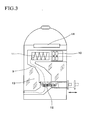
- a postdrying device of a first embodiment as shown in FIG. 3 is a heater-type, and is provided with a fan 10 and a heater 11 at an upstream side of a drying passage 9, and an insertably and extractably pullout sample pan 12 at a downstream side of the drying passage 9. Air heated by the heater 11 is flown to the sample pan 12 as a fan air, thereupon main drying the test specimen having been provided with the predrying treatment.
- a heat insulating material 13 is configured to be filled around the drying passage 9, thereby allowing drying efficiency to be increased.
- reference numeral 14 is a panel provided with various instruments such as a temperature indicator of the drying passage 9, a temperature setter of the heater 11, an airflow setter of the fan 10, etc.
- the test specimen having been predried to 30% in water content is subject to the thermal active drying treatment, and thus can achieve the targeted water content of 20% or less, preferably 10% or less quickly, and be provided as a to-be-measured sample for the foregoing various analytical methods such as X-ray fluorescence spectrometry, total reflection X-ray fluorescence spectrometry, etc.
- the postdrying device further includes a second embodiment as shown in FIG. 4 , which is a lamp heating type, provided with a lamp body (for example, a lamp such as halogen lamp, xenon lamp, etc.) 16 as a heating source in a box-shaped drying chamber 15.
- a lamp body for example, a lamp such as halogen lamp, xenon lamp, etc.
- Light emitted from the lamp body 16 is configured to be further condensed by a convex lens 17.
- a receiving pan (sample pan) 18 for receiving the aforementioned predried test specimen is provided in the drying chamber 15 and located such that the condensed light is irradiated thereon. The aforementioned predried test specimen is heated and dried while placed on the receiving pan 18.
- the receiving pan 18 becomes disposable by using a material such as foamed styrol.
- a temperature sensor 19a is arranged at the receiving pan 18 and a light amount of the lamp body 16 is adjusted by a temperature regulator 19 based on the detected temperature of the receiving pan 18, thereby allowing a constant temperature state to be maintained.
- the aforementioned test specimen having been predried to 30% in water content is subject to the active drying treatment by the condensed light source, and thus can achieve the targeted water content of 20% or less, preferably 10% or less quickly and be provided as a to-be-measured sample for the foregoing various analytical methods such as X-ray fluorescence spectrometry, total reflection X-ray fluorescence spectrometry, etc.
- the heat source for the postdrying which makes the predried test specimen 20% or less, preferably 10% or less in water content is a light source having been emitted from the lamp body 16 and then condensed.
- a heating temperature can be adjusted by configuring such that the convex lens 17 can move closer to or away from the lamp body 16 or receiving pan 18.
- the irradiation position can be adjusted by configuring such that the convex lens 17 can move in parallel with the lamp body 16 or receiving pan 18.
- the postdrying device may further include ones like a third and a fourth embodiment as shown in FIG. 5 and FIG. 6 in which a combustible fuel is burned.
- a postdrying device of the third embodiment as shown in FIG. 5 is a flame burner type and uses a flame burner 21 as a heating source in a box-shaped drying chamber 20. More specifically, it is configured such that a receiving pan (sample pan) 22 for receiving the aforementioned predried test specimen is provided in the drying chamber 20 in such a manner as to be freely taken in and out, and the predried test specimen is heated and dried by the flame burner 21 while placed on the receiving pan 22.
- the drying chamber 20 is provided with a thermometer 23.
- a temperature within the drying chamber 20 having been measured by the thermometer 23 is input into a control section 24, which adjusts an opening amount of a fuel supply valve 27 provided in a fuel passage 26 extending from a fuel tank 25 to the flame burner 21, based on the input temperature within the drying chamber 20, thereby adjusting a thermal power of the flame burner 21. Accordingly, a chamber temperature in the drying chamber 20 is set to be kept constant.
- the aforementioned test specimen having been predried to 30% in water content is subject to the active drying treatment by the flame burner 21, and thus can achieve the targeted water content of 20% or less, preferably 10% or less quickly, and be provided as a to-be-measured sample for the foregoing various analytical methods such as X-ray fluorescence spectrometry, total reflection X-ray fluorescence spectrometry, etc.
- the heating source for the postdrying which makes the predried test specimen 20% or less, preferably 10% or less in water content is the flame burner 21, and accordingly it is sufficient to carry only a combustible gas cylinder as a fuel.
- a desktop gas stove 17 can also be used as one which carries out the postdrying by flame by burning of combustible gas. More specifically, as in the fourth embodiment as shown in FIG. 6 , a drying chamber 28 is provided with a receiving pan (sample pan) 29 for receiving the aforementioned predried test specimen in such a manner as to be freely taken in and out, and the predried test specimen is heated and dried by the desktop gas stove 30 while placed on the receiving pan 29. It is noted that reference numeral 30a is a gas cylinder.
- the drying chamber 28 is provided with a thermometer 31.
- a temperature within the drying chamber 28 having been measured by the thermometer 31 is input into a control section 32, which adjusts an opening amount of a thermal power adjusting dial 33 provided in the desktop gas stove 30, based on the input temperature within the drying chamber 28, thereby adjusting a thermal power of the desktop gas stove 30. Accordingly, a chamber temperature in the drying chamber 28 is set to be kept constant.
- the aforementioned test specimen having been predried to 30% in water content is subject to the active drying treatment by the desktop gas stove 30, and thus can achieve the targeted water content of 20% or less, preferably 10% or less quickly, and be provided as a to-be-measured sample for the foregoing various analytical methods such as X-ray fluorescence spectrometry, total reflection X-ray fluorescence spectrometry, etc.
- the heating source for the postdrying which makes the predried test specimen 20% or less, preferably 10% or less in water content is the desktop gas stove 30, and accordingly it is sufficient to carry only a fuel (gas cylinder).
- a drier 35 is used as a heating source in a box-shaped drying chamber 34. More specifically, the drying chamber 34 is provided with a receiving pan (sample pan) 36 for receiving the aforementioned predried test specimen in such a manner as to be freely taken in and out. The predried test specimen is heated and dried by applying hot air by the drier 35 from under the receiving pan 36 while placed on the receiving pan 36.
- the drier 35 is one which houses the storage cell, which is set to be rechargeable in this embodiment. As a matter of course, however, the present invention can be carried out by using a non-rechargeable storage cell, as well.
- the aforementioned test specimen having been predried to 30% in water content is subject to the active drying treatment by hot air from the drier 35, and thus can achieve the targeted water content of 20% or less, preferably 10% or less quickly, and be provided as a to-be-measured sample for the foregoing various analytical methods such as X-ray fluorescence spectrometry, total reflection X-ray fluorescence spectrometry, etc.
- the heating source for the postdrying which makes the predried test specimen 20% or less, preferably 10% or less in water content is the drier 35 with the storage cell in it, and accordingly heating treatment can be carried out even in a place with no external power supply.
- the drier 35 is adopted as a heat source only for the postdrying, there is no need to get a large amount of storage cells ready due to heavy consumption of the storage cells as in a case where all of the test specimen is dried by the drier. It is noted that the drying by the drier 35 is configured to be carried out by applying hot air from under the receiving pan in this embodiment, but can be carried out by applying hot air from directly above the test specimen. In this case, it is conceivable that the test specimen may be scattered.
- a woven textile fabric or nonwoven textile fabric with heat resistance is used as a cover.
- a metal cloth such as platinum, or one formed from polymer resins with heat resistance such as polycarbonate based resin, polysulfone based resin, etc.
- the postdrying device may include a sixth and a seventh embodiment as shown in FIG. 8 and FIG. 9 .
- the heat source for the postdrying device in these embodiments is a reaction heat generated when calcium oxide (CaO: burnt lime) is reacted with water to generate calcium hydroxide (Ca(OH) 2 : hydrated lime).
- a drying chamber 37 is provided with a receiving pan (sample pan) 38 for receiving the aforementioned predried test specimen in such a manner as to be freely taken in and out.
- the predried test specimen is arranged to be heated and dried while placed on the receiving pan 38.
- Reference numeral 39 is a reaction vessel for hydrated lime.
- the reaction vessel 39 is composed of an outer container 40 formed of a flexible material and an inner container 41 housed within the outer container 40.
- the inner container 41 is formed of such a material that is broken by forcibly press-bending the outer container 40, for example, a thin-walled rigid plastic or glass. Powder of calcium oxide is stored in the outer container 40, and water is filled in the inner container 41. At the time of postdrying, if the outer container 40 is press-bent to break the inner container 41, the water is leaked out into the outer container 40, whereupon calcium oxide and water react with each other and a chemical reaction of generating calcium hydroxide proceeds. A reaction heat generated at that moment becomes a heat source for the postdrying.
- the outer container 40 is well kneaded to mix water and calcium oxide uniformly after the inner container 41 is broken. After that, the outer container 40 is placed on the floor of the drying chamber 37, and the receiving pan 38 is placed thereon, thereby allowing for carrying-out of the postdrying.
- the aforementioned test specimen having been predried to 30% in water content is subject to the active drying treatment by the heat of reaction between calcium oxide and water, and thus can achieve the targeted water content of 20% or less, preferably 10% or less quickly, and be provided as a to-be-measured sample for the foregoing various analytical methods such as X-ray fluorescence spectrometry, total reflection X-ray fluorescence spectrometry, etc.
- the heating source for the postdrying which makes the predried test specimen 20% or less, preferably 10% or less in water content is the reaction heat generated by reacting calcium oxide with water, and accordingly heating treatment can be carried out even in a place with no external power supply.
- electrical equipment is not required as in a conventional case where a large amount of power consumption is involved, so that drying at the collection site becomes possible.
- the drying by the reaction heat generated by reacting calcium oxide with water is configured to be carried out by putting the reaction vessel 40 under the receiving pan 38 in the above seventh embodiment, but can be carried out by placing the reaction vessel 40 from above onto the test specimen, as well (heating from both above and under is also possible).
- a woven textile fabric or nonwoven textile fabric with heat resistance is laid over the test specimen so that the test specimen does not contact with the reaction vessel 40 directly.
- the woven textile fabric or nonwoven textile fabric preferably adopted is a metal cloth such as platinum, or one formed from polymer resins with heat resistance such as polycarbonate based resin, polysulfone based resin, etc.
- a substance which is reacted with water and generates heat includes barium oxide (BaO).
- the postdrying of the present invention can be carried out even by using this heat source in the same manner as the case of reacting calcium oxide with water.
- calcium oxide or barium oxide is reacted with water
- calcium oxide or barium oxide and the inner container having been filled with water may be enclosed in the outer container.
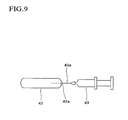
- the present invention can be carried out in such a manner that the reaction vessel 42 having been filled with calcium oxide or barium oxide is prepared, and a needle 43a of a water carrying syringe (injector) 43 is inserted into the reaction vessel 42 to fill the reaction vessel 42 with water.
- the reaction vessel 42 is provided with a thick-walled portion 42a, into which the needle 43a is inserted, thereby avoiding leakage of the reaction liquid from the vessel.
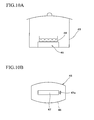
- the postdrying device may include an eighth embodiment as shown in FIG. 10 , wherein heat generated when concentrated sulfuric acid is diluted with water is used as a heat source.
- a drying chamber 43 is provided with a receiving pan (sample pan) 44 for receiving the aforementioned predried test specimen in such a manner as to be freely taken in and out.
- the predried test specimen is heated and dried while placed on the receiving pan 44.
- Reference numeral 45 is a dilution vessel, which is composed of an outer container 46 formed of a flexible material and an inner container 47 housed within the outer container 46.
- the inner container 47 is provided with a neck portion 47a which is broken, for example, by being pulled or bent.
- Water is stored in the outer container 46, and concentrated sulfuric acid is filled in the inner container 47.
- the amount of water stored in the outer container 46 is an amount that allows sufficient clearance to squeeze and push in the outer container 46 by fingers so as to pinch and then pull or bend the neck portion 47a.
- the concentrated sulfuric acid is leaked out inside the outer container 46, thereby being diluted with water. A reaction heat generated at that moment becomes a heat source for the postdrying.
- the outer container 46 is left to stand on the floor of the drying chamber 43 with the neck portion 47a broken in order to avoid a rapid dilution of the concentrated sulfuric acid, and the receiving pan 44 is placed thereon, thereby carrying out the postdrying.
- the concentrated sulfuric acid is taken out little by little from the inner container by sometimes pushing the outer container by fingers or the like, whereby heat generation by the dilution can be controlled.
- the device as shown in FIG. 9 can be adopted when a dilution heat of the concentrated sulfuric acid is used.
- the present invention can be carried out by filling concentrated sulfuric acid in a drying vessel and supplying water little by little into a dilution vessel by a syringe.
- the aforementioned test specimen having been predried to 30% in water content is subject to the active drying treatment by the heat generated when the concentrated sulfuric acid is diluted with water, and thus can achieve the targeted water content of 20% or less, preferably 10% or less quickly, and be provided as a to-be-measured sample for the foregoing various analytical methods such as X-ray fluorescence spectrometry, total reflection X-ray fluorescence spectrometry, etc.
- the heating source for the postdrying which makes the predried test specimen 20% or less, preferably 10% or less in water content is the heat generated at the time of diluting the concentrated sulfuric acid with water, and accordingly heating treatment can be carried out even in a place with no external power supply.
- the drying by the heat generated when the concentrated sulfuric acid is diluted with water is configured to be carried out by putting the drying vessel 42 under the receiving pan in this embodiment, but can be carried out by placing the drying vessel 42 from above onto the test specimen, as well (heating from both above and under is also possible).
- a woven textile fabric or nonwoven textile fabric with heat resistance is laid over the test specimen so that the test specimen does not contact with the dilution vessel 45 directly.
- the woven textile fabric or nonwoven textile fabric preferably adopted is a metal cloth such as platinum, or one formed from polymer resins with heat resistance such as polycarbonate based resin, polysulfone based resin, etc.
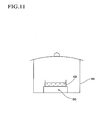
- the postdrying device includes a ninth embodiment as shown in FIG. 11 , wherein powder of metals such as iron, magnesium, aluminum, etc., is more likely to experience an oxidation reaction by reacting with oxygen in air to oxidize, and oxidation heat generated at that moment is used as a heat source.
- a drying chamber 48 is provided with a receiving pan (sample pan) 49 for receiving the aforementioned predried test specimen in such a manner as to be freely taken in and out, and the predried test specimen is heated and dried while placed on the receiving pan 49.
- Reference numeral 50 is an oxidation vessel (bag) and is formed from a breathable material. Powder of iron (iron powder) is filled in the oxidation vessel 50.
- activated carbon having been absorbed with a saline solution as a water-holding agent is filled and mixed in order to control an oxidation rate of the iron powder.
- This filling amount can control the oxidation rate of the iron powder, that is, a rate of oxidation reaction, thereby regulating a generation amount of oxidation heat.
- the oxidation vessel 50 is kept within a hermetically sealed container in order to prevent progression of iron powder oxidation, and is taken out of the hermetically sealed container to be exposed to air at a postdrying stage. By this, air is entered into the oxidation vessel 50, oxidation of iron powder proceeds, and heat is generated.
- the oxidation vessel 50 is left to stand on the floor of the drying chamber 48, and the receiving pan 49 is placed thereon to carry out the postdrying. Further, the postdrying can also be carried out by placing the oxidation vessel 50 on the upper surface of the receiving pan 49 according to need.
- the aforementioned test specimen having been predried to 30% in water content is subject to the active drying treatment by the oxidation heat generated when the metal powder is oxidized, and thus can achieve the targeted water content of 20% or less, preferably 10% or less quickly, and be provided as a to-be-measured sample for the foregoing various analytical methods such as X-ray fluorescence spectrometry, total reflection X-ray fluorescence spectrometry, etc.
- the heating source for the postdrying which makes the predried test specimen 20% or less, preferably 10% or less in water content is the oxidation heat generated when the metal powder is oxidized, and accordingly heating treatment can be carried out even in a place with no external power supply.
- the drying by the reaction heat generated by oxidation of the metal powder is configured to be carried out by putting the oxidation vessel 50 under the receiving pan in this embodiment, but can be carried out by placing the oxidation vessel 50 from above onto the test specimen, as well (heating from both above and under is also possible).
- a woven textile fabric or nonwoven textile fabric with heat resistance is laid over the test specimen so that the test specimen does not contact with the oxidation vessel 50 directly.
- the woven textile fabric or nonwoven textile fabric preferably adopted is a metal cloth such as platinum, or one formed from polymer resins with heat resistance such as polycarbonate based resin, polysulfone based resin, etc.
- the postdrying device may include a tenth embodiment as shown in FIG. 12 , which uses hydration heat generated when alkali metal hydroxide as represented by lithium hydroxide (LiOH), sodium hydroxide (NaOH) and potassium hydroxide (KOH), or alkaline earth metal hydroxide as represented by magnesium hydroxide (Mg(OH) 2 ) and calcium hydroxide (Ca(OH) 2 ) is bonded with water and hydrated.
- a drying chamber 51 is provided with a receiving pan (sample pan) 52 for receiving the aforementioned predried test specimen in such a manner as to be freely taken in and out, and the predried test specimen is heated and dried while placed on the receiving pan 52.
- Reference numeral 53 is a heat generation vessel (bag), and is formed from a flexible and non-breathable material. Particulate sodium hydroxide is filled in the heat generation vessel 53 in an atmosphere of inert gas such as nitrogen gas, and contact with water is blocked.
- the heat generation vessel 53 is provided with a zippered opening 53a capable of being openably and closably sealed. When the opening 53a is opened, poured with water and sealed, and then the heat generation vessel 53 is well kneaded, sodium hydroxide and water is bonded and well hydrated.
- the heat generation vessel 53 is left to stand on the floor of the drying chamber 51, and the receiving pan 52 is placed thereon to carry out the postdrying.
- the heat generation vessel 53 can also be placed on the upper surface of the receiving pan 52 to carry out the postdrying according to need (drying from both above and under is also possible if necessary).
- an amount of hydration heat generated varies according to an amount of water to be added relative to sodium hydroxide. It is preferable to add heated water (hot water) in order to ensure a heating temperature.
- the aforementioned test specimen having been predried to 30% in water content is subject to the active drying treatment by the hydration heat generated when sodium hydroxide is hydrated with water, and thus can achieve the targeted water content of 20% or less, preferably 10% or less quickly, and be provided as a to-be-measured sample for the foregoing various analytical methods such as X-ray fluorescence spectrometry, total reflection X-ray fluorescence spectrometry, etc.
- the heating source for the postdrying which makes the predried test specimen 20% or less, preferably 10% or less in water content is the hydration heat generated when alkali metal hydroxide or alkaline earth metal hydroxide is bonded with water and hydrated, and accordingly heating treatment can be carried out even in a place with no external power supply.
- electrical equipment is not required as in a conventional case where a large amount of power consumption is involved, so that drying at the collection site becomes possible.
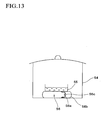
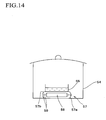
- the postdrying device may include an eleventh and a twelfth embodiment as shown in FIG. 13 and FIG. 14 , which use combustion heat generated when a vaporized petroleum combustible (as represented by benzine) is burned in the presence of a catalyst of platinum cotton, or combustion heat generated when charcoal powder of plants having been hardened by kneading is burned.
- the eleventh embodiment as shown in FIG. 13 is provided with a receiving pan (sample pan) 55 for receiving the aforementioned predried test specimen in a drying chamber 54 in such a manner as to be freely taken in and out. The predried test specimen is heated and dried while placed on the receiving pan 55.
- Reference numeral 56 is a heat generation vessel for burning a petroleum combustible and generating heat, and is formed from a metal material. Glass wool with heat resistance is filled in the heat generation vessel 56, and the petroleum combustible as represented by benzine is configured to be supplied and filled in the vessel 56 by removing a cap 56a from the vessel 56.
- the cap 56a is provided with a platinum cotton (platinum wire netting) 56c and configured to be covered by a covering body 56b which is breathable and capable of supplying oxygen in air to the cap 56a region.
- the vessel 56 is heated by combustion heat generated when combustible gas into which the petroleum combustible having been filled within the vessel 56 is vaporized is burned under the platinum cotton as a catalyst.
- the vessel 56 is left to stand on the floor of the drying chamber 54, and the receiving pan 55 is placed thereon to carry out the postdrying.
- the heat generation vessel 56 can also be placed on the upper surface of the receiving pan 55 to carry out the postdrying according to need (drying from both above and under is also possible if necessary).
- the aforementioned test specimen having been predried to 30% in water content is subject to the active drying treatment by the combustion heat generated when the petroleum combustible is slowly burned under the platinum cotton 56c as a catalyst, and thus can achieve the targeted water content of 20% or less, preferably 10% or less quickly, and be provided as a to-be-measured sample for the foregoing various analytical methods such as X-ray fluorescence spectrometry, total reflection X-ray fluorescence spectrometry, etc.
- the heating source for the postdrying which makes the predried test specimen 20% or less, preferably 10% or less in water content is the combustion heat generated when the petroleum combustible is slowly burned under the platinum cotton as a catalyst, and accordingly heating treatment can be carried out even in a place with no external power supply.
- electrical equipment is not required as in a conventional case where a large amount of power consumption is involved, so that drying at the collection site becomes possible.
- reference numeral 57 is a heat generation vessel with air permeability for burning a combustible 58 which is charcoal powder of plants having been hardened by kneading, and making generated combustion heat into a heat source.
- the vessel 57 is composed of a vessel body 57a and an openable and closable cover body 58b. Inside of the vessel body 57a and the cover body 57b, there are provided rugs 59 formed by weaving glass wool with heat resistance.
- the vessel 57 supports and bums the combustible 58 in such a manner as sandwiching it by the rugs 59.
- This vessel can also be adopted as a heat source for the postdrying in the same manner as above.
- the postdrying device may include a thirteenth embodiment as shown in FIG. 15 , in which a reaction heat generated when a mixture of iron or copper powder and sulfur powder is reacted to generate iron sulfide or copper sulfide is used as a heat source.
- a reaction heat generated when a mixture of iron or copper powder and sulfur powder is reacted to generate iron sulfide or copper sulfide is used as a heat source.
- the reaction by only those reaction components is close to an explosion, and thus, powder of potassium silicate (K 2 SiO 3 ) is added as a reaction control (inhibition) agent, whereby the reaction is set to proceed gradually.
- a drying chamber 60 is provided with a receiving pan (sample pan) 61 for receiving the aforementioned predried test specimen in such a manner as to be freely taken in and out. The predried test specimen is heated and dried while placed on the receiving pan 61.
- Reference numeral 62 is a heat generation vessel for reacting a powder mixture of iron or copper and sulfur and generating heat.
- the heat generation vessel 62 is a hermetically sealed type.
- the powder mixture 63 is filled in the heat generation vessel 62 together with an electric heating body 64 which generates heat by application of electricity such as nichrome wire, and a lead wire 64a is drawn out from the heat generation vessel 62 while connected to the electric heating body 64.
- This is left to stand on the floor of the drying chamber 60, the receiving pan 61 is placed thereon, a power supply (battery or dry cell) 65 is connected to the drawn lead wire 64a, and the electric heating body 64 is heated, thereby chemically reacting the powder mixture to generate heat, thereby carrying out the postdrying.
- the heat generation vessel 62 can also be placed on the upper surface of the receiving pan 61 to carry out the postdrying according to need (drying from both above and under is also possible if necessary).
- the aforementioned test specimen having been predried to 30% in water content is subject to the active drying treatment by the reaction heat generated when the powder mixture of copper and sulfur is chemically reacted gradually under potassium silicate as a reaction control agent, and thus can achieve the targeted water content of 20% or less, preferably 10% or less quickly, and be provided as a to-be-measured sample for the foregoing various analytical methods such as X-ray fluorescence spectrometry, total reflection X-ray fluorescence spectrometry, etc.
- the heating source for the postdrying which makes the predried test specimen 20% or less, preferably 10% or less in water content is the reaction heat by the powder mixture of iron or copper and sulfur, and accordingly heating treatment becomes possible by carrying a simple external power supply as a heating source for reaction start, such as a battery or dry cell.
- a simple external power supply as a heating source for reaction start, such as a battery or dry cell.
- one or more kinds of volatile alcohols more specifically, alcohols and/or ketones having volatility and mixed with water at any ratio such as methyl alcohol (CH 3 OH), ethyl alcohol (C 2 H 5 OH), n-propyl alcohol (CH 3 CH 2 CH 2 OH), iso-propyl alcohol (CH 3 CH(OH)CH 3 ), acetone (CH 3 COCH 3 ), methyl ethyl ketone (CH 3 COC 2 H 5 ) are appropriately selected and added to the aforementioned predried sample.
- volatile alcohols more specifically, alcohols and/or ketones having volatility and mixed with water at any ratio
- methyl alcohol CH 3 OH
- ethyl alcohol C 2 H 5 OH
- n-propyl alcohol CH 2 CH 2 OH
- iso-propyl alcohol CH(OH)CH 3
- acetone CH 3 COCH 3
- methyl ethyl ketone CH 3 COC 2 H 5
- an object to be dried other than water includes an organic matter, further, an easily vaporized element such as mercury, arsenic, antimony, cadmium, etc., a simple substance of a compound, or a mixture of the above easily vaporized substances. These easily vaporized substances can be removed efficiently and provided as an analytical sample in the same manner.
- the sample of residual components thus dried can be used as a sample for infrared spectroscopy, atomic absorption spectrometry, emission spectrometry, gas chromatographic spectrometry, and gravimetric analysis without being restricted to X-ray fluorescence spectrometry or total reflection X-ray fluorescence spectrometry, as described above.
- a component having been vaporized by the foregoing drying treatment can also be provided as a sample for analysis by trapping and the like. Such a residual component and a vaporized component can both be used as an analytical sample.
- the present invention is capable of early and efficiently drying an analytical sample used in various chemical analyses such as X-ray fluorescence spectrometry, total reflection X-ray fluorescence spectrometry, infrared spectroscopy, atomic absorption spectrometry, emission spectrometry, gas chromatographic spectrometry, gravimetric analysis, etc., and thus, such industrial application becomes possible.
Landscapes
- Chemical & Material Sciences (AREA)
- General Health & Medical Sciences (AREA)
- Life Sciences & Earth Sciences (AREA)
- Health & Medical Sciences (AREA)
- Analytical Chemistry (AREA)
- Biochemistry (AREA)
- Physics & Mathematics (AREA)
- General Physics & Mathematics (AREA)
- Immunology (AREA)
- Pathology (AREA)
- Chemical Kinetics & Catalysis (AREA)
- Sampling And Sample Adjustment (AREA)
- Analysing Materials By The Use Of Radiation (AREA)
- Investigating Or Analyzing Non-Biological Materials By The Use Of Chemical Means (AREA)
Abstract
Description
- The present invention belongs to the technical field of a drying treatment method and an apparatus for drying treatment for removing an easily vaporized material which includes water contained in an analytical sample used in various chemical analyses such as X-ray fluorescence spectrometry, total reflection X-ray fluorescence spectrometry, infrared spectroscopy, atomic absorption spectrometry, emission spectrometry, gas chromatographic spectrometry, gravimetric analysis, etc.
- In circumstances where a sample is analyzed by using various analytical methods such as X-ray fluorescence spectrometry, total reflection X-ray fluorescence spectrometry, etc., for example, taking X-ray fluorescence spectrometry or total reflection X-ray fluorescence spectrometry as an example, water in a constituent attenuates x-rays thereby reducing x-ray intensity in general. Accordingly, a water content condition of a soil having been collected from a site varies if the soil is analyzed as it is. As a result, there is a problem that a stable measurement value cannot be obtained and thus reliability is poor. Therefore, when a collected soil is used as a sample, attempts have been made to infuse the collected sample with water, mix, dry, and then measure it (see
Patent Document 1, for example). - Patent Document 1: Japanese Published Unexamined Patent Application No.
2006-138660 - The aforementioned conventional method is, however, configured such that the collected sample is infused with water and mixed and then the water is removed by drying. As a drying means in this case, drying is carried out by heating with use of a sheet-shaped or belt-shaped warming body made of heat resistant plastic. However, this method requires a specialized warming body, so that an apparatus itself is upsized and a large amount of power consumption is involved. Thus, there is a problem that a simple and easy drying operation at a collection site cannot be performed and the operation is possible only at well-equipped facilities such as a laboratory. Furthermore, the operation is unsuitable for drying a soil with a high water content where water drips and falls within a short period of time and drying at a collection site has not been attempted. Thus, here are problems to be solved by the present invention.
- The present invention was made in view of the aforementioned circumstances with the aim of solving these problems. The invention as set forth in
claim 1 is a method for drying treatment of an analytical sample, the method comprising the steps of packing the sample into a super absorbent polymer having been spread in a container and drying the sample.
The invention as set forth inclaim 2 is a method for drying treatment of an analytical sample according toclaim 1, wherein the sample to be dried is a soil for metal analysis with a high water content, and a water content thereof calculated as an amount of water relative to a weight of the soil having been dried is 30% or more.
The invention as set forth inclaim 3 is a method for drying treatment of an analytical sample, which is a method for drying treatment of a soil for metal analysis with a high water content as the analytical sample, the method comprising the steps of carrying out predrying of packing the sample into a super absorbent polymer having been spread in a container and drying the sample, and then carrying out postdrying by heating by use of a heat source, thereby making thewater content 20% or less.
The invention as set forth inclaim 4 is a method for drying treatment of an analytical sample according toclaim 3, wherein the heat source for the postdrying is an electrothermal heater.
The invention as set forth inclaim 5 is a method for drying treatment of an analytical sample according toclaim 3, wherein the heat source for the postdrying is obtained by condensing light having been emitted from a lamp body by a convex lens.
The invention as set forth inclaim 6 is a method for drying treatment of an analytical sample according toclaim 3, wherein the heat source for the postdrying is a flame for burning a combustible fuel.
The invention as set forth inclaim 7 is a method for drying treatment of an analytical sample according toclaim 3, wherein the heat source for the postdrying is a drier with a built-in dry cell.
The invention as set forth inclaim 8 is a method for drying treatment of an analytical sample according toclaim 3, wherein the heat source for the postdrying is a heat generated when calcium oxide or barium oxide is reacted with water.
The invention as set forth inclaim 9 is a method for drying treatment of an analytical sample according toclaim 3, wherein the heat source for the postdrying is a heat generated when concentrated sulfuric acid is diluted with water.
The invention as set forth inclaim 10 is a method for drying treatment of an analytical sample according toclaim 3, wherein the heat source for the postdrying is a heat generated when metal powder is oxidized.
The invention as set forth inclaim 11 is a method for drying treatment of an analytical sample according toclaim 3, wherein the heat source for the postdrying is a heat generated when alkali metal hydroxide or alkaline earth metal hydroxide is bonded with water and hydrated.
The invention as set forth inclaim 12 is a method for drying treatment of an analytical sample according toclaim 3, wherein the heat source for the postdrying is a heat generated when a vaporized petroleum combustible is burned in the presence of a catalyst of platinum cotton.
The invention as set forth inclaim 13 is a method for drying treatment of an analytical sample according toclaim 3, wherein the heat source for the postdrying is a heat generated when charcoal powder of plants having been hardened by kneading is burned.
The invention as set forth inclaim 14 is a method for drying treatment of an analytical sample according toclaim 3, wherein a heating source for the postdrying is a reaction heat generated when a mixture of iron or copper powder and sulfur powder is reacted.
The invention as set forth inclaim 15 is a method for drying treatment of an analytical sample according to any one ofclaims 2 to 13, wherein the predried soil is added with volatile alcohol and/or ketone, thereupon carrying out the postdrying.
The invention as set forth inclaim 16 is a method for drying treatment of an analytical sample according to any one ofclaims 1 to 14, wherein at least one of a residual component or a vaporized component having been dried is used in analysis.
The invention as set forth inclaim 17 is an apparatus for drying treatment of an analytical sample, including a container and a super absorbent polymer provided in the container, wherein the sample is packed on an upper surface of the super absorbent polymer and dried.
The invention as set forth inclaim 18 is an apparatus for drying treatment of an analytical sample, which is an apparatus for drying treatment of a soil for metal analysis with a high water content as the analytical sample, the apparatus comprising a container, a super absorbent polymer provided in the container, a predrying device packing the soil on an upper surface of the super absorbent polymer and drying the soil to 30% or less in water content, and a postdrying device drying the predried soil to 20% or less in water content by heating by use of a heat source.
The invention as set forth inclaim 19 is an apparatus for drying treatment of an analytical sample according to eitherclaim 17 or claim 18, wherein the container is a funnel with a ceiling surface opened. - According to
claim 1 or claim 17, the analytical sample can be dried at an early stage without consuming a large amount of power.
According toclaim 2, even a soil having a high water content of 30% or more can simply and easily be dried.
According toclaim 3 or claim 18, the soil for metal analysis with a high water content can be dried at an early stage by double drying of predrying and postdrying.
According to any one ofclaim 4 to 15, even a soil having a high water content of 30% can be dried simply and easily without using large-scale equipment.
According toclaim 16, at least one of a residual component or a vaporized component having been dried can be analyzed. -
-
FIG. 1 is a cross sectional view of an apparatus for predrying treatment; -
FIG. 2 is a graph chart showing a predrying state; -
FIG. 3 is a schematic diagram showing a postdrying device of a first embodiment; -
FIG. 4 is a schematic diagram showing a postdrying device of a second embodiment; -
FIG.5 is a schematic diagram showing a postdrying device of a third embodiment; -
FIG. 6 is a schematic diagram showing a postdrying device of a fourth embodiment; -
FIG. 7 is a schematic diagram showing a postdrying device of a fifth embodiment; -
FIG. 8 shows a postdrying device of a sixth embodiment, (A) is a schematic diagram thereof and (B) is a schematic diagram of a reaction vessel; -
FIG. 9 is a schematic diagram showing a postdrying device of a seventh embodiment; -
FIG. 10 shows a postdrying device of an eighth embodiment, (A) is a schematic diagram thereof and (B) is a schematic diagram of a dilution vessel; -
FIG. 11 is a schematic diagram showing a postdrying device of a ninth embodiment; -
FIG. 12 is a schematic diagram showing a postdrying device of a tenth embodiment; -
FIG. 13 a schematic diagram showing a postdrying device of an eleventh embodiment; -
FIG. 14 is a schematic diagram showing a postdrying device of a twelfth embodiment; and -
FIG. 15 is a schematic diagram showing a postdrying device of a thirteenth embodiment. -
- 1
- Nutsche
- 6
- Super absorbent polymer
- 8
- Test specimen
- 10
- Drier
- 11
- Receiving pan
- Subsequently, embodiments of the present invention will be described based on the drawings. In the drawings,
reference numeral 1 is a nutsche (Büchner funnel) of porcelain or steel covered with a resinous material such as fluororesin on a surface thereof. Thenutsche 1 corresponds to a container of a predrying device and has a bottomed cylindrical shape with a ceiling surface opened. A plurality ofliquid permeation holes 3 with a small diameter are provided on an innerbottom surface plate 2. A liquid having passed through the liquid permeation holes 3 is configured to be discharged outside via adrain passage 4. -
Reference numeral 5 is a lower side filter paper laid over an upper surface of the innerbottom surface plate 2. Powder of a superabsorbent polymer 6 is uniformly spread (filled) on an upper surface of thefilter paper 5. As the superabsorbent polymer 6, there can be adopted cross-linking substances of acrylic polymer moiety and sodium salt which are developed from acrylic acid as a raw material having been manufactured by, for example, vapor-phase oxidation of propylene and also which have superior water absorption and liquid absorption performance relative to wetting materials. - Another
filter paper 7 is laid over the upper surface of the superabsorbent polymer 6. Atest specimen 8 is packed on an upper surface of thefilter paper 7 so as to have a predetermined thickness, for example, 5mm, without leaving any space therebetween, and a surface thereof is formed to be smoothed. Thetest specimen 8 is a soil to be analyzed by X-ray fluorescence. Herein, kaolin clays having water content of 20, 40, 60 and 80% respectively calculated as an amount of water relative to a weight of a dried soil are adopted in order to check drying conditions. As estimated that water of 300-fold self weight can be absorbed, a spreading (filling) amount of the superabsorbent polymer 6 is set to be able to absorb twice a water amount of the water amount contained in respective kaolin clays. -
FIG. 2 illustrates changes in water content of respective kaolin clays. According to the figure, it was recognized that thetest specimens 8 with water content of 80 and 60% achieved water content of 40% or less within a short period of time and then the water content gradually decreased, reached approximately 30%, thereafter, the reduction of the water content slackened. On the other hand, thetest specimen 8 with a water content of 40% achieved drying to 30% in water content within a short period of time, but the reduction of the water content therebelow slackened. Further, it was recognized that a reduction in water content was slight for thetest specimen 8 with a water content of 20%. - From these results, such a predrying treatment that can make a reduction in water content to approximately 30% within a short period of time for a soil with a high water content exceeding 40% becomes possible.
It is noted that a water content is required to be 20% or less, preferably 10% or less in the foregoing various analytical methods such as X-ray fluorescence spectrometry, total reflection X-ray fluorescence spectrometry, etc. Thus, the above drying process shall be considered as a predrying in which a soil with a high water content is dried to 30% in water content at an early stage, and the soil thus predried is further provided with an active drying treatment (postdrying treatment) which makes thewater content 20% or less, preferably 10% or less, whereby a test specimen with a targeted water content of 20% or less, preferably 10% or less can be obtained early. - Next, examples of a postdrying device will be described based on each embodiment as shown in and after
FIG. 3 . A postdrying device of a first embodiment as shown inFIG. 3 is a heater-type, and is provided with afan 10 and aheater 11 at an upstream side of adrying passage 9, and an insertably and extractablypullout sample pan 12 at a downstream side of thedrying passage 9. Air heated by theheater 11 is flown to thesample pan 12 as a fan air, thereupon main drying the test specimen having been provided with the predrying treatment. In this case, aheat insulating material 13 is configured to be filled around thedrying passage 9, thereby allowing drying efficiency to be increased. It is noted thatreference numeral 14 is a panel provided with various instruments such as a temperature indicator of thedrying passage 9, a temperature setter of theheater 11, an airflow setter of thefan 10, etc. - By using such a main drying device, the test specimen having been predried to 30% in water content is subject to the thermal active drying treatment, and thus can achieve the targeted water content of 20% or less, preferably 10% or less quickly, and be provided as a to-be-measured sample for the foregoing various analytical methods such as X-ray fluorescence spectrometry, total reflection X-ray fluorescence spectrometry, etc.
- The postdrying device further includes a second embodiment as shown in
FIG. 4 , which is a lamp heating type, provided with a lamp body (for example, a lamp such as halogen lamp, xenon lamp, etc.) 16 as a heating source in a box-shapeddrying chamber 15. Light emitted from thelamp body 16 is configured to be further condensed by aconvex lens 17. A receiving pan (sample pan) 18 for receiving the aforementioned predried test specimen is provided in the dryingchamber 15 and located such that the condensed light is irradiated thereon. The aforementioned predried test specimen is heated and dried while placed on the receivingpan 18. In this case, for example, if a heating temperature is set at 80 °C, the receivingpan 18 becomes disposable by using a material such as foamed styrol. In this case, atemperature sensor 19a is arranged at the receivingpan 18 and a light amount of thelamp body 16 is adjusted by atemperature regulator 19 based on the detected temperature of the receivingpan 18, thereby allowing a constant temperature state to be maintained. - By using such a main drying device, the aforementioned test specimen having been predried to 30% in water content is subject to the active drying treatment by the condensed light source, and thus can achieve the targeted water content of 20% or less, preferably 10% or less quickly and be provided as a to-be-measured sample for the foregoing various analytical methods such as X-ray fluorescence spectrometry, total reflection X-ray fluorescence spectrometry, etc.
Moreover, in this device, the heat source for the postdrying which makes thepredried test specimen 20% or less, preferably 10% or less in water content is a light source having been emitted from thelamp body 16 and then condensed. Thus, there is no need to heat the entire drying box as in drying by hot air, and the receivingpan 18 can locally be heated and can also be heated in an airless state. Consequently, the dried test specimen can be prevented from being dispersed and scattered, as well.
It is noted that a heating temperature can be adjusted by configuring such that theconvex lens 17 can move closer to or away from thelamp body 16 or receivingpan 18. Further, the irradiation position can be adjusted by configuring such that theconvex lens 17 can move in parallel with thelamp body 16 or receivingpan 18. By this means, early drying can be promoted. - The postdrying device may further include ones like a third and a fourth embodiment as shown in
FIG. 5 andFIG. 6 in which a combustible fuel is burned. First, a postdrying device of the third embodiment as shown inFIG. 5 is a flame burner type and uses aflame burner 21 as a heating source in a box-shapeddrying chamber 20. More specifically, it is configured such that a receiving pan (sample pan) 22 for receiving the aforementioned predried test specimen is provided in the dryingchamber 20 in such a manner as to be freely taken in and out, and the predried test specimen is heated and dried by theflame burner 21 while placed on the receivingpan 22.
The dryingchamber 20 is provided with athermometer 23. A temperature within the dryingchamber 20 having been measured by thethermometer 23 is input into acontrol section 24, which adjusts an opening amount of afuel supply valve 27 provided in afuel passage 26 extending from afuel tank 25 to theflame burner 21, based on the input temperature within the dryingchamber 20, thereby adjusting a thermal power of theflame burner 21. Accordingly, a chamber temperature in the dryingchamber 20 is set to be kept constant. - By using such a main drying device, the aforementioned test specimen having been predried to 30% in water content is subject to the active drying treatment by the
flame burner 21, and thus can achieve the targeted water content of 20% or less, preferably 10% or less quickly, and be provided as a to-be-measured sample for the foregoing various analytical methods such as X-ray fluorescence spectrometry, total reflection X-ray fluorescence spectrometry, etc.
Moreover, in this device, the heating source for the postdrying which makes thepredried test specimen 20% or less, preferably 10% or less in water content is theflame burner 21, and accordingly it is sufficient to carry only a combustible gas cylinder as a fuel. Thus, electrical equipment is not required as in a conventional case where a large amount of power consumption is involved, so that drying at the collection site becomes possible.
Furthermore, it is avoidable that water is brought into a boiling state and the sample is mixed therewith and scattered, as in a case where all of the drying is carried out by the flame burner. - A
desktop gas stove 17 can also be used as one which carries out the postdrying by flame by burning of combustible gas. More specifically, as in the fourth embodiment as shown inFIG. 6 , a dryingchamber 28 is provided with a receiving pan (sample pan) 29 for receiving the aforementioned predried test specimen in such a manner as to be freely taken in and out, and the predried test specimen is heated and dried by thedesktop gas stove 30 while placed on the receivingpan 29. It is noted thatreference numeral 30a is a gas cylinder.
The dryingchamber 28 is provided with athermometer 31. A temperature within the dryingchamber 28 having been measured by thethermometer 31 is input into acontrol section 32, which adjusts an opening amount of a thermalpower adjusting dial 33 provided in thedesktop gas stove 30, based on the input temperature within the dryingchamber 28, thereby adjusting a thermal power of thedesktop gas stove 30. Accordingly, a chamber temperature in the dryingchamber 28 is set to be kept constant. - By using such a main drying device, the aforementioned test specimen having been predried to 30% in water content is subject to the active drying treatment by the
desktop gas stove 30, and thus can achieve the targeted water content of 20% or less, preferably 10% or less quickly, and be provided as a to-be-measured sample for the foregoing various analytical methods such as X-ray fluorescence spectrometry, total reflection X-ray fluorescence spectrometry, etc.
Moreover, in this device, the heating source for the postdrying which makes thepredried test specimen 20% or less, preferably 10% or less in water content is thedesktop gas stove 30, and accordingly it is sufficient to carry only a fuel (gas cylinder). Thus, electrical equipment is not required as in a conventional case where a large amount of power consumption is involved, so that drying at the collection site becomes possible.
Furthermore, it is also avoidable that water is brought into a boiling state and the sample is mixed therewith and scattered, as in a case where all of the drying is carried out by thedesktop gas stove 30.
It is a matter of course that the burning of combustible fuel is not restricted to the gas combustion in these embodiments, which can also be carried out by using a heat source obtained by burning liquid fuel such as alcohol, oil, etc., and still further solid fuel. - As the postdrying device, one of a drier type in which a storage cell is housed like a fifth embodiment as shown in
FIG. 7 can be adopted. In this device, a drier 35 is used as a heating source in a box-shapeddrying chamber 34. More specifically, the dryingchamber 34 is provided with a receiving pan (sample pan) 36 for receiving the aforementioned predried test specimen in such a manner as to be freely taken in and out. The predried test specimen is heated and dried by applying hot air by the drier 35 from under the receivingpan 36 while placed on the receivingpan 36.
The drier 35 is one which houses the storage cell, which is set to be rechargeable in this embodiment. As a matter of course, however, the present invention can be carried out by using a non-rechargeable storage cell, as well. - By using such a main drying device, the aforementioned test specimen having been predried to 30% in water content is subject to the active drying treatment by hot air from the drier 35, and thus can achieve the targeted water content of 20% or less, preferably 10% or less quickly, and be provided as a to-be-measured sample for the foregoing various analytical methods such as X-ray fluorescence spectrometry, total reflection X-ray fluorescence spectrometry, etc.
Moreover, in this device, the heating source for the postdrying which makes thepredried test specimen 20% or less, preferably 10% or less in water content is the drier 35 with the storage cell in it, and accordingly heating treatment can be carried out even in a place with no external power supply. Thus, external electrical equipment is not required as in a conventional case where a large amount of power consumption is involved, so that drying at the collection site becomes possible. Furthermore, since the drier 35 is adopted as a heat source only for the postdrying, there is no need to get a large amount of storage cells ready due to heavy consumption of the storage cells as in a case where all of the test specimen is dried by the drier.
It is noted that the drying by the drier 35 is configured to be carried out by applying hot air from under the receiving pan in this embodiment, but can be carried out by applying hot air from directly above the test specimen. In this case, it is conceivable that the test specimen may be scattered. Accordingly, it is preferable that hot air is applied while a woven textile fabric or nonwoven textile fabric with heat resistance is used as a cover. As the woven textile fabric or nonwoven textile fabric, preferably adopted is a metal cloth such as platinum, or one formed from polymer resins with heat resistance such as polycarbonate based resin, polysulfone based resin, etc. - Still further, the postdrying device may include a sixth and a seventh embodiment as shown in
FIG. 8 andFIG. 9 . The heat source for the postdrying device in these embodiments is a reaction heat generated when calcium oxide (CaO: burnt lime) is reacted with water to generate calcium hydroxide (Ca(OH)2: hydrated lime). More specifically, a dryingchamber 37 is provided with a receiving pan (sample pan) 38 for receiving the aforementioned predried test specimen in such a manner as to be freely taken in and out. The predried test specimen is arranged to be heated and dried while placed on the receivingpan 38.
Reference numeral 39 is a reaction vessel for hydrated lime. Thereaction vessel 39 is composed of anouter container 40 formed of a flexible material and aninner container 41 housed within theouter container 40. Theinner container 41 is formed of such a material that is broken by forcibly press-bending theouter container 40, for example, a thin-walled rigid plastic or glass. Powder of calcium oxide is stored in theouter container 40, and water is filled in theinner container 41. At the time of postdrying, if theouter container 40 is press-bent to break theinner container 41, the water is leaked out into theouter container 40, whereupon calcium oxide and water react with each other and a chemical reaction of generating calcium hydroxide proceeds. A reaction heat generated at that moment becomes a heat source for the postdrying. Therefore, theouter container 40 is well kneaded to mix water and calcium oxide uniformly after theinner container 41 is broken. After that, theouter container 40 is placed on the floor of the dryingchamber 37, and the receivingpan 38 is placed thereon, thereby allowing for carrying-out of the postdrying. - By using such a main drying device, the aforementioned test specimen having been predried to 30% in water content is subject to the active drying treatment by the heat of reaction between calcium oxide and water, and thus can achieve the targeted water content of 20% or less, preferably 10% or less quickly, and be provided as a to-be-measured sample for the foregoing various analytical methods such as X-ray fluorescence spectrometry, total reflection X-ray fluorescence spectrometry, etc.
- Moreover, in this device, the heating source for the postdrying which makes the
predried test specimen 20% or less, preferably 10% or less in water content is the reaction heat generated by reacting calcium oxide with water, and accordingly heating treatment can be carried out even in a place with no external power supply. Thus, electrical equipment is not required as in a conventional case where a large amount of power consumption is involved, so that drying at the collection site becomes possible. - It is noted that the drying by the reaction heat generated by reacting calcium oxide with water is configured to be carried out by putting the
reaction vessel 40 under the receivingpan 38 in the above seventh embodiment, but can be carried out by placing thereaction vessel 40 from above onto the test specimen, as well (heating from both above and under is also possible). In this case, it is preferable that a woven textile fabric or nonwoven textile fabric with heat resistance is laid over the test specimen so that the test specimen does not contact with thereaction vessel 40 directly. As the woven textile fabric or nonwoven textile fabric, preferably adopted is a metal cloth such as platinum, or one formed from polymer resins with heat resistance such as polycarbonate based resin, polysulfone based resin, etc. - On the other hand, a substance which is reacted with water and generates heat includes barium oxide (BaO). The postdrying of the present invention can be carried out even by using this heat source in the same manner as the case of reacting calcium oxide with water. When calcium oxide or barium oxide is reacted with water, calcium oxide or barium oxide and the inner container having been filled with water may be enclosed in the outer container. However, further, as in the seventh embodiment as shown in
FIG. 9 , the present invention can be carried out in such a manner that thereaction vessel 42 having been filled with calcium oxide or barium oxide is prepared, and aneedle 43a of a water carrying syringe (injector) 43 is inserted into thereaction vessel 42 to fill thereaction vessel 42 with water. In this case, preferably, thereaction vessel 42 is provided with a thick-walled portion 42a, into which theneedle 43a is inserted, thereby avoiding leakage of the reaction liquid from the vessel. - Furthermore, the postdrying device may include an eighth embodiment as shown in
FIG. 10 , wherein heat generated when concentrated sulfuric acid is diluted with water is used as a heat source. More specifically, a dryingchamber 43 is provided with a receiving pan (sample pan) 44 for receiving the aforementioned predried test specimen in such a manner as to be freely taken in and out. The predried test specimen is heated and dried while placed on the receivingpan 44.
Reference numeral 45 is a dilution vessel, which is composed of anouter container 46 formed of a flexible material and aninner container 47 housed within theouter container 46. Theinner container 47 is provided with aneck portion 47a which is broken, for example, by being pulled or bent. Water is stored in theouter container 46, and concentrated sulfuric acid is filled in theinner container 47. In this case, the amount of water stored in theouter container 46 is an amount that allows sufficient clearance to squeeze and push in theouter container 46 by fingers so as to pinch and then pull or bend theneck portion 47a.
At the time of postdrying, when theouter container 46 is squeezed by fingers to break theneck portion 47a of theinner container 47, the concentrated sulfuric acid is leaked out inside theouter container 46, thereby being diluted with water. A reaction heat generated at that moment becomes a heat source for the postdrying. In this case, theouter container 46 is left to stand on the floor of the dryingchamber 43 with theneck portion 47a broken in order to avoid a rapid dilution of the concentrated sulfuric acid, and the receivingpan 44 is placed thereon, thereby carrying out the postdrying. The concentrated sulfuric acid is taken out little by little from the inner container by sometimes pushing the outer container by fingers or the like, whereby heat generation by the dilution can be controlled.
It is noted that the device as shown inFIG. 9 can be adopted when a dilution heat of the concentrated sulfuric acid is used. In this case, the present invention can be carried out by filling concentrated sulfuric acid in a drying vessel and supplying water little by little into a dilution vessel by a syringe. - By using such a main drying device, the aforementioned test specimen having been predried to 30% in water content is subject to the active drying treatment by the heat generated when the concentrated sulfuric acid is diluted with water, and thus can achieve the targeted water content of 20% or less, preferably 10% or less quickly, and be provided as a to-be-measured sample for the foregoing various analytical methods such as X-ray fluorescence spectrometry, total reflection X-ray fluorescence spectrometry, etc.
Moreover, in this device, the heating source for the postdrying which makes thepredried test specimen 20% or less, preferably 10% or less in water content is the heat generated at the time of diluting the concentrated sulfuric acid with water, and accordingly heating treatment can be carried out even in a place with no external power supply. Thus, electrical equipment is not required as in a conventional case where a large amount of power consumption is involved, so that drying at the collection site becomes possible.
It is noted that the drying by the heat generated when the concentrated sulfuric acid is diluted with water is configured to be carried out by putting the dryingvessel 42 under the receiving pan in this embodiment, but can be carried out by placing the dryingvessel 42 from above onto the test specimen, as well (heating from both above and under is also possible). In this case, it is preferable that a woven textile fabric or nonwoven textile fabric with heat resistance is laid over the test specimen so that the test specimen does not contact with thedilution vessel 45 directly. As the woven textile fabric or nonwoven textile fabric, preferably adopted is a metal cloth such as platinum, or one formed from polymer resins with heat resistance such as polycarbonate based resin, polysulfone based resin, etc. - Still further, the postdrying device includes a ninth embodiment as shown in
FIG. 11 , wherein powder of metals such as iron, magnesium, aluminum, etc., is more likely to experience an oxidation reaction by reacting with oxygen in air to oxidize, and oxidation heat generated at that moment is used as a heat source. More specifically, a dryingchamber 48 is provided with a receiving pan (sample pan) 49 for receiving the aforementioned predried test specimen in such a manner as to be freely taken in and out, and the predried test specimen is heated and dried while placed on the receivingpan 49.
Reference numeral 50 is an oxidation vessel (bag) and is formed from a breathable material. Powder of iron (iron powder) is filled in theoxidation vessel 50. In this device, activated carbon having been absorbed with a saline solution as a water-holding agent is filled and mixed in order to control an oxidation rate of the iron powder. This filling amount can control the oxidation rate of the iron powder, that is, a rate of oxidation reaction, thereby regulating a generation amount of oxidation heat.
Theoxidation vessel 50 is kept within a hermetically sealed container in order to prevent progression of iron powder oxidation, and is taken out of the hermetically sealed container to be exposed to air at a postdrying stage. By this, air is entered into theoxidation vessel 50, oxidation of iron powder proceeds, and heat is generated. Herein, theoxidation vessel 50 is left to stand on the floor of the dryingchamber 48, and the receivingpan 49 is placed thereon to carry out the postdrying. Further, the postdrying can also be carried out by placing theoxidation vessel 50 on the upper surface of the receivingpan 49 according to need. - By using such a main drying device, the aforementioned test specimen having been predried to 30% in water content is subject to the active drying treatment by the oxidation heat generated when the metal powder is oxidized, and thus can achieve the targeted water content of 20% or less, preferably 10% or less quickly, and be provided as a to-be-measured sample for the foregoing various analytical methods such as X-ray fluorescence spectrometry, total reflection X-ray fluorescence spectrometry, etc.
Moreover, in this device, the heating source for the postdrying which makes thepredried test specimen 20% or less, preferably 10% or less in water content is the oxidation heat generated when the metal powder is oxidized, and accordingly heating treatment can be carried out even in a place with no external power supply. Thus, electrical equipment is not required as in a conventional case where a large amount of power consumption is involved, so that drying at the collection site becomes possible.
It is noted that the drying by the reaction heat generated by oxidation of the metal powder is configured to be carried out by putting theoxidation vessel 50 under the receiving pan in this embodiment, but can be carried out by placing theoxidation vessel 50 from above onto the test specimen, as well (heating from both above and under is also possible). In this case, it is preferable that a woven textile fabric or nonwoven textile fabric with heat resistance is laid over the test specimen so that the test specimen does not contact with theoxidation vessel 50 directly. As the woven textile fabric or nonwoven textile fabric, preferably adopted is a metal cloth such as platinum, or one formed from polymer resins with heat resistance such as polycarbonate based resin, polysulfone based resin, etc. - Still further, the postdrying device may include a tenth embodiment as shown in
FIG. 12 , which uses hydration heat generated when alkali metal hydroxide as represented by lithium hydroxide (LiOH), sodium hydroxide (NaOH) and potassium hydroxide (KOH), or alkaline earth metal hydroxide as represented by magnesium hydroxide (Mg(OH)2) and calcium hydroxide (Ca(OH)2) is bonded with water and hydrated. More specifically, a dryingchamber 51 is provided with a receiving pan (sample pan) 52 for receiving the aforementioned predried test specimen in such a manner as to be freely taken in and out, and the predried test specimen is heated and dried while placed on the receivingpan 52.
Reference numeral 53 is a heat generation vessel (bag), and is formed from a flexible and non-breathable material. Particulate sodium hydroxide is filled in theheat generation vessel 53 in an atmosphere of inert gas such as nitrogen gas, and contact with water is blocked. Theheat generation vessel 53 is provided with azippered opening 53a capable of being openably and closably sealed. When theopening 53a is opened, poured with water and sealed, and then theheat generation vessel 53 is well kneaded, sodium hydroxide and water is bonded and well hydrated. Theheat generation vessel 53 is left to stand on the floor of the dryingchamber 51, and the receivingpan 52 is placed thereon to carry out the postdrying. Theheat generation vessel 53 can also be placed on the upper surface of the receivingpan 52 to carry out the postdrying according to need (drying from both above and under is also possible if necessary). In this case, an amount of hydration heat generated varies according to an amount of water to be added relative to sodium hydroxide. It is preferable to add heated water (hot water) in order to ensure a heating temperature. - By using such a main drying device, the aforementioned test specimen having been predried to 30% in water content is subject to the active drying treatment by the hydration heat generated when sodium hydroxide is hydrated with water, and thus can achieve the targeted water content of 20% or less, preferably 10% or less quickly, and be provided as a to-be-measured sample for the foregoing various analytical methods such as X-ray fluorescence spectrometry, total reflection X-ray fluorescence spectrometry, etc.
Moreover, in this device, the heating source for the postdrying which makes thepredried test specimen 20% or less, preferably 10% or less in water content is the hydration heat generated when alkali metal hydroxide or alkaline earth metal hydroxide is bonded with water and hydrated, and accordingly heating treatment can be carried out even in a place with no external power supply. Thus, electrical equipment is not required as in a conventional case where a large amount of power consumption is involved, so that drying at the collection site becomes possible. - Furthermore, the postdrying device may include an eleventh and a twelfth embodiment as shown in
FIG. 13 andFIG. 14 , which use combustion heat generated when a vaporized petroleum combustible (as represented by benzine) is burned in the presence of a catalyst of platinum cotton, or combustion heat generated when charcoal powder of plants having been hardened by kneading is burned.
More specifically, the eleventh embodiment as shown inFIG. 13 is provided with a receiving pan (sample pan) 55 for receiving the aforementioned predried test specimen in a dryingchamber 54 in such a manner as to be freely taken in and out. The predried test specimen is heated and dried while placed on the receivingpan 55.
Reference numeral 56 is a heat generation vessel for burning a petroleum combustible and generating heat, and is formed from a metal material. Glass wool with heat resistance is filled in theheat generation vessel 56, and the petroleum combustible as represented by benzine is configured to be supplied and filled in thevessel 56 by removing acap 56a from thevessel 56. Thecap 56a is provided with a platinum cotton (platinum wire netting) 56c and configured to be covered by a coveringbody 56b which is breathable and capable of supplying oxygen in air to thecap 56a region. Thevessel 56 is heated by combustion heat generated when combustible gas into which the petroleum combustible having been filled within thevessel 56 is vaporized is burned under the platinum cotton as a catalyst. Thevessel 56 is left to stand on the floor of the dryingchamber 54, and the receivingpan 55 is placed thereon to carry out the postdrying. Theheat generation vessel 56 can also be placed on the upper surface of the receivingpan 55 to carry out the postdrying according to need (drying from both above and under is also possible if necessary). - By using such a main drying device, the aforementioned test specimen having been predried to 30% in water content is subject to the active drying treatment by the combustion heat generated when the petroleum combustible is slowly burned under the
platinum cotton 56c as a catalyst, and thus can achieve the targeted water content of 20% or less, preferably 10% or less quickly, and be provided as a to-be-measured sample for the foregoing various analytical methods such as X-ray fluorescence spectrometry, total reflection X-ray fluorescence spectrometry, etc.
Moreover, in this device, the heating source for the postdrying which makes thepredried test specimen 20% or less, preferably 10% or less in water content is the combustion heat generated when the petroleum combustible is slowly burned under the platinum cotton as a catalyst, and accordingly heating treatment can be carried out even in a place with no external power supply. Thus, electrical equipment is not required as in a conventional case where a large amount of power consumption is involved, so that drying at the collection site becomes possible. - Additionally, in the twelfth embodiment as shown in
FIG. 14 ,reference numeral 57 is a heat generation vessel with air permeability for burning a combustible 58 which is charcoal powder of plants having been hardened by kneading, and making generated combustion heat into a heat source. Thevessel 57 is composed of avessel body 57a and an openable and closable cover body 58b. Inside of thevessel body 57a and thecover body 57b, there are providedrugs 59 formed by weaving glass wool with heat resistance. Thevessel 57 supports and bums the combustible 58 in such a manner as sandwiching it by therugs 59. This vessel can also be adopted as a heat source for the postdrying in the same manner as above. - The postdrying device may include a thirteenth embodiment as shown in
FIG. 15 , in which a reaction heat generated when a mixture of iron or copper powder and sulfur powder is reacted to generate iron sulfide or copper sulfide is used as a heat source. On the other hand, the reaction by only those reaction components is close to an explosion, and thus, powder of potassium silicate (K2SiO3) is added as a reaction control (inhibition) agent, whereby the reaction is set to proceed gradually.
More specifically, a dryingchamber 60 is provided with a receiving pan (sample pan) 61 for receiving the aforementioned predried test specimen in such a manner as to be freely taken in and out. The predried test specimen is heated and dried while placed on the receivingpan 61.
Reference numeral 62 is a heat generation vessel for reacting a powder mixture of iron or copper and sulfur and generating heat. Theheat generation vessel 62 is a hermetically sealed type. Thepowder mixture 63 is filled in theheat generation vessel 62 together with anelectric heating body 64 which generates heat by application of electricity such as nichrome wire, and alead wire 64a is drawn out from theheat generation vessel 62 while connected to theelectric heating body 64. This is left to stand on the floor of the dryingchamber 60, the receivingpan 61 is placed thereon, a power supply (battery or dry cell) 65 is connected to the drawnlead wire 64a, and theelectric heating body 64 is heated, thereby chemically reacting the powder mixture to generate heat, thereby carrying out the postdrying. Theheat generation vessel 62 can also be placed on the upper surface of the receivingpan 61 to carry out the postdrying according to need (drying from both above and under is also possible if necessary). - By using such a main drying device, the aforementioned test specimen having been predried to 30% in water content is subject to the active drying treatment by the reaction heat generated when the powder mixture of copper and sulfur is chemically reacted gradually under potassium silicate as a reaction control agent, and thus can achieve the targeted water content of 20% or less, preferably 10% or less quickly, and be provided as a to-be-measured sample for the foregoing various analytical methods such as X-ray fluorescence spectrometry, total reflection X-ray fluorescence spectrometry, etc.
Moreover, in this device, the heating source for the postdrying which makes thepredried test specimen 20% or less, preferably 10% or less in water content is the reaction heat by the powder mixture of iron or copper and sulfur, and accordingly heating treatment becomes possible by carrying a simple external power supply as a heating source for reaction start, such as a battery or dry cell. Thus, electrical equipment is not required as in a conventional case where a large amount of power consumption is involved, so that drying at the collection site becomes possible. - Further, in the postdrying, one or more kinds of volatile alcohols, more specifically, alcohols and/or ketones having volatility and mixed with water at any ratio such as methyl alcohol (CH3OH), ethyl alcohol (C2H5OH), n-propyl alcohol (CH3CH2CH2OH), iso-propyl alcohol (CH3CH(OH)CH3), acetone (CH3COCH3), methyl ethyl ketone (CH3COC2H5) are appropriately selected and added to the aforementioned predried sample. When the sample having been added with the above is stirred and provided for the postdrying according to need, water is vaporized while promoted by volatilization of the added alcohols and/or ketones, thereby allowing a postdrying time to be reduced. Although the reduction time varies in heating temperature, kind and added amount of alcohol and/or ketone, etc., a reduction of approximately 30% at maximum is possible as compared with a case where a volatile alcohol and/or ketone is not added. Accordingly, making the water content of the
sample 20% or less, preferably 10% or less is further sped up, thereupon improving workability. - It is a matter of course that the present invention is not restricted to the above embodiments. When an analytical sample is dried, an object to be dried other than water includes an organic matter, further, an easily vaporized element such as mercury, arsenic, antimony, cadmium, etc., a simple substance of a compound, or a mixture of the above easily vaporized substances. These easily vaporized substances can be removed efficiently and provided as an analytical sample in the same manner.
The sample of residual components thus dried can be used as a sample for infrared spectroscopy, atomic absorption spectrometry, emission spectrometry, gas chromatographic spectrometry, and gravimetric analysis without being restricted to X-ray fluorescence spectrometry or total reflection X-ray fluorescence spectrometry, as described above. Further, a component having been vaporized by the foregoing drying treatment can also be provided as a sample for analysis by trapping and the like. Such a residual component and a vaporized component can both be used as an analytical sample. - The present invention is capable of early and efficiently drying an analytical sample used in various chemical analyses such as X-ray fluorescence spectrometry, total reflection X-ray fluorescence spectrometry, infrared spectroscopy, atomic absorption spectrometry, emission spectrometry, gas chromatographic spectrometry, gravimetric analysis, etc., and thus, such industrial application becomes possible.
Claims (19)
- A method for drying treatment of an analytical sample, the method comprising the steps of:packing the sample into a super absorbent polymer having been spread in a container; anddrying the sample.
- The method for drying treatment of the analytical sample according to claim 1, wherein the sample to be dried is a soil for metal analysis with a high water content, and a water content thereof calculated as an amount of water relative to a weight of the soil having been dried is 30% or more.
- A method for drying treatment of an analytical sample, which is a method for drying treatment of a soil for metal analysis with a high water content as the analytical sample, the method comprising the steps of:carrying out predrying of packing the sample into a super absorbent polymer having been spread in a container and drying the sample; and thencarrying out postdrying by heating by use of a heat source, thereby making the water content 20% or less.
- The method for drying treatment of the analytical sample according to claim 3, wherein the heat source for the postdrying is an electrothermal heater.
- The method for drying treatment of the analytical sample according to claim 3, wherein the heat source for the postdrying is obtained by condensing light having been emitted from a lamp body by a convex lens.
- The method for drying treatment of the analytical sample according to claim 3, wherein the heat source for the postdrying is a flame for burning a combustible fuel.
- The method for drying treatment of the analytical sample according to claim 3, wherein the heat source for the postdrying is a drier with a built-in dry cell.
- The method for drying treatment of the analytical sample according to claim 3, wherein the heat source for the postdrying is a heat generated when calcium oxide or barium oxide is reacted with water.
- The method for drying treatment of the analytical sample according to claim 3, wherein the heat source for the postdrying is a heat generated when concentrated sulfuric acid is diluted with water.
- The method for drying treatment of the analytical sample according to claim 3, wherein the heat source for the postdrying is a heat generated when metal powder is oxidized.
- The method for drying treatment of the analytical sample according to claim 3, wherein the heat source for the postdrying is a heat generated when alkali metal hydroxide or alkaline earth metal hydroxide is bonded with water and hydrated.
- The method for drying treatment of the analytical sample according to claim 3, wherein the heat source for the postdrying is a heat generated when a vaporized petroleum combustible is burned in the presence of a catalyst of platinum cotton.
- The method for drying treatment of the analytical sample according to claim 3, wherein the heat source for the postdrying is a heat generated when charcoal powder of plants having been hardened by kneading is burned.
- The method for drying treatment of the analytical sample according to claim 3, wherein a heating source for the postdrying is a reaction heat generated when a mixture of iron or copper powder and sulfur powder is reacted.
- The method for drying treatment of the analytical sample according to any one of claims 2 to 13, wherein the dried soil is added with volatile alcohol and/or ketone, thereupon carrying out the postdrying.
- The method for drying treatment of the analytical sample according to any one of claims 1 to 14, wherein at least one of a residual component or a vaporized component having been dried is used in analysis.
- An apparatus for drying treatment of an analytical sample, comprising:a container; anda super absorbent polymer provided in the container;wherein the sample is packed on an upper surface of the super absorbent polymer and dried.
- An apparatus for drying treatment of an analytical sample, which is an apparatus for drying treatment of a soil for metal analysis with a high water content as the analytical sample, the apparatus comprising:a container;a super absorbent polymer provided in the container;a predrying device packing the soil on an upper surface of the super absorbent polymer and drying the soil to 30% or less in water content; anda postdrying device drying the predried soil to 20% or less in water content by heating by use of a heat source.
- The apparatus for drying treatment of the analytical sample according to either claim 17 or claim 18, wherein the container is a funnel with a ceiling surface opened.
Applications Claiming Priority (9)
| Application Number | Priority Date | Filing Date | Title |
|---|---|---|---|
| JP2007052893 | 2007-03-02 | ||
| JP2007083291 | 2007-03-28 | ||
| JP2007092009 | 2007-03-30 | ||
| JP2007092007 | 2007-03-30 | ||
| JP2007092008 | 2007-03-30 | ||
| JP2007090119 | 2007-03-30 | ||
| JP2007090118 | 2007-03-30 | ||
| JP2007157182 | 2007-06-14 | ||
| PCT/JP2008/000403 WO2008108079A1 (en) | 2007-03-02 | 2008-02-29 | Analytical sample drying method and drying apparatus |
Publications (2)
| Publication Number | Publication Date |
|---|---|
| EP2124033A1 true EP2124033A1 (en) | 2009-11-25 |
| EP2124033A4 EP2124033A4 (en) | 2017-09-13 |
Family
ID=39737977
Family Applications (1)
| Application Number | Title | Priority Date | Filing Date |
|---|---|---|---|
| EP08710506.0A Withdrawn EP2124033A4 (en) | 2007-03-02 | 2008-02-29 | Analytical sample drying method and drying apparatus |
Country Status (5)
| Country | Link |
|---|---|
| US (1) | US8001854B2 (en) |
| EP (1) | EP2124033A4 (en) |
| JP (1) | JP4942812B2 (en) |
| CN (1) | CN101622520B (en) |
| WO (1) | WO2008108079A1 (en) |
Cited By (1)
| Publication number | Priority date | Publication date | Assignee | Title |
|---|---|---|---|---|
| CN102620969A (en) * | 2012-04-10 | 2012-08-01 | 中交上海三航科学研究院有限公司 | Device and method for preparing test soil body by blocks |
Families Citing this family (6)
| Publication number | Priority date | Publication date | Assignee | Title |
|---|---|---|---|---|
| CN102721586A (en) * | 2012-06-26 | 2012-10-10 | 无锡惠太生物科技有限公司 | Soil nutrient in-situ extraction instrument |
| JP5372282B1 (en) * | 2013-05-28 | 2013-12-18 | 株式会社フジコーポレーション | Test piece material dryer |
| CN105043808B (en) * | 2015-06-29 | 2017-12-01 | 中国科学院合肥物质科学研究院 | A kind of disc type soil drying unit for soil pattern collection pretreatment unit |
| CN105651775B (en) * | 2016-04-25 | 2018-09-25 | 潘宁 | A kind of detection device measuring soil acidity or alkalinity |
| CN107300491A (en) * | 2017-08-07 | 2017-10-27 | 青海省建筑勘察设计研究院有限公司 | A kind of cake of press method determines the method and its device of limit moisture content |
| CN108871998B (en) * | 2018-03-28 | 2021-04-02 | 湖北葛店人福药用辅料有限责任公司 | Method and device for detecting water absorption performance of powder |
Family Cites Families (15)
| Publication number | Priority date | Publication date | Assignee | Title |
|---|---|---|---|---|
| JPH0328360Y2 (en) * | 1985-09-13 | 1991-06-18 | ||
| WO1989008828A1 (en) * | 1988-03-18 | 1989-09-21 | Dexsil Corporation | Measuring halogenated organic compounds in soil |
| JPH086350B2 (en) * | 1988-07-29 | 1996-01-24 | 栗田工業株式会社 | Transportation method of wet soil |
| US5266496A (en) * | 1992-04-10 | 1993-11-30 | Dacruz Amelia L | Headspace analysis |
| US5477640A (en) * | 1994-12-01 | 1995-12-26 | International Plant Breeding Ag | Fragrance emitting plant watering system |
| BE1009680A3 (en) * | 1995-10-05 | 1997-06-03 | Laere Guy Victor Van | Means for temporary life loving plants without casting and method for applying to this submission. |
| WO1998005196A1 (en) * | 1996-08-01 | 1998-02-12 | M & M Laboratory Co., Ltd. | Water-holding carrier for plants |
| JPH10245278A (en) * | 1997-02-28 | 1998-09-14 | Taguchi Takashi | Production of porous ceramic block |
| JP2978847B2 (en) * | 1997-08-01 | 1999-11-15 | 株式会社 ハードティッシュ | Resin embedding method and equipment for hydrous soil samples |
| US6451260B1 (en) * | 1997-08-26 | 2002-09-17 | Dyax Corp. | Method for producing microporous elements, the microporous elements thus produced and uses thereof |
| US8007884B2 (en) * | 2000-10-25 | 2011-08-30 | Synergistic Ventures, Inc. | Irrigation, erosion control, root growth control and clean-up techniques |
| JP3951223B2 (en) * | 2002-04-10 | 2007-08-01 | 株式会社日本システムアカデミー | Cooking method of ingredients |
| JPWO2006009259A1 (en) * | 2004-07-23 | 2008-07-31 | 三栄源エフ・エフ・アイ株式会社 | Composition containing hydrogel component derived from gum arabic |
| JP2006138660A (en) | 2004-11-10 | 2006-06-01 | Canon Inc | Pretreatment method for metal analysis in soil and fluorescent X-ray analysis method using the same |
| DE102006060156A1 (en) * | 2006-12-18 | 2008-06-19 | Evonik Stockhausen Gmbh | Water-absorbing polymer structures produced using polymer dispersions |
-
2008
- 2008-02-29 WO PCT/JP2008/000403 patent/WO2008108079A1/en not_active Ceased
- 2008-02-29 CN CN2008800063075A patent/CN101622520B/en not_active Expired - Fee Related
- 2008-02-29 US US12/449,869 patent/US8001854B2/en not_active Expired - Fee Related
- 2008-02-29 EP EP08710506.0A patent/EP2124033A4/en not_active Withdrawn
- 2008-02-29 JP JP2009502457A patent/JP4942812B2/en not_active Expired - Fee Related
Non-Patent Citations (1)
| Title |
|---|
| See references of WO2008108079A1 * |
Cited By (2)
| Publication number | Priority date | Publication date | Assignee | Title |
|---|---|---|---|---|
| CN102620969A (en) * | 2012-04-10 | 2012-08-01 | 中交上海三航科学研究院有限公司 | Device and method for preparing test soil body by blocks |
| CN102620969B (en) * | 2012-04-10 | 2014-03-26 | 中交上海三航科学研究院有限公司 | Device and method for preparing test soil body by blocks |
Also Published As
| Publication number | Publication date |
|---|---|
| CN101622520B (en) | 2012-04-18 |
| US8001854B2 (en) | 2011-08-23 |
| WO2008108079A1 (en) | 2008-09-12 |
| EP2124033A4 (en) | 2017-09-13 |
| US20100031758A1 (en) | 2010-02-11 |
| JP4942812B2 (en) | 2012-05-30 |
| JPWO2008108079A1 (en) | 2010-06-10 |
| CN101622520A (en) | 2010-01-06 |
Similar Documents
| Publication | Publication Date | Title |
|---|---|---|
| US8001854B2 (en) | Analytical sample drying method and drying apparatus | |
| CN107421987A (en) | A kind of apparatus and method for measuring low-temperature oxidation of coal heat generation rate | |
| CN103487534B (en) | Automatic single drop micro-extraction apparatus for trapping thermogravimetric escaping gas | |
| EP1837652B1 (en) | Chlorine analyzing apparatus | |
| Wadsö | Measuring chemical heat production rates of biofuels by isothermal calorimetry for hazardous evaluation modelling | |
| CN204575398U (en) | Soil gas stopple coupon | |
| RU2009134201A (en) | METHOD FOR AUTOMATIC LIVING OF LIQUID SAMPLES UNDER ATMOSPHERIC PRESSURE IN A STANDARD TRANSMISSION UNIT | |
| CN102590061B (en) | Device and method for evaluating concrete permeability simply and quickly | |
| CN111024483A (en) | Chlorosilane pretreatment system and method for detecting impurity content in chlorosilane | |
| US20180180599A1 (en) | Fluorescence-based chemical detection of amine-based substances | |
| CN213091574U (en) | Mercury content measurement device based on direct sampling method | |
| CN109569440A (en) | Integrated device and method occur for bivalent mercury reduction and bivalent mercury standard gas | |
| JPS5834161B2 (en) | Exhaust air conditioner | |
| CA1317790C (en) | Apparatus for the heat treatment of gaseous samples | |
| CN118320732A (en) | Metal high-temperature aerosol generating device and method | |
| US3355252A (en) | Liquid sample combustion apparatus | |
| Li et al. | Experimental observations of a thoria oxide-ion sensor in a molten salt system | |
| CN209542531U (en) | Thermal decomposition device of a high boiling point clean fire extinguishing agent in air atmosphere | |
| Katayama et al. | Influence of lithium mass transfer on tritium behavior in pebbles of Li2TiO3 with excess lithium | |
| CN207148025U (en) | A kind of spontaneous combustion of coal cycle detector | |
| JP2014044146A (en) | Combustion-oxidation type element analyzer | |
| CN110779783B (en) | A device and method for detecting arsenic in solid samples | |
| CN219224560U (en) | Device for synchronously capturing mercury and cadmium by using nickel foam plating | |
| CN217403919U (en) | Ultrasonic extraction device for dioxin sample | |
| CN104198251A (en) | Test tube assembly for low-temperature quick ashing of organic matter sample |
Legal Events
| Date | Code | Title | Description |
|---|---|---|---|
| PUAI | Public reference made under article 153(3) epc to a published international application that has entered the european phase |
Free format text: ORIGINAL CODE: 0009012 |
|
| 17P | Request for examination filed |
Effective date: 20090914 |
|
| AK | Designated contracting states |
Kind code of ref document: A1 Designated state(s): AT BE BG CH CY CZ DE DK EE ES FI FR GB GR HR HU IE IS IT LI LT LU LV MC MT NL NO PL PT RO SE SI SK TR |
|
| RAP1 | Party data changed (applicant data changed or rights of an application transferred) |
Owner name: HORIBA, LTD. Owner name: RAILWAY TECHNICAL RESEARCH INSTITUTE |
|
| DAX | Request for extension of the european patent (deleted) | ||
| RA4 | Supplementary search report drawn up and despatched (corrected) |
Effective date: 20170816 |
|
| RIC1 | Information provided on ipc code assigned before grant |
Ipc: G01N 33/20 20060101ALN20170809BHEP Ipc: G01N 33/24 20060101ALN20170809BHEP Ipc: G01N 1/40 20060101AFI20170809BHEP |
|
| STAA | Information on the status of an ep patent application or granted ep patent |
Free format text: STATUS: THE APPLICATION IS DEEMED TO BE WITHDRAWN |
|
| 18D | Application deemed to be withdrawn |
Effective date: 20180313 |