EP2123660A1 - Phosphorylcholine group-containing compound, method for producing phosphorylcholine group-containing compound, surface modifying agent, and surface modification method using surface modifying agent - Google Patents
Phosphorylcholine group-containing compound, method for producing phosphorylcholine group-containing compound, surface modifying agent, and surface modification method using surface modifying agent Download PDFInfo
- Publication number
- EP2123660A1 EP2123660A1 EP08703492A EP08703492A EP2123660A1 EP 2123660 A1 EP2123660 A1 EP 2123660A1 EP 08703492 A EP08703492 A EP 08703492A EP 08703492 A EP08703492 A EP 08703492A EP 2123660 A1 EP2123660 A1 EP 2123660A1
- Authority
- EP
- European Patent Office
- Prior art keywords
- group
- phosphorylcholine
- containing compound
- compound
- phosphorylcholine group
- Prior art date
- Legal status (The legal status is an assumption and is not a legal conclusion. Google has not performed a legal analysis and makes no representation as to the accuracy of the status listed.)
- Ceased
Links
Images

Classifications
-
- A—HUMAN NECESSITIES
- A61—MEDICAL OR VETERINARY SCIENCE; HYGIENE
- A61Q—SPECIFIC USE OF COSMETICS OR SIMILAR TOILETRY PREPARATIONS
- A61Q19/00—Preparations for care of the skin
-
- C—CHEMISTRY; METALLURGY
- C07—ORGANIC CHEMISTRY
- C07F—ACYCLIC, CARBOCYCLIC OR HETEROCYCLIC COMPOUNDS CONTAINING ELEMENTS OTHER THAN CARBON, HYDROGEN, HALOGEN, OXYGEN, NITROGEN, SULFUR, SELENIUM OR TELLURIUM
- C07F9/00—Compounds containing elements of Groups 5 or 15 of the Periodic Table
- C07F9/02—Phosphorus compounds
- C07F9/06—Phosphorus compounds without P—C bonds
- C07F9/08—Esters of oxyacids of phosphorus
- C07F9/09—Esters of phosphoric acids
-
- A—HUMAN NECESSITIES
- A61—MEDICAL OR VETERINARY SCIENCE; HYGIENE
- A61K—PREPARATIONS FOR MEDICAL, DENTAL OR TOILETRY PURPOSES
- A61K8/00—Cosmetics or similar toiletry preparations
- A61K8/18—Cosmetics or similar toiletry preparations characterised by the composition
- A61K8/30—Cosmetics or similar toiletry preparations characterised by the composition containing organic compounds
- A61K8/55—Phosphorus compounds
-
- A—HUMAN NECESSITIES
- A61—MEDICAL OR VETERINARY SCIENCE; HYGIENE
- A61K—PREPARATIONS FOR MEDICAL, DENTAL OR TOILETRY PURPOSES
- A61K8/00—Cosmetics or similar toiletry preparations
- A61K8/18—Cosmetics or similar toiletry preparations characterised by the composition
- A61K8/30—Cosmetics or similar toiletry preparations characterised by the composition containing organic compounds
- A61K8/55—Phosphorus compounds
- A61K8/553—Phospholipids, e.g. lecithin
-
- A—HUMAN NECESSITIES
- A61—MEDICAL OR VETERINARY SCIENCE; HYGIENE
- A61Q—SPECIFIC USE OF COSMETICS OR SIMILAR TOILETRY PREPARATIONS
- A61Q1/00—Make-up preparations; Body powders; Preparations for removing make-up
- A61Q1/02—Preparations containing skin colorants, e.g. pigments
-
- C—CHEMISTRY; METALLURGY
- C07—ORGANIC CHEMISTRY
- C07F—ACYCLIC, CARBOCYCLIC OR HETEROCYCLIC COMPOUNDS CONTAINING ELEMENTS OTHER THAN CARBON, HYDROGEN, HALOGEN, OXYGEN, NITROGEN, SULFUR, SELENIUM OR TELLURIUM
- C07F9/00—Compounds containing elements of Groups 5 or 15 of the Periodic Table
- C07F9/02—Phosphorus compounds
- C07F9/06—Phosphorus compounds without P—C bonds
- C07F9/08—Esters of oxyacids of phosphorus
- C07F9/09—Esters of phosphoric acids
- C07F9/091—Esters of phosphoric acids with hydroxyalkyl compounds with further substituents on alkyl
-
- C—CHEMISTRY; METALLURGY
- C09—DYES; PAINTS; POLISHES; NATURAL RESINS; ADHESIVES; COMPOSITIONS NOT OTHERWISE PROVIDED FOR; APPLICATIONS OF MATERIALS NOT OTHERWISE PROVIDED FOR
- C09K—MATERIALS FOR MISCELLANEOUS APPLICATIONS, NOT PROVIDED FOR ELSEWHERE
- C09K3/00—Materials not provided for elsewhere
-
- A—HUMAN NECESSITIES
- A61—MEDICAL OR VETERINARY SCIENCE; HYGIENE
- A61K—PREPARATIONS FOR MEDICAL, DENTAL OR TOILETRY PURPOSES
- A61K2800/00—Properties of cosmetic compositions or active ingredients thereof or formulation aids used therein and process related aspects
- A61K2800/40—Chemical, physico-chemical or functional or structural properties of particular ingredients
- A61K2800/56—Compounds, absorbed onto or entrapped into a solid carrier, e.g. encapsulated perfumes, inclusion compounds, sustained release forms
Definitions
- the present invention relates to a phosphorylcholine group-containing compound, a method of manufacturing a phosphorylcholine group-containing compound, a surface-modifying agent, and a method of modifying a surface using a surface-modifying agent.
- a polymer of a compound having a phosphorylcholine group has been known as a biocompatible polymer and biocompatible materials in which various substrates are coated with this polymer have been developed.
- the above-mentioned material is a polymer obtained by synthesizing a monomer having a phosphorylcholine structure and polymerizing it, wherein principally an acrylic monomer having a hydroxyl group and 2-chloro-1,3,2-dioxaphosphorane-2-oxide, and further trimethylamine are reacted to provide a quaternary ammonium.
- the entire surface of an object is coated with a polymer having a phosphorylcholine group, and therefore, only the phosphorylcholine group is not necessarily exposed on the surface, depending on a steric structure which is allowed to have by the polymer. Therefore, there is a problem that a surface-modifying method having a complete biocompatibility is not necessarily provided.
- One object of the present invention is to provide a phosphorylcholine group-containing compound that directly provides a desired amount of phosphorylcholine group to an object surface conveniently and with a high versatility.
- Another object of the present invention is to provide a convenient and highly safe method of manufacturing a phosphorylcholine group-containing compound while a compound having a phosphorylcholine group preliminarily is a starting material.
- Yet another object of the present invention is to provide a surface-modifying agent including a phosphorylcholine group-containing compound and a surface-modifying method using the surface-modifying agent including a phosphorylcholine group-containing compound.
- a phosphorylcholine group-containing compound that is a structure having a phosphorylcholine group represented by the following formula 1 and an amino group or a group derived from an amino group in an identical compound.
- m is 2 or more and 6 or less and p is 1 or 2.
- X1, X2 and X3 is an alkyl group whose carbon number is 1 or more and 6 or less.
- a phosphorylcholine group-containing compound that is a structure in which a phosphorylcholine group represented by the following formula 1 bonds to an amino group or a group derived from an amino group via a C-N linkage, an ester linkage or an amide linkage.
- m is 2 or more and 6 or less and p is 1 or 2.
- X1, X2 and X3 is an alkyl group whose carbon number is 1 or more and 6 or less.
- a phosphorylcholine group-containing compound represented by the following formula 2.
- m is 2 or more and 6 or less and p is 1 or 2.
- Each of X1, X2 and X3 is an alkyl group whose carbon number is 1 or more and 6 or less.
- A is a secondary amine linkage, an ester linkage or an amide linkage.
- B is an alkyl group, a polyoxyethylene group, or an aromatic group.
- a method of manufacturing the phosphorylcholine group-containing compound as described above wherein a phosphorylcholine group-containing compound in the manufacturing method is synthesized by means of an oxidative cleavage reaction of glycerophosphorylcholine to synthesize a phosphorylcholine derivative having an aldehyde group and a reductive amination reaction of a compound having an amino group or a group derived from an amino group and the phosphorylcholine derivative having an aldehyde group.
- a method of manufacturing the phosphorylcholine group-containing compound as described above wherein a phosphorylcholine group-containing compound in the manufacturing method is synthesized by means of an oxidative cleavage reaction of glycerophosphorylcholine to synthesize a phosphorylcholine derivative having a carboxyl group and a condensation reaction of a compound having an amino group or a group derived from an amino group and the phosphorylcholine derivative having a carboxyl group.
- a surface-modifying agent including the phosphorylcholine group-containing compound as described above.
- a phosphorylcholine group-containing compound that directly provides a desired amount of phosphorylcholine group to an object surface conveniently and with a high versatility.
- a surface-modifying agent including a phosphorylcholine group-containing compound that directly provides a desired amount of phosphorylcholine group to an object surface conveniently and with a high versatility.
- a surface-modifying method using a surface-modifying agent including a phosphorylcholine group-containing compound that directly provides a desired amount of phosphorylcholine group to an object surface conveniently and with a high versatility.
- a compound according to the present embodiment by directly reacting an amine compound containing a phosphorylcholine compound and an object having a functional group that reacts with the amine compound. Surface modification is possible whether these compounds are purified or non-purified, and it is possible to obtain an effect such as protein adsorption suppression. Furthermore, a phosphorylcholine group-containing compound represented by the following formula 3 is a new compound.
- m is 2 or more and 6 or less and p is 1 or 2.
- Each of X1, X2 and X3 is an alkyl group whose carbon number is 1 or more and 6 or less.
- A is a secondary amine linkage (-NH-), an ester linkage, or an amide linkage.
- B is an alkyl group, a polyoxyethylene group, or an aromatic group.
- a phosphorylcholine group-containing compound of formula 3 is synthesized by an oxidation reaction of glycerophosphorylcholine with periodic acid to synthesize a phosphorylcholine derivative having an aldehyde group and a condensation reaction of a compound having an amino group and the phosphorylcholine derivative having an aldehyde group as described above.
- a phosphorylcholine group-containing compound of formula 3 is synthesized by an oxidation reaction of glycerophosphorylcholine with periodic acid and ruthenium trichloride to synthesize a phosphorylcholine derivative having a carboxyl group and a condensation reaction of a compound having an amino group and the phosphorylcholine derivative having a carboxyl group as described above.
- a compound of formula 3 as described above is useful for a substance surface-modifying agent. That is, a substance surface is modified by introducing a desired amount of phosphorylcholine group thereinto. Furthermore, it is possible to conduct the introduction of a phosphorylcholine group into a substance surface by a convenient method.
- a conventional phosphorylcholine group-containing compound as disclosed in Japanese Patent No. 3793546 does not have an amino group but has a carboxyl group or the like at the terminal thereof. Therefore, when a substance surface is modified by the conventional phosphorylcholine group-containing compound, it is necessary to add an amino group to the substance surface preliminarily by means of a surface reaction due to plasma treatment, silicone gas-phase treatment, and the like. Because a phosphorylcholine group-containing compound according to the present embodiment has an amino group at a terminal at the opposite side of a phosphorylcholine group, it is possible to bond a functional group having a reactivity with an amino group, such as a carboxyl group on a substance surface. Therefore, pretreatment of a substance as described above is not needed.
- a chemical linkage (amide linkage) is formed by a dehydration reaction of a carboxyl group on the substance surface and an amino group of the compound of formula 3.
- This chemical reaction proceeds very easily and quantitatively in most organic solvents or water in a temperature range of 10 to 250 °C. Due to the dehydration reaction, it is possible to conduct surface modification with a chemically and physically very stable phosphorylcholine group.
- a raw material has a group having reactivity with an amino group, such as an aldehyde group, an isocyanate group, an epoxy group, and an alkyl halide group on a surface thereof, it is possible to introduce a phosphorylcholine group similarly.
- an amino group such as an aldehyde group, an isocyanate group, an epoxy group, and an alkyl halide group
- this bonding reaction involving dehydration has a property of proceeding quantitatively.
- the amount of a phosphorylcholine group-containing compound to be charged into a reaction system, a reaction temperature, a reaction time, and the like are set at predetermined conditions, whereby it is possible to provide a desired amount of phosphorylcholine group-containing compound bonding to a substance surface.
- the compound of formula 3 as described above is also useful as a blocking agent for an affinity particle.
- a desired amount of phosphorylcholine group is introduced into, for example, the surface of an agarose particle, which is a carrier for an affinity particle.
- an antibody is bound to the agarose particle to provide an affinity particle.
- a phosphorylcholine group-containing compound on the agarose particle is to inhibit (block) nonspecific adsorption of a protein onto a surface of the agarose particle.
- an affinity particle to which a conventional phosphorylcholine group-containing compound as disclosed in Japanese Patent Application Publication No. 2006-007203 bonds does not have an amino group but has an alkyl group or the like at a terminal thereof. Therefore, when a conventional phosphorylcholine group-containing compound is bonded to the surface of an agarose particle, it is necessary to add an amino group to a surface of this substance preliminarily by the treatment as described above. Because a phosphorylcholine group-containing compound according to the present embodiment has an amino group at a terminal at the opposite side of a phosphorylcholine group, it is possible to bond a functional group having reactivity with an amino group, such as a carboxyl group on the surface of an agarose particle. Therefore, pretreatment of a substance as described above is not needed.
- an affinity particle in which a phosphorylcholine group-containing compound according to the present embodiment is a blocking agent is allowed to purify more target protein more specifically.
- a phosphorylcholine derivative represented by the following formula 4 is dissolved in distilled water.
- the phosphorylcholine derivative of the following formula 4 is a publicly-known compound and its commercial product is available.
- An aqueous solution of a compound of formula 4 is cooled in an ice-water bath, and addition of sodium periodate and agitation for 5 hours are conducted.
- a reaction fluid after the agitation is subjected to vacuum concentration and vacuum drying and a phosphorylcholine derivative having an aldehyde group represented by the following formula 5 is extracted with methanol.
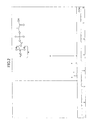
- FIG. 1 is the structural formula of a phosphorylcholine derivative in practical example 1 of the present invention and its 1 H-NMR spectrum in heavy water.
- an objective compound of formula 5 is manufactured which is a phosphorylcholine derivative in which an aldehyde group is introduced at a terminal thereof.
- ethylenediamine 20 equivalent amounts are added into a solution of formula 7 in methanol.
- a suitable amount of triazine-type dehydration condensation agent (DMT-MM) is added into this mixture solution and agitation for 3 hours is conducted. After the agitation, a precipitate is removed by means of filtration, and vacuum concentration and vacuum drying are conducted to obtain a solution of the following formula 8 in methanol.
- DMT-MM triazine-type dehydration condensation agent
- FIG. 2 is the structural formula of a phosphorylcholine derivative in practical example 2 of the present invention and its 1 H-NMR spectrum in heavy water.
- an objective compound of formula 7 is manufactured which is a phosphorylcholine derivative in which a carboxyl group is introduced at a terminal thereof.
- a phosphorylcholine group-containing compound having an amino group at a terminal thereof is provided, and therefore, it is possible to provide a desired and arbitrary amount of a phosphorylcholine group to surfaces of various objects by means of a one-step and very convenient reaction. As a result, it is possible to manufacture a raw material having a desired function attributed to a phosphorylcholine group easily.
- a phosphorylcholine group with very low adsorption of a protein or polypeptide into an object surface conveniently and quantitatively without damaging its fine structure.
- no unreacted functional group except a phosphorylcholine group is introduced, and therefore, it is also possible to provide a raw material with very high biocompatibility.
- an amine group-containing phosphorylcholine compound according to the present invention as a starting material of another phosphorylcholine group-containing compound.
- a substance or raw material modified by a surface-modifying agent including a phosphorylcholine group-containing compound according to an embodiment of the present invention is a material excellent in biocompatibility and hydrophilic property and a molded article therefrom. It is a matter of course that the material which directly has a phosphorylcholine group on the surface of a raw material and has biocompatibility is applicable to a wide variety of uses, such as for cosmetic materials, medical materials such as artificial organs and tools for surgical operation, packing materials for chromatography, affinity particles, and coatings.
Landscapes
- Health & Medical Sciences (AREA)
- Life Sciences & Earth Sciences (AREA)
- Chemical & Material Sciences (AREA)
- General Health & Medical Sciences (AREA)
- Organic Chemistry (AREA)
- Public Health (AREA)
- Animal Behavior & Ethology (AREA)
- Veterinary Medicine (AREA)
- Molecular Biology (AREA)
- Epidemiology (AREA)
- Birds (AREA)
- Biochemistry (AREA)
- Biophysics (AREA)
- Dermatology (AREA)
- Engineering & Computer Science (AREA)
- Materials Engineering (AREA)
- Cosmetics (AREA)
- Detergent Compositions (AREA)
Abstract
Description
- The present invention relates to a phosphorylcholine group-containing compound, a method of manufacturing a phosphorylcholine group-containing compound, a surface-modifying agent, and a method of modifying a surface using a surface-modifying agent.
- Conventionally, a polymer of a compound having a phosphorylcholine group has been known as a biocompatible polymer and biocompatible materials in which various substrates are coated with this polymer have been developed.
- Therefore, a method of utilizing a powder coated with a homopolymer and copolymer of 2-methacryloyloxyethylphosphorylcholine as a powder for cosmetic material to provide a cosmetic material with improved moisture retention and skin adhesion properties has been proposed (for example, see Japanese Patent Application Publication No.
07-118123 2000-279512 2002-098676 - Furthermore, the above-mentioned material is a polymer obtained by synthesizing a monomer having a phosphorylcholine structure and polymerizing it, wherein principally an acrylic monomer having a hydroxyl group and 2-chloro-1,3,2-dioxaphosphorane-2-oxide, and further trimethylamine are reacted to provide a quaternary ammonium.
- For such a compound, a method for manufacturing a copolymer of 2-methacryloyloxyethylphosphorylcholine and a methacrylate ester is disclosed (for example, see Japanese Patent Application Publication No.
09-003132 - For a similar compound, a method for manufacturing a homopolymer of 2-methacryloyloxyethylphosphorylcholine is disclosed (for example, see Japanese Patent Application Publication No.
10-298240 - However, synthetic conditions are complex and there are problems in safety in regard to the above-mentioned methods for manufacturing a polymer having a phosphorylcholine group as disclosed in Japanese Patent Application Publication No.
07-118123 2000-279512 2002-098676 09-003132 10-298240 - Furthermore, it is difficult to coat the entire surface of an object effectively, and even if a costing is made, there is a problem of its easy release from the object, in regard to a polymer having a phosphorylcholine group and method for coating and modifying a surface of an object with the polymer as disclosed in Japanese Patent Application Publication No.
07-118123 2000-279512 2002-098676 09-003132 10-298240 - Moreover, the entire surface of an object is coated with a polymer having a phosphorylcholine group, and therefore, only the phosphorylcholine group is not necessarily exposed on the surface, depending on a steric structure which is allowed to have by the polymer. Therefore, there is a problem that a surface-modifying method having a complete biocompatibility is not necessarily provided.
- One object of the present invention is to provide a phosphorylcholine group-containing compound that directly provides a desired amount of phosphorylcholine group to an object surface conveniently and with a high versatility.
- Another object of the present invention is to provide a convenient and highly safe method of manufacturing a phosphorylcholine group-containing compound while a compound having a phosphorylcholine group preliminarily is a starting material.
- Yet another object of the present invention is to provide a surface-modifying agent including a phosphorylcholine group-containing compound and a surface-modifying method using the surface-modifying agent including a phosphorylcholine group-containing compound.
- According to one aspect of the present invention, there is provided a phosphorylcholine group-containing compound that is a structure having a phosphorylcholine group represented by the following formula 1 and an amino group or a group derived from an amino group in an identical compound.

- (In the formula, m is 2 or more and 6 or less and p is 1 or 2. Each of X1, X2 and X3 is an alkyl group whose carbon number is 1 or more and 6 or less.)
- According to another aspect of the present invention, there is provided a phosphorylcholine group-containing compound that is a structure in which a phosphorylcholine group represented by the following formula 1 bonds to an amino group or a group derived from an amino group via a C-N linkage, an ester linkage or an amide linkage.

- (In the formula, m is 2 or more and 6 or less and p is 1 or 2. Each of X1, X2 and X3 is an alkyl group whose carbon number is 1 or more and 6 or less.)
- According to another aspect of the present invention, there is provided a phosphorylcholine group-containing compound represented by the following
formula 2.
- (In the formula, m is 2 or more and 6 or less and p is 1 or 2. Each of X1, X2 and X3 is an alkyl group whose carbon number is 1 or more and 6 or less. A is a secondary amine linkage, an ester linkage or an amide linkage. B is an alkyl group, a polyoxyethylene group, or an aromatic group.)
- According to another aspect of the present invention, there is provided a method of manufacturing the phosphorylcholine group-containing compound as described above, wherein a phosphorylcholine group-containing compound in the manufacturing method is synthesized by means of an oxidative cleavage reaction of glycerophosphorylcholine to synthesize a phosphorylcholine derivative having an aldehyde group and a reductive amination reaction of a compound having an amino group or a group derived from an amino group and the phosphorylcholine derivative having an aldehyde group.
- According to another aspect of the present invention, there is provided a method of manufacturing the phosphorylcholine group-containing compound as described above, wherein a phosphorylcholine group-containing compound in the manufacturing method is synthesized by means of an oxidative cleavage reaction of glycerophosphorylcholine to synthesize a phosphorylcholine derivative having a carboxyl group and a condensation reaction of a compound having an amino group or a group derived from an amino group and the phosphorylcholine derivative having a carboxyl group.
- According to another aspect of the present invention, there is provided a surface-modifying agent including the phosphorylcholine group-containing compound as described above.
- According to another aspect of the present invention, there is provided a method of modifying a surface using the surface-modifying agent including a phosphorylcholine group-containing compound as described above.
- According to one aspect of the present invention, it is possible to provide a phosphorylcholine group-containing compound that directly provides a desired amount of phosphorylcholine group to an object surface conveniently and with a high versatility.
- According to another aspect of the present invention, it is possible to provide a method of manufacturing a phosphorylcholine group-containing compound that directly provides a desired amount of phosphorylcholine group to an object surface conveniently and with a high versatility.
- According to another aspect of the present invention, it is possible to provide a surface-modifying agent including a phosphorylcholine group-containing compound that directly provides a desired amount of phosphorylcholine group to an object surface conveniently and with a high versatility.
- According to another aspect of the present invention, it is possible to provide a surface-modifying method using a surface-modifying agent including a phosphorylcholine group-containing compound that directly provides a desired amount of phosphorylcholine group to an object surface conveniently and with a high versatility.
-
-
FIG. 1 is the structural formula of a phosphorylcholine derivative in practical example 1 of the present invention and its 1H-NMR spectrum in heavy water. -
FIG. 2 is the structural formula of a phosphorylcholine derivative in practical example 2 of the present invention and its 1H-NMR spectrum in heavy water. - Next, the best mode of an embodiment of the present invention will be described.
- It is possible to obtain a compound according to the present embodiment by directly reacting an amine compound containing a phosphorylcholine compound and an object having a functional group that reacts with the amine compound. Surface modification is possible whether these compounds are purified or non-purified, and it is possible to obtain an effect such as protein adsorption suppression. Furthermore, a phosphorylcholine group-containing compound represented by the following
formula 3 is a new compound.
- In the formula, m is 2 or more and 6 or less and p is 1 or 2. Each of X1, X2 and X3 is an alkyl group whose carbon number is 1 or more and 6 or less. A is a secondary amine linkage (-NH-), an ester linkage, or an amide linkage. B is an alkyl group, a polyoxyethylene group, or an aromatic group.
- For example, when a phosphorylcholine group-containing compound is synthesized by means of a secondary amine linkage, a phosphorylcholine group-containing compound of
formula 3 is synthesized by an oxidation reaction of glycerophosphorylcholine with periodic acid to synthesize a phosphorylcholine derivative having an aldehyde group and a condensation reaction of a compound having an amino group and the phosphorylcholine derivative having an aldehyde group as described above. - Alternatively, when a phosphorylcholine group-containing compound is synthesized by means of an amide linkage or an ester linkage, a phosphorylcholine group-containing compound of
formula 3 is synthesized by an oxidation reaction of glycerophosphorylcholine with periodic acid and ruthenium trichloride to synthesize a phosphorylcholine derivative having a carboxyl group and a condensation reaction of a compound having an amino group and the phosphorylcholine derivative having a carboxyl group as described above. - A compound of
formula 3 as described above is useful for a substance surface-modifying agent. That is, a substance surface is modified by introducing a desired amount of phosphorylcholine group thereinto. Furthermore, it is possible to conduct the introduction of a phosphorylcholine group into a substance surface by a convenient method. - For example, a conventional phosphorylcholine group-containing compound as disclosed in Japanese Patent No.
3793546 - For a specific modification method, in the case of a substance having a carboxyl group on a surface thereof, a chemical linkage (amide linkage) is formed by a dehydration reaction of a carboxyl group on the substance surface and an amino group of the compound of
formula 3. This chemical reaction proceeds very easily and quantitatively in most organic solvents or water in a temperature range of 10 to 250 °C. Due to the dehydration reaction, it is possible to conduct surface modification with a chemically and physically very stable phosphorylcholine group. - Alternatively, when a raw material has a group having reactivity with an amino group, such as an aldehyde group, an isocyanate group, an epoxy group, and an alkyl halide group on a surface thereof, it is possible to introduce a phosphorylcholine group similarly.
- As described above, this bonding reaction involving dehydration has a property of proceeding quantitatively. By utilizing this property, the amount of a phosphorylcholine group-containing compound to be charged into a reaction system, a reaction temperature, a reaction time, and the like are set at predetermined conditions, whereby it is possible to provide a desired amount of phosphorylcholine group-containing compound bonding to a substance surface.
- The compound of
formula 3 as described above is also useful as a blocking agent for an affinity particle. A desired amount of phosphorylcholine group is introduced into, for example, the surface of an agarose particle, which is a carrier for an affinity particle. Subsequently, an antibody is bound to the agarose particle to provide an affinity particle. When a predetermined protein is adsorbed by using the antibody on the affinity particle, a phosphorylcholine group-containing compound on the agarose particle is to inhibit (block) nonspecific adsorption of a protein onto a surface of the agarose particle. Furthermore, it is possible to conduct introduction of a phosphorylcholine group into a surface of this substance by a convenient method, similarly to the case of a surface-modifying agent as described above. - For example, an affinity particle to which a conventional phosphorylcholine group-containing compound as disclosed in Japanese Patent Application Publication No.
2006-007203 - Furthermore, because it is possible to bond to an agarose carrier directly, it is possible to bond a number of phosphorylcholine group-containing compounds to the surface of an agarose particle compactly, compared to the case of conducting amino group addition treatment as described above. Therefore, it is possible to secure a sufficient antibody bonding region while the surface of an agarose particle is not occupied by a blocking agent. Accordingly, an affinity particle in which a phosphorylcholine group-containing compound according to the present embodiment is a blocking agent is allowed to purify more target protein more specifically.
- An embodiment of the present invention will be described by practical examples in more detail below.
- A phosphorylcholine derivative represented by the following formula 4 is dissolved in distilled water. The phosphorylcholine derivative of the following formula 4 is a publicly-known compound and its commercial product is available.

- An aqueous solution of a compound of formula 4 is cooled in an ice-water bath, and addition of sodium periodate and agitation for 5 hours are conducted. A reaction fluid after the agitation is subjected to vacuum concentration and vacuum drying and a phosphorylcholine derivative having an aldehyde group represented by the following
formula 5 is extracted with methanol.
- Then, 20 equivalent amounts of ethylenediamine are added into a solution of
formula 5 in methanol. This mixture solution is agitated at room temperature for a predetermined time period and subsequently is cooled in ice. A suitable amount of sodium borohydride is added into this ice-cooled mixture solution, and return to room temperature and agitation for 16 hours are conducted. During this time period, dry nitrogen is kept flowing into a reactor. A precipitate of the reaction fluid after agitation is removed by means of filtration, and subsequently, vacuum concentration and vacuum drying are conducted to obtain a solution of formula 6 in methanol.
-
FIG. 1 is the structural formula of a phosphorylcholine derivative in practical example 1 of the present invention and its 1H-NMR spectrum in heavy water. - When referring to
FIG. 1 , it is found that an objective compound offormula 5 is manufactured which is a phosphorylcholine derivative in which an aldehyde group is introduced at a terminal thereof.
- An aqueous solution of the compound of formula 4 as described above was cooled in an ice-water bath, and addition of sodium periodate and ruthenium trichloride and agitation for 3 hours were conducted. For a reaction fluid after the agitation, addition of methanol and further agitation for 30 minutes are conducted. A precipitate of the reaction fluid after agitation is removed by means of filtration, and vacuum concentration and vacuum drying are conducted to obtain a phosphorylcholine derivative having a carboxyl group represented by the following formula 7.

- Then, 20 equivalent amounts of ethylenediamine are added into a solution of formula 7 in methanol. A suitable amount of triazine-type dehydration condensation agent (DMT-MM) is added into this mixture solution and agitation for 3 hours is conducted. After the agitation, a precipitate is removed by means of filtration, and vacuum concentration and vacuum drying are conducted to obtain a solution of the following formula 8 in methanol.

- 500 mg of L-α-glycerophosphorylcholine was dissolved in 10 ml of distilled water and cooling in an ice-water bath was conducted. 1700 mg of sodium periodate and 8 mg of ruthenium trichloride was added into the cooled aqueous solution and agitation was conducted at room temperature for 2 hours. A reaction fluid after the agitation was subjected to vacuum concentration and vacuum drying and an objective substance was extracted with methanol.
-
FIG. 2 is the structural formula of a phosphorylcholine derivative in practical example 2 of the present invention and its 1H-NMR spectrum in heavy water. - When referring to
FIG. 2 , it is found that an objective compound of formula 7 is manufactured which is a phosphorylcholine derivative in which a carboxyl group is introduced at a terminal thereof. - According to the present embodiment and practical examples, a phosphorylcholine group-containing compound having an amino group at a terminal thereof is provided, and therefore, it is possible to provide a desired and arbitrary amount of a phosphorylcholine group to surfaces of various objects by means of a one-step and very convenient reaction. As a result, it is possible to manufacture a raw material having a desired function attributed to a phosphorylcholine group easily.
- Furthermore, it is possible to introduce a phosphorylcholine group with very low adsorption of a protein or polypeptide into an object surface conveniently and quantitatively without damaging its fine structure. Moreover, no unreacted functional group except a phosphorylcholine group is introduced, and therefore, it is also possible to provide a raw material with very high biocompatibility. Moreover, it is also possible to use an amine group-containing phosphorylcholine compound according to the present invention as a starting material of another phosphorylcholine group-containing compound.
- Although the preferred embodiments and practical examples of the present invention have been described in detail above, the present invention is not limited to such particular embodiments and practical examples and it is possible to apply various alterations and modifications to these embodiments and practical examples without departing from the spirit and scope of the present invention.
- The present application claims the benefit of its priority based on Japanese Patent Application No.
2007-009482 filed on January 18, 2007 - A substance or raw material modified by a surface-modifying agent including a phosphorylcholine group-containing compound according to an embodiment of the present invention is a material excellent in biocompatibility and hydrophilic property and a molded article therefrom. It is a matter of course that the material which directly has a phosphorylcholine group on the surface of a raw material and has biocompatibility is applicable to a wide variety of uses, such as for cosmetic materials, medical materials such as artificial organs and tools for surgical operation, packing materials for chromatography, affinity particles, and coatings.
Claims (15)
- A phosphorylcholine group-containing compound that is a structure having a phosphorylcholine group represented by the following formula 1 and an amino group or a group derived from an amino group in an identical compound.

- A phosphorylcholine group-containing compound that is a structure in which a phosphorylcholine group represented by the following formula 1 bonds to an amino group or a group derived from an amino group via a C-N linkage, an ester linkage or an amide linkage.

- A phosphorylcholine group-containing compound represented by the following formula 2.

- A method of manufacturing the phosphorylcholine group-containing compound as claimed in claim 1, wherein a phosphorylcholine group-containing compound in the manufacturing method is synthesized by means of an oxidative cleavage reaction of glycerophosphorylcholine to synthesize a phosphorylcholine derivative having an aldehyde group and a reductive amination reaction of a compound having an amino group or a group derived from an amino group and the phosphorylcholine derivative having an aldehyde group.
- A method of manufacturing the phosphorylcholine group-containing compound as claimed in claim 2, wherein a phosphorylcholine group-containing compound in the manufacturing method is synthesized by means of an oxidative cleavage reaction of glycerophosphorylcholine to synthesize a phosphorylcholine derivative having an aldehyde group and a reductive amination reaction of a compound having an amino group or a group derived from an amino group and the phosphorylcholine derivative having an aldehyde group.
- A method of manufacturing the phosphorylcholine group-containing compound as claimed in claim 3, wherein a phosphorylcholine group-containing compound in the manufacturing method is synthesized by means of an oxidative cleavage reaction of glycerophosphorylcholine to synthesize a phosphorylcholine derivative having an aldehyde group and a reductive amination reaction of a compound having an amino group or a group derived from an amino group and the phosphorylcholine derivative having an aldehyde group.
- A method of manufacturing the phosphorylcholine group-containing compound as claimed in claim 1, wherein a phosphorylcholine group-containing compound in the manufacturing method is synthesized by means of an oxidative cleavage reaction of glycerophosphorylcholine to synthesize a phosphorylcholine derivative having a carboxyl group and a condensation reaction of a compound having an amino group or a group derived from an amino group and the phosphorylcholine derivative having a carboxyl group.
- A method of manufacturing the phosphorylcholine group-containing compound as claimed in claim 2, wherein a phosphorylcholine group-containing compound in the manufacturing method is synthesized by means of an oxidative cleavage reaction of glycerophosphorylcholine to synthesize a phosphorylcholine derivative having a carboxyl group and a condensation reaction of a compound having an amino group or a group derived from an amino group and the phosphorylcholine derivative having a carboxyl group.
- A method of manufacturing the phosphorylcholine group-containing compound as claimed in claim 3, wherein a phosphorylcholine group-containing compound in the manufacturing method is synthesized by means of an oxidative cleavage reaction of glycerophosphorylcholine to synthesize a phosphorylcholine derivative having a carboxyl group and a condensation reaction of a compound having an amino group or a group derived from an amino group and the phosphorylcholine derivative having a carboxyl group.
- A surface-modifying agent comprising the phosphorylcholine group-containing compound as claimed in claim 1.
- A surface-modifying agent comprising the phosphorylcholine group-containing compound as claimed in claim 2.
- A surface-modifying agent comprising the phosphorylcholine group-containing compound as claimed in claim 3.
- A method of modifying a surface using the surface-modifying agent comprising a phosphorylcholine group-containing compound as claimed in claim 10.
- A method of modifying a surface using the surface-modifying agent comprising a phosphorylcholine group-containing compound as claimed in claim 11.
- A method of modifying a surface using the surface-modifying agent comprising a phosphorylcholine group-containing compound as claimed in claim 12.
Applications Claiming Priority (2)
| Application Number | Priority Date | Filing Date | Title |
|---|---|---|---|
| JP2007009482A JP4191225B2 (en) | 2007-01-18 | 2007-01-18 | Surface modification method and surface modification material |
| PCT/JP2008/050642 WO2008088051A1 (en) | 2007-01-18 | 2008-01-18 | Phosphorylcholine group-containing compound, method for producing phosphorylcholine group-containing compound, surface modifying agent, and surface modification method using surface modifying agent |
Publications (2)
| Publication Number | Publication Date |
|---|---|
| EP2123660A1 true EP2123660A1 (en) | 2009-11-25 |
| EP2123660A4 EP2123660A4 (en) | 2011-06-29 |
Family
ID=39636051
Family Applications (1)
| Application Number | Title | Priority Date | Filing Date |
|---|---|---|---|
| EP08703492A Ceased EP2123660A4 (en) | 2007-01-18 | 2008-01-18 | PHOSPHORYLCHOLINE GROUP-CONTAINING COMPOUND, PROCESS FOR PRODUCING THE SAME, SURFACE-MODIFYING AGENT, AND SURFACE-MODIFICATION METHOD USING THE SAME |
Country Status (6)
| Country | Link |
|---|---|
| US (3) | US8222443B2 (en) |
| EP (1) | EP2123660A4 (en) |
| JP (1) | JP4191225B2 (en) |
| KR (1) | KR101349552B1 (en) |
| CN (1) | CN101583618A (en) |
| WO (1) | WO2008088051A1 (en) |
Families Citing this family (9)
| Publication number | Priority date | Publication date | Assignee | Title |
|---|---|---|---|---|
| EP2405267A4 (en) * | 2009-03-02 | 2012-01-11 | Shiseido Co Ltd | Surface-modified base plate, biochip and process for producing the biochip |
| WO2010147122A1 (en) | 2009-06-15 | 2010-12-23 | 株式会社資生堂 | Container for formation of aggregated cell mass, and method for formation of aggregated cell mass |
| JP5095855B2 (en) | 2010-12-13 | 2012-12-12 | 株式会社 資生堂 | Method for forming cell aggregate |
| JP5846125B2 (en) * | 2010-12-24 | 2016-01-20 | 日油株式会社 | Amino group-containing phosphorylcholine compound and method for producing the same |
| WO2013118736A1 (en) * | 2012-02-07 | 2013-08-15 | 国立大学法人 東京大学 | Surface-treating agent for hydrophobic material, and surface treatment method |
| CN105237778B (en) * | 2015-11-16 | 2017-10-13 | 西安科技大学 | It is a kind of to improve the method for chitosan blood compatibility at room temperature |
| CN111225791B (en) | 2017-10-11 | 2022-04-12 | 微仙美国有限公司 | Phosphonates and their uses |
| WO2020005840A1 (en) * | 2018-06-25 | 2020-01-02 | Adaptive Surface Technologies, Inc. | Polyoxyalkylene coupled zwitterionic moiety and surface active reactive polymers, coating compositions and fouling control coatings thereof |
| CN111825799B (en) * | 2020-07-21 | 2022-05-31 | 西安科技大学 | Preparation method of phosphorylcholine coating containing catechol, amino and carboxyl |
Family Cites Families (15)
| Publication number | Priority date | Publication date | Assignee | Title |
|---|---|---|---|---|
| US5229162A (en) * | 1984-01-20 | 1993-07-20 | Biocompatibles Ltd. | Article having biocompatible surface |
| GB8401534D0 (en) | 1984-01-20 | 1984-02-22 | Royal Free Hosp School Med | Biocompatible surfaces |
| JPH06501697A (en) | 1990-11-05 | 1994-02-24 | バイオコンパテイブルズ・リミテッド | Coating compounds and coating methods |
| JP3178950B2 (en) | 1993-10-19 | 2001-06-25 | ポーラ化成工業株式会社 | Powder for cosmetics and cosmetics containing the same |
| JP2870727B2 (en) | 1996-07-04 | 1999-03-17 | 科学技術振興事業団 | 2-methacryloyloxyethyl phosphorylcholine copolymer |
| JP3737241B2 (en) | 1997-04-24 | 2006-01-18 | 日本油脂株式会社 | Process for producing phosphorylcholine group-containing polymer |
| JP4712924B2 (en) | 1999-03-30 | 2011-06-29 | 日油株式会社 | Medical material and manufacturing method |
| US20030134420A1 (en) * | 2000-02-18 | 2003-07-17 | Lollo Charles Peter | Methods and compositions for gene delivery |
| JP4680361B2 (en) | 2000-09-22 | 2011-05-11 | 一彦 石原 | Separation / collection method |
| JP4010831B2 (en) | 2001-05-22 | 2007-11-21 | 株式会社資生堂 | Phosphorylcholine group-containing polymer and method for producing the same |
| EP1528063B1 (en) * | 2003-02-18 | 2010-09-29 | Tokai University | Compound having phosphorylcholine group, polymer thereof, and process for producing the same |
| JP4086305B2 (en) * | 2003-12-02 | 2008-05-14 | 株式会社資生堂 | Phosphorylcholine group-containing compound and surface modifier comprising the compound |
| JP3809177B2 (en) | 2004-05-24 | 2006-08-16 | 株式会社資生堂 | Affinity particles and affinity separation method |
| KR101217010B1 (en) | 2004-11-29 | 2012-12-31 | 가부시키가이샤 시세이도 | Phosphorylcholine group-containing compound and method for producing same |
| JP4608376B2 (en) | 2005-06-29 | 2011-01-12 | 日鉄防蝕株式会社 | Reinforcing structure and reinforcing method for concrete structure |
-
2007
- 2007-01-18 JP JP2007009482A patent/JP4191225B2/en active Active
-
2008
- 2008-01-18 CN CNA2008800022696A patent/CN101583618A/en active Pending
- 2008-01-18 US US12/521,788 patent/US8222443B2/en active Active
- 2008-01-18 EP EP08703492A patent/EP2123660A4/en not_active Ceased
- 2008-01-18 KR KR1020097012517A patent/KR101349552B1/en not_active Expired - Fee Related
- 2008-01-18 WO PCT/JP2008/050642 patent/WO2008088051A1/en not_active Ceased
-
2011
- 2011-11-02 US US13/287,695 patent/US8222442B2/en active Active
- 2011-11-02 US US13/287,530 patent/US8269031B2/en active Active
Non-Patent Citations (2)
| Title |
|---|
| No further relevant documents disclosed * |
| See also references of WO2008088051A1 * |
Also Published As
| Publication number | Publication date |
|---|---|
| EP2123660A4 (en) | 2011-06-29 |
| KR101349552B1 (en) | 2014-01-08 |
| US20120059183A1 (en) | 2012-03-08 |
| US8269031B2 (en) | 2012-09-18 |
| WO2008088051A1 (en) | 2008-07-24 |
| US20100113817A1 (en) | 2010-05-06 |
| US8222442B2 (en) | 2012-07-17 |
| CN101583618A (en) | 2009-11-18 |
| US20120046489A1 (en) | 2012-02-23 |
| KR20090104809A (en) | 2009-10-06 |
| JP2008174491A (en) | 2008-07-31 |
| JP4191225B2 (en) | 2008-12-03 |
| US8222443B2 (en) | 2012-07-17 |
Similar Documents
| Publication | Publication Date | Title |
|---|---|---|
| US8222442B2 (en) | Phosphorylcholine group-containing compound, method of manufacturing a phosphorylcholine group-containing compound, surface-modifying agent, and a method of modifying a surface using a surface-modifying agent | |
| EP1577360B1 (en) | Method of modifying surface of material | |
| CN103282368B (en) | Phosphorylcholine compound containing amino group and preparation method thereof | |
| DK172891B1 (en) | Process for Preparation of Nitrilotriacetic Acid Derivatives | |
| KR20070037513A (en) | Polymeric material via click chemistry | |
| US6538072B2 (en) | Methods for making multivalent arrays | |
| KR101539804B1 (en) | Polysiloxane, acrylic compound, and vinyl compound | |
| EP4538279A2 (en) | Reaction agent for amide reactions and amide compound production method using same | |
| US20120269870A1 (en) | Switchable polymers and surfaces with reversibly switchable properties | |
| US9078956B2 (en) | Modification of biomedical polymers for prevention of fouling and clotting | |
| WO2012148624A1 (en) | Synthesis of hydroxyalkyl amides from esters | |
| Wang et al. | L-Carnitine derived zwitterionic betaine materials | |
| JP2007119643A (en) | Method for treating the surface of material | |
| Steinbauer et al. | Biomimetic adhesion motifs based on RAFT polymers with phosphonate groups | |
| WO2019025498A1 (en) | Catechol-derivative compounds and their use | |
| EP0420115A1 (en) | Packing material for liquid chromatography | |
| CN106146420A (en) | The synthesis of the water miscible potassium salt derivant containing two or three BTA rings of one class and application | |
| JP4993347B2 (en) | Method for producing phosphorylcholine group-containing silane compound | |
| JP2013234160A (en) | Carboxyl group including phosphorylcholine compound and process for production thereof | |
| AU744412B2 (en) | Chiral compounds, their synthesis and use as a support | |
| EP4066902A1 (en) | Zwitterion compound and production method and use for same | |
| JP2004225035A (en) | Material surface modification method | |
| JP3464377B2 (en) | Method for producing chiral zirconium catalyst and optically active α-aminonitrile | |
| JP4013277B2 (en) | Method for producing (meth) acrylic acid serine ester | |
| US6576760B2 (en) | Processes for synthesis of cyclic and linear polyamine chelators containing N-monosubstituted coordinating arms |
Legal Events
| Date | Code | Title | Description |
|---|---|---|---|
| PUAI | Public reference made under article 153(3) epc to a published international application that has entered the european phase |
Free format text: ORIGINAL CODE: 0009012 |
|
| 17P | Request for examination filed |
Effective date: 20090811 |
|
| AK | Designated contracting states |
Kind code of ref document: A1 Designated state(s): AT BE BG CH CY CZ DE DK EE ES FI FR GB GR HR HU IE IS IT LI LT LU LV MC MT NL NO PL PT RO SE SI SK TR |
|
| DAX | Request for extension of the european patent (deleted) | ||
| A4 | Supplementary search report drawn up and despatched |
Effective date: 20110531 |
|
| 17Q | First examination report despatched |
Effective date: 20120306 |
|
| REG | Reference to a national code |
Ref country code: DE Ref legal event code: R003 |
|
| STAA | Information on the status of an ep patent application or granted ep patent |
Free format text: STATUS: THE APPLICATION HAS BEEN REFUSED |
|
| 18R | Application refused |
Effective date: 20140224 |