EP2121600B1 - Substituted arylsulphonylglycines, the preparation thereof and the use thereof as pharmaceutical compositions - Google Patents
Substituted arylsulphonylglycines, the preparation thereof and the use thereof as pharmaceutical compositions Download PDFInfo
- Publication number
- EP2121600B1 EP2121600B1 EP08709013A EP08709013A EP2121600B1 EP 2121600 B1 EP2121600 B1 EP 2121600B1 EP 08709013 A EP08709013 A EP 08709013A EP 08709013 A EP08709013 A EP 08709013A EP 2121600 B1 EP2121600 B1 EP 2121600B1
- Authority
- EP
- European Patent Office
- Prior art keywords
- amino
- alkyl
- carbonyl
- piperazin
- indol
- Prior art date
- Legal status (The legal status is an assumption and is not a legal conclusion. Google has not performed a legal analysis and makes no representation as to the accuracy of the status listed.)
- Not-in-force
Links
- 0 CC(C)(C)OC(CN(c(cc1CC2)ccc1N2c1ccc(N(CC2)CCN2C(OC(C)(C)C)=O)nn1)S(c1cc(Cl)cc(Cl)c1)(=*)=O)=O Chemical compound CC(C)(C)OC(CN(c(cc1CC2)ccc1N2c1ccc(N(CC2)CCN2C(OC(C)(C)C)=O)nn1)S(c1cc(Cl)cc(Cl)c1)(=*)=O)=O 0.000 description 30
- MNPYHRSEZJKHBS-UHFFFAOYSA-N CC(C)(C)OC(C(CCCN(C(OC(C)(C)C)=O)C(OC(C)(C)C)=O)C1=[I]C([n](ccc2c3)c2ccc3[NH+]([O-])[O-])=NC=C1)=O Chemical compound CC(C)(C)OC(C(CCCN(C(OC(C)(C)C)=O)C(OC(C)(C)C)=O)C1=[I]C([n](ccc2c3)c2ccc3[NH+]([O-])[O-])=NC=C1)=O MNPYHRSEZJKHBS-UHFFFAOYSA-N 0.000 description 1
- WRZHLQWJCOTDGM-JAHAZDFLSA-N CC(C)(C)OC(C/C=C(/Cc(cc1cc2)ccc1[n]2-c1c(N)nc(CO)cc1)\S(c1cc(C)cc(C)c1)(=O)=O)=O Chemical compound CC(C)(C)OC(C/C=C(/Cc(cc1cc2)ccc1[n]2-c1c(N)nc(CO)cc1)\S(c1cc(C)cc(C)c1)(=O)=O)=O WRZHLQWJCOTDGM-JAHAZDFLSA-N 0.000 description 1
- DSYSKGRJTZSLCN-UHFFFAOYSA-N CC(C)(C)OC(CN(c(cc(cc[n]1-c2ccc(C)cn2)c1c1)c1Cl)S(c1cc(Cl)cc(Cl)c1)(=O)=O)=O Chemical compound CC(C)(C)OC(CN(c(cc(cc[n]1-c2ccc(C)cn2)c1c1)c1Cl)S(c1cc(Cl)cc(Cl)c1)(=O)=O)=O DSYSKGRJTZSLCN-UHFFFAOYSA-N 0.000 description 1
- BGRHOBAJBXXUCE-UHFFFAOYSA-N CC(C)(C)OC(CN(c(cc1)cc(cc2)c1[n]2-c1ccc(C(C)=O)[s]1)S(c1cc(Cl)cc(Cl)c1)(=O)=O)=O Chemical compound CC(C)(C)OC(CN(c(cc1)cc(cc2)c1[n]2-c1ccc(C(C)=O)[s]1)S(c1cc(Cl)cc(Cl)c1)(=O)=O)=O BGRHOBAJBXXUCE-UHFFFAOYSA-N 0.000 description 1
- BEJNAWQUBDETCX-UHFFFAOYSA-N CC(C)(C)OC(CN(c(cc1)cc2c1[nH]cc2)S(c1cc(Br)cc(Cl)c1)(=O)=O)=O Chemical compound CC(C)(C)OC(CN(c(cc1)cc2c1[nH]cc2)S(c1cc(Br)cc(Cl)c1)(=O)=O)=O BEJNAWQUBDETCX-UHFFFAOYSA-N 0.000 description 1
- XYEJHLFXYAQZPU-UHFFFAOYSA-N CC(C)(C)OC(CN(c(cc1)cc2c1[n](C1N=CC(N(CCOC3)C3=O)=CC1)cc2)S(c1cc(Cl)cc(Cl)c1)(=O)=O)=O Chemical compound CC(C)(C)OC(CN(c(cc1)cc2c1[n](C1N=CC(N(CCOC3)C3=O)=CC1)cc2)S(c1cc(Cl)cc(Cl)c1)(=O)=O)=O XYEJHLFXYAQZPU-UHFFFAOYSA-N 0.000 description 1
- SNVYSXHJJCUVOQ-UHFFFAOYSA-N CC(C)(C)OC(CN(c(cc1cc2)ccc1[n]2-c(nc1)ccc1N(CCOC1)C1=O)S(c1cc(C)cc(Cl)c1)(=O)=O)=O Chemical compound CC(C)(C)OC(CN(c(cc1cc2)ccc1[n]2-c(nc1)ccc1N(CCOC1)C1=O)S(c1cc(C)cc(Cl)c1)(=O)=O)=O SNVYSXHJJCUVOQ-UHFFFAOYSA-N 0.000 description 1
- WGBWLLAGJHPSAS-UHFFFAOYSA-N CC(C)(C)OC(CN(c(cc1cc2)ccc1[n]2-c1c[n](C)cn1)S(c1cc(Cl)cc(Cl)c1)(=O)=O)=O Chemical compound CC(C)(C)OC(CN(c(cc1cc2)ccc1[n]2-c1c[n](C)cn1)S(c1cc(Cl)cc(Cl)c1)(=O)=O)=O WGBWLLAGJHPSAS-UHFFFAOYSA-N 0.000 description 1
- BMNWWRRPWXHRNZ-UHFFFAOYSA-N CC(C)(C)OC(CN(c(cc1cc2)ccc1[n]2-c1cc2ccccc2cc1)S(c1cc(Cl)cc(Cl)c1)(=O)=O)=O Chemical compound CC(C)(C)OC(CN(c(cc1cc2)ccc1[n]2-c1cc2ccccc2cc1)S(c1cc(Cl)cc(Cl)c1)(=O)=O)=O BMNWWRRPWXHRNZ-UHFFFAOYSA-N 0.000 description 1
- OWXAJSVPRSYOLB-UHFFFAOYSA-N CC(C)(C)OC(CN(c1ccc2[nH]ccc2c1)S(c1cc(Cl)cc(C)c1)(=O)=O)=O Chemical compound CC(C)(C)OC(CN(c1ccc2[nH]ccc2c1)S(c1cc(Cl)cc(C)c1)(=O)=O)=O OWXAJSVPRSYOLB-UHFFFAOYSA-N 0.000 description 1
- CTEYIZAJSMWLRY-UHFFFAOYSA-N CC(C)(C)OC(C[I](c(cc1cc2)ccc1[n]2-c(nn1)ccc1OCCN(C)C)[IH]S(c1cc(Cl)cc(Cl)c1)(=O)=O)=O Chemical compound CC(C)(C)OC(C[I](c(cc1cc2)ccc1[n]2-c(nn1)ccc1OCCN(C)C)[IH]S(c1cc(Cl)cc(Cl)c1)(=O)=O)=O CTEYIZAJSMWLRY-UHFFFAOYSA-N 0.000 description 1
- BCHSCPXZYJAXNB-UHFFFAOYSA-N CC(C)(CNc1ccc(C(CC=Cc2c3)c2ccc3N(CC(O)=O)S(c2cc(Cl)cc(Cl)c2)(=O)=O)nn1)N Chemical compound CC(C)(CNc1ccc(C(CC=Cc2c3)c2ccc3N(CC(O)=O)S(c2cc(Cl)cc(Cl)c2)(=O)=O)nn1)N BCHSCPXZYJAXNB-UHFFFAOYSA-N 0.000 description 1
- NJSQELMVOBHAIR-UHFFFAOYSA-N CC(C)(CNc1ccc(C)nn1)N Chemical compound CC(C)(CNc1ccc(C)nn1)N NJSQELMVOBHAIR-UHFFFAOYSA-N 0.000 description 1
- JXPDRWIOKGYKIR-UHFFFAOYSA-N CC(C)CCNCCc1nc(N(CCc2c3)c2ccc3N)ncc1 Chemical compound CC(C)CCNCCc1nc(N(CCc2c3)c2ccc3N)ncc1 JXPDRWIOKGYKIR-UHFFFAOYSA-N 0.000 description 1
- BRHSBUARGQTJDZ-MFWMSMGNSA-N CC(CCNc1ccc(-[n](ccc2c3)c2ccc3N[C@H](CC(O)=O)CS(C(c2cc(C)cc(C)c2)=O)=O)nn1)=N Chemical compound CC(CCNc1ccc(-[n](ccc2c3)c2ccc3N[C@H](CC(O)=O)CS(C(c2cc(C)cc(C)c2)=O)=O)nn1)=N BRHSBUARGQTJDZ-MFWMSMGNSA-N 0.000 description 1
- WTMPSWNGITZSCS-UHFFFAOYSA-N CC(Nc(nc1)cnc1-[n](ccc1c2)c1ccc2N(CC(O)=O)S(c1cc(Cl)cc(Cl)c1)(=O)=O)=O Chemical compound CC(Nc(nc1)cnc1-[n](ccc1c2)c1ccc2N(CC(O)=O)S(c1cc(Cl)cc(Cl)c1)(=O)=O)=O WTMPSWNGITZSCS-UHFFFAOYSA-N 0.000 description 1
- ZDRZJVNMAPZPSQ-UKTHLTGXSA-N CC/C=N/Nc1ccc(CCC(O)=O)cc1 Chemical compound CC/C=N/Nc1ccc(CCC(O)=O)cc1 ZDRZJVNMAPZPSQ-UKTHLTGXSA-N 0.000 description 1
- ZDXAVBBIZLGPHE-UHFFFAOYSA-N CCCCNc(nn1)ccc1I Chemical compound CCCCNc(nn1)ccc1I ZDXAVBBIZLGPHE-UHFFFAOYSA-N 0.000 description 1
- FCSXEKQLEONIOM-NYNHRDTCSA-N CCc(cc(C)c(/C=C\C=N)c1)c1NS(c1cc(Cl)cc(Cl)c1)(=O)=O Chemical compound CCc(cc(C)c(/C=C\C=N)c1)c1NS(c1cc(Cl)cc(Cl)c1)(=O)=O FCSXEKQLEONIOM-NYNHRDTCSA-N 0.000 description 1
- HSSDBHDJSBPNMD-UHFFFAOYSA-N CCc1c[nH]c2c1cc(C[NH+]([O-])O)cc2 Chemical compound CCc1c[nH]c2c1cc(C[NH+]([O-])O)cc2 HSSDBHDJSBPNMD-UHFFFAOYSA-N 0.000 description 1
- BQIKIRDOBXSOQD-UHFFFAOYSA-N COc1ccnc(-[n](cc2)c(cc3)c2cc3N(CC(O)=O)S(c2cc(Cl)cc(Cl)c2)(=O)=O)c1 Chemical compound COc1ccnc(-[n](cc2)c(cc3)c2cc3N(CC(O)=O)S(c2cc(Cl)cc(Cl)c2)(=O)=O)c1 BQIKIRDOBXSOQD-UHFFFAOYSA-N 0.000 description 1
- JRSOHLVQOBUKPU-UHFFFAOYSA-N CS(c1cc(-[n](ccc2c3)c2ccc3N(CC(O)=O)S(c2cc(Cl)cc(Cl)c2)(=O)=O)ncc1)=O Chemical compound CS(c1cc(-[n](ccc2c3)c2ccc3N(CC(O)=O)S(c2cc(Cl)cc(Cl)c2)(=O)=O)ncc1)=O JRSOHLVQOBUKPU-UHFFFAOYSA-N 0.000 description 1
- KFRHMYAAHLDXKN-UHFFFAOYSA-N C[N+](c(cc1cc2)ccc1[n]2-c1nc(Cl)nc2c1N=CCC2)([O-])[O-] Chemical compound C[N+](c(cc1cc2)ccc1[n]2-c1nc(Cl)nc2c1N=CCC2)([O-])[O-] KFRHMYAAHLDXKN-UHFFFAOYSA-N 0.000 description 1
- DTKRMOFJEVXICL-UHFFFAOYSA-M Cc(cc(CC([O-])=O)cc1I)c1N Chemical compound Cc(cc(CC([O-])=O)cc1I)c1N DTKRMOFJEVXICL-UHFFFAOYSA-M 0.000 description 1
- LRPVEBATQOEJCJ-UHFFFAOYSA-N Cc(cc(cc1)OC2COCC2)c1Br Chemical compound Cc(cc(cc1)OC2COCC2)c1Br LRPVEBATQOEJCJ-UHFFFAOYSA-N 0.000 description 1
- HRMIWAZAYIEAPS-UHFFFAOYSA-N Cc(nn1)ccc1OCCN(C)C Chemical compound Cc(nn1)ccc1OCCN(C)C HRMIWAZAYIEAPS-UHFFFAOYSA-N 0.000 description 1
- YIRDJMPEDSBCGT-UHFFFAOYSA-N Cc1c[n]c(-[n](ccc2c3)c2ccc3N(CC(O)=O)S(c2cc(Cl)cc(Cl)c2)(=O)=O)[s]1 Chemical compound Cc1c[n]c(-[n](ccc2c3)c2ccc3N(CC(O)=O)S(c2cc(Cl)cc(Cl)c2)(=O)=O)[s]1 YIRDJMPEDSBCGT-UHFFFAOYSA-N 0.000 description 1
- GOUYNRQQFKNSOE-UHFFFAOYSA-N Cc1cc(N2CCNCC2)nnc1-[n](cc1)c(cc2)c1cc2N(CC(O)=O)S(c1cc(Cl)cc(Cl)c1)(=O)=O Chemical compound Cc1cc(N2CCNCC2)nnc1-[n](cc1)c(cc2)c1cc2N(CC(O)=O)S(c1cc(Cl)cc(Cl)c1)(=O)=O GOUYNRQQFKNSOE-UHFFFAOYSA-N 0.000 description 1
- BYILGQRFOOWYHX-UHFFFAOYSA-N Cc1ccc(NCCN(C)C)nn1 Chemical compound Cc1ccc(NCCN(C)C)nn1 BYILGQRFOOWYHX-UHFFFAOYSA-N 0.000 description 1
- GTYRFWMSDBGPTI-UHFFFAOYSA-N N#Cc(nc1)cnc1Cl Chemical compound N#Cc(nc1)cnc1Cl GTYRFWMSDBGPTI-UHFFFAOYSA-N 0.000 description 1
- MAZPPKWSQKUBKS-UHFFFAOYSA-N NC(c(nc1)cnc1-[n](ccc1c2)c1ccc2N(CC(O)=O)S(c1cc(Cl)cc(Cl)c1)(=O)=O)=O Chemical compound NC(c(nc1)cnc1-[n](ccc1c2)c1ccc2N(CC(O)=O)S(c1cc(Cl)cc(Cl)c1)(=O)=O)=O MAZPPKWSQKUBKS-UHFFFAOYSA-N 0.000 description 1
- POHUPRKRRFLQJE-UHFFFAOYSA-N Nc(cc1)cc(cc2)c1[n]2-c1ncc(C#[I])nc1 Chemical compound Nc(cc1)cc(cc2)c1[n]2-c1ncc(C#[I])nc1 POHUPRKRRFLQJE-UHFFFAOYSA-N 0.000 description 1
- MLPJPQXWSQQKGK-UHFFFAOYSA-N Nc(cc1)cnc1-[n](ccc1c2)c1ccc2N(CC(O)=O)S(c1cc(Cl)cc(Cl)c1)(=O)=O Chemical compound Nc(cc1)cnc1-[n](ccc1c2)c1ccc2N(CC(O)=O)S(c1cc(Cl)cc(Cl)c1)(=O)=O MLPJPQXWSQQKGK-UHFFFAOYSA-N 0.000 description 1
- WPKJBHUYUZARBC-UHFFFAOYSA-N Nc1cc(C=O)cc(N)c1 Chemical compound Nc1cc(C=O)cc(N)c1 WPKJBHUYUZARBC-UHFFFAOYSA-N 0.000 description 1
- HUZQNIXTJAYEGY-UHFFFAOYSA-N Nc1ccc2[nH]cc(C(F)(F)F)c2c1 Chemical compound Nc1ccc2[nH]cc(C(F)(F)F)c2c1 HUZQNIXTJAYEGY-UHFFFAOYSA-N 0.000 description 1
- DPHBHOGISOEIIH-UHFFFAOYSA-N O=C(C([I]=C1)=CN=C1Cl)N1CCOCC1 Chemical compound O=C(C([I]=C1)=CN=C1Cl)N1CCOCC1 DPHBHOGISOEIIH-UHFFFAOYSA-N 0.000 description 1
- OZWRATPZLWMZNF-UHFFFAOYSA-N O=S(c1cc(Br)cc(Cl)c1)(Nc1ccc2[nH]ccc2c1)=O Chemical compound O=S(c1cc(Br)cc(Cl)c1)(Nc1ccc2[nH]ccc2c1)=O OZWRATPZLWMZNF-UHFFFAOYSA-N 0.000 description 1
- CMEIAHKNEUZUJP-UHFFFAOYSA-N O=S(c1cc(Cl)cc(Cl)c1)(Nc(cc(cc[nH]1)c1c1)c1Cl)=O Chemical compound O=S(c1cc(Cl)cc(Cl)c1)(Nc(cc(cc[nH]1)c1c1)c1Cl)=O CMEIAHKNEUZUJP-UHFFFAOYSA-N 0.000 description 1
- VETGIPUKIYBWIM-UHFFFAOYSA-N OC(CN(c(cc1cc2)ccc1[n]2-c(cc1)ncc1OC1COCC1)S(c1cc(Cl)cc(Cl)c1)(=O)=O)=O Chemical compound OC(CN(c(cc1cc2)ccc1[n]2-c(cc1)ncc1OC1COCC1)S(c1cc(Cl)cc(Cl)c1)(=O)=O)=O VETGIPUKIYBWIM-UHFFFAOYSA-N 0.000 description 1
- VNGYSXWRXMFLRA-UHFFFAOYSA-N OC(CN(c(cc1cc2)ccc1[n]2-c1ncc(N(CCN2)CC2=O)nc1)S(c1cc(Cl)cc(Cl)c1)(=O)=O)=O Chemical compound OC(CN(c(cc1cc2)ccc1[n]2-c1ncc(N(CCN2)CC2=O)nc1)S(c1cc(Cl)cc(Cl)c1)(=O)=O)=O VNGYSXWRXMFLRA-UHFFFAOYSA-N 0.000 description 1
- FSPNOKPCERCHNT-UHFFFAOYSA-N OC(CN(c(cc1cc2)ccc1[n]2-c1ncnc(-c2ccc[s]2)c1)S(c1cc(Cl)cc(Cl)c1)(=O)=O)=O Chemical compound OC(CN(c(cc1cc2)ccc1[n]2-c1ncnc(-c2ccc[s]2)c1)S(c1cc(Cl)cc(Cl)c1)(=O)=O)=O FSPNOKPCERCHNT-UHFFFAOYSA-N 0.000 description 1
- LZROROVCSBYONM-UHFFFAOYSA-N OC(CN(c(cc1cc2)ccc1[n]2C(C=C1)=CCC1N1CCOCC1)S(c1cc(Cl)cc(Cl)c1)(=O)=O)=O Chemical compound OC(CN(c(cc1cc2)ccc1[n]2C(C=C1)=CCC1N1CCOCC1)S(c1cc(Cl)cc(Cl)c1)(=O)=O)=O LZROROVCSBYONM-UHFFFAOYSA-N 0.000 description 1
- NGQMYULXTLHBDX-UHFFFAOYSA-N OC(NC(CC1N=C2)=CC=C1N2c1ncccn1)=O Chemical compound OC(NC(CC1N=C2)=CC=C1N2c1ncccn1)=O NGQMYULXTLHBDX-UHFFFAOYSA-N 0.000 description 1
- QKDXWSIUYBHQOW-UHFFFAOYSA-N OCCNC(c1cc(Br)ncc1)=O Chemical compound OCCNC(c1cc(Br)ncc1)=O QKDXWSIUYBHQOW-UHFFFAOYSA-N 0.000 description 1
Classifications
-
- C—CHEMISTRY; METALLURGY
- C07—ORGANIC CHEMISTRY
- C07D—HETEROCYCLIC COMPOUNDS
- C07D209/00—Heterocyclic compounds containing five-membered rings, condensed with other rings, with one nitrogen atom as the only ring hetero atom
- C07D209/02—Heterocyclic compounds containing five-membered rings, condensed with other rings, with one nitrogen atom as the only ring hetero atom condensed with one carbocyclic ring
- C07D209/04—Indoles; Hydrogenated indoles
-
- A—HUMAN NECESSITIES
- A61—MEDICAL OR VETERINARY SCIENCE; HYGIENE
- A61P—SPECIFIC THERAPEUTIC ACTIVITY OF CHEMICAL COMPOUNDS OR MEDICINAL PREPARATIONS
- A61P3/00—Drugs for disorders of the metabolism
- A61P3/08—Drugs for disorders of the metabolism for glucose homeostasis
- A61P3/10—Drugs for disorders of the metabolism for glucose homeostasis for hyperglycaemia, e.g. antidiabetics
-
- C—CHEMISTRY; METALLURGY
- C07—ORGANIC CHEMISTRY
- C07D—HETEROCYCLIC COMPOUNDS
- C07D401/00—Heterocyclic compounds containing two or more hetero rings, having nitrogen atoms as the only ring hetero atoms, at least one ring being a six-membered ring with only one nitrogen atom
- C07D401/02—Heterocyclic compounds containing two or more hetero rings, having nitrogen atoms as the only ring hetero atoms, at least one ring being a six-membered ring with only one nitrogen atom containing two hetero rings
- C07D401/04—Heterocyclic compounds containing two or more hetero rings, having nitrogen atoms as the only ring hetero atoms, at least one ring being a six-membered ring with only one nitrogen atom containing two hetero rings directly linked by a ring-member-to-ring-member bond
-
- C—CHEMISTRY; METALLURGY
- C07—ORGANIC CHEMISTRY
- C07D—HETEROCYCLIC COMPOUNDS
- C07D401/00—Heterocyclic compounds containing two or more hetero rings, having nitrogen atoms as the only ring hetero atoms, at least one ring being a six-membered ring with only one nitrogen atom
- C07D401/14—Heterocyclic compounds containing two or more hetero rings, having nitrogen atoms as the only ring hetero atoms, at least one ring being a six-membered ring with only one nitrogen atom containing three or more hetero rings
-
- C—CHEMISTRY; METALLURGY
- C07—ORGANIC CHEMISTRY
- C07D—HETEROCYCLIC COMPOUNDS
- C07D403/00—Heterocyclic compounds containing two or more hetero rings, having nitrogen atoms as the only ring hetero atoms, not provided for by group C07D401/00
- C07D403/02—Heterocyclic compounds containing two or more hetero rings, having nitrogen atoms as the only ring hetero atoms, not provided for by group C07D401/00 containing two hetero rings
- C07D403/04—Heterocyclic compounds containing two or more hetero rings, having nitrogen atoms as the only ring hetero atoms, not provided for by group C07D401/00 containing two hetero rings directly linked by a ring-member-to-ring-member bond
-
- C—CHEMISTRY; METALLURGY
- C07—ORGANIC CHEMISTRY
- C07D—HETEROCYCLIC COMPOUNDS
- C07D403/00—Heterocyclic compounds containing two or more hetero rings, having nitrogen atoms as the only ring hetero atoms, not provided for by group C07D401/00
- C07D403/14—Heterocyclic compounds containing two or more hetero rings, having nitrogen atoms as the only ring hetero atoms, not provided for by group C07D401/00 containing three or more hetero rings
Definitions
- the present invention relates to substituted arylsulphonylglycines of general formula I wherein the groups R, R 4 , m, X, Y and Z are defined as hereinafter, including the tautomers, stereoisomers, mixtures thereof and salts thereof.
- This invention further relates to pharmaceutical compositions containing a compound of formula I according to the invention as well as the use of a compound according to the invention for preparing a pharmaceutical composition for the treatment of metabolic disorders, particularly type 1 or type 2 diabetes mellitus.
- the invention also relates to processes for preparing a pharmaceutical composition as well as a compound according to the invention.
- Compounds of formula I are suitable for preventing the inhibiting effect of glycogen phosphorylase on the activity of glycogen synthase by stopping the interaction of glycogen phosphorylase a with the G L subunit of glycogen-associated protein phosphatase 1 (PP1). Compounds with these properties stimulate glycogen synthesis and are proposed for the treatment of metabolic disorders, particularly diabetes ( P. Cohen, Nature Reviews Molecular Cell Biology 2006, 7, 867-874 ).
- the aim of the present invention is to provide new arylsulphonylglycines that suppress the interaction of glycogen phosphorylase a with the G L subunit of glycogen-associated protein phosphatase 1 (PP1).
- a further aim of the present invention is to provide new pharmaceutical compositions that are suitable for the prevention and/or treatment of metabolic disorders, particularly diabetes.
- Another aim of this invention is to provide a process for preparing the compounds according to the invention.
- the present invention relates to new substituted arylsulphonylglycines of general formula wherein R denotes a group of formula wherein
- the invention also relates to the tautomers, stereoisomers, mixtures and salts, particularly the physiologically acceptable salts, of the compounds according to the invention.
- the compounds of general formula I according to the invention and the physiologically acceptable salts thereof have valuable pharmacological properties, in particular they suppress the interaction of glycogen phosphorylase a with the G L -subunit of glycogen-associated protein phosphatase 1 (PP1).
- this invention also relates to the use of the compounds according to the invention, including the physiologically acceptable salts, as pharmaceutical compositions.
- This invention further relates to pharmaceutical compositions containing at least one compound according to the invention or a physiologically acceptable salt according to the invention, optionally together with one or more inert carriers and/or diluents.
- a further object of this invention is the use of at least one compound according to the invention or a physiologically acceptable salt of such a compound for preparing a pharmaceutical composition that is suitable for the treatment or prevention of diseases or conditions that can be influenced by suppressing the interaction of glycogen phosphorylase a with the G L -subunit of glycogen-associated protein phosphatase 1 (PP1).
- PP1 glycogen-associated protein phosphatase 1
- the invention also relates to the use of at least one compound according to the invention for preparing a pharmaceutical composition which is suitable for the treatment of metabolic disorders, for example type I or II diabetes mellitus.
- the invention also relates to the use of at least one compound according to the invention for preparing a pharmaceutical composition for suppressing the interaction of glycogen phosphorylase a with the G L -subunit of glycogen-associated protein phosphatase 1 (PP1).
- PP1 glycogen-associated protein phosphatase 1
- a further object of this invention is a process for preparing a pharmaceutical composition according to the invention, characterised in that a compound according to the invention is incorporated in one or more inert carriers and/or diluents by a non-chemical method.
- the present invention also relates to a process for preparing the compounds of general formula I according to the invention.
- Preferred compounds of the above general formula I are those wherein R denotes a group of the above-mentioned formula wherein
- halogen denotes an atom selected from among F, Cl, Br and I, particularly F, Cl and Br.
- C 1-n -alkyl wherein n may have a value as defined hereinbefore or hereinafter, denotes a saturated, branched or unbranched hydrocarbon group with 1 to n C atoms.
- groups include methyl, ethyl, n-propyl, iso-propyl, butyl, iso-butyl, sec-butyl, tert-butyl, n-pentyl, iso-pentyl, neo-pentyl, tert-pentyl, n-hexyl, iso-hexyl, etc.
- C 2-n -alkynyl wherein n has a value as defined hereinbefore, denotes a branched or unbranched hydrocarbon group with 2 to n C atoms and a C ⁇ C triple bond.
- groups include ethynyl, 1-propynyl, 2-propynyl, iso-propynyl, 1-butynyl, 2-butynyl, 3-butynyl, 2-methyl-1-propynyl, 1-pentynyl, 2-pentynyl, 3-pentynyl, 4-pentynyl, 3-methyl-2-butynyl, 1-hexynyl, 2-hexynyl, 3-hexynyl, 4-hexynyl, 5-hexynyl etc..
- groups include ethenyl, 1-propenyl, 2-propenyl, iso-propenyl, 1-butenyl, 2-butenyl, 3-butenyl, 2-methyl-1-propenyl, 1-pentenyl, 2-pentenyl, 3-pentenyl, 4-pentenyl, 3-methyl-2-butenyl, 1-hexenyl, 2-hexenyl, 3-hexenyl, 4-hexenyl, 5-hexenyl etc..
- C 1-n -alkoxy or C 1-n -alkyloxy denotes a C 1-n -alkyl-O group, wherein C 1-n -alkyl is as hereinbefore defined.
- groups include methoxy, ethoxy, n-propoxy, iso-propoxy, n-butoxy, iso-butoxy, sec-butoxy, tert-butoxy, n-pentoxy, iso-pentoxy, neo-pentoxy, tert-pentoxy, n-hexoxy, iso-hexoxy etc.
- groups include methylcarbonyl, ethylcarbonyl, n-propylcarbonyl, iso-propylcarbonyl, n-butylcarbonyl, iso-butylcarbonyl, sec-butylcarbonyl, tert-butylcarbonyl, n-pentylcarbonyl, iso-pentylcarbonyl, neo-pentylcarbonyl, tert-pentylcarbonyl, n-hexylcarbonyl, iso-hexylcarbonyl, etc..
- C 3-n -cycloalkyl denotes a saturated mono-, bi-, tri- or spirocarbocyclic group with 3 to n C atoms.
- groups include cyclopropyl, cyclobutyl, cyclopentyl, cyclohexyl, cycloheptyl, cyclooctyl, cyclononyl, cyclododecyl, bicyclo[3.2.1.]octyl, spiro[4.5]decyl, norpinyl, norbornyl, norcaryl, adamantyl, etc.
- the term C 3-7 -cycloalkyl includes saturated monocyclic groups.
- Examples of such groups include cyclopropyloxy, cyclobutyloxy, cyclopentyloxy, cyclohexyloxy, cycloheptyloxy, etc..
- C 1-n -alkyl-amino and di-(C 1-n -alkyl)-amino denote a C 1-n -alkyl-NH-or a di-(C 1-n -alkyl)-N group, respectively, wherein C 1-n -alkyl is as hereinbefore defined.
- C 3-n -cycloalkyl-amino denotes a C 3-n -cycloalkyl-NH group, wherein C 3-n -cycloalkyl is as hereinbefore defined.
- N-(C 3-n -cycloalkyl)-N-(C 1-n -alkyl)-amino denotes an N-(C 3-n -cycloalkyl)-N-(C 1-n -alkyl)-N group, wherein C 3-n -cycloalkyl and C 1-n -alkyl are as hereinbefore defined.
- C 1-n -perfluoroalkyl denotes a F-(CF2) n group.
- groups include trifluoromethyl, pentafluoroethyl, heptafluoro-n-propyl, heptafluoro-iso-propyl etc., but preferably trifluoromethyl, pentafluoroethyl.
- C 1-n -perfluoroalkoxy denotes a F-(CF2) n -O group.
- groups include trifluoromethoxy, pentafluoroethoxy, heptafluoro-n-propoxy, heptafluoro-iso-propoxy etc., but preferably trifluoromethoxy, pentafluoroethoxy.
- C 1-n -alkylsulphanyl denotes a C 1-n -alkyl-S group, wherein C 1-n -alkyl is as hereinbefore defined.
- C 3-n -cycloalkylsulphanyl denotes a C 3-n -cycloalkyl-S group, wherein C 3-n -cycloalkyl is as hereinbefore defined.
- the compounds according to the invention may be obtained using methods of synthesis that are known in principle.
- the compounds are obtained by methods of preparation according to the invention that are described more fully hereinafter.
- compounds of general formula III are obtained by reacting a compound of general formula II with a reducing agent.
- a suitable reducing agent is for example hydrogen in the presence of a catalyst, such as palladium on charcoal, palladium hydroxide on charcoal or Raney nickel, while palladium on charcoal is particularly suitable.
- the hydrogenation is carried out in a suitable solvent such as methanol, ethanol, isopropanol, tetrahydrofuran, dichloromethane or ethyl acetate, but preferably methanol, ethanol or tetrahydrofuran, at a pressure between 0.5 and 7 bar, but preferably at a pressure between 0.5 and 3 bar, and at a temperature between 0°C and 60°C, but preferably at a temperature between 15°C and 40°C.
- tin dichloride hydrate in lower alcoholic solvents such as methanol or ethanol at a temperature between ambient temperature and 80°C.
- titanium trichloride may be used as reducing agent.
- Suitable solvents are mixtures of acetone and water.
- the reaction is carried out between 0°C and 60°C, but preferably between 15°C and 40°C and in the presence of ammonium acetate.
- Compounds of general formula IV are obtained by sulphonylation of compounds of general formula III.
- the sulphonylation is carried out with aromatic sulphonyl chlorides in the presence of a base, such as triethylamine, N,N-diisopropyl-N-ethyl-amine, pyridine, or 4-dimethylamino-pyridine, but preferably pyridine.
- the reaction may be carried out in suitable solvents, such as diethyl ether, tetrahydrofuran, toluene, pyridine, dichloromethane, or chloroform, but preferably dichloromethane.
- the temperature may be between 0°C and 60°C, but preferably between 15°C and 40°C.
- Suitable alkylating agents are acetic acid derivatives that contain a leaving group such as chlorine, bromine, iodine, p-tolylsulphonate, methylsulphonate, or trifluoromethylsulphonate in the 2-position.
- the cleaving of the tert.-butyl group is preferably carried out by treatment with an acid such as trifluoroacetic acid or hydrochloric acid or by treatment with iodotrimethylsilane optionally using a solvent such as methylene chloride, dioxane, methanol or diethyl ether.
- an acid such as trifluoroacetic acid or hydrochloric acid
- iodotrimethylsilane optionally using a solvent such as methylene chloride, dioxane, methanol or diethyl ether.
- Aryl groups may be introduced by reacting with nitrogen-containing aromatic groups which contain at the carbon atom adjacent to the nitrogen a leaving group such as fluorine, chlorine, bromine, iodine, alkylsulphanyl, arylsulphanyl, alkylsulphinyl, arylsulphinyl, alkylsulphonyl or arylsulphonyl, but preferably chlorine, bromine or iodine.
- the reaction may be carried out without a solvent, at temperatures between 70°C and 220°C, but preferably between 120°C and 190°C.
- reaction may be carried out in a dipolar-aprotic solvent such as dimethylformamide, dimethylacetamide, tetrahydrofuran, acetonitrile, N-methylpyrrolidone or dimethylsulphoxide, but preferably in dimethylformamide or N-methylpyrrolidone, in the presence of a base such as triethylamine, N,N-diisopropyl-N-ethyl-amine, sodium carbonate, potassium carbonate, caesium carbonate, sodium hydride, potassium-tert.-butoxide or potassium-hexamethyldisilazide, but preferably sodium hydride, potassium carbonate or potassium-tert.-butoxide, and at a temperature between 0°C and 150°C, but preferably between 15°C and 100°C.
- a base such as triethylamine, N,N-diisopropyl-N-ethyl-amine, sodium carbonate, potassium carbonate, caesium
- Compounds of general formula V are reacted with arylbromides or aryliodides.
- the reaction is carried out in toluene or dioxane in the presence of potassium phosphate as base, catalytic amounts of a copper-(I) salt, but preferably copper-(I)-iodide and catalytic amounts of a 1,2-diamino ligand such as for example ethylenediamine, N,N-ethylenediamine, N,N'-ethylenediamine, cis-cyclohexane-1,2-diamine, trans-cyclohexane-1,2-diamine, N,N'-dimethyl-cis-cyclohexane-1,2-diamine or N,N'-dimethyl-trans-cyclohexane-1,2-diamine, but preferably N,N'-dimethyl-trans-cyclohexane-1,2-diamine, at a temperature between 70°C and 130°C, but preferably between 90°C and 110°C.
- a 1,2-diamino ligand such as for example
- End compounds of general formula VII which contain an indole scaffold may be obtained according to Process c) according to the invention shown in Scheme 3, wherein R 1 , R 2 , R 3 , A, R 4 and m are as hereinbefore defined and the carbon atoms of the 5 ring may be substituted as hereinbefore defined, from compounds of general formula VI.
- arylation reaction is carried out according to methods known from the literature, as described for example in J. Am. Chem. Soc. 2002, 124, 11684-11688 .
- Compounds of general formula V are reacted with arylbromides or aryliodides.
- the reaction is carried out in toluene or dioxane in the presence of potassium phosphate as base, catalytic amounts of a copper-(I) salt, but preferably copper-(I)-iodide and catalytic amounts of a 1,2-diamino ligand such as for example ethylenediamine, N,N-ethylenediamine, N,N'-ethylenediamine, cis-cyclohexane-1,2-diamine, trans-cyclohexane-1,2-diamine, N,N'-dimethyl-cis-cyclohexane-1,2-diamine or N,N'-dimethyl-trans-cyclohexane-1,2-diamine, but preferably N,N'-dimethyl-trans-cyclohexane-1,2-diamine, at a temperature between 70°C and 130°C, but preferably between 90°C and 110°C.
- a 1,2-diamino ligand such as for example
- Central scaffold components of the general formulae II or III which are not commercially obtainable, may be obtained by methods known from the literature.
- Indoles for example, may be obtained by converting 4-nitrophenyl-hydrazine into a hydrazone with subsequent Fischer indole synthesis as described in Organic Preparations and Procedures International 1991, 23(3), 357-363 .
- indole components may be obtained starting from substituted 4-nitroanilines analogously to a process as described in Tetrahedron 2003, 59, 1571-1587 .
- the starting compounds of general formula II may also be prepared by nitration ( Houben-Weyl, Methoden der organischen Chemie, Volume X/1, 463-890 ) using methods known per se , from commercially obtainable compounds.
- Indoline components may be obtained starting from the indoles.
- the indole is dissolved in acetic acid, optionally with the addition of trifluoroacetic acid, or in trifluoroacetic acid and reacted with a reducing agent such as for example sodium cyanoborohydride or sodium triacetoxyborohydride at temperatures between - 20°C and 100°C, but preferably at between 0°C and 60°C.
- a reducing agent such as for example sodium cyanoborohydride or sodium triacetoxyborohydride
- Cyano functionalities may in each case be prepared from primary amides obtained in the syntheses. Suitable methods for this transformation are, for example, reaction with thionyl chloride and optionally catalytic amounts of dimethylformamide in a solvent such as dichloromethane, 1,2-dichloroethane, toluene or acetone at temperatures between 0°C and 100°C, reaction with trifluoroacetic anhydride or trichloroacetic anhydride, a base such as for example pyridine, triethylamine or N,N-diisopropyl-N-ethyl-amine in a solvent such as for example dichloromethane, 1,2-dichloroethane, tetrahydrofuran, 1,4-dioxane or toluene at temperatures between -10°C and 100°C, as well as reaction with phosphorus oxychloride and optionally a base such as pyridine or N,N-dimethylaniline in
- Sulphonyl chlorides may be prepared from anilines.
- the aniline is first diazotised by reacting with sodium nitrite in hydrochloric acid at temperatures between - 30°C and 10°C.
- the diazonium salt solution thus prepared is then added dropwise to copper-II-chloride and water in a 30% sulphur dioxide solution in glacial acetic acid at temperatures between - 30°C and 10°C. Then it is left to warm up to temperatures between 5°C and 50°C.
- the sulphonyl chlorides may be prepared from aryl metal compounds such as aryl lithium or aryl magnesium chloride compounds.
- Aryl lithium compounds are obtained from the aryl bromides or aryl iodides by reacting with n-butyllithium, sec-butyllithium or tert.-butyllithium in a solvent such as diethyl ether or tetrahydrofuran at temperatures between - 60°C and - 85°C.
- Arylmagnesium chloride compounds are obtained by a process as described in Angew. Chem. 2006, 118, 3024-3027 .
- the aryl metal compounds thus obtained are further reacted at temperatures between -78°C and -20°C by piping sulphur dioxide through. This produces metal sulphinates, which can optionally be precipitated by the addition of hexane.
- the metal sulphinates are dissolved in dichloromethane and combined with N-chlorosuccinimide at temperatures between -20°C and 30°C. After the reaction the solid is filtered off, to obtain a dichloromethane solution of the sulphonyl chloride.
- Heteroaryliodides which are needed for the synthesis of the compounds of general formula I, may be prepared from the corresponding heteroaryl chlorides or heteroaryl bromides.
- the heteroaryl chlorides or heteroaryl bromides are reacted with concentrated hydriodic acid at temperatures between ambient temperature between 50°C and 180°C.
- heteroarylbromides may be reacted with sodium iodide, potassium iodide or tetrabutylammonium iodide in a solvent such as tetrahydrofuran, dioxane, dimethylethyleneglycol or toluene in the presence of catalytic amounts of copper-I-iodide as well as a ligand such as N,N'-dimethyl-trans-cyclohexandiamine at temperatures between 60°C and 150°C to obtain the heteroaryl iodides.
- a solvent such as tetrahydrofuran, dioxane, dimethylethyleneglycol or toluene
- catalytic amounts of copper-I-iodide as well as a ligand such as N,N'-dimethyl-trans-cyclohexandiamine at temperatures between 60°C and 150°C to obtain the heteroaryl iodides.
- any reactive groups present such as carboxy, hydroxy, amino or alkylamino groups may be protected during the reaction by conventional protecting groups which are cleaved again after the reaction.
- a protecting group for a carboxy group may be a methyl, ethyl, tert.butyl or benzyl group.
- a protecting group for a hydroxy group may be an acetyl, benzyl or tetrahydropyranyl group.
- Protecting groups for an amino or alkylamino may be a formyl, acetyl, trifluoroacetyl, ethoxycarbonyl, tert.butoxycarbonyl, benzyloxycarbonyl, benzyl, methoxybenzyl or 2,4-dimethoxybenzyl group.
- a carboxymethyl or carboxyethyl unit is cleaved for example by hydrolysis in an aqueous solvent, e.g. In water, methanol/water, isopropanol/water, acetic acid/water, tetrahydrofuran/water or dioxane/water, but preferably in methanol/water, in the presence of an acid such as trifluoroacetic acid, hydrochloric acid or sulphuric acid or in the presence of an alkali metal base such as lithium hydroxide, sodium hydroxide or potassium hydroxide, but preferably sodium hydroxide, or aprotically, e.g. In the presence of iodotrimethylsilane, at temperatures between 0 and 120°C, preferably at temperatures between 10 and 100°C.
- an aqueous solvent e.g. In water, methanol/water, isopropanol/water, acetic acid/water, tetrahydrofuran/water or diox
- a benzyl, methoxybenzyl or benzyloxycarbonyl group is advantageously cleaved by hydrogenolysis, e.g. with hydrogen in the presence of a catalyst such as palladium on charcoal in a suitable solvent such as methanol, ethanol, ethyl acetate or glacial acetic acid, optionally with the addition of an acid such as hydrochloric acid, at temperatures between 0 and 100°C, but preferably at temperatures between 20 and 60°C, and under a hydrogen pressure of 1 to 7 bar, but preferably 1 to 3 bar.
- a 2,4-dimethoxybenzyl group is preferably cleaved in trifluoroacetic acid in the presence of anisole.
- a tert.-butyl or tert.-butyloxycarbonyl group is preferably cleaved by treating with an acid such as trifluoroacetic acid or hydrochloric acid or by treating with iodotrimethylsilane, optionally using a solvent such as methylene chloride, dioxane, methanol or diethyl ether.
- the compounds of general formula I obtained, or intermediate products from the synthesis of compounds of general formula I, as already mentioned hereinbefore, may be resolved into their enantiomers and/or diastereomers.
- cis/trans mixtures may be resolved into their cis and trans isomers, and compounds with at least one stereocentre may be resolved into their enantiomers.
- the cis/trans mixtures may be resolved by chromatography into the cis and trans isomers thereof, the compounds of general formula I obtained, or intermediate products from the synthesis of compounds of general formula I, which occur as racemates may be separated by methods known per se (cf. Allinger N. L. And Eliel E. L. In “Topics in Stereochemistry", Vol. 6, Wiley Interscience, 1971 ) into their optical antipodes and compounds of general formula I, or intermediate products from the synthesis of compounds of general formula I, with at least 2 asymmetric carbon atoms may be resolved into their diastereomers on the basis of their physical-chemical differences using methods known per se, e.g. by chromatography and/or fractional crystallisation, and, if these compounds are obtained in racemic form, they may subsequently be resolved into the enantiomers as mentioned above.
- the enantiomers are preferably separated by chromatography on chiral phases or by recrystallisation from an optically active solvent or by reacting with an optically active substance which forms salts or derivatives such as e.g. esters or amides with the racemic compound, particularly acids and the activated derivatives or alcohols thereof, and separating the diastereomeric mixture of salts or derivatives thus obtained, e.g. on the basis of their differences in solubility, whilst the free antipodes may be released from the pure diastereomeric salts or derivatives by the action of suitable agents.
- Optically active acids in common use are e.g.
- An optically active alcohol may be for example (+) or (-)-menthol and an optically active acyl group in amides, for example, may be a (+)-or (-)-menthyloxycarbonyl.
- the compounds of formula I obtained, or intermediate products from the synthesis of compounds of general formula I may be converted into the salts thereof, particularly for pharmaceutical use into the physiologically acceptable salts thereof with inorganic or organic acids.
- Acids which may be used for this purpose include for example hydrochloric acid, hydrobromic acid, sulphuric acid, methanesulphonic acid, phosphoric acid, fumaric acid, succinic acid, lactic acid, citric acid, tartaric acid or maleic acid.
- the new compounds of general formula I obtained, or intermediate products from the synthesis of compounds of general formula I, if they contain a carboxy group, may subsequently, if desired, be converted into the salts thereof with inorganic or organic bases, particularly for pharmaceutical use into the physiologically acceptable salts thereof.
- Suitable bases for this purpose include for example sodium hydroxide, potassium hydroxide, arginine, cyclohexylamine, ethanolamine, diethanolamine and triethanolamine.
- the compounds of general formula I are inhibitors of the interaction between human liver glycogen phosphorylase (HLGP) and protein PPP1R3 (G L -subunit of glycogen-associated protein phosphatase 1 (PP1)).
- HLGP human liver glycogen phosphorylase
- protein PPP1R3 G L -subunit of glycogen-associated protein phosphatase 1 (PP1)).
- the effect of the compounds on the binding of the protein PPP1R3 and the glycogen phosphorylase activated by phosphorylation is determined in a binding test based on SPA technology (Amersham Pharmacia).
- the binding of the substances inhibits the interaction of the glycogen phosphorylase with the protein PPP1 R3B. All measurements were made in triplicate in the 384-well format (Optiplate, Perkin Elmer).
- Human glycogen phosphorylase is recombinantly expressed in E. Coli and purified.
- the isolated non-phosphorylated HLGP is radioactively labelled in a marking reaction with phosphorylase kinase (200-500 U/ mg, P2014, Sigma) and 33 P-gamma ATP (110 TBq/ mmol, Hartmann Analytic) (Ref.: Cohen et al., Methods Enzymol. 1988, Vol 159 pp 390 ).
- test buffer 50 mM Tris/HCl pH 7.0, 0.1 mM EGTA, 0.1% mercaptoethanol
- test buffer 50 mM Tris/HCl pH 7.0, 0.1 mM EGTA, 0.1% mercaptoethanol
- different amounts of a test substance final concentration: 1 nM to 30 ⁇ M
- 100000 cpm of labelled HLGP, 375 ⁇ g streptavidin-SPA Beads RPNQ 0007, Amersham Pharmacia
- 0.1 ⁇ g GL-peptide Biotin-FPEWPSYLGYEKLGPYY
- After centrifuging for 5 minutes at 500 g the plate is measured (Topcount, Packard).
- the cpm values measured are used to calculate the IC 50 values specified.
- the basal value is determined in the absence of the peptide and the maximum value is determined in the absence of the test substance.
- the compounds of general formula I have IC 50 values in the range from 9 nM to 15 ⁇ M.
- the compounds of general formula I according to the invention and the corresponding pharmaceutically acceptable salts thereof are theoretically suitable for treating and/or preventatively treating all those conditions or diseases that can be influenced by inhibiting the interaction of glycogen phosphorylase a with the GL-subunit of glycogen-associated protein phosphatase 1 (PP1). Therefore the compounds according to the invention are particularly suitable for the prevention or treatment of diseases, particularly metabolic disorders, or conditions such as type 1 and type 2 diabetes mellitus, complications of diabetes (such as e.g.
- retinopathy retinopathy, nephropathy or neuropathies, diabetic foot, ulcers, macroangiopathies
- metabolic acidosis or ketosis reactive hypoglycaemia, hyperinsulinaemia, glucose metabolic disorder, insulin resistance, metabolic syndrome, dyslipidaemias of different origins, atherosclerosis and related diseases, obesity, high blood pressure, chronic heart failure, oedema and hyperuricaemia.
- beta-cell degeneration such as e.g. Apoptosis or necrosis of pancreatic beta cells.
- the substances are also suitable for improving or restoring the functionality of pancreatic cells, and also for increasing the number and size of pancreatic beta cells.
- the compounds according to the invention may also be used as diuretics or antihypertensives and are suitable for the prevention and treatment of acute renal failure.
- the compounds according to the invention are suitable for the prevention or treatment of diabetes, particularly type 1 and type 2 diabetes mellitus, and/or diabetic complications.
- the dosage required to achieve the corresponding activity for treatment or prevention usually depends on the compound which is to be administered, the patient, the nature and gravity of the illness or condition and the method and frequency of administration and is for the patient's doctor to decide.
- the dosage may be from 0.1 to 1000 mg, preferably 0.5 to 500 mg, by intravenous route, and 1 to 1000 mg, preferably 10 to 500 mg, by oral route, in each case administered 1 to 4 times a day.
- the compounds of formula I prepared according to the invention may be formulated, optionally together with other active substances, together with one or more inert conventional carriers and/or diluents, e.g.
- the compounds according to the invention may also be used in conjunction with other active substances, particularly for the treatment and/or prevention of the diseases and conditions mentioned above.
- Other active substances which are suitable for such combinations include in particular those which potentiate the therapeutic effect of an inhibitor of the interaction of glycogen phosphorylase a with the G L subunit of glycogen-associated protein phosphatase 1 (PP1) according to the invention with respect to one of the indications mentioned and/or which allow the dosage of an an inhibitor of the interaction of glycogen phosphorylase a with the GL subunit of glycogen-associated protein phosphatase 1 (PP1) according to the invention to be reduced.
- Therapeutic agents which are suitable for such a combination include, for example, antidiabetic agents such as metformin, sulphonylureas (e.g. glibenclamide, tolbutamide, glimepiride), nateglinide, repaglinide, thiazolidinediones (e.g. rosiglitazone, pioglitazone), PPAR-gamma-agonists (e.g. GI 262570) and antagonists, PPAR-gamma/alpha modulators (e.g. KRP 297), alpha-glucosidase inhibitors (e.g.
- antidiabetic agents such as metformin, sulphonylureas (e.g. glibenclamide, tolbutamide, glimepiride), nateglinide, repaglinide, thiazolidinediones (e.g. rosiglitazone, pioglitazone), PP
- miglitol miglitol, acarbose, voglibose
- DPPIV inhibitors e.g. sitagliptine, vildagliptine
- SGLT2-inhibitors alpha2-antagonists
- insulin and insulin analogues GLP-1 and GLP-1 analogues (e.g. exendin-4) or amylin.
- Other active substances suitable as combination partners are inhibitors of protein tyrosinephosphatase 1, substances that affect deregulated glucose production in the liver, such as e.g.
- inhibitors of glucose-6-phosphatase, or fructose-1,6-bisphosphatase glycogen phosphorylase, glucagon receptor antagonists and inhibitors of phosphoenol pyruvate carboxykinase, glycogen synthase kinase or pyruvate dehydrokinase, lipid lowering agents such as for example HMG-CoA-reductase inhibitors (e.g. simvastatin, atorvastatin), fibrates (e.g. bezafibrate, fenofibrate), nicotinic acid and the derivatives thereof, PPAR-alpha agonists, PPAR-delta agonists, ACAT inhibitors (e.g.
- avasimibe or cholesterol absorption inhibitors such as, for example, ezetimibe
- bile acid-binding substances such as, for example, cholestyramine, inhibitors of ileac bile acid transport, HDL-raising compounds such as CETP inhibitors or ABC1 regulators or active substances for treating obesity, such as sibutramine or tetrahydrolipostatin, dexfenfluramine, axokine, antagonists of the cannabinoid1 receptor, MCH-1 receptor antagonists, MC4 receptor agonists, NPY5 or NPY2 antagonists or ß3-agonists such as SB-418790 or AD-9677 and agonists of the 5HT2c receptor.
- bile acid-binding substances such as, for example, cholestyramine, inhibitors of ileac bile acid transport
- HDL-raising compounds such as CETP inhibitors or ABC1 regulators or active substances for treating obesity, such as sibutramine or tetrahydrolipost
- drugs for influencing high blood pressure, chronic heart failure or atherosclerosis such as e.g. A-II antagonists or ACE inhibitors, ECE inhibitors, diuretics, ß-blockers, Ca-antagonists, centrally acting antihypertensives, antagonists of the alpha-2-adrenergic receptor, inhibitors of neutral endopeptidase, thrombocyte aggregation inhibitors and others or combinations thereof are suitable.
- drugs for influencing high blood pressure, chronic heart failure or atherosclerosis such as e.g. A-II antagonists or ACE inhibitors, ECE inhibitors, diuretics, ß-blockers, Ca-antagonists, centrally acting antihypertensives, antagonists of the alpha-2-adrenergic receptor, inhibitors of neutral endopeptidase, thrombocyte aggregation inhibitors and others or combinations thereof are suitable.
- angiotensin II receptor antagonists examples include candesartan cilexetil, potassium losartan, eprosartan mesylate, valsartan, telmisartan, irbesartan, EXP-3174, L-158809, EXP-3312, olmesartan, medoxomil, tasosartan, KT-3-671, GA-0113, RU-64276, EMD-90423, BR-9701, etc.
- Angiotensin II receptor antagonists are preferably used for the treatment or prevention of high blood pressure and complications of diabetes, often combined with a diuretic such as hydrochlorothiazide.
- a combination with uric acid synthesis inhibitors or uricosurics is suitable for the treatment or prevention of gout.
- a combination with GABA-receptor antagonists, Na-channel blockers, topiramat, protein-kinase C inhibitors, advanced glycation end product inhibitors or aldose reductase inhibitors may be used for the treatment or prevention of complications of diabetes.
- the dosage for the combination partners mentioned above is usefully 1/5 of the lowest dose normally recommended up to 1/1 of the normally recommended dose.
- this invention relates to the use of a compound according to the invention or a physiologically acceptable salt of such a compound combined with at least one of the active substances described above as a combination partner, for preparing a pharmaceutical composition which is suitable for the treatment or prevention of diseases or conditions which can be affected by inhibiting the interaction of glycogen phosphorylase a with the G L subunit of glycogen-associated protein phosphatase 1 (PP1).
- PP1 glycogen-associated protein phosphatase 1
- the use of the compound according to the invention, or a physiologically acceptable salt thereof, in combination with another active substance may take place simultaneously or at staggered times, but particularly within a short space of time. If they are administered simultaneously, the two active substances are given to the patient together; if they are used at staggered times the two active substances are given to the patient within a period of less than or equal to 12 hours, but particularly less than or equal to 6 hours.
- this invention relates to a pharmaceutical composition which comprises a compound according to the invention or a physiologically acceptable salt of such a compound and at least one of the active substances described above as combination partners, optionally together with one or more inert carriers and/or diluents.
- a pharmaceutical composition according to the invention comprises a combination of a compound of formula I according to the invention or a physiologically acceptable salt of such a compound and at least one angiotensin II receptor antagonist optionally together with one or more inert carriers and/or diluents.
- the compound according to the invention, or a physiologically acceptable salt thereof, and the additional active substance to be combined therewith may both be present together in one formulation, for example a tablet or capsule, or separately in two identical or different formulations, for example as a so-called kit-of-parts.
- tert-butyl 4-[5-(5-nitro-indol-1-yl)-pyrazin-2-carbonyl]-piperazine-1-carboxylate are dissolved in 10 ml of methanol. 30 mg palladium on charcoal (10%) are added and the mixture is hydrogenated for 4 hours at ambient temperature. The catalyst is suction filtered and washed with methanol. The solvent is eliminated in vacuo and the residue is taken up in 5 ml of pyridine. 81 mg of 3,5-dichlorophenylsulphonyl chloride are added and the mixture is stirred for 12 hours at ambient temperature.
- tert.butyl [(3,5-dichloro-phenylsulphonyl)-(1H-indol-5-yl)-amino]-acetate, 12 mg copper iodide and 307 mg potassium phosphate are placed in a flask. It is evacuated twice and filled with argon. Then 1 ml of toluene and 166 mg 2-iodo-benzonitrile are added. After the addition of 21 ⁇ l N,N'-dimethyl-trans-cyclohexanediamine the mixture is heated to 110°C for 8 hours. Then it is divided between water and ethyl acetate.
- the crude product is a mixture of 3- ⁇ 5-[tert-butoxycarbonylmethyl-(3,5-dichloro-phenylsulphonyl)-amino]-indol-1-yl ⁇ -benzoic acid and 3- ⁇ 5-[tert-butoxycarbonylmethyl-(3-chloro-phenylsulphonyl)-amino]-indol-1-yl ⁇ -benzoic acid and is further reacted directly in Example XVIII.
- tert.butyl [[1-(3-carbamoyl-phenyl)-1H-indol-5-yl]-(3,5-dichlorophenylesulphonyl)-amino]-acetate and tert.butyl [1-(3-carbamoyl-phenyl)-1H-indol-5-yl]-(3-chloro-phenylsulphonyl)-amino]-acetate
- a mixture of 500 mg 2-bromo-5-hydroxy-pyridine and tetrahydro-furan-3-yl-toluene-4-sulphonate in 5 ml N,N-dimethylformamide is stirred for five hours in an oil bath warmed to 60°C, then another 0.2 ml tetrahydro-furan-3-yl-toluene-4-sulphonate is added and the mixture is stirred for another five hours at 80°C.
- the reaction mixture is evaporated down and combined with ice water. The precipitate formed is suction filtered, washed with water and dried.
- the aqueous phase is extracted with tert-butylmethylether and the combined extracts are washed with water and saturated sodium chloride solution, dried on magnesium sulphate and evaporated down.
- the flask residue is taken up in dichloromethane, filtered through a layer of aluminium oxide (activity stage II) and washed with dichloromethane. The yellow filtrate is evaporated down and the residue is stirred with petroleum ether and a little tert-butylmethylether, suction filtered, washed with petroleum ether and dried.
- tert.butyl ((3,5-dichloro-phenylsulphonyl)- ⁇ 1-[6-(2-phenyl-[1,3]dioxan-5-yloxy)-pyridazin-3-yl]-1H-indol-5-yl ⁇ -amino)-acetate are dissolved in 2 ml acetic acid, 2 ml of tetrahydrofuran and 100 ⁇ l of water. The mixture is heated to 100°C for 2 hours in a pressurised vessel, then diluted with ethyl acetate, washed once with saturated sodium chloride solution and dried with magnesium sulphate.
- the solid is dried in vacuo, then taken up in 15 ml dichloromethane and at 5°C combined with 789 mg of N-chlorosuccinimide.
- the mixture is stirred for another 1 hour, the solid constituents are filtered through kieselguhr and the mother liquor is added dropwise at 0°C to a solution of 871 mg of 1H-indol-5-yl-amine in 10 ml of pyridine. Then the mixture is stirred for 3 hours at ambient temperature, the solvents are eliminated in vacuo and the residue is divided between water and ethyl acetate.
- the aqueous phase is extracted twice with ethyl acetate and the combined organic phases are dried on magnesium sulphate.
- the mixture is allowed to come up to - 20°C within 45 minutes, 40 ml hexane are added, the mixture is allowed to come up to ambient temperature and the supernatant above the precipitated oil is removed. Another 5 ml of hexane are added to the oil, the mixture is stirred vigorously for 5 minutes and after the oil has settled out the supernatant is removed. The oil is dried in vacuo, then taken up in 20 ml dichloromethane and at 5°C combined with 992 mg N-chlorosuccinimide.
- tert.butyl ((3,5-dichloro-phenylsulphonyl)- ⁇ 1-[4-(2-hydroxyethylcarbamoyl)-pyridin-2-yl]-1H-indol-5-yl ⁇ -amino)-acetate are dissolved in 1 ml dichloromethane and 0.5 ml trifluoroacetic acid and stirred for 5 hours at ambient temperature. Then the solvents are eliminated in vacuo and the residue is taken up in 0.5 ml of tetrahydrofuran. 140 ⁇ l 1 N sodium hydroxide solution are added and the mixture is stirred for 1 hour at ambient temperature.
- Coated tablets containing 75 mg of active substance 1 tablet core contains: active substance 75.0 mg calcium phosphate 93.0 mg corn starch 35.5 mg polyvinylpyrrolidone 10.0 mg hydroxypropylmethylcellulose 15.0 mg magnesium stearate 1.5 mg 230.0 mg
- the active substance is mixed with calcium phosphate, corn starch, polyvinylpyrrolidone, hydroxypropylmethylcellulose and half the specified amount of magnesium stearate.
- Blanks 13 mm in diameter are produced in a tablet-making machine and these are then rubbed through a screen with a mesh size of 1.5 mm using a suitable machine and mixed with the rest of the magnesium stearate. This granulate is compressed in a tablet-making machine to form tablets of the desired shape.
- the tablet cores thus produced are coated with a film consisting essentially of hydroxypropylmethylcellulose.
- the finished film-coated tablets are polished with beeswax. Weight of coated tablet: 245 mg.
- Tablets containing 100 mg of active substance Composition 1 tablet contains: active substance 100.0 mg lactose 80.0 mg corn starch 34.0 mg polyvinylpyrrolidone 4.0 mg magnesium stearate 2.0 mg 220.0 mg
- the active substance, lactose and starch are mixed together and uniformly moistened with an aqueous solution of the polyvinylpyrrolidone. After the moist composition has been screened (2.0 mm mesh size) and dried in a rack-type drier at 50°C it is screened again (1.5 mm mesh size) and the lubricant is added. The finished mixture is compressed to form tablets. Weight of tablet: 220 mg Diameter: 10 mm, biplanar, facetted on both sides and notched on one side.
- Tablets containing 150 mg of active substance Composition 1 tablet contains: active substance 50.0 mg powdered lactose 89.0 mg corn starch 40.0 mg colloidal silica 10.0 mg polyvinylpyrrolidone 10.0 mg magnesium stearate 1.0 mg 300.0 mg
- the active substance mixed with lactose, corn starch and silica is moistened with a 20% aqueous polyvinylpyrrolidone solution and passed through a screen with a mesh size of 1.5 mm.
- the granules, dried at 45°C, are passed through the same screen again and mixed with the specified amount of magnesium stearate. Tablets are pressed from the mixture.
- Hard gelatine capsules containing 150 mg of active substance 1 capsule contains: active substance 50.0 mg corn starch (dried approx. 80.0 mg lactose (powdered) approx. 87.0 mg magnesium stearate 3.0 mg approx. 420.0 mg
- the active substance is mixed with the excipients, passed through a screen with a mesh size of 0.75 mm and homogeneously mixed using a suitable apparatus.
- the finished mixture is packed into size 1 hard gelatine capsules.
- Suppositories containing 150 mg of active substance 1 suppository contains: active substance 150.0 mg polyethyleneglycol 1500 550.0 mg polyethyleneglycol 6000 460.0 mg polyoxyethylene sorbitan monostearate 840.0 mg 2,000.0 mg
- the active substance is homogeneously distributed therein and the melt is poured into chilled moulds.
- Suspension containing 50 mg of active substance 100 ml of suspension contain: active substance 1.00 g carboxymethylcellulose-Na-salt 0.10 g methyl p-hydroxybenzoate 0.05 g propyl p-hydroxybenzoate 0.01 g glucose 10.00 g glycerol 5.00 g 70% sorbitol solution 20.00 g flavouring 0.30 g dist. water ad 100 ml
- the distilled water is heated to 70°C.
- the methyl and propyl p-hydroxybenzoates together with the glycerol and sodium salt of carboxymethylcellulose are dissolved therein with stirring.
- the solution is cooled to ambient temperature and the active substance is added and homogeneously dispersed therein with stirring.
- the suspension is evacuated with stirring to eliminate air.
- 5 ml of suspension contain 50 mg of active substance.
- the active substance is dissolved in the necessary amount of 0.01 N HCl, made isotonic with common salt, filtered sterile and transferred into 2 ml ampoules.
- the active substance is dissolved in the necessary amount of 0.01 N HCl, made isotonic with common salt, filtered sterile and transferred into 10 ml ampoules.
Landscapes
- Chemical & Material Sciences (AREA)
- Organic Chemistry (AREA)
- Health & Medical Sciences (AREA)
- Diabetes (AREA)
- Nuclear Medicine, Radiotherapy & Molecular Imaging (AREA)
- Life Sciences & Earth Sciences (AREA)
- Hematology (AREA)
- Obesity (AREA)
- Engineering & Computer Science (AREA)
- Chemical Kinetics & Catalysis (AREA)
- General Chemical & Material Sciences (AREA)
- Medicinal Chemistry (AREA)
- Endocrinology (AREA)
- Emergency Medicine (AREA)
- Pharmacology & Pharmacy (AREA)
- Bioinformatics & Cheminformatics (AREA)
- Animal Behavior & Ethology (AREA)
- General Health & Medical Sciences (AREA)
- Public Health (AREA)
- Veterinary Medicine (AREA)
- Pharmaceuticals Containing Other Organic And Inorganic Compounds (AREA)
- Indole Compounds (AREA)
- Nitrogen Condensed Heterocyclic Rings (AREA)
- Plural Heterocyclic Compounds (AREA)
- Medicines That Contain Protein Lipid Enzymes And Other Medicines (AREA)
Abstract
Description
- The present invention relates to substituted arylsulphonylglycines of general formula I

- Compounds of formula I are suitable for preventing the inhibiting effect of glycogen phosphorylase on the activity of glycogen synthase by stopping the interaction of glycogen phosphorylase a with the GL subunit of glycogen-associated protein phosphatase 1 (PP1). Compounds with these properties stimulate glycogen synthesis and are proposed for the treatment of metabolic disorders, particularly diabetes (P. Cohen, Nature Reviews Molecular Cell Biology 2006, 7, 867-874).
- The aim of the present invention is to provide new arylsulphonylglycines that suppress the interaction of glycogen phosphorylase a with the GL subunit of glycogen-associated protein phosphatase 1 (PP1).
- A further aim of the present invention is to provide new pharmaceutical compositions that are suitable for the prevention and/or treatment of metabolic disorders, particularly diabetes.
- Another aim of this invention is to provide a process for preparing the compounds according to the invention.
- Other aims of the present invention will become directly apparent to the skilled man from the foregoing remarks and those that follow.
- In a first aspect the present invention relates to new substituted arylsulphonylglycines of general formula

R denotes a group of formula
- R1
- denotes H, C1-6-alkyl or a group of formula
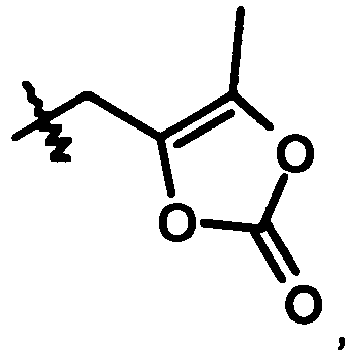
R2 and R3 independently of one another denote H, halogen, C1-3-alkyl, C1-3-perfluoralkyl, C1-3-perfuoralkoxy, C1-3-alkoxy, cyano, nitro or hydroxy,
and
A denotes CH or N, - m
- denotes 0, 1 or 2,
- R4
- denotes halogen, C1-3-alkyl, C1-3-perfuoroalkyl, C1-3-perfluoroalkoxy, cyano, hydroxy or C1-3-alkoxy, while, if m denotes the number 2, the groups R4 may be identical or different,
- wherein the above-mentioned heterocycles of formulae (Ia), (Ic), (Id), (Ie), (Ig) and (Ij) may each optionally be substituted at the carbon atoms of the 5-ring by one or two groups selected from among halogen, C1-3-alkyl, cyano, C1-3-perfuoroalkyl, C3-6-cycloalkyl, C2-4-alkynyl, C2-4-alkenyl, C1-3-alkyl-carbonyl, C1-3-perfuoroalkyl-carbonyl, carboxyl, aminomethyl, C1-3-alkyl-aminomethyl, di-(C1-3-alkyl)-aminomethyl, aminocarbonyl, C1-3-alkylaminocarbonyl or di-(C1-3-alkyl)-aminocarbonyl, wherein the groups may be identical or different and each carbon atom may carry only one group, and
- R5 denotes a 1H-pyrimidin-2,4-dionyl, 2H-pyridazin-3-onyl or 1H-pyridin-2-onyl group optionally mono- or disubstituted by one or two methyl groups or
- a mono- or bicyclic 5- to 14-membered ring system which may contain 0 to 4 heteroatoms selected from among N, O or S, wherein not more than one oxygen atom and/or one sulphur atom may be present, is aromatic, saturated or partially unsaturated and may be mono-, di- or trisubstituted independently of one another by a group selected from among
- halogen, cyano, nitro,
- C1-6-alkyl, C3-6-cycloalkyl, C1-3-perfuoroalkyl, C2-6-alkynyl, C2-6-alkenyl,
- hydroxy, C1-6-alkoxy, C3-6-cycloalkoxy, C1-3-perfluoroalkoxy,
- carboxyl, C1-3-alkyl-carbonyl, C1-4-alkoxy-carbonyl, C3-6-cycloalkoxy-carbonyl, aminocarbonyl, C1-6-alkyl-aminocarbonyl, di-(C1-6-alkyl)-aminocarbonyl, N-(C1-6-alkyl)-N-(C1-6-alkoxy)-aminocarbonyl, C3-6-cycloalkyl-aminocarbonyl, N-(C3-6-cycloalkyl)-N-(C1-6-alkyl)-aminocarbonyl, pyrrolidin-1-yl-carbonyl, piperidin-1-yl-carbonyl, morpholin-4-yl-carbonyl, piperazin-1-yl-carbonyl, 4-(C1-3-alkyl)-piperazin-1-yl-carbonyl, 4-(C1-3-alkyl-carbonyl)-piperazin-1-yl-carbonyl, 4-(C3-6-cycloalkyl-carbonyl)-piperazin-1-yl-carbonyl, 4-(C1-3 -alkylsulphonyl)-piperazin-1-yl-carbonyl, 4-(cos-cycloalkylsulphonyl)-piperazin-1-yl-carbonyl,
- C1-3-alkylsulphanyl, C3-6-cycloalkylsulphanyl, C1-3-alkylsulphinyl, C3-6 -cycloalkylsulphinyl, C1-3-alkylsulphonyl, C3-6-cycloalkylsulphonyl,
- amino, C1-6-alkyl-amino, di-(C1-6-alkyl)-amino, C3-6-cycloalkylamino, N-(C3-6-cycloalkyl)-N-(C1-6-alkyl)-amino, (C1-4-alkylcarbonyl)-amino, (C3-6-cycloalkyl-carbonyl)-amino, (C1-4-alkylcarbonyl)-(C1-3-alkyl)-amino, (C3-6-cycloalkyl-carbonyl)-(C1-3-alkyl)-amino,
- pyrrolidin-1-yl, piperidin-1-yl, 3-amino-piperidin-1-yl, 4-aminopiperidin-1-yl, morpholin-4-yl, thiomorpholin-4-yl, 1-oxo-1λ4-thiomorpholin-4-yl, 1,1-dioxo-1λ6-thiomorpholin-4-yl, piperazin-1-yl, homopiperazin-1-yl, 4-(C1-3-alkyl)-piperazin-1-yl, 4-(C1-3-alkylcarbonyl)-piperazin-1-yl, 4-(C3-6-cycloalkyl-carbonyl)-piperazin-1-yl, 4-(C1-3-alkylsulphonyl)-piperazin-1-yl, 4-(C3-6-cycloalkyl-sulphonyl)-piperazin-1-yl,
- tetrahydrofuran-3-yl-oxy, tetrahydrofuran-3-yl-amino, tetrahydropyran-4-yl-oxy, tetrahydropyran-4-yl-amino, N-tetrahydropyran-4-yl-N-methyl-amino, 2-oxo-imidazolidin-1-yl, 2-oxo-tetrahydropyrimidin-1-yl and heteroaryl,
- wherein the C1-6-alkyl, C3-6-cycloalkyl, C2-6-alkynyl, C2-6-alkenyl, C1-3-alkylsulphanyl, C3-6-cycloalkylsulphanyl, C1-3-alkylsulphinyl, C3-6-cycloalkylsulphinyl, C1-3-alkylsulphonyl, C3-6-cycloalkylsulphonyl, C1-6-alkoxy, C3-6-cycloalkoxy, C1-6-alkyl-amino, di-(C1-6-alkyl)-amino, C3-6-cycloalkyl-amino-N-(C3-6-cycloalkyl)-N-(C1-6-alkyl)-amino, (C1-4-alkyl-carbonyl)-amino, (C3-6-cycloalkyl-carbonyl)-amino, (C1-4-alkylcarbonyl)-(C1-3-alkyl)-amino- and (C3-6-cycloalkyl-carbonyl)-(C1-3-alkyl)-amino groups mentioned above in the definition of R5 may each be mono- or disubstituted independently of one another in the carbon skeleton by a group selected from among
- cyano, hydroxy, C1-3-alkoxy, tetrahydro-pyran-2-yloxy,
- amino, C1-6-alkyl-amino, di-(C1-6-alkyl)-amino, C3-6-cycloalkyl-amino, N-(C3-6-cycloalkyl)-N-(C1-6-alkyl)-amino, (C1-4-alkyl-carbonyl)-amino, (C3-6-cycloalkyl-carbonyl)-amino, (C1-4-alkyl-carbonyl)-(C1-3-alkyl)-amino, (C3-6-cycloalkylcarbonyl)-(C1-3-alkyl)-amino, (C1-4-alkylsulphonyl)-amino, (C3-6 -cycloalkylsulphonyl)-amino, (C1-4-alkylsulphonyl)-(C1-3-alkyl)-amino, (C3-6-cycloalkylsulphonyl)-(C1-3-alkyl)-amino, pyrrolidin-1-yl, piperidin-1-yl, morpholin-4-yl, piperazin-1-yl, 4-(C1-3-alkyl)-piperazin-1-yl,
- carboxyl, aminocarbonyl, C1-6-alkyl-aminocarbonyl, di-(C1-6-alkyl)-aminocarbonyl, C1-2-alkoxy-carbonyl, C3-6-cycloalkyl-aminocarbonyl, N-(C3-6-cycloalkyl)-N-(C1-6-alkyl)-aminocarbonyl, pyrrolidin-1-yl-carbonyl, piperidin-1-yl-carbonyl, morpholin-4-yl-carbonyl, piperazin-1-yl-carbonyl, 4-(C1-3-alkyl)-piperazin-1-yl-carbonyl,
- C1-3-alkylsulphanyl, C3-6-cycloalkylsulphanyl, C1-3-alkylsulphinyl, C3-6-cycloalkylsulphinyl, C1-3-alkylsulphonyl, and C3-6-cycloalkylsulphonyl, wherein the substituents must not be bound to a common carbon atom, and
- wherein the pyrrolidin-1-yl and piperidin-1-yl groups mentioned above in the definition of R5 may be substituted by amino or hydroxy, and
- wherein the C1-6-alkyl-aminocarbonyl, di-(C1-6-alkyl)-aminocarbonyl, C3-6-cycloalkyl-aminocarbonyl, N-(C3-6-cycloalkyl)-N-(C1-6-alkyl)-aminocarbonyl groups mentioned hereinbefore for R5 may each be mono- or disubstituted independently of one another in the carbon skeleton by a group selected from among
- cyano, hydroxy, C1-3-alkoxy,
- amino, C1-3-alkyl-amino, di-(C1-3-alkyl)-amino, C3-6-cycloalkyl-amino, N-(C3-6-cycloalkyl)-N-(C1-6-alkyl)-amino, (C1-4-alkyl-carbonyl)-amino, (C3-6-cycloalkyl-carbonyl)-amino, (C1-4-alkyl-carbonyl)-(C1-3-alkyl)-amino, (C3-6-cycloalkylcarbonyl)-(C1-3-alkyl)-amino, (C1-4-alkylsulphonyl)-amino, (C3-6 -cycloalkylsulphonyl)-amino, (C1-4-alkylsulphonyl)-(C1-3-alkyl)-amino, (C3-6-cycloalkylsulphonyl)-(C1-3-alkyl)-amino
- pyrrolidin-1-yl, piperidin-1-yl, morpholin-4-yl, piperazin-1-yl, 4-(C1-3-alkyl)-piperazin-1-yl,
- C1-3-alkylsulphanyl, C3-6-cycloalkylsulphanyl, C1-3-alkylsulphinyl, C3-6-cycloalkylsulphinyl, C1-3-alkylsulphonyl and C3-6-cycloalkylsulphonyl, wherein the substituents must not be bound to a common carbon atom, and
- wherein the heteroaryl group mentioned hereinbefore for R5 denotes a monocyclic five-membered aromatic system with 1 to 4 heteroatoms selected from among N, O or S, wherein not more than one oxygen atom and/or one sulphur atom may be present, or a six-membered aromatic system with 1 to 3 nitrogen atoms, and may be mono- or disubstituted independently of one another by halogen, cyano, hydroxy, amino, C1-3-alkyl or C1-3-alkyloxycarbonyl, and
- wherein in the above-mentioned morpholin-4-yl and piperazin-1-yl groups in each case a methylene unit may be replaced by a carbonyl or sulphonyl group.
- The invention also relates to the tautomers, stereoisomers, mixtures and salts, particularly the physiologically acceptable salts, of the compounds according to the invention.
- The compounds of general formula I according to the invention and the physiologically acceptable salts thereof have valuable pharmacological properties, in particular they suppress the interaction of glycogen phosphorylase a with the GL-subunit of glycogen-associated protein phosphatase 1 (PP1).
- Therefore this invention also relates to the use of the compounds according to the invention, including the physiologically acceptable salts, as pharmaceutical compositions.
- This invention further relates to pharmaceutical compositions containing at least one compound according to the invention or a physiologically acceptable salt according to the invention, optionally together with one or more inert carriers and/or diluents.
- A further object of this invention is the use of at least one compound according to the invention or a physiologically acceptable salt of such a compound for preparing a pharmaceutical composition that is suitable for the treatment or prevention of diseases or conditions that can be influenced by suppressing the interaction of glycogen phosphorylase a with the GL-subunit of glycogen-associated protein phosphatase 1 (PP1).
- The invention also relates to the use of at least one compound according to the invention for preparing a pharmaceutical composition which is suitable for the treatment of metabolic disorders, for example type I or II diabetes mellitus.
- The invention also relates to the use of at least one compound according to the invention for preparing a pharmaceutical composition for suppressing the interaction of glycogen phosphorylase a with the GL-subunit of glycogen-associated protein phosphatase 1 (PP1).
- A further object of this invention is a process for preparing a pharmaceutical composition according to the invention, characterised in that a compound according to the invention is incorporated in one or more inert carriers and/or diluents by a non-chemical method.
- The present invention also relates to a process for preparing the compounds of general formula I according to the invention.
- Unless stated otherwise, the groups, radicals and substituents, particularly R, R1 to R5, m, X, Y, Z and A have the meanings given hereinbefore and hereinafter.
- If groups, substituents or radicals occur more than once in a compound, they may have the same or different meanings.
- Preferred compounds of the above general formula I are those wherein
R denotes a group of the above-mentioned formula wherein - R1
- denotes H, C1-6-alkyl or a group of formula
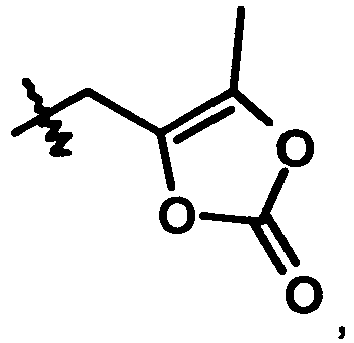
- R2 and R3
- independently of one another denote halogen, C1-3-alkyl, C1-3-perfluoroalkyl, C1-2-alkoxy or cyano and
- A
- denotes CH or N,
- m
- denotes 0, 1 or 2,
- R4
- denotes halogen, C1-3-alkyl, trifluoromethyl or cyano, while, if m denotes the number 2, the groups R4 may be identical or different,
- wherein the above-mentioned heterocycles of formulae (Ia), (Ic), (Id), (Ie), (Ig) and (Ij) may optionally be substituted at the carbon atoms of the 5 ring by one or two groups selected from among halogen, C1-3-alkyl, cyano, C1-3 -perfluoroalkyl, C3-6-cycloalkyl, C1-3-alkyl-carbonyl, C1-3-perfluoroalkylcarbonyl, aminocarbonyl, C1-3-alkyl-aminocarbonyl or di-(C1-3-alkyl)-aminocarbonyl, wherein the groups may be identical or different and each carbon atom carries at most one group, and
- wherein R5 denotes 1,3-dimethyl-1H-pyrimidin-2,4-dion-5-yl, 1H-pyrimidin-2,4-dion-6-yl, 1H-pyrimidin-2,4-dion-5-yl, 2H-pyridazin-3-on-6-yl, 1H-pyridin-2-on-3-yl, 1H-pyridin-2-on-5-yl, 1H-pyridin-2-on-4-yl or
- a mono- or bicyclic 5- to 14-membered ring system which may contain 0 to 4 heteroatoms selected from among N, O or S, wherein not more than one oxygen atom and/or one sulphur atom may be present, is aromatic, saturated or partially unsaturated and may be mono-, di- or trisubstituted independently of one another by a group selected from among
- halogen, cyano,
- C1-6-alkyl, C3-6-cycloalkyl, C1-3-perfluoroalkyl, C2-6-alkynyl, C2-6-alkenyl,
- hydroxy, C1-6-alkoxy, C3-6-cycloalkoxy, trifluoromethoxy,
- carboxyl, C1-3-alkyl-carbonyl, C1-4-alkoxy-carbonyl, cyclopropoxycarbonyl, aminocarbonyl, C1-6-alkyl-aminocarbonyl, di-(C1-6-alkyl)-aminocarbonyl, N-(C1-3-alkyl)-N-(C1-3-alkoxy)-aminocarbonyl, C3-6-cycloalkyl-aminocarbonyl, N-(C3-6-cycloalkyl)-N-(C1-3-alkyl)-aminocarbonyl, pyrrolidin-1-yl-carbonyl, piperidin-1-yl-carbonyl, morpholin-4-yl-carbonyl, piperazin-1-yl-carbonyl, 4-(C1-3-alkyl)-piperazin-1-yl-carbonyl, 4-(C1-3-alkyl-carbonyl)-piperazin-1-yl-carbonyl, 4-(C3-6-cycloalkyl-carbonyl)-piperazin-1-yl-carbonyl, 4-(C1-3 -alkylsulphonyl)-piperazin-1-yl-carbonyl, 4-(C3-6-cycloalkylsulphonyl)-piperazin-1-yl-carbonyl,
- C1-3-alkylsulphanyl, C3-6-cycloalkylsulphanyl, C1-3-alkylsulphinyl, C3-6 -cycloalkylsulphinyl, C1-3-alkylsulphonyl, C3-6-cycloalkylsulphonyl,
- amino, C1-6-alkyl-amino, di-(C1-6-alkyl)-amino, C3-6-cycloalkylamino, N-(C3-6-cycloalkyl)-N-(C1-3-alkyl)-amino, (C1-4-alkylcarbonyl)-amino, (C3-6-cycloalkyl-carbonyl)-amino, (C1-4-alkylcarbonyl)-(C1-3-alkyl)-amino, (C3-6-cycloalkyl-carbonyl)-(C1-3-alkyl)-amino, pyrrolidin-1-yl, piperidin-1-yl, 3-amino-piperidin-1-yl, 4-amino-piperidin-1-yl, morpholin-4-yl, thiomorpholin-4-yl, 1-oxo-1λ4-thiomorpholin-4-yl, 1,1-dioxo-1λ6-thiomorpholin-4-yl, piperazin-1-yl, homopiperazin-1-yl, 4-(C1-3-alkyl)-piperazin-1-yl, 4-(C1-3-alkylcarbonyl)-piperazin-1-yl, 4-(C3-6-cycloalkyl-carbonyl)-piperazin-1-yl, 4-(C1-3-alkylsulphonyl)-piperazin-1-yl, 4-(C3-6-cycloalkylsulphonyl)-piperazin-1-yl,
- tetrahydrofuran-3-yl-oxy, tetrahydrofuran-3-yl-amino, tetrahydropyran-4-yl-oxy, tetrahydropyran-4-yl-amino, N-tetrahydropyran-4-yl-N-methyl-amino, 2-oxo-imidazolidinyl, 2-oxo-tetrahydropyrimidinyl and heteroaryl,
- wherein the C1-6-alkyl, C3-6-cycloalkyl, C2-6-alkynyl, C2-6-alkenyl, C1-3 -alkylsulphanyl, C3-6-cycloalkylsulphanyl, C1-3-alkylsulphinyl, C3-6-cycloalkylsulphinyl, C1-3-alkylsulphonyl, C3-6-cycloalkylsulphonyl, C1-6-alkoxy, C3-6-cycloalkoxy, C1-6-alkyl-amino, di-(C1-6-alkyl)-amino, C3-6-cycloalkyl-amino, N-(C3-6-cycloalkyl)-N-(C1-3-alkyl)-amino, (C1-4 -alkyl-carbonyl)-amino, (C3-6-cycloalkyl-carbonyl)-amino, (C1-4-alkyl-carbonyl)-(C1-3-alkyl)-amino- and (C3-6-cycloalkyl-carbonyl)-(C1-3-alkyl)-amino groupsmentioned above in the definition of R5 may each be mono- or disubstituted independently of one another in the carbon skeleton by a group selected from among
- cyano, hydroxy, C1-3-alkoxy, tetrahydro-pyran-2-yloxy,
- amino, C1-6-alkyl-amino, di-(C1-6-alkyl)-amino, C3-6-cycloalkyl-amino, N-(C3-6-cycloalkyl)-N-(C1-3-alkyl)-amino, (C1-4-alkyl-carbonyl)-amino, (C3-6-cycloalkyl-carbonyl)-amino, (C1-4-alkyl-carbonyl)-(C1-3-alkyl)-amino, (C3-6-cycloalkylcarbonyl)-(C1-3-alkyl)-amino, (C1-4-alkylsulphonyl)-amino, (C3-6 -cycloalkylsulphonyl)-amino, (C1-4-alkylsulphonyl)-(C1-3-alkyl)-amino, (C3-6-cycloalkylsulphonyl)-(C1-3-alkyl)-amino
- pyrrolidin-1-yl, piperidin-1-yl, morpholin-4-yl, piperazin-1-yl, 4-(C1-3-alkyl)-piperazin-1-yl,
- carboxyl, C1-2-alkoxy-carbonyl, aminocarbonyl, C1-6-alkylaminocarbonyl, di-(C1-6-alkyl)-aminocarbonyl, C3-6-cycloalkylaminocarbonyl, N-(C3-6-cycloalkyl)-N-(C1-3-alkyl)-aminocarbonyl, pyrrolidin-1-yl-carbonyl, piperidin-1-yl-carbonyl, morpholin-4-yl-carbonyl, piperazin-1-yl-carbonyl, 4-(C1-3-alkyl)-piperazin-1-yl-carbonyl,
- C1-3-alkylsulphanyl, C3-6-cycloalkylsulphanyl, C1-3-alkylsulphinyl, C3-6-cycloalkylsulphinyl, C1-3-alkylsulphonyl and C3-6-cycloalkylsulphonyl, wherein the substituents must not be bound to a common carbon atom, and
- wherein the pyrrolidin-1-yl and piperidin-1-yl groups mentioned above in the definition of R5 may be substituted by amino or hydroxy, and
- wherein the C1-6-alkyl-aminocarbonyl, di-(C1-6-alkyl)-aminocarbonyl, C3-6-cycloalkyl-aminocarbonyl, N-(C3-6-cycloalkyl)-N-(C1-3-alkyl)-aminocarbonyl groups mentioned above in the definition of R5 may each be mono- or disubstituted independently of one another in the carbon skeleton by a group selected from among
- amino, hydroxy, C1-3-alkoxy, C1-3-alkyl-amino, di-(C1-3-alkyl)-amino, C3-6-cycloalkyl-amino, N-(C3-6-cycloalkyl)-N-(methyl)-amino, (C1-4-alkyl-carbonyl)-amino, (C3-6-cycloalkylcarbonyl)-amino, (C1-4-alkyl-carbonyl)-(methyl)-amino, (C3-6-cycloalkyl-carbonyl)-(methyl)-amino, (C1-4-alkylsulphonyl)-amino, (C3-6-cycloalkylsulphonyl)-amino, (C1-4-alkylsulphonyl)-(methyl)-amino or (C3-6-cycloalkylsulphonyl)-(methyl)-amino,
- pyrrolidin-1-yl, piperidin-1-yl, morpholin-4-yl, piperazin-1-yl, 4-(C1-3-alkyl)-piperazin-1-yl,
- C1-3-alkylsulphanyl, C3-6-cycloalkylsulphanyl, C1-3-alkylsulphinyl, C3-6-cycloalkylsulphinyl, C1-3-alkylsulphonyl and C3-6-cycloalkylsulphonyl, wherein the substituents must not be bound to a common carbon atom, and
- wherein the heteroaryl group mentioned hereinbefore for R5 denotes a monocyclic five-membered aromatic system with 1 to 3 heteroatoms selected from among N, O or S, wherein not more than one oxygen atom and/or one sulphur atom may be present, or denotes a monocyclic five-membered aromatic system with 4 nitrogen atoms or a six-membered aromatic system with 1 to 3 nitrogen atoms and may be mono- or disubstituted independently of one another by fluorine, chlorine, cyano, C1-3-alkyl or C1-3-alkyloxy-carbonyl, and
- wherein in the above-mentioned morpholin-4-yl and piperazin-1-yl groups in each case a methylene unit may be replaced by a carbonyl or sulphonyl group.
- Particularly preferred are those compounds of the above general formula I, wherein R denotes a group of the above-mentioned formula wherein
- R1
- denotes H, C1-4-alkyl or a group of formula

R2 and R3 independently of one another denote chlorine, bromine or C1-2-alkyl and
A denotes CH or N, - m
- denotes 0 or 1,
- R4
- denotes fluorine, chlorine, methyl or ethyl,
- while the heterocycles mentioned hereinbefore may optionally be substituted at the carbon atoms of the 5-ring by one or two groups selected from among chlorine, bromine, iodine, C1-3-alkyl, cyano and trifluoromethyl, wherein the groups may be identical or different and each carbon atom carries at most one group, and
- wherein R5 denotes 1,3-dimethyl-1H-pyrimidin-2,4-dion-5-yl, 1H-pyrimidin-2,4-dion-6-yl, 1H-pyrimidin-2,4-dion-5-yl, 2H-pyridazin-3-on-6-yl, 1H-pyridin-2-on-3-yl, 1H-pyridin-2-on-5-yl or 1H-pyridin-2-on-4-yl,
- phenyl, pyridazin-3-yl, pyrimidin-2-yl, pyrimidin-4-yl, pyrimidin-5-yl, pyrazin-2-yl, 1.3,5-triazin-2-yl, pyridin-2-yl, pyridin-4-yl, imidazol-2-yl, imidazol-4-yl, pyrazol-3-yl, pyrazol-4-yl, thiazol-2-yl, [1.3.4]thiadiazol-2-yl, thiophen-2-yl, thiophen-3-yl, naphthalin-1-yl, naphthalin-2-yl, purin-6-yl, purin-2-yl, 1-imidazo[1,2-a]pyrazin-6-yl, quinolin-6-yl, quinolin-8-yl, quinolin-2-yl or isoquinolin-1-yl, which may each be mono- or disubstituted independently of one another by a group selected from among
- fluorine, chlorine, C1-4-alkyl, cyclopropyl, trifluoromethyl, cyano, hydroxy, C1-3-alkoxy, cyclopropoxy,
- carboxyl, C1-2-alkyl-carbonyl, C1-2-alkoxy-carbonyl, aminocarbonyl, C1-4-alkyl-aminocarbonyl, di-(C1-2-alkyl)-aminocarbonyl, N-methoxy-N-methyl-aminocarbonyl, cyclopropyl-aminocarbonyl, N-( cyclopropyl)-N-(methyl)-aminocarbonyl, pyrrolidin-1-yl-carbonyl, piperidin-1-yl-carbonyl, morpholin-4-yl-carbonyl, piperazin-1-yl-carbonyl, 4-(methyl)-piperazin-1-yl-carbonyl, 4-(C1-3-alkyl-carbonyl)-piperazin-1-yl-carbonyl, 4-(C3-6-cycloalkyl-carbonyl)-piperazin-1-yl-carbonyl, 4-(C1-3-alkylsulphonyl)-piperazin-1-yl-carbonyl, 4-(C3-6-cycloalkylsulphonyl)-piperazin-1-yl-carbonyl,
- C1-2-alkylsulphanyl, cyclopropylsulphanyl, C1-2-alkylsulphinyl, cyclopropylsulphinyl, C1-2-alkylsulphonyl, cyclopropylsulphonyl,
- amino, C1-4-alkyl-amino, di-(C1-3-alkyl)-amino, cyclopropyl-amino, N-(cyclopropyl)-N-(methyl)-amino, C1-3-alkyl-carbonyl-amino,
- pyrrolidin-1-yl, piperidin-1-yl, 3-amino-piperidin-1-yl, 4-amino-piperidin-1-yl, morpholin-4-yl, thiomorpholin-4-yl, 1-oxo-1λ4-thiomorpholin-4-yl, 1,1-dioxo-1λ6-thiomorpholin-4-yl, piperazin-1-yl, homopiperazin-1-yl, 4-(methyl)-piperazin-1-yl, 4-(C1-2-alkylcarbonyl)-piperazin-1-yl, 4-(C1-2-alkylsulphonyl)-piperazin-1-yl,
- tetrahydrofuran-3-yl-oxy, tetrahydrofuran-3-yl-amino, tetrahydropyran-4-yl-oxy, tetrahydropyran-4-yl-amino, N-tetrahydropyran-4-yl-N-methyl-amino, 2-oxo-imidazolidinyl, 2-oxotetrahydropyrimidinyl, imidazol-2-yl, 1-methyl-imidazol-2-yl, thiazol-2-yl, 4-ethoxycarbonyl-thiazol-2-yl, 3-ethoxycarbonylisoxazol-5-yl, oxazol-2-yl, 2,4-dihydroxy-pyrimidin-5-yl.1.2,4-triazol-3-yl and tetrazol-5-yl, or
- wherein the C1-4-alkyl, C1-3-alkoxy, C1-4-alkyl-amino, di-(C1-3-alkyl)-amino- and C1-3-alkyl-carbonyl-amino groups mentioned hereinbefore for R5 may each be mono- or disubstituted independently of one another in the carbon skeleton by a group selected from among
- cyano, hydroxy, C1-2-alkoxy, tetrahydro-pyran-2-yloxy,
- amino, C1-3-alkyl-amino, di-(C1-3-alkyl)-amino, (C1-3-alkylcarbonyl)-amino, (C1-3-alkylsulphonyl)-amino,
- pyrrolidin-1-yl, piperidin-1-yl, morpholin-4-yl, piperazin-1-yl, 4-(methyl)-piperazin-1-yl,
- carboxyl, C1-2-alkoxy-carbonyl, aminocarbonyl, C1-3-alkylaminocarbonyl, di-(C1-3-alkyl)-aminocarbonyl and C3-6-cycloalkyl-aminocarbonyl, wherein the substituents must not be bound to a common carbon atom, and
- wherein the mentioned hereinbefore for R5 erwähnten C1-4-alkylaminocarbonyl- and di-(C1-2-alkyl)-aminocarbonyl groups in the carbon skeleton may each be mono- or disubstituted independently of one another by amino, hydroxy, C1-3-alkoxy, C1-3-alkyl-amino or di-(C1-3-alkyl)-amino, wherein the substituents must not be bound to a common carbon atom, and
- wherein in the above-mentioned morpholin-4-yl and piperazin-1-yl groups in each case a methylene unit may be replaced by a carbonyl group,
- R
- denotes a group of the above-mentioned formula wherein
R1 denotes H or a C1-3-alkyl group optionally substituted by a di-(C1-3-alkyl)-amino group,
R2 and R3 independently of one another denote chlorine, bromine or methyl and
A denotes CH or N,
m denotes 0 or 1,
R4 denotes chlorine, methyl or ethyl, - Most particularly preferred are those compounds of the above general formula I, wherein R denotes a group of the above-mentioned formula wherein
- R1
- denotes H, methyl, ethyl or 2-dimethylamino-ethyl,
R2 and R3 independently of one another denote chlorine, bromine or methyl and
A denotes CH or N, - m
- denotes 0 or 1,
- R4
- denotes chlorine, methyl or ethyl,
- while the heterocycles mentioned hereinbefore may optionally be substituted at the carbon atoms of the 5 ring by one or two methyl or ethyl groups, wherein the groups may be identical or different and each carbon atom carries at most one group, and
- wherein R5 denotes 1,3-dimethyl-1H-pyrimidin-2,4-dion-5-yl, 1H-pyrimidin-2,4-dion-6-yl, 1H-pyrimidin-2,4-dion-5-yl, 2H-pyridazin-3-on-6-yl, 1H-pyridin-2-on-3-yl, 1H-pyridin-2-on-5-yl, 1H-pyridin-2-on-4-yl or phenyl, pyridazin-3-yl, pyrimidin-2-yl, pyrimidin-4-yl, pyrimidin-5-yl, pyrazin-2-yl, pyridin-2-yl, pyridin-4-yl, imidazol-2-yl, imidazol-4-yl, pyrazol-3-yl, pyrazol-4-yl, 1.3,5-triazin-2-yl, thiazol-2-yl, [1.3.4]thiadiazol-2-yl, thiophen-2-yl, thiophen-3-yl, purin-6-yl, purin-2-yl or 1-imidazo[1,2-a]pyrazin-6-yl, which may be mono- or disubstituted independently of one another by a group selected from among
- chlorine, cyano, methyl, aminomethyl, morpholin-4-ylmethyl, hydroxymethyl, 3-hydroxypropyl, trifluoromethyl,
- hydroxy, methoxy, 2-hydroxyethoxy, 2-aminoethoxy, 2-dimethylaminoethoxy, 2-methylsulphonylamino-ethoxy, 2-acetylamino-ethoxy, 2,3-dihydroxy-propoxy,
- carboxyl, acetyl, ethylcarbonyl, aminocarbonyl, methyl-aminocarbonyl, dimethyl-aminocarbonyl, N-methoxy-N-methyl-aminocarbonyl, 2-dimethylamino-ethyl-aminocarbonyl, 2-hydroxy-ethyl-aminocarbonyl, 2-methoxy-ethyl-aminocarbonyl, cyclopropyl-aminocarbonyl,
- morpholin-4-yl-carbonyl, piperazin-1-yl-carbonyl, methoxy-carbonyl,
- methylsulphanyl, methylsulphinyl, ethylsulphinyl, methylsulphonyl,
- amino, methyl-amino, acetylamino, 2-aminoethyl-amino, 2-dimethylaminoethyl-amino, 2-hydroxyethyl-amino, 2-(methylamino)-ethyl-amino, N-carboxymethyl-N-(2-dimethylamino-ethyl)-amino, 2-(acetylamino)ethyl-amino, 2-(methylsulphonylamino)-ethyl-amino, 2-(pyrrolidin-1-yl)-ethyl-amino, 2-(piperidin-1-yl)-ethyl-amino, 2-(tetrahydro-pyran-2-yloxy)-ethylamino, 3-aminopropyl-amino, 3-(methylamino)-propyl-amino, 2-amino-2-methyl-propyl-amino, 1,3-dihydroxy-2-propyl-amino, 3-acetylaminopropyl-amino, 3-(methylsulphonylamino)-propyl-amino, dimethyl-amino, N-methyl-N-2-aminoethyl-amino, N,N-bis-2-(hydroxyethyl)-amino, N-methyl-N-(3-aminopropyl)-amino, N-methyl-N-[3-(acetylamino)-propyl]-amino, N-methyl-N-[3-(methylsulphonylamino)-propyl]-amino, cyclopropyl-amino,
- morpholin-4-yl, thiomorpholin-4-yl, 1-oxo-1λ4-thiomorpholin-4-yl, 1,1-dioxo-1λ6-thiomorpholin-4-yl, 3-amino-piperidin-1-yl, piperazin-1-yl, homopiperazin-1-yl , 4-acetyl-piperazin-1-yl, 4-methylsulphonyl-piperazin-1-yl,
- tetrahydrofuran-3-yl-oxy, tetrahydrofuran-3-yl-amino, tetrahydropyran-4-yl-oxy, tetrahydropyran-4-yl-amino, N-tetrahydropyran-4-yl-N-methyl-amino, 2-oxo-imidazolidinyl, imidazol-2-yl, 1-methyl-imidazol-2-yl, thiazol-2-yl, 4-ethoxycarbonylthiazol-2-yl, 3-ethoxycarbonyl-isoxazol-5-yl, and oxazol-2-yl,
- wherein in the above-mentioned morpholin-4-yl and piperazin-1-yl groups in each case a methylene unit may be replaced by a carbonyl group,
- R
- denotes a group of the above-mentioned formula wherein
R1 denotes hydrogen,
R2 and R3 in each case denote chlorine and
A denotes CH, - m
- denotes 0 and
- R5 denotes phenyl, pyridazin-3-yl, pyrimidin-2-yl, pyrimidin-4-yl, pyrimidin-5-yl, pyrazin-2-yl, pyridin-2-yl or pyridin-4-yl, which may be substituted by a group selected from among
- cyano, methyl, aminomethyl, hydroxymethyl, 3-hydroxypropyl, trifluoromethyl,
- hydroxy, methoxy, 2-hydroxyethoxy, 2-aminoethoxy, 2-(dimethylamino)-ethoxy, 2-(methylsulphonylamino)-ethoxy, 2-(acetylamino)-ethoxy, 2,3-dihydroxy-propoxy,
- carboxyl, acetyl, ethylcarbonyl, aminocarbonyl, methyl-aminocarbonyl, dimethyl-aminocarbonyl, N-methoxy-N-methyl-aminocarbonyl, 2-(dimethylamino)-ethyl-aminocarbonyl, 2-hydroxy-ethyl-aminocarbonyl, 2-methoxy-ethyl-aminocarbonyl, cyclopropyl-aminocarbonyl, morpholin-4-yl-carbonyl, piperazin-1-yl-carbonyl, methoxy-carbonyl,
- methylsulphanyl, methylsulphinyl, ethylsulphinyl, methylsulphonyl,
- amino, methyl-amino, acetylamino, 2-aminoethyl-amino, 2-(dimethylamino)-ethyl-amino, 2-hydroxyethyl-amino, 2-(methylamino)-ethyl-amino, N-carboxymethyl-N-[2-(dimethylamino)-ethyl]-amino, 2-(acetylamino)-ethyl-amino, 2-(methylsulphonylamino)-ethyl-amino, 2-(pyrrolidin-1-yl)-ethyl-amino, 2-(piperidin-1-yl)-ethyl-amino, 3-aminopropyl-amino, 3-(methylamino)-propyl-amino, 3-(acetylamino)-propyl-amino, 3-(methylsulphonylamino)-propyl-amino, dimethyl-amino, N-methyl-N-2-aminoethyl-amino, N,N-bis-2-(hydroxyethyl)-amino, N-methyl-N-3-aminopropyl-amino, N-methyl-N-[3-(acetylamino)-propyl]-amino, N-methyl-N-[3-(methylsulphonylamino)-propyl]-amino, cyclopropyl-amino,
- morpholin-4-yl, thiomorpholin-4-yl, 1-oxo-1λ4-thiomorpholin-4-yl, 1,1-dioxo-1λ6-thiomorpholin-4-yl, 3-amino-piperidin-1-yl, piperazin-1-yl, homopiperazin-1-yl, 4-acetyl-piperazin-1-yl, 4-methylsulphonyl-piperazin-1-yl,
- tetrahydrofuran-3-yl-oxy, tetrahydrofuran-3-yl-amino, tetrahydropyran-4-yl-oxy, tetrahydropyran-4-yl-amino, N-tetrahydropyran-4-yl-N-methyl-amino, 2-oxo-imidazolidinyl, imidazol-2-yl, 1-methyl-imidazol-2-yl, thiazol-2-yl, 4-ethoxycarbonyl-thiazol-2-yl, 3-ethoxycarbonyl-isoxazol-5-yl and oxazol-2-yl.
- The following preferred compounds are mentioned by way of example:
- (1) ((3,5-dichloro-phenylsulphonyl)-{1-[5-(2-dimethylamino-ethylamino)-pyrazin-2-yl]-1H-indol-5-yl}-amino)-acetic acid
- (2) {(3,5-dichloro-phenylsulphonyl)-[1-(6-piperazin-1-yl-pyridazin-3-yl)-2,3-dihydro-1H-indol-5-yl]-amino}-acetic acid
- (3) ((3,5-dichloro-phenylsulphonyl)-{1-[6-(2-dimethylamino-ethylamino)-pyridazin-3-yl]-1H-indol-5-yl}-amino)-acetic acid
- (4) {(3,5-dichloro-phenylsulphonyl)-[1-(6-methyl-pyridazin-3-yl)-1H-indol-5-yl]-amino}-acetic acid
- (5) ((3-bromo-5-methyl-phenylsulphonyl)-{1-[6-(2-dimethylamino-ethylamino)-pyridazin-3-yl]-1H-indol-5-yl}-amino)-acetic acid
- (6) {(3,5-dichloro-phenylsulphonyl)-[1-(6-piperazin-1-yl-pyridazin-3-yl)-1H-indol-5-yl]-amino}-acetic acid
- (7) [[1-(6-[1,4]diazepan-1-yl-pyridazin-3-yl)-1H-indol-5-yl]-(3,5-dichlorophenylsulphonyl)-amino]-acetic acid
- (8) {(3,5-dichloro-phenylsulphonyl)-[1-(4-methyl-pyridin-2-yl)-1H-indol-5-yl]-amino}-acetic acid
- (9) ((3,5-dichloro-phenylsulphonyl)-{1-[6-(2-dimethylamino-ethylamino)-pyridazin-3-yl]-3-methyl-1H-indol-5-yl}-amino)-acetic acid
- (10) [(3,5-dichloro-phenylsulphonyl)-(1-{6-[methyl-(tetrahydro-pyran-4-yl)-amino]-pyridazin-3-yl}-1H-indol-5-yl)-amino]-acetic acid
- (11) ((3,5-dichloro-phenylsulphonyl)-{1-[5-(3-oxo-piperazin-1-yl)-pyrazin-2-yl]-1H-indol-5-yl}-amino)-acetic acid
- (12) [[6-ethyl-1-(6-methyl-pyridazin-3-yl)-1H-indol-5-yl]-(3,5-dichlorophenylsulphonyl)-amino]-acetic acid
- (13) [[1-(4-amino-pyridin-2-yl)-1H-indol-5-yl]-(3,5-dichloro-phenylsulphonyl)-amino]-acetic acid
- (14) ((3,5-dichloro-phenylsulphonyl)-{1-[6-(3-hydroxy-propyl)-pyridazin-3-yl]-1H-indol-5-yl}-amino)-acetic acid
- (15) [{1-[6-(4-acetyl-piperazin-1-yl)-pyridazin-3-yl]-1H-indol-5-yl}-(3,5-dichlorophenylsulphonyl)-amino]-acetic acid
- (16) {(3,5-dichloro-phenylsulphonyl)-[1-(4-methylcarbamoyl-pyridin-2-yl)-1H-indol-5-yl]-amino}-acetic acid
- (17) {(3,5-dichloro-phenylsulphonyl)-[3-methyl-1-(6-methyl-pyridazin-3-yl)-1H-indol-5-yl]-amino}-acetic acid
- (18) {(3,5-dichloro-phenylsulphonyl)-[1-(4-methanesulphinyl-pyridin-2-yl)-1H-indol-5-yl]-amino}-acetic acid
- (19) [[1-(4-cyclopropylcarbamoyl-pyridin-2-yl)-1H-indol-5-yl]-(3,5-dichlorophenylsulphonyl)-amino]-acetic acid
- (20) {(2,6-dichloro-pyridin-4-sulphonyl)-[1-(4-methylcarbamoyl-pyridin-2-yl)-1H-indol-5-yl]-amino}-acetic acid
- Some terms used hereinbefore and hereinafter to describe the compounds according to the invention are defined more specifically below.
- The term halogen denotes an atom selected from among F, Cl, Br and I, particularly F, Cl and Br.
- The term C1-n-alkyl, wherein n may have a value as defined hereinbefore or hereinafter, denotes a saturated, branched or unbranched hydrocarbon group with 1 to n C atoms. Examples of such groups include methyl, ethyl, n-propyl, iso-propyl, butyl, iso-butyl, sec-butyl, tert-butyl, n-pentyl, iso-pentyl, neo-pentyl, tert-pentyl, n-hexyl, iso-hexyl, etc..
- The term C2-n-alkynyl, wherein n has a value as defined hereinbefore, denotes a branched or unbranched hydrocarbon group with 2 to n C atoms and a C≡C triple bond. Examples of such groups include ethynyl, 1-propynyl, 2-propynyl, iso-propynyl, 1-butynyl, 2-butynyl, 3-butynyl, 2-methyl-1-propynyl, 1-pentynyl, 2-pentynyl, 3-pentynyl, 4-pentynyl, 3-methyl-2-butynyl, 1-hexynyl, 2-hexynyl, 3-hexynyl, 4-hexynyl, 5-hexynyl etc..
- The term C2-n-alkenyl, wherein n has a value as defined hereinbefore, denotes a branched or unbranched hydrocarbon group with 2 to n C atoms and a C=C double bond. Examples of such groups include ethenyl, 1-propenyl, 2-propenyl, iso-propenyl, 1-butenyl, 2-butenyl, 3-butenyl, 2-methyl-1-propenyl, 1-pentenyl, 2-pentenyl, 3-pentenyl, 4-pentenyl, 3-methyl-2-butenyl, 1-hexenyl, 2-hexenyl, 3-hexenyl, 4-hexenyl, 5-hexenyl etc..
- The term C1-n-alkoxy or C1-n-alkyloxy denotes a C1-n-alkyl-O group, wherein C1-n-alkyl is as hereinbefore defined. Examples of such groups include methoxy, ethoxy, n-propoxy, iso-propoxy, n-butoxy, iso-butoxy, sec-butoxy, tert-butoxy, n-pentoxy, iso-pentoxy, neo-pentoxy, tert-pentoxy, n-hexoxy, iso-hexoxy etc..
- The term C1-n-alkyl-carbonyl denotes a C1-n-alkyl-C(=O) group, wherein C1-n-alkyl is as hereinbefore defined. Examples of such groups include methylcarbonyl, ethylcarbonyl, n-propylcarbonyl, iso-propylcarbonyl, n-butylcarbonyl, iso-butylcarbonyl, sec-butylcarbonyl, tert-butylcarbonyl, n-pentylcarbonyl, iso-pentylcarbonyl, neo-pentylcarbonyl, tert-pentylcarbonyl, n-hexylcarbonyl, iso-hexylcarbonyl, etc..
- The term C3-n-cycloalkyl denotes a saturated mono-, bi-, tri- or spirocarbocyclic group with 3 to n C atoms. Examples of such groups include cyclopropyl, cyclobutyl, cyclopentyl, cyclohexyl, cycloheptyl, cyclooctyl, cyclononyl, cyclododecyl, bicyclo[3.2.1.]octyl, spiro[4.5]decyl, norpinyl, norbornyl, norcaryl, adamantyl, etc.. Preferably the term C3-7-cycloalkyl includes saturated monocyclic groups.
- The term C3-n-cycloalkyloxy or C3-n-cycloalkoxy d a C3-n-cycloalkyl-O group, wherein C3-n-cycloalkyl is as hereinbefore defined. Examples of such groups include cyclopropyloxy, cyclobutyloxy, cyclopentyloxy, cyclohexyloxy, cycloheptyloxy, etc..
- The term C1-n-alkoxy-carbonyl denotes a C1-n-alkyl-O-C(=O) group, wherein C1-n-alkyl is as hereinbefore defined.
- The term C3-n-cycloalkyl-carbonyl denotes a C3-n-cycloalkyl-C(=O) group, wherein C3-n-cycloalkyl is as hereinbefore defined.
- The terms C1-n-alkyl-amino and di-(C1-n-alkyl)-amino denote a C1-n-alkyl-NH-or a di-(C1-n-alkyl)-N group, respectively, wherein C1-n-alkyl is as hereinbefore defined.
- The term C3-n-cycloalkyl-amino denotes a C3-n-cycloalkyl-NH group, wherein C3-n -cycloalkyl is as hereinbefore defined.
- The term N-(C3-n-cycloalkyl)-N-(C1-n-alkyl)-amino denotes an N-(C3-n-cycloalkyl)-N-(C1-n-alkyl)-N group, wherein C3-n-cycloalkyl and C1-n-alkyl are as hereinbefore defined.
- The terms C1-n-alkyl-aminocarbonyl and di-(C1-n-alkyl)-aminocarbonyl denote a C1-n-alkyl-NH-C(=O)- or a di-(C1-n-alkyl)-N-C(=O) group, respectively, wherein C1-n-alkyl is as hereinbefore defined.
- The term C3-n-cycloalkyl-aminocarbonyl denotes a C3-n-cycloalkyl-NH-C(=O) group, wherein C3-n-cycloalkyl is as hereinbefore defined.
- The term N-(C3-n-cycloalkyl)-N-(C1-n-alkyl)-amino denotes an N-(C3-n-cycloalkyl)-N-(C1-n-alkyl)-N-C(=O) group, wherein C3-n-cycloalkyl and C1-n-alkyl are as hereinbefore defined.
- The terms di-(C1-n-alkyl)amino and di-(C1-n-alkyl)aminocarbonyl, wherein n has a value as defined hereinbefore, encompass amino groups which have the same or two different alkyl groups.
- The term C1-n-perfluoroalkyl denotes a F-(CF2)n group. Examples of such groups include trifluoromethyl, pentafluoroethyl, heptafluoro-n-propyl, heptafluoro-iso-propyl etc., but preferably trifluoromethyl, pentafluoroethyl.
- The term C1-n-perfluoroalkoxy denotes a F-(CF2)n-O group. Examples of such groups include trifluoromethoxy, pentafluoroethoxy, heptafluoro-n-propoxy, heptafluoro-iso-propoxy etc., but preferably trifluoromethoxy, pentafluoroethoxy.
- The term C1-n-alkylsulphanyl denotes a C1-n-alkyl-S group, wherein C1-n-alkyl is as hereinbefore defined.
The term C1-n-alkylsulphinyl denotes a C1-n-alkyl-S(=O) group, wherein C1-n-alkyl is as hereinbefore defined.
The term C1-n-alkylsulphonyl denotes a C1-n-alkyl-S(=O)2 group, wherein C1-n-alkyl is as hereinbefore defined. - The term C3-n-cycloalkylsulphanyl denotes a C3-n-cycloalkyl-S group, wherein C3-n-cycloalkyl is as hereinbefore defined.
The term C3-n-cycloalkylsulphinyl denotes a C3-n-cycloalkyl-S(=O) group, wherein C3-n-cycloalkyl is as hereinbefore defined.
The term C3-n-cycloalkylsulphonyl denotes a C3-n-cycloalkyl-S(=O)2 group, wherein C3-n-cycloalkyl is as hereinbefore defined. - The compounds according to the invention may be obtained using methods of synthesis that are known in principle. Preferably the compounds are obtained by methods of preparation according to the invention that are described more fully hereinafter.
- The preparation of compounds of general formula I may be carried out according to Process a) according to the invention shown in Scheme 1, wherein X, Y, Z, R1, R2, R3, A, m and R4 are as hereinbefore defined, starting from a compound of general formula II.

- Here, compounds of general formula III are obtained by reacting a compound of general formula II with a reducing agent.
A suitable reducing agent is for example hydrogen in the presence of a catalyst, such as palladium on charcoal, palladium hydroxide on charcoal or Raney nickel, while palladium on charcoal is particularly suitable. The hydrogenation is carried out in a suitable solvent such as methanol, ethanol, isopropanol, tetrahydrofuran, dichloromethane or ethyl acetate, but preferably methanol, ethanol or tetrahydrofuran, at a pressure between 0.5 and 7 bar, but preferably at a pressure between 0.5 and 3 bar, and at a temperature between 0°C and 60°C, but preferably at a temperature between 15°C and 40°C.
Also suitable for the reduction is tin dichloride hydrate in lower alcoholic solvents such as methanol or ethanol at a temperature between ambient temperature and 80°C.
Alternatively titanium trichloride may be used as reducing agent. Suitable solvents are mixtures of acetone and water. The reaction is carried out between 0°C and 60°C, but preferably between 15°C and 40°C and in the presence of ammonium acetate. - Compounds of general formula IV are obtained by sulphonylation of compounds of general formula III.
The sulphonylation is carried out with aromatic sulphonyl chlorides in the presence of a base, such as triethylamine, N,N-diisopropyl-N-ethyl-amine, pyridine, or 4-dimethylamino-pyridine, but preferably pyridine. The reaction may be carried out in suitable solvents, such as diethyl ether, tetrahydrofuran, toluene, pyridine, dichloromethane, or chloroform, but preferably dichloromethane. The temperature may be between 0°C and 60°C, but preferably between 15°C and 40°C. - Compounds of general formula I are obtained from compounds of general formula IV by alkylation.
Suitable alkylating agents are acetic acid derivatives that contain a leaving group such as chlorine, bromine, iodine, p-tolylsulphonate, methylsulphonate, or trifluoromethylsulphonate in the 2-position. The alkylation is carried out in a solvent such as dimethylformamide, dimethylacetamide, tetrahydrofuran, acetonitrile, N-methylpyrrolidone or dimethylsulphoxide, but preferably in dimethylformamide, in the presence of a base such as sodium carbonate, potassium carbonate or caesium carbonate, but preferably potassium carbonate, and at a temperature between 0°C and 100°C, but preferably between 15°C and 50°C.
If acetic acid derivatives with a tert.-butyl ester unit are used as alkylating agents, compounds of general formula I are obtained wherein R1 = tert.-butyl. The cleaving of the tert.-butyl group is preferably carried out by treatment with an acid such as trifluoroacetic acid or hydrochloric acid or by treatment with iodotrimethylsilane optionally using a solvent such as methylene chloride, dioxane, methanol or diethyl ether. - Compounds of general formula II, wherein R5 is bound to X and X denotes nitrogen may be obtained by Process b) according to the invention shown in Scheme 2 from compounds of general formula V, wherein m and R4 are as hereinbefore defined and -Y...Z→ has the meaning -CH=CH→, -CH2-CH2→ or - N=CH→, but preferably has the meaning -CH=CH→ or -CH2-CH2→, while the carbon atoms therein may be substituted as hereinbefore defined and R5 denotes an aryl group.

- Aryl groups may be introduced by reacting with nitrogen-containing aromatic groups which contain at the carbon atom adjacent to the nitrogen a leaving group such as fluorine, chlorine, bromine, iodine, alkylsulphanyl, arylsulphanyl, alkylsulphinyl, arylsulphinyl, alkylsulphonyl or arylsulphonyl, but preferably chlorine, bromine or iodine. The reaction may be carried out without a solvent, at temperatures between 70°C and 220°C, but preferably between 120°C and 190°C.
Alternatively the reaction may be carried out in a dipolar-aprotic solvent such as dimethylformamide, dimethylacetamide, tetrahydrofuran, acetonitrile, N-methylpyrrolidone or dimethylsulphoxide, but preferably in dimethylformamide or N-methylpyrrolidone, in the presence of a base such as triethylamine, N,N-diisopropyl-N-ethyl-amine, sodium carbonate, potassium carbonate, caesium carbonate, sodium hydride, potassium-tert.-butoxide or potassium-hexamethyldisilazide, but preferably sodium hydride, potassium carbonate or potassium-tert.-butoxide, and at a temperature between 0°C and 150°C, but preferably between 15°C and 100°C. - The arylation reaction may also be carried out for compounds of general formula V wherein -Y...Z→ has the meaning -CH=CH→, while the carbon atoms therein may be substituted as hereinbefore defined, according to the process described in J. Am. Chem. Soc. 2002, 124, 11684-11688, to obtain compounds of general formula II wherein -Y...Z→ has the meaning -CH=CH→, wherein the carbon atoms therein may be substituted as hereinbefore defined. Compounds of general formula V are reacted with arylbromides or aryliodides. The reaction is carried out in toluene or dioxane in the presence of potassium phosphate as base, catalytic amounts of a copper-(I) salt, but preferably copper-(I)-iodide and catalytic amounts of a 1,2-diamino ligand such as for example ethylenediamine, N,N-ethylenediamine, N,N'-ethylenediamine, cis-cyclohexane-1,2-diamine, trans-cyclohexane-1,2-diamine, N,N'-dimethyl-cis-cyclohexane-1,2-diamine or N,N'-dimethyl-trans-cyclohexane-1,2-diamine, but preferably N,N'-dimethyl-trans-cyclohexane-1,2-diamine, at a temperature between 70°C and 130°C, but preferably between 90°C and 110°C.
- End compounds of general formula VII which contain an indole scaffold may be obtained according to Process c) according to the invention shown in Scheme 3, wherein R1, R2, R3, A, R4 and m are as hereinbefore defined and the carbon atoms of the 5 ring may be substituted as hereinbefore defined, from compounds of general formula VI.

- The arylation reaction is carried out according to methods known from the literature, as described for example in J. Am. Chem. Soc. 2002, 124, 11684-11688. Compounds of general formula V are reacted with arylbromides or aryliodides. The reaction is carried out in toluene or dioxane in the presence of potassium phosphate as base, catalytic amounts of a copper-(I) salt, but preferably copper-(I)-iodide and catalytic amounts of a 1,2-diamino ligand such as for example ethylenediamine, N,N-ethylenediamine, N,N'-ethylenediamine, cis-cyclohexane-1,2-diamine, trans-cyclohexane-1,2-diamine, N,N'-dimethyl-cis-cyclohexane-1,2-diamine or N,N'-dimethyl-trans-cyclohexane-1,2-diamine, but preferably N,N'-dimethyl-trans-cyclohexane-1,2-diamine, at a temperature between 70°C and 130°C, but preferably between 90°C and 110°C.
- If compounds of general formula VI wherein R1 = tert.-butyl are used, compounds of general formula VII are obtained wherein R1 = tert.-butyl. The cleaving of the tert.-butyl group is then preferably carried out by treatment with an acid such as trifluoroacetic acid or hydrochloric acid or by treatment with iodotrimethylsilane, optionally using a solvent such as methylene chloride, dioxane, methanol or diethyl ether.
- Central scaffold components of the general formulae II or III, which are not commercially obtainable, may be obtained by methods known from the literature. Indoles, for example, may be obtained by converting 4-nitrophenyl-hydrazine into a hydrazone with subsequent Fischer indole synthesis as described in Organic Preparations and Procedures International 1991, 23(3), 357-363. Alternatively, indole components may be obtained starting from substituted 4-nitroanilines analogously to a process as described in Tetrahedron 2003, 59, 1571-1587. The starting compounds of general formula II may also be prepared by nitration (Houben-Weyl, Methoden der organischen Chemie, Volume X/1, 463-890) using methods known per se, from commercially obtainable compounds.
- Indoline components may be obtained starting from the indoles. The indole is dissolved in acetic acid, optionally with the addition of trifluoroacetic acid, or in trifluoroacetic acid and reacted with a reducing agent such as for example sodium cyanoborohydride or sodium triacetoxyborohydride at temperatures between - 20°C and 100°C, but preferably at between 0°C and 60°C.
- Cyano functionalities may in each case be prepared from primary amides obtained in the syntheses. Suitable methods for this transformation are, for example, reaction with thionyl chloride and optionally catalytic amounts of dimethylformamide in a solvent such as dichloromethane, 1,2-dichloroethane, toluene or acetone at temperatures between 0°C and 100°C, reaction with trifluoroacetic anhydride or trichloroacetic anhydride, a base such as for example pyridine, triethylamine or N,N-diisopropyl-N-ethyl-amine in a solvent such as for example dichloromethane, 1,2-dichloroethane, tetrahydrofuran, 1,4-dioxane or toluene at temperatures between -10°C and 100°C, as well as reaction with phosphorus oxychloride and optionally a base such as pyridine or N,N-dimethylaniline in the presence or absence of a solvent such as for example dichloromethane, 1,2-dichloroethane, tetrahydrofuran, 1,4-dioxane or toluene, at temperatures between -10°C and 120°C.
- Sulphonyl chlorides may be prepared from anilines. For this, the aniline is first diazotised by reacting with sodium nitrite in hydrochloric acid at temperatures between - 30°C and 10°C. The diazonium salt solution thus prepared is then added dropwise to copper-II-chloride and water in a 30% sulphur dioxide solution in glacial acetic acid at temperatures between - 30°C and 10°C. Then it is left to warm up to temperatures between 5°C and 50°C. Alternatively the sulphonyl chlorides may be prepared from aryl metal compounds such as aryl lithium or aryl magnesium chloride compounds. Aryl lithium compounds are obtained from the aryl bromides or aryl iodides by reacting with n-butyllithium, sec-butyllithium or tert.-butyllithium in a solvent such as diethyl ether or tetrahydrofuran at temperatures between
- 60°C and - 85°C. Arylmagnesium chloride compounds are obtained by a process as described in Angew. Chem. 2006, 118, 3024-3027. The aryl metal compounds thus obtained are further reacted at temperatures between -78°C and -20°C by piping sulphur dioxide through. This produces metal sulphinates, which can optionally be precipitated by the addition of hexane. The metal sulphinates are dissolved in dichloromethane and combined with N-chlorosuccinimide at temperatures between -20°C and 30°C. After the reaction the solid is filtered off, to obtain a dichloromethane solution of the sulphonyl chloride. - Heteroaryliodides, which are needed for the synthesis of the compounds of general formula I, may be prepared from the corresponding heteroaryl chlorides or heteroaryl bromides. For this the heteroaryl chlorides or heteroaryl bromides are reacted with concentrated hydriodic acid at temperatures between ambient temperature between 50°C and 180°C. Alternatively heteroarylbromides may be reacted with sodium iodide, potassium iodide or tetrabutylammonium iodide in a solvent such as tetrahydrofuran, dioxane, dimethylethyleneglycol or toluene in the presence of catalytic amounts of copper-I-iodide as well as a ligand such as N,N'-dimethyl-trans-cyclohexandiamine at temperatures between 60°C and 150°C to obtain the heteroaryl iodides.
- In the reactions described hereinbefore, any reactive groups present such as carboxy, hydroxy, amino or alkylamino groups may be protected during the reaction by conventional protecting groups which are cleaved again after the reaction.
- For example, a protecting group for a carboxy group may be a methyl, ethyl, tert.butyl or benzyl group.
- For example, a protecting group for a hydroxy group may be an acetyl, benzyl or tetrahydropyranyl group.
- Protecting groups for an amino or alkylamino may be a formyl, acetyl, trifluoroacetyl, ethoxycarbonyl, tert.butoxycarbonyl, benzyloxycarbonyl, benzyl, methoxybenzyl or 2,4-dimethoxybenzyl group.
- A carboxymethyl or carboxyethyl unit is cleaved for example by hydrolysis in an aqueous solvent, e.g. In water, methanol/water, isopropanol/water, acetic acid/water, tetrahydrofuran/water or dioxane/water, but preferably in methanol/water, in the presence of an acid such as trifluoroacetic acid, hydrochloric acid or sulphuric acid or in the presence of an alkali metal base such as lithium hydroxide, sodium hydroxide or potassium hydroxide, but preferably sodium hydroxide, or aprotically, e.g. In the presence of iodotrimethylsilane, at temperatures between 0 and 120°C, preferably at temperatures between 10 and 100°C.
- A benzyl, methoxybenzyl or benzyloxycarbonyl group is advantageously cleaved by hydrogenolysis, e.g. with hydrogen in the presence of a catalyst such as palladium on charcoal in a suitable solvent such as methanol, ethanol, ethyl acetate or glacial acetic acid, optionally with the addition of an acid such as hydrochloric acid, at temperatures between 0 and 100°C, but preferably at temperatures between 20 and 60°C, and under a hydrogen pressure of 1 to 7 bar, but preferably 1 to 3 bar. However, a 2,4-dimethoxybenzyl group is preferably cleaved in trifluoroacetic acid in the presence of anisole.
- A tert.-butyl or tert.-butyloxycarbonyl group is preferably cleaved by treating with an acid such as trifluoroacetic acid or hydrochloric acid or by treating with iodotrimethylsilane, optionally using a solvent such as methylene chloride, dioxane, methanol or diethyl ether.
- Moreover, the compounds of general formula I obtained, or intermediate products from the synthesis of compounds of general formula I, as already mentioned hereinbefore, may be resolved into their enantiomers and/or diastereomers. Thus, for example, cis/trans mixtures may be resolved into their cis and trans isomers, and compounds with at least one stereocentre may be resolved into their enantiomers.
- Thus, for example, the cis/trans mixtures may be resolved by chromatography into the cis and trans isomers thereof, the compounds of general formula I obtained, or intermediate products from the synthesis of compounds of general formula I, which occur as racemates may be separated by methods known per se (cf. Allinger N. L. And Eliel E. L. In "Topics in Stereochemistry", Vol. 6, Wiley Interscience, 1971) into their optical antipodes and compounds of general formula I, or intermediate products from the synthesis of compounds of general formula I, with at least 2 asymmetric carbon atoms may be resolved into their diastereomers on the basis of their physical-chemical differences using methods known per se, e.g. by chromatography and/or fractional crystallisation, and, if these compounds are obtained in racemic form, they may subsequently be resolved into the enantiomers as mentioned above.
- The enantiomers are preferably separated by chromatography on chiral phases or by recrystallisation from an optically active solvent or by reacting with an optically active substance which forms salts or derivatives such as e.g. esters or amides with the racemic compound, particularly acids and the activated derivatives or alcohols thereof, and separating the diastereomeric mixture of salts or derivatives thus obtained, e.g. on the basis of their differences in solubility, whilst the free antipodes may be released from the pure diastereomeric salts or derivatives by the action of suitable agents. Optically active acids in common use are e.g. The D- and L-forms of tartaric acid or dibenzoyltartaric acid, di-O-p-toluoyltartaric acid, malic acid, mandelic acid, camphorsulphonic acid, glutamic acid, aspartic acid or quinic acid. An optically active alcohol may be for example (+) or (-)-menthol and an optically active acyl group in amides, for example, may be a (+)-or (-)-menthyloxycarbonyl.
- Furthermore, the compounds of formula I obtained, or intermediate products from the synthesis of compounds of general formula I, may be converted into the salts thereof, particularly for pharmaceutical use into the physiologically acceptable salts thereof with inorganic or organic acids. Acids which may be used for this purpose include for example hydrochloric acid, hydrobromic acid, sulphuric acid, methanesulphonic acid, phosphoric acid, fumaric acid, succinic acid, lactic acid, citric acid, tartaric acid or maleic acid.
- Moreover, the new compounds of general formula I obtained, or intermediate products from the synthesis of compounds of general formula I, if they contain a carboxy group, may subsequently, if desired, be converted into the salts thereof with inorganic or organic bases, particularly for pharmaceutical use into the physiologically acceptable salts thereof. Suitable bases for this purpose include for example sodium hydroxide, potassium hydroxide, arginine, cyclohexylamine, ethanolamine, diethanolamine and triethanolamine.
- The compounds of general formula I are inhibitors of the interaction between human liver glycogen phosphorylase (HLGP) and protein PPP1R3 (GL-subunit of glycogen-associated protein phosphatase 1 (PP1)). The effect of the compounds on the binding of the protein PPP1R3 and the glycogen phosphorylase activated by phosphorylation is determined in a binding test based on SPA technology (Amersham Pharmacia). The binding of the substances inhibits the interaction of the glycogen phosphorylase with the protein PPP1 R3B. All measurements were made in triplicate in the 384-well format (Optiplate, Perkin Elmer).
Human glycogen phosphorylase is recombinantly expressed in E. Coli and purified. The isolated non-phosphorylated HLGP is radioactively labelled in a marking reaction with phosphorylase kinase (200-500 U/ mg, P2014, Sigma) and 33P-gamma ATP (110 TBq/ mmol, Hartmann Analytic) (Ref.: Cohen et al., Methods Enzymol. 1988, Vol 159 pp 390). In a binding test, in a volume of 100 µl (test buffer: 50 mM Tris/HCl pH 7.0, 0.1 mM EGTA, 0.1% mercaptoethanol), different amounts of a test substance (final concentration: 1 nM to 30 µM) are incubated at ambient temperature for 16 hours with 100000 cpm of labelled HLGP, 375 µg streptavidin-SPA Beads (RPNQ 0007, Amersham Pharmacia), 0.1 µg GL-peptide (Biotin-FPEWPSYLGYEKLGPYY). After centrifuging for 5 minutes at 500 g the plate is measured (Topcount, Packard). The cpm values measured are used to calculate the IC50 values specified. The basal value is determined in the absence of the peptide and the maximum value is determined in the absence of the test substance. - The compounds of general formula I have IC50 values in the range from 9 nM to 15 µM.
- In view of their ability to suppress the interaction of glycogen phosphorylase a with the GL-subunit of glycogen-associated protein phosphatase 1 (PP1), the compounds of general formula I according to the invention and the corresponding pharmaceutically acceptable salts thereof are theoretically suitable for treating and/or preventatively treating all those conditions or diseases that can be influenced by inhibiting the interaction of glycogen phosphorylase a with the GL-subunit of glycogen-associated protein phosphatase 1 (PP1). Therefore the compounds according to the invention are particularly suitable for the prevention or treatment of diseases, particularly metabolic disorders, or conditions such as type 1 and type 2 diabetes mellitus, complications of diabetes (such as e.g. retinopathy, nephropathy or neuropathies, diabetic foot, ulcers, macroangiopathies), metabolic acidosis or ketosis, reactive hypoglycaemia, hyperinsulinaemia, glucose metabolic disorder, insulin resistance, metabolic syndrome, dyslipidaemias of different origins, atherosclerosis and related diseases, obesity, high blood pressure, chronic heart failure, oedema and hyperuricaemia. These substances are also suitable for preventing beta-cell degeneration such as e.g. Apoptosis or necrosis of pancreatic beta cells. The substances are also suitable for improving or restoring the functionality of pancreatic cells, and also for increasing the number and size of pancreatic beta cells. The compounds according to the invention may also be used as diuretics or antihypertensives and are suitable for the prevention and treatment of acute renal failure.
- In particular, the compounds according to the invention, including the physiologically acceptable salts thereof, are suitable for the prevention or treatment of diabetes, particularly type 1 and type 2 diabetes mellitus, and/or diabetic complications.
- The dosage required to achieve the corresponding activity for treatment or prevention usually depends on the compound which is to be administered, the patient, the nature and gravity of the illness or condition and the method and frequency of administration and is for the patient's doctor to decide. Expediently, the dosage may be from 0.1 to 1000 mg, preferably 0.5 to 500 mg, by intravenous route, and 1 to 1000 mg, preferably 10 to 500 mg, by oral route, in each case administered 1 to 4 times a day. For this purpose, the compounds of formula I prepared according to the invention may be formulated, optionally together with other active substances, together with one or more inert conventional carriers and/or diluents, e.g. with corn starch, lactose, glucose, microcrystalline cellulose, magnesium stearate, polyvinylpyrrolidone, citric acid, tartaric acid, water, water/ethanol, water/glycerol, water/sorbitol, water/polyethylene glycol, propylene glycol, cetylstearyl alcohol, carboxymethylcellulose or fatty substances such as hard fat or suitable mixtures thereof, to produce conventional galenic preparations such as plain or coated tablets, capsules, powders, suspensions or suppositories.
- The compounds according to the invention may also be used in conjunction with other active substances, particularly for the treatment and/or prevention of the diseases and conditions mentioned above. Other active substances which are suitable for such combinations include in particular those which potentiate the therapeutic effect of an inhibitor of the interaction of glycogen phosphorylase a with the GL subunit of glycogen-associated protein phosphatase 1 (PP1) according to the invention with respect to one of the indications mentioned and/or which allow the dosage of an an inhibitor of the interaction of glycogen phosphorylase a with the GL subunit of glycogen-associated protein phosphatase 1 (PP1) according to the invention to be reduced. Therapeutic agents which are suitable for such a combination include, for example, antidiabetic agents such as metformin, sulphonylureas (e.g. glibenclamide, tolbutamide, glimepiride), nateglinide, repaglinide, thiazolidinediones (e.g. rosiglitazone, pioglitazone), PPAR-gamma-agonists (e.g. GI 262570) and antagonists, PPAR-gamma/alpha modulators (e.g. KRP 297), alpha-glucosidase inhibitors (e.g. miglitol, acarbose, voglibose), DPPIV inhibitors (e.g. sitagliptine, vildagliptine), SGLT2-inhibitors, alpha2-antagonists, insulin and insulin analogues, GLP-1 and GLP-1 analogues (e.g. exendin-4) or amylin. Other active substances suitable as combination partners are inhibitors of protein tyrosinephosphatase 1, substances that affect deregulated glucose production in the liver, such as e.g. inhibitors of glucose-6-phosphatase, or fructose-1,6-bisphosphatase, glycogen phosphorylase, glucagon receptor antagonists and inhibitors of phosphoenol pyruvate carboxykinase, glycogen synthase kinase or pyruvate dehydrokinase, lipid lowering agents such as for example HMG-CoA-reductase inhibitors (e.g. simvastatin, atorvastatin), fibrates (e.g. bezafibrate, fenofibrate), nicotinic acid and the derivatives thereof, PPAR-alpha agonists, PPAR-delta agonists, ACAT inhibitors (e.g. avasimibe) or cholesterol absorption inhibitors such as, for example, ezetimibe, bile acid-binding substances such as, for example, cholestyramine, inhibitors of ileac bile acid transport, HDL-raising compounds such as CETP inhibitors or ABC1 regulators or active substances for treating obesity, such as sibutramine or tetrahydrolipostatin, dexfenfluramine, axokine, antagonists of the cannabinoid1 receptor, MCH-1 receptor antagonists, MC4 receptor agonists, NPY5 or NPY2 antagonists or ß3-agonists such as SB-418790 or AD-9677 and agonists of the 5HT2c receptor.
- Moreover, combinations with drugs for influencing high blood pressure, chronic heart failure or atherosclerosis such as e.g. A-II antagonists or ACE inhibitors, ECE inhibitors, diuretics, ß-blockers, Ca-antagonists, centrally acting antihypertensives, antagonists of the alpha-2-adrenergic receptor, inhibitors of neutral endopeptidase, thrombocyte aggregation inhibitors and others or combinations thereof are suitable. Examples of angiotensin II receptor antagonists are candesartan cilexetil, potassium losartan, eprosartan mesylate, valsartan, telmisartan, irbesartan, EXP-3174, L-158809, EXP-3312, olmesartan, medoxomil, tasosartan, KT-3-671, GA-0113, RU-64276, EMD-90423, BR-9701, etc. Angiotensin II receptor antagonists are preferably used for the treatment or prevention of high blood pressure and complications of diabetes, often combined with a diuretic such as hydrochlorothiazide.
- A combination with uric acid synthesis inhibitors or uricosurics is suitable for the treatment or prevention of gout.
- A combination with GABA-receptor antagonists, Na-channel blockers, topiramat, protein-kinase C inhibitors, advanced glycation end product inhibitors or aldose reductase inhibitors may be used for the treatment or prevention of complications of diabetes.
- The dosage for the combination partners mentioned above is usefully 1/5 of the lowest dose normally recommended up to 1/1 of the normally recommended dose.
- Therefore, in another aspect, this invention relates to the use of a compound according to the invention or a physiologically acceptable salt of such a compound combined with at least one of the active substances described above as a combination partner, for preparing a pharmaceutical composition which is suitable for the treatment or prevention of diseases or conditions which can be affected by inhibiting the interaction of glycogen phosphorylase a with the GL subunit of glycogen-associated protein phosphatase 1 (PP1). These are preferably metabolic diseases, particularly one of the diseases or conditions listed above, most particularly diabetes or diabetic complications.
- The use of the compound according to the invention, or a physiologically acceptable salt thereof, in combination with another active substance may take place simultaneously or at staggered times, but particularly within a short space of time. If they are administered simultaneously, the two active substances are given to the patient together; if they are used at staggered times the two active substances are given to the patient within a period of less than or equal to 12 hours, but particularly less than or equal to 6 hours.
- Consequently, in another aspect, this invention relates to a pharmaceutical composition which comprises a compound according to the invention or a physiologically acceptable salt of such a compound and at least one of the active substances described above as combination partners, optionally together with one or more inert carriers and/or diluents.
- Thus, for example, a pharmaceutical composition according to the invention comprises a combination of a compound of formula I according to the invention or a physiologically acceptable salt of such a compound and at least one angiotensin II receptor antagonist optionally together with one or more inert carriers and/or diluents.
- The compound according to the invention, or a physiologically acceptable salt thereof, and the additional active substance to be combined therewith may both be present together in one formulation, for example a tablet or capsule, or separately in two identical or different formulations, for example as a so-called kit-of-parts.
- In the foregoing and following text, H atoms of hydroxyl groups are not explicitly shown in every case in structural formulae. The Examples that follow are intended to illustrate the present invention :
-

- 50 mg 3,5-dichloro-N-(1-pyrimidin-2-yl-2,3-dihydro-1H-indol-5-yl)-phenylsulphonamide are dissolved in 2 ml dimethylformamide. To this are added 50 mg potassium carbonate and 50 µl tert.butyl bromoacetate. The mixture is stirred for 3 hours at ambient temperature, diluted with ethyl acetate and washed once with 10 % citric acid solution and once with saturated sodium sulphate solution. The organic phase is dried on magnesium sulphate. The solvents are eliminated in vacuo and the residue is purified by chromatography on silica gel (cyclohexane/ethyl acetate 95:5 to 50:50).
Yield: 50 mg (79 % of theory)
Rf value: 0.67 (silica gel, petroleum ether/ethyl acetate 1:1) - The following compounds are obtained analogously to Example I:
- (1) tert.butyl {(3,5-dichloro-phenylsulphonyl)-[1-(1-methyl-1H-imidazol-2-yl)-2,3-dihydro-1H-indol-5-yl]-amino}-acetate

- (2) tert-butyl 2-{5-[tert-butoxycarbonylmethyl-(3,5-dichloro-phenylsulphonyl)-amino]-2,3-dihydro-indol-1-yl}-imidazole-1-carboxylate

- (3) tert.butyl [(3,5-dichloro-phenylsulphonyl)-(1-pyridin-4-yl-2,3-dihydro-1H-indol-5-yl)-amino]-acetate

- (4) tert-butyl 4-(2-{5-[tert-butoxycarbonylmethyl-(3,5-dichloro-phenylsulphonyl)-amino]-2,3-dihydro-indol-1-yl}-pyrimidin-4-yl)-piperazine-1-carboxylate
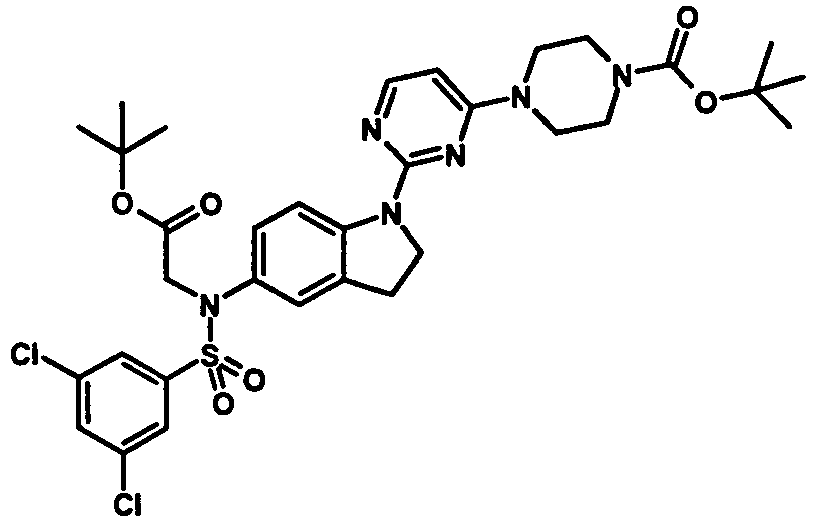
- (5) tert-butyl 4-(2-{5-[(3,5-dichloro-phenylsulphonyl)-ethoxycarbonylmethylamino]-2,3-dihydro-indol-1-yl}-pyrimidin-4-yl)-piperazine-1-carboxylate

Mass spectrum (ESI+): m/z = 691 [M+H]+ - (6) tert-butyl 4-(2-{5-[tert-butoxycarbonylmethyl-(3,5-dichloro-phenylsulphonyl)-amino]-indol-1-yl}-pyrimidin-4-yl)-piperazine-1-carboxylate
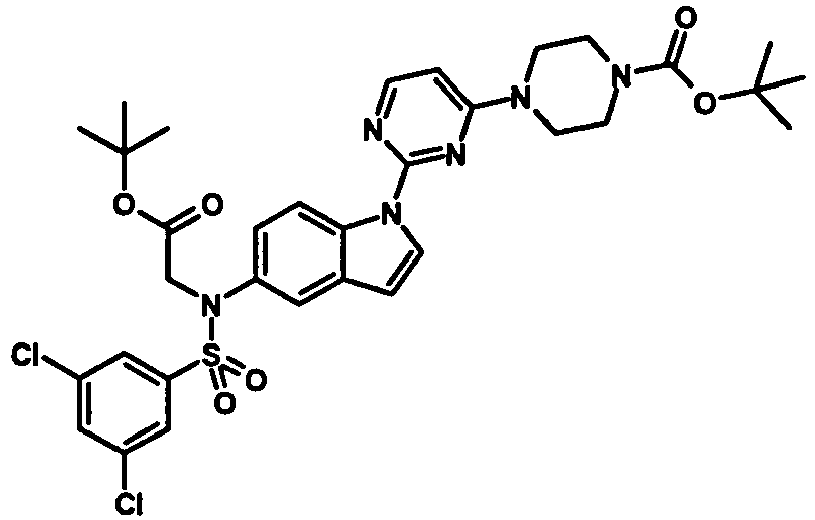
- (7) tert-butyl 4-(2-{5-[(3,5-dichloro-phenylsulphonyl)-ethoxycarbonylmethylamino]-indol-1-yl}-pyrimidin-4-yl)-piperazine-1-carboxylate

Mass spectrum (ESI+): m/z = 689 [M+H]+ - (8) tert-butyl 4-(5-{5-[tert-butoxycarbonylmethyl-(3,5-dichloro-phenylsulphonyl)-amino]-2,3-dihydro-indol-1-yl}-pyrazine-2-carbonyl)-piperazine-1-carboxylate

- (9) tert-butyl 4-(5-{5-[tert-butoxycarbonylmethyl-(3,5-dichloro-phenylsulphonyl)-amino]-indol-1-yl}-pyrazine-2-carbonyl)-piperazine-1-carboxylate

- (10) tert.butyl [(3,5-dichloro-phenylsulphonyl)-(1-pyrimidin-2-yl-1H-indol-4-yl)-amino]-acetate

- (11) tert-butyl 6'-{5-[tert-butoxycarbonylmethyl-(3,5-dichloro-phenylsulphonyl)-amino]-indol-1-yl}-2,3,5,6-tetrahydro-[1,2']bipyrazinyl-4-carboxylate
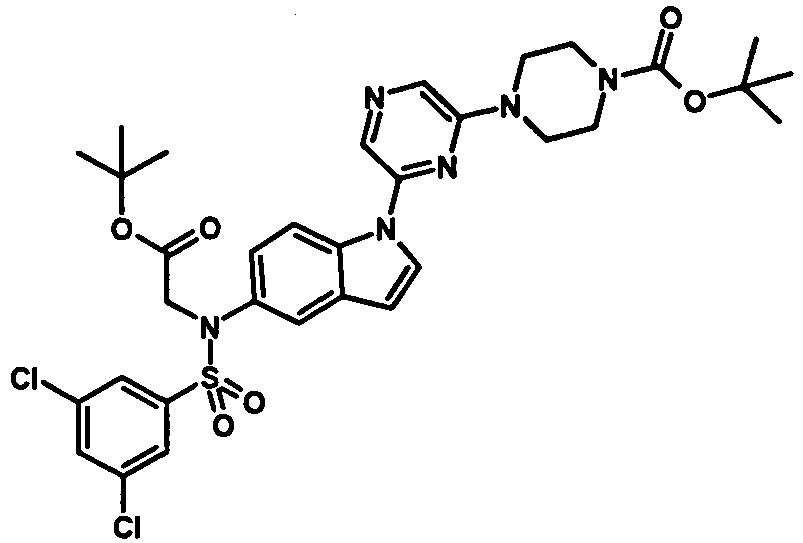
- (12) tert-butyl 6'-{5-[tert-butoxycarbonylmethyl-(3,5-dichloro-phenylsulphonyl)-amino]-2,3-dihydro-indol-1-yl}-2,3,5,6-tetrahydro-[1,2']bipyrazinyl-4-carboxylate

- (13) tert.butyl [(3,5-dichloro-phenylsulphonyl)-(1-pyrimidin-2-yl-2,3-dihydro-1H-indol-4-yl)-amino]-acetate

- (14) tert.butyl [(1-{4-[tert-butoxycarbonylmethyl-(2-dimethylamino-ethyl)-amino]-pyrimidin-2-yl}-2,3-dihydro-1H-indol-5-yl)-(3,5-dichloro-phenylsulphonyl)-amino]-acetate
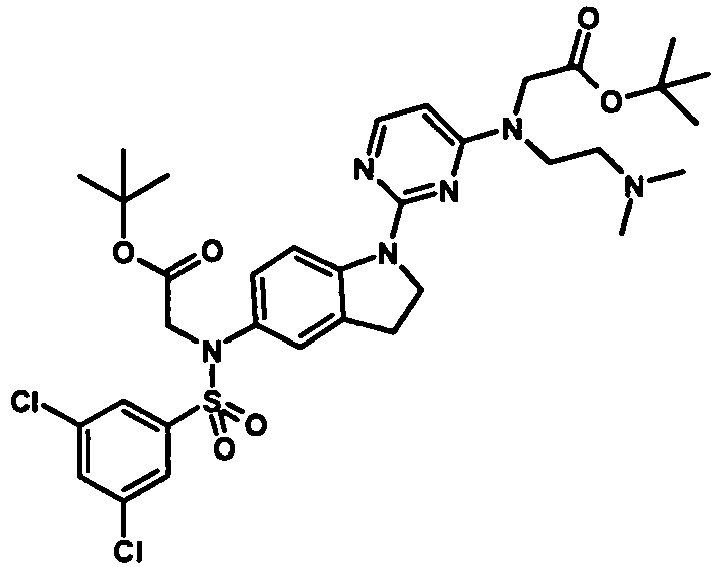
Mass spectrum (ESI+): m/z = 735 [M+H]+ - (15) tert-butyl 4-(6-{5-[tert-butoxycarbonylmethyl-(3,5-dichloro-phenylsulphonyl)-amino]-2,3-dihydro-indol-1-yl}-pyridazin-3-yl)-piperazine-1-carboxylate
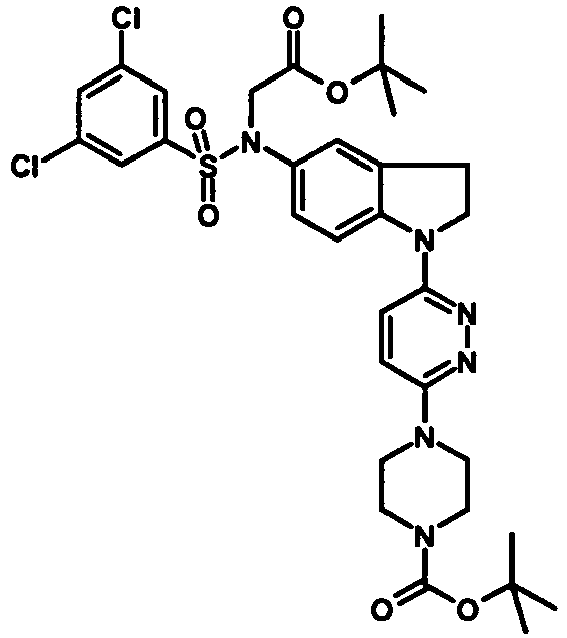
- (16) tert.butyl [(1-{4-[tert-butoxycarbonyl-(2-dimethylamino-ethyl)-amino]-pyrimidin-2-yl}-2,3-dihydro-1H-indol-5-yl)-(3,5-dichloro-phenylsulphonyl)-amino]-acetate
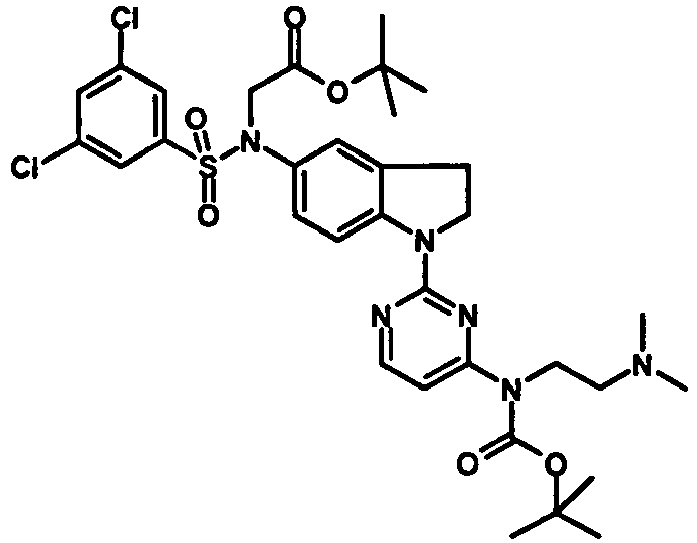
- (17) {2-[tert-butoxycarbonyl-(6-{5-[tert-butoxycarbonylmethyl-(3,5-dichlorophenylsulphonyl)-amino]-2,3-dihydro-indol-1-yl}-pyridazin-3-yl)-amino]-ethyl}-tert-butoxycarbonylmethyl-dimethyl-ammonium-bromide

- (18) {2-[tert-butoxycarbonyl-(2-{5-[tert-butoxycarbonylmethyl-(3,5-dichlorophenylsulphonyl)-amino]-2,3-dihydro-indol-1-yl}-pyrimidin-4-yl)-amino]-ethyl}-tert-butoxycarbonylmethyl-dimethyl-ammonium-bromide

- (19) tert.butyl [(3,5-dimethyl-phenylsulphonyl)-(1H-indol-5-yl)-amino]-acetate

- (20) tert.butyl [(1-{6-[tert-butoxycarbonyl-(2-(bis-tert-butoxycarbonyl)-aminoethyl)-amino]-pyridazin-3-yl}-2,3-dihydro-1H-indol-5-yl)-(3,5-dichlorophenylsulphonyl)-amino]-acetate

- (21) tert.butyl [(3,5-dichloro-phenylsulphonyl)-(1H-indol-5-yl)-amino]-acetate

- (22) ethyl [(3,5-dichloro-phenylsulphonyl)-(1H-indol-5-yl)-amino]-acetate

- (23) tert.butyl [(1-{6-[tert-butoxycarbonyl-(2-(bis-tert-butoxycarbonyl)-aminoethyl)-amino]-pyridazin-3-yl}-1H-indol-5-yl)-(3,5-dichloro-phenylsulphonyl)-amino]-acetate

- (24) tert-butyl 3-(6-{5-[tert-butoxycarbonylmethyl-(3,5-dichloro-phenylsulphonyl)-amino]-2,3-dihydro-indol-1-yl}-pyridazin-3-yl)-2-oxo-imidazolidine-1-carboxylate

- (25) tert.butyl [(3,5-dichloro-phenylsulphonyl)-(2,3-dimethyl-1H-indol-5-yl)-amino]-acetate
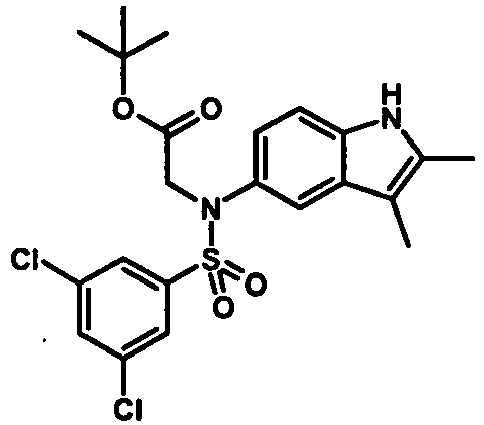
- (26) tert.butyl [(3,5-dichloro-phenylsulphonyl)-(2-methyl-1H-indol-5-yl)-amino]-acetate

- (27) tert.butyl [(3-bromo-5-methyl-phenylsulphonyl)-(1H-indol-5-yl)-amino]-acetate
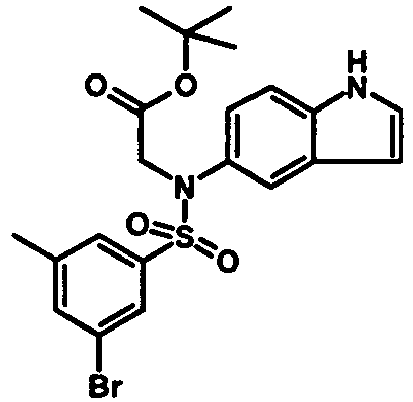
- (28) tert.butyl [(3,5-dichloro-phenylsulphonyl)-(7-methyl-1H-indol-5-yl)-amino]-acetate

- (29) tert.butyl [(3,5-dichloro-phenylsulphonyl)-(6-methyl-1H-indol-5-yl)-amino]-acetate

- (30) tert-butyl 5'-{5-[tert-butoxycarbonylmethyl-(3,5-dichloro-phenylsulphonyl)-amino]-indol-1-yl}-2,3,5,6-tetrahydro-[1,2']bipyrazinyl-4-carboxylate

- (31) tert.butyl [(3-chloro-5-methyl-phenylsulphonyl)-(1H-indol-5-yl)-amino]-acetate

- (32) tert.butyl [(3,5-dibromo-phenylsulphonyl)-(1H-indol-5-yl)-amino]-acetate

- (33) tert.butyl [(1-{4-[tert-butoxycarbonyl-(2-(bis-tert-butoxycarbonyl)-aminoethyl)-amino]-pyrimidin-2-yl}-1H-indol-5-yl)-(3,5-dichloro-phenylsulphonyl)-amino]-acetate

- (34) tert-butyl 4-(6-{5-[tert-butoxycarbonylmethyl-(3,5-dichloro-phenylsulphonyl)-amino]-indol-1-yl}-pyridazin-3-yl)-piperazine-1-carboxylate

- (35) tert.butyl {(3,5-dichloro-phenylsulphonyl)-[1-(2-methylamino-pyrimidin-4-yl)-1H-indol-5-yl]-amino}-acetate

- (36) tert.butyl [(3-bromo-5-chloro-phenylsulphonyl)-(1H-indol-5-yl)-amino]-acetate

- (37) tert.butyl [(1-{2-[tert-butoxycarbonyl-(2-(bis-tert-butoxycarbonyl)-aminoethyl)-amino]-pyrimidin-4-yl}-1H-indol-5-yl)-(3,5-dichloro-phenylsulphonyl)-amino]-acetate

- (38) tert-butyl 4-(6-{5-[tert-butoxycarbonylmethyl-(3,5-dichloro-phenylsulphonyl)-amino]-indol-1-yl}-5-cyano-pyridazin-3-yl)-piperazine-1-carboxylate

- (39) tert.butyl [(3,5-dichloro-phenylsulphonyl)-(3-methyl-1H-indol-5-yl)-amino]-acetate
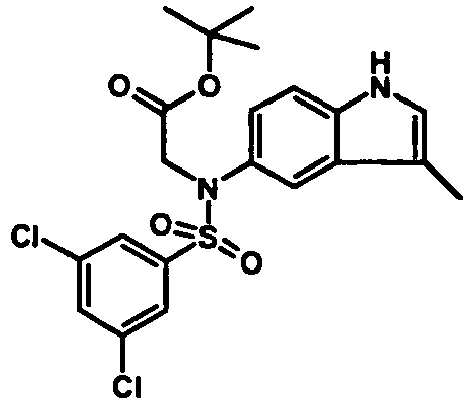
- (40) tert.butyl [(3-cyano-1H-indol-5-yl)-(3,5-dichloro-phenylsulphonyl)-amino]-acetate

- (41) tert.butyl [[1-(6-chloro-pyridazin-3-yl)-2,3-dihydro-1H-indol-5-yl]-(3,5-dichloro-phenylsulphonyl)-amino]-acetate

- (42) tert.butyl [(3-chloro-1H-indol-5-yl)-(3,5-dichloro-phenylsulphonyl)-amino]-acetate

- (43) tert.butyl [(3,5-dichloro-phenylsulphonyl)-(3-trifluoromethyl-1H-indol-5-yl)-amino]-acetate

- (44) tert.butyl {(3,5-dichloro-phenylsulphonyl)-[1-(4,6-dimethoxy-[1,3,5]triazin-2-yl)-2,3-dihydro-1H-indol-5-yl]-amino}-acetate
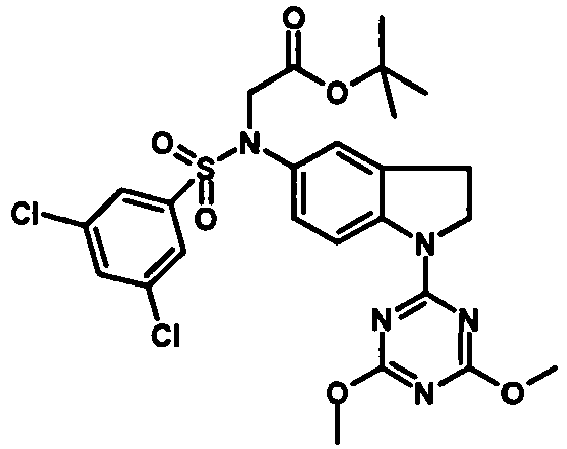
- (45) tert.butyl [(3,5-dichloro-phenylsulphonyl)-(1H-indazol-5-yl)-amino]-acetate

Rf value: 0.53 (silica gel: ethyl acetate/petroleum ether 1:1) - (46) tert.butyl [[6-chloro-1H-indol-5-yl]-(3,5-dichloro-phenylsulphonyl)-amino]-acetate

Rf value: 0.35 (silica gel: petroleum ether/ethyl acetate/conc. Aqueous ammonia solution 70:30:0.1) - (47) tert.butyl [(3,5-dichloro-phenylsulphonyl)-(3-methyl-1H-indazol-5-yl)-amino]-acetate

Rf value: 0.32 (silica gel: petroleum ether/ethyl acetate 2:1) - (48) tert.butyl [(3,5-dichloro-phenylsulphonyl)-(6-ethyl-1H-indol-5-yl)-amino]-acetate

Rf value: 0.75 (silica gel: cyclohexane/ethyl acetate 1:1) - (49) tert.butyl [(3,5-dichloro-phenylsulphonyl)-(4-methyl-1H-indol-5-yl)-amino]-acetate

- (50) tert.butyl [[1-(2-chloro-9H-purin-6-yl)-1H-indol-5-yl]-(3,5-dichlorophenylsulphonyl)-amino]-acetate

- (51) tert.butyl [(3,5-dichloro-phenylsulphonyl)-(3-ethyl-1H-indol-5-yl)-amino]-acetate

- (52) tert.butyl [[1-(5-carbamoyl-pyrazin-2-yl)-1H-indol-5-yl]-(3,5-dichlorophenylsulphonyl)-amino]-acetate

- (53) tert.butyl {(3,5-dichloro-phenylsulphonyl)-[1-(5-methylcarbamoyl-pyrazin-2-yl)-1H-indol-5-yl]-amino}-acetate
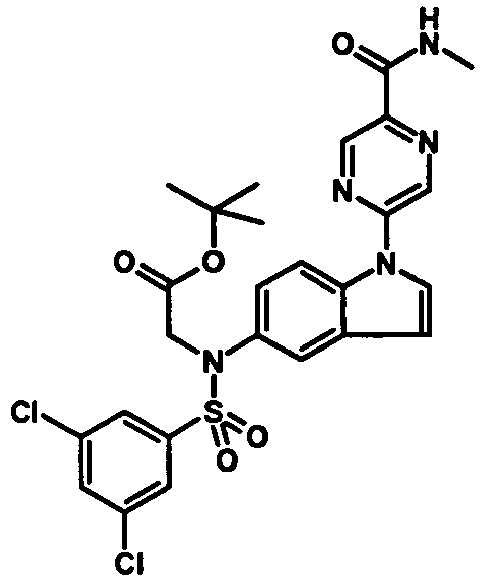
- (54) tert.butyl ((3,5-dichloro-phenylsulphonyl)-{1-[5-(morpholine-4-carbonyl)-pyrazin-2-yl]-1H-indol-5-yl}-amino)-acetate

- (55) tert.butyl [[1-(5-cyano-pyrazin-2-yl)-1H-indol-5-yl]-(3,5-dichlorophenylsulphonyl)-amino]-acetate
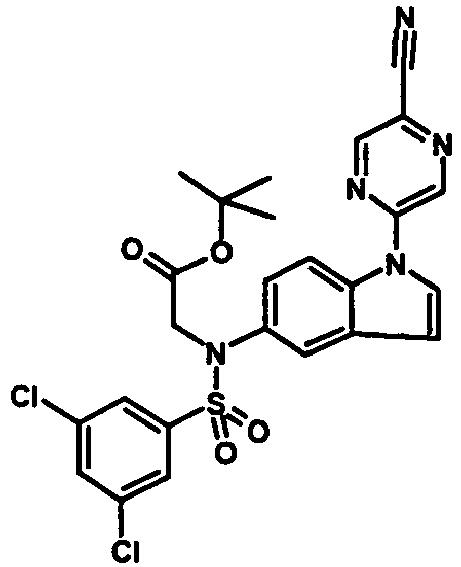
- (56) tert.butyl ((3,5-dichloro-phenylsulphonyl)-{1-[6-(morpholine-4-carbonyl)-pyridazin-3-yl]-1H-indol-5-yl}-amino)-acetate

- (57) tert.butyl {(3,5-dichloro-phenylsulphonyl)-[1-(6-dimethylcarbamoyl-pyridazin-3-yl)-1H-indol-5-yl]-amino}-acetate

- (58) tert.butyl [(3-bromo-1H-indol-5-yl)-(3,5-dichloro-phenylsulphonyl)-amino]-acetate

Rf value: 0.65 (silica gel: cyclohexane/ethyl acetate 2:1) - (59) tert.butyl [(3,5-dichloro-phenylsulphonyl)-(3-pyrimidin-2-yl-3H-benzoimidazol-5-yl)-amino]-acetate

- (60) tert.butyl [(3,5-dichloro-phenylsulphonyl)-(1-pyrimidin-2-yl-1H-benzoimidazol-5-yl)-amino]-acetate

- (61) tert.butyl [(2,6-dimethyl-pyridin-4-sulphonyl)-(1H-indol-5-yl)-amino]-acetate

- (62) tert.butyl [(2,6-dichloro-pyridin-4-sulphonyl)-(1H-indol-5-yl)-amino]-acetate

-

- 100 mg 5-aminoindole are dissolved in 10 ml of pyridine. To this are added 186 mg 3,5-dichlorophenylsulphonyl chloride and the mixture is left for 4 hours at ambient temperature with stirring. The solvent is eliminated in vacuo and the residue is divided between water and ethyl acetate. The aqueous phase is extracted with ethyl acetate and the combined organic phases are washed with saturated sodium chloride solution. After drying with magnesium sulphate the solvents are eliminated in vacuo and the residue is chromatographed on silica gel (cyclohexane/ethyl acetate 10:1 to 1:5).
Yield: 240 mg (93 % of theory)
Mass spectrum (ESI+): m/z = 341 [M+H]+ - The following compounds are obtained analogously to Example II:
- (1) 3,5-dichloro-N-(1-pyrimidin-2-yl-2,3-dihydro-1H-indol-5-yl)-phenylsulphonamide
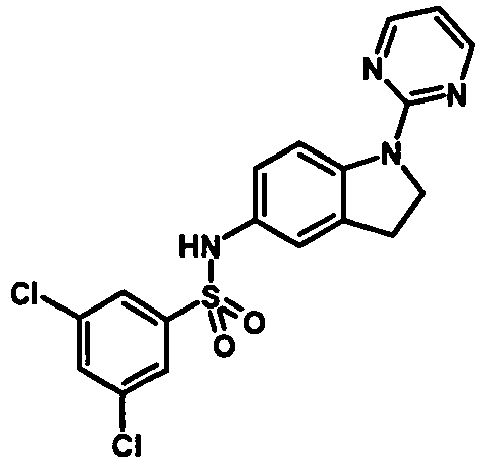
- (2) 3,5-dichloro-N-[1-(1-methyl-1H-imidazol-2-yl)-2,3-dihydro-1H-indol-5-yl]-phenylsulphonamide

- (3) tert-butyl 2-[5-(3,5-dichloro-phenylsulphonylamino)-2,3-dihydro-indol-1-yl]-imidazole-1-carboxylate

- (4) 3,5-dichloro-N-(1-pyridin-4-yl-2,3-dihydro-1H-indol-5-yl)-phenylsulphonamide

Mass spectrum (ESI+): m/z = 420 [M+H]+ - (5) 3,5-dichloro-N-(1-pyrimidin-2-yl-1H-indol-4-yl)-phenylsulphonamide
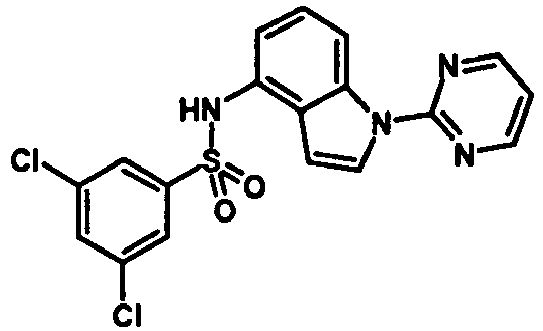
- (6) tert-butyl 6'-[5-(3,5-dichloro-phenylsulphonylamino)-indol-1-yl]-2,3,5,6-tetrahydro-[1,2']bipyrazinyl-4-carboxylate

- (7) tert-butyl 6'-[5-(3,5-dichloro-phenylsulphonylamino)-2,3-dihydro-indol-1-yl]-2,3,5,6-tetrahydro-[1,2']bipyrazinyl-4-carboxylate

- (8) 3,5-dichloro-N-(1-pyrimidin-2-yl-2,3-dihydro-1H-indol-4-yl)-phenylsulphonamide
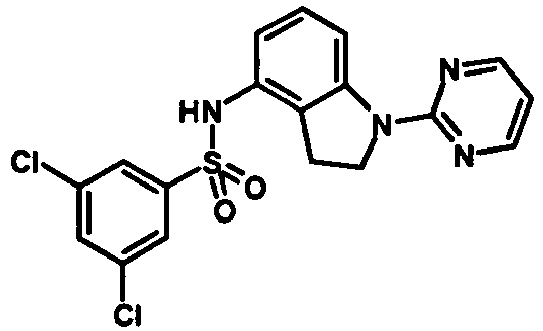
- (9) 3,5-dichloro-N-{1-[4-(2-dimethylamino-ethylamino)-pyrimidin-2-yl]-2,3-dihydro-1H-indol-5-yl}-phenylsulphonamide

Mass spectrum (ESI+): m/z = 507 [M+H]+ - (10) tert-butyl 4-{6-[5-(3,5-dichloro-phenylsulphonylamino)-2,3-dihydro-indol-1-yl]-pyridazin-3-yl}-piperazine-1-carboxylate
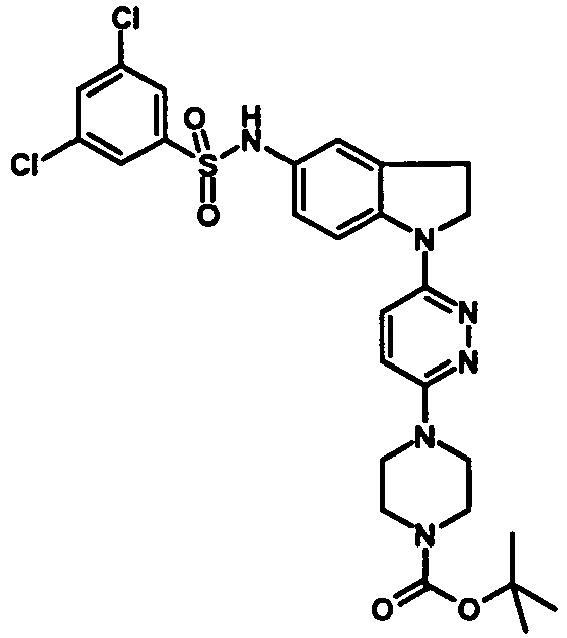
Mass spectrum (ESI+): m/z = 605 [M+H]+ - (11) tert-butyl {2-[5-(3,5-dichloro-phenylsulphonylamino)-2,3-dihydro-indol-1-yl]-pyrimid in-4-yl}-(2-dimethylamino-ethyl)-carbamate

Mass spectrum (ESI+): m/z = 607 [M+H]+ - (12) tert-butyl 6-[5-(3,5-dichloro-phenylsulphonylamino)-2,3-dihydro-indol-1-yl]-pyridazin-3-yl}-(2-dimethylamino-ethyl)-carbamate
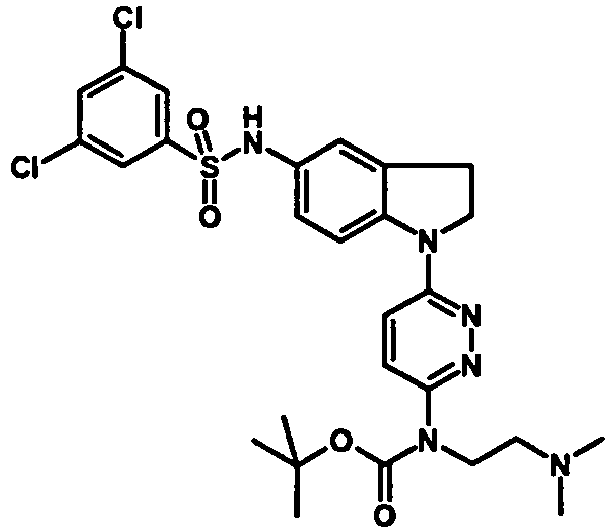
- (13) N-(1H-indole-5-yl)-3,5-dimethyl-phenylsulphonamide

Mass spectrum (ESI+): m/z = 301 [M+H]+ - (14) tert-butyl (2-(bis-tert-butoxycarbonyl)-amino-ethyl)-{6-[5-(3,5-dichlorophenylsulphonylamino)-2,3-dihydro-indol-1-yl]-pyridazin-3-yl}-carbamate

Mass spectrum (ESI+): m/z = 779 [M+H]+ - (15) tert-butyl (2-(bis-tert-butoxycarbonyl)-amino-ethyl)-{6-[5-(3,5-dichlorophenylsulphonylamino)-indol-1-yl]-pyridazin-3-yl}-carbamate

Mass spectrum (ESI+): m/z = 777 [M+H]+ - (16) tert-butyl 3-{6-[5-(3,5-dichloro-phenylsulphonylamino)-2,3-dihydro-indol-1-yl]-pyridazin-3-yl}-2-oxo-imidazolidine-1-carboxylate
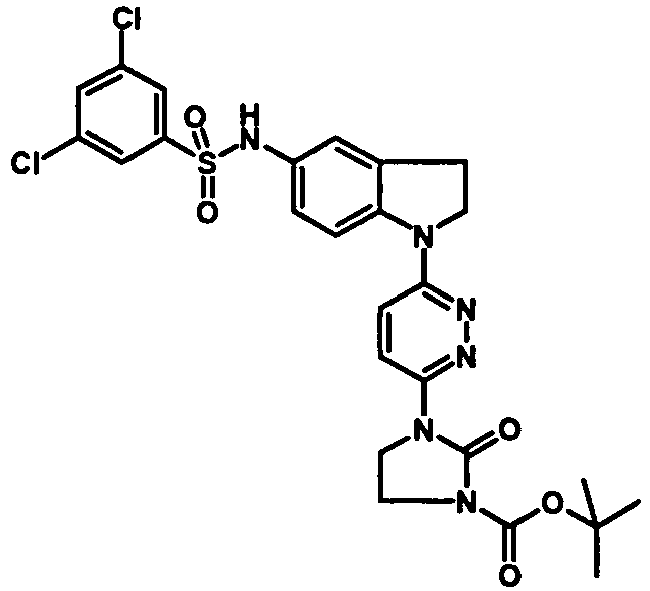
Mass spectrum (ESI+): m/z = 605 [M+H]+ - (17) 3,5-dichloro-N-(2,3-dimethyl-1H-indol-5-yl)-phenylsulphonamide

- (18) 3,5-dichloro-N-(2-methyl-1H-indol-5-yl)-phenylsulphonamide

- (19) 3-bromo-N-(1H-indol-5-yl)-5-methyl-phenylsulphonamide

Mass spectrum (ESI+): m/z = 365 [M+H]+ - (20) tert-butyl 5'-[5-(3,5-dichloro-phenylsulphonylamino)-indol-1-yl]-2,3,5,6-tetrahydro-[1,2']bipyrazinyl-4-carboxylate

- (21) 3-chloro-N-(1H-indol-5-yl)-5-methyl-phenylsulphonamide
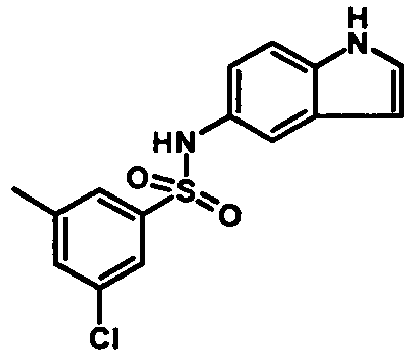
- (22) 3,5-dibromo-N-(1H-indol-5-yl)-phenylsulphonamide

- (23) tert-butyl (2-(bis-tert-butoxycarbonyl)-amino-ethyl)-{2-[5-(3,5-dichlorophenylsulphonylamino)-indol-1-yl]-pyrimidin-4-yl}-carbamate

Mass spectrum (ESI+): m/z = 777 [M+H]+ - (24) tert-butyl 4-{6-[5-(3,5-dichloro-phenylsulphonylamino)-indol-1-yl]-pyridazin-3-yl}-piperazine-1-carboxylate

Mass spectrum (ESI+): m/z = 603 [M+H]+ - (25) 3,5-dichloro-N-[1-(2-methylamino-pyrimidin-4-yl)-1H-indol-5-yl]-phenylsulphonamide

Mass spectrum (ESI+): m/z = 448 [M+H]+ - (26) 3-bromo-5-chloro-N-(1H-indol-5-yl)-phenylsulphonamide

Mass spectrum (ESI+): m/z = 385 [M+H]+ - (27) tert-butyl (2-(bis-tert-butoxycarbonyl)-amino-ethyl)-{4-[5-(3,5-dichlorophenylsulphonylamino)-indol-1-yl]-pyrimidin-2-yl}-carbamate
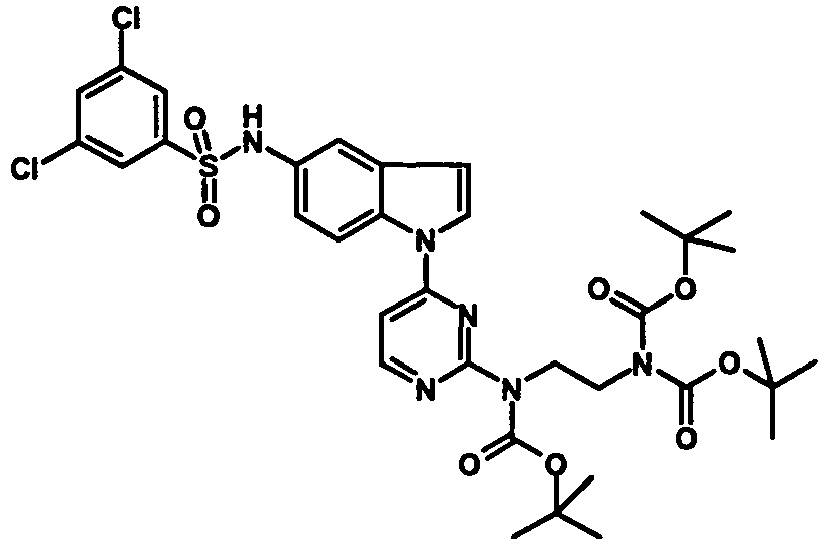
Mass spectrum (ESI+): m/z = 777 [M+H]+ - (28) 3,5-dichloro-N-(3-methyl-1H-indol-5-yl)-phenylsulphonamide

Mass spectrum (ESI+): m/z = 355 [M+H]+ - (29) 3,5-dichloro-N-(3-cyano-1H-indol-5-yl)-phenylsulphonamide

Mass spectrum (ESI+): m/z = 383 [M+NH4]+ - (30) 3,5-dichloro-N-[1-(6-chloro-pyridazin-3-yl)-2,3-dihydro-1H-indol-5-yl]-phenylsulphonamide

Mass spectrum (ESI+): m/z = 455 [M+H]+ - (31) 3,5-dichloro-N-(3-chloro-1H-indol-5-yl)-phenylsulphonamide

Mass spectrum (ESI+): m/z = 373 [M+H]+ - (32) 3,5-dichloro-N-(3-trifluoromethyl-1H-indol-5-yl)-phenylsulphonamide

Mass spectrum (ESI+): m/z = 409 [M+H]+ - (33) 3,5-dichloro-N-[1-(4,6-dimethoxy-[1,3,5]triazin-2-yl)-2,3-dihydro-1H-indol-5-yl]-phenylsulphonamide

Mass spectrum (ESI+): m/z = 482 [M+H]+ - (34) 3,5-dichloro-N-(1H-indazol-5-yl)-phenylsulphonamide

Rf value: 0.60 (silica gel: ethyl acetate/petroleum ether 2:1) - (35) 3,5-dichloro-N-(6-chloro-1H-indol-5-yl)-phenylsulphonamide

Rf value: 0.65 (silica gel: cyclohexane/ethyl acetate 1:1) - (36) 3,5-dichloro-N-(3-methyl-1H-indazol-5-yl)-phenylsulphonamide

- (37) 3,5-dichloro-N-(6-ethyl-1H-indol-5-yl)-phenylsulphonamide

Rf value: 0.65 (silica gel: cyclohexane/ethyl acetate 1:1) - (38) 3,5-dichloro-N-(3-ethyl-1H-indol-5-yl)-phenylsulphonamide

- (39) 5-[5-(3,5-dichloro-phenylsulphonylamino)-indol-1-yl]-pyrazin-2-carboxylic acid-amide
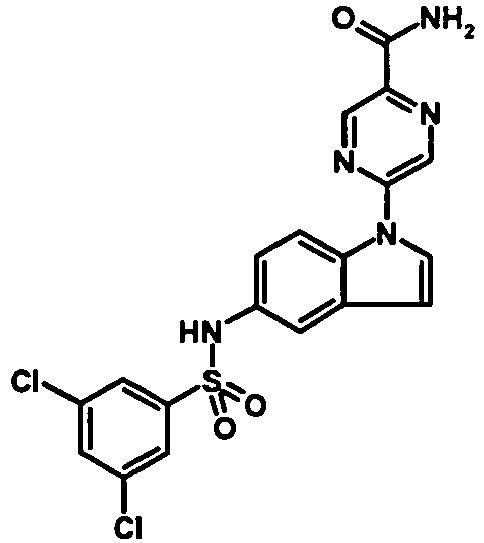
- (40) 5-[5-(3,5-dichloro-phenylsulphonylamino)-indol-1-yl]-pyrazin-2-carboxylic acid-methyl-amide
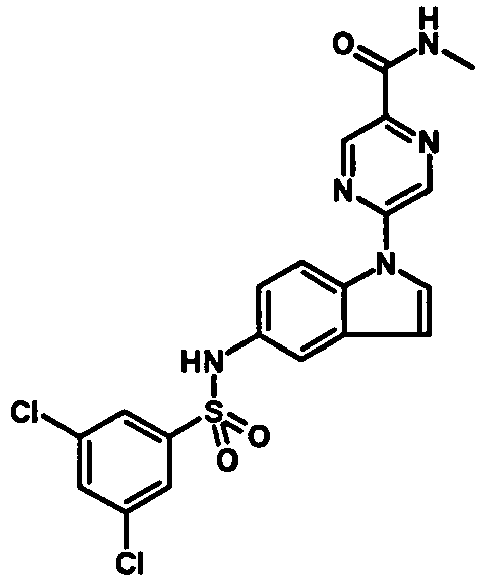
- (41) 3,5-dichloro-N-{1-[5-(morpholine-4-carbonyl)-pyrazin-2-yl]-1H-indol-5-yl}-phenyl-sulphonamide
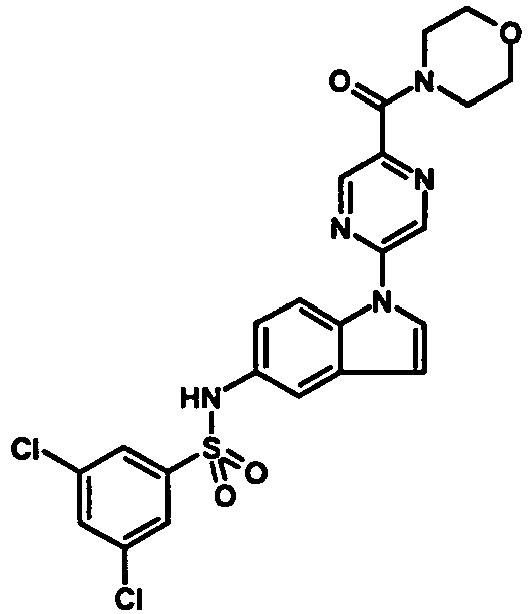
- (42) 3,5-dichloro-N-[1-(5-cyano-pyrazin-2-yl)-1H-indol-5-yl]-phenylsulphonamide

- (43) 3,5-dichloro-N-{1-[6-(morpholine-4-carbonyl)-pyridazin-3-yl]-1H-indol-5-yl}-phenylsulphonamide

- (44) 6-[5-(3,5-dichloro-phenylsulphonylamino)-indol-1-yl]-pyridazine-3-carboxylic acid-dimethylamide

- (45) N-(3-bromo-1H-indol-5-yl)-3,5-dichloro-phenylsulphonamide

Rf value: 0.75 (silica gel: cyclohexane/ethyl acetate 1:1) - (46) 3,5-dichloro-N-(3-pyrimidin-2-yl-3H-benzoimidazol-5-yl)-phenylsulphonamide

- (47) 3,5-dichloro-N-(1-pyrimidin-2-yl-1H-benzoimidazol-5-yl)-phenylsulphonamide

-

- 170 mg 1-(1-methyl-1H-imidazol-2-yl)-5-nitro-2,3-dihydro-1H-indole are dissolved in 20 ml of tetrahydrofuran. To this are added 20 mg palladium on charcoal (10%) and the mixture is hydrogenated for 1 hour at ambient temperature. Then the catalyst is filtered off and the solvent is eliminated in vacuo. The crude product is extracted from diethyl ether.
Yield: 95 mg (64 % of theory)
Mass spectrum (ESI+): m/z = 215 [M+H]+ - The following compounds are obtained analogously to Example III:
- (1) 1-pyrimidin-2-yl-2,3-dihydro-1H-indol-5-ylamine

is further reacted directly in Example XXX. - (2) tert-butyl 2-(5-amino-2,3-dihydro-indol-1-yl)-imidazole-1-carboxylate

Rf value: 0.60 (Aluminiumoxyd, petroleum ether/ethyl acetate 1:4) - (3) 1-pyridin-4-yl-2,3-dihydro-1H-indol-5-ylamine

Mass spectrum (ESI+): m/z = 212 [M+H]+ - (4) 1-pyrimidin-2-yl-1H-indol-4-ylamine

- (5) tert-butyl 6'-(5-amino-indol-1-yl)-2,3,5,6-tetrahydro-[1,2']bipyrazinyl-4-carboxylate

- (6) tert-butyl 6'-(5-amino-2,3-dihydro-indol-1-yl)-2,3,5,6-tetrahydro-[1,2']bipyrazinyl-4-carboxylate

Mass spectrum (ESI+): m/z = 397 [M+H]+ - (7) 1-pyrimidin-2-yl-2,3-dihydro-1H-indol-4-ylamine
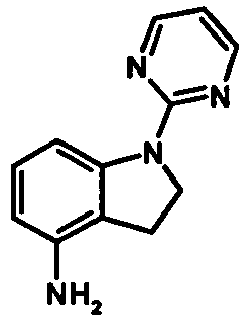
- (8) N-[2-(5-amino-2,3-dihydro-indol-1-yl)-pyrimidin-4-yl]-N',N'-dimethyl-ethan-1,2-diamine
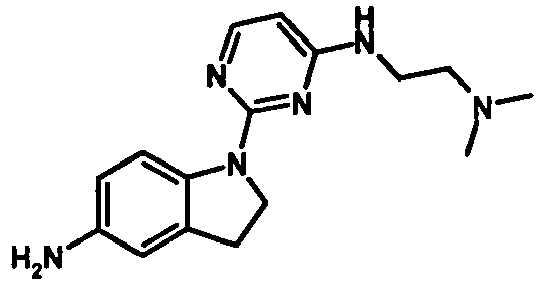
Mass spectrum (ESI+): m/z = 299 [M+H]+ - (9) tert-butyl 4-[6-(5-amino-2,3-dihydro-indol-1-yl)-pyridazin-3-yl]-piperazine-1-carboxylate

Mass spectrum (ESI+): m/z = 397 [M+H]+ - (10) tert-butyl [2-(5-amino-2,3-dihydro-indol-1-yl)-pyrimidin-4-yl]-(2-dimethylamino-ethyl)-carbamate
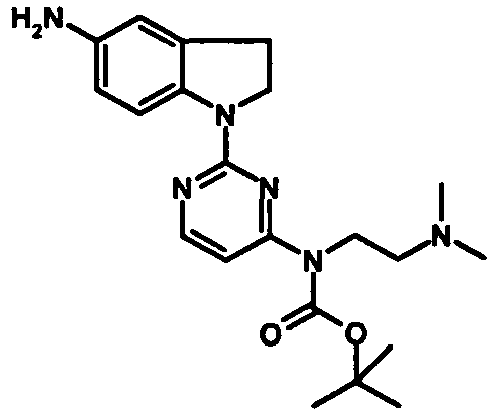
Rf value: 0.18 (aluminium oxide, petroleum ether/ethyl acetate = 1:4) - (11) tert-butyl [6-(5-amino-2,3-dihydro-indol-1-yl)-pyridazin-3-yl]-(2-dimethylamino-ethyl)-carbamate

Mass spectrum (ESI+): m/z = 399 [M+H]+ - (12) tert-butyl [6-(5-amino-2,3-dihydro-indol-1-yl)-pyridazin-3-yl]-(2-(bis-tert-butoxycarbonyl)-amino-ethyl)-carbamate

Mass spectrum (ESI+): m/z = 571 [M+H]+ - (13) tert-butyl [6-(5-amino-indol-1-yl)-pyridazin-3-yl]-(2-(bis-tert-butoxycarbonyl)-amino-ethyl)-carbamate

Mass spectrum (ESI+): m/z = 569 [M+H]+ - (14) tert-butyl 3-[6-(5-amino-2,3-dihydro-indol-1-yl)-pyridazin-3-yl]-2-oxo-imidazolidine-1-carboxylate

Mass spectrum (ESI+): m/z = 397 [M+H]+ - (15) 2,3-dimethyl-1H-indol-5-ylamine
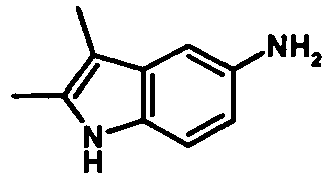
- (16) tert-butyl 5'-(5-amino-indol-1-yl)-2,3,5,6-tetrahydro-[1,2']bipyrazinyl-4-carboxylate

Mass spectrum (ESI+): m/z = 395 [M+H]+ - (17) tert-butyl [2-(5-amino-indol-1-yl)-pyrimidin-4-yl]-(2-(bis-tert-butoxycarbonyl)-amino-ethyl)-carbamate

Mass spectrum (ESI+): m/z = 569 [M+H]+ - (18) tert-butyl 4-[6-(5-amino-indol-1-yl)-pyridazin-3-yl]-piperazine-1-carboxylate

Mass spectrum (ESI+): m/z = 395 [M+H]+ - (19) 1-(2-methylamino-pyrimidin-4-yl)-1H-indol-5-ylamine

Mass spectrum (ESI+): m/z = 240 [M+H]+ - (20) tert-butyl [4-(5-amino-indol-1-yl)-pyrimidin-2-yl]-(2-(bis-tert-butoxycarbonyl)-amino-ethyl)-carbamate

Mass spectrum (ESI+): m/z = 569 [M+H]+ - (21) 3-methyl-1H-indol-5-ylamine
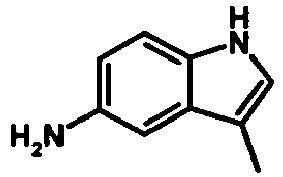
Mass spectrum (ESI+): m/z = 147 [M+H]+ - (22) 5-amino-1H-indole-3-carbonitrile

Mass spectrum (ESI+): m/z = 158 [M+H]+ - (23) 1-(6-chloro-pyridazin-3-yl)-2,3-dihydro-1H-indol-5-ylamine

Mass spectrum (ESI+): m/z = 247 [M+H]+ - (24) 3-trifluoromethyl-1H-indol-5-ylamine
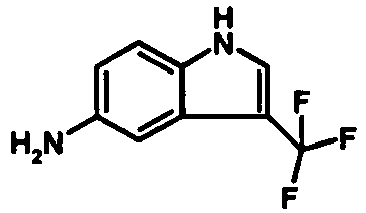
Rf value: 0.5 (silica gel; cyclohexane/ethyl acetate 1:1) - (25) 1-(4,6-dimethoxy-[1,3,5]triazin-2-yl)-2,3-dihydro-1H-indol-5-ylamine

Mass spectrum (ESI+): m/z = 274 [M+H]+ - (26) 6-chloro-1H-indol-5-ylamine

Mass spectrum (ESI+): m/z = 167 [M+H]+
Rf value: 0.57 (silica gel; cyclohexane/ethyl acetate 1:1) - (27) 6-ethyl-1H-indol-5-ylamine

Mass spectrum (ESI+): m/z = 161 [M+H]+
Rf value: 0.45 (silica gel; cyclohexane/ethyl acetate 1:1) - (28) 3-ethyl-1H-indol-5-ylamine

Mass spectrum (ESI+): m/z = 161 [M+H]+ - (29) 5-(5-amino-indol-1-yl)-pyrazin-2-carboxylic acid-amide

- (30) 5-(5-amino-indol-1-yl)-pyrazin-2-carboxylic acid-methyl-amide

- (31) [5-(5-amino-indol-1-yl)-pyrazin-2-yl]-morpholin-4-yl-methanone

- (32) 5-(5-amino-indol-1-yl)-pyrazine-2-carbonitrile
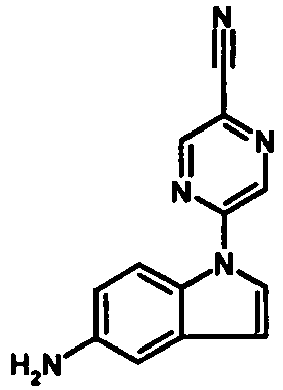
- (33) [6-(5-amino-indol-1-yl)-pyridazin-3-yl]-morpholin-4-yl-methanone

- (34) 6-(5-amino-indol-1-yl)-pyridazine-3-carboxylic acid-dimethylamide

- (35) 6-amino-1-pyrimidin-2-yl-1H-benzoimidazole
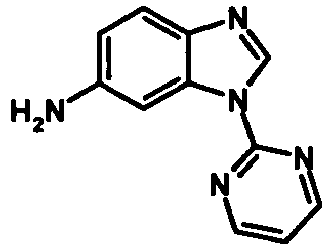
- (36) 5-amino-1-pyrimidin-2-yl-1H-benzoimidazole

-

- 206 mg tert-butyl 4-[5-(5-nitro-indol-1-yl)-pyrazin-2-carbonyl]-piperazine-1-carboxylate are dissolved in 10 ml of methanol. 30 mg palladium on charcoal (10%) are added and the mixture is hydrogenated for 4 hours at ambient temperature. The catalyst is suction filtered and washed with methanol. The solvent is eliminated in vacuo and the residue is taken up in 5 ml of pyridine. 81 mg of 3,5-dichlorophenylsulphonyl chloride are added and the mixture is stirred for 12 hours at ambient temperature. Then the pyridine is eliminated in vacuo and the residue is divided between semisaturated sodium chloride solution and ethyl acetate. The aqueous phase is extracted once with ethyl acetate and the combined organic phases are dried on magnesium sulphate. Then the solvent is eliminated in vacuo.
Yield: 230 mg (80 % of theory)
Mass spectrum (ESI-): m/z = 629 [M-H]- - The following compounds are obtained analogously to Example IV:
- (1) tert-butyl 4-{2-[5-(3,5-dichloro-phenylsulphonylamino)-2,3-dihydro-indol-1-yl]-pyrimidin-4-yl}-piperazine-1-carboxylate

- (2) tert-butyl 4-{2-[5-(3,5-dichloro-phenylsulphonylamino)-indol-1-yl]-pyrimidin-4-yl}-piperazine-1-carboxylate

- (3) tert-butyl 4-{5-[5-(3,5-dichloro-phenylsulphonylamino)-2,3-dihydro-indol-1-yl]-pyrazin-2-carbonyl}-piperazine-1-carboxylate

- (4) 3,5-dichloro-N-(7-methyl-1H-indol-5-yl)-phenylsulphonamide

- (5) 3,5-dichloro-N-(6-methyl-1H-indol-5-yl)-phenylsulphonamide

- (6) tert-butyl 4-{5-cyano-6-[5-(3,5-dichloro-phenylsulphonylamino)-indol-1-yl]-pyridazin-3-yl}-piperazine-1-carboxylate

- (7) 3,5-dichloro-N-(4-methyl-1H-indol-5-yl)-phenylsulphonamide

- (8) 3,5-dichloro-N-[1-(2-chloro-9H-purin-6-yl)-1H-indol-5-yl]-phenylsulphonamide

-

- 162 mg tert.butyl {(3,5-dichloro-phenylsulphonyl)-[1-(2,6-dichloro-pyrimidin-4-yl)-1H-indol-5-yl]-amino}-acetate are dissolved in 3 ml dichloromethane. 0.64 ml trifluoroacetic acid are added thereto and the solution is stirred for 12 hours at ambient temperature. The solvents are eliminated in vacuo, the residue is twice taken up in dichloromethane and this is again eliminated in vacuo. The residue is extracted from diethyl ether.
Yield: 31 mg (18 % of theory)
Mass spectrum (ESI+): m/z = 545 [M+H]+ -
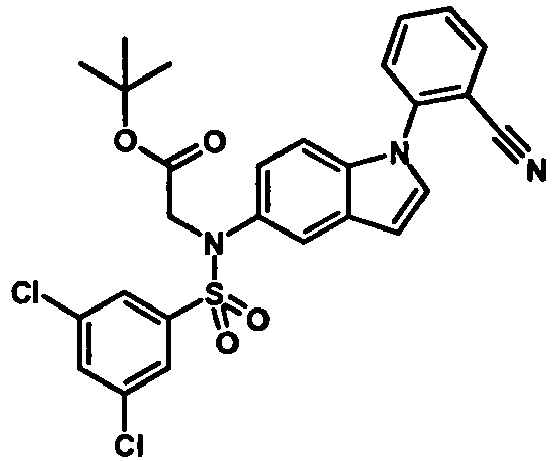
- 300 mg tert.butyl [(3,5-dichloro-phenylsulphonyl)-(1H-indol-5-yl)-amino]-acetate, 12 mg copper iodide and 307 mg potassium phosphate are placed in a flask. It is evacuated twice and filled with argon. Then 1 ml of toluene and 166 mg 2-iodo-benzonitrile are added. After the addition of 21 µl N,N'-dimethyl-trans-cyclohexanediamine the mixture is heated to 110°C for 8 hours. Then it is divided between water and ethyl acetate. The aqueous phase is extracted with ethyl acetate and the combined organic phases are dried on magnesium sulphate. The solvents are eliminated in vacuo and the residue is chromatographed on silica gel (cyclohexane/ethyl acetate 10:1 to 1:2).
Yield: 266 mg (73 % of theory)
Mass spectrum (ESI+): m/z = 573 [M+NH4]+ - The following compounds are obtained analogously to Example VI:
- (1) tert.butyl [(3,5-dichloro-phenylsulphonyl)-(1-pyrimidin-2-yl-1H-indol-5-yl)-amino]-acetate

Mass spectrum (ESI+): m/z = 550 [M+NH4]+ - (2) tert.butyl [(3,5-dichloro-phenylsulphonyl)-(1-pyrazin-2-yl-1H-indol-5-yl)-amino]-acetate
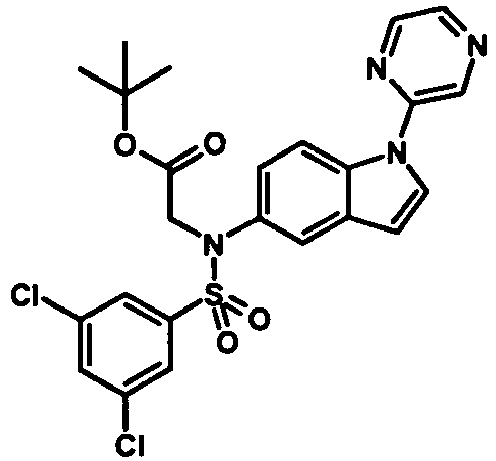
Mass spectrum (ESI+): m/z = 550 [M+NH4]+ - (3) tert.butyl [(3,5-dichloro-phenylsulphonyl)-(1-pyrimidin-5-yl-1H-indol-5-yl)-amino]-acetate

Mass spectrum (ESI+): m/z = 533 [M+H]+ - (4) benzyl 3-{5-[tert-butoxycarbonylmethyl-(3,5-dichloro-phenylsulphonyl)-amino]-indol-1-yl}-benzoate

Mass spectrum (ESI+): m/z = 682 [M+NH4]+ - (5) tert.butyl {(3,5-dichloro-phenylsulphonyl)-[1-(4-morpholin-4-yl-phenyl)-1H-indol-5-yl]-amino}-acetate
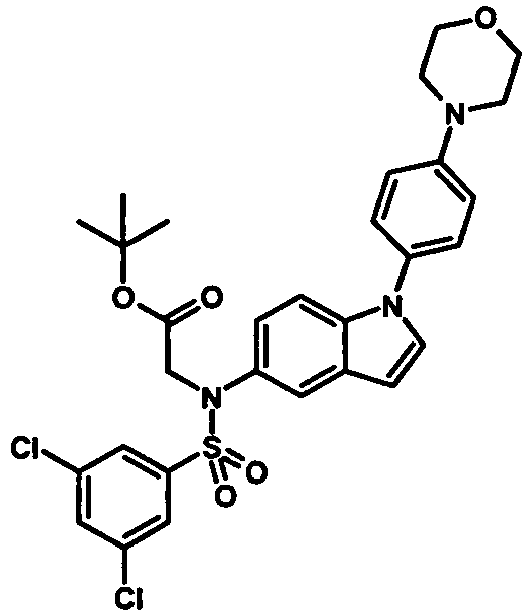
Mass spectrum (ESI+): m/z = 616 [M+H]+ - (6) tert.butyl {(3,5-dichloro-phenylsulphonyl)-[1-(4-morpholin-4-ylmethyl-phenyl)-1H-indol-5-yl]-amino}-acetate

Mass spectrum (ESI+): m/z = 630 [M+H]+ - (7) tert.butyl [(3,5-dichloro-phenylsulphonyl)-(1-pyridin-4-yl-1H-indol-5-yl)-amino]-acetate

Mass spectrum (ESI+): m/z = 532 [M+H]+ - (8) tert.butyl ((3,5-dichloro-phenylsulphonyl)-{1-[5-(2-dimethylamino-ethylamino)-pyrazin-2-yl]-1H-indol-5-yl}-amino)-acetate

Mass spectrum (ESI+): m/z = 619 [M+H]+ - (9) tert-butyl 4-(3-{5-[tert-butoxycarbonylmethyl-(3,5-dichloro-phenylsulphonyl)-amino]-indol-1-yl}-benzoyl)-piperazine-1-carboxylate

Mass spectrum (ESI+): m/z = 760 [M+NH4]+ - (10) tert-butyl 4-(4-{5-[tert-butoxycarbonylmethyl-(3,5-dichloro-phenylsulphonyl)-amino]-indol-1-yl}-benzoyl)-piperazine-1-carboxylate

Mass spectrum (ESI+): m/z = 760 [M+NH4]+ - (11) tert.butyl [(3,5-dichloro-phenylsulphonyl)-(1-pyridin-2-yl-1H-indol-5-yl)-amino]-acetate
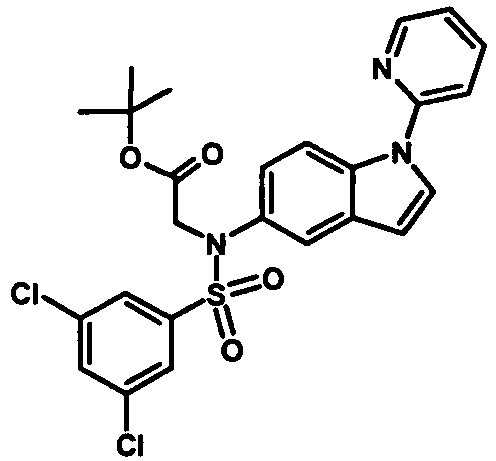
Mass spectrum (ESI+): m/z = 532 [M+H]+ - (12) tert.butyl {(3,5-dichloro-phenylsulphonyl)-[1-(3-trifluoromethyl-pyridin-2-yl)-1H-indol-5-yl]-amino}-acetate

Mass spectrum (ESI+): m/z = 617 [M+NH4]+ - (13) tert-butyl 4-(6-{5-[tert-butoxycarbonylmethyl-(3,5-dichloro-phenylsulphonyl)-amino]-indol-1-yl}-5-methyl-pyridazin-3-yl)-piperazine-1-carboxylate

Mass spectrum (ESI+): m/z = 731 [M+H]+ - (14) tert.butyl ((3,5-dichloro-phenylsutphonyl)-{1-[6-(2-dimethylamino-ethylamino)-pyridazin-3-yl]-1H-indol-5-yl}-amino)-acetate

Mass spectrum (ESI+): m/z = 619 [M+H]+ - (15) tert.butyl [{1-[6-(2-dimethylamino-ethylamino)-pyridazin-3-yl]-1H-indol-5-yl}-(3,5-dimethyl-phenylsulphonyl)-amino]-acetate

Mass spectrum (ESI+): m/z = 579 [M+H]+ - (16) tert.butyl {(3,5-dichloro-phenylsulphonyl)-[1-(2-piperazin-1-yl-quinolin-8-yl)-1H-indol-5-yl]-amino}-acetate
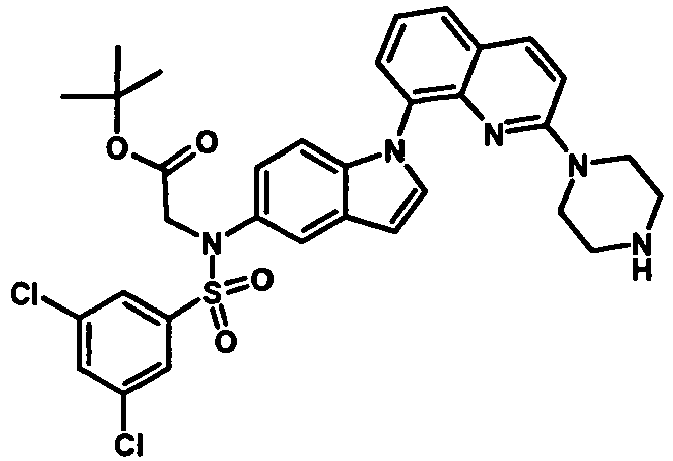
Mass spectrum (ESI+): m/z = 666 [M+H]+ - (17) tert.butyl {(3,5-dichloro-phenylsulphonyl)-[1-(6-methyl-pyridazin-3-yl)-1H-indol-5-yl]-amino}-acetate

tert.butyl {(3,5-dichloro-phenylsulphonyl)-[3-iodo-1-(6-methyl-pyridazin-3-yl)-1H-indol-5-yl]-amino}-acetate
Mass spectrum (ESI+): m/z = 547 [M+H]+ (tert.butyl {(3,5-dichlorophenylsulphonyl)-[1-(6-methyl-pyridazin-3-yl)-1H-indol-5-yl]-amino}-acetate) and
Mass spectrum (ESI+): m/z = 673 [M+H]+ (tert.butyl {(3,5-dichlorophenylsulphonyl)-[3-iodo-1-(6-methyl-pyridazin-3-yl)-1H-indol-5-yl]-amino}-acetate) - (18) tert.butyl ((3,5-dichloro-phenylsulphonyl)-{1-[6-(2-dimethylamino-ethylamino)-pyridazin-3-yl]-2,3-dimethyl-1H-indol-5-yl}-amino)-acetate

Mass spectrum (ESI+): m/z = 647 [M+H]+ - (19) tert.butyl ((3,5-dichloro-phenylsulphonyl)-{1-[6-(2-dimethylamino-ethylamino)-pyridazin-3-yl]-2-methyl-1H-indol-5-yl}-amino)-acetate

Mass spectrum (ESI+): m/z = 633 [M+H]+ - (20) tert.butyl ((3-bromo-5-methyl-phenylsulphonyl)-{1-[6-(2-dimethylamino-ethylamino)-pyridazin-3-yl]-1H-indol-5-yl}-amino)-acetate

Mass spectrum (ESI+): m/z = 643 [M+H]+ - (21) tert.butyl ((3,5-dichloro-phenylsulphonyl)-{1-[4-(2-dimethylamino-ethylcarbamoyl)-pyridin-2-yl]-1H-indol-5-yl}-amino)-acetate
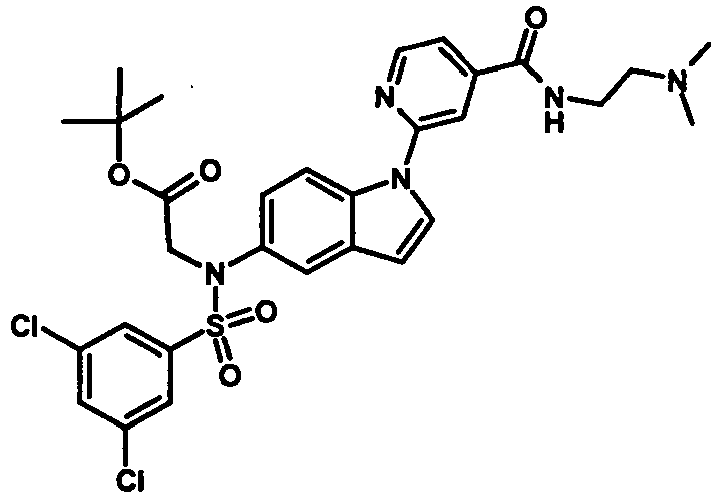
Mass spectrum (ESI+): m/z = 646 [M+H]+ - (22) tert-butyl 4-(2-{5-[tert-butoxycarbonylmethyl-(3,5-dichloro-phenylsulphonyl)-amino]-indol-1-yl}-pyridin-4-carbonyl)-piperazine-1-carboxylate

Mass spectrum (ESI+): m/z = 744 [M+H]+ - (23) tert.butyl ((3-chloro-5-methyl-phenylsulphonyl)-{1-[6-(2-dimethylamino-ethylamino)-pyridazin-3-yl]-1H-indol-5-yl}-amino)-acetate

Mass spectrum (ESI+): m/z = 599 [M+H]+ - (24) tert.butyl [{1-[5-(2-dimethylamino-ethylamino)-pyrazin-2-yl]-1H-indol-5-yl}-(3,5-dimethyl-phenylsulphonyl)-amino]-acetate

Mass spectrum (ESI+): m/z = 579 [M+H]+ - (25) tert.butyl ((3-bromo-5-methyl-phenylsulphonyl)-{1-[5-(2-dimethylamino-ethylamino)-pyrazin-2-yl]-1H-indol-5-yl}-amino)-acetate

Mass spectrum (ESI+): m/z = 643 [M+H]+ - (26) tert.butyl ((3,5-dibromo-phenylsulphonyl)-{1-[5-(2-dimethylamino-ethylamino)-pyrazin-2-yl]-1H-indol-5-yl}-amino)-acetate

Mass spectrum (ESI-): m/z = 707 [M-H]- - (27) tert.butyl ((3-chloro-5-methyl-phenylsulphonyl)-{1-[5-(2-dimethylamino-ethylamino)-pyrazin-2-yl]-1H-indol-5-yl}-amino)-acetate

Mass spectrum (ESI+): m/z = 599 [M+H]+ - (28) tert.butyl ((3,5-dibromo-phenylsulphonyl)-{1-[6-(2-dimethylamino-ethylamino)-pyridazin-3-yl]-1H-indol-5-yl}-amino)-acetate

Mass spectrum (ESI-): m/z = 707 [M-H]- - (29) tert.butyl [[1-(6-amino-pyridazin-3-yl)-1H-indol-5-yl]-(3,5-dichlorophenylsulphonyl)-amino]-acetate
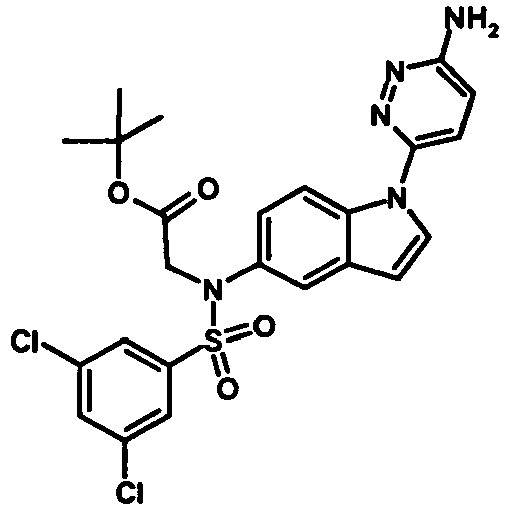
Mass spectrum (ESI+): m/z = 548 [M+H]+ - (30) tert.butyl [(3,5-dichloro-phenylsulphonyl)-(1-naphthalin-2-yl-1H-indol-5-yl)-amino]-acetate

Mass spectrum (ESI+): m/z = 598 [M+NH4]+ - (31) tert.butyl ((3-bromo-5-chloro-phenylsulphonyl)-{1-[6-(2-dimethylamino-ethylamino)-pyridazin-3-yl]-1H-indol-5-yl}-amino)-acetate

Rf value: 0.4 (dichloromethane/(methanol/water/acetic acid 8:1:1) 4:1) - (32) tert.butyl ((3-bromo-5-chloro-phenylsulphonyl)-{1-[5-(2-dimethylamino-ethylamino)-pyrazin-2-yl]-1H-indol-5-yl}-amino)-acetate
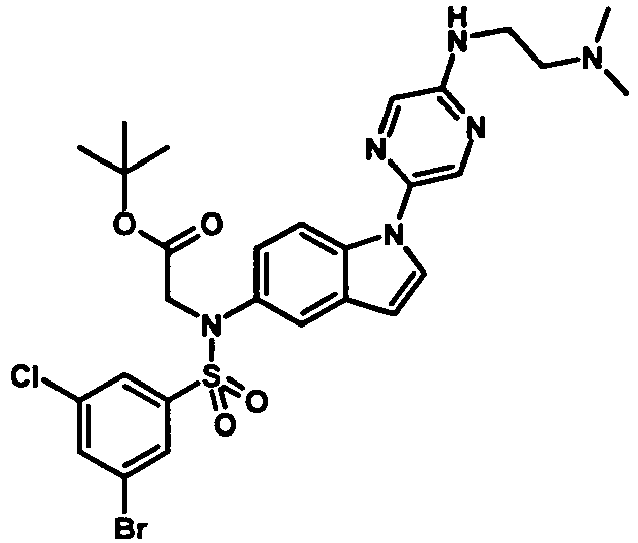
Rf value: 0.5 (dichloromethane/(methanol/water/acetic acid 8:1:1) 4:1) - (33) tert-butyl [[1-(5-amino-pyridin-2-yl)-1H-indol-5-yl]-(3,5-dichlorophenylsulphonyl)-amino]-acetate

Mass spectrum (ESI+): m/z = 547 [M+H]+ - (34) tert.butyl {(3,5-dichloro-phenylsulphonyl)-[1-(2-methyl-quinolin-6-yl)-1H-indol-5-yl]-amino}-acetate

Mass spectrum (ESI+): m/z = 596 [M+H]+ - (35) tert.butyl [(3,5-dichloro-phenylsulphonyl)-(1-naphthalin-1-yl-1H-indol-5-yl)-amino]-acetate

Mass spectrum (ESI+): m/z = 598 [M+NH4]+ - (36) tert.butyl {(3,5-dichloro-phenylsulphonyl)-[1-(3-methyl-pyridin-2-yl)-1H-indol-5-yl]-amino}-acetate

Mass spectrum (ESI+): m/z = 546 [M+H]+ - (37) tert-butyl 4-(6-{5-[tert-butoxycarbonylmethyl-(3,5-dichloro-phenylsulphonyl)-amino]-indol-1-yl}-pyridin-2-carbonyl)-piperazine-1-carboxylate

Mass spectrum (ESI+): m/z = 761 [M+NH4]+ - (38) tert.butyl ((3,5-dichloro-phenylsulphonyl)-{1-[6-(2-dimethylamino-ethylcarbamoyl)-pyridin-2-yl]-1H-indol-5-yl}-amino)-acetate

Mass spectrum (ESI+): m/z = 646 [M+H]+ - (39) tert-butyl 4-(6-{5-[tert-butoxycarbonylmethyl-(3,5-dichloro-phenylsulphonyl)-amino]-indol-1-yl}-pyridazin-3-yl)-[1,4]diazepan-1-carboxylate

Mass spectrum (ESI+): m/z = 731 [M+H]+ - (40) tert.butyl {(3,5-dichloro-phenylsulphonyl)-[1-(6-methyl-pyridin-2-yl)-1H-indol-5-yl]-amino}-acetate
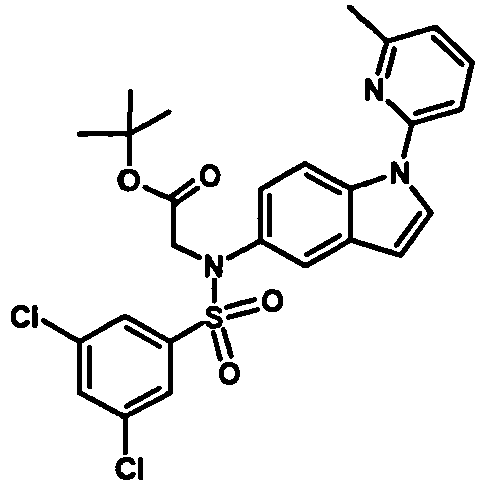
Mass spectrum (ESI+): m/z = 546 [M+H]+ - (41) tert.butyl [(1-{6-[tert-butoxycarbonyl-(3-(bis-tert-butoxycarbonyl)-aminopropyl)-amino]-pyridazin-3-yl}-1H-indol-5-yl)-(3,5-dichloro-phenylsulphonyl)-amino]-acetate

Mass spectrum (ESI+): m/z = 922 [M+NH4]+ - (42) tert.butyl {(3,5-dichloro-phenylsulphonyl)-[1-(4-methyl-pyridin-2-yl)-1H-indol-5-yl]-amino}-acetate
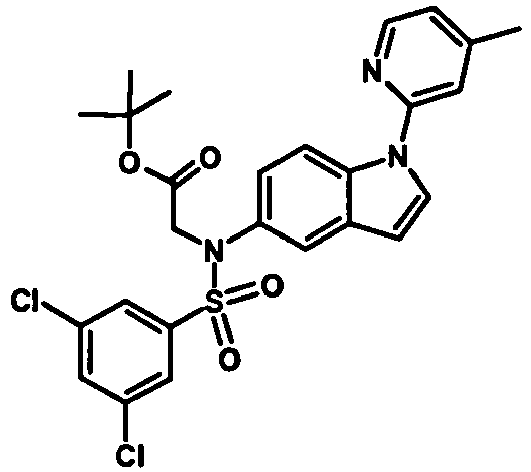
Mass spectrum (ESI+): m/z = 546 [M+H]+ - (43) tert.butyl [[1-(6-cyclopropylamino-pyridazin-3-yl)-1H-indol-5-yl]-(3,5-dichlorophenylsulphonyl)-amino]-acetate
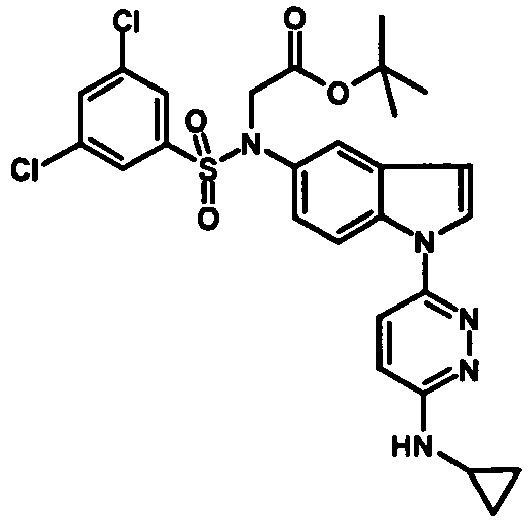
Mass spectrum (ESI+): m/z = 588 [M+H]+ - (44) tert.butyl {(3,5-dichloro-phenylsulphonyl)-[1-(5-methyl-pyridin-2-yl)-1H-indol-5-yl]-amino}-acetate

Mass spectrum (ESI+): m/z = 546 [M+H]+ - (45) tert.butyl [(3,5-dichloro-phenylsulphonyl)-(1-isoquinolin-1-yl-1H-indol-5-yl)-amino]-acetate

Mass spectrum (ESI+): m/z = 582 [M+H]+ - (46) tert.butyl [[1-(3-amino-pyridin-2-yl)-1H-indol-5-yl]-(3,5-dichlorophenylsulphonyl)-amino]-acetate

Mass spectrum (ESI+): m/z = 547 [M+H]+ - (47) tert.butyl ((3,5-dichloro-phenylsulphonyl)-{1-[6-(2-dimethylamino-ethylamino)-pyridazin-3-yl]-3-methyl-1H-indol-5-yl}-amino)-acetate

Mass spectrum (ESI+): m/z = 633 [M+H]+ - (48) tert.butyl [(1-{6-[(2-(bis-tert-butoxycarbonyl)-amino-ethyl)-methyl-amino]-pyridazin-3-yl}-1H-indol-5-yl)-(3,5-dichloro-phenylsulphonyl)-amino]-acetate
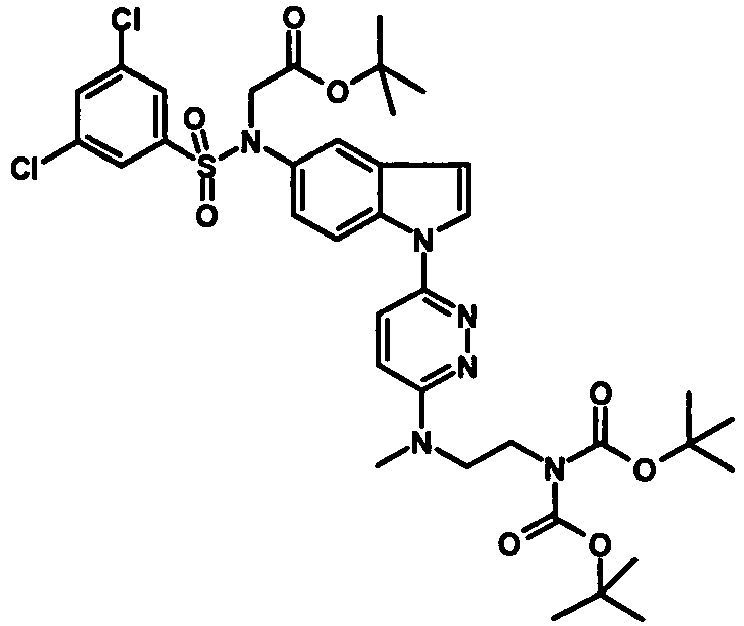
Mass spectrum (ESI+): m/z = 805 [M+H]+ - (49) tert.butyl [[1-(6-{tert-butoxycarbonyl-[2-(tert-butoxycarbonyl-methyl-amino)-ethyl]-amino}-pyridazin-3-yl)-1H-indol-5-yl]-(3,5-dichloro-phenylsulphonyl)-amino]-acetate

Mass spectrum (ESI+): m/z = 805 [M+H]+ - (50) tert.butyl ((3,5-dichloro-phenylsulphonyl)-{1-[3-(2-dimethylamino-ethylamino)-pyridin-2-yl]-1H-indol-5-yl}-amino)-acetate

Mass spectrum (ESI+): m/z = 618 [M+H]+ - (51) tert.butyl [{1-[6-(2-amino-2-methyl-propylamino)-pyridazin-3-yl]-1H-indol-5-yl}-(3,5-dichloro-phenylsulphonyl)-amino]-acetate

Mass spectrum (ESI+): m/z = 619 [M+H]+ - (52) tert.butyl [{1-[6-(3-tert-butoxycarbonylamino-piperidin-1-yl)-pyridazin-3-yl]-1H-indol-5-yl}-(3,5-dichloro-phenylsulphonyl)-amino]-acetate

Mass spectrum (ESI+): m/z = 731 [M+H]+ - (53) ethyl {(3,5-dichloro-phenylsulphonyl)-[1-(6-methyl-pyridazin-3-yl)-1H-indol-5-yl]-amino}-acetate

Mass spectrum (ESI+): m/z = 519 [M+H]+ - (54) tert.butyl [{3-cyano-1-[6-(2-dimethylamino-ethylamino)-pyridazin-3-yl]-1H-indol-5-yl}-(3,5-dichloro-phenylsulphonyl)-amino]-acetate

Rf value: 0.5 (dichloromethane/(methanol/33% ammonia in water 9:1) 9:1) - (55) tert.butyl {(3,5-dichloro-phenylsulphonyl)-[1-(6-morpholin-4-yl-pyridazin-3-yl)-1H-indol-5-yl]-amino}-acetate

Mass spectrum (ESI+): m/z = 618 [M+H]+ - (56) tert.butyl [[1-(5-amino-pyrazin-2-yl)-1H-indol-5-yl]-(3,5-dichlorophenylsulphonyl)-amino]-acetate

Mass spectrum (ESI+): m/z = 565 [M+NH4]+ - (57) tert.butyl [{3-chloro-1-[6-(2-dimethylamino-ethylamino)-pyridazin-3-yl]-1H-indol-5-yl}-(3,5-dichloro-phenylsulphonyl)-amino]-acetate

Mass spectrum (ESI+): m/z = 655 [M+H]+ - (58) tert.butyl ((3,5-dichloro-phenylsulphonyl)-{1-[6-(2-dimethylamino-ethylamino)-pyridazin-3-yl]-3-trifluoromethyl-1H-indol-5-yl}-amino)-acetate

Mass spectrum (ESI+): m/z = 687 [M+H]+ - (59) tert-butyl 4-(6-{5-[tert-butoxycarbonylmethyl-(3,5-dichloro-phenylsulphonyl)-amino]-indol-1-yl}-pyridin-3-carbonyl)-piperazine-1-carboxylate

- (60) tert.butyl ((3,5-dichloro-phenylsulphonyl)-{1-[5-(2-dimethylamino-ethylcarbamoyl)-pyridin-2-yl]-1H-indol-5-yl}-amino)-acetate

Mass spectrum (ESI+): m/z = 646 [M+H]+ - (61) tert.butyl {(3,5-dichloro-phenylsulphonyl)-[1-(6-dimethylamino-pyridazin-3-yl)-1H-indol-5-yl]-amino}-acetate

Mass spectrum (ESI+): m/z = 576 [M+H]+ - (62) tert.butyl ((3,5-dichloro-phenylsulphonyl)-{1-[6-(2-hydroxy-ethylamino)-pyridazin-3-yl]-1H-indol-5-yl}-amino)-acetate

Mass spectrum (ESI+): m/z = 592 [M+H]+ - (63) tert.butyl [(1-{6-[tert-butoxycarbonyl-(2-piperidin-1-yl-ethyl)-amino]-pyridazin-3-yl}-1H-indol-5-yl)-(3,5-dichloro-phenylsulphonyl)-amino]-acetate
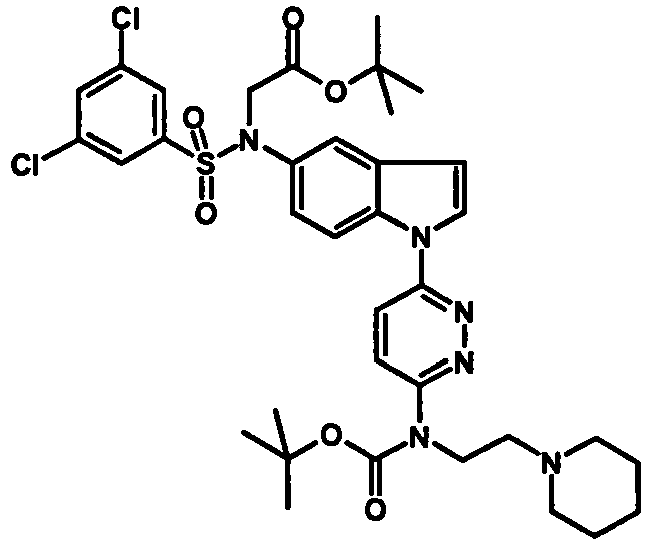
Mass spectrum (ESI+): m/z = 759 [M+H]+ - (64) tert.butyl {(3,5-dichloro-phenylsulphonyl)-[1-(4-morpholin-4-yl-pyridin-2-yl)-1H-indol-5-yl]-amino}-acetate

Rf value: 0.40 (silica gel: ethyl acetate/petroleum ether 1:1) - (65) tert.butyl {(3,5-dichloro-phenylsulphonyl)-[1-(5-morpholin-4-yl-pyridin-2-yl)-1H-indol-5-yl]-amino}-acetate

Rf value: 0.35 (silica gel: dichloromethane/ethyl acetate 9:1) - (66) tert.butyl ((3,5-dichloro-phenylsulphonyl)-{1-[5-(3-oxo-morpholin-4-yl)-pyrazin-2-yl]-1H-indol-5-yl}-amino)-acetate

Rf value: 0.38 (silica gel: ethyl acetate/petroleum ether 1:1) - (67) tert.butyl ((3,5-dichloro-phenylsulphonyl)-{1-[5-(tetrahydro-pyran-4-yloxy)-pyrazin-2-yl]-1H-indol-5-yl}-amino)-acetate

Mass spectrum (ESI+): m/z = 650 [M+NH4]+
Rf value: 0.20 (silica gel: petroleum ether/ethyl acetate 8:2) - (68) tert.butyl (S)-((3,5-dichloro-phenylsulphonyl)-{1-[5-(tetrahydro-furan-3-yloxy)-pyrazin-2-yl]-1H-indol-5-yl}-amino)-acetate

Mass spectrum (ESI+): m/z = 636 [M+NH4]+
Rf value: 0.20 (silica gel: petroleum ether/ethyl acetate 8:2) - (69) tert.butyl (R)-((3,5-dichloro-phenylsulphony)-{1-[6-(tetrahydro-furan-3-ylamino)-pyridazin-3-yl]-1H-indol-5-yl}-amino)-acetate

Mass spectrum (ESI+): m/z = 618 [M+H]+
Rf value: 0.24 (silica gel: dichloromethane/ethyl acetate 7:3) - (70) tert.butyl ((3,5-dichloro-phenylsulphony)-{1-[6-(3-oxo-morpholin-4-yl)-pyridazin-3-yl]-1H-indol-5-yl}-amino)-acetate

Mass spectrum (ESI+): m/z = 632 [M+H]+
Rf value: 0.22 (silica gel: petroleum ether/ethyl acetate 1:1) - (71) tert.butyl (R)-((3,5-dichloro-phenylsulphonyl)-{1-[5-(tetrahydro-furan-3-yloxy)-pyrazin-2-yl]-1H-indol-5-yl}-amino)-acetate

Mass spectrum (ESI+): m/z = 636 [M+NH4]+
Rf value: 0.25 (silica gel: petroleum ether/ethyl acetate 7:3) - (72) tert.butyl (S)-((3,5-dichloro-phenylsulphony)-{1-[6-(tetrahydro-furan-3-yloxy)-pyridazin-3-yl]-1H-indol-5-yl}-amino)-acetate

Mass spectrum (ESI+): m/z = 619 [M+H]+
Rf value: 0.15 (silica gel: petroleum ether/ethyl acetate 7:3) - (73) tert.butyl ((3,5-dichloro-phenylsulphonyl)-{1-[6-(tetrahydro-pyran-4-yloxy)-pyridazin-3-yl]-1H-indol-5-yl)-amino)-acetate

Mass spectrum (ESI+): m/z = 633 [M+H]+
Rf value: 0.20 (silica gel: petroleum ether/ethyl acetate 7:3) - (74) tert.butyl (R)-((3,5-dichloro-phenylsulphonyl)-{1-[6-(tetrahydro-furan-3-yloxy)-pyridazin-3-yl]-1H-indol-5-yl}-amino)-acetate

Mass spectrum (ESI+): m/z = 619 [M+H]+
Rf value: 0.45 (silica gel: cyclohexane/ethyl acetate 1:1) - (75) tert.butyl ((3,5-dichloro-phenylsulphonyl)-{1-[5-(3-oxo-morpholin-4-yl)-pyridin-2-yl]-1H-indol-5-yl}-amino)-acetate

Rf value: 0.45 (silica gel: dichloromethane/ethyl acetate 7:3) - (76) tert.butyl (R)-((3,5-dichloro-phenylsulphonyl)-{1-[5-(tetrahydro-furan-3-ylamino)-pyrazin-2-yl]-1H-indol-5-yl}-amino)-acetate

Mass spectrum (ESI+): m/z = 618 [M+H]+
Rf value: 0.48 (silica gel: dichloromethane/ethyl acetate 7:3) - (77) tert.butyl ((3,5-dichloro-phenylsulphonyl)-{1-[4-(3-oxo-morpholin-4-yl)-pyridin-2-yl]-1H-indol-5-yl}-amino)-acetate

Rf value: 0.57 (silica gel: dichloromethane/ethyl acetate 7:3) - (78) tert.butyl [(3,5-dichloro-phenylsulphonyl)-(1-{6-[methyl-(tetrahydro-pyran-4-yl)-amino]-pyridazin-3-yl}-1H-indol-5-yl)-amino]-acetate

Mass spectrum (ESI+): m/z = 646 [M+H]+
Rf value: 0.57 (silica gel: dichloromethane/ethyl acetate 7:3) - (79) tert.butyl ((3,5-dichloro-phenylsulphonyl)-{1-[5-(3-oxo-piperazin-1-yl)-pyrazin-2-yl]-1H-indol-5-yl}-amino)-acetate

Rf value: 0.40 (silica gel: cyclohexane/ethyl acetate 1:1) - (80) tert.butyl ((3,5-dichloro-phenylsulphonyl)-{1-[5-(tetrahydro-pyran-4-ylamino)-pyrazin-2-yl]-1H-indol-5-yl}-amino)-acetate

Rf value: 0.40 (silica gel: dichloromethane/ethyl acetate 7:3) - (81) tert.butyl ((3,5-dichloro-phenylsulphonyl)-{1-[6-(tetrahydro-pyran-4-ylamino)-pyridazin-3-yl]-1H-indol-5-yl}-amino)-acetate

Mass spectrum (ESI+): m/z = 632 [M+H]+
Rf value: 0.24 (silica gel: dichloromethane/ethyl acetate 7:3) - (82) (114) tert.butyl {(3,5-dichloro-phenylsulphonyl)-[1-(6-methyl-pyridazin-3-yl)-1H-indazol-5-yl]-amino}-acetate

Mass spectrum (ESI+): m/z = 548 [M+H]+
Rf value: 0.80 (silica gel: dichloromethane/ethyl acetate 7:3) - (83) tert.butyl ((3,5-dichloro-phenylsulphonyl)-{1-[5-(tetrahydro-furan-3-yloxy)-pyridin-2-yl]-1H-indol-5-yl}-amino)-acetate
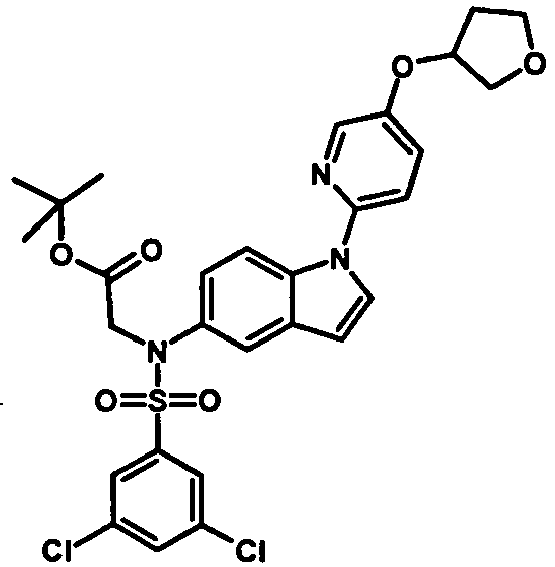
Mass spectrum (ESI+): m/z = 618 [M+H]+
Rf value: 0.50 (silica gel: cyclohexane/ethyl acetate 1:1) - (84) tert.butyl ((3,5-dichloro-phenylsulphonyl)-{1-[5-(tetrahydro-pyran-4-yloxy)-pyridin-2-yl]-1H-indol-5-yl}-amino)-acetate

Mass spectrum (ESI+): m/z = 632 [M+H]+
Rf value: 0.60 (silica gel: cyclohexane/ethyl acetate 1:1) - (85) tert.butyl ((3,5-dichloro-phenylsulphonyl)-{1-[4-(tetrahydro-furan-3-yloxy)-pyridin-2-yl]-1H-indol-5-yl}-amino)-acetate

Mass spectrum (ESI+): m/z = 618 [M+H]+
Rf value: 0.45 (silica gel: cyclohexane/ethyl acetate 1:1) - (86) tert.butyl [(3,5-dichloro-phenylsulphonyl)-(1-{5-[methyl-(tetrahydro-pyran-4-yl)-amino]-pyrazin-2-yl)-1H-indol-5-yl)-amino]-acetate

Mass spectrum (ESI+): m/z = 646 [M+H]+
Rf value: 0.75 (silica gel: dichloromethane/ethyl acetate 7:3) - (87) tert.butyl ((3,5-dichloro-phenylsulphonyl)-{3-iodo-1-[6-(3-oxo-piperazin-1-yl)-pyridazin-3-yl]-1H-indol-5-yl}-amino)-acetate

Mass spectrum (ESI+): m/z = 631 [M+H]+ - (88) tert.butyl ((3,5-dichloro-phenylsulphonyl)-{1-[6-(3-oxo-piperazin-1-yl)-pyridazin-3-yl]-1H-indol-5-yl}-amino)-acetate

- (89) tert.butyl ((3,5-dichloro-phenylsulphonyl)-{1-[4-(tetrahydro-pyran-4-yloxy)-pyridin-2-yl]-1H-indol-5-yl}-amino)-acetate

Mass spectrum (ESI+): m/z = 632 [M+H]+
Rf value: 0.45 (silica gel: cyclohexane/ethyl acetate 1:1) - (90) tert.butyl [[6-chloro-1-(6-methyl-pyridazin-3-yl)-1H-indol-5-yl]-(3,5-dichlorophenylsulphonyl)-amino]-acetate

Mass spectrum (ESI+): m/z = 581 [M+H]+
Rf value: 0.75 (silica gel: dichloromethane/methanol 98:2) - (91) tert.butyl [[3-methyl-1-(6-methyl-pyridazin-3-yl)-1H-indazol-5-yl]-(3,5-dichloro-phenylsulphonyl)-amino]-acetate

Mass spectrum (ESI+): m/z = 562 [M+H]+
Rf value: 0.58 (silica gel: petroleum ether/ethyl acetate 1:1) - (92) tert.butyl {(3,5-dichloro-phenylsulphonyl)-[1-(5-trifluoromethyl-pyridazin-3-yl)-1H-indol-5-yl]-amino)-acetate

Rf value: 0.31 (silica gel: petroleum ether/ethyl acetate 5:1) - (93) tert.butyl {(3,5-dichloro-phenylsulphonyl)-[3-iodo-1-(5-trifluoromethylpyridazin-3-yl)-1H-indol-5-yl]-amino}-acetate

Mass spectrum (ESI+): m/z = 744 [M+NH4]+
Rf value: 0.38 (silica gel: petroleum ether/ethyl acetate 5:1) - (94) tert.butyl {(3,5-dichloro-phenylsulphonyl)-[1-(6-iodo-pyrimidin-4-yl)-1H-indol-5-yl]-amino}-acetate

Mass spectrum (ESI+): m/z = 676 [M+NH4]+
Rf value: 0.67 (silica gel: petroleum ether/ethyl acetate 2:1) - (95) (128) tert.butyl [[6-ethyl-1-(6-methyl-pyridazin-3-yl)-1H-indol-5-yl]-(3,5-dichloro-phenylsulphonyl)-amino]-acetate
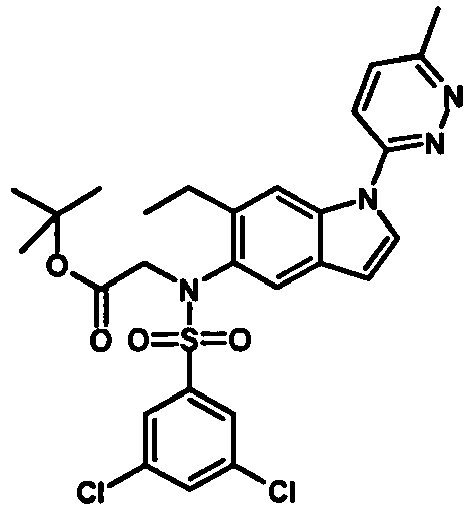
Mass spectrum (ESI+): m/z = 575 [M+H]+
Rf value: 0.40 (silica gel: cyclohexane/ethyl acetate 1:1) - (96) tert.butyl {(3,5-dichloro-phenylsulphonyl)-[1-(6-methylamino-pyridazin-3-yl)-1H-indol-5-yl]-amino}-acetate
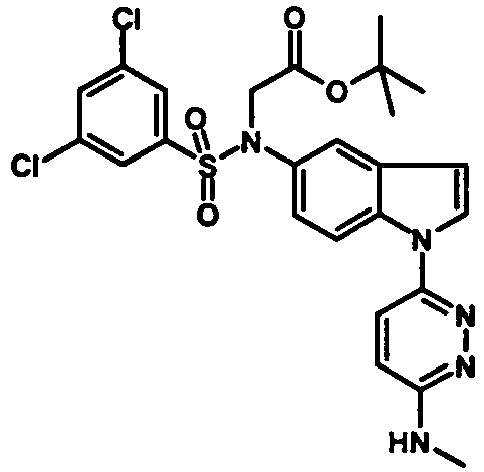
- (97) tert.butyl {(3,5-dichloro-phenylsulphonyl)-[3-iodo-1-(6-methylaminopyridazin-3-yl)-1H-indol-5-yl]-amino}-acetate

Mass spectrum (ESI+): m/z = 562 [M+H]+ tert.butyl {(3,5-dichlorophenylsulphonyl)-[1-(6-methylamino-pyridazin-3-yl)-1H-indol-5-yl]-amino}-acetate and
Mass spectrum (ESI+): m/z = 688 [M+H]+tert.butyl {(3,5-dichlorophenylsulphonyl)-[3-iodo-1-(6-methylamino-pyridazin-3-yl)-1H-indol-5-yl]-amino}acetate - (98) tert.butyl ((3,5-dichloro-phenylsulphonyl)-{3-iodo-1-[6-(2-oxo-imidazolidin-1-yl)-pyridazin-3-yl]-1H-indol-5-yl}-amino)-acetate

Mass spectrum (ESI+): m/z = 743 [M+H]+ - (99) tert.butyl [[1-(5-cyano-pyridin-2-yl)-1H-indol-5-yl]-(3,5-dichlorophenylsulphonyl)-amino]-acetate

- (100) tert.butyl [[1-(4-amino-pyridin-2-yl)-1H-indol-5-yl]-(3,5-dichlorophenylsulphonyl)-amino]-acetate

- (101) tert.butyl [[1-(6-cyano-pyridin-2-yl)-1H-indol-5-yl]-(3,5-dichlorophenylsulphonyl)-amino]-acetate

Mass spectrum (ESI+): m/z = 574 [M+NH4]+ - (102) tert.butyl ((3,5-dichloro-phenylsulphonyl)-{1-[6-(2-dimethylamino-ethoxy)-pyridazin-3-yl]-1H-indol-5-yl}-amino)-acetate

Mass spectrum (ESI+): m/z = 620 [M+H]+ - (103) tert-butyl 4-(6-{5-[(3,5-dichloro-phenylsulphonyl)-ethoxycarbonylmethylamino]-indol-1-yl}-pyridazin-3-yl)-[1,4]diazepan-1-carboxylate

Mass spectrum (ESI+): m/z = 703 [M+H]+ - (104) tert.butyl {(3,5-dichloro-phenylsulphonyl)-[1-(2,4-dimethoxy-pyrimidin-5-yl)-1H-indol-5-yl]-amino}-acetate

Mass spectrum (ESI+): m/z = 593 [M+H]+ - (105) tert.butyl [[1-(6-{tert-butoxycarbonyl-[3-(tert-butoxycarbonyl-methyl-amino)-propyl]-amino}-pyridazin-3-yl)-1H-indol-5-yl]-(3,5-dichloro-phenylsulphonyl)-amino]-acetate

Mass spectrum (ESI+): m/z = 819 [M+H]+ - (106) tert.butyl [(1-{6-[(3-(bis-tert-butoxycarbonyl)-amino-propyl)-methyl-amino]-pyridazin-3-yl}-1H-indol-5-yl)-(3,5-dichloro-phenylsulphonyl)-amino]-acetate

Mass spectrum (ESI+): m/z = 805 [M+H]+ - (107) tert.butyl {(3,5-dichloro-phenylsulphonyl)-[1-(1,3-dimethyl-2,4-dioxo-1,2,3,4-tetrahydro-pyrimidin-5-yl)-1H-indol-5-yl]-amino}-acetate
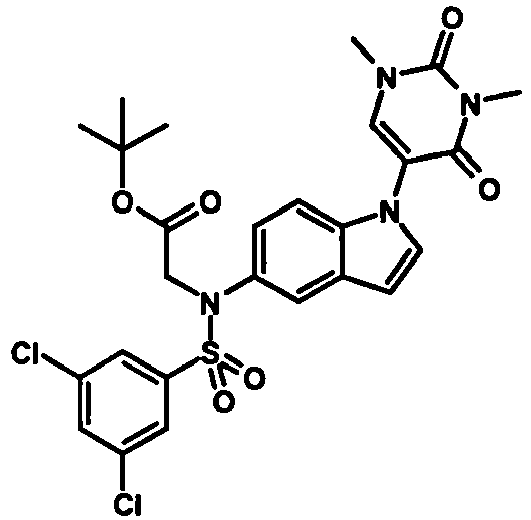
- (108) tert.butyl [[1-(6-benzyloxy-pyridazin-3-yl)-1H-indol-5-yl]-(3,5-dichlorophenylsulphonyl)-amino]-acetate

- (109) tert.butyl ((3,5-dichloro-phenylsulphonyl)-{1-[4-(morpholine-4-carbonyl)-pyridin-2-yl]-1H-indol-5-yl}-amino)-acetate
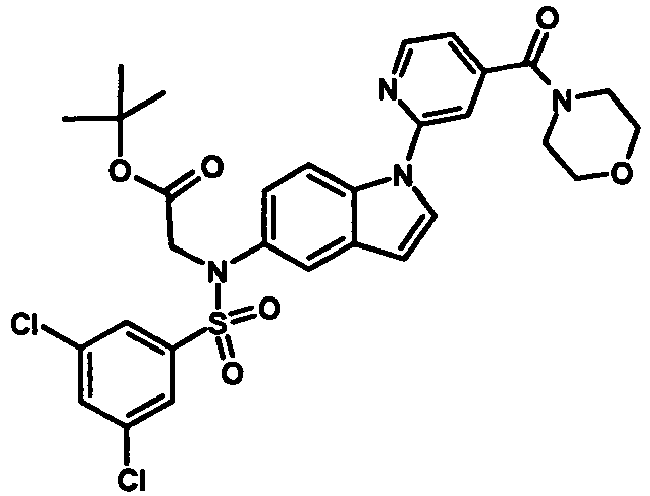
Mass spectrum (ESI+): m/z = 645 [M+H]+ - (110) tert.butyl [[1-(3-cyano-pyridin-2-yl)-1H-indol-5-yl]-(3,5-dichlorophenylsulphonyl)-amino]-acetate

Mass spectrum (ESI+): m/z = 574 [M+NH4]+ - (111) tert.butyl {(3,5-dichloro-phenylsulphonyl)-[4-methyl-1-(6-morpholin-4-yl-pyridazin-3-yl)-1H-indol-5-yl]-amino}-acetate

Mass spectrum (ESI+): m/z = 632 [M+H]+ - (112) tert.butyl ((3,5-dichloro-phenylsulphonyl)-{1-[4-(2-hydroxy-ethylcarbamoyl)-pyridin-2-yl]-1H-indol-5-yl}-amino)-acetate

Mass spectrum (ESI+): m/z = 619 [M+H]+ - (113) tert.butyl [(3,5-dichloro-phenylsulphonyl)-(1-{6-[2-(tetrahydro-pyran-2-yloxy)-ethoxy]-pyridazin-3-yl}-1H-indol-5-yl)-amino]-acetate

Mass spectrum (ESI+): m/z = 677 [M+H]+ - (114) tert.butyl [(1-{5-[2-(tert-butyl-dimethyl-silanyloxy)-ethylamino]-pyridin-2-yl}-1H-indol-5-yl)-(3,5-dichloro-phenylsulphonyl)-amino]-acetate

Mass spectrum (ESI+): m/z = 705 [M+H]+ - (115) tert.butyl {(3,5-dichloro-phenylsulphonyl)-[1-(5-hydroxymethyl-pyridin-2-yl)-1H-indol-5-yl]-amino}-acetate
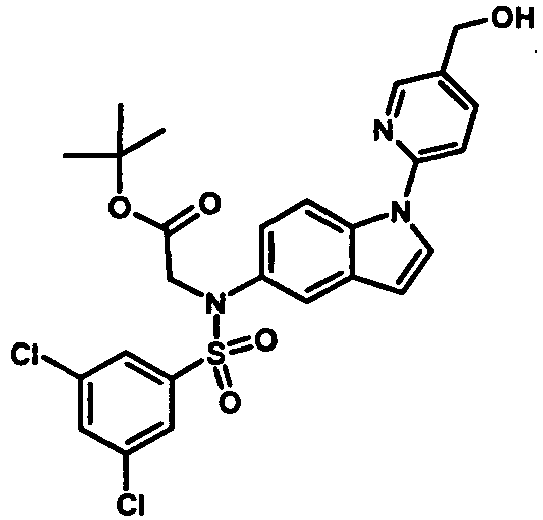
Mass spectrum (ESI+): m/z = 562 [M+H]+ - (116) tert.butyl {(3,5-dichloro-phenylsulphonyl)-[1-(6-iodo-pyridazin-3-y1)-1H-indol-5-yl]-amino}-acetate

Mass spectrum (ESI+): m/z = 659 [M+H]+ - (117) tert.butyl ((3,5-dichloro-phenylsulphonyl)-{1-[6-(2-pyrrolidin-1-yl-ethylamino)-pyridazin-3-yl]-1H-indol-5-yl}-amino)-acetate

Mass spectrum (ESI+): m/z = 645 [M+H]+ - (118) tert-butyl 3-(6-{5-[tert-butoxycarbonylmethyl-(3,5-dichlorophenylsulphonyl)-amino]-indol-1-yl}-pyridazin-3-yl)-2-oxo-imidazolidine-1-carboxylate

Mass spectrum (ESI+): m/z = 717 [M+H]+ - (119) tert.butyl {(3,5-dichloro-phenylsulphonyl)-[1-(6-methylsulphanyl-pyridazin-3-yl)-1H-indol-5-yl]-amino}-acetate

Mass spectrum (ESI+): m/z = 579 [M+H]+ - (120) tert.butyl ((3,5-dichloro-phenylsulphonyl)-{1-[5-(2.2-dimethyl-[1.3]dioxan-5-ylamino)-pyridin-2-yl]-1H-indol-5-yl}-amino)-acetate

Mass spectrum (ESI+): m/z = 661 [M+H]+ - (121) tert.butyl {(3,5-dichloro-phenylsulphonyl)-[1-(4-methylcarbamoyl-pyridin-2-yl)-1H-indol-5-yl]-amino}-acetate

Mass spectrum (ESI+): m/z = 589 [M+H]+ - (122) tert.butyl ((3,5-dichloro-phenylsulphonyl)-{1-[4-(2-methoxy-ethylcarbamoyl)-pyridin-2-yl]-1H-indol-5-yl}-amino)-acetate

Mass spectrum (ESI+): m/z = 633 [M+H]+ - (123) tert.butyl [[1-(4-cyano-pyridin-2-yl)-1H-indol-5-yl]-(3,5-dichlorophenylsulphonyl)-amino]-acetate

Mass spectrum (ESI+): m/z = 574 [M+NH4]+ - (124) tert.butyl {(3,5-dichloro-phenylsulphonyl)-[3-methyl-1-(6-methyl-pyridazin-3-yl)-1H-indol-5-yl]-amino}-acetate

Mass spectrum (ESI+): m/z = 561 [M+H]+ - (125) tert.butyl {(3,5-dichloro-phenylsulphonyl)-[1-(6-thiomorpholin-4-yl-pyridazin-3-yl)-1H-indol-5-yl]-amino}-acetate

Mass spectrum (ESI+): m/z = 634 [M+H]+ - (126) tert.butyl {(3,5-dichloro-phenylsulphonyl)-[1-(6-methanesulphinyl-pyridazin-3-yl)-1H-indol-5-yl]-aminol-acetate

Mass spectrum (ESI+): m/z = 595 [M+H]+ - (127) tert.butyl [[3-chloro-1-(6-methyl-pyridazin-3-yl)-1H-indol-5-yl]-(3,5-dichlorophenylsulphonyl)-amino]-acetate

Mass spectrum (ESI+): m/z = 581 [M+H]+ - (128) tert.butyl ((3,5-dichloro-phenylsulphonyl)-{1-[6-(2-phenyl-[1.3]dioxan-5-yloxy)-pyridazin-3-yl]-1H-indol-5-yl}-amino)-acetate

Mass spectrum (ESI+): m/z = 711 [M+H]+ - (129) tert.butyl {(3,5-dichloro-phenylsulphonyl)-[1-(5-methylsulphanyl-pyrazin-2-yl)-1H-indol-5-yl]-amino}-acetate

Mass spectrum (ESI+): m/z = 596 [M+NH4]+ - (130) tert.butyl {(3,5-dichloro-phenylsulphonyl)-[1-(5-methylsulphanyl-pyridin-2-yl)-1H-indol-5-yl]-amino}-acetate

Mass spectrum (ESI+): m/z = 578 [M+H]+ - (131) tert.butyl {(3,5-dichloro-phenylsulphonyl)-[1-(6-methanesulphonylpyridazin-3-yl)-1H-indol-5-yl]-amino}-acetate

Mass spectrum (ESI+): m/z = 628 [M+NH4]+ - (132) tert.butyl ((3,5-dichloro-phenylsulphonyl)-{1-[5-(2-phenyl-[1.3]dioxan-5-yloxy)-pyrazin-2-yl]-1H-indol-5-yl}-amino)-acetate
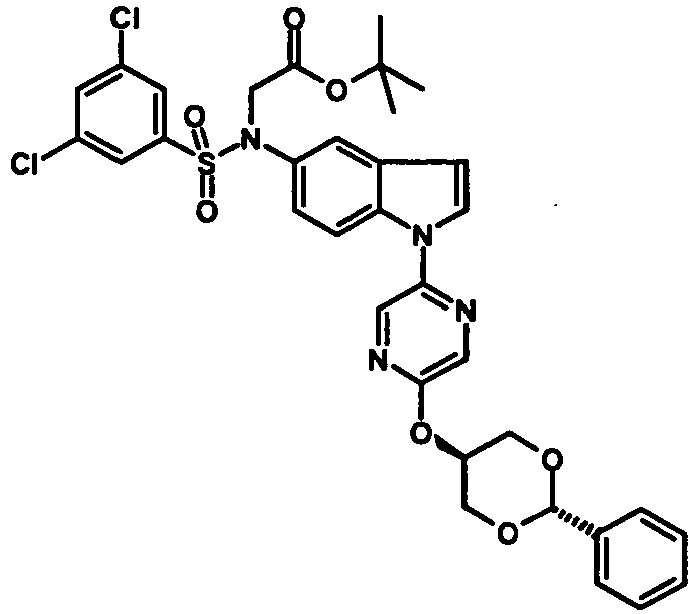
Mass spectrum (ESI+): m/z = 728 [M+NH4]+ - (133) tert.butyl [(3,5-dichloro-phenylsulphonyl)-(1-{5-[2-(tetrahydro-pyran-2-yloxy)-ethylamino]-pyrazin-2-yl}-1H-indol-5-yl)-amino]-acetate

Mass spectrum (ESI+): m/z = 676 [M+H]+ - (134) tert.butyl ((3,5-dichloro-phenylsulphonyl)-{1-[5-(2-dimethylamino-ethoxy)-pyrazin-2-yl]-1H-indol-5-yl}-amino)-acetate

Mass spectrum (ESI+): m/z = 620 [M+H]+ - (135) tert.butyl {(3,5-dichloro-phenylsulphonyl)-[1-(4-methylsulphanyl-pyridin-2-yl)-1H-indol-5-yl)-amino}-acetate

Mass spectrum (ESI+): m/z = 578 [M+H]+ - (136) tert.butyl [{1-[5-(2-tert-butoxycarbonylamino-ethoxy)-pyrazin-2-yl]-1H-indol-5-yl}-(3,5-dichloro-phenylsulphonyl)-amino]-acetate

Mass spectrum (ESI+): m/z = 692 [M+H]+ - (137) tert.butyl ((3,5-dichloro-phenylsulphonyl)-{1-[6-(1-oxo-1λ4-thiomorpholin-4-yl)-pyridazin-3-yl]-1H-indol-5-yl}-amino)-acetate

Mass spectrum (ESI+): m/z = 650 [M+H]+ - (138) tert.butyl {(3,5-dichloro-phenylsulphonyl)-[3-ethyl-1-(6-methyl-pyridazin-3-yl)-1H-indol-5-yl]-amino}-acetate
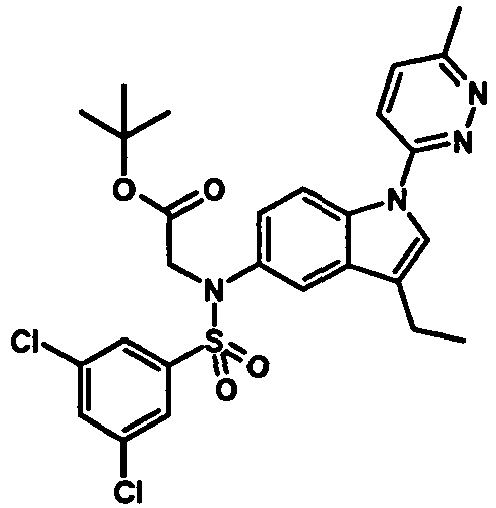
Mass spectrum (ESI+): m/z = 575 [M+H]+ - (139) tert.butyl ((3,5-dichloro-phenylsulphonyl)-{1-[5-(1-oxo-1λ4-thiomorpholin-4-yl)-pyrazin-2-yl]-1H-indol-5-yl}-amino)-acetate
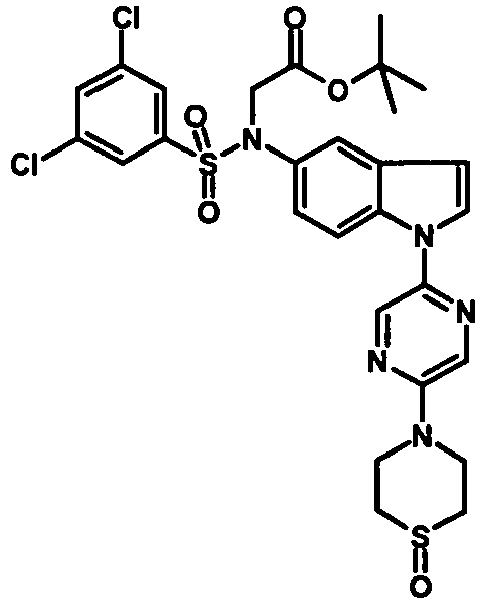
Mass spectrum (ESI+): m/z = 650 [M+H]+ - (140) tert.butyl ((3,5-dichloro-phenylsulphonyl)-{1-[5-(2-hydroxy-ethylamino)-pyrazin-2-yl]-1H-indol-5-yl}-amino)-acetate

Mass spectrum (ESI+): m/z = 592 [M+H]+ - (141) 2-{5-[tert-butoxycarbonylmethyl-(3,5-dichloro-phenylsulphonyl)-amino]-indol-1-yl}-isonicotinic acid
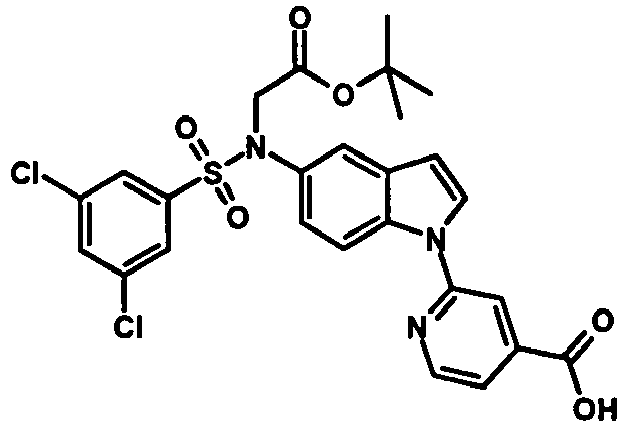
Rf value: 0.18 (silica gel: dichloromethane/methanol 9:1) - (142) tert.butyl {(3,5-dichloro-phenylsulphonyl)-[1-(4-iodo-pyridin-2-yl)-1H-indol-5-yl]-amino}-acetate

Mass spectrum (ESI+): m/z = 658 [M+H]+ - (143) tert.butyl [{1-[5-(2-tert-butoxycarbonylamino-ethylamino)-pyrazin-2-yl]-1H-indol-5-yl}-(3,5-dichloro-phenylsulphonyl)-amino]-acetate

Mass spectrum (ESI+): m/z = 691 [M+H]+ - (144) tert.butyl [[1-(4-cyclopropylcarbamoyl-pyridin-2-yl)-1H-indol-5-yl]-(3,5-dichloro-phenylsulphonyl)-amino]-acetate

Rf value: 0.39 (aluminium oxide: petroleum ether/ethyl acetate 6:4) - (145) methyl 2-{5-[tert-butoxycarbonylmethyl-(3,5-dichloro-phenylsulphonyl)-amino]-indol-1-yl}-isonicotinate

Mass spectrum (ESI+): m/z = 590 [M+H]+ - (146) tert.butyl ((3,5-dichloro-phenylsulphonyl)-{1-[4-(methoxy-methylcarbamoyl)-pyridin-2-yl]-1H-indol-5-yl}-amino)-acetate

Mass spectrum (ESI+): m/z = 619 [M+H]+ - (147) tert-butyl 5'-{5-[tert-butoxycarbonylmethyl-(3,5-dichloro-phenylsulphonyl)-amino]-indol-1-yl}-2,3,5,6-tetrahydro-[1,2']bipyrazinyl-4-carboxylate

Mass spectrum (ESI+): m/z = 717 [M+H]+ - (148) tert.butyl {(3,5-dichloro-phenylsulphonyl)-[1-(4-ethansulphinyl-pyridin-2-yl)-1H-indol-5-yl]-amino}-acetate

Mass spectrum (ESI+): m/z = 608 [M+H]+ - (149) tert.butyl [(3,5-dichloro-phenylsulphonyl)-(1-imidazo[1,2-a]pyrazin-6-yl-1H-indol-5-yl)-amino]-acetate

Mass spectrum (ESI+): m/z = 572 [M+H]+ - (150) tert.butyl {(3,5-dichloro-phenylsulphonyl)-[1-(4-oxazol-2-yl-pyridin-2-yl)-1H-indol-5-yl]-amino}-acetate

Mass spectrum (ESI+): m/z = 599 [M+H]+ - (151) tert.butyl [[1-(4-acetyl-pyridin-2-yl)-1H-indol-5-yl]-(3,5-dichlorophenylsulphonyl)-amino]-acetate
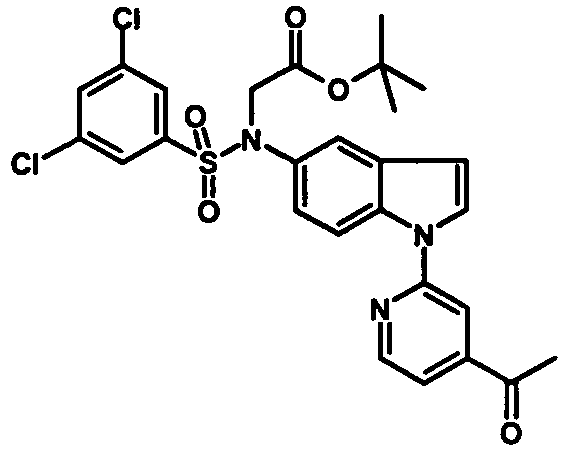
Mass spectrum (ESI+): m/z = 574 [M+H]+ - (152) tert.butyl {(3,5-dichloro-phenylsulphonyl)-[1-(4-propionyl-pyridin-2-yl)-1H-indol-5-yl]-amino}-acetate
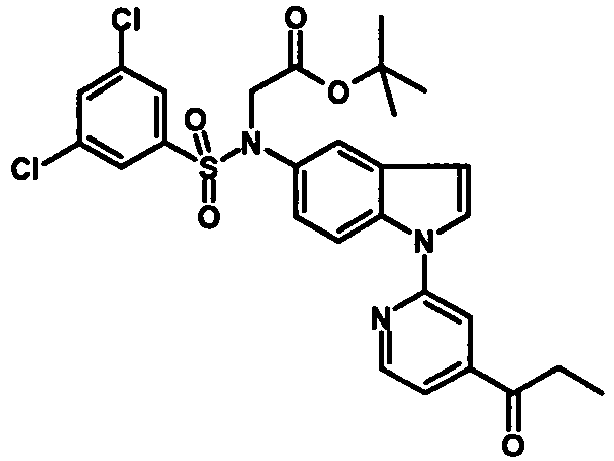
The crude product is further reacted directly (1 (188)). - (153) tert.butyl [[1-(4-cyclopropylcarbamoyl-pyridin-2-yl)-3-methyl-1H-indol-5-yl]-(3,5-dichloro-phenylsulphonyl)-amino]-acetate
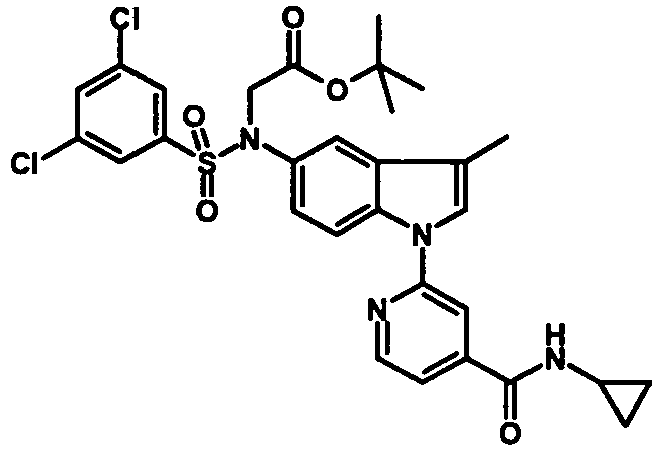
Mass spectrum (ESI+): m/z = 629 [M+H]+ - (154) tert.butyl [{1-[4-(tert-butoxycarbonylamino-methyl)-pyridin-2-yl]-1H-indol-5-yl}-(3,5-dichloro-phenylsulphonyl)-amino]-acetate

Mass spectrum (ESI+): m/z = 661 [M+H]+ - (155) tert.butyl [(1-{5-[tert-butoxycarbonyl-(2-dimethylamino-ethyl)-amino]-pyrazin-2-yl}-3-methyl-1H-indol-5-yl)-(3,5-dichloro-phenylsulphonyl)-amino]-acetate

is used instead of 2-iodo-benzonitrile.
Mass spectrum (ESI+): m/z = 733 [M+H]+ - (156) tert.butyl {(3,5-dichloro-phenylsulphonyl)-[1-(5-morpholin-4-yl-pyrazin-2-yl)-1H-indol-5-yl]-amino}-acetate
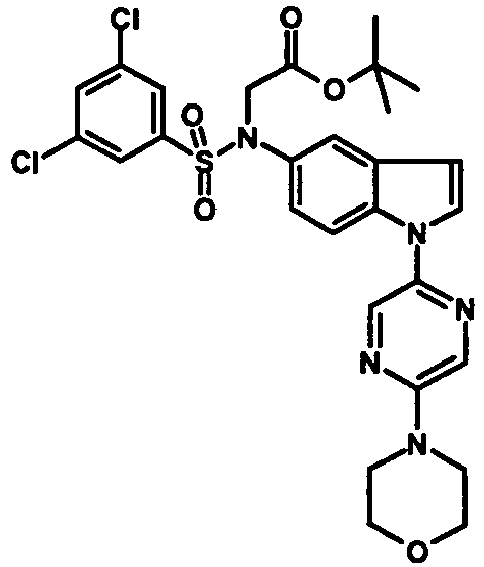
Mass spectrum (ESI+): m/z = 618 [M+H]+ - (157) tert.butyl {(3,5-dichloro-phenylsulphonyl)-[1-(1-methyl-1H-pyrazol-4-yl)-l H-indol-5-yl]-amino}-acetate

- (158) tert.butyl {(3,5-dichloro-phenylsulphonyl)-[1-(5-thiazol-2-yl-pyridazin-3-yl)-1H-indol-5-yl]-amino}-acetate

Rf value: 0.38 (silica gel petroleum ether/ethyl acetate 1:1) - (159) tert.butyl {(3,5-dichloro-phenylsulphonyl)-[1-(1-methyl-1H-imidazol-4-yl)-1H-indol-5-yl]-amino}-acetate

Rf value: 0.15 (silica gel: cyclohexane/ethyl acetate 1:1) - (160) tert.butyl [(3,5-dichloro-phenylsulphonyl)-(1-thiazol-2-yl-1H-indol-5-yl)-amino]-acetate

Rf value: 0.75 (silica gel: cyclohexane/ethyl acetate 1:1) - (161) tert.butyl [[1-(2-cyano-thiophen-3-yl)-1H-indol-5-yl]-(3,5-dichlorophenylsulphonyl)-amino]-acetate

Rf value: 0.75 (silica gel: dichloromethane/methanol 99:1) - (162) tert.butyl [[1-(5-acetyl-thiophen-2-yl)-1H-indol-5-yl]-(3,5-dichlorophenylsulphonyl)-amino]-acetate

Rf value: 0.35 (silica gel: petroleum ether/ethyl acetate 7:3) - (163) tert.butyl {(3,5-dichloro-phenylsulphonyl)-[1-(2,6-dimethyl-pyrimidin-4-yl)-1H-indol-5-yl]-amino}-acetate

Rf value: 0.35 (silica gel: cyclohexane/ethyl acetate 1:1) - (164) tert.butyl {(3,5-dichloro-phenylsulphonyl)-[1-(5-methyl-[1.3.4]thiadiazol-2-yl)-1H-indol-5-yl]-amino}-acetate

Rf value: 0.50 (silica gel: cyclohexane/ethyl acetate 1:1) - (165) tert.butyl {(3,5-dichloro-phenylsulphonyl)-[1-(6-methoxy-pyrimidin-4-yl)-1H-indol-5-yl]-amino}-acetate
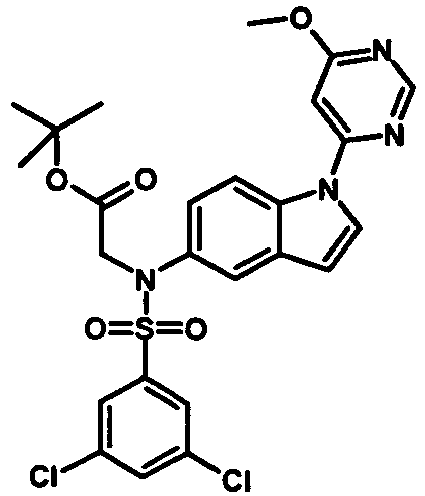
Rf value: 0.73 (silica gel: cyclohexane/ethyl acetate 1:1) - (166) ethyl 2-(5-{5-[tert-butoxycarbonylmethyl-(3,5-dichloro-phenylsulphonyl)-amino]-indol-1-yl}-thiophen-2-yl)-thiazole-4-carboxylate

Rf value: 0.13 (silica gel: petroleum ether/ethyl acetate 5:1) - (167)tert.butyl {(3,S-dichloro-phenylsulphonyl)-[1-(6-iodo-pyrimidin-4-yl)-1H-indol-5-yl]-amino}-acetate
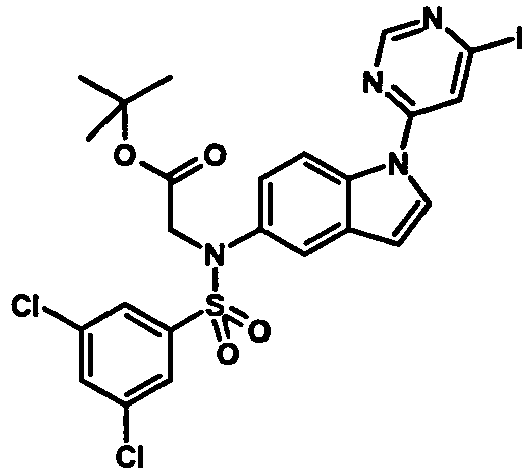
Rf value: 0.34 (silica gel: petroleum ether/ethyl acetate 5:1) - (168) ethyl 5-(5-{5-[tert-butoxycarbonylmethyl-(3,5-dichloro-phenylsulphonyl)-amino]-indol-1-yl}-thiophen-2-yl)-isoxazole-3-carboxylate

Rf value: 0.58 (silica gel: petroleum ether/ethyl acetate 2:1) - (169) tert.butyl {(3,5-dichloro-phenylsulphonyl)-[3-methyl-1-(4-methyl-pyridin-2-yl)-1H-indol-5-yl]-amino}-acetate

Rf value: 0.53 (silica gel: petroleum ether/ethyl acetate 3:1) - (170) tert.butyl [{3-bromo-1-[6-(2-dimethylamino-ethylamino)-pyridazin-3-y)]-1H-indol-5-yl}-(3,5-dichloro-phenylsulphonyl)-amino]-acetate

- (171) tert.butyl {(2,6-dimethyl-pyridin-4-sulphonyl)-[1-(6-methyl-pyridazin-3-yl)-1H-indol-5-yl]-amino}-acetate

- (172) tert.butyl {(2,6-dichloro-pyridin-4-sulphonyl)-[1-(6-methyl-pyridazin-3-yl)-1H-indol-5-yl]-amino}-acetate

- (173) tert.butyl {(2,6-dichloro-pyridin-4-sulphonyl)-[1-(4-methylcarbamoyl-pyridin-2-yl)-1H-indol-5-yl]-amino}-acetate

-

- 120 mg benzyl 3-{5-[tert-butoxycarbonylmethyl-(3,5-dichloro-phenylsulphonyl)-amino]-indol-1-yl}-benzoate are dissolved in 5 ml of tetrahydrofuran and 4 ml of methanol. 10 mg palladium on charcoal (10%) are added and the mixture is hydrogenated for 2 hours at ambient temperature and 1 bar pressure. Then the catalyst is filtered off and the remainder is washed twice with 10 ml of methanol. The solvents are eliminated in vacuo. The crude product is a mixture of 3-{5-[tert-butoxycarbonylmethyl-(3,5-dichloro-phenylsulphonyl)-amino]-indol-1-yl}-benzoic acid and 3-{5-[tert-butoxycarbonylmethyl-(3-chloro-phenylsulphonyl)-amino]-indol-1-yl}-benzoic acid and is further reacted directly in Example XVIII.
- The following compounds are obtained analogously to Example VII:
- (1) tert.butyl {(3,5-dichloro-phenylsulphonyl)-[1-(6-oxo-1.6-dihydro-pyridazin-3-yl)-1H-indol-5-yl]-amino}-acetate

Mass spectrum (ESI-): m/z = 547 [M-H]- - (2) tert.butyl ((3,5-dichloro-phenylsulphonyl)-{1-[6-(3-hydroxy-propyl)-pyridazin-3-yl]-1H-indol-5-yl}-amino)-acetate
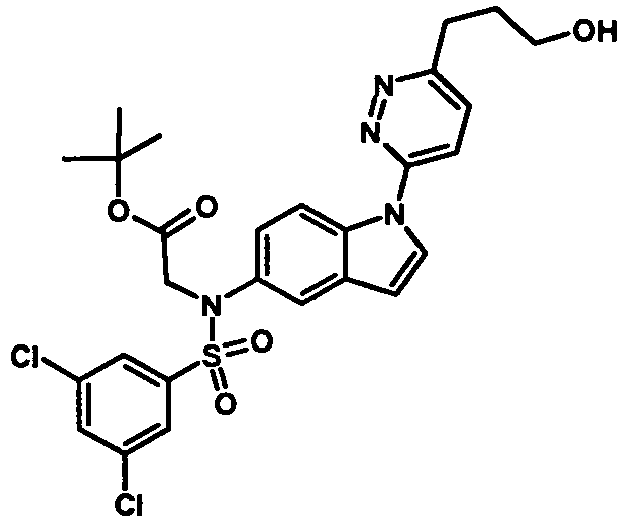
Mass spectrum (ESI+): m/z = 591 [M+H]+ - (3) tert.butyl ((3,5-dichloro-phenylsulphonyl)-{1-[4-(3-hydroxy-propyl)-pyridin-2-yl]-1H-indol-5-yl}-amino)-acetate

Mass spectrum (ESI+): m/z = 590 [M+H]+ -

- 52 mg of a mixture of 3-{5-[tert-butoxycarbonylmethyl-(3,5-dichloro-phenylsulphonyl)-amino]-indol-1-yl}-benzoic acid and 3-{5-[tert-butoxycarbonylmethyl-(3-chloro-phenylsulphonyl)-amino]-indol-1-yl}-benzoic acid from Example VII are dissolved in 8 ml of tetrahydrofuran. 16 mg carbonyldiimidazole are added and the mixture is heated to 60°C for 2 hours. Ammonia gas is piped into this solution first of all at ambient temperature and then at 50°C over a total of 2 hours. Then 100 ml of water are added, the tetrahydrofuran is largely eliminated in vacuo and then the remainder is adjusted to pH 2with 2 N HCl. The mixture is extracted 3 times with ethyl acetate, dried with sodium sulphate and the solvents are eliminated in vacuo. The residue is purified by preparative HPLC and further reacted directly.
Yield: 13 mg (25 % of theory) (tert.butyl [[1-(3-carbamoyl-phenyl)-1H-indol-5-yl]-(3,5-dichloro-phenylsulphonyl)-amino]-acetate)
Mass spectrum (ESI+): m/z = 518 [M+H-tert-butyl]+
and
9 mg (19 % of theory) (tert.butyl [[1-(3-carbamoyl-phenyl)-1H-indol-5-yl]-(3-chloro-phenylsulphonyl)-amino]-acetate)
Mass spectrum (ESI+): m/z = 484 [M+H-tert-butyl]+ - The following compounds are obtained analogously to Example VIII:
- (1) tert.butyl {(3,5-dichloro-phenylsulphonyl)-[1-(3-methylcarbamoyl-phenyl)-1H-indol-5-yl]-amino}-acetate
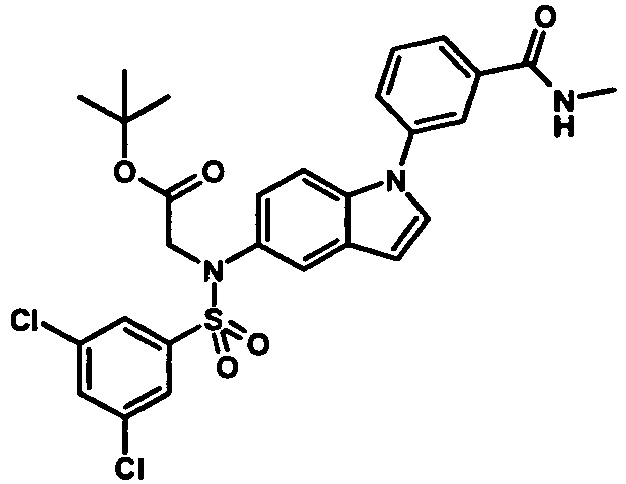

Mass spectrum (ESI+): m/z = 532 [M+H-tert-butyl]+ (tert.butyl {(3,5-dichlorophenylsulphonyl)-[1-(3-methylcarbamoyl-phenyl)-1H-indol-5-yl]-amino}-acetate) and
Mass spectrum (ESI+): m/z = 498 [M+H-tert-butyl]+ (tert.butyl {(3-chlorophenylsulphonyl)-[1-(3-methylcarbamoyl-phenyl)-1H-indol-5-yl]-amino}-acetate) - (2) 3.6-dichloro-pyridazin-4-carboxylic acid-amide

Mass spectrum (ESI-): m/z = 190 [M-H]- -

- 500 mg of 2-bromopyrimidine are dissolved in 5 ml dioxane under argon. 943 mg sodium iodide, 60 mg copper iodide and 45 mg N,N'-dimethyl-trans-cyclohexanediamine are added. Then the mixture is refluxed for 8 hours. It is divided between water and ethyl acetate, the aqueous phase is extracted with ethyl acetate and the combined organic phases are dried on sodium sulphate. The solvents are eliminated in vacuo and the residue is chromatographed on silica gel (cyclohexane/ethyl acetate 10:1 to 1:2). The product (235 mg, 36 % of theory) is further reacted directly in Example XVI (1).
-
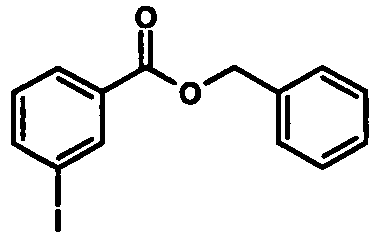
- 1.5 g 3-iodo-benzoic acid are dissolved in 10 ml acetonitrile. 919 mg potassium carbonate are added and then 647 µl benzylbromide are added dropwise thereto. Then the mixture is heated to 50°C for 4 hours. The solvent is eliminated in vacuo and the residue is divided between ethyl acetate and saturated sodium hydrogen carbonate solution. The aqueous phase is extracted with ethyl acetate and the combined organic phases are dried on sodium sulphate. The solvents are eliminated in vacuo.
Yield: 2 g (98% of theory)
Mass spectrum (ESI+): m/z = 356 [M+NH4]+ -

- 300 mg 5-nitro-2,3-dihydro-1H-indole are dissolved in 4 ml N-methyl-pyrrolidine. 80 mg NaH (60 % suspension in mineral oil) are added and the mixture is stirred for another 15 minutes at ambient temperature. Then 380 mg of 2-bromopyrimidine are added and the mixture is then heated to 60°C for 3 hours. It is then diluted with diethyl ether and washed with dilute citric acid solution and saturated sodium chloride solution. After drying with magnesium sulphate the solvents are eliminated in vacuo.
Yield: 410 mg (95 % of theory)
Rf value: 0.61 (silica gel: ethyl acetate/petroleum ether 1:1) -
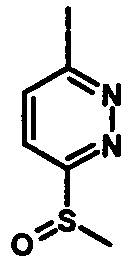
- 400 mg 3-iodo-6-methylsulphanyl-pyridazine are dissolved in 5 ml dichloromethane and 310 mg 3-chloro-perbenzoic acid are added. The mixture is stirred for 1 hour at ambient temperature, diluted with ethyl acetate and washed with dilute sodium hydroxide solution. After drying with magnesium sulphate the solvents are eliminated in vacuo and the residue is chromatographed on silica gel (cyclohexane/ethyl acetate 50:50 to 0:100).
Yield: 140 mg (52 % of theory)
Mass spectrum (ESI+): m/z = 269 [M+H]+ - The following compounds are obtained analogously to Example XII:
- (1) tert.butyl ((3,5-dichloro-phenylsulphonyl)-{1-[6-(1,1-dioxo-1λ6-thiomorpholin-4-yl)-pyridazin-3-yl]-1H-indol-5-yl}-amino)-acetate

Mass spectrum (ESI+): m/z = 666 [M+H]+ - (2) tert.butyl {(3,5-dichloro-phenylsulphonyl)-[1-(5-methanesulphinyl-pyrazin-2-yl)-1H-indol-5-yl]-amino}-acetate

tert.butyl {(3,5-dichloro-phenylsulphonyl)-[1-(5-methanesulphonyl-pyrazin-2-yl)-1H-indol-5-yl]-amino}-acetate
Mass spectrum (ESI+): m/z = 595 [M+H]+ tert.butyl {(3,5-dichlorophenylsulphonyl)-[1-(5-methanesulphinyl-pyrazin-2-yl)-1H-indol-5-yl]-amino}-acetate and
Mass spectrum (ESI+): m/z = 628 [M+NH4]+ tert.butyl {(3,5-dichlorophenylsulphonyl)-[1-(5-methanesulphonyl-pyrazin-2-yl)-1H-indol-5-yl]-amino}-acetate - (3) 3-iodo-6-methanesulphonyl-pyridazine

Mass spectrum (ESI+): m/z = 285 [M+H]+ - (4) tert.butyl {(3,5-dichloro-phenylsulphonyl)-[1-(5-methanesulphinyl-pyridin-2-yl)-1H-indol-5-yl]-amino}-acetate

Mass spectrum (ESI+): m/z = 594 [M+H]+ - (5) tert.butyl {(3,5-dichloro-phenylsulphonyl)-[1-(5-methanesulphonyl-pyridin-2-yl)-1H-indol-5-yl]-amino}-acetate

Mass spectrum (ESI+): m/z = 610 [M+H]+ - (6) 4-(6-iodo-pyridazin-3-yl)-thiomorpholin-1-oxide

Mass spectrum (ESI+): m/z = 324 [M+H]+ - (7) 4-(5-bromo-pyrazin-2-yl)-thiomorpholin-1-oxide
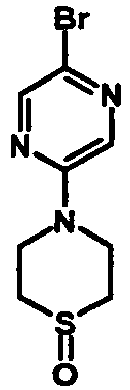
Mass spectrum (ESI+): m/z = 276 [M+H]+ - (8) 2-bromo-4-ethanesulphinyl-pyridine
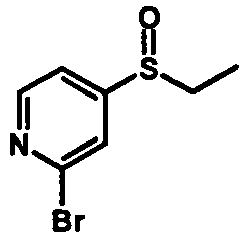
Mass spectrum (ESI+): m/z = 234 [M+H]+ -
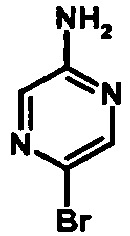
- 24.5 g of 2-aminopyrazine are dissolved in 750 ml dichloromethane and cooled to 0°C. 45.8 g N-bromosuccinimide are added and the mixture is stirred for 24 hours at 0°C. The solid is suction filtered and the mother liquor is washed 3 times with semisaturated sodium carbonate solution and 3 times with water. The organic phase is dried on magnesium sulphate, filtered through activated charcoal and evaporated down in vacuo. The residue is extracted from diisopropyl ether. Further product is obtained by evaporating the mother liquor down in vacuo and chromatographing the residue on silica gel (petroleum ether/ethyl acetate 1:1 to 1:2).
Yield: 20.8 g (47 % of theory)
Rf value: 0.5 (silica gel, petroleum ether/ethyl acetate 1:1) -

- 24 g 5-bromo-pyrazin-2-ylamine are dissolved in 300 ml dimethylformamide. 20 g of 2-chloroethyl-dimethylamine hydrochloride are added and the mixture is cooled to 0°C. Then 13.8 g NaH (60 % suspension in mineral oil) are added in batches. After the end of the addition the mixture is stirred for 10 minutes at 0°C and then heated for 2 hours to 80°C. Then it is divided between semisaturated sodium chloride solution and ethyl acetate, the aqueous phase is extracted twice with ethyl acetate and the combined organic phases are dried on magnesium sulphate. The solvents are eliminated in vacuo and the residue is chromatographed on silica gel (dichloromethane/methanol 9:1 to 1:1). The product thus obtained is taken up in ethyl acetate and combined with activated charcoal. It is stirred for 1 hour and then the activated charcoal is filtered off. The mother liquor is evaporated down in vacuo and petroleum ether is added to the residue. This is incubated for 1 hour in the deep-freeze, the petroleum ether is decanted off and the solid is dried under a high vacuum.
Yield: 11 g (33 % of theory)
Mass spectrum (ESI+): m/z = 245 [M+H]+ - The following compounds are obtained analogously to Example XXIV:
- (1) N'-(2-bromo-pyridin-3-yl)-N,N-dimethyl-ethan-1,2-diamine

Mass spectrum (ESI+): m/z = 244 [M+H]+ -

- 1 g 4-iodo-benzoic acid is dissolved in 10 ml of tetrahydrofuran, 726 mg carbonyldiimidazole are added and the mixture is stirred for 3 hours at ambient temperature. To this are added 820 mg tert-butyl piperazine-1-carboxylate and the mixture is stirred overnight at ambient temperature. The solvent is eliminated in vacuo and the residue is taken up in ethyl acetate. It is washed with water, 1 N HCl, saturated sodium hydrogen carbonate solution and saturated sodium chloride solution. After drying with magnesium sulphate the solvent is eliminated in vacuo.
Yield: 1.65 g (98 % of theory)
Mass spectrum (ESI+): m/z = 417 [M+H]+ - The following compounds are obtained analogously to Example XV:
- (1) tert-butyl 4-(3-iodo-benzoyl)-piperazine-1-carboxylate

- (2) 6-bromo-pyridin-2-carboxylic acid-(2-dimethylamino-ethyl)-amide

Mass spectrum (ESI+): m/z = 272 [M+H]+ - (3) tert-butyl 4-(6-bromo-pyridin-3-carbonyl)-piperazine-1-carboxylate

Mass spectrum (ESI+): m/z = 370 [M+H]+ - (4) 6-bromo-N-(2-dimethylamino-ethyl)-nicotinamide
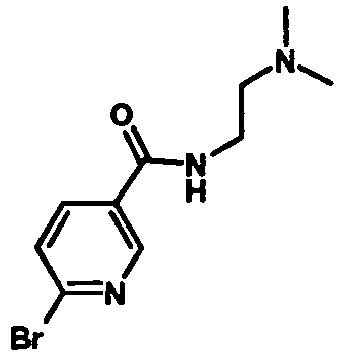
Mass spectrum (ESI+): m/z = 272 [M+H]+ -

- 500 mg tert-butyl 4-(2-chloro-pyrimidin-4-yl)-piperazine-1-carboxylate and 302 mg 5-nitro-2,3-dihydro-1H-indole are mixed and heated to 150°C for 1 hour. The mixture is divided between water and ethyl acetate, the aqueous phase is extracted twice with ethyl acetate and the combined organic phases are dried with magnesium sulphate. The solvent is eliminated in vacuo and the residue is chromatographed on silica gel (cyclohexane/ethyl acetate 10:1 to 1:2).
Yield: 143 mg (20 % of theory)
Mass spectrum (ESI+): m/z = 427 [M+H]+ - The following compounds are obtained analogously to Example XVI:
- (1) 5-nitro-1-pyridin-4-yl-2,3-dihydro-1H-indole

Mass spectrum (ESI+): m/z = 242 [M+H]+ - (2) tert.butyl {(3,5-dichloro-phenylsulphonyl)-[1-(6-morpholin-4-yl-pyridazin-3-yl)-2,3-dihydro-1H-indol-5-yl]-amino}-acetate

Mass spectrum (ESI+): m/z = 620 [M+H]+ -

- 1 g 2,4-dichloropyrimidine is dissolved in 30 ml of tetrahydrofuran and cooled to 0°C. A solution of 1.25 g tert-butyl piperazine-1-carboxylate and 1.2 ml triethylamine in 30 ml of tetrahydrofuran is added dropwise thereto. The mixture is stirred for 1 hour at 0°C and 2 hours at ambient temperature. Then the solvent is eliminated in vacuo, the residue is divided between water and dichloromethane and the aqueous phase is extracted twice with dichloromethane. The combined organic phases are dried on magnesium sulphate, the solvent is eliminated in vacuo and the residue is extracted from diisopropyl ether.
Yield: 1.5 g (75 % of theory)
Mass spectrum (ESI+): m/z = 299 [M+H]+ -

- 298 mg 5-nitro-1H-indole are dissolved in 10 ml dimethylformamide and 74 mg NaH (60 % suspension in mineral oil) are added. The mixture is stirred for 1 h at ambient temperature and then 500 mg tert-butyl 4-(2-chloro-pyrimidin-4-yl)-piperazine-1-carboxylate are added. The solution is heated to 70°C for 5 hours, divided between water and ethyl acetate and the aqueous phase is extracted twice with ethyl acetate. The combined organic phases are dried on magnesium sulphate and the solvent is eliminated in vacuo. The residue is chromatographed on silica gel (cyclohexane/ethyl acetate 10:1 to 1:2).
Yield: 390 mg (55 % of theory)
Mass spectrum (ESI+): m/z = 425 [M+H]+ - The following compounds are obtained analogously to Example XVIII:
- (1) tert-butyl 4-[5-(5-nitro-2,3-dihydro-indol-1-yl)-pyrazin-2-carbonyl]-piperazine-1-carboxylate

Mass spectrum (ESI+): m/z = 455 [M+H]+ - (2) tert-butyl 4-[5-(5-nitro-indol-1-yl)-pyrazin-2-carbonyl]-piperazine-1-carboxylate
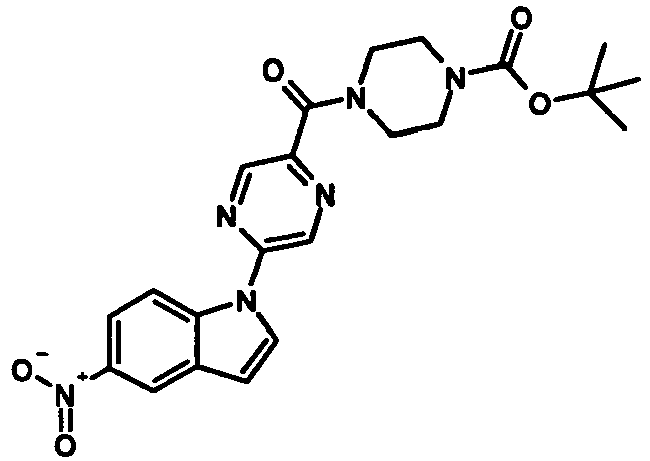
Mass spectrum (ESI+): m/z = 453 [M+H]+ - (3) 4-nitro-1-pyrimidin-2-yl-1H-indole

Mass spectrum (ESI+): m/z = 241 [M+H]+ - (4) tert-butyl 6'-(5-nitro-2,3-dihydro-indol-1-yl)-2,3,5,6-tetrahydro-[1,2']bipyrazinyl-4-carboxylate

tert-butyl 6'-(5-nitro-indol-1-yl)-2,3,5,6-tetrahydro-[1,2']bipyrazinyl-4-carboxylate
Mass spectrum (ESI+): m/z = 427 [M+H]+ (tert-butyl 6'-(5-nitro-2,3-dihydro-indol-1-yl)-2,3,5,6-tetrahydro-[1,2']bipyrazinyl-4-carboxylate) and
Mass spectrum (ESI+): m/z = 425 [M+H]+ (tert. butyl 6'-(5-nitro-indol-1-yl)-2,3,5,6-tetrahydro-[1,2']bipyrazinyl-4-carboxylate) - (5) N,N-dimethyl-N'-[2-(5-nitro-2,3-dihydro-indol-1-yl)-pyrimidin-4-yl]-ethan-1,2-diamine
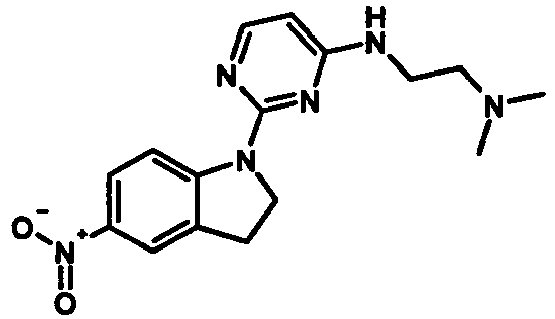
Mass spectrum (ESI+): m/z = 329 [M+H]+ - (6) 1-(6-chloro-pyridazin-3-yl)-5-nitro-2,3-dihydro-1H-indole

Rf value: 0.55 (silica gel, petroleum ether/ethyl acetate 1:4) - (7) 1-(2-chloro-pyrimidin-4-yl)-5-nitro-2,3-dihydro-1H-indole

1-(4-chloro-pyrimidin-2-yl)-5-nitro-2,3-dihydro-1H-indole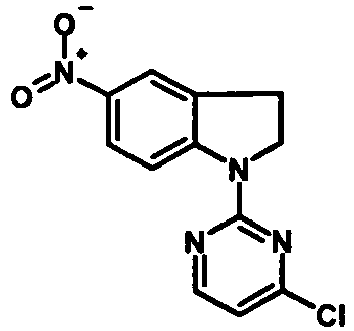
Mass spectrum (ESI+): m/z = 277 [M+H]+ - (8) 1-(6-chloro-pyridazin-3-yl)-5-nitro-2,3-dihydro-1H-indole

Mass spectrum (ESI+): m/z = 277 [M+H]+ - (9) 1-(6-chloro-pyridazin-3-yl)-5-nitro-1H-indole

Mass spectrum (ESI+): m/z = 275 [M+H]+ - (10) 5-nitro-1-(4-oxy-pyrazin-2-yl)-1H-indole

Mass spectrum (ESI+): m/z = 257 [M+H]+ - (11) 1-(4-chloro-pyrimidin-2-yl)-5-nitro-1H-indole

1-(2-chloro-pyrimidin-4-yl)-5-nitro-1H-indole
Mass spectrum (ESI+): m/z = 292 [M+NH4]+ (1-(4-chloro-pyrimidin-2-yl)-5-nitro-1H-indole)
and
Mass spectrum (ESI-): m/z = 319 [M+HCOO]- (1-(2-chloro-pyrimidin-4-yl)-5-nitro-1H-indole) - (12) 1-(4,6-dimethoxy-[1,3,5]triazin-2-yl)-5-nitro-2,3-dihydro-1H-indole

- (13) 2-chloro-6-(5-nitro-indol-1-yl)-9H-purine

Mass spectrum (ESI-): m/z = 313 [M-H]- - (14) 5-(5-nitro-indol-1-yl)-pyrazin-2-carboxylic acid-amide

Mass spectrum (ESI+): m/z = 284 [M+H]+ - (15) 5-(5-nitro-indol-1-yl)-pyrazin-2-carboxylic acid-methyl-amide

Mass spectrum (ESI+): m/z = 298 [M+H]+ - (16) morpholin-4-yl-[5-(5-nitro-indol-1-yl)-pyrazin-2-yl]-methanone

Mass spectrum (ESI+): m/z = 354 [M+H]+ - (17) 5-(5-nitro-indol-1-yl)-pyrazin-2-carbonitrile

Mass spectrum (ESI-): m/z = 310 [M+HCOO]- - (18) 6-(5-nitro-indol-1-yl)-pyridazine-3-carboxylic acid

Mass spectrum (ESI+): m/z = 285 [M+H]+ - (19) tert.butyl {(3,5-dichloro-phenylsulphonyl)-[1-(6-trifluoromethyl-pyrimidin-4-yl)-1H-indol-5-yl]-amino}-acetate

Mass spectrum (ESI+): m/z = 618 [M+NH4]+
Rf value: 0.85 (silica gel: cyclohexane/ethyl acetate 1:1) - (20) tert.butyl [[1-(2-bromo-pyrimidin-4-yl)-1H-indol-5-yl]-(3,5-dichlorophenylsulphonyl)-amino]-acetate

Mass spectrum (ESI+): m/z = 628 [M+NH4]+
Rf value: 0.33 (silica gel: petroleum ether/ethyl acetate 2:1) - (21) 6-nitro-1-pyrimidin-2-yl-1H-benzimidazole

- (22) 5-nitro-1-pyrimidin-2-yl-1H-benzimidazole

-

- 1 g 5-oxo-4,5-dihydro-pyrazine-2-carboxylic acid is dissolved in 10 ml phosphorus oxychloride, heated to 90°C for 3 hours and then freed from the solvent in vacuo. The residue is taken up in 10 ml dichloromethane and a solution of 1.3 g tert-butyl piperazine-1-carboxylate and 3 ml triethylamine in 10 ml dichloromethane is added dropwise thereto. The mixture is stirred for 3 hours at ambient temperature, divided between 1 N HCl and dichloromethane and the aqueous phase is extracted with dichloromethane. The combined organic phases are washed with saturated sodium hydrogen carbonate solution and saturated sodium chloride solution. After drying with magnesium sulphate the solvent is eliminated in vacuo and the residue is taken up in 20 ml diisopropylether. The mixture is decanted from the solid, left to cool to ambient temperature and the precipitated solid is suction filtered. The product thus obtained is purified by chromatography on silica gel (cyclohexane/ethyl acetate 10:1 to 1:2).
Yield: 380 mg (16 % of theory)
Mass spectrum (ESI+): m/z = 327 [M+H]+ - The following compounds are obtained analogously to Example IXX:
- (1) 5-chloro-pyrazine-2-carboxylic acid-amide

Mass spectrum (ESI+): m/z = 158 [M+H]+ - (2) 5-chloro-pyrazin-2-carboxylic acid-methyl-amide

Mass spectrum (ESI+): m/z = 172 [M+H]+ - (3) (5-chloro-pyrazin-2-yl)-morpholin-4-yl-methanone

Mass spectrum (ESI+): m/z = 228 [M+H]+ - (4) morpholin-4-yl-[6-(5-nitro-indol-1-yl)-pyridazin-3-yl]-methanone

Mass spectrum (ESI+): m/z = 354 [M+H]+ - (5) methyl 6-chloro-pyridazine-3-carboxylate

Mass spectrum (ESI+): m/z = 155 [M+H]+ - (6) 6-(5-nitro-indol-1-yl)-pyridazine-3-carboxylic acid-dimethylamide

Mass spectrum (ESI+): m/z = 312 [M+H]+ -

- 630 mg tert-butyl piperazine-1-carboxylate are dissolved in 12 ml dimethylformamide. 500 mg potassium carbonate and 500 mg 2,6-dichloropyrazine are added. Then the mixture is stirred overnight at ambient temperature. It is diluted with dichloromethane, the solid is filtered off and the mother liquor is evaporated down in vacuo. The residue is chromatographed on silica gel (cyclohexane/ethyl acetate 10:1 to 1:2).
Yield: 525 mg (53 % of theory)
Mass spectrum (ESI+: m/z = 299 [M+H]+ - The following compounds are obtained analogously to Example XX:
- (1) N'-(2-chloro-pyrimidin-4-yl)-N,N-dimethyl-ethan-1,2-diamine

- (2) tert-butyl 4-(6-iodo-5-methyl-pyridazin-3-yl)-piperazine-1-carboxylate

- (3) N'-(6-chloro-pyridazin-3-yl)-N,N-dimethyl-ethan-1,2-diamine

Mass spectrum (ESI+): m/z = 201 [M+H]+ - (4) tert-butyl 4-(6-iodo-pyridazin-3-yl)-[1,4]diazepan-1-carboxylate

Mass spectrum (ESI+): m/z = 405 [M+H]+ - (5) N*1*-(6-iodo-pyridazin-3-yl)-propane-1,3-diamine

Rf value: 0.08 (aluminium oxide; dichloromethane/methanol 9:1) - (6) cyclopropyl-(6-iodo-pyridazin-3-yl)-amine

Mass spectrum (ESI+): m/z = 262 [M+H]+ - (7) N*1*-(6-iodo-pyridazin-3-yl)-N*1*-methyl-ethan-1,2-diamine

N-(6-iodo-pyridazin-3-yl)-N'-methyl-ethan-1,2-diamine
Mass spectrum (ESI+): m/z = 279 [M+H]+ - (8) N*1*-(6-iodo-pyridazin-3-yl)-2-methyl-propane-1,2-diamine

Mass spectrum (ESI+): m/z = 293 [M+H]+ - (9) tert-butyl [1-(6-iodo-pyridazin-3-yl)-piperidin-3-yl]-carbamate
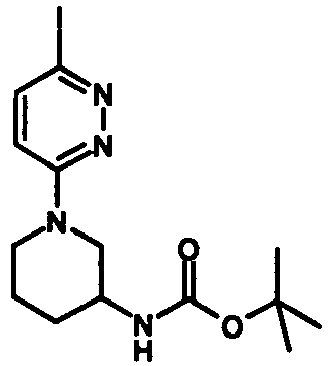
Mass spectrum (ESI+): m/z = 405 [M+H]+ - (10) 4-(6-iodo-pyridazin-3-yl)-morpholine
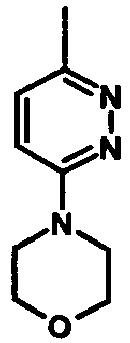
Mass spectrum (ESI+): m/z = 292 [M+H]+ - (11) (6-iodo-pyridazin-3-yl)-dimethyl-amine

Mass spectrum (ESI+): m/z = 250 [M+H]+ - (12) 2-(6-iodo-pyridazin-3-ylamino)-ethanol

Mass spectrum (ESI+): m/z = 266 [M+H]+ - (13) (6-iodo-pyridazin-3-yl)-(2-piperidin-1-yl-ethyl)-amine

Mass spectrum (ESI+): m/z = 333 [M+H]+ - (14) (R)-(6-iodo-pyridazin-3-yl)-(tetrahydro-furan-3-yl)-amine

Mass spectrum (ESI+): m/z = 292 [M+H]+ - (15) (R)-(5-bromo-pyrazin-2-yl)-(tetrahydro-furan-3-yl)-amine

Rf value: 0.32 (silica gel: petroleum ether/ethyl acetate 1:1) - (16) (6-iodo-pyridazin-3-yl)-methyl-(tetrahydro-pyran-4-yl)-amine

Mass spectrum (ESI+): m/z = 320 [M+H]+
Rf value: 0.20 (silica gel: petroleum ether/ethyl acetate 1:1) - (17) 4-(5-bromo-pyrazin-2-yl)-piperazin-2-one

Mass spectrum (ESI+): m/z = 257 [M+H]+
Rf value: 0.25 (silica gel: dichloromethane/methanol 95:5) - (18) (5-bromo-pyrazin-2-yl)-(tetrahydro-pyran-4-yl)-amine

Mass spectrum (ESI-): m/z = 256 [M-H]-
Rf value: 0.35 (silica gel: petroleum ether/ethyl acetate 1:1) - (19) (6-iodo-pyridazin-3-yl)-(tetrahydro-pyran-4-yl)-amine

Rf value: 0.12 (silica gel: petroleum ether/ethyl acetate 1:1) - (20) 2-bromo-4-(tetrahydro-furan-3-yloxy)-pyridine

Mass spectrum (ESI+): m/z = 272 [M+H]+
Rf value: 0.35 (silica gel: petroleum ether/ethyl acetate 2:1) - (21) 4-(6-iodo-pyridazin-3-yl)-piperazin-2-one

Mass spectrum (ESI+): m/z = 305 [M+H]+
Rf value: 0.18 (silica gel: methylene chloride/methanol 95:5) - (22) 3-bromo-6-morpholin-4-yl-pyrazine

Mass spectrum (ESI-): m/z = 243 [M-H]- - (23) N-(6-iodo-pyridazin-3-yl)-N'-methyl-propane-1,3-diamine

N*1*-(6-iodo-pyridazin-3-yl)-N*1*-methyl-propane-1,3-diamine
Mass spectrum (ESI+): m/z = 293 [M+H]+ - (24) tert.butyl {(3,5-dichloro-phenylsulphonyl)-[1-(2,6-dichloro-pyrimidin-4-yl)-1H-indol-5-yl]-amino}-acetate

Mass spectrum (ESI+): m/z = 618 [M+NH4]+ - (25) (6-iodo-pyridazin-3-yl)-(2-pyrrolidin-1-yl-ethyl)-amine

Mass spectrum (ESI+): m/z = 319 [M+H]+ - (26) 4-(6-iodo-pyridazin-3-yl)-thiomorpholine

Mass spectrum (ESI+): m/z = 308 [M+H]+ - (27) 2-(5-bromo-pyrazin-2-ylamino)-ethanol
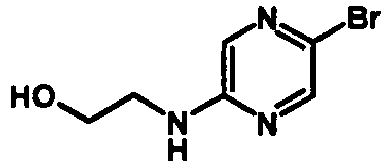
Mass spectrum (ESI-): m/z = 216 [M-H]- - (28) 4-(5-bromo-pyrazin-2-yl)-thiomorpholin
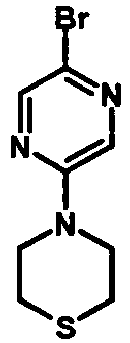
Mass spectrum (ESI+): m/z = 260 [M+H]+ - (29) 2-(5-bromo-pyrazin-2-ylamino)-ethanol

Mass spectrum (ESI+): m/z = 218 [M+H]+ - (30) N*1*-(5-bromo-pyrazin-2-yl)-ethan-1,2-diamine

- (31) tert-butyl 5'-bromo-2,3,5,6-tetrahydro-[1,2']bipyrazinyl-4-carboxylate

-

- 280 mg 4-nitro-1-pyrimidin-2-yl-1H-indole are dissolved in 1 ml acetic acid and 4 ml trifluoroacetic acid. To this are added 160 mg sodium cyanoborohydride and the solution is stirred for 48 hours at ambient temperature. Then the solvents are eliminated in vacuo and the residue is divided between ethyl acetate and saturated sodium hydrogen carbonate solution. The organic phase is washed with saturated sodium chloride solution and dried with magnesium sulphate. After elimination of the solvents in vacuo the residue is chromatographed on silica gel (cyclohexane/ethyl acetate 10:1 to 1:3).
Yield: 30 mg (11 % of theory)
Mass spectrum (ESI+): m/z = 243 [M+H]+ -

- 230 mg 1-(1H-imidazol-2-yl)-5-nitro-2,3-dihydro-1H-indole are dissolved in 6 ml DMF. 200 mg potassium carbonate and 75 µl methyl iodide are added and the mixture is stirred overnight at ambient temperature. Then it is diluted with ethyl acetate and extracted twice with 2 N HCl. The combined aqueous phases are washed with dichloromethane, adjusted to pH 12 with 40 % sodium hydroxide solution and extracted with dichloromethane. This organic phase is washed with saturated sodium chloride solution and dried on magnesium sulphate. The solvent is eliminated in vacuo and the residue is chromatographed on silica gel (dichloromethane/methanol 99:1 to 9:1).
Yield: 170 mg (70 % of theory)
Mass spectrum (ESI+): m/z = 245 [M+H]+ -

- 150 mg N-(2,2-diethoxy-ethyl)-5-nitro-2,3-dihydro-indol-1-carboxamidine are heated to 60°C in 8 ml trifluoroacetic acid for 3 hours. The solvent is then eliminated in vacuo and the residue is chromatographed on aluminium oxide (dichloromethane/methanol 99:1 to 7:3).
Yield: 230 mg (69 % of theory)
Mass spectrum (ESI-): m/z = 229 [M-H]- -

- 410 mg methyl 5-nitro-2,3-dihydro-indol-1-carboximidothioate are dissolved in 4 ml dimethylformamide and 350 µl aminoacetaldehyde-diethylacetal are added thereto. The mixture is heated for 4 hours to 100°C. Then the solvent is eliminated in vacuo and the residue is chromatographed on aluminium oxide (dichloromethane/methanol 99:1 to 7:3).
Yield: 330 mg (91 % of theory)
Mass spectrum (ESI+): m/z = 323 [M+H]+ -

- 3.5 g 5-nitro-2,3-dihydro-indol-1-carbothioic acidamide are dissolved in 50 ml dimethylformamide and 1.2 ml methyl iodide are added. The mixture is stirred overnight at ambient temperature, the solvent is eliminated in vacuo and the residue is extracted from diethyl ether.
Yield: 4.85 g (85 % of theory)
Mass spectrum (ESI+): m/z = 238 [M+H]+ -

- 5 g 5-nitro-2,3-dihydro-1H-indole are dissolved in 100 ml dichloromethane under argon and cooled to 0°C. 298 µl N,N-diisopropyl-ethylamine and 2.4 ml thiophosgene are added and the mixture is stirred for another 1.5 hours. Then 300 ml of tetrahydrofuran are added, then ammonia gas is piped in for 2 hours and the mixture is stirred overnight at ambient temperature. The solvents are eliminated in vacuo and the residue is extracted from 1 N HCl.
Yield: 6.35 g (96 % of theory)
Mass spectrum (ESI+): m/z = 224 [M+H]+ -

- 500 mg 1-(1H-imidazol-2-yl)-5-nitro-2,3-dihydro-1H-indole are dissolved in 10 ml of tetrahydrofuran, 10 mg N,N-dimethylaminopyridine and 500 mg di-tert-butyl-dicarbonate are added and the mixture is stirred for 1 hour at ambient temperature. Then the solvent is eliminated in vacuo and the residue is chromatographed on aluminium oxide with dichloromethane.
Yield: 590 mg (82 % of theory)
Mass spectrum (ESI+): m/z = 331 [M+H]+ - The following compounds are obtained analogously to Example XXXVII:
- (1) tert-butyl 4-[6-(5-nitro-2,3-dihydro-indol-1-yl)-pyridazin-3-yl]-piperazine-1-carboxylate

Mass spectrum (ESI+): m/z = 427 [M+H]+ - (2) tert-butyl (2-dimethylamino-ethyl)-[2-(5-nitro-2,3-dihydro-indol-1-yl)-pyrimidin-4-yl]-carbamate

Mass spectrum (ESI+): m/z = 429 [M+H]+ - (3) tert-butyl (2-dimethylamino-ethyl)-[6-(5-nitro-2,3-dihydro-indol-1-yl)-pyridazin-3-yl]-carbamate

Mass spectrum (ESI+): m/z = 429 [M+H]+ - (4) tert-butyl (2-(bis-tert-butoxycarbonyl)-amino-ethyl)-[6-(5-nitro-2,3-dihydro-indol-1-yl)-pyridazin-3-yl]-carbamate
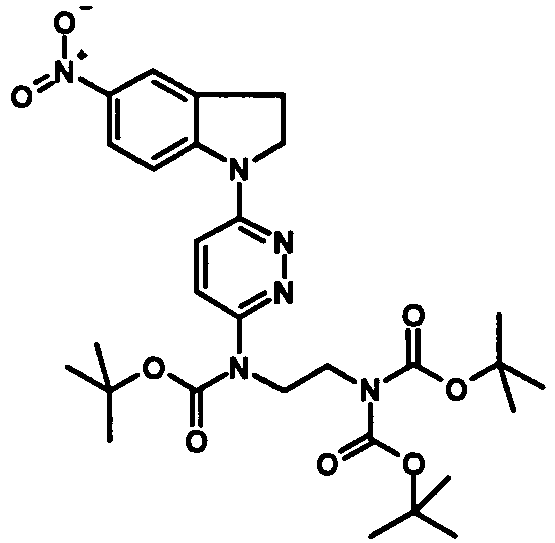
tert-butyl 3-[6-(5-nitro-2,3-dihydro-indol-1-yl)-pyridazin-3-yl]-2-oxo-imidazolidine-1-carboxylate
Mass spectrum (ESI+): m/z = 601 [M+H]+ (tert-butyl (2-(bis-tert-butoxycarbonyl)-amino-ethyl)-[6-(5-nitro-2,3-dihydro-indol-1-yl)-pyridazin-3-yl]-carbamate)
and
Mass spectrum (ESI+): m/z = 427 [M+H]+ (tert-butyl 3-[6-(5-nitro-2,3-dihydro-indol-1-yl)-pyridazin-3-yl]-2-oxo-imidazolidine-1-carboxylate) - (5) tert-butyl (2-(bis-tert-butoxycarbonyl)-amino-ethyl)-[6-(5-nitro-indol-1-yl)-pyridazin-3-yl]-carbamate
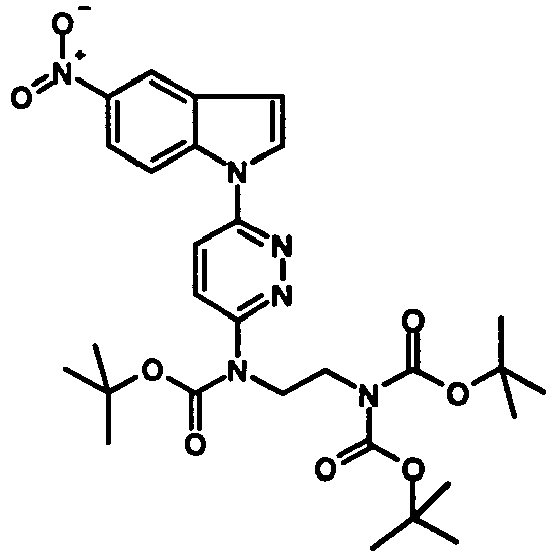
Mass spectrum (ESI+): m/z = 599 [M+H]+ - (6) tert-butyl 5'-(5-nitro-indol-1-yl)-2,3,5,6-tetrahydro-[1,2']bipyrazinyl-4-carboxylate

Mass spectrum (ESI+): m/z = 425 [M+H]+ - (7) tert-butyl (2-tert-butoxycarbonylamino-ethyl)-[2-(5-nitro-indol-1-yl)-pyrimidin-4-yl]-carbamate

Mass spectrum (ESI+): m/z = 599 [M+H]+ - (8) tert-butyl 4-[6-(5-nitro-indol-1-yl)-pyridazin-3-yl]-piperazine-1-carboxylate

Mass spectrum (ESI+): m/z = 425 [M+H]+ - (9) tert-butyl (2-(bis-tert-butoxycarbonyl)-amino-ethyl)-[4-(5-nitro-indol-1-yl)-pyrimidin-2-yl]-carbamate

Mass spectrum (ESI+): m/z = 599 [M+H]+ - (10) tert-butyl (3-(bis-tert-butoxycarbonyl)-amino-propyl)-(6-iodo-pyridazin-3-yl)-carbamate
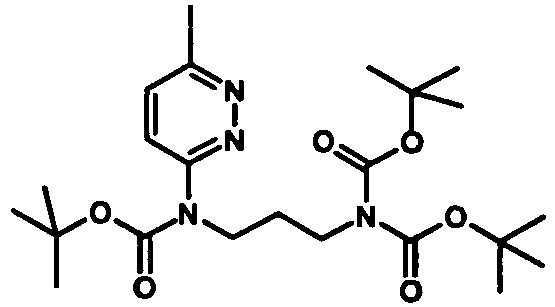
Mass spectrum (ESI+): m/z = 579 [M+H]+ - (11) tert-butyl [2-(tert-butoxycarbonyl-methyl-amino)-ethyl]-(6-iodo-pyridazin-3-yl)-carbamate

3-{[2-(bis-tert.-butoxycarbonyl)-amino)-ethyl]-methyl}-amino-6-iodo-pyridazine
Mass spectrum (ESI+): m/z = 479 [M+H]+ (tert-butyl [2-(tert-butoxycarbonylmethyl-amino)-ethyl]-(6-iodo-pyridazin-3-yl)-carbamate)
and
Mass spectrum (ESI+): m/z = 479 [M+H]+ (3-{[2-(bis-tert.-butoxycarbonyl)-amino)-ethyl]-methyl}-amino-6-iodo-pyridazine) - (12) tert-butyl (6-iodo-pyridazin-3-yl)-(2-piperidin-1-yl-ethyl)-carbamate

Mass spectrum (ESI+): m/z = 433 [M+H]+ - (13) tert-butyl [3-(tert-butoxycarbonyl-methyl-amino)-propyl]-(6-iodo-pyridazin-3-yl)-carbamate

3-{[3-(bis-tert.-butoxycarbonyl)-amino)-propyl)-methyl}-amino-6-iodo-pyridazine
Mass spectrum (ESI+): m/z = 493 [M+H]+ tert-butyl [3-(tert-butoxycarbonylmethyl-amino)-propyl]-(6-iodo-pyridazin-3-yl)-carbamate
and
Mass spectrum (ESI+): m/z = 493 [M+H]+ 3-{[3-(bis-tert.-butoxycarbonyl)-amino)-propyl]-methyl}-amino-6-iodo-pyridazine - (14) tert-butyl [2-(6-iodo-pyridazin-3-ylamino)-ethyl]-carbamate

Mass spectrum (ESI+): m/z = 365 [M+H]+ - (15) tert-butyl [2-(5-bromo-pyrazin-2-ylamino)-ethyl]-carbamate

Mass spectrum (ESI+): m/z = 317 [M+H]+ - (16) tert-butyl (5-bromo-pyrazin-2-yl)-(2-dimethylamino-ethyl)-carbamate

Mass spectrum (ESI+): m/z = 345 [M+H]+ -

- 500 mg 3,6-diiodo-pyridazine are dissolved in 2 ml dioxane, 1.5 ml methylamine (2 N in tetrahydrofuran are added and the mixture is heated for 48 hours to 120°C in a pressurised vessel. Then it is diluted with ethyl acetate and washed once with semisaturated sodium chloride solution. The organic phase is dried on magnesium sulphate, the solvents are eliminated in vacuo and the residue is chromatographed on silica gel (dichloromethane/methanol 99:1 to 90:10).
Yield: 35 mg (10 % of theory)
Mass spectrum (ESI+): m/z = 236 [M+H]+ -

- 250 mg 1-(6-chloro-pyridazin-3-yl)-5-nitro-2,3-dihydro-1H-indole and 500 mg piperazine are mixed in a microwave vessel and heated to 180°C for 2 hours in a microwave oven. After cooling to ambient temperature the mixture is stirred with dichloromethane and methanol. The solvents are eliminated in vacuo and the residue is divided between water and dichloromethane. The organic phase is washed with saturated sodium chloride solution and dried on magnesium sulphate. The solvent is eliminated in vacuo and the residue is extracted from diethyl ether/diisopropylether.
Yield: 245 mg (83 % of theory)
Mass spectrum (ESI+): m/z = 327 [M+H]+ - The following compounds are obtained analogously to Example XXIX:
- (1) N,N-dimethyl-N'-[2-(5-nitro-2,3-dihydro-indol-1-yl)-pyrimidin-4-yl]-ethan-1,2-diamine

N,N-dimethyl-N'-[4-(5-nitro-2,3-dihydro-indol-1-yl)-pyrimidin-2-yl]-ethan-1,2-diamine
Mass spectrum (ESI+): m/z = 329 [M+H]+ (N,N-dimethyl-N'-[2-(5-nitro-2,3-dihydro-indol-1-yl)-pyrimidin-4-yl]-ethan-1,2-diamine)
and
Mass spectrum (ESI+): m/z = 329 [M+H]+ (N,N-dimethyl-N'-[4-(5-nitro-2,3-dihydro-indol-1-yl)-pyrimidin-2-yl]-ethan-1,2-diamine) - (2) N,N-dimethyl-N'-[6-(5-nitro-2,3-dihydro-indol-1-yl)-pyridazin-3-yl]-ethan-1,2-diamine

Mass spectrum (ESI+): m/z = 329 [M+H]+ - (3) N*1*-[6-(5-nitro-2,3-dihydro-indol-1-yl)-pyridazin-3-yl]-ethan-1,2-diamine

Mass spectrum (ESI+): m/z = 301 [M+H]+ - (4) N*1*-[6-(5-nitro-indol-1-yl)-pyridazin-3-yl]-ethan-1,2-diamine
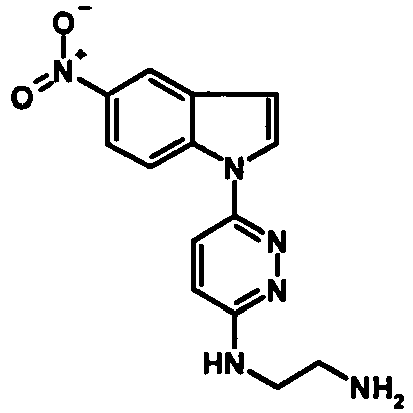
Mass spectrum (ESI+): m/z = 299 [M+H]+ - (5) 5'-(5-nitro-indol-1-yl)-3,4,5,6-tetrahydro-2H-[1,2']bipyrazinyl

- (6) N*1*-[2-(5-nitro-indol-1-yl)-pyrimidin-4-yl]-ethan-1,2-diamine
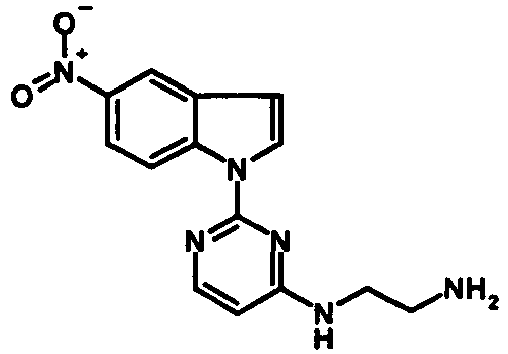
Mass spectrum (ESI+): m/z = 299 [M+H]+ - (7) 5-nitro-1-(6-piperazin-1-yl-pyridazin-3-yl)-1H-indole

- (8) methyl-[4-(5-nitro-indol-1-yl)-pyrimidin-2-yl]-amine

Mass spectrum (ESI+): m/z = 270 [M+H]+ - (9) N*1*-[4-(5-nitro-indol-1-yl)-pyrimidin-2-yl]-ethan-1,2-diamine

Mass spectrum (ESI+): m/z = 299 [M+H]+ -

- 5 g 3,6-dichloro-4-methyl-pyridazine are dissolved in 60 ml of a 67% solution of HI in water. The mixture is heated to 150°C for 45 minutes, cooled to ambient temperature and then the solution is added to 600 ml of 4 N NaOH. Then it is decanted from the insoluble oil. The oil is taken up in 100 ml of ethyl acetate and 100 ml petroleum ether are added thereto. After brief treatment in the ultrasound bath the solid formed is suction filtered (1.5 g). The mother liquor is evaporated down in vacuo and the residue is chromatographed on silica gel (cyclohexane/ ethyl acetate 10:1 to 1:3), to obtain another 220 mg product.
Yield: 1.72 g (16 % of theory)
Mass spectrum (ESI+): m/z = 347 [M+H]+ -

- 483 mg N'-(6-chloro-pyridazin-3-yl)-N,N-dimethyl-ethan-1,2-diamine are dissolved in 5.5 ml HBr solution (48 % in water). The mixture is heated for 12 hours to 100°C. It is carefully diluted with water and then adjusted to pH 9 with 1 N NaOH. Then it is extracted 3 times with ethyl acetate and the combined organic phases are then washed with saturated sodium chloride solution. After drying with magnesium sulphate the solvents are eliminated in vacuo.
Yield: 314 mg (53 % of theory)
Mass spectrum (ESI+): m/z = 245 [M+H]+ -

- 670 mg 8-bromo-2-chloro-quinoline and 920 mg piperazine are dissolved in 9 ml of n-butanol and refluxed for 4 hours. Then the solvent is eliminated in vacuo, the residue is dissolved in ethyl acetate and the organic phase is washed with saturated sodium hydrogen carbonate solution and saturated sodium chloride solution. After drying with magnesium sulphate the solvent is eliminated in vacuo and the residue is chromatographed on silica gel with dichloromethane/methanol 5:1.
Yield: 625 mg (77 % of theory)
Mass spectrum (ESI+): m/z = 292 [M+H]+ -

- 2.8 g 8-bromo-1H-quinolin-2-one are dissolved in 20 ml phosphorus oxychloride and refluxed for 90 minutes. Sufficient concentrated ammonia solution is added to give an alkaline pH. The solid is suction filtered, washed with water and dried.
Yield: 2.8 g (92 % of theory)
melting point: 115°C - The following compounds are obtained analogously to Example XLIII:
- (1) 3-chloro-5-trifluoromethyl-pyridazine

Rf value: 0.75 (silica gel; petroleum ether/ethyl acetate 2:1) -

- 6 g N-(2-bromo-phenyl)-3-ethoxy-acrylamide are added batchwise to 30 ml concentrated sulphuric acid. After the addition has ended the mixture is stirred for 1 hour and then poured onto ice water. The solid is suction filtered and dried. The product thus obtained is chromatographed on silica gel (dichloromethane/ethyl acetate 3:1 to 1:1).
Yield: 2.95 g (59 % of theory)
melting point: 186°C -

- 20 g ethyl 3-ethoxy-acrylate are dissolved in 160 ml of 2 N sodium hydroxide solution and refluxed for 4 hours. The mixture is cooled to ambient temperature and then adjusted to pH 3 with 4 N HCl. The precipitated solid is filtered off and dried. The mother liquor is extracted with ethyl acetate. The organic phase is treated with activated charcoal and sodium sulphate, filtered and evaporated down in vacuo. A total of 9.2 g product are thus obtained, which are dissolved in 120 ml of toluene. 6.9 ml of thionyl chloride are added and the mixture is refluxed for 3 hours. The solvents are eliminated in vacuo, the crude product is taken up in 60 ml of pyridine and cooled to 0°C. 11.6 g of 2-bromoaniline are added, the mixture is stirred for 1 hour at 0°C and for 2 hours at ambient temperature. Then it is diluted with water and the aqueous phase is extracted with ethyl acetate. The organic phase is washed twice with water and twice with 1 N hydrochloric acid. Activated charcoal and sodium sulphate are added, the mixture is filtered and the solvents are eliminated in vacuo. The residue is recrystallised from isopropanol/water.
Yield: 6.5 g (36 % of theory)
melting point: 98°C -
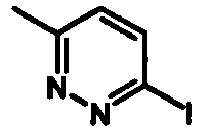
- 2.5 g 3-chloro-6-methyl-pyridazine are suspended in 10 ml of 67% HI solution. The mixture is heated to 120°C for 2 hours, cooled to ambient temperature and neutralised with 1 N NaOH solution. Then it is extracted with ethyl acetate and the organic phase is washed twice with water and once with saturated sodium chloride solution. After drying with magnesium sulphate the solvent is eliminated in vacuo.
Yield: 3.6 g (84 % of theory)
Mass spectrum (ESI+): m/z = 221 [M+H]+ - The following compounds are obtained analogously to Example XXXVI:
- (1) 3,6-diiodo-pyridazine

Mass spectrum (ESI+): m/z = 333 [M+H]+ - (2) 3-iodo-5-trifluoromethyl-pyridazine

Rf value: 0.53 (silica gel; petroleum ether/ethyl acetate 5:1) - (3) 3-iodo-5-(thiazol-2-yl)-pyridazine

-

- 1.3 g 3-bromo-5-methyl-phenylamine are dissolved in 3 ml concentrated HCl and cooled to 0°C. To this a solution of 560 mg sodiumnitrite in 1 ml of water is added dropwise. The solution thus prepared is added dropwise at 0°C to a solution of 280 mg of copper-II-chloride, 0.6 ml of water and 7 ml of sulphur dioxide in glacial acetic acid (30%). The cooling bath is removed and the mixture is stirred for 15 minutes at ambient temperature. Then it is diluted with ice water, the solid is suction filtered and dried in the desiccator. The product is further reacted directly in Example XI without further purification.
Yield: 1.354 g (72 % of theory) - The following compounds are obtained analogously to Example XXXVII:
- (1) 3-chloro-5-methyl-phenylsulphonyl-chloride

- (2) 3,5-dibromo-phenylsulphonyl-chloride

- (3) 3-bromo-5-chloro-phenylsulphonyl-chloride
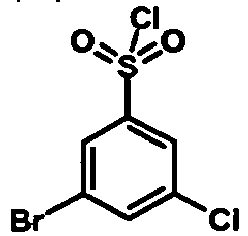
The product is further reacted directly in Example XI without further purification. -

- 5 g 2-bromopyridine-4-carboxylic acid are dissolved in 40 ml of tetrahydrofuran. 4.4 g of carbonyldiimidazole are added thereto and the mixture is stirred for 3 hours at ambient temperature and for 1 hour at 40°C. Then 20 ml of this solution are added dropwise to a solution of 1.2 ml N,N-dimethylethylenediamine in 10 ml of tetrahydrofuran. After stirring overnight the mixture is evaporated down in vacuo and the residue is divided between ethyl acetate and saturated sodium hydrogen carbonate solution. The organic phase is washed with saturated sodium chloride solution and dried on magnesium sulphate. After elimination of the solvents in vacuo the residue is chromatographed on silica gel with dichloromethane/methanol 5:1. The product thus obtained is chromatographed on aluminium oxide with ethyl acetate.
Yield: 1.7 g (62 % of theory)
Mass spectrum (ESI+): m/z = 272 [M+H]+ - The following compounds are obtained analogously to Example XXXVIII:
- (1) tert-butyl 4-(2-bromo-pyridin-4-carbonyl)-piperazine-1-carboxylate

Mass spectrum (ESI+): m/z = 370 [M+H]+ - (2) (2-bromo-pyridin-4-yl)-morpholin-4-yl-methanone

- (3) 2-bromo-N-(2-hydroxy-ethyl)-isonicotinamide

- (4) 2-bromo-N-methyl-isonicotinamide

Mass spectrum (ESI+): m/z = 215 [M+H]+ - (5) 2-bromo-N-(2-methoxy-ethyl)-isonicotinamide

Mass spectrum (ESI-): m/z = 257 [M-H]- - (6) 2-bromo-isonicotinamide

Mass spectrum (ESI-): m/z = 199 [M-H]- - (7) 2-bromo-N-cyclopropyl-isonicotinamide

Mass spectrum (ESI+): m/z = 241 [M+H]+ - (8) 2-bromo-N-methoxy-N-methyl-isonicotinamide

Mass spectrum (ESI+): m/z = 245 [M+H]+ - (9) 2-bromo-N-(2,2-dimethoxy-ethyl)-isonicotinamide

Mass spectrum (ESI+): m/z = 289 [M+H]+ -
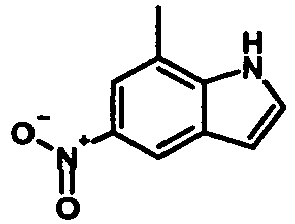
- 113 mg 2-ethynyl-6-methyl-4-nitro-phenylamine are dissolved in 5 ml N-methylpyrrolidone. To this are added 180 mg potassium-tert.-butoxide and the mixture is stirred for 8 hours at ambient temperature. Then it is divided between water and ethyl acetate, the aqueous phase is extracted once with ethyl acetate and the combined organic phases are dried on magnesium sulphate. The solvents are eliminated in vacuo and the residue is chromatographed on silica gel (cyclohexane/ ethyl acetate 10:1 to 1:2).
Yield: 65 mg (58 % of theory)
Mass spectrum (ESI-): m/z = 175 [M-H]- - The following compounds are obtained analogously to Example XXXIX:
- (1) 6-methyl-5-nitro-1H-indole

-

- 160 mg 2-methyl-4-nitro-6-trimethylsilanylethynyl-phenylamine are dissolved in 3 ml of methanol. 142 mg potassium carbonate are added to this and the mixture is stirred for 5 hours at ambient temperature. Then it is divided between water and ethyl acetate, the aqueous phase is extracted once with ethyl acetate and the combined organic phases are dried on magnesium sulphate. The solvents are eliminated in vacuo.
Yield: 113 mg (100 % of theory)
Mass spectrum (ESI+): m/z = 177 [M+H]+ - The following compounds are obtained analogously to Example XL:
- (1) 2-ethynyl-5-methyl-4-nitro-phenylamine
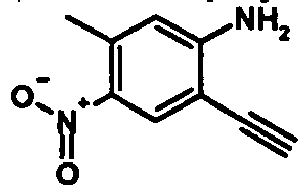
-

- 250 mg 2-iodo-6-methyl-4-nitro-phenylamine are dissolved in 5 ml of tetrahydrofuran. 17 mg copper-I-iodide and 63 mg bis-triphenylphosphine-palladium dichloride are added under argon. Then 635 µl trimethylsilylacetylene and 626 µl triethylamine are added. The mixture is stirred for 2 hours at ambient temperature, diluted with diethyl ether and the insoluble constituents are filtered off. Then the solvents are eliminated in vacuo and the residue is chromatographed on silica gel (cyclohexane/ethyl acetate 10:1 to 1:1).
Yield: 172 mg (73 % of theory)
Mass spectrum (ESI+): m/z = 249 [M+H]+ - The following compounds are obtained analogously to Example XLI:
- (1) 5-methyl-4-nitro-2-trimethylsilanylethynyl-phenylamine

-

- 2.3 g iodine are dissolved in 20 ml of ethanol, 2 g silver sulphate and 1 g 2-methyl-4-nitro-phenylamine are added. The mixture is stirred for 4 hours at ambient temperature, the solvent is eliminated in vacuo and divided between saturated sodium thiosulphate solution and dichloromethane. The organic phase is washed once with saturated sodium chloride solution and dried on magnesium sulphate. Then the solvents are eliminated in vacuo and the residue is extracted from diisopropylether/petroleum ether.
Yield: 1.62 g (89 % of theory)
Mass spectrum (ESI+): m/z = 279 [M+H]+ - The following compounds are obtained analogously to Example XLII:
- (1) 2-iodo-5-methyl-4-nitro-phenylamine

Mass spectrum (ESI+): m/z = 279 [M+H]+ -

- 600 mg 5-nitro-1-(4-oxy-pyrazin-2-yl)-1H-indole are added batchwise to 4 ml of phosphorus oxychloride warmed to 60°C. After the addition has ended the mixture is heated to 100°C for 3 hours. After cooling to ambient temperature it is added to ice water and the aqueous phase is extracted once with dichloromethane. The organic phase is washed with saturated sodium chloride solution and then dried on magnesium sulphate. After elimination of the solvent in vacuo the residue is chromatographed on silica gel (cyclohexane/ethyl acetate 10:1 to 1:1).
Yield: 140 mg (22 % of theory)
Mass spectrum (ESI+): m/z = 275 [M+H]+ -

- 10 ml chloropyrazine are dissolved in 10 ml of peracetic acid (39% in glacial acetic acid) and heated to 80°C for 24 hours. Then 10 ml of 35% hydrogen peroxide solution are added and the mixture is heated to 80°C for another 24 hours. After cooling to ambient temperature, sufficient sodium sulphide is carefully added until there is no further development of gas. Then the mixture is diluted with 500 ml dichloromethane. After drying with magnesium sulphate the solvent is eliminated in vacuo and the residue is chromatographed on silica gel with dichloromethane/methanol 99:1. The product thus obtained is extracted from petroleum ether.
Yield: 5.8 g (40 % of theory)
Mass spectrum (ESI+): m/z = 131 [M+H]+ -

- 5.95 g 1,3-dibromo-5-nitrobenzene are dissolved in 40 ml of ethanol. 23.9 g of tin-II-chloride dihydrate are added and the mixture is slowly heated to reflux temperature. Once reflux temperature has been reached it is maintained for another 30 minutes. Then the solvent is eliminated in vacuo and the residue is made alkaline with 4 N NaOH. Ethyl acetate is added and the mixture is filtered through kieselguhr. The filter cake is washed thoroughly with ethyl acetate. Then the aqueous phase is extracted 3 times with ethyl acetate and the combined organic phases are washed with saturated sodium chloride solution. After drying with magnesium sulphate the solvent is eliminated in vacuo and the residue is chromatographed on silica gel (cyclohexane/ethyl acetate 85:15 to 70:30).
Yield: 4.53 g (85 % of theory)
Rf value: 0.35 (silica gel, petroleum ether/ethyl acetate 5:1) -

- 200 mg 5-nitro-1H-indole are dissolved in 3 ml N-methylpyrrolidone and combined with 131 mg of potassium-tert.-butoxide. The mixture is stirred for 10 minutes at ambient temperature and then 214 mg 3,6-dichloro-pyridazine-4-carbonitrile in 2 ml N-methylpyrrolidone are added dropwise. The reaction mixture is heated to 65°C for 2 hours, divided between water and ethyl acetate and the aqueous phase is extracted twice with ethyl acetate. The combined organic phases are washed with saturated sodium chloride solution and dried on magnesium sulphate. Then the solvents are eliminated in vacuo and the residue is chromatographed on silica gel (cyclohexane/ethyl acetate 10:1 to 1:3). The product thus obtained is extracted from ethyl acetate.
Yield: 105 mg (28 % of theory)
Mass spectrum (ESI+): m/z = 317 [M+NH4]+ - The following compounds are obtained analogously to Example XLVI:
- (1) tert-butyl 4-[5-cyano-6-(5-nitro-indol-1-yl)-pyridazin-3-yl]-piperazine-1-carboxylate

Mass spectrum (ESI+): m/z = 450 [M+H]+ -

- 2.6 g 3,6-dichloro-pyridazine-4-carboxylic acid-amide are dissolved in 40 ml dichloromethane and cooled to 0°C. 7.6 ml triethylamine and then 3.9 ml trifluoroacetic anhydride are added. Then the mixture is stirred for 1 hour at 0°C and for 1 hour at ambient temperature. It is then divided between dichloromethane and saturated sodium hydrogen carbonate solution. The aqueous phase is extracted once with dichloromethane and the combined organic phases are washed once with saturated sodium chloride solution. After drying with magnesium sulphate the solvents are eliminated in vacuo and the residue is chromatographed on silica gel (cyclohexane/ethyl acetate 10:1 to 1:2).
Yield: 1.9 g (81 % of theory)
Mass spectrum (EI): m/z = 173 [M]+ - The following compounds are obtained analogously to Example XLVII:
- (1) 2-bromo-4-cyano-pyridine

-

- 10.4 g 1-bromo-3-chloro-5-nitro-benzene are dissolved in 200 ml of tetrahydrofuran and 50 ml of methanol. 1 g Raney nickel is added and the mixture is hydrogenated for 32 hours at 50 psi and ambient temperature. Then the catalyst is suction filtered and the solvent is eliminated in vacuo.
Yield: 9.25 g (102 % of theory)
Rf value: 0.40 (silica gel, petroleum ether/ethyl acetate 5:1) -

- 1.75 g N-(4-nitro-phenyl)-N'-propylidene-hydrazine are dissolved in 50 ml of toluene and to this are added 10 ml of an 85 % phosphoric acid solution. The mixture is heated to 100°C for 3 hours and then the toluene phase is decanted off. Then another 50 ml of toluene are added and the mixture is heated to 100°C for 12 hours. The toluene phase is decanted off again and combined with the first toluene phase. The combined toluene phases are washed successively with water and saturated sodium chloride solution. After drying with magnesium sulphate the solvent is eliminated in vacuo and the residue is chromatographed on silica gel with cyclohexane/ethyl acetate (100:0 to 50:50).
Yield: 509 mg (32 % of theory)
Mass spectrum (ESI+): m/z = 177 [M+H]+ - The following compounds are obtained analogously to Example XLIX:
- (1) 3-ethyl-5-nitro-1H-indole

-

- 2 g 4 nitrophenylhydrazine are suspended in 8 ml of ethanol and 1 ml of propionaldehyde is added. The mixture is stirred for 12 hours at ambient temperature, the solvent is eliminated in vacuo and the residue is extracted from diisopropylether.
Yield: 1.75 g (69 % of theory)
Mass spectrum (ESI+): m/z = 194 [M+H]+ - The following compounds are obtained analogously to Example L:
- (1) N-butyliden-N'-(4-nitro-phenyl)-hydrazine
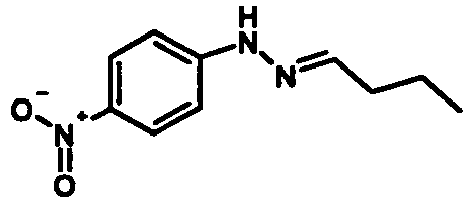
-

- 1 g 5-nitroindole-3-carboxaldehyde is suspended in 40 ml formic acid and to this are added 510 mg hydroxylamine hydrochloride. The mixture is refluxed for 12 hours, allowed to cool to ambient temperature and adjusted to pH 5 with 4 N sodium hydroxide solution. Then the mixture is extracted with ethyl acetate and the organic phase is washed successively with water and saturated sodium chloride solution. After drying with magnesium sulphate the solvent is eliminated in vacuo and the residue is chromatographed on silica gel with cyclohexane/ethyl acetate (50:50 to 0:100).
Yield: 226 mg (23 % of theory)
Mass spectrum (ESI-): m/z = 186 [M-H]- -

- 2.17 g 3-chloro-5-nitro-1H-indole are dissolved in 120 ml acetone and 20 ml of water. 17 g of ammonium acetate are added and then within 0.5 hours 60 ml of a 20 % solution of titanium-(III)-chloride in 3 % hydrochloric acid are added dropwise. Then the mixture is stirred for another hour, added to 300 ml of water and neutralised with 4 N sodium hydroxide solution. Then it is extracted 3 times with ethyl acetate and the combined organic phases are washed with saturated sodium chloride solution. After drying with magnesium sulphate the solvent is eliminated in vacuo.
Yield: 2.12 g (115 % of theory)
Mass spectrum (ESI+): m/z = 167 [M+H]+ -

- 2 g 5-nitroindole are dissolved in 20 ml dimethylformamide. 2 g N-bromosuccinimide are added batchwise thereto and the mixture is stirred for 12 hours at ambient temperature. Then it is added to 200 ml of water, the precipitate is suction filtered and washed with a little diethyl ether. The solid is dried in vacuo.
Yield: 2.17 g (90 % of theory)
Mass spectrum (ESI+): m/z = 197 [M+H]+ - The following compounds are obtained analogously to Example LIII:
- (1) tert.butyl [(3-chloro-1H-indol-5-yl)-(3,5-dichloro-phenylsulphonyl)-amino]-acetate

- (2) 3-iodo-5-nitro-1H-indole
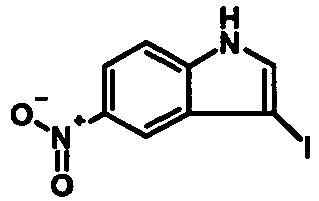
-

- 1.7 g 3-iodo-5-nitro-1H-indole are dissolved in 20 ml dimethylformamide. To this are added 1.5 ml of methyl fluorosulphonyl-2,2-difluoroacetate and 150 mg copper-I-iodide. Then the mixture is heated to 80°C for 4 hours. After cooling to ambient temperature it is divided between water and ethyl acetate. The aqueous phase is extracted with ethyl acetate and the combined organic phases are dried on magnesium sulphate. The solvents are eliminated in vacuo and the residue is chromatographed on silica gel with cyclohexane/ethyl acetate (100:0 to 50:50).
Yield: 612 mg (45 % of theory)
Mass spectrum (ESI-): m/z = 229 [M-H]- -

- 1 g of 4-amino-2-bromo-pyridine is combined with 0.59 g sodium hydride (approx. 60% in mineral oil) under an argon atmosphere in dry N,N-dimethylformamide while cooling with an ice bath. After five minutes 0.70 ml of bis(2-chloroethyl)ether are pipetted in. The reaction mixture is heated to ambient temperature overnight, combined with ethyl acetate and washed with water. The organic phase is dried on magnesium sulphate and evaporated down. The resin-like flask residue is stirred with a little ethyl acetate and suction filtered. The crude product is chromatographed through a silica gel column with cyclohexane/ ethyl acetate (60:40 to 40:60).
Yield: 870 mg (62% of theory)
Mass spectrum (ESI+): m/z = 243 [M+H]+
Rf value: 0.32 (silica gel: ethyl acetate/petroleum ether 1:1) - The following compounds are obtained analogously to Example LV:
- (1) 4-(6-bromo-pyridin-3-yl)-morpholine

Rf value: 0.47 (silica gel: ethyl acetate/petroleum ether 1:1) -

- 160 mg N-(5-bromo-pyrazin-2-yl)-2-(2-chloro-ethoxy)-acetamide and 323 mg caesium carbonate are stirred in 5 ml acetonitrile overnight at ambient temperature. Then the reaction mixture is evaporated down, combined with ethyl acetate and washed with semisaturated sodium chloride solution. The organic phase is dried on magnesium sulphate and evaporated down. The flask residue is stirred with a little tert-butylmethylether, suction filtered and dried.
Yield: 110 mg (79% of theory)
Mass spectrum (ESI+): m/z = 258 [M+H]+
Rf value: 0.52 (silica gel: ethyl acetate/petroleum ether 1:1) - The following compounds are obtained analogously to Example LVI:
- (1) 4-(6-bromo-pyridazin-3-yl)-morpholin-3-one

Rf value: 0.35 (silica gel: ethyl acetate/petroleum ether 1:1) - (2) 4-(6-bromo-pyridin-3-yl)-morpholin-3-one

Rf value: 0.17 (silica gel: ethyl acetate/petroleum ether 1:1) - (3) 4-(2-bromo-pyridin-4-yl)-morpholin-3-one

-

- 5 ml of a 0.5 M solution of (2-chloroethoxy)-acetyl chloride in tetrahydrofuran are added dropwise to 500 mg 2-amino-5-bromo-pyrazine and 1 ml triethylamine in 5 ml of tetrahydrofuran while cooling with an ice bath. The reaction mixture is stirred overnight at ambient temperature, then a total of 5 ml (2-chloroethoxy)-acetyl chloride (0.5 M in tetrahydrofuran) and 1 ml triethylamine are added again. After another 48 h at ambient temperature the reaction mixture is combined with ethyl acetate and washed with 1 N hydrochloric acid, saturated sodium hydrogen carbonate solution and saturated sodium chloride solution. The organic phase is dried on magnesium sulphate, evaporated down and chromatographed through a silica gel column with cyclohexane/ethyl acetate (70:30 to 60:40).
Yield: 165 mg (20% of theory)
Rf value: 0.58 (silica gel: ethyl acetate/petroleum ether 1:1) - The following compounds are obtained analogously to Example LVII:
- (1) N-(6-bromo-pyridazin-3-yl)-2-(2-chloro-ethoxy)-acetamide
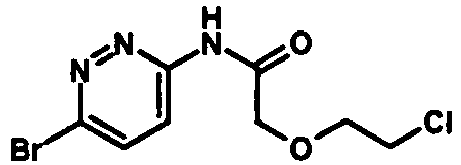
Rf value: 0.46 (silica gel: ethyl acetate/petroleum ether 1:1) - (2) N-(6-bromo-pyridin-3-yl)-2-(2-chloro-ethoxy)-acetamide

- (3) N-(2-bromo-pyridin-4-yl)-2-(2-chloro-ethoxy)-acetamide

-

- 66 mg sodium hydride (55% in mineral oil) are added at ambient temperature to 300 mg 2,5-dibromo-pyrazine and 135 mg 4-hydroxy-tetrahydro-pyran in 6 ml of tetrahydrofuran and the reaction mixture is stirred for five hours at ambient temperature. Then it is diluted with copious amounts of tert-butylmethylether, washed with saturated sodium chloride solution, dried on magnesium sulphate and evaporated down. The solid flask residue is gently heated with petroleum ether, cooled in the ice bath cooled, suction filtered and washed with a little petroleum ether. The filtrate is evaporated down, the residue is stirred with a little n-hexane, cooled in the ice bath, suction filtered and washed with a little n-hexane. The combined filter cakes are dried.
Yield: 246 mg (75% of theory)
Mass spectrum (EI): m/z = 258 [M]+
Rf value: 0.50 (silica gel: petroleum ether/ethyl acetate 8:2) - The following compounds are obtained analogously to Example LVIII:
- (1) (S)-2-bromo-5-(tetrahydro-furan-3-yloxy)-pyrazine
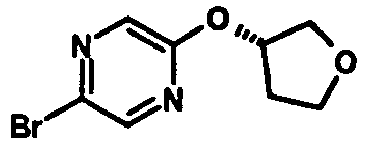
- (2) (R)-2-bromo-5-(tetrahydro-furan-3-yloxy)-pyrazine

Rf value: 0.40 (silica gel: petroleum ether/ethyl acetate 8:2) - (3) (S)-3-iodo-6-(tetrahydro-furan-3-yloxy)-pyridazine

Rf value: 0.35 (silica gel: cyclohexane/ethyl acetate 7:3) - (4) 3-iodo-6-(tetrahydro-pyran-4-yloxy)-pyridazine
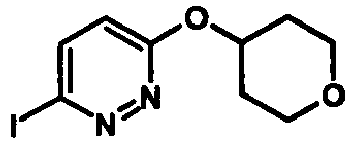
Rf value: 0.40 (silica gel: cyclohexane/ethyl acetate 7:3) - (5) (R)-3-iodo-6-(tetrahydro-furan-3-yloxy)-pyridazine

Rf value: 0.30 (silica gel: cyclohexane/ethyl acetate 7:3) - (6) 3-iodo-6-(2-dimethylamino)-ethoxy-pyridazine

Mass spectrum (ESI+): m/z = 294 [M+H]+ - (7) 3-iodo-6-benzyloxy-pyridazine

- (8) 3-iodo-6-[2-(tetrahydro-pyran-2-yloxy)-ethoxy]-pyridazine
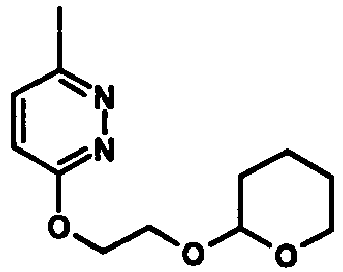
Mass spectrum (ESI+): m/z = 351 [M+H]+ - (9) 3-iodo-6-methylsulphanyl-pyridazine

Mass spectrum (ESI+): m/z = 253 [M+H]+ - (10) 3-iodo-6-(2-phenyl-[1.3]dioxan-5-yloxy)-pyridazine

Mass spectrum (ESI+): m/z = 385 [M+H]+ - (11) 2-bromo-5-methylsulphanyl-pyrazine
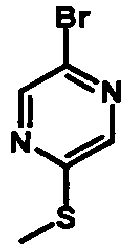
Rf value: 0.43 (silica gel: cyclohexane/ethyl acetate 20:1) - (12) 2-bromo-5-(2-phenyl-[1.3]dioxan-5-yloxy)-pyrazine

Mass spectrum (ESI+): m/z = 337 [M+H]+ - (13) [2-(5-bromo-pyrazin-2-yloxy)-ethyl]-dimethyl-amine
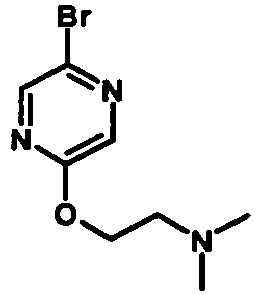
- (14) 2-iodo-4-methylsulphanyl-pyridine

Mass spectrum (ESI+): m/z = 252 [M+H]+ - (15) tert-butyl [2-(5-bromo-pyrazin-2-yloxy)-ethyl]-carbamate

- (16) 2-bromo-4-ethylsulphanyl-pyridine

Mass spectrum (ESI+): m/z = 218 [M+H]+ -

- A mixture of 500 mg 2-bromo-5-hydroxy-pyridine and tetrahydro-furan-3-yl-toluene-4-sulphonate in 5 ml N,N-dimethylformamide is stirred for five hours in an oil bath warmed to 60°C, then another 0.2 ml tetrahydro-furan-3-yl-toluene-4-sulphonate is added and the mixture is stirred for another five hours at 80°C. For working up the reaction mixture is evaporated down and combined with ice water. The precipitate formed is suction filtered, washed with water and dried. The crude product is stirred with a little methanol, suction filtered, washed with a little methanol and dried in the desiccator.
Yield: 496 mg (71 % of theory)
Mass spectrum (ESI+): m/z = 244 [M+H]+ - The following compounds are obtained analogously to Example LIX:
- (1) 2-bromo-5-(tetrahydro-pyran-4-yloxy)-pyridine

Rf value: 0.50 (silica gel: cyclohexane/ethyl acetate 1:1) - (2) 2-bromo-4-(tetrahydro-furan-3-yloxy)-pyridine

Rf value: 0.35 (silica gel: cyclohexane/ethyl acetate 1:1) - (3) 2-bromo-4-(tetrahydro-pyran-4-yloxy)-pyridine

Rf value: 0.48 (silica gel: cyclohexane/ethyl acetate 1:1) -

- 1.30 ml of a 0.5 M solution of 2-thiazolyl-zinc bromide in tetrahydrofuran and 20 mg tetrakis(triphenylphosphine)palladium(0) are added under argon to 150 mg tert.butyl {(3,5-dichloro-phenylsulphonyl)-[1-(6-iodo-pyrimidin-4-yl)-1H-indol-5-yl]-amino}-acetate. The reaction mixture refluxed for 15 minutes at reflux temperature and after cooling evaporated down in vacuo. The flask residue is chromatographed through a silica gel column with cyclohexane/ethyl acetate (80:20 to 60:40) as eluant.
Yield: 110 mg (78 % of theory)
Mass spectrum (ESI+): m/z = 616 [M+H]+
Rf value: 0.55 (silica gel: petroleum ether/ethyl acetate 2:1) - The following compounds are obtained analogously to Example LX:
- (1) tert.butyl {(3,5-dichloro-phenylsulphonyl)-[1-(4-thiazol-2-yl-pyridin-2-yl)-1H-indol-5-yl]-amino}-acetate

Mass spectrum (ESI+): m/z = 615 [M+H]+ - (2) tert.butyl ((3,5-dichloro-phenylsulphonyl)-{1-[4-(1-ethoxymethyl-1H-imidazol-2-yl)-pyridin-2-yl]-1H-indol-5-yl}-amino)-acetate

The product is further reacted directly (19). - (3) tert.butyl ((3,5-dichloro-phenylsulphonyl)-{1-[4-(1-methyl-1H-imidazol-2-yl)-pyridin-2-yl]-1H-indol-5-yl}-amino)-acetate
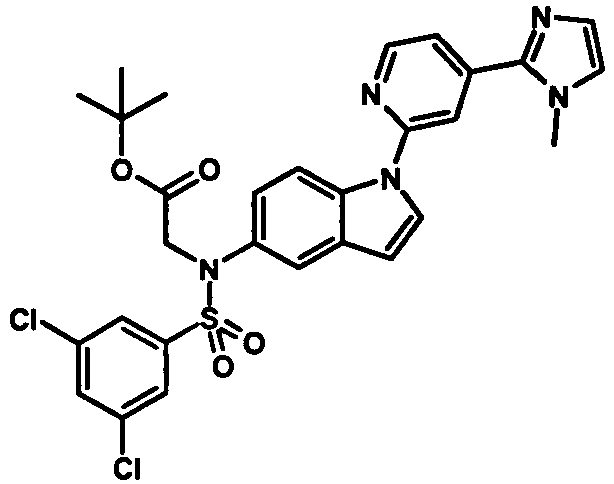
tetrakis(triphenylphosphine)palladium(0) are added and the mixture is refluxed for 2 hours. After the reaction has ended the mixture is divided between water and ethyl acetate. The organic phase is dried on magnesium sulphate. The solvents are eliminated in vacuo and the residue is chromatographed on silica gel.
Mass spectrum (ESI+): m/z = 612 [M+H]+ - (4) 2-(tetrahydro-pyran-2-yl)-5-(thiazol-2-yl)-2H-pyridazin-3-one

- (5) tert.butyl {(3,5-dichloro-phenylsulphonyl)-[1-(2-thiazol-2-yl-pyrimidin-4-yl)-1H-indol-5-yl]-amino}-acetate

Rf value: 0.33 (silica gel: petroleum ether/ethyl acetate 1:2) - (6) tert.butyl ((3,5-dichloro-phenylsulphonyl)-{1-[6-(1-methyl-1H-imidazol-2-yl)-pyrimidin-4-yl]-1H-indol-5-yl}-amino)-acetate
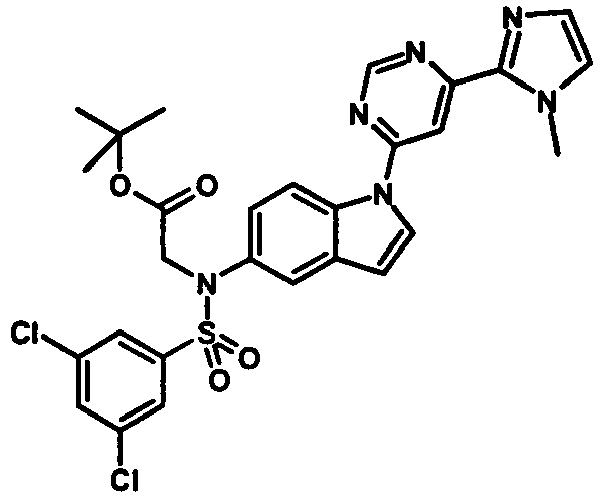
Rf value: 0.33 (silica gel: petroleum ether/ethyl acetate 1:2) - (7) tert.butyl {(2-chloro-6-methyl-pyridin-4-sulphonyl)-[1-(6-methyl-pyridazin-3-yl)-1H-indol-5-yl]-amino}-acetate

Mass spectrum (ESI+): m/z = 528 [M+H]+ -

- 11.49 ml boron trifluoride-diethyletherate are added dropwise to 5.00 g 6-ethyl-5-nitro-1H-indol-2,3-dione in 300 ml of tetrahydrofuran at -25°C under argon. Then 2.58 g sodium borohydride are added batchwise and the reaction mixture is stirred for one hour at -20°C. After being slowly heated to ambient temperature the reaction mixture is poured onto approx. 500 ml ice water and 300 ml tert-butylmethylether with stirring. The aqueous phase is extracted with tert-butylmethylether and the combined extracts are washed with water and saturated sodium chloride solution, dried on magnesium sulphate and evaporated down.
The flask residue is taken up in dichloromethane, filtered through a layer of aluminium oxide (activity stage II) and washed with dichloromethane. The yellow filtrate is evaporated down and the residue is stirred with petroleum ether and a little tert-butylmethylether, suction filtered, washed with petroleum ether and dried.
Yield: 2.43 g (56 % of theory)
Mass spectrum (ESI-): m/z = 189 [M-H]-
Rf value: 0.60 (silica gel: cyclohexane/ethyl acetate 1:1) -

- 220 mg 3-iodo-6-(2-aminoethyl)-amino-pyridazine and 290 µl N,N-diisopropyl-N-ethyl-amine are dissolved in 5 ml dichloromethane. 440 µl of a 20% solution of phosgene in toluene is added dropwise thereto. The mixture is stirred for another 1 hour, diluted with dichloromethane and washed once with semisaturated sodium chloride solution. After drying with magnesium sulphate the solvent is eliminated in vacuo and the residue is chromatographed on silica gel.
Yield: 60 mg (25 % of theory)
Mass spectrum (ESI+): m/z = 291 [M+H]+ - The following compounds are obtained analogously to Example LXII:
- (1) tert-butyl 3-(6-iodo-pyridazin-3-yl)-2-oxo-imidazolidine-1-carboxylate

Mass spectrum (ESI+): m/z = 391 [M+H]+ -
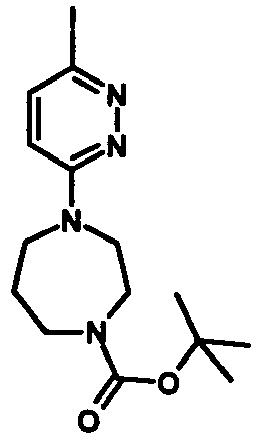
- 500 mg 3,6-diiodo-pyridazine are dissolved in 3 ml dioxane. 220 mg potassium carbonate and 330 µl Boc-homopiperazine are added and the mixture is heated to 120°C for 24 hours. Then it is diluted with dichloromethane and filtered to remove the insoluble constituents. The mother liquor is evaporated down in vacuo and the residue is chromatographed on silica gel (cyclohexane/ethyl acetate 80:20 to 0:100).
Yield: 490 mg (80 % of theory)
Mass spectrum (ESI+): m/z = 405 [M+H]+ - The following compounds are obtained analogously to Example LXIII:
- (1) 3-iodo-6-(2-aminoethyl)-amino-pyridazine

-

- 1 g 5-nitro-1H-indole is dissolved in 30 ml of tetrahydrofuran and cooled to - 10°C. To this is added dropwise a 3 N solution of methylmagnesium bromide in diethyl ether and the mixture is stirred for 30 minutes at -10°C. Then 1.7 g 2,3-dichloro-5,6-dicyano-p-benzoquinone are added and the mixture is allowed to come up to ambient temperature within 20 minutes. Then it is diluted with diethyl ether and washed once with saturated sodium hydrogen carbonate solution and once with saturated sodium chloride solution. The organic phase is dried on magnesium sulphate, the solvent is eliminated in vacuo and the residue is chromatographed on silica gel.
Yield: 668 mg (61 % of theory)
Mass spectrum (ESI+): m/z = 177 [M+H]+ -

- 37.2 g ethyleneglycol are dissolved in 380 ml diethyl ether. 0.5 ml of concentrated hydrochloric acid are added and then 54 g of dihydro-2H-pyran are added dropwise. Then the mixture is stirred for 1.5 hours, then 8 g potassium carbonate are added and stirring is continued for a further 10 minutes. Then the solids are filtered off, the mother liquor is evaporated down in vacuo and the residue is chromatographed on silica gel (cyclohexane/ethyl acetate 50:50 to 0:100).
Yield: 38.4 g (44 % of theory)
Mass spectrum (ESI+): m/z = 146 [M+H]+ - The following compounds are obtained analogously to Example LXV:
- (1) (5-bromo-pyrazin-2-yl)-[2-(tetrahydro-pyran-2-yloxy)-ethyl]-amine

Mass spectrum (ESI+): m/z = 302 [M+H]+ -

- 1 g 5-amino-2-bromo-pyridine are dissolved in 20 ml dichloromethane. To this are added successively 1.22 ml 2-tert-butyl-dimethylsilyloxy-acetaldehyde and 478 µl acetic acid. After stirring for 1 hour at ambient temperature, 2.2 g sodium triacetoxyborohydride are added in batches. Then the mixture is stirred for 3 days, 8 ml of methanol are added and stirring is continued for a further 12 hours. Then the solvents are eliminated in vacuo, the residue is taken up in ethyl acetate and washed once with 10 % citric acid solution and once with saturated sodium chloride solution. After drying with magnesium sulphate the solvent is eliminated in vacuo and the residue is chromatographed on silica gel (cyclohexane/ethyl acetate 10:1).
Yield: 619 mg (32 % of theory)
Mass spectrum (ESI+): m/z = 331 [M+H]+ - The following compounds are obtained analogously to Example LXVI:
- (1) (6-bromo-pyridin-3-yl)-(2,2-dimethyl-[1,3]dioxan-5-yl)-amine
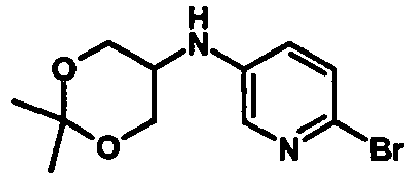
-

- Under argon 380 mg tert.butyl {(3,5-dichloro-phenylsulphonyl)-[1-(6-iodo-pyridazin-3-yl)-1H-indol-5-yl]-amino}-acetate are dissolved in 10 ml of tetrahydrofuran. To this are added successively 38 µl propargylalcohol, 4 mg bistriphenylphosphine-palladium-dichloride, 2.5 mg copper iodide and 162 µl diisopropylamine. The mixture is heated to 65°C for 4 hours, then another 38 µl propargylalcohol, 4 mg bistriphenylphosphine-palladium dichloride, 2.5 mg copper iodide and 162 µl diisopropylamine are added and the mixture is heated for another 12 hours to 65°C. Then it is diluted with ethyl acetate, washed once with water and once with saturated sodium chloride solution and dried on magnesium sulphate. Then the solvents are eliminated in vacuo and the residue is chromatographed on silica gel (cyclohexane/ethyl acetate 34:66).
Yield: 235 mg (69 % of theory)
Mass spectrum (ESI+): m/z = 587 [M+H]+ - The following compounds are obtained analogously to Example LXXXI:
- (1) tert.butyl ((3,5-dichloro-phenylsulphonyl)-{1-[4-(3-hydroxy-prop-1-ynyl)-pyridin-2-yl]-1H-indol-5-yl}-amino)-acetate

Rf value: 0.6 (silica gel: petroleum ether/ethyl acetate 1:1) -

- 380 mg tert.butyl ((3,5-dichloro-phenylsulphonyl)-{1-[6-(2-phenyl-[1,3]dioxan-5-yloxy)-pyridazin-3-yl]-1H-indol-5-yl}-amino)-acetate are dissolved in 2 ml acetic acid, 2 ml of tetrahydrofuran and 100 µl of water. The mixture is heated to 100°C for 2 hours in a pressurised vessel, then diluted with ethyl acetate, washed once with saturated sodium chloride solution and dried with magnesium sulphate. The solvents are eliminated in vacuo and the residue is chromatographed on silica gel (dichloromethane/methanol 97:3 to 90:10).
Yield: 160 mg (48 % of theory)
Mass spectrum (ESI+): m/z = 623 [M+H]+ - The following compounds are obtained analogously to Example LXVIII:
- (1) tert.butyl ((3,5-dichloro-phenylsulphonyl)-{1-[5-(2,3-dihydroxy-propoxy)-pyrazin--yl]-1H-indol-5-yl}-amino)-acetate

Mass spectrum (ESI+): m/z = 623 [M+H]+ -

- 140 mg tert.butyl {(3,5-dichloro-phenylsulphonyl)-[1-(4-methylsulphanyl-pyridin-2-yl)-1H-indol-5-yl]-amino}-acetate are dissolved in 5 ml hexafluorisopropanol and to this are added 51 µl of a 32 % solution of hydrogen peroxide in water. The mixture is stirred for 2 hours, combined with another 51 µl of a 32 % solution of hydrogen peroxide in water and stirred for another 2 hours. Then it is combined with 10 % sodium thiosulphate and 10 % sodium hydrogen carbonate solution, extracted 3 times with ethyl acetate, the organic phase is dried on magnesium sulphate and the solvent is eliminated in vacuo. The residue is chromatographed on silica gel (cyclohexane/ethyl acetate 70:30 to 0:100).
Yield: 145 mg (100 % of theory)
Mass spectrum (ESI+): m/z = 594 [M+H]+ -

- 20 g 2,4-dichloro-pyridine are dissolved in 250 ml acetonitrile. 61 g of sodium iodide and 19.2 ml acetyl chloride are added and the mixture is refluxed for 12 hours. Then it is diluted with dichloromethane and washed once with 10 % potassium carbonate solution and once with 5 % sodium hydrogen sulphite solution. The organic phase is dried on magnesium sulphate and the solvents are eliminated in vacuo. The residue is chromatographed on silica gel (cyclohexane/ethyl acetate 5:1).
Yield: 145 mg (100 % of theory)
Rf value: 0.50 (silica gel: cyclohexane/ethyl acetate 5:1) -
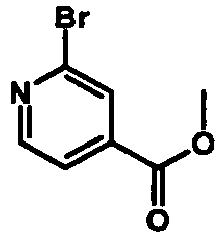
- 500 mg 2-bromo-isonicotinic acid are dissolved in 4 ml diethyl ether. 230 µl of oxalyl chloride and 10 ul DMF are added successively and the mixture is refluxed for 1 hour. Then the volatile constituents are eliminated in vacuo, the residue is taken up twice in 4 ml dichloromethane and this is then eliminated again in vacuo. The acid chloride thus obtained is taken up in 5 ml diethyl ether and to this are added dropwise 500 µl methanol and 370 µl pyridine. The mixture is stirred for 1 hour and divided between water and ethyl acetate. The organic phase is dried on magnesium sulphate, the solvent is eliminated in vacuo and the residue is chromatographed on silica gel (dichloromethane/methanol 99:1 to 80:20).
Yield: 385 mg (79 % of theory)
Mass spectrum (ESI+): m/z = 216 [M+H]+ -

- 500 mg 5-bromo-pyrazin-2-ylamine are dissolved in 20 ml of ethanol and 750 µl bromo-acetaldehyde-diethylacetal and 2.5 ml 48 % hydrobromic acid are added. The mixture is heated to 70°C for 12 hours, diluted with water and combined with 20 ml 1 N sodium hydroxide solution. Then it is extracted 3 times with dichloromethanelisopropanol (4:1). The combined organic phases are washed with semisaturated sodium chloride solution, dried on magnesium sulphate and freed from the solvents in vacuo. The residue is extracted from diisopropyl ether.
Yield: 105 mg (18 % of theory)
Mass spectrum (ESI+): m/z = 198 [M+H]+ -
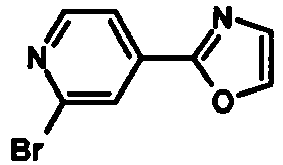
- 650 mg 2-bromo-N-(2,2-dimethoxy-ethyl)-isonicotinamide are added to a mixture of 9 ml methanesulphonic acid and 1 g phosphorus pentoxide and heated to 135°C for 6 hours. Then the mixture is added to ice, the aqueous phase is extracted twice with ethyl acetate and the combined organic phases are washed twice with saturated sodium hydrogen carbonate solution and once with saturated sodium chloride solution. After drying with magnesium sulphate the solvents are eliminated in vacuo and the residue is chromatographed on silica gel (petroleum ether/ ethyl acetate 3:1).
Yield: 105 mg (21 % of theory)
Mass spectrum (ESI+): m/z = 225 [M+H]+ -

- 200 mg 2-bromo-N-methoxy-N-methyl-isonicotinamide are dissolved in 3 ml of tetrahydrofuran, cooled to -10°C and to this are added dropwise 275 µl of a 3 N solution of methylmagnesium bromide in tetrahydrofuran. Then the mixture is allowed to come up to ambient temperature, stirred for 12 hours and divided between ethyl acetate and semisaturated sodium chloride solution. The organic phase is dried on magnesium sulphate, freed from the solvents in vacuo and the residue is chromatographed on silica gel (cyclohexane/ ethyl acetate 90:10 to 50:50).
Yield: 110 mg (67 % of theory)
Mass spectrum (ESI+): m/z = 200 [M+H]+ - The following compounds are obtained analogously to Example LXXIV:
- (1) 1-(2-bromo-pyridin-4-yl)-propan-1-one

Yield: 155 mg (46 % of theory)
Rf value: 0.70 (silica gel: petroleum ether/ethyl acetate 2:1) -

- 374 mg 5-chloro-pyrazine-2-carboxylic acid-amide are dissolved in 5 ml phosphorus oxychloride and refluxed for 2 hours. Then the phosphorus oxychloride is eliminated in vacuo and the residue is twice taken up in toluene and the latter is again eliminated in vacuo. Then the mixture is divided between water and ethyl acetate, the organic phase is washed once with saturated sodium chloride solution, dried on magnesium sulphate and freed from the solvent in vacuo.
Yield: 128 mg (39 % of theory)
Rf value: 0.90 (silica gel: cyclohexane/ethyl acetate 1:1) -
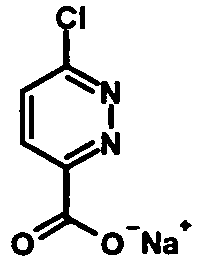
- 250 mg methyl 6-chloro-pyridazine-3-carboxylate are dissolved in 5 ml of tetrahydrofuran, 1.5 ml 1 N sodium hydroxide solution are added and the mixture is stirred for 2 hours. Then the solvent is eliminated in vacuo and the residue is extracted from ethyl acetate.
Yield: 255 mg (98 % of theory)
Mass spectrum (ESI+): m/z = 157 [M+H]+ -
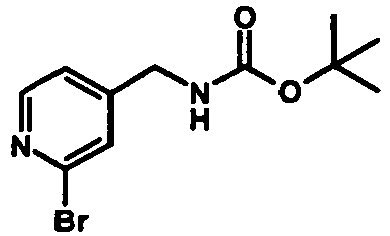
- 50 mg C-(2-bromo-pyridin-4-yl)-methylamine are dissolved in 3 ml of tetrahydrofuran. The mixture is cooled to 0°C, 320 µl of 1 N sodium hydroxide solution are added and then 65 mgl of di-tert-butyl-dicarbonate are added. After stirring for 12 hours the mixture is divided between ethyl acetate and water. The organic phase is washed twice with water and once with saturated sodium chloride solution, dried on magnesium sulphate and evaporated down in vacuo.
Yield: 60 mg (78 % of theory)
Mass spectrum (ESI+): m/z = 287 [M+H]+ -

- 148 mg 2-bromo-isonicotinamide are dissolved in 3 ml of tetrahydrofuran, cooled to 0°C and to this 2.2 ml of a 1 N solution of borane-tetrahydrofuran complex in tetrahydrofuran are added dropwise. Then the mixture is heated to 70°C for 4 hours, cooled to ambient temperature, 1.5 ml of methanol and 1.5 ml of 1 N sodium hydroxide solution are added and the mixture is heated to 70°C for 30 minutes. Then it is diluted with dichloromethane, washed once with saturated sodium chloride solution, dried on magnesium sulphate, the solvents are eliminated in vacuo and the residue is chromatographed on silica gel (dichloromethane/methanol 100:0 to 80:20).
Yield: 50 mg (36 % of theory)
Mass spectrum (ESI+): m/z = 187 [M+H]+ -

- 2 ml phosphorus oxychloride are added to 225 mg 2-(tetrahydro-pyran-2-yl)-5-(thiazol-2-yl)-2H-pyridazin-3-one and the reaction mixture is heated to 90°C for 10 minutes. After cooling to ambient temperature the reaction mixture is evaporated down in vacuo and slowly poured onto ice water with stirring. The mixture is made alkaline with sodium carbonate and extracted with dichloromethane. The organic phase is washed with saturated sodium chloride solution, dried on magnesium sulphate and evaporated down. The flask residue is chromatographed through a silica gel column with cyclohexane/ethyl acetate (80:20 to 40:60) as eluant.
Yield: 62 mg (37 % of theory)
Rf value: 0.48 (silica gel: petroleum ether/ethyl acetate 1:1) -

- 89 mg 2,4-di(tert-butoxy)-pyrimidin-5-yl-boric acid and 1ml of a 1 M sodium hydrogen carbonate solution are added to a mixture of 200 mg tert.butyl {(3,5-dichloro-phenylsulphonyl)-[1-(6-iodo-pyrimidin-4-yl)-1H-indol-5-yl]-amino}-acetate and 18 mg tetrakis(triphenylphosphine)palladium(0) in 3 ml 1,2-dimethoxy-ethane. The reaction mixture is refluxed for 2.5 hours. After cooling to ambient temperature the mixture is diluted with ethyl acetate, washed with water and saturated sodium chloride solution, dried on magnesium sulphate and evaporated down. The flask residue is chromatographed through a silica gel column with cyclohexane/ ethyl acetate (90:10 to 75:25) as eluant.
Yield: 150 mg (65 % of theory)
Mass spectrum (ESI+): m/z = 755 [M+H]+
Rf value: 0.42 (silica gel: petroleum ether/ethyl acetate 5:1) -
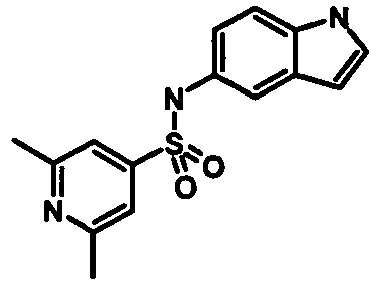
- 1 g 4-bromo-2,6-dimethyl-pyridine is dissolved in 10 ml of tetrahydrofuran and cooled to -78°C. 3.53 ml of a 1.6 molar solution of n-butyllithium in hexane are added dropwise thereto. The mixture is stirred for 1 hour and then sulphur dioxide is piped through the solution for 5 minutes. Then within 45 minutes it is allowed to come up to -40°C, 30 ml of hexane are added, the mixture is allowed to come up to ambient temperature and the precipitated solid is suction filtered. The solid is dried in vacuo, then taken up in 15 ml dichloromethane and at 5°C combined with 789 mg of N-chlorosuccinimide. The mixture is stirred for another 1 hour, the solid constituents are filtered through kieselguhr and the mother liquor is added dropwise at 0°C to a solution of 871 mg of 1H-indol-5-yl-amine in 10 ml of pyridine. Then the mixture is stirred for 3 hours at ambient temperature, the solvents are eliminated in vacuo and the residue is divided between water and ethyl acetate. The aqueous phase is extracted twice with ethyl acetate and the combined organic phases are dried on magnesium sulphate. The solvent is eliminated in vacuo and the residue is chromatographed on silica gel (cyclohexane/ethyl acetate 80:20 to 0:100).
Yield: 684 mg (42 % of theory)
Mass spectrum (ESI+): m/z = 302 [M+H]+ -

- 3.76 ml of a 2 molar solution of isopropylmagnesium chloride in tetrahydrofuran are mixed with 315 mg lithium chloride and stirred for 1 hour at ambient temperature. 1.2 ml 2,2,6,6-tetramethylpiperidine are added dropwise thereto and stirring is continued for another 6 hours. Then a solution of 1 g 2,6-dichloropyridine in 5 ml of tetrahydrofuran is added dropwise. The mixture is stirred for 30 minutes and then cooled to -50°C. Then sulphur dioxide is piped through the solution for 5 minutes. Then the mixture is allowed to come up to - 20°C within 45 minutes, 40 ml hexane are added, the mixture is allowed to come up to ambient temperature and the supernatant above the precipitated oil is removed. Another 5 ml of hexane are added to the oil, the mixture is stirred vigorously for 5 minutes and after the oil has settled out the supernatant is removed. The oil is dried in vacuo, then taken up in 20 ml dichloromethane and at 5°C combined with 992 mg N-chlorosuccinimide. The mixture is stirred for another 1 hour, the solid constituents are filtered through kieselguhr and the mother liquor is added dropwise at 0°C to a solution of 893 mg 1H-indol-5-yl-amine in 10 ml of pyridine. Then the mixture is stirred overnight at ambient temperature, the solvents are eliminated in vacuo and the residue is distributed between water and ethyl acetate. The aqueous phase is extracted twice with ethyl acetate and the combined organic phases are dried on magnesium sulphate. The solvent is eliminated in vacuo and the residue is chromatographed on silica gel (cyclohexane/ethyl acetate 80:20 to 0:100).
Yield: 514 mg (22 % of theory)
Mass spectrum (ESI-): m/z = 340 [M-H]- -

- 40 mg of tert.butyl [[1-(2-cyano-phenyl)-1H-indol-5-yl]-(3,5-dichlorophenylsulphonyl)-amino]-acetate are dissolved in 3 ml dichloromethane. 1.5 ml trifluoroacetic acid are added, with stirring. The mixture is stirred for 1.5 hours at ambient temperature and then the solvents are eliminated in vacuo. The residue is extracted from diisopropyl ether.
Yield: 20 mg (56 % of theory)
Mass spectrum (ESI+): m/z = 517 [M+NH4]+ - The following compounds are obtained analogously to Example 1:
- (1) [(3,5-dichloro-phenylsulphonyl)-(1-pyrimidin-2-yl-1H-indol-5-yl)-amino]-acetic acid

- (2) [(3,5-dichloro-phenylsulphonyl)-(1-pyrazin-2-yl-1H-indol-5-yl)-amino]-acetic acid

- (3) [(3,5-dichloro-phenylsulphonyl)-(1-pyrimidin-5-yl-1H-indol-5-yl)-amino]-acetic acid

- (4) [[1-(3-carbamoyl-phenyl)-1H-indol-5-yl]-(3-chloro-phenylsulphonyl)-amino]-acetic acid

- (5) [[1-(3-carbamoyl-phenyl)-1H-indol-5-yl]-(3,5-dichloro-phenylsulphonyl)-amino]-acetic acid

- (6) {(3-chloro-phenylsulphonyl)-[1-(3-methylcarbamoyl-phenyl)-1H-indol-5-yl]-amino}-acetic acid
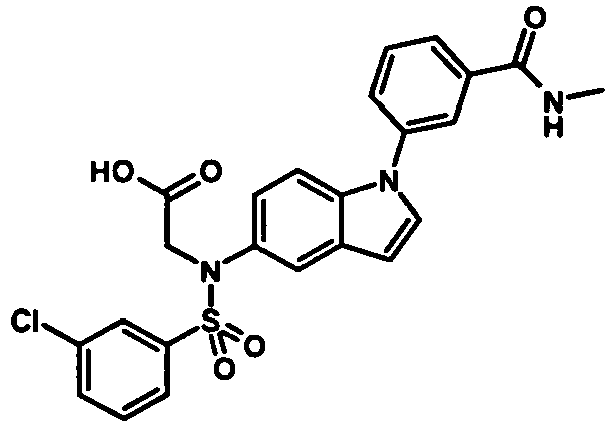
- (7) {(3,5-dichloro-phenylsulphonyl)-[1-(3-methylcarbamoyl-phenyl)-1H-indol-5-yl]-amino}-acetic acid

- (8) {(3,5-dichloro-phenylsulphonyl)-[1-(4-morpholin-4-yl-phenyl)-1H-indol-5-yl]-amino}-acetic acid · CF3CO2H

- (9) {(3,5-dichloro-phenylsulphonyl)-[1-(4-morpholin-4-ylmethyl-phenyl)-1H-indol-5-yl]-amino}-acetic acid CF3CO2H
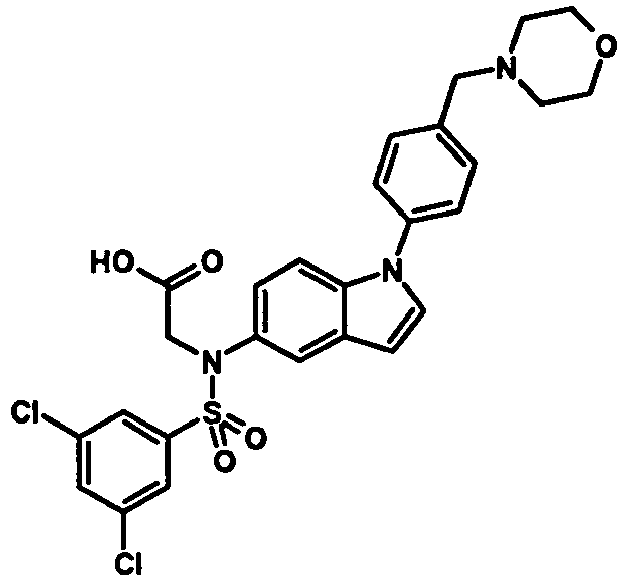
- (10) [(3,5-dichloro-phenylsulphonyl)-(1-pyrimidin-2-yl-2,3-dihydro-1H-indol-5-yl)-amino]-acetic acid

- (11) [(3,5-dichloro-phenylsulphonyl)-(1-pyridin-4-yl-1H-indol-5-yl)-amino]-acetic acid · CF3CO2H

- (12) {(3,5-dichloro-phenylsulphonyl)-[1-(1-methyl-1H-imidazol-2-yl)-2,3-dihydro-1H-indol-5-yl]-amino}-acetic acid · CF3CO2H

- (13) [(3,5-dichloro-phenylsulphonyl)-(1-pyrimidin-2-yl-1H-indol-4-yl)-amino]-acetic acid

- (14) {(3,5-dichloro-phenylsulphonyl)-[1-(4-methyl-6-piperazin-1-yl-pyridazin-3-yl)-1H-indol-5-yl]-amino}-acetic acid · CF3CO2H

- (15) ((3,5-dichloro-phenylsulphonyl)-{1-[6-(2-dimethylamino-ethylamino)-pyridazin-3-yl]-1H-indol-5-yl}-amino)-acetic acid · CF3CO2H

Mass spectrum (ESI+): m/z = 563 [M+H]+ - (16) [{1-[6-(2-dimethylamino-ethylamino)-pyridazin-3-yl]-1H-indol-5-yl}-(3,5-dimethyl-phenylsulphonyl)-amino]-acetic acid CF3CO2H

- (17) {(3,5-dichloro-phenylsulphonyl)-[1-(2-piperazin-1-yl-quinolin-8-yl)-1H-indol-5-yl]-amino}-acetic acid · CF3CO2H

- (18) ((3-bromo-5-methyl-phenylsulphonyl)-{1-[6-(2-dimethylamino-ethylamino)-pyridazin-3-yl]-1H-indol-5-yl}-amino)-acetic acid · CF3CO2H

Mass spectrum (ESI+): m/z = 587 [M+H]+ - (19) ((3-chloro-5-methyl-phenylsulphonyl)-{1-[6-(2-dimethylamino-ethylamino)-pyridazin-3-yl]-1H-indol-5-yl}-amino)-acetic acid · CF3CO2H

Mass spectrum (ESI+): m/z = 543 [M+H]+ - (20) [{1-[S-(2-dimethylamino-ethylamino)-pyrazin-2-yl]-1H-indol-5-yl}-(3,5-dimethyl-phenylsulphonyl)-amino]-acetic acid · CF3CO2H

Mass spectrum (ESI+): m/z = 523 [M+H]+ - (21) ((3-bromo-5-methyl-phenylsulphonyl)-{1-[5-(2-dimethylamino-ethylamino)-pyrazin-2-yl]-1H-indol-5-yl}-amino)-acetic acid · CF3CO2H

Mass spectrum (ESI+): m/z = 587 [M+H]+ - (22) ((3,5-dibromo-phenylsulphonyl)-{1-[5-(2-dimethylamino-ethylamino)-pyrazin-2-yl]-1H-indol-5-yl}-amino)-acetic acid · CF3CO2H

Mass spectrum (ESI+): m/z = 651 [M+H]+ - (23) ((3-chloro-5-methyl-phenylsulphonyl)-{1-[5-(2-dimethylamino-ethylamino)-pyrazin-2-yl]-1H-indol-5-yl}-amino)-acetic acid · CF3CO2H

Mass spectrum (ESI+): m/z = 543 [M+H]+ - (24) ((3,5-dibromo-phenylsulphonyl)-{1-[6-(2-dimethylamino-ethylamino)-pyridazin-3-yl]-1H-indol-5-yl}-amino)-acetic acid · CF3CO2H

Mass spectrum (ESI+): m/z = 651 [M+H]+ - (25) {(3,5-dichloro-phenylsulphonyl)-[1-(6-piperazin-1-yl-pyridazin-3-yl)-1H-indol-5-yl]-amino}-acetic acid · CF3CO2H

- (26) {(3,5-dichloro-phenylsulphonyl)-[1-(2-methylamino-pyrimidin-4-yl)-1H-indol-5-yl]-amino}-acetic acid · CF3CO2H

- (27) [(3,5-dichloro-phenylsulphonyl)-(1-naphthalen-2-yl-1H-indol-5-yl)-amino]-acetic acid

- (28) ((3-bromo-5-chloro-phenylsulphonyl)-{1-[6-(2-dimethylamino-ethylamino)-pyridazin-3-yl]-1H-indol-5-yl}-amino)-acetic acid · CF3CO2H

Mass spectrum (ESI+): m/z = 607 [M+H]+ - (29) ((3-bromo-5-chloro-phenylsulphonyl)-{1-[5-(2-dimethylamino-ethylamino)-pyrazin-2-yl]-1H-indol-5-yl}-amino)-acetic acid · CF3CO2H

Mass spectrum (ESI+): m/z = 607 [M+H]+ - (30) [[1-(5-amino-pyridin-2-yl)-1H-indol-5-yl]-(3,5-dichloro-phenylsulphonyl)-amino]-acetic acid ·CF3CO2H

- (31) {(3,5-dichloro-phenylsulphonyl)-[1-(2-methyl-quinolin-6-yl)-1H-indol-5-yl]-amino)-acetic acid · CF3CO2H

- (32) [(3,5-dichloro-phenylsulphonyl)-(1-naphthalen-1-yl-1H-indol-5-yl)-amino]-acetic acid

- (33) [{1-[2-(2-amino-ethylamino)-pyrimidin-4-yl]-1H-indol-5-yl}-(3,5-dichlorophenylsulphonyl)-amino]-acetic acid · CF3CO2H

- (34) {(3,5-dichloro-phenylsulphonyl)-[1-(3-methyl-pyridin-2-yl)-1H-indol-5-yl]-amino}-acetic acid · CF3CO2H

- (35) [[1-(4-cyano-6-piperazin-1-yl-pyridazin-3-yl)-1H-indol-5-yl]-(3,5-dichlorophenylsulphonyl)-amino]-acetic acid · CF3CO2H
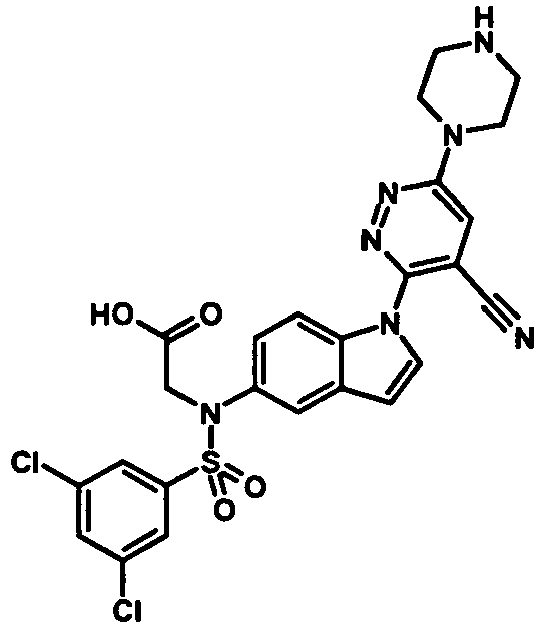
- (36) ((3,5-dichloro-phenylsulphonyl)-{1-[6-(piperazine-1-carbonyl)-pyridin-2-yl]-1H-indol-5-yl}-amino)-acetic acid · CF3CO2H
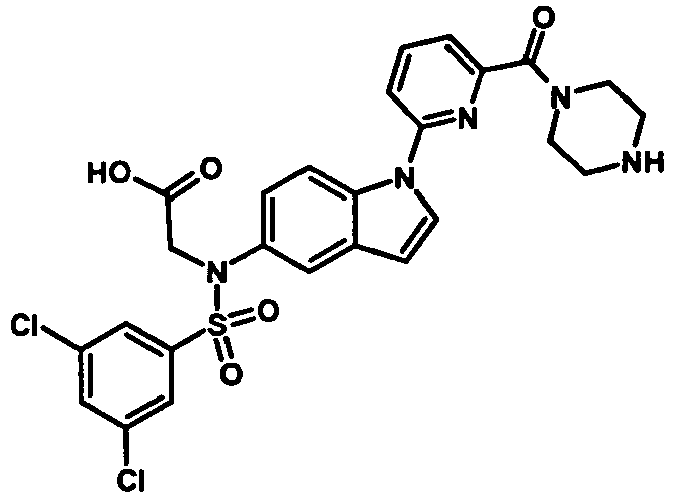
- (37) ((3,5-dichloro-phenylsulphonyl)-{1-[6-(2-dimethylamino-ethylcarbamoyl)-pyridin-2-yl]-1H-indol-5-yl}-amino)-acetic acid · CF3CO2H

- (38) [[1-(6-[1,4]diazepan-1-yl-pyridazin-3-yl)-1H-indol-5-yl]-(3,5-dichlorophenylsulphonyl)-amino]-acetic acid · CF3CO2H

- (39) {(3,5-dichloro-phenylsulphonyl)-[1-(6-methyl-pyridin-2-yl)-1H-indol-5-yl]-amino}-acetic acid · CF3CO2H
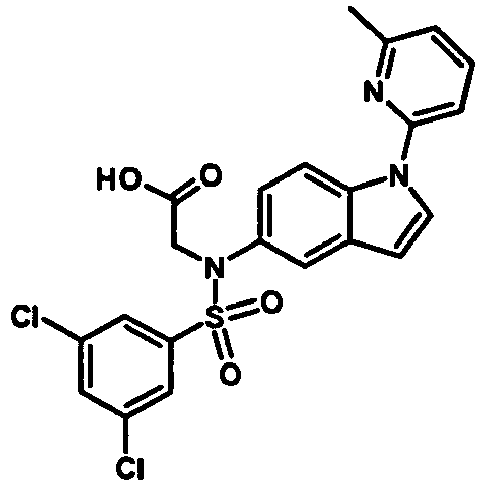
- (40) [{1-[6-(3-amino-propylamino)-pyridazin-3-yl]-1H-indol-5-yl}-(3,5-dichlorophenylsulphonyl)-amino]-acetic acid · CF3CO2H

- (41) {(3,5-dichloro-phenylsulphonyl)-[1-(4-methyl-pyridin-2-yl)-1H-indol-5-yl]-amino}-acetic acid · CF3CO2H

- (42) [[1-(6-cyclopropylamino-pyridazin-3-yl)-1H-indol-5-yl]-(3,5-dichlorophenylsulphonyl)-amino]-acetic acid · CF3CO2H

- (43) {(3,5-dichloro-phenylsulphonyl)-[1-(5-methyl-pyridin-2-yl)-1H-indol-5-yl]-amino}-acetic acid · CF3CO2H

- (44) [(3,5-dichloro-phenylsulphonyl)-(1-isoquinolin-1-yl-1H-indol-5-yl)-amino]-acetic acid · CF3CO2H

- (45) [[1-(3-amino-pyridin-2-yl)-1H-indol-5-yl]-(3,5-dichloro-phenylsulphonyl)-amino]-acetic acid · CF3CO2H

- (46) ((3,5-dichloro-phenylsulphonyl)-{1-[6-(2-dimethylamino-ethylamino)-pyridazin-3-yl]-3-methyl-1H-indol-5-yl}-amino)-acetic acid · CF3CO2H

- (47) [(1-{6-[(2-amino-ethyl)-methyl-amino]-pyridazin-3-yl}-1H-indol-5-yl)-(3,5-dichloro-phenylsulphonyl)-amino]-acetic acid · CF3CO2H

- (48) ((3,5-dichloro-phenylsulphonyl)-{1-[6-(2-methylamino-ethylamino)-pyridazin-3-yl]-1H-indol-5-yl}-amino)-acetic acid · CF3CO2H
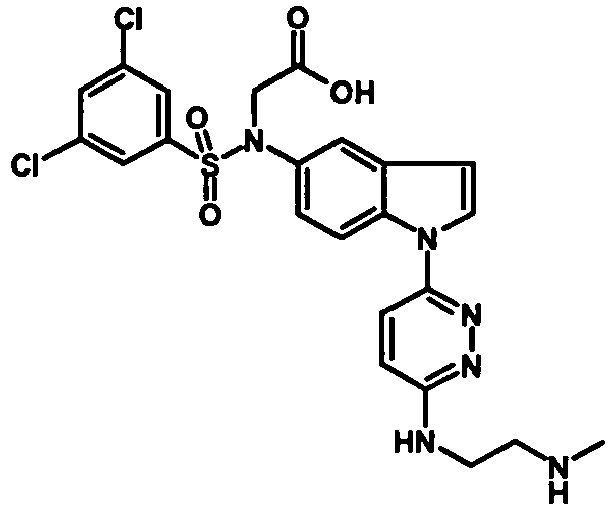
- (49) ((3,5-dichloro-phenylsulphonyl)-{1-[3-(2-dimethylamino-ethylamino)-pyridin-2-yl]-1H-indol-5-yl}-amino)-acetic acid · CF3CO2H

- (50) [{1-[6-(2-amino-2-methyl-propylamino)-pyridazin-3-yl]-1H-indol-5-yl}-(3,5-dichloro-phenylsulphonyl)-amino]-acetic acid · CF3CO2H
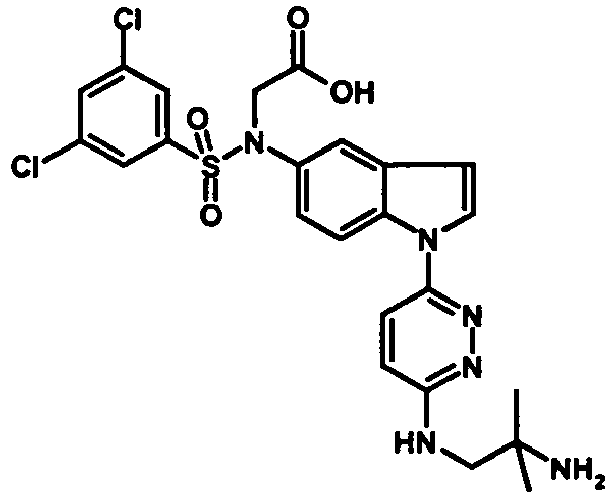
- (51) [{1-[6-(3-amino-piperidin-1-yl)-pyridazin-3-yl]-1H-indol-5-yl}-(3,5-dichlorophenylsulphonyl)-amino]-acetic acid · CF3CO2H

- (52) [{3-cyano-1-[6-(2-dimethylamino-ethylamino)-pyridazin-3-yl]-1H-indol-5-yl}-(3,5-dichloro-phenylsulphonyl)-amino]-acetic acid · CF3CO2H

- (53) {(3,5-dichloro-phenylsulphonyl)-[1-(6-morpholin-4-yl-pyridazin-3-yl)-1H-indol-5-yl]-amino}-acetic acid · CF3CO2H

- (54) {(3,5-dichloro-phenylsulphonyl)-[1-(6-morpholin-4-yl-pyridazin-3-yl)-2,3-dihydro-1H-indol-5-yl]-aminol-acetic acid · CF3CO2H

- (55) [[1-(5-amino-pyrazin-2-yl)-1H-indol-5-yl]-(3,5-dichloro-phenylsulphonyl)-amino]-acetic acid · CF3CO2H
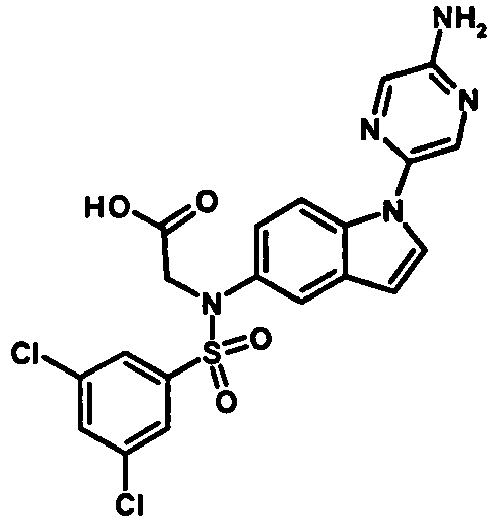
- (56) [{3-chloro-1-[6-(2-dimethylamino-ethylamino)-pyridazin-3-yl]-1H-indol-5-yl}-(3,5-dichloro-phenylsulphonyl)-amino]-acetic acid · CF3CO2H

- (57) ((3,5-dichloro-phenylsulphonyl)-{1-[6-(2-dimethylamino-ethylamino)-pyridazin-3-yl]-3-trifluoromethyl-1H-indol-5-yl}-amino)-acetic acid · CF3CO2H

- (58) {(3,5-dichloro-phenylsulphonyl)-[1-(4,6-dimethoxy-[1,3,5]triazin-2-yl)-2,3-dihydro-1H-indol-5-yl]-amino}-acetic acid

- (59) ((3,5-dichloro-phenylsulphonyl)-{1-[5-(piperazine-1-carbonyl)-pyridin-2-yl]-1H-indol-5-yl}-amino)-acetic acid · CF3CO2H

- (60) ((3,5-dichloro-phenylsulphonyl)-{1-[5-(2-dimethylamino-ethylcarbamoyl)-pyridin-2-yl]-1H-indol-5-yl}-amino)-acetic acid · CF3CO2H

- (61) {(3,5-dichloro-phenylsulphonyl)-[1-(6-dimethylamino-pyridazin-3-yl)-1H-indol-5-yl]-amino}-acetic acid · CF3CO2H

- (62) ((3,5-dichloro-phenylsulphonyl)-{1-[6-(2-hydroxy-ethylamino)-pyridazin-3-yl]-1H-indol-5-yl}-amino)-acetic acid
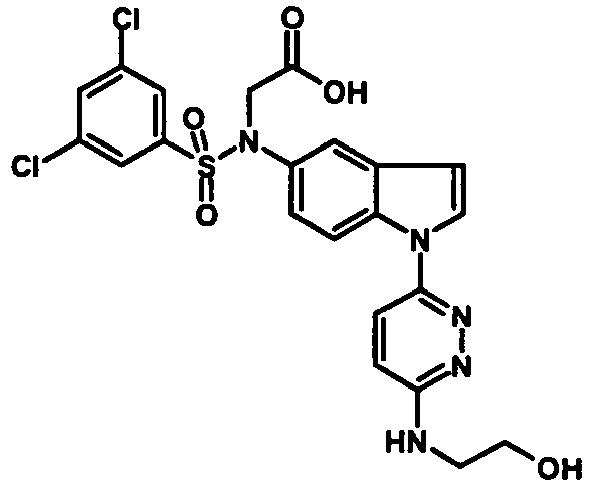
- (63) ((3,5-dichloro-phenylsulphonyl)-{1-[6-(2-piperidin-1-yl-ethylamino)-pyridazin-3-yl]-1H-indol-5-yl}-amino)-acetic acid · CF3CO2H

- (64) {(3,5-dichloro-phenylsulphonyl)-[1-(4-morpholin-4-yl-pyridin-2-yl)-1H-indol-5-yl]-amino}-acetic acid
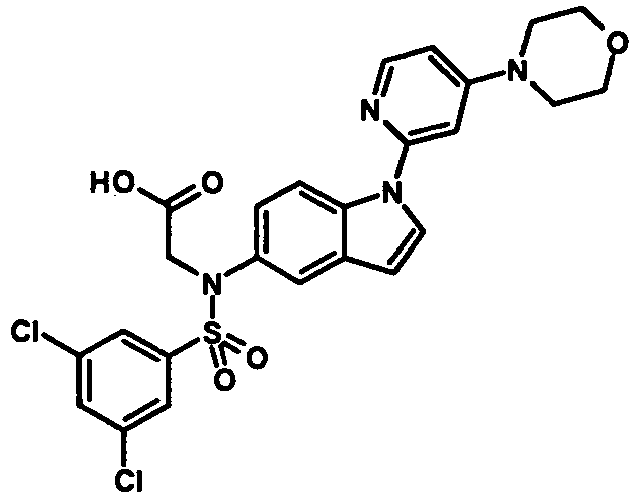
Rf value: 0.25 (silica gel: dichloromethane/methanol 95:5) - (65) {(3,5-dichloro-phenylsulphonyl)-[1-(5-morpholin-4-yl-pyridin-2-yl)-1H-indol-5-yl]-amino}-acetic acid
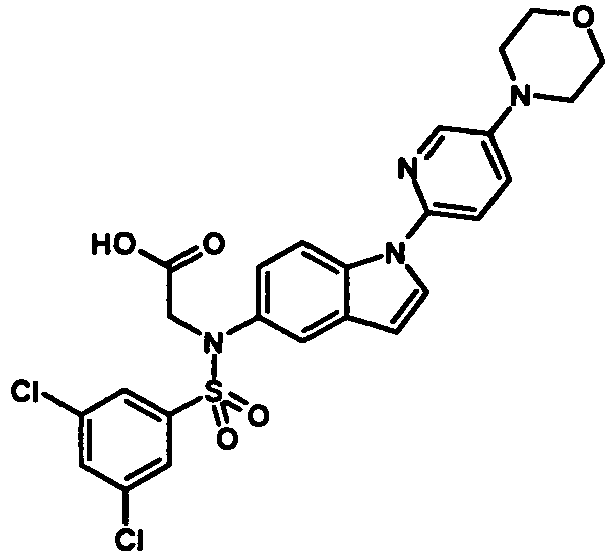
Rf value: 0.35 (silica gel: dichloromethane/methanol 95:5) - (66) ((3,5-dichloro-phenylsulphonyl)-{1-[5-(3-oxo-morpholin-4-yl)-pyrazin-2-yl]-1H-indol-5-yl}-amino)-acetic acid

Rf value: 0.28 (silica gel: dichloromethane/methanol 95:5) - (67) ((3,5-dichloro-phenylsulphonyl)-{1-[5-(tetrahydro-pyran-4-yloxy)-pyrazin-2-yl]-1H-indol-5-yl}-amino)-acetic acid

Rf value: 0.30 (silica gel: dichloromethane/methanol/acetic acid 98:2:0.1) - (68) (S)-((3,5-dichloro-phenylsulphonyl)-{1-[5-(tetrahydro-furan-3-yloxy)-pyrazin-2-yl]-1H-indol-5-yl}-amino)-acetic acid
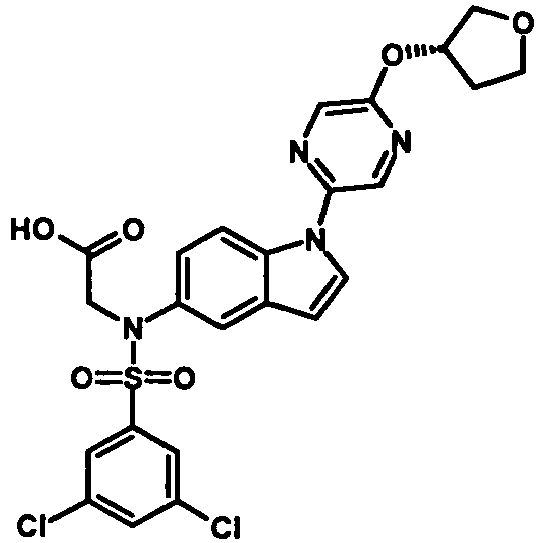
Rf value: 0.30 (silica gel: dichloromethane/methanol/acetic acid 98:2:0.1) - (69) (R)-((3,5-dichloro-phenylsulphony)-{1-[6-(tetrahydro-furan-3-ylamino)-pyridazin-3-yl]-1H-indol-5-yl}-amino)-acetic acid

Rf value: 0.20 (silica gel: toluene/dioxane/ethanol/glacial acetic acid 90:10:10:6) - (70) ((3,5-dichloro-phenylsulphony)-{1-[6-(3-oxo-morpholin-4-yl)-pyridazin-3-yl]-1H-indol-5-yl}-amino)-acetic acid
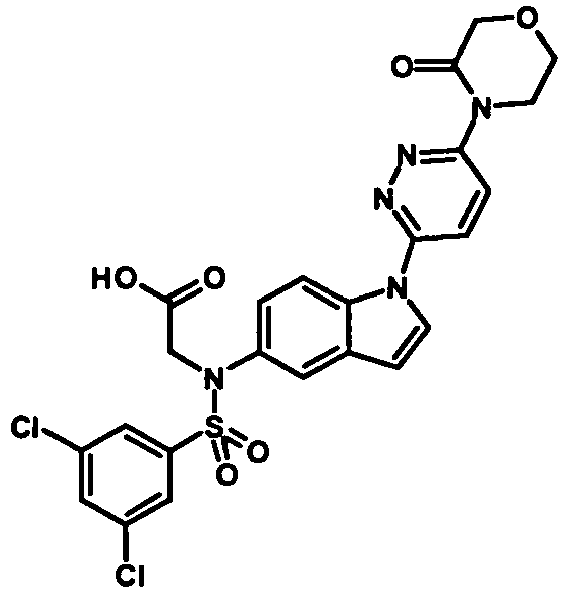
Rf value: 0.53 (silica gel: toluene/dioxane/ethanol/glacial acetic acid 90:10:10:6) - (71) (R)-((3,5-dichloro-phenylsulphonyl)-{1-[5-(tetrahydro-furan-3-yloxy)-pyrazin-2-yl]-1H-indol-5-yl}-amino)-acetic acid
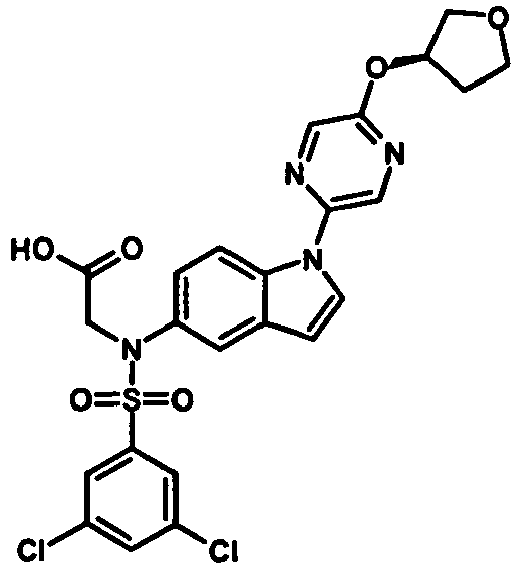
Rf value: 0.35 (silica gel: dichloromethane/methanol/acetic acid 98:2:0.1) - (72) (S)-((3,5-dichloro-phenylsulphony)-{1-[6-(tetrahydro-furan-3-yloxy)-pyridazin-3-yl]-1H-indol-5-yl}-amino)-acetic acid
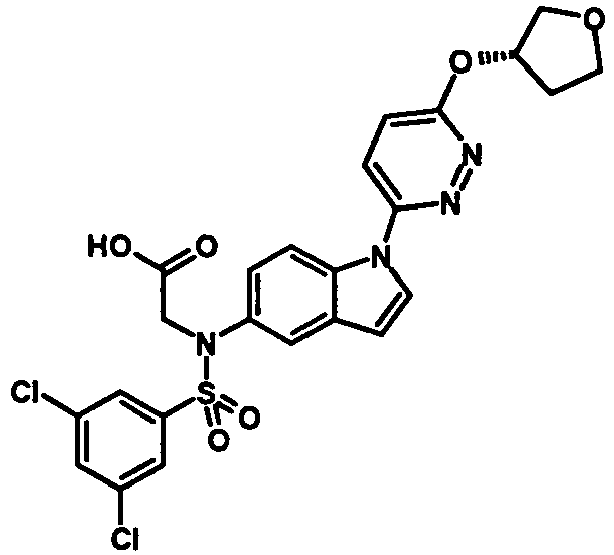
Rf value: 0.20 (silica gel: dichloromethane/methanol/acetic acid 98:2:0.1) - (73) ((3,5-dichloro-phenylsulphonyl)-{1-[6-(tetrahydro-pyran-4-yloxy)-pyridazin-3-yl]-1H-indol-5-yl}-amino)-acetic acid
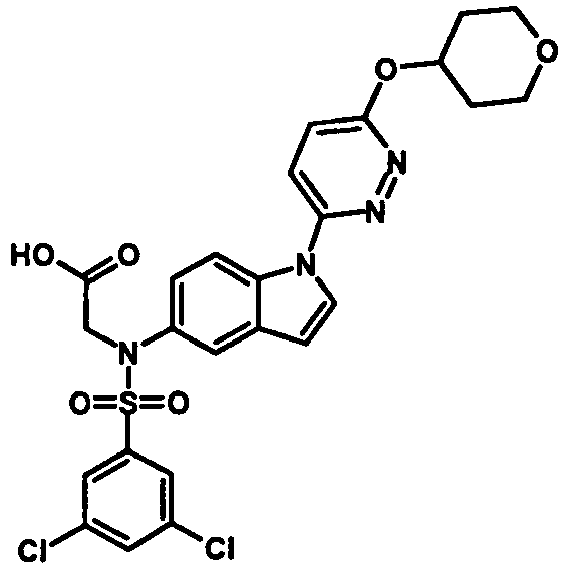
Rf value: 0.25 (silica gel: dichloromethane/methanol/acetic acid 98:2:0.1) - (74) (R)-((3,5-dichloro-phenylsulphonyl)-{1-[6-(tetrahydro-furan-3-yloxy)-pyridazin-3-yl]-1H-indol-5-yl}-amino)-acetic acid

Rf value: 0.25 (silica gel: dichloromethane/methanol/acetic acid 98:2:0.1) - (75) ((3,5-dichloro-phenylsutphonyl)-{1-[5-(3-oxo-morpholin-4-yl)-pyridin-2-yl]-1H-indol-5-yl}-amino)-acetic acid

Rf value: 0.40 (silica gel: toluene/dioxane/ethanol/glacial acetic acid 90:10:10:6) - (76) (R)-((3,5-dichloro-phenylsulphonyl)-{1-[5-(tetrahydro-furan-3-ylamino)-pyrazin-2-yl]-1H-indol-5-yl}-amino)-acetic acid

Rf value: 0.46 (silica gel: toluene/dioxane/ethanol/glacial acetic acid 90:10:10:6) - (77) ((3,5-dichloro-phenylsulphonyl)-{1-[4-(3-oxo-morpholin-4-yl)-pyridin-2-yl]-1H-indol-5-yl}-amino)-acetic acid

Rf value: 0.44 (silica gel: toluene/dioxane/ethanol/glacial acetic acid 90:10:10:6) - (78) [(3,5-dichloro-phenylsulphonyl)-(1-{6-[methyl-(tetrahydro-pyran-4-yl)-amino]-pyridazin-3-yl}-1H-indol-5-yl)-amino]-acetic acid
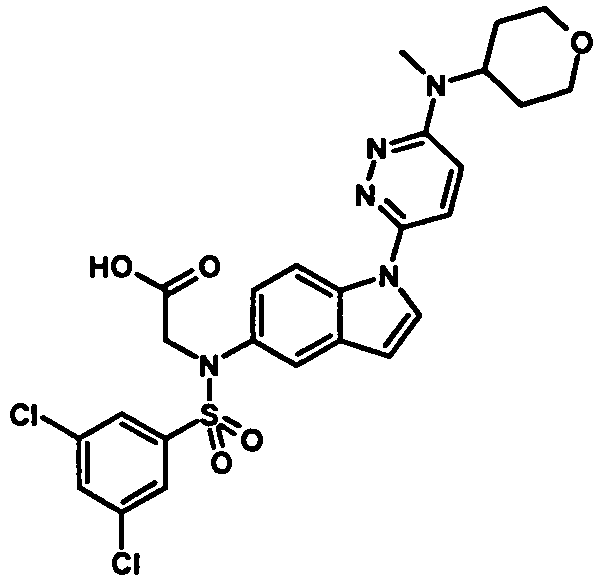
Rf value: 0.30 (silica gel: toluene/dioxane/ethanol/glacial acetic acid 90:10:10:6) - (79) ((3,5-dichloro-phenylsulphonyl)-{1-[5-(3-oxo-piperazin-1-yl)-pyrazin-2-yl]-1H-indol-5-yl}-amino)-acetic acid

Rf value: 0.27 (silica gel: dichloromethane/methanol/acetic acid 95:5:0.1) - (80) ((3,5-dichloro-phenylsulphonyl)-{1-[5-(tetrahydro-pyran-4-ylamino)-pyrazin-2-yl]-1H-indol-5-yl}-amino)-acetic acid
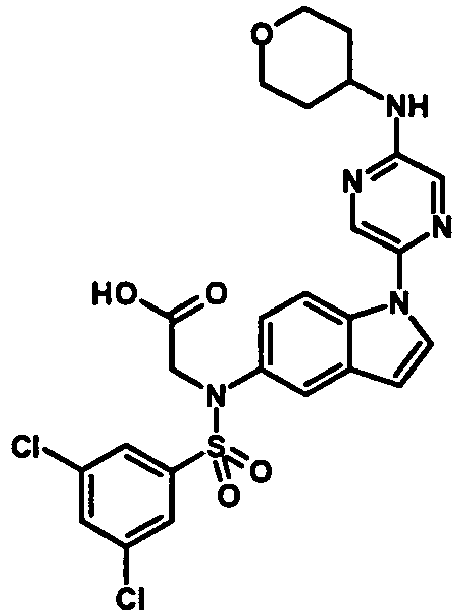
Rf value: 0.45 (silica gel: toluene/dioxane/ethanol/glacial acetic acid 90:10:10:6) - (81) ((3,5-dichloro-phenylsulphonyl)-{1-[6-(tetrahydro-pyran-4-ylamino)-pyridazin-3-yl]-1H-indol-5-yl}-amino)-acetic acid
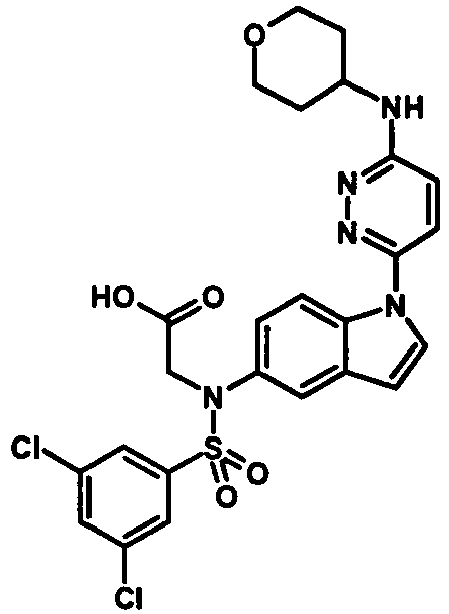
Rf value: 0.10 (silica gel: toluene/dioxane/ethanol/glacial acetic acid 90:10:10:6) - (82) {(3,5-dichloro-phenylsulphonyl)-[1-(6-methyl-pyridazin-3-yl)-1H-indazol-5-yl]-amino}-acetic acid

Rf value: 0.54 (silica gel: toluene/dioxane/ethanol/glacial acetic acid 90:10:10:6) - (83) ((3,5-dichloro-phenylsulphonyl)-{1-[5-(tetrahydro-furan-3-yloxy)-pyridin-2-yl]-1H-indol-5-yl}-amino)-acetic acid
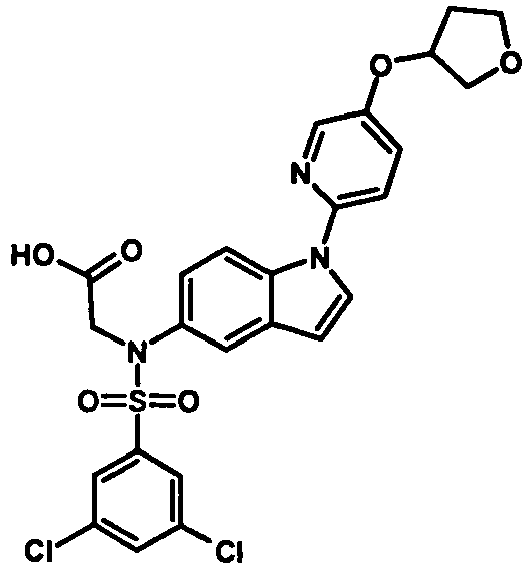
Rf value: 0.43 (silica gel: dichloromethane/methanol/acetic acid 95:5:0.1) - (84) ((3,5-dichloro-phenylsulphonyl)-{1-[5-(tetrahydro-pyran-4-yloxy)-pyridin-2-yl]-1H-indol-5-yl}-amino)-acetic acid

Rf value: 0.58 (silica gel: dichloromethane/methanol/acetic acid 95:5:0.1) - (85) ((3,5-dichloro-phenylsulphonyl)-{1-[4-(tetrahydro-furan-3-yloxy)-pyridin-2-yl]-1H-indol-5-yl}-amino)-acetic acid

Rf value: 0.50 (silica gel: dichloromethane/methanol/acetic acid 95:5:0.1) - (86) [(3,5-dichloro-phenylsulphonyl)-(1-{5-[methyl-(tetrahydro-pyran-4-yl)-amino]-pyrazin-2-yl}-1H-indol-5-yl)-amino]-acetic acid

Rf value: 0.63 (silica gel: toluene/dioxane/ethanol/glacial acetic acid 90:10:10:6) - (87) ((3,5-dichloro-phenylsulphonyl)-{3-iodo-1-[6-(3-oxo-piperazin-1-yl)-pyridazin-3-yl]-1H-indol-5-yl}-amino)-acetic acid

- (88) ((3,5-dichloro-phenylsulphonyl)-{1-[6-(3-oxo-piperazin-1-yl)-pyridazin-3-yl]-1H-indol-5-yl}-amino)-acetic acid

- (89) ((3,5-dichloro-phenylsulphonyl)-{1-[4-(tetrahydro-pyran-4-yloxy)-pyridin-2-yl]-1H-indol-5-yl}-amino)-acetic acid

Rf value: 0.50 (silica gel: dichloromethane/methanol/acetic acid 95:5:0.1) - (90) [[6-chloro-1-(6-methyl-pyridazin-3-yl)-1H-indol-5-yl]-(3,5-dichlorophenylsulphonyl)-amino]-acetic acid

Rf value: 0.20 (silica gel: dichloromethane/methanol/acetic acid 98:2:0.1) - (91) [[3-methyl-1-(6-methyl-pyridazin-3-yl)-1H-indazol-5-yl]-(3,5-dichlorophenylsulphonyl)-amino]-acetic acid

Rf value: 0.30 (silica gel: dichloromethane/methanol 95:5) - (92) {(3,5-dichloro-phenylsulphonyl)-[1-(5-trifluoromethyl-pyridazin-3-yl)-1H-indol-5-yl]-amino}-acetic acid

Rf value: 0.37 (silica gel: dichloromethane/methanol 95:5) - (93) {(3,5-dichloro-phenylsulphonyl)-[3-iodo-1-(5-trifluoromethyl-pyridazin-3-yl)-1H-indol-5-yl]-amino}-acetic acid

Rf value: 0.35 (silica gel: dichloromethane/methanol 95:5) - (94) {(3,5-dichloro-phenylsulphonyl)-[1-(6-thiazol-2-yl-pyrimidin-4-yl)-1H-indol-5-yl]-amino}-acetic acid

Rf value: 0.30 (silica gel: dichloromethane/methanol 95:5) - (95) [[6-ethyl-1-(6-methyl-pyridazin-3-yl)-1H-indol-5-yl]-(3,5-dichlorophenylsulphonyl)-amino]-acetic acid

Rf value: 0.53 (silica gel: dichloromethane/methanol/acetic acid 95:5:0.1) - (96) {(3,5-dichloro-phenylsulphonyl)-[1-(6-methylamino-pyridazin-3-yl)-1H-indol-5-yl]-amino}-acetic acid · CF3CO2H

- (97) {(3,5-dichloro-phenylsulphonyl)-[3-iodo-1-(6-methylamino-pyridazin-3-yl)-1H-indol-5-yl]-amino}-acetic acid · CF3CO2H

- (98) ((3,5-dichloro-phenylsulphonyl)-{3-iodo-1-[6-(2-oxo-imidazolidin-1-yl)-pyridazin-3-yl]-1H-indol-5-yl}-amino)-acetic acid

- (99) [[1-(5-cyano-pyridin-2-yl)-1H-indol-5-yl]-(3,5-dichloro-phenylsulphonyl)-amino]-acetic acid

- (100) [[1-(4-amino-pyridin-2-yl)-1H-indol-5-yl]-(3,5-dichloro-phenylsulphonyl)-amino]-acetic acid · CF3CO2H

- (101) [[1-(6-cyano-pyridin-2-yl)-1H-indol-5-yl]-(3,5-dichloro-phenylsulphonyl)-amino]-acetic acid

- (102) ((3,5-dichloro-phenylsulphonyl)-{1-[6-(2-dimethylamino-ethoxy)-pyridazin-3-yl]-1H-indol-5-yl}-amino)-acetic acid · CF3CO2H

- (103) ethyl [[1-(6-[1,4]diazepan-1-yl-pyridazin-3-yl)-1H-indol-5-yl]-(3,5-dichlorophenylsulphonyl)-amino]-acetate · CF3CO2H
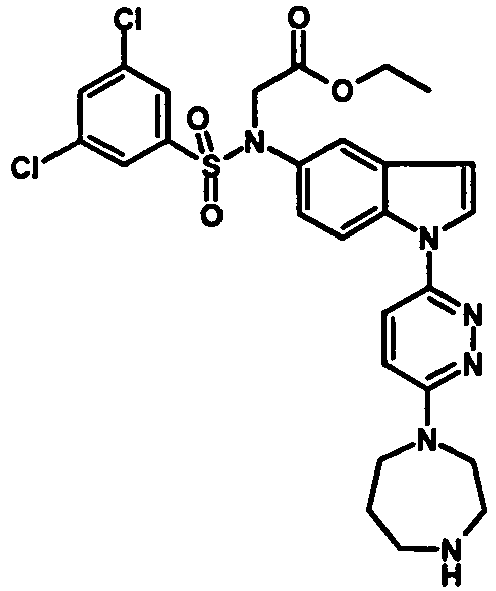
- (104) {(3,5-dichloro-phenylsulphonyl)-[1-(5-morpholin-4-yl-pyrazin-2-yl)-1H-indol-5-yl]-amino}-acetic acid

- (105) ((3,5-dichloro-phenylsulphonyl)-{1-[6-(3-methylamino-propylamino)-pyridazin-3-yl]-1H-indol-5-yl}-amino)-acetic acid · CF3CO2H

- (106) [(1-{6-[(3-amino-propyl)-methyl-amino]-pyridazin-3-yl}-1H-indol-5-yl)-(3,5-dichloro-phenylsulphonyl)-amino]-acetic acid · CF3CO2H

- (107) {(3,5-dichloro-phenylsulphonyl)-[1-(1,3-dimethyl-2,4-dioxo-1,2,3,4-tetrahydro-pyrimidin-5-yl)-1H-indol-5-yl]-amino}-acetic acid

- (108) {(3,5-dichloro-phenylsulphonyl)-[1-(6-oxo-1,6-dihydro-pyridazin-3-yl)-1H-indol-5-yl]-amino}-acetic acid

- (109) ((3,5-dichloro-phenylsulphonyl)-{1-[4-(morpholine-4-carbonyl)-pyridin-2-yl]-1H-indol-5-yl}-amino)-acetic acid
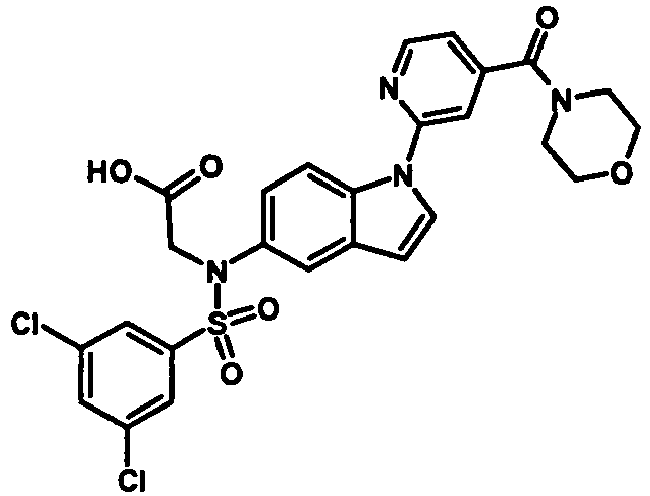
- (110) [[1-(3-cyano-pyridin-2-yl)-1H-indol-5-yl]-(3,5-dichloro-phenylsulphonyl)-amino]-acetic acid

- (111) {(3,5-dichloro-phenylsulphonyl)-[4-methyl-1-(6-morpholin-4-yl-pyridazin-3-yl)-1H-indol-5-yl]-amino}-acetic acid

- (112) ((3,5-dichloro-phenylsulphonyl)-{1-[6-(2-hydroxy-ethoxy)-pyridazin-3-yl]-1H-indol-5-yl}-amino)-acetic acid

- (113) [[1-(2-chloro-9H-purin-6-yl)-1H-indol-5-yl]-(3,5-dichloro-phenylsulphonyl)-amino]-acetic acid
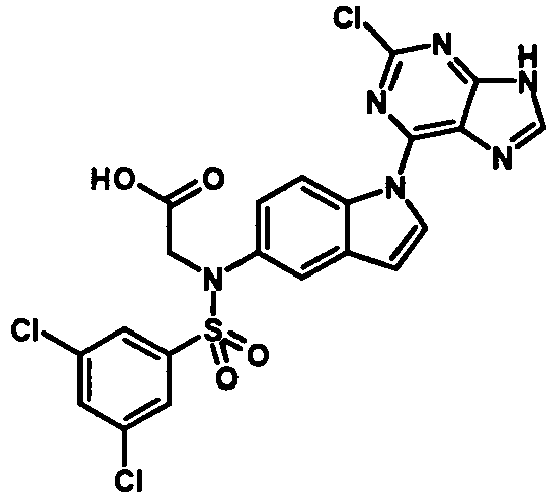
- (114) ((3,5-dichloro-phenylsulphonyl)-{1-[6-(2-pyrrolidin-1-yl-ethylamino)-pyridazin-3-yl]-1H-indol-5-yl}-amino)-acetic acid · CF3CO2H

- (115) ((3,5-dichloro-phenylsulphonyl)-{1-[6-(2-oxo-imidazolidin-1-yl)-pyridazin-3-yl]-1H-indol-5-yl}-amino)-acetic acid
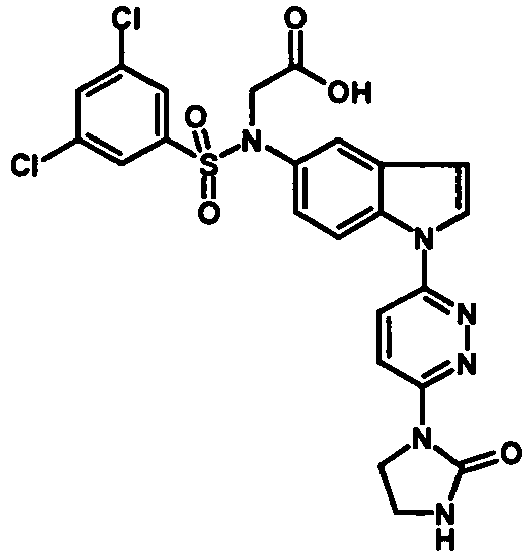
- (116) {(3,5-dichloro-phenylsulphonyl)-[1-(6-methylsulphanyl-pyridazin-3-yl)-1H-indol-5-yl]-amino}-acetic acid

- (117) {(3,5-dichloro-phenylsulphonyl)-[1-(4-methylcarbamoyl-pyridin-2-yl)-1H-indol-5-yl]-amino}-acetic acid

- (118) ((3,5-dichloro-phenylsulphonyl)-{1-[4-(2-methoxy-ethylcarbamoyl)-pyridin-2-yl]-1H-indol-5-yl}-amino)-acetic acid

- (119) [[1-(4-cyano-pyridin-2-yl)-1H-indol-5-yl]-(3,5-dichloro-phenylsulphonyl)-amino]-acetic acid

- (120) {(3,5-dichloro-phenylsulphonyl)-[3-methyl-1-(6-methyl-pyridazin-3-yl)-1H-indol-5-yl]-amino}-acetic acid

- (121) {(3,5-dichloro-phenylsulphonyl)-[1-(6-thiomorpholin-4-yl-pyridazin-3-yl)-1H-indol-5-yl]-amino}-acetic acid

- (122) {(3,5-dichloro-phenylsulphonyl)-[1-(6-methanesulphinyl-pyridazin-3-yl)-1H-indol-5-yl]-amino}-acetic acid

- (123) [[3-chloro-1-(6-methyl-pyridazin-3-yl)-1H-indol-5-yl]-(3,5-dichlorophenylsulphonyl)-amino]-acetic acid
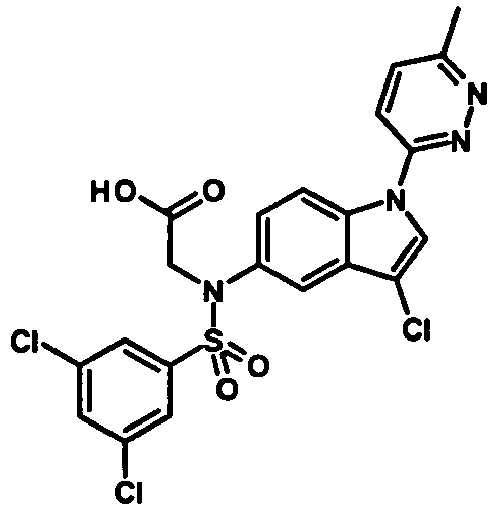
- (124) ((3,5-dichloro-phenylsulphonyl)-{1-[6-(1,1-dioxo-1λ6-thiomorpholin-4-yl)-pyridazin-3-yl]-1H-indol-5-yl}-amino)-acetic acid

- (125) ((3,5-dichloro-phenylsulphonyl)-{1-[6-(2,3-dihydroxy-propoxy)-pyridazin-3-yl]-1H-indol-5-yl}-amino)-acetic acid

- (126) {(3,5-dichloro-phenylsulphonyl)-[1-(5-methylsulphanyl-pyrazin-2-yl)-1H-indol-5-yl]-amino}-acetic acid

- (127) {(3,5-dichloro-phenylsulphonyl)-[1-(5-methylsulphanyl-pyridin-2-yl)-1H-indol-5-yl]-amino}-acetic acid

- (128) {(3,5-dichloro-phenylsulphonyl)-[1-(5-methanesulphinyl-pyrazin-2-yl)-1H-indol-5-yl]-amino}-acetic acid
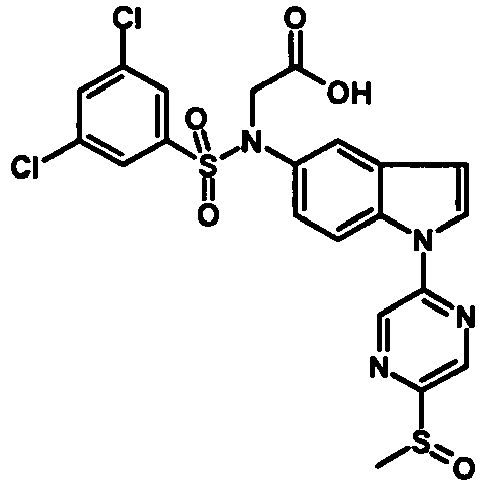
- (129) {(3,5-dichloro-phenylsulphonyl)-[1-(5-methanesulphonyl-pyrazin-2-yl)-1H-indol-5-yl]-amino}-acetic acid

- (130) {(3,5-dichloro-phenylsulphonyl)-[1-(6-methanesulphonyl-pyridazin-3-yl)-1H-indol-5-yl]-amino}-acetic acid

- (131) {(3,5-dichloro-phenylsulphonyl)-[1-(5-methanesulphinyl-pyridin-2-yl)-1H-indol-5-yl]-amino}-acetic acid

- (132) {(3,5-dichloro-phenylsulphonyl)-[1-(5-methanesulphonyl-pyridin-2-yl)-1H-indol-5-yl]-amino}-acetic acid

- (133) ((3,5-dichloro-phenylsulphonyl)-{1-[5-(2,3-dihydroxy-propoxy)-pyrazin-2-yl]-1H-indol-5-yl}-amino)-acetic acid

- (134) [(3,5-dichloro-phenylsulphonyl)-(1-{5-[2-(tetrahydro-pyran-2-yloxy)-ethylamino]-pyrazin-2-yl}-1H-indol-5-yl)-amino]-acetic acid

- (135) ((3,5-dichloro-phenylsulphonyl)-{1-[5-(2-dimethylamino-ethoxy)-pyrazin-2-yl]-1H-indol-5-yl}-amino)-acetic acid · CF3CO2H
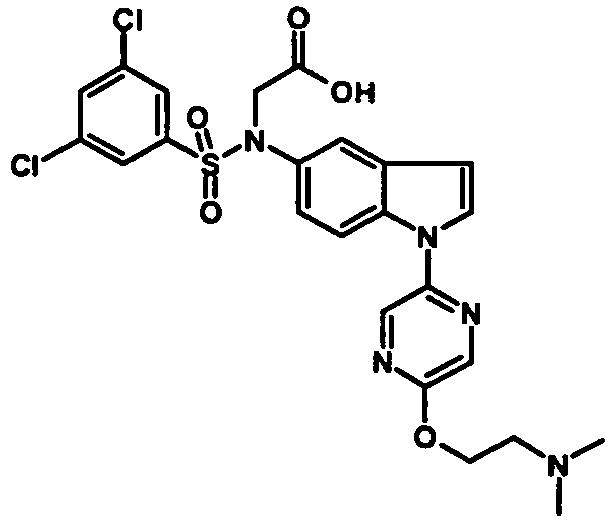
- (136) {(3,5-dichloro-phenylsulphonyl)-[1-(4-methanesulphinyl-pyridin-2-yl)-1H-indol-5-yl]-amino}-acetic acid
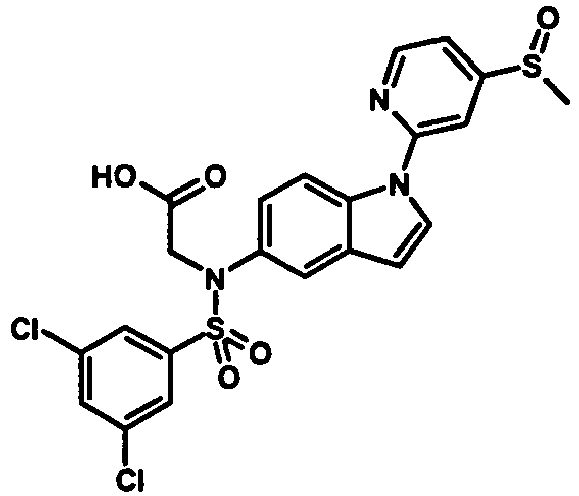
- (137) [{1-[5-(2-amino-ethoxy)-pyrazin-2-yl]-1H-indol-5-yl}-(3,5-dichlorophenylsulphonyl)-amino]-acetic acid · CF3CO2H
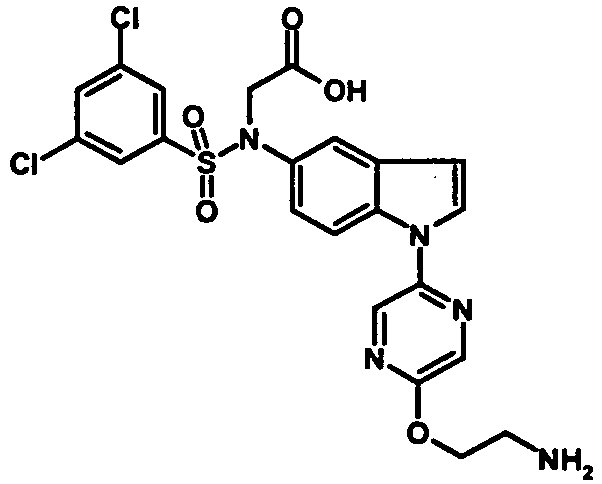
- (138) ((3,5-dichloro-phenylsulphonyl)-{1-[6-(1-oxo-1λ4-thiomorpholin-4-yl)-pyridazin-3-yl]-1H-indol-5-yl}-amino)-acetic acid
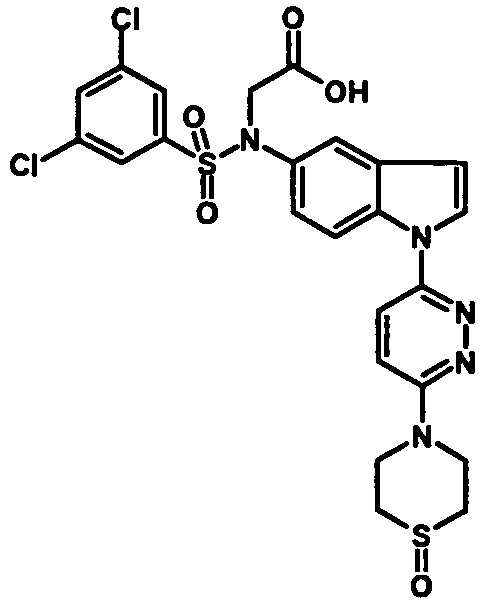
- (139) {(3,5-dichloro-phenylsulphonyl)-[3-ethyl-1-(6-methyl-pyridazin-3-yl)-1H-indol-5-yl]-amino}-acetic acid

- (140) ((3,5-dichloro-phenylsulphonyl)-{1-[5-(1-oxo-1λ4-thiomorpholin-4-yl)-pyrazin-2-yl]-1H-indol-5-yl}-amino)-acetic acid

- (141) [[1-(5-carbamoyl-pyrazin-2-yl)-1H-indol-5-yl]-(3,5-dichlorophenylsulphonyl)-amino]-acetic acid

- (142) 2-{5-[carboxymethyl-(3,5-dichloro-phenylsulphonyl)-amino]-indol-1-yl}-isonicotinic acid

- (143) {(3,5-dichloro-phenylsulphonyl)-[1-(4-thiazol-2-yl-pyridin-2-yl)-1H-indol-5-yl]-amino}-acetic acid

- (144) [{1-[5-(2-amino-ethylamino)-pyrazin-2-yl]-1H-indol-5-yl}-(3,5-dichlorophenylsulphonyl)-amino]-acetic acid · CF3CO2H

- (145) [[1-(4-cyclopropylcarbamoyl-pyridin-2-yl)-1H-indol-5-yl]-(3,5-dichlorophenylsulphonyl)-amino]-acetic acid

- (146) methyl 2-{5-[carboxymethyl-(3,5-dichloro-phenylsulphonyl)-amino]-indol-1-yl}-isonicotinate

Mass spectrum (ESI+): m/z = 534 [M+H]+ - (147) {(3,5-dichloro-phenylsulphonyl)-[1-(5-methylcarbamoyl-pyrazin-2-yl)-1H-indol-5-yl]-amino}-acetic acid
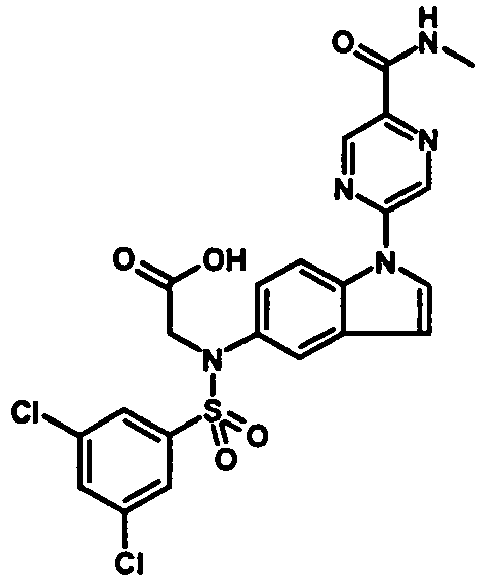
- (148) ((3,5-dichloro-phenylsulphonyl)-{1-[5-(morpholine-4-carbonyl)-pyrazin-2-yl]-1H-indol-5-yl}-amino)-acetic acid

- (149) ((3,5-dichloro-phenylsulphonyl)-{1-[4-(methoxy-methyl-carbamoyl)-pyridin-2-yl]-1H-indol-5-yl}-amino)-acetic acid
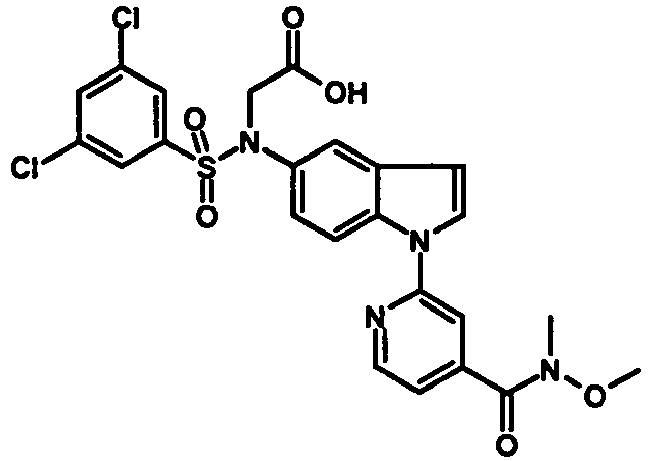
Mass spectrum (ESI+): m/z = 563 [M+H]+ - (150) {(3,5-dichloro-phenylsulphonyl)-[1-(4-ethansulphinyl-pyridin-2-yl)-1H-indol-5-yl]-amino}-acetic acid
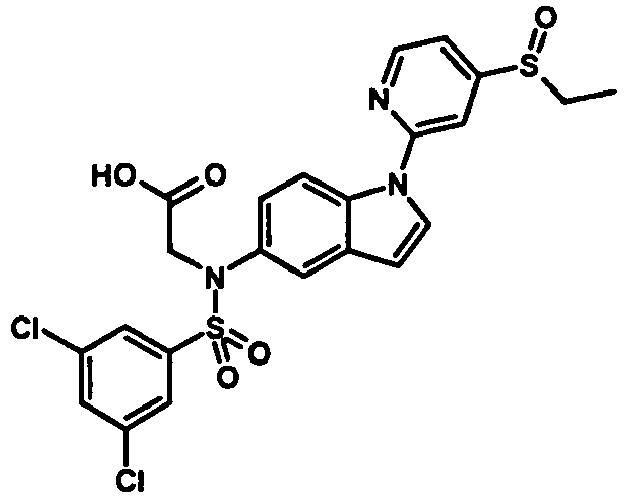
- (151) [(3,5-dichloro-phenylsulphonyl)-(1-imidazo[1,2-a]pyrazin-6-yl-1H-indol-5-yl)-amino]-acetic acid
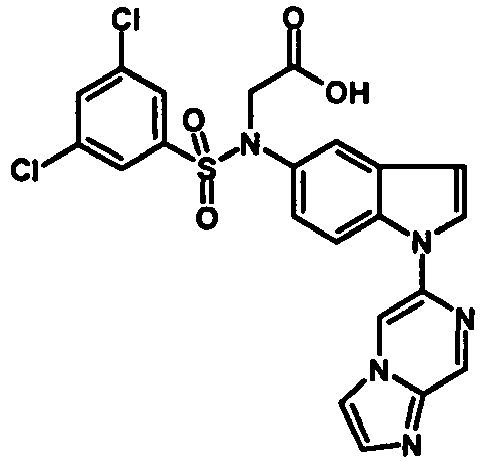
Mass spectrum (ESI+): m/z = 516 [M+H]+ - (152) {(3,5-dichloro-phenylsulphonyl)-[1-(4-oxazol-2-yl-pyridin-2-yl)-1H-indol-5-yl]-amino}-acetic acid

- (153) [[1-(4-acetyl-pyridin-2-yl)-1H-indol-5-yl]-(3,5-dichloro-phenylsulphonyl)-amino]-acetic acid
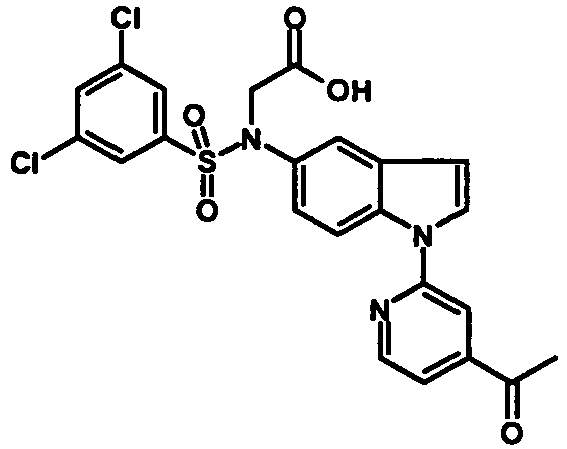
Mass spectrum (ESI+): m/z = 518 [M+H]+ - (154) [[1-(5-cyano-pyrazin-2-yl)-1H-indol-5-yl]-(3,5-dichloro-phenylsulphonyl)-amino]-acetic acid

- (155) {(3,5-dichloro-phenylsulphonyl)-[1-(4-propionyl-pyridin-2-yl)-1H-indol-5-yl]-amino}-acetic acid

Mass spectrum (ESI+): m/z = 532 [M+H]+ - (156) ((3,5-dichloro-phenylsulphonyl)-{1-[6-(morpholine-4-carbonyl)-pyridazin-3-yl]-1H-indol-5-yl}-amino)-acetic acid

- (157) {(3,5-dichloro-phenylsulphonyl)-[1-(6-dimethylcarbamoyl-pyridazin-3-yl)-1H-indol-5-yl]-amino}-acetic acid

- (158) [[1-(4-cyclopropylcarbamoyl-pyridin-2-yl)-3-methyl-1H-indol-5-yl]-(3,5-dichloro-phenylsulphonyl)-amino]-acetic acid
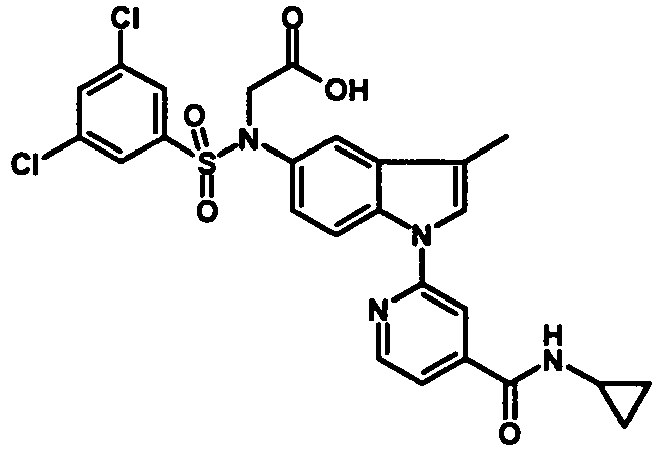
- (159) ((3,5-dichloro-phenylsulphonyl)-{1-[4-(1-methyl-1H-imidazol-2-yl)-pyridin-2-yl]-1H-indol-5-yl}-amino)-acetic acid CF3CO2H
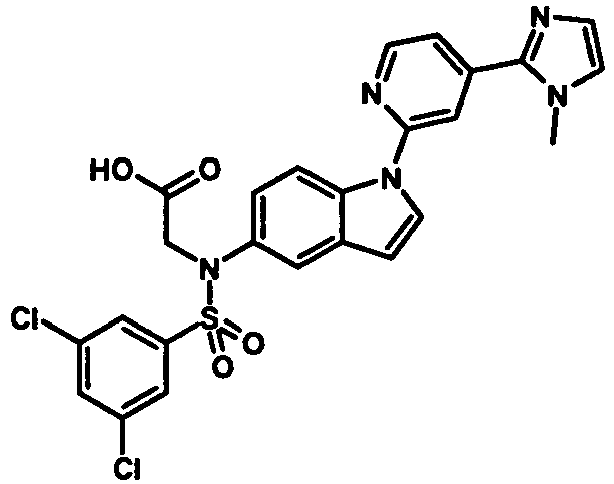
- (160) [[1-(4-aminomethyl-pyridin-2-yl)-1H-indol-5-yl]-(3,5-dichlorophenylsulphonyl)-amino]-acetic acid · CF3CO2H

- (161) ((3,5-dichloro-phenylsulphonyl)-{1-[5-(2-dimethylamino-ethylamino)-pyrazin-2-yl]-3-methyl-1H-indol-5-yl}-amino)-acetic acid · CF3CO2H

- (162) {(3,5-dichloro-phenylsulphonyl)-[1-(1-methyl-1H-pyrazol-4-yl)-1H-indol-5-yl]-amino}-acetic acid

Rf value: 0.45 (silica gel: dichloromethane/methanol/acetic acid 95:5:0.1) - (163) {(3,5-dichloro-phenylsulphonyl)-[1-(5-thiazol-2-yl-pyridazin-3-yl)-1H-indol-5-yl]-amino}-acetic acid

Rf value: 0.34 (silica gel: dichloromethane/methanol 95:5) - (164) {(3,5-dichloro-phenylsulphonyl)-[1-(1-methyl-1H-imidazol-4-yl)-1H-indol-5-yl]-amino}-acetic acid
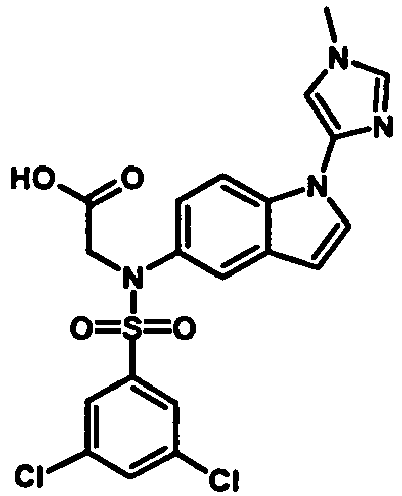
Rf value: 0.33 (silica gel: dichloromethane/methanol/acetic acid 95:5:0.1) - (165) {(3,5-dichloro-phenylsulphonyl)-[1-(6-trifluoromethyl-pyrimidin-4-yl)-1H-indol-5-yl]-amino}-acetic acid
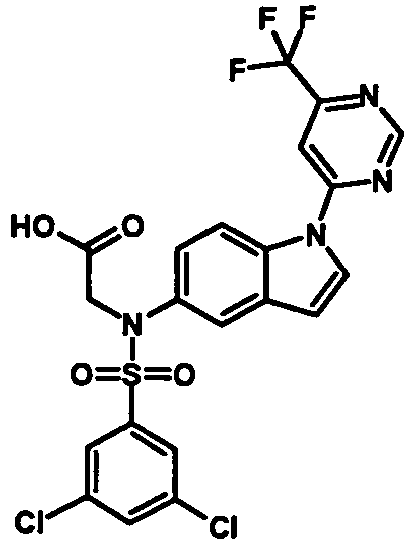
Rf value: 0.57 (silica gel: dichloromethane/methanol/acetic acid 95:5:0.1) - (166) [(3,5-dichloro-phenylsulphonyl)-(1-thiazol-2-yl-1H-indol-5-yl)-amino]-acetic acid

Rf value: 0.55 (silica gel: dichloromethane/methanol/acetic acid 95:5:0.1) - (167) [[1-(2-cyano-thiophen-3-yl)-1H-indol-5-yl]-(3,5-dichloro-phenylsulphonyl)-amino]-acetic acid

Rf value: 0.50 (silica gel: dichloromethane/methanol/acetic acid 95:5:0.1) - (168) [[1-(5-acetyl-thiophen-2-yl)-1H-indol-5-yl]-(3,5-dichloro-phenylsulphonyl)-amino]-acetic acid

Rf value: 0.58 (silica gel: dichloromethane/methanol/acetic acid 95:5:0.1) - (169) {(3,5-dichloro-phenylsulphonyl)-[1-(2,6-dimethyl-pyrimidin-4-yl)-1H-indol-5-yl]-amino}-acetic acid

Rf value: 0.40 (silica gel: dichloromethane/methanol/acetic acid 95:5:0.1) - (170) {(3,5-dichloro-phenylsulphonyl)-[1-(5-methyl-[1,3,4]thiadiazol-2-yl)-1H-indol-5-yl]-amino}-acetic acid

Rf value: 0.60 (silica gel: dichloromethane/methanol/acetic acid 95:5:0.1) - (171) {(3,5-dichloro-phenylsulphonyl)-[1-(6-methoxy-pyrimidin-4-yl)-1H-indol-5-yl]-amino}-acetic acid
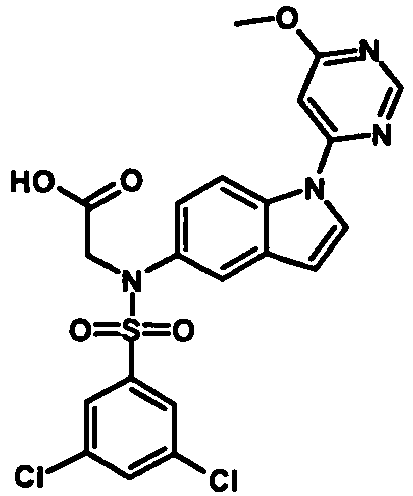
Rf value: 0.55 (silica gel: dichloromethane/methanol/acetic acid 95:5:0.1) - (172) {(3,5-dichloro-phenylsulphonyl)-[1-(2-thiazol-2-yl-pyrimidin-4-yl)-1H-indol-5-yl]-amino}-acetic acid

Rf value: 0.30 (silica gel: toluene/dioxane/ethanol/glacial acetic acid 90:10:10:6) - (173) ethyl 2-(5-{5-[carboxymethyl-(3,5-dichloro-phenylsulphonyl)-amino]-indol-1-yl}-thiophen-2-yl)-thiazole-4-carboxylate

Rf value: 0.65 (silica gel: toluene/dioxane/ethanol/glacial acetic acid 90:10:10:6) - (174) ((3,5-dichloro-phenylsulphonyl)-{1-[6-(1-methyl-1H-imidazol-2-yl)-pyrimidin-4-yl]-1H-indol-5-yl}-amino)-acetic acid

Rf value: 0.25 (silica gel: dichloromethane/methanol 90:10) - (175) ethyl 5-(5-{5-[carboxymethyl-(3,5-dichloro-phenylsulphonyl)-amino]-indol-1-yl}-thiophen-2-yl)-isoxazol-3-carboxylate

Rf value: 0.40 (silica gel: dichloromethane/methanol 95:5) - (176) {(3,5-dichloro-phenylsulphonyl)-[3-methyl-1-(4-methyl-pyridin-2-yl)-1H-indol-5-yl]-amino}-acetic acid
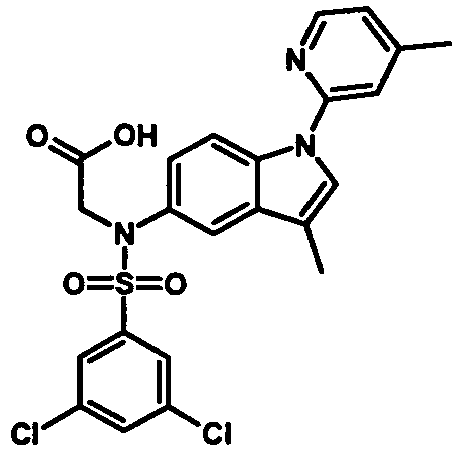
Rf value: 0.39 (silica gel: dichloromethane/methanol 90:10) - (177) [{3-bromo-1-[6-(2-dimethylamino-ethylamino)-pyridazin-3-yl]-1H-indol-5-yl}-(3,5-dichloro-phenylsulphonyl)-amino]-acetic acid

- (178) [(3,5-dichloro-phenylsulphonyl)-(3-pyrimidin-2-yl-3H-benzimidazol-5-yl)-amino]-acetic acid

- (179) [(3,5-dichloro-phenylsulphonyl)-(1-pyrimidin-2-yl-1H-benzimidazol-5-yl)-amino]-acetic acid

- (180) {(2,6-dimethyl-pyridin-4-sulphonyl)-[1-(6-methyl-pyridazin-3-yl)-1H-indol-5-yl]-amino}-acetic acid · CF3CO2H

- (181) {(2,6-dichloro-pyridin-4-sulphonyl)-[1-(6-methyl-pyridazin-3-yl)-1H-indol-5-yl]-amino}-acetic acid
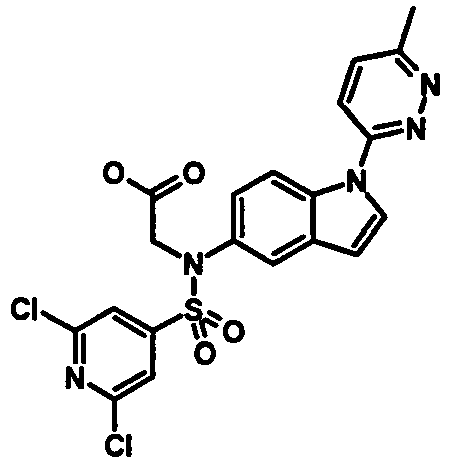
- (182) {(2-chloro-6-methyl-pyridin-4-sulphonyl)-[1-(6-methyl-pyridazin-3-yl)-1H-indol-5-yl]-amino}-acetic acid

- (183) {(2,6-dichloro-pyridin-4-sulphonyl)-[1-(4-methylcarbamoyl-pyridin-2-yl)-1H-indol-5-yl]-amino}-acetic acid
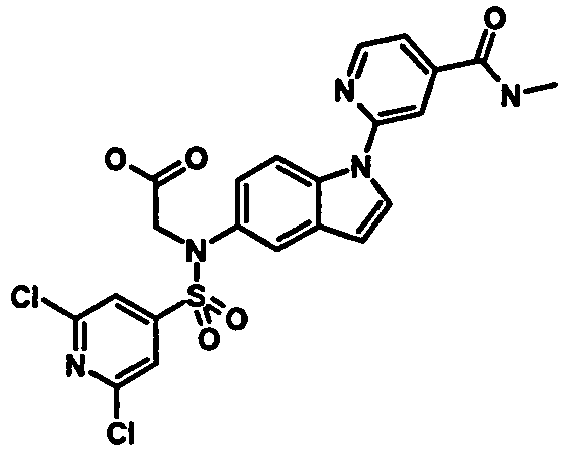
Mass spectrum (ESI+): m/z = 534 [M+H]+ -

- 130 mg [{1-[6-(3-amino-propylamino)-pyridazin-3-yl]-1H-indol-5-yl}-(3,5-dichlorophenylsulphonyl)-amino]- acetic acid. CF3CO2H are dissolved in 2 ml of tetrahydrofuran. 100 µl pyridine and 20 µl acetanhydride are added and the mixture is stirred for 3 hours at ambient temperature. The volatile constituents are eliminated in vacuo, the residue is extracted from water and the solid thus obtained is purified by chromatography on silica gel with dichloromethane/methanol (99:5 to 60:40). The product thus obtained is extracted from diethyl ether.
Yield: 70 mg (60 % of theory)
Mass spectrum (ESI+): m/z = 591 [M+H]+ - The following compounds are obtained analogously to Example 2:
- (1) [(1-{6-[(3-acetylamino-propyl)-methyl-amino]-pyridazin-3-yl}-1H-indol-5-yl)-(3,5-dichloro-phenylsulphonyl)-amino]-acetic acid
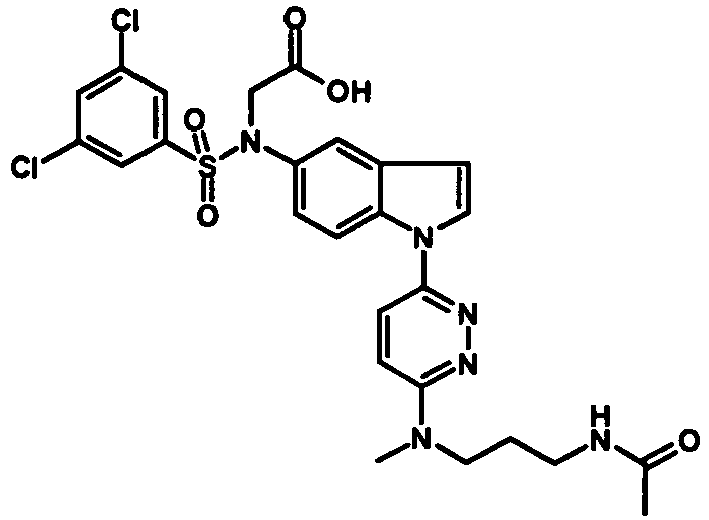
Mass spectrum (ESI+): m/z = 605 [M+H]+ - (2) [[1-(5-acetylamino-pyrazin-2-yl)-1H-indol-5-yl]-(3,5-dichloro-phenylsulphonyl)-amino]-acetic acid
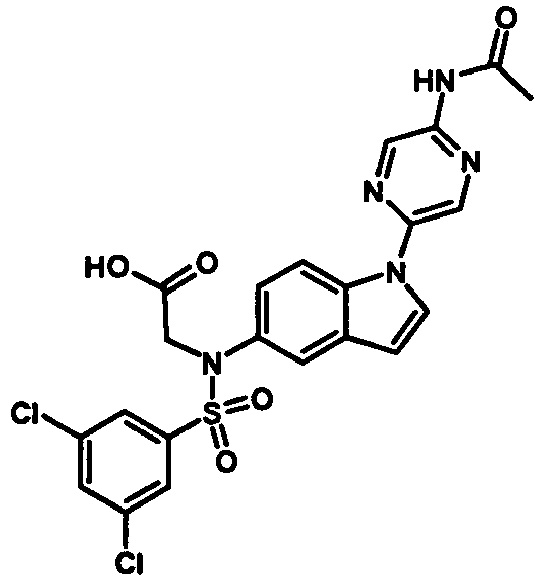
Mass spectrum (ESI-): m/z = 532 [M-H]- - (3) [[1-(4-acetylamino-pyridin-2-yl)-1H-indol-5-yl]-(3,5-dichloro-phenylsulphonyl)-amino]-acetic acid

Mass spectrum (ESI+): m/z = 533 [M+H]+ - (4) [{1-[6-(4-acetyl-piperazin-1-yl)-pyridazin-3-yl]-1H-indol-5-yl}-(3,5-dichlorophenylsulphonyl)-amino]-acetic acid

-

- 300 mg tert-butyl 2-{5-[tert-butoxycarbonylmethyl-(3,5-dichloro-phenylsulphonyl)-amino]-2,3-dihydro-indol-1-yl}-imidazole-1-carboxylate are dissolved in 2 ml dichloromethane, 2 ml trifluoroacetic acid are added and the mixture is stirred overnight at ambient temperature. The solvents are eliminated in vacuo and the residue is purified by chromatography on silica gel with dichloromethane/methanol (99:1 to 60:40). The product thus obtained is dissolved in a little dioxane and combined with a 4 N solution of HCl in dioxane. Then some diisopropylether is added and the solvents are eliminated in vacuo. The residue is extracted from diethyl ether and dried in vacuo.
Mass spectrum (ESI+): m/z = 467 [M+H]+ -

- 90 mg tert-butyl 4-(3-{5-[tert-butoxycarbonylmethyl-(3,5-dichlorophenylsulphonyl)-amino]-indol-1-yl}-benzoyl)-piperazine-1-carboxylate are dissolved in 2 ml of a 4 N solution of HCl in dioxane. The mixture is stirred for 7 hours at RT and then combined with diethyl ether. After stirring overnight the precipitated solid is suction filtered and dried in vacuo.
Yield: 55 mg (73 % of theory)
Mass spectrum (ESI+): m/z = 578 [M+H]+ - The following compounds are obtained analogously to Example 4:
- (1) [(3,5-dichloro-phenylsulphonyl)-(1-pyridin-4-yl-2,3-dihydro-1H-indol-5-yl)-amino]-acetic acid · HCl

Mass spectrum (ESI+): m/z = 478 [M+H]+ - (2) ((3,5-dichloro-phenylsulphonyl)-(1-[5-(2-dimethylamino-ethylamino)-pyrazin-2-yl]-1H-indol-5-yl}-amino)-acetic acid · HCl

Mass spectrum (ESI+): m/z = 563 [M+H]+ - (3) ((3,5-dichloro-phenylsulphonyl)-{1-[4-(piperazine-1-carbonyl)-phenyl]-1H-indol-5-yl}-amino)-acetic acid · HCl

- (4) {(3,5-dichloro-phenylsulphonyl)-[1-(4-piperazin-1-yl-pyrimidin-2-yl)-2,3-dihydro-1H-indol-5-yl]-amino}-acetic acid · HCl
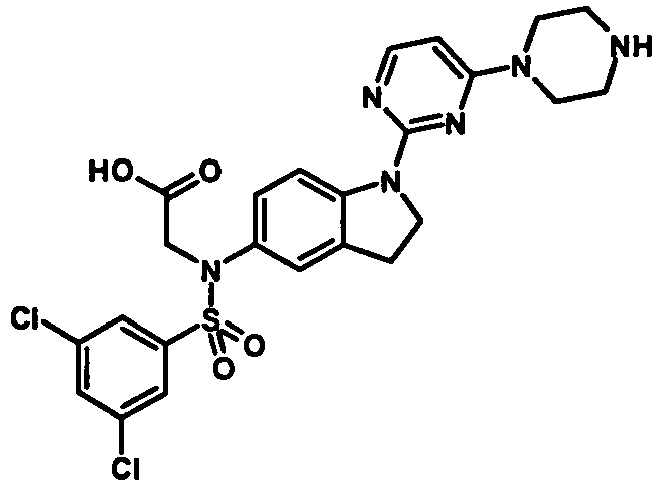
Mass spectrum (ESI+): m/z = 563 [M+H]+ - (5) ethyl {(3,5-dichloro-phenylsulphonyl)-[1-(4-piperazin-1-yl-pyrimidin-2-yl)-2,3-dihydro-1H-indol-5-yl]-amino}-acetate · HCl
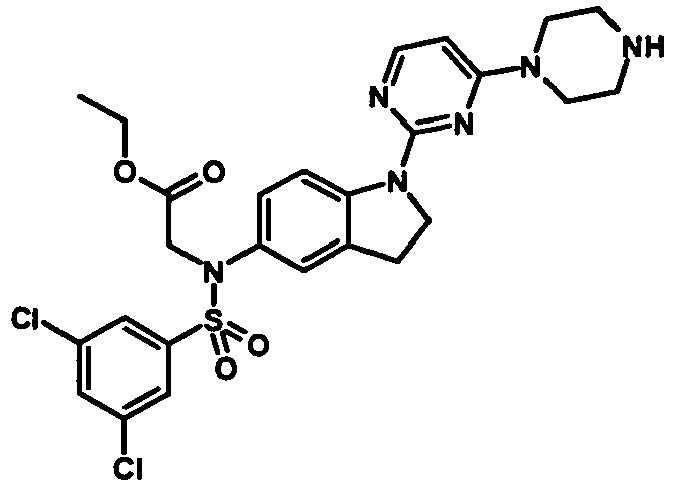
Mass spectrum (ESI+): m/z = 591 [M+H]+ - (6) {(3,5-dichloro-phenylsulphonyl)-[1-(4-piperazin-1-yl-pyrimidin-2-yl)-1H-indol-5-yl]-amino}-acetic acid · HCl

Mass spectrum (ESI+): m/z = 561 [M+H]+ - (7) ethyl {(3,5-dichloro-phenylsulphonyl)-[1-(4-piperazin-1-yl-pyrimidin-2-yl)-1H-indol-5-yl]-amino}-acetate · HCl
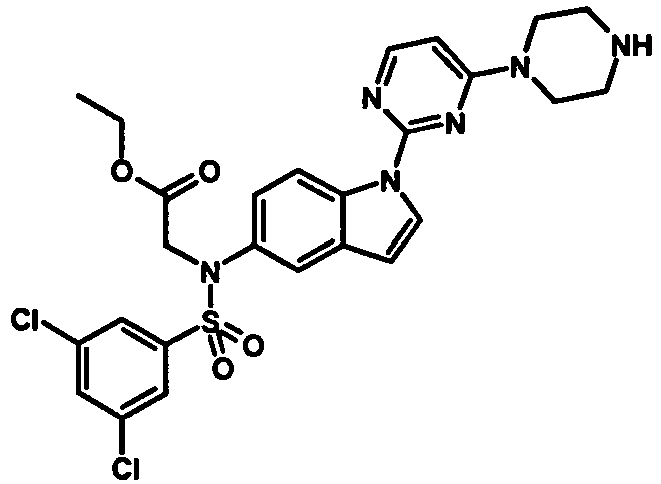
Mass spectrum (ESI+): m/z = 589 [M+H]+ - (8) ((3,5-dichloro-phenylsulphonyl)-{1-[5-(piperazine-1-carbonyl)-pyrazin-2-yl]-2,3-dihydro-1H-indol-5-yl}-amino)-acetic acid · HCl

Mass spectrum (ESI+): m/z = 591 [M+H]+ - (9) ((3,5-dichloro-phenylsulphonyl)-{1-[5-(piperazine-1-carbonyl)-pyrazin-2-yl]-1H-indol-5-yl}-amino)-acetic acid · HCl

Mass spectrum (ESI+): m/z = 589 [M+H]+ - (10) {(3,5-dichloro-phenylsulphonyl)-[1-(3,4,5,6-tetrahydro-2H-[1,2']bipyrazinyl-6'-yl)-1H-indol-5-yl]-amino}-acetic acid · HCl

- (11) {(3,5-dichloro-phenylsulphonyl)-[1-(3,4,5,6-tetrahydro-2H-[1,2']bipyrazinyl-6'-yl)-2,3-dihydro-1H-indol-5-yl]-amino}-acetic acid · HCl

- (12) [(3,5-dichloro-phenylsulphonyl)-(1-pyrimidin-2-yl-2,3-dihydro-1H-indol-4-yl)-amino]-acetic acid

- (13) [(1-{4-[carboxymethyl-(2-dimethylamino-ethyl)-amino]-pyrimidin-2-yl}-2,3-dihydro-1H-indol-5-yl)-(3,5-dichloro-phenylsulphonyl)-amino]-acetic acid · HCl

- (14) {(3,5-dichloro-phenylsulphonyl)-[1-(6-piperazin-1-yl-pyridazin-3-yl)-2,3-dihydro-1H-indol-5-yl]-amino}-acetic acid · HCl

Mass spectrum (ESI+): m/z = 563 [M+H]+ - (15) ((3,5-dichloro-phenylsulphonyl)-{1-[4-(2-dimethylaminoethylamino)-pyrimidin-2-yl]-2,3-dihydro-1H-indol-5-yl}-amino)-acetic acid · HCl

- (16) carboxymethyl-[2-(6-{5-[carboxymethyl-(3,5-dichloro-phenylsulphonyl)-amino]-2,3-dihydro-indol-1-yl}-pyridazin-3-ylamino)ethyl]-dimethyl-ammonium chloride
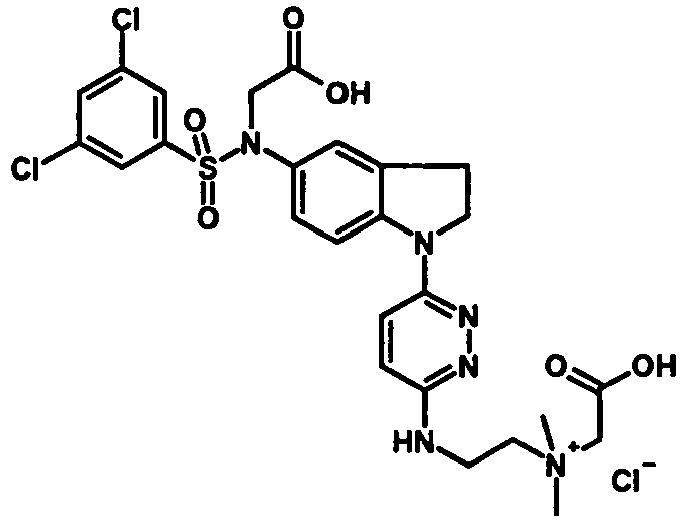
- (17) carboxymethyl-[2-(2-{5-[carboxymethyl-(3,5-dichloro-phenylsulphonyl)-amino]-2,3-dihydro-indol-1-yl}-pyrimidin-4-ylamino)ethyl]-dimethyl-ammonium chloride

- (18) [(3,5-dichloro-phenylsulphonyl)-(1-pyridin-2-yl-1H-indol-5-yl]-amino]-acetic acid · HCl

- (19) {(3,5-dichloro-phenylsulphonyl)-[1-(3-trifluoromethyl-pyridin-2-yl)-1H-indol-5-yl]-amino}-acetic acid · HCl

- (20) [{1-[6-(2-amino-ethylamino)-pyridazin-3-yl]-2,3-dihydro-1H-indol-5-yl}-(3,5-dichloro-phenylsulphonyl)-amino]-acetic acid · HCl

- (21) [{1-[6-(2-amino-ethylamino)-pyridazin-3-yl]-1H-indol-5-yl}-(3,5-dichlorophenylsulphonyl)-amino]-acetic acid · HCl

- (22) ((3,5-dichloro-phenylsulphonyl)-{1-[6-(2-oxo-imidazolidin-1-yl)-pyridazin-3-yl]-2,3-dihydro-1H-indol-5-yl}amino)-acetic acid

- (23) {(3,5-dichloro-phenylsulphonyl)-[1-(6-methyl-pyridazin-3-yl)-1H-indol-5-yl]-amino}-acetic acid

- (24) ((3,5-dichloro-phenylsulphonyl)-{1-[6-(2-dimethylamino-ethylamino)-pyridazin-3-yl]-2,3-dimethyl-1H-indol-5-yl}-amino)-acetic acid · HCl
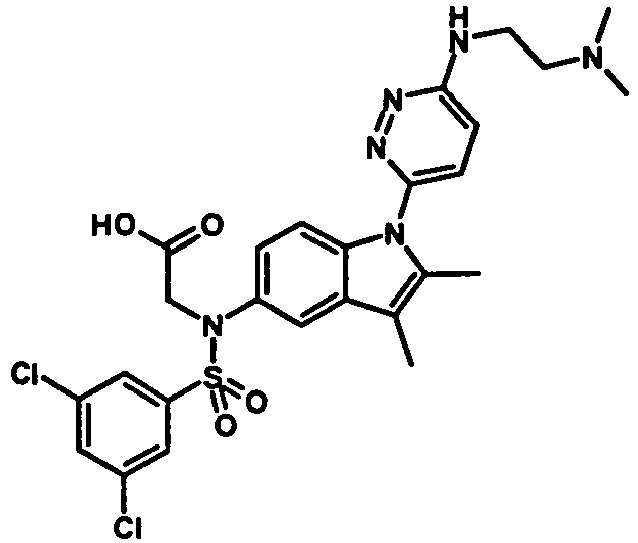
- (25) ((3,5-dichloro-phenylsulphonyl)-{1-[6-(2-dimethylamino-ethylamino)-pyridazin-3-yl]-2-methyl-1H-indol-5-yl}-amino)-acetic acid · HCl

- (26) ((3,5-dichloro-phenylsulphonyl)-{1-[4-(2-dimethylamino-ethylcarbamoyl)-pyridin-2-yl]-1H-indol-5-yl}-amino)-acetic acid · HCl

- (27) {(3,5-dichloro-phenylsulphonyl)-[3-iodo-1-(6-methyl-pyridazin-3-yl)-1H-indol-5-yl]-amino}-acetic acid

- (28) {(3,5-dichloro-phenylsulphonyl)-[1-(3,4,5,6-tetrahydro-2H-[1,2']bipyrazinyl-5'-yl)-1H-indol-5-yl]-amino}-acetic acid · HCl

- (29) ((3,5-dichloro-phenylsulphonyl)-{1-[4-(piperazine-1-carbonyl)-pyridin-2-yl]-1H-indol-5-yl}-amino)-acetic acid · HCl

- (30) [(1-[4-(2-amino-ethylamino)-pyrimidin-2-yl]-1H-indol-5-yl}-{(3,5-dichlorophenylsulphonyl)-amino]-acetic acid · HCl

- (31) [[1-(6-amino-pyridazin-3-yl)-1H-indol-5-yl]-(3,5-dichloro-phenylsulphonyl)-amino]-acetic acid · HCl

- (32) {(3,5-dichloro-phenylsulphonyl)-[1-(5-hydroxymethyl-pyridin-2-yl)-1H-indol-5-yl]-amino}-acetic acid

- (33) ((3,5-dichloro-phenylsulphonyl)-{1-(6-(3-hydroxy-propyl)-pyridazin-3-yl]-1H-indol-5-yl}-amino)-acetic acid

Mass spectrum (ESI+): m/z = 535 [M+H]+ - (34) ((3,5-dichloro-phenylsulphonyl)-{1-[5-(2-hydroxy-1-hydroxymethylethylamino)-pyridin-2-yl]-1H-indol-5-yl}-amino)-acetic acid
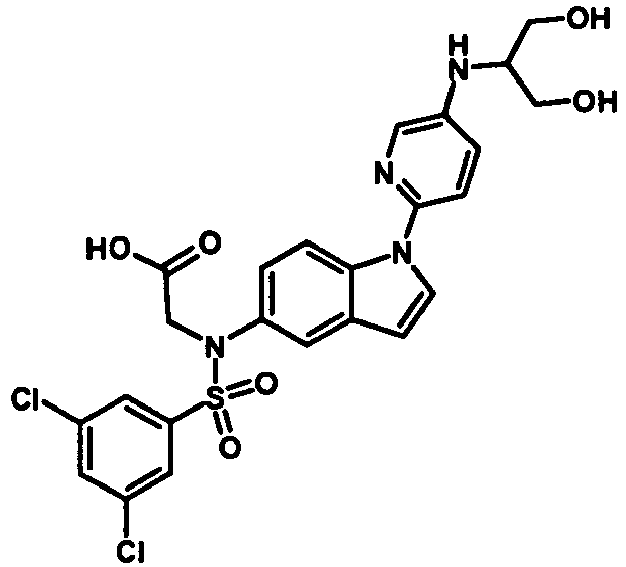
- (35) ((3,5-dichloro-phenylsulphonyl)-{1-[5-(2-hydroxy-ethylamino)-pyrazin-2-yl]-1H-indol-5-yl}-amino)-acetic acid

Mass spectrum (ESI+): m/z = 536 [M+H]+ -

- Under argon 200 mg tert.butyl [(3,5-dichloro-phenylsulphonyl)-(1H-indol-5-yl)-amino]-acetate, 9 mg copper iodide and 298 mg potassium phosphate are dissolved in 3 ml of toluene. 229 mg N'-(5-bromo-pyrazin-2-yl)-N,N-dimethylethan-1,2-diamine and 15 µl N,N'-dimethyl-trans-cyclohexanediamine are added. Then the mixture is heated to 110°C for 8 hours. It is divided between water and ethyl acetate and the aqueous phase is extracted twice with ethyl acetate. After drying with magnesium sulphate the solvents are eliminated in vacuo. The residue is purified by chromatography on silica gel (dichloromethane/ methanol 9:1 to 1:2). The product is taken up in 10 ml diisopropylether and combined with 500 pl of 4 N HCl in dioxane. The precipitated solid is suction filtered and dried in vacuo.
Yield: 108 mg (39 % of theory)
Mass spectrum (ESI+): m/z = 591 [M+H]+ - The following compounds are obtained analogously to Example 5:
- (1) ethyl {(3,5-dichloro-phenylsulphonyl)-[1-(6-methyl-pyridazin-3-yl)-1H-indol-5-yl]-amino}-acetate
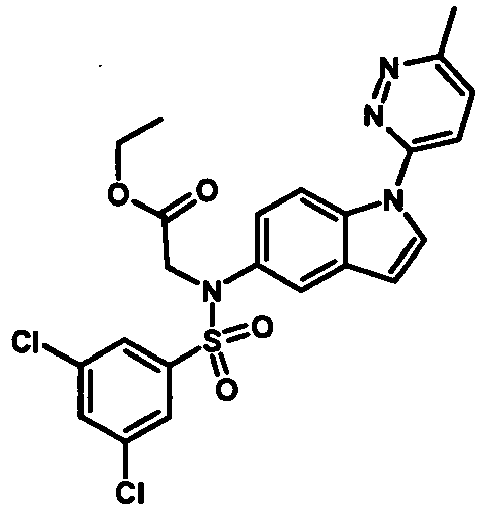
- (2) ethyl [[1-(5-amino-pyrazin-2-yl)-1H-indol-5-yl]-(3,5-dichloro-phenylsulphonyl)-amino]-acetate

- (3) ethyl {(3,5-dichloro-phenylsulphonyl)-[1-(6-morpholin-4-yl-pyridazin-3-yl)-1H-indol-5-yl]-amino}-acetate
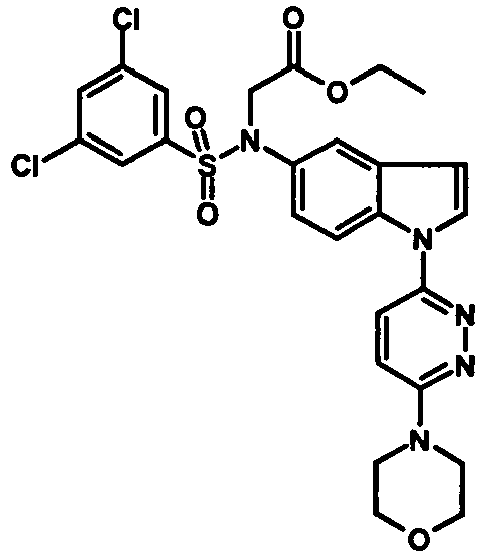
-

- 75 mg tert.butyl [(3,5-dichloro-phenylsulphonyl)-(1-pyrazin-2-yl-1H-indol-5-yl)-amino]-acetate are dissolved in 2 ml dichloromethane under argon. 19 mg of N-chloro-succinimide are added and the mixture is stirred for 1 hour at ambient temperature. The solvent is eliminated in vacuo and the residue is taken up in 1 ml acetic acid. It is heated to 70°C and 150 µl phosphoric acid are added. Then the mixture is refluxed for 2 hours. It is divided between water and ethyl acetate, the aqueous phase is extracted twice with ethyl acetate and the combined organic phases are dried with sodium sulphate. The solvents are eliminated in vacuo and the residue is chromatographed on silica gel (dichloromethane/methanol 9:1 to 3:2).
Yield: 17 mg (24 % of theory)
Mass spectrum (ESI+): m/z = 511 [M+H]+ -

- 90 mg tert.butyl [(3,5-dichloro-phenylsulphonyl)-(7-methyl-1H-indol-5-yl)-amino]-acetate, 122 mg potassium phosphate and 7.3 mg copper iodide are suspended in 2 ml anhydrous toluene. To this is added a solution of 45 mg N'-(6-bromo-pyridazin-3-yl)-N,N-dimethyl-ethan-1 ,2-diamine in 1 ml anhydrous toluene. After the addition of 13 µl N,N'-dimethyl-trans-cyclohexane-diamine the mixture is heated to 100°C for 5 hours. Then it is divided between water and ethyl acetate. The aqueous phase is extracted twice with ethyl acetate and the combined organic phases are dried on magnesium sulphate. The solvents are eliminated in vacuo and the residue is chromatographed on silica gel [dichloromethane/(methanol/acetic acid/water 8:1:1) 95:5 to 75:25]. The product thus obtained is taken up in 3 ml dichloromethane. 1.5 ml trifluoroacetic acid are added and the mixture is stirred for 3 hours at ambient temperature. The solvents are then eliminated in vacuo and the residue is taken up in 2 ml of water. After freeze-drying the product is obtained as a solid.
Yield: 31 mg (28 % of theory)
Mass spectrum (ESI+): m/z = 577 [M+H]+ - The following compounds are obtained analogously to Example 7:
- (1) ((3,5-dichloro-phenylsulphonyl)-{1-[6-(2-dimethylamino-ethylamino)-pyridazin-3-yl]-6-methyl-1H-indol-5-yl}-amino)-acetic acid · CF3CO2H

-
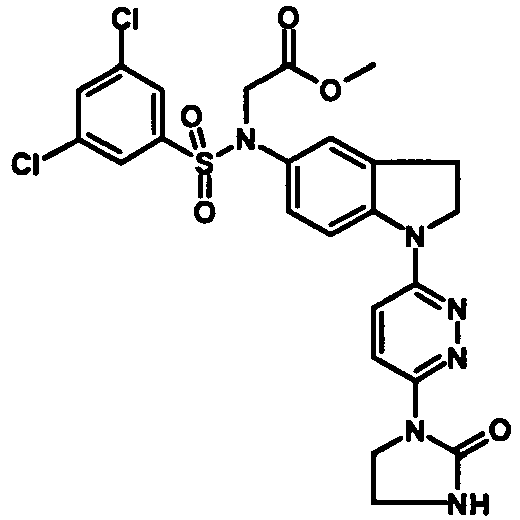
- 60 mg ((3,5-dichloro-phenylsulphonyl)-{1-[6-(2-oxo-imidazolidin-1-yl)-pyridazin-3-yl]-2,3-dihydro-1H-indol-5-yl}-amino)-acetic acid are suspended in 1 ml of methanol, 150 µl of a 2 N solution of trimethylsilyldiazomethan in hexane and stirred for 12 hours at ambient temperature. Then the mixture is diluted with 2 ml of methanol and 10 drops of 2 N hydrochloric acid are added. The solvents are eliminated in vacuo and the residue is extracted from diethyl ether.
Yield: 45 mg (73 % of theory)
Mass spectrum (ESI+): m/z = 577 [M+H]+ -

- 1.4 g of ethyl{(3,5-dichloro-phenylsulphonyl)-[1-(6-methyl-pyridazin-3-yl)-1H-indol-5-yl]-amino}-acetate are dissolved in 5 ml 2-dimethylaminoethanol. 100 µl of titanium tetraisopropoxide are added and the mixture is heated for 4 hours to 120°C. Then the excess 2-dimethylaminoethanol is eliminated in vacuo and the residue is divided between water and diethyl ether. The aqueous phase is extracted 3 times with diethyl ether and the combined organic phases are dried on magnesium sulphate. Then the solvent is eliminated in vacuo until crystallisation sets in. After crystallisation has ended the solid is suction filtered and dried in vacuo.
Yield: 780 mg (51 % of theory)
Mass spectrum (ESI+): m/z = 562 [M+H]+ -

- 116 mg tert.butyl {(3,5-dichloro-phenylsulphonyl)-[1-(2,4-dimethoxy-pyrimidin-5-yl)-1H-indol-5-yl]-amino}-acetate are dissolved in 18 ml acetic acid. To this are added 230 µl 2 N hydrochloric acid and the mixture is refluxed for 1 hour. The solvents are then eliminated in vacuo and the residue is purified by preparative HPLC.
Yield: 5 mg (5 % of theory)
Mass spectrum (ESI-): m/z = 507 [M-H]- - The following compounds are obtained analogously to Example 10:
- (1) {(3,5-dichloro-phenylsulphonyl)-[1-(2',4'-dioxo-1'.2'.3'.4'-tetrahydro-[4.5']bipyrimidinyl-6-yl)-1H-indol-5-yl]-amino}-acetic acid
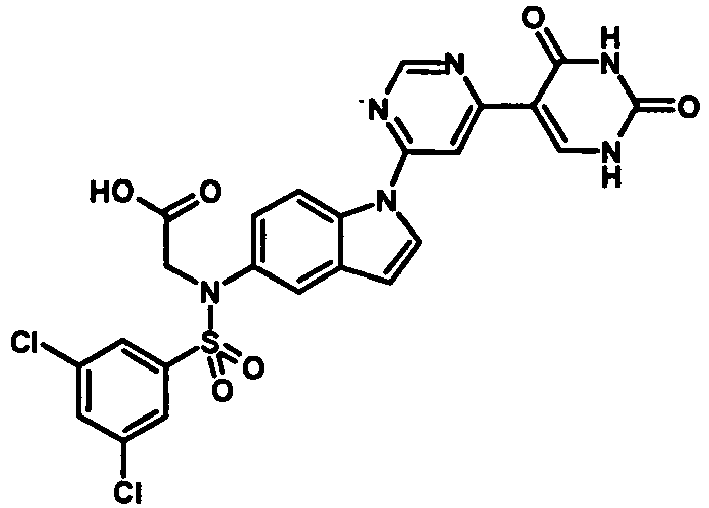
Mass spectrum (ESI+): m/z = 587 [M+H]+
Rf value: 0.35 (silica gel: dichloromethane/methanol 90:10) -

- 100 mg tert.butyl ((3,5-dichloro-phenylsulphonyl)-{1-[4-(2-hydroxyethylcarbamoyl)-pyridin-2-yl]-1H-indol-5-yl}-amino)-acetate are dissolved in 1 ml dichloromethane and 0.5 ml trifluoroacetic acid and stirred for 5 hours at ambient temperature. Then the solvents are eliminated in vacuo and the residue is taken up in 0.5 ml of tetrahydrofuran. 140 µl 1 N sodium hydroxide solution are added and the mixture is stirred for 1 hour at ambient temperature. Then the tetrahydrofuran is eliminated in vacuo and the residue is combined with 140 µl of 1 N hydrochloric acid. The precipitated solid is suction filtered and dried in vacuo.
Yield: 54 mg (59 % of theory)
Mass spectrum (ESI+): m/z = 563 [M+H]+ - The following compounds are obtained analogously to Example 11:
- (1) ((3,5-dichloro-phenylsulphonyl)-{1-[5-(2-hydroxy-ethylamino)-pyridin-2-yl]-1H-indol-5-yl}-amino)-acetic acid
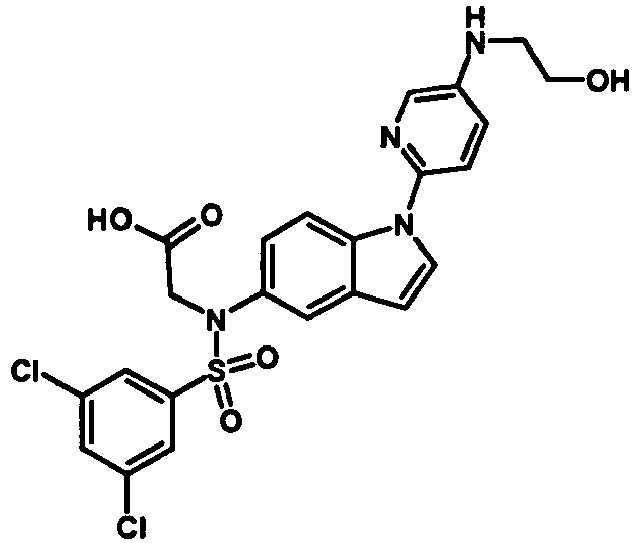
- (2) ((3,5-dichloro-phenylsulphonyl)-{1-[4-(3-hydroxy-propyl)-pyridin-2-yl]-1H-indol-5-yl}-amino)-acetic acid

-

- 31 mg {(3,5-dichloro-phenylsulphonyl)-[1-(2,6-dichloro-pyrimidin-4-yl)-1H-indol-5-yl]-amino}-acetic acid are dissolved in 600 µl tetrahydrofuran. 250 µl of 4 N sodium hydroxide solution and 15 drops of a 30% hydrogen peroxide solution are added and the mixture is heated for 6 hours to 50°C. The volatile constituents are eliminated in vacuo and the residue is purified by preparative HPLC.
Yield: 2.6 mg (11 % of theory) {(3,5-dichloro-phenylsulphonyl)-[1-(2,6-dioxo-1,2,3,6-tetrahydro-pyrimidin-4-yl)-1H-indol-5-yl]-amino}-acetic acid Mass spectrum (ESI+): m/z = 509 [M+H]+ and
5 mg (20 % of theory) of 3-{5-[carboxymethyl-(3,5-dichloro-phenylsulphonyl)-amino]-indol-1-yl}-3-ureido-acrylic acid
Mass spectrum (ESI+): m/z = 527 [M+H]+ -

- 25 mg [{1-[6-(3-amino-propylamino)-pyridazin-3-yl]-1H-indol-5-yl}-(3,5-dichlorophenylsulphonyl)-amino]-acetic acid are dissolved in 2 ml of tetrahydrofuran. The mixture is cooled to 0°C, 250 µl 1 N sodium hydroxide solution are added and then 10 µl methanesulphonic acid chloride are added thereto. After stirring for 3 hours, 250 µl of 1 N hydrochloric acid are added and the volatile constituents are removed in vacuo. The residue is taken up in dichloromethane/methanol 2:1 and the solid is suction filtered. The mother liquor is evaporated down in vacuo and the residue is purified by preparative HPLC.
Yield: 6.5 mg (23 % of theory)
Mass spectrum (ESI+): m/z = 627 [M+H]+ - The following compounds are obtained analogously to Example 13:
- (1) ((3,5-dichloro-phenylsulphonyl)-{1-[6-(4-methanesulphonyl-piperazin-1-yl)-pyridazin-3-yl]-1H-indol-5-yl}-amino)-acetic acid

Mass spectrum (ESI+): m/z = 639 [M+H]+ - (2) ((3,5-dichloro-phenylsulphonyl)-{1-[5-(2-methanesulphonylamino-ethoxy)-pyrazin-2-yl]-1H-indol-5-yl}-amino)-acetic acid

Mass spectrum (ESI+): m/z = 614 [M+H]+ - (3) [{1-[5-(2-acetylamino-ethoxy)-pyrazin-2-yl]-1H-indol-5-yl}-(3,5-dichlorophenylsulphonyl)-amino]-acetic acid
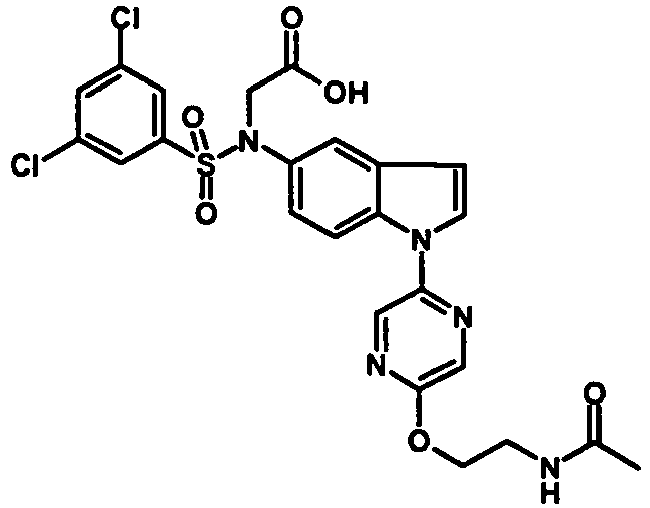
Mass spectrum (ESI-): m/z = 576 [M-H]- - (4) {(3,5-dichloro-phenylsulphonyl)-[1-(4-methanesulphonyl-3,4,5,6-tetrahydro-2H-[1,2']bipyrazinyl-5'-yl)-1H-indol-5-yl]-amino}-acetic acid

- (5) [{1-[5-(2-acetylamino-ethylamino)-pyrazin-2-yl]-1H-indol-5-yl}-(3,5-dichlorophenylsulphonyl)-amino]-acetic acid
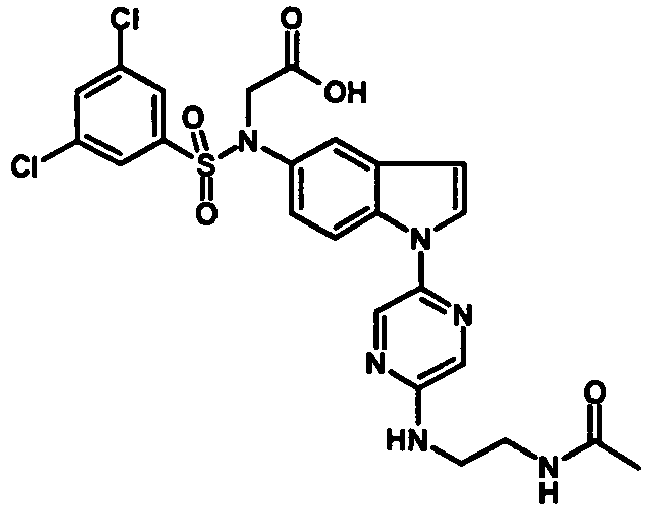
Mass spectrum (ESI+): m/z = 577 [M+H]+ - (6) ((3,5-dichloro-phenylsulphonyl)-{1-[5-(2-methanesulphonylamino-ethylamino)-pyrazin-2-yl]-1H-indol-5-yl}-amino)-acetic acid

Mass spectrum (ESI+): m/z = 613 [M+H]+ - (7) [[1-(4-acetyl-3,4,5,6-tetrahydro-2H-[1,2']bipyrazinyl-5'-yl)-1H-indol-5-yl]-(3,5-dichloro-phenylsulphonyl)-amino]-acetic acid
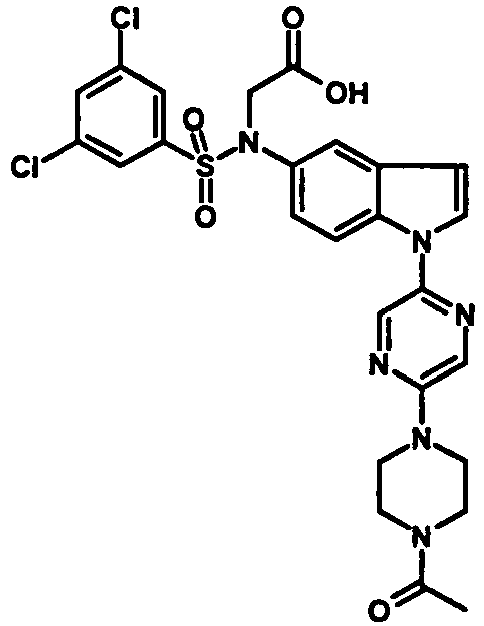
Mass spectrum (ESI+): m/z = 603 [M+H]+ -

- 250 mg [[1-(5-cyano-pyridin-2-yl)-1H-indol-5-yl]-(3,5-dichloro-phenylsulphonyl)-amino]-acetic acid are dissolved in 4 ml dichloromethane. 217 µl oxalyl chloride and 1 drop of DMF are added successively and the mixture is stirred for 1 hour at ambient temperature. Then the volatile constituents are eliminated in vacuo and the residue is taken up in 4 ml dichloromethane. To this is added dropwise a solution of 80 µl pyridine and 74 µl 2-dimethylamino-ethanol in 1 ml dichloromethane. The mixture is stirred for 2 hours and divided between saturated sodium hydrogen carbonate solution and dichloromethane. The aqueous phase is extracted twice with dichloromethane and the combined organic phases are dried on magnesium sulphate. The solvent is eliminated in vacuo and the residue is extracted from diisopropylether.
Yield: 239 mg (84 % of theory)
Mass spectrum (ESI+): m/z = 572 [M+H]+ - The following compounds are obtained analogously to Example 14:
- (1) 2-dimethylamino-ethyl {(3,5-dichloro-phenylsulphonyl)-[3-methyl-1-(6-methylpyridazin-3-yl)-1H-indol-5-yl]-amino}-acetate

-

- 25 mg tert.butyl ((3,5-dichloro-phenylsulphonyl)-{1-[4-(1-ethoxymethyl-1H-imidazol-2-yl)-pyridin-2-yl]-1H-indol-5-yl}-amino)-acetate are dissolved in 2 ml trifluoroacetic acid and 200 µl anisole. The mixture is heated for 36 hours to 70°C. Then the solvents are eliminated in vacuo and the residue is purified by preparative thin layer chromatography (silica gel, dichloromethane/methanol 9:1).
Yield: 3.7 mg (18 % of theory)
Mass spectrum (ESI+): m/z = 542 [M+H]+ - Coated tablets containing 75 mg of active substance
1 tablet core contains: active substance 75.0 mg calcium phosphate 93.0 mg corn starch 35.5 mg polyvinylpyrrolidone 10.0 mg hydroxypropylmethylcellulose 15.0 mg magnesium stearate 1.5 mg 230.0 mg - The active substance is mixed with calcium phosphate, corn starch, polyvinylpyrrolidone, hydroxypropylmethylcellulose and half the specified amount of magnesium stearate. Blanks 13 mm in diameter are produced in a tablet-making machine and these are then rubbed through a screen with a mesh size of 1.5 mm using a suitable machine and mixed with the rest of the magnesium stearate. This granulate is compressed in a tablet-making machine to form tablets of the desired shape.
- Weight of core:
- 230 mg
- die:
- 9 mm, convex
- The tablet cores thus produced are coated with a film consisting essentially of hydroxypropylmethylcellulose. The finished film-coated tablets are polished with beeswax.
Weight of coated tablet: 245 mg. - Tablets containing 100 mg of active substance
Composition: 1 tablet contains: active substance 100.0 mg lactose 80.0 mg corn starch 34.0 mg polyvinylpyrrolidone 4.0 mg magnesium stearate 2.0 mg 220.0 mg - The active substance, lactose and starch are mixed together and uniformly moistened with an aqueous solution of the polyvinylpyrrolidone. After the moist composition has been screened (2.0 mm mesh size) and dried in a rack-type drier at 50°C it is screened again (1.5 mm mesh size) and the lubricant is added. The finished mixture is compressed to form tablets.
Weight of tablet: 220 mg
Diameter: 10 mm, biplanar, facetted on both sides and notched on one side. - Tablets containing 150 mg of active substance
Composition: 1 tablet contains: active substance 50.0 mg powdered lactose 89.0 mg corn starch 40.0 mg colloidal silica 10.0 mg polyvinylpyrrolidone 10.0 mg magnesium stearate 1.0 mg 300.0 mg - The active substance mixed with lactose, corn starch and silica is moistened with a 20% aqueous polyvinylpyrrolidone solution and passed through a screen with a mesh size of 1.5 mm. The granules, dried at 45°C, are passed through the same screen again and mixed with the specified amount of magnesium stearate. Tablets are pressed from the mixture.
- Weight of tablet:
- 300 mg
- die:
- 10 mm, flat
- Hard gelatine capsules containing 150 mg of active substance
1 capsule contains: active substance 50.0 mg corn starch (dried approx. 80.0 mg lactose (powdered) approx. 87.0 mg magnesium stearate 3.0 mg approx. 420.0 mg - The active substance is mixed with the excipients, passed through a screen with a mesh size of 0.75 mm and homogeneously mixed using a suitable apparatus. The finished mixture is packed into size 1 hard gelatine capsules.
- Capsule filling: approx.
- 320 mg
- Capsule shell:
- size 1 hard gelatine capsule.
- Suppositories containing 150 mg of active substance
1 suppository contains: active substance 150.0 mg polyethyleneglycol 1500 550.0 mg polyethyleneglycol 6000 460.0 mg polyoxyethylene sorbitan monostearate 840.0 mg 2,000.0 mg - After the suppository mass has been melted the active substance is homogeneously distributed therein and the melt is poured into chilled moulds.
- Suspension containing 50 mg of active substance
100 ml of suspension contain: active substance 1.00 g carboxymethylcellulose-Na-salt 0.10 g methyl p-hydroxybenzoate 0.05 g propyl p-hydroxybenzoate 0.01 g glucose 10.00 g glycerol 5.00 g 70% sorbitol solution 20.00 g flavouring 0.30 g dist. water ad 100 ml - The distilled water is heated to 70°C. The methyl and propyl p-hydroxybenzoates together with the glycerol and sodium salt of carboxymethylcellulose are dissolved therein with stirring. The solution is cooled to ambient temperature and the active substance is added and homogeneously dispersed therein with stirring. After the sugar, the sorbitol solution and the flavouring have been added and dissolved, the suspension is evacuated with stirring to eliminate air.
- 5 ml of suspension contain 50 mg of active substance.
- Ampoules containing 10 mg active substance
Composition: active substance 10.0 mg 0.01 N hydrochloric acid q.s. double-distilled water ad 2.0 ml - The active substance is dissolved in the necessary amount of 0.01 N HCl, made isotonic with common salt, filtered sterile and transferred into 2 ml ampoules.
- Ampoules containing 50 mg of active substance
Composition: active substance 50.0 mg 0.01 N hydrochloric acid q.s. double-distilled water ad 10.0 ml - The active substance is dissolved in the necessary amount of 0.01 N HCl, made isotonic with common salt, filtered sterile and transferred into 10 ml ampoules.


R5 is as hereinbefore defined.

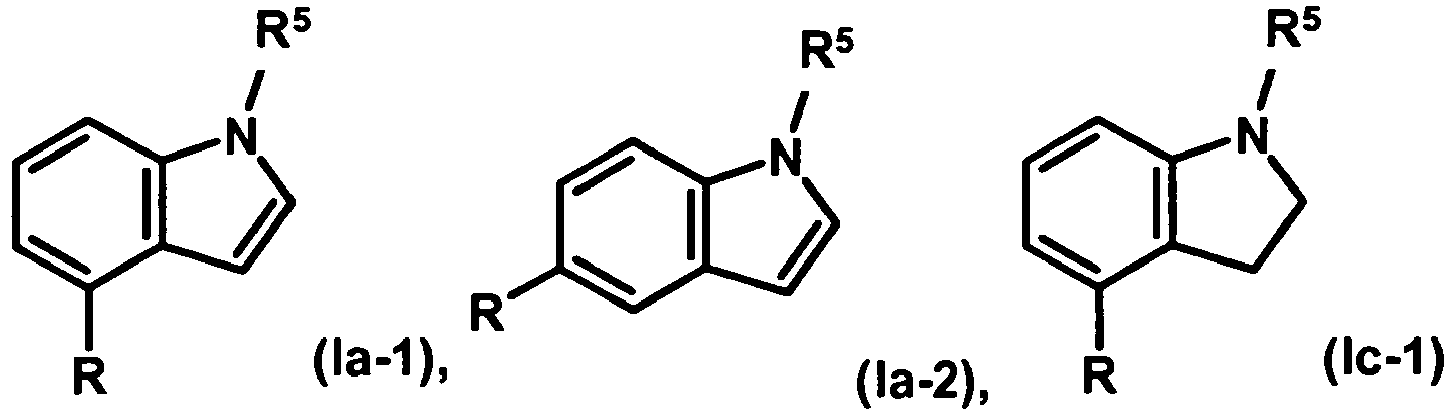


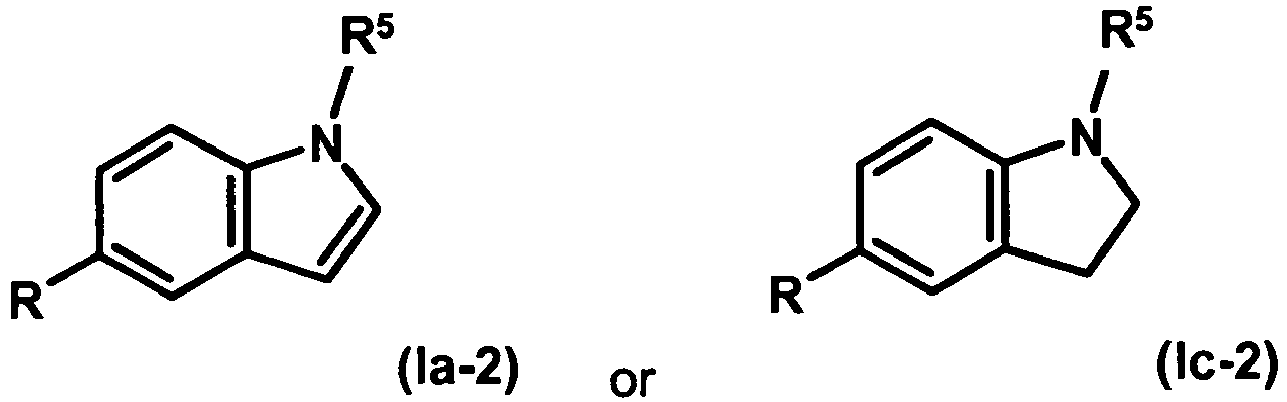
Rf value: 0.24 (silica gel: ethyl acetate/petroleum ether 1:1)
Mass spectrum (ESI+): m/z = 603 [M+H]+
Claims (12)
- Arylsulphonylglycines of general formula
 R denotes a group of formula
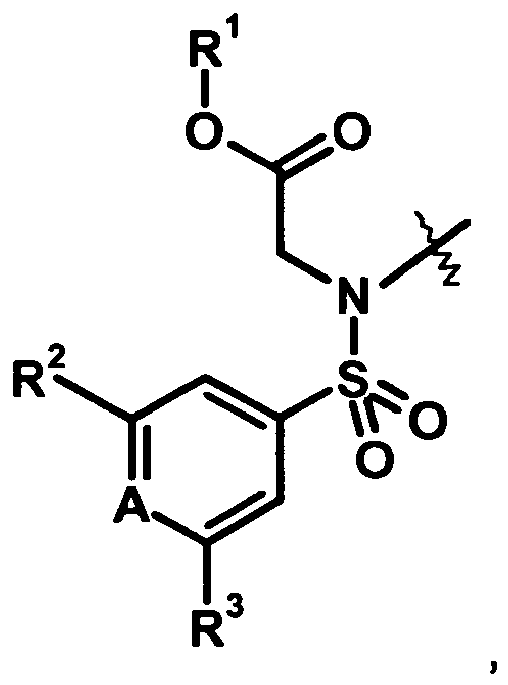 R1 denotes H, C1-6-alkyl or a group of formula
 R2 and R3 independently of one another denote H, halogen, C1-3-alkyl, C1-3-perfluoroalkyl, C1-3-perfluoroalkoxy, C1-3-alkoxy, cyano, nitro or hydroxy,
andA denotes CH or N,m denotes 0, 1 or 2,R4 denotes halogen, C1-3-alkyl, C1-3-perfluoroalkyl, C1-3-perfluoroalkoxy, cyano, hydroxy or C1-3-alkoxy, while, if m denotes the number 2, the R4 groups may be identical or different,and the heterocyclic group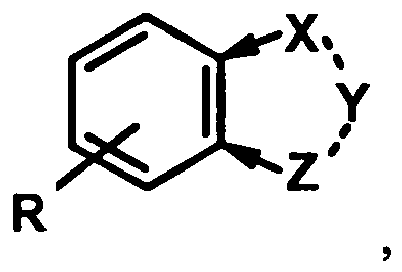


 wherein the above-mentioned heterocycles of formulae (Ia), (Ic), (Id), (Ie), (Ig) and (Ij) may optionally be substituted at the carbon atoms of the 5 ring by one or two groups selected from among halogen, C1-3-alkyl, cyano, C1-3 -perfluoroalkyl, C3-6-cycloalkyl, C2-4-alkynyl, C2-4-alkenyl, C1-3-alkylcarbonyl, C1-3-perfluoroalkyl-carbonyl, carboxyl, aminomethyl, C1-3-alkylaminomethyl, di-(C1-3-alkyl)-aminomethyl, aminocarbonyl, C1-3-alkylaminocarbonyl or di-(C1-3-alkyl)-aminocarbonyl, wherein the groups may be identical or different and each carbon atom may carry only one group, andwherein R5 denotes a 1H-pyrimidin-2,4-dionyl, 2H-pyridazin-3-onyl or 1H-pyridin-2-onyl group optionally mono- or disubstituted by one or two methyl groups ora mono- or bicyclic 5- to 14-membered ring system, which may contain 0 to 4 heteroatoms selected from among N, O or S, wherein not more than one oxygen atom and/or one sulphur atom may be present, is aromatic, saturated or partially unsaturated and may be mono-, di- or trisubstituted independently of one another by a group selected from amonghalogen, cyano, nitro,C1-6-alkyl, C3-6-cycloalkyl, C1-3-perfluoroalkyl, C2-6-alkynyl, C2-6-alkenyl,hydroxy, C1-6-alkoxy, C3-6-cycloalkoxy, C1-3-perfluoroalkoxy,carboxyl, C1-3-alkyl-carbonyl, C1-4-alkoxy-carbonyl, C3-6-cycloalkoxy-carbonyl, aminocarbonyl, C1-6-alkyl-aminocarbonyl, di-(C1-6-alkyl)-aminocarbonyl, N-(C1-6-alkyl)-N-(C1-6-alkoxy)-aminocarbonyl, C3-6-cycloalkyl-aminocarbonyl, N-(C3-6-cycloalkyl)-N-(C1-6-alkyl)-aminocarbonyl, pyrrolidin-1-yl-carbonyl, piperidin-1-yl-carbonyl, morpholin-4-yl-carbonyl, piperazin-1-yl-carbonyl, 4-(C1-3-alkyl)-piperazin-1-yl-carbonyl, 4-(C1-3-alkyl-carbonyl)-piperazin-1-yl-carbonyl, 4-(C3-6-cycloalkyl-carbonyl)-piperazin-1-yl-carbonyl, 4-(C1-3 -alkylsulphonyl)-piperazin-1-yl-carbonyl, 4-(C3-6-cycloalkylsulphonyl)-piperazin-1-yl-carbonyl, C1-3-alkylsulphanyl, C3-6-cycloalkylsulphanyl, C1-3-alkylsulphinyl, C3-6 -cycloalkylsulphinyl, C1-3-alkylsulphonyl, C3-6-cycloalkylsulphonyl,amino, C1-6-alkyl-amino, di-(C1-6-alkyl)-amino, C3-6-cycloalkylamino, N-(C3-6-cycloalkyl)-N-(C1-6-alkyl)-amino, (C1-4-alkylcarbonyl)-amino, (C3-6-cycloalkyl-carbonyl)-amino, (C1-4-alkylcarbonyl)-(C1-3-alkyl)-amino, (C3-6-cycloalkyl-carbonyl)-(C1-3-alkyl)-amino,pyrrolidin-1-yl, piperidin-1-yl, 3-amino-piperidin-1-yl, 4-amino-piperidin-1-yl, morpholin-4-yl, thiomorpholin-4-yl, 1-oxo-1λ4-thiomorpholin-4-yl, 1,1-dioxo-1λ6-thiomorpholin-4-yl, piperazin-1-yl, homopiperazin-1-yl, 4-(C1-3-alkyl)-piperazin-1-yl, 4-(C1-3-alkylcarbonyl)-piperazin-1-yl, 4-(C3-6-cycloalkyl-carbonyl)-piperazin-1-yl, 4-(C1-3-alkylsulphonyl)-piperazin-1-yl, 4-(C3-6-cycloalkyl-sulphonyl)-piperazin-1-yl,tetrahydrofuran-3-yl-oxy, tetrahydrofuran-3-yl-amino, tetrahydropyran-4-yl-oxy, tetrahydropyran-4-yl-amino, N-tetrahydropyran-4-yl-N-methyl-amino, 2-oxo-imidazolidin-1-yl, 2-oxo-tetrahydropyrimidin-1-yl and heteroaryl,wherein the C1-6-alkyl, C3-6-cycloalkyl, C2-6-alkynyl, C2-6-alkenyl, C1-3-alkylsulphanyl, C3-6-cycloalkylsulphanyl, C1-3-alkylsulphinyl, C3-6-cycloalkylsulphinyl, C1-3-alkylsulphonyl, C3-6-cycloalkylsulphonyl, C1-6-alkoxy, C3-6-cycloalkoxy, C1-6-alkyl-amino, di-(C1-6-alkyl)-amino, C3-6-cycloalkyl-amino- N-(C3-6-cycloalkyl)-N-(C1-6-alkyl)-amino, (C1-4-alkyl-carbonyl)-amino, (C3-6-cycloalkyl-carbonyl)-amino, (C1-4-alkylcarbonyl)-(C1-3-alkyl)-amino- and (C3-6-cycloalkyl-carbonyl)-(C1-3-alkyl)-amino groups mentioned above in the definition of R5 may each be mono- or disubstituted independently of one another in the carbon skeleton by a group selected from amongcyano, hydroxy, C1-3-alkoxy, tetrahydro-pyran-2-yloxy,amino, C1-6-alkyl-amino, di-(C1-6-alkyl)-amino, C3-6-cycloalkyl-amino, N-(C3-6-cycloalkyl)-N-(C1-6-alkyl)-amino, (C1-4-alkyl-carbonyl)-amino, (C3-6-cycloalkyl-carbonyl)-amino, (C1-4-alkyl-carbonyl)-(C1-3-alkyl)-amino, (C3-6-cycloalkylcarbonyl)-(C1-3-alkyl)-amino, (C1-4-alkylsulphonyl)-amino, (C3-6 -cycloalkylsulphonyl)-amino, (C1-4-alkylsulphonyl)-(C1-3-alkyl)-amino, (C3-6-cycloalkylsulphonyl)-(C1-3-alkyl)-amino,pyrrolidin-1-yl, piperidin-1-yl, morpholin-4-yl, piperazin-1-yl, 4-(C1-3-alkyl)-piperazin-1-yl,carboxyl, aminocarbonyl, C1-6-alkyl-aminocarbonyl, di-(C1-6-alkyl)-aminocarbonyl, C1-2-alkoxy-carbonyl, C3-6-cycloalkylaminocarbonyl, N-(C3-6-cycloalkyl)-N-(C1-6-alkyl)-aminocarbonyl, pyrrolidin-1-yl-carbonyl, piperidin-1-yl-carbonyl, morpholin-4-yl-carbonyl, piperazin-1-yl-carbonyl, 4-(C1-3-alkyl)-piperazin-1-yl-carbonyl,C1-3-alkylsulphanyl, C3-6-cycloalkylsulphanyl, C1-3-alkylsulphinyl, C3-6-cycloalkylsulphinyl, C1-3-alkylsulphonyl, and C3-6-cycloalkylsulphonyl, wherein the substituents must not be bound to a common carbon atom, andwherein the pyrrolidin-1-yl and piperidin-1-yl groups mentioned above in the definition of R5 may be substituted by amino or hydroxy, andwherein the C1-6-alkyl-aminocarbonyl, di-(C1-6-alkyl)-aminocarbonyl, C3-6-cycloalkyl-aminocarbonyl, N-(C3-6-cycloalkyl)-N-(C1-6-alkyl)-aminocarbonyl groups mentioned hereinbefore for R5 may each be mono- or disubstituted independently of one another in the carbon skeleton by a group selected from amongcyano, hydroxy, C1-3-alkoxy,amino, C1-3-alkyl-amino, di-(C1-3-alkyl)-amino, C3-6-cycloalkyl-amino, N-(C3-6-cycloalkyl)-N-(C1-6-alkyl)-amino, (C1-4-alkyl-carbonyl)-amino, (C3-6-cycloalkyl-carbonyl)-amino, (C1-4-alkyl-carbonyl)-(C1-3-alkyl)-amino, (C3-6-cycloalkylcarbonyl)-(C1-3-alkyl)-amino, (C1-4-alkylsulphonyl)-amino, (C3-6 -cycloalkylsulphonyl)-amino, (C1-4-alkylsulphonyl)-(C1-3-alkyl)-amino, (C3-6-cycloalkylsulphonyl)-(C1-3-alkyl)-aminopyrrolidin-1-yl, piperidin-1-yl, morpholin-4-yl, piperazin-1-yl, 4-(C1-3-alkyl)-piperazin-1-yl,C1-3-alkylsulphanyl, C3-6-cycloalkylsulphanyl, C1-3-alkylsulphinyl, C3-6-cycloalkylsulphinyl, C1-3-alkylsulphonyl and C3-6-cycloalkylsulphonyl, wherein the substituents must not be bound to a common carbon atom, andwherein the heteroaryl group mentioned hereinbefore for R5 denotes a monocyclic five-membered aromatic system with 1 to 4 heteroatoms selected from among N, O or S, wherein not more than one oxygen atom and/or one sulphur atom may be present, or a six-membered aromatic system with 1 to 3 nitrogen atoms and may be mono- or disubstituted independently of one another by halogen, cyano, hydroxy, amino, C1-3-alkyl or C1-3-alkyloxycarbonyl, andwherein in the above-mentioned morpholin-4-yl and piperazin-1-yl groups in each case a methylene unit may be replaced by a carbonyl or sulphonyl group,and the tautomers, stereoisomers, mixtures thereof and the salts thereof.
 - Compounds of general formula I according to claim 1, whereinR denotes a group of the formula mentioned in claim 1, whereinR1 denotes H, C1-6-alkyl or a group of formula
 R2 and R3 independently of one another denote halogen, C1-3-alkyl, C1-3-perfluoroalkyl, C1-2-alkoxy or cyano andA denotes CH or N,m denotes 0, 1 or 2,R4 denotes halogen, C1-3-alkyl, trifluoromethyl or cyano, while, if m denotes the number 2, the groups R4 may be identical or different,and the heterocyclic group


 wherein the above-mentioned heterocycles of formulae (Ia), (Ic), (Id), (Ie), (Ig) and (Ij) may optionally be substituted at the carbon atoms of the 5 ring by one or two groups selected from among halogen, C1-3-alkyl, cyano, C1-3 -perfluoroalkyl, C3-6-cycloalkyl, C1-3-alkyl-carbonyl, C1-3-perfluoroalkyl-carbonyl, aminocarbonyl, C1-3-alkyl-aminocarbonyl or di-(C1-3-alkyl)-aminocarbonyl, wherein the groups may be identical or different and each carbon atom carries at most one group, andR5 denotes 1,3-dimethyl-1H-pyrimidin-2,4-dion-5-yl, 1H-pyrimidin-2,4-dion-6-yl, 1H-pyrimidin-2,4-dion-5-yl, 2H-pyridazin-3-on-6-yl, 1H-pyridin-2-on-3-yl, 1H-pyridin-2-on-5-yl, 1H-pyridin-2-on-4-yl ora mono- or bicyclic 5- to 14-membered ring system, which may contain 0 to 4 heteroatoms selected from among N, O or S, wherein not more than one oxygen atom and/or one sulphur atom may be present, is aromatic, saturated or partially unsaturated and may be mono-, di- or trisubstituted independently of one another by a group selected from amonghalogen, cyano,C1-6-alkyl, C3-6-cycloalkyl, C1-3-perfuoroalkyl, C2-6-alkynyl, C2-6-alkenyl,hydroxy, C1-6-alkoxy, C3-6-cycloalkoxy, trifluoromethoxy,carboxyl, C1-3-alkyl-carbonyl, C1-4-alkoxy-carbonyl, cyclopropoxycarbonyl, aminocarbonyl, C1-6-alkyl-aminocarbonyl, di-(C1-6-alkyl)-aminocarbonyl, N-(C1-3-alkyl)-N-(C1-3-alkoxy)-aminocarbonyl, C3-6-cycloalkyl-aminocarbonyl, N-(C3-6-cycloalkyl)-N-(C1-3-alkyl)-aminocarbonyl, pyrrolidin-1-yl-carbonyl, piperidin-1-yl-carbonyl, morpholin-4-yl-carbonyl, piperazin-1-yl-carbonyl, 4-(C1-3-alkyl)-piperazin-1-yl-carbonyl, 4-(C1-3-alkyl-carbonyl)-piperazin-1-yl-carbonyl, 4-(C3-6-cycloalkyl-carbonyl)-piperazin-1-yl-carbonyl, 4-(C1-3 -alkylsulphonyl)-piperazin-1-yl-carbonyl, 4-(C3-6-cycloalkyl-sulphonyl)-piperazin-1-yl-carbonyl,C1-3-alkylsulphanyl, C3-6-cycloalkylsulphanyl, C1-3-alkylsulphinyl, C3-6 -cycloalkylsulphinyl, C1-3-alkylsulphonyl, C3-6-cycloalkylsulphonyl, amino, C1-6-alkyl-amino, di-(C1-6-alkyl)-amino, C3-6-cycloalkylamino, N-(C3-6-cycloalkyl)-N-(C1-3-alkyl)-amino, (C1-4-alkylcarbonyl)-amino, (C3-6-cycloalkyl-carbonyl)-amino, (C1-4-alkylcarbonyl)-(C1-3-alkyl)-amino, (C3-6-cycloalkyl-carbonyl)-(C1-3-alkyl)-amino, pyrrolidin-1-yl, piperidin-1-yl, 3-amino-piperidin-1-yl, 4-amino-piperidin-1-yl, morpholin-4-yl, thiomorpholin-4-yl, 1-oxo-1λ4-thiomorpholin-4-yl, 1,1-dioxo-1λ6-thiomorpholin-4-yl, piperazin-1-yl, homopiperazin-1-yl, 4-(C1-3-alkyl)-piperazin-1-yl, 4-(C1-3-alkylcarbonyl)-piperazin-1-yl, 4-(C3-6-cycloalkyl-carbonyl)-piperazin-1-yl, 4-(C1-3-alkylsulphonyl)-piperazin-1-yl, 4-(C3-6-cycloalkylsulphonyl)-piperazin-1-yl,tetrahydrofuran-3-yl-oxy, tetrahydrofuran-3-yl-amino, tetrahydropyran-4-yl-oxy, tetrahydropyran-4-yl-amino, N-tetrahydropyran-4-yl-N-methyl-amino, 2-oxo-imidazolidinyl, 2-oxo-tetrahydropyrimidinyl and heteroaryl,wherein the C1-6-alkyl, C3-6-cycloalkyl, C2-6-alkynyl, C2-6-alkenyl, C1-3 -alkylsulphanyl, C3-6-cycloalkylsulphanyl, C1-3-alkylsulphinyl, C3-6-cycloalkylsulphinyl, C1-3-alkylsulphonyl, C3-6-cycloalkylsulphonyl, C1-6-alkoxy, C3-6-cycloalkoxy, C1-6-alkyl-amino, di-(C1-6-alkyl)-amino, C3-6-cycloalkyl-amino, N-(C3-6-cycloalkyl)-N-(C1-3-alkyl)-amino, (C1-4 -alkyl-carbonyl)-amino, (C3-6-cycloalkyl-carbonyl)-amino, (C1-4-alkyl-carbonyl)-(C1-3-alkyl)-amino- and (C3-6-cycloalkyl-carbonyl)-(C1-3-alkyl)-amino groups mentioned above in the definition of R5 may each be mono- or disubstituted independently of one another in the carbon skeleton by a group selected from amongcyano, hydroxy, C1-3-alkoxy, tetrahydro-pyran-2-yloxy,amino, C1-6-alkyl-amino, di-(C1-6-alkyl)-amino, C3-6-cycloalkyl-amino, N-(C3-6-cycloalkyl)-N-(C1-3-alkyl)-amino, (C1-4-alkyl-carbonyl)-amino, (C3-6-cycloalkyl-carbonyl)-amino, (C1-4-alkyl-carbonyl)-(C1-3-alkyl)-amino, (C3-6-cycloalkylcarbonyl)-(C1-3-alkyl)-amino, (C1-4-alkylsulphonyl)-amino, (C3-6 -cycloalkylsulphonyl)-amino, (C1-4-alkylsulphonyl)-(C1-3-alkyl)-amino, (C3-6-cycloalkylsulphonyl)-(C1-3-alkyl)-aminopyrrolidin-1-yl, piperidin-1-yl, morpholin-4-yl, piperazin-1-yl, 4-(C1-3-alkyl)-piperazin-1-yl,carboxyl, C1-2-alkoxy-carbonyl, aminocarbonyl, C1-6-alkylaminocarbonyl, di-(C1-6-alkyl)-aminocarbonyl, C3-6-cycloalkylaminocarbonyl, N-(C3-6-cycloalkyl)-N-(C1-3-alkyl)-aminocarbonyl, pyrrolidin-1-yl-carbonyl, piperidin-1-yl-carbonyl, morpholin-4-yl-carbonyl, piperazin-1-yl-carbonyl, 4-(C1-3-alkyl)-piperazin-1-yl-carbonyl,C1-3-alkylsulphanyl, C3-6-cycloalkylsulphanyl, C1-3-alkylsulphinyl, C3-6-cycloalkylsulphinyl, C1-3-alkylsulphonyl and C3-6-cycloalkylsulphonyl, wherein the substituents must not be bound to a common carbon atom, andwherein the pyrrolidin-1-yl and piperidin-1-yl groups mentioned above in the definition of R5 may be substituted by amino or hydroxy, andwherein the C1-6-alkyl-aminocarbonyl, di-(C1-6-alkyl)-aminocarbonyl, C3-6-cycloalkyl-aminocarbonyl, N-(C3-6-cycloalkyl)-N-(C1-3-alkyl)-aminocarbonyl groups mentioned above in the definition of R5 may each be mono- or disubstituted independently of one another in the carbon skeleton by a group selected from amongamino, hydroxy, C1-3-alkoxy, C1-3-alkyl-amino, di-(C1-3-alkyl)-amino, C3-6-cycloalkyl-amino, N-(C3-6-cycloalkyl)-N-(methyl)-amino, (C1-4-alkyl-carbonyl)-amino, (C3-6-cycloalkylcarbonyl)-amino, (C1-4-alkyl-carbonyl)-(methyl)-amino, (C3-6-cycloalkyl-carbonyl)-(methyl)-amino, (C1-4-alkylsulphonyl)-amino, (C3-6-cycloalkylsulphonyl)-amino, (C1-4-alkylsulphonyl)-(methyl)-amino or (C3-6-cycloalkylsulphonyl)-(methyl)-amino,pyrrolidin-1-yl, piperidin-1-yl, morpholin-4-yl, piperazin-1-yl, 4-(C1-3-alkyl)-piperazin-1-yl,C1-3-alkylsulphanyl, C3-6-cycloalkylsulphanyl, C1-3-alkylsulphinyl, C3-6-cycloalkylsulphinyl, C1-3-alkylsulphonyl and C3-6-cycloalkylsulphonyl, wherein the substituents must not be bound to a common carbon atom, andwherein the heteroaryl group mentioned hereinbefore for R5 denotes a monocyclic five-membered aromatic system with 1 to 3 heteroatoms selected from among N, O or S, wherein not more than one oxygen and/or one sulphur atom may be present, or denotes a monocyclic five-membered aromatic system with 4 nitrogen atoms or a six-membered aromatic system with 1 to 3 nitrogen atoms and may be mono- or disubstituted independently of one another by fluorine, chlorine, cyano, C1-3-alkyl or C1-3-alkyloxycarbonyl, andwherein in the above-mentioned morpholin-4-yl and piperazin-1-yl groups in each case a methylene unit may be replaced by a carbonyl or sulphonyl group,and the tautomers, stereoisomers, mixtures thereof and the salts thereof.
 - Compounds of general formula I according to claim 2, whereinR denotes a group of the formula mentioned in claim 1, whereinR1 denotes H, C1-4-alkyl or a group of formula
 R2 and R3 independently of one another denote chlorine, bromine or C1-2-alkyl andA denotes CH or N,m denotes 0 or 1,R4 denotes fluorine, chlorine, methyl or ethyl,and the heterocyclic group

 wherein R5 denotes 1,3-dimethyl-1H-pyrimidin-2,4-dion-5-yl, 1H-pyrimidin-2,4-dion-6-yl, 1H-pyrimidin-2,4-dion-5-yl, 2H-pyridazin-3-on-6-yl, 1H-pyridin-2-on-3-yl, 1H-pyridin-2-on-5-yl or 1H-pyridin-2-on-4-yl,phenyl, pyridazin-3-yl, pyrimidin-2-yl, pyrimidin-4-yl, pyrimidin-5-yl, pyrazin-2-yl, 1.3,5-triazin-2-yl, pyridin-2-yl, pyridin-4-yl, imidazol-2-yl, imidazol-4-yl, pyrazol-3-yl, pyrazol-4-yl, thiazol-2-yl, [1,3,4]thiadiazol-2-yl, thiophen-2-yl, thiophen-3-yl, naphthalin-1-yl, naphthalin-2-yl, purin-6-yl, purin-2-yl, 1-imidazo[1,2-a]pyrazin-6-yl, quinolin-6-yl, quinolin-8-yl, quinolin-2-yl or isoquinolin-1-yl, which may each be mono- or disubstituted independently of one another by a group selected from amongfluorine, chlorine, C1-4-alkyl, cyclopropyl, trifluoromethyl, cyano, hydroxy, C1-3-alkoxy, cyclopropoxy,carboxyl, C1-2-alkyl-carbonyl, C1-2-alkoxy-carbonyl, aminocarbonyl, C1-4-alkyl-aminocarbonyl, di-(C1-2-alkyl)-aminocarbonyl, N-methoxy-N-methyl-aminocarbonyl, cyclopropyl-aminocarbonyl, N-( cyclopropyl)-N-(methyl)-aminocarbonyl, pyrrolidin-1-yl-carbonyl, piperidin-1-yl-carbonyl, morpholin-4-yl-carbonyl, piperazin-1-yl-carbonyl, 4-(methyl)-piperazin-1-yl-carbonyl, 4-(C1-3-alkyl-carbonyl)-piperazin-1-yl-carbonyl, 4-(C3-6-cycloalkyl-carbonyl)-piperazin-1-yl-carbonyl, 4-(C1-3-alkylsulphonyl)-piperazin-1-yl-carbonyl, 4-(C3-6-cycloalkylsulphonyl)-piperazin-1-yl-carbonyl,C1-2-alkylsulphanyl, cyclopropylsulphanyl, C1-2-alkylsulphinyl, cyclopropylsulphinyl, C1-2-alkylsulphonyl, cyclopropylsulphonyl,amino, C1-4-alkyl-amino, di-(C1-3-alkyl)-amino, cyclopropyl-amino, N-( cyclopropyl)-N-(methyl)-amino, C1-3-alkyl-carbonyl-amino,pyrrolidin-1-yl, piperidin-1-yl, 3-amino-piperidin-1-yl, 4-amino-piperidin-1-yl, morpholin-4-yl, thiomorpholin-4-yl, 1-oxo-1λ4-thiomorpholin-4-yl, 1,1-dioxo-1λ6-thiomorpholin-4-yl, piperazin-1-yl, homopiperazin-1-yl, 4-(methyl)-piperazin-1-yl, 4-(C1-2-alkylcarbonyl)-piperazin-1-yl, 4-(C1-2-alkylsulphonyl)-piperazin-1-yl,tetrahydrofuran-3-yl-oxy, tetrahydrofuran-3-yl-amino, tetrahydropyran-4-yl-oxy, tetrahydropyran-4-yl-amino, N-tetrahydropyran-4-yl-N-methyl-amino, 2-oxo-imidazolidinyl, 2-oxotetrahydropyrimidinyl, imidazol-2-yl, 1-methyl-imidazol-2-yl, thiazol-2-yl, 4-ethoxycarbonyl-thiazol-2-yl, 3-ethoxycarbonyl-isoxazol-5-yl, oxazol-2-yl, 2,4-dihydroxy-pyrimidin-5-yl.1.2,4-triazol-3-yl and tetrazol-5-yl, orwherein the C1-4-alkyl, C1-3-alkoxy, C1-4-alkyl-amino, di-(C1-3-alkyl)-amino- and C1-3-alkyl-carbonyl-amino groups mentioned hereinbefore for R5 may each be mono- or disubstituted independently of one another in the carbon skeleton by a group selected from amongcyano, hydroxy, C1-2-alkoxy, tetrahydro-pyran-2-yloxy,amino, C1-3-alkyl-amino, di-(C1-3-alkyl)-amino, (C1-3-alkylcarbonyl)-amino, (C1-3-alkylsulphonyl)-amino,pyrrolidin-1-yl, piperidin-1-yl, morpholin-4-yl, piperazin-1-yl, 4-(methyl)-piperazin-1-yl,carboxyl, C1-2-alkoxy-carbonyl, aminocarbonyl, C1-3-alkylaminocarbonyl, di-(C1-3-alkyl)-aminocarbonyl and C3-6-cycloalkyl-aminocarbonyl, wherein the substituents must not be bound to a common carbon atom, andwherein the C1-4-alkyl-aminocarbonyl and di-(C1-2-alkyl)-aminocarbonyl groups mentioned hereinbefore for R5 may each be mono- or disubstituted independently of one another in the carbon skeleton by amino, hydroxy, C1-3-alkoxy, C1-3-alkyl-amino or di-(C1-3 -alkyl)-amino, wherein the substituents must not be bound to a common carbon atom, andwherein in the above-mentioned morpholin-4-yl and piperazin-1-yl groups in each case a methylene unit may be replaced by a carbonyl group,and the tautomers, stereoisomers, mixtures thereof and the salts thereof.
 - Compounds of general formula I according to claim 3, whereinR denotes a group of the formula mentioned in claim 1, whereinR1 denotes H or a C1-3-alkyl group optionally substituted by a di-(C1-3-alkyl)-amino group,R2 and R3 independently of one another denote chlorine, bromine or methyl andA denotes CH or N,m denotes 0 or 1,R4 denotes chlorine, methyl or ethyl,and the heterocyclic group


R5 is defined as in claim 3,
and the tautomers, stereoisomers, mixtures thereof and the salts thereof. - Compounds of general formula I according to claim 4, whereinR denotes a group of the formula mentioned in claim 1, whereinR1 denotes H, methyl, ethyl or 2-dimethylamino-ethyl,R2 and R3 independently of one another denote chlorine, bromine or methyl andA denotes CH or N,m denotes 0 or 1,R4 denotes chlorine, methyl or ethyl,and the heterocyclic group
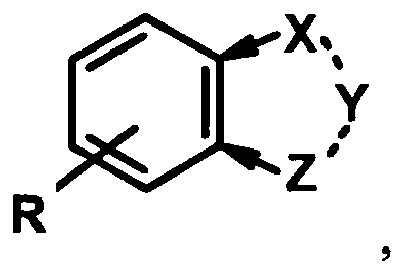

 while the heterocycles mentioned hereinbefore may optionally be substituted at the carbon atoms of the 5 ring by one or two methyl or ethyl groups, wherein the groups may be identical or different and each carbon atom carries at most one group, and whereinR5 denotes 1,3-dimethyl-1H-pyrimidin-2,4-dion-5-yl, 1H-pyrimidin-2,4-dion-6-yl, 1H-pyrimidin-2,4-dion-5-yl, 2H-pyridazin-3-on-6-yl, 1H-pyridin-2-on-3-yl, 1H-pyridin-2-on-5-yl, 1H-pyridin-2-on-4-yl orphenyl, pyridazin-3-yl, pyrimidin-2-yl, pyrimidin-4-yl, pyrimidin-5-yl, pyrazin-2-yl, pyridin-2-yl, pyridin-4-yl, imidazol-2-yl, imidazol-4-yl, pyrazol-3-yl, pyrazol-4-yl, 1.3,5-triazin-2-yl, thiazol-2-yl, [1,3,4]thiadiazol-2-yl, thiophen-2-yl, thiophen-3-yl, purin-6-yl, purin-2-yl or 1-imidazo[1,2-a]pyrazin-6-yl, which may be mono- or disubstituted independently of one another by a group selected from amongchlorine, cyano, methyl, aminomethyl, morpholin-4-ylmethyl, hydroxymethyl, 3-hydroxypropyl, trifluoromethyl,hydroxy, methoxy, 2-hydroxyethoxy, 2-aminoethoxy, 2-dimethylaminoethoxy, 2-methylsulphonylamino-ethoxy, 2-acetylamino-ethoxy, 2,3-dihydroxy-propoxy,carboxyl, acetyl, ethylcarbonyl, aminocarbonyl, methyl-aminocarbonyl, dimethyl-aminocarbonyl, N-methoxy-N-methyl-aminocarbonyl, 2-dimethylamino-ethyl-aminocarbonyl, 2-hydroxy-ethyl-aminocarbonyl, 2-methoxy-ethyl-aminocarbonyl, cyclo-aminocarbonyl,morpholin-4-yl-carbonyl, piperazin-1-yl-carbonyl, methoxy-carbonyl,methylsulphanyl, methylsulphinyl, ethylsulphinyl, methylsulphonyl,amino, methyl-amino, acetylamino, 2-aminoethyl-amino, 2-dimethylaminoethyl-amino, 2-hydroxyethyl-amino, 2-(methylamino)-ethyl-amino, N-carboxymethyl-N-[2-(dimethylamino)-ethyl]-amino, 2-(acetylamino)ethyl-amino, 2-(methylsulphonylamino)-ethyl-amino, 2-(pyrrolidin-1-yl)-ethyl-amino, 2-(piperidin-1-yl)-ethyl-amino, 2-(tetrahydro-pyran-2-yloxy)-ethylamino, 3-aminopropyl-amino, 3-(methylamino)-propyl-amino, 2-amino-2-methyl-propyl-amino, 1,3-dihydroxy-2-propyl-amino, 3-(acetylamino)-propyl-amino, 3-(methylsulphonylamino)-propyl-amino, dimethyl-amino, N-methyl-N-2-aminoethyl-amino, N,N-bis-2-(hydroxyethyl)-amino, N-methyl-N-3-aminopropyl-amino, N-methyl-N-[3-(acetylamino)-propyl]-amino, N-methyl-N-[3-(methylsulphonylamino)-propyl]-amino, cyclopropyl-amino,morpholin-4-yl, thiomorpholin-4-yl, 1-oxo-1λ4-thiomorpholin-4-yl, 1,1-dioxo-1λ6-thiomorpholin-4-yl, 3-amino-piperidin-1-yl, piperazin-1-yl, homopiperazin-1-yl, 4-acetyl-piperazin-1-yl, 4-methylsulphonyl-piperazin-1-yl,tetrahydrofuran-3-yl-oxy, tetrahydrofuran-3-yl-amino, tetrahydropyran-4-yl-oxy, tetrahydropyran-4-yl-amino, N-tetrahydropyran-4-yl-N-methyl-amino, 2-oxo-imidazolidinyl, imidazol-2-yl, 1-methyl-imidazol-2-yl, thiazol-2-yl, 4-ethoxycarbonylthiazol-2-yl, 3-ethoxycarbonyl-isoxazol-5-yl, and oxazol-2-yl,wherein in the above-mentioned morpholin-4-yl and piperazin-1-yl groups in each case a methylene unit may be replaced by a carbonyl group,and the tautomers, stereoisomers, mixtures thereof and the salts thereof.
 - Compounds of general formula I according to claim 5, whereinR denotes a group of the formula mentioned in claim 1, whereinR1 denotes hydrogen,R2 and R3 in each case represent chlorine andA denotes CH ,m denotes 0 andand the heterocyclic group

 R5 denotes phenyl, pyridazin-3-yl, pyrimidin-2-yl, pyrimidin-4-yl, pyrimidin-5-yl, pyrazin-2-yl, pyridin-2-yl or pyridin-4-yl, which may be substituted by a group selected from amongand the tautomers, stereoisomers, mixtures thereof and the salts thereof.
cyano, methyl, aminomethyl, hydroxymethyl, 3-hydroxypropyl, trifluoromethyl, hydroxy, methoxy, 2-hydroxyethoxy, 2-aminoethoxy, 2-(dimethylamino)-ethoxy, 2-(methylsulphonyl)-amino-ethoxy, 2-(acetylamino)-ethoxy, 2,3-dihydroxy-propoxy,
carboxyl, acetyl, ethylcarbonyl, aminocarbonyl, methyl-aminocarbonyl, dimethyl-aminocarbonyl, N-methoxy-N-methyl-aminocarbonyl, 2-(dimethylamino)-ethyl-aminocarbonyl, 2-hydroxy-ethyl-aminocarbonyl, 2-methoxy-ethyl-aminocarbonyl, cyclopropyl-aminocarbonyl,
morpholin-4-yl-carbonyl, piperazin-1-yl-carbonyl, methoxy-carbonyl,
methylsulphanyl, methylsulphinyl, ethylsulphinyl, methylsulphonyl,
amino, methyl-amino, acetylamino, 2-aminoethyl-amino, 2-(dimethylamino)-ethyl-amino, 2-hydroxyethyl-amino, 2-(methylamino)-ethyl-amino, N-carboxymethyl-N-[2-(dimethylamino)-ethyl]-amino, 2-(acetylamino)-ethyl-amino, 2-(methylsulphonylamino)-ethyl-amino, 2-(pyrrolidin-1-yl)-ethyl-amino, 2-(piperidin-1-yl)-ethyl-amino, 3-aminopropyl-amino, 3-(methylamino)-propyl-amino, 3-(acetylamino)-propyl-amino, 3-(methylsulphonylamino)-propyl-amino, dimethyl-amino, N-methyl-N-(2-aminoethyl)-amino, N,N-bis-(2-hydroxyethyl)-amino, N-methyl-N-(3-aminopropyl)-amino, N-methyl-N-[3-(acetylamino)-propyl]-amino, N-methyl-N-[3-(methylsulphonylamino)-propyl]-amino, cyclopropyl-amino,
morpholin-4-yl, thiomorpholin-4-yl, 1-oxo-1λ4-thiomorpholin-4-yl, 1,1-dioxo-1λ6-thiomorpholin-4-yl, 3-amino-piperidin-1-yl, piperazin-1-yl, homopiperazin-1-yl , 4-acetyl-piperazin-1-yl, 4-methylsulphonyl-piperazin-1-yl,
tetrahydrofuran-3-yl-oxy, tetrahydrofuran-3-yl-amino, tetrahydropyran-4-yl-oxy, tetrahydropyran-4-yl-amino, N-tetrahydropyran-4-yl-N-methyl-amino, 2-oxo-imidazolidinyl, imidazol-2-yl, 1-methyl-imidazol-2-yl, thiazol-2-yl, 4-ethoxycarbonylthiazol-2-yl, 3-ethoxycarbonyl-isoxazol-5-yl, and oxazol-2-yl, - The following compounds of general formula I according to claim 1:(1) ((3,5-dichloro-phenylsulphonyl)-{1-[5-(2-dimethylamino-ethylamino)-pyrazin-2-yl]-1H-indol-5-yl}-amino)-acetic acid(2) {(3,5-dichloro-phenylsulphonyl)-[1-(6-piperazin-1-yl-pyridazin-3-yl)-2,3-dihydro-1H-indol-5-yl]-amino}-acetic acid(3) ((3,5-dichloro-phenylsulphonyl)-{1-[6-(2-dimethylamino-ethylamino)-pyridazin-3-yl]-1H-indol-5-yl}-amino)-acetic acid(4) {(3,5-dichloro-phenylsulphonyl)-[1-(6-methyl-pyridazin-3-yl)-1H-indol-5-yl]-amino}-acetic acid(5) ((3-bromo-5-methyl-phenylsulphonyl)-{1-[6-(2-dimethylamino-ethylamino)-pyridazin-3-yl]-1H-indol-5-yl}-amino)-acetic acid(6) {(3,5-dichloro-phenylsulphonyl)-[1-(6-piperazin-1-yl-pyridazin-3-yl)-1H-indol-5-yl]-amino}-acetic acid(7) [[1-(6-[1,4]diazepan-1-yl-pyridazin-3-yl)-1H-indol-5-yl]-(3,5-dichlorophenylsulphonyl)-amino]-acetic acid(8) {(3,5-dichloro-phenylsulphonyl)-[1-(4-methyl-pyridin-2-yl)-1H-indol-5-yl]-amino}-acetic acid(9) ((3,5-dichloro-phenylsulphonyl)-{1-[6-(2-dimethylamino-ethylamino)-pyridazin-3-yl]-3-methyl-1H-indol-5-yl}-amino)-acetic acid(10) [(3,5-dichloro-phenylsulphonyl)-(1-{6-[methyl-(tetrahydro-pyran-4-yl)-amino]-pyridazin-3-yl}-1H-indol-5-yl)-amino]-acetic acid(11) ((3,5-dichloro-phenylsulphonyl)-{1-[5-(3-oxo-piperazin-1-yl)-pyrazin-2-yl]-1H-indol-5-yl}-amino)-acetic acid(12) [[6-ethyl-1-(6-methyl-pyridazin-3-yl)-1H-indol-5-yl]-(3,5-dichlorophenylsulphonyl)-amino]-acetic acid(13) [[1-(4-amino-pyridin-2-yl)-1H-indol-5-yl]-(3,5-dichloro-phenylsulphonyl)-amino]-acetic acid(14) ((3,5-dichloro-phenylsulphonyl)-{1-[6-(3-hydroxy-propyl)-pyridazin-3-yl]-1H-indol-5-yl}-amino)-acetic acid(15) [{1-[6-(4-acetyl-piperazin-1-yl)-pyridazin-3-yl]-1H-indol-5-yl}-(3,5-dichlorophenylsulphonyl)-amino]-acetic acid(16) {(3,5-dichloro-phenylsulphonyl)-[1-(4-methylcarbamoyl-pyridin-2-yl)-1H-indol-5-yl]-amino}-acetic acid(17) {(3,5-dichloro-phenylsulphonyl)-[3-methyl-1-(6-methyl-pyridazin-3-yl)-1H-indol-5-yl]-amino}-acetic acid(18) {(3,5-dichloro-phenylsulphonyl)-[1-(4-methanesulphinyl-pyridin-2-yl)-1H-indol-5-yl]-amino}-acetic acid(19) [[1-(4-cyclopropylcarbamoyl-pyridin-2-yl)-1H-indol-5-yl]-(3,5-dichlorophenylsulphonyl)-amino]-acetic acid(20) {(2,6-dichloro-pyridin-4-sulphonyl)-[1-(4-methylcarbamoyl-pyridin-2-yl)-1H-indol-5-yl]-amino}-acetic acid,and the enantiomers, mixtures thereof and salts thereof.
- Physiologically acceptable salts of the compounds according to claims 1 to 7 with inorganic or organic acids or bases.
- Pharmaceutical compositions, containing a compound according to at least one of claims 1 to 7 or a salt according to claim 8 optionally together with one or more inert carriers and/or diluents.
- Use of a compound according to at least one of claims 1 to 7 or a salt according to claim 8 for preparing a pharmaceutical composition that is suitable for the treatment of type I and type II diabetes mellitus.
- Process for preparing a pharmaceutical composition according to claim 9, characterised in that a compound according to at least one of claims 1 to 7 or a salt according to claim 8 is incorporated in one or more inert carriers and/or diluents by a non-chemical method.
- Process for preparing the compounds of general formula I according to claims 1 to 8, characterised in thata) a compound of general formula
 b) if desired any protective group used to protect reactive groups during the reactions is cleaved afterwards or simultaneously and/orc) a compound of general formula I thus obtained is resolved into its stereoisomers and/ord) a compound of general formula I thus obtained is converted into the salts thereof, particularly for pharmaceutical use into the physiologically acceptable salts thereof with an inorganic or organic acid or base.
Applications Claiming Priority (2)
| Application Number | Priority Date | Filing Date | Title |
|---|---|---|---|
| DE102007007751A DE102007007751A1 (en) | 2007-02-16 | 2007-02-16 | Novel substituted arylsulfonylglycines, their preparation and their use as pharmaceuticals |
| PCT/EP2008/051824 WO2008099000A2 (en) | 2007-02-16 | 2008-02-15 | Substituted arylsulphonylglycines, the preparation thereof and the use thereof as pharmaceutical compositions |
Publications (2)
| Publication Number | Publication Date |
|---|---|
| EP2121600A2 EP2121600A2 (en) | 2009-11-25 |
| EP2121600B1 true EP2121600B1 (en) | 2012-07-18 |
Family
ID=39628059
Family Applications (1)
| Application Number | Title | Priority Date | Filing Date |
|---|---|---|---|
| EP08709013A Not-in-force EP2121600B1 (en) | 2007-02-16 | 2008-02-15 | Substituted arylsulphonylglycines, the preparation thereof and the use thereof as pharmaceutical compositions |
Country Status (6)
| Country | Link |
|---|---|
| US (1) | US20100093703A1 (en) |
| EP (1) | EP2121600B1 (en) |
| JP (1) | JP2010518149A (en) |
| CA (1) | CA2678382A1 (en) |
| DE (1) | DE102007007751A1 (en) |
| WO (1) | WO2008099000A2 (en) |
Families Citing this family (41)
| Publication number | Priority date | Publication date | Assignee | Title |
|---|---|---|---|---|
| CN101528039A (en) | 2006-05-26 | 2009-09-09 | 路易斯维尔大学研究基金会公司 | Macrophage migration inhibitory factor antagonists and methods of using same |
| DE102007012284A1 (en) | 2007-03-16 | 2008-09-18 | Boehringer Ingelheim Pharma Gmbh & Co. Kg | Novel substituted arylsulfonylglycines, their preparation and their use as pharmaceuticals |
| DE102007035333A1 (en) * | 2007-07-27 | 2009-01-29 | Boehringer Ingelheim Pharma Gmbh & Co. Kg | Novel substituted arylsulfonylglycines, their preparation and their use as pharmaceuticals |
| DE102007035334A1 (en) * | 2007-07-27 | 2009-01-29 | Boehringer Ingelheim Pharma Gmbh & Co. Kg | Novel substituted arylsulfonylglycines, their preparation and their use as pharmaceuticals |
| DE102007042154A1 (en) * | 2007-09-05 | 2009-03-12 | Boehringer Ingelheim Pharma Gmbh & Co. Kg | Arylsulfonylaminomethyphosphonsäure derivatives, their preparation and their use as medicaments |
| DE102008019838A1 (en) * | 2008-04-19 | 2009-12-10 | Boehringer Ingelheim International Gmbh | New arylsulfonylglycine derivatives, their preparation and their use as pharmaceuticals |
| JP5627574B2 (en) | 2008-06-03 | 2014-11-19 | インターミューン, インコーポレイテッド | Compounds and methods for treating inflammatory and fibrotic diseases |
| CN101735023B (en) * | 2008-11-24 | 2014-07-09 | 联化科技股份有限公司 | Method for preparing 3-bromo-5-chlorophenol |
| EP2406230A1 (en) | 2009-03-11 | 2012-01-18 | Pfizer Inc. | Substituted indazole amides and their use as glucokinase activators |
| WO2011038234A2 (en) | 2009-09-24 | 2011-03-31 | University Of Louisville Research Foundation, Inc. | Novel iodo pyrimidine derivatives useful for the treatment of macrophage migration inhibitory factor (mif)-implicated diseases and conditions |
| WO2011107494A1 (en) | 2010-03-03 | 2011-09-09 | Sanofi | Novel aromatic glycoside derivatives, medicaments containing said compounds, and the use thereof |
| US9155790B2 (en) | 2010-05-20 | 2015-10-13 | University of Lousiville Research Foundation, Inc. | Methods and compositions for modulating ocular damage |
| US8933024B2 (en) | 2010-06-18 | 2015-01-13 | Sanofi | Azolopyridin-3-one derivatives as inhibitors of lipases and phospholipases |
| US8530413B2 (en) | 2010-06-21 | 2013-09-10 | Sanofi | Heterocyclically substituted methoxyphenyl derivatives with an oxo group, processes for preparation thereof and use thereof as medicaments |
| TW201215387A (en) | 2010-07-05 | 2012-04-16 | Sanofi Aventis | Spirocyclically substituted 1,3-propane dioxide derivatives, processes for preparation thereof and use thereof as a medicament |
| TW201215388A (en) | 2010-07-05 | 2012-04-16 | Sanofi Sa | (2-aryloxyacetylamino)phenylpropionic acid derivatives, processes for preparation thereof and use thereof as medicaments |
| TW201221505A (en) | 2010-07-05 | 2012-06-01 | Sanofi Sa | Aryloxyalkylene-substituted hydroxyphenylhexynoic acids, process for preparation thereof and use thereof as a medicament |
| WO2013037390A1 (en) | 2011-09-12 | 2013-03-21 | Sanofi | 6-(4-hydroxy-phenyl)-3-styryl-1h-pyrazolo[3,4-b]pyridine-4-carboxylic acid amide derivatives as kinase inhibitors |
| WO2013045413A1 (en) | 2011-09-27 | 2013-04-04 | Sanofi | 6-(4-hydroxy-phenyl)-3-alkyl-1h-pyrazolo[3,4-b]pyridine-4-carboxylic acid amide derivatives as kinase inhibitors |
| US8815870B2 (en) * | 2012-06-29 | 2014-08-26 | Forest Laboratories Holdings Ltd. | 4-(2-(6-substituted-hexylidene) hydrazinyl)benzonitrile and preparation thereof |
| AR092742A1 (en) | 2012-10-02 | 2015-04-29 | Intermune Inc | ANTIFIBROTIC PYRIDINONES |
| US9246108B2 (en) | 2012-12-28 | 2016-01-26 | Dow Global Technologies Llc | Quinoline-benzoxazole derived compounds for electronic films and devices |
| HRP20191860T1 (en) | 2013-03-13 | 2019-12-27 | Forma Therapeutics, Inc. | 2-hydroxy-1-{4-[(4-phenylphenyl)carbonyl]piperazin-1-yl}ethan-1-one derivatives and related compounds as fatty acid synthase (fasn) inhibitors for the treatment of cancer |
| ES2634875T3 (en) | 2013-03-21 | 2017-09-29 | Merck Patent Gmbh | Piperazine derivatives as FASN inhibitors |
| US10233195B2 (en) | 2014-04-02 | 2019-03-19 | Intermune, Inc. | Anti-fibrotic pyridinones |
| KR102412146B1 (en) | 2015-02-11 | 2022-06-22 | 주식회사 아이엔테라퓨틱스 | Sodium channel blockers |
| CN105218379A (en) * | 2015-10-31 | 2016-01-06 | 高大元 | The synthetic method of the chloro-5-bromaniline of a kind of 3- |
| WO2017123991A1 (en) * | 2016-01-15 | 2017-07-20 | The Brigham And Women's Hospital, Inc. | Pyridazine derivatives as eaat2 activators |
| CN105732460A (en) * | 2016-02-03 | 2016-07-06 | 常州工程职业技术学院 | Method for synthesizing indole compound |
| CN107488134A (en) * | 2017-08-14 | 2017-12-19 | 贵州大学 | A kind of preparation technology of 3,5 diiodo- benzene sulfonyl chloride |
| CN111479805B (en) | 2017-08-29 | 2024-08-13 | 罗格斯新泽西州立大学 | Therapeutic indazole |
| EP3728228A1 (en) | 2017-12-22 | 2020-10-28 | Ravenna Pharmaceuticals, Inc. | Aminopyridine derivatives as phosphatidylinositol phosphate kinase inhibitors |
| TWI767148B (en) | 2018-10-10 | 2022-06-11 | 美商弗瑪治療公司 | Inhibiting fatty acid synthase (fasn) |
| WO2020092395A1 (en) | 2018-10-29 | 2020-05-07 | Forma Therapeutics, Inc. | SOLID FORMS OF (4-(2-FLUORO-4-(1-METHYL-1 H-BENZO[d]IMIDAZOL-5-YL)BENZOYL) PIPERAZIN-1-YL)(1-HYDROXYCYCLOPROPYL)METHANONE |
| TW202112767A (en) | 2019-06-17 | 2021-04-01 | 美商佩特拉製藥公司 | Aminopyridine derivatives as phosphatidylinositol phosphate kinase inhibitors |
| CN112125857A (en) * | 2019-06-25 | 2020-12-25 | 鲁南制药集团股份有限公司 | Preparation method of acipimox |
| CN113387863B (en) * | 2021-07-08 | 2022-11-22 | 康化(上海)新药研发有限公司 | Preparation method of 3- (trifluoromethyl) -4-indolecarboxylic acid |
| CN114057623B (en) * | 2021-12-07 | 2023-07-21 | 湖南第一师范学院 | A kind of N-naphthylindole derivative and its synthetic method |
| CN115724793A (en) * | 2022-11-07 | 2023-03-03 | 山西永津集团有限公司 | A kind of preparation method of 2-bromoisonicotinonitrile |
| CN117384201A (en) * | 2023-10-10 | 2024-01-12 | 鲁东大学 | 1-alkenyl indole compound and preparation method thereof |
| CN119019338B (en) * | 2024-10-28 | 2025-02-18 | 合肥欧创基因生物科技有限公司 | Preparation method of 5-chloropyridazine-3-carboxylic acid |
Family Cites Families (12)
| Publication number | Priority date | Publication date | Assignee | Title |
|---|---|---|---|---|
| JPH08143556A (en) * | 1994-11-15 | 1996-06-04 | Terumo Corp | Dioxothiazolidine derivative and medicinal composition containing the same derivative |
| ATE264104T1 (en) * | 1998-10-23 | 2004-04-15 | Toray Industries | IMMUNOMODULATING MEDICINAL COMPOSITION |
| AU2004261249B2 (en) * | 2003-07-30 | 2008-09-04 | Xenon Pharmaceuticals Inc. | Pyridazine derivatives and their use as therapeutic agents |
| ES2222829B1 (en) * | 2003-07-30 | 2006-03-01 | Laboratorios Del Dr. Esteve, S.A. | DERIVATIVES OF 4-INDOLILSULFONAMIDS, ITS PREPARATION AND ITS APPLICATION AS MEDICATIONS. |
| ES2222827B1 (en) * | 2003-07-30 | 2006-03-01 | Laboratorios Del Dr. Esteve, S.A. | DERIVATIVES OF 5-INDOLILSULFONAMIDS, ITS PREPARATION AND ITS APPLICATION AS MEDICINES. |
| ES2222832B1 (en) * | 2003-07-30 | 2006-02-16 | Laboratorios Del Dr. Esteve, S.A. | DERIVATIVES OF 6-INDOLILSULFONAMIDS, ITS PREPARATION AND ITS APPLICATION AS MEDICINES. |
| FR2874011B1 (en) * | 2004-08-03 | 2007-06-15 | Sanofi Synthelabo | SULFONAMIDE DERIVATIVES, THEIR PREPARATION AND THEIR THERAPEUTIC APPLICATION |
| US20090011994A1 (en) * | 2007-07-06 | 2009-01-08 | Bristol-Myers Squibb Company | Non-basic melanin concentrating hormone receptor-1 antagonists and methods |
| WO2010013849A1 (en) * | 2008-08-01 | 2010-02-04 | 日本ケミファ株式会社 | Gpr119 agonist |
| CN102186818B (en) * | 2008-09-02 | 2013-10-02 | 贝林格尔.英格海姆国际有限公司 | 7-(piperazine-1-ymethyl)-1h-indole-2-carboxylic acid (phenyl)-amide derivatives and allied compounds as p38 map kinase inhibitors for the treatment of respiratory diseases |
| GB0904285D0 (en) * | 2009-03-12 | 2009-04-22 | Prosidion Ltd | Compounds for the treatment of metabolic disorders |
| EP2430011A1 (en) * | 2009-05-15 | 2012-03-21 | Novartis AG | 5-pyridin-3-yl-1,3-dihydro-indol-2-on derivatives and their use as modulators of aldosterone synthase and/or cyp11b1 |
-
2007
- 2007-02-16 DE DE102007007751A patent/DE102007007751A1/en not_active Withdrawn
-
2008
- 2008-02-15 CA CA002678382A patent/CA2678382A1/en not_active Abandoned
- 2008-02-15 JP JP2009549420A patent/JP2010518149A/en active Pending
- 2008-02-15 EP EP08709013A patent/EP2121600B1/en not_active Not-in-force
- 2008-02-15 WO PCT/EP2008/051824 patent/WO2008099000A2/en not_active Ceased
- 2008-02-15 US US12/527,249 patent/US20100093703A1/en not_active Abandoned
Also Published As
| Publication number | Publication date |
|---|---|
| WO2008099000A3 (en) | 2009-06-18 |
| DE102007007751A1 (en) | 2008-08-21 |
| JP2010518149A (en) | 2010-05-27 |
| CA2678382A1 (en) | 2008-08-21 |
| EP2121600A2 (en) | 2009-11-25 |
| WO2008099000A2 (en) | 2008-08-21 |
| US20100093703A1 (en) | 2010-04-15 |
Similar Documents
| Publication | Publication Date | Title |
|---|---|---|
| US20100093703A1 (en) | Substituted arylsulphonylglycines, the preparation thereof and the use thereof as pharmaceutical compositions | |
| US8357689B2 (en) | Substituted arylsulfonylaminomethylphosphonic acid derivatives, their preparation and their use in the treatment of type I and II diabetes mellitus | |
| EP2125718B1 (en) | New substituted arylsulphonylglycines, the preparation thereof and the use thereof as pharmaceutical compositions | |
| US8211923B2 (en) | Substituted arylsulfonylaminomethylphosphonic acid derivatives, their preparation and their use in the treatment of type I and II diabetes mellitus | |
| US10501445B2 (en) | Quinoxalinones and dihydroquinoxalinones as respiratory syncytial virus antiviral agents | |
| AU2008237715A1 (en) | Pharmaceutical compounds | |
| EP3807266B1 (en) | Pyrazole derivatives as malt1 inhibitors | |
| WO2009127723A1 (en) | New arylsulphonylglycine derivatives, the preparation thereof and their use as medicaments | |
| WO2009030715A1 (en) | Arylsulfonylaminomethylphosphonic acid derivatives, the preparation thereof and the use thereof as pharmaceutical compositions | |
| US20180327401A1 (en) | Imidazolin-5-one derivative useful as fasn inhibitors for the treatment of cancer | |
| KR20080039998A (en) | 1-heterocyclylsulfonyl, 2-aminomethyl, 5- (hetero-) aryl substituted 1-H-pyrrole derivatives as acid secretion inhibitors | |
| US9718820B2 (en) | Substituted aza-bicyclic imidazole derivatives useful TRPM8 receptor modulators | |
| WO2017008708A1 (en) | Method for preparing indazole compound and use thereof | |
| US7262206B2 (en) | Cycloalkyl—containing 5-acylindolinones, the preparation thereof and their use as medicaments | |
| AU3726701A (en) | Substituted pyrroles |
Legal Events
| Date | Code | Title | Description |
|---|---|---|---|
| PUAI | Public reference made under article 153(3) epc to a published international application that has entered the european phase |
Free format text: ORIGINAL CODE: 0009012 |
|
| AK | Designated contracting states |
Kind code of ref document: A2 Designated state(s): AT BE BG CH CY CZ DE DK EE ES FI FR GB GR HR HU IE IS IT LI LT LU LV MC MT NL NO PL PT RO SE SI SK TR |
|
| 17P | Request for examination filed |
Effective date: 20091218 |
|
| RBV | Designated contracting states (corrected) |
Designated state(s): AT BE BG CH CY CZ DE DK EE ES FI FR GB GR HR HU IE IS IT LI LT LU LV MC MT NL NO PL PT RO SE SI SK TR |
|
| DAX | Request for extension of the european patent (deleted) | ||
| GRAP | Despatch of communication of intention to grant a patent |
Free format text: ORIGINAL CODE: EPIDOSNIGR1 |
|
| GRAS | Grant fee paid |
Free format text: ORIGINAL CODE: EPIDOSNIGR3 |
|
| GRAA | (expected) grant |
Free format text: ORIGINAL CODE: 0009210 |
|
| AK | Designated contracting states |
Kind code of ref document: B1 Designated state(s): AT BE BG CH CY CZ DE DK EE ES FI FR GB GR HR HU IE IS IT LI LT LU LV MC MT NL NO PL PT RO SE SI SK TR |
|
| REG | Reference to a national code |
Ref country code: GB Ref legal event code: FG4D |
|
| REG | Reference to a national code |
Ref country code: CH Ref legal event code: EP |
|
| REG | Reference to a national code |
Ref country code: AT Ref legal event code: REF Ref document number: 566975 Country of ref document: AT Kind code of ref document: T Effective date: 20120815 Ref country code: IE Ref legal event code: FG4D |
|
| REG | Reference to a national code |
Ref country code: DE Ref legal event code: R096 Ref document number: 602008017271 Country of ref document: DE Effective date: 20120913 |
|
| REG | Reference to a national code |
Ref country code: NL Ref legal event code: VDEP Effective date: 20120718 |
|
| REG | Reference to a national code |
Ref country code: AT Ref legal event code: MK05 Ref document number: 566975 Country of ref document: AT Kind code of ref document: T Effective date: 20120718 |
|
| REG | Reference to a national code |
Ref country code: LT Ref legal event code: MG4D Effective date: 20120718 |
|
| PG25 | Lapsed in a contracting state [announced via postgrant information from national office to epo] |
Ref country code: HR Free format text: LAPSE BECAUSE OF FAILURE TO SUBMIT A TRANSLATION OF THE DESCRIPTION OR TO PAY THE FEE WITHIN THE PRESCRIBED TIME-LIMIT Effective date: 20120718 Ref country code: CY Free format text: LAPSE BECAUSE OF FAILURE TO SUBMIT A TRANSLATION OF THE DESCRIPTION OR TO PAY THE FEE WITHIN THE PRESCRIBED TIME-LIMIT Effective date: 20120718 Ref country code: FI Free format text: LAPSE BECAUSE OF FAILURE TO SUBMIT A TRANSLATION OF THE DESCRIPTION OR TO PAY THE FEE WITHIN THE PRESCRIBED TIME-LIMIT Effective date: 20120718 Ref country code: BE Free format text: LAPSE BECAUSE OF FAILURE TO SUBMIT A TRANSLATION OF THE DESCRIPTION OR TO PAY THE FEE WITHIN THE PRESCRIBED TIME-LIMIT Effective date: 20120718 Ref country code: AT Free format text: LAPSE BECAUSE OF FAILURE TO SUBMIT A TRANSLATION OF THE DESCRIPTION OR TO PAY THE FEE WITHIN THE PRESCRIBED TIME-LIMIT Effective date: 20120718 Ref country code: LT Free format text: LAPSE BECAUSE OF FAILURE TO SUBMIT A TRANSLATION OF THE DESCRIPTION OR TO PAY THE FEE WITHIN THE PRESCRIBED TIME-LIMIT Effective date: 20120718 Ref country code: NO Free format text: LAPSE BECAUSE OF FAILURE TO SUBMIT A TRANSLATION OF THE DESCRIPTION OR TO PAY THE FEE WITHIN THE PRESCRIBED TIME-LIMIT Effective date: 20121018 Ref country code: IS Free format text: LAPSE BECAUSE OF FAILURE TO SUBMIT A TRANSLATION OF THE DESCRIPTION OR TO PAY THE FEE WITHIN THE PRESCRIBED TIME-LIMIT Effective date: 20121118 |
|
| PG25 | Lapsed in a contracting state [announced via postgrant information from national office to epo] |
Ref country code: GR Free format text: LAPSE BECAUSE OF FAILURE TO SUBMIT A TRANSLATION OF THE DESCRIPTION OR TO PAY THE FEE WITHIN THE PRESCRIBED TIME-LIMIT Effective date: 20121019 Ref country code: PL Free format text: LAPSE BECAUSE OF FAILURE TO SUBMIT A TRANSLATION OF THE DESCRIPTION OR TO PAY THE FEE WITHIN THE PRESCRIBED TIME-LIMIT Effective date: 20120718 Ref country code: SI Free format text: LAPSE BECAUSE OF FAILURE TO SUBMIT A TRANSLATION OF THE DESCRIPTION OR TO PAY THE FEE WITHIN THE PRESCRIBED TIME-LIMIT Effective date: 20120718 Ref country code: LV Free format text: LAPSE BECAUSE OF FAILURE TO SUBMIT A TRANSLATION OF THE DESCRIPTION OR TO PAY THE FEE WITHIN THE PRESCRIBED TIME-LIMIT Effective date: 20120718 Ref country code: SE Free format text: LAPSE BECAUSE OF FAILURE TO SUBMIT A TRANSLATION OF THE DESCRIPTION OR TO PAY THE FEE WITHIN THE PRESCRIBED TIME-LIMIT Effective date: 20120718 Ref country code: PT Free format text: LAPSE BECAUSE OF FAILURE TO SUBMIT A TRANSLATION OF THE DESCRIPTION OR TO PAY THE FEE WITHIN THE PRESCRIBED TIME-LIMIT Effective date: 20121119 |
|
| PG25 | Lapsed in a contracting state [announced via postgrant information from national office to epo] |
Ref country code: NL Free format text: LAPSE BECAUSE OF FAILURE TO SUBMIT A TRANSLATION OF THE DESCRIPTION OR TO PAY THE FEE WITHIN THE PRESCRIBED TIME-LIMIT Effective date: 20120718 |
|
| PG25 | Lapsed in a contracting state [announced via postgrant information from national office to epo] |
Ref country code: DK Free format text: LAPSE BECAUSE OF FAILURE TO SUBMIT A TRANSLATION OF THE DESCRIPTION OR TO PAY THE FEE WITHIN THE PRESCRIBED TIME-LIMIT Effective date: 20120718 Ref country code: RO Free format text: LAPSE BECAUSE OF FAILURE TO SUBMIT A TRANSLATION OF THE DESCRIPTION OR TO PAY THE FEE WITHIN THE PRESCRIBED TIME-LIMIT Effective date: 20120718 Ref country code: EE Free format text: LAPSE BECAUSE OF FAILURE TO SUBMIT A TRANSLATION OF THE DESCRIPTION OR TO PAY THE FEE WITHIN THE PRESCRIBED TIME-LIMIT Effective date: 20120718 Ref country code: ES Free format text: LAPSE BECAUSE OF FAILURE TO SUBMIT A TRANSLATION OF THE DESCRIPTION OR TO PAY THE FEE WITHIN THE PRESCRIBED TIME-LIMIT Effective date: 20121029 Ref country code: CZ Free format text: LAPSE BECAUSE OF FAILURE TO SUBMIT A TRANSLATION OF THE DESCRIPTION OR TO PAY THE FEE WITHIN THE PRESCRIBED TIME-LIMIT Effective date: 20120718 |
|
| PLBE | No opposition filed within time limit |
Free format text: ORIGINAL CODE: 0009261 |
|
| STAA | Information on the status of an ep patent application or granted ep patent |
Free format text: STATUS: NO OPPOSITION FILED WITHIN TIME LIMIT |
|
| PG25 | Lapsed in a contracting state [announced via postgrant information from national office to epo] |
Ref country code: SK Free format text: LAPSE BECAUSE OF FAILURE TO SUBMIT A TRANSLATION OF THE DESCRIPTION OR TO PAY THE FEE WITHIN THE PRESCRIBED TIME-LIMIT Effective date: 20120718 Ref country code: IT Free format text: LAPSE BECAUSE OF FAILURE TO SUBMIT A TRANSLATION OF THE DESCRIPTION OR TO PAY THE FEE WITHIN THE PRESCRIBED TIME-LIMIT Effective date: 20120718 |
|
| 26N | No opposition filed |
Effective date: 20130419 |
|
| PG25 | Lapsed in a contracting state [announced via postgrant information from national office to epo] |
Ref country code: BG Free format text: LAPSE BECAUSE OF FAILURE TO SUBMIT A TRANSLATION OF THE DESCRIPTION OR TO PAY THE FEE WITHIN THE PRESCRIBED TIME-LIMIT Effective date: 20121018 |
|
| REG | Reference to a national code |
Ref country code: DE Ref legal event code: R097 Ref document number: 602008017271 Country of ref document: DE Effective date: 20130419 |
|
| PG25 | Lapsed in a contracting state [announced via postgrant information from national office to epo] |
Ref country code: MC Free format text: LAPSE BECAUSE OF NON-PAYMENT OF DUE FEES Effective date: 20130228 |
|
| REG | Reference to a national code |
Ref country code: CH Ref legal event code: PL |
|
| GBPC | Gb: european patent ceased through non-payment of renewal fee |
Effective date: 20130215 |
|
| PG25 | Lapsed in a contracting state [announced via postgrant information from national office to epo] |
Ref country code: LI Free format text: LAPSE BECAUSE OF NON-PAYMENT OF DUE FEES Effective date: 20130228 Ref country code: CH Free format text: LAPSE BECAUSE OF NON-PAYMENT OF DUE FEES Effective date: 20130228 |
|
| REG | Reference to a national code |
Ref country code: FR Ref legal event code: ST Effective date: 20131031 |
|
| REG | Reference to a national code |
Ref country code: IE Ref legal event code: MM4A |
|
| REG | Reference to a national code |
Ref country code: DE Ref legal event code: R119 Ref document number: 602008017271 Country of ref document: DE Effective date: 20130903 |
|
| PG25 | Lapsed in a contracting state [announced via postgrant information from national office to epo] |
Ref country code: IE Free format text: LAPSE BECAUSE OF NON-PAYMENT OF DUE FEES Effective date: 20130215 Ref country code: GB Free format text: LAPSE BECAUSE OF NON-PAYMENT OF DUE FEES Effective date: 20130215 Ref country code: DE Free format text: LAPSE BECAUSE OF NON-PAYMENT OF DUE FEES Effective date: 20130903 Ref country code: FR Free format text: LAPSE BECAUSE OF NON-PAYMENT OF DUE FEES Effective date: 20130228 |
|
| PG25 | Lapsed in a contracting state [announced via postgrant information from national office to epo] |
Ref country code: MT Free format text: LAPSE BECAUSE OF FAILURE TO SUBMIT A TRANSLATION OF THE DESCRIPTION OR TO PAY THE FEE WITHIN THE PRESCRIBED TIME-LIMIT Effective date: 20120718 |
|
| PG25 | Lapsed in a contracting state [announced via postgrant information from national office to epo] |
Ref country code: TR Free format text: LAPSE BECAUSE OF FAILURE TO SUBMIT A TRANSLATION OF THE DESCRIPTION OR TO PAY THE FEE WITHIN THE PRESCRIBED TIME-LIMIT Effective date: 20120718 |
|
| PG25 | Lapsed in a contracting state [announced via postgrant information from national office to epo] |
Ref country code: HU Free format text: LAPSE BECAUSE OF FAILURE TO SUBMIT A TRANSLATION OF THE DESCRIPTION OR TO PAY THE FEE WITHIN THE PRESCRIBED TIME-LIMIT; INVALID AB INITIO Effective date: 20080215 Ref country code: LU Free format text: LAPSE BECAUSE OF NON-PAYMENT OF DUE FEES Effective date: 20130215 |