EP2120965B1 - N-halogenated amino compounds and derivatives - Google Patents
N-halogenated amino compounds and derivatives Download PDFInfo
- Publication number
- EP2120965B1 EP2120965B1 EP07866112.1A EP07866112A EP2120965B1 EP 2120965 B1 EP2120965 B1 EP 2120965B1 EP 07866112 A EP07866112 A EP 07866112A EP 2120965 B1 EP2120965 B1 EP 2120965B1
- Authority
- EP
- European Patent Office
- Prior art keywords
- alkyl
- aryl
- group
- ring
- cycloalkyl
- Prior art date
- Legal status (The legal status is an assumption and is not a legal conclusion. Google has not performed a legal analysis and makes no representation as to the accuracy of the status listed.)
- Not-in-force
Links
- 125000002924 primary amino group Chemical group [H]N([H])* 0.000 title description 24
- 150000001875 compounds Chemical class 0.000 claims description 280
- 125000003118 aryl group Chemical group 0.000 claims description 222
- 125000000217 alkyl group Chemical group 0.000 claims description 195
- -1 dichloroamino Chemical group 0.000 claims description 154
- 125000005842 heteroatom Chemical group 0.000 claims description 147
- 229910052760 oxygen Inorganic materials 0.000 claims description 146
- 229910052717 sulfur Inorganic materials 0.000 claims description 146
- 239000001257 hydrogen Substances 0.000 claims description 117
- 229910052739 hydrogen Inorganic materials 0.000 claims description 117
- 125000000753 cycloalkyl group Chemical group 0.000 claims description 114
- 150000003839 salts Chemical class 0.000 claims description 106
- 125000004432 carbon atom Chemical group C* 0.000 claims description 83
- 125000004435 hydrogen atom Chemical group [H]* 0.000 claims description 83
- 229910052757 nitrogen Inorganic materials 0.000 claims description 78
- 125000006413 ring segment Chemical group 0.000 claims description 78
- 125000001072 heteroaryl group Chemical group 0.000 claims description 77
- 125000004178 (C1-C4) alkyl group Chemical group 0.000 claims description 74
- 125000001309 chloro group Chemical group Cl* 0.000 claims description 64
- 125000000623 heterocyclic group Chemical group 0.000 claims description 56
- 125000000592 heterocycloalkyl group Chemical group 0.000 claims description 53
- 238000011282 treatment Methods 0.000 claims description 50
- 208000015181 infectious disease Diseases 0.000 claims description 39
- 239000002253 acid Substances 0.000 claims description 37
- 229910006069 SO3H Inorganic materials 0.000 claims description 36
- 125000001246 bromo group Chemical group Br* 0.000 claims description 31
- 125000001570 methylene group Chemical group [H]C([H])([*:1])[*:2] 0.000 claims description 31
- 125000005843 halogen group Chemical group 0.000 claims description 29
- 125000005466 alkylenyl group Chemical group 0.000 claims description 28
- 229910052799 carbon Inorganic materials 0.000 claims description 28
- UFHFLCQGNIYNRP-UHFFFAOYSA-N Hydrogen Chemical compound [H][H] UFHFLCQGNIYNRP-UHFFFAOYSA-N 0.000 claims description 25
- 150000001721 carbon Chemical group 0.000 claims description 24
- 230000001580 bacterial effect Effects 0.000 claims description 22
- 150000001412 amines Chemical class 0.000 claims description 20
- 125000002915 carbonyl group Chemical group [*:2]C([*:1])=O 0.000 claims description 19
- 229910052801 chlorine Inorganic materials 0.000 claims description 18
- 229910018828 PO3H2 Inorganic materials 0.000 claims description 17
- 229910052794 bromium Inorganic materials 0.000 claims description 17
- 229940124530 sulfonamide Drugs 0.000 claims description 16
- 229910052702 rhenium Inorganic materials 0.000 claims description 14
- 229910052701 rubidium Inorganic materials 0.000 claims description 14
- OKTJSMMVPCPJKN-UHFFFAOYSA-N Carbon Chemical group [C] OKTJSMMVPCPJKN-UHFFFAOYSA-N 0.000 claims description 13
- 125000002837 carbocyclic group Chemical group 0.000 claims description 12
- 150000002431 hydrogen Chemical class 0.000 claims description 12
- 150000002148 esters Chemical class 0.000 claims description 11
- 230000000813 microbial effect Effects 0.000 claims description 11
- 125000003545 alkoxy group Chemical group 0.000 claims description 9
- 125000001153 fluoro group Chemical group F* 0.000 claims description 9
- 125000002877 alkyl aryl group Chemical group 0.000 claims description 8
- 125000003710 aryl alkyl group Chemical group 0.000 claims description 8
- 230000002538 fungal effect Effects 0.000 claims description 8
- 125000002023 trifluoromethyl group Chemical group FC(F)(F)* 0.000 claims description 8
- 241000124008 Mammalia Species 0.000 claims description 7
- 230000003612 virological effect Effects 0.000 claims description 7
- 125000004104 aryloxy group Chemical group 0.000 claims description 6
- 125000004452 carbocyclyl group Chemical group 0.000 claims description 6
- 150000003512 tertiary amines Chemical class 0.000 claims description 6
- VHVPQPYKVGDNFY-AVQIMAJZSA-N 2-butan-2-yl-4-[4-[4-[4-[[(2s,4r)-2-(2,4-dichlorophenyl)-2-(1,2,4-triazol-1-ylmethyl)-1,3-dioxolan-4-yl]methoxy]phenyl]piperazin-1-yl]phenyl]-1,2,4-triazol-3-one Chemical compound O=C1N(C(C)CC)N=CN1C1=CC=C(N2CCN(CC2)C=2C=CC(OC[C@H]3O[C@@](CN4N=CN=C4)(OC3)C=3C(=CC(Cl)=CC=3)Cl)=CC=2)C=C1 VHVPQPYKVGDNFY-AVQIMAJZSA-N 0.000 claims description 5
- 125000002102 aryl alkyloxo group Chemical group 0.000 claims description 5
- XEONRPKRAMXEMF-UHFFFAOYSA-N [1-(dichloroamino)cycloheptyl]methanesulfonic acid Chemical compound OS(=O)(=O)CC1(N(Cl)Cl)CCCCCC1 XEONRPKRAMXEMF-UHFFFAOYSA-N 0.000 claims description 4
- XLFHMVSSCANUDB-UHFFFAOYSA-N n-[2-(dichloroamino)-2-methylpropyl]sulfonylacetamide Chemical compound CC(=O)NS(=O)(=O)CC(C)(C)N(Cl)Cl XLFHMVSSCANUDB-UHFFFAOYSA-N 0.000 claims description 4
- 230000002265 prevention Effects 0.000 claims description 4
- FJLKBQIZOIQNMC-UHFFFAOYSA-N [1-(chloroamino)cycloheptyl]methanesulfonic acid Chemical compound OS(=O)(=O)CC1(NCl)CCCCCC1 FJLKBQIZOIQNMC-UHFFFAOYSA-N 0.000 claims description 2
- UOWRUWNBJBHVOD-UHFFFAOYSA-N n,n-dichloro-1-diethoxyphosphoryl-2-methylpropan-2-amine Chemical compound CCOP(=O)(OCC)CC(C)(C)N(Cl)Cl UOWRUWNBJBHVOD-UHFFFAOYSA-N 0.000 claims description 2
- FBSBDEZXQKJKMC-UHFFFAOYSA-N n-[2-(chloroamino)-2-methylpropyl]sulfonylacetamide Chemical compound CC(=O)NS(=O)(=O)CC(C)(C)NCl FBSBDEZXQKJKMC-UHFFFAOYSA-N 0.000 claims description 2
- 239000000203 mixture Substances 0.000 description 218
- 239000000243 solution Substances 0.000 description 187
- OKKJLVBELUTLKV-UHFFFAOYSA-N Methanol Chemical compound OC OKKJLVBELUTLKV-UHFFFAOYSA-N 0.000 description 162
- 238000000034 method Methods 0.000 description 122
- XEKOWRVHYACXOJ-UHFFFAOYSA-N Ethyl acetate Chemical compound CCOC(C)=O XEKOWRVHYACXOJ-UHFFFAOYSA-N 0.000 description 114
- YMWUJEATGCHHMB-UHFFFAOYSA-N Dichloromethane Chemical compound ClCCl YMWUJEATGCHHMB-UHFFFAOYSA-N 0.000 description 90
- XLYOFNOQVPJJNP-UHFFFAOYSA-N water Substances O XLYOFNOQVPJJNP-UHFFFAOYSA-N 0.000 description 86
- 238000006243 chemical reaction Methods 0.000 description 82
- WYURNTSHIVDZCO-UHFFFAOYSA-N Tetrahydrofuran Chemical compound C1CCOC1 WYURNTSHIVDZCO-UHFFFAOYSA-N 0.000 description 66
- 229910001868 water Inorganic materials 0.000 description 65
- VLKZOEOYAKHREP-UHFFFAOYSA-N n-Hexane Chemical class CCCCCC VLKZOEOYAKHREP-UHFFFAOYSA-N 0.000 description 55
- ZMXDDKWLCZADIW-UHFFFAOYSA-N N,N-Dimethylformamide Chemical compound CN(C)C=O ZMXDDKWLCZADIW-UHFFFAOYSA-N 0.000 description 48
- 235000019439 ethyl acetate Nutrition 0.000 description 44
- 230000000844 anti-bacterial effect Effects 0.000 description 40
- 238000005160 1H NMR spectroscopy Methods 0.000 description 38
- LFQSCWFLJHTTHZ-UHFFFAOYSA-N Ethanol Chemical compound CCO LFQSCWFLJHTTHZ-UHFFFAOYSA-N 0.000 description 37
- 239000003921 oil Substances 0.000 description 37
- 235000019198 oils Nutrition 0.000 description 37
- 239000007787 solid Substances 0.000 description 37
- 230000000845 anti-microbial effect Effects 0.000 description 35
- HEDRZPFGACZZDS-MICDWDOJSA-N Trichloro(2H)methane Chemical compound [2H]C(Cl)(Cl)Cl HEDRZPFGACZZDS-MICDWDOJSA-N 0.000 description 34
- 206010052428 Wound Diseases 0.000 description 34
- ZMANZCXQSJIPKH-UHFFFAOYSA-N Triethylamine Chemical compound CCN(CC)CC ZMANZCXQSJIPKH-UHFFFAOYSA-N 0.000 description 33
- 208000027418 Wounds and injury Diseases 0.000 description 33
- YLQBMQCUIZJEEH-UHFFFAOYSA-N tetrahydrofuran Natural products C=1C=COC=1 YLQBMQCUIZJEEH-UHFFFAOYSA-N 0.000 description 33
- OKKJLVBELUTLKV-MZCSYVLQSA-N Deuterated methanol Chemical compound [2H]OC([2H])([2H])[2H] OKKJLVBELUTLKV-MZCSYVLQSA-N 0.000 description 32
- VYPSYNLAJGMNEJ-UHFFFAOYSA-N Silicium dioxide Chemical compound O=[Si]=O VYPSYNLAJGMNEJ-UHFFFAOYSA-N 0.000 description 28
- HEMHJVSKTPXQMS-UHFFFAOYSA-M Sodium hydroxide Chemical compound [OH-].[Na+] HEMHJVSKTPXQMS-UHFFFAOYSA-M 0.000 description 27
- 239000002904 solvent Substances 0.000 description 27
- VEXZGXHMUGYJMC-UHFFFAOYSA-N Hydrochloric acid Chemical compound Cl VEXZGXHMUGYJMC-UHFFFAOYSA-N 0.000 description 26
- QWPPOHNGKGFGJK-UHFFFAOYSA-N hypochlorous acid Chemical compound ClO QWPPOHNGKGFGJK-UHFFFAOYSA-N 0.000 description 26
- 125000001424 substituent group Chemical group 0.000 description 26
- QTBSBXVTEAMEQO-UHFFFAOYSA-N Acetic acid Chemical compound CC(O)=O QTBSBXVTEAMEQO-UHFFFAOYSA-N 0.000 description 25
- WEVYAHXRMPXWCK-UHFFFAOYSA-N Acetonitrile Chemical compound CC#N WEVYAHXRMPXWCK-UHFFFAOYSA-N 0.000 description 24
- CSNNHWWHGAXBCP-UHFFFAOYSA-L Magnesium sulfate Chemical compound [Mg+2].[O-][S+2]([O-])([O-])[O-] CSNNHWWHGAXBCP-UHFFFAOYSA-L 0.000 description 24
- 238000000746 purification Methods 0.000 description 24
- 230000000843 anti-fungal effect Effects 0.000 description 23
- 230000000840 anti-viral effect Effects 0.000 description 23
- 229940121375 antifungal agent Drugs 0.000 description 23
- 238000004895 liquid chromatography mass spectrometry Methods 0.000 description 23
- 239000000463 material Substances 0.000 description 23
- 230000009467 reduction Effects 0.000 description 23
- 239000000741 silica gel Substances 0.000 description 23
- 229910002027 silica gel Inorganic materials 0.000 description 23
- BDAGIHXWWSANSR-UHFFFAOYSA-N methanoic acid Natural products OC=O BDAGIHXWWSANSR-UHFFFAOYSA-N 0.000 description 22
- 241000894006 Bacteria Species 0.000 description 21
- GSNUFIFRDBKVIE-UHFFFAOYSA-N DMF Natural products CC1=CC=C(C)O1 GSNUFIFRDBKVIE-UHFFFAOYSA-N 0.000 description 21
- FAPWRFPIFSIZLT-UHFFFAOYSA-M Sodium chloride Chemical compound [Na+].[Cl-] FAPWRFPIFSIZLT-UHFFFAOYSA-M 0.000 description 20
- 230000003330 sporicidal effect Effects 0.000 description 20
- 235000001014 amino acid Nutrition 0.000 description 19
- 239000000460 chlorine Substances 0.000 description 19
- 239000000047 product Substances 0.000 description 19
- 238000004659 sterilization and disinfection Methods 0.000 description 19
- 239000000725 suspension Substances 0.000 description 19
- 150000001413 amino acids Chemical class 0.000 description 18
- JSYGRUBHOCKMGQ-UHFFFAOYSA-N dichloramine Chemical class ClNCl JSYGRUBHOCKMGQ-UHFFFAOYSA-N 0.000 description 18
- IXCSERBJSXMMFS-UHFFFAOYSA-N hydrogen chloride Substances Cl.Cl IXCSERBJSXMMFS-UHFFFAOYSA-N 0.000 description 18
- 239000012044 organic layer Substances 0.000 description 18
- IIACRCGMVDHOTQ-UHFFFAOYSA-N sulfamic acid Chemical compound NS(O)(=O)=O IIACRCGMVDHOTQ-UHFFFAOYSA-N 0.000 description 18
- 125000003277 amino group Chemical group 0.000 description 17
- 230000002924 anti-infective effect Effects 0.000 description 17
- 230000015572 biosynthetic process Effects 0.000 description 17
- 239000003795 chemical substances by application Substances 0.000 description 17
- 238000002360 preparation method Methods 0.000 description 17
- 125000006239 protecting group Chemical group 0.000 description 17
- IJGRMHOSHXDMSA-UHFFFAOYSA-N Atomic nitrogen Chemical group N#N IJGRMHOSHXDMSA-UHFFFAOYSA-N 0.000 description 16
- 150000001414 amino alcohols Chemical class 0.000 description 16
- 210000004027 cell Anatomy 0.000 description 16
- 239000000645 desinfectant Substances 0.000 description 16
- 235000019441 ethanol Nutrition 0.000 description 16
- 230000000670 limiting effect Effects 0.000 description 16
- 244000052769 pathogen Species 0.000 description 16
- 239000011541 reaction mixture Substances 0.000 description 16
- 238000003786 synthesis reaction Methods 0.000 description 16
- 229910052736 halogen Inorganic materials 0.000 description 15
- 239000000843 powder Substances 0.000 description 15
- 238000002560 therapeutic procedure Methods 0.000 description 15
- DUYAAUVXQSMXQP-UHFFFAOYSA-M thioacetate Chemical compound CC([S-])=O DUYAAUVXQSMXQP-UHFFFAOYSA-M 0.000 description 15
- MHAJPDPJQMAIIY-UHFFFAOYSA-N Hydrogen peroxide Chemical compound OO MHAJPDPJQMAIIY-UHFFFAOYSA-N 0.000 description 14
- JGFZNNIVVJXRND-UHFFFAOYSA-N N,N-Diisopropylethylamine (DIPEA) Chemical compound CCN(C(C)C)C(C)C JGFZNNIVVJXRND-UHFFFAOYSA-N 0.000 description 14
- 150000002367 halogens Chemical class 0.000 description 14
- SUKJFIGYRHOWBL-UHFFFAOYSA-N sodium hypochlorite Chemical compound [Na+].Cl[O-] SUKJFIGYRHOWBL-UHFFFAOYSA-N 0.000 description 14
- 206010017533 Fungal infection Diseases 0.000 description 13
- 208000031888 Mycoses Diseases 0.000 description 13
- PFKFTWBEEFSNDU-UHFFFAOYSA-N carbonyldiimidazole Chemical compound C1=CN=CN1C(=O)N1C=CN=C1 PFKFTWBEEFSNDU-UHFFFAOYSA-N 0.000 description 13
- 208000028169 periodontal disease Diseases 0.000 description 13
- 230000002829 reductive effect Effects 0.000 description 13
- DYHSDKLCOJIUFX-UHFFFAOYSA-N tert-butoxycarbonyl anhydride Chemical compound CC(C)(C)OC(=O)OC(=O)OC(C)(C)C DYHSDKLCOJIUFX-UHFFFAOYSA-N 0.000 description 13
- UIIMBOGNXHQVGW-UHFFFAOYSA-M Sodium bicarbonate Chemical compound [Na+].OC([O-])=O UIIMBOGNXHQVGW-UHFFFAOYSA-M 0.000 description 12
- 230000002378 acidificating effect Effects 0.000 description 12
- 239000012267 brine Substances 0.000 description 12
- 239000010410 layer Substances 0.000 description 12
- 229910052943 magnesium sulfate Inorganic materials 0.000 description 12
- 239000008194 pharmaceutical composition Substances 0.000 description 12
- HPALAKNZSZLMCH-UHFFFAOYSA-M sodium;chloride;hydrate Chemical compound O.[Na+].[Cl-] HPALAKNZSZLMCH-UHFFFAOYSA-M 0.000 description 12
- 239000000126 substance Substances 0.000 description 12
- 210000001519 tissue Anatomy 0.000 description 12
- OSWFIVFLDKOXQC-UHFFFAOYSA-N 4-(3-methoxyphenyl)aniline Chemical compound COC1=CC=CC(C=2C=CC(N)=CC=2)=C1 OSWFIVFLDKOXQC-UHFFFAOYSA-N 0.000 description 11
- PMZURENOXWZQFD-UHFFFAOYSA-L Sodium Sulfate Chemical compound [Na+].[Na+].[O-]S([O-])(=O)=O PMZURENOXWZQFD-UHFFFAOYSA-L 0.000 description 11
- 201000010099 disease Diseases 0.000 description 11
- 208000037265 diseases, disorders, signs and symptoms Diseases 0.000 description 11
- 235000013305 food Nutrition 0.000 description 11
- 235000019253 formic acid Nutrition 0.000 description 11
- 239000003960 organic solvent Substances 0.000 description 11
- KDLHZDBZIXYQEI-UHFFFAOYSA-N Palladium Chemical compound [Pd] KDLHZDBZIXYQEI-UHFFFAOYSA-N 0.000 description 10
- 239000003153 chemical reaction reagent Substances 0.000 description 10
- 239000003814 drug Substances 0.000 description 10
- 239000000706 filtrate Substances 0.000 description 10
- 125000000524 functional group Chemical group 0.000 description 10
- 210000003491 skin Anatomy 0.000 description 10
- 229910052938 sodium sulfate Inorganic materials 0.000 description 10
- 230000009466 transformation Effects 0.000 description 10
- RTZKZFJDLAIYFH-UHFFFAOYSA-N Diethyl ether Chemical compound CCOCC RTZKZFJDLAIYFH-UHFFFAOYSA-N 0.000 description 9
- AFVFQIVMOAPDHO-UHFFFAOYSA-N Methanesulfonic acid Chemical compound CS(O)(=O)=O AFVFQIVMOAPDHO-UHFFFAOYSA-N 0.000 description 9
- BAVYZALUXZFZLV-UHFFFAOYSA-N Methylamine Chemical compound NC BAVYZALUXZFZLV-UHFFFAOYSA-N 0.000 description 9
- 208000036142 Viral infection Diseases 0.000 description 9
- 229960000583 acetic acid Drugs 0.000 description 9
- 150000001370 alpha-amino acid derivatives Chemical class 0.000 description 9
- 150000004985 diamines Chemical class 0.000 description 9
- 229940079593 drug Drugs 0.000 description 9
- 125000001188 haloalkyl group Chemical group 0.000 description 9
- 230000026030 halogenation Effects 0.000 description 9
- 238000005658 halogenation reaction Methods 0.000 description 9
- 150000007529 inorganic bases Chemical class 0.000 description 9
- 239000000543 intermediate Substances 0.000 description 9
- GEHJYWRUCIMESM-UHFFFAOYSA-L sodium sulfite Chemical compound [Na+].[Na+].[O-]S([O-])=O GEHJYWRUCIMESM-UHFFFAOYSA-L 0.000 description 9
- YBBRCQOCSYXUOC-UHFFFAOYSA-N sulfuryl dichloride Chemical class ClS(Cl)(=O)=O YBBRCQOCSYXUOC-UHFFFAOYSA-N 0.000 description 9
- IXZDIALLLMRYOU-UHFFFAOYSA-N tert-butyl hypochlorite Chemical compound CC(C)(C)OCl IXZDIALLLMRYOU-UHFFFAOYSA-N 0.000 description 9
- 125000004169 (C1-C6) alkyl group Chemical group 0.000 description 8
- QGZKDVFQNNGYKY-UHFFFAOYSA-N Ammonia Chemical compound N QGZKDVFQNNGYKY-UHFFFAOYSA-N 0.000 description 8
- JRNVZBWKYDBUCA-UHFFFAOYSA-N N-chlorosuccinimide Chemical compound ClN1C(=O)CCC1=O JRNVZBWKYDBUCA-UHFFFAOYSA-N 0.000 description 8
- 229910002651 NO3 Inorganic materials 0.000 description 8
- 238000002835 absorbance Methods 0.000 description 8
- 239000002585 base Substances 0.000 description 8
- 125000001584 benzyloxycarbonyl group Chemical group C(=O)(OCC1=CC=CC=C1)* 0.000 description 8
- 230000003115 biocidal effect Effects 0.000 description 8
- 238000003818 flash chromatography Methods 0.000 description 8
- 208000007565 gingivitis Diseases 0.000 description 8
- WQYVRQLZKVEZGA-UHFFFAOYSA-N hypochlorite Chemical compound Cl[O-] WQYVRQLZKVEZGA-UHFFFAOYSA-N 0.000 description 8
- QARBMVPHQWIHKH-UHFFFAOYSA-N methanesulfonyl chloride Chemical compound CS(Cl)(=O)=O QARBMVPHQWIHKH-UHFFFAOYSA-N 0.000 description 8
- 125000002950 monocyclic group Chemical group 0.000 description 8
- 229920006395 saturated elastomer Polymers 0.000 description 8
- 239000007858 starting material Substances 0.000 description 8
- 238000003756 stirring Methods 0.000 description 8
- 238000001356 surgical procedure Methods 0.000 description 8
- 230000009385 viral infection Effects 0.000 description 8
- AYQXANXXZYKTDL-UHFFFAOYSA-N 3-acetylsulfanylpropanoic acid Chemical compound CC(=O)SCCC(O)=O AYQXANXXZYKTDL-UHFFFAOYSA-N 0.000 description 7
- 239000012359 Methanesulfonyl chloride Substances 0.000 description 7
- 229910019093 NaOCl Inorganic materials 0.000 description 7
- 239000005708 Sodium hypochlorite Substances 0.000 description 7
- 125000004429 atom Chemical group 0.000 description 7
- 239000000872 buffer Substances 0.000 description 7
- 239000013058 crude material Substances 0.000 description 7
- 238000010511 deprotection reaction Methods 0.000 description 7
- 238000010790 dilution Methods 0.000 description 7
- 239000012895 dilution Substances 0.000 description 7
- 238000009472 formulation Methods 0.000 description 7
- XLYOFNOQVPJJNP-ZSJDYOACSA-N heavy water Substances [2H]O[2H] XLYOFNOQVPJJNP-ZSJDYOACSA-N 0.000 description 7
- 230000007774 longterm Effects 0.000 description 7
- 150000007530 organic bases Chemical class 0.000 description 7
- 239000007800 oxidant agent Substances 0.000 description 7
- 239000000546 pharmaceutical excipient Substances 0.000 description 7
- 150000003138 primary alcohols Chemical class 0.000 description 7
- 239000011780 sodium chloride Substances 0.000 description 7
- 159000000000 sodium salts Chemical class 0.000 description 7
- 235000011152 sodium sulphate Nutrition 0.000 description 7
- RYHBNJHYFVUHQT-UHFFFAOYSA-N 1,4-Dioxane Chemical compound C1COCCO1 RYHBNJHYFVUHQT-UHFFFAOYSA-N 0.000 description 6
- SBQLKNCBZPMAQZ-UHFFFAOYSA-N 3-(4-chlorophenyl)-2-(dichloroamino)-2-methylpropane-1-sulfonic acid Chemical compound OS(=O)(=O)CC(N(Cl)Cl)(C)CC1=CC=C(Cl)C=C1 SBQLKNCBZPMAQZ-UHFFFAOYSA-N 0.000 description 6
- WFDIJRYMOXRFFG-UHFFFAOYSA-N Acetic anhydride Chemical compound CC(=O)OC(C)=O WFDIJRYMOXRFFG-UHFFFAOYSA-N 0.000 description 6
- 208000035143 Bacterial infection Diseases 0.000 description 6
- LSNNMFCWUKXFEE-UHFFFAOYSA-M Bisulfite Chemical compound OS([O-])=O LSNNMFCWUKXFEE-UHFFFAOYSA-M 0.000 description 6
- 241000222122 Candida albicans Species 0.000 description 6
- KWYUFKZDYYNOTN-UHFFFAOYSA-M Potassium hydroxide Chemical compound [OH-].[K+] KWYUFKZDYYNOTN-UHFFFAOYSA-M 0.000 description 6
- DTQVDTLACAAQTR-UHFFFAOYSA-N Trifluoroacetic acid Chemical compound OC(=O)C(F)(F)F DTQVDTLACAAQTR-UHFFFAOYSA-N 0.000 description 6
- 150000007513 acids Chemical class 0.000 description 6
- 125000002252 acyl group Chemical group 0.000 description 6
- 125000003342 alkenyl group Chemical group 0.000 description 6
- 229940088710 antibiotic agent Drugs 0.000 description 6
- 239000004599 antimicrobial Substances 0.000 description 6
- 238000011203 antimicrobial therapy Methods 0.000 description 6
- 208000022362 bacterial infectious disease Diseases 0.000 description 6
- 238000005660 chlorination reaction Methods 0.000 description 6
- 230000000052 comparative effect Effects 0.000 description 6
- 239000003480 eluent Substances 0.000 description 6
- 239000000499 gel Substances 0.000 description 6
- 230000002070 germicidal effect Effects 0.000 description 6
- 239000007788 liquid Substances 0.000 description 6
- 150000004702 methyl esters Chemical class 0.000 description 6
- 125000002496 methyl group Chemical group [H]C([H])([H])* 0.000 description 6
- 230000003647 oxidation Effects 0.000 description 6
- 238000007254 oxidation reaction Methods 0.000 description 6
- UYWQUFXKFGHYNT-UHFFFAOYSA-N phenylmethyl ester of formic acid Natural products O=COCC1=CC=CC=C1 UYWQUFXKFGHYNT-UHFFFAOYSA-N 0.000 description 6
- BWHMMNNQKKPAPP-UHFFFAOYSA-L potassium carbonate Substances [K+].[K+].[O-]C([O-])=O BWHMMNNQKKPAPP-UHFFFAOYSA-L 0.000 description 6
- 229940002612 prodrug Drugs 0.000 description 6
- 239000000651 prodrug Substances 0.000 description 6
- 239000011734 sodium Substances 0.000 description 6
- 229910052708 sodium Inorganic materials 0.000 description 6
- 229910000030 sodium bicarbonate Inorganic materials 0.000 description 6
- 238000012360 testing method Methods 0.000 description 6
- JYWKEVKEKOTYEX-UHFFFAOYSA-N 2,6-dibromo-4-chloroiminocyclohexa-2,5-dien-1-one Chemical compound ClN=C1C=C(Br)C(=O)C(Br)=C1 JYWKEVKEKOTYEX-UHFFFAOYSA-N 0.000 description 5
- QDHHCQZDFGDHMP-UHFFFAOYSA-N Chloramine Chemical class ClN QDHHCQZDFGDHMP-UHFFFAOYSA-N 0.000 description 5
- 241000588724 Escherichia coli Species 0.000 description 5
- DGAQECJNVWCQMB-PUAWFVPOSA-M Ilexoside XXIX Chemical compound C[C@@H]1CC[C@@]2(CC[C@@]3(C(=CC[C@H]4[C@]3(CC[C@@H]5[C@@]4(CC[C@@H](C5(C)C)OS(=O)(=O)[O-])C)C)[C@@H]2[C@]1(C)O)C)C(=O)O[C@H]6[C@@H]([C@H]([C@@H]([C@H](O6)CO)O)O)O.[Na+] DGAQECJNVWCQMB-PUAWFVPOSA-M 0.000 description 5
- 241001465754 Metazoa Species 0.000 description 5
- 229910006074 SO2NH2 Inorganic materials 0.000 description 5
- 150000001408 amides Chemical class 0.000 description 5
- 239000003242 anti bacterial agent Substances 0.000 description 5
- 239000012298 atmosphere Substances 0.000 description 5
- 230000008901 benefit Effects 0.000 description 5
- 239000007844 bleaching agent Substances 0.000 description 5
- 125000003178 carboxy group Chemical group [H]OC(*)=O 0.000 description 5
- 239000000969 carrier Substances 0.000 description 5
- 238000004587 chromatography analysis Methods 0.000 description 5
- 238000004140 cleaning Methods 0.000 description 5
- 239000006071 cream Substances 0.000 description 5
- 125000004122 cyclic group Chemical group 0.000 description 5
- 238000005202 decontamination Methods 0.000 description 5
- 230000003588 decontaminative effect Effects 0.000 description 5
- 230000000694 effects Effects 0.000 description 5
- 239000000839 emulsion Substances 0.000 description 5
- 230000002458 infectious effect Effects 0.000 description 5
- 244000005700 microbiome Species 0.000 description 5
- 210000000440 neutrophil Anatomy 0.000 description 5
- 230000002980 postoperative effect Effects 0.000 description 5
- 150000003254 radicals Chemical group 0.000 description 5
- IFDVTXPSSBZTIF-UHFFFAOYSA-N s-[2-methyl-2-(phenylmethoxycarbonylamino)propyl] ethanethioate Chemical compound CC(=O)SCC(C)(C)NC(=O)OCC1=CC=CC=C1 IFDVTXPSSBZTIF-UHFFFAOYSA-N 0.000 description 5
- VSIVTUIKYVGDCX-UHFFFAOYSA-M sodium;4-[2-(2-methoxy-4-nitrophenyl)-3-(4-nitrophenyl)tetrazol-2-ium-5-yl]benzene-1,3-disulfonate Chemical compound [Na+].COC1=CC([N+]([O-])=O)=CC=C1[N+]1=NC(C=2C(=CC(=CC=2)S([O-])(=O)=O)S([O-])(=O)=O)=NN1C1=CC=C([N+]([O-])=O)C=C1 VSIVTUIKYVGDCX-UHFFFAOYSA-M 0.000 description 5
- 150000003573 thiols Chemical class 0.000 description 5
- ONDSBJMLAHVLMI-UHFFFAOYSA-N trimethylsilyldiazomethane Chemical compound C[Si](C)(C)[CH-][N+]#N ONDSBJMLAHVLMI-UHFFFAOYSA-N 0.000 description 5
- IBYHHJPAARCAIE-UHFFFAOYSA-N 1-bromo-2-chloroethane Chemical compound ClCCBr IBYHHJPAARCAIE-UHFFFAOYSA-N 0.000 description 4
- HDECRAPHCDXMIJ-UHFFFAOYSA-N 2-methylbenzenesulfonyl chloride Chemical compound CC1=CC=CC=C1S(Cl)(=O)=O HDECRAPHCDXMIJ-UHFFFAOYSA-N 0.000 description 4
- 0 CC(*)(CO)NP Chemical compound CC(*)(CO)NP 0.000 description 4
- KZBUYRJDOAKODT-UHFFFAOYSA-N Chlorine Chemical compound ClCl KZBUYRJDOAKODT-UHFFFAOYSA-N 0.000 description 4
- HEDRZPFGACZZDS-UHFFFAOYSA-N Chloroform Chemical compound ClC(Cl)Cl HEDRZPFGACZZDS-UHFFFAOYSA-N 0.000 description 4
- IAZDPXIOMUYVGZ-WFGJKAKNSA-N Dimethyl sulfoxide Chemical compound [2H]C([2H])([2H])S(=O)C([2H])([2H])[2H] IAZDPXIOMUYVGZ-WFGJKAKNSA-N 0.000 description 4
- JUJWROOIHBZHMG-UHFFFAOYSA-N Pyridine Chemical compound C1=CC=NC=C1 JUJWROOIHBZHMG-UHFFFAOYSA-N 0.000 description 4
- 241000700605 Viruses Species 0.000 description 4
- 239000003929 acidic solution Substances 0.000 description 4
- 239000000443 aerosol Substances 0.000 description 4
- 229910021529 ammonia Inorganic materials 0.000 description 4
- 238000003556 assay Methods 0.000 description 4
- 229940095731 candida albicans Drugs 0.000 description 4
- 239000011203 carbon fibre reinforced carbon Substances 0.000 description 4
- 230000006378 damage Effects 0.000 description 4
- 208000002925 dental caries Diseases 0.000 description 4
- 238000001212 derivatisation Methods 0.000 description 4
- 239000003085 diluting agent Substances 0.000 description 4
- 238000001035 drying Methods 0.000 description 4
- DUYAAUVXQSMXQP-UHFFFAOYSA-N ethanethioic S-acid Chemical group CC(S)=O DUYAAUVXQSMXQP-UHFFFAOYSA-N 0.000 description 4
- 230000012010 growth Effects 0.000 description 4
- 125000001475 halogen functional group Chemical group 0.000 description 4
- 125000002887 hydroxy group Chemical group [H]O* 0.000 description 4
- 239000012442 inert solvent Substances 0.000 description 4
- 230000002147 killing effect Effects 0.000 description 4
- 125000005647 linker group Chemical group 0.000 description 4
- UHWSKBVNIQKNHD-UHFFFAOYSA-N methyl 1-acetyl-4-[(2-methylpropan-2-yl)oxycarbonylamino]piperidine-4-carboxylate Chemical compound CC(C)(C)OC(=O)NC1(C(=O)OC)CCN(C(C)=O)CC1 UHWSKBVNIQKNHD-UHFFFAOYSA-N 0.000 description 4
- PYFSLJVSCGXYAJ-UHFFFAOYSA-N methyl 2-hydroxy-4-[[3-(2-hydroxyphenyl)phenyl]sulfonylamino]benzoate Chemical compound C1=C(O)C(C(=O)OC)=CC=C1NS(=O)(=O)C1=CC=CC(C=2C(=CC=CC=2)O)=C1 PYFSLJVSCGXYAJ-UHFFFAOYSA-N 0.000 description 4
- 239000003607 modifier Substances 0.000 description 4
- 238000012544 monitoring process Methods 0.000 description 4
- 239000012038 nucleophile Substances 0.000 description 4
- 239000002674 ointment Substances 0.000 description 4
- 238000004806 packaging method and process Methods 0.000 description 4
- 230000003239 periodontal effect Effects 0.000 description 4
- 201000001245 periodontitis Diseases 0.000 description 4
- 150000003009 phosphonic acids Chemical class 0.000 description 4
- 239000002798 polar solvent Substances 0.000 description 4
- 239000003755 preservative agent Substances 0.000 description 4
- 230000002685 pulmonary effect Effects 0.000 description 4
- 230000009257 reactivity Effects 0.000 description 4
- 238000004366 reverse phase liquid chromatography Methods 0.000 description 4
- URXXNPNLYCRXNE-UHFFFAOYSA-N s-(2-hydroxyethyl) ethanethioate Chemical compound CC(=O)SCCO URXXNPNLYCRXNE-UHFFFAOYSA-N 0.000 description 4
- CDBYLPFSWZWCQE-UHFFFAOYSA-L sodium carbonate Substances [Na+].[Na+].[O-]C([O-])=O CDBYLPFSWZWCQE-UHFFFAOYSA-L 0.000 description 4
- 241000894007 species Species 0.000 description 4
- 230000000638 stimulation Effects 0.000 description 4
- 239000000758 substrate Substances 0.000 description 4
- XOAAWQZATWQOTB-UHFFFAOYSA-N taurine Chemical compound NCCS(O)(=O)=O XOAAWQZATWQOTB-UHFFFAOYSA-N 0.000 description 4
- 230000017423 tissue regeneration Effects 0.000 description 4
- 230000000699 topical effect Effects 0.000 description 4
- 238000002054 transplantation Methods 0.000 description 4
- RIOQSEWOXXDEQQ-UHFFFAOYSA-N triphenylphosphine Chemical compound C1=CC=CC=C1P(C=1C=CC=CC=1)C1=CC=CC=C1 RIOQSEWOXXDEQQ-UHFFFAOYSA-N 0.000 description 4
- 239000003981 vehicle Substances 0.000 description 4
- YRIZYWQGELRKNT-UHFFFAOYSA-N 1,3,5-trichloro-1,3,5-triazinane-2,4,6-trione Chemical compound ClN1C(=O)N(Cl)C(=O)N(Cl)C1=O YRIZYWQGELRKNT-UHFFFAOYSA-N 0.000 description 3
- IGOIYIWYKNRDJE-UHFFFAOYSA-N 2-(dichloroamino)-n,2-dimethylpropane-1-sulfonamide Chemical compound CNS(=O)(=O)CC(C)(C)N(Cl)Cl IGOIYIWYKNRDJE-UHFFFAOYSA-N 0.000 description 3
- TZBSDEBLISKXFE-UHFFFAOYSA-N 2-[2-(dichloroamino)-2-methylpropyl]sulfonylethanesulfonic acid Chemical compound ClN(Cl)C(C)(C)CS(=O)(=O)CCS(O)(=O)=O TZBSDEBLISKXFE-UHFFFAOYSA-N 0.000 description 3
- 125000003903 2-propenyl group Chemical group [H]C([*])([H])C([H])=C([H])[H] 0.000 description 3
- ANFNVLDZDCHGLS-UHFFFAOYSA-N 3-[[2-(dichloroamino)-2-methylpropyl]-methylamino]-3-oxopropane-1-sulfonic acid Chemical compound ClN(Cl)C(C)(C)CN(C)C(=O)CCS(O)(=O)=O ANFNVLDZDCHGLS-UHFFFAOYSA-N 0.000 description 3
- LVFPDQUAUOUBPO-UHFFFAOYSA-N 3-methyl-3-(phenylmethoxycarbonylamino)butanoic acid Chemical compound OC(=O)CC(C)(C)NC(=O)OCC1=CC=CC=C1 LVFPDQUAUOUBPO-UHFFFAOYSA-N 0.000 description 3
- HBAQYPYDRFILMT-UHFFFAOYSA-N 8-[3-(1-cyclopropylpyrazol-4-yl)-1H-pyrazolo[4,3-d]pyrimidin-5-yl]-3-methyl-3,8-diazabicyclo[3.2.1]octan-2-one Chemical class C1(CC1)N1N=CC(=C1)C1=NNC2=C1N=C(N=C2)N1C2C(N(CC1CC2)C)=O HBAQYPYDRFILMT-UHFFFAOYSA-N 0.000 description 3
- CSCPPACGZOOCGX-UHFFFAOYSA-N Acetone Chemical compound CC(C)=O CSCPPACGZOOCGX-UHFFFAOYSA-N 0.000 description 3
- 241000193738 Bacillus anthracis Species 0.000 description 3
- WKBOTKDWSSQWDR-UHFFFAOYSA-N Bromine atom Chemical group [Br] WKBOTKDWSSQWDR-UHFFFAOYSA-N 0.000 description 3
- ZAMOUSCENKQFHK-UHFFFAOYSA-N Chlorine atom Chemical compound [Cl] ZAMOUSCENKQFHK-UHFFFAOYSA-N 0.000 description 3
- 239000006144 Dulbecco’s modified Eagle's medium Substances 0.000 description 3
- 208000004898 Herpes Labialis Diseases 0.000 description 3
- 239000012448 Lithium borohydride Substances 0.000 description 3
- 102000003896 Myeloperoxidases Human genes 0.000 description 3
- 108090000235 Myeloperoxidases Proteins 0.000 description 3
- 239000007832 Na2SO4 Substances 0.000 description 3
- MUBZPKHOEPUJKR-UHFFFAOYSA-N Oxalic acid Chemical compound OC(=O)C(O)=O MUBZPKHOEPUJKR-UHFFFAOYSA-N 0.000 description 3
- DNIAPMSPPWPWGF-UHFFFAOYSA-N Propylene glycol Chemical compound CC(O)CO DNIAPMSPPWPWGF-UHFFFAOYSA-N 0.000 description 3
- 241000589517 Pseudomonas aeruginosa Species 0.000 description 3
- 240000004808 Saccharomyces cerevisiae Species 0.000 description 3
- 241000191967 Staphylococcus aureus Species 0.000 description 3
- YXFVVABEGXRONW-UHFFFAOYSA-N Toluene Chemical compound CC1=CC=CC=C1 YXFVVABEGXRONW-UHFFFAOYSA-N 0.000 description 3
- WETWJCDKMRHUPV-UHFFFAOYSA-N acetyl chloride Chemical compound CC(Cl)=O WETWJCDKMRHUPV-UHFFFAOYSA-N 0.000 description 3
- 239000012346 acetyl chloride Substances 0.000 description 3
- 229910052783 alkali metal Inorganic materials 0.000 description 3
- 230000029936 alkylation Effects 0.000 description 3
- 238000005804 alkylation reaction Methods 0.000 description 3
- 125000002947 alkylene group Chemical group 0.000 description 3
- 235000008206 alpha-amino acids Nutrition 0.000 description 3
- 208000002399 aphthous stomatitis Diseases 0.000 description 3
- 239000007864 aqueous solution Substances 0.000 description 3
- CSKNSYBAZOQPLR-UHFFFAOYSA-N benzenesulfonyl chloride Chemical compound ClS(=O)(=O)C1=CC=CC=C1 CSKNSYBAZOQPLR-UHFFFAOYSA-N 0.000 description 3
- MJSHDCCLFGOEIK-UHFFFAOYSA-N benzyl (2,5-dioxopyrrolidin-1-yl) carbonate Chemical compound O=C1CCC(=O)N1OC(=O)OCC1=CC=CC=C1 MJSHDCCLFGOEIK-UHFFFAOYSA-N 0.000 description 3
- HOCNEVOMUYYOJD-UHFFFAOYSA-N benzyl n-[1-(acetylsulfamoyl)-2-methylpropan-2-yl]carbamate Chemical compound CC(=O)NS(=O)(=O)CC(C)(C)NC(=O)OCC1=CC=CC=C1 HOCNEVOMUYYOJD-UHFFFAOYSA-N 0.000 description 3
- 230000004071 biological effect Effects 0.000 description 3
- GDTBXPJZTBHREO-UHFFFAOYSA-N bromine Substances BrBr GDTBXPJZTBHREO-UHFFFAOYSA-N 0.000 description 3
- JRZBPELLUMBLQU-UHFFFAOYSA-N carbonazidic acid Chemical compound OC(=O)N=[N+]=[N-] JRZBPELLUMBLQU-UHFFFAOYSA-N 0.000 description 3
- 239000003054 catalyst Substances 0.000 description 3
- 239000003638 chemical reducing agent Substances 0.000 description 3
- KRKNYBCHXYNGOX-UHFFFAOYSA-N citric acid Chemical compound OC(=O)CC(O)(C(O)=O)CC(O)=O KRKNYBCHXYNGOX-UHFFFAOYSA-N 0.000 description 3
- 238000009833 condensation Methods 0.000 description 3
- 230000005494 condensation Effects 0.000 description 3
- 230000008878 coupling Effects 0.000 description 3
- 238000005859 coupling reaction Methods 0.000 description 3
- 150000001925 cycloalkenes Chemical class 0.000 description 3
- 231100000135 cytotoxicity Toxicity 0.000 description 3
- 230000003013 cytotoxicity Effects 0.000 description 3
- 239000003937 drug carrier Substances 0.000 description 3
- 230000008030 elimination Effects 0.000 description 3
- 238000003379 elimination reaction Methods 0.000 description 3
- 238000010828 elution Methods 0.000 description 3
- 125000001495 ethyl group Chemical group [H]C([H])([H])C([H])([H])* 0.000 description 3
- 239000012737 fresh medium Substances 0.000 description 3
- 239000011521 glass Substances 0.000 description 3
- 230000035876 healing Effects 0.000 description 3
- 230000036541 health Effects 0.000 description 3
- 239000005457 ice water Substances 0.000 description 3
- 238000001727 in vivo Methods 0.000 description 3
- 230000001965 increasing effect Effects 0.000 description 3
- 125000002346 iodo group Chemical group I* 0.000 description 3
- 230000002262 irrigation Effects 0.000 description 3
- 238000003973 irrigation Methods 0.000 description 3
- 239000000644 isotonic solution Substances 0.000 description 3
- 239000006210 lotion Substances 0.000 description 3
- 238000002483 medication Methods 0.000 description 3
- 229910052751 metal Inorganic materials 0.000 description 3
- 239000002184 metal Substances 0.000 description 3
- 229940098779 methanesulfonic acid Drugs 0.000 description 3
- VMGAPWLDMVPYIA-HIDZBRGKSA-N n'-amino-n-iminomethanimidamide Chemical compound N\N=C\N=N VMGAPWLDMVPYIA-HIDZBRGKSA-N 0.000 description 3
- 210000000056 organ Anatomy 0.000 description 3
- 230000001717 pathogenic effect Effects 0.000 description 3
- 239000003880 polar aprotic solvent Substances 0.000 description 3
- 229910000027 potassium carbonate Inorganic materials 0.000 description 3
- 230000008569 process Effects 0.000 description 3
- VVWRJUBEIPHGQF-UHFFFAOYSA-N propan-2-yl n-propan-2-yloxycarbonyliminocarbamate Chemical compound CC(C)OC(=O)N=NC(=O)OC(C)C VVWRJUBEIPHGQF-UHFFFAOYSA-N 0.000 description 3
- 239000003223 protective agent Substances 0.000 description 3
- 238000010992 reflux Methods 0.000 description 3
- BOLDJAUMGUJJKM-LSDHHAIUSA-N renifolin D Natural products CC(=C)[C@@H]1Cc2c(O)c(O)ccc2[C@H]1CC(=O)c3ccc(O)cc3O BOLDJAUMGUJJKM-LSDHHAIUSA-N 0.000 description 3
- 238000011160 research Methods 0.000 description 3
- IPAOFXDCBXAHIU-UHFFFAOYSA-N s-[[1-acetyl-4-[(2-methylpropan-2-yl)oxycarbonylamino]piperidin-4-yl]methyl] ethanethioate Chemical compound CC(C)(C)OC(=O)NC1(CSC(=O)C)CCN(C(C)=O)CC1 IPAOFXDCBXAHIU-UHFFFAOYSA-N 0.000 description 3
- 235000010265 sodium sulphite Nutrition 0.000 description 3
- IXZCQJMCYHTRPD-UHFFFAOYSA-M sodium;3-(4-chlorophenyl)-2-(dichloroamino)-2-methylpropane-1-sulfonate Chemical compound [Na+].[O-]S(=O)(=O)CC(N(Cl)Cl)(C)CC1=CC=C(Cl)C=C1 IXZCQJMCYHTRPD-UHFFFAOYSA-M 0.000 description 3
- 238000001228 spectrum Methods 0.000 description 3
- 239000003381 stabilizer Substances 0.000 description 3
- 238000006467 substitution reaction Methods 0.000 description 3
- 150000003456 sulfonamides Chemical class 0.000 description 3
- 229950009390 symclosene Drugs 0.000 description 3
- UUOAIHNCUOLTKX-UHFFFAOYSA-N tert-butyl n-[1-acetyl-4-(hydroxymethyl)piperidin-4-yl]carbamate Chemical compound CC(=O)N1CCC(CO)(NC(=O)OC(C)(C)C)CC1 UUOAIHNCUOLTKX-UHFFFAOYSA-N 0.000 description 3
- LSGYQJOFQNNWHF-UHFFFAOYSA-N tert-butyl-(1-hydroxy-2-methyl-3-phenylpropan-2-yl)carbamic acid Chemical compound CC(C)(C)N(C(O)=O)C(C)(CO)CC1=CC=CC=C1 LSGYQJOFQNNWHF-UHFFFAOYSA-N 0.000 description 3
- 125000003831 tetrazolyl group Chemical group 0.000 description 3
- 231100001274 therapeutic index Toxicity 0.000 description 3
- 239000003104 tissue culture media Substances 0.000 description 3
- 125000004044 trifluoroacetyl group Chemical group FC(C(=O)*)(F)F 0.000 description 3
- 125000002221 trityl group Chemical group [H]C1=C([H])C([H])=C([H])C([H])=C1C([*])(C1=C(C(=C(C(=C1[H])[H])[H])[H])[H])C1=C([H])C([H])=C([H])C([H])=C1[H] 0.000 description 3
- 239000002023 wood Substances 0.000 description 3
- 230000029663 wound healing Effects 0.000 description 3
- 229910052727 yttrium Inorganic materials 0.000 description 3
- CEBQYTBOFQZZFY-UHFFFAOYSA-N (1-aminocycloheptyl)methanesulfonic acid Chemical compound OS(=O)(=O)CC1(N)CCCCCC1 CEBQYTBOFQZZFY-UHFFFAOYSA-N 0.000 description 2
- 125000005913 (C3-C6) cycloalkyl group Chemical group 0.000 description 2
- 125000003088 (fluoren-9-ylmethoxy)carbonyl group Chemical group 0.000 description 2
- OPCJOXGBLDJWRM-UHFFFAOYSA-N 1,2-diamino-2-methylpropane Chemical compound CC(C)(N)CN OPCJOXGBLDJWRM-UHFFFAOYSA-N 0.000 description 2
- 238000001644 13C nuclear magnetic resonance spectroscopy Methods 0.000 description 2
- MUIJLRIFKMFCRY-UHFFFAOYSA-N 2,2-dimethyl-3-[2-methyl-2-(phenylmethoxycarbonylamino)propoxy]-3-oxopropane-1-sulfonic acid Chemical compound OS(=O)(=O)CC(C)(C)C(=O)OCC(C)(C)NC(=O)OCC1=CC=CC=C1 MUIJLRIFKMFCRY-UHFFFAOYSA-N 0.000 description 2
- GTLRFTDGEDSXAB-UHFFFAOYSA-N 2-(2-amino-2-methylpropyl)sulfonylethanesulfonic acid Chemical compound CC(C)(N)CS(=O)(=O)CCS(O)(=O)=O GTLRFTDGEDSXAB-UHFFFAOYSA-N 0.000 description 2
- SMZOUWXMTYCWNB-UHFFFAOYSA-N 2-(2-methoxy-5-methylphenyl)ethanamine Chemical compound COC1=CC=C(C)C=C1CCN SMZOUWXMTYCWNB-UHFFFAOYSA-N 0.000 description 2
- PGOZAGFDAYOOOB-UHFFFAOYSA-N 2-(3-amino-3-methylbutanoyl)oxyethanesulfonic acid Chemical compound CC(C)(N)CC(=O)OCCS(O)(=O)=O PGOZAGFDAYOOOB-UHFFFAOYSA-N 0.000 description 2
- NMMHHSLZJLPMEG-UHFFFAOYSA-N 2-(chloroamino)ethanesulfonic acid Chemical compound OS(=O)(=O)CCNCl NMMHHSLZJLPMEG-UHFFFAOYSA-N 0.000 description 2
- SSFYIGUFZIAFAH-UHFFFAOYSA-N 2-(dichloroamino)-2-methylcyclohexane-1-sulfonic acid Chemical compound ClN(Cl)C1(C)CCCCC1S(O)(=O)=O SSFYIGUFZIAFAH-UHFFFAOYSA-N 0.000 description 2
- JARMXXFKPMQTSU-UHFFFAOYSA-N 2-[2-methyl-2-(phenylmethoxycarbonylamino)propyl]sulfonylethanesulfonic acid Chemical compound OS(=O)(=O)CCS(=O)(=O)CC(C)(C)NC(=O)OCC1=CC=CC=C1 JARMXXFKPMQTSU-UHFFFAOYSA-N 0.000 description 2
- PLZUETAAPMHKFR-UHFFFAOYSA-N 2-[3-(dichloroamino)-3-methylbutanoyl]oxyethanesulfonic acid Chemical compound ClN(Cl)C(C)(C)CC(=O)OCCS(O)(=O)=O PLZUETAAPMHKFR-UHFFFAOYSA-N 0.000 description 2
- MPCVULYCWCTTSR-UHFFFAOYSA-N 2-[3-methyl-3-(phenylmethoxycarbonylamino)butanoyl]oxyethanesulfonic acid Chemical compound OS(=O)(=O)CCOC(=O)CC(C)(C)NC(=O)OCC1=CC=CC=C1 MPCVULYCWCTTSR-UHFFFAOYSA-N 0.000 description 2
- ZRZAISYOJUXMDJ-UHFFFAOYSA-N 2-acetylsulfanylethyl 3-methyl-3-(phenylmethoxycarbonylamino)butanoate Chemical compound CC(=O)SCCOC(=O)CC(C)(C)NC(=O)OCC1=CC=CC=C1 ZRZAISYOJUXMDJ-UHFFFAOYSA-N 0.000 description 2
- GYFRPZYTVAZIOM-UHFFFAOYSA-N 2-amino-2-methyl-3-phenylpropane-1-sulfonic acid Chemical compound OS(=O)(=O)CC(N)(C)CC1=CC=CC=C1 GYFRPZYTVAZIOM-UHFFFAOYSA-N 0.000 description 2
- MEOKXIONYJGKKF-UHFFFAOYSA-N 2-amino-2-methylcyclohexane-1-sulfonic acid Chemical compound CC1(N)CCCCC1S(O)(=O)=O MEOKXIONYJGKKF-UHFFFAOYSA-N 0.000 description 2
- DRNNATGSBCVJBN-UHFFFAOYSA-N 2-amino-2-methylpropane-1-sulfonic acid Chemical compound CC(C)(N)CS(O)(=O)=O DRNNATGSBCVJBN-UHFFFAOYSA-N 0.000 description 2
- KMVZDSQHLDGKGV-UHFFFAOYSA-N 2-chlorobenzenesulfonyl chloride Chemical compound ClC1=CC=CC=C1S(Cl)(=O)=O KMVZDSQHLDGKGV-UHFFFAOYSA-N 0.000 description 2
- QSECPQCFCWVBKM-UHFFFAOYSA-N 2-iodoethanol Chemical compound OCCI QSECPQCFCWVBKM-UHFFFAOYSA-N 0.000 description 2
- DLMDNXPRYFIXBW-UHFFFAOYSA-N 3-(2-amino-2-methylpropoxy)-2,2-dimethyl-3-oxopropane-1-sulfonic acid Chemical compound CC(C)(N)COC(=O)C(C)(C)CS(O)(=O)=O DLMDNXPRYFIXBW-UHFFFAOYSA-N 0.000 description 2
- XXKBDZGCVIGIFX-UHFFFAOYSA-N 3-(2-amino-2-methylpropoxy)propane-1-sulfonic acid Chemical compound CC(C)(N)COCCCS(O)(=O)=O XXKBDZGCVIGIFX-UHFFFAOYSA-N 0.000 description 2
- OCDRFJAOJMZIOG-UHFFFAOYSA-N 3-[(2-amino-2-methylpropyl)amino]-3-oxopropane-1-sulfonic acid Chemical compound CC(C)(N)CNC(=O)CCS(O)(=O)=O OCDRFJAOJMZIOG-UHFFFAOYSA-N 0.000 description 2
- NOJOBTMRUMRXRQ-UHFFFAOYSA-N 3-[2-(dichloroamino)-2-methylpropoxy]-2,2-dimethyl-3-oxopropane-1-sulfonic acid Chemical compound ClN(Cl)C(C)(C)COC(=O)C(C)(C)CS(O)(=O)=O NOJOBTMRUMRXRQ-UHFFFAOYSA-N 0.000 description 2
- JRAAONVECSHZSJ-UHFFFAOYSA-N 3-[methyl-[2-methyl-2-(phenylmethoxycarbonylamino)propyl]amino]-3-oxopropane-1-sulfonic acid Chemical compound OS(=O)(=O)CCC(=O)N(C)CC(C)(C)NC(=O)OCC1=CC=CC=C1 JRAAONVECSHZSJ-UHFFFAOYSA-N 0.000 description 2
- HGBYXYUFWAJPSP-UHFFFAOYSA-N 3-azido-3-methylbutanoic acid Chemical compound OC(=O)CC(C)(C)N=[N+]=[N-] HGBYXYUFWAJPSP-UHFFFAOYSA-N 0.000 description 2
- DKIDEFUBRARXTE-UHFFFAOYSA-N 3-mercaptopropanoic acid Chemical compound OC(=O)CCS DKIDEFUBRARXTE-UHFFFAOYSA-N 0.000 description 2
- YYPNJNDODFVZLE-UHFFFAOYSA-N 3-methylbut-2-enoic acid Chemical compound CC(C)=CC(O)=O YYPNJNDODFVZLE-UHFFFAOYSA-N 0.000 description 2
- 125000002103 4,4'-dimethoxytriphenylmethyl group Chemical group [H]C1=C([H])C([H])=C(C([H])=C1[H])C(*)(C1=C([H])C([H])=C(OC([H])([H])[H])C([H])=C1[H])C1=C([H])C([H])=C(OC([H])([H])[H])C([H])=C1[H] 0.000 description 2
- OOGZKLKTTPOVSY-UHFFFAOYSA-N 4-[2-methyl-2-[(2-methylpropan-2-yl)oxycarbonylamino]propoxy]butane-1-sulfonic acid Chemical compound CC(C)(C)OC(=O)NC(C)(C)COCCCCS(O)(=O)=O OOGZKLKTTPOVSY-UHFFFAOYSA-N 0.000 description 2
- AMKGKYQBASDDJB-UHFFFAOYSA-N 9$l^{2}-borabicyclo[3.3.1]nonane Chemical compound C1CCC2CCCC1[B]2 AMKGKYQBASDDJB-UHFFFAOYSA-N 0.000 description 2
- FEJUGLKDZJDVFY-UHFFFAOYSA-N 9-borabicyclo[3.3.1]nonane Substances C1CCC2CCCC1B2 FEJUGLKDZJDVFY-UHFFFAOYSA-N 0.000 description 2
- 241000186046 Actinomyces Species 0.000 description 2
- NLXLAEXVIDQMFP-UHFFFAOYSA-N Ammonia chloride Chemical compound [NH4+].[Cl-] NLXLAEXVIDQMFP-UHFFFAOYSA-N 0.000 description 2
- 241000194102 Bacillus intermedius Species 0.000 description 2
- 108091003079 Bovine Serum Albumin Proteins 0.000 description 2
- MJYIJSFRYORWTL-UHFFFAOYSA-N CC(C)(C)N(C(C)(CC1=CC=CC=C1)C(CS(O)(=O)=O)=O)C(O)=O Chemical compound CC(C)(C)N(C(C)(CC1=CC=CC=C1)C(CS(O)(=O)=O)=O)C(O)=O MJYIJSFRYORWTL-UHFFFAOYSA-N 0.000 description 2
- KXDHJXZQYSOELW-UHFFFAOYSA-N Carbamic acid Chemical class NC(O)=O KXDHJXZQYSOELW-UHFFFAOYSA-N 0.000 description 2
- 239000004215 Carbon black (E152) Substances 0.000 description 2
- VEXZGXHMUGYJMC-UHFFFAOYSA-M Chloride anion Chemical compound [Cl-] VEXZGXHMUGYJMC-UHFFFAOYSA-M 0.000 description 2
- 201000003883 Cystic fibrosis Diseases 0.000 description 2
- 108090000695 Cytokines Proteins 0.000 description 2
- 102000004127 Cytokines Human genes 0.000 description 2
- BWGNESOTFCXPMA-UHFFFAOYSA-N Dihydrogen disulfide Chemical compound SS BWGNESOTFCXPMA-UHFFFAOYSA-N 0.000 description 2
- ROSDSFDQCJNGOL-UHFFFAOYSA-N Dimethylamine Chemical compound CNC ROSDSFDQCJNGOL-UHFFFAOYSA-N 0.000 description 2
- ZHNUHDYFZUAESO-UHFFFAOYSA-N Formamide Chemical compound NC=O ZHNUHDYFZUAESO-UHFFFAOYSA-N 0.000 description 2
- 241000233866 Fungi Species 0.000 description 2
- 241001427367 Gardena Species 0.000 description 2
- 206010061977 Genital infection female Diseases 0.000 description 2
- 241000282412 Homo Species 0.000 description 2
- 241001135569 Human adenovirus 5 Species 0.000 description 2
- 241000701074 Human alphaherpesvirus 2 Species 0.000 description 2
- KFZMGEQAYNKOFK-UHFFFAOYSA-N Isopropanol Chemical compound CC(C)O KFZMGEQAYNKOFK-UHFFFAOYSA-N 0.000 description 2
- 241000186660 Lactobacillus Species 0.000 description 2
- 229910010084 LiAlH4 Inorganic materials 0.000 description 2
- 238000006751 Mitsunobu reaction Methods 0.000 description 2
- PCLIMKBDDGJMGD-UHFFFAOYSA-N N-bromosuccinimide Chemical compound BrN1C(=O)CCC1=O PCLIMKBDDGJMGD-UHFFFAOYSA-N 0.000 description 2
- 208000006595 Necrotizing Ulcerative Gingivitis Diseases 0.000 description 2
- 206010028980 Neoplasm Diseases 0.000 description 2
- 206010067152 Oral herpes Diseases 0.000 description 2
- KFSLWBXXFJQRDL-UHFFFAOYSA-N Peracetic acid Chemical compound CC(=O)OO KFSLWBXXFJQRDL-UHFFFAOYSA-N 0.000 description 2
- ABLZXFCXXLZCGV-UHFFFAOYSA-N Phosphorous acid Chemical class OP(O)=O ABLZXFCXXLZCGV-UHFFFAOYSA-N 0.000 description 2
- 206010035664 Pneumonia Diseases 0.000 description 2
- 208000004210 Pressure Ulcer Diseases 0.000 description 2
- KEAYESYHFKHZAL-UHFFFAOYSA-N Sodium Chemical compound [Na] KEAYESYHFKHZAL-UHFFFAOYSA-N 0.000 description 2
- PXIPVTKHYLBLMZ-UHFFFAOYSA-N Sodium azide Chemical compound [Na+].[N-]=[N+]=[N-] PXIPVTKHYLBLMZ-UHFFFAOYSA-N 0.000 description 2
- QAOWNCQODCNURD-UHFFFAOYSA-N Sulfuric acid Chemical compound OS(O)(=O)=O QAOWNCQODCNURD-UHFFFAOYSA-N 0.000 description 2
- UCKMPCXJQFINFW-UHFFFAOYSA-N Sulphide Chemical compound [S-2] UCKMPCXJQFINFW-UHFFFAOYSA-N 0.000 description 2
- 208000002847 Surgical Wound Diseases 0.000 description 2
- 208000031650 Surgical Wound Infection Diseases 0.000 description 2
- 241001135235 Tannerella forsythia Species 0.000 description 2
- XSQUKJJJFZCRTK-UHFFFAOYSA-N Urea Chemical compound NC(N)=O XSQUKJJJFZCRTK-UHFFFAOYSA-N 0.000 description 2
- 206010046914 Vaginal infection Diseases 0.000 description 2
- 108010059993 Vancomycin Proteins 0.000 description 2
- ZQQXMULIJRBRGK-UHFFFAOYSA-N [1-acetyl-4-(dichloroamino)piperidin-4-yl]methanesulfonic acid Chemical compound CC(=O)N1CCC(CS(O)(=O)=O)(N(Cl)Cl)CC1 ZQQXMULIJRBRGK-UHFFFAOYSA-N 0.000 description 2
- 206010000059 abdominal discomfort Diseases 0.000 description 2
- 125000002777 acetyl group Chemical group [H]C([H])([H])C(*)=O 0.000 description 2
- 230000021736 acetylation Effects 0.000 description 2
- 238000006640 acetylation reaction Methods 0.000 description 2
- 239000004480 active ingredient Substances 0.000 description 2
- 230000001154 acute effect Effects 0.000 description 2
- 150000001298 alcohols Chemical class 0.000 description 2
- 150000001336 alkenes Chemical class 0.000 description 2
- 125000004183 alkoxy alkyl group Chemical group 0.000 description 2
- 125000004453 alkoxycarbonyl group Chemical group 0.000 description 2
- 125000000304 alkynyl group Chemical group 0.000 description 2
- BHELZAPQIKSEDF-UHFFFAOYSA-N allyl bromide Chemical compound BrCC=C BHELZAPQIKSEDF-UHFFFAOYSA-N 0.000 description 2
- 125000006242 amine protecting group Chemical group 0.000 description 2
- 238000004458 analytical method Methods 0.000 description 2
- 230000003110 anti-inflammatory effect Effects 0.000 description 2
- 125000005110 aryl thio group Chemical group 0.000 description 2
- QVGXLLKOCUKJST-UHFFFAOYSA-N atomic oxygen Chemical group [O] QVGXLLKOCUKJST-UHFFFAOYSA-N 0.000 description 2
- NCXLKBCTVMCOFO-UHFFFAOYSA-N benzyl n-(1-chlorosulfonyl-2-methylpropan-2-yl)carbamate Chemical compound ClS(=O)(=O)CC(C)(C)NC(=O)OCC1=CC=CC=C1 NCXLKBCTVMCOFO-UHFFFAOYSA-N 0.000 description 2
- CXMLBZXMMMIGES-UHFFFAOYSA-N benzyl n-(1-hydroxy-2-methylpropan-2-yl)carbamate Chemical compound OCC(C)(C)NC(=O)OCC1=CC=CC=C1 CXMLBZXMMMIGES-UHFFFAOYSA-N 0.000 description 2
- MFEBNJQWIGCTNV-UHFFFAOYSA-N benzyl n-(2-methyl-1-sulfamoylpropan-2-yl)carbamate Chemical compound NS(=O)(=O)CC(C)(C)NC(=O)OCC1=CC=CC=C1 MFEBNJQWIGCTNV-UHFFFAOYSA-N 0.000 description 2
- RDJXUEGITAVGFA-UHFFFAOYSA-N benzyl n-(2-methyl-1-sulfanylpropan-2-yl)carbamate Chemical compound SCC(C)(C)NC(=O)OCC1=CC=CC=C1 RDJXUEGITAVGFA-UHFFFAOYSA-N 0.000 description 2
- AAEAUYGHMAHAIH-UHFFFAOYSA-N benzyl n-[1-(2-chloroethylsulfanyl)-2-methylpropan-2-yl]carbamate Chemical compound ClCCSCC(C)(C)NC(=O)OCC1=CC=CC=C1 AAEAUYGHMAHAIH-UHFFFAOYSA-N 0.000 description 2
- MQNLFQVIJVVVCK-UHFFFAOYSA-N benzyl n-[1-(dimethylsulfamoyl)-2-methylpropan-2-yl]carbamate Chemical compound CN(C)S(=O)(=O)CC(C)(C)NC(=O)OCC1=CC=CC=C1 MQNLFQVIJVVVCK-UHFFFAOYSA-N 0.000 description 2
- AETNDYZBVLJJAV-UHFFFAOYSA-N benzyl n-[2-methyl-1-(methylamino)propan-2-yl]carbamate Chemical compound CNCC(C)(C)NC(=O)OCC1=CC=CC=C1 AETNDYZBVLJJAV-UHFFFAOYSA-N 0.000 description 2
- MFHVXVUFHNSETB-UHFFFAOYSA-N benzyl n-[2-methyl-1-(methylsulfamoyl)propan-2-yl]carbamate Chemical compound CNS(=O)(=O)CC(C)(C)NC(=O)OCC1=CC=CC=C1 MFHVXVUFHNSETB-UHFFFAOYSA-N 0.000 description 2
- WGQKYBSKWIADBV-UHFFFAOYSA-N benzylamine Chemical compound NCC1=CC=CC=C1 WGQKYBSKWIADBV-UHFFFAOYSA-N 0.000 description 2
- 125000002619 bicyclic group Chemical group 0.000 description 2
- 230000033228 biological regulation Effects 0.000 description 2
- 239000012455 biphasic mixture Substances 0.000 description 2
- MCQRPQCQMGVWIQ-UHFFFAOYSA-N boron;methylsulfanylmethane Chemical compound [B].CSC MCQRPQCQMGVWIQ-UHFFFAOYSA-N 0.000 description 2
- UWTDFICHZKXYAC-UHFFFAOYSA-N boron;oxolane Chemical compound [B].C1CCOC1 UWTDFICHZKXYAC-UHFFFAOYSA-N 0.000 description 2
- FJDQFPXHSGXQBY-UHFFFAOYSA-L caesium carbonate Chemical compound [Cs+].[Cs+].[O-]C([O-])=O FJDQFPXHSGXQBY-UHFFFAOYSA-L 0.000 description 2
- 229910000024 caesium carbonate Inorganic materials 0.000 description 2
- 235000013877 carbamide Nutrition 0.000 description 2
- 125000001589 carboacyl group Chemical group 0.000 description 2
- CREMABGTGYGIQB-UHFFFAOYSA-N carbon carbon Chemical group C.C CREMABGTGYGIQB-UHFFFAOYSA-N 0.000 description 2
- 150000001732 carboxylic acid derivatives Chemical class 0.000 description 2
- 230000003197 catalytic effect Effects 0.000 description 2
- 150000001768 cations Chemical class 0.000 description 2
- 230000003833 cell viability Effects 0.000 description 2
- 239000012320 chlorinating reagent Substances 0.000 description 2
- OSASVXMJTNOKOY-UHFFFAOYSA-N chlorobutanol Chemical compound CC(C)(O)C(Cl)(Cl)Cl OSASVXMJTNOKOY-UHFFFAOYSA-N 0.000 description 2
- 238000004440 column chromatography Methods 0.000 description 2
- 238000011109 contamination Methods 0.000 description 2
- 239000007822 coupling agent Substances 0.000 description 2
- 238000010168 coupling process Methods 0.000 description 2
- 239000012043 crude product Substances 0.000 description 2
- 125000004093 cyano group Chemical group *C#N 0.000 description 2
- 125000001316 cycloalkyl alkyl group Chemical group 0.000 description 2
- 125000000596 cyclohexenyl group Chemical group C1(=CCCCC1)* 0.000 description 2
- 125000002433 cyclopentenyl group Chemical group C1(=CCCC1)* 0.000 description 2
- 238000011161 development Methods 0.000 description 2
- 230000018109 developmental process Effects 0.000 description 2
- 229920001971 elastomer Polymers 0.000 description 2
- 238000002330 electrospray ionisation mass spectrometry Methods 0.000 description 2
- 210000002615 epidermis Anatomy 0.000 description 2
- 230000032050 esterification Effects 0.000 description 2
- 238000005886 esterification reaction Methods 0.000 description 2
- FRYHCSODNHYDPU-UHFFFAOYSA-N ethanesulfonyl chloride Chemical compound CCS(Cl)(=O)=O FRYHCSODNHYDPU-UHFFFAOYSA-N 0.000 description 2
- 230000001747 exhibiting effect Effects 0.000 description 2
- 239000012091 fetal bovine serum Substances 0.000 description 2
- 239000000796 flavoring agent Substances 0.000 description 2
- 239000006260 foam Substances 0.000 description 2
- 125000002485 formyl group Chemical group [H]C(*)=O 0.000 description 2
- 125000002541 furyl group Chemical group 0.000 description 2
- 230000002496 gastric effect Effects 0.000 description 2
- 239000012362 glacial acetic acid Substances 0.000 description 2
- KWIUHFFTVRNATP-UHFFFAOYSA-N glycine betaine Chemical compound C[N+](C)(C)CC([O-])=O KWIUHFFTVRNATP-UHFFFAOYSA-N 0.000 description 2
- 125000004438 haloalkoxy group Chemical group 0.000 description 2
- 238000004128 high performance liquid chromatography Methods 0.000 description 2
- 229930195733 hydrocarbon Natural products 0.000 description 2
- 125000001183 hydrocarbyl group Chemical group 0.000 description 2
- 125000002883 imidazolyl group Chemical group 0.000 description 2
- 230000002519 immonomodulatory effect Effects 0.000 description 2
- 239000007943 implant Substances 0.000 description 2
- 238000011065 in-situ storage Methods 0.000 description 2
- 230000002779 inactivation Effects 0.000 description 2
- 230000001939 inductive effect Effects 0.000 description 2
- 239000012678 infectious agent Substances 0.000 description 2
- 230000028709 inflammatory response Effects 0.000 description 2
- 208000014674 injury Diseases 0.000 description 2
- 229940039696 lactobacillus Drugs 0.000 description 2
- 239000012280 lithium aluminium hydride Substances 0.000 description 2
- 210000004072 lung Anatomy 0.000 description 2
- 239000011777 magnesium Substances 0.000 description 2
- 229910052749 magnesium Inorganic materials 0.000 description 2
- 231100001141 mammalian cytotoxicity Toxicity 0.000 description 2
- 238000004519 manufacturing process Methods 0.000 description 2
- 208000004396 mastitis Diseases 0.000 description 2
- 235000013372 meat Nutrition 0.000 description 2
- 239000012528 membrane Substances 0.000 description 2
- 230000004060 metabolic process Effects 0.000 description 2
- LHVOKBCKXKWSEW-UHFFFAOYSA-N methyl 1-[(2-methylpropan-2-yl)oxycarbonylamino]cycloheptane-1-carboxylate Chemical compound CC(C)(C)OC(=O)NC1(C(=O)OC)CCCCCC1 LHVOKBCKXKWSEW-UHFFFAOYSA-N 0.000 description 2
- GSYSFVSGPABNNL-UHFFFAOYSA-N methyl 2-dimethoxyphosphoryl-2-(phenylmethoxycarbonylamino)acetate Chemical group COC(=O)C(P(=O)(OC)OC)NC(=O)OCC1=CC=CC=C1 GSYSFVSGPABNNL-UHFFFAOYSA-N 0.000 description 2
- QSRRZKPKHJHIRB-UHFFFAOYSA-N methyl 4-[(2,5-dichloro-4-methylthiophen-3-yl)sulfonylamino]-2-hydroxybenzoate Chemical compound C1=C(O)C(C(=O)OC)=CC=C1NS(=O)(=O)C1=C(Cl)SC(Cl)=C1C QSRRZKPKHJHIRB-UHFFFAOYSA-N 0.000 description 2
- YGDGZDGRCWHDOU-UHFFFAOYSA-N methyl 4-[[5-chloro-4-(2-hydroxyphenyl)thiophen-2-yl]sulfonylamino]-2-hydroxybenzoate Chemical compound C1=C(O)C(C(=O)OC)=CC=C1NS(=O)(=O)C1=CC(C=2C(=CC=CC=2)O)=C(Cl)S1 YGDGZDGRCWHDOU-UHFFFAOYSA-N 0.000 description 2
- 239000004005 microsphere Substances 0.000 description 2
- 150000007522 mineralic acids Chemical class 0.000 description 2
- 239000003595 mist Substances 0.000 description 2
- 238000002156 mixing Methods 0.000 description 2
- 239000002324 mouth wash Substances 0.000 description 2
- XCZHLXHYOYBTRO-UHFFFAOYSA-N n-(2-amino-2-methylpropyl)sulfonylacetamide Chemical compound CC(=O)NS(=O)(=O)CC(C)(C)N XCZHLXHYOYBTRO-UHFFFAOYSA-N 0.000 description 2
- 125000000449 nitro group Chemical group [O-][N+](*)=O 0.000 description 2
- 239000012299 nitrogen atmosphere Substances 0.000 description 2
- 125000004433 nitrogen atom Chemical group N* 0.000 description 2
- 231100000252 nontoxic Toxicity 0.000 description 2
- 230000003000 nontoxic effect Effects 0.000 description 2
- 238000010534 nucleophilic substitution reaction Methods 0.000 description 2
- 238000006053 organic reaction Methods 0.000 description 2
- 230000003204 osmotic effect Effects 0.000 description 2
- 125000001715 oxadiazolyl group Chemical group 0.000 description 2
- 125000002971 oxazolyl group Chemical group 0.000 description 2
- 230000001590 oxidative effect Effects 0.000 description 2
- 239000001301 oxygen Substances 0.000 description 2
- LXCFILQKKLGQFO-UHFFFAOYSA-N p-hydroxybenzoic acid methyl ester Natural products COC(=O)C1=CC=C(O)C=C1 LXCFILQKKLGQFO-UHFFFAOYSA-N 0.000 description 2
- 239000012071 phase Substances 0.000 description 2
- 239000004033 plastic Substances 0.000 description 2
- 229920003023 plastic Polymers 0.000 description 2
- BASFCYQUMIYNBI-UHFFFAOYSA-N platinum Chemical compound [Pt] BASFCYQUMIYNBI-UHFFFAOYSA-N 0.000 description 2
- 229920000642 polymer Polymers 0.000 description 2
- 159000000001 potassium salts Chemical class 0.000 description 2
- 239000002243 precursor Substances 0.000 description 2
- 230000002335 preservative effect Effects 0.000 description 2
- 230000035755 proliferation Effects 0.000 description 2
- 230000002035 prolonged effect Effects 0.000 description 2
- 230000001737 promoting effect Effects 0.000 description 2
- 125000001501 propionyl group Chemical group O=C([*])C([H])([H])C([H])([H])[H] 0.000 description 2
- QELSKZZBTMNZEB-UHFFFAOYSA-N propylparaben Chemical compound CCCOC(=O)C1=CC=C(O)C=C1 QELSKZZBTMNZEB-UHFFFAOYSA-N 0.000 description 2
- KOUKXHPPRFNWPP-UHFFFAOYSA-N pyrazine-2,5-dicarboxylic acid;hydrate Chemical compound O.OC(=O)C1=CN=C(C(O)=O)C=N1 KOUKXHPPRFNWPP-UHFFFAOYSA-N 0.000 description 2
- 125000003226 pyrazolyl group Chemical group 0.000 description 2
- UMJSCPRVCHMLSP-UHFFFAOYSA-N pyridine Natural products COC1=CC=CN=C1 UMJSCPRVCHMLSP-UHFFFAOYSA-N 0.000 description 2
- 125000004076 pyridyl group Chemical group 0.000 description 2
- 239000003642 reactive oxygen metabolite Substances 0.000 description 2
- 238000011069 regeneration method Methods 0.000 description 2
- 238000004007 reversed phase HPLC Methods 0.000 description 2
- 238000012552 review Methods 0.000 description 2
- WQAALLAEAKKVOO-UHFFFAOYSA-N s-[3-[[2-methyl-2-[(2-methylpropan-2-yl)oxycarbonylamino]propyl]amino]-3-oxopropyl] ethanethioate Chemical compound CC(=O)SCCC(=O)NCC(C)(C)NC(=O)OC(C)(C)C WQAALLAEAKKVOO-UHFFFAOYSA-N 0.000 description 2
- RJRSWJRJBUDTDI-UHFFFAOYSA-N s-[3-[methyl-[2-methyl-2-(phenylmethoxycarbonylamino)propyl]amino]-3-oxopropyl] ethanethioate Chemical compound CC(=O)SCCC(=O)N(C)CC(C)(C)NC(=O)OCC1=CC=CC=C1 RJRSWJRJBUDTDI-UHFFFAOYSA-N 0.000 description 2
- 239000012266 salt solution Substances 0.000 description 2
- 150000003335 secondary amines Chemical class 0.000 description 2
- 230000035945 sensitivity Effects 0.000 description 2
- 238000013207 serial dilution Methods 0.000 description 2
- SQGYOTSLMSWVJD-UHFFFAOYSA-N silver(1+) nitrate Chemical compound [Ag+].[O-]N(=O)=O SQGYOTSLMSWVJD-UHFFFAOYSA-N 0.000 description 2
- 208000017520 skin disease Diseases 0.000 description 2
- 238000002791 soaking Methods 0.000 description 2
- 229910000029 sodium carbonate Inorganic materials 0.000 description 2
- 239000012312 sodium hydride Substances 0.000 description 2
- 229910000104 sodium hydride Inorganic materials 0.000 description 2
- MJZOQHGMKJWNGL-UHFFFAOYSA-M sodium;2-amino-2-methylpropane-1-sulfonate Chemical compound [Na+].CC(C)(N)CS([O-])(=O)=O MJZOQHGMKJWNGL-UHFFFAOYSA-M 0.000 description 2
- HABSHDPJNWRREK-UHFFFAOYSA-M sodium;2-methyl-2-(phenylmethoxycarbonylamino)propane-1-sulfonate Chemical compound [Na+].[O-]S(=O)(=O)CC(C)(C)NC(=O)OCC1=CC=CC=C1 HABSHDPJNWRREK-UHFFFAOYSA-M 0.000 description 2
- 238000000527 sonication Methods 0.000 description 2
- 239000007921 spray Substances 0.000 description 2
- 238000010561 standard procedure Methods 0.000 description 2
- UCSJYZPVAKXKNQ-HZYVHMACSA-N streptomycin Chemical compound CN[C@H]1[C@H](O)[C@@H](O)[C@H](CO)O[C@H]1O[C@@H]1[C@](C=O)(O)[C@H](C)O[C@H]1O[C@@H]1[C@@H](NC(N)=N)[C@H](O)[C@@H](NC(N)=N)[C@H](O)[C@H]1O UCSJYZPVAKXKNQ-HZYVHMACSA-N 0.000 description 2
- 125000003107 substituted aryl group Chemical group 0.000 description 2
- BDHFUVZGWQCTTF-UHFFFAOYSA-M sulfonate Chemical compound [O-]S(=O)=O BDHFUVZGWQCTTF-UHFFFAOYSA-M 0.000 description 2
- 239000011593 sulfur Chemical group 0.000 description 2
- AKEJUJNQAAGONA-UHFFFAOYSA-N sulfur trioxide Chemical compound O=S(=O)=O AKEJUJNQAAGONA-UHFFFAOYSA-N 0.000 description 2
- 230000008093 supporting effect Effects 0.000 description 2
- 239000004094 surface-active agent Substances 0.000 description 2
- 230000002195 synergetic effect Effects 0.000 description 2
- 229960003080 taurine Drugs 0.000 description 2
- MFPWEWYKQYMWRO-UHFFFAOYSA-N tert-butyl carboxy carbonate Chemical compound CC(C)(C)OC(=O)OC(O)=O MFPWEWYKQYMWRO-UHFFFAOYSA-N 0.000 description 2
- SBWYTQQSTIUXOP-UHFFFAOYSA-N tert-butyl n-(1-hydroxy-2-methylpropan-2-yl)carbamate Chemical compound CC(C)(C)OC(=O)NC(C)(C)CO SBWYTQQSTIUXOP-UHFFFAOYSA-N 0.000 description 2
- LODIWOCOPLVVTK-UHFFFAOYSA-N tert-butyl n-[1-(3-hydroxypropoxy)-2-methylpropan-2-yl]carbamate Chemical compound CC(C)(C)OC(=O)NC(C)(C)COCCCO LODIWOCOPLVVTK-UHFFFAOYSA-N 0.000 description 2
- OXBTUQGKKFNPRY-UHFFFAOYSA-N tert-butyl n-[1-(hydroxymethyl)cycloheptyl]carbamate Chemical compound CC(C)(C)OC(=O)NC1(CO)CCCCCC1 OXBTUQGKKFNPRY-UHFFFAOYSA-N 0.000 description 2
- 125000000335 thiazolyl group Chemical group 0.000 description 2
- 125000001544 thienyl group Chemical group 0.000 description 2
- FYSNRJHAOHDILO-UHFFFAOYSA-N thionyl chloride Chemical compound ClS(Cl)=O FYSNRJHAOHDILO-UHFFFAOYSA-N 0.000 description 2
- JOXIMZWYDAKGHI-UHFFFAOYSA-N toluene-4-sulfonic acid Chemical compound CC1=CC=C(S(O)(=O)=O)C=C1 JOXIMZWYDAKGHI-UHFFFAOYSA-N 0.000 description 2
- 230000001988 toxicity Effects 0.000 description 2
- 231100000419 toxicity Toxicity 0.000 description 2
- 125000001425 triazolyl group Chemical group 0.000 description 2
- 229910052721 tungsten Inorganic materials 0.000 description 2
- 210000003708 urethra Anatomy 0.000 description 2
- MYPYJXKWCTUITO-LYRMYLQWSA-N vancomycin Chemical compound O([C@@H]1[C@@H](O)[C@H](O)[C@@H](CO)O[C@H]1OC1=C2C=C3C=C1OC1=CC=C(C=C1Cl)[C@@H](O)[C@H](C(N[C@@H](CC(N)=O)C(=O)N[C@H]3C(=O)N[C@H]1C(=O)N[C@H](C(N[C@@H](C3=CC(O)=CC(O)=C3C=3C(O)=CC=C1C=3)C(O)=O)=O)[C@H](O)C1=CC=C(C(=C1)Cl)O2)=O)NC(=O)[C@@H](CC(C)C)NC)[C@H]1C[C@](C)(N)[C@H](O)[C@H](C)O1 MYPYJXKWCTUITO-LYRMYLQWSA-N 0.000 description 2
- 229960003165 vancomycin Drugs 0.000 description 2
- MYPYJXKWCTUITO-UHFFFAOYSA-N vancomycin Natural products O1C(C(=C2)Cl)=CC=C2C(O)C(C(NC(C2=CC(O)=CC(O)=C2C=2C(O)=CC=C3C=2)C(O)=O)=O)NC(=O)C3NC(=O)C2NC(=O)C(CC(N)=O)NC(=O)C(NC(=O)C(CC(C)C)NC)C(O)C(C=C3Cl)=CC=C3OC3=CC2=CC1=C3OC1OC(CO)C(O)C(O)C1OC1CC(C)(N)C(O)C(C)O1 MYPYJXKWCTUITO-UHFFFAOYSA-N 0.000 description 2
- PQROVGJNOLJZSW-UHFFFAOYSA-N (1-acetyl-4-aminopiperidin-4-yl)methanesulfonic acid;hydrochloride Chemical compound Cl.CC(=O)N1CCC(N)(CS(O)(=O)=O)CC1 PQROVGJNOLJZSW-UHFFFAOYSA-N 0.000 description 1
- FAXPKABRZLISKX-HNNXBMFYSA-N (2s)-2-methyl-2-[(2-methylpropan-2-yl)oxycarbonylamino]-3-phenylpropanoic acid Chemical compound CC(C)(C)OC(=O)N[C@](C)(C(O)=O)CC1=CC=CC=C1 FAXPKABRZLISKX-HNNXBMFYSA-N 0.000 description 1
- 125000004191 (C1-C6) alkoxy group Chemical group 0.000 description 1
- 125000003161 (C1-C6) alkylene group Chemical group 0.000 description 1
- 125000000171 (C1-C6) haloalkyl group Chemical group 0.000 description 1
- MIOPJNTWMNEORI-GMSGAONNSA-N (S)-camphorsulfonic acid Chemical compound C1C[C@@]2(CS(O)(=O)=O)C(=O)C[C@@H]1C2(C)C MIOPJNTWMNEORI-GMSGAONNSA-N 0.000 description 1
- 125000001399 1,2,3-triazolyl group Chemical group N1N=NC(=C1)* 0.000 description 1
- 125000004504 1,2,4-oxadiazolyl group Chemical group 0.000 description 1
- 125000001376 1,2,4-triazolyl group Chemical group N1N=C(N=C1)* 0.000 description 1
- CZSRXHJVZUBEGW-UHFFFAOYSA-N 1,2-thiazolidine Chemical compound C1CNSC1 CZSRXHJVZUBEGW-UHFFFAOYSA-N 0.000 description 1
- 125000004520 1,3,4-thiadiazolyl group Chemical group 0.000 description 1
- BDNKZNFMNDZQMI-UHFFFAOYSA-N 1,3-diisopropylcarbodiimide Chemical compound CC(C)N=C=NC(C)C BDNKZNFMNDZQMI-UHFFFAOYSA-N 0.000 description 1
- JCLYWYJWZJDMKY-UHFFFAOYSA-N 1-[(2-methylpropan-2-yl)oxycarbonylamino]cycloheptane-1-carboxylic acid Chemical compound CC(C)(C)OC(=O)NC1(C(O)=O)CCCCCC1 JCLYWYJWZJDMKY-UHFFFAOYSA-N 0.000 description 1
- 125000004973 1-butenyl group Chemical group C(=CCC)* 0.000 description 1
- 125000004972 1-butynyl group Chemical group [H]C([H])([H])C([H])([H])C#C* 0.000 description 1
- 125000001088 1-naphthoyl group Chemical group C1(=CC=CC2=CC=CC=C12)C(=O)* 0.000 description 1
- 125000006017 1-propenyl group Chemical group 0.000 description 1
- 125000004214 1-pyrrolidinyl group Chemical group [H]C1([H])N(*)C([H])([H])C([H])([H])C1([H])[H] 0.000 description 1
- ZDCGUJXJYIZYKT-UHFFFAOYSA-N 2-(4-amino-2-methylbutyl)sulfonylethanesulfonic acid Chemical compound NCCC(C)CS(=O)(=O)CCS(O)(=O)=O ZDCGUJXJYIZYKT-UHFFFAOYSA-N 0.000 description 1
- DMBBDNTUXPNDGS-UHFFFAOYSA-N 2-(acetylsulfanylmethyl)-4-methyl-4-[(2-methylpropan-2-yl)oxycarbonylamino]pentanoic acid Chemical compound CC(=O)SCC(CC(C)(C)NC(=O)OC(C)(C)C)C(=O)O DMBBDNTUXPNDGS-UHFFFAOYSA-N 0.000 description 1
- CNZIVXGNLPHOKV-UHFFFAOYSA-N 2-(dichloroamino)ethanesulfonic acid Chemical compound OS(=O)(=O)CCN(Cl)Cl CNZIVXGNLPHOKV-UHFFFAOYSA-N 0.000 description 1
- HUHXLHLWASNVDB-UHFFFAOYSA-N 2-(oxan-2-yloxy)oxane Chemical class O1CCCCC1OC1OCCCC1 HUHXLHLWASNVDB-UHFFFAOYSA-N 0.000 description 1
- NIXOWILDQLNWCW-UHFFFAOYSA-N 2-Propenoic acid Natural products OC(=O)C=C NIXOWILDQLNWCW-UHFFFAOYSA-N 0.000 description 1
- WQIDDWISUCSMER-UHFFFAOYSA-N 2-[(5-heptyl-4-hydroxy-6-oxo-1h-pyrimidin-2-yl)sulfanyl]acetic acid Chemical compound CCCCCCCC1=C(O)N=C(SCC(O)=O)NC1=O WQIDDWISUCSMER-UHFFFAOYSA-N 0.000 description 1
- GFXQBWUWIQBIKN-UHFFFAOYSA-N 2-[3-fluoro-n-(2-hydroxyethyl)anilino]ethanol Chemical compound OCCN(CCO)C1=CC=CC(F)=C1 GFXQBWUWIQBIKN-UHFFFAOYSA-N 0.000 description 1
- PUPDAQGFJMQNBK-UHFFFAOYSA-N 2-bromo-2-methylpropan-1-ol Chemical compound CC(C)(Br)CO PUPDAQGFJMQNBK-UHFFFAOYSA-N 0.000 description 1
- NQFRQZQNVOKHEG-UHFFFAOYSA-N 2-bromo-2-phenylpropan-1-ol Chemical compound OCC(Br)(C)C1=CC=CC=C1 NQFRQZQNVOKHEG-UHFFFAOYSA-N 0.000 description 1
- OQFSYHWITGFERZ-UHFFFAOYSA-N 2-bromoethanesulfonic acid Chemical compound OS(=O)(=O)CCBr OQFSYHWITGFERZ-UHFFFAOYSA-N 0.000 description 1
- 125000004974 2-butenyl group Chemical group C(C=CC)* 0.000 description 1
- 125000000069 2-butynyl group Chemical group [H]C([H])([H])C#CC([H])([H])* 0.000 description 1
- LGGQZLUXBPHXTB-UHFFFAOYSA-N 2-chloro-2-methylpropan-1-ol Chemical compound CC(C)(Cl)CO LGGQZLUXBPHXTB-UHFFFAOYSA-N 0.000 description 1
- 125000006020 2-methyl-1-propenyl group Chemical group 0.000 description 1
- HUSXSJQAIKHPRI-UHFFFAOYSA-N 2-methyl-2-(phenylmethoxycarbonylamino)propane-1-sulfonic acid Chemical compound OS(=O)(=O)CC(C)(C)NC(=O)OCC1=CC=CC=C1 HUSXSJQAIKHPRI-UHFFFAOYSA-N 0.000 description 1
- 125000001216 2-naphthoyl group Chemical group C1=C(C=CC2=CC=CC=C12)C(=O)* 0.000 description 1
- 125000001494 2-propynyl group Chemical group [H]C#CC([H])([H])* 0.000 description 1
- 125000004105 2-pyridyl group Chemical group N1=C([*])C([H])=C([H])C([H])=C1[H] 0.000 description 1
- 125000004485 2-pyrrolidinyl group Chemical group [H]N1C([H])([H])C([H])([H])C([H])([H])C1([H])* 0.000 description 1
- 125000000175 2-thienyl group Chemical group S1C([*])=C([H])C([H])=C1[H] 0.000 description 1
- RZDXDYLXFNLYAD-UHFFFAOYSA-N 3-(2-amino-2-methylpropoxy)-3-oxopropane-1-sulfonic acid Chemical compound CC(C)(N)COC(=O)CCS(O)(=O)=O RZDXDYLXFNLYAD-UHFFFAOYSA-N 0.000 description 1
- LJGHYPLBDBRCRZ-UHFFFAOYSA-N 3-(3-aminophenyl)sulfonylaniline Chemical compound NC1=CC=CC(S(=O)(=O)C=2C=C(N)C=CC=2)=C1 LJGHYPLBDBRCRZ-UHFFFAOYSA-N 0.000 description 1
- BYWPHYOATYEFAE-UHFFFAOYSA-N 3-[2-(dichloroamino)-2-methylpropoxy]-3-oxopropane-1-sulfonic acid Chemical compound ClN(Cl)C(C)(C)COC(=O)CCS(O)(=O)=O BYWPHYOATYEFAE-UHFFFAOYSA-N 0.000 description 1
- UVSLINLMUGDDNR-UHFFFAOYSA-N 3-[2-(dichloroamino)-2-methylpropoxy]propane-1-sulfonic acid Chemical compound ClN(Cl)C(C)(C)COCCCS(O)(=O)=O UVSLINLMUGDDNR-UHFFFAOYSA-N 0.000 description 1
- RDDKJUFGFWBALG-UHFFFAOYSA-N 3-[[2-(dichloroamino)-2-methylpropyl]amino]-3-oxopropane-1-sulfonic acid Chemical compound ClN(Cl)C(C)(C)CNC(=O)CCS(O)(=O)=O RDDKJUFGFWBALG-UHFFFAOYSA-N 0.000 description 1
- LBBUWCIXOCTRFM-UHFFFAOYSA-N 3-acetylsulfanyl-2,2,5-trimethyl-5-(phenylmethoxycarbonylamino)hexanoic acid Chemical compound CC(=O)SC(C(C)(C)C(O)=O)CC(C)(C)NC(=O)OCC1=CC=CC=C1 LBBUWCIXOCTRFM-UHFFFAOYSA-N 0.000 description 1
- NFQAIWOMJQWGSS-UHFFFAOYSA-N 3-amino-3-methylbutanoic acid Chemical compound CC(C)(N)CC(O)=O NFQAIWOMJQWGSS-UHFFFAOYSA-N 0.000 description 1
- BMYNFMYTOJXKLE-UHFFFAOYSA-N 3-azaniumyl-2-hydroxypropanoate Chemical compound NCC(O)C(O)=O BMYNFMYTOJXKLE-UHFFFAOYSA-N 0.000 description 1
- YNEFKHWRILRKDN-UHFFFAOYSA-N 3-chloro-2,2,5-trimethyl-5-(phenylmethoxycarbonylamino)hexanoic acid Chemical compound OC(=O)C(C)(C)C(Cl)CC(C)(C)NC(=O)OCC1=CC=CC=C1 YNEFKHWRILRKDN-UHFFFAOYSA-N 0.000 description 1
- MQZNDDUMJVSIMH-UHFFFAOYSA-N 3-chloro-2,2-dimethylpropanoyl chloride Chemical compound ClCC(C)(C)C(Cl)=O MQZNDDUMJVSIMH-UHFFFAOYSA-N 0.000 description 1
- NHQDETIJWKXCTC-UHFFFAOYSA-N 3-chloroperbenzoic acid Chemical compound OOC(=O)C1=CC=CC(Cl)=C1 NHQDETIJWKXCTC-UHFFFAOYSA-N 0.000 description 1
- 125000004207 3-methoxyphenyl group Chemical group [H]C1=C([H])C(*)=C([H])C(OC([H])([H])[H])=C1[H] 0.000 description 1
- RXXCIBALSKQCAE-UHFFFAOYSA-N 3-methylbutoxymethylbenzene Chemical compound CC(C)CCOCC1=CC=CC=C1 RXXCIBALSKQCAE-UHFFFAOYSA-N 0.000 description 1
- 125000004575 3-pyrrolidinyl group Chemical group [H]N1C([H])([H])C([H])([H])C([H])(*)C1([H])[H] 0.000 description 1
- 125000006281 4-bromobenzyl group Chemical group [H]C1=C([H])C(=C([H])C([H])=C1Br)C([H])([H])* 0.000 description 1
- 125000006283 4-chlorobenzyl group Chemical group [H]C1=C([H])C(=C([H])C([H])=C1Cl)C([H])([H])* 0.000 description 1
- 125000004217 4-methoxybenzyl group Chemical group [H]C1=C([H])C(=C([H])C([H])=C1OC([H])([H])[H])C([H])([H])* 0.000 description 1
- 125000006181 4-methyl benzyl group Chemical group [H]C1=C([H])C(=C([H])C([H])=C1C([H])([H])[H])C([H])([H])* 0.000 description 1
- 125000004199 4-trifluoromethylphenyl group Chemical group [H]C1=C([H])C(=C([H])C([H])=C1*)C(F)(F)F 0.000 description 1
- ZKLFRQSZDUSMQE-UHFFFAOYSA-N 5,5-dichloroimidazolidine-2,4-dione Chemical compound ClC1(Cl)NC(=O)NC1=O ZKLFRQSZDUSMQE-UHFFFAOYSA-N 0.000 description 1
- XVMSFILGAMDHEY-UHFFFAOYSA-N 6-(4-aminophenyl)sulfonylpyridin-3-amine Chemical compound C1=CC(N)=CC=C1S(=O)(=O)C1=CC=C(N)C=N1 XVMSFILGAMDHEY-UHFFFAOYSA-N 0.000 description 1
- 241000224422 Acanthamoeba Species 0.000 description 1
- 241000122230 Acinetobacter junii Species 0.000 description 1
- 206010001076 Acute sinusitis Diseases 0.000 description 1
- 206010067484 Adverse reaction Diseases 0.000 description 1
- 229920001817 Agar Polymers 0.000 description 1
- 229920000936 Agarose Polymers 0.000 description 1
- QGZKDVFQNNGYKY-UHFFFAOYSA-O Ammonium Chemical compound [NH4+] QGZKDVFQNNGYKY-UHFFFAOYSA-O 0.000 description 1
- USFZMSVCRYTOJT-UHFFFAOYSA-N Ammonium acetate Chemical compound N.CC(O)=O USFZMSVCRYTOJT-UHFFFAOYSA-N 0.000 description 1
- 241000283690 Bos taurus Species 0.000 description 1
- CPELXLSAUQHCOX-UHFFFAOYSA-M Bromide Chemical compound [Br-] CPELXLSAUQHCOX-UHFFFAOYSA-M 0.000 description 1
- WQPLCPRUYWQWHO-UHFFFAOYSA-N CC(C)(C)OC(NC(C)(Cc1ccccc1)CO)=O Chemical compound CC(C)(C)OC(NC(C)(Cc1ccccc1)CO)=O WQPLCPRUYWQWHO-UHFFFAOYSA-N 0.000 description 1
- WRSKODLFZZQYIB-UHFFFAOYSA-N CC(C)(CC(O)=O)NOC(c1ccccc1)=O Chemical compound CC(C)(CC(O)=O)NOC(c1ccccc1)=O WRSKODLFZZQYIB-UHFFFAOYSA-N 0.000 description 1
- DLHIPMRCBLAXQS-UHFFFAOYSA-N CC(C)(CS(NC)(=O)=O)N Chemical compound CC(C)(CS(NC)(=O)=O)N DLHIPMRCBLAXQS-UHFFFAOYSA-N 0.000 description 1
- DUNFNJJYLOZSJG-UHFFFAOYSA-N CC(C)(CSC(C)=O)NOC(c1ccccc1)=O Chemical compound CC(C)(CSC(C)=O)NOC(c1ccccc1)=O DUNFNJJYLOZSJG-UHFFFAOYSA-N 0.000 description 1
- 101100421200 Caenorhabditis elegans sep-1 gene Proteins 0.000 description 1
- KXDHJXZQYSOELW-UHFFFAOYSA-M Carbamate Chemical compound NC([O-])=O KXDHJXZQYSOELW-UHFFFAOYSA-M 0.000 description 1
- 206010007882 Cellulitis Diseases 0.000 description 1
- 241000606153 Chlamydia trachomatis Species 0.000 description 1
- 229920000742 Cotton Polymers 0.000 description 1
- 108020005199 Dehydrogenases Proteins 0.000 description 1
- 208000006558 Dental Calculus Diseases 0.000 description 1
- 201000004624 Dermatitis Diseases 0.000 description 1
- 206010056340 Diabetic ulcer Diseases 0.000 description 1
- QOSSAOTZNIDXMA-UHFFFAOYSA-N Dicylcohexylcarbodiimide Chemical compound C1CCCCC1N=C=NC1CCCCC1 QOSSAOTZNIDXMA-UHFFFAOYSA-N 0.000 description 1
- 208000004145 Endometritis Diseases 0.000 description 1
- 208000004232 Enteritis Diseases 0.000 description 1
- 241000194033 Enterococcus Species 0.000 description 1
- 241000194032 Enterococcus faecalis Species 0.000 description 1
- 241000194031 Enterococcus faecium Species 0.000 description 1
- 102000004190 Enzymes Human genes 0.000 description 1
- 108090000790 Enzymes Proteins 0.000 description 1
- 208000010201 Exanthema Diseases 0.000 description 1
- 239000004606 Fillers/Extenders Substances 0.000 description 1
- 241000628997 Flos Species 0.000 description 1
- KRHYYFGTRYWZRS-UHFFFAOYSA-M Fluoride anion Chemical compound [F-] KRHYYFGTRYWZRS-UHFFFAOYSA-M 0.000 description 1
- VZCYOOQTPOCHFL-OWOJBTEDSA-N Fumaric acid Chemical compound OC(=O)\C=C\C(O)=O VZCYOOQTPOCHFL-OWOJBTEDSA-N 0.000 description 1
- 241000605986 Fusobacterium nucleatum Species 0.000 description 1
- 206010017711 Gangrene Diseases 0.000 description 1
- WQZGKKKJIJFFOK-GASJEMHNSA-N Glucose Natural products OC[C@H]1OC(O)[C@H](O)[C@@H](O)[C@@H]1O WQZGKKKJIJFFOK-GASJEMHNSA-N 0.000 description 1
- 206010018612 Gonorrhoea Diseases 0.000 description 1
- 241000606768 Haemophilus influenzae Species 0.000 description 1
- 208000000440 Herpetic Stomatitis Diseases 0.000 description 1
- 241000700588 Human alphaherpesvirus 1 Species 0.000 description 1
- CPELXLSAUQHCOX-UHFFFAOYSA-N Hydrogen bromide Chemical compound Br CPELXLSAUQHCOX-UHFFFAOYSA-N 0.000 description 1
- 206010020751 Hypersensitivity Diseases 0.000 description 1
- 206010061218 Inflammation Diseases 0.000 description 1
- ZDXPYRJPNDTMRX-VKHMYHEASA-N L-glutamine Chemical compound OC(=O)[C@@H](N)CCC(N)=O ZDXPYRJPNDTMRX-VKHMYHEASA-N 0.000 description 1
- 229930182816 L-glutamine Natural products 0.000 description 1
- 238000005684 Liebig rearrangement reaction Methods 0.000 description 1
- 241000186779 Listeria monocytogenes Species 0.000 description 1
- WHXSMMKQMYFTQS-UHFFFAOYSA-N Lithium Chemical compound [Li] WHXSMMKQMYFTQS-UHFFFAOYSA-N 0.000 description 1
- FYYHWMGAXLPEAU-UHFFFAOYSA-N Magnesium Chemical compound [Mg] FYYHWMGAXLPEAU-UHFFFAOYSA-N 0.000 description 1
- 244000062730 Melissa officinalis Species 0.000 description 1
- 235000010654 Melissa officinalis Nutrition 0.000 description 1
- RJQXTJLFIWVMTO-TYNCELHUSA-N Methicillin Chemical compound COC1=CC=CC(OC)=C1C(=O)N[C@@H]1C(=O)N2[C@@H](C(O)=O)C(C)(C)S[C@@H]21 RJQXTJLFIWVMTO-TYNCELHUSA-N 0.000 description 1
- 241001363490 Monilia Species 0.000 description 1
- NXTVQNIVUKXOIL-UHFFFAOYSA-N N-chlorotoluene-p-sulfonamide Chemical compound CC1=CC=C(S(=O)(=O)NCl)C=C1 NXTVQNIVUKXOIL-UHFFFAOYSA-N 0.000 description 1
- 244000038458 Nepenthes mirabilis Species 0.000 description 1
- PXHVJJICTQNCMI-UHFFFAOYSA-N Nickel Chemical compound [Ni] PXHVJJICTQNCMI-UHFFFAOYSA-N 0.000 description 1
- GRYLNZFGIOXLOG-UHFFFAOYSA-N Nitric acid Chemical compound O[N+]([O-])=O GRYLNZFGIOXLOG-UHFFFAOYSA-N 0.000 description 1
- 206010030216 Oesophagitis Diseases 0.000 description 1
- 208000010195 Onychomycosis Diseases 0.000 description 1
- 208000007117 Oral Ulcer Diseases 0.000 description 1
- 235000019502 Orange oil Nutrition 0.000 description 1
- 208000005141 Otitis Diseases 0.000 description 1
- 229910019142 PO4 Inorganic materials 0.000 description 1
- 208000002606 Paramyxoviridae Infections Diseases 0.000 description 1
- 206010034016 Paronychia Diseases 0.000 description 1
- 229930182555 Penicillin Natural products 0.000 description 1
- JGSARLDLIJGVTE-MBNYWOFBSA-N Penicillin G Chemical compound N([C@H]1[C@H]2SC([C@@H](N2C1=O)C(O)=O)(C)C)C(=O)CC1=CC=CC=C1 JGSARLDLIJGVTE-MBNYWOFBSA-N 0.000 description 1
- 208000007435 Periapical Abscess Diseases 0.000 description 1
- 208000009019 Pericoronitis Diseases 0.000 description 1
- 201000007100 Pharyngitis Diseases 0.000 description 1
- 241000709664 Picornaviridae Species 0.000 description 1
- 241000233872 Pneumocystis carinii Species 0.000 description 1
- ZLMJMSJWJFRBEC-UHFFFAOYSA-N Potassium Chemical compound [K] ZLMJMSJWJFRBEC-UHFFFAOYSA-N 0.000 description 1
- 201000004681 Psoriasis Diseases 0.000 description 1
- 201000004328 Pulpitis Diseases 0.000 description 1
- 206010037464 Pulpitis dental Diseases 0.000 description 1
- 239000007868 Raney catalyst Substances 0.000 description 1
- 229910000564 Raney nickel Inorganic materials 0.000 description 1
- 208000035415 Reinfection Diseases 0.000 description 1
- 241000725643 Respiratory syncytial virus Species 0.000 description 1
- APTGPWJUOYMUCE-UHFFFAOYSA-N S-Ethyl thioacetate Chemical compound CCSC(C)=O APTGPWJUOYMUCE-UHFFFAOYSA-N 0.000 description 1
- 229910006124 SOCl2 Inorganic materials 0.000 description 1
- 201000003176 Severe Acute Respiratory Syndrome Diseases 0.000 description 1
- UIIMBOGNXHQVGW-DEQYMQKBSA-M Sodium bicarbonate-14C Chemical compound [Na+].O[14C]([O-])=O UIIMBOGNXHQVGW-DEQYMQKBSA-M 0.000 description 1
- 241000542420 Sphyrna tudes Species 0.000 description 1
- 241000191963 Staphylococcus epidermidis Species 0.000 description 1
- 208000014151 Stomatognathic disease Diseases 0.000 description 1
- 241000194017 Streptococcus Species 0.000 description 1
- 241000193985 Streptococcus agalactiae Species 0.000 description 1
- 241001473878 Streptococcus infantarius Species 0.000 description 1
- 241000194019 Streptococcus mutans Species 0.000 description 1
- KDYFGRWQOYBRFD-UHFFFAOYSA-N Succinic acid Natural products OC(=O)CCC(O)=O KDYFGRWQOYBRFD-UHFFFAOYSA-N 0.000 description 1
- 229940100389 Sulfonylurea Drugs 0.000 description 1
- NINIDFKCEFEMDL-UHFFFAOYSA-N Sulfur Chemical group [S] NINIDFKCEFEMDL-UHFFFAOYSA-N 0.000 description 1
- LSNNMFCWUKXFEE-UHFFFAOYSA-N Sulfurous acid Chemical group OS(O)=O LSNNMFCWUKXFEE-UHFFFAOYSA-N 0.000 description 1
- 208000033809 Suppuration Diseases 0.000 description 1
- 241000589886 Treponema Species 0.000 description 1
- 208000024780 Urticaria Diseases 0.000 description 1
- 241000700618 Vaccinia virus Species 0.000 description 1
- 208000000558 Varicose Ulcer Diseases 0.000 description 1
- 241001148134 Veillonella Species 0.000 description 1
- 241000710886 West Nile virus Species 0.000 description 1
- URQRGNXCRNBZBM-UHFFFAOYSA-N [1-[(2-methylpropan-2-yl)oxycarbonylamino]cycloheptyl]methyl methanesulfonate Chemical compound CC(C)(C)OC(=O)NC1(COS(C)(=O)=O)CCCCCC1 URQRGNXCRNBZBM-UHFFFAOYSA-N 0.000 description 1
- GMOMLIISVVIWNM-UHFFFAOYSA-N [2-methyl-2-(phenylmethoxycarbonylamino)propyl] 3-acetylsulfanyl-2,2-dimethylpropanoate Chemical compound CC(=O)SCC(C)(C)C(=O)OCC(C)(C)NC(=O)OCC1=CC=CC=C1 GMOMLIISVVIWNM-UHFFFAOYSA-N 0.000 description 1
- WGLDASIDXOVSOB-UHFFFAOYSA-N [2-methyl-2-(phenylmethoxycarbonylamino)propyl] 3-chloro-2,2-dimethylpropanoate Chemical compound ClCC(C)(C)C(=O)OCC(C)(C)NC(=O)OCC1=CC=CC=C1 WGLDASIDXOVSOB-UHFFFAOYSA-N 0.000 description 1
- HZVYALSWEUARTL-UHFFFAOYSA-N [2-methyl-2-[(2-methylpropan-2-yl)oxycarbonylamino]propyl] 3-acetylsulfanylpropanoate Chemical compound CC(=O)SCCC(=O)OCC(C)(C)NC(=O)OC(C)(C)C HZVYALSWEUARTL-UHFFFAOYSA-N 0.000 description 1
- 230000002159 abnormal effect Effects 0.000 description 1
- 238000009825 accumulation Methods 0.000 description 1
- 150000001242 acetic acid derivatives Chemical class 0.000 description 1
- 238000005903 acid hydrolysis reaction Methods 0.000 description 1
- 206010000496 acne Diseases 0.000 description 1
- 230000009471 action Effects 0.000 description 1
- 239000013543 active substance Substances 0.000 description 1
- 230000010933 acylation Effects 0.000 description 1
- 238000005917 acylation reaction Methods 0.000 description 1
- 239000000654 additive Substances 0.000 description 1
- 230000000996 additive effect Effects 0.000 description 1
- 239000002671 adjuvant Substances 0.000 description 1
- 230000006838 adverse reaction Effects 0.000 description 1
- 238000012387 aerosolization Methods 0.000 description 1
- 239000008272 agar Substances 0.000 description 1
- 239000003513 alkali Substances 0.000 description 1
- 150000001340 alkali metals Chemical class 0.000 description 1
- 150000001447 alkali salts Chemical class 0.000 description 1
- 150000003973 alkyl amines Chemical class 0.000 description 1
- 125000003282 alkyl amino group Chemical group 0.000 description 1
- 125000005910 alkyl carbonate group Chemical group 0.000 description 1
- 125000005907 alkyl ester group Chemical group 0.000 description 1
- 125000004687 alkyl sulfinyl alkyl group Chemical group 0.000 description 1
- 125000004688 alkyl sulfonyl alkyl group Chemical group 0.000 description 1
- 125000006350 alkyl thio alkyl group Chemical group 0.000 description 1
- 125000004414 alkyl thio group Chemical group 0.000 description 1
- 230000000172 allergic effect Effects 0.000 description 1
- 208000030961 allergic reaction Diseases 0.000 description 1
- HSFWRNGVRCDJHI-UHFFFAOYSA-N alpha-acetylene Natural products C#C HSFWRNGVRCDJHI-UHFFFAOYSA-N 0.000 description 1
- 150000001371 alpha-amino acids Chemical class 0.000 description 1
- 229910052782 aluminium Inorganic materials 0.000 description 1
- 125000003368 amide group Chemical group 0.000 description 1
- CBTVGIZVANVGBH-UHFFFAOYSA-N aminomethyl propanol Chemical compound CC(C)(N)CO CBTVGIZVANVGBH-UHFFFAOYSA-N 0.000 description 1
- 235000011130 ammonium sulphate Nutrition 0.000 description 1
- 125000005428 anthryl group Chemical group [H]C1=C([H])C([H])=C2C([H])=C3C(*)=C([H])C([H])=C([H])C3=C([H])C2=C1[H] 0.000 description 1
- 239000012871 anti-fungal composition Substances 0.000 description 1
- 239000003429 antifungal agent Substances 0.000 description 1
- 239000003443 antiviral agent Substances 0.000 description 1
- 238000013459 approach Methods 0.000 description 1
- 239000012736 aqueous medium Substances 0.000 description 1
- 239000003125 aqueous solvent Substances 0.000 description 1
- 239000007900 aqueous suspension Substances 0.000 description 1
- 125000006615 aromatic heterocyclic group Chemical group 0.000 description 1
- 125000005228 aryl sulfonate group Chemical group 0.000 description 1
- 125000004391 aryl sulfonyl group Chemical group 0.000 description 1
- 238000011914 asymmetric synthesis Methods 0.000 description 1
- 125000002393 azetidinyl group Chemical group 0.000 description 1
- IVRMZWNICZWHMI-UHFFFAOYSA-N azide group Chemical group [N-]=[N+]=[N-] IVRMZWNICZWHMI-UHFFFAOYSA-N 0.000 description 1
- 125000005604 azodicarboxylate group Chemical class 0.000 description 1
- 229940065181 bacillus anthracis Drugs 0.000 description 1
- 244000052616 bacterial pathogen Species 0.000 description 1
- 238000001266 bandaging Methods 0.000 description 1
- 238000003287 bathing Methods 0.000 description 1
- 229960000686 benzalkonium chloride Drugs 0.000 description 1
- 125000004618 benzofuryl group Chemical group O1C(=CC2=C1C=CC=C2)* 0.000 description 1
- 125000004196 benzothienyl group Chemical group S1C(=CC2=C1C=CC=C2)* 0.000 description 1
- 125000004622 benzoxazinyl group Chemical group O1NC(=CC2=C1C=CC=C2)* 0.000 description 1
- 125000003236 benzoyl group Chemical group [H]C1=C([H])C([H])=C(C([H])=C1[H])C(*)=O 0.000 description 1
- UTZLYIFQYGQUPA-UHFFFAOYSA-N benzyl 2,5-dioxopyrrolidine-1-carboxylate Chemical compound O=C1CCC(=O)N1C(=O)OCC1=CC=CC=C1 UTZLYIFQYGQUPA-UHFFFAOYSA-N 0.000 description 1
- HSDAJNMJOMSNEV-UHFFFAOYSA-N benzyl chloroformate Chemical compound ClC(=O)OCC1=CC=CC=C1 HSDAJNMJOMSNEV-UHFFFAOYSA-N 0.000 description 1
- 125000001797 benzyl group Chemical group [H]C1=C([H])C([H])=C(C([H])=C1[H])C([H])([H])* 0.000 description 1
- XIWFQDBQMCDYJT-UHFFFAOYSA-M benzyl-dimethyl-tridecylazanium;chloride Chemical compound [Cl-].CCCCCCCCCCCCC[N+](C)(C)CC1=CC=CC=C1 XIWFQDBQMCDYJT-UHFFFAOYSA-M 0.000 description 1
- 150000001576 beta-amino acids Chemical class 0.000 description 1
- 229960003237 betaine Drugs 0.000 description 1
- BVCRERJDOOBZOH-UHFFFAOYSA-N bicyclo[2.2.1]heptanyl Chemical group C1C[C+]2CC[C-]1C2 BVCRERJDOOBZOH-UHFFFAOYSA-N 0.000 description 1
- 229920000249 biocompatible polymer Polymers 0.000 description 1
- 239000012620 biological material Substances 0.000 description 1
- 238000009835 boiling Methods 0.000 description 1
- 210000000988 bone and bone Anatomy 0.000 description 1
- 210000000481 breast Anatomy 0.000 description 1
- 150000001649 bromium compounds Chemical class 0.000 description 1
- 125000006015 bromomethoxy group Chemical group 0.000 description 1
- 206010006451 bronchitis Diseases 0.000 description 1
- 230000005587 bubbling Effects 0.000 description 1
- KDYFGRWQOYBRFD-NUQCWPJISA-N butanedioic acid Chemical compound O[14C](=O)CC[14C](O)=O KDYFGRWQOYBRFD-NUQCWPJISA-N 0.000 description 1
- DFFDSQBEGQFJJU-UHFFFAOYSA-M butyl carbonate Chemical group CCCCOC([O-])=O DFFDSQBEGQFJJU-UHFFFAOYSA-M 0.000 description 1
- 239000006227 byproduct Substances 0.000 description 1
- 210000004899 c-terminal region Anatomy 0.000 description 1
- 229910052792 caesium Inorganic materials 0.000 description 1
- 239000011575 calcium Substances 0.000 description 1
- 229910052791 calcium Inorganic materials 0.000 description 1
- 159000000007 calcium salts Chemical class 0.000 description 1
- 201000011510 cancer Diseases 0.000 description 1
- 239000004202 carbamide Substances 0.000 description 1
- 125000001721 carboxyacetyl group Chemical group 0.000 description 1
- 150000001735 carboxylic acids Chemical class 0.000 description 1
- 239000012876 carrier material Substances 0.000 description 1
- 230000010261 cell growth Effects 0.000 description 1
- 239000013553 cell monolayer Substances 0.000 description 1
- 230000004663 cell proliferation Effects 0.000 description 1
- 230000001413 cellular effect Effects 0.000 description 1
- 230000007541 cellular toxicity Effects 0.000 description 1
- 208000015114 central nervous system disease Diseases 0.000 description 1
- 230000008859 change Effects 0.000 description 1
- 125000003636 chemical group Chemical group 0.000 description 1
- 229940038705 chlamydia trachomatis Drugs 0.000 description 1
- 150000001805 chlorine compounds Chemical class 0.000 description 1
- 229960004926 chlorobutanol Drugs 0.000 description 1
- 125000004218 chloromethyl group Chemical group [H]C([H])(Cl)* 0.000 description 1
- 125000003016 chromanyl group Chemical group O1C(CCC2=CC=CC=C12)* 0.000 description 1
- 208000034391 chronic adult periodontitis Diseases 0.000 description 1
- 230000001684 chronic effect Effects 0.000 description 1
- 208000001277 chronic periodontitis Diseases 0.000 description 1
- 208000027157 chronic rhinosinusitis Diseases 0.000 description 1
- 239000012459 cleaning agent Substances 0.000 description 1
- 238000011278 co-treatment Methods 0.000 description 1
- 230000001332 colony forming effect Effects 0.000 description 1
- 239000003086 colorant Substances 0.000 description 1
- 238000007398 colorimetric assay Methods 0.000 description 1
- 238000004040 coloring Methods 0.000 description 1
- 239000012230 colorless oil Substances 0.000 description 1
- 238000004891 communication Methods 0.000 description 1
- 230000001010 compromised effect Effects 0.000 description 1
- 238000006482 condensation reaction Methods 0.000 description 1
- 239000000882 contact lens solution Substances 0.000 description 1
- 230000001276 controlling effect Effects 0.000 description 1
- 238000001816 cooling Methods 0.000 description 1
- 125000000392 cycloalkenyl group Chemical group 0.000 description 1
- 125000001047 cyclobutenyl group Chemical group C1(=CCC1)* 0.000 description 1
- 125000001995 cyclobutyl group Chemical group [H]C1([H])C([H])([H])C([H])(*)C1([H])[H] 0.000 description 1
- 125000000582 cycloheptyl group Chemical group [H]C1([H])C([H])([H])C([H])([H])C([H])([H])C([H])(*)C([H])([H])C1([H])[H] 0.000 description 1
- 125000000113 cyclohexyl group Chemical group [H]C1([H])C([H])([H])C([H])([H])C([H])(*)C([H])([H])C1([H])[H] 0.000 description 1
- 125000006547 cyclononyl group Chemical group [H]C1([H])C([H])([H])C([H])([H])C([H])([H])C([H])([H])C([H])(*)C([H])([H])C([H])([H])C1([H])[H] 0.000 description 1
- 125000000640 cyclooctyl group Chemical group [H]C1([H])C([H])([H])C([H])([H])C([H])([H])C([H])(*)C([H])([H])C([H])([H])C1([H])[H] 0.000 description 1
- 125000001511 cyclopentyl group Chemical group [H]C1([H])C([H])([H])C([H])([H])C([H])(*)C1([H])[H] 0.000 description 1
- 125000001559 cyclopropyl group Chemical group [H]C1([H])C([H])([H])C1([H])* 0.000 description 1
- 208000031513 cyst Diseases 0.000 description 1
- 201000003146 cystitis Diseases 0.000 description 1
- 230000034994 death Effects 0.000 description 1
- 238000001804 debridement Methods 0.000 description 1
- 230000007123 defense Effects 0.000 description 1
- 210000003298 dental enamel Anatomy 0.000 description 1
- 238000013461 design Methods 0.000 description 1
- 230000000249 desinfective effect Effects 0.000 description 1
- 239000008121 dextrose Substances 0.000 description 1
- 125000004663 dialkyl amino group Chemical group 0.000 description 1
- 150000008050 dialkyl sulfates Chemical class 0.000 description 1
- 238000000502 dialysis Methods 0.000 description 1
- LWDBCTRJOMGAPB-UHFFFAOYSA-N dichlorocarbamic acid Chemical class OC(=O)N(Cl)Cl LWDBCTRJOMGAPB-UHFFFAOYSA-N 0.000 description 1
- 125000004772 dichloromethyl group Chemical group [H]C(Cl)(Cl)* 0.000 description 1
- SDUXGMLGPOQMKO-UHFFFAOYSA-N dichlorosulfamic acid Chemical class OS(=O)(=O)N(Cl)Cl SDUXGMLGPOQMKO-UHFFFAOYSA-N 0.000 description 1
- FAMRKDQNMBBFBR-BQYQJAHWSA-N diethyl azodicarboxylate Substances CCOC(=O)\N=N\C(=O)OCC FAMRKDQNMBBFBR-BQYQJAHWSA-N 0.000 description 1
- DENRZWYUOJLTMF-UHFFFAOYSA-N diethyl sulfate Chemical compound CCOS(=O)(=O)OCC DENRZWYUOJLTMF-UHFFFAOYSA-N 0.000 description 1
- 229940008406 diethyl sulfate Drugs 0.000 description 1
- 125000001028 difluoromethyl group Chemical group [H]C(F)(F)* 0.000 description 1
- BGRWYRAHAFMIBJ-UHFFFAOYSA-N diisopropylcarbodiimide Natural products CC(C)NC(=O)NC(C)C BGRWYRAHAFMIBJ-UHFFFAOYSA-N 0.000 description 1
- 125000000118 dimethyl group Chemical group [H]C([H])([H])* 0.000 description 1
- 125000002084 dioxo-lambda(5)-bromanyloxy group Chemical group *OBr(=O)=O 0.000 description 1
- ZUOUZKKEUPVFJK-UHFFFAOYSA-N diphenyl Chemical group C1=CC=CC=C1C1=CC=CC=C1 ZUOUZKKEUPVFJK-UHFFFAOYSA-N 0.000 description 1
- 125000005982 diphenylmethyl group Chemical group [H]C1=C([H])C([H])=C(C([H])=C1[H])C([H])(*)C1=C([H])C([H])=C([H])C([H])=C1[H] 0.000 description 1
- 238000007323 disproportionation reaction Methods 0.000 description 1
- 230000009977 dual effect Effects 0.000 description 1
- 208000019258 ear infection Diseases 0.000 description 1
- 235000013399 edible fruits Nutrition 0.000 description 1
- 230000002526 effect on cardiovascular system Effects 0.000 description 1
- 238000005516 engineering process Methods 0.000 description 1
- 239000003623 enhancer Substances 0.000 description 1
- 230000008029 eradication Effects 0.000 description 1
- 125000001033 ether group Chemical group 0.000 description 1
- 125000003754 ethoxycarbonyl group Chemical group C(=O)(OCC)* 0.000 description 1
- FAMRKDQNMBBFBR-UHFFFAOYSA-N ethyl n-ethoxycarbonyliminocarbamate Chemical compound CCOC(=O)N=NC(=O)OCC FAMRKDQNMBBFBR-UHFFFAOYSA-N 0.000 description 1
- 125000002534 ethynyl group Chemical group [H]C#C* 0.000 description 1
- 210000003527 eukaryotic cell Anatomy 0.000 description 1
- 238000011156 evaluation Methods 0.000 description 1
- 201000005884 exanthem Diseases 0.000 description 1
- 230000029142 excretion Effects 0.000 description 1
- 239000000284 extract Substances 0.000 description 1
- 210000000744 eyelid Anatomy 0.000 description 1
- 230000001815 facial effect Effects 0.000 description 1
- 230000002349 favourable effect Effects 0.000 description 1
- 239000000835 fiber Substances 0.000 description 1
- 210000002950 fibroblast Anatomy 0.000 description 1
- 238000001914 filtration Methods 0.000 description 1
- 239000012467 final product Substances 0.000 description 1
- 235000019634 flavors Nutrition 0.000 description 1
- IRXSLJNXXZKURP-UHFFFAOYSA-N fluorenylmethyloxycarbonyl chloride Chemical compound C1=CC=C2C(COC(=O)Cl)C3=CC=CC=C3C2=C1 IRXSLJNXXZKURP-UHFFFAOYSA-N 0.000 description 1
- 125000004785 fluoromethoxy group Chemical group [H]C([H])(F)O* 0.000 description 1
- 235000013355 food flavoring agent Nutrition 0.000 description 1
- 239000012458 free base Substances 0.000 description 1
- 235000012055 fruits and vegetables Nutrition 0.000 description 1
- 239000000417 fungicide Substances 0.000 description 1
- 239000007789 gas Substances 0.000 description 1
- 210000001035 gastrointestinal tract Anatomy 0.000 description 1
- 238000007429 general method Methods 0.000 description 1
- 229960002743 glutamine Drugs 0.000 description 1
- 150000002332 glycine derivatives Chemical class 0.000 description 1
- 150000002334 glycols Chemical class 0.000 description 1
- 208000001786 gonorrhea Diseases 0.000 description 1
- 238000005469 granulation Methods 0.000 description 1
- 230000003179 granulation Effects 0.000 description 1
- 239000003102 growth factor Substances 0.000 description 1
- 239000001963 growth medium Substances 0.000 description 1
- 230000001339 gustatory effect Effects 0.000 description 1
- 208000005252 hepatitis A Diseases 0.000 description 1
- 230000003054 hormonal effect Effects 0.000 description 1
- 125000001145 hydrido group Chemical group *[H] 0.000 description 1
- 150000002430 hydrocarbons Chemical class 0.000 description 1
- XMBWDFGMSWQBCA-UHFFFAOYSA-N hydrogen iodide Chemical compound I XMBWDFGMSWQBCA-UHFFFAOYSA-N 0.000 description 1
- 238000007327 hydrogenolysis reaction Methods 0.000 description 1
- 230000007062 hydrolysis Effects 0.000 description 1
- 238000006460 hydrolysis reaction Methods 0.000 description 1
- 125000004029 hydroxymethyl group Chemical group [H]OC([H])([H])* 0.000 description 1
- CUILPNURFADTPE-UHFFFAOYSA-N hypobromous acid Chemical compound BrO CUILPNURFADTPE-UHFFFAOYSA-N 0.000 description 1
- 125000004282 imidazolidin-2-yl group Chemical group [H]N1C([H])([H])C([H])([H])N([H])C1([H])* 0.000 description 1
- 125000002632 imidazolidinyl group Chemical group 0.000 description 1
- 210000002865 immune cell Anatomy 0.000 description 1
- 210000000987 immune system Anatomy 0.000 description 1
- 230000001976 improved effect Effects 0.000 description 1
- 238000000338 in vitro Methods 0.000 description 1
- 238000010348 incorporation Methods 0.000 description 1
- 238000011534 incubation Methods 0.000 description 1
- 125000003392 indanyl group Chemical group C1(CCC2=CC=CC=C12)* 0.000 description 1
- 125000000593 indol-1-yl group Chemical group [H]C1=C([H])C([H])=C2N([*])C([H])=C([H])C2=C1[H] 0.000 description 1
- 125000003387 indolinyl group Chemical group N1(CCC2=CC=CC=C12)* 0.000 description 1
- 125000001041 indolyl group Chemical group 0.000 description 1
- 239000011261 inert gas Substances 0.000 description 1
- 230000002757 inflammatory effect Effects 0.000 description 1
- 230000004054 inflammatory process Effects 0.000 description 1
- 206010022000 influenza Diseases 0.000 description 1
- 238000001802 infusion Methods 0.000 description 1
- 230000002401 inhibitory effect Effects 0.000 description 1
- 230000005764 inhibitory process Effects 0.000 description 1
- 238000002347 injection Methods 0.000 description 1
- 239000007924 injection Substances 0.000 description 1
- 239000002054 inoculum Substances 0.000 description 1
- 229910052500 inorganic mineral Inorganic materials 0.000 description 1
- 229910052740 iodine Inorganic materials 0.000 description 1
- INQOMBQAUSQDDS-UHFFFAOYSA-N iodomethane Chemical compound IC INQOMBQAUSQDDS-UHFFFAOYSA-N 0.000 description 1
- 238000005342 ion exchange Methods 0.000 description 1
- 150000002500 ions Chemical class 0.000 description 1
- 230000001788 irregular Effects 0.000 description 1
- 229940113601 irrigation solution Drugs 0.000 description 1
- 125000000959 isobutyl group Chemical group [H]C([H])([H])C([H])(C([H])([H])[H])C([H])([H])* 0.000 description 1
- 125000003384 isochromanyl group Chemical group C1(OCCC2=CC=CC=C12)* 0.000 description 1
- 125000004594 isoindolinyl group Chemical group C1(NCC2=CC=CC=C12)* 0.000 description 1
- 238000002955 isolation Methods 0.000 description 1
- 125000000555 isopropenyl group Chemical group [H]\C([H])=C(\*)C([H])([H])[H] 0.000 description 1
- 125000001449 isopropyl group Chemical group [H]C([H])([H])C([H])(*)C([H])([H])[H] 0.000 description 1
- 125000005928 isopropyloxycarbonyl group Chemical group [H]C([H])([H])C([H])(OC(*)=O)C([H])([H])[H] 0.000 description 1
- 125000005956 isoquinolyl group Chemical group 0.000 description 1
- 150000002542 isoureas Chemical class 0.000 description 1
- 125000000842 isoxazolyl group Chemical group 0.000 description 1
- 150000003893 lactate salts Chemical class 0.000 description 1
- 210000000867 larynx Anatomy 0.000 description 1
- 231100001231 less toxic Toxicity 0.000 description 1
- 208000032839 leukemia Diseases 0.000 description 1
- 238000012417 linear regression Methods 0.000 description 1
- 239000000865 liniment Substances 0.000 description 1
- 150000002634 lipophilic molecules Chemical class 0.000 description 1
- 229910052744 lithium Inorganic materials 0.000 description 1
- 229910003002 lithium salt Inorganic materials 0.000 description 1
- 159000000002 lithium salts Chemical class 0.000 description 1
- 230000005923 long-lasting effect Effects 0.000 description 1
- 210000002540 macrophage Anatomy 0.000 description 1
- 238000009115 maintenance therapy Methods 0.000 description 1
- 150000002688 maleic acid derivatives Chemical class 0.000 description 1
- 239000011159 matrix material Substances 0.000 description 1
- 239000002609 medium Substances 0.000 description 1
- 238000002844 melting Methods 0.000 description 1
- 230000008018 melting Effects 0.000 description 1
- AFVFQIVMOAPDHO-UHFFFAOYSA-M methanesulfonate group Chemical class CS(=O)(=O)[O-] AFVFQIVMOAPDHO-UHFFFAOYSA-M 0.000 description 1
- 125000005528 methosulfate group Chemical group 0.000 description 1
- 125000000956 methoxy group Chemical group [H]C([H])([H])O* 0.000 description 1
- 125000001160 methoxycarbonyl group Chemical group [H]C([H])([H])OC(*)=O 0.000 description 1
- KWETUWOIEQLFLM-ILDUYXDCSA-N methyl (2s)-3-methyl-2-(oxolan-2-ylmethylcarbamoylamino)pentanoate Chemical compound CCC(C)[C@@H](C(=O)OC)NC(=O)NCC1CCCO1 KWETUWOIEQLFLM-ILDUYXDCSA-N 0.000 description 1
- XWBFIPVPQLAHMA-UHFFFAOYSA-N methyl 4-[(2-methylpropan-2-yl)oxycarbonylamino]piperidine-4-carboxylate Chemical compound CC(C)(C)OC(=O)NC1(C(=O)OC)CCNCC1 XWBFIPVPQLAHMA-UHFFFAOYSA-N 0.000 description 1
- 235000010270 methyl p-hydroxybenzoate Nutrition 0.000 description 1
- 239000004292 methyl p-hydroxybenzoate Substances 0.000 description 1
- 230000001035 methylating effect Effects 0.000 description 1
- 229960002216 methylparaben Drugs 0.000 description 1
- 229960003085 meticillin Drugs 0.000 description 1
- 238000009629 microbiological culture Methods 0.000 description 1
- 239000003094 microcapsule Substances 0.000 description 1
- 239000011859 microparticle Substances 0.000 description 1
- 235000010755 mineral Nutrition 0.000 description 1
- 239000011707 mineral Substances 0.000 description 1
- 239000007758 minimum essential medium Substances 0.000 description 1
- 230000004048 modification Effects 0.000 description 1
- 238000012986 modification Methods 0.000 description 1
- 125000002757 morpholinyl group Chemical group 0.000 description 1
- 229940051866 mouthwash Drugs 0.000 description 1
- KADXVMRYQRCLAH-UHFFFAOYSA-N n'-iodobutanediamide Chemical compound NC(=O)CCC(=O)NI KADXVMRYQRCLAH-UHFFFAOYSA-N 0.000 description 1
- XVDBWWRIXBMVJV-UHFFFAOYSA-N n-[bis(dimethylamino)phosphanyl]-n-methylmethanamine Chemical compound CN(C)P(N(C)C)N(C)C XVDBWWRIXBMVJV-UHFFFAOYSA-N 0.000 description 1
- 125000004108 n-butyl group Chemical group [H]C([H])([H])C([H])([H])C([H])([H])C([H])([H])* 0.000 description 1
- CHVZPRDGLWBEMJ-UHFFFAOYSA-N n-chlorobenzenesulfonamide Chemical compound ClNS(=O)(=O)C1=CC=CC=C1 CHVZPRDGLWBEMJ-UHFFFAOYSA-N 0.000 description 1
- 125000004123 n-propyl group Chemical group [H]C([H])([H])C([H])([H])C([H])([H])* 0.000 description 1
- 125000001624 naphthyl group Chemical group 0.000 description 1
- 230000001338 necrotic effect Effects 0.000 description 1
- 230000017066 negative regulation of growth Effects 0.000 description 1
- 230000001613 neoplastic effect Effects 0.000 description 1
- 230000007935 neutral effect Effects 0.000 description 1
- 238000006386 neutralization reaction Methods 0.000 description 1
- 150000002823 nitrates Chemical class 0.000 description 1
- 229910017604 nitric acid Inorganic materials 0.000 description 1
- 231100000957 no side effect Toxicity 0.000 description 1
- 125000006574 non-aromatic ring group Chemical group 0.000 description 1
- 231100000344 non-irritating Toxicity 0.000 description 1
- 239000012457 nonaqueous media Substances 0.000 description 1
- 230000009701 normal cell proliferation Effects 0.000 description 1
- 239000010502 orange oil Substances 0.000 description 1
- 239000000082 organ preservation Substances 0.000 description 1
- 150000007524 organic acids Chemical class 0.000 description 1
- 239000012074 organic phase Substances 0.000 description 1
- 229940045681 other alkylating agent in atc Drugs 0.000 description 1
- 150000003891 oxalate salts Chemical class 0.000 description 1
- 235000006408 oxalic acid Nutrition 0.000 description 1
- 125000000160 oxazolidinyl group Chemical group 0.000 description 1
- 125000003566 oxetanyl group Chemical group 0.000 description 1
- 125000004043 oxo group Chemical group O=* 0.000 description 1
- 125000004430 oxygen atom Chemical group O* 0.000 description 1
- 125000006505 p-cyanobenzyl group Chemical group [H]C1=C([H])C(=C([H])C([H])=C1C#N)C([H])([H])* 0.000 description 1
- 125000006503 p-nitrobenzyl group Chemical group [H]C1=C([H])C(=C([H])C([H])=C1[N+]([O-])=O)C([H])([H])* 0.000 description 1
- 239000003002 pH adjusting agent Substances 0.000 description 1
- 238000012856 packing Methods 0.000 description 1
- 239000006072 paste Substances 0.000 description 1
- 230000035515 penetration Effects 0.000 description 1
- 229940049954 penicillin Drugs 0.000 description 1
- 125000006340 pentafluoro ethyl group Chemical group FC(F)(F)C(F)(F)* 0.000 description 1
- 238000005897 peptide coupling reaction Methods 0.000 description 1
- 229940021222 peritoneal dialysis isotonic solution Drugs 0.000 description 1
- 239000003444 phase transfer catalyst Substances 0.000 description 1
- 125000001997 phenyl group Chemical group [H]C1=C([H])C([H])=C(*)C([H])=C1[H] 0.000 description 1
- ABOYDMHGKWRPFD-UHFFFAOYSA-N phenylmethanesulfonamide Chemical compound NS(=O)(=O)CC1=CC=CC=C1 ABOYDMHGKWRPFD-UHFFFAOYSA-N 0.000 description 1
- 235000021317 phosphate Nutrition 0.000 description 1
- 239000008363 phosphate buffer Substances 0.000 description 1
- 150000003003 phosphines Chemical class 0.000 description 1
- PTMHPRAIXMAOOB-UHFFFAOYSA-N phosphoramidic acid Chemical class NP(O)(O)=O PTMHPRAIXMAOOB-UHFFFAOYSA-N 0.000 description 1
- 150000003013 phosphoric acid derivatives Chemical class 0.000 description 1
- 125000000612 phthaloyl group Chemical group C(C=1C(C(=O)*)=CC=CC1)(=O)* 0.000 description 1
- 125000001557 phthalyl group Chemical group C(=O)(O)C1=C(C(=O)*)C=CC=C1 0.000 description 1
- 230000000704 physical effect Effects 0.000 description 1
- 125000004194 piperazin-1-yl group Chemical group [H]N1C([H])([H])C([H])([H])N(*)C([H])([H])C1([H])[H] 0.000 description 1
- 125000004193 piperazinyl group Chemical group 0.000 description 1
- 125000000587 piperidin-1-yl group Chemical group [H]C1([H])N(*)C([H])([H])C([H])([H])C([H])([H])C1([H])[H] 0.000 description 1
- 125000004574 piperidin-2-yl group Chemical group N1C(CCCC1)* 0.000 description 1
- 125000004483 piperidin-3-yl group Chemical group N1CC(CCC1)* 0.000 description 1
- 125000003386 piperidinyl group Chemical group 0.000 description 1
- 238000007747 plating Methods 0.000 description 1
- 229910052697 platinum Inorganic materials 0.000 description 1
- 239000003495 polar organic solvent Substances 0.000 description 1
- 229920001223 polyethylene glycol Polymers 0.000 description 1
- 229910052700 potassium Inorganic materials 0.000 description 1
- 239000011591 potassium Substances 0.000 description 1
- NTTOTNSKUYCDAV-UHFFFAOYSA-N potassium hydride Chemical compound [KH] NTTOTNSKUYCDAV-UHFFFAOYSA-N 0.000 description 1
- 229910000105 potassium hydride Inorganic materials 0.000 description 1
- SATVIFGJTRRDQU-UHFFFAOYSA-N potassium hypochlorite Chemical compound [K+].Cl[O-] SATVIFGJTRRDQU-UHFFFAOYSA-N 0.000 description 1
- 230000003389 potentiating effect Effects 0.000 description 1
- 239000002244 precipitate Substances 0.000 description 1
- 230000035935 pregnancy Effects 0.000 description 1
- 238000004321 preservation Methods 0.000 description 1
- 238000009117 preventive therapy Methods 0.000 description 1
- 230000000750 progressive effect Effects 0.000 description 1
- 235000010232 propyl p-hydroxybenzoate Nutrition 0.000 description 1
- 239000004405 propyl p-hydroxybenzoate Substances 0.000 description 1
- 229960003415 propylparaben Drugs 0.000 description 1
- 125000002568 propynyl group Chemical group [*]C#CC([H])([H])[H] 0.000 description 1
- 238000010926 purge Methods 0.000 description 1
- 239000008213 purified water Substances 0.000 description 1
- 125000003373 pyrazinyl group Chemical group 0.000 description 1
- 125000003072 pyrazolidinyl group Chemical group 0.000 description 1
- 125000002098 pyridazinyl group Chemical group 0.000 description 1
- 125000000714 pyrimidinyl group Chemical group 0.000 description 1
- 125000000719 pyrrolidinyl group Chemical group 0.000 description 1
- 125000000168 pyrrolyl group Chemical group 0.000 description 1
- 125000001453 quaternary ammonium group Chemical group 0.000 description 1
- 125000005493 quinolyl group Chemical group 0.000 description 1
- 125000004621 quinuclidinyl group Chemical group N12C(CC(CC1)CC2)* 0.000 description 1
- 238000000163 radioactive labelling Methods 0.000 description 1
- 206010037844 rash Diseases 0.000 description 1
- 230000001105 regulatory effect Effects 0.000 description 1
- 230000004044 response Effects 0.000 description 1
- 206010039083 rhinitis Diseases 0.000 description 1
- 239000012487 rinsing solution Substances 0.000 description 1
- RETRRRXTACKDCE-UHFFFAOYSA-N s-[2-[2-methyl-2-(phenylmethoxycarbonylamino)propyl]sulfanylethyl] ethanethioate Chemical compound CC(=O)SCCSCC(C)(C)NC(=O)OCC1=CC=CC=C1 RETRRRXTACKDCE-UHFFFAOYSA-N 0.000 description 1
- 229930195734 saturated hydrocarbon Natural products 0.000 description 1
- 238000012216 screening Methods 0.000 description 1
- 238000000926 separation method Methods 0.000 description 1
- 210000004999 sex organ Anatomy 0.000 description 1
- 229910001961 silver nitrate Inorganic materials 0.000 description 1
- 239000002356 single layer Substances 0.000 description 1
- 201000009890 sinusitis Diseases 0.000 description 1
- 239000002002 slurry Substances 0.000 description 1
- 235000017557 sodium bicarbonate Nutrition 0.000 description 1
- XUXNAKZDHHEHPC-UHFFFAOYSA-M sodium bromate Chemical compound [Na+].[O-]Br(=O)=O XUXNAKZDHHEHPC-UHFFFAOYSA-M 0.000 description 1
- CRWJEUDFKNYSBX-UHFFFAOYSA-N sodium;hypobromite Chemical compound [Na+].Br[O-] CRWJEUDFKNYSBX-UHFFFAOYSA-N 0.000 description 1
- 239000008247 solid mixture Substances 0.000 description 1
- 230000006641 stabilisation Effects 0.000 description 1
- 238000011105 stabilization Methods 0.000 description 1
- 238000012289 standard assay Methods 0.000 description 1
- 239000012258 stirred mixture Substances 0.000 description 1
- 208000003265 stomatitis Diseases 0.000 description 1
- 238000003860 storage Methods 0.000 description 1
- 229960005322 streptomycin Drugs 0.000 description 1
- 150000003890 succinate salts Chemical class 0.000 description 1
- 125000000565 sulfonamide group Chemical group 0.000 description 1
- 238000006277 sulfonation reaction Methods 0.000 description 1
- 150000003457 sulfones Chemical class 0.000 description 1
- 125000000542 sulfonic acid group Chemical group 0.000 description 1
- 125000000472 sulfonyl group Chemical group *S(*)(=O)=O 0.000 description 1
- 150000003462 sulfoxides Chemical class 0.000 description 1
- 150000003467 sulfuric acid derivatives Chemical class 0.000 description 1
- 230000000153 supplemental effect Effects 0.000 description 1
- 239000000829 suppository Substances 0.000 description 1
- 201000005128 suppurative periapical periodontitis Diseases 0.000 description 1
- 230000004083 survival effect Effects 0.000 description 1
- 238000009121 systemic therapy Methods 0.000 description 1
- QKSQWQOAUQFORH-UHFFFAOYSA-N tert-butyl n-[(2-methylpropan-2-yl)oxycarbonylimino]carbamate Chemical compound CC(C)(C)OC(=O)N=NC(=O)OC(C)(C)C QKSQWQOAUQFORH-UHFFFAOYSA-N 0.000 description 1
- ILMRJRBKQSSXGY-UHFFFAOYSA-N tert-butyl(dimethyl)silicon Chemical group C[Si](C)C(C)(C)C ILMRJRBKQSSXGY-UHFFFAOYSA-N 0.000 description 1
- 150000005621 tetraalkylammonium salts Chemical class 0.000 description 1
- 125000005497 tetraalkylphosphonium group Chemical group 0.000 description 1
- 125000004192 tetrahydrofuran-2-yl group Chemical group [H]C1([H])OC([H])(*)C([H])([H])C1([H])[H] 0.000 description 1
- 125000003718 tetrahydrofuranyl group Chemical group 0.000 description 1
- 125000001712 tetrahydronaphthyl group Chemical group C1(CCCC2=CC=CC=C12)* 0.000 description 1
- 230000001225 therapeutic effect Effects 0.000 description 1
- 125000001113 thiadiazolyl group Chemical group 0.000 description 1
- 125000001984 thiazolidinyl group Chemical group 0.000 description 1
- 150000003568 thioethers Chemical class 0.000 description 1
- 125000004568 thiomorpholinyl group Chemical group 0.000 description 1
- 201000005882 tinea unguium Diseases 0.000 description 1
- KJAMZCVTJDTESW-UHFFFAOYSA-N tiracizine Chemical compound C1CC2=CC=CC=C2N(C(=O)CN(C)C)C2=CC(NC(=O)OCC)=CC=C21 KJAMZCVTJDTESW-UHFFFAOYSA-N 0.000 description 1
- 210000003371 toe Anatomy 0.000 description 1
- LBLYYCQCTBFVLH-UHFFFAOYSA-M toluenesulfonate group Chemical group C=1(C(=CC=CC1)S(=O)(=O)[O-])C LBLYYCQCTBFVLH-UHFFFAOYSA-M 0.000 description 1
- 125000003944 tolyl group Chemical group 0.000 description 1
- 238000012546 transfer Methods 0.000 description 1
- 238000009901 transfer hydrogenation reaction Methods 0.000 description 1
- 238000000844 transformation Methods 0.000 description 1
- 229910052723 transition metal Inorganic materials 0.000 description 1
- 150000003624 transition metals Chemical class 0.000 description 1
- 230000008733 trauma Effects 0.000 description 1
- TUQOTMZNTHZOKS-UHFFFAOYSA-N tributylphosphine Chemical compound CCCCP(CCCC)CCCC TUQOTMZNTHZOKS-UHFFFAOYSA-N 0.000 description 1
- 125000000165 tricyclic carbocycle group Chemical group 0.000 description 1
- VPAYJEUHKVESSD-UHFFFAOYSA-N trifluoroiodomethane Chemical compound FC(F)(F)I VPAYJEUHKVESSD-UHFFFAOYSA-N 0.000 description 1
- 239000006150 trypticase soy agar Substances 0.000 description 1
- 210000004881 tumor cell Anatomy 0.000 description 1
- 238000002211 ultraviolet spectrum Methods 0.000 description 1
- 241000701161 unidentified adenovirus Species 0.000 description 1
- 150000003672 ureas Chemical class 0.000 description 1
- 206010051250 ureteritis Diseases 0.000 description 1
- 208000000143 urethritis Diseases 0.000 description 1
- 230000002485 urinary effect Effects 0.000 description 1
- 229960005486 vaccine Drugs 0.000 description 1
- 125000003774 valeryl group Chemical group O=C([*])C([H])([H])C([H])([H])C([H])([H])C([H])([H])[H] 0.000 description 1
- 229910052720 vanadium Inorganic materials 0.000 description 1
- 229940099259 vaseline Drugs 0.000 description 1
- 235000013311 vegetables Nutrition 0.000 description 1
- 125000000391 vinyl group Chemical group [H]C([*])=C([H])[H] 0.000 description 1
- 230000003253 viricidal effect Effects 0.000 description 1
- 238000003260 vortexing Methods 0.000 description 1
- 238000009736 wetting Methods 0.000 description 1
- 238000010626 work up procedure Methods 0.000 description 1
Classifications
-
- A—HUMAN NECESSITIES
- A61—MEDICAL OR VETERINARY SCIENCE; HYGIENE
- A61K—PREPARATIONS FOR MEDICAL, DENTAL OR TOILETRY PURPOSES
- A61K31/00—Medicinal preparations containing organic active ingredients
- A61K31/69—Boron compounds
-
- A—HUMAN NECESSITIES
- A61—MEDICAL OR VETERINARY SCIENCE; HYGIENE
- A61K—PREPARATIONS FOR MEDICAL, DENTAL OR TOILETRY PURPOSES
- A61K33/00—Medicinal preparations containing inorganic active ingredients
-
- A—HUMAN NECESSITIES
- A61—MEDICAL OR VETERINARY SCIENCE; HYGIENE
- A61P—SPECIFIC THERAPEUTIC ACTIVITY OF CHEMICAL COMPOUNDS OR MEDICINAL PREPARATIONS
- A61P17/00—Drugs for dermatological disorders
- A61P17/02—Drugs for dermatological disorders for treating wounds, ulcers, burns, scars, keloids, or the like
-
- A—HUMAN NECESSITIES
- A61—MEDICAL OR VETERINARY SCIENCE; HYGIENE
- A61P—SPECIFIC THERAPEUTIC ACTIVITY OF CHEMICAL COMPOUNDS OR MEDICINAL PREPARATIONS
- A61P31/00—Antiinfectives, i.e. antibiotics, antiseptics, chemotherapeutics
-
- A—HUMAN NECESSITIES
- A61—MEDICAL OR VETERINARY SCIENCE; HYGIENE
- A61P—SPECIFIC THERAPEUTIC ACTIVITY OF CHEMICAL COMPOUNDS OR MEDICINAL PREPARATIONS
- A61P31/00—Antiinfectives, i.e. antibiotics, antiseptics, chemotherapeutics
- A61P31/04—Antibacterial agents
-
- A—HUMAN NECESSITIES
- A61—MEDICAL OR VETERINARY SCIENCE; HYGIENE
- A61P—SPECIFIC THERAPEUTIC ACTIVITY OF CHEMICAL COMPOUNDS OR MEDICINAL PREPARATIONS
- A61P31/00—Antiinfectives, i.e. antibiotics, antiseptics, chemotherapeutics
- A61P31/10—Antimycotics
-
- A—HUMAN NECESSITIES
- A61—MEDICAL OR VETERINARY SCIENCE; HYGIENE
- A61P—SPECIFIC THERAPEUTIC ACTIVITY OF CHEMICAL COMPOUNDS OR MEDICINAL PREPARATIONS
- A61P31/00—Antiinfectives, i.e. antibiotics, antiseptics, chemotherapeutics
- A61P31/12—Antivirals
-
- C—CHEMISTRY; METALLURGY
- C07—ORGANIC CHEMISTRY
- C07C—ACYCLIC OR CARBOCYCLIC COMPOUNDS
- C07C309/00—Sulfonic acids; Halides, esters, or anhydrides thereof
- C07C309/01—Sulfonic acids
- C07C309/02—Sulfonic acids having sulfo groups bound to acyclic carbon atoms
- C07C309/03—Sulfonic acids having sulfo groups bound to acyclic carbon atoms of an acyclic saturated carbon skeleton
- C07C309/07—Sulfonic acids having sulfo groups bound to acyclic carbon atoms of an acyclic saturated carbon skeleton containing oxygen atoms bound to the carbon skeleton
- C07C309/09—Sulfonic acids having sulfo groups bound to acyclic carbon atoms of an acyclic saturated carbon skeleton containing oxygen atoms bound to the carbon skeleton containing etherified hydroxy groups bound to the carbon skeleton
- C07C309/10—Sulfonic acids having sulfo groups bound to acyclic carbon atoms of an acyclic saturated carbon skeleton containing oxygen atoms bound to the carbon skeleton containing etherified hydroxy groups bound to the carbon skeleton with the oxygen atom of at least one of the etherified hydroxy groups further bound to an acyclic carbon atom
-
- C—CHEMISTRY; METALLURGY
- C07—ORGANIC CHEMISTRY
- C07C—ACYCLIC OR CARBOCYCLIC COMPOUNDS
- C07C309/00—Sulfonic acids; Halides, esters, or anhydrides thereof
- C07C309/01—Sulfonic acids
- C07C309/02—Sulfonic acids having sulfo groups bound to acyclic carbon atoms
- C07C309/03—Sulfonic acids having sulfo groups bound to acyclic carbon atoms of an acyclic saturated carbon skeleton
- C07C309/07—Sulfonic acids having sulfo groups bound to acyclic carbon atoms of an acyclic saturated carbon skeleton containing oxygen atoms bound to the carbon skeleton
- C07C309/12—Sulfonic acids having sulfo groups bound to acyclic carbon atoms of an acyclic saturated carbon skeleton containing oxygen atoms bound to the carbon skeleton containing esterified hydroxy groups bound to the carbon skeleton
-
- C—CHEMISTRY; METALLURGY
- C07—ORGANIC CHEMISTRY
- C07C—ACYCLIC OR CARBOCYCLIC COMPOUNDS
- C07C309/00—Sulfonic acids; Halides, esters, or anhydrides thereof
- C07C309/01—Sulfonic acids
- C07C309/02—Sulfonic acids having sulfo groups bound to acyclic carbon atoms
- C07C309/03—Sulfonic acids having sulfo groups bound to acyclic carbon atoms of an acyclic saturated carbon skeleton
- C07C309/17—Sulfonic acids having sulfo groups bound to acyclic carbon atoms of an acyclic saturated carbon skeleton containing carboxyl groups bound to the carbon skeleton
-
- C—CHEMISTRY; METALLURGY
- C07—ORGANIC CHEMISTRY
- C07C—ACYCLIC OR CARBOCYCLIC COMPOUNDS
- C07C309/00—Sulfonic acids; Halides, esters, or anhydrides thereof
- C07C309/01—Sulfonic acids
- C07C309/02—Sulfonic acids having sulfo groups bound to acyclic carbon atoms
- C07C309/19—Sulfonic acids having sulfo groups bound to acyclic carbon atoms of a saturated carbon skeleton containing rings
-
- C—CHEMISTRY; METALLURGY
- C07—ORGANIC CHEMISTRY
- C07C—ACYCLIC OR CARBOCYCLIC COMPOUNDS
- C07C309/00—Sulfonic acids; Halides, esters, or anhydrides thereof
- C07C309/01—Sulfonic acids
- C07C309/02—Sulfonic acids having sulfo groups bound to acyclic carbon atoms
- C07C309/24—Sulfonic acids having sulfo groups bound to acyclic carbon atoms of a carbon skeleton containing six-membered aromatic rings
-
- C—CHEMISTRY; METALLURGY
- C07—ORGANIC CHEMISTRY
- C07C—ACYCLIC OR CARBOCYCLIC COMPOUNDS
- C07C309/00—Sulfonic acids; Halides, esters, or anhydrides thereof
- C07C309/01—Sulfonic acids
- C07C309/25—Sulfonic acids having sulfo groups bound to carbon atoms of rings other than six-membered aromatic rings of a carbon skeleton
- C07C309/26—Sulfonic acids having sulfo groups bound to carbon atoms of rings other than six-membered aromatic rings of a carbon skeleton containing nitrogen atoms, not being part of nitro or nitroso groups, bound to the carbon skeleton
-
- C—CHEMISTRY; METALLURGY
- C07—ORGANIC CHEMISTRY
- C07C—ACYCLIC OR CARBOCYCLIC COMPOUNDS
- C07C311/00—Amides of sulfonic acids, i.e. compounds having singly-bound oxygen atoms of sulfo groups replaced by nitrogen atoms, not being part of nitro or nitroso groups
- C07C311/30—Sulfonamides, the carbon skeleton of the acid part being further substituted by singly-bound nitrogen atoms, not being part of nitro or nitroso groups
- C07C311/31—Sulfonamides, the carbon skeleton of the acid part being further substituted by singly-bound nitrogen atoms, not being part of nitro or nitroso groups having the sulfur atoms of the sulfonamide groups bound to acyclic carbon atoms
- C07C311/32—Sulfonamides, the carbon skeleton of the acid part being further substituted by singly-bound nitrogen atoms, not being part of nitro or nitroso groups having the sulfur atoms of the sulfonamide groups bound to acyclic carbon atoms of an acyclic saturated carbon skeleton
-
- C—CHEMISTRY; METALLURGY
- C07—ORGANIC CHEMISTRY
- C07C—ACYCLIC OR CARBOCYCLIC COMPOUNDS
- C07C311/00—Amides of sulfonic acids, i.e. compounds having singly-bound oxygen atoms of sulfo groups replaced by nitrogen atoms, not being part of nitro or nitroso groups
- C07C311/30—Sulfonamides, the carbon skeleton of the acid part being further substituted by singly-bound nitrogen atoms, not being part of nitro or nitroso groups
- C07C311/45—Sulfonamides, the carbon skeleton of the acid part being further substituted by singly-bound nitrogen atoms, not being part of nitro or nitroso groups at least one of the singly-bound nitrogen atoms being part of any of the groups, X being a hetero atom, Y being any atom, e.g. N-acylaminosulfonamides
- C07C311/46—Y being a hydrogen or a carbon atom
-
- C—CHEMISTRY; METALLURGY
- C07—ORGANIC CHEMISTRY
- C07C—ACYCLIC OR CARBOCYCLIC COMPOUNDS
- C07C317/00—Sulfones; Sulfoxides
- C07C317/26—Sulfones; Sulfoxides having sulfone or sulfoxide groups and nitrogen atoms, not being part of nitro or nitroso groups, bound to the same carbon skeleton
- C07C317/28—Sulfones; Sulfoxides having sulfone or sulfoxide groups and nitrogen atoms, not being part of nitro or nitroso groups, bound to the same carbon skeleton with sulfone or sulfoxide groups bound to acyclic carbon atoms of the carbon skeleton
-
- C—CHEMISTRY; METALLURGY
- C07—ORGANIC CHEMISTRY
- C07D—HETEROCYCLIC COMPOUNDS
- C07D211/00—Heterocyclic compounds containing hydrogenated pyridine rings, not condensed with other rings
- C07D211/04—Heterocyclic compounds containing hydrogenated pyridine rings, not condensed with other rings with only hydrogen or carbon atoms directly attached to the ring nitrogen atom
- C07D211/06—Heterocyclic compounds containing hydrogenated pyridine rings, not condensed with other rings with only hydrogen or carbon atoms directly attached to the ring nitrogen atom having no double bonds between ring members or between ring members and non-ring members
- C07D211/36—Heterocyclic compounds containing hydrogenated pyridine rings, not condensed with other rings with only hydrogen or carbon atoms directly attached to the ring nitrogen atom having no double bonds between ring members or between ring members and non-ring members with hetero atoms or with carbon atoms having three bonds to hetero atoms with at the most one bond to halogen, e.g. ester or nitrile radicals, directly attached to ring carbon atoms
- C07D211/40—Oxygen atoms
- C07D211/44—Oxygen atoms attached in position 4
- C07D211/52—Oxygen atoms attached in position 4 having an aryl radical as the second substituent in position 4
-
- C—CHEMISTRY; METALLURGY
- C07—ORGANIC CHEMISTRY
- C07D—HETEROCYCLIC COMPOUNDS
- C07D307/00—Heterocyclic compounds containing five-membered rings having one oxygen atom as the only ring hetero atom
- C07D307/02—Heterocyclic compounds containing five-membered rings having one oxygen atom as the only ring hetero atom not condensed with other rings
- C07D307/04—Heterocyclic compounds containing five-membered rings having one oxygen atom as the only ring hetero atom not condensed with other rings having no double bonds between ring members or between ring members and non-ring members
- C07D307/18—Heterocyclic compounds containing five-membered rings having one oxygen atom as the only ring hetero atom not condensed with other rings having no double bonds between ring members or between ring members and non-ring members with hetero atoms or with carbon atoms having three bonds to hetero atoms with at the most one bond to halogen, e.g. ester or nitrile radicals, directly attached to ring carbon atoms
- C07D307/22—Nitrogen atoms not forming part of a nitro radical
-
- C—CHEMISTRY; METALLURGY
- C07—ORGANIC CHEMISTRY
- C07C—ACYCLIC OR CARBOCYCLIC COMPOUNDS
- C07C2601/00—Systems containing only non-condensed rings
- C07C2601/12—Systems containing only non-condensed rings with a six-membered ring
- C07C2601/14—The ring being saturated
-
- C—CHEMISTRY; METALLURGY
- C07—ORGANIC CHEMISTRY
- C07C—ACYCLIC OR CARBOCYCLIC COMPOUNDS
- C07C2601/00—Systems containing only non-condensed rings
- C07C2601/18—Systems containing only non-condensed rings with a ring being at least seven-membered
-
- Y—GENERAL TAGGING OF NEW TECHNOLOGICAL DEVELOPMENTS; GENERAL TAGGING OF CROSS-SECTIONAL TECHNOLOGIES SPANNING OVER SEVERAL SECTIONS OF THE IPC; TECHNICAL SUBJECTS COVERED BY FORMER USPC CROSS-REFERENCE ART COLLECTIONS [XRACs] AND DIGESTS
- Y02—TECHNOLOGIES OR APPLICATIONS FOR MITIGATION OR ADAPTATION AGAINST CLIMATE CHANGE
- Y02A—TECHNOLOGIES FOR ADAPTATION TO CLIMATE CHANGE
- Y02A50/00—TECHNOLOGIES FOR ADAPTATION TO CLIMATE CHANGE in human health protection, e.g. against extreme weather
- Y02A50/30—Against vector-borne diseases, e.g. mosquito-borne, fly-borne, tick-borne or waterborne diseases whose impact is exacerbated by climate change
Definitions
- the present application relates to bactericidal, antibacterial, anti-infective, antimicrobial, sporicidal, disinfectant, antifungal, germicidal and antiviral compounds and compositions based on amino compounds and their derivatives that have the ability to release halogen and to new uses of these compositions in therapy.
- the present application relates to active bactericidal, antibacterial, anti-infective, antimicrobial, sporicidal, germicidal, disinfectant, antifungal and antiviral compounds and compositions and to new uses of these compositions in killing microbes and therapy. Because of their properties, the new products and compositions of the present application also have broad applications in animal health including animal husbandry and agriculture, for example, stock preservation of valuable seeds.
- halogenated amino compounds and their derivatives are also referred to herein as amino compounds.
- the amino compound starting materials may be used in form of their esters, salts or other functional derivatives.
- halogen as used herein includes chloro and bromo, chloro being preferred.
- compositions with bactericidal, antibacterial, germicidal, anti-infective, sporicidal, antimicrobial, antifungal and antiviral properties.
- present application also relates to compositions comprising the new N-halogenated and N, N-dihalogenated amino compounds and their derivatives with bactericidal, antibacterial, germicidal, anti-infective, sporicidal, antimicrobial, antifungal and antiviral properties.
- a body's immune cells, the neutrophils and macrophages that are known for their abilities to clear infection can generate reactive oxygen metabolites that destroy microorganisms and abnormal or neoplastic (cancerous) cells and modulate inflammatory responses.
- Neutrophils can be activated as a response to inflammatory stimuli, bacterial infection and/or other membrane changes. As a result, they produce super oxide radicals such as: HOO ⁇ , O 2 ⁇ , and OH ⁇ .
- chloride ion (Cl - ) at physiological concentrations of 100-150 mM is oxidized by H 2 O 2 , which is catalyzed by myeloperoxidase (an enzyme within the neutrophils) to form hypochlorous acid (HOCl) following the reaction equation ( Weiss S.J., Klein R., Slivka A., Wei M. J. Clin. Invest. 1982, Sept.; 70(3): 598-607 ): 2H + +2Cl- + 2H 2 O 2 ⁇ 2HOCl + 2H 2 O.
- HOCl Physiological generation of HOCl is tightly regulated through feedback inhibition by an intricate network of biochemical signals.
- HOCl is generated at a concentration of 2 x 10 -7 M per 10 6 activated neutrophils ( Lapenna D., Cuccurullo F., Gen. Pharmacol., 1996, Oct. 27(7): 1145-7 ). This quantity of HOCl is estimated to kill approximately 150 x 10 6 E. coli bacteria. Once HOCl is produced, it degrades rapidly by reacting with multiple oxidizable substrates within the complex cell system. Thus, the concentrations of reactive oxygen-metabolites are expected to fall to undetectable levels within hours.
- neutrophils can use their HOCl to generate large quantities of a rather long-lived oxidants, such as N-chloramines.
- These long-lived oxidants are generated as monochloramines of taurine (NCT or N-chlorotaurine) and dichloramines of taurine (NNDCT, or N,N-dichlorotaurine) depending on the pH of the environment.
- NCT monochloramines of taurine
- NBDCT dichloramines of taurine
- N,N-dichlorotaurine N,N-dichlorotaurine
- US Patent No. 5,985,239 discloses N-chloro-N-methyl glucamine and N-chloro-N-methyl glucamine esters and their use as agents for water disinfection and as mild oxidizing agents for the radiolabelling of oxidation-sensitive biomolecules.
- US Patent Publication No. US 2005/0065115 discloses an N,N-dihaloamino acid of the formula (I) A-C(R 1 R°)R(CH 2 ) n C(YZ)-X' (I) or a derivative thereof.
- A is hydrogen or Hal 2 N- wherein Hal is halogen selected from the group consisting of chloro, bromo and iodo;
- R is a carbon carbon single bond or a divalent cycloalkylene radical with three to six carbon atoms,
- R 1 is hydrogen, lower alkyl or the group -COOH;
- R° is hydrogen or lower alkyl;
- n is 0 or an integer from 1 to 13, or R 1 and R° together with the carbon atom to which they attach form a (C 3 -C 6 )cycloalkyl ring;
- Y is hydrogen, lower alkyl or -NH 2 or -NHal 2 ; and
- Z is hydrogen or lower alkyl;
- US Patent Publication No. US 2006/0247209 discloses N-halo- or N,N-dihaloamino acid of the formula (I) A-C(R 1 R°)R(CH 2 ) n -C(YZ)-X' (I) or a derivative thereof; wherein A is hydrogen, HalNH- or Hal 2 N- wherein Hal is halogen selected from the group consisting of fluoro, chloro, bromo and iodo; R is a carbon carbon single bond or a divalent cycloalkylene radical with three to six carbon atoms, R 1 is hydrogen, lower alkyl or the group -COOH; R° is hydrogen or lower alkyl; n is 0 or an integer from 1 to 13, or R 1 and R° together with the carbon atom to which they attach form a (C 3 -C 6 )cycloalkyl ring; Y is hydrogen, lower alkyl or NH 2 or NHal 2 ; and Z is hydrogen or lower alkyl;
- any aspect or feature of the present application whether characterized as preferred or not characterized as preferred may be combined with any other aspect or feature of the present application, whether such other feature is characterized as preferred or not characterized as preferred.
- a feature described as preferred for example, certain N-halo- or N,N-dihalo amino compounds of a specific formula
- another composition N-halo- or N,N-dihalo amino compounds of another specific formula
- substituents for example, a substituent characterized as preferred may be combined with any other substituent not characterized as preferred.
- Acyl alone or in combination with another term, means a carbonyl or thioxocarbonyl group bonded to a radical selected from, for example, hydrido, alkyl, alkenyl, alkynyl, haloalkyl, alkoxy, alkoxyalkyl, haloalkoxy, aryl, heterocyclyl, heteroaryl, alkylsulfinylalkyl, alkylsulfonylalkyl, arylalkyl, cycloalkyl, cycloalkylalkyl, cycloalkenyl, alkylthio, arylthio, amino, alkylamino, dialkylamino, arylalkoxy, arylthio and alkylthioalkyl.
- acyl groups are formyl, acetyl, benzoyl, trifluoroacetyl, phthaloyl, malonyl, nicotinyl, propionyl, pentanoyl, 2-methylvaleryl group, ortho-, meta and para-toluoyl, xyloyl (all 7 isomers), 1-naphthoyl, 2-naphthoyl, cyclopentanoyl and cyclohexanoyl, phenylacetyl, 2-phenyl propionyl, 1-naphthylacetyl, 2-naphthylacetyl, methylcarbamoyl, benzylcarbamoyl, trichloroethylcarbamoyl, phenylthiocarbamoyl, dimethylureyl group, and the like.
- a subgroup of "acyl” is the group alkanoyl with
- Alkylaryl means a monovalent monocyclic or bicyclic aromatic radical with an alkyl, haloalkyl, alkyloxy, or acyl substituent as defined herein with 1-3 carbon atoms.
- Non-limiting examples include the tolyl, the isopropylphenyl, the 1-methylnaphthyl, the 2-methylnaphthyl, the 2-ethylnaphthyl, the 4-trifluoromethylphenyl, the 3-methoxyphenyl, or the 4-methoxycarbonylphenyl group.
- Alkenyl means straight or branched chain unsaturated radicals of 2 to 6 carbon atoms having at least one carbon-carbon double bond, including, but not limited to ethenyl, 1-propenyl, 2-propenyl (allyl), iso-propenyl, 2-methyl-1-propenyl, 1-butenyl, 2-butenyl and the like.
- An alkenyl group may also be part of a ring as a monocyclic (e.g., cyclobutenyl, cyclopentenyl, cyclohexenyl etc.) or bicyclic ring.
- An alkenyl group may contain 1-3 carbon-carbon double bonds, which can be cis or trans or combinations thereof.
- Alkenyl groups may be optionally substituted by 1 to 3 suitable substituents as defined below.
- Alkoxy refers to the group “alkyl-O-", wherein alkyl is as defined below, and may include, for example, methoxy, ethoxy, n-propoxy, iso-propoxy, n-butoxy, tert-butoxy, sec-butoxy, n-pentoxy, n-hexoxy, 1,2-dimethylbutoxy, and the like.
- Alkyl means linear or branched (such as methyl, ethyl, n-propyl, isopropyl, n-butyl, iso-butyl, secondary-butyl, tertiary-butyl); optionally substituted by 1 to 6 suitable substituents as defined below.
- Preferred alkyls include (C 1-3 )alkyl, most preferably methyl and ethyl.
- Alkoxyalkyl refers to the group “-alkylene-O-alkyl” or “alkyl-O-alkylenyl-” or “alkyl-O-alkyl-” where alkylene (or alkylenyl) and alkyl are as defined herein. Examples of such group include 2-propoxyethylene, 3-methoxybutylene, and the like.
- Alkoxycarbonyl means a monovalent radical having an alkoxy group, as herein defined with 1 - 5 carbons, that is attached to a carbonyl group.
- the lower alkoxycarbonyl includes, for example, methoxycarbonyl, ethoxycarbonyl, and isopropoxycarbonyl group.
- Alkylene means a saturated hydrocarbon (straight chain or branched) wherein a hydrogen atom is removed from each of an internal or the terminal carbons such as methylene, ethylene, methylethylene, propylene, butylene, pentylene, hexylene, heptamethylene, decamethylene, dodecamethylene, octadecamethylene, 2-methyl tetramethylene, and 4-ethyl heptamethylene group, and the like.
- Alkylenyl means a monovalent radical derived from an alkyl group by removal of a hydrogen atom.
- Alkynyl means a hydrocarbon radical having at least one triple bond including, but not limited to, ethynyl, propynyl, 1-butynyl, 2-butynyl and the like.
- Amine oxide means a compound derived from a tertiary amine by the attachment of one oxygen atom to the nitrogen atom.
- Representative but non-exclusive examples include amine oxides derived from the tertiary amines included among the compounds described herein containing the group in which R 3 and R' are alkyl, cycloalkyl, aryl or arylalkyl.
- Arylalkyl means a monovalent monocyclic or bicyclic aromatic radical attached to an alkyl group as defined herein with 1 - 4 carbon atoms. It includes an alkyl group substituted by from 1 to 3 aryl groups as herein defined, and includes groups such as benzyl, phenylethyl (2-phenethyl), ⁇ -naphthylmethyl, ⁇ -naphthylmethyl, diphenylmethyl and triphenylmethyl.
- arylalkyl group also means an alkyl group substituted by from 1 to 3 substituted aryl groups, where one or more of the aryl groups may be substituted by one or more alkyl, alkoxy, nitro, halogen or cyano substituents such as the 4-methylbenzyl, 2,4,6-trimethylbenzyl, 4-methoxybenzyl, 4-nitrobenzyl, 4-chlorobenzyl, 4-bromobenzyl, 4-cyanobenzyl groups and the like.
- Aryl means a monovalent monocyclic or bicyclic aromatic carbocyclic group of 6 to 14 ring atoms, and may include, for example, phenyl, naphthyl, bi-phenyl, tetrahydronaphthyl, anthryl, indanyl and the like.
- the aryl group may be optionally substituted by 1 to 3 suitable substituents as defined below.
- the aryl ring may be optionally fused to a 5-, 6- or 7-membered monocyclic non-aromatic ring optionally containing 1 or 2 heteroatoms independently selected from oxygen, nitrogen, or sulfur, the remaining ring atoms being C.
- Aryloxy means a group "-O-Ar” where Ar is an aryl group or substituted aryl group as these terms are defined herein.
- Carbocyclic means a cyclic group in which all of the atoms of the ring, that may be saturated or partially saturated, are carbon atoms.
- Representative carbocyclic groups include cycloalkyl groups as described above. The term carbocyclic subsumes the term aryl.
- Cycloalkyl means a mono, bicyclic or tricyclic carbocyclic ring (e.g., cyclopropyl, cyclobutyl, cyclopentyl, cyclohexyl, cycloheptyl, cyclooctyl, cyclononyl, cyclopentenyl, cyclohexenyl, bicyclo[2.2.1]heptanyl, bicyclo[3.2.1]octanyl and bicyclo[5.2.0]nonanyl and the like); optionally containing 1 or 2 double bonds and optionally substituted by 1 to 3 suitable substituents as defined below.
- Cycloalkylalkyl means a cycloalkyl ring as defined herein linked to an alkyl group as defined herein with 1 - 3 carbon atoms.
- Halogen or halo means fluoro, chloro, bromo or iodo or fluoride, chloride, bromide or iodide. In accordance with the present disclosure, in certain embodiments, its scope may be narrower than this definition. For example, when referring to the term “N-halo amino compound” the term “halo” is limited to chloro or bromo.
- Haloalkyl means an alkyl as defined above substituted with one or more, preferably one to 6, of the same or different halo atoms, in this case halo is limited to fluoro, chloro or bromo. Preferred are haloalkyl groups with 1 - 6 halo-atoms. Non-exclusive examples include monofluoromethyl, difluoromethyl, trifluoromethyl, pentafluoroethyl, chloromethyl, dichloromethyl and 1,2-dichloroethyl. Preferred lower haloalkyl groups have 1 - 2 carbon atoms.
- Heteroaryl refers to an aromatic heterocyclic group comprising 4 to 10 ring atoms, usually with at least one heteroatom selected from O, S and N in the ring, the remaining ring atoms being C. In addition to the heteroatom, the aromatic group may optionally have up to four N atoms in the ring.
- heteroaryl includes monovalent monocyclic or bicyclic aromatic radicals.
- heteroaryl group includes pyridyl (for example, 2-pyridyl), pyrazinyl, pyrimidinyl, pyridazinyl, thienyl (for example, 2-thienyl), furyl, imidazolyl, pyrrolyl, oxazolyl (e.g., 1,3-oxazolyl, isoxazolyl), thiazolyl (e.g., 1,2-thiazolyl, 1,3-thiazolyl), pyrazolyl, tetrazolyl, triazolyl (e.g., 1,2,3-triazolyl, 1,2,4-triazolyl), oxadiazolyl (e.g., 1,2,4-oxadiazolyl), thiadiazolyl (e.g., 1,3,4-thiadiazolyl), quinolyl (for example, 2-quinolinyl), isoquinolyl, benzothienyl, benzofuryl, indazo
- heteroaryl group may be optionally substituted by 1 to 3 suitable substituents as defined below.
- Particularly preferred heteroaryl groups include oxazolyl, imidazolyl, pyridyl, thienyl, furyl, thiazolyl, pyrazolyl, oxadiazolyl, tetrazolyl, triazolyl.
- the cyclic group may be saturated or partially saturated.
- Examples of such groups include azetidinyl, tetrahydrofuranyl, imidazolidinyl, pyrrolidinyl, piperidinyl, piperazinyl, oxazolidinyl, thiazolidinyl, pyrazolidinyl, thiomorpholinyl, tetrahydrothiazinyl, tetrahydrothiadiazinyl, morpholinyl, oxetanyl, tetrahydrodiazinyl, oxazinyl, oxathiazinyl, indolinyl, isoindolinyl, quinuclidinyl, chromanyl, isochromanyl, benzoxazinyl, and the like.
- Examples of the monocyclic saturated or partially saturated rings include tetrahydrofuran-2-yl, tetrahydrofuran-3-yl, imidazolidin-1-yl, imidazolidin-2-yl, imidazolidin-4-yl, pyrrolidin-1-yl, pyrrolidin-2-yl, pyrrolidin-3-yl, piperidin-1-yl, piperidin-2-yl, piperidin-3-yl, piperazin-1-yl, piperazin-2-yl, piperazin-3-yl, 1,3-oxazolidin-3-yl, isothiazolidine, 1,3-thiazolidin-3-yl, 1,2-pyrazolidin-2-yl, 1,3-pyrazolidin-1-yl, thiomorpholin-yl, 1,2-tetrahydrothiazin-2-yl, 1,3-tetrahydrothiazin-3-yl, tetrahydrothiadiazin-yl,
- Haloalkoxy means the group haloalkyl-O-, wherein alkyl is as defined herein, including, but not limited to, fluoromethoxy, difluoromethoxy, trifluoromethoxy, 2-fluoroethoxy, 2,2-difluoroethoxy, 2,2,2-trifluoroethoxy, 2,2,2-trichloroethoxy, 3-fluoropropoxy, 4-fluorobutoxy, chloromethoxy, trichloromethoxy, iodomethoxy and bromomethoxy groups and the like.
- Hydrodynamically means a monovalent radical derived from a hydrocarbon by removal of a hydrogen.
- Sulfonamide means the amides of sulfonic acid.
- Linker means the molecular structure between the N-terminal group (as in X 1 X 2 N- in formula I) and the moiety Z.
- Prodrug refers to a less active or inactive precursor of a compound or a drug, a bioreversible derivative, that is converted into its active or more active form in the mammalian body by metabolic processes.
- prodrugs described herein there is a covalent link between the drug and a chemical moiety, although prodrugs may include the drug in some salt form.
- the N-terminal group and/or the group Z may be derivatized in a prodrug that is converted into the N-halo amino compound as described herein by metabolic processes.
- prodrugs with a covalent bond attached to Z are the sulfonate or phosphonate esters (such as (C 1-6 )alkyl esters) of the amino compounds of formulae I, IIA, III, IV, V, VI and VII.
- an N-terminal amine can be considered a prodrug that is converted to the N-halo- or N,N-dihalo-amine by myeloperoxidase-generated HOCl in vivo.
- Protecting group means a chemical group that (a) preserves a reactive group from participating in an undesirable chemical reaction; and (b) can be selectively removed after transformation when protection of the reactive group is no longer required.
- amino-protecting group means a protecting group that preserves a reactive amino group that otherwise would be modified by certain chemical reactions.
- amino-protecting groups include the formyl group or lower alkanoyl groups with 2 to 4 carbon atoms, in particular the acetyl or propionyl group, the trityl or substituted trityl groups, such as the monomethoxytrityl group, the 4,4'-dimethoxytrityl or 4,4'-dimethoxytriphenylmethyl group, the trifluoroacetyl, and the N-(9-fluorenylmethoxycarbonyl) or "FMOC" group, the allyloxycarbonyl group or other protecting groups derived from halocarbonates such as (C 6-12 )aryl lower alkyl carbonates (such as the N-benzyloxycarbonyl group derived from benzylchlorocarbonate), such as the benzyloxycarbonyl (CBZ group),
- “Hydroxy protecting groups” means a protecting group that preserves a reactive hydroxy group that otherwise would be modified by certain chemical reactions.
- Non-limiting examples of hydroxy protecting groups include various ether groups, such as allyl, propargyl, p-methoxybenzyl, t-butyldiphenylsilyl, t-butyldimethylsilyl, tetrahydropyranyl ethers, various esters such as 2-(4-methoxybenzyloxy)ethylbenzoyl, 2-(2-levulinoyloxy)ethylbenzoyl, 2-(2-levulinoyloxy)nitrobenzoyl esters, the tris(trimethylsilyl)silyl (Sisyl) group as described in the Spivey and Woodhead reference above or in the Greene reference above on pages 17-292.
- “Derivative” or “derivatization” as used herein refers to a compound obtainable or derived from an N-halo- or N,N-dihaloamino compound of formulae I, II, IIA, III, IV, V, VI and VII or to a process from which such a compound can be obtained from an N-halo-or N,N-dihaloamino compound of formulae I, II, IIA, III, IV, V, VI and VII.
- Such a derivative may be obtainable from any functional group in the compounds of formulae I, II, IIA, III, IV, V, VI and VII.
- such a derivative may be obtained from the following non-limiting groups described below: X 1 X 2 N-, -SO 3 H, -PO 3 H 2 , Y, W as part of R 1 and R 2 or as part of W.
- the term “derivative” as used herein does not include any derivative of the compounds of formulae I, II, IIA, III, IV, V, VI and VII that are excluded by the limitations in the claims.
- the term “derivative” includes any derivative that substantially retains the antibacterial, antimicrobial, sporicidal, antifungal or antiviral activity of the molecule.
- this definition includes a broad class of compounds derived from the compounds of formulae I, II, IIA, III, IV, V, VI and VII, because the antibacterial, antimicrobial, sporicidal, antifungal or antiviral activity of the molecule resides in the N-halo or N,N-dihalo group(s) present in the molecule.
- substituents or functional groups do not substantially affect the antibacterial, antimicrobial, sporicidal, antifungal or antiviral activity of the molecule, unless that substituent or functional group introduced by substitution or replacement eliminates the N-halo or N,N-dihalo groups present in the new derivative and as long as the molecular weight of the derivative is below 1,000, preferably below 750, most preferably below 500.
- a further criterion for the definition of a "derivative" of the N-halogenated compounds described and used herein is that the derivatization does not reduce the order of magnitude of the antibacterial, antimicrobial, sporicidal, antifungal or antiviral activity of the molecule by a factor 2 or more (or reduce it to 1/100 of the activity of the parent compound before its derivatization) but merely modulates the physicochemical properties of the parent compound (for example, its m.p., crystallinity, solubility in various solvents).
- the groups alkyl, alkenyl, cycloalkyl, carbocyclyl, carbocylic, heterocyclyl, aryl, heteroaryl, etc., as defined above, may be unsubstituted or may be further substituted with 1, 2 or 3 substituents.
- Non-exclusive examples of such substituent include amino (R'R"N-), halo- (fluoro, chloro, bromo, iodo), trifluoromethyl, trifluoromethoxy, difluoromethoxy, hydroxyl, cyano, oxo, nitro, (C 1-6 )alkyl, (C 1-6 )alkoxy, (C 6-10 )aryloxy, (C 1-5 )alkylNHCO-, (C 1-5 )alkylCONH-, (C 1-5 )alkylCO 2 -, (C 3-6 )cycloalkyl, aryl, heteroaryl, heterocycloalkyl and the like. It is understood that not all substituents are suitable for each of the above groups.
- Bioisostere or "Isostere” means a compound or functional group resulting from the exchange of an atom or of a group of atoms with another, broadly similar, atom or group of atoms.
- the objective of a bioisosteric replacement is to create a new compound with similar biological and improved physio-chemical properties to the parent compound or a functional group which provides similar biological properties as the parent functional group before the exchange.
- two isosteric groups will have the same number of valence electrons and the same electronic configuration but differing in the kinds and numbers of atoms.
- R 1 and R 0 together with the carbon atoms to which they are attached form a ring system with 4 to 7 carbon ring members, wherein optionally one or two ring members are nitrogen and optionally R 00 is a double bond attached to the carbon atom to which R 2 is attached, wherein X 1 , X 2 , R 00 , R 2 , Y and Z have the meanings described above.
- Another group of compounds includes compounds comprising the formula II: wherein:
- R 1 and R 2 together with the carbon atom to which they are attached to form a (C 4-7 )carbocyclic or (C 3-6 )heterocyclic ring.
- X 1 and X 2 are each independently chloro or bromo, or X 1 is chloro or bromo and X 2 is hydrogen; R 1 and R 2 together with the carbon atom to which they are attached to form a (C 3-7 )heterocyclic ring comprising the heteroatoms selected from the group consisting of N, O and S; Y is a bond or a divalent (C 1-6 )alkylenyl group; and Z is -SO 3 H or -PO 3 H 2 ; or a salt thereof.
- R 1 is halo (C 1-5 )alkyl
- R 2 is halo (C 1-5 )alkyl
- R 5 is selected from the group consisting of (C 1-5 )alkyl, (C 1-5 )alkoxy, (C 3-7 )cycloalkyl, (C 3-6 )cycloalkyl-(C 1-3 )alkyl, (C 6-10 )aryl, (C 6-10 )aryloxy, (C 7-12 )arylalkyl, (C 7-12 )alkylaryl and (C 7-12 )arylalkoxy; Y is a single bond or a divalent (C 1-6 )alkylene group; and Z is -SO 3 H or -PO 3 H 2 ; or a salt thereof.
- R 1 and R 2 independently are (C 1-5 )alkyl or halo(C 1-5 )alkyl with 1-5, preferably 1-3 halogen atoms selected from the group of fluoro and chloro; or a salt thereof.
- Y is a single bond; or a salt thereof.
- Y is a (C 1-12 )alkylenyl, preferably a (C 1-6 ) alkylenyl group; or a salt thereof.
- X 1 and X 2 are chloro; or a salt thereof.
- X 1 and X 2 are both chloro;
- R 1 and R 2 are each independently halo(C 1-2 )alkyl, (C 3-12 )cycloalkyl, (C 4-12 )aryl, (C 6-10 )aryl(C 1-2 )alkyl or (C 3-12 )heterocyclyl comprising 1-4 heteroatoms selected from the group consisting of O, N or S;
- Y is a single bond;
- R 1 and R 2 independently are (C 1-5 )alkyl, halo(C 1-5 )alkyl, preferably -CF 3 ; or a salt thereof.
- Another group of compounds includes compounds comprising the formula IIA: wherein:
- R 1 and R 2 together with the carbon atom to which they are attached to form a (C 7-12 )carbocyclic or (C 3-6 )heterocyclic ring.
- X 1 is chloro and X 2 is hydrogen; R 1 and R 2 together with the carbon atom to which they are attached to form a (C 3-7 )heterocyclic ring comprising the heteroatoms selected from the group consisting of N, O and S; Y is a bond or a divalent (C 1-6 )alkylenyl group; and Z is -SO 3 H or -PO 3 H 2 ; or a salt thereof.
- Y is a single bond; or a salt thereof.
- Y is a (C 1-12 )alkylenyl, preferably a (C 1-6 )alkylenyl group; or a salt thereof.
- X 1 and X 2 are chloro; or a salt thereof.
- R 1 and R 2 are both methyl; X 1 is chloro or bromo; and X 2 is hydrogen; or a salt thereof.
- X i is chloro; Y is a single bond; or a salt thereof.
- X 1 and X 2 are both chloro; R l and R 2 are each independently (C 3 _ 12 )cycloalkyl, (C 4 - 12 )aryl, (C6-lo)aryl(CI-2)alkyl or (C 3 .
- Z is -SO 3 H; or a salt thereof.
- X 1 is chloro
- X 2 is (C 1-5 )alkyl; or a salt thereof.
- R 1 and R 2 independently are (C 1-5 )alkyl or a salt thereof.
- a further aspect comprises compounds of formula IV: wherein:
- X 1 and X 2 are both chloro; or a salt thereof.
- R 1 is methyl; R 2 is CF 3 ; or a salt thereof.
- X 1 and X 2 are both chloro; or a salt thereof.
- R 1 and R 2 are both -CF 3 ; X 1 and X 2 are both chloro; or a salt thereof.
- a further group of compounds comprises compounds of formula V: wherein:
- n 1, 2 or 3; or a salt thereof; in this subgroup W may be -CH 2 -; X 1 and X 2 both may be chloro.
- R 1 and/or R 2 , and/or R o and/or R oo are also substituted with electron-donating substituents, such as a-OCH 3 group
- the electron-donating inductive effect may counteract to stabilize said compound.
- One skilled in the art may readily design and prepare the compounds of the above formulae I, II, IIA, III, IV and V to provide compounds with both optimal biological activity and desired stability.
- the group (X 1 X 2 )N- is in epsilon or omega position of the moiety Z.
- Y is a single bond.
- Y is a (C 1-12 )alkylenyl, preferably a (C 1-6 ) alkylenyl group.
- the present application also includes the following compounds:
- the compounds of formula I are preferred in which Z is -SO 3 H; or a salt thereof.
- X 1 is chloro;
- X 2 is selected from group consisting of hydrogen, Cl;
- R 1 and R 2 are each independently selected from the group consisting of (C 1-5 )alkyl, halo(C 1-5 )alkyl, (C 3-12 )cycloalkyl, (C 3-6 )cycloalkyl(C 1-3 )alkyl, (C 6-10 )aryl(C 1-4 )alkyl, and (C 6-14 )aryl;
- R 1 and R 2 together with atom to which they are linked can form a substituted or unsubstituted heterocyclic ring having 3-8 ring atoms, wherein 1-2 ring atoms in heterocyclic system are selected from N, O and S;
- R 0 and R 00 are independently selected from the group consisting of hydrogen, (C 1-5 )alkyl and (C 1-5 )haloal
- the present application also comprises a pharmaceutical composition
- a pharmaceutical composition comprising a compound or a salt described herein and a pharmaceutically acceptable excipient.
- This composition is suitable for the treatment of a bacterial, microbial, sporal, fungal or viral infection.
- the compounds or salts and compositions described herein are useful in a method of preventing or treating an infection caused by a bacterial, a microbial, a sporal, a fungal or a viral activity in a mammal, the method comprising the administration of a bactericidal, antibacterial, anti-infective, antimicrobial, sporicidal, disinfectant, antifungal and antiviral amount of an N-halo- or N,N-dihalo-amino compound or salt thereof or a pharmaceutical composition containing the compound or salt thereof.
- the compounds or salts described herein may be used for the preparation of a medicine for the treatment of a bacterial, a microbial, a sporal, a fungal or a viral activity in a mammal.
- compositions of the compounds of the formulae above may often be utilized in liquid form, for example, as solutions, or suspensions, emulsions and the like.
- concentration of the N-halo- or N,N-dihaloamino compounds will be up to about 1 M (molar), up to about 2 M, about 3 M, about 4 M or up to the saturation concentration of the N-halo- or N,N-dihaloamino compounds.
- the compositions further comprising a solvent may include water to form an aqueous composition, and the solvent may comprise aqueous and organic solvents and their combinations.
- a preferred composition of the present application comprises a composition having a concentration of the N-halo- or N,N-dihaloamino compound between about 0.001 mM to about 4 M (molar), 0.05 mM to about 2 M, about 0.01 mM to about 1 M, about 0.1 mM to about 0.1 M or about 0.1 to about 50 mM.
- the pH range of the solution may be between about 1 to about 13, about 2 to about 8, about 3 to about 4.8, about 3 to about 4.5, about 3.5 to about 4.5, or at about 3.5, or at about 2.
- the pH can be easily adjusted by various buffer systems known in the art.
- the present application also provides new bactericidal, antibacterial, anti-infective, antimicrobial, germicidal, sporicidal, disinfectant, antiviral and antifungal compositions which include an N-halogenated amino compounds of the formulae I-V.
- Preferred derivatives of the compounds of formula III include pharmaceutically acceptable salts, lower alkyl or alkanoyl derivatives of the NH- group of W.
- the pharmaceutically acceptable salts of compounds of formulae I - V or their derivatives include salts with pharmaceutically acceptable cations.
- the compounds of formula I - V include salts of bases with the -SO 3 H, -SO 2 NH 2 groups.
- Pharmaceutically acceptable salts also include ammonium, alkali metal, magnesium, or calcium salts, any organic amine salts or ion pairing with tetraalkylammonium salt R 4 N + X - or tetraalkylphosphonium salt R 4 P + X - , where X is OH, Cl, Br or HSO 4 .
- Alkali metal salts, Mg, Ca and Al salts are of interest.
- the alkali metal salts are of particular interest, particularly lithium, sodium, or potassium salts.
- acid addition salts include, but are not limited to, mineral or organic acid salts of basic residues such as substituted amines (for example, when an -N(Me)-group is present and Z is -SO 2 NH 2 ); alkali or organic salts of acidic residues Z.
- Pharmaceutically acceptable salts include, but are not limited to, hydrohalides, sulfates, methosulfates (quaternary ammonium sulfates), methanesulfonates, toluenesulfonates, nitrates, phosphates, maleates, acetates, lactates, oxalates, fumerates, succinates, and the like.
- the pharmaceutically acceptable acid addition salts include salts among others with hydrochloric, sulfonic, phosphoric, nitric acid, acetic, benzenesulfonic, toluenesulfonic, methanesulfonic acid, camphorsulfonic acid, oxalic acid, succinic acid, fumeric acid, and other acids.
- Further derivatives of the compounds of formula I - V also include the N-halo amino compounds or the N,N-dihalo-amino compounds in which certain groups of the amino compound molecule are protected by protecting groups.
- composition refers to various forms of the compounds or compositions of the present application, including solids such as powders, mixtures of powders and the like, emulsions, suspensions as well as solutions and gaseous formulations, such as aerosols.
- compositions may be maintained in acidic form, that is at a pH below 7, for example about 6.8, that is at a pH between about 2.0 to about 7.0, about 2.0 to about 6.8, about 2.5 to about 6.5, about 2.5 to about 6.0, or about 2.5 to about 5.0, or about 3.0 to about 5.0, or at a pH of about 3.5.
- the pH may be kept below 5, that is, at a pH range of about 3.0 to about 4.5, or about 3.5 to about 4.5, or at a pH about 3.5.
- compositions where the pH of the composition is acidic in certain compositions
- the selection of the pH will depend on many factors, including the specific use of the N,N-dihaloamino or N-halo amino compound (whether in vitro or in vivo ), the type of the infection treated (for example, whether the infection is caused by bacteria, yeast, fungi or viruses), the site of the infection (for example, whether it is an infection of the eye, the larynx or the urethra or any target tissue or organ), the severity of the infection, the sensitivity of the patient, etc.
- the desired pH can be easily achieved by the appropriate selection of buffer systems as well known to the person skilled in the art.
- a pH between 7 and 13 may be suitable, a pH between 9 and 13, or a pH between 7 and 9 may be suitable.
- the compositions may be maintained in a neutral, slightly basic or basic form; that is at a pH of about 7, for example 7.2, or for example at a pH between about 7 to about 9, that is at a pH range between 7.0 to 7.2, at a pH of about 7.2 to about 7.5, at a pH of about 7.5 to about 8, or at a pH of about 8 to about 8.5, or at a pH of about 8.5 to about 9, or at a pH of about 8.
- the desired pH may depend, in part, on the stability of the compounds and compositions as well as their intended applications.
- the solutions comprise N,N-dihaloamino or N-halo amino compounds in the concentration range of about 0.01 mM to about 4 M, about 1 M to about 4 M, about 2 M to about 4 M or about 3 M to about 4 M, or about 0.1 to about 100 millimolar (mM).
- composition is isotonic and physiologically balanced.
- N,N-dihaloamino and N-halo amino compounds differ significantly from HOCl because they maintain an oxidizing potential with significant stability and bactericidal activity, and yet they are less toxic than HOCl.
- N,N-dihaloamino or N-halo amino compounds are also stable enough to diffuse some distance (for example inside biofilm) before oxidizing susceptible target molecules.
- the low molecular weight N,N-dihaloamino or N-halo amino compounds of the present application with Y being a lower alkylene group with up to 6 methylene groups are more lipophilic molecules than N,N-dihaloamino or N-halo amino compounds in which Y is a single bond.
- N,N-dihaloamino compounds and N-haloamino compounds of the present application are stable as dry powders and dried solutions can be reconstituted to full potency.
- N,N-dihalo-amino or N-halo amino compounds of the present application have effective bactericidal, antibacterial, anti-infective, antimicrobial, sporicidal, disinfectant, antifungal and antiviral properties, they also have low cytotoxicity. That is especially true when the compositions are acidic.
- compositions are stabilized to meet the requirement of being useable as compositions for the treatment or prevention of bacterial, microbial, germ, spore, fungal and viral infections or contaminations.
- the stabilization of the composition is provided by storing the compositions in a receptacle that will ensure sufficient stability to control bacterial, microbial, spore, fungal and viral infections or contaminations.
- the compositions as disclosed herein may be prepared to be sufficiently stable, or the composition having long term stability and shelf life for the intended applications for at least two weeks, preferably at least one month, preferably at least about three months, more preferably at least about six months, more preferably at least about 12 months, and most preferably, at least about 24 months.
- the composition may be stored at room temperature or about 25 °C, or below room temperature, such as at about 20 °C, 15 °C or at about 10 °C.
- compositions which include an N,N-dihaloamino compound or N-haloamino compound of the formulae I - V or their salts or derivatives, as described above.
- the preferred derivatives are pharmaceutically acceptable salts.
- compositions described herein comprising a mono- or dihaloamino compound of the formulae I - V or their derivatives are compositions in which X 1 or X 2 is chloro.
- the compositions of the present application further comprise a pharmaceutically acceptable carrier.
- compositions wherein the haloamino compounds of formulae I - V or their derivatives are combined with halogenated compounds derived from hypohalous acid derivatives or a source of a hypohalous acid derivative.
- hypohalous derivatives include a hypohalous acid or a source of hypohalous acid or a salt of a hypohalous acid, in particular, sodium or potassium hypochlorite.
- Such pharmaceutical compositions have anti-inflammatory, immuno-modulatory, bactericidal, antibacterial, anti-infective, antimicrobial, sporicidal, disinfectant, antifungal and antiviral effect and tissue healing stimulation without exhibiting substantial stimulation of myeloperoxidase activity in a mammal.
- hypochlorite titer of these pharmaceutical compositions is below or equal to about 1 mole/liter (1 molar) of available chlorine, particularly of a hypochlorite of an alkaline metal, especially sodium hypochlorite.
- the minimum titer of the composition is greater than or equal to about 1 picomole/liter.
- the N-chloramine titer of these compositions is less than or equal to about 5 moles/liter (5 molar) with a minimum of 0.01 femtomoles/liter.
- the hypohalous derivatives the chloro and bromo derivatives are preferred. Most preferred are the chloro derivatives. In certain aspects, it is generally preferred to combine a mono- or di-halogenated amino compound with hypohalous derivative where in each case the halogen species are the same, for example chloro.
- the compounds of formulae I - V can be prepared by the following methods.
- the preparation comprises the following steps using an amino acid with the amino group attached to a tertiary carbon atom (for example, an appropriately 5,5-disubstituted 2-pyrrolidone which can be hydrolyzed to the corresponding amino acid) or an amino alcohol with an amino group attached to a tertiary carbon obtained by condensation of a primary amine with a halo alkanol with two substituents attached to the carbon to which the halogen is attached (for example, the condensation of methyl amine with 2-methyl-2-chloropropanol, 2-methyl-2-bromo-propanol or 2-bromo-2-methyl-2-phenylethanol):
- the last step in the synthesis will be the halogenation of the amino group(s).
- halogenation may involve halogenation of a primary amino group in which one or both hydrogen atoms of the amino group are being replaced with halogen, leading to compounds of the formulae I - V in which X 1 is chloro or bromo and X 2 is hydrogen, or X 1 and X 2 are both halogen atoms (chloro or bromo).
- the last step halogenation in general will be preceded by a step which introduces the group Z, for example, the sulfonic acid group.
- a leaving group such as an alkyl or aryl sulfonate of a -CH 2 OH group at the right end of the backbone (where Z will be located) will be replaced with a sulfite, for example, sodium sulfite, to afford the corresponding sulfonic acid.
- the carboxy group of an amino acid at the C-terminal end such as ⁇ , ⁇ -dialkylated glycine may be reduced to the corresponding primary alcohol, as described in more detail below.
- the primary alcohol will be esterified with an alkyl or aryl sulfonyl chloride, such methane sulfonyl chloride or benzene sulfonyl chloride, toluene sulfonyl chloride or chlorobenzene sulfonyl chloride which will then be converted into a sulfonic acid of the formulae I-V as noted above.
- trifluoromethyl iodide can be used to monotrifluoromethylate an appropriate O-protected amino alcohol and to obtain the appropriate starting material for halogenation as described above.
- Another method for preparing a secondary amine starting material involves amides which can be reduced to secondary amines with various reducing agents, for example, LiAlH 4 .
- the linking group Prior to esterification of the primary amino alcohol with methane-, benzene-, chlorobenzene- or toluene-sulfonyl chloride, the linking group may be extended by various methods, as for example described in US 4,386,103 Pogany, the disclosure of which is herein incorporated by reference in its entirety.
- the amino group may be protected and then the primary hydroxyl group subjected to various coupling or condensation reactions analogous to those as, for example, described by Pogany.
- the appropriately N-protected amino alcohol may be reacted with 2-bromo ethanesulfonic acid [prepared as described in Organic Syntheses, Coll. Vol. 2, p.
- N-halo- or N,N-dihaloamino phosphonic acids can be produced by halogenation, for example, chlorination, of the various amino phosphonic acids, the preparation of which is analogous to methods described in JACS Communications J. Am. Chem. Soc. 2004, 126, 4102-4103 , Organic Syntheses, Coll. Vol. 10, p. 282 (2004 ); Vol. 75, p.
- ⁇ -amino acid ( 1 ) is reacted with di- t -butyl dicarbonate (Boc 2 O) in the presence of an organic or inorganic base to provide a Boc-protected amino acid (2).
- the protection of the amino group can also be carried out with other amino-protecting groups, for example, other carbobenzoxy groups, the FMOC group or trifluoroacetyl group.
- the transformation with Boc 2 O is typically carried out in an inert organic solvent, such as dioxane, tetrahydrofuran (THF), and the like, at low temperatures, e.g., from 0 to 25 °C, such as 0 °C.
- Suitable organic bases include triethylamine (TEA), pyridine, and suitable inorganic bases include sodium bicarbonate, sodium carbonate, sodium hydroxide and the like.
- Methyl ester ( 3 ) of N-Boc-protected ⁇ -amino acid ( 2 ) can be generated by alkylation with a suitable methylating reagent such as trimethylsilyl-diazomethane, methyl iodide or other alkylating agents in the presence of an organic or inorganic base.
- a phase-transfer catalyst may also be used for this transformation. The transformation is typically carried out at low temperatures, e.g., 0 °C, and after the addition, the reaction is allowed to warm to ambient temperature, e.g., about 25 °C.
- Compound ( 3 ) can be converted to a ⁇ -amino alcohol derivative ( 4 ) by using a number of reducing agents.
- the transformation of the methylester to the hydroxymethyl substituent in ( 4 ) can be accomplished by reaction with lithium borohydride in a suitable solvent such as tetrahydrofuran, ethyl alcohol and methyl alcohol.
- suitable reducing agents are LiAlH 4 in dry ether at room temperature, or BH 3 /THF.
- the acid ( 2 ) can be directly reduced to the alcohol ( 4 ) with BH 3 /THF.
- the N-protected ⁇ -amino alcohol derivative ( 4 ) is then converted to the methylsulfonate ester ( 5 ) by reacting with methanesulfonyl chloride (MsCI) or other sulfonyl chlorides, for example benzene sulfonyl chloride, toluene sulfonyl chloride, ethane sulfonyl chloride or the like and TEA in a non-polar organic solvent such as toluene, methylene chloride and the like.
- MsCI methanesulfonyl chloride
- TEA non-polar organic solvent
- the reaction is carried out at ice cold to ambient temperature for about 2 to about 24 hours.
- the methylsulfonate ester ( 5 ) is then treated with an acid to remove the t -butoxycarbonyl protecting group (Boc) and produce the salt ( 6 ).
- Removal of the protecting group may be carried out with acids, such as a trifluoroacetic acid (TFA), hydrochloric acid, p-toluenesulfonic acid, and the like, in an inert organic solvent such as dichloromethane, dioxane, THF, and the like.
- TFA trifluoroacetic acid
- the deprotection is typically conducted at low to ambient temperatures (e.g., 0 °C to room temperature).
- ⁇ -amino alcohol derivatives ( 8 ) can be directly converted into the N,N-dichloroamine derivative of formula I in 3 steps as shown in another non-limiting General Procedure 2.
- ⁇ -amino alcohol derivatives ( 8 ) (commercial or generated from respective carboxylic acid) is reacted with hydrobromic acid in water to provide the corresponding ⁇ -aminobromo derivatives ( 9 ).
- This bromo compound is then converted to the sodium sulfonate derivative ( 10 ) by treatment with sodium sulfite in a polar solvent such as water and the like.
- the reaction is carried out at ambient temperature for about 2 to 6 hours.
- This reaction can be performed with any number of known chlorinating reagents, trichloroisocyanuric acid, HOCI, HOBr or their salts (for example, NaOCl or KOCl, NaOBr), halohydantoins, such as dichlorohydantoin, chlorine gas and the like.
- the reaction is continued until completion, which typically occurs in from about 2 to about 12 hours.
- N-protected ⁇ -amino alcohol derivatives ( 11 ) can be directly converted into the N,N-dichloroamine derivative of formula I as shown in another non-limiting General Procedure 3.
- the protected ⁇ -amino alcohol, ( 11 ) (where P is a suitable N-protecting group such as benzyloxycarbonyl or t -butyl dicarbonate) is reacted with allyl bromide.
- the reaction is carried out in a polar solvent such as DMF and in the presence of an inorganic base such as sodium hydride, potassium hydride, potassium carbonate and sodium carbonate and the like.
- the conversion of the intermediate ( 13 ) to the primary alcohol ( 14 ) is carried out using conditions and reagents well known to those skilled in the art, for example, by using 9-BBN in an appropriate solvent such as THF followed by oxidation with H 2 O 2 .
- the intermediate primary alcohol ( 14 ) is then converted to the methylsulfonate ester ( 15 ) by reacting with methanesulfonyl chloride or other sulfonyl chlorides, for example, benzene-sulfonyl chloride, toluenesulfonyl chloride, ethanesulfonyl chloride, or the like, and TEA.
- the reaction is carried out at ice cold to ambient temperature for about 2 to about 24 hours.
- Conversion of the mesylate ( 15 ) through the intermediate ⁇ -amino sulfo derivative ( 16 ) to the N,N-dichloro derivative of formula I is carried out as described under General Procedure 1.
- N-protected ⁇ -amino alcohol derivatives ( 11 ) can be converted into the N,N-dichloroamine derivative of formula I as shown in another non-limiting General Procedure 4.
- the N-protected (with suitable N-protecting groups such as benzyloxycarbonyl or di- t -butyl dicarbonate groups) amino alcohol ( 11 ) is coupled with 3-(acetylthio)propanoic acid ( 17 ), which may be prepared from commercially available 3-mercaptopropanoic acid by acetylation following the method described by An-Hu et al. (J. Med. Chem. 1999, 42, 706 ).
- the reaction is carried out in an inert solvent such as methylene chloride using an excess of acetyl chloride at ambient temperature for about 1 to about 2 days.
- the coupling is suitably carried out using conditions and reagents which are well known to those skilled in the art, for example, using coupling agents such as carbonyl diimidazole or dicyclohexyl carbodiimide in solvents such as THF or DMF.
- the coupled product ( 18 ) is oxidized to the corresponding sulfonic acid using oxidants such as peracetic acid, performic acid, m-chloroperbenzoic acid following the general method described by L. Hu et al. (J. Org. Chem. 2007, 72, 4543 ). This oxidation is typically carried out at ambient temperature and takes from about 12 to about 24 hours.
- the intermediate N-protected sulfonic acid is deprotected using standard methods.
- the deprotection method is determined by the protective group used, as is well known in the art.
- the benzyloxycarbonyl group may be removed under hydrogenolysis condition, suitably using a catalytic transfer hydrogenation method, in solvents including alcohols such as methanol and ethanol.
- the deprotected amino sulfonic acid ( 19 ) is converted to the N,N-dichloro derivative I using methods known in the art including chlorinating agents such as t-butylhypochlorite, trichloroisocyanuric acid, sodium hypochlorite, N-chloro succinimide, various N-chlorohydantoins, and chlorine gas in a solvent such as water, methanol, methylene chloride and the like.
- chlorinating agents such as t-butylhypochlorite, trichloroisocyanuric acid, sodium hypochlorite, N-chloro succinimide, various N-chlorohydantoins, and chlorine gas in a solvent such as water, methanol, methylene chloride and the like.
- the reaction is carried out at low to ambient temperature for about 2 to about 24 hours.
- diamine derivative ( 20 ) can be converted into the N,N-dichloroamine derivative of formula I as shown in another non-limiting General Procedure 5.
- a diamine ( 20 ) is coupled with 3-(acetylthio)propanoic acid.
- the reaction is carried out as described in General Procedure 4.
- the amino group of the coupled product ( 21 ) is protected with groups such as di- t -butyl dicarbonate or benzyloxycarbonyl following conditions well known to those skilled in the art to give compound ( 22 ).
- Typical deprotection conditions depend on the type of protecting group used.
- di- t -butyl dicarbonate group may be deprotected by treatment with an acid such as hydrochloric acid, trifluoro acetic acid, formic acid and the like.
- the oxidation of the thioacetate functionality in compound ( 22 ) and subsequent conversion to the N,N-dichloro derivative I is carried out analogously as described in General Procedure 4.
- diamine derivatives ( 20 ) can be converted into the N,N-dichloroamine derivative of formula I as shown in another non-limiting General Procedure 6.
- a diamine ( 20 ) is subjected to selective protection at each nitrogen using two different protecting groups under conditions known in the art. Such selective protection may be carried out in different sequences such that the reactivity at both the primary amines may be utilized in a sequential manner.
- the protecting groups used are di-t-butyl dicarbonate to yield compound ( 24 ), then benzyloxycarbonyl to yield compound ( 25 ), using methods known to those skilled in the art.
- the amino compound ( 26 ), prepared by the deprotection of compound ( 25 ), can be transformed to the N -formylated compound ( 27 ) by reaction with formic acid under standard peptide coupling conditions using solvents such as THF or DMF.
- the reaction is carried out at room temperature and is typically completed in about 4 to about 24 hours.
- the reduction of the N -formylamine ( 27 ) to the N -methylamine ( 28 ) is accomplished in the presence of a borane-methylsulfide complex such as borane-dimethylsulfide complex.
- a borane-methylsulfide complex such as borane-dimethylsulfide complex.
- the reaction is carried out in an inert solvent such as THF.
- Methanol is added to complete the transformation, which is typically carried out at ambient temperature for about 2 to about 12 hours.
- Formation of the amide ( 29 ) is accomplished by reaction of amine ( 28 ) with 3-(acetylthio)propanoic acid in the presence of 1,1'-carbonyldiimidazole in a solvent such as acetonitrile, DMF or THF. The reaction is typically carried out at reflux temperature for about 2 to about 12 hours.
- the N-methylamine compound ( 29 ) is transformed to the N,N-dichloro derivative I following steps analogous to those described in the General Procedure 4.
- N-protected ⁇ -amino alcohol derivatives ( 11 ) can be converted into the N,N-dichloroamine derivative of formula I as shown in another non-limiting General Procedure 7.
- a protected amino alcohol ( 11 ) is esterified with chloropivaloyl chloride, which is commercially available, to yield compound ( 32 ).
- the esterification is done in an inert solvent such as methylene chloride in the presence of an organic base such as triethylamine, diisopropylethylamine and the like.
- an organic base such as triethylamine, diisopropylethylamine and the like.
- the reaction is carried out at 0 °C to ambient temperature.
- the ester intermediate ( 32 ) is reacted with potassium thioacetate to afford the thioacetate analog ( 33 ).
- This reaction is a typical nucleophilic substitution reaction well known to those skilled in the art.
- a polar aprotic solvent such as DMF is generally used.
- the reaction is carried out at ambient to reflux temperatures depending on the substrate reactivity until the reaction is completed as determined by methods well known to those skilled in the art.
- the azido-carboxylic acid ( 36 ) can be synthesized following the method of Nagarajan and Ganem (J. Org. Chem. 1986, 51, 4856 .) utilizing a commercially available 3,3-disubstituted acrylic acid.
- the reaction typically requires elevated temperatures for about 24 to about 72 hours.
- the azide function of compound ( 36 ) is reduced in the presence of a transition metal catalyst such as 10% palladium on charcoal to yield amino compound ( 37 ).
- a transition metal catalyst such as 10% palladium on charcoal
- This transformation may also be carried out in the presence of platinum or with other catalytic systems such as Raney nickel.
- the reaction is carried out in a polar solvent such as formic acid, acetic acid or dimethylformamide, at ambient temperature and at atmospheric pressure in the presence of hydrogen.
- N-Benzyloxycarbonyl protection of the amino group of compound ( 37 ) is accomplished by a suitable agent such as N -(benzyloxycarbonyl)succinimide in the presence of an inorganic base such as sodium hydroxide to yield compound ( 38 ).
- the protection of the amino function can also be carried out with other protecting agents such as di-t-butyldicarbonate [(BOC) 2 O] or 9-fluorenylmethyl chloroformate (FMOCCI) and other bases such as TEA, diisopropylethylamine (DIPEA) or potassium hydroxide and the like.
- Suitable solvents for this reaction include methanol and THF, as well as mixtures of solvents including a mixture of methanol, THF and water.
- the combination of solvents can be adjusted by one skilled in the art to achieve the desired amino protection depending on the chosen protecting agent.
- the reaction temperature is usually from about 0 °C to about room temperature for about 4 to about 24 hours.
- the coupling of compound ( 38 ) to S-2-hydroxyethyl ethanethioate to yield compound ( 39 ) is carried out using reagents and conditions which are well known to one skilled in the art.
- coupling agents such as carbonyl diimidazole or diisopropylcarbodiimide can be utilized in solvents such as THF or DMF.
- the synthesis of the S -2-hydroxyethyl ethanethioate shown in General Procedure 8 is carried out with equimolar amounts of commercially available iodoethanol and potassium thioacetate in methanol at 60 °C for 1 hour. Procedures to obtain analogous compounds may use any available 2-haloethanol and react it with a sodium or lithium salt of thioacetic acid in solvents such as DMF or acetone at elevated temperatures of about 50 to about 80 °C for about 1 to about 8 hours.
- N-protected ⁇ -amino alcohol derivatives ( 11 ) can be converted into the N,N-dichloroamine derivative of formula I as shown in another non-limiting General Procedure 9.
- the protected ⁇ -amino alcohol, ( 11 ) (where P is a suitable N-protecting group such as benzyloxycarbonyl or t -butyl dicarbonate) may be transformed into thioacetate ( 42 ) using a Mitsunobu reaction according to the method of Bach et al. (J. Org. Chem., 1998, 63, 1910 ). These reaction conditions require the formation of a betaine adduct between DIAD and PPh 3 prior to the addition of alcohol ( 11 ) and thioacetic acid at -5 °C in THF.
- the Mitsunobu reaction can be carried out with diethyl azodicarboxylate or di- t -butyl azodicarboxylate or other di-substituted azodicarboxylates as well as other trisubstituted phosphines such as tri- n -butylphosphine or a water-soluble tris(dimethylamino)phosphine.
- the reaction occurs under mild conditions (-5 °C to RT) and tolerates a variety of functional groups.
- the solvents are typically nonpolar since they accelerate the reaction, thus THF, diethyl ether and methylene chloride are preferred solvents, although acetonitrile and DMF can be used.
- the hydrolysis of compound ( 42 ) to yield compound ( 43 ) requires the presence of an aqueous inorganic base, such as sodium hydroxide or potassium hydroxide, for about 15 minutes to about an hour at room temperature.
- aqueous inorganic base such as sodium hydroxide or potassium hydroxide
- Any inorganic base can be utilized in this reaction in a solvent such as methanol or ethanol.
- care must be taken to utilize an inert atmosphere such as nitrogen during the reaction and reduce the thiol to excessive exposure to the atmosphere during workup and isolation.
- the thiol ( 43 ) is reacted with 1-bromo-2-chloroethane to form the sulfide intermediate ( 44 ).
- This reaction is a nucleophilic substitution as well known to one skilled in the art.
- Polar aprotic solvents such as DMF accelerate the rate of reaction and are typically used in a temperature range, depending on the substrate, from room temperature to reflux. As shown in General Procedure 9, the bromine atom is more reactive and is selectively displaced at room temperature in DMF.
- the base utilized to form the nucleophile (RS - ) also has an affect on the rate of reaction. For example, cesium carbonate may be utilized to facilitate selective reaction at the bromine-carbon bond. Since large cations are more easily dissolved into polar aprotic solvents, potassium and cesium inorganic base are preferred in nucleophile substitution reactions.
- the hindered organic bases such as DBU or DIPEA may also be utilized in this type of reaction.
- Transformation of the sulfide intermediate ( 44 ) through compounds ( 45 ) and ( 46 ) to ( 47 ) is carried out analogously to the methods described in General Procedure 4.
- N-protected ⁇ -amino alcohol derivatives ( 11 ) can be converted into the N,N-dichloroamine derivative of formula I as shown in another non-limiting General Procedure 10.
- thioacetate ( 42 ) has been described in General Procedure 9.
- compound ( 42 ) is oxidatively chlorinated with HOCl in DCM at 0 °C to form the intermediate sulfonyl chloride ( 48 ) under mild conditions and in good yield utilizing a modified method from Wright and Hallstrom (J. Org. Chem. 2006, 71(3), 1080 .)
- Other reaction combinations such as acetonitrile, water, N- chlorosuccinimide and HCl have been utilized by Nishiguchi et al. (Synthesis, 2006, (24), 4131 ) to obtain sulfonyl chlorides from thioacetates under mild conditions in high yield.
- Hill et al. J. Org. Chem. 2006, 71(21), 8190
- reaction of sulfonyl chlorides with amine nucleophiles are well known to one skilled in the art. A dry inert atmosphere is not required for this reaction as the nucleophile, ammonia was dissolved in water. The reactivity of amines especially ammonia is an order of magnitude more reactive than water. The reaction may have been completed successfully with gaseous ammonia to improve the yield.
- acetylation of compound ( 49 ) to yield compound ( 50 ) is done with acetic anhydride in the presence of a DIPEA at low temperature under an inert atmosphere. This reaction may also be carried out with acetyl chloride and other organic bases such as pyridine or TEA or aqueous inorganic base if desired. Exact conditions may be determined by methods known to one skilled in the art.
- cycloalkene ( 52 ) can be converted into the N,N-dichloroamine derivative of formula I as shown in another non-limiting General Procedure 11.
- the appropriate commercially available alkene ( 52 ) is subjected to amido sulfonation as described by F. M. Cordero et al. (Eur. J Org. Chem. 2002, 1407 ) to yield compound ( 53 ).
- This reaction is typically carried out by treating the alkene with a sulfur trioxide source such as its complex with DMF, triethylamine or pyridine in acetonitrile as solvent.
- amido sulfonic acid ( 53 ) is subjected to acid hydrolysis using a protic acid such as hydrochloric acid or sulfuric acid to give the free aminosulfonic acid ( 54 ).
- This reaction is typically carried out at high temperatures from about 100 °C to about 150 °C for about 12 to about 24 hours.
- the further non-limiting halogen sources may be used to produce the N-halo or N,N-dihalo amino compounds and their derivatives: bromine itself, N-haloarylsulfonamide salts, wherein the aryl group contains from 6 to 15 carbon atoms with 1 or 2 aromatic rings, 6 to 10, or 6 to 8, carbon atoms and one aromatic ring, such as N-halobenzene-sulfonamide or N-halo-4-alkylbenzenesulfonamide, wherein the alkyl group is lower alkyl from 1 to 4 carbons, methyl or ethyl.
- N-halobenzene-sulfonamides or N-halo-4-alkylbenzenesulfonamides are often used in the form of their salts, for example, alkali salts, for example, their sodium or potassium salts.
- alkali salts for example, their sodium or potassium salts.
- the most frequently used reagents will be N-chlorobenzenesulfonamide and N-chloro-4-methyl-benzenesulfonamide in form of their sodium salts, because they are readily commercially available.
- Other non-limiting halogen releasing agents or sources may be HOCl, N-chloro-succinimide or N-bromosuccinimide, N-iodosuccinamide, or combinations of the agents.
- the phosphonic acid starting materials for the preparation of the compounds of the present application may be also prepared according to procedures well known to one skilled in the art. See for example Yuan, C. et al., “New Strategy for the Synthesis of Functionalized Phosphonic Acids,” Heteroatom Chem. 1997, 8 (2) 102-122 ; Yuan, C., et al., “New strategy for the Synthesis of Functionalized Phosphonic Acids,” Pure Appl. Chem. 1996, 68(4), 907-12 ; “ A Versatile Route to Substituted Organophosphonic Acids", J. Am. Chem. Soc., 1990, 31, 2933 ; G. M. Kosolapoff, "The Synthesis of Phosphonic and Phosphinic Acids," Organic Reactions, Vol. 6, 1951 , and references cited therein, the disclosures of all of which are incorporated by reference herein in their entirety.
- Compounds according to the present application can also include their individual stereoisomers (enantiomers and diastereoisomers) as well as the racemic mixtures of the compound.
- the individual isomers such as the pure R, S, RR, SS, RS, SR, etc., may be prepared by treating the isomeric mixture with an optically active resolving agent to form a pair of diastereoisomeric compounds.
- the diastereoisomeric compounds may be separated and the optically pure enantiomer or diastereomer may be isolated using procedures well known in the art. Because diastereomers have distinct physical properties (such as the melting points, boiling points, solubilities, reactivity, etc.), they can be readily separated by taking advantage of these dissimilarities.
- the diastereomers can be separated by chromatography or, preferably, by separation or resolution techniques based upon differences in solubility.
- separation or resolution techniques based upon differences in solubility.
- Derivatives of the N-monohalo- and N,N-dihalo-amino compounds may be prepared by protecting the amino group with an amino-group protecting agent as disclosed herein, for example, by forming the benzyloxycarbonyl (CBZ) derivative, followed by the formation of the sulfonyl chloride which may be converted into sulfonamides, for example with a lower alkyl amine, such as methylamine. Similarly, the sulfonyl chloride may be reacted with benzylamine, and the resulting benzylsulfonamide may be converted to the group -SO 2 NH 2 . Thereafter the protecting group may be removed by methods known per se to chemists skilled in the art. A comprehensive list of suitable protecting groups that may be used may be found in T.W. Greene, Protecting Groups in Organic Synthesis, 3rd edition, John Wiley & Sons, Inc. 1999 , the disclosure of which is incorporated herein in its entirety.
- salts of the compounds of the present application may be prepared by reacting the free acid or base forms of these compounds with a stoichiometric or greater amount of the appropriate base or acid in water or in an organic solvent, or in a mixture of the two; generally, for example, non-aqueous media like ether, ethyl acetate, ethanol, isopropanol.
- the salts of the present application may also be prepared by ion exchange, for example.
- Salts may also be prepared by reacting the N-halo- and N,N-dihaloamino compounds in other manners known per se including a method analogous to the method described in German Patent Application 4041703 W. Gottardi , the disclosure of which is incorporated herein in its entirety.
- the sodium salts of the N-halo- or N,N-dihaloamino compounds may be converted into the lower alkyl esters by reacting the sodium salt with a lower dialkyl sulfate, such as dimethyl or diethyl sulfate in the presence of sodium bicarbonate.
- a lower dialkyl sulfate such as dimethyl or diethyl sulfate in the presence of sodium bicarbonate.
- N-halo- or N,N-dihaloamino compounds and their derivatives are antimicrobial agents which kill microbes at relatively low concentrations and can be tolerated by eukaryotic cells at significantly high concentrations.
- halo is chloro. This range of therapeutic activity and favorable therapeutic index is absolutely critical considering the physiological role of chloramines in the destruction of pathogens in vivo.
- an antimicrobial product that is applied to vital, soft and sensitive tissues such as ophthalmic, skin or any other sensitive areas its safety and efficacy cannot be compromised. Thus, use of such product(s) in humans for treating infections is supported by our positive results.
- the compounds of formulae I - V or their derivatives have the following areas of application: contact lens cleanser, bacterial inactivation, ophthalmic, general surgical preparation including oncology, surgical instrument disinfection, medical device and instrument disinfection, dental instruments disinfection and application in food sanitation including disinfection of surface areas.
- vaccine formulations as preservative and potentially adjuvant
- compounds with viricidal effect for the viral inactivation of both DNA and RNA classes of viruses including HIV, hepatitis A, respiratory syncytial virus, Adenovirus, West Nile virus, HSV-1, HSV-2, SARS, influenza and para-influenza viruses, picornaviruses, and vaccinia virus (as a Model for Poxviruses).
- these compounds are also useful for the treatment of fungal infections, such as acute or chronic Rhinosinusitis or other fungal infections such as Otitis, Dermatitis, Bronchitis, Pneumonia's such as Pneumocystis carinii, the fungal infections of sex organs, such as Colpitis, Endometritis, Balnitis, fungal infections of the gastrointestinal tract, such as Stomatitis, Oesophagitis, Enteritis, or fungal infections of the urethra, such as Pyelonephrititis, Ureteritis, Cystitis, or Urethritis.
- the compositions described herein have antimicrobial activity against many other microorganisms, including H.
- influenzae Escherichia coli, E. faecium, E. faecalis, Listeria monocytogenes, Staphylococcus aureus, methicillin-resistant S. aureus (MRSA), S. epidermidis, S. pneumoniae, Pseudomonas aeruginosa, P. mirabilis, K. pneumoniae, Lactobacillus, A. junii, yeast, including Candida albicans, vancomycin-resistant enterococcus, molds, and spores, including spores of anthrax and cysts of Acanthamoeba.
- the solutions of the present application may be useful in the treatment of several different strains of Bacillus anthracis.
- Vancomycin-resistant bacteria MRSA, and others are easily destroyed by the compositions of the present application.
- bacteria implicated in periodontal disease and destroyed by the compositions of the present application are Bacteriodes gingivalis, B. intermedius, Actinomyces actinomycetemcomitans and B. forsythus.
- bacteria that are implicated in mastitis (infection of cow udder) and killed by the compositions are Streptococcus agalactiae and Streptococcus infantarius.
- the compositions destroy biofilms and are therefore effective against microbes growing in both planktonic form and in biofilms.
- a method for the treatment of various medical conditions selected from the groups consisting of promoting wound healing, reduction of pathogens in open wounds, wound decontamination, wound bed irrigation/preparation, ocular disinfection or decontamination, oral disinfection, nasopharyngeal therapy, antifungal therapy, ophthalmic, oral surgery and dentistry, otology applications, reduction of pathogens in pulmonary infections, reduction of pathogens in burns, lavage, reduction of infectious load in organs for transplantation, reduction of bacterial load in autologous or artificial tissue transplantation, oral disinfection antifungal therapy, treatment of biofilm for cystic fibrosis or other diseases that produces biofilms, treatment of viral infections, treatment of skin diseases, and tissue repair and regeneration, which method comprises using the solution of the present application by applying the solution to the site where treatment is required such as pre- and post-operative surgery, cardiovascular, re-secting solid tumor in oncology.
- the dosage for use on chronic wounds of an approximate size of 25 square cm may be in the range of 30 mL of solution containing 2 to 200 mg of an N-halo- or N,N-dihaloamino compound.
- Compounds that may be used include 3-(4-chlorophenyl)-2-(dichloroamino)-2-methylpropane-1-sulfonic acid or any other halogenated amino compound described herein or a derivative thereof.
- the solution may be applied from one to ten times per day or as deemed necessary for effectively treating the wound.
- the composition may contain about 0.01 mM to about 1 M, or about 0.1 to about 100 mM of N-halo- or N,N-dihaloamino compounds.
- one or more of N-halo- or N,N-dihaloamino compounds may be used. Dosages in other applications would be adjusted to the local area depending on where the antimicrobial activity is required and the severity of infection.
- compositions in form of solutions are osmotically balanced, and have minimal mammalian cytotoxicity.
- the compositions are not osmotically balanced and have minimal mammalian cytotoxicity.
- the compositions described herein have a therapeutic index of about 20 to about 5,000.
- compositions of the present application are substantially nontoxic to mammals and have antibacterial properties, they are useful in any application in which antimicrobial properties are desirable.
- Such applications include, without limitation, treatment of wounds, burns, and canker sores; irrigation; the treatment of various fungal infections such as onychomycosis (fungal nail infections on fingers and toes) cleaning of tissue sites ( e.g., pre- and post-operative); ophthalmic applications (e.g., in contact lens cleaning solutions or for irrigation of the eye before, during, or post ophthalmic surgery); for nasal or nasopharyngeal applications including, but not limited to, the treatment of rhinosinusitis or rhinitis caused by viral, bacterial or fungal infections; for dermatological applications, facial cleansing of microbial infection, cold sore, pimples, psoriasis; and numerous applications which are readily apparent to one skilled in the art, such as dental applications including the treatment of gingivitis or periodontitis, and animal health applications (including treatment of
- compositions of the present application have minimal to no side effects.
- compositions of the spresent application which comprise N-halo- or N,N-dihaloamino compounds of the formulae I-V and their derivatives may be incorporated into a variety of applications, including bandages or wound dressings.
- the compositions in form of physiologically balanced, acidic solutions may be used in combination with specially designed bandages in a wound treatment protocol.
- the specialized bandage may include an opening or "window" through which topical treatment materials such as the solution of the present application may be applied.
- the compositions may also be applied in applications (for example treatment of burns) where it is desirable to maintain a moist and sterile environment without disturbing the dressing.
- a perforated tube is placed between the dressing and the outer bandage or wrap. Periodically the composition is passed through the tube thus irrigating the dressing with fresh antimicrobial solution.
- composition of the present application packaged in a container.
- Surfaces of the container which are in contact with the composition of the present application are made of material which is not reactive with an oxidizing agent.
- the stability of a solution of N-halo- and N,N-dihaloamino compounds and their derivatives permits the use of different forms of packaging that would be practical for use by patients.
- the solution may be packaged in several single-use 20 to 40 mL or 30 mL clear or amber glass bottles with Teflon-lined screw caps and sealed with tape to ensure gas tightness.
- the same solution may be packaged in a 250 mL amber glass bottle or in a 250 mL non-reactive plastic bottle.
- up to 5 liter bottles may be used, because such larger volumes are practical for treatment of burns. Storage in these receptacles ensures long-term stability required for the uses of the compositions described herein in detail.
- packaging may include a dual chamber system where component A is mixed with component B to form the final product, N,N-dihaloamino compound or its derivatives.
- the N-halo- and N,N-dihaloamino compounds may be used in appropriate concentrations and delivery vehicles or carriers that are non-irritating and suitable for delivering the active compound to the intended site of action, such as lotions, solutions, creams, emulsions, ointments, balms, pastes, sprays, aerosols, gels, patches, solids, sticks, aqueous solutions, organic solvents, or other foundation compositions.
- such carrier systems can be described as being solutions, creams, emulsions, gels, solids and aerosols. Delivery may also include special means for delivery, such as a pessary or suppository.
- the compounds may also be incorporated as active agents or inactive precursors into or onto medical devices, such as catheters, stents, pace makers, needles or tubings.
- the solutions of the present application may be stored in single-use containers.
- the solutions of the present application may be stored in single-use containers of various different sizes, configurations, and having different volumes as suitable for the desired applications as disclosed herein.
- the solution of the present application may be stored in single-use 30 mL, optionally disposable containers.
- the present composition may be stored as powder together with pharmaceutically accepted excipients, optionally under inert gas, at room temperature.
- compositions of the present application may include the following pharmaceutically acceptable carriers: sodium chloride to attain isotonicity, buffers, stabilizers, solvents, flavoring agents (in case of oral or nasopharyngeal administration and food industry), preserving agents, diluents, extenders and other auxiliary substances or excipients.
- pharmaceutically acceptable carriers and excipients that may be used are described in Remington: The Science and Practice of Pharmacy, A. Gennaro, ed., 20th edition, Lippincott, Williams & Wilkins, Philadelphia, PA ; Advances in Pharmaceutical Sciences (David Ganderton, Trevor Jones, Eds., 1992 ); Advances in Pharmaceutical Sciences, Vol.
- solutions contain the active ingredient in a water soluble or aqueous medium soluble form, for example as a salt, together with suitable stabilizing agents, and if necessary, buffer substances.
- solutions may contain preservatives, such as benzalkonium chloride, methyl- or propyl-paraben, and chlorobutanol.
- compositions may further comprise other active ingredients, such as HOCl or other antibacterials as long as they do not interfere with the stability or function of the N-halo- or N,N-dihaloamino compounds of the present application.
- active ingredients such as HOCl or other antibacterials as long as they do not interfere with the stability or function of the N-halo- or N,N-dihaloamino compounds of the present application.
- N-halo- or N,N-dihaloamino compound in the compositions of the present application may vary over broad ranges.
- a composition may contain from about 0.001 to about 100% by weight of the composition of the N-halo- or N,N-dihaloamino compound. In case of about 100%, the composition may be applied in the form of a powder without any carrier substance.
- a typical range of the composition include about 0.1 to about 95% by weight of the composition of the N-halo- or N,N-dihaloamino compound, for example, about 0.1 to about 50%, or about 0.1 to about 10%, for example, about 0.5 to about 5%.
- a concentration of the N-halo- or N,N-dihaloamino compound may be applied.
- a concentration of 1 to 2% may be appropriate in case of a rinse or spray.
- the concentration of the compound or its derivatives may be about 0.01% to about 20% of the composition by weight.
- a catheter for nasal application containing a about 0.5 to about 5%, for example a 1% solution of the N-halo- or N,N-dihaloamino compound or its salt with a pH of about 2 to about8, preferably about 3.5 to about 5 may be used for several weeks using about about 5 to about 50 mL, for example, 10 to 15 mL of the solution for each treatment.
- the rinsing solution may be removed, such as by absorbing with gauze, rinsing with water or saline or by suction.
- the present application includes pharmaceutical compositions that comprise at least one halogenated compound.
- the halogenated compound is selected from a N-halogenated or N,N-dihalogenated compound described herein or a derivative thereof. More specifically, such compositions include a N-halogenated or N,N-dihalogenated derivative of formulae I - V or a derivative thereof.
- the halogenated compound is an alkaline metal hypohalide, such as sodium hypochlorite, but more preferably a hypohalous acid, most preferably hypochlorous acid.
- These binary pharmaceutical compositions have anti-inflammatory, immuno-modulatory, bactericidal, antibacterial, anti-infective, antimicrobial, sporicidal, disinfectant, antifungal and antiviral effect and tissue healing stimulation without exhibiting substantial stimulation of myeloperoxidase activity in a mammal.
- the hypochlorite titer of these pharmaceutical compositions is below or equal to 1 mole/liter (1 M) of available chlorine, particularly of a hypochlorite of an alkaline metal, especially sodium hypochlorite or hypochlorous acid. Its minimum titer is greater than or equal to about 1 picomole/liter.
- the N-chloramine or N,N-dichloroamine titer of these compositions is less than or equal to about 5 moles/liter (5 M) with a minimum of 0.01 femtomoles/liter.
- the binary compositions of the present application may be combined with excipients or carriers that are appropriate for a particular use.
- water is a preferred excipients or carrier, although other non-oxidizable compatible carriers may also be used.
- Some aqueous compositions may contain osmotic (isotonic) purified water. Other compositions do not require osmotic balancing.
- the aqueous compositions may also contain diverse agents that are compatible with the halogenated compound and the N-halogenated or N,N-dihalogenated derivative of at least of a compound selected from compounds described herein, as well as compatible with the use to which the composition will be put.
- compositions are destined for a pharmaceutical use and administration to humans or animals, the excipients or carriers must be pharmaceutically acceptable, such as substantially non-toxic and not interfere with the intended use of the pharmaceutical compositions.
- pharmaceutically acceptable such as substantially non-toxic and not interfere with the intended use of the pharmaceutical compositions.
- the skilled person will be aware that the characteristics of the composition can be varied or modified.
- Such modification can be effect with regard to stability, for example, by including stabilizers; with regard to pH by including pH adjusting agents, such as buffers, bases or acids; with regard to density by agents that influence density, for example diluents that reduce density or by density-increasing agents that that have a higher density than water; with regard to solubility by adding solubilizers; with regard to viscosity by adding agents that will affect viscosity, either by increasing it, for example by adding biocompatible polymers, or by reducing it by adding agents that have a low viscosity profile; with regard to coloring by adding compatible dyestuffs or coloring agents that are not oxidized by the binary halogenated components; with regard to wetting properties by adding appropriate surface-active agents or surfactants; with regard to olfactory or gustatory properties of the binary compositions by adding agents that display an attractive smell or flavor, for example, to facilitate use of the compositions for certain uses or users.
- pH by including pH adjusting agents, such as buffers, bases or
- the preparation of the binary composition depends on its form, whether it is in solid, liquid or gaseous form.
- Solid compositions may be in form of a powder, or gel.
- Semisolid compositions may be in form of an ointment or cream.
- Liquid compositions may be in form of a solution, emulsion or suspension or an oil.
- Gaseous compositions may be in form of an aerosol. Details for such preparations for pharmaceutical uses can be found in Remington; details for such preparations for consumer products can be found in The Chemical Formulary, H. Bennett Ed., Chemical Publishing Company (1998), vol. XXXIV .
- compositions of the present invention are administered or used topically.
- the formulations of compounds of the present invention may be used in treating a number of patients with deep wounds, which do not respond to usual medications and locally applied treatments.
- the present invention provides a method for the treatment of various medical conditions such as promoting wound healing, reduction of pathogens in open wounds, wound decontamination, ocular disinfection or decontamination, oral disinfection, antifungal therapy, ophthalmic applications, reduction of pathogens in pulmonary infections, reduction of pathogens in burns, lavage, reduction of infectious load in organs for transplantation, reduction of bacterial load in autologous or artificial tissue transplantation, oral disinfection antifungal therapy, treatment of biofilm for cystic fibrosis and related diseases, treatment of viral infections, treatment of skin diseases, and tissue repair and regeneration, which method comprises using solutions of compounds of the present invention by applying the solution to the site where treatment is required.
- Non-limiting examples of biofilm that may be treated using the solutions of the present invention include those cited in the review article entitled "Is there a role for quorum signals in bacterial biofilms?” by S. Kjelleberg, and S. Molin, PMID: 12057677 (PubMed-indexed for MEDLINE).
- the compounds of the present invention or compositions thereof are effective in reducing bacterial load thus improving wound healing.
- the compositions are well-tolerated, improve the granulation of wound tissue, reduce the need for debridement compared to prior art compositions with patients reporting less pain during their treatment and could potentially dampen the inflammatory response through cytokine regulations.
- A. Mainnemare et al. "Hypochlorous acid and taurine-N-monochloramine in periodontal diseases", J. Dent. Res. 2004, Nov. 83(11):823-31 ; Review.
- Compounds of the invention may be formulated as solutions, which may be used to treat canker sores (mouth ulcers) or cold sores by rinsing the affected area.
- solutions can be used by soaking the cold sore 3-4 times a day, each time with 2-3 applications, and putting the solution in contact with the sore for 20-30 seconds.
- the solutions may also be used as a mouth rinse for dental and mouth hygiene and to control infection.
- the solution may be used as a gargling solution to fight throat infection.
- the solution may be applied with the help of a cotton swab for more specific areas.
- the solution can be used once or several times a day according to a patient's needs and condition.
- Periodontal disease is a general term used to describe diseases that affect the gingival and supporting tissue connected to bone and teeth in the jaw. See “ Periodontal Disease”, Ray Williams, New England Journal of Medicine, 322: 373-382, 1990 .
- Gingivitis an early stage of the disease
- periodontitis are caused by specific bacteria and the host's reaction to the disease.
- an increase in actinomyces and also the presence of Fusibacterium nucleatum, species of lactobacillus, veillonella and treponema has been implicated in causing gingivitis.
- Adult periodontitis is associated with Bacteriodes gingivalis, B. intermedius, Actinimyces actinomycetemcomitans and B. forsythus. A number of other species may also participate in active periodontal disease.
- antimicrobial therapy is the use of ingested antibiotics to help fight periodontal (gum) disease which is caused by certain oral bacteria.
- ingested antibiotics are used in conjunction with scaling and root planing.
- Some dentists use antimicrobial therapy only as a last resort, while others use it more frequently.
- antimicrobial therapy can eliminate the periodontal disease. In others, periodontal surgery still is needed.
- compositions of the present invention formulated for dental applications referred herein as the "dental compositions”
- the use of the compositions of the present invention formulated for dental applications referred herein as the "dental compositions” has the key advantage over the use of ingested antibiotics that it does not induce antibiotic resistance, gastrointestinal discomfort or allergic effects, in addition to a general advantage of topical therapy over systemic therapies in that less compound is needed to achieve the same local concentration.
- the dental compositions of the present invention can more frequently be used to control microbial infections or plaque (the collection of bacteria that accumulates on teeth) which may be the cause of dental caries.
- plaque the collection of bacteria that accumulates on teeth
- the dental compositions of the present invention are effective against the large number of bacteria found in the mouth, in particular against acid-producing bacteria which are the ones that cause tooth decay, for example, Streptococcus mutans.
- the compositions of the present invention are effective to control or prevent smooth surface decay, pit and fissure decay as well as decay in the enamel.
- the dentist may prescribe a mouth rinse which includes the dental compositions of the present invention for several weeks to kill off the bacteria that cause tooth decay.
- the dental compositions of the present invention are also useful for the co-treatment of pulpitis, a painful inflammation of the tooth pulp, for the treatment of a periapical abscess, which is a collection of pus or cellulitis originating from a bacterial infection.
- the dental compositions of the present invention may be used in conjunction with antibiotics.
- the dental compositions of the present invention are also suitable for the treatment of periodontal diseases caused by accumulation of bacteria, such as gingivitis, herpetic gingivostomatitis caused by viral infection, gingivitis of pregnancy caused by hormonal changes, pericoronitis where the gum swells over a tooth that has not fully emerged or gingivitis of leukemia, or periodontitis, a type of gingivitis extending to the supporting structures of the tooth.
- gingivitis herpetic gingivostomatitis caused by viral infection
- gingivitis of pregnancy caused by hormonal changes
- pericoronitis where the gum swells over a tooth that has not fully emerged or gingivitis of leukemia, or periodontitis, a type of gingivitis extending to the supporting structures of the tooth.
- the dental compositions of the present invention may be used in conjunction with professional dental hygiene performed that is either during cleaning of the teeth or pockets using scaling, or after professional care, on patients by dental hygienists.
- a dentist may decide to take a sample of the bacteria and send it to a lab.
- the lab grows the bacteria, identifies them, and determines which concentration or formulation of the compositions of the present invention would work best against them.
- the dentist or periodontist will then use this information to prescribe the dental composition that is most effective for the infection.
- this step often may be omitted.
- Treatment for periodontal disease can be given systemically or locally. Local therapy is given in the dentist's chair, and involves placing the dental composition directly into the affected parts of the mouth. There are several types of local therapy, including:
- Antimicrobial therapy usually lasts one to two weeks. Once the dentist has decided on using the composition comprising N-halo- or N,N-dihalo amino compounds, for example, the patient first will undergo scaling and root planing. This procedure removes plaque and calculus (tartar) from under the gum line and smoothes any bumps or irregular areas on the tooth roots, where plaque can easily accumulate. After scaling and root planing, the dentist may prescribe some type of local antimicrobial therapy.
- the dentist will recheck a patient after two or three months to see if the therapy is effective. If the disease does not respond to treatment with the composition comprising N-halo- or N,N-dihalo amino compound, the next step will depend on several factors, including the severity of the disease.
- the dentist can prescribe an ingested antibiotic or schedule periodontal surgery. Some patients may receive several rounds of treatment of N-halo- or N,N-dihalo amino compounds before their disease responds. Others need to be on long-term antibiotic therapy to keep their disease under control. Once a patient has undergone successful treatment for periodontal disease, it is important to help prevent recurrence.
- Impregnated dental floss may also be used after a visit with the dentist to provide continuous contact of the affected areas with the N-halo- or N,N-dihalo amino compound compositions.
- Maintenance therapy involves regular visits to the dentist or periodontist; this is usually every two to four months for people treated for periodontitis and every six months for people treated for gingivitis.
- the dental compositions of the present invention have the benefit that they avoid the risks of ingested antibiotic therapy, such as antibiotic resistance or an allergic reaction to the antibiotic medication or adverse reactions (such as rash, hives or stomach upset). As with other types of infections, inappropriate use of ingested antibiotics can lead to organisms becoming resistant to the effects of these medications.
- the patient may use the compositions as a solution for oral rinse or direct application to gums (pockets) using an applicator.
- a physiologically balanced, acidic solution of compounds of the present invention may be used in place of a saline solution to remove a foreign body from, to rinse, or to irrigate the eyes. It can also be applied topically before or after surgery to disinfect an eye and surrounding tissues.
- the solution can be used once or several times a day according to a patient's needs and condition.
- the solution can be applied by dropping it directly into the eyes as necessary. It can also be applied by soaking a gauze and applying the saturated gauze to the eyes for one or several minutes. It can also be used to clean the eyes by gently wiping the eyes with saturated gauze.
- the solution can also be poured into a small eye washer, then the washer is inverted over the eye and the eyelid opened and closed several times.
- the physiologically balanced, acidic solution of compounds of the present invention may be used for the treatment of ocular disinfection or decontamination. In addition, it may be used as a replacement for silver nitrate in the disinfection of the eyes of neonates.
- the solutions of compounds of the present invention may be used for the cleaning eyes in adults and in pediatrics.
- various viral infections, bacterial or fungal infections, or pathogenic agents may be effectively treated with a solution of compounds of the present invention.
- pathogenic agents include Chlamydia trachomatis, gonorrhea as well as other bacterial, fungal, and viral infections.
- the compositions of the present invention may be used especially for pre- and post-operative disinfection.
- composition of the present invention is also useful as an irrigation solution, for example, during dental, periodontal, and ophthalmic procedures.
- the composition of the present invention can also be used for pre- and post-operative cleaning of tissue sites, and as a gargling solution for treatment of canker sores.
- composition of the present invention may also be used to treat skin that is infected.
- the composition of the present invention may be applied directly to the area of the skin that is infected. After at least one application of the composition onto the infected skin using standard methods of application known in the art, the disinfective properties of the composition may be noted.
- the composition of the present invention may be used for the reduction of pathogens in pulmonary infections.
- various viral or bacterial and fungal infections may be effectively treated with the composition of the present invention.
- Non-limited examples of infections that may be effectively treated using the composition of the present invention include anthrax spores present in the lungs, and the reduction of pneumonia causing bacteria in the lungs, including Streptococcus bacteria and the like.
- the composition of the present invention may be used for the treatment of gynecological infections, such as vaginal infections and the like.
- gynecological infections such as vaginal infections and the like.
- bacterial infections, HSV-2, HIV or other pathogenic agents may be effectively treated with the composition of the present invention.
- the application of the compositions of the present invention can be used with other medications for the treatment of gynecological infections.
- the compounds of the present invention may be used to treat topical infections by incorporating them into creams, ointments or lotions for use in such conditions.
- creams, ointments or lotions might be used a broad variety of skin conditions and may incorporate penetration enhancers in order to deliver the antimicrobial activity of the compound to microbes present beneath the outer (epidermis) layers of the skin and cleansers which remove layers of oil above the epidermis.
- Isotonic solutions of the present invention may be used as an irrigant during surgery in order to prevent the development of surgical site infections, that frequently lead to prolonged hospitalizations and, occasionally, in death.
- the use of a solution of the present application in place of saline could substantially reduce the risks of such infections especially in the case of gastric surgery and of prolonged operations, where the rate of infections may be as high as 10%.
- the solution of the present application may be used for the reduction of pathogens on the surfaces of medical devices and surgical implements to prevent infection to the patient on whom the implements and devices are used, or in whom they are implanted.
- the solution may also be used for the reduction or elimination of infections that occur at the entry ports of catheters and shunts that are particularly prone to such infections.
- the solution of the present application may be used for the eradication of bacteria in a biofilm, such as, but not limited to, that on the lumen of a catheter, or the destruction of the corresponding biofilm matrix which clears the bacterial load from the catheter.
- Biofilms are a group of microorganisms attached to a substrate and are often associated with the excretion of extracellularlar polymeric substance [ R. M. Donlan, Emerg. Infect. Dis., 2002, 8(9), 881-90 ].
- the demonstrated resistance of biofilms to antimicrobials has caused problems in human health and has had a significant impact on the success of medical implants, for example, catheters [ J. W. Costerton et al., Science, 1999, 284(5418), 1318-22 ].
- Control 2001, 29, 252-255 are strategies towards lowering microbial load and reducing biofilm-related infection from any catheters and shunts, such as but not limited to urinary and central venous catheters, implanted artificial joints, implanted artificial hearts, gastric feeding tubes, and colostomy tubes.
- the solution of the present invention may be applied directly or through delivery from a device that creates a mist (aerosolization) to the surfaces of a room, vehicle interior or other such largely confined space in order to reduce or eliminate infectious pathogens that may be suspected to be present.
- a device that creates a mist (aerosolization) to the surfaces of a room, vehicle interior or other such largely confined space in order to reduce or eliminate infectious pathogens that may be suspected to be present.
- it could be used to decontaminate operating theaters where infectious pathogens have been detected or rooms, vehicles and other surfaces where biological warfare agents have been dispersed, as well as operating rooms and hospital waiting rooms where infectious pathogens are likely to reside and multiply.
- the solution of the present invention may be used for reducing pathogens on food (including, without limitation, meats, fruits and vegetables).
- the solution could be applied as a wash or mist to the food, or the food could be dipped in the solution.
- the solution of the present invention may also be applied to surfaces and implements used in the preparation of foods to prevent the transfer of pathogens from such surfaces and implements to the food.
- the compounds of the present invention may be used as a means of ensuring that microbes cannot survive in solutions intended for use in injection, infusion or for use in the eye by incorporation of an appropriate amount of such compound into the solution at the time of manufacture.
- a formulation of compounds of the present invention may be used as a means of safely and rapidly disinfecting the hands of surgeons and nurses to reduce the risk of transporting infectious agents into an operating theatre. Additionally, a formulation of compounds of the present invention may be used to eliminate the infectious agent from the skin of patients (pre- and post-operative) in the area of a surgical incision.
- Patients suffering from long-lasting non-healing wounds should be treated with the acidic composition of the present invention on a daily basis, typically about once or twice a day.
- the solution of the present invention may be used as follows: a gauze material or gauze pad is presoaked with enough solution to saturate it and is then squeezed to remove excess solution. This removes species present in the gauze which would react with and reduce the effectiveness of the solution of the present invention.
- the gauze is wetted after this procedure, but not soaked. Additional solution is then applied to completely wet the gauze, which is then immediately applied to the wound. In the alternative, the gauze may be applied to the wound and then additional solution is applied.
- the wound site is packed with the solution-soaked gauze, and optionally, a Vaseline gauze can be applied on top of the packed wound to keep it moist and free of contaminating germs.
- the wound site is then wrapped with wound dressings as is standard in the art.
- the solution may also be used to clean a wound by pouring it directly on the wound site to remove any necrotic tissue by a mechanical procedure, and also as a cleanser or irrigant.
- the patient may also make use of a "wound care kit," which permits the patient to periodically pour the solution of the present invention onto the wound site without having to remove the dressing.
- This kit provides ease-of-use, portability and dramatically reduces exposure of the wound to/from re-infection.
- the wound care kit includes a package containing the solution of the present invention and bandaging material. Often the kit contains a package containing the solution of the present invention and a specialized bandage for use in combination with the solution. The specialized bandage keeps the skin surrounding the wound dry while the wound is treated.
- the bandage may be applied in a physician's office or at a hospital, with the patient continuing care at home; may be applied and used at home under the instructions of a physician; or for minor injuries, the wound care kit may be used as an "over the counter" treatment by the patient alone.
- the formulations of the present invention may be packaged to contain the composition in individual, single use containers.
- the single-use containers may be used for example, for application in single change of dressing or equivalents thereof.
- the single-use containers of the present invention may be used in conjunction with commonly used bandages.
- a wound care kit may comprise single-use containers of the solutions of the present invention with the specialized bandages for various applications.
- the solutions of the present invention may be produced in-situ by the use a dual-chamber apparatus or packaging as shown in the figure with or without a third mixing chamber.
- the Dual-Chamber may consist of two syringes or pouches.
- NNCA N,N-dichloro amino acid
- chamber A is filled with 12.8 mM NaOCl solution
- chamber B is filled with 3.3 mM of 2-amino-2-methylpropane-1-sulfonic acid dissolved in acidified 1.8 % of saline solution.
- the acidity of the solution in chamber B is adjusted with 1 M HCl so that when the solutions in two chambers are mixed either in a common delivery tube or in a mixing chamber C, the reaction will give desired NNCA concentration and pH value.
- a composition having a concentration of the N-halo- or N,N-dihaloamino compound or its derivative between about 0.001 mM to about 4 M (molar), 0.05 mM to about 2 M, about 0.01 mM to about 1 M, about 1 M to about 2 M, about 2 M to about 3 M, about 3 M to about 4 M, about 0.1 mM to about 0.1 M or about 0.1 to about 50 mM.
- the pH range of the solution may be between about 1 to about 13, about 7 to about 9, about 9 to about 12, about 12 to about 13, about 2 to about 8, about 3 to about 4.8, about 3 to about 4.5, about 3.5 to about 4.5, or at about 3.5, or at about 2.
- the pH can be easily adjusted by various buffer systems known in the art.
- a stabilized composition with bactericidal, antibacterial, anti-infective, antimicrobial, sporicidal, disinfectant, antifungal and antiviral activity comprising an N-halo- or N,N-dihalo-amino compound of the formulae I - V or the derivatives thereof; the composition having a concentration of the N-haloamino compound or N,N-dihaloamino compound or its derivative between about 0.1 to about 50 mM and a pH range between about 1 to about 13.
- the composition has a pH range of about 2.0 to about 7.0, about 3.0 to about 6.0, about 3.0 to about 4.8, about 3.0 to about 4.5, or about 3.5 to about 4.5, or at about 3.5.
- the composition having a concentration of the N-haloamino compound or N,N-dihaloamino compound or its derivative is between about 0.01 mM to about 1 M.
- the composition is in a receptacle ensuring its long-term stability required by its bactericidal, antibacterial, anti-infective, antimicrobial, sporicidal, disinfectant, antifungal or antiviral use. That is, the compositions disclosed herein may be stored in a receptacle ensuring its long-term stability and shelf life sufficient for its application as a bactericidal, antibacterial, anti-infective, antimicrobial, sporicidal, disinfectant, antifungal or antiviral agent.
- the concentration of the N-haloamino compound or the N,N-dihaloamino compound or its derivative between about 0.1 to about 100 mM, preferably about 0.3 to about 50 mM.
- the composition is in stabilized form.
- the composition is stored in a receptacle ensuring its long-term stability required by its bactericidal, antibacterial, anti-infective, antimicrobial, sporicidal, disinfectant, antifungal or antiviral use.
- a method of preventing or treating an infection caused by a bacterial, a microbial, a sporal, a fungal or a viral activity in a mammal comprising the administration of a bactericidal, antibacterial, anti-infective, antimicrobial, sporicidal, disinfectant, antifungal and antiviral amount of an N,N-dihaloamino compound of the formulae I - V.
- the composition has a therapeutic index of about 20 to about 5,000.
- a method for controlling or preventing the growth of bacteria, microbes, spores, fungi or viruses or the proliferation of infections and the source of infections comprising the application of an effective amount of a composition of the present invention to an area, space or material requiring the control or prevention of growth or proliferation.
- the pH of the composition is between about 2 to about 7, about 3.0 to about 6.8, about 3 to about 6, about 3 to about 5, or about 3.5.
- the N,N-dihalo amino compound or derivative thereof is prepared in situ.
- the material to be treated is selected from the class consisting of food, animal feed, surgical instruments, surgical equipment, medical devices and equipment used for such purposes.
- the composition has a concentration of the specific N-halo- or N,N-dihaloamino compound or its derivative between about 0.01 mM to about 1 M, about 0.1 and about 100 mM, or about 0.3 to about 50 mM and a pH range between about 3 to about 4.8, about 3.0 to about 4.5, or about 3.5 to about 4.5, or at about 3.5.
- the composition is in stabilized form, the composition having a concentration of the specific N-halo- or N,N-dihaloamino compound or its derivative between 0.1 and 100 mM or 0.1 to 50 mM and a pH range between about 2 to about 7, 3 to 6, 3 to 4.8, 3 to 4.5, or 3.5 to 4.5, or at about 3.5.
- the pH may be adjusted using suitable buffer systems well-known to a person skilled in the art.
- the composition being in a receptacle ensuring its long-term stability required by its bactericidal, antibacterial, anti-infective, antimicrobial, sporicidal, disinfectant, antifungal or antiviral use.
- an N-halo- or N,N-dihalo-amino compound of the present invention in the preparation of a bactericidal, antibacterial, anti-infective, antimicrobial, sporicidal, disinfectant, antifungal and antiviral activity composition.
- a composition as described above further comprising a halogenated compound selected from the group consisting of a hypohalous acid or a salt thereof.
- the composition is acidic.
- the method further comprising the use of a halogenated compound selected from the group consisting of a hypohalous acid or a salt thereof.
- the administered composition is acidic.
- the compounds of the present invention can also be prepared as a pharmaceutically acceptable acid addition salt by reacting the free base form of the compound with a pharmaceutically acceptable inorganic or organic acid.
- the base addition salts may also be prepared by reacting the acid with a pharmaceutically acceptable inorganic or organic base.
- the starting materials and reagents used in preparing the compounds described herein are either available from commercial suppliers such as Aldrich-Sigma Chemical Co. (Milwaukee, Wisconsin, USA), Bachem (Torrance, California, USA), Torento Research Chemicals (North York, ON, Canada), Anaspec (San Jose, California, USA), Chem-Impex International (Wood Dale, Illinois, USA), Spectrum (Gardena, California, USA), PharmaCore (High Point, North Carolina, USA) or are prepared by methods known to those skilled in the art following procedures set forth in references such as Fieser and Fieser's Reagents for Organic Synthesis, Volumes 1-5 and Supplementals (Elsevier Science Publishers, 1989 ), Organic Reactions, Volumes 1-40 (John Wiley and Sons, 1991 ), March's Advanced Organic Chemistry, (John Wiley and Sons, 4th Editi on), and Larock's Comprehensive Organic Transformations (VCH Publishers Inc., 1989 ).
- the amino acid or a salt of the amino acid (powder) is added into a basic OCl - solution (pH >8) or an OCl - solution in a phosphate buffer, typically at pH 8, at a 1:1 molar ratio of OCl - : amino acid.
- the mixture solution is stirred for about 15 minutes.
- the product is identified and the completion of the reaction is followed by an UV-vis spectrophotometer or by LCMS.
- the pH of the solution is adjusted with dilute hydrochloric acid or sodium hydroxide solution to the desired pH value. However, the final pH should not be lower than 7.5 due to the disproportionation reaction of monohalo-compounds.
- the concentration of the solution is determined on UV spectrophotometer by using the corresponding molar absorptivity at the ⁇ max near 250 nm.
- the amino acid or a salt of the amino acid is added into an acidic HOCl solution (pH ⁇ 5) at a 2:1 molar ratio of HOCl: amino acid.
- the mixture is stirred for about 60 minutes.
- the product is identified and the completion of the reaction is followed by an UV-vis spectrophotometer or by LCMS.
- the pH of the solution is adjusted with dilute hydrochloric acid or sodium hydroxide solution to the desired pH value.
- the concentration of the solution is determined on UV spectrophotometer by using the corresponding molar absorptivity at the ⁇ max near 304 nm.
- the amino acid or a salt of the amino acid is added to a vigorously stirred solution of Br 2 in 0.1 M NaOH at a 1:1 molar ratio of bromine:amino acid.
- the mixture is stirred for about 60 minutes, and the product identified followed by a UV-vis spectrophotometer or by LCMS.
- the product is purified by RP-HPLC and the concentration of a solution is determined on the UV spectrophotometer by using the corresponding molar absorptivity at the ⁇ max near 280 nm.
- the amino acid or a salt of the amino acid is added into an acidic HBr solution (pH 0) and sodium bromate is added at a 100:1 molar ratio of BrO 3 - :amine.
- the mixture is stirred for about 10 minutes, and the product identified followed by a UV-vis spectrophotometer or by LCMS.
- the product is purified by RP-HPLC and the concentration of a solution is determined on the UV spectrophotometer by using the corresponding molar absorptivity at the ⁇ max near 340 nm.
- the sodium salt of the aminosulfonate anion is dissolved in an organic solvent (methanol or ethanol preferred) and t -butylhypochlorite is added in a 1:1 molar ratio. The mixture is stirred for about 1 hour with the progress of the reaction followed by LCMS chromatography. The solution is evaporated and the residue purified by reverse-phase (C 8 or C 18 ) HPLC chromatography.
- aminosulfonate (zwitterion) or the sodium salt of the aminosulfonate anion is dissolved in an organic solvent (methanol or ethanol preferred) and t-butylhypochlorite is added in a 2:1 molar ratio. The mixture is stirred for about 1 h with the progress of the reaction followed by LCMS chromatography. The solution is evaporated and the residue purified by reverse-phase (C 18 ) HPLC chromatography.
- ECC 25922 Escherichia coli
- Staphylococcus aureus ATCC 29213
- Pseudomonas aeruginosa ATCC 27853
- Candida albicans ATCC 10231
- Staphylococcus aureus MCC 91731
- Pseudomonas aeruginosa MCC 4438
- Candida albicans MCC 50319
- Test compounds are titrated by stepwise two-fold dilutions in sterile saline pH 4, 1.0 x 10 5 to 1.0 x 10 6 Colony Forming Units (CFU)/mL bacteriamicrobe is added to each tube, mixed by gentle vortexing, and then incubated at room temperature for 1 h.
- Bacterial plating on Petri dishes (Tryptic Soy agar or Saboraud's Dextrose agar) is performed immediately after the designated exposure after neutralization of the test article dilutions in Dey-Engley Broth. Plates are incubated at 37 °C, and the numbers of bacteria are counted by direct colony count to quantitate the surviving bacteria as CFU/mL.
- Table 2 shows data obtained according to the method described above for additional compounds. Data shown are the Minimum Biocidal Concentration (MBC) ( ⁇ 99.9% kill) in ⁇ g/mL. Table 2 Cmpd E . coli 25922 S. aureus 29213 C. albicans 10231 P.
- MBC Minimum Biocidal Concentration
- Cytotoxicity is assessed by a colorimetric assay system using the Dojindo TM cell counting kit containing 2-(2-methoxy-4-nitrophenyl)-3-(4-nitrophenyl)-5-(2,4-disulfophenyl)-2H-tetrazolium, monosodium salt (WST-8).
- WST-8 monosodium salt
- the WST-8 reagent is bioreduced by cellular dehydrogenases to a formazan product that is highly soluble in tissue culture medium.
- the orange formazan which is produced only by live cells, is a direct measure of cell viability and can be read spectrophotometrically (for example, evaluation of a soluble tetrazolium/formazan assay for cell growth and drug sensitivity in culture using human and other tumor cell lines is described by Scudiero DA, Shoemaker RAH, Paul KD, Monks A, Tierney S, Nofziger TH, Currens MJ, Seniff D, Boyd MR. Cancer Res. 1988 Sep 1; 48(17):4827-33 ). Similar approaches for determining the cell viability are known in the art.
- mouse fibroblast cells (ATCC CCL-1, L929) are cultured in Minimum Essential Medium, ⁇ -medium supplemented with 10% heat inactivated fetal bovine serum, L-glutamine, penicillin and streptomycin. Cells are trypsinized and counted under the microscope and seeded at 1.5 X 10 4 total cells per 100 ⁇ L per well of a flat-bottom 96-well plate in order to achieve ⁇ 80% confluence after overnight incubation at 37 °C. On the day of the assay, the tissue culture medium is removed and replaced with 30 ⁇ L of fresh medium.
- the CT 50 value for each compound was calculated from the absorbance values (A 450-750 ) and is defined as the concentration of test article that results in survival of 50% of the cells following treatment.
- the absorbance A 450-750 from each well of untreated cells and from each well within the dilution series was measured.
- All compound concentrations were first log-transformed using GraphPad Prism4 (ver 4.03) software.
- a non-linear regression (curve fit) analysis was performed on all the absorbance data measured from the dilution series, including the absorbance data obtained from wells of the untreated control cells. For each dilution within the dilution series, an average A 450-750 was calculated from the four replicate wells.
- Solutions with varying pH values can be prepared in a similar manner within the pH range of 2 to 8. If properly stored the stability of all solutions may be monitored by their UV spectra.
- Synergistic antiviral effect of an isotonic solution of a 1:1 combination of hypochlorous acid and 3-(4-chlorophenyl)-2-(dichloroamino)-2-methylpropane-1-sulfonic acid sodium salt is observed when an equal volume of human adenovirus type 5 (Ad5, McEwen strain) containing solution is mixed with it.
- the mixture is then incubated at 37 °C for 1 hr and then diluted in tissue culture medium (Dulbecco's Modified Eagle Medium [DMEM] containing heat inactivated 2% fetal bovine serum).
- tissue culture medium Dulbecco's Modified Eagle Medium [DMEM] containing heat inactivated 2% fetal bovine serum.
- DMEM Dulbecco's Modified Eagle Medium
- Each diluted mixture (0.1 mL) is inoculated on to a A549 cell monolayer grown in 12 well plates (cell source, ATTC) and allowed to adsorb for 1 h.
- the inoculum is removed and the monolayer rinsed with diluent and agarose/DMEM overlay applied.
- the plates are incubated at 37 °C in 5% CO 2 atmosphere for 6 days. The monolayers are then fixed, stained and the plaques counted.
Landscapes
- Chemical & Material Sciences (AREA)
- Organic Chemistry (AREA)
- Health & Medical Sciences (AREA)
- Life Sciences & Earth Sciences (AREA)
- General Health & Medical Sciences (AREA)
- Medicinal Chemistry (AREA)
- Pharmacology & Pharmacy (AREA)
- Animal Behavior & Ethology (AREA)
- Public Health (AREA)
- Veterinary Medicine (AREA)
- Nuclear Medicine, Radiotherapy & Molecular Imaging (AREA)
- Chemical Kinetics & Catalysis (AREA)
- General Chemical & Material Sciences (AREA)
- Epidemiology (AREA)
- Oncology (AREA)
- Communicable Diseases (AREA)
- Inorganic Chemistry (AREA)
- Bioinformatics & Cheminformatics (AREA)
- Dermatology (AREA)
- Engineering & Computer Science (AREA)
- Virology (AREA)
- Pharmaceuticals Containing Other Organic And Inorganic Compounds (AREA)
- Organic Low-Molecular-Weight Compounds And Preparation Thereof (AREA)
- Acyclic And Carbocyclic Compounds In Medicinal Compositions (AREA)
- Hydrogenated Pyridines (AREA)
Description
- This application claims the benefit of
U.S. Provisional Application Serial No. 60/877,943, filed December 29, 2006 - The present application relates to bactericidal, antibacterial, anti-infective, antimicrobial, sporicidal, disinfectant, antifungal, germicidal and antiviral compounds and compositions based on amino compounds and their derivatives that have the ability to release halogen and to new uses of these compositions in therapy. In another variation, the present application relates to active bactericidal, antibacterial, anti-infective, antimicrobial, sporicidal, germicidal, disinfectant, antifungal and antiviral compounds and compositions and to new uses of these compositions in killing microbes and therapy. Because of their properties, the new products and compositions of the present application also have broad applications in animal health including animal husbandry and agriculture, for example, stock preservation of valuable seeds.
- This specification also describes methods of use for the new compounds and compositions. The specification further describes methods for preparing these compounds. More specifically, these halogenated amino compounds and their derivatives are also referred to herein as amino compounds. The amino compound starting materials may be used in form of their esters, salts or other functional derivatives. The term halogen as used herein includes chloro and bromo, chloro being preferred.
- With respect to the N-halogenatated and N, N-dihalogenated amino compounds, we provide new compositions with bactericidal, antibacterial, germicidal, anti-infective, sporicidal, antimicrobial, antifungal and antiviral properties. The present application also relates to compositions comprising the new N-halogenated and N, N-dihalogenated amino compounds and their derivatives with bactericidal, antibacterial, germicidal, anti-infective, sporicidal, antimicrobial, antifungal and antiviral properties.
- A body's immune cells, the neutrophils and macrophages that are known for their abilities to clear infection can generate reactive oxygen metabolites that destroy microorganisms and abnormal or neoplastic (cancerous) cells and modulate inflammatory responses. Neutrophils can be activated as a response to inflammatory stimuli, bacterial infection and/or other membrane changes. As a result, they produce super oxide radicals such as: HOO˙, O2˙, and OH˙. Under acidic conditions, chloride ion (Cl-) at physiological concentrations of 100-150 mM is oxidized by H2O2, which is catalyzed by myeloperoxidase (an enzyme within the neutrophils) to form hypochlorous acid (HOCl) following the reaction equation (Weiss S.J., Klein R., Slivka A., Wei M. J. Clin. Invest. 1982, Sept.; 70(3): 598-607):
2H++2Cl- + 2H2O2 → 2HOCl + 2H2O.
- Physiological generation of HOCl is tightly regulated through feedback inhibition by an intricate network of biochemical signals. HOCl is generated at a concentration of 2 x 10⁻⁷ M per 106 activated neutrophils (Lapenna D., Cuccurullo F., Gen. Pharmacol., 1996, Oct. 27(7): 1145-7). This quantity of HOCl is estimated to kill approximately 150 x 106 E. coli bacteria. Once HOCl is produced, it degrades rapidly by reacting with multiple oxidizable substrates within the complex cell system. Thus, the concentrations of reactive oxygen-metabolites are expected to fall to undetectable levels within hours. However, it has been demonstrated that neutrophils can use their HOCl to generate large quantities of a rather long-lived oxidants, such as N-chloramines. These long-lived oxidants are generated as monochloramines of taurine (NCT or N-chlorotaurine) and dichloramines of taurine (NNDCT, or N,N-dichlorotaurine) depending on the pH of the environment. These oxidants are powerful antimicrobials and play key roles within the defense system as well as modulating the cytokines and growth factors in the host body.
-
US Patent No. 4,386,103 (S. A. Pogany et al .) as well as its European patent family memberEP 0 057 444 A2 disclose N,N-dichloroamino carboxylic acid derivatives, other than α-dichloroamino acid derivatives prepared from the corresponding amino carboxylic acids, that are potent germicidal and fungicidal agents. -
US Patent No. 5,985,239 (A. A. Hussain et al .) discloses N-chloro-N-methyl glucamine and N-chloro-N-methyl glucamine esters and their use as agents for water disinfection and as mild oxidizing agents for the radiolabelling of oxidation-sensitive biomolecules. -
US Patent No. 6,451,761 (N. M. van Gelder et al .) discloses N,N-dichloroamino sulfonic, phosphonic and carboxylic acids for the treatment of central nervous system disorders. - US Patent Publication No.
US 2005/0065115 discloses an N,N-dihaloamino acid of the formula (I)
A-C(R1R°)R(CH2)nC(YZ)-X' (I)
or a derivative thereof. A is hydrogen or Hal2N- wherein Hal is halogen selected from the group consisting of chloro, bromo and iodo; R is a carbon carbon single bond or a divalent cycloalkylene radical with three to six carbon atoms, R1 is hydrogen, lower alkyl or the group -COOH; R° is hydrogen or lower alkyl; n is 0 or an integer from 1 to 13, or R1 and R° together with the carbon atom to which they attach form a (C3-C6)cycloalkyl ring; Y is hydrogen, lower alkyl or -NH2 or -NHal2; and Z is hydrogen or lower alkyl; and X' is hydrogen, -COOH, -CONH2, -SO3H, -SO2NH2, -P(=O)(OH)2 or -B(OH)2. - US Patent Publication No.
US 2006/0247209 discloses N-halo- or N,N-dihaloamino acid of the formula (I)
A-C(R1R°)R(CH2)n-C(YZ)-X' (I)
or a derivative thereof; wherein A is hydrogen, HalNH- or Hal2N- wherein Hal is halogen selected from the group consisting of fluoro, chloro, bromo and iodo; R is a carbon carbon single bond or a divalent cycloalkylene radical with three to six carbon atoms, R1 is hydrogen, lower alkyl or the group -COOH; R° is hydrogen or lower alkyl; n is 0 or an integer from 1 to 13, or R1 and R° together with the carbon atom to which they attach form a (C3-C6)cycloalkyl ring; Y is hydrogen, lower alkyl or NH2 or NHal2; and Z is hydrogen or lower alkyl; and X' is hydrogen, -COOH, -CONH2, -SO3H, -SO2NH2, -P(=O)(OH)2 or -B(OH)2. - It is understood that any aspect or feature of the present application whether characterized as preferred or not characterized as preferred may be combined with any other aspect or feature of the present application, whether such other feature is characterized as preferred or not characterized as preferred. For example, a feature described as preferred, (for example, certain N-halo- or N,N-dihalo amino compounds of a specific formula) may be combined with another composition (N-halo- or N,N-dihalo amino compounds of another specific formula) without deviating from the present application. This statement also applies to any combination of substituents. For example, a substituent characterized as preferred may be combined with any other substituent not characterized as preferred. The terms "include(s)" or "comprise(s)" are used as open terms interchangeably in the text of this specification. It is also understood that the compounds of the present application may be prepared or used in the form of salts. This statement not only applies to the entire class of compounds described herein but also applies to individual compounds described throughout the specification and compounds not individually mentioned in this specification. Therefore, this specification will not always specifically mention salts; and even when salts are not specifically mentioned, it is understood that salts are included when referring to the compounds described in this specification.
- "Acyl", alone or in combination with another term, means a carbonyl or thioxocarbonyl group bonded to a radical selected from, for example, hydrido, alkyl, alkenyl, alkynyl, haloalkyl, alkoxy, alkoxyalkyl, haloalkoxy, aryl, heterocyclyl, heteroaryl, alkylsulfinylalkyl, alkylsulfonylalkyl, arylalkyl, cycloalkyl, cycloalkylalkyl, cycloalkenyl, alkylthio, arylthio, amino, alkylamino, dialkylamino, arylalkoxy, arylthio and alkylthioalkyl. Examples of "acyl" groups are formyl, acetyl, benzoyl, trifluoroacetyl, phthaloyl, malonyl, nicotinyl, propionyl, pentanoyl, 2-methylvaleryl group, ortho-, meta and para-toluoyl, xyloyl (all 7 isomers), 1-naphthoyl, 2-naphthoyl, cyclopentanoyl and cyclohexanoyl, phenylacetyl, 2-phenyl propionyl, 1-naphthylacetyl, 2-naphthylacetyl, methylcarbamoyl, benzylcarbamoyl, trichloroethylcarbamoyl, phenylthiocarbamoyl, dimethylureyl group, and the like. A subgroup of "acyl" is the group alkanoyl with the structure alkyl(C=O)-, wherein the alkyl group is as defined herein.
- "Alkylaryl" means a monovalent monocyclic or bicyclic aromatic radical with an alkyl, haloalkyl, alkyloxy, or acyl substituent as defined herein with 1-3 carbon atoms. Non-limiting examples include the tolyl, the isopropylphenyl, the 1-methylnaphthyl, the 2-methylnaphthyl, the 2-ethylnaphthyl, the 4-trifluoromethylphenyl, the 3-methoxyphenyl, or the 4-methoxycarbonylphenyl group.
- "Alkenyl" means straight or branched chain unsaturated radicals of 2 to 6 carbon atoms having at least one carbon-carbon double bond, including, but not limited to ethenyl, 1-propenyl, 2-propenyl (allyl), iso-propenyl, 2-methyl-1-propenyl, 1-butenyl, 2-butenyl and the like. An alkenyl group may also be part of a ring as a monocyclic (e.g., cyclobutenyl, cyclopentenyl, cyclohexenyl etc.) or bicyclic ring. An alkenyl group may contain 1-3 carbon-carbon double bonds, which can be cis or trans or combinations thereof. Alkenyl groups may be optionally substituted by 1 to 3 suitable substituents as defined below.
- "Alkoxy" refers to the group "alkyl-O-", wherein alkyl is as defined below, and may include, for example, methoxy, ethoxy, n-propoxy, iso-propoxy, n-butoxy, tert-butoxy, sec-butoxy, n-pentoxy, n-hexoxy, 1,2-dimethylbutoxy, and the like.
- "Alkyl" means linear or branched (such as methyl, ethyl, n-propyl, isopropyl, n-butyl, iso-butyl, secondary-butyl, tertiary-butyl); optionally substituted by 1 to 6 suitable substituents as defined below. Preferred alkyls include (C1-3)alkyl, most preferably methyl and ethyl.
- "Alkoxyalkyl" refers to the group "-alkylene-O-alkyl" or "alkyl-O-alkylenyl-" or "alkyl-O-alkyl-" where alkylene (or alkylenyl) and alkyl are as defined herein. Examples of such group include 2-propoxyethylene, 3-methoxybutylene, and the like.
- "Alkoxycarbonyl" means a monovalent radical having an alkoxy group, as herein defined with 1 - 5 carbons, that is attached to a carbonyl group. The lower alkoxycarbonyl includes, for example, methoxycarbonyl, ethoxycarbonyl, and isopropoxycarbonyl group.
- "Alkylene" means a saturated hydrocarbon (straight chain or branched) wherein a hydrogen atom is removed from each of an internal or the terminal carbons such as methylene, ethylene, methylethylene, propylene, butylene, pentylene, hexylene, heptamethylene, decamethylene, dodecamethylene, octadecamethylene, 2-methyl tetramethylene, and 4-ethyl heptamethylene group, and the like.
- "Alkylenyl" means a monovalent radical derived from an alkyl group by removal of a hydrogen atom.
- "Alkynyl", means a hydrocarbon radical having at least one triple bond including, but not limited to, ethynyl, propynyl, 1-butynyl, 2-butynyl and the like.
- "Amide" means a monovalent groups -C(=O)NH2 or NHC(=O)-Substituent, or the divalent groups =NC(=O)-Substituent, wherein the Substituent may be hydrogen, alkyl, cycloalkyl, cycloalkylakyl, aryl, heteroaryl as defined herein. Alternatively, "Amide" may be defined as -NH-Acyl or as =N-Acyl, wherein Acyl is as defined herein.
- "Amine oxide" means a compound derived from a tertiary amine by the attachment of one oxygen atom to the nitrogen atom. Representative but non-exclusive examples include amine oxides derived from the tertiary amines included among the compounds described herein containing the group

- "Arylalkyl" means a monovalent monocyclic or bicyclic aromatic radical attached to an alkyl group as defined herein with 1 - 4 carbon atoms. It includes an alkyl group substituted by from 1 to 3 aryl groups as herein defined, and includes groups such as benzyl, phenylethyl (2-phenethyl), α-naphthylmethyl, β-naphthylmethyl, diphenylmethyl and triphenylmethyl. An "arylalkyl" group also means an alkyl group substituted by from 1 to 3 substituted aryl groups, where one or more of the aryl groups may be substituted by one or more alkyl, alkoxy, nitro, halogen or cyano substituents such as the 4-methylbenzyl, 2,4,6-trimethylbenzyl, 4-methoxybenzyl, 4-nitrobenzyl, 4-chlorobenzyl, 4-bromobenzyl, 4-cyanobenzyl groups and the like.
- "Aryl" means a monovalent monocyclic or bicyclic aromatic carbocyclic group of 6 to 14 ring atoms, and may include, for example, phenyl, naphthyl, bi-phenyl, tetrahydronaphthyl, anthryl, indanyl and the like. The aryl group may be optionally substituted by 1 to 3 suitable substituents as defined below. The aryl ring may be optionally fused to a 5-, 6- or 7-membered monocyclic non-aromatic ring optionally containing 1 or 2 heteroatoms independently selected from oxygen, nitrogen, or sulfur, the remaining ring atoms being C.
- "Aryloxy" means a group "-O-Ar" where Ar is an aryl group or substituted aryl group as these terms are defined herein.
- "Carbamate" means an ester of carbamic acid H2NC(=O)OH or of N-substituted carbamic acids.
- "Carbocyclic" means a cyclic group in which all of the atoms of the ring, that may be saturated or partially saturated, are carbon atoms. Representative carbocyclic groups include cycloalkyl groups as described above. The term carbocyclic subsumes the term aryl.
- "Cycloalkyl" means a mono, bicyclic or tricyclic carbocyclic ring (e.g., cyclopropyl, cyclobutyl, cyclopentyl, cyclohexyl, cycloheptyl, cyclooctyl, cyclononyl, cyclopentenyl, cyclohexenyl, bicyclo[2.2.1]heptanyl, bicyclo[3.2.1]octanyl and bicyclo[5.2.0]nonanyl and the like); optionally containing 1 or 2 double bonds and optionally substituted by 1 to 3 suitable substituents as defined below.
- "Cycloalkylalkyl" means a cycloalkyl ring as defined herein linked to an alkyl group as defined herein with 1 - 3 carbon atoms.
- "Halogen" or "halo" means fluoro, chloro, bromo or iodo or fluoride, chloride, bromide or iodide. In accordance with the present disclosure, in certain embodiments, its scope may be narrower than this definition. For example, when referring to the term "N-halo amino compound" the term "halo" is limited to chloro or bromo.
- "Haloalkyl" means an alkyl as defined above substituted with one or more, preferably one to 6, of the same or different halo atoms, in this case halo is limited to fluoro, chloro or bromo. Preferred are haloalkyl groups with 1 - 6 halo-atoms. Non-exclusive examples include monofluoromethyl, difluoromethyl, trifluoromethyl, pentafluoroethyl, chloromethyl, dichloromethyl and 1,2-dichloroethyl. Preferred lower haloalkyl groups have 1 - 2 carbon atoms.
- "Heteroaryl" refers to an aromatic heterocyclic group comprising 4 to 10 ring atoms, usually with at least one heteroatom selected from O, S and N in the ring, the remaining ring atoms being C. In addition to the heteroatom, the aromatic group may optionally have up to four N atoms in the ring. The term "heteroaryl" includes monovalent monocyclic or bicyclic aromatic radicals. Examples of heteroaryl group includes pyridyl (for example, 2-pyridyl), pyrazinyl, pyrimidinyl, pyridazinyl, thienyl (for example, 2-thienyl), furyl, imidazolyl, pyrrolyl, oxazolyl (e.g., 1,3-oxazolyl, isoxazolyl), thiazolyl (e.g., 1,2-thiazolyl, 1,3-thiazolyl), pyrazolyl, tetrazolyl, triazolyl (e.g., 1,2,3-triazolyl, 1,2,4-triazolyl), oxadiazolyl (e.g., 1,2,4-oxadiazolyl), thiadiazolyl (e.g., 1,3,4-thiadiazolyl), quinolyl (for example, 2-quinolinyl), isoquinolyl, benzothienyl, benzofuryl, indolyl (for example, indol-1-yl), 4-quinazolinyl, and the like. The heteroaryl group may be optionally substituted by 1 to 3 suitable substituents as defined below. Particularly preferred heteroaryl groups include oxazolyl, imidazolyl, pyridyl, thienyl, furyl, thiazolyl, pyrazolyl, oxadiazolyl, tetrazolyl, triazolyl.
- "Heterocyclic" or "heterocycloalkyl" means a cyclic group or ring containing 2-10 carbon atoms and 1 to 4 hetero atoms selected from N, O, and S and includes groups which include one or more heteroatoms, for example, S(=O), S(=O)2 or NR', where R' is defined below. The cyclic group may be saturated or partially saturated. Examples of such groups include azetidinyl, tetrahydrofuranyl, imidazolidinyl, pyrrolidinyl, piperidinyl, piperazinyl, oxazolidinyl, thiazolidinyl, pyrazolidinyl, thiomorpholinyl, tetrahydrothiazinyl, tetrahydrothiadiazinyl, morpholinyl, oxetanyl, tetrahydrodiazinyl, oxazinyl, oxathiazinyl, indolinyl, isoindolinyl, quinuclidinyl, chromanyl, isochromanyl, benzoxazinyl, and the like. Examples of the monocyclic saturated or partially saturated rings include tetrahydrofuran-2-yl, tetrahydrofuran-3-yl, imidazolidin-1-yl, imidazolidin-2-yl, imidazolidin-4-yl, pyrrolidin-1-yl, pyrrolidin-2-yl, pyrrolidin-3-yl, piperidin-1-yl, piperidin-2-yl, piperidin-3-yl, piperazin-1-yl, piperazin-2-yl, piperazin-3-yl, 1,3-oxazolidin-3-yl, isothiazolidine, 1,3-thiazolidin-3-yl, 1,2-pyrazolidin-2-yl, 1,3-pyrazolidin-1-yl, thiomorpholin-yl, 1,2-tetrahydrothiazin-2-yl, 1,3-tetrahydrothiazin-3-yl, tetrahydrothiadiazin-yl, morpholin-yl, 1,2-tetrahydrodiazin-2-yl, 1,3-tetrahydrodiazin-1-yl, 1,4-oxazin-2-yl, 1,2,5-oxathiazin-4-yl and the like. The rings may optionally contain 1, 2 or more double bonds and in each of the above groups, the group, such as alkyl, aryl, etc., the group may be optionally substituted by 1 to 3 suitable substituents as defined below.
- "Haloalkoxy" means the group haloalkyl-O-, wherein alkyl is as defined herein, including, but not limited to, fluoromethoxy, difluoromethoxy, trifluoromethoxy, 2-fluoroethoxy, 2,2-difluoroethoxy, 2,2,2-trifluoroethoxy, 2,2,2-trichloroethoxy, 3-fluoropropoxy, 4-fluorobutoxy, chloromethoxy, trichloromethoxy, iodomethoxy and bromomethoxy groups and the like.
- "Hydrocarbyl" means a monovalent radical derived from a hydrocarbon by removal of a hydrogen.
- "N-Sulfonyl Carbamate" means, for example, the group -S(=O)2NH-COO-Substituent, wherein the Substituent may be alkyl, cycloalkyl, cycloalkylakyl, aryl, heteroaryl as defined herein.
- "Sulfonamide" means the amides of sulfonic acid.
- "Sulfonamide group" means, for example, the group -S(=O)2NH2, or -S(=O2)NH-Substituent, the group -NR6S(=O)2-R7 or the group >N-S(=O)2-R7, wherein R7 may be alkyl, cycloalkyl, cycloalkylakyl, aryl, heteroaryl as defined herein and R6 may be H, alkyl, cycloalkyl, cycloalkylakyl, aryl, heteroaryl as defined herein.
- "N-Acylsulfonamide group" means, for example, the group -S(=O)2NH-Acyl wherein Acyl is as defined herein.
- "Ureas" refer, for example, to compounds with the group -N[C(=O)-NH-Substituent]-, wherein the Substituent is as defined above in the general formulae.
- "Isoureas" refer to imidic tautomers of urea H2NC(=NH)OH and its hydrocarbyl derivatives.
- "N-Sulfonylureas" refer, for example, to compounds exemplified by the group -S(=O)2NRcC(=O)NRcRd, wherein the substituent Rc and Rd are as defined below.
- "N-Sulfonylisoureas" refer, for example, to compounds exemplified by the group -S(=O)2(N=)C(OH)NRcRd, wherein Rc and Rd are as defined below.
- "Sulfamides" refer, for example, to compounds exemplified by the group -N[S(=O)2NHR4]- wherein R4 is as defined below.
- "Linker" means the molecular structure between the N-terminal group (as in X1X2N- in formula I) and the moiety Z.
- "Prodrug" refers to a less active or inactive precursor of a compound or a drug, a bioreversible derivative, that is converted into its active or more active form in the mammalian body by metabolic processes. Usually, in the prodrugs described herein there is a covalent link between the drug and a chemical moiety, although prodrugs may include the drug in some salt form. For example, the N-terminal group and/or the group Z may be derivatized in a prodrug that is converted into the N-halo amino compound as described herein by metabolic processes. Examples of prodrugs with a covalent bond attached to Z are the sulfonate or phosphonate esters (such as (C1-6)alkyl esters) of the amino compounds of formulae I, IIA, III, IV, V, VI and VII. Also, for example, an N-terminal amine can be considered a prodrug that is converted to the N-halo- or N,N-dihalo-amine by myeloperoxidase-generated HOCl in vivo.
- "Protecting group" means a chemical group that (a) preserves a reactive group from participating in an undesirable chemical reaction; and (b) can be selectively removed after transformation when protection of the reactive group is no longer required.
- "Amino-protecting group" means a protecting group that preserves a reactive amino group that otherwise would be modified by certain chemical reactions. Non-limiting examples of amino-protecting groups include the formyl group or lower alkanoyl groups with 2 to 4 carbon atoms, in particular the acetyl or propionyl group, the trityl or substituted trityl groups, such as the monomethoxytrityl group, the 4,4'-dimethoxytrityl or 4,4'-dimethoxytriphenylmethyl group, the trifluoroacetyl, and the N-(9-fluorenylmethoxycarbonyl) or "FMOC" group, the allyloxycarbonyl group or other protecting groups derived from halocarbonates such as (C6-12)aryl lower alkyl carbonates (such as the N-benzyloxycarbonyl group derived from benzylchlorocarbonate), such as the benzyloxycarbonyl (CBZ group), the 4-nitrobenzyloxycarbonyl group, or derived from biphenylalkyl halo carbonates, or tertiary alkyl halo carbonates, such as tertiary-butylhalo-carbonates, in particular tertiary butyl-carbonate (BOC), or di(lower)alkyldicarbonates, in particular di-tertiary butyl-dicarbonate, and the phthalyl group. Reference is made to amine protecting groups as described in A.C. Spivey, S.J. Woodhead, "Protecting Groups", in Annual Reports on the Progress of Chemistry, Section B, Organic Chemistry vol. 94, Ed. J.A. Joule, RSC, Cambridge, 1998, 77-87, the entire disclosure of which is incorporated herein by reference in its entirety. Amine protecting groups are also described in T.W. Greene, P.G.M. Wuts, Protective Groups in Organic Synthesis (Third Edition), John Wiley & Sons, 1999, 494-654.
- "Hydroxy protecting groups" means a protecting group that preserves a reactive hydroxy group that otherwise would be modified by certain chemical reactions. Non-limiting examples of hydroxy protecting groups include various ether groups, such as allyl, propargyl, p-methoxybenzyl, t-butyldiphenylsilyl, t-butyldimethylsilyl, tetrahydropyranyl ethers, various esters such as 2-(4-methoxybenzyloxy)ethylbenzoyl, 2-(2-levulinoyloxy)ethylbenzoyl, 2-(2-levulinoyloxy)nitrobenzoyl esters, the tris(trimethylsilyl)silyl (Sisyl) group as described in the Spivey and Woodhead reference above or in the Greene reference above on pages 17-292.
- "Derivative" or "derivatization" as used herein refers to a compound obtainable or derived from an N-halo- or N,N-dihaloamino compound of formulae I, II, IIA, III, IV, V, VI and VII or to a process from which such a compound can be obtained from an N-halo-or N,N-dihaloamino compound of formulae I, II, IIA, III, IV, V, VI and VII. Such a derivative may be obtainable from any functional group in the compounds of formulae I, II, IIA, III, IV, V, VI and VII. For example, such a derivative may be obtained from the following non-limiting groups described below: X1X2N-, -SO3H, -PO3H2, Y, W as part of R1 and R2 or as part of W. The term "derivative" as used herein does not include any derivative of the compounds of formulae I, II, IIA, III, IV, V, VI and VII that are excluded by the limitations in the claims. The term "derivative" includes any derivative that substantially retains the antibacterial, antimicrobial, sporicidal, antifungal or antiviral activity of the molecule. It is recognized that this definition includes a broad class of compounds derived from the compounds of formulae I, II, IIA, III, IV, V, VI and VII, because the antibacterial, antimicrobial, sporicidal, antifungal or antiviral activity of the molecule resides in the N-halo or N,N-dihalo group(s) present in the molecule. Any other substitutions or replacement of substituents or functional groups do not substantially affect the antibacterial, antimicrobial, sporicidal, antifungal or antiviral activity of the molecule, unless that substituent or functional group introduced by substitution or replacement eliminates the N-halo or N,N-dihalo groups present in the new derivative and as long as the molecular weight of the derivative is below 1,000, preferably below 750, most preferably below 500. A further criterion for the definition of a "derivative" of the N-halogenated compounds described and used herein is that the derivatization does not reduce the order of magnitude of the antibacterial, antimicrobial, sporicidal, antifungal or antiviral activity of the molecule by a factor 2 or more (or reduce it to 1/100 of the activity of the parent compound before its derivatization) but merely modulates the physicochemical properties of the parent compound (for example, its m.p., crystallinity, solubility in various solvents).
- As used herein, the groups alkyl, alkenyl, cycloalkyl, carbocyclyl, carbocylic, heterocyclyl, aryl, heteroaryl, etc., as defined above, may be unsubstituted or may be further substituted with 1, 2 or 3 substituents. Non-exclusive examples of such substituent include amino (R'R"N-), halo- (fluoro, chloro, bromo, iodo), trifluoromethyl, trifluoromethoxy, difluoromethoxy, hydroxyl, cyano, oxo, nitro, (C1-6)alkyl, (C1-6)alkoxy, (C6-10)aryloxy, (C1-5)alkylNHCO-, (C1-5)alkylCONH-, (C1-5)alkylCO2-, (C3-6)cycloalkyl, aryl, heteroaryl, heterocycloalkyl and the like. It is understood that not all substituents are suitable for each of the above groups.
- "Bioisostere" or "Isostere" means a compound or functional group resulting from the exchange of an atom or of a group of atoms with another, broadly similar, atom or group of atoms. The objective of a bioisosteric replacement is to create a new compound with similar biological and improved physio-chemical properties to the parent compound or a functional group which provides similar biological properties as the parent functional group before the exchange. In general, two isosteric groups will have the same number of valence electrons and the same electronic configuration but differing in the kinds and numbers of atoms.
- Reference will now be made in detail to certain compounds and methods of use, including certain preferred compounds and preferred methods of use. The invention is not limited to those preferred compounds and methods, but rather is defined by the claim(s) issuing therefrom.
- In its broadest aspects this disclosure comprises a compound of formula I:

- X1 is chloro or bromo;
- X2 is hydrogen or is selected from the group consisting of chloro, and bromo;
- R1 and R2 are each independently selected from the group consisting of (C1-5)alkyl, halo(C1-5)alkyl, (C3-12)cycloalkyl, (C3-6)cycloalkyl(C1-3)alkyl, (C6-10)aryl(C1-4)alkyl, (C6-14)aryl and heterocycloalkyl containing 2-10 carbon atoms and 1 to 4 heteroatoms selected from N, O or S, or R1 and R2 together with the carbon atom to which they are attached to form a (C3-12)carbocyclic or (C3-12)heterocyclyl with at least one heteroatom selected from N, O, or S in the ring;
- R0 and R00 are each independently hydrogen, fluoro or the same as R1 and R2; or
- substituted methylene group, the substituents being fluoro, chloro or (C1-5)alkyl, or replaced with -NR'- or >C=O, wherein R' has the meanings described below; Y is a member selected from a single bond, -O-, and a divalent (C1-18)alkylenyl group in which optionally one or two methylene groups are replaced with a mono- or di-substituted methylene group, or optionally where one or two methylene groups are replaced with 1 or 2 -NR'-, -O-, -S-, -S(=O)-, >C=O, -C(=O)O-, -OC(=O)-, -C(=O)NH-, -NHC(=O)-, -C(=O)NR'-, -NR'C(=O)-, -S(=O)2-, -S(=O)2NR'-, -S(=O)2NH-, -NR'S(=O)2-, or -NHS(=O)2-, where R' is hydrogen or is selected from the group consisting of Cl, Br, (C1-5)alkyl, (C3-6)cycloalkyl, (C6-10)aryl, (C6-10)aryl(C1-4)alkyl, (C1-5)alkylNHC(=O)-, (C1-5)alkoxyC(=O)-, RaRbNC(=O)-, (C1-5)alkylC(=O)-, (C6-10)arylC(=O)-, (C6-10)aryl(C1-4)alkylC(=O)-, (C6-14)aryl, heteroaryl comprising 4 to 10 ring atoms with at least one heteroatom selected from O, S and N in the ring, and heterocycloalkyl containing 2-10 carbon atoms and 1 to 4 heteroatoms selected from N, O or S, wherein Ra and Rb are each independently hydrogen, (C1-5)alkyl, (C3-6)cycloalkyl, (C1-5)alkylNHC(=O)-, (C1-5)alkylC(=O)-, (C6-14)aryl, (C6-10)aryl(C1-4)alkyl, heteroaryl comprising 4 to 10 ring atoms with at least one heteroatom selected from O, S and N in the ring, or heterocyclyl(C1-4) alkyl, the heterocycloalkyl group containing 2-10 carbon atoms and 1 to 4 heteroatoms selected from N, O or S;
- wherein
- when R1 is (C1-5)alkyl or R1 and R2 together with the carbon atom to which they attach form a (C3-6)cycloalkyl, then Y must be -O- or a divalent (C1-18) alkylenyl group wherein one or two methylene groups are replaced with a substituted methylene group or by -NR'-, -O-, -S-, -S(=O)- or -S(=O)2-, where R' is hydrogen or is selected from the group consisting of Cl, Br, (C1-5)alkyl, (C3-6)cycloalkyl, (C6-10)aryl, (C6-10)aryl(C1-4)alkyl, (C1-5)alkylNHC(=O)-, (C1-5)alkoxyC(=O)-, RaRbNC(=O)-, (C1-5)alkylC(=O)-, (C6-10)arylC(=O)-, (C6-10)aryl(C1-4)alkylC(=O)-, (C6-14)aryl, heteroaryl comprising 4 to 10 ring atoms with at least one heteroatom selected from O, S and N in the ring, and heterocycloalkyl containing 2-10 carbon atoms and 1 to 4 heteroatoms selected from N, O or S, wherein Ra and Rb are each independently hydrogen, (C1-5)alkyl, (C3-6)cycloalkyl, (C1-5)alkylNHC(=O)-, (C1-5)alkylC(=O)-, (C6-14)aryl, (C6-10)aryl(C1-4)alkyl, heteroaryl comprising 4 to 10 ring atoms with at least one heteroatom selected from O, S and N in the ring, or heterocyclyl(C1-4) alkyl, the heterocycloalkyl group containing 2-10 carbon atoms and 1 to 4 heteroatoms selected from N, O or S;
- Z is selected from the group consisting of -SO3H, -PO3H2, a salt or ester thereof, and an acid isostere thereof but not -C(=O)OH; or is selected from the group consisting of -S(=O)2NRcRd, -S(=O)2NHC(=O)Re, S(=O)2OC(=O)NRcRd, -S(=O)2NRcC(=O)NRcRd and -S(=O)2(N=)C(OH)NRcRd, wherein Rc and Rd are each independently hydrogen or is independently selected from the group consisting of (C1-5)alkyl, (C3-6)cycloalkyl, (C1-5)alkylNHC(=O)-, (C1-5)alkylC(=O)-, (C6-10)arylC(=O)-, (C6-10)aryl(C1-4)C(=O)-, (C6-14)aryl, (C6-10)aryl(C1-4)alkyl, heteroaryl comprising 4 to 10 ring atoms with at least one heteroatom selected from O, S and N in the ring, and heterocyclyl containing 2-10 carbon atoms and 1 to 4 heteroatoms selected from N, O or S, and Re is hydrogen or is selected from the group consisting of (C1-5)alkyl, (C3-6)cycloalkyl, (C6-14)aryl, (C6-10)aryl(C1-4)alkyl, heteroaryl comprising 4 to 10 ring atoms with at least one heteroatom selected from O, S and N in the ring, and heterocyclyl containing 2-10 carbon atoms and 1 to 4 heteroatoms selected from N, O or S; or a salt, an amine oxide thereof.
- In one embodiment, R1 and R0 together with the carbon atoms to which they are attached form a ring system with 4 to 7 carbon ring members, wherein optionally one or two ring members are nitrogen and optionally R00 is a double bond attached to the carbon atom to which R2 is attached, wherein X1, X2, R00, R2, Y and Z have the meanings described above.
- Another group of compounds includes compounds comprising the formula II:

- X1 is chloro or bromo;
- X2 is hydrogen or is selected from the group consisting of chloro, and bromo;
- R1 and R2 are each independently selected from the group consisting of (C1-5)alkyl, halo(C1-5)alkyl, (C3-12)cycloalkyl, (C3-6)cycloalkyl(C1-3)alkyl, (C6-10)aryl(C1-4)alkyl, (C6-14)aryl and heterocyclyl containing 2-10 carbon atoms and 1 to 4 heteroatoms selected from N, O or S, or R1 and R2 together with the carbon atom to which they are attached to form a (C3-12)carbocyclic or (C3-12)heterocyclic ring with at least one heteroatom selected from N, O, or S in the ring; or
- Y is a member selected from a single bond, -O-, and a divalent (C1-18)alkylenyl group in which optionally one or two methylene groups are replaced with a mono- or di-substituted methylene group, or optionally where_one or two methylene groups are replaced with 1 or 2 -NR'-, -O-, -S-, -S(=O)-, >C=O, -C(=O)O-, -OC(=O)-, -C(=O)NH-, -NHC(=O)-, -C(=O)NR'-, -NR'C(=O)-, -S(=O)2-, -S(=O)2NR'-, -S(=O)2NH-, -NR'S(=O)2-, or -NHS(=O)2-, where R' is hydrogen or is selected from the group consisting of Cl, Br, (C1-5)alkyl, (C3-6)cycloalkyl, (C6-10)aryl, (C6-10)aryl(C1-4)alkyl, (C1-5)alkylNHC(=O)-, (C1-5)alkoxyC(=O)-, RaRbNC(=O)-, (C1-5)alkylC(=O)-, (C6-10)arylC(=O)-, (C6-10)aryl(C1-4)alkylC(=O)-, (C6-14)aryl, heteroaryl comprising 4 to 10 ring atoms with at least one heteroatom selected from O, S and N in the ring, and heterocycloalkyl containing 2-10 carbon atoms and 1 to 4 heteroatoms selected from N, O or S, wherein Ra and Rb are each independently hydrogen, (C1-5)alkyl, (C3-6)cycloalkyl, (C1-5)alkylNHC(=O)-, (C1-5)alkylC(=O)-, (C6-14)aryl, (C6-10)aryl(C1-4)alkyl, heteroaryl comprising 4 to 10 ring atoms with at least one heteroatom selected from O, S and N in the ring, or heterocyclyl(C1-4 ) alkyl, the heterocycloalkyl group containing 2-10 carbon atoms and 1 to 4 heteroatoms selected from N, O or S;
- wherein
- when R1 is (C1-5)alkyl or R1 and R2 together with the carbon atom to which they attach form a (C3-6)cycloalkyl, then Y must be -O- or a divalent (C1-18) alkylenyl group wherein one or two methylene groups are replaced with a substituted methylene group or by -NR'-, -O-, >C=O, -C(=O)O-, -OC(=O)-, -C(=O)NH-, -NHC(=O)-, -C(=O)NR'-, -NR'C(=O)-, -S-, -S(=O)-, -S(=O)2-, -S(=O)2NR'-, -S(=O)2NH-, -NR'S(=O)2-, or -NHS(=O)2-, where R' is hydrogen or is selected from the group consisting of Cl, Br, (C1-5)alkyl, (C3-6)cycloalkyl, (C6-10)aryl, (C6-10)aryl(C1-4)alkyl, (C1-5)alkylNHC(=O)-, (C1-5)alkoxyC(=O)-, RaRbNC(=O)-, (C1-5)alkylC(=O)-, (C6-10)arylC(=O)-, (C6-10)aryl(C1-4)alkylC(=O)-, (C6-14)aryl, heteroaryl comprising 4 to 10 ring atoms with at least one heteroatom selected from O, S and N in the ring, and heterocycloalkyl containing 2-10 carbon atoms and 1 to 4 heteroatoms selected from N, O or S, wherein Ra and Rb are each independently hydrogen, (C1-5)alkyl, (C3-6)cycloalkyl, (C1-5)alkylNHC(=O)-, (C1-5)alkylC(=O)-, (C6-14)aryl, (C6-10)aryl(C1-4)alkyl, heteroaryl comprising 4 to 10 ring atoms with at least one heteroatom selected from O, S and N in the ring, or heterocyclyl(C1-4 ) alkyl, the heterocycloalkyl group containing 2-10 carbon atoms and 1 to 4 heteroatoms selected from N, O or S;
- Z is selected from the group consisting of -SO3H, -PO3H2, a salt or ester thereof, and an acid isostere thereof but not -C(=O)OH; or is selected from the group consisting of -S(=O)2NRcRd, -S(=O)2NHC(=O)Re, S(=O)2OC(=O)NRcRd, -S(=O)2NRcC(=O)NRcRd and -S(=O)2(N=)C(OH)NRcRd, wherein Rc and Rd are each independently hydrogen or is independently selected from the group consisting of (C1-5)alkyl, (C3-6)cycloalkyl, (C1-5)alkylNHC(=O)-, (C1-5)alkylC(=O)-, (C6-10)arylC(=O)-, (C6-10)aryl(C1-4)C(=O)-, aryl containing 6 to 14 ring atoms, (C6-10)aryl(C1-4)alkyl, heteroaryl comprising 4 to 10 ring atoms with at least one heteroatom selected from O, S and N in the ring, and heterocyclyl containing 2-10 carbon atoms and 1 to 4 heteroatoms selected from N, O or S, and Re is hydrogen or is selected from the group consisting of (C1-5)alkyl, (C3-6)cycloalkyl, (C6-14)aryl, (C6-10)aryl(C1-4)alkyl, heteroaryl comprising 4 to 10 ring atoms with at least one heteroatom selected from O, S and N in the ring, and heterocyclyl containing 2-10 carbon atoms and 1 to 4 heteroatoms selected from N, O or S; or a salt, an amine oxide thereof.
- In certain compounds of formula II, R1 and R2 together with the carbon atom to which they are attached to form a (C4-7)carbocyclic or (C3-6)heterocyclic ring.
- In certain compounds of formula II, R1 and R2 are each independently halo(C1-5)alkyl or a 5-12 member heterocyclyl comprising 1 to 4 members selected from -NR'-, -O-, -S-, where R' is hydrogen or is selected from the group consisting of (C1-5)alkyl, (C3-6)cycloalkyl, (C1-5)alkylNHC(=O)-, (C1-5)alkoxyC(=O)-, (C1-5)alkylC(=O)-, (C6-10)arylC(=O)-, (C6-10)aryl(C1-4)alkylC(=O)-, (C6-14)aryl, (C6-10)aryl(C1-4)alkyl, heteroaryl comprising 4 to 10 ring atoms with at least one heteroatom selected from O, S and N in the ring and heterocyclyl containing 2-10 carbon atoms and 1 to 4 heteroatoms selected from N, O or S; Y is a divalent (C1-18)alkylenyl group; and Z is selected from the group consisting of -SO3H, -PO3H2, -S(=O)2NRcRd, -S(=O)2NHC(=O)Re, -S(=O)2OC(=O)NRcRd, -S(=O)2NRcC(=O)NRcRd and -S(O)2(N=)C(OH)NRcRd, wherein Rc and Rd are each independently hydrogen, or are independently selected from the group consisting of (C1-5)alkyl, (C1-5)alkylNHC(=O)-, (C1-5)alkylC(=O)-, (C3-6)cycloalkyl, aryl containing 6 to 14 ring atoms, heteroaryl comprising 4 to 10 ring atoms with at least one heteroatom selected from O, S and N in the ring, and heterocycloalkyl containing 2-10 carbon atoms and 1 to 4 heteroatoms selected from N, O or S, and Re is hydrogen or is selected from the group consisting of (C1-5)alkyl, (C3-6)cycloalkyl, (C6-14)aryl, (C6-10)aryl(C1-4)alkyl, heteroaryl comprising 4 to 10 ring atoms with at least one heteroatom selected from O, S and N in the ring, and heterocyclyl containing 2-10 carbon atoms and 1 to 4 heteroatoms selected from N, O or S; or a salt thereof.
- In certain compounds of formula II, X1 and X2 are each independently chloro or bromo, or X1 is chloro or bromo and X2 is hydrogen; R1 and R2 together with the carbon atom to which they are attached to form a (C3-7)heterocyclic ring comprising the heteroatoms selected from the group consisting of N, O and S; Y is a bond or a divalent (C1-6)alkylenyl group; and Z is -SO3H or -PO3H2; or a salt thereof.
- In certain compounds of formula II, R1 is halo (C1-5)alkyl, and R2 is halo (C1-5)alkyl. In a subgroup of these compounds Z is -S(=O)2NRcRd, wherein Rc and Rd are each independently hydrogen or are independently selected from the group consisting of (C1-5)alkyl, (C3-6)cycloalkyl, (C1-5)alkylNHC(=O)-, (C1-5)alkylC(=O)-, aryl containing 6 to 14 ring atoms, heteroaryl comprising 4 to 10 ring atoms with at least one heteroatom selected from O, S and N in the ring, and heterocyclyl containing 2-10 carbon atoms and 1 to 4 heteroatoms selected from N, O or S; or a salt thereof.
- In certain compounds of formula II, X1 and X2 are both chloro; and Z is -SO3H or -S(=O)2NRcRd, wherein Rc and Rd are each independently hydrogen or are independently selected from the group consisting of (C1-5)alkyl, (C3-6)cycloalkyl, (C1-5)alkylNHC(=O)-, (C1-5)alkylC(=O)-, aryl containing 6 to 14 ring atoms, heteroaryl comprising 4 to 10 ring atoms with at least one heteroatom selected from O, S and N in the ring, and heterocyclyl containing 2-10 carbon atoms and 1 to 4 heteroatoms selected from N, O or S; or a salt thereof.
- In certain compounds of formula II, R1 and R2 together with the carbon atom to which they are attached form a (C4-7)carbocyclic or (C4-7)heterocyclic ring containing from 1 to 4 hetero atoms selected from the group consisting of N, O and S; said ring being interrupted by a member selected from the group consisting of -O-, -S(=O)2-, -NR3-, -CR3R3-, >C=CR3R3, -N[C(=O)NHR4]-, -N[S(=O)2R4]-, -N[S(=O)2NHR4]-, -N[C(=O)R5]- and -N[C(=O)OR5]-;
- R3 each independently selected from the group consisting of hydrogen, (C1-5)alkyl, (C3-7)cycloalkyl, (C3-6)cycloalkyl-(C1-3)alkyl, (C5-6)carbocyclyl where 1, 2 or 3 carbon ring members are optionally replaced by -NR'-, -O-, -S-, -S(=O)- or -S(=O)2-, where R' is hydrogen or is selected from the group consisting of (C1-5)alkyl, (C1-5)alkylNHC(=O)-, (C1-5)alkylC(=O)-, (C3-6)cycloalkyl, heterocycloalkyl containing 2-10 carbon atoms and 1 to 4 heteroatoms selected from N, O or S, (C6-12)aryl, (C6-12)heteroaryl, (C1-4)alkyl(C6-10)aryl, (C6-10)aryl(C1-4)alkyl, (C1-5)alkylC(=O)-, (C6-10)arylC(=O)-, (C6-10)aryl(C1-4)alkylC(=O)-, (C1-5)alkoxyC(=O)- and -S(=O)2NH(C1-5)alkyl; R4 is selected from the group consisting of (C1-5)alkyl, (C3-7)cycloalkyl, (C3-6)cycloalkyl-(C1-3)alkyl, (C612)aryl and (C5-6)carbocyclyl where 1, 2 or 3 carbon ring members are replaced by -NR'-, -O-, -S-, -S(=O)- or -S(=O)2-, where R' is hydrogen or is selected from the group consisting of (C1-5)alkyl, (C1-5)alkylNHC(=O)-, (C1-5)alkylC(=O)NH-, (C1-5)alkylC(=O)-, (C3-6)cycloalkyl, heterocycloalkyl containing 2-10 carbon atoms and 1 to 4 heteroatoms selected from N, O or S, (C6-12)aryl, (C6-10)aryl(C1-4)alkyl, (C6-12)heteroaryl, (C1-6)alkyl(C6-12)aryl, (C6-12)arYl (C1-6)alkyl, (C1-5)alkylC(=O)-, (C1-5)alkoxyC(=O)- and -S(=O)2NH(C1-5)alkyl;
- R5 is selected from the group consisting of (C1-5)alkyl, (C1-5)alkoxy, (C3-7)cycloalkyl, (C3-6)cycloalkyl-(C1-3)alkyl, (C6-10)aryl, (C6-10)aryloxy, (C7-12)arylalkyl, (C7-12)alkylaryl and (C7-12)arylalkoxy; Y is a single bond or a divalent (C1-6)alkylene group; and Z is -SO3H or -PO3H2; or a salt thereof.
- In other compounds of formula II, R1 and R2 independently are (C1-5)alkyl or halo(C1-5)alkyl with 1-5, preferably 1-3 halogen atoms selected from the group of fluoro and chloro; or a salt thereof.
- In further compounds of formula II, Y is a single bond; or a salt thereof.
- In further compounds of formula II, Y is a (C1-12)alkylenyl, preferably a (C1-6) alkylenyl group; or a salt thereof.
- In further compounds of formula II, X1 and X2 are chloro; or a salt thereof. In further compounds of formula II, X1 and X2 are both chloro; R1 and R2 are each independently halo(C1-2)alkyl, (C3-12)cycloalkyl, (C4-12)aryl, (C6-10)aryl(C1-2)alkyl or (C3-12)heterocyclyl comprising 1-4 heteroatoms selected from the group consisting of O, N or S; Y is a single bond; Z is selected from the group consisting of -SO3H and -S(=O)2NRcRd wherein Rc and Rd are each independently hydrogen or selected from the group consisting of (C1-5)alkyl, (C1-5)alkylNHC(=O)-, (C1-5)alkylC(=O)-, (C3-6)cycloalkyl, aryl containing 6 to 12 ring atoms, (C6-10)aryl(C1-2)alkyl, heteroaryl comprising 4 to 10 ring atoms with at least one heteroatom selected from O, S and N in the ring and heterocycloalkyl containing 2-10 carbon atoms and 1 to 4 heteroatoms selected from N, O or S; or a salt thereof.
- In further compounds of formula II, X1 and X2 are both chloro; and R1 and R2 together with the carbon atom to which they are attached to form a (C4-7)heterocycloalkyl comprising the group -O-, -S-, -SO-, -SO2- or NR3-, where R3 is (C1-5)alkyl or (C1-5)alkylC(=O)-, (C6-10)arylC(=O)-, (C6-10)aryl(C1-4)alkylC(=O)-; Y is a single bond; and Z is selected from the group consisting of -SO3H and -S(=O)2NRcRd wherein Rc and Rd are each independently hydrogen or selected from the group consisting of (C1-5)alkyl, (C1-5)alkylNHC(=O)-, (C1-5)alkylC(=O)-, (C6-10)arylC(=O)-, (C6-10)aryl(C1-4)alkylC(=O)-, (C3-6)cycloalkyl, (C6-14)arYl, (C6-10)aryl(C1-2)alkyl, heteroaryl comprising 4 to 10 ring atoms with at least one heteroatom selected from O, S and N in the ring and heterocycloalkyl containing 2-10 carbon atoms and 1 to 4 heteroatoms selected from N, O or S; or a salt thereof.
- In further compounds of formula II Z is -SO3H; or a salt thereof. In another subgroup of these compounds R1 and R2 independently are (C1-5)alkyl, halo(C1-5)alkyl, preferably -CF3; or a salt thereof.
- In further compounds of formula II, Y is a divalent (C1-4)alkylenyl group optionally replaced by a -NR'-, -O-, -S-, -S(=O)-, >C=O, or -S(=O)2- group or a salt thereof.
- Another group of compounds includes compounds comprising the formula IIA:

- X1 is chloro;
- X2 is hydrogen or is chloro;
- R1 and R2 are each independently selected from the group consisting of (C1-5)alkyl, halo(C1-5)alkyl, (C3-12)cycloalkyl, (C3-6)cycloalkyl(C1-3)alkyl, (C6-10)aryl(C1-4)alkyl, (C6-14)aryl and heterocyclyl containing 2-10 carbon atoms and 1 to 4 heteroatoms selected from N, O or S, or R1 and R2 together with the carbon atom to which they are attached to form a (C6-12) carbocyclic or (C3-12)heterocyclic ring with at least one heteroatom selected from N, O, or S in the ring; or
- Y is a member selected from a single bond, -O-, and a divalent (C1-18)alkylenyl group in which optionally one or two methylene groups are replaced with a mono- or di-substituted methylene group, or optionally where one or two methylene groups are replaced with 1 or 2 -NR'-, -O-, -S-, -S(=O)-, >C=O, -C(=O)O-, -OC(=O)-, -C(=O)NH-, -NHC(=O)-, -C(=O)NR'-, -NR'C(=O)-, or -S(=O)2-, where R' is hydrogen or is selected from the group consisting of (C1-5)alkyl, (C3-6)cycloalkyl, (C6-10)aryl, and (C6-10)aryl(C1-4)alkyl;
- wherein
- when R1 is (C1-5)alkyl or R1 and R2 together with the carbon atom to which they attach form a (C7-12)cycloalkyl, then Y must be -O- or a divalent (C1-18) alkylenyl group wherein one or two methylene groups are replaced with a substituted methylene group or by -NR'-, -O-, >C=O, -C(=O)O-, -OC(=O)-, -C(=O)NH-, -NHC(=O)-, -C(=O)NR'-, -NR'C(=O)-, -S-, -S(=O)- or -S(=O)2-, where R' is hydrogen or is selected from the group consisting of (C1-5)alkyl, (C3-6)cycloalkyl, (C6-10)aryl, and (C6-10)aryl(C1-4)alkyl;
- Z is selected from the group consisting of -SO3H, -PO3H2, a salt or ester thereof, and an acid isostere thereof but not -C(=O)OH; or is selected from the group consisting of -S(=O)2NRcRd, -S(=O)2NHC(=O)Re, S(=O)2OC(=O)NRcRd, -S(=O)2NRcC(=O)NRcRd and -S(=O)2(N=)C(OH)NRcRd, wherein Rc and Rd are each independently hydrogen or is independently selected from the group consisting of (C1-5)alkyl, (C3-6)cycloalkyl, (C1-5)alkylNHC(=O)-, (C1-5)alkylC(=O)-, (C6-10)arylC(=O)-, (C6-10)aryl(C1-4)C(=O)-, aryl containing 6 to 14 ring atoms, (C6-10)aryl(C1-4)alkyl, heteroaryl comprising 4 to 10 ring atoms with at least one heteroatom selected from O, S and N in the ring, and heterocyclyl containing 2-10 carbon atoms and 1 to 4 heteroatoms selected from N, O or S, and Re is hydrogen or is selected from the group consisting of (C1-5)alkyl, (C3-6)cycloalkyl, (C6-14)arYl, (C6-10)aryl(C1-4)alkyl, heteroaryl comprising 4 to 10 ring atoms with at least one heteroatom selected from O, S and N in the ring, and heterocyclyl containing 2-10 carbon atoms and 1 to 4 heteroatoms selected from N, O or S; or a salt, an amine oxide thereof.
- In certain compounds of formula IIA, R1 and R2 together with the carbon atom to which they are attached to form a (C7-12)carbocyclic or (C3-6)heterocyclic ring.
- In certain compounds of formula IIA, X1 is chloro and X2 is hydrogen; R1 and R2 together with the carbon atom to which they are attached to form a (C3-7)heterocyclic ring comprising the heteroatoms selected from the group consisting of N, O and S; Y is a bond or a divalent (C1-6)alkylenyl group; and Z is -SO3H or -PO3H2; or a salt thereof.
- In certain compounds of formula IIA, X1 and X2 are both chloro; and Z is -SO3H or -S(=O)2NRcRd, wherein Rc and Rd are each independently hydrogen or are independently selected from the group consisting of (C1-5)alkyl, (C3-6)cycloalkyl, (C1-5)alkylNHC(=O)-, (C1-5)alkylC(=O)-, aryl containing 6 to 14 ring atoms, heteroaryl comprising 4 to 10 ring atoms with at least one heteroatom selected from O, S and N in the ring, and heterocyclyl containing 2-10 carbon atoms and 1 to 4 heteroatoms selected from N, O or S; or a salt thereof.
- In further compounds of formula IIA, Y is a single bond; or a salt thereof.
- In further compounds of formula IIA, Y is a (C1-12)alkylenyl, preferably a (C1-6)alkylenyl group; or a salt thereof.
- In further compounds of formula IIA, X1 and X2 are chloro; or a salt thereof. In further compounds of formula IIA, R1 and R2 are both methyl; X1 is chloro or bromo; and X2 is hydrogen; or a salt thereof. In preferred compounds of this subgroup Xi is chloro; Y is a single bond; or a salt thereof.
- In further compounds of formula IIA, X1 and X2 are both chloro; Rl and R2 are each independently (C3_12)cycloalkyl, (C4-12)aryl, (C6-lo)aryl(CI-2)alkyl or (C3.12)heterocyclyl comprising 1-4 heteroatoms selected from the group consisting of O, N or S; Y is a single bond; Z is selected from the group consisting of -SO3H and -S(=0)2NR'Rd wherein Rc and Rd are each independently hydrogen or selected from the group consisting of (C1-5)alkyl, (C1-5)alkylNHC(=O)-, (C1-5)alkylC(=O)-, (C3-6)cycloalkyl, aryl containing 6 to 12 ring atoms, (C6-10)aryl(C1-2)alkyl, heteroaryl comprising 4 to 10 ring atoms with at least one heteroatom selected from O, S and N in the ring and heterocycloalkyl containing 2-10 carbon atoms and 1 to 4 heteroatoms selected from N, O or S; or a salt thereof.
- In further compounds of formula IIA, Z is -SO3H; or a salt thereof. In a subgroup of these compounds X1 is chloro, X2 is (C1-5)alkyl; or a salt thereof. In another subgroup of these compounds R1 and R2 independently are (C1-5)alkyl or a salt thereof.
- Certain compounds comprise formula III:

- m and n are each independently an integer of 0, 1, 2, 3, 4 or 5, and m and n together is 2, 3, 4 or 5;
- W is selected from the group consisting of -O-, -S-, -S(=O)-, -S(=O)2-, -NR3-, -CR3R3-, >C=CR3R3, -N[C(=O)NHR4]-, -N[S(=O)2R4]-, -N[S(=O)2NHR4]-, -N[C(=O)R5]-, -NR4C(=O)-, >C=O, and -N[C(=O)OR5]-;
- Y is a member selected from a single bond, -O-, and a divalent (C1-18)alkylenyl group in which optionally one or two methylene groups are replaced with a mono- or di-substituted methylene group, or optionally where one or two methylene groups are replaced with 1 or 2 -NR'-, -O-, -S-, -S(=O)-, >C=O, -C(=O)O-, -OC(=O)-, -C(=O)NH-, -NHC(=O)-, -C(=O)NR'-, -NR'C(=O)-, -S(=O)2-, -S(=)2NR'-, -S(=O)2NH-, -NR'S(=O)2-, or NHS(=O)2-, where R' is hydrogen or is selected from the group consisting of Cl, Br, (C1-5)alkyl, (C3-6)cycloalkyl, (C6-10)aryl, (C6-10)aryl(C1-4)alkyl, (C1-5)alkylNHC(=O)-, (C1-5)alkoxyC(=O)-, RaRbNC(=O)-, (C1-5)alkylC(=O)-, (C6-10)arylC(=O)-, (C6-10)aryl(C1-4)alkylC(=O)-, (C6-14)aryl, heteroaryl comprising 4 to 10 ring atoms with at least one heteroatom selected from O, S and N in the ring, and heterocycloalkyl containing 2-10 carbon atoms and 1 to 4 heteroatoms selected from N, O or S, wherein Ra and Rb are each independently hydrogen, (C1-5)alkyl, (C3-6)cycloalkyl, (C1-5)alkylNHC(=O)-, (C1-5)alkylC(=O)-, (C6-14)aryl, (C6-10)aryl(C1-4)alkyl, heteroaryl comprising 4 to 10 ring atoms with at least one heteroatom selected from O, S and N in the ring, or heterocyclyl(C1-4) alkyl, the heterocycloalkyl group containing 2-10 carbon atoms and 1 to 4 heteroatoms selected from N, O or S;
- Z is selected from the group consisting of -SO3H, -PO3H2, -S(=O)2NRcRd, -S(=O)2NHC(=O)Re, -S(=O)2NRcC(=O)NRcRd, -S(=O)2OC(=O)NRcRd and -S(=O)2(N=)C(OH)NRcRd, wherein Rc and Rd are each independently hydrogen or are selected from the group consisting of (C1-5)alkyl, (C1-5)alkylNHC(=O)-, (C1-5)alkylC(=O)-, (C3-6)cycloalkyl, aryl containing 6 to 14 ring atoms, (C6-10)aryl(C1-4)alkyl, heteroaryl comprising 4 to 10 ring atoms with at least one heteroatom selected from O, S and N in the ring, and heterocycloalkyl containing 2-10 carbon atoms and 1 to 4 heteroatoms selected from N, O or S, and Re is hydrogen or is selected from the group consisting of (C1-5)alkyl, (C3-6)cycloalkyl, (C6-14)aryl, (C6-10)aryl(C1-4)alkyl, heteroaryl comprising 4 to 10 ring atoms with at least one heteroatom selected from O, S and N in the ring, and heterocyclyl containing 2-10 carbon atoms and 1 to 4 heteroatoms selected from N, O or S;
- X1 is chloro or bromo;
- X2 is hydrogen or is selected from the group consisting of chloro, and bromo;
- R3 is each independently selected from the group consisting of hydrogen, (C1-5)alkyl, (C3-7)cycloalkyl, (C3-6)cycloalkyl-(C1-3)alkyl, (C5-6)carbocyclyl where 1, 2 or 3 carbon ring members are optionally replaced by -NR'-, -O-, -S-, -S(=O)- or -S(=O)2-, where R' is hydrogen or is selected from the group consisting of Cl, Br, (C1-5)alkyl, (C3-6)cycloalkyl, (C6-10)aryl, (C6-10)aryl(C1-4)alkyl, (C1-5)alkylNHC(=O)-, (C1-5)alkoxyC(=O)-, RaRbNC(=O)-, (C1-5)alkylC(=O)-, (C6-10)arylC(=O)-, (C6-10)aryl(C1-4)alkylC(=O)-, (C6-14)aryl, heteroaryl comprising 4 to 10 ring atoms with at least one heteroatom selected from O, S and N in the ring, and heterocycloalkyl containing 2-10 carbon atoms and 1 to 4 heteroatoms selected from N, O or S, wherein Ra and Rb are each independently hydrogen, (C1-5)alkyl, (C3-6)cycloalkyl, (C1-5)alkylNHC(=O)-, (C1-5)alkylC(=O)-, (C6-14)aryl, (C6-10)aryl(C1-4)alkyl, heteroaryl comprising 4 to 10 ring atoms with at least one heteroatom selected from O, S and N in the ring, or heterocyclyl(C1-4) alkyl, the heterocycloalkyl group containing 2-10 carbon atoms and 1 to 4 heteroatoms selected from N, O or S;
- R4 is selected from the group consisting of (C1-5)alkyl, (C3-7)cycloalkyl, (C3-6)cycloalkyl-(C1-3)alkyl, (C6-12)aryl and (C5-6)carbocycloalkyl where 1, 2, or 3 carbon ring members are replaced by -NR'-, -O-, -S-, -S(=O)- or -S(=O)2-, where R' is hydrogen or is selected from the group consisting of (C1-5)alkyl, (C1-5)alkylNHC(=O)-, (C1-5)alkylC(=O)-, (C3-6)cycloalkyl, heterocycloalkyl containing 2-10 carbon atoms and 1 to 4 heteroatoms selected from N, O or S, (C6-12)aryl, (C6-10)aryl(C1-4)alkyl, (C6-12)heteroaryl, (C1-6)alkylaryl, (C6-12)aryl (C1-6)alkyl, (C1-5)alkylC(=O)-, (C1-5)alkoxyC(=O)- and -S(=O)2NH(C1-5)alkyl;
- R5 is selected from the group consisting of (C1-5)alkyl, (C1-5)alkoxy, (C3-7)cycloalkyl, (C3-6)cycloalkyl-(C1-3)alkyl, (C6-10)aryl, (C6-10)aryloxy, (C7-12)arylalkyl, (C7-12)alkylaryl and (C7-12)arylalkoxy;
- or optionally when W is a tertiary amine, or when -NR'- is a tertiary amine or an amine-oxide thereof; or a salt thereof.
- In certain compounds of formula III W is selected from the group consisting of -O-, -S(=O)2-, -NR3-, -CR3R3-, >C=CR3R3, -N[C(=O)NHR4]-, -N[S(=O)2R4]-, -N[S(=O)2NHR4]-, -N[C(=O)R5]- and -N[C(=O)OR5]-; R3, R4 and R5 are as defined above; Y is a single bond or a divalent (C1-5)alkylenyl group; and Z is -SO3H or -PO3H2; or a salt thereof.
- A further aspect comprises compounds of formula IV:

- R1 is selected from the group consisting of (C1-5)alkyl optionally substituted with 1 to 5 halogen atoms, (C6-10)aryl and (C6-10)aryl(C1-4)alkyl;
- R2 is selected from the group consisting of (C1-5) alkyl optionally substituted with 1 to 5 halogen atoms, (C6-10)aryl and (C6-10)aryl(C1-4)alkyl;
- X1 is chloro or bromo;
- X2 is hydrogen or is selected from the group consisting of chloro, and bromo; and
- Z is selected from the group consisting of -SO3H and -S(=O)2NRcRd wherein Rc and Rd are each independently hydrogen or selected from the group consisting of (C1-5)alkyl, (C1-5)alkylNHC(=O)-, (C1-5)alkylC(=O)-, (C3-6)cycloalkyl, (C6-14)aryl, (C6-10)aryl(C1-4)alkyl, heteroaryl comprising 4 to 10 ring atoms with at least one heteroatom selected from O, S and N in the ring, and heterocycloalkyl containing 2-10 carbon atoms and 1 to 4 heteroatoms selected from N, O or S in the ring; or a salt thereof.
- In certain compounds of formula IV X1 and X2 are both chloro; or a salt thereof.
- In certain compounds of formula IV R1 is methyl; R2 is CF3; or a salt thereof. In a subgroup of these certain compounds X1 and X2 are both chloro; or a salt thereof. In other compounds of formula IV R1 and R2 are both -CF3; X1 and X2 are both chloro; or a salt thereof.
- A further group of compounds comprises compounds of formula V:

- m and n are each an integer of 0, 1, 2, 3, 4 or 5, and m and n together is 2, 3, 4 or 5;
- W is selected from the group consisting of -O-, -S-, -S(=O)-, -S(=O)2-, -NR3-, -CR3R3-, >C=CR3R3, -N[C(=O)NHR4]-, -N[S(=O)2R4]-, -N[S(=O)2NHR4]-, >C=O, and -N[C(=O)R5]-;
- Z is selected from the group consisting of -SO3H, -PO3H2, -S(=O)2NRcRd, -S(=O)2NHC(=O)Re, -S(=O)2NRcC(=O)NRcRd, -S(=O)2OC(=O)NRcRd and -S(=O)2(N=)C(OH)NRcRd, wherein Rc and Rd are each independently hydrogen or are each independently selected from the group consisting of (C1-5)alkyl, (C1-5)alkylNHC(=O)-, (C1-5)alkylC(=O)-, (C3-6)cycloalkyl, (C6-14)aryl, (C6-10)aryl(C1-2)alkyl, heteroaryl comprising 4 to 10 ring atoms with at least one heteroatom selected from O, S and N in the ring, and heterocycloalkyl containing 2-10 carbon atoms and 1 to 4 heteroatoms selected from N, O or S, and Re is hydrogen or is selected from the group consisting of (C1-5)alkyl, (C3-6)cycloalkyl, (C6-14)aryl, (C6-10)aryl(C1-2)alkyl, heteroaryl comprising 4 to 10 ring atoms with at least one heteroatom selected from O, S and N in the ring, and heterocycloalkyl containing 2-10 carbon atoms and 1 to 4 heteroatoms selected from N, O or S;
- X1 is chloro or bromo;
- X2 is hydrogen or is selected from the group consisting of chloro, and bromo;
- R3 is each independently selected from the group consisting of hydrogen, (C1-5)alkyl, (C3-7)cycloalkyl, (C3-6)cycoalkyl(C1-3)alkyl, (C5-6)carbocycloalkyl where 1, 2 or 3 carbon ring members are optionally replaced by -NR'-, -O-, -S-, -S(=O)- or -S(=O)2-, where R' is hydrogen or is selected from the group consisting of Cl, Br, (C1-5)alkyl, (C3-6)cycloalkyl, (C6-10)aryl, (C6-10)aryl(C1-4)alkyl, (C1-5)alkylNHC(=O)-, (C1-5)alkoxyC(=O)-, RaRbNC(=O)-, (C1-5)alkylC(=O)-, (C6-10)arylC(=O)-, (C6-10)aryl(C1-4)alkylC(=O)-, (C6-14)aryl, heteroaryl comprising 4 to 10 ring atoms with at least one heteroatom selected from O, S and N in the ring, and heterocycloalkyl containing 2-10 carbon atoms and 1 to 4 heteroatoms selected from N, O or S, wherein Ra and Rb are each independently hydrogen, (C1-5)alkyl, (C3-6)cycloalkyl, (C1-5)alkylNHC(=O)-, (C1-5)alkylC(=O)-, (C6-14)aryl, (C6-10)aryl(C1-4)alkyl, heteroaryl comprising 4 to 10 ring atoms with at least one heteroatom selected from O, S and N in the ring, or heterocyclyl(C1-4) alkyl, the heterocycloalkyl group containing 2-10 carbon atoms and 1 to 4 heteroatoms selected from N, O or S;
- R4 is selected from the group consisting of (C1-5)alkyl, (C3-7)cycloalkyl, (C3-6)cycloalkyl-(C1-3)alkyl, (C6-12)aryl and (C5-6)carbocyclyl where 1, 2 or 3 carbon ring members are replaced by -NR'-, -O-, -S-, -S(=O)- or -S(=O)2-, where R' is hydrogen or is selected from the group consisting of (C1-5)alkyl, (C1-5)alkylNHC(=O)-, (C1-5)alkylC(=O)-, (C3-6)cycloalkyl, heterocycloalkyl containing 2-10 carbon atoms and 1 to 4 heteroatoms selected from N, O or S, (C6-12)aryl, (C6-12)heteroaryl, (C1-6)alkylaryl, (C6-12)aryl(C1-6)alkyl, (C1-5)alkylC(=O)-, C(1-5) alkoxyC(=O)- and -S(=O)2NH(C1-5)alkyl; and
- R5 is selected from the group consisting of (C1-5)alkyl, (C1-5)alkoxy, (C3-7)cycloalkyl, (C3-6)cycloalkyl-(C1-3)alkyl, (C6-10)aryl, (C6-10)aryloxy, (C7-12)arylalkyl, (C7-12)alkylaryl, (C7-12)arylalkoxy; or a salt thereof.
- In a preferred subgroup of the compounds of formula V m is 1; and n is 1, 2 or 3; or a salt thereof; in this subgroup W may be -CH2-; X1 and X2 both may be chloro.
- In certain compounds of each of the above formulae I, II, IIA, III, IV and V in which R1 and/or R2 are halo-alkyl, such as a -CF2-alkyl or -CF3 group, under certain conditions said compounds may be found to be less stable than the corresponding compounds of the above formulae I, II, IIA, III, IV and V in which R1 and/or R2 are not halo-alkyl. Without being bound by any theory proposed herein, one skilled in the art will find it reasonable that the electronic-withdrawing inductive effect of one or more halo-alkyl groups R1 and/or R2 attached to the same carbon as the X1X2N- group may destabilize said compound. However, in certain compounds wherein R1 and/or R2, and/or Ro and/or Roo, are also substituted with electron-donating substituents, such as a-OCH3 group, the electron-donating inductive effect may counteract to stabilize said compound. One skilled in the art may readily design and prepare the compounds of the above formulae I, II, IIA, III, IV and V to provide compounds with both optimal biological activity and desired stability.
- Certain compounds of formula V include compounds wherein W is -CHR3-wherein R3 is selected from the group consisting of (C1-5)alkyl, (C3-7)cycloalkyl, (C3-6)cycloalkyl(C1-3)alkyl, (C5-6)carbocycloalkyl where 1, 2 or 3 carbon ring members are optionally replaced by -NR'-, -O-, -S-, -S(=O)- or -S(=O)2-, where R' is hydrogen or is selected from the group consisting of (C1-5)alkyl, (C1-5)alkylNHC(=O)-, (C1-5)alkylC(=O)-, (C3-6)cycloalkyl, heterocycloalkyl containing 2-10 carbon atoms and 1 to 4 heteroatoms selected from N, O or S, (C6-12)aryl, (C6-12)heteroaryl, (C1-6)alkyl(C6-10)aryl, (C6-12)aryl(C1-6)alkyl, (C1-5)alkylC(=O)-, (C1-5)alkoxyC(=O)-, >C=O, and -S(=O)2NH(C1-5)alkyl; X1 and X2 both are chloro; or X1 is chloro and X2 is -CF3; and Z is selected from the group consisting of -SO3H and -S(=O)2NRcRd wherein Rc and Rd are each independently hydrogen or selected from the group consisting of (C1-5)alkyl, (C1-5)alkylNHC(=O)-, (C1-5)alkylC(=O)-, (C3-6)cycloalkyl, (C6-14)aryl, (C6-10)aryl(C1-2)alkyl, heteroaryl comprising 4 to 10 ring atoms with at least one heteroatom selected from O, S and N in the ring, and heterocycloalkyl containing 2-10 carbon atoms and 1 to 4 heteroatoms selected from N, O or S; or a salt thereof, whereby the subgroup with X1 is chloro is preferred.
- Another group of compounds of formula V includes compounds wherein W is selected from the group consisting of -S-, -S(=O)-, -S(=O)2- and -NR3-; X1 and X2 both are chloro; R3 is selected from the group consisting of (C1-5)alkyl, (C3-7)cycloalkyl and (C3-6)cycloalkyl-(C1-3)alkyl; or a salt thereof.
- In a group of compounds of general formulae I, II, IIA, III, IV, and V, , the group (X1X2)N- is in beta, gamma or delta position of the moiety Z.
- In a group of compounds of general formulae I, II, or IIA, the group (X1X2)N- is in epsilon or omega position of the moiety Z. In certain compounds of formula I, Y is a single bond. In certain compounds of formula I, II, or IIA, Y is a (C1-12)alkylenyl, preferably a (C1-6) alkylenyl group.
- In certain variations of the compounds of formulae I, II, IIA, III, IV, and V, the variable R' at each occurrence in a formula is independently hydrogen or is selected from the group consisting of Cl, Br, (C1-5)alkyl, (C3-6)cycloalkyl, (C6-10)aryl, (C6-10)aryl(C1-4)alkyl, (C1-5)alkylNHC(=O)-, (C1-5)alkoxyC(=O)-, RaRbNC(=O)-, (C1-5)alkylC(=O)-, (C6-10)arylC(=O)-, (C6-10)aryl(C1-4)alkylC(=O)-, (C6-14)aryl, heteroaryl comprising 4 to 10 ring atoms with at least one heteroatom selected from O, S and N in the ring, and heterocycloalkyl containing 2-10 carbon atoms and 1 to 4 heteroatoms selected from N, O or S, wherein Ra and Rb are each independently hydrogen, (C1-5)alkyl, (C3-6)cycloalkyl, (C1-5)alkylNHC(=O)-, (C1-5)alkylC(=O)-, (C6-14)aryl, (C6-10)aryl(C1-4)alkyl, heteroaryl comprising 4 to 10 ring atoms with at least one heteroatom selected from O, S and N in the ring, or heterocyclyl(C1-4) alkyl, the heterocycloalkyl group containing 2-10 carbon atoms and 1 to 4 heteroatoms selected from N, O or S.
- In other variations of the compounds of formulae I, II, IIA, III, IV, and V, the variable R' at each occurrence in a formula is hydrogen or is selected from the group consisting of (C1-5)alkyl, (C3-6)cycloalkyl, (C6-10)aryl, (C6-10)aryl(C1-4)alkyl, (C1-5)alkylNHC(=O)-, (C1-5)alkoxyC(=O)-, (C1-5)alkylC(=O)-, (C6-10)arylC(=O)-, (C6-10)aryl(C1-4)alkylC(=O)-, (C6-14)aryl, (C6-10)aryl(C1-4)alkyl, heteroaryl comprising 4 to 10 ring atoms with at least one heteroatom selected from O, S and N in the ring, and heterocycloalkyl containing 2-10 carbon atoms and 1 to 4 heteroatoms selected from N, O or S.
- The present application also includes the following compounds:
- 2-((dichloroamino)-2-trifluoromethyl-3,3,3-trifluoropropane-1-sulfonic acid;
- 2-((dichloroamino)-2-methyl-1,1-di-trifluoromethylpropane-1-sulfonic acid;
- 2-((dibromoamino)-2-methylpropane-1-sulfonic acid;
- 2-((dibromoamino)-1,1,2-trimethylpropane-1-sulfonic acid;
- 3-((dichloroamino)-2,2,3-trimethylbutane-1-sulfonic acid;
- 2-((dichloroamino)-2-trifluoromethylpropane-1-sulfonic acid;
- 4-((dichloroamino)-3,3,4-trimethylpentane-1-sulfonic acid;
- 2-((dichloroamino)-1,2-di-methyl-1-ethylpropane-1-sulfonic acid;
- 5-((dibromoamino)-5-methyl-1-methylhexylphosphonic acid;
- diethyl 2-(dichloroamino)-2-methylpropylphosphonate;
- 2-((dichloroamino)-2-cyclopropyl-1-methylpropylphosphonic acid;
- 2-((dichloroamino)- propylphosphonic acid;
- 3-((dichloroamino)-3-methylbutylphosphonic acid;
- 4-((dichloroamino)-2,4-dimethypentylphosphonic acid;
- 8-((dichloroamino)-7,8-dimethylnonylphosphonic acid;
- 3-((4-chlorophenyl)-2-(dichloroamino)-2-methylpropane-1-sulfonic acid;
- 3-((4-chlorophenyl)-2-(chloroamino)-2-methylpropane-1-sulfonic acid;
- 3-((2-(dichloroamino)-2-methylpropoxy)propane-1-sulfonic acid;
- 3-((2-(chloroamino)-2-methylpropoxy)propane-1-sulfonic acid;
- 3-((2-(dichloroamino)-2-methylpropoxy)-3-oxopropane-1-sulfonic acid;
- 3-((2-(chloroamino)-2-methylpropoxy)-3-oxopropane-1-sulfonic acid;
- 3-((2-(dichloroamino)-2-methylpropylamino)-3-oxopropane-1-sulfonic acid;
- 3-((2-(chloroamino)-2-methylpropylamino)-3-oxopropane-1-sulfonic acid;
- 3-(((2-(dichloroamino)-2-methylpropyl)(methyl)amino)-3-oxopropane-1-sulfonic acid;
- 3-(((2-(chloroamino)-2-methylpropyl)(methyl)amino)-3-oxopropane-1-sulfonic acid;
- 3-((2-(dichloroamino)-2-methylpropoxy)-2,2-dimethyl-3-oxopropane-1-sulfonic acid;
- 3-((2-(chloroamino)-2-methylpropoxy)-2,2-dimethyl-3-oxopropane-1-sulfonic acid;
- 2-((3-(dichloroamino)-3-methylbutanoyloxy) ethanesulfonic acid;
- 2-((3-(chloroamino)-3-methylbutanoyloxy) ethanesulfonic acid;
- 2-((2-(dichloroamino)-2-methylpropylsulfonyl) ethanesulfonic acid;
- 2-((2-(chloroamino)-2-methylpropylsulfonyl) ethanesulfonic acid;
- 2-((dichloroamino)-N,N-2-trimethylpropane-1-sulfonamide;
- 2-((chloroamino)-N,N-2-trimethylpropane-1-sulfonamide;
- 2-((dichloroamino)-N,2-dimethylpropane-1-sulfonamide;
- 2-((chloroamino)-N,2-dimethylpropane-1-sulfonamide;
- N-(2-(dichloroamino)-2-methylpropylsulfonyl)acetamide;
- N-(2-(chloroamino)-2-methylpropylsulfonyl)acetamide;
- (1-((dichloroamino)cycloheptyl) methanesulfonic acid; and
- (1-((chloroamino)cycloheptyl) methanesulfonic acid;
- The compounds of formula I are preferred in which Z is -SO3H; or a salt thereof. Among these preferred compounds X1 is chloro; X2 is selected from group consisting of hydrogen, Cl; R1 and R2 are each independently selected from the group consisting of (C1-5)alkyl, halo(C1-5)alkyl, (C3-12)cycloalkyl, (C3-6)cycloalkyl(C1-3)alkyl, (C6-10)aryl(C1-4)alkyl, and (C6-14)aryl; R1 and R2 together with atom to which they are linked can form a substituted or unsubstituted heterocyclic ring having 3-8 ring atoms, wherein 1-2 ring atoms in heterocyclic system are selected from N, O and S; R0 and R00 are independently selected from the group consisting of hydrogen, (C1-5)alkyl and (C1-5)haloalkyl;Y is a member selected from a single bond, -O-, and a divalent (C1-18)alkylenyl group in which optionally one or two methylene groups are replaced with a mono- or di-substituted methylene group, or optionally where one or two methylene groups are replaced with 1 or 2 -NR'-, -O-, -S-, -S(=O)-, >C=O, -C(=O)O-, -OC(=O)-, -C(=O)NH-, - NHC(=O)-, -C(=O)NR'-, -NR'C(=O)-, or -S(=O)2-; and R' is selected from the group consisting of (C1-6)alkyl, (C1-6)haloalkyl, and (C3-8) cycloalkyl.
- The present application also comprises a pharmaceutical composition comprising a compound or a salt described herein and a pharmaceutically acceptable excipient. This composition is suitable for the treatment of a bacterial, microbial, sporal, fungal or viral infection.
- The compounds or salts and compositions described herein are useful in a method of preventing or treating an infection caused by a bacterial, a microbial, a sporal, a fungal or a viral activity in a mammal, the method comprising the administration of a bactericidal, antibacterial, anti-infective, antimicrobial, sporicidal, disinfectant, antifungal and antiviral amount of an N-halo- or N,N-dihalo-amino compound or salt thereof or a pharmaceutical composition containing the compound or salt thereof.
- The compounds or salts described herein may be used for the preparation of a medicine for the treatment of a bacterial, a microbial, a sporal, a fungal or a viral activity in a mammal.
- Compositions of the compounds of the formulae above may often be utilized in liquid form, for example, as solutions, or suspensions, emulsions and the like. In that case the concentration of the N-halo- or N,N-dihaloamino compounds will be up to about 1 M (molar), up to about 2 M, about 3 M, about 4 M or up to the saturation concentration of the N-halo- or N,N-dihaloamino compounds. As used herein, the compositions further comprising a solvent may include water to form an aqueous composition, and the solvent may comprise aqueous and organic solvents and their combinations. A preferred composition of the present application comprises a composition having a concentration of the N-halo- or N,N-dihaloamino compound between about 0.001 mM to about 4 M (molar), 0.05 mM to about 2 M, about 0.01 mM to about 1 M, about 0.1 mM to about 0.1 M or about 0.1 to about 50 mM. The pH range of the solution may be between about 1 to about 13, about 2 to about 8, about 3 to about 4.8, about 3 to about 4.5, about 3.5 to about 4.5, or at about 3.5, or at about 2. The pH can be easily adjusted by various buffer systems known in the art.
- The present application also provides new bactericidal, antibacterial, anti-infective, antimicrobial, germicidal, sporicidal, disinfectant, antiviral and antifungal compositions which include an N-halogenated amino compounds of the formulae I-V.
- With respect to the pharmaceutical compositions described herein formulae I - V, the variables X1, X2, R1, R2, R0, R00, R3, R4, R5, W, Y and Z assigned to each formula described herein apply.
- Preferred derivatives of the compounds of formula III include pharmaceutically acceptable salts, lower alkyl or alkanoyl derivatives of the NH- group of W. The pharmaceutically acceptable salts of compounds of formulae I - V or their derivatives include salts with pharmaceutically acceptable cations. The compounds of formula I - V include salts of bases with the -SO3H, -SO2NH2 groups. Pharmaceutically acceptable salts also include ammonium, alkali metal, magnesium, or calcium salts, any organic amine salts or ion pairing with tetraalkylammonium salt R4N+X- or tetraalkylphosphonium salt R4P+X-, where X is OH, Cl, Br or HSO4. Alkali metal salts, Mg, Ca and Al salts are of interest. The alkali metal salts are of particular interest, particularly lithium, sodium, or potassium salts.
- Examples of acid addition salts include, but are not limited to, mineral or organic acid salts of basic residues such as substituted amines (for example, when an -N(Me)-group is present and Z is -SO2NH2); alkali or organic salts of acidic residues Z. Pharmaceutically acceptable salts include, but are not limited to, hydrohalides, sulfates, methosulfates (quaternary ammonium sulfates), methanesulfonates, toluenesulfonates, nitrates, phosphates, maleates, acetates, lactates, oxalates, fumerates, succinates, and the like.
- Lists of suitable salts are found, for example, in Remington's Pharmaceutical Sciences, 17th ed., Mack Publishing Company, Easton, Pa., 1985, p. 1418, or The Merck Index, Thirteenth Edition, 2001, Published by Merck Research Laboratories Division of Merck & Co., Inc. on pages MISC-22 and MISC-23, the disclosures of which are hereby incorporated by reference in their entirety. The pharmaceutically acceptable acid addition salts include salts among others with hydrochloric, sulfonic, phosphoric, nitric acid, acetic, benzenesulfonic, toluenesulfonic, methanesulfonic acid, camphorsulfonic acid, oxalic acid, succinic acid, fumeric acid, and other acids.
- Further derivatives of the compounds of formula I - V also include the N-halo amino compounds or the N,N-dihalo-amino compounds in which certain groups of the amino compound molecule are protected by protecting groups.
- The term "composition" as used herein, refers to various forms of the compounds or compositions of the present application, including solids such as powders, mixtures of powders and the like, emulsions, suspensions as well as solutions and gaseous formulations, such as aerosols.
- In general, the compositions may be maintained in acidic form, that is at a pH below 7, for example about 6.8, that is at a pH between about 2.0 to about 7.0, about 2.0 to about 6.8, about 2.5 to about 6.5, about 2.5 to about 6.0, or about 2.5 to about 5.0, or about 3.0 to about 5.0, or at a pH of about 3.5. As described below, the pH may be kept below 5, that is, at a pH range of about 3.0 to about 4.5, or about 3.5 to about 4.5, or at a pH about 3.5. While preferred are compositions where the pH of the composition is acidic in certain compositions, the selection of the pH will depend on many factors, including the specific use of the N,N-dihaloamino or N-halo amino compound (whether in vitro or in vivo), the type of the infection treated (for example, whether the infection is caused by bacteria, yeast, fungi or viruses), the site of the infection (for example, whether it is an infection of the eye, the larynx or the urethra or any target tissue or organ), the severity of the infection, the sensitivity of the patient, etc. As noted above, the desired pH can be easily achieved by the appropriate selection of buffer systems as well known to the person skilled in the art.
- In certain instances for the compositions of the present application, a pH between 7 and 13 may be suitable, a pH between 9 and 13, or a pH between 7 and 9 may be suitable. In certain variations, the compositions may be maintained in a neutral, slightly basic or basic form; that is at a pH of about 7, for example 7.2, or for example at a pH between about 7 to about 9, that is at a pH range between 7.0 to 7.2, at a pH of about 7.2 to about 7.5, at a pH of about 7.5 to about 8, or at a pH of about 8 to about 8.5, or at a pH of about 8.5 to about 9, or at a pH of about 8. The desired pH may depend, in part, on the stability of the compounds and compositions as well as their intended applications.
- In another aspect of the composition, the solutions comprise N,N-dihaloamino or N-halo amino compounds in the concentration range of about 0.01 mM to about 4 M, about 1 M to about 4 M, about 2 M to about 4 M or about 3 M to about 4 M, or about 0.1 to about 100 millimolar (mM).
- In a further aspect the composition is isotonic and physiologically balanced.
- The N,N-dihaloamino and N-halo amino compounds differ significantly from HOCl because they maintain an oxidizing potential with significant stability and bactericidal activity, and yet they are less toxic than HOCl. N,N-dihaloamino or N-halo amino compounds are also stable enough to diffuse some distance (for example inside biofilm) before oxidizing susceptible target molecules. The low molecular weight N,N-dihaloamino or N-halo amino compounds of the present application with Y being a lower alkylene group with up to 6 methylene groups are more lipophilic molecules than N,N-dihaloamino or N-halo amino compounds in which Y is a single bond. N,N-dihaloamino compounds and N-haloamino compounds of the present application are stable as dry powders and dried solutions can be reconstituted to full potency.
- Surprisingly, it has been found that, while the N,N-dihalo-amino or N-halo amino compounds of the present application have effective bactericidal, antibacterial, anti-infective, antimicrobial, sporicidal, disinfectant, antifungal and antiviral properties, they also have low cytotoxicity. That is especially true when the compositions are acidic.
- In a further aspect, the compositions are stabilized to meet the requirement of being useable as compositions for the treatment or prevention of bacterial, microbial, germ, spore, fungal and viral infections or contaminations.
- In another aspect the stabilization of the composition is provided by storing the compositions in a receptacle that will ensure sufficient stability to control bacterial, microbial, spore, fungal and viral infections or contaminations. In one aspect, the compositions as disclosed herein may be prepared to be sufficiently stable, or the composition having long term stability and shelf life for the intended applications for at least two weeks, preferably at least one month, preferably at least about three months, more preferably at least about six months, more preferably at least about 12 months, and most preferably, at least about 24 months. Depending on the intended application for the compositions disclosed herein, the composition may be stored at room temperature or about 25 °C, or below room temperature, such as at about 20 °C, 15 °C or at about 10 °C.
- The present application provides pharmaceutical compositions which include an N,N-dihaloamino compound or N-haloamino compound of the formulae I - V or their salts or derivatives, as described above. The preferred derivatives are pharmaceutically acceptable salts.
- In another aspect, the compositions described herein comprising a mono- or dihaloamino compound of the formulae I - V or their derivatives are compositions in which X1 or X2 is chloro. In another aspect, the compositions of the present application further comprise a pharmaceutically acceptable carrier.
- All the features, characteristics and ranges described in the present application, in any aspect, whether described as of interest or as particular or not, may be combined with one another. For example, a substituent of interest in the formulae depicted herein may be combined with another more broadly defined, not emphasized substituent described herein. For example, the substituent Z that is -SO3H may be combined with substituents R3 and R4 that are other than hydrogen.
- Also provided are pharmaceutical compositions wherein the haloamino compounds of formulae I - V or their derivatives are combined with halogenated compounds derived from hypohalous acid derivatives or a source of a hypohalous acid derivative. Such hypohalous derivatives include a hypohalous acid or a source of hypohalous acid or a salt of a hypohalous acid, in particular, sodium or potassium hypochlorite. Such pharmaceutical compositions have anti-inflammatory, immuno-modulatory, bactericidal, antibacterial, anti-infective, antimicrobial, sporicidal, disinfectant, antifungal and antiviral effect and tissue healing stimulation without exhibiting substantial stimulation of myeloperoxidase activity in a mammal. The hypochlorite titer of these pharmaceutical compositions is below or equal to about 1 mole/liter (1 molar) of available chlorine, particularly of a hypochlorite of an alkaline metal, especially sodium hypochlorite. The minimum titer of the composition is greater than or equal to about 1 picomole/liter. The N-chloramine titer of these compositions is less than or equal to about 5 moles/liter (5 molar) with a minimum of 0.01 femtomoles/liter. Among the hypohalous derivatives, the chloro and bromo derivatives are preferred. Most preferred are the chloro derivatives. In certain aspects, it is generally preferred to combine a mono- or di-halogenated amino compound with hypohalous derivative where in each case the halogen species are the same, for example chloro.
- The compounds of formulae I - V can be prepared by the following methods. In one method, the preparation comprises the following steps using an amino acid with the amino group attached to a tertiary carbon atom (for example, an appropriately 5,5-disubstituted 2-pyrrolidone which can be hydrolyzed to the corresponding amino acid) or an amino alcohol with an amino group attached to a tertiary carbon obtained by condensation of a primary amine with a halo alkanol with two substituents attached to the carbon to which the halogen is attached (for example, the condensation of methyl amine with 2-methyl-2-chloropropanol, 2-methyl-2-bromo-propanol or 2-bromo-2-methyl-2-phenylethanol):
- (1) Protection of the amino group;
- (2) Double alkylation of carbon atom in α-position to amino group ("Enantioselective Synthesis of Alpha-Branched Alpha-Amino-Acids with Bulky Subtituents," Liebigs Annalen, (2):217-222, 1995 Feb., the disclosure of which is incorporated herein in its entirety)
- (3) Reduction of a N-protected carboxylic acid to the amino alcohol (direct reduction of the acid or via an ester) - optional if amino acid is starting material;
- (4) Introduction of the group Z (for example, -SO3H or -PO3H2);
- (5) Backbone elongation of Y (for example, by condensation) - optional if desired;
- (6) Deprotection of amino group;
- (7) Introduction of non-halo X2 after deprotection of amino group (for example, by alkylation or acylation, optionally followed by reduction);
- (8) Halogenation to introduce X1 and X2 or only X1 if X2 is non-halogen;
- (9) Salt-formation of Z or any basic or acidic groups in molecule;
- (10) Conversion of a salt into an acid or base;
- (11) Conversion of one salt into another salt; or
- (12) Derivatization of the Z or W group or other groups in the compounds described herein.
- It is understood that the sequence of these various steps is not fixed, unless the different functional groups make a particular sequence mandatory, because, in general, the most reactive groups have to be introduced last in the sequence of steps. Under certain reaction conditions, depending on the nature and type of functional groups of the compounds that is used, controlled and selective oxidation of the compounds may be performed using the type and stoichiometry of the oxidizing agent, such that certain functional groups such as an amine, that may be selectively oxidized while maintaining another group, such as a thioether, un-oxidized. Similarly, the reaction conditions may be adjusted such that the selective oxidation to the correspond sulfoxide or sulfone may be obtained as known in the art.
- Because the N-halo- and the N,N-dihalo groups are the most chemically reactive groups in the compounds of formulae I - V, in general, the last step in the synthesis will be the halogenation of the amino group(s). Such halogenation may involve halogenation of a primary amino group in which one or both hydrogen atoms of the amino group are being replaced with halogen, leading to compounds of the formulae I - V in which X1 is chloro or bromo and X2 is hydrogen, or X1 and X2 are both halogen atoms (chloro or bromo).
- For the compounds of formulae I - V in which X1 is chloro or bromo and X2 is hydrogen, or X1 and X2 are both chloro or bromo, the last step halogenation in general will be preceded by a step which introduces the group Z, for example, the sulfonic acid group. This can be achieved in a variety of ways. According to one embodiment, a leaving group, such as an alkyl or aryl sulfonate of a -CH2OH group at the right end of the backbone (where Z will be located) will be replaced with a sulfite, for example, sodium sulfite, to afford the corresponding sulfonic acid.
- Prior to the introduction of the group Z (for example, the -SO3H group), the amino acid backbone may be extended by at least one but up to 18 -CH2- groups, or -CH2- groups interrupted by other groups capable of withstanding halogenation of the N-terminal or other amino groups present in the molecule, such as -O- or -S(=O)2-.
- In one embodiment, the carboxy group of an amino acid at the C-terminal end, such as α,α-dialkylated glycine may be reduced to the corresponding primary alcohol, as described in more detail below. Following the reduction step the primary alcohol will be esterified with an alkyl or aryl sulfonyl chloride, such methane sulfonyl chloride or benzene sulfonyl chloride, toluene sulfonyl chloride or chlorobenzene sulfonyl chloride which will then be converted into a sulfonic acid of the formulae I-V as noted above.
- Similarly, trifluoromethyl iodide can be used to monotrifluoromethylate an appropriate O-protected amino alcohol and to obtain the appropriate starting material for halogenation as described above.
- Another method for preparing a secondary amine starting material involves amides which can be reduced to secondary amines with various reducing agents, for example, LiAlH4.
- Prior to esterification of the primary amino alcohol with methane-, benzene-, chlorobenzene- or toluene-sulfonyl chloride, the linking group may be extended by various methods, as for example described in
US 4,386,103 Pogany, the disclosure of which is herein incorporated by reference in its entirety. In one embodiment, the amino group may be protected and then the primary hydroxyl group subjected to various coupling or condensation reactions analogous to those as, for example, described by Pogany. For example, the appropriately N-protected amino alcohol may be reacted with 2-bromo ethanesulfonic acid [prepared as described in Organic Syntheses, Coll. Vol. 2, p. 558 (1943); Vol 10, p.96 (1930), the disclosures of which are incorporated herein by reference in their entirety] to form an amino sulfonic acid in which the divalent linker Y contains an -O- group. This way the sulfonyl group can be introduced directly together with the extension of the linker Y. - Representative but not limiting synthetic procedures for preparing compounds provided herein are illustrated and described in detail below.
- The N-halo- or N,N-dihaloamino phosphonic acids can be produced by halogenation, for example, chlorination, of the various amino phosphonic acids, the preparation of which is analogous to methods described in JACS Communications J. Am. Chem. Soc. 2004, 126, 4102-4103, Organic Syntheses, Coll. Vol. 10, p. 282 (2004); Vol. 75, p. 19 (1998), and in Chapter 13 "Asymmetric Synthesis of α-Substituted-β-Amino Phosphonates and Phosphinates and β-Sulfur Analogs" (Francisco Polacio et al.) in Aminophosphonic and Aminophosphinic Acids: Chemistry and Biological Activity, 1 st edition, by Valery Kukhar and Harry R. Hundson, ISBN 04 71891495, Published 5/1/2000 by Wiley; and in Enantioselective Synthesis of β-Amino acids, 2nd edition, Eusebio Juaristi (Editor), V. A. Soloshonok (Editor), ISBN 0-471-46738-3, April 2005, the disclosure of all of which is incorporated herein by reference in their entirety.
- A non-limiting specific procedure for preparing N,N-dihaloamino compounds is described below:

- As shown in General Procedure 1, α-amino acid (1) is reacted with di-t-butyl dicarbonate (Boc2O) in the presence of an organic or inorganic base to provide a Boc-protected amino acid (2). However, the protection of the amino group can also be carried out with other amino-protecting groups, for example, other carbobenzoxy groups, the FMOC group or trifluoroacetyl group. The transformation with Boc2O is typically carried out in an inert organic solvent, such as dioxane, tetrahydrofuran (THF), and the like, at low temperatures, e.g., from 0 to 25 °C, such as 0 °C. Suitable organic bases include triethylamine (TEA), pyridine, and suitable inorganic bases include sodium bicarbonate, sodium carbonate, sodium hydroxide and the like.
- Methyl ester (3) of N-Boc-protected α-amino acid (2) can be generated by alkylation with a suitable methylating reagent such as trimethylsilyl-diazomethane, methyl iodide or other alkylating agents in the presence of an organic or inorganic base. A phase-transfer catalyst may also be used for this transformation. The transformation is typically carried out at low temperatures, e.g., 0 °C, and after the addition, the reaction is allowed to warm to ambient temperature, e.g., about 25 °C.
- Compound (3) can be converted to a β-amino alcohol derivative (4) by using a number of reducing agents. For example, the transformation of the methylester to the hydroxymethyl substituent in (4) can be accomplished by reaction with lithium borohydride in a suitable solvent such as tetrahydrofuran, ethyl alcohol and methyl alcohol. Other suitable reducing agents are LiAlH4 in dry ether at room temperature, or BH3/THF. Alternatively, the acid (2) can be directly reduced to the alcohol (4) with BH3/THF.
- The N-protected β-amino alcohol derivative (4) is then converted to the methylsulfonate ester (5) by reacting with methanesulfonyl chloride (MsCI) or other sulfonyl chlorides, for example benzene sulfonyl chloride, toluene sulfonyl chloride, ethane sulfonyl chloride or the like and TEA in a non-polar organic solvent such as toluene, methylene chloride and the like. The reaction is carried out at ice cold to ambient temperature for about 2 to about 24 hours.
- The methylsulfonate ester (5) is then treated with an acid to remove the t-butoxycarbonyl protecting group (Boc) and produce the salt (6). Removal of the protecting group may be carried out with acids, such as a trifluoroacetic acid (TFA), hydrochloric acid, p-toluenesulfonic acid, and the like, in an inert organic solvent such as dichloromethane, dioxane, THF, and the like. The deprotection is typically conducted at low to ambient temperatures (e.g., 0 °C to room temperature).
- Reaction of mesylate derivative (6) with 1 M aqueous sodium sulfite in polar solvents such as water, DMF or THF affords respective β-amino sulfonate derivatives (7). Compound (7) is then converted to the N,N-dichloro derivative of formula I by electrophilic chlorination, for example, treatment with chlorine agents such as trichloroisocyanuric acid, sodium hypochlorite, N-chloro succinimide, various N-chlorohydantoins and chlorine gas in a solvent such as water, N,N-dimethylformamide, methylene chloride and the like. The reaction is carried out at low temperature to ambient temperature for about 2 to about 24 hours.
- Alternatively, β-amino alcohol derivatives (8) can be directly converted into the N,N-dichloroamine derivative of formula I in 3 steps as shown in another non-limiting General Procedure 2.

- As shown in Scheme above, β-amino alcohol derivatives (8) (commercial or generated from respective carboxylic acid) is reacted with hydrobromic acid in water to provide the corresponding β-aminobromo derivatives (9).
- This bromo compound is then converted to the sodium sulfonate derivative (10) by treatment with sodium sulfite in a polar solvent such as water and the like. The reaction is carried out at ambient temperature for about 2 to 6 hours. N-Chlorination of the amine (10), preferably in an inert solvent provided N,N-dichloro derivative I. This reaction can be performed with any number of known chlorinating reagents, trichloroisocyanuric acid, HOCI, HOBr or their salts (for example, NaOCl or KOCl, NaOBr), halohydantoins, such as dichlorohydantoin, chlorine gas and the like. The reaction is continued until completion, which typically occurs in from about 2 to about 12 hours.
- Alternatively, N-protected β-amino alcohol derivatives (11) can be directly converted into the N,N-dichloroamine derivative of formula I as shown in another non-limiting General Procedure 3.

- As shown in General Procedure 3, the protected β-amino alcohol, (11) (where P is a suitable N-protecting group such as benzyloxycarbonyl or t-butyl dicarbonate) is reacted with allyl bromide. The reaction is carried out in a polar solvent such as DMF and in the presence of an inorganic base such as sodium hydride, potassium hydride, potassium carbonate and sodium carbonate and the like. The conversion of the intermediate (13) to the primary alcohol (14) is carried out using conditions and reagents well known to those skilled in the art, for example, by using 9-BBN in an appropriate solvent such as THF followed by oxidation with H2O2.
- The intermediate primary alcohol (14) is then converted to the methylsulfonate ester (15) by reacting with methanesulfonyl chloride or other sulfonyl chlorides, for example, benzene-sulfonyl chloride, toluenesulfonyl chloride, ethanesulfonyl chloride, or the like, and TEA. The reaction is carried out at ice cold to ambient temperature for about 2 to about 24 hours. Conversion of the mesylate (15) through the intermediate β-amino sulfo derivative (16) to the N,N-dichloro derivative of formula I is carried out as described under General Procedure 1.
- Further, N-protected β-amino alcohol derivatives (11) can be converted into the N,N-dichloroamine derivative of formula I as shown in another non-limiting General Procedure 4.

- As shown in General Procedure 4, the N-protected (with suitable N-protecting groups such as benzyloxycarbonyl or di-t-butyl dicarbonate groups) amino alcohol (11) is coupled with 3-(acetylthio)propanoic acid (17), which may be prepared from commercially available 3-mercaptopropanoic acid by acetylation following the method described by An-Hu et al. (J. Med. Chem. 1999, 42, 706). The reaction is carried out in an inert solvent such as methylene chloride using an excess of acetyl chloride at ambient temperature for about 1 to about 2 days. The coupling is suitably carried out using conditions and reagents which are well known to those skilled in the art, for example, using coupling agents such as carbonyl diimidazole or dicyclohexyl carbodiimide in solvents such as THF or DMF.
- The coupled product (18) is oxidized to the corresponding sulfonic acid using oxidants such as peracetic acid, performic acid, m-chloroperbenzoic acid following the general method described by L. Hu et al. (J. Org. Chem. 2007, 72, 4543). This oxidation is typically carried out at ambient temperature and takes from about 12 to about 24 hours.
- The intermediate N-protected sulfonic acid is deprotected using standard methods. The deprotection method is determined by the protective group used, as is well known in the art. For example, the benzyloxycarbonyl group may be removed under hydrogenolysis condition, suitably using a catalytic transfer hydrogenation method, in solvents including alcohols such as methanol and ethanol.
- The deprotected amino sulfonic acid (19) is converted to the N,N-dichloro derivative I using methods known in the art including chlorinating agents such as t-butylhypochlorite, trichloroisocyanuric acid, sodium hypochlorite, N-chloro succinimide, various N-chlorohydantoins, and chlorine gas in a solvent such as water, methanol, methylene chloride and the like. The reaction is carried out at low to ambient temperature for about 2 to about 24 hours.
- Alternatively, diamine derivative (20) can be converted into the N,N-dichloroamine derivative of formula I as shown in another non-limiting General Procedure 5.
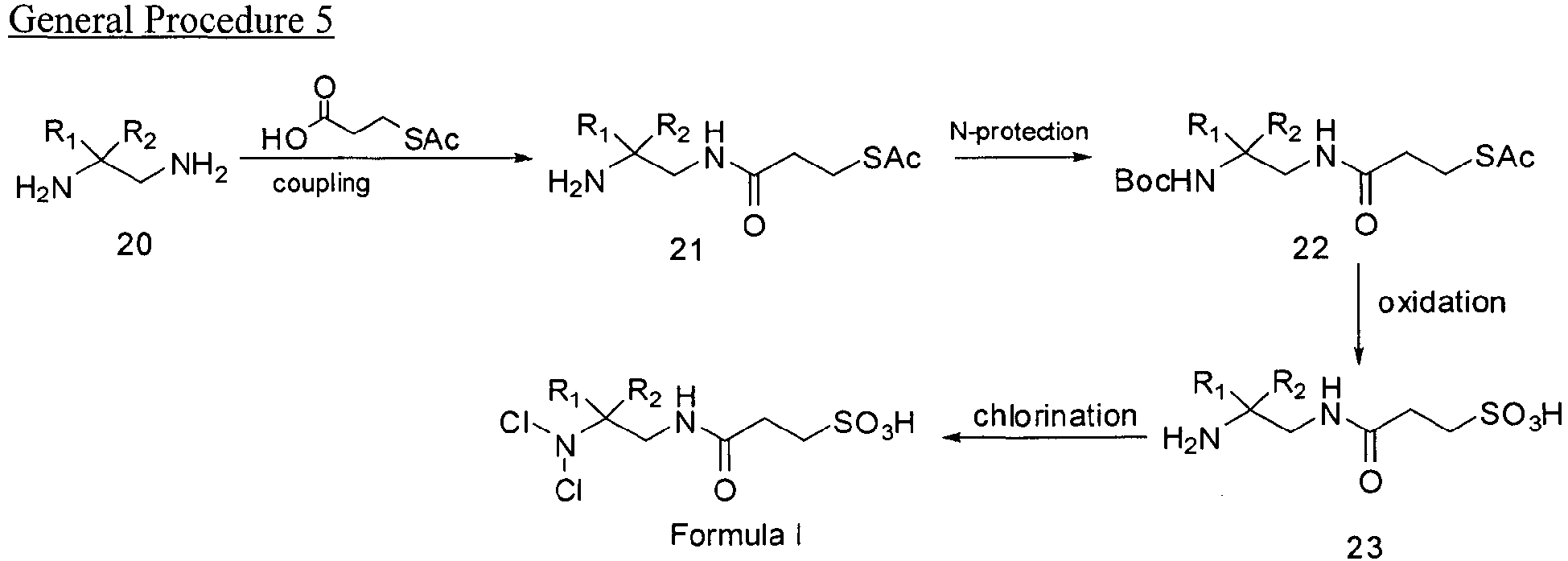
- As shown in General Procedure 5, a diamine (20) is coupled with 3-(acetylthio)propanoic acid. The reaction is carried out as described in General Procedure 4. The amino group of the coupled product (21) is protected with groups such as di-t-butyl dicarbonate or benzyloxycarbonyl following conditions well known to those skilled in the art to give compound (22). Typical deprotection conditions depend on the type of protecting group used. For example di-t-butyl dicarbonate group may be deprotected by treatment with an acid such as hydrochloric acid, trifluoro acetic acid, formic acid and the like. The oxidation of the thioacetate functionality in compound (22) and subsequent conversion to the N,N-dichloro derivative I is carried out analogously as described in General Procedure 4.
- Further, diamine derivatives (20) can be converted into the N,N-dichloroamine derivative of formula I as shown in another non-limiting General Procedure 6.

- As shown in General Procedure 6, a diamine (20) is subjected to selective protection at each nitrogen using two different protecting groups under conditions known in the art. Such selective protection may be carried out in different sequences such that the reactivity at both the primary amines may be utilized in a sequential manner. As shown in General Procedure 6, for example, the protecting groups used are di-t-butyl dicarbonate to yield compound (24), then benzyloxycarbonyl to yield compound (25), using methods known to those skilled in the art.
- The amino compound (26), prepared by the deprotection of compound (25), can be transformed to the N-formylated compound (27) by reaction with formic acid under standard peptide coupling conditions using solvents such as THF or DMF. The reaction is carried out at room temperature and is typically completed in about 4 to about 24 hours.
- The reduction of the N-formylamine (27) to the N-methylamine (28) is accomplished in the presence of a borane-methylsulfide complex such as borane-dimethylsulfide complex. The reaction is carried out in an inert solvent such as THF. Methanol is added to complete the transformation, which is typically carried out at ambient temperature for about 2 to about 12 hours.
- Formation of the amide (29) is accomplished by reaction of amine (28) with 3-(acetylthio)propanoic acid in the presence of 1,1'-carbonyldiimidazole in a solvent such as acetonitrile, DMF or THF. The reaction is typically carried out at reflux temperature for about 2 to about 12 hours. The N-methylamine compound (29) is transformed to the N,N-dichloro derivative I following steps analogous to those described in the General Procedure 4.
- Alternatively, N-protected β-amino alcohol derivatives (11) can be converted into the N,N-dichloroamine derivative of formula I as shown in another non-limiting General Procedure 7.

- As shown in General Procedure 7, a protected amino alcohol (11) is esterified with chloropivaloyl chloride, which is commercially available, to yield compound (32). The esterification is done in an inert solvent such as methylene chloride in the presence of an organic base such as triethylamine, diisopropylethylamine and the like. Typically, the reaction is carried out at 0 °C to ambient temperature.
- The ester intermediate (32) is reacted with potassium thioacetate to afford the thioacetate analog (33). This reaction is a typical nucleophilic substitution reaction well known to those skilled in the art. A polar aprotic solvent such as DMF is generally used. The reaction is carried out at ambient to reflux temperatures depending on the substrate reactivity until the reaction is completed as determined by methods well known to those skilled in the art.
- The conversion of the thioacetate (33) to the N,N-dichloro derivative I is analogous to that described in General Procedure 4.
- Alternatively, a commercially available acrylic acid (35) can be converted into the N,N-dichloroamine derivative of formula I as shown in another non-limiting General Procedure 8.

- As shown in General Procedure 8, the azido-carboxylic acid (36) can be synthesized following the method of Nagarajan and Ganem (J. Org. Chem. 1986, 51, 4856.) utilizing a commercially available 3,3-disubstituted acrylic acid. The reaction typically requires elevated temperatures for about 24 to about 72 hours.
- The azide function of compound (36) is reduced in the presence of a transition metal catalyst such as 10% palladium on charcoal to yield amino compound (37). This transformation may also be carried out in the presence of platinum or with other catalytic systems such as Raney nickel. The reaction is carried out in a polar solvent such as formic acid, acetic acid or dimethylformamide, at ambient temperature and at atmospheric pressure in the presence of hydrogen.
- N-Benzyloxycarbonyl protection of the amino group of compound (37) is accomplished by a suitable agent such as N-(benzyloxycarbonyl)succinimide in the presence of an inorganic base such as sodium hydroxide to yield compound (38). The protection of the amino function can also be carried out with other protecting agents such as di-t-butyldicarbonate [(BOC)2O] or 9-fluorenylmethyl chloroformate (FMOCCI) and other bases such as TEA, diisopropylethylamine (DIPEA) or potassium hydroxide and the like. Suitable solvents for this reaction include methanol and THF, as well as mixtures of solvents including a mixture of methanol, THF and water. The combination of solvents can be adjusted by one skilled in the art to achieve the desired amino protection depending on the chosen protecting agent. The reaction temperature is usually from about 0 °C to about room temperature for about 4 to about 24 hours.
- The coupling of compound (38) to S-2-hydroxyethyl ethanethioate to yield compound (39) is carried out using reagents and conditions which are well known to one skilled in the art. For example, coupling agents such as carbonyl diimidazole or diisopropylcarbodiimide can be utilized in solvents such as THF or DMF. The synthesis of the S-2-hydroxyethyl ethanethioate shown in General Procedure 8 is carried out with equimolar amounts of commercially available iodoethanol and potassium thioacetate in methanol at 60 °C for 1 hour. Procedures to obtain analogous compounds may use any available 2-haloethanol and react it with a sodium or lithium salt of thioacetic acid in solvents such as DMF or acetone at elevated temperatures of about 50 to about 80 °C for about 1 to about 8 hours.
- The transformation of thioacetate (39) through intermediates (40) and (41) may be achieved following a procedure analogous to General Procedure 4.
- Further, N-protected β-amino alcohol derivatives (11) can be converted into the N,N-dichloroamine derivative of formula I as shown in another non-limiting General Procedure 9.

- As shown in General Procedure 9, the protected β-amino alcohol, (11) (where P is a suitable N-protecting group such as benzyloxycarbonyl or t-butyl dicarbonate) may be transformed into thioacetate (42) using a Mitsunobu reaction according to the method of Bach et al. (J. Org. Chem., 1998, 63, 1910). These reaction conditions require the formation of a betaine adduct between DIAD and PPh3 prior to the addition of alcohol (11) and thioacetic acid at -5 °C in THF. The Mitsunobu reaction can be carried out with diethyl azodicarboxylate or di-t-butyl azodicarboxylate or other di-substituted azodicarboxylates as well as other trisubstituted phosphines such as tri-n-butylphosphine or a water-soluble tris(dimethylamino)phosphine. The reaction occurs under mild conditions (-5 °C to RT) and tolerates a variety of functional groups. The solvents are typically nonpolar since they accelerate the reaction, thus THF, diethyl ether and methylene chloride are preferred solvents, although acetonitrile and DMF can be used.
- The hydrolysis of compound (42) to yield compound (43) requires the presence of an aqueous inorganic base, such as sodium hydroxide or potassium hydroxide, for about 15 minutes to about an hour at room temperature. Any inorganic base can be utilized in this reaction in a solvent such as methanol or ethanol. As the thiol function has a high propensity to form disulfide in the presence of oxygen, care must be taken to utilize an inert atmosphere such as nitrogen during the reaction and reduce the thiol to excessive exposure to the atmosphere during workup and isolation.
- The thiol (43) is reacted with 1-bromo-2-chloroethane to form the sulfide intermediate (44). This reaction is a nucleophilic substitution as well known to one skilled in the art. Polar aprotic solvents such as DMF accelerate the rate of reaction and are typically used in a temperature range, depending on the substrate, from room temperature to reflux. As shown in General Procedure 9, the bromine atom is more reactive and is selectively displaced at room temperature in DMF. The base utilized to form the nucleophile (RS-) also has an affect on the rate of reaction. For example, cesium carbonate may be utilized to facilitate selective reaction at the bromine-carbon bond. Since large cations are more easily dissolved into polar aprotic solvents, potassium and cesium inorganic base are preferred in nucleophile substitution reactions. The hindered organic bases such as DBU or DIPEA may also be utilized in this type of reaction.
- Transformation of the sulfide intermediate (44) through compounds (45) and (46) to (47) is carried out analogously to the methods described in General Procedure 4.
- Alternatively, N-protected β-amino alcohol derivatives (11) can be converted into the N,N-dichloroamine derivative of formula I as shown in another non-limiting General Procedure 10.


- The formation of thioacetate (42) has been described in General Procedure 9. As shown in General Procedure 10, compound (42) is oxidatively chlorinated with HOCl in DCM at 0 °C to form the intermediate sulfonyl chloride (48) under mild conditions and in good yield utilizing a modified method from Wright and Hallstrom (J. Org. Chem. 2006, 71(3), 1080.) Other reaction combinations such as acetonitrile, water, N-chlorosuccinimide and HCl have been utilized by Nishiguchi et al. (Synthesis, 2006, (24), 4131) to obtain sulfonyl chlorides from thioacetates under mild conditions in high yield. Hill et al. (J. Org. Chem. 2006, 71(21), 8190) also react thioacetate with HOCl generated from bubbling chlorine gas into a mixture of water and DCM to form sulfonyl chlorides.
- The reaction of sulfonyl chlorides with amine nucleophiles are well known to one skilled in the art. A dry inert atmosphere is not required for this reaction as the nucleophile, ammonia was dissolved in water. The reactivity of amines especially ammonia is an order of magnitude more reactive than water. The reaction may have been completed successfully with gaseous ammonia to improve the yield.
- The acetylation of compound (49) to yield compound (50) is done with acetic anhydride in the presence of a DIPEA at low temperature under an inert atmosphere. This reaction may also be carried out with acetyl chloride and other organic bases such as pyridine or TEA or aqueous inorganic base if desired. Exact conditions may be determined by methods known to one skilled in the art.
- The deprotection of (50) to yield compound (51) and the chlorination of (51) to give the N,N-dichloroamine derivative of formula I follows methods similar to those discussed in General Procedure 4.
- Further, the cycloalkene (52) can be converted into the N,N-dichloroamine derivative of formula I as shown in another non-limiting General Procedure 11.


- As shown in General Procedure 11, the appropriate commercially available alkene (52) is subjected to amido sulfonation as described by F. M. Cordero et al. (Eur. J Org. Chem. 2002, 1407) to yield compound (53). This reaction is typically carried out by treating the alkene with a sulfur trioxide source such as its complex with DMF, triethylamine or pyridine in acetonitrile as solvent.
- The amido sulfonic acid (53) is subjected to acid hydrolysis using a protic acid such as hydrochloric acid or sulfuric acid to give the free aminosulfonic acid (54). This reaction is typically carried out at high temperatures from about 100 °C to about 150 °C for about 12 to about 24 hours.
- The chlorination of the aminosulfonic acid (54) is carried out in analogous manner as detailed in General Procedure 4 to give the N,N-dichloroamine derivative of formula I.
- A number of the starting materials for the above General Procedures are commercially available, for example, from Sigma-Aldrich Chemical Co. (Milwaukee, Wisconsin, USA), Bachem (Torrance, California, USA), Torento Research Chemicals (North York, ON, Canada), Anaspec (San Jose, California, USA), Chem-Impex International (Wood Dale, Illinois, USA), Spectrum (Gardena, California, USA), PharmaCore (High Point, North Carolina, USA).
- The further non-limiting halogen sources may be used to produce the N-halo or N,N-dihalo amino compounds and their derivatives: bromine itself, N-haloarylsulfonamide salts, wherein the aryl group contains from 6 to 15 carbon atoms with 1 or 2 aromatic rings, 6 to 10, or 6 to 8, carbon atoms and one aromatic ring, such as N-halobenzene-sulfonamide or N-halo-4-alkylbenzenesulfonamide, wherein the alkyl group is lower alkyl from 1 to 4 carbons, methyl or ethyl. The N-halobenzene-sulfonamides or N-halo-4-alkylbenzenesulfonamides are often used in the form of their salts, for example, alkali salts, for example, their sodium or potassium salts. In this group the most frequently used reagents will be N-chlorobenzenesulfonamide and N-chloro-4-methyl-benzenesulfonamide in form of their sodium salts, because they are readily commercially available. Other non-limiting halogen releasing agents or sources may be HOCl, N-chloro-succinimide or N-bromosuccinimide, N-iodosuccinamide, or combinations of the agents.
- If one molecule of the halogen source releases one halogen, obviously for each starting amine of the amino acid or derivative molecule at least one or two molecules of the halogen source will be used to achieve the desired halogenation. More details of the preparation of N-halo or N,N-dihalo amino acids and their derivatives are set forth in the examples.
- When not commercially available, the phosphonic acid starting materials for the preparation of the compounds of the present application may be also prepared according to procedures well known to one skilled in the art. See for example Yuan, C. et al., "New Strategy for the Synthesis of Functionalized Phosphonic Acids," Heteroatom Chem. 1997, 8 (2) 102-122; Yuan, C., et al., "New strategy for the Synthesis of Functionalized Phosphonic Acids," Pure Appl. Chem. 1996, 68(4), 907-12; "A Versatile Route to Substituted Organophosphonic Acids", J. Am. Chem. Soc., 1990, 31, 2933; G. M. Kosolapoff, "The Synthesis of Phosphonic and Phosphinic Acids," Organic Reactions, Vol. 6, 1951 , and references cited therein, the disclosures of all of which are incorporated by reference herein in their entirety.
- Compounds according to the present application can also include their individual stereoisomers (enantiomers and diastereoisomers) as well as the racemic mixtures of the compound. The individual isomers, such as the pure R, S, RR, SS, RS, SR, etc., may be prepared by treating the isomeric mixture with an optically active resolving agent to form a pair of diastereoisomeric compounds. The diastereoisomeric compounds may be separated and the optically pure enantiomer or diastereomer may be isolated using procedures well known in the art. Because diastereomers have distinct physical properties (such as the melting points, boiling points, solubilities, reactivity, etc.), they can be readily separated by taking advantage of these dissimilarities. The diastereomers can be separated by chromatography or, preferably, by separation or resolution techniques based upon differences in solubility. A more detailed description of the techniques applicable to the resolution of stereoisomers of compounds from their racemic mixture can be found in Jean Jacques Andre Collet, Samuel H. Wilen, Enantiomers, Racemates and Resolutions, John Wiley & Sons, Inc. (1981) and references cited therein.
- Derivatives of the N-monohalo- and N,N-dihalo-amino compounds may be prepared by protecting the amino group with an amino-group protecting agent as disclosed herein, for example, by forming the benzyloxycarbonyl (CBZ) derivative, followed by the formation of the sulfonyl chloride which may be converted into sulfonamides, for example with a lower alkyl amine, such as methylamine. Similarly, the sulfonyl chloride may be reacted with benzylamine, and the resulting benzylsulfonamide may be converted to the group -SO2NH2. Thereafter the protecting group may be removed by methods known per se to chemists skilled in the art. A comprehensive list of suitable protecting groups that may be used may be found in T.W. Greene, Protecting Groups in Organic Synthesis, 3rd edition, John Wiley & Sons, Inc. 1999 , the disclosure of which is incorporated herein in its entirety.
- Pharmaceutically acceptable salts of the compounds of the present application may be prepared by reacting the free acid or base forms of these compounds with a stoichiometric or greater amount of the appropriate base or acid in water or in an organic solvent, or in a mixture of the two; generally, for example, non-aqueous media like ether, ethyl acetate, ethanol, isopropanol. The salts of the present application may also be prepared by ion exchange, for example.
- Salts may also be prepared by reacting the N-halo- and N,N-dihaloamino compounds in other manners known per se including a method analogous to the method described in German Patent Application
4041703 W. Gottardi , the disclosure of which is incorporated herein in its entirety. - The sodium salts of the N-halo- or N,N-dihaloamino compounds may be converted into the lower alkyl esters by reacting the sodium salt with a lower dialkyl sulfate, such as dimethyl or diethyl sulfate in the presence of sodium bicarbonate.
- The sulfonamides in which the substituent Z is -SO2-NH2 are produced in a manner well-known to chemists skilled in the art.
- The N-halo- or N,N-dihaloamino compounds and their derivatives are antimicrobial agents which kill microbes at relatively low concentrations and can be tolerated by eukaryotic cells at significantly high concentrations. In the preferred N-halo- or N,N-dihaloamino compounds, halo is chloro. This range of therapeutic activity and favorable therapeutic index is absolutely critical considering the physiological role of chloramines in the destruction of pathogens in vivo. For an antimicrobial product that is applied to vital, soft and sensitive tissues such as ophthalmic, skin or any other sensitive areas its safety and efficacy cannot be compromised. Thus, use of such product(s) in humans for treating infections is supported by our positive results.
- The compounds of formulae I - V or their derivatives have the following areas of application: contact lens cleanser, bacterial inactivation, ophthalmic, general surgical preparation including oncology, surgical instrument disinfection, medical device and instrument disinfection, dental instruments disinfection and application in food sanitation including disinfection of surface areas. They are also useful in vaccine formulations (as preservative and potentially adjuvant), as compounds with viricidal effect, for the viral inactivation of both DNA and RNA classes of viruses including HIV, hepatitis A, respiratory syncytial virus, Adenovirus, West Nile virus, HSV-1, HSV-2, SARS, influenza and para-influenza viruses, picornaviruses, and vaccinia virus (as a Model for Poxviruses). In addition, these compounds are also useful for the treatment of fungal infections, such as acute or chronic Rhinosinusitis or other fungal infections such as Otitis, Dermatitis, Bronchitis, Pneumonia's such as Pneumocystis carinii, the fungal infections of sex organs, such as Colpitis, Endometritis, Balnitis, fungal infections of the gastrointestinal tract, such as Stomatitis, Oesophagitis, Enteritis, or fungal infections of the urethra, such as Pyelonephrititis, Ureteritis, Cystitis, or Urethritis. Furthermore, the compositions described herein have antimicrobial activity against many other microorganisms, including H. influenzae, Escherichia coli, E. faecium, E. faecalis, Listeria monocytogenes, Staphylococcus aureus, methicillin-resistant S. aureus (MRSA), S. epidermidis, S. pneumoniae, Pseudomonas aeruginosa, P. mirabilis, K. pneumoniae, Lactobacillus, A. junii, yeast, including Candida albicans, vancomycin-resistant enterococcus, molds, and spores, including spores of anthrax and cysts of Acanthamoeba. In particular, the solutions of the present application may be useful in the treatment of several different strains of Bacillus anthracis. Vancomycin-resistant bacteria, MRSA, and others are easily destroyed by the compositions of the present application. Examples of bacteria implicated in periodontal disease and destroyed by the compositions of the present application are Bacteriodes gingivalis, B. intermedius, Actinomyces actinomycetemcomitans and B. forsythus. Examples of bacteria that are implicated in mastitis (infection of cow udder) and killed by the compositions are Streptococcus agalactiae and Streptococcus infantarius. The compositions destroy biofilms and are therefore effective against microbes growing in both planktonic form and in biofilms.
- In a further aspect of the present application, there is provided a method for the treatment of various medical conditions selected from the groups consisting of promoting wound healing, reduction of pathogens in open wounds, wound decontamination, wound bed irrigation/preparation, ocular disinfection or decontamination, oral disinfection, nasopharyngeal therapy, antifungal therapy, ophthalmic, oral surgery and dentistry, otology applications, reduction of pathogens in pulmonary infections, reduction of pathogens in burns, lavage, reduction of infectious load in organs for transplantation, reduction of bacterial load in autologous or artificial tissue transplantation, oral disinfection antifungal therapy, treatment of biofilm for cystic fibrosis or other diseases that produces biofilms, treatment of viral infections, treatment of skin diseases, and tissue repair and regeneration, which method comprises using the solution of the present application by applying the solution to the site where treatment is required such as pre- and post-operative surgery, cardiovascular, re-secting solid tumor in oncology.
- As an example, the dosage for use on chronic wounds of an approximate size of 25 square cm may be in the range of 30 mL of solution containing 2 to 200 mg of an N-halo- or N,N-dihaloamino compound. Compounds that may be used include 3-(4-chlorophenyl)-2-(dichloroamino)-2-methylpropane-1-sulfonic acid or any other halogenated amino compound described herein or a derivative thereof. The solution may be applied from one to ten times per day or as deemed necessary for effectively treating the wound. In certain instances the composition may contain about 0.01 mM to about 1 M, or about 0.1 to about 100 mM of N-halo- or N,N-dihaloamino compounds. In certain variations of the composition, one or more of N-halo- or N,N-dihaloamino compounds may be used. Dosages in other applications would be adjusted to the local area depending on where the antimicrobial activity is required and the severity of infection.
- In one aspect the compositions in form of solutions are osmotically balanced, and have minimal mammalian cytotoxicity. In another aspect, the compositions are not osmotically balanced and have minimal mammalian cytotoxicity. In another aspect the compositions described herein have a therapeutic index of about 20 to about 5,000.
- Because the compositions of the present application are substantially nontoxic to mammals and have antibacterial properties, they are useful in any application in which antimicrobial properties are desirable. Such applications include, without limitation, treatment of wounds, burns, and canker sores; irrigation; the treatment of various fungal infections such as onychomycosis (fungal nail infections on fingers and toes) cleaning of tissue sites (e.g., pre- and post-operative); ophthalmic applications (e.g., in contact lens cleaning solutions or for irrigation of the eye before, during, or post ophthalmic surgery); for nasal or nasopharyngeal applications including, but not limited to, the treatment of rhinosinusitis or rhinitis caused by viral, bacterial or fungal infections; for dermatological applications, facial cleansing of microbial infection, cold sore, pimples, psoriasis; and numerous applications which are readily apparent to one skilled in the art, such as dental applications including the treatment of gingivitis or periodontitis, and animal health applications (including treatment of mastitis). Application also includes the elimination or reduction of pathogens on surfaces including medical equipment, instruments, organ preservation, implant disinfection, devices or food (without limiting to meat, fruits, vegetables) and food contact surfaces including the elimination or reduction bacterial biofilms. Unlike many anti-infective compositions used in similar applications, the compositions of the present application have minimal to no side effects.
- The compositions of the spresent application which comprise N-halo- or N,N-dihaloamino compounds of the formulae I-V and their derivatives may be incorporated into a variety of applications, including bandages or wound dressings. The compositions in form of physiologically balanced, acidic solutions may be used in combination with specially designed bandages in a wound treatment protocol. The specialized bandage may include an opening or "window" through which topical treatment materials such as the solution of the present application may be applied. The compositions may also be applied in applications (for example treatment of burns) where it is desirable to maintain a moist and sterile environment without disturbing the dressing. In one such example a perforated tube is placed between the dressing and the outer bandage or wrap. Periodically the composition is passed through the tube thus irrigating the dressing with fresh antimicrobial solution.
- Also disclosed herein is an article of manufacture comprising the composition of the present application packaged in a container. Surfaces of the container which are in contact with the composition of the present application are made of material which is not reactive with an oxidizing agent.
- The stability of a solution of N-halo- and N,N-dihaloamino compounds and their derivatives permits the use of different forms of packaging that would be practical for use by patients. The solution may be packaged in several single-use 20 to 40 mL or 30 mL clear or amber glass bottles with Teflon-lined screw caps and sealed with tape to ensure gas tightness. In one aspect, the same solution may be packaged in a 250 mL amber glass bottle or in a 250 mL non-reactive plastic bottle. However, up to 5 liter bottles may be used, because such larger volumes are practical for treatment of burns. Storage in these receptacles ensures long-term stability required for the uses of the compositions described herein in detail. A solution containing a compound described herein within the concentration range described herein in a vial stored in a refrigerator has a loss of no more than 10% at time t=0 after a period of three months. Additionally, packaging may include a dual chamber system where component A is mixed with component B to form the final product, N,N-dihaloamino compound or its derivatives. The N-halo- and N,N-dihaloamino compounds may be used in appropriate concentrations and delivery vehicles or carriers that are non-irritating and suitable for delivering the active compound to the intended site of action, such as lotions, solutions, creams, emulsions, ointments, balms, pastes, sprays, aerosols, gels, patches, solids, sticks, aqueous solutions, organic solvents, or other foundation compositions. Generally, such carrier systems can be described as being solutions, creams, emulsions, gels, solids and aerosols. Delivery may also include special means for delivery, such as a pessary or suppository. The compounds may also be incorporated as active agents or inactive precursors into or onto medical devices, such as catheters, stents, pace makers, needles or tubings.
- In one aspect, the solutions of the present application may be stored in single-use containers. In another aspect, the solutions of the present application may be stored in single-use containers of various different sizes, configurations, and having different volumes as suitable for the desired applications as disclosed herein. In some applications, for example, the solution of the present application may be stored in single-use 30 mL, optionally disposable containers. In one aspect the present composition may be stored as powder together with pharmaceutically accepted excipients, optionally under inert gas, at room temperature.
- The compositions of the present application may include the following pharmaceutically acceptable carriers: sodium chloride to attain isotonicity, buffers, stabilizers, solvents, flavoring agents (in case of oral or nasopharyngeal administration and food industry), preserving agents, diluents, extenders and other auxiliary substances or excipients. Specific examples of pharmaceutically acceptable carriers and excipients that may be used are described in Remington: The Science and Practice of Pharmacy, A. Gennaro, ed., 20th edition, Lippincott, Williams & Wilkins, Philadelphia, PA; Advances in Pharmaceutical Sciences (David Ganderton, Trevor Jones, Eds., 1992); Advances in Pharmaceutical Sciences, Vol. 7 (David Ganderton, Trevor Jones, James McGinity, Eds., 1995), the disclosures of which are incorporated herein in their entirety. In general, water, a suitable oil, saline, lower alcohols, and glycols such as propylene glycol or polyethylene glycols may be suitable carriers for solutions. In one aspect solutions contain the active ingredient in a water soluble or aqueous medium soluble form, for example as a salt, together with suitable stabilizing agents, and if necessary, buffer substances. In addition, solutions may contain preservatives, such as benzalkonium chloride, methyl- or propyl-paraben, and chlorobutanol.
- The compositions may further comprise other active ingredients, such as HOCl or other antibacterials as long as they do not interfere with the stability or function of the N-halo- or N,N-dihaloamino compounds of the present application.
- The amounts or concentrations of N-halo- or N,N-dihaloamino compound in the compositions of the present application may vary over broad ranges. For example, a composition may contain from about 0.001 to about 100% by weight of the composition of the N-halo- or N,N-dihaloamino compound. In case of about 100%, the composition may be applied in the form of a powder without any carrier substance. A typical range of the composition include about 0.1 to about 95% by weight of the composition of the N-halo- or N,N-dihaloamino compound, for example, about 0.1 to about 50%, or about 0.1 to about 10%, for example, about 0.5 to about 5%. In solutions, usually a lower concentration of the N-halo- or N,N-dihaloamino compound may be applied. For example, a concentration of 1 to 2% may be appropriate in case of a rinse or spray. In another range, the concentration of the compound or its derivatives may be about 0.01% to about 20% of the composition by weight.
- In case of nasopharyngeal application a catheter for nasal application containing a about 0.5 to about 5%, for example a 1% solution of the N-halo- or N,N-dihaloamino compound or its salt with a pH of about 2 to about8, preferably about 3.5 to about 5 may be used for several weeks using about about 5 to about 50 mL, for example, 10 to 15 mL of the solution for each treatment. After each treatment, the rinsing solution may be removed, such as by absorbing with gauze, rinsing with water or saline or by suction.
- The present application includes pharmaceutical compositions that comprise at least one halogenated compound. The halogenated compound is selected from a N-halogenated or N,N-dihalogenated compound described herein or a derivative thereof. More specifically, such compositions include a N-halogenated or N,N-dihalogenated derivative of formulae I - V or a derivative thereof. In one aspect, the halogenated compound is an alkaline metal hypohalide, such as sodium hypochlorite, but more preferably a hypohalous acid, most preferably hypochlorous acid. These binary pharmaceutical compositions have anti-inflammatory, immuno-modulatory, bactericidal, antibacterial, anti-infective, antimicrobial, sporicidal, disinfectant, antifungal and antiviral effect and tissue healing stimulation without exhibiting substantial stimulation of myeloperoxidase activity in a mammal. The hypochlorite titer of these pharmaceutical compositions is below or equal to 1 mole/liter (1 M) of available chlorine, particularly of a hypochlorite of an alkaline metal, especially sodium hypochlorite or hypochlorous acid. Its minimum titer is greater than or equal to about 1 picomole/liter. The N-chloramine or N,N-dichloroamine titer of these compositions is less than or equal to about 5 moles/liter (5 M) with a minimum of 0.01 femtomoles/liter.
- The binary compositions of the present application may be combined with excipients or carriers that are appropriate for a particular use. For liquid compositions water is a preferred excipients or carrier, although other non-oxidizable compatible carriers may also be used. Some aqueous compositions may contain osmotic (isotonic) purified water. Other compositions do not require osmotic balancing. The aqueous compositions may also contain diverse agents that are compatible with the halogenated compound and the N-halogenated or N,N-dihalogenated derivative of at least of a compound selected from compounds described herein, as well as compatible with the use to which the composition will be put. If the compositions are destined for a pharmaceutical use and administration to humans or animals, the excipients or carriers must be pharmaceutically acceptable, such as substantially non-toxic and not interfere with the intended use of the pharmaceutical compositions. The skilled person will be aware that the characteristics of the composition can be varied or modified. Such modification can be effect with regard to stability, for example, by including stabilizers; with regard to pH by including pH adjusting agents, such as buffers, bases or acids; with regard to density by agents that influence density, for example diluents that reduce density or by density-increasing agents that that have a higher density than water; with regard to solubility by adding solubilizers; with regard to viscosity by adding agents that will affect viscosity, either by increasing it, for example by adding biocompatible polymers, or by reducing it by adding agents that have a low viscosity profile; with regard to coloring by adding compatible dyestuffs or coloring agents that are not oxidized by the binary halogenated components; with regard to wetting properties by adding appropriate surface-active agents or surfactants; with regard to olfactory or gustatory properties of the binary compositions by adding agents that display an attractive smell or flavor, for example, to facilitate use of the compositions for certain uses or users.
- The preparation of the binary composition depends on its form, whether it is in solid, liquid or gaseous form. Solid compositions may be in form of a powder, or gel. Semisolid compositions may be in form of an ointment or cream. Liquid compositions may be in form of a solution, emulsion or suspension or an oil. Gaseous compositions may be in form of an aerosol. Details for such preparations for pharmaceutical uses can be found in Remington; details for such preparations for consumer products can be found in The Chemical Formulary, H. Bennett Ed., Chemical Publishing Company (1998), vol. XXXIV.
- In one aspect, the compositions of the present invention are administered or used topically. The formulations of compounds of the present invention may be used in treating a number of patients with deep wounds, which do not respond to usual medications and locally applied treatments. In one aspect, the present invention provides a method for the treatment of various medical conditions such as promoting wound healing, reduction of pathogens in open wounds, wound decontamination, ocular disinfection or decontamination, oral disinfection, antifungal therapy, ophthalmic applications, reduction of pathogens in pulmonary infections, reduction of pathogens in burns, lavage, reduction of infectious load in organs for transplantation, reduction of bacterial load in autologous or artificial tissue transplantation, oral disinfection antifungal therapy, treatment of biofilm for cystic fibrosis and related diseases, treatment of viral infections, treatment of skin diseases, and tissue repair and regeneration, which method comprises using solutions of compounds of the present invention by applying the solution to the site where treatment is required. Non-limiting examples of biofilm that may be treated using the solutions of the present invention include those cited in the review article entitled "Is there a role for quorum signals in bacterial biofilms?" by S. Kjelleberg, and S. Molin, PMID: 12057677 (PubMed-indexed for MEDLINE).
- The compounds of the present invention or compositions thereof are effective in reducing bacterial load thus improving wound healing. The compositions are well-tolerated, improve the granulation of wound tissue, reduce the need for debridement compared to prior art compositions with patients reporting less pain during their treatment and could potentially dampen the inflammatory response through cytokine regulations. (See: A. Mainnemare et al., "Hypochlorous acid and taurine-N-monochloramine in periodontal diseases", J. Dent. Res. 2004, Nov. 83(11):823-31; Review.)
- Compounds of the invention may be formulated as solutions, which may be used to treat canker sores (mouth ulcers) or cold sores by rinsing the affected area. For example, such solutions can be used by soaking the cold sore 3-4 times a day, each time with 2-3 applications, and putting the solution in contact with the sore for 20-30 seconds. The solutions may also be used as a mouth rinse for dental and mouth hygiene and to control infection. In this instance, the solution may be used as a gargling solution to fight throat infection. The solution may be applied with the help of a cotton swab for more specific areas. The solution can be used once or several times a day according to a patient's needs and condition.
- The choice of specific cleaning or disinfecting agents of the present invention is largely a matter of judgment, guided by product label claims and instructions and government regulations. A single liquid chemical composition might not satisfy all disinfection requirements in a given dental practice or facility. Realistic use of a liquid composition containing a N-halo- or N,N-dihalo amino compound, optionally in conjunction with an inorganic hypohalous compound, depends on consideration of multiple factors, including the degree of microbial killing required; the nature and composition of the surface, item, or device to be treated; and the cost, safety, and ease of use of the available agents. Selecting one appropriate product with a higher degree of potency to cover all situations might be more convenient.
- Periodontal disease is a general term used to describe diseases that affect the gingival and supporting tissue connected to bone and teeth in the jaw. See "Periodontal Disease", Ray Williams, New England Journal of Medicine, 322: 373-382, 1990. Gingivitis (an early stage of the disease) and periodontitis are caused by specific bacteria and the host's reaction to the disease. For example, an increase in actinomyces and also the presence of Fusibacterium nucleatum, species of lactobacillus, veillonella and treponema has been implicated in causing gingivitis. Adult periodontitis is associated with Bacteriodes gingivalis, B. intermedius, Actinimyces actinomycetemcomitans and B. forsythus. A number of other species may also participate in active periodontal disease.
- Commonly considered, antimicrobial therapy is the use of ingested antibiotics to help fight periodontal (gum) disease which is caused by certain oral bacteria. Typically, ingested antibiotics are used in conjunction with scaling and root planing. Some dentists use antimicrobial therapy only as a last resort, while others use it more frequently. In some cases, antimicrobial therapy can eliminate the periodontal disease. In others, periodontal surgery still is needed. However, the use of the compositions of the present invention formulated for dental applications, referred herein as the "dental compositions", has the key advantage over the use of ingested antibiotics that it does not induce antibiotic resistance, gastrointestinal discomfort or allergic effects, in addition to a general advantage of topical therapy over systemic therapies in that less compound is needed to achieve the same local concentration.
- Most people with periodontal disease do not receive antimicrobial therapy. This form of therapy generally is used for certain situations, including:
- Necrotizing ulcerative gingivitis (NUG), a rare, aggressive form of periodontal disease that occurs mostly in people aged 15 to 35;
- Rapidly progressive periodontal disease;
- Periodontal disease that has not responded to other types of treatment;
- Patients who have weakened immune systems or other serious medical conditions.
- However, because use of the dental compositions of the present invention does not involve treatment with an ingested antibiotic, the dental compositions of the present invention can more frequently be used to control microbial infections or plaque (the collection of bacteria that accumulates on teeth) which may be the cause of dental caries. Although the mouth contains many different bacterial strains, only certain strains appear to cause dental decay. The dental compositions of the present invention are effective against the large number of bacteria found in the mouth, in particular against acid-producing bacteria which are the ones that cause tooth decay, for example, Streptococcus mutans. The compositions of the present invention are effective to control or prevent smooth surface decay, pit and fissure decay as well as decay in the enamel. In case a patient has especially active decay-causing bacteria in their mouth, the dentist may prescribe a mouth rinse which includes the dental compositions of the present invention for several weeks to kill off the bacteria that cause tooth decay.
- The dental compositions of the present invention are also useful for the co-treatment of pulpitis, a painful inflammation of the tooth pulp, for the treatment of a periapical abscess, which is a collection of pus or cellulitis originating from a bacterial infection. The dental compositions of the present invention may be used in conjunction with antibiotics.
- The dental compositions of the present invention are also suitable for the treatment of periodontal diseases caused by accumulation of bacteria, such as gingivitis, herpetic gingivostomatitis caused by viral infection, gingivitis of pregnancy caused by hormonal changes, pericoronitis where the gum swells over a tooth that has not fully emerged or gingivitis of leukemia, or periodontitis, a type of gingivitis extending to the supporting structures of the tooth.
- The dental compositions of the present invention may be used in conjunction with professional dental hygiene performed that is either during cleaning of the teeth or pockets using scaling, or after professional care, on patients by dental hygienists. Before choosing the compositions of the present invention, a dentist may decide to take a sample of the bacteria and send it to a lab. The lab grows the bacteria, identifies them, and determines which concentration or formulation of the compositions of the present invention would work best against them. The dentist or periodontist will then use this information to prescribe the dental composition that is most effective for the infection. However, because the dental compositions of the present invention are so effective in killing the bacteria effecting dental diseases, this step often may be omitted.
- Therapy for periodontal disease can be given systemically or locally. Local therapy is given in the dentist's chair, and involves placing the dental composition directly into the affected parts of the mouth. There are several types of local therapy, including:
- Gel - The dentist injects a gel containing the compositions of the present invention under the gums. The area is sealed and covered with a special bandage to prevent leakage. After seven to 10 days, the dentist removes the bandage and any remaining gel.
- Chip - The dentist places a chip containing a dental composition containing the N-halo- or N,N-dihalo amino compounds under the gums. The chip dissolves over seven to 10 days.
- Powder - The dentist squirts a powder containing the compositions of the present invention under the gums. The powder dissolves over a three-week period.
- Ribbon - The dentist places a floss-like fiber under the gums that slowly releases N-halo- or N,N-dihalo amino compounds. The ribbon is removed after about 10 days.
- Microspheres - The compositions of the present invention are formulated in compatible carrier materials as bioerodible or biodegradable microspheres, microparticles or microcapsules that are placed in the gum pocket and slowly release the compositions. The carrier polymer should be substantially resistant against the N-chloro or N,N-dihalo amino compounds and dissolve over time. Examples of such polymers can be found in an article by J. C. Middleton, A. J. Tipton in Medical Plastics and Biomaterials Magazine, March 1998, p. 30.
- Antimicrobial therapy usually lasts one to two weeks. Once the dentist has decided on using the composition comprising N-halo- or N,N-dihalo amino compounds, for example, the patient first will undergo scaling and root planing. This procedure removes plaque and calculus (tartar) from under the gum line and smoothes any bumps or irregular areas on the tooth roots, where plaque can easily accumulate. After scaling and root planing, the dentist may prescribe some type of local antimicrobial therapy.
- The dentist will recheck a patient after two or three months to see if the therapy is effective. If the disease does not respond to treatment with the composition comprising N-halo- or N,N-dihalo amino compound, the next step will depend on several factors, including the severity of the disease. The dentist can prescribe an ingested antibiotic or schedule periodontal surgery. Some patients may receive several rounds of treatment of N-halo- or N,N-dihalo amino compounds before their disease responds. Others need to be on long-term antibiotic therapy to keep their disease under control. Once a patient has undergone successful treatment for periodontal disease, it is important to help prevent recurrence. Impregnated dental floss may also be used after a visit with the dentist to provide continuous contact of the affected areas with the N-halo- or N,N-dihalo amino compound compositions. Maintenance therapy involves regular visits to the dentist or periodontist; this is usually every two to four months for people treated for periodontitis and every six months for people treated for gingivitis.
- The dental compositions of the present invention have the benefit that they avoid the risks of ingested antibiotic therapy, such as antibiotic resistance or an allergic reaction to the antibiotic medication or adverse reactions (such as rash, hives or stomach upset). As with other types of infections, inappropriate use of ingested antibiotics can lead to organisms becoming resistant to the effects of these medications. As part of preventive therapy the patient may use the compositions as a solution for oral rinse or direct application to gums (pockets) using an applicator.
- A physiologically balanced, acidic solution of compounds of the present invention may be used in place of a saline solution to remove a foreign body from, to rinse, or to irrigate the eyes. It can also be applied topically before or after surgery to disinfect an eye and surrounding tissues. The solution can be used once or several times a day according to a patient's needs and condition. The solution can be applied by dropping it directly into the eyes as necessary. It can also be applied by soaking a gauze and applying the saturated gauze to the eyes for one or several minutes. It can also be used to clean the eyes by gently wiping the eyes with saturated gauze. The solution can also be poured into a small eye washer, then the washer is inverted over the eye and the eyelid opened and closed several times.
- The physiologically balanced, acidic solution of compounds of the present invention may be used for the treatment of ocular disinfection or decontamination. In addition, it may be used as a replacement for silver nitrate in the disinfection of the eyes of neonates.
- The solutions of compounds of the present invention may be used for the cleaning eyes in adults and in pediatrics. For example, various viral infections, bacterial or fungal infections, or pathogenic agents may be effectively treated with a solution of compounds of the present invention. Non-limiting examples of pathogenic agents that could be successfully treated with the solution of the present invention include Chlamydia trachomatis, gonorrhea as well as other bacterial, fungal, and viral infections. The compositions of the present invention may be used especially for pre- and post-operative disinfection.
- The reader will see that a solution of compounds of the present invention has applications in the treatment of many different types of wounds, including, without limitation, diabetic ulcers, gangrene, venous ulcers, decubitus ulcers, pressure ulcers, wounds due to bites, acute trauma wounds, surgical wounds and burns. The composition of the present invention is also useful as an irrigation solution, for example, during dental, periodontal, and ophthalmic procedures. The composition of the present invention can also be used for pre- and post-operative cleaning of tissue sites, and as a gargling solution for treatment of canker sores.
- The composition of the present invention may also be used to treat skin that is infected. In a skin of a patient showing medical signs of infection, the composition of the present invention may be applied directly to the area of the skin that is infected. After at least one application of the composition onto the infected skin using standard methods of application known in the art, the disinfective properties of the composition may be noted.
- The composition of the present invention may be used for the reduction of pathogens in pulmonary infections. For example, various viral or bacterial and fungal infections may be effectively treated with the composition of the present invention. Non-limited examples of infections that may be effectively treated using the composition of the present invention include anthrax spores present in the lungs, and the reduction of pneumonia causing bacteria in the lungs, including Streptococcus bacteria and the like.
- The composition of the present invention may be used for the treatment of gynecological infections, such as vaginal infections and the like. For example, various microorganisms, yeasts (e.g., Monilia, Candida albicans, etc.), bacterial infections, HSV-2, HIV or other pathogenic agents may be effectively treated with the composition of the present invention. Optionally, the application of the compositions of the present invention can be used with other medications for the treatment of gynecological infections. For example, use as a lavage of birth canal in pregnant female patients with suspected venereal diseases, and potentially as bathing and cleansing solution on babies right after birth in the deliver rooms of hospitals or as disinfectant on catheters and shunts in dialysis rooms.
- The compounds of the present invention may be used to treat topical infections by incorporating them into creams, ointments or lotions for use in such conditions. Such creams, ointments or lotions might be used a broad variety of skin conditions and may incorporate penetration enhancers in order to deliver the antimicrobial activity of the compound to microbes present beneath the outer (epidermis) layers of the skin and cleansers which remove layers of oil above the epidermis.
- Isotonic solutions of the present invention may be used as an irrigant during surgery in order to prevent the development of surgical site infections, that frequently lead to prolonged hospitalizations and, occasionally, in death. The use of a solution of the present application in place of saline could substantially reduce the risks of such infections especially in the case of gastric surgery and of prolonged operations, where the rate of infections may be as high as 10%.
- The solution of the present application may be used for the reduction of pathogens on the surfaces of medical devices and surgical implements to prevent infection to the patient on whom the implements and devices are used, or in whom they are implanted. The solution may also be used for the reduction or elimination of infections that occur at the entry ports of catheters and shunts that are particularly prone to such infections.
- The solution of the present application may be used for the eradication of bacteria in a biofilm, such as, but not limited to, that on the lumen of a catheter, or the destruction of the corresponding biofilm matrix which clears the bacterial load from the catheter. Biofilms are a group of microorganisms attached to a substrate and are often associated with the excretion of extracelullar polymeric substance [R. M. Donlan, Emerg. Infect. Dis., 2002, 8(9), 881-90]. The demonstrated resistance of biofilms to antimicrobials has caused problems in human health and has had a significant impact on the success of medical implants, for example, catheters [J. W. Costerton et al., Science, 1999, 284(5418), 1318-22]. Once catheters are colonized, bioflms will develop on the outer and inner surfaces and cause infections. Reduction of the bacterial load by prevention of the formation of biofilm (Williams, J.F.; Worley, S.D. J Endourology 2000, 14(5), 395-400; Lewis, K.; Klibanov, A.M. TRENDS in Biotech. 2005, 23, 7, 343-348), destruction of an existing biofilm (Wood, P.; Jones, M.; Bhakoo, M.; Gilbert, P. Appl. Env. Microb. 1996, 62(7), 2598-2602) and killing bacteria in biofilm (Gilbert, P.; McBain, A.J. Am. J. Infect. Control 2001, 29, 252-255) are strategies towards lowering microbial load and reducing biofilm-related infection from any catheters and shunts, such as but not limited to urinary and central venous catheters, implanted artificial joints, implanted artificial hearts, gastric feeding tubes, and colostomy tubes.
- The solution of the present invention may be applied directly or through delivery from a device that creates a mist (aerosolization) to the surfaces of a room, vehicle interior or other such largely confined space in order to reduce or eliminate infectious pathogens that may be suspected to be present. In such an application, it could be used to decontaminate operating theaters where infectious pathogens have been detected or rooms, vehicles and other surfaces where biological warfare agents have been dispersed, as well as operating rooms and hospital waiting rooms where infectious pathogens are likely to reside and multiply.
- The solution of the present invention may be used for reducing pathogens on food (including, without limitation, meats, fruits and vegetables). The solution could be applied as a wash or mist to the food, or the food could be dipped in the solution. The solution of the present invention may also be applied to surfaces and implements used in the preparation of foods to prevent the transfer of pathogens from such surfaces and implements to the food.
- The compounds of the present invention may be used as a means of ensuring that microbes cannot survive in solutions intended for use in injection, infusion or for use in the eye by incorporation of an appropriate amount of such compound into the solution at the time of manufacture.
- A formulation of compounds of the present invention may be used as a means of safely and rapidly disinfecting the hands of surgeons and nurses to reduce the risk of transporting infectious agents into an operating theatre. Additionally, a formulation of compounds of the present invention may be used to eliminate the infectious agent from the skin of patients (pre- and post-operative) in the area of a surgical incision.
- Patients suffering from long-lasting non-healing wounds should be treated with the acidic composition of the present invention on a daily basis, typically about once or twice a day.
- The solution of the present invention may be used as follows: a gauze material or gauze pad is presoaked with enough solution to saturate it and is then squeezed to remove excess solution. This removes species present in the gauze which would react with and reduce the effectiveness of the solution of the present invention. The gauze is wetted after this procedure, but not soaked. Additional solution is then applied to completely wet the gauze, which is then immediately applied to the wound. In the alternative, the gauze may be applied to the wound and then additional solution is applied. Typically the wound site is packed with the solution-soaked gauze, and optionally, a Vaseline gauze can be applied on top of the packed wound to keep it moist and free of contaminating germs. The wound site is then wrapped with wound dressings as is standard in the art. The solution may also be used to clean a wound by pouring it directly on the wound site to remove any necrotic tissue by a mechanical procedure, and also as a cleanser or irrigant.
- The patient may also make use of a "wound care kit," which permits the patient to periodically pour the solution of the present invention onto the wound site without having to remove the dressing. This kit provides ease-of-use, portability and dramatically reduces exposure of the wound to/from re-infection. The wound care kit includes a package containing the solution of the present invention and bandaging material. Often the kit contains a package containing the solution of the present invention and a specialized bandage for use in combination with the solution. The specialized bandage keeps the skin surrounding the wound dry while the wound is treated. Further, the bandage may be applied in a physician's office or at a hospital, with the patient continuing care at home; may be applied and used at home under the instructions of a physician; or for minor injuries, the wound care kit may be used as an "over the counter" treatment by the patient alone.
- In another aspect of the present invention, the formulations of the present invention may be packaged to contain the composition in individual, single use containers. The single-use containers may be used for example, for application in single change of dressing or equivalents thereof. The single-use containers of the present invention may be used in conjunction with commonly used bandages. In another aspect of the present invention, a wound care kit may comprise single-use containers of the solutions of the present invention with the specialized bandages for various applications.
- In another aspect of the present invention, the solutions of the present invention may be produced in-situ by the use a dual-chamber apparatus or packaging as shown in the figure with or without a third mixing chamber.
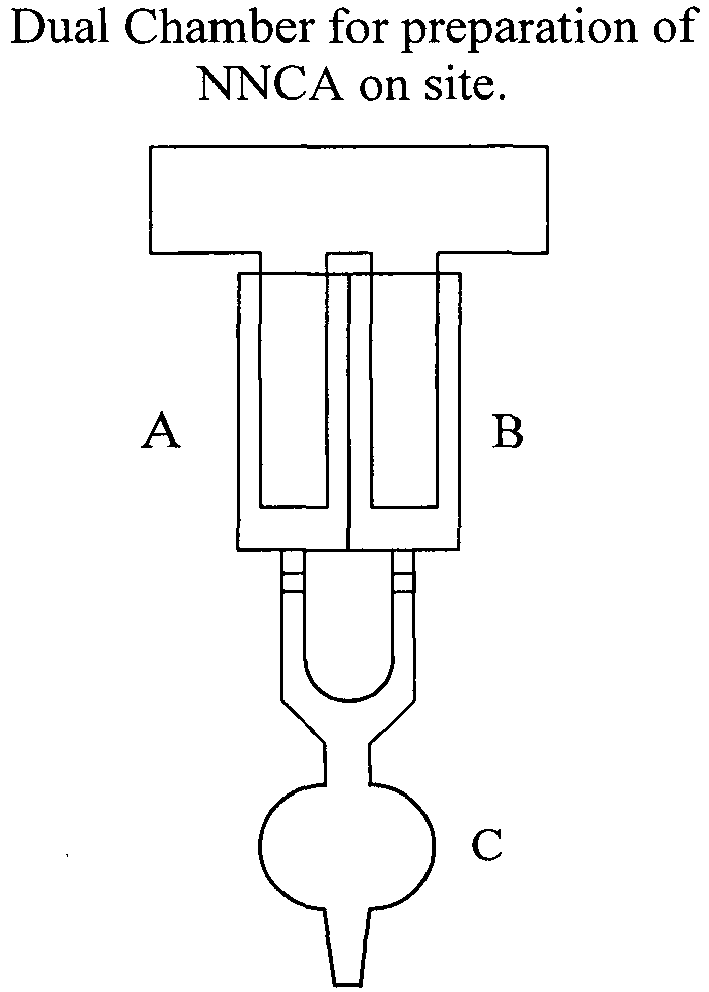
- The Dual-Chamber may consist of two syringes or pouches. To make NNCA (N,N-dichloro amino acid) solution with a concentration of 3.2 mM at pH 3.5, for example, chamber A is filled with 12.8 mM NaOCl solution, chamber B is filled with 3.3 mM of 2-amino-2-methylpropane-1-sulfonic acid dissolved in acidified 1.8 % of saline solution. The acidity of the solution in chamber B is adjusted with 1 M HCl so that when the solutions in two chambers are mixed either in a common delivery tube or in a mixing chamber C, the reaction will give desired NNCA concentration and pH value. Since 2-amino-2-methylpropane-1-sulfonic acid is stable in acidic solution, and NaOCl is stable at room temperature, the use of the on-site preparation method described above can avoid any stability problem with NNCA solutions. In other applications of the above process, the corresponding sodium sulfonate slat may be used to prepare the solution instead of the sulfonic acid as described above.
- In another aspect of the invention, there is provided a composition having a concentration of the N-halo- or N,N-dihaloamino compound or its derivative between about 0.001 mM to about 4 M (molar), 0.05 mM to about 2 M, about 0.01 mM to about 1 M, about 1 M to about 2 M, about 2 M to about 3 M, about 3 M to about 4 M, about 0.1 mM to about 0.1 M or about 0.1 to about 50 mM. The pH range of the solution may be between about 1 to about 13, about 7 to about 9, about 9 to about 12, about 12 to about 13, about 2 to about 8, about 3 to about 4.8, about 3 to about 4.5, about 3.5 to about 4.5, or at about 3.5, or at about 2. The pH can be easily adjusted by various buffer systems known in the art.
- In yet another aspect, there is provided a stabilized composition with bactericidal, antibacterial, anti-infective, antimicrobial, sporicidal, disinfectant, antifungal and antiviral activity comprising an N-halo- or N,N-dihalo-amino compound of the formulae I - V or the derivatives thereof; the composition having a concentration of the N-haloamino compound or N,N-dihaloamino compound or its derivative between about 0.1 to about 50 mM and a pH range between about 1 to about 13. In certain application, the composition has a pH range of about 2.0 to about 7.0, about 3.0 to about 6.0, about 3.0 to about 4.8, about 3.0 to about 4.5, or about 3.5 to about 4.5, or at about 3.5. In one variation, the composition having a concentration of the N-haloamino compound or N,N-dihaloamino compound or its derivative is between about 0.01 mM to about 1 M.
- In one aspect of the above, the composition is in a receptacle ensuring its long-term stability required by its bactericidal, antibacterial, anti-infective, antimicrobial, sporicidal, disinfectant, antifungal or antiviral use. That is, the compositions disclosed herein may be stored in a receptacle ensuring its long-term stability and shelf life sufficient for its application as a bactericidal, antibacterial, anti-infective, antimicrobial, sporicidal, disinfectant, antifungal or antiviral agent.
- In one variation, the concentration of the N-haloamino compound or the N,N-dihaloamino compound or its derivative between about 0.1 to about 100 mM, preferably about 0.3 to about 50 mM. In another aspect, the composition is in stabilized form. In yet another aspect, the composition is stored in a receptacle ensuring its long-term stability required by its bactericidal, antibacterial, anti-infective, antimicrobial, sporicidal, disinfectant, antifungal or antiviral use.
- In one variation, there is provided a method of preventing or treating an infection caused by a bacterial, a microbial, a sporal, a fungal or a viral activity in a mammal, the method comprising the administration of a bactericidal, antibacterial, anti-infective, antimicrobial, sporicidal, disinfectant, antifungal and antiviral amount of an N,N-dihaloamino compound of the formulae I - V. In another aspect, the composition has a therapeutic index of about 20 to about 5,000.
- In yet another aspect of the present invention, there is provided a method for controlling or preventing the growth of bacteria, microbes, spores, fungi or viruses or the proliferation of infections and the source of infections, the method comprising the application of an effective amount of a composition of the present invention to an area, space or material requiring the control or prevention of growth or proliferation. In one variation, the pH of the composition is between about 2 to about 7, about 3.0 to about 6.8, about 3 to about 6, about 3 to about 5, or about 3.5.
- In one aspect of the above methods, the N,N-dihalo amino compound or derivative thereof is prepared in situ. In one variation of the above methods, the material to be treated is selected from the class consisting of food, animal feed, surgical instruments, surgical equipment, medical devices and equipment used for such purposes.
- In one variation, the composition has a concentration of the specific N-halo- or N,N-dihaloamino compound or its derivative between about 0.01 mM to about 1 M, about 0.1 and about 100 mM, or about 0.3 to about 50 mM and a pH range between about 3 to about 4.8, about 3.0 to about 4.5, or about 3.5 to about 4.5, or at about 3.5.
- In another aspect, the composition is in stabilized form, the composition having a concentration of the specific N-halo- or N,N-dihaloamino compound or its derivative between 0.1 and 100 mM or 0.1 to 50 mM and a pH range between about 2 to about 7, 3 to 6, 3 to 4.8, 3 to 4.5, or 3.5 to 4.5, or at about 3.5. The pH may be adjusted using suitable buffer systems well-known to a person skilled in the art. In one variation the composition being in a receptacle ensuring its long-term stability required by its bactericidal, antibacterial, anti-infective, antimicrobial, sporicidal, disinfectant, antifungal or antiviral use.
- In one aspect of the present invention, there is provided the use of an N-halo- or N,N-dihalo-amino compound of the present invention in the preparation of a bactericidal, antibacterial, anti-infective, antimicrobial, sporicidal, disinfectant, antifungal and antiviral activity composition. In another aspect, there is provided a composition as described above, further comprising a halogenated compound selected from the group consisting of a hypohalous acid or a salt thereof. In one variation of the above, the composition is acidic.
- In a particular variation of the method described above, the method further comprising the use of a halogenated compound selected from the group consisting of a hypohalous acid or a salt thereof. In one variation of the above method, the administered composition is acidic.
- Various methods may be developed for preparing the compounds of the present invention. Representative methods for preparing these compounds are provided in the Examples. However, the compounds of the present invention may also be synthesized by other synthetic routes as is well known in the art of synthetic chemistry. Some of the present compounds have chiral centers. The preparation of the compounds of the present invention may result in the formation of mixtures of different stereoisomers (enantiomers, diastereomers). Unless a particular stereochemistry is specified, recitation of a compound is intended to encompass all of the different possible stereoisomers. The compounds of the present invention can also be prepared as a pharmaceutically acceptable acid addition salt by reacting the free base form of the compound with a pharmaceutically acceptable inorganic or organic acid. The base addition salts may also be prepared by reacting the acid with a pharmaceutically acceptable inorganic or organic base.
- The starting materials and reagents used in preparing the compounds described herein are either available from commercial suppliers such as Aldrich-Sigma Chemical Co. (Milwaukee, Wisconsin, USA), Bachem (Torrance, California, USA), Torento Research Chemicals (North York, ON, Canada), Anaspec (San Jose, California, USA), Chem-Impex International (Wood Dale, Illinois, USA), Spectrum (Gardena, California, USA), PharmaCore (High Point, North Carolina, USA) or are prepared by methods known to those skilled in the art following procedures set forth in references such as Fieser and Fieser's Reagents for Organic Synthesis, Volumes 1-5 and Supplementals (Elsevier Science Publishers, 1989), Organic Reactions, Volumes 1-40 (John Wiley and Sons, 1991), March's Advanced Organic Chemistry, (John Wiley and Sons, 4th Edition), and Larock's Comprehensive Organic Transformations (VCH Publishers Inc., 1989).
-

- a) Methyl 2-(t-butylcarboxyamino)-2-methyl-3-phenyl-1-propionate. N-t-butyl-

- b) 2-(t-Butylcarboxyamino)-2-methyl-3-phenylpropan-1-ol. A solution of

- c) 2-(t-Butylcarboxyamino)-2-methyl-3-phenyl-1-propanylmethanesulfonate.

- d) 2-Amino-2-methyl-3-phenylpropane-1-sulfonic acid. 2-(t-Butylcarboxy-

- e) 3-(4-Chlorophenyl)-2-(dichloroamino)-2-methylpropane-1-sulfonic acid.

- f) Sodium salt. 1H NMR (CD3OD, 400 MHz): δ 1.45 (br s, 3H), 3.25 (d, J = 16 Hz, 1H), 3.48 (d, J = 12 Hz, 1H), 3.65 (d, J = 12 Hz, 1H), 4.17 (d, J = 16 Hz, 1H), 7.20-7.26 (m, 2H), 7.35-7.37 (m, 1H), 7.52-7.54 (s, 1H). ES-MS (-ve) for C10H12Cl3NO3S (332.96); found: 330.1, 332.1, 334.1.
-

- a) t-Butyl-1-(allyloxy)-2-methylpropan-2-ylcarbamate. t-Butyl-1-hydroxy-2-

- b) t-Butyl 1-(3-hydroxypropoxy)-2-methylpropan-2-ylcarbamate. t-Butyl-1-

- c) 3-(2-(t-Butoxycarbonylamino)-2-methylpropoxy)propylmethanesulfonate.
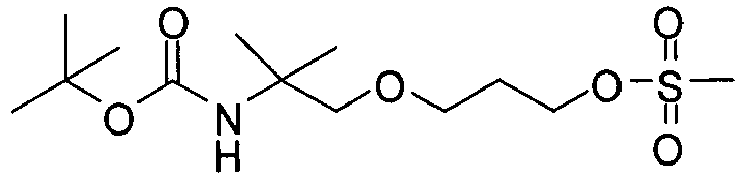
- d) 3-(2-Amino-2-methylpropoxy)propane-1-sulfonic acid. 3-(2-(t-

- e) 3-(2-(Dichloroamino)-2-methylpropoxy)propane-1-sulfonic acid.

-

- a) 3-(Acetylthio)propanoic acid. Following the method of A.-H. Li et al. (J.

- b) 2-(t-Butoxycarbonylamino)-2-methylpropyl 3-(acetylthio)propanoate. To a

- c) 3-(2-Amino-2-methylpropoxy)-3-oxopropane-1-sulfonic acid. According to

- d) 3-(2-(Dichloroamino)-2-methylpropoxy)-3-oxopropane-1-sulfonic acid.

-

- a) S-3-(2-(t-Butoxycarbonylamino)-2-methylpropylamino)-3-oxopropyl ethanethioate. A solution of 3-(acetylthio)propanoic acid (2 g, 13.5 mmol) in THF (50 mL)

- b) 3-(2-Amino-2-methylpropylamino)-3-oxopropane-1-sulfonic acid. Prepared

- c) 3-(2-(Dichloroamino)-2-methylpropylamino)-3-oxopropane-1-sulfonic acid.

-

- a) Benzyl-2-methyl-1-(methylamino)propan-2-ylcarbamate. Di-t-butyldicarbonate

- b) S-3-((2-(Benzyloxycarbonylamino)-2-methylpropyl)(methyl)amino)-3-oxopropyl ethanethioate. To a solution of 3-(acetylthio)propanoic acid (1.88 g, 12.7 mmol) in THF,

- c) 3-((2-(Benzyloxycarbonylamino)-2-methylpropyl)(methyl)amino)-3-oxopropane-1-sulfonic acid. Prepared analogously to Example 3, step (c), from S-3-
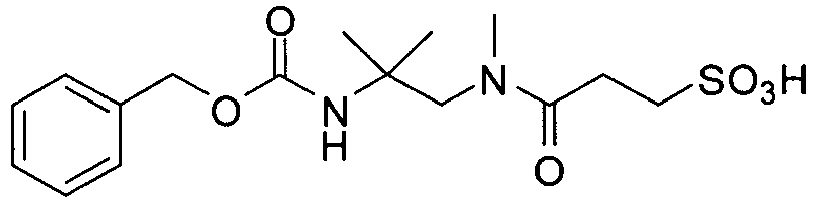
- d) 3-((2-(Dichloroamino)-2-methylpropyl)(methyl)amino)-3-oxopropane-1-

-

- a) 2-(Benzyloxycarbonylamino)-2-methylpropyl 3-chloro-2,2-dimethylpropanoate.

- b) 2-(Benzyloxycarbonylamino)-2-methylpropyl 3-(acetylthio)-2,2-

- c) 3-(2-(Benzyloxycarbonylamino)-2-methylpropoxy)-2,2-dimethyl-3-

- d) 3-(2-Amino-2-methylpropoxy)-2,2-dimethyl-3-oxopropane-1-sulfonic acid.

- e) 3-(2-(Dichloroamino)-2-methylpropoxy)-2,2-dimethyl-3-oxopropane-1-

-

- a) 3-Azido-3-methylbutanoic acid. According to the method of S. Nagarajan et al.

- b) 1-Carboxy-2-methylpropan-2-ammonium formate. To an ice cold solution of

- c) 3-(Benzyloxycarbonylamino)-3-methylbutanoic acid.

- d) 2-(Acetylthio)ethyl 3-(benzyloxycarbonylamino)-3-methylbutanoate.

- e) 2-(3-(Benzyloxycarbonylamino)-3-methylbutanoyloxy)ethanesulfonic acid.

- f) 2-(3-Amino-3-methylbutanoyloxy) ethanesulfonic acid. 2-(3-(Benzyloxycarbonyl-

- g) 2-(3-(Dichloroamino)-3-methylbutanoyloxy) ethanesulfonic acid. 2-(3-

-

- a) S-2-(Benzyloxycarbonylamino)-2-methylpropyl ethanethioate. According to

- b) Benzyl 1-mercapto-2-methylpropan-2-ylcarbamate. S-2-(Benzyloxy-

- c) Benzyl 1-(2-chloroethylthio)-2-methylpropan-2-ylcarbamate. The crude

- d) S-2-(2-(Benzyloxycarbonylamino)-2-methylpropylthio) ethyl ethanethioate.

- e) 2-(2-(Benzyloxycarbonylamino)-2-methylpropylsulfonyl) ethanesulfonic

- f) 2-(2-Amino-2-methylpropylsulfonyl)ethanesulfonic acid. 2-(2-(Benzyloxy-

- g) 2-(2-(Dichloroamino)-2-methylpropylsulfonyl) ethanesulfonic acid. 2-(2-

-

- a) Sodium 2-amino-2-methylpropane-1-sulfonate. This compound was

- b) Sodium 2-(benzyloxycarbonylamino)-2-methylpropane-1-sulfonate.

- c) Benzyl 1-(N,N-dimethylsulfamoyl)-2-methylpropan-2-ylcarbamate. Sodium

- d) 2-Amino-N,N-2-trimethylpropane-1-sulfonamide. Benzyl 1-(N,N-dimethyl-

- e) 2-(Dichloroamino)-N,N-2-trimethylpropane-1-sulfonamide. 2-Amino-N,N-

-

- a) Benzyl 2-methyl-1-(N-methylsulfamoyl)propan-2-ylcarbamate. Benzyl 2-

- b) 2-Amino-N-2-dimethylpropane-1-sulfonamide. 2-Amino-N-2-
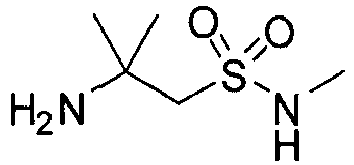
- c) 2-(Dichloroamino)-N,2-dimethylpropane-1-sulfonamide. 2-(Dichloro-

-
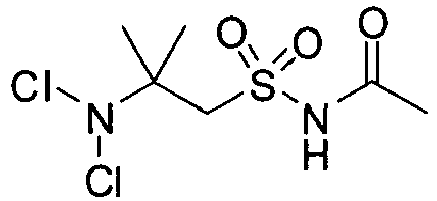
- a) S-2-(Benzyloxycarbonylamino)-2-methylpropyl ethanethioate. Obtained as

- b) Benzyl 1-(chlorosulfonyl)-2-methylpropan-2-ylcarbamate. S-2-(Benzyloxy-

- c) Benzyl 2-methyl-1-sulfamoylpropan-2-ylcarbamate. The crude benzyl

- d) Benzyl 1-(N-acetylsulfamoyl)-2-methylpropan-2-ylcarbamate. Benzyl 2-

- e) N-(2-Amino-2-methylpropylsulfonyl)acetamide. Benzyl 1-(N-acetylsulfamoyl)-

- f) N-(2-(Dichloroamino)-2-methylpropylsulfonyl)acetamide. N-(2-amino-2-
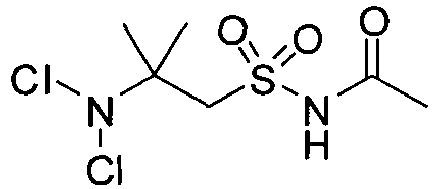
-

- a) Methyl-1-(t-butoxycarbonylamino)cycloheptanecarboxylate. To a solution

- b) t-Butyl-1-(hydroxymethyl)cycloheptylcarbamate. A solution of methyl

- c) (1-(t-Butoxycarbonylamino)cycloheptyl)methyl methanesulfonate.

- d) (1-Aminocycloheptyl)methanesulfonic acid. (t-Butoxycarbonyl-

- e) (1-(Dichloroamino)cycloheptyl)methanesulfonic acid. Commercial bleach

-

- a) 2-Amino-2-methylcyclohexane-1-sulfonic acid. Prepared according to the

- b) 2-(Dichloroamino)-2-methylcyclohexane-1-sulfonic acid. Prepared

-

- a) Methyl 1-acetyl-4-(t-butoxycarbonylamino)piperidine-4-carboxylate. Methyl 1-acetyl-4-(t-butoxycarbonylamino)piperidine-4-carboxylate was synthesized from methyl

- b) t-Butyl 1-acetyl-4-(hydroxymethyl)piperidin-4-ylcarbamate. t-Butyl 1-acetyl-4-(hydroxymethyl)piperidin-4-ylcarbamate was synthesized from methyl 1-acetyl-4-

- c) S-(1-Acetyl-4-(t-butoxycarbonylamino)piperidin-4-yl)methyl ethanethioate. S-(1-Acetyl-4-(t-butoxycarbonylamino)piperidin-4-yl)methyl ethanethioate was synthesized from
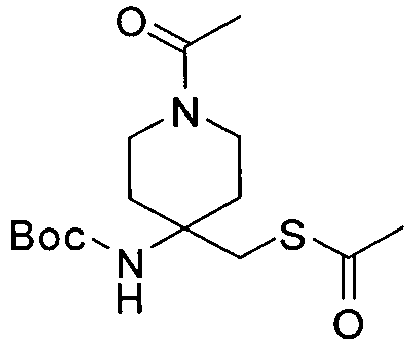
- d) (1-Acetyl-4-aminopiperidin-4-yl)methanesulfonic acid hydrochloride. S-(1-Acetyl-4-(t-butoxycarbonylamino)piperidin-4-yl)methyl ethanethioate dissolved into acetic acid (32
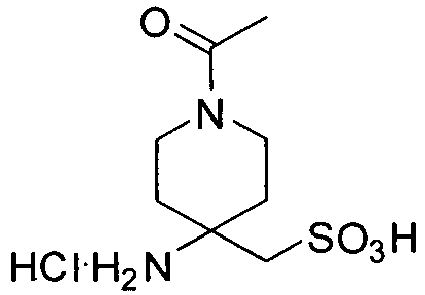
- e) 2-(Dichloroamino)-N,2-dimethylpropane-1-sulfonamide. (1-acetyl-4-
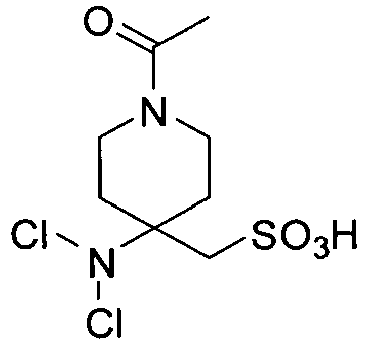
- In a manner similar to the procedures of Examples 1 through 14 or by analogous procedures known in the art, the following compounds are prepared:
- 2-((dichloroamino)-2-trifluoromethyl-3,3,3-trifluoropropane-1-sulfonic acid
- 2-((chloro(methyl)amino)-2-methylpropane-1-sulfonic acid (comparative)
- 2-((chloro(methyl)amino)-1,1,2-trimethylpropane-1-sulfonic acid (comparative)
- 3-((dichloroamino)-2,2,3-trimethylbutane-1-sulfonic acid
- 3-((chloro(methyl)amino)-3-methylbutane-1-sulfonic acid (comparative)
- 2-((dichloroamino)-2-trifluoromethylpropane-1-sulfonic acid
- 4-((dichloroamino)-4-methylpentane-1-sulfonic acid
- (4-((dichloroamino)-1-methylpiperidin-4-yl)methanesulfonic acid
- (4-((dichloroamino)tetrahydro-2H-pyran-4-yl)methanesulfonic acid
- 2-((2-(dichloroamino)-2-methylpropylthio)ethanesulfonic acid
- 2-((2-(dichloroamino)-2-methylpropylsulfonyl)ethanesulfonic acid
- 2-((2-(dichloroamino)-2-methylpropoxy)ethanesulfonic acid.
- The amino acid or a salt of the amino acid (powder) is added into a basic OCl- solution (pH >8) or an OCl- solution in a phosphate buffer, typically at pH 8, at a 1:1 molar ratio of OCl- : amino acid. The mixture solution is stirred for about 15 minutes. The product is identified and the completion of the reaction is followed by an UV-vis spectrophotometer or by LCMS. The pH of the solution is adjusted with dilute hydrochloric acid or sodium hydroxide solution to the desired pH value. However, the final pH should not be lower than 7.5 due to the disproportionation reaction of monohalo-compounds. The concentration of the solution is determined on UV spectrophotometer by using the corresponding molar absorptivity at the λmax near 250 nm.
- The amino acid or a salt of the amino acid (powder) is added into an acidic HOCl solution (pH ~5) at a 2:1 molar ratio of HOCl: amino acid. The mixture is stirred for about 60 minutes. The product is identified and the completion of the reaction is followed by an UV-vis spectrophotometer or by LCMS. The pH of the solution is adjusted with dilute hydrochloric acid or sodium hydroxide solution to the desired pH value. The concentration of the solution is determined on UV spectrophotometer by using the corresponding molar absorptivity at the λmax near 304 nm.
- The amino acid or a salt of the amino acid is added to a vigorously stirred solution of Br2 in 0.1 M NaOH at a 1:1 molar ratio of bromine:amino acid. The mixture is stirred for about 60 minutes, and the product identified followed by a UV-vis spectrophotometer or by LCMS. The product is purified by RP-HPLC and the concentration of a solution is determined on the UV spectrophotometer by using the corresponding molar absorptivity at the λmax near 280 nm.
- Following the procedure of Chinake et al. (Chinake, C.R.; Simoyi, R.H. J. Phys. Chem. B 1998, 102, 10490-10497), the amino acid or a salt of the amino acid (powder) is added into an acidic HBr solution (pH 0) and sodium bromate is added at a 100:1 molar ratio of BrO3 -:amine. The mixture is stirred for about 10 minutes, and the product identified followed by a UV-vis spectrophotometer or by LCMS. The product is purified by RP-HPLC and the concentration of a solution is determined on the UV spectrophotometer by using the corresponding molar absorptivity at the λmax near 340 nm.
- The sodium salt of the aminosulfonate anion is dissolved in an organic solvent (methanol or ethanol preferred) and t-butylhypochlorite is added in a 1:1 molar ratio. The mixture is stirred for about 1 hour with the progress of the reaction followed by LCMS chromatography. The solution is evaporated and the residue purified by reverse-phase (C8 or C18) HPLC chromatography.
- The aminosulfonate (zwitterion) or the sodium salt of the aminosulfonate anion is dissolved in an organic solvent (methanol or ethanol preferred) and t-butylhypochlorite is added in a 2:1 molar ratio. The mixture is stirred for about 1 h with the progress of the reaction followed by LCMS chromatography. The solution is evaporated and the residue purified by reverse-phase (C18) HPLC chromatography.
- To determine antimicrobial activity, we use Escherichia coli (ATCC 25922), Staphylococcus aureus (ATCC 29213), Pseudomonas aeruginosa (ATCC 27853), and Candida albicans (ATCC 10231) in primary screening. In addition, we use Staphylococcus aureus (MCC 91731), Pseudomonas aeruginosa (MCC 4438), and Candida albicans (MCC 50319), provided by Alcon Laboratories, Fort Worth, TX. The microbial cultures are diluted in sterile saline pH 4 to prepare inocula. Test compounds are titrated by stepwise two-fold dilutions in sterile saline pH 4, 1.0 x 10⁵ to 1.0 x 10⁶ Colony Forming Units (CFU)/mL bacteriamicrobe is added to each tube, mixed by gentle vortexing, and then incubated at room temperature for 1 h. Bacterial plating on Petri dishes (Tryptic Soy agar or Saboraud's Dextrose agar) is performed immediately after the designated exposure after neutralization of the test article dilutions in Dey-Engley Broth. Plates are incubated at 37 °C, and the numbers of bacteria are counted by direct colony count to quantitate the surviving bacteria as CFU/mL. Positive growth controls are made with sterile 0.9% saline. All compounds are tested three times. The results are tabulated to show the comparison of antimicrobial effectiveness range of the compounds.
a) At pH 4.0, 3-(4-chlorophenyl)-2-(dichloroamino)-2-methylpropane-1-sulfonic acid (Cmpd 570) shows an effective antimicrobial activity at 60 min in the µM concentration range (Table 1).Table 1 Minimum Bactericidal Concentration [MBC] [≥ 99.9% Bacterial Kill] Microorganism Mm µg/mL E.coli [ATCC 25922] 0.19 0.65 P. aeruginosa [ATCC 27853] 3.9 1.3 S. aureus [ATCC 29213] 15.6 5.2
b) Table 2 shows data obtained according to the method described above for additional compounds. Data shown are the Minimum Biocidal Concentration (MBC) (≥ 99.9% kill) in µg/mL.Table 2 Cmpd E. coli 25922 S. aureus 29213 C. albicans 10231 P. aeruginosa 27853 pH 4 (Sal) pH 7 (PBS) pH 4 (Sal) pH 7 (PBS) pH 4 (Sal) pH 7 (PBS) pH 4 (Sal) pH 7 (PBS) 601 0.25* 0.5# 6111 1* 64* 0.5+ 64+ 1# 32# 614 1* 128* 4+ 512+ 4# 256# 625 4 8 16 626 4 0.5 8 627 2 1 64 628 2 2 64 630 4 8 64 637 16 4 128 * S. aureus MCC 91731
# P. aeruginosa MCC 4438
+ C. albicans MCC 50319
1 Comparative - Cytotoxicity is assessed by a colorimetric assay system using the Dojindo™ cell counting kit containing 2-(2-methoxy-4-nitrophenyl)-3-(4-nitrophenyl)-5-(2,4-disulfophenyl)-2H-tetrazolium, monosodium salt (WST-8). In this assay, the WST-8 reagent is bioreduced by cellular dehydrogenases to a formazan product that is highly soluble in tissue culture medium. The orange formazan, which is produced only by live cells, is a direct measure of cell viability and can be read spectrophotometrically (for example, evaluation of a soluble tetrazolium/formazan assay for cell growth and drug sensitivity in culture using human and other tumor cell lines is described by Scudiero DA, Shoemaker RAH, Paul KD, Monks A, Tierney S, Nofziger TH, Currens MJ, Seniff D, Boyd MR. Cancer Res. 1988 Sep 1; 48(17):4827-33). Similar approaches for determining the cell viability are known in the art.
- In a standard assay, mouse fibroblast cells (ATCC CCL-1, L929), are cultured in Minimum Essential Medium, α-medium supplemented with 10% heat inactivated fetal bovine serum, L-glutamine, penicillin and streptomycin. Cells are trypsinized and counted under the microscope and seeded at 1.5 X 10⁴ total cells per 100 µL per well of a flat-bottom 96-well plate in order to achieve ∼80% confluence after overnight incubation at 37 °C. On the day of the assay, the tissue culture medium is removed and replaced with 30 µL of fresh medium.
- Test articles are prepared as 2-fold serial dilutions and 170 µL of each dilution is added into each of 4-wells (total volume per well = 200 µL). The test plate is then returned to the 37 °C incubator for 60 min. Immediately after the exposed time, test article from each well is replaced with 200 µL of fresh media. Plates are incubated at 37 °C for 18-20 hours. The following day growth medium is replaced with 100 µL/well of fresh medium containing 10/100 µL WST-8 reagent. Cells are incubated under growth conditions (5% CO2 at 37 °C humidified incubator), protected from light, until color development is achieved (usually 1- 4 hours). Absorbance is read at 450 nm with reference wavelength at 750 nm using Molecular Device SpectraMax M5 plate reader. Untreated or vehicle only treated cells receiving WST-8 reagent serve as positive cell proliferation controls.
a) When cell inhibitory concentration toxicity index (IC50) was determined (measured as the chemical concentration resulting in 50% inhibition of growth), the IC50 of 3-(4-chlorophenyl)-2-(dichloroamino)-2-methylpropane-1-sulfonic acid was at 0.2 mM.
b) Table 3 shows data (CT50, in mM) obtained according to the method described above for additional compounds. The CT50 value for each compound was calculated from the absorbance values (A450-750) and is defined as the concentration of test article that results in survival of 50% of the cells following treatment. The absorbance A450-750 from each well of untreated cells and from each well within the dilution series was measured. To calculate the CT50 for each compound, all compound concentrations were first log-transformed using GraphPad Prism4 (ver 4.03) software. Next, a non-linear regression (curve fit) analysis was performed on all the absorbance data measured from the dilution series, including the absorbance data obtained from wells of the untreated control cells. For each dilution within the dilution series, an average A450-750 was calculated from the four replicate wells. The average A450-750 data were plotted on a y-axis against the log-transformed compound concentration on the x-axis, and the CT50 value calculated from the resulting best-fit curve.Table 3 Cmpd L929 cells pH 4 (Sal) pH 7 (PBS) 6111 0.25 4.6 614 0.43 4.6 625 2.6 ND ND = not done
1 Comparative - The results of our discovery provide support for antimicrobial activity of 3-(4-chlorophenyl)-2-(dichloroamino)-2-methylpropane-1-sulfonic acid in 0.9% saline at pH 3.5. These antimicrobial activities are determined to be considerable in a µM range and increased significantly by increasing the concentration and or exposure time. In contrast, cell toxicity is seen at a 1000-fold higher range in the mM range. 3-(4-Chlorophenyl)-2-(dichloroamino)-2-methylpropane-1-sulfonic acid treated cells are able to tolerate the treatment and be able to go through normal cell proliferation cycles as compared to untreated control cells in our XTT assay.
- 3-(4-Chlorophenyl)-2-(dichloroamino)-2-methylpropane-1-sulfonic acid sodium salt solutions with a concentration of 10.3 mM at pH 4 is prepared in 0.9% saline. The spectra and the concentrations of the solutions are measured on the UV-vis spectrometer.
- Solutions with varying pH values can be prepared in a similar manner within the pH range of 2 to 8. If properly stored the stability of all solutions may be monitored by their UV spectra.
- Synergistic antiviral effect of an isotonic solution of a 1:1 combination of hypochlorous acid and 3-(4-chlorophenyl)-2-(dichloroamino)-2-methylpropane-1-sulfonic acid sodium salt is observed when an equal volume of human adenovirus type 5 (Ad5, McEwen strain) containing solution is mixed with it. The mixture is then incubated at 37 °C for 1 hr and then diluted in tissue culture medium (Dulbecco's Modified Eagle Medium [DMEM] containing heat inactivated 2% fetal bovine serum). The resulting mixtures are then diluted in 10-fold serial dilutions using the same diluent mentioned above. Each diluted mixture (0.1 mL) is inoculated on to a A549 cell monolayer grown in 12 well plates (cell source, ATTC) and allowed to adsorb for 1 h. The inoculum is removed and the monolayer rinsed with diluent and agarose/DMEM overlay applied. The plates are incubated at 37 °C in 5% CO2 atmosphere for 6 days. The monolayers are then fixed, stained and the plaques counted.
- Similar antiviral affects are observed with an isotonic solution of a 1:1 combination of hypochlorous acid and a compound of formula I. It is observed that the antiviral effect of certain combinations of hypochlorous acid and a compound covered in formula I is more than additive.
-
- 1mM 3-(4-chlorophenyl)-2-(dichloroamino)-2-methylpropane-1-sulfonic acid salt
- 0.9% NaCl
- 4mM 3-(4-chlorophenyl)-2-(dichloroamino)-2-methylpropane-1-sulfonic acid salt
- 0.9% NaCl
- 12mM 3-(4-chlorophenyl)-2-(dichloroamino)-2-methylpropane-1-sulfonic acid salt
- 0.9% NaCl
- 2mM HOCl
- 1mM 3-(4-chlorophenyl)-2-(dichloroamino)-2-methylpropane-1-sulfonic acid salt
- 0.9% NaCl
- 2mM HOCl
- 4mM 3-(4-chlorophenyl)-2-(dichloroamino)-2-methylpropane-1-sulfonic acid salt
- 0.9% NaCl
- 2mM HOCl
- 12mM 3-(4-chlorophenyl)-2-(dichloroamino)-2-methylpropane-1-sulfonic acid salt
- 0.9% NaCl
Claims (15)
- A compound comprising the formula I:
 X1 is chloro or bromo;X2 is hydrogen or is selected from the group consisting of chloro, and bromo;R1 and R2 are each independently selected from the group consisting of (C1-5)alkyl, halo(C1-5)alkyl, (C3-12)cycloalkyl, (C3-6)cycloalkyl(C1-3)alkyl, (C6-10)aryl(C1-4)alkyl, (C6-14)aryl and heterocycloalkyl containing 2-10 carbon atoms and 1 to 4 heteroatoms selected from N, O or S, or R1 and R2 together with the carbon atom to which they are attached to form a (C3-12)carbocyclic or (C3-12)heterocyclyl with at least one heteroatom selected from N, O, or S in the ring;R0 and R00 are each independently hydrogen, fluoro or the same as R1 and R2;Y is a member selected from a single bond, -O-, and a divalent (C1-18)alkylenyl group in which optionally one or two methylene groups are replaced with a mono- or disubstituted methylene group, or optionally where one or two methylene groups are replaced with 1 or 2 -NR'-, -O-, -S-, -S(=O)-, >C=O, -C(=O)O-, -OC(=O)-, - C(=O)NH-, -NHC(=O)-, -C(=O)NR'-, -NR'C(=O)-, -S(=O)2-, -S(=O)2NR'-, - S(=O)2NH-, -NR'S(=O)2-, or NHS(=O)2-, where R' is hydrogen or is selected from the group consisting of Cl, Br, (C1-5)alkyl, (C3-6)cycloalkyl, (C6-10)aryl, (C6-10)aryl(C1-4)alkyl, (C1-5)alkylNHC(=O)-, (C1-5)alkoxyC(=O)-, RaRbNC(=O)-, (C1-5)alkylC(=O)-, (C6-10)arylC(=O)-, (C6-10)aryl(C1-4)alkylC(=O)-, (C6-14)aryl, heteroaryl comprising 4 to 10 ring atoms with at least one heteroatom selected from O, S and N in the ring, and heterocycloalkyl containing 2-10 carbon atoms and 1 to 4 heteroatoms selected from N, O or S, wherein Ra and Rb are each independently hydrogen, (C1-5)alkyl, (C3-6)cycloalkyl, (C1-5)alkylNHC(=O)-, (C1-5)alkylC(=O)-, (C6-14)aryl, (C6-10)aryl(C1-4)alkyl, heteroaryl comprising 4 to 10 ring atoms with at least one heteroatom selected from O, S and N in the ring, or heterocyclyl(C1-4) alkyl, the heterocycloalkyl group containing 2-10 carbon atoms and 1 to 4 heteroatoms selected from N, O or S;wherein when R1 is (C1-5)alkyl or R1 and R2 together with the carbon atom to which they attach form a (C3-6)cycloalkyl, then Y must be -O- or a divalent (C1-18)alkylenyl group wherein one or two methylene groups are replaced with a substituted methylene group or by -NR'-, -O-, -S-, -S(=O)- or -S(=O)2-, where R' is hydrogen or is selected from the group consisting of Cl, Br, (C1-5)alkyl, (C3-6)cycloalkyl, (C6-10)aryl, (C6-10)aryl(C1-4)alkyl, (C1-5)alkylNHC(=O)-, (C1-5)alkoxyC(=O)-, RaRbNC(=O)-, (C1-5)alkylC(=O)-, (C6-10)arylC(=O)-, (C6-10)aryl(C1-4)alkylC(=O)-, (C6-14)aryl, heteroaryl comprising 4 to 10 ring atoms with at least one heteroatom selected from O, S and N in the ring, and heterocycloalkyl containing 2-10 carbon atoms and 1 to 4 heteroatoms selected from N, O or S, wherein Ra and Rb are each independently hydrogen, (C1-5)alkyl, (C3-6)cycloalkyl, (C1-5)alkylNHC(=O)-, (C1-5)alkylC(=O)-, (C6-14)aryl, (C6-10)aryl(C1-4)alkyl, heteroaryl comprising 4 to 10 ring atoms with at least one heteroatom selected from O, S and N in the ring, or heterocyclyl(C1-4) alkyl, the heterocycloalkyl group containing 2-10 carbon atoms and 1 to 4 heteroatoms selected from N, O or S;Z is selected from the group consisting of -SO3H, -PO3H2, a salt or ester thereof, and an acid isostere thereof but not -C(=O)OH; or is selected from the group consisting of -S(=O)2NRcRd, -S(=O)2NHC(=O)Re, S(=O)2OC(=O)NRcRd, -S(=O)2NRcC(=O)NRcRd and -S(=O)2(N=)C(OH)NRcRd, wherein Rc and Rd are each independently hydrogen or is independently selected from the group consisting of (C1-5)alkyl, (C3-6)cycloalkyl, (C1-5)alkylNHC(=O)-, (C1-5)alkylC(=O)-, (C6-10)arylC(=O)-, (C6-10)aryl(C1-4)C(=O)-, (C6-14)aryl, (C6-10)aryl(C1-4)alkyl, heteroaryl comprising 4 to 10 ring atoms with at least one heteroatom selected from O, S and N in the ring, and heterocyclyl containing 2-10 carbon atoms and 1 to 4 heteroatoms selected from N, O or S, and Re is hydrogen or is selected from the group consisting of (C1-5)alkyl, (C3-6)cycloalkyl, (C6-14)aryl, (C6-10)ary](C1-4)alkyl, heteroaryl comprising 4 to 10 ring atoms with at least one heteroatom selected from O, S and N in the ring, and heterocyclyl containing 2-10 carbon atoms and 1 to 4 heteroatoms selected from N, O or S;or a salt, an amine oxide thereof.
 - A compound comprising the formula II:
 X1 is chloro or bromo;X2 is hydrogen or is selected from the group consisting of chloro, and bromo;R1 and R2 are each independently selected from the group consisting of (C1-5)alkyl, halo(C1-5)alkyl, (C3-12)cycloalkyl, (C3-6)cycloalkyl(C1-3)alkyl, (C6-10)aryl(C1-4)alkyl, (C6-14)aryl and heterocyclyl containing 2-10 carbon atoms and 1 to 4 heteroatoms selected from N, O or S, or R1 and R2 together with the carbon atom to which they are attached to form a (C3-12)carbocyclic or (C3-12)heterocyclic ring with at least one heteroatom selected from N, O, or S in the ring;Y is a member selected from a single bond, -O-, and a divalent (C1-18)alkylenyl group in which optionally one or two methylene groups are replaced with a mono- or disubstituted methylene group, or optionally where_one or two methylene groups are replaced with 1 or 2 -NR'-, -O-, -S-, -S(=O)-, >C=O, -C(=O)O-, -OC(=O)-, - C(=O)NH-, -NHC(=O)-, -C(=O)NR'-, -NR'C(=O)-, -S(=O)2-, -S(=O)2NR'-, - S(=O)2NH-, -NR'S(=O)2-, or -NHS(=O)2-, where R' is hydrogen or is selected from the group consisting of Cl, Br, (C1-5)alkyl, (C3-6)cycloalkyl, (C6-10)aryl, (C6-10)aryl(C1-4)alkyl, (C1-5)alkylNHC(=O)-, (C1-5)alkoxyC(=O)-, RaRbNC(=O)-, (C1-5)alkylC(=O)-, (C6-10)arylC(=O)-, (C6-10)aryl(C1-4)alkylC(=O)-, (C6-14)aryl, heteroaryl comprising 4 to 10 ring atoms with at least one heteroatom selected from O, S and N in the ring, and heterocycloalkyl containing 2-10 carbon atoms and 1 to 4 heteroatoms selected from N, O or S, wherein Ra and Rb are each independently hydrogen, (C1-5)alkyl, (C3-6)cycloalkyl, (C1-5)alkylNHC(=O)-, (C1-5)alkylC(=O)-, (C6-14)aryl, (C6-10)aryl(C1-4)alkyl, heteroaryl comprising 4 to 10 ring atoms with at least one heteroatom selected from O, S and N in the ring, or heterocyclyl(C1-4) alkyl, the heterocycloalkyl group containing 2-10 carbon atoms and 1 to 4 heteroatoms selected from N, O or S;wherein when R1 is (C1-5)alkyl or R1 and R2 together with the carbon atom to which they attach form a (C3-6)cycloalkyl, then Y must be -O- or a divalent (C1-18) alkylenyl group wherein one or two methylene groups are replaced with a substituted methylene group or by -NR'-, -O-, >C=O, -C(=O)O-, -OC(=O)-, -C(=O)NH-, - NHC(=O)-, -C(=O)NR'-, -NR'C(=O)-, -S-, -S(=O)-, -S(=O)2-, -S(=O)2NR'-, - S(=O)2NH-, -NR'S(=O)2-, or NHS(=O)2-, where R' is hydrogen or is selected from the group consisting of Cl, Br, (C1-5)alkyl, (C3-6)cycloalkyl, (C6-10)aryl, (C6-10)aryl(C1-4)alkyl, (C1-5)alkylNHC(=O)-, (C1-5)alkoxyC(=O)-, RaRbNC(=O)-, (C1-5)alkylC(=O)-, (C6-10)arylC(=O)-, (C6-10)aryl(C1-4)alkylC(=O)-, (C6-14)aryl, heteroaryl comprising 4 to 10 ring atoms with at least one heteroatom selected from O, S and N in the ring, and heterocycloalkyl containing 2-10 carbon atoms and 1 to 4 heteroatoms selected from N, O or S, wherein Ra and Rb are each independently hydrogen, (C1-5)alkyl, (C3-6)cycloalkyl, (C1-5)alkylNHC(=O)-, (C1-5)alkylC(=O)-, (C6-14)aryl, (C6-10)aryl(C1-4)alkyl, heteroaryl comprising 4 to 10 ring atoms with at least one heteroatom selected from O, S and N in the ring, or heterocyclyl(C1-4) alkyl, the heterocycloalkyl group containing 2-10 carbon atoms and 1 to 4 heteroatoms selected from N, O or S;Z is selected from the group consisting of -SO3H, -PO3H2, a salt or ester thereof, and an acid isostere thereof but not -C(=O)OH; or is selected from the group consisting of -S(=O)2NRcRd, -S(=O)2NHC(=O)Re, S(=O)2OC(=O)NRcRd, -S(=O)2NRcC(=O)NRcRd and -S(=O)2(N=)C(OH)NRcRd, wherein Rc and Rd are each independently hydrogen or is independently selected from the group consisting of (C1-5)alkyl, (C3-6)cycloalkyl, (C1-5)alkylNHC(=O)-, (C1-5)alkylC(=O)-, (C6-10)arylC(=O)-, (C6-10)aryl(C1-4)C(=O)-, aryl containing 6 to 14 ring atoms, (C6-10)aryl(C1-4)alkyl, heteroaryl comprising 4 to 10 ring atoms with at least one heteroatom selected from O, S and N in the ring, and heterocyclyl containing 2-10 carbon atoms and 1 to 4 heteroatoms selected from N, O or S, and Re is hydrogen or is selected from the group consisting of (C1-5)alkyl, (C3-6)cycloalkyl, (C6-14)aryl, (C6-10)aryl(C1-4)alkyl, heteroaryl comprising 4 to 10 ring atoms with at least one heteroatom selected from O, S and N in the ring, and heterocyclyl containing 2-10 carbon atoms and 1 to 4 heteroatoms selected from N, O or S;or a salt, an amine oxide thereof.
 - The compound of Claim 2, wherein:R1 and R2 together with the carbon atom to which they are attached to form a (C4-7)carbocyclic or (C3-6)heterocyclic ring;or a salt thereof.
- The compound of Claim 2, wherein:X1 and X2 are each independently chloro or bromo, or X1 is chloro or bromo and X2 is hydrogen;R1 and R2 together with the carbon atom to which they are attached to form a (C3-7)heterocyclic ring comprising the heteroatoms selected from the group consisting of N, O and S;Y is a single bond or a divalent (C1-6)alkylenyl group; andZ is -SO3H or-PO3H2;or a salt thereof.
- The compound of Claim 2, wherein:X1 and X2 are both chloro; andZ is -SO3H or -S(=O)2NRcRd, wherein Rc and Rd are each independently hydrogen or is independently selected from the group consisting of (C1-5)alkyl, (C3-6)cycloalkyl, (C1-5)alkylNHC(=O)-, (C1-5)alkylC(=O)-, aryl containing 6 to 14 ring atoms, heteroaryl comprising 4 to 10 ring atoms with at least one heteroatom selected from O, S and N in the ring, and heterocyclyl containing 2-10 carbon atoms and 1 to 4 heteroatoms selected from N, O or S;or a salt thereof.
- The compound of Claim 2 wherein:R1 and R2 independently are (C1-5)alkyl or halo(C1-5)alkyl with 1-5, preferably 1-3 halogen atoms selected from the group of fluoro and chloro;or a salt thereof.
- The compound of Claim 2 wherein
X1 is chloro;
Y is a single bond; or
a salt thereof. - The compound of Claim 2, wherein:X1 and X2 are both chloro;R1 and R2 are each independently halo(C1-2)alkyl, (C3-12)cycloalkyl, (C4-12)aryl,(C6-10)aryl(C1-2)alkyl or (C3-12)heterocyclyl comprising 1-4 heteroatoms selected from the group consisting of O, N or S;Y is a single bond;Z is selected from the group consisting of -SO3H and -S(=O)2NRcRd wherein Rc and Rd are each independently hydrogen or selected from the group consisting of (C1-5)alkyl, (C1-5)alkylNHC(=O)-, (C1-5)alkylC(=O)-, (C3-6)cycloalkyl, aryl containing 6 to 12 ring atoms, (C6-10)aryl(C1-2)alkyl, heteroaryl comprising 4 to 10 ring atoms with at least one heteroatom selected from O, S and N in the ring and heterocycloalkyl containing 2-10 carbon atoms and 1 to 4 heteroatoms selected from N, O or S; ora salt thereof.
- The compound of Claim 2, wherein:X1 and X2 are both chloro; andR1 and R2 together with the carbon atom to which they are attached to form a (C4-7)heterocycloalkyl comprising the group -0-, -S-, -SO-, -SO2- or NR3-, where R3 is (C1-5)alkyl or (C1-5)alkylC(=O)-, (C6-10)arylC(=O)-, (C6-10)aryl(C1-4)alkylC(=O)-;Y is a single bond; andZ is selected from the group consisting of -SO3H and -S(=O)2NRcRd wherein Rc and Rd are each independently hydrogen or selected from the group consisting of (C1-5)alkyl, (C1-5)alkylNHC(=O)-, (C1-5)alkylC(=O)-, (C6-10)arylC(=O)-, (C6-10)aryl(C1-4)alkylC(=O)-, (C3-6)cycloalkyl, (C6-14)aryl, (C6-10)aryl(C1-2)alkyl, heteroaryl comprising 4 to 10 ring atoms with at least one heteroatom selected from O, S and N in the ring and heterocycloalkyl containing 2-10 carbon atoms and 1 to 4 heteroatoms selected from N, O or S; ora salt thereof.
- The compound of Claim 2 wherein:Z is -SO3H; ora salt thereof.
- The compound of Claim 10 wherein:R1 and R2 independently are (C1-5)alkyl, halo(C1-5)alkyl, preferably -CF3; ora salt thereof.
- A compound comprising the formula III:
 m and n are each independently an integer of 0, 1, 2, 3, 4 or 5, and m and n together is 2, 3, 4 or 5;W is selected from the group consisting of -O-, -S-, -S(=O)-, -S(=O)2-, -NR3-, -CR3R3-, >C=CR3R3, -N[C(=O)NHR4]-, -N[S(=O)2R4]-, -N[S(=O)2NHR4]-, -N[C(=O)R5]-, -NR4C(=O)-, >C=O, and -N[C(=O)OR5]-;Y is a member selected from a single bond, -O-, and a divalent (C1-18)alkylenyl group in which optionally one or two methylene groups are replaced with a mono- or disubstituted methylene group, or optionally where one or two methylene groups are replaced with 1 or 2 -NR'-, -O-, -S-, -S(=O)-, >C=O, -C(=O)O-, -OC(=O)-, - C(=O)NH-, -NHC(=O)-, -C(=O)NR'-, -NR'C(=O)-, -S(=O)2-, -S(=O)2NR'-, - S(=O)2NH-, -NR'S(=O)2-, or -NHS(=O)2-, where R' is hydrogen or is selected from the group consisting of Cl, Br, (C1-5)alkyl, (C3-6)cycloalkyl, (C6-10)aryl, (C6-10 )aryl(C1-4)alkyl, (C1-5)alkylNHC(=O)-, (C1-5)alkoxyC(=O)-, RaRbNC(=O)-, (C1-5)alkylC(=O)-, (C6-10)arylC(=O)-, (C6-10)aryl(C1-4)alkylC(=O)-, (C6-14)aryl, heteroaryl comprising 4 to 10 ring atoms with at least one heteroatom selected from O, S and N in the ring, and heterocycloalkyl containing 2-10 carbon atoms and 1 to 4 heteroatoms selected from N, O or S, wherein Ra and Rb are each independently hydrogen, (C1-5)alkyl, (C3-6)cycloalkyl, (C1-5)alkylNHC(=O)-, (C1-5)alkylC(=O)-, (C6-14)aryl, (C6-10)aryl(C1-4)alkyl, heteroaryl comprising 4 to 10 ring atoms with at least one heteroatom selected from O, S and N in the ring, or heterocyclyl(C1-4) alkyl, the heterocycloalkyl group containing 2-10 carbon atoms and 1 to 4 heteroatoms selected from N, O or S;Z is selected from the group consisting of -SO3H, -PO3H2, -S(=O)2NRcRd, -S(=O)2NHC(=O)Re, -S(=O)2NRcC(=O)NRcRd, -S(=O)2OC(=O)NRcRd and -S(=O)2(N=)C(OH)NRcRd, wherein Rc and Rd are each independently hydrogen or are selected from the group consisting of (C1-5)alkyl, (C1-5)alkylNHC(=O)-, (C1-5)alkylC(=O)-, (C3-6)cycloalkyl, aryl containing 6 to 14 ring atoms, (C6-10)aryl(C1-4)alkyl, heteroaryl comprising 4 to 10 ring atoms with at least one heteroatom selected from O, S and N in the ring, and heterocycloalkyl containing 2-10 carbon atoms and 1 to 4 heteroatoms selected from N, O or S, and Re is hydrogen or is selected from the group consisting of (C1-5)alkyl, (C3-6)cycloalkyl, (C6-14)aryl, (C6-10)aryl(C1-4)alkyl, heteroaryl comprising 4 to 10 ring atoms with at least one heteroatom selected from O, S and N in the ring, and heterocyclyl containing 2-10 carbon atoms and 1 to 4 heteroatoms selected from N, O or S;X1 is chloro or bromo;X2 is hydrogen or is selected from the group consisting of chloro, and bromo;R3 is each independently selected from the group consisting of hydrogen, (C1-5)alkyl, (C3-7)cycloalkyl, (C3-6)cycloalkyl-(C1-3)alkyl, (C5-6)carbocyclyl where 1, 2 or 3 carbon ring members are optionally replaced by -NR'-, -O-, -S-, -S(=O)- or -S(=O)2-, where R' is hydrogen or is selected from the group consisting of Cl, Br, (C1-5)alkyl, (C3-6)cycloalkyl, (C6-10)aryl, (C6-10)aryl(C1-4)alkyl, (C1-5)alkylNHC(=O)-, (C1-5)alkoxyC(=O)-, RaRbNC(=O)-, (C1-5)alkylC(=O)-, (C6-10)arylC(=O)-, (C6-10)aryl(C1-4)alkylC(=O)-, (C6-14)aryl, heteroaryl comprising 4 to 10 ring atoms with at least one heteroatom selected from O, S and N in the ring, and heterocycloalkyl containing 2-10 carbon atoms and 1 to 4 heteroatoms selected from N, O or S, wherein Ra and Rb are each independently hydrogen, (C1-5)alkyl, (C3-6)cycloalkyl, (C1-5)alkylNHC(=O)-, (C1-5)alkylC(=O)-, (C6-14)aryl, (C6-10)aryl(C1-4)alkyl, heteroaryl comprising 4 to 10 ring atoms with at least one heteroatom selected from O, S and N in the ring, or heterocyclyl(C1-4) alkyl, the heterocycloalkyl group containing 2-10 carbon atoms and 1 to 4 heteroatoms selected from N, O or S;R4 is selected from the group consisting of (C1-5)alkyl, (C3-7)cycloalkyl, (C3-6)cycloalkyl-(C1-3)alkyl, (C6-12)aryl and (C5-6)carbocycloalkyl where 1, 2 or 3 carbon ring members are replaced by -NR'-, -O-, -S-, -S(=O)- or -S(=O)2-, where R' is hydrogen or is selected from the group consisting of (C1-5)alkyl, (C1-5)alkylNHC(=O)-, (C1-5)alkylC(=O)-, (C3-6)cycloalkyl, heterocycloalkyl containing 2-10 carbon atoms and 1 to 4 heteroatoms selected from N, O or S, (C6-12)aryl, (C6-10)aryl(C1-4)alkyl, (C6-12)heteroaryl, (C1-6)alkylaryl, (C6-12)aryl (C1-6)alkyl, (C1-5)alkylC(=O)-, (C1-5)alkoxyC(=O)- and -S(=O)2NH(C1-5)alkyl;R5 is selected from the group consisting of (C1-5)alkyl, (C1-5)alkoxy, (C3-7)cycloalkyl, (C3-6)cycloalkyl-(C1-3)alkyl, (C6-10)aryl, (C6-10)aryloxy, (C7-12)arylalkyl, (C7-12)alkylaryl and (C7-12)arylalkoxy;or optionally when W is a tertiary amine, or when -NR'- is a tertiary amine, or an amine-oxide thereof;or a salt thereof.
 - The compound of Claim 12, wherein:W is selected from the group consisting of -O-, -S(=O)2-, -NR3-, -CR3R3-, >C=CR3R3, -N[C(=O)NHR4]-, -N[S(=O)2R4]-, -N[S(=O)2NHR4]-, -N[C(=O)R5]- and -N[C(=O)OR5]-;R3, R4 and R5 are as defined above;Y is a single bond or a divalent (C1-5)alkylenyl group; andZ is -SO3H or -PO3H2;or a salt thereof.
- The compound of Claim 2 that is:2-((dichloroamino)-2-trifluoromethyl-3,3,3-trifluoropropane-1-sulfonic acid;2-((dichloroamino)-2-methyl-1,1-di-trifluoromethylpropane-1-sulfonic acid;2-((dibromoamino)-2-methylpropane-1-sulfonic acid;2-((dibromoamino)-1,1,2-trimethylpropane-1-sulfonic acid;3-((dichloroamino)-2,2,3-trimethylbutane-1-sulfonic acid;2-((dichloroamino)-2-trifluoromethylpropane-1-sulfonic acid;4-((dichloroamino)-3,3,4-trimethylpentane-1-sulfonic acid;2-((dichloroamino)-1,2-di-methyl-1-ethylpropane-1-sulfonic acid;5-((dibromoamino)-5-methyl-1-methylhexylphosphonic acid;diethyl 2-(dichloroamino)-2-methylpropylphosphonate;2-((dichloroamino)-2-cyclopropyl-1 -methylpropylphosphonic acid;2-((dichloroamino)- propylphosphonic acid;3-((dichloroamino)-3-methylbutylphosphonic acid;4-((dichloroamino)-2,4-dimethypentylphosphonic acid;8-((dichloroamino)-7,8-dimethylnonylphosphonic acid;3-((4-chlorophenyl)-2-(dichloroamino)-2-methylpropane-1-sulfonic acid;3-((4-chlorophenyl)-2-(chloroamino)-2-methylpropane-1-sulfonic acid;3-((2-(dichloroamino)-2-methylpropoxy)propane-1-sulfonic acid;3-((2-(chloroamino)-2-methylpropoxy)propane-1-sulfonic acid;3-((2-(dichloroamino)-2-methylpropoxy)-3-oxopropane-1-sulfonic acid;3-((2-(chloroamino)-2-methylpropoxy)-3-oxopropane-1-sulfonic acid;3-((2-(dichloroamino)-2-methylpropylamino)-3-oxopropane-1-sulfonic acid;3-((2-(chloroamino)-2-methylpropylamino)-3-oxopropane-1-sulfonic acid;3-(((2-(dichloroamino)-2-methylpropyl)(methyl)amino)-3-oxopropane-1-sulfonic acid;3-(((2-(chloroamino)-2-methylpropyl)(methyl)amino)-3-oxopropane-1-sulfonic acid;3-((2-(dichloroamino)-2-methylpropoxy)-2,2-dimethyl-3-oxopropane-1-sulfonic acid;3-((2-(chloroamino)-2-methylpropoxy)-2,2-dimethyl-3-oxopropane-1-sulfonic acid;2-((3-(dichloroamino)-3-methylbutanoyloxy) ethanesulfonic acid;2-((3-(chloroamino)-3-methylbutanoyloxy) ethanesulfonic acid;2-((2-(dichloroamino)-2-methylpropylsulfonyl) ethanesulfonic acid;2-((2-(chloroamino)-2-methylpropylsulfonyl) ethanesulfonic acid;2-((dichloroamino)-N,N-2-trimethylpropane-1-sulfonamide;2-((chloroamino)-N,N-2-trimethylpropane-1-sulfonamide;2-((dichloroamino)-N,2-dimethylpropane-1-sulfonamide;2-((chloroamino)-N,2-dimethylpropane-1-sulfonamide;N-(2-(dichloroamino)-2-methylpropylsulfonyl)acetamide;N-(2-(chloroamino)-2-methylpropylsulfonyl)acetamide;(1-((dichloroamino)cycloheptyl) methanesulfonic acid; and(1-((chloroamino)cycloheptyl) methanesulfonic acid;and the pharmaceutically acceptable salts thereof.
- Compound of any of Claims 1, 2, or 14 for use in the prevention or treatment of an infection caused by a bacterial, a microbial, a sporal, a fungal or a viral activity in a mammal.
Applications Claiming Priority (2)
| Application Number | Priority Date | Filing Date | Title |
|---|---|---|---|
| US87794306P | 2006-12-29 | 2006-12-29 | |
| PCT/US2007/089143 WO2008083347A1 (en) | 2006-12-29 | 2007-12-28 | N-halogenated amino compounds and derivatives |
Publications (3)
| Publication Number | Publication Date |
|---|---|
| EP2120965A1 EP2120965A1 (en) | 2009-11-25 |
| EP2120965A4 EP2120965A4 (en) | 2011-05-18 |
| EP2120965B1 true EP2120965B1 (en) | 2014-11-05 |
Family
ID=39589005
Family Applications (1)
| Application Number | Title | Priority Date | Filing Date |
|---|---|---|---|
| EP07866112.1A Not-in-force EP2120965B1 (en) | 2006-12-29 | 2007-12-28 | N-halogenated amino compounds and derivatives |
Country Status (7)
| Country | Link |
|---|---|
| US (1) | US8415497B2 (en) |
| EP (1) | EP2120965B1 (en) |
| JP (1) | JP5564264B2 (en) |
| AR (1) | AR064724A1 (en) |
| CA (1) | CA2674633A1 (en) |
| TW (1) | TW200843787A (en) |
| WO (1) | WO2008083347A1 (en) |
Families Citing this family (17)
| Publication number | Priority date | Publication date | Assignee | Title |
|---|---|---|---|---|
| PT1656095E (en) | 2003-08-18 | 2014-03-11 | Novabay Pharmaceuticals Inc | N,n-dihalogenated amino acids and derivatives |
| TWI386201B (en) | 2005-01-25 | 2013-02-21 | Novabay Pharmaceuticals Inc | N-halogenated amino acids, n, n-dihalogenated amino acids and deriavtives; compositions and methods of using them |
| JP2011516578A (en) * | 2008-04-10 | 2011-05-26 | ノバベイ・ファーマシューティカルズ・インコーポレイテッド | Compositions and methods for the treatment and prevention of bronchopulmonary infections |
| JP5599808B2 (en) * | 2008-11-07 | 2014-10-01 | ノバベイ・ファーマシューティカルズ・インコーポレイテッド | Antibacterial N-chlorinated composition |
| KR20130123383A (en) * | 2010-10-19 | 2013-11-12 | 노바베이 파마슈티칼즈, 인코포레이티드 | Antimicrobial polyether and polyol compounds |
| EP2720665A2 (en) | 2011-06-15 | 2014-04-23 | Rls Global Ab | Detection and removal of carious dentin tissue. |
| CN102675165A (en) * | 2012-03-28 | 2012-09-19 | 北京化工大学 | Preparation method of N-carbobenzoxy-2-amino-alkyl sulfonamide |
| CN102659643B (en) * | 2012-04-18 | 2015-10-14 | 北京化工大学 | A kind of by α, beta-unsaturated acyl amine prepares the method replacing Homotaurine |
| CN102627587B (en) * | 2012-04-18 | 2015-10-14 | 北京化工大学 | A kind of by α, alpha, beta-unsaturated nitriles prepares the method that 1-replaces Homotaurine |
| SE536581C2 (en) | 2012-07-24 | 2014-03-11 | Rls Global Ab | A kit for treating wounds or the like and a preparation and methods thereof |
| CN102898335A (en) * | 2012-09-27 | 2013-01-30 | 北京化工大学 | Method for preparing 1-substituted taurine |
| CN103193687A (en) * | 2013-04-18 | 2013-07-10 | 北京化工大学 | Method for preparing sulfonyl chloride in environment-friendly mode |
| CN103351315A (en) * | 2013-07-03 | 2013-10-16 | 北京化工大学 | General preparation method of sulfonyl chloride |
| MX2021000099A (en) * | 2018-06-29 | 2021-03-25 | Basf Se | Esteramine salts. |
| DE102019205996A1 (en) * | 2019-04-26 | 2020-10-29 | Continental Reifen Deutschland Gmbh | Silane, rubber mixture containing the silane and vehicle tire which has the rubber mixture in at least one component and a method for producing the silane |
| CN111116406B (en) * | 2019-12-31 | 2020-12-25 | 吉林大学 | Haloamine capable of forming bactericidal coating on surface of article and method for forming bactericidal coating on surface of article |
| EP4087626A4 (en) | 2020-01-17 | 2024-03-06 | Wynnvision, Llc | Antimicrobial silicones |
Family Cites Families (9)
| Publication number | Priority date | Publication date | Assignee | Title |
|---|---|---|---|---|
| US4036843A (en) * | 1975-11-14 | 1977-07-19 | Interx Research Corporation | Certain chloroamino esters of pyridine carboxylates and derivatives thereof |
| US4386103A (en) * | 1981-01-30 | 1983-05-31 | Merck & Co., Inc. | Dichloroamino acid derivatives useful as potent germicidal and fungicidal agents |
| JP3759757B2 (en) * | 1994-01-13 | 2006-03-29 | 相互薬工株式会社 | Fungicide |
| US5753701A (en) | 1996-10-25 | 1998-05-19 | University Of Kentucky | N-chloro-N-methyl glucamine and N-chloro-N-methyl glucamine esters as novel safe agents for water disinfection |
| CA2320556A1 (en) | 1999-09-29 | 2001-03-29 | Queen's University At Kingston | N,n-dichlorinated omega amino acids and uses thereof |
| PT1656095E (en) * | 2003-08-18 | 2014-03-11 | Novabay Pharmaceuticals Inc | N,n-dihalogenated amino acids and derivatives |
| JP2007514782A (en) * | 2003-12-17 | 2007-06-07 | リブ−エックス ファーマシューティカルズ,インコーポレイテッド | Halogenated biaryl heterocyclic compounds and methods for making and using the same |
| TWI386201B (en) * | 2005-01-25 | 2013-02-21 | Novabay Pharmaceuticals Inc | N-halogenated amino acids, n, n-dihalogenated amino acids and deriavtives; compositions and methods of using them |
| JP2009511493A (en) * | 2005-10-06 | 2009-03-19 | ノバベイ・ファーマシューティカルズ・インコーポレイテッド | Systems and methods for the prevention of bacterial and fungal infections, including urinary tract infections (UTI), using N-halogenated amino acids |
-
2007
- 2007-12-25 TW TW096149851A patent/TW200843787A/en unknown
- 2007-12-28 JP JP2009544312A patent/JP5564264B2/en not_active Expired - Fee Related
- 2007-12-28 WO PCT/US2007/089143 patent/WO2008083347A1/en not_active Ceased
- 2007-12-28 EP EP07866112.1A patent/EP2120965B1/en not_active Not-in-force
- 2007-12-28 US US12/451,412 patent/US8415497B2/en not_active Expired - Fee Related
- 2007-12-28 CA CA002674633A patent/CA2674633A1/en not_active Abandoned
-
2008
- 2008-01-02 AR ARP080100005A patent/AR064724A1/en unknown
Also Published As
| Publication number | Publication date |
|---|---|
| CA2674633A1 (en) | 2008-07-10 |
| JP2011502955A (en) | 2011-01-27 |
| TW200843787A (en) | 2008-11-16 |
| US8415497B2 (en) | 2013-04-09 |
| JP5564264B2 (en) | 2014-07-30 |
| EP2120965A4 (en) | 2011-05-18 |
| EP2120965A1 (en) | 2009-11-25 |
| AR064724A1 (en) | 2009-04-22 |
| US20100311791A1 (en) | 2010-12-09 |
| WO2008083347A1 (en) | 2008-07-10 |
Similar Documents
| Publication | Publication Date | Title |
|---|---|---|
| US8415497B2 (en) | N-halogenated amino compounds and derivatives | |
| AU2006208046B2 (en) | N-halogenated amino acids and N, N-dihalogenated amino acids in combination with hypohalous acids | |
| US7893109B2 (en) | N,N-dihalogenated amino acids and derivatives | |
| JP5599808B2 (en) | Antibacterial N-chlorinated composition | |
| CN103260402A (en) | Antimicrobial polyether and polyol compounds | |
| KR20080080176A (en) | Diphenyl urea derivative | |
| HK1117748A (en) | N-halogenated amino acids and n, n-dihalogenated amino acids in combination with hypohalous acids | |
| HK1103713B (en) | N,n-dihalogenated amino acids and derivatives |
Legal Events
| Date | Code | Title | Description |
|---|---|---|---|
| PUAI | Public reference made under article 153(3) epc to a published international application that has entered the european phase |
Free format text: ORIGINAL CODE: 0009012 |
|
| 17P | Request for examination filed |
Effective date: 20090626 |
|
| AK | Designated contracting states |
Kind code of ref document: A1 Designated state(s): AT BE BG CH CY CZ DE DK EE ES FI FR GB GR HU IE IS IT LI LT LU LV MC MT NL PL PT RO SE SI SK TR |
|
| DAX | Request for extension of the european patent (deleted) | ||
| A4 | Supplementary search report drawn up and despatched |
Effective date: 20110418 |
|
| RIC1 | Information provided on ipc code assigned before grant |
Ipc: C07C 309/05 20060101ALI20110412BHEP Ipc: C07C 309/23 20060101ALI20110412BHEP Ipc: C07C 309/14 20060101ALI20110412BHEP Ipc: C07D 211/52 20060101ALI20110412BHEP Ipc: A61P 31/04 20060101ALI20110412BHEP Ipc: A61K 33/14 20060101ALI20110412BHEP Ipc: C07C 309/26 20060101ALI20110412BHEP Ipc: C07C 309/17 20060101ALI20110412BHEP Ipc: C07D 307/22 20060101ALI20110412BHEP Ipc: C07C 311/32 20060101ALI20110412BHEP Ipc: C07C 309/10 20060101ALI20110412BHEP Ipc: A61K 31/69 20060101AFI20080724BHEP |
|
| 17Q | First examination report despatched |
Effective date: 20121005 |
|
| GRAP | Despatch of communication of intention to grant a patent |
Free format text: ORIGINAL CODE: EPIDOSNIGR1 |
|
| INTG | Intention to grant announced |
Effective date: 20140519 |
|
| GRAS | Grant fee paid |
Free format text: ORIGINAL CODE: EPIDOSNIGR3 |
|
| GRAA | (expected) grant |
Free format text: ORIGINAL CODE: 0009210 |
|
| AK | Designated contracting states |
Kind code of ref document: B1 Designated state(s): AT BE BG CH CY CZ DE DK EE ES FI FR GB GR HU IE IS IT LI LT LU LV MC MT NL PL PT RO SE SI SK TR |
|
| REG | Reference to a national code |
Ref country code: GB Ref legal event code: FG4D |
|
| REG | Reference to a national code |
Ref country code: CH Ref legal event code: NV Representative=s name: REUTELER AND CIE S.A., CH Ref country code: CH Ref legal event code: EP |
|
| REG | Reference to a national code |
Ref country code: AT Ref legal event code: REF Ref document number: 694234 Country of ref document: AT Kind code of ref document: T Effective date: 20141115 |
|
| REG | Reference to a national code |
Ref country code: IE Ref legal event code: FG4D |
|
| REG | Reference to a national code |
Ref country code: DE Ref legal event code: R096 Ref document number: 602007039194 Country of ref document: DE Effective date: 20141218 |
|
| REG | Reference to a national code |
Ref country code: AT Ref legal event code: MK05 Ref document number: 694234 Country of ref document: AT Kind code of ref document: T Effective date: 20141105 |
|
| REG | Reference to a national code |
Ref country code: NL Ref legal event code: VDEP Effective date: 20141105 |
|
| REG | Reference to a national code |
Ref country code: LT Ref legal event code: MG4D |
|
| PG25 | Lapsed in a contracting state [announced via postgrant information from national office to epo] |
Ref country code: NL Free format text: LAPSE BECAUSE OF FAILURE TO SUBMIT A TRANSLATION OF THE DESCRIPTION OR TO PAY THE FEE WITHIN THE PRESCRIBED TIME-LIMIT Effective date: 20141105 Ref country code: FI Free format text: LAPSE BECAUSE OF FAILURE TO SUBMIT A TRANSLATION OF THE DESCRIPTION OR TO PAY THE FEE WITHIN THE PRESCRIBED TIME-LIMIT Effective date: 20141105 Ref country code: LT Free format text: LAPSE BECAUSE OF FAILURE TO SUBMIT A TRANSLATION OF THE DESCRIPTION OR TO PAY THE FEE WITHIN THE PRESCRIBED TIME-LIMIT Effective date: 20141105 Ref country code: ES Free format text: LAPSE BECAUSE OF FAILURE TO SUBMIT A TRANSLATION OF THE DESCRIPTION OR TO PAY THE FEE WITHIN THE PRESCRIBED TIME-LIMIT Effective date: 20141105 Ref country code: IS Free format text: LAPSE BECAUSE OF FAILURE TO SUBMIT A TRANSLATION OF THE DESCRIPTION OR TO PAY THE FEE WITHIN THE PRESCRIBED TIME-LIMIT Effective date: 20150305 Ref country code: PT Free format text: LAPSE BECAUSE OF FAILURE TO SUBMIT A TRANSLATION OF THE DESCRIPTION OR TO PAY THE FEE WITHIN THE PRESCRIBED TIME-LIMIT Effective date: 20150305 |
|
| PG25 | Lapsed in a contracting state [announced via postgrant information from national office to epo] |
Ref country code: PL Free format text: LAPSE BECAUSE OF FAILURE TO SUBMIT A TRANSLATION OF THE DESCRIPTION OR TO PAY THE FEE WITHIN THE PRESCRIBED TIME-LIMIT Effective date: 20141105 Ref country code: LV Free format text: LAPSE BECAUSE OF FAILURE TO SUBMIT A TRANSLATION OF THE DESCRIPTION OR TO PAY THE FEE WITHIN THE PRESCRIBED TIME-LIMIT Effective date: 20141105 Ref country code: GR Free format text: LAPSE BECAUSE OF FAILURE TO SUBMIT A TRANSLATION OF THE DESCRIPTION OR TO PAY THE FEE WITHIN THE PRESCRIBED TIME-LIMIT Effective date: 20150206 Ref country code: SE Free format text: LAPSE BECAUSE OF FAILURE TO SUBMIT A TRANSLATION OF THE DESCRIPTION OR TO PAY THE FEE WITHIN THE PRESCRIBED TIME-LIMIT Effective date: 20141105 Ref country code: CY Free format text: LAPSE BECAUSE OF FAILURE TO SUBMIT A TRANSLATION OF THE DESCRIPTION OR TO PAY THE FEE WITHIN THE PRESCRIBED TIME-LIMIT Effective date: 20141105 Ref country code: AT Free format text: LAPSE BECAUSE OF FAILURE TO SUBMIT A TRANSLATION OF THE DESCRIPTION OR TO PAY THE FEE WITHIN THE PRESCRIBED TIME-LIMIT Effective date: 20141105 |
|
| PG25 | Lapsed in a contracting state [announced via postgrant information from national office to epo] |
Ref country code: BE Free format text: LAPSE BECAUSE OF NON-PAYMENT OF DUE FEES Effective date: 20141231 |
|
| PG25 | Lapsed in a contracting state [announced via postgrant information from national office to epo] |
Ref country code: SK Free format text: LAPSE BECAUSE OF FAILURE TO SUBMIT A TRANSLATION OF THE DESCRIPTION OR TO PAY THE FEE WITHIN THE PRESCRIBED TIME-LIMIT Effective date: 20141105 Ref country code: DK Free format text: LAPSE BECAUSE OF FAILURE TO SUBMIT A TRANSLATION OF THE DESCRIPTION OR TO PAY THE FEE WITHIN THE PRESCRIBED TIME-LIMIT Effective date: 20141105 Ref country code: CZ Free format text: LAPSE BECAUSE OF FAILURE TO SUBMIT A TRANSLATION OF THE DESCRIPTION OR TO PAY THE FEE WITHIN THE PRESCRIBED TIME-LIMIT Effective date: 20141105 Ref country code: EE Free format text: LAPSE BECAUSE OF FAILURE TO SUBMIT A TRANSLATION OF THE DESCRIPTION OR TO PAY THE FEE WITHIN THE PRESCRIBED TIME-LIMIT Effective date: 20141105 Ref country code: RO Free format text: LAPSE BECAUSE OF FAILURE TO SUBMIT A TRANSLATION OF THE DESCRIPTION OR TO PAY THE FEE WITHIN THE PRESCRIBED TIME-LIMIT Effective date: 20141105 |
|
| REG | Reference to a national code |
Ref country code: CH Ref legal event code: PL |
|
| REG | Reference to a national code |
Ref country code: DE Ref legal event code: R097 Ref document number: 602007039194 Country of ref document: DE |
|
| PG25 | Lapsed in a contracting state [announced via postgrant information from national office to epo] |
Ref country code: MC Free format text: LAPSE BECAUSE OF FAILURE TO SUBMIT A TRANSLATION OF THE DESCRIPTION OR TO PAY THE FEE WITHIN THE PRESCRIBED TIME-LIMIT Effective date: 20141105 |
|
| PLBE | No opposition filed within time limit |
Free format text: ORIGINAL CODE: 0009261 |
|
| STAA | Information on the status of an ep patent application or granted ep patent |
Free format text: STATUS: NO OPPOSITION FILED WITHIN TIME LIMIT |
|
| REG | Reference to a national code |
Ref country code: IE Ref legal event code: MM4A |
|
| 26N | No opposition filed |
Effective date: 20150806 |
|
| PG25 | Lapsed in a contracting state [announced via postgrant information from national office to epo] |
Ref country code: LI Free format text: LAPSE BECAUSE OF NON-PAYMENT OF DUE FEES Effective date: 20141231 Ref country code: CH Free format text: LAPSE BECAUSE OF NON-PAYMENT OF DUE FEES Effective date: 20141231 Ref country code: IE Free format text: LAPSE BECAUSE OF NON-PAYMENT OF DUE FEES Effective date: 20141228 |
|
| REG | Reference to a national code |
Ref country code: FR Ref legal event code: PLFP Year of fee payment: 9 |
|
| PG25 | Lapsed in a contracting state [announced via postgrant information from national office to epo] |
Ref country code: IT Free format text: LAPSE BECAUSE OF FAILURE TO SUBMIT A TRANSLATION OF THE DESCRIPTION OR TO PAY THE FEE WITHIN THE PRESCRIBED TIME-LIMIT Effective date: 20141105 |
|
| PG25 | Lapsed in a contracting state [announced via postgrant information from national office to epo] |
Ref country code: SI Free format text: LAPSE BECAUSE OF FAILURE TO SUBMIT A TRANSLATION OF THE DESCRIPTION OR TO PAY THE FEE WITHIN THE PRESCRIBED TIME-LIMIT Effective date: 20141105 |
|
| PG25 | Lapsed in a contracting state [announced via postgrant information from national office to epo] |
Ref country code: BG Free format text: LAPSE BECAUSE OF FAILURE TO SUBMIT A TRANSLATION OF THE DESCRIPTION OR TO PAY THE FEE WITHIN THE PRESCRIBED TIME-LIMIT Effective date: 20141105 |
|
| PG25 | Lapsed in a contracting state [announced via postgrant information from national office to epo] |
Ref country code: HU Free format text: LAPSE BECAUSE OF FAILURE TO SUBMIT A TRANSLATION OF THE DESCRIPTION OR TO PAY THE FEE WITHIN THE PRESCRIBED TIME-LIMIT; INVALID AB INITIO Effective date: 20071228 Ref country code: LU Free format text: LAPSE BECAUSE OF NON-PAYMENT OF DUE FEES Effective date: 20141228 Ref country code: MT Free format text: LAPSE BECAUSE OF FAILURE TO SUBMIT A TRANSLATION OF THE DESCRIPTION OR TO PAY THE FEE WITHIN THE PRESCRIBED TIME-LIMIT Effective date: 20141105 Ref country code: TR Free format text: LAPSE BECAUSE OF FAILURE TO SUBMIT A TRANSLATION OF THE DESCRIPTION OR TO PAY THE FEE WITHIN THE PRESCRIBED TIME-LIMIT Effective date: 20141105 |
|
| REG | Reference to a national code |
Ref country code: FR Ref legal event code: PLFP Year of fee payment: 10 |
|
| REG | Reference to a national code |
Ref country code: FR Ref legal event code: PLFP Year of fee payment: 11 |
|
| PGFP | Annual fee paid to national office [announced via postgrant information from national office to epo] |
Ref country code: DE Payment date: 20191217 Year of fee payment: 13 |
|
| PGFP | Annual fee paid to national office [announced via postgrant information from national office to epo] |
Ref country code: FR Payment date: 20191113 Year of fee payment: 13 |
|
| PGFP | Annual fee paid to national office [announced via postgrant information from national office to epo] |
Ref country code: GB Payment date: 20191224 Year of fee payment: 13 |
|
| REG | Reference to a national code |
Ref country code: DE Ref legal event code: R119 Ref document number: 602007039194 Country of ref document: DE |
|
| GBPC | Gb: european patent ceased through non-payment of renewal fee |
Effective date: 20201228 |
|
| PG25 | Lapsed in a contracting state [announced via postgrant information from national office to epo] |
Ref country code: FR Free format text: LAPSE BECAUSE OF NON-PAYMENT OF DUE FEES Effective date: 20201231 |
|
| PG25 | Lapsed in a contracting state [announced via postgrant information from national office to epo] |
Ref country code: DE Free format text: LAPSE BECAUSE OF NON-PAYMENT OF DUE FEES Effective date: 20210701 Ref country code: GB Free format text: LAPSE BECAUSE OF NON-PAYMENT OF DUE FEES Effective date: 20201228 |