EP2117166B1 - Verfahren und system zum aktualisieren von routing-tabellen nach einem knotenausfall in einem peer-to-peer netz - Google Patents
Verfahren und system zum aktualisieren von routing-tabellen nach einem knotenausfall in einem peer-to-peer netz Download PDFInfo
- Publication number
- EP2117166B1 EP2117166B1 EP08856338.2A EP08856338A EP2117166B1 EP 2117166 B1 EP2117166 B1 EP 2117166B1 EP 08856338 A EP08856338 A EP 08856338A EP 2117166 B1 EP2117166 B1 EP 2117166B1
- Authority
- EP
- European Patent Office
- Prior art keywords
- node
- failed
- network
- nodes
- failure information
- Prior art date
- Legal status (The legal status is an assumption and is not a legal conclusion. Google has not performed a legal analysis and makes no representation as to the accuracy of the status listed.)
- Not-in-force
Links
Images




Classifications
-
- H—ELECTRICITY
- H04—ELECTRIC COMMUNICATION TECHNIQUE
- H04L—TRANSMISSION OF DIGITAL INFORMATION, e.g. TELEGRAPHIC COMMUNICATION
- H04L45/00—Routing or path finding of packets in data switching networks
- H04L45/28—Routing or path finding of packets in data switching networks using route fault recovery
-
- H—ELECTRICITY
- H04—ELECTRIC COMMUNICATION TECHNIQUE
- H04L—TRANSMISSION OF DIGITAL INFORMATION, e.g. TELEGRAPHIC COMMUNICATION
- H04L45/00—Routing or path finding of packets in data switching networks
- H04L45/02—Topology update or discovery
-
- H—ELECTRICITY
- H04—ELECTRIC COMMUNICATION TECHNIQUE
- H04L—TRANSMISSION OF DIGITAL INFORMATION, e.g. TELEGRAPHIC COMMUNICATION
- H04L45/00—Routing or path finding of packets in data switching networks
- H04L45/02—Topology update or discovery
- H04L45/025—Updating only a limited number of routers, e.g. fish-eye update
-
- H—ELECTRICITY
- H04—ELECTRIC COMMUNICATION TECHNIQUE
- H04L—TRANSMISSION OF DIGITAL INFORMATION, e.g. TELEGRAPHIC COMMUNICATION
- H04L67/00—Network arrangements or protocols for supporting network services or applications
- H04L67/01—Protocols
- H04L67/10—Protocols in which an application is distributed across nodes in the network
- H04L67/104—Peer-to-peer [P2P] networks
-
- H—ELECTRICITY
- H04—ELECTRIC COMMUNICATION TECHNIQUE
- H04L—TRANSMISSION OF DIGITAL INFORMATION, e.g. TELEGRAPHIC COMMUNICATION
- H04L67/00—Network arrangements or protocols for supporting network services or applications
- H04L67/01—Protocols
- H04L67/10—Protocols in which an application is distributed across nodes in the network
- H04L67/104—Peer-to-peer [P2P] networks
- H04L67/1044—Group management mechanisms
- H04L67/1048—Departure or maintenance mechanisms
Definitions
- the present invention relates to communication technologies, and in particular, to a method, a device, and a system for updating routes after a node fails in a Peer-to-Peer (P2P) network.
- P2P Peer-to-Peer
- a P2P system is characterized by operations between peers. Each peer in the P2P system can serve other peers and be served by other peers. Depending on the topology, P2P systems are sorted into these types: centralized topology, decentralized unstructured topology, decentralized structured topology (also known as DHT network), and hybrid topology.
- the current prevalent topology of P2P systems is a Distributed Hash Table (DHT) network.
- DHT Distributed Hash Table
- a majority of applications in the P2P system are based on the DHT network.
- a unique identifier (node ID) of a node is obtained through Hash operation according to unique attributes such as an IP address of the node.
- the data item corresponding to the node ID is expressed by a key pair ⁇ key, value>, where a key is an index to a data item, and a value may a locating address (for example, IP or URL) of the data item.
- Hash operation a unique identifier is assigned to a data index key, and the key value pair corresponding to this key is stored into the node nearest to this key identifier.
- the unique identifier may be obtained through Hash operation after the key value pair is found. Through the unique identifier, the nearest node is found (the nearest node stores the address of the data item).
- the P2P system is a self-organized network.
- a node can join or quit the network randomly.
- the randomness leads to inaccuracy of locating the resources and churning of the network.
- the extent of network churn directly affects the efficiency of the route discovery method.
- Network churn is caused by joining, quitting, failure, or migration of a node; or by a concurrent joining process or network splitting.
- the way of handling different network churns in the DHT route searching method of the P2P network directly affects the route efficiency and the load overhead of the whole P2P network.
- each node sends a Ping maintenance message to K sequential nodes around at intervals.
- the K sequential nodes receive the Ping message from the source node, and then feed back a message to the source node, indicating that the node is still alive and the routing table of the source node needs no change.
- the neighboring nodes around can discover the node churn through proactive ping, find the failed node, and broadcast the failure information to the K sequential nodes, which therefore update their routing table links.
- the K sequential nodes in the P2P node ID space ping each other to keep connection between the nodes, namely, the maintenance information is transferred only between K neighboring nodes.
- the routing table information keeps continuity of only K nodes.
- "crawling" may occur. That is, the routing table information of the node which is originally directed to the failed node has failed, and the remote node finds the substitute node of the failed node only through a second recursive search. If the two nodes are farther away from each other, the problem is more serious, and the recursive search occurs more frequently between the nodes.
- the network churns drastically, if multiple key routing nodes fail in the P2P path, the routing table information crawls more slowly in the network, and node has to search for the next step of the route at an interval of K hops.
- the churn and the crawl accrue.
- the failure information is not broadcast effectively, and most nodes keep the original failure routing table. Consequently, the crawl occurs more frequently and lasts for longer periods.
- the time complexity of searching for a node reaches O(N) times (N is the number of nodes in the P2P Overlay), which affects the efficiency of route searching in the P2P network seriously.
- the current survival probability of a node is predicted according to the history lifecycle information of the nodes throughout the network. Specifically, the history lifecycle distribution probability of nodes throughout the P2P network is collected, the survival probability of a node in the next period is deduced, and prediction information about the actions of the nodes throughout the network is generated for deciding the next-step action of the network.
- a node is predicted to be stable in the next period, its neighboring node reduces the Ping maintenance operation for this node, thus reducing the overhead of the maintenance bandwidth.
- the embodiments of the present invention enhance the capability of the whole P2P network in perceiving the node churn and improve the route search efficiency and system stability of the whole P2P network.
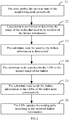
- the process of updating routing table information after a node fails in a P2P network is as follows:
- the state of the neighboring node in the network may be probed periodically to determine the failed node.
- the failed node may be a node that fails abruptly in the current network, or a node that fails in the network a period ago.
- the range of the nodes whose route is directed to the failed node (which is determined according to the distance between the failed node and the neighboring node of the failed node) differs.
- the range of the nodes whose route is directed to the failed node may be determined according to the distance between the failed node and the neighboring node of the failed node and the routing features of the network.
- the substitute node is selected among the neighboring nodes of the failed node to send failure information.
- the substitute node sends the failure information of the failed node to the LDN of the failed node within the range of the nodes whose route is directed to the failed node.
- the failure information includes the address of the substitute node, and optionally, may further includes a least one of an identifier of the failed node, an address of the failed node, and a key value of the failed node.
- the failure information further includes the impact range within which the LDN is impacted by the failed node. After receiving the failure information, the LDN may forward the failure information to the nodes within the impact range.
- the LDN may forward the failure information to the nodes within the impact range directly.
- the LDN determines that the impact range exceeds the maintenance range of the neighboring nodes of the local node
- the LDN forwards the failure information to the neighboring node nearest to the impact range, and the neighboring node further forwards the failure information to other nodes in the impact range.
- the LDN may forward the failure information to other nodes, and the node which receives the failure information further forwards the failure information to other nodes in the impact range.
- the node in the impact range updates the routing table, namely, directs the routing table information, which is originally directed to the failed node, to the substitute node of the failed node.
- FIG. 2 is a flowchart of updating routing table information after a node fails in a P2P network in an embodiment of the present invention.
- the process of updating routing table information shown in FIG. 3 serves as a reference.
- the updating process is as follows:
- the neighboring node may select a neighboring node as the substitute node for sending the node failure information according to the key value features stored in different DHT networks.
- the stored key value is selected based on the distance of the node ID of the node, the substitute node is the neighboring node at the minimum XOR distance away from the failed node.
- the stored key value is selected based on the nearest successor node, the substitute node is the node subsequent to the failed node.
- Step 24 The substitute node (node A) searches for the LDN in the impact range of the failure.
- the neighboring node that serves as a substitute node finds the LDN[i] node corresponding to the failed node in each range through the route search method.
- the LDN[i] node may be the node nearest to the failed node in each range.
- Step 25 The substitute node (node A) sends the failure information to the LDNs of the failed node consecutively. After the LDN(i) of each impact range of the failed node is found, the substitute node sends the node failure information to the LDNs consecutively. Failure information includes the address of the substitute node, and optionally, may further include at least one of the identifier of the failed node, the address of the failed node and the key value of the failed node.
- the neighboring node can also notify the impact range of the failed node to each LDN.
- the failure information includes the range of impact caused by the failed node onto the LDNs, and notifies the LDNs to update the corresponding routing table information and forward the failure information among the neighbors of the LDNs according to the impact range of the failure information.
- Step 26 After receiving the failure information, the LDN updates the routing table, and directs the routing table information, which is originally directed to the failed node, to the substitute node (node A). Further, the LDN node forwards the failure information to its neighboring node according to the received impact range of the failed node.
- Each LDN node calculates how many neighboring nodes around need to know the node failure information according to the received impact range of the failed node, and forwards the information to such nodes. If the range of nodes which need to receive the information exceeds the range of neighboring nodes, the LDN notifies the neighbor nearest to the range to further notify (for example, multicast) the information to other nodes within the range. Through multiple hops, all the nodes in the range are notified. Nevertheless, in the case, the LDN may also forward the failure information to other nodes, and the node that receives the failure information further forwards the failure information to other nodes in the impact range.
- the nodes in the impact range update their routing tables. After receiving the failure information, the node in the impact range directs the pointer, which is originally directed to the failed node, in the routing table to the substitute node of the failed node, thus updating the routing table.
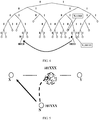
- node 10110 in the Kademlia network shown in FIG. 4 fails, according to the method under the present invention, its neighboring nodes 1010 and 10111 discovers failure of the node 10110 through proactive probe, and can calculate the range of impact of the failure information according to the distance between the node ID of the neighboring node and the node ID of the failed node, when the node 10110 in the network fails.
- node F when node F fails, all the nodes whose routing table pointer has been directed to node F are covered in the following range: ⁇ 2 m ⁇ i ⁇ XOR N , F ⁇ 2 m ⁇ i + 1 1 XOR N , F ⁇ XOR N , X 2 XOR N , F ⁇ XOR N , Y 3 where:
- the range of impacting node N needs to fulfill the following:
- node 1010 and node 10111 determines the substitute node of the failed node. Because the node ID difference between node 10111 and the failed node 10110 is less than that between node 1010 and the failed node 10110, the neighboring node 10111 is determined as the substitute node.
- the neighboring node 10111 finds a LDN node in each impact range determined through the foregoing formula, and notifies the failure information to all the LDN nodes. As shown in FIG.
- the LDN[1] of the node 10110 is 00110 because all the bits of the node 00110 are the same as those of the node 10110 except the initial bit.
- the node 00110 is in the K bucket routing table of the node 10110, and vice versa.
- the LDN node After the range of the nodes to be notified is worked out and the LDN nodes in the range are found, the LDN node searches for the node N in the respective range and transmits the churn information to such node Ns, and the node Ns update their routing tables.
- the remote node can know the information state of the node and the neighboring substitute node directly, thus avoiding the trouble of crawling slowly to search for the failed node like the practice in a traditional P2P network.
- the routing table structure of a Pastry network is similar to that in the Kademlia method, but differs in:
- the Pastry network changes the binary node ID to a Multi-ary node ID on the basis of the Kademlia network.
- the node ID may be changed from multi-ary to binary first, and then apply the Kademlia method on the Pastry network.
- the detailed process is as follows:
- node F When node F churns, its nearest neighboring node X detects the churn. Afterward, the node X may work together with another neighbor of the failed node to find the node LDN[1] according to the range determined by the following formula, where the initial bit of LDN[1] is different from that of node F and the XOR difference between the remaining bits of LDN[1] and those of node F is the minimum, and notifies the churn information to the LDN[1].
- the notification indicates that node F has failed, and all the routes subsequently directed to node F are directed to node X instead, and indicates that the churn information is forwarded among the nodes within the range.
- the neighboring node X notifies other LDN[i] determined in this way:
- the i bit of LDN[i] is different from that of node F and the XOR difference between the remaining bits of LDN[i] and those of node F is the minimum.
- the neighboring node X tells the LDN[i] that node F has failed, and instructs the LDN[i] to notify other nodes in their respective ranges to update the routing table.
- the range of impacting node N needs to fulfill the following:
- Pastry differs from Kademlia in the following:
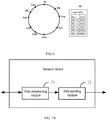
- n nodes is Hashed to the token ring with the "logn" bits.
- the i entry (i is an ordinal number) stores the subsequent ID of the x+2 i-1 .
- the neighboring node of F discovers the churn of F through proactive probe, and calculates the range of all the nodes (node N) whose routing table pointer has been directed to node F in the whole Chord ring according to the difference between the node ID of the neighboring node and the node ID of the failed node F.
- predecessor F ⁇ N + 2 i mod 2 m ⁇ F 0 ⁇ i ⁇ m where predecessor(F) is the predecessor node of node F.
- the node ID of node N is added to 2 i to obtain a sum, and the sum modulo 2 m is greater than the node ID of the predecessor node of the failed node F and is less than or equal to the node ID of F.
- the node Ns in the range defined by the foregoing inequality are the nodes that need to be notified.
- the substitute node of the failed node is determined as the successor node according to the features of the Chord network.
- the substitute node may find the LDN nodes in each range according to the calculated range. For example, LDN[m-1] of node N8 ought to be a node whose routing table contains a last entry directed to N8, that is, the node defined by: The successor corresponding to the (node ID +2 m-1 ) of the node is directed to N8.
- LDN[i] are the nodes defined by: The successor corresponding to the (node ID +2 i ) of the nodes is directed to N8, where i ranges from 0 to m-1.
- the substitute node of F notifies all the LDNs in each impact range in the Chord ring, and tells the node failure information and the churn range.
- the LDNs multicast the information within their ranges, and send a notification to the nodes whose routing table pointer has been directed to node F.
- the notification indicates that node F has failed and the substitute node is the successor node of F.
- the nodes in the impact range update their own routing table according to this notification.
- the Koorde DHT introduces the conception of the de Bruijn diagram on the basis of the Chord, with a view to improving the Chord route.
- a Koorde network when node F fails, its predecessor node X and its successor node Y discover the failure information through probing.
- the key value of a node in the Koorde network is stored in the nearest successor node. Therefore, when node F fails, the substitute node of the failed node is specified to be the successor node Y, and the range of the nodes (node N) which need to know the failure information is: ⁇ F ⁇ ( X , Y ] 1 F ⁇ ( N , successir N ] 2 i ⁇ topBit kshift ⁇ ( N , successor N ] 3
- Node Y multicasts the failure information to the LDN nodes within the range, and instructs the LDN nodes to forward the failure information of the node within the range.
- the technical solution under the present invention makes use of the symmetric mechanism implemented on the existing DHT routing table, and calculates the range of impact of the churn information quickly according to the distance between node ID of the churn node and the node ID of the neighboring nodes after a node churns in the network.
- the neighboring node notifies the churn information to the remote node that desires the information within the range proactively, and maintains the hop of route between the original two nodes, thus preventing the remote node from crawling to search for the churn node.
- a node fails, as against notifying only K neighboring nodes, notifying the remote node in the routing table makes the network more perceptive to the node churn.
- the notification information magnitude is O(logN) or O(1), depending on the size of the routing table of each node in the DHT. In this way, the efficiency of the whole P2P network in searching for routes in a churn environment is improved, the system maintenance overhead is cut back, and the system stability is improved.
- the network device includes: a first determining module 71, adapted to determine the range of the nodes whose route is directed to the failed node according to the distance between the failed node and the neighboring node of the failed node; and a first sending module 72, adapted to send the failure information of the failed node to the LDN of the failed node within the node range.
- the network device shown in FIG. 7A in an embodiment may further include a probing module 73, adapted to probe the state of the neighboring node in the network at set intervals and determine the failed node.
- a probing module 73 adapted to probe the state of the neighboring node in the network at set intervals and determine the failed node.
- the first determining module 71 may be further adapted to determine the range of the nodes whose route is directed to the failed node according to the distance between the failed node and the neighboring node of the failed node as well as the network routing features.
- the network device shown in FIG. 7A in an embodiment may further include a second determining module 74, adapted to determine the substitute node for sending the failure information among the neighboring nodes of the failed node according to the key value features stored in the network.
- a second determining module 74 adapted to determine the substitute node for sending the failure information among the neighboring nodes of the failed node according to the key value features stored in the network.
- the second determining module 74 may be further adapted to determine the substitute node to be the neighboring node at the minimum XOR distance away from the failed node.
- the second determining module 74 may be further adapted to determine the substitute node to be the successor node of failed node.
- the failure information includes the address of the substitute node, and may further include at least one of the identifier of the failed node, the address of the failed node, and the key value of the failed node.
- the failure information may further include the range of impact caused by the failed node onto the LDN.
- the network device is the LDN of the failed node. As shown in FIG. 8A , the network device includes:
- the failure information may further include at least one of an identifier of the failed node, an address of the failed node, and a key value of the failed node.
- the failure information may further include the range of impact caused by the failed node onto the local node.
- the network device shown in FIG. 8A may further include a second sending module 83, adapted to forward the failure information to the nodes within the impact range after the receiving module 81 receives the failure information.
- the failure information includes the range of impact caused by the failed node onto the local node.
- the second sending module 83 may be further adapted to forward the failure information to the nodes within the impact range directly after the receiving module 81 receives the failure information if the impact range does not exceed the maintenance range of the neighboring nodes of the local node.
- the second sending module 83 may be further adapted to forward the failure information to the neighboring node nearest to the impact range, and instruct the neighboring node to forward the failure information to other nodes in the impact range.
- the determining of the impact range here is similar to the determining of the impact range in a different P2P network mentioned above (for example, Kademlia network, Pastry network, Chord network, Koorde network).
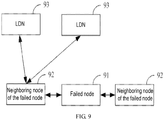
- the P2P communication network includes: a failed node 91, a neighboring node 92 of the failed node, and an LDN 93.
- the neighboring node 92 of the failed node is adapted to determine the range of the nodes whose route is directed to the failed node according to the distance between the failed node and the neighboring node of the failed node, and send the failure information of the failed node to the LDN of the failed node within the node range.
- the LDN 93 is adapted to receive the failure information, and update the routing table according to the failure information.
- the program may be stored in a computer-readable storage medium such as the ROM/RAM, magnetic disk, and compact disk.
- the range of the nodes whose route is directed to the failed node is determined according to the distance between the failed node and the neighboring node of the failed node; the failure information of the failed node is sent to the LDN of the failed node within the node range; and the LDN updates the routing table according to the failure information, and notifies the neighboring nodes within the node range to update the their respective routing table.
- the embodiments of the present invention enhance the capability of whole the P2P network in perceiving node churn, and improve the route search efficiency and system stability of the whole P2P network.
Landscapes
- Engineering & Computer Science (AREA)
- Computer Networks & Wireless Communication (AREA)
- Signal Processing (AREA)
- Physics & Mathematics (AREA)
- Computing Systems (AREA)
- Mathematical Physics (AREA)
- Theoretical Computer Science (AREA)
- Data Exchanges In Wide-Area Networks (AREA)
Claims (6)
- Verfahren zum Aktualisieren von Routing-Tabellen-Informationen, nachdem ein Knoten in einem Peer-to-Peer-, P2P, -Netz ausfällt, welches ein verteiltes Hashtabellen-, DHT, -Netz ist, umfassend folgende Schritte:Erkennen durch einen Nachbarknoten eines Knotens, dass der Knoten ausfällt, indem der Knoten in regelmäßigen Intervallen untersucht wird;Bestimmen durch den Nachbarknoten eines Ersatzknotens zum Senden von Ausfallinformationen des ausgefallenen Knotens, wobei der Ersatzknoten eine minimale Knoten-ID-Distanz von einer Knoten-ID des ausgefallenen Knotens aufweist;Bestimmen (11) durch den Nachbarknoten mehrerer Bereiche von Knoten, deren Routen auf einen ausgefallenen Knoten gerichtet sind, gemäß jeweiligen Distanzen zwischen der Knoten-ID des ausgefallenen Knotens, der Knoten-ID des Nachbarknotens des ausgefallenen Knotens, der Knoten-ID des Ersatzknotens und den Knoten-IDs der Knoten, die in jedem Bereich enthalten sind;Senden durch den Nachbarknoten der Ausfallinformationen zu dem Ersatzknoten;Suchen durch den Ersatzknoten nach einem "Long Distance Neighbor", LDN, in jedem Bereich, wobei der LDN ein Knoten ist, der am nächsten bei dem ausgefallenen Knoten in jedem Bereich liegt;Senden (12) durch den Ersatzknoten der Ausfallinformationen des ausgefallenen Knotens zu den LDNs innerhalb jedes Bereichs der Knoten;Aktualisieren der LDNs ihrer entsprechenden Routing-Tabellen-Informationen gemäß den Ausfallinformationen und Übertragen die Ausfallinformationen zu den Knoten ihrer Bereiche, um deren Routing-Tabellen zu aktualisieren, wobei Informationen, die in den Routing-Tabellen aktualisiert werden, auf den Ersatzknoten gerichtet sind.
- Verfahren nach Anspruch 1, wobei das Verfahren ferner folgende Schritte umfasst:Bestimmen (23) des Ersatzknotens unter Nachbarknoten des ausgefallenen Knotens, um die Ausfallinformationen zu senden, gemäß Schlüsselwertmerkmalen, die in dem Netz gespeichert sind; undAnweisen (25) des Ersatzknotens, die Ausfallinformationen zu dem LDN innerhalb jedes Bereichs der Knoten zu senden.
- Verfahren nach Anspruch 1, wobei die Ausfallinformationen den Bereich aufweisen, der von dem ausgefallenen Knoten auf dem LDN hervorgerufen wird, und das Verfahren ferner folgenden Schritt umfasst:
Weiterleiten durch den LDN der Ausfallinformationen zu den Knoten innerhalb des Bereichs nach dem Erhalten der Ausfallinformationen. - P2P-Netz, welches ein verteiltes Hashtabellen-, DHT, -Netz ist, das mehrere verbundene Knoten aufweist, wobeiein Nachbarknoten eines Knotens eingerichtet ist, um zu erkennen, dass der Knoten ausfällt, indem er ein Untersuchungsmodul (73) davon den Knoten in regelmäßigen Intervallen untersuchen lässt;der Nachbarknoten eingerichtet ist, um einen Ersatzknoten zum Senden von Ausfallinformationen des ausgefallenen Knotens zu bestimmen, wobei der Ersatzknoten eine minimale Knoten-ID-Distanz von einer Knoten-ID des ausgefallenen Knotens aufweist;der Nachbarknoten ferner eingerichtet ist, um mehrere Bereiche von Knoten, deren Routen auf einen ausgefallenen Knoten gerichtet sind, gemäß Distanzen zwischen der Knoten-ID des ausgefallenen Knotens, der Knoten-ID des Nachbarknotens des ausgefallenen Knotens, der Knoten-ID des Ersatzknotens und den Knoten-IDs der Knoten, die in jedem Bereich enthalten sind, zu bestimmen (11);der Nachbarknoten ferner eingerichtet ist, um die Ausfallinformationen zu dem Ersatzknoten zu senden;der Ersatzknoten ferner konfiguriert ist, um nach einem Nachbar mit großer Distanz, LDN, in jedem Bereich zu suchen, wobei der LDN ein Knoten ist, der am nächsten bei dem ausgefallenen Knoten in jedem Bereich liegt;der Ersatzknoten ferner eingerichtet ist, um die Ausfallinformationen des ausgefallenen Knotens zu den LDNs innerhalb jedes Bereichs der Knoten zu senden (12); unddie LDNs eingerichtet sind, um ihre entsprechenden Routing-Tabellen-Informationen gemäß den Ausfallinformationen zu aktualisieren und die Ausfallinformationen zu den Knoten ihrer Bereiche zu übertragen, um ihre Routing-Tabellen zu aktualisieren, wobei Informationen, die in den Routing-Tabellen aktualisiert sind, auf den Ersatzknoten gerichtet sind.
- Netz nach Anspruch 4, das ferner Folgendes aufweist:
der Nachbarknoten ist ferner eingerichtet, um den Ersatzknoten zum Senden der Ausfallinformationen unter Nachbarknoten des ausgefallenen Knotens gemäß Schlüsselwertmerkmalen, die in dem Netz gespeichert sind, zu bestimmen. - Netz nach Anspruch 5, wobei
der Nachbarknoten ferner eingerichtet ist, um den Ersatzknoten zu bestimmen, der
der Nachbarknoten mit der minimalen XOR-Distanz von dem ausgefallenen Knoten weg ist, wenn das Netz ein Kademlia-DHT-Netz oder ein Pastry-DHT-Netz ist; oder der Nachbarknoten ferner eingerichtet ist, um den Ersatzknoten als einen nächsten Nachfolgerknoten des ausgefallenen Knotens zu bestimmen, wenn das Netz ein Chord-DHT-Netz oder ein Koorde-DHT-Netz ist.
Applications Claiming Priority (2)
| Application Number | Priority Date | Filing Date | Title |
|---|---|---|---|
| CN2007101881001A CN101442479B (zh) | 2007-11-22 | 2007-11-22 | P2p对等网络中节点失效后的路由更新方法、设备及系统 |
| PCT/CN2008/072836 WO2009071008A1 (en) | 2007-11-22 | 2008-10-27 | Method, equipment and system for updating routing table after node failure in peer-to-peer network |
Publications (3)
| Publication Number | Publication Date |
|---|---|
| EP2117166A1 EP2117166A1 (de) | 2009-11-11 |
| EP2117166A4 EP2117166A4 (de) | 2010-03-17 |
| EP2117166B1 true EP2117166B1 (de) | 2019-01-09 |
Family
ID=40717301
Family Applications (1)
| Application Number | Title | Priority Date | Filing Date |
|---|---|---|---|
| EP08856338.2A Not-in-force EP2117166B1 (de) | 2007-11-22 | 2008-10-27 | Verfahren und system zum aktualisieren von routing-tabellen nach einem knotenausfall in einem peer-to-peer netz |
Country Status (4)
| Country | Link |
|---|---|
| US (1) | US8248919B2 (de) |
| EP (1) | EP2117166B1 (de) |
| CN (1) | CN101442479B (de) |
| WO (1) | WO2009071008A1 (de) |
Families Citing this family (32)
| Publication number | Priority date | Publication date | Assignee | Title |
|---|---|---|---|---|
| CN101442479B (zh) | 2007-11-22 | 2011-03-30 | 华为技术有限公司 | P2p对等网络中节点失效后的路由更新方法、设备及系统 |
| US8560682B2 (en) * | 2009-02-18 | 2013-10-15 | Nec Corporation | Distribution monitoring system, distribution monitoring method, and program |
| CN102148740B (zh) * | 2010-02-05 | 2013-09-18 | 中国移动通信集团公司 | 一种邻区路由表的更新方法和系统 |
| CN101854383B (zh) * | 2010-04-28 | 2012-07-04 | 中国人民解放军国防科学技术大学 | 基于de Bruijn图的大规模网络资源搜索方法 |
| US8812916B2 (en) * | 2011-06-02 | 2014-08-19 | International Business Machines Corporation | Failure data management for a distributed computer system |
| US8443086B2 (en) * | 2011-06-22 | 2013-05-14 | National Chiao Tung University | Decentralized structured peer-to-peer network and load balancing methods thereof |
| CN103139081B (zh) * | 2011-11-28 | 2017-08-11 | 中兴通讯股份有限公司 | 分布式哈希表路由表更新方法及节点 |
| KR101849925B1 (ko) | 2012-02-24 | 2018-04-18 | 삼성전자주식회사 | 무선 통신 네트워크에서 디바이스 탐색 방법 및 장치 |
| WO2013143065A1 (en) * | 2012-03-27 | 2013-10-03 | Telefonaktiebolaget L M Ericsson (Publ) | Shared keep-alive and failure detection mechanisms in distributed network |
| CN102780628B (zh) * | 2012-07-31 | 2014-12-17 | 中国人民解放军国防科学技术大学 | 面向多核微处理器的片上互连网络路由方法 |
| CN103595740B (zh) * | 2012-08-14 | 2016-08-24 | 中国科学院声学研究所 | 一种更新对等网络版权内容相似度图的方法及系统 |
| CN102932486A (zh) * | 2012-11-26 | 2013-02-13 | 南京大学 | 一种在非结构化分布式p2p网络中划分网络结构的方法 |
| US9210219B2 (en) * | 2013-07-15 | 2015-12-08 | Red Hat, Inc. | Systems and methods for consistent hashing using multiple hash rings |
| US20160218954A1 (en) * | 2013-09-26 | 2016-07-28 | Hewlett-Packard Development Company, L.P. | Peer nodes in peer to peer networks |
| WO2015047265A1 (en) * | 2013-09-26 | 2015-04-02 | Hewlett-Packard Development Company, L.P. | Subnetworks of peer to peer networks |
| US10057123B1 (en) * | 2013-12-27 | 2018-08-21 | Alarm.Com Incorporated | Network topology backup |
| US20170142226A1 (en) * | 2014-01-31 | 2017-05-18 | Interdigital Patent Holdings, Inc. | Methods, apparatuses and systems directed to enabling network federations through hash-routing and/or summary-routing based peering |
| US9652979B2 (en) | 2014-05-30 | 2017-05-16 | Lutron Electronics Co., Inc. | Wireless control device |
| US9609719B2 (en) | 2014-05-30 | 2017-03-28 | Lutron Electronics Co., Inc. | Wireless control device |
| CN104168147B (zh) * | 2014-08-26 | 2017-07-04 | 浙江理工大学 | 一种针对p2p网络监控基于一维链表的节点维护方法 |
| WO2016067299A1 (en) * | 2014-10-30 | 2016-05-06 | Hewlett-Packard Development Company, L.P. | Location aware failover solution |
| US10771390B2 (en) * | 2017-06-18 | 2020-09-08 | Cisco Technology, Inc. | Techniques for optimizing egress tunnel router failure scenarios in intelligent wide area networks |
| CN107426790A (zh) * | 2017-07-28 | 2017-12-01 | 广东技术师范学院 | 一种无源感知网络节点调度系统及方法 |
| CN108848250B (zh) * | 2018-05-07 | 2020-12-15 | 北京奇点机智科技有限公司 | 路径更新方法、装置及设备 |
| CN109495384B (zh) * | 2018-11-06 | 2021-03-02 | 中国联合网络通信集团有限公司 | 一种提高网络路由可靠性的方法和装置 |
| CN111510321B (zh) * | 2019-10-16 | 2023-05-16 | 中国南方电网有限责任公司 | 网络故障处理方法、装置、计算机设备和存储介质 |
| CN110990448B (zh) * | 2019-10-28 | 2021-06-25 | 北京大学 | 一种支持容错的分布式查询方法及装置 |
| CN113300948B (zh) * | 2020-02-21 | 2022-07-29 | 华为技术有限公司 | 用于业务生存性分析的方法、装置、系统及存储介质 |
| CN112019260B (zh) * | 2020-09-14 | 2021-11-19 | 西安交通大学 | 一种低轨异构卫星网络路由方法及系统 |
| CN113179336B (zh) * | 2021-06-30 | 2021-09-07 | 正链科技(深圳)有限公司 | 面向亿量级大规模集群的分布式对等网络系统 |
| CN115914009B (zh) * | 2021-08-10 | 2024-10-22 | 中国移动通信集团江苏有限公司 | ToB专网业务质量测试方法及系统 |
| CN115412493A (zh) * | 2022-06-30 | 2022-11-29 | 中国电子科技集团公司第五十四研究所 | 一种支持Kademlia网络的高效节点查询方法 |
Family Cites Families (19)
| Publication number | Priority date | Publication date | Assignee | Title |
|---|---|---|---|---|
| EP1073091A3 (de) | 1999-07-27 | 2004-10-06 | Matsushita Electric Works, Ltd. | Elektrode für Plasmaerzeugung, Anwendung dieser Elektrode in einem Plasmabehandlungsgerät, und Plasmabehandlung mittels dieses Gerätes |
| US6996065B2 (en) * | 2000-07-06 | 2006-02-07 | Lucent Technologies Inc. | Dynamic backup routing of network tunnel paths for local restoration in a packet network |
| US20030212793A1 (en) * | 2002-05-13 | 2003-11-13 | Vineet Kumar | Method and apparatus for group reception and fault-tolerant group transmission of frames in network |
| US7707307B2 (en) * | 2003-01-09 | 2010-04-27 | Cisco Technology, Inc. | Method and apparatus for constructing a backup route in a data communications network |
| US7330440B1 (en) * | 2003-05-20 | 2008-02-12 | Cisco Technology, Inc. | Method and apparatus for constructing a transition route in a data communications network |
| US7483391B2 (en) * | 2003-09-19 | 2009-01-27 | Hewlett-Packard Development Company, L.P. | Providing a notification including location information for nodes in an overlay network |
| US7730207B2 (en) * | 2004-03-31 | 2010-06-01 | Microsoft Corporation | Routing in peer-to-peer networks |
| JP2005295457A (ja) * | 2004-04-05 | 2005-10-20 | Fujitsu Ltd | P2pトラフィック対応ルータ及びそれを用いたp2pトラフィック情報共有システム |
| CN1283076C (zh) * | 2004-04-16 | 2006-11-01 | 清华大学 | 点对点环境的草履虫自组织和协作路由方法 |
| CN102348293B (zh) * | 2005-02-01 | 2014-06-25 | Exs有限公司 | 用于无线接入的分层网格网络 |
| US7933197B2 (en) * | 2005-02-22 | 2011-04-26 | Cisco Technology, Inc. | Method and apparatus for constructing a repair path around a non-available component in a data communications network |
| US7664742B2 (en) * | 2005-11-14 | 2010-02-16 | Pettovello Primo M | Index data structure for a peer-to-peer network |
| JP4670604B2 (ja) * | 2005-11-21 | 2011-04-13 | ブラザー工業株式会社 | 情報配信システム、情報処理装置、情報処理プログラム及び情報処理方法 |
| EP1802070B1 (de) * | 2005-12-21 | 2008-06-18 | NTT DoCoMo, Inc. | Verfahren und Einrichtung zur Behandlung von Mobilitätswechseln für Peer-to-Peer-Suchsysteme |
| US7675860B2 (en) * | 2006-02-27 | 2010-03-09 | Cisco Technology, Inc. | Method and apparatus for determining a preferred backup tunnel to protect point-to-multipoint label switch paths |
| JP4775153B2 (ja) * | 2006-07-24 | 2011-09-21 | 日本電気株式会社 | 運用管理システム、ノード、運用管理方法及びプログラム |
| US7987506B1 (en) * | 2006-11-03 | 2011-07-26 | Cisco Technology, Inc. | Methods and systems for dynamically updating a routing table in a virtual private network |
| US8472325B2 (en) * | 2007-05-10 | 2013-06-25 | Futurewei Technologies, Inc. | Network availability enhancement technique for packet transport networks |
| CN101442479B (zh) | 2007-11-22 | 2011-03-30 | 华为技术有限公司 | P2p对等网络中节点失效后的路由更新方法、设备及系统 |
-
2007
- 2007-11-22 CN CN2007101881001A patent/CN101442479B/zh not_active Expired - Fee Related
-
2008
- 2008-10-27 EP EP08856338.2A patent/EP2117166B1/de not_active Not-in-force
- 2008-10-27 WO PCT/CN2008/072836 patent/WO2009071008A1/zh not_active Ceased
-
2009
- 2009-10-26 US US12/605,931 patent/US8248919B2/en active Active
Non-Patent Citations (1)
| Title |
|---|
| None * |
Also Published As
| Publication number | Publication date |
|---|---|
| US8248919B2 (en) | 2012-08-21 |
| EP2117166A1 (de) | 2009-11-11 |
| EP2117166A4 (de) | 2010-03-17 |
| CN101442479A (zh) | 2009-05-27 |
| US20100039931A1 (en) | 2010-02-18 |
| CN101442479B (zh) | 2011-03-30 |
| WO2009071008A1 (en) | 2009-06-11 |
Similar Documents
| Publication | Publication Date | Title |
|---|---|---|
| EP2117166B1 (de) | Verfahren und system zum aktualisieren von routing-tabellen nach einem knotenausfall in einem peer-to-peer netz | |
| US8358652B2 (en) | Apparatus, system and method for reliable, fast, and scalable multicast message delivery in service overlay networks | |
| US7881223B2 (en) | Method for on demand distributed hash table update | |
| EP2308213B1 (de) | Wartung von overlay-netzwerken | |
| WO2011054248A1 (zh) | 一种结构化对等网络中消息的广播系统及方法 | |
| Rahimi et al. | LDEPTH: A low diameter hierarchical p2p network architecture | |
| Zhong et al. | The convergence-guaranteed random walk and its applications in peer-to-peer networks | |
| US7660320B2 (en) | Communication network, a method of routing data packets in such communication network and a method of locating and securing data of a desired resource in such communication network | |
| EP2122906B1 (de) | Erkundung von nicht-verbundenen komponenten in einem verteilten kommunikationsnetzwerk | |
| JP4533923B2 (ja) | 階層型ピアツーピアシステムにおける負荷バランシング機能を有するスーパーピア及び該スーパーピアを動作させる方法 | |
| Peris et al. | Evaluation of the broadcast operation in Kademlia | |
| Wepiwe et al. | A concentric multi-ring overlay for highly reliable p2p networks | |
| Delgado Peris et al. | Evaluation of alternatives for the broadcast operation in Kademlia under churn | |
| Kunzmann et al. | Analyzing and modifying chord's stabilization algorithm to handle high churn rates | |
| Bertier et al. | D2ht: The best of both worlds, integrating rps and dht | |
| JP5287500B2 (ja) | ノード装置およびノード装置用プログラム | |
| Kunzmann | Recursive or iterative routing? Hybrid! | |
| Guo et al. | Theory and network applications of balanced Kautz tree structures | |
| Ktari et al. | A construction scheme for scale free dht-based networks | |
| Lee et al. | An adaptive sector-based routing model over structured peer-to-peer networks | |
| Yang et al. | Assigning identifications to nodes in unstructured peer-to-peer networks: A novel approach to improving search efficiency | |
| Alima et al. | EPDKS: an efficient proximity-based distributed K-ary structured overlay network | |
| Tomimoto et al. | Capability-aware ID assignment and message routing based on skip list in large-scale heterogeneous P2P networks | |
| Puniran et al. | Ant Metaphor on Routing in Packet Access and Unstructured P2P etwork | |
| Ojha et al. | An efficient lookup algorithm for dynamic peer-to-peer Chord |
Legal Events
| Date | Code | Title | Description |
|---|---|---|---|
| PUAI | Public reference made under article 153(3) epc to a published international application that has entered the european phase |
Free format text: ORIGINAL CODE: 0009012 |
|
| 17P | Request for examination filed |
Effective date: 20090921 |
|
| AK | Designated contracting states |
Kind code of ref document: A1 Designated state(s): AT BE BG CH CY CZ DE DK EE ES FI FR GB GR HR HU IE IS IT LI LT LU LV MC MT NL NO PL PT RO SE SI SK TR |
|
| A4 | Supplementary search report drawn up and despatched |
Effective date: 20100217 |
|
| RIC1 | Information provided on ipc code assigned before grant |
Ipc: H04L 12/24 20060101AFI20090625BHEP Ipc: H04L 12/56 20060101ALI20100211BHEP |
|
| DAX | Request for extension of the european patent (deleted) | ||
| 17Q | First examination report despatched |
Effective date: 20130215 |
|
| STAA | Information on the status of an ep patent application or granted ep patent |
Free format text: STATUS: EXAMINATION IS IN PROGRESS |
|
| GRAP | Despatch of communication of intention to grant a patent |
Free format text: ORIGINAL CODE: EPIDOSNIGR1 |
|
| STAA | Information on the status of an ep patent application or granted ep patent |
Free format text: STATUS: GRANT OF PATENT IS INTENDED |
|
| RIC1 | Information provided on ipc code assigned before grant |
Ipc: H04L 12/24 20060101AFI20180531BHEP Ipc: H04L 12/703 20130101ALI20180531BHEP Ipc: H04L 12/751 20130101ALI20180531BHEP Ipc: H04L 29/08 20060101ALI20180531BHEP |
|
| INTG | Intention to grant announced |
Effective date: 20180704 |
|
| GRAS | Grant fee paid |
Free format text: ORIGINAL CODE: EPIDOSNIGR3 |
|
| GRAJ | Information related to disapproval of communication of intention to grant by the applicant or resumption of examination proceedings by the epo deleted |
Free format text: ORIGINAL CODE: EPIDOSDIGR1 |
|
| GRAL | Information related to payment of fee for publishing/printing deleted |
Free format text: ORIGINAL CODE: EPIDOSDIGR3 |
|
| STAA | Information on the status of an ep patent application or granted ep patent |
Free format text: STATUS: EXAMINATION IS IN PROGRESS |
|
| GRAR | Information related to intention to grant a patent recorded |
Free format text: ORIGINAL CODE: EPIDOSNIGR71 |
|
| STAA | Information on the status of an ep patent application or granted ep patent |
Free format text: STATUS: GRANT OF PATENT IS INTENDED |
|
| GRAA | (expected) grant |
Free format text: ORIGINAL CODE: 0009210 |
|
| STAA | Information on the status of an ep patent application or granted ep patent |
Free format text: STATUS: THE PATENT HAS BEEN GRANTED |
|
| INTC | Intention to grant announced (deleted) | ||
| AK | Designated contracting states |
Kind code of ref document: B1 Designated state(s): AT BE BG CH CY CZ DE DK EE ES FI FR GB GR HR HU IE IS IT LI LT LU LV MC MT NL NO PL PT RO SE SI SK TR |
|
| INTG | Intention to grant announced |
Effective date: 20181203 |
|
| REG | Reference to a national code |
Ref country code: GB Ref legal event code: FG4D |
|
| REG | Reference to a national code |
Ref country code: CH Ref legal event code: EP Ref country code: AT Ref legal event code: REF Ref document number: 1088678 Country of ref document: AT Kind code of ref document: T Effective date: 20190115 |
|
| REG | Reference to a national code |
Ref country code: DE Ref legal event code: R096 Ref document number: 602008058719 Country of ref document: DE |
|
| REG | Reference to a national code |
Ref country code: CH Ref legal event code: PK Free format text: BERICHTIGUNGEN |
|
| REG | Reference to a national code |
Ref country code: IE Ref legal event code: FG4D |
|
| RIC2 | Information provided on ipc code assigned after grant |
Ipc: H04L 12/751 20130101ALI20180531BHEP Ipc: H04L 12/703 20130101ALI20180531BHEP Ipc: H04L 29/08 20060101ALI20180531BHEP Ipc: H04L 12/24 20060101AFI20180531BHEP |
|
| REG | Reference to a national code |
Ref country code: NL Ref legal event code: MP Effective date: 20190109 |
|
| REG | Reference to a national code |
Ref country code: LT Ref legal event code: MG4D |
|
| PG25 | Lapsed in a contracting state [announced via postgrant information from national office to epo] |
Ref country code: NL Free format text: LAPSE BECAUSE OF FAILURE TO SUBMIT A TRANSLATION OF THE DESCRIPTION OR TO PAY THE FEE WITHIN THE PRESCRIBED TIME-LIMIT Effective date: 20190109 |
|
| REG | Reference to a national code |
Ref country code: AT Ref legal event code: MK05 Ref document number: 1088678 Country of ref document: AT Kind code of ref document: T Effective date: 20190109 |
|
| PG25 | Lapsed in a contracting state [announced via postgrant information from national office to epo] |
Ref country code: ES Free format text: LAPSE BECAUSE OF FAILURE TO SUBMIT A TRANSLATION OF THE DESCRIPTION OR TO PAY THE FEE WITHIN THE PRESCRIBED TIME-LIMIT Effective date: 20190109 Ref country code: PT Free format text: LAPSE BECAUSE OF FAILURE TO SUBMIT A TRANSLATION OF THE DESCRIPTION OR TO PAY THE FEE WITHIN THE PRESCRIBED TIME-LIMIT Effective date: 20190509 Ref country code: SE Free format text: LAPSE BECAUSE OF FAILURE TO SUBMIT A TRANSLATION OF THE DESCRIPTION OR TO PAY THE FEE WITHIN THE PRESCRIBED TIME-LIMIT Effective date: 20190109 Ref country code: LT Free format text: LAPSE BECAUSE OF FAILURE TO SUBMIT A TRANSLATION OF THE DESCRIPTION OR TO PAY THE FEE WITHIN THE PRESCRIBED TIME-LIMIT Effective date: 20190109 Ref country code: PL Free format text: LAPSE BECAUSE OF FAILURE TO SUBMIT A TRANSLATION OF THE DESCRIPTION OR TO PAY THE FEE WITHIN THE PRESCRIBED TIME-LIMIT Effective date: 20190109 Ref country code: FI Free format text: LAPSE BECAUSE OF FAILURE TO SUBMIT A TRANSLATION OF THE DESCRIPTION OR TO PAY THE FEE WITHIN THE PRESCRIBED TIME-LIMIT Effective date: 20190109 Ref country code: NO Free format text: LAPSE BECAUSE OF FAILURE TO SUBMIT A TRANSLATION OF THE DESCRIPTION OR TO PAY THE FEE WITHIN THE PRESCRIBED TIME-LIMIT Effective date: 20190409 |
|
| PG25 | Lapsed in a contracting state [announced via postgrant information from national office to epo] |
Ref country code: IS Free format text: LAPSE BECAUSE OF FAILURE TO SUBMIT A TRANSLATION OF THE DESCRIPTION OR TO PAY THE FEE WITHIN THE PRESCRIBED TIME-LIMIT Effective date: 20190509 Ref country code: BG Free format text: LAPSE BECAUSE OF FAILURE TO SUBMIT A TRANSLATION OF THE DESCRIPTION OR TO PAY THE FEE WITHIN THE PRESCRIBED TIME-LIMIT Effective date: 20190409 Ref country code: GR Free format text: LAPSE BECAUSE OF FAILURE TO SUBMIT A TRANSLATION OF THE DESCRIPTION OR TO PAY THE FEE WITHIN THE PRESCRIBED TIME-LIMIT Effective date: 20190410 Ref country code: LV Free format text: LAPSE BECAUSE OF FAILURE TO SUBMIT A TRANSLATION OF THE DESCRIPTION OR TO PAY THE FEE WITHIN THE PRESCRIBED TIME-LIMIT Effective date: 20190109 Ref country code: HR Free format text: LAPSE BECAUSE OF FAILURE TO SUBMIT A TRANSLATION OF THE DESCRIPTION OR TO PAY THE FEE WITHIN THE PRESCRIBED TIME-LIMIT Effective date: 20190109 |
|
| REG | Reference to a national code |
Ref country code: DE Ref legal event code: R097 Ref document number: 602008058719 Country of ref document: DE |
|
| PG25 | Lapsed in a contracting state [announced via postgrant information from national office to epo] |
Ref country code: IT Free format text: LAPSE BECAUSE OF FAILURE TO SUBMIT A TRANSLATION OF THE DESCRIPTION OR TO PAY THE FEE WITHIN THE PRESCRIBED TIME-LIMIT Effective date: 20190109 Ref country code: SK Free format text: LAPSE BECAUSE OF FAILURE TO SUBMIT A TRANSLATION OF THE DESCRIPTION OR TO PAY THE FEE WITHIN THE PRESCRIBED TIME-LIMIT Effective date: 20190109 Ref country code: DK Free format text: LAPSE BECAUSE OF FAILURE TO SUBMIT A TRANSLATION OF THE DESCRIPTION OR TO PAY THE FEE WITHIN THE PRESCRIBED TIME-LIMIT Effective date: 20190109 Ref country code: AT Free format text: LAPSE BECAUSE OF FAILURE TO SUBMIT A TRANSLATION OF THE DESCRIPTION OR TO PAY THE FEE WITHIN THE PRESCRIBED TIME-LIMIT Effective date: 20190109 Ref country code: EE Free format text: LAPSE BECAUSE OF FAILURE TO SUBMIT A TRANSLATION OF THE DESCRIPTION OR TO PAY THE FEE WITHIN THE PRESCRIBED TIME-LIMIT Effective date: 20190109 Ref country code: RO Free format text: LAPSE BECAUSE OF FAILURE TO SUBMIT A TRANSLATION OF THE DESCRIPTION OR TO PAY THE FEE WITHIN THE PRESCRIBED TIME-LIMIT Effective date: 20190109 Ref country code: CZ Free format text: LAPSE BECAUSE OF FAILURE TO SUBMIT A TRANSLATION OF THE DESCRIPTION OR TO PAY THE FEE WITHIN THE PRESCRIBED TIME-LIMIT Effective date: 20190109 |
|
| PLBE | No opposition filed within time limit |
Free format text: ORIGINAL CODE: 0009261 |
|
| STAA | Information on the status of an ep patent application or granted ep patent |
Free format text: STATUS: NO OPPOSITION FILED WITHIN TIME LIMIT |
|
| 26N | No opposition filed |
Effective date: 20191010 |
|
| PG25 | Lapsed in a contracting state [announced via postgrant information from national office to epo] |
Ref country code: SI Free format text: LAPSE BECAUSE OF FAILURE TO SUBMIT A TRANSLATION OF THE DESCRIPTION OR TO PAY THE FEE WITHIN THE PRESCRIBED TIME-LIMIT Effective date: 20190109 |
|
| PG25 | Lapsed in a contracting state [announced via postgrant information from national office to epo] |
Ref country code: TR Free format text: LAPSE BECAUSE OF FAILURE TO SUBMIT A TRANSLATION OF THE DESCRIPTION OR TO PAY THE FEE WITHIN THE PRESCRIBED TIME-LIMIT Effective date: 20190109 |
|
| PG25 | Lapsed in a contracting state [announced via postgrant information from national office to epo] |
Ref country code: MC Free format text: LAPSE BECAUSE OF FAILURE TO SUBMIT A TRANSLATION OF THE DESCRIPTION OR TO PAY THE FEE WITHIN THE PRESCRIBED TIME-LIMIT Effective date: 20190109 |
|
| REG | Reference to a national code |
Ref country code: CH Ref legal event code: PL |
|
| PG25 | Lapsed in a contracting state [announced via postgrant information from national office to epo] |
Ref country code: LU Free format text: LAPSE BECAUSE OF NON-PAYMENT OF DUE FEES Effective date: 20191027 Ref country code: CH Free format text: LAPSE BECAUSE OF NON-PAYMENT OF DUE FEES Effective date: 20191031 Ref country code: LI Free format text: LAPSE BECAUSE OF NON-PAYMENT OF DUE FEES Effective date: 20191031 |
|
| REG | Reference to a national code |
Ref country code: BE Ref legal event code: MM Effective date: 20191031 |
|
| PG25 | Lapsed in a contracting state [announced via postgrant information from national office to epo] |
Ref country code: BE Free format text: LAPSE BECAUSE OF NON-PAYMENT OF DUE FEES Effective date: 20191031 |
|
| PG25 | Lapsed in a contracting state [announced via postgrant information from national office to epo] |
Ref country code: CY Free format text: LAPSE BECAUSE OF FAILURE TO SUBMIT A TRANSLATION OF THE DESCRIPTION OR TO PAY THE FEE WITHIN THE PRESCRIBED TIME-LIMIT Effective date: 20190109 |
|
| PG25 | Lapsed in a contracting state [announced via postgrant information from national office to epo] |
Ref country code: MT Free format text: LAPSE BECAUSE OF FAILURE TO SUBMIT A TRANSLATION OF THE DESCRIPTION OR TO PAY THE FEE WITHIN THE PRESCRIBED TIME-LIMIT Effective date: 20190109 Ref country code: HU Free format text: LAPSE BECAUSE OF FAILURE TO SUBMIT A TRANSLATION OF THE DESCRIPTION OR TO PAY THE FEE WITHIN THE PRESCRIBED TIME-LIMIT; INVALID AB INITIO Effective date: 20081027 |
|
| REG | Reference to a national code |
Ref country code: DE Ref legal event code: R079 Ref document number: 602008058719 Country of ref document: DE Free format text: PREVIOUS MAIN CLASS: H04L0012240000 Ipc: H04L0041000000 |
|
| REG | Reference to a national code |
Ref country code: FR Ref legal event code: PLFP Year of fee payment: 15 |
|
| PGFP | Annual fee paid to national office [announced via postgrant information from national office to epo] |
Ref country code: IE Payment date: 20230912 Year of fee payment: 16 Ref country code: GB Payment date: 20230907 Year of fee payment: 16 |
|
| PGFP | Annual fee paid to national office [announced via postgrant information from national office to epo] |
Ref country code: FR Payment date: 20230911 Year of fee payment: 16 |
|
| PGFP | Annual fee paid to national office [announced via postgrant information from national office to epo] |
Ref country code: DE Payment date: 20230830 Year of fee payment: 16 |
|
| REG | Reference to a national code |
Ref country code: DE Ref legal event code: R119 Ref document number: 602008058719 Country of ref document: DE |
|
| GBPC | Gb: european patent ceased through non-payment of renewal fee |
Effective date: 20241027 |
|
| PG25 | Lapsed in a contracting state [announced via postgrant information from national office to epo] |
Ref country code: DE Free format text: LAPSE BECAUSE OF NON-PAYMENT OF DUE FEES Effective date: 20250501 |
|
| PG25 | Lapsed in a contracting state [announced via postgrant information from national office to epo] |
Ref country code: GB Free format text: LAPSE BECAUSE OF NON-PAYMENT OF DUE FEES Effective date: 20241027 |
|
| PG25 | Lapsed in a contracting state [announced via postgrant information from national office to epo] |
Ref country code: FR Free format text: LAPSE BECAUSE OF NON-PAYMENT OF DUE FEES Effective date: 20241031 |
|
| PG25 | Lapsed in a contracting state [announced via postgrant information from national office to epo] |
Ref country code: IE Free format text: LAPSE BECAUSE OF NON-PAYMENT OF DUE FEES Effective date: 20241027 |