EP2114994B1 - Proteins activating pro-phenoloxidase system and genes encoding the same - Google Patents
Proteins activating pro-phenoloxidase system and genes encoding the same Download PDFInfo
- Publication number
- EP2114994B1 EP2114994B1 EP08712316.2A EP08712316A EP2114994B1 EP 2114994 B1 EP2114994 B1 EP 2114994B1 EP 08712316 A EP08712316 A EP 08712316A EP 2114994 B1 EP2114994 B1 EP 2114994B1
- Authority
- EP
- European Patent Office
- Prior art keywords
- tenebrio
- pgrp
- seq
- set forth
- amino acid
- Prior art date
- Legal status (The legal status is an assumption and is not a legal conclusion. Google has not performed a legal analysis and makes no representation as to the accuracy of the status listed.)
- Not-in-force
Links
Images









Classifications
-
- C—CHEMISTRY; METALLURGY
- C07—ORGANIC CHEMISTRY
- C07K—PEPTIDES
- C07K14/00—Peptides having more than 20 amino acids; Gastrins; Somatostatins; Melanotropins; Derivatives thereof
- C07K14/435—Peptides having more than 20 amino acids; Gastrins; Somatostatins; Melanotropins; Derivatives thereof from animals; from humans
-
- C—CHEMISTRY; METALLURGY
- C07—ORGANIC CHEMISTRY
- C07K—PEPTIDES
- C07K14/00—Peptides having more than 20 amino acids; Gastrins; Somatostatins; Melanotropins; Derivatives thereof
- C07K14/435—Peptides having more than 20 amino acids; Gastrins; Somatostatins; Melanotropins; Derivatives thereof from animals; from humans
- C07K14/43504—Peptides having more than 20 amino acids; Gastrins; Somatostatins; Melanotropins; Derivatives thereof from animals; from humans from invertebrates
-
- C—CHEMISTRY; METALLURGY
- C12—BIOCHEMISTRY; BEER; SPIRITS; WINE; VINEGAR; MICROBIOLOGY; ENZYMOLOGY; MUTATION OR GENETIC ENGINEERING
- C12N—MICROORGANISMS OR ENZYMES; COMPOSITIONS THEREOF; PROPAGATING, PRESERVING, OR MAINTAINING MICROORGANISMS; MUTATION OR GENETIC ENGINEERING; CULTURE MEDIA
- C12N15/00—Mutation or genetic engineering; DNA or RNA concerning genetic engineering, vectors, e.g. plasmids, or their isolation, preparation or purification; Use of hosts therefor
- C12N15/09—Recombinant DNA-technology
- C12N15/10—Processes for the isolation, preparation or purification of DNA or RNA
Definitions
- the present invention relates to novel proteins activating pro-phenoloxidase (pro-PO) system of Tenebrio molitor, genes encoding the same, methods of detecting bacterial infection in a sample using the proteins, and kits for detecting bacterial infection in a sample using the proteins.
- the present invention also relates to a method of preparing a soluble linearized Lys-type peptidoglycan (SLPG), useful for a standard substance for the kit.
- SLPG soluble linearized Lys-type peptidoglycan
- Drosophila melanogaster peptidoglycan (PG) recognition protein Drosophila PGRRSA and Drosophila PGRP-SD activate the Toll pathway ( Michel, T., Reichhart, J. M., Hoffmann, J. A. & Royet, J. (2001) Nature 414, 756-759 ; and Bischoff, V, Vignal, C., Boneca, I G., Michel, T., Hoffmann, J. A. & Royet, J.
- Drosophila PGRP-LC and Drosophila PGRP-LE are receptors for the Imd pathway ( Gottar, M., Gobert, V, Michel, T., Belvin, M., Duyk, G., Hoffmann, J. A., Ferrandon, D. & Royet, J. (2002) Nature 416, 640-644 ; Choe, K. M., Werner, T., Stoven, S., Hultmark, D. & Anderson, K.
- pro-phenoloxidase (pro-PO) activation cascade which leads to melanization of invading microbes, is another major innate immune defense mechanism in invertebrates that is triggered by peptidoglycan (PG) and ⁇ -1,3-glucan ( Cerenius, L. & Soderhall, K. (2004) Immunol Rev 198, 116-126 ; and Kanost, M. R, Jiang, H. & Yu, X. Q. (2004) Immunol Rev 198, 97-105 ).
- the pro-PO cascade like the vertebrate complement system, is a proteolytic cascade in blood plasma.
- the pro-PO system is an ideal tool for biochemical studies of PG and ⁇ -1,3-glucan recognition and subsequent signaling under a cell-free condition.
- Tenebrio molitor PGRP that exhibited the highest sequence homology with Drosophila PGRP-SA.
- This PGRP which we designate Tenebrio PGRP-SA, activated the Lys-PG-dependent pro-PO system in Tenebrio beetle.
- a novel synthetic Lys-PG fragment functions as a competitive inhibitor of soluble polymeric linear Lys-PG in the activation of the pro-PO system.
- the synthetic Lys-PG fragment (hereinafter referred to as "synthetic muropeptide dimmer"), having a chemical structure of the following formula (I), is composed of tetra-saccharide (GlcNAc-MurNAc-GlcNAc-MurNAc), covalently linked to two copies of a tetrapeptide stem [L-Ala-D-isoGln-L-Lys-D-Ala) ( Park, J. W., Je, B R, Piao, S., Inamura, S., Fujimoto, Y., Fukase, K., Kusumoto, S., Soderhall, K., Ha, N. C. & Lee, B L. (2006) J Biol Chem 281, 7747-7755 ).
- Muropeptide composed of N-acetylglucosamine and N-acetylmuramic acid sugars linked with a short peptide chain as a stem, was revealed as the minimum binding unit for PGRP-SA.
- the present Inventors performed various studies on how a Lys-PG recognition signal is transferred downstream through a biochemical approach using in vivo Drosophila Toll pathway, in vitro pro-PO motivation system and recombinant PGRP-SA proteins. As a result, we isolated proteins involved in a pro-PO system and also found that such proteins are useful for detecting bacterial infection in a sample, such as blood. Also, the present inventors developed a method of preparing a soluble linearized Lys-type peptidoglycan (SLPG), which is useful for a standard substance in detecting bacterial infection in a sample.
- SLPG soluble linearized Lys-type peptidoglycan
- the present invention provides proteins activating pro-phenoloxidase (pro-PO) system and genes encoding the same.
- the present invention also provides a method of detecting bacterial infection in a sample using the proteins.
- the present invention also provides a kit for detecting bacterial infection in a sample using the proteins.
- Also disclosed in the present invention is a method of preparing a soluble linearized Lys-type peptidoglycan (SLPG).
- SLPG soluble linearized Lys-type peptidoglycan
- a Tenebrio molitor -derived Gram negative bacteria binding protein 1 (Tenebrio GNBP1), which has an amino acid sequence as set forth in SEQ ID NO: 2.
- a polynucleotide encoding the Tenebrio GNBP1 having an amino acid sequence as set forth in SEQ ID NO: 2.
- a method of detecting bacterial infection in a sample comprising:
- a Tenebrio molitor -derived modular serine protease-1 (Tenebrio MSP-1), which has an amino acid sequence as set forth in SEQ ID NO: 4 and a polynucleotide encoding the same, e.g. a polynucleotide having a nucleotide sequence as set forth in SEQ ID NO: 5.
- a molitor -derived modular serine protease-2 (Tenebrio MSP-2), which has an amino add sequence as set forth in SEQ ID NO: 6 and a polynucleotide encoding the same, e.g.,. a polynucleotide having a nucleotide sequence as set forth in SEQ ID NO: 7.
- Also disclosed in the present invention is a method of detecting bacterial infection in a sample, the method comprising: (a) loading a Tenebrio molitor -derived peptidoglycan recognition protein (Tenebrio PGRP-SA) having an amino acid sequence as set forth in SEQ ID NO: 1 to a sample and then performing an incubation thereof; (b) loading at least one protein selected from the group consisting of a Tenebrio GNBP1 having an amino acid sequence as set forth in SEQ ID NO: 2, a Tenebrio MSP-1 having an amino acid sequence as set forth in SEQ ID NO: 4, and Tenebrio MSP-2 having an amino acid sequence as set forth in SEQ ID NO: 6 to the incubation mixture of step (a) and then performing an incubation; and (c) detecting a reactivity between the protein and the sample in the incubation mixture of step (b).
- a Tenebrio molitor -derived peptidoglycan recognition protein Tetebrio
- kits for detecting bacterial infection in a sample comprising: a Tenebrio PGRP-SA having an amino acid sequence as set forth in SEQ ID NO: 1, and at least one protein selected from the group consisting of a Tenebrio GNBP1 having an amino acid sequence as set forth in SEQ ID NO: 2, a Tenebrio MSP-1 having an amino acid sequence as set forth in SEQ ID NO: 4, and Tenebrio MSP-2 having an amino aid sequence as set forth in SEQ ID NO: 6.
- Also disclosed in the present invention is a method of preparing .a soluble linearized Lys-type peptidoglycan (SLPG), the method comprising: (a') suspending an insoluble peptidoglycan isolated from a bacteria in a buffer solution of about pH 8; (b') treating the suspension obtained from step (a') with p-lytic protease (blp); (c') heating the reaction mixture obtained from step (b') at about 95 °C for about 10 minutes, centrifuging the reaction mixture, .and then collecting a supernatant; and (d') fractionizing the supernatant obtained from step 0 using a size-exclusion column to collect a fraction showing phenoloxidase (PO) activity .
- SLPG soluble linearized Lys-type peptidoglycan
- proteins activating a pro-PO system
- the proteins can be used to detect bacterial infection in a sample such as blood, or to manufacture a kit for the detection thereof.
- a sample such as blood is pre-treated using blp and/or lysozyme according to the present invention, bacterial infection can be more effectively detected by the factors involved in a pro-PO system.
- FIG. 1 is expected structures of linearized peptidoglycan (PG) (a) and synthetic muropeptide dimmer (b), in which white large circles, black large circles, black small circles and white small circles indicate N -acetyl-glucosamine, N -acetylmuramic acid, stem peptides, and Gly residues of S. aureus PG, respectively.
- PG linearized peptidoglycan
- b synthetic muropeptide dimmer
- FIG. 2 is the UV absorbance profile of fractionized SLPG on a Toyopearl HW-55S size-exclusion column and the PO activity of each SLPG fraction.
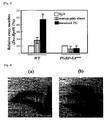
- FIG. 3 shows induction of the drosomycin ( Drs ) -Rp49 reporter gene after the injection of water (white bars), the synthetic muropeptide dimmer (stripes) or SLPG (black bars) into wild-type female adult flies and PGRP-SA seml mutant flies. Drs expression was measured in four flies collected 18 hrs after challenge and normalized to the value obtained after injection of water (set at 100%). Bars represent the mean ⁇ s.d. of four independent experiments.
- FIG. 4 shows appearance of melanin pigment examined within 18 hrs after the injection of 100 ng of synthetic muropeptide dimmer (a) or SLPG (b) into Tenebrio larvae.
- FIG. 5 shows Lys-PG-dependent PO activity measured with 10 nM of Tenebrio PGRP-SA (0.2 ⁇ g ml -1 ) and different amounts of SLPG (squares). A bell-shaped dose-response curve was shifted to the right by the addition of Tenebrio PGRR-SA. By increasing the Tenebrio PGRP-SA concentration to 120 nM (25 ⁇ g ml -1 ), a maximal point was observed at 100 ng of SLPG (circles). Insets indicate the putative complexed structures of Tenebrio PGRP-SA and SLPG.
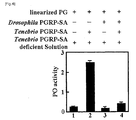
- FIG. 6 shows In vitro reconstitution experiments performed by using Tenebrio PGRP-SA, Drosophila PGRP-SA and the Tenebrio PGRP-SA (-) solution in the presence of SLPG (columns 2 and 3, respectively). Tenebrio PGRP-SA and Drosophila PGRP-SA were co-incubated in the presence of SLPG (column 4).
- FIG. 7 shows linearized PG only (a) and partially-digested linearized PG by lysozyme (b), each fractionized by a Toyopearl HW-55S column equilibrated with 20 mM Tris buffer (pH 8.0) containing 150 mM NaCl.
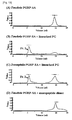
- FIG. 8 (a) shows the results when a mixture of Tenebrio PGRP-SA and Fr. 14 was injected onto the same column and
- FIG. 8 (b) shows the results when a mixture of Tenebrio PGRP-SA and the fully-digested SLPG with lysozyme by incubation for 16 h at 37 °C was injected onto the same column;
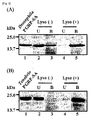
- FIG. 9 (A) shows ability of Drosophila PGRP-SA to bind to the partially-digested insoluble Lys-PG.
- Lyso (-) and Lyso (+) indicate intact and partially-digested insoluble Lys-PG, respectively.
- Lane 1 indicates Drosophila PGRP-SA only;
- Lanes 2 and 4 indicate the amounts of unbound Drosophila PGRP-SA when Lyso (-) or Lyso (+) PG was incubated with Drosophila PGRP-SA, respectively.
- Lanes 3 and 5 indicate the amounts of bound Dm-PGRP-SA on Lys (-) or Lys (+) PG, respectively.
- FIG. 9 (B) shows binding ability of Tenebrio PGRP-SA to the partially-digested insoluble Lys-PG. Each lain denotes the same meaning as in (A).
- FIG. 10 shows SDS/PAGE results analyzed after incubation with Tenebrio PGRP-SA-deficient hemolymph solution.
- Proteins were extracted from the intact insoluble PG (lane 1), Tenebrio PGRP-SA-bound PG (lane 2), or Drosophila PGRP-SA-bound PG (lane 3) after incubation with Tenebrio PGRP-SA-deficient hemolymph solution.
- M. luteus insoluble PG (lanes 4 and 5) and the synthetic muropeptide dimer-coupled resin (lanes 6 and 7) without and with Tenebrio PGRP-SA were treated. It is notable that the Drosophila PGRP-SA bound to the partially digested PG did not interact with the two Tenebrio proteins (lane 3).
- FIG. 11(A) shows comparison of the N-terminal sequences of band 1 and Tribolium castaneum GNBP-like protein (Tc-GNBP, XP_969449), T. molitor glucan recognition protein (Tm-GRP), Anopheles gambiae GNBP1 (Ag-GNBP1, AAR13751), and Drosophila melanogaster GNBP1 (Dm-GNBP1). Boxes indicate residues identical to those in the sequence of band 1.
- FIG. 11(B) shows N-terminal amino acid sequence comparison between band 2 and Tribolium castaneum serine protease (Tc-SP, XP_967486), M.
- FIG. 11(C) shows sequence identities between two internal sequences (Peak 1 and Peak 2) of band 2 and low-density lipoprotein receptor A repeat domain sequence of Tc-SP.
- FIG. 12 shows a model summarizing the molecular events in the initiation of the Toll and pro-PO pathways.
- FIG. 13 shows the results obtained by injecting Tenebrio PGRP-SA only (A), a mixture of Tenebrio PGRP-SA and the linearized PG (B), a mixture of Drosophila PGRP-SA and the linearized PG (C), or Tenebrio PGRP-SA and linearized PG (D) onto the Toyopearl HW-55S size-exclusion column, respectively.
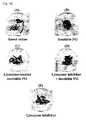
- FIG. 14 shows the effects of lysozyme inhibitor on the Lys-type PG-dependent melanin synthesis.
- A Insect saline.
- B Insoluble Lys-PG.
- C Partially digested insoluble Lys-type PG.
- D Co-injection of lysozyme inhibitor and insoluble Lys-type PG.
- E Lysozyme inhibitor only.
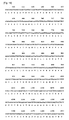
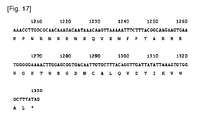
- FIGS. 15 to 17 show the amino acid sequence and the nucleotide sequence of Tenebrio GNBP1.
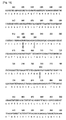
- FIGS. 18 to 21 show the amino acid sequence and the nucleotide sequence of Tenebrio MSP.
- the present inventors revealed that a complex of a peptidoglycan recognition protein of Tenebrio molitor ( Tenebrio PGRP-SA) and peptidoglycan (PG) activates a pro-PO system by recruiting proteins involved in signal transduction toward downstream.
- the proteins involved in signal transduction toward downstream are a Gram-negative bacteria binding protein 1 (GNBP1) homologue (i.e., Tenebrio GNBP1); and a Tenebrio -multi-domain containing modular serine protease (i.e., Tenebrio MSP) which has a low density lipoprotein-like domain and a complement control protein-like domain at its N-terminal.
- GNBP1 Gram-negative bacteria binding protein 1
- Tenebrio MSP Tenebrio -multi-domain containing modular serine protease
- Tenebrio MSP exists in two forms, that is, Tenebrio MSP-1 and Tenebrio MSP-2 Furthermore, we revealed amino acid sequences of the Tenebrio GNBP1 and Tenebrio MSP and nucleotide sequences encoding the same. Tenebrio GNBP1 and Tenebrio MSP is seemed to form a complex together with the complex of Tenebrio PGRP-SA and PG.
- the present invention provides a Tenebriomolitor -derived Gram negative bacteria binding protein 1 (Tenebrio GNBP1), which has an amino acid sequence as set forth in SEQ ID NO: 2
- the present invention also provides a polynucleotide encoding the Tenebrio GNBP1 having an amino acid sequence as set forth in SEQ ID NO: 2, preferably a polynucleotide having a nucleotide sequence as set forth in SEQ ID NO: 3.
- the present invention also provides a Tenebriomolitor -derived modular serine protease-1 ( Tenebrio MSP-1), which has an amino acid sequence as set forth in SEQ ID NO: 4
- the present invention also provides a polynucleotide encoding the Tenebrio MSP-1 having an amino acid sequence as set forth in SEQ ID NO: 4, preferably a polynucleotide having a nucleotide sequence as set forth in SEQ ID NO: 5.
- the present invention also provides a Tenebriomolitor -derived modular serine protease-2 ( Tenebrio MSP-2), which has an amino acid sequence as set forth in SEQ ID NO: 6.
- the present invention also provides a polynucleotide encoding the Tenebrio MSP-2 having an amino acid sequence as set forth in SEQ ID NO: 6, preferably a polynucleotide having a nucleotide sequence as set forth in SEQ ID NO: 7.
- a method of detecting bacterial infection in a sample comprising: (a) loading a Tenebriomolitor -derived peptidoglycan recognition protein ( Tenebrio PGRP-SA) having an amino acid sequence as set forth in SEQ ID NO: 1 to a sample and then performing an incubation thereof; (b) loading at least one protein selected from the group consisting of a Tenebrio GNBP1 having an amino acid sequence as set forth in SEQ ID NO: 2, a Tenebrio MSP-1 having an amino acid sequence as set forth in SEQ ID NO: 4, and Tenebrio MSP-2 having an amino acid sequence as set forth in SEQ ID NO: 6 to the incubation mixture of step (a) and then performing an incubation; and (c) detecting reactivity between the protein and the sample in the incubation mixture of step (b).
- Tenebrio PGRP-SA Tenebrio PGRP-SA
- the sample may be a blood for transfusion; a mammalian blood, including human blood; food, such as vegetables, meats, fruits, or the like; cooked or non-cooked foods; water, such as tap water, underground water, rain water, or the like; sterile products; or the like.
- the sample may be any sample that is required for microorganism detection.
- the method of detecting bacterial infection according to the present invention is suitable for detecting bacterial infection in a blood for transfusion or a mammalian blood including human blood.
- the incubation(s) can be performed at about 30 °C for such a time that a sample can sufficiently react with the protein(s). If required, the incubation can be performed in various buffers containing EDTA as a calcium ion inhibitor.
- the detecting reactivity in step (c) can be performed in accordance with a conventional method using a size-exclusion column, such as a column filled with a size-exclusion Toyopearl HW55S resin.
- the method of detecting bacterial infection according to the present invention can further include pre-treating the sample with ⁇ -lytic protease (blp) and/or lysozyme.
- ⁇ -lytic protease blp
- lysozyme a recognition protein that is, a protein having an amino acid sequence as set forth in SEQ ID NO: 1, Tenebrio PGRP-SA
- the treating a sample with ⁇ -lytic protease (blp) and/or lysozyme facilitates forming a complex with Tenebrio PGRP-SA.
- the blp may be derived from various microorganisms, such as a soil microorganism.
- the blp can be derived from a microorganism belonging to genus Achromobacter, preferably Achromobacter lyticus, and more preferably Achromobacter lyticus ATCC 21456 or Achromobacter lyticus ATCC 21457.
- the blp can be prepared by purifying a commercially available crude Achromopeptidase preparation (Wako Pure Chemical Institute, 014-09661) using a known method ( Li, S., Norioka, S. & Sakiyama, F. (1998) J Biochem (Tokyo) 124, 332-339 ).
- the pre-treatment with blp can be performed by treating the sample with blp in a concentration of about 1 ⁇ g/ml and then incubating at about 37 °C for about 14 hours.
- the lysozyme used in the method of detecting bacterial infection of the present invention can be a commercially available lysozyme (for example, hen egg white lysozyme).
- the pre-treatment with lysozyme may be performed by treating the sample with lysozyme in a concentration of about 1 mg/ml and then incubating at about 37 °C for a varying reaction time.
- a kit for detecting bacterial infection in a sample comprising: a Tenebrio PGRP-SA having an amino acid sequence as set forth in SEQ ID NO: 1, and at least one protein selected from the group consisting of a Tenebrio GNBP1 having an amino acid sequence as set forth in SEQ ID NO: 2, a Tenebrio MSP-1 having an amino acid sequence as set forth in SEQ ID NO: 4, and Tenebrio MSP-2 having an amino acid sequence as set forth in SEQ ID NO: 6.
- the sample may be a blood for transfusion; a mammalian blood, including human blood; food, such as vegetables, meats, fruits, or the like; cooked or non-cooked foods; water, such as tap water, underground water, rain water, or the like; sterile products; or the like.
- the sample may be any sample that is required for microorganism detection.
- the detection kit according to the present invention is suitable for detecting bacterial infection in a blood for transfusion or a mammalian blood including human blood.
- the detection kit of the present invention may include a reagent for detecting reactivity, for example, an amino acid or peptide bound to p-nitroaniline, proteins activating a pro-PO system, and a chromogenic substrate of a pro-PO enzyme.
- the detection kit may be in a form of solution, freeze-dried powder, frozen solution, or a strip. Each of these forms can be formulated using any conventional method known in the art.
- the detection kit in a form of a solution can be formulated by mixing the protein(s) with a buffer, such as a sodium-phosphoric acid buffer, a potassium-phosphoric acid buffer, a Tris-hydrochloric acid buffer, or the like, in a mixed form or in separate forms. If required, the solution can be frozen or freeze-dried.
- the detection kit of the present invention may further include ⁇ -lytic protease (blp) and/or lysozyme.
- the blp may be derived from various microorganisms, such as a soil microorganism.
- the blp can be derived from a microorganism belonging to genus Achromobacter, preferably Achromobacter lyticus, and more preferably Achromobacter lyticus ATCC 21456 or Achromobacter lyticus ATCC 21457.
- the blp can be prepared by purifying a commercially available crude Achromopeptidase preparation (Wako Pure Chemical Institute, 014-09661) using a known method ( Li, S., Norioka, S. & Sakiyama, F. (1998) J Biochem (Tokyo) 124, 332-339 ).
- the lysozyme can be a commercially available lysozyme.
- the present invention also provides a method of preparing a soluble linearized Lys-type peptidoglycan (SLPG) that can be used as a standard substance of Lys-PG in detecting bacterial infection in a sample. That is, the present invention provides a method of preparing a soluble linearized Lys-type peptidoglycan (SLPG), the method oomprising: (a') suspending an insoluble peptidoglycan isolated from a bacteria in a buffer solution of about pH 8; (b') treating the suspension obtained from step (a') with ⁇ -lytic protease (blp); (c') heating the reaction mixture obtained from step (b') at about 95 °C for about 10 minutes, centrifuging the reaction mixture, and then collecting a supernatant; and (d') fractionizing the supernatant obtained from step (c') using a size-exclusion column to collect a fraction showing phenoloxidase (PO) activity.
- SLPG soluble linearized Lys
- the insoluble peptidoglycan isolated from bacteria can be prepared using any method known in the art (e.g., BL de Jonge, YS Chang, D Gage, and A Tomasz, Peptidoglycan composition of a highly methicillin-resistant Staphylococcus aureus strain.
- Any method known in the art e.g., BL de Jonge, YS Chang, D Gage, and A Tomasz, Peptidoglycan composition of a highly methicillin-resistant Staphylococcus aureus strain.
- penicillin binding protein 2A J. Biol. Chem., Jun 1992; 267: 11248 - 11254 The role of penicillin binding protein 2A J. Biol. Chem., Jun 1992; 267: 11248 - 11254 ).
- the buffer solution in step (a') can be a Tris buffer of about pH 8.0.
- the blp may be derived from various microorganisms, such as a soil microorganism.
- the blp can be derived from a microorganism belonging to genus Achromobacter, preferably Achromobacter lyticus, and more preferably Achromobacter lyticus ATCC 21456 or Achromobacter lyticus ATCC 21457.
- the blp can be prepared by purifying a commercially available crude Achromopeptidase preparation (Wako Pure Chemical Institute, 014-09661) using a known method ( Li, S., Norioka, S. & Sakiyama, F. (1998) J Biochem (Tokyo) 124, 332-339 ).
- the treating with blp can be performed by treating the suspension containing the insoluble peptidoglycan with blp in a concentration of about 1 ⁇ g/ml and then incubating at about 37 °C for about 14 hours.
- step (c') the centrifuging can be performed at about 18,000 x g, at a temperature of about 4 °C, for about 10 minutes. If required, the supernatant obtained from the centrifugation may be freeze-dried and then stored at a temperature of about 4 °C.
- the size-exclusion column is a column filled with a Toyopearl HW55S resin.
- the column is used after being equilibrated with sterile distilled water.
- the fractionizing can be performed by eluting the solution obtained from step (c') (i.e., soluble PG solution) through the column.
- the fraction showing phenoloxidase (PO) activity can be collected as follows: each fraction is diluted and then the hemolymph of T. molitor larvae is added thereto. After incubating the obtained mixture at 30 °C for 5 minutes, 20 mM Tris buffer (pH8D) is added thereto.
- CaCl 2 solution, 4-methylcatechol (4-MC) solution, and 4-hydroxy proline ester (4-HP) solution are added thereto and mixed together.
- the mixture is left to sit in a constant temperature bath of 30 °C.
- Absorbance is measured at a wavelength of 520 nm using a spectrophotometer at the time showing the largest color variance, compared to color variance of the hemolymph having Ca 2+ alone.
- the obtained fraction showing phenoloxidase (PO) activity may be further purified by concentrating the fraction, fractionizing through a column filled with a Toyopearl HW55S resin, and then isolating a SLPG-containing fraction.
- the method of preparing SLPG may further comprise freeze-drying the fraction obtained from step (d').
- Achromobacter -lytic protease (blp) was purified to homogeneity from a commercially available crude Achromopeptidease preparation (Wako Pure Chemical Institute) according to the method reported previously ( Li, S., Norioka, S. & Sakiyama, F. (1998) J Biochema (Tokyo) 124,332-339 ). To confirm the identity of the blp, the N-terminal sequence of the purified blp was determined on an Applied Biosystem Procise automated gas-phase amino acid sequencer. The bacteriolytic activity of blp against Micrococcus luteus was assayed by the method of Sakiyama ( Li, S., Norioka, S. & Sakiyama, F. (1997) J Biochem (Tokyo) 122,772-778 ).
- Staphylococcus aureus ATCC 12598 (Cowan serotype) strain was inoculated in a liquid medium (TSB (tryptic soy broth) medium, 100 ml) and then incubated at 37 °C for 12 hours. 20 ml of the medium was inoculated to each of TSB medium 2 L (400 ml X 5 bottles) and then incubated for 12 hours. The resultant medium was centrifuged at a rotation speed of 6000 rpm at a temperature of 4 °C for 30 minutes. Then, the cells were collected and the collected cells were suspended in 200 ml of sterile distilled water, and the resultant cells were collected again. Such processes (i.e., collecting and suspending) were performed 6 times. The obtained cells were suspended in 76.8 ml of 50 mM Tris buffer (pH 7D) and the obtained suspension was loaded in the same amount to 50 ml of two test tubes.
- TSB tryptic soy broth
- insoluble peptidoglycan isolated peptidoglycan was performed according to a known method ( BL de Jonge, YS Chang, D Gage, and A Tomasz Peptidoglycan composition of a highly methicillin-resistant Staphylococcus aureus strain.
- penicillin binding protein 2A J. Biol. Chem., Jun 1992; 267: 11248 11254 The role of penicillin binding protein 2A J. Biol. Chem., Jun 1992; 267: 11248 11254 ), which will be described in detail.
- the collected bacterial cells were suspended in 40 ml of 1 X PBS buffer and then reacted with DNase and RNase in a concentration of 100 ⁇ g/ml at 37 °C for 18 hours.
- the reaction mixture was reacted with 200 ⁇ g/ml of trypsin at 37 °C for 18 hours.
- 20% SDS solution which had been heated at 95 °C was added to the reaction mixture to obtain a 1 % bacterial solution, and the solution was heated at 95 °C for 10 minutes to stop the enzymatic reaction.
- the obtained reaction mixture was centrifuged (18,000 x g, 4 °C, 10 minutes) and the resulting precipitate was collected.
- the obtained suspension was centrifuged (18,000 x g, 4 °C, 10 minutes) and the resulting precipitate was collected.
- the collected precipitate was suspended in 40 ml of sterile distilled water.
- the obtained suspension was centrifuge (18,000 x g, 4 °C, 10 minutes), and the resulting precipitate was collected.
- the collected precipitate was suspended in 40 ml of acetone.
- the obtained suspension was centrifuged (18,000 x g, 4 °C, 10 minutes), and the resulting precipitate was collected.
- the collected precipitate was freeze-dried to obtain about 380-400 mg of insoluble peptidoglycan.
- the obtained insoluble peptidoglycan was treated with ⁇ -lytic protease (blp). That is, 2 ⁇ g/ml of blp was added to a suspension of the obtained insoluble peptidoglycan (20 mg) in 20 mM Tris buffer (pH8D), which was then incubated at a temperature of 37 °C for 14 hours. The reaction mixture was boiled at 95 °C for 10 minutes and then centrifuged (18,000 x g, 4 °C, 10 minutes). The supernatant was collected and then freeze-dried. The freeze-dried product was left to sit at 4 °C.
- blp ⁇ -lytic protease
- a column (26 x 15.5 cm) was filled with 60 ml of Toyopearl HW55S resin and equilibrated using sterile distilled water at a flow speed of 0.5 ml/min, and then 1 mg of the soluble PG solution prepared as described above was loaded to the column and was fractionized in a predetermined volume. Each of fractions was diluted using sterile distilled water to obtain a 100 X solution. 10 ⁇ l of each diluted solution was used to identify PO activity.
- the PO activity was identified as follows: 30 ⁇ l of the hemolymph of T. molitor larvae (about 280 ⁇ g of hemolymph protein) was added to 10 ⁇ l of each of the diluted solutions, and then incubated at 30 °C for 5 minutes. 435 ⁇ l of 20 mM Tris buffer (pH8.0) was added thereto and immediately 5 ⁇ l of 1M CaCl 2 solution (10 mM of a final concentration) was added thereto. 4 ⁇ l of 250 mM 4-methylcatechol (4-MC) solution and 16 ⁇ l of 625 mM 4-hydroxy proline ester (4-HP) solution were added thereto, and mixed together. The mixture was left to sit in a constant temperature bath of 30 °C. Absorbance was measured at a wavelength of 520 nm using a spectrophotometer at the time showing the largest color variance, compared to color variance of the hemolymph having Ca 2+ alone.
- T. molitor larvae were maintained on a laboratory bench in terraria containing wheat bran. Hemolymph was collected as previously described ( Zhang, R, Cho, H. Y., Kim, H. S., Ma, Y. G., Osaki, T., Kawabata, S., Soderhall, K. & Lee, B L. (2003) J Biol Chem 278, 42072-42079 ).
- An assay of PO was carried out according to our previously published method ( Park, J. W., Je, B R., Piao, S., Inamura, S., Fujimoto, Y., Fukase, K., Kusumoto, S., Soderhall, K., Ha, N. C.
- PGRP-SA smel is a line carrying the semmelweis mutation (C54Y) in Drosophila PGRP-SA ( Michel, T., Reichhart, J. M., Hoffmann, J. A. & Royet, J. (2001) Nature 414, 756-759 ).
- Ten nl of water, SLPG (10 mg ml-1) or the compound of Formula (I) (10 mg ml-1) was injected into the thorax of the wild-type or PGRP-SA smel female adults (2-4 days old) using a Nanoject apparatus (Drummond). After injection, the flies were then incubated for 18 h at 25 °C.
- Drosomycin expression level was measured as previously described ( Leulier, F., Parquet, C., Pili-Floury, S., Ryu, J. H., Caroff, M., Lee, W. J., Mengin-Lecreulx, D. & Lemaitre, B (2003) Nat Immunol 4, 478-484 ).
- soluble oligomeric Lys-PG fragments showing PO activity 10 ⁇ l of hen egg white lysozyme (1 mg ml -1 , Wako) was added to 100 ⁇ l of purified SLPG (800 ⁇ g ml -1 ) and then incubated for 5 min at 37 °C.
- the partially-digested SLPG was boiled for 10 min and then loaded on a Toyopearl HW-55S column equilibrated with 20 mM Tris buffer (pH 8.0) at a flow rate of 0.5 ml/min. The fractions showing PO activity were pooled.
- S partially-digested insoluble polymeric Lys-PG fragments showing PO activity
- aureus insoluble PG 40 mg
- PBS buffer pH 7.2
- 10 ⁇ g of lysozyme 10 ⁇ g
- the residue in the pellet fraction was washed 3 times with 8 M urea and 3 times with distilled water.
- the binding assay was performed according to the previously reported method ( Park, J. W., Je, B R, Piao, S., Inamura, S., Fujimoto, Y., Fukase, K., Kusumoto, S., Soderhall, K., Ha, N. C. & Lee, B L. (2006) J Biol Chem 281, 7747-7755 ). Briefly, 10 ⁇ g of the purified Tenebrio PGRP-SA or Drosophila PGRP-SA was mixed with 40 ⁇ l of a 50% (v/v) suspension of the partially-digested S. aureus or M.
- luteus PG 500 ⁇ g
- 50 mM Tris-HCl buffer (pH 7D) 50 mM Tris-HCl buffer (pH 7D) for 12 h at 4 °C in a shaker.
- Unbound PGRP in the supernatant and bound PGRP in the pellet fraction were analyzed by SDS-PAGE.
- a Tenebrio PGRP-SA (-) solution was prepared from the hemolymph of T. molitor according to the previously reported method by using a compound of Formula (I)-coupled affinity column ( Park, J. W., Je, B R, Piao, S., Inamura, S., Fujimoto, Y., Fukase, K., Kusumoto, S., Soderhall, K., Ha, N. C. & Lee, B L. (2006) J Biol Chem 281, 7747-7755 ).
- This solution contains all of the essential components, except for Tenebrio PGRP-SA, necessary for the activation of the pro-PO system by Lys-PG.
- Tenebrio PGRP-SA (40 ⁇ g) was incubated with partially-digested insoluble Lys-PG (8 mg) in 200 ⁇ l of PBS buffer for 12 h at 4 °C. After incubation, Tenebrio PGRP-SA-bound insoluble Lys-PG was recovered by centrifugation at 20,000 x g for 10 min at 4 °C, washed 3 times first with 20 mM Tris (pH 8D) and next with 50 mM Tris-HCl buffer (pH 6D).
- the recovered Tenebrio PGRP-SA-bound Lys-PG was incubated with 25 ml of the Tenebrio PGRP-SA (-) solution (20 mg of total protein) for 3 h at 4 °C. After removing the insoluble residue by centrifugation, the mixture was washed twice with 50 mM Tris-HCl buffer (pH 6D). The bound proteins on the insoluble Lys-PG were extracted with 100 ⁇ l of 2x SDS-PAGE loading buffer and then separated by SDS-PAGE.
- the protein bands on the polyacrylamide gel were transferred onto a polyvinylidene difluoride membrane and then the N-terminal sequences of the 50 kDa (Tenebrio GNBP1) and 35 kDa proteins (Tenebrio modular serine protease, Tenebrio MSP) were determined on an automatic gas-phase amino acid sequencer (Applied Biosystem).
- cDNA cloning of Tenebrio MSP was also performed in the same manner, using 5'-AARGAYAAYTGYGAYGARAT-3' (SEQ ID NO: 10) and 5'-GCYTGYTGCCANGGRTARTC-3' (SEQ ID NO: 11) as degenerate sense and antisense primers, respectively.
- Achromobacter blp is a lysostaphin-like enzyme that hydrolyzes the peptide bonds in the penta-Gly bridge present in S. aureus PG ( Li, S., Norioka, S. & Sakiyama, F. (1998) J Biochem (Tokyo) 124, 332-339 ). Therefore, the blp was expected to generate soluble polymeric PG fragments from insoluble PG with Gly residue(s) attached to the stem peptides ( Fig. 1 ). Solubilized polymeric Lys-PG fragments (SLPG) were obtained by using blp from S. aureus PG.
- SLPG is anticipated to be a polymerized muropeptide linked by ⁇ -1,4 glycosidic bonds between the sugars, not by penta-Gly bridges between the stem peptides. Therefore, SLPG should have multiple binding sites for PGRP-SA because it contains several muropeptide motifs.
- SLPG Using further purified SLPG, we confirmed that the recombinant Drosophila PGRP-SA and Tenebrio PGRP-SA proteins, which were expressed and purified in a baculovirus insect cell culture system, both bind to SLPG which was demonstrated using a size-exclusion column ( Fig. 13 (B) and (C) ).
- the compound of Formula (I) was unable to activate the Toll and pro-PO pathways as shown above, whereas the muropeptide dimer was reported to induce activation of the Toll pathway ( Filipe, S. R, Tomasz, A. & Ligoxygakis, P. (2005) EMBO Rep 6, 327-333 ).
- the PG fragment that accommodates two PGRP-SA molecules is the minimum unit which could induce the downstream events and result in activation of the pro-PO system.
- Lysozyme presents a processed form of PG for PG recognition signals
- Drosophila GNBP1 has an enzymatic activity that hydrolyzes loosely cross-linked M. luteus Lys-PG, but not highly cross-linked S . aureus Lys-PG ( Wang, L., Weber, A. N., Atilano, M. L., Filipe, S. R., Gay, N. J. & Ligoxygakis, P. (2006) EMBO J 25, 5005-5014 ). Since they found that GNBP1 has lysozyme-like activity, they proposed that Drosophila GNBP1 presents a processed form of PG for sensing by Drosophila PGRP-SA.
- GNBP1 may have less importance for processing PG than the hemolymph lysozyme.
- the limited lysozyme-like activity of GNBP1 may play an important role in amplifying or scavenging the recognition signal.
- Tenebrio PGRP-SA/PG complex recruits Tenebrio GNBP1 and Tenebrio multi domain modular serine protease (MSP)
- the 50 kDa protein was a Tenebrio GNBP1 (Tenebrio GNBP1).
- the N-terminal 30 residues of the 50 kDa protein (band 1) exhibited 86.7% and 51.7% sequence identity with Tribolium castaneum GNBP and Anopheles GNBP1 proteins, respectively ( Fig. 11(A) ).
- GNBP1 was reported to physically interact with PGRP-SA for the activation of the Toll pathway in Drosophila ( Gobert, V, Gottar, M., Matskevich, A.
- Tc-SP T. castaneum serine protease
- accession number XP_967486 accession number XP_967486; Fig. 11(B)
- Tc-SP contains low density lipoprotein receptor A repeat (LDLa) domains, one sushi domain, one complement control protein (CCP) domain and a SP domain, but it does not contain a clip domain that is commonly found in members of the Toll and pro-PO cascades.
- LDL low density lipoprotein receptor A repeat
- CCP complement control protein
- SP domain SP domain
- the identity of the 35 kDa protein was further confirmed through the presence of low-density lipoprotein receptor A repeat domain sequence in the protein band under non-reducing condition ( Fig. 11(C) ).
- Ms-HP-14 Manduca sexta hemolymph protease-14
- Ji, C. Wang, Y., Guo, X., Hartson, S. & Jiang, H. (2004) J Biol Chem 279, 34101-34106 ; and Wang, Y. & Jiang, H. (2006) J Biol Chem 281, 9271-9278 ).
- Ji, C. Wang, Y., Guo, X., Hartson, S. & Jiang, H. (2004) J Biol Chem 279, 34101-34106 ; and Wang, Y. & Jiang, H. (2006) J Biol Chem 281, 9271-9278 .
- the present inventors propose a model summarizing the molecular events in the initiation of the Toll and pro-PO pathways as follows (see Fig. 12 ). Although a few PGRP-SA (R) molecules bind to intact PG, it is not able to activate the immune responses (a). PG of Gram-positive bacteria is digested partially (b) or completely (b') by lysozyme. Whereas the partially digested PG recruits more PGRP-SA molecules binding to the bacterial surface (b), the fully digested PG cannot recruit PGRP-SA on the bacterial surface leading to lysis of the bacterial cell (b').
- the clustered PGRP-SA molecules recruit GNBP1 and a modular serine protease (MSP) containing low-density lipoprotein receptor A repeat domains (LDL), resulting in the activation of the modular serine protease (c). Then the activated serine protease triggers the proteolytic cascade leading to activation of the Toll and prophenoloxidase (pro-PO) pathways that produce antimicrobial peptide (AMP) and melanin around the invading bacteria.
- MSP modular serine protease
- LDL low-density lipoprotein receptor A repeat domains
Landscapes
- Health & Medical Sciences (AREA)
- Chemical & Material Sciences (AREA)
- Life Sciences & Earth Sciences (AREA)
- Organic Chemistry (AREA)
- Genetics & Genomics (AREA)
- Zoology (AREA)
- Biochemistry (AREA)
- Molecular Biology (AREA)
- Biophysics (AREA)
- General Health & Medical Sciences (AREA)
- Engineering & Computer Science (AREA)
- Toxicology (AREA)
- Proteomics, Peptides & Aminoacids (AREA)
- Medicinal Chemistry (AREA)
- Gastroenterology & Hepatology (AREA)
- Bioinformatics & Cheminformatics (AREA)
- Tropical Medicine & Parasitology (AREA)
- Wood Science & Technology (AREA)
- Biomedical Technology (AREA)
- Biotechnology (AREA)
- General Engineering & Computer Science (AREA)
- Crystallography & Structural Chemistry (AREA)
- Plant Pathology (AREA)
- Microbiology (AREA)
- Physics & Mathematics (AREA)
- Measuring Or Testing Involving Enzymes Or Micro-Organisms (AREA)
- Peptides Or Proteins (AREA)
- Enzymes And Modification Thereof (AREA)
- Preparation Of Compounds By Using Micro-Organisms (AREA)
Description
- The present invention relates to novel proteins activating pro-phenoloxidase (pro-PO) system of Tenebrio molitor, genes encoding the same, methods of detecting bacterial infection in a sample using the proteins, and kits for detecting bacterial infection in a sample using the proteins. The present invention also relates to a method of preparing a soluble linearized Lys-type peptidoglycan (SLPG), useful for a standard substance for the kit.
- Recent genetic studies revealed that Drosophila melanogaster peptidoglycan (PG) recognition protein Drosophila PGRRSA and Drosophila PGRP-SD activate the Toll pathway (Michel, T., Reichhart, J. M., Hoffmann, J. A. & Royet, J. (2001) Nature 414, 756-759; and Bischoff, V, Vignal, C., Boneca, I G., Michel, T., Hoffmann, J. A. & Royet, J. (2004) Nat Immunol 5, 1175-1180), while Drosophila PGRP-LC and Drosophila PGRP-LE are receptors for the Imd pathway (Gottar, M., Gobert, V, Michel, T., Belvin, M., Duyk, G., Hoffmann, J. A., Ferrandon, D. & Royet, J. (2002) Nature 416, 640-644; Choe, K. M., Werner, T., Stoven, S., Hultmark, D. & Anderson, K. V (2002) Science 296, 359-362; and Takehana, A., Katsuyama, T., Yano, T., Oshima, Y., Takada, H., Aigaki, T. & Kurata, S. (2002) Proc Natl Acad Sci USA 99, 13705-13710). The immune phenotype of a loss-of-function mutant of Drosophila Gram-negative bacteria binding protein 1 (Drosophila GNBP1) was indistinguishable from that of Drosophila PGRP-SA, demonstrating that these two proteins are required to activate the Toll pathway in response to Gram-positive bacterial infection (Gobert, V, Gottar, M., Matskevich, A. A., Rutschmann, S., Royet, J., Belvin, M., Hoffmann, J. A. & Ferrandon, D. (2003) Science 302, 2126-2130; Pili-Floury, S., Leulier, F., Takahashi, K., Saigo, K., Samain, E., Ueda, R & Lemaitre, B (2004) J Biol Chem 279, 12848-12853; and Wang, L., Weber, A. N., Atilano, M. L., Filipe, S. R, Gay, N. J. & Ligoxygakis, P. (2006) EMBO ). However, the molecular mechanisms of the upstream part of the Toll pathway in Gram-negative bacteria recognition still remain to be elucidated.
- The pro-phenoloxidase (pro-PO) activation cascade, which leads to melanization of invading microbes, is another major innate immune defense mechanism in invertebrates that is triggered by peptidoglycan (PG) and β-1,3-glucan (Cerenius, L. & Soderhall, K. (2004) Immunol Rev 198, 116-126; and Kanost, M. R, Jiang, H. & Yu, X. Q. (2004) Immunol Rev 198, 97-105). The pro-PO cascade, like the vertebrate complement system, is a proteolytic cascade in blood plasma. Therefore, the pro-PO system is an ideal tool for biochemical studies of PG and β-1,3-glucan recognition and subsequent signaling under a cell-free condition. We previously identified the Tenebrio molitor PGRP that exhibited the highest sequence homology with Drosophila PGRP-SA. This PGRP, which we designate Tenebrio PGRP-SA, activated the Lys-PG-dependent pro-PO system in Tenebrio beetle. Remarkably, a novel synthetic Lys-PG fragment functions as a competitive inhibitor of soluble polymeric linear Lys-PG in the activation of the pro-PO system. The synthetic Lys-PG fragment (hereinafter referred to as "synthetic muropeptide dimmer"), having a chemical structure of the following formula (I), is composed of tetra-saccharide (GlcNAc-MurNAc-GlcNAc-MurNAc), covalently linked to two copies of a tetrapeptide stem [L-Ala-D-isoGln-L-Lys-D-Ala) (Park, J. W., Je, B R, Piao, S., Inamura, S., Fujimoto, Y., Fukase, K., Kusumoto, S., Soderhall, K., Ha, N. C. & Lee, B L. (2006) J Biol Chem 281, 7747-7755).

- Recent crystallographic structural studies of PGRP proteins without PG-fragment or in complex with PG-fragments provided important insights into the structural basis for PG recognition (Lim, J. H., Kim, M. S., Kim, H. E., Yano, T., Oshima, Y., Aggarwal, K., Goldman, W. E., Silverman, N., Kurata, S. & Oh, B H. (2006) J Biol Chem 281, 8286-8295; Chang, C. I, Chelliah, Y., Borek, D., Mengin-Lecreulx, D. & Deisenhofer, J. (2006) Science 311, 1761-1764; Chang, C.I., Ihara, K., Chelliah, Y., Mengin-Lecreulx, D., Wakatsuki, S. & Deisenhofer, J. (2005) Proc Natl Acad Sci U S A 102, 10279-10284; Guan, R, Roychowdhury, A., Ember, B, Kumar, S., Boons, G. J. & Mariuzza, R A. (2004) Proc Natl Acad Sci U S A 101, 17168-17173; Kim, M. S., Byun, M. & Oh, B H. (2003) Nat hmnunol 4, 787-793; .and Chang, C. I, Pali-Floury, S, Herve, M., Parquet, C., Chelliah, Y., Lemaitre, B, Mengin-Lecreulx, D. & Deisenhofer, J. (2004) PLoS Biol 2, E277). Muropeptide, composed of N-acetylglucosamine and N-acetylmuramic acid sugars linked with a short peptide chain as a stem, was revealed as the minimum binding unit for PGRP-SA.
- However, it remains unclear how recognition signal of Lys-PG by PGRPs primes the serine protease (SP) cascade leading to activation of the pro-PO or Toll pathways.
- The present Inventors performed various studies on how a Lys-PG recognition signal is transferred downstream through a biochemical approach using in vivo Drosophila Toll pathway, in vitro pro-PO motivation system and recombinant PGRP-SA proteins. As a result, we isolated proteins involved in a pro-PO system and also found that such proteins are useful for detecting bacterial infection in a sample, such as blood. Also, the present inventors developed a method of preparing a soluble linearized Lys-type peptidoglycan (SLPG), which is useful for a standard substance in detecting bacterial infection in a sample.
- Therefore, the present invention provides proteins activating pro-phenoloxidase (pro-PO) system and genes encoding the same.
- The present invention also provides a method of detecting bacterial infection in a sample using the proteins.
- The present invention also provides a kit for detecting bacterial infection in a sample using the proteins.
- Also disclosed in the present invention is a method of preparing a soluble linearized Lys-type peptidoglycan (SLPG).
- According to a first aspect of the present invention, there is provided a Tenebrio molitor -derived Gram negative bacteria binding protein 1 (Tenebrio GNBP1), which has an amino acid sequence as set forth in SEQ ID NO: 2.
According to a second aspect of the present invention, there is provided a polynucleotide encoding the Tenebrio GNBP1 having an amino acid sequence as set forth in SEQ ID NO: 2. - According to a third aspect of the present invention, there is provided a method of detecting bacterial infection in a sample, the method comprising:
- (a) loading a Tenebrio molitor-derived peptidoglycan recognition protein (Tenebrio PGRP-SA) having an amino acid sequence as set forth in SEQ ID NO:1 to a sample and then performing an incubation thereof;
- (b) loading a Tenebrio GNBP1 having an amino acid sequence as set forth in SEQ ID NO: 2 to the incubation mixture of step (a) and then performing an incubation; and
- (c) detecting reactivity between the protein and the sample in the incubation mixture of step (b).
- a Tenebrio PGRP-SA having an amino acid sequence as set forth in SEQ ID NO: 1, and a Tenebrio GNBP1 having an amino acid sequence as set forth in SEQ ID NO: 2.
- Also disclosed in the present invention is a Tenebrio molitor-derived modular serine protease-1 (Tenebrio MSP-1), which has an amino acid sequence as set forth in SEQ ID NO: 4 and a polynucleotide encoding the same, e.g. a polynucleotide having a nucleotide sequence as set forth in SEQ ID NO: 5. Also disclosed in the present invention is a molitor-derived modular serine protease-2 (Tenebrio MSP-2), which has an amino add sequence as set forth in SEQ ID NO: 6 and a polynucleotide encoding the same, e.g.,. a polynucleotide having a nucleotide sequence as set forth in SEQ ID NO: 7.
- Also disclosed in the present invention is a method of detecting bacterial infection in a sample, the method comprising: (a) loading a Tenebrio molitor-derived peptidoglycan recognition protein (Tenebrio PGRP-SA) having an amino acid sequence as set forth in SEQ ID NO: 1 to a sample and then performing an incubation thereof; (b) loading at least one protein selected from the group consisting of a Tenebrio GNBP1 having an amino acid sequence as set forth in SEQ ID NO: 2, a Tenebrio MSP-1 having an amino acid sequence as set forth in SEQ ID NO: 4, and Tenebrio MSP-2 having an amino acid sequence as set forth in SEQ ID NO: 6 to the incubation mixture of step (a) and then performing an incubation; and (c) detecting a reactivity between the protein and the sample in the incubation mixture of step (b).
- Also disclosed in the present invention is a kit for detecting bacterial infection in a sample comprising: a Tenebrio PGRP-SA having an amino acid sequence as set forth in SEQ ID NO: 1, and at least one protein selected from the group consisting of a Tenebrio GNBP1 having an amino acid sequence as set forth in SEQ ID NO: 2, a Tenebrio MSP-1 having an amino acid sequence as set forth in SEQ ID NO: 4, and Tenebrio MSP-2 having an amino aid sequence as set forth in SEQ ID NO: 6.
- Also disclosed in the present invention is a method of preparing .a soluble linearized Lys-type peptidoglycan (SLPG), the method comprising: (a') suspending an insoluble peptidoglycan isolated from a bacteria in a buffer solution of about
pH 8; (b') treating the suspension obtained from step (a') with p-lytic protease (blp); (c') heating the reaction mixture obtained from step (b') at about 95 °C for about 10 minutes, centrifuging the reaction mixture, .and then collecting a supernatant; and (d') fractionizing the supernatant obtained fromstep 0 using a size-exclusion column to collect a fraction showing phenoloxidase (PO) activity. - Through the present invention, novel factors (i.e., proteins) activating a pro-PO system are identified. The proteins can be used to detect bacterial infection in a sample such as blood, or to manufacture a kit for the detection thereof. In addition, when a sample such as blood is pre-treated using blp and/or lysozyme according to the present invention, bacterial infection can be more effectively detected by the factors involved in a pro-PO system.
-
FIG. 1 is expected structures of linearized peptidoglycan (PG) (a) and synthetic muropeptide dimmer (b), in which white large circles, black large circles, black small circles and white small circles indicate N-acetyl-glucosamine, N-acetylmuramic acid, stem peptides, and Gly residues of S. aureus PG, respectively. -
FIG. 2 is the UV absorbance profile of fractionized SLPG on a Toyopearl HW-55S size-exclusion column and the PO activity of each SLPG fraction. -
FIG. 3 shows induction of the drosomycin (Drs)-Rp49 reporter gene after the injection of water (white bars), the synthetic muropeptide dimmer (stripes) or SLPG (black bars) into wild-type female adult flies and PGRP-SA seml mutant flies. Drs expression was measured in four flies collected 18 hrs after challenge and normalized to the value obtained after injection of water (set at 100%). Bars represent the mean ± s.d. of four independent experiments. -
FIG. 4 shows appearance of melanin pigment examined within 18 hrs after the injection of 100 ng of synthetic muropeptide dimmer (a) or SLPG (b) into Tenebrio larvae. -
FIG. 5 shows Lys-PG-dependent PO activity measured with 10 nM of Tenebrio PGRP-SA (0.2 µg ml-1) and different amounts of SLPG (squares). A bell-shaped dose-response curve was shifted to the right by the addition of Tenebrio PGRR-SA. By increasing the Tenebrio PGRP-SA concentration to 120 nM (25 µg ml -1), a maximal point was observed at 100 ng of SLPG (circles). Insets indicate the putative complexed structures of Tenebrio PGRP-SA and SLPG. -
FIG. 6 shows In vitro reconstitution experiments performed by using Tenebrio PGRP-SA, Drosophila PGRP-SA and the Tenebrio PGRP-SA (-) solution in the presence of SLPG (columns -
FIG. 7 shows linearized PG only (a) and partially-digested linearized PG by lysozyme (b), each fractionized by a Toyopearl HW-55S column equilibrated with 20 mM Tris buffer (pH 8.0) containing 150 mM NaCl. -
FIG. 8 (a) shows the results when a mixture of Tenebrio PGRP-SA and Fr. 14 was injected onto the same column andFIG. 8 (b) shows the results when a mixture of Tenebrio PGRP-SA and the fully-digested SLPG with lysozyme by incubation for 16 h at 37 °C was injected onto the same column; -
FIG. 9 (A) shows ability of Drosophila PGRP-SA to bind to the partially-digested insoluble Lys-PG. Lyso (-) and Lyso (+) indicate intact and partially-digested insoluble Lys-PG, respectively.Lane 1 indicates Drosophila PGRP-SA only;Lanes Lanes FIG. 9 (B) shows binding ability of Tenebrio PGRP-SA to the partially-digested insoluble Lys-PG. Each lain denotes the same meaning as in (A). -
FIG. 10 shows SDS/PAGE results analyzed after incubation with Tenebrio PGRP-SA-deficient hemolymph solution. Proteins were extracted from the intact insoluble PG (lane 1), Tenebrio PGRP-SA-bound PG (lane 2), or Drosophila PGRP-SA-bound PG (lane 3) after incubation with Tenebrio PGRP-SA-deficient hemolymph solution. M. luteus insoluble PG (lanes 4 and 5) and the synthetic muropeptide dimer-coupled resin (lanes 6 and 7) without and with Tenebrio PGRP-SA were treated. It is notable that the Drosophila PGRP-SA bound to the partially digested PG did not interact with the two Tenebrio proteins (lane 3). -
FIG. 11(A) shows comparison of the N-terminal sequences ofband 1 and Tribolium castaneum GNBP-like protein (Tc-GNBP, XP_969449), T. molitor glucan recognition protein (Tm-GRP), Anopheles gambiae GNBP1 (Ag-GNBP1, AAR13751), and Drosophila melanogaster GNBP1 (Dm-GNBP1). Boxes indicate residues identical to those in the sequence ofband 1.FIG. 11(B) shows N-terminal amino acid sequence comparison betweenband 2 and Tribolium castaneum serine protease (Tc-SP, XP_967486), M. sexta hemolymph protease 14 (Ms-HP14), A. gambiae serine protease (Ag-SP, XP_321263), and D. melanogaster modular serine protease (Dm-MSP, CG31217).FIG. 11(C) shows sequence identities between two internal sequences (Peak 1 and Peak 2) ofband 2 and low-density lipoprotein receptor A repeat domain sequence of Tc-SP. -
FIG. 12 shows a model summarizing the molecular events in the initiation of the Toll and pro-PO pathways. -
FIG. 13 shows the results obtained by injecting Tenebrio PGRP-SA only (A), a mixture of Tenebrio PGRP-SA and the linearized PG (B), a mixture of Drosophila PGRP-SA and the linearized PG (C), or Tenebrio PGRP-SA and linearized PG (D) onto the Toyopearl HW-55S size-exclusion column, respectively. -
FIG. 14 shows the effects of lysozyme inhibitor on the Lys-type PG-dependent melanin synthesis. (A) Insect saline. (B) Insoluble Lys-PG. (C) Partially digested insoluble Lys-type PG. (D) Co-injection of lysozyme inhibitor and insoluble Lys-type PG. (E) Lysozyme inhibitor only. -
FIGS. 15 to 17 show the amino acid sequence and the nucleotide sequence of Tenebrio GNBP1. -
FIGS. 18 to 21 show the amino acid sequence and the nucleotide sequence of Tenebrio MSP. - The present inventors revealed that a complex of a peptidoglycan recognition protein of Tenebrio molitor (Tenebrio PGRP-SA) and peptidoglycan (PG) activates a pro-PO system by recruiting proteins involved in signal transduction toward downstream. We also found that the proteins involved in signal transduction toward downstream are a Gram-negative bacteria binding protein 1 (GNBP1) homologue (i.e., Tenebrio GNBP1); and a Tenebrio-multi-domain containing modular serine protease (i.e., Tenebrio MSP) which has a low density lipoprotein-like domain and a complement control protein-like domain at its N-terminal. We also revealed that Tenebrio MSP exists in two forms, that is, Tenebrio MSP-1 and Tenebrio MSP-2 Furthermore, we revealed amino acid sequences of the Tenebrio GNBP1 and Tenebrio MSP and nucleotide sequences encoding the same. Tenebrio GNBP1 and Tenebrio MSP is seemed to form a complex together with the complex of Tenebrio PGRP-SA and PG.
- Therefore, the present invention provides a Tenebriomolitor-derived Gram negative bacteria binding protein 1(Tenebrio GNBP1), which has an amino acid sequence as set forth in SEQ ID NO: 2
- The present invention also provides a polynucleotide encoding the Tenebrio GNBP1 having an amino acid sequence as set forth in SEQ ID NO: 2, preferably a polynucleotide having a nucleotide sequence as set forth in SEQ ID NO: 3.
- The present invention also provides a Tenebriomolitor-derived modular serine protease-1 (Tenebrio MSP-1), which has an amino acid sequence as set forth in SEQ ID NO: 4
- The present invention also provides a polynucleotide encoding the Tenebrio MSP-1 having an amino acid sequence as set forth in SEQ ID NO: 4, preferably a polynucleotide having a nucleotide sequence as set forth in SEQ ID NO: 5.
- The present invention also provides a Tenebriomolitor-derived modular serine protease-2 (Tenebrio MSP-2), which has an amino acid sequence as set forth in SEQ ID NO: 6.
- The present invention also provides a polynucleotide encoding the Tenebrio MSP-2 having an amino acid sequence as set forth in SEQ ID NO: 6, preferably a polynucleotide having a nucleotide sequence as set forth in SEQ ID NO: 7.
- In accordance with an embodiment, there is provided a method of detecting bacterial infection in a sample, the method comprising: (a) loading a Tenebriomolitor-derived peptidoglycan recognition protein (Tenebrio PGRP-SA) having an amino acid sequence as set forth in SEQ ID NO: 1 to a sample and then performing an incubation thereof; (b) loading at least one protein selected from the group consisting of a Tenebrio GNBP1 having an amino acid sequence as set forth in SEQ ID NO: 2, a Tenebrio MSP-1 having an amino acid sequence as set forth in SEQ ID NO: 4, and Tenebrio MSP-2 having an amino acid sequence as set forth in SEQ ID NO: 6 to the incubation mixture of step (a) and then performing an incubation; and (c) detecting reactivity between the protein and the sample in the incubation mixture of step (b).
- In the method of detecting bacterial infection in a sample, the sample may be a blood for transfusion; a mammalian blood, including human blood; food, such as vegetables, meats, fruits, or the like; cooked or non-cooked foods; water, such as tap water, underground water, rain water, or the like; sterile products; or the like. The sample may be any sample that is required for microorganism detection. Specifically, the method of detecting bacterial infection according to the present invention is suitable for detecting bacterial infection in a blood for transfusion or a mammalian blood including human blood.
- In the method of detecting bacterial infection according to the present invention, the incubation(s) can be performed at about 30 °C for such a time that a sample can sufficiently react with the protein(s). If required, the incubation can be performed in various buffers containing EDTA as a calcium ion inhibitor.
- Also, the detecting reactivity in step (c) can be performed in accordance with a conventional method using a size-exclusion column, such as a column filled with a size-exclusion Toyopearl HW55S resin.
- If required, the method of detecting bacterial infection according to the present invention can further include pre-treating the sample with β-lytic protease (blp) and/or lysozyme. As described in Examples below, in most of intact peptidoglycan of Gram-positive bacterium, glycan chains are highly cross-linked, which may limit the access of a recognition protein (that is, a protein having an amino acid sequence as set forth in SEQ ID NO: 1, Tenebrio PGRP-SA) to the peptidoglycan. However, the treating a sample with β-lytic protease (blp) and/or lysozyme facilitates forming a complex with Tenebrio PGRP-SA.
- The blp may be derived from various microorganisms, such as a soil microorganism. For example, the blp can be derived from a microorganism belonging to genus Achromobacter, preferably Achromobacter lyticus, and more preferably Achromobacter lyticus ATCC 21456 or Achromobacter lyticus ATCC 21457. Alternatively, the blp can be prepared by purifying a commercially available crude Achromopeptidase preparation (Wako Pure Chemical Institute, 014-09661) using a known method (Li, S., Norioka, S. & Sakiyama, F. (1998) J Biochem (Tokyo) 124, 332-339).
- The pre-treatment with blp can be performed by treating the sample with blp in a concentration of about 1 µg/ml and then incubating at about 37 °C for about 14 hours.
- The lysozyme used in the method of detecting bacterial infection of the present invention can be a commercially available lysozyme (for example, hen egg white lysozyme). The pre-treatment with lysozyme may be performed by treating the sample with lysozyme in a concentration of about 1 mg/ml and then incubating at about 37 °C for a varying reaction time.
- In accordance with another embodiment, there is provided a kit for detecting bacterial infection in a sample comprising: a Tenebrio PGRP-SA having an amino acid sequence as set forth in SEQ ID NO: 1, and at least one protein selected from the group consisting of a Tenebrio GNBP1 having an amino acid sequence as set forth in SEQ ID NO: 2, a Tenebrio MSP-1 having an amino acid sequence as set forth in SEQ ID NO: 4, and Tenebrio MSP-2 having an amino acid sequence as set forth in SEQ ID NO: 6.
- In the detection kit of the present invention, the sample may be a blood for transfusion; a mammalian blood, including human blood; food, such as vegetables, meats, fruits, or the like; cooked or non-cooked foods; water, such as tap water, underground water, rain water, or the like; sterile products; or the like. The sample may be any sample that is required for microorganism detection. Specifically, the detection kit according to the present invention is suitable for detecting bacterial infection in a blood for transfusion or a mammalian blood including human blood.
- The detection kit of the present invention may include a reagent for detecting reactivity, for example, an amino acid or peptide bound to p-nitroaniline, proteins activating a pro-PO system, and a chromogenic substrate of a pro-PO enzyme. The detection kit may be in a form of solution, freeze-dried powder, frozen solution, or a strip. Each of these forms can be formulated using any conventional method known in the art. For example, the detection kit in a form of a solution can be formulated by mixing the protein(s) with a buffer, such as a sodium-phosphoric acid buffer, a potassium-phosphoric acid buffer, a Tris-hydrochloric acid buffer, or the like, in a mixed form or in separate forms. If required, the solution can be frozen or freeze-dried.
- The detection kit of the present invention may further include β-lytic protease (blp) and/or lysozyme. The blp may be derived from various microorganisms, such as a soil microorganism. For example, the blp can be derived from a microorganism belonging to genus Achromobacter, preferably Achromobacter lyticus, and more preferably Achromobacter lyticus ATCC 21456 or Achromobacter lyticus ATCC 21457. Alternatively, the blp can be prepared by purifying a commercially available crude Achromopeptidase preparation (Wako Pure Chemical Institute, 014-09661) using a known method (Li, S., Norioka, S. & Sakiyama, F. (1998) J Biochem (Tokyo) 124, 332-339). And also, the lysozyme can be a commercially available lysozyme.
- The present invention also provides a method of preparing a soluble linearized Lys-type peptidoglycan (SLPG) that can be used as a standard substance of Lys-PG in detecting bacterial infection in a sample. That is, the present invention provides a method of preparing a soluble linearized Lys-type peptidoglycan (SLPG), the method oomprising: (a') suspending an insoluble peptidoglycan isolated from a bacteria in a buffer solution of about
pH 8; (b') treating the suspension obtained from step (a') with β-lytic protease (blp); (c') heating the reaction mixture obtained from step (b') at about 95 °C for about 10 minutes, centrifuging the reaction mixture, and then collecting a supernatant; and (d') fractionizing the supernatant obtained from step (c') using a size-exclusion column to collect a fraction showing phenoloxidase (PO) activity. - In the method of preparing SLPG, the insoluble peptidoglycan isolated from bacteria can be prepared using any method known in the art (e.g., BL de Jonge, YS Chang, D Gage, and A Tomasz, Peptidoglycan composition of a highly methicillin-resistant Staphylococcus aureus strain. The role of penicillin binding protein 2A J. Biol. Chem., Jun 1992; 267: 11248 - 11254).
- The buffer solution in step (a') can be a Tris buffer of about pH 8.0. And also, the blp may be derived from various microorganisms, such as a soil microorganism. For example, the blp can be derived from a microorganism belonging to genus Achromobacter, preferably Achromobacter lyticus, and more preferably Achromobacter lyticus ATCC 21456 or Achromobacter lyticus ATCC 21457. Alternatively, the blp can be prepared by purifying a commercially available crude Achromopeptidase preparation (Wako Pure Chemical Institute, 014-09661) using a known method (Li, S., Norioka, S. & Sakiyama, F. (1998) J Biochem (Tokyo) 124, 332-339).
- The treating with blp can be performed by treating the suspension containing the insoluble peptidoglycan with blp in a concentration of about 1 µg/ml and then incubating at about 37 °C for about 14 hours.
- In step (c'), the centrifuging can be performed at about 18,000 x g, at a temperature of about 4 °C, for about 10 minutes. If required, the supernatant obtained from the centrifugation may be freeze-dried and then stored at a temperature of about 4 °C.
- In step (d'), the size-exclusion column is a column filled with a Toyopearl HW55S resin. Typically, the column is used after being equilibrated with sterile distilled water. The fractionizing can be performed by eluting the solution obtained from step (c') (i.e., soluble PG solution) through the column. Among the fractions, the fraction showing phenoloxidase (PO) activity can be collected as follows: each fraction is diluted and then the hemolymph of T. molitor larvae is added thereto. After incubating the obtained mixture at 30 °C for 5 minutes, 20 mM Tris buffer (pH8D) is added thereto. CaCl2 solution, 4-methylcatechol (4-MC) solution, and 4-hydroxy proline ester (4-HP) solution are added thereto and mixed together. The mixture is left to sit in a constant temperature bath of 30 °C. Absorbance is measured at a wavelength of 520 nm using a spectrophotometer at the time showing the largest color variance, compared to color variance of the hemolymph having Ca2+ alone.
- If required, the obtained fraction showing phenoloxidase (PO) activity may be further purified by concentrating the fraction, fractionizing through a column filled with a Toyopearl HW55S resin, and then isolating a SLPG-containing fraction.
- And also, if required, the method of preparing SLPG may further comprise freeze-drying the fraction obtained from step (d').
- Hereinafter, the present invention will be described more specifically with reference to the following examples. The following examples are for illustrative purposes only and are not intended to limit the scope of the invention.
- Examples
- 1. Methods
- (1) Purification and characterization of Achromobacter-lytic protease (blp)

- Achromobacter-lytic protease (blp) was purified to homogeneity from a commercially available crude Achromopeptidease preparation (Wako Pure Chemical Institute) according to the method reported previously (Li, S., Norioka, S. & Sakiyama, F. (1998) J Biochema (Tokyo) 124,332-339). To confirm the identity of the blp, the N-terminal sequence of the purified blp was determined on an Applied Biosystem Procise automated gas-phase amino acid sequencer. The bacteriolytic activity of blp against Micrococcus luteus was assayed by the method of Sakiyama (Li, S., Norioka, S. & Sakiyama, F. (1997) J Biochem (Tokyo) 122,772-778).

- (2) Purification of soluble linearized Lys-type peptidoglycan (SLPG)
- (2-1) Incubation of Microorganism
- Staphylococcus aureus ATCC 12598 (Cowan serotype) strain was inoculated in a liquid medium (TSB (tryptic soy broth) medium, 100 ml) and then incubated at 37 °C for 12 hours. 20 ml of the medium was inoculated to each of TSB medium 2 L (400
ml X 5 bottles) and then incubated for 12 hours. The resultant medium was centrifuged at a rotation speed of 6000 rpm at a temperature of 4 °C for 30 minutes. Then, the cells were collected and the collected cells were suspended in 200 ml of sterile distilled water, and the resultant cells were collected again. Such processes (i.e., collecting and suspending) were performed 6 times. The obtained cells were suspended in 76.8 ml of 50 mM Tris buffer (pH 7D) and the obtained suspension was loaded in the same amount to 50 ml of two test tubes. - (2-2) Isolation and Purification of Insoluble Peptidoglycan
- The isolation and purification of insoluble peptidoglycan were performed according to a known method (BL de Jonge, YS Chang, D Gage, and A Tomasz Peptidoglycan composition of a highly methicillin-resistant Staphylococcus aureus strain. The role of penicillin binding protein 2A J. Biol. Chem., Jun 1992; 267: 11248 11254), which will be described in detail.
- 1.6 ml of 20% sodium dodecyl sulfate (SDS) solution which had been heated at 95 °C was added to the cell suspension obtained in the above to obtain a 4 % bacterial solution, which was heated at 95 °C for 45 minutes and then sufficiently cooled in ice bath. The obtained bacterial solution was centrifuged (18,000 x g, 4 °C, 10 minutes). The supernatant was discarded and the resultant bacterial cells were collected. 40 ml of sterile distilled water was added to the collected bacterial cells. Centrifugation was performed in the same conditions as described above and the bacterial cells were collected. Such processes were performed 6 times. The collected bacterial cells were suspended in 40 ml of 1 X PBS buffer and then reacted with DNase and RNase in a concentration of 100 µg/ml at 37 °C for 18 hours. The reaction mixture was reacted with 200 µg/ml of trypsin at 37 °C for 18 hours. 20% SDS solution which had been heated at 95 °C was added to the reaction mixture to obtain a 1 % bacterial solution, and the solution was heated at 95 °C for 10 minutes to stop the enzymatic reaction. The obtained reaction mixture was centrifuged (18,000 x g, 4 °C, 10 minutes) and the resulting precipitate was collected. 40 ml of sterile distilled water was added to the precipitate, and the resultant solution was centrifuged (18,000 x g, 4 °C, 10 minutes) and the precipitates was collected. Such processes were performed three times. The obtained precipitate was suspended in 40 ml of 8M LiCl solution and then 40 ml of sterile distilled water was added thereto. The obtained suspension was centrifuged (18,000 x g, 4 °C, 10 minutes), and the resulting precipitate was collected. The collected precipitate was suspended in 40 ml of 100 mM EDTA (pH8D) solution and then 40 ml of sterile distilled water was added thereto. The obtained suspension was centrifuged (18,000 x g, 4 °C, 10 minutes) and the resulting precipitate was collected. The collected precipitate was suspended in 40 ml of sterile distilled water. The obtained suspension was centrifuge (18,000 x g, 4 °C, 10 minutes), and the resulting precipitate was collected. The collected precipitate was suspended in 40 ml of acetone. The obtained suspension was centrifuged (18,000 x g, 4 °C, 10 minutes), and the resulting precipitate was collected. The collected precipitate was freeze-dried to obtain about 380-400 mg of insoluble peptidoglycan.
- (2-3) Purification of SLPG
- The obtained insoluble peptidoglycan was treated with β-lytic protease (blp). That is, 2 µg/ml of blp was added to a suspension of the obtained insoluble peptidoglycan (20 mg) in 20 mM Tris buffer (pH8D), which was then incubated at a temperature of 37 °C for 14 hours. The reaction mixture was boiled at 95 °C for 10 minutes and then centrifuged (18,000 x g, 4 °C, 10 minutes). The supernatant was collected and then freeze-dried. The freeze-dried product was left to sit at 4 °C.
- A column (26 x 15.5 cm) was filled with 60 ml of Toyopearl HW55S resin and equilibrated using sterile distilled water at a flow speed of 0.5 ml/min, and then 1 mg of the soluble PG solution prepared as described above was loaded to the column and was fractionized in a predetermined volume. Each of fractions was diluted using sterile distilled water to obtain a 100 X solution. 10 µℓ of each diluted solution was used to identify PO activity.
- The PO activity was identified as follows: 30 µℓ of the hemolymph of T. molitor larvae (about 280 µg of hemolymph protein) was added to 10 µℓ of each of the diluted solutions, and then incubated at 30 °C for 5 minutes. 435 µℓ of 20 mM Tris buffer (pH8.0) was added thereto and immediately 5 µℓ of 1M CaCl2 solution (10 mM of a final concentration) was added thereto. 4 µℓ of 250 mM 4-methylcatechol (4-MC) solution and 16 µℓ of 625 mM 4-hydroxy proline ester (4-HP) solution were added thereto, and mixed together. The mixture was left to sit in a constant temperature bath of 30 °C. Absorbance was measured at a wavelength of 520 nm using a spectrophotometer at the time showing the largest color variance, compared to color variance of the hemolymph having Ca2+ alone.
- The fractions showing phenoloxidase (PO) activity were collected and concentrated using a rotary evaporator at 4 °C. The concentrated solution was again loaded onto the same column equilibrated with distilled water at a flow rate of 0.2 ml/min. The SLPG-containing fractions were pooled and stored at 4 °C until use. To ascertain that the purified SLPG originated from S. aureus Lys-PG, we analyzed the amino acid composition of SLPG, which was the same amino acid composition (D-Glu : L-Gly : D-Ala : L-Lys = 1 : 5 : 1 :1) as reported for S. aureus Lys-PG (Schleifer, K. H. & Kandler, O. (1972) Bacteriol Rev 36, 407-477).
- (3) Collection of hemolymph, PO activity assay and melanin synthesis
- T. molitor larvae (mealworm) were maintained on a laboratory bench in terraria containing wheat bran. Hemolymph was collected as previously described (Zhang, R, Cho, H. Y., Kim, H. S., Ma, Y. G., Osaki, T., Kawabata, S., Soderhall, K. & Lee, B L. (2003) J Biol Chem 278, 42072-42079). An assay of PO was carried out according to our previously published method (Park, J. W., Je, B R., Piao, S., Inamura, S., Fujimoto, Y., Fukase, K., Kusumoto, S., Soderhall, K., Ha, N. C. & Lee, B L. (2006) J Biol Chem 281, 7747-7755). To test melanin synthesis, 2 µℓ of SLPG (50 µg/ml), 10 µℓ of insoluble Lys-PG (5 mg/ml), partially-digested insoluble Lys-PG (5 mg/ml) or 5 µℓ of the compound of Formula (I) (synthetic muropeptide dimmer) (20 µg/ml) was injected into live larvae. Six µℓ of N, N', N"-triacetyl chitotriose was injected at a 6 mM final concentration. After 24 hours, the appearance of melanin pigment was estimated.


- (4) Injection of SLPG and the compound of Formula (I)
- OregonR flies were used as the wild-type strain. PGRP-SAsmel is a line carrying the semmelweis mutation (C54Y) in Drosophila PGRP-SA (Michel, T., Reichhart, J. M., Hoffmann, J. A. & Royet, J. (2001) Nature 414, 756-759). Ten nl of water, SLPG (10 mg ml-1) or the compound of Formula (I) (10 mg ml-1) was injected into the thorax of the wild-type or PGRP-SAsmel female adults (2-4 days old) using a Nanoject apparatus (Drummond). After injection, the flies were then incubated for 18 h at 25 °C. Drosomycin expression level was measured as previously described (Leulier, F., Parquet, C., Pili-Floury, S., Ryu, J. H., Caroff, M., Lee, W. J., Mengin-Lecreulx, D. & Lemaitre, B (2003) ).
- (5) Formation of PGRP/ SLPG complexes
- After incubation of 40 µg of Drosophila PGRP-SA or Tenebrio PGRP-SA with 400 µg of SLPG for 30 min at 30 °C, the mixture was injected onto a Superdex S-200
HR 10/30 column that was equilibrated with 20 mM Tris buffer (pH 8.0) containing 150 mM NaCl. The fractions containing the PGRP-SA/SLPG complex were pooled. The presence of PGRP-SA was monitored by SDS-PAGE. - (6) Partial digestion of SLPG and insoluble Lys-PG by lysozyme
- To obtain soluble oligomeric Lys-PG fragments showing PO activity, 10 µl of hen egg white lysozyme (1 mg ml-1, Wako) was added to 100 µl of purified SLPG (800 µg ml-1) and then incubated for 5 min at 37 °C. The partially-digested SLPG was boiled for 10 min and then loaded on a Toyopearl HW-55S column equilibrated with 20 mM Tris buffer (pH 8.0) at a flow rate of 0.5 ml/min. The fractions showing PO activity were pooled. To obtain partially-digested insoluble polymeric Lys-PG, S. aureus insoluble PG (40 mg), suspended in PBS buffer (pH 7.2), was incubated with 10 µg of lysozyme for 3 hours at 37 °C. After boiling for 10 min and then centrifuging at 20,000 x g for 10 min at 4 °C, the residue in the pellet fraction was washed 3 times with 8 M urea and 3 times with distilled water.
- (7) binding assay of PGRPs to partially digested insoluble Lys-PG
- The binding assay was performed according to the previously reported method (Park, J. W., Je, B R, Piao, S., Inamura, S., Fujimoto, Y., Fukase, K., Kusumoto, S., Soderhall, K., Ha, N. C. & Lee, B L. (2006) J Biol Chem 281, 7747-7755). Briefly, 10 µg of the purified Tenebrio PGRP-SA or Drosophila PGRP-SA was mixed with 40 µl of a 50% (v/v) suspension of the partially-digested S. aureus or M. luteus PG (500 µg) in 50 mM Tris-HCl buffer (pH 7D) for 12 h at 4 °C in a shaker. Unbound PGRP in the supernatant and bound PGRP in the pellet fraction were analyzed by SDS-PAGE.
- (8) Identification of Tenebrio GNBP1 and associated modular serine protease
- A Tenebrio PGRP-SA (-) solution was prepared from the hemolymph of T. molitor according to the previously reported method by using a compound of Formula (I)-coupled affinity column (Park, J. W., Je, B R, Piao, S., Inamura, S., Fujimoto, Y., Fukase, K., Kusumoto, S., Soderhall, K., Ha, N. C. & Lee, B L. (2006) J Biol Chem 281, 7747-7755). This solution contains all of the essential components, except for Tenebrio PGRP-SA, necessary for the activation of the pro-PO system by Lys-PG. Tenebrio PGRP-SA (40 µg) was incubated with partially-digested insoluble Lys-PG (8 mg) in 200 µl of PBS buffer for 12 h at 4 °C. After incubation, Tenebrio PGRP-SA-bound insoluble Lys-PG was recovered by centrifugation at 20,000 x g for 10 min at 4 °C, washed 3 times first with 20 mM Tris (pH 8D) and next with 50 mM Tris-HCl buffer (pH 6D). The recovered Tenebrio PGRP-SA-bound Lys-PG was incubated with 25 ml of the Tenebrio PGRP-SA (-) solution (20 mg of total protein) for 3 h at 4 °C. After removing the insoluble residue by centrifugation, the mixture was washed twice with 50 mM Tris-HCl buffer (pH 6D). The bound proteins on the insoluble Lys-PG were extracted with 100 µl of 2x SDS-PAGE loading buffer and then separated by SDS-PAGE. The protein bands on the polyacrylamide gel were transferred onto a polyvinylidene difluoride membrane and then the N-terminal sequences of the 50 kDa (Tenebrio GNBP1) and 35 kDa proteins (Tenebrio modular serine protease, Tenebrio MSP) were determined on an automatic gas-phase amino acid sequencer (Applied Biosystem).
- (9) cDNA cloning and nucleotide sequencing of Tenebrio GNBP1 and Tenebrio MSP
- For cDNA cloning of Tenebrio GNBP1, PCR was carried out using the degenerate sense primer 5'-GARGCNTAYGARCCNAARGG -3' (SEQ ID NO: 8) and the degenerate antisense primer 5'-ATRTCYTCYTGRTTRTTNGC-3' (SEQ ID NO: 9) (R = A/G; Y = C/T; N = A/T/G/C) in a known method (Buck and Axel, Cell 65: 175-187, 1991; Riddle et al., Cell 75: 1401-1416, 1993; Krauss et al., Cell 75:1431-1444, 1993). For 5'- and 3'-RACE we used the SMART RACE cDNA amplification method (CLONTECH). All PCR products were cloned into pCR21-TOPO (Invitrogen), using the TOPO TA Cloning method (Invitrogen). Sequencing was carried out using the 3130x1 Genetic Analyzer Sequencing method (Applied Biosystems).
- cDNA cloning of Tenebrio MSP was also performed in the same manner, using 5'-AARGAYAAYTGYGAYGARAT-3' (SEQ ID NO: 10) and 5'-GCYTGYTGCCANGGRTARTC-3' (SEQ ID NO: 11) as degenerate sense and antisense primers, respectively.
- 2. Results and Discussion
- (1) SLPG activates the Toll pathway and the pro-PO system
- Achromobacter blp is a lysostaphin-like enzyme that hydrolyzes the peptide bonds in the penta-Gly bridge present in S. aureus PG (Li, S., Norioka, S. & Sakiyama, F. (1998) J Biochem (Tokyo) 124, 332-339). Therefore, the blp was expected to generate soluble polymeric PG fragments from insoluble PG with Gly residue(s) attached to the stem peptides (
Fig. 1 ). Solubilized polymeric Lys-PG fragments (SLPG) were obtained by using blp from S. aureus PG. SLPG is anticipated to be a polymerized muropeptide linked by β-1,4 glycosidic bonds between the sugars, not by penta-Gly bridges between the stem peptides. Therefore, SLPG should have multiple binding sites for PGRP-SA because it contains several muropeptide motifs. Using further purified SLPG, we confirmed that the recombinant Drosophila PGRP-SA and Tenebrio PGRP-SA proteins, which were expressed and purified in a baculovirus insect cell culture system, both bind to SLPG which was demonstrated using a size-exclusion column (Fig. 13 (B) and (C) ). However, a mixture of Tenebrio PGRP-SA and the compound of Formula (I) showed the same elution profile as Tenebrio PGRP-SA alone, suggesting that the compound of Formula (I) can bind to only one molecule of Tenebrio PGRP-SA. - We found that SLPG consistently induced a robust PO activity when added to Tenebrio hemolymph (
Fig. 2 ). Subsequently, we injected SLPG into wild-type and PGRP-SAseml mutant flies and then monitored expression of the drosomycin-encoding gene in order to test whether SLPG can activate the Drosophila Toll pathway in vivo (Fig. 3 ). The SLPG-injected wild-type flies induced drosomycin expression normally, but PGRP-SAseml mutant flies were defective in the induction of the antimicrobial peptide, demonstrating that SLPG activates the Toll pathway in a Drosophila PGRP-SA-dependent manner. In sharp contrast, the compound of Formula (I) failed to induce drosomycin expression in both the wild-type and the PGRP-SAseml mutant flies (Fig. 3 ). Likewise, SLPG strongly induced melanin synthesis when injected into the larvae of Tenebrio, most likely by activation of the pro-PO system (Fig. 4 ). These results suggest that the PG fragment containing multiple binding sites for PGRP-SA and that it can induce the Toll and pro-PO pathways. Recently, Ligoxygakis and his colleagues suggested that PG should be processed to increase the number of reducing ends to activate the Toll signaling pathway (Filipe, S. R, Tomasz, A. & Ligoxygakis, P. (2005) ). Since both SLPG and the compound of Formula (I) contain one reducing end each but only SLPG is able to induce activation of both Toll and pro-PO cascade, this may suggest that the reducing ends may not be important. - (2) Proximal binding of Tenebrio PGRP-SA is needed for the activation of the pro-PO cascade
- We determined the minimal concentration of SLPG for activation of the PG-dependent pro-PO cascade. PO activity was measured by incubation of Tenebrio PGRP-SA protein in the Tenebrio PGRP-SA (-) solution with different amounts of SLPG. Surprisingly, the PO activity was severely inhibited to the baseline level at high concentration of SLPG, showing a classic bell-shaped dose-response curve (
Fig. 5 ). Moreover, the concentration of SLPG where the maximum PO activity was produced could be significantly elevated with a stronger PO activity if exogenous Tenebrio PGRP-SA protein was added to the reaction mixture (Fig. 5 ). These observations imply that too much SLPG acts as a competitive inhibitor sequestering PGRP-SA molecules, impairing the initial activating, complex composed of Tenebrio PGRP-SA and Lys-PG. It also indicates that the amount of Tenebrio PGRP-SA per a binding unit of Lys-PG is important in forming the initial activation complex for the pro-PO cascade (the insets ofFig. 5 ). Similar observations were reported in β-1,3-glucan recognition by the horseshoe crab Factor G and crayfish pro-PO system (Muta, T., Seki, N., Takaki, Y., Hashimoto, R, Oda, T., Iwanaga, A., Tokunaga, F. & Iwanaga, S. (1995) ; and Soderhall, K. & Unestam, T. (1979) Can J Microbiol. 25, 406-414). - We further investigated the initial activation step for Lys-PG recognition using recombinant Drosophila PGRP-SA that is able to bind SLPG with a similar affinity as Tenebrio PGRP-SA (
Fig. 4 ), but the Drosophila PGRP-SA can not induce activation of the Tenebrio pro-PO cascade (3rd column ofFig. 6 ). The PO activity induced by SLPG was severely inhibited by the addition of Drosophila PGRP-SA to the Tenebrio PGRP-SA (-) solution even in the presence of exogenous Tenebrio PGRP-SA. This implies that the initial activating complex of the pro-PO cascade is abolished by replacement of the site for Tenebrio PGRP-SA by Drosophila PGRP-SA despite the presence of bound Tenebrio PGRP-SA to SLPG. These results strongly suggest again that clustering of PGRP-SA on Lys-PG or proximal binding of PGRP-SA to Lys-PG is required for the initial activating complex. - (3) Lys-PG fragments that accommodate at least two Tenebrio PGRP-SA molecules activates the pro-PO system
- To determine how many molecules of Tenebrio PGRP-SA constitute the initial activating complex for the pro-PO system, the various lengths of sugar chains of PG were generated by partial-digestion of SLPG with lysozyme and were then fractionized according to their length on a size exclusion column (
Fig. 7 (a) and (b) ). Three fractions (7, 10 and 14th fractions) showed PO activity when each fraction was incubated with the Tenebrio PGRP-SA (-) solution in the presence of the Tenebrio PGRP-SA protein and Ca2+. Of these, PG fragments infraction 14 should be a smallest unit that is able to induce activation of the pro-PO cascade. After adding an excess amount of Tenebrio PGRP-SA protein, we analyzed how many PGRP-SA molecules can bind to the PG fragments infraction 14 by monitoring the apparent molecular weight on a size-exclusion column. The apparent molecular weight of the complex between the PG fragments in the fraction mixed with Tenebrio PGRP-SA was determined as about 40 kDa, which indicates that the PG fragment binds to two molecules of PGRP-SA. When the PG-fragment/Tenebrio PGRP-SA complex was incubated with the Tenebrio PGRP-SA (-) solution, it induced the PO activity even without adding Tenebrio PGRP-SA, clearly demonstrating that two molecular of Tenebrio PGRP-SA are sufficient to induce this activity (Fig. 9 (B) ). However, the compound of Formula (I) and a muropeptide monomer that was generated by a prolonged incubation of SLPG with lysozyme did not change the molecular weight of Tenebrio PGRP-SA protein on the size-exclusion column (Fig. 9 (B) ). This observation indicates that the compound of Formula (I) and the muropeptide monomer bind to only one PGRP-SA molecule. It is noteworthy that the compound of Formula (I) only bound to one PGRP-SA molecule although it contains two copies of muropeptide. We propose that this is a result of a steric hindrance by the first bound PGRP-SA molecule on the compound of Formula (I) because the two binding units on the compound of Formula (I) are located too closely. However, the muropeptide dimer that is cross-linked by a penta-Gly bridge is expected to accommodate two PGRP-SA molecules because the penta-Gly bridge provides sufficient space for binding of two PGRP-SA molecules. Consistently, the compound of Formula (I) was unable to activate the Toll and pro-PO pathways as shown above, whereas the muropeptide dimer was reported to induce activation of the Toll pathway (Filipe, S. R, Tomasz, A. & Ligoxygakis, P. (2005) ). Thus, it can be concluded that the PG fragment that accommodates two PGRP-SA molecules is the minimum unit which could induce the downstream events and result in activation of the pro-PO system. - (4) Lysozyme presents a processed form of PG for PG recognition signals
- Most natural Gram-positive bacterial PG is highly cross-linked between the glycan chains, which is different from that of SLPG. PGRP-SA might have limited excess to natural Lys-PGs because of their highly cross-linked structure. Moreover, we previously observed that insoluble Lys-PGs, which had been disrupted by sonication induced a strong PO activity in vitro, while intact insoluble Lys-PG did not induce pro-PO activation at a given time (Park, J. W., Je, B R, Piao, S., Inamura, S., Fujimoto, Y., Fukase, K., Kusumoto, S., Soderhall, K., Ha, N. C. & Lee, B L. (2006) J Biol Chem 281, 7747-7755). In order to loosen the PG structure by an enzyme present in insect hemolymph, we chose lysozyme because it is able to hydrolyze almost all types of intact bacterial PG (Keep, N. H., Ward, J. M., Cohen-Gonsaud, M. & Henderson, B (2006) ). We performed partial digestion of Lys-PG from both S. aureus and M. leteus with lysozyme in vitro. Indeed, the partially-digested Lys-PGs induced a rapid and strong PO activity in the Tenebrio hemolymph in vitro (data not shown). Moreover, when the partially-digested insoluble Lys-PGs were injected into Tenebrio larvae, stronger and faster melanin synthesis was observed in all of the injected larvae compared with intact insoluble Lys-PGs (
Fig. 14 (B) and (C) ). However, when an inhibitor of lysozyme, N, N', N''-triacetylchitotriose, was coinjected with the intact Lys-PG, no melanin synthesis could be observed (Fig. 14 (D) ), suggesting that intact Lys-PGs can not activate the pro-PO cascade without the enzymatic activity of lysozyme without prior partial degradation by lysozyme. - To ascertain the role of lysozyme in the recognition of Lys-PG by PGRP-SAs in vitro, we examined the binding of PGRP-SAs to the partially-digested Lys-PG using Drosophila PGRP-SA and Tenebrio PGRP-SA. To our surprise, the partial digestion of Lys-PG by lysozyme dramatically increased binding of both Drosophila PGRP-SA and Tenebrio PGRP-SA to PG (
lanes Fig. 9 (A) and (B) , respectively). The enhanced interaction between PGRP-SAs and PG should result in proximal binding of PGRP-SAs in PG, leading to the activation of the Toll and pro-PO pathways. Our study presents the in vitro biochemical evidence that lysozyme plays a crucial role in enhancing the access of Drosophila PGRP-SA or Tenebrio PGRP-SA to insoluble Lys-PG in the Toll and pro-PO pathways, although it can not be excluded as a possibility that other proteins showing lysozyme-like activity process PGs for PGRP-SA binding. - Recently, a report appeared showing that Drosophila GNBP1 has an enzymatic activity that hydrolyzes loosely cross-linked M. luteus Lys-PG, but not highly cross-linked S. aureus Lys-PG (Wang, L., Weber, A. N., Atilano, M. L., Filipe, S. R., Gay, N. J. & Ligoxygakis, P. (2006) ). Since they found that GNBP1 has lysozyme-like activity, they proposed that Drosophila GNBP1 presents a processed form of PG for sensing by Drosophila PGRP-SA. Considering the limited lysozyme-like activity of GNBP1 and also the fact that lysozyme in hemolymph is active on highly cross-linked PGs, GNBP1 may have less importance for processing PG than the hemolymph lysozyme. However the limited lysozyme-like activity of GNBP1 may play an important role in amplifying or scavenging the recognition signal.
- (5) Tenebrio PGRP-SA/PG complex recruits Tenebrio GNBP1 and Tenebrio multi domain modular serine protease (MSP)
- In order to identify the immediate downstream effector(s) that recognize the clustered Tenebrio PGRP-SA molecules on partially-digested Lys-PGs, recombinant Tenebrio PGRP-SA was incubated with the partially-digested S. aureus PG and M. luteus PG and then added to the Tenebrio PGRP-SA (-) solution and was then subjected to SDS-PAGE analysis. As a result, a 50 kDa protein (
band 1 inFig. 10 ) and a 35 kDa protein (band 2 inFig. 10 ) were specifically enriched if Tenebrio PGRP-SA was bound to a partially-digested Lys-PG (lanes Fig. 10 ). However, Tenebrio PGRP-SA bound to the compound of Formula (I)-coupled Sepharose resin failed to recruit the 50 kDa and 35 kDa proteins (lane 7 inFig. 10 ) under the same conditions, demonstrating that the two proteins are recruited as a result of clustered PGRP-SA molecules on Lys-PG. Additionally, the Drosophila PGRP-SA bound to the partially-digested PG did not interact with the two Tenebrio proteins (lane 3 inFig. 10 ). - We identified the two proteins enriched on the clustered Tenebrio PGRP-SA on Lys-PG. The 50 kDa protein (band 1) was a Tenebrio GNBP1 (Tenebrio GNBP1). The N-
terminal 30 residues of the 50 kDa protein (band 1) exhibited 86.7% and 51.7% sequence identity with Tribolium castaneum GNBP and Anopheles GNBP1 proteins, respectively (Fig. 11(A) ). GNBP1 was reported to physically interact with PGRP-SA for the activation of the Toll pathway in Drosophila (Gobert, V, Gottar, M., Matskevich, A. A., Rutschmann, S., Royet, J., Belvin, M., Hoffmann, J. A. & Ferrandon, D. (2003) Science 302, 2126-2130), but any strong binding of GNBP1 to PGRP-SA has not previously been observed. Our observation supports that clustering of PGRP-SA molecules on PG enhances the interaction of PGRP-SA with GNBP1 and that the GNBP1 homologue may also be involved in the pro-PO pathway. And also, we revealed that the 35 kDa protein (band 2) is an active form of a multi-domain modular SP through N-terminal and internal amino acid sequencing. The N-terminal 20 residues of the 35 kDa protein (band 2) showed 70.6% sequence identity with the serine protease domain of T. castaneum serine protease (Tc-SP, accession number XP_967486;Fig. 11(B) ). Tc-SP contains low density lipoprotein receptor A repeat (LDLa) domains, one sushi domain, one complement control protein (CCP) domain and a SP domain, but it does not contain a clip domain that is commonly found in members of the Toll and pro-PO cascades. The identity of the 35 kDa protein was further confirmed through the presence of low-density lipoprotein receptor A repeat domain sequence in the protein band under non-reducing condition (Fig. 11(C) ). We designated the 35 kDa protein as Tenebrio modular serine protease. Manduca sexta hemolymph protease-14 (Ms-HP-14), showing a similar domain arrangement to that of Tenebrio modular serine protease, was recently reported as an initiation enzyme of the pro-PO activation system in M. sexta that binds curdlan, zymosan and yeast and interacts with peptidoglycan (Ji, C., Wang, Y., Guo, X., Hartson, S. & Jiang, H. (2004) J Biol Chem 279, 34101-34106; and Wang, Y. & Jiang, H. (2006) J Biol Chem 281, 9271-9278). In this study, we presented the first evidence that the Ms-HP-14-like serine protease is recruited to an initial activation complex consisting of the GNBP1 homologue, PGRP-SA and PG in the pro-PO pathway. - The present inventors propose a model summarizing the molecular events in the initiation of the Toll and pro-PO pathways as follows (see
Fig. 12 ). Although a few PGRP-SA (R) molecules bind to intact PG, it is not able to activate the immune responses (a). PG of Gram-positive bacteria is digested partially (b) or completely (b') by lysozyme. Whereas the partially digested PG recruits more PGRP-SA molecules binding to the bacterial surface (b), the fully digested PG cannot recruit PGRP-SA on the bacterial surface leading to lysis of the bacterial cell (b'). The clustered PGRP-SA molecules recruit GNBP1 and a modular serine protease (MSP) containing low-density lipoprotein receptor A repeat domains (LDL), resulting in the activation of the modular serine protease (c). Then the activated serine protease triggers the proteolytic cascade leading to activation of the Toll and prophenoloxidase (pro-PO) pathways that produce antimicrobial peptide (AMP) and melanin around the invading bacteria. - (6) cDNA cloning and sequencing of Tenebrio GNBP1 and Tenebrio MSP
- As a result of Tenebrio GNBP1 cDNA cloning, it was identified that the polynucleotide of Tenebrio GNBP1 consists of 1326 nucleic acids (SEQ ID NO: 3) encoding from Met to stop oodon, and the polypeptide thereof consists of 442 amino acids (SEQ ID NO: 2).
- As a result of Tenebrio MSP cDNA cloning, it was identified that there are two variants consisting of 1896 nucleic acids and 632 amino acids : a variant consisting of an amino acid sequence as set forth in SEQ ID NO: 4 / a nucleotide sequence SEQ ID NO: 5 and the other variant consisting of an amino acid sequence SEQ ID NO: 6 / a nucleotide sequence SEQ ID NO: 7. Such variants may be generated because the obtained genes are obtained from various kinds of insects and thus different combination of alleles by polymorphism between individuals occurs.
- <110> YUHAN CORPORATION
- <120> Proteins activating pro-phenoloxidase system and genes encoding the same
- <130> PX0034
- <150>
KR10-2007-0013231
<151> 2007-02-08 - <160> 11
- <170> KopatentIn 1.71
- <210> 1
<211> 193
<212> PRT
<213> Tenebrio molitor - <400> 1

- <210> 2
<211> 443
<212> PRT
<213> Tenebrio molitor - <400> 2


- <210> 3
<211> 1329
<212> DNA
<213> Tenebrio molitor - <400> 3

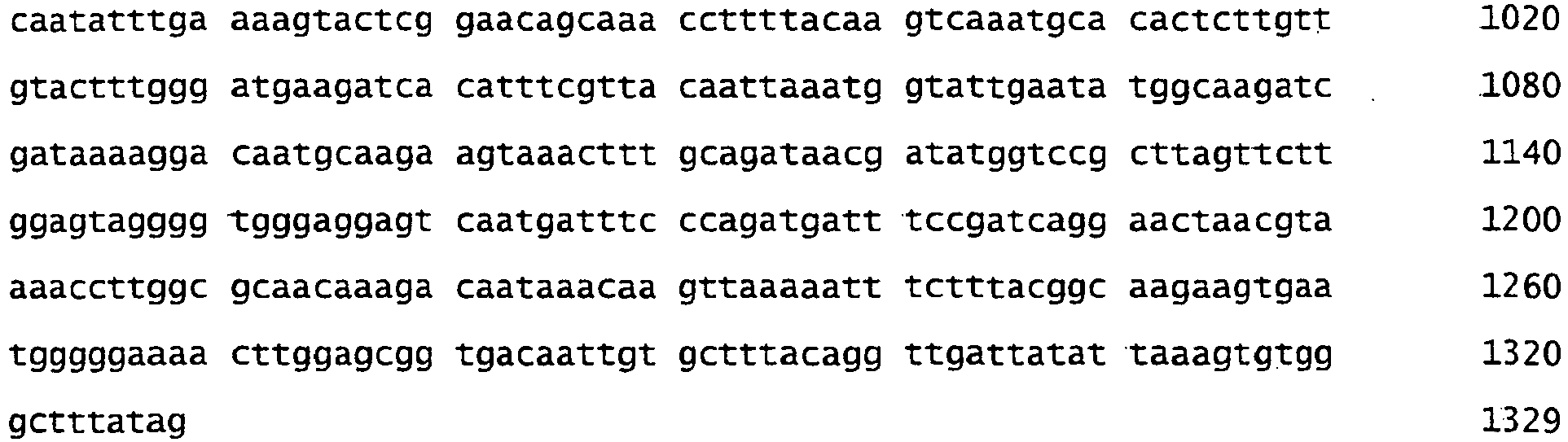
- <210> 4
<211> 633
<212> PRT
<213> Tenebrio molitor - <400> 4


- <210> 5
<211> 1899
<212> DNA
<213> Tenebrio molitor - <400> 5


- <210> 6
<211> 633
<212> PRT
<213> Tenebrio molitor - <400> 6


- <210> 7
<211> 1899
<212> DNA
<213> Tenebrio molitor - <400> 7


- <210> 8
<211> 20
<212> DNA
<213> Artificial sequence - <220>
<223> Forward primer - <400> 8
gargcntayg arccnaargg 20 - <210> 9
<211> 20
<212> DNA
<213> Artificial sequence - <220>
<223> Reverse primer - <400> 9
atrtcytcyt grttrttngc 20 - <210> 10
<211> 20
<212> DNA
<213> Artificial sequence - <220>
<223> Forward primer - <400> 10
aargayaayt gygaygarat 20 - <210> 11
<211> 20
<212> DNA
<213> Artificial sequence - <220>
<223> Reverse primer - <400> 11
gcytgytgcc anggrtartc 20
Claims (9)
- A Tenebrio molitor-derived Gram negative bacteria binding protein 1 (Tenebrio GNBP1), which has an amino acid sequence as set forth in SEQ ID NO: 2.
- A polynucleotide encoding the Tenebrio GNBP1 having an amino acid sequence as set forth in SEQ ID NO: 2.
- The polynucleotide of claim 2, which has a nucleotide sequence as set forth in SEQ ID NO: 3.
- A method of detecting bacterial infection in a sample, the method comprising:(a) loading a Tenebrio molitor-derived peptidoglycan recognition protein (Tenebrio PGRP-SA) having an amino acid sequence as set forth in SEQ ID NO: 1 to a sample and then performing an incubation thereof;(b) loading a Tenebrio GNBP1 having an amino acid sequence as set forth in SEQ ID NO: 2 to the incubation mixture of step (a) and then performing an incubation; and(c) detecting reactivity between the protein and the sample in the incubation mixture of step (b).
- The method of claim 4, wherein the sample is a blood for transfusion, a mammalian blood, vegetables, meats, fruits, cooked or non-cooked foods, tap water, underground water, rain water, or sterile products.
- The method of claim 4 or 5, further comprising pre-treating the sample with β-lytic protease (blp) and/or lysozyme.
- A kit for detecting bacterial infection in a sample comprising:a Tenebrio PGRP-SA having an amino acid sequence as set forth in SEQ ID NO: 1, anda Tenebrio GNBP1 having an amino acid sequence as set forth in SEQ ID NO: 2.
- The kit of claim 7, wherein the sample is a blood for transfusion, a mammalian blood, vegetables, meats, fruits, cooked or non-cooked foods, tap water, underground water, rain water, or sterile products.
- The kit of claim 7 or 8, further comprising β-lytic protease (blp) and/or lysozyme.
Applications Claiming Priority (2)
| Application Number | Priority Date | Filing Date | Title |
|---|---|---|---|
| KR1020070013231A KR101072815B1 (en) | 2007-02-08 | 2007-02-08 | Proteins activating pro-phenoloxidase system and genes encoding the same |
| PCT/KR2008/000664 WO2008096994A1 (en) | 2007-02-08 | 2008-02-04 | Proteins activating pro-phenoloxidase system and genes encoding the same |
Publications (3)
| Publication Number | Publication Date |
|---|---|
| EP2114994A1 EP2114994A1 (en) | 2009-11-11 |
| EP2114994A4 EP2114994A4 (en) | 2010-08-11 |
| EP2114994B1 true EP2114994B1 (en) | 2013-09-25 |
Family
ID=39681858
Family Applications (1)
| Application Number | Title | Priority Date | Filing Date |
|---|---|---|---|
| EP08712316.2A Not-in-force EP2114994B1 (en) | 2007-02-08 | 2008-02-04 | Proteins activating pro-phenoloxidase system and genes encoding the same |
Country Status (7)
| Country | Link |
|---|---|
| US (1) | US8729230B2 (en) |
| EP (1) | EP2114994B1 (en) |
| JP (1) | JP5266256B2 (en) |
| KR (1) | KR101072815B1 (en) |
| CN (1) | CN101627052B (en) |
| ES (1) | ES2432790T3 (en) |
| WO (1) | WO2008096994A1 (en) |
Families Citing this family (5)
| Publication number | Priority date | Publication date | Assignee | Title |
|---|---|---|---|---|
| CN103789254A (en) * | 2012-10-26 | 2014-05-14 | 沈阳药科大学 | Insect, insect hemolymph and assembly active substance thereof and application |
| JP6370390B2 (en) * | 2014-02-07 | 2018-08-08 | ロケット フレールRoquette Freres | Peptidoglycan bioassay |
| CN110295158B (en) * | 2019-07-26 | 2020-12-29 | 四川农业大学 | Tenebrio molitor YM45 protein, its encoding gene and application |
| EP4384824A4 (en) * | 2021-08-10 | 2025-07-23 | Univ Colorado Regents | NEW THERAPEUTIC METHODS USING PEPTIDOGLYCAN MUROPEPTIDES TO PROMOTE ATP SYNTHASE ACTIVITY AND MITOCHONDRIAL HOMEOSTASIS AND DEVELOPMENT |
| CN116286754B (en) * | 2023-03-03 | 2026-01-30 | 沈阳药科大学 | Mannan-bound serine protease homologues, their preparation methods and applications |
Family Cites Families (3)
| Publication number | Priority date | Publication date | Assignee | Title |
|---|---|---|---|---|
| WO2002101083A1 (en) | 2001-06-08 | 2002-12-19 | Samyang Genex Corporation | Composition for detecting peptidoglycan, and diagnostic kit detecting peptidoglycan |
| US7078165B2 (en) | 2003-03-27 | 2006-07-18 | Institut Pasteur | Method for modulating Nod1 activity, use of a MTP related molecule for modulating Nod1 activity, and therapeutic applications thereof |
| US7598054B2 (en) | 2003-10-31 | 2009-10-06 | Immunetics, Inc. | Rapid peptidoglycan-based assay for detection of bacterial contamination of platelets |
-
2007
- 2007-02-08 KR KR1020070013231A patent/KR101072815B1/en not_active Expired - Fee Related
-
2008
- 2008-02-04 US US12/526,482 patent/US8729230B2/en not_active Expired - Fee Related
- 2008-02-04 ES ES08712316T patent/ES2432790T3/en active Active
- 2008-02-04 JP JP2009548993A patent/JP5266256B2/en not_active Expired - Fee Related
- 2008-02-04 WO PCT/KR2008/000664 patent/WO2008096994A1/en not_active Ceased
- 2008-02-04 EP EP08712316.2A patent/EP2114994B1/en not_active Not-in-force
- 2008-02-04 CN CN2008800046099A patent/CN101627052B/en not_active Expired - Fee Related
Also Published As
| Publication number | Publication date |
|---|---|
| JP2010517561A (en) | 2010-05-27 |
| KR20080074332A (en) | 2008-08-13 |
| EP2114994A4 (en) | 2010-08-11 |
| CN101627052A (en) | 2010-01-13 |
| CN101627052B (en) | 2013-05-29 |
| ES2432790T3 (en) | 2013-12-05 |
| WO2008096994A1 (en) | 2008-08-14 |
| US20100317042A1 (en) | 2010-12-16 |
| EP2114994A1 (en) | 2009-11-11 |
| KR101072815B1 (en) | 2011-10-14 |
| JP5266256B2 (en) | 2013-08-21 |
| US8729230B2 (en) | 2014-05-20 |
Similar Documents
| Publication | Publication Date | Title |
|---|---|---|
| Dziarski | Peptidoglycan recognition proteins (PGRPs) | |
| Itoh et al. | A novel peptidoglycan recognition protein containing a goose-type lysozyme domain from the Pacific oyster, Crassostrea gigas | |
| EP0299828B1 (en) | Bactericidal and/or bacteriostatic peptides, process for their isolation, their production and their applications | |
| Wang et al. | Newly identified type II crustin (SpCrus2) in Scylla paramamosain contains a distinct cysteine distribution pattern exhibiting broad antimicrobial activity | |
| Oh et al. | Purification and characterization of an antimicrobial peptide mytichitin-chitin binding domain from the hard-shelled mussel, Mytilus coruscus | |
| Liu et al. | A new anti-lipopolysaccharide factor isoform (PtALF4) from the swimming crab Portunus trituberculatus exhibited structural and functional diversity of ALFs | |
| US8729230B2 (en) | Proteins activating pro-phenoloxidase system and genes encoding the same | |
| Yang et al. | Molecular characterization, expression and antimicrobial activities of two c-type lysozymes from manila clam Venerupis philippinarum | |
| Ko et al. | Molecular characterization, transcriptional profiling, and antibacterial potential of G-type lysozyme from seahorse (Hippocampus abdominalis) | |
| Su et al. | Molecular cloning and characterization of a short type peptidoglycan recognition protein (CfPGRP-S1) cDNA from Zhikong scallop Chlamys farreri | |
| Gao et al. | Cloning and expression analysis of a peptidoglycan recognition protein in silkworm related to virus infection | |
| Tian et al. | Expression of c-type lysozyme gene in sea cucumber (Apostichopus japonicus) is highly regulated and time dependent after salt stress | |
| KR102224897B1 (en) | Novel Polypeptide and Antibiotics against Gram-Negative Bacteria Comprising the Polypeptide | |
| Shen et al. | Peptidoglycan recognition protein-S1 (PGRP-S1) from Diaphania pyloalis (Walker) is involved in the agglutination and prophenoloxidase activation pathway | |
| Premachandra et al. | Identification of a novel molluscan short-type peptidoglycan recognition protein in disk abalone (Haliotis discus discus) involved in host antibacterial defense | |
| Yang et al. | A bactericidal permeability-increasing protein (BPI) from manila clam Ruditapes philippinarum: Investigation on the antibacterial activities and antibacterial action mode | |
| Wu et al. | Gene identification and recombinant protein of a lysozyme from freshwater mussel Cristaria plicata | |
| Zhang et al. | Identification and function of an Arasin-like peptide from Litopenaeus vannamei | |
| Onoe et al. | Peptidoglycan recognition protein (PGRP) from eri-silkworm, Samia cynthia ricini; protein purification and induction of the gene expression | |
| Tanaka et al. | Correlation of differential expression of silkworm antimicrobial peptide genes with different amounts of rel family proteins and their gene transcriptional activity | |
| KR101092936B1 (en) | Proteins activating pro-phenoloxidase system and genes encoding the same | |
| KR102187479B1 (en) | PGRP-SC2 protein from Rock bream and uses thereof | |
| KR101060098B1 (en) | Proteins activating pro-phenoloxidase system and genes encoding the same | |
| KR101104631B1 (en) | Proteins activating the pro-phenoloxidase system and genes encoding them | |
| Park et al. | Antibiotic activity and synergistic effect of antimicrobial peptide against pathogens from a patient with gallstones |
Legal Events
| Date | Code | Title | Description |
|---|---|---|---|
| PUAI | Public reference made under article 153(3) epc to a published international application that has entered the european phase |
Free format text: ORIGINAL CODE: 0009012 |
|
| 17P | Request for examination filed |
Effective date: 20090717 |
|
| AK | Designated contracting states |
Kind code of ref document: A1 Designated state(s): AT BE BG CH CY CZ DE DK EE ES FI FR GB GR HR HU IE IS IT LI LT LU LV MC MT NL NO PL PT RO SE SI SK TR |
|
| RIN1 | Information on inventor provided before grant (corrected) |
Inventor name: KIM, CHAN-HEE Inventor name: ROH, KYUNG-BAEG Inventor name: PARK, JI-WON Inventor name: HA, NAM-CHUL Inventor name: KIM, SU-JIN Inventor name: LEE, BOK-LUEL |
|
| DAX | Request for extension of the european patent (deleted) | ||
| A4 | Supplementary search report drawn up and despatched |
Effective date: 20100714 |
|
| 17Q | First examination report despatched |
Effective date: 20121207 |
|
| GRAP | Despatch of communication of intention to grant a patent |
Free format text: ORIGINAL CODE: EPIDOSNIGR1 |
|
| RIN1 | Information on inventor provided before grant (corrected) |
Inventor name: HA, NAM-CHUL Inventor name: KIM, CHAN-HEE Inventor name: PARK, JI-WON Inventor name: KIM, SU-JIN Inventor name: LEE, BOK-LUEL Inventor name: ROH, KYUNG-BAEG |
|
| INTG | Intention to grant announced |
Effective date: 20130410 |
|
| GRAS | Grant fee paid |
Free format text: ORIGINAL CODE: EPIDOSNIGR3 |
|
| GRAA | (expected) grant |
Free format text: ORIGINAL CODE: 0009210 |
|
| AK | Designated contracting states |
Kind code of ref document: B1 Designated state(s): AT BE BG CH CY CZ DE DK EE ES FI FR GB GR HR HU IE IS IT LI LT LU LV MC MT NL NO PL PT RO SE SI SK TR |
|
| REG | Reference to a national code |
Ref country code: GB Ref legal event code: FG4D |
|
| REG | Reference to a national code |
Ref country code: CH Ref legal event code: EP |
|
| REG | Reference to a national code |
Ref country code: AT Ref legal event code: REF Ref document number: 633682 Country of ref document: AT Kind code of ref document: T Effective date: 20131015 |
|
| REG | Reference to a national code |
Ref country code: IE Ref legal event code: FG4D |
|
| REG | Reference to a national code |
Ref country code: DE Ref legal event code: R096 Ref document number: 602008027763 Country of ref document: DE Effective date: 20131121 |
|
| REG | Reference to a national code |
Ref country code: ES Ref legal event code: FG2A Ref document number: 2432790 Country of ref document: ES Kind code of ref document: T3 Effective date: 20131205 |
|
| PG25 | Lapsed in a contracting state [announced via postgrant information from national office to epo] |
Ref country code: NO Free format text: LAPSE BECAUSE OF FAILURE TO SUBMIT A TRANSLATION OF THE DESCRIPTION OR TO PAY THE FEE WITHIN THE PRESCRIBED TIME-LIMIT Effective date: 20131225 Ref country code: LT Free format text: LAPSE BECAUSE OF FAILURE TO SUBMIT A TRANSLATION OF THE DESCRIPTION OR TO PAY THE FEE WITHIN THE PRESCRIBED TIME-LIMIT Effective date: 20130925 Ref country code: SE Free format text: LAPSE BECAUSE OF FAILURE TO SUBMIT A TRANSLATION OF THE DESCRIPTION OR TO PAY THE FEE WITHIN THE PRESCRIBED TIME-LIMIT Effective date: 20130925 Ref country code: HR Free format text: LAPSE BECAUSE OF FAILURE TO SUBMIT A TRANSLATION OF THE DESCRIPTION OR TO PAY THE FEE WITHIN THE PRESCRIBED TIME-LIMIT Effective date: 20130925 |
|
| REG | Reference to a national code |
Ref country code: AT Ref legal event code: MK05 Ref document number: 633682 Country of ref document: AT Kind code of ref document: T Effective date: 20130925 |
|
| REG | Reference to a national code |
Ref country code: NL Ref legal event code: VDEP Effective date: 20130925 |
|
| REG | Reference to a national code |
Ref country code: LT Ref legal event code: MG4D |
|
| PG25 | Lapsed in a contracting state [announced via postgrant information from national office to epo] |
Ref country code: FI Free format text: LAPSE BECAUSE OF FAILURE TO SUBMIT A TRANSLATION OF THE DESCRIPTION OR TO PAY THE FEE WITHIN THE PRESCRIBED TIME-LIMIT Effective date: 20130925 Ref country code: SI Free format text: LAPSE BECAUSE OF FAILURE TO SUBMIT A TRANSLATION OF THE DESCRIPTION OR TO PAY THE FEE WITHIN THE PRESCRIBED TIME-LIMIT Effective date: 20130925 Ref country code: LV Free format text: LAPSE BECAUSE OF FAILURE TO SUBMIT A TRANSLATION OF THE DESCRIPTION OR TO PAY THE FEE WITHIN THE PRESCRIBED TIME-LIMIT Effective date: 20130925 Ref country code: GR Free format text: LAPSE BECAUSE OF FAILURE TO SUBMIT A TRANSLATION OF THE DESCRIPTION OR TO PAY THE FEE WITHIN THE PRESCRIBED TIME-LIMIT Effective date: 20131226 |
|
| PG25 | Lapsed in a contracting state [announced via postgrant information from national office to epo] |
Ref country code: BE Free format text: LAPSE BECAUSE OF FAILURE TO SUBMIT A TRANSLATION OF THE DESCRIPTION OR TO PAY THE FEE WITHIN THE PRESCRIBED TIME-LIMIT Effective date: 20130925 |
|
| PG25 | Lapsed in a contracting state [announced via postgrant information from national office to epo] |
Ref country code: EE Free format text: LAPSE BECAUSE OF FAILURE TO SUBMIT A TRANSLATION OF THE DESCRIPTION OR TO PAY THE FEE WITHIN THE PRESCRIBED TIME-LIMIT Effective date: 20130925 Ref country code: CZ Free format text: LAPSE BECAUSE OF FAILURE TO SUBMIT A TRANSLATION OF THE DESCRIPTION OR TO PAY THE FEE WITHIN THE PRESCRIBED TIME-LIMIT Effective date: 20130925 Ref country code: IS Free format text: LAPSE BECAUSE OF FAILURE TO SUBMIT A TRANSLATION OF THE DESCRIPTION OR TO PAY THE FEE WITHIN THE PRESCRIBED TIME-LIMIT Effective date: 20140125 Ref country code: RO Free format text: LAPSE BECAUSE OF FAILURE TO SUBMIT A TRANSLATION OF THE DESCRIPTION OR TO PAY THE FEE WITHIN THE PRESCRIBED TIME-LIMIT Effective date: 20130925 Ref country code: SK Free format text: LAPSE BECAUSE OF FAILURE TO SUBMIT A TRANSLATION OF THE DESCRIPTION OR TO PAY THE FEE WITHIN THE PRESCRIBED TIME-LIMIT Effective date: 20130925 Ref country code: NL Free format text: LAPSE BECAUSE OF FAILURE TO SUBMIT A TRANSLATION OF THE DESCRIPTION OR TO PAY THE FEE WITHIN THE PRESCRIBED TIME-LIMIT Effective date: 20130925 |
|
| PG25 | Lapsed in a contracting state [announced via postgrant information from national office to epo] |
Ref country code: PL Free format text: LAPSE BECAUSE OF FAILURE TO SUBMIT A TRANSLATION OF THE DESCRIPTION OR TO PAY THE FEE WITHIN THE PRESCRIBED TIME-LIMIT Effective date: 20130925 Ref country code: AT Free format text: LAPSE BECAUSE OF FAILURE TO SUBMIT A TRANSLATION OF THE DESCRIPTION OR TO PAY THE FEE WITHIN THE PRESCRIBED TIME-LIMIT Effective date: 20130925 Ref country code: CY Free format text: LAPSE BECAUSE OF FAILURE TO SUBMIT A TRANSLATION OF THE DESCRIPTION OR TO PAY THE FEE WITHIN THE PRESCRIBED TIME-LIMIT Effective date: 20130925 |
|
| REG | Reference to a national code |
Ref country code: DE Ref legal event code: R097 Ref document number: 602008027763 Country of ref document: DE |
|
| PG25 | Lapsed in a contracting state [announced via postgrant information from national office to epo] |
Ref country code: PT Free format text: LAPSE BECAUSE OF FAILURE TO SUBMIT A TRANSLATION OF THE DESCRIPTION OR TO PAY THE FEE WITHIN THE PRESCRIBED TIME-LIMIT Effective date: 20140127 |
|
| PLBE | No opposition filed within time limit |
Free format text: ORIGINAL CODE: 0009261 |
|
| STAA | Information on the status of an ep patent application or granted ep patent |
Free format text: STATUS: NO OPPOSITION FILED WITHIN TIME LIMIT |
|
| 26N | No opposition filed |
Effective date: 20140626 |
|
| PG25 | Lapsed in a contracting state [announced via postgrant information from national office to epo] |
Ref country code: MC Free format text: LAPSE BECAUSE OF FAILURE TO SUBMIT A TRANSLATION OF THE DESCRIPTION OR TO PAY THE FEE WITHIN THE PRESCRIBED TIME-LIMIT Effective date: 20130925 Ref country code: DK Free format text: LAPSE BECAUSE OF FAILURE TO SUBMIT A TRANSLATION OF THE DESCRIPTION OR TO PAY THE FEE WITHIN THE PRESCRIBED TIME-LIMIT Effective date: 20130925 Ref country code: LU Free format text: LAPSE BECAUSE OF FAILURE TO SUBMIT A TRANSLATION OF THE DESCRIPTION OR TO PAY THE FEE WITHIN THE PRESCRIBED TIME-LIMIT Effective date: 20140204 |
|
| REG | Reference to a national code |
Ref country code: CH Ref legal event code: PL |
|
| REG | Reference to a national code |
Ref country code: DE Ref legal event code: R097 Ref document number: 602008027763 Country of ref document: DE Effective date: 20140626 |
|
| PG25 | Lapsed in a contracting state [announced via postgrant information from national office to epo] |
Ref country code: CH Free format text: LAPSE BECAUSE OF NON-PAYMENT OF DUE FEES Effective date: 20140228 Ref country code: LI Free format text: LAPSE BECAUSE OF NON-PAYMENT OF DUE FEES Effective date: 20140228 |
|
| REG | Reference to a national code |
Ref country code: IE Ref legal event code: MM4A |
|
| PG25 | Lapsed in a contracting state [announced via postgrant information from national office to epo] |
Ref country code: IE Free format text: LAPSE BECAUSE OF NON-PAYMENT OF DUE FEES Effective date: 20140204 |
|
| REG | Reference to a national code |
Ref country code: DE Ref legal event code: R082 Ref document number: 602008027763 Country of ref document: DE Representative=s name: PATENTANWAELTE LIPPERT, STACHOW & PARTNER, DE Ref country code: DE Ref legal event code: R082 Ref document number: 602008027763 Country of ref document: DE Representative=s name: LIPPERT STACHOW PATENTANWAELTE RECHTSANWAELTE , DE |
|
| REG | Reference to a national code |
Ref country code: FR Ref legal event code: PLFP Year of fee payment: 9 |
|
| PG25 | Lapsed in a contracting state [announced via postgrant information from national office to epo] |
Ref country code: MT Free format text: LAPSE BECAUSE OF FAILURE TO SUBMIT A TRANSLATION OF THE DESCRIPTION OR TO PAY THE FEE WITHIN THE PRESCRIBED TIME-LIMIT Effective date: 20130925 |
|
| PG25 | Lapsed in a contracting state [announced via postgrant information from national office to epo] |
Ref country code: BG Free format text: LAPSE BECAUSE OF FAILURE TO SUBMIT A TRANSLATION OF THE DESCRIPTION OR TO PAY THE FEE WITHIN THE PRESCRIBED TIME-LIMIT Effective date: 20130925 |
|
| PG25 | Lapsed in a contracting state [announced via postgrant information from national office to epo] |
Ref country code: TR Free format text: LAPSE BECAUSE OF FAILURE TO SUBMIT A TRANSLATION OF THE DESCRIPTION OR TO PAY THE FEE WITHIN THE PRESCRIBED TIME-LIMIT Effective date: 20130925 Ref country code: HU Free format text: LAPSE BECAUSE OF FAILURE TO SUBMIT A TRANSLATION OF THE DESCRIPTION OR TO PAY THE FEE WITHIN THE PRESCRIBED TIME-LIMIT; INVALID AB INITIO Effective date: 20080204 |
|
| REG | Reference to a national code |
Ref country code: FR Ref legal event code: PLFP Year of fee payment: 10 |
|
| REG | Reference to a national code |
Ref country code: FR Ref legal event code: PLFP Year of fee payment: 11 |
|
| PGFP | Annual fee paid to national office [announced via postgrant information from national office to epo] |
Ref country code: FR Payment date: 20171211 Year of fee payment: 11 |
|
| PGFP | Annual fee paid to national office [announced via postgrant information from national office to epo] |
Ref country code: ES Payment date: 20180301 Year of fee payment: 11 Ref country code: DE Payment date: 20180123 Year of fee payment: 11 Ref country code: GB Payment date: 20180131 Year of fee payment: 11 |
|
| PGFP | Annual fee paid to national office [announced via postgrant information from national office to epo] |
Ref country code: IT Payment date: 20180221 Year of fee payment: 11 |
|
| REG | Reference to a national code |
Ref country code: DE Ref legal event code: R119 Ref document number: 602008027763 Country of ref document: DE |
|
| GBPC | Gb: european patent ceased through non-payment of renewal fee |
Effective date: 20190204 |
|
| PG25 | Lapsed in a contracting state [announced via postgrant information from national office to epo] |
Ref country code: DE Free format text: LAPSE BECAUSE OF NON-PAYMENT OF DUE FEES Effective date: 20190903 Ref country code: GB Free format text: LAPSE BECAUSE OF NON-PAYMENT OF DUE FEES Effective date: 20190204 |
|
| PG25 | Lapsed in a contracting state [announced via postgrant information from national office to epo] |
Ref country code: IT Free format text: LAPSE BECAUSE OF NON-PAYMENT OF DUE FEES Effective date: 20190204 Ref country code: FR Free format text: LAPSE BECAUSE OF NON-PAYMENT OF DUE FEES Effective date: 20190228 |
|
| REG | Reference to a national code |
Ref country code: ES Ref legal event code: FD2A Effective date: 20200327 |
|
| PG25 | Lapsed in a contracting state [announced via postgrant information from national office to epo] |
Ref country code: ES Free format text: LAPSE BECAUSE OF NON-PAYMENT OF DUE FEES Effective date: 20190205 |