EP2107902B2 - Cosmetic composition containing argan oil and shea butter - Google Patents
Cosmetic composition containing argan oil and shea butter Download PDFInfo
- Publication number
- EP2107902B2 EP2107902B2 EP07847367.5A EP07847367A EP2107902B2 EP 2107902 B2 EP2107902 B2 EP 2107902B2 EP 07847367 A EP07847367 A EP 07847367A EP 2107902 B2 EP2107902 B2 EP 2107902B2
- Authority
- EP
- European Patent Office
- Prior art keywords
- acid
- und
- weight
- polymers
- cationic
- Prior art date
- Legal status (The legal status is an assumption and is not a legal conclusion. Google has not performed a legal analysis and makes no representation as to the accuracy of the status listed.)
- Active
Links
Classifications
-
- A—HUMAN NECESSITIES
- A61—MEDICAL OR VETERINARY SCIENCE; HYGIENE
- A61Q—SPECIFIC USE OF COSMETICS OR SIMILAR TOILETRY PREPARATIONS
- A61Q19/00—Preparations for care of the skin
-
- A—HUMAN NECESSITIES
- A61—MEDICAL OR VETERINARY SCIENCE; HYGIENE
- A61K—PREPARATIONS FOR MEDICAL, DENTAL OR TOILETRY PURPOSES
- A61K8/00—Cosmetics or similar toiletry preparations
- A61K8/18—Cosmetics or similar toiletry preparations characterised by the composition
- A61K8/92—Oils, fats or waxes; Derivatives thereof, e.g. hydrogenation products thereof
- A61K8/922—Oils, fats or waxes; Derivatives thereof, e.g. hydrogenation products thereof of vegetable origin
-
- A—HUMAN NECESSITIES
- A61—MEDICAL OR VETERINARY SCIENCE; HYGIENE
- A61Q—SPECIFIC USE OF COSMETICS OR SIMILAR TOILETRY PREPARATIONS
- A61Q5/00—Preparations for care of the hair
- A61Q5/02—Preparations for cleaning the hair
-
- A—HUMAN NECESSITIES
- A61—MEDICAL OR VETERINARY SCIENCE; HYGIENE
- A61Q—SPECIFIC USE OF COSMETICS OR SIMILAR TOILETRY PREPARATIONS
- A61Q5/00—Preparations for care of the hair
- A61Q5/12—Preparations containing hair conditioners
Definitions
- the invention relates to cosmetic agents containing a synergistically active combination of active substances containing argan oil and shea butter.
- human hair is today treated in a variety of ways with hair cosmetic preparations. This includes, for example, cleaning the hair with shampoos, care and regeneration with conditioners and treatments, as well as bleaching, dyeing and shaping the hair with dyes, tints, waving agents and styling preparations. Means for changing or nuanced the color of the hair on the head play a prominent role.
- ingredients that have been used for a long time in cosmetic agents and are characterized by particularly good tolerability are therefore sought after as caring active ingredients.
- the spectrum of activity and the profile of properties of the cosmetic composition must not be adversely altered in comparison with conventional compositions as a result of the use of the mild and particularly well-tolerated ingredients. This is made more difficult by the fact that only as few ingredients as absolutely necessary are intentionally used in the compositions according to the invention.
- argan oil An ingredient that can in principle be used in cosmetic compositions, but has not found wide acceptance in cosmetic compositions, is argan oil.
- Argan oil itself has been known for a long time and is already used in many ways by humans. It is considered the most valuable vegetable oil, which is why it is also called "The Gold of the Berbers". This is also the reason why it has not found widespread use and therefore little is known about the interaction with other ingredients of cosmetic compositions.
- Argan oil is the oil from the seed of the argan fruit.
- the argan tree, Argania spinosa is one of the oldest trees in the world. The plum- or olive-like fruits cannot be consumed. The tree can bear fruit several times a year. The wood, the leaves and the fruits are very valuable and are used.
- the date-sized fruits are dried and pressed. The seeds of the fruit are extracted. The kernels are about three times the size of hazelnuts. The kernels are opened in order to gain the seeds from them. These seeds are finally lightly roasted and ground to extract the oil.
- Argan oil is slightly reddish and has a nutty taste. Argan oil is considered the most valuable vegetable oil. It is unusually rich in tocopherols and shows the strongest vitamin E activity of all known vegetable oils.
- argan oil has a uniquely high concentration of unsaturated fatty acids of more than 80% by weight. This makes argan oil an excellently suitable edible oil and dietary supplement. And also in cosmetic compositions, argan oil is used due to its high content of vitamin E and unsaturated fatty acids. The importance of argan oil is also based on the unique sterols contained in argan oil, in particular schottenol and spinasterol. Argan oil contains about 50 to 90 mg of tocopherol per 100 g of oil, which are made up as follows: about 40 to 60 mg ⁇ -tocopherol, about 5 to 15 mg ß-tocopherol, about 5 to 10 mg ⁇ - tocopherol and about 0.5 to 5 mg ⁇ -tocopherol.
- the ratio of unsaturated to saturated fatty acids in argan oil is about 4.5:1.
- the amount of sterols in argan oil is about 120 to 250 mg/100 g oil.
- the fatty acid content is more than 99% by weight, of which more than 80% by weight are unsaturated.
- the fatty acid composition is approximately as follows: palmitic acid 12 to 13%, stearic acid 5 to 7% and arachidonic acid 0.3 to 0.5% and the unsaturated fatty acids oleic acid 43 to 49.1%, linoleic acid 23.9 to 36.0%, Linoleic acid up to 0.1% and gadoleic acid up to 0.5%.
- the amount of linoleic acid in argan oil is about three times higher than that in olive oil.
- Argan oil is traditionally used in cooking and in cosmetic compositions. North Africans use argan oil to rub their skin before visiting a steam bath. It penetrates quickly into the skin and leaves the skin feeling pleasant and soft. Argan oil prevents skin dehydration and skin aging and is also used to prevent itching. In hair care, it is recommended for brittle and dry hair and hair loss.
- Shea butter is another ingredient that is more commonly used than argan oil, but its effects in cosmetic compositions are also not fully understood.
- Shea butter is similar to cocoa butter. Shea butter is obtained from the seeds of the butter tree found in West Africa, Vitellaria paradoxa or Butyrospermum parkii, Sapotacaeae. It has a tough, buttery consistency and is relatively stable against oxidation. In the producing countries, shea butter is used directly for food purposes. Shea butter is characterized by the following key figures: saponification number 178 to 196, iodine number 55 to 67, unsaponifiables 2 to 11%. Shea butter has a melting range of 32 to 42 °C. A characteristic ingredient is sheasterin, 2-oleo-distearin.
- the essential fatty acid composition is oleic acid 49-50%, stearic acid 35-42%, palmitic acid 5-6% and linoleic acid 4-5%. Due to the high proportion of unsaponifiables, shea butter has a special position among vegetable oils and fats. The proportion of unsaponifiables in vegetable fats is usually only about 0.2 to 2%. Therefore, the proportion of phytosterols in shea butter is significantly higher than in all other vegetable fats. Important representatives of the phytosterols in shea butter are, for example, ⁇ - and ⁇ -amyrin, basseol, parkeol and lupeol. The structures of ⁇ - and ⁇ -amyrin are as follows:
- Shea butter is used in cosmetic compositions, especially in skin care products. However, it is also contained in some compositions for the cleaning and care of keratin fibers.
- an active substance combination containing argan oil and shea butter in the method according to the invention is extremely suitable for producing cosmetic compositions with a significantly increased level of tolerability.
- ingredients known to be particularly irritating such as, for example, perfume oils or preservatives, can be dispensed with in whole or in part in these compositions.
- the other significantly improved cosmetic effects include the positive influence on combability and the feel of wet and dry hair, the shine of the hair, the manageability and durability of hairstyles, the restructuring of hair damaged by UV light and/or oxidative processes, the reduction of split ends, the reduction of damage to the hair caused by the effects of heat such as blow-drying, increased deposition of substances desired on the hair such as anti-dandruff active ingredients, polymers, vitamins, protein hydrolyzates or other raw materials that revitalize the hair such as silicones, for example, influencing the moisture retention capacity of the cosmetic compositions , and a preservation-supporting effect in the cosmetic compositions according to the invention.
- the combination of active substances used according to the invention thus significantly and synergistically improves the essential inner and outer structural features and the strength as well as the elasticity and the shine of keratin fibers.
- Argan oil in an amount of 0.01 to 30% by weight is preferred in the combination of active substances according to the invention in amounts of 0.01 to 20% by weight, particularly preferably in amounts of 0.01 to 15% by weight and very particularly preferably in amounts of 0.01 to 10% by weight, based in each case on the combination of active substances.
- the individual components in the quantities in which they occur in the natural argan oil instead of the argan oil itself. In this case, however, the individual components must correspond to at least 80% of the composition of the natural argan oil.
- the fatty acids or the glycerides of the argan oil can be used as individual components in this way.
- shea butter is present in an amount of 0.01 to 30% by weight, preferably in amounts of 0.01 to 20% by weight, particularly preferably in amounts of 0.01 to 15% by weight and very particularly preferably in Amounts of 0.01 to 10% by weight, each based on the combination of active ingredients.
- the individual components in the quantities in which they occur in the natural argan oil instead of the shea butter itself. In this case, however, the individual components must correspond to at least 80% of the composition of natural shea butter.
- the fatty acids or the glycerides of the argan oil can be used as individual components in this way.
- the ratio of the two active ingredients in percent by weight, argan oil based on shea butter, is usually 25:1 to 1:10, preferably 15:1 to 1:5, particularly preferably 15:1 to 1:3, very particularly preferably 10:1 to 1:3 and most preferably 10:1 to 1:1.
- the entire active ingredient combination according to the invention of argan oil and shea butter is in turn present in the cosmetic preparations in amounts of 0.01 to 30% by weight, preferably in amounts of 0.01 to 20% by weight, particularly preferably in amounts of 0.01 to 15% by weight .% And very particularly preferably in amounts of 0.01 to 10 wt.% In each case based on the total composition.
- keratinic fibers are understood to mean furs, wool, feathers and, in particular, human hair.
- a first object of the present invention is therefore the use of a cosmetic composition for the care and conditioning of keratin fibers containing an active substance complex, the active substance complex containing argan oil and shea butter.
- a second object of the present invention is also the use of a cosmetic composition for the care and conditioning of keratinic fibers containing an active ingredient complex, the active ingredient complex containing argan oil and shea butter and at least one other active ingredient selected from cationic and/or amphoteric and/or zwitterionic polymers.
- compositions according to the invention are described below.
- the respective synergistic components of the active ingredient complex according to the invention are discussed in the description of the respective raw material.
- the surface-active substances essentially comprise two groups, the surfactants and the emulsifiers.
- amphoteric and zwitterionic surfactants show a synergistic effect with the combination of active substances according to the invention. This synergistic effect is possibly due to increased deposition of the two active ingredients on the surface of the skin and hair, which is reflected in the overall cosmetic appearance of the skin and hair.
- the special charge effects of amphoteric and zwitterionic surfactants seem to play a role here. For example, the hair becomes easier to comb, both dry and wet, easier to style and has more shine and a more pleasant feel.
- Zwitterionic surfactants are surface-active compounds which carry at least one quaternary ammonium group and at least one —COO (-) or —SO 3 (-) group in the molecule.
- Particularly suitable zwitterionic surfactants are the so-called betaines, such as the N-alkyl-N,N-dimethylammonium glycinates, for example coconut alkyl dimethylammonium glycinate, N-acylaminopropyl-N,N-dimethylammonium glycinates, for example cocoacylaminopropyl dimethylammonium glycinate, and 2-alkyl -3-carboxymethyl-3-hydroxyethylimidazolines each having 8 to 18 carbon atoms in the alkyl or acyl group, and cocoacylaminoethylhydroxyethylcarboxymethylglycinate.
- a preferred zwitterionic surfactant is the fatty acid amide derivative known by the INCI name
- Ampholytic surfactants (E3) are understood as meaning surface-active compounds which, in addition to a C 8 - C 24 - alkyl or acyl group in the molecule contain at least one free amino group and at least one -COOH or -SO 3 H group and to form internal Salts are capable.
- ampholytic surfactants are N-alkylglycines, N-alkylpropionic acids, N-alkylaminobutyric acids, N-alkyliminodipropionic acids, N-hydroxyethyl-N-alkylamidopropylglycines, N-alkyltaurines, N-alkylsarcosines, 2-alkylaminopropionic acids and alkylaminoacetic acids, each with about 8 to 24 C -atoms in the alkyl group.
- amphoteric or zwitterionic surfactants are alkyl betaines, alkyl amido betaines, aminopropionates, aminoglycinates, imidazolinium betaines and sulfobetaines.
- ampholytic surfactants are N -cocoalkylaminopropionate, cocoacylaminoethylaminopropionate and C12-C18 acylsarcosine.
- the sugar surfactants can be contained in the agents used according to the invention, preferably in amounts of 0.1-20% by weight, based on the agent as a whole. Amounts of 0.5-15% by weight are preferred and amounts of 0.5-7.5% by weight are most preferred.
- nonionic surfactants are fatty acid amide polyglycol ethers, fatty amine polyglycol ethers, mixed ethers or mixed formals, protein hydrolyzates (in particular wheat-based vegetable products) and polysorbates.
- alkylene oxide adducts with saturated linear fatty alcohols and fatty acids, each with 2 to 30 moles of ethylene oxide per mole of fatty alcohol or fatty acid, and the sugar surfactants have proven to be preferred nonionic surfactants. Preparations with excellent properties are also obtained if they contain fatty acid esters of ethoxylated glycerol as nonionic surfactants.
- the alkyl radical R contains 6 to 22 carbon atoms and can be either linear or branched. Primary linear aliphatic radicals which are methyl-branched in the 2-position are preferred. Examples of such alkyl radicals are 1-octyl, 1-decyl, 1-lauryl, 1-myristyl, 1-cetyl and 1-stearyl. Particularly preferred are 1-octyl, 1-decyl, 1-lauryl, 1-myristyl. When using so-called "oxo-alcohols" as starting materials, compounds with an odd number of carbon atoms in the alkyl chain predominate.
- the cationic surfactants (E5) form the last group of surfactants.
- cationic surfactants are characterized in that, like the amphoteric and zwitterionic surfactants, they contribute to a significantly improved cosmetic appearance of skin and hair.
- the cationic charge ensures good bonding to the more negatively charged surfaces, especially on damaged hair or stressed skin.
- more hydrophobic active ingredients can accumulate on the long fatty residues of these molecular structures. This results in an overall increased deposition of care substances on the surface of the skin and hair. For example, the hair becomes easier to comb, both dry and wet, easier to style and has more shine and a more pleasant feel.
- Cationic surfactants (E5) are generally derived from ammonium ions and have a structure (NR 1 R 2 R 3 R 4 ) + with a correspondingly negatively charged counterion. Such cationic ammonium compounds are well known to those skilled in the art. Other cationic surfactants are, for example, the ester quats or the imidazolium compounds. Cationic surfactants (E5) of the quaternary ammonium compound, esterquat, imidazoline and amidoamine types can be used with particular preference according to the invention.
- Preferred quaternary ammonium compounds are ammonium halides, especially chlorides and bromides, such as alkyltrimethylammonium chlorides, dialkyldimethylammonium chlorides and trialkylmethylammonium chlorides, e.g. B. cetyltrimethylammonium chloride, stearyltrimethylammonium chloride, distearyldimethylammonium chloride, lauryldimethylammonium chloride, lauryldimethylbenzylammonium chloride and tricetylmethylammonium chloride, as well as the imidazolium compounds known under the INCI names Quaternium-27 and Quaternium-83.
- the long alkyl chains of the above surfactants preferably have 8 to 30 carbon atoms.
- Typical examples of cationic surfactants are quaternary ammonium compounds and ester quats, in particular quaternized fatty acid trialkanolamine ester salts.
- cationic compounds with behenyl radicals can be used with particular preference, in particular the substances known under the name behentrimonium chloride or bromide (docosanyltrimethylammonium chloride or bromide).
- Other preferred QAVs have at least two behenyl residues. These substances are commercially available, for example, under the names Genamin® KDMP (Clariant).
- Esterquats are known substances that contain both at least one ester function and at least one quaternary ammonium group as a structural element.
- Preferred esterquats are quaternized ester salts of fatty acids with triethanolamine, quaternized ester salts of fatty acids with diethanolalkylamines, and quaternized ester salts of fatty acids with 1,2-dihydroxypropyldialkylamines.
- Such products are marketed, for example, under the trademarks Stepantex® , Dehyquart® and Armocare® .
- the agents according to the invention can contain at least one quaternary imidazoline compound, ie a compound which has a positively charged imidazoline ring, as further cationic surfactants.
- Formula (E5-V) shown below shows the structure of these compounds.
- the radicals R each independently represent a saturated or unsaturated, linear or branched hydrocarbon radical having a chain length of 8 to 30 carbon atoms.
- the preferred compounds of the formula (E5-V) each contain the same hydrocarbon radical for R.
- the chain length of the radicals R is preferably 12 carbon atoms. Particularly preferred are compounds with a chain length of at least 16 carbon atoms and most preferred with at least 20 carbon atoms.
- a very particularly preferred compound of the formula I has a chain length of 21 carbon atoms. A commercial product of this chain length is known, for example, under the name Quaternium-91.
- methosulfate is shown as the counter ion. According to the invention, however, halogenides such as chloride, fluoride, bromide or phosphates are also included as counterions.
- the imidazolines of the formula (E5-V) are present in the compositions according to the invention in amounts of 0.01 to 20% by weight, preferably in amounts of 0.05 to 10% by weight and very particularly preferably in amounts of 0.1 to 7 .5% by weight. The very best results are obtained with amounts of 0.1 to 5% by weight, based in each case on the total composition of the respective agent.
- the alkylamidoamines are usually prepared by amidating natural or synthetic fatty acids and fatty acid cuts with dialkylaminoamines.
- a particularly suitable compound from this group of substances according to the invention is the stearamidopropyldimethylamine commercially available under the name Tegoamid® S 18.
- the alkylamidoamines can be present as such and can be converted into a quaternary compound in the composition by protonation in a correspondingly acidic solution but can of course also be used as a permanent quaternary compound in the compositions according to the invention.
- Examples of permanently quaternized amidoamines are, for example, the raw materials with the trade name Rewoquat® UTM 50, Lanoquat® DES-50 or Empigen CSC.
- the cationic surfactants (E5) are preferably present in the agents used according to the invention in amounts of 0.05 to 10% by weight, based on the agent as a whole. Amounts of 0.1 to 5% by weight are particularly preferred.
- Cationic, zwitterionic and/or amphoteric surfactants and mixtures thereof can be preferred according to the invention.
- Anionic surfactants are used in particular when the compositions of the invention are to be used as shampoos.
- the surfactants (E) are used in amounts of 0.05-45% by weight, preferably 0.1-30% by weight and very particularly preferably 0.5-25% by weight, based on the total composition used according to the invention .
- a known emulsifier of the water-in-oil type in an amount of about 1-5% by weight has also proven to be particularly advantageous.
- This is a mixed ester, which is a condensation product of a pentaerythritol di-fatty acid ester and a citric acid di-fatty alcohol ester, as described in DE-PS 11 65 574 is described in more detail.
- the addition of such mixed esters results in a particularly creamy, fine-bubble foam and a pleasant feeling on the skin when the body cleanser is used.
- the agents according to the invention preferably contain the emulsifiers in amounts of 0.1-25% by weight, in particular 0.5-15% by weight, based on the agent as a whole.
- the particularly mild emulsifiers in the compositions are preferably used.
- the alkyl sulfates and/or alkyl ether sulfates are used in amounts of less than 8% by weight, preferably less than 5% by weight and particularly preferably less than 2.5% by weight.
- These compositions are very particularly preferably free from alkyl sulfates and/or alkyl ether sulfates. "Free from” in this context means that these ingredients are not used in addition. However, it is possible that they enter the composition through other ingredients, such as the use of silicone emulsions. "Free from” therefore preferably also means less than 0.5% by weight, particularly preferably less than 0.1% by weight.
- O/W emulsions oil-in-water emulsions
- O/W emulsions oil-in-water emulsions
- PIT phase inversion temperature
- Emulsions which are produced at or just below the phase inversion temperature are distinguished by particular stability and fineness, while those which are produced above the phase inversion temperature are less finely divided.
- Emulsions that undergo phase inversion at a certain temperature are called PIT emulsions.
- PIT emulsions can be preferred according to the invention because, due to the just sufficient amount of emulsifier, they contain significantly less emulsifier than conventional non-PIT emulsions. Therefore, they are not only particularly inexpensive, but also particularly mild and gentle on the skin and hair.
- ionic surfactants are also used as emulsifiers in the PIT emulsions, these are particularly preferably added only after the PIT emulsion has been prepared, during the cooling process of the PIT emulsion.
- synergists of the combination of active substances according to the invention in the compositions according to the invention include cationic and amphoteric and/or zwitterionic polymers. Polymers are used in cosmetic compositions for a variety of reasons. Nonionic polymers are also used here.
- the polymers which can be used according to the invention can be distinguished on the basis of the charges on the polymers and/or on the basis of their particularly pronounced properties in terms of application technology.
- the expression "particularly distinctive properties” reflects the fact that polymers generally combine several properties in one molecule. Often, however, one of the properties is particularly important and is for the Selection of just this polymer is decisive.
- Cationic polymers are to be understood as meaning polymers which have a group in the main and/or side chain which can be “temporarily” or “permanently” cationic.
- “permanently cationic” refers to those polymers which have a cationic group independently of the pH of the agent.
- these are polymers which contain a quaternary nitrogen atom, for example in the form of an ammonium group.
- Preferred cationic groups are quaternary ammonium groups.
- those polymers in which the quaternary ammonium group is bonded via a C1-4 hydrocarbon group to a polymer main chain made up of acrylic acid, methacrylic acid or their derivatives have proven to be particularly suitable.
- cationic polymers are the so-called “temporarily cationic” polymers. These polymers usually contain an amino group which, at certain pH values, is present as a quaternary ammonium group and is therefore cationic.
- the cationic polymers according to the invention can be either setting and/or film-forming and/or antistatic and/or conditioning polymers or polymers with conditioning and/or thickening properties.
- Suitable cationic polymers are preferably hair-fixing and/or hair-conditioning polymers.
- Polymers are to be understood as meaning both natural and synthetic polymers which can be cationically or amphoterically charged.
- Both cationic and amphoteric or zwitterionic polymers can therefore be characterized by their cationic charge density.
- the polymers according to the invention are distinguished by a charge density of at least 1 to 7 meq/g. A charge density of at least 2 to 7 meq/g is preferred. A charge density at least equal to 3 meq/g to 7 meq/g is particularly preferred.
- the molar mass of the respective polymer is understood to mean the molar mass which the manufacturer specifies in the relevant data sheets measured using his method.
- a molar mass of at least 50,000 g/u has proven to be suitable according to the invention.
- Polymers with a molar mass of more than 100,000 g/u have proven to be particularly suitable.
- Polymers with a molecular weight of more than 1000,000 g/u are particularly suitable.
- adsorption equations of physical chemistry contain constants of proportionality, which are related to the degree of coverage of the surface.
- the degree of coating of the surface of keratin fibers could be related to the probability of adsorption of the polymers according to the invention. If the adsorption probability is defined as the product of the cationic charge density and the molar mass, then this product can be used for the specific selection of suitable inventive polymers.
- Suitable polymers have a product of the cationic charge density and the molecular weight greater than 100,000. Polymers which have a value of at least 200,000 for this product are particularly suitable. Those polymers in which this product has a value greater than 250,000 are very particularly suitable. The most suitable are those polymers in which this product has a value of at least 1,000,000.
- the cationic polymers can be homo- or copolymers, with the quaternary nitrogen groups being contained either in the polymer chain or, preferably, as a substituent on one or more of the monomers.
- the monomers containing ammonium groups can be copolymerized with non-cationic monomers.
- Suitable cationic monomers are unsaturated, radically polymerizable compounds which carry at least one cationic group, in particular ammonium-substituted vinyl monomers such as, for example, trialkylmethacryloxyalkylammonium, trialkylacryloxyalkylammonium, dialkyldiallylammonium and quaternary vinylammonium monomers with cyclic, cationic nitrogen-containing groups such as pyridinium, imidazolium or quaternary pyrrolidones, e.g. alkylvinylimidazolium, alkylvinylpyridinium , or alkylvinylpyrrolidone salts.
- the alkyl groups of these monomers are preferably lower alkyl groups such as C1 to C7 alkyl groups, more preferably C1 to C3 alkyl groups.
- ammonium group-containing monomers can be copolymerized with non-cationic monomers be.
- suitable comonomers are acrylamide, methacrylamide; Alkyl and dialkyl acrylamide, alkyl and dialkyl methacrylamide, alkyl acrylate, alkyl methacrylate, vinyl caprolactone, vinyl caprolactam, vinyl pyrrolidone, vinyl esters, for example vinyl acetate, vinyl alcohol, propylene glycol or ethylene glycol, the alkyl groups of these monomers preferably being C1 to C7 alkyl groups, particularly preferably C1 to C3 - are alkyl groups.
- Suitable polymers with quaternary amine groups are, for example, the polymers described in the CTFA Cosmetic Ingredient Dictionary under the names polyquaternium, such as methylvinylimidazolium chloride/vinylpyrrolidone copolymer (polyquaternium-16) or quaternized vinylpyrrolidone/dimethylaminoethyl methacrylate copolymer (polyquaternium-11) and quaternary silicone polymers or oligomers such as silicone polymers with quaternary end groups (quaternium-80).
- polyquaternium such as methylvinylimidazolium chloride/vinylpyrrolidone copolymer (polyquaternium-16) or quaternized vinylpyrrolidone/dimethylaminoethyl methacrylate copolymer (polyquaternium-11) and quaternary silicone polymers or oligomers such as silicone polymers with quaternary end groups (quaternium-80).
- cationic polymers that can be contained in the agent according to the invention, for example, vinylpyrrolidone / dimethylaminoethyl methacrylate methosulfate copolymer, which is sold under the trade names Gafquat ® 755 N and Gafquat ® 734 by Gaf Co., USA and of which the Gafquat ® 734 is particularly preferred.
- cationic polymers are, for example, the copolymer of polyvinylpyrrolidone and imidazolimine methochloride sold by the company BASF, Germany under the trade name Luviquat ® HM 550, the terpolymer of dimethyldiallylammonium chloride, sodium acrylate and acrylamide sold by the company Calgon / USA under the trade name Merquat ® Plus 3300 and the vinylpyrrolidone/methacrylamidopropyltrimethylammonium chloride copolymer sold by the company ISP under the trade name Gafquat® HS 100.
- physiologically tolerable counterions X ⁇ are halide ions, sulfate ions, phosphate ions, methosulfate ions and organic ions such as lactate, citrate, tartrate and acetate ions.
- halide ions, especially chloride are preferred.
- a particularly suitable homopolymer is the optionally crosslinked poly(methacryloyloxyethyltrimethylammonium chloride) with the INCI name Polyquaternium-37.
- Such products are commercially available, for example, under the names Rheocare® CTH (Cosmetic Rheologies) and Synthalen® CR (3V Sigma).
- crosslinking can be effected using polyolefinically unsaturated compounds, for example divinylbenzene, tetraallyloxyethane, methylenebisacrylamide, diallyl ether, polyallylpolyglyceryl ether, or allyl ethers of sugars or sugar derivatives such as erythritol, pentaerythritol, arabitol, mannitol, sorbitol, sucrose or glucose.
- Methylene bisacrylamide is a preferred crosslinking agent.
- the homopolymer is preferably used in the form of a non-aqueous polymer dispersion, which should have a polymer content of not less than 30% by weight.
- a non-aqueous polymer dispersion which should have a polymer content of not less than 30% by weight.
- Such polymer dispersions are available under the designations Salcare ® SC 95 (approx. 50% polymer content, other components: mineral oil (INCI designation: Mineral Oil) and tridecyl polyoxypropylene polyoxyethylene ether (INCI designation: PPG-1-Trideceth-6) ) and Salcare ® SC 96 (approx.
- Copolymers with monomer units of the formula (G1-I) preferably contain acrylamide, methacrylamide, C 1-4 -alkyl acrylate and C 1-4 -alkyl methacrylate as nonionic monomer units.
- acrylamide is particularly preferred.
- These copolymers can, as in the case of the homopolymers described above, be networked.
- a preferred copolymer according to the invention is the crosslinked acrylamide-methacryloyloxyethyltrimethylammonium chloride copolymer.
- Such copolymers, in which the monomers are present in a weight ratio of approximately 20:80, are commercially available as an approximately 50% non-aqueous polymer dispersion under the name Salcare® SC 92.
- Suitable cationic silicone compounds preferably have either at least one amino group or at least one ammonium group.
- Suitable silicone polymers with amino groups are known under the INCI name Amodimethicone. These are polydimethylsiloxanes with aminoalkyl groups. The aminoalkyl groups can be pendant or terminal.
- the N-containing silicone as the cationic polymer according to the invention can preferably be selected from the group comprising siloxane polymers having at least one amino group, siloxane polymers having at least one terminal amino group, amodimethicone, trimethylsilylamodimethicone, and/or aminoethylaminopropylsiloxane-dimethylsiloxane copolymer.
- Suitable silicone polymers with two terminal quaternary ammonium groups are known under the INCI name Quaternium-80. These are dimethylsiloxanes with two terminal aminoalkyl groups.
- Emulsions which can preferably be used according to the invention are Dow Corning® 949, which is a cationic emulsion containing amodimethicone, cetrimonium chloride and trideceth-12; Dow Corning ® 939, which is an emulsion containing amodimethicone, cetrimonium chloride and trideceth-12; Dow Corning ® 929, which is a cationic emulsion containing amodimethicone, tallow trimonium chloride and nonoxynol-10; Dow Corning® 7224 or 1401 based on trimethylsilyl amodimethicone, octoxynol-40, isolaureth-6 and glycol; Dow Corning ® 2-8194 Microemulsion (26%) based on an amine functional silicone polymer; Dow Corning ® 2-8177 Microemulsion (12
- the molecular weight of the aminosilicones is preferably between 500 and 100,000.
- the amine content (meq/g) is preferably in the range from 0.05 to 2.3, more preferably from 0.1 to 0.5.
- the silicone as the cationic polymer according to the invention is used in an amount of 0.01 to 20% by weight based on the entire agent, preferably in amounts of 0.05 to 15% by weight and very particularly preferably in amounts of 0.05 to 10% by weight .% used.
- a cationic cellulose is sold under the name Polymer JR ® 400 by Amerchol and has the INCI designation Polyquaternium-10.
- Another cationic cellulose has the INCI designation Polyquaternium-24 and is sold by Amerchol under the trade name Polymer LM-200.
- Other commercial products are the compounds Celquat ® H 100, Celquat ® and L 200.
- the commercial products mentioned are preferred cationic celluloses: Suitable cationic guar derivatives are sold under the trade name Jaguar® and have the INCI name Guar Hydroxypropyltrimonium Chloride.
- particularly suitable cationic guard derivatives are also commercially available from Hercules under the name N- Hance® . Further cationic guard derivatives are marketed by Cognis under the name Cosmedia® .
- a preferred cationic guar derivative is the commercial product AquaCat® from Hercules. This raw material is a pre-dissolved cationic guar derivative.
- hydrocolloids of the chitosan type are hydrocolloids of the chitosan type. From a chemical point of view, these are partially deacetylated chitins of different molecular weights which contain the - idealized - monomer building block (I):
- chitosans are cationic biopolymers under these conditions.
- the positively charged chitosans can interact with oppositely charged surfaces and are therefore also used in cosmetic hair and body care products as Film former used.
- quaternized, alkylated and/or hydroxyalkylated derivatives optionally also in microcrystalline form, are also suitable.
- the use can also be in the form of aqueous gels with a solids content in the range from 1 to 5% by weight.
- the chitosans to be used according to the invention are completely or partially deacetylated chitins.
- the molecular weight of the chitosan can be distributed over a wide range, for example from 20,000 to about 5 million g/mol.
- a low molecular weight chitosan with a molecular weight of 30,000 to 70,000 g/mol is suitable.
- the molecular weight is preferably above 100,000 g/mol, particularly preferably from 200,000 to 700,000 g/mol.
- the degree of deacetylation is preferably 10 to 99%, more preferably 60 to 99%.
- the chitosans or chitosan derivatives are preferably present in a neutralized or partially neutralized form.
- the degree of neutralization for the chitosan or the chitosan derivative is preferably at least 50%, particularly preferably between 70 and 100%, based on the number of free base groups.
- all cosmetically compatible inorganic or organic acids such as formic acid, tartaric acid, malic acid, lactic acid, citric acid, pyrrolidone carboxylic acid, hydrochloric acid and others can be used as neutralizing agents, of which pyrrolidone carboxylic acid is particularly preferred.
- a suitable chitosan is marketed, for example, by the company Kyowa Oil & Fat, Japan, under the trade name Flonac® . It has a molecular weight of 300,000 to 700,000 g/mol and is 70 to 80% deacetylated.
- a preferred chitosan salt is chitosonium pyrrolidone carboxylate, which is marketed, for example, under the name Kytamer® PC by Amerchol, USA. The chitosan it contains has a molecular weight of approx. 200,000 to 300,000 g/mol and is 70 to 85% deacetylated.
- Suitable chitosan derivatives are quaternized, alkylated or hydroxyalkylated derivatives, for example hydroxyethyl or hydroxybutyl chitosan.
- Other chitosan derivatives are freely available commercially under the trade names Hydagen® CMF, Hydagen® HCMF and Chitolam® NB/101.
- the polymers known under the names Polyquaternium-24 can also be used as cationic polymers.
- copolymers of vinylpyrrolidone such as those available as commercial products Copolymer 845 (manufacturer: ISP), Gaffix® VC 713 (manufacturer: ISP), Gafquat® ASCP 1011, Gafquat® HS 110, Luviquat® 8155 and Luviquat® MS 370 are.
- Other cationic polymers which can be used in the compositions according to the invention are the so-called "temporarily cationic" polymers.
- polymers usually contain an amino group which, at certain pH values, is present as a quaternary ammonium group and is therefore cationic.
- chitosan and derivatives thereof are preferred, as are freely available commercially, for example, under the trade names Hydagen® CMF, Hydagen® HCMF , Kytamer® PC and Chitolam® NB/101.
- Cationic polymers preferred according to the invention are cationic cellulose derivatives and chitosan and its derivatives, in particular the commercial products Polymer® JR 400, Hydagen® HCMF and Kytamer® PC, cationic guar derivatives, cationic honey derivatives, in particular the commercial product Honeyquat® 50, cationic alkyl polyglycosides according to the DE-PS 44 13 686 and Polyquaternium-37 type polymers.
- cationized protein hydrolyzates are among the cationic polymers, the underlying protein hydrolyzate being from animals, for example from collagen, milk or keratin, from plants, for example from wheat, corn, rice, potatoes, soybeans or almonds, from marine life forms, for example from fish collagen or algae, or biotechnologically obtained protein hydrolyzates.
- the protein hydrolyzates on which the cationic derivatives according to the invention are based can be obtained from the corresponding proteins by chemical, in particular alkaline or acidic hydrolysis, by enzymatic hydrolysis and/or a combination of both types of hydrolysis.
- the hydrolysis of proteins usually results in a protein hydrolyzate with a molecular weight distribution of about 100 daltons up to several thousand daltons.
- cationic protein hydrolyzates whose underlying protein fraction has a molecular weight of 100 to 25,000 daltons, preferably 250 to 5,000 daltons.
- quaternized amino acids and mixtures thereof are to be understood as cationic protein hydrolyzates.
- the quaternization of the protein hydrolysates or of the amino acids is frequently carried out using quaternary ammonium salts such as, for example, N,N-dimethyl-N-(n-alkyl)-N-(2-hydroxy-3-chloro-n-propyl)-ammonium halides.
- the cationic protein hydrolyzates can also be further derivatized.
- Typical examples of the cationic protein hydrolyzates and derivatives according to the invention are those under the INCI designations in " International Cosmetic Ingredient Dictionary and Handbook", (seventh edition 1997, The Cosmetic, Toiletry, and Fragrance Association 1101 17th Street, NW, Suite 300, Washington, DC 20036-4702 ) mentioned and commercially available products.
- Plant-based cationic protein hydrolyzates and derivatives are very particularly preferred.
- the cationic polymers are preferably present in the compositions according to the invention in amounts of 0.05 to 10% by weight, based on the composition as a whole. Amounts of 0.1 to 5% by weight are particularly preferred.
- the anionic polymers (G2) are anionic polymers which have carboxylate and/or sulfonate groups.
- anionic monomers from which such polymers can be made are acrylic acid, methacrylic acid, crotonic acid, maleic anhydride and 2-acrylamido-2-methylpropane sulfonic acid. Some or all of the acidic groups can be present as the sodium, potassium, ammonium, mono- or triethanolammonium salt.
- Preferred monomers are 2-acrylamido-2-methylpropane sulfonic acid and acrylic acid.
- Anionic polymers which contain 2-acrylamido-2-methylpropanesulfonic acid as the sole or co-monomer have proven particularly effective, it being possible for the sulfonic acid group to be present in whole or in part as the sodium, potassium, ammonium, mono- or triethanolammonium salt .
- the homopolymer of 2-acrylamido-2-methylpropanesulfonic acid which is commercially available, for example, under the name Rheothik® 11-80 , is particularly preferred.
- copolymers of at least one anionic monomer and at least one nonionic monomer are preferred.
- anionic monomers reference is made to the substances listed above.
- Preferred nonionic monomers are acrylamide, methacrylamide, acrylic acid esters, methacrylic acid esters, vinylpyrrolidone, vinyl ethers and vinyl esters.
- Preferred anionic copolymers are acrylic acid-acrylamide copolymers and, in particular, polyacrylamide copolymers with monomers containing sulfonic acid groups.
- a particularly preferred anionic copolymer consists of 70 to 55 mole percent acrylamide and 30 to 45 mole percent 2-acrylamido-2-methylpropane sulfonic acid, the sulfonic acid group being wholly or partially present as the sodium, potassium, ammonium, mono- or triethanolammonium salt present.
- This copolymer can also be crosslinked, with preference being given to using polyolefinically unsaturated compounds such as tetraallyloxyethane, allylsucrose, allylpentaerythritol and methylenebisacrylamide as crosslinking agents.
- polyolefinically unsaturated compounds such as tetraallyloxyethane, allylsucrose, allylpentaerythritol and methylenebisacrylamide as crosslinking agents.
- Such a polymer is contained in the commercial product Sepigel® 305 from SEPPIC.
- the use of this compound, which contains a hydrocarbon mixture (C 13 -C 14 isoparaffin) and a nonionic emulsifier (Laureth-7) in addition to the polymer component has proven to be particularly advantageous within the scope of the teaching according to the invention.
- anionic homopolymers are uncrosslinked and crosslinked polyacrylic acids. Allyl ethers of pentaerythritol, of sucrose and of propylene can be preferred crosslinking agents. Such compounds are commercially available, for example, under the trademark Carbopol® .
- Copolymers of maleic anhydride and methyl vinyl ether, especially those with crosslinks, are also color retaining polymers.
- a maleic acid/methyl vinyl ether copolymer crosslinked with 1,9-decadiene is commercially available under the name Stabileze® QM.
- the anionic polymers are preferably present in the agents according to the invention in amounts of 0.05 to 10% by weight, based on the agent as a whole. Amounts of 0.1 to 5% by weight are particularly preferred.
- the compounds (V1) can be, for example, diols, triols, diamines, triamines, polyetherols and polyesterols.
- the compounds with more than 2 active hydrogen atoms are usually used only in small amounts in combination with a large excess of compounds with 2 active hydrogen atoms.
- Examples of compounds (V1) are ethylene glycol, 1,2- and 1,3-propylene glycol, butylene glycols, di-, tri-, tetra- and poly-ethylene and -propylene glycols, copolymers of lower alkylene oxides such as ethylene oxide, propylene oxide and butylene oxide, Ethylenediamine, propylenediamine, 1,4-diaminobutane, hexamethylenediamine and ⁇ , ⁇ -diamines based on long-chain alkanes or polyalkylene oxides.
- lower alkylene oxides such as ethylene oxide, propylene oxide and butylene oxide
- Ethylenediamine, propylenediamine, 1,4-diaminobutane hexamethylenediamine and ⁇ , ⁇ -diamines based on long-chain alkanes or polyalkylene oxides.
- polyurethanes in which the compounds (V1) are diols, triols and polyetherols.
- polyethylene glycols and polypropylene glycols with molecular weights between 200 and 3000, in particular between 1600 and 2500, have proven particularly suitable in individual cases.
- Polyesterols are usually obtained by modifying the compound (V1) with dicarboxylic acids such as phthalic acid, isophthalic acid and adipic acid.
- the compounds (V2) used are predominantly hexamethylene diisocyanate, 2,4- and 2,6-toluene diisocyanate, 4,4'-methylene di(phenyl isocyanate) and, in particular, isophorone diisocyanate.
- polyurethanes used according to the invention can also contain building blocks such as, for example, diamines as chain extenders and hydroxycarboxylic acids.
- building blocks such as, for example, diamines as chain extenders and hydroxycarboxylic acids.
- Dialkylolcarboxylic acids such as dimethylolpropionic acid are particularly suitable hydroxycarboxylic acids.
- the other building blocks there is no fundamental restriction as to whether they are nonionic, anionic or cationic building blocks.
- the polyurethanes are not mixed directly with the other components but are introduced in the form of aqueous dispersions.
- Such dispersions usually have a solids content of about 20-50%, in particular about 35-45%, and are also commercially available.
- a very particularly preferred polyurethane according to the invention is commercially available under the trade name Luviset® PUR (BASF).
- amphoteric polymers can be used as polymers.
- amphoteric polymers includes both those polymers that contain both free amino groups and free -COOH or SO 3 H groups in the molecule and are capable of forming internal salts, as well as zwitterionic polymers that contain quaternary ammonium groups and -COO - or -SO 3 groups included, and summarized those polymers that contain -COOH or SO 3 H groups and quaternary ammonium groups.
- Amphoteric polymers like the cationic polymers, are very particularly preferred polymers.
- amphopolymer that can be used according to the invention is the acrylic resin available under the name Amphomer® , which is a copolymer of tert-butylaminoethyl methacrylate, N-(1,1,3,3-tetramethylbutyl)acrylamide and two or more monomers from the group of acrylic acid, Methacrylic acid and its simple esters.
- Amphomer® is a copolymer of tert-butylaminoethyl methacrylate, N-(1,1,3,3-tetramethylbutyl)acrylamide and two or more monomers from the group of acrylic acid, Methacrylic acid and its simple esters.
- these compounds can be used either directly or in salt form, which is obtained by neutralizing the polymers, for example with an alkali metal hydroxide.
- monomers of type (a) are used, in which R 3 , R 4 and R 5 are methyl groups, Z is an NH group and A (-) is a halide, methoxysulfate or ethoxysulfate ion is; Acrylamidopropyl trimethyl ammonium chloride is a particularly preferred monomer (a).
- Acrylic acid is preferably used as monomer (b) for the polymers mentioned.
- Suitable starting monomers are, for. B. dimethylaminoethyl acrylamide, dimethylaminoethyl methacrylamide, dimethylaminopropyl acrylamide, dimethylaminopropyl methacrylamide and diethylaminoethyl acrylamide when Z is an NH group or dimethylaminoethyl acrylate, dimethylaminoethyl methacrylate and diethylaminoethyl acrylate when Z is an oxygen atom.
- the monomers containing a tertiary amino group are then quaternized in a known manner, methyl chloride, dimethyl sulfate or diethyl sulfate being particularly suitable as alkylating reagents.
- the quaternization reaction can take place in aqueous solution or in a solvent.
- Acrylamidopropyl trimethylammonium chloride is a very particularly preferred monomer of formula (G3-I).
- Acrylic acid, methacrylic acid, crotonic acid and 2-methylcrotonic acid are suitable as monomeric carboxylic acids of the formula (G3-II).
- Acrylic or methacrylic acid, in particular acrylic acid, are preferably used.
- the zwitterionic polymers which can be used according to the invention are prepared from monomers of the formulas (G3-I) and (G3-II) by polymerization processes which are known per se. Further information on the polymerization process can be found in the relevant technical literature.
- amphoteric polymers are preferably present in the agents according to the invention in amounts of 0.05 to 10% by weight, based on the agent as a whole. Amounts of 0.1 to 5% by weight are particularly preferred.
- amphoteric polymers that can be used in accordance with the invention are those disclosed in the British patent application 2 104 091 , the European publication 47 714 , the European
- zwitterionic polymers are methacroylethyl betaine/methacrylate copolymers, which are commercially available under the name Amersette® (AMERCHOL).
- the agents according to the invention can contain nonionic polymers (G4).
- the nonionic polymers are preferably present in the compositions according to the invention in amounts of 0.05 to 10% by weight, based on the composition as a whole. Amounts of 0.1 to 5% by weight are particularly preferred.
- Polymers independent of their chemical structure and charge, can also be characterized according to their function in cosmetic compositions.
- the description of the polymers according to their function in the compositions according to the invention does not necessarily correspond to an evaluation or importance of these polymers. Rather, all polymers are in principle to be regarded as equivalent for use in the compositions according to the invention, although some of these polymers can also be preferred.
- due to the polyfunctionality of polymers some polymers are found in several descriptions in different ones effects again. Polymers which can bring about several desired effects are therefore particularly preferred for use in the compositions according to the invention.
- a film-forming cationic or amphoteric polymer is particularly preferred when the composition is to be used as a styling agent or conditioner.
- the composition according to the invention preferably contains the film-forming and/or setting polymer in an amount of 0.01 to 40% by weight, particularly preferably 0.1 to 30% by weight, very particularly preferably 0.1 to 10% by weight .
- film-forming and/or setting polymers can also be contained in the composition according to the invention. These film-forming and/or setting polymers can be cationic, anionic, nonionic or amphoteric both permanently and temporarily.
- the present invention also includes the finding that when at least two film-forming and/or setting polymers are used, these can of course have different charges. It can be preferred according to the invention if an ionic film-forming and/or setting polymer is used together with an amphoteric and/or non-ionic film-forming and/or setting polymer. The use of at least two oppositely charged film-forming and/or setting polymers is also preferred. In the latter case, a particular embodiment can in turn additionally contain at least one further amphoteric and/or nonionic film-forming and/or setting polymer.
- the polymers (G) are preferably present in the compositions used according to the invention in amounts of from 0.01 to 30% by weight, based on the composition as a whole. Amounts from 0.01 to 25, in particular from 0.01 to 15% by weight are particularly preferred.
- compositions according to the invention particularly preferably contain fatty substances (D) as an additional active ingredient.
- the composition according to the invention contains the active ingredient complex of argan oil and shea butter according to the invention and a fatty substance.
- This composition deposits increased amounts of the active ingredients on the hair or skin, which leads to synergistically enhanced effects.
- This effect is further significantly increased by the further use of cationic and/or amphoteric polymers as a deposition aid in the compositions according to the invention. This results in a change in the charge on the surface, which can be measured, for example, by measuring the so-called Wilhelmy voltage.
- Fatty substances (D) are to be understood as meaning fatty acids, fatty alcohols, natural and synthetic waxes, which can be present both in solid form and in liquid form in an aqueous dispersion, and natural and synthetic cosmetic oil components.
- Fatty acids (D1) which can be used are linear and/or branched, saturated and/or unsaturated fatty acids having 6-30 carbon atoms. Fatty acids with 10-22 carbon atoms are preferred. Examples include isostearic acids, such as the commercial products Emersol® 871 and Emersol® 875, and isopalmitic acids, such as the commercial product Edenor® IP 95, and all other fatty acids marketed under the trade names Edenor® (Cognis).
- fatty acids are caproic acid, caprylic acid, 2-ethylhexanoic acid, capric acid, lauric acid, isotridecanoic acid, myristic acid, palmitic acid, palmitoleic acid, stearic acid, isostearic acid, oleic acid, elaidic acid, petroselinic acid, linoleic acid, linolenic acid, eleostearic acid, arachidic acid, gadoleic acid, behenic acid and erucic acid as well as their technical mixtures, which occur, for example, in the pressure splitting of natural fats and oils, in the oxidation of aldehydes from Roelen's oxosynthesis or in the dimerization of unsaturated fatty acids.
- the fatty acid cuts which are obtainable from coconut oil or palm oil are usually particularly preferred; the use of stearic acid is generally particularly preferred.
- the amount used is 0.1 - 15% by weight, based on the entire agent.
- the amount is preferably 0.5-10% by weight, with amounts of 1-5% by weight being particularly advantageous.
- Fatty alcohols (D2) which can be used are saturated, mono- or polyunsaturated, branched or unbranched fatty alcohols with C6- C30 , preferably C10 - C22 and very particularly preferably C12 - C22 carbon atoms .
- the fatty alcohols are derived from preferably natural fatty acids, and it can usually be assumed that they are obtained from the esters of the fatty acids by reduction.
- Can be used according to the invention are also fatty alcohol cuts that are produced by reducing naturally occurring triglycerides such as beef tallow, palm oil, peanut oil, rapeseed oil, cottonseed oil, soybean oil, sunflower oil and linseed oil or fatty acid esters resulting from their transesterification products with corresponding alcohols, and thus represent a mixture of different fatty alcohols.
- Stenol® for example Stenol® 1618 or Lanette® , for example Lanette® O or Lorol® , for example Lorol® C8, Lorol® C14, Lorol® C18, Lorol® C8-18, HD- Ocenol® , Crodacol ® , e.g.
- Wool wax alcohols such as those commercially available under the names Corona® , White Swan® , Coronet® or Fluilan® , can of course also be used according to the invention.
- the fatty alcohols are used in amounts of 0.1-30% by weight, based on the preparation as a whole, preferably in amounts of 0.1-20% by weight.
- Solid paraffins or isoparaffins, carnauba waxes, beeswax, candelilla waxes, ozokerites, ceresin, spermaceti, sunflower wax, fruit waxes such as apple wax or citrus wax, microwaxes made from PE or PP can be used according to the invention as natural or synthetic waxes (D3).
- Such waxes are available, for example, from Kahl & Co., Trittau.
- the amount used is 0.1-50% by weight, based on the total composition, preferably 0.1-20% by weight and particularly preferably 0.1-15% by weight, based on the total composition.
- the amount of natural and synthetic cosmetic C5l bodies used in the agents used according to the invention is usually 0.1-30% by weight, based on the agent as a whole, preferably 0.1-20% by weight and in particular 0.1-15% by weight. -%.
- a final group of substances that can be used as fatty substances are silicone oils.
- Silicone oils (S) cause a wide variety of effects. For example, they simultaneously influence dry and wet combability, the feel of dry and wet hair and the shine. But the softness and elasticity of the film, which is formed by film-forming polymers on the hair for the purpose of strengthening and styling, is positively influenced by silicone.
- silicone oils to mean several structures of organosilicon compounds.
- the dimethiconols according to the invention can be both linear and branched and also cyclic or cyclic and branched.
- Linear dimethiconols can be represented by the following structural formula (S1 - I): (SiOHR 1 2 ) - O - (SiR 2 2 - O - ) x - (SiOHR 1 2 ) (S1 - I)
- Branched dimethiconols can be represented by the structural formula (S1 - II):
- the radicals R 1 and R 2 each independently represent hydrogen, a methyl radical, a C2 to C30 linear, saturated or unsaturated hydrocarbon radical, a phenyl radical and/or an aryl radical.
- the groups represented by R 1 and R 2 include alkyl groups such as methyl, ethyl, propyl, isopropyl, butyl, isobutyl, pentyl, isopentyl, neopentyl, amyl, isoamyl, hexyl, isohexyl and the like; alkenyl radicals such as vinyl, halovinyl, alkylvinyl, allyl, haloallyl, alkylallyl; cycloalkyl radicals such as cyclobutyl, cyclopentyl, cyclohexyl and the like; phenyl radicals, benzyl radicals, halohydrocarbon radicals such as 3-chloropropyl, 4-
- R 1 examples include methylene, ethylene, propylene, hexamethylene, decamethylene, -CH 2 CH(CH 3 )CH 2 -, phenylene, naphthylene, -CH 2 CH 2 SCH 2 CH 2 -, -CH 2 CH 2 OCH 2 -, -OCH 2 CH 2 - , -OCH 2 CH 2 CH 2 -, -CH 2 CH(CH 3 )C(O)OCH 2 -,-(CH 2 ) 3 CC(O)OCH 2 CH 2 -, -C 6 H 4 C 6 H 4 -, -C6 H4 CH2 C6 H4 -; and -(CH 2 ) 3 C(O)SCH 2 CH 2 - a.
- Methyl, phenyl and C2 to C22 - alkyl radicals are preferred as R 1 and R 2 .
- the C2 to C22 alkyl radicals lauryl, stearyl and behenyl radicals are very particularly preferred.
- the numbers x, y, and z are integers and each independently run from 0 to 50,000.
- the molecular weights of the dimethicones are between 1000 D and 10000000 D.
- the viscosities are between 100 and 10000000 cPs measured at 25° C. using a glass capillary viscometer according to the Dow Corning Corporate Test Method CTM 0004 of July 20, 1970.
- Preferred viscosities are between 1000 and 5000000 cPs, very particularly preferred viscosities are between 10,000 and 3,000,000 cPs. The most preferred range is between 50,000 and 2,000,000 cPs.
- the teaching according to the invention also includes the fact that the dimethiconols can already be in the form of an emulsion.
- the corresponding emulsion of the dimethiconols can be prepared both after the preparation of the corresponding dimethiconols from these and by the customary emulsification processes known to those skilled in the art.
- both cationic, anionic, nonionic or zwitterionic surfactants and emulsifiers can be used as auxiliaries for the preparation of the corresponding emulsions.
- the emulsions of the dimethiconols can also be produced directly by an emulsion polymerization process.
- Such methods are also well known to those skilled in the art. For example, reference is made to the " Encyclopedia of Polymer Science and Engineering, Volume 15, Second Edition, pages 204 to 308, John Wiley & Sons, Inc. 1989 . Reference is expressly made to this standard work.
- the droplet size of the emulsified particles according to the invention is 0.01 ⁇ m to 10000 ⁇ m, preferably 0.01 to 100 ⁇ m, very particularly preferably 0.01 to 20 ⁇ m and most preferably 0.01 to 10 ⁇ m .
- the particle size is determined by the light scattering method.
- branched dimethiconols are used, this is to be understood as meaning that the branching is greater than accidental branching, which occurs accidentally as a result of impurities in the respective monomers.
- branched dimethiconols are therefore to be understood as meaning that the degree of branching is greater than 0.01%.
- a degree of branching of more than 0.1% is preferred and more than 0.5% is very particularly preferred.
- the degree of branching is determined from the ratio of the unbranched monomers, ie the amount of monofunctional siloxane, to the branching monomers, ie the amount of trifunctional and tetrafunctional siloxanes. According to the invention, both low-branched and high-branched dimethiconols can be particularly preferred.
- Botanisil NU-150M Botanigenics
- Dow Corning 1-1254 Fluid Dow Corning 2-9023 Fluid
- Dow Corning 2-9026 Fluid Ultrapure Dimethiconol (Ultra Chemical)
- Unisil SF- R Universal Preserve
- X-21-5619 Shin-Etsu Chemical Co.
- Abil OSW 5 Degussa Care Specialties
- ACC DL-9430 Emulsion Teaylor Chemical Company
- AEC Dimethiconol & Sodium Dodecylbenzenesulfonate A&E Connock (Perfumery & Cosmetics) Ltd.
- B C Dimethiconol Emulsion 95 Basildon Chemical Company, Ltd.
- Cosmetic Fluid 1401, Cosmetic Fluid 1403, Cosmetic Fluid 1501, Cosmetic Fluid 1401DC all aforementioned Chemsil Silicones, Inc.
- Dow Corning 1401 Fluid Dow Corning 1403 Fluid
- Dow Corning 1501 Fluid Dow Corning 1784
- the dimethiconols (S1) are present in the compositions according to the invention in amounts of 0.01 to 10% by weight, preferably 0.01 to 8% by weight, particularly preferably 0.1 to 7.5% by weight and in particular 0.1 to 5% by weight of dimethiconol based on the composition.
- the dimethiconols it is also possible for the dimethiconols to form their own phase in the compositions according to the invention.
- the composition is briefly homogenized by shaking immediately before use.
- the amount of dimethiconol can be up to 40% by weight, preferably in amounts of up to 25% by weight, based on the total composition.
- Dimethicones (S2) form the second group of silicones which are particularly preferred according to the invention.
- the dimethicones according to the invention can be both linear and branched and also cyclic or cyclic and branched.
- Linear dimethicones can be represented by the following structural formula (S2 - I): (SIR 1 3 ) - O - (SiR 2 2 - O-) x -(SiR 1 3 ) (S2 - I)
- Branched dimethicones can be represented by the structural formula (S2 - II):
- the radicals R 1 and R 2 each independently represent hydrogen, a methyl radical, a C2 to C30 linear, saturated or unsaturated hydrocarbon radical, a phenyl radical and/or an aryl radical.
- the groups represented by R 1 and R 2 include alkyl groups such as methyl, ethyl, propyl, isopropyl, butyl, isobutyl, pentyl, isopentyl, neopentyl, amyl, isoamyl, hexyl, isohexyl and the like; alkenyl radicals such as vinyl, halovinyl, alkylvinyl, allyl, haloallyl, alkylallyl; cycloalkyl radicals such as cyclobutyl, cyclopentyl, cyclohexyl and the like; phenyl radicals, benzyl radicals, halohydrocarbon radicals such as 3-chloropropyl, 4-
- R 1 examples include methylene, ethylene, propylene, hexamethylene, decamethylene, -CH 2 CH(CH 3 )CH 2 -, phenylene, naphthylene, -CH 2 CH 2 SCH 2 CH 2 -, -CH 2 CH 2 OCH 2 - , -OCH 2 CH 2 -, -OCH 2 CH 2 CH 2 -, -CH 2 CH(CH 3 )C(O)OCH 2 -,-(CH 2 ) 3 CC(O)OCH 2 CH 2 -, - C6 H4 C6 H4 -, -C6 H4 CH2 C6 H4 -; and -(CH 2 ) 3 C(O)SCH 2 CH 2 - a.
- Methyl, phenyl and C2 to C22 - alkyl radicals are preferred as R 1 and R 2 .
- the C2 to C22 alkyl radicals lauryl, stearyl and behenyl radicals are very particularly preferred.
- the numbers x, y, and z are integers and each independently run from 0 to 50,000.
- the molecular weights of the dimethicones are between 1000 D and 10000000 D.
- the viscosities are between 100 and 10000000 cPs measured at 25° C. using a glass capillary viscometer according to the Dow Corning Corporate Test Method CTM 0004 of July 20, 1970.
- Preferred viscosities are between 1000 and 5000000 cPs, particularly preferred viscosities are between 10,000 and 3,000,000 cPs. The most preferred range is between 50,000 and 2,000,000 cPs.
- the teaching according to the invention also includes the fact that the dimethicones can already be in the form of an emulsion.
- the corresponding emulsion of the dimethicones can be prepared both after the preparation of the corresponding dimethicones from these and the usual processes for emulsification known to those skilled in the art.
- both cationic, anionic, nonionic or zwitterionic surfactants and emulsifiers can be used as auxiliaries for the preparation of the corresponding emulsions.
- the emulsions of the dimethicones can also be produced directly by an emulsion polymerization process.
- Such methods are also well known to those skilled in the art. For example, reference is made to the " Encyclopedia of Polymer Science and Engineering, Volume 15, Second Edition, pages 204 to 308, John Wiley & Sons, Inc. 1989 . Reference is expressly made to this standard work.
- the droplet size of the emulsified particles according to the invention is 0.01 ⁇ m to 10000 ⁇ m, preferably 0.01 to 100 ⁇ m, very particularly preferably 0.01 to 20 ⁇ m and most preferably 0.01 to 10 ⁇ m.
- the particle size is determined by the light scattering method.
- branched dimethicones are used, this is to be understood as meaning that the branching is greater than accidental branching, which occurs accidentally as a result of impurities in the respective monomers.
- branched dimethicones are therefore to be understood as meaning that the degree of branching is greater than 0.01%.
- a degree of branching of more than 0.1% is preferred and more than 0.5% is very particularly preferred.
- the degree of branching is determined from the ratio of the unbranched monomers, ie the amount of monofunctional siloxane, to the branching monomers, ie the amount of trifunctional and tetrafunctional siloxanes. According to the invention, both low-branched and high-branched dimethicones can be particularly preferred.
- the dimethicones (S2) are present in the compositions according to the invention in amounts of 0.01 to 10% by weight, preferably 0.01 to 8% by weight, particularly preferably 0.1 to 7.5% by weight and in particular 0.1 to 5% by weight of dimethiconone based on the composition.
- the dimethicones it is also possible for the dimethicones to form their own phase in the compositions according to the invention.
- the composition is briefly homogenized by shaking immediately before use.
- the amount of dimethicone can be up to 40% by weight, preferably in amounts of up to 25% by weight, based on the total composition.
- Dimethicone copolyols form another group of preferred silicones. Dimethicone copolyols can be represented by the following structural formulas: (SiR 1 3 )-O-(SiR 2 2 -O-) x - (SiRPE - O-) y -(SiR 1 3 ) (S3 - I) or by the following structural formula: PE - (SiR 1 2 ) - O - (SiR 2 2 - O-) x -(SiR 1 2 )- PE (S3 - II)
- Branched dimethicone copolyols can be represented by the structural formula (S3 - III): or by the structural formula(S3 - IV):
- the radicals R 1 and R 2 each independently represent hydrogen, a methyl radical, a C2 to C30 linear, saturated or unsaturated hydrocarbon radical, a phenyl radical and/or an aryl radical.
- the groups represented by R 1 and R 2 include alkyl groups such as methyl, ethyl, propyl, isopropyl, butyl, isobutyl, pentyl, isopentyl, neopentyl, amyl, isoamyl, hexyl, isohexyl and the like; alkenyl radicals such as vinyl, halovinyl, alkylvinyl, allyl, haloallyl, alkylallyl; cycloalkyl radicals such as cyclobutyl, cyclopentyl, cyclohexyl and the like; phenyl radicals, benzyl radicals, halohydrocarbon radicals such as 3-chloropropyl, 4-
- R 1 examples include methylene, ethylene, propylene, hexamethylene, decamethylene, -CH 2 CH(CH 3 )CH 2 -, phenylene, naphthylene, -CH 2 CH 2 SCH 2 CH 2 -, -CH 2 CH 2 OCH 2 - , -OCH 2 CH 2 -, -OCH 2 CH 2 CH 2 -, -CH 2 CH(CH 3 )C(O)OCH 2 -,-(CH 2 ) 3 CC(O)OCH 2 CH 2 -, - C6 H4 C6 H4 -, -C6 H4 CH2 C6 H4 -; and -(CH 2 ) 3 C(O)SCH 2 CH 2 - a.
- Methyl, phenyl and C2 to C22 - alkyl radicals are preferred as R 1 and R 2 .
- lauryl, stearyl and behenyl radicals are very particularly preferred.
- PE stands for a polyoxyalkylene radical.
- Preferred polyoxyalkylene radicals are derived from ethylene oxide, propylene oxide and glycerol.
- the numbers x, y, and z are integers and each independently run from 0 to 50,000.
- the molecular weights of the dimethicones are between 1000 D and 10000000 D.
- the viscosities are between 100 and 10000000 cPs measured at 25° C.
- Preferred viscosities are between 1000 and 5000000 cPs, very particularly preferred viscosities are between 10,000 and 3,000,000 cPs. The most preferred range is between 50,000 and 2,000,000 cPs.
- the teaching according to the invention also includes the fact that the dimethicone copolymers can already be in the form of an emulsion.
- the corresponding emulsion of the dimethicone copolyols can be prepared both after the preparation of the corresponding dimethicone copolyols from these and by the customary emulsification processes known to those skilled in the art.
- both cationic, anionic, nonionic or zwitterionic surfactants and emulsifiers can be used as auxiliaries for the preparation of the corresponding emulsions.
- the emulsions of the dimethicone copolyols can also be prepared directly by an emulsion polymerization process.
- the droplet size of the emulsified particles according to the invention is 0.01 ⁇ m to 10000 ⁇ m, preferably 0.01 to 100 ⁇ m, very preferably 0.01 to 20 ⁇ m and most preferably 0.01 to 10 ⁇ m.
- the particle size is determined by the light scattering method.
- branched dimethicone copolyols are used, this is to be understood as meaning that the branching is greater than accidental branching, which occurs accidentally as a result of impurities in the respective monomers.
- branched dimethicone copolyols are therefore to be understood as meaning that the degree of branching is greater than 0.01%.
- a degree of branching of more than 0.1% is preferred and more than 0.5% is very particularly preferred.
- the degree of branching is determined from the ratio of the unbranched monomers, ie the amount of monofunctional siloxane, to the branching monomers, ie the amount of trifunctional and tetrafunctional siloxanes. According to the invention, both low-branched and high-branched dimethicone copolyols can be particularly preferred.
- the dimethicone copolyols (S3) are present in the compositions according to the invention in amounts of 0.01 to 10% by weight, preferably 0.01 to 8% by weight, particularly preferably 0.1 to 7.5% by weight and in particular 0.1 to 5% by weight of dimethicone copolyol based on the composition. According to the invention, it is also possible for the dimethicone copolyols to form their own phase in the compositions according to the invention. In this case, the amount of dimethicone copolyol can be up to 40% by weight, preferably in amounts of up to 25% by weight, based on the total composition.
- Amino-functional silicones also known as amodimethicones (S4), are silicones which have at least one (optionally substituted) amino group.
- Such silicones can be represented, for example, by the formula (S4-I) M(R a Q b SiO (4-ab)/2)x (R c SiO (4-c)/2)y M (S4 - I) are described, wherein in the above formula R is a hydrocarbyl or hydrocarbyl radical having from 1 to about 6 carbon atoms, Q is a polar radical of the general formula -R 1 HZ, wherein R 1 is a divalent linking group attached to hydrogen and the radical Z is bonded composed of carbon and hydrogen atoms, carbon, hydrogen and oxygen atoms, or carbon, hydrogen and nitrogen atoms, and Z is an organic amino-functional radical containing at least one amino-functional group; "a” takes values in the range from about 0 to about 2, “b” takes values in the range from about 1 to about 3, "a” + “b”
- Non-limiting examples of the groups represented by R include alkyl groups such as methyl, ethyl, propyl, isopropyl, isopropyl, butyl, isobutyl, amyl, isoamyl, hexyl, isohexyl and the like; alkenyl radicals such as vinyl, halovinyl, alkylvinyl, allyl, haloallyl, alkylallyl; cycloalkyl radicals such as cyclobutyl, cyclopentyl, cyclohexyl and the like; phenyl radicals, benzyl radicals, halohydrocarbon radicals such as 3-chloropropyl, 4-bromobutyl, 3,3,3-trifluoropropyl, chlorocyclohexyl, bromophenyl, chlorophenyl and the like, and sulfur-containing radicals such as mercaptoethyl, mercaptopropyl,
- R 1 examples include methylene, ethylene, propylene, hexamethylene, decamethylene, -CH 2 CH(CH 3 )CH 2 -, phenylene, naphthylene, -CH 2 CH 2 SCH 2 CH 2 -, -CH 2 CH 2 OCH 2 - , -OCH 2 CH 2 -, -OCH 2 CH 2 CH 2 -, -CH 2 CH(CH 3 )C(O)OCH 2 -, -(CH 2 ) 3 CC(O)OCH 2 CH 2 -, - C6 H4 C6 H4 -, -C6 H4 CH2 C6 H4 -; and -(CH 2 ) 3 C(O)SCH 2 CH 2 - a.
- Z is an organic, amino-functional residue containing at least one amino functional group.
- a possible formula for Z is NH(CH 2 ) z NH 2 where z is 1 or more.
- Another possible formula for Z is -NH(CH 2 ) z (CH 2 ) zz -NH, where both z and zz are independently 1 or more, which structure includes diamino ring structures such as piperazinyl.
- Z is most preferably an -NHCH 2 CH 2 NH 2 group.
- Another possible formula for Z is -N(CH 2 ) z (CH 2 ) zz NX 2 or -NX 2 where each X of X 2 is independently selected from the group consisting of hydrogen and alkyl groups having 1 to 12 carbon atoms, and z is 0.
- Q is most preferably a polar amine functional group of the formula -CH 2 CH 2 CH 2 NHCH 2 CH 2 NH 2 .
- "a” takes values ranging from about 0 to about 2
- "b” takes values ranging from about 2 to about 3
- "a” + "b” is less than or equal to 3
- "c " is a number ranging from about 1 to about 3.
- the molar ratio of R a Q b SiO (4-ab ) /2 units to R c SiO (4-c)/2 units ranges from about 1:2 to 1:65, preferably from about 1:5 to about 1:65 and most preferably from about 1:15 to about 1:20.
- the various variable substituents in of the above formula may vary with the various silicone components present in the silicone blend.
- Particularly preferred agents according to the invention are characterized in that they contain an amino-functional silicone of the formula (S4 - III) contained, wherein m and n are numbers whose sum (m + n) is between 1 and 2000, preferably between 50 and 150, where n preferably has values from 0 to 1999 and in particular from 49 to 149 and m preferably values from 1 to 2000 , specifically from 1 to 10. According to the INCI declaration, these silicones are referred to as trimethylsilyl amodimethicone.
- Agents according to the invention which are characterized in that they contain an amino-functional silicone of the formula (S4 - IV) are also particularly preferred contain, wherein R is -OH, -O-CH 3 or a -CH 3 group and m, n1 and n2 are numbers whose sum (m + n1 + n2) is between 1 and 2000, preferably between 50 and 150 , where the sum (n1+n2) preferably assumes values from 0 to 1999 and in particular from 49 to 149 and m preferably assumes values from 1 to 2000, in particular from 1 to 10. According to the INCI declaration, these silicones are referred to as amodimethicones.
- amino-functional silicones Regardless of which amino-functional silicones are used, agents according to the invention are preferred wherein the amino-functional silicone has an amine number above 0.25 meq/g, preferably above 0.3 meq/g and more preferably above 0.4 meq/g.
- the amine number stands for the milliequivalents of amine per gram of the amino-functional silicone. It can be determined by titration and also given in units of mg KOH/g.
- the amodimethicones (S4) are present in the compositions according to the invention in amounts of 0.01 to 10% by weight, preferably 0.01 to 8% by weight, particularly preferably 0.1 to 7.5% by weight and in particular 0.1 to 5% by weight of amodimethicone based on the composition.
- the amodimethicones it is also possible for the amodimethicones to form their own phase in the compositions according to the invention.
- the composition is briefly homogenized by shaking immediately before use.
- the amount of amodimethicone can be up to 40% by weight, preferably in amounts of up to 25% by weight, based on the total composition.
- the polyammonium-polysiloxane compounds described above can be obtained, for example, under the trade name Baysilone® from GE Bayer Silicones.
- Baysilone® from GE Bayer Silicones.
- the products with the designations Baysilone TP 3911, SME 253 and SFE 839 are preferred.
- the use of Baysilone TP 3911 as the active component of the compositions according to the invention is very particularly preferred.
- polyammonium-polysiloxane compounds described above are very particularly preferred in the compositions according to the invention in an amount of 0.01 to 10% by weight, preferably 0.01 to 7.5% by weight, particularly preferably 0.01 to 5.0% by weight from 0.05 to 2.5% by weight each with respect to the total composition.
- the ratio of the polyammonium-polysiloxane compounds to another synergistic active component selected from the group of polymers, protein hydrolysates, silicones, vitamins and plant extracts is generally 1:1000 to 1:2, preferably 1:100 to 1:2 , more preferably 1:50 to 1:2 and most preferably 1:10 to 1:2.
- this mixture is present in the compositions according to the invention in amounts of 0.01 to 10% by weight, preferably 0.01 to 8% by weight, particularly preferably 0.1 to 7.5% by weight .% and in particular 0.1 to 5% by weight of silicone mixture based on the composition.
- the mixture of the silicones it is also possible for the mixture of the silicones to form a separate phase in the compositions according to the invention.
- the composition is briefly homogenized by shaking immediately before use.
- the amount of silicone mixture can be up to 40% by weight, preferably in amounts of up to 25% by weight, based on the total composition.
- the teaching according to the invention also includes that a mixture of several fatty substances (D) from different classes of fatty substances, at least two different classes of fatty substances, can be used in the compositions according to the invention.
- the preferred mixtures of at least two oil and fat components necessarily contain at least one further silicone component.
- the silicone component is preferably selected from the dimethiconols and the amodimethicones.
- the total amount of oil and fat components in the agents according to the invention is usually 0.5-75% by weight, based on the agent as a whole. Amounts of 0.5-35% by weight are preferred according to the invention.
- Another synergistic active ingredient according to the invention in the compositions according to the invention with the active ingredient complex according to the invention are protein hydrolyzates and/or derivatives thereof (P).
- Protein hydrolysates are product mixtures that are obtained through the acidic, basic or enzymatically catalyzed degradation of proteins (proteins).
- the term protein hydrolysates also includes total hydrolysates and individual amino acids and their derivatives, as well as mixtures of different amino acids.
- polymers made up of amino acids and amino acid derivatives are understood by the term protein hydrolysates. The latter include, for example, polyalanine, polyasparagine, polyserine, etc.
- Further examples of compounds that can be used according to the invention are L-alanyl-L-proline, polyglycine, glycyl-L-glutamine or D/L-methionine-S-methylsulfonium chloride.
- ⁇ -amino acids and their derivatives such as ⁇ -alanine, anthranilic acid or hippuric acid can also be used according to the invention.
- the molecular weight of the protein hydrolyzates that can be used according to the invention is between 75, the molecular weight for glycine, and 200,000, the molecular weight is preferably from 75 to 50,000 and very particularly preferably from 75 to 20,000 daltons.
- the present teaching according to the invention also includes that, in the case of amino acids, these can be present in the form of derivatives, such as, for example, the N-acyl derivatives, the N-alkyl or the O-ester.
- the acyl group is a formyl radical, an acetyl radical, a propionyl radical, a butyryl radical or the radical of a straight-chain, branched or unbranched, saturated or unsaturated fatty acid with a chain length of 8 to 30 carbon atoms.
- the alkyl group can be linear, branched, saturated or unsaturated and has a carbon chain length of 1 to 30 carbon atoms.
- the alcohols on which the esterification is based are methanol, ethanol, isopropanol, propanol, butanol, isobutanol, pentanol, neopentanol, isopentanol, hexanols, heptanols, caprylic or caproic alcohol, octanols, nonanols, decanols, dodecanols, lauranols, in particular saturated or unsaturated, linear or branched alcohols with a carbon chain length of 1 to 30 carbon atoms.
- the amino acids can be derivatized simultaneously both on the N atom and on the O atom.
- the amino acids can also be used in salt form, in particular as mixed salts together with edible acids. This can be preferred according to the invention.
- amino acids and their derivatives as protein hydrolyzates according to the invention are: alanine, arginine, carnitine, creatine, cystathionine, cysteine, cystine, cystic acid, glycine, histidine, homocysteine, homoserine, isoleucine, lanthionine, leucine, lysine, methionine, norleucine, norvaline , Ornithine, Phenylalanine, Proline, Hydroxyproline, Sarcosine, Serine, Threonine, Tryptophan, Thyronine, Tyrosine, Valine, Aspartic Acid, Asparagine, Glutamic Acid and Glutamine.
- Preferred amino acids are alanine, arginine, glycine, histidine, lanthionine, leucine, lysine, proline, hydroxyproline, serine and asparagine.
- Alanine, glycine, histidine, lysine, serine and arginine are very particularly preferably used. Most preferably, glycine, histidine, lysine and serine are used.
- protein hydrolyzates of both plant and animal or marine or synthetic origin can be used.
- Animal protein hydrolysates are, for example, elastin, collagen, keratin, silk and milk protein hydrolysates, which can also be present in the form of salts.
- Such products are, for example, under the trademarks Dehylan ® (Cognis), Promois ® (Interorgana), Collapuron ® (Cognis), Nutrilan ® (Cognis), Gelita-Sol ® (Deutsche Gelatine Fabriken Stoess & Co), Lexein ® (Inolex) and Kerasol® (Croda).
- vegetable protein hydrolyzates which are preferred according to the invention are, for example, soybean, almond, pea, potato and wheat protein hydrolyzates.
- Such products are available, for example, under the trademarks Gluadin® (Cognis), DiaMin® (Diamalt), Lexein® (Inolex), Hydrosoy® (Croda), Hydrolupin® (Croda), Hydrosesame® (Croda), Hydrotritium® (Croda) and Crotein ® (Croda) available.
- protein hydrolyzates preferred according to the invention are of maritime origin. These include, for example, collagen hydrolysates from fish or algae and protein hydrolysates from mussels or pearl hydrolysates.
- pearl extracts according to the invention are the commercial products Pearl Protein Extract BG® or Crodarom® Pearl.
- One of the pearl extracts described above is contained in the cosmetic compositions in an amount of at least 0.01 up to 20% by weight. Amounts of the extract of 0.01 to 10% by weight, very particularly preferably amounts of 0.01 to 5% by weight, based on the total cosmetic composition, are preferably used.
- Another very special protein hydrolyzate is obtained from silk.
- the agents used according to the invention contain the silk protein hydroysates and/or derivatives thereof in amounts of 0.001-10% by weight, based on the agent as a whole. Amounts of 0.005 to 5% by weight, in particular 0.01 to 3% by weight, are very particularly preferred.
- protein hydrolyzates amino acid mixtures obtained in other ways can also be used instead. It is also possible to use derivatives of protein hydrolyzates, for example in the form of their fatty acid condensation products. Such products are marketed, for example, under the names Lamepon® (Cognis), Lexein® (Inolex), Crolastin® (Croda) or Crotein® (Croda).
- the protein hydrolyzates (P) are in the compositions in concentrations of 0.001% by weight up to 20% by weight, preferably from 0.05% by weight up to 15% by weight and very particularly preferably in amounts of 0.05% by weight. up to 5% by weight.
- compositions according to the invention can be increased further by a 2-pyrrolidinone-5-carboxylic acid and its derivatives (J).
- a further object of the invention is therefore the use of derivatives of 2-pyrrolidinone-5-carboxylic acid.
- the sodium, potassium, calcium, magnesium or ammonium salts in which the ammonium ion carries one to three C 1 - to C 4 -alkyl groups in addition to hydrogen are preferred.
- the sodium salt is most preferred.
- the amounts used in the agents according to the invention are 0.05 to 10% by weight, based on the agent as a whole, particularly preferably 0.1 to 5% by weight and in particular 0.1 to 3% by weight.
- vitamins, provitamins or vitamin precursors are particularly preferred.
- Vitamins, provitamins and vitamin precursors that are assigned to groups A, B, C, E, F and H are particularly preferred.
- vitamin A includes retinol (vitamin A 1 ) and 3,4-didehydroretinol (Vitamin A2 ).
- ⁇ -carotene is the provitamin of retinol.
- suitable vitamin A components are, for example, vitamin A acid and its esters, vitamin A aldehyde and vitamin A alcohol and its esters such as palmitate and acetate.
- the agents according to the invention preferably contain the vitamin A component in quantities of 0.05-1% by weight, based on the preparation as a whole.
- Vitamin C (ascorbic acid). Vitamin C is preferably used in the agents according to the invention in amounts of 0.1 to 3% by weight, based on the agent as a whole. Use in the form of the palmitic acid ester, the glucoside or phosphate may be preferred. Use in combination with tocopherols may also be preferred.
- Vitamin E tocopherols, especially ⁇ -tocopherol.
- Tocopherol and its derivatives including in particular the esters such as acetate, nicotinate, phosphate and succinate, are preferably contained in the agents according to the invention in amounts of 0.05-1% by weight, based on the agent as a whole.
- Vitamin F usually means essential fatty acids, in particular linoleic acid, linolenic acid and arachidonic acid.
- Vitamin H The compound (3aS,4S,6aR)-2-oxohexahydrothienol[3,4-d]imidazole-4-valeric acid is known as vitamin H, for which the trivial name biotin has meanwhile prevailed.
- Biotin is preferably contained in the agents according to the invention in amounts of 0.0001 to 1.0% by weight, in particular in amounts of 0.001 to 0.01% by weight.
- compositions according to the invention preferably contain vitamins, provitamins and vitamin precursors from groups A, B, E and H. Panthenol, pantolactone, pyridoxine and its derivatives as well as nicotinic acid amide and biotin are particularly preferred.
- the plant extracts can be used both in pure and in diluted form. If they are used in diluted form, they usually contain about 2-80% by weight of active substance and, as the solvent, the extractant or mixture of extractants used in their production.
- mixtures of several, in particular two, different plant extracts in the agents according to the invention can be preferred.
- compositions according to the invention contain penetration aids and/or swelling agents (M).
- M penetration aids and/or swelling agents
- auxiliaries ensure better penetration of active substances into the keratin fibers or help to swell the keratin fibers.
- These include, for example, urea and urea derivatives, guanidine and its derivatives, arginine and its derivatives, water glass, imidazole and its derivatives, histidine and its derivatives, benzyl alcohol, glycerol, glycol and glycol ethers, propylene glycol and propylene glycol ethers, for example propylene glycol monoethyl ether, carbonates, hydrogen carbonates, Diols and triols, and in particular 1,2-diols and 1,3-diols such as 1,2-propanediol, 1,2-pentanediol, 1,2-hexanediol, 1,2-dodecanediol, 1,3-prop
- the pH of the preparations according to the invention can be between 2 and 11.
- the pH value is specifically selected and adjusted depending on the purpose and use of the composition of the present invention.
- colorants for example, it is preferably between 5 and 11, with values of 6 to 10 being particularly preferred.
- cleaning compositions for example, it is between 4 and 7.5, preferably between 4 and 6.
- any acid or base that can be used for cosmetic purposes can be used to adjust this pH value.
- Preferred bases are ammonia, alkali metal hydroxides, monoethanolamine, triethanolamine and N,N,N',N'-tetrakis-(2-hydroxypropyl)ethylenediamine.
- Edible acids are usually used as acids. Edible acids are understood to mean acids that are ingested as part of normal food intake and have positive effects on the human organism. Edible acids are, for example, acetic acid, lactic acid, tartaric acid, citric acid, malic acid, ascorbic acid and gluconic acid. In the context of the invention, the use of citric acid and lactic acid is particularly preferred.
- the effect of the active ingredient according to the invention in the agents according to the invention can be increased further in combination with substances which contain primary or secondary amino groups.
- amino compounds are ammonia, monoethanolamine, 2-amino-2-methyl-1-propanol, 2-amino-2-methylpropanediol and basic amino acids such as lysine, arginine or histidine.
- these amines can also be used in the form of the corresponding salts with inorganic and/or organic acids, such as ammonium carbonate, ammonium citrate, ammonium oxalate, ammonium tartrate or lysine hydrochloride.
- the amines are used together with the active substance according to the invention in ratios of 1:10 to 10:1, preferably 3:1 to 1:3 and very particularly preferably in stoichiometric amounts.
- Protic solvents such as water, and alcohols can also be contained in the compositions according to the invention. All alcohols which can be used physiologically without hesitation are used as alcohols, for example methanol, ethanol, isopropanol, propanol, butanol, isobutanol, glycol, glycerol and mixtures thereof with one another. In any case, the proportion of protic solvents makes up 100 parts by weight of the composition according to the invention.
- the cosmetic compositions preferably contain at least 30% by weight of protic solvents, particularly preferably at least 50% by weight and very particularly preferably at least 75% by weight and most preferably at least 85% by weight of protic solvents.
- the UV filters (I) can be used.
- the UV filters to be used according to the invention are not subject to any general restrictions with regard to their structure and their physical properties. Rather, all UV filters that can be used in the cosmetics sector are suitable, the absorption maximum of which is in the UVA (315-400 nm), UVB (280-315 nm) or UVC ( ⁇ 280 nm) range. UV filters with an absorption maximum in the UVB range, in particular in the range from about 280 to about 300 nm, are particularly preferred.
- Another object of the present invention is a hair treatment method in which the composition according to the invention is incorporated into damp hair and the composition is rinsed out again after a contact time of a few seconds up to 45 minutes with cold water at a temperature of up to about 40°C If necessary, the hair is dried with a towel, then another care and conditioning composition B is worked into the towel, dry to wet hair, this composition remaining on the hair for a few seconds up to 30 minutes, and the hair is then rinsed out drying again with a towel, optionally followed by a blow-drying step to completely dry the hair and finally applying a hair styling composition C to the hair and preferably not rinsing it out again.
- Both composition B as a care and conditioning composition and composition C can, of course, in turn contain the composition according to the invention. It is preferred if at least composition B also contains the composition according to the invention.
- the method according to the invention also comprises that the first step of washing the hair can optionally be repeated.
- Strands from Alkinco (1.0 g, code 6634) were shampooed with 2.0 g of a solution of 10.0% by weight sodium lauryl ether sulfate (2EO) for 2 minutes. The hair was then rinsed out under running water at 23° C. for 1 minute and the strand of hair was dried with a hair dryer. This was followed by a conventional perm treatment with 2.0 g of the commercial product Poly Lock-Normale perm. As part of this permanent waving treatment, the fibers were exposed to the reducing solution (containing 7.9% by weight thioglycolic acid) for 40 minutes at room temperature in a first step, rinsed under running water with pure water at a temperature of 23° C.
- reducing solution containing 7.9% by weight thioglycolic acid
- the oxidizing solution contained 2.6% by weight hydrogen peroxide.
- the fibers were again rinsed under running water at 23° C. for 1 minute and then dried with a hair dryer.
- the permanent wave treatment was carried out twice under identical conditions.
- the strands were each at a temperature of 32 ° C for 30 minutes in a 1% aqueous solution of the respective active ingredient with 0.2 wt.% Ceteareth-25 as an emulsifier at a pH - of 7, which was adjusted with sodium hydroxide solution or hydrochloric acid , submerged.
- the amounts of the individual active ingredients were noted in % by weight and in each case 0.2% by weight of ceteareth-25 was added as an emulsifier.
- each strand of hair was rinsed with clear water for 1 minute, dried in the air and left to rest for 16 hours.
- the level of significance of drug complexes 5 to 7 versus no drug is >99%.
- the active ingredient complexes from the table above were also examined in the half-side test.
- 40 test persons with different hair bases werehed their hair for 2 minutes and with the towel dried.
- the hair thus prepared was parted in the middle.
- 2.5 g of the respective test solutions were sprayed onto each half as a non-aerosol. After 3 minutes, the hair was washed again for 2 minutes.
- the wet hair and, after drying with a hair dryer, the dry hair were each assessed by 4 hairdressers.
- the compositions of the active substance complexes with serial numbers 5 to 7 were rated significantly better in terms of wet and dry combability, as well as the feel in wet and dry hair, the volume and the shine. Furthermore, these active substance complexes showed a clearly long-lasting effect in relation to the volume, the shine and the manageability of the hairstyle and the hold of the hairstyle.
- This hair conditioner is also excellently suited to be used as a post-treatment after an oxidative dyeing process.
- the dyed hair treated with this shows a clear and intensive, even shine with very good combability and pleasant grip properties in wet and dry hair. Furthermore, it can be styled very well with styling agents and shaped into a hairstyle.
- hair tonic shea butter 0.01 allantoin 0.1 Benzophenones-4 0.03 Synthalen K 0.24 Neutrol TE 0.25 Ethanol 96% 40.0 argan oil 0.08 Ceteareth-25 0.1 menthol 0.03 water ad 100
- the coloring creams I to XVI (Tables 1-4) described below were prepared and each was mixed immediately before use in a ratio of 1:1 with one of the following two oxidizing agent preparations: raw material ox 1 ox 2 dipicolinic acid 0.1 0.1 50% KOH 0.3 0.3 sodium benzoate 0.04 0.04 sodium pyrophosphate 0.1 0.1 Turpinal® SL 0.4 0.4 1,2-propylene glycol 0.4 0.4 cetyl/stearyl alcohol 50:50 4.0 4.0 Dehyquart ® B 0.75 0.75 Emulgin® B2 1.2 1.2 paraffin oil 0.3 -------- shea butter -------- 0.03 argan oil -------- 0.1 50 % H2O2 12.2 12.2 water to 100.0 to 100.0
- the resulting application mixture was applied to tresses of buffalo belly hair and left at room temperature for 30 minutes.
- the fibers were then thoroughly rinsed with water and the colorations determined. Furthermore, the combability of the wet and dry strands of hair and their handle and shine were assessed.
- the colored tresses were very easy to easy to comb in wet and dry hair and had a pleasant, soft feel and an intense, shiny and even coloring.
- ammonium carbopollsg Solution of an ammonium salt of a methacrylic acid-methyl acrylate copolymer (INCI designation: ammonium polyacrylate) (Röhm GmbH) ammonium rohagite solution Solution of an ammonium salt of an acrylic acid polymer (INCI name: Ammonium Acrylates Copolymer) (Goodrich) Cetiol ® V Decyl oleate (INCI name: Decyl Oleate) (Cognis) Cutina® AGS Ethylene glycol distearate (INCI name: Glycol Distearate) (Cognis) Cutina® GMS-SE INCI name: Glyceryl Stearate SE (Cognis) Cutina® GMS-V Glycerol mono/dipalmitate/stearate (INCI name: Glyceryl Stearate) (Cognis) Dehyquart ® B Stearyltrimethylammonium chloride
- Powder Licorice Extract (INCI Name: Glycyrrhiza Glabra (Licorice) Root Extract) (Maruzen) HC Blue No.7 INCI name: 6-Methoxy-2-methylamino-3-aminopyridine HCl Lanette ® E Fatty alcohol sulphate sodium salt (approx. 90-96% active substance content; INCI designation: sodium cetearyl sulphate) (Cognis) Lanette ® O C 16-18 fatty alcohol (INCI name: Cetearyl Alcohol) (Cognis) Merquat® Plus 3330 dimethyldiallylammonium chloride acrylic acid acrylamide terpolymer (approx.
Landscapes
- Health & Medical Sciences (AREA)
- Life Sciences & Earth Sciences (AREA)
- Animal Behavior & Ethology (AREA)
- General Health & Medical Sciences (AREA)
- Public Health (AREA)
- Veterinary Medicine (AREA)
- Dermatology (AREA)
- Chemical & Material Sciences (AREA)
- Oil, Petroleum & Natural Gas (AREA)
- Birds (AREA)
- Epidemiology (AREA)
- Cosmetics (AREA)
Description
Die Erfindung betrifft kosmetische Mittel enthaltend eine synergistisch wirksame Wirkstoffkombination enthaltend Arganöl und Sheabutter.The invention relates to cosmetic agents containing a synergistically active combination of active substances containing argan oil and shea butter.
Die kosmetische Behandlung von Haut und Haaren ist ein wichtiger Bestandteil der menschlichen Körperpflege. So wird menschliches Haar heute in vielfältiger Weise mit haarkosmetischen Zubereitungen behandelt. Dazu gehören etwa die Reinigung der Haare mit Shampoos, die Pflege und Regeneration mit Spülungen und Kuren sowie das Bleichen, Färben und Verformen der Haare mit Färbemitteln, Tönungsmitteln, Wellmitteln und Stylingpräparaten. Dabei spielen Mittel zur Veränderung oder Nuancierung der Farbe des Kopfhaares eine herausragende Rolle.The cosmetic treatment of skin and hair is an important part of human body care. Thus, human hair is today treated in a variety of ways with hair cosmetic preparations. This includes, for example, cleaning the hair with shampoos, care and regeneration with conditioners and treatments, as well as bleaching, dyeing and shaping the hair with dyes, tints, waving agents and styling preparations. Means for changing or nuanced the color of the hair on the head play a prominent role.
Nicht zuletzt durch die starke Beanspruchung der Haare, beispielsweise durch das Färben oder Dauerwellen als auch durch die Reinigung der Haare mit Shampoos und durch Umweltbelastungen, nimmt die Bedeutung von Pflegeprodukten mit möglichst lang anhaltender Wirkung zu. Derartige Pflegemittel beeinflussen die natürliche Struktur und die Eigenschaften der Haare. So können anschließend an solche Behandlungen beispielsweise die Nass- und Trockenkämmbarkeit des Haares, der Halt und die Fülle des Haares optimiert sein, sowie die äußere Struktur des Haares geglättet sein, was sich durch einen erhöhten Glanz zeigt, oder die Haare vor erhöhtem Spliss geschützt sein.Last but not least, the importance of care products with long-lasting effects is increasing, not least due to the heavy stress on the hair, for example due to dyeing or permanent waves, as well as due to cleaning the hair with shampoos and due to environmental pollution. Such care products affect the natural structure and properties of the hair. Subsequent to such treatments, for example, the wet and dry combability of the hair, the hold and the fullness of the hair can be optimized, and the outer structure of the hair can be smoothed, which is reflected in increased shine, or the hair can be protected from increased split ends .
Gesucht sind als pflegende Wirkstoffe daher insbesondere bereits in kosmetischen Mitteln seit langem verwendete Inhaltsstoffe, welche sich durch eine besonders gute Verträglichkeit auszeichnen. Gleichzeitig darf sich jedoch das Wirkungsspektrum und das Eigenschaftsprofil der kosmetischen Zusammensetzung durch die Verwendung der milden und besonders gut verträglichen Inhaltsstoffe nicht gegenüber den herkömmlichen Zusammensetzungen nachteilig verändern. Dies wird weiterhin dadurch erschwert, dass in den erfindungsgemäßen Zusammensetzungen bewusst nur so wenige Inhaltsstoffe wie unbedingt notwendig verwendet werden.In particular, ingredients that have been used for a long time in cosmetic agents and are characterized by particularly good tolerability are therefore sought after as caring active ingredients. At the same time, however, the spectrum of activity and the profile of properties of the cosmetic composition must not be adversely altered in comparison with conventional compositions as a result of the use of the mild and particularly well-tolerated ingredients. This is made more difficult by the fact that only as few ingredients as absolutely necessary are intentionally used in the compositions according to the invention.
Ein Inhaltsstoff, welcher in kosmetischen Zusammensetzungen prinzipiell verwendet werden kann, jedoch keinen breiten Eingang in kosmetische Zusammensetzungen gefunden hat, ist Arganöl. Arganöl selbst ist bereits seit langer Zeit bekannt und wird vielfältig vom Mensch bereits genutzt. Es gilt als das wertvollste pflanzliche Öl, weshalb es auch "Das Gold der Berber" genannt wird. Hierin liegt auch der Grund, weshalb es keine breite Verwendung gefunden hat und daher auch wenig über das Zusammenwirken mit anderen Inhaltsstoffen kosmetischer Zusammensetzungen bekannt ist.An ingredient that can in principle be used in cosmetic compositions, but has not found wide acceptance in cosmetic compositions, is argan oil. Argan oil itself has been known for a long time and is already used in many ways by humans. It is considered the most valuable vegetable oil, which is why it is also called "The Gold of the Berbers". This is also the reason why it has not found widespread use and therefore little is known about the interaction with other ingredients of cosmetic compositions.
Arganöl ist das Öl des Samens der Arganfrucht. Der Arganbaum, Argania spinosa, ist einer der ältesten Bäume der Welt. Die Fürchte mit pflaumen- oder olivenähnlichem Aussehen können nicht verzehrt werden. Der Baum kann mehrmals im Jahr Früchte tragen. Das Holz, die Blätter und die Früchte sind sehr wertvoll und werden genutzt. Die dattelgroßen Früchte werden getrocknet und gepresst. Dabei werden die Kerne der Frucht gewonnen. Die Kerne sind etwa dreimal so groß wie Haselnüsse. Die Kerne werden aufgeschlagen um daraus wiederum den Samen zu gewinnen. Diese Samen werden schließlich leicht geröstet und gemahlen um das Öl zu gewinnen. Arganöl ist leicht rötlich und hat einen walnußartigen Geschmack. Arganöl gilt als das wertvollste Pflanzenöl. Es ist ungewöhnlich reich an Tocopherolen und zeigt von allen bekannten Pflanzenölen die stärkste Vitamin E Aktivität. Weiterhin besitzt Arganöl eine einmalig hohe Konzentration an ungesättigten Fettsäuren von mehr als 80 Gew.%. Damit ist Arganöl ein hervorragend geeignetes Speiseöl und Nahrungsergänzungsmittel. Und auch in kosmetischen Zusammensetzungen wird Arganöl aufgrund seines hohen Anteiles an Vitamin E und ungesättigten Fettsäuren verwendet. Die Bedeutung des Arganöles beruht weiterhin auch auf den im Arganöl enthaltenen einzigartigen Sterole, insbesondere Schottenol und Spinasterol. Arganöl enthält an Tocopherol je 100 g Öl etwa 50 bis 90 mg an Tocopherolen, die sich wie folgt zusammensetzen: ca. 40 bis 60 mg □-Tocopherol, ca. 5 bis 15 mg ß-Tocopherol, ca. 5 bis 10 mg □-Tocopherol und etwa 0,5 bis 5 mg □-Tocopherol. Das Verhältnis von ungesättigten zu gesättigten Fettsäuren im Arganöl beträgt etwa 4,5 : 1. Die Menge an Sterolen beträgt im Arganöl etwa 120 bis 250 mg / 100 g Öl. Der Gehalt an Fettsäuren beträgt mehr als 99 Gew.%, wovon mehr als 80 Gew.% ungesättigt sind. Die Fettsäurezusammensetzung ist etwa wie folgt: Palmitinsäure 12 bis 13 %, Stearinsäure 5 bis 7 % und Arachidonsäure 0,3 bis 0,5 % sowie die ungesättigten Fettsäuren Ölsäure 43 bis 49,1 %, Linolsäure 23,9 bis 36,0 %, Linoleinsäure bis 0,1 % sowie Gadoleinsäure bis 0,5 %. Die Menge an Linolsäure ist im Arganöl etwa dreifach erhöht gegenüber dem Olivenöl.Argan oil is the oil from the seed of the argan fruit. The argan tree, Argania spinosa, is one of the oldest trees in the world. The plum- or olive-like fruits cannot be consumed. The tree can bear fruit several times a year. The wood, the leaves and the fruits are very valuable and are used. The date-sized fruits are dried and pressed. The seeds of the fruit are extracted. The kernels are about three times the size of hazelnuts. The kernels are opened in order to gain the seeds from them. These seeds are finally lightly roasted and ground to extract the oil. Argan oil is slightly reddish and has a nutty taste. Argan oil is considered the most valuable vegetable oil. It is unusually rich in tocopherols and shows the strongest vitamin E activity of all known vegetable oils. Furthermore, argan oil has a uniquely high concentration of unsaturated fatty acids of more than 80% by weight. This makes argan oil an excellently suitable edible oil and dietary supplement. And also in cosmetic compositions, argan oil is used due to its high content of vitamin E and unsaturated fatty acids. The importance of argan oil is also based on the unique sterols contained in argan oil, in particular schottenol and spinasterol. Argan oil contains about 50 to 90 mg of tocopherol per 100 g of oil, which are made up as follows: about 40 to 60 mg □-tocopherol, about 5 to 15 mg ß-tocopherol, about 5 to 10 mg □- tocopherol and about 0.5 to 5 mg □-tocopherol. The ratio of unsaturated to saturated fatty acids in argan oil is about 4.5:1. The amount of sterols in argan oil is about 120 to 250 mg/100 g oil. The fatty acid content is more than 99% by weight, of which more than 80% by weight are unsaturated. The fatty acid composition is approximately as follows: palmitic acid 12 to 13%, stearic acid 5 to 7% and arachidonic acid 0.3 to 0.5% and the unsaturated fatty acids oleic acid 43 to 49.1%, linoleic acid 23.9 to 36.0%, Linoleic acid up to 0.1% and gadoleic acid up to 0.5%. The amount of linoleic acid in argan oil is about three times higher than that in olive oil.
Arganöl wird traditionell zum Kochen und in kosmetischen Zusammensetzungen verwendet. Die Nordafrikaner nutzen Arganöl zum Einreiben der Haut vor dem Besuch eines Dampfbades. Es penetriert schnell in die Haut und hinterlässt ein angenehmes und weiches Hautgefühl. Arganöl beugt der Austrocknung der Haut und der Hautalterung vor und findet auch Verwendung zur Vermeidung von Juckreiz. In der Haarpflege wird es bei sprödem und trockenem Haar sowie bei Haarausfall empfohlen.Argan oil is traditionally used in cooking and in cosmetic compositions. North Africans use argan oil to rub their skin before visiting a steam bath. It penetrates quickly into the skin and leaves the skin feeling pleasant and soft. Argan oil prevents skin dehydration and skin aging and is also used to prevent itching. In hair care, it is recommended for brittle and dry hair and hair loss.
Sheabutter ist ein weiterer Bestandteil, welcher zwar häufiger Verwendung findet als Arganöl, dessen Wirkungen in kosmetischen Zusammensetzungen jedoch ebenfalls nicht vollständig bekannt sind.Shea butter is another ingredient that is more commonly used than argan oil, but its effects in cosmetic compositions are also not fully understood.
Sheabutter ist der Kakaobutter ähnlich. Sheabutter wird aus den Samen des in Westafrika vorkommenden Butterbaumes, Vitellaria paradoxa oder auch Butyrospermum parkii, Sapotacaeae, gewonnen. Sie ist von zäh-butterartiger Konsistenz und relativ stabil gegen Oxidation. In den Erzeugerländern wird Sheabutter direkt zu Nahrungszwecken verwendet. Sheabutter wird durch die folgenden Kennzahlen charakterisiert: Verseifungszahl 178 bis 196, lodzahl 55 bis 67, Unverseifbares 2 bis 11 %. Sheabutter weist einen Schmelzbereich von 32 bis 42 °C auf. Ein charakteristischer Inhaltsstoff ist das Sheasterin, 2-Oleo-distearin. Die wesentliche Fettsäurezusammensetzung ist Ölsäure 49 bis 50 %, Stearinsäure 35 bis 42 %, Palmitinsäure 5 bis 6 % und Linolsäure 4 bis 5 %. Aufgrund des hohen Anteiles an Unverseifbarem weist Sheabutter eine Sonderstellung innerhalb der pflanzlichen Öle und Fette auf. Der Anteil an Unverseifbarem beträgt üblicherweise bei pflanzlichen Fetten nur etwa 0,2 bis 2 %. Daher ist der Anteil an Phytosterolen in der Sheabutter deutlich höher als bei allen anderen pflanzlichen Fetten. Wichtige Vertreter der Phytosterole der Sheabutter sind beispielsweise α- und β-Amyrin, Basseol, Parkeol und Lupeol. Die Strukturen von α- und β-Amyrin sind wie folgt:

Die Struktur von Lupeol ist wie folgt:

Diese Phytosterole der Sheabutter sind allesamt Triterpene mit mehr als 15 C-Atomen. Schließlich ist in der Sheabutter auch noch ein Anteil an Wachsen vorhanden.These phytosterols in shea butter are all triterpenes with more than 15 carbon atoms. Finally, there is also a proportion of waxes in the shea butter.
Sheabutter wird in kosmetischen Zusammensetzungen vor allem in Pflegeprodukten für die Haut verwendet. Es ist jedoch auch in manchen Zusammensetzungen zur Reinigung und Pflege von keratinischen Fasern enthalten.Shea butter is used in cosmetic compositions, especially in skin care products. However, it is also contained in some compositions for the cleaning and care of keratin fibers.
Es findet sich jedoch in keiner dem Fachmann bekannten Schriften oder Zusammensetzungen auch nur der geringste Hinweis auf das erfindungsgemäße Verfahren zur Behandlung keratinischer Fasern enthaltend eine Wirkstoffkombination aus Arganöl und Sheabutter.However, there is not even the slightest reference to the method according to the invention for the treatment of keratin fibers containing an active substance combination of argan oil and shea butter in any of the documents or compositions known to the person skilled in the art.
Überraschenderweise wurde gefunden, dass die Verwendung einer Wirkstoffkombination enthaltend Arganöl und Sheabutter im erfindungsgemäßen Verfahren sich in ganz hervorragender Weise dazu eignet, um kosmetische Zusammensetzungen mit einer deutlich gesteigerten Verträglichkeit herzustellen. Weiterhin kann in diesen Zusammensetzungen auch aufgrund synergistischer Wirkungen zwischen den Inhaltsstoffen auf als besonders reizend bekannte Inhaltsstoffe, wie beispielsweise Parfümöle oder Konservierungsmittel ganz oder teilweise verzichtet werden. Zu den weiteren deutlich verbesserten kosmetischen Wirkungen zählen die positive Beeinflussung der Kämmbarkeit und des Griffes des nassen und trockenen Haares, des Glanzes des Haares, der Frisierbarkeit und der Haltbarkeit von Frisuren, der Restrukturierung von mit UV - Licht und/oder oxidativen Prozessen geschädigten Haaren, der Verringerung von Haarspliß, die Verringerung von Schädigungen des Haares durch Hitzeeinwirkung wie Föhnen, einer erhöhten Abscheidung von auf dem Haar erwünschten Substanzen wie Antischuppenwirkstoffen, Polymeren, Vitaminen, Proteinhydrolysaten oder weiteren das Haar avivierende Rohstoffe wie beispielsweise Silikone, die Beeinflussung des Feuchthaltevermögens der kosmetischen Zusammensetzungen, und eine die Konservierung unterstützende Wirkung in den erfindungsgemäßen kosmetischen Zusammensetzungen.Surprisingly, it was found that the use of an active substance combination containing argan oil and shea butter in the method according to the invention is extremely suitable for producing cosmetic compositions with a significantly increased level of tolerability. Furthermore, due to synergistic effects between the ingredients, ingredients known to be particularly irritating, such as, for example, perfume oils or preservatives, can be dispensed with in whole or in part in these compositions. The other significantly improved cosmetic effects include the positive influence on combability and the feel of wet and dry hair, the shine of the hair, the manageability and durability of hairstyles, the restructuring of hair damaged by UV light and/or oxidative processes, the reduction of split ends, the reduction of damage to the hair caused by the effects of heat such as blow-drying, increased deposition of substances desired on the hair such as anti-dandruff active ingredients, polymers, vitamins, protein hydrolyzates or other raw materials that revitalize the hair such as silicones, for example, influencing the moisture retention capacity of the cosmetic compositions , and a preservation-supporting effect in the cosmetic compositions according to the invention.
Die erfindungsgemäß verwendete Wirkstoffkombination verbessert somit signifikant in synergistischer Weise die wesentlichen inneren und äußeren Strukturmerkmale und die Festigkeit sowie die Elastizität und den Glanz von keratinischen Fasern.The combination of active substances used according to the invention thus significantly and synergistically improves the essential inner and outer structural features and the strength as well as the elasticity and the shine of keratin fibers.
In der erfindungsgemäßen Wirkstoffkombination ist Arganöl in einer Menge von 0,01 bis 30 Gew.%, bevorzugt in Mengen von 0,01 bis 20 Gew.%, besonders bevorzugt in Mengen von 0,01 bis 15 Gew.% und ganz besonders bevorzugt in Mengen von 0,01 bis 10 Gew.% jeweils bezogen auf die Wirkstoffkombination enthalten. Erfindungsgemäß ist es selbstverständlich auch möglich, anstatt des Arganöles selbst die einzelnen Bestandteile in den Mengen ihres Vorkommens im natürlichen Arganöl zu verwenden. In diesem Falle müssen jedoch die Einzelkomponenten mindestens 80 % der Zusammensetzung des natürlichen Arganöles entsprechen. Insbesondere können auf diese Weise die Fettsäuren beziehungsweise die Glyceride des Arganöles derart als Einzelkomponenten verwendet werden.Argan oil in an amount of 0.01 to 30% by weight is preferred in the combination of active substances according to the invention in amounts of 0.01 to 20% by weight, particularly preferably in amounts of 0.01 to 15% by weight and very particularly preferably in amounts of 0.01 to 10% by weight, based in each case on the combination of active substances. According to the invention, it is of course also possible to use the individual components in the quantities in which they occur in the natural argan oil instead of the argan oil itself. In this case, however, the individual components must correspond to at least 80% of the composition of the natural argan oil. In particular, the fatty acids or the glycerides of the argan oil can be used as individual components in this way.
In der erfindungsgemäßen Wirkstoffkombination ist Sheabutter in einer Menge von 0,01 bis 30 Gew.%, bevorzugt in Mengen von 0,01 bis 20 Gew.%, besonders bevorzugt in Mengen von 0,01 bis 15 Gew.% und ganz besonders bevorzugt in Mengen von 0,01 bis 10 Gew.% jeweils bezogen auf die Wirkstoffkombination enthalten. Erfindungsgemäß ist es selbstverständlich auch möglich, anstatt der Sheabutter selbst die einzelnen Bestandteile in den Mengen ihres Vorkommens im natürlichen Arganöl zu verwenden. In diesem Falle müssen jedoch die Einzelkomponenten mindestens 80 % der Zusammensetzung der natürlichen Sheabutter entsprechen. Insbesondere können auf diese Weise die Fettsäuren beziehungsweise die Glyceride des Arganöles derart als Einzelkomponenten verwendet werden.In the active ingredient combination according to the invention, shea butter is present in an amount of 0.01 to 30% by weight, preferably in amounts of 0.01 to 20% by weight, particularly preferably in amounts of 0.01 to 15% by weight and very particularly preferably in Amounts of 0.01 to 10% by weight, each based on the combination of active ingredients. According to the invention, it is of course also possible to use the individual components in the quantities in which they occur in the natural argan oil instead of the shea butter itself. In this case, however, the individual components must correspond to at least 80% of the composition of natural shea butter. In particular, the fatty acids or the glycerides of the argan oil can be used as individual components in this way.
Das Verhältnis der beiden Wirkstoffe in Gewichtsprozent, Arganöl bezogen auf Sheabutter, beträgt untereinander üblicherweise 25 : 1 bis 1: 10, bevorzugt 15 : 1 bis 1 : 5, besonders bevorzugt 15 : 1 bis 1 : 3, ganz besonders bevorzugt 10 : 1 bis 1 : 3 und höchst bevorzugt 10 : 1 bis 1 : 1.The ratio of the two active ingredients in percent by weight, argan oil based on shea butter, is usually 25:1 to 1:10, preferably 15:1 to 1:5, particularly preferably 15:1 to 1:3, very particularly preferably 10:1 to 1:3 and most preferably 10:1 to 1:1.
Die gesamte erfindungsgemäße Wirkstoffkombination aus Arganöl und Sheabutter wiederum ist in den kosmetischen Zubereitungen in Mengen von 0,01 bis 30 Gew.%, bevorzugt in Mengen von 0,01 bis 20 Gew.%, besonders bevorzugt in Mengen von 0,01 bis 15 Gew.% und ganz besonders bevorzugt in Mengen von 0,01 bis 10 Gew.% jeweils bezogen auf die gesamte Zusammensetzung enthalten.The entire active ingredient combination according to the invention of argan oil and shea butter is in turn present in the cosmetic preparations in amounts of 0.01 to 30% by weight, preferably in amounts of 0.01 to 20% by weight, particularly preferably in amounts of 0.01 to 15% by weight .% And very particularly preferably in amounts of 0.01 to 10 wt.% In each case based on the total composition.
Unter keratinischen Fasern werden erfindungsgemäß Pelze, Wolle, Federn und insbesondere menschliche Haare verstanden.According to the invention, keratinic fibers are understood to mean furs, wool, feathers and, in particular, human hair.
Ein erster Gegenstand der vorliegenden Erfindung ist daher die Verwendung einer kosmetischen Zusammensetzung zur Pflege und Konditionierung keratinischer Fasern enthaltend einen Wirkstoffkomplex, wobei der Wirkstoffkomplex Arganöl und Sheabutter enthält.A first object of the present invention is therefore the use of a cosmetic composition for the care and conditioning of keratin fibers containing an active substance complex, the active substance complex containing argan oil and shea butter.
Ein zweiter Gegenstand der vorliegenden Erfindung ist weiterhin die Verwendung einer kosmetischen Zusammensetzung zur Pflege und Konditionierung keratinischer Fasern enthaltend einen Wirkstoffkomplex, wobei der Wirkstoffkomplex Arganöl und Sheabutter und mindestens einen weiteren Wirkstoff ausgewählt aus den kationischen und/oder amphoteren und/oder zwitterionischen Polymeren enthält.A second object of the present invention is also the use of a cosmetic composition for the care and conditioning of keratinic fibers containing an active ingredient complex, the active ingredient complex containing argan oil and shea butter and at least one other active ingredient selected from cationic and/or amphoteric and/or zwitterionic polymers.
Die weiteren Bestandteile der erfindungsgemäßen Zusammensetzungen werden im folgenden beschrieben. Dabei wird auf die jeweiligen synergistischen Bestandteile des erfindungsgemäßen Wirkstoffkomplexes bei der Beschreibung des jeweiligen Rohstoffes eingegangen.The other components of the compositions according to the invention are described below. The respective synergistic components of the active ingredient complex according to the invention are discussed in the description of the respective raw material.
Ein Inhaltsstoff, welcher in nahezu allen kosmetischen Zusammensetzungen Verwendung findet, sind oberflächenaktive Substanzen. Die oberflächenaktiven Substanzen umfassen im wesentlichen zwei Gruppen, die Tenside und die Emulgatoren.An ingredient that is used in almost all cosmetic compositions are surface-active substances. The surface-active substances essentially comprise two groups, the surfactants and the emulsifiers.
Beispiele für besonders geeignete anionische Tenside sind, jeweils in Form der Natrium-, Kalium- und Ammonium- sowie der Mono-, Di- und Trialkanolammoniumsalze mit 2 bis 4 C-Atomen in der Alkanolgruppe,
- lineare und verzweigte Fettsäuren mit 8 bis 30 C-Atomen (Seifen),
- Ethercarbonsäuren der Formel R-O-(CH2-CH2O)x-CH2-COOH, in der R eine lineare Alkylgruppe mit 8 bis 30 C-Atomen und x = 0 oder 1 bis 16 ist,
- Acylsarcoside mit 8 bis 24 C-Atomen in der Acylgruppe,
- Acyltauride mit 8 bis 24 C-Atomen in der Acylgruppe,
- Acylisethionate mit 8 bis 24 C-Atomen in der Acylgruppe, sind seit langem bekannte, hautfreundliche oberflächenaktive Stoffe, die durch Veresterung von Fettsäuren mit dem Natriumsalz der 2-Hydroxyethan-sulfonsäure (Isethionsäure), z. B. nach dem Verfahren, das in
US 3,320,292 - Sulfobernsteinsäuremono- und -dialkylester mit 8 bis 24 C-Atomen in der Alkylgruppe und Sulfobernsteinsäuremono-alkylpolyoxyethylester mit 8 bis 24 C-Atomen in der Alkylgruppe und 1 bis 6 Oxyethylgruppen. Die Sulfobernsteinsäuremonoalkyl(C8-C24)-ester-dinatriumsalze werden nach bekanntem Verfahren z. B. dadurch hergestellt, dasa man Maleinsäureanhydrid mit einem Fettalkohol mit 8 - 24 C-Atomen zum Maleinsäuremonoester des Fettalkohols umsetzt und diesen mit Natriumsulfit zum Sulfobernsteinsäureester sulfitiert. Besonders geeignete Sulfobernsteinsäureester leiten sich von Fettalkoholfraktionen mit 12 - 18 C-Atomen ab, wie sie z. B. aus Kokosfettsäure oder Kokosfettsäuremethylester durch Hydrierung zugänglich sind.
- lineare Alkansulfonate mit 8 bis 24 C-Atomen,
- lineare Alpha-Olefinsulfonate mit 8 bis 24 C-Atomen,
- Alpha-Sulfofettsäuremethylester von Fettsäuren mit 8 bis 30 C-Atomen,
- Alkylsulfate und Alkylpolyglykolethersulfate der Formel R-O(CH2-CH2O)x-OSO3H, in der R eine bevorzugt lineare Alkylgruppe mit 8 bis 30 C-Atomen und x = 0 oder 1 bis 12 ist,
- Gemische oberflächenaktiver Hydroxysulfonate gemäß
DE-A-37 25 030 - sulfatierte Hydroxyalkylpolyethylen- und/oder Hydroxyalkylenpropylenglykolether gemäß
DE-A-37 23 354 - Sulfonate ungesättigter Fettsäuren mit 8 bis 24 C-Atomen und 1 bis 6 Doppelbindungen gemäß
DE-A-39 26 344 - Ester der Weinsäure und Zitronensäure mit Alkoholen, die Anlagerungsprodukte von etwa 2-15 Molekülen Ethylenoxid und/oder Propylenoxid an Fettalkohole mit 8 bis 22 C-Atomen darstellen,
- Alkyl- und/oder Alkenyletherphosphate der Formel (E1-I),

- in der R1 bevorzugt für einen aliphatischen Kohlenwasserstoffrest mit 8 bis 30 Kohlenstoffatomen, R2 für Wasserstoff, einen Rest (CH2CH2O)nR2 oder X, n für Zahlen von 1 bis 10 und X für Wasserstoff, ein Alkali- oder Erdalkalimetall oder NR3R4R5R6, mit R3 bis R6 unabhängig voneinander stehend für Wasserstoff oder einen C1 bis C4 - Kohlenwasserstoffrest, steht,
- sulfatierte Fettsäurealkylenglykolester der Formel (E1-II)
R7CO(AlkO)nSO3M (E1-II)
in der R7CO- für einen linearen oder verzweigten, aliphatischen, gesättigten und/oder ungesättigten Acylrest mit 6 bis 22 C-Atomen, Alk für CH2CH2, CHCH3CH2 und/oder CH2CHCH3, n für Zahlen von 0,5 bis 5 und M für ein Kation steht, wie sie in derDE-OS 197 36 906.5 - Monoglyceridsulfate und Monoglyceridethersulfate der Formel (E1-III)
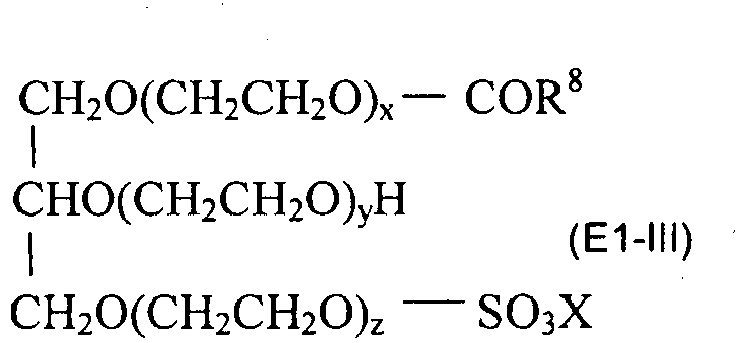
- in der R8CO für einen linearen oder verzweigten Acylrest mit 6 bis 22 Kohlenstoffatomen, x, y und z in Summe für 0 oder für Zahlen von 1 bis 30, vorzugsweise 2 bis 10, und X für ein Alkali- oder Erdalkalimetall steht. Typische Beispiele für im Sinne der Erfindung geeignete Monoglycerid(ether)sulfate sind die Umsetzungsprodukte von Laurinsäuremonoglycerid, Kokosfettsäuremonoglycerid, Palmitinsäuremonoglycerid, Stearinsäuremonoglycerid, Ölsäuremonoglycerid und Talgfettsäuremonoglycerid sowie deren Ethylenoxidaddukte mit Schwefeltrioxid oder Chlorsulfonsäure in Form ihrer Natriumsalze. Vorzugsweise werden Monoglyceridsulfate der Formel (E1-III) eingesetzt, in der R8C für einen linearen Acylrest mit 8 bis 18 Kohlenstoffatomen steht, wie sie beispielsweise in der
EP-B1 0 561 825 EP-B1 0 561 999 DE-A1 42 04 700 von A.K.Biswas et al. in J.Am.Oil.Chem.Soc. 37, 171 (1960 F.U.Ahmed in J.Am.Oil.Chem.Soc. 67, 8 (1990 - Amidethercarbonsäuren wie sie in der
EP 0 690 044 - Kondensationsprodukte aus einem wasserlöslichen Salz eines wasserlöslichen Eiweißhydrolysat-Fettsäure-Kondensationsproduktes. Diese werden durch Kondensation von C8 - C30 Fettsäuren, bevorzugt von Fettsäuren mit 12 - 18 C-Atomen mit Aminosäuren, Mono-, Di- und wasserlöslichen Oligopeptiden und Gemischen solcher Produkte hergestellt, wie sie bei der Hydrolyse von Proteinen anfallen. Diese Eiweißhydrolysat-Fettsäure-Kondensationsprodukte werden mit einer Base neutralisiert und liegen dann bevorzugt als Alkali-, Ammonium-, Mono-, Di- oder Trialkanolammoniumsalz vor. Solche Produkte sind unter dem Warenzeichen Lamepon®, Maypon®, Gluadin®, Hostapon® KCG oder Amisoft® seit langem im Handel erhältlich.
- linear and branched fatty acids with 8 to 30 carbon atoms (soaps),
- Ether carboxylic acids of the formula RO-(CH2-CH2O)x-CH2-COOH, in which R is a linear alkyl group having 8 to 30 carbon atoms and x = 0 or 1 to 16,
- acyl sarcosides with 8 to 24 carbon atoms in the acyl group,
- Acyltaurides with 8 to 24 carbon atoms in the acyl group,
- Acyl isethionates with 8 to 24 carbon atoms in the acyl group have long been known, skin-friendly surface-active substances that are obtained by esterification of fatty acids with the sodium salt of 2-hydroxyethane-sulfonic acid (isoethionic acid), z. B. according to the procedure in
U.S. 3,320,292 - Mono- and dialkyl sulfosuccinates having 8 to 24 carbon atoms in the alkyl group and mono-alkylpolyoxyethyl sulfosuccinates with 8 to 24 carbon atoms in the alkyl group and 1 to 6 oxyethyl groups. The sulfosuccinic acid monoalkyl (C 8 -C 24 ) ester disodium salts are e.g. B. produced by dasa one reacts maleic anhydride with a fatty alcohol having 8 - 24 carbon atoms to the maleic acid monoester of the fatty alcohol and this sulphited with sodium sulfite to the sulfosuccinic ester. Particularly suitable sulfosuccinic acid esters are derived from fatty alcohol fractions having 12-18 carbon atoms, such as those found in e.g. B. from coconut fatty acid or coconut fatty acid methyl ester are accessible by hydrogenation.
- linear alkanesulfonates with 8 to 24 carbon atoms,
- linear alpha-olefin sulfonates with 8 to 24 carbon atoms,
- Alpha-sulfofatty acid methyl esters of fatty acids with 8 to 30 carbon atoms,
- Alkyl sulfates and alkyl polyglycol ether sulfates of the formula RO(CH 2 -CH 2 O) x -OSO 3 H, in which R is a preferably linear alkyl group having 8 to 30 carbon atoms and x = 0 or 1 to 12,
- Mixtures of surface-active hydroxysulfonates according to
DE-A-37 25 030 - sulfated hydroxyalkyl polyethylene and/or hydroxyalkylene propylene glycol ethers according to
DE-A-37 23 354 - Sulfonates of unsaturated fatty acids with 8 to 24 carbon atoms and 1 to 6 double bonds according to
DE-A-39 26 344 - Esters of tartaric acid and citric acid with alcohols, which are addition products of about 2-15 molecules of ethylene oxide and/or propylene oxide onto fatty alcohols with 8 to 22 carbon atoms,
- Alkyl and/or alkenyl ether phosphates of the formula (E1-I),
- in which R 1 is preferably an aliphatic hydrocarbon radical having 8 to 30 carbon atoms, R 2 is hydrogen, a radical (CH 2 CH 2 O) n R 2 or X, n is a number from 1 to 10 and X is hydrogen, an alkali or alkaline earth metal or NR 3 R 4 R 5 R 6 , where R 3 to R 6 are each independently hydrogen or a C 1 to C 4 hydrocarbon radical,
- sulfated fatty acid alkylene glycol esters of the formula (E1-II)
R 7 CO(AlkO) n SO 3 M (E1-II)
where R 7 CO- is a linear or branched, aliphatic, saturated and/or unsaturated acyl radical having 6 to 22 carbon atoms, Alk is CH 2 CH 2 , CHCH 3 CH 2 and/or CH 2 CHCH 3 , n is a number from 0.5 to 5 and M is a cation, as in theDE-OS 197 36 906.5 - Monoglyceride sulfates and monoglyceride ether sulfates of the formula (E1-III)
- in which R 8 CO represents a linear or branched acyl radical having 6 to 22 carbon atoms, x, y and z in total for 0 or numbers from 1 to 30, preferably 2 to 10, and X is an alkali or alkaline earth metal. Typical examples of monoglyceride (ether) sulfates suitable for the purposes of the invention are the reaction products of lauric acid monoglyceride, coconut fatty acid monoglyceride, palmitic acid monoglyceride, stearic acid monoglyceride, oleic acid monoglyceride and tallow fatty acid monoglyceride and their ethylene oxide adducts with sulfur trioxide or chlorosulfonic acid in the form of their sodium salts. Preference is given to using monoglyceride sulfates of the formula (E1-III) in which R 8 C is a linear acyl radical having 8 to 18 carbon atoms, as is the case, for example, in
EP-B1 0 561 825 EP-B1 0 561 999 DE-A1 42 04 700 by AKBiswas et al. in J. Am. Oil. Chem. Soc. 37, 171 (1960 FUAhmed in J.Am.Oil.Chem.Soc. 67, 8 (1990 - Amide ether carboxylic acids as in the
EP 0 690 044 - Condensation products from a water-soluble salt of a water-soluble protein hydrolyzate-fatty acid condensation product. These are produced by condensing C8 - C30 fatty acids, preferably fatty acids with 12 - 18 carbon atoms, with amino acids, mono-, di- and water-soluble oligopeptides and mixtures of such products as are obtained in the hydrolysis of proteins. These protein hydrolyzate-fatty acid condensation products are neutralized with a base and are then preferably present as the alkali metal, ammonium, mono-, di- or trialkanolammonium salt. Such products have long been commercially available under the trademarks Lamepon® , Maypon® , Gluadin® , Hostapon® KCG or Amisoft® .
Die amphoteren und zwitterionischen Tenside zeigen eine synergistische Wirkung mit der erfindungsgemäßen Wirkstoffkombination. Diese synergistische Wirkung beruht möglicherweise auf einer verstärkten Abscheidung der beiden Wirkstoffe auf der Oberfläche von Haut und Haar, was sich im gesamten kosmetischen Erscheinungsbild von Haut und Haar bemerkbar macht. Die besonderen Ladungseffekte von amphoteren und zwitterionischen Tensiden scheinen hierbei eine Rolle zu spielen. Das Haar wird beispielsweise sowohl im trockenen wie auch im nassen Zustand besser kämmbar, leichter frisierbar und zeigt mehr Glanz sowie einen angenehmeren Griff.The amphoteric and zwitterionic surfactants show a synergistic effect with the combination of active substances according to the invention. This synergistic effect is possibly due to increased deposition of the two active ingredients on the surface of the skin and hair, which is reflected in the overall cosmetic appearance of the skin and hair. The special charge effects of amphoteric and zwitterionic surfactants seem to play a role here. For example, the hair becomes easier to comb, both dry and wet, easier to style and has more shine and a more pleasant feel.
Als zwitterionische Tenside (E2) werden solche oberflächenaktiven Verbindungen bezeichnet, die im Molekül mindestens eine quartäre Ammoniumgruppe und mindestens eine -COO(-) - oder-SO3 (-) -Gruppe tragen. Besonders geeignete zwitterionische Tenside sind die sogenannten Betaine wie die N-Alkyl-N,N-dimethylammonium-glycinate, beispielsweise das Kokosalkyl-dimethylammoniumglycinat, N-Acyl-aminopropyl-N,N-dimethylammoniumglycinate, beispielsweise das Kokosacylaminopropyl-dimethylammoniumglycinat, und 2-Alkyl-3-carboxymethyl-3-hydroxyethylimidazoline mit jeweils 8 bis 18 C-Atomen in der Alkyl- oder Acylgruppe sowie das Kokosacylaminoethylhydroxyethylcarboxymethylglycinat. Ein bevorzugtes zwitterionisches Tensid ist das unter der INCI-Bezeichnung Cocamidopropyl Betaine bekannte Fettsäureamid-Derivat.Zwitterionic surfactants (E2) are surface-active compounds which carry at least one quaternary ammonium group and at least one —COO (-) or —SO 3 (-) group in the molecule. Particularly suitable zwitterionic surfactants are the so-called betaines, such as the N-alkyl-N,N-dimethylammonium glycinates, for example coconut alkyl dimethylammonium glycinate, N-acylaminopropyl-N,N-dimethylammonium glycinates, for example cocoacylaminopropyl dimethylammonium glycinate, and 2-alkyl -3-carboxymethyl-3-hydroxyethylimidazolines each having 8 to 18 carbon atoms in the alkyl or acyl group, and cocoacylaminoethylhydroxyethylcarboxymethylglycinate. A preferred zwitterionic surfactant is the fatty acid amide derivative known by the INCI name Cocamidopropyl Betaine.
Unter ampholytischen Tensiden (E3) werden solche oberflächenaktiven Verbindungen verstanden, die außer einer C8 - C24 - Alkyl- oder -Acylgruppe im Molekül mindestens eine freie Aminogruppe und mindestens eine -COOH- oder -SO3H-Gruppe enthalten und zur Ausbildung innerer Salze befähigt sind. Beispiele für geeignete ampholytische Tenside sind N-Alkylglycine, N-Alkylpropionsäuren, N-Alkylaminobuttersäuren, N-Alkyliminodipropionsäuren, N-Hydroxyethyl-N-alkylamidopropylglycine, N-Alkyltaurine, N-Alkylsarcosine, 2-Alkylaminopropionsäuren und Alkylaminoessigsäuren mit jeweils etwa 8 bis 24 C-Atomen in der Alkylgruppe. Typische Beispiele für amphotere bzw. zwitterionische Tenside sind Alkylbetaine, Alkylamidobetaine, Amino-propionate, Aminoglycinate, Imidazoliniumbetaine und Sulfobetaine.Ampholytic surfactants (E3) are understood as meaning surface-active compounds which, in addition to a C 8 - C 24 - alkyl or acyl group in the molecule contain at least one free amino group and at least one -COOH or -SO 3 H group and to form internal Salts are capable. Examples of suitable ampholytic surfactants are N-alkylglycines, N-alkylpropionic acids, N-alkylaminobutyric acids, N-alkyliminodipropionic acids, N-hydroxyethyl-N-alkylamidopropylglycines, N-alkyltaurines, N-alkylsarcosines, 2-alkylaminopropionic acids and alkylaminoacetic acids, each with about 8 to 24 C -atoms in the alkyl group. Typical examples of amphoteric or zwitterionic surfactants are alkyl betaines, alkyl amido betaines, aminopropionates, aminoglycinates, imidazolinium betaines and sulfobetaines.
Besonders bevorzugte ampholytische Tenside sind das N-Kokosalkylaminopropionat, das Kokosacylaminoethylaminopropionat und das C12- C18 - Acylsarcosin.Particularly preferred ampholytic surfactants are N -cocoalkylaminopropionate, cocoacylaminoethylaminopropionate and C12-C18 acylsarcosine.
Nichtionische Tenside (E4) enthalten als hydrophile Gruppe z.B. eine Polyolgruppe, eine Polyalkylenglykolethergruppe oder eine Kombination aus Polyol- und Polyglykolethergruppe. Solche Verbindungen sind beispielsweise
- Anlagerungsprodukte von 2 bis 50 Mol Ethylenoxid und/oder 0 bis 5 Mol Propylenoxid an lineare und verzweigte Fettalkohole mit 6 bis 30 C-Atomen, die Fettalkoholpolyglykolether bzw. die Fettalkoholpolypropylenglykolether bzw. gemischte Fettalkoholpolyether,
- Anlagerungsprodukte von 2 bis 50 Mol Ethylenoxid und/oder 0 bis 5 Mol Propylenoxid an lineare und verzweigte Fettsäuren mit 6 bis 30 C-Atomen, die Fettsäurepolyglykolether bzw. die Fettsäurepolypropylenglykolether bzw. gemischte Fettsäurepolyether,
- Anlagerungsprodukte von 2 bis 50 Mol Ethylenoxid und/oder 0 bis 5 Mol Propylenoxid an lineare und verzweigte Alkylphenole mit 8 bis 15 C-Atomen in der Alkylgruppe, die Alkylphenolpolyglykolether bzw. die Alkylpolypropylenglykolether, bzw. gemischte Alyklphenolpolyether,
- mit einem Methyl- oder C2 - C6 - Alkylrest endgruppenverschlossene Anlagerungsprodukte von 2 bis 50 Mol Ethylenoxid und/oder 0 bis 5 Mol Propylenoxid an lineare und verzweigte Fettalkohole mit 8 bis 30 C-Atomen, an Fettsäuren mit 8 bis 30 C-Atomen und an Alkylphenole mit 8 bis 15 C-Atomen in der Alkylgruppe, wie beispielsweise die unter den Verkaufsbezeichnungen Dehydol® LS, Dehydol® LT (Cognis) erhältlichen Typen,
- C12-C30-Fettsäuremono- und -diester von Anlagerungsprodukten von 1 bis 30 Mol Ethylenoxid an Glycerin,
- Anlagerungsprodukte von 5 bis 60 Mol Ethylenoxid an Rizinusöl und gehärtetes Rizinusöl,
- Polyolfettsäureester, wie beispielsweise das Handelsprodukt Hydagen® HSP (Cognis) oder Sovermol®-Typen (Cognis),
- alkoxilierte Triglyceride,
- alkoxilierte Fettsäurealkylester der Formel (E4-I)
R1CO-(OCH2CHR2)wOR3 (E4-I)
in der R1CO für einen linearen oder verzweigten, gesättigten und/oder ungesättigten Acylrest mit 6 bis 22 Kohlenstoffatomen, R2 für Wasserstoff oder Methyl, R3 für lineare oder verzweigte Alkylreste mit 1 bis 4 Kohlenstoffatomen und w für Zahlen von 1 bis 20 steht, - Aminoxide,
- Hydroxymischether, wie sie beispielsweise in der
DE-OS 19738866 - Sorbitanfettsäureester und Anlagerungeprodukte von Ethylenoxid an Sorbitanfettsäureester wie beispielsweise die Polysorbate,
- Zuckerfettsäureester und Anlagerungsprodukte von Ethylenoxid an Zuckerfettsäureester,
- Anlagerungsprodukte von Ethylenoxid an Fettsäurealkanolamide und Fettamine,
- Zuckertenside vom Typ der Alkyl- und Alkenyloligoglykoside gemäß Formel (E4-II),
R4O-[G]p (E4-II)
in der R4 für einen Alkyl- oder Alkenylrest mit 4 bis 22 Kohlenstoffatomen, G für einen Zuckerrest mit 5 oder 6 Kohlenstoffatomen und p für Zahlen von 1 bis 10 steht. Sie können nach den einschlägigen Verfahren der präparativen organischen Chemie erhalten werden. Stellvertretend für das umfangreiche Schrifttum sei hier auf die Übersichtsarbeit vonBiermann et al. in Starch/Stärke 45, 281 (1993 B. Salka in Cosm.Toil. 108, 89 (1993 J. Kahre et al. in SÖFW-Journal Heft 8, 598 (1995 - Zuckertenside vom Typ der Fettsäure-N-alkylpolyhydroxyalkylamide, ein nichtionisches Tensid der Formel (E4-III),

- Adducts of 2 to 50 moles of ethylene oxide and/or 0 to 5 moles of propylene oxide onto linear and branched fatty alcohols having 6 to 30 carbon atoms, the fatty alcohol polyglycol ethers or the fatty alcohol polypropylene glycol ethers or mixed fatty alcohol polyethers,
- Adducts of 2 to 50 moles of ethylene oxide and/or 0 to 5 moles of propylene oxide with linear and branched fatty acids having 6 to 30 carbon atoms, the fatty acid polyglycol ethers or the fatty acid polypropylene glycol ethers or mixed fatty acid polyethers,
- Addition products of 2 to 50 moles of ethylene oxide and/or 0 to 5 moles of propylene oxide onto linear and branched alkylphenols having 8 to 15 carbon atoms in the alkyl group, the alkylphenol polyglycol ethers or the alkylpolypropylene glycol ethers, or mixed alkylphenol polyethers,
- adducts of 2 to 50 moles of ethylene oxide and/or 0 to 5 moles of propylene oxide onto linear and branched fatty alcohols containing 8 to 30 carbon atoms, onto fatty acids containing 8 to 30 carbon atoms and end-capped with a methyl or C 2 -C 6 -alkyl radical and to alkylphenols with 8 to 15 carbon atoms in the alkyl group, such as the types available under the trade names Dehydol ® LS, Dehydol ® LT (Cognis),
- C 12 -C 30 fatty acid mono- and diesters of adducts of 1 to 30 moles of ethylene oxide with glycerol,
- Addition products of 5 to 60 moles of ethylene oxide with castor oil and hydrogenated castor oil,
- Polyol fatty acid esters, such as the commercial product Hydagen ® HSP (Cognis) or Sovermol ® types (Cognis),
- alkoxylated triglycerides,
- alkoxylated fatty acid alkyl esters of the formula (E4-I)
R 1 CO-(OCH 2 CHR 2 ) w OR 3 (E4-I)
in which R 1 CO is a linear or branched, saturated and/or unsaturated acyl radical having 6 to 22 carbon atoms, R 2 is hydrogen or methyl, R 3 is linear or branched alkyl radicals having 1 to 4 carbon atoms and w is a number from 1 to 20 stands, - amine oxides,
- Hydroxy mixed ethers, such as those in the
DE-OS 19738866 - Sorbitan fatty acid esters and adducts of ethylene oxide with sorbitan fatty acid esters such as polysorbates,
- Sugar fatty acid esters and adducts of ethylene oxide on sugar fatty acid esters,
- Addition products of ethylene oxide to fatty acid alkanolamides and fatty amines,
- Sugar surfactants of the alkyl and alkenyl oligoglycoside type according to formula (E4-II),
R 4 O-[G] p (E4-II)
in which R 4 is an alkyl or alkenyl radical having 4 to 22 carbon atoms, G is a sugar radical having 5 or 6 carbon atoms and p is a number from 1 to 10. They can be obtained by the relevant methods of preparative organic chemistry. Representative of the extensive literature here is the review byBierman et al. in Starch/Stärke 45, 281 (1993 B. Salka in Cosm.Toil. 108, 89 (1993 J. Kahre et al. in SÖFW-Journal issue 8, 598 (1995 - Sugar surfactants of the fatty acid N-alkylpolyhydroxyalkylamide type, a nonionic surfactant of the formula (E4-III),
Die Zuckertenside können in den erfindungsgemäß verwendeten Mitteln bevorzugt in Mengen von 0,1 - 20 Gew.-%, bezogen auf das gesamte Mittel, enthalten sein. Mengen von 0,5 - 15 Gew.-% sind bevorzugt, und ganz besonders bevorzugt sind Mengen von 0,5 - 7,5 Gew.%.The sugar surfactants can be contained in the agents used according to the invention, preferably in amounts of 0.1-20% by weight, based on the agent as a whole. Amounts of 0.5-15% by weight are preferred and amounts of 0.5-7.5% by weight are most preferred.
Weitere typische Beispiele für nichtionische Tenside sind Fettsäureamidpolyglycolether, Fettaminpolyglycolether, Mischether bzw. Mischformale, Proteinhydrolysate (insbesondere pflanzliche Produkte auf Weizenbasis) und Polysorbate.Other typical examples of nonionic surfactants are fatty acid amide polyglycol ethers, fatty amine polyglycol ethers, mixed ethers or mixed formals, protein hydrolyzates (in particular wheat-based vegetable products) and polysorbates.
Als bevorzugte nichtionische Tenside haben sich die Alkylenoxid-Anlagerungsprodukte an gesättigte lineare Fettalkohole und Fettsäuren mit jeweils 2 bis 30 Mol Ethylenoxid pro Mol Fettalkohol bzw. Fettsäure sowie die Zuckertenside erwiesen. Zubereitungen mit hervorragenden Eigenschaften werden ebenfalls erhalten, wenn sie als nichtionische Tenside Fettsäureester von ethoxyliertem Glycerin enthalten.The alkylene oxide adducts with saturated linear fatty alcohols and fatty acids, each with 2 to 30 moles of ethylene oxide per mole of fatty alcohol or fatty acid, and the sugar surfactants have proven to be preferred nonionic surfactants. Preparations with excellent properties are also obtained if they contain fatty acid esters of ethoxylated glycerol as nonionic surfactants.
Diese Verbindungen sind durch die folgenden Parameter gekennzeichnet. Der Alkylrest R enthält 6 bis 22 Kohlenstoffatome und kann sowohl linear als auch verzweigt sein. Bevorzugt sind primäre lineare und in 2-Stellung methylverzweigte aliphatische Reste. Solche Alkylreste sind beispielsweise 1-Octyl, 1-Decyl, 1-Lauryl, 1-Myristyl, 1-Cetyl und 1-Stearyl. Besonders bevorzugt sind 1-Octyl, 1-Decyl, 1-Lauryl, 1-Myristyl. Bei Verwendung sogenannter "Oxo-Alkohole" als Ausgangsstoffe überwiegen Verbindungen mit einer ungeraden Anzahl von Kohlenstoffatomen in der Alkylkette.These connections are characterized by the following parameters. The alkyl radical R contains 6 to 22 carbon atoms and can be either linear or branched. Primary linear aliphatic radicals which are methyl-branched in the 2-position are preferred. Examples of such alkyl radicals are 1-octyl, 1-decyl, 1-lauryl, 1-myristyl, 1-cetyl and 1-stearyl. Particularly preferred are 1-octyl, 1-decyl, 1-lauryl, 1-myristyl. When using so-called "oxo-alcohols" as starting materials, compounds with an odd number of carbon atoms in the alkyl chain predominate.
Die kationischen Tenside (E5) bilden die letzte Gruppe von Tensiden. Kationische Tenside zeichnen sich als Teil des erfindungsgemäßen Wirkstoffkomplexes dadurch aus, dass sie wie die amphoteren und zwitterionischen Tenside zu einem deutlich verbesserten kosmetischen Erscheinungsbild von Haut und Haar beitragen. Die kationische Ladung sorgt für eine gute Bindung an den eher negativ geladenen Oberflächen insbesondere von geschädigtem Haar oder beanspruchter Haut. An den langen Fettresten dieser Molekülstrukturen wiederum können sich verstärkt eher hydrophob aufgebaute Wirkstoffe anlagern. Dadurch wird insgesamt eine erhöhte Abscheidung von Pflegestoffen auf der Oberfläche von Haut und Haar bewirkt. Das Haar wird beispielsweise sowohl im trockenen wie auch im nassen Zustand besser kämmbar, leichter frisierbar und zeigt mehr Glanz sowie einen angenehmeren Griff.The cationic surfactants (E5) form the last group of surfactants. As part of the active substance complex according to the invention, cationic surfactants are characterized in that, like the amphoteric and zwitterionic surfactants, they contribute to a significantly improved cosmetic appearance of skin and hair. The cationic charge ensures good bonding to the more negatively charged surfaces, especially on damaged hair or stressed skin. In turn, more hydrophobic active ingredients can accumulate on the long fatty residues of these molecular structures. This results in an overall increased deposition of care substances on the surface of the skin and hair. For example, the hair becomes easier to comb, both dry and wet, easier to style and has more shine and a more pleasant feel.
Kationische Tenside (E5) leiten sich im Allgemeinen von Ammoniumionen ab und besitzen eine Struktur (NR1R2R3R4)+ mit einem entsprechend negatv geladenen Gegenion. Derartige kationische Ammoniumverbindungen sind dem Fachmann bestens bekannt. Weitere kationische Tenside sind beispielsweise die Esterquats oder die Imidazoliumverbindungen. Erfindungsgemäß besonders bevorzugt einsetzbar sind kationische Tenside (E5) vom Typ der quarternären Ammoniumverbindungen, der Esterquats, der Imidazoline und der Amidoamine. Bevorzugte quaternäre Ammoniumverbindungen sind Ammoniumhalogenide, insbesondere Chloride und Bromide, wie Alkyltrimethylammoniumchloride, Dialkyldimethylammoniumchloride und Trialkylmethylammoniumchloride, z. B. Cetyltrimethylammoniumchlorid, Stearyltrimethylammoniumchlorid, Distearyldimethylammoniumchlorid, Lauryldimethylammoniumchlorid, Lauryldimethylbenzylammoniumchlorid und Tricetylmethylammoniumchlorid, sowie die unter den INCI-Bezeichnungen Quaternium-27 und Quaternium-83 bekannten Imidazolium-Verbindungen. Die langen Alkylketten der oben genannten Tenside weisen bevorzugt 8 bis 30 Kohlenstoffatome auf. Typische Beispiele für kationische Tenside sind quartäre Ammoniumverbindungen und Esterquats, insbesondere quaternierte Fettsäuretrialkanolaminester-Salze.Cationic surfactants (E5) are generally derived from ammonium ions and have a structure (NR 1 R 2 R 3 R 4 ) + with a correspondingly negatively charged counterion. Such cationic ammonium compounds are well known to those skilled in the art. Other cationic surfactants are, for example, the ester quats or the imidazolium compounds. Cationic surfactants (E5) of the quaternary ammonium compound, esterquat, imidazoline and amidoamine types can be used with particular preference according to the invention. Preferred quaternary ammonium compounds are ammonium halides, especially chlorides and bromides, such as alkyltrimethylammonium chlorides, dialkyldimethylammonium chlorides and trialkylmethylammonium chlorides, e.g. B. cetyltrimethylammonium chloride, stearyltrimethylammonium chloride, distearyldimethylammonium chloride, lauryldimethylammonium chloride, lauryldimethylbenzylammonium chloride and tricetylmethylammonium chloride, as well as the imidazolium compounds known under the INCI names Quaternium-27 and Quaternium-83. The long alkyl chains of the above surfactants preferably have 8 to 30 carbon atoms. Typical examples of cationic surfactants are quaternary ammonium compounds and ester quats, in particular quaternized fatty acid trialkanolamine ester salts.
Besonders bevorzugt einsetzbar können erfindungsgemäß kationische Verbindungen mit Behenylresten, insbesondere die unter der Bezeichnung Behentrimoniumchlorid bzw. -bromid (Docosanyltrimethylammonium Chlorid bzw. -Bromid) bekannten Substanzen. Andere bevorzugte QAV weisen mindestens zwei Behenylreste auf. Kommerziell erhältlich sind diese Substanzen beispielsweise unter der Bezeichnungen Genamin® KDMP (Clariant).According to the invention, cationic compounds with behenyl radicals can be used with particular preference, in particular the substances known under the name behentrimonium chloride or bromide (docosanyltrimethylammonium chloride or bromide). Other preferred QAVs have at least two behenyl residues. These substances are commercially available, for example, under the names Genamin® KDMP (Clariant).
Bei Esterquats handelt es sich um bekannte Stoffe, die sowohl mindestens eine Esterfunktion als auch mindestens eine quartäre Ammoniumgruppe als Strukturelement enthalten. Bevorzugte Esterquats sind quaternierte Estersalze von Fettsäuren mit Triethanolamin, quaternierte Estersalze von Fettsäuren mit Diethanolalkylaminen und quaternierten Estersalzen von Fettsäuren mit 1,2-Dihydroxypropyldialkylaminen. Solche Produkte werden beispielsweise unter den Warenzeichen Stepantex®, Dehyquart® und Armocare® vertrieben. Die Produkte Armocare® VGH-70, ein N,N-Bis(2-Palmitoyloxyethyl)dimethylammoniumchlorid, sowie Dehyquart® F-75, Dehyquart® C-4046, Dehyquart® L80 und Dehyquart® AU-35 sind Beispiele für solche Esterquats.Esterquats are known substances that contain both at least one ester function and at least one quaternary ammonium group as a structural element. Preferred esterquats are quaternized ester salts of fatty acids with triethanolamine, quaternized ester salts of fatty acids with diethanolalkylamines, and quaternized ester salts of fatty acids with 1,2-dihydroxypropyldialkylamines. Such products are marketed, for example, under the trademarks Stepantex® , Dehyquart® and Armocare® . The products Armocare® VGH-70, an N,N-bis(2-palmitoyloxyethyl)dimethylammonium chloride, and Dehyquart® F-75, Dehyquart® C-4046, Dehyquart® L80 and Dehyquart® AU-35 are examples of such esterquats.
Als weitere kationische Tenside können die erfindungsgemäßen Mittel mindestens eine quartäre Imidazolinverbindung, d.h. eine Verbindung, die einen positiv geladenen Imidazolinring aufweist, enthalten. Die im folgenden dargestellte Formel (E5-V) zeigt die Struktur dieser Verbindungen.

Die Reste R stehen unabhängig voneinander jeweils für einen gesättigten oder ungesättigten, linearen oder verzweigten Kohlenwasserstoffrest mit einer Kettenlänge von 8 bis 30 Kohlenstoffatomen. Die bevorzugten Verbindungen der Formel (E5-V) enthalten für R jeweils den gleichen Kohlenwasserstoffrest. Die Kettenlänge der Reste R ist bevorzugt 12 Kohlenstoffatome. Besonders bevorzugt sind Verbindungen mit einer Kettenlänge von mindestens 16 Kohlenstoffatomen und ganz besonders bevorzugt mit mindestens 20 Kohlenstoffatomen. Eine ganz besonders bevorzugte Verbindung der Formel I weist eine Kettenlänge von 21 Kohlenstoffatomen auf. Ein Handelsprodukt dieser Kettenlänge ist beispielsweise unter der Bezeichnung Quaternium-91 bekannt. In der Formel (E5-V) ist als Gegenion Methosulfat dargestellt. Erfindungsgemäß umfasst sind jedoch als Gegenionen auch die Halogenide wie Chlorid, Fluorid, Bromid, oder auch Phosphate.The radicals R each independently represent a saturated or unsaturated, linear or branched hydrocarbon radical having a chain length of 8 to 30 carbon atoms. The preferred compounds of the formula (E5-V) each contain the same hydrocarbon radical for R. The chain length of the radicals R is preferably 12 carbon atoms. Particularly preferred are compounds with a chain length of at least 16 carbon atoms and most preferred with at least 20 carbon atoms. A very particularly preferred compound of the formula I has a chain length of 21 carbon atoms. A commercial product of this chain length is known, for example, under the name Quaternium-91. In the formula (E5-V), methosulfate is shown as the counter ion. According to the invention, however, halogenides such as chloride, fluoride, bromide or phosphates are also included as counterions.
Die Imidazoline der Formel (E5-V) sind in den erfindungsgemäßen Zusammensetzungen in Mengen von 0,01 bis 20 Gew.%, bevorzugt in Mengen von 0,05 bis 10 Gew.% und ganz besonders bevorzugt in Mengen von 0,1 bis 7,5 Gew.% enthalten. Die allerbesten Ergebnisse werden dabei mit Mengen von 0,1 bis 5 Gew.% jeweils bezogen auf die Gesamtzusammensetzung des jeweiligen Mittels erhalten.The imidazolines of the formula (E5-V) are present in the compositions according to the invention in amounts of 0.01 to 20% by weight, preferably in amounts of 0.05 to 10% by weight and very particularly preferably in amounts of 0.1 to 7 .5% by weight. The very best results are obtained with amounts of 0.1 to 5% by weight, based in each case on the total composition of the respective agent.
Die Alkylamidoamine werden üblicherweise durch Amidierung natürlicher oder synthetischer Fettsäuren und Fettsäureschnitte mit Dialkylaminoaminen hergestellt. Eine erfindungsgemäß besonders geeignete Verbindung aus dieser Substanzgruppe stellt das unter der Bezeichnung Tegoamid® S 18 im Handel erhältliche Stearamidopropyl-dimethylamin dar. Die Alkylamidoamine können sowohl als solche vorliegen und durch Protonierung in entsprechend saurer Lösung in eine quaternäre Verbindung in der Zusammensetzung überführt werden, sie können aber selbstverständlich auch als permanent quaternäre Verbindung in den erfindungsgemäßen Zusammensetzungen verwendet werden. Beispiele für permanent quaternierte Amidoamine sind beispielsweise die Rohstoffe mit der Handelsbezeichnung Rewoquat® UTM 50, Lanoquat® DES-50 oder Empigen CSC.The alkylamidoamines are usually prepared by amidating natural or synthetic fatty acids and fatty acid cuts with dialkylaminoamines. A particularly suitable compound from this group of substances according to the invention is the stearamidopropyldimethylamine commercially available under the name Tegoamid® S 18. The alkylamidoamines can be present as such and can be converted into a quaternary compound in the composition by protonation in a correspondingly acidic solution but can of course also be used as a permanent quaternary compound in the compositions according to the invention. Examples of permanently quaternized amidoamines are, for example, the raw materials with the trade name Rewoquat® UTM 50, Lanoquat® DES-50 or Empigen CSC.
Die kationischen Tenside (E5) sind in den erfindungsgemäß verwendeten Mitteln bevorzugt in Mengen von 0,05 bis 10 Gew.-%, bezogen auf das gesamte Mittel, enthalten. Mengen von 0,1 bis 5 Gew.-% sind besonders bevorzugt.The cationic surfactants (E5) are preferably present in the agents used according to the invention in amounts of 0.05 to 10% by weight, based on the agent as a whole. Amounts of 0.1 to 5% by weight are particularly preferred.
Kationische, zwitterionische und/oder amphotere Tenside sowie deren Mischungen können erfindungsgemäß bevorzugt sein. Anionische Tenside werden insbesondere verwendet, wenn die erfindungsgemäßen Zusammensetzungen als Shampoos verwendet werden sollen.Cationic, zwitterionic and/or amphoteric surfactants and mixtures thereof can be preferred according to the invention. Anionic surfactants are used in particular when the compositions of the invention are to be used as shampoos.
Die Tenside (E) werden in Mengen von 0,05 - 45 Gew.%, bevorzugt 0,1 - 30 Gew.% und ganz besonders bevorzugt von 0,5 - 25 Gew.%, bezogen auf das gesamte erfindungsgemäß verwendete Mittel, eingesetzt.The surfactants (E) are used in amounts of 0.05-45% by weight, preferably 0.1-30% by weight and very particularly preferably 0.5-25% by weight, based on the total composition used according to the invention .
Erfindungsgemäß verwendbare Emulgatoren sind beispielsweise
- Anlagerungsprodukte von 4 bis 30 Mol Ethylenoxid und/oder 0 bis 5 Mol Propylenoxid an lineare Fettalkohole mit 8 bis 22 C-Atomen, an Fettsäuren mit 12 bis 22 C-Atomen und an Alkylphenole mit 8 bis 15 C-Atomen in der Alkylgruppe,
- C12-C22-Fettsäuremono- und -diester von Anlagerungsprodukten von 1 bis 30 Mol Ethylenoxid an Polyole mit 3 bis 6 Kohlenstoffatomen, insbesondere an Glycerin,
- Ethylenoxid- und Polyglycerin-Anlagerungsprodukte an Methylglucosid-Fettsäureester, Fettsäurealkanolamide und Fettsäureglucamide,
- C8-C22-Alkylmono- und -oligoglycoside und deren ethoxylierte Analoga, wobei Oligomerisierungsgrade von 1,1 bis 5, insbesondere 1,2 bis 2,0, und Glucose als Zuckerkomponente bevorzugt sind,
- Gemische aus Alkyl-(oligo)-glucosiden und Fettalkoholen zum Beispiel das im Handel erhältliche Produkt Montanov®68,
- Anlagerungsprodukte von 5 bis 60 Mol Ethylenoxid an Rizinusöl und gehärtetes Rizinusöl,
- Partialester von Polyolen mit 3-6 Kohlenstoffatomen mit gesättigten Fettsäuren mit 8 bis 22 C-Atomen,
- Sterine. Als Sterine wird eine Gruppe von Steroiden verstanden, die am C-Atom 3 des Steroid-Gerüstes eine Hydroxylgruppe tragen und sowohl aus tierischem Gewebe (Zoosterine) wie auch aus pflanzlichen Fetten (Phytosterine) isoliert werden. Beispiele für Zoosterine sind das Cholesterin und das Lanosterin. Beispiele geeigneter Phytosterine sind Ergosterin, Stigmasterin und Sitosterin. Auch aus Pilzen und Hefen werden Sterine, die sogenannten Mykosterine, isoliert.
- Phospholipide. Hierunter werden vor allem die Glucose-Phospolipide, die z.B. als Lecithine bzw. Phospahtidylcholine aus z.B. Eidotter oder Pflanzensamen (z.B. Sojabohnen) gewonnen werden, verstanden.
- Fettsäureester von Zuckern und Zuckeralkoholen, wie Sorbit,
- Polyglycerine und Polyglycerinderivate wie beispielsweise Polyglycerinpoly-12-hydroxystearat (Handelsprodukt Dehymuls® PGPH),
- Lineare und verzweigte Fettsäuren mit 8 bis 30 C - Atomen und deren Na-, K-, Ammonium-, Ca-, Mg- und Zn - Salze.
- Adducts of 4 to 30 moles of ethylene oxide and/or 0 to 5 moles of propylene oxide onto linear fatty alcohols having 8 to 22 carbon atoms, onto fatty acids having 12 to 22 carbon atoms and onto alkylphenols having 8 to 15 carbon atoms in the alkyl group,
- C 12 -C 22 fatty acid mono- and diesters of adducts of 1 to 30 moles of ethylene oxide onto polyols having 3 to 6 carbon atoms, in particular onto glycerol,
- Ethylene oxide and polyglycerol addition products to methyl glucoside fatty acid esters, fatty acid alkanolamides and fatty acid glucamides,
- C 8 -C 22 alkyl mono- and oligoglycosides and their ethoxylated analogues, degrees of oligomerization of 1.1 to 5, in particular 1.2 to 2.0, and glucose being preferred as the sugar component,
- Mixtures of alkyl (oligo) glucosides and fatty alcohols, for example the commercially available product Montanov ® 68,
- Addition products of 5 to 60 moles of ethylene oxide with castor oil and hydrogenated castor oil,
- Partial esters of polyols with 3-6 carbon atoms with saturated fatty acids with 8 to 22 carbon atoms,
- sterols. Sterols are understood to be a group of steroids which carry a hydroxyl group on carbon atom 3 of the steroid skeleton and are isolated from both animal tissue (zoosterols) and vegetable fats (phytosterols). Examples of zoosterols are cholesterol and lanosterol. Examples of suitable phytosterols are ergosterol, stigmasterol and sitosterol. Sterines, the so-called mykosterines, are also isolated from fungi and yeasts.
- phospholipids. This is understood to mean, in particular, the glucose-phospholipids, which are obtained, for example, as lecithins or phosphatidylcholines from, for example, egg yolk or plant seeds (for example soybeans).
- fatty acid esters of sugars and sugar alcohols such as sorbitol,
- Polyglycerols and polyglycerol derivatives such as polyglycerol poly-12-hydroxystearate (commercial product Dehymuls ® PGPH),
- Linear and branched fatty acids with 8 to 30 carbon atoms and their Na, K, ammonium, Ca, Mg and Zn salts.
Als besonders vorteilhaft hat sich auch ein Zusatz eines an sich bekannten Emulgators vom Typ Wasser-in-Öl in einer Menge von ca. 1 - 5 Gew.-% erwiesen. Dabei handelt es sich um einen Mischester, der ein Kondensationsprodukt aus einem Pentaerythrit-di-fettsäureester und einem Zitronensäure-di-fettalkoholester darstellt, wie es in
Die erfindungsgemäßen Mittel enthalten die Emulgatoren bevorzugt in Mengen von 0,1 - 25 Gew.-%, insbesondere 0,5 - 15 Gew.-%, bezogen auf das gesamte Mittel.The agents according to the invention preferably contain the emulsifiers in amounts of 0.1-25% by weight, in particular 0.5-15% by weight, based on the agent as a whole.
In dem erfindungsgemäß bevorzugten Fall, dass die Verträglichkeit der kosmetischen Zusammensetzungen verbessert werden soll, werden die besonders milden Emulgatoren in den Zusammensetzungen bevorzugt verwendet. In diesen Fällen werden die Alkylsulfate und / oder Alkylethersulfate in Mengen unterhalb von 8 Gew.% , bevorzugt kleiner 5 Gew.% und besonders bevorzugt kleiner 2,5 Gew.% verwendet. Ganz besonders bevorzugt sind diese Zusammensetzungen frei von an Alkylsulfaten und / oder Alkylethersulfaten. "Frei von" bedeutet in diesem Zusammenhang, dass diese Inhaltsstoffe keinesfalls zusätzlich verwendet werden. Es ist jedoch möglich, dass sie durch andere Inhaltsstoffe, wie beispielsweise durch die Verwendung von Silikonemulsionen, in die Zusammensetzung gelangen. Vorzugsweise bedeutet "frei von" daher auch kleiner als 0,5 Gew.%, besonders bevorzugt kleiner 0,1 Gew.%.In the case, which is preferred according to the invention, that the tolerability of the cosmetic compositions is to be improved, the particularly mild emulsifiers in the compositions are preferably used. In these cases, the alkyl sulfates and/or alkyl ether sulfates are used in amounts of less than 8% by weight, preferably less than 5% by weight and particularly preferably less than 2.5% by weight. These compositions are very particularly preferably free from alkyl sulfates and/or alkyl ether sulfates. "Free from" in this context means that these ingredients are not used in addition. However, it is possible that they enter the composition through other ingredients, such as the use of silicone emulsions. "Free from" therefore preferably also means less than 0.5% by weight, particularly preferably less than 0.1% by weight.
Es ist bekannt, dasa Öl-in-Wasser-Emulsionen, fortan O/W-Emulsionen genannt, die mit nichtionogenen Emulgatoren hergestellt und stabilisiert sind, beim Erwärmen eine Phaseninversion erleiden, d.h., dasa bei höheren Temperaturen die äußere, wäßrige Phase zur inneren Phase werden kann. Dieser Vorgang ist in der Regel reversibel, d.h., dasa sich beim Abkühlen wieder der ursprüngliche Emulsionstyp zurückbildet. Es ist auch bekannt, dasa die Lage der Phaseninversionstemperatur (PIT) von vielen Faktoren abhängig ist, zum Beispiel von der Art und dem Phasenvolumen der Ölkomponente, von der Hydrophilie und der Struktur des Emulgators oder der Zusammensetzung des Emulgatorsystems. Weiterhin ist es bekannt, dasa Emulsionen, die bei oder wenig unterhalb der Phaseninversionstemperatur hergestellt werden, sich durch besondere Stabilität und Feinteiligkeit auszeichnen, während solche, die oberhalb der Phaseninversionstemperatur hergestellt werden, weniger feinteilig sind. Emulsionen, die bei einer bestimmten Temperatur Phaseninversion erleiden, werden PIT-Emulsionen genannt. Diese PIT-Emulsionen können erfindungsgemäß bevorzugt sein, weil sie bedingt durch die gerade hinreichende Menge an Emulgator deutlich weniger Emulgator enthalten als übliche nicht PIT-Emulsionen. Daher sind sie nicht nur besonders kostengünstig, sondern noch dazu auch besonders mild und schonend für die Haut und das Haar. Werden in den PIT-Emulsionen auch ionische Tenside als Emulgatoren verwendet, dann werden diese besonders bevorzugt erst nach der Herstellung der PIT-Emulsion während des Abkühlprozesses der PIT-Emulsion zugesetzt.It is known that oil-in-water emulsions, hereinafter referred to as O/W emulsions, which are produced and stabilized with nonionic emulsifiers, undergo a phase inversion when heated, i.e. the outer, aqueous phase becomes the inner phase at higher temperatures can be. This process is usually reversible, i.e. the original emulsion type returns when it cools down. It is also known that the position of the phase inversion temperature (PIT) depends on many factors, for example the type and phase volume of the oil component, the hydrophilicity and structure of the emulsifier or the composition of the emulsifier system. Furthermore, it is known that emulsions which are produced at or just below the phase inversion temperature are distinguished by particular stability and fineness, while those which are produced above the phase inversion temperature are less finely divided. Emulsions that undergo phase inversion at a certain temperature are called PIT emulsions. These PIT emulsions can be preferred according to the invention because, due to the just sufficient amount of emulsifier, they contain significantly less emulsifier than conventional non-PIT emulsions. Therefore, they are not only particularly inexpensive, but also particularly mild and gentle on the skin and hair. If ionic surfactants are also used as emulsifiers in the PIT emulsions, these are particularly preferably added only after the PIT emulsion has been prepared, during the cooling process of the PIT emulsion.
Zu den Synergisten der erfindungsgemäßen Wirkstoffkombination in den erfindungsgemäßen Zusammensetzungen zählen kationische sowie amphotere und/oder zwitterionische Polymer. Polymere werden in kosmetischen Zusammensetzungen aus einer Vielzahl von Gründen verwendet. Hierbei werden auch nichtionische Polymere verwendet.The synergists of the combination of active substances according to the invention in the compositions according to the invention include cationic and amphoteric and/or zwitterionic polymers. Polymers are used in cosmetic compositions for a variety of reasons. Nonionic polymers are also used here.
Im folgenden werden einige Beispiele von besonders bevorzugten Polymeren beschrieben. Die Unterscheidung der erfindungsgemäß verwendbaren Polymere kann dabei aufgrund der Ladungen der Polymere und/oder aufgrund ihrer anwendungstechnischen besonders ausgeprägten Eigenschaften erfolgen. Die Ausdrucksweise "besonders ausgeprägte Eigenschaften" spiegelt den Sachverhalt wider, dass Polymere im Allgemeinen mehrere Eigenschaften in einem Molekül vereinen. Häufig steht jedoch eine der Eigenschaften ganz besonders im Vordergrund und ist für die Auswahl gerade dieses Polymeren maßgeblich.Some examples of particularly preferred polymers are described below. The polymers which can be used according to the invention can be distinguished on the basis of the charges on the polymers and/or on the basis of their particularly pronounced properties in terms of application technology. The expression "particularly distinctive properties" reflects the fact that polymers generally combine several properties in one molecule. Often, however, one of the properties is particularly important and is for the Selection of just this polymer is decisive.
Zunächst werden Polymere aufgrund ihrer jeweiligen Ladungen beschrieben.First, polymers are described based on their respective charges.
Unter kationischen Polymeren sind Polymere zu verstehen, welche in der Haupt- und/oder Seitenkette eine Gruppe aufweisen, welche "temporär" oder "permanent" kationisch sein kann. Als "permanent kationisch" werden erfindungsgemäß solche Polymere bezeichnet, die unabhängig vom pH-Wert des Mittels eine kationische Gruppe aufweisen. Dies sind in der Regel Polymere, die ein quartäres Stickstoffatom, beispielsweise in Form einer Ammoniumgruppe, enthalten. Bevorzugte kationische Gruppen sind quartäre Ammoniumgruppen. Insbesondere solche Polymere, bei denen die quartäre Ammoniumgruppe über eine C1-4-Kohlenwasserstoffgruppe an eine aus Acrylsäure, Methacrylsäure oder deren Derivaten aufgebaute Polymerhauptkette gebunden sind, haben sich als besonders geeignet erwiesen.Cationic polymers are to be understood as meaning polymers which have a group in the main and/or side chain which can be "temporarily" or "permanently" cationic. According to the invention, “permanently cationic” refers to those polymers which have a cationic group independently of the pH of the agent. As a rule, these are polymers which contain a quaternary nitrogen atom, for example in the form of an ammonium group. Preferred cationic groups are quaternary ammonium groups. In particular, those polymers in which the quaternary ammonium group is bonded via a C1-4 hydrocarbon group to a polymer main chain made up of acrylic acid, methacrylic acid or their derivatives have proven to be particularly suitable.
Weitere erfindungsgemäße kationische Polymere sind die sogenannten "temporär kationischen" Polymere. Diese Polymere enthalten üblicherweise eine Aminogruppe, die bei bestimmten pH-Werten als quartäre Ammoniumgruppe und somit kationisch vorliegt.Other cationic polymers according to the invention are the so-called "temporarily cationic" polymers. These polymers usually contain an amino group which, at certain pH values, is present as a quaternary ammonium group and is therefore cationic.
Die erfindungsgemäßen kationischen Polymere können sowohl festigende und/oder filmbildende und/oder antistatische und/oder avivierende Polymere als auch Polymere mit konditionierenden und/oder verdickenden Eigenschaften sein. Bei den geeigneten kationaktiven Polymeren handelt es sich vorzugsweise um haarfestigende und/oder um haarkonditionierende Polymere. Unter Polymeren sind sowohl natürliche als auch synthetische Polymere, welche kationisch oder amphoter geladen sein können, zu verstehen.The cationic polymers according to the invention can be either setting and/or film-forming and/or antistatic and/or conditioning polymers or polymers with conditioning and/or thickening properties. Suitable cationic polymers are preferably hair-fixing and/or hair-conditioning polymers. Polymers are to be understood as meaning both natural and synthetic polymers which can be cationically or amphoterically charged.
Diese beiden Gruppen von Polymeren haben eine potentiell kationische Ladung gemeinsam. Sowohl kationische als auch amphotere bzw. zwitterionische Polymere können daher über ihre kationische Ladungsdichte charakterisiert werden. Die erfindungsgemäßen Polymere zeichnen sich durch eine Ladungsdichte von mindestens 1 bis 7 meq/g aus. Eine Ladungsdichte von mindestens 2 bis 7 meq/g ist dabei bevorzugt. Besonders bevorzugt ist eine Ladungsdichte von mindestens gleich 3meq/g bis 7 meq/g.These two groups of polymers share a potentially cationic charge. Both cationic and amphoteric or zwitterionic polymers can therefore be characterized by their cationic charge density. The polymers according to the invention are distinguished by a charge density of at least 1 to 7 meq/g. A charge density of at least 2 to 7 meq/g is preferred. A charge density at least equal to 3 meq/g to 7 meq/g is particularly preferred.
Ein weiteres charakteristisches Merkmal der erfindungsgemäßen Polymeren ist ihre Molmasse. Unter der Molmasse des jeweiligen Polymeren wird die Molmasse verstanden, welche der Hersteller in den entsprechenden Datenblättern nach dessen Methode gemessen angibt. Für die Auswahl eines geeigneten Polymeren hat sich eine Molmasse von mindestens 50.000 g/u als erfindungsgemäß geeignet erwiesen. Polymere mit einer Molmasse von mehr als 100.000 g/u haben sich als besonders geeignet erwiesen. Polymere mit einer Molmasse von mehr als 1000.000 g/u sind ganz besonders geeignet.Another characteristic feature of the polymers according to the invention is their molar mass. The molar mass of the respective polymer is understood to mean the molar mass which the manufacturer specifies in the relevant data sheets measured using his method. For the selection of a suitable polymer, a molar mass of at least 50,000 g/u has proven to be suitable according to the invention. Polymers with a molar mass of more than 100,000 g/u have proven to be particularly suitable. Polymers with a molecular weight of more than 1000,000 g/u are particularly suitable.
Die Ablagerung von Polymeren aus tensidischen Lösungen an der Oberfläche keratinischer Fasern ist ein Adsorptionsvorgang. Dieser Adsorptionsvorgang ist bis heute nicht vollständig verstanden. Die zuvor dargestellte Auswahl geeigneter Polymerer erfolgt im Stand der Technik bereits nach den zuvor dargestellten Kriterien der Ladungsdichte oder der Molmasse.The deposition of polymers from surfactant solutions on the surface of keratin fibers is an adsorption process. This adsorption process is still not fully understood. In the prior art, the selection of suitable polymers outlined above is already made according to the criteria of charge density or molecular weight outlined above.
Wählt man nun die Polymere gemäß dem Stand der Technik aus, so sollten diejenigen Polymere, welche beide Kriterien erfüllen, eigentlich die geeignetsten sein. Dies ist jedoch nicht der Fall.If the polymers are now selected according to the prior art, those polymers which meet both criteria should actually be the most suitable. However, this is not the case.
Alle bekannten Adsorptionsgleichungen der physikalischen Chemie enthalten Proportionalitätskonstanten, welche im Zusammenhang mit dem Belegungsgrad der Oberfläche stehen. Ohne den genauen wissenschaftlichen Hintergrund zu kennen, könnte jedoch der Belegungsgrad der Oberfläche keratinischer Fasern mit einer Adsorptionswahrscheinlichkeit der erfindungsgemäßen Polymeren zusammenhängen. Definiert man die Adsorptionswahrscheinlichkeit als das Produkt aus der kationischen Ladungsdichte und der Molmasse, so kann dieses Produkt zur gezielten Auswahl geeigneter erfinderischer Polymere herangezogen werden.All known adsorption equations of physical chemistry contain constants of proportionality, which are related to the degree of coverage of the surface. However, without knowing the precise scientific background, the degree of coating of the surface of keratin fibers could be related to the probability of adsorption of the polymers according to the invention. If the adsorption probability is defined as the product of the cationic charge density and the molar mass, then this product can be used for the specific selection of suitable inventive polymers.
Geeignete Polymere weisen für das Produkt aus der kationischen Ladungsdichte und der Molmasse einen Wert von größer als 100.000 auf. Besonders geeignet sind Polymere, welche für dieses Produkt einen Wert von mindestens 200.000 aufweisen. Ganz besonders geeignet sind diejenigen Polymere, bei welchen dieses Produkt einen Wert größer als 250.000 aufweist. Am geeignetsten sind diejenigen Polymere, bei welchen dieses Produkt einen Wert von mindestens 1.000.000 aufweist.Suitable polymers have a product of the cationic charge density and the molecular weight greater than 100,000. Polymers which have a value of at least 200,000 for this product are particularly suitable. Those polymers in which this product has a value greater than 250,000 are very particularly suitable. The most suitable are those polymers in which this product has a value of at least 1,000,000.
Bevorzugt sind solche Polymere, die eine ausreichende Löslichkeit in Wasser oder Alkohol besitzen, um in dem erfindungsgemäßen Mittel bei der Anwendung auf dem feuchten bis nassen Haar vollständig in Lösung zu gehen.Preference is given to those polymers which have sufficient solubility in water or alcohol to be completely dissolved in the agent according to the invention when used on damp to wet hair.
Die kationischen Polymere können Homo- oder Copolymere sein, wobei die quaternären Stickstoffgruppen entweder in der Polymerkette oder vorzugsweise als Substituent an einem oder mehreren der Monomeren enthalten sind. Die Ammoniumgruppen enthaltenden Monomere können mit nicht kationischen Monomeren copolymerisiert sein. Geeignete kationische Monomere sind ungesättigte, radikalisch polymerisierbare Verbindungen, welche mindestens eine kationische Gruppe tragen, insbesondere ammoniumsubstituierte Vinylmonomere wie zum Beispiel Trialkylmethacryloxyalkylammonium, Trialkylacryloxyalkylammonium, Dialkyldiallylammonium und quaternäre Vinylammoniummonomere mit cyclischen, kationische Stickstoffe enthaltenden Gruppen wie Pyridinium, Imidazolium oder quaternäre Pyrrolidone, z.B. Alkylvinylimidazolium, Alkylvinylpyridinium, oder Alyklvinylpyrrolidon Salze. Die Alkylgruppen dieser Monomere sind vorzugsweise niedere Alkylgruppen wie zum Beispiel C1- bis C7-Alkylgruppen, besonders bevorzugt C1- bis C3-Alkylgruppen.The cationic polymers can be homo- or copolymers, with the quaternary nitrogen groups being contained either in the polymer chain or, preferably, as a substituent on one or more of the monomers. The monomers containing ammonium groups can be copolymerized with non-cationic monomers. Suitable cationic monomers are unsaturated, radically polymerizable compounds which carry at least one cationic group, in particular ammonium-substituted vinyl monomers such as, for example, trialkylmethacryloxyalkylammonium, trialkylacryloxyalkylammonium, dialkyldiallylammonium and quaternary vinylammonium monomers with cyclic, cationic nitrogen-containing groups such as pyridinium, imidazolium or quaternary pyrrolidones, e.g. alkylvinylimidazolium, alkylvinylpyridinium , or alkylvinylpyrrolidone salts. The alkyl groups of these monomers are preferably lower alkyl groups such as C1 to C7 alkyl groups, more preferably C1 to C3 alkyl groups.
Die Ammoniumgruppen enthaltenden Monomere können mit nicht kationischen Monomeren copolymerisiert sein. Geeignete Comonomere sind beispielsweise Acrylamid, Methacrylamid; Alkyl- und Dialkylacrylamid, Alkyl- und Dialkylmethacrylamid, Alkylacrylat, Alkylmethacrylat, Vinylcaprolacton, Vinylcaprolactam, Vinylpyrrolidon, Vinylester, z.B. Vinylacetat, Vinylalkohol, Propylenglykol oder Ethylenglykol, wobei die Alkylgruppen dieser Monomere vorzugsweise C1- bis C7-Alkylgruppen, besonders bevorzugt C1- bis C3-Alkylgruppen sind.The ammonium group-containing monomers can be copolymerized with non-cationic monomers be. Examples of suitable comonomers are acrylamide, methacrylamide; Alkyl and dialkyl acrylamide, alkyl and dialkyl methacrylamide, alkyl acrylate, alkyl methacrylate, vinyl caprolactone, vinyl caprolactam, vinyl pyrrolidone, vinyl esters, for example vinyl acetate, vinyl alcohol, propylene glycol or ethylene glycol, the alkyl groups of these monomers preferably being C1 to C7 alkyl groups, particularly preferably C1 to C3 - are alkyl groups.
Geeignete Polymere mit quaternären Amingruppen sind beispielsweise die im CTFA Cosmetic Ingredient Dictionary unter den Bezeichnungen Polyquaternium beschriebenen Polymere wie Methylvinylimidazoliumchlorid/Vinylpyrrolidon Copolymer (Polyquaternium-16) oder quaternisiertes Vinylpyrrolidon/Dimethylaminoethylmethacrylat Copolymer (Polyquaternium- 11) sowie quaternäre Silikonpolymere bzw. -oligomere wie beispielsweise Silikonpolymere mit quaternären Endgruppen (Quaternium-80).Suitable polymers with quaternary amine groups are, for example, the polymers described in the CTFA Cosmetic Ingredient Dictionary under the names polyquaternium, such as methylvinylimidazolium chloride/vinylpyrrolidone copolymer (polyquaternium-16) or quaternized vinylpyrrolidone/dimethylaminoethyl methacrylate copolymer (polyquaternium-11) and quaternary silicone polymers or oligomers such as silicone polymers with quaternary end groups (quaternium-80).
Von den kationischen Polymeren, die in dem erfindungsgemäßen Mittel enthalten sein können, ist zum Beispiel Vinylpyrrolidon/Dimethylaminoethylmethacrylatmethosulfat Copolymer, das unter den Handelsbezeichnungen Gafquat® 755 N und Gafquat® 734 von der Firma Gaf Co., USA vertrieben wird und von denen das Gafquat® 734 besonders bevorzugt ist, geeignet. Weitere kationische Polymere sind beispielsweise das von der Firma BASF, Deutschland unter dem Handelsnamen Luviquat® HM 550 vertriebene Copolymer aus Polyvinylpyrrolidon und Imidazoliminmethochlorid, das von der Firma Calgon/USA unter dem Handelsnamen Merquat® Plus 3300 vertriebene Terpolymer aus Dimethyldiallylammoniumchlorid, Natriumacrylat und Acrylamid und das von der Firma ISP unter dem Handelsnamen Gafquat® HS 100 vertriebene VinylpyrrolidonlMethacrylamidopropyltrimethylammoniumchlorid Copolymer.Of the cationic polymers that can be contained in the agent according to the invention, for example, vinylpyrrolidone / dimethylaminoethyl methacrylate methosulfate copolymer, which is sold under the trade names Gafquat ® 755 N and Gafquat ® 734 by Gaf Co., USA and of which the Gafquat ® 734 is particularly preferred. Other cationic polymers are, for example, the copolymer of polyvinylpyrrolidone and imidazolimine methochloride sold by the company BASF, Germany under the trade name Luviquat ® HM 550, the terpolymer of dimethyldiallylammonium chloride, sodium acrylate and acrylamide sold by the company Calgon / USA under the trade name Merquat ® Plus 3300 and the vinylpyrrolidone/methacrylamidopropyltrimethylammonium chloride copolymer sold by the company ISP under the trade name Gafquat® HS 100.
Homopolymere der Allgemeinen Formel (G1-I),

- R1 steht für eine Methylgruppe
- R2, R3 und R4 stehen für Methylgruppen
- m hat den Wert 2.
- R 1 represents a methyl group
- R 2 , R 3 and R 4 represent methyl groups
- m has the value 2.
Als physiologisch verträgliches Gegenionen X- kommen beispielsweise Halogenidionen, Sulfationen, Phosphationen, Methosulfationen sowie organische Ionen wie Lactat-, Citrat-, Tartrat- und Acetationen in Betracht. Bevorzugt sind Halogenidionen, insbesondere Chlorid.Examples of physiologically tolerable counterions X − are halide ions, sulfate ions, phosphate ions, methosulfate ions and organic ions such as lactate, citrate, tartrate and acetate ions. Halide ions, especially chloride, are preferred.
Ein besonders geeignetes Homopolymer ist das, gewünschtenfalls vernetzte, Poly(methacryloyloxyethyltrimethylammoniumchlorid) mit der INCI-Bezeichnung Polyquaternium-37. Solche Produkte sind beispielsweise unter den Bezeichnungen Rheocare® CTH (Cosmetic Rheologies) und Synthalen® CR (3V Sigma) im Handel erhältlich. Die Vernetzung kann gewünschtenfalls mit Hilfe mehrfach olefinisch ungesättigter Verbindungen, beispielsweise Divinylbenzol, Tetraallyloxyethan, Methylenbisacrylamid, Diallylether, Polyallylpolyglycerylether, oder Allylethern von Zuckern oder Zuckerderivaten wie Erythritol, Pentaerythritol, Arabitol, Mannitol, Sorbitol, Sucrose oder Glucose erfolgen. Methylenbisacrylamid ist ein bevorzugtes Vernetzungsagens.A particularly suitable homopolymer is the optionally crosslinked poly(methacryloyloxyethyltrimethylammonium chloride) with the INCI name Polyquaternium-37. Such products are commercially available, for example, under the names Rheocare® CTH (Cosmetic Rheologies) and Synthalen® CR (3V Sigma). If desired, crosslinking can be effected using polyolefinically unsaturated compounds, for example divinylbenzene, tetraallyloxyethane, methylenebisacrylamide, diallyl ether, polyallylpolyglyceryl ether, or allyl ethers of sugars or sugar derivatives such as erythritol, pentaerythritol, arabitol, mannitol, sorbitol, sucrose or glucose. Methylene bisacrylamide is a preferred crosslinking agent.
Das Homopolymer wird bevorzugt in Form einer nichtwässrigen Polymerdispersion, die einen Polymeranteil nicht unter 30 Gew.-% aufweisen sollte, eingesetzt. Solche Polymerdispersionen sind unter den Bezeichnungen Salcare® SC 95 (ca. 50 % Polymeranteil, weitere Komponenten: Mineralöl (INCI-Bezeichnung: Mineral Oil) und Tridecyl-polyoxypropylen-polyoxyethylen-ether (INCI-Bezeichnung: PPG-1-Trideceth-6)) und Salcare® SC 96 (ca. 50 % Polymeranteil, weitere Komponenten: Mischung von Diestern des Propylenglykols mit einer Mischung aus Capryl- und Caprinsäure (INCI-Bezeichnung: Propylene Glycol Dicaprylate/Dicaprate) und Tridecyl-polyoxypropylen-polyoxyethylen-ether (INCI-Bezeichnung: PPG-1-Trideceth-6)) im Handel erhältlich.The homopolymer is preferably used in the form of a non-aqueous polymer dispersion, which should have a polymer content of not less than 30% by weight. Such polymer dispersions are available under the designations Salcare ® SC 95 (approx. 50% polymer content, other components: mineral oil (INCI designation: Mineral Oil) and tridecyl polyoxypropylene polyoxyethylene ether (INCI designation: PPG-1-Trideceth-6) ) and Salcare ® SC 96 (approx. 50% polymer content, other components: mixture of diesters of propylene glycol with a mixture of caprylic and capric acid (INCI designation: Propylene Glycol Dicaprylate/Dicaprate) and tridecyl polyoxypropylene polyoxyethylene ether (INCI -Designation: PPG-1-Trideceth-6)) commercially available.
Copolymere mit Monomereinheiten gemäß Formel (G1-I) enthalten als nichtionogene Monomereinheiten bevorzugt Acrylamid, Methacrylamid, Acrylsäure-C1-4-alkylester und Methacrylsäure-C1-4-alkylester. Unter diesen nichtionogenen Monomeren ist das Acrylamid besonders bevorzugt. Auch diese Copolymere können, wie im Falle der Homopolymere oben beschrieben, vernetzt sein. Ein erfindungsgemäß bevorzugtes Copolymer ist das vernetzte Acrylamid-Methacryloyloxyethyltrimethylammoniumchlorid-Copolymer. Solche Copolymere, bei denen die Monomere in einem Gewichtsverhältnis von etwa 20:80 vorliegen, sind im Handel als ca. 50 %ige nichtwässrige Polymerdispersion unter der Bezeichnung Salcare® SC 92 erhältlich.Copolymers with monomer units of the formula (G1-I) preferably contain acrylamide, methacrylamide, C 1-4 -alkyl acrylate and C 1-4 -alkyl methacrylate as nonionic monomer units. Among these nonionic monomers, acrylamide is particularly preferred. These copolymers can, as in the case of the homopolymers described above, be networked. A preferred copolymer according to the invention is the crosslinked acrylamide-methacryloyloxyethyltrimethylammonium chloride copolymer. Such copolymers, in which the monomers are present in a weight ratio of approximately 20:80, are commercially available as an approximately 50% non-aqueous polymer dispersion under the name Salcare® SC 92.
Geeignete kationaktive Silikonverbindungen weisen vorzugsweise entweder mindestens eine Aminogruppe oder mindestens eine Ammoniumgruppe auf. Geeignete Silikonpolymere mit Aminogruppen sind unter der INCI- Bezeichnung Amodimethicone bekannt. Hierbei handelt es sich um Polydimethylsiloxane mit Aminoalkylgruppen. Die Aminoalkylgruppen können Seiten- oder endständig sein. Das N-haltige Silikon als erfindungsgemäßes kationisches Polymer kann vorzugsweise ausgewählt werden aus der Gruppe umfassend Siloxanpolymere mit wenigstens einer Aminogruppe, Siloxanpolymere mit wenigstens einer endständigen Aminogruppe, Amodimethicon, Trimethylsilylamodimethicone, und/oder Aminoethylaminopropylsiloxan-Dimethylsiloxan-Copolymer. Geeignete Silikonpolymere mit zwei endständigen quaternären Ammoniumgruppen sind unter der INCI-Bezeichnung Quaternium-80 bekannt. Hierbei handelt es sich um Dimethylsiloxane mit zwei endständigen Aminoalkylgruppen.Suitable cationic silicone compounds preferably have either at least one amino group or at least one ammonium group. Suitable silicone polymers with amino groups are known under the INCI name Amodimethicone. These are polydimethylsiloxanes with aminoalkyl groups. The aminoalkyl groups can be pendant or terminal. The N-containing silicone as the cationic polymer according to the invention can preferably be selected from the group comprising siloxane polymers having at least one amino group, siloxane polymers having at least one terminal amino group, amodimethicone, trimethylsilylamodimethicone, and/or aminoethylaminopropylsiloxane-dimethylsiloxane copolymer. Suitable silicone polymers with two terminal quaternary ammonium groups are known under the INCI name Quaternium-80. These are dimethylsiloxanes with two terminal aminoalkyl groups.
Erfindungsgemäß bevorzugt ist die Verwendung eines Aminosiloxans entsprechend der nachstehenden Allgemeinen Formel (G1-II),

Erfindungsgemäß am meisten bevorzugt ist Amodimethicon, Amodimethicon haltige Emulsionen oder Fluide. Emulsionen, die erfindungsgemäß bevorzugt eingesetzt werden können sind Dow Corning® 949, hierbei handelt es sich um eine kationische Emulsion enthaltend Amodimethicon, Cetrimoniumchlorid und Trideceth-12; Dow Corning® 939, hierbei handelt es sich um eine Emulsion enthaltend Amodimethicon, Cetrimoniumchlorid und Trideceth-12; Dow Corning® 929, hierbei handelt es sich um eine kationische Emulsion enthaltend Amodimethicon, Talktrimoniumchlorid und Nonoxynol-10; Dow Corning® 7224 oder 1401, basierend auf Trimethylsilylamodimethicon, Octoxynol-40, Isolaureth-6 und Glycol; Dow Corning® 2-8194 Mikroemulsion (26%ig) auf Basis eines aminfunktionalisierten Siliconpolymers; Dow Corning® 2-8177 Mikroemulsion (12%ig) auf Basis eines aminfunktionalisierten Siliconpolymers; Dow Corning® 2-8566 Amino Fluid auf Basis eines aminfunktionalisierten Polydimethylsiloxans; erhältlich bei der Firma Dow Corning.Amodimethicone, emulsions or fluids containing amodimethicone are most preferred according to the invention. Emulsions which can preferably be used according to the invention are Dow Corning® 949, which is a cationic emulsion containing amodimethicone, cetrimonium chloride and trideceth-12; Dow Corning ® 939, which is an emulsion containing amodimethicone, cetrimonium chloride and trideceth-12; Dow Corning ® 929, which is a cationic emulsion containing amodimethicone, tallow trimonium chloride and nonoxynol-10; Dow Corning® 7224 or 1401 based on trimethylsilyl amodimethicone, octoxynol-40, isolaureth-6 and glycol; Dow Corning ® 2-8194 Microemulsion (26%) based on an amine functional silicone polymer; Dow Corning ® 2-8177 Microemulsion (12%) based on an amine functional silicone polymer; Dow Corning ® 2-8566 Amino Fluid based on an amine functionalized polydimethylsiloxane; available from Dow Corning.
Das Molekulargewicht der Aminosilikone liegt vorzugsweise zwischen 500 und 100.000. Der Aminanteil (meq/g) liegt vorzugsweise im Bereich von 0,05 bis 2,3, besonders bevorzugt von 01, bis 0,5.The molecular weight of the aminosilicones is preferably between 500 and 100,000. The amine content (meq/g) is preferably in the range from 0.05 to 2.3, more preferably from 0.1 to 0.5.
Das Silikon als erfindungsgemäßes kationisches Polymer wird in einer Menge von 0,01 bis 20 Gew.% bezogen auf das gesamte Mittel, bevorzugt in Mengen von 0,05 bis 15 Gew.% und ganz besonders bevorzugt in Mengen von 0,05 bis 10 Gew.% verwendet.The silicone as the cationic polymer according to the invention is used in an amount of 0.01 to 20% by weight based on the entire agent, preferably in amounts of 0.05 to 15% by weight and very particularly preferably in amounts of 0.05 to 10% by weight .% used.
Geeignete kationische Polymere, die von natürlichen Polymeren abgeleitet sind, sind kationische Derivate von Polysacchariden, beispielsweise kationische Derivate von Cellulose, Stärke oder Guar. Geeignet sind weiterhin Chitosan und Chitosanderivate. Kationische Polysaccharide haben die allgemeine Formel
(G1-III) G-O-B-N+RaRbRc X-
- G ist ein Anhydroglucoserest, beispielsweise Stärke- oder Celluloseanhydroglucose;
- B ist eine divalente Verbindungsgruppe, beispielsweise Alkylen, Oxyalkylen, Polyoxyalkylen oder Hydroxyalkylen;
- Ra, Rb und Rc sind unabhängig voneinander Alkyl, Aryl, Alkylaryl, Arylalkyl, Alkoxyalkyl oder Alkoxyaryl mit jeweils bis zu 18 C-Atomen, wobei die Gesamtzahl der C-Atome in Ra, Rb und Rc vorzugsweise maximal 20 ist;
- X- ist ein übliches Gegenanion und ist vorzugsweise Chlorid.
(G1-III) GOB-N+R a R b R c X -
- G is an anhydroglucose residue, e.g. starch or cellulose anhydroglucose;
- B is a divalent linking group such as alkylene, oxyalkylene, polyoxyalkylene or hydroxyalkylene;
- R a , R b and R c are independently alkyl, aryl, alkylaryl, arylalkyl, alkoxyalkyl or alkoxyaryl each having up to 18 carbon atoms, the total number of carbon atoms in R a , R b and R c preferably being a maximum of 20 is;
- X - is a common counteranion and is preferably chloride.
Eine kationische Cellulose wird unter der Bezeichnung Polymer JR® 400 von Amerchol vertrieben und hat die INCI-Bezeichnung Polyquaternium-10. Eine weitere kationische Cellulose trägt die INCI-Bezeichnung Polyquaternium-24 und wird unter dem Handelsnamen Polymer LM-200 von Amerchol vertrieben. Weitere Handelsprodukte sind die Verbindungen Celquat® H 100, Celquat® und L 200. Die genannten Handelsprodukte sind bevorzugte kationische Cellulosen:
Geeignete kationische Guarderivate werden unter der Handelsbezeichnung Jaguar® vertrieben und haben die INCI-Bezeichnung Guar Hydroxypropyltrimonium Chloride. Weiterhin werden besonders geeignete kationische Guarderivate auch von der Fa. Hercules unter der Bezeichnung N-Hance® im Handel. Weitere kationische Guarderivate werden von der Fa. Cognis unter der Bezeichnung Cosmedia® vertrieben. Ein bevorzugtes kationisches Guarderivat ist das Handelsprodukt AquaCat® der Fa. Hercules. Bei diesem Rohstoff handelt es sich um ein bereits vorgelöstes kationisches Guarderivat.A cationic cellulose is sold under the name Polymer JR ® 400 by Amerchol and has the INCI designation Polyquaternium-10. Another cationic cellulose has the INCI designation Polyquaternium-24 and is sold by Amerchol under the trade name Polymer LM-200. Other commercial products are the compounds Celquat ® H 100, Celquat ® and L 200. The commercial products mentioned are preferred cationic celluloses:
Suitable cationic guar derivatives are sold under the trade name Jaguar® and have the INCI name Guar Hydroxypropyltrimonium Chloride. Furthermore, particularly suitable cationic guard derivatives are also commercially available from Hercules under the name N- Hance® . Further cationic guard derivatives are marketed by Cognis under the name Cosmedia® . A preferred cationic guar derivative is the commercial product AquaCat® from Hercules. This raw material is a pre-dissolved cationic guar derivative.
Ein weiteres besonders geeignetes kationisches natürliches Polymer stellen Hydrokolloide von Typ der Chitosane dar. Chemisch betrachtet handelt es sich dabei um partiell deacetylierte Chitine unterschiedlichen Molekulargewichtes, die den - idealisierten - Monomerbaustein (I) enthalten:

Im Gegensatz zu den meisten Hydrokolloiden, die im Bereich biologischer pH-Werte negativ geladen sind, stellen Chitosane unter diesen Bedingungen kationische Biopolymere dar. Die positiv geladenen Chitosane können mit entgegengesetzt geladenen Oberflächen in Wechselwirkung treten und werden daher in kosmetischen Haar- und Körperpflegemitteln auch als Filmbildner eingesetzt. Neben den Chitosanen kommen auch quaternierte, alkylierte und/oder hydroxyalkylierte Derivate, gegebenenfalls auch in mikrokristalliner Form in Betracht. Der Einsatz kann auch in Form wässriger Gele mit einem Feststoffgehalt im Bereich von 1 bis 5 Gew.-%.In contrast to most hydrocolloids, which are negatively charged in the biological pH range, chitosans are cationic biopolymers under these conditions. The positively charged chitosans can interact with oppositely charged surfaces and are therefore also used in cosmetic hair and body care products as Film former used. In addition to the chitosans, quaternized, alkylated and/or hydroxyalkylated derivatives, optionally also in microcrystalline form, are also suitable. The use can also be in the form of aqueous gels with a solids content in the range from 1 to 5% by weight.
Bei den erfindungsgemäß einzusetzenden Chitosanen handelt es sich um vollständig oder partiell deacetylierte Chitine. Das Molekulargewicht des Chitosans kann über ein breites Spektrum verteilt sein, beispielsweise von 20.000 bis ca. 5 Millionen g/mol. Geeignet ist beispielsweise ein niedermolekulares Chitosan mit einem Molekulargewicht von 30.000 bis 70.000 g/mol. Vorzugsweise liegt das Molekulargewicht jedoch über 100.000 g/mol, besonders bevorzugt von 200. 000 bis 700.000 g/mol. Der Deacetylierungsgrad beträgt vorzugsweise 10 bis 99%, besonders bevorzugt 60 bis 99%.The chitosans to be used according to the invention are completely or partially deacetylated chitins. The molecular weight of the chitosan can be distributed over a wide range, for example from 20,000 to about 5 million g/mol. For example, a low molecular weight chitosan with a molecular weight of 30,000 to 70,000 g/mol is suitable. However, the molecular weight is preferably above 100,000 g/mol, particularly preferably from 200,000 to 700,000 g/mol. The degree of deacetylation is preferably 10 to 99%, more preferably 60 to 99%.
Die Chitosane oder Chitosanderivate liegen vorzugsweise in neutralisierter oder partiell neutralisierter Form vor. Der Neutralisationsgrad für das Chitosan oder das Chitosanderivat liegt vorzugsweise bei mindestens 50%, besonders bevorzugt zwischen 70 und 100%, bezogen auf die Anzahl der freien Basengruppen. Als Neutralisationsmittel können prinzipiell alle kosmetisch verträglichen anorganischen oder organischen Säuren verwendet werden wie beispielsweise Ameisensäure, Weinsäure, Äpfelsäure, Milchsäure, Zitronensäure, Pyrrolidoncarbonsäure, Salzsäure u.a., von denen die Pyrrolidoncarbonsäure besonders bevorzugt ist.The chitosans or chitosan derivatives are preferably present in a neutralized or partially neutralized form. The degree of neutralization for the chitosan or the chitosan derivative is preferably at least 50%, particularly preferably between 70 and 100%, based on the number of free base groups. In principle, all cosmetically compatible inorganic or organic acids such as formic acid, tartaric acid, malic acid, lactic acid, citric acid, pyrrolidone carboxylic acid, hydrochloric acid and others can be used as neutralizing agents, of which pyrrolidone carboxylic acid is particularly preferred.
Ein geeignetes Chitosan wird beispielsweise von der Firma Kyowa Oil& Fat, Japan, unter dem Handelsnamen Flonac® vertrieben. Es hat ein Molekulargewicht von 300.000 bis 700.000 g/mol und ist zu 70 bis 80% entacetyliert. Ein bevorzugtes Chitosansalz ist Chitosoniumpyrrolidoncarboxylat, welches beispielsweise unter der Bezeichnung Kytamer® PC von der Firma Amerchol, USA, vertrieben wird. Das enthaltene Chitosan hat ein Molekulargewicht von ca. 200.000 bis 300.000 g/mol und ist zu 70 bis 85% entacetyliert. Als Chitosanderivate kommen quaternierte, alkylierte oder hydroxyalkylierte Derivate, beispielsweise Hydroxyethyl- oder Hydroxybutylchitosan in Betracht. Weitere Chitosanderivate sind unter den Handelsbezeichnungen Hydagen® CMF, Hydagen® HCMF und Chitolam® NB/101 im Handel frei verfügbar.A suitable chitosan is marketed, for example, by the company Kyowa Oil & Fat, Japan, under the trade name Flonac® . It has a molecular weight of 300,000 to 700,000 g/mol and is 70 to 80% deacetylated. A preferred chitosan salt is chitosonium pyrrolidone carboxylate, which is marketed, for example, under the name Kytamer® PC by Amerchol, USA. The chitosan it contains has a molecular weight of approx. 200,000 to 300,000 g/mol and is 70 to 85% deacetylated. Suitable chitosan derivatives are quaternized, alkylated or hydroxyalkylated derivatives, for example hydroxyethyl or hydroxybutyl chitosan. Other chitosan derivatives are freely available commercially under the trade names Hydagen® CMF, Hydagen® HCMF and Chitolam® NB/101.
Weitere bevorzugte kationische Polymere sind beispielsweise
- quaternisierte Cellulose-Derivate, wie sie unter den Bezeichnungen Celquat® und Polymer JR® im Handel erhältlich sind. Die Verbindungen Celquat® H 100, Celquat® L 200 und Polymer JR®400 sind bevorzugte quaternierte Cellulose-Derivate,
- kationische Alkylpolyglycoside gemäß der
DE-PS 44 13 686 - kationiserter Honig, beispielsweise das Handelsprodukt Honeyquat® 50,
- kationische Guar-Derivate, wie insbesondere die unter den Handelsnamen Cosmedia®Guar und Jaguar® vertriebenen Produkte,
- polymere Dimethyldiallylammoniumsalze und deren Copolymere mit Estern und Amiden von Acrylsäure und Methacrylsäure. Die unter den Bezeichnungen Merquat®100 (Poly(dimethyldiallylammoniumchlorid)) und Merquat®550 (Dimethyldiallylammoniumchlorid-Acrylamid-Copolymer) im Handel erhältlichen Produkte sind Beispiele für solche kationischen Polymere,
- Copolymere des Vinylpyrrolidons mit quaternierten Derivaten des Dialkylaminoalkylacrylats und -methacrylats, wie beispielsweise mit Diethylsulfat quaternierte Vinylpyrrolidon-Dimethylaminoethylmethacrylat-Copolymere. Solche Verbindungen sind unter den Bezeichnungen Gafquat®734 und Gafquat®755 im Handel erhältlich,
- Vinylpyrrolidon-Vinylimidazoliummethochlorid-Copolymere, wie sie unter den Bezeichnungen Luviquat® FC 370, FC 550, FC 905 und HM 552 angeboten werden,
- quaternierter Polyvinylalkohol,
- sowie die unter den Bezeichnungen Polyquaternium 2, Polyquaternium 17, Polyquaternium 18 und Polyquaternium 27 bekannten Polymeren mit quartären Stickstoffatomen in der Polymerhauptkette,
- Vinylpyrrolidon-Vinylcaprolactam-Acrylat-Terpolymere, wie sie mit Acrylsäureestern und Acrylsäureamiden als dritter Monomerbaustein im Handel beispielsweise unter der Bezeichnung Aquaflex® SF 40 angeboten werden.
- quaternized cellulose derivatives, such as are commercially available under the names Celquat ® and Polymer JR ® . The compounds Celquat ® H 100, Celquat ® L 200 and Polymer JR ® 400 are preferred quaternized cellulose derivatives,
- cationic alkyl polyglycosides according to
DE-PS 44 13 686 - cationized honey, for example the commercial product Honeyquat ® 50,
- cationic guar derivatives, such as in particular the products marketed under the trade names Cosmedia ® Guar and Jaguar ® ,
- polymeric dimethyl diallyl ammonium salts and their copolymers with esters and amides of acrylic acid and methacrylic acid. The products commercially available under the names Merquat ® 100 (poly(dimethyldiallylammonium chloride)) and Merquat ® 550 (dimethyldiallylammonium chloride-acrylamide copolymer) are examples of such cationic polymers,
- Copolymers of vinylpyrrolidone with quaternized derivatives of dialkylaminoalkyl acrylate and methacrylate, such as, for example, vinylpyrrolidone-dimethylaminoethyl methacrylate copolymers quaternized with diethyl sulfate. Such compounds are commercially available under the names Gafquat ® 734 and Gafquat ® 755,
- Vinylpyrrolidone-vinylimidazolium methochloride copolymers, such as those offered under the names Luviquat ® FC 370, FC 550, FC 905 and HM 552,
- quaternized polyvinyl alcohol,
- and the polymers known under the names Polyquaternium 2, Polyquaternium 17, Polyquaternium 18 and Polyquaternium 27 with quaternary nitrogen atoms in the polymer main chain,
- Vinylpyrrolidone-vinylcaprolactam-acrylate terpolymers, as are commercially available with acrylic acid esters and acrylic acid amides as the third monomer building block, for example under the name Aquaflex® SF 40.
Gleichfalls als kationische Polymere eingesetzt werden können die unter den Bezeichnungen Polyquaternium-24 (Handelsprodukt z. B. Quatrisoft® LM 200), bekannten Polymere. Ebenfalls erfindungsgemäß verwendbar sind die Copolymere des Vinylpyrrolidons, wie sie als Handelsprodukte Copolymer 845 (Hersteller: ISP), Gaffix® VC 713 (Hersteller: ISP), Gafquat®ASCP 1011, Gafquat®HS 110, Luviquat®8155 und Luviquat® MS 370 erhältlich sind. Weitere in den erfindungsgemäßen Zusammensetzungen einsetzbare kationische Polymere sind die sogenannten "temporär kationischen" Polymere. Diese Polymere enthalten üblicherweise eine Aminogruppe, die bei bestimmten pH-Werten als quartäre Ammoniumgruppe und somit kationisch vorliegt. Bevorzugt sind beispielsweise Chitosan und dessen Derivate, wie sie beispielsweise unter den Handelsbezeichnungen Hydagen® CMF, Hydagen® HCMF, Kytamer® PC und Chitolam® NB/101 im Handel frei verfügbar sind.The polymers known under the names Polyquaternium-24 (commercial product, for example Quatrisoft® LM 200) can also be used as cationic polymers. Also usable according to the invention are the copolymers of vinylpyrrolidone, such as those available as commercial products Copolymer 845 (manufacturer: ISP), Gaffix® VC 713 (manufacturer: ISP), Gafquat® ASCP 1011, Gafquat® HS 110, Luviquat® 8155 and Luviquat® MS 370 are. Other cationic polymers which can be used in the compositions according to the invention are the so-called "temporarily cationic" polymers. These polymers usually contain an amino group which, at certain pH values, is present as a quaternary ammonium group and is therefore cationic. For example, chitosan and derivatives thereof are preferred, as are freely available commercially, for example, under the trade names Hydagen® CMF, Hydagen® HCMF , Kytamer® PC and Chitolam® NB/101.
Erfindungsgemäß bevorzugte kationische Polymere sind kationische Cellulose-Derivate und Chitosan und dessen Derivate, insbesondere die Handelsprodukte Polymer®JR 400, Hydagen® HCMF und Kytamer® PC, kationische Guar-Derivate, kationische Honig-Derivate, insbesondere das Handelsprodukt Honeyquat® 50, kationische Alkylpolyglycodside gemäß der
Weiterhin sind kationiserte Proteinhydrolysate zu den kationischen Polymeren zu zählen, wobei das zugrunde liegende Proteinhydrolysat vom Tier, beispielsweise aus Collagen, Milch oder Keratin, von der Pflanze, beispielsweise aus Weizen, Mais, Reis, Kartoffeln, Soja oder Mandeln, von marinen Lebensformen, beispielsweise aus Fischcollagen oder Algen, oder biotechnologisch gewonnenen Proteinhydrolysaten, stammen kann. Die den erfindungsgemäßen kationischen Derivaten zugrunde liegenden Proteinhydrolysate können aus den entsprechenden Proteinen durch eine chemische, insbesondere alkalische oder saure Hydrolyse, durch eine enzymatische Hydrolyse und/oder einer Kombination aus beiden Hydrolysearten gewonnen werden. Die Hydrolyse von Proteinen ergibt in der Regel ein Proteinhydrolysat mit einer Molekulargewichtsverteilung von etwa 100 Dalton bis hin zu mehreren tausend Dalton. Bevorzugt sind solche kationischen Proteinhydrolysate, deren zugrunde liegender Proteinanteil ein Molekulargewicht von 100 bis zu 25000 Dalton, bevorzugt 250 bis 5000 Dalton aufweist. Weiterhin sind unter kationischen Proteinhydrolysaten quaternierte Aminosäuren und deren Gemische zu verstehen. Die Quaternisierung der Proteinhydrolysate oder der Aminosäuren wird häufig mittels quarternären Ammoniumsalzen wie beispielsweise N,N-Dimethyl-N-(n-Alkyl)-N-(2-hydroxy-3-chloro-n-propyl)-ammoniumhalogeniden durchgeführt. Weiterhin können die kationischen Proteinhydrolysate auch noch weiter derivatisiert sein. Als typische Beispiele für die erfindungsgemäßen kationischen Proteinhydrolysate und -derivate seien die unter den INCI - Bezeichnungen im "
Ganz besonders bevorzugt sind die kationischen Proteinhydrolysate und -derivate auf pflanzlicher Basis.Plant-based cationic protein hydrolyzates and derivatives are very particularly preferred.
Die kationischen Polymere sind in den erfindungsgemäßen Zusammensetzungen bevorzugt in Mengen von 0,05 bis 10 Gew.-%, bezogen auf das gesamte Mittel, enthalten. Mengen von 0,1 bis 5 Gew.-% sind besonders bevorzugt.The cationic polymers are preferably present in the compositions according to the invention in amounts of 0.05 to 10% by weight, based on the composition as a whole. Amounts of 0.1 to 5% by weight are particularly preferred.
Bei den anionischen Polymeren (G2) handelt es sich um anionische Polymere, welche Carboxylat- und/oder Sulfonatgruppen aufweisen. Beispiele für anionische Monomere, aus denen derartige Polymere bestehen können, sind Acrylsäure, Methacrylsäure, Crotonsäure, Maleinsäureanhydrid und 2-Acrylamido-2-methylpropansulfonsäure. Dabei können die sauren Gruppen ganz oder teilweise als Natrium-, Kalium-, Ammonium-, Mono- oder Triethanolammonium-Salz vorliegen. Bevorzugte Monomere sind 2-Acrylamido-2-methylpropansulfonsäure und Acrylsäure.The anionic polymers (G2) are anionic polymers which have carboxylate and/or sulfonate groups. Examples of anionic monomers from which such polymers can be made are acrylic acid, methacrylic acid, crotonic acid, maleic anhydride and 2-acrylamido-2-methylpropane sulfonic acid. Some or all of the acidic groups can be present as the sodium, potassium, ammonium, mono- or triethanolammonium salt. Preferred monomers are 2-acrylamido-2-methylpropane sulfonic acid and acrylic acid.
Als ganz besonders wirkungsvoll haben sich anionische Polymere erwiesen, die als alleiniges oder Co-Monomer 2-Acrylamido-2-methylpropansulfonsäure enthalten, wobei die Sulfonsäuregruppe ganz oder teilweise als Natrium-, Kalium-, Ammonium-, Mono- oder Triethanolammonium-Salz vorliegen kann.Anionic polymers which contain 2-acrylamido-2-methylpropanesulfonic acid as the sole or co-monomer have proven particularly effective, it being possible for the sulfonic acid group to be present in whole or in part as the sodium, potassium, ammonium, mono- or triethanolammonium salt .
Besonders bevorzugt ist das Homopolymer der 2-Acrylamido-2-methylpropansulfon-säure, das beispielsweise unter der Bezeichnung Rheothik®11-80 im Handel erhältlich ist.The homopolymer of 2-acrylamido-2-methylpropanesulfonic acid, which is commercially available, for example, under the name Rheothik® 11-80 , is particularly preferred.
Innerhalb dieser Ausführungsform kann es bevorzugt sein, Copolymere aus mindestens einem anionischen Monomer und mindestens einem nichtionogenen Monomer einzusetzen. Bezüglich der anionischen Monomere wird auf die oben aufgeführten Substanzen verwiesen. Bevorzugte nichtionogene Monomere sind Acrylamid, Methacrylamid, Acrylsäureester, Methacrylsäureester, Vinylpyrrolidon, Vinylether und Vinylester.Within this embodiment, it may be preferred to use copolymers of at least one anionic monomer and at least one nonionic monomer. With regard to the anionic monomers, reference is made to the substances listed above. Preferred nonionic monomers are acrylamide, methacrylamide, acrylic acid esters, methacrylic acid esters, vinylpyrrolidone, vinyl ethers and vinyl esters.
Bevorzugte anionische Copolymere sind Acrylsäure-Acrylamid-Copolymere sowie insbesondere Polyacrylamidcopolymere mit Sulfonsäuregruppen-haltigen Monomeren. Ein besonders bevorzugtes anionisches Copolymer besteht aus 70 bis 55 Mol-% Acrylamid und 30 bis 45 Mol% 2-Acrylamido-2-methylpropansulfonsäure, wobei die Sulfonsäuregruppe ganz oder teilweise als Natrium-, Kalium-, Ammonium-, Mono- oder Triethanolammonium-Salz vorliegt. Dieses Copolymer kann auch vernetzt vorliegen, wobei als Vernetzungsagentien bevorzugt polyolefinisch ungesättigte Verbindungen wie Tetraallyloxyethan, Allylsucrose, Allylpentaerythrit und Methylen-bisacrylamid zum Einsatz kommen. Ein solches Polymer ist in dem Handelsprodukt Sepigel®305 der Firma SEPPIC enthalten. Die Verwendung dieses Compounds, das neben der Polymerkomponente eine Kohlenwasserstoffmischung (C13-C14-Isoparaffin) und einen nichtionogenen Emulgator (Laureth-7) enthält, hat sich im Rahmen der erfindungsgemäßen Lehre als besonders vorteilhaft erwiesen. Auch die unter der Bezeichnung Simulgel®600 als Compound mit Isohexadecan und Polysorbat-80 vertriebenen Natriumacryloyldimethyltaurat-Copolymere haben sich als erfindungsgemäß besonders wirksam erwiesen.Preferred anionic copolymers are acrylic acid-acrylamide copolymers and, in particular, polyacrylamide copolymers with monomers containing sulfonic acid groups. A particularly preferred anionic copolymer consists of 70 to 55 mole percent acrylamide and 30 to 45 mole percent 2-acrylamido-2-methylpropane sulfonic acid, the sulfonic acid group being wholly or partially present as the sodium, potassium, ammonium, mono- or triethanolammonium salt present. This copolymer can also be crosslinked, with preference being given to using polyolefinically unsaturated compounds such as tetraallyloxyethane, allylsucrose, allylpentaerythritol and methylenebisacrylamide as crosslinking agents. Such a polymer is contained in the commercial product Sepigel® 305 from SEPPIC. The use of this compound, which contains a hydrocarbon mixture (C 13 -C 14 isoparaffin) and a nonionic emulsifier (Laureth-7) in addition to the polymer component, has proven to be particularly advantageous within the scope of the teaching according to the invention. The sodium acryloyldimethyltaurate copolymers sold under the name Simulgel® 600 as a compound with isohexadecane and polysorbate 80 have also proven to be particularly effective according to the invention.
Ebenfalls bevorzugte anionische Homopolymere sind unvernetzte und vernetzte Polyacrylsäuren. Dabei können Allylether von Pentaerythrit, von Sucrose und von Propylen bevorzugte Vernetzungsagentien sein. Solche Verbindungen sind beispielsweise unter dem Warenzeichen Carbopol® im Handel erhältlich.Also preferred anionic homopolymers are uncrosslinked and crosslinked polyacrylic acids. Allyl ethers of pentaerythritol, of sucrose and of propylene can be preferred crosslinking agents. Such compounds are commercially available, for example, under the trademark Carbopol® .
Copolymere aus Maleinsäureanhydrid und Methylvinylether, insbesondere solche mit Vernetzungen, sind ebenfalls farberhaltende Polymere. Ein mit 1,9-Decadiene vernetztes Maleinsäure-Methylvinylether-Copolymer ist unter der Bezeichnung Stabileze® QM im Handel erhältlich.Copolymers of maleic anhydride and methyl vinyl ether, especially those with crosslinks, are also color retaining polymers. A maleic acid/methyl vinyl ether copolymer crosslinked with 1,9-decadiene is commercially available under the name Stabileze® QM.
Die anionischen Polymere sind in den erfindungsgemäßen Mitteln bevorzugt in Mengen von 0,05 bis 10 Gew.-%, bezogen auf das gesamte Mittel, enthalten. Mengen von 0,1 bis 5 Gew.-% sind besonders bevorzugt.The anionic polymers are preferably present in the agents according to the invention in amounts of 0.05 to 10% by weight, based on the agent as a whole. Amounts of 0.1 to 5% by weight are particularly preferred.
Eine weitere ganz besonders bevorzugte Gruppe von Polymeren sind Polyurethane. Die Polyurethane bestehen aus mindestens zwei verschiedenen Monomertypen,
- einer Verbindung (V1) mit mindestens 2 aktiven Wasserstoffatomen pro Molekül und
- einem Di- oder Polyisocyanat (V2).
- a compound (V1) having at least 2 active hydrogen atoms per molecule and
- a di- or polyisocyanate (V2).
Bei den Verbindungen (V1) kann es sich beispielsweise um Diole, Triole, Diamine, Triamine, Polyetherole und Polyesterole handeln. Dabei werden die Verbindungen mit mehr als 2 aktiven Wasserstoffatomen üblicherweise nur in geringen Mengen in Kombination mit einem großen Überschuss an Verbindungen mit 2 aktiven Wasserstoffatomen eingesetzt.The compounds (V1) can be, for example, diols, triols, diamines, triamines, polyetherols and polyesterols. The compounds with more than 2 active hydrogen atoms are usually used only in small amounts in combination with a large excess of compounds with 2 active hydrogen atoms.
Beispiele für Verbindungen (V1) sind Ethylenglykol, 1,2- und 1,3-Propylenglykol, Butylenglykole, Di-, Tri-, Tetra- und Poly-Ethylen- und -Propylenglykole, Copolymere von niederen Alkylenoxiden wie Ethylenoxid, Propylenoxid und Butylenoxid, Ethylendiamin, Propylendiamin, 1,4-Diaminobutan, Hexamethylendiamin und □,□-Diamine auf Basis von langkettigen Alkanen oder Polyalkylenoxiden.Examples of compounds (V1) are ethylene glycol, 1,2- and 1,3-propylene glycol, butylene glycols, di-, tri-, tetra- and poly-ethylene and -propylene glycols, copolymers of lower alkylene oxides such as ethylene oxide, propylene oxide and butylene oxide, Ethylenediamine, propylenediamine, 1,4-diaminobutane, hexamethylenediamine and □,□-diamines based on long-chain alkanes or polyalkylene oxides.
Polyurethane, bei denen die Verbindungen (V1) Diole, Triole und Polyetherole sind, können erfindungsgemäß bevorzugt sein. Insbesondere Polyethylenglykole und Polypropylenglykole mit Molmassen zwischen 200 und 3000, insbesondere zwischen 1600 und 2500, haben sich in einzelnen Fällen als besonders geeignet erwiesen.According to the invention, preference may be given to polyurethanes in which the compounds (V1) are diols, triols and polyetherols. In particular, polyethylene glycols and polypropylene glycols with molecular weights between 200 and 3000, in particular between 1600 and 2500, have proven particularly suitable in individual cases.
Polyesterole werden üblicherweise durch Modifizierung der Verbindung (V1) mit Dicarbonsäuren wie Phthalsäure, Isophthalsäure und Adipinsäure erhalten.Polyesterols are usually obtained by modifying the compound (V1) with dicarboxylic acids such as phthalic acid, isophthalic acid and adipic acid.
Als Verbindungen (V2) werden überwiegend Hexamethylendiisocyanat, 2,4- und 2,6-Toluoldiisocyanat, 4,4'-Methylendi(phenylisocyanat) und insbesondere Isophorondiisocyanat eingesetzt.The compounds (V2) used are predominantly hexamethylene diisocyanate, 2,4- and 2,6-toluene diisocyanate, 4,4'-methylene di(phenyl isocyanate) and, in particular, isophorone diisocyanate.
Weiterhin können die erfindungsgemäß verwendeten Polyurethane noch Bausteine wie beispielsweise Diamine als Kettenverlängerer und Hydroxycarbonsäuren enthalten. Dialkylolcarbonsäuren wie beispielsweise Dimethylolpropionsäure sind besonders geeignete Hydroxycarbonsäuren. Hinsichtlich der weiteren Bausteine besteht keine grundsätzliche Beschränkung dahingehend, ob es sich um nichtionische, anionischen oder kationische Bausteine handelt.Furthermore, the polyurethanes used according to the invention can also contain building blocks such as, for example, diamines as chain extenders and hydroxycarboxylic acids. Dialkylolcarboxylic acids such as dimethylolpropionic acid are particularly suitable hydroxycarboxylic acids. With regard to the other building blocks, there is no fundamental restriction as to whether they are nonionic, anionic or cationic building blocks.
Bezüglich weiterer Informationen über den Aufbau und die Herstellung der Polyurethane wird ausdrücklich auf die Artikel in den einschlägigen Übersichtswerken wie Römpps Chemie-Lexikon und Ullmanns Enzyklopädie der technischen Chemie Bezug genommen.With regard to further information on the structure and production of the polyurethanes, reference is expressly made to the articles in the relevant overview works such as Rompps Chemie-Lexikon and Ullmanns Enzyklopädie der Technischen Chemie.
Als in vielen Fälle erfindungsgemäß besonders geeignet haben sich Polyurethane erwiesen, die wie folgt charakterisiert werden können:
- ausschließlich aliphatische Gruppen im Molekül
- keine freien Isocyanatgruppen im Molekül
- Polyether- und Polyesterpolyurethane
- anionische Gruppen im Molekül.
- exclusively aliphatic groups in the molecule
- no free isocyanate groups in the molecule
- polyether and polyester polyurethanes
- anionic groups in the molecule.
Es hat sich ebenfalls in einigen Fällen als vorteilhaft erwiesen, wenn das Polyurethan in dem System nicht gelöst, sondern stabil dispergiert ist.It has also proven advantageous in some cases if the polyurethane is not dissolved in the system but rather is stably dispersed.
Weiterhin hat es sich als für die Herstellung der erfindungsgemäßen Mittel als vorteilhaft erwiesen, wenn die Polyurethane nicht direkt mit den weiteren Komponenten gemischt, sondern in Form von wäßrigen Dispersionen eingebracht wurden. Solche Dispersionen weisen üblicherweise einen Feststoffgehalt von ca. 20-50 %, insbesondere etwa 35-45% auf und sind auch kommerziell erhältlich.Furthermore, it has proven to be advantageous for the production of the agents according to the invention if the polyurethanes are not mixed directly with the other components but are introduced in the form of aqueous dispersions. Such dispersions usually have a solids content of about 20-50%, in particular about 35-45%, and are also commercially available.
Ein erfindungsgemäß ganz besonders bevorzugtes Polyurethan ist unter der Handelsbezeichnung Luviset® PUR (BASF) im Handel.A very particularly preferred polyurethane according to the invention is commercially available under the trade name Luviset® PUR (BASF).
Weiterhin können als Polymere amphotere Polymere (G3) verwendet werden. Unter dem Begriff amphotere Polymere werden sowohl solche Polymere, die im Molekül sowohl freie Aminogruppen als auch freie -COOH- oder SO3H-Gruppen enthalten und zur Ausbildung innerer Salze befähigt sind, als auch zwitterionische Polymere, die im Molekül quartäre Ammoniumgruppen und -COO- oder -SO3-Gruppen enthalten, und solche Polymere zusammengefaßt, die -COOH- oder SO3H-Gruppen und quartäre Ammoniumgruppen enthalten.Furthermore, amphoteric polymers (G3) can be used as polymers. The term amphoteric polymers includes both those polymers that contain both free amino groups and free -COOH or SO 3 H groups in the molecule and are capable of forming internal salts, as well as zwitterionic polymers that contain quaternary ammonium groups and -COO - or -SO 3 groups included, and summarized those polymers that contain -COOH or SO 3 H groups and quaternary ammonium groups.
Amphotere Polymere sind ebenso wie die kationischen Polymere ganz besonders bevorzugte Polymere.Amphoteric polymers, like the cationic polymers, are very particularly preferred polymers.
Ein Beispiel für ein erfindungsgemäß einsetzbares Amphopolymer ist das unter der Bezeichnung Amphomer® erhältliche Acrylharz, das ein Copolymeres aus tert.-Butylaminoethylmethacrylat, N-(1,1,3,3-Tetramethylbutyl)acrylamid sowie zwei oder mehr Monomeren aus der Gruppe Acrylsäure, Methacrylsäure und deren einfachen Estern darstellt.An example of an amphopolymer that can be used according to the invention is the acrylic resin available under the name Amphomer® , which is a copolymer of tert-butylaminoethyl methacrylate, N-(1,1,3,3-tetramethylbutyl)acrylamide and two or more monomers from the group of acrylic acid, Methacrylic acid and its simple esters.
Bevorzugt eingesetzte amphotere Polymere sind solche Polymerisate, die sich im wesentlichen zusammensetzen aus
- (a) Monomeren mit quartären Ammoniumgruppen der Allgemeinen Formel (G3-I),
R1-CH=CR2-CO-Z-(CnH2n)-N(+)R3R4R5 A(-) (G3-I)
in der R1 und R2 unabhängig voneinander stehen für Wasserstoff oder eine Methylgruppe und R3, R4 und R5 unabhängig voneinander für Alkylgruppen mit 1 bis 4 Kohlenstoffatomen, Z eine NH-Gruppe oder ein Sauerstoffatom, n eine ganze Zahl von 2 bis 5 und A(-) das Anion einer organischen oder anorganischen Säure ist, und - (b) monomeren Carbonsäuren der Allgemeinen Formel (G3-II),
R6-CH=CR7-COOH (G3-II)
in denen R6 und R7 unabhängig voneinander Wasserstoff oder Methylgruppen sind.
- (a) monomers with quaternary ammonium groups of the general formula (G3-I),
R 1 -CH=CR 2 -CO-Z-(C n H 2n )-N( +) R 3 R 4 R 5 A (-) (G3-I)
in which R 1 and R 2 independently represent hydrogen or a methyl group and R 3 , R 4 and R 5 independently represent alkyl groups having 1 to 4 carbon atoms, Z represents an NH group or an oxygen atom, n is an integer from 2 to 5 and A (-) is the anion of an organic or inorganic acid, and - (b) monomeric carboxylic acids of general formula (G3-II),
R 6 -CH=CR 7 -COOH (G3-II)
in which R 6 and R 7 are independently hydrogen or methyl groups.
Diese Verbindungen können sowohl direkt als auch in Salzform, die durch Neutralisation der Polymerisate, beispielsweise mit einem Alkalihydroxid, erhalten wird, erfindungsgemäß eingesetzt werden. Ganz besonders bevorzugt sind solche Polymerisate, bei denen Monomere des Typs (a) eingesetzt werden, bei denen R3, R4 und R5 Methylgruppen sind, Z eine NH-Gruppe und A(-) ein Halogenid-, Methoxysulfat- oder Ethoxysulfat-Ion ist; Acrylamidopropyl-trimethyl-ammoniumchlorid ist ein besonders bevorzugtes Monomeres (a). Als Monomeres (b) für die genannten Polymerisate wird bevorzugt Acrylsäure verwendet.According to the invention, these compounds can be used either directly or in salt form, which is obtained by neutralizing the polymers, for example with an alkali metal hydroxide. Very particular preference is given to those polymers in which monomers of type (a) are used, in which R 3 , R 4 and R 5 are methyl groups, Z is an NH group and A (-) is a halide, methoxysulfate or ethoxysulfate ion is; Acrylamidopropyl trimethyl ammonium chloride is a particularly preferred monomer (a). Acrylic acid is preferably used as monomer (b) for the polymers mentioned.
Geeignete Ausgangsmonomere sind z. B. Dimethylaminoethylacrylamid, Dimethylaminoethylmethacrylamid, Dimethylaminopropylacrylamid, Dimethylaminopropylmethacrylamid und Diethylaminoethylacrylamid, wenn Z eine NH-Gruppe bedeutet oder Dimethylaminoethylacrylat, Dimethylaminoethylmethacrylat und Diethylaminoethylacrylat, wenn Z ein Sauerstoffatom ist.Suitable starting monomers are, for. B. dimethylaminoethyl acrylamide, dimethylaminoethyl methacrylamide, dimethylaminopropyl acrylamide, dimethylaminopropyl methacrylamide and diethylaminoethyl acrylamide when Z is an NH group or dimethylaminoethyl acrylate, dimethylaminoethyl methacrylate and diethylaminoethyl acrylate when Z is an oxygen atom.
Die eine tertiäre Aminogruppe enthaltenden Monomeren werden dann in bekannter Weise quarterniert, wobei als Alkylierungsreagenzien Methylchlorid, Dimethylsulfat oder Diethylsulfat besonders geeignet sind. Die Quaternisierungsreaktion kann in wässriger Lösung oder im Lösungsmittel erfolgen.The monomers containing a tertiary amino group are then quaternized in a known manner, methyl chloride, dimethyl sulfate or diethyl sulfate being particularly suitable as alkylating reagents. The quaternization reaction can take place in aqueous solution or in a solvent.
Vorteilhafterweise werden solche Monomere der Formel (G3-I) verwendet, die Derivate des Acrylamids oder Methacrylamids darstellen. Weiterhin bevorzugt sind solche Monomeren, die als Gegenionen Halogenid-, Methoxysulfat- oder Ethoxysulfat-Ionen enthalten. Ebenfalls bevorzugt sind solche Monomeren der Formel (G3-I), bei denen R3, R4 und R5 Methylgruppen sind.Those monomers of the formula (G3-I) which are derivatives of acrylamide or methacrylamide are advantageously used. Also preferred are those monomers which contain halide, methoxysulfate or ethoxysulfate ions as counterions. Preference is also given to those monomers of the formula (G3-I) in which R 3 , R 4 and R 5 are methyl groups.
Das Acrylamidopropyl-trimethylammoniumchlorid ist ein ganz besonders bevorzugtes Monomer der Formel (G3-I).Acrylamidopropyl trimethylammonium chloride is a very particularly preferred monomer of formula (G3-I).
Als monomere Carbonsäuren der Formel (G3-II) eignen sich Acrylsäure, Methacrylsäure, Crotonsäure und 2-Methyl-crotonsäure. Bevorzugt werden Acryl- oder Methacrylsäure, insbesondere Acrylsäure, eingesetzt.Acrylic acid, methacrylic acid, crotonic acid and 2-methylcrotonic acid are suitable as monomeric carboxylic acids of the formula (G3-II). Acrylic or methacrylic acid, in particular acrylic acid, are preferably used.
Die erfindungsgemäß einsetzbaren zwitterionischen Polymerisate werden aus Monomeren der Formeln (G3-I) und (G3-II) nach an sich bekannten Polymerisationsverfahren hergestellt. Nähere Angaben zum Polymerisationsverfahren können der einschlägigen Fachliteratur entnommen werden.The zwitterionic polymers which can be used according to the invention are prepared from monomers of the formulas (G3-I) and (G3-II) by polymerization processes which are known per se. Further information on the polymerization process can be found in the relevant technical literature.
Als besonders wirksam haben sich solche Polymerisate erwiesen, bei denen die Monomeren der Formel (G3-I) gegenüber den Monomeren der Formel (G3-II) im Überschuss vorlagen. Es ist daher erfindungsgemäß bevorzugt, solche Polymerisate zu verwenden, die aus Monomeren der Formel (G3-I) und die Monomeren der Formel (G3-II) in einem Molverhältnis von 60:40 bis 95:5, insbesondere von 75:25 bis 95:5, bestehen.Those polymers in which the monomers of the formula (G3-I) were present in excess over the monomers of the formula (G3-II) have proven to be particularly effective. It is therefore preferred according to the invention to use polymers which are made from monomers of the formula (G3-I) and the monomers of the formula (G3-II) in a molar ratio of from 60:40 to 95:5, in particular from 75:25 to 95 :5, pass.
Die amphoteren Polymere sind in den erfindungsgemäßen Mitteln bevorzugt in Mengen von 0,05 bis 10 Gew.-%, bezogen auf das gesamte Mittel, enthalten. Mengen von 0,1 bis 5 Gew.-% sind besonders bevorzugt.The amphoteric polymers are preferably present in the agents according to the invention in amounts of 0.05 to 10% by weight, based on the agent as a whole. Amounts of 0.1 to 5% by weight are particularly preferred.
Weitere erfindungsgemäß einsetzbare amphotere Polymere sind die in der britischen Offenlegungsschrift
Offenlegungsschrift
Die erfindungsgemäßen Mittel können in einer weiteren Ausführungsform nichtionogene Polymere (G4) enthalten.In a further embodiment, the agents according to the invention can contain nonionic polymers (G4).
Geeignete nichtionogene Polymere sind beispielsweise:
- Vinylpyrrolidon/Vinylester-Copolymere, wie sie beispielsweise unter dem Warenzeichen Luviskol® (BASF) vertrieben werden. Luviskol® VA 64 und Luviskol® VA 73, jeweils Vinylpyrrolidon/Vinylacetat-Copolymere, sind ebenfalls bevorzugte nichtionische Polymere.
- Celluloseether, wie Hydroxypropylcellulose, Hydroxyethylcellulose und Methylhydroxypropylcellulose, wie sie beispielsweise unter den Warenzeichen Culminal® und Benecel® (AQUALON) und Natrosol®-Typen (Hercules) vertrieben werden.
- Stärke und deren Derivate, insbesondere Stärkeether, beispielsweise Structure® XL (National Starch), eine multifunktionelle, salztolerante Stärke;
- Schellack
- Polyvinylpyrrolidone, wie sie beispielsweise unter der Bezeichnung Luviskol® (BASF) vertrieben werden.
- Siloxane. Diese Siloxane können sowohl wasserlöslich als auch wasserunlöslich sein. Geeignet sind sowohl flüchtige als auch nichtflüchtige Siloxane, wobei als nichtflüchtige Siloxane solche Verbindungen verstanden werden, deren Siedepunkt bei Normaldruck oberhalb von 200 °C liegt. Bevorzugte Siloxane sind Polydialkylsiloxane, wie beispielsweise Polydimethylsiloxan, Polyalkylarylsiloxane, wie beispielsweise Polyphenylmethylsiloxan, ethoxylierte Polydialkylsiloxane sowie Polydialkylsiloxane, die Amin- und/oder HydroxyGruppen enthalten.
- Glycosidisch substituierte Silicone.
- Vinylpyrrolidone/vinyl ester copolymers, such as those sold under the Luviskol® (BASF) trademark. Luviskol® VA 64 and Luviskol® VA 73, each vinyl pyrrolidone/vinyl acetate copolymers, are also preferred nonionic polymers.
- Cellulose ethers, such as hydroxypropyl cellulose, hydroxyethyl cellulose and methylhydroxypropyl cellulose, such as those sold under the trademarks Culminal ® and Benecel ® (AQUALON) and Natrosol ® types (Hercules).
- Starch and derivatives thereof, particularly starch ethers, for example Structure ® XL (National Starch), a multifunctional, salt-tolerant starch;
- shellac
- Polyvinylpyrrolidones, such as those sold under the name Luviskol® (BASF).
- siloxanes. These siloxanes can be either water-soluble or water-insoluble. Both volatile and non-volatile siloxanes are suitable, non-volatile siloxanes being understood as meaning compounds whose boiling point is above 200° C. at atmospheric pressure. Preferred siloxanes are polydialkylsiloxanes such as polydimethylsiloxane, polyalkylarylsiloxanes such as polyphenylmethylsiloxane, ethoxylated polydialkylsiloxanes and polydialkylsiloxanes containing amine and/or hydroxy groups.
- Glycosidically Substituted Silicones.
Die nichtionischen Polymere sind in den erfindungsgemäßen Zusammensetzungen bevorzugt in Mengen von 0,05 bis 10 Gew.-%, bezogen auf das gesamte Mittel, enthalten. Mengen von 0,1 bis 5 Gew.-% sind besonders bevorzugt.The nonionic polymers are preferably present in the compositions according to the invention in amounts of 0.05 to 10% by weight, based on the composition as a whole. Amounts of 0.1 to 5% by weight are particularly preferred.
Polymere können unabhängig von ihrer chemischen Struktur und Ladung auch nach ihrer Funktion in kosmetischen Zusammensetzungen charakterisiert werden. Die Beschreibung der Polymere gemäß ihrer Funktion in den erfindungsgemäßen Zusammensetzungen entspricht nicht zwangsläufig einer Wertung oder Bedeutung dieser Polymere. Vielmehr sind alle Polymere prinzipiell als gleichwertig für die Verwendung in den erfindungsgemäßen Zusammensetzungen anzusehen, wenngleich auch manche dieser Polymere bevorzugt sein können. Weiterhin finden sich manche Polymere aufgrund der Polyfunktionalität von Polymeren in mehreren Beschreibungen bei unterschiedlichen Effekten wieder. Polymere, welche mehrere gewünschte Effekte bewirken können, sind demzufolge besonders bevorzugt bei der Verwendung in den erfindungsgemäßen Zusammensetzungen.Polymers, independent of their chemical structure and charge, can also be characterized according to their function in cosmetic compositions. The description of the polymers according to their function in the compositions according to the invention does not necessarily correspond to an evaluation or importance of these polymers. Rather, all polymers are in principle to be regarded as equivalent for use in the compositions according to the invention, although some of these polymers can also be preferred. Furthermore, due to the polyfunctionality of polymers, some polymers are found in several descriptions in different ones effects again. Polymers which can bring about several desired effects are therefore particularly preferred for use in the compositions according to the invention.
Die Wahl des geeigneten Polymeren richtet sich auch nach der Verwendung der erfindungsgemäßen Zusammensetzung. So wird beispielsweise besonders bevorzugt ein filmbildendes kationisches oder amphoteres Polymer ausgewählt, wenn die Zusammensetzung als Stylingmittel oder Festiger verwendet werden soll.The choice of the suitable polymer also depends on the use of the composition according to the invention. For example, a film-forming cationic or amphoteric polymer is particularly preferred when the composition is to be used as a styling agent or conditioner.
Da Polymere häufig multifunktional sind, können deren Funktionen nicht immer klar und eindeutig voneinander abgegrenzt werden. Insbesondere gilt dies für filmbildende und festigende Polymere. Dennoch sollen beispielhaft manche filmbildende Polymere beschrieben werden. Allerdings wird an dieser Stelle explizit darauf verwiesen, dass im Rahmen der vorliegenden Erfindung sowohl filmbildende als auch festigende Polymere wesentlich sind. Da beide Eigenschaften auch nicht völlig unabhängig voneinander sind, werden unter dem Begriff "festigende Polymere" auch immer "filmbildende Polymere" verstanden und umgekehrt.Since polymers are often multifunctional, their functions cannot always be clearly and unambiguously distinguished from one another. This applies in particular to film-forming and setting polymers. Nevertheless, some film-forming polymers should be described by way of example. However, at this point it is explicitly pointed out that both film-forming and setting polymers are essential in the context of the present invention. Since the two properties are also not completely independent of one another, the term "setting polymers" is always understood to mean "film-forming polymers" and vice versa.
Das filmbildende und/oder festigende Polymer ist in der erfindungsgemäßen Zusammensetzung vorzugsweise in einer Menge von 0,01 bis 40 Gew.%, besonders bevorzugt von 0,1 bis 30 Gewichtsprozent, ganz besonders bevorzugt in einer Menge von 0,1 bis 10 Gewichtsprozent enthalten. Selbstverständlich können auch mehrere filmbildende und/oder festigende Polymere in der erfindungsgemäßen Zusammensetzung enthalten sein. Dabei können diese filmbildenden und/oder festigenden Polymere sowohl permanent als auch temporär kationisch, anionisch, nichtionisch oder amphoter sein. Weiterhin umfasst die vorliegende Erfindung auch die Erkenntnis, dass bei der Verwendung von mindestens zwei filmbildenden und/oder festigenden Polymeren diese selbstverständlich unterschiedliche Ladungen aufweisen können. Erfindungsgemäß bevorzugt kann es sein, wenn ein ionisches filmbildendes und/oder festigendes Polymer mit einem amphoteren und/oder nichtionischem filmbildenen und/oder festigenden Polymer gemeinsam verwendet wird. Auch die Verwendung mindestens zweier gegensätzlich geladener filmbildender und/oder festigender Polymere ist bevorzugt. In letzterem Falle kann eine besondere Ausführungsform wiederum zusätzlich mindestens ein weiteres amphoteres und/oder nichtionisches filmbildendes und/oder festigendes Polymer enthalten.The composition according to the invention preferably contains the film-forming and/or setting polymer in an amount of 0.01 to 40% by weight, particularly preferably 0.1 to 30% by weight, very particularly preferably 0.1 to 10% by weight . Of course, several film-forming and/or setting polymers can also be contained in the composition according to the invention. These film-forming and/or setting polymers can be cationic, anionic, nonionic or amphoteric both permanently and temporarily. Furthermore, the present invention also includes the finding that when at least two film-forming and/or setting polymers are used, these can of course have different charges. It can be preferred according to the invention if an ionic film-forming and/or setting polymer is used together with an amphoteric and/or non-ionic film-forming and/or setting polymer. The use of at least two oppositely charged film-forming and/or setting polymers is also preferred. In the latter case, a particular embodiment can in turn additionally contain at least one further amphoteric and/or nonionic film-forming and/or setting polymer.
Die Polymere (G) sind in den erfindungsgemäß verwendeten Zusammensetzungen bevorzugt in Mengen von 0,01 bis 30 Gew.-%, bezogen auf die gesamte Zusammensetzung, enthalten. Mengen von 0,01 bis 25, insbesondere von 0,01 bis 15 Gew.-%, sind besonders bevorzugt.The polymers (G) are preferably present in the compositions used according to the invention in amounts of from 0.01 to 30% by weight, based on the composition as a whole. Amounts from 0.01 to 25, in particular from 0.01 to 15% by weight are particularly preferred.
Mit besonderem Vorzug enthalten die erfindungsgemäßen Zusammensetzungen Fettstoffe (D) als weiteren Wirkstoff. In einer besonders bevorzugen Ausführungsform enthält die erfindungsgemäße Zusammensetzung den erfindungsgemäßen Wirkstoffkomplex aus Arganöl und Sheabutter und einen Fettstoff. Durch diese Zusammensetzung werden erhöhte Mengen der Wirkstoffe auf dem Haar oder der Haut abgeschieden, was zu synergistisch gesteigerten Effekten führt. Dabei wird diese Wirkung durch die weitere Verwendung von kationischen und/oder amphoteren Polymeren als Abscheidungshilfe in den erfindungsgemäßen Zusammensetzungen weiter deutlich erhöht. Dabei erfolgt eine Veränderung der Ladung der Oberfläche, welche beispielsweise durch die Messung der sogenannten Wilhelmy - Spannung gemessen werden kann.The compositions according to the invention particularly preferably contain fatty substances (D) as an additional active ingredient. In a particularly preferred embodiment, the composition according to the invention contains the active ingredient complex of argan oil and shea butter according to the invention and a fatty substance. This composition deposits increased amounts of the active ingredients on the hair or skin, which leads to synergistically enhanced effects. This effect is further significantly increased by the further use of cationic and/or amphoteric polymers as a deposition aid in the compositions according to the invention. This results in a change in the charge on the surface, which can be measured, for example, by measuring the so-called Wilhelmy voltage.
Unter Fettstoffen (D) sind zu verstehen Fettsäuren, Fettalkohole, natürliche und synthetische Wachse, welche sowohl in fester Form als auch flüssig in wässriger Dispersion vorliegen können, und natürliche und synthetische kosmetische Ölkomponenten zu verstehen.Fatty substances (D) are to be understood as meaning fatty acids, fatty alcohols, natural and synthetic waxes, which can be present both in solid form and in liquid form in an aqueous dispersion, and natural and synthetic cosmetic oil components.
Als Fettsäuren (D1) können eingesetzt werden lineare und/oder verzweigte, gesättigte und/oder ungesättigte Fettsäuren mit 6 - 30 Kohlenstoffatomen. Bevorzugt sind Fettsäuren mit 10 - 22 Kohlenstoffatomen. Hierunter wären beispielsweise zu nennen die Isostearinsäuren, wie die Handelsprodukte Emersol® 871 und Emersol® 875, und Isopalmitinsäuren wie das Handelsprodukt Edenor® IP 95, sowie alle weiteren unter den Handelsbezeichnungen Edenor® (Cognis) vertriebenen Fettsäuren. Weitere typische Beispiele für solche Fettsäuren sind Capronsäure, Caprylsäure, 2-Ethylhexansäure, Caprinsäure, Laurinsäure, Isotridecansäure, Myristinsäure, Palmitinsäure, Palmitoleinsäure, Stearinsäure, Isostearinsäure, Ölsäure, Elaidinsäure, Petroselinsäure, Linolsäure, Linolensäure, Elaeostearinsäure, Arachinsäure, Gadoleinsäure, Behensäure und Erucasäure sowie deren technische Mischungen, die z.B. bei der Druckspaltung von natürlichen Fetten und Ölen, bei der Oxidation von Aldehyden aus der Roelen'schen Oxosynthese oder der Dimerisierung von ungesättigten Fettsäuren anfallen. Besonders bevorzugt sind üblicherweise die Fettsäureschnitte, welche aus Cocosöl oder Palmöl erhältlich sind; insbesondere bevorzugt ist in der Regel der Einsatz von Stearinsäure.Fatty acids (D1) which can be used are linear and/or branched, saturated and/or unsaturated fatty acids having 6-30 carbon atoms. Fatty acids with 10-22 carbon atoms are preferred. Examples include isostearic acids, such as the commercial products Emersol® 871 and Emersol® 875, and isopalmitic acids, such as the commercial product Edenor® IP 95, and all other fatty acids marketed under the trade names Edenor® (Cognis). Other typical examples of such fatty acids are caproic acid, caprylic acid, 2-ethylhexanoic acid, capric acid, lauric acid, isotridecanoic acid, myristic acid, palmitic acid, palmitoleic acid, stearic acid, isostearic acid, oleic acid, elaidic acid, petroselinic acid, linoleic acid, linolenic acid, eleostearic acid, arachidic acid, gadoleic acid, behenic acid and erucic acid as well as their technical mixtures, which occur, for example, in the pressure splitting of natural fats and oils, in the oxidation of aldehydes from Roelen's oxosynthesis or in the dimerization of unsaturated fatty acids. The fatty acid cuts which are obtainable from coconut oil or palm oil are usually particularly preferred; the use of stearic acid is generally particularly preferred.
Die Einsatzmenge beträgt dabei 0,1 - 15 Gew.%, bezogen auf das gesamte Mittel. Bevorzugt beträgt die Menge 0,5 - 10 Gew.%, wobei ganz besonders vorteilhaft Mengen von 1 - 5 Gew.% sein können.The amount used is 0.1 - 15% by weight, based on the entire agent. The amount is preferably 0.5-10% by weight, with amounts of 1-5% by weight being particularly advantageous.
Als Fettalkohole (D2) können eingesetzt werden gesättigte, ein- oder mehrfach ungesättigte, verzweigte oder unverzweigte Fettalkohole mit C6 - C30-, bevorzugt C10 - C22- und ganz besonders bevorzugt C12 - C22- Kohlenstoffatomen. Einsetzbar im Sinne der Erfindung sind beispielsweise Decanol, Octanol, Octenol, Dodecenol, Decenol, Octadienol, Dodecadienol, Decadienol, Oleylalkohol, Erucaalkohol, Ricinolalkohol, Stearylalkohol, Isostearylalkohol, Cetylalkohol, Laurylalkohol, Myristylalkohol, Arachidylalkohol, Caprylalkohol, Caprinalkohol, Linoleylalkohol, Linolenylalkohol und Behenylalkohol, sowie deren Guerbetalkohole, wobei diese Aufzählung beispielhaften und nicht limitierenden Charakter haben soll. Die Fettalkohole stammen jedoch von bevorzugt natürlichen Fettsäuren ab, wobei üblicherweise von einer Gewinnung aus den Estern der Fettsäuren durch Reduktion ausgegangen werden kann. Erfindungsgemäß einsetzbar sind ebenfalls solche Fettalkoholschnitte, die durch Reduktion natürlich vorkommender Triglyceride wie Rindertalg, Palmöl, Erdnußöl, Rüböl, Baumwollsaatöl, Sojaöl, Sonnenblumenöl und Leinöl oder aus deren Umesterungsprodukten mit entsprechenden Alkoholen entstehenden Fettsäureestern erzeugt werden, und somit ein Gemisch von unterschiedlichen Fettalkoholen darstellen. Solche Substanzen sind beispielsweise unter den Bezeichnungen Stenol®, z.B. Stenol® 1618 oder Lanette®, z.B. Lanette® O oder Lorol®, z.B. Lorol® C8, Lorol® C14, Lorol® C18, Lorol® C8-18, HD-Ocenol®, Crodacol®, z.B. Crodacol® CS, Novol®, Eutanol® G, Guerbitol® 16, Guerbitol® 18, Guerbitol® 20, Isofol® 12, Isofol® 16, Isofol® 24, Isofol® 36, Isocarb® 12, Isocarb® 16 oder Isocarb® 24 käuflich zu erwerben. Selbstverständlich können erfindungsgemäß auch Wollwachsalkohole, wie sie beispielsweise unter den Bezeichnungen Corona®, White Swan®, Coronet® oder Fluilan® käuflich zu erwerben sind, eingesetzt werden. Die Fettalkohole werden in Mengen von 0,1 - 30 Gew.-%, bezogen auf die gesamte Zubereitung, bevorzugt in Mengen von 0,1 - 20 Gew.-% eingesetzt.Fatty alcohols (D2) which can be used are saturated, mono- or polyunsaturated, branched or unbranched fatty alcohols with C6- C30 , preferably C10 - C22 and very particularly preferably C12 - C22 carbon atoms . For example, decanol, octanol, octenol, dodecenol, decenol, octadienol, dodecadienol, decadienol, oleyl alcohol, erucic alcohol, ricinol alcohol, stearyl alcohol, isostearyl alcohol, cetyl alcohol, lauryl alcohol, myristyl alcohol, arachidyl alcohol, caprylic alcohol, capric alcohol, linoleyl alcohol, linolenyl alcohol and behenyl alcohol can be used within the meaning of the invention , and their Guerbet alcohols, this list being intended as an example and not as a limitation. However, the fatty alcohols are derived from preferably natural fatty acids, and it can usually be assumed that they are obtained from the esters of the fatty acids by reduction. Can be used according to the invention are also fatty alcohol cuts that are produced by reducing naturally occurring triglycerides such as beef tallow, palm oil, peanut oil, rapeseed oil, cottonseed oil, soybean oil, sunflower oil and linseed oil or fatty acid esters resulting from their transesterification products with corresponding alcohols, and thus represent a mixture of different fatty alcohols. Such substances are available, for example, under the names Stenol® , for example Stenol® 1618 or Lanette® , for example Lanette® O or Lorol® , for example Lorol® C8, Lorol® C14, Lorol® C18, Lorol® C8-18, HD- Ocenol® , Crodacol ® , e.g. Crodacol ® CS, Novol ® , Eutanol ® G, Guerbitol ® 16, Guerbitol ® 18, Guerbitol ® 20, Isofol ® 12, Isofol ® 16, Isofol ® 24, Isofol ® 36, Isocarb ® 12, Isocarb ® 16 or Isocarb ® 24 available for purchase. Wool wax alcohols, such as those commercially available under the names Corona® , White Swan® , Coronet® or Fluilan® , can of course also be used according to the invention. The fatty alcohols are used in amounts of 0.1-30% by weight, based on the preparation as a whole, preferably in amounts of 0.1-20% by weight.
Als natürliche oder synthetische Wachse (D3) können erfindungsgemäß eingesetzt werden feste Paraffine oder Isoparaffine, Carnaubawachse, Bienenwachse, Candelillawachse, Ozokerite, Ceresin, Walrat, Sonnenblumenwachs, Fruchtwachse wie beispielsweise Apfelwachs oder Citruswachs, Microwachse aus PE- oder PP. Derartige Wachse sind beispielsweise erhältlich über die Fa. Kahl & Co., Trittau.Solid paraffins or isoparaffins, carnauba waxes, beeswax, candelilla waxes, ozokerites, ceresin, spermaceti, sunflower wax, fruit waxes such as apple wax or citrus wax, microwaxes made from PE or PP can be used according to the invention as natural or synthetic waxes (D3). Such waxes are available, for example, from Kahl & Co., Trittau.
Die Einsatzmenge beträgt 0,1 - 50 Gew.% bezogen auf das gesamte Mittel, bevorzugt 0,1 - 20 Gew.% und besonders bevorzugt 0,1 - 15 Gew.% bezogen auf das gesamte Mittel.The amount used is 0.1-50% by weight, based on the total composition, preferably 0.1-20% by weight and particularly preferably 0.1-15% by weight, based on the total composition.
Zu den natürlichen und synthetischen kosmetischen Ölkörpern (D4) sind beispielsweise zu zählen:
- pflanzliche Öle. Beispiele für solche Öle sind Sonnenblumenöl, Olivenöl, Sojaöl, Rapsöl, Mandelöl, Jojobaöl, Orangenöl, Weizenkeimöl, Pfirsichkernöl und die flüssigen Anteile des Kokosöls. Geeignet sind aber auch andere Triglyceridöle wie die flüssigen Anteile des Rindertalgs sowie synthetische Triglyceridöle.
- flüssige Paraffinöle, Isoparaffinöle und synthetische Kohlenwasserstoffe sowie Di-n-alkylether mit insgesamt zwischen 12 bis 36 C-Atomen, insbesondere 12 bis 24 C-Atomen, wie beispielsweise Di-n-octylether, Di-n-decylether, Di-n-nonylether, Di-n-undecylether, Di-n-dodecylether, n-Hexyl-n-octylether, n-Octyl-n-decylether, n-Decyl-n-undecylether, n-Undecyl-n-dodecylether und n-Hexyl-n-Undecylether sowie Di-tert-butylether, Di-iso-pentylether, Di-3-ethyldecylether, tert.-Butyl-n-octylether, iso-Pentyl-n-octylether und 2-Methyl-pentyl-n-octylether. Die als Handelsprodukte erhältlichen Verbindungen 1,3-Di-(2-ethyl-hexyl)-cyclohexan (Cetiol® S) und Di-n-octylether (Cetiol® OE) können bevorzugt sein.
- Esteröle. Unter Esterölen sind zu verstehen die Ester von C6 - C30 - Fettsäuren mit C2 - C30 -Fettalkoholen. Bevorzugt sind die Monoester der Fettsäuren mit Alkoholen mit 2 bis 24 C-Atomen. Beispiele für eingesetzte Fettsäurenanteile in den Estern sind Capronsäure, Caprylsäure, 2-Ethylhexansäure, Caprinsäure, Laurinsäure, Isotridecansäure, Myristinsäure, Palmitinsäure, Palmitoleinsäure, Stearinsäure, Isostearinsäure, Ölsäure, Elaidinsäure, Petroselinsäure, Linolsäure, Linolensäure, Elaeostearinsäure, Arachinsäure, Gadoleinsäure, Behensäure und Erucasäure sowie deren technische Mischungen, die z.B. bei der Druckspaltung von natürlichen Fetten und Ölen, bei der Oxidation von Aldehyden aus der Roelen'schen Oxosynthese oder der Dimerisierung von ungesättigten Fettsäuren anfallen. Beispiele für die Fettalkoholanteile in den Esterölen sind Isopropylalkohol, Capronalkohol, Caprylalkohol, 2-Ethylhexylalkohol, Caprinalkohol, Laurylalkohol, Isotridecylalkohol, Myristylalkohol, Cetylalkohol, Palmoleylalkohol, Stearylalkohol, Isostearylalkohol, Oleylalkohol, Elaidylalkohol, Petroselinylalkohol, Linolylalkohol, Linolenylalkohol, Elaeostearylalkohol, Arachylalkohol, Gadoleylalkohol, Behenylalkohol, Erucylalkohol und Brassidylalkohol sowie deren technische Mischungen, die z.B. bei der Hochdruckhydrierung von technischen Methylestern auf Basis von Fetten und Ölen oder Aldehyden aus der Roelen'schen Oxosynthese sowie als Monomerfraktion bei der Dimerisierung von ungesättigten Fettalkoholen anfallen. Erfindungsgemäß besonders bevorzugt sind Isopropylmyristat (Rilanit® IPM), Isononansäure-C16-18-alkylester (Cetiol® SN), 2-Ethylhexylpalmitat (Cegesoft® 24), Stearinsäure-2-ethylhexylester (Cetiol® 868), Cetyloleat, Glycerintricaprylat, Kokosfettalkoholcaprinat/-caprylat (Cetiol® LC), n-Butylstearat, Oleylerucat (Cetiol® J 600), Isopropylpalmitat (Rilanit® IPP), Oleyl Oleate (Cetiol®), Laurinsäurehexylester (Cetiol® A), Di-n-butyladipat (Cetiol® B), Myristylmyristat (Cetiol® MM), Cetearyl Isononanoate (Cetiol® SN), Ölsäuredecylester (Cetiol® V).
- Dicarbonsäureester wie Di-n-butyladipat, Di-(2-ethylhexyl)-adipat, Di-(2-ethylhexyl)-succinat und Di-isotridecylacelaat sowie Diolester wie Ethylenglykol-dioleat, Ethylenglykol-diisotridecanoat, Propylenglykol-di(2-ethylhexanoat), Propylenglykol-di-isostearat, Propylenglykol-di-pelargonat, Butandiol-di-isostearat, Neopentylglykoldicaprylat,
- symmetrische, unsymmetrische oder cyclische Ester der Kohlensäure mit Fettalkoholen, beispielsweise beschrieben in der
DE-OS 197 56 454 - Trifettsäureester von gesättigten und/oder ungesättigten linearen und/oder verzweigten Fettsäuren mit Glycerin,
- Fettsäurepartialglyceride, das sind Monoglyceride, Diglyceride und deren technische Gemische. Bei der Verwendung technischer Produkte können herstellungsbedingt noch geringe Mengen Triglyceride enthalten sein. Die Partialglyceride folgen vorzugsweise der Formel (D4-I),

- vegetable oils. Examples of such oils are sunflower oil, olive oil, soybean oil, rapeseed oil, almond oil, jojoba oil, orange oil, wheat germ oil, peach kernel oil and the liquid portions of coconut oil. However, other triglyceride oils such as the liquid components of beef tallow and synthetic triglyceride oils are also suitable.
- liquid paraffin oils, isoparaffin oils and synthetic hydrocarbons and di-n-alkyl ethers having a total of between 12 and 36 carbon atoms, in particular 12 to 24 carbon atoms, such as di-n-octyl ether, di-n-decyl ether, di-n-nonyl ether , di-n-undecyl ether, di-n-dodecyl ether, n-hexyl-n-octyl ether, n-octyl-n-decyl ether, n-decyl-n-undecyl ether, n-undecyl-n-dodecyl ether and n-hexyl-n undecyl ether and di-tert-butyl ether, diisopentyl ether, di-3-ethyldecyl ether, tert-butyl n-octyl ether, isopentyl n-octyl ether and 2-methylpentyl n-octyl ether. The compounds 1,3-di-(2-ethylhexyl)cyclohexane ( Cetiol® S) and di-n-octyl ether ( Cetiol® OE), which are available as commercial products, may be preferred.
- ester oils. Ester oils are to be understood as meaning the esters of C 6 -C 30 fatty acids with C 2 -C 30 fatty alcohols. The monoesters of fatty acids with alcohols having 2 to 24 carbon atoms are preferred. Examples of fatty acids used in the esters are caproic acid, caprylic acid, 2-ethylhexanoic acid, capric acid, lauric acid, isotridecanoic acid, myristic acid, palmitic acid, palmitoleic acid, stearic acid, isostearic acid, oleic acid, elaidic acid, petroselinic acid, linoleic acid, linolenic acid, eleostearic acid, arachidic acid, gadoleic acid, behenic acid and Erucic acid and technical mixtures thereof, which are obtained, for example, in the pressure splitting of natural fats and oils, in the oxidation of aldehydes from Roelen's oxo synthesis or in the dimerization of unsaturated fatty acids. Examples of the fatty alcohol components in the ester oils are isopropyl alcohol, caproic alcohol, caprylic alcohol, 2-ethylhexyl alcohol, capric alcohol, lauryl alcohol, isotridecyl alcohol, myristyl alcohol, cetyl alcohol, palmoleyl alcohol, stearyl alcohol, isostearyl alcohol, oleyl alcohol, elaidyl alcohol, petroselinyl alcohol, linolyl alcohol, linolenyl alcohol, elaeostearyl alcohol, arachyl alcohol, gadoleyl alcohol, Behenyl alcohol, erucyl alcohol and brassidyl alcohol and technical mixtures thereof, which are obtained, for example, in the high-pressure hydrogenation of technical methyl esters based on fats and oils or aldehydes from Roelen's oxosynthesis and as a monomer fraction in the dimerization of unsaturated fatty alcohols. Particularly preferred according to the invention are isopropyl myristate (Rilanit ® IPM), isononanoic acid C16-18 alkyl ester (Cetiol ® SN), 2-ethylhexyl palmitate (Cegesoft ® 24), stearic acid 2-ethylhexyl ester (Cetiol ® 868), cetyl oleate, glycerol tricaprylate, coconut fatty alcohol caprate/ -caprylate (Cetiol ® LC), n-butyl stearate, oleyl lerucate (Cetiol ® J 600), isopropyl palmitate (Rilanit ® IPP), oleyl oleate (Cetiol ® ), lauric acid hexyl ester (Cetiol ® A), di-n-butyl adipate (Cetiol ® B ), myristyl myristate (Cetiol ® MM), cetearyl isononanoate (Cetiol ® SN), oleic acid decyl ester (Cetiol ® V).
- Dicarboxylic acid esters such as di-n-butyl adipate, di-(2-ethylhexyl) adipate, di-(2-ethylhexyl) succinate and diisotridecyl acelaate and diol esters such as ethylene glycol dioleate, ethylene glycol diisotridecanoate, propylene glycol di(2-ethylhexanoate) , Propylene Glycol Disostearate, Propylene Glycol Dipelargonate, Butanediol Disostearate, Neopentyl Glycol Dicaprylate,
- symmetrical, asymmetrical or cyclic esters of carbonic acid with fatty alcohols, for example described in
DE-OS 197 56 454 - Trifatty acid esters of saturated and/or unsaturated linear and/or branched fatty acids with glycerol,
- Fatty acid partial glycerides, these are monoglycerides, diglycerides and their technical mixtures. When using technical products, small amounts of triglycerides may still be present due to the manufacturing process. The partial glycerides preferably follow the formula (D4-I),
Die Einsatzmenge der natürlichen und synthetischen kosmetischen C5lkörper in den erfindungsgemäß verwendeten Mitteln beträgt üblicherweise 0,1 - 30 Gew.%, bezogen auf das gesamte Mittel, bevorzugt 0,1 - 20 Gew.-%, und insbesondere 0,1 - 15 Gew.-%.The amount of natural and synthetic cosmetic C5l bodies used in the agents used according to the invention is usually 0.1-30% by weight, based on the agent as a whole, preferably 0.1-20% by weight and in particular 0.1-15% by weight. -%.
Eine letzte Substanzgruppe, welche als Fettstoffe verwendet werden können, sind Silikonöle.A final group of substances that can be used as fatty substances are silicone oils.
Silikonöle (S) bewirken die unterschiedlichsten Effekte. So beeinflussen sie beispielsweise gleichzeitig die Trocken- und Nasskämmbarkeiten, den Griff des trockenen und nassen Haares sowie den Glanz. Aber auch die Weichheit und die Elastizität des Filmes, welcher durch filmbildende Polymere auf dem Haar zum Zwecke der Festigung und des Stylens gebildet wird, wird durch Silikone positiv beeinflusst. Unter dem Begriff Silikonöle versteht der Fachmann mehrere Strukturen Siliciumorganischer Verbindungen. Zunächst werden hierunter die Dimethiconole (S1) verstanden. Dimethiconole bilden die erste Gruppe der Silikone, welche erfindungsgemäß besonders bevorzugt sind. Die erfindungsgemäßen Dimethiconole können sowohl linear als auch verzweigt als auch cyclisch oder cyclisch und verzweigt sein. Lineare Dimethiconole können durch die folgende Strukturformel (S1 - I) dargestellt werden:
(SiOHR1 2) - O - (SiR2 2 - O - )x - (SiOHR1 2) (S1 - I)
Silicone oils (S) cause a wide variety of effects. For example, they simultaneously influence dry and wet combability, the feel of dry and wet hair and the shine. But the softness and elasticity of the film, which is formed by film-forming polymers on the hair for the purpose of strengthening and styling, is positively influenced by silicone. The person skilled in the art understands the term silicone oils to mean several structures of organosilicon compounds. First of all, this means the dimethiconols (S1). Dimethiconols form the first group of silicones, which are particularly preferred according to the invention. The dimethiconols according to the invention can be both linear and branched and also cyclic or cyclic and branched. Linear dimethiconols can be represented by the following structural formula (S1 - I):
(SiOHR 1 2 ) - O - (SiR 2 2 - O - ) x - (SiOHR 1 2 ) (S1 - I)
Verzweigte Dimethiconole können durch die Strukturformel (S1 - II) dargestellt werden:
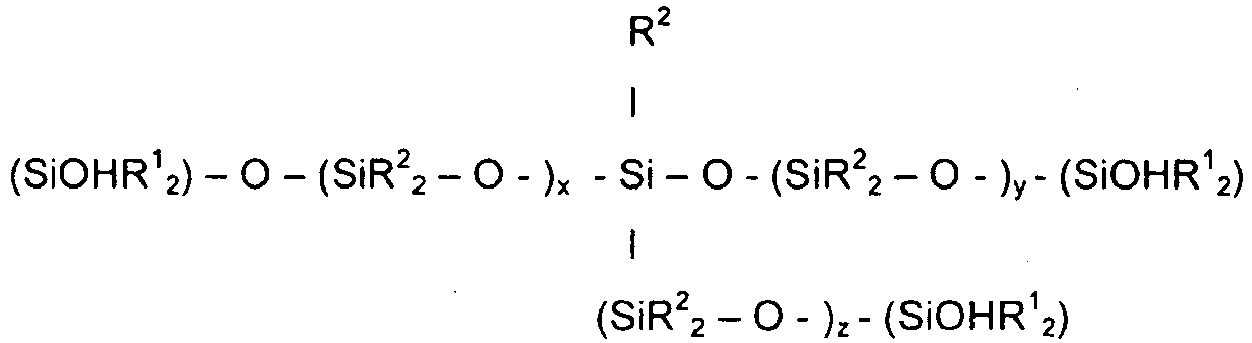
Die Reste R1 und R2 stehen unabhängig voneinander jeweils für Wasserstoff, einen Methylrest, einen C2 bis C30 linearen, gesättigten oder ungesättigten Kohlenwasserstoffrest, einen Phenylrest und/oder eine Arylrest. Nicht einschränkende Beispiele der durch R1 und R2 repräsentierten Reste schließen Alkylreste, wie Methyl, Ethyl, Propyl, Isopropyl, Butyl, Isobutyl, Pentyl, Isopentyl, Neopentyl, Amyl, Isoamyl, Hexyl, Isohexyl und ähnliche; Alkenylreste, wie Vinyl, Halogenvinyl, Alkylvinyl, Allyl, Halogenallyl, Alkylallyl; Cycloalkylreste, wie Cyclobutyl, Cyclopentyl, Cyclohexyl und ähnliche; Phenylreste, Benzylreste, Halogenkohlenwasserstoffreste, wie 3- Chlorpropyl, 4-Brombutyl, 3,3,3-Trifluorpropyl, Chlorcyclohexyl, Bromphenyl, Chlorphenyl und ähnliche sowie schwefelhaltige Reste, wie Mercaptoethyl, Mercaptopropyl, Mercaptohexyl, Mercaptophenyl und ähnliche ein; vorzugsweise ist R1 und R2 ein Alkylrest, der 1 bis etwa 6 Kohlenstoffatomen enthält, und am bevorzugtesten ist R1 und R2 Methyl. Beispiele von R1 schließen Methylen, Ethylen, Propylen, Hexamethylen, Decamethylen, -CH2CH(CH3)CH2-, Phenylen, Naphthylen, -CH2CH2SCH2CH 2-, -CH2CH2OCH2-, -OCH2CH2-, -OCH2 CH2CH2-, -CH2CH(CH3)C(O)OCH2-,-(CH2)3 CC(O)OCH2CH2-, -C6H4C6H4-, -C6H4CH2C6H4-; und -(CH2)3C(O)SCH2CH2- ein. Bevorzugt als R1 und R2 sind Methyl, Phenyl und C2 bis C22 - Alkylreste. Bei den C2 bis C22 Alkylresten sind ganz besonders Lauryl-, Stearyl-, und Behenylreste bevorzugt. Die Zahlen x, y und z sind ganze Zahlen und laufen jeweils unabhängig voneinander von 0 bis 50.000. Die Molgewichte der Dimethicone liegen zwischen 1000 D und 10000000 D. Die Viskositäten liegen zwischen 100 und 10000000 cPs gemessen bei 25 °C mit Hilfe eines Glaskapillarviskosimeters nach der Dow Corning Corporate Testmethode CTM 0004 vom 20. Juli 1970. Bevorzugte Viskositäten liegen zwischen 1000 und 5000000 cPs, ganz besonders bevorzugte Vsikositäten liegen zwischen 10000 und 3000000 cPs. Der bevorzugteste Bereich liegt zwischen 50000 und 2000000 cPs. Selbstverständlich umfasst die erfindungsgemäße Lehre auch, dass die Dimethiconole bereits als Emulsion vorliegen können. Dabei kann die entsprechende Emulsion der Dimethiconole sowohl nach der Herstellung der entsprechenden Dimethiconole aus diesen und den dem Fachmann bekannten üblichen Verfahren zur Emulgierung hergestellt werden. Hierzu können als Hilfsmittel zur Herstellung der entsprechenden Emulsionen sowohl kationische, anionische, nichtionische oder zwitterionische Tenside und Emulgatoren als Hilfsstoffe verwendet werden. Selbstverständlich können die Emulsionen der Dimethiconole auch direkt durch ein Emulsionspolymerisationsverfahren hergestellt werden. Auch derartige Verfahren sind dem Fachmann wohl bekannt. Hierzu sei beispielsweise verwiesen auf die "
Wenn die erfindungsgemäßen Dimethiconole als Emulsion verwendet werden, dann beträgt die Tröpfchengröße der emulgierten Teilchen erfindungsgemäß 0,01µm bis 10000 µm, bevorzugt 0,01 bis 100 µm, ganz besonders bevorzugt 0,01 bis 20 µm und am bevorzugtesten 0,01 bis 10 µm. Die Teilchengröße wird dabei nach der Methode der Lichtstreuung bestimmt.If the dimethiconols according to the invention are used as an emulsion, the droplet size of the emulsified particles according to the invention is 0.01 μm to 10000 μm, preferably 0.01 to 100 μm, very particularly preferably 0.01 to 20 μm and most preferably 0.01 to 10 μm . The particle size is determined by the light scattering method.
Werden verzweigte Dimethiconole verwendet, so ist darunter zu verstehen, dass die Verzweigung größer ist, als eine zufällige Verzweigung, welche durch Verunreinigungen der jeweiligen Monomere zufällig entsteht. Im Sinne der vorliegenden Verbindung ist daher unter verzweigten Dimethiconolen zu verstehen, dass der Verzweigungsgrad größer als 0,01 % ist. Bevorzugt ist ein Verzweigungsgrad größer als 0,1 % und ganz besonders bevorzugt von größer als 0,5 %. Der Grad der Verzweigung wird dabei aus dem Verhältnis der unverzweigten Monomeren, das heißt der Menge des monofunktionalen Siloxanes, zu den verzweigenden Monomeren, das heißt der Menge an tri- und tetrafunktionalen Siloxanen, bestimmt. Erfindungsgemäß können sowohl niedrigverzweigte als auch hochverzweigte Dimethiconole ganz besonders bevorzugt sein.If branched dimethiconols are used, this is to be understood as meaning that the branching is greater than accidental branching, which occurs accidentally as a result of impurities in the respective monomers. For the purposes of the present connection, branched dimethiconols are therefore to be understood as meaning that the degree of branching is greater than 0.01%. A degree of branching of more than 0.1% is preferred and more than 0.5% is very particularly preferred. The degree of branching is determined from the ratio of the unbranched monomers, ie the amount of monofunctional siloxane, to the branching monomers, ie the amount of trifunctional and tetrafunctional siloxanes. According to the invention, both low-branched and high-branched dimethiconols can be particularly preferred.
Als Beispiele für derartige Produkte werden die folgenden Handelsprodukte genannt: Botanisil NU-150M (Botanigenics), Dow Corning 1-1254 Fluid, Dow Corning 2-9023 Fluid, Dow Corning 2-9026 Fluid, Ultrapure Dimethiconol (Ultra Chemical), Unisil SF-R (Universal Preserve), X-21-5619 (Shin-Etsu Chemical Co.), Abil OSW 5 (Degussa Care Specialties), ACC DL-9430 Emulsion (Taylor Chemical Company), AEC Dimethiconol & Sodium Dodecylbenzenesulfonate (A & E Connock (Perfumery & Cosmetics) Ltd.), B C Dimethiconol Emulsion 95 (Basildon Chemical Company, Ltd.), Cosmetic Fluid 1401, Cosmetic Fluid 1403, Cosmetic Fluid 1501, Cosmetic Fluid 1401DC (alle zuvor genannten Chemsil Silicones, Inc.), Dow Corning 1401 Fluid, Dow Corning 1403 Fluid, Dow Corning 1501 Fluid, Dow Corning 1784 HVF Emulsion, Dow Corning 9546 Silicone Elastomer Blend (alle zuvor genannten Dow Corning Corporation), Dub Gel SI 1400 (Stearinerie Dubois Fils), HVM 4852 Emulsion (Crompton Corporation), Jeesilc 6056 (Jeen International Corporation), Lubrasil, Lubrasil DS ( beide Guardian Laboratories), Nonychosine E, Nonychosine V (beide Exsymol), SanSurf Petrolatum-25, Satin Finish ( beide Collaborative Laboratories, Inc.), Silatex-D30 (Cosmetic Ingredient Resources), Silsoft 148, Silsoft E-50, Silsoft E-623 (alle zuvor genannten Crompton Corporation), SM555, SM2725, SM2765, SM2785 (alle zuvor genannten GE Silicones), Taylor T-Sil CD-1, Taylor TME-4050E (alle Taylor Chemical Company), TH V 148 (Crompton Corporation), Tixogel CYD-1429 (Sud-Chemie Performance Additives), Wacker-Belsil CM 1000, Wacker-Belsil CM 3092, Wacker-Belsil CM 5040, Wacker-Belsil DM 3096, Wacker-Beisil DM 3112 VP, Wacker-Belsil DM 8005 VP, Wacker-Belsil DM 60081 VP (alle zuvor genannten Wacker-Chemie GmbH).The following commercial products are mentioned as examples of such products: Botanisil NU-150M (Botanigenics), Dow Corning 1-1254 Fluid, Dow Corning 2-9023 Fluid, Dow Corning 2-9026 Fluid, Ultrapure Dimethiconol (Ultra Chemical), Unisil SF- R (Universal Preserve), X-21-5619 (Shin-Etsu Chemical Co.), Abil OSW 5 (Degussa Care Specialties), ACC DL-9430 Emulsion (Taylor Chemical Company), AEC Dimethiconol & Sodium Dodecylbenzenesulfonate (A&E Connock (Perfumery & Cosmetics) Ltd.), B C Dimethiconol Emulsion 95 (Basildon Chemical Company, Ltd.), Cosmetic Fluid 1401, Cosmetic Fluid 1403, Cosmetic Fluid 1501, Cosmetic Fluid 1401DC (all aforementioned Chemsil Silicones, Inc.), Dow Corning 1401 Fluid, Dow Corning 1403 Fluid, Dow Corning 1501 Fluid, Dow Corning 1784 HVF Emulsion, Dow Corning 9546 Silicone Elastomer Blend (all aforementioned Dow Corning Corporation), Dub Gel SI 1400 (Stearinerie Dubois Fils), HVM 4852 Emulsion (Crompton Corporation ), Jeesilc 6056 (Jeen International Cor poration), Lubrasil, Lubrasil DS (both Guardian Laboratories), Nonychosine E, Nonychosine V (both Exsymol), SanSurf Petrolatum-25, Satin Finish (both Collaborative Laboratories, Inc.), Silatex-D30 (Cosmetic Ingredient Resources), Silsoft 148 , Silsoft E-50, Silsoft E-623 (all aforementioned Crompton Corporation), SM555, SM2725, SM2765, SM2785 (all aforementioned GE Silicones), Taylor T-Sil CD-1, Taylor TME-4050E (all Taylor Chemical Company ), TH V 148 (Crompton Corporation), Tixogel CYD-1429 (Sud-Chemie Performance Additives), Wacker-Belsil CM 1000, Wacker-Belsil CM 3092, Wacker-Belsil CM 5040, Wacker-Belsil DM 3096, Wacker-Beisil DM 3112 VP, Wacker-Belsil DM 8005 VP, Wacker-Belsil DM 60081 VP (all aforementioned Wacker-Chemie GmbH).
Die Dimethiconole (S1) sind in den erfindungsgemäßen Zusammensetzungen in Mengen von 0,01 bis 10 Gew.%, vorzugsweise 0,01 bis 8 Gew.%, besonders bevorzugt 0,1 bis 7,5 Gew.% und insbesondere 0,1 bis 5 Gew.% an Dimethiconol bezogen auf die Zusammensetzung.The dimethiconols (S1) are present in the compositions according to the invention in amounts of 0.01 to 10% by weight, preferably 0.01 to 8% by weight, particularly preferably 0.1 to 7.5% by weight and in particular 0.1 to 5% by weight of dimethiconol based on the composition.
Erfindungsgemäß ist es auch möglich, dass die Dimethiconole eine eigene Phase in den erfindungsgemäßen Zusammensetzungen bilden. In diesem Fall kann es angebracht sein, wenn die Zusammensetzung unmittelbar vor der Anwendung durch Schütteln kurzfristig homogenisiert wird. In diesem Falle kann die Menge an Dimethiconol bis zu 40 Gew.%, bevorzugt in Mengen von bis zu 25 Gew.%bezogen auf die Gesamtzusammensetzung betragen.According to the invention, it is also possible for the dimethiconols to form their own phase in the compositions according to the invention. In this case, it may be appropriate if the composition is briefly homogenized by shaking immediately before use. In this case, the amount of dimethiconol can be up to 40% by weight, preferably in amounts of up to 25% by weight, based on the total composition.
Dimethicone (S2) bilden die zweite Gruppe der Silikone, welche erfindungsgemäß besonders bevorzugt sind. Die erfindungsgemäßen Dimethicone können sowohl linear als auch verzweigt als auch cyclisch oder cyclisch und verzweigt sein. Lineare Dimethicone können durch die folgende Strukturformel (S2 - I) dargestellt werden:
(SIR1 3) - O - (SiR2 2 - O-)x-(SiR1 3) (S2 - I)
Dimethicones (S2) form the second group of silicones which are particularly preferred according to the invention. The dimethicones according to the invention can be both linear and branched and also cyclic or cyclic and branched. Linear dimethicones can be represented by the following structural formula (S2 - I):
(SIR 1 3 ) - O - (SiR 2 2 - O-) x -(SiR 1 3 ) (S2 - I)
Verzweigte Dimethicone können durch die Strukturformel (S2 - II) dargestellt werden:

Die Reste R1 und R2 stehen unabhängig voneinander jeweils für Wasserstoff, einen Methylrest, einen C2 bis C30 linearen, gesättigten oder ungesättigten Kohlenwasserstoffrest, einen Phenylrest und/oder eine Arylrest. Nicht einschränkende Beispiele der durch R1 und R2 repräsentierten Reste schließen Alkylreste, wie Methyl, Ethyl, Propyl, Isopropyl, Butyl, Isobutyl, Pentyl, Isopentyl, Neopentyl, Amyl, Isoamyl, Hexyl, Isohexyl und ähnliche; Alkenylreste, wie Vinyl, Halogenvinyl, Alkylvinyl, Allyl, Halogenallyl, Alkylallyl; Cycloalkylreste, wie Cyclobutyl, Cyclopentyl, Cyclohexyl und ähnliche; Phenylreste, Benzylreste, Halogenkohlenwasserstoffreste, wie 3- Chlorpropyl, 4-Brombutyl, 3,3,3-Trifluorpropyl, Chlorcyclohexyl, Bromphenyl, Chlorphenyl und ähnliche sowie schwefelhaltige Reste, wie Mercaptoethyl, Mercaptopropyl, Mercaptohexyl, Mercaptophenyl und ähnliche ein; vorzugsweise ist R1 und R2 ein Alkylrest, der 1 bis etwa 6 Kohlenstoffatomen enthält, und am bevorzugtesten ist R1 und R2 Methyl. Beispiele von R1 schließen Methylen, Ethylen, Propylen, Hexamethylen, Decamethylen, -CH2CH(CH3)CH2-, Phenylen, Naphthylen, -CH2CH2SCH2CH 2-, -CH2CH2OCH2-, -OCH2CH2-, -OCH2 CH2CH2-, -CH2CH(CH3)C(O)OCH2-,-(CH2)3 CC(O)OCH2CH2-, -C6H4C6H4-, -C6H4CH2C6H4-; und -(CH2)3C(O)SCH2CH2- ein. Bevorzugt als R1 und R2 sind Methyl, Phenyl und C2 bis C22 - Alkylreste. Bei den C2 bis C22 Alkylresten sind ganz besonders Lauryl-, Stearyl-, und Behenylreste bevorzugt. Die Zahlen x, y und z sind ganze Zahlen und laufen jeweils unabhängig voneinander von 0 bis 50.000. Die Molgewichte der Dimethicone liegen zwischen 1000 D und 10000000 D. Die Viskositäten liegen zwischen 100 und 10000000 cPs gemessen bei 25 °C mit Hilfe eines Glaskapillarviskosimeters nach der Dow Corning Corporate Testmethode CTM 0004 vom 20. Juli 1970. Bevorzugte Viskositäten liegen zwischen 1000 und 5000000 cPs, banz besonders bevorzugte Vsikositäten liegen zwischen 10000 und 3000000 cPs. Der bevorzugteste Bereich liegt zwischen 50000 und 2000000 cPs. Selbstverständlich umfasst die erfindungsgemäße Lehre auch, dass die Dimethicone bereits als Emulsion vorliegen können. Dabei kann die entsprechende Emulsion der Dimethicone sowohl nach der Herstellung der entsprechenden Dimethicone aus diesen und den dem Fachmann bekannten üblichen Verfahren zur Emulgierung hergestellt werden. Hierzu können als Hilfsmittel zur Herstellung der entsprechenden Emulsionen sowohl kationische, anionische, nichtionische oder zwitterionische Tenside und Emulgatoren als Hilfsstoffe verwendet werden. Selbstverständlich können die Emulsionen der Dimethicone auch direkt durch ein Emulsionspolymerisationsverfahren hergestellt werden. Auch derartige Verfahren sind dem Fachmann wohl bekannt. Hierzu sei beispielsweise verwiesen auf die "
Wenn die erfindungsgemäßen Dimethicone als Emulsion verwendet werden, dann beträgt die Tröpfchengröße der emulgierten Teilchen erfindungsgemäß 0,01 µm bis 10000 µm, bevorzugt 0,01 bis 100 µm, ganz besonders bevorzugt 0,01 bis 20 µm und am bevorzugtesten 0,01 bis 10 µm. Die Teilchengröße wird dabei nach der Methode der Lichtstreuung bestimmt.If the dimethicones according to the invention are used as an emulsion, the droplet size of the emulsified particles according to the invention is 0.01 μm to 10000 μm, preferably 0.01 to 100 μm, very particularly preferably 0.01 to 20 μm and most preferably 0.01 to 10 µm. The particle size is determined by the light scattering method.
Werden verzweigte Dimethicone verwendet, so ist darunter zu verstehen, dass die Verzweigung größer ist, als eine zufällige Verzweigung, welche durch Verunreinigungen der jeweiligen Monomere zufällig entsteht. Im Sinne der vorliegenden Verbindung ist daher unter verzweigten Dimethiconen zu verstehen, dass der Verzweigungsgrad größer als 0,01 % ist. Bevorzugt ist ein Verzweigungsgrad größer als 0,1 % und ganz besonders bevorzugt von größer als 0,5 %. Der Grad der Verzweigung wird dabei aus dem Verhältnis der unverzweigten Monomeren, das heißt der Menge des monofunktionalen Siloxanes, zu den verzweigenden Monomeren, das heißt der Menge an tri- und tetrafunktionalen Siloxanen, bestimmt. Erfindungsgemäß können sowohl niedrigverzweigte als auch hochverzweigte Dimethicone ganz besonders bevorzugt sein.If branched dimethicones are used, this is to be understood as meaning that the branching is greater than accidental branching, which occurs accidentally as a result of impurities in the respective monomers. For the purposes of the present connection, branched dimethicones are therefore to be understood as meaning that the degree of branching is greater than 0.01%. A degree of branching of more than 0.1% is preferred and more than 0.5% is very particularly preferred. The degree of branching is determined from the ratio of the unbranched monomers, ie the amount of monofunctional siloxane, to the branching monomers, ie the amount of trifunctional and tetrafunctional siloxanes. According to the invention, both low-branched and high-branched dimethicones can be particularly preferred.
Die Dimethicone (S2) sind in den erfindungsgemäßen Zusammensetzungen in Mengen von 0,01 bis 10 Gew.%, vorzugsweise 0,01 bis 8 Gew.%, besonders bevorzugt 0,1 bis 7,5 Gew.% und insbesondere 0,1 bis 5 Gew.% an Dimethiconon bezogen auf die Zusammensetzung.The dimethicones (S2) are present in the compositions according to the invention in amounts of 0.01 to 10% by weight, preferably 0.01 to 8% by weight, particularly preferably 0.1 to 7.5% by weight and in particular 0.1 to 5% by weight of dimethiconone based on the composition.
Erfindungsgemäß ist es auch möglich, dass die Dimethicone eine eigene Phase in den erfindungsgemäßen Zusammensetzungen bilden. In diesem Fall kann es angebracht sein, wenn die Zusammensetzung unmittelbar vor der Anwendung durch Schütteln kurzfristig homogenisiert wird. In diesem Falle kann die Menge an Dimethicon bis zu 40 Gew.%, bevorzugt in Mengen von bis zu 25 Gew.% bezogen auf die Gesamtzusammensetzung betragen.According to the invention, it is also possible for the dimethicones to form their own phase in the compositions according to the invention. In this case, it may be appropriate if the composition is briefly homogenized by shaking immediately before use. In this case, the amount of dimethicone can be up to 40% by weight, preferably in amounts of up to 25% by weight, based on the total composition.
Dimethiconcopolyole (S3) bilden eine weitere Gruppe bevorzugter Silikone. Dimethiconcopolyole können durch die folgende Strukturformeln dargestellt werden:
(SiR1 3)-O-(SiR2 2-O-)x- (SiRPE - O-)y-(SiR1 3) (S3 - I)
oder durch die nachfolgende Strukturformel:
PE - (SiR1 2) - O - (SiR2 2 - O-)x-(SiR1 2)- PE (S3 - II)
Dimethicone copolyols (S3) form another group of preferred silicones. Dimethicone copolyols can be represented by the following structural formulas:
(SiR 1 3 )-O-(SiR 2 2 -O-) x - (SiRPE - O-) y -(SiR 1 3 ) (S3 - I)
or by the following structural formula:
PE - (SiR 1 2 ) - O - (SiR 2 2 - O-) x -(SiR 1 2 )- PE (S3 - II)
Verzweigte Dimethiconcopolyole können durch die Strukturformel (S3 - III) dargestellt werden:
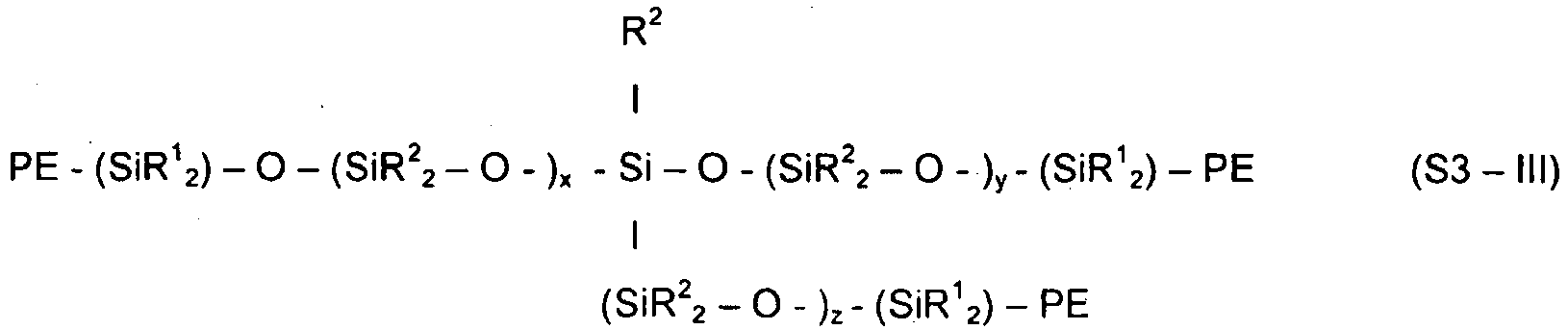

Die Reste R1 und R2 stehen unabhängig voneinander jeweils für Wasserstoff, einen Methylrest, einen C2 bis C30 linearen, gesättigten oder ungesättigten Kohlenwasserstoffrest, einen Phenylrest und/oder eine Arylrest. Nicht einschränkende Beispiele der durch R1 und R2 repräsentierten Reste schließen Alkylreste, wie Methyl, Ethyl, Propyl, Isopropyl, Butyl, Isobutyl, Pentyl, Isopentyl, Neopentyl, Amyl, Isoamyl, Hexyl, Isohexyl und ähnliche; Alkenylreste, wie Vinyl, Halogenvinyl, Alkylvinyl, Allyl, Halogenallyl, Alkylallyl; Cycloalkylreste, wie Cyclobutyl, Cyclopentyl, Cyclohexyl und ähnliche; Phenylreste, Benzylreste, Halogenkohlenwasserstoffreste, wie 3- Chlorpropyl, 4-Brombutyl, 3,3,3-Trifluorpropyl, Chlorcyclohexyl, Bromphenyl, Chlorphenyl und ähnliche sowie schwefelhaltige Reste, wie Mercaptoethyl, Mercaptopropyl, Mercaptohexyl, Mercaptophenyl und ähnliche ein; vorzugsweise ist R1 und R2 ein Alkylrest, der 1 bis etwa 6 Kohlenstoffatomen enthält, und am bevorzugtesten ist R1 und R2 Methyl. Beispiele von R1 schließen Methylen, Ethylen, Propylen, Hexamethylen, Decamethylen, -CH2CH(CH3)CH2-, Phenylen, Naphthylen, -CH2CH2SCH2CH 2-, -CH2CH2OCH2-, -OCH2CH2-, -OCH2 CH2CH2-, -CH2CH(CH3)C(O)OCH2-,-(CH2)3 CC(O)OCH2CH2-, -C6H4C6H4-, -C6H4CH2C6H4-; und -(CH2)3C(O)SCH2CH2- ein. Bevorzugt als R1 und R2 sind Methyl, Phenyl und C2 bis C22 - Alkylreste. Bei den C2 bis C22 Alkylresten sind ganz besonders Lauryl-, Stearyl-, und Behenylreste bevorzugt. PE steht für einen Polyoxyalkylenrest. Bevorzugte Polyoxyalkylenreste leiten sich ab von Ethylenoxid, Propylenoxid und Glycerin. Die Zahlen x, y und z sind ganze Zahlen und laufen jeweils unabhängig voneinander von 0 bis 50.000. Die Molgewichte der Dimethicone liegen zwischen 1000 D und 10000000 D. Die Viskositäten liegen zwischen 100 und 10000000 cPs gemessen bei 25 °C mit Hilfe eines Glaskapillarviskosimeters nach der Dow Corning Corporate Testmethode CTM 0004 vom 20. Juli 1970. Bevorzugte Viskositäten liegen zwischen 1000 und 5000000 cPs, ganz besonders bevorzugte Viskositäten liegen zwischen 10000 und 3000000 cPs. Der bevorzugteste Bereich liegt zwischen 50000 und 2000000 cPs.The radicals R 1 and R 2 each independently represent hydrogen, a methyl radical, a C2 to C30 linear, saturated or unsaturated hydrocarbon radical, a phenyl radical and/or an aryl radical. Non-limiting examples of the groups represented by R 1 and R 2 include alkyl groups such as methyl, ethyl, propyl, isopropyl, butyl, isobutyl, pentyl, isopentyl, neopentyl, amyl, isoamyl, hexyl, isohexyl and the like; alkenyl radicals such as vinyl, halovinyl, alkylvinyl, allyl, haloallyl, alkylallyl; cycloalkyl radicals such as cyclobutyl, cyclopentyl, cyclohexyl and the like; phenyl radicals, benzyl radicals, halohydrocarbon radicals such as 3-chloropropyl, 4-bromobutyl, 3,3,3-trifluoropropyl, chlorocyclohexyl, bromophenyl, chlorophenyl and the like, and sulfur-containing radicals such as mercaptoethyl, mercaptopropyl, mercaptohexyl, mercaptophenyl and the like; preferably R 1 and R 2 is an alkyl group containing from 1 to about 6 carbon atoms, and most preferably R 1 and R 2 is methyl. Examples of R 1 include methylene, ethylene, propylene, hexamethylene, decamethylene, -CH 2 CH(CH 3 )CH 2 -, phenylene, naphthylene, -CH 2 CH 2 SCH 2 CH 2 -, -CH 2 CH 2 OCH 2 - , -OCH 2 CH 2 -, -OCH 2 CH 2 CH 2 -, -CH 2 CH(CH 3 )C(O)OCH 2 -,-(CH 2 ) 3 CC(O)OCH 2 CH 2 -, - C6 H4 C6 H4 -, -C6 H4 CH2 C6 H4 -; and -(CH 2 ) 3 C(O)SCH 2 CH 2 - a. Methyl, phenyl and C2 to C22 - alkyl radicals are preferred as R 1 and R 2 . In the case of the C2 to C22 alkyl radicals, lauryl, stearyl and behenyl radicals are very particularly preferred. PE stands for a polyoxyalkylene radical. Preferred polyoxyalkylene radicals are derived from ethylene oxide, propylene oxide and glycerol. The numbers x, y, and z are integers and each independently run from 0 to 50,000. The molecular weights of the dimethicones are between 1000 D and 10000000 D. The viscosities are between 100 and 10000000 cPs measured at 25° C. using a glass capillary viscometer according to the Dow Corning Corporate Test Method CTM 0004 of July 20, 1970. Preferred viscosities are between 1000 and 5000000 cPs, very particularly preferred viscosities are between 10,000 and 3,000,000 cPs. The most preferred range is between 50,000 and 2,000,000 cPs.
Selbstverständlich umfasst die erfindungsgemäße Lehre auch, dass die Dimethiconcopolymere bereits als Emulsion vorliegen können. Dabei kann die entsprechende Emulsion der Dimethiconcopolyole sowohl nach der Herstellung der entsprechenden Dimethiconcopolyole aus diesen und den dem Fachmann bekannten üblichen Verfahren zur Emulgierung hergestellt werden. Hierzu können als Hilfsmittel zur Herstellung der entsprechenden Emulsionen sowohl kationische, anionische, nichtionische oder zwitterionische Tenside und Emulgatoren als Hilfsstoffe verwendet werden. Selbstverständlich können die Emulsionen der Dimethiconcopolyole auch direkt durch ein Emulsionspolymerisationsverfahren hergestellt werden. Auch derartige Verfahren sind dem Fachmann wohl bekannt. Hierzu sei beispielsweise verwiesen auf die "
Wenn die erfindungsgemäßen Dimethiconcopolyole als Emulsion verwendet werden, dann beträgt die Tröpfchengröße der emulgierten Teilchen erfindungsgemäß 0,01 µm bis 10000 µm, bevorzugt 0,01 bis 100 µm, ganz besonders bevorzugt 0,01 bis 20 µm und am bevorzugtesten 0,01 bis 10 µm. Die Teilchengröße wird dabei nach der Methode der Lichtstreuung bestimmt.If the dimethicone copolyols according to the invention are used as an emulsion, the droplet size of the emulsified particles according to the invention is 0.01 μm to 10000 μm, preferably 0.01 to 100 μm, very preferably 0.01 to 20 μm and most preferably 0.01 to 10 µm. The particle size is determined by the light scattering method.
Werden verzweigte Dimethiconcopolyole verwendet, so ist darunter zu verstehen, dass die Verzweigung größer ist, als eine zufällige Verzweigung, welche durch Verunreinigungen der jeweiligen Monomere zufällig entsteht. Im Sinne der vorliegenden Verbindung ist daher unter verzweigten Dimethiconcopolyolen zu verstehen, dass der Verzweigungsgrad größer als 0,01 % ist. Bevorzugt ist ein Verzweigungsgrad größer als 0,1 % und ganz besonders bevorzugt von größer als 0,5 %. Der Grad der Verzweigung wird dabei aus dem Verhältnis der unverzweigten Monomeren, das heißt der Menge des monofunktionalen Siloxanes, zu den verzweigenden Monomeren, das heißt der Menge an tri- und tetrafunktionalen Siloxanen, bestimmt. Erfindungsgemäß können sowohl niedrigverzweigte als auch hochverzweigte Dimethiconcopolyole ganz besonders bevorzugt sein.If branched dimethicone copolyols are used, this is to be understood as meaning that the branching is greater than accidental branching, which occurs accidentally as a result of impurities in the respective monomers. For the purposes of the present invention, branched dimethicone copolyols are therefore to be understood as meaning that the degree of branching is greater than 0.01%. A degree of branching of more than 0.1% is preferred and more than 0.5% is very particularly preferred. The degree of branching is determined from the ratio of the unbranched monomers, ie the amount of monofunctional siloxane, to the branching monomers, ie the amount of trifunctional and tetrafunctional siloxanes. According to the invention, both low-branched and high-branched dimethicone copolyols can be particularly preferred.
Die Dimethiconcopolyole (S3) sind in den erfindungsgemäßen Zusammensetzungen in Mengen von 0,01 bis 10 Gew.%, vorzugsweise 0,01 bis 8 Gew.%, besonders bevorzugt 0,1 bis 7,5 Gew.% und insbesondere 0,1 bis 5 Gew.% an Dimethiconcopolyol bezogen auf die Zusammensetzung. Erfindungsgemäß ist es auch möglich, dass die Dimethiconcopolyole eine eigene Phase in den erfindungsgemäßen Zusammensetzungen bilden. In diesem Falle kann die Menge an Dimethiconcopolyol bis zu 40 Gew.%, bevorzugt in Mengen von bis zu 25 Gew.% bezogen auf die Gesamtzusammensetzung betragen.The dimethicone copolyols (S3) are present in the compositions according to the invention in amounts of 0.01 to 10% by weight, preferably 0.01 to 8% by weight, particularly preferably 0.1 to 7.5% by weight and in particular 0.1 to 5% by weight of dimethicone copolyol based on the composition. According to the invention, it is also possible for the dimethicone copolyols to form their own phase in the compositions according to the invention. In this case, the amount of dimethicone copolyol can be up to 40% by weight, preferably in amounts of up to 25% by weight, based on the total composition.
Aminofunktionelle Silikone oder auch Amodimethicone (S4) genannt, sind Silicone, welche mindestens eine (gegebenenfalls substituierte) Aminogruppe aufweisen.
Solche Silicone können z.B. durch die Formel (S4 -I)
M(RaQbSiO(4-a-b)/2)x(RcSiO(4-c)/2)yM (S4 - I)
beschreiben werden, wobei in der obigen Formel R ein Kohlenwasserstoff oder ein Kohlenwasserstoffrest mit 1 bis etwa 6 Kohlenstoffatomen ist, Q ein polarer Rest der Allgemeinen Formel -R1HZ ist, worin R1 eine zweiwertige, verbindende Gruppe ist, die an Wasserstoff und den Rest Z gebunden ist, zusammengesetzt aus Kohlenstoff- und Wasserstoffatomen, Kohlenstoff-, Wasserstoff- und Sauerstoffatomen oder Kohlenstoff-, Wasserstoff- und Stickstoffatomen, und Z ein organischer, aminofunktioneller Rest ist, der mindestens eine aminofunktionelle Gruppe enthält; "a" Werte im Bereich von etwa 0 bis etwa 2 annimmt, "b" Werte im Bereich von etwa 1 bis etwa 3 annimmt, "a" + "b" kleiner als oder gleich 3 ist, und "c" eine Zahl im Bereich von etwa 1 bis etwa 3 ist, und x eine Zahl im Bereich von 1 bis etwa 2.000, vorzugsweise von etwa 3 bis etwa 50 und am bevorzugtesten von etwa 3 bis etwa 25 ist, und y eine Zahl im Bereich von etwa 20 bis etwa 10.000, vorzugsweise von etwa 125 bis etwa 10.000 und am bevorzugtesten von etwa 150 bis etwa 1.000 ist, und M eine geeignete Silicon-Endgruppe ist, wie sie im Stande der Technik bekannt ist, vorzugsweise Trimethylsiloxy. Nicht einschränkende Beispiele der durch R repräsentierten Reste schließen Alkylreste, wie Methyl, Ethyl, Propyl, Isopropyl, Isopropyl, Butyl, Isobutyl, Amyl, Isoamyl, Hexyl, Isohexyl und ähnliche; Alkenylreste, wie Vinyl, Halogenvinyl, Alkylvinyl, Allyl, Halogenallyl, Alkylallyl; Cycloalkylreste, wie Cyclobutyl, Cyclopentyl, Cyclohexyl und ähnliche; Phenylreste, Benzylreste, Halogenkohlenwasserstoffreste, wie 3- Chlorpropyl, 4-Brombutyl, 3,3,3-Trifluorpropyl, Chlorcyclohexyl, Bromphenyl, Chlorphenyl und ähnliche sowie schwefelhaltige Reste, wie Mercaptoethyl, Mercaptopropyl, Mercaptohexyl, Mercaptophenyl und ähnliche ein; vorzugsweise ist R ein Alkylrest, der 1 bis etwa 6 Kohlenstoffatomen enthält, und am bevorzugtesten ist R Methyl. Beispiele von R1 schließen Methylen, Ethylen, Propylen, Hexamethylen, Decamethylen, -CH2CH(CH3)CH2-, Phenylen, Naphthylen, -CH2CH2SCH2CH 2-,-CH2CH2OCH2-, -OCH2CH2-, -OCH2 CH2CH2-, -CH2CH(CH3)C(O)OCH2-, -(CH2)3 CC(O)OCH2CH2-, -C6H4C6H4-, -C6H4CH2C6H4-; und -(CH2)3C(O)SCH2CH2- ein.Amino-functional silicones, also known as amodimethicones (S4), are silicones which have at least one (optionally substituted) amino group.
Such silicones can be represented, for example, by the formula (S4-I)
M(R a Q b SiO (4-ab)/2)x (R c SiO (4-c)/2)y M (S4 - I)
are described, wherein in the above formula R is a hydrocarbyl or hydrocarbyl radical having from 1 to about 6 carbon atoms, Q is a polar radical of the general formula -R 1 HZ, wherein R 1 is a divalent linking group attached to hydrogen and the radical Z is bonded composed of carbon and hydrogen atoms, carbon, hydrogen and oxygen atoms, or carbon, hydrogen and nitrogen atoms, and Z is an organic amino-functional radical containing at least one amino-functional group; "a" takes values in the range from about 0 to about 2, "b" takes values in the range from about 1 to about 3, "a" + "b" is less than or equal to 3, and "c" is a number in the range from about 1 to about 3, and x is a number ranging from 1 to about 2,000, preferably from about 3 to about 50, and most preferably from about 3 to about 25, and y is a number ranging from about 20 to about 10,000 , preferably from about 125 to about 10,000 and most preferably from about 150 to about 1000, and M is a suitable silicone end group as is known in the art, preferably trimethylsiloxy. Non-limiting examples of the groups represented by R include alkyl groups such as methyl, ethyl, propyl, isopropyl, isopropyl, butyl, isobutyl, amyl, isoamyl, hexyl, isohexyl and the like; alkenyl radicals such as vinyl, halovinyl, alkylvinyl, allyl, haloallyl, alkylallyl; cycloalkyl radicals such as cyclobutyl, cyclopentyl, cyclohexyl and the like; phenyl radicals, benzyl radicals, halohydrocarbon radicals such as 3-chloropropyl, 4-bromobutyl, 3,3,3-trifluoropropyl, chlorocyclohexyl, bromophenyl, chlorophenyl and the like, and sulfur-containing radicals such as mercaptoethyl, mercaptopropyl, mercaptohexyl, mercaptophenyl and the like; preferably R is an alkyl group containing from 1 to about 6 carbon atoms, and most preferably R is methyl. Examples of R 1 include methylene, ethylene, propylene, hexamethylene, decamethylene, -CH 2 CH(CH 3 )CH 2 -, phenylene, naphthylene, -CH 2 CH 2 SCH 2 CH 2 -, -CH 2 CH 2 OCH 2 - , -OCH 2 CH 2 -, -OCH 2 CH 2 CH 2 -, -CH 2 CH(CH 3 )C(O)OCH 2 -, -(CH 2 ) 3 CC(O)OCH 2 CH 2 -, - C6 H4 C6 H4 -, -C6 H4 CH2 C6 H4 -; and -(CH 2 ) 3 C(O)SCH 2 CH 2 - a.
Z ist ein organischer, aminofunktioneller Rest, enthaltend mindestens eine funktionelle Aminogruppe. Eine mögliche Formel für Z ist NH(CH2)zNH2, worin z 1 oder mehr ist. Eine andere mögliche Formel für Z ist -NH(CH2)z(CH2)zz-NH, worin sowohl z als auch zz unabhängig 1 oder mehr sind, wobei diese Struktur Diamino-Ringstrukturen umfaßt, wie Piperazinyl. Z ist am bevorzugtesten ein -NHCH2CH2NH2-Rest. Eine andere mögliche Formel für Z ist - N(CH2)z(CH2)zzNX2 oder -NX2, worin jedes X von X2 unabhängig ausgewählt ist aus der Gruppe bestehend aus Wasserstoff und Alkylgruppen mit 1 bis 12 Kohlenstoffatomen, und zz 0 ist.Z is an organic, amino-functional residue containing at least one amino functional group. A possible formula for Z is NH(CH 2 ) z NH 2 where z is 1 or more. Another possible formula for Z is -NH(CH 2 ) z (CH 2 ) zz -NH, where both z and zz are independently 1 or more, which structure includes diamino ring structures such as piperazinyl. Z is most preferably an -NHCH 2 CH 2 NH 2 group. Another possible formula for Z is -N(CH 2 ) z (CH 2 ) zz NX 2 or -NX 2 where each X of X 2 is independently selected from the group consisting of hydrogen and alkyl groups having 1 to 12 carbon atoms, and z is 0.
Q ist am bevorzugtesten ein polarer, aminfunktioneller Rest der Formel -CH2CH2CH2NHCH2CH2NH 2. In den Formeln nimmt "a" Werte im Bereich von etwa 0 bis etwa 2 an, "b" nimmt Werte im Bereich von etwa 2 bis etwa 3 an, "a" + "b" ist kleiner als oder gleich 3, und "c" ist eine Zahl im Bereich von etwa 1 bis etwa 3. Das molare Verhältnis der RaQbSiO(4-a-b)/2-Einheiten zu den RcSiO (4-c)/2-Einheiten liegt im Bereich von etwa 1 : 2 bis 1 : 65, vorzugsweise von etwa 1 : 5 bis etwa 1 : 65 und am bevorzugtesten von etwa 1 : 15 bis etwa 1 : 20. Werden ein oder mehrere Silicone der obigen Formel eingesetzt, dann können die verschiedenen variablen Substituenten in der obigen Formel bei den verschiedenen Siliconkomponenten, die in der Siliconmischung vorhanden sind, verschieden sein.Q is most preferably a polar amine functional group of the formula -CH 2 CH 2 CH 2 NHCH 2 CH 2 NH 2 . In the formulas, "a" takes values ranging from about 0 to about 2, "b" takes values ranging from about 2 to about 3, "a" + "b" is less than or equal to 3, and "c " is a number ranging from about 1 to about 3. The molar ratio of R a Q b SiO (4-ab ) /2 units to R c SiO (4-c)/2 units ranges from about 1:2 to 1:65, preferably from about 1:5 to about 1:65 and most preferably from about 1:15 to about 1:20. When one or more silicones of the above formula are employed, the various variable substituents in of the above formula may vary with the various silicone components present in the silicone blend.
Bevorzugte erfindungsgemäße Mittel sind dadurch gekennzeichnet, dasa sie ein aminofunktionelles Silikon der Formel (S4 - II)
R'aG3-a-Si(OSiG2)n-(OSiGbR'2-b)m-O-SiG3-a-R'a (S4 - II),
enthalten, worin bedeutet:
- G ist-H, eine Phenylgruppe, -OH, -O-CH3, -CH3, -CH2CH3, -CH2CH2CH3, -CH(CH3)2, -CH2CH2CH2H3, -CH2CH(CH3)2, -CH(CH3)CH2CH3, -C(CH3)3;
- a steht für eine Zahl zwischen 0 und 3, insbesondere 0;
- b steht für eine Zahl zwischen 0 und 1, insbesondere 1,
- m und n sind Zahlen, deren Summe (m + n) zwischen 1 und 2000, vorzugsweise zwischen 50 und 150 beträgt, wobei n vorzugsweise Werte von 0 bis 1999 und insbesondere von 49 bis 149 und m vorzugsweise Werte von 1 bis 2000, insbesondere von 1 bis 10 annimmt,
- R' ist ein monovalenter Rest ausgewählt aus
- ∘ -N(R")-CH2-CH2- N(R")2
- ∘ -N(R")2
- ∘ -N+(R")3A-
- ∘ -N+H(R")2 A-
- ∘ -N+H2(R")A-
- ∘ -N(R")-CH2-CH2-N+R"H2A-,
wobei jedes R" für gleiche oder verschiedene Reste aus der Gruppe -H, - Phenyl, -Benzyl, der C1-20-Alkylreste, vorzugsweise -CH3, -CH2CH3,-CH2CH2CH3, -CH(CH3)2, -CH2CH2CH2H3, -CH2CH(CH3)2, -CH(CH3)CH2CH3,-C(CH3)3, steht und A ein Anion repräsentiert, welches vorzugsweise ausgewählt ist aus Chlorid, Bromid, Iodid oder Methosulfat.
R' a G 3-a -Si(OSiG 2 ) n -(OSiG b R' 2-b ) m -O-SiG 3-a -R' a (S4 - II),
contain, in which means:
- G is -H, a phenyl group, -OH, -O-CH 3 , -CH 3 , -CH 2 CH 3 , -CH 2 CH 2 CH 3 , -CH(CH 3 ) 2 , -CH 2 CH 2 CH 2 H3 , -CH2 CH(CH3 ) 2 , -CH( CH3 ) CH2 CH3 , -C( CH3 ) 3 ;
- a is a number between 0 and 3, especially 0;
- b stands for a number between 0 and 1, in particular 1,
- m and n are numbers whose sum (m+n) is between 1 and 2000, preferably between 50 and 150, n preferably having values from 0 to 1999 and in particular from 49 to 149 and m preferably having values from 1 to 2000, in particular from 1 to 10 accepts
- R' is a monovalent radical selected from
- ∘ -N(R")-CH 2 -CH 2 -N(R") 2
- ∘ -N(R") 2
- ∘ -N + (R") 3 A -
- ∘ -N + H(R") 2 A -
- ∘ -N + H 2 (R")A -
- ∘ -N(R")-CH 2 -CH 2 -N + R"H 2 A - ,
where each R" represents the same or different radicals from the group -H, -phenyl, -benzyl, the C 1-20 -alkyl radicals, preferably -CH 3 , -CH 2 CH 3 , -CH 2 CH 2 CH 3 , -CH (CH 3 ) 2 , -CH 2 CH 2 CH 2 H 3 , -CH 2 CH(CH 3 ) 2 , -CH(CH 3 )CH 2 CH 3 , -C(CH 3 ) 3 , and A is an anion which is preferably selected from chloride, bromide, iodide or methosulfate.
Besonders bevorzugte erfindungsgemäße Mittel sind dadurch gekennzeichnet, dasa sie ein aminofunktionelles Silikon der Formel (S4 - III)


Diese Silicone werden nach der INCI-Deklaration als Amodimethicone bezeichnet.Particularly preferred agents according to the invention are characterized in that they contain an amino-functional silicone of the formula (S4 - III)
According to the INCI declaration, these silicones are referred to as amodimethicones.
Unabhängig davon, welche aminofunktionellen Silicone eingesetzt werden, sind erfindungsgemäße Mittel bevorzugt, bei denen das aminofunktionelle Silikon eine Aminzahl oberhalb von 0,25 meq/g, vorzugsweise oberhalb von 0,3 meq/g und insbesondere oberhalb von 0,4 meq/g aufweist. Die Aminzahl steht dabei für die Milli-Äquivalente Amin pro Gramm des aminofunktioinelen Silicons. Sie kann durch Titration ermittelt und auch in der Einheit mg KOH/g angegeben werden.Regardless of which amino-functional silicones are used, agents according to the invention are preferred wherein the amino-functional silicone has an amine number above 0.25 meq/g, preferably above 0.3 meq/g and more preferably above 0.4 meq/g. The amine number stands for the milliequivalents of amine per gram of the amino-functional silicone. It can be determined by titration and also given in units of mg KOH/g.
Die Amodimethicone (S4) sind in den erfindungsgemäßen Zusammensetzungen in Mengen von 0,01 bis 10 Gew.%, vorzugsweise 0,01 bis 8 Gew.%, besonders bevorzugt 0,1 bis 7,5 Gew.% und insbesondere 0,1 bis 5 Gew.% an Amodimethicon bezogen auf die Zusammensetzung.The amodimethicones (S4) are present in the compositions according to the invention in amounts of 0.01 to 10% by weight, preferably 0.01 to 8% by weight, particularly preferably 0.1 to 7.5% by weight and in particular 0.1 to 5% by weight of amodimethicone based on the composition.
Erfindungsgemäß ist es auch möglich, dass die Amodimethicone eine eigene Phase in den erfindungsgemäßen Zusammensetzungen bilden. In diesem Fall kann es angebracht sein, wenn die Zusammensetzung unmittelbar vor der Anwendung durch Schütteln kurzfristig homogenisiert wird. In diesem Falle kann die Menge an Amodimethicon bis zu 40 Gew.%, bevorzugt in Mengen von bis zu 25 Gew.% bezogen auf die Gesamtzusammensetzung betragen.According to the invention, it is also possible for the amodimethicones to form their own phase in the compositions according to the invention. In this case, it may be appropriate if the composition is briefly homogenized by shaking immediately before use. In this case, the amount of amodimethicone can be up to 40% by weight, preferably in amounts of up to 25% by weight, based on the total composition.
Erst seit kurzem sind völlig neuartige Polyammmonium-Polysiloxan Verbindungen bekannt, in welchen die Siloxansubstrukturen gegebenenfalls über Ammoniumsubstrukturen miteinander verbunden sind. Derartige Verbindungen und deren Verwendung in kosmetischen Mitteln werden beispielsweise in der Offenlegungsschrift
Die vorstehend beschriebenen Polyammonium-Polysiloxan Verbindungen können beispielsweise unter der Handelsbezeichnung Baysilone® von GE Bayer Silicones bezogen werden. Die Produkte mit den Bezeichnungen Baysilone TP 3911, SME 253 und SFE 839 sind dabei bevorzugt. Ganz besonders bevorzugt ist die Verwendung von Baysilone TP 3911 als Wirkkomponente der erfindungsgemäßen Zusammensetzungen.The polyammonium-polysiloxane compounds described above can be obtained, for example, under the trade name Baysilone® from GE Bayer Silicones. The products with the designations Baysilone TP 3911, SME 253 and SFE 839 are preferred. The use of Baysilone TP 3911 as the active component of the compositions according to the invention is very particularly preferred.
Die vorstehend beschriebenen Polyammonium-Polysiloxan Verbindungen werden in dem erfindungsgemäßen Zusammensetzungen in einer Menge von 0,01 bis 10 Gew.% , vorzugsweise 0,01 bis 7,5, besonders bevorzugt 0,01 bis 5,0 Gew.%, ganz besonders bevorzugt von 0,05 bis 2,5 Gew.% jeweils in Bezug auf die Gesamtzusammensetzung verwendet.The polyammonium-polysiloxane compounds described above are very particularly preferred in the compositions according to the invention in an amount of 0.01 to 10% by weight, preferably 0.01 to 7.5% by weight, particularly preferably 0.01 to 5.0% by weight from 0.05 to 2.5% by weight each with respect to the total composition.
Das Verhältnis der Polyammonium-Polysiloxan Verbindungen zu einer weiteren synergistischen Wirkstoffkomponente ausgewählt aus der Gruppe der Polymere, der Proteinhydrolysate, der Silikone, der Vitamine und der Pflanzenextrakte beträgt im Allgemeinen erfindungsgemäß 1:1000 bis 1:2, vorzugsweise 1:100 bis 1:2, besonders bevorzugt 1:50 bis 1:2 und ganz besonders bevorzugt 1:10 bis 1:2.According to the invention, the ratio of the polyammonium-polysiloxane compounds to another synergistic active component selected from the group of polymers, protein hydrolysates, silicones, vitamins and plant extracts is generally 1:1000 to 1:2, preferably 1:100 to 1:2 , more preferably 1:50 to 1:2 and most preferably 1:10 to 1:2.
Wenn eine Mischung aus mindestens zwei Silikonen verwendet wird, so ist diese Mischung in den erfindungsgemäßen Zusammensetzungen in Mengen von 0,01 bis 10 Gew.%, vorzugsweise 0,01 bis 8 Gew.%, besonders bevorzugt 0,1 bis 7,5 Gew.% und insbesondere 0,1 bis 5 Gew.% an Silikonmischung bezogen auf die Zusammensetzung enthalten.If a mixture of at least two silicones is used, this mixture is present in the compositions according to the invention in amounts of 0.01 to 10% by weight, preferably 0.01 to 8% by weight, particularly preferably 0.1 to 7.5% by weight .% and in particular 0.1 to 5% by weight of silicone mixture based on the composition.
Erfindungsgemäß ist es auch möglich, dass die Mischung der Silikone eine eigene Phase in den erfindungsgemäßen Zusammensetzungen bilden. In diesem Fall kann es angebracht sein, wenn die Zusammensetzung unmittelbar vor der Anwendung durch Schütteln kurzfristig homogenisiert wird. In diesem Falle kann die Menge an Silikonmischung bis zu 40 Gew.%, bevorzugt in Mengen von bis zu 25 Gew.%bezogen auf die Gesamtzusammensetzung betragen.According to the invention, it is also possible for the mixture of the silicones to form a separate phase in the compositions according to the invention. In this case, it may be appropriate if the composition is briefly homogenized by shaking immediately before use. In this case, the amount of silicone mixture can be up to 40% by weight, preferably in amounts of up to 25% by weight, based on the total composition.
Selbstverständlich umfasst die erfindungsgemäße Lehre auch, dass eine Mischung aus mehreren Fettstoffen (D) aus unterschiedlichen Klassen von Fettstoffen, mindestens zwei unterschiedlichen Fettstoffklassen in den erfindungsgemäßen Zusammensetzungen verwendet werden kann. Die bevorzugten Mischungen aus mindestens zwei Öl- und Fettkomponenten enthalten in diesem Falle zwingend mindestens eine weitere Silikonkomponente. Bevorzugt wird die Silikonkomponente in diesem Falle ausgewählt aus den Dimethiconolen und den Amodimethiconen.Of course, the teaching according to the invention also includes that a mixture of several fatty substances (D) from different classes of fatty substances, at least two different classes of fatty substances, can be used in the compositions according to the invention. In this case, the preferred mixtures of at least two oil and fat components necessarily contain at least one further silicone component. In this case, the silicone component is preferably selected from the dimethiconols and the amodimethicones.
Die Gesamtmenge an Öl- und Fettkomponenten in den erfindungsgemäßen Mitteln beträgt üblicherweise 0,5 - 75 Gew.-%, bezogen auf das gesamte Mittel. Mengen von 0,5 - 35 Gew.-% sind erfindungsgemäß bevorzugt.The total amount of oil and fat components in the agents according to the invention is usually 0.5-75% by weight, based on the agent as a whole. Amounts of 0.5-35% by weight are preferred according to the invention.
Ein weiterer erfindungsgemäßer synergistischer Wirkstoff in den erfindungsgemäßen Zusammensetzungen mit dem erfindungsgemäßen Wirkstoffkomplex sind Proteinhydrolysate und/oder dessen Derivate (P).Another synergistic active ingredient according to the invention in the compositions according to the invention with the active ingredient complex according to the invention are protein hydrolyzates and/or derivatives thereof (P).
Proteinhydrolysate sind Produktgemische, die durch sauer, basisch oder enzymatisch katalysierten Abbau von Proteinen (Eiweißen) erhalten werden. Unter dem Begriff Proteinhydrolysate werden erfindungsgemäß auch Totalhydrolysate sowie einzelne Aminosäuren und deren Derivate sowie Gemische aus verschiedenen Aminosäuren verstanden. Weiterhin werden erfindungsgemäß aus Aminosäuren und Aminosäurederivaten aufgebaute Polymere unter dem Begriff Proteinhydrolysate verstanden. Zu letzteren sind beispielsweise Polyalanin, Polyasparagin, Polyserin etc. zu zählen. Weitere Beispiele für erfindungsgemäß einsetzbare Verbindungen sind L-Alanyl-L-prolin, Polyglycin, Glycyl-L-glutamin oder D/L-Methionin-S-Methylsulfoniumchlorid. Selbstverständlich können erfindungsgemäß auch β-Aminosäuren und deren Derivate wie ß-Alanin, Anthranilsäure oder Hippursäure eingesetzt werden. Das Molgewicht der erfindungsgemäß einsetzbaren Proteinhydrolysate liegt zwischen 75, dem Molgewicht für Glycin, und 200000, bevorzugt beträgt das Molgewicht 75 bis 50000 und ganz besonders bevorzugt 75 bis 20000 Dalton. Selbstverständlich umfasst die vorliegende erfindungsgemäße Lehre auch, dass im Falle der Aminosäuren diese in Form von Derivaten, wie beispielsweise der N-Acylderivate, der N-Alkyl oder der O-Ester vorliegen können. Im Falle der N-acylderivate ist die Acylgruppe eine Formylrest, ein Acetylrest, ein Propionylrest, ein Butyrylrest oder der Rest einer geradkettigen, verzweigten oder unverzweigten, gesättigten oder ungesättigten Fettsäure mit einer Kettenlänge von 8 bis 30 C-Atomen. Im Falle einer N-Alkylderivate kann die Alkylgruppe linear, verzweigt, gesättigt oder ungesättigt sein und hat eine C-Kettenlänge von 1 bis 30 C-Atomen. Im Falle der O-Ester sind die der Veresterung zugrunde liegenden Alkohole Methanol, Ethanol, Isopropanol, Propanol, Butanol, Isobutanol, Pentanol, Neopentanol, Isopentanol, Hexanole, Heptanole, Capryl- oder Capronalkohol, Octanole, Nonanole, Decanole, Dodecanole, Lauranole, insbesondere gesättigte oder ungesättigte, lineare oder verzweigte Alkohole mit einer C-Kettenlänge von 1 bis 30 C-Atomen. Selbstverständlich können die Aminosäuren sowohl am N-Atom als auch am O-Atom gleichzeitig derivatisiert sein. Selbstverständlich können die Aminosäuren auch in Salzform, insbesondere als Mischsalze zusammen mit Genusssäuren verwendet werden. Dies kann erfindungsgemäß bevorzugt sein.Protein hydrolysates are product mixtures that are obtained through the acidic, basic or enzymatically catalyzed degradation of proteins (proteins). According to the invention, the term protein hydrolysates also includes total hydrolysates and individual amino acids and their derivatives, as well as mixtures of different amino acids. Furthermore, according to the invention, polymers made up of amino acids and amino acid derivatives are understood by the term protein hydrolysates. The latter include, for example, polyalanine, polyasparagine, polyserine, etc. Further examples of compounds that can be used according to the invention are L-alanyl-L-proline, polyglycine, glycyl-L-glutamine or D/L-methionine-S-methylsulfonium chloride. Of course, β-amino acids and their derivatives such as β-alanine, anthranilic acid or hippuric acid can also be used according to the invention. The molecular weight of the protein hydrolyzates that can be used according to the invention is between 75, the molecular weight for glycine, and 200,000, the molecular weight is preferably from 75 to 50,000 and very particularly preferably from 75 to 20,000 daltons. Of course, the present teaching according to the invention also includes that, in the case of amino acids, these can be present in the form of derivatives, such as, for example, the N-acyl derivatives, the N-alkyl or the O-ester. In the case of the N-acyl derivatives, the acyl group is a formyl radical, an acetyl radical, a propionyl radical, a butyryl radical or the radical of a straight-chain, branched or unbranched, saturated or unsaturated fatty acid with a chain length of 8 to 30 carbon atoms. In the case of an N-alkyl derivative the alkyl group can be linear, branched, saturated or unsaturated and has a carbon chain length of 1 to 30 carbon atoms. In the case of O-esters, the alcohols on which the esterification is based are methanol, ethanol, isopropanol, propanol, butanol, isobutanol, pentanol, neopentanol, isopentanol, hexanols, heptanols, caprylic or caproic alcohol, octanols, nonanols, decanols, dodecanols, lauranols, in particular saturated or unsaturated, linear or branched alcohols with a carbon chain length of 1 to 30 carbon atoms. Of course, the amino acids can be derivatized simultaneously both on the N atom and on the O atom. Of course, the amino acids can also be used in salt form, in particular as mixed salts together with edible acids. This can be preferred according to the invention.
Als Beispiele für Aminosäuren und deren Derivaten als erfindungsgemäße Proteinhydrolysate werden genannt: Alanin, Arginin, Carnitin, Creatin, Cystathionin, Cystein, Cystin, Cystinsäure, Glycin, Histidin, Homocystein, Homoserin, Isoleucin, Lanthionin, Leucin, Lysin, Methionin, Norleucin, Norvalin, Ornithin, Phenylalanin, Prolin, Hydroxyprolin, Sarcosin, Serin, Threonin, Tryptophan, Thyronin, Tyrosin, Valin, Asparaginsäure, Asparagin, Glutaminsäure und Glutamin. Bevorzugte Aminosäuren sind Alanin, Arginin, Glycin, Histidin, Lanthionin, Leucin, Lysin, Prolin, Hydroxyprolin Serin und Asparagin. Ganz besonders bevorzugt werden verwendet Alanin, Glycin, Histidin, Lysin, Serin und Arginin. Am bevorzugtesten werden Glycin, Histidin, Lysin und Serin verwendet.Examples of amino acids and their derivatives as protein hydrolyzates according to the invention are: alanine, arginine, carnitine, creatine, cystathionine, cysteine, cystine, cystic acid, glycine, histidine, homocysteine, homoserine, isoleucine, lanthionine, leucine, lysine, methionine, norleucine, norvaline , Ornithine, Phenylalanine, Proline, Hydroxyproline, Sarcosine, Serine, Threonine, Tryptophan, Thyronine, Tyrosine, Valine, Aspartic Acid, Asparagine, Glutamic Acid and Glutamine. Preferred amino acids are alanine, arginine, glycine, histidine, lanthionine, leucine, lysine, proline, hydroxyproline, serine and asparagine. Alanine, glycine, histidine, lysine, serine and arginine are very particularly preferably used. Most preferably, glycine, histidine, lysine and serine are used.
Erfindungsgemäß können Proteinhydrolysate sowohl pflanzlichen als auch tierischen oder marinen oder synthetischen Ursprungs eingesetzt werden.According to the invention, protein hydrolyzates of both plant and animal or marine or synthetic origin can be used.
Tierische Proteinhydrolysate sind beispielsweise Elastin-, Kollagen-, Keratin-, Seiden- und Milcheiweiß-Proteinhydrolysate, die auch in Form von Salzen vorliegen können. Solche Produkte werden beispielsweise unter den Warenzeichen Dehylan® (Cognis), Promois® (Interorgana), Collapuron® (Cognis), Nutrilan® (Cognis), Gelita-Sol® (Deutsche Gelatine Fabriken Stoess & Co), Lexein® (Inolex) und Kerasol® (Croda) vertrieben.Animal protein hydrolysates are, for example, elastin, collagen, keratin, silk and milk protein hydrolysates, which can also be present in the form of salts. Such products are, for example, under the trademarks Dehylan ® (Cognis), Promois ® (Interorgana), Collapuron ® (Cognis), Nutrilan ® (Cognis), Gelita-Sol ® (Deutsche Gelatine Fabriken Stoess & Co), Lexein ® (Inolex) and Kerasol® (Croda).
Weiterhin sind erfindungsgemäß bevorzugte pflanzliche Proteinhydrolysaten wie beispielsweise Soja-, Mandel-, Erbsen-, Kartoffel- und Weizenproteinhydrolysate. Solche Produkte sind beispielsweise unter den Warenzeichen Gluadin® (Cognis), DiaMin® (Diamalt), Lexein® (Inolex), Hydrosoy® (Croda), Hydrolupin® (Croda), Hydrosesame® (Croda), Hydrotritium® (Croda) und Crotein® (Croda) erhältlich.Furthermore, vegetable protein hydrolyzates which are preferred according to the invention are, for example, soybean, almond, pea, potato and wheat protein hydrolyzates. Such products are available, for example, under the trademarks Gluadin® (Cognis), DiaMin® (Diamalt), Lexein® (Inolex), Hydrosoy® (Croda), Hydrolupin® (Croda), Hydrosesame® (Croda), Hydrotritium® (Croda) and Crotein ® (Croda) available.
Weitere erfindungsgemäß bevorzugte Proteinhydrolysate sind maritimen Ursprunges. Hierzu zählen beispielsweise Kollagenhydrolysate von Fischen oder Algen sowie Proteinhydrolysate von Muscheln bzw. Perlenhydrolysate.Further protein hydrolyzates preferred according to the invention are of maritime origin. These include, for example, collagen hydrolysates from fish or algae and protein hydrolysates from mussels or pearl hydrolysates.
Beispiele für erfindungsgemäße Perlenextrakte sind die Handelsprodukte Pearl Protein Extract BG® oder Crodarom® Pearl.Examples of pearl extracts according to the invention are the commercial products Pearl Protein Extract BG® or Crodarom® Pearl.
In den kosmetischen Zusammensetzungen ist einer der zuvor beschriebenen Perlenextrakte in einer Menge von mindestens 0,01 bis zu 20 Gew.% enthalten. Bevorzugt werden Mengen des Extraktes von 0,01 bis zu 10 Gew.%, ganz besonders bevorzugt Mengen von 0,01 bis 5 Gew.% bezogen auf die gesamte kosmetische Zusammensetzung verwendet.One of the pearl extracts described above is contained in the cosmetic compositions in an amount of at least 0.01 up to 20% by weight. Amounts of the extract of 0.01 to 10% by weight, very particularly preferably amounts of 0.01 to 5% by weight, based on the total cosmetic composition, are preferably used.
Ein weiteres ganz besonderes Proteinhydrolysat wird aus der Seide gewonnen.Another very special protein hydrolyzate is obtained from silk.
In den erfindungsgemäß verwendeten Mitteln sind die Seidenproteinhydroysate und/oder deren Derivate in Mengen von 0,001 - 10 Gew.-% bezogen auf das gesamte Mittel enthalten. Mengen von 0,005 bis 5, insbesondere 0,01 bis 3 Gew.-%, sind ganz besonders bevorzugt.The agents used according to the invention contain the silk protein hydroysates and/or derivatives thereof in amounts of 0.001-10% by weight, based on the agent as a whole. Amounts of 0.005 to 5% by weight, in particular 0.01 to 3% by weight, are very particularly preferred.
Wenngleich der Einsatz der Proteinhydrolysate als solche bevorzugt ist, können an deren Stelle gegebenenfalls auch anderweitig erhaltene Aminosäuregemische eingesetzt werden. Ebenfalls möglich ist der Einsatz von Derivaten der Proteinhydrolysate, beispielsweise in Form ihrer Fettsäure-Kondensationsprodukte. Solche Produkte werden beispielsweise unter den Bezeichnungen Lamepon® (Cognis), Lexein® (Inolex), Crolastin® (Croda) oder Crotein® (Croda) vertrieben.Although the use of the protein hydrolyzates as such is preferred, amino acid mixtures obtained in other ways can also be used instead. It is also possible to use derivatives of protein hydrolyzates, for example in the form of their fatty acid condensation products. Such products are marketed, for example, under the names Lamepon® (Cognis), Lexein® (Inolex), Crolastin® (Croda) or Crotein® (Croda).
Selbstverständlich umfaßt die erfindungsgemäße Lehre alle isomeren Formen, wie cis - trans - Isomere, Diastereomere und chirale Isomere.Of course, the teaching of the invention includes all isomeric forms, such as cis - trans - isomers, diastereomers and chiral isomers.
Erfindungsgemäß ist es auch möglich, eine Mischung aus mehreren Proteinhydrolysaten (P) einzusetzen.According to the invention it is also possible to use a mixture of several protein hydrolyzates (P).
Die Proteinhydrolysate (P) sind in den Zusammensetzungen in Konzentrationen von 0,001 Gew.% bis zu 20 Gew.%, vorzugsweise von 0,05 Gew.% bis zu 15 Gew.% und ganz besonders bevorzugt in Mengen von 0,05 Gew.% bis zu 5 Gew.% enthalten.The protein hydrolyzates (P) are in the compositions in concentrations of 0.001% by weight up to 20% by weight, preferably from 0.05% by weight up to 15% by weight and very particularly preferably in amounts of 0.05% by weight. up to 5% by weight.
Die Wirkung der erfindungsgemäßen Zusammensetzungen kann weiterhin durch eine 2-Pyrrolidinon-5-carbonsäure und deren Derivate (J) gesteigert werden. Ein weiterer Gegenstand der Erfindung ist daher die Verwendung von Derivaten der 2-Pyrrolidinon-5-carbonsäure. Bevorzugt sind die Natrium-, Kalium-, Calcium-, Magnesium- oder Ammoniumsalze, bei denen das Ammoniumion neben Wasserstoff eine bis drei C1- bis C4-Alkylgruppen trägt. Das Natriumsalz ist ganz besonders bevorzugt. Die eingesetzten Mengen in den erfindungsgemäßen Mitteln betragen 0,05 bis 10 Gew.%, bezogen auf das gesamte Mittel, besonders bevorzugt 0,1 bis 5, und insbesondere 0,1 bis 3 Gew.%.The effect of the compositions according to the invention can be increased further by a 2-pyrrolidinone-5-carboxylic acid and its derivatives (J). A further object of the invention is therefore the use of derivatives of 2-pyrrolidinone-5-carboxylic acid. The sodium, potassium, calcium, magnesium or ammonium salts in which the ammonium ion carries one to three C 1 - to C 4 -alkyl groups in addition to hydrogen are preferred. The sodium salt is most preferred. The amounts used in the agents according to the invention are 0.05 to 10% by weight, based on the agent as a whole, particularly preferably 0.1 to 5% by weight and in particular 0.1 to 3% by weight.
Eine weitere bevorzugte Gruppe von Inhaltsstoffen der erfindungsgemäßen Zusammensetzungen mit dem erfindungsgemäßen Wirkstoffkomplex sind Vitamine, Provitamine oder Vitaminvorstufen. Vitamine, Pro-Vitamine und Vitaminvorstufen sind dabei besonders bevorzugt, die den Gruppen A, B, C, E, F und H zugeordnet werden.Another preferred group of ingredients of the compositions according to the invention with the active substance complex according to the invention are vitamins, provitamins or vitamin precursors. Vitamins, provitamins and vitamin precursors that are assigned to groups A, B, C, E, F and H are particularly preferred.
Zur Gruppe der als Vitamin A bezeichneten Substanzen gehören das Retinol (Vitamin A1) sowie das 3,4-Didehydroretinol (Vitamin A2). Das β-Carotin ist das Provitamin des Retinols. Als Vitamin A-Komponente kommen erfindungsgemäß beispielsweise Vitamin A-Säure und deren Ester, Vitamin A-Aldehyd und Vitamin A-Alkohol sowie dessen Ester wie das Palmitat und das Acetat in Betracht. Die erfindungsgemäßen Mittel enthalten die Vitamin A-Komponente bevorzugt in Mengen von 0,05-1 Gew.-%, bezogen auf die gesamte Zubereitung.The group of substances known as vitamin A includes retinol (vitamin A 1 ) and 3,4-didehydroretinol (Vitamin A2 ). β-carotene is the provitamin of retinol. According to the invention, suitable vitamin A components are, for example, vitamin A acid and its esters, vitamin A aldehyde and vitamin A alcohol and its esters such as palmitate and acetate. The agents according to the invention preferably contain the vitamin A component in quantities of 0.05-1% by weight, based on the preparation as a whole.
Zur Vitamin B-Gruppe oder zu dem Vitamin B-Komplex gehören u. a.
- Vitamin B1 (Thiamin)
- Vitamin B2 (Riboflavin)
- Vitamin B3. Unter dieser Bezeichnung werden häufig die Verbindungen Nicotinsäure und Nicotinsäureamid (Niacinamid) geführt. Erfindungsgemäß bevorzugt ist das Nicotinsäureamid, das in den erfindungsgemäß verwendeten Mitteln bevorzugt in Mengen von 0,05 bis 1 Gew.-%, bezogen auf das gesamte Mittel, enthalten ist.
- Vitamin B5 (Pantothensäure, Panthenol und Pantolacton). Im Rahmen dieser Gruppe wird bevorzugt das Panthenol und/oder Pantolacton eingesetzt. Erfindungsgemäß einsetzbare Derivate des Panthenols sind insbesondere die Ester und Ether des Panthenols sowie kationisch derivatisierte Panthenole. Einzelne Vertreter sind beispielsweise das Panthenoltriacetat, der Panthenolmonoethylether und dessen Monoacetat sowie die in der
WO 92/13829 - Vitamin B6 (Pyridoxin sowie Pyridoxamin und Pyridoxal).
- Vitamin B 1 (thiamine)
- Vitamin B 2 (riboflavin)
- Vitamin B3 . The compounds nicotinic acid and nicotinamide (niacinamide) are often referred to under this name. According to the invention, preference is given to nicotinamide, which is contained in the agents used according to the invention, preferably in amounts of 0.05 to 1% by weight, based on the agent as a whole.
- Vitamin B 5 (pantothenic acid, panthenol and pantolactone). Within this group, preference is given to using panthenol and/or pantolactone. Derivatives of panthenol that can be used according to the invention are, in particular, the esters and ethers of panthenol and cationically derivatized panthenols. Individual representatives are, for example, the panthenol triacetate, the panthenol monoethyl ether and its monoacetate and in the
WO 92/13829 - Vitamin B 6 (pyridoxine as well as pyridoxamine and pyridoxal).
Vitamin C (Ascorbinsäure). Vitamin C wird in den erfindungsgemäßen Mitteln bevorzugt in Mengen von 0,1 bis 3 Gew.-%, bezogen auf das gesamte Mittel eingesetzt. Die Verwendung in Form des Palmitinsäureesters, der Glucoside oder Phosphate kann bevorzugt sein. Die Verwendung in Kombination mit Tocopherolen kann ebenfalls bevorzugt sein.Vitamin C (ascorbic acid). Vitamin C is preferably used in the agents according to the invention in amounts of 0.1 to 3% by weight, based on the agent as a whole. Use in the form of the palmitic acid ester, the glucoside or phosphate may be preferred. Use in combination with tocopherols may also be preferred.
Vitamin E (Tocopherole, insbesondere α-Tocopherol). Tocopherol und seine Derivate, worunter insbesondere die Ester wie das Acetat, das Nicotinat, das Phosphat und das Succinat fallen, sind in den erfindungsgemäßen Mitteln bevorzugt in Mengen von 0,05-1 Gew.-%, bezogen auf das gesamte Mittel, enthalten.Vitamin E (tocopherols, especially α-tocopherol). Tocopherol and its derivatives, including in particular the esters such as acetate, nicotinate, phosphate and succinate, are preferably contained in the agents according to the invention in amounts of 0.05-1% by weight, based on the agent as a whole.
Vitamin F. Unter dem Begriff "Vitamin F" werden üblicherweise essentielle Fettsäuren, insbesondere Linolsäure, Linolensäure und Arachidonsäure, verstanden.Vitamin F. The term "vitamin F" usually means essential fatty acids, in particular linoleic acid, linolenic acid and arachidonic acid.
Vitamin H. Als Vitamin H wird die Verbindung (3aS,4S, 6aR)-2-Oxohexahydrothienol[3,4-d]-imidazol-4-valeriansäure bezeichnet, für die sich aber inzwischen der Trivialname Biotin durchgesetzt hat. Biotin ist in den erfindungsgemäßen Mitteln bevorzugt in Mengen von 0,0001 bis 1,0 Gew.-%, insbesondere in Mengen von 0,001 bis 0,01 Gew.-% enthalten.Vitamin H. The compound (3aS,4S,6aR)-2-oxohexahydrothienol[3,4-d]imidazole-4-valeric acid is known as vitamin H, for which the trivial name biotin has meanwhile prevailed. Biotin is preferably contained in the agents according to the invention in amounts of 0.0001 to 1.0% by weight, in particular in amounts of 0.001 to 0.01% by weight.
Bevorzugt enthalten die erfindungsgemäßen Zusammensetzungen Vitamine, Provitamine und Vitaminvorstufen aus den Gruppen A, B, E und H. Panthenol, Pantolacton, Pyridoxin und seine Derivate sowie Nicotinsäureamid und Biotin sind besonders bevorzugt.The compositions according to the invention preferably contain vitamins, provitamins and vitamin precursors from groups A, B, E and H. Panthenol, pantolactone, pyridoxine and its derivatives as well as nicotinic acid amide and biotin are particularly preferred.
Schließlich ergeben sich durch die Verwendung von Pflanzenextrakten (L) in den erfindungsgemäßen Zusammensetzungen weitere synergistische Vorteile. Daher ist die Verwendung dieser Substanzen besonders vorteilhaft.Finally, further synergistic advantages result from the use of plant extracts (L) in the compositions according to the invention. Therefore, the use of these substances is particularly advantageous.
Hinsichtlich der erfindungsgemäß verwendbaren Pflanzenextrakte wird insbesondere auf die Extrakte hingewiesen, die in der auf Seite 44 der 3. Auflage des Leitfadens zur Inhaltsstoffdeklaration kosmetischer Mittel, herausgegeben vom Industrieverband Körperpflege- und Waschmittel e.V. (IKW), Frankfurt, beginnenden Tabelle aufgeführt sind.With regard to the plant extracts that can be used according to the invention, reference is made in particular to the extracts that are listed in the table beginning on page 44 of the 3rd edition of the guideline for the declaration of ingredients in cosmetic products, published by the German Body Care and Detergent Association (IKW), Frankfurt.
Die Pflanzenextrakte können erfindungsgemäß sowohl in reiner als auch in verdünnter Form eingesetzt werden. Sofern sie in verdünnter Form eingesetzt werden, enthalten sie üblicherweise ca. 2 - 80 Gew.-% Aktivsubstanz und als Lösungsmittel das bei ihrer Gewinnung eingesetzte Extraktionsmittel oder Extraktionsmittelgemisch.According to the invention, the plant extracts can be used both in pure and in diluted form. If they are used in diluted form, they usually contain about 2-80% by weight of active substance and, as the solvent, the extractant or mixture of extractants used in their production.
Weiterhin kann es bevorzugt sein, in den erfindungsgemäßen Mitteln Mischungen aus mehreren, insbesondere aus zwei, verschiedenen Pflanzenextrakten einzusetzen.Furthermore, it can be preferred to use mixtures of several, in particular two, different plant extracts in the agents according to the invention.
Zusätzlich kann es sich als vorteilhaft erweisen, wenn in den erfindungsgemäßen Zusammensetzungen Penetrationshilfsstoffe und/ oder Quellmittel (M) enthalten sind. Diese Hilfsstoffe sorgen für eine bessere Penetration von Wirkstoffen in die keratinische Faser oder helfen die keratinische Faser aufzuquellen. Hierzu sind beispielsweise zu zählen Harnstoff und Harnstoffderivate, Guanidin und dessen Derivate, Arginin und dessen Derivate, Wasserglas, Imidazol und Dessen Derivate, Histidin und dessen Derivate, Benzylalkohol, Glycerin, Glykol und Glykolether, Propylenglykol und Propylenglykolether, beispielsweise Propylenglykolmonoethylether, Carbonate, Hydrogencarbonate, Diole und Triole, und insbesondere 1,2-Diole und 1,3-Diole wie beispielsweise 1,2-Propandiol, 1,2-Pentandiol, 1,2-Hexandiol, 1,2-Dodecandiol, 1,3-Propandiol, 1,6-Hexandiol, 1,5-Pentandiol, 1,4-Butandiol.In addition, it can prove to be advantageous if the compositions according to the invention contain penetration aids and/or swelling agents (M). These auxiliaries ensure better penetration of active substances into the keratin fibers or help to swell the keratin fibers. These include, for example, urea and urea derivatives, guanidine and its derivatives, arginine and its derivatives, water glass, imidazole and its derivatives, histidine and its derivatives, benzyl alcohol, glycerol, glycol and glycol ethers, propylene glycol and propylene glycol ethers, for example propylene glycol monoethyl ether, carbonates, hydrogen carbonates, Diols and triols, and in particular 1,2-diols and 1,3-diols such as 1,2-propanediol, 1,2-pentanediol, 1,2-hexanediol, 1,2-dodecanediol, 1,3-propanediol, 1 ,6-hexanediol, 1,5-pentanediol, 1,4-butanediol.
Der pH-Wert der erfindungsgemäßen Zubereitungen kann prinzipiell bei Werten von 2 - 11 liegen. Der pH - Wert wird je nach dem Zweck und der Verwendung der erfindungsgemäßen Zusammensetzung ganz gezielt ausgewählt und eingestellt. Für Färbemittel liegt er beispielsweise bevorzugt zwischen 5 und 11, wobei Werte von 6 bis 10 besonders bevorzugt sind. Für reinigende Zusammensetzungen liegt er beispielsweise zwischen 4 und 7,5, bevorzugt zwischen 4 und 6.In principle, the pH of the preparations according to the invention can be between 2 and 11. The pH value is specifically selected and adjusted depending on the purpose and use of the composition of the present invention. For colorants, for example, it is preferably between 5 and 11, with values of 6 to 10 being particularly preferred. For cleaning compositions, for example, it is between 4 and 7.5, preferably between 4 and 6.
Zur Einstellung dieses pH-Wertes kann praktisch jede für kosmetische Zwecke verwendbare Säure oder Base verwendet werden. Bevorzugte Basen sind Ammoniak, Alkalihydroxide, Monoethanolamin, Triethanolamin sowie N,N,N',N'-Tetrakis-(2-hydroxypropyl)-ethylendiamin. Üblicherweise werden als Säuren Genußsäuren verwendet. Unter Genußsäuren werden solche Säuren verstanden, die im Rahmen der üblichen Nahrungsaufnahme aufgenommen werden und positive Auswirkungen auf den menschlichen Organismus haben. Genußsäuren sind beispielsweise Essigsäure, Milchsäure, Weinsäure, Zitronensäure, Äpfelsäure, Ascorbinsäure und Gluconsäure. Im Rahmen der Erfindung ist die Verwendung von Zitronensäure und Milchsäure besonders bevorzugt.Practically any acid or base that can be used for cosmetic purposes can be used to adjust this pH value. Preferred bases are ammonia, alkali metal hydroxides, monoethanolamine, triethanolamine and N,N,N',N'-tetrakis-(2-hydroxypropyl)ethylenediamine. Edible acids are usually used as acids. Edible acids are understood to mean acids that are ingested as part of normal food intake and have positive effects on the human organism. Edible acids are, for example, acetic acid, lactic acid, tartaric acid, citric acid, malic acid, ascorbic acid and gluconic acid. In the context of the invention, the use of citric acid and lactic acid is particularly preferred.
Es wurde weiterhin gefunden, dasa die Wirkung des erfindungsgemäßen Wirkstoffes in den erfindungsgemäßen Mitteln in Kombination mit Stoffen, welche primäre oder sekundäre Aminogruppen enthalten, weiter gesteigert werden kann. Als Beispiele für derartige Aminoverbindungen seien genannt Ammoniak, Monoethanolamin, 2-Amino-2-methyl-1-propanol, 2-Amino-2-methyl-propandiol sowie basische Aminosäuren wie beispielsweise Lysin, Arginin oder Histidin. Selbstverständlich können diese Amine auch in Form der entsprechenden Salze mit anorganischen und/oder organischen Säuren eingesetzt werden, wie beispielsweise als Ammoniumcarbonat, Ammoniumcitrat, Ammoniumoxalat, Ammoniumtartrat oder Lysinhydrochlorid. Die Amine werden mit dem erfindungsgemäßen Wirkstoff gemeinsam in Verhältnissen von 1:10 bis 10:1, bevorzugt 3:1 bis 1:3 und ganz besonders bevorzugt in stöchiometrischen Mengen, eingesetzt.It has also been found that the effect of the active ingredient according to the invention in the agents according to the invention can be increased further in combination with substances which contain primary or secondary amino groups. Examples of such amino compounds are ammonia, monoethanolamine, 2-amino-2-methyl-1-propanol, 2-amino-2-methylpropanediol and basic amino acids such as lysine, arginine or histidine. Of course, these amines can also be used in the form of the corresponding salts with inorganic and/or organic acids, such as ammonium carbonate, ammonium citrate, ammonium oxalate, ammonium tartrate or lysine hydrochloride. The amines are used together with the active substance according to the invention in ratios of 1:10 to 10:1, preferably 3:1 to 1:3 and very particularly preferably in stoichiometric amounts.
Auch protische Lösemittel, wie beispielsweise Wasser, und Alkohole können in den erfindungsgemäßen Zusammensetzungen enthalten sein. Als Alkohole finden alle physiologisch bedenkenlos verwendbaren Alkohole Verwendung, beispielsweise Methanol, Ethanol, Isopropanol, Propanol, Butanol, Isobutanol, Glykol, Glycerin und deren Mischungen untereinander. Der Anteil an protischen Lösemitteln ergänzt in jedem Fall die erfindungsgemäße Zusammensetzung auf 100 Gewichtsteile. Bevorzugt sind in den kosmetischen Zusammensetzungen mindestens 30 Gew.% protische Lösemittel, besonders bevorzugt mindestens 50 Gew.% und ganz besonders bevorzugt mindestens 75 Gew.% sowie höchst bevorzugt mindestens 85 Gew.% protische Lösemittel enthalten.Protic solvents, such as water, and alcohols can also be contained in the compositions according to the invention. All alcohols which can be used physiologically without hesitation are used as alcohols, for example methanol, ethanol, isopropanol, propanol, butanol, isobutanol, glycol, glycerol and mixtures thereof with one another. In any case, the proportion of protic solvents makes up 100 parts by weight of the composition according to the invention. The cosmetic compositions preferably contain at least 30% by weight of protic solvents, particularly preferably at least 50% by weight and very particularly preferably at least 75% by weight and most preferably at least 85% by weight of protic solvents.
Weiterhin können in einer ganz besonders bevorzugten Ausführungsform der Erfindung die UV-Filter (I) verwendet werden. Die erfindungsgemäß zu verwendenden UV-Filter unterliegen hinsichtlich ihrer Struktur und ihrer physikalischen Eigenschaften keinen generellen Einschränkungen. Vielmehr eignen sich alle im Kosmetikbereich einsetzbaren UV-Filter, deren Absorptionsmaximum im UVA(315-400 nm)-, im UVB(280-315nm)- oder im UVC(<280 nm)-Bereich liegt. UV-Filter mit einem Absorptionsmaximum im UVB-Bereich, insbesondere im Bereich von etwa 280 bis etwa 300 nm, sind besonders bevorzugt.Furthermore, in a very particularly preferred embodiment of the invention, the UV filters (I) can be used. The UV filters to be used according to the invention are not subject to any general restrictions with regard to their structure and their physical properties. Rather, all UV filters that can be used in the cosmetics sector are suitable, the absorption maximum of which is in the UVA (315-400 nm), UVB (280-315 nm) or UVC (<280 nm) range. UV filters with an absorption maximum in the UVB range, in particular in the range from about 280 to about 300 nm, are particularly preferred.
Die UV-Filter (I) sind in den erfindungsgemäß verwendeten Mitteln üblicherweise in Mengen 0,1-5 Gew.-%, bezogen auf das gesamte Mittel, enthalten. Mengen von 0,4-2,5 Gew.-% sind bevorzugt. Weitere Wirk-, Hilfs- und Zusatzstoffe sind beispielsweise
- Verdickungsmittel wie Agar-Agar, Guar-Gum, Alginate, Xanthan-Gum, Gummi arabicum, Karaya-Gummi, Johannisbrotkernmehl, Leinsamengummen, Dextrane, Cellulose-Derivate, z. B. Methylcellulose, Hydroxyalkylcellulose und Carboxymethylcellulose, Stärke-Fraktionen und Derivate wie Amylose, Amylopektin und Dextrine, Tone wie z. B. Bentonit oder vollsynthetische Hydrokolloide wie z. B. Polyvinylalkohol,
- haarkonditionierende Verbindungen wie Phospholipide, beispielsweise Sojalecithin, Ei-Lecitin und Kephaline,
- Dimethylisosorbid und Cyclodextrine,
- symmetrische und unsymmetrische, lineare und verzweigte Dialkylether mit insgesamt zwischen 12 bis 36 C-Atomen, insbesondere 12 bis 24 C-Atomen, wie beispielsweise Di-n-octylether, Di-n-decylether, Di-n-nonylether, Di-n-undecylether und Di-n-dodecylether, n-Hexyl-n-octylether, n-Octyl-n-decylether, n-Decyl-n-undecylether, n-Undecyl-n-dodecylether und n-Hexyl-n-Undecylether sowie Di-tert-butylether, Di-iso-pentylether, Di-3-ethyldecylether, tert.-Butyl-n-octylether, iso-Pentyl-n-octylether und 2-Methyl-pentyl-n-octylether,
- faserstrukturverbessernde Wirkstoffe, insbesondere Mono-, Di- und Oligosaccharide, wie beispielsweise Glucose, Galactose, Fructose, Fruchtzucker und Lactose,
- Phospholipide, beispielsweise Sojalecithin, Ei-Lecithin und Kephaline,
- quaternierte Amine wie Methyl-1-alkylamidoethyl-2-alkylimidazolinium-methosulfat,
- Antischuppenwirkstoffe wie Piroctone Olamine, Zink Omadine und Climbazol,
- Wirkstoffe wie Allantoin und Bisabolol,
- Cholesterin,
- Komplexbildner wie EDTA, NTA, β-Alanindiessigsäure, Iminodibersnsteinsäure und derne Salze, Etidronic acid und deren Salze und Phosphonsäuren,
- Quell- und Penetrationsstoffe wie primäre, sekundäre und tertiäre Phosphate,
- Trübungsmittel wie Latex, Styrol/PVP- und Styrol/Acrylamid-Copolymere
- Perlglanzmittel wie Ethylenglykolmono- und -distearat sowie PEG-3-distearat,
- Pigmente,
- Reduktionsmittel wie z. B. Thioglykolsäure und deren Derivate, Thiomilchsäure, Cysteamin, Thioäpfelsäure und a-Mercaptoethansulfonsäure,
- Antioxidantien.
- Thickening agents such as agar-agar, guar gum, alginates, xanthan gum, gum arabic, karaya gum, locust bean gum, linseed gums, dextrans, cellulose derivatives, e.g. B. methyl cellulose, hydroxyalkyl cellulose and carboxymethyl cellulose, starch fractions and derivatives such as amylose, amylopectin and dextrins, clays such. B. bentonite or fully synthetic hydrocolloids such. B. polyvinyl alcohol,
- hair conditioning compounds such as phospholipids, e.g. soy lecithin, egg lecithin and cephalins,
- dimethylisosorbide and cyclodextrins,
- Symmetrical and asymmetrical, linear and branched dialkyl ethers having a total of between 12 and 36 carbon atoms, in particular 12 to 24 carbon atoms, such as di-n-octyl ether, di-n-decyl ether, di-n-nonyl ether, di-n- undecyl ether and di-n-dodecyl ether, n-hexyl-n-octyl ether, n-octyl-n-decyl ether, n-decyl-n-undecyl ether, n-undecyl-n-dodecyl ether and n-hexyl-n-undecyl ether and di- tert-butyl ether, diisopentyl ether, di-3-ethyldecyl ether, tert-butyl n-octyl ether, isopentyl n-octyl ether and 2-methylpentyl n-octyl ether,
- fiber structure-improving active ingredients, in particular mono-, di- and oligosaccharides, such as glucose, galactose, fructose, fructose and lactose,
- Phospholipids, such as soy lecithin, egg lecithin and cephalins,
- quaternized amines such as methyl 1-alkylamidoethyl-2-alkylimidazolinium methosulfate,
- Anti-dandruff agents such as Piroctone Olamine, Zinc Omadine and Climbazole,
- active ingredients such as allantoin and bisabolol,
- Cholesterol,
- Complexing agents such as EDTA, NTA, β-alaninediacetic acid, iminodisuccinic acid and its salts, etidronic acid and its salts and phosphonic acids,
- swelling and penetrating substances such as primary, secondary and tertiary phosphates,
- opacifiers such as latex, styrene/PVP and styrene/acrylamide copolymers
- Pearlizing agents such as ethylene glycol mono- and distearate and PEG-3 distearate,
- pigments,
- reducing agents such as B. thioglycolic acid and its derivatives, thiolactic acid, cysteamine, thiomalic acid and a-mercaptoethanesulfonic acid,
- antioxidants.
Bezüglich weiterer fakultativer Komponenten sowie die eingesetzten Mengen dieser Komponenten wird ausdrücklich auf die dem Fachmann bekannten einschlägigen Handbücher, z. B. die Monographie von K. H. Schrader verwiesen.With regard to other optional components and the amounts of these components used, reference is expressly made to the relevant handbooks known to those skilled in the art, e.g. B. Reference is made to the monograph by K. H. Schrader.
Ein weiterer Gegenstand der vorliegenden Erfindung ist ein Verfahren zur Haarbehandlung, bei dem die erfindungsgemäße Zusammensetzung in das feuchte Haar eingearbeitet wird, und die Zusammensetzung nach einer Einwirkzeit von wenigen Sekunden bis zu 45 Minuten mit kaltem bis zu etwa 40 °C warmem Wasser wieder ausgespült wird, gegebenenfalls das Haar mit einem Handtuch getrocknet wird, dann eine weitere pflegende und konditionierende Zusammensetzung B in das Handtuch trockene bis nasse Haar eingearbeitet wird, wobei diese Zusammensetzung wenige Sekunden bis hin zu 30 Minuten auf dem Haar verbleibt, und anschließend ausgespült wird, das Haar wiederum mit einem Handtuch getrocknet wird, gegebenenfalls gefolgt von einem Föhnschritt, um das Haar vollständig zu trocknen, und letztlich eine frisierende und stylende Zusammensetzung C in das Haar gegeben wird und vorzugsweise nicht wieder ausgespült wird. Sowohl die Zusammensetzung B als pflegende und konditionierende Zusammensetzung als auch die Zusammensetzung C können selbstverständlich wiederum die erfindungsgemäße Zusammensetzung enthalten. Bevorzugt ist es, wenn mindestens die Zusammensetzung B ebenfalls die erfindungsgemäße Zusammensetzung enthält.Another object of the present invention is a hair treatment method in which the composition according to the invention is incorporated into damp hair and the composition is rinsed out again after a contact time of a few seconds up to 45 minutes with cold water at a temperature of up to about 40°C If necessary, the hair is dried with a towel, then another care and conditioning composition B is worked into the towel, dry to wet hair, this composition remaining on the hair for a few seconds up to 30 minutes, and the hair is then rinsed out drying again with a towel, optionally followed by a blow-drying step to completely dry the hair and finally applying a hair styling composition C to the hair and preferably not rinsing it out again. Both composition B as a care and conditioning composition and composition C can, of course, in turn contain the composition according to the invention. It is preferred if at least composition B also contains the composition according to the invention.
Das erfindungsgemäße Verfahren umfasst auch, dasa der erste Schritt der Haarwäsche gegebenenfalls wiederholt werden kann.The method according to the invention also comprises that the first step of washing the hair can optionally be repeated.
Alle Mengenangaben sind, soweit nicht anders vermerkt, Gewichtsteile.Unless otherwise stated, all quantities are parts by weight.
Strähnen der Fa. Alkinco (1,0 g, Code 6634) wurden mit 2,0 g einer Lösung aus 10,0 Gew. % Natriumlaurylethersulfat (2EO) für 2 Minuten shampooniert. Anschließend wurde 1 Minute unter fließendem Wasser von 23 °C ausgespült und die Haarsträhne mit einem Haarföhn getrocknet. Es folgte eine herkömmliche Dauerwellbehandlungen mit 2,0 g des Handelsproduktes Poly Lock-Normale Dauerwelle. Im Rahmen dieser Dauerwellbehandlung wurden die Fasern in einem ersten Schritt für 40 Minuten bei Raumtemperatur der Reduktionslösung (enthaltend 7,9 Gew.-% Thioglykolsäure) ausgesetzt, mit reinem Wasser mit einer Temperatur von 23 °C für 1 Minute unter fließendem Wasser gespült, mit einem Handtuch getrocknet und anschließend bei Raumtemperatur für 10 Minuten mit 2,0 g einer Oxidationslösung fixiert. Die Oxidationslösung enthielt 2,6 Gew.-% Wasserstoffperoxid. Nach der oxidativen Behandlung wurden die Fasern wiederum für 1 Minute unter fließendem Wasser bei 23 °C gespült und anschließend mit einem Haarföhn getrocknet. Die Dauerwellbehandlung wurde insgesamt unter identischen Bedingungen zweimal durchgeführt.Strands from Alkinco (1.0 g, code 6634) were shampooed with 2.0 g of a solution of 10.0% by weight sodium lauryl ether sulfate (2EO) for 2 minutes. The hair was then rinsed out under running water at 23° C. for 1 minute and the strand of hair was dried with a hair dryer. This was followed by a conventional perm treatment with 2.0 g of the commercial product Poly Lock-Normale perm. As part of this permanent waving treatment, the fibers were exposed to the reducing solution (containing 7.9% by weight thioglycolic acid) for 40 minutes at room temperature in a first step, rinsed under running water with pure water at a temperature of 23° C. for 1 minute, with dried with a towel and then fixed at room temperature for 10 minutes with 2.0 g of an oxidizing solution. The oxidizing solution contained 2.6% by weight hydrogen peroxide. After the oxidative treatment, the fibers were again rinsed under running water at 23° C. for 1 minute and then dried with a hair dryer. The permanent wave treatment was carried out twice under identical conditions.
Die Strähnen wurden jeweils bei einer Temperatur von 32°C 30 Minuten in eine 1 % ige wäßrige Lösung der jeweiligen Wirkstoffe mit 0,2 Gew.% Ceteareth-25 als Emulgator bei einem pH - Wert von 7, welcher mit Natronlauge oder Salzsäure eingestellt wurde, getaucht. Im Falle des Wirkstoffkomplexes aus Arganöl und Sheabutter wurden die Mengen der einzelnen Wirkstoff in Gew.% vermerkt und in jedem Falle mit 0,2 Gew.% Ceteareth-25 als Emulgator versetzt. Nach der Behandlung mit der jeweiligen Wirkstoffzusammensetzung wurde jede Haarsträhne 1 Minute mit klarem Wasser gespült, an der Luft getrocknet und 16 h ruhen gelassen.The strands were each at a temperature of 32 ° C for 30 minutes in a 1% aqueous solution of the respective active ingredient with 0.2 wt.% Ceteareth-25 as an emulsifier at a pH - of 7, which was adjusted with sodium hydroxide solution or hydrochloric acid , submerged. In the case of the active ingredient complex of argan oil and shea butter, the amounts of the individual active ingredients were noted in % by weight and in each case 0.2% by weight of ceteareth-25 was added as an emulsifier. After treatment with the respective active ingredient composition, each strand of hair was rinsed with clear water for 1 minute, dried in the air and left to rest for 16 hours.
Mittels einer DSC-Analyse (Perkin Elmer DSC-7) wurden die folgenden in Tabelle 1 dargestellten Schmelzpunkte ermittelt. Eine genaue Beschreibung der Methode findet sich beispielsweise in der
Das Signifikanzniveau der Wirkstoffkomplexe 5 bis 7 gegenüber dem Wert ohne Wirkstoff ist >99%.The level of significance of drug complexes 5 to 7 versus no drug is >99%.
Die Wirkstoffkomplexe aus der obigen Tabelle (die laufenden Nummern 5 bis 7 gegen die Lösungen der laufenden Nummern 1 bis 4) wurden weiterhin im Halbseitentest untersucht. Dazu wurden 40 Testpersonen mit unterschiedlichen Haargrundlagen (gefärbt, normal, dauergewellt, blondiert, dauergewellt und blondiert etc.) mit jeweils 10,0 g einer Lösung aus 10,0 Gew. % Natriumlaurylethersulfat (2EO) für 2 Minuten die Haare gewaschen und mit dem Handtuch getrocknet. Das so vorbereitete Haar wurde in der Mitte gescheitelt. Auf jede Hälfte wurden 2,5 g der jeweiligen Testlösungen als Non-Aerosol aufgesprüht. Nach 3 Minuten wurden die Haare erneut für 2 Minuten gewaschen. Anschließend wurde das nasse und nach dem Trocknen mit einem Haarföhn das trockene Haar von jeweils 4 Friseurfachkräften beurteilt. Die Zusammensetzungen der Wirkstoffkomplexe mit den laufenden Nummern 5 bis 7 wurden in den Nass- und Trockenkämmbarkeiten, sowie dem Griff im nassen und trockenen Haar, dem Volumen und dem Glanz deutlich besser beurteilt. Weiterhin zeigte sich bei diesen Wirkstoffkomplexen eine deutlich lang anhaltende Wirkung in bezug auf das Volumen, den Glanz und die Gestaltbarkeit der Frisur und den Halt der Frisur.The active ingredient complexes from the table above (numbers 5 to 7 versus the solutions numbered 1 to 4) were also examined in the half-side test. For this purpose, 40 test persons with different hair bases (dyed, normal, permed, bleached, permed and bleached etc.) each with 10.0 g of a solution of 10.0 wt.% Sodium lauryl ether sulfate (2EO) washed their hair for 2 minutes and with the towel dried. The hair thus prepared was parted in the middle. 2.5 g of the respective test solutions were sprayed onto each half as a non-aerosol. After 3 minutes, the hair was washed again for 2 minutes. The wet hair and, after drying with a hair dryer, the dry hair were each assessed by 4 hairdressers. The compositions of the active substance complexes with serial numbers 5 to 7 were rated significantly better in terms of wet and dry combability, as well as the feel in wet and dry hair, the volume and the shine. Furthermore, these active substance complexes showed a clearly long-lasting effect in relation to the volume, the shine and the manageability of the hairstyle and the hold of the hairstyle.
Diese Haarspülung ist auch hervorragend geeignet, um als Nachbehandlungsmittel im Anschluss an ein oxidatives Färbeverfahren verwendet zu werden. Das hiermit nachbehandelte gefärbte Haar zeigt einen deutlichen und intensiven gleichmäßigen Glanz bei einer sehr guten Kämmbarkeit und angenehmen Griffeigenschaften im nassen und trockenen Haar. Weiterhin lässt es sich sehr gut mit Stylingmitteln frisieren und zu einer Frisur formen.
Die im Folgenden beschriebenen Färbecremes I bis XVI (Tabellen 1-4) wurden hergestellt und jeweils unmittelbar vor der Anwendung im Verhältnis 1:1 mit jeweils einer der folgenden beiden Oxidationsmittelzubereitungen vermischt:
Die resultierende Anwendungsmischung wurde auf Strähnen aus Büffelbauchhaar aufgetragen und dort für 30 Minuten bei Raumtemperatur belassen. Anschließend wurden die Fasern gründlich mit Wasser gespült und die Färbungen ermittelt. Weiterhin wurden die Kämmbarkeiten der nassen und trockenen Haarsträhnen sowie deren Griff und Glanz beurteilt.The resulting application mixture was applied to tresses of buffalo belly hair and left at room temperature for 30 minutes. The fibers were then thoroughly rinsed with water and the colorations determined. Furthermore, the combability of the wet and dry strands of hair and their handle and shine were assessed.
In allen Fällen waren die gefärbten Strähnen im nassen und trockenen Haar sehr leicht bis leicht kämmbar, überzeugten durch einen angenehmen, weichen Griff sowie einer intensiven, glänzenden und gleichmäßigen Färbung.In all cases, the colored tresses were very easy to easy to comb in wet and dry hair and had a pleasant, soft feel and an intense, shiny and even coloring.
Die im Rahmen der Beispiele eingesetzten Handelsprodukte sind wie folgt definiert:
Claims (4)
- A method for treating keratin fibers, characterized in that a cosmetic composition containing an active ingredient complex containing argan oil and shea butter is applied to the keratin fibers and rinsed out again after an application time of from a few seconds up to 45 minutes.
- The method for treating keratin fibers according to claim 1, characterized in that the cosmetic composition containing an active ingredient complex containing argan oil and shea butter further contains at least one additional active ingredient selected from the cationic and/or amphoteric and/or zwitterionic polymers.
- The method for treating keratin fibers according to one of claims 1 or 2, characterized in that the cosmetic composition containing an active ingredient complex containing argan oil and shea butter further contains a fatty substance (D).
- The method for treating keratin fibers according to one of claims 1 to 3, characterized in that the fatty substance (D) is selected from the silicones (S).
Applications Claiming Priority (2)
| Application Number | Priority Date | Filing Date | Title |
|---|---|---|---|
| DE102007001028A DE102007001028A1 (en) | 2007-01-02 | 2007-01-02 | Cosmetic preparation, e.g. for care and conditioning of hair after permanent waving or dyeing, contains a synergistic combination of argan oil and shea butter |
| PCT/EP2007/062840 WO2008080708A1 (en) | 2007-01-02 | 2007-11-27 | Cosmetic composition containing argan oil and shea butter |
Publications (3)
| Publication Number | Publication Date |
|---|---|
| EP2107902A1 EP2107902A1 (en) | 2009-10-14 |
| EP2107902B1 EP2107902B1 (en) | 2017-01-04 |
| EP2107902B2 true EP2107902B2 (en) | 2022-11-23 |
Family
ID=39156437
Family Applications (1)
| Application Number | Title | Priority Date | Filing Date |
|---|---|---|---|
| EP07847367.5A Active EP2107902B2 (en) | 2007-01-02 | 2007-11-27 | Cosmetic composition containing argan oil and shea butter |
Country Status (4)
| Country | Link |
|---|---|
| EP (1) | EP2107902B2 (en) |
| DE (1) | DE102007001028A1 (en) |
| RU (1) | RU2009129486A (en) |
| WO (1) | WO2008080708A1 (en) |
Families Citing this family (5)
| Publication number | Priority date | Publication date | Assignee | Title |
|---|---|---|---|---|
| DE102009028538A1 (en) * | 2009-08-14 | 2011-02-17 | Henkel Ag & Co. Kgaa | Hair care compositions containing rambutan oil |
| WO2011124560A2 (en) * | 2010-04-09 | 2011-10-13 | Dsm Ip Assets B.V. | Hair care compositions |
| FR2959415B1 (en) | 2010-04-30 | 2012-07-13 | Ayawane | DERMATOLOGICAL COMPOSITION BASED ON ARGAN OIL AND HYALURONIC ACID. |
| EP3003287B1 (en) * | 2013-05-28 | 2021-04-28 | Capsulent | Method and microcapsules for treating split ends in hair |
| CN108367050A (en) | 2015-12-14 | 2018-08-03 | 荷兰联合利华有限公司 | Antimicrobial compositions |
Citations (8)
| Publication number | Priority date | Publication date | Assignee | Title |
|---|---|---|---|---|
| US6045779A (en) † | 1994-02-18 | 2000-04-04 | Henkel Kommanditgesellschaft Auf Aktien | Skin and hair aerosol foam preparations containing an alkyl polyglycoside and vegetable oil |
| US6056947A (en) † | 1992-09-29 | 2000-05-02 | Henkel Kommanditgesellschaft Auf Aktien | Hair aftertreatment preparations |
| WO2001037792A2 (en) † | 1999-11-26 | 2001-05-31 | Arnaud Ruel | Care composition comprising inter alia rice starch, coconut oil and karite butter |
| US20040208902A1 (en) † | 2003-04-18 | 2004-10-21 | Gupta Shyam K. | Controlled-release nano-diffusion delivery systems for cosmetic and pharmaceutical compositions |
| DE202004006865U1 (en) † | 2004-04-29 | 2004-12-09 | Schwan-Stabilo Cosmetics Gmbh & Co. Kg | Pharmaceutical or cosmetic preparation for skin-care contains phenyl group-containing silicone oil, volatile oil and optionally silicone emulsifier |
| US20050058672A1 (en) † | 2003-09-14 | 2005-03-17 | Bioderm Research | Baby Care Skin Protectant Compositions for Diaper Rash |
| FR2880277A1 (en) † | 2005-01-04 | 2006-07-07 | Georges Camprasse | Composition useful e.g. for treating hair cracking and lesions of skin in equids, bovids and other domestic animals, comprises an active ingredient comprising soluble and insoluble marine biopolymers and mollusc aragonite biocrystals |
| EP1704897A1 (en) † | 2005-03-22 | 2006-09-27 | Henkel Kommanditgesellschaft Auf Aktien | Foamable cosmetic compositions |
Family Cites Families (41)
| Publication number | Priority date | Publication date | Assignee | Title |
|---|---|---|---|---|
| US210257A (en) | 1878-11-26 | Improvement in gate-hinges | ||
| US2016962A (en) | 1932-09-27 | 1935-10-08 | Du Pont | Process for producing glucamines and related products |
| US1985424A (en) | 1933-03-23 | 1934-12-25 | Ici Ltd | Alkylene-oxide derivatives of polyhydroxyalkyl-alkylamides |
| US2703798A (en) | 1950-05-25 | 1955-03-08 | Commercial Solvents Corp | Detergents from nu-monoalkyl-glucamines |
| DE1165574B (en) | 1960-08-08 | 1964-03-19 | Dehydag Gmbh | Process for the production of mixed esters used as emulsifiers for ointment bases |
| US3320292A (en) | 1963-09-05 | 1967-05-16 | Lever Brothers Ltd | Preparation of sulfonated fatty acid ester surface-active agents |
| US3753968A (en) | 1971-07-01 | 1973-08-21 | Westvaco Corp | Selective reaction of fatty acids and their separation |
| US3734859A (en) | 1971-10-12 | 1973-05-22 | Westvaco Corp | Dicarboxylic acid soaps |
| US4237253A (en) | 1977-04-21 | 1980-12-02 | L'oreal | Copolymers, their process of preparation, and cosmetic compounds containing them |
| FR2398495A1 (en) | 1977-07-29 | 1979-02-23 | Oreal | DEODORANT COMPOSITIONS CONTAINING A SALT OF CARBOXYL POLYACID |
| US4393886A (en) | 1980-09-05 | 1983-07-19 | Ciba-Geigy Corporation | Mixtures of quaternary, polymeric, high molecular weight ammonium salts, which are based on acrylic compounds, and surfactants, their preparation, and their use in cosmetics |
| JPS5813700A (en) | 1981-07-17 | 1983-01-26 | 花王株式会社 | Detergent composition |
| DE3139438A1 (en) | 1981-10-03 | 1983-04-21 | Henkel KGaA, 4000 Düsseldorf | USE OF COLLOIDAL SOLUTIONS OF SILK FIBROIN IN HAIR COSMETIC AGENTS AND HAIR SHAMPOO |
| DE3503618A1 (en) | 1985-02-02 | 1986-08-07 | Henkel KGaA, 4000 Düsseldorf | AGENT FOR WASHING OR RINSING THE HAIR |
| EP0217274A3 (en) | 1985-09-30 | 1988-06-29 | Kao Corporation | Hair cosmetic composition |
| DE3708451A1 (en) | 1987-03-16 | 1988-10-06 | Henkel Kgaa | ZWITTERIONIC POLYMERS AND THEIR USE IN HAIR TREATMENT AGENTS |
| DE3723354A1 (en) | 1987-07-15 | 1989-01-26 | Henkel Kgaa | SULFATED HYDROXY MIXERS, METHOD FOR THEIR PRODUCTION AND THEIR USE |
| DE3725030A1 (en) | 1987-07-29 | 1989-02-09 | Henkel Kgaa | SURFACE ACTIVE HYDROXYSULFONATE |
| DE3926344A1 (en) | 1989-08-09 | 1991-02-28 | Henkel Kgaa | METHOD FOR THE PRODUCTION OF LIGHT-COLORED OELSAEURESULFONATES |
| EP0466986B1 (en) | 1990-07-02 | 1994-04-27 | Bend Research, Inc. | Asymmetric microporous beads for controlled release |
| EP0558515B1 (en) | 1990-10-12 | 1997-07-09 | The Procter & Gamble Company | Process for preparing n-alkyl polyhydroxy amines and fatty acid amides therefrom in hydroxy solvents |
| DE4038478A1 (en) | 1990-12-03 | 1992-06-04 | Henkel Kgaa | METHOD FOR PRODUCING PARTIAL GLYCERIDE SULFATES |
| DE4038477A1 (en) | 1990-12-03 | 1992-06-04 | Henkel Kgaa | METHOD FOR THE CONTINUOUS PRODUCTION OF PARTIAL GLYCERIDE SULFATES |
| US5136093A (en) | 1991-02-06 | 1992-08-04 | Smith Ronald J | Quaternized panthenol compounds and their use |
| DE4204700A1 (en) | 1992-02-17 | 1993-08-19 | Henkel Kgaa | METHOD FOR SEPARATING INORGANIC SALTS |
| DE4234887A1 (en) | 1992-10-16 | 1994-04-21 | Wella Ag | Oxidation hair dye containing 4,5-diaminopyrazole derivatives as well as new 4,5-diaminopyrazole derivatives and process for their preparation |
| US5413082A (en) | 1994-01-19 | 1995-05-09 | Siemens Electric Limited | Canister purge system having improved purge valve |
| DE4413686C2 (en) | 1994-04-20 | 1996-10-24 | Henkel Kgaa | Cationic sugar surfactants, process for their preparation and their use |
| ES2146268T3 (en) | 1994-06-27 | 2000-08-01 | Kao Corp | PROCEDURE FOR THE MANUFACTURE OF AMIDOETERCARBOXILICO ACID OR OF A SALT THEREOF AND OF A MIXTURE OF AGENTS WITH SURFACE ACTIVITY THAT CONTAIN THEM. |
| DE19617395A1 (en) | 1995-06-26 | 1997-01-02 | Schwarzkopf Gmbh Hans | Conditioning hair dye comprising (phospho)amino acid care substance |
| DE19736906A1 (en) | 1997-08-25 | 1999-03-04 | Henkel Kgaa | Process for the preparation of sulfated fatty acid alkylene glycol esters |
| DE19738866A1 (en) | 1997-09-05 | 1999-03-11 | Henkel Kgaa | Low-foaming surfactant mixtures with hydroxy mixed ethers |
| DE19754053A1 (en) | 1997-12-05 | 1999-06-10 | Henkel Kgaa | Cosmetic compositions containing a special combination of active ingredients |
| DE19756454C1 (en) | 1997-12-18 | 1999-06-17 | Henkel Kgaa | Surface-active compositions, especially cosmetics, containing glycerol carbonate as emulsifier |
| CA2423285C (en) | 2000-07-27 | 2009-12-22 | Ge Bayer Silicones Gmbh & Co. Kg | Polyammonium-polysiloxane compounds, methods for the production and use thereof |
| US6667047B2 (en) | 2001-07-27 | 2003-12-23 | International Flute Technologies Ltd | Ultra-stable composition comprising moringa oil and its derivatives and uses thereof |
| JP2004143095A (en) * | 2002-10-24 | 2004-05-20 | Kose Corp | Hair cosmetic |
| JP2004269430A (en) * | 2003-03-10 | 2004-09-30 | Ichimaru Pharcos Co Ltd | Hair treatment composition and damaged hair cosmetic |
| US20050053564A1 (en) * | 2003-09-04 | 2005-03-10 | Chaim Lieberman | Use a plant extract to enhance hair growth and hair restoration for damaged hair |
| DE102004009424A1 (en) | 2004-02-24 | 2005-09-08 | Henkel Kgaa | Two or more chamber tube |
| DE102005044186A1 (en) * | 2005-09-15 | 2007-03-22 | Aouida, M. Amin | Cosmetic agent containing argan oil |
-
2007
- 2007-01-02 DE DE102007001028A patent/DE102007001028A1/en not_active Withdrawn
- 2007-11-27 WO PCT/EP2007/062840 patent/WO2008080708A1/en not_active Ceased
- 2007-11-27 EP EP07847367.5A patent/EP2107902B2/en active Active
- 2007-11-27 RU RU2009129486/15A patent/RU2009129486A/en unknown
Patent Citations (8)
| Publication number | Priority date | Publication date | Assignee | Title |
|---|---|---|---|---|
| US6056947A (en) † | 1992-09-29 | 2000-05-02 | Henkel Kommanditgesellschaft Auf Aktien | Hair aftertreatment preparations |
| US6045779A (en) † | 1994-02-18 | 2000-04-04 | Henkel Kommanditgesellschaft Auf Aktien | Skin and hair aerosol foam preparations containing an alkyl polyglycoside and vegetable oil |
| WO2001037792A2 (en) † | 1999-11-26 | 2001-05-31 | Arnaud Ruel | Care composition comprising inter alia rice starch, coconut oil and karite butter |
| US20040208902A1 (en) † | 2003-04-18 | 2004-10-21 | Gupta Shyam K. | Controlled-release nano-diffusion delivery systems for cosmetic and pharmaceutical compositions |
| US20050058672A1 (en) † | 2003-09-14 | 2005-03-17 | Bioderm Research | Baby Care Skin Protectant Compositions for Diaper Rash |
| DE202004006865U1 (en) † | 2004-04-29 | 2004-12-09 | Schwan-Stabilo Cosmetics Gmbh & Co. Kg | Pharmaceutical or cosmetic preparation for skin-care contains phenyl group-containing silicone oil, volatile oil and optionally silicone emulsifier |
| FR2880277A1 (en) † | 2005-01-04 | 2006-07-07 | Georges Camprasse | Composition useful e.g. for treating hair cracking and lesions of skin in equids, bovids and other domestic animals, comprises an active ingredient comprising soluble and insoluble marine biopolymers and mollusc aragonite biocrystals |
| EP1704897A1 (en) † | 2005-03-22 | 2006-09-27 | Henkel Kommanditgesellschaft Auf Aktien | Foamable cosmetic compositions |
Non-Patent Citations (4)
| Title |
|---|
| MINTEL-Veröffentlichung Nr. 652198 † |
| MINTEL-Veröffentlichung Nr. 807196 † |
| STIMU-TEX AS Fact Sheet; Internetveröffentlichung † |
| Wayback Machine; Internetveröffentlichung † |
Also Published As
| Publication number | Publication date |
|---|---|
| EP2107902B1 (en) | 2017-01-04 |
| EP2107902A1 (en) | 2009-10-14 |
| DE102007001028A1 (en) | 2008-07-03 |
| WO2008080708A1 (en) | 2008-07-10 |
| RU2009129486A (en) | 2011-02-10 |
Similar Documents
| Publication | Publication Date | Title |
|---|---|---|
| EP2054020B1 (en) | Cosmetic composition comprising purine and/or a purine derivative and taurine | |
| EP2059228B1 (en) | Cosmetic composition | |
| WO2009043732A2 (en) | Hair preparation, particularly styling agent, containing two copolymers | |
| EP2205210A2 (en) | Styling agents giving a high degree of hold in humid conditions v | |
| EP2020227B1 (en) | Cationic cellulose derivatives for cosmetics | |
| EP2200575B1 (en) | Cosmetic agent containing purine and/or a purine derivative and hydrogen peroxide | |
| EP2107902B1 (en) | Cosmetic composition containing argan oil and shea butter | |
| EP2263645B1 (en) | Styling composition with strong holding power in humidity | |
| EP2054022B1 (en) | Styling agents giving a high degree of hold | |
| EP2061562B1 (en) | Conditioning composition of specially selected mild anionic surfactants and cationic or amphoteric polymers in agents for the treatment of keratinic fibers | |
| WO2009059815A2 (en) | Styling agents giving a high degree of hold in humid conditions iv | |
| EP2205211A2 (en) | Styling agents giving a high degree of hold in humid conditions | |
| EP1752138B1 (en) | Amaranth seed oil in hair compositions | |
| EP1789010B1 (en) | Active agent mixtures for the treatment of keratin fibres | |
| EP1830798B1 (en) | Hair treatment agent containing corneocyte proteins or polypeptides and silicon(s) | |
| DE102004046686A1 (en) | Pearl extract in cosmetic products | |
| EP1759686B1 (en) | Cosmetic compositions comprising quartz | |
| DE102007060323A1 (en) | Cosmetic composition, useful in the implementation of the oxidative step in permanent reshaping of keratinaceous fibers, preferably human hair, comprises purine and hydrogen peroxide | |
| EP2205208A2 (en) | Styling agents giving a high degree of hold iii | |
| DE102006045964A1 (en) | Styling agent with a high degree of hold | |
| DE102004041569A1 (en) | Method for the care of keratinic fibers | |
| EP2214624A2 (en) | Styling agent | |
| DE102007060534A1 (en) | Cosmetic composition, useful in the implementation of the oxidative step in permanent reshaping of keratinaceous fibers, e.g. human hair, angora hair, feathers and textiles, comprises purine and hydrogen peroxide | |
| WO2006066641A1 (en) | Product for treating blond hair with a greenish tint | |
| WO2006074708A1 (en) | Hair conditioner comprising corneocyte proteins or corneocyte polypeptides |
Legal Events
| Date | Code | Title | Description |
|---|---|---|---|
| PUAI | Public reference made under article 153(3) epc to a published international application that has entered the european phase |
Free format text: ORIGINAL CODE: 0009012 |
|
| 17P | Request for examination filed |
Effective date: 20090327 |
|
| AK | Designated contracting states |
Kind code of ref document: A1 Designated state(s): AT BE BG CH CY CZ DE DK EE ES FI FR GB GR HU IE IS IT LI LT LU LV MC MT NL PL PT RO SE SI SK TR |
|
| 17Q | First examination report despatched |
Effective date: 20090929 |
|
| RIN1 | Information on inventor provided before grant (corrected) |
Inventor name: SOMFLETH, PETRA Inventor name: POPPE, ELISABETH Inventor name: SCHULZE ZUR WIESCHE, ERIK Inventor name: KURSAWE, PETRA |
|
| DAX | Request for extension of the european patent (deleted) | ||
| RIC1 | Information provided on ipc code assigned before grant |
Ipc: A61K 8/92 20060101AFI20150519BHEP Ipc: A61Q 5/02 20060101ALI20150519BHEP Ipc: A61Q 19/00 20060101ALI20150519BHEP Ipc: A61Q 5/12 20060101ALI20150519BHEP |
|
| GRAP | Despatch of communication of intention to grant a patent |
Free format text: ORIGINAL CODE: EPIDOSNIGR1 |
|
| TPAC | Observations filed by third parties |
Free format text: ORIGINAL CODE: EPIDOSNTIPA |
|
| INTG | Intention to grant announced |
Effective date: 20150701 |
|
| GRAS | Grant fee paid |
Free format text: ORIGINAL CODE: EPIDOSNIGR3 |
|
| TPAC | Observations filed by third parties |
Free format text: ORIGINAL CODE: EPIDOSNTIPA |
|
| GRAP | Despatch of communication of intention to grant a patent |
Free format text: ORIGINAL CODE: EPIDOSNIGR1 |
|
| TPAC | Observations filed by third parties |
Free format text: ORIGINAL CODE: EPIDOSNTIPA |
|
| INTG | Intention to grant announced |
Effective date: 20160506 |
|
| TPAC | Observations filed by third parties |
Free format text: ORIGINAL CODE: EPIDOSNTIPA |
|
| TPAC | Observations filed by third parties |
Free format text: ORIGINAL CODE: EPIDOSNTIPA |
|
| INTC | Intention to grant announced (deleted) | ||
| TPAC | Observations filed by third parties |
Free format text: ORIGINAL CODE: EPIDOSNTIPA |
|
| GRAP | Despatch of communication of intention to grant a patent |
Free format text: ORIGINAL CODE: EPIDOSNIGR1 |
|
| STAA | Information on the status of an ep patent application or granted ep patent |
Free format text: STATUS: GRANT OF PATENT IS INTENDED |
|
| GRAS | Grant fee paid |
Free format text: ORIGINAL CODE: EPIDOSNIGR3 |
|
| INTG | Intention to grant announced |
Effective date: 20161107 |
|
| GRAA | (expected) grant |
Free format text: ORIGINAL CODE: 0009210 |
|
| STAA | Information on the status of an ep patent application or granted ep patent |
Free format text: STATUS: THE PATENT HAS BEEN GRANTED |
|
| AK | Designated contracting states |
Kind code of ref document: B1 Designated state(s): AT BE BG CH CY CZ DE DK EE ES FI FR GB GR HU IE IS IT LI LT LU LV MC MT NL PL PT RO SE SI SK TR |
|
| REG | Reference to a national code |
Ref country code: GB Ref legal event code: FG4D Free format text: NOT ENGLISH |
|
| REG | Reference to a national code |
Ref country code: CH Ref legal event code: EP |
|
| REG | Reference to a national code |
Ref country code: AT Ref legal event code: REF Ref document number: 858556 Country of ref document: AT Kind code of ref document: T Effective date: 20170115 |
|
| REG | Reference to a national code |
Ref country code: IE Ref legal event code: FG4D Free format text: LANGUAGE OF EP DOCUMENT: GERMAN |
|
| REG | Reference to a national code |
Ref country code: DE Ref legal event code: R096 Ref document number: 502007015374 Country of ref document: DE |
|
| REG | Reference to a national code |
Ref country code: DE Ref legal event code: R026 Ref document number: 502007015374 Country of ref document: DE |
|
| PLBI | Opposition filed |
Free format text: ORIGINAL CODE: 0009260 |
|
| 26 | Opposition filed |
Opponent name: REVLON CONSUMER PRODUCTS CORPORATION Effective date: 20170321 |
|
| REG | Reference to a national code |
Ref country code: LT Ref legal event code: MG4D Ref country code: NL Ref legal event code: MP Effective date: 20170104 |
|
| PG25 | Lapsed in a contracting state [announced via postgrant information from national office to epo] |
Ref country code: NL Free format text: LAPSE BECAUSE OF FAILURE TO SUBMIT A TRANSLATION OF THE DESCRIPTION OR TO PAY THE FEE WITHIN THE PRESCRIBED TIME-LIMIT Effective date: 20170104 |
|
| PG25 | Lapsed in a contracting state [announced via postgrant information from national office to epo] |
Ref country code: IS Free format text: LAPSE BECAUSE OF FAILURE TO SUBMIT A TRANSLATION OF THE DESCRIPTION OR TO PAY THE FEE WITHIN THE PRESCRIBED TIME-LIMIT Effective date: 20170504 Ref country code: GR Free format text: LAPSE BECAUSE OF FAILURE TO SUBMIT A TRANSLATION OF THE DESCRIPTION OR TO PAY THE FEE WITHIN THE PRESCRIBED TIME-LIMIT Effective date: 20170405 Ref country code: LT Free format text: LAPSE BECAUSE OF FAILURE TO SUBMIT A TRANSLATION OF THE DESCRIPTION OR TO PAY THE FEE WITHIN THE PRESCRIBED TIME-LIMIT Effective date: 20170104 Ref country code: FI Free format text: LAPSE BECAUSE OF FAILURE TO SUBMIT A TRANSLATION OF THE DESCRIPTION OR TO PAY THE FEE WITHIN THE PRESCRIBED TIME-LIMIT Effective date: 20170104 |
|
| PG25 | Lapsed in a contracting state [announced via postgrant information from national office to epo] |
Ref country code: BG Free format text: LAPSE BECAUSE OF FAILURE TO SUBMIT A TRANSLATION OF THE DESCRIPTION OR TO PAY THE FEE WITHIN THE PRESCRIBED TIME-LIMIT Effective date: 20170404 Ref country code: SE Free format text: LAPSE BECAUSE OF FAILURE TO SUBMIT A TRANSLATION OF THE DESCRIPTION OR TO PAY THE FEE WITHIN THE PRESCRIBED TIME-LIMIT Effective date: 20170104 Ref country code: LV Free format text: LAPSE BECAUSE OF FAILURE TO SUBMIT A TRANSLATION OF THE DESCRIPTION OR TO PAY THE FEE WITHIN THE PRESCRIBED TIME-LIMIT Effective date: 20170104 Ref country code: PL Free format text: LAPSE BECAUSE OF FAILURE TO SUBMIT A TRANSLATION OF THE DESCRIPTION OR TO PAY THE FEE WITHIN THE PRESCRIBED TIME-LIMIT Effective date: 20170104 Ref country code: ES Free format text: LAPSE BECAUSE OF FAILURE TO SUBMIT A TRANSLATION OF THE DESCRIPTION OR TO PAY THE FEE WITHIN THE PRESCRIBED TIME-LIMIT Effective date: 20170104 Ref country code: PT Free format text: LAPSE BECAUSE OF FAILURE TO SUBMIT A TRANSLATION OF THE DESCRIPTION OR TO PAY THE FEE WITHIN THE PRESCRIBED TIME-LIMIT Effective date: 20170504 |
|
| PLAZ | Examination of admissibility of opposition: despatch of communication + time limit |
Free format text: ORIGINAL CODE: EPIDOSNOPE2 |
|
| PLBI | Opposition filed |
Free format text: ORIGINAL CODE: 0009260 |
|
| PG25 | Lapsed in a contracting state [announced via postgrant information from national office to epo] |
Ref country code: RO Free format text: LAPSE BECAUSE OF FAILURE TO SUBMIT A TRANSLATION OF THE DESCRIPTION OR TO PAY THE FEE WITHIN THE PRESCRIBED TIME-LIMIT Effective date: 20170104 Ref country code: IT Free format text: LAPSE BECAUSE OF FAILURE TO SUBMIT A TRANSLATION OF THE DESCRIPTION OR TO PAY THE FEE WITHIN THE PRESCRIBED TIME-LIMIT Effective date: 20170104 Ref country code: EE Free format text: LAPSE BECAUSE OF FAILURE TO SUBMIT A TRANSLATION OF THE DESCRIPTION OR TO PAY THE FEE WITHIN THE PRESCRIBED TIME-LIMIT Effective date: 20170104 Ref country code: CZ Free format text: LAPSE BECAUSE OF FAILURE TO SUBMIT A TRANSLATION OF THE DESCRIPTION OR TO PAY THE FEE WITHIN THE PRESCRIBED TIME-LIMIT Effective date: 20170104 Ref country code: SK Free format text: LAPSE BECAUSE OF FAILURE TO SUBMIT A TRANSLATION OF THE DESCRIPTION OR TO PAY THE FEE WITHIN THE PRESCRIBED TIME-LIMIT Effective date: 20170104 |
|
| 26 | Opposition filed |
Opponent name: L'OREAL Effective date: 20171004 |
|
| REG | Reference to a national code |
Ref country code: FR Ref legal event code: PLFP Year of fee payment: 11 |
|
| PG25 | Lapsed in a contracting state [announced via postgrant information from national office to epo] |
Ref country code: DK Free format text: LAPSE BECAUSE OF FAILURE TO SUBMIT A TRANSLATION OF THE DESCRIPTION OR TO PAY THE FEE WITHIN THE PRESCRIBED TIME-LIMIT Effective date: 20170104 |
|
| PLBA | Examination of admissibility of opposition: reply received |
Free format text: ORIGINAL CODE: EPIDOSNOPE4 |
|
| PLAX | Notice of opposition and request to file observation + time limit sent |
Free format text: ORIGINAL CODE: EPIDOSNOBS2 |
|
| PG25 | Lapsed in a contracting state [announced via postgrant information from national office to epo] |
Ref country code: SI Free format text: LAPSE BECAUSE OF FAILURE TO SUBMIT A TRANSLATION OF THE DESCRIPTION OR TO PAY THE FEE WITHIN THE PRESCRIBED TIME-LIMIT Effective date: 20170104 |
|
| PLBB | Reply of patent proprietor to notice(s) of opposition received |
Free format text: ORIGINAL CODE: EPIDOSNOBS3 |
|
| PG25 | Lapsed in a contracting state [announced via postgrant information from national office to epo] |
Ref country code: MC Free format text: LAPSE BECAUSE OF FAILURE TO SUBMIT A TRANSLATION OF THE DESCRIPTION OR TO PAY THE FEE WITHIN THE PRESCRIBED TIME-LIMIT Effective date: 20170104 |
|
| PG25 | Lapsed in a contracting state [announced via postgrant information from national office to epo] |
Ref country code: LU Free format text: LAPSE BECAUSE OF NON-PAYMENT OF DUE FEES Effective date: 20171127 |
|
| REG | Reference to a national code |
Ref country code: BE Ref legal event code: MM Effective date: 20171130 |
|
| REG | Reference to a national code |
Ref country code: IE Ref legal event code: MM4A |
|
| PG25 | Lapsed in a contracting state [announced via postgrant information from national office to epo] |
Ref country code: MT Free format text: LAPSE BECAUSE OF FAILURE TO SUBMIT A TRANSLATION OF THE DESCRIPTION OR TO PAY THE FEE WITHIN THE PRESCRIBED TIME-LIMIT Effective date: 20170104 |
|
| PG25 | Lapsed in a contracting state [announced via postgrant information from national office to epo] |
Ref country code: IE Free format text: LAPSE BECAUSE OF NON-PAYMENT OF DUE FEES Effective date: 20171127 |
|
| PG25 | Lapsed in a contracting state [announced via postgrant information from national office to epo] |
Ref country code: BE Free format text: LAPSE BECAUSE OF NON-PAYMENT OF DUE FEES Effective date: 20171130 |
|
| PLAB | Opposition data, opponent's data or that of the opponent's representative modified |
Free format text: ORIGINAL CODE: 0009299OPPO |
|
| R26 | Opposition filed (corrected) |
Opponent name: REVLON CONSUMER PRODUCTS CORPORATION Effective date: 20170321 |
|
| PLAB | Opposition data, opponent's data or that of the opponent's representative modified |
Free format text: ORIGINAL CODE: 0009299OPPO |
|
| PG25 | Lapsed in a contracting state [announced via postgrant information from national office to epo] |
Ref country code: HU Free format text: LAPSE BECAUSE OF FAILURE TO SUBMIT A TRANSLATION OF THE DESCRIPTION OR TO PAY THE FEE WITHIN THE PRESCRIBED TIME-LIMIT; INVALID AB INITIO Effective date: 20071127 |
|
| R26 | Opposition filed (corrected) |
Opponent name: L'OREAL Effective date: 20171004 |
|
| APAH | Appeal reference modified |
Free format text: ORIGINAL CODE: EPIDOSCREFNO |
|
| APBM | Appeal reference recorded |
Free format text: ORIGINAL CODE: EPIDOSNREFNO |
|
| APBP | Date of receipt of notice of appeal recorded |
Free format text: ORIGINAL CODE: EPIDOSNNOA2O |
|
| APBQ | Date of receipt of statement of grounds of appeal recorded |
Free format text: ORIGINAL CODE: EPIDOSNNOA3O |
|
| PG25 | Lapsed in a contracting state [announced via postgrant information from national office to epo] |
Ref country code: CY Free format text: LAPSE BECAUSE OF NON-PAYMENT OF DUE FEES Effective date: 20170104 |
|
| PG25 | Lapsed in a contracting state [announced via postgrant information from national office to epo] |
Ref country code: TR Free format text: LAPSE BECAUSE OF FAILURE TO SUBMIT A TRANSLATION OF THE DESCRIPTION OR TO PAY THE FEE WITHIN THE PRESCRIBED TIME-LIMIT Effective date: 20170104 |
|
| APBU | Appeal procedure closed |
Free format text: ORIGINAL CODE: EPIDOSNNOA9O |
|
| PUAH | Patent maintained in amended form |
Free format text: ORIGINAL CODE: 0009272 |
|
| STAA | Information on the status of an ep patent application or granted ep patent |
Free format text: STATUS: PATENT MAINTAINED AS AMENDED |
|
| 27A | Patent maintained in amended form |
Effective date: 20221123 |
|
| AK | Designated contracting states |
Kind code of ref document: B2 Designated state(s): AT BE BG CH CY CZ DE DK EE ES FI FR GB GR HU IE IS IT LI LT LU LV MC MT NL PL PT RO SE SI SK TR |
|
| REG | Reference to a national code |
Ref country code: DE Ref legal event code: R102 Ref document number: 502007015374 Country of ref document: DE |
|
| P01 | Opt-out of the competence of the unified patent court (upc) registered |
Effective date: 20230530 |
|
| PGFP | Annual fee paid to national office [announced via postgrant information from national office to epo] |
Ref country code: GB Payment date: 20231123 Year of fee payment: 17 |
|
| PGFP | Annual fee paid to national office [announced via postgrant information from national office to epo] |
Ref country code: FR Payment date: 20231120 Year of fee payment: 17 Ref country code: DE Payment date: 20231121 Year of fee payment: 17 Ref country code: CH Payment date: 20231201 Year of fee payment: 17 Ref country code: AT Payment date: 20231121 Year of fee payment: 17 |
|
| REG | Reference to a national code |
Ref country code: DE Ref legal event code: R119 Ref document number: 502007015374 Country of ref document: DE |
|
| REG | Reference to a national code |
Ref country code: CH Ref legal event code: PL |
|
| REG | Reference to a national code |
Ref country code: AT Ref legal event code: MM01 Ref document number: 858556 Country of ref document: AT Kind code of ref document: T Effective date: 20241127 Ref country code: CH Ref legal event code: PL |
|
| GBPC | Gb: european patent ceased through non-payment of renewal fee |
Effective date: 20241127 |
|
| PG25 | Lapsed in a contracting state [announced via postgrant information from national office to epo] |
Ref country code: CH Free format text: LAPSE BECAUSE OF NON-PAYMENT OF DUE FEES Effective date: 20241130 |
|
| PG25 | Lapsed in a contracting state [announced via postgrant information from national office to epo] |
Ref country code: AT Free format text: LAPSE BECAUSE OF NON-PAYMENT OF DUE FEES Effective date: 20241127 |
|
| PG25 | Lapsed in a contracting state [announced via postgrant information from national office to epo] |
Ref country code: DE Free format text: LAPSE BECAUSE OF NON-PAYMENT OF DUE FEES Effective date: 20250603 |
|
| PG25 | Lapsed in a contracting state [announced via postgrant information from national office to epo] |
Ref country code: GB Free format text: LAPSE BECAUSE OF NON-PAYMENT OF DUE FEES Effective date: 20241127 |
|
| PG25 | Lapsed in a contracting state [announced via postgrant information from national office to epo] |
Ref country code: FR Free format text: LAPSE BECAUSE OF NON-PAYMENT OF DUE FEES Effective date: 20241130 |