EP2104939B1 - Verfahren zur bewertung der konzentration eines chemischen elements in der kühlflüssigkeit des primärkreislaufs eines kernreaktors - Google Patents
Verfahren zur bewertung der konzentration eines chemischen elements in der kühlflüssigkeit des primärkreislaufs eines kernreaktors Download PDFInfo
- Publication number
- EP2104939B1 EP2104939B1 EP07872437.4A EP07872437A EP2104939B1 EP 2104939 B1 EP2104939 B1 EP 2104939B1 EP 07872437 A EP07872437 A EP 07872437A EP 2104939 B1 EP2104939 B1 EP 2104939B1
- Authority
- EP
- European Patent Office
- Prior art keywords
- concentration
- chemical element
- representing
- boron
- primary coolant
- Prior art date
- Legal status (The legal status is an assumption and is not a legal conclusion. Google has not performed a legal analysis and makes no representation as to the accuracy of the status listed.)
- Not-in-force
Links
- 238000000034 method Methods 0.000 title claims description 48
- 229910052729 chemical element Inorganic materials 0.000 title claims description 20
- 239000002826 coolant Substances 0.000 title claims description 18
- ZOXJGFHDIHLPTG-UHFFFAOYSA-N Boron Chemical compound [B] ZOXJGFHDIHLPTG-UHFFFAOYSA-N 0.000 claims description 78
- 229910052796 boron Inorganic materials 0.000 claims description 78
- 239000000243 solution Substances 0.000 claims description 57
- 230000008569 process Effects 0.000 claims description 21
- 238000010790 dilution Methods 0.000 claims description 19
- 239000012895 dilution Substances 0.000 claims description 19
- XLYOFNOQVPJJNP-UHFFFAOYSA-N water Substances O XLYOFNOQVPJJNP-UHFFFAOYSA-N 0.000 claims description 17
- 238000004364 calculation method Methods 0.000 claims description 12
- 238000012804 iterative process Methods 0.000 claims description 6
- 238000007865 diluting Methods 0.000 claims description 2
- 150000001639 boron compounds Chemical class 0.000 claims 1
- 238000002347 injection Methods 0.000 description 45
- 239000007924 injection Substances 0.000 description 45
- 238000005259 measurement Methods 0.000 description 41
- 239000007788 liquid Substances 0.000 description 38
- 230000010354 integration Effects 0.000 description 11
- 230000009471 action Effects 0.000 description 9
- 238000001914 filtration Methods 0.000 description 6
- 239000011159 matrix material Substances 0.000 description 6
- 230000008901 benefit Effects 0.000 description 3
- 230000007423 decrease Effects 0.000 description 3
- 230000000694 effects Effects 0.000 description 3
- 239000000126 substance Substances 0.000 description 3
- 230000001594 aberrant effect Effects 0.000 description 2
- 238000013459 approach Methods 0.000 description 2
- 230000001934 delay Effects 0.000 description 2
- 238000000265 homogenisation Methods 0.000 description 2
- 230000009257 reactivity Effects 0.000 description 2
- 230000009467 reduction Effects 0.000 description 2
- 238000005070 sampling Methods 0.000 description 2
- 238000003556 assay Methods 0.000 description 1
- 238000006243 chemical reaction Methods 0.000 description 1
- 230000000052 comparative effect Effects 0.000 description 1
- 239000012141 concentrate Substances 0.000 description 1
- 230000001186 cumulative effect Effects 0.000 description 1
- 238000005115 demineralization Methods 0.000 description 1
- 230000002328 demineralizing effect Effects 0.000 description 1
- 230000001419 dependent effect Effects 0.000 description 1
- 238000010586 diagram Methods 0.000 description 1
- 239000012530 fluid Substances 0.000 description 1
- 230000004907 flux Effects 0.000 description 1
- 238000011423 initialization method Methods 0.000 description 1
- 238000012544 monitoring process Methods 0.000 description 1
- 238000011022 operating instruction Methods 0.000 description 1
- 230000000737 periodic effect Effects 0.000 description 1
- 239000002574 poison Substances 0.000 description 1
- 231100000614 poison Toxicity 0.000 description 1
- 230000002285 radioactive effect Effects 0.000 description 1
- 238000004088 simulation Methods 0.000 description 1
- 238000012360 testing method Methods 0.000 description 1
Images



Classifications
-
- G—PHYSICS
- G21—NUCLEAR PHYSICS; NUCLEAR ENGINEERING
- G21C—NUCLEAR REACTORS
- G21C17/00—Monitoring; Testing ; Maintaining
- G21C17/02—Devices or arrangements for monitoring coolant or moderator
- G21C17/022—Devices or arrangements for monitoring coolant or moderator for monitoring liquid coolants or moderators
-
- Y—GENERAL TAGGING OF NEW TECHNOLOGICAL DEVELOPMENTS; GENERAL TAGGING OF CROSS-SECTIONAL TECHNOLOGIES SPANNING OVER SEVERAL SECTIONS OF THE IPC; TECHNICAL SUBJECTS COVERED BY FORMER USPC CROSS-REFERENCE ART COLLECTIONS [XRACs] AND DIGESTS
- Y02—TECHNOLOGIES OR APPLICATIONS FOR MITIGATION OR ADAPTATION AGAINST CLIMATE CHANGE
- Y02E—REDUCTION OF GREENHOUSE GAS [GHG] EMISSIONS, RELATED TO ENERGY GENERATION, TRANSMISSION OR DISTRIBUTION
- Y02E30/00—Energy generation of nuclear origin
- Y02E30/30—Nuclear fission reactors
Definitions
- the invention generally relates to methods for estimating the concentration of a chemical element in the primary coolant of a nuclear reactor, especially boron (see also US 4204259 ).
- the invention relates to a method for estimating the concentration C in a chemical element in the primary coolant of a nuclear reactor, according to the preamble of claim 1.
- the reactivity of the reactor core is controlled, inter alia, by adding boron in the primary liquid.
- Boron is a neutron poison that absorbs some of the neutron flux generated by nuclear reactions in the reactor core.
- the thermal power released by the reactor core decreases.
- the thermal power released by the reactor core increases.
- the boron concentration in the primary liquid is adjusted, automatically or manually, according to reactor operating instructions, for example as a function of the electrical power setpoint to be supplied by the reactor to the high-voltage electrical distribution network.
- the reactor is equipped with a circuit called REA.
- This circuit comprises means for injecting into the primary liquid a solution containing essentially water and not containing boron, with a view to adjusting the concentration of boron in the primary liquid downwards.
- the REA circuit also comprises means for injecting into the primary liquid a solution concentrated at 7000 ppm boron, in order to adjust upwards the concentration of boron in the primary liquid.
- the volume of primary liquid is kept constant by withdrawing from the primary circuit a volume of liquid corresponding to the injected volume.
- the reactor is equipped with one or more sensors (boron-meters) capable of measuring the boron concentration in the primary coolant.
- the boron concentration of the primary liquid measured automatically by the boremeter is inaccurate (noise of the order of 7%) and is provided with a significant delay, of the order of about twenty minutes.
- the concentration of boron in the primary liquid could be estimated by integrating the flow rates of water and concentrated solution injected via the REA into the primary liquid. These flows are at the origin of the boron concentration variations.
- the flow integration method is based on the following equations.
- the variation dC of the concentration of boron C in the primary liquid, for a constant mass of primary liquid M, is caused by the injection of a charge of liquid of concentration C * in boron (concentrated solution in boron or water) and by the concomitant withdrawal of a primary liquid load of concentration C.
- M dC VS * ⁇ dm - C dm
- M dC VS * - VS ⁇ q dt
- q is the injection / withdrawal rate and a time interval
- This method has the advantage of allowing a rapid estimation of the variation of the boron concentration as soon as the end of the action of dilution or injection of a concentrated solution of boron (borification). Failure to take into account the delays, related to the travel time of the charge in the primary circuit and the time required for the injected charge to be diluted and for the boron concentration to homogenize in the primary liquid, anticipates even the estimation of the boron concentration of about ten minutes.
- VS * - VS k + 1 VS * - VS k ⁇ e - q Flight ⁇ t
- C k is the estimate of the concentration of boron in the primary liquid at step k, C * being chosen equal to 0 or 7000 ppm, as previously, according to whether the action in progress is a dilution or a borication.
- ⁇ t is the duration of a time step.
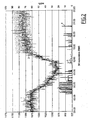
- the first disadvantage of the flow integration method is that there is a forward drift of the estimated value with respect to the value. real (see figure 2 for example). This drift comes from cumulative errors at each time step, due for example to the difference between the rate q used by the equations and the actual injection rate.
- the second disadvantage comes from the initialization step, which is necessary for such an iterative process.
- the initialization must be as precise as possible, otherwise the results will be distorted at each time step. It can be performed by choosing as an initial value C0 for the boron concentration in the primary liquid an average of the measurements recorded by the boremeter over a given period.
- the iterative process (curve 2) was initialized taking into account the average of the values recorded for the four hours preceding the start of the process.
- the initialization can also be carried out by taking as initial value the boron concentration measured by chemical assay, which is precise but constraining and not very fast.
- the flow rate integration method ignores other sources of variation in the boron concentration, such as for example the injection of fluid into the primary circuit from the pressurizer, the RCV balloon, the demineralization filters, etc.
- the invention aims to propose an estimation method that is more robust than the rate integration method.
- the invention relates to an estimation method according to claim 1.
- the method may also have one or more of the features of the dependent claims, considered individually or in any technically possible combination.
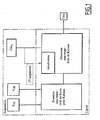
- the method shown schematically on the figure 1 is designed to estimate the concentration of boron C in the primary coolant of a nuclear reactor.
- This reactor comprises means for injecting into the primary liquid a solution for diluting the concentration of said chemical element below a predetermined limit, means for injecting into the liquid a solution concentrated in said chemical concentration element. predetermined C *, and a sensor capable of measuring a magnitude C m representative of the concentration of said chemical element in the primary coolant.
- the injection means are constituted by the REA circuit of the reactor, which is capable of injecting water containing no boron (dilution solution), or a concentrated solution for example at a concentration C * of 7000 ppm boron. .
- the REA circuit is known and will not be described here.
- an initial estimated value C e0 of the boron concentration in the primary liquid is chosen. This value is calculated directly from the quantity C m0 representative of the concentration of said chemical element measured by the sensor at the instant when the iterative process is started or immediately before its launch. This value is calculated using a single measurement made by the sensor, and is not the average of several measurements made by the sensor several times. The calculation of C e0 does not involve measurements of the quantities representative of the injection flow rates of dilution solution or concentrated solution.
- the acquisition step is performed using one or more flow sensors of the REA circuit, and using the boremeter.
- the calculation step is performed using Kalman equations.
- Kalman filtering is a known modeling process and only a few theoretical elements will be recalled below. The application of Kalman filtering to the estimation of the boron concentration in the primary coolant will then be detailed.
- the evolution equation of the state vector corresponds to a modeling of the process, u being a command and w a noise (modeling noise and / or control noise).
- the state vector x of the process is the magnitude that one seeks to estimate. It can be one or more dimensions, each coordinate of the vector corresponding to a characteristic parameter of the process.
- the measurement vector y depends on the state x and the measurement noise v. There is the same dimension as x.
- A, B and D are square matrices, of the same size as x.
- the Kalman filter makes it possible to weight the a priori information, obtained from the previous commands, with the measurements made in operation and available at the given moment. This weighting is optimal if the noises v and w, supposed to be independent, of zero mean and of known covariances, are Gaussian. It makes it possible to minimize the mathematical expectation of the error between the state and its estimate.
- k represents the best estimate of x k obtained from the data available at step k, that is, before the measure y k + 1 is available.
- k represent the best estimates of x k + 1 and y k + 1 obtained from the data available at step k, that is, before the measure y k + 1 be available.
- the state equation gives : x k + 1
- k AT ⁇ x k
- the error of estimation is given by : x k + 1 - x k + 1
- k AT ⁇ x k - x k
- the Kalman equations are: Prediction equations: x k + 1
- k AT x k
- k AT P k
- k ⁇ AT T + W Filtering equations: K k + 1 P k + 1
- k + 1 x k + 1
- k + 1 l - K k + 1 ⁇ D ⁇ P k + 1
- the state parameter and the measurement parameter considered for the application of the Kalman equations differ according to whether the charge injected into the primary circuit is a water load or a boron concentrate charge, or that injection is performed, as shown in the table below. In practice, two cases are distinguished, switching between the two forms of the state parameter and between the two forms of the measurement parameter being ensured as a function of the concentrated solution flow rate.
- Non-zero concentrated solution flow rate x ln ( C * -C ( t ))
- y ln ( C * - C m )
- the value C * considered in the formulas of the state and measurement parameters (in cases where the flow of concentrated solution is not zero) corresponds to the boron concentration of the concentrated solution.
- the calculation step consists of a sub-step of formatting the state parameters and measurement, followed by a sub-step of calculation.
- the form of the state and measurement parameters is first selected based on the representative value of the concentrated solution flow acquired at the acquisition step. Then, again during the formatting sub-step, the initial values of the state and measurement parameters to be considered for the calculation sub-step are estimated from the final values obtained at step k -1. If the form of the state and measurement parameters is the same at step k and step k-1, the initial values of the state and measurement parameters to be considered at step k are equal to the final values obtained at step k. 1. On the other hand, if the forms of the state and measurement parameters are different at step k and step k-1, the final values of the state and measurement parameters obtained at step k-1 must be converted to obtain the initial values to consider at step k.
- the two substeps of the calculation step are performed using the same microprocessor.
- the joint use of the control information (injection rates) and boron concentration measurements makes it possible to combine the advantages of the process by integrating the flow rates and the process directly using the values read by the boron meters.
- An appropriate adjustment of the V / W ratio makes it possible to adjust the respective weights of the control and the measurement.
- the ratio V / W is generally chosen between 100 and 10,000, preferably between 1,000 and 5,000, and even more preferably around 2,000. Increasing the V / W ratio favors the control over the measurement. It allows to follow more closely the injections of water or concentrated boron solution, but can give estimates more distant from the measurement. On the contrary, a decrease in the V / W ratio favors the measurement compared to the command. It gives estimates closer to the measurement but follows the injections of water or concentrated boron solution with a greater delay.
- the estimated boron concentration by Kalman filtration rapidly tracks boron concentration changes due to borating and dilution actions.
- the Kalman filter closely follows, in the short term, the flow integration method. This is where the gain in reducing the lag compared to the measured boron concentration is.
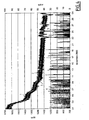
- the Kalman filter follows the measurement, provided that the injections of water or concentrated boron solution are spaced. Therefore, there is no drift at term as in the flow integration method (see for example the last days on the figure 5 ) because the Kalman filter recalibrates with respect to the measure.
- the problem of the delay of the measurement on the concentration of true boron is also evacuated, because the measurement is really taken into account only when there is no rapid variation in the concentration of boron due to the control (injections coming from the REA).
- this method makes it possible to see the boron concentration variations not directly due to the charge injections coming from the REA because the measurements are taken into account, with however the delay inherent to the measurement if the variations are fast. .
- the Kalman filter is responsible, from any initial value, to reconstitute in a few moments the boron concentration using the measurement.
- the higher the initial value is just the faster the estimated boron concentration reaches the value it would have had with just initialization.
- the figure 3 illustrates the behavior of the Kalman filter with an aberrant initialization at 500 ppm (3 'curve) instead of about 1075 ppm (curve 3 corresponding to an initialization with the concentration measured by boron). Curves 3 and 3 'converge rapidly and are confused less than three hours after initialization.
- the first value of the boron concentration measured by the boremeter (as for curve 3) is a practical initialization method giving a small initial deviation from the true concentration (of the order 25 ppm at most) and very fast convergence.
- the Kalman filter process allows significant noise reduction compared to measurement alone (a 10-fold reduction over 24 hours of stability in November 2003 on the figure 4 ).
- the delays (of the order of ten minutes) due to the homogenization time of the feedstock injected into the primary liquid and the travel time of the feedstock injected along of the primary circuit can be taken into account.
- the travel time can be translated by a time lag of a few minutes (pure delay) on the injection rates.
- the introduction of a time constant (filtering of the first order of the flows) makes it possible to simulate the effects of the homogenization of the charge injected into the primary circuit.
- Kalman filter therefore allows the reconstruction of the true boron concentration from the dilution and borification flow rates, but also from the measurement of the boron concentration, in a very satisfactory manner.
- the estimated boron concentration in the primary circuit is obtained without delay and with a greatly reduced noise, the applications where this information has to be compared to another may be faster and the comparison closer.
- the estimated boron concentration is compared to the calculated theoretical boron concentration in order to verify the behavior of the neutron model.
- the boron concentration can also be compared to a threshold for detecting reactivity accidents such as unintentional dilution.
- the method can be applied to the estimation of the concentration of a chemical element of the primary coolant of the reactor other than boron.
- the method can be applied for any type of nuclear reactor in which the concentration of a chemical element of the primary coolant is controlled by injecting a dilution solution or a solution concentrated in said chemical element.
- the acquisition step of the quantities representative of the injection flow rates of the dilution solution and of the concentrated solution is limited to acquiring only, at each step, whether or not an injection of dilution solution is in course from the REA circuit, and whether or not a concentrated solution injection is in progress from the REA circuit.
- each time step ⁇ t k may be considered constant, or may be considered variable.
- the concentration C * of the concentrated solution is not necessarily equal to 7000 ppm, and may be different.
- the initialization step of the method can be carried out in multiple ways. It can be performed as described above using the first measurement made by the sensor, but can also be, non-preferably, carried out by considering the average of the measurements made by the sensor over a given period of time, or even by arbitrarily fixing the value of the concentration at a fixed value.
- the dilution solution may be a solution substantially free of the chemical element, for example technically pure water, or may be a solution containing a low concentration of the chemical element relative to the primary liquid, for example a lower concentration at 100 ppm.
- the switching, at the first substep of computation, between the two forms of the state and measurement parameters can be realized not according to whether the flow of concentrated solution is zero or not, but rather according to the magnitude q c representative this flow is below a predetermined limit or not. This limit is chosen low compared to the nominal injection flow rate of the concentrated solution.
Landscapes
- Physics & Mathematics (AREA)
- Engineering & Computer Science (AREA)
- Plasma & Fusion (AREA)
- General Engineering & Computer Science (AREA)
- High Energy & Nuclear Physics (AREA)
- Monitoring And Testing Of Nuclear Reactors (AREA)
Claims (6)
- Verfahren zum Abschätzen der Konzentration (C) eines chemischen Elements in der Primärkühlflüssigkeit eines Kernreaktors, wobei das chemische Element Bor oder eine Borverbindung ist, wobei der Reaktor Mittel, um in die Primärkühlflüssigkeit eine Lösung zur Verdünnung der Konzentration des besagten chemischen Elements unter eine vorgegebene Grenzkonzentration einzuspritzen, Mittel, um in die Primärkühlflüssigkeit eine konzentrierte Lösung des besagten chemischen Elements mit vorgegebener Konzentration (C*) einzuspritzen, und einen Sensor aufweist, welcher geeignet ist, um eine Größe (Cm) zu messen, welche für die Konzentration des besagten chemischen Elements in der Primärkühlflüssigkeit repräsentativ ist, dadurch gekennzeichnet, dass das Verfahren ein iteratives Verfahren ist, welches in wiederholender Art in jedem Zeitschritt k aufweist:- einen Schritt zum Erfassen einer Größe (qdk), welche für die Einspritzmenge der Lösung zur Verdünnung im Schritt k repräsentativ ist, einer Größe (qck), welche für die Einspritzmenge der konzentrierten Lösung im Schritt k repräsentativ ist, und einer Größe (Cmk), welche für die Konzentration des besagten chemischen Elements, welche mittels des Sensors in der Primärkühlflüssigkeit gemessen wird, repräsentativ ist;- einen Schritt zum Berechnen eines Schätzwertes (Cek+1) der Konzentration des besagten chemischen Elements in der Primärkühlflüssigkeit im Schritt k+1 als Funktion der repräsentativen Größen (qdk, qck, Cmk), welche im Schritt k erfasst wurden, wobei der Schritt zum Berechnen mittels Kalman-Gleichungen durchgeführt wird, wobei der Schritt des Berechnens im Schritt k unter Verwendung eines Zustandsparameters x = In(C), wenn die Größe (qck), welche für die Einspritzmenge der konzentrierten Lösung repräsentativ ist, kleiner als eine vorgegebene Grenzmenge ist, und eines Zustandsparameters x = ln(C*-C), wenn die Größe (qck), welche für die Einspritzmenge der konzentrierten Lösung repräsentativ ist, größer als die besagte vorgegebene Grenzmenge ist, in den Kalman-Gleichungen durchgeführt wird.
- Verfahren gemäß Anspruch 1, dadurch gekennzeichnet, dass der Schritt zum Berechnen im Schritt k unter Verwendung eines Messparameters y = ln(Cm), wenn die Größe (qck), welche für die Einspritzmenge der konzentrierten Lösung repräsentativ ist, kleiner als die besagte vorgegebene Grenzmenge ist, und eines Zustandsparameters y = ln(C*-Cm), wenn die Größe (qck), welche für die Einspritzmenge der konzentrierten Lösung repräsentativ ist, größer als die besagte vorgegebene Grenzmenge ist, in den Kalman-Gleichungen durchgeführt wird.
- Verfahren gemäß Anspruch 2, dadurch gekennzeichnet, dass die im Schritt des Berechnens verwendeten Gleichungen sind:
 uk = -(Δtk/Vol) qdk, wenn die Größe (qck), welche für die Einspritzmenge der konzentrierten Lösung im Schritt k repräsentativ ist, kleiner als die besagte vorgegebene Grenzmenge ist,uk = -(Δtk/Vol) qck, wenn die Größe (qck), welche für die Einspritzmenge der konzentrierten Lösung im Schritt k repräsentativ ist, größer als die besagte vorgegebene Grenzmenge ist,


mit: x k/k Wert des Zustandsparameters x im Schritt k, welcher aus im Schritt k vorhandenen Daten bestimmt wird, Δtk Länge des Zeitschritts k, Vol Volumen des Primärkreislaufs, Pk/k Varianz des Zustandsparameters x im Schritt k, welche aus im Schritt k vorhandenen Daten bestimmt wird, wobei W und V vorgegebene Konstanten sind. - Verfahren gemäß Anspruch 3, dadurch gekennzeichnet, dass der Quotient V/W zwischen 100 und 10000 ist.
- Verfahren gemäß irgendeinem der vorangehenden Ansprüche, dadurch gekennzeichnet, dass es einen Initialisierungsschritt aufweist, in welchem ein Anfangsschätzwert (Ce0) der Konzentration des besagten chemischen Elements in der Primärflüssigkeit direkt aus der Größe (Cm0), welche für die Konzentration des besagten chemischen Elements, welche mittels des Sensors in der Primärkühlflüssigkeit gemessen wird, repräsentativ ist, berechnet wird.
- Verfahren gemäß irgendeinem der vorangehenden Ansprüche, dadurch gekennzeichnet, dass der Kernreaktor ein Druckwasserreaktor ist.
Priority Applications (1)
| Application Number | Priority Date | Filing Date | Title |
|---|---|---|---|
| PL07872437T PL2104939T3 (pl) | 2006-12-26 | 2007-12-21 | Sposób szacowania stężenia pierwiastka chemicznego w chłodziwie pierwotnym reaktora jądrowego |
Applications Claiming Priority (2)
| Application Number | Priority Date | Filing Date | Title |
|---|---|---|---|
| FR0611383A FR2910690B1 (fr) | 2006-12-26 | 2006-12-26 | Procede d'estimation de la concentration en un element chimique dans le liquide de refroidissement primaire d'un reacteur nucleaire |
| PCT/FR2007/002155 WO2008093026A2 (fr) | 2006-12-26 | 2007-12-21 | Procede d'estimation de la concentration en un element chimique dans le liquide de refroidissement primaire d'un reacteur nucleaire |
Publications (2)
| Publication Number | Publication Date |
|---|---|
| EP2104939A2 EP2104939A2 (de) | 2009-09-30 |
| EP2104939B1 true EP2104939B1 (de) | 2015-08-19 |
Family
ID=38529548
Family Applications (1)
| Application Number | Title | Priority Date | Filing Date |
|---|---|---|---|
| EP07872437.4A Not-in-force EP2104939B1 (de) | 2006-12-26 | 2007-12-21 | Verfahren zur bewertung der konzentration eines chemischen elements in der kühlflüssigkeit des primärkreislaufs eines kernreaktors |
Country Status (7)
| Country | Link |
|---|---|
| US (1) | US8489338B2 (de) |
| EP (1) | EP2104939B1 (de) |
| JP (1) | JP5447955B2 (de) |
| ES (1) | ES2550931T3 (de) |
| FR (1) | FR2910690B1 (de) |
| PL (1) | PL2104939T3 (de) |
| WO (1) | WO2008093026A2 (de) |
Families Citing this family (5)
| Publication number | Priority date | Publication date | Assignee | Title |
|---|---|---|---|---|
| KR101662736B1 (ko) * | 2015-01-28 | 2016-10-06 | 한국지질자원연구원 | 시간에 따른 광산배수 수질 특성 변화 예측방법 |
| JP6447224B2 (ja) * | 2015-02-20 | 2019-01-09 | 日本電気株式会社 | 通信装置、中継装置、通信方法及び通信プログラム |
| US20170263342A1 (en) * | 2016-03-10 | 2017-09-14 | Westinghouse Electric Company Llc | Real-time reactor coolant system boron concentration monitor utilizing an ultrasonic spectroscpopy system |
| JP7470659B2 (ja) | 2021-04-28 | 2024-04-18 | 三菱重工業株式会社 | 評価方法、評価システム及びプログラム |
| CN114758805B (zh) * | 2022-03-30 | 2025-05-16 | 岭澳核电有限公司 | 核电站一回路的硼补给方法 |
Family Cites Families (7)
| Publication number | Priority date | Publication date | Assignee | Title |
|---|---|---|---|---|
| GB1532071A (en) * | 1976-02-06 | 1978-11-15 | Niemi A | Method for controlling concentration variables of process materials |
| US4204259A (en) * | 1978-04-11 | 1980-05-20 | Nikkiso Co., Ltd. | Automatic apparatus for continuous determination of boron and lithium concentrations |
| US4814050A (en) * | 1986-10-06 | 1989-03-21 | Aluminum Company Of America | Estimation and control of alumina concentration in hall cells |
| JP3611285B2 (ja) * | 1999-05-12 | 2005-01-19 | 三菱重工業株式会社 | 検出対象成分の濃度計測システム、並びに該濃度計測システムを用いた原子炉冷却水濃度の制御方法及び装置 |
| US6539311B1 (en) * | 2000-10-30 | 2003-03-25 | The Mitre Corporation | Apparatus and method for measuring concentrations of a chemical/biological/nuclear agent in an environment |
| US7186372B2 (en) * | 2002-03-29 | 2007-03-06 | Ethicon, Inc. | Method for determining lumen penetration of a vapor phase sterilant |
| GB2436508C (en) * | 2005-01-14 | 2011-01-26 | Europ Organisation For Nuclear Res Cern | Method for production of radioisotope preparationsand their use in life science, research, medical application and industry. |
-
2006
- 2006-12-26 FR FR0611383A patent/FR2910690B1/fr not_active Expired - Fee Related
-
2007
- 2007-12-21 WO PCT/FR2007/002155 patent/WO2008093026A2/fr not_active Ceased
- 2007-12-21 JP JP2009543500A patent/JP5447955B2/ja not_active Expired - Fee Related
- 2007-12-21 ES ES07872437.4T patent/ES2550931T3/es active Active
- 2007-12-21 US US12/521,422 patent/US8489338B2/en not_active Expired - Fee Related
- 2007-12-21 EP EP07872437.4A patent/EP2104939B1/de not_active Not-in-force
- 2007-12-21 PL PL07872437T patent/PL2104939T3/pl unknown
Also Published As
| Publication number | Publication date |
|---|---|
| JP2010515043A (ja) | 2010-05-06 |
| EP2104939A2 (de) | 2009-09-30 |
| WO2008093026A3 (fr) | 2008-11-27 |
| JP5447955B2 (ja) | 2014-03-19 |
| ES2550931T3 (es) | 2015-11-13 |
| FR2910690A1 (fr) | 2008-06-27 |
| US20110004417A1 (en) | 2011-01-06 |
| FR2910690B1 (fr) | 2009-04-03 |
| PL2104939T3 (pl) | 2016-02-29 |
| US8489338B2 (en) | 2013-07-16 |
| WO2008093026A2 (fr) | 2008-08-07 |
Similar Documents
| Publication | Publication Date | Title |
|---|---|---|
| EP2104939B1 (de) | Verfahren zur bewertung der konzentration eines chemischen elements in der kühlflüssigkeit des primärkreislaufs eines kernreaktors | |
| EP0187081B1 (de) | Verfahren und Verarbeitungskette des analogischen Ausgangssignals eines Sensors | |
| EP2904353B1 (de) | Verfahren und system für multisensormesssystem | |
| CN115540907B (zh) | 一种基于面向星间差分的gps/bds/ins紧组合导航的多故障检测与剔除方法 | |
| EP1049862B1 (de) | Vorrichtung zur abschätzung des luft/kraftstoffverhältnisses für ein kraftstoffeinspritzsystem einer brennkraftmaschine | |
| FR3029621B1 (fr) | Procede de suivi de la fabrication de pieces base sur l'analyse d'indicateurs statistiques ponderes | |
| CA3179260A1 (fr) | Procede pour determiner des caracteristiques d'un carburant alimentant un moteur d'aeronef | |
| EP2850445B1 (de) | System und entsprechendes verfahren zur bestimmung des ladezustandes einer batterie | |
| EP4153852B1 (de) | Luftfahrzeug, das in seinem kraftstofftank eine kammer mit einem sensor umfasst | |
| EP2700793A1 (de) | Korrekturverfahren einer Schätzung der Rußmasse in einem Partikelfilter | |
| EP3938910B1 (de) | Fehlerlokalisierung innerhalb eines redondanten erfassungssystems | |
| FR2844880A1 (fr) | PROCEDE PERMETTANT D'EVALUER LA REPONSE TEMPORELLE D'UN CAPTEUR DE NOx | |
| FR3095041A1 (fr) | Procede de determination de la position et de l'orientation d'un vehicule | |
| EP3066445B1 (de) | Technisches testverfahren | |
| EP1931868B1 (de) | Verfahren zur schätzung der von jedem zylinder eines verbrennungsmotors erzeugten momentanen geschwindigkeit | |
| EP3008315B1 (de) | Verfahren zur diagnose des betriebszustands von kraftstoffinjektoren in einer brennkraftmaschine, brennkraftmaschine und kraftfahrzeug zur durchführung des verfahrens | |
| FR3142511A1 (fr) | Procédé de commande et dispositif de commande d’une turbomachine hybride | |
| EP0771439A1 (de) | Verfahren und anordnung zum ermitteln von flugzeugflugkonfigurationen | |
| WO2013060688A1 (fr) | Procede et systeme de determination d'etat de charge d'une cellule elementaire et d'une batterie | |
| FR3029936A1 (fr) | Procede et dispositif de caracterisation du pouvoir inhibiteur d'une molecule sur un microorganisme | |
| EP2193261B1 (de) | Verfahren und vorrichtung zur handhabung eines abgasbehandlungsmoduls | |
| Chihab et al. | The influence of the non-uniform spline basis on the approximation signal | |
| CN116660947B (zh) | 基于高度角和方位角的卫星端伪距偏差校正方法及装置 | |
| FR3165502A1 (fr) | Procédé et système de surveillance d’un objet biologique | |
| WO2004079176A1 (fr) | Procede de determination du gain d’un injecteur de carburant |
Legal Events
| Date | Code | Title | Description |
|---|---|---|---|
| PUAI | Public reference made under article 153(3) epc to a published international application that has entered the european phase |
Free format text: ORIGINAL CODE: 0009012 |
|
| 17P | Request for examination filed |
Effective date: 20090625 |
|
| AK | Designated contracting states |
Kind code of ref document: A2 Designated state(s): AT BE BG CH CY CZ DE DK EE ES FI FR GB GR HU IE IS IT LI LT LU LV MC MT NL PL PT RO SE SI SK TR |
|
| DAX | Request for extension of the european patent (deleted) | ||
| 17Q | First examination report despatched |
Effective date: 20110215 |
|
| GRAP | Despatch of communication of intention to grant a patent |
Free format text: ORIGINAL CODE: EPIDOSNIGR1 |
|
| INTG | Intention to grant announced |
Effective date: 20150313 |
|
| GRAS | Grant fee paid |
Free format text: ORIGINAL CODE: EPIDOSNIGR3 |
|
| GRAA | (expected) grant |
Free format text: ORIGINAL CODE: 0009210 |
|
| AK | Designated contracting states |
Kind code of ref document: B1 Designated state(s): AT BE BG CH CY CZ DE DK EE ES FI FR GB GR HU IE IS IT LI LT LU LV MC MT NL PL PT RO SE SI SK TR |
|
| REG | Reference to a national code |
Ref country code: GB Ref legal event code: FG4D Free format text: NOT ENGLISH |
|
| REG | Reference to a national code |
Ref country code: CH Ref legal event code: EP |
|
| REG | Reference to a national code |
Ref country code: IE Ref legal event code: FG4D Free format text: LANGUAGE OF EP DOCUMENT: FRENCH |
|
| REG | Reference to a national code |
Ref country code: AT Ref legal event code: REF Ref document number: 744300 Country of ref document: AT Kind code of ref document: T Effective date: 20150915 |
|
| REG | Reference to a national code |
Ref country code: DE Ref legal event code: R096 Ref document number: 602007042720 Country of ref document: DE |
|
| REG | Reference to a national code |
Ref country code: CH Ref legal event code: NV Representative=s name: ARNOLD AND SIEDSMA AG, CH |
|
| REG | Reference to a national code |
Ref country code: ES Ref legal event code: FG2A Ref document number: 2550931 Country of ref document: ES Kind code of ref document: T3 Effective date: 20151113 |
|
| REG | Reference to a national code |
Ref country code: SE Ref legal event code: TRGR |
|
| REG | Reference to a national code |
Ref country code: FR Ref legal event code: PLFP Year of fee payment: 9 |
|
| REG | Reference to a national code |
Ref country code: AT Ref legal event code: MK05 Ref document number: 744300 Country of ref document: AT Kind code of ref document: T Effective date: 20150819 |
|
| REG | Reference to a national code |
Ref country code: LT Ref legal event code: MG4D |
|
| REG | Reference to a national code |
Ref country code: NL Ref legal event code: MP Effective date: 20150819 |
|
| PG25 | Lapsed in a contracting state [announced via postgrant information from national office to epo] |
Ref country code: LV Free format text: LAPSE BECAUSE OF FAILURE TO SUBMIT A TRANSLATION OF THE DESCRIPTION OR TO PAY THE FEE WITHIN THE PRESCRIBED TIME-LIMIT Effective date: 20150819 Ref country code: GR Free format text: LAPSE BECAUSE OF FAILURE TO SUBMIT A TRANSLATION OF THE DESCRIPTION OR TO PAY THE FEE WITHIN THE PRESCRIBED TIME-LIMIT Effective date: 20151120 Ref country code: LT Free format text: LAPSE BECAUSE OF FAILURE TO SUBMIT A TRANSLATION OF THE DESCRIPTION OR TO PAY THE FEE WITHIN THE PRESCRIBED TIME-LIMIT Effective date: 20150819 |
|
| PG25 | Lapsed in a contracting state [announced via postgrant information from national office to epo] |
Ref country code: PT Free format text: LAPSE BECAUSE OF FAILURE TO SUBMIT A TRANSLATION OF THE DESCRIPTION OR TO PAY THE FEE WITHIN THE PRESCRIBED TIME-LIMIT Effective date: 20151221 Ref country code: IS Free format text: LAPSE BECAUSE OF FAILURE TO SUBMIT A TRANSLATION OF THE DESCRIPTION OR TO PAY THE FEE WITHIN THE PRESCRIBED TIME-LIMIT Effective date: 20151219 Ref country code: AT Free format text: LAPSE BECAUSE OF FAILURE TO SUBMIT A TRANSLATION OF THE DESCRIPTION OR TO PAY THE FEE WITHIN THE PRESCRIBED TIME-LIMIT Effective date: 20150819 |
|
| PG25 | Lapsed in a contracting state [announced via postgrant information from national office to epo] |
Ref country code: NL Free format text: LAPSE BECAUSE OF FAILURE TO SUBMIT A TRANSLATION OF THE DESCRIPTION OR TO PAY THE FEE WITHIN THE PRESCRIBED TIME-LIMIT Effective date: 20150819 |
|
| PG25 | Lapsed in a contracting state [announced via postgrant information from national office to epo] |
Ref country code: EE Free format text: LAPSE BECAUSE OF FAILURE TO SUBMIT A TRANSLATION OF THE DESCRIPTION OR TO PAY THE FEE WITHIN THE PRESCRIBED TIME-LIMIT Effective date: 20150819 Ref country code: DK Free format text: LAPSE BECAUSE OF FAILURE TO SUBMIT A TRANSLATION OF THE DESCRIPTION OR TO PAY THE FEE WITHIN THE PRESCRIBED TIME-LIMIT Effective date: 20150819 Ref country code: CZ Free format text: LAPSE BECAUSE OF FAILURE TO SUBMIT A TRANSLATION OF THE DESCRIPTION OR TO PAY THE FEE WITHIN THE PRESCRIBED TIME-LIMIT Effective date: 20150819 Ref country code: IT Free format text: LAPSE BECAUSE OF FAILURE TO SUBMIT A TRANSLATION OF THE DESCRIPTION OR TO PAY THE FEE WITHIN THE PRESCRIBED TIME-LIMIT Effective date: 20150819 Ref country code: SK Free format text: LAPSE BECAUSE OF FAILURE TO SUBMIT A TRANSLATION OF THE DESCRIPTION OR TO PAY THE FEE WITHIN THE PRESCRIBED TIME-LIMIT Effective date: 20150819 |
|
| REG | Reference to a national code |
Ref country code: DE Ref legal event code: R097 Ref document number: 602007042720 Country of ref document: DE |
|
| PG25 | Lapsed in a contracting state [announced via postgrant information from national office to epo] |
Ref country code: RO Free format text: LAPSE BECAUSE OF FAILURE TO SUBMIT A TRANSLATION OF THE DESCRIPTION OR TO PAY THE FEE WITHIN THE PRESCRIBED TIME-LIMIT Effective date: 20150819 |
|
| PLBE | No opposition filed within time limit |
Free format text: ORIGINAL CODE: 0009261 |
|
| STAA | Information on the status of an ep patent application or granted ep patent |
Free format text: STATUS: NO OPPOSITION FILED WITHIN TIME LIMIT |
|
| REG | Reference to a national code |
Ref country code: DE Ref legal event code: R119 Ref document number: 602007042720 Country of ref document: DE |
|
| 26N | No opposition filed |
Effective date: 20160520 |
|
| PG25 | Lapsed in a contracting state [announced via postgrant information from national office to epo] |
Ref country code: LU Free format text: LAPSE BECAUSE OF FAILURE TO SUBMIT A TRANSLATION OF THE DESCRIPTION OR TO PAY THE FEE WITHIN THE PRESCRIBED TIME-LIMIT Effective date: 20151221 Ref country code: MC Free format text: LAPSE BECAUSE OF FAILURE TO SUBMIT A TRANSLATION OF THE DESCRIPTION OR TO PAY THE FEE WITHIN THE PRESCRIBED TIME-LIMIT Effective date: 20150819 |
|
| PG25 | Lapsed in a contracting state [announced via postgrant information from national office to epo] |
Ref country code: SI Free format text: LAPSE BECAUSE OF FAILURE TO SUBMIT A TRANSLATION OF THE DESCRIPTION OR TO PAY THE FEE WITHIN THE PRESCRIBED TIME-LIMIT Effective date: 20150819 |
|
| REG | Reference to a national code |
Ref country code: IE Ref legal event code: MM4A |
|
| PG25 | Lapsed in a contracting state [announced via postgrant information from national office to epo] |
Ref country code: IE Free format text: LAPSE BECAUSE OF NON-PAYMENT OF DUE FEES Effective date: 20151221 Ref country code: DE Free format text: LAPSE BECAUSE OF NON-PAYMENT OF DUE FEES Effective date: 20160701 |
|
| REG | Reference to a national code |
Ref country code: FR Ref legal event code: PLFP Year of fee payment: 10 |
|
| PG25 | Lapsed in a contracting state [announced via postgrant information from national office to epo] |
Ref country code: HU Free format text: LAPSE BECAUSE OF FAILURE TO SUBMIT A TRANSLATION OF THE DESCRIPTION OR TO PAY THE FEE WITHIN THE PRESCRIBED TIME-LIMIT; INVALID AB INITIO Effective date: 20071221 Ref country code: BG Free format text: LAPSE BECAUSE OF FAILURE TO SUBMIT A TRANSLATION OF THE DESCRIPTION OR TO PAY THE FEE WITHIN THE PRESCRIBED TIME-LIMIT Effective date: 20150819 |
|
| PG25 | Lapsed in a contracting state [announced via postgrant information from national office to epo] |
Ref country code: CY Free format text: LAPSE BECAUSE OF FAILURE TO SUBMIT A TRANSLATION OF THE DESCRIPTION OR TO PAY THE FEE WITHIN THE PRESCRIBED TIME-LIMIT Effective date: 20150819 |
|
| PG25 | Lapsed in a contracting state [announced via postgrant information from national office to epo] |
Ref country code: TR Free format text: LAPSE BECAUSE OF FAILURE TO SUBMIT A TRANSLATION OF THE DESCRIPTION OR TO PAY THE FEE WITHIN THE PRESCRIBED TIME-LIMIT Effective date: 20150819 Ref country code: MT Free format text: LAPSE BECAUSE OF FAILURE TO SUBMIT A TRANSLATION OF THE DESCRIPTION OR TO PAY THE FEE WITHIN THE PRESCRIBED TIME-LIMIT Effective date: 20150819 |
|
| REG | Reference to a national code |
Ref country code: FR Ref legal event code: PLFP Year of fee payment: 11 |
|
| PGFP | Annual fee paid to national office [announced via postgrant information from national office to epo] |
Ref country code: FR Payment date: 20171123 Year of fee payment: 11 Ref country code: FI Payment date: 20171122 Year of fee payment: 11 |
|
| PGFP | Annual fee paid to national office [announced via postgrant information from national office to epo] |
Ref country code: PL Payment date: 20171117 Year of fee payment: 11 Ref country code: GB Payment date: 20171219 Year of fee payment: 11 Ref country code: CH Payment date: 20171219 Year of fee payment: 11 Ref country code: SE Payment date: 20171211 Year of fee payment: 11 Ref country code: BE Payment date: 20171220 Year of fee payment: 11 |
|
| PGFP | Annual fee paid to national office [announced via postgrant information from national office to epo] |
Ref country code: ES Payment date: 20180129 Year of fee payment: 11 |
|
| REG | Reference to a national code |
Ref country code: SE Ref legal event code: EUG |
|
| PG25 | Lapsed in a contracting state [announced via postgrant information from national office to epo] |
Ref country code: SE Free format text: LAPSE BECAUSE OF NON-PAYMENT OF DUE FEES Effective date: 20181222 Ref country code: FI Free format text: LAPSE BECAUSE OF NON-PAYMENT OF DUE FEES Effective date: 20181221 |
|
| REG | Reference to a national code |
Ref country code: CH Ref legal event code: PL |
|
| GBPC | Gb: european patent ceased through non-payment of renewal fee |
Effective date: 20181221 |
|
| REG | Reference to a national code |
Ref country code: BE Ref legal event code: MM Effective date: 20181231 |
|
| PG25 | Lapsed in a contracting state [announced via postgrant information from national office to epo] |
Ref country code: FR Free format text: LAPSE BECAUSE OF NON-PAYMENT OF DUE FEES Effective date: 20181231 |
|
| PG25 | Lapsed in a contracting state [announced via postgrant information from national office to epo] |
Ref country code: BE Free format text: LAPSE BECAUSE OF NON-PAYMENT OF DUE FEES Effective date: 20181231 |
|
| PG25 | Lapsed in a contracting state [announced via postgrant information from national office to epo] |
Ref country code: CH Free format text: LAPSE BECAUSE OF NON-PAYMENT OF DUE FEES Effective date: 20181231 Ref country code: LI Free format text: LAPSE BECAUSE OF NON-PAYMENT OF DUE FEES Effective date: 20181231 Ref country code: GB Free format text: LAPSE BECAUSE OF NON-PAYMENT OF DUE FEES Effective date: 20181221 |
|
| REG | Reference to a national code |
Ref country code: ES Ref legal event code: FD2A Effective date: 20200205 |
|
| PG25 | Lapsed in a contracting state [announced via postgrant information from national office to epo] |
Ref country code: ES Free format text: LAPSE BECAUSE OF NON-PAYMENT OF DUE FEES Effective date: 20181222 |
|
| PG25 | Lapsed in a contracting state [announced via postgrant information from national office to epo] |
Ref country code: PL Free format text: LAPSE BECAUSE OF NON-PAYMENT OF DUE FEES Effective date: 20181221 |