EP2103735A1 - Catalytic bleaching of substrates - Google Patents
Catalytic bleaching of substrates Download PDFInfo
- Publication number
- EP2103735A1 EP2103735A1 EP08152872A EP08152872A EP2103735A1 EP 2103735 A1 EP2103735 A1 EP 2103735A1 EP 08152872 A EP08152872 A EP 08152872A EP 08152872 A EP08152872 A EP 08152872A EP 2103735 A1 EP2103735 A1 EP 2103735A1
- Authority
- EP
- European Patent Office
- Prior art keywords
- transition metal
- cellulosic substrate
- metal catalyst
- catalyst
- bleaching
- Prior art date
- Legal status (The legal status is an assumption and is not a legal conclusion. Google has not performed a legal analysis and makes no representation as to the accuracy of the status listed.)
- Withdrawn
Links
Classifications
-
- D—TEXTILES; PAPER
- D21—PAPER-MAKING; PRODUCTION OF CELLULOSE
- D21C—PRODUCTION OF CELLULOSE BY REMOVING NON-CELLULOSE SUBSTANCES FROM CELLULOSE-CONTAINING MATERIALS; REGENERATION OF PULPING LIQUORS; APPARATUS THEREFOR
- D21C9/00—After-treatment of cellulose pulp, e.g. of wood pulp, or cotton linters ; Treatment of dilute or dewatered pulp or process improvement taking place after obtaining the raw cellulosic material and not provided for elsewhere
- D21C9/10—Bleaching ; Apparatus therefor
- D21C9/1026—Other features in bleaching processes
- D21C9/1036—Use of compounds accelerating or improving the efficiency of the processes
-
- D—TEXTILES; PAPER
- D21—PAPER-MAKING; PRODUCTION OF CELLULOSE
- D21C—PRODUCTION OF CELLULOSE BY REMOVING NON-CELLULOSE SUBSTANCES FROM CELLULOSE-CONTAINING MATERIALS; REGENERATION OF PULPING LIQUORS; APPARATUS THEREFOR
- D21C9/00—After-treatment of cellulose pulp, e.g. of wood pulp, or cotton linters ; Treatment of dilute or dewatered pulp or process improvement taking place after obtaining the raw cellulosic material and not provided for elsewhere
- D21C9/10—Bleaching ; Apparatus therefor
- D21C9/1078—Bleaching ; Apparatus therefor with Mn-containing compounds
-
- D—TEXTILES; PAPER
- D21—PAPER-MAKING; PRODUCTION OF CELLULOSE
- D21C—PRODUCTION OF CELLULOSE BY REMOVING NON-CELLULOSE SUBSTANCES FROM CELLULOSE-CONTAINING MATERIALS; REGENERATION OF PULPING LIQUORS; APPARATUS THEREFOR
- D21C9/00—After-treatment of cellulose pulp, e.g. of wood pulp, or cotton linters ; Treatment of dilute or dewatered pulp or process improvement taking place after obtaining the raw cellulosic material and not provided for elsewhere
- D21C9/10—Bleaching ; Apparatus therefor
- D21C9/16—Bleaching ; Apparatus therefor with per compounds
- D21C9/163—Bleaching ; Apparatus therefor with per compounds with peroxides
Definitions
- the present invention concerns the bleaching of cellulosic substrates with hydrogen peroxide and a transition metal catalyst.
- Raw cotton originating from cotton seeds contains mainly colourless cellulose, but has a yellow-brownish colour due to the natural pigment in the plant. Many impurities adhere, especially to the surface. They consist mainly of protein, pectin, ash and wax.
- the cotton and textile industries recognise a need for bleaching cotton prior to its use in textiles and other areas.
- the cotton fibres are bleached to remove natural and adventitious impurities with the concurrent production of substantially whiter material.
- bleaching agent has been developed and shows less cotton damage than hypochlorite does. Also mixtures of chlorine dioxide and hypochlorite can be applied.
- the second type of bleach is a peroxide solution, e.g., hydrogen peroxide solutions. This bleaching process is typically applied at high temperatures, i.e., 90 to 120°C. However, room temperature treatment has been used when the treatment time is extended (cold pad batch process).
- Controlling the peroxide decomposition due to trace metals is key to successfully apply hydrogen peroxide. Often Mg-silicates or sequestering agents such as EDTA or analogous phosphonates can be applied to reduce decomposition.
- EP 0458397 discloses the use manganese 1,4,7-Trimethyl-1,4,7-triazacyclononane (Me 3 -TACN) complexes as bleaching and oxidation catalysts and use for paper/pulp bleaching and textile bleaching processes.
- Me 3 -TACN manganese 1,4,7-Trimethyl-1,4,7-triazacyclononane
- United States Application 2002/010120 discloses the bleaching of substrates in an aqueous medium, the aqueous medium comprising a transition metal catalyst and hydrogen peroxide.
- Transition metal catalysts having bleaching activity with hydrogen peroxide towards substrates are numerous; the following documents describing wide classes of ligands are indicative of such: WO98/39098 , WO00/12667 , WO02/077145 , WO02/48301 , WO03/104379 , and EP0909809 .
- a transition metal catalyst in the form of a spray or foam to a cellulosic substrate serves to reduce wastage of expensive reagents, i.e., hydrogen peroxide and transition metal catalyst, in industrial bleaching process.
- the present invention provides a continuous or semi continuous bleaching method for industrial bleaching of a cellulosic substrate, the method comprising the following steps: (a) subjecting the cellulosic substrate to moisture, and hydrogen peroxide to provide a wet peroxide enriched cellulosic substrate; (b) applying to the cellulosic substrate from step (a), in the form of a spray or foam, a 0.1 to 200 micromolar aqueous solution of a preformed transition metal catalyst, wherein the transition metal is selected from Fe(II) and Fe(III), Mn(II), Mn(III), and Mn(IV) and the ligand of the preformed transition metal catalyst is selected from a tridentate, tetradentate, pentadentate or hexadentate nitrogen donor.
- a continuous process is, in essence, a process in which a material to be treated is continuous fed into a processing system, travels though it, undergoes changes and continuous exits the system with the target modified properties. Simultaneously, chemicals and energy are fed in a flow without interruption into a system so that the processing operating conditions are maintained in equilibrium during the operation of the process.
- a semi continuous system is similar to the continuous, but with the difference that the material is stored for a dwell time at a stage between the start and end of the process and then re-fed at that point and allowed to finish the process.
- the method is applied to a cellulosic substrate that is in the form of a moving web.
- a cellulosic substrate that is in the form of a moving web. This facilitates movement of the cellulosic substrate by runners and guides from one area of treatment to another; the use of rollers to convey the web is conventional.
- the web may be easily rolled up in predetermined amounts before shipping or further processing.
- the cellulosic substrate may be derived from, for example, wood pulp, cotton hemp, straw, bamboo, flax (linin), jute, kenaf, Abaca, sisal, soy protein fibre.
- the cellulosic substrate may be a processed product such as viscose.
- the cellulosic substrate is preferably wood pulp or cotton.
- the cellulosic substrate of cotton is most preferably in the form of a web.
- a web is a long thin and flexible material.
- a web is generally processed by moving over rollers. Between processing stages, webs are stored and transported as rolls also known as coils, packages and doffs. The end result or use of web manufacturing is usually sheets.
- the cellulosic substrate is treated with hydrogen peroxide prior to spraying with the aqueous solution of transition metal catalyst.
- the hydrogen peroxide may be applied by passing the cellulosic substrate through a bath or spraying.
- Hydrogen peroxide is provided as an aqueous solution per se, or as peroxy salts, such as perborate monohydrate, perborate tetrahydrate, percarbonate, perphosphate, etc. However, for cost reasons liquid hydrogen peroxide is preferred.
- a preferred concentration of hydrogen peroxide applied is: 0.1 to 20 % (w/w), more preferably 1 to 10 %, most preferably 1 to 5%.
- the hydrogen peroxide is preferably provided in an alkali medium, the alkalinity of which is preferably provided by sodium hydroxide.
- the cellulosic substrate is run as a web through a bath containing aqueous hydrogen peroxide.
- the cellulosic substrate may be treated with hydrogen peroxide a bath as a roll before spraying with catalyst in the form of a web.
- the temperature of the cellulosic substrate after treating with hydrogen peroxide is preferably at least 70 °C, more preferably at least 80 °C, and most preferably at least 90 °C. This temperature may be provided by the temperate of the bath or spray. The temperature of the cellulosic substrate may also be provided for with steam and the use of steam chambers.
- the bleaching of cotton may be obtained at room temperature leaving rolls of cotton, treated with hydrogen peroxide and catalyst, for longer periods of time under ambient conditions. It is understood that at lower temperatures, the duration of the reactions will be longer than in the steaming conditions as described above. Typically the periods of time will be in the range 1h to 48 h, with 2h to 24 h being more preferred and 3 to 12 h being most preferred.
- an aqueous medium in the form of a spray should be evident to one skilled in the art.
- The may be formed from a single spray head or a plurality of spray heads.
- the spray heads include spinners, rotary, and jets.
- the spray provides an aqueous solution in a mass or jet of droplets.
- an aqueous medium in preferably applied to the cellulosic substrate in the form of a spray.
- the spray may be provided by a pneumatic atomizing nozzle, a hollow cone nozzle of the single pore type, a hollow cone nozzle of the multi pore type, whirl spray nozzle, an oval spray nozzle, square spray nozzle, rectangular spray nozzle, full cone nozzle, flat pattern nozzle etc.
- These nozzles may be provides as an array of individual nozzles.
- spray nozzles and arrays thereof for example, Kyoritsu Gokin Co.,Ltd, and Spraying Systems Co., P.O. Box 7900, Wheaton, IL, 60189-7900, USA.
- the selection of the nozzle is such that the aqueous medium is applied without damaging the integrity of cellulosic substrate by hydrodynamic pressure whilst ensuring optimum application.
- Foam application is discussed in Textile Research Journal, Vol. 52, No. 6, 395-403 (1982 ).
- the foam is preferably generated by the integrated use of a suitable surfactant which imparts bubble stability. This may be pumped at a specific rate to slot dispenser positioned against the cellulosic substrate, most preferably on both sides of the material.
- Foam application provides a rapidly-breaking low-density foam or froth as the delivery medium for finishing chemicals.
- Foam application permits precise metering and flow control for delivery of foam to the substrate and pressure-driven impregnation of the foam into the substrate.
- Foam application permits uniform high-speed application and collapse of the foam in a single step.
- the pick-up can be as low as 10%, which also results in lower energy consumption (less water needs to be evaporated).
- the semi-stable foam is necessary to get spontaneous foam collapse and spreading though the substrate, and is in contrast to stable foams specified in various foam coating processes normally requiring a separate step to break and distribute the foam through the textile material.
- a particularly suitable system has been developed by Gaston County Dyeing Machine Company.
- the preformed transition metal catalyst is formed from a tridentate, tetradentate, pentadentate or hexadentate nitrogen donor ligand.
- the tridentate, tetradentate, pentadentate or hexadentate nitrogen donor ligand may be built up within any organic structure which will support coordinating nitrogen atoms.
- a basic tridentate ligand such as 1,4,7-triazacyclononane and have further nitrogen coordination groups, e.g., -CH2-CH2-NH2, -CH2-Py, covalently bound to one or more of the cyclic nitrogens or aliphatic groups.
- the iron ion is selected from Fe(II) and Fe(III) and the manganese ion is selected from Mn(II), Mn(III), and Mn(IV).
- the ligand is present in one or more of the forms [MnLCl 2 ]; [FeLCl 2 ]; [FeLCl]Cl; [FeL(H 2 O)](PF 6 ) 2 ; [FeL]Cl 2 , [FeLCl]PF 6 and [FeL(H 2 O)] (BF 4 ) 2 .
- water soluble counter ions conferring increasing solubility, say over PF 6 , are also preferred.
- the length of any alkyl chain is preferably C1 to C8-alkyl chain and preferably linear. If unspecified the aryl group is a phenyl group.
- the bispidon class are preferably in the form of an iron transition metal catalyst.
- the bispidon ligand is preferably of the form: wherein each R is independently selected from: hydrogen, F, C1, Br, hydroxyl, C1-C4-alkylO-, -NH-CO-H, -NH-CO-C1-C4-alkyl, -NH2, -NH-C1-C4-alkyl, and C1-C4-alkyl;
- R3 R4 and selected from -C(O)-O-CH3, -C(O)-O-CH2CH3, -C(O)-O-CH2C6H5 and CH2OH.
- heteroatom capable of coordinating to a transition metal is pyridin-2-ylmethyl optionally substituted by -CO-C4-alkyl.
- R1 and R2 are CH3, -C2H5, -C3H7, benzyl, -C4H9, -C6H13, -C8H17, -C12H25, and -C18H37 and pyridin-2-yl.
- a preferred class of bispidon is one in which at least one of R1 or R2 is pyridin-2-ylmethyl or benzyl, preferably pyridin-2-ylmethyl.
- a preferred bispidon is dimethyl 2,4-di-(2-pyridyl) -3-methyl-7-(pyridin-2-ylmethyl)-3,7-diaza-bicyclo[3.3.1]nonan-9-one-1,5-dicarboxylate (N2py3o-C1) and the iron complex thereof FeN2py3o-C1 which was prepared as described in WO02/48301 .
- methyl group (C1) at the 3 position have longer alkyl chains, namely isobutyl, (n-hexyl) C6, (n-octyl) C8, (n-dodecyl) C12, (n-tetradecyl) C14, (n-octadecyl) C18, which were prepared in an analogous manner.
- Preferred tetradentate bispidons are also illustrated in WO00/60045 and preferred pentadentate bispidons are illustrated in WO02/48301 and WO03/104379 .
- the N4py are preferably in the form of an iron transition metal catalyst.
- N4py type ligands are preferably of the form: wherein
- R 1 represents pyridin-2-yl or R 2 represents pyridin-2-yl-methyl.
- R 2 or R 1 represents 2-aminoethyl, 2-(N-(m)ethyl)amino-ethyl or 2-(N,N-di(m)ethyl)aminoethyl.
- R 5 preferably represents 3-methyl pyridin-2-yl.
- R 3 preferably represents hydrogen, benzyl or methyl.
- the preferred ligands are N4Py (i.e. N, N-bis(pyridin-2-yl-methyl)-bis(pyridin-2-yl)methylamine) which is disclosed in WO95/34628 and MeN4py (i.e. N,N-bis(pyridin-2-yl-methyl-1,1-bis(pyridin-2-yl)- 1- aminoethane, as disclosed in EP0909809 .
- the TACN-Nx are preferably in the form of an iron transition metal catalyst.
- the ligands possess the basic 1,4,7-triazacyclononane structure but have one or more pendent nitrogen groups that complex with the transition metal to provide a tetradentate, pentadentate or hexadentate ligand.
- the basic 1,4,7-triazacyclononane structure has two pendent nitrogen groups that complex with the transition metal (TACN-N2).
- the TACN-Nx is preferably of the form: wherein each R20 is selected from: an alkyl, cycloalkyl, heterocycloalkyl, heteroaryl, aryl and arylalkyl groups optionally substituted with a substituent selected from hydroxy, alkoxy, phenoxy, carboxylate, carboxamide, carboxylic ester, sulphonate, amine, alkylamine and N + (R21) 3 , wherein R21 is selected from hydrogen, alkanyl, alkenyl, arylalkanyl, arylalkenyl, oxyalkanyl, oxyalkenyl, aminoalkanyl, aminoalkenyl, alkanyl ether, alkenyl ether, and -CY 2 -R22, in which Y is independently selected from H, CH3, C2H5, C3H7 and R22 is independently selected from an optionally substituted heteroaryl group selected from pyridinyl, pyrazinyl,
- the cyclam and cross bridged ligands are preferably in the form of a manganese transition metal catalyst.
- the cyclam ligand is preferably of the form: wherein: Q is independently selected from:
- Preferred non-cross-bridged ligands are 1,4,8,11-tetraazacyclotetradecane (cyclam), 1,4,8,11-tetramethyl-1,4,8,11-tetraazacyclotetradecane (Me4cyclam), 1,4,7,10-tetraazacyclododecane (cyclen), 1,4,7,10-tetramethyl-1,4,7,10-tetraazacyclododecane (Me4cyclen), and 1,4,7,10-tetrakis(pyridine-2ylmethyl)-1,4,7,10-tetraazacyclododecane (Py4cyclen). With Py4cyclen the iron complex is preferred.
- a preferred cross-bridged ligand is of the form: wherein "R 1 " is independently selected from H, and linear or branched, substituted or unsubstituted C1 to C20 alkyl, alkylaryl, alkenyl or alkynyl; and all nitrogen atoms in the macropolycyclic rings are coordinated with the transition metal.
- R1 Me, which is the ligand 5,12-dimethyl-1,5,8,12-tetraaza-bicyclo[6.6.2]hexadecane of which the complex [Mn(Bcyclam)Cl 2 ] may be synthesised according to WO98/39098 .
- a suitable class of tridentate ligands is based on terpyridine-type ligands, depicted below.
- terpyridine derivatives could be employed, such as bispyridylpyrimidine or bispyridyltriazine.
- Preferred classes include the ones disclosed in WO2002088289 ; WO2004007657 ; WO2004039933 ; WO2004039934 ; WO2005068075 ; and WO2005068074 ; WO2005105303 .
- the trispicens are preferably in the form of an iron transition metal catalyst.
- the heteroatom donor group is preferably pyridinyl optionally substituted by -C0-C4-alkyl.
- heteroatom donor groups are imidazol-2-yl, 1-methyl-imidazol-2-yl, 4-methyl-imidazol-2-yl, imidazol-4-yl, 2-methyl-imidazol-4-yl, 1-methyl-imidazol-4-yl, benzimidazol-2-yl and 1-methyl-benzimidazol-2-yl.
- R17 are CY 2 -R18.
- the ligand Tpen (i.e. N, N, N', N'-tetra(pyridin-2-yl-methyl)ethylenediamine) is disclosed in WO97/48787 .
- a more preferred transition metal catalyst for the method is as described in EP 0458397 and WO06/125517 ; both of these patents disclose the use of manganese 1,4,7-Trimethyl-1,4,7-triazacyclononane (Me3-TACN) as related compounds as complexes.
- the PF 6 - ligand of Me3-TACN has been commercialised in laundry detergent powders and dish wash tablets. It is preferred that the preformed transition metal of Me3-TACN and related compounds is in the form of a salt such that it has a water solubility of at least 50 g/l at 20 °C.
- Preferred salts are those of chloride, acetate, sulphate, and nitrate. Most preferred are the acetate and sulphate salts.
- the catalyst is most preferably a mononuclear or dinuclear complex of a Mn II-V transition metal catalyst, the ligand of the transition metal catalyst of formula (I): wherein:
- the surfactant aids the wetability of the cellulosic substrate and aids action of the bleaching chemicals on the substrate.
- the surfactant may be applied in step (a) and/or in step (b).
- the cellulosic substrate is preferably treated with a surfactant prior to or during step (b). Most preferred is the application of most (between 90 and 99%) of the surfactant in step (a) and the remainder is adding during step (b) (between 1 and 10%).
- the cellulosic substrate is preferably treated with a surfactant prior to or during step (b) and in this regard, it is preferred that surfactant is present in step (a).
- the surfactant is preferably non-ionic or anionic or a mixture thereof. More preferably mostly nonionic based surfactant mixtures are applied.
- a non-limiting example includes Sandoclean PCJ TM (ex Clariant).
- the concentration of surfactant is preferably between 1 g/l and 15 g/l and more preferably between 2 and 10 g/l, as applied in the bleaching solution or in conjunction with the spraying solution containing the catalyst or in a combination thereof.
- sequestrants are suitable for use with the present invention. Suitable sequestrants include ethylenediamine tetra-acetate (EDTA), the polyphosphonates such as Dequest TM and non-phosphate stabilisers such as EDDS (ethylene diamine di-succinic acid).
- EDTA ethylenediamine tetra-acetate
- Dequest TM the polyphosphonates
- EDDS ethylene diamine di-succinic acid
- the sequestrant used in the bleaching step is preferably a aminocarboxylate sequestrant or mixtures thereof.
- aminocarboxylate sequetrants ethylenediaminetetraacetic acid (EDTA), N-hydroxyethylenediaminetetraacetic acid (HEDTA), nitrilotriacetic acid (NTA), N-hydroxyethylaminodiacetic acid, diethylenetriaminepentaacetic acid (DTPA), methylglycinediacetic acid (MGDA), and alanine-N,N-diacetic acid.
- EDTA ethylenediaminetetraacetic acid
- HEDTA N-hydroxyethylenediaminetetraacetic acid
- NTA nitrilotriacetic acid
- N-hydroxyethylaminodiacetic acid diethylenetriaminepentaacetic acid
- DTPA diethylenetriaminepentaacetic acid
- MGDA methylglycinediacetic acid
- MGDA methylg
- Phosphonate sequesterents may also be used; a preferred phosphonate sequesterent is Dequest 2066.
- the most preferred concentration of the sequestrant used in the method is 0.05 to 5 g/l in the bleaching solution, most preferably 0.1 to 2 g/l.
- Pre-treated textiles (6 g each) were immersed for 30 seconds in an aqueous solution containing 7.5 g/l Sandoclean PCJ (ex Clariant), 3.125 g/l Na 2 CO 3 , 0.25 g/l Na 5 DTPA (diethylenetriamine-N,N,N',N",N"-penta-acetate), 85 ml hydrogen peroxide (35%) that was adjusted to pH 9.0 by using HCl or NaOH solution (1M). After that, the wet cloths were taken out of the solution and put through a padder, yielding a pick-up of 80% (i.e. 100 gram cotton contains 80 grams of liquid).
- the cloths were put in a steamer (99°C) and left for 3 min in the steamer. After that the cloths were washed twice in a beaker glass using water of 80 °C, then once at 40 °C (in water containing 1g/L acetic acid glacial for allowing the neutralization) and then once using water at room temperature. The cloths were spin dried and then dried under ambient conditions.
- the whiteness obtained was 65.9 Berger units in the case when the manganese catalyst was present, whilst the blank furnished a whiteness of 60.2 Berger units.
- the following composition was used: Sodium Carbonate buffer 2.5 g/L, Na 5 DTPA 0.20 g/L, Sandoclean PCJ 6 g/L, H 2 O 2 (35%) 68 mL/L, 3.33 ⁇ M of [Mn 2 O 3 (Me 3 tacn) 2 ](CH 3 COO) 2 was added. The pH was adjusted to 10.0. Note that now the chemical levels are different as mentioned above. This is due to the fact that the cloths are immersed in the bleaching bath instead of first immersing the bleaching chemicals (without catalyst), then putting the cloths through the padder (to yield 80% pick-up) and then spray the (more concentrated ) catalyst solution on the cloths (to yield 100% pick-up). When the chemicals are all added (without spraying), more of the catalyst can be adsorbed, hence a lower concentration in the bath is used. Also the other bleaching chemicals are now added at lower level as one has to obtain 100% instead of 80% pick-up).
- the whiteness obtained was 68.6 Berger units in the case when the manganese catalyst was sprayed, whilst for the comparative test (manganese catalyst present in bleaching solution), whilst the result showed 69.0 Berger units, which is within the error margin of the experiment (+/- 1 Berger unit).
- spraying the catalyst onto the cotton can lead to a similar bleaching result as bringing all bleaching chemicals in the bleaching bath onto the cotton, without entering the risk of undesired mutual decomposition of hydrogen peroxide and manganese catalyst upon leaving these chemicals mixed in the bleaching liquor for longer periods of time.
- the cotton cloths were first treated with Sandoclean PCJ, Na 5 DTPA at pH 11 as described in example 1. The cloths were then brought into a bleaching bath containing Sandoclean PCJ 5 g/l, H 2 O 2 (35%) 85 g/l at pH 11 (no buffer applied), Na 5 DTPA 0.25 g/l. Subsequently, the cloths were brought into a padder and excess of liquor was squeezed out to get a pick up of 80 %. Then the cloths were brought into a steamer for 6 min at 99 °C.
- the level of hydrogen peroxide was determined using the so-called FOX method, as exemplified in open literature ( Gülgün Yildiz, et al., J. Am. Oil Chem. Soc., 80, 103 (2003 )) .
- the hydrogen peroxide level was determined to be about 100 % (wrt to original level) when there was no catalyst present.
- the level of hydrogen peroxide was reduced to 70%. This is a highly undesired situation as for the continuous bleaching process it is very important to have a stable level of bleaching chemicals to get an even bleaching/cleaning process.
- a further stabilization of the hydrogen peroxide solution can be obtained using 1 g/l DTPA in the solution. After 30 minutes at 60 oC, the level of hydrogen peroxide was 95% in the absence and 76% in the presence of the Mn(Me3tacn) catalyst.
- the pH of the solution was 9 using 3.125 g /l sodium carbonate buffer (adjusted to the right pH using 0.1 M NaOH or 0.1 M HCl).
Landscapes
- Life Sciences & Earth Sciences (AREA)
- Engineering & Computer Science (AREA)
- Wood Science & Technology (AREA)
- Catalysts (AREA)
Abstract
The present invention concerns the bleaching of cellulosic substrates with hydrogen peroxide and a transition metal catalyst.
Description
- The present invention concerns the bleaching of cellulosic substrates with hydrogen peroxide and a transition metal catalyst.
- The bleaching of raw cotton and wood pulp are massive industries.
- Raw cotton originating from cotton seeds contains mainly colourless cellulose, but has a yellow-brownish colour due to the natural pigment in the plant. Many impurities adhere, especially to the surface. They consist mainly of protein, pectin, ash and wax.
- The cotton and textile industries recognise a need for bleaching cotton prior to its use in textiles and other areas. The cotton fibres are bleached to remove natural and adventitious impurities with the concurrent production of substantially whiter material.
- There have been two major types of bleach used in the cotton industry. One type is a dilute alkali or alkaline earth metal hypochlorite solution. The most common types of such hypochlorite solutions are sodium hypochlorite and calcium hypochlorite. Additionally, chlorine dioxide as bleaching agent has been developed and shows less cotton damage than hypochlorite does. Also mixtures of chlorine dioxide and hypochlorite can be applied. The second type of bleach is a peroxide solution, e.g., hydrogen peroxide solutions. This bleaching process is typically applied at high temperatures, i.e., 90 to 120°C. However, room temperature treatment has been used when the treatment time is extended (cold pad batch process).
- Controlling the peroxide decomposition due to trace metals is key to successfully apply hydrogen peroxide. Often Mg-silicates or sequestering agents such as EDTA or analogous phosphonates can be applied to reduce decomposition.
-
EP 0458397 discloses the use manganese 1,4,7-Trimethyl-1,4,7-triazacyclononane (Me3-TACN) complexes as bleaching and oxidation catalysts and use for paper/pulp bleaching and textile bleaching processes. - United States Application
2002/010120 discloses the bleaching of substrates in an aqueous medium, the aqueous medium comprising a transition metal catalyst and hydrogen peroxide. - Transition metal catalysts having bleaching activity with hydrogen peroxide towards substrates are numerous; the following documents describing wide classes of ligands are indicative of such:
WO98/39098 WO00/12667 WO02/077145 WO02/48301 WO03/104379 EP0909809 . - We have found that by applying in a sequentially separate operation a transition metal catalyst (catalyst) in the form of a spray or foam to a cellulosic substrate serves to reduce wastage of expensive reagents, i.e., hydrogen peroxide and transition metal catalyst, in industrial bleaching process.
- In one aspect the present invention provides a continuous or semi continuous bleaching method for industrial bleaching of a cellulosic substrate, the method comprising the following steps: (a) subjecting the cellulosic substrate to moisture, and hydrogen peroxide to provide a wet peroxide enriched cellulosic substrate; (b) applying to the cellulosic substrate from step (a), in the form of a spray or foam, a 0.1 to 200 micromolar aqueous solution of a preformed transition metal catalyst, wherein the transition metal is selected from Fe(II) and Fe(III), Mn(II), Mn(III), and Mn(IV) and the ligand of the preformed transition metal catalyst is selected from a tridentate, tetradentate, pentadentate or hexadentate nitrogen donor.
- The method is applied either as a continuous or semi continuous process rather than a batch process. A continuous process is, in essence, a process in which a material to be treated is continuous fed into a processing system, travels though it, undergoes changes and continuous exits the system with the target modified properties. Simultaneously, chemicals and energy are fed in a flow without interruption into a system so that the processing operating conditions are maintained in equilibrium during the operation of the process.
- A semi continuous system is similar to the continuous, but with the difference that the material is stored for a dwell time at a stage between the start and end of the process and then re-fed at that point and allowed to finish the process.
- Most preferably, the method is applied to a cellulosic substrate that is in the form of a moving web. This facilitates movement of the cellulosic substrate by runners and guides from one area of treatment to another; the use of rollers to convey the web is conventional. At the end of the method the web may be easily rolled up in predetermined amounts before shipping or further processing.
- The cellulosic substrate may be derived from, for example, wood pulp, cotton hemp, straw, bamboo, flax (linin), jute, kenaf, Abaca, sisal, soy protein fibre. The cellulosic substrate may be a processed product such as viscose.
- The cellulosic substrate is preferably wood pulp or cotton.
- The cellulosic substrate of cotton is most preferably in the form of a web. A web is a long thin and flexible material. A web is generally processed by moving over rollers. Between processing stages, webs are stored and transported as rolls also known as coils, packages and doffs. The end result or use of web manufacturing is usually sheets.
- The cellulosic substrate is treated with hydrogen peroxide prior to spraying with the aqueous solution of transition metal catalyst. The hydrogen peroxide may be applied by passing the cellulosic substrate through a bath or spraying.
- Hydrogen peroxide is provided as an aqueous solution per se, or as peroxy salts, such as perborate monohydrate, perborate tetrahydrate, percarbonate, perphosphate, etc. However, for cost reasons liquid hydrogen peroxide is preferred. A preferred concentration of hydrogen peroxide applied is: 0.1 to 20 % (w/w), more preferably 1 to 10 %, most preferably 1 to 5%.
- The hydrogen peroxide is preferably provided in an alkali medium, the alkalinity of which is preferably provided by sodium hydroxide.
- Most preferably the cellulosic substrate is run as a web through a bath containing aqueous hydrogen peroxide. However, the cellulosic substrate may be treated with hydrogen peroxide a bath as a roll before spraying with catalyst in the form of a web.
- Satisfactory results are obtained at room temperature, i.e., 20 °C. However, the temperature of the cellulosic substrate after treating with hydrogen peroxide is preferably at least 70 °C, more preferably at least 80 °C, and most preferably at least 90 °C. This temperature may be provided by the temperate of the bath or spray. The temperature of the cellulosic substrate may also be provided for with steam and the use of steam chambers.
- Alternatively, the bleaching of cotton may be obtained at room temperature leaving rolls of cotton, treated with hydrogen peroxide and catalyst, for longer periods of time under ambient conditions. It is understood that at lower temperatures, the duration of the reactions will be longer than in the steaming conditions as described above. Typically the periods of time will be in the range 1h to 48 h, with 2h to 24 h being more preferred and 3 to 12 h being most preferred.
- The application of an aqueous medium in the form of a spray should be evident to one skilled in the art. The may be formed from a single spray head or a plurality of spray heads. The spray heads include spinners, rotary, and jets. The spray provides an aqueous solution in a mass or jet of droplets.
- The application of an aqueous medium in preferably applied to the cellulosic substrate in the form of a spray.
- The spray may be provided by a pneumatic atomizing nozzle, a hollow cone nozzle of the single pore type, a hollow cone nozzle of the multi pore type, whirl spray nozzle, an oval spray nozzle, square spray nozzle, rectangular spray nozzle, full cone nozzle, flat pattern nozzle etc. These nozzles may be provides as an array of individual nozzles. There are many established firms that supply spray nozzles and arrays thereof, for example, Kyoritsu Gokin Co.,Ltd, and Spraying Systems Co., P.O. Box 7900, Wheaton, IL, 60189-7900, USA.
- The selection of the nozzle is such that the aqueous medium is applied without damaging the integrity of cellulosic substrate by hydrodynamic pressure whilst ensuring optimum application.
- Foam application is discussed in Textile Research Journal, Vol. 52, No. 6, 395-403 (1982). The foam is preferably generated by the integrated use of a suitable surfactant which imparts bubble stability. This may be pumped at a specific rate to slot dispenser positioned against the cellulosic substrate, most preferably on both sides of the material.
- Foam application provides a rapidly-breaking low-density foam or froth as the delivery medium for finishing chemicals. Foam application permits precise metering and flow control for delivery of foam to the substrate and pressure-driven impregnation of the foam into the substrate. Foam application permits uniform high-speed application and collapse of the foam in a single step. The pick-up can be as low as 10%, which also results in lower energy consumption (less water needs to be evaporated). The semi-stable foam is necessary to get spontaneous foam collapse and spreading though the substrate, and is in contrast to stable foams specified in various foam coating processes normally requiring a separate step to break and distribute the foam through the textile material. A particularly suitable system has been developed by Gaston County Dyeing Machine Company.
- The preformed transition metal catalyst is formed from a tridentate, tetradentate, pentadentate or hexadentate nitrogen donor ligand.
- The tridentate, tetradentate, pentadentate or hexadentate nitrogen donor ligand may be built up within any organic structure which will support coordinating nitrogen atoms. For example one can take a basic tridentate ligand such as 1,4,7-triazacyclononane and have further nitrogen coordination groups, e.g., -CH2-CH2-NH2, -CH2-Py, covalently bound to one or more of the cyclic nitrogens or aliphatic groups.
- Preferably the iron ion is selected from Fe(II) and Fe(III) and the manganese ion is selected from Mn(II), Mn(III), and Mn(IV).
- Preferably the ligand is present in one or more of the forms [MnLCl2]; [FeLCl2]; [FeLCl]Cl; [FeL(H2O)](PF6)2; [FeL]Cl2, [FeLCl]PF6 and [FeL(H2O)] (BF4)2. However water soluble counter ions conferring increasing solubility, say over PF6, are also preferred.
- The following are preferred classes of catalyst that are iron or manganese complexes of tetradentate, pentadentate or hexadentate nitrogen donor ligands.
- If unspecified the length of any alkyl chain is preferably C1 to C8-alkyl chain and preferably linear. If unspecified the aryl group is a phenyl group.
- The bispidon class are preferably in the form of an iron transition metal catalyst.
- The bispidon ligand is preferably of the form:

- R1 and R2 are independently selected from:
- C1-C24-alkyl,
- C6-C10-aryl, and,
- a group containing a heteroatom capable of coordinating to a transition metal;
- R3 and R4 are independently selected from hydrogen, C1-C8 alkyl, C1-C8-alkyl-O-C1-C8-alkyl, C1-C8-alkyl-O-C6-C10-aryl, C6-C10-aryl, C1-C8-hydroxyalkyl, and -(CH2)nC(O)OR5
- wherein R5 is independently selected from: hydrogen, C1-C4-alkyl, n is from 0 to 4, and mixtures thereof; and,
- X is selected from C=O, -[C(R6)2]y- wherein Y is from 0 to 3 each R6 is independently selected from hydrogen, hydroxyl, C1-C4-alkoxy and C1-C4-alkyl.
- Preferably R3 = R4 and selected from -C(O)-O-CH3, -C(O)-O-CH2CH3, -C(O)-O-CH2C6H5 and CH2OH.
- Preferably the heteroatom capable of coordinating to a transition metal is pyridin-2-ylmethyl optionally substituted by -CO-C4-alkyl.
- Preferably X is C=O or C(OH)2.
- Preferred groups for R1 and R2 are CH3, -C2H5, -C3H7, benzyl, -C4H9, -C6H13, -C8H17, -C12H25, and -C18H37 and pyridin-2-yl. A preferred class of bispidon is one in which at least one of R1 or R2 is pyridin-2-ylmethyl or benzyl, preferably pyridin-2-ylmethyl.
- A preferred bispidon is dimethyl 2,4-di-(2-pyridyl) -3-methyl-7-(pyridin-2-ylmethyl)-3,7-diaza-bicyclo[3.3.1]nonan-9-one-1,5-dicarboxylate (N2py3o-C1) and the iron complex thereof FeN2py3o-C1 which was prepared as described in
WO02/48301 - Preferred tetradentate bispidons are also illustrated in
WO00/60045 WO02/48301 WO03/104379 - The N4py are preferably in the form of an iron transition metal catalyst.
- The N4py type ligands are preferably of the form:

- each R1 , R2 independently represents -R4-R5,
- R3 represents hydrogen, optionally substituted alkyl, aryl or arylalkyl, or -R4-R5,
- each R4 independently represents a single bond or optionally substituted alkylene, alkenylene, oxyalkylene, aminoalkylene, alkylene ether, carboxylic ester or carboxylic amide, and
- each R5 independently represents an optionally N-substituted aminoalkyl group or an optionally substituted heteroaryl group selected from pyridinyl, pyrazinyl, pyrazolyl, pyrrolyl, imidazolyl, benzimidazolyl, pyrimidinyl, triazolyl and thiazolyl.
- Preferably R1 represents pyridin-2-yl or R2 represents pyridin-2-yl-methyl. Preferably R2 or R1 represents 2-aminoethyl, 2-(N-(m)ethyl)amino-ethyl or 2-(N,N-di(m)ethyl)aminoethyl. If substituted, R5 preferably represents 3-methyl pyridin-2-yl. R3 preferably represents hydrogen, benzyl or methyl.
- The preferred ligands are N4Py (i.e. N, N-bis(pyridin-2-yl-methyl)-bis(pyridin-2-yl)methylamine) which is disclosed in
WO95/34628 EP0909809 . - The TACN-Nx are preferably in the form of an iron transition metal catalyst.
- The ligands possess the basic 1,4,7-triazacyclononane structure but have one or more pendent nitrogen groups that complex with the transition metal to provide a tetradentate, pentadentate or hexadentate ligand. Preferably, the basic 1,4,7-triazacyclononane structure has two pendent nitrogen groups that complex with the transition metal (TACN-N2).
- The TACN-Nx is preferably of the form:
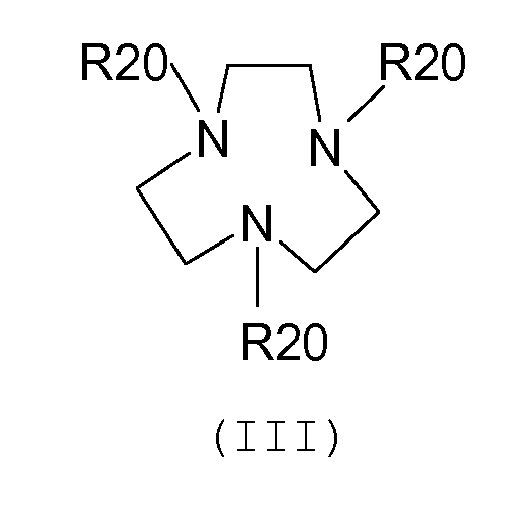
- Preferably R22 is selected from optionally substituted pyridin-2-yl, imidazol-4-yl, pyrazol-1-yl, quinolin-2-yl groups. Most preferably R22 is either a pyridin-2-yl or a quinolin-2-yl.
- The cyclam and cross bridged ligands are preferably in the form of a manganese transition metal catalyst.
- The cyclam ligand is preferably of the form:


- p is 4;
- R is independently selected from: hydrogen, C1-C6-alkyl, CH2CH2OH, pyridin-2-ylmethyl, and CH2COOH, or one of R is linked to the N of another Q via an ethylene bridge;
- R1, R2, R3, R4, R5 and R6 are independently selected from: H, C1-C4-alkyl, and C1-C4-alkylhydroxy.
- Preferred non-cross-bridged ligands are 1,4,8,11-tetraazacyclotetradecane (cyclam), 1,4,8,11-tetramethyl-1,4,8,11-tetraazacyclotetradecane (Me4cyclam), 1,4,7,10-tetraazacyclododecane (cyclen), 1,4,7,10-tetramethyl-1,4,7,10-tetraazacyclododecane (Me4cyclen), and 1,4,7,10-tetrakis(pyridine-2ylmethyl)-1,4,7,10-tetraazacyclododecane (Py4cyclen). With Py4cyclen the iron complex is preferred.
- A preferred cross-bridged ligand is of the form:
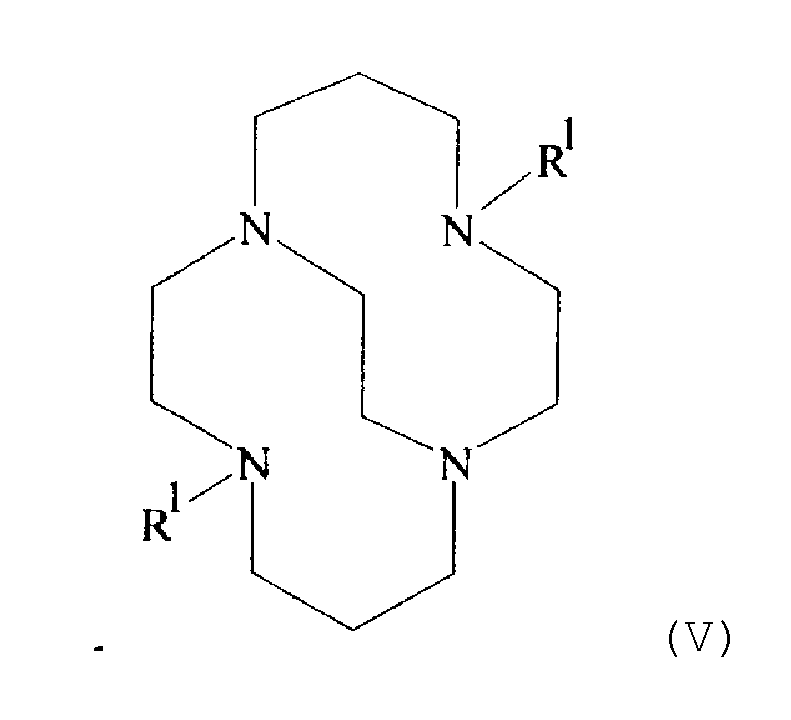
- Preferably R1 = Me, which is the ligand 5,12-dimethyl-1,5,8,12-tetraaza-bicyclo[6.6.2]hexadecane of which the complex [Mn(Bcyclam)Cl2] may be synthesised according to
WO98/39098 - Other suitable crossed bridged ligands are also found in
WO98/39098 - A suitable class of tridentate ligands is based on terpyridine-type ligands, depicted below.

- Also terpyridine derivatives could be employed, such as bispyridylpyrimidine or bispyridyltriazine. Preferred classes include the ones disclosed in
WO2002088289 ;WO2004007657 ;WO2004039933 ;WO2004039934 ;WO2005068075 ; andWO2005068074 ;WO2005105303 . - Another suitable class of molecules contains a substituted bipyridine-alkylamine-alkylpyridine unit, depicted below with m, n =1 or 2 as disclosed in
WO2007090461 .
- The trispicens are preferably in the form of an iron transition metal catalyst.
- The trispicen type ligands are preferably of the form:
R17R17N-X-NR17R17 (VI),
wherein: - X is selected from -CH2CH2-, -CH2CH2CH2-, -CH2C(OH)HCH2-; and,
- R17 independently represents a group selected from: R17 and alkyl, cycloalkyl, heterocycloalkyl, heteroaryl, aryl and arylalkyl groups optionally substituted with a substituent selected from hydroxy, alkoxy, phenoxy, carboxylate, carboxamide, carboxylic ester, sulphonate, amine, alkylamine and N+(R19)3, wherein R19 is selected from hydrogen, alkanyl, alkenyl, arylalkanyl, arylalkenyl, oxyalkanyl, oxyalkenyl, aminoalkanyl, aminoalkenyl, alkanyl ether, alkenyl ether, and -CY2-R18, in which Y is independently selected from H, CH3, C2H5, C3H7 and R18 is independently selected from an optionally substituted heteroaryl group selected from pyridinyl, pyrazinyl, pyrazolyl, pyrrolyl, imidazolyl, benzimidazolyl, pyrimidinyl, triazolyl and thiazolyl;
- and wherein at least two of R17 are -CY2-R18.
- The heteroatom donor group is preferably pyridinyl optionally substituted by -C0-C4-alkyl.
- Other preferred heteroatom donor groups are imidazol-2-yl, 1-methyl-imidazol-2-yl, 4-methyl-imidazol-2-yl, imidazol-4-yl, 2-methyl-imidazol-4-yl, 1-methyl-imidazol-4-yl, benzimidazol-2-yl and 1-methyl-benzimidazol-2-yl.
- Preferably three of R17 are CY2-R18.
- The ligand Tpen (i.e. N, N, N', N'-tetra(pyridin-2-yl-methyl)ethylenediamine) is disclosed in
WO97/48787 - The following are preferred trispicens: N-methyl-tris( pyridin-2-ylmethyl)ethylene-1,2-diamine; N-octyl-tris(pyridin-2-ylmethyl)ethylene-1,2-diamine; N-octadecyl-tris(pyridin-2-ylmethyl)ethylene-1,2-diamine; N-methyl-N,N',N'-tris(3-methyl-pyridin-2-ylmethyl)ethylene-1,2-diamine; N-ethyl-N,N',N'-tris(3-methyl-pyridin-2-ylmethyl)ethylene-1,2-diamine; N-methyl-N,N',N'-tris(5-methyl-pyridin-2-ylmethyl)ethyl ene-1,2-diamine;N-ethyl-N,N',N'-tris(5-methyl-pyridin-2-ylmethyl)ethylene-1,2-diamine; N-benzyl- N,N',N'-tris(3-methyl-pyridin-2-ylmethyl)ethylene-1,2-diamine; N-benzyl-N,N',N'-tris(5-methyl-pyridin-2-ylmethyl)ethyl ene-1,2-diamine;
- N-butyl-N,N',N'-tris(pyridin-2-ylmethyl)ethyl ene-1,2-diamine; N-octyl-N,N',N'-tris(pyridin-2-ylmethyl)ethyl ene-1,2-diamine; N-dodecyl-N,N',N'-tris(pyridin-2-ylmethyl)ethyl ene-1,2-diamine; N-octadecyl-N,N',N'-tris(pyridin-2-ylmethyl)ethyl ene-1,2-diamine; N-Methyl-N,N',N'-Tris(imidazol-2ylmethyl)- ethylenediamine; N-ethyl-N,N',N'-Tris(imidazol-2ylmethyl)-ethylenediamine; N,N'-dimethyl-N,N'-bis(imidazol-2-ylmethyl)-ethylenediamine; N-(1-propan-2-ol)-N,N',N'-Tris(imidazol-2ylmethyl)-ethylenediamine; N-(1-propan-2-ol)-N,N',N'-Tris(1-methyl-imidazol-2ylmethyl)-ethylenediamine; N,N-diethyl-N',N",N"-Tris(5-methyl-imidazol-4ylmethyl)-diethylenetriamine; N-(3-propan-1-ol)-N,N',N'-Tris(1-methyl-imidazol-2-ylmethyl)-ethylenediamine; N-hexyl-N,N',N'-Tris(imidazol-2ylmethyl)-ethylenediamine; N-methyl-N,N',N'-tris(benzimidazol-2ylmethyl)-ethylenediamine; and, N-(3-propan-1-ol)methyl-N,N',N'-tris(benzimidazol-2ylmethyl)-ethylenediamine.
- Other suitable trispicens are found in
WO02/077145 - Of the non-bispidon type catalysts the following are most preferred:
- 5,12-dimethyl-1,5,8,12-tetraaza-bicyclo[6.6.2]hexadecane,
- 5,12-dibenzyl-1,5,8,12-tetraaza-bicyclo[6.6.2]hexadecane,
- 1,4,8,11-tetraazacyclotetradecane, 1,4,8,11-tetramethyl-1,4,8,11-tetraazacyclotetradecane, 1,4,7,10-tetraazacyclododecane, 1,4,7,10-tetramethyl-1,4,7,10-tetraazacyclododecane, and 1,4,7,10-tetrakis(pyridine-2ylmethyl)-1,4,7,10-tetraazacyclododecane, N,N-bis(pyridin-2-yl-methyl)-bis(pyridin-2-yl)methylamine, N,N-bis(pyridin-2-yl-methyl-1,1-bis(pyridin-2-yl)- 1- aminoethane, N,N,N',N'-tetra(pyridin-2-yl-methyl)ethylenediamine, N-methyl-tris(pyridin-2-ylmethyl)ethylene-1,2-diamine; N-butyl-N,N',N'-tris(pyridin-2-ylmethyl)ethylene-1,2-diamine; N-octyl-N,N',N'-tris(pyridin-2-ylmethyl)ethylene-1,2-diamine; N-dodecyl-N,N',N'-tris(pyridin-2-ylmethyl)ethylene-1,2-diamine; N-octadecyl-N,N',N'-tris(pyridin-2-ylmethyl)ethylene-1,2-diamine; N-methyl-N,N',N'-tris(3-methyl-pyridin-2-ylmethyl)ethylene-1,2-diamine; N-ethyl-N,N',N'-tris(3-methyl-pyridin-2-ylmethyl)ethylene-1,2-diamine; N-methyl-N,N',N'-tris(5-methyl-pyridin-2-ylmethyl)ethylene-1,2-diamine;N-ethyl-N,N',N'-tris(5-methyl-pyridin-2-ylmethyl)ethylene-1,2-diamine; N-benzyl- N,N',N'-tris(3-methyl-pyridin-2-ylmethyl)ethylene-1,2-diamine; N-benzyl-N,N',N'-tris(5-methyl-pyridin-2-ylmethyl)ethylene-1,2-diamine; N-methyl-N,N',N'-tris(imidazol-2ylmethyl)-ethylenediamine; N-ethyl-N,N',N'-tris(imidazol-2ylmethyl)-ethylenediamine; N,N'-dimethyl-N,N'-bis(imidazol-2-ylmethyl)-ethylenediamine; N-(1-propan-2-ol)-N,N',N'-tris(imidazol-2ylmethyl)-ethylenediamine; N-(1-propan-2-ol)-N,N',N'-tris(1-methyl-imidazol-2ylmethyl)-ethylenediamine; N,N-diethyl-N',N",N"-tris(5-methyl-imidazol-4ylmethyl)-diethylenetriamine; N-(3-propan-1-ol)-N,N',N'-tris(1-methyl-imidazol-2-ylmethyl)-ethylenediamine; N-hexyl-N,N',N'-tris(imidazol-2ylmethyl)-ethylenediamine; N-methyl-N,N',N'-tris(benzimidazol-2ylmethyl)-ethylenediamine; and, N-(3-propan-1-ol)methyl-N,N',N'-tris(benzimidazol-2ylmethyl)-ethylenediamine; 1,4-bis(quinolin-2-ylmethyl)-7-octyl-1,4,7-triazacyclononane; 1,4-bis(quinolin-2-ylmethyl)-7-ethyl-1,4,7-triazacyclononane; 1,4-bis(quinolin-2-ylmethyl)-7-methyl-1,4,7-triazacyclononane, ; 1,4-bis(pyridyl-2-methyl)-7-octyl-1,4,7-triazacyclononane ; 1,4-bis(pyridyl-2-methyl)-7-ethyl-1,4,7-triazacyclononane; 1,4-bis(pyridyl-2-methyl)-7-methyl-1,4,7-triazacyclononane; 1,4-bis(pyrazol-1-ylmethyl)-7-octyl-1,4,7-triazacyclononane; 1,4-bis(pyrazol-1-ylmethyl)-7-ethyl-1,4,7-triazacyclononane; 1,4-bis(pyrazol-1-ylmethyl)-7-methyl-1,4,7-triazacyclononane, 3,5-dimethylpyrazol-1-ylmethyl)-7-octyl-1,4,7-triazacyclononane; 3,5-dimethylpyrazol-1-ylmethyl)-7-ethyl-1,4,7-triazacyclononane; 3,5-dimethylpyrazol-1-ylmethyl)-7-methyl-1,4,7-triazacyclononane; 1,4-bis(1-methylimidazol-2-ylmethyl)-7-octyl-1,4,7-triazacyclononane; 1,4-bis(1-methylimidazol-2-ylmethyl)-7-ethyl-1,4,7-triazacyclononane;
- 1,4-bis(1-methylimidazol-2-ylmethyl)-7-methyl-1,4,7-triazacyclononane; and, 1,4,7-tris(quinolin-2-ylmethyl)-1,4,7-triazacyclononane; 1,4,7-tris(pyridin-2-ylmethyl)-1,4,7-triazacyclononane.
- A class of oxidatively stable iron(III) complexes with dianionic tetradentate nitrogen donor ligands have been disclosed by Collins and co-workers. References are made to
WO1999058634 ;WO A 9803625 1996 - A more preferred transition metal catalyst for the method is as described in
EP 0458397 andWO06/125517 - The catalyst is most preferably a mononuclear or dinuclear complex of a Mn II-V transition metal catalyst, the ligand of the transition metal catalyst of formula (I):

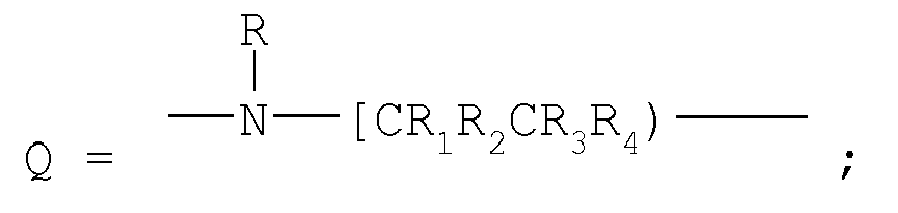
- p is 3;
- R is independently selected from: hydrogen, C1-C6-alkyl, C2OH, C1COOH, and pyridin-2-ylmethyl or one of R is linked to the N of another Q via an ethylene bridge;
- R1, R2, R3, and R4 are independently selected from: H, C1-C4-alkyl, and C1-C4-alkylhydroxy.
- R is preferably independently selected from: hydrogen, CH3, C2H5, CH2CH2OH and CH2COOH.
- R, R1, R2, R3, and R4 are preferably independently selected from: H and Me.
- 1,4,7-Trimethyl-1,4,7-triazacyclononane (Me3-TACN) and 1,2,-bis-(4,7,-dimethyl-1,4,7,-triazacyclonon-1-yl)-ethane (Me4-DTNE) are most preferred.
- The surfactant aids the wetability of the cellulosic substrate and aids action of the bleaching chemicals on the substrate.
- The surfactant may be applied in step (a) and/or in step (b).
- The cellulosic substrate is preferably treated with a surfactant prior to or during step (b). Most preferred is the application of most (between 90 and 99%) of the surfactant in step (a) and the remainder is adding during step (b) (between 1 and 10%).
- The cellulosic substrate is preferably treated with a surfactant prior to or during step (b) and in this regard, it is preferred that surfactant is present in step (a).
- The surfactant is preferably non-ionic or anionic or a mixture thereof. More preferably mostly nonionic based surfactant mixtures are applied. A non-limiting example includes Sandoclean PCJ™ (ex Clariant).
- The concentration of surfactant is preferably between 1 g/l and 15 g/l and more preferably between 2 and 10 g/l, as applied in the bleaching solution or in conjunction with the spraying solution containing the catalyst or in a combination thereof.
- Many sequestrants are suitable for use with the present invention. Suitable sequestrants include ethylenediamine tetra-acetate (EDTA), the polyphosphonates such as Dequest™ and non-phosphate stabilisers such as EDDS (ethylene diamine di-succinic acid).
- The sequestrant used in the bleaching step is preferably a aminocarboxylate sequestrant or mixtures thereof. The following are preferred examples of aminocarboxylate sequetrants: ethylenediaminetetraacetic acid (EDTA), N-hydroxyethylenediaminetetraacetic acid (HEDTA), nitrilotriacetic acid (NTA), N-hydroxyethylaminodiacetic acid, diethylenetriaminepentaacetic acid (DTPA), methylglycinediacetic acid (MGDA), and alanine-N,N-diacetic acid. A most preferred aminocarboxylate sequestrant is diethylenetriaminepentaacetic acid (DTPA).
- Phosphonate sequesterents may also be used; a preferred phosphonate sequesterent is Dequest 2066.
- The most preferred concentration of the sequestrant used in the method is 0.05 to 5 g/l in the bleaching solution, most preferably 0.1 to 2 g/l.
- First raw cotton cloths were pretreated using a solution containing 1 g/L Na5DTPA and 0.5 g/L Sandoclean PCJ (Clariant) at pH 11. Raw cotton is inserted in a flask with the solution described above (liquid:cloth ratio is equal to 10) and is then left at 65°C for 10 minutes. The textile was then washed twice at 80°C, once at 40°C and once at room temperature before being spin dried and in the end dried under ambient conditions.
- Pre-treated textiles (6 g each) were immersed for 30 seconds in an aqueous solution containing 7.5 g/l Sandoclean PCJ (ex Clariant), 3.125 g/l Na2CO3, 0.25 g/l Na5DTPA (diethylenetriamine-N,N,N',N",N"-penta-acetate), 85 ml hydrogen peroxide (35%) that was adjusted to pH 9.0 by using HCl or NaOH solution (1M). After that, the wet cloths were taken out of the solution and put through a padder, yielding a pick-up of 80% (i.e. 100 gram cotton contains 80 grams of liquid). Subsequently, a solution of 20 µM of [Mn2O3(Me3tacn)2](CH3COO)2 was made in demineralised water. [Mn2O3(Me3tacn)2](CH3COO)2 was obtained as disclosed elsewhere (
WO 2006/125517 ). This solution was brought into a container that was connected to a spraying gun. By using a compressor (JUN-AIR, model OF302) adjusted at 3 bar and a full cone (air atomizing) nozzle, the solution containing the catalyst was sprayed onto the cotton cloth. The amount of solution added was adjusted to generate a pick-up of 100% (i.e. 100 gram cotton contains 80 grams of the bleaching liquid + 20 g of the sprayed catalyst liquid). In the blank (no catalyst), the spraying was done with pure water. - Then the cloths were put in a steamer (99°C) and left for 3 min in the steamer. After that the cloths were washed twice in a beaker glass using water of 80 °C, then once at 40 °C (in water containing 1g/L acetic acid glacial for allowing the neutralization) and then once using water at room temperature. The cloths were spin dried and then dried under ambient conditions.
- The optical properties of the cloths were then measured using a Minolta spectrophotometer CM-3700d, using L, a, b values which are converted to Berger Whiteness values. The values of whiteness are expressed in Berger units. The formula of Berger whiteness is given below:
- Wberger = Y + a.Z - b.X, where a = 3.448 and b = 3.904. The values X, Y, Z are the coordinates of the achromatic point.
- The whiteness obtained was 65.9 Berger units in the case when the manganese catalyst was present, whilst the blank furnished a whiteness of 60.2 Berger units.
- The same experiment was conducted as described above, except that in the bleaching liquid the following composition was used: Sodium Carbonate buffer 3.125 g/L, Na5DTPA 0.25 g/L, Sandoclean PCJ 7.5 g/L, H2O2 (35%) 85 mL/L, pH 10 (pick-up 80% as explained above in example 1). In the spraying solution 20 µM of [Mn2O3(Me3tacn)2](CH3COO)2 was added, giving a total pick up of 100% as explained above. The sprayed cotton cloths were put in a steamer for 3 minutes.
- As a reference, in the bleaching liquid the following composition was used: Sodium Carbonate buffer 2.5 g/L, Na5DTPA 0.20 g/L, Sandoclean PCJ 6 g/L, H2O2 (35%) 68 mL/L, 3.33 µM of [Mn2O3(Me3tacn)2](CH3COO)2 was added. The pH was adjusted to 10.0. Note that now the chemical levels are different as mentioned above. This is due to the fact that the cloths are immersed in the bleaching bath instead of first immersing the bleaching chemicals (without catalyst), then putting the cloths through the padder (to yield 80% pick-up) and then spray the (more concentrated ) catalyst solution on the cloths (to yield 100% pick-up). When the chemicals are all added (without spraying), more of the catalyst can be adsorbed, hence a lower concentration in the bath is used. Also the other bleaching chemicals are now added at lower level as one has to obtain 100% instead of 80% pick-up).
- The whiteness obtained was 68.6 Berger units in the case when the manganese catalyst was sprayed, whilst for the comparative test (manganese catalyst present in bleaching solution), whilst the result showed 69.0 Berger units, which is within the error margin of the experiment (+/- 1 Berger unit).
- Therefore, it is shown that spraying the catalyst onto the cotton can lead to a similar bleaching result as bringing all bleaching chemicals in the bleaching bath onto the cotton, without entering the risk of undesired mutual decomposition of hydrogen peroxide and manganese catalyst upon leaving these chemicals mixed in the bleaching liquor for longer periods of time.
- The same experiment was conducted as described above, except that untreated raw cotton was used and in the bleaching liquid the following composition was used: Sodium Carbonate buffer 3.125 g/L, Na5DTPA 0.25 g/L, Sandoclean PCJ 7.125 g/L, H2O2 (35%) 85 mL/L, pH 10 (pick-up 80% as explained above in example 1). In the spraying solution 20 µM of [Mn2O3(Me3tacn)2](CH3COO)2 and 1.5 g/l of Sandoclean PCJ was added, giving a total pick up of 100% as explained above. The sprayed cotton cloths were put in a steamer for 6 minutes. As a reference, no surfactant was added to the spraying solution, but instead all of the surfactant was added in the bleaching liquor (i.e. 7.5 g/l).
- The results were as follows: Spraying Sandoclean with the manganese complex yielded 76.4 Berger whiteness, whilst the reference experiment (spraying the manganese catalyst only) gave 73.0 Berger whiteness.
- The cotton cloths were first treated with Sandoclean PCJ, Na5DTPA at pH 11 as described in example 1. The cloths were then brought into a bleaching bath containing Sandoclean PCJ 5 g/l, H2O2 (35%) 85 g/l at pH 11 (no buffer applied), Na5DTPA 0.25 g/l. Subsequently, the cloths were brought into a padder and excess of liquor was squeezed out to get a pick up of 80 %. Then the cloths were brought into a steamer for 6 min at 99 °C.
- Subsequently, the cloths were sprayed with the solution containing the manganese catalyst, [Mn2O3(Me3tacn)2](CH3COO)2 (5 µM in the spraying solution). Subsequently, the impregnated cloths were left in a hot towel (90 °C) for 2 min. Subsequently the cloths were washed and dried as described for experiment 1. A whiteness of 78 Berger units was thus obtained, whilst a comparative experiment (exactly the same protocol, except no catalyst solution was sprayed on the cotton), furnished 73 Berger whiteness points.
- Add to a beaker glass 9.61 ml H2O, 2,5 ml Carbonate buffer (2.5 g/l), 6 ml Sandoclean PCJ (6 g/l) - ex Clariant; 1.36 ml/l H2O2 (68 ml/l, 35%); 0.5 ml 1 M NaOH (25 ml/l) to get pH 10. The solution was warmed up to 40 °C or 60 °C. Add [Mn2O3(Me3tacn)2](PF6)2.H2O to get a final concentration of 3.33 micromol/l (this is a typical level as would be used when applying the manganese catalyst in conjunction with hydrogen peroxide for a continuous bleaching process). Reference experiments were done using no manganese catalyst in the solution to exemplify the enhanced hydrogen peroxide decomposition in the presence of the manganese Me3TACN catalyst.
- The level of hydrogen peroxide was determined using the so-called FOX method, as exemplified in open literature (Gülgün Yildiz, et al., J. Am. Oil Chem. Soc., 80, 103 (2003)) .
- After 45 minutes at 40 oC the hydrogen peroxide level was determined to be about 100 % (wrt to original level) when there was no catalyst present. In the presence of the manganese Me3tacn catalyst the level of hydrogen peroxide was reduced to 70%. This is a highly undesired situation as for the continuous bleaching process it is very important to have a stable level of bleaching chemicals to get an even bleaching/cleaning process.
- The same experiment was done at 60 oC. After already 10 minutes, the level of hydrogen peroxide in the presence of the Mn(Me3tacn) catalyst was reduced to 72%, whilst in the absence of catalyst, the level of hydrogen peroxide was 92%.
- A further stabilization of the hydrogen peroxide solution (with and without catalyst) can be obtained using 1 g/l DTPA in the solution. After 30 minutes at 60 oC, the level of hydrogen peroxide was 95% in the absence and 76% in the presence of the Mn(Me3tacn) catalyst.
- All the above examples show that the presence of the Mn-Me3tacn catalyst will impede the hydrogen peroxide stability in the bleaching bath.
- The same experiments were conducted similarly to what has been shown in example 1, except that untreated raw cotton was used. This compound was prepared as disclosed elsewhere (K. Schaefer et al., J. Am. Chem. Soc., 120, 13104 (1998). [MnIIIMnIV(Me4-DTNE) (µ-O)2 (µ-CH3COO)](PF6)2 was sprayed at a level of 10 µmol/l in demineralised water that was sprayed onto the cotton. The level of Sandoclean PCJ was 7.5 g/l, the level of Na5DTPA was 1.25 g/l and the level of 35% hydrogen peroxide was 85 ml/l in the impregnating solution. The pH of the solution was 11.5 (adjusted using 4 M NaOH). As a reference water without catalyst was sprayed. All experiments were done in four-fold.
- The results are: 71.0 +/- 1.3 for the blank and 72.7 +/- 0.6 for the solution with the catalyst, showing that the benefit is significant.
- This compound was synthesised according to prior art (
WO98/39098 - The same experiments were conducted similarly to what has been shown in example 6, except that now 50 µmol/l [Mn(Bcyclam)Cl2] was used in demineralised water that was sprayed onto the cotton (Byclam stands for 5,12-dimethyl-1,5,8,12-tetraazabicyclo[6.6.2]hexadecane).
- The pH of the solution was 9 using 3.125 g /l sodium carbonate buffer (adjusted to the right pH using 0.1 M NaOH or 0.1 M HCl).
- The results are: 60.0 +/- 0.7 for the blank (no catalyst sprayed) and 62.3 +/- 0.5 for the solution with the catalyst, showing that the benefit is significant.
Claims (13)
- A continuous or semi continuous bleaching method for industrial bleaching of a cellulosic substrate, the method comprising the following steps: (a) subjecting the cellulosic substrate to moisture, and hydrogen peroxide to provide a wet peroxide enriched cellulosic substrate; (b) applying to the cellulosic substrate from step (a), in the form of a spray or foam, a 0.1 to 200 micromolar aqueous solution of a preformed transition metal catalyst, wherein the transition metal is selected from Fe(II) and Fe(III), Mn(II), Mn(III), and Mn(IV) and the ligand of the preformed transition metal catalyst is selected from a tridentate, tetradentate, pentadentate or hexadentate nitrogen donor.
- A method according to claim 1, wherein the preformed transition metal catalyst salt is a mononuclear or dinuclear complex of a Mn II-V transition metal catalyst, the ligand of the transition metal catalyst of formula (I):

 p is 3;R is independently selected from: hydrogen, C1-C6-alkyl, C2OH, C1COOH, and pyridin-2-ylmethyl or one of R is linked to the N of another Q via an ethylene bridge;R1, R2, R3, and R4 are independently selected from: H, C1-C4-alkyl, and C1-C4-alkylhydroxy.
 - A method according to claim 2, wherein R is independently selected from: hydrogen, CH3, C2H5, CH2CH2OH and CH2COOH.
- A method according to claim 2 or 3, wherein R, R1, R2, R3, and R4 are independently selected from: H and Me.
- A method according to claim 1, wherein the catalyst is derived from a ligand selected from the group consisting 1,4,7-Trimethyl-1,4,7-triazacyclononane (Me3-TACN), 1,2,-bis-(4,7,-dimethyl-1,4,7,-triazacyclonon-1-yl)-ethane (Me4-DTNE), and 5,12-dimethyl-1,5,8,12-tetraazabicyclo[6.6.2]hexadecane.
- A method according to any preceding claim, wherein the cellulosic substrate is treated as a moving web.
- A method according to claim 6, wherein the aqueous solution of a preformed transition metal catalyst is applied as a spray.
- A method according to any preceding claim, wherein in step (a) the hydrogen peroxide is applied as an aqueous solution having a pH in the range between 8 and 12 and in step (b) the aqueous solution has a pH between 8 and 12.
- A method according to any preceding claim, wherein step (b) is applied at least 1 minute after step (a) and a maximum of 30 minutes after step (a).
- A method according to any preceding claim, wherein the wet peroxide enriched cellulosic substrate is at a temperature of at least 70 °C when the preformed transition metal catalyst is applied as a spray.
- A method according to any preceding claim, wherein the wet peroxide enriched cellulosic substrate is treated with surfactant.
- A method according to claim 11, wherein the wet peroxide enriched cellulosic substrate is treated with a surfactant prior or during (b).
- A method according to any preceding claim, wherein from between 0.1 to 20 minutes after step (b) the cellulosic substrate is subjected to an aqueous washing step for removing salts from the cellulosic substrate.
Priority Applications (1)
| Application Number | Priority Date | Filing Date | Title |
|---|---|---|---|
| EP08152872A EP2103735A1 (en) | 2008-03-18 | 2008-03-18 | Catalytic bleaching of substrates |
Applications Claiming Priority (1)
| Application Number | Priority Date | Filing Date | Title |
|---|---|---|---|
| EP08152872A EP2103735A1 (en) | 2008-03-18 | 2008-03-18 | Catalytic bleaching of substrates |
Publications (1)
| Publication Number | Publication Date |
|---|---|
| EP2103735A1 true EP2103735A1 (en) | 2009-09-23 |
Family
ID=40242985
Family Applications (1)
| Application Number | Title | Priority Date | Filing Date |
|---|---|---|---|
| EP08152872A Withdrawn EP2103735A1 (en) | 2008-03-18 | 2008-03-18 | Catalytic bleaching of substrates |
Country Status (1)
| Country | Link |
|---|---|
| EP (1) | EP2103735A1 (en) |
Cited By (4)
| Publication number | Priority date | Publication date | Assignee | Title |
|---|---|---|---|---|
| WO2011141692A1 (en) * | 2010-05-10 | 2011-11-17 | Unilever Plc | Freeness of paper products |
| WO2012028800A1 (en) | 2010-09-03 | 2012-03-08 | Arkema France | Process for the delignification and bleaching of paper pulp using active hydrogen peroxide |
| US8940682B2 (en) | 2009-05-14 | 2015-01-27 | Ecolab Usa Inc. | Peroxygen catalyst-containing fabric and use for in situ generation of alkalinity |
| CN112796098A (en) * | 2020-12-14 | 2021-05-14 | 辛集市凯科瑞生物科技有限公司 | Towel fabric cold-batch high-whiteness economical dyeing and finishing pretreatment process under reclaimed water condition |
Citations (25)
| Publication number | Priority date | Publication date | Assignee | Title |
|---|---|---|---|---|
| EP0237111A2 (en) * | 1986-03-07 | 1987-09-16 | Unilever N.V. | Detergent bleach composition, bleaching compositions and bleach activators |
| EP0458398A2 (en) * | 1990-05-21 | 1991-11-27 | Unilever N.V. | Bleach activation |
| WO1992013129A1 (en) * | 1991-01-23 | 1992-08-06 | American Laundry Machinery, Inc. | Process and apparatus for treating cellulosic fiber-containing fabric |
| WO1995034628A1 (en) | 1994-06-13 | 1995-12-21 | Unilever N.V. | Bleach activation |
| WO1997048787A1 (en) | 1996-06-19 | 1997-12-24 | Unilever N.V. | Bleach activation |
| WO1998003625A1 (en) | 1996-07-22 | 1998-01-29 | Carnegie Mellon University | Metal ligand containing bleaching compositions |
| WO1998039098A1 (en) | 1997-03-07 | 1998-09-11 | The University Of Kansas | Catalysts and methods for catalytic oxidation |
| EP0909809A2 (en) | 1997-10-01 | 1999-04-21 | Unilever Plc | Bleach activation |
| US5965506A (en) * | 1994-07-21 | 1999-10-12 | Ciba Specialty Chemicals Corporation | Fabric bleaching composition |
| WO1999058634A1 (en) | 1998-05-11 | 1999-11-18 | Carnegie Mellon University | Metal ligand containing bleaching compositions |
| WO2000012667A1 (en) | 1998-09-01 | 2000-03-09 | Unilever Plc | Composition and method for bleaching a substrate |
| US20020010120A1 (en) | 2000-02-29 | 2002-01-24 | Unilever Home & Personal Care Usa, Division Of Conopco, Inc. | Composition and method for bleaching a substrate |
| WO2002048301A1 (en) | 2000-12-15 | 2002-06-20 | Unilever Plc | Ligand and complex for catalytically bleaching a substrate |
| EP1225215A2 (en) * | 2001-01-19 | 2002-07-24 | Clariant GmbH | Use of transition metal complexes with oxime ligands as bleach catalysts |
| WO2002077145A1 (en) | 2001-02-05 | 2002-10-03 | Unilever Plc | Composition and method for bleachin g a substrate |
| WO2002088289A2 (en) | 2001-04-30 | 2002-11-07 | Ciba Specialty Chemicals Holding Inc. | Use of metal complex compounds as oxidation catalysts |
| WO2003104379A1 (en) | 2002-06-06 | 2003-12-18 | Unilever N.V. | Ligand and complex for catalytically bleaching a substrate |
| WO2004007657A1 (en) | 2002-07-11 | 2004-01-22 | Ciba Specialty Chemicals Holding Inc. | Use of metal complex compounds as oxidation catalysts |
| WO2004039934A1 (en) | 2002-10-30 | 2004-05-13 | Ciba Specialty Chemicals Holding Inc. | Use of metal complex compounds as oxidation catalysts |
| WO2004039933A1 (en) | 2002-10-29 | 2004-05-13 | Ciba Specialty Chemicals Holding Inc. | Use of metal complex compounds as catalysts for oxidation using molecular oxygen or air |
| WO2005068075A1 (en) | 2004-01-12 | 2005-07-28 | Ciba Specialty Chemicals Holding Inc. | Use of a composition comprising metal complex compounds and polyphosphonates as catalysts for oxidations |
| WO2005068074A2 (en) | 2004-01-12 | 2005-07-28 | Ciba Specialty Chemicals Holding Inc. | Use of metal complex compounds comprising pyridine pryimidine or s-triazne derived ligands as catalysts for oxidations with organic peroxy acids and/or precursors of organic peroxy acid and h2o2 |
| WO2005105303A1 (en) | 2004-04-29 | 2005-11-10 | Ciba Specialty Chemicals Holding Inc. | Use of metal complexes having bispyridylpyrimidine or bispyridyltriazine ligands as catalysts for reactions with peroxy compounds for bleaching coloured stains on hard surfaces |
| WO2006125517A1 (en) | 2005-05-27 | 2006-11-30 | Unilever Plc | Process of bleaching |
| WO2007090461A1 (en) | 2006-02-06 | 2007-08-16 | Ciba Holding Inc. | Use of metal complex compounds as oxidation catalysts |
-
2008
- 2008-03-18 EP EP08152872A patent/EP2103735A1/en not_active Withdrawn
Patent Citations (26)
| Publication number | Priority date | Publication date | Assignee | Title |
|---|---|---|---|---|
| EP0237111A2 (en) * | 1986-03-07 | 1987-09-16 | Unilever N.V. | Detergent bleach composition, bleaching compositions and bleach activators |
| EP0458398A2 (en) * | 1990-05-21 | 1991-11-27 | Unilever N.V. | Bleach activation |
| EP0458397A2 (en) | 1990-05-21 | 1991-11-27 | Unilever N.V. | Bleach activation |
| WO1992013129A1 (en) * | 1991-01-23 | 1992-08-06 | American Laundry Machinery, Inc. | Process and apparatus for treating cellulosic fiber-containing fabric |
| WO1995034628A1 (en) | 1994-06-13 | 1995-12-21 | Unilever N.V. | Bleach activation |
| US5965506A (en) * | 1994-07-21 | 1999-10-12 | Ciba Specialty Chemicals Corporation | Fabric bleaching composition |
| WO1997048787A1 (en) | 1996-06-19 | 1997-12-24 | Unilever N.V. | Bleach activation |
| WO1998003625A1 (en) | 1996-07-22 | 1998-01-29 | Carnegie Mellon University | Metal ligand containing bleaching compositions |
| WO1998039098A1 (en) | 1997-03-07 | 1998-09-11 | The University Of Kansas | Catalysts and methods for catalytic oxidation |
| EP0909809A2 (en) | 1997-10-01 | 1999-04-21 | Unilever Plc | Bleach activation |
| WO1999058634A1 (en) | 1998-05-11 | 1999-11-18 | Carnegie Mellon University | Metal ligand containing bleaching compositions |
| WO2000012667A1 (en) | 1998-09-01 | 2000-03-09 | Unilever Plc | Composition and method for bleaching a substrate |
| US20020010120A1 (en) | 2000-02-29 | 2002-01-24 | Unilever Home & Personal Care Usa, Division Of Conopco, Inc. | Composition and method for bleaching a substrate |
| WO2002048301A1 (en) | 2000-12-15 | 2002-06-20 | Unilever Plc | Ligand and complex for catalytically bleaching a substrate |
| EP1225215A2 (en) * | 2001-01-19 | 2002-07-24 | Clariant GmbH | Use of transition metal complexes with oxime ligands as bleach catalysts |
| WO2002077145A1 (en) | 2001-02-05 | 2002-10-03 | Unilever Plc | Composition and method for bleachin g a substrate |
| WO2002088289A2 (en) | 2001-04-30 | 2002-11-07 | Ciba Specialty Chemicals Holding Inc. | Use of metal complex compounds as oxidation catalysts |
| WO2003104379A1 (en) | 2002-06-06 | 2003-12-18 | Unilever N.V. | Ligand and complex for catalytically bleaching a substrate |
| WO2004007657A1 (en) | 2002-07-11 | 2004-01-22 | Ciba Specialty Chemicals Holding Inc. | Use of metal complex compounds as oxidation catalysts |
| WO2004039933A1 (en) | 2002-10-29 | 2004-05-13 | Ciba Specialty Chemicals Holding Inc. | Use of metal complex compounds as catalysts for oxidation using molecular oxygen or air |
| WO2004039934A1 (en) | 2002-10-30 | 2004-05-13 | Ciba Specialty Chemicals Holding Inc. | Use of metal complex compounds as oxidation catalysts |
| WO2005068075A1 (en) | 2004-01-12 | 2005-07-28 | Ciba Specialty Chemicals Holding Inc. | Use of a composition comprising metal complex compounds and polyphosphonates as catalysts for oxidations |
| WO2005068074A2 (en) | 2004-01-12 | 2005-07-28 | Ciba Specialty Chemicals Holding Inc. | Use of metal complex compounds comprising pyridine pryimidine or s-triazne derived ligands as catalysts for oxidations with organic peroxy acids and/or precursors of organic peroxy acid and h2o2 |
| WO2005105303A1 (en) | 2004-04-29 | 2005-11-10 | Ciba Specialty Chemicals Holding Inc. | Use of metal complexes having bispyridylpyrimidine or bispyridyltriazine ligands as catalysts for reactions with peroxy compounds for bleaching coloured stains on hard surfaces |
| WO2006125517A1 (en) | 2005-05-27 | 2006-11-30 | Unilever Plc | Process of bleaching |
| WO2007090461A1 (en) | 2006-02-06 | 2007-08-16 | Ciba Holding Inc. | Use of metal complex compounds as oxidation catalysts |
Non-Patent Citations (12)
| Title |
|---|
| ACC. CHEM. RES., vol. 35, 2002, pages 782 |
| GULGUN YILDIZ ET AL., J. AM. OIL CHEM. SOC., vol. 80, 2003, pages 103 |
| INORG CHEM., vol. 31, 1992, pages 1550 |
| J. AM. CHEM. SOC., vol. 111, 1989, pages 4511 |
| J. AM. CHEM. SOC., vol. 112, 1990, pages 5637 |
| J. AM. CHEM. SOC., vol. 112, 1990, pages 899 |
| J. AM. CHEM. SOC., vol. 120, 1998, pages 11540 |
| J. AM. CHEM. SOC., vol. 120, 1998, pages 4867 |
| J. AM. CHEM. SOC., vol. 125, 2003, pages 12379 |
| J. AM. CHEM. SOC., vol. 127, 2005, pages 2505 |
| K. SCHAEFER ET AL., J. AM. CHEM. SOC., vol. 120, 1998, pages 13104 |
| TEXTILE RESEARCH JOURNAL, vol. 52, no. 6, 1982, pages 395 - 403 |
Cited By (11)
| Publication number | Priority date | Publication date | Assignee | Title |
|---|---|---|---|---|
| US8940682B2 (en) | 2009-05-14 | 2015-01-27 | Ecolab Usa Inc. | Peroxygen catalyst-containing fabric and use for in situ generation of alkalinity |
| US8946141B2 (en) | 2009-05-14 | 2015-02-03 | Ecolab Usa Inc. | Compositions, systems and method for in situ generation of alkalinity |
| US8946140B2 (en) | 2009-05-14 | 2015-02-03 | Ecolab Usa Inc. | Compositions, systems and method for in situ generation of alkalinity |
| WO2011141692A1 (en) * | 2010-05-10 | 2011-11-17 | Unilever Plc | Freeness of paper products |
| EP2395147A1 (en) * | 2010-05-10 | 2011-12-14 | Unilever Plc, A Company Registered In England And Wales under company no. 41424 of Unilever House | Freeness of paper products |
| CN103109015A (en) * | 2010-05-10 | 2013-05-15 | 卡特克塞尔有限公司 | Freeness of paper products |
| RU2573675C2 (en) * | 2010-05-10 | 2016-01-27 | Кэтексел Лимитед | Freeness of paper products |
| CN103109015B (en) * | 2010-05-10 | 2016-08-03 | 卡特克塞尔有限公司 | The freedom of paper product |
| WO2012028800A1 (en) | 2010-09-03 | 2012-03-08 | Arkema France | Process for the delignification and bleaching of paper pulp using active hydrogen peroxide |
| FR2964394A1 (en) * | 2010-09-03 | 2012-03-09 | Arkema France | METHOD FOR DELIGNIFYING AND WHITENING PAPER PULP USING ACTIVE HYDROGEN PEROXIDE |
| CN112796098A (en) * | 2020-12-14 | 2021-05-14 | 辛集市凯科瑞生物科技有限公司 | Towel fabric cold-batch high-whiteness economical dyeing and finishing pretreatment process under reclaimed water condition |
Similar Documents
| Publication | Publication Date | Title |
|---|---|---|
| EP1934396B1 (en) | Bleaching of substrates | |
| AU2007344425B2 (en) | Bleaching of substrates | |
| EP1109965B1 (en) | Method of treating a textile | |
| JP4562341B2 (en) | Permanent press processing method for textiles using hydrophobic bleach | |
| CA2808240C (en) | High brightness pulps from lignin rich waste papers | |
| CN100376742C (en) | Method for using hydrophobic bleaching systems in cold batch textile preparation | |
| KR20020030731A (en) | Transition metal complexes with polydentate ligands for enhancing the bleaching and delignifying effect of peroxo compounds | |
| EP2103735A1 (en) | Catalytic bleaching of substrates | |
| US4195974A (en) | Desizing and bleaching of textile goods | |
| FI115642B (en) | Bleaching process for high yields | |
| WO2010006861A1 (en) | A process for treating stains on fabric | |
| US20120077726A1 (en) | Gentle bleaching agent | |
| US5000874A (en) | Concentrated compositions and their use as stabilizers for peroxide-containing alkaline liquors | |
| DE60105013T2 (en) | COMPOSITION AND METHOD FOR BLEACHING A SUBSTRATE | |
| JP2003523485A (en) | Use of a hydrophobic bleaching system in the production of textiles | |
| CN105452432B (en) | combination | |
| US20120005839A1 (en) | Gentle bleaching agent | |
| GB2423093A (en) | Detergent comprising EDDS and a peroxygen bleach and use thereof |
Legal Events
| Date | Code | Title | Description |
|---|---|---|---|
| PUAI | Public reference made under article 153(3) epc to a published international application that has entered the european phase |
Free format text: ORIGINAL CODE: 0009012 |
|
| AK | Designated contracting states |
Kind code of ref document: A1 Designated state(s): AT BE BG CH CY CZ DE DK EE ES FI FR GB GR HR HU IE IS IT LI LT LU LV MC MT NL NO PL PT RO SE SI SK TR |
|
| AX | Request for extension of the european patent |
Extension state: AL BA MK RS |
|
| STAA | Information on the status of an ep patent application or granted ep patent |
Free format text: STATUS: THE APPLICATION HAS BEEN WITHDRAWN |
|
| 18W | Application withdrawn |
Effective date: 20091007 |