EP2103634A1 - Production of propylene-based polymers - Google Patents
Production of propylene-based polymers Download PDFInfo
- Publication number
- EP2103634A1 EP2103634A1 EP08153128A EP08153128A EP2103634A1 EP 2103634 A1 EP2103634 A1 EP 2103634A1 EP 08153128 A EP08153128 A EP 08153128A EP 08153128 A EP08153128 A EP 08153128A EP 2103634 A1 EP2103634 A1 EP 2103634A1
- Authority
- EP
- European Patent Office
- Prior art keywords
- substituted
- polymerization
- radicals
- temperature
- propylene
- Prior art date
- Legal status (The legal status is an assumption and is not a legal conclusion. Google has not performed a legal analysis and makes no representation as to the accuracy of the status listed.)
- Ceased
Links
- QQONPFPTGQHPMA-UHFFFAOYSA-N propylene Natural products CC=C QQONPFPTGQHPMA-UHFFFAOYSA-N 0.000 title claims abstract description 87
- 125000004805 propylene group Chemical group [H]C([H])([H])C([H])([*:1])C([H])([H])[*:2] 0.000 title claims abstract description 86
- 229920000642 polymer Polymers 0.000 title claims description 113
- 238000004519 manufacturing process Methods 0.000 title description 5
- 238000006116 polymerization reaction Methods 0.000 claims abstract description 195
- 238000000034 method Methods 0.000 claims abstract description 95
- 239000000203 mixture Substances 0.000 claims abstract description 95
- 239000000178 monomer Substances 0.000 claims abstract description 89
- 239000012190 activator Substances 0.000 claims abstract description 83
- 230000008569 process Effects 0.000 claims abstract description 78
- 150000001875 compounds Chemical group 0.000 claims abstract description 47
- 150000001336 alkenes Chemical class 0.000 claims abstract description 31
- JRZJOMJEPLMPRA-UHFFFAOYSA-N olefin Natural products CCCCCCCC=C JRZJOMJEPLMPRA-UHFFFAOYSA-N 0.000 claims abstract description 30
- 239000002685 polymerization catalyst Substances 0.000 claims abstract description 17
- 229910052723 transition metal Inorganic materials 0.000 claims abstract description 17
- 229920001577 copolymer Polymers 0.000 claims abstract description 14
- 229920001519 homopolymer Polymers 0.000 claims abstract description 11
- -1 aryloxide Chemical class 0.000 claims description 218
- 239000003054 catalyst Substances 0.000 claims description 96
- 239000012530 fluid Substances 0.000 claims description 70
- 125000001183 hydrocarbyl group Chemical group 0.000 claims description 45
- 229920001155 polypropylene Polymers 0.000 claims description 41
- 230000007704 transition Effects 0.000 claims description 39
- 239000004743 Polypropylene Substances 0.000 claims description 34
- 229910052739 hydrogen Inorganic materials 0.000 claims description 32
- 239000001257 hydrogen Substances 0.000 claims description 31
- 239000002904 solvent Substances 0.000 claims description 31
- 239000003446 ligand Substances 0.000 claims description 30
- 238000002844 melting Methods 0.000 claims description 28
- 230000008018 melting Effects 0.000 claims description 28
- VGGSQFUCUMXWEO-UHFFFAOYSA-N Ethene Chemical compound C=C VGGSQFUCUMXWEO-UHFFFAOYSA-N 0.000 claims description 22
- 239000005977 Ethylene Substances 0.000 claims description 22
- 239000004711 α-olefin Substances 0.000 claims description 22
- 239000004793 Polystyrene Substances 0.000 claims description 20
- 125000004432 carbon atom Chemical group C* 0.000 claims description 20
- 239000003085 diluting agent Substances 0.000 claims description 20
- 150000001450 anions Chemical class 0.000 claims description 19
- 239000002516 radical scavenger Substances 0.000 claims description 18
- 125000001424 substituent group Chemical group 0.000 claims description 18
- 150000002431 hydrogen Chemical class 0.000 claims description 17
- 150000001993 dienes Chemical class 0.000 claims description 16
- 229920002223 polystyrene Polymers 0.000 claims description 15
- 125000000129 anionic group Chemical group 0.000 claims description 14
- 125000004429 atom Chemical group 0.000 claims description 14
- 125000002496 methyl group Chemical group [H]C([H])([H])* 0.000 claims description 14
- 229910052751 metal Inorganic materials 0.000 claims description 13
- 150000003624 transition metals Chemical class 0.000 claims description 13
- 239000002184 metal Substances 0.000 claims description 12
- 229910052736 halogen Inorganic materials 0.000 claims description 11
- 229920006395 saturated elastomer Polymers 0.000 claims description 11
- 150000002367 halogens Chemical class 0.000 claims description 10
- UFHFLCQGNIYNRP-UHFFFAOYSA-N Hydrogen Chemical compound [H][H] UFHFLCQGNIYNRP-UHFFFAOYSA-N 0.000 claims description 8
- 150000004703 alkoxides Chemical class 0.000 claims description 7
- 125000004435 hydrogen atom Chemical group [H]* 0.000 claims description 7
- TYZBLYGTGODMML-UHFFFAOYSA-L [Cl-].[Cl-].CC1=Cc2c(cccc2-n2c3ccccc3c3ccccc23)C1[Zr++](C1C(C)=Cc2c1cccc2-n1c2ccccc2c2ccccc12)=[Si](C)C Chemical compound [Cl-].[Cl-].CC1=Cc2c(cccc2-n2c3ccccc3c3ccccc23)C1[Zr++](C1C(C)=Cc2c1cccc2-n1c2ccccc2c2ccccc12)=[Si](C)C TYZBLYGTGODMML-UHFFFAOYSA-L 0.000 claims description 6
- 150000001408 amides Chemical class 0.000 claims description 6
- 230000000737 periodic effect Effects 0.000 claims description 6
- UJOBWOGCFQCDNV-UHFFFAOYSA-N 9H-carbazole Chemical compound C1=CC=C2C3=CC=CC=C3NC2=C1 UJOBWOGCFQCDNV-UHFFFAOYSA-N 0.000 abstract description 33
- VLKZOEOYAKHREP-UHFFFAOYSA-N n-Hexane Chemical compound CCCCCC VLKZOEOYAKHREP-UHFFFAOYSA-N 0.000 description 118
- YXFVVABEGXRONW-UHFFFAOYSA-N Toluene Chemical compound CC1=CC=CC=C1 YXFVVABEGXRONW-UHFFFAOYSA-N 0.000 description 114
- 125000003454 indenyl group Chemical group C1(C=CC2=CC=CC=C12)* 0.000 description 80
- YBYIRNPNPLQARY-UHFFFAOYSA-N 1H-indene Chemical group C1=CC=C2CC=CC2=C1 YBYIRNPNPLQARY-UHFFFAOYSA-N 0.000 description 73
- AFABGHUZZDYHJO-UHFFFAOYSA-N dimethyl butane Natural products CCCC(C)C AFABGHUZZDYHJO-UHFFFAOYSA-N 0.000 description 63
- 150000003623 transition metal compounds Chemical class 0.000 description 50
- 239000000243 solution Substances 0.000 description 43
- 150000003254 radicals Chemical class 0.000 description 33
- YMWUJEATGCHHMB-UHFFFAOYSA-N Dichloromethane Chemical compound ClCCl YMWUJEATGCHHMB-UHFFFAOYSA-N 0.000 description 30
- 238000006243 chemical reaction Methods 0.000 description 30
- RTZKZFJDLAIYFH-UHFFFAOYSA-N Diethyl ether Chemical compound CCOCC RTZKZFJDLAIYFH-UHFFFAOYSA-N 0.000 description 29
- 239000000047 product Substances 0.000 description 29
- UHOVQNZJYSORNB-UHFFFAOYSA-N Benzene Chemical compound C1=CC=CC=C1 UHOVQNZJYSORNB-UHFFFAOYSA-N 0.000 description 24
- KAESVJOAVNADME-UHFFFAOYSA-N Pyrrole Chemical compound C=1C=CNC=1 KAESVJOAVNADME-UHFFFAOYSA-N 0.000 description 24
- WYURNTSHIVDZCO-UHFFFAOYSA-N Tetrahydrofuran Chemical compound C1CCOC1 WYURNTSHIVDZCO-UHFFFAOYSA-N 0.000 description 24
- HEDRZPFGACZZDS-MICDWDOJSA-N Trichloro(2H)methane Chemical compound [2H]C(Cl)(Cl)Cl HEDRZPFGACZZDS-MICDWDOJSA-N 0.000 description 23
- NFHFRUOZVGFOOS-UHFFFAOYSA-N palladium;triphenylphosphane Chemical compound [Pd].C1=CC=CC=C1P(C=1C=CC=CC=1)C1=CC=CC=C1.C1=CC=CC=C1P(C=1C=CC=CC=1)C1=CC=CC=C1.C1=CC=CC=C1P(C=1C=CC=CC=1)C1=CC=CC=C1.C1=CC=CC=C1P(C=1C=CC=CC=1)C1=CC=CC=C1 NFHFRUOZVGFOOS-UHFFFAOYSA-N 0.000 description 22
- BTBUEUYNUDRHOZ-UHFFFAOYSA-N Borate Chemical compound [O-]B([O-])[O-] BTBUEUYNUDRHOZ-UHFFFAOYSA-N 0.000 description 19
- 239000012018 catalyst precursor Substances 0.000 description 19
- LFXVBWRMVZPLFK-UHFFFAOYSA-N trioctylalumane Chemical compound CCCCCCCC[Al](CCCCCCCC)CCCCCCCC LFXVBWRMVZPLFK-UHFFFAOYSA-N 0.000 description 18
- PBKONEOXTCPAFI-UHFFFAOYSA-N 1,2,4-trichlorobenzene Chemical compound ClC1=CC=C(Cl)C(Cl)=C1 PBKONEOXTCPAFI-UHFFFAOYSA-N 0.000 description 17
- 125000001041 indolyl group Chemical group 0.000 description 17
- 238000002360 preparation method Methods 0.000 description 17
- IJGRMHOSHXDMSA-UHFFFAOYSA-N Atomic nitrogen Chemical compound N#N IJGRMHOSHXDMSA-UHFFFAOYSA-N 0.000 description 16
- 238000001816 cooling Methods 0.000 description 16
- 238000005227 gel permeation chromatography Methods 0.000 description 16
- 229910052782 aluminium Inorganic materials 0.000 description 15
- AQZWEFBJYQSQEH-UHFFFAOYSA-N 2-methyloxaluminane Chemical compound C[Al]1CCCCO1 AQZWEFBJYQSQEH-UHFFFAOYSA-N 0.000 description 13
- 230000007935 neutral effect Effects 0.000 description 13
- 239000012041 precatalyst Substances 0.000 description 13
- 239000000523 sample Substances 0.000 description 13
- 239000000126 substance Substances 0.000 description 13
- 238000005160 1H NMR spectroscopy Methods 0.000 description 12
- YMWUJEATGCHHMB-DICFDUPASA-N dichloromethane-d2 Chemical compound [2H]C([2H])(Cl)Cl YMWUJEATGCHHMB-DICFDUPASA-N 0.000 description 12
- 238000010438 heat treatment Methods 0.000 description 12
- 239000012429 reaction media Substances 0.000 description 12
- 125000003118 aryl group Chemical group 0.000 description 11
- 125000000609 carbazolyl group Chemical group C1(=CC=CC=2C3=CC=CC=C3NC12)* 0.000 description 11
- 150000001768 cations Chemical class 0.000 description 11
- 230000000052 comparative effect Effects 0.000 description 11
- 238000002347 injection Methods 0.000 description 11
- 239000007924 injection Substances 0.000 description 11
- 239000007788 liquid Substances 0.000 description 11
- 125000001997 phenyl group Chemical group [H]C1=C([H])C([H])=C(*)C([H])=C1[H] 0.000 description 11
- XLYOFNOQVPJJNP-UHFFFAOYSA-N water Substances O XLYOFNOQVPJJNP-UHFFFAOYSA-N 0.000 description 11
- 229910052796 boron Inorganic materials 0.000 description 10
- 229910052799 carbon Inorganic materials 0.000 description 10
- 229910052757 nitrogen Inorganic materials 0.000 description 10
- FNPYVWDMHYYTGH-UHFFFAOYSA-N 9-(2-methyl-1h-inden-4-yl)carbazole Chemical compound C12=CC=CC=C2C2=CC=CC=C2N1C1=CC=CC2=C1C=C(C)C2 FNPYVWDMHYYTGH-UHFFFAOYSA-N 0.000 description 9
- MZRVEZGGRBJDDB-UHFFFAOYSA-N N-Butyllithium Chemical compound [Li]CCCC MZRVEZGGRBJDDB-UHFFFAOYSA-N 0.000 description 9
- XAGFODPZIPBFFR-UHFFFAOYSA-N aluminium Chemical compound [Al] XAGFODPZIPBFFR-UHFFFAOYSA-N 0.000 description 9
- 238000000113 differential scanning calorimetry Methods 0.000 description 9
- OJSMHHJBFNVCAV-UHFFFAOYSA-N 7-bromo-2-methyl-1h-indene Chemical compound C1=CC(Br)=C2CC(C)=CC2=C1 OJSMHHJBFNVCAV-UHFFFAOYSA-N 0.000 description 8
- NLZUEZXRPGMBCV-UHFFFAOYSA-N Butylhydroxytoluene Chemical compound CC1=CC(C(C)(C)C)=C(O)C(C(C)(C)C)=C1 NLZUEZXRPGMBCV-UHFFFAOYSA-N 0.000 description 8
- OKTJSMMVPCPJKN-UHFFFAOYSA-N Carbon Chemical group [C] OKTJSMMVPCPJKN-UHFFFAOYSA-N 0.000 description 8
- SIKJAQJRHWYJAI-UHFFFAOYSA-N Indole Chemical compound C1=CC=C2NC=CC2=C1 SIKJAQJRHWYJAI-UHFFFAOYSA-N 0.000 description 8
- BZLVMXJERCGZMT-UHFFFAOYSA-N Methyl tert-butyl ether Chemical compound COC(C)(C)C BZLVMXJERCGZMT-UHFFFAOYSA-N 0.000 description 8
- 239000012298 atmosphere Substances 0.000 description 8
- 239000000706 filtrate Substances 0.000 description 8
- 125000005843 halogen group Chemical group 0.000 description 8
- 238000003756 stirring Methods 0.000 description 8
- 229910052726 zirconium Inorganic materials 0.000 description 8
- SSUBKVVMCBXOMU-UHFFFAOYSA-N 1-(2-methyl-1h-inden-4-yl)indole Chemical compound C1=CC2=CC=CC=C2N1C1=CC=CC2=C1C=C(C)C2 SSUBKVVMCBXOMU-UHFFFAOYSA-N 0.000 description 7
- 239000002879 Lewis base Substances 0.000 description 7
- XUIMIQQOPSSXEZ-UHFFFAOYSA-N Silicon Chemical compound [Si] XUIMIQQOPSSXEZ-UHFFFAOYSA-N 0.000 description 7
- 230000015572 biosynthetic process Effects 0.000 description 7
- 235000010354 butylated hydroxytoluene Nutrition 0.000 description 7
- 239000012043 crude product Substances 0.000 description 7
- 125000000058 cyclopentadienyl group Chemical group C1(=CC=CC1)* 0.000 description 7
- JLTDJTHDQAWBAV-UHFFFAOYSA-O dimethyl(phenyl)azanium Chemical compound C[NH+](C)C1=CC=CC=C1 JLTDJTHDQAWBAV-UHFFFAOYSA-O 0.000 description 7
- ZSWFCLXCOIISFI-UHFFFAOYSA-N endo-cyclopentadiene Natural products C1C=CC=C1 ZSWFCLXCOIISFI-UHFFFAOYSA-N 0.000 description 7
- 239000011521 glass Substances 0.000 description 7
- 150000007527 lewis bases Chemical class 0.000 description 7
- 229920000098 polyolefin Polymers 0.000 description 7
- 239000002244 precipitate Substances 0.000 description 7
- 239000007787 solid Substances 0.000 description 7
- 0 CC1=C(*C2=C(C)C=C3C([n]4c5ccccc5c5c4cccc5)=CC=C[C@@]23)C(C=CC=C2[n]3c(cccc4)c4c4c3cccc4)C2=C1 Chemical compound CC1=C(*C2=C(C)C=C3C([n]4c5ccccc5c5c4cccc5)=CC=C[C@@]23)C(C=CC=C2[n]3c(cccc4)c4c4c3cccc4)C2=C1 0.000 description 6
- 239000002841 Lewis acid Substances 0.000 description 6
- OKKJLVBELUTLKV-UHFFFAOYSA-N Methanol Chemical compound OC OKKJLVBELUTLKV-UHFFFAOYSA-N 0.000 description 6
- 229910007932 ZrCl4 Inorganic materials 0.000 description 6
- 238000012512 characterization method Methods 0.000 description 6
- 239000012954 diazonium Substances 0.000 description 6
- IJGRMHOSHXDMSA-UHFFFAOYSA-O diazynium Chemical compound [NH+]#N IJGRMHOSHXDMSA-UHFFFAOYSA-O 0.000 description 6
- IJKVHSBPTUYDLN-UHFFFAOYSA-N dihydroxy(oxo)silane Chemical compound O[Si](O)=O IJKVHSBPTUYDLN-UHFFFAOYSA-N 0.000 description 6
- 230000000694 effects Effects 0.000 description 6
- 239000003480 eluent Substances 0.000 description 6
- 238000002474 experimental method Methods 0.000 description 6
- 125000000524 functional group Chemical group 0.000 description 6
- 150000007517 lewis acids Chemical class 0.000 description 6
- 125000000325 methylidene group Chemical group [H]C([H])=* 0.000 description 6
- 239000002808 molecular sieve Substances 0.000 description 6
- BWHMMNNQKKPAPP-UHFFFAOYSA-L potassium carbonate Chemical compound [K+].[K+].[O-]C([O-])=O BWHMMNNQKKPAPP-UHFFFAOYSA-L 0.000 description 6
- 238000010791 quenching Methods 0.000 description 6
- URGAHOPLAPQHLN-UHFFFAOYSA-N sodium aluminosilicate Chemical compound [Na+].[Al+3].[O-][Si]([O-])=O.[O-][Si]([O-])=O URGAHOPLAPQHLN-UHFFFAOYSA-N 0.000 description 6
- DUNKXUFBGCUVQW-UHFFFAOYSA-J zirconium tetrachloride Chemical compound Cl[Zr](Cl)(Cl)Cl DUNKXUFBGCUVQW-UHFFFAOYSA-J 0.000 description 6
- VXNZUUAINFGPBY-UHFFFAOYSA-N 1-Butene Chemical compound CCC=C VXNZUUAINFGPBY-UHFFFAOYSA-N 0.000 description 5
- 238000004009 13C{1H}-NMR spectroscopy Methods 0.000 description 5
- ZOXJGFHDIHLPTG-UHFFFAOYSA-N Boron Chemical compound [B] ZOXJGFHDIHLPTG-UHFFFAOYSA-N 0.000 description 5
- 239000007848 Bronsted acid Substances 0.000 description 5
- VYPSYNLAJGMNEJ-UHFFFAOYSA-N Silicium dioxide Chemical compound O=[Si]=O VYPSYNLAJGMNEJ-UHFFFAOYSA-N 0.000 description 5
- 125000000217 alkyl group Chemical group 0.000 description 5
- UORVGPXVDQYIDP-UHFFFAOYSA-N borane Chemical compound B UORVGPXVDQYIDP-UHFFFAOYSA-N 0.000 description 5
- 125000000484 butyl group Chemical group [H]C([*])([H])C([H])([H])C([H])([H])C([H])([H])[H] 0.000 description 5
- 239000003153 chemical reaction reagent Substances 0.000 description 5
- 238000007334 copolymerization reaction Methods 0.000 description 5
- 238000002425 crystallisation Methods 0.000 description 5
- 230000008025 crystallization Effects 0.000 description 5
- 125000001495 ethyl group Chemical group [H]C([H])([H])C([H])([H])* 0.000 description 5
- 239000000284 extract Substances 0.000 description 5
- 150000004820 halides Chemical class 0.000 description 5
- 239000012442 inert solvent Substances 0.000 description 5
- 239000012968 metallocene catalyst Substances 0.000 description 5
- 239000003921 oil Substances 0.000 description 5
- 235000019198 oils Nutrition 0.000 description 5
- 125000001147 pentyl group Chemical group C(CCCC)* 0.000 description 5
- 125000003367 polycyclic group Chemical group 0.000 description 5
- MCULRUJILOGHCJ-UHFFFAOYSA-N triisobutylaluminium Chemical compound CC(C)C[Al](CC(C)C)CC(C)C MCULRUJILOGHCJ-UHFFFAOYSA-N 0.000 description 5
- JLTRXTDYQLMHGR-UHFFFAOYSA-N trimethylaluminium Chemical compound C[Al](C)C JLTRXTDYQLMHGR-UHFFFAOYSA-N 0.000 description 5
- OBAJXDYVZBHCGT-UHFFFAOYSA-N tris(pentafluorophenyl)borane Chemical compound FC1=C(F)C(F)=C(F)C(F)=C1B(C=1C(=C(F)C(F)=C(F)C=1F)F)C1=C(F)C(F)=C(F)C(F)=C1F OBAJXDYVZBHCGT-UHFFFAOYSA-N 0.000 description 5
- VPGLGRNSAYHXPY-UHFFFAOYSA-L zirconium(2+);dichloride Chemical compound Cl[Zr]Cl VPGLGRNSAYHXPY-UHFFFAOYSA-L 0.000 description 5
- QLRYMCTXKSPJFD-UHFFFAOYSA-N 1-(2-methyl-1h-inden-4-yl)pyrrole Chemical compound C1C(C)=CC2=C1C=CC=C2N1C=CC=C1 QLRYMCTXKSPJFD-UHFFFAOYSA-N 0.000 description 4
- AFFLGGQVNFXPEV-UHFFFAOYSA-N 1-decene Chemical compound CCCCCCCCC=C AFFLGGQVNFXPEV-UHFFFAOYSA-N 0.000 description 4
- LIKMAJRDDDTEIG-UHFFFAOYSA-N 1-hexene Chemical compound CCCCC=C LIKMAJRDDDTEIG-UHFFFAOYSA-N 0.000 description 4
- KWKAKUADMBZCLK-UHFFFAOYSA-N 1-octene Chemical compound CCCCCCC=C KWKAKUADMBZCLK-UHFFFAOYSA-N 0.000 description 4
- RLKASFXMXUOUFQ-UHFFFAOYSA-N 4-bromo-2-methyl-1h-indene Chemical compound C1=CC=C(Br)C2=C1CC(C)=C2 RLKASFXMXUOUFQ-UHFFFAOYSA-N 0.000 description 4
- XKRFYHLGVUSROY-UHFFFAOYSA-N Argon Chemical compound [Ar] XKRFYHLGVUSROY-UHFFFAOYSA-N 0.000 description 4
- 238000005481 NMR spectroscopy Methods 0.000 description 4
- OFBQJSOFQDEBGM-UHFFFAOYSA-N Pentane Chemical compound CCCCC OFBQJSOFQDEBGM-UHFFFAOYSA-N 0.000 description 4
- 238000001994 activation Methods 0.000 description 4
- 238000004364 calculation method Methods 0.000 description 4
- 230000003197 catalytic effect Effects 0.000 description 4
- 238000010528 free radical solution polymerization reaction Methods 0.000 description 4
- 125000005842 heteroatom Chemical group 0.000 description 4
- 125000000623 heterocyclic group Chemical class 0.000 description 4
- 125000001449 isopropyl group Chemical group [H]C([H])([H])C([H])(*)C([H])([H])[H] 0.000 description 4
- 239000010410 layer Substances 0.000 description 4
- CCERQOYLJJULMD-UHFFFAOYSA-M magnesium;carbanide;chloride Chemical compound [CH3-].[Mg+2].[Cl-] CCERQOYLJJULMD-UHFFFAOYSA-M 0.000 description 4
- 238000002156 mixing Methods 0.000 description 4
- YWAKXRMUMFPDSH-UHFFFAOYSA-N pentene Chemical compound CCCC=C YWAKXRMUMFPDSH-UHFFFAOYSA-N 0.000 description 4
- 239000002243 precursor Substances 0.000 description 4
- 125000001436 propyl group Chemical group [H]C([*])([H])C([H])([H])C([H])([H])[H] 0.000 description 4
- 238000000746 purification Methods 0.000 description 4
- 230000009467 reduction Effects 0.000 description 4
- 238000001228 spectrum Methods 0.000 description 4
- 239000011550 stock solution Substances 0.000 description 4
- GETQZCLCWQTVFV-UHFFFAOYSA-N trimethylamine Chemical compound CN(C)C GETQZCLCWQTVFV-UHFFFAOYSA-N 0.000 description 4
- LWNGJAHMBMVCJR-UHFFFAOYSA-N (2,3,4,5,6-pentafluorophenoxy)boronic acid Chemical compound OB(O)OC1=C(F)C(F)=C(F)C(F)=C1F LWNGJAHMBMVCJR-UHFFFAOYSA-N 0.000 description 3
- BZXJMHHMEGUTFT-UHFFFAOYSA-N 1-(2-methyl-3h-inden-4-yl)pyrrole Chemical compound C=12CC(C)=CC2=CC=CC=1N1C=CC=C1 BZXJMHHMEGUTFT-UHFFFAOYSA-N 0.000 description 3
- WSSSPWUEQFSQQG-UHFFFAOYSA-N 4-methyl-1-pentene Chemical compound CC(C)CC=C WSSSPWUEQFSQQG-UHFFFAOYSA-N 0.000 description 3
- GFLIOBDRVUNOCX-UHFFFAOYSA-N 9-(2-methyl-3h-inden-4-yl)carbazole Chemical compound C12=CC=CC=C2C2=CC=CC=C2N1C1=C(CC(C)=C2)C2=CC=C1 GFLIOBDRVUNOCX-UHFFFAOYSA-N 0.000 description 3
- 239000004215 Carbon black (E152) Substances 0.000 description 3
- 239000007832 Na2SO4 Substances 0.000 description 3
- PMZURENOXWZQFD-UHFFFAOYSA-L Sodium Sulfate Chemical compound [Na+].[Na+].[O-]S([O-])(=O)=O PMZURENOXWZQFD-UHFFFAOYSA-L 0.000 description 3
- ZMANZCXQSJIPKH-UHFFFAOYSA-N Triethylamine Chemical compound CCN(CC)CC ZMANZCXQSJIPKH-UHFFFAOYSA-N 0.000 description 3
- QCWXUUIWCKQGHC-UHFFFAOYSA-N Zirconium Chemical compound [Zr] QCWXUUIWCKQGHC-UHFFFAOYSA-N 0.000 description 3
- 230000003213 activating effect Effects 0.000 description 3
- 230000004913 activation Effects 0.000 description 3
- 125000003342 alkenyl group Chemical group 0.000 description 3
- 238000004458 analytical method Methods 0.000 description 3
- 238000000149 argon plasma sintering Methods 0.000 description 3
- 125000001797 benzyl group Chemical class [H]C1=C([H])C([H])=C(C([H])=C1[H])C([H])([H])* 0.000 description 3
- 229910000085 borane Inorganic materials 0.000 description 3
- 229910052794 bromium Inorganic materials 0.000 description 3
- 125000001246 bromo group Chemical group Br* 0.000 description 3
- IAQRGUVFOMOMEM-UHFFFAOYSA-N butene Natural products CC=CC IAQRGUVFOMOMEM-UHFFFAOYSA-N 0.000 description 3
- 125000004556 carbazol-9-yl group Chemical group C1=CC=CC=2C3=CC=CC=C3N(C12)* 0.000 description 3
- PBAYDYUZOSNJGU-UHFFFAOYSA-N chelidonic acid Natural products OC(=O)C1=CC(=O)C=C(C(O)=O)O1 PBAYDYUZOSNJGU-UHFFFAOYSA-N 0.000 description 3
- 229910052801 chlorine Inorganic materials 0.000 description 3
- 125000001309 chloro group Chemical group Cl* 0.000 description 3
- 238000005859 coupling reaction Methods 0.000 description 3
- 239000013078 crystal Substances 0.000 description 3
- 125000004122 cyclic group Chemical group 0.000 description 3
- 125000000113 cyclohexyl group Chemical group [H]C1([H])C([H])([H])C([H])([H])C([H])(*)C([H])([H])C1([H])[H] 0.000 description 3
- 229960004132 diethyl ether Drugs 0.000 description 3
- LIKFHECYJZWXFJ-UHFFFAOYSA-N dimethyldichlorosilane Chemical compound C[Si](C)(Cl)Cl LIKFHECYJZWXFJ-UHFFFAOYSA-N 0.000 description 3
- 238000009826 distribution Methods 0.000 description 3
- CNXMDTWQWLGCPE-UHFFFAOYSA-N ditert-butyl-(2-phenylphenyl)phosphane Chemical group CC(C)(C)P(C(C)(C)C)C1=CC=CC=C1C1=CC=CC=C1 CNXMDTWQWLGCPE-UHFFFAOYSA-N 0.000 description 3
- 238000003818 flash chromatography Methods 0.000 description 3
- 125000004051 hexyl group Chemical group [H]C([H])([H])C([H])([H])C([H])([H])C([H])([H])C([H])([H])C([H])([H])* 0.000 description 3
- 229930195733 hydrocarbon Natural products 0.000 description 3
- 239000012535 impurity Substances 0.000 description 3
- PZOUSPYUWWUPPK-UHFFFAOYSA-N indole Natural products CC1=CC=CC2=C1C=CN2 PZOUSPYUWWUPPK-UHFFFAOYSA-N 0.000 description 3
- RKJUIXBNRJVNHR-UHFFFAOYSA-N indolenine Natural products C1=CC=C2CC=NC2=C1 RKJUIXBNRJVNHR-UHFFFAOYSA-N 0.000 description 3
- QWTDNUCVQCZILF-UHFFFAOYSA-N isopentane Chemical compound CCC(C)C QWTDNUCVQCZILF-UHFFFAOYSA-N 0.000 description 3
- 238000005259 measurement Methods 0.000 description 3
- TVMXDCGIABBOFY-UHFFFAOYSA-N n-Octanol Natural products CCCCCCCC TVMXDCGIABBOFY-UHFFFAOYSA-N 0.000 description 3
- 239000012044 organic layer Substances 0.000 description 3
- YJVFFLUZDVXJQI-UHFFFAOYSA-L palladium(ii) acetate Chemical compound [Pd+2].CC([O-])=O.CC([O-])=O YJVFFLUZDVXJQI-UHFFFAOYSA-L 0.000 description 3
- RGSFGYAAUTVSQA-UHFFFAOYSA-N pentamethylene Natural products C1CCCC1 RGSFGYAAUTVSQA-UHFFFAOYSA-N 0.000 description 3
- 229920005606 polypropylene copolymer Polymers 0.000 description 3
- 229920005629 polypropylene homopolymer Polymers 0.000 description 3
- 229910000027 potassium carbonate Inorganic materials 0.000 description 3
- 230000035484 reaction time Effects 0.000 description 3
- 238000010992 reflux Methods 0.000 description 3
- 230000002000 scavenging effect Effects 0.000 description 3
- 239000011734 sodium Substances 0.000 description 3
- 229910052938 sodium sulfate Inorganic materials 0.000 description 3
- 239000000725 suspension Substances 0.000 description 3
- 238000003786 synthesis reaction Methods 0.000 description 3
- 125000000999 tert-butyl group Chemical group [H]C([H])([H])C(*)(C([H])([H])[H])C([H])([H])[H] 0.000 description 3
- YLQBMQCUIZJEEH-UHFFFAOYSA-N tetrahydrofuran Natural products C=1C=COC=1 YLQBMQCUIZJEEH-UHFFFAOYSA-N 0.000 description 3
- 230000009466 transformation Effects 0.000 description 3
- VOITXYVAKOUIBA-UHFFFAOYSA-N triethylaluminium Chemical compound CC[Al](CC)CC VOITXYVAKOUIBA-UHFFFAOYSA-N 0.000 description 3
- 125000002023 trifluoromethyl group Chemical group FC(F)(F)* 0.000 description 3
- 239000002699 waste material Substances 0.000 description 3
- 239000003643 water by type Substances 0.000 description 3
- YUHZIUAREWNXJT-UHFFFAOYSA-N (2-fluoropyridin-3-yl)boronic acid Chemical class OB(O)C1=CC=CN=C1F YUHZIUAREWNXJT-UHFFFAOYSA-N 0.000 description 2
- MYRTYDVEIRVNKP-UHFFFAOYSA-N 1,2-Divinylbenzene Chemical compound C=CC1=CC=CC=C1C=C MYRTYDVEIRVNKP-UHFFFAOYSA-N 0.000 description 2
- XWJBRBSPAODJER-UHFFFAOYSA-N 1,7-octadiene Chemical compound C=CCCCCC=C XWJBRBSPAODJER-UHFFFAOYSA-N 0.000 description 2
- ACGJGWZRGPBLGS-UHFFFAOYSA-N 1-(2-methyl-3h-inden-4-yl)indole Chemical compound C1=CC2=CC=CC=C2N1C1=C(CC(C)=C2)C2=CC=C1 ACGJGWZRGPBLGS-UHFFFAOYSA-N 0.000 description 2
- ZGEGCLOFRBLKSE-UHFFFAOYSA-N 1-Heptene Chemical compound CCCCCC=C ZGEGCLOFRBLKSE-UHFFFAOYSA-N 0.000 description 2
- VQOXUMQBYILCKR-UHFFFAOYSA-N 1-Tridecene Chemical compound CCCCCCCCCCCC=C VQOXUMQBYILCKR-UHFFFAOYSA-N 0.000 description 2
- CRSBERNSMYQZNG-UHFFFAOYSA-N 1-dodecene Chemical compound CCCCCCCCCCC=C CRSBERNSMYQZNG-UHFFFAOYSA-N 0.000 description 2
- ADOBXTDBFNCOBN-UHFFFAOYSA-N 1-heptadecene Chemical compound CCCCCCCCCCCCCCCC=C ADOBXTDBFNCOBN-UHFFFAOYSA-N 0.000 description 2
- GQEZCXVZFLOKMC-UHFFFAOYSA-N 1-hexadecene Chemical compound CCCCCCCCCCCCCCC=C GQEZCXVZFLOKMC-UHFFFAOYSA-N 0.000 description 2
- PJLHTVIBELQURV-UHFFFAOYSA-N 1-pentadecene Chemical compound CCCCCCCCCCCCCC=C PJLHTVIBELQURV-UHFFFAOYSA-N 0.000 description 2
- 125000001462 1-pyrrolyl group Chemical group [*]N1C([H])=C([H])C([H])=C1[H] 0.000 description 2
- HFDVRLIODXPAHB-UHFFFAOYSA-N 1-tetradecene Chemical compound CCCCCCCCCCCCC=C HFDVRLIODXPAHB-UHFFFAOYSA-N 0.000 description 2
- DCTOHCCUXLBQMS-UHFFFAOYSA-N 1-undecene Chemical compound CCCCCCCCCC=C DCTOHCCUXLBQMS-UHFFFAOYSA-N 0.000 description 2
- 238000001644 13C nuclear magnetic resonance spectroscopy Methods 0.000 description 2
- JTXUVHFRSRTSAT-UHFFFAOYSA-N 3,5,5-trimethylhex-1-ene Chemical compound C=CC(C)CC(C)(C)C JTXUVHFRSRTSAT-UHFFFAOYSA-N 0.000 description 2
- LDTAOIUHUHHCMU-UHFFFAOYSA-N 3-methylpent-1-ene Chemical compound CCC(C)C=C LDTAOIUHUHHCMU-UHFFFAOYSA-N 0.000 description 2
- 229910018516 Al—O Inorganic materials 0.000 description 2
- PAYRUJLWNCNPSJ-UHFFFAOYSA-N Aniline Chemical compound NC1=CC=CC=C1 PAYRUJLWNCNPSJ-UHFFFAOYSA-N 0.000 description 2
- KAKZBPTYRLMSJV-UHFFFAOYSA-N Butadiene Chemical compound C=CC=C KAKZBPTYRLMSJV-UHFFFAOYSA-N 0.000 description 2
- ZSESCUQOBGBOCD-UHFFFAOYSA-N C[N-]C.C[N-]C.CC1=Cc2c(cccc2-n2c3ccccc3c3ccccc23)C1[Zr++](C1C(C)=Cc2c1cccc2-n1c2ccccc2c2ccccc12)=[Si](C)C Chemical class C[N-]C.C[N-]C.CC1=Cc2c(cccc2-n2c3ccccc3c3ccccc23)C1[Zr++](C1C(C)=Cc2c1cccc2-n1c2ccccc2c2ccccc12)=[Si](C)C ZSESCUQOBGBOCD-UHFFFAOYSA-N 0.000 description 2
- VEXZGXHMUGYJMC-UHFFFAOYSA-M Chloride anion Chemical compound [Cl-] VEXZGXHMUGYJMC-UHFFFAOYSA-M 0.000 description 2
- LCGLNKUTAGEVQW-UHFFFAOYSA-N Dimethyl ether Chemical compound COC LCGLNKUTAGEVQW-UHFFFAOYSA-N 0.000 description 2
- ROSDSFDQCJNGOL-UHFFFAOYSA-N Dimethylamine Chemical compound CNC ROSDSFDQCJNGOL-UHFFFAOYSA-N 0.000 description 2
- SNRUBQQJIBEYMU-UHFFFAOYSA-N Dodecane Natural products CCCCCCCCCCCC SNRUBQQJIBEYMU-UHFFFAOYSA-N 0.000 description 2
- VEXZGXHMUGYJMC-UHFFFAOYSA-N Hydrochloric acid Chemical compound Cl VEXZGXHMUGYJMC-UHFFFAOYSA-N 0.000 description 2
- 229910000799 K alloy Inorganic materials 0.000 description 2
- TWRXJAOTZQYOKJ-UHFFFAOYSA-L Magnesium chloride Chemical compound [Mg+2].[Cl-].[Cl-] TWRXJAOTZQYOKJ-UHFFFAOYSA-L 0.000 description 2
- BAVYZALUXZFZLV-UHFFFAOYSA-N Methylamine Chemical compound NC BAVYZALUXZFZLV-UHFFFAOYSA-N 0.000 description 2
- JLTDJTHDQAWBAV-UHFFFAOYSA-N N,N-dimethylaniline Chemical compound CN(C)C1=CC=CC=C1 JLTDJTHDQAWBAV-UHFFFAOYSA-N 0.000 description 2
- AFBPFSWMIHJQDM-UHFFFAOYSA-N N-methylaniline Chemical compound CNC1=CC=CC=C1 AFBPFSWMIHJQDM-UHFFFAOYSA-N 0.000 description 2
- 229910000528 Na alloy Inorganic materials 0.000 description 2
- ATUOYWHBWRKTHZ-UHFFFAOYSA-N Propane Chemical compound CCC ATUOYWHBWRKTHZ-UHFFFAOYSA-N 0.000 description 2
- JUJWROOIHBZHMG-UHFFFAOYSA-N Pyridine Chemical compound C1=CC=NC=C1 JUJWROOIHBZHMG-UHFFFAOYSA-N 0.000 description 2
- PPBRXRYQALVLMV-UHFFFAOYSA-N Styrene Chemical compound C=CC1=CC=CC=C1 PPBRXRYQALVLMV-UHFFFAOYSA-N 0.000 description 2
- XMIJDTGORVPYLW-UHFFFAOYSA-N [SiH2] Chemical compound [SiH2] XMIJDTGORVPYLW-UHFFFAOYSA-N 0.000 description 2
- 239000002253 acid Substances 0.000 description 2
- 229910052784 alkaline earth metal Inorganic materials 0.000 description 2
- 125000003545 alkoxy group Chemical group 0.000 description 2
- QGZKDVFQNNGYKY-UHFFFAOYSA-O ammonium group Chemical group [NH4+] QGZKDVFQNNGYKY-UHFFFAOYSA-O 0.000 description 2
- 229910052786 argon Inorganic materials 0.000 description 2
- UHOVQNZJYSORNB-MZWXYZOWSA-N benzene-d6 Chemical compound [2H]C1=C([2H])C([2H])=C([2H])C([2H])=C1[2H] UHOVQNZJYSORNB-MZWXYZOWSA-N 0.000 description 2
- 238000012662 bulk polymerization Methods 0.000 description 2
- 150000001721 carbon Chemical group 0.000 description 2
- 125000005626 carbonium group Chemical group 0.000 description 2
- 210000004027 cell Anatomy 0.000 description 2
- 239000003795 chemical substances by application Substances 0.000 description 2
- DOBRDRYODQBAMW-UHFFFAOYSA-N copper(i) cyanide Chemical compound [Cu+].N#[C-] DOBRDRYODQBAMW-UHFFFAOYSA-N 0.000 description 2
- HGCIXCUEYOPUTN-UHFFFAOYSA-N cyclohexene Chemical compound C1CCC=CC1 HGCIXCUEYOPUTN-UHFFFAOYSA-N 0.000 description 2
- LPIQUOYDBNQMRZ-UHFFFAOYSA-N cyclopentene Chemical compound C1CC=CC1 LPIQUOYDBNQMRZ-UHFFFAOYSA-N 0.000 description 2
- 230000007423 decrease Effects 0.000 description 2
- DDLFEXBICALSHK-UHFFFAOYSA-N dimethyl-(2-methyl-4-pyrrol-1-yl-1H-inden-1-yl)silane Chemical class CC=1C(C2=CC=CC(=C2C=1)N1C=CC=C1)[SiH](C)C DDLFEXBICALSHK-UHFFFAOYSA-N 0.000 description 2
- DMBHHRLKUKUOEG-UHFFFAOYSA-N diphenylamine Chemical compound C=1C=CC=CC=1NC1=CC=CC=C1 DMBHHRLKUKUOEG-UHFFFAOYSA-N 0.000 description 2
- 229940069096 dodecene Drugs 0.000 description 2
- 229920001971 elastomer Polymers 0.000 description 2
- 239000000806 elastomer Substances 0.000 description 2
- 238000005516 engineering process Methods 0.000 description 2
- HQQADJVZYDDRJT-UHFFFAOYSA-N ethene;prop-1-ene Chemical group C=C.CC=C HQQADJVZYDDRJT-UHFFFAOYSA-N 0.000 description 2
- LDLDYFCCDKENPD-UHFFFAOYSA-N ethenylcyclohexane Chemical compound C=CC1CCCCC1 LDLDYFCCDKENPD-UHFFFAOYSA-N 0.000 description 2
- 150000002170 ethers Chemical class 0.000 description 2
- 229940052303 ethers for general anesthesia Drugs 0.000 description 2
- 229910052731 fluorine Inorganic materials 0.000 description 2
- 125000001153 fluoro group Chemical group F* 0.000 description 2
- 230000004927 fusion Effects 0.000 description 2
- 239000007789 gas Substances 0.000 description 2
- 125000001590 germanediyl group Chemical group [H][Ge]([H])(*)* 0.000 description 2
- 239000001307 helium Substances 0.000 description 2
- 229910052734 helium Inorganic materials 0.000 description 2
- SWQJXJOGLNCZEY-UHFFFAOYSA-N helium atom Chemical compound [He] SWQJXJOGLNCZEY-UHFFFAOYSA-N 0.000 description 2
- 150000004678 hydrides Chemical class 0.000 description 2
- 150000002430 hydrocarbons Chemical class 0.000 description 2
- 238000011065 in-situ storage Methods 0.000 description 2
- 125000000593 indol-1-yl group Chemical group [H]C1=C([H])C([H])=C2N([*])C([H])=C([H])C2=C1[H] 0.000 description 2
- 230000010354 integration Effects 0.000 description 2
- 230000003993 interaction Effects 0.000 description 2
- 229910052740 iodine Inorganic materials 0.000 description 2
- 125000002346 iodo group Chemical group I* 0.000 description 2
- 150000002500 ions Chemical class 0.000 description 2
- NNPPMTNAJDCUHE-UHFFFAOYSA-N isobutane Chemical compound CC(C)C NNPPMTNAJDCUHE-UHFFFAOYSA-N 0.000 description 2
- 239000000463 material Substances 0.000 description 2
- 229910001507 metal halide Inorganic materials 0.000 description 2
- 229910052752 metalloid Inorganic materials 0.000 description 2
- VAMFXQBUQXONLZ-UHFFFAOYSA-N n-alpha-eicosene Natural products CCCCCCCCCCCCCCCCCCC=C VAMFXQBUQXONLZ-UHFFFAOYSA-N 0.000 description 2
- NHLUYCJZUXOUBX-UHFFFAOYSA-N nonadec-1-ene Chemical compound CCCCCCCCCCCCCCCCCC=C NHLUYCJZUXOUBX-UHFFFAOYSA-N 0.000 description 2
- CCCMONHAUSKTEQ-UHFFFAOYSA-N octadec-1-ene Chemical compound CCCCCCCCCCCCCCCCC=C CCCMONHAUSKTEQ-UHFFFAOYSA-N 0.000 description 2
- 125000002524 organometallic group Chemical group 0.000 description 2
- 229910052760 oxygen Inorganic materials 0.000 description 2
- ZOUWOGOTHLRRLS-UHFFFAOYSA-N palladium;phosphane Chemical compound P.[Pd] ZOUWOGOTHLRRLS-UHFFFAOYSA-N 0.000 description 2
- 125000005496 phosphonium group Chemical group 0.000 description 2
- 229920002959 polymer blend Polymers 0.000 description 2
- 239000000843 powder Substances 0.000 description 2
- 238000005086 pumping Methods 0.000 description 2
- 229910052709 silver Inorganic materials 0.000 description 2
- 239000004332 silver Substances 0.000 description 2
- 230000000087 stabilizing effect Effects 0.000 description 2
- 239000010935 stainless steel Substances 0.000 description 2
- 229910001220 stainless steel Inorganic materials 0.000 description 2
- 238000006467 substitution reaction Methods 0.000 description 2
- 229910052714 tellurium Inorganic materials 0.000 description 2
- 238000012360 testing method Methods 0.000 description 2
- 229920001169 thermoplastic Polymers 0.000 description 2
- 238000012546 transfer Methods 0.000 description 2
- IMFACGCPASFAPR-UHFFFAOYSA-N tributylamine Chemical compound CCCCN(CCCC)CCCC IMFACGCPASFAPR-UHFFFAOYSA-N 0.000 description 2
- ORYGRKHDLWYTKX-UHFFFAOYSA-N trihexylalumane Chemical compound CCCCCC[Al](CCCCCC)CCCCCC ORYGRKHDLWYTKX-UHFFFAOYSA-N 0.000 description 2
- MXSVLWZRHLXFKH-UHFFFAOYSA-N triphenylborane Chemical compound C1=CC=CC=C1B(C=1C=CC=CC=1)C1=CC=CC=C1 MXSVLWZRHLXFKH-UHFFFAOYSA-N 0.000 description 2
- RIOQSEWOXXDEQQ-UHFFFAOYSA-N triphenylphosphine Chemical compound C1=CC=CC=C1P(C=1C=CC=CC=1)C1=CC=CC=C1 RIOQSEWOXXDEQQ-UHFFFAOYSA-N 0.000 description 2
- BWHDROKFUHTORW-UHFFFAOYSA-N tritert-butylphosphane Chemical compound CC(C)(C)P(C(C)(C)C)C(C)(C)C BWHDROKFUHTORW-UHFFFAOYSA-N 0.000 description 2
- OLFPYUPGPBITMH-UHFFFAOYSA-N tritylium Chemical compound C1=CC=CC=C1[C+](C=1C=CC=CC=1)C1=CC=CC=C1 OLFPYUPGPBITMH-UHFFFAOYSA-N 0.000 description 2
- 230000007306 turnover Effects 0.000 description 2
- 238000011144 upstream manufacturing Methods 0.000 description 2
- 238000005292 vacuum distillation Methods 0.000 description 2
- 238000013022 venting Methods 0.000 description 2
- 125000000391 vinyl group Chemical group [H]C([*])=C([H])[H] 0.000 description 2
- OJOWICOBYCXEKR-APPZFPTMSA-N (1S,4R)-5-ethylidenebicyclo[2.2.1]hept-2-ene Chemical compound CC=C1C[C@@H]2C[C@@H]1C=C2 OJOWICOBYCXEKR-APPZFPTMSA-N 0.000 description 1
- NMLGKEDSNASIHM-UHFFFAOYSA-N (2,3,4,5,6,7,8-heptafluoronaphthalen-1-yl)oxyboronic acid Chemical compound FC1=C(F)C(F)=C2C(OB(O)O)=C(F)C(F)=C(F)C2=C1F NMLGKEDSNASIHM-UHFFFAOYSA-N 0.000 description 1
- ZXLUFQJSMQSMTR-AATRIKPKSA-N (4e)-2-methylhepta-2,4-diene Chemical compound CC\C=C\C=C(C)C ZXLUFQJSMQSMTR-AATRIKPKSA-N 0.000 description 1
- PRTJSZPCEHPORP-SNAWJCMRSA-N (4e)-2-methylhexa-2,4-diene Chemical compound C\C=C\C=C(C)C PRTJSZPCEHPORP-SNAWJCMRSA-N 0.000 description 1
- PRBHEGAFLDMLAL-GQCTYLIASA-N (4e)-hexa-1,4-diene Chemical compound C\C=C\CC=C PRBHEGAFLDMLAL-GQCTYLIASA-N 0.000 description 1
- ZGXMNEKDFYUNDQ-GQCTYLIASA-N (5e)-hepta-1,5-diene Chemical compound C\C=C\CCC=C ZGXMNEKDFYUNDQ-GQCTYLIASA-N 0.000 description 1
- PMJHHCWVYXUKFD-SNAWJCMRSA-N (E)-1,3-pentadiene Chemical compound C\C=C\C=C PMJHHCWVYXUKFD-SNAWJCMRSA-N 0.000 description 1
- ARKHCBWJALMQJO-UHFFFAOYSA-N 1,2-bis(ethenyl)cyclohexane Chemical compound C=CC1CCCCC1C=C ARKHCBWJALMQJO-UHFFFAOYSA-N 0.000 description 1
- YJTKZCDBKVTVBY-UHFFFAOYSA-N 1,3-Diphenylbenzene Chemical group C1=CC=CC=C1C1=CC=CC(C=2C=CC=CC=2)=C1 YJTKZCDBKVTVBY-UHFFFAOYSA-N 0.000 description 1
- PEIHRCIDUUJQCQ-UHFFFAOYSA-N 1,3-bis(ethenyl)cyclohexane Chemical compound C=CC1CCCC(C=C)C1 PEIHRCIDUUJQCQ-UHFFFAOYSA-N 0.000 description 1
- HLGOWXWFQWQIBW-UHFFFAOYSA-N 1,3-bis(ethenyl)cyclopentane Chemical compound C=CC1CCC(C=C)C1 HLGOWXWFQWQIBW-UHFFFAOYSA-N 0.000 description 1
- RYHBNJHYFVUHQT-UHFFFAOYSA-N 1,4-Dioxane Chemical compound C1COCCO1 RYHBNJHYFVUHQT-UHFFFAOYSA-N 0.000 description 1
- QIABNQHWGHBJEE-UHFFFAOYSA-N 1,4-bis(ethenyl)cyclohexane Chemical compound C=CC1CCC(C=C)CC1 QIABNQHWGHBJEE-UHFFFAOYSA-N 0.000 description 1
- PRBHEGAFLDMLAL-UHFFFAOYSA-N 1,5-Hexadiene Natural products CC=CCC=C PRBHEGAFLDMLAL-UHFFFAOYSA-N 0.000 description 1
- PRGPOXVTEQSOFU-UHFFFAOYSA-N 1,5-bis(ethenyl)cyclooctane Chemical compound C=CC1CCCC(C=C)CCC1 PRGPOXVTEQSOFU-UHFFFAOYSA-N 0.000 description 1
- WMKGGPCROCCUDY-UHFFFAOYSA-N 1,5-diphenylpenta-1,4-dien-3-one Chemical compound C=1C=CC=CC=1C=CC(=O)C=CC1=CC=CC=C1 WMKGGPCROCCUDY-UHFFFAOYSA-N 0.000 description 1
- 229940106006 1-eicosene Drugs 0.000 description 1
- FIKTURVKRGQNQD-UHFFFAOYSA-N 1-eicosene Natural products CCCCCCCCCCCCCCCCCC=CC(O)=O FIKTURVKRGQNQD-UHFFFAOYSA-N 0.000 description 1
- SDRZFSPCVYEJTP-UHFFFAOYSA-N 1-ethenylcyclohexene Chemical compound C=CC1=CCCCC1 SDRZFSPCVYEJTP-UHFFFAOYSA-N 0.000 description 1
- ATQUFXWBVZUTKO-UHFFFAOYSA-N 1-methylcyclopentene Chemical compound CC1=CCCC1 ATQUFXWBVZUTKO-UHFFFAOYSA-N 0.000 description 1
- HECLRDQVFMWTQS-RGOKHQFPSA-N 1755-01-7 Chemical compound C1[C@H]2[C@@H]3CC=C[C@@H]3[C@@H]1C=C2 HECLRDQVFMWTQS-RGOKHQFPSA-N 0.000 description 1
- NMXLXQGHBSPIDR-UHFFFAOYSA-N 2-(2-methylpropyl)oxaluminane Chemical compound CC(C)C[Al]1CCCCO1 NMXLXQGHBSPIDR-UHFFFAOYSA-N 0.000 description 1
- BUYDHKSWMQVBJU-PKNBQFBNSA-N 2-[(e)-2-(3-methylphenyl)ethenyl]quinoline Chemical compound CC1=CC=CC(\C=C\C=2N=C3C=CC=CC3=CC=2)=C1 BUYDHKSWMQVBJU-PKNBQFBNSA-N 0.000 description 1
- YVSMQHYREUQGRX-UHFFFAOYSA-N 2-ethyloxaluminane Chemical compound CC[Al]1CCCCO1 YVSMQHYREUQGRX-UHFFFAOYSA-N 0.000 description 1
- 125000002941 2-furyl group Chemical group O1C([*])=C([H])C([H])=C1[H] 0.000 description 1
- ITTZSPMZRBKRGK-UHFFFAOYSA-N 2-methyldeca-1,9-diene Chemical compound CC(=C)CCCCCCC=C ITTZSPMZRBKRGK-UHFFFAOYSA-N 0.000 description 1
- XNUNYHQZMMREQD-UHFFFAOYSA-N 2-methylhepta-1,6-diene Chemical compound CC(=C)CCCC=C XNUNYHQZMMREQD-UHFFFAOYSA-N 0.000 description 1
- GRMXFZGBPICEAU-UHFFFAOYSA-N 2-methylocta-1,7-diene Chemical compound CC(=C)CCCCC=C GRMXFZGBPICEAU-UHFFFAOYSA-N 0.000 description 1
- 125000004105 2-pyridyl group Chemical group N1=C([*])C([H])=C([H])C([H])=C1[H] 0.000 description 1
- 125000000389 2-pyrrolyl group Chemical group [H]N1C([*])=C([H])C([H])=C1[H] 0.000 description 1
- 125000000175 2-thienyl group Chemical group S1C([*])=C([H])C([H])=C1[H] 0.000 description 1
- 125000003682 3-furyl group Chemical group O1C([H])=C([*])C([H])=C1[H] 0.000 description 1
- 125000003349 3-pyridyl group Chemical group N1=C([H])C([*])=C([H])C([H])=C1[H] 0.000 description 1
- 125000001397 3-pyrrolyl group Chemical group [H]N1C([H])=C([*])C([H])=C1[H] 0.000 description 1
- 125000001541 3-thienyl group Chemical group S1C([H])=C([*])C([H])=C1[H] 0.000 description 1
- JLBJTVDPSNHSKJ-UHFFFAOYSA-N 4-Methylstyrene Chemical compound CC1=CC=C(C=C)C=C1 JLBJTVDPSNHSKJ-UHFFFAOYSA-N 0.000 description 1
- XYZWMVYYUIMRIZ-UHFFFAOYSA-N 4-bromo-n,n-dimethylaniline Chemical compound CN(C)C1=CC=C(Br)C=C1 XYZWMVYYUIMRIZ-UHFFFAOYSA-N 0.000 description 1
- UNUVUYPEOAILGM-UHFFFAOYSA-N 4-ethenylbicyclo[2.2.1]heptane Chemical compound C1CC2CCC1(C=C)C2 UNUVUYPEOAILGM-UHFFFAOYSA-N 0.000 description 1
- RMDKEBZUCHXUER-UHFFFAOYSA-N 4-methylbicyclo[2.2.1]hept-2-ene Chemical compound C1CC2C=CC1(C)C2 RMDKEBZUCHXUER-UHFFFAOYSA-N 0.000 description 1
- FWMRUAODTCVEQK-UHFFFAOYSA-N 4-methylcyclopentene Chemical compound CC1CC=CC1 FWMRUAODTCVEQK-UHFFFAOYSA-N 0.000 description 1
- CJSBUWDGPXGFGA-UHFFFAOYSA-N 4-methylpenta-1,3-diene Chemical compound CC(C)=CC=C CJSBUWDGPXGFGA-UHFFFAOYSA-N 0.000 description 1
- 125000000339 4-pyridyl group Chemical group N1=C([H])C([H])=C([*])C([H])=C1[H] 0.000 description 1
- INYHZQLKOKTDAI-UHFFFAOYSA-N 5-ethenylbicyclo[2.2.1]hept-2-ene Chemical compound C1C2C(C=C)CC1C=C2 INYHZQLKOKTDAI-UHFFFAOYSA-N 0.000 description 1
- LGYIQPOLYWEIQP-UHFFFAOYSA-N 5-methylnon-1-ene Chemical compound CCCCC(C)CCC=C LGYIQPOLYWEIQP-UHFFFAOYSA-N 0.000 description 1
- DHJCMDIDXIUWQC-UHFFFAOYSA-N 8,8,8-trifluorooct-1-ene Chemical compound FC(F)(F)CCCCCC=C DHJCMDIDXIUWQC-UHFFFAOYSA-N 0.000 description 1
- MGVCWOCAHANLPF-UHFFFAOYSA-N 8-methoxyoct-1-ene Chemical compound COCCCCCCC=C MGVCWOCAHANLPF-UHFFFAOYSA-N 0.000 description 1
- BDAUXLQJVCHQLG-UHFFFAOYSA-N 8-methylsulfanyloct-1-ene Chemical compound CSCCCCCCC=C BDAUXLQJVCHQLG-UHFFFAOYSA-N 0.000 description 1
- QTBSBXVTEAMEQO-UHFFFAOYSA-M Acetate Chemical compound CC([O-])=O QTBSBXVTEAMEQO-UHFFFAOYSA-M 0.000 description 1
- 229910018580 Al—Zr Inorganic materials 0.000 description 1
- 238000012935 Averaging Methods 0.000 description 1
- 229910000897 Babbitt (metal) Inorganic materials 0.000 description 1
- CPELXLSAUQHCOX-UHFFFAOYSA-M Bromide Chemical compound [Br-] CPELXLSAUQHCOX-UHFFFAOYSA-M 0.000 description 1
- FLFNHHSXSLXYQB-UHFFFAOYSA-L CC1=CC(C(=CC=C2)C=3C=CC=CC=3)=C2C1[Zr](Cl)(Cl)(=[Si](C)C)C1C(C)=CC2=C1C=CC=C2C1=CC=CC=C1 Chemical compound CC1=CC(C(=CC=C2)C=3C=CC=CC=3)=C2C1[Zr](Cl)(Cl)(=[Si](C)C)C1C(C)=CC2=C1C=CC=C2C1=CC=CC=C1 FLFNHHSXSLXYQB-UHFFFAOYSA-L 0.000 description 1
- ACZVDLNGAPRJPR-WAYWQWQTSA-N CCC/C=C\CNC Chemical compound CCC/C=C\CNC ACZVDLNGAPRJPR-WAYWQWQTSA-N 0.000 description 1
- OKTJSMMVPCPJKN-OUBTZVSYSA-N Carbon-13 Chemical compound [13C] OKTJSMMVPCPJKN-OUBTZVSYSA-N 0.000 description 1
- RYGMFSIKBFXOCR-UHFFFAOYSA-N Copper Chemical compound [Cu] RYGMFSIKBFXOCR-UHFFFAOYSA-N 0.000 description 1
- XDTMQSROBMDMFD-UHFFFAOYSA-N Cyclohexane Chemical compound C1CCCCC1 XDTMQSROBMDMFD-UHFFFAOYSA-N 0.000 description 1
- OTMSDBZUPAUEDD-UHFFFAOYSA-N Ethane Chemical compound CC OTMSDBZUPAUEDD-UHFFFAOYSA-N 0.000 description 1
- LFQSCWFLJHTTHZ-UHFFFAOYSA-N Ethanol Chemical compound CCO LFQSCWFLJHTTHZ-UHFFFAOYSA-N 0.000 description 1
- KRHYYFGTRYWZRS-UHFFFAOYSA-M Fluoride anion Chemical compound [F-] KRHYYFGTRYWZRS-UHFFFAOYSA-M 0.000 description 1
- 238000005033 Fourier transform infrared spectroscopy Methods 0.000 description 1
- GYHNNYVSQQEPJS-UHFFFAOYSA-N Gallium Chemical compound [Ga] GYHNNYVSQQEPJS-UHFFFAOYSA-N 0.000 description 1
- DGAQECJNVWCQMB-PUAWFVPOSA-M Ilexoside XXIX Chemical compound C[C@@H]1CC[C@@]2(CC[C@@]3(C(=CC[C@H]4[C@]3(CC[C@@H]5[C@@]4(CC[C@@H](C5(C)C)OS(=O)(=O)[O-])C)C)[C@@H]2[C@]1(C)O)C)C(=O)O[C@H]6[C@@H]([C@H]([C@@H]([C@H](O6)CO)O)O)O.[Na+] DGAQECJNVWCQMB-PUAWFVPOSA-M 0.000 description 1
- ONIBWKKTOPOVIA-BYPYZUCNSA-N L-Proline Chemical compound OC(=O)[C@@H]1CCCN1 ONIBWKKTOPOVIA-BYPYZUCNSA-N 0.000 description 1
- 229910010084 LiAlH4 Inorganic materials 0.000 description 1
- WHXSMMKQMYFTQS-UHFFFAOYSA-N Lithium Chemical compound [Li] WHXSMMKQMYFTQS-UHFFFAOYSA-N 0.000 description 1
- FYYHWMGAXLPEAU-UHFFFAOYSA-N Magnesium Chemical compound [Mg] FYYHWMGAXLPEAU-UHFFFAOYSA-N 0.000 description 1
- CMXYGMOPYPBDTK-UHFFFAOYSA-N O=C(CC(=O)NC1=CC=CC=C1)NC1=CC=CC=C1.CC1=CC2=C(C=CC=C2C1[Zr](C1C(C)=CC2=C(C=CC=C12)N1C2=C(C=CC=C2)C2=C1C=CC=C2)=[Si](C)C)N1C2=C(C=CC=C2)C2=C1C=CC=C2 Chemical compound O=C(CC(=O)NC1=CC=CC=C1)NC1=CC=CC=C1.CC1=CC2=C(C=CC=C2C1[Zr](C1C(C)=CC2=C(C=CC=C12)N1C2=C(C=CC=C2)C2=C1C=CC=C2)=[Si](C)C)N1C2=C(C=CC=C2)C2=C1C=CC=C2 CMXYGMOPYPBDTK-UHFFFAOYSA-N 0.000 description 1
- 235000019502 Orange oil Nutrition 0.000 description 1
- 239000004696 Poly ether ether ketone Substances 0.000 description 1
- ONIBWKKTOPOVIA-UHFFFAOYSA-N Proline Natural products OC(=O)C1CCCN1 ONIBWKKTOPOVIA-UHFFFAOYSA-N 0.000 description 1
- 238000004639 Schlenk technique Methods 0.000 description 1
- 229910003828 SiH3 Inorganic materials 0.000 description 1
- BQCADISMDOOEFD-UHFFFAOYSA-N Silver Chemical compound [Ag] BQCADISMDOOEFD-UHFFFAOYSA-N 0.000 description 1
- 229910000831 Steel Inorganic materials 0.000 description 1
- RTAQQCXQSZGOHL-UHFFFAOYSA-N Titanium Chemical compound [Ti] RTAQQCXQSZGOHL-UHFFFAOYSA-N 0.000 description 1
- 238000005411 Van der Waals force Methods 0.000 description 1
- 229910007928 ZrCl2 Inorganic materials 0.000 description 1
- BGYHLZZASRKEJE-UHFFFAOYSA-N [3-[3-(3,5-ditert-butyl-4-hydroxyphenyl)propanoyloxy]-2,2-bis[3-(3,5-ditert-butyl-4-hydroxyphenyl)propanoyloxymethyl]propyl] 3-(3,5-ditert-butyl-4-hydroxyphenyl)propanoate Chemical compound CC(C)(C)C1=C(O)C(C(C)(C)C)=CC(CCC(=O)OCC(COC(=O)CCC=2C=C(C(O)=C(C=2)C(C)(C)C)C(C)(C)C)(COC(=O)CCC=2C=C(C(O)=C(C=2)C(C)(C)C)C(C)(C)C)COC(=O)CCC=2C=C(C(O)=C(C=2)C(C)(C)C)C(C)(C)C)=C1 BGYHLZZASRKEJE-UHFFFAOYSA-N 0.000 description 1
- RZXNMPHPKGZVPK-UHFFFAOYSA-L [Br-].[Br-].CC1=Cc2c(cccc2-n2c3ccccc3c3ccccc23)C1[Zr++](C1C(C)=Cc2c1cccc2-n1c2ccccc2c2ccccc12)=[Si](C)C Chemical compound [Br-].[Br-].CC1=Cc2c(cccc2-n2c3ccccc3c3ccccc23)C1[Zr++](C1C(C)=Cc2c1cccc2-n1c2ccccc2c2ccccc12)=[Si](C)C RZXNMPHPKGZVPK-UHFFFAOYSA-L 0.000 description 1
- BPMQAKFCOPVSGV-UHFFFAOYSA-L [Cl-].[Cl-].C=1C=COC=1C1=CC(C(=CC=C2)C=3C=CC=CC=3)=C2C1[Zr+2]C1C(C=2OC=CC=2)=CC2=C1C=CC=C2C1=CC=CC=C1 Chemical compound [Cl-].[Cl-].C=1C=COC=1C1=CC(C(=CC=C2)C=3C=CC=CC=3)=C2C1[Zr+2]C1C(C=2OC=CC=2)=CC2=C1C=CC=C2C1=CC=CC=C1 BPMQAKFCOPVSGV-UHFFFAOYSA-L 0.000 description 1
- ZJPHRJDAUHBHTE-UHFFFAOYSA-L [Cl-].[Cl-].C=1C=COC=1C1=CC2=CC=CC=C2C1[Zr+2]C(C1=CC=CC=C1C=1)C=1C1=CC=CO1 Chemical compound [Cl-].[Cl-].C=1C=COC=1C1=CC2=CC=CC=C2C1[Zr+2]C(C1=CC=CC=C1C=1)C=1C1=CC=CO1 ZJPHRJDAUHBHTE-UHFFFAOYSA-L 0.000 description 1
- MZIOHEXLBQDTFW-UHFFFAOYSA-L [Cl-].[Cl-].C[Si](=[Zr+2](C1C(=CC2=C(C=CC=C12)C1=CC=CC=2C3=CC=CC=C3NC1=2)C)C1C(=CC2=C(C=CC=C12)C1=CC=CC=2C3=CC=CC=C3NC1=2)C)C Chemical compound [Cl-].[Cl-].C[Si](=[Zr+2](C1C(=CC2=C(C=CC=C12)C1=CC=CC=2C3=CC=CC=C3NC1=2)C)C1C(=CC2=C(C=CC=C12)C1=CC=CC=2C3=CC=CC=C3NC1=2)C)C MZIOHEXLBQDTFW-UHFFFAOYSA-L 0.000 description 1
- OCWHZWAAEUOUNN-UHFFFAOYSA-L [F-].[F-].CC1=Cc2c(cccc2-n2c3ccccc3c3ccccc23)C1[Zr++](C1C(C)=Cc2c1cccc2-n1c2ccccc2c2ccccc12)=[Si](C)C Chemical compound [F-].[F-].CC1=Cc2c(cccc2-n2c3ccccc3c3ccccc23)C1[Zr++](C1C(C)=Cc2c1cccc2-n1c2ccccc2c2ccccc12)=[Si](C)C OCWHZWAAEUOUNN-UHFFFAOYSA-L 0.000 description 1
- 230000002378 acidificating effect Effects 0.000 description 1
- 239000000853 adhesive Substances 0.000 description 1
- 230000001070 adhesive effect Effects 0.000 description 1
- 150000001335 aliphatic alkanes Chemical class 0.000 description 1
- 150000001338 aliphatic hydrocarbons Chemical class 0.000 description 1
- 239000003513 alkali Substances 0.000 description 1
- 230000002152 alkylating effect Effects 0.000 description 1
- 230000029936 alkylation Effects 0.000 description 1
- 238000005804 alkylation reaction Methods 0.000 description 1
- 125000001118 alkylidene group Chemical group 0.000 description 1
- 125000003368 amide group Chemical group 0.000 description 1
- 238000012863 analytical testing Methods 0.000 description 1
- 150000004945 aromatic hydrocarbons Chemical class 0.000 description 1
- 229910052785 arsenic Inorganic materials 0.000 description 1
- 150000001502 aryl halides Chemical class 0.000 description 1
- 230000000712 assembly Effects 0.000 description 1
- 238000000429 assembly Methods 0.000 description 1
- QVGXLLKOCUKJST-UHFFFAOYSA-N atomic oxygen Chemical compound [O] QVGXLLKOCUKJST-UHFFFAOYSA-N 0.000 description 1
- 230000003190 augmentative effect Effects 0.000 description 1
- 230000008901 benefit Effects 0.000 description 1
- JUPQTSLXMOCDHR-UHFFFAOYSA-N benzene-1,4-diol;bis(4-fluorophenyl)methanone Chemical compound OC1=CC=C(O)C=C1.C1=CC(F)=CC=C1C(=O)C1=CC=C(F)C=C1 JUPQTSLXMOCDHR-UHFFFAOYSA-N 0.000 description 1
- 125000004618 benzofuryl group Chemical group O1C(=CC2=C1C=CC=C2)* 0.000 description 1
- RWCCWEUUXYIKHB-UHFFFAOYSA-N benzophenone Chemical compound C=1C=CC=CC=1C(=O)C1=CC=CC=C1 RWCCWEUUXYIKHB-UHFFFAOYSA-N 0.000 description 1
- 239000012965 benzophenone Substances 0.000 description 1
- 125000004196 benzothienyl group Chemical group S1C(=CC2=C1C=CC=C2)* 0.000 description 1
- MPOHEACAXCYANS-UHFFFAOYSA-N bis(4-carbazol-9-yl-2-methyl-1h-inden-1-yl)-dimethylsilane Chemical compound C12=CC=CC=C2C2=CC=CC=C2N1C1=CC=CC2=C1C=C(C)C2[Si](C)(C)C1C(C=CC=C2N3C4=CC=CC=C4C4=CC=CC=C43)=C2C=C1C MPOHEACAXCYANS-UHFFFAOYSA-N 0.000 description 1
- PMSZNCMIJVNSPB-UHFFFAOYSA-N bis(ethenyl)silicon Chemical compound C=C[Si]C=C PMSZNCMIJVNSPB-UHFFFAOYSA-N 0.000 description 1
- 125000001727 boranediyl group Chemical group [H]B(*)* 0.000 description 1
- KGBXLFKZBHKPEV-UHFFFAOYSA-N boric acid Chemical compound OB(O)O KGBXLFKZBHKPEV-UHFFFAOYSA-N 0.000 description 1
- 239000004327 boric acid Substances 0.000 description 1
- 150000001639 boron compounds Chemical class 0.000 description 1
- 125000004369 butenyl group Chemical group C(=CCC)* 0.000 description 1
- 239000006227 byproduct Substances 0.000 description 1
- 125000005517 carbenium group Chemical group 0.000 description 1
- 238000006555 catalytic reaction Methods 0.000 description 1
- IJOOHPMOJXWVHK-UHFFFAOYSA-N chlorotrimethylsilane Chemical compound C[Si](C)(C)Cl IJOOHPMOJXWVHK-UHFFFAOYSA-N 0.000 description 1
- 238000004140 cleaning Methods 0.000 description 1
- 239000003426 co-catalyst Substances 0.000 description 1
- 239000011248 coating agent Substances 0.000 description 1
- 238000000576 coating method Methods 0.000 description 1
- 238000010924 continuous production Methods 0.000 description 1
- 238000004320 controlled atmosphere Methods 0.000 description 1
- 230000001276 controlling effect Effects 0.000 description 1
- 238000012718 coordination polymerization Methods 0.000 description 1
- 229910052802 copper Inorganic materials 0.000 description 1
- 150000001879 copper Chemical class 0.000 description 1
- 239000010949 copper Substances 0.000 description 1
- 238000012937 correction Methods 0.000 description 1
- 230000008878 coupling Effects 0.000 description 1
- 238000010168 coupling process Methods 0.000 description 1
- 239000002178 crystalline material Substances 0.000 description 1
- 150000001923 cyclic compounds Chemical class 0.000 description 1
- CFBGXYDUODCMNS-UHFFFAOYSA-N cyclobutene Chemical compound C1CC=C1 CFBGXYDUODCMNS-UHFFFAOYSA-N 0.000 description 1
- 125000004976 cyclobutylene group Chemical group 0.000 description 1
- UCIYGNATMHQYCT-OWOJBTEDSA-N cyclodecene Chemical compound C1CCCC\C=C\CCC1 UCIYGNATMHQYCT-OWOJBTEDSA-N 0.000 description 1
- OJOSABWCUVCSTQ-UHFFFAOYSA-N cyclohepta-2,4,6-trienylium Chemical compound C1=CC=C[CH+]=C[CH]1 OJOSABWCUVCSTQ-UHFFFAOYSA-N 0.000 description 1
- ZXIJMRYMVAMXQP-UHFFFAOYSA-N cycloheptene Chemical compound C1CCC=CCC1 ZXIJMRYMVAMXQP-UHFFFAOYSA-N 0.000 description 1
- 125000004956 cyclohexylene group Chemical group 0.000 description 1
- BESIOWGPXPAVOS-UPHRSURJSA-N cyclononene Chemical compound C1CCC\C=C/CCC1 BESIOWGPXPAVOS-UPHRSURJSA-N 0.000 description 1
- URYYVOIYTNXXBN-UPHRSURJSA-N cyclooctene Chemical compound C1CCC\C=C/CC1 URYYVOIYTNXXBN-UPHRSURJSA-N 0.000 description 1
- 239000004913 cyclooctene Substances 0.000 description 1
- BOXSCYUXSBYGRD-UHFFFAOYSA-N cyclopenta-1,3-diene;iron(3+) Chemical compound [Fe+3].C=1C=C[CH-]C=1.C=1C=C[CH-]C=1 BOXSCYUXSBYGRD-UHFFFAOYSA-N 0.000 description 1
- 125000004979 cyclopentylene group Chemical group 0.000 description 1
- 125000004980 cyclopropylene group Chemical group 0.000 description 1
- NLDGJRWPPOSWLC-UHFFFAOYSA-N deca-1,9-diene Chemical compound C=CCCCCCCC=C NLDGJRWPPOSWLC-UHFFFAOYSA-N 0.000 description 1
- 125000002704 decyl group Chemical group [H]C([H])([H])C([H])([H])C([H])([H])C([H])([H])C([H])([H])C([H])([H])C([H])([H])C([H])([H])C([H])([H])C([H])([H])* 0.000 description 1
- 238000001212 derivatisation Methods 0.000 description 1
- 238000013461 design Methods 0.000 description 1
- 125000005131 dialkylammonium group Chemical group 0.000 description 1
- ZOCHARZZJNPSEU-UHFFFAOYSA-N diboron Chemical class B#B ZOCHARZZJNPSEU-UHFFFAOYSA-N 0.000 description 1
- LJSQFQKUNVCTIA-UHFFFAOYSA-N diethyl sulfide Chemical class CCSCC LJSQFQKUNVCTIA-UHFFFAOYSA-N 0.000 description 1
- GGSUCNLOZRCGPQ-UHFFFAOYSA-O diethyl(phenyl)azanium Chemical compound CC[NH+](CC)C1=CC=CC=C1 GGSUCNLOZRCGPQ-UHFFFAOYSA-O 0.000 description 1
- YNLAOSYQHBDIKW-UHFFFAOYSA-M diethylaluminium chloride Chemical compound CC[Al](Cl)CC YNLAOSYQHBDIKW-UHFFFAOYSA-M 0.000 description 1
- HPNMFZURTQLUMO-UHFFFAOYSA-N diethylamine Chemical compound CCNCC HPNMFZURTQLUMO-UHFFFAOYSA-N 0.000 description 1
- 125000006182 dimethyl benzyl group Chemical group 0.000 description 1
- 125000000118 dimethyl group Chemical group [H]C([H])([H])* 0.000 description 1
- DWCMDRNGBIZOQL-UHFFFAOYSA-N dimethylazanide;zirconium(4+) Chemical compound [Zr+4].C[N-]C.C[N-]C.C[N-]C.C[N-]C DWCMDRNGBIZOQL-UHFFFAOYSA-N 0.000 description 1
- IPZJQDSFZGZEOY-UHFFFAOYSA-N dimethylmethylene Chemical compound C[C]C IPZJQDSFZGZEOY-UHFFFAOYSA-N 0.000 description 1
- AASUFOVSZUIILF-UHFFFAOYSA-N diphenylmethanone;sodium Chemical compound [Na].C=1C=CC=CC=1C(=O)C1=CC=CC=C1 AASUFOVSZUIILF-UHFFFAOYSA-N 0.000 description 1
- GPAYUJZHTULNBE-UHFFFAOYSA-N diphenylphosphine Chemical compound C=1C=CC=CC=1PC1=CC=CC=C1 GPAYUJZHTULNBE-UHFFFAOYSA-N 0.000 description 1
- 238000006073 displacement reaction Methods 0.000 description 1
- 238000004090 dissolution Methods 0.000 description 1
- 238000004821 distillation Methods 0.000 description 1
- KXOBIEGSMPIIGE-UHFFFAOYSA-N dodec-1-ene undec-1-ene Chemical compound CCCCCCCCCC=C.CCCCCCCCCCC=C KXOBIEGSMPIIGE-UHFFFAOYSA-N 0.000 description 1
- 125000003438 dodecyl group Chemical group [H]C([H])([H])C([H])([H])C([H])([H])C([H])([H])C([H])([H])C([H])([H])C([H])([H])C([H])([H])C([H])([H])C([H])([H])C([H])([H])C([H])([H])* 0.000 description 1
- 210000004177 elastic tissue Anatomy 0.000 description 1
- 238000010828 elution Methods 0.000 description 1
- 125000005678 ethenylene group Chemical group [H]C([*:1])=C([H])[*:2] 0.000 description 1
- 125000000816 ethylene group Chemical group [H]C([H])([*:1])C([H])([H])[*:2] 0.000 description 1
- 238000000105 evaporative light scattering detection Methods 0.000 description 1
- 238000000605 extraction Methods 0.000 description 1
- 239000012527 feed solution Substances 0.000 description 1
- 239000000835 fiber Substances 0.000 description 1
- 125000003983 fluorenyl group Chemical group C1(=CC=CC=2C3=CC=CC=C3CC12)* 0.000 description 1
- 238000011010 flushing procedure Methods 0.000 description 1
- 238000001640 fractional crystallisation Methods 0.000 description 1
- 239000012634 fragment Substances 0.000 description 1
- 229910052733 gallium Inorganic materials 0.000 description 1
- 239000000499 gel Substances 0.000 description 1
- 230000008570 general process Effects 0.000 description 1
- 229910052732 germanium Inorganic materials 0.000 description 1
- WHYHZFHCWGGCOP-UHFFFAOYSA-N germyl Chemical compound [GeH3] WHYHZFHCWGGCOP-UHFFFAOYSA-N 0.000 description 1
- 125000003800 germyl group Chemical group [H][Ge]([H])([H])[*] 0.000 description 1
- 229910052735 hafnium Inorganic materials 0.000 description 1
- VBJZVLUMGGDVMO-UHFFFAOYSA-N hafnium atom Chemical compound [Hf] VBJZVLUMGGDVMO-UHFFFAOYSA-N 0.000 description 1
- 125000005059 halophenyl group Chemical group 0.000 description 1
- GEAWFZNTIFJMHR-UHFFFAOYSA-N hepta-1,6-diene Chemical compound C=CCCCC=C GEAWFZNTIFJMHR-UHFFFAOYSA-N 0.000 description 1
- XTJLXXCARCJVPJ-UHFFFAOYSA-N hepta-2,4-diene Chemical compound CCC=CC=CC XTJLXXCARCJVPJ-UHFFFAOYSA-N 0.000 description 1
- DMEGYFMYUHOHGS-UHFFFAOYSA-N heptamethylene Natural products C1CCCCCC1 DMEGYFMYUHOHGS-UHFFFAOYSA-N 0.000 description 1
- 125000003187 heptyl group Chemical group [H]C([*])([H])C([H])([H])C([H])([H])C([H])([H])C([H])([H])C([H])([H])C([H])([H])[H] 0.000 description 1
- 125000001072 heteroaryl group Chemical group 0.000 description 1
- AHAREKHAZNPPMI-UHFFFAOYSA-N hexa-1,3-diene Chemical compound CCC=CC=C AHAREKHAZNPPMI-UHFFFAOYSA-N 0.000 description 1
- PYGSKMBEVAICCR-UHFFFAOYSA-N hexa-1,5-diene Chemical compound C=CCCC=C PYGSKMBEVAICCR-UHFFFAOYSA-N 0.000 description 1
- 238000004128 high performance liquid chromatography Methods 0.000 description 1
- XMBWDFGMSWQBCA-UHFFFAOYSA-N hydrogen iodide Chemical compound I XMBWDFGMSWQBCA-UHFFFAOYSA-N 0.000 description 1
- 238000010348 incorporation Methods 0.000 description 1
- 125000003114 inden-1-yl group Chemical group [H]C1=C([H])C([H])(*)C2=C([H])C([H])=C([H])C([H])=C12 0.000 description 1
- 229910052738 indium Inorganic materials 0.000 description 1
- APFVFJFRJDLVQX-UHFFFAOYSA-N indium atom Chemical compound [In] APFVFJFRJDLVQX-UHFFFAOYSA-N 0.000 description 1
- 239000003701 inert diluent Substances 0.000 description 1
- 150000008040 ionic compounds Chemical class 0.000 description 1
- 125000000959 isobutyl group Chemical group [H]C([H])([H])C([H])(C([H])([H])[H])C([H])([H])* 0.000 description 1
- 229910052745 lead Inorganic materials 0.000 description 1
- 229910052744 lithium Inorganic materials 0.000 description 1
- 239000012280 lithium aluminium hydride Substances 0.000 description 1
- PWPJGUXAGUPAHP-UHFFFAOYSA-N lufenuron Chemical compound C1=C(Cl)C(OC(F)(F)C(C(F)(F)F)F)=CC(Cl)=C1NC(=O)NC(=O)C1=C(F)C=CC=C1F PWPJGUXAGUPAHP-UHFFFAOYSA-N 0.000 description 1
- 229910052749 magnesium Inorganic materials 0.000 description 1
- 239000011777 magnesium Substances 0.000 description 1
- 229910001629 magnesium chloride Inorganic materials 0.000 description 1
- 238000012423 maintenance Methods 0.000 description 1
- 230000014759 maintenance of location Effects 0.000 description 1
- 239000000155 melt Substances 0.000 description 1
- 150000005309 metal halides Chemical class 0.000 description 1
- 150000002738 metalloids Chemical group 0.000 description 1
- 125000006178 methyl benzyl group Chemical group 0.000 description 1
- 230000001035 methylating effect Effects 0.000 description 1
- LQOVEIULSMWWNF-UHFFFAOYSA-N methylborylene Chemical group C[B] LQOVEIULSMWWNF-UHFFFAOYSA-N 0.000 description 1
- 238000012986 modification Methods 0.000 description 1
- 230000004048 modification Effects 0.000 description 1
- 239000003607 modifier Substances 0.000 description 1
- 238000001565 modulated differential scanning calorimetry Methods 0.000 description 1
- 210000004985 myeloid-derived suppressor cell Anatomy 0.000 description 1
- JZBZLRKFJWQZHU-UHFFFAOYSA-N n,n,2,4,6-pentamethylaniline Chemical compound CN(C)C1=C(C)C=C(C)C=C1C JZBZLRKFJWQZHU-UHFFFAOYSA-N 0.000 description 1
- QJAIOCKFIORVFU-UHFFFAOYSA-N n,n-dimethyl-4-nitroaniline Chemical compound CN(C)C1=CC=C([N+]([O-])=O)C=C1 QJAIOCKFIORVFU-UHFFFAOYSA-N 0.000 description 1
- KWHNJSMJWDZDKD-UHFFFAOYSA-N n,n-dimethyloct-7-en-1-amine Chemical compound CN(C)CCCCCCC=C KWHNJSMJWDZDKD-UHFFFAOYSA-N 0.000 description 1
- CYQYCASVINMDFD-UHFFFAOYSA-N n,n-ditert-butyl-2-methylpropan-2-amine Chemical compound CC(C)(C)N(C(C)(C)C)C(C)(C)C CYQYCASVINMDFD-UHFFFAOYSA-N 0.000 description 1
- IJDNQMDRQITEOD-UHFFFAOYSA-N n-butane Chemical compound CCCC IJDNQMDRQITEOD-UHFFFAOYSA-N 0.000 description 1
- 125000004108 n-butyl group Chemical group [H]C([H])([H])C([H])([H])C([H])([H])C([H])([H])* 0.000 description 1
- DYFFAVRFJWYYQO-UHFFFAOYSA-N n-methyl-n-phenylaniline Chemical compound C=1C=CC=CC=1N(C)C1=CC=CC=C1 DYFFAVRFJWYYQO-UHFFFAOYSA-N 0.000 description 1
- 125000004123 n-propyl group Chemical group [H]C([H])([H])C([H])([H])C([H])([H])* 0.000 description 1
- 125000001624 naphthyl group Chemical group 0.000 description 1
- 150000002825 nitriles Chemical class 0.000 description 1
- 125000004433 nitrogen atom Chemical group N* 0.000 description 1
- 239000004745 nonwoven fabric Substances 0.000 description 1
- 125000001400 nonyl group Chemical group [H]C([*])([H])C([H])([H])C([H])([H])C([H])([H])C([H])([H])C([H])([H])C([H])([H])C([H])([H])C([H])([H])[H] 0.000 description 1
- SJYNFBVQFBRSIB-UHFFFAOYSA-N norbornadiene Chemical compound C1=CC2C=CC1C2 SJYNFBVQFBRSIB-UHFFFAOYSA-N 0.000 description 1
- JFNLZVQOOSMTJK-KNVOCYPGSA-N norbornene Chemical compound C1[C@@H]2CC[C@H]1C=C2 JFNLZVQOOSMTJK-KNVOCYPGSA-N 0.000 description 1
- 125000002347 octyl group Chemical group [H]C([*])([H])C([H])([H])C([H])([H])C([H])([H])C([H])([H])C([H])([H])C([H])([H])C([H])([H])[H] 0.000 description 1
- 239000010502 orange oil Substances 0.000 description 1
- 125000001181 organosilyl group Chemical group [SiH3]* 0.000 description 1
- 238000012354 overpressurization Methods 0.000 description 1
- 239000001301 oxygen Substances 0.000 description 1
- 239000002245 particle Substances 0.000 description 1
- PMJHHCWVYXUKFD-UHFFFAOYSA-N penta-1,3-diene Chemical compound CC=CC=C PMJHHCWVYXUKFD-UHFFFAOYSA-N 0.000 description 1
- BEZDDPMMPIDMGJ-UHFFFAOYSA-N pentamethylbenzene Chemical group CC1=CC(C)=C(C)C(C)=C1C BEZDDPMMPIDMGJ-UHFFFAOYSA-N 0.000 description 1
- 125000005003 perfluorobutyl group Chemical group FC(F)(F)C(F)(F)C(F)(F)C(F)(F)* 0.000 description 1
- 125000005004 perfluoroethyl group Chemical group FC(F)(F)C(F)(F)* 0.000 description 1
- 125000005009 perfluoropropyl group Chemical group FC(C(C(F)(F)F)(F)F)(F)* 0.000 description 1
- 238000005191 phase separation Methods 0.000 description 1
- 229910052698 phosphorus Inorganic materials 0.000 description 1
- DOIRQSBPFJWKBE-UHFFFAOYSA-N phthalic acid di-n-butyl ester Natural products CCCCOC(=O)C1=CC=CC=C1C(=O)OCCCC DOIRQSBPFJWKBE-UHFFFAOYSA-N 0.000 description 1
- 238000002464 physical blending Methods 0.000 description 1
- 230000000704 physical effect Effects 0.000 description 1
- 229920002530 polyetherether ketone Polymers 0.000 description 1
- 230000037048 polymerization activity Effects 0.000 description 1
- 238000004262 preparative liquid chromatography Methods 0.000 description 1
- 238000012545 processing Methods 0.000 description 1
- HJWLCRVIBGQPNF-UHFFFAOYSA-N prop-2-enylbenzene Chemical compound C=CCC1=CC=CC=C1 HJWLCRVIBGQPNF-UHFFFAOYSA-N 0.000 description 1
- 239000001294 propane Substances 0.000 description 1
- 125000004368 propenyl group Chemical group C(=CC)* 0.000 description 1
- 238000004983 proton decoupled 13C NMR spectroscopy Methods 0.000 description 1
- 238000010926 purge Methods 0.000 description 1
- UMJSCPRVCHMLSP-UHFFFAOYSA-N pyridine Natural products COC1=CC=CN=C1 UMJSCPRVCHMLSP-UHFFFAOYSA-N 0.000 description 1
- 230000000171 quenching effect Effects 0.000 description 1
- 239000000376 reactant Substances 0.000 description 1
- 238000001953 recrystallisation Methods 0.000 description 1
- 238000005057 refrigeration Methods 0.000 description 1
- 230000001105 regulatory effect Effects 0.000 description 1
- 238000012552 review Methods 0.000 description 1
- 150000003839 salts Chemical class 0.000 description 1
- 239000012488 sample solution Substances 0.000 description 1
- 239000000565 sealant Substances 0.000 description 1
- 125000002914 sec-butyl group Chemical group [H]C([H])([H])C([H])([H])C([H])(*)C([H])([H])[H] 0.000 description 1
- 229910052711 selenium Inorganic materials 0.000 description 1
- 238000000926 separation method Methods 0.000 description 1
- 150000004756 silanes Chemical class 0.000 description 1
- 229910052710 silicon Inorganic materials 0.000 description 1
- 239000010703 silicon Substances 0.000 description 1
- 239000000377 silicon dioxide Substances 0.000 description 1
- OLRJXMHANKMLTD-UHFFFAOYSA-N silyl Chemical compound [SiH3] OLRJXMHANKMLTD-UHFFFAOYSA-N 0.000 description 1
- 238000001542 size-exclusion chromatography Methods 0.000 description 1
- 229910052708 sodium Inorganic materials 0.000 description 1
- 238000003892 spreading Methods 0.000 description 1
- 230000007480 spreading Effects 0.000 description 1
- 239000010959 steel Substances 0.000 description 1
- 238000005556 structure-activity relationship Methods 0.000 description 1
- 125000000547 substituted alkyl group Chemical group 0.000 description 1
- 125000003107 substituted aryl group Chemical group 0.000 description 1
- 239000000758 substrate Substances 0.000 description 1
- RWSOTUBLDIXVET-UHFFFAOYSA-O sulfonium group Chemical group [SH3+] RWSOTUBLDIXVET-UHFFFAOYSA-O 0.000 description 1
- 229910052717 sulfur Inorganic materials 0.000 description 1
- PORWMNRCUJJQNO-UHFFFAOYSA-N tellurium atom Chemical compound [Te] PORWMNRCUJJQNO-UHFFFAOYSA-N 0.000 description 1
- 238000012956 testing procedure Methods 0.000 description 1
- 229940095068 tetradecene Drugs 0.000 description 1
- RAOIDOHSFRTOEL-UHFFFAOYSA-N tetrahydrothiophene Chemical compound C1CCSC1 RAOIDOHSFRTOEL-UHFFFAOYSA-N 0.000 description 1
- CZDYPVPMEAXLPK-UHFFFAOYSA-N tetramethylsilane Chemical compound C[Si](C)(C)C CZDYPVPMEAXLPK-UHFFFAOYSA-N 0.000 description 1
- 230000010512 thermal transition Effects 0.000 description 1
- 239000004416 thermosoftening plastic Substances 0.000 description 1
- 150000003568 thioethers Chemical class 0.000 description 1
- 229910052718 tin Inorganic materials 0.000 description 1
- 229910052719 titanium Inorganic materials 0.000 description 1
- 239000010936 titanium Substances 0.000 description 1
- 125000003944 tolyl group Chemical group 0.000 description 1
- VALAJCQQJWINGW-UHFFFAOYSA-N tri(propan-2-yl)alumane Chemical compound CC(C)[Al](C(C)C)C(C)C VALAJCQQJWINGW-UHFFFAOYSA-N 0.000 description 1
- ZMANZCXQSJIPKH-UHFFFAOYSA-O triethylammonium ion Chemical compound CC[NH+](CC)CC ZMANZCXQSJIPKH-UHFFFAOYSA-O 0.000 description 1
- LALRXNPLTWZJIJ-UHFFFAOYSA-N triethylborane Chemical compound CCB(CC)CC LALRXNPLTWZJIJ-UHFFFAOYSA-N 0.000 description 1
- RXJKFRMDXUJTEX-UHFFFAOYSA-N triethylphosphine Chemical compound CCP(CC)CC RXJKFRMDXUJTEX-UHFFFAOYSA-N 0.000 description 1
- CXKQHHJKHZXXPZ-UHFFFAOYSA-N triethylsilanylium Chemical compound CC[Si+](CC)CC CXKQHHJKHZXXPZ-UHFFFAOYSA-N 0.000 description 1
- HYWCXWRMUZYRPH-UHFFFAOYSA-N trimethyl(prop-2-enyl)silane Chemical compound C[Si](C)(C)CC=C HYWCXWRMUZYRPH-UHFFFAOYSA-N 0.000 description 1
- RIOQSEWOXXDEQQ-UHFFFAOYSA-O triphenylphosphanium Chemical compound C1=CC=CC=C1[PH+](C=1C=CC=CC=1)C1=CC=CC=C1 RIOQSEWOXXDEQQ-UHFFFAOYSA-O 0.000 description 1
- YFTHZRPMJXBUME-UHFFFAOYSA-N tripropylamine Chemical compound CCCN(CCC)CCC YFTHZRPMJXBUME-UHFFFAOYSA-N 0.000 description 1
- 125000002948 undecyl group Chemical group [H]C([*])([H])C([H])([H])C([H])([H])C([H])([H])C([H])([H])C([H])([H])C([H])([H])C([H])([H])C([H])([H])C([H])([H])C([H])([H])[H] 0.000 description 1
- 238000009834 vaporization Methods 0.000 description 1
- 230000008016 vaporization Effects 0.000 description 1
- 229920002554 vinyl polymer Polymers 0.000 description 1
- 238000005303 weighing Methods 0.000 description 1
- 239000008096 xylene Substances 0.000 description 1
- 150000003738 xylenes Chemical class 0.000 description 1
Images
Classifications
-
- C—CHEMISTRY; METALLURGY
- C08—ORGANIC MACROMOLECULAR COMPOUNDS; THEIR PREPARATION OR CHEMICAL WORKING-UP; COMPOSITIONS BASED THEREON
- C08F—MACROMOLECULAR COMPOUNDS OBTAINED BY REACTIONS ONLY INVOLVING CARBON-TO-CARBON UNSATURATED BONDS
- C08F10/00—Homopolymers and copolymers of unsaturated aliphatic hydrocarbons having only one carbon-to-carbon double bond
- C08F10/04—Monomers containing three or four carbon atoms
- C08F10/06—Propene
-
- C—CHEMISTRY; METALLURGY
- C08—ORGANIC MACROMOLECULAR COMPOUNDS; THEIR PREPARATION OR CHEMICAL WORKING-UP; COMPOSITIONS BASED THEREON
- C08F—MACROMOLECULAR COMPOUNDS OBTAINED BY REACTIONS ONLY INVOLVING CARBON-TO-CARBON UNSATURATED BONDS
- C08F110/00—Homopolymers of unsaturated aliphatic hydrocarbons having only one carbon-to-carbon double bond
- C08F110/04—Monomers containing three or four carbon atoms
- C08F110/06—Propene
-
- C—CHEMISTRY; METALLURGY
- C08—ORGANIC MACROMOLECULAR COMPOUNDS; THEIR PREPARATION OR CHEMICAL WORKING-UP; COMPOSITIONS BASED THEREON
- C08F—MACROMOLECULAR COMPOUNDS OBTAINED BY REACTIONS ONLY INVOLVING CARBON-TO-CARBON UNSATURATED BONDS
- C08F210/00—Copolymers of unsaturated aliphatic hydrocarbons having only one carbon-to-carbon double bond
- C08F210/04—Monomers containing three or four carbon atoms
- C08F210/06—Propene
-
- C—CHEMISTRY; METALLURGY
- C08—ORGANIC MACROMOLECULAR COMPOUNDS; THEIR PREPARATION OR CHEMICAL WORKING-UP; COMPOSITIONS BASED THEREON
- C08F—MACROMOLECULAR COMPOUNDS OBTAINED BY REACTIONS ONLY INVOLVING CARBON-TO-CARBON UNSATURATED BONDS
- C08F4/00—Polymerisation catalysts
- C08F4/42—Metals; Metal hydrides; Metallo-organic compounds; Use thereof as catalyst precursors
- C08F4/44—Metals; Metal hydrides; Metallo-organic compounds; Use thereof as catalyst precursors selected from light metals, zinc, cadmium, mercury, copper, silver, gold, boron, gallium, indium, thallium, rare earths or actinides
- C08F4/60—Metals; Metal hydrides; Metallo-organic compounds; Use thereof as catalyst precursors selected from light metals, zinc, cadmium, mercury, copper, silver, gold, boron, gallium, indium, thallium, rare earths or actinides together with refractory metals, iron group metals, platinum group metals, manganese, rhenium technetium or compounds thereof
- C08F4/62—Refractory metals or compounds thereof
- C08F4/64—Titanium, zirconium, hafnium or compounds thereof
- C08F4/659—Component covered by group C08F4/64 containing a transition metal-carbon bond
- C08F4/65912—Component covered by group C08F4/64 containing a transition metal-carbon bond in combination with an organoaluminium compound
-
- Y—GENERAL TAGGING OF NEW TECHNOLOGICAL DEVELOPMENTS; GENERAL TAGGING OF CROSS-SECTIONAL TECHNOLOGIES SPANNING OVER SEVERAL SECTIONS OF THE IPC; TECHNICAL SUBJECTS COVERED BY FORMER USPC CROSS-REFERENCE ART COLLECTIONS [XRACs] AND DIGESTS
- Y02—TECHNOLOGIES OR APPLICATIONS FOR MITIGATION OR ADAPTATION AGAINST CLIMATE CHANGE
- Y02P—CLIMATE CHANGE MITIGATION TECHNOLOGIES IN THE PRODUCTION OR PROCESSING OF GOODS
- Y02P20/00—Technologies relating to chemical industry
- Y02P20/50—Improvements relating to the production of bulk chemicals
- Y02P20/54—Improvements relating to the production of bulk chemicals using solvents, e.g. supercritical solvents or ionic liquids
Definitions
- This invention relates to the production of propylene-based polymers.
- olefins such as propylene.
- olefins such as propylene.
- Traditional Ziegler-Natta catalysts systems comprise a transition metal compound co-catalyzed by an aluminum alkyl and are typically capable of producing polyolefins having a high Mw, but with a broad Mw/Mn.
- metallocene catalyst systems wherein the transition metal compound has one or more cyclopentadienyl, indenyl or fluorenyl ring ligands (typically two).
- Metallocene catalyst systems when activated with cocatalysts, such as alumoxane, are effective to polymerize monomers to polyolefins having not only a high Mw but also a narrow Mw/Mn.
- US 5,840,644 describes certain metallocenes containing aryl-substituted indenyl derivatives as ligands, which are said to provide propylene polymers having high isotacticity, narrow molecular weight distribution and very high molecular weight.
- US 5,936,053 describes certain metallocene compounds said to be useful for producing high molecular weight propylene polymers. These metallocenes have a specific hydrocarbon substituent at the 2 position and an unsubstituted aryl substituent at the 4 position, on each indenyl group of the metallocene compound.
- US 5,840,644 nor 5,936,053 disclose carbazole substituents.
- US 6,458,982 discloses compositions containing aromatic heterocyclic substituents on cyclopentadienyl or indenyl based metallocenes (non-bridged), but that are not bonded to the cyclopentadienyl or indenyl ring via the heteroatom.
- US 6,169,051 B1 discloses compositions containing aromatic heterocyclic substituents on cyclopentadienyl or indenyl based metallocenes (bridged), but that are not bonded to the cyclopentadienyl or indenyl ring via the heteroatom.
- references containing non-aromatic heterocyclic substituents on cyclopentadienyl or indenyl based metallocenes (bridged), and that are bonded to the cyclopentadienyl or indenyl ring via the heteroatom include: J. Organometallic Chem. 1996, 519, 269 ; Organometallics 2000, 19, 1262 ; US 5,756,608 ; US 5,585.509 ; and European Patent No. 0 670 325 B1 .
- US 7,276,567 discloses bridged and unbridged indenyl metallocene compounds having cyclic heteroatom-containing substituents bonded to the indenyl ligand through a nitrogen or a phosphorus ring heteroatom.
- JP3323347B2 discloses bridged bis-indenyl metallocenes in which the indenyl ligands are substituted at the 4-position by pyrrol-1-yl substituents including ring-fused hydrocarbyl substituted pyrrol-1-yl substituents.
- the metallocenes When combined with a cocatalyst, the metallocenes are said to effective in producing high molecular weight ⁇ -olefin polymers over a temperature range of -78° C to 200° C, preferably -20° C to 100° C.
- US 2002/0002261 discloses bis[2-(2-furyl)indenyl]zirconium dichloride and or bis[2-(2-furyl)-4-phenylindenyl]zirconium dichloride for use in making polypropylene.
- US 2001/0031834 discloses polypropylene compositions made using indenyl metallocenes, which can be substituted with hetero-aromatic groups, preferably a 2-furyl group, a 3-furyl group, a 2-thienyl group, a 3-thienyl group, a 2-pyrrolyl group, a 3-pyrrolyl group, a 2-pyridyl group, a 3-pyridyl group, a 4-pyridyl group, a benzofuryl group, a benzothienyl group, a 3-indolyl group, a 1-quinolyl group, or a 3-quinolyl group.
- hetero-aromatic groups preferably a 2-furyl group, a 3-furyl group, a 2-thienyl group, a 3-thienyl group, a 2-pyrrolyl group, a 3-pyrrolyl group, a 2-pyridyl group, a 3-pyridyl group, a
- US 2001/0053833 discloses compounds that are bridged indenes that have heterocyclic substituents on the indene with the proviso that at least one of the heterocyclic substituents has another substituent on it.
- Examples are all with 2-substituted heterocycles including bis(2-(2-(5-methyl)-furyl)-4,5-benzoindenyl)zirconium dichloride, bis(2-(2-(5-phenyl)-furyl)-indenyl)zirconium dichloride, rac-dimethylsilylene bis(2-(2-(5-methyl)-furyl)-4-phenylindenyl)zirconium dichloride, and rac-dimethylsilylene bis(2-(2-(5-methyl)-furyl)-indenyl)zirconium dichloride.
- WO 2006/097497 discloses bridged bis-indenyl metallocene compounds, in which each indenyl ligand is substituted at its 2-position with a C 1 -C 40 hydrocarbon radical and at its 4 position with an aromatic 5 or 6 membered ring.
- polypropylene in a homogeneous process such as a solution or a supercritical process.
- High polymerization temperature is useful for the homogeneous process to maintain polypropylene produced in solution and not phase separate from the polymerization medium.
- polypropylene produced at higher temperatures has lower molecular weight and lower melting temperature, and hence poorer end-use properties. It is challenging to producing polypropylene with high molecular weight and high melting temperature in a homogeneous process.
- N-bonded carbazol-9-yl substituted bridged bis-indenyl metallocene compounds when combined with a suitable co-catalyst, are effective under solution (including supercritical) polymerization conditions to produce olefin polymers with exceptionally high molecular weight.
- propylene polymers produced using these N-bonded carbazol-9-yl substituted metallocene compounds exhibit significantly higher molecular weight than similar polymers produced using the equivalent N-bonded pyrrol-1-yl and indol-1-yl substituted metallocenes.
- the higher polymer melting point for propylene polymers produced using these carbazol-9-yl substituted metallocene compounds relative to those produced using the equivalent pyrrol-1-yl and indol-1-yl substituted metallocenes.
- This invention relates to a process for producing a propylene-based olefin homopolymer or copolymers, the process comprising contacting propylene and optionally at least one other olefinically unsaturated monomer with a polymerization catalyst system under homogeneous polymerization condition (such as solution, supersolution, or supercritical conditions), wherein the polymerization catalyst system includes a compound of the formula (I): wherein M is a transition metal selected from group 4 of the Periodic Table of the Elements; each R 1 is, independently, hydrogen, or a hydrocarbyl, substituted hydrocarbyl, halocarbyl, substituted halocarbyl, silylcarbyl, substituted silylcarbyl, germylcarbyl, or substituted germylcarbyl substituents, and optionally, adjacent R 1 groups may join together to form a substituted or unsubstituted, saturated, partially unsaturated, or aromatic cyclic or polycyclic substituent; each R 2
- the monomer composition comprises propylene and optionally at least one C 4 to C 20 ⁇ -olefin and the polymerization is conducted at a pressure in excess of 5 MPa, especially under supercritical conditions including a pressure of between 15 MPa and 1500 MPa.
- Figure 1 is a graph of the polymer weight average molecular weight (g/mol) vs. the primary melting temperature (° C) for the polypropylene products produced according to polymerization Examples 1-15 and comparative examples C1-C27.
- the legend indicates the catalyst used in addition to the polymerization temperature (° C).
- Figure 2 is a graph of the polymerization temperature (° C) vs. the average primary melting temperature (° C) for the polypropylene products produced according to polymerization examples 1-15 and comparative examples C1-C27.
- the numbering scheme for the Periodic Table groups is the new notation as set out in CHEMICAL AND ENGINEERING NEWS, 63(5), 27 (1985 ).
- Me is methyl
- t-Bu and t Bu are tertiary butyl
- iPr and i Pr are isopropyl
- Cy is cyclohexyl
- THF also referred to as thf
- MW is molecular weight
- Mw is weight average molecular weight
- Mn is number average molecular weight
- Mz is z average molecular weight
- Ph is phenyl.
- hydrocarbyl radical is defined to be C 1 -C 100 radicals, that may be linear, branched, or cyclic, and when cyclic, aromatic or non-aromatic, and include substituted hydrocarbyl radicals, halocarbyl radicals, and substituted halocarbyl radicals, silylcarbyl radicals, and germylcarbyl radicals as these terms are defined below.
- Halocarbyl radicals are radicals in which one or more hydrocarbyl hydrogen atoms have been substituted with at least one halogen (e.g. F, Cl, Br, I) or halogen-containing group (e.g. CF 3 ).
- halogen e.g. F, Cl, Br, I
- halogen-containing group e.g. CF 3
- Silylcarbyl radicals are groups in which the silyl functionality is bonded directly to the indicated atom or atoms. Examples include SiH 3 , SiH 2 R*, SiHR* 2 , SiR* 3 , SiH 2 (OR*), SiH(OR*) 2, Si(OR*) 3 , SiH 2 (NR* 2 ), SiH(NR* 2 ) 2, Si(NR* 2 ) 3 , and the like where R* is independently a hydrocarbyl or halocarbyl radical and two or more R* may join together to form a substituted or unsubstituted saturated, partially unsaturated or aromatic cyclic or polycyclic ring structure.
- Germylcarbyl radicals are groups in which the germyl functionality is bonded directly to the indicated atom or atoms. Examples include GeH 3 , GeH 2 R*, GeHR* 2 , GeR 5 3 , GeH 2 (OR*), GeH(OR*) 2 , Ge(OR*) 3 , GeH 2 (NR* 2 ), GeH(NR* 2 ) 2 , Ge(NR* 2 ) 3 , and the like where R* is independently a hydrocarbyl or halocarbyl radical and two or more R* may join together to form a substituted or unsubstituted saturated, partially unsaturated or aromatic cyclic or polycyclic ring structure.
- Standard numbering systems are used for heterocyclic substituents. For example, the following numbering of positions is used for pyrrole, indole and carbazole:
- homopolymerization would produce a polymer made from one monomer.
- homopolymerization of propylene would produce homopolypropylene.
- copolymerization would produce polymers with more than one monomer type.
- Substituted ⁇ -olefins include those containing at least one non-carbon group 13 to 17 atom bound to a carbon atom of the substituted ⁇ -olefin where such substitution if silicon may be adjacent to the double bond or terminal to the double bond, or anywhere in between, and where inclusion of non-carbon and non-silicon atoms such as for example B, O, S, Se, Te, N, P, Ge, Sn, Pb, As, F, Cl, Br, or I, are contemplated, where such non-carbon or non-silicon moieties are sufficiently far removed from the double bond so as not to interfere with the coordination polymerization reaction with the catalyst and so to retain the generally hydrocarbyl characteristic.
- the number of carbon atoms, or the number of carbon and silicon atoms, separating the double bond and the non-carbon or non-silicon moiety is preferably 6 or greater, e.g. 7, or 8, or 9, or 10, or 11, or 12, or 13, or 14 or more.
- the number of such carbon atoms, or carbon and silicon atoms, is counted from immediately adjacent to the double bond to immediately adjacent to the non-carbon or non-silicon moiety.
- Examples include allyltrimethylsilane, divinylsilane, 8,8,8-trifluoro-1-octene, 8-methoxyoct-1-ene, 8-methylsulfanyloct-1-ene, 8-dimethylaminooct-1-ene, or combinations thereof.
- the use of functional group-containing ⁇ -olefins where the functional group is closer to the double bond is also within the scope of embodiments of the invention when such olefins may be incorporated in the same manner as are their ⁇ -olefin analogs. See, " Metallocene Catalysts and Borane Reagents in The Block/Graft Reactions of Polyolefins", T.C.
- catalyst system means a catalyst precursor/activator pair.
- catalyst system means the unactivated catalyst (precatalyst) together with an activator and, optionally, a co-activator.
- activator When it is used to describe such a pair after activation, it means the activated catalyst and the activator or other charge-balancing moiety.
- the transition metal compound may be neutral as in a precatalyst, or a charged species with a counter ion as in an activated catalyst system.
- Catalyst precursor is also often referred to as precatalyst, catalyst, catalyst compound, transition metal compound or transition metal complex. These words are used interchangeably.
- Activator and cocatalyst are also used interchangeably.
- a scavenger is a compound that is typically added to facilitate polymerization by scavenging impurities. Some scavengers may also act as activators and may be referred to as co-activators. A co-activator that is not a scavenger may also be used in conjunction with an activator in order to form an active catalyst. In some embodiments a co-activator can be pre-mixed with the transition metal compound to form an alkylated transition metal compound, also referred to as an alkylated invention compound.
- a dense fluid is a liquid or supercritical fluid having a density of at least 300 kg/m 3 .
- the solid-fluid phase transition temperature is defined as the temperature below which a solid polymer phase separates from the homogeneous polymer-containing fluid medium at a given pressure.
- the solid-fluid phase transition temperature can be determined by temperature reduction at constant pressure starting from temperatures at which the polymer is fully dissolved in the fluid medium.
- the phase transition is observed as the system becoming turbid, when measured using the method described below for determining cloud point.
- the solid-fluid phase transition pressure is defined as the pressure below which a solid polymer phase separates from the polymer-containing fluid medium at a given temperature.
- the solid-fluid phase transition pressure is determined by pressure reduction at constant temperature starting from pressures at which the polymer is fully dissolved in the fluid medium.
- the phase transition is observed as the system becoming turbid, when measured using the method described below for determining cloud point.
- the fluid-fluid phase transition pressure is defined as the pressure below which two fluid phases - a polymer-rich phase and a polymer lean phase - form at a given temperature.
- the fluid-fluid phase transition pressure can be determined by pressure reduction at constant temperature starting from pressures at which the polymer is fully dissolved in the fluid medium.
- the phase transition is observed as the system becoming turbid, when measured using the method described below for determining cloud point.
- the fluid-fluid phase transition temperature is defined as the temperature below which two fluid phases - a polymer-rich phase and a polymer lean phase - form at a given pressure.
- the fluid-fluid phase transition temperature can be determined by temperature reduction at constant pressure starting from temperatures at which the polymer is fully dissolved in the fluid medium.
- the phase transition is observed as the system becoming turbid, when measured using the method described below for determining cloud point.
- the cloud point is the pressure below which, at a given temperature, the polymerization system becomes turbid as described in J. Vladimir Oliveira, C. Dariva and J. C. Pinto, Ind. Eng, Chem. Res. 29, 2000, 4627 .
- the cloud point is measured by shining a helium laser through the selected polymerization system in a cloud point cell onto a photocell and recording the pressure at the onset of rapid increase in light scattering for a given temperature.
- Cloud point pressure is the point at which at a given temperature, the polymerization system becomes turbid.
- Cloud point temperature is the point at which at a given pressure, the polymerization system becomes turbid. It should be noted that although both the cloud point pressure and cloud point temperature are well-defined physical properties, in the area of polymer engineering, "cloud point" typically refers to the cloud point pressure.
- olefin present in the polymer or oligomer is the polymerized or oligomerized form of the olefin.
- An oligomer is defined to be compositions having 2-120 monomer units.
- a polymer is defined to be compositions having 121 or more monomer units.
- a polymerization system is defined to be monomer(s) plus comonomer(s) plus polymer(s) plus optional inert solvent(s)/diluent(s) plus optional scavenger(s) in the reactor. Note that for the sake of convenience and clarity, the catalyst system is always addressed separately in the present discussion from other components present in a polymerization reactor.
- a substance To be in the supercritical state, a substance must have a temperature above its critical temperature (Tc) and a pressure above its critical pressure (Pc).
- the critical temperature and pressure vary with composition of polymerization medium. If not measured, critical temperatures (Tc) and critical pressures (Pc) are those found in the Handbook of Chemistry and Physics, David R. Lide, Editor-in-Chief, 82nd edition 2001-2002, CRC Press, LLC. New York, 2001 . In particular, the Tc and Pc of propylene are 364.9 K and 4.6 MPa.
- Tc and/or Pc In the event a Tc and/or Pc cannot be measured for a given system, then the Tc and/or Pc will be deemed to be the Tc and/or Pc of the mole fraction weighted averages of the corresponding Tc's and Pc's of the system components.
- continuous means a system that operates without interruption or cessation.
- a continuous process to produce a polymer would be one where the reactants are continually introduced into one or more reactors and polymer product is continually withdrawn.
- a solution polymerization means a polymerization process in which the polymer is dissolved in a liquid polymerization system, such as an inert solvent or monomer(s) or their blends.
- a solution polymerization is typically a homogeneous liquid polymerization system.
- a supercritical polymerization means a polymerization process in which the polymerization system is in a dense (i.e. its density is 300 kg/m 3 or higher), supercritical state.
- a bulk polymerization means a polymerization process in which the monomers and/or comonomers being polymerized are used as a solvent or diluent using little or no inert solvent as a solvent or diluent. A small faction of inert solvent might be used as a carrier for catalyst and scavenger.
- a bulk polymerization system contains less than 25 wt% of inert solvent or diluent.
- a homogeneous polymerization or a homogeneous polymerization system is a polymerization system where the polymer product is dissolved in the polymerization medium.
- Such systems are not turbid as described in J. Vladimir Oliveira, C. Dariva and J. C. Pinto, Ind. Eng, Chem. Res. 29, 2000, 4627 .
- turbidity is measured by shining a helium laser through the selected polymerization system in a cloud point cell onto a photocell and determining the point of the onset of rapid increase in light scattering for a given polymerization system. Uniform dissolution in the polymerization medium is indicated when there is little or no light scattering (i.e. less than 5%).
- a super solution polymerization or supersolution polymerization system is one where the polymerization occurs at a temperature of 65° C to 150° C and a pressure of between 250 to 5,000 psi (1.72 to 34.5 MPa), having: 1) 0 to 20 wt% of one or more comonomers (based upon the weight of all monomers and comonomers present in the feed) selected from the group consisting of ethylene and C 4 to C 12 olefins, 2) from 20 to 65 wt% diluent or solvent, based upon the total weight of feeds to the polymerization reactor, 3) 0 to 5 wt% scavenger, based upon the total weight of feeds to the polymerization reactor, 4) the olefin monomers and any comonomers are present in the polymerization system at 15 wt% or more, 5) the polymerization temperature is above the solid-fluid phase transition temperature of the polymerization system and above a pressure greater than 1 MPa below the cloud
- Described herein is a process for producing homopolymers and copolymers of propylene using a catalyst system which is effective at the relatively higher temperatures required for homogeneous (including solution, supersolution, and supercritical) polymerization conditions to produce propylene polymers with exceptionally high Mw and high melting temperature.
- the catalyst system employed in the present process comprises (a) a catalyst precursor and (b) an activator, wherein the catalyst precursor comprises a bridged bis-indenyl metallocene compound obeying the formula: wherein M is group 4 Metal, preferably titanium, zirconium or hafnium, especially zirconium; each R 1 is, independently, hydrogen, or a hydrocarbyl, substituted hydrocarbyl, halocarbyl, substituted halocarbyl, silylcarbyl, substituted silylcarbyl, germylcarbyl, or substituted germylcarbyl substituents, and optionally, adjacent R 1 groups may join together to form a substituted or unsubstituted, saturated, partially unsaturated, or aromatic cyclic or polycyclic substituent; each R 2 , R 3 , R 5 , R 6 and R 7 is independently, hydrogen, or a hydrocarbyl, substituted hydrocarbyl, halocarbyl, substituted halocarbyl, si
- Suitable radicals for the each of the groups R 1 , R 2 , R 3 , R 5 , R 6 and R 7 are selected from hydrogen or hydrocarbyl radicals including methyl, ethyl, ethenyl, and all isomers (including cyclics such as cyclohexyl) of propyl, butyl, pentyl, hexyl, heptyl, octyl, nonyl, decyl, undecyl, dodecyl, propenyl, butenyl, and from halocarbyls and all isomers of halocarbyls including perfluoropropyl, perfluorobutyl, perfluoroethyl, perfluoromethyl, and from substituted hydrocarbyl radicals and all isomers of substituted hydrocarbyl radicals including trimethylsilylpropyl, trimethylsilylmethyl, trimethylsilylethyl, and from phenyl,
- each R 1 , R 2 , R 3 , R 5 , R 6 and R 7 is selected from, hydrogen, methyl, ethyl, n-propyl, iso -propyl, n -butyl, sec -butyl, iso- butyl, tert -butyl, pentyl, hexyl, cyclohexyl, phenyl, or trifluoromethyl.
- R 2 , R 3 , R 5 R 6 and R 7 on adjacent atoms may join together to form a substituted or unsubstituted saturated, partially unsaturated or aromatic cyclic or polycyclic ring structure.
- each R 1 is hydrogen and each of R 2 , R 3 , R 5 , R 6 and R 7 is, independently, hydrogen, or a hydrocarbyl group having 1 to 10 carbon atoms.
- R 2 is methyl and each of R 1 , R 3 , R 5 , R 6 , and R 7 is hydrogen.
- Suitable examples for the bridging group Y include dihydrocarbylsilylenes including dimethylsilylene, diethylsilylene, dipropylsilylene, dibutylsilylene, dipentylsilylene, dihexylsilylene, methylphenylsilylene, diphenylsilylene, dicyclohexylsilylene, methylcyclohexylsilylene, dibenzylsilylene, tetramethyldisilylene, cyclotrimethylenesilylene, cyclotetramethylenesilylene, cyclopentamethylenesilylene, divinylsilylene, and tetramethyldisiloxylene; dihydrocarbylgermylenes including dimethylgermylene, diethylgermylene, dipropylgermylene, dibutylgermylene, methylphenylgermylene, diphenylgermylene, dicyclohexylgermylene, methylcyclohex
- Preferred examples for the bridging group Y include CH 2 , CH 2 CH 2 , C(CH 3 ) 2 , SiMe 2 , SiPh 2 , SiMePh, Si(CH 2 ) 3 , and Si(CH 2 ) 4 .
- Suitable examples for X include chloride, bromide, fluoride, iodide, hydride, and C 1 to C 20 hydrocarbyls, preferably methyl, ethyl, propyl, butyl, pentyl, hexyl, phenyl, benzyl, and all isomers thereof, or two X together are selected from C 4 to C 10 dienes, preferably butadiene, methylbutadiene, pentadiene, methylpentadiene, dimethylpentadiene, hexadiene, methylhexadiene, dimethylhexadiene, or from C 1 to C 10 alkylidenes, preferably methylidene, ethylidene, propylidene, or from C 3 to C 10 alkyldiyls, preferably propandiyl, butandiyl, pentandiyl, and hexandiyl.
- Preferred examples for X are chloride and methyl.
- the catalyst precursor described above is preferably present in the d / l enantiomeric (racemic) form, although may in some cases contain small amounts of the meso isomer.
- the catalyst precursor described above is associated with one or more molecules of a Lewis base such as THF or diethylether.
- the Lewis base may be datively bonded to the metal center, or associated to the molecule though a weaker interaction such as via Van der Waals forces.
- Solvent molecules such as toluene or benzene my also be associated with the catalyst precursor by such weaker interactions.
- Synthesis of the present catalyst precursor can readily be achieved by synthetic procedures described in US 7,276,567 . Described within are Pd-phosphine catalyzed coupling reactions between bromo substituted indenes and nitrogen containing heterocycles wherein the products produced are heterocyclic substituted indenes wherein the heterocyclic substituent is bonded to the indene via the nitrogen atom.
- Starting reagents such as 2-methyl-4-bromoindene can now readily be prepared in a two pot reaction procedure starting from commercially available reagents (see for example the preparation of complex 25 in US 7,276,567 ).
- 2-methyl-4-bromoindene can be coupled with heterocycles such as pyrrole or indole and now carbazole (herein described in the experimental section) using Pd-phosphine coupling catalysis.
- heterocycles such as pyrrole or indole and now carbazole (herein described in the experimental section) using Pd-phosphine coupling catalysis.
- 2-methyl-4-bromoindene reacts with, for example, carbazole, to form a new substituted indene compound where the carbazole is bonded to indene through the heteroatom producing 2-methyl-4-(carbazol-9-yl)indene.
- Two equivalents of 2-methyl-4-(carbazol-9-yl)indene can be lithiated and reacted with one equivalent of dimethylsilyldichloride to from the catalyst precursor ligand, bis[2-methyl-4-(carbazol-9-yl)inden-1-yl](dimethyl)silane.
- This complex can subsequently be doubly deprotonated and reacted with a metal halide such as ZrCl 4 (THF) 2 to form rac and meso isomers of dimethylsilylene-bis[2-methyl-4-(carbazol-9-yl)inden-1-yl]zirconium dichloride which can be separated by typical extraction and recrystallization procedures.
- the catalyst precursor ligand can be reacted with a metal amide such as Zr(NMe 2 ) 4 to form rac and meso isomers of dimethylsilylene-bis[2-methyl-4-(carbazol-9-yl)inden-1-yl]zirconium bis(dimethylamide).
- a metal amide such as Zr(NMe 2 ) 4
- This complex can be used as a precatalyst or converted to a dihalide complex by reaction with an acid halide such as HCl or silylhalide such as Me 3 SiCl.
- the catalyst precursor ligand can be reacted with chelating amide metal halide such as [PhN(CH 2 ) 3 NPh]ZrCl 2 to form rac-dimethylsilylene-bis[2-methyl-4-(carbazol-9-yl)inden-1-yl]zirconium( N 1 , N 3 -diphenylpropane-1,3-diamide).
- This complex can be used as a precatalyst or converted to a dihalide complex by reaction with an acid halide such as HCl.
- the dimethylated version of the complex dimethylsilylene-bis[2-methyl-4-(carbazol-9-yl)inden-1-yl]zirconium dimethyl, can be readily made by reaction of the zirconium dichloride complex with a Grinard such as MeMgCl, or other methylating reagents.
- a Grinard such as MeMgCl
- the catalyst compound is selected from the group consisting of dimethylsilylene-bis[2-methyl-4-(carbazol-9-yl)inden-1-yl]zirconium dimethyl, dimethylsilylene-bis[2-methyl-4-(carbazol-9-yl)inden-1-yl]zirconium dibenzyl, dimethylsilylene-bis[2-methyl-4-(carbazol-9-yl)inden-1-yl]zirconium dichloride, dimethylsilylene-bis[2-methyl-4-(carbazol-9-yl)inden-1-yl]zirconium dibromide, dimethylsilylene-bis[2-methyl-4-(carbazol-9-yl)inden-1-yl]zirconium difluoride, dimethylsilylene-bis[2-methyl-4-(carbazol-9-yl)inden-1-yl]zirconium bis(dimethylamide), and dimethylsilylene-bis[2-methyl-4-(carbazol-9-yl)
- the catalyst compound is selected from the group consisting of dimethylsilylene-bis[2-methyl-4-(carbazol-9-yl)inden-1-yl]zirconium dimethyl and dimethylsilylene-bis[2-methyl-4-(carbazol-9-yl)inden-1-yl]zirconium dichloride.
- the invention catalyst may be used in conjunction with a second catalyst including traditional Ziegler-Natta catalysts, a different metallocene catalyst, mono-cyclopentadienyl amido group 4 catalysts, and other non-metallocene catalysts including both early and late transition metal catalysts.
- Mixed catalyst systems can be employed to alter or select desired physical or molecular properties of the polymer being produced. For example, mixed catalyst systems can control the Mw/Mn of isotactic polypropylene. Mixed-catalyst systems can be used to tailor the composition distribution of copolymers with high catalyst productivity. These systems can also be used with diene incorporation to facilitate long chain branching using mixed catalyst systems and high levels of vinyl terminated polymers.
- the catalyst system employed in the present process employs an activator preferably selected from alumoxanes, such as methyl alumoxane, modified methyl alumoxane, ethyl alumoxane, iso -butyl alumoxane and the like; Lewis acid activators such as triphenyl boron, tris-perfluorophenyl boron, tris-perfluoronaphthylboron, tris-perfluorophenyl aluminum and the like; and ionic activators such as N,N- dimethylanilinium tetrakis perfluorophenyl borate, triphenyl carbonium tetrakis perfluorophenyl borate, N,N- dimethylanilinium tetrakis perfluoronaphthyl borate, N,N- dimethylanilinium tetrakis perfluorophenyl alumina
- a co-activator is a compound capable of alkylating the transition metal complex, such that when used in combination with an activator, an active catalyst is formed.
- Co-activators include alumoxanes such as methyl alumoxane, modified alumoxanes such as modified methyl alumoxane, and aluminum alkyls such trimethyl aluminum, tri-isobutyl aluminum, triethyl aluminum, and tri-isopropyl aluminum.
- Co-activators are typically only used in combination with Lewis acid activators and ionic activators when the pre-catalyst is not a dihydrocarbyl or dihydride complex.
- the alumoxane component useful as an activator typically is an oligomeric aluminum compound represented by the general formula (R x -Al-O) n , which is a cyclic compound, or R x (R x -Al-O) n AlR x 2 , which is a linear compound.
- R x is independently a C 1 -C 20 alkyl radical, for example, methyl, ethyl, propyl, butyl, pentyl, isomers thereof, and the like, and "n" is an integer from 1-50. Most preferably, R x is methyl and "n" is at least 4. Methyl alumoxane and modified methyl alumoxanes are most preferred.
- the catalyst-precursor-to-activator molar ratio is from about 1:3000 to 10:1; alternatively, 1:2000 to 10:1; alternatively 1:1000 to 10:1; alternatively, 1:500 to 1:1; alternatively 1:300 to 1:1; alternatively 1:200 to 1:1; alternatively 1:100 to 1:1; alternatively 1:50 to 1:1; alternatively 1:10 to 1:1.
- the activator is an alumoxane (modified or unmodified)
- some embodiments select the maximum amount of activator at a 5000-fold molar excess over the catalyst precursor (per metal catalytic site).
- the preferred minimum activator-to-catalyst-precursor ratio is 1:1 molar ratio.
- Ionic activators at times used in combination with a co-activator may be used in the practice of this invention.
- discrete ionic activators such as [Me 2 PhNH][B(C 6 F 5 ) 4 ], [Ph 3 C][B(C 6 F 5 ) 4 ], [Me 2 PhNH][B((C 6 H 3 -3,5-(CF 3 ) 2 )) 4 ], [Ph 3 C][B((C 6 H 3 -3,5-(CF3) 2 )) 4 ] , [NH 4 ][B(C 6 H 5 ) 4 ], [Me 2 PhNH][B(C 10 F 7 ) 4] , [Ph 3 C][B(C 10 F7) 4 ], or Lewis acidic activators such as B(C 6 F 5 ) 3 , B(C 10 F 7 ) 3 or B(C 6 H 5 ) 3 can be used (where C 6 F 5 is prefluorophenyl, C 10 F 7 is
- Preferred co-activators when used, are alumoxanes such as methyl alumoxane, modified alumoxanes such as modified methyl alumoxane, and aluminum alkyls such as tri-isobutyl aluminum, and trimethyl aluminum.
- an ionizing or stoichiometric activator such as tri (n-butyl) ammonium tetrakis (pentafluorophenyl) borate, a trisperfluorophenyl boron metalloid precursor or a trisperfluoronaphthyl boron metalloid precursor, polyhalogenated heteroborane anions ( WO 98/43983 ), boric acid ( US 5,942,459 ) or combination thereof.
- neutral stoichiometric activators include tri-substituted boron, tellurium, aluminum, gallium and indium or mixtures thereof.
- the three substituent groups are each independently selected from alkyls, alkenyls, halogen, substituted alkyls, aryls, arylhalides, alkoxy and halides.
- the three groups are independently selected from halogen, mono or multicyclic (including halo substituted) aryls, alkyls, and alkenyl compounds and mixtures thereof, preferred are alkenyl groups having 1 to 20 carbon atoms, alkyl groups having 1 to 20 carbon atoms, alkoxy groups having 1 to 20 carbon atoms and aryl groups having 3 to 20 carbon atoms (including substituted aryls). More preferably, the three groups are alkyls having 1 to 4 carbon groups, phenyl, naphthyl or mixtures thereof. Even more preferably, the three groups are halogenated, preferably fluorinated, aryl groups. Most preferably, the neutral stoichiometric activator is trisperfluorophenyl boron or trisperfluoronaphthyl boron.
- Ionic stoichiometric activator compounds may contain an active proton, or some other cation associated with, but not coordinated to, or only loosely coordinated to, the remaining ion of the ionizing compound.
- Such compounds and the like are described in European publications EP-A-0 570 982 , EP-A-0 520 732 , EP-A-0 495 375 , EP-B1-0 500 944 , EP-A-0 277 003 and EP-A-0 277 004 , and U.S. Patent Nos. 5,153,157 , 5,198,401 , 5,066,741 , 5,206,197 , 5,241,025 , 5,384,299 and 5,502,124 and U.S. Patent Application Serial No. 08/285,380, filed August 3, 1994 , all of which are herein fully incorporated by reference.
- Ionic catalysts can be prepared by reacting a transition metal compound with an activator, such as B(C 6 F 6 ) 3 , which upon reaction with the hydrolyzable ligand (X) of the transition metal compound forms an anion, such as ([B(C 6 F 5 ) 3 (X)] - ), which stabilizes the cationic transition metal species generated by the reaction.
- the catalysts can be, and preferably are, prepared with activator components which are ionic compounds or compositions. However preparation of activators utilizing neutral compounds is also contemplated by this invention.
- Compounds useful as an activator component in the preparation of the ionic catalyst systems used in the process of this invention comprise a cation, which is preferably a Bronsted acid capable of donating a proton, and a compatible NCA which anion is relatively large (bulky), capable of stabilizing the active catalyst species which is formed when the two compounds are combined and said anion will be sufficiently labile to be displaced by olefinic diolefinic and acetylenically unsaturated substrates or other neutral Lewis bases such as ethers, nitriles and the like.
- a compatible NCA which anion is relatively large (bulky)
- Two classes of compatible NCAs useful herein have been disclosed in EPA 277,003 and EPA 277,004.
- anionic coordination complexes comprising a plurality of lipophilic radicals covalently coordinated to and shielding a central charge-bearing metal or metalloid core
- anions comprising a plurality of boron atoms such as carboranes, metallacarboranes and boranes.
- the stoichiometric activators include a cation and an anion component, and may be represented by the following formula: (L**-H) d + ( A d -) wherein L** is an neutral Lewis base; H is hydrogen; (L**-H) + is a Bronsted acid; A d- is an NCA having the charge d-; and d is an integer from 1 to 3.
- the cation component, (L**-H) d + may include Bronsted acids such as protons or protonated Lewis bases or reducible Lewis acids capable of protonating or abstracting a moiety, such as an alkyl or aryl, from the precatalyst after alkylation.
- the activating cation (L**-H) d + may be a Bronsted acid, capable of donating a proton to the alkylated transition metal catalytic precursor resulting in a transition metal cation, including ammoniums, oxoniums, phosphoniums, silyliums, and mixtures thereof, preferably ammoniums of methylamine, aniline, dimethylamine, diethylamine, N- methylaniline, diphenylamine, trimethylamine, triethylamine, N,N- dimethylaniline, methyldiphenylamine, pyridine, p-bromo N,N- dimethylaniline, p-nitro- N,N- dimethylaniline, phosphoniums from triethylphosphine, triphenylphosphine, and diphenylphosphine, oxomiuns from ethers such as dimethyl ether, diethyl ether, tetrahydrofuran and di
- the activating cation (L**-H) d + may also be a moiety such as silver, tropylium, carbeniums, ferroceniums and mixtures, preferably carboniums and ferroceniums; most preferably triphenyl carbonium.
- each Q is a fluorinated hydrocarbyl having 1 to 20 carbon atoms, more preferably each Q is a fluorinated aryl group, and most preferably each Q is a pentafluoryl aryl group.
- suitable A d- also include diboron compounds as disclosed in U.S. Pat. No. 5,447,895 , which is fully incorporated herein by reference.
- boron compounds which may be used as an activating cocatalyst in combination with a co-activator in the preparation of the improved catalysts of this invention are tri-substituted ammonium salts such as:
- the ionic stoichiometric activator (L**-H) d + ( A d- ) is N,N- dimethylanilinium tetrakis(perfluorophenyl)borate, N,N- dimethylanilinium tetrakis(perfluoronaphthyl)borate, N,N- dimethylanilinium tetrakis(perfluorobiphenyl)borate, N,N -dimethylanilinium tetrakis(3,5-bis(trifluoromethyl)phenyl)borate, triphenylcarbenium tetrakis(perfluoronaphthyl)borate, triphenylcarbenium tetrakis(perfluorobiphenyl)borate, triphenylcarbenium tetrakis(3,5-bis(trifluoromethyl)phenyl)borate, or triphenylcarbenium tetra(perfluoropheny
- the catalyst precursors employed in the present process can also be activated with cocatalysts or activators that comprise NCAs containing metalloid-free cyclopentadienide ions. These are described in U.S. Patent Publication 2002/0058765 A1, published on 16 May 2002 , and for the instant invention, require the addition of a co-activator to the catalyst precursor.
- non-coordinating anion means an anion that does not coordinate to the catalyst metal cation or that does coordinate to the metal cation, but only weakly.
- An NCA coordinates weakly enough that a neutral Lewis base, such as an olefinically or acetylenically unsaturated monomer can displace it from the catalyst center.
- “Compatible” non-coordinating anions are those which are not degraded to neutrality when the initially formed complex decomposes. Further, the anion will not transfer an anionic substituent or fragment to the cation so as to cause it to form a neutral transition metal compound and a neutral by-product from the anion.
- NCAs useful in accordance with this invention are those that are compatible, stabilize the transition metal complex cation in the sense of balancing its ionic charge at +1, yet retain sufficient lability to permit displacement by an ethylenically or acetylenically unsaturated monomer during polymerization.
- These types of cocatalysts sometimes use scavengers such as but not limited to tri- iso -butyl aluminum, tri-n-octyl aluminum, tri-n-hexyl aluminum, triethylaluminum or trimethylaluminum.
- the present process also can employ cocatalyst compounds or activator compounds that are initially neutral Lewis acids but form a cationic metal complex and a noncoordinating anion, or a zwitterionic complex upon reaction with the alkylated transition metal compounds.
- the alkylated invention compound is formed from the reaction of the catalyst pre-cursor and the co-activator.
- tris(pentafluorophenyl) boron or aluminum act to abstract a hydrocarbyl ligand to yield an invention cationic transition metal complex and stabilizing noncoordinating anion, see EP-A-0 427 697 and EP-A-0 520 732 for illustrations of analogous group 4 metallocene compounds.
- EP-A-0 495 375 See the methods and compounds of EP-A-0 495 375 .
- For formation of zwitterionic complexes using analogous group 4 compounds see U.S. Patents 5,624,878 ; 5,486,632 ; and 5,527,929 .
- the catalyst-precursor-to-activator molar ratio may be any ratio.
- Combinations of the described activator compounds may also be used for activation.
- the catalyst-precursor-to-activator molar ratio is from 1:10 to 1:1; 1:10 to 10:1; 1:10 to 2:1; 1:10 to 3:1; 1:10 to 5:1; 1:2 to 1.2:1; 1:2 to 10:1; 1:2 to 2:1; 1:2 to 3:1; 1:2 to 5:1; 1:3 to 1.2:1; 1:3 to 10:1; 1:3 to 2:1; 1:3 to 3:1; 1:3 to 5:1; 1:5 to 1:1; 1:5 to 10:1; 1:5 to 2:1; 1:5 to 3:1; 1:5 to 5:1; 1:1 to 1:1.2.
- the catalyst-precursor-to-co-activator molar ratio is from 1:100 to 100:1; 1:75 to 75:1; 1:50 to 50:1; 1:25 to 25:1; 1:15 to 15:1; 1:10 to 10:1; 1:5 to 5:1, 1:2 to 2:1; 1:100 to 1:1; 1:75 to 1:1; 1:50 to 1:1; 1:25 to 1:1; 1:15 to 1:1; 1:10 to 1:1; 1:5 to 1:1; 1:2 to 1:1; 1:10 to 2:1.
- Preferred activators and activator/co-activator combinations include methylalumoxane, modified methylalumoxane, mixtures of methylalumoxane with dimethylanilinium tetrakis(pentafluorophenyl)borate or tris(pentafluorophenyl)boron, and mixtures of trimethyl aluminum with dimethylanilinium tetrakis(pentafluorophenyl)borate or tris(pentafluorophenyl)boron.
- scavenging compounds are used with stoichiometric activators.
- Typical aluminum or boron alkyl components useful as scavengers are represented by the general formula R x JZ 2 where J is aluminum or boron, R x is a C 1 -C 20 alkyl radical, for example, methyl, ethyl, propyl, butyl, pentyl, isomers thereof, and each Z is independently R x or a different univalent anionic ligand such as halogen (Cl, Br, I), alkoxide (OR x ) and the like.
- Most preferred aluminum alkyls include triethylaluminum, diethylaluminum chloride, tri- iso- butylaluminum, tri- n -octylaluminum. tri- n -hexylaluminum, trimethylaluminum and the like.
- Preferred boron alkyls include triethylboron. Scavenging compounds may also be alumoxanes and modified alumoxanes including methylalumoxane and modified methylalumoxane.
- the present process is particularly effective for the polymerization of propylene, either alone or in combination with at least one other olefinically unsaturated monomer, such as ethylene or a C 4 to C 20 ⁇ -olefin, and particularly a C 4 to C 20 ⁇ -olefin.
- olefinically unsaturated monomer such as ethylene or a C 4 to C 20 ⁇ -olefin, and particularly a C 4 to C 20 ⁇ -olefin.
- preferred ⁇ -olefins include butene,-1, pentene-1, hexane,-1, heptene-1, octene-1, nonene-1, decene-1, dodecene-1, 4-methylpentene-1, 3-methylpentene-1, 3, 5, 5-trimethylhexene-1, and 5-ethylnonene-1.
- the comonomer(s) are present at up to 50 mol %, preferably from 0.01 to 40 mol%, preferably 1 to 30 mol%, preferably from 5 to 20 mole%.
- the copolymer comprises ethylene, butene, pentene, hexene, octene, nonene, decene, undecene, and or dodecene present at from 0.5 to 20 wt%, preferably 1 to 15 wt%.
- the monomer composition consists essentially of propylene, preferably 0 wt% comonomer is present in the polymerization reactor.
- the monomer composition comprises propylene and at least one other olefinically unsaturated monomer, especially ethylene or a C 4 to C 20 ⁇ -olefin.
- the monomer mixture may also comprise one or more dienes at up to 10 Wt%, such as from 0.00001 to 1.0 Wt%, for example from 0.002 to 0.5 Wt%, such as from 0.003 to 0.2 Wt%, based upon the monomer mixture.
- propylene copolymers produced herein include polymers of propylene with ⁇ -olefins, cyclic olefins and diolefins, vinylaromatic olefins, ⁇ -olefinic diolefins, substituted ⁇ -olefins, and/or acetylenically unsaturated monomers.
- Non-limiting examples of ⁇ -olefins include propylene, 1-butene, 1-pentene, 1-hexene, 1-heptene, 1-octene, 1-nonene, 1-decene, 1-undecene 1-dodecene, 1-tridecene, 1-tetradecene, 1-pentadecene, 1-hexadecene, 1-heptadecene, 1-octadecene, 1-nonadecene, 1-eicosene, 4-methyl-1-pentene, 3-methyl-1-pentene, 5-methyl-1-nonene, 3,5,5-trimethyl-1-hexene, vinylcyclohexane, and vinylnorbornane.
- a higher ⁇ -olefin is defined to be an ⁇ -olefin having 4 or more carbon atoms.
- Non-limiting examples of cyclic olefins and diolefins include cyclobutene, cyclopentene, cyclohexene, cycloheptene, cyclooctene, cyclononene, cyclodecene, norbornene, 4-methylnorbornene, 2-methylcyclopentene, 4-methylcyclopentene, vinylcyclohexane, norbornadiene, dicyclopentadiene, 5-ethylidene-2-norbornene, vinylcyclohexene, 5-vinyl-2-norbornene, 1,3-divinylcyclopentane, 1,2-divinylcyclohexane, 1,3-divinylcyclohexane, 1,4-divinylcyclohexane, 1,5-divinylcyclooctane, 1-allyl-4-vinylcyclohexane, 1,4-diallylcyclohexane,
- Non-limiting examples of vinylaromatic olefins include styrene, para- methylstyrene, para-t-butylstyrene, vinylnaphthylene, vinyltoluene, and divinylbenzene.
- Non-limiting examples of ⁇ -olefinic dienes include 1,4-hexadiene, 1,5-hexadiene, 1,5-heptadiene, 1,6-heptadiene, 6-methyl-1,6-heptadiene, 1,7-octadiene, 7-methyl-1,7-octadiene, 1,9-decadiene, 1,11-dodecene, 1,13-tetradecene and 9-methyl-1,9-decadiene.
- the monomer consists essentially of propylene and is even more preferably 100% propylene.
- the monomer composition comprises propylene and one or more further comonomers selected from the group consisting of: ethylene, and C 4 to C 20 hydrocarbyls, preferably ethylene, butene, hexene and octene.
- the present polymerization process is conducted under homogeneous (such as solution, supersolution, or supercritical) conditions preferably including a temperature of about 60° C to about 200° C, preferably for 65° C to 195° C, preferably for 90° C to 190° C, preferably from greater than 100° C to about 180° C, such as 105° C to 170° C, preferably from about 110° C to about 160° C.
- homogeneous such as solution, supersolution, or supercritical
- the process may conducted at a pressure in excess of 1.7 MPa, especially under supersolution conditions including a pressure of between 1.7 MPa and 30 MPa, or especially under supercritical conditions including a pressure of between 15 MPa and 1500 MPa, especially when the monomer composition comprises propylene or a mixture of propylene with at least one C 4 to C 20 ⁇ -olefin.
- the monomer is propylene and the propylene is present at 15 wt% or more in the polymerization system, preferably at 20 wt% or more, preferably at 30 wt% or more, preferably at 40 wt% or more, preferably at 50 wt% or more, preferably at 60 wt% or more, preferably at 70 wt% or more, preferably 80 wt% or more.
- the monomer and any comonomer present are present at 15 wt% or more in the polymerization system, preferably at 20 wt% or more, preferably at 30 wt% or more, preferably at 40 wt% or more, preferably at 50 wt% or more, preferably at 60 wt% or more, preferably at 70 wt% or more, preferably 80 wt% or more.
- the polymerization process is conducted under supersolution conditions including temperatures from about 65° C to about 150° C, preferably from about 75° C to about 140° C, preferably from about 90° C to about 140° C, more preferably from about 100° C to about 140° C, and pressures of between 1.72 MPa and 35 MPa, preferably between 5 and 30 MPa.
- the polymerization process is conducted under supercritical conditions (preferably homogeneous supercritical conditions, e.g. above the supercritical point and above the cloud point) including temperatures from about 90° C to about 200° C, and pressures of between 15 MPa and 1500 MPa, preferably between 20 MPa and 140 MPa.
- supercritical conditions preferably homogeneous supercritical conditions, e.g. above the supercritical point and above the cloud point
- Chain transfer agents (such as hydrogen) may be used in the practice of this invention.
- Solvents may be used in the homogeneous polymerizations described herein. Suitable solvents are generally aliphatic and aromatic hydrocarbons, with alkanes, such as pentane, isopentane, hexane, and octane, being preferred. Solution polymerization can be carried out in a continuous stirred tank reactor, batch reactor, or plug flow reactor, or more than one reactor operated in series or parallel. These reactors may have or may not have internal cooling and the monomer feed may or may not be refrigerated. See the general disclosure of US 5,001,205 for general process conditions. See also WO 96/33227 and WO 97/22639 .
- Temperature control in the reactor is obtained by balancing the heat of polymerization and with reactor cooling by reactor jackets or cooling coils to cool the contents of the reactor, auto refrigeration, pre-chilled feeds, vaporization of liquid medium (diluent, monomers or solvent) or combinations of all three. Adiabatic reactors with pre-chilled feeds may also be used.
- the reactor temperature depends on the catalyst used. In general, the reactor temperature preferably can vary between about 90° C and about 160° C, such as from greater than 100° C to about 150° C, for example from about 105° C to about 140° C. In series operation, the second reactor temperature is preferably higher than the first reactor temperature. In parallel reactor operation, the temperatures of the two reactors are independent.
- the pressure can vary from about 1 mm Hg to 2500 bar (250 MPa), preferably from 0.1 bar to 1600 bar (0.01-160 MPa), most preferably from 1.0 to 500 bar (0.1-50 MPa).
- the critical pressure and critical temperature of a fluid may be altered by changing the composition of the polymerization medium through combining it with another fluid, such as a diluent or another monomer.
- a supercritical polymerization medium is in the state where the polymerization medium is present at a temperature and pressure above the critical temperature and critical pressure of the medium, respectively.
- Supercritical polymerizations described herein can be performed at a temperature at or above the supercritical temperature of the polymerization system, or at a pressure at or above the supercritical pressure of the polymerization system, or at a temperature at or above the supercritical temperature and a pressure at or above the supercritical pressure of the polymerization system.
- one or more optional comonomers, diluents, or other fluids are present in the polymerization medium along with the monomer.
- Diluents, comonomers, and other fluids each modify the media's critical point; and hence, alter the pressure-temperature regime within which a particular medium is in a supercritical state.
- Diluents, comonomers and other fluids each also modify the phase behavior (and as such the cloud point) of the polymerization medium; and hence, alter the pressure-temperature regime within which a particular medium is single-phased.
- Useful diluents include one or more of C 2 -C 24 alkanes, such as ethane, propane, n-butane, i-butane, n-pentane, i-pentane, n-hexane, mixed hexane isomers, mixed octane isomers, cyclopentane, cyclohexane, etc., single-ring aromatics, such as toluene and xylenes, and mixtures thereof.
- Additional useful diluents also include C 4 to C 150 isoparaffins, such as C 4 to C 100 isoparaffins, for example C 4 to C 25 isoparaffins.
- the diluent comprises a fluorinated hydrocarbon.
- Suitable reactors for supercritical polymerization include autoclave, loop, pump-around loop, pump-around autoclave, tubular, and autoclave/tubular reactors. Particularly useful are tubular reactors and autoclaves (also called stirred tank reactors). Autoclave reactors can be operated in batch or in continuous mode. To provide better productivity, and thus to lower production cost, continuous operation is preferred in commercial operations. Tubular reactors preferably operate in continuous mode. Typically, autoclave reactors have length-to-diameter ratios of 1:1 to 20:1 (preferably 4:1 to 20:1) and are typically fitted with a high-speed (up to 2000 RPM) multiblade stirrer.
- the feed streams are typically injected at only one position along the length of the reactor.
- Reactors with large diameters may have multiple injection ports at nearly the same position along the length of the reactor but radially distributed to allow for faster intermixing of the feed components with the reactor content.
- the separate introduction of the catalyst is possible and often preferred. Such introduction prevents the possible formation of hot spots in the catalyst or monomer rich zones. Injections at two or more positions along the length of the reactor is also possible and sometimes preferred. For instance, in reactors where the length-to-diameter ratio is around 4:1 to 20:1, the reactor preferably can contain up to six different injection positions.
- one or more lateral fixing devices support the high-speed stirrer. These fixing devices can also divide the autoclave into two or more zones. Mixing blades on the stirrer can differ from zone to zone to allow for a different degree of mixing, largely independently, in the separate zones.
- Two or more autoclaves with one or more zones can connect in series cascade to increase residence time or to tailor polymer structure.
- a series reactor cascade typically has two or more reactors connected in series, in which the effluent of at least one upstream reactor is fed to the next reactor downstream in the cascade.
- the feed of any reactor in the series cascade can be augmented with any combination of additional monomer, catalyst, or solvent fresh or recycled feed streams.
- Two or more reactors can also be arranged in a parallel configuration. The individual arms of such parallel arrangements are referred to as reactor trains. These reactor trains in turn may themselves comprise one reactor or a reactor series cascade creating a combination of series and parallel reactors.
- Tubular reactors may also be used in the process disclosed herein and more particularly tubular reactors capable of operating up to about 350 MPa.
- Tubular reactors are fitted with external cooling and one or more injection points along the (tubular) reaction zone. As in autoclaves, these injection points serve as entry points for monomers (such as propylene), one or more comonomer, catalyst, or mixtures of these.
- external cooling often allows for increased monomer conversion relative to an autoclave, where the low surface-to-volume ratio hinders any significant heat removal.
- Tubular reactors have a special outlet valve that can send a pressure shockwave backward along the tube. The shockwave helps dislodge any polymer residue that has formed on reactor walls during operation.
- tubular reactors may be fabricated with smooth, unpolished internal surfaces to address wall deposits.
- Tubular reactors generally may operate at pressures of up to 360 MPa, may have lengths of 100-2000 meters or 100-4000 meters, and may have internal diameters of less than 12.5 cm (alternately less than 10 cm).
- tubular reactors have length-to-diameter ratios of 10:1 to 50,000:1 and may include up to 10 different injection positions along its length.
- Reactor trains that pair autoclaves with tubular reactors can also be used.
- the autoclave typically precedes the tubular reactor or the two types of reactors form separate trains of a parallel reactor configuration.
- Such systems may have injection of additional catalyst and/or feed components at several points in the autoclave and more particularly along the tube length.
- feeds are preferably cooled to near ambient temperature or below to provide maximum cooling and thus maximum polymer production within the limits of maximum operating temperature.
- a preheater operates at startup, but not necessarily after the reaction reaches steady state if the first mixing zone has some back-mixing characteristics.
- tubular reactors the first section of double-jacketed tubing is heated rather than cooled and is operated continuously.
- a useful tubular reactor is characterized by plug flow. By plug flow, is meant a flow pattern with minimal radial flow rate differences.
- catalyst can be injected not only at the inlet, but also optionally at one or more points along the reactor.
- the catalyst feeds injected at the inlet and other injection points can be the same or different in terms of content, density, concentration, etc. Choosing different catalyst feeds allows polymer design tailoring.
- a downstream separation vessel may contain a polymer-rich phase and a polymer-lean phase. Typically, conditions in this vessel remain supercritical and temperature remains above the polymer product's crystallization temperature.
- the autoclave or tubular reactor effluent is depressurized on entering the high pressure separator (HPS).
- One or more reactors in series or in parallel may be used in the present process.
- the catalyst precursor, activator and when required, co-activator may be delivered as a solution, either separately to the reactor, activated in-line just prior to the reactor, or preactivated and pumped as an activated solution to the reactor.
- Polymerizations are carried out in either single reactor operation, in which monomer, comonomers, catalyst/activator/co-activator, optional scavenger, and optional modifiers are added continuously to a single reactor or in series reactor operation, in which the above components are added to each of two or more reactors connected in series.
- the catalyst components can be added to the first reactor in the series.
- the catalyst components may also be added to both reactors, with one component being added to first reaction and another component to other reactors.
- the present catalyst compositions can be used individually or can be mixed with other known polymerization catalysts to prepare polymer blends.
- Monomer and catalyst selection allows polymer blend preparation under conditions analogous to those using individual catalysts. Polymers having increased MWD for improved processing and other traditional benefits available from polymers made with mixed catalyst systems can thus be achieved.
- a particular embodiment of this invention relates to a process to polymerize propylene comprising contacting, at a temperature of 60 °C or more and a pressure of between 15 MPa (150 Bar, or about 2175 psi) to 1500 MPa (15,000 Bar, or about 217,557 psi), one or more olefin monomers having three or more carbon atoms, with: 1) the catalyst system, 2) optionally one or more comonomers, 3) optionally diluent or solvent, and 4) optionally scavenger, wherein: a) the olefin monomers and any comonomers are present in the polymerization system at 40 wt% or more, b) the propylene is present at 80 wt% or more based upon the weight of all monomers and comonomers present in the feed, c) the polymerization occurs at a temperature above the solid-fluid phase transition temperature of the polymerization system and a pressure no lower than 2 MPa below the cloud
- Another particular embodiment of this invention relates to a process to polymerize olefins comprising contacting propylene, at a temperature of 65° C to 150° C and a pressure of between 250 to 5,000 psi (1.72 to 34.5 MPa), with: 1) the catalyst system, 2) 0 to 20 wt% of one or more comonomers (based upon the weight of all monomers and comonomers present in the feed) selected from the group consisting of ethylene and C 4 to C 12 olefins, 3) from 20 to 65 wt% diluent or solvent, based upon the total weight of feeds to the polymerization reactor, and 4) 0 to 5 wt% scavenger, based upon the total weight of feeds to the polymerization reactor, wherein: a) the olefin monomers and any comonomers are present in the polymerization system at 15 wt% or more, b) the propylene is present at 80 wt% or more
- the polymerization occurs at a temperature above the solid-fluid phase transition temperature of the polymerization system and a pressure no lower than 10 MPa below the cloud point pressure (CPP) of the polymerization system (preferably no lower than 8 MPa below the CPP, preferably no lower than 6 MPa below the CPP, preferably no lower than 4 MPa below the CPP, preferably no lower than 2 MPa below the CPP).
- CPP cloud point pressure
- the polymerization occurs at a temperature and pressure above the solid-fluid phase transition temperature and pressure of the polymerization system and, preferably above the fluid-fluid phase transition temperature and pressure of the polymerization system.
- the polymerization occurs at a temperature above the solid-fluid phase transition temperature of the polymerization system and a pressure greater than 1 MPa below the cloud point pressure (CPP) of the polymerization system (preferably greater than 0.5 MPa below the CPP, preferably greater than the CCP), and the polymerization occurs: (1) at a temperature below the critical temperature of the polymerization system, or (2) at a pressure below the critical pressure of the polymerization system, preferably the polymerization occurs at a pressure and temperature below the critical point of the polymerization system, most preferably the polymerization occurs: (1) at a temperature below the critical temperature of the polymerization system, and (2) at a pressure below the critical pressure of the polymerization system.
- CCP cloud point pressure
- the polymerization occurs at a temperature and pressure above the solid-fluid phase transition temperature and pressure of the polymerization system. Alternately, the polymerization occurs at a temperature and pressure above the fluid-fluid phase transition temperature and pressure of the polymerization system. Alternately, the polymerization occurs at a temperature and pressure below the fluid-fluid phase transition temperature and pressure of the polymerization system.
- the polymerization system is preferably a homogeneous, single phase polymerization system, preferably a homogeneous dense fluid polymerization system.
- the reaction temperature is preferably below the critical temperature of the polymerization system.
- the temperature is above the solid-fluid phase transition temperature of the polymer-containing fluid reaction medium at the reactor pressure or at least 5° C above the solid-fluid phase transition temperature of the polymer-containing fluid reaction medium at the reactor pressure, or at least 10° C above the solid-fluid phase transformation point of the polymer-containing fluid reaction medium at the reactor pressure.
- the temperature is above the cloud point of the single-phase fluid reaction medium at the reactor pressure, or 2° C or more above the cloud point of the fluid reaction medium at the reactor pressure.
- the temperature is between 60° C and 150° C, between 60° C and 140° C, between 70° C and 130° C, or between 80° C and 130° C. In one embodiment, the temperature is above 60° C, 65° C, 70° C, 75° C, 80° C, 85° C, 90° C, 95° C, 100° C, 105° C, or 110° C. In another embodiment, the temperature is below 150° C, 140° C, 130° C, or 120° C. In another embodiment, the cloud point temperature is below the supercritical temperature of the polymerization system or between 70° C and 150° C.
- the polymerization occurs at a temperature and pressure above the solid-fluid phase transition temperature of the polymerization system, preferably the polymerization occurs at a temperature at least 5° C higher (preferably at least 10° C higher, preferably at least 20° C higher) than the solid-fluid phase transition temperature and at a pressure at least 2 MPa higher (preferably at least 5 MPa higher, preferably at least 10 MPa higher) than the cloud point pressure of the polymerization system.
- the polymerization occurs at a pressure above the fluid-fluid phase transition pressure of the polymerization system (preferably at least 2 MPa higher, preferably at least 5 MPa higher, preferably at least 10 MPa higher than the fluid-fluid phase transition pressure).
- the polymerization occurs at a temperature at least 5° C higher (preferably at least 10° C higher, preferably at least 20° C higher) than the solid-fluid phase transition temperature and at a pressure higher than, (preferably at least 2 MPa higher, preferably at least 5 MPa higher, preferably at least 10MPa higher) than the fluid-fluid phase transition pressure of the polymerization system.
- the polymerization occurs at a temperature above the solid-fluid phase transition temperature of the polymer-containing fluid reaction medium at the reactor pressure, preferably at least 5° C above the solid-fluid phase transition temperature of the polymer-containing fluid reaction medium at the reactor pressure, or preferably at least 10° C above the solid-fluid phase transformation point of the polymer-containing fluid reaction medium at the reactor pressure.
- the polymerization occurs at a temperature above the cloud point of the single-phase fluid reaction medium at the reactor pressure, more preferably 2° C or more (preferably 5° C or more, preferably 10° C or more, preferably 30° C or more) above the cloud point of the fluid reaction medium at the reactor pressure.
- the polymerization occurs at a temperature above the cloud point of the polymerization system at the reactor pressure, more preferably 2° C or more (preferably 5° C or more, preferably 10° C or more, preferably 30° C or more) above the cloud point of the polymerization system.
- the polymerization process temperature is above the solid-fluid phase transition temperature of the polymer-containing fluid polymerization system at the reactor pressure, or at least 2° C above the solid-fluid phase transition temperature of the polymer-containing fluid polymerization system at the reactor pressure, or at least 5° C above the solid-fluid phase transition temperature of the polymer-containing fluid polymerization at the reactor pressure, or at least 10° C above the solid-fluid phase transformation point of the polymer-containing fluid polymerization system at the reactor pressure.
- the polymerization process temperature should be above the cloud point of the single-phase fluid polymerization system at the reactor pressure, or 2° C or more above the cloud point of the fluid polymerization system at the reactor pressure.
- the polymerization process temperature is between 50° C and 350° C, or between 60° C and 250° C, or between 70° C and 250° C, or between 80° C and 250° C.
- Exemplary lower polymerization temperature limits are 50° C, or 60° C, or 70° C, or 80° C, or 90° C, or 95° C, or 100° C, or 110° C, or 120° C.
- Exemplary upper polymerization temperature limits are 350° C, or 250° C, or 240° C, or 230° C, or 220° C, or 210° C, or 200° C.
- the MW of polypropylene based polymers is influenced by reactor conditions including temperature, propylene concentration and pressure, the presence of chain terminating agents and the like
- the polypropylene homopolymer and copolymer products produced by the present process typically have an Mw of about 20,000 to about 1,000,000 g/mol, alternately of about 40,000 to about 600,000 g/mol, or alternately of about 100,000 to about 500,000 g/mol (where all molecular weight values (Mn, Mw and Mz) are presented in terms of calculated polypropylene molecular weights).
- the polypropylene homopolymer and copolymer products produced by the present process typically have a T m of about 100° C to about 175° C, alternately of about 120° C to about 170° C, alternately of about 140° C to about 165° C. Alternately the polymers produced have a T m of 150° C or more.
- the polymer products typically have a heat of fusion, (H f or ⁇ H f ), of up to 160 J/g, alternately from 20 up to 150 J/g, alternately from about 80 to 110 J/g, alternately from about 90 to 110 J/g, alternately greater than 90 J/g.
- the polymer produced herein has a T m of 155° C or more (preferably 160° C or more, or 165° C or more), and an Mn of 120,000 g/mol or more, preferably 200,000 g/mol or more, more preferably 300,000 g/mol or more (GPC-DRI, relative to linear polystyrene standards).
- GPC-DRI relative to linear polystyrene standards means that the numerical values have not been corrected to polypropylene values.
- the polymer produced herein has a T m of 145° C or more (preferably 150° C or more, 155° C or more, 160° C or more, 165° C or more), and an Mw of 150,000 or more g/mol, preferably 200,000 g/mol or more, more preferably 300,000 g/mol or more (GPC-DRI, corrected to polypropylene values).
- GPC-DRI, corrected to polypropylene values means that while the GPC instrument was calibrated to linear polystyrene samples, values reported are corrected to polypropylene values using the appropriate Mark Houwink coefficients.
- the polymer produced herein has a T m of 140° C or more (preferably 145° C or more, 150° C or more, 155° C or more, 160° C or more, 165° C or more), and an Mn of 300,000 g/mol or more, preferably 400,000 g/mol or more, more preferably 500,000 g/mol or more (GPC-DRI, corrected to polypropylene values).
- the polymer products produced by the present process may be blended with one or more other polymers, including but not limited to, thermoplastic polymer(s) and/or elastomer(s), such as those disclosed at page 59 of WO 2004/014998 .
- the polymers of this invention (and blends thereof as described above) whether formed in situ or by physical blending are preferably used in any known thermoplastic or elastomer application. Examples include uses in molded parts, films, tapes, sheets, tubing, hose, sheeting, wire and cable coating, adhesives, shoe soles, bumpers, gaskets, bellows, films, fibers, elastic fibers, nonwovens, spunbonds, sealants, surgical gowns and medical devices. Films of polymers produced herein may made according to WO 2004/014998 at page 63, line 1 to page 66, line 26, including that the films of polymers produced herein may be combined with one or more other layers as described at WO 2004/014998 at page 63, line 21 to page 65, line 2.
- this invention relates to:
- Hydrocarbon solvents such as benzene (Merck), toluene (Merck) and hexanes (Merck) were typically distilled over CaH 2 , and were stored over Na/K alloy under an inert atmosphere; prior to use, the solvents were distilled from the Na/K alloy.
- Methylene chloride Merck, and CCl 2 D 2 for NMR measurements, Cambridge Isotope Laboratories, Inc.
- Chloroform-d (Merck) was distilled over P 4 O 10 and stored over molecular sieves (3 ⁇ ).
- rac -Dimethylsilylene-bis[(2-methyl-4-(3',5'-dibutyl)phenyl)indenyl]zirconiumdimethyl ( rac - E ) can be prepared as described in WO2002/02576 and related patents.
- Activator F [ N,N- dimethylanilinium] [tetrakis(pentafluorophenyl)borate] can be purchased from Boulder Chemical Company, and
- Activator G [ N,N- dimethylanilinium] [tetrakis(heptafluoronaphthyl)borate can be prepared as described in EP 1 060 198 B1 .
- Silica Gel 60, 40-63 ⁇ m (Merck and Fluka ) was used as obtained.
- Celite 503 (Fluka Chemical Corp.) was dried in vacuum at 180° C.
- Transition metal compound (TMC) solutions were typically prepared using toluene (ExxonMobil Chemical - anhydrous, stored under N 2 ) (98%). Unless otherwise mentioned, TMC solutions are 0.6 mmol/L in toluene. In some cases, the TMC was diluted in toluene and pre-activated with 20 equivalents of MAO. In these instances, TMC solutions were typically 0.6 mmol TMC/L and 12 mmol MAO/L in toluene. Millimoles of MAO reported are based on the millimoles of aluminum in MAO, where MAO has the formula weight of 58.0 grams/mole.
- Solvents polymerization grade toluene, isohexanes, and hexanes were supplied by ExxonMobil Chemical Co. and thoroughly dried and degassed prior to use.
- Polymerization grade ethylene was used and further purified by passing it through a series of columns: 500 cc Oxyclear cylinder from Labclear (Oakland, CA) followed by a 500 cc column packed with dried 3 ⁇ mole sieves purchased from Aldrich Chemical Company, and a 500 cc column packed with dried 51 ⁇ mole sieves purchased from Aldrich Chemical Company.
- Polymerization grade propylene was used and further purified by passing it through a series of columns: 2250 cc Oxyclear cylinder from Labclear followed by a 2250 cc column packed with dried 3 ⁇ mole sieves purchased from Aldrich Chemical Company, two 500 cc columns packed with dried 5 ⁇ mole sieves purchased from Aldrich Chemical Company, a 500 cc Selexsorb CD column, and a 500 cc Selexsorb COS column.
- MAO methylalumoxane, 10 wt% in toluene
- MAO methylalumoxane, 10 wt% in toluene
- Albemarle Corporation was purchased from Albemarle Corporation and was used as a 1 wt% or 2 wt% in toluene solution.
- Micromoles of MAO reported in the experimental section are based on the micromoles of aluminum in MAO.
- the formula weight of MAO is 58.0 grams/mole.
- the autoclaves were prepared by purging with dry nitrogen at 110° C or 115° C for 5 hours and then at 25° C for 5 hours.
- the reactor Prior to a polymerization run, the reactor was prepared as described above, then heated to 40° C and then purged with propylene gas at atmospheric pressure. Hexanes or isohexanes, MAO, and liquid propylene were added via syringe. The reactor was then heated to process temperature while stirring at 800 RPM. The pre-activated TMC (0.6 mmol TMC/L and 12 mmol Al/L) was added via syringe with the reactor at process conditions. Amounts of reagents not specified above are given in Table 1. Reactor temperature was monitored and typically maintained within +/- 1° C. Polymerizations were halted by addition of approximately 50 psi of ultra high purity air to the autoclaves for approximately 30 seconds.
- the polymerizations were quenched based on a predetermined pressure as indicated by "Quench Value”, or if the quench value was not reached, by a maximum time as indicated by “Maximum Reaction Time”. Both values, in addition to the actual quench time, are reported in Table 1 for each run. After quenching, the reactors were cooled and vented. The polymer was isolated after the solvent was removed in-vacuo. Yields reported include total weight of polymer and residual catalyst. Catalyst activity is reported as grams of polymer per mmol transition metal compound per hour of reaction time (g/mmol•hr).
- polymer sample solutions were prepared by dissolving polymer in 1,2,4-trichlorobenzene (TCB, 99+% purity from Sigma-Aldrich) containing 2,6-di- tert -butyl-4-methylphenol (BHT, 99% from Aldrich) at 165° C in a shaker oven for approximately 3 hours.
- the typical concentration of polymer in solution is between 0.1 to 0.9 mg/mL with a BHT concentration of 1.25 mg BHT/mL of TCB. Samples are cooled to 135° C for testing.
- High temperature size exclusion chromatography was performed using an automated "Rapid GPC" system. (See U.S. Pat. Nos. 6,491,816 , which is incorporated herein by reference).
- Mw, Mn, and molecular weight distribution (MWD Mw/Mn), which is also sometimes referred to as the polydispersity (PDI) of the polymer, were measured by Gel Permeation Chromatography using a Symyx Technology GPC equipped with evaporative light scattering detector and calibrated using polystyrene standards (Polymer Laboratories: Polystyrene Calibration Kit S-M-10: Mp (peak Mw) between 5000 and 3,390,000).
- DSC Differential Scanning Calorimetry
- Table 2 contains average values for polymer T m as plotted in Figure 2.
- Figure 2 shows that catalyst rac- 4 not only produces a polymer with higher crystallinity based on T m , but also has less of a lowering of polymer crystallinity as the reactor temperature is increased from 70° C to 100° C as compared to the polymers produced from catalysts rac- A , rac- B and rac- C .
- the slope which indicates a decrease in T m in going from a Tp of 70° C to 100° C for the average rac- 4 data is -0.030.
- the reactor was a 0.5-liter stainless steel autoclave reactor and was equipped with a stirrer, water cooling/steam heating element with a temperature controller, and a pressure controller.
- Solvent and propylene were first purified by passing through a three-column purification system.
- the purification system consisted of an Oxiclear column (Model # RGP-R1-500 from Labclear) followed by a 5 ⁇ and a 3 ⁇ molecular sieve columns. Purification columns were regenerated periodically whenever there was evidence of lower activity of polymerization.
- Both the 3 ⁇ and 5 ⁇ molecular sieve columns were regenerated in-house under nitrogen at a set temperature of 260° C and 315° C, respectively.
- the molecular sieve material was purchased from Aldrich.
- Oxiclear column was regenerated in the original manufacture.
- the purified solvents and monomers were then chilled to about -15° C by passing through a chiller before being fed into the reactor through a manifold. Solvent and monomers were mixed in the manifold and fed into reactor through a single tube. All liquid flow rates were measured using Brooksfield mass flow meters or Micro-Motion Coriolis-type flow meters.
- the transition metal compound (TMC) was pre-activated with [N,N dimethylanilinium] [tetrakis(pentafluorophenyl)borate] (obtained from Albemarle) at a molar ratio of about 1:1 in toluene.
- the catalyst solution was kept in an inert atmosphere with ⁇ 1.5 ppm borane water content and was fed into reactor by a metering pump through a separated line. Catalyst and monomer contacts took place in the reactor.
- TNOA tri-n-octyl aluminum
- the reactor was first cleaned by continuously pumping solvent (e.g., hexane) and scavenger through the reactor system for at least one hour at a maximum allowed temperature (about 150° C). After cleaning, the reactor was heated/cooled to the desired temperature using a water/steam mixture flowing through the reactor jacket and controlled at a set pressure with controlled solvent flow. Monomers and catalyst solutions were then fed into the reactor when a steady state of operation was reached. An automatic temperature control system was used to control and maintain the reactor at a set temperature. Onset of polymerization activity was determined by observations of a viscous product and lower temperature of water-steam mixture.
- solvent e.g., hexane
- scavenger e.g., hexane
- the reactor was lined out by continuing operating the system under the established condition for a time period of at least five times of mean residence time prior to sample collection.
- the resulting mixture containing mostly solvent, polymer and unreacted monomers, was collected in a collection box after the system reached a steady state operation.
- the collected samples were first air-dried in a hood to evaporate most of the solvent, and then dried in a vacuum oven at a temperature of about 90° C for about 12 hours.
- the vacuum oven dried samples were weighed to obtain yields. All the reactions were carried out at a pressure of about 2.41 MPa-g.
- Mw, Mn, and Mz of the polymers were determined using gel permeation chromatography (GPC) on a PL220 (Polymer Laboratories) high temperature chromatographic unit equipped with a DRI detector and four linear mixed bed columns (Polymer Laboratories PLgel Mixed-B LS, 20-micron particle size).
- the oven temperature was at 160° C with the autosampler hot zone at 160° C and the warm zone at 145° C.
- About 0.2 wt.% of polymer sample was dissolved in 1,2,4-trichlorobenzene containing 200 ppm 2,6-di-t-butyl-4-methylphenol.
- the flow rate was 1.0 milliliter/minute and the injection size is 100 microliters.
- the ethylene content of ethylene/propylene copolymers produced was determined using FTIR according to the following technique.
- the area under propylene band art ⁇ 1165 cm -1 and the area of ethylene band at ⁇ 732 cm -1 in the spectrum were calculated.
- the baseline integration range for the methylene rocking band is nominally from 695 cm -1 to the minimum between 745 and 775 cm -1 .
- the baseline and integration range is nominally from 1195 to 1126 cm -1 .
- AR is the ratio of the area for the peak at ⁇ 1165 cm -1 to the area of the peak at ⁇ 732 cm -1 .
- Peak melting point (T m ) and peak crystallization temperature (T c ) were determined using the following procedure according to ASTM E 794-85. Crystallinity was calculated using H f determined using ASTM D 3417-99. Differential scanning calorimetric (DSC) data were obtained using a TA Instruments model Q100 machine. Samples weighing approximately 5-10 mg were sealed in an aluminum hermetic sample pan. The DSC data were recorded by first gradually heating it to 200° C at a rate of 10° C/minute. The sample was kept at 200° C for 2 minutes before a second cooling-heating cycle was applied. Both the first and second cycle thermal events were recorded. Areas under the melting curves were measured and used to determine the H f and the degree of crystallinity.
- DSC Differential scanning calorimetric
- the percent crystallinity is calculated using the formula, [area under the curve (Joules/gram) / B (Joules/gram)] * 100, where B is the H f for the homopolymer of the major monomer component. These values for B were obtained from the Polymer Handbook, Fourth Edition, published by John Wiley and Sons, New York 1999 . A value of 189 J/g (B) was used as the H f for 100% crystalline polypropylene. The melting and crystallization temperatures reported here were obtained during the second heating/cooling cycle.
- a 37 cc reactor equipped with a magnetic stir bar was heated to 120° C for one hour under a stream of nitrogen in order to dry the reactor.
- the reactor was cooled and subsequently charged with tri-n-octyl aluminum (TNOA, 1.50 mL, 0.029 mmol) as a scavenger.
- TNOA tri-n-octyl aluminum
- the total amount of tri-n-octyl aluminum utilized was adjusted to maintain an Al: Zr molar ratio between 100 and 350 : 1, respectively.
- To the reactor was added liquid propylene (35 mL, ⁇ 6.89 MPa) and the reactor heated to 120° C. After heating to this temperature, the pressure of the reactor increased to approximately 48.23 MPa, and the contents were stirred.
- a stock solution of transition metal compound (TMC) was prepared (1mg/mL) in dried, degassed toluene.
- the stock solution (1.34 mL, 0.00175 mmol) was added to 8.66 mL of a toluene solution containing [N,N- dimethylanilinium] [tetrakis(pentafluorophenyl)borate] (activator F) (0.00168 g, 0.0021 mmol) such that the activator:TMC molar ratio is - 1.2:1.
- activator F tetrakis(pentafluorophenyl)borate
- a 37 cc stainless steel autoclave reactor equipped with a magnetic stir bar was heated to 120° C for one hour under a stream of dry nitrogen in order to dry the reactor.
- the reactor was cooled and subsequently charged with hexane (20 mL, 13.18 g, 152.8 mmol) and tri-n-octyl aluminum (0.055 mmol; added in a 2.9 mL solution of hexane) as a scavenger.
- the total amount of tri-n-octyl aluminum utilized was adjusted to achieve a targeted Al : Zr molar ratio not greater than 350:1, respectively.
- the reactor was purged with propylene gas (purity >99%, Airgas Corporation) and then sealed to maintain an atmosphere of propylene.
- the activated TMC solution ( ⁇ 1 mL; 0.000275 mmol) was introduced by over-pressurizing the feed line via syringe pump ( ⁇ 1000 psi; 6.9 MPa) above the reactor pressure ( ⁇ 600 psi; 4.1 MPa).
- syringe pump ⁇ 1000 psi; 6.9 MPa
- propylene was added to maintain a pressure of 1000 psi (6.9 MPa).
- the reactor was maintained at a temperature of 105° C and a pressure of 6.9 MPa for 30 minutes. Additional propylene was added to maintain the reactor pressure.
- the reaction was terminated by venting the contents into a vent collection vessel attached to the reactor vent line. After cooling, product was recovered from the vent collector and the reactor.
- DSC Differential Scanning Calorimetry
- Thermal transitions were measured on heating and cooling the sample from the solid state and melt respectively using Differential Scanning Calorimetry (DSC).
- DSC Differential Scanning Calorimetry
- T c crystallization temperature
- T m melting temperature
- the measurements were conducted using a TA Instrument MDSC 2920 or Q1000 Tzero-DSC and data analyzed using the standard analysis software by the vendor.
- 3 to 10 mg of polymer was encapsulated in an aluminum pan and loaded into the instrument at room temperature. The sample was heated to 210° C, cooled to -70° C, then heated to 210° C all at a rate of 10° C/min. Each sample was held at 210° C for 5 minutes to establish a common thermal history.
- Crystallization behavior was evaluated by cooling the sample from the melt to sub-ambient temperature at a cooling rate of 10° C/min. The sample was held at the low temperature for 10 minutes to fully equilibrate in the solid state and achieve a steady state. Second heating data was measured by heating this in-situ melt-crystallized sample at 10° C/min.
- the melting temperatures reported in Tables 5, 6 and 8 are the peak melting temperatures from the second melt unless otherwise indicated. For polymers displaying multiple peaks, the higher melting peak temperature was reported.
- Areas under the curve are used to determine the H f which can be used to calculate the degree of crystallinity (also referred to as percent crystallinity).
- degree of crystallinity also referred to as percent crystallinity
- For determining polypropylene crystallinity a value of 189 J/g is used as the equilibrium H f for 100% crystalline polypropylene.
- the percent crystallinity for the propylene polymers is calculated using the formula, [area under the curve (J/g) x 42 g/mol / 189 (J/g)] * 100%.
- the percent crystallinity is calculated using the formula, [area under the curve (Joules/gram) / B (Joules/gram)] * 100, where B is the H f for the homopolymer of the major monomer component.
- the samples were accurately weighed and diluted to a ⁇ 0.75 mg/mL concentration and recorded.
- the standards and samples were placed on a PL Labs 260 Heater/Shaker at 160° C for two hours. These were filtered through a 0.45 micron steel filter cup then analyzed.
- CSTR continuous stirred tank reactor
- Erie PA Autoclave Engineers, Erie PA
- the reactor was designed for operating at a maximum pressure and temperature of 207 MPa (30 kpsi) and 225° C, respectively.
- the nominal reactor volume was 150 mL with a working volume of 127 mL (working volume lower due to reactor internals).
- the reactor was equipped with an electric heater and with a stirrer with a magnetic drive.
- a pressure transducer located on the monomer feed line measured the pressure in the reactor.
- the temperature was measured inside the reactor using a type-K thermocouple.
- the reactor was protected against over-pressurization by automatically opening an air-actuated valve (High Pressure Company, Erie, PA) in case the reactor pressure exceeded the preset limit.
- a flush-mounted rupture disk located on the side of the reactor provided further protection against catastrophic pressure failure. All product lines were heated to ⁇ 150° C to prevent fouling.
- the reactor body had two heating bands that were controlled by a programmable logic control device (PLC).
- PLC programmable logic control device
- the reactor did not have cooling capability.
- Two independent lock-hopper assemblies were used to manage the effluent flow from the reactor: one for waste collection during start up and shut down, and the other one for product collection during the balance period at lined out, steady state conditions.
- Each lock-hopper consisted of two air-actuated valves bracketing a short piece of high-pressure tubing. Changing the internal diameter and/or the length of the lock-hopper tube allowed the adjustment of the volume of the lock-hoppers. Aliquots of the reactor content were taken out continuously by running the lock-hopper valves in cycles.
- One lock-hopper cycle consisted of first opening and closing of the valve between the lock-hopper tube and the reactor followed by opening and closing the downstream valve. Adjustments in the frequency of the lock-hopper cycles allowed maintaining the desired reactor pressure at a preset feed rate. The volume and the frequency of the two lock-hoppers were always set the same to allow switching between the lock-hoppers without affecting the steady state condition of the reactor.
- a drain port on the bottom of the reactor was used to empty the reactor after each experiment.
- Propylene was fed from low-pressure cylinders equipped with a dip leg for liquid delivery to the reactor. Heating blankets provided heat to increase the cylinder head pressure to deliver the monomer to the feed pump at a pressure above the bubble point of the feed.
- the low-pressure monomer feed was also stabilized against bubble formation by cooling the pump head using chilled water running at 10° C.
- the monomer feed was purified using two separate beds in series: activated copper (reduced in flowing H 2 at 225° C and 1 bar) for oxygen removal and molecular sieve (5A, activated in flowing N 2 at 270° C) for water removal.
- the purified monomer feed was fed by a diaphragm pump (Model MhS 600/11, ProMinent Orlita, Germany) through the stirrer head into the reactor.
- the monomer flow rate was measured by a Coriolis mass flow meter (Model PROline Promass 80, Endress and Hauser) that was located downstream of the purification traps on the low-pressure side of the feed pump.
- the pressure fluctuation in the reactor caused some minor fluctuation in the feed rate.
- the reported feed flows were determined by averaging the flow rate during the entire balance period.
- the catalyst feed solution was prepared inside an argon-filled dry box (Vacuum Atmospheres). The atmosphere in the glove box was purified to maintain ⁇ 1 ppm O 2 and ⁇ 1 ppm water. All glassware was oven-dried for a minimum of 4 hours at 120° C and transferred hot to the antechamber of the dry box. Stock solutions of the catalyst precursors and the activators were prepared using purified toluene and stored in amber bottles inside the dry box. Aliquots were taken to prepare fresh activated catalyst solutions before each polymerization experiment. Catalyst concentrations of the catalyst feed were adjusted to maintain the target reaction temperature at feed rates that introduced not more than 3-8 wt% of catalyst solvent (toluene) into the reactor. Hexane diluent was fed into the reactor. Due to the small scale and daily start-ups of our reactor, impurity levels were difficult to stabilize, thus catalytic activities varied from run to run.
- the reactor was preheated to ⁇ 10°C-15°C below that of the desired reaction temperature. During the line-out period, the catalyst feed and lock-hopper rates were adjusted to reach and maintain the target reaction temperature and pressure. Once the reactor reached steady state at the desired conditions, product collection was switched from the waste collection to the on-balance product collection vessel. The reactor was typically run on-balance between 30 to 90 min, after which the effluent was redirected to the waste collection vessel and the reactor was shut down. The products were collected from the on-balance vessel. The products were vacuum-dried overnight at 70° C before characterization. The conversion and reaction rates were determined based on the total feed used and the product yield during the balance period.
- Catalyst productivity expressed as g product per g catalyst, is the product of catalyst activity and residence time.
- TOF turnover frequency
- TON Turn over number
- Anhydrous toluene from Sigma-Aldrich was used in catalyst preparation and for reactor flushing. Copper and molecular sieve traps were installed in the toluene feed line. Propylene Grade 2.5 (BOC) was obtained in #100 low-pressure cylinders. Tri-isobutylaluminum (Sigma-Aldrich) was used for passivating the feed line and the reactor if they were exposed to air during maintenance.
- Table 8(a) Exemplary results obtained in a continuous polymerization unit operating at elevated monomer pressures are listed in Table 8(a). Melting data listed were obtained at a cooling rate of 10 °C/min using differential scanning calorimetry (DSC)as described above. Heat of fusion of the melting endotherm is listed as ⁇ Hf. Mw listed in Table 8(c) was obtained via the GPC procedure above. Table 8(a) - Continuous Higher Pressure Reactor Propylene Polymerization Data using Pre-catatyst rac- 5 1 Ex. # Act. 2 Hexane Diluent (wt%) Temp (° C) Pressure (psig) Res. Time (min) Prod. (kg P/g rac- 5 ) Prod.
Landscapes
- Chemical & Material Sciences (AREA)
- Health & Medical Sciences (AREA)
- Chemical Kinetics & Catalysis (AREA)
- Medicinal Chemistry (AREA)
- Polymers & Plastics (AREA)
- Organic Chemistry (AREA)
- Transition And Organic Metals Composition Catalysts For Addition Polymerization (AREA)
Abstract
In a process for producing a propylene-based olefin homopolymer or copolymer, a monomer composition comprising propylene is contacted with a polymerization catalyst system under homogeneous polymerization conditions (such as solution, supersolution or supercritical conditions), wherein the polymerization catalyst system includes an activator and a bridged bis-indenyl transition metal (group 4) compound substituted with a carbazole (unsubstituted or substituted) at the 4 position.
Description
- This invention relates to the production of propylene-based polymers.
- Various processes and catalysts exist for the homopolymerization or copolymerization of olefins, such as propylene. For many applications, it is desirable for a polyolefin to have a high Mw while having a relatively narrow Mw/Mn. A high Mw, when accompanied by a narrow Mw/Mn, provides a polyolefin with high strength properties.
- Traditional Ziegler-Natta catalysts systems comprise a transition metal compound co-catalyzed by an aluminum alkyl and are typically capable of producing polyolefins having a high Mw, but with a broad Mw/Mn.
- More recently metallocene catalyst systems have been developed wherein the transition metal compound has one or more cyclopentadienyl, indenyl or fluorenyl ring ligands (typically two). Metallocene catalyst systems, when activated with cocatalysts, such as alumoxane, are effective to polymerize monomers to polyolefins having not only a high Mw but also a narrow Mw/Mn.
- Particular focus has been directed to metallocenes containing substituted, bridged indenyl rings, since these materials are particularly effective in producing isotactic propylene polymers having high isotacticity and narrow Mw/Mn. Considerable effort has been made toward obtaining metallocene produced propylene polymers having ever-higher molecular weight and melting point, while maintaining suitable catalyst activity. Researchers currently believe that there is a direct relationship between the way in which a metallocene is substituted, and the molecular structure of the resulting polymer. For the substituted, bridged indenyl type metallocenes, it is believed that the type and arrangement of substituents on the indenyl groups, as well as the type of bridge connecting the indenyl groups, determines such polymer attributes as molecular weight and melting point. Unfortunately, it is impossible at this time to accurately correlate specific substitution patterns with specific polymer attributes, though minor trends may be identified, from time to time.
- For example,
US 5,840,644 describes certain metallocenes containing aryl-substituted indenyl derivatives as ligands, which are said to provide propylene polymers having high isotacticity, narrow molecular weight distribution and very high molecular weight. Likewise,US 5,936,053 describes certain metallocene compounds said to be useful for producing high molecular weight propylene polymers. These metallocenes have a specific hydrocarbon substituent at the 2 position and an unsubstituted aryl substituent at the 4 position, on each indenyl group of the metallocene compound. NeitherUS 5,840,644 nor5,936,053 disclose carbazole substituents. - Also known in the art are unbridged indenyl based metallocenes having bulky substituents on the indenyl ligand, thus providing "fluxionality" to the activated catalyst. Metallocenes of this type are believed to produce "elastomeric" polypropylene. Science, 1995, 267, 217 discusses such catalysts.
-
US 6,458,982 discloses compositions containing aromatic heterocyclic substituents on cyclopentadienyl or indenyl based metallocenes (non-bridged), but that are not bonded to the cyclopentadienyl or indenyl ring via the heteroatom.US 6,169,051 B1 discloses compositions containing aromatic heterocyclic substituents on cyclopentadienyl or indenyl based metallocenes (bridged), but that are not bonded to the cyclopentadienyl or indenyl ring via the heteroatom. - References containing non-aromatic heterocyclic substituents on cyclopentadienyl or indenyl based metallocenes (bridged), and that are bonded to the cyclopentadienyl or indenyl ring via the heteroatom include: J. Organometallic Chem. 1996, 519, 269; Organometallics 2000, 19, 1262;
US 5,756,608 ;US 5,585.509 ; and European Patent No.0 670 325 B1 . -
US 6,479,646 discloses bridged bis-indenyl metallocene compounds having cyclic heteroatom-containing substituents, but in all the compounds exemplified the substituents are bonded to the indenyl ligand via the 2-position of the cyclic heteroatom group. -
US 7,276,567 discloses bridged and unbridged indenyl metallocene compounds having cyclic heteroatom-containing substituents bonded to the indenyl ligand through a nitrogen or a phosphorus ring heteroatom. -
JP3323347B2 -
US 2002/0002261 discloses bis[2-(2-furyl)indenyl]zirconium dichloride and or bis[2-(2-furyl)-4-phenylindenyl]zirconium dichloride for use in making polypropylene. LikewiseUS 2001/0031834 discloses polypropylene compositions made using indenyl metallocenes, which can be substituted with hetero-aromatic groups, preferably a 2-furyl group, a 3-furyl group, a 2-thienyl group, a 3-thienyl group, a 2-pyrrolyl group, a 3-pyrrolyl group, a 2-pyridyl group, a 3-pyridyl group, a 4-pyridyl group, a benzofuryl group, a benzothienyl group, a 3-indolyl group, a 1-quinolyl group, or a 3-quinolyl group.US 2001/0053833 discloses compounds that are bridged indenes that have heterocyclic substituents on the indene with the proviso that at least one of the heterocyclic substituents has another substituent on it. Examples are all with 2-substituted heterocycles including bis(2-(2-(5-methyl)-furyl)-4,5-benzoindenyl)zirconium dichloride, bis(2-(2-(5-phenyl)-furyl)-indenyl)zirconium dichloride, rac-dimethylsilylene bis(2-(2-(5-methyl)-furyl)-4-phenylindenyl)zirconium dichloride, and rac-dimethylsilylene bis(2-(2-(5-methyl)-furyl)-indenyl)zirconium dichloride. -
WO 2006/097497 discloses bridged bis-indenyl metallocene compounds, in which each indenyl ligand is substituted at its 2-position with a C1-C40 hydrocarbon radical and at its 4 position with an aromatic 5 or 6 membered ring. - It is also desirable to produce polypropylene in a homogeneous process such as a solution or a supercritical process. High polymerization temperature is useful for the homogeneous process to maintain polypropylene produced in solution and not phase separate from the polymerization medium. However, for almost all catalysts, polypropylene produced at higher temperatures has lower molecular weight and lower melting temperature, and hence poorer end-use properties. It is challenging to producing polypropylene with high molecular weight and high melting temperature in a homogeneous process.
- According to the present invention, it has now been found certain N-bonded carbazol-9-yl substituted bridged bis-indenyl metallocene compounds, when combined with a suitable co-catalyst, are effective under solution (including supercritical) polymerization conditions to produce olefin polymers with exceptionally high molecular weight. Surprisingly, propylene polymers produced using these N-bonded carbazol-9-yl substituted metallocene compounds exhibit significantly higher molecular weight than similar polymers produced using the equivalent N-bonded pyrrol-1-yl and indol-1-yl substituted metallocenes. Also surprising is the higher polymer melting point for propylene polymers produced using these carbazol-9-yl substituted metallocene compounds relative to those produced using the equivalent pyrrol-1-yl and indol-1-yl substituted metallocenes.
- This invention relates to a process for producing a propylene-based olefin homopolymer or copolymers, the process comprising contacting propylene and optionally at least one other olefinically unsaturated monomer with a polymerization catalyst system under homogeneous polymerization condition (such as solution, supersolution, or supercritical conditions), wherein the polymerization catalyst system includes a compound of the formula (I):

M is a transition metal selected fromgroup 4 of the Periodic Table of the Elements;
each R1 is, independently, hydrogen, or a hydrocarbyl, substituted hydrocarbyl, halocarbyl, substituted halocarbyl, silylcarbyl, substituted silylcarbyl, germylcarbyl, or substituted germylcarbyl substituents, and optionally, adjacent R1 groups may join together to form a substituted or unsubstituted, saturated, partially unsaturated, or aromatic cyclic or polycyclic substituent;
each R2, R3, R5, R6 and R7 is, independently, hydrogen, or a hydrocarbyl, substituted hydrocarbyl, halocarbyl, substituted halocarbyl, silylcarbyl, substituted silylcarbyl, germylcarbyl, or substituted germylcarbyl substituents;
Y is a bridging group; and
each X is, independently, hydride radicals, hydrocarbyl radicals, substituted hydrocarbyl radicals, halocarbyl radicals, substituted halocarbyl radicals, silylcarbyl radicals, substituted silylcarbyl radicals, germylcarbyl radicals, or substituted germylcarbyl radicals; or both X are joined and bound to the metal atom to form a metallacycle ring containing from about 3 to about 20 carbon atoms; or both together can be an olefin, diolefin or aryne ligand; or both X may, independently, be a halogen, alkoxide, aryloxide, amide, phosphide or other univalent anionic ligand; or both X can also be joined to form a anionic chelating ligand. Conveniently, each X is a halogen or hydrocarbyl. - In preferred embodiment, the monomer composition comprises propylene and optionally at least one C4 to C20 α-olefin and the polymerization is conducted at a pressure in excess of 5 MPa, especially under supercritical conditions including a pressure of between 15 MPa and 1500 MPa.
-
Figure 1 is a graph of the polymer weight average molecular weight (g/mol) vs. the primary melting temperature (° C) for the polypropylene products produced according to polymerization Examples 1-15 and comparative examples C1-C27. The legend indicates the catalyst used in addition to the polymerization temperature (° C). -
Figure 2 is a graph of the polymerization temperature (° C) vs. the average primary melting temperature (° C) for the polypropylene products produced according to polymerization examples 1-15 and comparative examples C1-C27. - As used herein, the numbering scheme for the Periodic Table groups is the new notation as set out in CHEMICAL AND ENGINEERING NEWS, 63(5), 27 (1985).
- As used herein, Me is methyl, t-Bu and tBu are tertiary butyl, iPr and iPr are isopropyl, Cy is cyclohexyl, THF (also referred to as thf) is tetrahydrofuran, MW is molecular weight, Mw is weight average molecular weight, Mn is number average molecular weight, and Mz is z average molecular weight, and Ph is phenyl.
- The terms "hydrocarbyl radical," "hydrocarbyl" and "hydrocarbyl group" are used interchangeably throughout this document. Likewise the terms "group", "radical", and "substituent" are also used interchangeably in this document. For purposes of this disclosure, "hydrocarbyl radical" is defined to be C1-C100 radicals, that may be linear, branched, or cyclic, and when cyclic, aromatic or non-aromatic, and include substituted hydrocarbyl radicals, halocarbyl radicals, and substituted halocarbyl radicals, silylcarbyl radicals, and germylcarbyl radicals as these terms are defined below.
- Substituted hydrocarbyl radicals are radicals in which at least one hydrogen atom has been substituted with at least one functional group such as NR*2, OR*, SeR*, TeR*, PR*2, AsR*2, SbR*2, SR*, BR*2, SiR*3, GeR*3, SnR*3, PbR*3 and the like or where at least one non-hydrocarbon atom or group has been inserted within the hydrocarbyl radical, such as -O-, -S-, -Se-, -Te-, -N(R*)-, =N-, -P(R*)-, =P-, -As(R*)-, =As-, -Sb(R*)-, =Sb-, -B(R*)-, =B-, -Si(R*)2-, -Ge(R*)2-, -Sn(R*)2-, -Pb(R*)2- and the like, where R* is independently a hydrocarbyl or halocarbyl radical, and two or more R* may join together to form a substituted or unsubstituted saturated, partially unsaturated or aromatic cyclic or polycyclic ring structure.
- Halocarbyl radicals are radicals in which one or more hydrocarbyl hydrogen atoms have been substituted with at least one halogen (e.g. F, Cl, Br, I) or halogen-containing group (e.g. CF3).
- Substituted halocarbyl radicals are radicals in which at least one halocarbyl hydrogen or halogen atom has been substituted with at least one functional group such as NR*2, OR*, SeR*, TeR*, PR*2, AsR*2, SbR*2, SR*, BR*2, SiR*3, GeR*3, SnR*3, PbR*3 and the like or where at least one non-carbon atom or group has been inserted within the halocarbyl radical such as -O-, -S-, -Se-, -Te-, -N(R*)-, =N-, -P(R*)-, =P-, -As(R*)-, =As-, -Sb(R*)-, =Sb-, -B(R*)-, =B-, -Si(R*)2-, -Ge(R*)2-, -Sn(R*)2-, -Pb(R*)2- and the like, where R* is independently a hydrocarbyl or halocarbyl radical provided that at least one halogen atom remains on the original halocarbyl radical. Additionally, two or more R* may join together to form a substituted or unsubstituted saturated, partially unsaturated or aromatic cyclic or polycyclic ring structure.
- Silylcarbyl radicals (also called silylcarbyls) are groups in which the silyl functionality is bonded directly to the indicated atom or atoms. Examples include SiH3, SiH2R*, SiHR*2, SiR*3, SiH2(OR*), SiH(OR*)2, Si(OR*)3, SiH2(NR*2), SiH(NR*2)2, Si(NR*2)3, and the like where R* is independently a hydrocarbyl or halocarbyl radical and two or more R* may join together to form a substituted or unsubstituted saturated, partially unsaturated or aromatic cyclic or polycyclic ring structure.
- Germylcarbyl radicals (also called germylcarbyls) are groups in which the germyl functionality is bonded directly to the indicated atom or atoms. Examples include GeH3, GeH2R*, GeHR*2, GeR5 3, GeH2(OR*), GeH(OR*)2, Ge(OR*)3, GeH2(NR*2), GeH(NR*2)2, Ge(NR*2)3, and the like where R* is independently a hydrocarbyl or halocarbyl radical and two or more R* may join together to form a substituted or unsubstituted saturated, partially unsaturated or aromatic cyclic or polycyclic ring structure.
- For nomenclature purposes, the following numbering scheme is used for an indenyl ring, drawn below as an anionic ligand. Positions 1 and 3 are equivalent, 4 and 7 are equivalent, and 5 and 6 are equivalent.

- Standard numbering systems are used for heterocyclic substituents. For example, the following numbering of positions is used for pyrrole, indole and carbazole:

- In the context of this document, "homopolymerization" would produce a polymer made from one monomer. For example, homopolymerization of propylene would produce homopolypropylene. Likewise, "copolymerization" would produce polymers with more than one monomer type.
- Substituted α-olefins (also called functional group containing α-olefins) include those containing at least one non-carbon group 13 to 17 atom bound to a carbon atom of the substituted α-olefin where such substitution if silicon may be adjacent to the double bond or terminal to the double bond, or anywhere in between, and where inclusion of non-carbon and non-silicon atoms such as for example B, O, S, Se, Te, N, P, Ge, Sn, Pb, As, F, Cl, Br, or I, are contemplated, where such non-carbon or non-silicon moieties are sufficiently far removed from the double bond so as not to interfere with the coordination polymerization reaction with the catalyst and so to retain the generally hydrocarbyl characteristic. By sufficiently far removed from the double bond we intend that the number of carbon atoms, or the number of carbon and silicon atoms, separating the double bond and the non-carbon or non-silicon moiety is preferably 6 or greater, e.g. 7, or 8, or 9, or 10, or 11, or 12, or 13, or 14 or more. The number of such carbon atoms, or carbon and silicon atoms, is counted from immediately adjacent to the double bond to immediately adjacent to the non-carbon or non-silicon moiety. Examples include allyltrimethylsilane, divinylsilane, 8,8,8-trifluoro-1-octene, 8-methoxyoct-1-ene, 8-methylsulfanyloct-1-ene, 8-dimethylaminooct-1-ene, or combinations thereof. The use of functional group-containing α-olefins where the functional group is closer to the double bond is also within the scope of embodiments of the invention when such olefins may be incorporated in the same manner as are their α-olefin analogs. See, "Metallocene Catalysts and Borane Reagents in The Block/Graft Reactions of Polyolefins", T.C. Chung, et al, Polym. Mater. Sci. Eng., v. 73, p. 463 (1995), and the masked α-olefin monomers of
US 5,153,282 . Such monomers permit the preparation of both functional-group containing copolymers capable of subsequent derivatization, and of functional macromers which may be used as graft and block type polymeric segments. Copolymerization can also incorporate α-olefinic macromonomers of up to 2000 mer units. - The term "catalyst system" means a catalyst precursor/activator pair. When "catalyst system" is used to describe such a pair before activation, it means the unactivated catalyst (precatalyst) together with an activator and, optionally, a co-activator. When it is used to describe such a pair after activation, it means the activated catalyst and the activator or other charge-balancing moiety. The transition metal compound may be neutral as in a precatalyst, or a charged species with a counter ion as in an activated catalyst system.
- Catalyst precursor is also often referred to as precatalyst, catalyst, catalyst compound, transition metal compound or transition metal complex. These words are used interchangeably. Activator and cocatalyst are also used interchangeably. A scavenger is a compound that is typically added to facilitate polymerization by scavenging impurities. Some scavengers may also act as activators and may be referred to as co-activators. A co-activator that is not a scavenger may also be used in conjunction with an activator in order to form an active catalyst. In some embodiments a co-activator can be pre-mixed with the transition metal compound to form an alkylated transition metal compound, also referred to as an alkylated invention compound.
- A dense fluid is a liquid or supercritical fluid having a density of at least 300 kg/m3.
- The solid-fluid phase transition temperature is defined as the temperature below which a solid polymer phase separates from the homogeneous polymer-containing fluid medium at a given pressure. The solid-fluid phase transition temperature can be determined by temperature reduction at constant pressure starting from temperatures at which the polymer is fully dissolved in the fluid medium. The phase transition is observed as the system becoming turbid, when measured using the method described below for determining cloud point.
- The solid-fluid phase transition pressure is defined as the pressure below which a solid polymer phase separates from the polymer-containing fluid medium at a given temperature. The solid-fluid phase transition pressure is determined by pressure reduction at constant temperature starting from pressures at which the polymer is fully dissolved in the fluid medium. The phase transition is observed as the system becoming turbid, when measured using the method described below for determining cloud point.
- The fluid-fluid phase transition pressure is defined as the pressure below which two fluid phases - a polymer-rich phase and a polymer lean phase - form at a given temperature. The fluid-fluid phase transition pressure can be determined by pressure reduction at constant temperature starting from pressures at which the polymer is fully dissolved in the fluid medium. The phase transition is observed as the system becoming turbid, when measured using the method described below for determining cloud point.
- The fluid-fluid phase transition temperature is defined as the temperature below which two fluid phases - a polymer-rich phase and a polymer lean phase - form at a given pressure. The fluid-fluid phase transition temperature can be determined by temperature reduction at constant pressure starting from temperatures at which the polymer is fully dissolved in the fluid medium. The phase transition is observed as the system becoming turbid, when measured using the method described below for determining cloud point.
- The cloud point is the pressure below which, at a given temperature, the polymerization system becomes turbid as described in J. Vladimir Oliveira, C. Dariva and J. C. Pinto, Ind. Eng, Chem. Res. 29, 2000, 4627. For purposes of this invention and the claims thereto, the cloud point is measured by shining a helium laser through the selected polymerization system in a cloud point cell onto a photocell and recording the pressure at the onset of rapid increase in light scattering for a given temperature. Cloud point pressure is the point at which at a given temperature, the polymerization system becomes turbid. Cloud point temperature is the point at which at a given pressure, the polymerization system becomes turbid. It should be noted that although both the cloud point pressure and cloud point temperature are well-defined physical properties, in the area of polymer engineering, "cloud point" typically refers to the cloud point pressure.
- When a polymer or oligomer is referred to as comprising an olefin, the olefin present in the polymer or oligomer is the polymerized or oligomerized form of the olefin. An oligomer is defined to be compositions having 2-120 monomer units. A polymer is defined to be compositions having 121 or more monomer units.
- A polymerization system is defined to be monomer(s) plus comonomer(s) plus polymer(s) plus optional inert solvent(s)/diluent(s) plus optional scavenger(s) in the reactor. Note that for the sake of convenience and clarity, the catalyst system is always addressed separately in the present discussion from other components present in a polymerization reactor.
- To be in the supercritical state, a substance must have a temperature above its critical temperature (Tc) and a pressure above its critical pressure (Pc). The critical temperature and pressure vary with composition of polymerization medium. If not measured, critical temperatures (Tc) and critical pressures (Pc) are those found in the Handbook of Chemistry and Physics, David R. Lide, Editor-in-Chief, 82nd edition 2001-2002, CRC Press, LLC. New York, 2001. In particular, the Tc and Pc of propylene are 364.9 K and 4.6 MPa.
In the event a Tc and/or Pc cannot be measured for a given system, then the Tc and/or Pc will be deemed to be the Tc and/or Pc of the mole fraction weighted averages of the corresponding Tc's and Pc's of the system components. - The term "continuous" means a system that operates without interruption or cessation. For example a continuous process to produce a polymer would be one where the reactants are continually introduced into one or more reactors and polymer product is continually withdrawn.
- A solution polymerization means a polymerization process in which the polymer is dissolved in a liquid polymerization system, such as an inert solvent or monomer(s) or their blends. A solution polymerization is typically a homogeneous liquid polymerization system.
- A supercritical polymerization means a polymerization process in which the polymerization system is in a dense (i.e. its density is 300 kg/m3 or higher), supercritical state.
- A bulk polymerization means a polymerization process in which the monomers and/or comonomers being polymerized are used as a solvent or diluent using little or no inert solvent as a solvent or diluent. A small faction of inert solvent might be used as a carrier for catalyst and scavenger. A bulk polymerization system contains less than 25 wt% of inert solvent or diluent.
- A homogeneous polymerization or a homogeneous polymerization system is a polymerization system where the polymer product is dissolved in the polymerization medium. Such systems are not turbid as described in J. Vladimir Oliveira, C. Dariva and J. C. Pinto, Ind. Eng, Chem. Res. 29, 2000, 4627. For purposes of this invention and the claims thereto, turbidity is measured by shining a helium laser through the selected polymerization system in a cloud point cell onto a photocell and determining the point of the onset of rapid increase in light scattering for a given polymerization system. Uniform dissolution in the polymerization medium is indicated when there is little or no light scattering (i.e. less than 5%).
- A super solution polymerization or supersolution polymerization system is one
where the polymerization occurs at a temperature of 65° C to 150° C and a pressure of between 250 to 5,000 psi (1.72 to 34.5 MPa), having: 1) 0 to 20 wt% of one or more comonomers (based upon the weight of all monomers and comonomers present in the feed) selected from the group consisting of ethylene and C4 to C12 olefins, 2) from 20 to 65 wt% diluent or solvent, based upon the total weight of feeds to the polymerization reactor, 3) 0 to 5 wt% scavenger, based upon the total weight of feeds to the polymerization reactor, 4) the olefin monomers and any comonomers are present in the polymerization system at 15 wt% or more, 5) the polymerization temperature is above the solid-fluid phase transition temperature of the polymerization system and above a pressure greater than 1 MPa below the cloud point pressure of the polymerization system, provided however that the polymerization occurs: (1) at a temperature below the critical temperature of the polymerization system, or (2) at a pressure below the critical pressure of the polymerization system. - Unless otherwise noted, all molecular weight units (e.g., Mw, Mn, Mz) are g/mol and all ppm's are wt ppm. Unless otherwise noted all melting points (Tm) are DSC second melt.
- Described herein is a process for producing homopolymers and copolymers of propylene using a catalyst system which is effective at the relatively higher temperatures required for homogeneous (including solution, supersolution, and supercritical) polymerization conditions to produce propylene polymers with exceptionally high Mw and high melting temperature.
- In particular the catalyst system employed in the present process comprises (a) a catalyst precursor and (b) an activator, wherein the catalyst precursor comprises a bridged bis-indenyl metallocene compound obeying the formula:

M isgroup 4 Metal, preferably titanium, zirconium or hafnium, especially zirconium;
each R1 is, independently, hydrogen, or a hydrocarbyl, substituted hydrocarbyl, halocarbyl, substituted halocarbyl, silylcarbyl, substituted silylcarbyl, germylcarbyl, or substituted germylcarbyl substituents, and optionally, adjacent R1 groups may join together to form a substituted or unsubstituted, saturated, partially unsaturated, or aromatic cyclic or polycyclic substituent;
each R2, R3, R5, R6 and R7 is independently, hydrogen, or a hydrocarbyl, substituted hydrocarbyl, halocarbyl, substituted halocarbyl, silylcarbyl, substituted silylcarbyl, germylcarbyl, or substituted germylcarbyl substituents;
Y is a bridging group; and
each X is, independently, hydride radicals, hydrocarbyl radicals, substituted hydrocarbyl radicals, halocarbyl radicals, substituted halocarbyl radicals, silylcarbyl radicals, substituted silylcarbyl radicals, germylcarbyl radicals, or substituted germylcarbyl radicals; or both X are joined and bound to the metal atom to form a metallacycle ring containing from about 3 to about 20 carbon atoms; or both together can be an olefin, diolefin or aryne ligand; or both X may, independently, be a halogen, alkoxide, aryloxide, amide, phosphide or other univalent anionic ligand; or both X can also be joined to form a anionic chelating ligand. - Suitable radicals for the each of the groups R1, R2, R3, R5, R6 and R7 are selected from hydrogen or hydrocarbyl radicals including methyl, ethyl, ethenyl, and all isomers (including cyclics such as cyclohexyl) of propyl, butyl, pentyl, hexyl, heptyl, octyl, nonyl, decyl, undecyl, dodecyl, propenyl, butenyl, and from halocarbyls and all isomers of halocarbyls including perfluoropropyl, perfluorobutyl, perfluoroethyl, perfluoromethyl, and from substituted hydrocarbyl radicals and all isomers of substituted hydrocarbyl radicals including trimethylsilylpropyl, trimethylsilylmethyl, trimethylsilylethyl, and from phenyl, and all isomers of hydrocarbyl substituted phenyl including methylphenyl, dimethylphenyl, trimethylphenyl, tetramethylphenyl, pentamethylphenyl, diethylphenyl, triethylphenyl, propylphenyl, dipropylphenyl, tripropylphenyl, dimethylethylphenyl, dimethylpropylphenyl, dimethylbutylphenyl, dipropylmethylphenyl, and the like; from all isomers of halo substituted phenyl (where halo is, independently, fluoro, chloro, bromo and iodo) including halophenyl, dihalophenyl, trihalophenyl, tetrahalophenyl, and pentahalophenyl; and from all isomers of halo substituted hydrocarbyl substituted phenyl (where halo is, independently, fluoro, chloro, bromo and iodo) including halomethylphenyl, dihalomethylphenyl, (trifluoromethyl)phenyl, bis(triflouromethyl)phenyl; and from all isomers of benzyl, and all isomers of hydrocarbyl substituted benzyl including methylbenzyl, dimethylbenzyl.
- In some embodiments of the invention, it is preferred that each R1, R2, R3, R5, R6 and R7 is selected from, hydrogen, methyl, ethyl, n-propyl, iso-propyl, n-butyl, sec-butyl, iso-butyl, tert-butyl, pentyl, hexyl, cyclohexyl, phenyl, or trifluoromethyl.
- In some embodiments R2, R3, R5 R6 and R7 on adjacent atoms may join together to form a substituted or unsubstituted saturated, partially unsaturated or aromatic cyclic or polycyclic ring structure.
- In another embodiment, each R1 is hydrogen and each of R2, R3, R5, R6 and R7 is, independently, hydrogen, or a hydrocarbyl group having 1 to 10 carbon atoms. In one embodiment, R2 is methyl and each of R1, R3, R5, R6, and R7 is hydrogen.
- In another embodiment, Y is selected from R'2C, R'2Si, R'2Ge, R'2CCR'2, R'2CCR'2CR'2, R'C=CR', R'C=CR'CR'2, R'2CSiR'2, R'2SiSiR'2, R'2CSiR'2CR'2, R'2SiCR'2SiR'2, R'C=CR'SiR'2, R'2CGeR'2, R'2GeGeR'2, R'2CGeR'2CR'2, R'2GeCR'2GeR'2,R'2SiGeR'2, R'C=CR'GeR'2, R'B, R'2C-BR', R'2C-BR'-CR'2, R'N, R'2C-NR', R'2C-NR'-CR'2, R'P, R'2C-PR', and R'2C-PR'-CR'2 where R' is, independently, hydrogen, hydrocarbyl, substituted hydrocarbyl, halocarbyl, substituted halocarbyl, silylcarbyl, or germylcarbyl, and two or more R' on the same atom or on adjacent atoms may join together to form a substituted or unsubstituted, saturated, partially unsaturated, or aromatic cyclic or polycyclic substituent.
- Suitable examples for the bridging group Y include dihydrocarbylsilylenes including dimethylsilylene, diethylsilylene, dipropylsilylene, dibutylsilylene, dipentylsilylene, dihexylsilylene, methylphenylsilylene, diphenylsilylene, dicyclohexylsilylene, methylcyclohexylsilylene, dibenzylsilylene, tetramethyldisilylene, cyclotrimethylenesilylene, cyclotetramethylenesilylene, cyclopentamethylenesilylene, divinylsilylene, and tetramethyldisiloxylene; dihydrocarbylgermylenes including dimethylgermylene, diethylgermylene, dipropylgermylene, dibutylgermylene, methylphenylgermylene, diphenylgermylene, dicyclohexylgermylene, methylcyclohexylgermylene, cyclotrimethylenegermylene, cyclotetramethylenegermylene, and cyclopentamethylenegermylene; carbylenes and carbdiyls including methylene, dimethylmethylene, diethylmethylene, dibutylmethylene, dipropylmethylene, diphenylmethylene, ditolylmethylene, di(butylphenyl)methylene, di(trimethylsilylphenyl)methylene, dibenzylmethylene, cyclotetramethylenemethylene, cyclopentamethylenemethylene, ethylene, methylethylene, dimethylethylene, trimethylethylene, tetramethylethylene, cyclopropylene, cyclobutylene, cyclopentylene, cyclohexylene, propanediyl, methylpropanediyl, dimethylpropanediyl, trimethylpropanediyl, tetramethylpropanediyl, pentamethylpropanediyl, hexamethylpropanediyl, vinylene, and ethene-1,1-diyl; boranediyls including methylboranediyl, ethylboranediyl, propylboranediyl, butylboranediyl, pentylboranediyl, hexylboranediyl, cyclohexylboranediyl, and phenylboranediyl; and combinations thereof including dimethylsilylmethylene, diphenylsilylmethylene, dimethylsilylethylene, methylphenylsilylmethylene.
- Preferred examples for the bridging group Y include CH2, CH2CH2, C(CH3)2, SiMe2, SiPh2, SiMePh, Si(CH2)3, and Si(CH2)4.
- Suitable examples for X include chloride, bromide, fluoride, iodide, hydride, and C1 to C20 hydrocarbyls, preferably methyl, ethyl, propyl, butyl, pentyl, hexyl, phenyl, benzyl, and all isomers thereof, or two X together are selected from C4 to C10 dienes, preferably butadiene, methylbutadiene, pentadiene, methylpentadiene, dimethylpentadiene, hexadiene, methylhexadiene, dimethylhexadiene, or from C1 to C10 alkylidenes, preferably methylidene, ethylidene, propylidene, or from C3 to C10 alkyldiyls, preferably propandiyl, butandiyl, pentandiyl, and hexandiyl.
- Preferred examples for X are chloride and methyl.
- The catalyst precursor described above is preferably present in the d/l enantiomeric (racemic) form, although may in some cases contain small amounts of the meso isomer.
- In another embodiment, the catalyst precursor described above is associated with one or more molecules of a Lewis base such as THF or diethylether. The Lewis base may be datively bonded to the metal center, or associated to the molecule though a weaker interaction such as via Van der Waals forces. Solvent molecules such as toluene or benzene my also be associated with the catalyst precursor by such weaker interactions.
- Synthesis of the present catalyst precursor can readily be achieved by synthetic procedures described in
US 7,276,567 . Described within are Pd-phosphine catalyzed coupling reactions between bromo substituted indenes and nitrogen containing heterocycles
wherein the products produced are heterocyclic substituted indenes wherein the heterocyclic substituent is bonded to the indene via the nitrogen atom. Starting reagents such as 2-methyl-4-bromoindene can now readily be prepared in a two pot reaction procedure starting from commercially available reagents (see for example the preparation of complex 25 inUS 7,276,567 ). In a subsequent reaction, 2-methyl-4-bromoindene can be coupled with heterocycles such as pyrrole or indole and now carbazole (herein described in the experimental section) using Pd-phosphine coupling catalysis. (Previously, formation of compounds such as 2-methyl-4-(indol-1-yl)indene was a seven pot reaction procedure as described inJP3323347B2
This complex can be used as a precatalyst or converted to a dihalide complex by reaction with an acid halide such as HCl. The dimethylated version of the complex, dimethylsilylene-bis[2-methyl-4-(carbazol-9-yl)inden-1-yl]zirconium dimethyl, can be readily made by reaction of the zirconium dichloride complex with a Grinard such as MeMgCl, or other methylating reagents. - In a preferred embodiment, the catalyst compound is selected from the group consisting of dimethylsilylene-bis[2-methyl-4-(carbazol-9-yl)inden-1-yl]zirconium dimethyl,
dimethylsilylene-bis[2-methyl-4-(carbazol-9-yl)inden-1-yl]zirconium dibenzyl,
dimethylsilylene-bis[2-methyl-4-(carbazol-9-yl)inden-1-yl]zirconium dichloride,
dimethylsilylene-bis[2-methyl-4-(carbazol-9-yl)inden-1-yl]zirconium dibromide,
dimethylsilylene-bis[2-methyl-4-(carbazol-9-yl)inden-1-yl]zirconium difluoride,
dimethylsilylene-bis[2-methyl-4-(carbazol-9-yl)inden-1-yl]zirconium bis(dimethylamide),
and dimethylsilylene-bis[2-methyl-4-(carbazol-9-yl)inden-1-yl]zirconium (N 1,N 3-diphenylpropane-1,3-diamide). - In a more preferred embodiment, the catalyst compound is selected from the group consisting of dimethylsilylene-bis[2-methyl-4-(carbazol-9-yl)inden-1-yl]zirconium dimethyl and dimethylsilylene-bis[2-methyl-4-(carbazol-9-yl)inden-1-yl]zirconium dichloride.
- In addition, the invention catalyst may be used in conjunction with a second catalyst including traditional Ziegler-Natta catalysts, a different metallocene catalyst, mono-
cyclopentadienyl amido group 4 catalysts, and other non-metallocene catalysts including both early and late transition metal catalysts. Mixed catalyst systems can be employed to alter or select desired physical or molecular properties of the polymer being produced. For example, mixed catalyst systems can control the Mw/Mn of isotactic polypropylene. Mixed-catalyst systems can be used to tailor the composition distribution of copolymers with high catalyst productivity. These systems can also be used with diene incorporation to facilitate long chain branching using mixed catalyst systems and high levels of vinyl terminated polymers. - In addition to the catalyst precursor described above, the catalyst system employed in the present process employs an activator preferably selected from alumoxanes, such as methyl alumoxane, modified methyl alumoxane, ethyl alumoxane, iso-butyl alumoxane and the like; Lewis acid activators such as triphenyl boron, tris-perfluorophenyl boron, tris-perfluoronaphthylboron, tris-perfluorophenyl aluminum and the like; and ionic activators such as N,N-dimethylanilinium tetrakis perfluorophenyl borate, triphenyl carbonium tetrakis perfluorophenyl borate, N,N-dimethylanilinium tetrakis perfluoronaphthyl borate, N,N-dimethylanilinium tetrakis perfluorophenyl aluminate and the like.
- A co-activator is a compound capable of alkylating the transition metal complex, such that when used in combination with an activator, an active catalyst is formed. Co-activators include alumoxanes such as methyl alumoxane, modified alumoxanes such as modified methyl alumoxane, and aluminum alkyls such trimethyl aluminum, tri-isobutyl aluminum, triethyl aluminum, and tri-isopropyl aluminum. Co-activators are typically only used in combination with Lewis acid activators and ionic activators when the pre-catalyst is not a dihydrocarbyl or dihydride complex.
- The alumoxane component useful as an activator typically is an oligomeric aluminum compound represented by the general formula (Rx-Al-O)n, which is a cyclic compound, or Rx(Rx-Al-O)nAlRx 2, which is a linear compound. In the general alumoxane formula, Rx is independently a C1-C20 alkyl radical, for example, methyl, ethyl, propyl, butyl, pentyl, isomers thereof, and the like, and "n" is an integer from 1-50. Most preferably, Rx is methyl and "n" is at least 4. Methyl alumoxane and modified methyl alumoxanes are most preferred.
- When an alumoxane or modified alumoxane is used, the catalyst-precursor-to-activator molar ratio is from about 1:3000 to 10:1; alternatively, 1:2000 to 10:1; alternatively 1:1000 to 10:1; alternatively, 1:500 to 1:1; alternatively 1:300 to 1:1; alternatively 1:200 to 1:1; alternatively 1:100 to 1:1; alternatively 1:50 to 1:1; alternatively 1:10 to 1:1. When the activator is an alumoxane (modified or unmodified), some embodiments select the maximum amount of activator at a 5000-fold molar excess over the catalyst precursor (per metal catalytic site). The preferred minimum activator-to-catalyst-precursor ratio is 1:1 molar ratio.
- Ionic activators (at times used in combination with a co-activator) may be used in the practice of this invention. Preferably, discrete ionic activators such as
[Me2PhNH][B(C6F5)4], [Ph3C][B(C6F5)4], [Me2PhNH][B((C6H3-3,5-(CF3)2))4],
[Ph3C][B((C6H3-3,5-(CF3)2))4], [NH4][B(C6H5)4], [Me2PhNH][B(C10F7)4], [Ph3C][B(C10F7)4],
or Lewis acidic activators such as B(C6F5)3, B(C10F7)3 or B(C6H5)3 can be used (where C6F5 is prefluorophenyl, C10F7 is perfluoronapthyl, C6F3-3,5-(CF3)2 is perflouro-m-xylene). Preferred co-activators, when used, are alumoxanes such as methyl alumoxane, modified alumoxanes such as modified methyl alumoxane, and aluminum alkyls such as tri-isobutyl aluminum, and trimethyl aluminum. - It is within the scope of this invention to use an ionizing or stoichiometric activator, neutral or ionic, such as tri (n-butyl) ammonium tetrakis (pentafluorophenyl) borate, a trisperfluorophenyl boron metalloid precursor or a trisperfluoronaphthyl boron metalloid precursor, polyhalogenated heteroborane anions (
WO 98/43983 US 5,942,459 ) or combination thereof. - Examples of neutral stoichiometric activators include tri-substituted boron, tellurium, aluminum, gallium and indium or mixtures thereof. The three substituent groups are each independently selected from alkyls, alkenyls, halogen, substituted alkyls, aryls, arylhalides, alkoxy and halides. Preferably, the three groups are independently selected from halogen, mono or multicyclic (including halo substituted) aryls, alkyls, and alkenyl compounds and mixtures thereof, preferred are alkenyl groups having 1 to 20 carbon atoms, alkyl groups having 1 to 20 carbon atoms, alkoxy groups having 1 to 20 carbon atoms and aryl groups having 3 to 20 carbon atoms (including substituted aryls). More preferably, the three groups are alkyls having 1 to 4 carbon groups, phenyl, naphthyl or mixtures thereof. Even more preferably, the three groups are halogenated, preferably fluorinated, aryl groups. Most preferably, the neutral stoichiometric activator is trisperfluorophenyl boron or trisperfluoronaphthyl boron.
- Ionic stoichiometric activator compounds may contain an active proton, or some other cation associated with, but not coordinated to, or only loosely coordinated to, the remaining ion of the ionizing compound. Such compounds and the like are described in European publications
EP-A-0 570 982 ,EP-A-0 520 732 ,EP-A-0 495 375 ,EP-B1-0 500 944 ,EP-A-0 277 003 andEP-A-0 277 004 , andU.S. Patent Nos. 5,153,157 ,5,198,401 ,5,066,741 ,5,206,197 ,5,241,025 ,5,384,299 and5,502,124 andU.S. Patent Application Serial No. 08/285,380, filed August 3, 1994 - Ionic catalysts can be prepared by reacting a transition metal compound with an activator, such as B(C6F6)3, which upon reaction with the hydrolyzable ligand (X) of the transition metal compound forms an anion, such as ([B(C6F5)3(X)]-), which stabilizes the cationic transition metal species generated by the reaction. The catalysts can be, and preferably are, prepared with activator components which are ionic compounds or compositions. However preparation of activators utilizing neutral compounds is also contemplated by this invention.
- Compounds useful as an activator component in the preparation of the ionic catalyst systems used in the process of this invention comprise a cation, which is preferably a Bronsted acid capable of donating a proton, and a compatible NCA which anion is relatively large (bulky), capable of stabilizing the active catalyst species which is formed when the two compounds are combined and said anion will be sufficiently labile to be displaced by olefinic diolefinic and acetylenically unsaturated substrates or other neutral Lewis bases such as ethers, nitriles and the like. Two classes of compatible NCAs useful herein have been disclosed in EPA 277,003 and EPA 277,004. They are: 1) anionic coordination complexes comprising a plurality of lipophilic radicals covalently coordinated to and shielding a central charge-bearing metal or metalloid core, and 2) anions comprising a plurality of boron atoms such as carboranes, metallacarboranes and boranes.
- In a preferred embodiment, the stoichiometric activators include a cation and an anion component, and may be represented by the following formula: (L**-H)d + (A d-) wherein L** is an neutral Lewis base; H is hydrogen; (L**-H)+ is a Bronsted acid; A d- is an NCA having the charge d-; and d is an integer from 1 to 3. The cation component, (L**-H)d + may include Bronsted acids such as protons or protonated Lewis bases or reducible Lewis acids capable of protonating or abstracting a moiety, such as an alkyl or aryl, from the precatalyst after alkylation. The activating cation (L**-H)d + may be a Bronsted acid, capable of donating a proton to the alkylated transition metal catalytic precursor resulting in a transition metal cation, including ammoniums, oxoniums, phosphoniums, silyliums, and mixtures thereof, preferably ammoniums of methylamine, aniline, dimethylamine, diethylamine, N-methylaniline, diphenylamine, trimethylamine, triethylamine, N,N-dimethylaniline, methyldiphenylamine, pyridine, p-bromo N,N-dimethylaniline, p-nitro-N,N-dimethylaniline, phosphoniums from triethylphosphine, triphenylphosphine, and diphenylphosphine, oxomiuns from ethers such as dimethyl ether, diethyl ether, tetrahydrofuran and dioxane, sulfoniums from thioethers, such as diethyl thioethers and tetrahydrothiophene, and mixtures thereof. The activating cation (L**-H)d + may also be a moiety such as silver, tropylium, carbeniums, ferroceniums and mixtures, preferably carboniums and ferroceniums; most preferably triphenyl carbonium.
- The anion component A d- include those having the formula [M k+Q n ]d- wherein k is an integer from 1 to 3; n is an integer from 2-6; n - k = d; M is an element selected from group 13 of the Periodic Table of the Elements, preferably boron or aluminum, and Q is independently a hydride, bridged or unbridged dialkylamido, halide, alkoxide, aryloxide, hydrocarbyl, substituted hydrocarbyl, halocarbyl, substituted halocarbyl, and halosubstituted-hydrocarbyl radicals, said Q having up to 20 carbon atoms with the proviso that in not more than one occurrence is Q a halide. Preferably, each Q is a fluorinated hydrocarbyl having 1 to 20 carbon atoms, more preferably each Q is a fluorinated aryl group, and most preferably each Q is a pentafluoryl aryl group. Examples of suitable A d- also include diboron compounds as disclosed in
U.S. Pat. No. 5,447,895 , which is fully incorporated herein by reference. - Illustrative, but not limiting examples of boron compounds which may be used as an activating cocatalyst in combination with a co-activator in the preparation of the improved catalysts of this invention are tri-substituted ammonium salts such as:
- trimethylammonium tetraphenylborate, triethylammonium tetraphenylborate, tripropylammonium tetraphenylborate, tri(n-butyl)ammonium tetraphenylborate, tri(tert-butyl)ammonium tetraphenylborate, N,N-dimethylanilinium tetraphenylborate, N,N-diethylanilinium tetraphenylborate, N,N-dimethyl-(2,4,6-trimethylanilinium) tetraphenylborate, trimethylammonium tetrakis(pentafluorophenyl)borate, triethylammonium tetrakis(pentafluorophenyl)borate, tripropylammonium tetrakis(pentafluorophenyl)borate, tri(n-butyl)ammonium tetrakis(pentafluorophenyl)borate, tri(sec-butyl)ammonium tetrakis(pentafluorophenyl)borate, N,N-dimethylanilinium tetrakis(pentafluorophenyl)borate, N,N-diethylanilinium tetrakis(pentafluorophenyl)borate, N,N-dimethyl-(2,4,6-trimethylanilinium) tetrakis(pentafluorophenyl)borate, trimethylammonium tetrakis-(2,3,4,6-tetrafluorophenyl) borate, triethylammonium tetrakis-(2,3,4,6-tetrafluorophenyl)borate, tripropylammonium tetrakis-(2,3,4,6-tetrafluorophenyl)borate, tri(n-butyl)ammonium tetrakis-(2,3,4,6-tetrafluorophenyl)borate, dimethyl(tert-butyl)ammonium tetrakis-(2,3,4,6-tetrafluorophenyl)borate, N,N-dimethylanilinium tetrakis-(2,3,4,6-tetrafluorophenyl)borate, N,N-diethylanilinium tetrakis-(2,3,4,6-tetrafluorophenyl)borate, N,N-dimethyl-(2,4,6-trimethylanilinium) tetrakis-(2,3,4,6-tetrafluorophenyl)borate, trimethylammonium tetrakis(perfluoronaphthyl)borate, triethylammonium tetrakis(perfluoronaphthyl)borate, tripropylammonium tetrakis(perfluoronaphthyl)borate, tri(n-butyl)ammonium tetrakis(perfluoronaphthyl)borate, tri(tert-butyl)ammonium tetrakis(perfluoronaphthyl)borate, N,N-dimethylanilinium tetrakis(perfluoronaphthyl)borate, N,N-diethylanilinium tetrakis(perfluoronaphthyl)borate, N,N-dimethyl-(2,4,6-trimethylanilinium) tetrakis(perfluoronaphthyl)borate, trimethylammonium tetrakis(perfluorobiphenyl)borate, triethylammonium tetrakis(perfluorobiphenyl)borate, tripropylammonium tetrakis(perfluorobiphenyl)borate, tri(n-butyl) ammonium tetrakis(perfluorobiphenyl)borate, tri(tert-butyl)ammonium tetrakis(perfluorobiphenyl)borate, N,N-dimethylanilinium tetrakis(perfluorobiphenyl)borate, N,N-diethylanilinium tetrakis(perfluorobiphenyl)borate, N,N-dimethyl-(2,4,6-trimethylanilinium) tetrakis(perfluorobiphenyl)borate, trimethylammonium tetrakis(3,5-bis(trifluoromethyl)phenyl)borate, triethylammonium tetrakis(3,5-bis(trifluoromethyl)phenyl)borate, tripropylammonium tetrakis(3,5-bis(trifluoromethyl)phenyl)borate, tri(n-butyl)ammonium tetrakis(3,5-bis(trifluoromethyl)phenyl)borate, tri(tert-butyl)ammonium tetrakis(3,5-bis(trifluoromethyl)phenyl)borate, N,N-dimethylanilinium tetrakis(3,5-bis(trifluoromethyl)phenyl)borate, N,N-diethylanilinium tetrakis(3,5-bis(trifluoromethyl)phenyl)borate, N,N-dimethyl-(2,4,6-trimethylanilinium) tetrakis(3,5-bis(trifluoromethyl)phenyl)borate, and dialkyl ammonium salts such as: di-(iso-propyl)ammonium tetrakis(pentafluorophenyl)borate, and dicyclohexylammonium tetrakis(pentafluorophenyl)borate; and other salts such as tri(o-tolyl)phosphonium tetrakis(pentafluorophenyl)borate, tri(2,6-dimethylphenyl)phosphonium tetrakis(pentafluorophenyl)borate, tropillium tetraphenylborate, triphenylcarbenium tetraphenylborate, triphenylphosphonium tetraphenylborate, triethylsilylium tetraphenylborate, benzene(diazonium)tetraphenylborate, tropillium tetrakis(pentafluorophenyl)borate, triphenylcarbenium tetrakis(pentafluorophenyl)borate, triphenylphosphonium tetrakis(pentafluorophenyl)borate, triethylsilylium tetrakis(pentafluorophenyl)borate, benzene(diazonium) tetrakis(pentafluorophenyl)borate, tropillium tetrakis-(2,3,4,6-tetrafluorophenyl)borate, triphenylcarbenium tetrakis-(2,3,4,6-tetrafluorophenyl)borate, triphenylphosphonium tetrakis-(2,3,4,6-tetrafluorophenyl)borate, triethylsilylium tetrakis-(2,3,4,6-tetrafluorophenyl)borate, benzene(diazonium) tetrakis-(2,3,4,6-tetrafluorophenyl)borate, tropillium tetrakis(perfluoronaphthyl)borate, triphenylcarbenium tetrakis(perfluoronaphthyl)borate, triphenylphosphonium tetrakis(perfluoronaphthyl)borate, triethylsilylium tetrakis(perfluoronaphthyl)borate, benzene(diazonium) tetrakis(perfluoronaphthyl)borate, tropillium tetrakis(perfluorobiphenyl)borate, triphenylcarbenium tetrakis(perfluorobiphenyl)borate, triphenylphosphonium tetrakis(perfluorobiphenyl)borate, triethylsilylium tetrakis(perfluorobiphenyl)borate, benzene(diazonium) tetrakis(perfluorobiphenyl)borate, tropillium tetrakis(3,5-bis(trifluoromethyl)phenyl)borate, triphenylcarbenium tetrakis(3,5-bis(trifluoromethyl)phenyl)borate, triphenylphosphonium tetrakis(3,5-bis(trifluoromethyl)phenyl)borate, triethylsilylium tetrakis(3,5-bis(trifluoromethyl)phenyl)borate, and benzene(diazonium) tetrakis(3,5-bis(trifluoromethyl)phenyl)borate.
- Most preferably, the ionic stoichiometric activator (L**-H)d + (A d-) is N,N-dimethylanilinium tetrakis(perfluorophenyl)borate, N,N-dimethylanilinium tetrakis(perfluoronaphthyl)borate, N,N-dimethylanilinium tetrakis(perfluorobiphenyl)borate, N,N-dimethylanilinium tetrakis(3,5-bis(trifluoromethyl)phenyl)borate, triphenylcarbenium tetrakis(perfluoronaphthyl)borate, triphenylcarbenium tetrakis(perfluorobiphenyl)borate, triphenylcarbenium tetrakis(3,5-bis(trifluoromethyl)phenyl)borate, or triphenylcarbenium tetra(perfluorophenyl)borate.
- The catalyst precursors employed in the present process can also be activated with cocatalysts or activators that comprise NCAs containing metalloid-free cyclopentadienide ions. These are described in
U.S. Patent Publication 2002/0058765 A1, published on 16 May 2002 , and for the instant invention, require the addition of a co-activator to the catalyst precursor. - The term "non-coordinating anion" (NCA) means an anion that does not coordinate to the catalyst metal cation or that does coordinate to the metal cation, but only weakly. An NCA coordinates weakly enough that a neutral Lewis base, such as an olefinically or acetylenically unsaturated monomer can displace it from the catalyst center. "Compatible" non-coordinating anions are those which are not degraded to neutrality when the initially formed complex decomposes. Further, the anion will not transfer an anionic substituent or fragment to the cation so as to cause it to form a neutral transition metal compound and a neutral by-product from the anion. NCAs useful in accordance with this invention are those that are compatible, stabilize the transition metal complex cation in the sense of balancing its ionic charge at +1, yet retain sufficient lability to permit displacement by an ethylenically or acetylenically unsaturated monomer during polymerization. These types of cocatalysts sometimes use scavengers such as but not limited to tri-iso-butyl aluminum, tri-n-octyl aluminum, tri-n-hexyl aluminum, triethylaluminum or trimethylaluminum.
- The present process also can employ cocatalyst compounds or activator compounds that are initially neutral Lewis acids but form a cationic metal complex and a noncoordinating anion, or a zwitterionic complex upon reaction with the alkylated transition metal compounds. The alkylated invention compound is formed from the reaction of the catalyst pre-cursor and the co-activator. For example, tris(pentafluorophenyl) boron or aluminum act to abstract a hydrocarbyl ligand to yield an invention cationic transition metal complex and stabilizing noncoordinating anion, see
EP-A-0 427 697 andEP-A-0 520 732 for illustrations ofanalogous group 4 metallocene compounds. Also, see the methods and compounds ofEP-A-0 495 375 . For formation of zwitterionic complexes usinganalogous group 4 compounds, seeU.S. Patents 5,624,878 ;5,486,632 ; and5,527,929 . - Additional neutral Lewis-acids are known in the art and are suitable for abstracting formal anionic ligands. See in particular the review article by E. Y.-X. Chen and T.J. Marks, "Cocatalysts for Metal-Catalyzed Olefin Polymerization: Activators, Activation Processes, and Structure-Activity Relationships", Chem. Rev., 100, 1391-1434 (2000).
- When the cations of noncoordinating anion precursors are Bronsted acids such as protons or protonated Lewis bases (excluding water), or reducible Lewis acids such as ferrocenium or silver cations, or alkali or alkaline earth metal cations such as those of sodium, magnesium or lithium, the catalyst-precursor-to-activator molar ratio may be any ratio. Combinations of the described activator compounds may also be used for activation.
- When an ionic or neutral stoichiometric activator is used, the catalyst-precursor-to-activator molar ratio is from 1:10 to 1:1; 1:10 to 10:1; 1:10 to 2:1; 1:10 to 3:1; 1:10 to 5:1; 1:2 to 1.2:1; 1:2 to 10:1; 1:2 to 2:1; 1:2 to 3:1; 1:2 to 5:1; 1:3 to 1.2:1; 1:3 to 10:1; 1:3 to 2:1; 1:3 to 3:1; 1:3 to 5:1; 1:5 to 1:1; 1:5 to 10:1; 1:5 to 2:1; 1:5 to 3:1; 1:5 to 5:1; 1:1 to 1:1.2. The catalyst-precursor-to-co-activator molar ratio is from 1:100 to 100:1; 1:75 to 75:1; 1:50 to 50:1; 1:25 to 25:1; 1:15 to 15:1; 1:10 to 10:1; 1:5 to 5:1, 1:2 to 2:1; 1:100 to 1:1; 1:75 to 1:1; 1:50 to 1:1; 1:25 to 1:1; 1:15 to 1:1; 1:10 to 1:1; 1:5 to 1:1; 1:2 to 1:1; 1:10 to 2:1.
- Preferred activators and activator/co-activator combinations include methylalumoxane, modified methylalumoxane, mixtures of methylalumoxane with dimethylanilinium tetrakis(pentafluorophenyl)borate or tris(pentafluorophenyl)boron, and mixtures of trimethyl aluminum with dimethylanilinium tetrakis(pentafluorophenyl)borate or tris(pentafluorophenyl)boron.
- In some embodiments, scavenging compounds are used with stoichiometric activators. Typical aluminum or boron alkyl components useful as scavengers are represented by the general formula RxJZ2 where J is aluminum or boron, Rx is a C1-C20 alkyl radical, for example, methyl, ethyl, propyl, butyl, pentyl, isomers thereof, and each Z is independently Rx or a different univalent anionic ligand such as halogen (Cl, Br, I), alkoxide (ORx) and the like. Most preferred aluminum alkyls include triethylaluminum, diethylaluminum chloride, tri-iso-butylaluminum, tri-n-octylaluminum. tri-n-hexylaluminum, trimethylaluminum and the like. Preferred boron alkyls include triethylboron. Scavenging compounds may also be alumoxanes and modified alumoxanes including methylalumoxane and modified methylalumoxane.
- The present process is particularly effective for the polymerization of propylene, either alone or in combination with at least one other olefinically unsaturated monomer, such as ethylene or a C4 to C20 α-olefin, and particularly a C4 to C20 α-olefin. Examples of preferred α-olefins include butene,-1, pentene-1, hexane,-1, heptene-1, octene-1, nonene-1, decene-1, dodecene-1, 4-methylpentene-1, 3-methylpentene-1, 3, 5, 5-trimethylhexene-1, and 5-ethylnonene-1. In a preferred embodiment the comonomer(s) are present at up to 50 mol %, preferably from 0.01 to 40 mol%, preferably 1 to 30 mol%, preferably from 5 to 20 mole%. In a preferred embodiment, the copolymer comprises ethylene, butene, pentene, hexene, octene, nonene, decene, undecene, and or dodecene present at from 0.5 to 20 wt%, preferably 1 to 15 wt%. In another embodiment, the monomer composition consists essentially of propylene, preferably 0 wt% comonomer is present in the polymerization reactor. In another embodiment, the monomer composition comprises propylene and at least one other olefinically unsaturated monomer, especially ethylene or a C4 to C20 α-olefin.
- In some embodiments the monomer mixture may also comprise one or more dienes at up to 10 Wt%, such as from 0.00001 to 1.0 Wt%, for example from 0.002 to 0.5 Wt%, such as from 0.003 to 0.2 Wt%, based upon the monomer mixture.
- Particularly preferred propylene copolymers produced herein include polymers of propylene with α-olefins, cyclic olefins and diolefins, vinylaromatic olefins, α-olefinic diolefins, substituted α-olefins, and/or acetylenically unsaturated monomers. Non-limiting examples of α-olefins include propylene, 1-butene, 1-pentene, 1-hexene, 1-heptene, 1-octene, 1-nonene, 1-decene, 1-undecene 1-dodecene, 1-tridecene, 1-tetradecene, 1-pentadecene, 1-hexadecene, 1-heptadecene, 1-octadecene, 1-nonadecene, 1-eicosene, 4-methyl-1-pentene, 3-methyl-1-pentene, 5-methyl-1-nonene, 3,5,5-trimethyl-1-hexene, vinylcyclohexane, and vinylnorbornane. A higher α-olefin is defined to be an α-olefin having 4 or more carbon atoms.
- Non-limiting examples of cyclic olefins and diolefins include cyclobutene, cyclopentene, cyclohexene, cycloheptene, cyclooctene, cyclononene, cyclodecene, norbornene, 4-methylnorbornene, 2-methylcyclopentene, 4-methylcyclopentene, vinylcyclohexane, norbornadiene, dicyclopentadiene, 5-ethylidene-2-norbornene, vinylcyclohexene, 5-vinyl-2-norbornene, 1,3-divinylcyclopentane, 1,2-divinylcyclohexane, 1,3-divinylcyclohexane, 1,4-divinylcyclohexane, 1,5-divinylcyclooctane, 1-allyl-4-vinylcyclohexane, 1,4-diallylcyclohexane, 1-allyl-5-vinylcyclooctane, and 1,5-diallylcyclooctane.
- Non-limiting examples of vinylaromatic olefins include styrene, para-methylstyrene, para-t-butylstyrene, vinylnaphthylene, vinyltoluene, and divinylbenzene.
- Non-limiting examples of α-olefinic dienes include 1,4-hexadiene, 1,5-hexadiene, 1,5-heptadiene, 1,6-heptadiene, 6-methyl-1,6-heptadiene, 1,7-octadiene, 7-methyl-1,7-octadiene, 1,9-decadiene, 1,11-dodecene, 1,13-tetradecene and 9-methyl-1,9-decadiene.
- In a preferred embodiment, the monomer consists essentially of propylene and is even more preferably 100% propylene. In an alternate embodiment the monomer composition comprises propylene and one or more further comonomers selected from the group consisting of: ethylene, and C4 to C20 hydrocarbyls, preferably ethylene, butene, hexene and octene.
- The present polymerization process is conducted under homogeneous (such as solution, supersolution, or supercritical) conditions preferably including a temperature of about 60° C to about 200° C, preferably for 65° C to 195° C, preferably for 90° C to 190° C, preferably from greater than 100° C to about 180° C, such as 105° C to 170° C, preferably from about 110° C to about 160° C. The process may conducted at a pressure in excess of 1.7 MPa, especially under supersolution conditions including a pressure of between 1.7 MPa and 30 MPa, or especially under supercritical conditions including a pressure of between 15 MPa and 1500 MPa, especially when the monomer composition comprises propylene or a mixture of propylene with at least one C4 to C20 α-olefin. In a preferred embodiment the monomer is propylene and the propylene is present at 15 wt% or more in the polymerization system, preferably at 20 wt% or more, preferably at 30 wt% or more, preferably at 40 wt% or more, preferably at 50 wt% or more, preferably at 60 wt% or more, preferably at 70 wt% or more, preferably 80 wt% or more. In an alternate embodiment, the monomer and any comonomer present are present at 15 wt% or more in the polymerization system, preferably at 20 wt% or more, preferably at 30 wt% or more, preferably at 40 wt% or more, preferably at 50 wt% or more, preferably at 60 wt% or more, preferably at 70 wt% or more, preferably 80 wt% or more.
- In a particular embodiment of the invention, the polymerization process is conducted under supersolution conditions including temperatures from about 65° C to about 150° C, preferably from about 75° C to about 140° C, preferably from about 90° C to about 140° C, more preferably from about 100° C to about 140° C, and pressures of between 1.72 MPa and 35 MPa, preferably between 5 and 30 MPa.
- In another particular embodiment of the invention, the polymerization process is conducted under supercritical conditions (preferably homogeneous supercritical conditions, e.g. above the supercritical point and above the cloud point) including temperatures from about 90° C to about 200° C, and pressures of between 15 MPa and 1500 MPa, preferably between 20 MPa and 140 MPa.
- Chain transfer agents (such as hydrogen) may be used in the practice of this invention.
- Solvents may be used in the homogeneous polymerizations described herein. Suitable solvents are generally aliphatic and aromatic hydrocarbons, with alkanes, such as pentane, isopentane, hexane, and octane, being preferred. Solution polymerization can be carried out in a continuous stirred tank reactor, batch reactor, or plug flow reactor, or more than one reactor operated in series or parallel. These reactors may have or may not have internal cooling and the monomer feed may or may not be refrigerated. See the general disclosure of
US 5,001,205 for general process conditions. See alsoWO 96/33227 WO 97/22639 - A supercritical state exists for a substance when the substance's temperature and pressure are above its critical point. The critical pressure and critical temperature of a fluid may be altered by changing the composition of the polymerization medium through combining it with another fluid, such as a diluent or another monomer. Thus, a supercritical polymerization medium is in the state where the polymerization medium is present at a temperature and pressure above the critical temperature and critical pressure of the medium, respectively. Supercritical polymerizations described herein can be performed at a temperature at or above the supercritical temperature of the polymerization system, or at a pressure at or above the supercritical pressure of the polymerization system, or at a temperature at or above the supercritical temperature and a pressure at or above the supercritical pressure of the polymerization system.
- In some embodiments, one or more optional comonomers, diluents, or other fluids are present in the polymerization medium along with the monomer. Diluents, comonomers, and other fluids each modify the media's critical point; and hence, alter the pressure-temperature regime within which a particular medium is in a supercritical state. Diluents, comonomers and other fluids each also modify the phase behavior (and as such the cloud point) of the polymerization medium; and hence, alter the pressure-temperature regime within which a particular medium is single-phased. Useful diluents include one or more of C2-C24 alkanes, such as ethane, propane, n-butane, i-butane, n-pentane, i-pentane, n-hexane, mixed hexane isomers, mixed octane isomers, cyclopentane, cyclohexane, etc., single-ring aromatics, such as toluene and xylenes, and mixtures thereof. Additional useful diluents also include C4 to C150 isoparaffins, such as C4 to C100 isoparaffins, for example C4 to C25 isoparaffins. In another embodiment, the diluent comprises a fluorinated hydrocarbon.
- Suitable reactors for supercritical polymerization include autoclave, loop, pump-around loop, pump-around autoclave, tubular, and autoclave/tubular reactors. Particularly useful are tubular reactors and autoclaves (also called stirred tank reactors). Autoclave reactors can be operated in batch or in continuous mode. To provide better productivity, and thus to lower production cost, continuous operation is preferred in commercial operations. Tubular reactors preferably operate in continuous mode. Typically, autoclave reactors have length-to-diameter ratios of 1:1 to 20:1 (preferably 4:1 to 20:1) and are typically fitted with a high-speed (up to 2000 RPM) multiblade stirrer. When the autoclave has a low length-to-diameter ratio (such as less than four) the feed streams are typically injected at only one position along the length of the reactor. Reactors with large diameters may have multiple injection ports at nearly the same position along the length of the reactor but radially distributed to allow for faster intermixing of the feed components with the reactor content.
- In the case of stirred tank reactors, the separate introduction of the catalyst is possible and often preferred. Such introduction prevents the possible formation of hot spots in the catalyst or monomer rich zones. Injections at two or more positions along the length of the reactor is also possible and sometimes preferred. For instance, in reactors where the length-to-diameter ratio is around 4:1 to 20:1, the reactor preferably can contain up to six different injection positions. Additionally, in the larger autoclaves, one or more lateral fixing devices support the high-speed stirrer. These fixing devices can also divide the autoclave into two or more zones. Mixing blades on the stirrer can differ from zone to zone to allow for a different degree of mixing, largely independently, in the separate zones. Two or more autoclaves with one or more zones can connect in series cascade to increase residence time or to tailor polymer structure. As mentioned above, a series reactor cascade typically has two or more reactors connected in series, in which the effluent of at least one upstream reactor is fed to the next reactor downstream in the cascade. Besides the effluent of the upstream reactor(s), the feed of any reactor in the series cascade can be augmented with any combination of additional monomer, catalyst, or solvent fresh or recycled feed streams. Two or more reactors can also be arranged in a parallel configuration. The individual arms of such parallel arrangements are referred to as reactor trains. These reactor trains in turn may themselves comprise one reactor or a reactor series cascade creating a combination of series and parallel reactors.
- Tubular reactors may also be used in the process disclosed herein and more particularly tubular reactors capable of operating up to about 350 MPa. Tubular reactors are fitted with external cooling and one or more injection points along the (tubular) reaction zone. As in autoclaves, these injection points serve as entry points for monomers (such as propylene), one or more comonomer, catalyst, or mixtures of these. In tubular reactors, external cooling often allows for increased monomer conversion relative to an autoclave, where the low surface-to-volume ratio hinders any significant heat removal. Tubular reactors have a special outlet valve that can send a pressure shockwave backward along the tube. The shockwave helps dislodge any polymer residue that has formed on reactor walls during operation. Alternately, tubular reactors may be fabricated with smooth, unpolished internal surfaces to address wall deposits. Tubular reactors generally may operate at pressures of up to 360 MPa, may have lengths of 100-2000 meters or 100-4000 meters, and may have internal diameters of less than 12.5 cm (alternately less than 10 cm). Typically, tubular reactors have length-to-diameter ratios of 10:1 to 50,000:1 and may include up to 10 different injection positions along its length.
- Reactor trains that pair autoclaves with tubular reactors can also be used. In such instances, the autoclave typically precedes the tubular reactor or the two types of reactors form separate trains of a parallel reactor configuration. Such systems may have injection of additional catalyst and/or feed components at several points in the autoclave and more particularly along the tube length.
- In both autoclaves and tubular reactors, at injection, feeds are preferably cooled to near ambient temperature or below to provide maximum cooling and thus maximum polymer production within the limits of maximum operating temperature. In autoclave operation, a preheater operates at startup, but not necessarily after the reaction reaches steady state if the first mixing zone has some back-mixing characteristics. In tubular reactors, the first section of double-jacketed tubing is heated rather than cooled and is operated continuously. A useful tubular reactor is characterized by plug flow. By plug flow, is meant a flow pattern with minimal radial flow rate differences. In both multizone autoclaves and tubular reactors, catalyst can be injected not only at the inlet, but also optionally at one or more points along the reactor. The catalyst feeds injected at the inlet and other injection points can be the same or different in terms of content, density, concentration, etc. Choosing different catalyst feeds allows polymer design tailoring. At the reactor outlet valve, the pressure drops to levels below that which critical phase separation occurs. Therefore, a downstream separation vessel may contain a polymer-rich phase and a polymer-lean phase. Typically, conditions in this vessel remain supercritical and temperature remains above the polymer product's crystallization temperature. The autoclave or tubular reactor effluent is depressurized on entering the high pressure separator (HPS).
- One or more reactors in series or in parallel may be used in the present process. The catalyst precursor, activator and when required, co-activator, may be delivered as a solution, either separately to the reactor, activated in-line just prior to the reactor, or preactivated and pumped as an activated solution to the reactor. Polymerizations are carried out in either single reactor operation, in which monomer, comonomers, catalyst/activator/co-activator, optional scavenger, and optional modifiers are added continuously to a single reactor or in series reactor operation, in which the above components are added to each of two or more reactors connected in series. The catalyst components can be added to the first reactor in the series. The catalyst components may also be added to both reactors, with one component being added to first reaction and another component to other reactors.
- The present catalyst compositions can be used individually or can be mixed with other known polymerization catalysts to prepare polymer blends. Monomer and catalyst selection allows polymer blend preparation under conditions analogous to those using individual catalysts. Polymers having increased MWD for improved processing and other traditional benefits available from polymers made with mixed catalyst systems can thus be achieved.
- A particular embodiment of this invention relates to a process to polymerize propylene comprising contacting, at a temperature of 60 °C or more and a pressure of between 15 MPa (150 Bar, or about 2175 psi) to 1500 MPa (15,000 Bar, or about 217,557 psi), one or more olefin monomers having three or more carbon atoms, with: 1) the catalyst system, 2) optionally one or more comonomers, 3) optionally diluent or solvent, and 4) optionally scavenger, wherein: a) the olefin monomers and any comonomers are present in the polymerization system at 40 wt% or more, b) the propylene is present at 80 wt% or more based upon the weight of all monomers and comonomers present in the feed, c) the polymerization occurs at a temperature above the solid-fluid phase transition temperature of the polymerization system and a pressure no lower than 2 MPa below the cloud point pressure of the polymerization system.
- Another particular embodiment of this invention relates to a process to polymerize olefins comprising contacting propylene, at a temperature of 65° C to 150° C and a pressure of between 250 to 5,000 psi (1.72 to 34.5 MPa), with: 1) the catalyst system, 2) 0 to 20 wt% of one or more comonomers (based upon the weight of all monomers and comonomers present in the feed) selected from the group consisting of ethylene and C4 to C12 olefins, 3) from 20 to 65 wt% diluent or solvent, based upon the total weight of feeds to the polymerization reactor, and 4) 0 to 5 wt% scavenger, based upon the total weight of feeds to the polymerization reactor, wherein: a) the olefin monomers and any comonomers are present in the polymerization system at 15 wt% or more, b) the propylene is present at 80 wt% or more based upon the weight of all monomers and comonomers present in the feed, c) the polymerization occurs at a temperature above the solid-fluid phase transition temperature of the polymerization system and above a pressure greater than 1 MPa below the cloud point pressure of the polymerization system, provided however that the polymerization occurs: (1) at a temperature below the critical temperature of the polymerization system, or (2) at a pressure below the critical pressure of the polymerization system.
- In another embodiment, the polymerization occurs at a temperature above the solid-fluid phase transition temperature of the polymerization system and a pressure no lower than 10 MPa below the cloud point pressure (CPP) of the polymerization system (preferably no lower than 8 MPa below the CPP, preferably no lower than 6 MPa below the CPP, preferably no lower than 4 MPa below the CPP, preferably no lower than 2 MPa below the CPP). Preferably, the polymerization occurs at a temperature and pressure above the solid-fluid phase transition temperature and pressure of the polymerization system and, preferably above the fluid-fluid phase transition temperature and pressure of the polymerization system.
- In an alternate embodiment, the polymerization occurs at a temperature above the solid-fluid phase transition temperature of the polymerization system and a pressure greater than 1 MPa below the cloud point pressure (CPP) of the polymerization system (preferably greater than 0.5 MPa below the CPP, preferably greater than the CCP), and the polymerization occurs: (1) at a temperature below the critical temperature of the polymerization system, or (2) at a pressure below the critical pressure of the polymerization system, preferably the polymerization occurs at a pressure and temperature below the critical point of the polymerization system, most preferably the polymerization occurs: (1) at a temperature below the critical temperature of the polymerization system, and (2) at a pressure below the critical pressure of the polymerization system.
- Alternately, the polymerization occurs at a temperature and pressure above the solid-fluid phase transition temperature and pressure of the polymerization system. Alternately, the polymerization occurs at a temperature and pressure above the fluid-fluid phase transition temperature and pressure of the polymerization system. Alternately, the polymerization occurs at a temperature and pressure below the fluid-fluid phase transition temperature and pressure of the polymerization system.
- In another embodiment, the polymerization system is preferably a homogeneous, single phase polymerization system, preferably a homogeneous dense fluid polymerization system.
- In another embodiment, the reaction temperature is preferably below the critical temperature of the polymerization system. Preferably, the temperature is above the solid-fluid phase transition temperature of the polymer-containing fluid reaction medium at the reactor pressure or at least 5° C above the solid-fluid phase transition temperature of the polymer-containing fluid reaction medium at the reactor pressure, or at least 10° C above the solid-fluid phase transformation point of the polymer-containing fluid reaction medium at the reactor pressure. In another embodiment, the temperature is above the cloud point of the single-phase fluid reaction medium at the reactor pressure, or 2° C or more above the cloud point of the fluid reaction medium at the reactor pressure. In yet another embodiment, the temperature is between 60° C and 150° C, between 60° C and 140° C, between 70° C and 130° C, or between 80° C and 130° C. In one embodiment, the temperature is above 60° C, 65° C, 70° C, 75° C, 80° C, 85° C, 90° C, 95° C, 100° C, 105° C, or 110° C. In another embodiment, the temperature is below 150° C, 140° C, 130° C, or 120° C. In another embodiment, the cloud point temperature is below the supercritical temperature of the polymerization system or between 70° C and 150° C.
- In another embodiment, the polymerization occurs at a temperature and pressure above the solid-fluid phase transition temperature of the polymerization system, preferably the polymerization occurs at a temperature at least 5° C higher (preferably at least 10° C higher, preferably at least 20° C higher) than the solid-fluid phase transition temperature and at a pressure at least 2 MPa higher (preferably at least 5 MPa higher, preferably at least 10 MPa higher) than the cloud point pressure of the polymerization system. In a preferred embodiment, the polymerization occurs at a pressure above the fluid-fluid phase transition pressure of the polymerization system (preferably at least 2 MPa higher, preferably at least 5 MPa higher, preferably at least 10 MPa higher than the fluid-fluid phase transition pressure). Alternately, the polymerization occurs at a temperature at least 5° C higher (preferably at least 10° C higher, preferably at least 20° C higher) than the solid-fluid phase transition temperature and at a pressure higher than, (preferably at least 2 MPa higher, preferably at least 5 MPa higher, preferably at least 10MPa higher) than the fluid-fluid phase transition pressure of the polymerization system.
- In another embodiment, the polymerization occurs at a temperature above the solid-fluid phase transition temperature of the polymer-containing fluid reaction medium at the reactor pressure, preferably at least 5° C above the solid-fluid phase transition temperature of the polymer-containing fluid reaction medium at the reactor pressure, or preferably at least 10° C above the solid-fluid phase transformation point of the polymer-containing fluid reaction medium at the reactor pressure.
- In another useful embodiment, the polymerization occurs at a temperature above the cloud point of the single-phase fluid reaction medium at the reactor pressure, more preferably 2° C or more (preferably 5° C or more, preferably 10° C or more, preferably 30° C or more) above the cloud point of the fluid reaction medium at the reactor pressure. Alternately, in another useful embodiment, the polymerization occurs at a temperature above the cloud point of the polymerization system at the reactor pressure, more preferably 2° C or more (preferably 5° C or more, preferably 10° C or more, preferably 30° C or more) above the cloud point of the polymerization system.
- In another embodiment, the polymerization process temperature is above the solid-fluid phase transition temperature of the polymer-containing fluid polymerization system at the reactor pressure, or at least 2° C above the solid-fluid phase transition temperature of the polymer-containing fluid polymerization system at the reactor pressure, or at least 5° C above the solid-fluid phase transition temperature of the polymer-containing fluid polymerization at the reactor pressure, or at least 10° C above the solid-fluid phase transformation point of the polymer-containing fluid polymerization system at the reactor pressure. In another embodiment, the polymerization process temperature should be above the cloud point of the single-phase fluid polymerization system at the reactor pressure, or 2° C or more above the cloud point of the fluid polymerization system at the reactor pressure. In still another embodiment, the polymerization process temperature is between 50° C and 350° C, or between 60° C and 250° C, or between 70° C and 250° C, or between 80° C and 250° C. Exemplary lower polymerization temperature limits are 50° C, or 60° C, or 70° C, or 80° C, or 90° C, or 95° C, or 100° C, or 110° C, or 120° C. Exemplary upper polymerization temperature limits are 350° C, or 250° C, or 240° C, or 230° C, or 220° C, or 210° C, or 200° C.
- While the MW of polypropylene based polymers is influenced by reactor conditions including temperature, propylene concentration and pressure, the presence of chain terminating agents and the like, the polypropylene homopolymer and copolymer products produced by the present process typically have an Mw of about 20,000 to about 1,000,000 g/mol, alternately of about 40,000 to about 600,000 g/mol, or alternately of about 100,000 to about 500,000 g/mol (where all molecular weight values (Mn, Mw and Mz) are presented in terms of calculated polypropylene molecular weights). Likewise, while reactor conditions can influence polymer melting point, the polypropylene homopolymer and copolymer products produced by the present process typically have a Tm of about 100° C to about 175° C, alternately of about 120° C to about 170° C, alternately of about 140° C to about 165° C. Alternately the polymers produced have a Tm of 150° C or more. In addition, the polymer products typically have a heat of fusion, (Hf or ΔHf), of up to 160 J/g, alternately from 20 up to 150 J/g, alternately from about 80 to 110 J/g, alternately from about 90 to 110 J/g, alternately greater than 90 J/g.
- In a preferred embodiment the polymer produced herein has a Tm of 155° C or more (preferably 160° C or more, or 165° C or more), and an Mn of 120,000 g/mol or more, preferably 200,000 g/mol or more, more preferably 300,000 g/mol or more (GPC-DRI, relative to linear polystyrene standards). GPC-DRI, relative to linear polystyrene standards means that the numerical values have not been corrected to polypropylene values.
- In another embodiment, the polymer produced herein has a Tm of 145° C or more (preferably 150° C or more, 155° C or more, 160° C or more, 165° C or more), and an Mw of 150,000 or more g/mol, preferably 200,000 g/mol or more, more preferably 300,000 g/mol or more (GPC-DRI, corrected to polypropylene values). GPC-DRI, corrected to polypropylene values means that while the GPC instrument was calibrated to linear polystyrene samples, values reported are corrected to polypropylene values using the appropriate Mark Houwink coefficients.
- In another embodiment, the polymer produced herein has a Tm of 140° C or more (preferably 145° C or more, 150° C or more, 155° C or more, 160° C or more, 165° C or more), and an Mn of 300,000 g/mol or more, preferably 400,000 g/mol or more, more preferably 500,000 g/mol or more (GPC-DRI, corrected to polypropylene values).
- The polymer products produced by the present process may be blended with one or more other polymers, including but not limited to, thermoplastic polymer(s) and/or elastomer(s), such as those disclosed at page 59 of
WO 2004/014998 . - The polymers of this invention (and blends thereof as described above) whether formed in situ or by physical blending are preferably used in any known thermoplastic or elastomer application. Examples include uses in molded parts, films, tapes, sheets, tubing, hose, sheeting, wire and cable coating, adhesives, shoe soles, bumpers, gaskets, bellows, films, fibers, elastic fibers, nonwovens, spunbonds, sealants, surgical gowns and medical devices. Films of polymers produced herein may made according to
WO 2004/014998 at page 63, line 1 to page 66, line 26, including that the films of polymers produced herein may be combined with one or more other layers as described atWO 2004/014998 at page 63, line 21 to page 65, line 2. - In another embodiment, this invention relates to:
- 1. A process for producing a propylene-based olefin homopolymer or copolymer, the process comprising:
- A) contacting a monomer composition comprising propylene with a polymerization catalyst system under homogeneous polymerization conditions and at a temperature of about 100° C to about 195° C, wherein the polymerization catalyst system includes an activator and a catalyst compound of the formula(I) shown in the Summary of the Invention above;
- B) obtaining a polymer having a melting point of 155° C or more, and an Mn of 120,000 g/mol or more (GPC-DRI, relative to linear polystyrene standards).
- 2. The process of paragraph 1 wherein said temperature is from greater than 100° C to about 180° C.
- 3. A process for producing a propylene-based olefin homopolymer or copolymer, the process comprising:
- A) contacting a monomer composition comprising propylene with a polymerization catalyst system under homogeneous polymerization conditions of: 1) a temperature of about 65° C to about 150° C, 2) a pressure of 1.72 to 35 MPa, 3) from 20 to 65 wt% diluent or solvent, based upon the total weight of feeds to the polymerization reactor, and 4) 0 to 5 wt% scavenger, based upon the total weight of feeds to the polymerization reactor, wherein: a) the olefin monomers and any comonomers are present in the polymerization system at 15 wt% or more, b) the propylene is present at 80 wt% or more based upon the weight of all monomers and comonomers present in the feed, c) the polymerization occurs at a temperature above the solid-fluid phase transition temperature of the polymerization system and above a pressure greater than 1 MPa below the cloud point pressure of the polymerization system, provided however that the polymerization occurs: (1) at a temperature below the critical temperature of the polymerization system, or (2) at a pressure below the critical pressure of the polymerization system,
wherein the polymerization catalyst system includes an activator and the catalyst compound described in paragraph 1, - B) obtaining a polymer having a melting point of 145° C or more, and an Mn of 150,000 g/mol or more (GPC-DRI, corrected to polypropylene values).
- A) contacting a monomer composition comprising propylene with a polymerization catalyst system under homogeneous polymerization conditions of: 1) a temperature of about 65° C to about 150° C, 2) a pressure of 1.72 to 35 MPa, 3) from 20 to 65 wt% diluent or solvent, based upon the total weight of feeds to the polymerization reactor, and 4) 0 to 5 wt% scavenger, based upon the total weight of feeds to the polymerization reactor, wherein: a) the olefin monomers and any comonomers are present in the polymerization system at 15 wt% or more, b) the propylene is present at 80 wt% or more based upon the weight of all monomers and comonomers present in the feed, c) the polymerization occurs at a temperature above the solid-fluid phase transition temperature of the polymerization system and above a pressure greater than 1 MPa below the cloud point pressure of the polymerization system, provided however that the polymerization occurs: (1) at a temperature below the critical temperature of the polymerization system, or (2) at a pressure below the critical pressure of the polymerization system,
- 4. The process of paragraph 3 wherein said contacting is conducted at a pressure in excess of 5 MPa.
- 5. The process of
paragraph 3 or 4 wherein said temperature is from greater than 100° C to about 150° C. - 6. A process for producing a propylene-based olefin homopolymer or copolymer, the process comprising:
- A) contacting a monomer composition comprising propylene with a polymerization catalyst system under homogeneous polymerization conditions of 1) a temperature of 60° C or more, 2) a pressure of 15 to 1000 MPa, 3) the olefin monomers and any comonomers are present in the polymerization system at 40 wt% or more, 4) the propylene is present at 80 wt% or more based upon the weight of all monomers and comonomers present in the feed, 5) the polymerization occurs at a temperature above the solid-fluid phase transition temperature of the polymerization system and a pressure no lower than 2 MPa below the cloud point pressure of the polymerization system;
wherein the polymerization catalyst system includes an activator and the catalyst compound described in paragraph 1; - B) obtaining a polymer having a melting point of 140° C or more, and an Mn of 300,000 g/mol or more (GPC-DRI, corrected to polypropylene values).
- A) contacting a monomer composition comprising propylene with a polymerization catalyst system under homogeneous polymerization conditions of 1) a temperature of 60° C or more, 2) a pressure of 15 to 1000 MPa, 3) the olefin monomers and any comonomers are present in the polymerization system at 40 wt% or more, 4) the propylene is present at 80 wt% or more based upon the weight of all monomers and comonomers present in the feed, 5) the polymerization occurs at a temperature above the solid-fluid phase transition temperature of the polymerization system and a pressure no lower than 2 MPa below the cloud point pressure of the polymerization system;
- 7. The process of paragraph 6 wherein said temperature is from greater than 100° C to about 250° C.
- 8. The process of any of paragraphs 1-7 wherein each R1 is hydrogen and each of R2, R3, R5, R6 and R7 is, independently, hydrogen, or a hydrocarbyl group having 1 to 10 carbon atoms.
- 9. The process of any of paragraphs 1-8 wherein R2 is methyl.
- 10. The process of any of paragraphs 1-9 wherein each R1, R3, R5, R6, and R7 are hydrogen.
- 11. The process of any of paragraphs 1-10 wherein said monomer consists essentially of propylene.
- 12. The process of any of paragraphs 1-11 wherein the monomer composition comprises a further comonomer selected from the group consisting of: ethylene, and C4 to C12 α-olefins, cyclic olefins or α-olefinic diolefins.
- 13. The process of any of paragraphs 1-12 wherein the monomer is 100% propylene.
- 14. The process of any of paragraphs 1-13 wherein the catalyst compound is selected from the group consisting of dimethylsilylene bis(2-methyl-4-carbazolylindenyl) zirconium dimethyl and dimethylsilylene bis(2-methyl-4-carbazolylindenyl) zirconium dichloride.
- 15. The process of any of paragraphs 1-14 wherein the activator comprises a non-coordinating anion.
- The invention will now be more particularly described with reference to the following non-limiting Examples.
- All manipulations with air and moisture sensitive compounds were performed either in an atmosphere of thoroughly purified argon using a standard Schlenk technique or in a controlled atmosphere Glove Box (Vacuum Atmospheres Co.). Tetrahydrofuran (THF, Merck = Merck KGaA, Darmstadt, Germany) and diethyl ether (Merck) for synthesis were purified by distillation over LiAlH4, and stored over sodium benzophenone ketyl under an inert atmosphere; prior to use, the solvents were distilled from the benzophenone ketyl. Hydrocarbon solvents such as benzene (Merck), toluene (Merck) and hexanes (Merck) were typically distilled over CaH2, and were stored over Na/K alloy under an inert atmosphere; prior to use, the solvents were distilled from the Na/K alloy. Methylene chloride (Merck, and CCl2D2 for NMR measurements, Cambridge Isotope Laboratories, Inc.) was distilled and stored over CaH2 under an inert atmosphere; prior to use, the solvent was distilled from the CaH2. Chloroform-d (Merck) was distilled over P4O10 and stored over molecular sieves (3Å). Anhydrous ZrCl4 (Aldrich = Aldrich Chemical Co., or Merck), ZrCl4(THF)2 (Aldrich), 2.5M n BuLi in hexanes (Chemetall = Chemetall Chemical Products, or Acros), t BuOLi (Aldrich), tri(tert-butyl)phosphine = P t Bu3 (Strem), 2-[di(tert-butyl)phosphino]-1,1'-biphenyl (Strem), Pd(dba)2 (Aldrich, dba = dibenzylidenacetone), Pd(OAc)2 (Strem = Strem Chemical Co., OAc = acetate), Et3SnCl (Alfa Aesar), anhydrous K2CO3 (Merck), Na2SO4 (Akzo Nobel), CuCN (Merck), dimethyldichlosilane (Merck), pyrrole (Merck), indole (Acros), carbazole (Aldrich), anhydrous ethanol (Merck), methanol (Merck), methyl-tert-butyl ether (Acros = Acros Organics), and MeMgCl in ether (Aldrich) were used as obtained. A mixture of 4- and 7-bromo-2-methyl-1H-indene (1) was prepared as described in
US 7,276,567 . Comparative transition metal compounds, rac-dimethylsilylene-bis(2-methyl-4-phenylindenyl)zirconium dichloride (rac-C) and rac-dimethylsilylene-bis(2-methyl-4-phenylindenyl)zirconium dimethyl (rac -D) can be commercially purchased or prepared as described inUS 5,770,753 and related patents. rac-Dimethylsilylene-bis[(2-methyl-4-(3',5'-dibutyl)phenyl)indenyl]zirconiumdimethyl (rac-E) can be prepared as described inWO2002/02576 EP 1 060 198 B1 . - Silica Gel 60, 40-63 µm (Merck and Fluka) was used as obtained. Celite 503 (Fluka Chemical Corp.) was dried in vacuum at 180° C.
- Analytical and semi-preparative liquid chromatography was performed using Waters Delta 600 HPLC system including 996 Photodiode Array Detector, Nova-Pack C18 or HR Silica (60A, 6 µm, 3.9 and 19 x 300 mm) and Symmetry C18 (5µm, 4.6 x 250 mm) columns. 1H, and 13C spectra were recorded with a Brucker DPX-300 for 1-10% solutions in deuterated solvents. Chemical shifts for 1Hand 13C were measured relatively to tetramethylsilane (TMS). C, H microanalyses were done using CHN-O-Rapid analyzer (Heraecus Ltd., Banau, Germany).

- To a mixture of 10.5 g (50 mmol) of 1, 8.69 g (52 mmol) of 9H-carbazole, 12.0 g (150 mmol) of t BuOLi 575 mg (2.0 mmol) of Pd(dba)2 and 404 mg (2.0 mmol) of tri(tert-butyl)phosphine in 150 ml of toluene was added. The resulting mixture was refluxed for 12 hours, cooled to ambient temperature, and then added to 100 ml of cold water. The organic layer was separated, and the aqueous layer was washed by 2x150 ml of dichloromethane. The combined extract was dried over Na2SO4 and evaporated to dryness. The crude product was purified by flash-chromatography on Silica Gel 60 (40-63 µm, d 50 mm, 1 300 mm; eluent: hexanes). Yield 8.12 g (55%) of yellow oil of a ca. 1 to 1 mixture of 9-(2-methyl-1H-inden-4-yl)-9H-carbazole (2a) and 9-(2-methyl-1H-inden-7-yl)-9H-carbazole (2b). Anal. calc. for C22H17N: C, 89.46; H, 5.80. Found: C, 89.60; H, 5.87. 1H NMR (CDCl3): δ 8.14 (m, 4H, 4,5-H in carbazole of 2a and 2b), 7.10-7.46 (m, 18H, 5,6,7-H in indenyl and 1,2,3,6,7,8-H in carbazole of 2a and 4,5,6-H in indenyl and 1,2,3,6,7,8-H in carbazole of 2b), 6.54 (m, 1H, 3-H in indenyl of 2a), 6.01 (m, 1H, 3-H in indenyl of 2b), 3.40 (s, 2H, CH2 of 2b), 2.97 (s, 2H, CH2 of 2a), 2.01 (m, 3H, 2-Me of 2b), 2.00 (m, 3H, 2-Me of 2a). 13C{1H} NMR (CDCl3): δ 148.3, 147.28, 147.23, 146.9, 145.5, 143.6, 141.25, 141.21, 140.88, 140.85, 140.7, 132.5, 128.1, 127.0, 125.7, 125.6, 124.9, 124.7, 123.5, 122.9, 120.3, 120.2, 119.8, 119.5, 110.2, 110.0,43.2,41.3, 16.7, 16.5.

- To a solution of 7.25 g (24.6 mmol) of 2 in 250 ml of ether 9.85 ml of 2.5 M n BuLi (24.6 mmol) in hexanes was added dropwise at vigorous stirring at room temperature. This mixture was stirred for 3 h at room temperature and then cooled to -80° C. At this temperature, 1.10 g (12.5 mmol) of CuCN was added. Next, the resulting mixture was stirred for 1 h at 0° C, and then cooled to -80° C. To this mixture 1.50 ml (1.62 g, 12.5 mmol) of Me2SiCl2 was added. The resulting mixture was stirred overnight at ambient temperature, and then 2 ml of water was added. The resulting mixture was filtered through glass frit (G4), and the precipitate was additionally washed by 2 x 20 ml of ether. The combined ether filtrate was dried over Na2SO4 and evaporated to dryness. The crude product was washed by 3 x 20 ml of methanol and dried in vacuum. Yield 7.56 g (95%) of white solid of ca. 1 to 1 mixture of rac-and meso-compounds (3). Anal. calc. for C46H38N2Si: C, 85.41; H, 5.92. Found: C, 85.61; H, 6.06. 1H NMR (CDCl3): δ 8.19 (m, 8H, 4,4',5,5'-H in carbazole of rac- and meso-compounds), 7.69 (m, 2H, 5,5'-H in indenyl of rac-compound), 7.56 (m, 2H, 5,5'-H in indenyl of meso-compound), 7.25-7.44 (m, 28H, 6,6',7,7'-H in indenyl and 1,1',2,2',3,3',6,6',7,7',8,8'-H in carbazole of rac- and meso-compounds), 7.12-7.17 (m, 4H, 7,7'-H of rac- and meso-compounds), 6.19 (br.s, 4H, 3,3'-H in indenyl of rac- and meso-compounds), 3.99 (br.s, 2H, 1,1'-H in indenyl of rac-compound), 3.95 (br.s, 2H, 1,1'-H in indenyl of meso-compound), 2.22 (d, J= 1.1 Hz, 6H, 2,2'-Me in meso-compound), 2.16 (d, J= 1.1 Hz, 6H, 2,2'-Me in rac-compound), -0.098 (s, 3H, SiMe of meso-compound), -0.101 (s, 3H, SiMe' of meso-compound), -0.13 (s, 6H, SiMe2 of rac-compound).

- To a solution of 6.47 g (10.0 mmol) of 3 in 200 ml of ether 8.13 ml (20.3 mmol) of 2.5 M n BuLi in hexanes was added at ambient temperature. This mixture was stirred overnight, and then 3.77 g (10.0 mmol) of ZrCl4(THF)2 was added. The resulting mixture was stirred for 24 h at room temperature and then evaporated to dryness. Further on, 100 ml of toluene was added. The resulting mixture was stirred for 10 h at 60° C, then cooled to ambient temperature and filtered through glass frit (G4). The filtrate was evaporated to dryness to give orange oil. To this oil 20 ml of toluene was added. The precipitate formed was separated, washed by 5 ml of toluene, and dried in vacuum. This procedure gave 1.53 g (19%) of pure meso-4 as orange powder. Anal. calc. for C46H36Cl2N2SiZr: C, 68.46; H, 4.50. Found: C, 68.59; H, 4.66. 1H NMR (CD2Cl2): δ 8.11 (m, 4H, 3,3',6,6'-H in carbazolyl), 7.95-8.03 (m, 4H, 2,2',7,7'-H in carbazolyl), 7.51 (d, J= 7.2 Hz, 2H, 5,5'-H in indenyl), 7.36 (m, 2H, 1,1'-H in carbazolyl), 7.28 (m, 2H, 8,8'-H in carbazolyl), 7.24 (m, 4H, 4,4',5,5'-H in carbazolyl), 7.12 (dd, J = 8.6 Hz, J = 7.2 Hz, 2H, 6,6'-H in indenyl),), 6.83 (m, 2H, 7,7'-H in indenyl), 6.48 (s, 2H, 3,3'-H in indenyl), 2.41 (s, 6H, 2,2'-Me), 1.58 (s, 3H, SiMeMe'), 1.30 (s, 3H, SiMeMe'). The precipitate on the glass frit above was washed by 2 x 20 ml of toluene, and, next, 2 x 25 ml of dichloromethane. The dichloromethane filtrate was evaporated to dryness giving 1.93 g (24%) of pure rac- 4 as yellow powder. Anal. calc. for C46H36Cl2N2SiZr: C, 68.46; H, 4.50. Found: C, 68.67; H, 4.60. 1H NMR (CD2Cl2): δ 8.07 (m, 4H, 3,3',6,6'-H in carbazolyl), 7.88 (m, 2H, 1,1'-H in carbazolyl), 7.80 (m, 2H, 8,8'-H in carbazolyl), 7.54 (d, J= 7.1 Hz, 2H, 7,7'-H in indenyl), 7.12-7.28 (m, 10H, 5,5'-H in indenyl and 2,2',4,4',5,5',7,7'-H in carbazolyl), 6.78 (m, 2H, 6,6'-H in indenyl), 6.53 (s, 2H, 3,3'-H in indenyl), 2.30 (s, 6H, 2,2'-Me), 1.38 (s, 6H, SiMe2). 13C{1H} NMR (CD2Cl2): δ 139.4, 139.1, 134.9, 132.7, 130.2, 126.9, 125.0, 124.5, 124.4, 124.0, 123.9, 119.4, 118.7, 118.44, 118.38, 110.9, 109.2, 17.3, 0.8.

- To a suspension of 404 mg (0.5 mmol) of meso -4 in 20 ml of THF, 0.5 ml of 2.4 M MeMgCl (1.20 mmol) in ether was added at room temperature. This mixture was stirred for 4 h and then evaporated to dryness in vacuum. Note that meso- 4 reacts with MeMgCl to form meso-5 which in the presence of MgCl2, rearranges to form rac- 5 . The residue was washed by 3 x 10 ml of ether and dried in vacuum. Yield 161 mg (42%) of yellowish crystals of pure rac- 5 . Anal. calc. for C48H42N2SiZr: C, 75.25; H, 5.53. Found: C, 75.43; H, 5.71. 1H NMR (C6D6): δ 8.08 (m, 2H, 4,4'- or 5,5'-H in carbazole), 8.04 (m, 2H, 5,5'- or 4,4'-H in carbazole), 7.85 (m, 2H, 1,1'- or 8,8'-H in carbazole), 7.39 (m, 2H, 8,8'- or 1,1'-H in carbazole), 6.95-7.41 (m, 12H, 2,2',3,3',6,6',7,7'-H in carbazole and 5,5',7,7'-H in indenyl), 6.69 (dd, J = 8.5 Hz, J = 7.4 Hz, 2H, 6,6'-H in indenyl), 6.61 (s, 2H, 3,3'-H in indenyl), 1.79 (s, 6H, 2,2'-Me in indenyl), 0.79 (s, 6H, SiMe2), -0.80 (s, 6H, ZrMe2).

- A solution of 15.2 g (227 mmol) ofpyrrole in 300 ml of toluene was metallated with 80.0 ml of 2.5 M n BuLi (200 mmol) in hexanes by vigorous stirring at 0° C. The resulted mixture was warmed to room temperature and stirred for 15 min; then, hexanes was distilled off in vacuum. To the residue a solution of 37.6 g (180 mmol) of 1 in 150 ml of toluene was added; then, 898 mg (4.0 mmol) of Pd(OAc)2 and 1.79 g (6.0 mmol) of 2-[di(tert-butyl)phosphino]-1,1'-biphenyl was added. This resulting mixture was refluxed for 1 hour and then cooled to ambient temperature. The solution was decanted, and the precipitate was additionally washed by 3 x 100 ml of methyl-tert-butyl ether. The combined extract was evaporated using rotary evaporator. The residue was dissolved in 100 ml of hexanes. This solution was passed through a short column with Silica Gel 60 (40-63 µm, d 60 mm, 1 150 mm; eluent: hexanes/dichloromethane = 2/1, vol). Vacuum distillation of the crude product gave yellowish oil, b.p. 145° C /5 mm Hg. Yield 29.2 g (83%) of a ca. 1 to 1 mixture of 1-(2-methyl-1H-inden-4-yl)-1H-pyrrole (6a) and 1-(2-methyl-1H-inden-7-yl)-1H-pyrrole (6b). Anal. calc. for C14H13N: C, 86.12; H, 6.71. Found: C, 86.25; H, 6.76. 1H NMR (CDCl3): δ 7.23-7.29 (m, 2H, 5-H and 6-H in indenyl of 6a and 6b, respectively), 7.03-7.17 (m, 4H, 6,7-H and 5-H in indenyl of 6a and 6b, respectively), 7.04 (dd, J= 7.9 Hz, J= 1.0 Hz, 1H, 4-H in indenyl of 6b), 7.01 (t, J= 2.2 Hz, 2,5-H in pyrrole of 6b), 6.96 (t, J= 2.2 Hz, 2,5-H in pyrrole of 6a), 6.62 (m, 1H, 3-H in indenyl of 6a), 6.48 (m, 1H, 3-H in indenyl of 6b), 6.33 (t, J= 2.2 Hz, 2H, 3,4-H in pyrrole of 6a), 6.32 (t, J= 2.2 Hz, 2H, 3,4-H in pyrrole of 6b), 3.36 (m, 2H, CH2 in indenyl of 6b), 3.33 (m, 2H, CH2 in indenyl of 6a), 2.11 (m, 6H, 2-Me in indenyl of 6a and 6b). 13C{1H} NMR (CDCl3): δ 148.0, 147.1, 146.6, 145.2, 139.4, 136.8, 135.4, 133.2, 127.8, 127.0, 124.3, 121.7, 121.6, 121.3, 120.7, 118.9, 118.1, 109.15, 109.12, 43.0, 41.9, 16.7, 16.5.

- A solution of 6.44 g (55.0 mmol) of 1H-indole in 100 ml of toluene was metallated by 20.0 ml of 2.5 M n BuLi (50 mmol) in hexanes by vigorous stirring at 0° C. The resulting mixture was warmed to room temperature and stirred for 15 min; then, hexanes was distilled off in vacuum. To the residue a solution of 9.41 g (45.0 mmol) of 1 in 60 ml of toluene was added; then, 225 mg (1.0 mmol) of Pd(OAc)2 and 448 mg (1.5 mmol) of 2-[di(tert-butyl)phosphino]-1,1'-biphenyl were added. The resulting mixture was refluxed for 1 h and then cooled to ambient temperature. The solution was decanted, and the precipitate was additionally washed by 100 ml of methyl-tert-butyl ether. The combined extract was evaporated using rotary evaporator. The crude product was dissolved in 100 ml of hexanes. This solution was passed through short column with Silica Gel 60 (40-63 µm, d 60 mm, 1 150 mm; eluent: hexanes/dichloromethane = 2/1, vol). Vacuum distillation of the crude product gave yellowish oil, b.p. 122° C -125° C/0.5 mm Hg. Yield 9.33 g (85%) of a ca. 1 to 1 mixture of 1-(2-methyl-1H-inden-4-yl)-1H-indole (7a) and 1-(2-methyl-1H-inden-7-yl)-1H-indole (7b). This oil crystallizes slowly at room temperature. Anal. calc. for C18H15N: C, 88.13; H, 6.16. Found: C, 88.18; H, 6.13. 1H NMR (CDCl3): δ 7.68 (m, 2H, 5-H in indolyl of 7a and 7b), 7.10-7.37 (m, 16H, 5,6,7-H in indenyl and 2,4,6,7,8-H in indolyl of 7a and 4,5,6-H in indenyl and 2,4,6,7,8-H in indolyl of 7b), 6.66 (m, 2H, 3-H in indolyl of 7a and 7b), 6.51 (m, 1H, 3-H in indenyl of 7a), 6.28 (m, 1H, 3-H in indenyl of 7b), 2.07 (m, 3H, 2-Me in indenyl of 7a or 7b), 2.05 (m, 3H, 2-Me in indenyl of 7b or 7a). 13C{1H} NMR (CDCl3): δ 148.0, 147.2, 146.8, 145.2, 141.7, 138.9, 136.6, 136.2, 134.8, 131.0, 128.7, 128.63, 128.56, 128.0, 127.7, 127.0, 124.6, 124.4, 123.9, 122.3, 121.92, 121.89, 121.7, 121.0, 120.8, 119.94, 119.88, 119.1, 110.9, 110.7, 102.7, 43.1, 41.4, 16.8, 16.6.

- To a solution of 19.8 g (101 mmol) of 6 in a mixture of 200 ml of toluene and 10 ml of THF 40.5 ml of 2.5 M n BuLi (47.8 mmol) in hexanes was added at 10° C. This mixture was stirred for 1 h at 20° C and then cooled to 0° C. At this temperature, 6.14 ml (6.53 g, 50.6 mmol) of Me2SiCl2 was added. The resulting mixture was stirred for 3 h at ambient temperature and then for 1 hour at reflux. Further on, 100 ml of water was added. The organic layer was separated. The aqueous layer was washed by 2 x 200 ml of methyl-tert-butyl ether. The combined extract was dried over K2CO3 and evaporated to dryness. The crude product was purified by flash chromatography on Silica Gel 60 (40-63 µm, d 40 mm, h 300 mm; eluent: hexanes/dichloromethane, 2:1, vol.). Yield 13.7 g (61%) of white solid of a ca. 1 to 1 mixture of rac- and meso-compounds. Anal. calc. for C30H30N2Si: C, 80.67; H, 6.77. Found: C, 80.84; H, 6.82. 1H NMR (CDCl3): δ 7.38 (d, J= 7.4 Hz, 2H, 5,5'-H in rac- or meso-compound), 7.28 (d, J= 7.3 Hz, 2H, 5,5'-H in meso- or rac-compound), 7.10-7.21 (m, 8H, 6,6',7,7'-H in rac- and meso-compounds), 7.01 (t, J= 2.1 Hz, 8H, 2,2',5,5'-H in pyrrole in rac- and meso-compounds), 6.77 (m, 2H, 3,3'-H in rac- or meso-compound), 6.74 (m, 2H, 3,3'-H in meso- or rac-compound), 6.36 (t, J= 2.1 Hz, 4H, 3,3',4,4'-H in pyrrole in rac- or meso-compound), 6.35 (t, J= 2.1 Hz, 4H, 3,3',4,4'-H in pyrrole in rac- or meso-compound), 3.77 (br.s, 2H, CHSi, CHSi' in rac- or meso-compound), 3.76 (br.s, 2H, CHSi, CHSi' in meso- or rac-compound), 2.23 (d, J= 1.2 Hz, 6H, 2,2'-Me in rac- or meso-compound), 2.13 (d, J= 1.2 Hz, 6H, 2,2'-Me in meso- or rac-compound), -0.167 (s, 6H, SiMe2 in rac-compound), -0.17 (s, 3H, SiMe in meso-compound), -0.22 (s, 3H, SiMe' in meso-compound). 13C{1H} NMR (CDCl3): δ 148.3, 148.2, 146.68, 146.65, 138.8, 138.7, 133.43, 133.40, 124.11, 124.07, 123.57, 123.52, 121.40, 121.35, 121.29, 120.53, 120.50, 109.22, 109.18, 48.0, 47.9, 17.9, 17.8, -5.47, -5.50, -5.52.
- To a solution of 18.2 g (74.0 mmol) of 7 in 200 ml of toluene 29.6 ml of 2.5 M n BuLi (74.0 mmol) in hexanes were added at room temperature. This mixture was stirred for 1.5 h at 20° C, then 10 ml of THF was added. The resulted mixture was cooled to -30° C. At this temperature, 4.49 ml (4.78 g, 37.0 mmol) of Me2SiCl2 was added. The resulted mixture was stirred for 1 hour at ambient temperature, then for 1 hour at reflux. To this mixture 50 ml of water was added. The organic layer was separated. The aqueous layer was washed by 3 x 30 ml of ether. The combined extract was dried over K2CO3, and evaporated to dryness. The crude product was purified by flash chromatography on Silica Gel 60 (40-63 µm, d 40 mm, h 300 mm; eluent: hexanes/dichloromethane, 2:1, vol.). Yield 16.0 g (79%) of white solid of ca. 1 to 1 mixture of rac- and meso-compounds. Anal. calc. for C38H34N2Si: C, 83.47; H, 6.27. Found: C, 83.66; H, 6.35. 1H NMR (CDCl3): δ 7.70-7.74 (m, 4H, 5,5'-H in indolyl of rac-and meso-isomers), 7.53 (d, J= 7.4 Hz, 2H, 5,5'-H in indenyl of meso-isomer), 7.43 (d, J= 7.4 Hz, 2H, 5,5'-H in indenyl of rac-isomer), 7.10-7.39 (m, 20H, 6,6',7,7'-H in indenyl and 4,4',6,6',7,7'-H in indolyl of rac- and meso-isomers), 6.71 (m, 4H, 3,3'-H in indolyl of rac-and meso-isomers), 6.44 (m, 4H, 3,3'-H in indenyl of rac- and meso-isomers), 3.89 (m, 2H, 1,1'-H in indenyl of meso-isomer), 3.87 (m, 2H, 1,1'-H in indenyl of rac-isomer), 2.24 (d, J= 1.1 Hz, 6H, 2,2'-Me in indenyls of rac-isomer), 2.17 (d, J= 1.1 Hz, 6H, 2,2'-Me in indenyls of meso-isomer), -0.11 (s, 3H, SiMe of meso-isomer), -0.14 (s, 3H, SiMe2 of rac-isomer), -0.15 (s, 3H, SiMe' of meso-isomer). 13C {1H} NMR (CDCl3): δ 148.43, 148.40, 146.73, 146.70, 141.22, 141.15, 136.7, 131.42, 131.39, 128.9, 124.4, 123.73, 123.67, 122.99, 122.96, 122.14, 122.08, 122.0, 120.9, 119.0, 110.9, 102.8, 48.1, 48.0, 18.01, 17.97, -5.5, -5.72, -5.76.

- To a solution of 16.7 g (37.3 mmol) of 8 in a mixture of 200 ml of toluene and 50 ml of ether 30.0 ml of 2.5 M n BuLi (75 mmol) in hexanes was added at ambient temperature. This mixture was stirred for 1 hour at this temperature. Next, 19.3 g (80 mmol) of Et3SnCl was added. The resulting mixture was stirred for 2 h and then evaporated to ca. 150 ml. To the residue 300 ml of toluene was added. This mixture was filtered through Celite 503. To the filtrate 8.70 h (37.3 mmol) of ZrCl4 was added at vigorous stirring. The orange suspension formed was stirred for 2.5 h at ambient temperature and then 1 h at reflux. The obtained mixture was cooled to ambient temperature. The orange precipitate was filtered off (glass frit, G4), washed by 60 ml of toluene, and dried in vacuum. This procedure gave 16.1 g (71%) of a ca. 1 to 1 mixture of rac- and meso-complexes. Pure rac-B was obtained by fractional crystallization from dichloromethane. Yield 6.12 g (27%). Anal. calc. for C30H28Cl2N2SiZr: C, 59.38; H, 4.65. Found: C, 59.27; H, 4.59. 1H NMR (CD2Cl2): δ 7.60 (dt, J= 8.7 Hz, J= 0.8 Hz, 2H, 5,5'-H), 7.24 (dd, J= 7.3 Hz, J= 0.8 Hz, 2H, 7,7'-H), 7.09 (dd, J= 8.7 Hz, J= 7.3 Hz, 2H, 6,6'-H), 7.08 (t, J= 2.2 Hz, 4H, 2,2',5,5'-H in pyrrole), 6.94 (m, 2H, 3,3'-H), 6.28 (t, J= 2.2 Hz, 4H, 3,3',4,4'-H in pyrrole), 2.21 (d, J= 0.5 Hz, 6H, 2,2'-Me), 1.32 (s, 6H, SiMe2).
- To a solution of 16.0 g (29.2 mmol) of 9 in a mixture of 200 ml of toluene and 50 ml of ether 25.0 ml of 2.5 M n BuLi (62.5 mmol) in hexanes was added at ambient temperature. This mixture was stirred for 2 h at this temperature; then, 15.2 g (63.0 mmol) of Et3SnCl was added. The resulting mixture was stirred for 3 h, evaporated to ca. 100 ml, and then 100 ml of toluene was added. This mixture was filtered through Celite 503. To the filtrate 7.13 g (30.6 mmol) of ZrCl4 was added at vigorous stirring. The orange suspension formed was stirred for 1 h at ambient temperature and then 4 h at 100° C. The obtained warm mixture was filtered through glass frit (G4) to give red crystalline material and red filtrate. The crystalline precipitate was washed by 100 ml of toluene and dried in vacuum. This procedure gave 5.67 g (28%) of pure meso- A. Crystals precipitated from the red filtrate at 5° C were filtered off (glass frit G3) and dried in vacuum. In this manner, a ca. 3 to 1 mixture of rac-and meso-A was obtained. Yield 3.16 g (15%). The filtrate was evaporated to dryness. The residue was dissolved in 50 ml of dichloromethane, and 50 ml of hexanes was added. Crystals precipitated from this mixture at -30° C were collected and dried in vacuum. This procedure gave pure rac-A. Yield 1.22 g (6%). rac-A . Anal. calc. for C38H31Cl2N2SiZr: C, 64.57; H, 4.56. Found: C, 64.44; H, 4.51. 1H NMR (CD2Cl2), rac- A : δ 7.69 (dt, J= 8.7 Hz, J= 0.7 Hz, 2H, 5,5'-H), 7.62 (m, 2H, 5,5'-H in indolyl), 7.56 (d, J= 3.3 Hz, 2H, 2,2'-H in indolyl), 7.49 (dd, J= 7.3 Hz, J= 0.7 Hz, 2H, 7,7'-H), 7.41 (m, 2H, 6,6'-H in indolyl), 7.17 (dd, J= 8.7 Hz, J= 7.3 Hz, 2H, 6,6'-H), 7.07-7.15 (m, 4H, 4,4',7,7'-H in indolyl), 6.75 (s, 2H, 3,3'-H in indenyl), 6.63 (m, 2H, 3,3'-H in indolyl), 2.40 (d, J= 0.5 Hz, 6H, 2,2'-Me), 1.35 (s, 6H, SiMe2). meso-A . Anal. calc. for C38H32Cl2N2SiZr: C, 64.57; H, 4.56. Found: C, 64.68; H, 4.63. 1H NMR (CD2Cl2): δ 7.73 (dt, J= 8.7 Hz, J= 0.7 Hz, 2H, 5,5'-H), 7.61 (m, 2H, 5,5'-H in indolyl), 7.53 (d, J= 3.3 Hz, 2H, 2,2'-H in indolyl), 7.30 (m, 2H, 6,6'-H in indolyl), 7.27 (dd, J= 7.3 Hz, J= 0.7 Hz, 2H, 7,7'-H), 7.06-7.11 (m, 4H, 4,4',7,7'-H in indolyl), 6.96 (dd, J= 8.7 Hz, J= 7.3 Hz, 2H, 6,6'-H), 6.61-6.64 (m, 4H, 3,3'-H in indenyl and 3,3'-H in indolyl), 2.40 (d, J= 0.5 Hz, 6H, 2,2'-Me), 1.50 (s, 3H, SiMe), 1.25 (s, 3H, SiMe').

- In the following experiments pressure is reported in atmospheres (atm) and pounds per square inch (psi).
- Transition metal compound (TMC) solutions were typically prepared using toluene (ExxonMobil Chemical - anhydrous, stored under N2) (98%). Unless otherwise mentioned, TMC solutions are 0.6 mmol/L in toluene. In some cases, the TMC was diluted in toluene and pre-activated with 20 equivalents of MAO. In these instances, TMC solutions were typically 0.6 mmol TMC/L and 12 mmol MAO/L in toluene. Millimoles of MAO reported are based on the millimoles of aluminum in MAO, where MAO has the formula weight of 58.0 grams/mole.
- Solvents, polymerization grade toluene, isohexanes, and hexanes were supplied by ExxonMobil Chemical Co. and thoroughly dried and degassed prior to use.
- Polymerization grade ethylene was used and further purified by passing it through a series of columns: 500 cc Oxyclear cylinder from Labclear (Oakland, CA) followed by a 500 cc column packed with dried 3Å mole sieves purchased from Aldrich Chemical Company, and a 500 cc column packed with dried 51Å mole sieves purchased from Aldrich Chemical Company.
- Polymerization grade propylene was used and further purified by passing it through a series of columns: 2250 cc Oxyclear cylinder from Labclear followed by a 2250 cc column packed with dried 3Å mole sieves purchased from Aldrich Chemical Company, two 500 cc columns packed with dried 5Å mole sieves purchased from Aldrich Chemical Company, a 500 cc Selexsorb CD column, and a 500 cc Selexsorb COS column.
- MAO (methylalumoxane, 10 wt% in toluene) was purchased from Albemarle Corporation and was used as a 1 wt% or 2 wt% in toluene solution. Micromoles of MAO reported in the experimental section are based on the micromoles of aluminum in MAO. The formula weight of MAO is 58.0 grams/mole.
- Small scale polymerizations were conducted in an inert atmosphere (N2) drybox using autoclaves equipped with an external heater for temperature control, glass inserts (internal volume of reactor = 22.5 mL), septum inlets, regulated supply of nitrogen, ethylene and propylene, and equipped with disposable PEEK mechanical stirrers (800 RPM). The autoclaves were prepared by purging with dry nitrogen at 110° C or 115° C for 5 hours and then at 25° C for 5 hours.
- Prior to a polymerization run, the reactor was prepared as described above, then heated to 40° C and then purged with propylene gas at atmospheric pressure. Hexanes or isohexanes, MAO, and liquid propylene were added via syringe. The reactor was then heated to process temperature while stirring at 800 RPM. The pre-activated TMC (0.6 mmol TMC/L and 12 mmol Al/L) was added via syringe with the reactor at process conditions. Amounts of reagents not specified above are given in Table 1. Reactor temperature was monitored and typically maintained within +/- 1° C. Polymerizations were halted by addition of approximately 50 psi of ultra high purity air to the autoclaves for approximately 30 seconds. The polymerizations were quenched based on a predetermined pressure as indicated by "Quench Value", or if the quench value was not reached, by a maximum time as indicated by "Maximum Reaction Time". Both values, in addition to the actual quench time, are reported in Table 1 for each run. After quenching, the reactors were cooled and vented. The polymer was isolated after the solvent was removed in-vacuo. Yields reported include total weight of polymer and residual catalyst. Catalyst activity is reported as grams of polymer per mmol transition metal compound per hour of reaction time (g/mmol•hr).
- Polymer characterization results for small scale polypropylene samples are reported in Table 2.
- For analytical testing, polymer sample solutions were prepared by dissolving polymer in 1,2,4-trichlorobenzene (TCB, 99+% purity from Sigma-Aldrich) containing 2,6-di-tert-butyl-4-methylphenol (BHT, 99% from Aldrich) at 165° C in a shaker oven for approximately 3 hours. The typical concentration of polymer in solution is between 0.1 to 0.9 mg/mL with a BHT concentration of 1.25 mg BHT/mL of TCB. Samples are cooled to 135° C for testing.
- High temperature size exclusion chromatography was performed using an automated "Rapid GPC" system. (See
U.S. Pat. Nos. 6,491,816 , which is incorporated herein by reference). Mw, Mn, and molecular weight distribution (MWD = Mw/Mn), which is also sometimes referred to as the polydispersity (PDI) of the polymer, were measured by Gel Permeation Chromatography using a Symyx Technology GPC equipped with evaporative light scattering detector and calibrated using polystyrene standards (Polymer Laboratories: Polystyrene Calibration Kit S-M-10: Mp (peak Mw) between 5000 and 3,390,000). Samples (250 uL of a polymer solution in TCB were injected into the system) were run at an eluent flow rate of 2.0 mL/min (135° C sample temperatures, 165° C oven/columns) using three Polymer Laboratories: PLgel 10µm Mixed-B 300 x 7.5mm columns in series. No column spreading corrections were employed. Numerical analyses were performed using Epoch® software available from Symyx Technologies. The molecular weights obtained and reported are relative to linear polystyrene standards (not corrected to polypropylene values). - Differential Scanning Calorimetry (DSC) measurements were performed on a TA-Q100 instrument to determine the melting point of the polymers. Samples were pre-annealed at 220° C for 15 minutes and then allowed to cool to room temperature overnight. The samples were then heated to 220° C at a rate of 100° C/min and then cooled at a rate of 50° C/min. Melting points were collected during the heating period. The results are reported in the tables as Tm (°C). Tm is also referred to as the primary Tm or primary melting temperature.
- Conventional GPC DRI as reported in the footnotes of Table 2 were measured as described in the Continuous Reactor Polymerizations section below.
- Polymer samples for 13C NMR spectroscopy were dissolved in d2-1,1,2,2-tetrachloroethane and the samples were recorded at 125° C using a NMR spectrometer with a 13C NMR frequency of 100 or 175 MHz. Polymer resonance peaks are referenced to mmmm=21.8 ppm. Calculations involved in the characterization of polymers by NMR follow the work of F. A. Bovey in "Polymer Conformation and Configuration" Academic Press, New York 1969 and J. Randall in "Polymer Sequence Determination, Carbon-13 NMR Method", Academic Press, New York, 1977.
Table 1. Small Scale Propylene Polymerizations. TMC MAO /TMC Reactor Total Solvent1 propylene Polym Temp Quench Value Maximum Reaction Time quench time yield Activity Ex. # TMC (umol) (molar) diluent (uL) (uL) (°C) (psi) (min) (s) (g) (g/mmol•hr) 1 rac-4 0.08 500 hexane 4032 1066 70 5 15 196 0.1246 28607 2 rac- 4 0.08 500 hexane 4032 1066 70 5 15 179 0.1224 30737 3 rac- 4 0.08 500 hexane 4032 1066 70 5 15 204 0.1106 24361 4 rac- 4 0.08 500 isohexane 4098 1000 70 15 15 691 0.1708 11125 5 rac- 4 0.08 500 isohexane 4098 1000 70 15 15 588 0.2026 15516 6 rac- 4 0.08 500 isohexane 4098 1000 70 15 15 706 0.1980 12613 7 rac- 4 0.08 500 isohexane 4098 1000 70 15 15 656 0.1355 9289 8 rac- 4 0.08 500 isohexane 4098 1000 70 15 15 680 0.1325 8765 9 rac- 4 0.08 500 isohexane 4098 1000 70 15 15 652 0.1789 12349 C1 rac- A 0.08 500 hexane 4032 1066 70 5 15 99 0.1587 72283 C2 rac- A 0.08 500 hexane 4032 1066 70 5 15 91 0.1398 68829 C3 rac- A 0.08 500 hexane 4032 1066 70 5 15 98 0.1569 72193 C4 rac- A 0.08 500 isohexane 4098 1000 70 20 20 334 0.2018 27172 C5 rac- A 0.08 500 isohexane 4098 1000 70 20 20 355 0.2338 29645 C6 rac- A 0.08 500 isohexane 4098 1000 70 20 20 377 0.2437 29066 C7 rac- B 0.08 500 hexane 4032 1066 70 5 15 105 0.1531 65552 C8 rac- B 0.08 500 hexane 4032 1066 70 5 15 148 0.1017 30964 C9 rac- B 0.08 500 hexane 4032 1066 70 5 15 101 0.1540 68751 C10 rac- B 0.08 500 hexane 4032 1066 70 5 15 123 0.1279 46755 C11 rac- B 0.08 500 hexane 4032 1066 70 5 15 92 0.1672 82051 C12 rac- B 0.08 500 hexane 4032 1066 70 5 15 101 0.1673 74910 C13 rac- B 0.08 500 isohexane 4098 1000 70 20 20 229 0.2407 47361 C14 rac- B 0.08 500 isohexane 4098 1000 70 20 20 223 0.2794 56280 C15 rac- B 0.08 500 isohexane 4098 1000 70 20 20 215 0.2403 50272 C16 rac- C 0.075 531 isohexane 4098 1000 70 20 20 73 0.3323 217937 C17 rac- C 0.075 531 isohexane 4098 1000 70 20 20 73 0.2636 173118 C18 rac- C 0.075 531 isohexane 4098 1000 70 20 20 68 0.3681 260371 10 rac- 4 0.08 500 isohexane 4098 1000 100 15 15 304 0.1369 20285 11 rac- 4 0.08 500 isohexane 4098 1000 100 15 15 286 0.1363 21453 12 rac- 4 0.08 500 isohexane 4098 1000 100 15 15 322 0.1384 19318 13 rac- 4 0.08 500 isohexane 4098 1000 100 15 15 300 0.1299 19504 14 rac- 4 0.08 500 isohexane 4098 1000 100 15 15 303 0.1501 22300 15 rac- 4 0.08 500 isohexane 4098 1000 100 15 15 320 0.1191 16733 C19 rac- A 0.08 500 isohexane 4098 1000 100 20 20 278 0.1847 29908 C20 rac- A 0.08 500 isohexane 4098 1000 100 20 20 207 0.1813 39489 C21 rac- A 0.08 500 isohexane 4098 1000 100 20 20 298 0.1815 27389 C22 rac- B 0.08 500 isohexane 4098 1000 100 20 20 189 0.1983 47264 C23 rac- B 0.08 500 isohexane 4098 1000 100 20 20 175 0.1951 50312 C24 rac- B 0.08 500 isohexane 4098 1000 100 20 20 186 0.2007 48530 C25 rac- C 0.075 531 isohexane 4098 1000 100 20 20 61 0.2890 228073 C26 rac- C 0.075 531 isohexane 4098 1000 100 20 20 56 0.2955 252393 C27 rac- C 0.075 531 isohexane 4098 1000 100 20 20 56 0.2961 253813 1 Total solvent includes hexane or isohexane in addition to the amount of toluene added with the catalyst. Typically, the total of all liquids in the reactor was 5.1 mL. 

- Table 2 contains average values for polymer Tm as plotted in
Figure 2. Figure 2 shows that catalyst rac- 4 not only produces a polymer with higher crystallinity based on Tm, but also has less of a lowering of polymer crystallinity as the reactor temperature is increased from 70° C to 100° C as compared to the polymers produced from catalysts rac- A , rac- B and rac- C . The slope which indicates a decrease in Tm in going from a Tp of 70° C to 100° C for the average rac- 4 data is -0.030. According to the data in Table 2, even if the highest Tm at a Tp of 70° C is used along with the lowest Tm at a Tp of 100° C, the slope is calculated to be - 0.113 which is still less of a decline in Tm with increased Tp than for any of the other polymers produced from catalysts rac- A , rac- B and rac- C . - All polymerizations were performed in a liquid filled, single-stage continuous reactor. The reactor was a 0.5-liter stainless steel autoclave reactor and was equipped with a stirrer, water cooling/steam heating element with a temperature controller, and a pressure controller. Solvent and propylene were first purified by passing through a three-column purification system. The purification system consisted of an Oxiclear column (Model # RGP-R1-500 from Labclear) followed by a 5Å and a 3Å molecular sieve columns. Purification columns were regenerated periodically whenever there was evidence of lower activity of polymerization. Both the 3Å and 5Å molecular sieve columns were regenerated in-house under nitrogen at a set temperature of 260° C and 315° C, respectively. The molecular sieve material was purchased from Aldrich. Oxiclear column was regenerated in the original manufacture. The purified solvents and monomers were then chilled to about -15° C by passing through a chiller before being fed into the reactor through a manifold. Solvent and monomers were mixed in the manifold and fed into reactor through a single tube. All liquid flow rates were measured using Brooksfield mass flow meters or Micro-Motion Coriolis-type flow meters.
- The transition metal compound (TMC) was pre-activated with [N,N dimethylanilinium] [tetrakis(pentafluorophenyl)borate] (obtained from Albemarle) at a molar ratio of about 1:1 in toluene. The catalyst solution was kept in an inert atmosphere with <1.5 ppm borane water content and was fed into reactor by a metering pump through a separated line. Catalyst and monomer contacts took place in the reactor.
- As an impurity scavenger, 250 ml of tri-n-octyl aluminum (TNOA) (25 wt% in hexane, Sigma Aldrich) was diluted in 22.83 kilogram of hexane. The TNOA solution was stored in a 37.9-liter cylinder under nitrogen blanket. The solution was used for all polymerization runs until about 90% of consumption, then a new batch was prepared. Pumping rates of the TNOA solution varied from polymerization reaction to reaction, ranging from 0 (no scavenger) to 4 ml per minutes.
- The reactor was first cleaned by continuously pumping solvent (e.g., hexane) and scavenger through the reactor system for at least one hour at a maximum allowed temperature (about 150° C). After cleaning, the reactor was heated/cooled to the desired temperature using a water/steam mixture flowing through the reactor jacket and controlled at a set pressure with controlled solvent flow. Monomers and catalyst solutions were then fed into the reactor when a steady state of operation was reached. An automatic temperature control system was used to control and maintain the reactor at a set temperature. Onset of polymerization activity was determined by observations of a viscous product and lower temperature of water-steam mixture. Once the activity was established and the system reached equilibrium, the reactor was lined out by continuing operating the system under the established condition for a time period of at least five times of mean residence time prior to sample collection. The resulting mixture, containing mostly solvent, polymer and unreacted monomers, was collected in a collection box after the system reached a steady state operation. The collected samples were first air-dried in a hood to evaporate most of the solvent, and then dried in a vacuum oven at a temperature of about 90° C for about 12 hours. The vacuum oven dried samples were weighed to obtain yields. All the reactions were carried out at a pressure of about 2.41 MPa-g.
- Mw, Mn, and Mz of the polymers were determined using gel permeation chromatography (GPC) on a PL220 (Polymer Laboratories) high temperature chromatographic unit equipped with a DRI detector and four linear mixed bed columns (Polymer Laboratories PLgel Mixed-B LS, 20-micron particle size). The oven temperature was at 160° C with the autosampler hot zone at 160° C and the warm zone at 145° C. About 0.2 wt.% of polymer sample was dissolved in 1,2,4-trichlorobenzene containing 200 ppm 2,6-di-t-butyl-4-methylphenol. The flow rate was 1.0 milliliter/minute and the injection size is 100 microliters. Columns were calibrated against polystyrene standards. Molecular weights reported are converted to polypropylene molecular weights through the use of the following Mark Houwink coefficients: Kpp= 2.288 x 10⁻⁴; αpp= 0.705; KPS= 1.75 x 10⁻⁴; αPS= 0.67 where PS is polystyrene and PP is polypropylene. Mark Houwink coefficients were corrected for propylene content for ethylene/propylene copolymers and are reported in Table 3.
- The ethylene content of ethylene/propylene copolymers produced was determined using FTIR according to the following technique. A thin homogeneous film of polymer, pressed at a temperature of about 150° C, was mounted on a Perkin Elmer Spectrum 2000 infrared spectrophotometer. A full spectrum of the sample from 600 cm-1 to 4000 cm-1 was recorded and the ethylene content in wt.% was calculated according to the following equation:

where X=AR/(AR+1). The area under propylene band art ∼1165 cm-1 and the area of ethylene band at ~732 cm-1 in the spectrum were calculated. The baseline integration range for the methylene rocking band is nominally from 695 cm-1 to the minimum between 745 and 775 cm-1. For the polypropylene band the baseline and integration range is nominally from 1195 to 1126 cm-1. AR is the ratio of the area for the peak at ∼1165 cm-1 to the area of the peak at ~732 cm-1. - Peak melting point (Tm) and peak crystallization temperature (Tc) were determined using the following procedure according to ASTM E 794-85. Crystallinity was calculated using Hf determined using ASTM D 3417-99. Differential scanning calorimetric (DSC) data were obtained using a TA Instruments model Q100 machine. Samples weighing approximately 5-10 mg were sealed in an aluminum hermetic sample pan. The DSC data were recorded by first gradually heating it to 200° C at a rate of 10° C/minute. The sample was kept at 200° C for 2 minutes before a second cooling-heating cycle was applied. Both the first and second cycle thermal events were recorded. Areas under the melting curves were measured and used to determine the Hf and the degree of crystallinity. The percent crystallinity is calculated using the formula, [area under the curve (Joules/gram) / B (Joules/gram)] * 100, where B is the Hf for the homopolymer of the major monomer component. These values for B were obtained from the Polymer Handbook, Fourth Edition, published by John Wiley and Sons, New York 1999. A value of 189 J/g (B) was used as the Hf for 100% crystalline polypropylene. The melting and crystallization temperatures reported here were obtained during the second heating/cooling cycle.
- Continuous reactor polymerization and characterization data for ethylene/propylene copolymerizations and propylene homopolymerizations are summarized in Tables 3 and 4, respectively.
Table 3. Ethylene-Propylene copolymerizations data using a continuous reactor. Ex. # TMC1 Catalyst rate (mol/min) Polym. Temp (° C) Propylene (g/min) ethylene (SLPM)2 hexanes (ml/min) Yield (gram/min) Mn_DRI3 (g/mol) Mw_DRI3 (g/mol) Mz_DRI3 (g/mol) MWD Ethylene (wt%) EP-1 rac- 5 9.57E-07 110 14 5 80 20.50 4300 14690 26840 3.41 33.1 EP-2 rac- 5 9.57E-07 100 14 5 80 20.80 5990 17070 29840 2.85 32.1 EP-3 rac- 5 5.31E-07 90 14 5 80 19.70 6800 21120 36340 3.11 32.5 EP-4 rac- 5 2.35E-07 80 14 5 80 16.80 11840 33880 57380 2.86 37.0 EP-C1 rac- D 3.78E-07 80 12 4 80 14.20 9350 26650 48410 2.85 30.3 EP-C2 rac- D 3.78E-07 70 12 4 80 13.60 11210 28420 49250 2.53 24.9 1 TMC activated with activator F = [N,N-dimethylanilinium] [tetrakis(pentafluorophenyl)borate]; TMC rac- 5 = rac-dimethylsilylene-bis(2-methyl-4-carbazolyl-indenyl)zirconium dimethyl; Comparative TMC rac-D = rac-dimethylsilylene-bis[(2-methyl-4-phenyl)indenyl]zirconium dimethyl.
2 Standard liters of ethylene per minute. 3 The Mark Houwink coefficients used for the GPC-DRI calculations were corrected for ethylene content as follows: α = 0.00000323 x (ethylene wt%) + 0.0002 and K=0.701 for examples EP-1 to EP-4 and EP-Cl and K=0.702 for example EP-C2Table 4. Propylene polymerization data using a continuous reactor. Ex. # TMC1 Catalyst rate (mol/min) Polym. Temp (° C) Propylene (g/min) hexane (ml/min) Yield (g/min) Mn_DRI (g/mol) Mw_DRI (g/mol) Mz_DRI (g/mol) MWD Tc (° C) Tm (° C) delta H (J/g) PP-1 rac- 5 1.44E-06 130 14 80 10.28 19370 44460 75600 2.30 101.3 144.7 88.9 PP-2 rac- 5 1.44E-06 120 14 80 10.74 28690 66420 112660 2.32 100.2 147.8 93.0 PP-3 rac- 5 1.44E-06 110 14 80 11.45 48450 106260 185190 2.19 105.3 150.2 92.8 PP-C1 rac- D 2.83E-07 130 14 90 12.95 4842 13770 25077 2.84 92.6 129.1 75.9 PP-C2 rac- D 2.83E-07 120 14 90 13.40 6710 20476 37811 3.05 96.8 134.3 87.3 PP-C3 rac- D 2.83E-07 110 14 90 13.83 9396 29384 55353 3.13 100.0 140.8 90.0 1 TMC activated with activator F = [N,N-dimethylanilinium] [tetrakis(pentafluorophenyl)borate]; TMC rac- 5 = rac-dimethylsilylene-bis(2-methyl-4-carbazolyl-indenyl)zirconium dimethyl; Comparative TMC rac-D = rac-dimethylsilylene-bis[(2-methyl-4-phenyl)indenyl]zirconium dimethyl. - A 37 cc reactor equipped with a magnetic stir bar was heated to 120° C for one hour under a stream of nitrogen in order to dry the reactor. The reactor was cooled and subsequently charged with tri-n-octyl aluminum (TNOA, 1.50 mL, 0.029 mmol) as a scavenger. The total amount of tri-n-octyl aluminum utilized was adjusted to maintain an Al: Zr molar ratio between 100 and 350 : 1, respectively. To the reactor was added liquid propylene (35 mL, ∼6.89 MPa) and the reactor heated to 120° C. After heating to this temperature, the pressure of the reactor increased to approximately 48.23 MPa, and the contents were stirred. Separately, in a nitrogen Glove Box, a stock solution of transition metal compound (TMC) was prepared (1mg/mL) in dried, degassed toluene. Using a pipette, the stock solution (1.34 mL, 0.00175 mmol) was added to 8.66 mL of a toluene solution containing [N,N-dimethylanilinium] [tetrakis(pentafluorophenyl)borate] (activator F) (0.00168 g, 0.0021 mmol) such that the activator:TMC molar ratio is - 1.2:1. This mixture was stirred at room temperature for approximately 15 minutes. Next, in the dry box, 5.5 mL of this activated TMC solution was charged to a previously dried syringe pump, sealed and attached to the 30 cc reactor. The activated TMC solution (1 mL; 0.000175 mmol TMC) was added by over pressurizing the feed line (68.9 MPa) above the reactor pressure (48.23 MPa). After the catalyst is added, propylene is added to attain a pressure of 68.9 MPa. The reactor is maintained at temperature and pressure for 30 minutes. The reaction is terminated by venting the reactor contents into a vessel attached to the reactor vent line. After cooling, product is recovered from the vent collector and the reactor. The product is dried in a vacuum oven for 12 hours and submitted for GPC and DSC analysis.
Table 5. Propylene polymerization data using 68.9 MPa propylene. Example HPP-1 HPP-2 HPP-3 HPP-4 HPP-5 HPP-C1 HPP-C2 TMC rac- 5 (µmol) 0.125 0.150 0.175 0.175 0.190 ---------- ---------- TMC rac- D (µmol) ---------- ---------- --------- --------- --------- 0.100 0.090 Reaction Temp. (° C) 120 120 120 120 120 120 120 Activator F (µmol) 0.15 0.18 0.21 0.21 0.23 0.12 0.11 TNOA (mmol) 0.029 0.029 0.029 0.029 0.029 0.029 0.029 Al:Zr molar ratio 229 191 164 164 151 287 319 Reactor Pressure (MPa) 68.9 68.9 68.9 68.9 68.9 68.9 68.9 Propylene concentration (M) ~ 12.5 ∼ 12.5 ∼ 12.5 ∼ 12.5 ∼ 12.5 ∼ 12.5 ∼ 12.5 Rxn Time (Min) 30 30 30 30 30 30 30 Yield (g) 0.212 0.074 0.514 0.477 1.34 1.948 0.554 Mw (g/mol) 410818 403816 426147 423399 426559 152895 137195 Mw/Mn 2.61 2.58 3.35 3.00 3.25 1.97 2.17 Tm(°C) 155.4 154.7 155.5 154.8 155.1 153.3 151.6 Hf(J/g) 90.4 93.8 93.9 93.5 105.4 88.2 94.3 Activator F = [N,N-dimethylanilinium] [tetrakis(pentafluorophenyl)borate]
TNOA = tri-n-octyl aluminum
TMC rac- 5 = rac-dimethylsilylene-bis(2-methyl-4-carbazolyl-indenyl)zirconium dimethyl
Comparative TMC rac- D = rac-dimethylsilylene-bis[(2-methyl-4-phenyl)indenyl]zirconium dimethyl - A 37 cc stainless steel autoclave reactor equipped with a magnetic stir bar was heated to 120° C for one hour under a stream of dry nitrogen in order to dry the reactor. The reactor was cooled and subsequently charged with hexane (20 mL, 13.18 g, 152.8 mmol) and tri-n-octyl aluminum (0.055 mmol; added in a 2.9 mL solution of hexane) as a scavenger.
The total amount of tri-n-octyl aluminum utilized was adjusted to achieve a targeted Al : Zr molar ratio not greater than 350:1, respectively. The reactor was purged with propylene gas (purity >99%, Airgas Corporation) and then sealed to maintain an atmosphere of propylene.
The reactor was then heated to 105° C, at which time more liquid propylene was added (16.0 mL; 8.176 g) via syringe pump to bring the pressure up to -600 psi (4.1 MPa) and the contents were stirred. Separately in a nitrogen-purged dry box, two separate stock solutions were prepared of the transition metal compound (TMC) and [N,N-dimethylanilinium] [tetrakis(pentafluorophenyl)borate] (Activator F) in dried, degassed toluene (both at a concentration of ∼1mg/mL). To a toluene solution of activator F (2.64 mL, 2.64 mg, 0.0033 mmol) was added the TMC (2.11 mL, 2.11 mg, 0.00275 mmol) and an additional 5.25 mL of dried, degassed toluene. This mixture was stirred at room temperature for approximately 15 minutes. Next, in the drybox, 5.5 mL of this activated TMC solution was charged to a previously dried syringe pump, sealed and attached to the 37 cc reactor. The activated TMC solution (∼1 mL; 0.000275 mmol) was introduced by over-pressurizing the feed line via syringe pump (∼1000 psi; 6.9 MPa) above the reactor pressure (∼600 psi; 4.1 MPa). After activated TMC solution addition, propylene was added to maintain a pressure of 1000 psi (6.9 MPa). The reactor was maintained at a temperature of 105° C and a pressure of 6.9 MPa for 30 minutes. Additional propylene was added to maintain the reactor pressure. The reaction was terminated by venting the contents into a vent collection vessel attached to the reactor vent line. After cooling, product was recovered from the vent collector and the reactor. The product was dried in a vacuum oven for 12 hours and product characterized by gel permeation chromatography (GPC) and differential scanning calorimetry (DSC).Table 6. Propylene polymerization data using 6.9 MPa propylene Ex. # HPP-6 HPP-7 HPP-8 HPP-9 HPP-10 HPP-C3 HPP-C4 HPP-C5 HPP-C6 TMC rac- 5 (µmol) 0.190 0.200 0.250 0.300 0.300 ----- ------- ----- ----- TMC rac- D (µmol) ----- ----- ----- ----- ------ 0.125 0.125 ----- ------- TMC rac- E (µmol) ----- ----- ------ ------ ------ ------ ----- 0.210 0.223 Activator F(µmol) 0.23 0.24 0.30 0.36 0.36 0.15 0.15 0.25 0.27 TNOA (mmol) 0.029 0.029 0.038 0.061 0.061 0.029 0.029 0.029 0.048 Al-Zr molar ratio molar ratio 151 143 153 204 204 229 229 137 215 Propylene conc. (M) ∼3.55 ∼3.55 ∼3.55 ∼3.55 ∼3.55 ∼3.55 ∼3.55 ∼3.55 ∼3.55 Yield (g) 0.829 0.266 0.592 1.076 0.738 1.210 0.337 0.986 0.366 Mw (g/mol) 267973 243950 202412 189808 207434 85439 88850 139064 146391 Mw/Mn 2.44 2.42 1.97 2.15 2.3 2.00 2.04 1.99 1.97 Tm (° C) 156.4 156.5 155.8 156.0 154.9 153.5 153.1 154.8 154.4 Hf(J/g) 100.1 97.5 99.3 103.0 102.5 92.8 97.8 96.7 98.5 Activator F = [N,N-dimethylanilinium] [tetrakis(pentafluorophenyl)borate]
TNOA = tri-n-octyl aluminum
TMC rac-5 = rac-dimethylsilylene-bis(2-methyl-4-carbazolyl-indenyl)zirconium dimethyl
Comparative TMC rac- D = rac-dimethylsilylene-bis[(2-methyl-4-phenyl)indenyl]zirconium dimethyl
Comparative TMC rac- E = rac-dimethylsilylene-bis[(2-methyl-4-(3',5'-ditbutyl)phenyl)indenyl]zirconium dimethyl - Thermal transitions were measured on heating and cooling the sample from the solid state and melt respectively using Differential Scanning Calorimetry (DSC). For crystallization temperature (Tc) and melting temperature (Tm), the measurements were conducted using a TA Instrument MDSC 2920 or Q1000 Tzero-DSC and data analyzed using the standard analysis software by the vendor. 3 to 10 mg of polymer was encapsulated in an aluminum pan and loaded into the instrument at room temperature. The sample was heated to 210° C, cooled to -70° C, then heated to 210° C all at a rate of 10° C/min. Each sample was held at 210° C for 5 minutes to establish a common thermal history. Crystallization behavior was evaluated by cooling the sample from the melt to sub-ambient temperature at a cooling rate of 10° C/min. The sample was held at the low temperature for 10 minutes to fully equilibrate in the solid state and achieve a steady state. Second heating data was measured by heating this in-situ melt-crystallized sample at 10° C/min. The melting temperatures reported in Tables 5, 6 and 8 are the peak melting temperatures from the second melt unless otherwise indicated. For polymers displaying multiple peaks, the higher melting peak temperature was reported.
- Areas under the curve are used to determine the Hf which can be used to calculate the degree of crystallinity (also referred to as percent crystallinity). For determining polypropylene crystallinity, a value of 189 J/g is used as the equilibrium Hf for 100% crystalline polypropylene. The percent crystallinity for the propylene polymers is calculated using the formula, [area under the curve (J/g) x 42 g/mol / 189 (J/g)] * 100%. For other polymers the percent crystallinity is calculated using the formula, [area under the curve (Joules/gram) / B (Joules/gram)] * 100, where B is the Hf for the homopolymer of the major monomer component. These values for B are to be obtained from the Polymer Handbook, Fourth Edition, published by John Wiley and Sons, New York 1999.
- The analysis was performed using a Waters 2000 (Gel Permeation Chromatograph) with DRI detector. The detailed GPC conditions are listed in Table 7. Standards and samples were prepared in inhibited TCB (1,2,4-trichlorobenzene) solvent. Nineteen polystyrene standards (PS) were used for calibrating the GPC. PS standards used are from EasiCal Pre-prepared Polymer calibrants (PL Laboratories). Calculation for converting narrow polystyrene standard peak molecular weight (for example 7500000 polystyrene) to polypropylene peak molecular weight (4630505) is:
Mpp=10^(log10(0.000175/0.0002288)/(1+0.705)+log10(Mps)*(1+0.67)/(1+0.705)), where Mpp is molecular weight for polypropylene and Mps is the molecular weight for polystyrene. From this, an elution retention time to polypropylene molecular weight relationship is obtained. - The samples were accurately weighed and diluted to a ∼0.75 mg/mL concentration and recorded. The standards and samples were placed on a PL Labs 260 Heater/Shaker at 160° C for two hours. These were filtered through a 0.45 micron steel filter cup then analyzed.
Table 7 - Gel Permeation Chromatography (GPC) measurement conditions INSTRUMENT WATERS 2000 COLUMN Type: 3 x Mixed Bed Type "LS" "B" 10 Micron PD (high porosity col.'s) Length: 300mm ID: 7.8mm Supplier: Polymer Labs SOLVENT PROGRAM 0.5 ml/min TCB inhibited (inhibited with BHT at 1500ppm w/v%) BHT is 2,6-di-tert-butyl-4-methyl phenol DETECTOR Differential Refractive Index (DRI) TEMPERATURE Injector: 135° C Detector: 135° C Column: 135° C INJECTION VOLUME 301.5 µL SAMPLE CONCENTRATION (0.75 mg./ml.) (6 mg polymer to 8ml TCB)(135C) SOLVENT DILUENT TCB inhibited Alpha & K Values in TCB @ 135°C Polymer Alpha (α) K Polystyrene 0.670 1.750X10⁻⁴ Polypropylene 0.705 2.288x10⁻⁴ - All polymerization experiments were performed in a continuous stirred tank reactor (CSTR) made by Autoclave Engineers, Erie PA. The reactor was designed for operating at a maximum pressure and temperature of 207 MPa (30 kpsi) and 225° C, respectively. The nominal reactor volume was 150 mL with a working volume of 127 mL (working volume lower due to reactor internals). The reactor was equipped with an electric heater and with a stirrer with a magnetic drive. A pressure transducer located on the monomer feed line measured the pressure in the reactor. The temperature was measured inside the reactor using a type-K thermocouple. The reactor was protected against over-pressurization by automatically opening an air-actuated valve (High Pressure Company, Erie, PA) in case the reactor pressure exceeded the preset limit. A flush-mounted rupture disk located on the side of the reactor provided further protection against catastrophic pressure failure. All product lines were heated to ∼150° C to prevent fouling. The reactor body had two heating bands that were controlled by a programmable logic control device (PLC). The reactor did not have cooling capability. Once the reactor lined out during polymerization, its temperature was controlled manually by adjusting the flow rates of the monomer and catalyst feeds. No external heating was necessary in most experiments, i.e. the reactor temperature was maintained by controlling the heat released by the polymerization process.
- Two independent lock-hopper assemblies were used to manage the effluent flow from the reactor: one for waste collection during start up and shut down, and the other one for product collection during the balance period at lined out, steady state conditions. Each lock-hopper consisted of two air-actuated valves bracketing a short piece of high-pressure tubing. Changing the internal diameter and/or the length of the lock-hopper tube allowed the adjustment of the volume of the lock-hoppers. Aliquots of the reactor content were taken out continuously by running the lock-hopper valves in cycles. One lock-hopper cycle consisted of first opening and closing of the valve between the lock-hopper tube and the reactor followed by opening and closing the downstream valve. Adjustments in the frequency of the lock-hopper cycles allowed maintaining the desired reactor pressure at a preset feed rate. The volume and the frequency of the two lock-hoppers were always set the same to allow switching between the lock-hoppers without affecting the steady state condition of the reactor. A drain port on the bottom of the reactor was used to empty the reactor after each experiment.
- The application of lock-hoppers for product removal afforded robust reactor operations independent of the properties of the polymer made and/or the polymer concentration in the effluent. This operation mode, however, introduced short-term fluctuations both in the pressure and the temperature of the reactor. The reported reaction pressure and temperature values were obtained by calculating the averages of the pressure and temperature data acquired during the entire time of product collection, which can be referred to as balance period.
- Propylene was fed from low-pressure cylinders equipped with a dip leg for liquid delivery to the reactor. Heating blankets provided heat to increase the cylinder head pressure to deliver the monomer to the feed pump at a pressure above the bubble point of the feed. The low-pressure monomer feed was also stabilized against bubble formation by cooling the pump head using chilled water running at 10° C. The monomer feed was purified using two separate beds in series: activated copper (reduced in flowing H2 at 225° C and 1 bar) for oxygen removal and molecular sieve (5A, activated in flowing N2 at 270° C) for water removal. The purified monomer feed was fed by a diaphragm pump (Model MhS 600/11, ProMinent Orlita, Germany) through the stirrer head into the reactor. The monomer flow rate was measured by a Coriolis mass flow meter (Model PROline Promass 80, Endress and Hauser) that was located downstream of the purification traps on the low-pressure side of the feed pump. The pressure fluctuation in the reactor caused some minor fluctuation in the feed rate. The reported feed flows were determined by averaging the flow rate during the entire balance period.
- The catalyst feed solution was prepared inside an argon-filled dry box (Vacuum Atmospheres). The atmosphere in the glove box was purified to maintain <1 ppm O2 and <1 ppm water. All glassware was oven-dried for a minimum of 4 hours at 120° C and transferred hot to the antechamber of the dry box. Stock solutions of the catalyst precursors and the activators were prepared using purified toluene and stored in amber bottles inside the dry box. Aliquots were taken to prepare fresh activated catalyst solutions before each polymerization experiment. Catalyst concentrations of the catalyst feed were adjusted to maintain the target reaction temperature at feed rates that introduced not more than 3-8 wt% of catalyst solvent (toluene) into the reactor. Hexane diluent was fed into the reactor. Due to the small scale and daily start-ups of our reactor, impurity levels were difficult to stabilize, thus catalytic activities varied from run to run.
- In a typical experiment, the reactor was preheated to∼10°C-15°C below that of the desired reaction temperature. During the line-out period, the catalyst feed and lock-hopper rates were adjusted to reach and maintain the target reaction temperature and pressure. Once the reactor reached steady state at the desired conditions, product collection was switched from the waste collection to the on-balance product collection vessel. The reactor was typically run on-balance between 30 to 90 min, after which the effluent was redirected to the waste collection vessel and the reactor was shut down. The products were collected from the on-balance vessel. The products were vacuum-dried overnight at 70° C before characterization. The conversion and reaction rates were determined based on the total feed used and the product yield during the balance period.
- Catalyst productivity, expressed as g product per g catalyst, is the product of catalyst activity and residence time. In order to generate a scaleable kinetic characterization parameter for catalytic activity, we also determined the turnover frequency (TOF), expressed as mol monomer converted per mol catalyst in one second. TOF was calculated by dividing the average monomer conversion rate with the average catalyst inventory in the reactor. Turn over number (TON) was determined by multiplying the catalyst feed rate with the residence time of the reaction medium. The residence time was derived from the reactor free volume and the volumetric flow rate of the reaction medium. The total mass flow was generated by summing of the individual feed flows. The software enabled the calculation of the density of polymer-containing blends at reactor conditions.
- Anhydrous toluene from Sigma-Aldrich was used in catalyst preparation and for reactor flushing. Copper and molecular sieve traps were installed in the toluene feed line. Propylene Grade 2.5 (BOC) was obtained in #100 low-pressure cylinders. Tri-isobutylaluminum (Sigma-Aldrich) was used for passivating the feed line and the reactor if they were exposed to air during maintenance.
- Exemplary results obtained in a continuous polymerization unit operating at elevated monomer pressures are listed in Table 8(a). Melting data listed were obtained at a cooling rate of 10 °C/min using differential scanning calorimetry (DSC)as described above. Heat of fusion of the melting endotherm is listed as ΔHf. Mw listed in Table 8(c) was obtained via the GPC procedure above.
Table 8(a) - Continuous Higher Pressure Reactor Propylene Polymerization Data using Pre-catatyst rac- 5 1 Ex. # Act.2 Hexane Diluent (wt%) Temp (° C) Pressure (psig) Res. Time (min) Prod. (kg P/g rac- 5) Prod. (kg P/g (rac-5 + Act)) Monomer feed rate (g/min) CHPP-1 G 68 102 2423 13.4 50 18 5.1 CHPP-2 G 68 108 1919 13.7 3 11 5.3 CHPP-3 G 70 107 1735 12.3 19 7 5.2 CHPP-4 F 69 108 2041 12.8 15 7 5.3 CHPP-5 F 69 114 1810 11.0 17 8 6.2 CHPP-6 F 69 123 1703 10.1 10 5 6.8 1 Precatalyst rac- 5 = rac-dimethylsilylene-bis(2-methyl-4-carbazolyl-indenyl)zirconium dimethyl
2 Act. = Activator, F = [N,N-dimethylanilinium] [tetrakis(pentafluorophenyl)borate], G = [N,N-dimethylanilinium] [tetrakis(heptafluoronaphthyl)borate.Table 8(b) - Continuous Higher Pressure Reactor Propylene Polymerization Data using Pre-catalyst rac-5 1 Ex. # Scavenger feed rate (mol/ppm) Scavenger /catalyst metal ratio (mol/mol) Act/TMC metal ratio (mol/mol) C3 conversion (%) Cat Feed rate (mol/ppm) CHPP-1 11 78 1.154 31.6 0.141 CHPP-2 10 31 1.154 36.1 0.324 CHPP-3 10 23 1.158 31.8 0.439 CHPP-4 10 15 1.155 36.0 0.648 CHPP-5 11 19 1.064 34.5 0.557 CHPP-6 15 17 1.064 3.09 0.863 1 Precatalyst rac-5 = rac-dimethylsilylene-bis(2-methyl-4-carbazolyl-indenyl)zirconium dimethyl
Scavenger = tri-n-octyl aluminum.Table 8(c) - Continuous Higher Pressure Reactor Propylene Polymerization Data using Pre-catalyst rac- 5 ' Ex. # MFR* (g/10 min) Tm (°C) ΔHf (J/g) Mw (g/mol) TON (mol olefin/g M atom) TOF (1/s) CHPP-1 2 157.4 100.7 400126 9.08E+05 1128 CHPP-2 7 155.9 99.3 278579 5.54E+05 676 CHPP-3 8 156.4 102.5 277627 3.42E+05 463 CHPP-4 8 158.1 104.1 247574 2.71E+05 354 CHPP-5 17 158.8 102.8 194742 3.02E+05 459 CHPP-6 62 154.8 102.9 140699 1.75E+05 290 1 Precatalyst rac- 5 = rac-dimethylsilylene-bis(2-methyl-4-carbazolyl-indenyl)zirconium dimethyl
*MFR (Melt Flow Rate- determined by ASTM1238, 230° C, 2.16 kg using Dynisco Kayeness Polymer Test Systems Series 4003 apparatus on samples stabilized by using Irganox 1010.) - All documents described herein are incorporated by reference herein, including any priority documents and/or testing procedures, except to the extent they are inconsistent with this specification. As is apparent from the foregoing general description and the specific embodiments, while forms of the invention have been illustrated and described, various modifications can be made without departing from the spirit and scope of the invention. Accordingly, it is not intended that the invention be limited thereby. Likewise, the term "comprising" is considered synonymous with the term "including" for purposes of Australian law.
Claims (31)
- A process for producing a propylene-based olefin homopolymer or copolymer, the process comprising contacting a monomer composition comprising propylene with a polymerization catalyst system under homogeneous polymerization conditions and at a temperature of about 100° C to about 195° C, wherein the polymerization catalyst system includes an activator and a catalyst compound of the formula:

M is a transition metal selected from group 4 of the Periodic Table of the Elements;
each R1 is, independently, hydrogen, or a hydrocarbyl, substituted hydrocarbyl, halocarbyl, substituted halocarbyl, silylcarbyl, substituted silylcarbyl, germylcarbyl, or substituted germylcarbyl substituents, and optionally, adjacent R1 groups may join together to form a substituted or unsubstituted, saturated, partially unsaturated, or aromatic cyclic or polycyclic substituent;
each R2, R3, R5, R6 and R7 is independently, hydrogen, or a hydrocarbyl, substituted hydrocarbyl, halocarbyl, substituted halocarbyl, silylcarbyl, substituted silylcarbyl, germylcarbyl, or substituted germylcarbyl substituents;
Y is a bridging group; and
each X is, independently, hydride radicals, hydrocarbyl radicals, substituted hydrocarbyl radicals, halocarbyl radicals, substituted halocarbyl radicals, silylcarbyl radicals, substituted silylcarbyl radicals, germylcarbyl radicals, or substituted germylcarbyl radicals; or both X are joined and bound to the metal atom to form a metallacycle ring containing from about 3 to about 20 carbon atoms; or both together can be an olefin, diolefin or aryne ligand; or both X may, independently, be a halogen, alkoxide, aryloxide, amide, phosphide or other univalent anionic ligand or both X can also be joined to form a anionic chelating ligand;
2) obtaining a polymer having a melting point of 155° C or more, and an Mn of 120,000 g/mol or more (GPC-DRI, relative to linear polystyrene standards). - The process of claim 1 wherein said temperature is from greater than 100° C to about 180° C.
- The process of claim 1 wherein each R1 is hydrogen and each of R2, R3, R5, R6 and R7 is, independently, hydrogen, or a hydrocarbyl group having 1 to 10 carbon atoms.
- The process of claim 1 wherein R2 is methyl.
- The process of claim 1 wherein each R1, R3, R5, R6, and R7 are hydrogen.
- The process of claim 1 wherein said monomer consists essentially of propylene.
- The process of claim 1 wherein the monomer composition comprises a further comonomer selected from the group consisting of ethylene, and C4 to C20 α-olefins, cyclic olefins or α-olefinic diolefins.
- The process of claim 1 wherein the monomer is 100% propylene.
- The process of claim 1 wherein the catalyst compound is selected from the group consisting of dimethylsilylene-bis[2-methyl-4-(carbazol-9-yl)inden-1--yl]zirconium dimethyl and dimethylsilylene-bis[2-methyl-4-(carbazol-9-yl)inden-1-yl]zirconium dichloride.
- The process of claim 1 wherein the activator comprises a non-coordinating anion.
- A process for producing a propylene-based olefin homopolymer or copolymer, the process comprising:A) contacting a monomer composition comprising propylene with a polymerization catalyst system under homogeneous polymerization conditions of 1) a temperature of about 65° C to about 150° C, 2) a pressure of 1.72 to 35 MPa, 3) from 20 to 65 wt% diluent or solvent, based upon the total weight of feeds to the polymerization reactor, and 4) 0 to 5 wt% scavenger, based upon the total weight of feeds to the polymerization reactor, wherein: a) the olefin monomers and any comonomers are present in the polymerization system at 15 wt% or more, b) the propylene is present at 80 wt% or more based upon the weight of all monomers and comonomers present in the feed, c) the polymerization occurs at a temperature above the solid-fluid phase transition temperature of the polymerization system and above a pressure greater than 1 MPa below the cloud point pressure of the polymerization system, provided however that the polymerization occurs: (1) at a temperature below the critical temperature of the polymerization system, or (2) at a pressure below the critical pressure of the polymerization system,
wherein the polymerization catalyst system includes an activator and a catalyst compound of the formula:
M is a transition metal selected from group 4 of the Periodic Table of the Elements;
each R1 is, independently, hydrogen, or a hydrocarbyl, substituted hydrocarbyl, halocarbyl, substituted halocarbyl, silylcarbyl, substituted silylcarbyl, germylcarbyl, or substituted germylcarbyl substituents, and optionally, adjacent R1 groups may join together to form a substituted or unsubstituted, saturated, partially unsaturated, or aromatic cyclic or polycyclic substituent;
each R2, R3, R5, R6 and R7 is independently, hydrogen, or a hydrocarbyl, substituted hydrocarbyl, halocarbyl, substituted halocarbyl, silylcarbyl, substituted silylcarbyl, germylcarbyl, or substituted germylcarbyl substituents;
Y is a bridging group; and
each X is, independently, hydride radicals, hydrocarbyl radicals, substituted hydrocarbyl radicals, halocarbyl radicals, substituted halocarbyl radicals, silylcarbyl radicals, substituted silylcarbyl radicals, germylcarbyl radicals, or substituted germylcarbyl radicals; or both X are joined and bound to the metal atom to form a metallacycle ring containing from about 3 to about 20 carbon atoms; or both together can be an olefin, diolefin or aryne ligand; or both X may, independently, be a halogen, alkoxide, aryloxide, amide, phosphide or other univalent anionic ligand or both X can also be joined to form a anionic chelating ligand;B) obtaining a polymer having a melting point of 145° C or more, and an Mn of 150,000 g/mol or more (GPC-DRI, corrected to polypropylene values). - The process of claim 11 wherein said contacting is conducted at a pressure in excess of 5 MPa.
- The process of claim 11 wherein said temperature is from greater than 100° C to about 150° C.
- The process of claim 11 wherein each R1 is hydrogen and each of R2, R3, R5, R6 and R7 is, independently, hydrogen, or a hydrocarbyl group having 1 to 10 carbon atoms.
- The process of claim 11 wherein R2 is methyl.
- The process of claim 11 wherein each R1, R3, R5, R6, and R7 are hydrogen.
- The process of claim 11 wherein said monomer consists essentially of propylene.
- The process of claim 11 wherein the monomer composition comprises a further comonomer selected from the group consisting of: ethylene, and C4 to C20 α-olefins, cyclic olefins or α-olefinic diolefins.
- The process of claim 11 wherein the catalyst compound is selected from the group consisting of dimethylsilylene-bis[2-methyl-4-(carbazol-9-yl)inden-1--yl]zirconium dimethyl and dimethylsilylene-bis[2-methyl-4-(carbazol-9-yl)inden-1-yl]zirconium dichloride.
- The process of claim 11 wherein the activator comprises a non-coordinating anion.
- A process for producing a propylene-based olefin homopolymer or copolymer, the process comprising:A) contacting a monomer composition comprising propylene with a polymerization catalyst system under homogeneous polymerization conditions of 1) a temperature of 60° C or more, 2) a pressure of 15 to 1000 MPa, 3) the olefin monomers and any comonomers are present in the polymerization system at 40 wt% or more, 4) the propylene is present at 80 wt% or more based upon the weight of all monomers and comonomers present in the feed, 5) the polymerization occurs at a temperature above the solid-fluid phase transition temperature of the polymerization system and a pressure no lower than 2 MPa below the cloud point pressure of the polymerization system;
wherein the polymerization catalyst system includes an activator and a catalyst compound of the formula: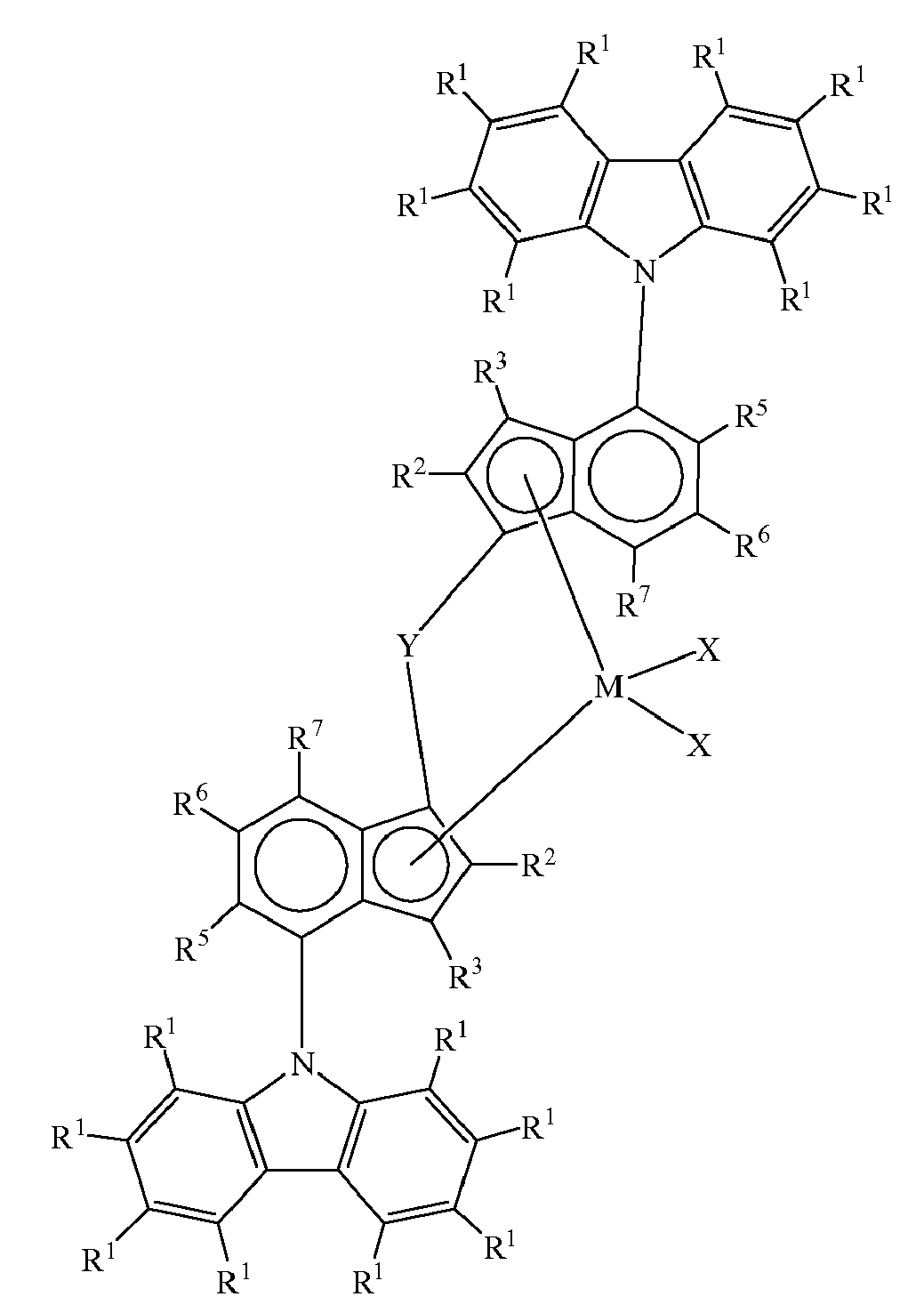
M is a transition metal selected from group 4 of the Periodic Table of the Elements;
each R1 is, independently, hydrogen, or a hydrocarbyl, substituted hydrocarbyl, halocarbyl, substituted halocarbyl, silylcarbyl, substituted silylcarbyl, germylcarbyl, or substituted germylcarbyl substituents, and optionally, adjacent R1 groups may join together to form a substituted or unsubstituted, saturated, partially unsaturated, or aromatic cyclic or polycyclic substituent;
each R2, R3, R5, R6 and R7 is independently, hydrogen, or a hydrocarbyl, substituted hydrocarbyl, halocarbyl, substituted halocarbyl, silylcarbyl, substituted silylcarbyl, germylcarbyl, or substituted germylcarbyl substituents;
Y is a bridging group; and
each X is, independently, hydride radicals, hydrocarbyl radicals, substituted hydrocarbyl radicals, halocarbyl radicals, substituted halocarbyl radicals, silylcarbyl radicals, substituted silylcarbyl radicals, germylcarbyl radicals, or substituted germylcarbyl radicals; or both X are joined and bound to the metal atom to form a metallacycle ring containing from about 3 to about 20 carbon atoms; or both together can be an olefin, diolefin or aryne ligand; or both X may, independently, be a halogen, alkoxide, aryloxide, amide, phosphide or other univalent anionic ligand or both X can also be joined to form a anionic chelating ligand;B) obtaining a polymer having a melting point of 140° C or more, and an Mn of 300,000 g/mol or more (GPC-DRI, corrected to polypropylene values). - The process of claim 21 wherein said temperature is from greater than 100° C to about 250° C.
- The process of claim 21 wherein each R1 is hydrogen and each of R2, R3, R5, R6 and R7 is, independently, hydrogen, or a hydrocarbyl group having 1 to 10 carbon atoms.
- The process of claim 21 wherein R2 is methyl.
- The process of claim 21 wherein each R1, R3, R5, R6, and R7 are hydrogen.
- The process of claim 21 wherein said monomer consists essentially of propylene.
- The process of claim 21 wherein the monomer composition comprises a further comonomer selected from the group consisting of: ethylene, and C4 to C20 α-olefins, cyclic olefins or α-olefinic diolefins.
- The process of claim 21 wherein the monomer is 100% propylene.
- The process of claim 21 wherein the catalyst compound is selected from the group consisting of dimethylsilylene-bis[2-methyl-4-(carbazol-9-yl)inden-1--yl]zirconium dimethyl and dimethylsilylene-bis[2-methyl-4-(carbazol-9-yl)inden-1-yl]zirconium dichloride.
- The process of claim 1 wherein the activator comprises a non-coordinating anion.
- The process of claim 11 wherein the process is continuous.
Priority Applications (1)
| Application Number | Priority Date | Filing Date | Title |
|---|---|---|---|
| EP08153128A EP2103634A1 (en) | 2008-03-20 | 2008-03-20 | Production of propylene-based polymers |
Applications Claiming Priority (1)
| Application Number | Priority Date | Filing Date | Title |
|---|---|---|---|
| EP08153128A EP2103634A1 (en) | 2008-03-20 | 2008-03-20 | Production of propylene-based polymers |
Publications (1)
| Publication Number | Publication Date |
|---|---|
| EP2103634A1 true EP2103634A1 (en) | 2009-09-23 |
Family
ID=40205427
Family Applications (1)
| Application Number | Title | Priority Date | Filing Date |
|---|---|---|---|
| EP08153128A Ceased EP2103634A1 (en) | 2008-03-20 | 2008-03-20 | Production of propylene-based polymers |
Country Status (1)
| Country | Link |
|---|---|
| EP (1) | EP2103634A1 (en) |
Cited By (12)
| Publication number | Priority date | Publication date | Assignee | Title |
|---|---|---|---|---|
| WO2011097119A1 (en) * | 2010-02-03 | 2011-08-11 | Chevron Phillips Chemical Company Lp | Compressible liquid diluent in polyolefin polymerization |
| WO2014088857A1 (en) * | 2012-12-03 | 2014-06-12 | Exxonmobil Chemical Patents Inc. | Propylene polymers |
| KR20140075966A (en) * | 2012-12-11 | 2014-06-20 | 주식회사 엘지화학 | Method for preparing of novel ligand compoun and transition metal compound |
| KR20140075965A (en) * | 2012-12-11 | 2014-06-20 | 주식회사 엘지화학 | Novel ligand compound and transition metal compound comprising the same |
| KR20150029368A (en) * | 2013-09-10 | 2015-03-18 | 주식회사 엘지화학 | Catalyst composition and method for preparing olefin-based polymer thereby |
| KR20150029369A (en) * | 2013-09-10 | 2015-03-18 | 주식회사 엘지화학 | Catalyst composition and method for preparing olefin-based polymer thereby |
| US9260457B2 (en) | 2012-12-11 | 2016-02-16 | Lg Chem, Ltd. | Ligand compound, a preparation method thereof, a transition metal compound including the ligand compound, and a preparation method thereof |
| JP2016504989A (en) * | 2012-12-11 | 2016-02-18 | エルジー・ケム・リミテッド | Novel ligand compound, method for producing the same, transition metal compound, and method for producing the same |
| CN105636995A (en) * | 2014-06-10 | 2016-06-01 | 株式会社Lg化学 | Propylene-Based Elastomers |
| RU2588142C2 (en) * | 2010-02-03 | 2016-06-27 | Шеврон Филлипс Кемикал Компани Лп | Compressible liquid diluent for polymerisation of polyolefins |
| US9469707B2 (en) | 2012-10-31 | 2016-10-18 | Chevron Philips Chemical Company Lp | Pressure management for slurry polymerization |
| US9605095B2 (en) | 2010-02-03 | 2017-03-28 | Chevron Phillips Chemical Company Lp | Polymerization product pressures in olefin polymerization |
Citations (41)
| Publication number | Priority date | Publication date | Assignee | Title |
|---|---|---|---|---|
| EP0277003A1 (en) | 1987-01-30 | 1988-08-03 | Exxon Chemical Patents Inc. | Catalysts, method of preparing these catalysts, and polymerization processes wherein these catalysts are used |
| EP0277004A1 (en) | 1987-01-30 | 1988-08-03 | Exxon Chemical Patents Inc. | Catalysts, method of preparing these catalysts and method of using said catalysts |
| US5001205A (en) | 1988-06-16 | 1991-03-19 | Exxon Chemical Patents Inc. | Process for production of a high molecular weight ethylene α-olefin elastomer with a metallocene alumoxane catalyst |
| EP0427697A2 (en) | 1989-10-10 | 1991-05-15 | Fina Technology, Inc. | Metallocene catalysts with Lewis acids and aluminum alkyls |
| US5066741A (en) | 1990-03-22 | 1991-11-19 | The Dow Chemical Company | Process for preparation of syndiotactic vinyl aromatic polymers |
| EP0495375A2 (en) | 1991-01-16 | 1992-07-22 | The Dow Chemical Company | Process for preparing addition polymerization catalysts via metal center oxidation |
| US5153157A (en) | 1987-01-30 | 1992-10-06 | Exxon Chemical Patents Inc. | Catalyst system of enhanced productivity |
| US5153282A (en) | 1987-06-08 | 1992-10-06 | Exxon Chemical Patents Inc. | Preparation of polyolefin incorporating functional groups from masked functional group-containing monomers |
| EP0520732A1 (en) | 1991-06-24 | 1992-12-30 | The Dow Chemical Company | Homogeneous olefin polymerization catalyst by ligand abstraction with lewis acids |
| US5198401A (en) | 1987-01-30 | 1993-03-30 | Exxon Chemical Patents Inc. | Ionic metallocene catalyst compositions |
| US5206197A (en) | 1991-03-04 | 1993-04-27 | The Dow Chemical Company | Catalyst composition for preparation of syndiotactic vinyl aromatic polymers |
| US5241025A (en) | 1987-01-30 | 1993-08-31 | Exxon Chemical Patents Inc. | Catalyst system of enhanced productivity |
| EP0570982A1 (en) | 1992-05-22 | 1993-11-24 | Tosoh Corporation | Catalysts and process for producing olefin polymers |
| US5384299A (en) | 1987-01-30 | 1995-01-24 | Exxon Chemical Patents Inc. | Ionic metallocene catalyst compositions |
| US5447895A (en) | 1994-03-10 | 1995-09-05 | Northwestern University | Sterically shielded diboron-containing metallocene olefin polymerization catalysts |
| US5486632A (en) | 1994-06-28 | 1996-01-23 | The Dow Chemical Company | Group 4 metal diene complexes and addition polymerization catalysts therefrom |
| US5502124A (en) | 1992-07-01 | 1996-03-26 | Exxon Chemical Patents Inc. | Transition metal olefin polymerization processes |
| US5527929A (en) | 1994-08-02 | 1996-06-18 | The Dow Chemical Company | Zwitterionic biscyclopentadienyl complexes |
| JPH08183814A (en) * | 1994-12-28 | 1996-07-16 | Mitsubishi Chem Corp | Polymerization of α-olefins |
| WO1996033227A1 (en) | 1995-04-21 | 1996-10-24 | Exxon Chemical Patents Inc. | ETHYLENE-α-OLEFIN/DIOLEFIN POLYMER SOLUTION POLYMERIZATION PROCESS |
| US5585509A (en) | 1994-03-03 | 1996-12-17 | Basf Aktiengesellschaft | Metallocene complexes having heterofunctional groups in the cyclopentadienyl system |
| US5624878A (en) | 1993-06-24 | 1997-04-29 | The Dow Chemical Company | Titanium (II) or zirconium (II) complexes and addition polymerization catalysts therefrom |
| WO1997022639A1 (en) | 1995-12-19 | 1997-06-26 | Exxon Chemical Patents Inc. | High temperature solution polymerization process |
| US5770753A (en) | 1992-06-27 | 1998-06-23 | Targor Gmbh | Metallocenes containing aryl-substituted indenyl derivatives as ligands, process for their preparation, and their use as catalysts |
| EP0500944B1 (en) | 1990-07-24 | 1998-10-07 | Mitsui Chemicals, Inc. | Catalyst for alpha-olefin polymerization and production of poly-alpha-olefin therewith |
| WO1998043983A1 (en) | 1997-04-03 | 1998-10-08 | Colorado State University Research Foundation | Polyhalogenated monoheteroborane anion compositions |
| US5936053A (en) | 1993-06-07 | 1999-08-10 | Mitsui Chemicals, Inc. | Propylene polymer, copolymers and elastomer |
| US5942459A (en) | 1995-02-21 | 1999-08-24 | Mitsubishi Chemical Corporation | Catalysts for olefin polymerization and a process for preparing olefin polymers therewith |
| US6169051B1 (en) | 1999-01-25 | 2001-01-02 | Chisso Corporation | Metallocene compounds, processes for the preparation thereof, catalyst components for olefin polymerization, and processes for the production of olefin polymers |
| US20010031834A1 (en) | 2000-03-17 | 2001-10-18 | Chisso Corporation | Polypropylene composition |
| US20010053833A1 (en) | 2000-05-23 | 2001-12-20 | Chisso Corporation | Metallocene compound, olefin polymerization catalyst containing the compound, and method for producing an olefin polymer by use of the catalyst |
| US20020002261A1 (en) | 2000-05-23 | 2002-01-03 | Tsuyoshi Yahata | Elastomeric polypropylene |
| WO2002002576A1 (en) | 2000-06-30 | 2002-01-10 | Exxonmobil Chemical Patents Inc. | Bridged bis (indenyl) metallocene compounds |
| US20020058765A1 (en) | 2000-08-09 | 2002-05-16 | Sigurd Becke | Catalyst system for the polymerization of olefins |
| US6458982B1 (en) | 1999-03-02 | 2002-10-01 | Targor Gmbh | Transition metal compound, catalyst, its production and its use for the polymerization of olefins |
| US6479646B1 (en) | 1999-10-22 | 2002-11-12 | Chisso Corporation | Metallocene compounds having indenyl ligand and catalysts for olefin polymerization containing the same |
| US6491816B2 (en) | 1999-04-02 | 2002-12-10 | Symyx Technologies, Inc. | Apparatus for parallel high-performance liquid chromatography with serial injection |
| WO2004014998A2 (en) | 2002-08-12 | 2004-02-19 | Exxonmobil Chemical Patents Inc. | Plasticized polyolefin compositions |
| EP1060198B1 (en) | 1998-03-04 | 2005-04-13 | ExxonMobil Chemical Patents Inc. | Noncoordinating anions for olefin polymerization |
| US20050261449A1 (en) * | 2004-04-16 | 2005-11-24 | Voskoboynikov Alexander Z | Heterocyclic substituted metallocene compounds for olefin polymerization |
| WO2006097497A1 (en) | 2005-03-18 | 2006-09-21 | Basell Polyolefine Gmbh | Metallocene compounds |
-
2008
- 2008-03-20 EP EP08153128A patent/EP2103634A1/en not_active Ceased
Patent Citations (46)
| Publication number | Priority date | Publication date | Assignee | Title |
|---|---|---|---|---|
| US5198401A (en) | 1987-01-30 | 1993-03-30 | Exxon Chemical Patents Inc. | Ionic metallocene catalyst compositions |
| EP0277004A1 (en) | 1987-01-30 | 1988-08-03 | Exxon Chemical Patents Inc. | Catalysts, method of preparing these catalysts and method of using said catalysts |
| US5153157A (en) | 1987-01-30 | 1992-10-06 | Exxon Chemical Patents Inc. | Catalyst system of enhanced productivity |
| EP0277003A1 (en) | 1987-01-30 | 1988-08-03 | Exxon Chemical Patents Inc. | Catalysts, method of preparing these catalysts, and polymerization processes wherein these catalysts are used |
| US5384299A (en) | 1987-01-30 | 1995-01-24 | Exxon Chemical Patents Inc. | Ionic metallocene catalyst compositions |
| US5241025A (en) | 1987-01-30 | 1993-08-31 | Exxon Chemical Patents Inc. | Catalyst system of enhanced productivity |
| US5153282A (en) | 1987-06-08 | 1992-10-06 | Exxon Chemical Patents Inc. | Preparation of polyolefin incorporating functional groups from masked functional group-containing monomers |
| US5001205A (en) | 1988-06-16 | 1991-03-19 | Exxon Chemical Patents Inc. | Process for production of a high molecular weight ethylene α-olefin elastomer with a metallocene alumoxane catalyst |
| EP0427697A2 (en) | 1989-10-10 | 1991-05-15 | Fina Technology, Inc. | Metallocene catalysts with Lewis acids and aluminum alkyls |
| US5066741A (en) | 1990-03-22 | 1991-11-19 | The Dow Chemical Company | Process for preparation of syndiotactic vinyl aromatic polymers |
| EP0500944B1 (en) | 1990-07-24 | 1998-10-07 | Mitsui Chemicals, Inc. | Catalyst for alpha-olefin polymerization and production of poly-alpha-olefin therewith |
| EP0495375A2 (en) | 1991-01-16 | 1992-07-22 | The Dow Chemical Company | Process for preparing addition polymerization catalysts via metal center oxidation |
| US5206197A (en) | 1991-03-04 | 1993-04-27 | The Dow Chemical Company | Catalyst composition for preparation of syndiotactic vinyl aromatic polymers |
| EP0520732A1 (en) | 1991-06-24 | 1992-12-30 | The Dow Chemical Company | Homogeneous olefin polymerization catalyst by ligand abstraction with lewis acids |
| EP0570982A1 (en) | 1992-05-22 | 1993-11-24 | Tosoh Corporation | Catalysts and process for producing olefin polymers |
| US5840644A (en) | 1992-06-27 | 1998-11-24 | Targor Gmbh | Metallocenes containing aryl-substituted indenyl derivatives as ligands, process for their preparation, and their use as catalysts |
| US5770753A (en) | 1992-06-27 | 1998-06-23 | Targor Gmbh | Metallocenes containing aryl-substituted indenyl derivatives as ligands, process for their preparation, and their use as catalysts |
| US5502124A (en) | 1992-07-01 | 1996-03-26 | Exxon Chemical Patents Inc. | Transition metal olefin polymerization processes |
| US5936053A (en) | 1993-06-07 | 1999-08-10 | Mitsui Chemicals, Inc. | Propylene polymer, copolymers and elastomer |
| US5624878A (en) | 1993-06-24 | 1997-04-29 | The Dow Chemical Company | Titanium (II) or zirconium (II) complexes and addition polymerization catalysts therefrom |
| US5585509A (en) | 1994-03-03 | 1996-12-17 | Basf Aktiengesellschaft | Metallocene complexes having heterofunctional groups in the cyclopentadienyl system |
| EP0670325B1 (en) | 1994-03-03 | 2002-08-14 | Basell Polyolefine GmbH | Metallocenes with heterofunctional residues attached to the cyclopentadienyl group |
| US5756608A (en) | 1994-03-03 | 1998-05-26 | Basf Aktiengesellschaft | Polymerization process using metallocene complexes in the catalyst system |
| US5447895A (en) | 1994-03-10 | 1995-09-05 | Northwestern University | Sterically shielded diboron-containing metallocene olefin polymerization catalysts |
| US5486632A (en) | 1994-06-28 | 1996-01-23 | The Dow Chemical Company | Group 4 metal diene complexes and addition polymerization catalysts therefrom |
| US5527929A (en) | 1994-08-02 | 1996-06-18 | The Dow Chemical Company | Zwitterionic biscyclopentadienyl complexes |
| JPH08183814A (en) * | 1994-12-28 | 1996-07-16 | Mitsubishi Chem Corp | Polymerization of α-olefins |
| JP3323347B2 (en) | 1994-12-28 | 2002-09-09 | 三菱化学株式会社 | Polymerization of .ALPHA.-olefin |
| US5942459A (en) | 1995-02-21 | 1999-08-24 | Mitsubishi Chemical Corporation | Catalysts for olefin polymerization and a process for preparing olefin polymers therewith |
| WO1996033227A1 (en) | 1995-04-21 | 1996-10-24 | Exxon Chemical Patents Inc. | ETHYLENE-α-OLEFIN/DIOLEFIN POLYMER SOLUTION POLYMERIZATION PROCESS |
| WO1997022639A1 (en) | 1995-12-19 | 1997-06-26 | Exxon Chemical Patents Inc. | High temperature solution polymerization process |
| WO1998043983A1 (en) | 1997-04-03 | 1998-10-08 | Colorado State University Research Foundation | Polyhalogenated monoheteroborane anion compositions |
| EP1060198B1 (en) | 1998-03-04 | 2005-04-13 | ExxonMobil Chemical Patents Inc. | Noncoordinating anions for olefin polymerization |
| US6169051B1 (en) | 1999-01-25 | 2001-01-02 | Chisso Corporation | Metallocene compounds, processes for the preparation thereof, catalyst components for olefin polymerization, and processes for the production of olefin polymers |
| US6458982B1 (en) | 1999-03-02 | 2002-10-01 | Targor Gmbh | Transition metal compound, catalyst, its production and its use for the polymerization of olefins |
| US6491816B2 (en) | 1999-04-02 | 2002-12-10 | Symyx Technologies, Inc. | Apparatus for parallel high-performance liquid chromatography with serial injection |
| US6479646B1 (en) | 1999-10-22 | 2002-11-12 | Chisso Corporation | Metallocene compounds having indenyl ligand and catalysts for olefin polymerization containing the same |
| US20010031834A1 (en) | 2000-03-17 | 2001-10-18 | Chisso Corporation | Polypropylene composition |
| US20020002261A1 (en) | 2000-05-23 | 2002-01-03 | Tsuyoshi Yahata | Elastomeric polypropylene |
| US20010053833A1 (en) | 2000-05-23 | 2001-12-20 | Chisso Corporation | Metallocene compound, olefin polymerization catalyst containing the compound, and method for producing an olefin polymer by use of the catalyst |
| WO2002002576A1 (en) | 2000-06-30 | 2002-01-10 | Exxonmobil Chemical Patents Inc. | Bridged bis (indenyl) metallocene compounds |
| US20020058765A1 (en) | 2000-08-09 | 2002-05-16 | Sigurd Becke | Catalyst system for the polymerization of olefins |
| WO2004014998A2 (en) | 2002-08-12 | 2004-02-19 | Exxonmobil Chemical Patents Inc. | Plasticized polyolefin compositions |
| US20050261449A1 (en) * | 2004-04-16 | 2005-11-24 | Voskoboynikov Alexander Z | Heterocyclic substituted metallocene compounds for olefin polymerization |
| US7276567B2 (en) | 2004-04-16 | 2007-10-02 | Exxonmobil Chemical Patents Inc. | Heterocyclic substituted metallocene compounds for olefin polymerization |
| WO2006097497A1 (en) | 2005-03-18 | 2006-09-21 | Basell Polyolefine Gmbh | Metallocene compounds |
Non-Patent Citations (11)
| Title |
|---|
| "Handbook of Chemistry and Physics", 2001, CRC PRESS |
| "Polymer Handbook", 1999, JOHN WILEY AND SONS |
| CHEMICAL AND ENGINEERING NEWS, vol. 63, no. 5, 1985, pages 27 |
| E. Y.-X. CHEN; T.J. MARKS: "Cocatalysts for Metal-Catalyzed Olefin Polymerization: Activators, Activation Processes, and Structure-Activity Relationships", CHEM. REV., vol. 100, 2000, pages 1391 - 1434, XP007920121, DOI: doi:10.1021/cr980462j |
| F. A. BOVEY: "Polymer Conformation and Configuration", 1969, ACADEMIC PRESS |
| J. ORGANOMETALLIC CHEM., vol. 519, 1996, pages 269 |
| J. RANDALL: "Polymer Sequence Determination, Carbon-13 NMR Method", 1977, ACADEMIC PRESS |
| J. VLADIMIR OLIVEIRA; C. DARIVA; J. C. PINTO, IND. ENG, CHEM. RES., vol. 29, 2000, pages 4627 |
| ORGANOMETALLICS, vol. 19, 2000, pages 1262 |
| SCIENCE, vol. 267, 1995, pages 217 |
| T.C. CHUNG ET AL.: "Metallocene Catalysts and Borane Reagents in The Block/Graft Reactions of Polyolefins", POLYM. MATER. SCI. ENG., vol. 73, 1995, pages 463, XP008122853 |
Cited By (24)
| Publication number | Priority date | Publication date | Assignee | Title |
|---|---|---|---|---|
| US9605095B2 (en) | 2010-02-03 | 2017-03-28 | Chevron Phillips Chemical Company Lp | Polymerization product pressures in olefin polymerization |
| EP2531534B1 (en) | 2010-02-03 | 2015-12-02 | Chevron Phillips Chemical Company LP | Compressible liquid diluent in polyolefin polymerization |
| US9962670B2 (en) * | 2010-02-03 | 2018-05-08 | Chevron Phillips Chemical Company Lp | Compressible liquid diluent in polyolefin polymerization |
| US9809660B2 (en) | 2010-02-03 | 2017-11-07 | Chevron Phillips Chemical Company, Lp | Polymerization product pressures in olefin polymerization |
| WO2011097119A1 (en) * | 2010-02-03 | 2011-08-11 | Chevron Phillips Chemical Company Lp | Compressible liquid diluent in polyolefin polymerization |
| US20160346750A1 (en) * | 2010-02-03 | 2016-12-01 | Chevron Phillips Chemical Company Lp | Compressible liquid diluent in polyolefin polymerization |
| RU2588142C2 (en) * | 2010-02-03 | 2016-06-27 | Шеврон Филлипс Кемикал Компани Лп | Compressible liquid diluent for polymerisation of polyolefins |
| US9358515B2 (en) | 2010-02-03 | 2016-06-07 | Chevron Phillips Chemical Company Lp | Compressible liquid diluent in polyolefin polymerization |
| US9469707B2 (en) | 2012-10-31 | 2016-10-18 | Chevron Philips Chemical Company Lp | Pressure management for slurry polymerization |
| US9382411B2 (en) | 2012-12-03 | 2016-07-05 | Exxonmobil Chemical Patents Inc. | Propylene polymers |
| US10100183B2 (en) | 2012-12-03 | 2018-10-16 | Exxonmobil Chemical Patents Inc. | Propylene polymers |
| WO2014088857A1 (en) * | 2012-12-03 | 2014-06-12 | Exxonmobil Chemical Patents Inc. | Propylene polymers |
| KR20140075965A (en) * | 2012-12-11 | 2014-06-20 | 주식회사 엘지화학 | Novel ligand compound and transition metal compound comprising the same |
| JP2016504989A (en) * | 2012-12-11 | 2016-02-18 | エルジー・ケム・リミテッド | Novel ligand compound, method for producing the same, transition metal compound, and method for producing the same |
| US9260457B2 (en) | 2012-12-11 | 2016-02-16 | Lg Chem, Ltd. | Ligand compound, a preparation method thereof, a transition metal compound including the ligand compound, and a preparation method thereof |
| US9790240B2 (en) | 2012-12-11 | 2017-10-17 | Lg Chem, Ltd. | Ligand compound, a preparation method thereof, a transition metal compound, and a preparation method thereof |
| KR20140075966A (en) * | 2012-12-11 | 2014-06-20 | 주식회사 엘지화학 | Method for preparing of novel ligand compoun and transition metal compound |
| KR101648553B1 (en) | 2013-09-10 | 2016-08-16 | 주식회사 엘지화학 | Catalyst composition and method for preparing olefin-based polymer thereby |
| KR101648554B1 (en) | 2013-09-10 | 2016-08-23 | 주식회사 엘지화학 | Catalyst composition and method for preparing olefin-based polymer thereby |
| KR20150029369A (en) * | 2013-09-10 | 2015-03-18 | 주식회사 엘지화학 | Catalyst composition and method for preparing olefin-based polymer thereby |
| KR20150029368A (en) * | 2013-09-10 | 2015-03-18 | 주식회사 엘지화학 | Catalyst composition and method for preparing olefin-based polymer thereby |
| EP3031834A4 (en) * | 2014-06-10 | 2017-03-22 | LG Chem, Ltd. | Propylene-based elastomer |
| US10072110B2 (en) | 2014-06-10 | 2018-09-11 | Lg Chem, Ltd. | Propylene-based elastomer |
| CN105636995A (en) * | 2014-06-10 | 2016-06-01 | 株式会社Lg化学 | Propylene-Based Elastomers |
Similar Documents
| Publication | Publication Date | Title |
|---|---|---|
| EP2240520B1 (en) | Production of propylene-based polymers | |
| US11492425B2 (en) | Metallocene catalyst compositions and polymerization process therewith | |
| US7276567B2 (en) | Heterocyclic substituted metallocene compounds for olefin polymerization | |
| EP3022235B1 (en) | Metallocenes and catalyst compositions derived therefrom | |
| US8546595B2 (en) | Halogen substituted heteroatom-containing metallocene compounds for olefin polymerization | |
| JP4119843B2 (en) | Metallocenes and catalyst compositions derived therefrom | |
| WO2006065809A2 (en) | Heteroatom bridged metallocene compounds for olefin polymerization | |
| TWI460193B (en) | Vinyl terminated higher olefin polymers and methods to produce thereof | |
| US7763562B2 (en) | Heteroatom bridged metallocene compounds for olefin polymerization | |
| JP5848815B2 (en) | NOVEL CATALYST FOR PRODUCING VINYL-TERMINATE POLYMER AND USE THEREOF | |
| CN104428326A (en) | Vinyl-terminated polymers and methods of making the same | |
| WO2021257264A1 (en) | Metallocene catalysts for producing vinyl-terminated polyalphaolefins and methods associated therewith | |
| US7214746B2 (en) | Phosphorus bridged metallocene compounds for olefin polymerization | |
| US7214747B2 (en) | Phosphorus substituted metallocene compounds for olefin polymerization | |
| US7538168B2 (en) | Halogen substituted metallocene compounds for olefin polymerization | |
| EP1960411B1 (en) | Halogen substituted metallocene compounds for olefin polymerization | |
| WO2007070046A1 (en) | Halogen substituted heteroatom-containing metallocene compounds for olefin polymerization | |
| WO2007070038A1 (en) | Halogen substituted metallocene compounds for olefin polymerization | |
| JP2003501437A (en) | +3 oxidation state dimer group 4 metallocene |
Legal Events
| Date | Code | Title | Description |
|---|---|---|---|
| PUAI | Public reference made under article 153(3) epc to a published international application that has entered the european phase |
Free format text: ORIGINAL CODE: 0009012 |
|
| AK | Designated contracting states |
Kind code of ref document: A1 Designated state(s): AT BE BG CH CY CZ DE DK EE ES FI FR GB GR HR HU IE IS IT LI LT LU LV MC MT NL NO PL PT RO SE SI SK TR |
|
| AX | Request for extension of the european patent |
Extension state: AL BA MK RS |
|
| STAA | Information on the status of an ep patent application or granted ep patent |
Free format text: STATUS: THE APPLICATION HAS BEEN REFUSED |
|
| 18R | Application refused |
Effective date: 20091023 |