EP2102677B1 - A method of processing an rf signal - Google Patents
A method of processing an rf signal Download PDFInfo
- Publication number
- EP2102677B1 EP2102677B1 EP07849311.1A EP07849311A EP2102677B1 EP 2102677 B1 EP2102677 B1 EP 2102677B1 EP 07849311 A EP07849311 A EP 07849311A EP 2102677 B1 EP2102677 B1 EP 2102677B1
- Authority
- EP
- European Patent Office
- Prior art keywords
- signal
- receiver
- identification code
- end receiver
- software
- Prior art date
- Legal status (The legal status is an assumption and is not a legal conclusion. Google has not performed a legal analysis and makes no representation as to the accuracy of the status listed.)
- Active
Links
Images

Classifications
-
- G—PHYSICS
- G01—MEASURING; TESTING
- G01S—RADIO DIRECTION-FINDING; RADIO NAVIGATION; DETERMINING DISTANCE OR VELOCITY BY USE OF RADIO WAVES; LOCATING OR PRESENCE-DETECTING BY USE OF THE REFLECTION OR RERADIATION OF RADIO WAVES; ANALOGOUS ARRANGEMENTS USING OTHER WAVES
- G01S19/00—Satellite radio beacon positioning systems; Determining position, velocity or attitude using signals transmitted by such systems
- G01S19/01—Satellite radio beacon positioning systems transmitting time-stamped messages, e.g. GPS [Global Positioning System], GLONASS [Global Orbiting Navigation Satellite System] or GALILEO
- G01S19/13—Receivers
- G01S19/35—Constructional details or hardware or software details of the signal processing chain
- G01S19/36—Constructional details or hardware or software details of the signal processing chain relating to the receiver frond end
-
- G—PHYSICS
- G06—COMPUTING OR CALCULATING; COUNTING
- G06F—ELECTRIC DIGITAL DATA PROCESSING
- G06F21/00—Security arrangements for protecting computers, components thereof, programs or data against unauthorised activity
- G06F21/70—Protecting specific internal or peripheral components, in which the protection of a component leads to protection of the entire computer
- G06F21/71—Protecting specific internal or peripheral components, in which the protection of a component leads to protection of the entire computer to assure secure computing or processing of information
- G06F21/73—Protecting specific internal or peripheral components, in which the protection of a component leads to protection of the entire computer to assure secure computing or processing of information by creating or determining hardware identification, e.g. serial numbers
-
- G—PHYSICS
- G01—MEASURING; TESTING
- G01S—RADIO DIRECTION-FINDING; RADIO NAVIGATION; DETERMINING DISTANCE OR VELOCITY BY USE OF RADIO WAVES; LOCATING OR PRESENCE-DETECTING BY USE OF THE REFLECTION OR RERADIATION OF RADIO WAVES; ANALOGOUS ARRANGEMENTS USING OTHER WAVES
- G01S19/00—Satellite radio beacon positioning systems; Determining position, velocity or attitude using signals transmitted by such systems
- G01S19/01—Satellite radio beacon positioning systems transmitting time-stamped messages, e.g. GPS [Global Positioning System], GLONASS [Global Orbiting Navigation Satellite System] or GALILEO
- G01S19/13—Receivers
- G01S19/35—Constructional details or hardware or software details of the signal processing chain
-
- G—PHYSICS
- G06—COMPUTING OR CALCULATING; COUNTING
- G06F—ELECTRIC DIGITAL DATA PROCESSING
- G06F21/00—Security arrangements for protecting computers, components thereof, programs or data against unauthorised activity
- G06F21/10—Protecting distributed programs or content, e.g. vending or licensing of copyrighted material ; Digital rights management [DRM]
- G06F21/12—Protecting executable software
- G06F21/121—Restricting unauthorised execution of programs
- G06F21/123—Restricting unauthorised execution of programs by using dedicated hardware, e.g. dongles, smart cards, cryptographic processors, global positioning systems [GPS] devices
-
- G—PHYSICS
- G06—COMPUTING OR CALCULATING; COUNTING
- G06F—ELECTRIC DIGITAL DATA PROCESSING
- G06F21/00—Security arrangements for protecting computers, components thereof, programs or data against unauthorised activity
- G06F21/30—Authentication, i.e. establishing the identity or authorisation of security principals
- G06F21/31—User authentication
- G06F21/42—User authentication using separate channels for security data
- G06F21/43—User authentication using separate channels for security data wireless channels
-
- G—PHYSICS
- G01—MEASURING; TESTING
- G01S—RADIO DIRECTION-FINDING; RADIO NAVIGATION; DETERMINING DISTANCE OR VELOCITY BY USE OF RADIO WAVES; LOCATING OR PRESENCE-DETECTING BY USE OF THE REFLECTION OR RERADIATION OF RADIO WAVES; ANALOGOUS ARRANGEMENTS USING OTHER WAVES
- G01S5/00—Position-fixing by co-ordinating two or more direction or position line determinations; Position-fixing by co-ordinating two or more distance determinations
- G01S5/0009—Transmission of position information to remote stations
- G01S5/0018—Transmission from mobile station to base station
- G01S5/0036—Transmission from mobile station to base station of measured values, i.e. measurement on mobile and position calculation on base station
-
- G—PHYSICS
- G06—COMPUTING OR CALCULATING; COUNTING
- G06F—ELECTRIC DIGITAL DATA PROCESSING
- G06F2221/00—Indexing scheme relating to security arrangements for protecting computers, components thereof, programs or data against unauthorised activity
- G06F2221/21—Indexing scheme relating to G06F21/00 and subgroups addressing additional information or applications relating to security arrangements for protecting computers, components thereof, programs or data against unauthorised activity
- G06F2221/2111—Location-sensitive, e.g. geographical location, GPS
-
- G—PHYSICS
- G06—COMPUTING OR CALCULATING; COUNTING
- G06F—ELECTRIC DIGITAL DATA PROCESSING
- G06F2221/00—Indexing scheme relating to security arrangements for protecting computers, components thereof, programs or data against unauthorised activity
- G06F2221/21—Indexing scheme relating to G06F21/00 and subgroups addressing additional information or applications relating to security arrangements for protecting computers, components thereof, programs or data against unauthorised activity
- G06F2221/2129—Authenticate client device independently of the user
-
- Y—GENERAL TAGGING OF NEW TECHNOLOGICAL DEVELOPMENTS; GENERAL TAGGING OF CROSS-SECTIONAL TECHNOLOGIES SPANNING OVER SEVERAL SECTIONS OF THE IPC; TECHNICAL SUBJECTS COVERED BY FORMER USPC CROSS-REFERENCE ART COLLECTIONS [XRACs] AND DIGESTS
- Y10—TECHNICAL SUBJECTS COVERED BY FORMER USPC
- Y10T—TECHNICAL SUBJECTS COVERED BY FORMER US CLASSIFICATION
- Y10T29/00—Metal working
- Y10T29/49—Method of mechanical manufacture
- Y10T29/49002—Electrical device making
- Y10T29/49016—Antenna or wave energy "plumbing" making
Definitions
- This invention relates to a method of processing an RF signal, for example a GPS signal.
- GPS software receivers in which the GPS signal processing is accomplished by means of a programmable micro-processor or digital signal processor as opposed to analogue or discrete hardware components.
- a simplified “GPS software receiver” is provided consisting of a GPS antenna and GPS RF front end receiver for GPS signal pre-processing (including filtering, amplification and frequency down-conversion) and analogue to digital conversion.
- the GPS signal samples outputted from the GPS RF front end receiver can be fed in to a modern PC running appropriate GPS signal processing software to determine a position fix.
- the authors of this article have contemplated the GPS software receiver in the form a "plug-in” module, i.e. a “dongle” type device, which because of its simple architecture could be manufactured cheaply, thereby facilitating widespread adoption.
- US 5,499,295 discloses a hardware-software security arrangement that enables a manufacturer to provide differently configured products having substantially identical hardware and operational control software. Only authorised units are permitted to activate software-controlled optional features. This is achieved by providing a serial number ROM in the radio transceiver device, which stores an associated unique identifying bit pattern. The provision of this unique pattern in the ROM protects against the copying of the software of one radio onto another radio.
- US 2003/0046566 describes a method of protecting software against unauthorised use by an unauthorised Bluetooth network interface device.
- a problem encountered by companies wishing to sell or license software GPS receivers is that third parties can make copies of the software without paying the appropriate fees. This could be simple theft by a completely unauthorised party or the more subtle "3 rd shift problem", whereby an authorised licensee of the software distributes more copies of the software than they are entitled to and therefore only paying for a fraction.
- the invention aims to provide a mechanism that prevents unauthorised copying of a software GPS product, thus protecting the business interests of the owner/developer.
- a method of receiving and processing a spread spectrum RF signal from a satellite positioning system for providing navigation information to a user having a mobile receiver according to claim 1.
- This method enables a software developer to make the system function only when there is a match between the hardware and the software. This makes copying the software as difficult as copying the hardware, because copied software will not work with the incorrect hardware.
- the analogue processing of the signal can comprise down converting to an intermediate frequency.
- the signal is converted to a digital signal, and the unique identifier is added.
- Adding an identification code may comprise adding a code derived from a wafer position of a semiconductor IC of the RF front end receiver.
- Each IC can have a unique code (for example based on wafer/batch number and wafer position). In theory therefore, it is possible to have a one-to-one match of the hardware with the software.
- the software it is sufficient for the software to be operable only for a particular variant of the RF front end receiver IC, and for the error message to arise for other variants. It is then easy to compare how many of this variant of the IC have been manufactured and sold compared to the number of software licences sold.
- Implementing the error function can comprise providing an error message, operating with reduced functionality, or not processing the digital output.
- the RF signal comprises a spread spectrum signal received from a satellite based navigation system (such as GPS) and further processing the digital output is to provide navigation information.
- a satellite based navigation system such as GPS
- the invention also provides a method of manufacturing an RF front end receiver, according to claim 6.
- a method of manufacturing and monitoring an RF front end receiver comprises manufacturing the RF front end receiver using this method, selling the RF front end receiver and notifying the software provider of the identity of the purchaser of the RF front end receiver.
- the invention also provides a computer program comprising computer program code means according to claim 8.
- the invention also provides an RF signal receiver, according to claim 9.
- the invention relates to RF signal receivers generally, but is of particular interest for so-called "software GPS”, namely a GPS system in which all the data processing is implemented in software, with the received data stored in a memory buffer. This enables the real time link of the receiver to be broken, and reduces the amount of dedicated hardware required (such as correlators).
- the receiver comprises a receiver front end 32, which receives the wireless signals using an antenna 34.
- the receiver front end 32 receives modulated RF signals from one or more satellites.
- the received signal is amplified, filtered, down-converted, and digitized by the receiver front end 32 to produce a baseband signal 33 derived from the received signal, and in the form of digitised samples.
- the digitised samples are provided to a memory buffer 36, and the data stored in the memory 36 is processed by a general purpose CPU i.e. a digital signal processor (DSP) 38.
- DSP digital signal processor
- a user interface is provided by input/output system 40.
- the digitised samples are processed to extract the information and data from the satellite signals.
- the data samples are typically in the form of one or two bit data, and at a much higher analogue to digital sampling rate than the data rate of the signals received from the satellites.
- the DSP 38 implements the functions of more conventional dedicated hardware systems, of correlation, multiplexing and Fourier transformations, in known manner.
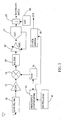
- Figure 2 shows the RF front end receiver 32 in greater detail.
- the signals received from the antenna are filtered by a surface acoustic wave (SAW) filter 50 before amplification by a low noise amplifier (LNA) 52.
- the signals are mixed at mixer 54 with the output of a voltage controlled oscillator (VCO) 56.
- VCO voltage controlled oscillator
- AGC automatic gain control
- Analogue to digital conversion takes place in converter 63, which also provides a feedback control for the AGC setting.
- the RF front end receiver also includes an oscillator 64 and frequency synthesizer 66 as shown, with the frequency synthesiser controlling a clock driver 68 to generate a clock signal CLK.
- the invention concerns in particular the link between the RF front end receiver and the DSP, as shown by arrow 33 in Figure 1 , and the processing implemented in the DSP 38.
- the invention provides an identification code unique to the RF front end receiver hardware at this interface, and this code can be validated in software in the DSP.
- the software can be tied to specific hardware. This means the ease of copying the software does not enable a functioning system to be implemented, as the copied software will not (or is unlikely to) match a different RF front end receiver hardware. Even if there is a match (because the software is only sensitive to a batch of RF front end receiver chips) a mismatch between hardware and software sales can then be detected.
- Figure 2 shows a UID added to data at the output of the analogue to digital converter 63, in data combiner 67, which is supplied with the UID from unit 69.
- the invention assumes that manufacturers of the RF front end chips used in the software GPS receivers are prepared to cooperate with the developers of the software GPS code.
- this aspect of the invention requires the front end chip manufacturers to create a custom variant of the RF front end specifically for the software GPS developer. This doesn't mean the manufacturer will necessarily supply that variant to the software developer, but they will provide the software developer with the order size and purchaser of all orders of that variant.
- All the RF front end chips will contain a unique identifier ("UID”), in such a way that no other front end (of any variant of the chip), will contain the same UID.
- the RF front end is then designed in such a way that, during normal operation, the UID is embedded into the intermediate frequency (“IF”) data stream output by the chip in a known manner.
- IF intermediate frequency
- the software developer is thus able to write the software GPS code in such a way that, during operation, it will extract the UID from the IF data stream and check that it is valid, and refuse to operate if not. This renders unauthorised copying unprofitable as the software developer can be told by the RF front end vendor of any additional chip sales.
- the simplest form of the invention would involve a software GPS developer ("The Software Developer") designing their software to run with a particular RF front end model number "RF Model N” made by a particular manufacturer "The Manufacturer”.
- the design of the RF Model N is such that it contains for example a 64 bit UID "burnt in” by laser on the production line.
- the UID is therefore unique and no two chips will contain the same number.
- a first variant can have the variant number set to 0 for all chips.
- the Software Developer can then agree with The Manufacturer to make a variant of the RF Model N, called the "RF Model N version 2" and that all such variants will be identical to the Model N, except that the 8 bit variant field will always be 1.
- the Manufacturer can then agree to make no other variants for which the variant field is also 1.
- the RF front end receiver is designed in such a way that it periodically embeds the UID into the IF data stream it outputs when it is operating.
- the Manufacturer also agrees to provide The Software Developer with details of all orders for the "RF Model N version 2" variant, including the size of order and identity of the purchaser.
- the Software Developer can then develop a software GPS product and license it to a 3 rd party developer.
- the Software Developer then tells the 3 rd party developer that they need to use the "RF Model N version 2" in their design, and at run time the software is written in such a way as to extract the UID from the IF data stream it processes.
- This implementation provides software mapped to a chip model number or variant, and this may comprise many thousands of chips. It is equally possible to have finer control. For example the software can look for matches with any number of UIDs from one UID (i.e. matching one bespoke software to a single piece of hardware) to a batch of many thousands of chips.
- the method by which the UID is embedded in the IF data stream could be as simple a inserting the full code (e.g. 64 bit) for example every 1024 bits, either by overwriting the IF data samples that would otherwise have been output or by actually inserting the code between adjacent IF samples.
- the UID could also be spread out in the IF data stream - in the limit one bit at a time, inserted at intervals of for example 32 bits.
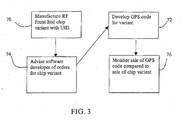
- the Manufacturer carries out the steps of manufacturing the chip (step 70) with the embedded UID, which has been agreed with The Software Developer.
- the GPS code is developed (step 72) for the particular variant having the agreed batch of UIDs.
- the Manufacturer continues to advise The Software Developer about the sales of the variant (step 74) and The Software Developer monitors the sale or licence of the GPS code (step 76), which should match the chip sales.
- the Manufacturer can provide The Software Developer with detailed information of the precise UIDs supplied to each customer who orders the "RF Model N version 2", thus allowing The Software Developer to make variants of their software that are specifically linked to the UIDs purchased by a specific customer or customers.
- the UID could include some form of cyclic redundancy check or indeed encryption to make it harder to fake.
- the manner in which the UID is embedded could be controlled by the software (by sending appropriate control signals to the front end). This could include changing the period, number of bits at a time, turning off completely, only inserting it once on request, whether true insertion or overwriting is used. All of this would make it harder for third parties to "break" the scheme.
- the chips could also include an EEPROM that would allow the code embedded in the IF stream to be augmented or replaced by a code uploaded at run-time into the front end.
- This feature could be used in association with some form of "registration" (for example with an online server run by The Software Developer) in which the UID is submitted and if valid, an encrypted code based on the UID is returned.
- the software GPS code would, in this case, be written so as to only function fully, if both a legal UID and matching encrypted code were visible. This option is particular relevant if The Manufacturer can't or won't provide either a custom variant or sufficient details of purchased chips, as it allows The Software Developer to secure their software on the UID without any previous knowledge of the UID.
- the system of the invention allows protection for software linked with the software forming the software GPS code, for example navigation applications and the maps used.
- the system of the invention can be used for live processing of the sampled GPS data, as soon as it is available from the memory buffer, or the processing may take place later and also possibly at a different location.
- the receiver may not include all of the processing capability for interpreting the GPS data.
- the invention has been described above in connection with software GPS, but it could equally apply to other navigation systems and/or other software radios. The invention is thus also equally applicable to the Galileo navigation system currently under development.
Landscapes
- Engineering & Computer Science (AREA)
- Theoretical Computer Science (AREA)
- Computer Security & Cryptography (AREA)
- Physics & Mathematics (AREA)
- Software Systems (AREA)
- General Physics & Mathematics (AREA)
- Computer Hardware Design (AREA)
- Remote Sensing (AREA)
- Radar, Positioning & Navigation (AREA)
- General Engineering & Computer Science (AREA)
- Computer Networks & Wireless Communication (AREA)
- Signal Processing (AREA)
- Mathematical Physics (AREA)
- Multimedia (AREA)
- Technology Law (AREA)
- Position Fixing By Use Of Radio Waves (AREA)
- Circuits Of Receivers In General (AREA)
- Storage Device Security (AREA)
Description
- This invention relates to a method of processing an RF signal, for example a GPS signal.
- The Article "Real-time software radio architectures for GPS receivers" by Akos et al. (GPS World, July 2001) discloses GPS software receivers in which the GPS signal processing is accomplished by means of a programmable micro-processor or digital signal processor as opposed to analogue or discrete hardware components. A simplified "GPS software receiver" is provided consisting of a GPS antenna and GPS RF front end receiver for GPS signal pre-processing (including filtering, amplification and frequency down-conversion) and analogue to digital conversion.
- The GPS signal samples outputted from the GPS RF front end receiver can be fed in to a modern PC running appropriate GPS signal processing software to determine a position fix. The authors of this article have contemplated the GPS software receiver in the form a "plug-in" module, i.e. a "dongle" type device, which because of its simple architecture could be manufactured cheaply, thereby facilitating widespread adoption.
- Of course, the GPS signal processing software which would reside on the PC is inherently cheap to replicate.
- It has been proposed to arrange the processor in the GPS receiver to first encrypt the GPS signal samples and then transmit the encrypted GPS signal samples to an external device. This is intended to address the disadvantage with conventional GPS receiver devices of the plug-in type described above. Once such a GPS receiver device has become widely disseminated and the data format in which the GPS receiver device provides the GPS signal samples known, a user is free to employ alternative GPS signal processing software to determine a position fix and not necessarily that of or authorised by the provider of the GPS receiver device. The encryption ensures that such a GPS receiver device could only be used with authorised GPS signal processing software which is able to decrypt the GPS signals samples to determine a position fix.
- This approach is described in
WO2004/059337 , and it means that specific software must be used with a particular receiver. - However, software "piracy" is a well known problem for the software industry as a whole, and there remains a need to prevent software piracy undermining the commercial viability of developing and providing the GPS software.
-
US 5,499,295 discloses a hardware-software security arrangement that enables a manufacturer to provide differently configured products having substantially identical hardware and operational control software. Only authorised units are permitted to activate software-controlled optional features. This is achieved by providing a serial number ROM in the radio transceiver device, which stores an associated unique identifying bit pattern. The provision of this unique pattern in the ROM protects against the copying of the software of one radio onto another radio. - Separately,
US 2003/0046566 describes a method of protecting software against unauthorised use by an unauthorised Bluetooth network interface device. - In particular, a problem encountered by companies wishing to sell or license software GPS receivers is that third parties can make copies of the software without paying the appropriate fees. This could be simple theft by a completely unauthorised party or the more subtle "3rd shift problem", whereby an authorised licensee of the software distributes more copies of the software than they are entitled to and therefore only paying for a fraction.
- This is not a problem commonly encountered by conventional hardware GPS vendors, as copying a physical chip (or chips) is inherently far more difficult. The invention is thus of particular interest for so-called software GPS systems as described above.
- The invention aims to provide a mechanism that prevents unauthorised copying of a software GPS product, thus protecting the business interests of the owner/developer.
- According to the invention, there is provided a method of receiving and processing a spread spectrum RF signal from a satellite positioning system for providing navigation information to a user having a mobile receiver, according to claim 1.
- This method enables a software developer to make the system function only when there is a match between the hardware and the software. This makes copying the software as difficult as copying the hardware, because copied software will not work with the incorrect hardware.
- The analogue processing of the signal can comprise down converting to an intermediate frequency. The signal is converted to a digital signal, and the unique identifier is added.
- Adding an identification code may comprise adding a code derived from a wafer position of a semiconductor IC of the RF front end receiver. Each IC can have a unique code (for example based on wafer/batch number and wafer position). In theory therefore, it is possible to have a one-to-one match of the hardware with the software.
- However, it is sufficient for the software to be operable only for a particular variant of the RF front end receiver IC, and for the error message to arise for other variants. It is then easy to compare how many of this variant of the IC have been manufactured and sold compared to the number of software licences sold.
- Implementing the error function can comprise providing an error message, operating with reduced functionality, or not processing the digital output.
- The RF signal comprises a spread spectrum signal received from a satellite based navigation system (such as GPS) and further processing the digital output is to provide navigation information.
- The invention also provides a method of manufacturing an RF front end receiver, according to claim 6.
- By matching an identification code of the RF front end receiver hardware with the software provider, it becomes possible to track the sale of software licences with the sale of the hardware.
- Thus, a method of manufacturing and monitoring an RF front end receiver, comprises manufacturing the RF front end receiver using this method, selling the RF front end receiver and notifying the software provider of the identity of the purchaser of the RF front end receiver.
- The invention also provides a computer program comprising computer program code means according to claim 8.
- The invention also provides an RF signal receiver, according to claim 9.
- The present invention will now be described, by way of example only, with reference to the accompanying schematic drawings in which:
-
Figure 1 shows a conventional GPS receiver architecture in schematic form; -
Figure 2 shows the RF front end receiver in greater detail; and -
Figure 3 is used to explain the method of the invention. - The invention relates to RF signal receivers generally, but is of particular interest for so-called "software GPS", namely a GPS system in which all the data processing is implemented in software, with the received data stored in a memory buffer. This enables the real time link of the receiver to be broken, and reduces the amount of dedicated hardware required (such as correlators).
- The basic architecture of a
software GPS receiver 30 is represented inFigure 1 . - The receiver comprises a
receiver front end 32, which receives the wireless signals using anantenna 34. Thereceiver front end 32 receives modulated RF signals from one or more satellites. - The received signal is amplified, filtered, down-converted, and digitized by the
receiver front end 32 to produce abaseband signal 33 derived from the received signal, and in the form of digitised samples. - The digitised samples are provided to a
memory buffer 36, and the data stored in thememory 36 is processed by a general purpose CPU i.e. a digital signal processor (DSP) 38. A user interface is provided by input/output system 40. The digitised samples are processed to extract the information and data from the satellite signals. The data samples are typically in the form of one or two bit data, and at a much higher analogue to digital sampling rate than the data rate of the signals received from the satellites. - The DSP 38 implements the functions of more conventional dedicated hardware systems, of correlation, multiplexing and Fourier transformations, in known manner.
-
Figure 2 shows the RFfront end receiver 32 in greater detail. - The signals received from the antenna are filtered by a surface acoustic wave (SAW)
filter 50 before amplification by a low noise amplifier (LNA) 52. The signals are mixed atmixer 54 with the output of a voltage controlled oscillator (VCO) 56. This down converts the signals to baseband, where they are subjected to further filtering byfilter 60 and amplification with automatic gain control (AGC) in theamplifier 62. Analogue to digital conversion takes place inconverter 63, which also provides a feedback control for the AGC setting. The RF front end receiver also includes anoscillator 64 andfrequency synthesizer 66 as shown, with the frequency synthesiser controlling aclock driver 68 to generate a clock signal CLK. - The invention concerns in particular the link between the RF front end receiver and the DSP, as shown by
arrow 33 inFigure 1 , and the processing implemented in theDSP 38. - The invention provides an identification code unique to the RF front end receiver hardware at this interface, and this code can be validated in software in the DSP. Thus, the software can be tied to specific hardware. This means the ease of copying the software does not enable a functioning system to be implemented, as the copied software will not (or is unlikely to) match a different RF front end receiver hardware. Even if there is a match (because the software is only sensitive to a batch of RF front end receiver chips) a mismatch between hardware and software sales can then be detected.
-
Figure 2 shows a UID added to data at the output of the analogue todigital converter 63, indata combiner 67, which is supplied with the UID fromunit 69. - In a first aspect, the invention assumes that manufacturers of the RF front end chips used in the software GPS receivers are prepared to cooperate with the developers of the software GPS code.
- In particular, this aspect of the invention requires the front end chip manufacturers to create a custom variant of the RF front end specifically for the software GPS developer. This doesn't mean the manufacturer will necessarily supply that variant to the software developer, but they will provide the software developer with the order size and purchaser of all orders of that variant.
- All the RF front end chips will contain a unique identifier ("UID"), in such a way that no other front end (of any variant of the chip), will contain the same UID. The RF front end is then designed in such a way that, during normal operation, the UID is embedded into the intermediate frequency ("IF") data stream output by the chip in a known manner.
- The software developer is thus able to write the software GPS code in such a way that, during operation, it will extract the UID from the IF data stream and check that it is valid, and refuse to operate if not. This renders unauthorised copying unprofitable as the software developer can be told by the RF front end vendor of any additional chip sales.
- The simplest form of the invention would involve a software GPS developer ("The Software Developer") designing their software to run with a particular RF front end model number "RF Model N" made by a particular manufacturer "The Manufacturer".
- The design of the RF Model N is such that it contains for example a 64 bit UID "burnt in" by laser on the production line.
- This UID can be made up of fields that include:
- the position of the chip on the wafer;
- the wafer number; and
- a variant number (for example 8 bits).
- The UID is therefore unique and no two chips will contain the same number.
- A first variant can have the variant number set to 0 for all chips. The Software Developer can then agree with The Manufacturer to make a variant of the RF Model N, called the "RF Model N version 2" and that all such variants will be identical to the Model N, except that the 8 bit variant field will always be 1. The Manufacturer can then agree to make no other variants for which the variant field is also 1.
- The RF front end receiver is designed in such a way that it periodically embeds the UID into the IF data stream it outputs when it is operating.
- The Manufacturer also agrees to provide The Software Developer with details of all orders for the "RF Model N version 2" variant, including the size of order and identity of the purchaser.
- The Software Developer can then develop a software GPS product and license it to a 3rd party developer. The Software Developer then tells the 3rd party developer that they need to use the "RF Model N version 2" in their design, and at run time the software is written in such a way as to extract the UID from the IF data stream it processes.
- If the UID does not contain a variant field with the appropriate value (1 in this case), then the software will not operate correctly.
- In this example, only the variant number needs to be analysed by the DSP. Of course, a particular variant number can be considered to equate to a set of UID codes.
- This implementation provides software mapped to a chip model number or variant, and this may comprise many thousands of chips. It is equally possible to have finer control. For example the software can look for matches with any number of UIDs from one UID (i.e. matching one bespoke software to a single piece of hardware) to a batch of many thousands of chips.
- The method by which the UID is embedded in the IF data stream could be as simple a inserting the full code (e.g. 64 bit) for example every 1024 bits, either by overwriting the IF data samples that would otherwise have been output or by actually inserting the code between adjacent IF samples. However the UID could also be spread out in the IF data stream - in the limit one bit at a time, inserted at intervals of for example 32 bits.
- The methodology is shown in
Figure 3 . - The Manufacturer carries out the steps of manufacturing the chip (step 70) with the embedded UID, which has been agreed with The Software Developer. In parallel, the GPS code is developed (step 72) for the particular variant having the agreed batch of UIDs. After sale of the hardware, The Manufacturer continues to advise The Software Developer about the sales of the variant (step 74) and The Software Developer monitors the sale or licence of the GPS code (step 76), which should match the chip sales.
- As mentioned above, The Manufacturer can provide The Software Developer with detailed information of the precise UIDs supplied to each customer who orders the "RF Model N version 2", thus allowing The Software Developer to make variants of their software that are specifically linked to the UIDs purchased by a specific customer or customers.
- In the case where an invalid UID or no UID is detected by the software, a number of possibilities are available:
- simply stopping;
- reporting an error message to the user; and
- operating with degrade performance (with or without a message to the user).
- The UID could include some form of cyclic redundancy check or indeed encryption to make it harder to fake.
- The manner in which the UID is embedded could be controlled by the software (by sending appropriate control signals to the front end). This could include changing the period, number of bits at a time, turning off completely, only inserting it once on request, whether true insertion or overwriting is used. All of this would make it harder for third parties to "break" the scheme.
- The chips could also include an EEPROM that would allow the code embedded in the IF stream to be augmented or replaced by a code uploaded at run-time into the front end. This feature could be used in association with some form of "registration" (for example with an online server run by The Software Developer) in which the UID is submitted and if valid, an encrypted code based on the UID is returned.
- The software GPS code would, in this case, be written so as to only function fully, if both a legal UID and matching encrypted code were visible. This option is particular relevant if The Manufacturer can't or won't provide either a custom variant or sufficient details of purchased chips, as it allows The Software Developer to secure their software on the UID without any previous knowledge of the UID.
- The system of the invention allows protection for software linked with the software forming the software GPS code, for example navigation applications and the maps used.
- The benefits of known software GPS systems can all be obtained in the system of the invention. For example, the system of the invention can be used for live processing of the sampled GPS data, as soon as it is available from the memory buffer, or the processing may take place later and also possibly at a different location. Thus, the receiver may not include all of the processing capability for interpreting the GPS data.
- The invention has been described above in connection with software GPS, but it could equally apply to other navigation systems and/or other software radios. The invention is thus also equally applicable to the Galileo navigation system currently under development.
- It is noted that the manufacture and sale of chips that include unique IDs (UIDs) is well known, for example for EEPROM chips, and the provision of a UID will therefore be routine to those skilled in the art.
- From a reading of the present disclosure, other modifications will be apparent to the skilled person and may involve other features which are already known in the design, manufacture and use of GPS receivers and component parts thereof and which may be used instead of or in addition to features already described herein.
Claims (13)
- A method of receiving and processing a spread spectrum RF signal from a satellite based positioning system for providing navigation information to a user having a mobile receiver, comprising:within an RF front end receiver of the mobile receiver:receiving the RF signal;analogue-processing and digitising the RF signal to produce digitised samples; andproviding a digital output signal including the digitised samples,the method characterised by:providing the digital output signal to include an identification code unique to the RF front end receiver hardware,further providing the digital output signal to a digital signal processor; andwithin the digital signal processor, comparing the identification code with a predetermined identification code or set of codes to determine if there is match, and if there is a match, further processing the digital output signal to provide the navigation information to the user, and if there is not a match, implementing an error function.
- A method as claimed in claim 1, wherein analogue-processing the RF signal comprises down converting to an intermediate frequency.
- A method as claimed in any preceding claim, wherein adding an identification code comprises adding a code derived from a wafer position of a semiconductor IC of the RF front end receiver.
- A method as claimed in claim 3, wherein adding an identification code comprises adding a code derived from a batch number of the semiconductor IC.
- A method as claimed in any preceding claim, wherein implementing the error function comprises providing an error message, operating with reduced functionality, or not processing the digital output.
- A method of manufacturing an RF front end receiver for receiving a spread spectrum signal from a satellite based positioning system, the method comprising:fabricating an RF front end receiver (32), wherein the RF front end receiver is adapted to provide a digital output signal to a digital signal processor,characterised in that the RF front end receiver (32) is fabricated with an embedded identification code unique to the RF front end receiver hardware and is adapted to include the identification code in the digital output signal,wherein the embedded identification code is agreed with a software provider of the software to be implemented in the digital signal processor for processing the digital output signal.
- A method of manufacturing and monitoring an RF front end receiver, comprising:manufacturing the RF front end receiver (32) using the method of claim 6;selling the RF front end receiver; andnotifying the software provider of the identity of the purchaser of the RF front end receiver.
- A computer program comprising computer program code means adapted to analyse a digital signal comprising a digitally sampled signal corresponding to a spread spectrum RF signal from a satellite based navigation system for providing navigation information to a user, the digital signal characterised by further comprising an identification code unique to the hardware of an RF front end receiver at which the RF signal was received, wherein the analysis is characterised by comparing the identification code with a predetermined identification code or set of codes to determine if there is match, and if there is a match, further processing the digital output to provide the data to the user, and if there is not a match implementing an error function.
- An RF signal receiver for receiving a spread spectrum RF signal from a satellite based navigation system, comprising:an antenna for receiving the RF signal;an RF front end receiver (32) adapted:to analogue-process and digitise the RF signal to produce digitised samples; andto provide a digital output signal including the digitised samples;a digital signal processor (38) adapted to receive the digital output signal; andsoftware implemented within the digital signal processor,characterised in that the RF front end receiver (32) is adapted to include in the digital output signal an identification code unique to the RF front end receiver hardware,wherein the software is adapted to compare the identification code with a predetermined identification code or set of codes to determine if there is match, and if there is a match to further process the digital output to provide navigation information to the user, and if there is not a match to implement an error function.
- A receiver as claimed in claim 9, wherein the RF front end receiver is adapted to down convert the RF signal to an intermediate frequency.
- A receiver as claimed in claim 9 or 10, wherein the identification code comprises a code derived from a wafer position of a semiconductor IC of the RF front end receiver.
- A receiver as claimed in claim 11, wherein the identification code comprises a code derived from a wafer batch number of the semiconductor IC.
- A receiver as claimed in any one of claims 9 to 12, wherein the error function comprises an error message, a mode of operation with reduced functionality, or a function to not process the digital output.
Priority Applications (1)
| Application Number | Priority Date | Filing Date | Title |
|---|---|---|---|
| EP07849311.1A EP2102677B1 (en) | 2006-12-04 | 2007-12-03 | A method of processing an rf signal |
Applications Claiming Priority (3)
| Application Number | Priority Date | Filing Date | Title |
|---|---|---|---|
| EP06125357 | 2006-12-04 | ||
| PCT/IB2007/054894 WO2008068704A2 (en) | 2006-12-04 | 2007-12-03 | A method of processing an rf signal |
| EP07849311.1A EP2102677B1 (en) | 2006-12-04 | 2007-12-03 | A method of processing an rf signal |
Publications (2)
| Publication Number | Publication Date |
|---|---|
| EP2102677A2 EP2102677A2 (en) | 2009-09-23 |
| EP2102677B1 true EP2102677B1 (en) | 2014-08-20 |
Family
ID=39327411
Family Applications (1)
| Application Number | Title | Priority Date | Filing Date |
|---|---|---|---|
| EP07849311.1A Active EP2102677B1 (en) | 2006-12-04 | 2007-12-03 | A method of processing an rf signal |
Country Status (6)
| Country | Link |
|---|---|
| US (1) | US20100142594A1 (en) |
| EP (1) | EP2102677B1 (en) |
| JP (1) | JP5415278B2 (en) |
| KR (1) | KR20090086577A (en) |
| CN (1) | CN101627318B (en) |
| WO (1) | WO2008068704A2 (en) |
Families Citing this family (3)
| Publication number | Priority date | Publication date | Assignee | Title |
|---|---|---|---|---|
| US9087219B2 (en) | 2008-06-16 | 2015-07-21 | Infineon Technologies Ag | Circuit with a plurality of modes of operation |
| EP2339378B1 (en) | 2009-12-17 | 2013-03-20 | u-blox AG | Hybrid satellite positioning receiver |
| KR102766480B1 (en) * | 2019-05-15 | 2025-02-13 | 삼성디스플레이 주식회사 | Display driver integrated circuit and display system having the same |
Citations (2)
| Publication number | Priority date | Publication date | Assignee | Title |
|---|---|---|---|---|
| US20030046566A1 (en) * | 2001-09-04 | 2003-03-06 | Yrjo Holopainen | Method and apparatus for protecting software against unauthorized use |
| US20060071850A1 (en) * | 2002-12-24 | 2006-04-06 | Yule Andrew T | Gps receiver with encrypted data transmission |
Family Cites Families (9)
| Publication number | Priority date | Publication date | Assignee | Title |
|---|---|---|---|---|
| EP0084441A3 (en) * | 1982-01-19 | 1984-08-22 | Tabs Limited | Method and apparatus for the protection of proprietary computer software |
| US5499295A (en) | 1993-08-31 | 1996-03-12 | Ericsson Inc. | Method and apparatus for feature authorization and software copy protection in RF communications devices |
| US7228567B2 (en) * | 2002-08-30 | 2007-06-05 | Avaya Technology Corp. | License file serial number tracking |
| US20040223614A1 (en) * | 2003-05-08 | 2004-11-11 | Seaman Philip Jeffrey | Secure video receiver |
| US7409563B2 (en) * | 2003-07-22 | 2008-08-05 | Lockheed Martin Corporation | Method and apparatus for preventing un-authorized attachment of computer peripherals |
| US7272500B1 (en) * | 2004-03-25 | 2007-09-18 | Avaya Technology Corp. | Global positioning system hardware key for software licenses |
| GB0418357D0 (en) * | 2004-08-18 | 2004-09-22 | Koninkl Philips Electronics Nv | Gps receiver and related method and apparatus |
| JP2007199000A (en) * | 2006-01-30 | 2007-08-09 | Mitsubishi Electric Corp | GPS terminal system, GPS module, and main unit |
| US8219710B2 (en) * | 2006-10-28 | 2012-07-10 | General Motors Llc | Method of establishing a data connection with a telematics-equipped vehicle |
-
2007
- 2007-12-03 CN CN2007800448815A patent/CN101627318B/en active Active
- 2007-12-03 US US12/517,540 patent/US20100142594A1/en not_active Abandoned
- 2007-12-03 JP JP2009539854A patent/JP5415278B2/en active Active
- 2007-12-03 EP EP07849311.1A patent/EP2102677B1/en active Active
- 2007-12-03 WO PCT/IB2007/054894 patent/WO2008068704A2/en not_active Ceased
- 2007-12-03 KR KR1020097011507A patent/KR20090086577A/en not_active Withdrawn
Patent Citations (2)
| Publication number | Priority date | Publication date | Assignee | Title |
|---|---|---|---|---|
| US20030046566A1 (en) * | 2001-09-04 | 2003-03-06 | Yrjo Holopainen | Method and apparatus for protecting software against unauthorized use |
| US20060071850A1 (en) * | 2002-12-24 | 2006-04-06 | Yule Andrew T | Gps receiver with encrypted data transmission |
Also Published As
| Publication number | Publication date |
|---|---|
| WO2008068704A3 (en) | 2008-08-21 |
| CN101627318B (en) | 2013-01-16 |
| CN101627318A (en) | 2010-01-13 |
| EP2102677A2 (en) | 2009-09-23 |
| US20100142594A1 (en) | 2010-06-10 |
| KR20090086577A (en) | 2009-08-13 |
| JP5415278B2 (en) | 2014-02-12 |
| WO2008068704A2 (en) | 2008-06-12 |
| JP2010511884A (en) | 2010-04-15 |
Similar Documents
| Publication | Publication Date | Title |
|---|---|---|
| US7272500B1 (en) | Global positioning system hardware key for software licenses | |
| US20200184042A1 (en) | Modular software protection | |
| US7203842B2 (en) | Method and apparatus for secure configuration of a field programmable gate array | |
| CN100361038C (en) | Apparatus and method for detecting program tampering | |
| EP2220807B1 (en) | Devices and method for controlling features on a device | |
| AU2006200154B2 (en) | Flexible licensing architecture for licensing digital application | |
| EP1460514A2 (en) | Prevention of unauthorized software distribution | |
| US20020199110A1 (en) | Method of protecting intellectual property cores on field programmable gate array | |
| US10659187B2 (en) | Securely providing a receiver unit with a replica pseudo-random noise code | |
| WO2005104426A3 (en) | Geographic location based licensing system | |
| CN101689237A (en) | Activation system architecture | |
| EP2013766B1 (en) | Method for sharing rights object in digital rights management and device thereof | |
| CA2572611A1 (en) | System and method for automated response piece | |
| EP2082352A2 (en) | Method and device for protecting software from unauthorized use | |
| GB2441609A (en) | Securely downloading GPS map files to specific client devices | |
| EP1368720B1 (en) | Method and system for content distribution and fees management | |
| US20100142594A1 (en) | Method of processing an rf signal | |
| EP1227385A2 (en) | Semiconductor integrated circuit | |
| USRE42743E1 (en) | System for authorizing functionality in adaptable hardware devices | |
| EP1579236B1 (en) | Gps receiver with encrypted data transmission | |
| US20020087873A1 (en) | System and a method for giving run authorization to a program installed on a computer | |
| WO2022148149A1 (en) | License file management method and apparatus, and device | |
| US20060080464A1 (en) | System and method of utilizing a MAC address based unlocking key | |
| US7347380B2 (en) | Installing a file system in a data carrier | |
| US20050265126A1 (en) | Random number initial value generation device and method, random number initial value generation program |
Legal Events
| Date | Code | Title | Description |
|---|---|---|---|
| PUAI | Public reference made under article 153(3) epc to a published international application that has entered the european phase |
Free format text: ORIGINAL CODE: 0009012 |
|
| 17P | Request for examination filed |
Effective date: 20090702 |
|
| AK | Designated contracting states |
Kind code of ref document: A2 Designated state(s): AT BE BG CH CY CZ DE DK EE ES FI FR GB GR HU IE IS IT LI LT LU LV MC MT NL PL PT RO SE SI SK TR |
|
| 17Q | First examination report despatched |
Effective date: 20091123 |
|
| DAX | Request for extension of the european patent (deleted) | ||
| RAP1 | Party data changed (applicant data changed or rights of an application transferred) |
Owner name: U-BLOX AG |
|
| RAP1 | Party data changed (applicant data changed or rights of an application transferred) |
Owner name: U-BLOX AG |
|
| REG | Reference to a national code |
Ref country code: DE Ref legal event code: R079 Ref document number: 602007038260 Country of ref document: DE Free format text: PREVIOUS MAIN CLASS: G01S0005140000 Ipc: G01S0019350000 |
|
| RIC1 | Information provided on ipc code assigned before grant |
Ipc: G06F 21/12 20130101ALI20140130BHEP Ipc: G06F 21/43 20130101ALI20140130BHEP Ipc: G06F 21/73 20130101ALI20140130BHEP Ipc: G01S 19/35 20100101AFI20140130BHEP |
|
| GRAP | Despatch of communication of intention to grant a patent |
Free format text: ORIGINAL CODE: EPIDOSNIGR1 |
|
| INTG | Intention to grant announced |
Effective date: 20140311 |
|
| GRAS | Grant fee paid |
Free format text: ORIGINAL CODE: EPIDOSNIGR3 |
|
| GRAA | (expected) grant |
Free format text: ORIGINAL CODE: 0009210 |
|
| AK | Designated contracting states |
Kind code of ref document: B1 Designated state(s): AT BE BG CH CY CZ DE DK EE ES FI FR GB GR HU IE IS IT LI LT LU LV MC MT NL PL PT RO SE SI SK TR |
|
| REG | Reference to a national code |
Ref country code: GB Ref legal event code: FG4D |
|
| REG | Reference to a national code |
Ref country code: CH Ref legal event code: EP |
|
| REG | Reference to a national code |
Ref country code: AT Ref legal event code: REF Ref document number: 683754 Country of ref document: AT Kind code of ref document: T Effective date: 20140915 |
|
| REG | Reference to a national code |
Ref country code: IE Ref legal event code: FG4D |
|
| REG | Reference to a national code |
Ref country code: DE Ref legal event code: R096 Ref document number: 602007038260 Country of ref document: DE Effective date: 20141002 |
|
| REG | Reference to a national code |
Ref country code: NL Ref legal event code: T3 |
|
| REG | Reference to a national code |
Ref country code: CH Ref legal event code: PLX |
|
| REG | Reference to a national code |
Ref country code: AT Ref legal event code: MK05 Ref document number: 683754 Country of ref document: AT Kind code of ref document: T Effective date: 20140820 |
|
| REG | Reference to a national code |
Ref country code: LT Ref legal event code: MG4D |
|
| PG25 | Lapsed in a contracting state [announced via postgrant information from national office to epo] |
Ref country code: LI Free format text: LAPSE BECAUSE OF THE APPLICANT RENOUNCES Effective date: 20140820 Ref country code: BG Free format text: LAPSE BECAUSE OF FAILURE TO SUBMIT A TRANSLATION OF THE DESCRIPTION OR TO PAY THE FEE WITHIN THE PRESCRIBED TIME-LIMIT Effective date: 20141120 Ref country code: GR Free format text: LAPSE BECAUSE OF FAILURE TO SUBMIT A TRANSLATION OF THE DESCRIPTION OR TO PAY THE FEE WITHIN THE PRESCRIBED TIME-LIMIT Effective date: 20141121 Ref country code: ES Free format text: LAPSE BECAUSE OF FAILURE TO SUBMIT A TRANSLATION OF THE DESCRIPTION OR TO PAY THE FEE WITHIN THE PRESCRIBED TIME-LIMIT Effective date: 20140820 Ref country code: LT Free format text: LAPSE BECAUSE OF FAILURE TO SUBMIT A TRANSLATION OF THE DESCRIPTION OR TO PAY THE FEE WITHIN THE PRESCRIBED TIME-LIMIT Effective date: 20140820 Ref country code: SE Free format text: LAPSE BECAUSE OF FAILURE TO SUBMIT A TRANSLATION OF THE DESCRIPTION OR TO PAY THE FEE WITHIN THE PRESCRIBED TIME-LIMIT Effective date: 20140820 Ref country code: FI Free format text: LAPSE BECAUSE OF FAILURE TO SUBMIT A TRANSLATION OF THE DESCRIPTION OR TO PAY THE FEE WITHIN THE PRESCRIBED TIME-LIMIT Effective date: 20140820 Ref country code: PT Free format text: LAPSE BECAUSE OF FAILURE TO SUBMIT A TRANSLATION OF THE DESCRIPTION OR TO PAY THE FEE WITHIN THE PRESCRIBED TIME-LIMIT Effective date: 20141222 Ref country code: CH Free format text: LAPSE BECAUSE OF THE APPLICANT RENOUNCES Effective date: 20140820 |
|
| PG25 | Lapsed in a contracting state [announced via postgrant information from national office to epo] |
Ref country code: LV Free format text: LAPSE BECAUSE OF FAILURE TO SUBMIT A TRANSLATION OF THE DESCRIPTION OR TO PAY THE FEE WITHIN THE PRESCRIBED TIME-LIMIT Effective date: 20140820 Ref country code: IS Free format text: LAPSE BECAUSE OF FAILURE TO SUBMIT A TRANSLATION OF THE DESCRIPTION OR TO PAY THE FEE WITHIN THE PRESCRIBED TIME-LIMIT Effective date: 20141220 Ref country code: AT Free format text: LAPSE BECAUSE OF FAILURE TO SUBMIT A TRANSLATION OF THE DESCRIPTION OR TO PAY THE FEE WITHIN THE PRESCRIBED TIME-LIMIT Effective date: 20140820 |
|
| PGFP | Annual fee paid to national office [announced via postgrant information from national office to epo] |
Ref country code: NL Payment date: 20141219 Year of fee payment: 8 |
|
| PG25 | Lapsed in a contracting state [announced via postgrant information from national office to epo] |
Ref country code: EE Free format text: LAPSE BECAUSE OF FAILURE TO SUBMIT A TRANSLATION OF THE DESCRIPTION OR TO PAY THE FEE WITHIN THE PRESCRIBED TIME-LIMIT Effective date: 20140820 Ref country code: DK Free format text: LAPSE BECAUSE OF FAILURE TO SUBMIT A TRANSLATION OF THE DESCRIPTION OR TO PAY THE FEE WITHIN THE PRESCRIBED TIME-LIMIT Effective date: 20140820 Ref country code: SK Free format text: LAPSE BECAUSE OF FAILURE TO SUBMIT A TRANSLATION OF THE DESCRIPTION OR TO PAY THE FEE WITHIN THE PRESCRIBED TIME-LIMIT Effective date: 20140820 Ref country code: IT Free format text: LAPSE BECAUSE OF FAILURE TO SUBMIT A TRANSLATION OF THE DESCRIPTION OR TO PAY THE FEE WITHIN THE PRESCRIBED TIME-LIMIT Effective date: 20140820 Ref country code: RO Free format text: LAPSE BECAUSE OF FAILURE TO SUBMIT A TRANSLATION OF THE DESCRIPTION OR TO PAY THE FEE WITHIN THE PRESCRIBED TIME-LIMIT Effective date: 20140820 Ref country code: CZ Free format text: LAPSE BECAUSE OF FAILURE TO SUBMIT A TRANSLATION OF THE DESCRIPTION OR TO PAY THE FEE WITHIN THE PRESCRIBED TIME-LIMIT Effective date: 20140820 |
|
| REG | Reference to a national code |
Ref country code: DE Ref legal event code: R097 Ref document number: 602007038260 Country of ref document: DE |
|
| PG25 | Lapsed in a contracting state [announced via postgrant information from national office to epo] |
Ref country code: PL Free format text: LAPSE BECAUSE OF FAILURE TO SUBMIT A TRANSLATION OF THE DESCRIPTION OR TO PAY THE FEE WITHIN THE PRESCRIBED TIME-LIMIT Effective date: 20140820 |
|
| PLBE | No opposition filed within time limit |
Free format text: ORIGINAL CODE: 0009261 |
|
| STAA | Information on the status of an ep patent application or granted ep patent |
Free format text: STATUS: NO OPPOSITION FILED WITHIN TIME LIMIT |
|
| PG25 | Lapsed in a contracting state [announced via postgrant information from national office to epo] |
Ref country code: BE Free format text: LAPSE BECAUSE OF NON-PAYMENT OF DUE FEES Effective date: 20141231 |
|
| 26N | No opposition filed |
Effective date: 20150521 |
|
| PG25 | Lapsed in a contracting state [announced via postgrant information from national office to epo] |
Ref country code: LU Free format text: LAPSE BECAUSE OF FAILURE TO SUBMIT A TRANSLATION OF THE DESCRIPTION OR TO PAY THE FEE WITHIN THE PRESCRIBED TIME-LIMIT Effective date: 20141203 |
|
| REG | Reference to a national code |
Ref country code: IE Ref legal event code: MM4A |
|
| PG25 | Lapsed in a contracting state [announced via postgrant information from national office to epo] |
Ref country code: IE Free format text: LAPSE BECAUSE OF NON-PAYMENT OF DUE FEES Effective date: 20141203 |
|
| PG25 | Lapsed in a contracting state [announced via postgrant information from national office to epo] |
Ref country code: SI Free format text: LAPSE BECAUSE OF FAILURE TO SUBMIT A TRANSLATION OF THE DESCRIPTION OR TO PAY THE FEE WITHIN THE PRESCRIBED TIME-LIMIT Effective date: 20140820 |
|
| REG | Reference to a national code |
Ref country code: FR Ref legal event code: PLFP Year of fee payment: 9 |
|
| PG25 | Lapsed in a contracting state [announced via postgrant information from national office to epo] |
Ref country code: MC Free format text: LAPSE BECAUSE OF FAILURE TO SUBMIT A TRANSLATION OF THE DESCRIPTION OR TO PAY THE FEE WITHIN THE PRESCRIBED TIME-LIMIT Effective date: 20140820 |
|
| PG25 | Lapsed in a contracting state [announced via postgrant information from national office to epo] |
Ref country code: CY Free format text: LAPSE BECAUSE OF FAILURE TO SUBMIT A TRANSLATION OF THE DESCRIPTION OR TO PAY THE FEE WITHIN THE PRESCRIBED TIME-LIMIT Effective date: 20140820 |
|
| PG25 | Lapsed in a contracting state [announced via postgrant information from national office to epo] |
Ref country code: HU Free format text: LAPSE BECAUSE OF FAILURE TO SUBMIT A TRANSLATION OF THE DESCRIPTION OR TO PAY THE FEE WITHIN THE PRESCRIBED TIME-LIMIT; INVALID AB INITIO Effective date: 20071203 Ref country code: TR Free format text: LAPSE BECAUSE OF FAILURE TO SUBMIT A TRANSLATION OF THE DESCRIPTION OR TO PAY THE FEE WITHIN THE PRESCRIBED TIME-LIMIT Effective date: 20140820 Ref country code: MT Free format text: LAPSE BECAUSE OF FAILURE TO SUBMIT A TRANSLATION OF THE DESCRIPTION OR TO PAY THE FEE WITHIN THE PRESCRIBED TIME-LIMIT Effective date: 20140820 Ref country code: BE Free format text: LAPSE BECAUSE OF FAILURE TO SUBMIT A TRANSLATION OF THE DESCRIPTION OR TO PAY THE FEE WITHIN THE PRESCRIBED TIME-LIMIT Effective date: 20140820 |
|
| REG | Reference to a national code |
Ref country code: NL Ref legal event code: MM Effective date: 20160101 |
|
| PG25 | Lapsed in a contracting state [announced via postgrant information from national office to epo] |
Ref country code: NL Free format text: LAPSE BECAUSE OF NON-PAYMENT OF DUE FEES Effective date: 20160101 |
|
| REG | Reference to a national code |
Ref country code: FR Ref legal event code: PLFP Year of fee payment: 10 |
|
| REG | Reference to a national code |
Ref country code: FR Ref legal event code: PLFP Year of fee payment: 11 |
|
| P01 | Opt-out of the competence of the unified patent court (upc) registered |
Effective date: 20230506 |
|
| PGFP | Annual fee paid to national office [announced via postgrant information from national office to epo] |
Ref country code: DE Payment date: 20241210 Year of fee payment: 18 |
|
| PGFP | Annual fee paid to national office [announced via postgrant information from national office to epo] |
Ref country code: GB Payment date: 20241224 Year of fee payment: 18 |
|
| PGFP | Annual fee paid to national office [announced via postgrant information from national office to epo] |
Ref country code: FR Payment date: 20241223 Year of fee payment: 18 |