EP2099718B1 - Aufwärtsfluss-bioreaktor mit septum und drucklösungsmechanismus - Google Patents
Aufwärtsfluss-bioreaktor mit septum und drucklösungsmechanismus Download PDFInfo
- Publication number
- EP2099718B1 EP2099718B1 EP20070873521 EP07873521A EP2099718B1 EP 2099718 B1 EP2099718 B1 EP 2099718B1 EP 20070873521 EP20070873521 EP 20070873521 EP 07873521 A EP07873521 A EP 07873521A EP 2099718 B1 EP2099718 B1 EP 2099718B1
- Authority
- EP
- European Patent Office
- Prior art keywords
- septum
- bioreactor
- aperture
- lower chamber
- upflow
- Prior art date
- Legal status (The legal status is an assumption and is not a legal conclusion. Google has not performed a legal analysis and makes no representation as to the accuracy of the status listed.)
- Active
Links
Images




Classifications
-
- C—CHEMISTRY; METALLURGY
- C02—TREATMENT OF WATER, WASTE WATER, SEWAGE, OR SLUDGE
- C02F—TREATMENT OF WATER, WASTE WATER, SEWAGE, OR SLUDGE
- C02F3/00—Biological treatment of water, waste water, or sewage
- C02F3/28—Anaerobic digestion processes
- C02F3/2846—Anaerobic digestion processes using upflow anaerobic sludge blanket [UASB] reactors
-
- C—CHEMISTRY; METALLURGY
- C02—TREATMENT OF WATER, WASTE WATER, SEWAGE, OR SLUDGE
- C02F—TREATMENT OF WATER, WASTE WATER, SEWAGE, OR SLUDGE
- C02F3/00—Biological treatment of water, waste water, or sewage
- C02F3/28—Anaerobic digestion processes
- C02F3/2866—Particular arrangements for anaerobic reactors
- C02F3/2886—Two story combinations of the Imhoff tank type
-
- C—CHEMISTRY; METALLURGY
- C12—BIOCHEMISTRY; BEER; SPIRITS; WINE; VINEGAR; MICROBIOLOGY; ENZYMOLOGY; MUTATION OR GENETIC ENGINEERING
- C12M—APPARATUS FOR ENZYMOLOGY OR MICROBIOLOGY; APPARATUS FOR CULTURING MICROORGANISMS FOR PRODUCING BIOMASS, FOR GROWING CELLS OR FOR OBTAINING FERMENTATION OR METABOLIC PRODUCTS, i.e. BIOREACTORS OR FERMENTERS
- C12M21/00—Bioreactors or fermenters specially adapted for specific uses
- C12M21/04—Bioreactors or fermenters specially adapted for specific uses for producing gas, e.g. biogas
-
- C—CHEMISTRY; METALLURGY
- C12—BIOCHEMISTRY; BEER; SPIRITS; WINE; VINEGAR; MICROBIOLOGY; ENZYMOLOGY; MUTATION OR GENETIC ENGINEERING
- C12M—APPARATUS FOR ENZYMOLOGY OR MICROBIOLOGY; APPARATUS FOR CULTURING MICROORGANISMS FOR PRODUCING BIOMASS, FOR GROWING CELLS OR FOR OBTAINING FERMENTATION OR METABOLIC PRODUCTS, i.e. BIOREACTORS OR FERMENTERS
- C12M21/00—Bioreactors or fermenters specially adapted for specific uses
- C12M21/16—Solid state fermenters, e.g. for koji production
-
- C—CHEMISTRY; METALLURGY
- C12—BIOCHEMISTRY; BEER; SPIRITS; WINE; VINEGAR; MICROBIOLOGY; ENZYMOLOGY; MUTATION OR GENETIC ENGINEERING
- C12M—APPARATUS FOR ENZYMOLOGY OR MICROBIOLOGY; APPARATUS FOR CULTURING MICROORGANISMS FOR PRODUCING BIOMASS, FOR GROWING CELLS OR FOR OBTAINING FERMENTATION OR METABOLIC PRODUCTS, i.e. BIOREACTORS OR FERMENTERS
- C12M23/00—Constructional details, e.g. recesses, hinges
- C12M23/34—Internal compartments or partitions
-
- C—CHEMISTRY; METALLURGY
- C12—BIOCHEMISTRY; BEER; SPIRITS; WINE; VINEGAR; MICROBIOLOGY; ENZYMOLOGY; MUTATION OR GENETIC ENGINEERING
- C12M—APPARATUS FOR ENZYMOLOGY OR MICROBIOLOGY; APPARATUS FOR CULTURING MICROORGANISMS FOR PRODUCING BIOMASS, FOR GROWING CELLS OR FOR OBTAINING FERMENTATION OR METABOLIC PRODUCTS, i.e. BIOREACTORS OR FERMENTERS
- C12M29/00—Means for introduction, extraction or recirculation of materials, e.g. pumps
- C12M29/02—Percolation
-
- C—CHEMISTRY; METALLURGY
- C12—BIOCHEMISTRY; BEER; SPIRITS; WINE; VINEGAR; MICROBIOLOGY; ENZYMOLOGY; MUTATION OR GENETIC ENGINEERING
- C12M—APPARATUS FOR ENZYMOLOGY OR MICROBIOLOGY; APPARATUS FOR CULTURING MICROORGANISMS FOR PRODUCING BIOMASS, FOR GROWING CELLS OR FOR OBTAINING FERMENTATION OR METABOLIC PRODUCTS, i.e. BIOREACTORS OR FERMENTERS
- C12M33/00—Means for introduction, transport, positioning, extraction, harvesting, peeling or sampling of biological material in or from the apparatus
- C12M33/16—Screw conveyor
-
- C—CHEMISTRY; METALLURGY
- C12—BIOCHEMISTRY; BEER; SPIRITS; WINE; VINEGAR; MICROBIOLOGY; ENZYMOLOGY; MUTATION OR GENETIC ENGINEERING
- C12M—APPARATUS FOR ENZYMOLOGY OR MICROBIOLOGY; APPARATUS FOR CULTURING MICROORGANISMS FOR PRODUCING BIOMASS, FOR GROWING CELLS OR FOR OBTAINING FERMENTATION OR METABOLIC PRODUCTS, i.e. BIOREACTORS OR FERMENTERS
- C12M33/00—Means for introduction, transport, positioning, extraction, harvesting, peeling or sampling of biological material in or from the apparatus
- C12M33/20—Ribbons
-
- C—CHEMISTRY; METALLURGY
- C02—TREATMENT OF WATER, WASTE WATER, SEWAGE, OR SLUDGE
- C02F—TREATMENT OF WATER, WASTE WATER, SEWAGE, OR SLUDGE
- C02F2103/00—Nature of the water, waste water, sewage or sludge to be treated
- C02F2103/005—Black water originating from toilets
-
- C—CHEMISTRY; METALLURGY
- C02—TREATMENT OF WATER, WASTE WATER, SEWAGE, OR SLUDGE
- C02F—TREATMENT OF WATER, WASTE WATER, SEWAGE, OR SLUDGE
- C02F2103/00—Nature of the water, waste water, sewage or sludge to be treated
- C02F2103/20—Nature of the water, waste water, sewage or sludge to be treated from animal husbandry
Definitions
- the present invention relates to upflow bioreactors for decomposing organic materials. More particularly, the present invention relates to pressure release mechanisms for upflow bioreactors that have an aperture that can become plugged.
- US 4 302 329 A discloses a system for recovery of methane gas from organic waste and having the features of the preamble of claim 1.
- a bioreactor is a device that ises bacteria to promote the decomposition or "digestion” of organic waste material into simple organics and gaseous biogas products.
- Biogas is typically a mixture of methane, carbon dioxide, hydrogen sulfide, and other volatile organic compounds. If produced in sufficient quantities, the methane gas can be used as a fuel.
- Anaerobic digestion in open storage vessels has historically been utilized in waste water management, especially in livestock production, to reduce or convert complex organic matter to a smaller volume. This method has proven to be economical by reducing the volume of waste handled and by volatilizing some metabolites into the atmosphere. Some disadvantages of the process include poor ability to keep the anaerobic digestion process in balance, resulting in the release of malodorous gases and inefficient, incomplete conversion of digested organic matter into biogas. The slow rate of digestion and the poor quality of methane gas yielded makes the economic recovery of methane gas generally infeasible in open storage vessels.
- the bacterial culture should be well established.
- One important advantage of an upflow bioreactor is that it can be operated continuously. Thus, once the bacterial culture is established, the high rate of digestion can be maintained for an extended period of time (e.g. months or even years).
- an upflow reactor that induces formation of the bacterial culture on startup and maintains a thicker or more enriched bacterial culture during operation.
- These benefits are achieved by placing a septum near the top of the fluid level of the reactor.
- the septum causes suspended solids to settle out of the fluid nearing the top of the reactor. These solids settle back into the biomass where digestion continues.
- the solids that are retained by the septum often include bacteria. By retaining these solids in the digester, the septum maintains a better bacterial culture and facilitates more complete digestion.
- Upflow reactors with a septum are capable of significantly reduced digestion retention times.
- septum in an upflow bioreactor is the increased chance of plugging.
- the septum has an aperture.
- the aperture constricts flow and is thus susceptible to plugging. If the aperture plugs, extremely high pressure can build in the lower chamber as the bacteria continue to produce biogas.
- the size of the aperture significantly impacts whether the aperture will plug. Although a larger diameter aperture would reduce the incidence of plugging, an aperture with a diameter sufficiently large to prevent all plugging would significantly diminish the ability of the septum to retain suspended solids.
- the present invention is directed to an upflow bioreactor for decomposing organic materials to produce biogas.
- the bioreactors include a septum for improved digestion and a pressure release mechanism for releasing pressure buildup that can occur in the event that the bioreactor becomes plugged.
- the bioreactors of the present invention include a vessel having an inlet for receiving an organic material and an outlet for expelling bioreactor effluent.
- a septum is positioned within the vessel and defines a lower chamber and an upper chamber.
- the septum includes an aperture that provides fluid communication between the lower chamber and the upper chamber. Biogas and digested material exit the lower chamber into the upper chamber via the aperture.
- the septum includes a releasable portion that is movable between an open position and a closed position. The releasable portion is configured to move to the open position in response to pressure buildup in the lower chamber. Opening the releasable portion increases the area of the opening, which increases the fluid communication between the lower chamber and the upper chamber, thereby allowing potentially obstructing material to be ejected from the lower chamber and/or releasing pressure buildup in the lower chamber.
- the upflow bioreactors of the present invention advantageously provide rapid decomposition of organic wastes with low to no instances of plugging.
- the bioreactors of the present invention include a septum that facilitates the retention of solids within the bioreactor and a pressure release mechanism that is actuated if excess pressure builds in the lower chamber of the bioreactor.
- the pressure release mechanism can prevent the bioreactor from plugging and/or prevent catastrophic damage to the bioreactor caused by high pressures.
- FIG. 1 illustrates an exemplary bioreactor 10 according to one embodiment of the present invention.
- Bioreactor 10 includes a vessel 12 in which an organic material (e.g ., sewage) can be introduced and held for treatment.
- a septum 14 is positioned in vessel 12 to form a lower chamber 16 and an upper chamber 18.
- An aperture 20 in septum 14 provides fluid communication between lower chamber 16 and upper chamber 18.
- Septum 14 also includes a pressure release mechanism 30 that can release pressure buildup in lower chamber 16 by increasing the area of the opening of aperture 20.
- Bioreactor 10 optionally includes an auger 32 to facilitate the retention of solids suspended in the effluent passing through aperture 20. The auger can be driven by a drive assembly housed within housing 34.
- Bioreactor 10 is configured for upflow operation.
- An inlet 22 is provided in lower chamber 16 for introducing organic material to be decomposed.
- a pump is typically coupled to inlet 22 to provide pressure for introducing the organic material.
- An outlet 24 is placed in upper chamber 18 to allow effluent to exit bioreactor 10. The placement of inlet 22 in lower chamber 16 and the placement of outlet 24 in upper chamber 18 creates an upflow in bioreactor 10 during operation.
- the upflow in bioreactor 10 can be continuous or semi-continuous.
- Lower chamber 16 includes a biomass 26.
- Biomass 26 includes a microbial culture and organic material to be decomposed.
- the upflow in bioreactor 10 is sufficiently slow that a sludge blanket of bacteria can form in the biomass 26 of lower chamber 16.
- the organic material e.g., animal waste
- the microbial culture present in biomass 26 is selected according to the particular organic material that is to be decomposed in bioreactor 10.
- the microbial culture comprises anaerobic bacteria. Anaerobic bacteria can be naturally occurring in some organic wastes (e.g. non-sterile animal manure).
- Any organic material can be decomposed in bioreactor 10 so long as a microbial culture is available for degrading the organic material and the organic material can be introduced into the bioreactor in a form that can be mixed with the microbes.
- suitable organic materials that can be digested in the bioreactors of the present invention include animal wastes produced from the farming, ranching, and agricultural industries, food processing waste, human waste, and the like.
- the type of microbial culture and type of organic material are selected such that the decomposition of the organic material produces biogas.
- Upper chamber 18 can be sealed such that biogas collects within upper chamber 18.
- a gas outlet 28 allows the biogas to be ported out of bioreactor 10.
- the biogas can advantageously be used as a fuel. For example, if desired, the biogas can be burned and the heat can be used to maintain an optimal operating temperature in bioreactor 10.
- Figure 2 shows a cross-section of a portion of bioreactor 10.
- the fluids within vessel 12 have a fluid level 36. Fluid level 36 is maintained by effluent outlet 24 and/or effluent line 38. Fluid level 36 is set below the top of vessel 12 such that a gas collection chamber is formed between the bioreactor fluids and the top of vessel 12.
- Septum 14 is positioned within vessel 12 below fluid level 36.
- Septum 14 can be rigid or semi-rigid and can be made from any material compatible with the bioreactor fluids, including but not limited to plastics, metals, and the like.
- Septum 14 can be formed from a plurality of panels, or it can be a single, unitary piece of material. Septum 14 can be secured to the inside of the vessel 12 in any manner.
- septum 14 slopes upwardly from the sidewalls of vessel 12 toward aperture 20. Sloping septum 14 can facilitate the removal of materials that settle out in upper chamber 18. A sloped septum can also be advantageous for ensuring that biogas in lower chamber 16 is directed to aperture 20. However, the present invention can also be carried out using a flat septum.
- aperture 20 has a size and shape selected to minimize the escape of solids from the lower chamber and to minimize the incidence of the aperture becoming plugged by solids passing through the aperture.
- an auger 32 is operatively coupled to the enclosure 12 and positioned within aperture 20 of septum 14.
- Auger 32 can be any device that can be positioned within aperture 20 and can move solids in a desired direction between or within upper and lower chambers 16 and 18.
- the auger includes a shaft with one or more flanges that are configured to move a material in a direction parallel to the shaft.
- Auger 32 shown in Figure 2 , includes a shaft 31 and a continuously spiraling flange 33.
- auger 32 When rotated clockwise, auger 32 creates a force that is opposite the flow of fluids in the bioreactor. During optimal or "normal" operating conditions, auger 32 is rotated in the direction that counters the flow of the bioreactor fluids. This counter-flow force tends to settle out solids suspended in the effluent passing through aperture 20. If aperture 20 becomes clogged, the auger 32 can be rotated in an opposite direction to remove solids to above the septum where the solids can be more easily cleaned out.
- Auger 32 and septum 14 are provided to help form and maintain biomass 26.
- septum 14 and auger 32 retain more bacteria, which are available for breaking down the organic material being fed into bioreactor 10.
- auger and septum organic materials can be treated much faster and much more efficiently than organic waste being digested in other bioreactors.
- use of the septum and/or auger improves the clarity of effluent exiting the bioreactor.
- bioreactor 10 includes a pressure release mechanism.
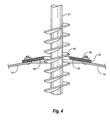
- Figures 3-5 illustrate one embodiment of an exemplary pressure relief mechanism according to the present invention.
- Figure 3 illustrates a pressure relief mechanism 30 that exemplifies a releasable portion of septum 14.
- Pressure relief mechanism 30 includes a plurality of flexible members (e.g., flexible members 40a, 40b, and 40c, collectively flexible members 40) that can flex in response to pressure buildup within lower chamber 16.
- flexible members 40 are attached to the septum at a first end 42 and are free at a second end 44.
- flexible members 40 are attached to septum 14 by a ring 46 and bolts 47.
- any attachment mechanism can be used so long as a portion of each flexible member is free to flex open.
- Pressure release mechanism 30 allows septum 14 to have a variably sized aperture.
- aperture 20 has a first size.
- aperture 20 has a larger size, such that fluid communication between the upper and lower chambers is increased.
- Aperture 20 can be sized sufficiently large in the open position to allow material that would otherwise plug the aperture to pass through.
- flexible members 40 extend over a portion of the opening to reduce the fluid communication between the upper and lower chambers. So long as excess pressure does not build in lower chamber 16, effluent is forced around flexible members 40 and up through the aperture defined by the second edges (e.g. edge 44) of flexible members 40.
- Flexible members 40 can be sized and configured to flex upward in response to a particular amount of pressure in lower chamber 16.
- the dimensions of the flexible members, including length, width, and thickness can affect the force (i.e. pressure buildup) needed to actuate the flexible member. Thicker, stiffer materials tend to allow greater pressure to build before releasing.
- the flexible members are rubber and/or have a thickness in a range from about 0.15 cm to about 1.5 cm.
- the releasable portion of the septum and the aperture can be sized to provide almost any diameter of aperture while the pressure release mechanism 30 is in the open position.
- suitable aperture sizes for the open position can range from about 10 cm to about 2 meters, alternatively in a range from 20 cm to 100 cm.
- One benefit of a smaller aperture is that it can be less difficult to maintain the closed position while the pressure is below a selected level.
- larger sized apertures can still work if the releasable member is sufficiently rigid and/or if a suitable releasing mechanism is used.
- the size of aperture 20 when the releasable portion is in the closed position can be selected to maximize solids retention.
- the size of the aperture is typically in a range from about 1 cm to about 20 cm, alternatively in a range from about 2 cm to about 10 cm.
- the preferred size of the aperture can depend on the type of material being digested, the size of the bioreactor, and the presence or absence of an auger.
- the flexible member can be a single piece or can be sectioned into more or fewer pieces than pressure relief mechanism 30.
- the flexible member is also not necessarily flexible along its entire length, so long as a portion of the flexible member is sufficiently flexible to allow the flexible member to move to an open configuration.
- Locating pressure relief mechanism 30 around auger 32 and aperture 20 can be advantageous since pressure buildup in lower chamber 16 can be released by allowing the material plugging aperture 20 to pass around auger 32.
- the releasable portion of septum 14 can be located away from aperture 20. In this embodiment, actuating a flexible member or other releasable portion can cause an entirely different aperture to open in the septum.
- the present invention can be carried out using mechanisms other than a flexible member to increase the fluid communication between the upper chamber and lower chamber.
- a portion of the septum can hingedly open in response to pressure.
- the foregoing mechanisms, including the flexible members described above, are examples of means for releasing pressure in the lower chamber of the bioreactor.
- Figure 6 illustrates an alternative mechanism not part of the present invention for releasing pressure in the lower chamber of bioreactor 10.
- a pressure release outlet 48 is placed in lower chamber 16.
- the outlet 48 leads to a pressure release line 50.
- the pressure release line 50 can be ported into the effluent line 38 or alternatively line 50 can be recycled.
- pressure release line 50 extends above fluid level 36. By extending pressure release line above fluid level 36, pressure release line will be prevented from draining the bioreactor. Once pressure release line is filled with fluid up to fluid level 36, fluid cannot flow out lower chamber 16 through outlet 48 unless sufficient pressure builds to force the fluids in the pressure release line 50 above the fluid level 36. If excess pressure builds in lower chamber 16, the fluid in pressure release line 50 flows into effluent line 38, thereby allowing fluids to exit lower chamber 18 and releasing the excess pressure.
- Pressure release line 50 is an example of a means for releasing pressure in the lower chamber of the bioreactor. If desired, bioreactor 10 can include a releasable portion in septum 14, in addition to pressure release line 50.
- pressure release line 50 includes a water jet 52.
- Water jet 52 can periodically inject water into pressure release line 50 to prevent pressure release line from plugging. By periodically adding a small amount of water to pressure release line 50 a very slow and/or periodic inward flow of water keeps the line clear.
- pressure release line can also include a flow detector that detects an outward flow of fluids in pressure release line 50.
- the flow detector can cause the loading of digester to be slowed or shut off.
- a flow detector can be used to notify personnel that a problem exists.
Landscapes
- Life Sciences & Earth Sciences (AREA)
- Health & Medical Sciences (AREA)
- Engineering & Computer Science (AREA)
- Chemical & Material Sciences (AREA)
- Organic Chemistry (AREA)
- Zoology (AREA)
- Bioinformatics & Cheminformatics (AREA)
- Wood Science & Technology (AREA)
- Microbiology (AREA)
- Genetics & Genomics (AREA)
- Biochemistry (AREA)
- Sustainable Development (AREA)
- Biotechnology (AREA)
- General Engineering & Computer Science (AREA)
- General Health & Medical Sciences (AREA)
- Biomedical Technology (AREA)
- Molecular Biology (AREA)
- Biodiversity & Conservation Biology (AREA)
- Hydrology & Water Resources (AREA)
- Environmental & Geological Engineering (AREA)
- Water Supply & Treatment (AREA)
- Oil, Petroleum & Natural Gas (AREA)
- Clinical Laboratory Science (AREA)
- General Chemical & Material Sciences (AREA)
- Apparatus Associated With Microorganisms And Enzymes (AREA)
- Purification Treatments By Anaerobic Or Anaerobic And Aerobic Bacteria Or Animals (AREA)
Claims (8)
- Aufwärtsfluss-Bioreaktor (10), der umfasst:einen Behälter (12) mit einem Einlass (22) und einem Auslass (24);ein Septum (14), das in dem Behälter (12) angeordnet ist und eine untere Kammer (16) und eine obere Kammer (18) definiert, wobei das Septum (14) eine Öffnung (20) aufweist, die einen Flüssigkeitsaustausch zwischen der unteren Kammer (16) und der oberen Kammer (18) ermöglicht; unddadurch gekennzeichnet, dassdas Septum (14) einen lösbaren Teil mit einer offenen Stellung und einer geschlossenen Stellung aufweist und der lösbare Teil des Septums (14) dazu eingerichtet ist, sich in Reaktion auf einen Druckaufbau in der unteren Kammer (16) in die offene Stellung zu bewegen, und die offene Stellung den Bereich für den Flüssigkeitsaustausch zwischen der unteren Kammer (16) und der oberen Kammer (18) vergrößert.
- Aufwärtsfluss-Bioreaktor nach Anspruch 1, wobei der lösbare Teil des Septums (14) ein bewegliches Element (40) aufweist.
- Aufwärtsfluss-Bioreaktor nach Anspruch 1, wobei das bewegliche Element (40) eine Dicke in einem Bereich von 0,15 cm bis 1,5 cm aufweist.
- Aufwärtsfluss-Bioreaktor nach Anspruch 1, wobei die Öffnung (20) einen Durchmesser in einem Bereich von 10 cm bis zu 2 Meter, vorzugsweise von 20 cm bis zu 100 cm aufweist, wenn sich der lösbare Teil in offener Stellung befindet.
- Aufwärtsfluss-Bioreaktor nach Anspruch 1, wobei der lösbare Teil des Septums (14) eine Vielzahl beweglicher Elemente (40a, 40b, 40c) umfasst, die über einem Teil der Öffnung (20) in dem Septum (14) angeordnet sind.
- Aufwärtsfluss-Bioreaktor nach Anspruch 1, wobei der Einlass (22) in der unteren Kammer (16) und der Auslass (24) in der oberen Kammer (18) angeordnet sind, so dass während des Betriebs des Bioreaktors (10) ein Aufwärtsfluss entsteht.
- Aufwärtsfluss-Bioreaktor nach Anspruch 1, wobei die obere Kammer (18) so abgedichtet ist, dass in der unteren Kammer (16) produziertes Gas in der oberen Kammer (18) gesammelt und in einen Gasausgang (28) geleitet werden kann.
- Aufwärtsfluss-Bioreaktor nach Anspruch 1, der weiterhin eine Feststoff-Steuervorrichtung umfasst, die in der Öffnung (20) des Septums (14) angeordnet ist, wobei die Feststoff-Steuervorrichtung eine Schneckenwendel umfasst.
Applications Claiming Priority (2)
| Application Number | Priority Date | Filing Date | Title |
|---|---|---|---|
| US11/548,764 US7699976B2 (en) | 2006-10-12 | 2006-10-12 | Upflow bioreactor with septum and pressure release mechanism |
| PCT/US2007/080894 WO2008127357A2 (en) | 2006-10-12 | 2007-10-10 | Upflow bioreactor with septum and pressure release mechanism |
Publications (3)
| Publication Number | Publication Date |
|---|---|
| EP2099718A2 EP2099718A2 (de) | 2009-09-16 |
| EP2099718A4 EP2099718A4 (de) | 2010-12-01 |
| EP2099718B1 true EP2099718B1 (de) | 2013-08-14 |
Family
ID=39616946
Family Applications (1)
| Application Number | Title | Priority Date | Filing Date |
|---|---|---|---|
| EP20070873521 Active EP2099718B1 (de) | 2006-10-12 | 2007-10-10 | Aufwärtsfluss-bioreaktor mit septum und drucklösungsmechanismus |
Country Status (6)
| Country | Link |
|---|---|
| US (1) | US7699976B2 (de) |
| EP (1) | EP2099718B1 (de) |
| CN (1) | CN101583573B (de) |
| AU (1) | AU2007351506B2 (de) |
| CA (1) | CA2672932A1 (de) |
| WO (1) | WO2008127357A2 (de) |
Families Citing this family (12)
| Publication number | Priority date | Publication date | Assignee | Title |
|---|---|---|---|---|
| US8393558B2 (en) | 2009-12-30 | 2013-03-12 | Organic Energy Corporation | Mechanized separation and recovery system for solid waste |
| US8322639B2 (en) | 2010-11-24 | 2012-12-04 | Organic Energy Corporation | Mechanized separation of mixed solid waste and recovery of recyclable products |
| US9700896B1 (en) | 2013-02-16 | 2017-07-11 | Organic Energy Corporation | Systems and methods for processing mixed solid waste |
| US9713812B1 (en) | 2011-09-12 | 2017-07-25 | Organic Energy Corporation | Methods and systems for separating and recovering recyclables using a comminution device |
| US8632024B2 (en) | 2010-01-25 | 2014-01-21 | Organic Energy Corporation | Systems and methods for processing mixed solid waste |
| US8398006B2 (en) | 2010-11-24 | 2013-03-19 | Organic Energy Corporation | Mechanized separation of mixed solid waste and recovery of recyclable products |
| US8183035B1 (en) | 2011-09-07 | 2012-05-22 | Therapeutic Proteins International, LLC | Single container manufacturing of biological product |
| US10570043B2 (en) | 2016-08-31 | 2020-02-25 | Conly L. Hansen | Induced sludge bed anaerobic reactor system |
| US10071925B2 (en) | 2016-08-31 | 2018-09-11 | Conly L. Hansen | Induced sludge bed anaerobic reactor |
| US11802065B2 (en) | 2016-08-31 | 2023-10-31 | Conly L. Hansen | Induced sludge bed anaerobic reactor system |
| CN115382257B (zh) * | 2022-10-26 | 2022-12-30 | 中基万季建设投资集团有限公司 | 一种污水处理用沉淀池消毒设备 |
| USD1064317S1 (en) * | 2024-08-06 | 2025-02-25 | T&J Bio-Engineering (Shanghai) Co., Ltd. | Bioreactor |
Family Cites Families (19)
| Publication number | Priority date | Publication date | Assignee | Title |
|---|---|---|---|---|
| US2889929A (en) | 1954-09-03 | 1959-06-09 | Dorr Oliver Inc | Combined anaerobic treatment and clarification unit |
| US3622009A (en) | 1969-10-17 | 1971-11-23 | Davis Ind Inc | Mechanical sludge collector and thickener |
| US3837493A (en) | 1971-03-16 | 1974-09-24 | Y Lin | Sewage treatment apparatus |
| US3705648A (en) | 1972-03-30 | 1972-12-12 | Kostas Savas Arvanitakis | Filtration system |
| FR2265022B1 (de) | 1974-03-21 | 1977-08-19 | Duveau Francois | |
| US3965013A (en) | 1974-10-31 | 1976-06-22 | Jackson George F | Gravity clarifier |
| EP0013538B1 (de) | 1979-01-03 | 1983-04-06 | Manahl, Robert, Dipl.-Ing. | Einrichtung zur Gewinnung von Methangas aus organischen Abfällen |
| US4208279A (en) | 1979-05-07 | 1980-06-17 | Bio-Gas Of Colorado, Inc. | Method and apparatus for processing animal waste |
| US4350588A (en) | 1980-08-14 | 1982-09-21 | Junjiro Tsubota | Biological fermentation device |
| US4976863A (en) * | 1989-01-26 | 1990-12-11 | Pec Research, Inc. | Wastewater treatment process |
| ES2110600T3 (es) | 1992-03-24 | 1998-02-16 | Ivan William Yates | Metodo para la activacion de un agente digestor. |
| DE4226087A1 (de) | 1992-04-16 | 1993-10-21 | Recycling Energie Abfall | Verfahren zur biologischen Aufbereitung organischer Substanzen, insbesondere zur anaeroben biologischen Hydrolyse zur anschließenden Biomethanisierung und Vorrichtung zur Durchführung des Verfahrens |
| US5441634A (en) | 1993-07-06 | 1995-08-15 | Edwards Laboratories, Inc. | Apparatus and method of circulating a body of fluid containing a mixture of solid waste and water and separating them |
| US5747311A (en) | 1995-08-22 | 1998-05-05 | Microgen Corporation | Process for chemical modification of reactants by microbes |
| US5660724A (en) | 1996-05-28 | 1997-08-26 | Deep Shaft Technology Inc. | Multi-pressure head tank for use with vertical shaft bioreactors |
| US5798043A (en) | 1997-12-01 | 1998-08-25 | Khudenko Engineering, Inc. | Control of anaerobic wastewater treatment |
| US7452467B2 (en) | 2001-12-19 | 2008-11-18 | Andigen, Llc | Induced sludge bed anaerobic reactor |
| US6911149B2 (en) | 2001-12-19 | 2005-06-28 | Utah State University | Induced sludge bed anaerobic reactor |
| WO2005115947A2 (en) | 2004-04-28 | 2005-12-08 | University Of Florida Research Foundation Inc. | Flooded densified leachbed anaerobic digestion |
-
2006
- 2006-10-12 US US11/548,764 patent/US7699976B2/en active Active
-
2007
- 2007-10-10 AU AU2007351506A patent/AU2007351506B2/en not_active Ceased
- 2007-10-10 CA CA 2672932 patent/CA2672932A1/en not_active Abandoned
- 2007-10-10 CN CN2007800457087A patent/CN101583573B/zh active Active
- 2007-10-10 EP EP20070873521 patent/EP2099718B1/de active Active
- 2007-10-10 WO PCT/US2007/080894 patent/WO2008127357A2/en not_active Ceased
Also Published As
| Publication number | Publication date |
|---|---|
| CA2672932A1 (en) | 2008-10-23 |
| EP2099718A4 (de) | 2010-12-01 |
| EP2099718A2 (de) | 2009-09-16 |
| US20080169231A1 (en) | 2008-07-17 |
| AU2007351506B2 (en) | 2013-03-14 |
| AU2007351506A1 (en) | 2008-10-23 |
| US7699976B2 (en) | 2010-04-20 |
| WO2008127357A2 (en) | 2008-10-23 |
| CN101583573A (zh) | 2009-11-18 |
| WO2008127357A3 (en) | 2008-12-18 |
| CN101583573B (zh) | 2013-08-07 |
Similar Documents
| Publication | Publication Date | Title |
|---|---|---|
| AU2007351506B2 (en) | Upflow bioreactor with septum and pressure release mechanism | |
| US7615155B1 (en) | Methods for removal of non-digestible matter from an upflow anaerobic digester | |
| EP0642470B1 (de) | Biologische abwasserbehandlung | |
| US8765449B2 (en) | Three stage, multiple phase anaerobic digestion system and method | |
| KR100646076B1 (ko) | 2상형 메탄발효반응장치 | |
| US6911149B2 (en) | Induced sludge bed anaerobic reactor | |
| KR100949314B1 (ko) | 유기성폐기물의 혐기성 소화액을 이용한 조류생산 장치 | |
| WO2008057784A2 (en) | Upflow bioreactor having a septum and an auger and drive assembly | |
| US7727396B1 (en) | Anaerobic reactor with auger in the effluent line | |
| US7452467B2 (en) | Induced sludge bed anaerobic reactor | |
| WO2008026221A1 (en) | A self mixing anaerobic digester useful for treatment of solid organic waste | |
| WO2014124500A1 (en) | A system for processing organic waste | |
| US20200277210A1 (en) | Process and apparatus for in-situ cleaning of a gas separator in an anaerobic bioreactor | |
| US6982035B1 (en) | Biphase orbicular biodigester | |
| EP2831003B1 (de) | Vorrichtung zur herstellung von biogas und entsprechendes verfahren | |
| JP2019042692A (ja) | 生物処理装置、および、メタンガス製造方法 | |
| KR102122734B1 (ko) | 유기 고형물로부터 바이오가스를 생산하는 혐기 소화 장치 | |
| US20110100902A1 (en) | Mixing device, system and method for anaerobic digestion | |
| AU2014200009B2 (en) | Anaerobic gas lift reactor for treatment of organic waste | |
| KR101167500B1 (ko) | 유기성 폐기물의 소멸화 장치 및 방법 | |
| US10071925B2 (en) | Induced sludge bed anaerobic reactor | |
| EP2982739A1 (de) | Kombinierter hydrolyse-fermentations-apparat | |
| KR200352793Y1 (ko) | 유기성 폐기물 처리용 혐기성 소화조 | |
| JP2002263699A (ja) | 消化装置 | |
| CN115253401A (zh) | 一种hrt与srt分离的有机固废厌氧消化反应装置 |
Legal Events
| Date | Code | Title | Description |
|---|---|---|---|
| PUAI | Public reference made under article 153(3) epc to a published international application that has entered the european phase |
Free format text: ORIGINAL CODE: 0009012 |
|
| 17P | Request for examination filed |
Effective date: 20090512 |
|
| AK | Designated contracting states |
Kind code of ref document: A2 Designated state(s): AT BE BG CH CY CZ DE DK EE ES FI FR GB GR HU IE IS IT LI LT LU LV MC MT NL PL PT RO SE SI SK TR |
|
| AX | Request for extension of the european patent |
Extension state: BA HR RS |
|
| RIN1 | Information on inventor provided before grant (corrected) |
Inventor name: MILLIGAN, JOHN Inventor name: TOLMAN, KENNETH, W. Inventor name: BENEFIEL, BRADLEY, C. Inventor name: PACK, KEVIN Inventor name: HANSEN, CONLY, L. Inventor name: TOLMAN, WAYNE, C. Inventor name: HANSEN, CARL, S. |
|
| A4 | Supplementary search report drawn up and despatched |
Effective date: 20101104 |
|
| 17Q | First examination report despatched |
Effective date: 20110407 |
|
| RAX | Requested extension states of the european patent have changed |
Extension state: BA Payment date: 20090512 Extension state: HR Payment date: 20090512 Extension state: RS Payment date: 20090512 |
|
| GRAP | Despatch of communication of intention to grant a patent |
Free format text: ORIGINAL CODE: EPIDOSNIGR1 |
|
| GRAS | Grant fee paid |
Free format text: ORIGINAL CODE: EPIDOSNIGR3 |
|
| GRAA | (expected) grant |
Free format text: ORIGINAL CODE: 0009210 |
|
| AK | Designated contracting states |
Kind code of ref document: B1 Designated state(s): AT BE BG CH CY CZ DE DK EE ES FI FR GB GR HU IE IS IT LI LT LU LV MC MT NL PL PT RO SE SI SK TR |
|
| AX | Request for extension of the european patent |
Extension state: BA HR RS |
|
| REG | Reference to a national code |
Ref country code: GB Ref legal event code: FG4D |
|
| REG | Reference to a national code |
Ref country code: CH Ref legal event code: EP Ref country code: AT Ref legal event code: REF Ref document number: 626707 Country of ref document: AT Kind code of ref document: T Effective date: 20130815 |
|
| REG | Reference to a national code |
Ref country code: IE Ref legal event code: FG4D |
|
| REG | Reference to a national code |
Ref country code: DE Ref legal event code: R096 Ref document number: 602007032318 Country of ref document: DE Effective date: 20131010 |
|
| REG | Reference to a national code |
Ref country code: AT Ref legal event code: MK05 Ref document number: 626707 Country of ref document: AT Kind code of ref document: T Effective date: 20130814 Ref country code: NL Ref legal event code: VDEP Effective date: 20130814 |
|
| REG | Reference to a national code |
Ref country code: LT Ref legal event code: MG4D |
|
| PG25 | Lapsed in a contracting state [announced via postgrant information from national office to epo] |
Ref country code: IS Free format text: LAPSE BECAUSE OF FAILURE TO SUBMIT A TRANSLATION OF THE DESCRIPTION OR TO PAY THE FEE WITHIN THE PRESCRIBED TIME-LIMIT Effective date: 20131214 Ref country code: SE Free format text: LAPSE BECAUSE OF FAILURE TO SUBMIT A TRANSLATION OF THE DESCRIPTION OR TO PAY THE FEE WITHIN THE PRESCRIBED TIME-LIMIT Effective date: 20130814 Ref country code: PT Free format text: LAPSE BECAUSE OF FAILURE TO SUBMIT A TRANSLATION OF THE DESCRIPTION OR TO PAY THE FEE WITHIN THE PRESCRIBED TIME-LIMIT Effective date: 20131216 Ref country code: AT Free format text: LAPSE BECAUSE OF FAILURE TO SUBMIT A TRANSLATION OF THE DESCRIPTION OR TO PAY THE FEE WITHIN THE PRESCRIBED TIME-LIMIT Effective date: 20130814 Ref country code: LT Free format text: LAPSE BECAUSE OF FAILURE TO SUBMIT A TRANSLATION OF THE DESCRIPTION OR TO PAY THE FEE WITHIN THE PRESCRIBED TIME-LIMIT Effective date: 20130814 Ref country code: CY Free format text: LAPSE BECAUSE OF FAILURE TO SUBMIT A TRANSLATION OF THE DESCRIPTION OR TO PAY THE FEE WITHIN THE PRESCRIBED TIME-LIMIT Effective date: 20130807 |
|
| PG25 | Lapsed in a contracting state [announced via postgrant information from national office to epo] |
Ref country code: GR Free format text: LAPSE BECAUSE OF FAILURE TO SUBMIT A TRANSLATION OF THE DESCRIPTION OR TO PAY THE FEE WITHIN THE PRESCRIBED TIME-LIMIT Effective date: 20131115 Ref country code: SI Free format text: LAPSE BECAUSE OF FAILURE TO SUBMIT A TRANSLATION OF THE DESCRIPTION OR TO PAY THE FEE WITHIN THE PRESCRIBED TIME-LIMIT Effective date: 20130814 Ref country code: PL Free format text: LAPSE BECAUSE OF FAILURE TO SUBMIT A TRANSLATION OF THE DESCRIPTION OR TO PAY THE FEE WITHIN THE PRESCRIBED TIME-LIMIT Effective date: 20130814 Ref country code: LV Free format text: LAPSE BECAUSE OF FAILURE TO SUBMIT A TRANSLATION OF THE DESCRIPTION OR TO PAY THE FEE WITHIN THE PRESCRIBED TIME-LIMIT Effective date: 20130814 Ref country code: BE Free format text: LAPSE BECAUSE OF FAILURE TO SUBMIT A TRANSLATION OF THE DESCRIPTION OR TO PAY THE FEE WITHIN THE PRESCRIBED TIME-LIMIT Effective date: 20130814 Ref country code: FI Free format text: LAPSE BECAUSE OF FAILURE TO SUBMIT A TRANSLATION OF THE DESCRIPTION OR TO PAY THE FEE WITHIN THE PRESCRIBED TIME-LIMIT Effective date: 20130814 |
|
| PG25 | Lapsed in a contracting state [announced via postgrant information from national office to epo] |
Ref country code: CY Free format text: LAPSE BECAUSE OF FAILURE TO SUBMIT A TRANSLATION OF THE DESCRIPTION OR TO PAY THE FEE WITHIN THE PRESCRIBED TIME-LIMIT Effective date: 20130814 |
|
| PG25 | Lapsed in a contracting state [announced via postgrant information from national office to epo] |
Ref country code: SK Free format text: LAPSE BECAUSE OF FAILURE TO SUBMIT A TRANSLATION OF THE DESCRIPTION OR TO PAY THE FEE WITHIN THE PRESCRIBED TIME-LIMIT Effective date: 20130814 Ref country code: RO Free format text: LAPSE BECAUSE OF FAILURE TO SUBMIT A TRANSLATION OF THE DESCRIPTION OR TO PAY THE FEE WITHIN THE PRESCRIBED TIME-LIMIT Effective date: 20130814 Ref country code: CZ Free format text: LAPSE BECAUSE OF FAILURE TO SUBMIT A TRANSLATION OF THE DESCRIPTION OR TO PAY THE FEE WITHIN THE PRESCRIBED TIME-LIMIT Effective date: 20130814 Ref country code: DK Free format text: LAPSE BECAUSE OF FAILURE TO SUBMIT A TRANSLATION OF THE DESCRIPTION OR TO PAY THE FEE WITHIN THE PRESCRIBED TIME-LIMIT Effective date: 20130814 Ref country code: NL Free format text: LAPSE BECAUSE OF FAILURE TO SUBMIT A TRANSLATION OF THE DESCRIPTION OR TO PAY THE FEE WITHIN THE PRESCRIBED TIME-LIMIT Effective date: 20130814 Ref country code: EE Free format text: LAPSE BECAUSE OF FAILURE TO SUBMIT A TRANSLATION OF THE DESCRIPTION OR TO PAY THE FEE WITHIN THE PRESCRIBED TIME-LIMIT Effective date: 20130814 |
|
| PG25 | Lapsed in a contracting state [announced via postgrant information from national office to epo] |
Ref country code: IT Free format text: LAPSE BECAUSE OF FAILURE TO SUBMIT A TRANSLATION OF THE DESCRIPTION OR TO PAY THE FEE WITHIN THE PRESCRIBED TIME-LIMIT Effective date: 20130814 Ref country code: MC Free format text: LAPSE BECAUSE OF FAILURE TO SUBMIT A TRANSLATION OF THE DESCRIPTION OR TO PAY THE FEE WITHIN THE PRESCRIBED TIME-LIMIT Effective date: 20130814 Ref country code: ES Free format text: LAPSE BECAUSE OF FAILURE TO SUBMIT A TRANSLATION OF THE DESCRIPTION OR TO PAY THE FEE WITHIN THE PRESCRIBED TIME-LIMIT Effective date: 20130814 |
|
| REG | Reference to a national code |
Ref country code: CH Ref legal event code: PL |
|
| PLBE | No opposition filed within time limit |
Free format text: ORIGINAL CODE: 0009261 |
|
| STAA | Information on the status of an ep patent application or granted ep patent |
Free format text: STATUS: NO OPPOSITION FILED WITHIN TIME LIMIT |
|
| 26N | No opposition filed |
Effective date: 20140515 |
|
| REG | Reference to a national code |
Ref country code: IE Ref legal event code: MM4A |
|
| PG25 | Lapsed in a contracting state [announced via postgrant information from national office to epo] |
Ref country code: CH Free format text: LAPSE BECAUSE OF NON-PAYMENT OF DUE FEES Effective date: 20131031 Ref country code: LI Free format text: LAPSE BECAUSE OF NON-PAYMENT OF DUE FEES Effective date: 20131031 |
|
| REG | Reference to a national code |
Ref country code: DE Ref legal event code: R097 Ref document number: 602007032318 Country of ref document: DE Effective date: 20140515 |
|
| PG25 | Lapsed in a contracting state [announced via postgrant information from national office to epo] |
Ref country code: IE Free format text: LAPSE BECAUSE OF NON-PAYMENT OF DUE FEES Effective date: 20131010 |
|
| PG25 | Lapsed in a contracting state [announced via postgrant information from national office to epo] |
Ref country code: TR Free format text: LAPSE BECAUSE OF FAILURE TO SUBMIT A TRANSLATION OF THE DESCRIPTION OR TO PAY THE FEE WITHIN THE PRESCRIBED TIME-LIMIT Effective date: 20130814 |
|
| PG25 | Lapsed in a contracting state [announced via postgrant information from national office to epo] |
Ref country code: BG Free format text: LAPSE BECAUSE OF FAILURE TO SUBMIT A TRANSLATION OF THE DESCRIPTION OR TO PAY THE FEE WITHIN THE PRESCRIBED TIME-LIMIT Effective date: 20130814 Ref country code: HU Free format text: LAPSE BECAUSE OF FAILURE TO SUBMIT A TRANSLATION OF THE DESCRIPTION OR TO PAY THE FEE WITHIN THE PRESCRIBED TIME-LIMIT; INVALID AB INITIO Effective date: 20071010 Ref country code: LU Free format text: LAPSE BECAUSE OF NON-PAYMENT OF DUE FEES Effective date: 20131010 |
|
| PG25 | Lapsed in a contracting state [announced via postgrant information from national office to epo] |
Ref country code: MT Free format text: LAPSE BECAUSE OF FAILURE TO SUBMIT A TRANSLATION OF THE DESCRIPTION OR TO PAY THE FEE WITHIN THE PRESCRIBED TIME-LIMIT Effective date: 20130814 |
|
| REG | Reference to a national code |
Ref country code: FR Ref legal event code: PLFP Year of fee payment: 9 |
|
| REG | Reference to a national code |
Ref country code: DE Ref legal event code: R082 Ref document number: 602007032318 Country of ref document: DE Representative=s name: MURGITROYD & COMPANY, DE |
|
| REG | Reference to a national code |
Ref country code: FR Ref legal event code: PLFP Year of fee payment: 10 |
|
| REG | Reference to a national code |
Ref country code: FR Ref legal event code: PLFP Year of fee payment: 11 |
|
| REG | Reference to a national code |
Ref country code: FR Ref legal event code: PLFP Year of fee payment: 11 |
|
| P01 | Opt-out of the competence of the unified patent court (upc) registered |
Effective date: 20230526 |
|
| PGFP | Annual fee paid to national office [announced via postgrant information from national office to epo] |
Ref country code: GB Payment date: 20231024 Year of fee payment: 17 |
|
| PGFP | Annual fee paid to national office [announced via postgrant information from national office to epo] |
Ref country code: FR Payment date: 20231024 Year of fee payment: 17 Ref country code: DE Payment date: 20231123 Year of fee payment: 17 |
|
| REG | Reference to a national code |
Ref country code: DE Ref legal event code: R119 Ref document number: 602007032318 Country of ref document: DE |
|
| GBPC | Gb: european patent ceased through non-payment of renewal fee |
Effective date: 20241010 |
|
| PG25 | Lapsed in a contracting state [announced via postgrant information from national office to epo] |
Ref country code: DE Free format text: LAPSE BECAUSE OF NON-PAYMENT OF DUE FEES Effective date: 20250501 |
|
| PG25 | Lapsed in a contracting state [announced via postgrant information from national office to epo] |
Ref country code: GB Free format text: LAPSE BECAUSE OF NON-PAYMENT OF DUE FEES Effective date: 20241010 |
|
| PG25 | Lapsed in a contracting state [announced via postgrant information from national office to epo] |
Ref country code: FR Free format text: LAPSE BECAUSE OF NON-PAYMENT OF DUE FEES Effective date: 20241031 |