EP2099236B1 - Simuliertes Surround-Sound-Hörgerät-Anpassungssystem - Google Patents
Simuliertes Surround-Sound-Hörgerät-Anpassungssystem Download PDFInfo
- Publication number
- EP2099236B1 EP2099236B1 EP08253607.9A EP08253607A EP2099236B1 EP 2099236 B1 EP2099236 B1 EP 2099236B1 EP 08253607 A EP08253607 A EP 08253607A EP 2099236 B1 EP2099236 B1 EP 2099236B1
- Authority
- EP
- European Patent Office
- Prior art keywords
- signals
- hearing aid
- head
- related transfer
- sound
- Prior art date
- Legal status (The legal status is an assumption and is not a legal conclusion. Google has not performed a legal analysis and makes no representation as to the accuracy of the status listed.)
- Revoked
Links
- 230000006870 function Effects 0.000 claims description 37
- 238000012546 transfer Methods 0.000 claims description 37
- 230000005236 sound signal Effects 0.000 claims description 30
- 238000000034 method Methods 0.000 claims description 25
- 238000012545 processing Methods 0.000 claims description 12
- 230000008569 process Effects 0.000 claims description 10
- 210000003128 head Anatomy 0.000 description 19
- 210000005069 ears Anatomy 0.000 description 7
- 230000010370 hearing loss Effects 0.000 description 7
- 231100000888 hearing loss Toxicity 0.000 description 7
- 208000016354 hearing loss disease Diseases 0.000 description 7
- 206010011878 Deafness Diseases 0.000 description 6
- 238000012360 testing method Methods 0.000 description 6
- 230000006735 deficit Effects 0.000 description 5
- 230000001419 dependent effect Effects 0.000 description 5
- 230000004044 response Effects 0.000 description 5
- 238000001228 spectrum Methods 0.000 description 5
- 210000000613 ear canal Anatomy 0.000 description 4
- 230000000694 effects Effects 0.000 description 4
- 230000003321 amplification Effects 0.000 description 3
- 230000008901 benefit Effects 0.000 description 3
- 238000005516 engineering process Methods 0.000 description 3
- 238000001914 filtration Methods 0.000 description 3
- 230000004807 localization Effects 0.000 description 3
- 238000003199 nucleic acid amplification method Methods 0.000 description 3
- 230000008447 perception Effects 0.000 description 3
- 210000004556 brain Anatomy 0.000 description 2
- 230000005779 cell damage Effects 0.000 description 2
- 208000037887 cell injury Diseases 0.000 description 2
- 230000006835 compression Effects 0.000 description 2
- 238000007906 compression Methods 0.000 description 2
- 238000004851 dishwashing Methods 0.000 description 2
- 210000000883 ear external Anatomy 0.000 description 2
- 230000002194 synthesizing effect Effects 0.000 description 2
- 208000016621 Hearing disease Diseases 0.000 description 1
- 241000282412 Homo Species 0.000 description 1
- 230000002159 abnormal effect Effects 0.000 description 1
- 210000003484 anatomy Anatomy 0.000 description 1
- 238000012512 characterization method Methods 0.000 description 1
- 230000008878 coupling Effects 0.000 description 1
- 238000010168 coupling process Methods 0.000 description 1
- 238000005859 coupling reaction Methods 0.000 description 1
- 230000006378 damage Effects 0.000 description 1
- 210000003027 ear inner Anatomy 0.000 description 1
- 230000001771 impaired effect Effects 0.000 description 1
- 230000000873 masking effect Effects 0.000 description 1
- 238000005259 measurement Methods 0.000 description 1
- 238000012986 modification Methods 0.000 description 1
- 230000004048 modification Effects 0.000 description 1
- 238000004091 panning Methods 0.000 description 1
- 230000008288 physiological mechanism Effects 0.000 description 1
- 230000035807 sensation Effects 0.000 description 1
- 238000007493 shaping process Methods 0.000 description 1
- 230000003595 spectral effect Effects 0.000 description 1
- 230000003319 supportive effect Effects 0.000 description 1
- 230000001629 suppression Effects 0.000 description 1
Images


Classifications
-
- H—ELECTRICITY
- H04—ELECTRIC COMMUNICATION TECHNIQUE
- H04R—LOUDSPEAKERS, MICROPHONES, GRAMOPHONE PICK-UPS OR LIKE ACOUSTIC ELECTROMECHANICAL TRANSDUCERS; DEAF-AID SETS; PUBLIC ADDRESS SYSTEMS
- H04R25/00—Deaf-aid sets, i.e. electro-acoustic or electro-mechanical hearing aids; Electric tinnitus maskers providing an auditory perception
- H04R25/55—Deaf-aid sets, i.e. electro-acoustic or electro-mechanical hearing aids; Electric tinnitus maskers providing an auditory perception using an external connection, either wireless or wired
- H04R25/552—Binaural
-
- H—ELECTRICITY
- H04—ELECTRIC COMMUNICATION TECHNIQUE
- H04R—LOUDSPEAKERS, MICROPHONES, GRAMOPHONE PICK-UPS OR LIKE ACOUSTIC ELECTROMECHANICAL TRANSDUCERS; DEAF-AID SETS; PUBLIC ADDRESS SYSTEMS
- H04R25/00—Deaf-aid sets, i.e. electro-acoustic or electro-mechanical hearing aids; Electric tinnitus maskers providing an auditory perception
- H04R25/70—Adaptation of deaf aid to hearing loss, e.g. initial electronic fitting
-
- H—ELECTRICITY
- H04—ELECTRIC COMMUNICATION TECHNIQUE
- H04R—LOUDSPEAKERS, MICROPHONES, GRAMOPHONE PICK-UPS OR LIKE ACOUSTIC ELECTROMECHANICAL TRANSDUCERS; DEAF-AID SETS; PUBLIC ADDRESS SYSTEMS
- H04R25/00—Deaf-aid sets, i.e. electro-acoustic or electro-mechanical hearing aids; Electric tinnitus maskers providing an auditory perception
- H04R25/55—Deaf-aid sets, i.e. electro-acoustic or electro-mechanical hearing aids; Electric tinnitus maskers providing an auditory perception using an external connection, either wireless or wired
- H04R25/554—Deaf-aid sets, i.e. electro-acoustic or electro-mechanical hearing aids; Electric tinnitus maskers providing an auditory perception using an external connection, either wireless or wired using a wireless connection, e.g. between microphone and amplifier or using Tcoils
-
- H—ELECTRICITY
- H04—ELECTRIC COMMUNICATION TECHNIQUE
- H04S—STEREOPHONIC SYSTEMS
- H04S1/00—Two-channel systems
- H04S1/002—Non-adaptive circuits, e.g. manually adjustable or static, for enhancing the sound image or the spatial distribution
- H04S1/005—For headphones
-
- H—ELECTRICITY
- H04—ELECTRIC COMMUNICATION TECHNIQUE
- H04S—STEREOPHONIC SYSTEMS
- H04S2420/00—Techniques used stereophonic systems covered by H04S but not provided for in its groups
- H04S2420/01—Enhancing the perception of the sound image or of the spatial distribution using head related transfer functions [HRTF's] or equivalents thereof, e.g. interaural time difference [ITD] or interaural level difference [ILD]
Definitions
- This patent application pertains to devices and methods for treating hearing disorders and, in particular, to a simulated surround sound hearing aid fitting system for electronic hearing aids.
- Hearing aids are electronic instruments worn in or around the ear that compensate for hearing losses by amplifying and processing sound.
- the electronic circuitry of the device is contained within a housing that is commonly either placed in the external ear canal or behind the ear.
- Transducers for converting sound to an electrical signal and vice-versa may be integrated into the housing or external to it.
- Hearing aids may be designed to compensate for such hearing deficits by amplifying received sound in a frequency-specific manner, thus acting as a kind of acoustic equalizer that compensates for the abnormal frequency response of the impaired ear. Adjusting a hearing aid's frequency specific amplification characteristics to achieve a desired level of compensation for an individual patient is referred to as fitting the hearing aid.
- One common way of fitting a hearing aid is to measure hearing loss, apply a fitting algorithm, and fine-tune the hearing aid parameters.
- Hearing loss is measured by testing the patient with a series of audio tones at different frequencies.
- the level of each tone is adjusted to a threshold level at which it is barely perceived by the patient, and the audiogram or hearing deficit at each tested frequency is quantified as the elevation of the patient's threshold above the level defined as normal by ANSI standards. For example, if the normal hearing threshold for a particular frequency is 4 dB SPL, and the patient's hearing threshold is 47 dB SPL, the patient is said to have 43 dB of hearing loss at that frequency.
- a fitting algorithm This is a formula which takes the patient's audiogram data as input to the formula and calculates gain and compression ratio at each frequency.
- a commonly used fitting algorithm is the NAL_NL1 fitting formula derived by the National Acoustic Laboratories in Australia and the DSL-i/o fitting formula derived at the University of Western Ontario.
- the audiogram provides only a simple characterization of the impairment to someone's ear and does not differentiate between different physiological mechanisms of loss such as inner ear cell damage, as opposed to, outer ear cell damage. Patients with the same audiogram often show considerable individual differences, with differences in their speech understanding ability, loudness perception, and hearing aid preference. Because of this, the initial fit based on the audiogram is not usually the best or final fit of the hearing aid parameters to the patient. In order to address individual differences, fine-tuning of the hearing aid parameters is conducted by the audiologists.
- the patient will wear a hearing aid for one-to-three weeks and return to the audiologist's office, whereupon the audiologist will make modifications to the hearing aid parameters based on the experience that the patient had with real-world sound in different environments, such as in a restaurant, in their kitchen or on a bus.
- a patient may say that they like to listen to the radio while washing dishes, but with the hearing aid loud enough to hear the radio, the sound of the silverware hitting the dishes is sharp and unpleasant.
- the audiologist might make adjustments to the hearing aid by reducing the gain and adjusting the compression ratio in the high frequency region to preserve the listening experience of the radio while making the silverware sound more pleasant.
- This process could be improved if the audiologist were able to create a real-world experience so that the patient could instantly tell the audiologist if the adjustments that are made are successful or not.
- the audiologist could present the real-world sounds of a radio and a fork on a plate while washing dishes to the patient, the audiologist could make as many adjustments as necessary to optimize the hearing aid setting for that sound during a single office visit, rather than having to make an adjustment, have the patient go back home and experience the new setting, then come back to the office if the experience wasn't optimal.
- some hearing aid manufacturers have provided realistic sounds in their fitting software that use a 5.1 surround speaker setup.
- the surround sound is important because the spatial location can affect the sound quality and speech intelligibility of what they hear. Without it, the fine-tuning adjustments made in the audiologist's office may not be optimal for the real world in which the patient experiences problems. Also, natural reverberation, a problem sound for hearing aid wearers, is better reproduced with surround speakers than with a typical stereo front-placement speaker setup.
- most audiologists' offices do not have 5.1 surround speaker setups, either due to cost, space, lack of supportive driving hardware, unfamiliarity with setup and calibration, or multiples of the above.
- Spatial hearing is an important ability in normal hearing individuals, with echo suppression, localization, and spatial release from masking being some of the benefits provided. Audiologists would like to be able to demonstrate that hearing aids provide these benefits to their patients, and this can be done with a surround speaker setup but not the typical two-speaker stereo setup that exists in most clinics. Any hearing aid algorithms that were developed for these spatial percepts will be difficult to demonstrate in the audiologist's office.
- a hearing aid fitting system for electronic hearing aids comprising: a memory adapted to store at least one head-related transfer function; and a plurality of inputs including a stereo right, SR, input and a stereo left, SL, input; a processor connected to the memory and to the plurality of inputs, the processor adapted to process the plurality of input signals by application of selected head-related transfer functions; the processor adapted to mix the processed version of the plurality of input signals to produce a right output signal, RO, and a left output signal, LO, for a first hearing aid and a second hearing aid, wherein the system is adapted to provide the RO and LO signals directly to the first and second hearing aids via direct acoustic coupling.
- the present invention is a method as defined in Claim 1 and a system as defined in Claim 11.
- This application provides methods and apparatus for fitting and fine-tuning a hearing aid by presenting to the hearing aid patient a spatial sound field having one or more localized sound sources without the need for a surround speaker setup.
- the parameters of the hearing aid may be adjusted in a manner that allows the patient to properly perceive the sound field, localize the sound source(s), and gain any available benefit from spatial perception.
- a signal processing system employing head-related transfer functions ("HRTFs") is used to produce audio signals that simulate a three-dimensional sound field when a sound source producing such audio signals is coupled directly to one or both ears.
- HRTFs head-related transfer functions
- audiologists often present real-world types of sounds to the listener to determine if the settings are appropriate for such sounds and to adjust hearing aid parameters in accordance with the subjective preferences expressed by the user.
- Real-world types of sounds also allow the audiologist to demonstrate particular features of the hearing aid and to set realistic expectations for the hearing aid wearer.
- equipment for presenting such sounds consists only of two speakers attached to a computer.
- Multi-channel surround sound systems exist to play sounds from an array of speakers that number more than two (e.g., so-called 5.1 and 6.1 systems with speakers located in front of , to the sides of, and behind the listener).
- Such surround sound systems are capable of producing complex sound fields that incorporate information relating to the spatial location of different sound sources around the listener.
- Audio signals can be transmitted to the hearing aid by a wire connected to the direct audio input (DAI) of the hearing aid or can be transmitted wirelessly to a receiver attached to the hearing aid DAI or to a receiver embedded in the hearing aid. Only a stereo (2-channel) signal is presented to the listener. In the case where the user wears two hearing aids, each hearing aid may receive one of the stereo signals. For a user who only wears one hearing aid, one stereo signal may be fed to the hearing aid, and the other stereo signal may be fed to a headphone or other device that acoustically couples directly to the ear. As described below, the stereo signals may be generated using signal processing algorithms in order to simulate a complex sound field such as may be produced by one or more sound sources located at different points around the listener.
- the means by which the human auditory system localizes sound sources in the environment is not completely understood, a number of different physical and physiological phenomena are known to be involved.
- the fact that humans have two ears on opposite sides of the head may cause binaural hearing differences that can be used by the brain to laterally locate a sound source. For example, if a sound source is located to the right of a listener's forward direction, the left ear is in the acoustic shadow cast by the listener's head. This causes the signal in the right ear to be more intense than the signal in the left ear which may serve as a clue that the sound source is located on the right.
- the difference between intensities in the left and right ears is known as the interaural level difference (ILD).
- ILD interaural level difference
- the ILD is small for frequencies below about 3000 Hz. At higher frequencies, however, the ILD is a significant source of information for sound localization.
- Another binaural hearing difference is the difference in the time it takes for sound waves emanating from a single source to reach the two ears. This time difference, referred to as the interaural time difference (ITD) and equivalent to a phase difference in the frequency domain, can be used by the auditory system to laterally locate a sound source if the wavelength of the sound wave is long compared with the difference in distance from each ear to the sound source. It has been found that the auditory system can most effectively use the ITD to locate pure tone sound sources at frequencies below about 1500 Hz.
- ITD interaural time difference
- the use of the ILD and ITD by the auditory system to localize sound sources is limited to particular frequency ranges. Furthermore, binaural hearing differences provide no information that would allow the auditory system to localize a sound source in the mid-sagittal plane (i.e., where the source is equidistant from each ear and located above, below, behind, or in front of the listener).
- Another acoustic phenomena utilized by the auditory system to overcome these limitations relates to the fact that sound waves coming from different directions in space are differently scattered by the listener's outer ears and head. This scattering causes an acoustical filtering of the signals eventually reaching the left and right ears, which filtering modifies the phases and amplitudes of the frequency components of the sound waves.
- the filtering thus constitutes a kind of spectral shaping that can be described by a directionally-dependent transfer function, referred to as the head-related transfer function (HRTF).
- HRTF head-related transfer function
- the HRTF produces characteristic spectra for broad-band sounds emanating from different points in space that the brain learns to recognize and thus localize the source of the sound.
- Such HRTFs which incorporate frequency-dependent amplitude and phase changes, also help in externalization and spatialization in general. If proper HRTFs are applied to both ears, proper ITD and ILD cues are also generated.
- surround sound systems use multiple speakers surrounding a listener to generate more complex sound fields than can be obtained from systems having only one or two speakers.
- Surround sound recordings have separate surround sound output signals for driving each speaker of a surround sound system in order to generate the desired sound field.
- Technologies also exist for processing conventional two-channel stereo signals in order to synthesize separate surround sound output signals for driving each speaker of a surround sound system in a manner that approximates a specially made surround sound recording.
- the Dolby Pro Logic II system is a commercially available example of this type of technology.
- surround sound output signals can be further processed using synthesized HRTFs to generate audio that can be directly coupled to the ear (e.g., by headphones) and give the impression to the listener that different sounds are coming from different locations.
- HRTFs synthesized HRTFs
- a commercially available example of this technology is Dolby Headphone.
- a surround sound output signal intended to drive a left rear speaker can be filtered with an HRTF that is synthesized to represent the actual HRTF of a listener for sounds coming from the left rear direction. The result is a signal that can be used to drive a headphone or other device directly acoustically coupled to the ear and produce sound that seems to the listener to be coming from the left rear direction.
- Separate signals for each ear can be generated using an HRTF specific for either the right or left ear.
- Multiple surround sound output signals can be similarly filtered with separate HRTFs for each ear and for each direction associated with a particular surround sound output signal.
- the multiple filtered signals can then be summed together to form simulated surround signals that can be used to drive a pair of headphones and generate a complex sound field containing all of the spatial information of the original surround sound output signals.
- a hearing aid fitting system as described herein employs simulated surround sound signals generated using HRTFs as described above to generate complex sound fields that can be used as part of the fitting process. Due to problems with feedback and background noise, hearing aid wearers cannot usually use headphones worn over their hearing aids. Audio signals intended to drive headphones, however, can be used to drive any type of device directly acoustically coupled to the ear including hearing aids with similar results. As described above, the simulated surround sound signals are transmitted via a wired or wireless connection to drive the speaker of a hearing aid. If the patient wears two hearing aids, both hearing aids are driven in this manner. If only one hearing aid is worn by the patient, that hearing aid may be driven by one simulated surround signal, with the other simulated surround sound signal used to drive another device such as a headphone or another hearing aid.
- the use of complex sounds as generated from simulated surround sound signals applied to the hearing aids enables the user to experience a variety of sonic environments.
- the parameters of the hearing aid may then be adjusted in accordance with the subjective preferences of the hearing aid wearer.
- Hearing aid testing with sounds encoded with spatial information also permits an objective determination of whether the hearing aid wearer properly perceives the direction of a sound source. As described above, such perception depends upon being able to recognize an audio spectrum that has been filtered by an HRTF.
- the interpretation of acoustic spectra produced by the HRTF is thus dependent upon the ear properly responding to the different frequency components of the spectra. That, in turn, is dependent upon the hearing aid providing adequate compensation for the patient's hearing loss over the range of frequencies represented by the filtered spectrum. This provides another way of testing the frequency response of the hearing aid.
- Hearing aid parameters may be adjusted in a manner that allows the patient to correctly perceive sound sources located at different locations from the simulated surround signals applied to the hearing aids.
- the sounds presented to the patient in the form of simulated surround sound may be derived from various sources such as music CDs or specially recorded or synthesized sounds. Audio samples may also be used that have been encoded such that when they are processed to generate simulated surround sound signals, a realistic surround audio environment is heard (e.g., a home environment or public place such as a restaurant).
- the hearing aid fitting system may also incorporate a 3D graphic system to create a more immersive environment for the hearing aid wearer being fitted. When such graphics are displayed in conjunction with the simulated surround sound, audiologists may find it easier to fit the hearing aids, better demonstrate features, and allow more realistic expectations to be set.
- sounds presented to the patient include sounds pre-recorded using the hearing assistance device.
- the pre-recorded sound includes sounds recorded using a microphone positioned inside a user's ear canal.
- the pre-recorded sound includes sounds recorded using a microphone positioned outside a user's ear canal.
- the pre-recorded sound includes sounds recorded using a combination of microphones positioned both inside and outside the user's ear canal. Other sounds and sound sources may be used without departing from the scope of the present subject matter.
- the pre-recorded sounds, or statistics thereof, are subsequently downloaded to a fitting system according to the present subject matter and used to assist in fitting a user's hearing assistance system when played backed in simulated surround sound format.
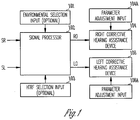
- Figs. 1 through 5 depict examples of signal processing systems that can be used to generate the simulated surround sound signals as described above.
- five surround sound signals are generated and used to create the simulated surround sound signals for driving the hearing aids.
- Such systems could implemented in a personal computer (PC), where the audiologist selects any stereo sources and the software system creates simulated surround sound signals that will create a virtual surround sound environment when listened to through hearing aids.
- PC personal computer
- a small hardware processor can be attached to the PC sound card output that creates multiple surround sound channels, applies the HRTFs in real-time, and then transmits the simulated surround sound signals to the hearing aids via a wired or wireless connection.
- the HRTFs used in virtualizing the five surround sound channels may be generic ones, such as measured on a KEMAR. HRTFs may also be estimated by using a small number of measurements of the person's pinna. HRTFs could also be selected from a small set of HRTFs subjectively, where the subject listens to sounds through several HRTF sets and selects the one that sounds most realistic.
- Fig. 1 illustrates a basic system that includes a signal processor 102 for processing left and right stereo signals SL and SR in order to produce left and right simulated surround sound output signals LO and RO that can be used to drive left and right corrective hearing assistance devices 104 and 106.
- a corrective hearing assist device is any device that provides compensation for hearing loss by means of frequency selective amplification. Such devices would include, for example, behind-the-ear, in-the-ear, in-the-canal, and completely-in-the-canal hearing aids.
- the output signals LO and RO may be transferred to the direct audio input of a hearing assistance device by means of a wired or wireless connection.
- the hearing assistance device is equipped with a wireless receiver for receiving radiofrequency signals.
- the frequency selective amplification of the corrective hearing assistance devices, as well as well other parameters, may be adjusted by means of parameter adjustment inputs 104a and 106a for each of the devices 104 and 106, respectively.
- the signal processor 102 optionally has an environment selection input 101 for selecting particular acoustic environments. Some examples of acoustic environments include, but are not limited to, a classroom with moderate reverberation and a living room with low reverberation, a restaurant with high reverberation.
- the signal processor 102 also has an HRTF selection input 103 for selecting particular sets of HRTFs used to generate the simulated surround sound output signals. Some examples of HRTFs to select include, but are not limited to, those measured on a KEMAR manakin, those specific to and measured on the patient and those measured on a set of people whose HRTFs collectively span the expected HRTFs measured on any individual.
- Fig. 2 shows a particular example useful for understanding the present invention which is an example of the signal processor 102 that includes a surround sound synthesizer 206 for synthesizing the surround sound signals LS, L, C, R, and RS from the left and right stereo signals SL and SR.
- these signals are provided using techniques known to those in the art (e.g., Dolby Pro-Logic Decoder).
- the signal may also be generated using other sound process methods.
- the surround sound signals LS, L, C, R, and RS thus produced would create a surround sound environment by driving speakers located at the left rear, left front, center front, right front, and right rear of the listener, respectively.
- the surround sound signals are further processed by banks of head-related transfer functions to generate output signals RO and LO that can be used to drive devices providing a single acoustic output to each ear (i.e., corrective hearing assistance devices) and still generate the surround sound effect.
- Fig. 2 shows two filter banks 208R and 208L that process the surround sound signals for the right and left ears, respectively, with head-related transfer functions.
- the filter bank 208R processes the surround sound signals LS, L, C, R, and RS with head-related transfer functions HRTF 1 (R) through HRTF 5 (R), respectively, for the right ear.
- the filter bank 208L similarly processes the surround sound signals LS, L, C, R, and RS with head-related transfer functions HRTF 1 (L) through HRTF 5 (L), respectively, for the left ear.
- Each of the head-related transfer functions is a function of head anatomy (either the patient's individual anatomy or that of a model), the type of hearing assistance device to which to output signals RO and LO are to be input (e.g., behind-the-ear, in-the-ear, in-the-canal, and completely-in-the-canal hearing aids), and the azimuthal direction of the sound source to be simulated by it (i.e., the particular surround sound signal).
- the head-related transfer functions HRTF 1 (R) through HRTF 5 (R) and the functions HRTF 1 (L) through HRTF 5 (L) will be symmetrical but in certain instances may be asymmetrical.
- the outputs of each of the filter banks 208R and 208L are summed by summers 210 to produce the output signals RO and LO, respectively, used to drive the right and left hearing assistance devices.
- the surround sound synthesizer and filter banks are implemented by means of a memory adapted to store at least one head-related transfer function for each angle of reception to be synthesized and a processor connected to the memory and to a plurality of inputs including a stereo right (SR) input and a stereo left (SL) input.
- the processor is adapted to convert the SR and SL inputs into left surround (LS), left (L), center (C), right (R) and right surround (RS) signals, and further adapted to generate processed versions for each of the LS, L, C, R, and RS signals by application of a head-related transfer function at an individual angle of reception for each of the LS, L, C, R, and RS signals.
- the processor is further adapted to mix the processed versions of the LS, L, C, R, and RS signals to produce a right output signal (RO) and a left output signal (LO) for a first hearing assistance device and a second hearing assistance device, respectively.
- the output signals RO and LO may be immediately transferred to the hearing assistance devices as they are generated or may be stored in memory for later transfer to the hearing assistance devices.
- Fig. 3 shows another embodiment of the system shown in Fig. 2 to which has been added an HRTF selection input 312 for each of the filter banks 208R and 208L.
- This added functionality allows a user to select between different sets of head-related transfer functions for each ear. For example, the user may select between individualized or actual HRTFs and generic HRTFs or may adjust the individualized HRTFs in accordance with the subjective sensations reported by the patient.
- different sets of head-related transfer functions may be used during the hearing aid fitting process to produce different effects and further test the frequency response of the hearing aid. For example, sets of HRTFs that simulate sound direction that varies with elevation angle in addition to azimuth angle may be employed.
- Fig. 4 shows another example useful for understanding the present invention which is an example of the system shown in Fig. 2 to which has been added a sound environment selection input 411 to the surround sound synthesizer for selecting between different acoustic environments used to synthesize the surround sound signals from the stereo signals SL and SR.
- a sound environment selection input 411 to the surround sound synthesizer for selecting between different acoustic environments used to synthesize the surround sound signals from the stereo signals SL and SR.
- Employing different simulated acoustic environments with different reverberation characteristics adds complexity to the sound field produced by the output signals RO and LO that can be useful for testing the frequency response of the hearing aid.
- Presenting different acoustic environments to the patient also allows finer adjustment of hearing aid parameters in accordance with individual patient preferences.
- an input is provided to the surround sound synthesizer 206 that allows a user to adjust the spatial locations simulated by the surround sound signals.
- Fig. 5 shows an example of a system that includes a spatial location input 614 for the surround sound synthesizer 206 in addition to an HRTF selection input 312 for each of the filter banks and a sound environment selection input 411.
- the spatial location input 614 allows the surround sound signals generated by the surround sound synthesizer to be adjusted in a manner that varies the locations of the surround sound signals that are subsequently processed with the HRTFs to produce the output signals RO and LO.
- Spatial locations of the surround sound signals may be varied in discrete steps or varied dynamically to produce a panning effect. Varying the spatial location of sound sources in the simulated sound field allows further testing and adjustment of the hearing assistance device's frequency response in accordance with objective criteria and/or individual patient preferences.
Landscapes
- Engineering & Computer Science (AREA)
- Health & Medical Sciences (AREA)
- General Health & Medical Sciences (AREA)
- Neurosurgery (AREA)
- Otolaryngology (AREA)
- Physics & Mathematics (AREA)
- Acoustics & Sound (AREA)
- Signal Processing (AREA)
- Computer Networks & Wireless Communication (AREA)
- Stereophonic System (AREA)
Claims (14)
- Verfahren zum Betreiben eines Hörgerät-Anpassungssystems für elektronische Hörgeräte, umfassend:Auswählen zwischen unterschiedlichen Sätzen von kopfbezogenen Übertragungsfunktionen (208R, 208L) für jedes Ohr eines Trägers eines rechten Hörgeräts (104) und eines linken Hörgeräts (106);Empfangen von Signalen von einer Tonumgebung mit einem Stereo-Rechts-, SR, und einem Stereo-Links-, SL, Tonsignal;Verarbeiten der SR- und SL-Signale, um Links-Surround-, LS, Links-, L, Zentrum-, C, Rechts-, R, und Rechts-Surround-, RS, Signale zu erzeugen;Erzeugen einer verarbeiteten Version für jedes der LS-, L-, C-, R- und RS-Signale durch Anwenden einer kopfbezogenen Übertragungsfunktion mit einem einzelnen Empfangswinkel für jedes der LS-, L-, C-, R- und RS-Signale, wobei die kopfbezogenen Übertragungsfunktionen kopfbezogene Übertragungsfunktionen des Satzes von kopfbezogenen Übertragungsfunktionen sind, welcher für jedes Ohr ausgewählt ist;Mischen der verarbeiteten Version der LS-, L-, C-, R-, und RS-Signale, um ein rechtes Ausgangssignal, RO, und ein linkes Ausgangssignal, LO, zu erzeugen;direktes Übertragen, durch eine drahtgebundene oder drahtlose Funkverbindung, des RO-Signals an das rechte Hörgerät und des LO-Signals an das linke Hörgerät; undEinstellen von Parametern des rechten Hörgeräts und des linken Hörgeräts in einer Weise, welche dem Träger ermöglicht, Tonquellen in unterschiedlichen Positionen, auf der Basis des an das rechte Hörgerät angelegten RO-Signals und des an das linke Hörgerät angelegten LO-Signals, korrekt wahrzunehmen.
- Verfahren nach Anspruch 1, umfassend das Verwenden von direkten Audioeingaben eines der Hörgeräte oder sowohl des rechten Hörgeräts als auch des linken Hörgeräts.
- Verfahren nach einem der vorhergehenden Ansprüche, wobei die Verarbeitung ferner das Verwenden von allgemeinen kopfbezogenen Übertragungsfunktionen umfasst.
- Verfahren nach einem der vorhergehenden Ansprüche, wobei die Verarbeitung ferner umfasst:Messen mindestens eines Teils der tatsächlichen kopfbezogenen Übertragungsfunktionen; undAnwenden der tatsächlichen kopfbezogenen Übertragungsfunktionen, um die verarbeitete Version für jedes der LS, L, C, R und RS-Signale zu erzeugen.
- Verfahren nach einem der vorhergehenden Ansprüche, wobei die Verarbeitung ferner das Verwenden eines Dolby Pro-Logic 2-Prozesses umfasst.
- Verfahren nach einem der vorhergehenden Ansprüche, ferner umfassend:Erzeugen einer Vielzahl von voraufgezeichneten RO- und LO-Signalen; undSpeichern der Vielzahl von voraufgezeichneten RO- und LO-Signalen.
- Verfahren nach einem der vorhergehenden Ansprüche, wobei die kopfbezogene Übertragungsfunktion für den Träger von völlig kanalinternen Hörgeräten verarbeitet ist.
- Verfahren nach einem der Ansprüche 1 bis 6, wobei die kopfbezogene Übertragungsfunktion für den Träger von kanalinternen Hörgeräten verarbeitet ist.
- Verfahren nach einem der Ansprüche 1 bis 6, wobei die kopfbezogene Übertragungsfunktion für einen Träger von Hinter-dem-Ohr-Hörgeräten verarbeitet ist.
- Verfahren nach einem der Ansprüche 1 bis 9, ferner umfassend:Auswählen (411) einer akustischen Umgebung unter unterschiedlichen akustischen Umgebungen; undEinstellen (614) der LS-, L-,C-, R- und RS-Signale in der Weise, dass die Position der LS-, L-,C-, R- und RS-Signale verändert wird, bevor die verarbeitete Version für jedes der LS-, L-,C-, R- und RS-Signale erzeugt wird.
- Hörgerät-Anpassungssystem für elektronische Hörgeräte, umfassend:einen Speicher, welcher zum Speichern von mindestens einer kopfbezogenen Übertragungsfunktion ausgebildet ist;einen kopfbezogenen Übertragungsfunktion-Auswahleingang (103, 312), welcher dem Benutzer erlaubt, zwischen unterschiedlichen Sätzen von kopfbezogenen Übertragungsfunktionen für jedes Ohr des Benutzers zu wählen; undeine Vielzahl von Eingängen, umfassend einen Stereo-Rechts-Eingang, SR, und einen Stereo-Links-Eingang, SL;einen Prozessor (102), welcher mit dem Speicher und mit der Vielzahl von Eingängen verbunden ist, wobei der Prozessor zum Umwandeln der SR- und SL-Eingänge in Links-Surround, LS, Links, L, Zentrum, C, Rechts, R, und Rechts-Surround, RS-Signalen ausgebildet ist, wobei der Prozessor ferner zum Erzeugen einer verarbeiteten Version für jedes der LS-, L-, C-, R- und RS-Signale durch Anwenden einer kopfbezogenen Übertragungsfunktion mit einem einzelnen Empfangswinkel für jedes der LS-, L-,C-, R- und RS-Signale ausgebildet ist,wobei die kopfbezogenen Übertragungsfunktionen kopfbezogene Übertragungsfunktionen des Satzes von kopfbezogenen Übertragungsfunktionen sind, welcher für jedes Ohr ausgewählt ist;wobei der Prozessor zum Mischen der verarbeiteten Versionen der LS-, L-,C-, Rund RS-Signale ausgebildet ist, um ein rechtes Ausgangssignal, RO, und ein linkes Ausgangssignal, LO, für ein erstes Hörgerät (104) und ein zweites Hörgerät (106) zu erzeugen, wobei das System ausgebildet ist, um die RO- und LO-Signale direkt an das erste und zweite Hörgerät über eine drahtgebundene oder drahtlose Funkverbindung zu übertragen; undMittel, welche zum Einstellen von Parametern des rechten Hörgeräts und des linken Hörgeräts ausgebildet sind, um dem Träger zu ermöglichen, die Tonquellen in unterschiedlichen Positionen korrekt wahrzunehmen, auf der Basis des RO-Signals, welches an das rechte Hörgerät angelegt wird, und des LO-Signals, welches an das linke Hörgerät angelegt wird.
- System nach Anspruch 11, ferner umfassend eine Vielzahl von voraufgezeichneten RO- und LO-Signalen für unterschiedliche Tonumgebungen oder unterschiedlichen kopfbezogenen Übertragungsfunktionen oder beide.
- System nach einem der Ansprüche 11 und 12, ferner umfassend
einen Tonumgebungsauswahleingang (411) zum Auswählen einer unter einer Vielzahl von Tonumgebungen;
und
ferner umfassend eine räumliche Positionseingabe (614), ausgebildet um die Einstellung der LS-, L-, C-, R- und RS-Signale so zu ermöglichen, dass die Positionen der LS-, L-,
C-, R- und RS-Signale vor der Erzeugung der verarbeiteten Version jedes der LS-, L-, C-, R- und RS-Signale verändert werden. - System nach einem der Ansprüche 11 bis 13, wobei die kopfbezogene Übertragungsfunktion für einen Träger eines besonderen Typs von Hörgerät verarbeitet wird.
Applications Claiming Priority (1)
| Application Number | Priority Date | Filing Date | Title |
|---|---|---|---|
| US11/935,935 US9031242B2 (en) | 2007-11-06 | 2007-11-06 | Simulated surround sound hearing aid fitting system |
Publications (2)
| Publication Number | Publication Date |
|---|---|
| EP2099236A1 EP2099236A1 (de) | 2009-09-09 |
| EP2099236B1 true EP2099236B1 (de) | 2017-05-24 |
Family
ID=40588110
Family Applications (1)
| Application Number | Title | Priority Date | Filing Date |
|---|---|---|---|
| EP08253607.9A Revoked EP2099236B1 (de) | 2007-11-06 | 2008-11-05 | Simuliertes Surround-Sound-Hörgerät-Anpassungssystem |
Country Status (4)
| Country | Link |
|---|---|
| US (1) | US9031242B2 (de) |
| EP (1) | EP2099236B1 (de) |
| CA (1) | CA2642993A1 (de) |
| DK (1) | DK2099236T3 (de) |
Families Citing this family (34)
| Publication number | Priority date | Publication date | Assignee | Title |
|---|---|---|---|---|
| GB0724366D0 (en) * | 2007-12-14 | 2008-01-23 | Univ York | Environment modelling |
| KR100954385B1 (ko) * | 2007-12-18 | 2010-04-26 | 한국전자통신연구원 | 개인화된 머리전달함수를 이용한 3차원 오디오 신호 처리장치 및 그 방법과, 그를 이용한 고현장감 멀티미디어 재생시스템 |
| US9485589B2 (en) | 2008-06-02 | 2016-11-01 | Starkey Laboratories, Inc. | Enhanced dynamics processing of streaming audio by source separation and remixing |
| US9185500B2 (en) | 2008-06-02 | 2015-11-10 | Starkey Laboratories, Inc. | Compression of spaced sources for hearing assistance devices |
| US8705751B2 (en) * | 2008-06-02 | 2014-04-22 | Starkey Laboratories, Inc. | Compression and mixing for hearing assistance devices |
| US9037468B2 (en) * | 2008-10-27 | 2015-05-19 | Sony Computer Entertainment Inc. | Sound localization for user in motion |
| US8553897B2 (en) | 2009-06-09 | 2013-10-08 | Dean Robert Gary Anderson | Method and apparatus for directional acoustic fitting of hearing aids |
| US8879745B2 (en) * | 2009-07-23 | 2014-11-04 | Dean Robert Gary Anderson As Trustee Of The D/L Anderson Family Trust | Method of deriving individualized gain compensation curves for hearing aid fitting |
| US9101299B2 (en) * | 2009-07-23 | 2015-08-11 | Dean Robert Gary Anderson As Trustee Of The D/L Anderson Family Trust | Hearing aids configured for directional acoustic fitting |
| US9161131B2 (en) * | 2010-03-25 | 2015-10-13 | K&E Holdings, LLC | Stereo audio headphone apparatus for a user having a hearing loss and related methods |
| DK2643983T3 (en) | 2010-11-24 | 2015-01-26 | Phonak Ag | Hearing assistance system and method |
| US8942397B2 (en) | 2011-11-16 | 2015-01-27 | Dean Robert Gary Anderson | Method and apparatus for adding audible noise with time varying volume to audio devices |
| US9420386B2 (en) * | 2012-04-05 | 2016-08-16 | Sivantos Pte. Ltd. | Method for adjusting a hearing device apparatus and hearing device apparatus |
| CN104412618B (zh) * | 2012-07-03 | 2017-11-21 | 索诺瓦公司 | 用于助听器的方法 |
| CN104956689B (zh) | 2012-11-30 | 2017-07-04 | Dts(英属维尔京群岛)有限公司 | 用于个性化音频虚拟化的方法和装置 |
| US9191755B2 (en) | 2012-12-14 | 2015-11-17 | Starkey Laboratories, Inc. | Spatial enhancement mode for hearing aids |
| US9794715B2 (en) | 2013-03-13 | 2017-10-17 | Dts Llc | System and methods for processing stereo audio content |
| EP2822301B1 (de) * | 2013-07-04 | 2019-06-19 | GN Hearing A/S | Bestimmung von Individuellen HRTFs |
| KR20150020810A (ko) * | 2013-08-19 | 2015-02-27 | 삼성전자주식회사 | 청각 기기 및 양이 청각 모델을 이용한 청각 기기의 피팅 방법 |
| US10129681B2 (en) * | 2015-03-10 | 2018-11-13 | Ossic Corp. | Calibrating listening devices |
| EP3375207B1 (de) * | 2015-12-07 | 2021-06-30 | Huawei Technologies Co., Ltd. | Vorrichtung und verfahren zur tonsignalverarbeitung |
| US10142743B2 (en) | 2016-01-01 | 2018-11-27 | Dean Robert Gary Anderson | Parametrically formulated noise and audio systems, devices, and methods thereof |
| US12533515B2 (en) * | 2016-03-11 | 2026-01-27 | Mayo Foundation For Medical Education And Research | Cochlear stimulation system with surround sound and noise cancellation |
| US9955279B2 (en) | 2016-05-11 | 2018-04-24 | Ossic Corporation | Systems and methods of calibrating earphones |
| US10492018B1 (en) | 2016-10-11 | 2019-11-26 | Google Llc | Symmetric binaural rendering for high-order ambisonics |
| US9992602B1 (en) | 2017-01-12 | 2018-06-05 | Google Llc | Decoupled binaural rendering |
| US10158963B2 (en) | 2017-01-30 | 2018-12-18 | Google Llc | Ambisonic audio with non-head tracked stereo based on head position and time |
| US10009704B1 (en) * | 2017-01-30 | 2018-06-26 | Google Llc | Symmetric spherical harmonic HRTF rendering |
| EP3692729A4 (de) * | 2017-10-05 | 2021-05-05 | Cochlear Limited | Ablenkungsbeseitigung an einer hörprothese |
| US10681475B2 (en) * | 2018-02-17 | 2020-06-09 | The United States Of America As Represented By The Secretary Of The Defense | System and method for evaluating speech perception in complex listening environments |
| DE102018210053A1 (de) * | 2018-06-20 | 2019-12-24 | Sivantos Pte. Ltd. | Verfahren zur Audio-Wiedergabe in einem Hörgerät |
| TWI839606B (zh) * | 2021-04-10 | 2024-04-21 | 英霸聲學科技股份有限公司 | 音訊處理方法以及音訊處理裝置 |
| CN113556660B (zh) * | 2021-08-01 | 2022-07-19 | 武汉左点科技有限公司 | 一种基于虚拟环绕立体声技术的助听方法及装置 |
| CN117981360A (zh) * | 2021-09-21 | 2024-05-03 | 索尼集团公司 | 信息处理装置、信息处理方法和程序 |
Citations (8)
| Publication number | Priority date | Publication date | Assignee | Title |
|---|---|---|---|---|
| US5785661A (en) | 1994-08-17 | 1998-07-28 | Decibel Instruments, Inc. | Highly configurable hearing aid |
| US20030044002A1 (en) | 2001-08-28 | 2003-03-06 | Yeager David M. | Three dimensional audio telephony |
| US6614910B1 (en) | 1996-11-01 | 2003-09-02 | Central Research Laboratories Limited | Stereo sound expander |
| US20040218771A1 (en) | 2003-04-22 | 2004-11-04 | Siemens Audiologische Technik Gmbh | Method for production of an approximated partial transfer function |
| EP1531650A2 (de) | 2003-11-12 | 2005-05-18 | Gennum Corporation | Hörhilfegerät mit einer drahtlosen Basiseinheit |
| US20050271212A1 (en) | 2002-07-02 | 2005-12-08 | Thales | Sound source spatialization system |
| EP1796427A1 (de) | 2005-12-07 | 2007-06-13 | Phonak AG | Hörgerät mit einer virtuellen Schallquelle |
| WO2007106553A1 (en) | 2006-03-15 | 2007-09-20 | Dolby Laboratories Licensing Corporation | Binaural rendering using subband filters |
Family Cites Families (25)
| Publication number | Priority date | Publication date | Assignee | Title |
|---|---|---|---|---|
| US4406001A (en) | 1980-08-18 | 1983-09-20 | The Variable Speech Control Company ("Vsc") | Time compression/expansion with synchronized individual pitch correction of separate components |
| GB2192511B (en) | 1986-07-11 | 1990-02-21 | Roger Frederick Laurence | Hearing aid |
| US6885752B1 (en) | 1994-07-08 | 2005-04-26 | Brigham Young University | Hearing aid device incorporating signal processing techniques |
| US5825894A (en) * | 1994-08-17 | 1998-10-20 | Decibel Instruments, Inc. | Spatialization for hearing evaluation |
| US6405163B1 (en) | 1999-09-27 | 2002-06-11 | Creative Technology Ltd. | Process for removing voice from stereo recordings |
| US7340062B2 (en) | 2000-03-14 | 2008-03-04 | Revit Lawrence J | Sound reproduction method and apparatus for assessing real-world performance of hearing and hearing aids |
| ATE331417T1 (de) | 2000-04-04 | 2006-07-15 | Gn Resound As | Eine hörprothese mit automatischer hörumgebungsklassifizierung |
| AU8852801A (en) * | 2000-08-31 | 2002-03-13 | Dolby Lab Licensing Corp | Method for apparatus for audio matrix decoding |
| US7630507B2 (en) | 2002-01-28 | 2009-12-08 | Gn Resound A/S | Binaural compression system |
| CA2420989C (en) | 2002-03-08 | 2006-12-05 | Gennum Corporation | Low-noise directional microphone system |
| US7330556B2 (en) | 2003-04-03 | 2008-02-12 | Gn Resound A/S | Binaural signal enhancement system |
| KR20050060789A (ko) * | 2003-12-17 | 2005-06-22 | 삼성전자주식회사 | 가상 음향 재생 방법 및 그 장치 |
| KR100647286B1 (ko) | 2004-08-14 | 2006-11-23 | 삼성전자주식회사 | 교차채널 간섭을 제거하기 위한 후처리장치 및 방법과이를 이용한 다채널 음원 분리장치 및 방법 |
| KR20060022968A (ko) * | 2004-09-08 | 2006-03-13 | 삼성전자주식회사 | 음향재생장치 및 음향재생방법 |
| US7634092B2 (en) * | 2004-10-14 | 2009-12-15 | Dolby Laboratories Licensing Corporation | Head related transfer functions for panned stereo audio content |
| DE102004053790A1 (de) | 2004-11-08 | 2006-05-18 | Siemens Audiologische Technik Gmbh | Verfahren zur Erzeugung von Stereosignalen für getrennte Quellen und entsprechendes Akustiksystem |
| US7912232B2 (en) | 2005-09-30 | 2011-03-22 | Aaron Master | Method and apparatus for removing or isolating voice or instruments on stereo recordings |
| ES2339888T3 (es) * | 2006-02-21 | 2010-05-26 | Koninklijke Philips Electronics N.V. | Codificacion y decodificacion de audio. |
| JP4672611B2 (ja) | 2006-07-28 | 2011-04-20 | 株式会社神戸製鋼所 | 音源分離装置、音源分離方法及び音源分離プログラム |
| CN101652810B (zh) * | 2006-09-29 | 2012-04-11 | Lg电子株式会社 | 用于处理混合信号的装置及其方法 |
| DE102006047983A1 (de) | 2006-10-10 | 2008-04-24 | Siemens Audiologische Technik Gmbh | Verarbeitung eines Eingangssignals in einem Hörgerät |
| DE102006047986B4 (de) | 2006-10-10 | 2012-06-14 | Siemens Audiologische Technik Gmbh | Verarbeitung eines Eingangssignals in einem Hörgerät |
| US9485589B2 (en) | 2008-06-02 | 2016-11-01 | Starkey Laboratories, Inc. | Enhanced dynamics processing of streaming audio by source separation and remixing |
| US9185500B2 (en) | 2008-06-02 | 2015-11-10 | Starkey Laboratories, Inc. | Compression of spaced sources for hearing assistance devices |
| US9084893B2 (en) | 2009-02-03 | 2015-07-21 | Hearworks Pty Ltd | Enhanced envelope encoded tone, sound processor and system |
-
2007
- 2007-11-06 US US11/935,935 patent/US9031242B2/en active Active
-
2008
- 2008-11-05 DK DK08253607.9T patent/DK2099236T3/en active
- 2008-11-05 CA CA 2642993 patent/CA2642993A1/en not_active Abandoned
- 2008-11-05 EP EP08253607.9A patent/EP2099236B1/de not_active Revoked
Patent Citations (8)
| Publication number | Priority date | Publication date | Assignee | Title |
|---|---|---|---|---|
| US5785661A (en) | 1994-08-17 | 1998-07-28 | Decibel Instruments, Inc. | Highly configurable hearing aid |
| US6614910B1 (en) | 1996-11-01 | 2003-09-02 | Central Research Laboratories Limited | Stereo sound expander |
| US20030044002A1 (en) | 2001-08-28 | 2003-03-06 | Yeager David M. | Three dimensional audio telephony |
| US20050271212A1 (en) | 2002-07-02 | 2005-12-08 | Thales | Sound source spatialization system |
| US20040218771A1 (en) | 2003-04-22 | 2004-11-04 | Siemens Audiologische Technik Gmbh | Method for production of an approximated partial transfer function |
| EP1531650A2 (de) | 2003-11-12 | 2005-05-18 | Gennum Corporation | Hörhilfegerät mit einer drahtlosen Basiseinheit |
| EP1796427A1 (de) | 2005-12-07 | 2007-06-13 | Phonak AG | Hörgerät mit einer virtuellen Schallquelle |
| WO2007106553A1 (en) | 2006-03-15 | 2007-09-20 | Dolby Laboratories Licensing Corporation | Binaural rendering using subband filters |
Non-Patent Citations (3)
| Title |
|---|
| FORTSCHRITTE DER AKUSTIK : PLENARVORTRAGE UND FACHBEITRAGE DER 27. DEUTSCHEN JAHRESTAGUNG FUR AKUSTIK DAGA 2001, Hamburg |
| GARDNER ET AL.: "HRTF Measurements of a KEMAR Dummy-Head Microphone", MIT MEDIA LAB PERCEPTUAL COMPUTING TR #280, May 1994 (1994-05-01), XP055467350, Retrieved from the Internet <URL:http://sound.media.mit.edu/resources/KEMAR/hrtfdoc.txt> |
| SEEBER ET AL.: "Effiziente Auswahl der individuell-optimalen aus fremden Außenohrübertragungsfunktionen", TAGUNGSBAND DAGA 2001 , DT. GESELLSCHAFT FUR AKUSTIK, 2001, Oldenburg, XP055467346 |
Also Published As
| Publication number | Publication date |
|---|---|
| CA2642993A1 (en) | 2009-05-06 |
| DK2099236T3 (en) | 2017-09-11 |
| US9031242B2 (en) | 2015-05-12 |
| US20090116657A1 (en) | 2009-05-07 |
| EP2099236A1 (de) | 2009-09-09 |
Similar Documents
| Publication | Publication Date | Title |
|---|---|---|
| EP2099236B1 (de) | Simuliertes Surround-Sound-Hörgerät-Anpassungssystem | |
| US10431239B2 (en) | Hearing system | |
| JP5894634B2 (ja) | 個人ごとのhrtfの決定 | |
| Zheng et al. | Sound localization of listeners with normal hearing, impaired hearing, hearing aids, bone-anchored hearing instruments, and cochlear implants: a review | |
| Pralong et al. | The role of individualized headphone calibration for the generation of high fidelity virtual auditory space | |
| US9930456B2 (en) | Method and apparatus for localization of streaming sources in hearing assistance system | |
| Ricketts et al. | Evaluation of an adaptive, directional-microphone hearing aid: Evaluación de un auxiliar auditivo de micrófono direccional adaptable | |
| JP5325988B2 (ja) | 補聴器システムにおいてバイノーラル・ステレオにレンダリングする方法および補聴器システム | |
| CN102647944B (zh) | 耳鸣治疗系统和方法 | |
| Denk et al. | Acoustic transparency in hearables—technical evaluation | |
| EP3319339A1 (de) | Binaurales hörsystem und verfahren | |
| CN106664499A (zh) | 音频信号处理装置 | |
| Ibrahim et al. | Evaluation of speech intelligibility and sound localization abilities with hearing aids using binaural wireless technology | |
| Kates et al. | Externalization of remote microphone signals using a structural binaural model of the head and pinna | |
| EP2822301B1 (de) | Bestimmung von Individuellen HRTFs | |
| Dieudonné et al. | Head shadow enhancement with low-frequency beamforming improves sound localization and speech perception for simulated bimodal listeners | |
| US8666080B2 (en) | Method for processing a multi-channel audio signal for a binaural hearing apparatus and a corresponding hearing apparatus | |
| US9532146B2 (en) | Method and apparatus for testing binaural hearing aid function | |
| Fernandez et al. | Localization accuracy of phantom sound sources on the horizontal plane by bilateral hearing aid users in aided free-field and non–free-field conditions | |
| Pausch | Spatial audio reproduction for hearing aid research: System design, evaluation and application | |
| EP4094685B1 (de) | Spektro-temporale modulationsdetektionseinheit | |
| Kang et al. | Listener auditory perception enhancement using virtual sound source design for 3D auditory system | |
| Kates et al. | Improving auditory externalization for hearing-aid remote microphones | |
| Koski | Parametric Spatial Audio in Hearing Performance Evaluation of Hearing-Impaired and Aided Listeners | |
| McKenzie et al. | Tissue conducted spatial sound fields |
Legal Events
| Date | Code | Title | Description |
|---|---|---|---|
| PUAI | Public reference made under article 153(3) epc to a published international application that has entered the european phase |
Free format text: ORIGINAL CODE: 0009012 |
|
| 17P | Request for examination filed |
Effective date: 20081112 |
|
| AK | Designated contracting states |
Kind code of ref document: A1 Designated state(s): AT BE BG CH CY CZ DE DK EE ES FI FR GB GR HR HU IE IS IT LI LT LU LV MC MT NL NO PL PT RO SE SI SK TR |
|
| AX | Request for extension of the european patent |
Extension state: AL BA MK RS |
|
| 17Q | First examination report despatched |
Effective date: 20100319 |
|
| AKX | Designation fees paid |
Designated state(s): AT BE BG CH CY CZ DE DK EE ES FI FR GB GR HR HU IE IS IT LI LT LU LV MC MT NL NO PL PT RO SE SI SK TR |
|
| GRAP | Despatch of communication of intention to grant a patent |
Free format text: ORIGINAL CODE: EPIDOSNIGR1 |
|
| STAA | Information on the status of an ep patent application or granted ep patent |
Free format text: STATUS: GRANT OF PATENT IS INTENDED |
|
| INTG | Intention to grant announced |
Effective date: 20161121 |
|
| GRAS | Grant fee paid |
Free format text: ORIGINAL CODE: EPIDOSNIGR3 |
|
| GRAJ | Information related to disapproval of communication of intention to grant by the applicant or resumption of examination proceedings by the epo deleted |
Free format text: ORIGINAL CODE: EPIDOSDIGR1 |
|
| GRAL | Information related to payment of fee for publishing/printing deleted |
Free format text: ORIGINAL CODE: EPIDOSDIGR3 |
|
| STAA | Information on the status of an ep patent application or granted ep patent |
Free format text: STATUS: EXAMINATION IS IN PROGRESS |
|
| GRAR | Information related to intention to grant a patent recorded |
Free format text: ORIGINAL CODE: EPIDOSNIGR71 |
|
| STAA | Information on the status of an ep patent application or granted ep patent |
Free format text: STATUS: GRANT OF PATENT IS INTENDED |
|
| GRAA | (expected) grant |
Free format text: ORIGINAL CODE: 0009210 |
|
| STAA | Information on the status of an ep patent application or granted ep patent |
Free format text: STATUS: THE PATENT HAS BEEN GRANTED |
|
| INTC | Intention to grant announced (deleted) | ||
| AK | Designated contracting states |
Kind code of ref document: B1 Designated state(s): AT BE BG CH CY CZ DE DK EE ES FI FR GB GR HR HU IE IS IT LI LT LU LV MC MT NL NO PL PT RO SE SI SK TR |
|
| INTG | Intention to grant announced |
Effective date: 20170418 |
|
| REG | Reference to a national code |
Ref country code: GB Ref legal event code: FG4D |
|
| REG | Reference to a national code |
Ref country code: CH Ref legal event code: EP Ref country code: CH Ref legal event code: NV Representative=s name: SERVOPATENT GMBH, CH |
|
| REG | Reference to a national code |
Ref country code: IE Ref legal event code: FG4D |
|
| REG | Reference to a national code |
Ref country code: AT Ref legal event code: REF Ref document number: 896543 Country of ref document: AT Kind code of ref document: T Effective date: 20170615 |
|
| REG | Reference to a national code |
Ref country code: DE Ref legal event code: R096 Ref document number: 602008050387 Country of ref document: DE |
|
| REG | Reference to a national code |
Ref country code: DK Ref legal event code: T3 Effective date: 20170905 |
|
| REG | Reference to a national code |
Ref country code: NL Ref legal event code: MP Effective date: 20170524 |
|
| REG | Reference to a national code |
Ref country code: LT Ref legal event code: MG4D |
|
| REG | Reference to a national code |
Ref country code: FR Ref legal event code: PLFP Year of fee payment: 10 |
|
| REG | Reference to a national code |
Ref country code: AT Ref legal event code: MK05 Ref document number: 896543 Country of ref document: AT Kind code of ref document: T Effective date: 20170524 |
|
| PG25 | Lapsed in a contracting state [announced via postgrant information from national office to epo] |
Ref country code: ES Free format text: LAPSE BECAUSE OF FAILURE TO SUBMIT A TRANSLATION OF THE DESCRIPTION OR TO PAY THE FEE WITHIN THE PRESCRIBED TIME-LIMIT Effective date: 20170524 Ref country code: LT Free format text: LAPSE BECAUSE OF FAILURE TO SUBMIT A TRANSLATION OF THE DESCRIPTION OR TO PAY THE FEE WITHIN THE PRESCRIBED TIME-LIMIT Effective date: 20170524 Ref country code: NO Free format text: LAPSE BECAUSE OF FAILURE TO SUBMIT A TRANSLATION OF THE DESCRIPTION OR TO PAY THE FEE WITHIN THE PRESCRIBED TIME-LIMIT Effective date: 20170824 Ref country code: HR Free format text: LAPSE BECAUSE OF FAILURE TO SUBMIT A TRANSLATION OF THE DESCRIPTION OR TO PAY THE FEE WITHIN THE PRESCRIBED TIME-LIMIT Effective date: 20170524 Ref country code: FI Free format text: LAPSE BECAUSE OF FAILURE TO SUBMIT A TRANSLATION OF THE DESCRIPTION OR TO PAY THE FEE WITHIN THE PRESCRIBED TIME-LIMIT Effective date: 20170524 Ref country code: GR Free format text: LAPSE BECAUSE OF FAILURE TO SUBMIT A TRANSLATION OF THE DESCRIPTION OR TO PAY THE FEE WITHIN THE PRESCRIBED TIME-LIMIT Effective date: 20170825 Ref country code: AT Free format text: LAPSE BECAUSE OF FAILURE TO SUBMIT A TRANSLATION OF THE DESCRIPTION OR TO PAY THE FEE WITHIN THE PRESCRIBED TIME-LIMIT Effective date: 20170524 |
|
| PG25 | Lapsed in a contracting state [announced via postgrant information from national office to epo] |
Ref country code: NL Free format text: LAPSE BECAUSE OF FAILURE TO SUBMIT A TRANSLATION OF THE DESCRIPTION OR TO PAY THE FEE WITHIN THE PRESCRIBED TIME-LIMIT Effective date: 20170524 Ref country code: SE Free format text: LAPSE BECAUSE OF FAILURE TO SUBMIT A TRANSLATION OF THE DESCRIPTION OR TO PAY THE FEE WITHIN THE PRESCRIBED TIME-LIMIT Effective date: 20170524 Ref country code: BG Free format text: LAPSE BECAUSE OF FAILURE TO SUBMIT A TRANSLATION OF THE DESCRIPTION OR TO PAY THE FEE WITHIN THE PRESCRIBED TIME-LIMIT Effective date: 20170824 Ref country code: IS Free format text: LAPSE BECAUSE OF FAILURE TO SUBMIT A TRANSLATION OF THE DESCRIPTION OR TO PAY THE FEE WITHIN THE PRESCRIBED TIME-LIMIT Effective date: 20170924 Ref country code: LV Free format text: LAPSE BECAUSE OF FAILURE TO SUBMIT A TRANSLATION OF THE DESCRIPTION OR TO PAY THE FEE WITHIN THE PRESCRIBED TIME-LIMIT Effective date: 20170524 |
|
| PG25 | Lapsed in a contracting state [announced via postgrant information from national office to epo] |
Ref country code: CZ Free format text: LAPSE BECAUSE OF FAILURE TO SUBMIT A TRANSLATION OF THE DESCRIPTION OR TO PAY THE FEE WITHIN THE PRESCRIBED TIME-LIMIT Effective date: 20170524 Ref country code: EE Free format text: LAPSE BECAUSE OF FAILURE TO SUBMIT A TRANSLATION OF THE DESCRIPTION OR TO PAY THE FEE WITHIN THE PRESCRIBED TIME-LIMIT Effective date: 20170524 Ref country code: SK Free format text: LAPSE BECAUSE OF FAILURE TO SUBMIT A TRANSLATION OF THE DESCRIPTION OR TO PAY THE FEE WITHIN THE PRESCRIBED TIME-LIMIT Effective date: 20170524 Ref country code: RO Free format text: LAPSE BECAUSE OF FAILURE TO SUBMIT A TRANSLATION OF THE DESCRIPTION OR TO PAY THE FEE WITHIN THE PRESCRIBED TIME-LIMIT Effective date: 20170524 |
|
| REG | Reference to a national code |
Ref country code: DE Ref legal event code: R026 Ref document number: 602008050387 Country of ref document: DE |
|
| PG25 | Lapsed in a contracting state [announced via postgrant information from national office to epo] |
Ref country code: PL Free format text: LAPSE BECAUSE OF FAILURE TO SUBMIT A TRANSLATION OF THE DESCRIPTION OR TO PAY THE FEE WITHIN THE PRESCRIBED TIME-LIMIT Effective date: 20170524 Ref country code: IT Free format text: LAPSE BECAUSE OF FAILURE TO SUBMIT A TRANSLATION OF THE DESCRIPTION OR TO PAY THE FEE WITHIN THE PRESCRIBED TIME-LIMIT Effective date: 20170524 |
|
| PLBI | Opposition filed |
Free format text: ORIGINAL CODE: 0009260 |
|
| PLAX | Notice of opposition and request to file observation + time limit sent |
Free format text: ORIGINAL CODE: EPIDOSNOBS2 |
|
| 26 | Opposition filed |
Opponent name: OTICON A/S / GN RESOUND A/S / WIDEX A/S Effective date: 20180226 |
|
| PG25 | Lapsed in a contracting state [announced via postgrant information from national office to epo] |
Ref country code: SI Free format text: LAPSE BECAUSE OF FAILURE TO SUBMIT A TRANSLATION OF THE DESCRIPTION OR TO PAY THE FEE WITHIN THE PRESCRIBED TIME-LIMIT Effective date: 20170524 |
|
| PG25 | Lapsed in a contracting state [announced via postgrant information from national office to epo] |
Ref country code: MC Free format text: LAPSE BECAUSE OF FAILURE TO SUBMIT A TRANSLATION OF THE DESCRIPTION OR TO PAY THE FEE WITHIN THE PRESCRIBED TIME-LIMIT Effective date: 20170524 |
|
| GBPC | Gb: european patent ceased through non-payment of renewal fee |
Effective date: 20171105 |
|
| PG25 | Lapsed in a contracting state [announced via postgrant information from national office to epo] |
Ref country code: LU Free format text: LAPSE BECAUSE OF NON-PAYMENT OF DUE FEES Effective date: 20171105 |
|
| REG | Reference to a national code |
Ref country code: BE Ref legal event code: MM Effective date: 20171130 |
|
| REG | Reference to a national code |
Ref country code: IE Ref legal event code: MM4A |
|
| PLBB | Reply of patent proprietor to notice(s) of opposition received |
Free format text: ORIGINAL CODE: EPIDOSNOBS3 |
|
| PG25 | Lapsed in a contracting state [announced via postgrant information from national office to epo] |
Ref country code: MT Free format text: LAPSE BECAUSE OF NON-PAYMENT OF DUE FEES Effective date: 20171105 |
|
| REG | Reference to a national code |
Ref country code: FR Ref legal event code: PLFP Year of fee payment: 11 |
|
| PG25 | Lapsed in a contracting state [announced via postgrant information from national office to epo] |
Ref country code: IE Free format text: LAPSE BECAUSE OF NON-PAYMENT OF DUE FEES Effective date: 20171105 |
|
| PG25 | Lapsed in a contracting state [announced via postgrant information from national office to epo] |
Ref country code: GB Free format text: LAPSE BECAUSE OF NON-PAYMENT OF DUE FEES Effective date: 20171105 Ref country code: BE Free format text: LAPSE BECAUSE OF NON-PAYMENT OF DUE FEES Effective date: 20171130 |
|
| REG | Reference to a national code |
Ref country code: DE Ref legal event code: R100 Ref document number: 602008050387 Country of ref document: DE |
|
| PG25 | Lapsed in a contracting state [announced via postgrant information from national office to epo] |
Ref country code: HU Free format text: LAPSE BECAUSE OF FAILURE TO SUBMIT A TRANSLATION OF THE DESCRIPTION OR TO PAY THE FEE WITHIN THE PRESCRIBED TIME-LIMIT; INVALID AB INITIO Effective date: 20081105 |
|
| PLCK | Communication despatched that opposition was rejected |
Free format text: ORIGINAL CODE: EPIDOSNREJ1 |
|
| APBM | Appeal reference recorded |
Free format text: ORIGINAL CODE: EPIDOSNREFNO |
|
| APBP | Date of receipt of notice of appeal recorded |
Free format text: ORIGINAL CODE: EPIDOSNNOA2O |
|
| APAH | Appeal reference modified |
Free format text: ORIGINAL CODE: EPIDOSCREFNO |
|
| APAJ | Date of receipt of notice of appeal modified |
Free format text: ORIGINAL CODE: EPIDOSCNOA2O |
|
| PG25 | Lapsed in a contracting state [announced via postgrant information from national office to epo] |
Ref country code: CY Free format text: LAPSE BECAUSE OF NON-PAYMENT OF DUE FEES Effective date: 20170524 |
|
| APBQ | Date of receipt of statement of grounds of appeal recorded |
Free format text: ORIGINAL CODE: EPIDOSNNOA3O |
|
| PG25 | Lapsed in a contracting state [announced via postgrant information from national office to epo] |
Ref country code: TR Free format text: LAPSE BECAUSE OF FAILURE TO SUBMIT A TRANSLATION OF THE DESCRIPTION OR TO PAY THE FEE WITHIN THE PRESCRIBED TIME-LIMIT Effective date: 20170524 |
|
| PG25 | Lapsed in a contracting state [announced via postgrant information from national office to epo] |
Ref country code: PT Free format text: LAPSE BECAUSE OF FAILURE TO SUBMIT A TRANSLATION OF THE DESCRIPTION OR TO PAY THE FEE WITHIN THE PRESCRIBED TIME-LIMIT Effective date: 20170524 |
|
| REG | Reference to a national code |
Ref country code: CH Ref legal event code: PCAR Free format text: NEW ADDRESS: WANNERSTRASSE 9/1, 8045 ZUERICH (CH) |
|
| PGFP | Annual fee paid to national office [announced via postgrant information from national office to epo] |
Ref country code: CH Payment date: 20201125 Year of fee payment: 13 |
|
| PGFP | Annual fee paid to national office [announced via postgrant information from national office to epo] |
Ref country code: DE Payment date: 20211013 Year of fee payment: 14 Ref country code: DK Payment date: 20211011 Year of fee payment: 14 |
|
| PGFP | Annual fee paid to national office [announced via postgrant information from national office to epo] |
Ref country code: FR Payment date: 20211012 Year of fee payment: 14 |
|
| APBU | Appeal procedure closed |
Free format text: ORIGINAL CODE: EPIDOSNNOA9O |
|
| RDAF | Communication despatched that patent is revoked |
Free format text: ORIGINAL CODE: EPIDOSNREV1 |
|
| REG | Reference to a national code |
Ref country code: DE Ref legal event code: R103 Ref document number: 602008050387 Country of ref document: DE Ref country code: DE Ref legal event code: R064 Ref document number: 602008050387 Country of ref document: DE |
|
| RDAG | Patent revoked |
Free format text: ORIGINAL CODE: 0009271 |
|
| STAA | Information on the status of an ep patent application or granted ep patent |
Free format text: STATUS: PATENT REVOKED |
|
| REG | Reference to a national code |
Ref country code: CH Ref legal event code: PL |
|
| REG | Reference to a national code |
Ref country code: FI Ref legal event code: MGE |
|
| 27W | Patent revoked |
Effective date: 20220408 |
|
| P01 | Opt-out of the competence of the unified patent court (upc) registered |
Effective date: 20230610 |