EP2098995A2 - System für die Echtzeit-Volumenleistung auf Thin-Clients über einen Leistungsserver - Google Patents
System für die Echtzeit-Volumenleistung auf Thin-Clients über einen Leistungsserver Download PDFInfo
- Publication number
- EP2098995A2 EP2098995A2 EP09152361A EP09152361A EP2098995A2 EP 2098995 A2 EP2098995 A2 EP 2098995A2 EP 09152361 A EP09152361 A EP 09152361A EP 09152361 A EP09152361 A EP 09152361A EP 2098995 A2 EP2098995 A2 EP 2098995A2
- Authority
- EP
- European Patent Office
- Prior art keywords
- image
- server
- rendering
- rendered
- images
- Prior art date
- Legal status (The legal status is an assumption and is not a legal conclusion. Google has not performed a legal analysis and makes no representation as to the accuracy of the status listed.)
- Granted
Links
Images

Classifications
-
- G—PHYSICS
- G06—COMPUTING OR CALCULATING; COUNTING
- G06T—IMAGE DATA PROCESSING OR GENERATION, IN GENERAL
- G06T15/00—Three-dimensional [3D] image rendering
- G06T15/005—General purpose rendering architectures
-
- G—PHYSICS
- G06—COMPUTING OR CALCULATING; COUNTING
- G06T—IMAGE DATA PROCESSING OR GENERATION, IN GENERAL
- G06T15/00—Three-dimensional [3D] image rendering
- G06T15/08—Volume rendering
-
- G—PHYSICS
- G06—COMPUTING OR CALCULATING; COUNTING
- G06T—IMAGE DATA PROCESSING OR GENERATION, IN GENERAL
- G06T1/00—General purpose image data processing
- G06T1/20—Processor architectures; Processor configuration, e.g. pipelining
-
- G—PHYSICS
- G06—COMPUTING OR CALCULATING; COUNTING
- G06T—IMAGE DATA PROCESSING OR GENERATION, IN GENERAL
- G06T2200/00—Indexing scheme for image data processing or generation, in general
- G06T2200/28—Indexing scheme for image data processing or generation, in general involving image processing hardware
-
- G—PHYSICS
- G06—COMPUTING OR CALCULATING; COUNTING
- G06T—IMAGE DATA PROCESSING OR GENERATION, IN GENERAL
- G06T2210/00—Indexing scheme for image generation or computer graphics
- G06T2210/52—Parallel processing
Definitions
- the present invention relates to visualization of volume data. More specifically the invention relates to visualization of medical volume data of patients scanned with 3D modalities like CT, MR, US and PET.
- the invention relates to the visualization of volume data on viewing client computers making use of a render server computer.
- the visualization algorithms involve algorithms such as MPR, CPR, cine, MIP, volume rendering etc. allowing an interactive and real-time examination of the volume in 2D, 3D or 4D.
- the volumes scanned by the modalities are sent to the PACS server.
- Radiologist working in their reading rooms can retrieve the volumes from the PACS server onto their workstations. Once the volume has been sent from the PACS server to the workstation, the radiologist can start examination of the volume data set with specialized viewing software running on his workstation.
- the radiologist's workstation has to be very powerful and it may require specialized hardware to accelerate the interactive viewing. As hospitals don't upgrade their workstations very often the workstation of the radiologist may be actually underpowered to view the large data sets efficiently.
- a render server configuration can be added to the network.
- the volume to be viewed is now sent from the PACS server to the render server over a high speed network link reducing the long network transfer time.
- the scanning modality can be configured to send the volume directly to the render server so that the volume already is available on the render ready to be viewed.
- the volume is now rendered on the render server.
- the viewing computer called the thin client, instructs the render server what to do via commands it sends over the network from the viewing computer to the render server.
- the viewing computer tells the render server what volume to render.
- the viewing computer also tells the render server how to render the volume, like for example the 3D viewing position of the volume. Also the size of the image to render is communicated from the viewing computer to the render server. Once the render server has received all rendering information an image is rendered on the render server and it is sent from the render server to the viewing computer. The viewing computer then displays the received rendered image on the viewing screen.
- the render server can serve several viewing clients simultaneously. This causes the required network bandwidth to increase proportional to the number of viewing clients.
- the rendered images may be treated as a video sequence.
- This system allows a game running on a first computer (server) to be viewed and controlled on a single second computer.
- the first computer generates a continuous video stream even if the viewer on the second computer does not interact with the viewed scene. For game viewing this is required as the rendered scene can change by itself like for example when standing still on a street while looking at a moving car.
- This continuous video stream puts a continuous load on the network.
- the system described higher requires the application (game) to run on the first computer (server) including any user interface.
- the complete user interface has to be rendered on the first computer (server) and sent to the second computer via video compression.
- Server side volume rendering may be performed on a server computer coupled to one or more client computers.
- the client first sends a message to the server to instruct the server to load a particular volume ready for rendering.
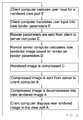
- the client computer(s) capture(s) user input such as data entered by means of a keyboard or via a mouse device and computes a set of rendering parameters based on said user input, such as volume selection, 3D transformation matrices, a transfer function look up table, clipping planes, render modes (MIP, DVR, MPR, CPR, ENDO, ...); each set of rendering parameters corresponding with an image to be rendered.
- the client computer then sends a stream of rendering parameter sets to said server computer.
- the server computer renders a stream of images corresponding to said stream of parameter sets.
- This stream of images is compressed by the server with a video compression scheme and sent from the server computer to the client computer where the client computer decompresses the received compressed video stream and displays the result in a viewing port.
- a viewing port is a window or other viewing area on a display screen.
- the exemplary set-up described below enables volume viewing and interaction on one or more client computers in one or more viewing ports making use of a render server computer and a compressed rendered video streaming technique.
- the volume data to view is only present on the server.
- For each viewing port there is a rendering and communication chain wherein the client sends a stream of rendering parameter sets from the client to the server. Each parameter set corresponds to one image the server has to render.
- the render server renders a stream of images.
- the stream of rendered images is compressed by a video compression scheme. Either lossy video compressions such as for example mpeg2 or mpeg4 or any form of lossless video compression may be applied.
- the video compressed stream of images is sent from the server to the client.
- the client decompresses the received video stream and displays the result into the viewing port.
- the required network bandwidth may be reduced by considering the stream of rendered images as a video sequence and by applying video compression algorithms on the rendered image stream.
- This rendered video streaming results in far better data compression for similar image quality of typically a factor 5 compared to prior art render servers.
- the size of the viewing port can be changed at any time with the size of the viewing port being one of the parameters in the render parameter set.
- the viewing port size change causes a change in size of the rendered images and of the compressed video stream encoding.
- the compressed video stream encoding takes into account the size change so that decoding allows decompressing the rendered images at the correct size as explained below in the paragraph entitled VRC.
- the viewing port size change is a desired feature as the client user can at any time change the size of the viewing port by changing for example the size of a window or by choosing another viewing port layout.
- the size of the rendered image can be adaptively reduced by the server while the size of the viewing port stays unchanged.
- the server thus renders the image at a reduced resolution.
- the resulting stream of reduced resolution images is again video compressed and sent to the client which decompresses the video stream.
- the resulting images are scaled up again to the full resolution of the viewing port prior to display. Upscaling may include bilinear and/or bicubic interpolation.
- the resized rendered image size can be any smaller size.
- the compressed video stream encoding takes into account the size change so that decoding allows decompressing the rendered images at the correct size as explained in the paragraph entitled VRC.
- the reason for this reduced resolution image streaming is to further reduce the amount of compressed image data and thus network bandwidth usage.
- the reduced resolution image resizing may dynamically change depending on available network bandwidth, desired number of images per second and the desired image quality.
- the allowed bandwidth usage of the compressed video stream per viewing port should not exceed a certain maximum of for example 5 Mbit/s.
- the client user may define certain video quality rules such as the number of images per second, for example 10 images per second.
- the server can automatically resize the rendered image to a reduced resolution in order not to exceed the given maximum allowed bandwidth usage and maintain the given number of images per second.
- the client user may further specify the desired image quality such as for example medium, high, very high. This image quality in addition to the given number of images per second and given maximum allowed bandwidth usage will determine the reduced resolution image size the server will choose.
- Video compression normally requires that the resolution of the compressed image stream does not change. Video compression relies on the fact that previous images in the image stream can be used to predict the content of the next image to compress. Typically only the difference between the predicted image and the real image is encoded. Compressing this difference enables higher compression versus compressing the whole image.
- the resolution change has some implications on the video encoding in terms of the type of the compressed images named in video compression parlance I, P and B frames.
- I frames the first image in the stream
- Other images are compressed relative to previous images, these are called P frames.
- the video stream is interrupted and encoded with a new I frame followed by depending P frames.
- Another optional type of dependent frames are B frames which are inserted between I and P frames or between two P frames. The B frames depend on both the I and P frames or on both P frames where they are inserted into).
- B frames depend on both the I and P frames or on both P frames where they are inserted into.
- Also for each video compressed image its size is encoded into the video stream allowing the decoder to detect size changes and decompress the rendered images at the correct size.
- the resolution and image quality may be progressively increased to full resolution and to lossless quality in case the client stops sending new rendering parameter sets.
- the last sent rendering parameter set is then used to continue sending a stream of images gradually increasing the resolution to full resolution. This requires sending a stream of compressed I frames as the resolution changes from one image to the next image.
- a switch may be made to another type of image compressor that can deal with progressive resolution streaming such as Jpeg2000 in either a lossless or lossy variant.
- Jpeg2000 in either a lossless or lossy variant.
- the advantage is better compression versus sending I frames at different resolutions.
- the progressive resolution streaming is interrupted and rendering resumes at the original reduced resolution.
- the server continues sending new video compressed image now gradually increasing image quality until lossless quality is reached.
- the progressive quality streaming is interrupted and rendering resumes at the original reduced resolution and quality prior to the progressive streaming.
- a textual annotation can be drawn in the viewing port giving an indication of the resolution and quality of the displayed image.
- the application runs not on the server but on the client. This enables only the image viewing ports of the application to be rendered on the server. As the user interface runs on the client there is no communication needed with the server for interaction of the viewer with user interface elements like for example a dialog box. This reduces network load and increases interactivity.
- a typical medical viewing application has many simultaneously displayed image viewing ports. Most of the time the viewing user only interacts with one of the viewing ports. All viewing ports may be rendered independently unlike the prior art system described higher. Thus only the viewing port that is being interacted with needs to be rendered on the render server and updated via rendered video streaming unlike the above-described prior art system. Again this greatly reduces the amount of network traffic.
- the communication and rendering chain is subdivided into parallel executed pipeline stages to make more efficient usage of system resources such as network bandwidth, rendering subsystem, compression subsystem, ... compared to conventional prior art solutions.
- the rendering and communication chain can be conceived as a pipeline subdivided into successive pipeline stages such as:
- This pipelined approach is described in the context of video compressed images sent from server to client but can also be implemented independently of the aspect of the video compression.
- the utilization of each pipeline stage in this case is ti / ⁇ ti in case of our example being 6, 3, 3, 12, 30, 15, 12, 15, 3 %
- the pipeline can be used in fully pipelined fashion. In this way each pipeline stage operates on a different image. Also the pipeline stages work simultaneously in parallel on the different images. This is possible when each pipeline stage uses a hardware resource that is not used by any other pipeline stage.
- the hardware resources are the CPUs in the client and the server which we assume to be multicore, possibly a GPU for the rendering and the communication network.
- the cores of the CPUs being used for the compression, decompression, input capture, render parameter set calculation and image display pipeline stages. Possibly a CPU core also is used for rendering otherwise a GPU is used to execute the rendering pipeline stage.
- the execution time of the pipeline now is determined by the slowest pipeline stage execution time, or by the sum of the execution times of pipeline stages that share a hardware resource.
- the slowest pipeline stage is the rendering which takes 100 ms.
- the network communication time takes 50 ms being 10 + 40 ms because it is a shared resource.
- the other pipeline stages can be executed on different CPU cores. So in our example the throughput is now 10 images per second determined by the 100 ms rendering pipeline stage.
- the pipelined execution of the pipeline has enabled to increase the throughput by a factor 3.3.
- the utilization of the rendering hardware resource is 100 % and of the network hardware resource 50 %.
- the utilization of the CPU core hardware resources are 20, 10, 10 % for the first three pipeline stages.
- the CPU compression core resource has a utilization of 60 %.
- An advantage of the pipelined execution is thus a more efficient usage of resources enabling to increase the throughput of the rendering and communication chain which results in more images displayed per second in a client viewing port.
- the increased number of images per second is important for a comfortable viewing of a moving image sequence like for example rotation or panning which are very frequently used in the clinical routine of examining volume data sets and also for example for endoscopic flythrough in more specialized applications like virtual colonoscopy.
- successive pipeline stages can be made working sequentially on the same image.
- first three pipeline stages can be made working sequentially on the same image (as depicted in figure 2 ).
- the new combined pipeline stage takes 40 ms to execute and thus has a 40 % utilization of a CPU hardware core.
- the result of the pipeline stage combining is that the number of pipeline stages is reduced.
- the throughput of the pipeline can stay the same but the latency of the pipeline is reduced.
- the latency is the time it takes for an image to be executed by the pipeline. In case of our fully pipelined pipeline the latency is 8 times 100 ms or 800 ms. In case of combining the first 3 stages resulting in 6 pipeline stages the latency is reduced to 600 ms.
- a small latency is important as to the viewing client user this will determine the response time of the rendering system. After the user enters new user input, a lag of time equal to the pipeline latency will be perceived before the rendered image is displayed.
- the latency can be further reduced by combining the two last pipeline stages and pipeline stage 5) and 6) leading to 4 pipeline stages and a pipeline latency of 400 ms.
- the latency has increased from 330 to 400 ms but the throughput has gone up from 3 images per second to 10 images per second.
- the pipelined execution allows to increase the image quality versus a non pipelined execution.
- the resolution of the rendered image can be increased so that the rendered image increases in size by for example 100 %.
- the rendering pipeline stage then takes 2 times longer to execute resulting in a pipeline throughput of 5 images per second and 100 % more image detail, versus 3 images per second and default detail of the non-pipelined execution.
- a further advantage and consequence of the increased number of images per second allowed by the pipelined execution is that it reduces the motion different between successive rendered images enabling the video compression algorithms to operate at higher compression efficiency.
- the increase by a factor of 3.3 of the number of images rendered per second leads to only a moderate increase of the required network bandwidth.
Landscapes
- Engineering & Computer Science (AREA)
- Computer Graphics (AREA)
- Physics & Mathematics (AREA)
- General Physics & Mathematics (AREA)
- Theoretical Computer Science (AREA)
- Two-Way Televisions, Distribution Of Moving Picture Or The Like (AREA)
- Testing, Inspecting, Measuring Of Stereoscopic Televisions And Televisions (AREA)
- Image Generation (AREA)
Priority Applications (1)
| Application Number | Priority Date | Filing Date | Title |
|---|---|---|---|
| EP09152361.3A EP2098995B1 (de) | 2008-03-04 | 2009-02-09 | System für die Echtzeit-Volumenleistung auf Thin-Clients über einen Leistungsserver |
Applications Claiming Priority (3)
| Application Number | Priority Date | Filing Date | Title |
|---|---|---|---|
| US3344808P | 2008-03-04 | 2008-03-04 | |
| EP08102257A EP2098994A1 (de) | 2008-03-04 | 2008-03-04 | System für die Echtzeit-Volumenleistung auf Thin-Clients über einen Widergabeserver |
| EP09152361.3A EP2098995B1 (de) | 2008-03-04 | 2009-02-09 | System für die Echtzeit-Volumenleistung auf Thin-Clients über einen Leistungsserver |
Publications (3)
| Publication Number | Publication Date |
|---|---|
| EP2098995A2 true EP2098995A2 (de) | 2009-09-09 |
| EP2098995A3 EP2098995A3 (de) | 2010-07-14 |
| EP2098995B1 EP2098995B1 (de) | 2014-04-09 |
Family
ID=39627852
Family Applications (2)
| Application Number | Title | Priority Date | Filing Date |
|---|---|---|---|
| EP08102257A Withdrawn EP2098994A1 (de) | 2008-03-04 | 2008-03-04 | System für die Echtzeit-Volumenleistung auf Thin-Clients über einen Widergabeserver |
| EP09152361.3A Ceased EP2098995B1 (de) | 2008-03-04 | 2009-02-09 | System für die Echtzeit-Volumenleistung auf Thin-Clients über einen Leistungsserver |
Family Applications Before (1)
| Application Number | Title | Priority Date | Filing Date |
|---|---|---|---|
| EP08102257A Withdrawn EP2098994A1 (de) | 2008-03-04 | 2008-03-04 | System für die Echtzeit-Volumenleistung auf Thin-Clients über einen Widergabeserver |
Country Status (2)
| Country | Link |
|---|---|
| US (1) | US8508539B2 (de) |
| EP (2) | EP2098994A1 (de) |
Cited By (3)
| Publication number | Priority date | Publication date | Assignee | Title |
|---|---|---|---|---|
| WO2013180729A1 (en) * | 2012-05-31 | 2013-12-05 | Intel Corporation | Rendering multiple remote graphics applications |
| US20130325930A1 (en) * | 2012-05-31 | 2013-12-05 | Chengming Zhao | Rendering Multiple Remote Graphics Applications |
| CN111932663A (zh) * | 2020-08-11 | 2020-11-13 | 中国空气动力研究与发展中心计算空气动力研究所 | 基于多层级非对称通信管理的并行绘制方法 |
Families Citing this family (66)
| Publication number | Priority date | Publication date | Assignee | Title |
|---|---|---|---|---|
| US8751950B2 (en) | 2004-08-17 | 2014-06-10 | Ice Edge Business Solutions Ltd. | Capturing a user's intent in design software |
| US20050071135A1 (en) | 2003-09-30 | 2005-03-31 | Vredenburgh David W. | Knowledge management system for computer-aided design modeling |
| WO2009100538A1 (en) | 2008-02-13 | 2009-08-20 | Dirtt Environmental Solutions, Ltd. | Rendering and modifying cad design entities in object-oriented applications |
| US8888592B1 (en) | 2009-06-01 | 2014-11-18 | Sony Computer Entertainment America Llc | Voice overlay |
| US8392529B2 (en) | 2007-08-27 | 2013-03-05 | Pme Ip Australia Pty Ltd | Fast file server methods and systems |
| US8319781B2 (en) | 2007-11-23 | 2012-11-27 | Pme Ip Australia Pty Ltd | Multi-user multi-GPU render server apparatus and methods |
| US9904969B1 (en) | 2007-11-23 | 2018-02-27 | PME IP Pty Ltd | Multi-user multi-GPU render server apparatus and methods |
| US9019287B2 (en) | 2007-11-23 | 2015-04-28 | Pme Ip Australia Pty Ltd | Client-server visualization system with hybrid data processing |
| WO2009067680A1 (en) | 2007-11-23 | 2009-05-28 | Mercury Computer Systems, Inc. | Automatic image segmentation methods and apparartus |
| US10311541B2 (en) | 2007-11-23 | 2019-06-04 | PME IP Pty Ltd | Multi-user multi-GPU render server apparatus and methods |
| US8613673B2 (en) | 2008-12-15 | 2013-12-24 | Sony Computer Entertainment America Llc | Intelligent game loading |
| US8147339B1 (en) | 2007-12-15 | 2012-04-03 | Gaikai Inc. | Systems and methods of serving game video |
| US8968087B1 (en) | 2009-06-01 | 2015-03-03 | Sony Computer Entertainment America Llc | Video game overlay |
| EP2098994A1 (de) * | 2008-03-04 | 2009-09-09 | Agfa HealthCare NV | System für die Echtzeit-Volumenleistung auf Thin-Clients über einen Widergabeserver |
| EP2252951B1 (de) | 2008-03-11 | 2021-05-05 | Ice Edge Business Solutions, Ltd. | Automatische erstellung und bearbeitung von möbelstückentwürfen in einer design-software |
| US8386560B2 (en) * | 2008-09-08 | 2013-02-26 | Microsoft Corporation | Pipeline for network based server-side 3D image rendering |
| US20100111371A1 (en) * | 2008-10-07 | 2010-05-06 | Apteryx, Inc. | Image server with multiple image quality ports |
| US8926435B2 (en) | 2008-12-15 | 2015-01-06 | Sony Computer Entertainment America Llc | Dual-mode program execution |
| US8412729B2 (en) | 2009-04-22 | 2013-04-02 | Genarts, Inc. | Sharing of presets for visual effects or other computer-implemented effects |
| ES2627762T3 (es) * | 2009-05-28 | 2017-07-31 | Kjaya, Llc | Método y sistema para el acceso rápido a una visualización avanzada de las exploraciones médicas usando un portal web dedicado |
| US9723319B1 (en) | 2009-06-01 | 2017-08-01 | Sony Interactive Entertainment America Llc | Differentiation for achieving buffered decoding and bufferless decoding |
| US8972870B2 (en) * | 2009-08-27 | 2015-03-03 | International Business Machines Corporation | Providing alternative representations of virtual content in a virtual universe |
| US8706802B1 (en) * | 2009-11-24 | 2014-04-22 | Google Inc. | Latency-guided web content retrieval, serving, and rendering |
| US9245064B2 (en) * | 2009-11-24 | 2016-01-26 | Ice Edge Business Solutions | Securely sharing design renderings over a network |
| GB0921831D0 (en) | 2009-12-14 | 2010-01-27 | British Telecomm | Graphical data delivery |
| GB201000738D0 (en) | 2010-01-18 | 2010-03-03 | British Telecomm | Graphical data processing |
| US20110227934A1 (en) * | 2010-03-19 | 2011-09-22 | Microsoft Corporation | Architecture for Volume Rendering |
| US8676591B1 (en) | 2010-08-02 | 2014-03-18 | Sony Computer Entertainment America Llc | Audio deceleration |
| CN103442774B (zh) | 2010-09-13 | 2016-08-10 | 索尼电脑娱乐美国公司 | 双模式程序执行和加载 |
| WO2012037165A2 (en) | 2010-09-13 | 2012-03-22 | Gaikai, Inc. | Add-on management |
| US9171350B2 (en) * | 2010-10-28 | 2015-10-27 | Nvidia Corporation | Adaptive resolution DGPU rendering to provide constant framerate with free IGPU scale up |
| US8699801B2 (en) | 2010-11-26 | 2014-04-15 | Agfa Healthcare Inc. | Systems and methods for transmitting high dynamic range images |
| EP2718861A4 (de) | 2011-06-11 | 2015-03-18 | Dirtt Environmental Solutions | Automatische wiederverwendung von strukturbauteilen |
| DE102011079916B4 (de) | 2011-07-27 | 2013-08-29 | Siemens Aktiengesellschaft | Verfahren und Vorrichtung zum progressiven Laden von medizinischen, mehrdimensionalen Bildern in eine medizinische Applikation |
| JP6242798B2 (ja) * | 2011-10-10 | 2017-12-06 | ヴィヴォーム インコーポレイテッド | ビジュアルエフェクトのネットワークに基づくレンダリング及びステアリング |
| DE102012202537A1 (de) * | 2012-02-20 | 2013-08-22 | Siemens Aktiengesellschaft | Bildsynthese-System |
| US9751011B2 (en) | 2012-05-25 | 2017-09-05 | Electronics Arts, Inc. | Systems and methods for a unified game experience in a multiplayer game |
| US20140028679A1 (en) | 2012-07-30 | 2014-01-30 | Nvidia Corporation | Render-assisted compression for remote graphics |
| GB2506727A (en) * | 2012-07-30 | 2014-04-09 | Nvidia Corp | Server-rendering of graphics for remote client |
| KR20140098608A (ko) * | 2013-01-31 | 2014-08-08 | 한국전자통신연구원 | 스트리밍 기반 게임 영상 제공 장치 및 방법 |
| US10540803B2 (en) | 2013-03-15 | 2020-01-21 | PME IP Pty Ltd | Method and system for rule-based display of sets of images |
| US9509802B1 (en) | 2013-03-15 | 2016-11-29 | PME IP Pty Ltd | Method and system FPOR transferring data to improve responsiveness when sending large data sets |
| US10070839B2 (en) | 2013-03-15 | 2018-09-11 | PME IP Pty Ltd | Apparatus and system for rule based visualization of digital breast tomosynthesis and other volumetric images |
| US11244495B2 (en) | 2013-03-15 | 2022-02-08 | PME IP Pty Ltd | Method and system for rule based display of sets of images using image content derived parameters |
| US11183292B2 (en) | 2013-03-15 | 2021-11-23 | PME IP Pty Ltd | Method and system for rule-based anonymized display and data export |
| US8976190B1 (en) | 2013-03-15 | 2015-03-10 | Pme Ip Australia Pty Ltd | Method and system for rule based display of sets of images |
| US10249018B2 (en) * | 2013-04-25 | 2019-04-02 | Nvidia Corporation | Graphics processor and method of scaling user interface elements for smaller displays |
| CN108174184A (zh) * | 2013-09-04 | 2018-06-15 | 北京三星通信技术研究有限公司 | 快速集成图像生成方法及与用户交互的裸眼三维显示系统 |
| EP3035282A4 (de) | 2013-09-11 | 2017-07-05 | Sony Corporation | Bildverarbeitungsvorrichtung und -verfahren |
| US10229208B2 (en) * | 2014-07-28 | 2019-03-12 | Facebook, Inc. | Optimization of query execution |
| EP3001385B1 (de) * | 2014-09-29 | 2019-05-01 | Agfa Healthcare | System und Verfahren zur Wiedergabe eines Videostroms |
| US9984478B2 (en) | 2015-07-28 | 2018-05-29 | PME IP Pty Ltd | Apparatus and method for visualizing digital breast tomosynthesis and other volumetric images |
| US11599672B2 (en) | 2015-07-31 | 2023-03-07 | PME IP Pty Ltd | Method and apparatus for anonymized display and data export |
| WO2017027846A1 (en) * | 2015-08-13 | 2017-02-16 | Bluebeam Software, Inc. | Method for archiving a collaboration session with a multimedia data stream and view parameters |
| US10204449B2 (en) * | 2015-09-01 | 2019-02-12 | Siemens Healthcare Gmbh | Video-based interactive viewing along a path in medical imaging |
| US10462495B2 (en) | 2017-08-09 | 2019-10-29 | Vital Images, Inc. | Progressive lossless compression of image data |
| EP3679581A4 (de) * | 2017-08-31 | 2021-09-01 | Zeto, Inc. | Verfahren zum hosting eines mobilen zugriffs auf hochauflösende elektroenzephalografiedaten |
| US10909679B2 (en) | 2017-09-24 | 2021-02-02 | PME IP Pty Ltd | Method and system for rule based display of sets of images using image content derived parameters |
| JP6499364B1 (ja) * | 2018-09-26 | 2019-04-10 | 株式会社Cygames | 情報処理プログラム、端末装置、及び情報処理方法 |
| JP2020187706A (ja) * | 2019-05-17 | 2020-11-19 | キヤノン株式会社 | 画像処理装置、画像処理システム、画像処理方法およびプログラム |
| CN110913202B (zh) * | 2019-11-26 | 2022-01-07 | 深圳英伦科技股份有限公司 | 一种三维显示云渲染方法和系统 |
| CN114253649B (zh) * | 2021-12-24 | 2024-04-09 | 武汉噢易云计算股份有限公司 | 图像渲染方法、装置、设备及可读存储介质 |
| CN113986087B (zh) * | 2021-12-27 | 2022-04-12 | 深圳市大头兄弟科技有限公司 | 基于订阅的视频渲染方法 |
| CN114494569B (zh) * | 2022-01-27 | 2023-09-19 | 光线云(杭州)科技有限公司 | 基于轻量级神经网络和残差流式传输的云渲染方法和装置 |
| CN117315057A (zh) * | 2022-06-20 | 2023-12-29 | 北京字跳网络技术有限公司 | 特效资源包的处理方法、装置、设备及存储介质 |
| CN118967900B (zh) * | 2024-10-18 | 2025-01-28 | 浙江惠利玛产业互联网有限公司 | 一种云端3d效果渲染方法及系统 |
Citations (1)
| Publication number | Priority date | Publication date | Assignee | Title |
|---|---|---|---|---|
| US20070188488A1 (en) | 2006-01-13 | 2007-08-16 | Choi Justin Y | Computer network-based 3D rendering system |
Family Cites Families (14)
| Publication number | Priority date | Publication date | Assignee | Title |
|---|---|---|---|---|
| US5764235A (en) * | 1996-03-25 | 1998-06-09 | Insight Development Corporation | Computer implemented method and system for transmitting graphical images from server to client at user selectable resolution |
| US6049390A (en) * | 1997-11-05 | 2000-04-11 | Barco Graphics Nv | Compressed merging of raster images for high speed digital printing |
| US6327050B1 (en) * | 1999-04-23 | 2001-12-04 | Electronics For Imaging, Inc. | Printing method and apparatus having multiple raster image processors |
| US20060036756A1 (en) * | 2000-04-28 | 2006-02-16 | Thomas Driemeyer | Scalable, multi-user server and method for rendering images from interactively customizable scene information |
| US7961194B2 (en) * | 2003-11-19 | 2011-06-14 | Lucid Information Technology, Ltd. | Method of controlling in real time the switching of modes of parallel operation of a multi-mode parallel graphics processing subsystem embodied within a host computing system |
| US20090027383A1 (en) * | 2003-11-19 | 2009-01-29 | Lucid Information Technology, Ltd. | Computing system parallelizing the operation of multiple graphics processing pipelines (GPPLs) and supporting depth-less based image recomposition |
| US20080074429A1 (en) * | 2003-11-19 | 2008-03-27 | Reuven Bakalash | Multi-mode parallel graphics rendering system (MMPGRS) supporting real-time transition between multiple states of parallel rendering operation in response to the automatic detection of predetermined operating conditions |
| US7602395B1 (en) * | 2005-04-22 | 2009-10-13 | Nvidia Corporation | Programming multiple chips from a command buffer for stereo image generation |
| US9135074B2 (en) * | 2005-05-19 | 2015-09-15 | Hewlett-Packard Development Company, L.P. | Evaluating performance of workload manager based on QoS to representative workload and usage efficiency of shared resource for plurality of minCPU and maxCPU allocation values |
| WO2008022282A2 (en) * | 2006-08-16 | 2008-02-21 | Michael Valdiserri | Online volume rendering system and method |
| EP1923836A1 (de) * | 2006-11-20 | 2008-05-21 | Agfa HealthCare NV | Selektion aus fusionierten, in 3D-Volumen dargestellten Bildern und Aktualisierung der entsprechenden Ansichten in Übereinstimmung mit einer Selektionsaktion |
| US9275430B2 (en) * | 2006-12-31 | 2016-03-01 | Lucidlogix Technologies, Ltd. | Computing system employing a multi-GPU graphics processing and display subsystem supporting single-GPU non-parallel (multi-threading) and multi-GPU application-division parallel modes of graphics processing operation |
| US7952596B2 (en) * | 2008-02-11 | 2011-05-31 | Sony Ericsson Mobile Communications Ab | Electronic devices that pan/zoom displayed sub-area within video frames in response to movement therein |
| EP2098994A1 (de) * | 2008-03-04 | 2009-09-09 | Agfa HealthCare NV | System für die Echtzeit-Volumenleistung auf Thin-Clients über einen Widergabeserver |
-
2008
- 2008-03-04 EP EP08102257A patent/EP2098994A1/de not_active Withdrawn
-
2009
- 2009-02-09 EP EP09152361.3A patent/EP2098995B1/de not_active Ceased
- 2009-02-26 US US12/393,429 patent/US8508539B2/en active Active
Patent Citations (1)
| Publication number | Priority date | Publication date | Assignee | Title |
|---|---|---|---|---|
| US20070188488A1 (en) | 2006-01-13 | 2007-08-16 | Choi Justin Y | Computer network-based 3D rendering system |
Cited By (8)
| Publication number | Priority date | Publication date | Assignee | Title |
|---|---|---|---|---|
| WO2013180729A1 (en) * | 2012-05-31 | 2013-12-05 | Intel Corporation | Rendering multiple remote graphics applications |
| US20130325930A1 (en) * | 2012-05-31 | 2013-12-05 | Chengming Zhao | Rendering Multiple Remote Graphics Applications |
| TWI493357B (zh) * | 2012-05-31 | 2015-07-21 | Intel Corp | 描繪圖形的方法與設備、精簡客戶端系統及其機器可讀取媒體 |
| CN104272285B (zh) * | 2012-05-31 | 2017-06-20 | 英特尔公司 | 用于渲染图形应用程序的方法和装置 |
| US9705964B2 (en) | 2012-05-31 | 2017-07-11 | Intel Corporation | Rendering multiple remote graphics applications |
| TWI607319B (zh) * | 2012-05-31 | 2017-12-01 | 英特爾股份有限公司 | 描繪圖形的方法與設備、精簡客戶端系統及其機器可讀取媒體 |
| CN111932663A (zh) * | 2020-08-11 | 2020-11-13 | 中国空气动力研究与发展中心计算空气动力研究所 | 基于多层级非对称通信管理的并行绘制方法 |
| CN111932663B (zh) * | 2020-08-11 | 2022-10-18 | 中国空气动力研究与发展中心计算空气动力研究所 | 基于多层级非对称通信管理的并行绘制方法 |
Also Published As
| Publication number | Publication date |
|---|---|
| EP2098995B1 (de) | 2014-04-09 |
| US8508539B2 (en) | 2013-08-13 |
| EP2098995A3 (de) | 2010-07-14 |
| US20090225076A1 (en) | 2009-09-10 |
| EP2098994A1 (de) | 2009-09-09 |
Similar Documents
| Publication | Publication Date | Title |
|---|---|---|
| EP2098995B1 (de) | System für die Echtzeit-Volumenleistung auf Thin-Clients über einen Leistungsserver | |
| US12062111B2 (en) | Multi-user multi-GPU render server apparatus and methods | |
| US10430914B2 (en) | Multi-user multi-GPU render server apparatus and methods | |
| US7281213B2 (en) | System and method for network transmission of graphical data through a distributed application | |
| US9665332B2 (en) | Display controller, screen transfer device, and screen transfer method | |
| US7890573B2 (en) | Server-client architecture in medical imaging | |
| US10402940B2 (en) | Method and system for accelerating video preview digital camera | |
| US7173635B2 (en) | Remote graphical user interface support using a graphics processing unit | |
| US10311541B2 (en) | Multi-user multi-GPU render server apparatus and methods | |
| CN106846451A (zh) | 面向移动设备的真实感体渲染和交互系统及其工作方法 | |
| US20040240752A1 (en) | Method and system for remote and adaptive visualization of graphical image data | |
| EP1634438A1 (de) | Verfaren und system zur fern- und adaptiven visualisierung graphischer bilddaten | |
| CN115941965A (zh) | 云桌面编码方法、重建方法、显示方法和显示系统 | |
| WO2008022282A2 (en) | Online volume rendering system and method | |
| CN106716494B (zh) | 用于渲染视频流的系统和方法 | |
| CN114567784A (zh) | 一种用于飞腾显卡的vpu视频解码输出方法及系统 | |
| US20250173841A1 (en) | Oversmoothing progressive images | |
| Jeong et al. | Interactive wireless virtual colonoscopy | |
| KR101727566B1 (ko) | 임베디드 멀티 플랫폼 환경에서 다이콤 의료영상 전송과 처리 방법 및 그 시스템 | |
| JP2011061385A (ja) | 対話的実時間遠隔可視化システム | |
| CN119788871A (zh) | 图像的处理方法、系统和电子设备及存储介质 | |
| CN116051369A (zh) | 虚拟桌面图像处理方法、装置及存储介质 | |
| Rosenbaum et al. | Raster image adaptation for mobile devices using profiles | |
| KR20040057317A (ko) | 엠피이지 방식을 이용한 고화질 멀티미디어기반원격진료서비스시스템 | |
| JP2000048182A (ja) | 画像情報処理装置及び方法、並びにエンタテインメント装置 |
Legal Events
| Date | Code | Title | Description |
|---|---|---|---|
| PUAI | Public reference made under article 153(3) epc to a published international application that has entered the european phase |
Free format text: ORIGINAL CODE: 0009012 |
|
| AK | Designated contracting states |
Kind code of ref document: A2 Designated state(s): AT BE BG CH CY CZ DE DK EE ES FI FR GB GR HR HU IE IS IT LI LT LU LV MC MK MT NL NO PL PT RO SE SI SK TR |
|
| AX | Request for extension of the european patent |
Extension state: AL BA RS |
|
| PUAL | Search report despatched |
Free format text: ORIGINAL CODE: 0009013 |
|
| AK | Designated contracting states |
Kind code of ref document: A3 Designated state(s): AT BE BG CH CY CZ DE DK EE ES FI FR GB GR HR HU IE IS IT LI LT LU LV MC MK MT NL NO PL PT RO SE SI SK TR |
|
| AX | Request for extension of the european patent |
Extension state: AL BA RS |
|
| 17P | Request for examination filed |
Effective date: 20110114 |
|
| AKX | Designation fees paid |
Designated state(s): BE DE FR GB NL |
|
| GRAP | Despatch of communication of intention to grant a patent |
Free format text: ORIGINAL CODE: EPIDOSNIGR1 |
|
| INTG | Intention to grant announced |
Effective date: 20131024 |
|
| GRAS | Grant fee paid |
Free format text: ORIGINAL CODE: EPIDOSNIGR3 |
|
| GRAA | (expected) grant |
Free format text: ORIGINAL CODE: 0009210 |
|
| AK | Designated contracting states |
Kind code of ref document: B1 Designated state(s): BE DE FR GB NL |
|
| REG | Reference to a national code |
Ref country code: GB Ref legal event code: FG4D |
|
| REG | Reference to a national code |
Ref country code: DE Ref legal event code: R096 Ref document number: 602009023053 Country of ref document: DE Effective date: 20140522 |
|
| REG | Reference to a national code |
Ref country code: NL Ref legal event code: VDEP Effective date: 20140409 |
|
| PG25 | Lapsed in a contracting state [announced via postgrant information from national office to epo] |
Ref country code: NL Free format text: LAPSE BECAUSE OF FAILURE TO SUBMIT A TRANSLATION OF THE DESCRIPTION OR TO PAY THE FEE WITHIN THE PRESCRIBED TIME-LIMIT Effective date: 20140409 |
|
| REG | Reference to a national code |
Ref country code: DE Ref legal event code: R097 Ref document number: 602009023053 Country of ref document: DE |
|
| PG25 | Lapsed in a contracting state [announced via postgrant information from national office to epo] |
Ref country code: BE Free format text: LAPSE BECAUSE OF FAILURE TO SUBMIT A TRANSLATION OF THE DESCRIPTION OR TO PAY THE FEE WITHIN THE PRESCRIBED TIME-LIMIT Effective date: 20140409 |
|
| PLBE | No opposition filed within time limit |
Free format text: ORIGINAL CODE: 0009261 |
|
| STAA | Information on the status of an ep patent application or granted ep patent |
Free format text: STATUS: NO OPPOSITION FILED WITHIN TIME LIMIT |
|
| 26N | No opposition filed |
Effective date: 20150112 |
|
| REG | Reference to a national code |
Ref country code: DE Ref legal event code: R097 Ref document number: 602009023053 Country of ref document: DE Effective date: 20150112 |
|
| REG | Reference to a national code |
Ref country code: FR Ref legal event code: PLFP Year of fee payment: 8 |
|
| REG | Reference to a national code |
Ref country code: FR Ref legal event code: PLFP Year of fee payment: 9 |
|
| REG | Reference to a national code |
Ref country code: FR Ref legal event code: PLFP Year of fee payment: 10 |
|
| REG | Reference to a national code |
Ref country code: GB Ref legal event code: 732E Free format text: REGISTERED BETWEEN 20180816 AND 20180822 |
|
| REG | Reference to a national code |
Ref country code: DE Ref legal event code: R081 Ref document number: 602009023053 Country of ref document: DE Owner name: AGFA NV, BE Free format text: FORMER OWNER: AGFA HEALTHCARE, MORTSEL, BE |
|
| PGFP | Annual fee paid to national office [announced via postgrant information from national office to epo] |
Ref country code: FR Payment date: 20210210 Year of fee payment: 13 |
|
| PGFP | Annual fee paid to national office [announced via postgrant information from national office to epo] |
Ref country code: DE Payment date: 20210202 Year of fee payment: 13 Ref country code: GB Payment date: 20210210 Year of fee payment: 13 |
|
| REG | Reference to a national code |
Ref country code: DE Ref legal event code: R119 Ref document number: 602009023053 Country of ref document: DE |
|
| GBPC | Gb: european patent ceased through non-payment of renewal fee |
Effective date: 20220209 |
|
| PG25 | Lapsed in a contracting state [announced via postgrant information from national office to epo] |
Ref country code: FR Free format text: LAPSE BECAUSE OF NON-PAYMENT OF DUE FEES Effective date: 20220228 |
|
| PG25 | Lapsed in a contracting state [announced via postgrant information from national office to epo] |
Ref country code: GB Free format text: LAPSE BECAUSE OF NON-PAYMENT OF DUE FEES Effective date: 20220209 Ref country code: DE Free format text: LAPSE BECAUSE OF NON-PAYMENT OF DUE FEES Effective date: 20220901 |
|
| REG | Reference to a national code |
Ref country code: DE Ref legal event code: R081 Ref document number: 602009023053 Country of ref document: DE Owner name: AGFA HEALTHCARE NV, BE Free format text: FORMER OWNER: AGFA NV, MORTSEL, BE |