EP2097378B1 - Novel seh inhibitors and their use - Google Patents
Novel seh inhibitors and their use Download PDFInfo
- Publication number
- EP2097378B1 EP2097378B1 EP07871337A EP07871337A EP2097378B1 EP 2097378 B1 EP2097378 B1 EP 2097378B1 EP 07871337 A EP07871337 A EP 07871337A EP 07871337 A EP07871337 A EP 07871337A EP 2097378 B1 EP2097378 B1 EP 2097378B1
- Authority
- EP
- European Patent Office
- Prior art keywords
- alkyl
- compound
- triazin
- methylamino
- mmol
- Prior art date
- Legal status (The legal status is an assumption and is not a legal conclusion. Google has not performed a legal analysis and makes no representation as to the accuracy of the status listed.)
- Active
Links
- 239000003112 inhibitor Substances 0.000 title description 9
- 150000001875 compounds Chemical class 0.000 claims description 226
- 125000004169 (C1-C6) alkyl group Chemical group 0.000 claims description 116
- 125000005843 halogen group Chemical group 0.000 claims description 54
- 239000001257 hydrogen Substances 0.000 claims description 51
- 229910052739 hydrogen Inorganic materials 0.000 claims description 51
- OKTJSMMVPCPJKN-UHFFFAOYSA-N Carbon Chemical compound [C] OKTJSMMVPCPJKN-UHFFFAOYSA-N 0.000 claims description 45
- 125000004435 hydrogen atom Chemical group [H]* 0.000 claims description 40
- 229910052799 carbon Inorganic materials 0.000 claims description 36
- 150000003839 salts Chemical class 0.000 claims description 36
- 125000002496 methyl group Chemical group [H]C([H])([H])* 0.000 claims description 34
- 125000004429 atom Chemical group 0.000 claims description 33
- -1 4-(methylamino)-6-{[(2R)-2-phenylpropyl]amino}- 2-pyrimidinyl Chemical group 0.000 claims description 32
- 125000002924 primary amino group Chemical group [H]N([H])* 0.000 claims description 29
- 125000000592 heterocycloalkyl group Chemical group 0.000 claims description 24
- 125000003118 aryl group Chemical group 0.000 claims description 22
- 239000000546 pharmaceutical excipient Substances 0.000 claims description 22
- 125000001072 heteroaryl group Chemical group 0.000 claims description 21
- 239000008194 pharmaceutical composition Substances 0.000 claims description 19
- 229910021386 carbon form Inorganic materials 0.000 claims description 13
- 125000005842 heteroatom Chemical group 0.000 claims description 11
- 125000004475 heteroaralkyl group Chemical group 0.000 claims description 10
- 125000005913 (C3-C6) cycloalkyl group Chemical group 0.000 claims description 9
- UFHFLCQGNIYNRP-UHFFFAOYSA-N Hydrogen Chemical compound [H][H] UFHFLCQGNIYNRP-UHFFFAOYSA-N 0.000 claims description 9
- 125000003710 aryl alkyl group Chemical group 0.000 claims description 7
- 229910052760 oxygen Inorganic materials 0.000 claims description 7
- 229910052717 sulfur Inorganic materials 0.000 claims description 7
- 239000003814 drug Substances 0.000 claims description 6
- WPYMKLBDIGXBTP-UHFFFAOYSA-M benzoate Chemical compound [O-]C(=O)C1=CC=CC=C1 WPYMKLBDIGXBTP-UHFFFAOYSA-M 0.000 claims description 5
- 125000003178 carboxy group Chemical group [H]OC(*)=O 0.000 claims description 5
- 229910052736 halogen Inorganic materials 0.000 claims description 5
- 238000004519 manufacturing process Methods 0.000 claims description 5
- WPYMKLBDIGXBTP-UHFFFAOYSA-N Benzoic acid Natural products OC(=O)C1=CC=CC=C1 WPYMKLBDIGXBTP-UHFFFAOYSA-N 0.000 claims description 4
- 239000005711 Benzoic acid Substances 0.000 claims description 4
- CURLTUGMZLYLDI-UHFFFAOYSA-N Carbon dioxide Chemical group O=C=O CURLTUGMZLYLDI-UHFFFAOYSA-N 0.000 claims description 4
- 235000010233 benzoic acid Nutrition 0.000 claims description 4
- 150000002367 halogens Chemical group 0.000 claims description 4
- 125000004191 (C1-C6) alkoxy group Chemical group 0.000 claims description 3
- 208000006673 asthma Diseases 0.000 claims description 3
- RHJVIGLEIFVHIJ-UHFFFAOYSA-N cyclohexanecarboxamide Chemical compound NC(=O)C1[CH]CCCC1 RHJVIGLEIFVHIJ-UHFFFAOYSA-N 0.000 claims description 3
- 238000002560 therapeutic procedure Methods 0.000 claims description 3
- 150000002431 hydrogen Chemical group 0.000 claims 4
- WPYMKLBDIGXBTP-VQEHIDDOSA-N benzoic acid Chemical compound OC(=O)C1=CC=C[13CH]=C1 WPYMKLBDIGXBTP-VQEHIDDOSA-N 0.000 claims 2
- HEMHJVSKTPXQMS-UHFFFAOYSA-M Sodium hydroxide Chemical compound [OH-].[Na+] HEMHJVSKTPXQMS-UHFFFAOYSA-M 0.000 description 120
- 238000000034 method Methods 0.000 description 112
- XLYOFNOQVPJJNP-UHFFFAOYSA-N water Substances O XLYOFNOQVPJJNP-UHFFFAOYSA-N 0.000 description 110
- 238000002360 preparation method Methods 0.000 description 88
- WEVYAHXRMPXWCK-UHFFFAOYSA-N Acetonitrile Chemical compound CC#N WEVYAHXRMPXWCK-UHFFFAOYSA-N 0.000 description 80
- 238000006243 chemical reaction Methods 0.000 description 80
- 238000000524 positive electrospray ionisation mass spectrometry Methods 0.000 description 70
- 239000000243 solution Substances 0.000 description 64
- 239000007858 starting material Substances 0.000 description 52
- YMWUJEATGCHHMB-UHFFFAOYSA-N Dichloromethane Chemical compound ClCCl YMWUJEATGCHHMB-UHFFFAOYSA-N 0.000 description 50
- 239000000203 mixture Substances 0.000 description 47
- 239000011541 reaction mixture Substances 0.000 description 44
- NZNMSOFKMUBTKW-UHFFFAOYSA-N Cyclohexanecarboxylic acid Natural products OC(=O)C1CCCCC1 NZNMSOFKMUBTKW-UHFFFAOYSA-N 0.000 description 42
- 239000002904 solvent Substances 0.000 description 40
- DTQVDTLACAAQTR-UHFFFAOYSA-N trifluoroacetic acid Substances OC(=O)C(F)(F)F DTQVDTLACAAQTR-UHFFFAOYSA-N 0.000 description 40
- 239000000047 product Substances 0.000 description 39
- 239000012043 crude product Substances 0.000 description 34
- 238000004007 reversed phase HPLC Methods 0.000 description 34
- 239000000543 intermediate Substances 0.000 description 31
- MGNCLNQXLYJVJD-UHFFFAOYSA-N cyanuric chloride Chemical compound ClC1=NC(Cl)=NC(Cl)=N1 MGNCLNQXLYJVJD-UHFFFAOYSA-N 0.000 description 30
- ZMXDDKWLCZADIW-UHFFFAOYSA-N N,N-Dimethylformamide Chemical compound CN(C)C=O ZMXDDKWLCZADIW-UHFFFAOYSA-N 0.000 description 28
- 125000001424 substituent group Chemical group 0.000 description 27
- VHYFNPMBLIVWCW-UHFFFAOYSA-N 4-Dimethylaminopyridine Chemical compound CN(C)C1=CC=NC=C1 VHYFNPMBLIVWCW-UHFFFAOYSA-N 0.000 description 24
- XEKOWRVHYACXOJ-UHFFFAOYSA-N Ethyl acetate Chemical compound CCOC(C)=O XEKOWRVHYACXOJ-UHFFFAOYSA-N 0.000 description 24
- VZFUCHSFHOYXIS-UHFFFAOYSA-N cycloheptane carboxylic acid Natural products OC(=O)C1CCCCCC1 VZFUCHSFHOYXIS-UHFFFAOYSA-N 0.000 description 24
- 238000004895 liquid chromatography mass spectrometry Methods 0.000 description 24
- FIWILGQIZHDAQG-UHFFFAOYSA-N NC1=C(C(=O)NCC2=CC=C(C=C2)OCC(F)(F)F)C=C(C(=N1)N)N1N=C(N=C1)C1(CC1)C(F)(F)F Chemical compound NC1=C(C(=O)NCC2=CC=C(C=C2)OCC(F)(F)F)C=C(C(=N1)N)N1N=C(N=C1)C1(CC1)C(F)(F)F FIWILGQIZHDAQG-UHFFFAOYSA-N 0.000 description 22
- OKKJLVBELUTLKV-UHFFFAOYSA-N Methanol Chemical compound OC OKKJLVBELUTLKV-UHFFFAOYSA-N 0.000 description 21
- IAZDPXIOMUYVGZ-UHFFFAOYSA-N Dimethylsulphoxide Chemical compound CS(C)=O IAZDPXIOMUYVGZ-UHFFFAOYSA-N 0.000 description 20
- ZMANZCXQSJIPKH-UHFFFAOYSA-N Triethylamine Chemical compound CCN(CC)CC ZMANZCXQSJIPKH-UHFFFAOYSA-N 0.000 description 19
- 150000001412 amines Chemical class 0.000 description 19
- RRSNDVCODIMOFX-MPKOGUQCSA-N Fc1c(Cl)cccc1[C@H]1[C@@H](NC2(CCCCC2)[C@@]11C(=O)Nc2cc(Cl)ccc12)C(=O)Nc1ccc(cc1)C(=O)NCCCCCc1cccc2C(=O)N(Cc12)C1CCC(=O)NC1=O Chemical compound Fc1c(Cl)cccc1[C@H]1[C@@H](NC2(CCCCC2)[C@@]11C(=O)Nc2cc(Cl)ccc12)C(=O)Nc1ccc(cc1)C(=O)NCCCCCc1cccc2C(=O)N(Cc12)C1CCC(=O)NC1=O RRSNDVCODIMOFX-MPKOGUQCSA-N 0.000 description 18
- BAVYZALUXZFZLV-UHFFFAOYSA-N Methylamine Chemical compound NC BAVYZALUXZFZLV-UHFFFAOYSA-N 0.000 description 17
- FPQQSJJWHUJYPU-UHFFFAOYSA-N 3-(dimethylamino)propyliminomethylidene-ethylazanium;chloride Chemical compound Cl.CCN=C=NCCCN(C)C FPQQSJJWHUJYPU-UHFFFAOYSA-N 0.000 description 16
- 238000003556 assay Methods 0.000 description 15
- WYURNTSHIVDZCO-UHFFFAOYSA-N Tetrahydrofuran Chemical compound C1CCOC1 WYURNTSHIVDZCO-UHFFFAOYSA-N 0.000 description 14
- 230000000694 effects Effects 0.000 description 14
- 239000012453 solvate Substances 0.000 description 14
- 238000003756 stirring Methods 0.000 description 14
- KFZMGEQAYNKOFK-UHFFFAOYSA-N Isopropanol Chemical compound CC(C)O KFZMGEQAYNKOFK-UHFFFAOYSA-N 0.000 description 13
- 229960000549 4-dimethylaminophenol Drugs 0.000 description 12
- 125000000217 alkyl group Chemical group 0.000 description 12
- WGQKYBSKWIADBV-UHFFFAOYSA-N benzylamine Chemical compound NCC1=CC=CC=C1 WGQKYBSKWIADBV-UHFFFAOYSA-N 0.000 description 12
- 239000007787 solid Substances 0.000 description 12
- JGFZNNIVVJXRND-UHFFFAOYSA-N N,N-Diisopropylethylamine (DIPEA) Chemical compound CCN(C(C)C)C(C)C JGFZNNIVVJXRND-UHFFFAOYSA-N 0.000 description 11
- SMNRFWMNPDABKZ-WVALLCKVSA-N [[(2R,3S,4R,5S)-5-(2,6-dioxo-3H-pyridin-3-yl)-3,4-dihydroxyoxolan-2-yl]methoxy-hydroxyphosphoryl] [[[(2R,3S,4S,5R,6R)-4-fluoro-3,5-dihydroxy-6-(hydroxymethyl)oxan-2-yl]oxy-hydroxyphosphoryl]oxy-hydroxyphosphoryl] hydrogen phosphate Chemical compound OC[C@H]1O[C@H](OP(O)(=O)OP(O)(=O)OP(O)(=O)OP(O)(=O)OC[C@H]2O[C@H]([C@H](O)[C@@H]2O)C2C=CC(=O)NC2=O)[C@H](O)[C@@H](F)[C@@H]1O SMNRFWMNPDABKZ-WVALLCKVSA-N 0.000 description 11
- 239000003153 chemical reaction reagent Substances 0.000 description 11
- 102000004190 Enzymes Human genes 0.000 description 10
- 108090000790 Enzymes Proteins 0.000 description 10
- 235000019439 ethyl acetate Nutrition 0.000 description 10
- DRNGLYHKYPNTEA-UHFFFAOYSA-N 4-azaniumylcyclohexane-1-carboxylate Chemical compound NC1CCC(C(O)=O)CC1 DRNGLYHKYPNTEA-UHFFFAOYSA-N 0.000 description 9
- 102100025403 Epoxide hydrolase 1 Human genes 0.000 description 9
- 239000002585 base Substances 0.000 description 9
- 125000001309 chloro group Chemical group Cl* 0.000 description 9
- 125000000753 cycloalkyl group Chemical group 0.000 description 9
- 239000002552 dosage form Substances 0.000 description 9
- 125000001997 phenyl group Chemical group [H]C1=C([H])C([H])=C(*)C([H])=C1[H] 0.000 description 9
- 239000000758 substrate Substances 0.000 description 9
- 206010020772 Hypertension Diseases 0.000 description 8
- ZSKQIFWUTUZAGF-UHFFFAOYSA-N [2-(trifluoromethyl)phenyl]methanamine Chemical compound NCC1=CC=CC=C1C(F)(F)F ZSKQIFWUTUZAGF-UHFFFAOYSA-N 0.000 description 8
- 239000002253 acid Substances 0.000 description 8
- 238000004128 high performance liquid chromatography Methods 0.000 description 8
- 238000001727 in vivo Methods 0.000 description 8
- 230000005764 inhibitory process Effects 0.000 description 8
- 0 C*C(CC1C(*2)C(OC)=O)(CC3)[U]1C23N*(C)* Chemical compound C*C(CC1C(*2)C(OC)=O)(CC3)[U]1C23N*(C)* 0.000 description 7
- 108020002908 Epoxide hydrolase Proteins 0.000 description 7
- 241000282414 Homo sapiens Species 0.000 description 7
- 208000037265 diseases, disorders, signs and symptoms Diseases 0.000 description 7
- 125000001495 ethyl group Chemical group [H]C([H])([H])C([H])([H])* 0.000 description 7
- VLKZOEOYAKHREP-UHFFFAOYSA-N n-Hexane Chemical compound CCCCCC VLKZOEOYAKHREP-UHFFFAOYSA-N 0.000 description 7
- 239000012044 organic layer Substances 0.000 description 7
- 108090000623 proteins and genes Proteins 0.000 description 7
- DYHSDKLCOJIUFX-UHFFFAOYSA-N tert-butoxycarbonyl anhydride Chemical compound CC(C)(C)OC(=O)OC(=O)OC(C)(C)C DYHSDKLCOJIUFX-UHFFFAOYSA-N 0.000 description 7
- LMDZBCPBFSXMTL-UHFFFAOYSA-N 1-Ethyl-3-(3-dimethylaminopropyl)carbodiimide Substances CCN=C=NCCCN(C)C LMDZBCPBFSXMTL-UHFFFAOYSA-N 0.000 description 6
- KXDHJXZQYSOELW-UHFFFAOYSA-N Carbamic acid Chemical compound NC(O)=O KXDHJXZQYSOELW-UHFFFAOYSA-N 0.000 description 6
- WMFOQBRAJBCJND-UHFFFAOYSA-M Lithium hydroxide Chemical compound [Li+].[OH-] WMFOQBRAJBCJND-UHFFFAOYSA-M 0.000 description 6
- PMZURENOXWZQFD-UHFFFAOYSA-L Sodium Sulfate Chemical compound [Na+].[Na+].[O-]S([O-])(=O)=O PMZURENOXWZQFD-UHFFFAOYSA-L 0.000 description 6
- UIIMBOGNXHQVGW-UHFFFAOYSA-M Sodium bicarbonate Chemical class [Na+].OC([O-])=O UIIMBOGNXHQVGW-UHFFFAOYSA-M 0.000 description 6
- NLFBCYMMUAKCPC-KQQUZDAGSA-N ethyl (e)-3-[3-amino-2-cyano-1-[(e)-3-ethoxy-3-oxoprop-1-enyl]sulfanyl-3-oxoprop-1-enyl]sulfanylprop-2-enoate Chemical compound CCOC(=O)\C=C\SC(=C(C#N)C(N)=O)S\C=C\C(=O)OCC NLFBCYMMUAKCPC-KQQUZDAGSA-N 0.000 description 6
- 125000001153 fluoro group Chemical group F* 0.000 description 6
- 125000000956 methoxy group Chemical group [H]C([H])([H])O* 0.000 description 6
- 235000018102 proteins Nutrition 0.000 description 6
- 102000004169 proteins and genes Human genes 0.000 description 6
- 238000000746 purification Methods 0.000 description 6
- 150000003335 secondary amines Chemical class 0.000 description 6
- 229910052938 sodium sulfate Inorganic materials 0.000 description 6
- 239000000126 substance Substances 0.000 description 6
- YJLIKUSWRSEPSM-WGQQHEPDSA-N (2r,3r,4s,5r)-2-[6-amino-8-[(4-phenylphenyl)methylamino]purin-9-yl]-5-(hydroxymethyl)oxolane-3,4-diol Chemical compound C=1C=C(C=2C=CC=CC=2)C=CC=1CNC1=NC=2C(N)=NC=NC=2N1[C@@H]1O[C@H](CO)[C@@H](O)[C@H]1O YJLIKUSWRSEPSM-WGQQHEPDSA-N 0.000 description 5
- JKMHFZQWWAIEOD-UHFFFAOYSA-N 2-[4-(2-hydroxyethyl)piperazin-1-yl]ethanesulfonic acid Chemical compound OCC[NH+]1CCN(CCS([O-])(=O)=O)CC1 JKMHFZQWWAIEOD-UHFFFAOYSA-N 0.000 description 5
- XFJBGINZIMNZBW-CRAIPNDOSA-N 5-chloro-2-[4-[(1r,2s)-2-[2-(5-methylsulfonylpyridin-2-yl)oxyethyl]cyclopropyl]piperidin-1-yl]pyrimidine Chemical compound N1=CC(S(=O)(=O)C)=CC=C1OCC[C@H]1[C@@H](C2CCN(CC2)C=2N=CC(Cl)=CN=2)C1 XFJBGINZIMNZBW-CRAIPNDOSA-N 0.000 description 5
- FKLJPTJMIBLJAV-UHFFFAOYSA-N Compound IV Chemical compound O1N=C(C)C=C1CCCCCCCOC1=CC=C(C=2OCCN=2)C=C1 FKLJPTJMIBLJAV-UHFFFAOYSA-N 0.000 description 5
- 102000005486 Epoxide hydrolase Human genes 0.000 description 5
- 239000007832 Na2SO4 Substances 0.000 description 5
- FAPWRFPIFSIZLT-UHFFFAOYSA-M Sodium chloride Chemical class [Na+].[Cl-] FAPWRFPIFSIZLT-UHFFFAOYSA-M 0.000 description 5
- 208000006011 Stroke Diseases 0.000 description 5
- 230000004071 biological effect Effects 0.000 description 5
- 125000000113 cyclohexyl group Chemical group [H]C1([H])C([H])([H])C([H])([H])C([H])(*)C([H])([H])C1([H])[H] 0.000 description 5
- 201000010099 disease Diseases 0.000 description 5
- 150000002118 epoxides Chemical group 0.000 description 5
- 125000001301 ethoxy group Chemical group [H]C([H])([H])C([H])([H])O* 0.000 description 5
- 239000012467 final product Substances 0.000 description 5
- 125000000524 functional group Chemical group 0.000 description 5
- 238000006460 hydrolysis reaction Methods 0.000 description 5
- 125000006239 protecting group Chemical group 0.000 description 5
- 229920006395 saturated elastomer Polymers 0.000 description 5
- 125000002023 trifluoromethyl group Chemical group FC(F)(F)* 0.000 description 5
- KDSNLYIMUZNERS-UHFFFAOYSA-N 2-methylpropanamine Chemical compound CC(C)CN KDSNLYIMUZNERS-UHFFFAOYSA-N 0.000 description 4
- KXMRDHPZQHAXML-UHFFFAOYSA-N 4-[(2-methylpropan-2-yl)oxycarbonylamino]cyclohexane-1-carboxylic acid Chemical compound CC(C)(C)OC(=O)NC1CCC(C(O)=O)CC1 KXMRDHPZQHAXML-UHFFFAOYSA-N 0.000 description 4
- QTBSBXVTEAMEQO-UHFFFAOYSA-N Acetic acid Chemical compound CC(O)=O QTBSBXVTEAMEQO-UHFFFAOYSA-N 0.000 description 4
- XKRFYHLGVUSROY-UHFFFAOYSA-N Argon Chemical compound [Ar] XKRFYHLGVUSROY-UHFFFAOYSA-N 0.000 description 4
- DRSHXJFUUPIBHX-UHFFFAOYSA-N COc1ccc(cc1)N1N=CC2C=NC(Nc3cc(OC)c(OC)c(OCCCN4CCN(C)CC4)c3)=NC12 Chemical compound COc1ccc(cc1)N1N=CC2C=NC(Nc3cc(OC)c(OC)c(OCCCN4CCN(C)CC4)c3)=NC12 DRSHXJFUUPIBHX-UHFFFAOYSA-N 0.000 description 4
- 239000006144 Dulbecco’s modified Eagle's medium Substances 0.000 description 4
- NZOVBSWOWQLAJG-UHFFFAOYSA-N PHOME Chemical compound C1=CC2=CC(OC)=CC=C2C=C1C(C#N)OC(=O)CC1OC1C1=CC=CC=C1 NZOVBSWOWQLAJG-UHFFFAOYSA-N 0.000 description 4
- BHHGXPLMPWCGHP-UHFFFAOYSA-N Phenethylamine Chemical compound NCCC1=CC=CC=C1 BHHGXPLMPWCGHP-UHFFFAOYSA-N 0.000 description 4
- 125000000066 S-methyl group Chemical group [H]C([H])([H])S* 0.000 description 4
- VYPSYNLAJGMNEJ-UHFFFAOYSA-N Silicium dioxide Chemical compound O=[Si]=O VYPSYNLAJGMNEJ-UHFFFAOYSA-N 0.000 description 4
- 230000008901 benefit Effects 0.000 description 4
- 230000015572 biosynthetic process Effects 0.000 description 4
- 229940079593 drug Drugs 0.000 description 4
- 230000005284 excitation Effects 0.000 description 4
- 230000006870 function Effects 0.000 description 4
- 230000007062 hydrolysis Effects 0.000 description 4
- 230000001404 mediated effect Effects 0.000 description 4
- 208000010125 myocardial infarction Diseases 0.000 description 4
- 238000007911 parenteral administration Methods 0.000 description 4
- 230000002265 prevention Effects 0.000 description 4
- 150000003141 primary amines Chemical class 0.000 description 4
- 239000000651 prodrug Substances 0.000 description 4
- 229940002612 prodrug Drugs 0.000 description 4
- 230000001225 therapeutic effect Effects 0.000 description 4
- PVOAHINGSUIXLS-UHFFFAOYSA-N 1-Methylpiperazine Chemical compound CN1CCNCC1 PVOAHINGSUIXLS-UHFFFAOYSA-N 0.000 description 3
- KQZLRWGGWXJPOS-NLFPWZOASA-N 1-[(1R)-1-(2,4-dichlorophenyl)ethyl]-6-[(4S,5R)-4-[(2S)-2-(hydroxymethyl)pyrrolidin-1-yl]-5-methylcyclohexen-1-yl]pyrazolo[3,4-b]pyrazine-3-carbonitrile Chemical compound ClC1=C(C=CC(=C1)Cl)[C@@H](C)N1N=C(C=2C1=NC(=CN=2)C1=CC[C@@H]([C@@H](C1)C)N1[C@@H](CCC1)CO)C#N KQZLRWGGWXJPOS-NLFPWZOASA-N 0.000 description 3
- QLVKPJDPGNLXSJ-UHFFFAOYSA-N 2,6-dichloro-n-methylpyrimidin-4-amine Chemical compound CNC1=CC(Cl)=NC(Cl)=N1 QLVKPJDPGNLXSJ-UHFFFAOYSA-N 0.000 description 3
- FQMZXMVHHKXGTM-UHFFFAOYSA-N 2-(1-adamantyl)-n-[2-[2-(2-hydroxyethylamino)ethylamino]quinolin-5-yl]acetamide Chemical compound C1C(C2)CC(C3)CC2CC13CC(=O)NC1=CC=CC2=NC(NCCNCCO)=CC=C21 FQMZXMVHHKXGTM-UHFFFAOYSA-N 0.000 description 3
- UMCMPZBLKLEWAF-BCTGSCMUSA-N 3-[(3-cholamidopropyl)dimethylammonio]propane-1-sulfonate Chemical compound C([C@H]1C[C@H]2O)[C@H](O)CC[C@]1(C)[C@@H]1[C@@H]2[C@@H]2CC[C@H]([C@@H](CCC(=O)NCCC[N+](C)(C)CCCS([O-])(=O)=O)C)[C@@]2(C)[C@@H](O)C1 UMCMPZBLKLEWAF-BCTGSCMUSA-N 0.000 description 3
- YCMNQPDTJCUTEK-UHFFFAOYSA-N 3-[[4-(methylamino)-6-(4-methylpiperazin-1-yl)-1,3,5-triazin-2-yl]amino]-n-[[2-(trifluoromethyl)phenyl]methyl]cyclohexane-1-carboxamide Chemical compound N=1C(N2CCN(C)CC2)=NC(NC)=NC=1NC(C1)CCCC1C(=O)NCC1=CC=CC=C1C(F)(F)F YCMNQPDTJCUTEK-UHFFFAOYSA-N 0.000 description 3
- QRTBWWIIFMMESL-UHFFFAOYSA-N 4,6-dichloro-n-methyl-1,3,5-triazin-2-amine Chemical compound CNC1=NC(Cl)=NC(Cl)=N1 QRTBWWIIFMMESL-UHFFFAOYSA-N 0.000 description 3
- UBGCYDBGKBKRCT-UHFFFAOYSA-N 4,6-dichloro-n-methylpyrimidin-2-amine Chemical compound CNC1=NC(Cl)=CC(Cl)=N1 UBGCYDBGKBKRCT-UHFFFAOYSA-N 0.000 description 3
- FOAAJPCFVZWBSD-UHFFFAOYSA-N 4-[[4-(methylamino)-6-(4-methylpiperazin-1-yl)-1,3,5-triazin-2-yl]amino]cyclohexane-1-carboxylic acid Chemical compound N=1C(N2CCN(C)CC2)=NC(NC)=NC=1NC1CCC(C(O)=O)CC1 FOAAJPCFVZWBSD-UHFFFAOYSA-N 0.000 description 3
- LFRGCSLFNFDQJV-UHFFFAOYSA-N 4-chloro-n-methyl-6-(4-methylpiperazin-1-yl)-1,3,5-triazin-2-amine Chemical compound CNC1=NC(Cl)=NC(N2CCN(C)CC2)=N1 LFRGCSLFNFDQJV-UHFFFAOYSA-N 0.000 description 3
- 201000001320 Atherosclerosis Diseases 0.000 description 3
- 239000007821 HATU Substances 0.000 description 3
- 241001465754 Metazoa Species 0.000 description 3
- AXORVIZLPOGIRG-QMMMGPOBSA-N R-BETA-METHYLPHENYLETHYLAMINE Chemical compound NC[C@H](C)C1=CC=CC=C1 AXORVIZLPOGIRG-QMMMGPOBSA-N 0.000 description 3
- 108010090804 Streptavidin Proteins 0.000 description 3
- DTQVDTLACAAQTR-UHFFFAOYSA-M Trifluoroacetate Chemical compound [O-]C(=O)C(F)(F)F DTQVDTLACAAQTR-UHFFFAOYSA-M 0.000 description 3
- PSLUFJFHTBIXMW-WYEYVKMPSA-N [(3r,4ar,5s,6s,6as,10s,10ar,10bs)-3-ethenyl-10,10b-dihydroxy-3,4a,7,7,10a-pentamethyl-1-oxo-6-(2-pyridin-2-ylethylcarbamoyloxy)-5,6,6a,8,9,10-hexahydro-2h-benzo[f]chromen-5-yl] acetate Chemical compound O([C@@H]1[C@@H]([C@]2(O[C@](C)(CC(=O)[C@]2(O)[C@@]2(C)[C@@H](O)CCC(C)(C)[C@@H]21)C=C)C)OC(=O)C)C(=O)NCCC1=CC=CC=N1 PSLUFJFHTBIXMW-WYEYVKMPSA-N 0.000 description 3
- 150000001408 amides Chemical class 0.000 description 3
- 230000009286 beneficial effect Effects 0.000 description 3
- 239000011230 binding agent Substances 0.000 description 3
- 239000005018 casein Substances 0.000 description 3
- BECPQYXYKAMYBN-UHFFFAOYSA-N casein, tech. Chemical compound NCCCCC(C(O)=O)N=C(O)C(CC(O)=O)N=C(O)C(CCC(O)=N)N=C(O)C(CC(C)C)N=C(O)C(CCC(O)=O)N=C(O)C(CC(O)=O)N=C(O)C(CCC(O)=O)N=C(O)C(C(C)O)N=C(O)C(CCC(O)=N)N=C(O)C(CCC(O)=N)N=C(O)C(CCC(O)=N)N=C(O)C(CCC(O)=O)N=C(O)C(CCC(O)=O)N=C(O)C(COP(O)(O)=O)N=C(O)C(CCC(O)=N)N=C(O)C(N)CC1=CC=CC=C1 BECPQYXYKAMYBN-UHFFFAOYSA-N 0.000 description 3
- 235000021240 caseins Nutrition 0.000 description 3
- 229940125877 compound 31 Drugs 0.000 description 3
- 230000008878 coupling Effects 0.000 description 3
- 238000010168 coupling process Methods 0.000 description 3
- 238000005859 coupling reaction Methods 0.000 description 3
- 239000012045 crude solution Substances 0.000 description 3
- 239000003085 diluting agent Substances 0.000 description 3
- 239000007884 disintegrant Substances 0.000 description 3
- 239000000945 filler Substances 0.000 description 3
- 238000009472 formulation Methods 0.000 description 3
- 150000004677 hydrates Chemical class 0.000 description 3
- 239000000314 lubricant Substances 0.000 description 3
- 239000000463 material Substances 0.000 description 3
- 150000004702 methyl esters Chemical class 0.000 description 3
- 230000004048 modification Effects 0.000 description 3
- 238000012986 modification Methods 0.000 description 3
- 125000002950 monocyclic group Chemical group 0.000 description 3
- 239000003921 oil Substances 0.000 description 3
- 239000008184 oral solid dosage form Substances 0.000 description 3
- 239000013612 plasmid Substances 0.000 description 3
- 238000003752 polymerase chain reaction Methods 0.000 description 3
- 239000000843 powder Substances 0.000 description 3
- 125000004076 pyridyl group Chemical group 0.000 description 3
- 125000003003 spiro group Chemical group 0.000 description 3
- 238000006467 substitution reaction Methods 0.000 description 3
- 125000000999 tert-butyl group Chemical group [H]C([H])([H])C(*)(C([H])([H])[H])C([H])([H])[H] 0.000 description 3
- 238000011200 topical administration Methods 0.000 description 3
- YBJHBAHKTGYVGT-ZKWXMUAHSA-N (+)-Biotin Chemical compound N1C(=O)N[C@@H]2[C@H](CCCCC(=O)O)SC[C@@H]21 YBJHBAHKTGYVGT-ZKWXMUAHSA-N 0.000 description 2
- ASGMFNBUXDJWJJ-JLCFBVMHSA-N (1R,3R)-3-[[3-bromo-1-[4-(5-methyl-1,3,4-thiadiazol-2-yl)phenyl]pyrazolo[3,4-d]pyrimidin-6-yl]amino]-N,1-dimethylcyclopentane-1-carboxamide Chemical compound BrC1=NN(C2=NC(=NC=C21)N[C@H]1C[C@@](CC1)(C(=O)NC)C)C1=CC=C(C=C1)C=1SC(=NN=1)C ASGMFNBUXDJWJJ-JLCFBVMHSA-N 0.000 description 2
- UAOUIVVJBYDFKD-XKCDOFEDSA-N (1R,9R,10S,11R,12R,15S,18S,21R)-10,11,21-trihydroxy-8,8-dimethyl-14-methylidene-4-(prop-2-enylamino)-20-oxa-5-thia-3-azahexacyclo[9.7.2.112,15.01,9.02,6.012,18]henicosa-2(6),3-dien-13-one Chemical compound C([C@@H]1[C@@H](O)[C@@]23C(C1=C)=O)C[C@H]2[C@]12C(N=C(NCC=C)S4)=C4CC(C)(C)[C@H]1[C@H](O)[C@]3(O)OC2 UAOUIVVJBYDFKD-XKCDOFEDSA-N 0.000 description 2
- AOSZTAHDEDLTLQ-AZKQZHLXSA-N (1S,2S,4R,8S,9S,11S,12R,13S,19S)-6-[(3-chlorophenyl)methyl]-12,19-difluoro-11-hydroxy-8-(2-hydroxyacetyl)-9,13-dimethyl-6-azapentacyclo[10.8.0.02,9.04,8.013,18]icosa-14,17-dien-16-one Chemical compound C([C@@H]1C[C@H]2[C@H]3[C@]([C@]4(C=CC(=O)C=C4[C@@H](F)C3)C)(F)[C@@H](O)C[C@@]2([C@@]1(C1)C(=O)CO)C)N1CC1=CC=CC(Cl)=C1 AOSZTAHDEDLTLQ-AZKQZHLXSA-N 0.000 description 2
- ABJSOROVZZKJGI-OCYUSGCXSA-N (1r,2r,4r)-2-(4-bromophenyl)-n-[(4-chlorophenyl)-(2-fluoropyridin-4-yl)methyl]-4-morpholin-4-ylcyclohexane-1-carboxamide Chemical compound C1=NC(F)=CC(C(NC(=O)[C@H]2[C@@H](C[C@@H](CC2)N2CCOCC2)C=2C=CC(Br)=CC=2)C=2C=CC(Cl)=CC=2)=C1 ABJSOROVZZKJGI-OCYUSGCXSA-N 0.000 description 2
- GLGNXYJARSMNGJ-VKTIVEEGSA-N (1s,2s,3r,4r)-3-[[5-chloro-2-[(1-ethyl-6-methoxy-2-oxo-4,5-dihydro-3h-1-benzazepin-7-yl)amino]pyrimidin-4-yl]amino]bicyclo[2.2.1]hept-5-ene-2-carboxamide Chemical compound CCN1C(=O)CCCC2=C(OC)C(NC=3N=C(C(=CN=3)Cl)N[C@H]3[C@H]([C@@]4([H])C[C@@]3(C=C4)[H])C(N)=O)=CC=C21 GLGNXYJARSMNGJ-VKTIVEEGSA-N 0.000 description 2
- SZUVGFMDDVSKSI-WIFOCOSTSA-N (1s,2s,3s,5r)-1-(carboxymethyl)-3,5-bis[(4-phenoxyphenyl)methyl-propylcarbamoyl]cyclopentane-1,2-dicarboxylic acid Chemical compound O=C([C@@H]1[C@@H]([C@](CC(O)=O)([C@H](C(=O)N(CCC)CC=2C=CC(OC=3C=CC=CC=3)=CC=2)C1)C(O)=O)C(O)=O)N(CCC)CC(C=C1)=CC=C1OC1=CC=CC=C1 SZUVGFMDDVSKSI-WIFOCOSTSA-N 0.000 description 2
- SJUKJZSTBBSGHF-UHFFFAOYSA-N (2,4-dichlorophenyl)methanamine Chemical compound NCC1=CC=C(Cl)C=C1Cl SJUKJZSTBBSGHF-UHFFFAOYSA-N 0.000 description 2
- GCTFTMWXZFLTRR-GFCCVEGCSA-N (2r)-2-amino-n-[3-(difluoromethoxy)-4-(1,3-oxazol-5-yl)phenyl]-4-methylpentanamide Chemical compound FC(F)OC1=CC(NC(=O)[C@H](N)CC(C)C)=CC=C1C1=CN=CO1 GCTFTMWXZFLTRR-GFCCVEGCSA-N 0.000 description 2
- IUSARDYWEPUTPN-OZBXUNDUSA-N (2r)-n-[(2s,3r)-4-[[(4s)-6-(2,2-dimethylpropyl)spiro[3,4-dihydropyrano[2,3-b]pyridine-2,1'-cyclobutane]-4-yl]amino]-3-hydroxy-1-[3-(1,3-thiazol-2-yl)phenyl]butan-2-yl]-2-methoxypropanamide Chemical compound C([C@H](NC(=O)[C@@H](C)OC)[C@H](O)CN[C@@H]1C2=CC(CC(C)(C)C)=CN=C2OC2(CCC2)C1)C(C=1)=CC=CC=1C1=NC=CS1 IUSARDYWEPUTPN-OZBXUNDUSA-N 0.000 description 2
- VIJSPAIQWVPKQZ-BLECARSGSA-N (2s)-2-[[(2s)-2-[[(2s)-2-[[(2s)-2-[[(2s)-2-[[(2s)-2-acetamido-5-(diaminomethylideneamino)pentanoyl]amino]-4-methylpentanoyl]amino]-4,4-dimethylpentanoyl]amino]-4-methylpentanoyl]amino]propanoyl]amino]-5-(diaminomethylideneamino)pentanoic acid Chemical compound NC(=N)NCCC[C@@H](C(O)=O)NC(=O)[C@H](C)NC(=O)[C@H](CC(C)C)NC(=O)[C@H](CC(C)(C)C)NC(=O)[C@H](CC(C)C)NC(=O)[C@H](CCCNC(N)=N)NC(C)=O VIJSPAIQWVPKQZ-BLECARSGSA-N 0.000 description 2
- WWTBZEKOSBFBEM-SPWPXUSOSA-N (2s)-2-[[2-benzyl-3-[hydroxy-[(1r)-2-phenyl-1-(phenylmethoxycarbonylamino)ethyl]phosphoryl]propanoyl]amino]-3-(1h-indol-3-yl)propanoic acid Chemical compound N([C@@H](CC=1C2=CC=CC=C2NC=1)C(=O)O)C(=O)C(CP(O)(=O)[C@H](CC=1C=CC=CC=1)NC(=O)OCC=1C=CC=CC=1)CC1=CC=CC=C1 WWTBZEKOSBFBEM-SPWPXUSOSA-N 0.000 description 2
- STBLNCCBQMHSRC-BATDWUPUSA-N (2s)-n-[(3s,4s)-5-acetyl-7-cyano-4-methyl-1-[(2-methylnaphthalen-1-yl)methyl]-2-oxo-3,4-dihydro-1,5-benzodiazepin-3-yl]-2-(methylamino)propanamide Chemical compound O=C1[C@@H](NC(=O)[C@H](C)NC)[C@H](C)N(C(C)=O)C2=CC(C#N)=CC=C2N1CC1=C(C)C=CC2=CC=CC=C12 STBLNCCBQMHSRC-BATDWUPUSA-N 0.000 description 2
- IWZSHWBGHQBIML-ZGGLMWTQSA-N (3S,8S,10R,13S,14S,17S)-17-isoquinolin-7-yl-N,N,10,13-tetramethyl-2,3,4,7,8,9,11,12,14,15,16,17-dodecahydro-1H-cyclopenta[a]phenanthren-3-amine Chemical compound CN(C)[C@H]1CC[C@]2(C)C3CC[C@@]4(C)[C@@H](CC[C@@H]4c4ccc5ccncc5c4)[C@@H]3CC=C2C1 IWZSHWBGHQBIML-ZGGLMWTQSA-N 0.000 description 2
- UDQTXCHQKHIQMH-KYGLGHNPSA-N (3ar,5s,6s,7r,7ar)-5-(difluoromethyl)-2-(ethylamino)-5,6,7,7a-tetrahydro-3ah-pyrano[3,2-d][1,3]thiazole-6,7-diol Chemical compound S1C(NCC)=N[C@H]2[C@@H]1O[C@H](C(F)F)[C@@H](O)[C@@H]2O UDQTXCHQKHIQMH-KYGLGHNPSA-N 0.000 description 2
- HUWSZNZAROKDRZ-RRLWZMAJSA-N (3r,4r)-3-azaniumyl-5-[[(2s,3r)-1-[(2s)-2,3-dicarboxypyrrolidin-1-yl]-3-methyl-1-oxopentan-2-yl]amino]-5-oxo-4-sulfanylpentane-1-sulfonate Chemical compound OS(=O)(=O)CC[C@@H](N)[C@@H](S)C(=O)N[C@@H]([C@H](C)CC)C(=O)N1CCC(C(O)=O)[C@H]1C(O)=O HUWSZNZAROKDRZ-RRLWZMAJSA-N 0.000 description 2
- MPDDTAJMJCESGV-CTUHWIOQSA-M (3r,5r)-7-[2-(4-fluorophenyl)-5-[methyl-[(1r)-1-phenylethyl]carbamoyl]-4-propan-2-ylpyrazol-3-yl]-3,5-dihydroxyheptanoate Chemical compound C1([C@@H](C)N(C)C(=O)C2=NN(C(CC[C@@H](O)C[C@@H](O)CC([O-])=O)=C2C(C)C)C=2C=CC(F)=CC=2)=CC=CC=C1 MPDDTAJMJCESGV-CTUHWIOQSA-M 0.000 description 2
- YQOLEILXOBUDMU-KRWDZBQOSA-N (4R)-5-[(6-bromo-3-methyl-2-pyrrolidin-1-ylquinoline-4-carbonyl)amino]-4-(2-chlorophenyl)pentanoic acid Chemical compound CC1=C(C2=C(C=CC(=C2)Br)N=C1N3CCCC3)C(=O)NC[C@H](CCC(=O)O)C4=CC=CC=C4Cl YQOLEILXOBUDMU-KRWDZBQOSA-N 0.000 description 2
- 125000004209 (C1-C8) alkyl group Chemical group 0.000 description 2
- JYEUMXHLPRZUAT-UHFFFAOYSA-N 1,2,3-triazine Chemical compound C1=CN=NN=C1 JYEUMXHLPRZUAT-UHFFFAOYSA-N 0.000 description 2
- 125000004317 1,3,5-triazin-2-yl group Chemical group [H]C1=NC(*)=NC([H])=N1 0.000 description 2
- KKHFRAFPESRGGD-UHFFFAOYSA-N 1,3-dimethyl-7-[3-(n-methylanilino)propyl]purine-2,6-dione Chemical compound C1=NC=2N(C)C(=O)N(C)C(=O)C=2N1CCCN(C)C1=CC=CC=C1 KKHFRAFPESRGGD-UHFFFAOYSA-N 0.000 description 2
- RYHBNJHYFVUHQT-UHFFFAOYSA-N 1,4-Dioxane Chemical compound C1COCCO1 RYHBNJHYFVUHQT-UHFFFAOYSA-N 0.000 description 2
- ILCNAEYNPUDNHG-UHFFFAOYSA-N 1-(4,6-dichloro-1,3,5-triazin-2-yl)azepane Chemical compound ClC1=NC(Cl)=NC(N2CCCCCC2)=N1 ILCNAEYNPUDNHG-UHFFFAOYSA-N 0.000 description 2
- WZZBNLYBHUDSHF-DHLKQENFSA-N 1-[(3s,4s)-4-[8-(2-chloro-4-pyrimidin-2-yloxyphenyl)-7-fluoro-2-methylimidazo[4,5-c]quinolin-1-yl]-3-fluoropiperidin-1-yl]-2-hydroxyethanone Chemical compound CC1=NC2=CN=C3C=C(F)C(C=4C(=CC(OC=5N=CC=CN=5)=CC=4)Cl)=CC3=C2N1[C@H]1CCN(C(=O)CO)C[C@@H]1F WZZBNLYBHUDSHF-DHLKQENFSA-N 0.000 description 2
- ONBQEOIKXPHGMB-VBSBHUPXSA-N 1-[2-[(2s,3r,4s,5r)-3,4-dihydroxy-5-(hydroxymethyl)oxolan-2-yl]oxy-4,6-dihydroxyphenyl]-3-(4-hydroxyphenyl)propan-1-one Chemical compound O[C@@H]1[C@H](O)[C@@H](CO)O[C@H]1OC1=CC(O)=CC(O)=C1C(=O)CCC1=CC=C(O)C=C1 ONBQEOIKXPHGMB-VBSBHUPXSA-N 0.000 description 2
- QXOGPTXQGKQSJT-UHFFFAOYSA-N 1-amino-4-[4-(3,4-dimethylphenyl)sulfanylanilino]-9,10-dioxoanthracene-2-sulfonic acid Chemical compound Cc1ccc(Sc2ccc(Nc3cc(c(N)c4C(=O)c5ccccc5C(=O)c34)S(O)(=O)=O)cc2)cc1C QXOGPTXQGKQSJT-UHFFFAOYSA-N 0.000 description 2
- 238000005160 1H NMR spectroscopy Methods 0.000 description 2
- QEPXACTUQNGGHW-UHFFFAOYSA-N 2,4,6-trichloro-1h-triazine Chemical compound ClN1NC(Cl)=CC(Cl)=N1 QEPXACTUQNGGHW-UHFFFAOYSA-N 0.000 description 2
- DPVIABCMTHHTGB-UHFFFAOYSA-N 2,4,6-trichloropyrimidine Chemical compound ClC1=CC(Cl)=NC(Cl)=N1 DPVIABCMTHHTGB-UHFFFAOYSA-N 0.000 description 2
- PYRKKGOKRMZEIT-UHFFFAOYSA-N 2-[6-(2-cyclopropylethoxy)-9-(2-hydroxy-2-methylpropyl)-1h-phenanthro[9,10-d]imidazol-2-yl]-5-fluorobenzene-1,3-dicarbonitrile Chemical compound C1=C2C3=CC(CC(C)(O)C)=CC=C3C=3NC(C=4C(=CC(F)=CC=4C#N)C#N)=NC=3C2=CC=C1OCCC1CC1 PYRKKGOKRMZEIT-UHFFFAOYSA-N 0.000 description 2
- QKNYBSVHEMOAJP-UHFFFAOYSA-N 2-amino-2-(hydroxymethyl)propane-1,3-diol;hydron;chloride Chemical compound Cl.OCC(N)(CO)CO QKNYBSVHEMOAJP-UHFFFAOYSA-N 0.000 description 2
- YSUIQYOGTINQIN-UZFYAQMZSA-N 2-amino-9-[(1S,6R,8R,9S,10R,15R,17R,18R)-8-(6-aminopurin-9-yl)-9,18-difluoro-3,12-dihydroxy-3,12-bis(sulfanylidene)-2,4,7,11,13,16-hexaoxa-3lambda5,12lambda5-diphosphatricyclo[13.2.1.06,10]octadecan-17-yl]-1H-purin-6-one Chemical compound NC1=NC2=C(N=CN2[C@@H]2O[C@@H]3COP(S)(=O)O[C@@H]4[C@@H](COP(S)(=O)O[C@@H]2[C@@H]3F)O[C@H]([C@H]4F)N2C=NC3=C2N=CN=C3N)C(=O)N1 YSUIQYOGTINQIN-UZFYAQMZSA-N 0.000 description 2
- TVTJUIAKQFIXCE-HUKYDQBMSA-N 2-amino-9-[(2R,3S,4S,5R)-4-fluoro-3-hydroxy-5-(hydroxymethyl)oxolan-2-yl]-7-prop-2-ynyl-1H-purine-6,8-dione Chemical compound NC=1NC(C=2N(C(N(C=2N=1)[C@@H]1O[C@@H]([C@H]([C@H]1O)F)CO)=O)CC#C)=O TVTJUIAKQFIXCE-HUKYDQBMSA-N 0.000 description 2
- NPRYCHLHHVWLQZ-TURQNECASA-N 2-amino-9-[(2R,3S,4S,5R)-4-fluoro-3-hydroxy-5-(hydroxymethyl)oxolan-2-yl]-7-prop-2-ynylpurin-8-one Chemical compound NC1=NC=C2N(C(N(C2=N1)[C@@H]1O[C@@H]([C@H]([C@H]1O)F)CO)=O)CC#C NPRYCHLHHVWLQZ-TURQNECASA-N 0.000 description 2
- XZXIWQYIVDFDSP-UHFFFAOYSA-N 2-benzylsulfanylethanamine;hydrochloride Chemical compound [Cl-].[NH3+]CCSCC1=CC=CC=C1 XZXIWQYIVDFDSP-UHFFFAOYSA-N 0.000 description 2
- HVLUYXIJZLDNIS-UHFFFAOYSA-N 2-thiophen-2-ylethanamine Chemical compound NCCC1=CC=CS1 HVLUYXIJZLDNIS-UHFFFAOYSA-N 0.000 description 2
- QBWKPGNFQQJGFY-QLFBSQMISA-N 3-[(1r)-1-[(2r,6s)-2,6-dimethylmorpholin-4-yl]ethyl]-n-[6-methyl-3-(1h-pyrazol-4-yl)imidazo[1,2-a]pyrazin-8-yl]-1,2-thiazol-5-amine Chemical compound N1([C@H](C)C2=NSC(NC=3C4=NC=C(N4C=C(C)N=3)C3=CNN=C3)=C2)C[C@H](C)O[C@H](C)C1 QBWKPGNFQQJGFY-QLFBSQMISA-N 0.000 description 2
- HJJRHNDPRCNEHU-UHFFFAOYSA-N 3-amino-n-[[2-(trifluoromethyl)phenyl]methyl]cyclohexane-1-carboxamide Chemical compound C1C(N)CCCC1C(=O)NCC1=CC=CC=C1C(F)(F)F HJJRHNDPRCNEHU-UHFFFAOYSA-N 0.000 description 2
- MCLXKFUCPVGZEN-UHFFFAOYSA-N 4,6-dichloro-1,3,5-triazin-2-amine Chemical compound NC1=NC(Cl)=NC(Cl)=N1 MCLXKFUCPVGZEN-UHFFFAOYSA-N 0.000 description 2
- ANHFCKFEKORTIT-QMMMGPOBSA-N 4,6-dichloro-n-[(2r)-2-phenylpropyl]-1,3,5-triazin-2-amine Chemical compound C([C@H](C)C=1C=CC=CC=1)NC1=NC(Cl)=NC(Cl)=N1 ANHFCKFEKORTIT-QMMMGPOBSA-N 0.000 description 2
- DYQVRDISZFVXHV-UHFFFAOYSA-N 4-(methylazaniumyl)cyclohexane-1-carboxylate Chemical compound CNC1CCC(C(O)=O)CC1 DYQVRDISZFVXHV-UHFFFAOYSA-N 0.000 description 2
- WYFCZWSWFGJODV-MIANJLSGSA-N 4-[[(1s)-2-[(e)-3-[3-chloro-2-fluoro-6-(tetrazol-1-yl)phenyl]prop-2-enoyl]-5-(4-methyl-2-oxopiperazin-1-yl)-3,4-dihydro-1h-isoquinoline-1-carbonyl]amino]benzoic acid Chemical compound O=C1CN(C)CCN1C1=CC=CC2=C1CCN(C(=O)\C=C\C=1C(=CC=C(Cl)C=1F)N1N=NN=C1)[C@@H]2C(=O)NC1=CC=C(C(O)=O)C=C1 WYFCZWSWFGJODV-MIANJLSGSA-N 0.000 description 2
- YLEWPMOGNCMYOM-UHFFFAOYSA-N 4-[[4-(azepan-1-yl)-6-(methylamino)-1,3,5-triazin-2-yl]amino]-n-[[2-(trifluoromethoxy)phenyl]methyl]cyclohexane-1-carboxamide Chemical compound N=1C(N2CCCCCC2)=NC(NC)=NC=1NC(CC1)CCC1C(=O)NCC1=CC=CC=C1OC(F)(F)F YLEWPMOGNCMYOM-UHFFFAOYSA-N 0.000 description 2
- CWGGAJOYHPQCLI-UHFFFAOYSA-N 4-[[4-(methylamino)-6-(4-methylpiperazin-1-yl)-1,3,5-triazin-2-yl]amino]-n-[[2-(trifluoromethyl)phenyl]methyl]cyclohexane-1-carboxamide Chemical compound N=1C(N2CCN(C)CC2)=NC(NC)=NC=1NC(CC1)CCC1C(=O)NCC1=CC=CC=C1C(F)(F)F CWGGAJOYHPQCLI-UHFFFAOYSA-N 0.000 description 2
- OQHGIIZLDKQNDV-UHFFFAOYSA-N 4-amino-n-[[2-(trifluoromethyl)phenyl]methyl]cyclohexane-1-carboxamide Chemical compound C1CC(N)CCC1C(=O)NCC1=CC=CC=C1C(F)(F)F OQHGIIZLDKQNDV-UHFFFAOYSA-N 0.000 description 2
- VZBLASFLFFMMCM-UHFFFAOYSA-N 6-methoxynaphthalene-2-carbaldehyde Chemical compound C1=C(C=O)C=CC2=CC(OC)=CC=C21 VZBLASFLFFMMCM-UHFFFAOYSA-N 0.000 description 2
- HCCNBKFJYUWLEX-UHFFFAOYSA-N 7-(6-methoxypyridin-3-yl)-1-(2-propoxyethyl)-3-(pyrazin-2-ylmethylamino)pyrido[3,4-b]pyrazin-2-one Chemical compound O=C1N(CCOCCC)C2=CC(C=3C=NC(OC)=CC=3)=NC=C2N=C1NCC1=CN=CC=N1 HCCNBKFJYUWLEX-UHFFFAOYSA-N 0.000 description 2
- PRJHEJGMSOBHTO-UHFFFAOYSA-N 7-[(4-chlorophenyl)methyl]-1-(3-hydroxypropyl)-3-methyl-8-[3-(trifluoromethoxy)phenoxy]purine-2,6-dione Chemical compound C=1C=C(Cl)C=CC=1CN1C=2C(=O)N(CCCO)C(=O)N(C)C=2N=C1OC1=CC=CC(OC(F)(F)F)=C1 PRJHEJGMSOBHTO-UHFFFAOYSA-N 0.000 description 2
- HBAQYPYDRFILMT-UHFFFAOYSA-N 8-[3-(1-cyclopropylpyrazol-4-yl)-1H-pyrazolo[4,3-d]pyrimidin-5-yl]-3-methyl-3,8-diazabicyclo[3.2.1]octan-2-one Chemical class C1(CC1)N1N=CC(=C1)C1=NNC2=C1N=C(N=C2)N1C2C(N(CC1CC2)C)=O HBAQYPYDRFILMT-UHFFFAOYSA-N 0.000 description 2
- NLXLAEXVIDQMFP-UHFFFAOYSA-N Ammonia chloride Chemical compound [NH4+].[Cl-] NLXLAEXVIDQMFP-UHFFFAOYSA-N 0.000 description 2
- IJGRMHOSHXDMSA-UHFFFAOYSA-N Atomic nitrogen Chemical compound N#N IJGRMHOSHXDMSA-UHFFFAOYSA-N 0.000 description 2
- WKBOTKDWSSQWDR-UHFFFAOYSA-N Bromine atom Chemical group [Br] WKBOTKDWSSQWDR-UHFFFAOYSA-N 0.000 description 2
- 229940126657 Compound 17 Drugs 0.000 description 2
- 229940126639 Compound 33 Drugs 0.000 description 2
- 229940127007 Compound 39 Drugs 0.000 description 2
- 229920002261 Corn starch Polymers 0.000 description 2
- 238000002965 ELISA Methods 0.000 description 2
- 208000010228 Erectile Dysfunction Diseases 0.000 description 2
- PXGOKWXKJXAPGV-UHFFFAOYSA-N Fluorine Chemical group FF PXGOKWXKJXAPGV-UHFFFAOYSA-N 0.000 description 2
- 239000007995 HEPES buffer Substances 0.000 description 2
- 206010019280 Heart failures Diseases 0.000 description 2
- 102100025357 Lipid-phosphate phosphatase Human genes 0.000 description 2
- 241000124008 Mammalia Species 0.000 description 2
- 229920000168 Microcrystalline cellulose Polymers 0.000 description 2
- 229920000881 Modified starch Polymers 0.000 description 2
- FXHOOIRPVKKKFG-UHFFFAOYSA-N N,N-Dimethylacetamide Chemical compound CN(C)C(C)=O FXHOOIRPVKKKFG-UHFFFAOYSA-N 0.000 description 2
- WHNWPMSKXPGLAX-UHFFFAOYSA-N N-Vinyl-2-pyrrolidone Chemical compound C=CN1CCCC1=O WHNWPMSKXPGLAX-UHFFFAOYSA-N 0.000 description 2
- LVDRREOUMKACNJ-BKMJKUGQSA-N N-[(2R,3S)-2-(4-chlorophenyl)-1-(1,4-dimethyl-2-oxoquinolin-7-yl)-6-oxopiperidin-3-yl]-2-methylpropane-1-sulfonamide Chemical compound CC(C)CS(=O)(=O)N[C@H]1CCC(=O)N([C@@H]1c1ccc(Cl)cc1)c1ccc2c(C)cc(=O)n(C)c2c1 LVDRREOUMKACNJ-BKMJKUGQSA-N 0.000 description 2
- OPFJDXRVMFKJJO-ZHHKINOHSA-N N-{[3-(2-benzamido-4-methyl-1,3-thiazol-5-yl)-pyrazol-5-yl]carbonyl}-G-dR-G-dD-dD-dD-NH2 Chemical compound S1C(C=2NN=C(C=2)C(=O)NCC(=O)N[C@H](CCCN=C(N)N)C(=O)NCC(=O)N[C@H](CC(O)=O)C(=O)N[C@H](CC(O)=O)C(=O)N[C@H](CC(O)=O)C(N)=O)=C(C)N=C1NC(=O)C1=CC=CC=C1 OPFJDXRVMFKJJO-ZHHKINOHSA-N 0.000 description 2
- NQRYJNQNLNOLGT-UHFFFAOYSA-N Piperidine Chemical compound C1CCNCC1 NQRYJNQNLNOLGT-UHFFFAOYSA-N 0.000 description 2
- 229920002684 Sepharose Polymers 0.000 description 2
- PNUZDKCDAWUEGK-CYZMBNFOSA-N Sitafloxacin Chemical compound C([C@H]1N)N(C=2C(=C3C(C(C(C(O)=O)=CN3[C@H]3[C@H](C3)F)=O)=CC=2F)Cl)CC11CC1 PNUZDKCDAWUEGK-CYZMBNFOSA-N 0.000 description 2
- 240000006394 Sorghum bicolor Species 0.000 description 2
- 229920002472 Starch Polymers 0.000 description 2
- HEDRZPFGACZZDS-MICDWDOJSA-N Trichloro(2H)methane Chemical compound [2H]C(Cl)(Cl)Cl HEDRZPFGACZZDS-MICDWDOJSA-N 0.000 description 2
- 241000700605 Viruses Species 0.000 description 2
- LJOOWESTVASNOG-UFJKPHDISA-N [(1s,3r,4ar,7s,8s,8as)-3-hydroxy-8-[2-[(4r)-4-hydroxy-6-oxooxan-2-yl]ethyl]-7-methyl-1,2,3,4,4a,7,8,8a-octahydronaphthalen-1-yl] (2s)-2-methylbutanoate Chemical compound C([C@H]1[C@@H](C)C=C[C@H]2C[C@@H](O)C[C@@H]([C@H]12)OC(=O)[C@@H](C)CC)CC1C[C@@H](O)CC(=O)O1 LJOOWESTVASNOG-UFJKPHDISA-N 0.000 description 2
- SPXSEZMVRJLHQG-XMMPIXPASA-N [(2R)-1-[[4-[(3-phenylmethoxyphenoxy)methyl]phenyl]methyl]pyrrolidin-2-yl]methanol Chemical compound C(C1=CC=CC=C1)OC=1C=C(OCC2=CC=C(CN3[C@H](CCC3)CO)C=C2)C=CC=1 SPXSEZMVRJLHQG-XMMPIXPASA-N 0.000 description 2
- LNUFLCYMSVYYNW-ZPJMAFJPSA-N [(2r,3r,4s,5r,6r)-2-[(2r,3r,4s,5r,6r)-6-[(2r,3r,4s,5r,6r)-6-[(2r,3r,4s,5r,6r)-6-[[(3s,5s,8r,9s,10s,13r,14s,17r)-10,13-dimethyl-17-[(2r)-6-methylheptan-2-yl]-2,3,4,5,6,7,8,9,11,12,14,15,16,17-tetradecahydro-1h-cyclopenta[a]phenanthren-3-yl]oxy]-4,5-disulfo Chemical compound O([C@@H]1[C@@H](COS(O)(=O)=O)O[C@@H]([C@@H]([C@H]1OS(O)(=O)=O)OS(O)(=O)=O)O[C@@H]1[C@@H](COS(O)(=O)=O)O[C@@H]([C@@H]([C@H]1OS(O)(=O)=O)OS(O)(=O)=O)O[C@@H]1[C@@H](COS(O)(=O)=O)O[C@H]([C@@H]([C@H]1OS(O)(=O)=O)OS(O)(=O)=O)O[C@@H]1C[C@@H]2CC[C@H]3[C@@H]4CC[C@@H]([C@]4(CC[C@@H]3[C@@]2(C)CC1)C)[C@H](C)CCCC(C)C)[C@H]1O[C@H](COS(O)(=O)=O)[C@@H](OS(O)(=O)=O)[C@H](OS(O)(=O)=O)[C@H]1OS(O)(=O)=O LNUFLCYMSVYYNW-ZPJMAFJPSA-N 0.000 description 2
- 230000009471 action Effects 0.000 description 2
- 235000010443 alginic acid Nutrition 0.000 description 2
- 239000000783 alginic acid Substances 0.000 description 2
- 229920000615 alginic acid Polymers 0.000 description 2
- 229960001126 alginic acid Drugs 0.000 description 2
- 150000004781 alginic acids Chemical class 0.000 description 2
- 229910052786 argon Inorganic materials 0.000 description 2
- 239000012131 assay buffer Substances 0.000 description 2
- XRWSZZJLZRKHHD-WVWIJVSJSA-N asunaprevir Chemical compound O=C([C@@H]1C[C@H](CN1C(=O)[C@@H](NC(=O)OC(C)(C)C)C(C)(C)C)OC1=NC=C(C2=CC=C(Cl)C=C21)OC)N[C@]1(C(=O)NS(=O)(=O)C2CC2)C[C@H]1C=C XRWSZZJLZRKHHD-WVWIJVSJSA-N 0.000 description 2
- ZSIQJIWKELUFRJ-UHFFFAOYSA-N azepane Chemical compound C1CCCNCC1 ZSIQJIWKELUFRJ-UHFFFAOYSA-N 0.000 description 2
- WXBLLCUINBKULX-UHFFFAOYSA-N benzoic acid Chemical compound OC(=O)C1=CC=CC=C1.OC(=O)C1=CC=CC=C1 WXBLLCUINBKULX-UHFFFAOYSA-N 0.000 description 2
- KGNDCEVUMONOKF-UGPLYTSKSA-N benzyl n-[(2r)-1-[(2s,4r)-2-[[(2s)-6-amino-1-(1,3-benzoxazol-2-yl)-1,1-dihydroxyhexan-2-yl]carbamoyl]-4-[(4-methylphenyl)methoxy]pyrrolidin-1-yl]-1-oxo-4-phenylbutan-2-yl]carbamate Chemical compound C1=CC(C)=CC=C1CO[C@H]1CN(C(=O)[C@@H](CCC=2C=CC=CC=2)NC(=O)OCC=2C=CC=CC=2)[C@H](C(=O)N[C@@H](CCCCN)C(O)(O)C=2OC3=CC=CC=C3N=2)C1 KGNDCEVUMONOKF-UGPLYTSKSA-N 0.000 description 2
- GDTBXPJZTBHREO-UHFFFAOYSA-N bromine Chemical group BrBr GDTBXPJZTBHREO-UHFFFAOYSA-N 0.000 description 2
- 229910052794 bromium Chemical group 0.000 description 2
- 125000001246 bromo group Chemical group Br* 0.000 description 2
- 125000000484 butyl group Chemical group [H]C([*])([H])C([H])([H])C([H])([H])C([H])([H])[H] 0.000 description 2
- OSGAYBCDTDRGGQ-UHFFFAOYSA-L calcium sulfate Chemical compound [Ca+2].[O-]S([O-])(=O)=O OSGAYBCDTDRGGQ-UHFFFAOYSA-L 0.000 description 2
- 239000002775 capsule Substances 0.000 description 2
- 125000004432 carbon atom Chemical group C* 0.000 description 2
- 125000002915 carbonyl group Chemical group [*:2]C([*:1])=O 0.000 description 2
- 150000001732 carboxylic acid derivatives Chemical class 0.000 description 2
- 230000015556 catabolic process Effects 0.000 description 2
- 239000001913 cellulose Substances 0.000 description 2
- 235000010980 cellulose Nutrition 0.000 description 2
- 229920002678 cellulose Polymers 0.000 description 2
- 239000003795 chemical substances by application Substances 0.000 description 2
- 239000000460 chlorine Substances 0.000 description 2
- 229910052801 chlorine Inorganic materials 0.000 description 2
- 238000004440 column chromatography Methods 0.000 description 2
- 229940126543 compound 14 Drugs 0.000 description 2
- 229940125758 compound 15 Drugs 0.000 description 2
- 229940126142 compound 16 Drugs 0.000 description 2
- 229940125810 compound 20 Drugs 0.000 description 2
- 229940126086 compound 21 Drugs 0.000 description 2
- 229940126208 compound 22 Drugs 0.000 description 2
- 229940125833 compound 23 Drugs 0.000 description 2
- 229940125961 compound 24 Drugs 0.000 description 2
- 229940125846 compound 25 Drugs 0.000 description 2
- 229940125851 compound 27 Drugs 0.000 description 2
- 229940127204 compound 29 Drugs 0.000 description 2
- 229940125878 compound 36 Drugs 0.000 description 2
- 229940125807 compound 37 Drugs 0.000 description 2
- 229940127573 compound 38 Drugs 0.000 description 2
- 229940126540 compound 41 Drugs 0.000 description 2
- 229940125936 compound 42 Drugs 0.000 description 2
- 229940125844 compound 46 Drugs 0.000 description 2
- 229940127271 compound 49 Drugs 0.000 description 2
- 229940126545 compound 53 Drugs 0.000 description 2
- 229940125900 compound 59 Drugs 0.000 description 2
- 239000008120 corn starch Substances 0.000 description 2
- 239000013058 crude material Substances 0.000 description 2
- 239000013078 crystal Substances 0.000 description 2
- 125000000392 cycloalkenyl group Chemical group 0.000 description 2
- IBNWGIFHWSUUCL-UHFFFAOYSA-N cyclohexanecarboxamide;hydrochloride Chemical compound Cl.NC(=O)C1CCCCC1 IBNWGIFHWSUUCL-UHFFFAOYSA-N 0.000 description 2
- NZNMSOFKMUBTKW-UHFFFAOYSA-M cyclohexanecarboxylate Chemical compound [O-]C(=O)C1CCCCC1 NZNMSOFKMUBTKW-UHFFFAOYSA-M 0.000 description 2
- 125000000596 cyclohexenyl group Chemical group C1(=CCCCC1)* 0.000 description 2
- PAFZNILMFXTMIY-UHFFFAOYSA-N cyclohexylamine Chemical compound NC1CCCCC1 PAFZNILMFXTMIY-UHFFFAOYSA-N 0.000 description 2
- 125000001511 cyclopentyl group Chemical group [H]C1([H])C([H])([H])C([H])([H])C([H])(*)C1([H])[H] 0.000 description 2
- 238000006731 degradation reaction Methods 0.000 description 2
- 238000001784 detoxification Methods 0.000 description 2
- 206010012601 diabetes mellitus Diseases 0.000 description 2
- 150000002009 diols Chemical class 0.000 description 2
- 208000035475 disorder Diseases 0.000 description 2
- 238000009826 distribution Methods 0.000 description 2
- 238000002474 experimental method Methods 0.000 description 2
- 239000000796 flavoring agent Substances 0.000 description 2
- 239000011737 fluorine Chemical group 0.000 description 2
- 229910052731 fluorine Inorganic materials 0.000 description 2
- 239000012458 free base Substances 0.000 description 2
- 125000002541 furyl group Chemical group 0.000 description 2
- 239000000499 gel Substances 0.000 description 2
- JAXFJECJQZDFJS-XHEPKHHKSA-N gtpl8555 Chemical compound OC(=O)C[C@H](N)C(=O)N[C@@H](CCC(O)=O)C(=O)N[C@@H](C(C)C)C(=O)N[C@@H](C(C)C)C(=O)N1CCC[C@@H]1C(=O)N[C@H](B1O[C@@]2(C)[C@H]3C[C@H](C3(C)C)C[C@H]2O1)CCC1=CC=C(F)C=C1 JAXFJECJQZDFJS-XHEPKHHKSA-N 0.000 description 2
- 125000001188 haloalkyl group Chemical group 0.000 description 2
- 150000002430 hydrocarbons Chemical group 0.000 description 2
- 125000002883 imidazolyl group Chemical group 0.000 description 2
- 201000001881 impotence Diseases 0.000 description 2
- 238000000338 in vitro Methods 0.000 description 2
- 208000027866 inflammatory disease Diseases 0.000 description 2
- 238000001802 infusion Methods 0.000 description 2
- 239000004615 ingredient Substances 0.000 description 2
- 238000002347 injection Methods 0.000 description 2
- 239000007924 injection Substances 0.000 description 2
- 230000003993 interaction Effects 0.000 description 2
- 125000002346 iodo group Chemical group I* 0.000 description 2
- 238000002955 isolation Methods 0.000 description 2
- 125000001449 isopropyl group Chemical group [H]C([H])([H])C([H])(*)C([H])([H])[H] 0.000 description 2
- 125000001786 isothiazolyl group Chemical group 0.000 description 2
- 125000000842 isoxazolyl group Chemical group 0.000 description 2
- 239000010410 layer Substances 0.000 description 2
- RENRQMCACQEWFC-UGKGYDQZSA-N lnp023 Chemical compound C1([C@H]2N(CC=3C=4C=CNC=4C(C)=CC=3OC)CC[C@@H](C2)OCC)=CC=C(C(O)=O)C=C1 RENRQMCACQEWFC-UGKGYDQZSA-N 0.000 description 2
- JDSHMPZPIAZGSV-UHFFFAOYSA-N melamine Chemical compound NC1=NC(N)=NC(N)=N1 JDSHMPZPIAZGSV-UHFFFAOYSA-N 0.000 description 2
- GIZCKBSSWNIUMZ-UHFFFAOYSA-N methyl 4-(aminomethyl)benzoate;hydrochloride Chemical compound Cl.COC(=O)C1=CC=C(CN)C=C1 GIZCKBSSWNIUMZ-UHFFFAOYSA-N 0.000 description 2
- ZQZNJXVBPZPFNL-UHFFFAOYSA-N methyl 4-(methylamino)cyclohexane-1-carboxylate Chemical compound CNC1CCC(C(=O)OC)CC1 ZQZNJXVBPZPFNL-UHFFFAOYSA-N 0.000 description 2
- PMFYFMKECJYWPE-UHFFFAOYSA-N methyl 4-[methyl-[(2-methylpropan-2-yl)oxycarbonyl]amino]cyclohexane-1-carboxylate Chemical compound COC(=O)C1CCC(N(C)C(=O)OC(C)(C)C)CC1 PMFYFMKECJYWPE-UHFFFAOYSA-N 0.000 description 2
- 229940016286 microcrystalline cellulose Drugs 0.000 description 2
- 239000008108 microcrystalline cellulose Substances 0.000 description 2
- 235000019813 microcrystalline cellulose Nutrition 0.000 description 2
- 125000006578 monocyclic heterocycloalkyl group Chemical group 0.000 description 2
- 125000002757 morpholinyl group Chemical group 0.000 description 2
- IOMMMLWIABWRKL-WUTDNEBXSA-N nazartinib Chemical compound C1N(C(=O)/C=C/CN(C)C)CCCC[C@H]1N1C2=C(Cl)C=CC=C2N=C1NC(=O)C1=CC=NC(C)=C1 IOMMMLWIABWRKL-WUTDNEBXSA-N 0.000 description 2
- 125000001400 nonyl group Chemical group [H]C([*])([H])C([H])([H])C([H])([H])C([H])([H])C([H])([H])C([H])([H])C([H])([H])C([H])([H])C([H])([H])[H] 0.000 description 2
- QIQXTHQIDYTFRH-UHFFFAOYSA-N octadecanoic acid Chemical compound CCCCCCCCCCCCCCCCCC(O)=O QIQXTHQIDYTFRH-UHFFFAOYSA-N 0.000 description 2
- PIDFDZJZLOTZTM-KHVQSSSXSA-N ombitasvir Chemical compound COC(=O)N[C@@H](C(C)C)C(=O)N1CCC[C@H]1C(=O)NC1=CC=C([C@H]2N([C@@H](CC2)C=2C=CC(NC(=O)[C@H]3N(CCC3)C(=O)[C@@H](NC(=O)OC)C(C)C)=CC=2)C=2C=CC(=CC=2)C(C)(C)C)C=C1 PIDFDZJZLOTZTM-KHVQSSSXSA-N 0.000 description 2
- 210000000056 organ Anatomy 0.000 description 2
- 230000008816 organ damage Effects 0.000 description 2
- 239000012074 organic phase Substances 0.000 description 2
- 125000002971 oxazolyl group Chemical group 0.000 description 2
- 238000012856 packing Methods 0.000 description 2
- 230000007170 pathology Effects 0.000 description 2
- 230000037361 pathway Effects 0.000 description 2
- 230000000144 pharmacologic effect Effects 0.000 description 2
- 229940117803 phenethylamine Drugs 0.000 description 2
- 125000004193 piperazinyl group Chemical group 0.000 description 2
- 229920001592 potato starch Polymers 0.000 description 2
- 125000001436 propyl group Chemical group [H]C([*])([H])C([H])([H])C([H])([H])[H] 0.000 description 2
- 125000003373 pyrazinyl group Chemical group 0.000 description 2
- 125000003072 pyrazolidinyl group Chemical group 0.000 description 2
- 125000003226 pyrazolyl group Chemical group 0.000 description 2
- 125000002098 pyridazinyl group Chemical group 0.000 description 2
- 125000000714 pyrimidinyl group Chemical group 0.000 description 2
- 125000000719 pyrrolidinyl group Chemical group 0.000 description 2
- 125000000168 pyrrolyl group Chemical group 0.000 description 2
- 230000004044 response Effects 0.000 description 2
- 230000000717 retained effect Effects 0.000 description 2
- 229930195734 saturated hydrocarbon Natural products 0.000 description 2
- 238000013207 serial dilution Methods 0.000 description 2
- 239000000377 silicon dioxide Substances 0.000 description 2
- 239000011780 sodium chloride Substances 0.000 description 2
- 239000008107 starch Substances 0.000 description 2
- 229940032147 starch Drugs 0.000 description 2
- 235000019698 starch Nutrition 0.000 description 2
- 108010018381 streptavidin-binding peptide Proteins 0.000 description 2
- 239000000725 suspension Substances 0.000 description 2
- 238000003786 synthesis reaction Methods 0.000 description 2
- 239000006188 syrup Substances 0.000 description 2
- 235000020357 syrup Nutrition 0.000 description 2
- 238000007910 systemic administration Methods 0.000 description 2
- 239000003826 tablet Substances 0.000 description 2
- 238000012360 testing method Methods 0.000 description 2
- 125000001412 tetrahydropyranyl group Chemical group 0.000 description 2
- 125000000335 thiazolyl group Chemical group 0.000 description 2
- 125000001544 thienyl group Chemical group 0.000 description 2
- 125000004568 thiomorpholinyl group Chemical group 0.000 description 2
- 230000009466 transformation Effects 0.000 description 2
- QQOWHRYOXYEMTL-UHFFFAOYSA-N triazin-4-amine Chemical compound N=C1C=CN=NN1 QQOWHRYOXYEMTL-UHFFFAOYSA-N 0.000 description 2
- 125000001425 triazolyl group Chemical group 0.000 description 2
- 125000000876 trifluoromethoxy group Chemical group FC(F)(F)O* 0.000 description 2
- 239000011534 wash buffer Substances 0.000 description 2
- SYAWGTIVOGUZMM-ILYOTBPNSA-N (5Z,8Z,11Z)-14,15-dihydroxyicosatrienoic acid Chemical compound CCCCCC(O)C(O)C\C=C/C\C=C/C\C=C/CCCC(O)=O SYAWGTIVOGUZMM-ILYOTBPNSA-N 0.000 description 1
- IGERFAHWSHDDHX-UHFFFAOYSA-N 1,3-dioxanyl Chemical group [CH]1OCCCO1 IGERFAHWSHDDHX-UHFFFAOYSA-N 0.000 description 1
- JPRPJUMQRZTTED-UHFFFAOYSA-N 1,3-dioxolanyl Chemical group [CH]1OCCO1 JPRPJUMQRZTTED-UHFFFAOYSA-N 0.000 description 1
- ILWJAOPQHOZXAN-UHFFFAOYSA-N 1,3-dithianyl Chemical group [CH]1SCCCS1 ILWJAOPQHOZXAN-UHFFFAOYSA-N 0.000 description 1
- KFHQOZXAFUKFNB-UHFFFAOYSA-N 1,3-oxathiolanyl Chemical group [CH]1OCCS1 KFHQOZXAFUKFNB-UHFFFAOYSA-N 0.000 description 1
- 125000005940 1,4-dioxanyl group Chemical group 0.000 description 1
- ASOKPJOREAFHNY-UHFFFAOYSA-N 1-Hydroxybenzotriazole Chemical compound C1=CC=C2N(O)N=NC2=C1 ASOKPJOREAFHNY-UHFFFAOYSA-N 0.000 description 1
- IXPNQXFRVYWDDI-UHFFFAOYSA-N 1-methyl-2,4-dioxo-1,3-diazinane-5-carboximidamide Chemical compound CN1CC(C(N)=N)C(=O)NC1=O IXPNQXFRVYWDDI-UHFFFAOYSA-N 0.000 description 1
- JBSCUHKPLGKXKH-ILYOTBPNSA-N 14,15-EET Chemical compound CCCCCC1OC1C\C=C/C\C=C/C\C=C/CCCC(O)=O JBSCUHKPLGKXKH-ILYOTBPNSA-N 0.000 description 1
- YBYIRNPNPLQARY-UHFFFAOYSA-N 1H-indene Natural products C1=CC=C2CC=CC2=C1 YBYIRNPNPLQARY-UHFFFAOYSA-N 0.000 description 1
- IPHDQSNAYMVQCP-UHFFFAOYSA-N 2,6-dichloro-1h-triazine Chemical compound ClN1NC(Cl)=CC=N1 IPHDQSNAYMVQCP-UHFFFAOYSA-N 0.000 description 1
- KNNHPOGBBNRNDH-UHFFFAOYSA-N 2-[(2-chloro-6-fluorophenyl)methylsulfanyl]ethanamine Chemical compound NCCSCC1=C(F)C=CC=C1Cl KNNHPOGBBNRNDH-UHFFFAOYSA-N 0.000 description 1
- IEQAICDLOKRSRL-UHFFFAOYSA-N 2-[2-[2-[2-[2-[2-[2-[2-[2-[2-[2-[2-[2-[2-[2-[2-[2-[2-[2-[2-[2-[2-(2-dodecoxyethoxy)ethoxy]ethoxy]ethoxy]ethoxy]ethoxy]ethoxy]ethoxy]ethoxy]ethoxy]ethoxy]ethoxy]ethoxy]ethoxy]ethoxy]ethoxy]ethoxy]ethoxy]ethoxy]ethoxy]ethoxy]ethoxy]ethanol Chemical compound CCCCCCCCCCCCOCCOCCOCCOCCOCCOCCOCCOCCOCCOCCOCCOCCOCCOCCOCCOCCOCCOCCOCCOCCOCCOCCOCCO IEQAICDLOKRSRL-UHFFFAOYSA-N 0.000 description 1
- FMKGJQHNYMWDFJ-CVEARBPZSA-N 2-[[4-(2,2-difluoropropoxy)pyrimidin-5-yl]methylamino]-4-[[(1R,4S)-4-hydroxy-3,3-dimethylcyclohexyl]amino]pyrimidine-5-carbonitrile Chemical compound FC(COC1=NC=NC=C1CNC1=NC=C(C(=N1)N[C@H]1CC([C@H](CC1)O)(C)C)C#N)(C)F FMKGJQHNYMWDFJ-CVEARBPZSA-N 0.000 description 1
- 125000004182 2-chlorophenyl group Chemical group [H]C1=C([H])C(Cl)=C(*)C([H])=C1[H] 0.000 description 1
- 125000004198 2-fluorophenyl group Chemical group [H]C1=C([H])C(F)=C(*)C([H])=C1[H] 0.000 description 1
- YEDUAINPPJYDJZ-UHFFFAOYSA-N 2-hydroxybenzothiazole Chemical compound C1=CC=C2SC(O)=NC2=C1 YEDUAINPPJYDJZ-UHFFFAOYSA-N 0.000 description 1
- LFOIDLOIBZFWDO-UHFFFAOYSA-N 2-methoxy-6-[6-methoxy-4-[(3-phenylmethoxyphenyl)methoxy]-1-benzofuran-2-yl]imidazo[2,1-b][1,3,4]thiadiazole Chemical compound N1=C2SC(OC)=NN2C=C1C(OC1=CC(OC)=C2)=CC1=C2OCC(C=1)=CC=CC=1OCC1=CC=CC=C1 LFOIDLOIBZFWDO-UHFFFAOYSA-N 0.000 description 1
- 238000005084 2D-nuclear magnetic resonance Methods 0.000 description 1
- JSGHMGKJNZTKGF-UHFFFAOYSA-N 3-[(2-methylpropan-2-yl)oxycarbonylamino]cyclohexane-1-carboxylic acid Chemical compound CC(C)(C)OC(=O)NC1CCCC(C(O)=O)C1 JSGHMGKJNZTKGF-UHFFFAOYSA-N 0.000 description 1
- UQMYOWHLTOLHAD-UHFFFAOYSA-N 3-[[4-(methylamino)-6-(4-methylpiperazin-1-yl)-1,3,5-triazin-2-yl]amino]-n-[[2-(trifluoromethyl)phenyl]methyl]cyclohexane-1-carboxamide;hydrochloride Chemical compound Cl.N=1C(N2CCN(C)CC2)=NC(NC)=NC=1NC(C1)CCCC1C(=O)NCC1=CC=CC=C1C(F)(F)F UQMYOWHLTOLHAD-UHFFFAOYSA-N 0.000 description 1
- LPNBLJZMUCAKOK-UHFFFAOYSA-N 4-[[4-(methylamino)-6-piperidin-1-yl-1,3,5-triazin-2-yl]amino]-n-[[2-(trifluoromethyl)phenyl]methyl]cyclohexane-1-carboxamide Chemical compound N=1C(N2CCCCC2)=NC(NC)=NC=1NC(CC1)CCC1C(=O)NCC1=CC=CC=C1C(F)(F)F LPNBLJZMUCAKOK-UHFFFAOYSA-N 0.000 description 1
- GUBGYTABKSRVRQ-XLOQQCSPSA-N Alpha-Lactose Chemical compound O[C@@H]1[C@@H](O)[C@@H](O)[C@@H](CO)O[C@H]1O[C@@H]1[C@@H](CO)O[C@H](O)[C@H](O)[C@H]1O GUBGYTABKSRVRQ-XLOQQCSPSA-N 0.000 description 1
- 206010002383 Angina Pectoris Diseases 0.000 description 1
- 206010002388 Angina unstable Diseases 0.000 description 1
- 206010003225 Arteriospasm coronary Diseases 0.000 description 1
- 241000416162 Astragalus gummifer Species 0.000 description 1
- 108091003079 Bovine Serum Albumin Proteins 0.000 description 1
- JNRBDGOOFZZBQS-OTVXOJSOSA-N CC(C)(C)N([C@H](CC1)CC[C@H]1C(NCC1=CC=CC=C1C(F)(F)F)=O)C(O)=O Chemical compound CC(C)(C)N([C@H](CC1)CC[C@H]1C(NCC1=CC=CC=C1C(F)(F)F)=O)C(O)=O JNRBDGOOFZZBQS-OTVXOJSOSA-N 0.000 description 1
- MLTOZUMAPMDLLF-UHFFFAOYSA-N CC(C)CNc1nc(NC(CC2)CCC2C(NCc(cc2)ccc2C(O)=O)=O)nc(NCC(C)c2ccccc2)n1 Chemical compound CC(C)CNc1nc(NC(CC2)CCC2C(NCc(cc2)ccc2C(O)=O)=O)nc(NCC(C)c2ccccc2)n1 MLTOZUMAPMDLLF-UHFFFAOYSA-N 0.000 description 1
- HTAYNGUDHFAFFQ-UHFFFAOYSA-N CC(CC1)CCC1C(C)=O Chemical compound CC(CC1)CCC1C(C)=O HTAYNGUDHFAFFQ-UHFFFAOYSA-N 0.000 description 1
- YGFPDIYEVCVWOE-UWUNEBHHSA-N CNc1nc(N2CCN(C)CC2)nc(N(C)[C@H](CC2)CC[C@H]2C(NCc(ccc(Cl)c2)c2Cl)=O)n1 Chemical compound CNc1nc(N2CCN(C)CC2)nc(N(C)[C@H](CC2)CC[C@H]2C(NCc(ccc(Cl)c2)c2Cl)=O)n1 YGFPDIYEVCVWOE-UWUNEBHHSA-N 0.000 description 1
- XQCCMTDWEVVFBY-UHFFFAOYSA-N CNc1nc(N2CCN(C)CC2)nc(NC(CC2)CCC2C(NC2CCCCC2)=O)n1 Chemical compound CNc1nc(N2CCN(C)CC2)nc(NC(CC2)CCC2C(NC2CCCCC2)=O)n1 XQCCMTDWEVVFBY-UHFFFAOYSA-N 0.000 description 1
- KXDHJXZQYSOELW-UHFFFAOYSA-M Carbamate Chemical compound NC([O-])=O KXDHJXZQYSOELW-UHFFFAOYSA-M 0.000 description 1
- 239000004215 Carbon black (E152) Substances 0.000 description 1
- 208000024172 Cardiovascular disease Diseases 0.000 description 1
- 208000003890 Coronary Vasospasm Diseases 0.000 description 1
- XFXPMWWXUTWYJX-UHFFFAOYSA-N Cyanide Chemical compound N#[C-] XFXPMWWXUTWYJX-UHFFFAOYSA-N 0.000 description 1
- FBPFZTCFMRRESA-FSIIMWSLSA-N D-Glucitol Natural products OC[C@H](O)[C@H](O)[C@@H](O)[C@H](O)CO FBPFZTCFMRRESA-FSIIMWSLSA-N 0.000 description 1
- FBPFZTCFMRRESA-KVTDHHQDSA-N D-Mannitol Chemical compound OC[C@@H](O)[C@@H](O)[C@H](O)[C@H](O)CO FBPFZTCFMRRESA-KVTDHHQDSA-N 0.000 description 1
- FBPFZTCFMRRESA-JGWLITMVSA-N D-glucitol Chemical compound OC[C@H](O)[C@@H](O)[C@H](O)[C@H](O)CO FBPFZTCFMRRESA-JGWLITMVSA-N 0.000 description 1
- 238000008157 ELISA kit Methods 0.000 description 1
- 239000001692 EU approved anti-caking agent Substances 0.000 description 1
- 241000196324 Embryophyta Species 0.000 description 1
- 206010048554 Endothelial dysfunction Diseases 0.000 description 1
- 208000007530 Essential hypertension Diseases 0.000 description 1
- 108010010803 Gelatin Proteins 0.000 description 1
- 206010071602 Genetic polymorphism Diseases 0.000 description 1
- WQZGKKKJIJFFOK-GASJEMHNSA-N Glucose Natural products OC[C@H]1OC(O)[C@H](O)[C@@H](O)[C@@H]1O WQZGKKKJIJFFOK-GASJEMHNSA-N 0.000 description 1
- 229920002907 Guar gum Polymers 0.000 description 1
- 206010019663 Hepatic failure Diseases 0.000 description 1
- 102000004157 Hydrolases Human genes 0.000 description 1
- 108090000604 Hydrolases Proteins 0.000 description 1
- 208000031226 Hyperlipidaemia Diseases 0.000 description 1
- 206010020853 Hypertonic bladder Diseases 0.000 description 1
- 206010061218 Inflammation Diseases 0.000 description 1
- 206010065390 Inflammatory pain Diseases 0.000 description 1
- 206010022562 Intermittent claudication Diseases 0.000 description 1
- ZDXPYRJPNDTMRX-VKHMYHEASA-N L-glutamine Chemical compound OC(=O)[C@@H](N)CCC(N)=O ZDXPYRJPNDTMRX-VKHMYHEASA-N 0.000 description 1
- 229930182816 L-glutamine Natural products 0.000 description 1
- GUBGYTABKSRVRQ-QKKXKWKRSA-N Lactose Natural products OC[C@H]1O[C@@H](O[C@H]2[C@H](O)[C@@H](O)C(O)O[C@@H]2CO)[C@H](O)[C@@H](O)[C@H]1O GUBGYTABKSRVRQ-QKKXKWKRSA-N 0.000 description 1
- 240000007472 Leucaena leucocephala Species 0.000 description 1
- 235000010643 Leucaena leucocephala Nutrition 0.000 description 1
- 229930195725 Mannitol Natural products 0.000 description 1
- 206010028980 Neoplasm Diseases 0.000 description 1
- KDRQFWRRQVXXSW-UHSGGMBLSA-N OC(=O)C(F)(F)F.O=C([C@H]1CC[C@@H](CC1)NC=1N=C(N=C(N=1)N1CCN(C)CC1)NC)NCC1=CC=C(Cl)C=C1Cl Chemical compound OC(=O)C(F)(F)F.O=C([C@H]1CC[C@@H](CC1)NC=1N=C(N=C(N=1)N1CCN(C)CC1)NC)NCC1=CC=C(Cl)C=C1Cl KDRQFWRRQVXXSW-UHSGGMBLSA-N 0.000 description 1
- BIKOKKHBEIJOLP-AELULUIVSA-N OC(=O)C(F)(F)F.O=C([C@H]1CC[C@@H](CC1)NC=1N=C(N=C(N=1)N1CCN(C)CC1)NC)NCC1=CC=CC=C1C(F)(F)F Chemical compound OC(=O)C(F)(F)F.O=C([C@H]1CC[C@@H](CC1)NC=1N=C(N=C(N=1)N1CCN(C)CC1)NC)NCC1=CC=CC=C1C(F)(F)F BIKOKKHBEIJOLP-AELULUIVSA-N 0.000 description 1
- CMEWZBHKEVLKDL-AELULUIVSA-N OC(=O)C(F)(F)F.O=C([C@H]1CC[C@@H](CC1)NC=1N=C(N=C(N=1)N1CCN(C)CC1)NC)NCC1=CC=CC=C1OC(F)(F)F Chemical compound OC(=O)C(F)(F)F.O=C([C@H]1CC[C@@H](CC1)NC=1N=C(N=C(N=1)N1CCN(C)CC1)NC)NCC1=CC=CC=C1OC(F)(F)F CMEWZBHKEVLKDL-AELULUIVSA-N 0.000 description 1
- NRPPYEHTRPLMTL-UHFFFAOYSA-N OC(c1ccc(CNC(C(CC2)CCC2Nc2nc(N3CCCCCCC3)nc(NCCc3ccccc3)n2)=O)cc1)=O Chemical compound OC(c1ccc(CNC(C(CC2)CCC2Nc2nc(N3CCCCCCC3)nc(NCCc3ccccc3)n2)=O)cc1)=O NRPPYEHTRPLMTL-UHFFFAOYSA-N 0.000 description 1
- 206010053159 Organ failure Diseases 0.000 description 1
- 208000009722 Overactive Urinary Bladder Diseases 0.000 description 1
- 229910019142 PO4 Inorganic materials 0.000 description 1
- 208000018262 Peripheral vascular disease Diseases 0.000 description 1
- BELBBZDIHDAJOR-UHFFFAOYSA-N Phenolsulfonephthalein Chemical compound C1=CC(O)=CC=C1C1(C=2C=CC(O)=CC=2)C2=CC=CC=C2S(=O)(=O)O1 BELBBZDIHDAJOR-UHFFFAOYSA-N 0.000 description 1
- 239000004793 Polystyrene Substances 0.000 description 1
- 229940124158 Protease/peptidase inhibitor Drugs 0.000 description 1
- 208000003782 Raynaud disease Diseases 0.000 description 1
- 208000012322 Raynaud phenomenon Diseases 0.000 description 1
- 208000001647 Renal Insufficiency Diseases 0.000 description 1
- 208000017442 Retinal disease Diseases 0.000 description 1
- 206010038923 Retinopathy Diseases 0.000 description 1
- UIIMBOGNXHQVGW-DEQYMQKBSA-M Sodium bicarbonate-14C Chemical class [Na+].O[14C]([O-])=O UIIMBOGNXHQVGW-DEQYMQKBSA-M 0.000 description 1
- 235000021355 Stearic acid Nutrition 0.000 description 1
- CZMRCDWAGMRECN-UGDNZRGBSA-N Sucrose Chemical compound O[C@H]1[C@H](O)[C@@H](CO)O[C@@]1(CO)O[C@@H]1[C@H](O)[C@@H](O)[C@H](O)[C@@H](CO)O1 CZMRCDWAGMRECN-UGDNZRGBSA-N 0.000 description 1
- 229930006000 Sucrose Natural products 0.000 description 1
- NINIDFKCEFEMDL-UHFFFAOYSA-N Sulfur Chemical compound [S] NINIDFKCEFEMDL-UHFFFAOYSA-N 0.000 description 1
- 239000005864 Sulphur Substances 0.000 description 1
- YTPLMLYBLZKORZ-UHFFFAOYSA-N Thiophene Chemical group C=1C=CSC=1 YTPLMLYBLZKORZ-UHFFFAOYSA-N 0.000 description 1
- 208000007536 Thrombosis Diseases 0.000 description 1
- 229920001615 Tragacanth Polymers 0.000 description 1
- 208000032109 Transient ischaemic attack Diseases 0.000 description 1
- OKJPEAGHQZHRQV-UHFFFAOYSA-N Triiodomethane Natural products IC(I)I OKJPEAGHQZHRQV-UHFFFAOYSA-N 0.000 description 1
- 208000007814 Unstable Angina Diseases 0.000 description 1
- ZUSWDTWYONAOPH-UHFFFAOYSA-N [2-(trifluoromethyl)phenyl]hydrazine;hydrochloride Chemical group [Cl-].[NH3+]NC1=CC=CC=C1C(F)(F)F ZUSWDTWYONAOPH-UHFFFAOYSA-N 0.000 description 1
- YWKFKAJMVJFHMK-UHFFFAOYSA-N [2-(trifluoromethylsulfanyl)phenyl]methanamine Chemical compound NCC1=CC=CC=C1SC(F)(F)F YWKFKAJMVJFHMK-UHFFFAOYSA-N 0.000 description 1
- 238000010521 absorption reaction Methods 0.000 description 1
- DPXJVFZANSGRMM-UHFFFAOYSA-N acetic acid;2,3,4,5,6-pentahydroxyhexanal;sodium Chemical compound [Na].CC(O)=O.OCC(O)C(O)C(O)C(O)C=O DPXJVFZANSGRMM-UHFFFAOYSA-N 0.000 description 1
- 230000002378 acidificating effect Effects 0.000 description 1
- 239000004480 active ingredient Substances 0.000 description 1
- 239000012042 active reagent Substances 0.000 description 1
- 239000013543 active substance Substances 0.000 description 1
- 239000000443 aerosol Substances 0.000 description 1
- 125000003342 alkenyl group Chemical group 0.000 description 1
- 150000005215 alkyl ethers Chemical class 0.000 description 1
- 150000001351 alkyl iodides Chemical class 0.000 description 1
- 230000029936 alkylation Effects 0.000 description 1
- 238000005804 alkylation reaction Methods 0.000 description 1
- 125000002947 alkylene group Chemical group 0.000 description 1
- 125000000304 alkynyl group Chemical group 0.000 description 1
- 125000005336 allyloxy group Chemical group 0.000 description 1
- 150000001413 amino acids Chemical class 0.000 description 1
- 235000019270 ammonium chloride Nutrition 0.000 description 1
- 238000004458 analytical method Methods 0.000 description 1
- 230000003110 anti-inflammatory effect Effects 0.000 description 1
- 230000002785 anti-thrombosis Effects 0.000 description 1
- 239000003963 antioxidant agent Substances 0.000 description 1
- 238000013459 approach Methods 0.000 description 1
- 239000007864 aqueous solution Substances 0.000 description 1
- YZXBAPSDXZZRGB-DOFZRALJSA-N arachidonic acid Chemical class CCCCC\C=C/C\C=C/C\C=C/C\C=C/CCCC(O)=O YZXBAPSDXZZRGB-DOFZRALJSA-N 0.000 description 1
- 230000004872 arterial blood pressure Effects 0.000 description 1
- 206010003246 arthritis Diseases 0.000 description 1
- 238000002820 assay format Methods 0.000 description 1
- 238000011914 asymmetric synthesis Methods 0.000 description 1
- 230000003143 atherosclerotic effect Effects 0.000 description 1
- 230000007214 atherothrombosis Effects 0.000 description 1
- 125000002785 azepinyl group Chemical group 0.000 description 1
- 125000002393 azetidinyl group Chemical group 0.000 description 1
- QXNDZONIWRINJR-UHFFFAOYSA-N azocane Chemical compound C1CCCNCCC1 QXNDZONIWRINJR-UHFFFAOYSA-N 0.000 description 1
- 125000003785 benzimidazolyl group Chemical group N1=C(NC2=C1C=CC=C2)* 0.000 description 1
- 125000004604 benzisothiazolyl group Chemical group S1N=C(C2=C1C=CC=C2)* 0.000 description 1
- 125000004603 benzisoxazolyl group Chemical group O1N=C(C2=C1C=CC=C2)* 0.000 description 1
- 125000000499 benzofuranyl group Chemical group O1C(=CC2=C1C=CC=C2)* 0.000 description 1
- 125000004619 benzopyranyl group Chemical group O1C(C=CC2=C1C=CC=C2)* 0.000 description 1
- 125000001164 benzothiazolyl group Chemical group S1C(=NC2=C1C=CC=C2)* 0.000 description 1
- 125000004196 benzothienyl group Chemical group S1C(=CC2=C1C=CC=C2)* 0.000 description 1
- 125000004541 benzoxazolyl group Chemical group O1C(=NC2=C1C=CC=C2)* 0.000 description 1
- 125000001797 benzyl group Chemical group [H]C1=C([H])C([H])=C(C([H])=C1[H])C([H])([H])* 0.000 description 1
- WQZGKKKJIJFFOK-VFUOTHLCSA-N beta-D-glucose Chemical compound OC[C@H]1O[C@@H](O)[C@H](O)[C@@H](O)[C@@H]1O WQZGKKKJIJFFOK-VFUOTHLCSA-N 0.000 description 1
- 125000006580 bicyclic heterocycloalkyl group Chemical group 0.000 description 1
- 230000003115 biocidal effect Effects 0.000 description 1
- 230000033228 biological regulation Effects 0.000 description 1
- 229960002685 biotin Drugs 0.000 description 1
- 235000020958 biotin Nutrition 0.000 description 1
- 239000011616 biotin Substances 0.000 description 1
- 230000037396 body weight Effects 0.000 description 1
- 210000000481 breast Anatomy 0.000 description 1
- 239000012267 brine Substances 0.000 description 1
- 239000000872 buffer Substances 0.000 description 1
- 239000006172 buffering agent Substances 0.000 description 1
- XAAHAAMILDNBPS-UHFFFAOYSA-L calcium hydrogenphosphate dihydrate Chemical compound O.O.[Ca+2].OP([O-])([O-])=O XAAHAAMILDNBPS-UHFFFAOYSA-L 0.000 description 1
- CJZGTCYPCWQAJB-UHFFFAOYSA-L calcium stearate Chemical compound [Ca+2].CCCCCCCCCCCCCCCCCC([O-])=O.CCCCCCCCCCCCCCCCCC([O-])=O CJZGTCYPCWQAJB-UHFFFAOYSA-L 0.000 description 1
- 239000008116 calcium stearate Substances 0.000 description 1
- 235000013539 calcium stearate Nutrition 0.000 description 1
- 201000011510 cancer Diseases 0.000 description 1
- 230000000711 cancerogenic effect Effects 0.000 description 1
- 239000007894 caplet Substances 0.000 description 1
- 150000004657 carbamic acid derivatives Chemical class 0.000 description 1
- 125000002837 carbocyclic group Chemical group 0.000 description 1
- 150000001721 carbon Chemical group 0.000 description 1
- 239000011203 carbon fibre reinforced carbon Substances 0.000 description 1
- 150000004649 carbonic acid derivatives Chemical class 0.000 description 1
- 239000001768 carboxy methyl cellulose Substances 0.000 description 1
- 231100000315 carcinogenic Toxicity 0.000 description 1
- 239000003054 catalyst Substances 0.000 description 1
- 239000006285 cell suspension Substances 0.000 description 1
- 230000008859 change Effects 0.000 description 1
- 239000002738 chelating agent Substances 0.000 description 1
- 229910052729 chemical element Inorganic materials 0.000 description 1
- 150000005829 chemical entities Chemical class 0.000 description 1
- 238000004587 chromatography analysis Methods 0.000 description 1
- 125000000259 cinnolinyl group Chemical group N1=NC(=CC2=CC=CC=C12)* 0.000 description 1
- 239000011248 coating agent Substances 0.000 description 1
- 239000003086 colorant Substances 0.000 description 1
- 239000002299 complementary DNA Substances 0.000 description 1
- 229940127113 compound 57 Drugs 0.000 description 1
- 238000003271 compound fluorescence assay Methods 0.000 description 1
- 208000029078 coronary artery disease Diseases 0.000 description 1
- 201000011634 coronary artery vasospasm Diseases 0.000 description 1
- 239000006071 cream Substances 0.000 description 1
- 229960000913 crospovidone Drugs 0.000 description 1
- 239000010779 crude oil Substances 0.000 description 1
- 238000002425 crystallisation Methods 0.000 description 1
- 230000008025 crystallization Effects 0.000 description 1
- 125000004122 cyclic group Chemical group 0.000 description 1
- 125000001047 cyclobutenyl group Chemical group C1(=CCC1)* 0.000 description 1
- 125000001995 cyclobutyl group Chemical group [H]C1([H])C([H])([H])C([H])(*)C1([H])[H] 0.000 description 1
- 125000001162 cycloheptenyl group Chemical group C1(=CCCCCC1)* 0.000 description 1
- 125000002433 cyclopentenyl group Chemical group C1(=CCCC1)* 0.000 description 1
- 125000000298 cyclopropenyl group Chemical group [H]C1=C([H])C1([H])* 0.000 description 1
- 125000001559 cyclopropyl group Chemical group [H]C1([H])C([H])([H])C1([H])* 0.000 description 1
- 230000006378 damage Effects 0.000 description 1
- 238000000354 decomposition reaction Methods 0.000 description 1
- 239000012067 demethylated product Substances 0.000 description 1
- 238000010511 deprotection reaction Methods 0.000 description 1
- 238000011161 development Methods 0.000 description 1
- 239000008121 dextrose Substances 0.000 description 1
- 235000019700 dicalcium phosphate Nutrition 0.000 description 1
- 229940095079 dicalcium phosphate anhydrous Drugs 0.000 description 1
- 125000004852 dihydrofuranyl group Chemical group O1C(CC=C1)* 0.000 description 1
- 125000005043 dihydropyranyl group Chemical group O1C(CCC=C1)* 0.000 description 1
- 150000002005 dihydroxyeicosatrienoic acids Chemical class 0.000 description 1
- 238000007865 diluting Methods 0.000 description 1
- 238000004090 dissolution Methods 0.000 description 1
- 239000003937 drug carrier Substances 0.000 description 1
- 230000002526 effect on cardiovascular system Effects 0.000 description 1
- 230000008030 elimination Effects 0.000 description 1
- 238000003379 elimination reaction Methods 0.000 description 1
- 238000010828 elution Methods 0.000 description 1
- 239000003995 emulsifying agent Substances 0.000 description 1
- 239000000839 emulsion Substances 0.000 description 1
- 230000008694 endothelial dysfunction Effects 0.000 description 1
- 230000003511 endothelial effect Effects 0.000 description 1
- 150000002121 epoxyeicosatrienoic acids Chemical class 0.000 description 1
- 150000002148 esters Chemical class 0.000 description 1
- 239000013604 expression vector Substances 0.000 description 1
- 239000012091 fetal bovine serum Substances 0.000 description 1
- 235000019634 flavors Nutrition 0.000 description 1
- 239000006260 foam Substances 0.000 description 1
- 235000013355 food flavoring agent Nutrition 0.000 description 1
- 125000003838 furazanyl group Chemical group 0.000 description 1
- 125000004612 furopyridinyl group Chemical group O1C(=CC2=C1C=CC=N2)* 0.000 description 1
- 238000001030 gas--liquid chromatography Methods 0.000 description 1
- 239000008273 gelatin Substances 0.000 description 1
- 229920000159 gelatin Polymers 0.000 description 1
- 235000019322 gelatine Nutrition 0.000 description 1
- 235000011852 gelatine desserts Nutrition 0.000 description 1
- 239000003979 granulating agent Substances 0.000 description 1
- 239000000665 guar gum Substances 0.000 description 1
- 235000010417 guar gum Nutrition 0.000 description 1
- 229960002154 guar gum Drugs 0.000 description 1
- 238000010438 heat treatment Methods 0.000 description 1
- 125000003187 heptyl group Chemical group [H]C([*])([H])C([H])([H])C([H])([H])C([H])([H])C([H])([H])C([H])([H])C([H])([H])[H] 0.000 description 1
- 125000000623 heterocyclic group Chemical group 0.000 description 1
- 125000004051 hexyl group Chemical group [H]C([H])([H])C([H])([H])C([H])([H])C([H])([H])C([H])([H])C([H])([H])* 0.000 description 1
- 229930195733 hydrocarbon Natural products 0.000 description 1
- NPZTUJOABDZTLV-UHFFFAOYSA-N hydroxybenzotriazole Substances O=C1C=CC=C2NNN=C12 NPZTUJOABDZTLV-UHFFFAOYSA-N 0.000 description 1
- 125000002632 imidazolidinyl group Chemical group 0.000 description 1
- 125000002636 imidazolinyl group Chemical group 0.000 description 1
- 238000003018 immunoassay Methods 0.000 description 1
- 238000011065 in-situ storage Methods 0.000 description 1
- 125000003453 indazolyl group Chemical group N1N=C(C2=C1C=CC=C2)* 0.000 description 1
- 125000003454 indenyl group Chemical group C1(C=CC2=CC=CC=C12)* 0.000 description 1
- 125000003406 indolizinyl group Chemical group C=1(C=CN2C=CC=CC12)* 0.000 description 1
- 125000001041 indolyl group Chemical group 0.000 description 1
- 230000004054 inflammatory process Effects 0.000 description 1
- 238000002329 infrared spectrum Methods 0.000 description 1
- 230000002401 inhibitory effect Effects 0.000 description 1
- 201000004332 intermediate coronary syndrome Diseases 0.000 description 1
- 208000021156 intermittent vascular claudication Diseases 0.000 description 1
- 238000003402 intramolecular cyclocondensation reaction Methods 0.000 description 1
- 238000010255 intramuscular injection Methods 0.000 description 1
- 239000007927 intramuscular injection Substances 0.000 description 1
- 238000010253 intravenous injection Methods 0.000 description 1
- INQOMBQAUSQDDS-UHFFFAOYSA-N iodomethane Chemical compound IC INQOMBQAUSQDDS-UHFFFAOYSA-N 0.000 description 1
- 230000007794 irritation Effects 0.000 description 1
- 230000000302 ischemic effect Effects 0.000 description 1
- 125000001977 isobenzofuranyl group Chemical group C=1(OC=C2C=CC=CC12)* 0.000 description 1
- 125000000959 isobutyl group Chemical group [H]C([H])([H])C([H])(C([H])([H])[H])C([H])([H])* 0.000 description 1
- 125000000904 isoindolyl group Chemical group C=1(NC=C2C=CC=CC12)* 0.000 description 1
- 125000001972 isopentyl group Chemical group [H]C([H])([H])C([H])(C([H])([H])[H])C([H])([H])C([H])([H])* 0.000 description 1
- 125000002183 isoquinolinyl group Chemical group C1(=NC=CC2=CC=CC=C12)* 0.000 description 1
- 201000006370 kidney failure Diseases 0.000 description 1
- 238000011813 knockout mouse model Methods 0.000 description 1
- 239000008101 lactose Substances 0.000 description 1
- 239000003446 ligand Substances 0.000 description 1
- 150000002632 lipids Chemical class 0.000 description 1
- 238000004811 liquid chromatography Methods 0.000 description 1
- 208000007903 liver failure Diseases 0.000 description 1
- 231100000835 liver failure Toxicity 0.000 description 1
- 239000006210 lotion Substances 0.000 description 1
- 210000004072 lung Anatomy 0.000 description 1
- 239000012139 lysis buffer Substances 0.000 description 1
- 230000014759 maintenance of location Effects 0.000 description 1
- 239000000594 mannitol Substances 0.000 description 1
- 235000010355 mannitol Nutrition 0.000 description 1
- 230000000873 masking effect Effects 0.000 description 1
- 239000002609 medium Substances 0.000 description 1
- 238000002844 melting Methods 0.000 description 1
- 230000008018 melting Effects 0.000 description 1
- 208000030159 metabolic disease Diseases 0.000 description 1
- 230000004060 metabolic process Effects 0.000 description 1
- 125000001160 methoxycarbonyl group Chemical group [H]C([H])([H])OC(*)=O 0.000 description 1
- FFKGMXGWLOPOAO-UHFFFAOYSA-N methyl 4-aminocyclohexane-1-carboxylate Chemical compound COC(=O)C1CCC(N)CC1 FFKGMXGWLOPOAO-UHFFFAOYSA-N 0.000 description 1
- 239000003068 molecular probe Substances 0.000 description 1
- 238000012544 monitoring process Methods 0.000 description 1
- 230000002107 myocardial effect Effects 0.000 description 1
- 208000031225 myocardial ischemia Diseases 0.000 description 1
- PSHKMPUSSFXUIA-UHFFFAOYSA-N n,n-dimethylpyridin-2-amine Chemical compound CN(C)C1=CC=CC=N1 PSHKMPUSSFXUIA-UHFFFAOYSA-N 0.000 description 1
- RCPWPSRMAWQUBW-UHFFFAOYSA-N n-(cyclohexylmethyl)-3-[[4-(methylamino)-6-(4-methylpiperazin-1-yl)-1,3,5-triazin-2-yl]amino]cyclohexane-1-carboxamide;hydrochloride Chemical compound Cl.N=1C(N2CCN(C)CC2)=NC(NC)=NC=1NC(C1)CCCC1C(=O)NCC1CCCCC1 RCPWPSRMAWQUBW-UHFFFAOYSA-N 0.000 description 1
- UBJBMZOCTLJXLR-UHFFFAOYSA-N n-[(2,4-dichlorophenyl)methyl]-3-[[4-(methylamino)-6-(4-methylpiperazin-1-yl)-1,3,5-triazin-2-yl]amino]cyclohexane-1-carboxamide;2,2,2-trifluoroacetic acid Chemical compound OC(=O)C(F)(F)F.N=1C(N2CCN(C)CC2)=NC(NC)=NC=1NC(C1)CCCC1C(=O)NCC1=CC=C(Cl)C=C1Cl UBJBMZOCTLJXLR-UHFFFAOYSA-N 0.000 description 1
- YUFBEGRFDWFMSL-UHFFFAOYSA-N n-[(2-chlorophenyl)methyl]-3-[[4-(methylamino)-6-(4-methylpiperazin-1-yl)-1,3,5-triazin-2-yl]amino]cyclohexane-1-carboxamide;hydrochloride Chemical compound Cl.N=1C(N2CCN(C)CC2)=NC(NC)=NC=1NC(C1)CCCC1C(=O)NCC1=CC=CC=C1Cl YUFBEGRFDWFMSL-UHFFFAOYSA-N 0.000 description 1
- RPXCIVUWTIWCMZ-UHFFFAOYSA-N n-[(2-fluorophenyl)methyl]-3-[[4-(methylamino)-6-(4-methylpiperazin-1-yl)-1,3,5-triazin-2-yl]amino]cyclohexane-1-carboxamide;hydrochloride Chemical compound Cl.N=1C(N2CCN(C)CC2)=NC(NC)=NC=1NC(C1)CCCC1C(=O)NCC1=CC=CC=C1F RPXCIVUWTIWCMZ-UHFFFAOYSA-N 0.000 description 1
- RGOATQZSGINVPH-UHFFFAOYSA-N n-[(3,4-difluorophenyl)methyl]-3-[[4-(methylamino)-6-(4-methylpiperazin-1-yl)-1,3,5-triazin-2-yl]amino]cyclohexane-1-carboxamide;hydrochloride Chemical compound Cl.N=1C(N2CCN(C)CC2)=NC(NC)=NC=1NC(C1)CCCC1C(=O)NCC1=CC=C(F)C(F)=C1 RGOATQZSGINVPH-UHFFFAOYSA-N 0.000 description 1
- 125000004108 n-butyl group Chemical group [H]C([H])([H])C([H])([H])C([H])([H])C([H])([H])* 0.000 description 1
- 125000000740 n-pentyl group Chemical group [H]C([H])([H])C([H])([H])C([H])([H])C([H])([H])C([H])([H])* 0.000 description 1
- 125000004123 n-propyl group Chemical group [H]C([H])([H])C([H])([H])C([H])([H])* 0.000 description 1
- 125000001624 naphthyl group Chemical group 0.000 description 1
- 125000001971 neopentyl group Chemical group [H]C([*])([H])C(C([H])([H])[H])(C([H])([H])[H])C([H])([H])[H] 0.000 description 1
- 238000006386 neutralization reaction Methods 0.000 description 1
- 229910052757 nitrogen Inorganic materials 0.000 description 1
- OQCDKBAXFALNLD-UHFFFAOYSA-N octadecanoic acid Natural products CCCCCCCC(C)CCCCCCCCC(O)=O OQCDKBAXFALNLD-UHFFFAOYSA-N 0.000 description 1
- 125000002347 octyl group Chemical group [H]C([*])([H])C([H])([H])C([H])([H])C([H])([H])C([H])([H])C([H])([H])C([H])([H])C([H])([H])[H] 0.000 description 1
- 239000002674 ointment Substances 0.000 description 1
- 239000006186 oral dosage form Substances 0.000 description 1
- 239000003960 organic solvent Substances 0.000 description 1
- 208000020629 overactive bladder Diseases 0.000 description 1
- 125000001715 oxadiazolyl group Chemical group 0.000 description 1
- 125000000160 oxazolidinyl group Chemical group 0.000 description 1
- 230000003647 oxidation Effects 0.000 description 1
- 238000007254 oxidation reaction Methods 0.000 description 1
- 125000004430 oxygen atom Chemical group O* 0.000 description 1
- 239000006072 paste Substances 0.000 description 1
- 125000001147 pentyl group Chemical group C(CCCC)* 0.000 description 1
- 239000000137 peptide hydrolase inhibitor Substances 0.000 description 1
- 230000000737 periodic effect Effects 0.000 description 1
- 229940124531 pharmaceutical excipient Drugs 0.000 description 1
- 229960003531 phenolsulfonphthalein Drugs 0.000 description 1
- 235000021317 phosphate Nutrition 0.000 description 1
- 150000003013 phosphoric acid derivatives Chemical class 0.000 description 1
- 230000000704 physical effect Effects 0.000 description 1
- 239000006187 pill Substances 0.000 description 1
- 125000003386 piperidinyl group Chemical group 0.000 description 1
- 125000004928 piperidonyl group Chemical group 0.000 description 1
- 125000005936 piperidyl group Chemical group 0.000 description 1
- 239000004014 plasticizer Substances 0.000 description 1
- 125000005575 polycyclic aromatic hydrocarbon group Chemical group 0.000 description 1
- 102000054765 polymorphisms of proteins Human genes 0.000 description 1
- 229920002223 polystyrene Polymers 0.000 description 1
- 235000013809 polyvinylpolypyrrolidone Nutrition 0.000 description 1
- 229920000523 polyvinylpolypyrrolidone Polymers 0.000 description 1
- 235000013855 polyvinylpyrrolidone Nutrition 0.000 description 1
- 229920000036 polyvinylpyrrolidone Polymers 0.000 description 1
- 229940069328 povidone Drugs 0.000 description 1
- 238000000634 powder X-ray diffraction Methods 0.000 description 1
- 238000011533 pre-incubation Methods 0.000 description 1
- 238000001556 precipitation Methods 0.000 description 1
- 239000003755 preservative agent Substances 0.000 description 1
- 231100000586 procarcinogen Toxicity 0.000 description 1
- 230000008569 process Effects 0.000 description 1
- 230000000069 prophylactic effect Effects 0.000 description 1
- 230000001681 protective effect Effects 0.000 description 1
- 125000001042 pteridinyl group Chemical group N1=C(N=CC2=NC=CN=C12)* 0.000 description 1
- 125000000561 purinyl group Chemical group N1=C(N=C2N=CNC2=C1)* 0.000 description 1
- 125000004309 pyranyl group Chemical group O1C(C=CC=C1)* 0.000 description 1
- 125000002755 pyrazolinyl group Chemical group 0.000 description 1
- 125000001422 pyrrolinyl group Chemical group 0.000 description 1
- 125000002294 quinazolinyl group Chemical group N1=C(N=CC2=CC=CC=C12)* 0.000 description 1
- 125000002943 quinolinyl group Chemical group N1=C(C=CC2=CC=CC=C12)* 0.000 description 1
- 125000001567 quinoxalinyl group Chemical group N1=C(C=NC2=CC=CC=C12)* 0.000 description 1
- 230000008707 rearrangement Effects 0.000 description 1
- 230000009467 reduction Effects 0.000 description 1
- 230000008085 renal dysfunction Effects 0.000 description 1
- 238000007363 ring formation reaction Methods 0.000 description 1
- 238000002390 rotary evaporation Methods 0.000 description 1
- 239000000523 sample Substances 0.000 description 1
- 239000012898 sample dilution Substances 0.000 description 1
- 238000000926 separation method Methods 0.000 description 1
- 238000012163 sequencing technique Methods 0.000 description 1
- 238000010898 silica gel chromatography Methods 0.000 description 1
- 235000010413 sodium alginate Nutrition 0.000 description 1
- 239000000661 sodium alginate Substances 0.000 description 1
- 229940005550 sodium alginate Drugs 0.000 description 1
- 235000019812 sodium carboxymethyl cellulose Nutrition 0.000 description 1
- 229920001027 sodium carboxymethylcellulose Polymers 0.000 description 1
- 238000002415 sodium dodecyl sulfate polyacrylamide gel electrophoresis Methods 0.000 description 1
- 229920003109 sodium starch glycolate Polymers 0.000 description 1
- 239000008109 sodium starch glycolate Substances 0.000 description 1
- 229940079832 sodium starch glycolate Drugs 0.000 description 1
- 235000011152 sodium sulphate Nutrition 0.000 description 1
- HPALAKNZSZLMCH-UHFFFAOYSA-M sodium;chloride;hydrate Chemical compound O.[Na+].[Cl-] HPALAKNZSZLMCH-UHFFFAOYSA-M 0.000 description 1
- 239000000600 sorbitol Substances 0.000 description 1
- 235000010356 sorbitol Nutrition 0.000 description 1
- 241000894007 species Species 0.000 description 1
- 208000010110 spontaneous platelet aggregation Diseases 0.000 description 1
- 239000007921 spray Substances 0.000 description 1
- 239000003381 stabilizer Substances 0.000 description 1
- 239000008117 stearic acid Substances 0.000 description 1
- 239000008174 sterile solution Substances 0.000 description 1
- 239000012089 stop solution Substances 0.000 description 1
- 238000003860 storage Methods 0.000 description 1
- 238000010254 subcutaneous injection Methods 0.000 description 1
- 239000007929 subcutaneous injection Substances 0.000 description 1
- 239000005720 sucrose Substances 0.000 description 1
- 239000006228 supernatant Substances 0.000 description 1
- 239000000829 suppository Substances 0.000 description 1
- 239000004094 surface-active agent Substances 0.000 description 1
- 239000000375 suspending agent Substances 0.000 description 1
- 208000024891 symptom Diseases 0.000 description 1
- 238000010189 synthetic method Methods 0.000 description 1
- 230000009885 systemic effect Effects 0.000 description 1
- 239000000454 talc Substances 0.000 description 1
- 229910052623 talc Inorganic materials 0.000 description 1
- YLQBMQCUIZJEEH-UHFFFAOYSA-N tetrahydrofuran Natural products C=1C=COC=1 YLQBMQCUIZJEEH-UHFFFAOYSA-N 0.000 description 1
- 125000003718 tetrahydrofuranyl group Chemical group 0.000 description 1
- 125000005958 tetrahydrothienyl group Chemical group 0.000 description 1
- 125000005247 tetrazinyl group Chemical group N1=NN=NC(=C1)* 0.000 description 1
- 125000003831 tetrazolyl group Chemical group 0.000 description 1
- 125000001113 thiadiazolyl group Chemical group 0.000 description 1
- 125000001984 thiazolidinyl group Chemical group 0.000 description 1
- 150000007970 thio esters Chemical class 0.000 description 1
- 230000001988 toxicity Effects 0.000 description 1
- 231100000419 toxicity Toxicity 0.000 description 1
- 230000002110 toxicologic effect Effects 0.000 description 1
- 231100000759 toxicological effect Toxicity 0.000 description 1
- 235000010487 tragacanth Nutrition 0.000 description 1
- 239000000196 tragacanth Substances 0.000 description 1
- 229940116362 tragacanth Drugs 0.000 description 1
- 201000010875 transient cerebral ischemia Diseases 0.000 description 1
- 125000004306 triazinyl group Chemical group 0.000 description 1
- GPRLSGONYQIRFK-MNYXATJNSA-N triton Chemical compound [3H+] GPRLSGONYQIRFK-MNYXATJNSA-N 0.000 description 1
- 229930195735 unsaturated hydrocarbon Natural products 0.000 description 1
- 238000003828 vacuum filtration Methods 0.000 description 1
- 230000000304 vasodilatating effect Effects 0.000 description 1
- 239000013598 vector Substances 0.000 description 1
- 239000003981 vehicle Substances 0.000 description 1
- 239000003039 volatile agent Substances 0.000 description 1
- 238000010792 warming Methods 0.000 description 1
- 239000000080 wetting agent Substances 0.000 description 1
- 238000010626 work up procedure Methods 0.000 description 1
- 239000002676 xenobiotic agent Substances 0.000 description 1
- 230000002034 xenobiotic effect Effects 0.000 description 1
- NWONKYPBYAMBJT-UHFFFAOYSA-L zinc sulfate Chemical compound [Zn+2].[O-]S([O-])(=O)=O NWONKYPBYAMBJT-UHFFFAOYSA-L 0.000 description 1
- 229910000368 zinc sulfate Inorganic materials 0.000 description 1
- 239000011686 zinc sulphate Substances 0.000 description 1
- 235000009529 zinc sulphate Nutrition 0.000 description 1
Classifications
-
- C—CHEMISTRY; METALLURGY
- C07—ORGANIC CHEMISTRY
- C07D—HETEROCYCLIC COMPOUNDS
- C07D239/00—Heterocyclic compounds containing 1,3-diazine or hydrogenated 1,3-diazine rings
- C07D239/02—Heterocyclic compounds containing 1,3-diazine or hydrogenated 1,3-diazine rings not condensed with other rings
- C07D239/24—Heterocyclic compounds containing 1,3-diazine or hydrogenated 1,3-diazine rings not condensed with other rings having three or more double bonds between ring members or between ring members and non-ring members
- C07D239/28—Heterocyclic compounds containing 1,3-diazine or hydrogenated 1,3-diazine rings not condensed with other rings having three or more double bonds between ring members or between ring members and non-ring members with hetero atoms or with carbon atoms having three bonds to hetero atoms with at the most one bond to halogen, directly attached to ring carbon atoms
- C07D239/46—Two or more oxygen, sulphur or nitrogen atoms
- C07D239/48—Two nitrogen atoms
-
- A—HUMAN NECESSITIES
- A61—MEDICAL OR VETERINARY SCIENCE; HYGIENE
- A61P—SPECIFIC THERAPEUTIC ACTIVITY OF CHEMICAL COMPOUNDS OR MEDICINAL PREPARATIONS
- A61P1/00—Drugs for disorders of the alimentary tract or the digestive system
- A61P1/16—Drugs for disorders of the alimentary tract or the digestive system for liver or gallbladder disorders, e.g. hepatoprotective agents, cholagogues, litholytics
-
- A—HUMAN NECESSITIES
- A61—MEDICAL OR VETERINARY SCIENCE; HYGIENE
- A61P—SPECIFIC THERAPEUTIC ACTIVITY OF CHEMICAL COMPOUNDS OR MEDICINAL PREPARATIONS
- A61P11/00—Drugs for disorders of the respiratory system
-
- A—HUMAN NECESSITIES
- A61—MEDICAL OR VETERINARY SCIENCE; HYGIENE
- A61P—SPECIFIC THERAPEUTIC ACTIVITY OF CHEMICAL COMPOUNDS OR MEDICINAL PREPARATIONS
- A61P11/00—Drugs for disorders of the respiratory system
- A61P11/06—Antiasthmatics
-
- A—HUMAN NECESSITIES
- A61—MEDICAL OR VETERINARY SCIENCE; HYGIENE
- A61P—SPECIFIC THERAPEUTIC ACTIVITY OF CHEMICAL COMPOUNDS OR MEDICINAL PREPARATIONS
- A61P13/00—Drugs for disorders of the urinary system
- A61P13/10—Drugs for disorders of the urinary system of the bladder
-
- A—HUMAN NECESSITIES
- A61—MEDICAL OR VETERINARY SCIENCE; HYGIENE
- A61P—SPECIFIC THERAPEUTIC ACTIVITY OF CHEMICAL COMPOUNDS OR MEDICINAL PREPARATIONS
- A61P13/00—Drugs for disorders of the urinary system
- A61P13/12—Drugs for disorders of the urinary system of the kidneys
-
- A—HUMAN NECESSITIES
- A61—MEDICAL OR VETERINARY SCIENCE; HYGIENE
- A61P—SPECIFIC THERAPEUTIC ACTIVITY OF CHEMICAL COMPOUNDS OR MEDICINAL PREPARATIONS
- A61P15/00—Drugs for genital or sexual disorders; Contraceptives
- A61P15/10—Drugs for genital or sexual disorders; Contraceptives for impotence
-
- A—HUMAN NECESSITIES
- A61—MEDICAL OR VETERINARY SCIENCE; HYGIENE
- A61P—SPECIFIC THERAPEUTIC ACTIVITY OF CHEMICAL COMPOUNDS OR MEDICINAL PREPARATIONS
- A61P19/00—Drugs for skeletal disorders
- A61P19/02—Drugs for skeletal disorders for joint disorders, e.g. arthritis, arthrosis
-
- A—HUMAN NECESSITIES
- A61—MEDICAL OR VETERINARY SCIENCE; HYGIENE
- A61P—SPECIFIC THERAPEUTIC ACTIVITY OF CHEMICAL COMPOUNDS OR MEDICINAL PREPARATIONS
- A61P27/00—Drugs for disorders of the senses
- A61P27/02—Ophthalmic agents
-
- A—HUMAN NECESSITIES
- A61—MEDICAL OR VETERINARY SCIENCE; HYGIENE
- A61P—SPECIFIC THERAPEUTIC ACTIVITY OF CHEMICAL COMPOUNDS OR MEDICINAL PREPARATIONS
- A61P29/00—Non-central analgesic, antipyretic or antiinflammatory agents, e.g. antirheumatic agents; Non-steroidal antiinflammatory drugs [NSAID]
-
- A—HUMAN NECESSITIES
- A61—MEDICAL OR VETERINARY SCIENCE; HYGIENE
- A61P—SPECIFIC THERAPEUTIC ACTIVITY OF CHEMICAL COMPOUNDS OR MEDICINAL PREPARATIONS
- A61P3/00—Drugs for disorders of the metabolism
- A61P3/06—Antihyperlipidemics
-
- A—HUMAN NECESSITIES
- A61—MEDICAL OR VETERINARY SCIENCE; HYGIENE
- A61P—SPECIFIC THERAPEUTIC ACTIVITY OF CHEMICAL COMPOUNDS OR MEDICINAL PREPARATIONS
- A61P3/00—Drugs for disorders of the metabolism
- A61P3/08—Drugs for disorders of the metabolism for glucose homeostasis
- A61P3/10—Drugs for disorders of the metabolism for glucose homeostasis for hyperglycaemia, e.g. antidiabetics
-
- A—HUMAN NECESSITIES
- A61—MEDICAL OR VETERINARY SCIENCE; HYGIENE
- A61P—SPECIFIC THERAPEUTIC ACTIVITY OF CHEMICAL COMPOUNDS OR MEDICINAL PREPARATIONS
- A61P43/00—Drugs for specific purposes, not provided for in groups A61P1/00-A61P41/00
-
- A—HUMAN NECESSITIES
- A61—MEDICAL OR VETERINARY SCIENCE; HYGIENE
- A61P—SPECIFIC THERAPEUTIC ACTIVITY OF CHEMICAL COMPOUNDS OR MEDICINAL PREPARATIONS
- A61P9/00—Drugs for disorders of the cardiovascular system
-
- A—HUMAN NECESSITIES
- A61—MEDICAL OR VETERINARY SCIENCE; HYGIENE
- A61P—SPECIFIC THERAPEUTIC ACTIVITY OF CHEMICAL COMPOUNDS OR MEDICINAL PREPARATIONS
- A61P9/00—Drugs for disorders of the cardiovascular system
- A61P9/02—Non-specific cardiovascular stimulants, e.g. drugs for syncope, antihypotensives
-
- A—HUMAN NECESSITIES
- A61—MEDICAL OR VETERINARY SCIENCE; HYGIENE
- A61P—SPECIFIC THERAPEUTIC ACTIVITY OF CHEMICAL COMPOUNDS OR MEDICINAL PREPARATIONS
- A61P9/00—Drugs for disorders of the cardiovascular system
- A61P9/04—Inotropic agents, i.e. stimulants of cardiac contraction; Drugs for heart failure
-
- A—HUMAN NECESSITIES
- A61—MEDICAL OR VETERINARY SCIENCE; HYGIENE
- A61P—SPECIFIC THERAPEUTIC ACTIVITY OF CHEMICAL COMPOUNDS OR MEDICINAL PREPARATIONS
- A61P9/00—Drugs for disorders of the cardiovascular system
- A61P9/08—Vasodilators for multiple indications
-
- A—HUMAN NECESSITIES
- A61—MEDICAL OR VETERINARY SCIENCE; HYGIENE
- A61P—SPECIFIC THERAPEUTIC ACTIVITY OF CHEMICAL COMPOUNDS OR MEDICINAL PREPARATIONS
- A61P9/00—Drugs for disorders of the cardiovascular system
- A61P9/10—Drugs for disorders of the cardiovascular system for treating ischaemic or atherosclerotic diseases, e.g. antianginal drugs, coronary vasodilators, drugs for myocardial infarction, retinopathy, cerebrovascula insufficiency, renal arteriosclerosis
-
- A—HUMAN NECESSITIES
- A61—MEDICAL OR VETERINARY SCIENCE; HYGIENE
- A61P—SPECIFIC THERAPEUTIC ACTIVITY OF CHEMICAL COMPOUNDS OR MEDICINAL PREPARATIONS
- A61P9/00—Drugs for disorders of the cardiovascular system
- A61P9/12—Antihypertensives
-
- C—CHEMISTRY; METALLURGY
- C07—ORGANIC CHEMISTRY
- C07D—HETEROCYCLIC COMPOUNDS
- C07D239/00—Heterocyclic compounds containing 1,3-diazine or hydrogenated 1,3-diazine rings
- C07D239/02—Heterocyclic compounds containing 1,3-diazine or hydrogenated 1,3-diazine rings not condensed with other rings
- C07D239/24—Heterocyclic compounds containing 1,3-diazine or hydrogenated 1,3-diazine rings not condensed with other rings having three or more double bonds between ring members or between ring members and non-ring members
- C07D239/28—Heterocyclic compounds containing 1,3-diazine or hydrogenated 1,3-diazine rings not condensed with other rings having three or more double bonds between ring members or between ring members and non-ring members with hetero atoms or with carbon atoms having three bonds to hetero atoms with at the most one bond to halogen, directly attached to ring carbon atoms
- C07D239/46—Two or more oxygen, sulphur or nitrogen atoms
- C07D239/50—Three nitrogen atoms
-
- C—CHEMISTRY; METALLURGY
- C07—ORGANIC CHEMISTRY
- C07D—HETEROCYCLIC COMPOUNDS
- C07D251/00—Heterocyclic compounds containing 1,3,5-triazine rings
- C07D251/02—Heterocyclic compounds containing 1,3,5-triazine rings not condensed with other rings
- C07D251/12—Heterocyclic compounds containing 1,3,5-triazine rings not condensed with other rings having three double bonds between ring members or between ring members and non-ring members
- C07D251/26—Heterocyclic compounds containing 1,3,5-triazine rings not condensed with other rings having three double bonds between ring members or between ring members and non-ring members with only hetero atoms directly attached to ring carbon atoms
- C07D251/40—Nitrogen atoms
- C07D251/54—Three nitrogen atoms
-
- C—CHEMISTRY; METALLURGY
- C07—ORGANIC CHEMISTRY
- C07D—HETEROCYCLIC COMPOUNDS
- C07D409/00—Heterocyclic compounds containing two or more hetero rings, at least one ring having sulfur atoms as the only ring hetero atoms
- C07D409/02—Heterocyclic compounds containing two or more hetero rings, at least one ring having sulfur atoms as the only ring hetero atoms containing two hetero rings
- C07D409/12—Heterocyclic compounds containing two or more hetero rings, at least one ring having sulfur atoms as the only ring hetero atoms containing two hetero rings linked by a chain containing hetero atoms as chain links
Definitions
- the invention is directed to novel sEH inhibitors and their use in the treatment of diseases mediated by the sEH enzyme.
- Epoxide functional groups may be found in drugs, xenobiotic materials, and endogenous biomolecules.
- Epoxide hydrolases found in both plants and animals, are enzymes that convert epoxides to diols by hydrolysis.
- soluble epoxide hydrolase (“sEH") is primarily responsible for the metabolism of arachidonic acid derivatives known as epoxyeicosatrienoic acids ("EETs”).
- EETs epoxyeicosatrienoic acids
- DHETs dihydroxyeicosatrienoic acids
- microsomal epoxide hydrolase catalyzes the hydrolysis of a broad range of epoxide substrates including carcinogenic polycyclic aromatic hydrocarbons and reactive epoxides, thus it provides an important detoxification pathway.
- Polymorphisms in mEH may lead to differences in bioactivation of pro-carcinogens and several human epidemiological studies suggest that mEH genotype is associated with altered cancer risk. Fretland & Omiecinski, Chemico-Biol. Int., 129, 41-59, 2000 .
- EET levels are protective in numerous cardiovascular disorders including hypertension [ Sinal et al., J. Biol. Chem., 275, 40504-40510, 2000 ; Imig et al., Hypertension. 39. 690-694, 2002 ; Jung et al., Hypertension, 45, 759-765, 2005 ; Loch et al., Cell Biochem Biophys., 47, 87-98, 2007 ], heart failure [ Xu et al., Proc. Natl Acad. Sci. U.S.A.,103, 18733-18738, 2006 ], renal dysfunction / end organ damage [ Zhao et al., J. Am.
- the invention is directed to novel sEH inhibitors and their use in the treatment of diseases mediated by the sEH enzyme, such as hypertension.
- the invention is further directed to pharmaceutical compositions comprising a compound of the invention.
- the invention is still further directed to methods of inhibiting sEH and treatment of conditions associated therewith using a compound of the invention or a pharmaceutical composition comprising a compound of the invention.
- Alkyl refers to a monovalent saturated hydrocarbon chain having the specified number of member atoms.
- C1-C8 alkyl refers to an alkyl group having from 1 to 8 member atoms.
- Alkyl groups may be optionally substituted with one or more substituents as defined herein.
- Alkyl groups may be straight or branched. Representative branched alkyl groups have one, two, or three branches.
- Alkyl includes methyl, ethyl, propyl (n-propyl and isopropyl), butyl (n-butyl, isobutyl, and t-butyl), pentyl (n-pentyl, isopentyl, and neopentyl), and hexyl.
- Alkylene used alone or as suffix or prefix refers to a divalent straight or branched chain hydrocarbon radical comprising 1 to about 12 carbon atoms, which serves to links two structures together.
- Aryl means an optionally substituted monocyclic or bicyclic ring system containing at least one aromatic ring.
- aryl examples and suitable values of the term “aryl” are phenyl, naphthyl, 1,2,3,4-tetrahydronaphthyl, indyl and indenyl.
- Alkyl and heteroarylkyl refer to a substituent that is attached via the alkyl group to an aryl, heteroaryl or cycloalkyl group.
- Cycloalkyl refers to a monovalent saturated or unsaturated hydrocarbon ring having the specified number of member atoms.
- C3-C6 cycloalkyl refers to a cycloalkyl group having from 3 to 6 member atoms.
- Unsaturated Cycloalkyl groups have one or more carbon-carbon double bonds within the ring. Cycloalkyl groups are not aromatic.
- C3-C7 cycloalkyl refers to cyclopropyl, cyclopropenyl, cyclobutyl, cyclobutenyl, cyclopentyl, cyclopentenyl, cyclohexyl, cyclohexenyl, cycloheptanyl, and cycloheptenyl.
- Cycloalkyl groups having more than 7 member atoms may be monocyclic, bridged or fused bicyclic ring systems. Cycloalkyl groups may be optionally substituted with one or more substituents as defined herein.
- (C 1 -C 6 alkyl)O- means an alkyl ether. Examples include methoxy, ethoxy, vinyloxy, allyloxy, ethynyloxyy, and 2-propynyloxy.
- Enantiomerically enriched refers to products whose enantiomeric excess is greater than zero.
- enantiomerically enriched refers to products whose enantiomeric excess is greater than 50% ee, greater than 75% ee, and greater than 90% ee.
- Enantiomeric excess or "ee” is the excess of one enantiomer over the other expressed as a percentage. As a result, since both enantiomers are present in equal amounts in a racemic mixture, the enantiomeric excess is zero (0% ee). However, if one enantiomer was enriched such that it constitutes 95% of the product, then the enantiomeric excess would be 90% ee (the amount of the enriched enantiomer, 95%, minus the amount of the other enantiomer, 5%).
- Enantiomerically pure refers to products whose enantiomeric excess is 99% ee or greater.
- Half-life refers to the time required for half of a quantity of a substance to be converted to another chemically distinct specie in vitro or in vivo.
- Halo refers to the halogen radical fluoro, chloro, bromo, or iodo.
- Haloalkyl refers to an alkyl group that is substituted with one or more halo substituents. Haloalkyl includes trifluoromethyl.
- Heteroaryl refers to a monovalent aromatic ring containing from 1 to 4 heteroatoms as member atoms in the ring. Heteroaryl groups containing more than one heteroatom may contain different heteroatoms. Heteroaryl groups may be optionally substituted with one or more substituents as defined herein. Unless otherwise specificed, heteroaryl groups are monocyclic ring systems or are fused, spiro, or bridged bicyclic ring systems. Monocyclic heteroaryl rings have 5 or 6 member atoms. Bicyclic heteroaryl rings have from 7 to 11 member atoms.
- Bicyclic heteroaryl rings include those rings wherein phenyl and a monocyclic heterocycloalkyl ring are attached forming a fused, spiro, or bridged bicyclic ring system, and those rings wherein a monocyclic heteroaryl ring and a monocyclic cycloalkyl, cycloalkenyl, heterocycloalkyl, or heteroaryl ring are attached forming a fused, spiro, or bridged bicyclic ring system.
- Heteroaryl includes pyrrolyl, pyrazolyl, imidazolyl, oxazolyl, isoxazolyl, oxadiazolyl, thiazolyl, isothiazolyl, thiadiazolyl, furanyl, furazanyl, thienyl, triazolyl, pyridinyl, pyrimidinyl, pyridazinyl, pyrazinyl, triazinyl, tetrazinyl, tetrazolyl, indolyl, isoindolyl, indolizinyl, indazolyl, purinyl, quinolinyl, isoquinolinyl, quinoxalinyl, quinazolinyl, pteridinyl, cinnolinyl, benzimidazolyl, benzopyranyl, benzoxazolyl, benzisoxazolyl, benzofuranyl, iso
- Heteroatom refers to a nitrogen, sulphur, or oxygen atom.
- Heterocycloalkyl refers to a saturated or unsaturated ring having from 3 to about 20 member atoms and containing from 1 to 4 heteroatoms as member atoms in the ring. However, heterocycloalkyl rings are not aromatic. Heterocycloalkyl groups containing more than one heteroatom may contain different heteroatoms. Heterocycloalkyl groups may be optionally substituted with one or more substituent as defined herein. Heterocycloalkyl groups may contain more than one ring. Unless otherwise specified, heterocycloalkyl groups are monocyclic, bridged, or fused ring systems. Monocyclic heterocycloalkyl rings have from 4 to 7 member atoms.
- Bridged or bicyclic heterocycloalkyl rings have from 7 to 11 member atoms.
- heterocycloalkyl is saturated.
- heterocycloalkyl is unsaturated but not aromatic.
- Heterocycloalkyl includes pyrrolidinyl, tetrahydrofuranyl, dihydrofuranyl, pyranyl, tetrahydropyranyl, dihydropyranyl, tetrahydrothienyl, pyrazolidinyl, oxazolidinyl, thiazolidinyl, piperidinyl, homopiperidinyl, piperazinyl, morpholinyl, thiamorpholinyl, azepinyl.
- 1,3-dioxolanyl 1,3-dioxanyl, 1,4-dioxanyl, 1,3-oxathiolanyl, 1,3-oxathianyl, 1,3-dithianyl, azetidinyl, azabicylo[3.2.1]octyl, azabicyclo[3.3.1]nonyl, azabicylo[4.3.0]nonyl, oxabicylo[2.2.1]heptyl, and pthalimidyl.
- Member atoms refers to the atom or atoms that form a chain or ring. Where more than one member atom is present in a chain and within a ring, each member atom is covalently bound to an adjacent member atom in the chain or ring. Atoms that make up a substituent group on a chain or ring are not member atoms in the chain or ring.
- Optionally substituted indicates that a group, such as alkyl, alkenyl, alkynyl, aryl, cycloalkyl, cycloalkenyl, heterocycloalkyl, or heteroaryl, may be unsubstituted or substituted with one or more substituents as defined herein.
- “Substituted” in reference to a group indicates that a hydrogen atom attached to a member atom within a group is replaced. It should be understood that the term “substituted” includes the implicit provision that such substitution be in accordance with the permitted valence of the substituted atom and the substituent and that the substitution results in a stable compound (i.e.
- a single atom may be substituted with more than one substituent as long as such substitution is in accordance with the permitted valence of the atom.
- “Pharmaceutically acceptable” refers to those compounds, materials, compositions, and dosage forms which are, within the scope of sound medical judgment, suitable for use in contact with the tissues of human beings and animals without excessive toxicity, irritation, or other problem or complication, commensurate with a reasonable benefit/risk ratio.
- “Therapeutically effective amount” is intended to include an amount of a compound of the present invention or an amount of the combination of compounds claimed effective to inhibit sEH in a host.
- a "5- or 6-membered ring” refers to aromatic and heteroaromatic rings, as well as carbocyclic and heterocyclic rings, which may be partially or fully saturated.
- rings include, but are not limited to furyl, isoxazolyl, isothiazolyl, oxazolyl, pyrazinyl, pyrazolyl, pyridazinyl, pyridyl, pyrimidyl, pyrrolyl, thiazolyl, thienyl, imidazolyl, imidazolidinyl, imidazolinyl, triazolyl, morpholinyl, piperazinyl, piperidyl, piperidonyl, pyrazolidinyl, pyrazolinyl, pyrrolidinyl, pyrrolinyl, tetrahydropyranyl, thiomorpholinyl, phenyl, cyclohexyl, cyclopent
- the invention is directed to compounds of formula (I) as claimed by the current set of claims.
- the invention describes compounds according to Formula I: or a pharmaceutically acceptable salt thereof, wherein: is a 6-membered aryl or heteroaryl ring;
- R 1 is hydrogen, CO 2 H, CO 2 (C 1 -C 8 )alkyl, CONR'R" wherein R' and R" are each independently hydrogen or (C 1 -C 6 )alkyl, araalkyl, heteroaralkyl, -(C 2 -C 10 )alkylene-NR'R", - (C 2 -C 10 )alkylene-OR', and -O-(C 1 -C 6 )alkyl, -S-(C 1 -C 6 )alkyl, any of which may be optionally substituted on carbon with 1, 2, or 3 halo; each R 2 is if present independently halo, (C 1 -C 6 )alkyl, -O-(C 1 -C 6 )alkyl, -S-(C 1 -C 6 )al
- R 1 is hydrogen, CO 2 H, CO 2 (C 1 -C 6 )alkyl, CONR'R" wherein R' and R" are each independently hydrogen or (C 1 -C 6 )alkyl, araalkyl, heteroaralkyl, -(C 2 -C 10 )alkylene-NR'R", - (C 2 -C 10 )alkylene-OR', and -O-(C 1 -C 6 )alkyl, -S-(C 1 -C 6 )alkyl, any of which may be optionally substituted on carbon with 1, 2, or 3 halo; each R 2 is if present independently halo, (C 1 -C 6 )alkyl, -O-(C 1 -C 6 )alkyl, -S-(C 1 -C 6 )alkyl, any of which may be optionally substituted on carbon with 1, 2, or 3 halo; each R 2 is if present independently halo, (C 1 -
- R 1 is hydrogen, CO 2 H, CO 2 (C 1 -C 6 )alkyl, CONR'R" wherein R' and R" are each independently hydrogen or (C 1 -C 6 )alkyl, araalkyl, heteroaralkyl, -(C 2 -C 10 )alkylene-NR'R", - (C 2 -C 10 )alkylene-OR', and -O-(C 1 -C 6 )alkyl, -S-(C 1 -C 6 )alkyl, any of which may be optionally substituted on carbon with 1, 2, or 3 halo; each R 2 is if present independently halo, (C 1 -C 6 )alkyl, -O-(C 1 -C 6 )alkyl, -S-(C 1 -C 6 )alkyl, any of which may be optionally substituted on carbon with 1, 2, or 3 halo; each R 2 is if present independently halo, (C 1 -
- the invention describes a compound of Formula I, II or III, which is: or a pharmaceutically acceptable salt thereof.
- the invention is directed to a pharmaceutical composition, comprising a pharmaceutically acceptable carrier and a therapeutically effective amount of a compound of Formula I or a pharmaceutically acceptable salt thereof.
- the invention is directed to a compound of formula (I), as claimed in the claims, for use in a method for treating hypertension disorder.
- the invention is directed to a compound of formula (I), as claimed in the claims, for use in a method for treating an inflammatory disorder.
- the invention is directed to a compound of formula (I), as claimed in the claims, for use in a method of treating a condition or disease mediated by sEH in a mamma
- the invention is directed to a process for making a compound of Formula I comprising the steps outlined in Schemes 1-3 infra.
- a specific value for is phenyl. Another specific value for is pyridyl.
- a specific value for R 1 is hydrogen. Another specific value for R 1 is CO 2 H. Another specific value for R 1 is CO 2 Me. Another specific value for R 1 is methoxy. Another specific value for R 1 is ethoxy. Another specific value for R 1 is SCF 3 . Another specific value for R, is OCF 3 . Another specific value for R, is CF 3 .
- a specific value for each R 2 is, independently, chloro. Another specific value for R 2 is fluoro. Another specific value for R 2 is methyl. Another specific value for R 2 is ethyl. Another specific value for R 2 is methoxy. Another specific value for R 2 is ethoxy. Another specific value for R 2 is thiomethyl. Another specific value for R 2 is triflouromethyl. Another specific value for R 2 is triflouromethoxy.
- a specific value for x is 0.
- Other specific values for x are 1 or 2.
- a specific value for n is 0.
- Another specific value for n is 1.
- a specific value for R 3 is hydrogen. Another specific value for R 3 is methyl.
- a specific value for p is 0.
- Other specific values for p include 1, 2, and 3.
- a specific value for each R 4 is, independently, chloro. Another specific value for R 4 is fluoro. Another specific value for R 4 is methyl. Another specific value for R 4 is ethyl. Another specific value for R 4 is methoxy. Another specific value for R 4 is ethoxy. Another specific value for R 4 is thiomethyl. Another specific value for R 4 is triflouromethyl. Another specific value for R 4 is triflouromethoxy.
- a specific value for y is 0.
- Other specific values for y are 1 or 2.
- a specific value for R 5 is hydrogen. Another specific value for R 5 is methyl.
- a specific value for R 6 is hydrogen. Another specific value for R 6 is methyl.
- a specific value for R 7 is hydrogen. Another specific value for R 7 is chloro, fluoro, bromo, or iodo. Another specific value for R 7 is methyl.
- a specific value for is Other specific values for include These specific values for may be optionally substituted on carbon with 1, 2, or 3 groups selected from chloro, fluoro, methyl, trifluoromethyl, methoxy, and trifluoromethoxy.
- a specific value for each R 13 is, independently, chloro, Another specific value for R 13 is fluoro. Another specific value for R 13 is methyl. Another specific value for R 13 is ethyl. Another specific value for R 13 is methoxy. Another specific value for R 13 is ethoxy. Another specific value for R 13 is thiomethyl. Another specific value for R 13 is trifluoromethyl. Another specific value for R 13 is triflouromethoxy. Another specific value for R 13 is trifluorothiomethyl.
- a specific value for w is 0.
- Other specific values for w are 1 or 2.
- R 6 is wherein " " indicates the point of attachment.
- a specific value for R 9 is hydrogen.
- Another specific value for R 9 is methyl.
- X may be absent. Alternatively, a specific value for X is O, Another specific value for X is S, SO, or SO 2 . Other specific values for X include -CH 2 -S-, -CH 2 -O-, -CH 2 -NH-, or -CH 2 -NMe. When X is -CH 2 -S-, -CH 2 -O-, -CH 2 -NH-, or -CH 2 -NMe, X may be attached to in either orientation (that is, as depicted for -CH 2 -S-, as or as
- a specific value for is phenyl. Another specific value for is wherein " " indicates the point of attachment
- a specific value for each R 10 independently is chloro. Another specific value for R 10 is fluoro. Another specific value for R 10 is methyl. Another specific value for R 10 is ethyl. Another specific value for R 10 is methoxy. Another specific value for R 10 is ethoxy. Another specific value for R 10 is thiomethyl. Another specific value for R 10 is trifluoromethyl. Another specific value for R 10 is trifluromethoxy. Another specific value for R 10 is trifluorothiomethyl.
- a specific value for z Is 0.
- Other specific values for z include 1 and 2.
- Z 1 , Z 2 , and Z 3 in are N and the others are C-R b , wherein R b is hydrogen, halogen, (C 1 -C 6 )alkyl, (C 1 -c 6 )àlko XYt or NR'R", wherein R' and R" are each independently hydrogen or (C 1 -C 6 )alkyl.
- a specific value for Y is hydrogen.
- Other specific values for Y are chloro and fluoro.
- Other specific values for Y is OR 11 and NR 11 R 12 .
- a specific value for R 11 is hydrogen. Another specific value for R 11 is methyl.
- R 12 is hydrogen.
- Other specific values for R 12 include (C 1 -C 6 )alkyl, aryl, aralkyl, (C 3 -C 6 )cycloalkyl, -alkylene-(C 3 -C 6 )cycloalkyl, (C 3 -C 3 )heterocycloalkyl, -alkylene-(C 3 -C 6 )heterocycloalkyl; heteroaryl, heteroaralkyl, any of which may be optionally substituted on carbon with 1 or 2 groups selected from halo, (C 1 -C 6 )alkyl, -O-(C 1 -C 6 )alkyl, -S-(C 1 -C 6 )alkyl.
- R 12 examples include methyl, ethyl, propyl, isopropyl, butyl, isobutyl secbutyl, cyclohexyl, -CH 2 CH 2 -phenyl, -CH 2 CH 2 -phenyl substituted on the phenyl ring with 1 or 2 groups independently selected from the group consisting of chlorine, fluorine, and bromine, -CH 2 CH 2 -thiophene, and -CH 2 CH 2 -thiophene substituted on the thiophene ring with, 1 or 2 groups independently selected from the group consisting of chlorine, fluorine, and bromine.
- a specific group of compounds are compounds of Formula I-A or a pharmaceutically acceptable salt thereof.
- a specific group of compounds are compounds of Formula I-B or a pharmaceutically acceptable salt thereof.
- a specific group of compounds are compounds of Formula I-C
- a specific group of compounds are compounds of Formula I-D or a pharmaceutically acceptable salt thereof.
- a specific group of compounds are compounds of Formula II-A or a Pharmaceutical acceptable salt thereof.
- a specific group of compounds are compounds of Formula II-B or a pharmaceutically acceptable salt thereof.
- a specific group of compounds are compounds of Formula II-C
- a specific group of compounds are compounds of Formula II-D or a pharmaceutically acceptable salt thereof.
- a specific group of compounds are compounds of Formula II-E or a pharmaceutically acceptable salt thereof.
- a specific group of compounds are compounds of Formula III-A or a pharmaceutically acceptable salt thereof.
- a specific group of compounds are compounds of Formula III-B or a pharmaceutically acceptable salt thereof.
- a specific group of compounds are compounds of Formula III-C or a pharmaceutically acceptable salt thereof.
- the compounds according to any Formula herein may contain one or more asymmetric centers (also referred to as a chiral center) and may, therefore, exist as individual enantiomers, diastereomers, or other stereoisomeric forms, or as mixtures thereof.
- Chiral centers such as chiral carbon atoms, may also be present in a substituent such as an alkyl group.
- the stereochemistry of a chiral center present in a Formula, or in any chemical structure illustrated herein, is not specified the Formula / structure is intended to encompass any stereoisomer and all mixtures thereof.
- compounds according to any Formula herein containing one or more chiral center may be used as racemic mixtures, enantiomerically enriched mixtures, or as enantiomerically pure individual stereoisomers.
- Individual stereoisomers of a compound according to any Formula herein which contain one or more asymmetric center may be resolved by methods known to those skilled in the art. For example, such resolution may be carried out (1) by formation of diastereoisomeric salts, complexes or other derivatives; (2) by selective reaction with a stereoisomer-specific reagent, for example by enzamatic oxidation or reduction; or (3) by gas-liquid or liquid chromatography in a chiral enviornment, for example, on a chiral support such as silica with a bound chiral ligand or in the presence of a chiral solvent.
- stereoisomers may be synthesized by asymmetric synthesis using optically active reagents, substrates, catalysts or solvents, or by converting one enantiomer to the other by asymmetric transformation.
- the compounds according to any Formula herein may also contain double bonds or other centers of geometric asymmetry. Where the stereochemistry of a center of geometric asymmetry present in a Formula, or in any chemical structure illustrated herein, is not specified, the Formula / structure is intended to encompass the trans (E) geometric isomer, the cis (Z) geometric isomer, and all mixtures thereof. Likewise, all tautomeric forms are also included in a Formula / structure whether such tautomers exist in equilibrium or predominately in one form.
- compounds according to any Formula herein may contain an acidic functional group and are therefore capable of forming pharmaceutically-acceptable base addition salts by treatment with a suitable base.
- compounds according to any Formula herein may contain a basic functional group and are therefore capable of forming pharmaceutically-acceptable acid addition salts by treatment with a suitable acid.
- pharmaceutically-acceptable salts of the compounds according to any Formula herein may be prepared. Indeed, in certain embodiments of the invention, pharmaceutically-acceptable salts of the compounds according to any Formula herein may be preferred over the respective free base or free acid because such salts impart greater stability or solubility to the molecule thereby facilitating formulation into a dosage form. Accordingly, the invention is further directed to pharmaceutically-acceptable salts of the compounds according to any Formula herein.
- pharmaceutically-acceptable salts refers to salts that retain the desired biological activity of the subject compound and exhibit minimal undesired toxicological effects. These pharmaceutically-acceptable salts may be prepared in situ during the final isolation and purification of the compound, or by separately reacting the purified compound in its free acid or free base form with a suitable base or acid, respectively.
- the term "compounds of the invention” means both the compounds according to any Formula herein and the pharmaceutically-acceptable salts thereof.
- the term "a compound of the invention” also appears herein and refers to both a compound according to any Formula herein and its pharmaceutically-acceptable salts.
- compounds of the invention can exist in crystalline, semicrystalline and amorphous forms, as well as mixtures thereof.
- pharmaceutically-acceptable solvates of a compound of the invention may be formed wherein solvent molecules are incorporated into the solid-state structure during crystallization.
- Solvates may involve water or nonaqueous solvents, or mixtures thereof.
- the solvent content of such solvates can vary in response to environment and upon storage. For example, water may displace another solvent over time depending on relative humidity and temperature.
- Solvates wherein water is the solvent that is incorporated into the solid-state structure are typically referred to as "hydrates.”
- Solvates wherein more than one solvent is incorporated into the solid-state structure are typically referred to as “mixed solvates”.
- Solvates include "stoichiometric solvates” as well as compositions containing variable amounts of solvent (referred to as “non-stoichiometric solvates”).
- Stoichiometric solvates wherein water is the solvent that is incorporated into the solid-state structure are typically referred to as “stoichiometric hydrates", and non-stoichiometric solvates wherein water is the solvent that is incorporated into the solid-state structure are typically referred to as “non-stoichiometric hydrates”.
- the invention includes both stoichiometric and non-stoichiometric solvates.
- crystalline forms of a compound of the invention may contain solvent molecules, which are not incorporated into the solid-state structure.
- solvent molecules may become trapped in the crystals upon isolation.
- solvent molecules may be retained on the surface of the crystals.
- the invention includes such forms.
- polymorphs may exhibit polymorphism (i.e. the capacity to occur in different crystalline packing arrangements). These different crystalline forms are typically known as “polymorphs.”
- the invention includes all such polymorphs. Polymorphs have the same chemical composition but differ in packing, geometrical arrangement, and other descriptive properties of the crystalline solid state. Polymorphs, therefore, may have different physical properties such as shape, density, hardness, deformability, stability, and dissolution properties. Polymorphs typically exhibit different IR spectra and X-ray powder diffraction patterns, which may be used for identification. Polymorphs may also exhibit different melting points, which may be used for identification.
- polymorphs may be produced, for example, by changing or adjusting the reaction conditions or reagents, used in making the compound. For example, changes in temperature, pressure, or solvent may result in the production of different polymorphs. In addition, one polymorph may spontaneously convert to another polymorph under certain conditions.
- the compounds of the invention may be prepared using conventional organic syntheses. Suitable synthetic routes are depicted below in the following general reaction schemes. All functional groups are as defined above unless otherwise defined. Starting materials and reagents depicted below in the general reaction schemes are commercially available or can be made from commercially available starting materials using methods known by those skilled in the art.
- a substituent described herein is not compatible with the synthetic methods described herein, the substituent may be protected with a suitable protecting group that is stable to the reaction conditions.
- the protecting group may be removed at a suitable point in the reaction sequence to provide a desired intermediate or target compound.
- Suitable protecting groups and methods for protecting and de-protecting different substituents using such suitable protecting groups are well known to those skilled in the art; examples of which may be found in T. Greene and P. Wuts, Protecting Groups in Chemical Synthesis (3rd ed.), John Wiley & Sons, NY (1999 ).
- a substituent may be specifically selected to be reactive under the reaction conditions used. Under these circumstances, the reaction conditions convert the selected substituent into another substituent that is either useful as an intermediate compound or is a desired substituent in a target compound.
- Example compounds illustrating the invention are also provided below. These examples are not intended to limit the scope of the present invention, but rather to provide guidance to the skilled artisan to prepare and use the compounds, compositions, and methods of the present invention.
- 2,4-Dichlorotriazine (96.6 mg, 0.612 mmol, 1eq) was mixed with CH 3 CN/H 2 O (1/1, 6 mL) in an ice bath.
- Compound I as the TFA salt (272 mg, 0.673 mmol, 1.1 equivalents) was added.
- the pH of the reaction mixture was adjusted to about 9 by adding dropwise 1 N NaOH. After the addition, the reaction mixture was determined to be complete based on LC-MS monitoring. The crude product was used directly in the next step in the same reaction vessel.
- Treatment of chloro-triazine 2.4 with amine HNR50bR06b (commercially available or made from commercially available starting materials using methods known to those skilled in the art) provides triamino-triazine 2.5 .
- carboxylic acid intermediate 2.5 with amine 2.6 (commercially available or made from commercially available starting materials using methods known to those skilled in the art) and a coupling reagent (such as EDCl or BOP reagent) and a base (such as triethylamine) provides amide 2.7 .
- amine 2.6 commercially available or made from commercially available starting materials using methods known to those skilled in the art
- a coupling reagent such as EDCl or BOP reagent
- a base such as triethylamine
- the methyl cis -4-(methylamino)cyclohexanecarboxylate (3 g, 0.0175 mol) from above was dissolved in a THF/H 2 O (10 mL) mixture and was cooled to 0°C. Next 2 L of a 0.025 M solution of NaOH was added slowly. The mixture was stirred a 0°C for another 0.5 hour. The mixture was then acidified to pH 7-8 and extracted with ethyl acetate. The water layer was acidified to pH 3-4 and extracted with ethyl acetate. The organic layer was dried over Na 2 SO 4 and concentrated to give 2.49 g (0.016 mol, 90% yield) of product.
- HATU (10.8 mg, 0.028 mmol, 1.1 equivalents) in DMF (0.2 ml) was added to the solution of cis -4-(4-(azepan-1-yl)-6-(methylamino)-1,3,5-triazin-2-ylamino) cyclohexanecarboxylic acid (8.96 mg, 0.026 mmol, 1 equivalent) in DMF (1 ml), followed by adding DIEA (11.2 ⁇ L, 0.064 mmol, 2.5 equivalents). 2-(trifluoromethyl)-benzenemethanamine (5.9 mg, 0.031 mmol, 1.2 equivalents) in DMF (0.1 ml) was added. The reaction solution was stirred at room temperature for 2 hours.
- trans -4-Aminocyclohexylcarboxylic acid (472 mg, 3.30 mmol, 8 equivalents) and triethylamine (0.46 ml, 3.30 mmol, 8 equivalents) was added to the solution of 4-Chloro-N-methyl-6-(4-methylpiperazin-1-yl)-1,3,5-triazin-2-amine (100 mg, 0.412 mmol, 1 equivalent) in CH 3 CN (8 ml). The reaction mixture was heated at 80°C for 16 hours.
- Scheme B1 represents a general reaction scheme for preparing certain intermediates 1.1 and 1.2.
- Treatment of 2,4,6-trichloropyrimidine (commercially available) with amine HNR50aR06a (commercially available or made from commercially available starting materials using methods known to those skilled in the art) with solvent such as THF and at temperatures between 0°C to 50°C provides intermediates 1.1 and 1.2.
- Scheme B2 represents a general reaction scheme for preparing certain intermediates depicted above as 2.5.
- Treatment of intermediate 2.1 (commercially available or made from commercially available starting materials using methods known to those skilled in the art) with BOC anhydride and a base (such as NaOH) in a solvent (such as isopropanol and water) provides intermediate 2.2.
- Treatement of intermediate 2.2 with an amine 2.3 and a coupling reagent (such as 1H-1,2,3-benzotriazol-1-yloxytris(dimethylamino)-phosphonium hexafluorophosphate (BOP) reagent) and a base (such as triethylamine) in a solvent (such as DMF) provides intermediate 2.4.
- Treatment of intermediate 2.4 with acid (such as trifluoroacetic acid) in a solvent (such as methylene chloride) provides intermediate 2.5.
- Scheme B3 represents a general reaction scheme for preparing certain compounds according to Formula I.
- Treatment of intermediate 3.1 (depicted above as intermediate 1.1 ) with intermediate 3.2 (depicted above as intermediate 2.5 ) and a base such as NaOH in solvents such as MeCN and water at temperatures between 85°C and 200°C in a microwave reactor provides intermediate 3.3.
- Treatment of intermediate 3.3 with the desired amine and acid such as HCl with solvent such as 2-propanol at temperatures between 85°C to 200°C in a microwave reactor provide compound 3.4 wherein V is NR50bR60b.
- Scheme B4 represents a general reaction scheme for preparing certain compounds according to Formula I.
- Treatment of intermediate 4.1 (depicted above as intermediate 1.2 ) with intermediate 4.2 (depicted above as intermediate 2.5 ) and a base such as NaOH in solvents such as MeCN and water at temperatures between 85°C and 200°C in a microwave reactor provides intermediate 4.3.
- Treatment of intermediate 4.3 with the desired amine and acid such as HCl with solvent such as 2-propanol at temperatures between 85°C to 200°C in a microwave reactor provide compound 4.4 wherein V is NR50bR60b.
- Step 1 Preparation of cis -4-( ⁇ [(1,1-dimethylethyl)oxy]carbonyl ⁇ amino) cyclohexanecarboxylic acid
- Step 2 Preparation of 1,1-dimethylethyl ⁇ cis -4-[( ⁇ [2(trifluoromethyl)phenyl]methyl ⁇ amino) carbonyl]cyclohexyl ⁇ carbamate
- Step 3 Preparation of cis -4-amino- N - ⁇ [2-(trifluoromethyl)phenyl ⁇ methyl ⁇ cyclohexane carboxamideA 500 mL round bottom flask equipped with a magnetic stir bar was charged with 1,1-dimethylethyl ⁇ cis-4-[( ⁇ [2(trifluoromethyl)phenyl]methyl ⁇ amino)carbonyl]cyclohexyl ⁇ carbamate (24.88 g, 62.1 mmol) and DCM (100 mL) at room temperature.
- Step 1 Preparation of cis -4- ⁇ [4-chloro-6-(methylamino)-2-pyrimidinyl]amino ⁇ - N - ⁇ [2-(trifluoromethyl)phenyl]methyl ⁇ cyclohexanecarboxamide
- Step 2 Preparation of cis -4-( ⁇ 4-(methylamino)-6-[(phenylmethy)amino]-2-pyrimidinyl ⁇ amino)- N - ⁇ [2-(trifluoromethyl)phenyl]methyl ⁇ cyclohexanecarboxamide
- the compounds of the invention are sEH inhibitors.
- the compounds of the invention therefore, are useful in the treatment of hypertension and other conditions involving sEH activity.
- mEH provides an important detoxification pathway in mammals.
- Compounds that exhibit pharmacological selectivity for sEH over mEH therefore are desirable in the methods of treatment described below.
- the invention is directed to a compound of the invention wherein the compound exhibits a selectivity ratio equal to or greater than 10:1 for sEH over mEH.
- the invention is directed to a compound of the invention wherein the compound exhibits a selectivity ratio equal to or greater than 100:1 for sEH over mEH.
- the invention is directed to a compound of the invention wherein the compound exhibits a selectivity ratio equal to or greater than 1000:1 for sEH over mEH.
- the biological activity of the compounds of the invention can be determined using any suitable assay for determining the activity of a candidate compound as an sEH and / or mEH inhibitor, as well as suitable tissue and / or in vivo models.
- the sEH gene is subjected to polymerase chain reaction (PCR) starting with a cDNA clone of human sEH, using PCR primers 5'aatca gcgatcg cc ATGACGCTGCGCGCGG and 3'agatatctagactt CTA CATC TTTGAGACC.
- PCR polymerase chain reaction
- the PCR-amplified sEH DNA is inserted into the AsiS I and Xba I site of pcDNA3.1 mammalian expression vector (Invitrogen, V790-20), containing sequences of two affinity tags 6xHis and Streptavidin binding peptide (MDEKTTGWRGGH VVEGLAGELEQLRARLEHHPQGQREP) (Keefe, A.D., et al., Protein Expr. Purif ., 23 , 440-446 (2001).
- the sequence of the human sEH expressing vector is confirmed by sequencing.
- the plasmid is purified using QIAGEN Plasmid Maxi Kit (Cat.N 12162).
- pcDNA3.1-sEH plasmid is transfected into FreeStyle 293-F cells using FreeStyle 293 Expression System (Invitrogen, Catalog no.K9000-01). Cells are grown in FreeStyleTM 293 Expression Medium at 37°C with constant rotation at 120 revolutions/minute for 48 hours and then harvested and lysed in an ice cold lysis buffer (40 mM Tris-HCl pH 7.5, 300 mM NaCl, 1% TRITON TX-100, proteis inhibirots cocktail). The crude cell extract is centrifuged at 13,000 g for 20 minutes to remove cell debris.
- the supernatant is loaded onto a column packed with UltraLink Immobilazed Streptavidin Plus Sepharose (Pierce, Catalog no. 53117).
- the protein is purified using the affinity of the SBP tag (Streptavidin Binding Peptide) to the Streptavidin.
- the column with bound sEH is washed with Wash Buffer (50 mM Tris-HCl 7.5, 150 mM NaCl, 0.03% Brij-35, 5 mM BME and protease inhibitor cocktail).
- the purified protein is eluted from the Streptavidin Sepharose column with 2 mM biotin in Wash buffer. Elution fractions are collected and analyzed on 4-12% SDS-PAGE resolving gel (Invitrogen, NPO0322 BOX). Protein concentrations are determined with the Pierce BCA assay (Pierce, Rockford, IL) using BSA as a standard.
- the purified protein is aliquoted and kept at -80°C.
- the biological activity of the compounds of the invention can be measured using the nonfluorescent EnzChek epoxide hydrolase substrate (Molecular Probes, Catalog # E33956).
- the nonfluorescent EnzChek epoxide hydrolase substrate produces a bright blue-fluorescent product with excitation and emission maxima of approximately 350 nm and 455 nm, respectively.
- Assays can be performed in an assay buffer containing 50mM HEPES (pH 8). The final concentration of soluble epoxide hydrolase enzyme (full length, prepared as indicated above) in the assay is 10nM.
- the compound is re-suspended in 100% DMSO and then diluted in the assay buffer to a 4 times the final concentration (0.8% DMSO).
- the hsEH enzyme is incubated against a range of compound concentrations, shaking, for 5 minutes at room temperature.
- the hydrolysis reaction is initiated by adding diluted EnzChek substrate (final concentration 10 uM). The reaction is run at room temperature and readings are taken every 30 seconds for 30 minutes. The fluorescence is measured at an excitation of 350nM and an emission of 455 nM.
- the activity of the compound is calculated as the % of inhibition using the following equation: 100*(1-(lope of enzyme + inhibitor/ slope of enzyme alone) and expressed as IC50 values (the concentration of inhibitor that blocks enzyme activity to 50%).
- the assay is used in a quenched assay format by sequentially adding enzyme (5 uL; 200 pM sEH in 25mM Hepes at pH 7.0, 0.01 % CHAPS (w/v), 0.005% Casein (w/v); 10 minute ambient pre-incubation after addition) then PHOME substrate (5 ul; 10 uM PHOME substrate in 25mM Hepes at pH 7.0, 0.01 % CHAPS (w/v), 0.005% Casein (w/v)) to a 384 well assay plate (Greiner 784076) pre-stamped with 25-100 nL compound at the desired concentration.
- enzyme 5 uL; 200 pM sEH in 25mM Hepes at pH 7.0, 0.01 % CHAPS (w/v), 0.005% Casein (w/v); 10 minute ambient pre-incubation after addition
- PHOME substrate (5 ul; 10 uM PHOME substrate in 25mM Hepes at pH 7.0, 0.01 %
- the reaction is incubated for 30 minutes at room temperature, then quenched by the addition of stop solution (5 uL; 10 mM ZnSO4 in 25mM Hepes at pH 7.0, 0.01% CHAPS (w/v), 0.005% Casein (w/v)).
- stop solution 5 uL; 10 mM ZnSO4 in 25mM Hepes at pH 7.0, 0.01% CHAPS (w/v), 0.005% Casein (w/v)).
- Microtiter plates are centrifuged after each addition for 30 seconds at 500rpm. The fluorescence is measured on an EnVision plate reader platform (Perkin Elmer) using a 360 nm excitation filter, 465 nm emission filter, and 400 nm dichroic filter.
- Compounds are first prepared in neat DMSO at a concentration of 10 mM, then diluted as required to achieve the desired assay concentration. For inhibition curves, compounds are diluted using a three fold serial dilution and tested at 11 concentrations ( e.g . 50 ⁇ M-0.8 nM or 25 ⁇ M-0.42 nM or 2.5 ⁇ M to 42 pM). Curves are analysed using ActivityBase and XLfit, and results are expressed as pIC 50 values.
- Cell based sEH inhibition is measured using the 14,15-DHET immunoassay ELISA kit available from Detroit R&D (Cat. No. DH1), according to the following procedure:
- the compounds of the invention inhibit the sEH enzyme and can be useful in the treatment of conditions wherein the underlying pathology is (at least in part) attributable to sEH involvement or in conditions wherein sEH inhibition offers some clinical benefit even though the underlying pathology is not (even in part) attributable to sEH involvement.
- diseases include hypertension, organ failure / damage (including heart failure, renal failure, and liver failure), peripheral vascular disease (including ischemic limb disease, intermittent claudication, endothelial dysfunction, erectile dysfunction, Raynaud's disease, and diabetic vasculopathies e.g.
- the invention is directed to methods of treating such conditions.
- Essential hypertension is commonly associated with the development of significant end organ damage such as renal, endothelial, myocardial, and erectile dysfunction. Such conditions occur “secondary" to the elevated systemic arterial blood pressure. Secondary conditions may be prevented by treatment of the underlying ("primary") cause. Accordingly, in another aspect the invention is directed to methods of preventing such secondary conditions.
- the invention is directed to methods of preventing atherothrombotic events, such as myocardial infarction and stroke in patients with a history of recent myocardial infarction, stroke, transient ischemic attacks, unstable angina, or atherosclerosis.
- the methods of treating and the methods of preventing described above comprise administering a safe and effective amount of a compound of the invention to a patient in need thereof.
- treatment in reference to a condition means: (1) the amelioration or prevention of the condition being treated or one or more of the biological manifestations of the condition being treated, (2) the interference with (a) one or more points in the biological cascade that leads to or is responsible for the condition being treated or (b) one or more of the biological manifestations of the condition being treated, or (3) the alleviation of one or more of the symptoms or effects associated with the condition being treated.
- prevention of a condition includes prevention of the condition.
- prevention is not an absolute term. In medicine, “prevention” is understood to refer to the prophylactic administration of a drug to substantially diminish the likelihood or severity of a condition or biological manifestation thereof, or to delay the onset of such condition or biological manifestation thereof.
- safe and effective amount in reference to a compound of the invention or other pharmaceutically-active agent means an amount of the compound sufficient to significantly induce a positive modification in the condition to be treated but low enough to avoid serious side effects (at a reasonable benefit/risk ratio) within the scope of sound medical judgment.
- a safe and effective amount of a compound of the invention will vary with the particular compound chosen (e.g. consider the potency, efficacy, and half-life of the compound); the route of administration chosen; the condition being treated; the severity of the condition being treated; the age, size, weight, and physical condition of the patient being treated; the medical history of the patient being treated; the duration of the treatment; the nature of concurrent therapy; the desired therapeutic effect; and like factors, but can nevertheless be determined by the skilled artisan.
- patient refers to a human or other animal.
- the compounds of the invention may be administered by any suitable route of administration, including both systemic administration and topical administration.
- Systemic administration includes oral administration, parenteral administration, transdermal administration, rectal administration, and administration by inhalation.
- Parenteral administration refers to routes of administration other than enteral, transdermal, or by inhalation, and is typically by injection or infusion.
- Parenteral administration includes intravenous, intramuscular, and subcutaneous injection or infusion.
- Inhalation refers to administration into the patient's lungs whether inhaled through the mouth or through the nasal passages.
- Topical administration includes application to the skin as well as intraocular, otic, intravaginal, and intranasal administration.
- the compounds of the invention may be administered once or according to a dosing regimen wherein a number of doses are administered at varying intervals of time for a given period of time. For example, doses may be administered one, two, three, or four times per day. Doses may be administered until the desired therapeutic effect is achieved or indefinitely to maintain the desired therapeutic effect. Suitable dosing regimens for a compound of the invention depend on the pharmacokinetic properties of that compound, such as absorption, distribution, and half-life, which can be determined by the skilled artisan.
- suitable dosing regimens including the amount administered and the duration such regimens are administered, for a compound of the invention depend on the condition being treated, the severity of the condition being treated, the age and physical condition of the patient being treated, the medical history of the patient to be treated, the nature of concurrent therapy, the particular route of administration chosen, the desired therapeutic effect, and like factors within the knowledge and expertise of the skilled artisan. It will be further understood by such skilled artisans that suitable dosing regimens may require adjustment given an individual patient's response to the dosing regimen or over time as individual patient needs change.
- the daily oral dosage of each active ingredient when used for the indicated effects, will range between about 0.001 to 1000 mg/kg of body weight. Typical daily dosages range from 1 mg to 1000 mg.
- a prodrug of a compound of the invention is a functional derivative of the compound which, upon administration to a patient, eventually liberates the compound of the invention in vivo.
- Administration of a compound of the invention as a prodrug may enable the skilled artisan to do one or more of the following: (a) modify the onset of the compound in vivo; (b) modify the duration of action of the compound in vivo; (C) modify the transportation or distribution of the compound in vivo; (d) modify the solubility of the compound in vivo; and (e) overcome or overcome a side effect or other difficulty encountered with the compound.
- Typical functional derivatives used to prepare prodrugs include modifications of the compound that are chemically or enzymatically cleaved in vivo. Such modifications, which include the preparation of phosphates, amides, esters, thioesters, carbonates, and carbamates, are well known to those skilled in the art.
- the compounds of the invention will normally, but not necessarily, be formulated into a pharmaceutical composition prior to administration to a patient. Accordingly, in another aspect the invention is directed to pharmaceutical compositions comprising a compound of the invention and a pharmaceutically-acceptable excipient.
- compositions of the invention may be prepared and packaged in bulk form wherein a safe and effective amount of a compound of the invention can be extracted and then given to the patient such as with powders, syrups, and solutions for injection.
- the pharmaceutical compositions of the invention may be prepared and packaged in unit dosage form wherein each physically discrete unit contains a safe and effective amount of a compound of the invention.
- the pharmaceutical compositions of the invention typically contain from 1 mg to 1000 mg.
- the pharmaceutical compositions of the invention typically contain one compound of the invention. However, in certain embodiments, the pharmaceutical compositions of the invention contain more than one compound of the invention. For example, in certain embodiments the pharmaceutical compositions of the invention contain two compounds of the invention. In addition, the pharmaceutical compositions of the invention may optionally further comprise one or more additional pharmaceutically active compounds. Conversely, the pharmaceutical compositions of the invention typically contain more than one pharmaceutically-acceptabie excipient. However, in certain embodiments, the pharmaceutical compositions of the invention contain one pharmaceutically-acceptable excipient.
- pharmaceutically-acceptable excipient means a pharmaceutically acceptable material, composition or vehicle involved in giving form or consistency to the pharmaceutical composition.
- Each excipient must be compatible with the other ingredients of the pharmaceutical composition when commingled such that interactions which would substantially reduce the efficacy of the compound of the invention when administered to a patient and interactions which would result in pharmaceutical compositions that are not pharmaceutically acceptable are avoided.
- each excipient must of course be of sufficiently high purity to render it pharmaceutically-acceptable.
- dosage forms include those adapted for (1) oral administration such as tablets, capsules, caplets, pills, troches, powders, syrups, elixers, suspensions, solutions, emulsions, sachets, and cachets; (2) parenteral administration such as sterile solutions, suspensions, and powders for reconstitution; (3) transdermal administration such as transdermal patches; (4) rectal administration such as suppositories; (5) inhalation such as aerosols and solutions; and (6) topical administration such as creams, ointments, lotions, solutions, pastes, sprays, foams, and gels.
- Suitable pharmaceutically-acceptable excipients will vary depending upon the particular dosage form chosen.
- suitable pharmaceutically-acceptable excipients may be chosen for a particular function that they may serve in the composition.
- certain pharmaceutically-acceptable excipients may be chosen for their ability to facilitate the production of uniform dosage forms.
- Certain pharmaceutically-acceptable excipients may be chosen for their ability to facilitate the production of stable dosage forms.
- Certain pharmaceutically-acceptable excipients may be chosen for their ability to facilitate the carrying or transporting the compound or compounds of the invention once administered to the patient from one organ, or portion of the body, to another organ, or portion of the body.
- Certain pharmaceutically-acceptable excipients may be chosen for their ability to enhance patient compliance.
- Suitable pharmaceutically-acceptable excipients include the following types of excipients: Diluents, fillers, binders, disintegrants, lubricants, glidants, granulating agents, coating agents, wetting agents, solvents, co-solvents, suspending agents, emulsifiers, sweetners, flavoring agents, flavor masking agents, coloring agents, anticaking agents, hemectants, chelating agents, plasticizers, viscosity increasing agents, antioxidants, preservatives, stabilizers, surfactants, and buffering agents.
- excipients include the following types of excipients: Diluents, fillers, binders, disintegrants, lubricants, glidants, granulating agents, coating agents, wetting agents, solvents, co-solvents, suspending agents, emulsifiers, sweetners, flavoring agents, flavor masking agents, coloring agents, anticaking agents, hemectants, chelating agents
- Skilled artisans possess the knowledge and skill in the art to enable them to select suitable pharmaceutically-acceptable excipients in appropriate amounts for use in the invention.
- resources that are available to the skilled artisan which describe pharmaceutically-acceptable excipients and may be useful in selecting suitable pharmaceutically-acceptable excipients. Examples include Remington's Pharmaceutical Sciences (Mack Publishing Company ), The Handbook of Pharmaceutical Additives (Gower Publishing Limited ), and The Handbook of Pharmaceutical Excipients (the American Pharmaceutical Association and the Pharmaceutical Press ).
- compositions of the invention are prepared using techniques and methods known to those skilled in the art. Some of the methods commonly used in the art are described in Remington's Pharmaceutical Sciences (Mack Publishing Company ).
- the invention is directed to a solid oral dosage form such as a tablet or capsule comprising a safe and effective amount of a compound of the invention and a diluent or filler.
- Suitable diluents and fillers include lactose, sucrose, dextrose, mannitol, sorbitol, starch (e.g. corn starch, potato starch, and pre-gelatinized starch), cellulose and its derivatives (e.g. microcrystalline cellulose), calcium sulfate, and dibasic calcium phosphate.
- the oral solid dosage form may further comprise a binder. Suitable binders include starch (e.g.
- the oral solid dosage form may further comprise a disintegrant. Suitable disintegrants include crospovidone, sodium starch glycolate, croscarmelose, alginic acid, and sodium carboxymethyl cellulose.
- the oral solid dosage form may further comprise a lubricant. Suitable lubricants include stearic acid, magnesuim stearate, calcium stearate, and talc.
Landscapes
- Health & Medical Sciences (AREA)
- Chemical & Material Sciences (AREA)
- Organic Chemistry (AREA)
- Bioinformatics & Cheminformatics (AREA)
- Engineering & Computer Science (AREA)
- Public Health (AREA)
- General Health & Medical Sciences (AREA)
- Chemical Kinetics & Catalysis (AREA)
- General Chemical & Material Sciences (AREA)
- Medicinal Chemistry (AREA)
- Nuclear Medicine, Radiotherapy & Molecular Imaging (AREA)
- Veterinary Medicine (AREA)
- Pharmacology & Pharmacy (AREA)
- Life Sciences & Earth Sciences (AREA)
- Animal Behavior & Ethology (AREA)
- Cardiology (AREA)
- Heart & Thoracic Surgery (AREA)
- Diabetes (AREA)
- Urology & Nephrology (AREA)
- Pulmonology (AREA)
- Rheumatology (AREA)
- Hematology (AREA)
- Endocrinology (AREA)
- Obesity (AREA)
- Emergency Medicine (AREA)
- Ophthalmology & Optometry (AREA)
- Pain & Pain Management (AREA)
- Hospice & Palliative Care (AREA)
- Vascular Medicine (AREA)
- Gastroenterology & Hepatology (AREA)
- Immunology (AREA)
- Orthopedic Medicine & Surgery (AREA)
- Physical Education & Sports Medicine (AREA)
- Gynecology & Obstetrics (AREA)
- Reproductive Health (AREA)
- Pharmaceuticals Containing Other Organic And Inorganic Compounds (AREA)
Description
- The invention is directed to novel sEH inhibitors and their use in the treatment of diseases mediated by the sEH enzyme.
- Epoxide functional groups may be found in drugs, xenobiotic materials, and endogenous biomolecules. Epoxide hydrolases, found in both plants and animals, are enzymes that convert epoxides to diols by hydrolysis. In mammals, soluble epoxide hydrolase ("sEH") is primarily responsible for the metabolism of arachidonic acid derivatives known as epoxyeicosatrienoic acids ("EETs"). sEH converts EETs into dihydroxyeicosatrienoic acids ("DHETs"). Several publications have described the beneficial vasodilatory, anti-inflamatory, and anti-thrombotic effects of EETs. See E.g. Spector et al., Prog. Lipid Res., 43, 55-90, 2004; Imig, Cardiovasc. Drug Rev., 24, 169-188, 2006. DHETs are generally inactive and thus do not exhibit the beneficial effects of EETs.
- Conversely, microsomal epoxide hydrolase ("mEH") catalyzes the hydrolysis of a broad range of epoxide substrates including carcinogenic polycyclic aromatic hydrocarbons and reactive epoxides, thus it provides an important detoxification pathway. Polymorphisms in mEH may lead to differences in bioactivation of pro-carcinogens and several human epidemiological studies suggest that mEH genotype is associated with altered cancer risk. Fretland & Omiecinski, Chemico-Biol. Int., 129, 41-59, 2000.
- Pharmacological, knockout mouse phenotype and genetic polymorphism studies suggest that elevated EET levels are protective in numerous cardiovascular disorders including hypertension [Sinal et al., J. Biol. Chem., 275, 40504-40510, 2000; Imig et al., Hypertension. 39. 690-694, 2002; Jung et al., Hypertension, 45, 759-765, 2005; Loch et al., Cell Biochem Biophys., 47, 87-98, 2007], heart failure [Xu et al., Proc. Natl Acad. Sci. U.S.A.,103, 18733-18738, 2006], renal dysfunction / end organ damage [Zhao et al., J. Am. Soc. Nephrol., 15, 1244-1253, 2004; Imig et al., Hypertension, 46, 975-981, 2005], stroke (Dorrance et al., J. Cardiovasc. Pharmacol., 46, 842-848, 2005; Fomage et al., Hum. Mol. Genet., 14, 2829-2837, 2005; Koerner et al., J. Neurosci., 27; 4642-4649, 2007], atherosclerosis and thrombosis [Sato et al., J. Hum. Genet., 49, 29-34, 2004; Lee et al., Hum Mol Genet., 15, 1640-1649, 2006; Wei et al., Atherosclerosis, 190, 26-34, 2007; Krotz et al., Arterioscler. Thromb. Vasc. Biol., 24; 595-600, 2004] and inflammation [Inceoglu et al., Life Sci., 79, 2311-2319, 2006].
- One approach to the treatment of such conditions designed to take advantage of the beneficial effect of EETs has been to inhibit the action of sEH thereby preventing EET degradation. In light of the role sEH plays in the degradation of EETs, it is desirable to prepare compounds that inhibit its activity. Thus, there is a need to identify compounds that inhibit sEH, which can be used in the treatment of a variety of conditions mediated by the sEH enzyme.
- The invention is directed to novel sEH inhibitors and their use in the treatment of diseases mediated by the sEH enzyme, such as hypertension. The invention is further directed to pharmaceutical compositions comprising a compound of the invention. The invention is still further directed to methods of inhibiting sEH and treatment of conditions associated therewith using a compound of the invention or a pharmaceutical composition comprising a compound of the invention.
- In describing the invention, chemical elements are identified in accordance with the Periodic Table of the Elements. Abbreviations and symbols utilized herein are in accordance with the common usage of such abbreviations and symbols by those skilled in the chemical and biological arts. For example, the following abbreviations are used herein:
- "aq" is an abbreviation for aqueous
- "BOP" is an abbreviation for (Benzotriazol-1-yloxy)tris (dimethylamino)phosphonium hexafluorophosphate
- "°C" is an abbreviation for degrees Celsius
- "DIEA" is an abbreviation for di-isopropylethylamine
- "DMAP" is an abbreviation for dimethylaminopyridine
- "DMF" is an abbreviation for dimethylformamide
- "DMSO" is an abbreviation for Dimethylsulfoxide
- "EDCI" is an abbreviation for N-(3-Dimethylaminopropyl)-N'-ethylcarbodiimide hydrochloride
- "equiv" is an abbreviation for equivalent
- "HOBT" is an abbreviation for 1-Hydroxybenzotriazole
- "HPLC" is an abbreviation for High Pressure Liquid Chromatography
- "g" is an abbreviation for gram or grams
- "L" is an abbreviation for liter or liters
- "LC-MS" is an abbreviation for Liquid chromatography-Mass spectrometry
- "mL" is an abbreviation for milliliter or milliliters
- "min" is an abbreviation for minute or minutes
- "mmol" is an abbreviation for millimole or millimolar
- "N" is an abbreviation for Normal and refers to the number of equivalents of reagent per liter of solution
- "Ph" is an abbreviation for phenyl
- "sat" is an abbreviation for saturated
- "TFA" is an abbreviation for trifluoroacetic acid
- "THF" is an abbreviation for tetrahydrofuran
- "Alkyl" refers to a monovalent saturated hydrocarbon chain having the specified number of member atoms. For example, C1-C8 alkyl refers to an alkyl group having from 1 to 8 member atoms. Alkyl groups may be optionally substituted with one or more substituents as defined herein. Alkyl groups may be straight or branched. Representative branched alkyl groups have one, two, or three branches. Alkyl includes methyl, ethyl, propyl (n-propyl and isopropyl), butyl (n-butyl, isobutyl, and t-butyl), pentyl (n-pentyl, isopentyl, and neopentyl), and hexyl.
- "Alkylene" used alone or as suffix or prefix refers to a divalent straight or branched chain hydrocarbon radical comprising 1 to about 12 carbon atoms, which serves to links two structures together.
- "Aryl" means an optionally substituted monocyclic or bicyclic ring system containing at least one aromatic ring. Examples and suitable values of the term "aryl" are phenyl, naphthyl, 1,2,3,4-tetrahydronaphthyl, indyl and indenyl.
- "Aralkyl" and "heteroaralkyl" refer to a substituent that is attached via the alkyl group to an aryl, heteroaryl or cycloalkyl group.
- "Cycloalkyl" refers to a monovalent saturated or unsaturated hydrocarbon ring having the specified number of member atoms. For example, C3-C6 cycloalkyl refers to a cycloalkyl group having from 3 to 6 member atoms. Unsaturated Cycloalkyl groups have one or more carbon-carbon double bonds within the ring. Cycloalkyl groups are not aromatic. C3-C7 cycloalkyl refers to cyclopropyl, cyclopropenyl, cyclobutyl, cyclobutenyl, cyclopentyl, cyclopentenyl, cyclohexyl, cyclohexenyl, cycloheptanyl, and cycloheptenyl. Cycloalkyl groups having more than 7 member atoms may be monocyclic, bridged or fused bicyclic ring systems. Cycloalkyl groups may be optionally substituted with one or more substituents as defined herein.
- "(C1-C6alkyl)O-" means an alkyl ether. Examples include methoxy, ethoxy, vinyloxy, allyloxy, ethynyloxyy, and 2-propynyloxy.
- "Enantiomerically enriched" refers to products whose enantiomeric excess is greater than zero. For example, enantiomerically enriched refers to products whose enantiomeric excess is greater than 50% ee, greater than 75% ee, and greater than 90% ee.
- "Enantiomeric excess" or "ee" is the excess of one enantiomer over the other expressed as a percentage. As a result, since both enantiomers are present in equal amounts in a racemic mixture, the enantiomeric excess is zero (0% ee). However, if one enantiomer was enriched such that it constitutes 95% of the product, then the enantiomeric excess would be 90% ee (the amount of the enriched enantiomer, 95%, minus the amount of the other enantiomer, 5%).
- "Enantiomerically pure" refers to products whose enantiomeric excess is 99% ee or greater.
- "Half-life" refers to the time required for half of a quantity of a substance to be converted to another chemically distinct specie in vitro or in vivo.
- "Halo" refers to the halogen radical fluoro, chloro, bromo, or iodo.
- "Haloalkyl" refers to an alkyl group that is substituted with one or more halo substituents. Haloalkyl includes trifluoromethyl.
- "Heteroaryl" refers to a monovalent aromatic ring containing from 1 to 4 heteroatoms as member atoms in the ring. Heteroaryl groups containing more than one heteroatom may contain different heteroatoms. Heteroaryl groups may be optionally substituted with one or more substituents as defined herein. Unless otherwise specificed, heteroaryl groups are monocyclic ring systems or are fused, spiro, or bridged bicyclic ring systems. Monocyclic heteroaryl rings have 5 or 6 member atoms. Bicyclic heteroaryl rings have from 7 to 11 member atoms. Bicyclic heteroaryl rings include those rings wherein phenyl and a monocyclic heterocycloalkyl ring are attached forming a fused, spiro, or bridged bicyclic ring system, and those rings wherein a monocyclic heteroaryl ring and a monocyclic cycloalkyl, cycloalkenyl, heterocycloalkyl, or heteroaryl ring are attached forming a fused, spiro, or bridged bicyclic ring system. Heteroaryl includes pyrrolyl, pyrazolyl, imidazolyl, oxazolyl, isoxazolyl, oxadiazolyl, thiazolyl, isothiazolyl, thiadiazolyl, furanyl, furazanyl, thienyl, triazolyl, pyridinyl, pyrimidinyl, pyridazinyl, pyrazinyl, triazinyl, tetrazinyl, tetrazolyl, indolyl, isoindolyl, indolizinyl, indazolyl, purinyl, quinolinyl, isoquinolinyl, quinoxalinyl, quinazolinyl, pteridinyl, cinnolinyl, benzimidazolyl, benzopyranyl, benzoxazolyl, benzisoxazolyl, benzofuranyl, isobenzofuranyl, benzothiazolyl, benzisothiazolyl, benzothienyl, furopyridinyl, and napthyridinyl.
- "Heteroatom" refers to a nitrogen, sulphur, or oxygen atom.
- "Heterocycloalkyl" refers to a saturated or unsaturated ring having from 3 to about 20 member atoms and containing from 1 to 4 heteroatoms as member atoms in the ring. However, heterocycloalkyl rings are not aromatic. Heterocycloalkyl groups containing more than one heteroatom may contain different heteroatoms. Heterocycloalkyl groups may be optionally substituted with one or more substituent as defined herein. Heterocycloalkyl groups may contain more than one ring. Unless otherwise specified, heterocycloalkyl groups are monocyclic, bridged, or fused ring systems. Monocyclic heterocycloalkyl rings have from 4 to 7 member atoms. Bridged or bicyclic heterocycloalkyl rings have from 7 to 11 member atoms. In certain embodiments, heterocycloalkyl is saturated. In other embodiments, heterocycloalkyl is unsaturated but not aromatic. Heterocycloalkyl includes pyrrolidinyl, tetrahydrofuranyl, dihydrofuranyl, pyranyl, tetrahydropyranyl, dihydropyranyl, tetrahydrothienyl, pyrazolidinyl, oxazolidinyl, thiazolidinyl, piperidinyl, homopiperidinyl, piperazinyl, morpholinyl, thiamorpholinyl, azepinyl. 1,3-dioxolanyl, 1,3-dioxanyl, 1,4-dioxanyl, 1,3-oxathiolanyl, 1,3-oxathianyl, 1,3-dithianyl, azetidinyl, azabicylo[3.2.1]octyl, azabicyclo[3.3.1]nonyl, azabicylo[4.3.0]nonyl, oxabicylo[2.2.1]heptyl, and pthalimidyl.
- "Member atoms" refers to the atom or atoms that form a chain or ring. Where more than one member atom is present in a chain and within a ring, each member atom is covalently bound to an adjacent member atom in the chain or ring. Atoms that make up a substituent group on a chain or ring are not member atoms in the chain or ring.
- "Optionally substituted" indicates that a group, such as alkyl, alkenyl, alkynyl, aryl, cycloalkyl, cycloalkenyl, heterocycloalkyl, or heteroaryl, may be unsubstituted or substituted with one or more substituents as defined herein. "Substituted" in reference to a group indicates that a hydrogen atom attached to a member atom within a group is replaced. It should be understood that the term "substituted" includes the implicit provision that such substitution be in accordance with the permitted valence of the substituted atom and the substituent and that the substitution results in a stable compound (i.e. one that does not spontaneously undergo transformation such as by rearrangement, cyclization, or elimination). In certain embodiments, a single atom may be substituted with more than one substituent as long as such substitution is in accordance with the permitted valence of the atom. When the substituted group is C=O, then 2 hydrogens on the carbon atom in question have been replaced. Suitable substituents are defined herein for each substituted or optionally substituted group.
- "Pharmaceutically acceptable" refers to those compounds, materials, compositions, and dosage forms which are, within the scope of sound medical judgment, suitable for use in contact with the tissues of human beings and animals without excessive toxicity, irritation, or other problem or complication, commensurate with a reasonable benefit/risk ratio.
- "Therapeutically effective amount" is intended to include an amount of a compound of the present invention or an amount of the combination of compounds claimed effective to inhibit sEH in a host.
- Unless otherwise stated, a "5- or 6-membered ring" refers to aromatic and heteroaromatic rings, as well as carbocyclic and heterocyclic rings, which may be partially or fully saturated. Examples of such rings include, but are not limited to furyl, isoxazolyl, isothiazolyl, oxazolyl, pyrazinyl, pyrazolyl, pyridazinyl, pyridyl, pyrimidyl, pyrrolyl, thiazolyl, thienyl, imidazolyl, imidazolidinyl, imidazolinyl, triazolyl, morpholinyl, piperazinyl, piperidyl, piperidonyl, pyrazolidinyl, pyrazolinyl, pyrrolidinyl, pyrrolinyl, tetrahydropyranyl, thiomorpholinyl, phenyl, cyclohexyl, cyclopentyl and cyclohexenyl.
- The invention is directed to compounds of formula (I) as claimed by the current set of claims.
- The invention describes compounds according to Formula I:or a pharmaceutically acceptable salt thereof, wherein:


each R2 is if present independently halo, (C1-C6)alkyl, -O-(C1-C6)alkyl, -S-(C1-C6)alkyl, any of which may be optionally substituted on carbon with 1, 2, or 3 halo;
n is 0 or 1;
x is 0, 1, or 2;
R3 is hydrogen or (C1-C6)alkyl;
p is 0, 1, 2, or 3;
each R4 if present is independently halo, (C1-C6)alkyl, or -O-(C1-C6)alkyl, -S-(C1-C6)alkyl, any of which may be optionally substituted on carbon with 1, 2, or 3 halo, or taken together with the attached carbon forms C=O;
y is 0, 1, or 2;
R5 is hydrogen or (C1-C6)alkyl;
R6 is hydrogen or (C1-C6)alkyl;
R7 is hydrogen, halo, or (C1-C6)alkyl; or R6 and R7 together with the atoms to which they are attached, form a 3-10 membered ring, optionally substituted on carbon with 1, 2, or 3 groups selected from halo, (C1-C6)alkyl, and -O-(C1-C6)alkyl, -S-(C1-C6)alkyl, any of which may be optionally substituted on carbon with 1, 2, or 3 halo, or taken together with the attached carbon forms C=O;
R8 is " indicates the point of attachment and wherein
R9 is hydrogen, halo, or (C1-C6)alkyl;
X is absent or is O, S(O)m wherein m is 0, 1, or 2, -CH2-S-, -CH2-O-, -CH2-NH-, or -CH2-N(C1-C6)alkyl-;
each R10 if present is independently halo, (C1-C6)alkyl, -O-(C1-C6)alkyl, -S-(C1-C6)alkyl, any of which may be optionally substituted on carbon with 1, 2, or 3 halo, or taken together with the attached carbon forms C=O;
z is 0, 1, or 2;
at least one of Z1, Z2, and Z3 are N and the others are C-Rb, wherein Rb is hydrogen, halogen, (C1-C6)alkyl, or (C1-C6)alkoxy,
Y is H, halo, OR11, or NR11R12;
R11 is hydrogen or (C1-C6)alkyl; and
R12 is hydrogen, (C1-C6)alkyl, aryl, aralkyl, (C3-C6)cycloalkyl, -alkylene-(C3-C6)cycloalkyl, (C3-C6)heterocycloalkyl, -alkylene-(C3-C6)heterocycloalkyl, heteroaryl, heteroaralkyl, any of which may be optionally substituted on carbon with 1 or 2 groups selected from halo, (C1-C6)alkyl, -O-(C1-C6)alkyl, -S-(C1-C6)alkyl. - Compounds according to Formula II are described :


R1 is hydrogen, CO2H, CO2(C1-C6)alkyl, CONR'R" wherein R' and R" are each independently hydrogen or (C1-C6)alkyl, araalkyl, heteroaralkyl, -(C2-C10)alkylene-NR'R", - (C2-C10)alkylene-OR', and -O-(C1-C6)alkyl, -S-(C1-C6)alkyl, any of which may be optionally substituted on carbon with 1, 2, or 3 halo;
each R2 is if present independently halo, (C1-C6)alkyl, -O-(C1-C6)alkyl, -S-(C1-C6)alkyl, any of which may be optionally substituted on carbon with 1, 2, or 3 halo;
n is 0 or 1;
x is 0, 1, or 2;
R3 is hydrogen or (C1-C6)alkyl;
p is 0, 1, 2, or 3;
each R4 if present is independently halo, (C1-C6)alkyl, or -O-(C1-C6)alkyl, -S-(C1-C6)alkyl, any of which may be optionally substituted on carbon with 1, 2, or 3 halo, or taken together with the attached carbon forms C=O;
y is 0, 1, or 2;
R5 is hydrogen or (C1-C6)alkyl;
R6 is hydrogen or (C1-C6)alkyl;
R7 is hydrogen, halo, or (C1-C6)alkyl;
R9 is hydrogen, halo, or (C1-C6)alkyl;
X is absent or is O, S(O)m wherein m is 0, 1, or 2, -CH2-S-, -CH2-O-, -CH2-NH-, or -CH2-N(C1-C6)alkyl-;
each R10 if present is independently halo, (C1-C6)alkyl, -O-(C1-C6)alkyl, -S-(C1-C6)alkyl, any of which may be optionally substituted on carbon with 1, 2, or 3 halo, or taken together with the attached carbon forms C=O;
z is 0, 1, or 2;
at least one of Z1, Z2, and Z3 are N and the others are C-Rb, wherein Rb is hydrogen, halogen, (C1-C6)alkyl, or (C1-C6)alkoxy;
Y is H, halo, OR11, or NR11R12;
R11 is hydrogen or (C1-C6)alkyl; and
R12 is hydrogen, (C1-C6)alkyl, aryl, aralkyl, (C3-C6)cycloalkyl, -alkylene-(C3-C6)cycloalkyl, (C3-C6)heterocycloalkyl, -alkylene-(C3-C6)heterocycloalkyl, heteroaryl, heteroaralkyl, any of which may be optionally substituted on carbon with 1 or 2 groups selected from halo, (C1-C6)alkyl, -O-(C1-C6)alkyl, -S-(C1-C6)alkyl. - Compounds according to Formula III are described :


R1 is hydrogen, CO2H, CO2(C1-C6)alkyl, CONR'R" wherein R' and R" are each independently hydrogen or (C1-C6)alkyl, araalkyl, heteroaralkyl, -(C2-C10)alkylene-NR'R", - (C2-C10)alkylene-OR', and -O-(C1-C6)alkyl, -S-(C1-C6)alkyl, any of which may be optionally substituted on carbon with 1, 2, or 3 halo;
each R2 is if present independently halo, (C1-C6)alkyl, -O-(C1-C6)alkyl, -S-(C1-C6)alkyl, any of which may be optionally substituted on carbon with 1, 2, or 3 halo;
n is 0 or 1;
x is 0, 1, or 2;
R3 is hydrogen or (C1-C6)alkyl;
p is 0, 1, 2, or 3;
each R4 if present is independently halo, (C1-C6)alkyl, or -O-(C1-C6)alkyl, -S-(C1-C6)alkyl, any of which may be optionally substituted on carbon with 1, 2, or 3 halo, or taken together with the attached carbon forms C=O;
y is 0, 1, or 2;
R5 is hydrogen or (C1-C6)alkyl; " indicate points of attachment;
each R13 if present is independently halo, (C1-C6)alkyl, or -O-(C1-C6)alkyl, -S-(C1-C6)alkyl, any of which may be optionally substituted on carbon with 1, 2, or 3 halo, or taken together with the attached carbon forms C=O;
w is 0, 1, or 2;
Y is H, halo, OR11, or NR11R12;
R11 is hydrogen or (C1-C6)alkyl; and
R12 is hydrogen, (C1-C6)alkyl, aryl, aralkyl, (C3-C6)cycloalkyl, -alkylene-(C3-C6)cycloalkyl, (C3-C6)heterocycloalkyl, -alkylene-(C3-C6)heterocycloalkyl, heteroaryl, heteroaralkyl, any of which may be optionally substituted on carbon with 1 or 2 groups selected from halo, (C1-C6)alkyl, -O-(C1-C6)alkyl, -S-(C1-C6)alkyl. - The invention describes a compound of Formula I, II or III, which is:


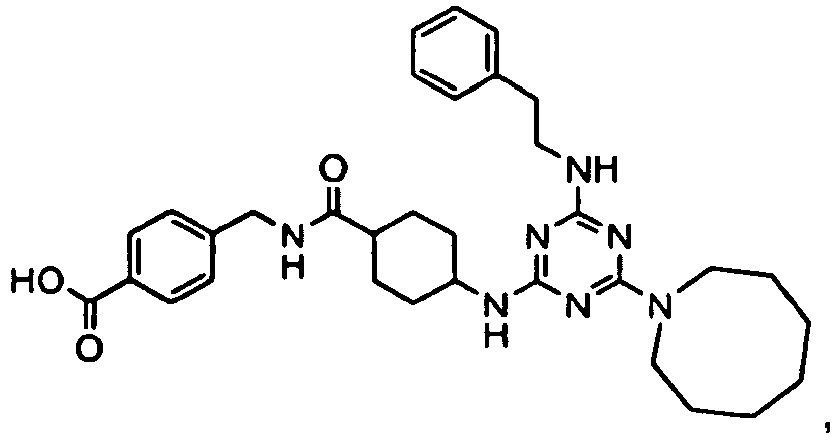
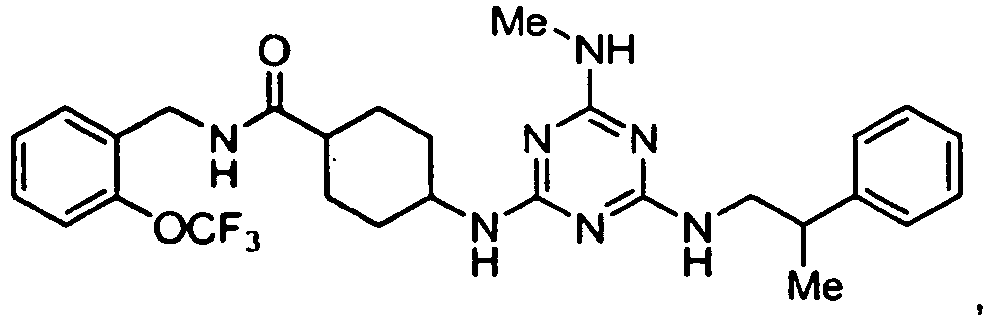


- In another embodiment, the invention is directed to a pharmaceutical composition, comprising a pharmaceutically acceptable carrier and a therapeutically effective amount of a compound of Formula I or a pharmaceutically acceptable salt thereof.
- In another embodiment, the invention is directed to a compound of formula (I), as claimed in the claims, for use in a method for treating hypertension disorder.
- In another embodiment, the invention is directed to a compound of formula (I), as claimed in the claims, for use in a method for treating an inflammatory disorder.
- In another embodiment, the invention is directed to a compound of formula (I), as claimed in the claims, for use in a method of treating a condition or disease mediated by sEH in a mamma
- In another embodiment, the invention is directed to a process for making a compound of Formula I comprising the steps outlined in Schemes 1-3 infra.
- We turn now to a compound of formula I.

- A specific value for


- A specific value for R1 is hydrogen. Another specific value for R1 is CO2H. Another specific value for R1 is CO2Me. Another specific value for R1 is methoxy. Another specific value for R1 is ethoxy. Another specific value for R1 is SCF3. Another specific value for R, is OCF3. Another specific value for R, is CF3.
- A specific value for each R2 (if present) is, independently, chloro. Another specific value for R2 is fluoro. Another specific value for R2 is methyl. Another specific value for R2 is ethyl. Another specific value for R2 is methoxy. Another specific value for R2 is ethoxy. Another specific value for R2 is thiomethyl. Another specific value for R2 is triflouromethyl. Another specific value for R2 is triflouromethoxy.
- A specific value for x is 0. Other specific values for x are 1 or 2.
- A specific value for n is 0. Another specific value for n is 1.
- A specific value for R3 is hydrogen. Another specific value for R3 is methyl.
- A specific value for p is 0. Other specific values for p include 1, 2, and 3.
- A specific value for each R4 (if present) is, independently, chloro. Another specific value for R4 is fluoro. Another specific value for R4 is methyl. Another specific value for R4 is ethyl. Another specific value for R4 is methoxy. Another specific value for R4 is ethoxy. Another specific value for R4 is thiomethyl. Another specific value for R4 is triflouromethyl. Another specific value for R4 is triflouromethoxy.
- A specific value for y is 0. Other specific values for y are 1 or 2.
- A specific value for R5 is hydrogen. Another specific value for R5 is methyl.
- A specific value for R6 is hydrogen. Another specific value for R6 is methyl.
- A specific value for R7 is hydrogen. Another specific value for R7 is chloro, fluoro, bromo, or iodo. Another specific value for R7 is methyl.
- Alternatively, R6 and R7 may be taken together with the atoms to which they are attached to form a 3-10 membered ring


- In the structures for

- A specific value for w is 0. Other specific values for w are 1 or 2.
- R6 is
 " indicates the point of attachment. A specific value for R9 is hydrogen. Another specific value for R9 is methyl.
- X may be absent. Alternatively, a specific value for X is O, Another specific value for X is S, SO, or SO2. Other specific values for X include -CH2-S-, -CH2-O-, -CH2-NH-, or -CH2-NMe. When X is -CH2-S-, -CH2-O-, -CH2-NH-, or -CH2-NMe, X may be attached to


- A specific value for


 " indicates the point of attachment
 - Another specific value for

 " indicates the point of attachment.
 - A specific value for each R10 (if present) independently is chloro. Another specific value for R10 is fluoro. Another specific value for R10 is methyl. Another specific value for R10 is ethyl. Another specific value for R10 is methoxy. Another specific value for R10 is ethoxy. Another specific value for R10 is thiomethyl. Another specific value for R10 is trifluoromethyl. Another specific value for R10 is trifluromethoxy. Another specific value for R10 is trifluorothiomethyl.
- A specific value for z Is 0. Other specific values for z include 1 and 2.
- As indicated previously, in


- Thus specific values for
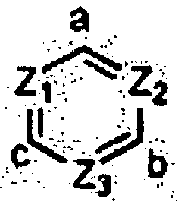


- A specific value for Y is hydrogen. Other specific values for Y are chloro and fluoro. Other specific values for Y is OR11 and NR11R12.
- A specific value for R11 is hydrogen. Another specific value for R11 is methyl.
- A specific value for R12 is hydrogen. Other specific values for R12 include (C1-C6)alkyl, aryl, aralkyl, (C3-C6)cycloalkyl, -alkylene-(C3-C6)cycloalkyl, (C3-C3)heterocycloalkyl, -alkylene-(C3-C6)heterocycloalkyl; heteroaryl, heteroaralkyl, any of which may be optionally substituted on carbon with 1 or 2 groups selected from halo, (C1-C6)alkyl, -O-(C1-C6)alkyl, -S-(C1-C6)alkyl. Thus, specific values for R12 include methyl, ethyl, propyl, isopropyl, butyl, isobutyl secbutyl, cyclohexyl, -CH2CH2-phenyl, -CH2CH2-phenyl substituted on the phenyl ring with 1 or 2 groups independently selected from the group consisting of chlorine, fluorine, and bromine, -CH2CH2-thiophene, and -CH2CH2-thiophene substituted on the thiophene ring with, 1 or 2 groups independently selected from the group consisting of chlorine, fluorine, and bromine.
- A specific group of compounds are compounds of Formula I-A

- A specific group of compounds are compounds of Formula I-B

- A specific group of compounds are compounds of Formula I-C

- A specific group of compounds are compounds of Formula I-D

- A specific group of compounds are compounds of Formula II-A

- A specific group of compounds are compounds of Formula II-B

- A specific group of compounds are compounds of Formula II-C

- A specific group of compounds are compounds of Formula II-D

- A specific group of compounds are compounds of Formula II-E

- A specific group of compounds are compounds of Formula III-A
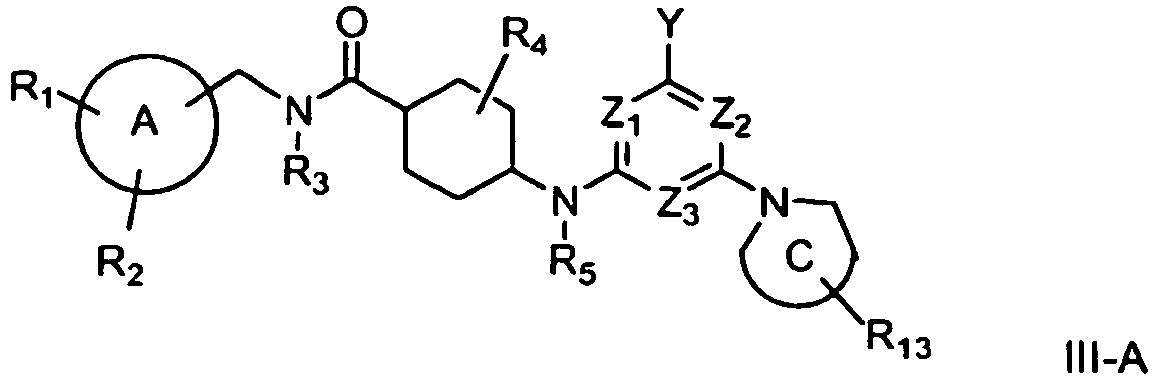
- A specific group of compounds are compounds of Formula III-B

- A specific group of compounds are compounds of Formula III-C

- The meaning of any functional group or substituent thereon at any one occurrence in any Formula herein, or any subformula thereof, is independent of its meaning, or any other functional group's or substituent's meaning, at any other occurrence, unless stated otherwise.
- When a bond to a substituent is shown to cross a bond connecting two atoms in a ring, that substituent may be bonded to any atom on the ring. When a substituent is listed without indicating the atom to which such substituent is bonded to the rest of the compound of a given Formula, that substituent may be bonded to any atom of that substituent. Combinations of substituents and / or variables are permissible only if such combinations result in stable compounds.
- The compounds according to any Formula herein may contain one or more asymmetric centers (also referred to as a chiral center) and may, therefore, exist as individual enantiomers, diastereomers, or other stereoisomeric forms, or as mixtures thereof. Chiral centers, such as chiral carbon atoms, may also be present in a substituent such as an alkyl group. Where the stereochemistry of a chiral center present in a Formula, or in any chemical structure illustrated herein, is not specified the Formula / structure is intended to encompass any stereoisomer and all mixtures thereof. Thus, compounds according to any Formula herein containing one or more chiral center may be used as racemic mixtures, enantiomerically enriched mixtures, or as enantiomerically pure individual stereoisomers.
- Individual stereoisomers of a compound according to any Formula herein which contain one or more asymmetric center may be resolved by methods known to those skilled in the art. For example, such resolution may be carried out (1) by formation of diastereoisomeric salts, complexes or other derivatives; (2) by selective reaction with a stereoisomer-specific reagent, for example by enzamatic oxidation or reduction; or (3) by gas-liquid or liquid chromatography in a chiral enviornment, for example, on a chiral support such as silica with a bound chiral ligand or in the presence of a chiral solvent. The skilled artisan will appreciate that where the desired stereoisomer is converted into another chemical entity by one of the separation procedures described above, a further step is required to liberate the desired form. Alternatively, specific stereoisomers may be synthesized by asymmetric synthesis using optically active reagents, substrates, catalysts or solvents, or by converting one enantiomer to the other by asymmetric transformation.
- The compounds according to any Formula herein may also contain double bonds or other centers of geometric asymmetry. Where the stereochemistry of a center of geometric asymmetry present in a Formula, or in any chemical structure illustrated herein, is not specified, the Formula / structure is intended to encompass the trans (E) geometric isomer, the cis (Z) geometric isomer, and all mixtures thereof. Likewise, all tautomeric forms are also included in a Formula / structure whether such tautomers exist in equilibrium or predominately in one form.
- In certain embodiments, compounds according to any Formula herein may contain an acidic functional group and are therefore capable of forming pharmaceutically-acceptable base addition salts by treatment with a suitable base. In certain other embodiments, compounds according to any Formula herein may contain a basic functional group and are therefore capable of forming pharmaceutically-acceptable acid addition salts by treatment with a suitable acid. Thus, the skilled artisan will appreciate that pharmaceutically-acceptable salts of the compounds according to any Formula herein may be prepared. Indeed, in certain embodiments of the invention, pharmaceutically-acceptable salts of the compounds according to any Formula herein may be preferred over the respective free base or free acid because such salts impart greater stability or solubility to the molecule thereby facilitating formulation into a dosage form. Accordingly, the invention is further directed to pharmaceutically-acceptable salts of the compounds according to any Formula herein.
- As used herein, the term "pharmaceutically-acceptable salts" refers to salts that retain the desired biological activity of the subject compound and exhibit minimal undesired toxicological effects. These pharmaceutically-acceptable salts may be prepared in situ during the final isolation and purification of the compound, or by separately reacting the purified compound in its free acid or free base form with a suitable base or acid, respectively.
- As used herein, the term "compounds of the invention" means both the compounds according to any Formula herein and the pharmaceutically-acceptable salts thereof. The term "a compound of the invention" also appears herein and refers to both a compound according to any Formula herein and its pharmaceutically-acceptable salts.
- In the solid state, compounds of the invention can exist in crystalline, semicrystalline and amorphous forms, as well as mixtures thereof. The skilled artisan will appreciate that pharmaceutically-acceptable solvates of a compound of the invention may be formed wherein solvent molecules are incorporated into the solid-state structure during crystallization. Solvates may involve water or nonaqueous solvents, or mixtures thereof. In addition, the solvent content of such solvates can vary in response to environment and upon storage. For example, water may displace another solvent over time depending on relative humidity and temperature.
- Solvates wherein water is the solvent that is incorporated into the solid-state structure are typically referred to as "hydrates." Solvates wherein more than one solvent is incorporated into the solid-state structure are typically referred to as "mixed solvates". Solvates include "stoichiometric solvates" as well as compositions containing variable amounts of solvent (referred to as "non-stoichiometric solvates"). Stoichiometric solvates wherein water is the solvent that is incorporated into the solid-state structure are typically referred to as "stoichiometric hydrates", and non-stoichiometric solvates wherein water is the solvent that is incorporated into the solid-state structure are typically referred to as "non-stoichiometric hydrates". The invention includes both stoichiometric and non-stoichiometric solvates.
- In addition, crystalline forms of a compound of the invention, including solvates thereof, may contain solvent molecules, which are not incorporated into the solid-state structure. For example, solvent molecules may become trapped in the crystals upon isolation. In addition, solvent molecules may be retained on the surface of the crystals. The invention includes such forms.
- The skilled artisan will further appreciate that compounds of the invention, including solvates thereof, may exhibit polymorphism (i.e. the capacity to occur in different crystalline packing arrangements). These different crystalline forms are typically known as "polymorphs." The invention includes all such polymorphs. Polymorphs have the same chemical composition but differ in packing, geometrical arrangement, and other descriptive properties of the crystalline solid state. Polymorphs, therefore, may have different physical properties such as shape, density, hardness, deformability, stability, and dissolution properties. Polymorphs typically exhibit different IR spectra and X-ray powder diffraction patterns, which may be used for identification. Polymorphs may also exhibit different melting points, which may be used for identification. The skilled artisan will appreciate that different polymorphs may be produced, for example, by changing or adjusting the reaction conditions or reagents, used in making the compound. For example, changes in temperature, pressure, or solvent may result in the production of different polymorphs. In addition, one polymorph may spontaneously convert to another polymorph under certain conditions.
- The compounds of the invention may be prepared using conventional organic syntheses. Suitable synthetic routes are depicted below in the following general reaction schemes. All functional groups are as defined above unless otherwise defined. Starting materials and reagents depicted below in the general reaction schemes are commercially available or can be made from commercially available starting materials using methods known by those skilled in the art.
- The skilled artisan will appreciate that in certain instances the order of reactions depicted below in the general reaction schemes may be changed. The skilled artisan will further appreciate that if a substituent described herein is not compatible with the synthetic methods described herein, the substituent may be protected with a suitable protecting group that is stable to the reaction conditions. The protecting group may be removed at a suitable point in the reaction sequence to provide a desired intermediate or target compound. Suitable protecting groups and methods for protecting and de-protecting different substituents using such suitable protecting groups are well known to those skilled in the art; examples of which may be found in T. Greene and P. Wuts, Protecting Groups in Chemical Synthesis (3rd ed.), John Wiley & Sons, NY (1999). In some instances, a substituent may be specifically selected to be reactive under the reaction conditions used. Under these circumstances, the reaction conditions convert the selected substituent into another substituent that is either useful as an intermediate compound or is a desired substituent in a target compound.
- Example compounds illustrating the invention are also provided below. These examples are not intended to limit the scope of the present invention, but rather to provide guidance to the skilled artisan to prepare and use the compounds, compositions, and methods of the present invention.

- A solution of 4-(Boc-amino)cyclohexanecarboxylic acid (2.0 g, 8.22 mmol, 1 equivalent), methyl 4-(aminomethyl)benzoate hydrochloride (1.89 g, 9.37 mmol, 1.14 equivalents) and DMAP (200.8 mg, 1.644 mmol, 0.2 equivalent) in methylene chloride (50 mL) was cooled with stirring in an ice bath. DIEA (1.79 mL, 10.275 mmol, 1.25 equivalents) was added, followed by addition of EDCI (1.97 g, 10.275 mmol, 1.25 equivalents). The reaction mixture was stirred at 0°C for 2 hours and at room temperature for 3 hours. The solution was diluted with methylene chloride (50 mL), which was further washed with saturated sodium bicarbonate, water, salt and dried over Mg2SO4. The solvent was removed in vacuo to give the crude compound which was further purified by silica chromatography (60%-70% EtOAc in Hexane) to give the desired product (2.97g, 92.5%). This compound (2.97g) was treated with 50% TFA in dichloromethane (80 ml) at room temperature for 25 minutes. The reaction mixture was condensed to give the desired compound as the TFA salt as a light yellow oil. MS: calculated for C16H22N2O3+H+ 291.16, found 291.11.
- 2,4-Dichlorotriazine (96.6 mg, 0.612 mmol, 1eq) was mixed with CH3CN/H2O (1/1, 6 mL) in an ice bath. Compound I as the TFA salt (272 mg, 0.673 mmol, 1.1 equivalents) was added. The pH of the reaction mixture was adjusted to about 9 by adding dropwise 1 N NaOH. After the addition, the reaction mixture was determined to be complete based on LC-MS monitoring. The crude product was used directly in the next step in the same reaction vessel.
- To the reaction mixture from the preparation of compound II (1 ml, approximately 0.1 mmol) was added a primary or secondary amine (5 equivalents). The reaction mixture was heated at 80°C and was monitored by LC-MS. After 2 to 3 hours, the reaction was completed. The organic solvent was evaporated and the crude compound was acidified and purified with RP-HPLC.
- Crude compound II (approximately 0.1 mmol) in CH3CN/H2O (1/1, 1 ml) was treated with (R)-(+)-beta-methylphenethylamine (67.7 mg, 0.5 mmol, 5 equivalents) at 80°C for 2 hours. The crude was purified with RP-HPLC (Luna 5µ C8(2), 100x21 mm, 20-65% CH3CN/H2O, 0.1% TFA, 17 min) to give the desired product (2.2 mg). MS: calculated for C28H34N6O3+H+ 503.27, found 503.39.
- To crude compound II (- 0.1 mmol) in CH3CN/H2O (1/1, 1 ml) was added S-benzylcysteamine hydrochloride (101.9 mg, 0.5 mmol, 5 equivalents) and Et3N (84 µl, 0.6 mmol, 6 equivalents). The reaction mixture was heated at 80°C for 2 hours. The crude was purified with RP-HPLC (Luna 5µ C8(2), 100x21mm, 20-65% CH3CN/H2O, 0.1% TFA, 17 min) to give the desired product (4 mg). MS: calculated for C28H34N6O3S+H+ 535.24, found 535.33.
- To a solution of compound III (0.044 mmol, 1 equivalent) in MeOH (0.4 mL) was added 1 N NaOH (0.2 mL). The reaction mixture was stirred at room temperature for 2 to 3 hours. The reaction was monitored with LC-MS. The solution was neutralized with 1 N HCl and the crude product was purified with RP-HPLC.
- Compound III(a) (approximately 2.2 mg) in MeOH (0.4 mL) was treated with 1 N NaOH (0.2 mL) to give compound IV(a) (2 mg). The product was purified with RP-HPLC (Luna 5µ C8(2), 100x21mm, 10-65% CH3CN/H2O, 0.1% TFA, 20 min). MS: calculated for C27H32N6O3+H+ 489.25, found 489.4.
- Compound III(b) (approximately 4 mg) in MeOH (0.4 mL) was treated with 1 N NaOH (0.2 mL) to give compound IV(b) (3.4 mg, 87% yield). The product was purified with RP-HPLC (Luna 5µ C8(2), 100x21mm, 10-65% CH3CN/H2O, 0.1% TFA, 20 min). MS: calculated for C27H32N6O3S+H+ 521.23, found 521.3.


- A mixture of cyanuric chloride (1.22 mmol, 1 equivalent) in CH3CN/H2O (1/1, 2 mL) was cooled to 0°C. A primary or secondary amine (1 equivalent) was added. The reaction mixture was adjusted to a pH of about 9-10 using 1 N NaOH. The pH was kept at about 9-10 for 30 minutes. LC-MS was used to monitor the reaction. The crude product was used for the next amine addition in the same reaction vessel.
- Following the above general procedure, cyanuric chloride (50 mg, 0.27 mmol) was allowed to undergo reaction with (R)(+)-beta-methylphenethylamine (36.7 mg, 0.27 mmol, 1 equivalent). MS: calculated for C12H12Cl2N4+H+ 283.04, found 283.12.
- Following the above general procedure, cyanuric chloride (50 mg, 0.27 mmol) was allowed to undergo reaction with S-benzylcysteamine hydrochloride (55.2 mg, 0.27 mmol, 1 equivalent). MS: calculated for C12H12Cl2N4S+H+ 315.02, found 315.01.
- Following the above general procedure, cyanuric chloride (50 mg, 0.27 mmol) was allowed to undergo reaction with heptamethyleneimine (30.7 mg, 0.27 mmol, 1 equivalent). MS: calculated for C10H14Cl2N4+H+ 260.06, found 261.17.
- To crude compound V (0.27 mmol, 1 equivalent) in CH3CN/H2O (1/1, 2 mL) was added compound I as the TFA salt (0.27 mmol, 1 equivalent). 1 N NaOH was added to the reaction to adjust the pH to about 10. The reaction mixture was stirred at room temperature for 4 hours, while the pH was retained between 9 and 10. Crude compound VI was used directly in the next step.
- Following the above general procedure, crude compound V(a) (0.27 mmol) in CH3CN/H2O (1/1, 2 mL) was allowed to undergo reaction with compound I (131.42 mg, 0.32 mmol, 1.2 equivalents). MS: calculated for C28H33ClN6O3+H+ 537.23, found 537.31.
- Following the above general procedure, crude compound V(b) (0.27 mmol) in CH3CN/H2O (1/1, 2 mL) was allowed to undergo reaction with compound I (131.42 mg, 0.32 mmol, 1.2 equivalent). MS: calculated for C28H33ClN6O3S+H+ 569.20, found 569.28.
- Following the above general procedure, crude compound V(c) (0.27 mmol) in CH3CN/H2O (1/1, 2 mL) was allowed to undergo reaction with compound I (131.42 mg, 0.32 mmol. 1.2 equivalents). MS: calculated for C26H35ClN6O3+H-+ 515.24, found 515.37.
- To crude compound VI (0.13 mmol, 1 equivalent) in CH3CN/H2O (1/1, 1 mL) was added amine (1.3 mmol. 10 equivalents). The reaction mixture was heated at 80°C for 4-6 hours. The reaction was monitored with LC-MS. Crude compound VII was used directly in the next step.
- Following the above general procedure, crude compound VI(a) (0.13 mmol) in CH3CN/H2O (1/1, 2 mL) was allowed to undergo reaction with phenethylamine (170 µl, 1.3 mmol, 10 equivalents). MS: calculated for C36H43N7O3+H+ 622.34, found 622.47.
- Following the above general procedure, crude compound VI(a) (0.13 mmol) in CH3CN/H2O (1/1, 2 mL) was allowed to undergo reaction with 2-thiopheneethylamine (10 equivalents). MS: calculated for C34H41N7O3S+H+ 628.30, found 628.43.
- Following the above general procedure, crude compound VI(b) (0.13 mmol) in CH3CN/H2O (1/1, 2 mL) was allowed to undergo reaction with pheneethylamine (170 µl, 1.3 mmol, 10 equivalents). MS: calculated for C36H43N7O3S+H+ 654.31, found 654.43.
- Following the above general procedure, crude compound VI(b) (0.13 mmol) in CH3CN/H2O (1/1, 2 mL) was allowed to undergo reaction with 2-thiopheneethylamine (10 equivalents). MS: calculated for C34H41N7O3S2+H+ 660.27, found 660.38.
- Following the above general procedure, crude compound VI(a) (0.1625 mmol) in CH3CN/H2O (1/1, 4 mL) was allowed to undergo reaction with methylamine (3.25 mmol, 20 equivalent). MS: calculated for C29H37N7O3+H+ 532.30, found 532.36.
- Following the above general procedure, crude compound VI(a) (0.1625 mmol) in CH3CN/H2O (1/1, 4 mL) was allowed to undergo reaction with isobutylamine (1.625 mmol, 10 equivalent). MS: calculated for C32H43N7O3+H+ 574.34, found 574.42.
- Following the above general procedure, crude compound VI(b) (0.1625 mmol) in CH3CN/H2O (1/1, 4 mL) was allowed to undergo reaction with methylamine (3.25 mmol, 20 equivalent). MS: calculated for C29H37N7O3S+H+ 564.27, found 564.34.
- Following the above general procedure, crude compound VI(b) (0.1625 mmol) in CH3CN/H2O (1/1, 4 mL) was allowed to undergo reaction with isobutylamine (1.625 mmol, 10 equivalents). The pH of the solution was approximately 11. After being heated at 80°C for 2 hours, mostly demethylated product VIII(h) was produced, combined with a small amount of compound VII(h). Compound VIII(h) was purified by RP-HPLC (Luna 5µ C8(2), 100x21mm, 30-70% CH3CN/H2O, 0.1% TFA, 20 min). MS for compound VII(h): calculated for C32H43N7O3S+H+ 606.31, found 606.39; MS for compound VIII(h): calculated for C31 H41 N7O3S+H+ 592.30, found 592.37.
- Following the above general procedure, crude compound VI(c) (9.4 mg, 0.018 mmol) in CH3CN (0.5 mL) was allowed to undergo reaction with phenethylamine (11 µl, 0.09 mmol, 5 equivalents). MS: calculated for C34H45N7O3+H+ 600.36, found 600.49.
- To crude compound VII (0.13 mmol, 1equivalent) in CH3CN/H2O (1/1, 1 mL) was added 1N NaOH (0.5-1 mL). The reaction mixture was stirred at room temperature for 3 hours to overnight. The reaction solution was neutralized with 1 N HCl, which was further purified with RP-HPLC.
- Following the above general procedure, crude compound VII(a) (0.13 mmol) in CH3CN/H2O (1/1, 2 mL) was allowed to undergo reaction with 1N NaOH (0.5 mL) at room temperature overnight. The product was purified with RP-HPLC (Luna 5µ C8(2), 100x21mm. 25-80% CH3CN/H2O, 0.1% TFA, 20 min). MS: calculated for C35H41 N7O3+H+ 608.33, found 608.40.
- Following the above general procedure, crude compound VII(b) (0.13 mmol) in CH3CN/H2O (1/1, 2 mL) was allowed to undergo reaction with 1N NaOH (1.0 mL) at room temperature for 3 hours. The product was purified with RP-HPLC (Luna 5µ C8(2), 100x21mm, 25-80% CH3CN/H2O, 0.1% TFA, 20 min). MS: calculated for C33H39N7O3S+H+ 614.28, found 614.36.
- Following the above general procedure, crude compound VII(c) (0.13 mmol) in CH3CN/H2O (1/1, 2 mL) was allowed to undergo reaction with 1N NaOH (0.5 mL) at room temperature overnight. The product was purified with RP-HPLC (Luna 5µ C8(2), 100x21mm, 20-65% CH3CN/H2O, 0.1% TFA, 20 min). MS: calculated for C35H41N7O3S+H+ 640.30, found 640.38.
- Following the above general procedure, crude compound VII(d) (0.13 mmol) in CH3CN/H2O (1/1, 2 mL) was allowed to undergo reaction with 1 N NaOH (0.5 mL) at room temperature for 3 hours. The product was purified with RP-HPLC (Luna 5µ C8(2), 100x21mm, 25-80% CH3CN/H2O, 0.1% TFA, 20 min). MS: calculated for C33H39N7O3S2+H+ 646.26, found 646.30.
- Following the above general procedure, crude compound VII(e) (0.1625 mmol) in CH3CN/H2O (1/1, 4 mL) was allowed to undergo reaction with 5N NaOH (0.5 mL) at room temperature for 14 hours. The product was purified with RP-HPLC (Luna 5µ C8(2), 100x21mm. 25-65% CH3CN/H2O, 0.1% TFA, 20 min). MS: calculated for C28H35N7O3+H+ 518.28, found 518.36.
- Following the above general procedure, crude compound VII(f) (0.1625 mmol) in CH3CN/H2O (1/1, 4 mL) was allowed to undergo reaction with 5N NaOH (0.5 mL) at room temperature for 14 hours. The product was purified with RP-HPLC (Luna 5µ C8(2), 100x21mm, 30-85% CH3CN/H2O, 0.1% TFA, 20 min). MS: calculated for C31 H41 N7O3+H+ 560.33, found 560.41.
- Following the above general procedure, crude compound VII(g) (0.1625 mmol) in CH3CN/H2O (1/1, 4 mL) was allowed to undergo reaction with 5N NaOH (0.5 mL) at room temperature for 14 hours. The product was purified with RP-HPLC (Luna 5µ C8(2), 100x21mm, 25-70% CH3CN/H2O, 0.1% TFA, 20 min). MS: calculated for C28H35N7O3S+H+ 550.25, found 550.31.
- Following the above general procedure, crude compound VII(i) (0.018mmol) in CH3CN (0.5 mL) was allowed to undergo reaction with 1 N NaOH (0.2 mL) at room temperature for overnight. The product was purified with RP-HPLC (Luna 5µ C8(2), 100x21mm, 25-70% CH3CN/H2O, 0.1% TFA, 17 min). MS: calculated for C33H43N703+H+ 586.34, found 586.43.

- Following the general procedure for the preparation of compound V, cyanuric chloride (100 mg, 0.54 mmol) was allowed to undergo reaction with cyclohexylamine (62 µl, 0.54 mmol, 1 equivalent). LC-MS showed the starting material had been converted to desired product VIV. The crude product was used without purification in the next reaction.
- Following the general procedure for the preparation of compound VI, crude compound VIV (0.54 mmol) was allowed to undergo reaction with 4-aminocyclohexanecarboxylic acid (77.2 mg, 0.54 mmol, 1 equivalent). The reaction was stirred overnight at room temperature. The crude product was used without further purification. MS: calculated for C16H24ClN5O2+H+ 354.16, found 354.24.
- Following the general procedure for the preparation of compound VII, crude compound W (0.54 mmol) was allowed to undergo reaction with 2-(2-chloro-6-fluorobenzylthio)ethylamine (236.5 mg, 1.08 mmol, 2 equivalents). The reaction was completed after being stirred at 80°C overnight. The solvent was evaporated and the crude compound VVI was purified by RP-HPLC (Luna 5µ C8(2), 100x21mm, 30-77% CH3CN/H2O, 0.1% TFA, 17 min) to give the desired product (138.5 mg, 47.8% in 3 steps). MS: calculated for C25H34ClFN6O2S+H+ 537.21, found 537.34.
- A solution of compound VVI (0.026 mmol, 1 equivalent), amine (0.0326 mmol, 1.25 equivalents) and DMAP (0.2 equivalent) in dichloromethane (1 mL) was cooled with stirring in an ice bath. 1-Ethyl-3-[3-(dimethylamino)propyl]carbodiimide hydrochloride (EDCl, 0.039 mmol, 1.5 equivalents) was added. The reaction mixture was stirred at 0°C for 30 minutes and at room temperature for 2 hours. The solution was diluted with dichloromethane (1 mL), which was further washed with saturated sodium bicarbonate and water. The solvent was removed in vacuo to give the crude compound VVII which was further purified by RP-HPLC.
- Following the general procedure for the preparation of compound VVII, compound VVI (14 mg. 0.026 mmol, 1 equivalent) was treated with methyl 4-(aminomethyl)benzoate hydrochloride (6.6 mg, 0.0326 mmol, 1.25 equivalents), diisopropylethylamine (DIEA, 6.8 µl, 0.039 mmol, 1.5 equivalents), DMAP (0.6 mg, 0.0052 mmol, 0.2 equivalents) and EDCI (7.5 mg. 0.039 mmol, 1.5 equivalents). After work-up, the solvent was removed in vacuo and the crude product was redissolved in MeOH (600 µl). 1 N NaOH (700 µl) was added and the reaction mixture was stirred at room temperature for about 2 hours, followed by heating at 60°C for 30 min. After neutralization of the reaction solution by addition of 1N HCl, the crude product was purified with RP-HPLC (Luna 5µ C8(2), 100x21mm, 25-75% CH3CN/H2O. 0.1% TFA, 17 min) to produce the desired product (1.6 mg) and recovered methyl ester (10.5 mg). MS: calculated for C33H41ClFN7O3S+H+ 670.27, found 670.4.
- Following the general procedure for the preparation of compound VVII, compound VVI (13.3mg, 0.0247 mmol, 1 equivalent) was treated with benzylamine (3.4 µl, 0.031 mmol, 1.25 equivalents), DMAP (0.6 mg, 0.005 mmol, 0.2 equivalents) and EDCl (7.1 mg, 0.037 mmol, 1.5 equivalents) at room temperature for 2 hours. The crude product was purified with RP-HPLC (Luna 5µ C8(2), 100x21mm, 30-78% CH3CN/H2O, 0.1% TFA, 17 min) to give compound VVII(b) (6.4 mg, 41%). MS: calculated for C32H41ClFN7O3S+H+ 626.28, found 626.40.
- Following the general procedure for the preparation of compound VVII, compound VVI (11.38 mg, 0.0212 mmol, 1 equivalent) was treated with 2-(trifluoromethyl)-benzenemethanamine (5.1 mg, 0.0265 mmol, 1.25 equivalents), DMAP (0.5 mg, 0.2 equivalents) and EDCl (6.1 mg, 0.032 mmol, 1.5 equivalents) at room temperature for 2 hrs. The crude product was purified with RP-HPLC (Luna 5µ C8(2), 100x21mm, 30-78% CH3CN/H2O, 0.1% TFA, 17 min) to give compound VVII(c) (9.2 mg, 61%). MS: calculated for C33H40ClF4N7O2S+H+ 710.26, found 710.38.
- Following the general procedure for the preparation of compound VVII, compound VVI (10.78 mg, 0.02 mmol, 1 equivalent) was treated with 2-(trifluoromethyl)thiobenzenemethanamine as the TFA salt (8.2 mg, 0.033 mmol, 1.6 equivalents), DIEA (5.6 µl, 1.6 eqiv), DMAP (0.5 mg, 0.2 equivalents) and EDCl (5.8 mg, 0.03 mmol, 1.5 equivalents) at room temperature for 2 hrs. The crude product was purified with RP-HPLC (Luna 5µ C8(2), 100x21mm, 30-78% CH3CN/H2O, 0.1% TFA, 17 min) to give compound VVII(d) (12.8 mg, 88%). MS: calculated for C33H40ClF4N7OS2+H+ 726.24, found 726.36.


- Treatment of amine 1.0 (commercially available or made from commercially available starting materials using methods known to those skilled in the art) with BOC anhydride gave the corresponding carbamate 1.2. Alkylation of 1.2 with an alkyl iodide or cycloalkyl iodide (commercially available or made from commercially available starting materials using methods known to those skilled in the art) provides intermediate 1.3. Deprotection of BOC-intermediate 1.3 with HCl provides amine 1.4. Hydrolysis of methyl ester 1.4 with either lithium hydroxide or sodium hydroxide provides amino-acid 1.5.

- Treatment of 2.4,6-trichlorotriazine 2.1 (commercially available) with amine HNR50aR06a (commercially available or made from commercially available starting materials using methods known to those skilled in the art) affords amino-triazine 2.2. Reaction of chloro-triazine 2.2 with amino-carboxylic acid 2.3 (commercially available or made from commercially available starting materials using methods known to those skilled in the art) provides triazine 2.4. Treatment of chloro-triazine 2.4 with amine HNR50bR06b (commercially available or made from commercially available starting materials using methods known to those skilled in the art) provides triamino-triazine 2.5. Treatment of carboxylic acid intermediate 2.5 with amine 2.6 (commercially available or made from commercially available starting materials using methods known to those skilled in the art) and a coupling reagent (such as EDCl or BOP reagent) and a base (such as triethylamine) provides amide 2.7.

- Treatment of 2,4,6-trichlorotriazine 3.0 (commercially available) with amine HNR50aR06a (commercially available or made from commercially available starting materials using methods known to those skilled in the art) affords amino-triazine 3.1. Reaction of chloro-triazine 3.1 with amino-carboxylic acid 3.2 (commercially available or made from commercially available starting materials using methods known to those skilled in the art) provides triazine 3.3. Treatment of chloro-triazine 3.3 with amine HNR50bR06b (commercially available or made from commercially available starting materials using methods known to those skilled in the art) provides triamino-triazine 3.4. Treatment of carboxylic acid intermediate 3.4 with amine 3.5 (commercially available or made from commercially available starting materials using methods known to those skilled in the art) and a coupling reagent (such as EDCI or BOP reagent) and a base (such as triethylamine) provides amide 3.6. Hydrolysis of methyl carboxylate 3.6 using either lithium hydroxide or sodium hydroxide provides target 3.7.
- cis-N-[(2,4-dichlorophenyl)methyl]-4{[4-(methylamino)-6-(4-methyl-1-piperazinyl)-1,3,5-triazin-2-yl]amino}cyclohexanecarboxamide

- A mixture of 2,4,6-trichloro-1,3,5-triazine (4.27g, 17.46 mmol) in a solution of CH3CN:H2O (1:1, 28.6 mL) was cooled to 0°C. A solution of 30% NH2Me in H2O (17.46 mmol) was added. The reaction mixture was adjusted to pH of about 9-10 using 1N NaOH. The pH was maintained at about 9-10 for 15 minutes. LCMS analysis showed the complete consumption of the 2,4,6-trichloro-1,3,5-triazine. The crude product was used in the next step. MS (ES+): m/e 178.9 [M + H]+.
- Commercially available cis-4-aminocyclohexanecarboxylic acid (17.46 mmol) was added to the above crude solution of 4,6-dichloro-N-methyl-1,3,5-triazin-2-amine in CH3CN:H2O (1:1, 28.6 mL). The reaction mixture was stirred at room temperature to 40°C for 3 hours while the pH was maintained between 9 and 10 with addition of a NaOH solution. LCMS analysis showed the complete consumption of 4,6-dichloro-N-methyl-1,3,5-triazin-2-amine. The crude product was used in the next step. MS (ES+): m/e 286.0 [M + H]+.
- Commercially available 1-methylpiperazine (17.46g, 174.6 mmol) was added to a mixture of crude cis-4-{[4-chloro-6-(methylamino)-1,3,5-triazin-2-yl]amino} cyclohexanecarboxylic acid (17.46 mmol) in a solution of CH3CN:H2O (1:1, 28.6 mL). The reaction mixture was heated to 80°C overnight. LCMS analysis showed the complete consumption of the cis-4-{[4-chloro-6-(methylamino)-1,3,5-triazin-2-yl]amino}cyclohexanecarboxylic acid. The solvent was removed and the residue was dissolved in DMSO/MeOH and purified by HPLC to afford 6 g (92%) of the desired product. MS (ES+): m/e 350.1 [M + H]+.
- A solution of 4-{[4-(methylamino)-6-(4-methy)-1-piperazinyl)-1,3,5-triazin-2-yl]amino} cyclohexanecarboxylic acid (150 mg, 0.43 mmol), [(2,4-dichlorophenyl)methyl]amine (95 mg, 0.54 mmol) and DMAP (8 mg, 0.06 mmol) in DCM was stirred at room temperature. To this was added EDCl (90.8 mg, 0.47 mmol) and the resulting mixture was allowed to stir overnight. The solution was washed with water. The organic layer was dried and purified by HPLC to afford 78 mg (36% yield) of the product as a white solid. MS (ES+): m/e 507.1 [M + H]+.
- cis-N-[(2-fluorophenyl)methyl]-4-{[4-(methylamino)-6-(4-methyl-1-piperazinyl)-1,3,5-triazin-2-yl]amino}cyclohexanecarboxamide hydrochloride

- Compound 14 was prepared using the general procedure described above for Compound 13 substituting the appropriate starting materials. MS (ES+): m/e 457.2 [M + H]+.
- cis-N-[(3,4-difluorophenyl)methyl]-4-{[4-(methylamino)-6-(4-methyl-1-piperazinyl)-1,3,5-triazin-2-yl]amino}cyclohexanecarboxamide hydrochloride

- Compound 15 was prepared using the general procedure described above for Compound 13 substituting the appropriate starting materials. MS (ES+): m/e 475.2 [M + H]+.
- cis-N-cyclohexyl-4-{[4-(methylamino)-6-(4-methyl-1-piperazinyl)-1,3,5-triazin-2-yl]amino}cyclohexanecarboxamide hydrochloride

- Compound 16 was prepared using the general procedure described above for Compound 13 substituting theapprop riate starting materials. MS (ES+): m/e 431.2 [M + H]+.
- cis-N-(cyclohexylmethyl)-4-{[4-(methylamino)-6-(4-methyl-1-piperazinyl)-1,3,5-triazin-2-yl]amino}-cyclohexanecarboxamide hydrochloride

- Compound 17 was prepared using the general procedure described above for Compound 13 substituting the appropriate starting materials. MS (ES+): m/e 445.2 [M + H]+.
- cis-4-{[4-(methylamino)-6-(4-methyl-1-piperazinyl)-1,3,5-triazin-2-yl]amino}-N-{[2-(trifluoromethyl)phenyl]methyl}cyclohexanecarboxamide hydrochloride

- Compound 18 was prepared using the general procedure described above for Compound 13 substituting the appropriate starting materials. MS (ES+): m/e 507.2 [M + H]+.
- cis-N-[(2-chlorophenyl)methyl]-4-{[4-(methylamino)-6-(4-methyl-1-piperazinyl)-1,3,5-triazin-2-yl]amino}cyclohexanecarboxamide hydrochloride

- Compound 19 was prepared using the general procedure described above for Compound 13 substituting the appropriate starting materials. MS (ES+): m/e 473.1 [M + H]+.
- cis-4-{[4-(methylamino)-6-(4-methyl-1-piperazinyl)-1,3,5-triazin-2-yl]amino}-N-({2-[(trifluoromethyl)oxy]phenyl}methyl)cyclohexanecarboxamide hydrochloride

- Compound 20 was prepared using the general procedure described above for Compound 13 substituting the appropriate starting materials. MS (ES+): m/e 523.2 [M + H]+.
- trans-4-{[4-(methylamino)-6-(4-methyl-1-piperazinyl)-1,3,5-triazin-2-yl]amino}-N-{[2-(trifluoromethyl)phenyl]methyl}cyclohexanecarboxamide trifluoroacetate

- Compound 21 was prepared using the general procedure described above for Compound 13 substituting the appropriate starting materials. MS (ES+): m/e 507.1 [M + H]+.
- trans-4-{[4-(methylamino)-6-(4-methyl-1-piperazinyl)-1,3,5-triazin-2-yl]amino}-N-({2-[(trifluoromethyl)oxy]phenyl}methyl)cyclohexanecarboxamide trifluoroacetate

- Compound 22 was prepared using the general procedure described above for Compound 13 substituting the appropriate starting materials. MS (ES+): m/e 523.2 [M + H]+.
- trans-N-[(2,4-dichlorophenyl)methyl]-4-{[4-(methylamino)-6-(4-methyl-1-piperazinyl)-1,3,5-triazin-2-yl]amino}cyclohexanecarboxamide trifluoroacetate

- Compound 23 was prepared using the general procedure described above for Compound 13 substituting the appropriate starting materials. MS (ES+): m/e 507.1 [M + H]+.
- N-[(3,4-difluorophenyl)methyl]-3-{[4-(methylamino)-6-(4-methyl-1-piperazinyl)-1,3,5-triazin-2-yl]amino}cyclohexanecarboxamide hydrochloride

- Compound 24 was prepared using the general procedure described above for Compound 13 substituting the appropriate starting materials. MS (ES+): m/e 475.1 [M + H]+.
- N-(cyclohexylmethyl)-3-{[4-(methylamino)-6-(4-methyl-1-piperazinyl)-1,3,5-triazin-2-yl]amino}cyclohexanecarboxamide hydrochloride

- Compound 25 was prepared using the general procedure described above for Compound 13 substituting the appropriate starting materials. MS (ES+): m/e 445.2 [M + H]+.
- 3-{[4-(methylamino)-6-(4-methyl-1-piperazinyl)-1,3,5-triazin-2-yl]amino}-N-{[2-(trifluoromethyl)phenyl]methyl}cyclohexanecarboxamide hydrochloride

- Compound 26 was prepared using the general procedure described above for Compound 13 substituting the appropriate starting materials. MS (ES+): m/e 507.1 [M + H]+.
- N-[(2-chlorophenyl)methyl]-3-{[4-(methylamino)-6-(4-methyl-1-piperazinyl)-1,3,5-triazin-2-yl]amino}cyclohexanecarboxamide hydrochloride

- Compound 27 was prepared using the general procedure described above for Compound 13 substituting the appropriate starting materials. MS (ES+): m/e 473.1 [M + H]+.
- N-[(2-fluorophenyl)methyl]-3{[4-(methylamino)-6-(4-methyl-1-piperazinyl)-1,3,5-triazin-2-yl]amino}cyclohexanecarboxamide hydrochloride

- Compound 28 was prepared using the general procedure described above for Compound 13 substituting the appropriate starting materials. MS (ES+): m/e 457.1 [M + H]+.
- 3-{[4-(methylamino)-6-(4-methyl-1-piperazinyl)1,3,5-triazin-2-yl]amino}-N-({2-[(tifluoromethyl)oxy]phenyl}methyl)cyclohexanecarboxamide hydrochloride

- Compound 29 was prepared using the general procedure described above for Compound 13 substituting the appropriate starting materials. MS (ES+): m/e 523.3 [M + H]+.
- N-[(2,4-dichlorophenyl)methyl]-3-{[4-{methylamino)-6-(4-methyl-1-piperazinyl)-1,3,5-triazin-2-yl]amino}cyclohexanecarboxamide trifluoroacetate

- Compound 30 was prepared using the general procedure described above for Compound 13 substituting the appropriate starting materials. MS (ES+): m/e 507.2 [M + H]+.
- cis-N-[(2,4-dichlorophenyl)methyl]-4-{methyl[4-(methylamino)-6-(4-methyl-1-piperazinyl)-1,3,5-triazin-2-yl]amino}cyclohexanecarboxamide

- An aqueous solution of sodium hydroxide (5.6 g, 0.14 mol) and 1,4-dioxane was added to methyl cis-4-aminocyclohexanecarboxylate (5 g, 0.035 mol) followed by addition of Boc-anhydride (15.3 g, 0.07 mol) at 0°C. The resulting mixture was allowed to stir overnight at room temperature. The reaction mixture was washed with water and the pH was adjusted to 4-5 with 1 M HCl. The organic layer was washed with additional water and concentrated to afford 9.3 g of crude product as a white solid. MS (ES+): m/e 158.2 [M + H - boc]+.
- A solution of methyl cis-4-({[(1,1-dimethylethyl)oxy]carbonyl}amino) cyclohexanecarboxylate (9 g, crude) in N,N-dimethylacetamide (50 mL) was cooled to 0°C and treated with 60% NaH (2.45g, 0.062 mol) over 30 min. The mixture was warmed to room temperature for 1 hour then cooled to 0°C again and treated with iodomethane (30 g, 0.144 mol). The resulting mixture was allowed to warm to room temperature and stir overnight. The reaction mixture was then cooled to 0°C and poured into an ice cold solution of ammonium chloride. The mixture was then acidified with 1 M sodium sulfate and concentrated to give the 10 g of crude product as an oil which contained N,N-dimethylacetamide. MS (ES+): m/e 172.1 [M + H - boc]+.
- A mixture of methyl cis-4-[{[(1,1-dimethylethyl)oxy]carbonyl}(methyl)amino] cyclohexanecarboxylate (~10g, crude product from above) and 1 M HCl in dioxane (20 mL) was heated to 50°C and allowed to stir overnight. The mixture was concentrated to give the 3 g of crude product. MS (ES+): m/e 172.1 [M + H]+.
- The methyl cis-4-(methylamino)cyclohexanecarboxylate (3 g, 0.0175 mol) from above was dissolved in a THF/H2O (10 mL) mixture and was cooled to 0°C. Next 2 L of a 0.025 M solution of NaOH was added slowly. The mixture was stirred a 0°C for another 0.5 hour. The mixture was then acidified to pH 7-8 and extracted with ethyl acetate. The water layer was acidified to pH 3-4 and extracted with ethyl acetate. The organic layer was dried over Na2SO4 and concentrated to give 2.49 g (0.016 mol, 90% yield) of product.
- A mixture of 2,4,6-trichloro-1,3,5-triazine (0.5 g, 2.0 mmol) in a solution of CH3CN:H2O (1:1, 20 mL) was cooled to 0°C. A 2 M solution of methylamine in THF (1 mL, 2.0 mmol) was added. The reaction mixture was adjusted to a pH of about 8-9 using 1 N NaOH. The pH was maintained at about 9-10 for 0.5 hour. LCMS analysis showed the complete consumption of the 2,4,6-trichloro-1,3,5-triazine. To this mixture was added cis-4-(methylamino)cyclohexanecarboxylic acid (0.32 g, 2.0 mmol). The reaction mixture was stirred at room temperature while the pH was maintained between 8 and 9. Next, 1-methylpiperazine (2 g, 20 mmol) was added and the mixture was heated to 50°C overnight. The solvent was removed and the crude product was purified by HPLC to afford 0.32 g (0.09 mmol, 44% yield) of the desired product. MS (ES+): m/e 364.2 [M + H]+.
- A solution of cis-4-{methyl[4-(methylamino)-6-(4-methyl-1-piperazinyl)-1,3,5-triazin-2-yl]amino}cyclohexanecarboxylic acid (50 mg, 0.138 mmol), [(2,4-dichlorophenyl)methyl]amine (30 mg, 0.17 mmol), and DMAP (3.37 mg, 0.028 mmol) in DMF/DCM was cooled in an ice bath. EDCl (40 mg, 0.21 mmol) was added. The reaction mixture was stirred at 0°C for 0.5 hour, and then at room temperature for 2 hours. The solution was diluted with DCM and then washed with a saturated NaCl solution. The organic layer was dried over NaSO4 and concentrated to give the crude product which was purified by HPLC. After purification, 29 mg (0.06 mmol, 40% yield) of product was obtained as a white solid. MS (ES+): m/e 521.1 [M + H]+.
- cis-4-{methyl[4-(methylamino)-6-(4-methyl-1-piperazinyl)-1,3,5-triazin-2-yl]amino}-N-{[2-(trifluoromethyl)phenyl]methyl}cyclohexanecarboxamide trifluoroacetate

- Compound 32 was prepared using the general procedure described above for Compound 31 substituting the appropriate starting materials. MS (ES+): m/e 521.3 [M + H]+.
- cis-4-{methyl[4-(methylamino)-6-(4-methyl-1-piperazinyl)1,3,5-triazin-2-yl]amino}-N-({2-[(trifluoromethyl)oxy]phenyl}methyl)cyclohexanecarboxamide trifluoroacetate

- Compound 33 was prepared using the general procedure described above for Compound 31 substituting the appropriate starting materials. MS (ES+): m/e 537.3 [M + H]+.
- (1S,4S)-4-(4-(methylamino)-6-((R)-2-phenylpropylaminoyl,3,5-triazin-2-ylamino)-N-(2-(trifluoromethyl)benzyl)cyclohexanecarboxamide

- A mixture of cyanuric chloride (75 mg, 0.407 mmol, 1 equivalent) in CH3CN/H2O (1/1, 5 ml) was cooled to 0°C. (R)-(+)-beta-methylphenethylamine (55 mg, 0.407 mmol, 1 equivalent) was added, followed by 1N NaOH (0.366 ml). LCMS analysis showed the complete consumption of the 2,4,6-trichloro-1,3,5-triazine. The crude product was used in the next step. MS (ES+): m/e 283.06 [M + H]+.
- To the above reaction solution of (R)-4,6-dichloro-N-(2-phenylpropyl)-1,3,5-triazin-2-amine (0.2035 mmol) in CH3CN/H2O (1/1, 2.5 ml) was added cis-4-aminocyclohexanecarboxylic acid (27.5 mg, 0.2035 mmol, 1 equivalent). 1N NaOH was added to the reaction to adjust the pH to about 9-10. The reaction mixture was stirred at room temperature overnight. To the reaction was added additional cis-4-aminocyclohexanecarboxylic acid (7.0 mg, 0.049 mmol, 0.25 equivalents). 1 N NaOH was added to the reaction to adjust the pH to about 9-10. The reaction mixture was stirred at room temperature for 1 hour. The crude product was used in the next step. MS (ES+): m/e 390.21 [M + H]+.
- To the above reaction solution of (1S,4S)-4-(4-chloro-6-((R)2-phenylpropylamino)-1,3,5-triazin-2-ylamino)cyclohexanecarboxylic acid (0.2 mmol) in CH3CN/H2O (1/1, 2.5 ml) was added methylamine (40% aq. (w), 0.158 ml, 2.305 mmol, 10 equivalents). The reaction mixture was heated at 80°C for 3 hours. The reaction solution was acidified and condensed to give the crude which was further purified by RP-HPLC (Luna 5µ; C8(2), 100x21mm. 30-80% CH3CN/H2O, 0.1% TFA, 20 min) to give the product (46.7 mg). MS (ES+): m/e 385.28 [M + H]+.
- A solution of (1S,4S)-4-(4-(methylamino)-6-((R)-2-phenylpropylamino)-1,3,5-triazin-2-ylamino)cyclohexanecarboxylic acid (10.0 mg, 0.026 mmol, 1 equivalent), 2-trifluoromethyl benzylamine (23.0 mg, 0.130 mmol, 5.0 equivalents) and DMAP (0.6 mg, 0.2 equivalents) in dichloromethane (0.5 ml) was cooled with stirring in an ice bath. EDCI (6.2 mg. 0.0324 mmol, 1.25 equivalents) was added. The reaction mixture was stirred with gradual warming to room temperature for 16 hours. The solution was diluted with dichloromethane, which was further washed with saturated sodium bicarbonate and water. The solvent was removed to give the crude product which was further purified by reverse phase-HPLC (Luna 5µ; C8(2), 100x21mm, 25-85% CH3CN/H2O, 0.1% TFA, 20 min) to give the final product (11.1 mg, 78.8%). MS (ES+): m/e 542.3 [M + H]+.
- (1S,4S)-4-(4-(methylamino)-6-((R)-2-phenylpropylamino)-1,3,5-triazin-2-ylamino)-N-(2-(trifluoromethylthio)benzyl)cyclohexanecarboxamide

- Compound 35 was prepared using the general procedure described above for Compound 34 substituting the appropriate starting materials. MS (ES+): m/e 574.3 [M + H]+.
- (1S,4S)-4-(4-(methylamino)-6-((R)-2-phenylpropylamino)-1,3,5-triazin-2-ylamino)-N-(2-(trifluoromethoxy)benzyl)cyclohexanecarboxamide

- Compound 36 was prepared using the general procedure described above for Compound 34 substituting the appropriate starting materials. MS (ES+): m/e 558.3 [M + H]+.
- (1S,4S)-N-benzyl-4-(4-(methylamino)-6-((R)-2-phenylpropylaminoyl,3,5-triazin-2-ylamino)cyclohexanecarboxamide

- Compound 37 was prepared using the general procedure described above for Compound 34 substituting the appropriate starting materials. MS (ES+): m/e 474.3 [M + H]+.
- (1S,4S)-4-(4-(methylamino)-6-((R)-2-phenylpropylamino)-1,3,5-triazin-2-ylamino)-N-(4-(trifluoromethyl)benzyl)cyclohexanecarboxamide

- Compound 38 was prepared using the general procedure described above for Compound 34 substituting the appropriate starting materials. MS (ES+): m/e 542.2 [M + H]+.
- (1S,4S)-N-(4-fluorobenzyl)-4-(4-(methylamino)-6-((R)-2-phenylpropylamino)-1,3,5-triazin-2-ylamino)cyclohexanecarboxamide
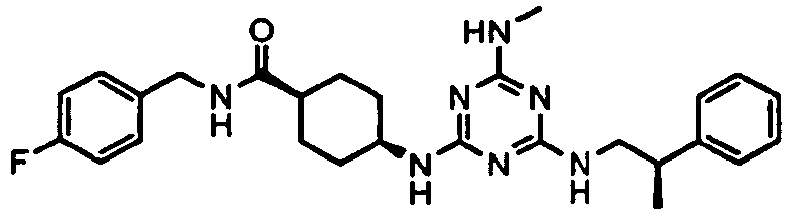
- Compound 39 was prepared using the general procedure described above for Compound 34 substituting the appropriate starting materials. MS (ES+): m/e 492.2 [M + H]+.
- (1S,4S)-N-(2-fluorobenzyl)-4-(4-(methylamino)-6-((R)-2-phenylpropylamino)-1,3,5-triazin-2-ylamino)cyclohexanecarboxamide

- Compound 40 was prepared using the general procedure described above for Compound 34 substituting the appropriate starting materials. MS (ES+): m/e 492.2 [M + H]+.
- (1S,4S)-4-(4-(methylamino)-6-((R)-2-phenylpropylamino)-1,3,5-triazin-2-ylamino)-N-o-tolylcyclohexanecarboxamide
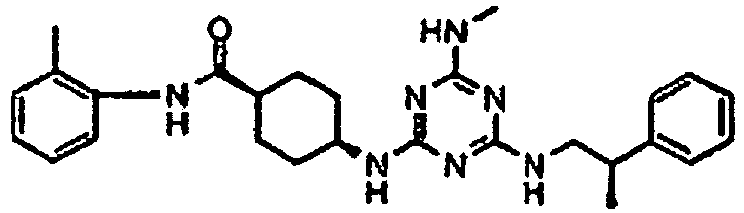
- Compound 41 was prepared using the general procedure described above for Compound 34 substituting the appropriate starting materials. MS (ES+): m/e 474.2 [M + H]+.
- (1R,4R)-N-benzyl-4-(4-(methylamino)-6-((R)-2-phenylpropylamino)-1,3,5-triazin-2-ylamino)cyclohexanecarboxamide

- Compound 42 was prepared using the general procedure described above for Compound 34 substituting the appropriate starting materials. MS (ES+): m/e 474.2 [M + H]+.
- methyl 4-(((1S,4S)-4-(4-(methylamino)-6-((R)-2-phenylpropylamino)-1,3,5-triazin-2-ylamino)cyclohexanecarboxamido)methyl)benzoate

- Compound 43 was prepared using the general procedure described above for Compound 34 substituting the appropriate starting material. MS (ES+): m/e 532.3 [M + H]+.
- methyl 4-(((1R,4R)-4-(4-(methylamino)-6-((R)-2-phenylpropylamino)-1,3,5-triazin-2-ylamino)cyclohexanecarboxamido)methyl)benzoate

- Compound 44 was prepared using the general procedure described above for Compound 34 substituting the appropriate starting materials. MS (ES+): m/e 532.3 [M + H]+.
- 4-(((1S,4S)-4-(4-(methylamino)-6-((R)-2-phenylpropylamino)-1,3,5-triazin-2-ylamino)cyclohexanecarboxamido)methyl)benzoic acid

- To a solution of crude methyl 4-(((1S,4s)-4-(4-(methylamino)-6-((R)-2-phenylpropylamino)-1,3,5-triazin-2-ylamino)cyclohexanecarboxamido)methyl)benzoate (Compound 43, 0.025 mmol) in CH3CN/H2O (1/1, 2 ml) was added 5M NaOH (0.5 ml) and stirred at room temperature for 1 hour. The reaction mixture was acidified and the solvent was evaporated to give the crude product, which was further purified by reverse phase-HPLC (Luna 5µ; C8(2), 100x21 mm, 25-60% CH3CN/H2O, 0.1% TFA, 19 min) to give the final product (9.0 mg, 66.9%). MS (ES+): m/e 518.35 [M + H]+.
- 4-(((1R,4R)-4-(4-(methylamino)-6-((R)-2-phenylpropylamino)-1,3,5-triazin-2-ylamino)cyclohexanecarboxamido)methyl)benzoic acid

- Compound 46 was prepared using the general procedure described above for Compound 45 substituting the appropriate starting materials. MS (ES+): m/e 518.4 [M + H]+.
- 2-(4-((1S,4S)-4-(4-(methylamino)-6-((R)-2-phenylpropylamino)-1,3,5-triazin-2-ylamino)cyclohexanecarboxamido)phenyl)acetic acid

- Compound 47 was prepared using the general procedure described above for Compound 45 substituting the appropriate starting materials. MS (ES+): m/e 518.2 [M + H]+.
- (1S,4S)-4-(4-(methylamino)-6-(piperidin-1-yl)-1,3,5-triazin-2-ylamino)-N-(2-(trifluoromethyl)benzyl)cyclohexanecarboxamide

- A mixture of cyanuric chloride (493.65 mg, 2.7 mmol, 1equivalent) in CH3CN/H2O (1/1, 20 ml) was cooled to 0°C. cis-4-aminocyclohexylcarboxylic acid (283.26 mg, 2.7 mmol, 1equivalent) was added, followed by 1N NaOH (10.7 ml, 2 equivalents). The reaction was stirred at 0°C for 15 min. LCMS analysis showed the complete consumption of the 2,4,8-trichloro-1,3,5-triazine. The crude product was used in the next step.
- Cold methylamine (40% (w) in water, 234 µL, 1 equivalent) was added to the crude solution of cis-4-(4,6-dichloro-1,3,5-triazin-2-ylamino)cyclohexanecarboxylic acid (2.7 mmol) in CH3CN/H2O (1/1, 20 ml), followed by 1N NaOH (5.34 ml, 1 equivalent). The reaction mixture was stirred at room temperature for 2-3 hrs. The crude product was used in the next step. MS (ES+): m/e 286.09 [M + H]+.
- To the crude solution of cis-4-(4-chloro-6-(methylamino)-1,3,5-triazin-2-ylamino)cyclohexanecarboxylic acid (-0.38 mmol) in CH3CN/H2O (1/1, 5 ml) was added piperidine (188 µL, 5 equivalents). The reaction mixture was heated at 80°C overnight. The reaction solution was condensed and the crude was acidified and purified by RP-HPLC (Luna 5µ C8(2), 100x21mm, 15-60% CH3CN/H2O, 0.1% TFA, 17 min) to give the product (34.9 mg). MS (ES+): m/e 335.22 [M + H]+.
- A solution of cis-4-(4-(methylamino)-6-(piperidin-1-yl)-1,3,5-triazin-2-ylamino)cyclohexanecarboxylic acid (7.6 mg, 0.023 mmol, 1equivalent), 2-trifluoromethyl benzylamine (4 µL, 0.03 mmol, 1.25 equivalents) and DMAP (0.6 mg, 0.2 equivalents) In dichloromethane (1.5 ml) was cooled with stirring in an ice bath. EDCI (6.6 mg, 0.034 mmol, 1.5 equivalents) was added. The reaction mixture was stirred at 0°C for 30 min and at room temperature for 2-3 hours. The solution was diluted with.dichloromethane (1 ml), which was further washed with saturated sodium bicarbonate and water. The organic layer was dried and purified by HPLC (Luna 5µ C8(2), 100x21mm, 28-70% CH3CN/H2O, 0.1% TFA, 20 min) to afford the final product (8.0 mg, yield 71%). MS (ES+): m/e 492.30 [M + H]+.
- cis-4-{[4-(methylamino)-6-(4-methyl-1-piperaziny)-1,3,5-triazin-2-yl]amino}-N-{[2-(trifluoromethyl)phenyl]methyl}cyclohexanecarboxamide hydrochloride

- Compound 49 was prepared using the general procedure described above for Compound 48 substituting the appropriate starting materials. MS (ES+): m/e 507.2 [M + H]+.
- cis-4-(4-(methylamino)-6-(pyrrolidin-1-yl)-1,3,5-triazin-2-ylamino)-N-(2-(trifluoromethyl)benzyl)cyclohexanecarboxamide

- Compound 50 was prepared using the general procedure described above for Compound 48 substituting the appropriate starting materials. MS (ES+): m/e 478.2 [M + H]+.
- cis-4-(4-(benzylamino)-6-(methylamino)-1,3,5-triazin-2-ylamino)-N-(2-(trifluoromethyl)benzyl)cyclohexanecarboxamide

- Compound 51 was prepared using the general procedure described above for Compound 48 substituting the appropriate starting materials. MS (ES+): m/e 514.2 [M + H]+.
- cis-4-(4-((2-(dimethylamino)ethyl)(methyl)amino)-6-(methylamino)-1,3,5-triazin-2-ylamino)-N-(2-(trifluoromethyl)benzyl)cyclohexanecarboxamide

- Compound 52 was prepared using the general procedure described above for Compound 48 substituting the appropriate starting materials. MS (ES+): m/e 509.2 [M + H]+.
- cis-4-(4-(azepan-1-yl)-6-(methylamino)-1,3,5-triazin-2-ylamino)-N-(2-(trifluoromethoxy) benzyl)cyclohexanecarboxamide

- A mixture of cyanuric chloride (142 mg, 0.77 mmol, 1equivalent) in CH3CN/H2O (1/1, 20 ml) was cooled to 0°C. Hexamethyleneimine (86.7 µL, 0.77 mmol, 1 equivalent) was added, followed by 1 N NaOH (0.77 ml). LC-MS showed the reaction had completed. The crude product was used in the next step. MS (ES+): m/e 247.18 [M + H]+.
- To the solution of crude 1-(4,6-dichloro-1,3,5-triazin-2-yl)azepane (0.77 mmol) in CH3CN/H2O (1/1, 20 ml) was added cis-4-amino-cyclohexanecarboxylic acid (110 mg, 0.77 mmol, 1 equivalent), followed by 1N NaOH (1.54 ml, 1.54 mmol, 2 equivalents). The reaction mixture was stirred at room temperature 5-6 hrs. The crude product was used in the next step.
- To the solution of crude cis-4-(4-(azepan-1-yl)-6-chloro-1,3,5-triazin-2-ylamino)cyclohexanecarboxylic acid (0.77 mmol) in CH3CN/H2O (1/1, 20 ml) was added methylamine (0.4 ml, 6 equivalents). The reaction mixture was heated at 80°C overnight. The reaction solution was acidified with 6N HCl. The solution was condensed to give the crude product, which was further purified by RP-HPLC (Luna 5µ C8(2), 100x21mm, 15-60% CH3CN/H2O, 0.1% TFA, 17 min) to give the product (29 mg). MS (ES+): m/e 349.33 [M + H]+.
- HATU (10.8 mg, 0.028 mmol, 1.1 equivalents) in DMF (0.2 ml) was added to the solution of cis-4-(4-(azepan-1-yl)-6-(methylamino)-1,3,5-triazin-2-ylamino) cyclohexanecarboxylic acid (8.96 mg, 0.026 mmol, 1 equivalent) in DMF (1 ml), followed by adding DIEA (11.2 µL, 0.064 mmol, 2.5 equivalents). 2-(trifluoromethyl)-benzenemethanamine (5.9 mg, 0.031 mmol, 1.2 equivalents) in DMF (0.1 ml) was added. The reaction solution was stirred at room temperature for 2 hours. LC-MS showed the reaction had completed. The reaction was diluted with EtOAc (2 ml), which was further washed with water (2x1.5 ml). The organic layer was dried and purified by RP-HPLC (Luna 5µ C8(2), 100x21mm, 25-80% CH3CN/H2O, 0.1% TFA, 20 min) to give the final product (-7.7 mg, 57%). MS (ES+): m/e 522.4 [M + H]+.
- cis-4-(4-amino-6-(azepan-1-yl)-1,3,5-triazin-2-ylamino)-N-(2-(trifluoromethoxy) benzyl)cyclohexanecarboxamide

- At 0°C, to the mixture of 2-amino-4,6-dichlorotriazine (307 mg, 1.86 mmol, 1 equivalent) and cis-4-amino-cyclohexylcarboxylic acid (266.5 mg, 1.86 mmol, 1 equivalent) in CH3CN (20 ml) and H2O (4 ml) was added 1 N NaOH (1.86 ml, 1.86 mmol, 1 equivalent). The undissolved starting material gradually disappeared. LCMS analysis showed the complete consumption of the 2-amino-4,6-dichlorotriazine. The crude product was used in the next step. MS (ES+): m/e 272.14 [M + H]+.
- To the solution of crude cis-4-(4-amino-6-chloro-1,3,5-triazin-2-ylamino)cyclohexanecarboxylic acid (-0.46 mmol) in CH3CN/H2O (5 ml / 1 ml) was added hexamethyleneimine (240 µl, -5 equivalents). The reaction mixture was stirred at room temperature overnight. The reaction solution was condensed and the crude product was purified by RP-HPLC (Luna 5µ C8(2), 100x21 mm, 15-65% CH3CN/H2O, 0.1% TFA, 18 min) to give the product (65 mg). MS (ES+): m/e 335.3 [M + H]+.
- HATU (17.4 mg, 0.046 mmol, 1.1 equivalents) in DMF (0.2 ml) was added to the solution of cis-4-(4-amino-6-(azepan-1-yl)-1,3,5-triazin-2-ylamino)cyclohexanecarboxylic acid (13.9 mg. 0.042 mmol, 1 equivalent) in DMF (1 ml), followed by adding DIEA (18.1 ul, 0.104 mmol, 2.5 equivalents). 2-(trifluoromethyl)-benzenemethanamine (9.54 mg, 0.05 mmol, 1.2 equivalents) in DMF (0.1 ml) was added. The reaction solution was stirred at room temperature for 2 hrs. LC-MS showed the reaction has completed. The reaction was diluted with EtOAc (2 ml), which was further washed with water (2x1.5 ml). The organic layer was dried and purified by RP-HPLC (Luna 5µ C8(2), 100x21mm, 25-80% CH3CN/H2O. 0.1% TFA, 20 min) to give the desired product (12.2 mg, 58%). MS (ES+): m/e 508.4 [M + H]+.
- (1S,4S)-4-(4-amino-6-((R)-2-phenylpropylamino)-1,3,5-triazin-2-ylamino)-N-(2-(trifluoromethoxy)benzyl)cyclohexanecarboxamide

- Compound 55 was prepared using the general procedure described above for Compound 53 substituting the appropriate starting materials. MS (ES+): m/e 544.4 [M + H]+.
- trans-4-(4-(methylamino)-6-(4-methylpiperazin-1-yl)-1,3,5-triazin-2-ylamino)-N-(2-(trifluoromethyl)benzyl)cyclohexanecarboxamide

- A mixture of cyanuric chloride (3.86 g, 20.9 mmol, 1 equivalent) in CH3CN/H2O (1/1, 200 ml) was cooled to 0°C. Methylamine solution in water (40% (w), 1.83 ml, 20.9 mmol, 1 equivalent) was added, followed by 1N NaOH (20.9 ml, 20.9 mmol, 1 equivalent). The reaction mixture was stirred at 0°C for 15 min and LCMS showed the reaction had completed. At 0°C, N-methylpiperazine (2.3 ml, 20.9 mmol, 1 equivalent) was added, followed by 1N NaOH (4.2 ml, 0.2 equivalents). The solution turned to clear. The solvent was evaporated to give the crude product which was further purified with silica gel chromatography (eluant 70% B, solvent B is 10% MeOH in DCM with 1% Et3N) to give the product (1.8 g). 1H NMR (CDCl3, 400MHz): δ 2.33 (s, 3H), 2.44 (br, 4H), 2.95&2.96 (3H), 3.86 (br, 4H), 5.1&5.7 (br, 1H).
- trans-4-Aminocyclohexylcarboxylic acid (472 mg, 3.30 mmol, 8 equivalents) and triethylamine (0.46 ml, 3.30 mmol, 8 equivalents) was added to the solution of 4-Chloro-N-methyl-6-(4-methylpiperazin-1-yl)-1,3,5-triazin-2-amine (100 mg, 0.412 mmol, 1 equivalent) in CH3CN (8 ml). The reaction mixture was heated at 80°C for 16 hours. The solvent was evaporated and the crude product was purified with RP-HPLC (Luna 5µ C8(2), 100x21mm, 2-45% CH3CN/H2O, 0.1% TFA, 25 min) to give the product (18.4 mg, 10%). MS (ES+): m/e 350.13 [M + H]+.
- A solution of trans-4-(4-(methylamino)-6-(4-methylpiperazin-1-yl)-1,3,5-triazin-2-ylamino)cyclohexanecarboxylic acid as TFA salt (18.4 mg, 0.04 mmol, 1 equivalent), 2-trifluoromethyl benzylamine (10.5 mg, 0.06 mmol, 1.5 equivalents) and DMAP (1.3 mg, 0.26 equivalents) in dichloromethane (1 ml) was cooled with stirring in an ice bath. EDCl (12.7 mg, 0.066 mmol, 1.65 equivalents) was added. The reaction mixture was stirred at room temperature for 16 hours. The solution was diluted with dichloromethane (1 ml), which was further washed with saturated sodium bicarbonate and water. The solvent was removed to give the crude product, which was further purified by RP-HPLC (Luna 5µ C8(2), 100x21mm, 5-40% CH3CN/H2O, 0.1% TFA, 25 min) to give the final product (5.33 mg, 21.5%). MS (ES+): m/e 507.21 [M + H]+.
- 3-(4-(methylamino)-6-(4-methylpiperazin-1-yl)-1,3,5-triazin-2-ylamino)-N-(2-(trifluoromethyl)benzyl)cyclohexanecarboxamide

- To a solution of 3-(Boc-amino)cyclohexanecarboxylic acid (500 mg, 2.055 mmol, 1 equivalent) in dimethylformamide (10 ml) was added O-(7-Azabenzotriazol-1-yl)-N,N,N',N'-tetramethyluronium hexafluorophosphate (HATU, 781 mg, 2.055 mmol, 1 equivalent) and diisopropylethylamine (0.716 ml, 4.11 mmol, 2 equivalents). 2-trifluoromethyl benzylamine (360 mg, 2.055 mmol, 1 equivalent) was added and the reaction mixture was stirred at room temperature overnight. The solvent was evaporated to give the crude product, which was purified with RP-HPLC. The purified compound was treated with 50% TFA in DCM (20 ml) at room temperature for 2 hours, and then the solvents were removed in vacuo. The product (103mg, 12% yield) was carried onto the next step without further purification. MS (ES+): m/e 301.06 [M + H]+.
- The solution of 4-chloro-N-methyl-6-(4-methylpiperazin-1-yl)-1,3,5-triazin-2-amine (30.0 mg, 0.084 mmol, 1 equivalent) and 3-amino-N-(2-(trifluoromethyl)benzyl) cyclohexanecarboxamide as TFA salt (103 mg, 0.248 mmol, 2.95 equivalents) in CH3CN/H2O (1/1, 2 ml) was adjusted to pH 9-10 with 1N NaOH. The resulting solution was heated at 80°C for 16 hours. The solvent was removed under vacuo to give the crude product, which was purified with RP-HPLC (Luna 5µ C8(2), 100x21 mm, 10-50% CH3CN/H2O, 0.1% TFA, 25 min) to give the final compound (0.94 mg, 1.8%). MS (ES+): m/e 507.17 [M + H]+.

- Scheme B1 represents a general reaction scheme for preparing certain intermediates 1.1 and 1.2. Treatment of 2,4,6-trichloropyrimidine (commercially available) with amine HNR50aR06a (commercially available or made from commercially available starting materials using methods known to those skilled in the art) with solvent such as THF and at temperatures between 0°C to 50°C provides intermediates 1.1 and 1.2.


- Scheme B2 represents a general reaction scheme for preparing certain intermediates depicted above as 2.5. Treatment of intermediate 2.1 (commercially available or made from commercially available starting materials using methods known to those skilled in the art) with BOC anhydride and a base (such as NaOH) in a solvent (such as isopropanol and water) provides intermediate 2.2. Treatement of intermediate 2.2 with an amine 2.3 and a coupling reagent (such as 1H-1,2,3-benzotriazol-1-yloxytris(dimethylamino)-phosphonium hexafluorophosphate (BOP) reagent) and a base (such as triethylamine) in a solvent (such as DMF) provides intermediate 2.4. Treatment of intermediate 2.4 with acid (such as trifluoroacetic acid) in a solvent (such as methylene chloride) provides intermediate 2.5.


- Scheme B3 represents a general reaction scheme for preparing certain compounds according to Formula I. Treatment of intermediate 3.1 (depicted above as intermediate 1.1) with intermediate 3.2 (depicted above as intermediate 2.5) and a base such as NaOH in solvents such as MeCN and water at temperatures between 85°C and 200°C in a microwave reactor provides intermediate 3.3. Treatment of intermediate 3.3 with the desired amine and acid such as HCl with solvent such as 2-propanol at temperatures between 85°C to 200°C in a microwave reactor provide compound 3.4 wherein V is NR50bR60b.

- Scheme B4 represents a general reaction scheme for preparing certain compounds according to Formula I. Treatment of intermediate 4.1 (depicted above as intermediate 1.2) with intermediate 4.2 (depicted above as intermediate 2.5) and a base such as NaOH in solvents such as MeCN and water at temperatures between 85°C and 200°C in a microwave reactor provides intermediate 4.3. Treatment of intermediate 4.3 with the desired amine and acid such as HCl with solvent such as 2-propanol at temperatures between 85°C to 200°C in a microwave reactor provide compound 4.4 wherein V is NR50bR60b.
- cis-4-amino-N-{[2-(trifluoromethyl)phenyl]methyl}cyclohexanecarboxamide

- A 250 mL round-bottom flask charged with argon was equipped with a magnetic stir bar and an oil bubbler. Cis-4-aminocyclohexanecarboxylic acid (9.27 g, 64.7 mmol), isopropanol (83 mL) and 1 N NaOH (70.6 mL, 70.6 mmol) were delivered to the flask at room temperature. After all of the solid was dissolved, bis(tert-butyl) dicarbonate (15.54 g, 71.2 mmol) was added and the mixture was maintained at that temperature for 21 hours, before it was determined to be complete by 1H NMR. The crude mixture was washed with hexanes (3 x 100 mL). Afterwards, 100 mL of 1N HCl was added to the aqueous layer and the mixture was extracted with ethyl acetate (300 mL). The organic phase was dried over Na2SO4, filtered and concentrated to give 12.85 g of cis-4-({[(1,1-dimethylethyl)oxy]carbonyl}amino)cyclohexanecarboxylic acid (52.8 mmol, 82 %) as an off-white solid.
- A 250 mL round-bottom flask charged with argon was equipped with a magnetic stir bar, prior to the addition of cis-4-({[(1,1-dimethylethyl)oxy]carbonyl}amino) cyclohexanecarboxylic acid (15.54 g, 63.9 mmol), 2-(trifluoromethyl)benzylamine (8.95 mL, 63.9 mmol) and 100 mL of DMF at room temperature. Afterwards, triethylamine (26.7 mL, 192 mmol) was added and the solution was allowed to stir for several minutes before a separate solution of 1H-1,2,3-benzotriazol-1-yloxy-tris(dimethylamino)-phosphonium hexafluorophosphate (BOP reagent, 28.3 g, 63.9 mmol) dissolved in 60 mL of DMF was delivered to the mixture at room temperature. The reaction was maintained at that temperature for 2 hours, before it was determined to be complete by LCMS (Rt = 8.34 min and m/e 401 [M+1]+). Pouring the crude mixture into a vigorously stirring 50/50 solution of saturated sodium bicarbonate and water (1.6 L), resulted in the precipitation of the desired product as an off-white solid. The solid was recovered by vacuum filtration and dried for 24 hours under vacuum to give 24.88 g of 1,1-dimethylethyl{cis-4-[({[2(trifluoromethyl)phenyl]methyl}amino)carbonyl]cyclohexyl} carbamate (62.1 mmol, 97%). MS (ES) m/e 401 [M+H]+.
- Step 3: Preparation of cis-4-amino-N-{[2-(trifluoromethyl)phenyl}methyl}cyclohexane carboxamideA 500 mL round bottom flask equipped with a magnetic stir bar was charged with 1,1-dimethylethyl{cis-4-[({[2(trifluoromethyl)phenyl]methyl}amino)carbonyl]cyclohexyl} carbamate (24.88 g, 62.1 mmol) and DCM (100 mL) at room temperature. Trifluoroacetic acid (100 mL) was added slowly, and the reaction was maintained at room temperature for 1 hour, before it was determined to be complete by LCMS (Retention time = 5.71 min and m/e 301 [M+1]+). The volatiles were removed by rotary evaporation and the crude oil was dissolved in ethyl acetate and washed with saturated sodium bicarbonate solution (3 x 200 mL). The organic phase was dried over Na2SO4, filtered and concentrated to give 18.3 g of the title compound (60.9 mmol, 98 %) as an off-white solid. MS (ES) m/e 301 [M+H]+.
- 2.6-dichloro-N-methyl-4-pyrimidinamine ( Intermediate 3 4,6-dichloro-N-methyl-2-pyrimidinamine

- To a 0°C mixture 2,4,6-trichloropyrimidine (0.50 g, 2.7 mmol) in THF (3 mL) was added methyl amine (2M THF, 3.0 mL, 6.0 mmol) dropwise. The reaction mixture was warmed to room temperature and stirred for 30 minutes, at which time LCMS indicated the formation of the desired product. The reaction mixture was treated with water (10 mL) and extracted with EtOAc (2x10 mL). The organics were washed with brine (10 mL), dried (Na2SO4), and evacuated. The crude material was purified by column chromatography (Gradient from 0-30% EtOAc in Hexanes) to afford 180 mg (1.01 mmol, 38%) of 2,6-dichloro-N-methyl-4-pyrimidinamine and 150 mg (0.85 mmol 31%) of 4,6-dichloro-N-methyl-2-pyrimidinamine. MS (ES+) m/e 178 [M + H]+ for each.
- cis-4-({4-(methylamino)-6-[phenylmethyl)amino]-2-pyrimidinyl}amino)-N-{(2-(trifluoromethyl)phenyl]methyl}cyclohexanecarboxamide (Reference Example)

- To a solution of 2,6-dichloro-N-methyl-4-pyrimidinamine (360 mg, 2 0 mmol) and cis-4-amino-N-{[2-(trifluoromethyl)phenyl]methyl}cyclohexanecarboxamide (Intermediate 1) trifluoroacetate (829 mg, 2.0 mmol), in MeCN/H2O (1:1, 5 mL) was added 1N NaOH solution until a pH of 12 was achieved. The mixture was irradiated in the microwave for 4 hours at 170°C, at which time LCMS indicated the formation of the desired product. The reaction mixture was extracted with EtOAc (2x50 mL), washed with water (2x50 mL), dried (Na2SO4), and concentrated to afford a waxy solid. The crude material was purified by column chromatography (Gradient from 0-5% MeOH in CH2Cl2) to afford 300 mg (0.68 mmol, 34%) of a colorless wax MS (ES+) m/e 442 [M + H]+. Regiochemistry was verified by 2D NMR analysis.
- To a solution of cis-4-{[4-chloro-6-(methylamino)-2-pyrimidinyl]amino}-N-{[2-(trifluoromethyl)phenyl]methyl}cyclohexanecarboxamide (50.0 mg, 0.11 mmol) and benzylamine (59 0 mg, 0.55 mmol) in 2-propanol (3 mL) was added one drop of concentrated HCl. The mixture was irradiated in the microwave for 3 hours at 170°C, at which time LCMS indicated the formation of the desired product. The crude reaction mixture was filtered and purified directly by preprative HPLC (gradient; 30-80% CH3CN:H2O (0.1%TFA)), to afford the title compound (30 mg, 0.58 mmol, 52%). MS (ES+) m/e 513 [M + H]+.
- cis-4-{[4-(methylamino)-6-(4-methyl-1-piperazinyl)-2-pyrimidinyl]amino}-N-{[2-(trifluoromethyl)phenyl]methyl}cyclohexanecarboxamide

- Compound 59 was prepared using the general procedure described above for Compound 58 substituting benzylamine with the appropriate primary or secondary amine. MS (ES+): m/e 506 [M + H]+.
- cis-4-[(4-(methylamino)-6-{[(2R)-2-phenylpropyl]amino}-2-pyrimidinyl)amino]-N-{[2-(trifluoromethyl)phenyl]methyl}cyclohexanecarboxamide

- Compound 60 was prepared using the general procedure described above for Compound 58 substituting benzylamine with the appropriate primary or secondary amine. MS (ES+): m/e 541 [M + H]+.
- cis-4-{[4-[[2-(dimethylamino)ethyl](methyl)amino]-6-(methylamino)-2-pyrimidinyl]amino}-N-{[2-(trifluoromethyl)phenyl]methyl}cyclohexanecarboxamide

- Compound 61 was prepared using the general procedure described above for Compound 58 substituting benzylamine with the appropriate primary or secondary amine. MS (ES+): m/e 508 [M + H]+.
- cis-4-{[2-(methylamino)-6-(4-methyl-1-piperazinyl)-4-pyrimidinyl]amino}-N-{[2-(trifluoromethyl)phenyl]methyl}cyclohexanecarboxamide

- Compound 62 was prepared using the general procedure described above for Compound 58 substituting 2,6-dichloro-N-methyl-4-pyrimidinamine with 4,6-dichloro-N-methyl-2-pyrimidinamine and benzylamine with the appropriate primary or secondary amine. MS (ES+): m/e 506 [M + H]+.
- As used above, the phrase "using the general procedure described above" indicates that the procedure used employs similar, but not necessarily identical, reaction conditions to those referred to.
- The compounds of the invention are sEH inhibitors. The compounds of the invention, therefore, are useful in the treatment of hypertension and other conditions involving sEH activity. As stated above, mEH provides an important detoxification pathway in mammals. Compounds that exhibit pharmacological selectivity for sEH over mEH therefore are desirable in the methods of treatment described below. Accordingly, in one embodiment the invention is directed to a compound of the invention wherein the compound exhibits a selectivity ratio equal to or greater than 10:1 for sEH over mEH. In another embodiment the invention is directed to a compound of the invention wherein the compound exhibits a selectivity ratio equal to or greater than 100:1 for sEH over mEH. In another embodiment the invention is directed to a compound of the invention wherein the compound exhibits a selectivity ratio equal to or greater than 1000:1 for sEH over mEH.
- The biological activity of the compounds of the invention can be determined using any suitable assay for determining the activity of a candidate compound as an sEH and / or mEH inhibitor, as well as suitable tissue and / or in vivo models.
- The sEH gene is subjected to polymerase chain reaction (PCR) starting with a cDNA clone of human sEH, using PCR primers 5'aatcagcgatcgccATGACGCTGCGCGCGG and 3'agatatctagactt CTACATC TTTGAGACC. The PCR-amplified sEH DNA is inserted into the AsiSI and Xba I site of pcDNA3.1 mammalian expression vector (Invitrogen, V790-20), containing sequences of two affinity tags 6xHis and Streptavidin binding peptide (MDEKTTGWRGGH VVEGLAGELEQLRARLEHHPQGQREP) (Keefe, A.D., et al., Protein Expr. Purif., 23, 440-446 (2001). The sequence of the human sEH expressing vector is confirmed by sequencing. The plasmid is purified using QIAGEN Plasmid Maxi Kit (Cat.N 12162).
- To produce the human sEH protein, pcDNA3.1-sEH plasmid is transfected into FreeStyle 293-F cells using FreeStyle 293 Expression System (Invitrogen, Catalog no.K9000-01). Cells are grown in FreeStyle™ 293 Expression Medium at 37°C with constant rotation at 120 revolutions/minute for 48 hours and then harvested and lysed in an ice cold lysis buffer (40 mM Tris-HCl pH 7.5, 300 mM NaCl, 1% TRITON TX-100, proteis inhibirots cocktail). The crude cell extract is centrifuged at 13,000 g for 20 minutes to remove cell debris. The supernatant is loaded onto a column packed with UltraLink Immobilazed Streptavidin Plus Sepharose (Pierce, Catalog no. 53117). The protein is purified using the affinity of the SBP tag (Streptavidin Binding Peptide) to the Streptavidin. The column with bound sEH is washed with Wash Buffer (50 mM Tris-HCl 7.5, 150 mM NaCl, 0.03% Brij-35, 5 mM BME and protease inhibitor cocktail).
- The purified protein is eluted from the Streptavidin Sepharose column with 2 mM biotin in Wash buffer. Elution fractions are collected and analyzed on 4-12% SDS-PAGE resolving gel (Invitrogen, NPO0322 BOX). Protein concentrations are determined with the Pierce BCA assay (Pierce, Rockford, IL) using BSA as a standard.
- The purified protein is aliquoted and kept at -80°C.
- The biological activity of the compounds of the invention can be measured using the nonfluorescent EnzChek epoxide hydrolase substrate (Molecular Probes, Catalog # E33956). In the presence of epoxide hydrolases, the nonfluorescent EnzChek epoxide hydrolase substrate produces a bright blue-fluorescent product with excitation and emission maxima of approximately 350 nm and 455 nm, respectively.
- Assays can be performed in an assay buffer containing 50mM HEPES (pH 8). The final concentration of soluble epoxide hydrolase enzyme (full length, prepared as indicated above) in the assay is 10nM.
- The compound is re-suspended in 100% DMSO and then diluted in the assay buffer to a 4 times the final concentration (0.8% DMSO). The hsEH enzyme is incubated against a range of compound concentrations, shaking, for 5 minutes at room temperature. The hydrolysis reaction is initiated by adding diluted EnzChek substrate (final concentration 10 uM). The reaction is run at room temperature and readings are taken every 30 seconds for 30 minutes. The fluorescence is measured at an excitation of 350nM and an emission of 455 nM.
- The activity of the compound is calculated as the % of inhibition using the following equation: 100*(1-(lope of enzyme + inhibitor/ slope of enzyme alone) and expressed as IC50 values (the concentration of inhibitor that blocks enzyme activity to 50%).
- Inhibition of Soluble Expoxide Hydrolase (sEH) activity is measured in a fluorescent assay based upon the format described by Wolf et al. (Analytical Biochemistry Vol. 355 (2006) pp. 71-80). In the presence of sEH, PHOME ((3-Phenyl-oxiranyl)-acetic acid cyano-(6-methoxy-naphthalen-2-yl)-methyl ester), is hydrolyzed to a diol which goes through an intramolecular cyclization and the release and decomposition of cyanohydrin (products = cyanide and 6-methoxy-2-naphthaldehyde). Production of 6-methoxy-2-naphthaldehyde is monitored at excitation of 360nm and an emission of 465nm.
- The assay is used in a quenched assay format by sequentially adding enzyme (5 uL; 200 pM sEH in 25mM Hepes at pH 7.0, 0.01 % CHAPS (w/v), 0.005% Casein (w/v); 10 minute ambient pre-incubation after addition) then PHOME substrate (5 ul; 10 uM PHOME substrate in 25mM Hepes at pH 7.0, 0.01 % CHAPS (w/v), 0.005% Casein (w/v)) to a 384 well assay plate (Greiner 784076) pre-stamped with 25-100 nL compound at the desired concentration. The reaction is incubated for 30 minutes at room temperature, then quenched by the addition of stop solution (5 uL; 10 mM ZnSO4 in 25mM Hepes at pH 7.0, 0.01% CHAPS (w/v), 0.005% Casein (w/v)). Microtiter plates are centrifuged after each addition for 30 seconds at 500rpm. The fluorescence is measured on an EnVision plate reader platform (Perkin Elmer) using a 360 nm excitation filter, 465 nm emission filter, and 400 nm dichroic filter.
- Compounds are first prepared in neat DMSO at a concentration of 10 mM, then diluted as required to achieve the desired assay concentration. For inhibition curves, compounds are diluted using a three fold serial dilution and tested at 11 concentrations (e.g. 50 µM-0.8 nM or 25 µM-0.42 nM or 2.5 µM to 42 pM). Curves are analysed using ActivityBase and XLfit, and results are expressed as pIC50 values.
- Cell based sEH inhibition is measured using the 14,15-DHET immunoassay ELISA kit available from Detroit R&D (Cat. No. DH1), according to the following procedure:
- HEK293 cells (BioCat ID 80556) are transduced by sEH BacMam virus to increase sEH expression (other cell lines may be suitable) as follows: One day before the experiment, 1.5 million HEK293 cells (BioCat ID 80556) are seated in 3ml of DMEM/F12 (with L-Glutamine, with 15mM HEPES, pH7.30, from Media Prep Lab), with 10% fetal bovine serum (from SAFC Biosciences, Cat. No.12176-1000M), no antibiotic, in a 25 cm2 flask (from Corning Incorporated, Cat. No.430639) and 30µL sEH BacMam virus is added. The cells are gently mixed then incubated at 37°C, 5% CO2, for 24 hours.
- The cells are trypsinized to release them from the growth flask, washed once with PBS, then re-suspended in 5mL DMEM/F12 without phenol red (from Media Prep lab). Cell density should be approximately 3 * 105 cells/mL (= 300 cells/µL), counted using the Cedex AS20 (from Innovatis).
- The cells are then diluted in DMEM/F12 to 5.1 cells/µL, and 98µL/well (= 500 cells/well) of this cell suspension is transfered to an assay plate (96 well, clear polystyrene, flat bottom, from Whatman, Cat. No.7701-1350).
- 2µL of the diluted test compound is then added to the cells in the assay plate. The reaction plate is shaken gently and incubated at room temperature for 30 min, after which 10µL of substrate solution is added (substrate solution is prepared by diluting 1.24µL of 14,15-EET from Cayman Chemical, Cat. No. 50651 with 8.24µL DMEM/F12). The assay plate is then incubated for one hour at room temperature.
- After the 1 hour reaction, the reaction mixture is diluted 3 fold with provided sample dilution buffer (ex. Add 220µL to the 110µL reaction mixture), mixed well, and spun for 5 min at 500rpm.
- 100µL of the diluted reaction mixture is then transferred from the reaction plates to the ELISA plates, and the ELISA is performed according to the instructions provided in the kit.
- IC50s and pIC50s are then calculated. The IC50 can be calculated directly using the 14, 15-DHET concentration or using the % inhibition [% inhibition = 100*(1- (sample DHET - 0 cell DHET) / (500 cells DHET - 0 cell DHET)].
- Compounds are first prepared in neat DMSO at a concentration of 0.5 mM, then diluted as required to achieve the desired assay concentration. For inhibition curves, compounds are diluted using a three fold serial dilution and tested at 9 concentrations (e.g. 10 µM-1.5 nM). Curves are analysed using ActivityBase and XLfit, and results are expressed as pIC50 values.
- All of the compounds of the invention are believed to have activity as sEH inhibitors. Where the assay for a particular compound had been performed two or more times, the following conclusion regarding their activities is based on the average of individual experiments: Of the exemplified compounds that were tested, all were found to have an IC50 in the range of 0.1 and 25,000 nM.
- The compounds of the invention inhibit the sEH enzyme and can be useful in the treatment of conditions wherein the underlying pathology is (at least in part) attributable to sEH involvement or in conditions wherein sEH inhibition offers some clinical benefit even though the underlying pathology is not (even in part) attributable to sEH involvement. Examples of such conditions include hypertension, organ failure / damage (including heart failure, renal failure, and liver failure), peripheral vascular disease (including ischemic limb disease, intermittent claudication, endothelial dysfunction, erectile dysfunction, Raynaud's disease, and diabetic vasculopathies e.g. retinopathy), atherothrombotic disorders (including coronary artery disease, coronary vasospasm, angina, stroke, myocardial ischemia, myocardial infarction, and hyperlipidemia), metabolic disorders (including diabetes), and inflammatory disorders (including arthritis, inflammatory pain, overactive bladder, asthma. and COPD). Accordingly, in another aspect the invention is directed to methods of treating such conditions.
- Essential hypertension is commonly associated with the development of significant end organ damage such as renal, endothelial, myocardial, and erectile dysfunction. Such conditions occur "secondary" to the elevated systemic arterial blood pressure. Secondary conditions may be prevented by treatment of the underlying ("primary") cause. Accordingly, in another aspect the invention is directed to methods of preventing such secondary conditions.
- In addition, sEH is indirectly involved in the regulation of platelet function through its effect on EETs. Drugs that inhibit platelet aggregation are believed to decrease the risk of atherthrombotic events, such as myocardial infarction and stroke, in patients with established cardiovascular atherosclerotic disease. Accordingly, in another aspect the invention is directed to methods of preventing atherothrombotic events, such as myocardial infarction and stroke in patients with a history of recent myocardial infarction, stroke, transient ischemic attacks, unstable angina, or atherosclerosis.
- The methods of treating and the methods of preventing described above comprise administering a safe and effective amount of a compound of the invention to a patient in need thereof.
- As used herein, "treatment" in reference to a condition means: (1) the amelioration or prevention of the condition being treated or one or more of the biological manifestations of the condition being treated, (2) the interference with (a) one or more points in the biological cascade that leads to or is responsible for the condition being treated or (b) one or more of the biological manifestations of the condition being treated, or (3) the alleviation of one or more of the symptoms or effects associated with the condition being treated.
- As indicated above, "treatment" of a condition includes prevention of the condition. The skilled artisan will appreciate that "prevention" is not an absolute term. In medicine, "prevention" is understood to refer to the prophylactic administration of a drug to substantially diminish the likelihood or severity of a condition or biological manifestation thereof, or to delay the onset of such condition or biological manifestation thereof.
- As used herein, "safe and effective amount" in reference to a compound of the invention or other pharmaceutically-active agent means an amount of the compound sufficient to significantly induce a positive modification in the condition to be treated but low enough to avoid serious side effects (at a reasonable benefit/risk ratio) within the scope of sound medical judgment. A safe and effective amount of a compound of the invention will vary with the particular compound chosen (e.g. consider the potency, efficacy, and half-life of the compound); the route of administration chosen; the condition being treated; the severity of the condition being treated; the age, size, weight, and physical condition of the patient being treated; the medical history of the patient being treated; the duration of the treatment; the nature of concurrent therapy; the desired therapeutic effect; and like factors, but can nevertheless be determined by the skilled artisan.
- As used herein, "patient" refers to a human or other animal.
- The compounds of the invention may be administered by any suitable route of administration, including both systemic administration and topical administration. Systemic administration includes oral administration, parenteral administration, transdermal administration, rectal administration, and administration by inhalation. Parenteral administration refers to routes of administration other than enteral, transdermal, or by inhalation, and is typically by injection or infusion. Parenteral administration includes intravenous, intramuscular, and subcutaneous injection or infusion. Inhalation refers to administration into the patient's lungs whether inhaled through the mouth or through the nasal passages. Topical administration includes application to the skin as well as intraocular, otic, intravaginal, and intranasal administration.
- The compounds of the invention may be administered once or according to a dosing regimen wherein a number of doses are administered at varying intervals of time for a given period of time. For example, doses may be administered one, two, three, or four times per day. Doses may be administered until the desired therapeutic effect is achieved or indefinitely to maintain the desired therapeutic effect. Suitable dosing regimens for a compound of the invention depend on the pharmacokinetic properties of that compound, such as absorption, distribution, and half-life, which can be determined by the skilled artisan. In addition, suitable dosing regimens, including the amount administered and the duration such regimens are administered, for a compound of the invention depend on the condition being treated, the severity of the condition being treated, the age and physical condition of the patient being treated, the medical history of the patient to be treated, the nature of concurrent therapy, the particular route of administration chosen, the desired therapeutic effect, and like factors within the knowledge and expertise of the skilled artisan. It will be further understood by such skilled artisans that suitable dosing regimens may require adjustment given an individual patient's response to the dosing regimen or over time as individual patient needs change. By way of general guidance, the daily oral dosage of each active ingredient, when used for the indicated effects, will range between about 0.001 to 1000 mg/kg of body weight. Typical daily dosages range from 1 mg to 1000 mg.
- Additionally, the compounds of the invention may be administered as prodrugs. As used herein, a "prodrug" of a compound of the invention is a functional derivative of the compound which, upon administration to a patient, eventually liberates the compound of the invention in vivo. Administration of a compound of the invention as a prodrug may enable the skilled artisan to do one or more of the following: (a) modify the onset of the compound in vivo; (b) modify the duration of action of the compound in vivo; (C) modify the transportation or distribution of the compound in vivo; (d) modify the solubility of the compound in vivo; and (e) overcome or overcome a side effect or other difficulty encountered with the compound. Typical functional derivatives used to prepare prodrugs include modifications of the compound that are chemically or enzymatically cleaved in vivo. Such modifications, which include the preparation of phosphates, amides, esters, thioesters, carbonates, and carbamates, are well known to those skilled in the art.
- The compounds of the invention will normally, but not necessarily, be formulated into a pharmaceutical composition prior to administration to a patient. Accordingly, in another aspect the invention is directed to pharmaceutical compositions comprising a compound of the invention and a pharmaceutically-acceptable excipient.
- The pharmaceutical compositions of the invention may be prepared and packaged in bulk form wherein a safe and effective amount of a compound of the invention can be extracted and then given to the patient such as with powders, syrups, and solutions for injection. Alternatively, the pharmaceutical compositions of the invention may be prepared and packaged in unit dosage form wherein each physically discrete unit contains a safe and effective amount of a compound of the invention. When prepared in unit dosage form, the pharmaceutical compositions of the invention typically contain from 1 mg to 1000 mg.
- The pharmaceutical compositions of the invention typically contain one compound of the invention. However, in certain embodiments, the pharmaceutical compositions of the invention contain more than one compound of the invention. For example, in certain embodiments the pharmaceutical compositions of the invention contain two compounds of the invention. In addition, the pharmaceutical compositions of the invention may optionally further comprise one or more additional pharmaceutically active compounds. Conversely, the pharmaceutical compositions of the invention typically contain more than one pharmaceutically-acceptabie excipient. However, in certain embodiments, the pharmaceutical compositions of the invention contain one pharmaceutically-acceptable excipient.
- As used herein, "pharmaceutically-acceptable excipient" means a pharmaceutically acceptable material, composition or vehicle involved in giving form or consistency to the pharmaceutical composition. Each excipient must be compatible with the other ingredients of the pharmaceutical composition when commingled such that interactions which would substantially reduce the efficacy of the compound of the invention when administered to a patient and interactions which would result in pharmaceutical compositions that are not pharmaceutically acceptable are avoided. In addition, each excipient must of course be of sufficiently high purity to render it pharmaceutically-acceptable.
- The compound of the invention and the pharmaceutically-acceptable excepient or excepients will typically be formulated into a dosage form adapted for administration to the patient by the desired route of administration. For example, dosage forms include those adapted for (1) oral administration such as tablets, capsules, caplets, pills, troches, powders, syrups, elixers, suspensions, solutions, emulsions, sachets, and cachets; (2) parenteral administration such as sterile solutions, suspensions, and powders for reconstitution; (3) transdermal administration such as transdermal patches; (4) rectal administration such as suppositories; (5) inhalation such as aerosols and solutions; and (6) topical administration such as creams, ointments, lotions, solutions, pastes, sprays, foams, and gels.
- Suitable pharmaceutically-acceptable excipients will vary depending upon the particular dosage form chosen. In addition, suitable pharmaceutically-acceptable excipients may be chosen for a particular function that they may serve in the composition. For example, certain pharmaceutically-acceptable excipients may be chosen for their ability to facilitate the production of uniform dosage forms. Certain pharmaceutically-acceptable excipients may be chosen for their ability to facilitate the production of stable dosage forms. Certain pharmaceutically-acceptable excipients may be chosen for their ability to facilitate the carrying or transporting the compound or compounds of the invention once administered to the patient from one organ, or portion of the body, to another organ, or portion of the body. Certain pharmaceutically-acceptable excipients may be chosen for their ability to enhance patient compliance.
- Suitable pharmaceutically-acceptable excipients include the following types of excipients: Diluents, fillers, binders, disintegrants, lubricants, glidants, granulating agents, coating agents, wetting agents, solvents, co-solvents, suspending agents, emulsifiers, sweetners, flavoring agents, flavor masking agents, coloring agents, anticaking agents, hemectants, chelating agents, plasticizers, viscosity increasing agents, antioxidants, preservatives, stabilizers, surfactants, and buffering agents. The skilled artisan will appreciate that certain pharmaceutically-acceptable excipients may serve more than one function and may serve alternative functions depending on how much of the excipient is present in the formulation and what other ingredients are present in the formulation.
- Skilled artisans possess the knowledge and skill in the art to enable them to select suitable pharmaceutically-acceptable excipients in appropriate amounts for use in the invention. In addition, there are a number of resources that are available to the skilled artisan which describe pharmaceutically-acceptable excipients and may be useful in selecting suitable pharmaceutically-acceptable excipients. Examples include Remington's Pharmaceutical Sciences (Mack Publishing Company), The Handbook of Pharmaceutical Additives (Gower Publishing Limited), and The Handbook of Pharmaceutical Excipients (the American Pharmaceutical Association and the Pharmaceutical Press).
- The pharmaceutical compositions of the invention are prepared using techniques and methods known to those skilled in the art. Some of the methods commonly used in the art are described in Remington's Pharmaceutical Sciences (Mack Publishing Company).
- In one aspect, the invention is directed to a solid oral dosage form such as a tablet or capsule comprising a safe and effective amount of a compound of the invention and a diluent or filler. Suitable diluents and fillers include lactose, sucrose, dextrose, mannitol, sorbitol, starch (e.g. corn starch, potato starch, and pre-gelatinized starch), cellulose and its derivatives (e.g. microcrystalline cellulose), calcium sulfate, and dibasic calcium phosphate. The oral solid dosage form may further comprise a binder. Suitable binders include starch (e.g. corn starch, potato starch, and pre-gelatinized starch), gelatin, acacia, sodium alginate, alginic acid, tragacanth, guar gum, povidone, and cellulose and its derivatives (e.g. microcrystalline cellulose). The oral solid dosage form may further comprise a disintegrant. Suitable disintegrants include crospovidone, sodium starch glycolate, croscarmelose, alginic acid, and sodium carboxymethyl cellulose. The oral solid dosage form may further comprise a lubricant. Suitable lubricants include stearic acid, magnesuim stearate, calcium stearate, and talc.
Claims (9)
- A compound of Formula I


R1 is hydrogen, CO2H, CO2(C1-C6)alkyl, CONR'R" wherein R' and R" are each independently hydrogen or (C1-C6)alkyl, aralkyl, heteroaralkyl, -(C2-C10)alkylene-NR'R", -(C2-C10)alkylene-OR', and -O-(C1-C6)alkyl, -S-(C1-C6)alkyl, any of which may be optionally substituted on carbon with 1, 2, or 3 halo;
each R2 is if present independently halo, (C1-C6)alkyl, -O-(C1-C6)alkyl, -S-(C1-C6)alkyl, any of which may be optionally substituted on carbon with 1, 2, or 3 halo;
n is 0 or 1;
x is 0, 1, or 2;
R3 is hydrogen or (C1-C6)alkyl;
p is 0,1, 2, or 3;
each R4 if present is independently halo, (C1-C6)alkyl, or -O-(C1-C6)alkyl, -S-(C1-C6)alkyl, any of which may be optionally substituted on carbon with 1, 2, or 3 halo, or taken together with the attached carbon forms C=O;
y is 0, 1 or 2;
R5 is hydrogen or (C1-C6)alkyl;
R6 is hydrogen or (C1-C6)alkyl;
R7 is hydrogen, halo, or (C1-C6)alkyl; or
R6 and R7 together with the atoms to which they are attached, form a 3-10 membered ring, optionally containing one additional heteroatom selected from O, S(O)m wherein m is 0, 1 or 2, or NR"' wherein R'" is hydrogen or (C1-C6)alkyl; said ring optionally substituted on carbon with 1, 2 or 3 groups selected from halo, (C1-C6)alkyl, and -O-(C1-C6)alkyl, -S-(C1-C6)alkyl, any of which may be optionally substituted on carbon with 1, 2, or 3 halo, or taken together with the attached carbon forms C=O;
R8 is " indicates the point of attachment and
wherein
R9 is hydrogen, halo or (C1-C6)alkyl;
X is absent or is O, S(O)m wherein m is 0, 1, or 2, -CH2S-, -CH2-O-, -CH2-NH- or-CH2N(C1-C6)alkyl;
each R10 if present is independently halo, (C1-C6)alkyl, -O-(C1-C6)alkyl, -S-(C1-C6)alkyl, any of which may be optionally substituted on carbon with 1, 2, or 3 halo, or taken together with the attached carbon forms C=O;
z is 0, 1 or 2;
at least one of Z1, Z2 and Z3 is N and the others are C-Rb, wherein Rb is hydrogen, halogen, (C1-C6)alkyl, (C1-C6)alkoxy;
Y is H, halo, OR11, or NR11R12;
R11 is hydrogen or (C1-C6)alkyl; and
R12 is hydrogen, (C1-C6)alkyl, aryl, aralkyl, (C3-C6)cycloalkyl, -alkylene-(C3-C6)cycloalkyl, (C3-C6)heterocycloalkyl, -alkylene-(C3-C6)heterocycloalkyl, heteroaryl, heteroaralkyl, any of which may be optionally substituted on carbon with 1 or 2 groups selected from halo, (C1-C6)alkyl, -O-(C1-C6)alkyl, -S-(C1-C6)alkyl. - A compound or pharmaceutically acceptable salt thereof according to claim 1 wherein R6 and R7 together with the atoms to which they are attached, form a 3-10 membered ring, said ring optionally substituted on carbon with 1, 2 or 3 groups selected from halo, (C1-C6)alkyl, and -O-(C1-C6)alkyl, -S-(C1-C6)alkyl, any of which may be optionally substituted on carbon with 1, 2, or 3 halo, or taken together with the attached carbon forms C=O.
- A compound or pharmaceutically acceptable salt thereof according to claim 1 wherein R6 and R7 together with the atoms to which they are attached form

C is a 3-10 membered ring, optionally containing 1 additional heteroatom selected from O, S(O)m wherein m is 0, 1, or 2, or NR"' wherein R"' is hydrogen or (C1-C6)alkyl, and optionally substituted on carbon and wherein "" indicate points of attachment;
each R13 if present is independently halo, (C1-C6)alkyl, or -O-(C1-C6)alkyl, -S-(C1-C6)alkyl, any of which may be optionally substituted on carbon with 1, 2, or 3 halo, or taken together with the attached carbon forms C=O; and
w is 0, 1 or 2. - A compound according to claim 1 selected from
(1S,4S)-4-(4-(methylamino)-6-((R)-2-phenylpropylamino)-1,3,5-triazin-2-ylamino)-N-(2-(trifluoromethyl)benzyl)cyclohexanecarboxamide;
(1S,4S)-4-(4-(methylamino)-6-((R)-2-phenylpropylamino)-1,3,5-triazin-2-ylamino)-N-(2-(trifluoromethylthio)benzyl)cyclohexanecarboxamide;
(1S,4S)-4-(4-(methylamino)-6-((R)-2-phenylpropylamino)-1,3,5-triazin-2-ylamino)-N-(2-(trifluoromethoxy)benzyl)cyclohexanecarboxamide;
(1S,4S)-N-benzyl-4-(4-(methylamino)-6-((R)-2-phenylpropylamino)-1,3,5-triazin-2-ylamino)-2-ylamino)cyclohexanecarboxamide;
(1S,4S)-4-(4-(methylamino)-6-((R)-2-phenylpropylamino)-1,3,5-triazin-2-ylamino)-N-(4-(trifluoromethyl)benzyl)cyclohexanecarboxamide;
(1S,4S)-N-(4-fluorobenzyl)-4-(4-(methylamino)-6-((R)-2-phenylpropylamino)-1,3,5-triazin-2-ylamino)cyclohexanecarboxamide;
(1S,4S)-N-(2-fluorobenzyl)-4-(4-(methylamino)-6-((R)-2-phenylpropylamino)-1,3,5-triazin-2-ylamino)cyclohexanecarboxamide;
(1S,4S)-4-(4-(methylamino)-6-((R)-2-phenylpropylamino)-1,3,5-triazin-2-ylamino)-N-o-tolylcyclohexanecarboxamide;
(1R,4R)-N-benzyl-4-(4-(methylamino)-6-((R)-2-phenylpropylamino)-1,3,5-triazin-2-ylamino)cyclohexanecarboxamide;
methyl-4-(((1S,4S)-4-(4-(methylamino)-6-((R)-2-phenylpropylamino)-1,3,5-triazin-2-ylamino)cyclohexanecarboxamido)methyl)benzoate;
methyl-4-(((1R,4R)-4-(4-(methylamino)-6-((R)-2-phenylpropylamino)-1,3,5-triazin-2-ylamino)cyclohexanecarboxamido)methyl)benzoate;
4-(((1S,4S)-4-(4-(methylamino)-6-((R)-2-phenylpropylamino)-1,3,5-triazin-2-ylamino)cyclohexanecarboxamido)methyl)benzoic acid;
4-(((1R,4R)-4-(4-(methylamino)-6-((R)-2-phenylpropylamino)-1,3,5-triazin-2-ylamino)cyclohexanecarboxamido)methyl)benzoic acid;
(1S,4S)-4-(4-amino-6-((R)-2-phenylpropylamino)-1,3,5-triazin-2-ylamino)-N-(2-(trifluoromethoxy)benzyl)cyclohexanecarboxamide; and
cis-4-[(4-(methylamino)-6-{[(2R)-2-phenylpropyl]amino}- 2-pyrimidinyl)amino]-N-{[2-(trifluoromethyl)phenyl]methyl}cyclohexanecarboxamide. - A compound according to claim 4, in the form of a pharmaceutically acceptable salt.
- A pharmaceutical composition comprising a compound or pharmaceutically acceptable salt thereof according to any one of claims 1 to 4 and one or more pharmaceutically acceptable excipients.
- A compound or pharmaceutically acceptable salt thereof according to any one of claims 1 to 4 for use in therapy.
- A compound or pharmaceutically acceptable salt thereof according to any one of claims 1 to 4 for use in the treatment of asthma or COPD.
- Use of a compound or pharmaceutically acceptable salt thereof according to any one of claims 1 to 4 in the manufacture of a medicament for the treatment of asthma or COPD.
Applications Claiming Priority (2)
| Application Number | Priority Date | Filing Date | Title |
|---|---|---|---|
| US86417806P | 2006-11-03 | 2006-11-03 | |
| PCT/US2007/083449 WO2008105968A1 (en) | 2006-11-03 | 2007-11-02 | Novel seh inhibitors and their use |
Publications (3)
| Publication Number | Publication Date |
|---|---|
| EP2097378A1 EP2097378A1 (en) | 2009-09-09 |
| EP2097378A4 EP2097378A4 (en) | 2009-11-18 |
| EP2097378B1 true EP2097378B1 (en) | 2012-09-12 |
Family
ID=39721528
Family Applications (1)
| Application Number | Title | Priority Date | Filing Date |
|---|---|---|---|
| EP07871337A Active EP2097378B1 (en) | 2006-11-03 | 2007-11-02 | Novel seh inhibitors and their use |
Country Status (4)
| Country | Link |
|---|---|
| US (1) | US7994317B2 (en) |
| EP (1) | EP2097378B1 (en) |
| JP (1) | JP2010509233A (en) |
| WO (1) | WO2008105968A1 (en) |
Families Citing this family (7)
| Publication number | Priority date | Publication date | Assignee | Title |
|---|---|---|---|---|
| US8008483B2 (en) | 2007-10-11 | 2011-08-30 | GlaxoSmithKline, LLC | sEH inhibitors and their use |
| CN101896065B (en) * | 2007-10-11 | 2013-12-18 | 葛兰素史密斯克莱有限责任公司 | sEH inhibitors and their use |
| EP2646423A4 (en) | 2010-11-29 | 2014-04-30 | Galleon Pharmaceuticals Inc | Novel compounds as respiratory stimulants for treatment of breathing control disorders or diseases |
| US20120295911A1 (en) | 2010-11-29 | 2012-11-22 | Galleon Pharmaceuticals, Inc. | Novel Compounds and Compositions for Treatment of Breathing Control Disorders or Diseases |
| WO2014111465A1 (en) | 2013-01-17 | 2014-07-24 | Sanofi | Isomannide derivatives as inhibitors of soluble epoxide hydrolase |
| EP3511413B1 (en) | 2014-07-25 | 2022-09-07 | Theravectys | Lentiviral vectors for regulated expression of a chimeric antigen receptor molecule |
| WO2017202957A1 (en) | 2016-05-25 | 2017-11-30 | Johann Wolfgang Goethe-Universität Frankfurt am Main | Treatment and diagnosis of non-proliferative diabetic retinopathy |
Family Cites Families (5)
| Publication number | Priority date | Publication date | Assignee | Title |
|---|---|---|---|---|
| TWI329105B (en) * | 2002-02-01 | 2010-08-21 | Rigel Pharmaceuticals Inc | 2,4-pyrimidinediamine compounds and their uses |
| US20050197350A1 (en) | 2003-03-31 | 2005-09-08 | Taisho Pharmaceutical Co., Ltd. | Novel quinoline, tetrahydroquinazoline, and pyrimidine derivatives and methods of treatment related to the use thereof |
| US20100210655A1 (en) | 2007-10-11 | 2010-08-19 | Yun Ding | NOVEL sEH INHIBITORS AND THEIR USE |
| US8008483B2 (en) | 2007-10-11 | 2011-08-30 | GlaxoSmithKline, LLC | sEH inhibitors and their use |
| CN101896065B (en) | 2007-10-11 | 2013-12-18 | 葛兰素史密斯克莱有限责任公司 | sEH inhibitors and their use |
-
2007
- 2007-11-02 WO PCT/US2007/083449 patent/WO2008105968A1/en not_active Ceased
- 2007-11-02 US US12/513,186 patent/US7994317B2/en not_active Expired - Fee Related
- 2007-11-02 EP EP07871337A patent/EP2097378B1/en active Active
- 2007-11-02 JP JP2009535482A patent/JP2010509233A/en not_active Withdrawn
Also Published As
| Publication number | Publication date |
|---|---|
| EP2097378A4 (en) | 2009-11-18 |
| US20100069391A1 (en) | 2010-03-18 |
| WO2008105968A1 (en) | 2008-09-04 |
| JP2010509233A (en) | 2010-03-25 |
| EP2097378A1 (en) | 2009-09-09 |
| US7994317B2 (en) | 2011-08-09 |
Similar Documents
| Publication | Publication Date | Title |
|---|---|---|
| EP2214487B1 (en) | Novel seh inhibitors and their use | |
| US20100261743A1 (en) | Novel seh inhibitors and their use | |
| US7994317B2 (en) | sEH inhibitors and their use | |
| US20100210655A1 (en) | NOVEL sEH INHIBITORS AND THEIR USE | |
| EP2209376B1 (en) | Novel seh inhibitors and their use | |
| US20100311776A1 (en) | Novel sEH Inhibitors and their Use | |
| US20100324076A1 (en) | Novel sEH Inhibitors and their Use | |
| US20100311775A1 (en) | Novel sEH Inhibitors and Their Use | |
| HK1141211B (en) | Novel seh inhibitors and their use |
Legal Events
| Date | Code | Title | Description |
|---|---|---|---|
| PUAI | Public reference made under article 153(3) epc to a published international application that has entered the european phase |
Free format text: ORIGINAL CODE: 0009012 |
|
| 17P | Request for examination filed |
Effective date: 20090529 |
|
| AK | Designated contracting states |
Kind code of ref document: A1 Designated state(s): AT BE BG CH CY CZ DE DK EE ES FI FR GB GR HU IE IS IT LI LT LU LV MC MT NL PL PT RO SE SI SK TR |
|
| AX | Request for extension of the european patent |
Extension state: HR |
|
| A4 | Supplementary search report drawn up and despatched |
Effective date: 20091020 |
|
| RAX | Requested extension states of the european patent have changed |
Extension state: HR Payment date: 20090529 |
|
| 17Q | First examination report despatched |
Effective date: 20100126 |
|
| RAP1 | Party data changed (applicant data changed or rights of an application transferred) |
Owner name: GLAXOSMITHKLINE LLC |
|
| GRAP | Despatch of communication of intention to grant a patent |
Free format text: ORIGINAL CODE: EPIDOSNIGR1 |
|
| GRAS | Grant fee paid |
Free format text: ORIGINAL CODE: EPIDOSNIGR3 |
|
| GRAA | (expected) grant |
Free format text: ORIGINAL CODE: 0009210 |
|
| AK | Designated contracting states |
Kind code of ref document: B1 Designated state(s): AT BE BG CH CY CZ DE DK EE ES FI FR GB GR HU IE IS IT LI LT LU LV MC MT NL PL PT RO SE SI SK TR |
|
| AX | Request for extension of the european patent |
Extension state: HR |
|
| REG | Reference to a national code |
Ref country code: GB Ref legal event code: FG4D |
|
| REG | Reference to a national code |
Ref country code: CH Ref legal event code: EP |
|
| REG | Reference to a national code |
Ref country code: AT Ref legal event code: REF Ref document number: 575006 Country of ref document: AT Kind code of ref document: T Effective date: 20120915 |
|
| REG | Reference to a national code |
Ref country code: IE Ref legal event code: FG4D |
|
| REG | Reference to a national code |
Ref country code: DE Ref legal event code: R096 Ref document number: 602007025510 Country of ref document: DE Effective date: 20121108 |
|
| PG25 | Lapsed in a contracting state [announced via postgrant information from national office to epo] |
Ref country code: CY Free format text: LAPSE BECAUSE OF FAILURE TO SUBMIT A TRANSLATION OF THE DESCRIPTION OR TO PAY THE FEE WITHIN THE PRESCRIBED TIME-LIMIT Effective date: 20120912 Ref country code: LT Free format text: LAPSE BECAUSE OF FAILURE TO SUBMIT A TRANSLATION OF THE DESCRIPTION OR TO PAY THE FEE WITHIN THE PRESCRIBED TIME-LIMIT Effective date: 20120912 Ref country code: FI Free format text: LAPSE BECAUSE OF FAILURE TO SUBMIT A TRANSLATION OF THE DESCRIPTION OR TO PAY THE FEE WITHIN THE PRESCRIBED TIME-LIMIT Effective date: 20120912 |
|
| REG | Reference to a national code |
Ref country code: NL Ref legal event code: VDEP Effective date: 20120912 |
|
| REG | Reference to a national code |
Ref country code: AT Ref legal event code: MK05 Ref document number: 575006 Country of ref document: AT Kind code of ref document: T Effective date: 20120912 |
|
| REG | Reference to a national code |
Ref country code: LT Ref legal event code: MG4D Effective date: 20120912 |
|
| PG25 | Lapsed in a contracting state [announced via postgrant information from national office to epo] |
Ref country code: GR Free format text: LAPSE BECAUSE OF FAILURE TO SUBMIT A TRANSLATION OF THE DESCRIPTION OR TO PAY THE FEE WITHIN THE PRESCRIBED TIME-LIMIT Effective date: 20121213 Ref country code: SI Free format text: LAPSE BECAUSE OF FAILURE TO SUBMIT A TRANSLATION OF THE DESCRIPTION OR TO PAY THE FEE WITHIN THE PRESCRIBED TIME-LIMIT Effective date: 20120912 Ref country code: SE Free format text: LAPSE BECAUSE OF FAILURE TO SUBMIT A TRANSLATION OF THE DESCRIPTION OR TO PAY THE FEE WITHIN THE PRESCRIBED TIME-LIMIT Effective date: 20120912 Ref country code: LV Free format text: LAPSE BECAUSE OF FAILURE TO SUBMIT A TRANSLATION OF THE DESCRIPTION OR TO PAY THE FEE WITHIN THE PRESCRIBED TIME-LIMIT Effective date: 20120912 |
|
| PG25 | Lapsed in a contracting state [announced via postgrant information from national office to epo] |
Ref country code: IS Free format text: LAPSE BECAUSE OF FAILURE TO SUBMIT A TRANSLATION OF THE DESCRIPTION OR TO PAY THE FEE WITHIN THE PRESCRIBED TIME-LIMIT Effective date: 20130112 Ref country code: RO Free format text: LAPSE BECAUSE OF FAILURE TO SUBMIT A TRANSLATION OF THE DESCRIPTION OR TO PAY THE FEE WITHIN THE PRESCRIBED TIME-LIMIT Effective date: 20120912 Ref country code: CZ Free format text: LAPSE BECAUSE OF FAILURE TO SUBMIT A TRANSLATION OF THE DESCRIPTION OR TO PAY THE FEE WITHIN THE PRESCRIBED TIME-LIMIT Effective date: 20120912 Ref country code: NL Free format text: LAPSE BECAUSE OF FAILURE TO SUBMIT A TRANSLATION OF THE DESCRIPTION OR TO PAY THE FEE WITHIN THE PRESCRIBED TIME-LIMIT Effective date: 20120912 Ref country code: BE Free format text: LAPSE BECAUSE OF FAILURE TO SUBMIT A TRANSLATION OF THE DESCRIPTION OR TO PAY THE FEE WITHIN THE PRESCRIBED TIME-LIMIT Effective date: 20120912 Ref country code: EE Free format text: LAPSE BECAUSE OF FAILURE TO SUBMIT A TRANSLATION OF THE DESCRIPTION OR TO PAY THE FEE WITHIN THE PRESCRIBED TIME-LIMIT Effective date: 20120912 Ref country code: ES Free format text: LAPSE BECAUSE OF FAILURE TO SUBMIT A TRANSLATION OF THE DESCRIPTION OR TO PAY THE FEE WITHIN THE PRESCRIBED TIME-LIMIT Effective date: 20121223 |
|
| PG25 | Lapsed in a contracting state [announced via postgrant information from national office to epo] |
Ref country code: PT Free format text: LAPSE BECAUSE OF FAILURE TO SUBMIT A TRANSLATION OF THE DESCRIPTION OR TO PAY THE FEE WITHIN THE PRESCRIBED TIME-LIMIT Effective date: 20130114 Ref country code: PL Free format text: LAPSE BECAUSE OF FAILURE TO SUBMIT A TRANSLATION OF THE DESCRIPTION OR TO PAY THE FEE WITHIN THE PRESCRIBED TIME-LIMIT Effective date: 20120912 Ref country code: SK Free format text: LAPSE BECAUSE OF FAILURE TO SUBMIT A TRANSLATION OF THE DESCRIPTION OR TO PAY THE FEE WITHIN THE PRESCRIBED TIME-LIMIT Effective date: 20120912 |
|
| PG25 | Lapsed in a contracting state [announced via postgrant information from national office to epo] |
Ref country code: AT Free format text: LAPSE BECAUSE OF FAILURE TO SUBMIT A TRANSLATION OF THE DESCRIPTION OR TO PAY THE FEE WITHIN THE PRESCRIBED TIME-LIMIT Effective date: 20120912 |
|
| REG | Reference to a national code |
Ref country code: CH Ref legal event code: PL |
|
| PLBE | No opposition filed within time limit |
Free format text: ORIGINAL CODE: 0009261 |
|
| STAA | Information on the status of an ep patent application or granted ep patent |
Free format text: STATUS: NO OPPOSITION FILED WITHIN TIME LIMIT |
|
| PG25 | Lapsed in a contracting state [announced via postgrant information from national office to epo] |
Ref country code: DK Free format text: LAPSE BECAUSE OF FAILURE TO SUBMIT A TRANSLATION OF THE DESCRIPTION OR TO PAY THE FEE WITHIN THE PRESCRIBED TIME-LIMIT Effective date: 20120912 Ref country code: CH Free format text: LAPSE BECAUSE OF NON-PAYMENT OF DUE FEES Effective date: 20121130 Ref country code: BG Free format text: LAPSE BECAUSE OF FAILURE TO SUBMIT A TRANSLATION OF THE DESCRIPTION OR TO PAY THE FEE WITHIN THE PRESCRIBED TIME-LIMIT Effective date: 20121212 Ref country code: LI Free format text: LAPSE BECAUSE OF NON-PAYMENT OF DUE FEES Effective date: 20121130 |
|
| REG | Reference to a national code |
Ref country code: IE Ref legal event code: MM4A |
|
| 26N | No opposition filed |
Effective date: 20130613 |
|
| REG | Reference to a national code |
Ref country code: FR Ref legal event code: ST Effective date: 20130731 |
|
| GBPC | Gb: european patent ceased through non-payment of renewal fee |
Effective date: 20121212 |
|
| PG25 | Lapsed in a contracting state [announced via postgrant information from national office to epo] |
Ref country code: IT Free format text: LAPSE BECAUSE OF FAILURE TO SUBMIT A TRANSLATION OF THE DESCRIPTION OR TO PAY THE FEE WITHIN THE PRESCRIBED TIME-LIMIT Effective date: 20120912 |
|
| REG | Reference to a national code |
Ref country code: DE Ref legal event code: R119 Ref document number: 602007025510 Country of ref document: DE Effective date: 20130601 |
|
| PG25 | Lapsed in a contracting state [announced via postgrant information from national office to epo] |
Ref country code: IE Free format text: LAPSE BECAUSE OF NON-PAYMENT OF DUE FEES Effective date: 20121102 Ref country code: DE Free format text: LAPSE BECAUSE OF NON-PAYMENT OF DUE FEES Effective date: 20130601 |
|
| PG25 | Lapsed in a contracting state [announced via postgrant information from national office to epo] |
Ref country code: FR Free format text: LAPSE BECAUSE OF NON-PAYMENT OF DUE FEES Effective date: 20121130 Ref country code: GB Free format text: LAPSE BECAUSE OF NON-PAYMENT OF DUE FEES Effective date: 20121212 Ref country code: MT Free format text: LAPSE BECAUSE OF FAILURE TO SUBMIT A TRANSLATION OF THE DESCRIPTION OR TO PAY THE FEE WITHIN THE PRESCRIBED TIME-LIMIT Effective date: 20120912 |
|
| PG25 | Lapsed in a contracting state [announced via postgrant information from national office to epo] |
Ref country code: MC Free format text: LAPSE BECAUSE OF NON-PAYMENT OF DUE FEES Effective date: 20121130 Ref country code: TR Free format text: LAPSE BECAUSE OF FAILURE TO SUBMIT A TRANSLATION OF THE DESCRIPTION OR TO PAY THE FEE WITHIN THE PRESCRIBED TIME-LIMIT Effective date: 20120912 |
|
| PG25 | Lapsed in a contracting state [announced via postgrant information from national office to epo] |
Ref country code: LU Free format text: LAPSE BECAUSE OF NON-PAYMENT OF DUE FEES Effective date: 20121102 |
|
| PG25 | Lapsed in a contracting state [announced via postgrant information from national office to epo] |
Ref country code: HU Free format text: LAPSE BECAUSE OF FAILURE TO SUBMIT A TRANSLATION OF THE DESCRIPTION OR TO PAY THE FEE WITHIN THE PRESCRIBED TIME-LIMIT Effective date: 20071102 |