EP2096091A2 - Oxide superconductive target for laser vapor deposition and method of manufacturing the same - Google Patents
Oxide superconductive target for laser vapor deposition and method of manufacturing the same Download PDFInfo
- Publication number
- EP2096091A2 EP2096091A2 EP09250510A EP09250510A EP2096091A2 EP 2096091 A2 EP2096091 A2 EP 2096091A2 EP 09250510 A EP09250510 A EP 09250510A EP 09250510 A EP09250510 A EP 09250510A EP 2096091 A2 EP2096091 A2 EP 2096091A2
- Authority
- EP
- European Patent Office
- Prior art keywords
- target
- oxide
- vapor deposition
- powder
- laser vapor
- Prior art date
- Legal status (The legal status is an assumption and is not a legal conclusion. Google has not performed a legal analysis and makes no representation as to the accuracy of the status listed.)
- Withdrawn
Links
- 238000007740 vapor deposition Methods 0.000 title claims abstract description 29
- 238000004519 manufacturing process Methods 0.000 title claims abstract description 16
- BQCADISMDOOEFD-UHFFFAOYSA-N Silver Chemical compound [Ag] BQCADISMDOOEFD-UHFFFAOYSA-N 0.000 claims abstract description 44
- 229910052709 silver Inorganic materials 0.000 claims abstract description 44
- 239000004332 silver Substances 0.000 claims abstract description 44
- 238000000465 moulding Methods 0.000 claims abstract description 31
- 239000000843 powder Substances 0.000 claims abstract description 31
- AYJRCSIUFZENHW-UHFFFAOYSA-L barium carbonate Chemical compound [Ba+2].[O-]C([O-])=O AYJRCSIUFZENHW-UHFFFAOYSA-L 0.000 claims abstract description 22
- 239000011812 mixed powder Substances 0.000 claims abstract description 19
- QPLDLSVMHZLSFG-UHFFFAOYSA-N Copper oxide Chemical compound [Cu]=O QPLDLSVMHZLSFG-UHFFFAOYSA-N 0.000 claims abstract description 11
- 239000010949 copper Substances 0.000 claims abstract description 9
- 229910001404 rare earth metal oxide Inorganic materials 0.000 claims abstract description 7
- 238000002156 mixing Methods 0.000 claims abstract description 6
- 239000000203 mixture Substances 0.000 claims abstract description 5
- 244000062175 Fittonia argyroneura Species 0.000 claims description 10
- 238000000034 method Methods 0.000 claims description 5
- 230000008021 deposition Effects 0.000 abstract description 3
- 239000010408 film Substances 0.000 description 12
- 230000015572 biosynthetic process Effects 0.000 description 10
- 239000002887 superconductor Substances 0.000 description 9
- 239000000463 material Substances 0.000 description 8
- 229910009203 Y-Ba-Cu-O Inorganic materials 0.000 description 5
- 230000000052 comparative effect Effects 0.000 description 5
- 239000010419 fine particle Substances 0.000 description 4
- SIWVEOZUMHYXCS-UHFFFAOYSA-N oxo(oxoyttriooxy)yttrium Chemical compound O=[Y]O[Y]=O SIWVEOZUMHYXCS-UHFFFAOYSA-N 0.000 description 4
- 239000000758 substrate Substances 0.000 description 4
- 238000000151 deposition Methods 0.000 description 3
- 238000007796 conventional method Methods 0.000 description 2
- 230000000694 effects Effects 0.000 description 2
- 238000010438 heat treatment Methods 0.000 description 2
- 238000009434 installation Methods 0.000 description 2
- 230000001678 irradiating effect Effects 0.000 description 2
- 238000002360 preparation method Methods 0.000 description 2
- 230000002035 prolonged effect Effects 0.000 description 2
- 238000003786 synthesis reaction Methods 0.000 description 2
- 239000005751 Copper oxide Substances 0.000 description 1
- 238000007792 addition Methods 0.000 description 1
- 238000001354 calcination Methods 0.000 description 1
- 238000001816 cooling Methods 0.000 description 1
- 229910000431 copper oxide Inorganic materials 0.000 description 1
- 239000013078 crystal Substances 0.000 description 1
- 238000005516 engineering process Methods 0.000 description 1
- 238000012986 modification Methods 0.000 description 1
- 230000004048 modification Effects 0.000 description 1
- 238000010298 pulverizing process Methods 0.000 description 1
- 239000002994 raw material Substances 0.000 description 1
- 230000003014 reinforcing effect Effects 0.000 description 1
- 239000012779 reinforcing material Substances 0.000 description 1
- 238000005245 sintering Methods 0.000 description 1
- 238000006467 substitution reaction Methods 0.000 description 1
- 239000010409 thin film Substances 0.000 description 1
Images
Classifications
-
- C—CHEMISTRY; METALLURGY
- C04—CEMENTS; CONCRETE; ARTIFICIAL STONE; CERAMICS; REFRACTORIES
- C04B—LIME, MAGNESIA; SLAG; CEMENTS; COMPOSITIONS THEREOF, e.g. MORTARS, CONCRETE OR LIKE BUILDING MATERIALS; ARTIFICIAL STONE; CERAMICS; REFRACTORIES; TREATMENT OF NATURAL STONE
- C04B35/00—Shaped ceramic products characterised by their composition; Ceramics compositions; Processing powders of inorganic compounds preparatory to the manufacturing of ceramic products
- C04B35/01—Shaped ceramic products characterised by their composition; Ceramics compositions; Processing powders of inorganic compounds preparatory to the manufacturing of ceramic products based on oxide ceramics
- C04B35/45—Shaped ceramic products characterised by their composition; Ceramics compositions; Processing powders of inorganic compounds preparatory to the manufacturing of ceramic products based on oxide ceramics based on copper oxide or solid solutions thereof with other oxides
- C04B35/4504—Shaped ceramic products characterised by their composition; Ceramics compositions; Processing powders of inorganic compounds preparatory to the manufacturing of ceramic products based on oxide ceramics based on copper oxide or solid solutions thereof with other oxides containing rare earth oxides
- C04B35/4508—Type 1-2-3
-
- H—ELECTRICITY
- H10—SEMICONDUCTOR DEVICES; ELECTRIC SOLID-STATE DEVICES NOT OTHERWISE PROVIDED FOR
- H10N—ELECTRIC SOLID-STATE DEVICES NOT OTHERWISE PROVIDED FOR
- H10N60/00—Superconducting devices
- H10N60/01—Manufacture or treatment
- H10N60/0268—Manufacture or treatment of devices comprising copper oxide
-
- C—CHEMISTRY; METALLURGY
- C04—CEMENTS; CONCRETE; ARTIFICIAL STONE; CERAMICS; REFRACTORIES
- C04B—LIME, MAGNESIA; SLAG; CEMENTS; COMPOSITIONS THEREOF, e.g. MORTARS, CONCRETE OR LIKE BUILDING MATERIALS; ARTIFICIAL STONE; CERAMICS; REFRACTORIES; TREATMENT OF NATURAL STONE
- C04B2235/00—Aspects relating to ceramic starting mixtures or sintered ceramic products
- C04B2235/02—Composition of constituents of the starting material or of secondary phases of the final product
- C04B2235/30—Constituents and secondary phases not being of a fibrous nature
- C04B2235/32—Metal oxides, mixed metal oxides, or oxide-forming salts thereof, e.g. carbonates, nitrates, (oxy)hydroxides, chlorides
- C04B2235/3205—Alkaline earth oxides or oxide forming salts thereof, e.g. beryllium oxide
- C04B2235/3215—Barium oxides or oxide-forming salts thereof
-
- C—CHEMISTRY; METALLURGY
- C04—CEMENTS; CONCRETE; ARTIFICIAL STONE; CERAMICS; REFRACTORIES
- C04B—LIME, MAGNESIA; SLAG; CEMENTS; COMPOSITIONS THEREOF, e.g. MORTARS, CONCRETE OR LIKE BUILDING MATERIALS; ARTIFICIAL STONE; CERAMICS; REFRACTORIES; TREATMENT OF NATURAL STONE
- C04B2235/00—Aspects relating to ceramic starting mixtures or sintered ceramic products
- C04B2235/02—Composition of constituents of the starting material or of secondary phases of the final product
- C04B2235/30—Constituents and secondary phases not being of a fibrous nature
- C04B2235/32—Metal oxides, mixed metal oxides, or oxide-forming salts thereof, e.g. carbonates, nitrates, (oxy)hydroxides, chlorides
- C04B2235/3224—Rare earth oxide or oxide forming salts thereof, e.g. scandium oxide
- C04B2235/3225—Yttrium oxide or oxide-forming salts thereof
-
- C—CHEMISTRY; METALLURGY
- C04—CEMENTS; CONCRETE; ARTIFICIAL STONE; CERAMICS; REFRACTORIES
- C04B—LIME, MAGNESIA; SLAG; CEMENTS; COMPOSITIONS THEREOF, e.g. MORTARS, CONCRETE OR LIKE BUILDING MATERIALS; ARTIFICIAL STONE; CERAMICS; REFRACTORIES; TREATMENT OF NATURAL STONE
- C04B2235/00—Aspects relating to ceramic starting mixtures or sintered ceramic products
- C04B2235/02—Composition of constituents of the starting material or of secondary phases of the final product
- C04B2235/50—Constituents or additives of the starting mixture chosen for their shape or used because of their shape or their physical appearance
-
- C—CHEMISTRY; METALLURGY
- C04—CEMENTS; CONCRETE; ARTIFICIAL STONE; CERAMICS; REFRACTORIES
- C04B—LIME, MAGNESIA; SLAG; CEMENTS; COMPOSITIONS THEREOF, e.g. MORTARS, CONCRETE OR LIKE BUILDING MATERIALS; ARTIFICIAL STONE; CERAMICS; REFRACTORIES; TREATMENT OF NATURAL STONE
- C04B2235/00—Aspects relating to ceramic starting mixtures or sintered ceramic products
- C04B2235/60—Aspects relating to the preparation, properties or mechanical treatment of green bodies or pre-forms
- C04B2235/604—Pressing at temperatures other than sintering temperatures
-
- C—CHEMISTRY; METALLURGY
- C04—CEMENTS; CONCRETE; ARTIFICIAL STONE; CERAMICS; REFRACTORIES
- C04B—LIME, MAGNESIA; SLAG; CEMENTS; COMPOSITIONS THEREOF, e.g. MORTARS, CONCRETE OR LIKE BUILDING MATERIALS; ARTIFICIAL STONE; CERAMICS; REFRACTORIES; TREATMENT OF NATURAL STONE
- C04B2235/00—Aspects relating to ceramic starting mixtures or sintered ceramic products
- C04B2235/65—Aspects relating to heat treatments of ceramic bodies such as green ceramics or pre-sintered ceramics, e.g. burning, sintering or melting processes
Definitions
- the present invention relates to an oxide target and a method of manufacturing the same, which is useful for a laser vapor deposition system for forming an oxide film on the surface of a substrate by irradiating a target with a laser beam to generate fine particles of oxide from the target surface thereby depositing the fine particles on the surface of the substrate.
- the present invention particularly relates to an oxide superconductive target and a method of manufacturing the same, which is prevented from developing cracks caused by a high laser output and a high-temperature atmosphere.
- Patent Document 1 Japanese Unexamined Patent Application, First Publication No.
- H04-280856 discloses a preparation method of an oxide superconductive sintered body, which includes: producing synthetic powder containing an RE-based 123 phase and an RE-based 211 phase of fine crystal grains by subjecting mixed powder obtained when raw material powders are mixed at a predetermined ratio to calcining at 900°C or higher; producing the RE-based 123 phase by burning a compact formed from the synthetic powder, at 920°C to 1000°C; producing the RE-based 211 phase as amain phase by subsequently burning the formed body at 1050°C to 1200°C; and growing the RE-based 123 phase by burning at 920°C to 1000°C.
- Patent Document 2 Japanese Unexamined Patent Application, First Publication No. H06-305891 discloses a target for preparing a thin film of an oxide superconductor, obtained by partially melt-molding a compact of amorphous powder followed by gradual cooling, which has an apparent density of 95% or more and a composition of Y 1 ⁇ Ba 2 ⁇ Cu 3 ⁇ O 7-8 ( ⁇ ⁇ 0.8, ⁇ 0.4, ⁇ 0.4, and -2 ⁇ 1).
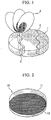
- FIG 1 is a view showing the disarray of a plume 3 generated when a laser beam is irradiated on a target 1 having cracks 2.
- the cracks 2 are generated in the target 1, even a small gap created by the cracks 2 may cause a portion irradiated with a laser beam to be uneven. Consequently, the plume 3 tilts and becomes unstable, thereby a stable film formation cannot be achieved.
- a preferred object of the invention is to provide an oxide target for laser deposition and a method of manufacturing the same, which is useful for a laser vapor deposition system, wherein development of cracks in the target due to a high laser output and high-temperature atmosphere can be prevented, thereby allowing a stable film formation for a long period of time.
- the present invention provides the following aspects:
- the oxide superconductive target for laser vapor deposition can be obtained by mixing rare-earth oxide powder, barium carbonate powder, and copper oxide powder at a predetermined ratio, and press-molding the mixed powder and further performing a partial melt molding. Accordingly, the target forming temperature can be lowered because there is no need to form a compact of, for example, the RE-based 123 phase and amorphous powder unlike in the conventional technique. Moreover, the target forming process can be simplified and the production time can be reduced, thereby achieving a low production cost.
- the oxide superconductive target for laser vapor deposition according to the second aspect of the invention as described in (3) above a constitution in which a silver net is embedded in a main body of the target obtained by press-molding powders and further performing a partial melt-molding is employed.
- the silver net can prevent the development of cracks in the target, the target use time can be prolonged, and a stable film formation for a long period of time can be realized.
- FIG. 2 is a perspective view transparently showing a main section of an embodiment of an oxide superconductive target for laser vapor deposition of the present invention
- reference numeral 10 denotes an oxide superconductive target for laser vapor deposition
- reference numeral 11 denotes a target main body
- reference numeral 12 denotes a silver net.
- the oxide superconductive target 10 (hereinafter abbreviated as a target 10) for laser vapor deposition of this embodiment is an oxide target useful for a laser vapor deposition system (not illustrated) for forming an oxide film (not illustrated) on the surface of a substrate by irradiating the target 10 with a laser beam to generate fine particles of oxide from a surface of the target 10, thereby depositing the fine particles on the surface of the substrate (not illustrated) to form the oxide film.
- the silver net 12 is embedded in the target main body 11 by mixing rare-earth oxide powder, barium carbonate powder and copper oxide powder at a predetermined ratio, and press-molding the mixed powder and further performing a partial melt molding.
- the target main body 11 is obtained by partially melt-molding rare-earth oxide powder, barium carbonate powder, and copper oxide powder as materials for an oxide superconductor, which is the object of the invention.
- an oxide superconductor of the production object can be exemplified by a Y-Ba-Cu-O-based oxide superconductor or the like.
- the oxide superconductor is a Y-Ba-Cu-O-based oxide superconductor will be explained.
- the silver net 12 includes a plurality of silver threads having equal diameters and is disposed at an equal distance so as to define a plurality of holes therebetween.
- the formed plurality of holes have equal areas.
- the silver net 12 is not particularly limited with respect to each hole or a diameter of a silver thread, but it is preferable to use a silver net of which an area of each hole in the silver net is in the range of 1 to 10 mm 2 based on the result of the example to be described below, and the thread diameter is in the range of 1 to 2 mm.
- the silver net 12 is preferable to dispose the silver net 12 on the bottom side from the center of the thickness direction of the target main body 11 so as to prevent unstable film formation in the silver net 12 due to its exposure resulting from the surface of the target main body 11 being scraped in accordance with the development of the film formation.
- each of materials including yttrium oxide powder, barium carbonate powder, and copper oxide powder of about 1 ⁇ m in average diameter and the silver net 12 are prepared.
- a part of the mixed powder (which will form a bottom side of the target 10) is put into a mold of a press-molding apparatus (not illustrated), the silver net 12 is applied thereto, and the remaining mixed powder (which will form a top side of the target 10) is added thereon.
- the silver net 12 is set to be covered with the mixed powder and press-molding is performed to obtain a compressed-molded compact.
- a condition of the press-molding is not particularly limited, but it is preferable to perform the process under the condition of a pressure of about 10 to 20 MPa for about 1 minute at room temperature.
- the molded body of the press-molding is pulled out of the mold and put in an electric furnace (not illustrated) for heat treatment for 50 to 100 hours in a temperature range of 800°C to 950°C, or preferably at approximately 880°C, in the atmosphere. Accordingly, as shown in FIG. 2 , an oxide superconductive target for laser vapor deposition having a structure in which the silver net 12 is buried in the target main body 11 comprising a molded body of partial melt-molded Y-Ba-Cu-O-based oxide superconductive material can be obtained.
- the target 10 of the present embodiment is obtained by mixing rare-earth oxide powder, barium carbonate powder, and copper oxide power at a predetermined ratio, and press-molding the mixed power and further performing partial melt-molding. Accordingly, the target forming temperature may be low, because there is no need to form a compact of an RE-based 123 phase or amorphous powder as in the conventional technique. In addition, the target molding process can be simplified and the production time can be reduced, thereby achieving a low cost.
- the target 10 of the present embodiment has a constitution in which the silver net 12 is embedded in a main body 11 of the target 10 obtained by press-molding powders and further performing a partial melt-molding. Consequently, since the development of cracks in the target 10 can be prevented by the silver net 12, the target use time can be prolonged, and a stable film formation for a long period of time can be achieved.
- a silver net 12 having the area of each hole and diameter of the silver thread was prepared as in Table 1.
- target 10 according to an example of the present invention (Sample No. 1 to 11 in Table 1) was produced.
- the installation position of the silver net 12 was changed to a range of 0 to 5 mm of a height from the bottom of the target 10, as shown in Table 1.
- the targets with sample numbers 1 to 11 of the example were tested after producing samples with a diameter of 100 mm and thickness of 10 mm.
- the target having this size is expected to show an improvement in terms of cost, if the target can be used for about 100 hours in laser vapor deposition.
- the targets with sample numbers. 1 to 11 of the example were set in a laser vapor deposition system, irradiated with a pulsed laser beam on the surface, and the limit time of the target use was measured. The result thereof is shown in Table 1.
- a Y-based oxide superconductive sintered body was prepared based on the production method described in Patent Document 1 to use as a target of the comparative example (Sample No. 12 in Table 1). Then, the limit time of the target use in laser vapor deposition was measured and compared as in the example. The result is shown in Table 1.
- Table 1 Sample No. Area of each hole (mm 2 ) Diameter of Silver Thread Height from Bottom (mm) Limit Time of Use (h) 1 1 1 3 100 2 5 1 3 100 3 10 1 3 100 4 20 1 3 70 5 No silver net 0 0 50 6 10 0.5 3 80 7 10 2 3 100 8 10 4 3 70 9 10 1 2 100 10 10 1 1 60 11 10 1 5 70 12 Comparative example 20
- sample numbers 1 to. 11 according to an example of the present invention did not easily generate a crack even in a target without a silver net and showed an improvement in the limit time of target use as compared to the comparative example.
- the effect to suppress development of cracks in a target in the thickness direction reduced as the silver net approached the target surface.
- the effect to suppress development of cracks in a target in the thickness direction improved as the silver net approached the target center portion.
- a decrease in the use limit time resulted because the thickness of the target that could be used became thin.
Landscapes
- Engineering & Computer Science (AREA)
- Chemical & Material Sciences (AREA)
- Manufacturing & Machinery (AREA)
- Ceramic Engineering (AREA)
- Materials Engineering (AREA)
- Structural Engineering (AREA)
- Organic Chemistry (AREA)
- Physical Vapour Deposition (AREA)
- Superconductors And Manufacturing Methods Therefor (AREA)
- Inorganic Compounds Of Heavy Metals (AREA)
- Compositions Of Oxide Ceramics (AREA)
Abstract
An oxide superconductive target for a laser vapour deposition, which is used when an oxide film is formed in a laser vapour deposition system, comprising a target main body, the elemental ratio of the target main body being substantially Y:Ba:Cu=1:2:3; and a silver net is disposed in a position in the range of 10% to 40% of the target thickness form the bottom of the target main body.
Description
- The present invention relates to an oxide target and a method of manufacturing the same, which is useful for a laser vapor deposition system for forming an oxide film on the surface of a substrate by irradiating a target with a laser beam to generate fine particles of oxide from the target surface thereby depositing the fine particles on the surface of the substrate. The present invention particularly relates to an oxide superconductive target and a method of manufacturing the same, which is prevented from developing cracks caused by a high laser output and a high-temperature atmosphere.
- A method in which an oxide is press-molded and then sintered at high temperature has been used in the case of producing a target formed of an oxide superconductor, which is typified by an oxide target for laser vapor deposition, particularly, a Y-Ba-Cu-O-based oxide superconductor. As an example thereof, Patent Document 1 (Japanese Unexamined Patent Application, First Publication No.
H04-280856 - In addition, Patent Document 2 (Japanese Unexamined Patent Application, First Publication No.
H06-305891 - However, in the preparation method of an oxide superconductive sintered body disclosed in Patent Document 1, the formation temperature is too high and a reinforcing material or the like could not be applied to the inside of the target because the oxide superconductive powder is sintered after its synthesis. Moreover, complicated production processes such as powder synthesis, pulverization, press-molding, sintering and the like caused a problem such as an increase in the cost.
- Furthermore, the biggest problem in the related technology disclosed in Patent Document 1 and Patent Document 2 is that the target is easily cracked when used with a high laser output and in a high-temperature atmosphere, because the target is composed of a sintered body of an oxide and has no reinforcing structure.
FIG 1 is a view showing the disarray of a plume 3 generated when a laser beam is irradiated on a target 1 having cracks 2. As shown inFIG. 1 , if the cracks 2 are generated in the target 1, even a small gap created by the cracks 2 may cause a portion irradiated with a laser beam to be uneven. Consequently, the plume 3 tilts and becomes unstable, thereby a stable film formation cannot be achieved. - In consideration of the above-mentioned problems, a preferred object of the invention is to provide an oxide target for laser deposition and a method of manufacturing the same, which is useful for a laser vapor deposition system, wherein development of cracks in the target due to a high laser output and high-temperature atmosphere can be prevented, thereby allowing a stable film formation for a long period of time.
- The present invention provides the following aspects:
- (1) A first aspect of the present invention is a method of manufacturing an oxide superconductive target for a laser vapor deposition, which is used when an oxide film is formed in a laser vapor deposition system including the steps of: mixing rare-earth oxide powder, barium carbonate powder, and copper oxide powder at a predetermined composition ratio to obtain a mixed powder; press-molding the mixed powder to form a compressed-molded compact; and performing a partial melt molding of the compressed-molded compact.
- (2) In the method of manufacturing an oxide superconductive target for laser vapor deposition as described in (1), it is preferable to further include a step of putting the mixed powder and a silver net into a mold of a press-molding apparatus so as to cover the silver net with the mixed powder prior to the press-molding step.
- (3) A second aspect of the present invention is an oxide superconductive target for a laser vapor deposition, which is used when an oxide film is formed in a laser vapor deposition system, including: a target main body, a silver net embedded in the target main body, wherein the silver net is disposed in a position in the range of 10% to 40% of the target thickness from the bottom of the target main body; and an elemental ratio of the target main body is substantially Y:Ba:Cu=1:2:3.
- (4) In the oxide superconductive target for a laser vapor deposition as described in (3), it is preferable that an area of each hole in the silver net is in the range of 1 to 10 mm2 and a diameter of each silver thread of the silver net is in the range of 1 to 2 mm, providing that the silver net includes a plurality of silver threads disposed at an equal distance so as to form a plurality of holes therebetween.
- According to the first aspect of the invention as described in (1), the oxide superconductive target for laser vapor deposition can be obtained by mixing rare-earth oxide powder, barium carbonate powder, and copper oxide powder at a predetermined ratio, and press-molding the mixed powder and further performing a partial melt molding. Accordingly, the target forming temperature can be lowered because there is no need to form a compact of, for example, the RE-based 123 phase and amorphous powder unlike in the conventional technique. Moreover, the target forming process can be simplified and the production time can be reduced, thereby achieving a low production cost.
- Furthermore, according to the first aspect of the invention as described in (2) above and the oxide superconductive target for laser vapor deposition according to the second aspect of the invention as described in (3) above, a constitution in which a silver net is embedded in a main body of the target obtained by press-molding powders and further performing a partial melt-molding is employed. As a result, the silver net can prevent the development of cracks in the target, the target use time can be prolonged, and a stable film formation for a long period of time can be realized.
-
-
FIG. 1 is a view showing the disarray of plumes generated when a laser beam is irradiated on a target having cracks. -
FIG. 2 is a perspective view transparently showing a main section of an embodiment of an oxide superconductive target for laser vapor deposition according to the present invention. - Hereinafter, an exemplary embodiment of the present invention will be explained with reference to the accompanying drawings.
-
FIG. 2 is a perspective view transparently showing a main section of an embodiment of an oxide superconductive target for laser vapor deposition of the present invention, and in the figure,reference numeral 10 denotes an oxide superconductive target for laser vapor deposition, reference numeral 11 denotes a target main body, andreference numeral 12 denotes a silver net. - The oxide superconductive target 10 (hereinafter abbreviated as a target 10) for laser vapor deposition of this embodiment is an oxide target useful for a laser vapor deposition system (not illustrated) for forming an oxide film (not illustrated) on the surface of a substrate by irradiating the
target 10 with a laser beam to generate fine particles of oxide from a surface of thetarget 10, thereby depositing the fine particles on the surface of the substrate (not illustrated) to form the oxide film. In theoxide target 10, thesilver net 12 is embedded in the target main body 11 by mixing rare-earth oxide powder, barium carbonate powder and copper oxide powder at a predetermined ratio, and press-molding the mixed powder and further performing a partial melt molding. - The target main body 11 is obtained by partially melt-molding rare-earth oxide powder, barium carbonate powder, and copper oxide powder as materials for an oxide superconductor, which is the object of the invention. In the present invention, an oxide superconductor of the production object can be exemplified by a Y-Ba-Cu-O-based oxide superconductor or the like. A typical elemental ratio of the Y-Ba-Cu-O-based oxide superconductor is Y:Ba:Cu=1:2:3, but not limited thereto. Hereinafter, a case where the oxide superconductor is a Y-Ba-Cu-O-based oxide superconductor will be explained.
- In this case, for the target main body 11, each material of yttrium oxide powder, barium carbonate powder, and copper oxide powder is measured so that an elemental ratio of the target main body 11 at a time of completing the
target 10 is substantially Y:Ba:Cu=1:2:3, and the measured powders are mixed. With regard to the amount of each material, it is desirable that a change in the composition ratio due to the powder loss upon a partial-melt molding be considered, and by compensating the loss amount, the initial amount of each material is determined to give the elemental ratio at the time of completing the target of Y:Ba:Cu=1:2:3. - The
silver net 12 includes a plurality of silver threads having equal diameters and is disposed at an equal distance so as to define a plurality of holes therebetween. The formed plurality of holes have equal areas. Thesilver net 12 is not particularly limited with respect to each hole or a diameter of a silver thread, but it is preferable to use a silver net of which an area of each hole in the silver net is in the range of 1 to 10 mm2 based on the result of the example to be described below, and the thread diameter is in the range of 1 to 2 mm. - It is preferable to dispose the
silver net 12 on the bottom side from the center of the thickness direction of the target main body 11 so as to prevent unstable film formation in thesilver net 12 due to its exposure resulting from the surface of the target main body 11 being scraped in accordance with the development of the film formation. As a result of the example described below, it is preferable to dispose thesilver net 12 in a position in the range of 10% to 40%, more preferably within the range of 20% to 30% of the target thickness from the bottom of the target main body 11. - Here, a production method of the
target 10 of the example will be explained. Each of materials including yttrium oxide powder, barium carbonate powder, and copper oxide powder of about 1µm in average diameter and thesilver net 12 are prepared. As described above, each of the materials including yttrium oxide power, barium carbonate powder and copper oxide powder are measured so that the elemental ratio of the target main body 11 at a time of the target completion is Y:Ba:Cu=1:2:3, put in a stirrer such as a ball mill (not illustrated), and stirred to be mixed sufficiently in order to obtain a mixed powder. - Next, a part of the mixed powder (which will form a bottom side of the target 10) is put into a mold of a press-molding apparatus (not illustrated), the
silver net 12 is applied thereto, and the remaining mixed powder (which will form a top side of the target 10) is added thereon. Thesilver net 12 is set to be covered with the mixed powder and press-molding is performed to obtain a compressed-molded compact. A condition of the press-molding is not particularly limited, but it is preferable to perform the process under the condition of a pressure of about 10 to 20 MPa for about 1 minute at room temperature. - Next, the molded body of the press-molding is pulled out of the mold and put in an electric furnace (not illustrated) for heat treatment for 50 to 100 hours in a temperature range of 800°C to 950°C, or preferably at approximately 880°C, in the atmosphere. Accordingly, as shown in
FIG. 2 , an oxide superconductive target for laser vapor deposition having a structure in which thesilver net 12 is buried in the target main body 11 comprising a molded body of partial melt-molded Y-Ba-Cu-O-based oxide superconductive material can be obtained. - The
target 10 of the present embodiment is obtained by mixing rare-earth oxide powder, barium carbonate powder, and copper oxide power at a predetermined ratio, and press-molding the mixed power and further performing partial melt-molding. Accordingly, the target forming temperature may be low, because there is no need to form a compact of an RE-based 123 phase or amorphous powder as in the conventional technique. In addition, the target molding process can be simplified and the production time can be reduced, thereby achieving a low cost. - Further, the
target 10 of the present embodiment has a constitution in which thesilver net 12 is embedded in a main body 11 of thetarget 10 obtained by press-molding powders and further performing a partial melt-molding. Consequently, since the development of cracks in thetarget 10 can be prevented by thesilver net 12, the target use time can be prolonged, and a stable film formation for a long period of time can be achieved. - Each of the materials including yttrium oxide power, barium carbonate power, and copper oxide powder of about 1 µm of average diameter was measured so as to adjust the elemental ratio of the target main body 11 at a time of the completion of the
target 10 to substantially Y:Ba:Cu=1:2:3, injected to a ball mill, and stirred sufficiently to be mixed to obtain a mixed powder. Also, asilver net 12 having the area of each hole and diameter of the silver thread was prepared as in Table 1. - The mixed powder and the
silver net 12 were put into the mold of a press-molding apparatus, and the obtained molded body of the press-molding was put in an electric furnace for heat treatment at 880°C for 50 to 100 hours in the atmosphere. As a result,target 10 according to an example of the present invention (Sample No. 1 to 11 in Table 1) was produced. The installation position of thesilver net 12 was changed to a range of 0 to 5 mm of a height from the bottom of thetarget 10, as shown in Table 1. - The targets with sample numbers 1 to 11 of the example were tested after producing samples with a diameter of 100 mm and thickness of 10 mm. The target having this size is expected to show an improvement in terms of cost, if the target can be used for about 100 hours in laser vapor deposition.
- The targets with sample numbers. 1 to 11 of the example were set in a laser vapor deposition system, irradiated with a pulsed laser beam on the surface, and the limit time of the target use was measured. The result thereof is shown in Table 1.
- Furthermore, as a comparative example, a Y-based oxide superconductive sintered body was prepared based on the production method described in Patent Document 1 to use as a target of the comparative example (Sample No. 12 in Table 1). Then, the limit time of the target use in laser vapor deposition was measured and compared as in the example. The result is shown in Table 1.
Table 1 Sample No. Area of each hole (mm2) Diameter of Silver Thread Height from Bottom (mm) Limit Time of Use (h) 1 1 1 3 100 2 5 1 3 100 3 10 1 3 100 4 20 1 3 70 5 No silver net 0 0 50 6 10 0.5 3 80 7 10 2 3 100 8 10 4 3 70 9 10 1 2 100 10 10 1 1 60 11 10 1 5 70 12 Comparative example 20 - According to the result of Table 1, a crack occurred in the comparative example, and a stable film formation was limited to about 20 hours.
- On the other hand, the sample numbers 1 to. 11 according to an example of the present invention did not easily generate a crack even in a target without a silver net and showed an improvement in the limit time of target use as compared to the comparative example.
- When a target had a silver net and satisfied conditions of the area of each hole of 1 to 10 mm2, diameter of a silver thread of 1 to 2 mm, and location in 2 to 3 mm from the bottom, a lifetime of 100 hours could be achieved.
- With regard to the area of each hole in the silver net and diameter of a silver thread in the silver net, if the space that oxides occupied in the silver net side was too large, the strength of the silver net became weak, and the limit time of use became short due to damage in the silver net or the like.
- Moreover, with respect to the installation position of the silver net (a height from the bottom), the effect to suppress development of cracks in a target in the thickness direction reduced as the silver net approached the target surface. On the contrary, the effect to suppress development of cracks in a target in the thickness direction improved as the silver net approached the target center portion. However, a decrease in the use limit time resulted because the thickness of the target that could be used became thin.
- While preferred embodiments of the invention will be described and illustrated below, it should be understood that these are exemplary of the invention and are not to be considered as limiting. Additions, omissions, substitutions, and other modifications can be made without departing from the spirit or scope of the present invention. Accordingly, the invention is not to be considered as being limited by the foregoing description, and is only limited by the scope of the appended claims.
Claims (4)
- A method of manufacturing an oxide superconductive target for a laser vapor deposition, which is used when an oxide film is formed in a laser vapor deposition system, the method comprising the steps of:mixing rare-earth oxide powder, barium carbonate powder, and copper oxide powder at a predetermined composition ratio to obtain a mixed powder;press-molding the mixed powder to form a compressed-molded compact; andperforming a partial melt molding the compressed-molded compact.
- The method of manufacturing an oxide superconductive target for a laser vapor deposition according to claim 1, further comprising the step of
putting the mixed powder and a silver net into a mold of a press-molding apparatus so as to cover the silver net with the mixed powder prior to the press-molding step. - An oxide superconductive target for a laser vapor deposition, which is used when an oxide film is formed in a laser vapor deposition system, comprising:
a target main body, the elemental ratio of the target main body being substantially Y:Ba:Cu=1:2:3; and
a silver net embedded in the target main body, wherein
the silver net is disposed in a position in the range of 10% to 40% of the target thickness from the bottom of the target main body. - The oxide superconductive target for a laser vapor deposition according to claim 3, wherein
the silver net includes a plurality of silver threads disposed at an equal distance so as to form a plurality of holes therebetween wherein,
the area of the each hole is in the range of 1 to 10 mm2, and
the diameter of the silver thread is in the range of 1 to 2 mm.
Applications Claiming Priority (1)
| Application Number | Priority Date | Filing Date | Title |
|---|---|---|---|
| JP2008046049A JP2009203512A (en) | 2008-02-27 | 2008-02-27 | Oxide superconductive target for laser vapor deposition |
Publications (2)
| Publication Number | Publication Date |
|---|---|
| EP2096091A2 true EP2096091A2 (en) | 2009-09-02 |
| EP2096091A3 EP2096091A3 (en) | 2009-12-16 |
Family
ID=40565024
Family Applications (1)
| Application Number | Title | Priority Date | Filing Date |
|---|---|---|---|
| EP09250510A Withdrawn EP2096091A3 (en) | 2008-02-27 | 2009-02-25 | Oxide superconductive target for laser vapor deposition and method of manufacturing the same |
Country Status (3)
| Country | Link |
|---|---|
| US (1) | US20090215632A1 (en) |
| EP (1) | EP2096091A3 (en) |
| JP (1) | JP2009203512A (en) |
Families Citing this family (2)
| Publication number | Priority date | Publication date | Assignee | Title |
|---|---|---|---|---|
| CN102744519B (en) * | 2012-07-09 | 2014-12-03 | 哈尔滨工程大学 | Method for reinforcing upconversion luminous efficiency of rare earth doped nano-crystal powder material |
| CN111943674B (en) * | 2020-07-30 | 2021-11-16 | 上海交通大学 | A large-diameter rare earth barium copper oxide superconducting target and preparation method thereof |
Citations (1)
| Publication number | Priority date | Publication date | Assignee | Title |
|---|---|---|---|---|
| JPH06305891A (en) | 1993-04-16 | 1994-11-01 | Mitsubishi Materials Corp | Method for producing oxide superconductor thin film and target used in the method |
Family Cites Families (5)
| Publication number | Priority date | Publication date | Assignee | Title |
|---|---|---|---|---|
| EP0379597B1 (en) * | 1988-07-15 | 1994-05-04 | Toshiba Tungaloy Co. Ltd. | Mold material for molding optical parts and process for its production |
| JPH03151231A (en) * | 1989-10-13 | 1991-06-27 | Internatl Business Mach Corp <Ibm> | Multilayer strain lattice copper oxide perovskite structure |
| DE69031375T2 (en) * | 1989-11-28 | 1998-03-26 | At & T Corp | Process for producing a high Tc superconducting material and articles produced by the process |
| JP3512825B2 (en) * | 1992-12-07 | 2004-03-31 | 同和鉱業株式会社 | Method for producing metal-oxide superconductor composite material |
| JP2007063631A (en) * | 2005-08-31 | 2007-03-15 | Dowa Holdings Co Ltd | Laser ablation target and method for manufacturing the same |
-
2008
- 2008-02-27 JP JP2008046049A patent/JP2009203512A/en active Pending
-
2009
- 2009-02-25 US US12/392,250 patent/US20090215632A1/en not_active Abandoned
- 2009-02-25 EP EP09250510A patent/EP2096091A3/en not_active Withdrawn
Patent Citations (1)
| Publication number | Priority date | Publication date | Assignee | Title |
|---|---|---|---|---|
| JPH06305891A (en) | 1993-04-16 | 1994-11-01 | Mitsubishi Materials Corp | Method for producing oxide superconductor thin film and target used in the method |
Also Published As
| Publication number | Publication date |
|---|---|
| US20090215632A1 (en) | 2009-08-27 |
| EP2096091A3 (en) | 2009-12-16 |
| JP2009203512A (en) | 2009-09-10 |
Similar Documents
| Publication | Publication Date | Title |
|---|---|---|
| CN102584205B (en) | Method for manufacturing yttrium barium copper oxide target | |
| KR100794071B1 (en) | Method of producing nuclear fuel pellet | |
| JP2009184916A (en) | Growth method of solid state single crystal | |
| CN104470658A (en) | Metal crucible and method of forming same | |
| KR100762081B1 (en) | Sputtering target and process for producing the same | |
| EP2189431B1 (en) | Aluminum nitride sintered product, method for producing the same and electrostatic chuck including the same | |
| JP6144858B1 (en) | Oxide sintered body, sputtering target, and production method thereof | |
| US20090215632A1 (en) | Oxide superconductive target for laser vapor deposition and method of manufacturing the same | |
| KR100734460B1 (en) | Sputtering target and process for producing si oxide film therewith | |
| KR20080053284A (en) | Target for laser ablation and manufacturing method | |
| EP1796109B1 (en) | METHOD FOR PRODUCING Nb3Sn SUPERCONDUCTIVE WIRE MATERIAL THROUGH POWDER METHOD | |
| US7459030B2 (en) | Manufacturing method of Nb3Sn superconductive wire using powder technique | |
| KR20090071392A (en) | Manufacturing method of lead zirconate titanate-based sintered body, lead zirconate titanate-based sintered body and lead zirconate titanate-based sputtering target | |
| KR100792151B1 (en) | Uranium oxide sintered body with controlled grain shape and manufacturing method | |
| US12441662B2 (en) | Sintered body, method for producing same, and dielectric composition | |
| JP2791407B2 (en) | Method for producing target material for forming oxide superconducting thin film | |
| KR100715516B1 (en) | Method for producing sulphate sintered body having coarse grain or single crystal | |
| US6432353B1 (en) | Method for producing oxide type ceramic sintered body | |
| JP3472993B2 (en) | Sputtering target for forming indium tin oxide film and method for producing the same | |
| EP2098613A1 (en) | Oxide target for laser vapor deposition and method of manufacturing the same | |
| CN101205600A (en) | A kind of preparation method of electronic type high temperature superconductor lanthanum cerium copper oxide thin film | |
| JP2010254523A (en) | Method for producing spinel ceramics | |
| WO2025177476A1 (en) | Metal oxide bulk , metal oxide superconducting bulk , and method for producing metal oxide bulk | |
| CN1039922A (en) | Processes used to make superconductors | |
| US6172007B1 (en) | Oxide superconductor |
Legal Events
| Date | Code | Title | Description |
|---|---|---|---|
| PUAI | Public reference made under article 153(3) epc to a published international application that has entered the european phase |
Free format text: ORIGINAL CODE: 0009012 |
|
| AK | Designated contracting states |
Kind code of ref document: A2 Designated state(s): AT BE BG CH CY CZ DE DK EE ES FI FR GB GR HR HU IE IS IT LI LT LU LV MC MK MT NL NO PL PT RO SE SI SK TR |
|
| AX | Request for extension of the european patent |
Extension state: AL BA RS |
|
| PUAL | Search report despatched |
Free format text: ORIGINAL CODE: 0009013 |
|
| AK | Designated contracting states |
Kind code of ref document: A3 Designated state(s): AT BE BG CH CY CZ DE DK EE ES FI FR GB GR HR HU IE IS IT LI LT LU LV MC MK MT NL NO PL PT RO SE SI SK TR |
|
| AX | Request for extension of the european patent |
Extension state: AL BA RS |
|
| 17P | Request for examination filed |
Effective date: 20100416 |
|
| 17Q | First examination report despatched |
Effective date: 20100602 |
|
| AKX | Designation fees paid |
Designated state(s): DE FR |
|
| STAA | Information on the status of an ep patent application or granted ep patent |
Free format text: STATUS: THE APPLICATION IS DEEMED TO BE WITHDRAWN |
|
| 18D | Application deemed to be withdrawn |
Effective date: 20130411 |