EP2094738B1 - Functional hydrocarbon polymers and process for producing same - Google Patents
Functional hydrocarbon polymers and process for producing same Download PDFInfo
- Publication number
- EP2094738B1 EP2094738B1 EP07795606A EP07795606A EP2094738B1 EP 2094738 B1 EP2094738 B1 EP 2094738B1 EP 07795606 A EP07795606 A EP 07795606A EP 07795606 A EP07795606 A EP 07795606A EP 2094738 B1 EP2094738 B1 EP 2094738B1
- Authority
- EP
- European Patent Office
- Prior art keywords
- formula
- compound
- hours
- polymer
- alkyl
- Prior art date
- Legal status (The legal status is an assumption and is not a legal conclusion. Google has not performed a legal analysis and makes no representation as to the accuracy of the status listed.)
- Not-in-force
Links
- 0 C*CC1(C)N*1C[C@](C)(*)CC(S)=C(*)C*C Chemical compound C*CC1(C)N*1C[C@](C)(*)CC(S)=C(*)C*C 0.000 description 5
Classifications
-
- C—CHEMISTRY; METALLURGY
- C08—ORGANIC MACROMOLECULAR COMPOUNDS; THEIR PREPARATION OR CHEMICAL WORKING-UP; COMPOSITIONS BASED THEREON
- C08F—MACROMOLECULAR COMPOUNDS OBTAINED BY REACTIONS ONLY INVOLVING CARBON-TO-CARBON UNSATURATED BONDS
- C08F8/00—Chemical modification by after-treatment
- C08F8/26—Removing halogen atoms or halogen-containing groups from the molecule
-
- C—CHEMISTRY; METALLURGY
- C08—ORGANIC MACROMOLECULAR COMPOUNDS; THEIR PREPARATION OR CHEMICAL WORKING-UP; COMPOSITIONS BASED THEREON
- C08F—MACROMOLECULAR COMPOUNDS OBTAINED BY REACTIONS ONLY INVOLVING CARBON-TO-CARBON UNSATURATED BONDS
- C08F8/00—Chemical modification by after-treatment
- C08F8/30—Introducing nitrogen atoms or nitrogen-containing groups
-
- C—CHEMISTRY; METALLURGY
- C08—ORGANIC MACROMOLECULAR COMPOUNDS; THEIR PREPARATION OR CHEMICAL WORKING-UP; COMPOSITIONS BASED THEREON
- C08F—MACROMOLECULAR COMPOUNDS OBTAINED BY REACTIONS ONLY INVOLVING CARBON-TO-CARBON UNSATURATED BONDS
- C08F2810/00—Chemical modification of a polymer
- C08F2810/30—Chemical modification of a polymer leading to the formation or introduction of aliphatic or alicyclic unsaturated groups
-
- C—CHEMISTRY; METALLURGY
- C08—ORGANIC MACROMOLECULAR COMPOUNDS; THEIR PREPARATION OR CHEMICAL WORKING-UP; COMPOSITIONS BASED THEREON
- C08F—MACROMOLECULAR COMPOUNDS OBTAINED BY REACTIONS ONLY INVOLVING CARBON-TO-CARBON UNSATURATED BONDS
- C08F2810/00—Chemical modification of a polymer
- C08F2810/40—Chemical modification of a polymer taking place solely at one end or both ends of the polymer backbone, i.e. not in the side or lateral chains
Definitions
- Functional polymers are of great interest due to their potential applications in many important technological areas such as surface modification, adhesion, drug delivery, compatibilization of polymer blends, motor oil additives, low molecular weight precursors to high polymers, use as polymeric macroinitiators, etc.
- living polymerizations provide the simplest and most convenient method for the preparation of functional polymers.
- varieties of end-functionalized polymers have successfully been synthesized in anionic polymerization, there are relatively few end-functionalized polymers (polymers with functional groups selectively positioned at the termini of any given polymeric or oligomeric chain) synthesized by living cationic polymerization of vinyl monomers.
- the present invention is a method of synthesizing a compound of formula (IIIe), comprising a step of reacting a compound of formula (IIIc) to nucleophilically substitute X 1 with Nu 1 .
- R 1 for each occasion is independently H or a C1-C4 alkyl, an alkoxy or a substituted or unsubstituted aryl
- R 2 for each occasion is independently H, X 2 , -CH 2 X 2 , -CHX 2 2 , -CX 2 3 , -C ⁇ N, or -NO 2
- n is an integer not less than 2
- X 1 and X 2 are, for each occurrence, independently, a halogen
- Nu 1 is selected from N 3 - HC 2 CH 2 -O-, HO-, R a O-, thymine, -CH 2 -C(O)OH, wherein R a is a C1-C12 alkyl or
- the compound of formula (IIIe) is represented by formula (IIIb), while the compound of formula (IIIc) is represented by formula (III):
- the present invention is a method of synthesizing hydroxyl functional polymers of formula (VIa), comprising hydrolyzing an end-capped polymer of formula (IIIc), having a haloallyl end group, in the presence of a base, thereby producing a compound of formula (VIa):
- the compound of formula (IIIc) is represented by formula (III), reproduced above, while the compound of formula (VIa) is represented by formula (VI):
- the variables in formula (VIa) are as defined above with respect to formulas (IIIc) and (IIIe).
- the present invention is a functional polymer of formula (XXXa):
- n is an integer not less than 2; k is an integer greater than or equal to 1; L is an initiator residue; R 1 for each occasion is independently H or a C1-C4 alkyl, an alkoxy or a substituted or unsubstituted aryl; R 2 for each occasion is independently H or an electron-withdrawing group, for example, X 2 , CH 2 X 2 , CHX 2 2 , -CX 2 3 , -C ⁇ N, -NO 2 ; and X 1 and X 2 , for each occurrence, is independently a halogen; Nu 2 is selected from N 3 -, HC 2 CH 2 -O-, HO-, R a O-, wherein R a is a C1-C12 alkyl or a polymer or copolymer fragment, thymine, -CH 2 -C(O)OH, -C(O)N 3 , -NHC
- the invention includes preparation of functional hydrocarbon polymers by nucleophilic substitutions of haloallyl functional polymers.
- Haloallyl functional polymers in turn, can be easily and economically prepared by living cationic polymerization, followed by capping with 1,3-butadiene, as disclosed in U.S. Pat. App. 11/400,059, filed on April 7, 2006 .
- alkyl as used herein, unless otherwise indicated, means straight or branched saturated monovalent hydrocarbon radicals of formula C n H 2n+1 .. Typically n is 1-1000, more typically, n is 1 - 100. Alkyl can optionally be substituted with -OH, -SH, halogen, amino, cyano, nitro, a C1-C12 alkyl, C1-C12 haloalkyl, C1-C12 alkoxy, C1-C12 haloalkoxy or C1-C12 alkyl sulfanyl.
- alkyl can optionally be substituted with one or more halogen, hydroxyl, C1-C12 alkyl, C2-C12 alkenyl or C2-C 12 alkynyl group, C1-C12 alkoxy, or C1-C12 haloalkyl.
- the term alkyl can also refer to cycloalkyl.
- cycloalkyl means saturated cyclic hydrocarbons, i.e. compounds where all ring atoms are carbons.
- examples of cycloalkyl include, but are not limited to, cyclopropyl, cyclobutyl, cyclopentyl, cyclohexyl, and cycloheptyl.
- cycloalkyl can optionally be substituted with one or more halogen, hydroxyl, C1-C12 alkyl, C2-C12 alkenyl or C2-C12 alkynyl group, C1-C12 alkoxy, or C1-C12 haloalkyl.
- haloalkyl includes an alkyl substituted with one or more F, Cl, Br, or I, wherein alkyl is defined above.
- alkoxy means an "alkyl-O-" group, wherein alkyl is defined above.
- alkoxy group include methoxy or ethoxy groups.
- aryl refers to a carbocyclic aromatic group.
- aryl groups include, but are not limited to phenyl and naphthyl.
- aryl groups include optionally substituted groups such as phenyl, biphenyl, naphthyl, phenanthryl, anthracenyl, pyrenyl, fluoranthyl or fluorenyl.
- Suitable substituents on an aryl include halogen, hydroxyl, C1-C12 alkyl, C2-C12 alkene or C2-C12 alkyne, C3-C12 cycloalkyl, C1-C12 haloalkyl, C1-C 12 alkoxy, aryloxy, arylamino or aryl group.
- aryloxy means an "aryl-O-" group, wherein aryl is defined above.
- Examples of an aryloxy group include phenoxy or naphthoxy groups.
- arylamine as used herein, means an "aryl-NH-", an "aryl-N(alkyl)-", or an "(aryl) 2 -N-" groups, wherein aryl and alkyl are defined above.
- heteroaryl refers to aromatic groups containing one or more heteroatoms (O, S, or N).
- a heteroaryl group can be monocyclic or polycyclic, e.g. a monocyclic heteroaryl ring fused to one or more carbocyclic aromatic groups or other monocyclic heteroaryl groups.
- the heteroaryl groups of this invention can also include ring systems substituted with one or more oxo moieties.
- heteroaryl groups include, but are not limited to, pyridinyl, pyridazinyl, imidazolyl, pyrimidinyl, pyrazolyl, triazolyl, pyrazinyl, quinolyl, isoquinolyl, tetrazolyl, furyl, thienyl, isoxazolyl, thiazolyl, oxazolyl, isothiazolyl, pyrrolyl, quinolinyl, isoquinolinyl, indolyl, benzimidazolyl, benzofuranyl, cinnolinyl, indazolyl, indolizinyl, phthalazinyl, pyridazinyl, triazinyl, isoindolyl, purinyl, oxadiazolyl, thiazolyl, thiadiazolyl, furazanyl, benzofurazanyl, benzothiophenyl,
- heteroaryl groups may be C-attached or N-attached (where such is possible).
- a group derived from pyrrole may be pyrrol-1-yl (N-attached) or pyrrol-3-yl (C-attached).
- Suitable substituents for heteroaryl are as defined above with respect to aryl group.
- Suitable substituents for an alkyl, cycloalkyl include a halogen, an alkyl, an alkenyl, a cycloalkyl, a cycloalkenyl, an aryl, a heteroaryl, a haloalkyl, cyano, nitro, haloalkoxy.
- substituents for a substitutable carbon atom in an aryl, a heteroaryl, alkyl or cycloalkyl include but are not limited to -OH, halogen (-F, -Cl, -Br, and -I), -R, -OR, -CH 2 R, -CH 2 OR, -CH 2 CH 2 OR,.
- Each R is independently an alkyl group.
- suitable substituents for a substitutable carbon atom in an aryl, a heteroaryl or an aryl portion of an arylalkenyl include halogen, hydroxyl, C1-C12 alkyl, C2-C12 alkenyl or C2-C12 alkynyl group, C1-C12 alkoxy, aryloxy group, arylamino group and C1-C12 haloalkyl.
- an amino group may be a primary (-NH 2 ), secondary (-NHR p ), or tertiary (-NR p R q ), wherein R p and Rq may be any of the alkyl, alkenyl, alkynyl, alkoxy, cycloalkyl, cycloalkoxy, aryl, heteroaryl, and a bicyclic carbocyclic group.
- peptide refers to an amide polymer of amino acids, in which the monomers can be either naturally occurring or artificial.
- this invention utilizes a method to "cap" a living polyolefin cation, typically a polyisoolefin cation, even more typically a living polyisobutylene cation (PIB + ), with a capping agent.
- a living polyolefin cation typically a polyisoolefin cation, even more typically a living polyisobutylene cation (PIB + )
- PIB + living polyisobutylene cation
- a capping agent can include optionally substituted olefins, such as optionally substituted conjugated dienes, and optionally substituted butadienes. As another example, unsubstituted butadienes can be employed.
- a “living” cationic polyolefin generally, is any polyolefin with a terminal cationic group and is termed "living" polymers because it is typically made by one of many living polymerization methods known to those of ordinary skill in the art.
- a polyolefin e.g., polyisoolefin, polymultiolefin or poly(substituted or unsubstituted vinylidene aromatic compounds), and, more typically polyisobutylene
- an optionally substituted conjugated diene e.g., butadiene
- Suitable polyolefins can include C 4 to C 18 polyisomonoolefins, C 4 to C 14 polymultiolefins, and poly(substituted or unsubstituted vinylidene aromatic compounds), for example C 4 to C 10 polyisomonoolefins, or more typically C 4 to C 8 polyisomonoolefins.
- Polyisobutylene is an example of a preferred isoolefin polymer.
- One set of reaction conditions that can produce these polymeric carbocations is, in a solvent, to contact the olefin monomer with an initiating system comprising an initiator (usually an organic ether, organic ester, or organic halide) and a co-initiator.
- an initiator usually an organic ether, organic ester, or organic halide
- the co-initiator is typically used in concentrations equal to or typically 2 to 40 times higher than the concentration of the initiator.
- Examples of co-initiators include one or more of BCl 3 , TiCl 4 , AlBr 3 , and organoaluminum halides such as Me 3 Al 2 Br 3 , MeAlBr 2 , and Me 2 AlBr.
- the polymerization can typically be conducted in a temperature range of from -10° to -100° C, typically from -50° to -90° C for 10 to 120 minutes, depending on the concentration of the initiator and the co-initiator.
- the capping agent e.g., optionally substituted butadiene
- the capping agent can be added to the polymerization media in concentrations equal to up to about 10 times the concentration of the living chain ends, typically 1 to 5 times the concentration of the living chain ends, even more typically 1 to 2 times the concentration of the living chain ends.
- the butadiene generally is reacted with the living polymer for 10 minutes to 5 hours, depending on the concentration of the living chain ends and the butadiene.
- the time necessary to achieve essentially 100% capping will vary with the initiator, co-initiator and butadiene concentrations. With higher initiator concentrations the time is shorter, about 20 minutes, while lower initiator concentrations may require 10 hours to achieve 100% capping.
- the methods of this invention can be conducted in a polymerization zone of a conventional polymerization apparatus, and in the presence or in the absence of a diluent.
- Suitable polymerization conditions typically include a temperature ranging from -100° C to 10° C, and preferably from -80° C to 0° C, for a time period ranging from 1 to 180 minutes.
- the polymerization reaction mixture may be subjected to agitation, e.g., using conventional mixing means.
- the living polymers employed in the methods of the present invention can be, for example, homopolymers, copolymers, terpolymers, and the like depending upon the olefinic chargestock used.
- Preferred number average molecular weights (Mn) of the living polymers of the present invention may range from 500 to 2,000,000, generally from 2,000 to 100,000, or in some embodiments from 1500 to 5000.
- the polymers have a narrow molecular weight distribution such that the ratio of weight average molecular weight to number average molecular weight ( M w / M n ) of the polymers ranges from 1.0 to 1.5, and typically from 1.0 to 1.2.
- the polymers can be recovered from the polymerization zone effluent and finished by conventional methods. In one embodiment, synthesizing an end-capped polymer according to the techniques described herein results in a very high yield (up to about 100%) of a functionalized monoaddition product of butadiene to the polymer chain.
- Scheme (I) illustrates the preferred process for preparation of the starting material employed by the present invention (formula (III) below). Specifically, scheme (I) exemplifies monoaddition of 1,3-butadiene to a living polyisobutylene chain resulting in capping of the growing polymer chain by a chloroallylic group.
- Some embodiments of the reactions of the present invention include termination by halogenation that is faster than addition of molecules of the conjugated diene to the carbocation in Scheme (I), thereby producing an endcapped polymer having a halogenated endcap group.
- An example of such a reaction is that of a polymer of formulas (I): with an optionally substituted conjugated diene of formula (II) as an endcapping reagent in the presence of a Lewis acid, thereby producing an endcapped polymer of formula (III) having a halogenated endcap group
- n is an integer not less than 2;
- R 1 for each occasion is independently H or a C1-C4 alkyl, an alkoxy, for examples a straight or branched C1-C12 alkoxy such as methoxy, ethoxy, isobutoxy, etc., or a substituted or unsubstituted aryl, for example C6-C 18 aryls, preferably phenyl, optionally substituted with C1-C4 straight or branched alkyl, halogen, or a C1-C4 alkoxy; and R 2 for each occasion is independently H or an electron-withdrawing group, for example, X 2 , CH 2 X 2 , CHX 2 2 , -CX 2 3 , -C ⁇ N, -NO 2 ; and X 1 and X 2 , for each occurrence, is independently a halogen (F, Cl, Br, or I).
- formulas (I) and (III) above show monofunctional polymers
- the methods and the compounds of the present invention include polyfunctional polymers, represented by formulas (Ia) and (IIIa):
- L is an initiator residue such as cumyl, dicumyl and tricumyl when cumyl, dicumyl or tricumyl chloride, methylether or ester is used as initiator.
- Other examples include 2,4,4,6-tetramethylheptylene or 2,5-dimethylhexylene, which arise when 2,6-dichloro-2,4,4,6-tetramethylheptane or 2,5-dichloro-2,5-dimethylhexane is used as initiator.
- k is an integer greater than or equal to 1.
- synthetic schemes presented below can all be performed using compounds of formulas (Ia) and (IIIa), thus resulting in polyfunctional polymers.
- the compound of formula (III) and (IIIa) are represented by structural formulas (IIIc) and (IIId), respectively:
- a substituent on a carbon atom that forms an unsaturated carbon-carbon bond and whose attachment to such carbon atom is denoted by the symbol can be in either cis or trans substituent.
- the remainder of values and preferred values for the variable in formulas (IIIc) and (IIId) are as defined above with respect to formulas (III) and (IIIa).
- Solvents suitable for practicing the reactions of the present invention are, for example, solvents that include at least one component having a dielectric constant less than 9.
- the solvents include at least one component having a dielectric constant less than 7.
- the solvents include a mixture of at least one solvent having a polar solvent with a dielectric constant equal to or higher than 9 and at least one nonpolar solvent with a dielectric constant lower than 6.
- suitable solvents include one or more of hexane, cyclohexane, methylcyclohexane, methylchloride, n-butyl chloride, dichloromethane, toluene, and chloroform.
- a bromoallyl-capped polymer can be used in subsequent hydrolysis.
- Synthesis of such a bromo functionalized haloallyl can, for example, be accomplished by reacting a polymer of formula (IV) with an optionally substituted conjugated diene of formula (II) as an endcapping reagent in the presence of a metal bromide Lewis acid, thereby producing an endcapped polymer of formula (V) having a halogenated endcap group
- the variables in formulas (IV) and (V) are as defined above with respect to formulas (I) through (III).
- the compound of formula (V) is represented by structural formula (Va):
- the values and preferred values of the variables in formula (Va) are as defined above with respect to formulas (I) through (III).
- Haloallyl functional polymers of general formula (III) can be subjected to a simple hydrolysis by a base (e.g. inorganic base such as alkali hydroxide, carbonate, etc., or organic base such as Tetrabutylammonium Hydroxide, 1,8-Diazabicyclo[5.4.0]undec-7-ene, 1,5-Diazabicyclo[4.3.0]non-5-ene, N,N,N',N'-Tetramethyl-1,8-naphthalenediamine, Phosphazene bases such as N'-tert-Butyl-N,N,N',N',N",N"-hexamethylphosphorimidic triamide, etc.) to produce hydroxyl functional hydrocarbon polymers of general formula (VI) according to Scheme (II) below:
- a base e.g. inorganic base such as alkali hydroxide, carbonate, etc.
- organic base such as Tetrabutylammonium Hydroxide, 1,8-
- compound of formula (III) can be represented by formula (IIIc), while the compound of formula (VI) is represented by structural formula (VIa):
- the values and preferred values of the variables in formula (VIa) are as defined above for formula (VI).
- any suitable solvent or solvent mixtures in which reagents are soluble and with which reagents do not react can be used.
- the reaction is most commonly carried out in a solvent mixture.
- the starting materials preferably are dissolved in an ethereal solvent such as tetrahydrofuran (THF), dioxane and the like.
- the solvent can be THF or a mixture of THF and water.
- a mixture of organic solvent (e.g. THF) in which the polymer is soluble but that is miscible with water is preferred when an inorganic base is used for hydrolysis.
- a phase transfer catalyst such as quaternary ammonium salts or crown ethers may be employed.
- Suitable bases employed in hydrolysis include inorganic bases, for example, sodium hydroxide, sodium bicarbonate or potassium hydroxide can be employed.
- concentration of the base employed in hydrolysis can be (in percent by weight), for example, from about 0.5% to about 95%, for example: 0.5%, 1%, 1.5%, 5%, 10%, 15%, 20%, 25%, 30%, 35%, 40%, 45%, 50%, 55%, 60%, 65%, 70%, 75%, 80%, 85%, 90% or 95%.
- the hydrolysis can be carried out at a temperature from about 50 °C to about 150 °C.
- the hydrolysis can be carried out at a temperature from 50 °C to 60 °C, 60 °C to 70 °C, 70 °C to 80 °C, 80 °C to 90 °C, 90 °C to 100 °C, 100 °C to 110 °C, 110 °C to 120 °C, 120 °C to 130 °C, 130 °C to 140 °C, 140 °C to 150 °C.
- the hydrolysis can be carried out at about 65 °C, about 100 °C, or at about 130 °C.
- the hydrolysis can be carried out for any time from about 30 minutes to about 48 hours.
- hydrolysis can be carried out for a time period of 0.5 hours to 2 hours, 2 hours to 4 hours, 4 hours to 6 hours, 6 hours to 8 hours, 8 hours to 10 hours, 10 hours to 12 hours, 12 hours to 14 hours, 14 hours to 16 hours, 16 hours to 18 hours, 18 hours to 20 hours, 20 hours to 22 hours, 22 hours to 24 hours, 24 hours to 30 hours, 30 hours to 36 hours, 36 hours to 42 hours, 42 hours to 48 hours.
- the hydrolysis can be carried out for 2 hours, 4 hours, 6 hours, 12 hours, 24 hours, 26 hours or 48 hours.
- X 1 can be Cl, Br, or I.
- X 1 is Cl or Br. More preferably, X 1 is Br.
- X 1 in Scheme (II) is Cl.
- An example of an inorganic base employed in the hydrolysis step is potassium hydroxide.
- the hydrolysis is carried out at a temperature from about 80 °C to about 120 °C, preferably, at 90-110 °C. Alternatively, temperature is from about 100 °C to about 150 °C, preferably, at 120-140 °C.
- the reaction is carried out for the duration from about 12 hours to about 36 hours, preferably, for 20-28 hours.
- the concentration of KOH is from about 1% to about 25% by weight, preferably, about 1-10% by weight.
- X 1 is Cl, KOH concentration is at 1-10% by weight, and the hydrolysis is carried out for 20-28 hours at 90-110 °C. Even more preferably, X 1 is Cl, KOH concentration is at 1-10% by weight, and the hydrolysis is carried out for 20-28 hours at 120-140 °C.
- X 1 in Scheme (II) is Br.
- An example of an inorganic base employed in the hydrolysis step is potassium hydroxide.
- the hydrolysis is carried out at a temperature from about 60 °C to about 100 °C, preferably, at 55-75 °C. Alternatively, hydrolysis is carried out at a temperature from about 100 °C to about 150 °C, preferably, at 120-140 °C.
- the reaction is carried out for the duration from about 1 hours to about 10 hours, preferably, for 2-5 hours.
- the concentration of KOH is from about 0.5% to about 60% by weight, preferably, about 40-60% by weight. Alternatively, the concentration of KOH is from 0.5% to 1.5%.
- X 1 is Br
- KOH concentration is at 40-60% by weight
- the hydrolysis is carried out for 20-28 hours at 55-75 °C.
- X 1 is Br
- KOH concentration is at 0.5-1.5% by weight
- the hydrolysis is carried out for 2-5 hours at 120-140 °C.
- haloallyl functional polymers of general formula (III) can be subjected to a nucleophilic attack by a variety of nucleophiles.
- the present invention is a method of synthesis of a derivative of a compound of formula (III) by nucleophilic substitution.
- the general synthetic route for this derivatization is given in scheme (III) below:
- nucleophile Nu 1 is any nucleophilic reagent capable of reacting with a compound of formula (III) in a solvent in which the a compound of formula (III) and Nu 1 can be dissolved an remain stable.
- Nu 1 is selected from N 3 -, HC 2 CH 2 -O-, HO-, R a O-, thymine, -CH 2 -C(O)OH, wherein R a is a C1-C12 alkyl or a polymer or copolymer fragment.
- polymer or "copolymer” mean a macromolecule built up by the linking of monomers by a process termed polymerization.
- Non-limiting examples of a polymer or copolymer fragment include polyethers such as polyethylene glycol (PEG), and polyesters such as polymers or copolymers of lactide, glycolide or ⁇ -caprolactone.
- PEG polyethylene glycol
- polyesters such as polymers or copolymers of lactide, glycolide or ⁇ -caprolactone.
- C1-C12 alkyls are methyl, ethyl.
- a compound of formula (IIIb) is further reacted to replace moiety Nu 1 with moiety Nu 2 .
- the present invention is a compound of formula (IIIf):
- Nu 2 is selected from N 3 -, HC 2 CH 2 -O-, HO-, R a O-, wherein R a is a C1-C 12 alkyl or a polymer or copolymer fragment (as defined above with reference to formula (IIIb)), thymine, -CH 2 -C(O)OH, -C(O)N 3 , -NHC(O)OR, -C(O)NHR, -NHC(O)NHR, wherein R is a C1-C12 alkyl, or a peptide-NH-.
- the compound of formula (III) can be represented by formula (IIIc) while the compound of formula (IIIb) is represented by formula (IIIe):
- formula (IIIg) replacement of moiety Nu 1 by moiety Nu 2 , as a result of a subsequent reaction, will produce a compound of formula (IIIg): Values and preferred values of the variables in formulas (IIIe) and (IIIg) are as defined above with respect to formulas (IIIb) and (IIIf).
- the haloallyl-capped polymer of formula (III) was obtained as described above.
- the haloallyl-capped polymer (III) was converted to hydroxide, alkoxide (e.g. methoxide), azide, amine, aldehyde, acid and propargyl functionalities quantitatively using single step procedures.
- one or more additional steps are employed.
- modification of the carboxylate (XV) derivative can be employed to synthesize carbonylazide (XVI) (see scheme (X)), which may act as a building block to attach urea, urethane and amide chain extenders (scheme (XI)).
- peptides can also be effectively attached to the carbonylazide intermediate under mild conditions (scheme (XI)).
- the propynyloxy derivative (XII) obtained according to scheme (VI) can be further employed to synthesize a triazole derivative (XXI) according to scheme (XII).
- the present invention is a method of synthesis of compound of formula (X):
- the values and preferred values for the variables in formula (X) are as defined above with reference to formula (III).
- N - 3 refers to any soluble form of azide, for example metal azides (NaN 3 , KN 3 , etc.).
- the compound of formula (III) can be represented by formula (IIIc), while the compound of formula (X) is represented by formula (Xa):
- the values and preferred values of the variables in formula (Xa) are as defined above with respect to formula (X).
- reaction conditions for the reaction of scheme (IV) are as follows: in a mixture of solvent, where one is dry THF and the other one is a dry polar aprotic solvent, in a temperature range of 25 °C to 75 °C and the reactions were carried out under nitrogen or argon atmosphere.
- a polar aprotic solvent such as nitromethane, dimethyl acetamide (DMA), N,N-dimethyl formamide (DMF), dimethyl sulfoxide (DMSO), hexamethyl phosphoramide (HMPA), N-methyl pyrrolidone (NMP), tetrahydrofuran (THF), or dioxane, or a mixture thereof.
- the solvents is a THF/DMF mixture at 83.3%:16.7%.
- the temperature of the reaction is typically from about 25 °C to about 100 °C, preferably, from about 25 °C to about 75 °C, for example 50 °C.
- N - 3 refers to any soluble form of azide, for example metal azides (NaN 3 , KN 3 , etc.) and M is an alkali metal (Na, K, etc.).
- M is an alkali metal (Na, K, etc.).
- the compound of formula (III) can be represented by formula (IIIc), the compound of formula (X) can be represented by formula (Xa), while the compound of formula (XI) is represented by formula (XIa):
- the values and preferred values of the variables in formula (XIa) are as defined above with respect to formula (XI).
- the synthetic route from compound (III) to (XI) can be carried out with any suitable amination reagent.
- the amination reagent is potassium phthalimide followed by hydrolysis in hydrazine hydrate and basic solution.
- the reaction is preferably carried out in a mixture of dry THF and a dry polar aprotic solvent under nitrogen or argon atmosphere in a temperature range of 66 °C to 100 °C for 12 to 24 h.
- the reaction is carried out in a polar aprotic solvent such as nitromethane, dimethyl acetamide (DMA), N,N-dimethyl formamide (DMF), dimethyl sulfoxide (DMSO), hexamethyl phosphoramide (HMPA), N-methyl pyrrolidone (NMP), tetrahydrofuran (THF), or dioxane, or a mixture thereof.
- a polar aprotic solvent such as nitromethane, dimethyl acetamide (DMA), N,N-dimethyl formamide (DMF), dimethyl sulfoxide (DMSO), hexamethyl phosphoramide (HMPA), N-methyl pyrrolidone (NMP), tetrahydrofuran (THF), or dioxane, or a mixture thereof.
- a polar aprotic solvent such as nitromethane, dimethyl acetamide (DMA), N,N-dimethyl formamide (DMF),
- the synthetic route from compound (X) to (XI) can be carried out with any suitable reducing reagent such as LiAlH 4 , NaBH 4 , H 2 /Pd or Ni and PPh 3 .
- the reducing reagent is PPh 3 .
- the reaction is preferably carried out in a polar protic solvent.
- the polar solvent can be one or more of a polar protic solvent, such as water or an alcohol; an ethereal solvent such as THF, dioxane and the like.
- the solvent can be a mixture of THF and water.
- the mixture of THF and water 91%:9% is used.
- the present invention is a method of synthesis of compound of formula (XII) according to Scheme (VI):
- the values and preferred values for the variables in formula (XII) are as defined above with reference to formula (III).
- the compound of formula (III) can be represented by formula (IIIc), while the compound of formula (XII) is represented by formula (XIIa):
- the values and preferred values of the variables in formula (XIIa) are as defined above with respect to formula (XII).
- reaction conditions for the reaction of scheme (VI) are as follows: in a polar aprotic solvent such as nitromethane, dimethyl acetamide (DMA), N,N-dimethyl formamide (DMF), dimethyl sulfoxide (DMSO), hexamethyl phosphoramide (HMPA), N-methyl pyrrolidone (NMP), tetrahydrofuran (THF), or dioxane, or a mixture thereof and in presence of a base, i.e. sodium hydride, KOH, NaOH etc under inert atmosphere and in the temperature range of 20-100 °C.
- a base i.e. sodium hydride, KOH, NaOH etc under inert atmosphere and in the temperature range of 20-100 °C.
- a base i.e. sodium hydride, KOH, NaOH etc under inert atmosphere and in the temperature range of 20-100 °C.
- the solvent is dry THF and the temperature is 70 °C.
- the present invention is a method of synthesis of compound of formula (XII) according to Scheme (VII):
- R a is a C1-C12 alkyl (e.g., methyl or ethyl) or polymer or copolymer fragment, e.g., polyethylene oxide (PEG) and polyesters such as polymers or copolymers of lactide, glycolide or ⁇ -caprolactone.
- the compound of formula (III) can be represented by formula (IIIc), while the compound of formula (XIII) is represented by formula (XIIIa):
- the values and preferred values of the variables in formula (XIIIa) are as defined above with respect to formula (XIII).
- the reaction is most commonly carried out in an alcoholic solvent, except with PEG.
- the preferred solvent is an aprotic polar solvent such as tetrahydrofuran.
- An ethereal solvent such as tetrahydrofuran (THF), dioxane and the like, is preferably used as a cosolvent.
- the solvent can be a mixture of THF and an alcohol, such as methanol or ethanol the solvent has to be a polar aprotic and polar protic mixture.
- the reaction is preferably catalyzed by a base.
- bases include inorganic bases, for example, sodium hydroxide, sodium bicarbonate or potassium hydroxide can be employed.
- the solvent is a THF/MeOH mixture at 83.3%:16.7%.
- the temperature of the reaction is typically from about 66 °C to about 100 °C, preferably, 70 °C.
- the present invention is a method of synthesis of compound of formula (XIV) according to Scheme (VIII):
- the values and preferred values for the variables in formula (XIV) are as defined above with reference to formula (III).
- the compound of formula (III) can be represented by formula (IIIc), while the compound of formula (XIV) is represented by formula (XIVa):
- the values and preferred values of the variables in formula (XIVa) are as defined above with respect to formula (XIV).
- reaction conditions for the reaction of scheme (VIII) are as follows: a mixture of polar aprotic solvent hexamethyl phosphoramide (HMPA), N-methyl pyrrolidone (NMP), tetrahydrofuran (THF) and water in a temperature range of 25 °C to 100 °C.
- HMPA polar aprotic solvent hexamethyl phosphoramide
- NMP N-methyl pyrrolidone
- THF tetrahydrofuran
- water in a temperature range of 25 °C to 100 °C.
- Suitable bases include inorganic bases, for example, sodium hydroxide, sodium bicarbonate or potassium hydroxide can be employed.
- KOH is used as the base
- the solvent is a mixture of THF and water and the temperature is 70 °C.
- the present invention is a method of synthesis of compound of formula (XV), starting from a compound of formula (III) and dimethylmalonate according to Scheme (IX):
- the values and preferred values for the variables in formula (XV) are as defined above with reference to formula (III).
- the compound of formula (III) can be represented by formula (IIIc), while the compound of formula (XV) is represented by formula (XVa):
- the values and preferred values of the variables in formula (XVa) are as defined above with respect to formula (XV).
- reaction conditions for the reaction of scheme (IX) are as follows: a polar aprotic solvent, temperature range 25-100 °C under inert (nitrogen or argon) atmosphere]
- a polar aprotic solvent Preferably the solvent is dry THF and the temperature is 70 °C.
- the present invention is a method of synthesis of compound of formula (XVI), starting from a compound of formula (XV) according to scheme (X):
- N - 3 refers to any soluble azide form, e.g. metal azide.
- the compound of formula (XV) can be represented by formula (XVa), while the compound of formula (XVI) is represented by formula (XVIa):
- the values and preferred values of the variables in formula (XVIa) are as defined above with respect to formula (XVI).
- reaction conditions for the synthetic route from compound (XV) to compound (XVI) are as follows: in a polar aprotic solvent, i.e. THF, in presence of a base, i.e. triethyleneamine or pyridine in a temperature range of -10 °C to 30 °C under inert atmosphere.
- a polar aprotic solvent i.e. THF
- a base i.e. triethyleneamine or pyridine
- the solvent is THF
- the base is triethylamine
- the temperature range is 0-25 °C.
- the present invention is a method of synthesis of any of the compounds of formula (XVII), (XVIII), (XIX) and (XX) according to the reactions of Scheme (XI), where "rt” stands for room temperature:
- R is a C1-C12 alkyl.
- the compound of formula (XVI) can be represented by formula (XVIa), while the compound of formulas (XVII)-(XX) is represented by formulas (XVIIa)-(XXa):
- the values and preferred values of the variables in formulas (XVIIa)-(XXa) are as defined above with respect to formulas (XVI)-(XX).
- reaction conditions for the synthetic routes from compound (XVI) to compounds (XVII) through (XX) are as follows: in a polar aprotic solvent and within a temperature range of 25 °C to 100 °C.
- the present invention is a method of synthesis of compound of formula (XXI), starting from a compound of formula (XII) according to scheme (XII):
- R b is an optionally substituted alkyl (for example C1-C20 alkyl), an optionally substituted aryl (for example C6-C20 aryls, preferably phenyl, optionally substituted with C1-C4 straight or branched alkyl or halogen), an optionally substituted heteroaryl (e.g., C6-C20 heteroaryl) or a polymer or copolymer fragment.
- polymer or copolymer is soluble in water, and/or has a glass transition or melting temperature above 25 °C, and/or is biodegradable.
- Non-limiting examples of a polymer include polyethers such as polyethylene glycol (PEG), and polyesters such as polylactide.
- the compound of formula (XII) can be represented by formula (XIIa), while the compound of formula (XXI) is represented by formula (XXIa):
- the values and preferred values of the variables in formula (XXIa) are as defined above with respect to formula (XXI).
- reaction conditions for the reaction of scheme (XII) are as follows: in a polar aprotic solvent and water mixture, the temperature range is 20-66 °C.
- formula (XXI) is a block copolymer, wherein R b is a polymer or a block copolymer.
- the present invention is a compound of formula (XXXIVa)
- One embodiment of the compound of formula (XXXIV a ) is represented by formula (XXXIV): Values and preferred values of the variables in formulas (XXXIV) and (XXXIVa) are as defined above with respect to formulas (IIIa) and (XII).
- the present invention is a compound represented by formula (XXXVa):
- One embodiment of the compound of formula (XXXVa) is represented by formula (XXXV).
- Values and preferred values of the variables in formulas (XXXV) and (XXXVa) are as defined above with respect to formulas (IIIa) and (XXI).
- the present invention is a compound of formula (XXXVIa):
- One embodiment of the compound of formula (XXXVIa) is represented by formula (XXXVI):
- the values and preferred values of the variables in formulas (XXXVI) and (XXXVIa) are as defined above with respect to formulas (IIIa) and (XIII).
- the present invention is a compound of formula (XXXVIIa):
- One embodiment of the compound of formula (XXXVIIa) is represented by formula (XXXVII):
- the present invention is a compound of formula (XXXVIIIa):
- One embodiment of the compound of formula (XXXVIIIa) is represented by formula (XXXVIII):
- the present invention is a compound of formula (XXXIXa):
- One embodiment of the compound of formula (XXXIXa) is represented by formula (XXXIX):
- the present invention is a compound of formula (XLa):
- One embodiment of the compound of formula (XLa) is represented by formula (XL):
- the present invention is a compound of formula (XLIa):
- One embodiment of the compound of formula (XLIa) is represented by formula (XLI):
- the present invention is a compound of formula (XLIIa):
- One embodiment of the compound of formula (XLIIa) is represented by formula (XLII):
- the present invention is a compound of formula (XLIIIa):
- One embodiment of the compound of formula (XLIIIa) is represented by formula (XLIII):
- the ⁇ , ⁇ -PIB-diol, diamine or diacid are valuable intermediates to thermoplastic polyurethane, polyester or polyamide elastomers or elastomer modified plastics.
- the ⁇ , ⁇ -PIB-diamine may also be employed to cure epoxy resins or modify the properties of cured epoxy resins.
- End-functional PIBs containing azide and alkyne functionalities can be employed in the modular synthesis of block copolymers by the Sharpless type click reaction (1,3 dipolar cycloaddition).
- Thymine functional PIBs can be chain extended or crosslinked by UV light catalyzed photodimerization.
- PIB based amphiphilic block copolymers, such as PIB-block-PEO are useful as surfactants.
- thermoplastic polyurethanes obtained from polymeric diols presently employed as materials for the soft segments, i.e., polyester diols, polyether diols and polydiene diols, suffer from serious limitations.
- the polyester based polyurethane is prone to hydrolytic degradation, the polyether component undergoes oxidative degradation in vivo and polydienes suffer from poor thermal and oxidative stability.
- PIB has excellent thermal, oxidative and biostability.
- thermoplastic polyurethanes, polyesters or polyamides of the present invention are potential new thermoplastic elastomers, other polymeric materials and biomaterials.
- the article of manufacture is an insertable or implantable medical device, e.g., a catheter, an endotracheal tube, a tracheostomy tube, a wound drainage device, a wound dressing, a stent coating, an implant, an intravenous catheter, a medical adhesive, a shunt, a gastrostomy tube, medical tubing, cardiovascular products, heart valves, pacemaker lead coating, a guidewire, or urine collection devices.
- certain compositions will also exhibit an appropriate release profile and therefore these materials are also useful as medical drug eluting articles and drug eluting coatings.
- thermoplastic polyurethanes, polyesters or polyamides of the invention can be melt-processed, for example, by injection molding and extrusion.
- Compositions used for this method can be used alone or compounded with any other melt-processable material for molding.
- thermoplastic polyurethanes, polyesters or polyamides of the invention can also be coated onto preformed articles.
- the copolymers can be applied by any means, including those methods known in the art.
- a composition comprising the thermoplastic polyurethanes, polyesters or polyamides of the invention can be brushed or sprayed onto the article from a solution, or the article can be dipped into the solution containing the copolymers of the invention.
- IB isobutylene
- ClAllyl-PIB-AllylCl was synthesized similarly, using 5- tert -butyl-1,3- bis (1-chloro-1-methylethyl) benzene instead of TMPCl.
- a typical experiment is as follows: In a two-necked round-bottomed flask, PIB-AllylCl (5 g; 1 % w/v), LiBr (31 g), toluene (325 mL), and acetone (175 mL) were placed and refluxed with stirring. After 12 hours, the solution was cooled to room temperature. Then, the solvent was evaporated under reduced pressure. Excess LiBr was removed by washing with distilled water. The polymer was purified by precipitation using a Hex/methanol system twice. The 1 H NMR analysis of the product showed complete exchange of Cl to Br.
- PIB-AllylCl, 24 hours 100 °C KOH conc., % Hydrolysis Yield, % 1 10 5 34 10 27 PIB-AllylCl, 24 hours, 130 °C KOH conc., % Hydrolysis Yield, % 5 87 10 63 PIB-AllylBr, 24 h, reflux temperature (65 °C) KOH conc., % Hydrolysis Yield, % 1 15 5 25 10 33 50 37 PIB-AllylBr, 24 h, 130 °C KOH conc., % Hydrolysis Yield, % 1 100
- PIB-allyl-chloride 200 mg, 0.07 mmol was dissolved in dry THF (20 mL) and to it PEG-OH (420 mg, 0.21 mmol) was added. The mixture was kept under nitrogen atmosphere and KOH (960 mg, 17.5 mmol) was added to it with constant stirring. The stirring mixture was set to reflux for 48 h. The reaction was stopped and cooled to room temperature. The mixture was filtered and the filtrate was kept under reduced pressure to evaporate the solvent. The residue was dissolved in chloroform and washed with water to remove excess PEG-OH. The organic layer was passed through sodium sulfate and evaporated to get a sticky white liquid. According to 1 H NMR studies 100% conversion with respect to PIB-allyl-chloride was achieved.
- PIB-allyl-chloride (272 mg, 0.095 mmol) was dissolved in dry THF (9 mL) and to it 3 mL of dry DMF was added and the mixture was stirred at room temperature.
- potassium phthalimide (278 mg, 1.5 mmol) was added and the mixture was set to reflux under nitrogen atmosphere for 12 hours. The reaction was stopped and cooled to room temperature. The excess THF was evaporated and methanol was added to the sticky mass left over. The precipitate formed was separated and dissolved in hexane. The solution was filtered and the filtrate was re-precipitated in methanol. The sticky solid obtained was further purified by dissolution and re-precipitation method using hexane and methanol.
- PIB-allyl-phthalimide (210 mg, 0.07 mmol) was dissolved in THF (10 mL) and to it hydrazine hydrate (190 mg, 3.8 mmol) was added and the mixture was refluxed for 24 h. The reaction was stopped and cooled to room temperature. The mixture was added with a solution of KOH (320 mg) in 2 mL of water and was further stirred for 30 min. THF was evaporated under reduced pressure and methanol was added to it. The precipitate obtained was further purified by dissolving in hexane and re-precipitating in methanol.
- the polymer was further dissolved in 20 mL of THF and 3 mL of concentrated HCl was added to the solution in dropwise manner with stirring. The mixture was then refluxed for 24 hours. The product was neutralized with sodiumbicarbonate solution and the THF was evaporated. The sticky mass was dissolved in chloroform and was washed with water. The organic layer was passed through sodium sulfate and concentrated under reduced pressure to get a white sticky solid.
- PIB-allyl-bromide (172 mg, 0.06 mmol) was dissolved in 15 mL of dry THF and 2 mL of dry acetonitrile was added to it. To the solution, K 2 CO 3 (215 mg, 1.55 mmol) was added and the mixture was set to reflux. To the reflux mixture methyl malonate (210 mg, 1.6 mmol) was added and the refluxing continued for 20 hours. The reaction was then stopped and cooled to room temperature. The mixture was filtered and the filtrate was concentrated under reduced pressure. The mass obtained was purified by dissolving in hexane and reprecipitating in methanol.
- PIB-allyl-chloride (212 mg, 0.074 mmol) was dissolved in 10 mL of dry THF and to it KOH (230 mg, 4.1 mmol) was added followed by propargyl alcohol (252 mg, 4.5 mmol). The mixture was set to reflux for 18 h. The progress of the reaction was checked after 5, 10 and 18 hours using 1 H NMR spectroscopy, which indicated 50, 72 and 100% conversion respectively. The reaction was then stopped and cooled to room temperature. The excess THF was evaporated under reduced pressure. The sticky mass obtained was dissolved in hexane and precipitated in methanol. The process was repeated three times and the white sticky precipitate was kept under high vacuum to remove the traces of solvent trapped in the polymer matrix.
Landscapes
- Chemical & Material Sciences (AREA)
- General Chemical & Material Sciences (AREA)
- Health & Medical Sciences (AREA)
- Chemical Kinetics & Catalysis (AREA)
- Medicinal Chemistry (AREA)
- Polymers & Plastics (AREA)
- Organic Chemistry (AREA)
- Addition Polymer Or Copolymer, Post-Treatments, Or Chemical Modifications (AREA)
- Materials For Medical Uses (AREA)
- Organic Low-Molecular-Weight Compounds And Preparation Thereof (AREA)
Description
- Functional polymers are of great interest due to their potential applications in many important technological areas such as surface modification, adhesion, drug delivery, compatibilization of polymer blends, motor oil additives, low molecular weight precursors to high polymers, use as polymeric macroinitiators, etc.
- In addition to the controlled and uniform size of the polymers, living polymerizations provide the simplest and most convenient method for the preparation of functional polymers. Although varieties of end-functionalized polymers have successfully been synthesized in anionic polymerization, there are relatively few end-functionalized polymers (polymers with functional groups selectively positioned at the termini of any given polymeric or oligomeric chain) synthesized by living cationic polymerization of vinyl monomers. There are two basic methods to prepare functional polymers by living cationic polymerization: initiation from functional initiators and termination by functional terminators.
- Both have been employed to achieve the above target. However, post-polymerization functionalization is preferred, since in ionic polymerization many unprotected functional groups interfere during the course of polymerization. Furthermore, the functional initiator method requires an efficient coupling/linking agent for the preparation of bi- and multi-functional polymers, which are not readily available. The reported procedures to functionalize the polymers involve stringent synthetic pathways and are expensive. The procedures reported to date are complicated, laborious and expensive and, therefore, not practiced commercially. Accordingly, a need exists for novel methods of preparation of high quality functional polymers that overcome limitations of known methods.
- We are aware of United States patent
US 5332791 (BASF AG) which teaches that hydrocarbons and polymers thereof, of the structure (I) R-C(CH3)2-CH2-C(CH3)2-CH2-CH=CH-CH2-CI(I) where R is a hydrocarbon radical, can be prepared by reacting corresponding starting materials which contain chlorine bonded to tertiary carbon, of the structure R-C(CH3)2-CH2-C(CH3)2-CI(II) with from 1 to 10 moles of butadiene in the presence of a Friedel-Crafts catalyst in a solvent which is inert to the catalyst, and the hydrocarbons or polymers thereof can be reacted in a further step of the process with a compound from the group comprising ammonia, primary or secondary amine or polyamine, amino alcohol, amino ether, hydrazine or hydrazine which is substituted up to three times. - We are also aware of Li et al: "Polyisobutylene supports-a non-polar hydrocarbon analog of PEG supports" Tetrahedron, Elsevier Science Publishers, Amsterdam, NL, vol. 61, no. 51, 19 December 2005 (2005-12-19), pages 12081-12092, which describes synthetic routes to terminally functionalized polyisobutylene oligomers useful as supports in synthesis and catalysis. Such hydrocarbon polymers serve as highly soluble non-polar analogs of well known poly(ethylene glycol) supports for synthesis and catalysis with the difference that they are separated after a reaction by an extraction with alkane solvent. Polyisobutylene is a readily modified soluble polymeric support for use in synthesis and catalysis.
- In one embodiment, the present invention is a method of synthesizing a compound of formula (IIIe),


- In one embodiment, the compound of formula (IIIe) is represented by formula (IIIb), while the compound of formula (IIIc) is represented by formula (III):

- In another embodiment, the present invention is a method of synthesizing hydroxyl functional polymers of formula (VIa), comprising hydrolyzing an end-capped polymer of formula (IIIc), having a haloallyl end group, in the presence of a base, thereby producing a compound of formula (VIa):
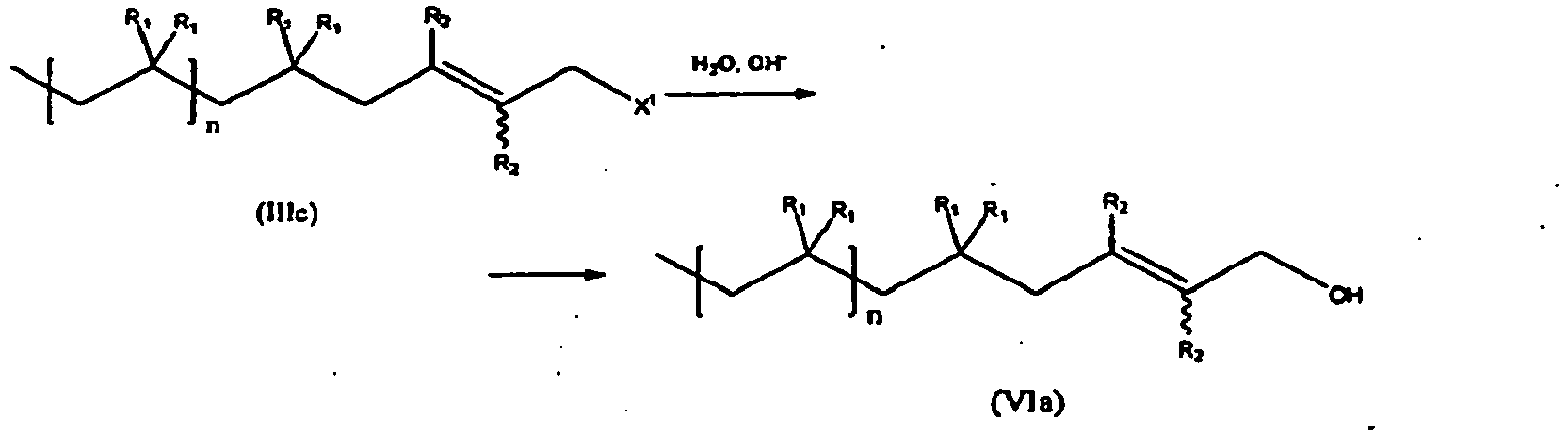
- In one embodiment, the compound of formula (IIIc) is represented by formula (III), reproduced above, while the compound of formula (VIa) is represented by formula (VI):

- In another embodiment, the present invention is a functional polymer of formula (XXXa):

- The variables in formula (XXXa) are as provided below: n is an integer not less than 2; k is an integer greater than or equal to 1; L is an initiator residue; R1 for each occasion is independently H or a C1-C4 alkyl, an alkoxy or a substituted or unsubstituted aryl; R2 for each occasion is independently H or an electron-withdrawing group, for example, X2, CH2X2, CHX2 2, -CX2 3, -C ≡ N, -NO2; and X1 and X2, for each occurrence, is independently a halogen; Nu2 is selected from N3-, HC2CH2-O-, HO-, RaO-, wherein Ra is a C1-C12 alkyl or a polymer or copolymer fragment, thymine, -CH2-C(O)OH, -C(O)N3, -NHC(O)OR, -C(O)NHR, -NHC(O)NHR, wherein R is a C1-C12 alkyl, or a peptide-NH-.
- The invention includes preparation of functional hydrocarbon polymers by nucleophilic substitutions of haloallyl functional polymers. Haloallyl functional polymers, in turn, can be easily and economically prepared by living cationic polymerization, followed by capping with 1,3-butadiene, as disclosed in
U.S. Pat. App. 11/400,059, filed on April 7, 2006 - A description of example embodiments of the invention follows.
- The term "alkyl", as used herein, unless otherwise indicated, means straight or branched saturated monovalent hydrocarbon radicals of formula CnH2n+1.. Typically n is 1-1000, more typically, n is 1 - 100. Alkyl can optionally be substituted with -OH, -SH, halogen, amino, cyano, nitro, a C1-C12 alkyl, C1-C12 haloalkyl, C1-C12 alkoxy, C1-C12 haloalkoxy or C1-C12 alkyl sulfanyl. In some embodiments, alkyl can optionally be substituted with one or more halogen, hydroxyl, C1-C12 alkyl, C2-C12 alkenyl or C2-C 12 alkynyl group, C1-C12 alkoxy, or C1-C12 haloalkyl. The term alkyl can also refer to cycloalkyl.
- The term "cycloalkyl", as used herein, means saturated cyclic hydrocarbons, i.e. compounds where all ring atoms are carbons. Examples of cycloalkyl include, but are not limited to, cyclopropyl, cyclobutyl, cyclopentyl, cyclohexyl, and cycloheptyl. In some embodiments, cycloalkyl can optionally be substituted with one or more halogen, hydroxyl, C1-C12 alkyl, C2-C12 alkenyl or C2-C12 alkynyl group, C1-C12 alkoxy, or C1-C12 haloalkyl.
- The term "haloalkyl", as used herein, includes an alkyl substituted with one or more F, Cl, Br, or I, wherein alkyl is defined above.
- The terms "alkoxy", as used herein, means an "alkyl-O-" group, wherein alkyl is defined above. Examples of alkoxy group include methoxy or ethoxy groups.
- The term "aryl", as used herein, refers to a carbocyclic aromatic group. Examples of aryl groups include, but are not limited to phenyl and naphthyl. Examples of aryl groups include optionally substituted groups such as phenyl, biphenyl, naphthyl, phenanthryl, anthracenyl, pyrenyl, fluoranthyl or fluorenyl. Examples of suitable substituents on an aryl include halogen, hydroxyl, C1-C12 alkyl, C2-C12 alkene or C2-C12 alkyne, C3-C12 cycloalkyl, C1-C12 haloalkyl, C1-C 12 alkoxy, aryloxy, arylamino or aryl group.
- The term "aryloxy", as used herein, means an "aryl-O-" group, wherein aryl is defined above. Examples of an aryloxy group include phenoxy or naphthoxy groups.
- The term arylamine, as used herein, means an "aryl-NH-", an "aryl-N(alkyl)-", or an "(aryl)2-N-" groups, wherein aryl and alkyl are defined above.
- The term "heteroaryl", as used herein, refers to aromatic groups containing one or more heteroatoms (O, S, or N). A heteroaryl group can be monocyclic or polycyclic, e.g. a monocyclic heteroaryl ring fused to one or more carbocyclic aromatic groups or other monocyclic heteroaryl groups. The heteroaryl groups of this invention can also include ring systems substituted with one or more oxo moieties. Examples of heteroaryl groups include, but are not limited to, pyridinyl, pyridazinyl, imidazolyl, pyrimidinyl, pyrazolyl, triazolyl, pyrazinyl, quinolyl, isoquinolyl, tetrazolyl, furyl, thienyl, isoxazolyl, thiazolyl, oxazolyl, isothiazolyl, pyrrolyl, quinolinyl, isoquinolinyl, indolyl, benzimidazolyl, benzofuranyl, cinnolinyl, indazolyl, indolizinyl, phthalazinyl, pyridazinyl, triazinyl, isoindolyl, purinyl, oxadiazolyl, thiazolyl, thiadiazolyl, furazanyl, benzofurazanyl, benzothiophenyl, benzotriazolyl, benzothiazolyl, benzoxazolyl, quinazolinyl, quinoxalinyl, naphthyridinyl, dihydroquinolyl, tetrahydroquinolyl, dihydroisoquinolyl, tetrahydroisoquinolyl, benzofuryl, furopyridinyl, pyrolopyrimidinyl, and azaindolyl.
- The foregoing heteroaryl groups may be C-attached or N-attached (where such is possible). For instance, a group derived from pyrrole may be pyrrol-1-yl (N-attached) or pyrrol-3-yl (C-attached).
- Suitable substituents for heteroaryl are as defined above with respect to aryl group.
- Suitable substituents for an alkyl, cycloalkyl include a halogen, an alkyl, an alkenyl, a cycloalkyl, a cycloalkenyl, an aryl, a heteroaryl, a haloalkyl, cyano, nitro, haloalkoxy.
- Further examples of suitable substituents for a substitutable carbon atom in an aryl, a heteroaryl, alkyl or cycloalkyl include but are not limited to -OH, halogen (-F, -Cl, -Br, and -I), -R, -OR, -CH2R, -CH2OR, -CH2CH2OR,. Each R is independently an alkyl group.
- In some embodiments, suitable substituents for a substitutable carbon atom in an aryl, a heteroaryl or an aryl portion of an arylalkenyl include halogen, hydroxyl, C1-C12 alkyl, C2-C12 alkenyl or C2-C12 alkynyl group, C1-C12 alkoxy, aryloxy group, arylamino group and C1-C12 haloalkyl.
- In addition, the above-mentioned groups may also be substituted with =O, =S, =N-alkyl.
- In the context of the present invention, an amino group may be a primary (-NH2), secondary (-NHRp), or tertiary (-NRpRq), wherein Rp and Rq may be any of the alkyl, alkenyl, alkynyl, alkoxy, cycloalkyl, cycloalkoxy, aryl, heteroaryl, and a bicyclic carbocyclic group.
- As used herein; the term "peptide" refers to an amide polymer of amino acids, in which the monomers can be either naturally occurring or artificial.
- In various embodiments, this invention utilizes a method to "cap" a living polyolefin cation, typically a polyisoolefin cation, even more typically a living polyisobutylene cation (PIB+), with a capping agent.
- A capping agent can include optionally substituted olefins, such as optionally substituted conjugated dienes, and optionally substituted butadienes. As another example, unsubstituted butadienes can be employed.
- A "living" cationic polyolefin, generally, is any polyolefin with a terminal cationic group and is termed "living" polymers because it is typically made by one of many living polymerization methods known to those of ordinary skill in the art. In various embodiments, a polyolefin, e.g., polyisoolefin, polymultiolefin or poly(substituted or unsubstituted vinylidene aromatic compounds), and, more typically polyisobutylene, can be reacted with an optionally substituted conjugated diene, e.g., butadiene, to "cap" the polymer, wherein the cap is halide terminated group. Suitable polyolefins can include C4 to C18 polyisomonoolefins, C4 to C14 polymultiolefins, and poly(substituted or unsubstituted vinylidene aromatic compounds), for example C4 to C10 polyisomonoolefins, or more typically C4 to C8 polyisomonoolefins. Polyisobutylene is an example of a preferred isoolefin polymer.
- One set of reaction conditions that can produce these polymeric carbocations is, in a solvent, to contact the olefin monomer with an initiating system comprising an initiator (usually an organic ether, organic ester, or organic halide) and a co-initiator. The co-initiator is typically used in concentrations equal to or typically 2 to 40 times higher than the concentration of the initiator. Examples of co-initiators include one or more of BCl3, TiCl4, AlBr3, and organoaluminum halides such as Me3Al2Br3, MeAlBr2, and Me2AlBr.
- The polymerization can typically be conducted in a temperature range of from -10° to -100° C, typically from -50° to -90° C for 10 to 120 minutes, depending on the concentration of the initiator and the co-initiator.
- Once the desired living polymer is obtained, the capping agent, e.g., optionally substituted butadiene, can be added to the polymerization media in concentrations equal to up to about 10 times the concentration of the living chain ends, typically 1 to 5 times the concentration of the living chain ends, even more typically 1 to 2 times the concentration of the living chain ends. The butadiene generally is reacted with the living polymer for 10 minutes to 5 hours, depending on the concentration of the living chain ends and the butadiene. The time necessary to achieve essentially 100% capping will vary with the initiator, co-initiator and butadiene concentrations. With higher initiator concentrations the time is shorter, about 20 minutes, while lower initiator concentrations may require 10 hours to achieve 100% capping.
- In preferred embodiments, the methods of this invention (polymerizing monomer to make living polymer) can be conducted in a polymerization zone of a conventional polymerization apparatus, and in the presence or in the absence of a diluent. Suitable polymerization conditions typically include a temperature ranging from -100° C to 10° C, and preferably from -80° C to 0° C, for a time period ranging from 1 to 180 minutes. Typically, the polymerization reaction mixture may be subjected to agitation, e.g., using conventional mixing means.
- The living polymers employed in the methods of the present invention can be, for example, homopolymers, copolymers, terpolymers, and the like depending upon the olefinic chargestock used. Preferred number average molecular weights (Mn) of the living polymers of the present invention may range from 500 to 2,000,000, generally from 2,000 to 100,000, or in some embodiments from 1500 to 5000. Preferably, the polymers have a narrow molecular weight distribution such that the ratio of weight average molecular weight to number average molecular weight (M w/M n) of the polymers ranges from 1.0 to 1.5, and typically from 1.0 to 1.2. The polymers can be recovered from the polymerization zone effluent and finished by conventional methods. In one embodiment, synthesizing an end-capped polymer according to the techniques described herein results in a very high yield (up to about 100%) of a functionalized monoaddition product of butadiene to the polymer chain.
- Scheme (I) illustrates the preferred process for preparation of the starting material employed by the present invention (formula (III) below). Specifically, scheme (I) exemplifies monoaddition of 1,3-butadiene to a living polyisobutylene chain resulting in capping of the growing polymer chain by a chloroallylic group.

- As described in
U.S. Pat. 2006/0264577 , "Capping Reactions in Cationic Polymerization; Kinetic and Synthetic Utility," filed on April 7, 2006, selected conditions have been discovered under which termination is faster than propagation of butadiene (kt >> kp ), resulting in carbocations reacting with olefins to yield the [1:1] adduct exclusively. As used herein, the term "faster" means at least 10-fold faster, preferably at least 100-fold faster, and more preferably 1000-fold faster, under otherwise similar conditions. - Some embodiments of the reactions of the present invention include termination by halogenation that is faster than addition of molecules of the conjugated diene to the carbocation in Scheme (I), thereby producing an endcapped polymer having a halogenated endcap group. An example of such a reaction is that of a polymer of formulas (I):
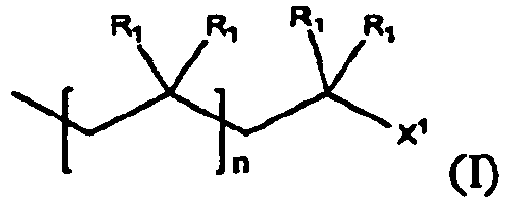

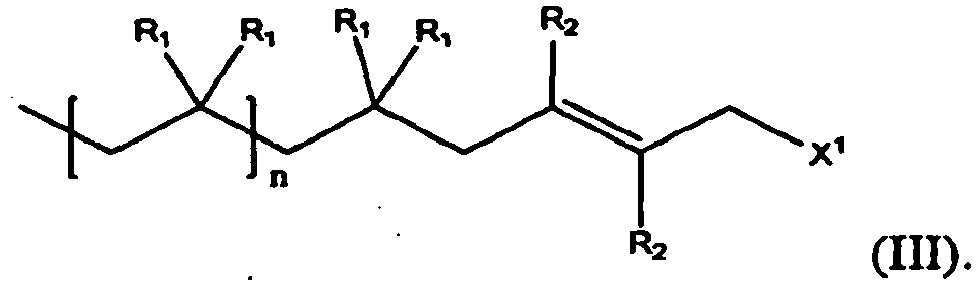
- In formulas (I) through (III): n is an integer not less than 2; R1 for each occasion is independently H or a C1-C4 alkyl, an alkoxy, for examples a straight or branched C1-C12 alkoxy such as methoxy, ethoxy, isobutoxy, etc., or a substituted or unsubstituted aryl, for example C6-C 18 aryls, preferably phenyl, optionally substituted with C1-C4 straight or branched alkyl, halogen, or a C1-C4 alkoxy; and R2 for each occasion is independently H or an electron-withdrawing group, for example, X2, CH2X2, CHX2 2, -CX2 3, -C ≡ N, -NO2; and X1 and X2, for each occurrence, is independently a halogen (F, Cl, Br, or I).
- Although formulas (I) and (III) above show monofunctional polymers, the methods and the compounds of the present invention include polyfunctional polymers, represented by formulas (Ia) and (IIIa):

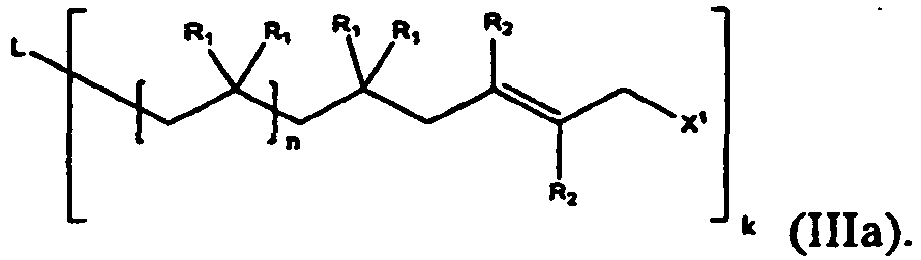
- In one embodiment, the compound of formula (III) and (IIIa) are represented by structural formulas (IIIc) and (IIId), respectively:

 can be in either cis or trans substituent. The remainder of values and preferred values for the variable in formulas (IIIc) and (IIId) are as defined above with respect to formulas (III) and (IIIa).
- Solvents suitable for practicing the reactions of the present invention are, for example, solvents that include at least one component having a dielectric constant less than 9. Preferably, the solvents include at least one component having a dielectric constant less than 7. Alternatively, the solvents include a mixture of at least one solvent having a polar solvent with a dielectric constant equal to or higher than 9 and at least one nonpolar solvent with a dielectric constant lower than 6. Examples of suitable solvents include one or more of hexane, cyclohexane, methylcyclohexane, methylchloride, n-butyl chloride, dichloromethane, toluene, and chloroform.
- In another embodiment, a bromoallyl-capped polymer can be used in subsequent hydrolysis. Synthesis of such a bromo functionalized haloallyl can, for example, be accomplished by reacting a polymer of formula (IV)


- In one embodiment, the compound of formula (V) is represented by structural formula (Va):

- Haloallyl functional polymers of general formula (III) can be subjected to a simple hydrolysis by a base (e.g. inorganic base such as alkali hydroxide, carbonate, etc., or organic base such as Tetrabutylammonium Hydroxide, 1,8-Diazabicyclo[5.4.0]undec-7-ene, 1,5-Diazabicyclo[4.3.0]non-5-ene, N,N,N',N'-Tetramethyl-1,8-naphthalenediamine, Phosphazene bases such as N'-tert-Butyl-N,N,N',N',N",N"-hexamethylphosphorimidic triamide, etc.) to produce hydroxyl functional hydrocarbon polymers of general formula (VI) according to Scheme (II) below:

- In one embodiment, compound of formula (III) can be represented by formula (IIIc), while the compound of formula (VI) is represented by structural formula (VIa):

- Any suitable solvent or solvent mixtures in which reagents are soluble and with which reagents do not react can be used. The reaction is most commonly carried out in a solvent mixture. The starting materials preferably are dissolved in an ethereal solvent such as tetrahydrofuran (THF), dioxane and the like. For example, the solvent can be THF or a mixture of THF and water. A mixture of organic solvent (e.g. THF) in which the polymer is soluble but that is miscible with water is preferred when an inorganic base is used for hydrolysis. Alternatively a phase transfer catalyst such as quaternary ammonium salts or crown ethers may be employed.
- Suitable bases employed in hydrolysis include inorganic bases, for example, sodium hydroxide, sodium bicarbonate or potassium hydroxide can be employed. The concentration of the base employed in hydrolysis can be (in percent by weight), for example, from about 0.5% to about 95%, for example: 0.5%, 1%, 1.5%, 5%, 10%, 15%, 20%, 25%, 30%, 35%, 40%, 45%, 50%, 55%, 60%, 65%, 70%, 75%, 80%, 85%, 90% or 95%.
- The hydrolysis can be carried out at a temperature from about 50 °C to about 150 °C. For example, the hydrolysis can be carried out at a temperature from 50 °C to 60 °C, 60 °C to 70 °C, 70 °C to 80 °C, 80 °C to 90 °C, 90 °C to 100 °C, 100 °C to 110 °C, 110 °C to 120 °C, 120 °C to 130 °C, 130 °C to 140 °C, 140 °C to 150 °C. In other examples, the hydrolysis can be carried out at about 65 °C, about 100 °C, or at about 130 °C.
- The hydrolysis can be carried out for any time from about 30 minutes to about 48 hours. For example, hydrolysis can be carried out for a time period of 0.5 hours to 2 hours, 2 hours to 4 hours, 4 hours to 6 hours, 6 hours to 8 hours, 8 hours to 10 hours, 10 hours to 12 hours, 12 hours to 14 hours, 14 hours to 16 hours, 16 hours to 18 hours, 18 hours to 20 hours, 20 hours to 22 hours, 22 hours to 24 hours, 24 hours to 30 hours, 30 hours to 36 hours, 36 hours to 42 hours, 42 hours to 48 hours. In certain embodiments, the hydrolysis can be carried out for 2 hours, 4 hours, 6 hours, 12 hours, 24 hours, 26 hours or 48 hours.
- In Scheme (II), X1 can be Cl, Br, or I. Preferably, X1 is Cl or Br. More preferably, X1 is Br. In one embodiment, X1 in Scheme (II) is Cl.
- An example of an inorganic base employed in the hydrolysis step is potassium hydroxide. The hydrolysis is carried out at a temperature from about 80 °C to about 120 °C, preferably, at 90-110 °C. Alternatively, temperature is from about 100 °C to about 150 °C, preferably, at 120-140 °C. The reaction is carried out for the duration from about 12 hours to about 36 hours, preferably, for 20-28 hours. The concentration of KOH is from about 1% to about 25% by weight, preferably, about 1-10% by weight.
- More preferably, X1 is Cl, KOH concentration is at 1-10% by weight, and the hydrolysis is carried out for 20-28 hours at 90-110 °C. Even more preferably, X1 is Cl, KOH concentration is at 1-10% by weight, and the hydrolysis is carried out for 20-28 hours at 120-140 °C.
- In another embodiment, X1 in Scheme (II) is Br. An example of an inorganic base employed in the hydrolysis step is potassium hydroxide. The hydrolysis is carried out at a temperature from about 60 °C to about 100 °C, preferably, at 55-75 °C. Alternatively, hydrolysis is carried out at a temperature from about 100 °C to about 150 °C, preferably, at 120-140 °C. The reaction is carried out for the duration from about 1 hours to about 10 hours, preferably, for 2-5 hours. The concentration of KOH is from about 0.5% to about 60% by weight, preferably, about 40-60% by weight. Alternatively, the concentration of KOH is from 0.5% to 1.5%. More preferably, X1 is Br, KOH concentration is at 40-60% by weight, and the hydrolysis is carried out for 20-28 hours at 55-75 °C. Even more preferably, X1 is Br, KOH concentration is at 0.5-1.5% by weight, and the hydrolysis is carried out for 2-5 hours at 120-140 °C.
- In addition to hydrolysis, haloallyl functional polymers of general formula (III) can be subjected to a nucleophilic attack by a variety of nucleophiles. Thus, in one embodiment, the present invention is a method of synthesis of a derivative of a compound of formula (III) by nucleophilic substitution. The general synthetic route for this derivatization is given in scheme (III) below:

- In scheme (III), nucleophile Nu1 is any nucleophilic reagent capable of reacting with a compound of formula (III) in a solvent in which the a compound of formula (III) and Nu1 can be dissolved an remain stable. Preferably, Nu1 is selected from N3-, HC2CH2-O-, HO-, RaO-, thymine, -CH2-C(O)OH, wherein Ra is a C1-C12 alkyl or a polymer or copolymer fragment. As used herein, the terms "polymer" or "copolymer" mean a macromolecule built up by the linking of monomers by a process termed polymerization. As used herein, these terms include low molecular weight oligomers. Non-limiting examples of a polymer or copolymer fragment include polyethers such as polyethylene glycol (PEG), and polyesters such as polymers or copolymers of lactide, glycolide or ε-caprolactone. Examples of C1-C12 alkyls are methyl, ethyl.
- In certain embodiments of the present invention, a compound of formula (IIIb) is further reacted to replace moiety Nu1 with moiety Nu2. (See the description below.) Accordingly, in one embodiment, the present invention is a compound of formula (IIIf):

- Nu2 is selected from N3-, HC2CH2-O-, HO-, RaO-, wherein Ra is a C1-C 12 alkyl or a polymer or copolymer fragment (as defined above with reference to formula (IIIb)), thymine, -CH2-C(O)OH, -C(O)N3, -NHC(O)OR, -C(O)NHR, -NHC(O)NHR, wherein R is a C1-C12 alkyl, or a peptide-NH-.
- In one embodiment, the compound of formula (III) can be represented by formula (IIIc)


- General conditions for the reactions described below are known in the art and are described, for example, in March, "Advanced Organic Chemistry - Reactions, Mechanisms and Structure", 5th Edition, John Wiley & Sons, (2001). The preferred embodiments of the present invention are described below.
- The haloallyl-capped polymer of formula (III) was obtained as described above. The haloallyl-capped polymer (III) was converted to hydroxide, alkoxide (e.g. methoxide), azide, amine, aldehyde, acid and propargyl functionalities quantitatively using single step procedures.
- In the embodiments in which Nu2 replaces Nu1, one or more additional steps are employed. For example, modification of the carboxylate (XV) derivative can be employed to synthesize carbonylazide (XVI) (see scheme (X)), which may act as a building block to attach urea, urethane and amide chain extenders (scheme (XI)). Furthermore, peptides can also be effectively attached to the carbonylazide intermediate under mild conditions (scheme (XI)). The propynyloxy derivative (XII) obtained according to scheme (VI) can be further employed to synthesize a triazole derivative (XXI) according to scheme (XII).
- Accordingly, in one embodiment, the present invention is a method of synthesis of compound of formula (X):

- In one embodiment, the compound of formula (III) can be represented by formula (IIIc), while the compound of formula (X) is represented by formula (Xa):
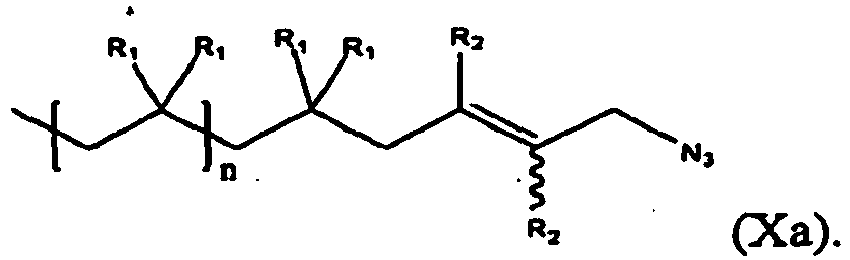
- The reaction conditions for the reaction of scheme (IV) are as follows: in a mixture of solvent, where one is dry THF and the other one is a dry polar aprotic solvent, in a temperature range of 25 °C to 75 °C and the reactions were carried out under nitrogen or argon atmosphere. For example, the reaction is carried out in a polar aprotic solvent such as nitromethane, dimethyl acetamide (DMA), N,N-dimethyl formamide (DMF), dimethyl sulfoxide (DMSO), hexamethyl phosphoramide (HMPA), N-methyl pyrrolidone (NMP), tetrahydrofuran (THF), or dioxane, or a mixture thereof. Preferably, the solvents is a THF/DMF mixture at 83.3%:16.7%. The temperature of the reaction is typically from about 25 °C to about 100 °C, preferably, from about 25 °C to about 75 °C, for example 50 °C.
- In another embodiment, the present invention is a method of synthesis of compound of formula (XI) according to Scheme (V):

The values and preferred values for the variables in formula (XI) are as defined above with reference to formula (III). - In one embodiment, the compound of formula (III) can be represented by formula (IIIc), the compound of formula (X) can be represented by formula (Xa), while the compound of formula (XI) is represented by formula (XIa):

- The synthetic route from compound (III) to (XI) can be carried out with any suitable amination reagent. Preferably, the amination reagent is potassium phthalimide followed by hydrolysis in hydrazine hydrate and basic solution. The reaction is preferably carried out in a mixture of dry THF and a dry polar aprotic solvent under nitrogen or argon atmosphere in a temperature range of 66 °C to 100 °C for 12 to 24 h. For example, the reaction is carried out in a polar aprotic solvent such as nitromethane, dimethyl acetamide (DMA), N,N-dimethyl formamide (DMF), dimethyl sulfoxide (DMSO), hexamethyl phosphoramide (HMPA), N-methyl pyrrolidone (NMP), tetrahydrofuran (THF), or dioxane, or a mixture thereof. Preferably, the solvents is a THF/DMF mixture at 75%:25%.
- The synthetic route from compound (X) to (XI) can be carried out with any suitable reducing reagent such as LiAlH4, NaBH4, H2/Pd or Ni and PPh3. Preferably, the reducing reagent is PPh3. The reaction is preferably carried out in a polar protic solvent. The polar solvent can be one or more of a polar protic solvent, such as water or an alcohol; an ethereal solvent such as THF, dioxane and the like. For example, the solvent can be a mixture of THF and water. Preferably, the mixture of THF and water 91%:9% is used.
- In another embodiment, the present invention is a method of synthesis of compound of formula (XII) according to Scheme (VI):

- In one embodiment, the compound of formula (III) can be represented by formula (IIIc), while the compound of formula (XII) is represented by formula (XIIa):

- The reaction conditions for the reaction of scheme (VI) are as follows: in a polar aprotic solvent such as nitromethane, dimethyl acetamide (DMA), N,N-dimethyl formamide (DMF), dimethyl sulfoxide (DMSO), hexamethyl phosphoramide (HMPA), N-methyl pyrrolidone (NMP), tetrahydrofuran (THF), or dioxane, or a mixture thereof and in presence of a base, i.e. sodium hydride, KOH, NaOH etc under inert atmosphere and in the temperature range of 20-100 °C. Preferably, if KOH is used as the base, the solvent is dry THF and the temperature is 70 °C.
- In another embodiment, the present invention is a method of synthesis of compound of formula (XII) according to Scheme (VII):

- In one embodiment, the compound of formula (III) can be represented by formula (IIIc), while the compound of formula (XIII) is represented by formula (XIIIa):

- The reaction is most commonly carried out in an alcoholic solvent, except with PEG. In the latter case the preferred solvent is an aprotic polar solvent such as tetrahydrofuran. An ethereal solvent such as tetrahydrofuran (THF), dioxane and the like, is preferably used as a cosolvent. For example, the solvent can be a mixture of THF and an alcohol, such as methanol or ethanol the solvent has to be a polar aprotic and polar protic mixture.
- In scheme (VII), the reaction is preferably catalyzed by a base. Suitable bases include inorganic bases, for example, sodium hydroxide, sodium bicarbonate or potassium hydroxide can be employed. Preferably, the solvent is a THF/MeOH mixture at 83.3%:16.7%. The temperature of the reaction is typically from about 66 °C to about 100 °C, preferably, 70 °C.
- In another embodiment, the present invention is a method of synthesis of compound of formula (XIV) according to Scheme (VIII):

- In one embodiment, the compound of formula (III) can be represented by formula (IIIc), while the compound of formula (XIV) is represented by formula (XIVa):

- The reaction conditions for the reaction of scheme (VIII) are as follows: a mixture of polar aprotic solvent hexamethyl phosphoramide (HMPA), N-methyl pyrrolidone (NMP), tetrahydrofuran (THF) and water in a temperature range of 25 °C to 100 °C. In scheme (VIII), the reaction is preferably catalyzed by a base. Suitable bases include inorganic bases, for example, sodium hydroxide, sodium bicarbonate or potassium hydroxide can be employed. Preferably, KOH is used as the base, the solvent is a mixture of THF and water and the temperature is 70 °C.
- In another embodiment, the present invention is a method of synthesis of compound of formula (XV), starting from a compound of formula (III) and dimethylmalonate according to Scheme (IX):

- In one embodiment, the compound of formula (III) can be represented by formula (IIIc), while the compound of formula (XV) is represented by formula (XVa):

- The reaction conditions for the reaction of scheme (IX) are as follows: a polar aprotic solvent, temperature range 25-100 °C under inert (nitrogen or argon) atmosphere] Preferably the solvent is dry THF and the temperature is 70 °C.
- In another embodiment, the present invention is a method of synthesis of compound of formula (XVI), starting from a compound of formula (XV) according to scheme (X):

- In one embodiment, the compound of formula (XV) can be represented by formula (XVa), while the compound of formula (XVI) is represented by formula (XVIa):
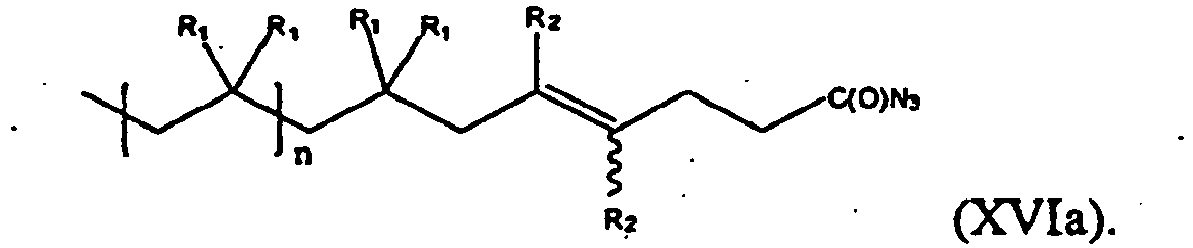
- The reaction conditions for the synthetic route from compound (XV) to compound (XVI) are as follows: in a polar aprotic solvent, i.e. THF, in presence of a base, i.e. triethyleneamine or pyridine in a temperature range of -10 °C to 30 °C under inert atmosphere. Preferably, the solvent is THF, the base is triethylamine and the temperature range is 0-25 °C.
- In another embodiment, the present invention is a method of synthesis of any of the compounds of formula (XVII), (XVIII), (XIX) and (XX) according to the reactions of Scheme (XI), where "rt" stands for room temperature:
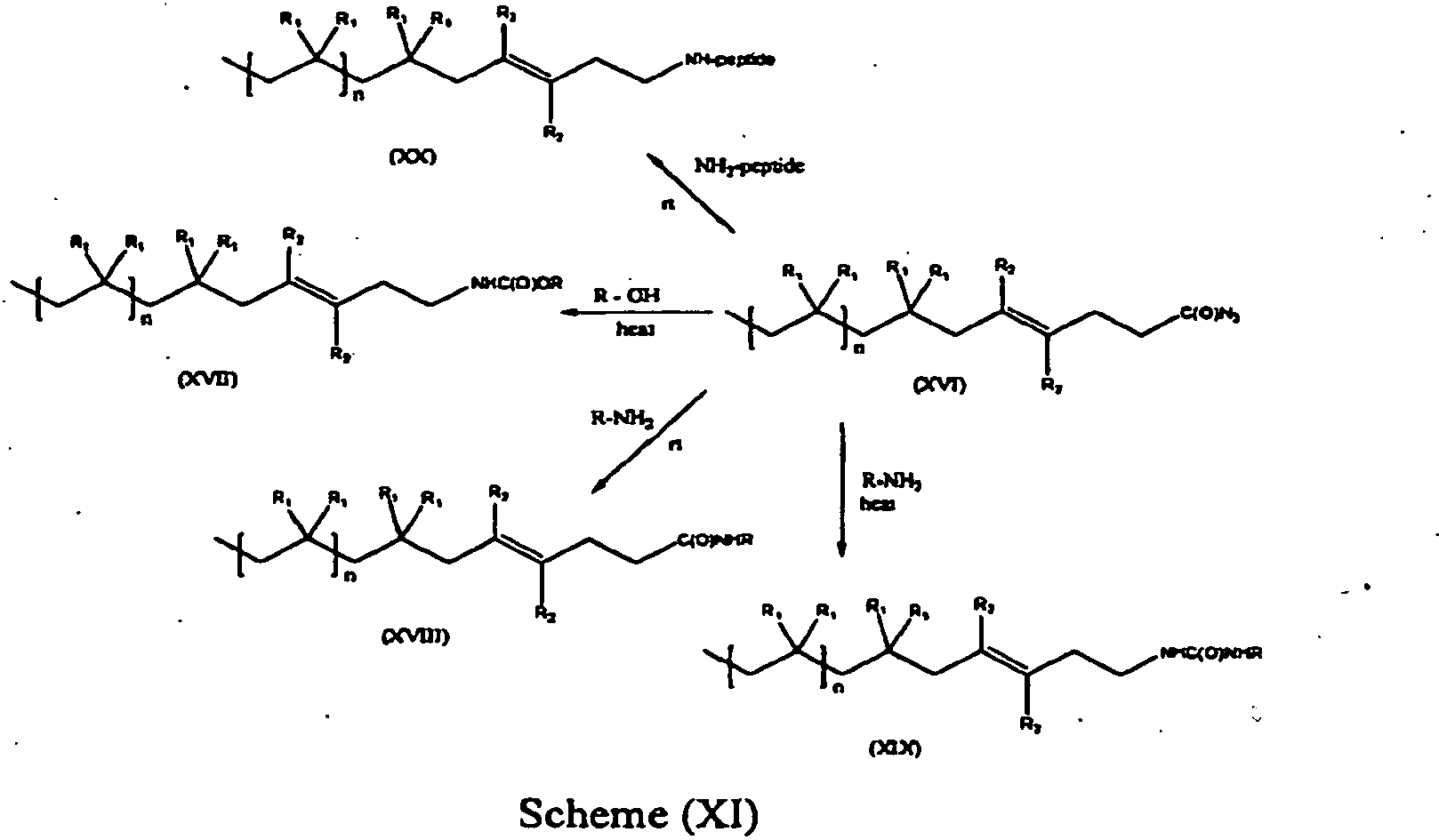
- In one embodiment, the compound of formula (XVI) can be represented by formula (XVIa), while the compound of formulas (XVII)-(XX) is represented by formulas (XVIIa)-(XXa):
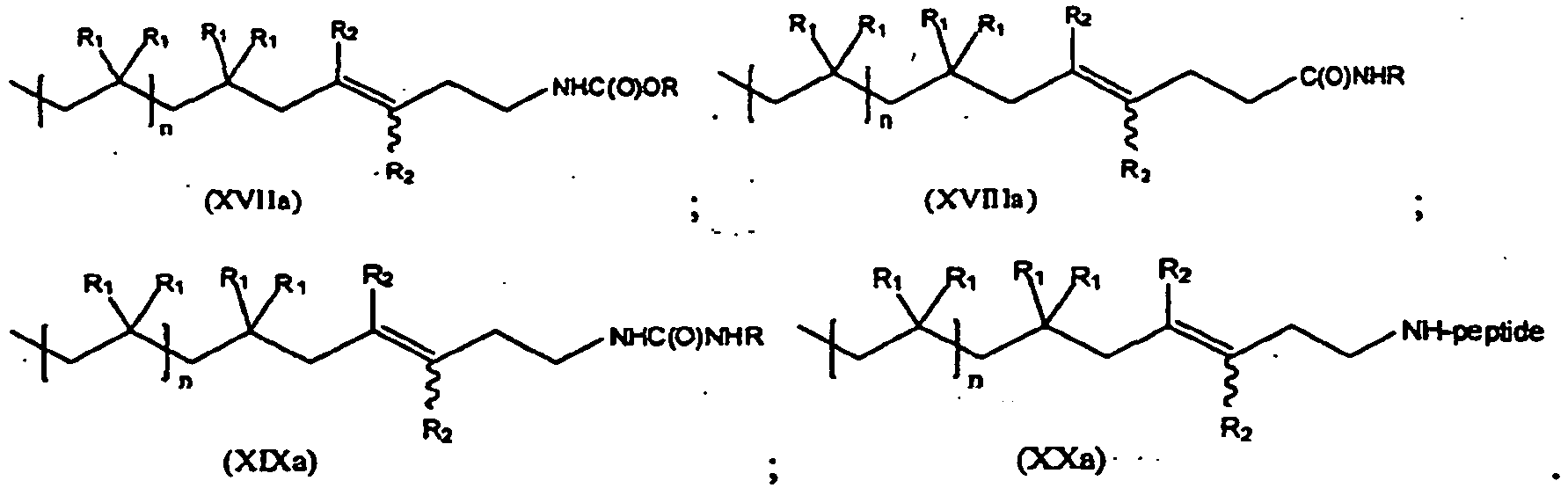
- The reaction conditions for the synthetic routes from compound (XVI) to compounds (XVII) through (XX) are as follows: in a polar aprotic solvent and within a temperature range of 25 °C to 100 °C.
- In another embodiment, the present invention is a method of synthesis of compound of formula (XXI), starting from a compound of formula (XII) according to scheme (XII):

- The values and preferred values for the variables in formula (XXI) are as defined above with reference to formula (III). In scheme (XII), Rb is an optionally substituted alkyl (for example C1-C20 alkyl), an optionally substituted aryl (for example C6-C20 aryls, preferably phenyl, optionally substituted with C1-C4 straight or branched alkyl or halogen), an optionally substituted heteroaryl (e.g., C6-C20 heteroaryl) or a polymer or copolymer fragment. Preferably, polymer or copolymer is soluble in water, and/or has a glass transition or melting temperature above 25 °C, and/or is biodegradable. Non-limiting examples of a polymer include polyethers such as polyethylene glycol (PEG), and polyesters such as polylactide.
- In one embodiment, the compound of formula (XII) can be represented by formula (XIIa), while the compound of formula (XXI) is represented by formula (XXIa):

- The reaction conditions for the reaction of scheme (XII) are as follows: in a polar aprotic solvent and water mixture, the temperature range is 20-66 °C.
- Alternatively, formula (XXI) is a block copolymer, wherein Rb is a polymer or a block copolymer.
- As mentioned above, compounds (IIIa) and (IIId) can be used in the methods of the present invention:

- In one embodiment, the present invention.is a compound of formula (XXXIVa)


- In another embodiment, the present invention is a compound represented by formula (XXXVa):


- In one embodiment, the present invention is a compound of formula (XXXVIa):


- In one embodiment, the present invention is a compound of formula (XXXVIIa):


- Values and preferred values of the variables in formulas (XXXVII) and (XXXVIIa) are as defined above with respect to formulas (IIIa) and (XIV).
- In one embodiment, the present invention is a compound of formula (XXXVIIIa):


- Values and preferred values of the variables in formulas (XXXVIII) and (XXXVIIIA) are as defined above with respect to formulas (IIIa) and (XV).
- In one embodiment, the present invention is a compound of formula (XXXIXa):


- Values and preferred values of the variables in formulas (XXXIX) and (XXXIXa) are as defined above with respect to formulas (IIIa) and (XVI).
- In one embodiment, the present invention is a compound of formula (XLa):


- Values and preferred values of the variables in formulas (XL) and (XLa) are as defined above with respect to formulas (IIIa) and (XVII).
- In one embodiment, the present invention is a compound of formula (XLIa):


- Values and preferred values of the variables in formulas (XLI) and (XLIa) are as defined above with respect to formulas (IIIa) and (XVIII).
- In one embodiment, the present invention is a compound of formula (XLIIa):
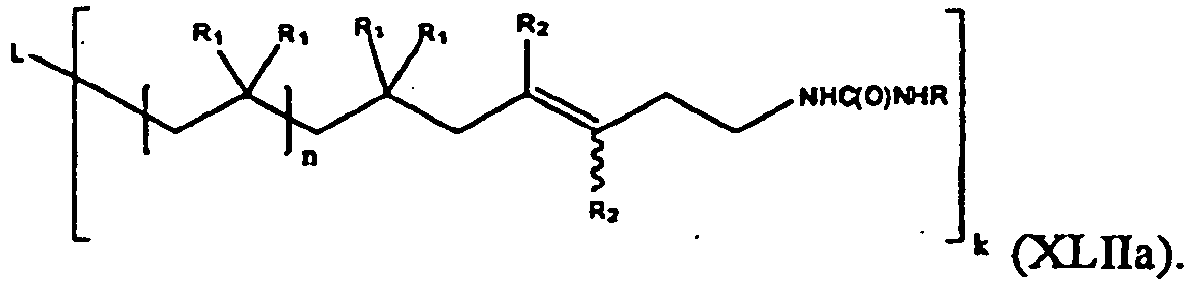
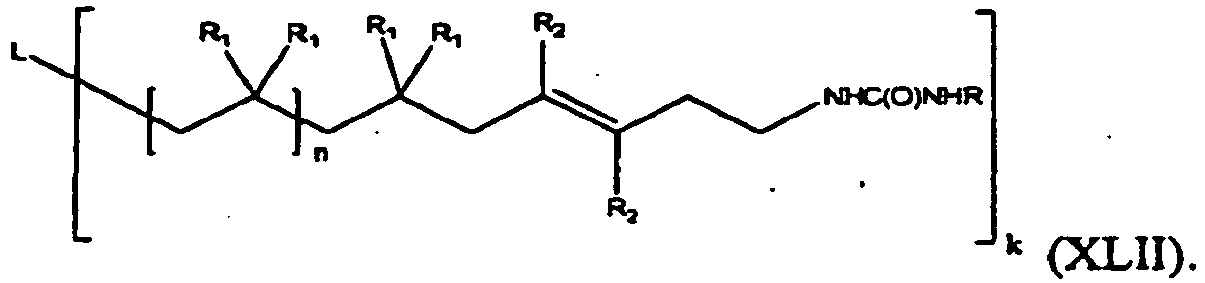
- Values and preferred values of the variables in formulas (XLII) and (XLIIa) are as defined above with respect to formulas (IIIa) and (XIX).
- In one embodiment, the present invention is a compound of formula (XLIIIa):


- Values and preferred values of the variables in formulas (XLIII) and (XLIIIa) are as defined above with respect to formulas (IIIa) and (XX).
- The α,ω-PIB-diol, diamine or diacid (or the corresponding polyfunctional PIBs) are valuable intermediates to thermoplastic polyurethane, polyester or polyamide elastomers or elastomer modified plastics. The α,ω-PIB-diamine (or the corresponding polyfunctional PIBs) may also be employed to cure epoxy resins or modify the properties of cured epoxy resins. End-functional PIBs containing azide and alkyne functionalities can be employed in the modular synthesis of block copolymers by the Sharpless type click reaction (1,3 dipolar cycloaddition). Thymine functional PIBs can be chain extended or crosslinked by UV light catalyzed photodimerization. PIB based amphiphilic block copolymers, such as PIB-block-PEO, are useful as surfactants.
- The above polymers of the present invention exhibit improved properties. For example, thermoplastic polyurethanes obtained from polymeric diols presently employed as materials for the soft segments, i.e., polyester diols, polyether diols and polydiene diols, suffer from serious limitations. The polyester based polyurethane is prone to hydrolytic degradation, the polyether component undergoes oxidative degradation in vivo and polydienes suffer from poor thermal and oxidative stability. In contrast PIB has excellent thermal, oxidative and biostability.
- The thermoplastic polyurethanes, polyesters or polyamides of the present invention are potential new thermoplastic elastomers, other polymeric materials and biomaterials. In some embodiments, the article of manufacture is an insertable or implantable medical device, e.g., a catheter, an endotracheal tube, a tracheostomy tube, a wound drainage device, a wound dressing, a stent coating, an implant, an intravenous catheter, a medical adhesive, a shunt, a gastrostomy tube, medical tubing, cardiovascular products, heart valves, pacemaker lead coating, a guidewire, or urine collection devices. In medical devices from which a therapeutic agent is released, certain compositions will also exhibit an appropriate release profile and therefore these materials are also useful as medical drug eluting articles and drug eluting coatings.
- In some embodiments, thermoplastic polyurethanes, polyesters or polyamides of the invention can be melt-processed, for example, by injection molding and extrusion. Compositions used for this method can be used alone or compounded with any other melt-processable material for molding.
- The thermoplastic polyurethanes, polyesters or polyamides of the invention can also be coated onto preformed articles. When used as a coating, the copolymers can be applied by any means, including those methods known in the art. For example, a composition comprising the thermoplastic polyurethanes, polyesters or polyamides of the invention can be brushed or sprayed onto the article from a solution, or the article can be dipped into the solution containing the copolymers of the invention.
- First, isobutylene (IB) was polymerized in hexanes/methyl chloride 60/40 (v/v) at -80 °C using [IB] = 0.04 M, [2-chloro, 2,4,4-trimethylpentane, TMPCI] = 0.01 M, [2,6-di-tert.-butylpyridine, DTBP] = 0.006 M and [TiCl4] = 0.036 M for 60 minutes and then 1,3-butadiene (BD) at [BD] = 0.04 M at -80 °C was added. After 6 hours the reaction was quenched with pre-chilled methanol. Quantitative crossover reaction from living polyisobutylene (PIB) chain end to 1,3-butadiene followed by instantaneous termination (absence of multiple addition of BD) and selective formation of 1,4-addition product was obtained (conversion of IB = 100 %, Mn,GPC = 3200, Mn,NMR = 2800, PDI = 1.07). The 1H NMR analysis of the product showed the exclusive formation PIB-AllylCl (VII):

- ClAllyl-PIB-AllylCl was synthesized similarly, using 5-tert-butyl-1,3-bis(1-chloro-1-methylethyl) benzene instead of TMPCl.
- Halogen exchange reaction was carried out in a toluene/acetone mixture (65/35, v/v) using a large excess ([LiBr]/[PIB-AllylCl] = 200) of anhydrous LiBr under a dry nitrogen atmosphere. A typical experiment is as follows: In a two-necked round-bottomed flask, PIB-AllylCl (5 g; 1 % w/v), LiBr (31 g), toluene (325 mL), and acetone (175 mL) were placed and refluxed with stirring. After 12 hours, the solution was cooled to room temperature. Then, the solvent was evaporated under reduced pressure. Excess LiBr was removed by washing with distilled water. The polymer was purified by precipitation using a Hex/methanol system twice. The 1H NMR analysis of the product showed complete exchange of Cl to Br.
- In a typical experiment 0.5 g of PIB-AllylX was dissolved in 10 mL tetrahydrofuran. Next, 1-10 ml of KOH solution (1, 5, 10 and 50%) in water was added and the reaction was carried out for a predetermined time at a predetermined temperature. Experiments carried out at temperatures higher than the boiling point of tetrahydrofuran were carried out in pressure reactors. After the reaction hexanes was added and the solution was washed with water until neutral. The solution was dried on anhydrous NaSO4 and the polymer was recovered by evaporating hexanes on the rotavap. The product was characterized by 1H NMR and FTIR spectroscopy.
-
PIB-AllylCl, 24 hours, 100 °CKOH conc., % Hydrolysis Yield, % 1 10 5 34 10 27
PIB-AllylCl, 24 hours, 130 °CKOH conc., % Hydrolysis Yield, % 5 87 10 63
PIB-AllylBr, 24 h, reflux temperature (65 °C)KOH conc., % Hydrolysis Yield, % 1 15 5 25 10 33 50 37
PIB-AllylBr, 24 h, 130 °CKOH conc., % Hydrolysis Yield, % 1 100 - In a typical experiment 0.1 g dihaloallyl PIB dissolved in 10 mL THF was placed in a Parr pressure reactor (capacity 125mL) and 10 ml of 1% KOH solution was added to it. The reaction was then heated and allowed to proceed at 130 °C. After predetermined times the reactor was cooled to room temperature and the solvent was removed under reduced pressure. The polymer was dissolved in hexanes and washed with distilled water. The organic layer was passed dried on anhydrous sodium sulfate and concentrated under reduced pressure to yield the crude product. The crude product was purified by re-precipitation in hexanes/methanol and the polymer was dried under vacuum. According to 1H NMR spectroscopy complete hydrolysis was accomplished in 3h for BrAllyl-PIB-AllylBr and in 24 h for ClAllyl-PIB-AllylCl.
- Dry THF (10 mL) was taken in a 100 mL three necked round bottomed flask fitted to a reflux condenser. A continuous nitrogen gas flow was maintained through out the course of reaction. To it PIB-allyl-chloride (200 mg, 0.07 mmol) was added and the mixture was stirred till a homogenous solution was obtained. Dry MeOH was added to the solution in dropwise manner till turbidity occurs. Further 3-4 drops of dry THF was added to the mixture to obtain a clear solution. To the reaction mixture KOH (180 mg, 3.21 mmol) was added and the mixture was refluxed for 5 hours. The reaction was stopped and cooled to room temperature. The excess THF was distilled and the sticky mass obtained was dissolved in hexane and re-precipitated in methanol. The process was repeated thrice to remove the inorganic impurities. The solid was then kept under vacuum to remove the traces of solvents.
- Physical state: Sticky solid, Yield: 87%, NMR (CDCl3, ppm, δ): 5.75, 5.55, 3.90, 3.35, 2.05, 1.45, 1.1.
- PIB-allyl-chloride (200 mg, 0.07 mmol) was dissolved in dry THF (20 mL) and to it PEG-OH (420 mg, 0.21 mmol) was added. The mixture was kept under nitrogen atmosphere and KOH (960 mg, 17.5 mmol) was added to it with constant stirring. The stirring mixture was set to reflux for 48 h. The reaction was stopped and cooled to room temperature. The mixture was filtered and the filtrate was kept under reduced pressure to evaporate the solvent. The residue was dissolved in chloroform and washed with water to remove excess PEG-OH. The organic layer was passed through sodium sulfate and evaporated to get a sticky white liquid. According to 1H NMR studies 100% conversion with respect to PIB-allyl-chloride was achieved.
- In a modified procedure 1:1 equivalent of PIB-allyl-chloride and PEG-OH were reacted for 16 h under nitrogen atmosphere using a temperature range of 0 °C to ambient temperature with 250 molar equivalent of sodium hydride and 50 equivalent of tetrabutylammmmonium bromide. The 1H NMR spectrum showed 93% coupling efficiency with respect to the PIB-allyl-chloride.
- Dry THF (10 mL) was taken in a 100 mL three necked round bottomed flask fitted to a reflux condenser. A continuous nitrogen gas flow was maintained through out the course of reaction. To it PIB-allyl-chloride (200 mg, 0.07 mmol) was added and the mixture was stirred till a homogenous solution was obtained. Dry DMF was added to the solution in dropwise manner till precipitation occurs. Further dry THF was added to the mixture to obtain a clear solution. To the stirring mixture NaN3 (200 mg, 3.08 mmol) was added and the mixture was heated at 50 °C for 3 hours and room temperature for 8 h. The reaction was stopped and cooled to room temperature. The excess THF was distilled and the sticky mass obtained was dissolved in hexane and re-precipitated in methanol. The process was repeated thrice to remove the inorganic impurities. The product was then vacuum dried at room temperature.
- Physical state: Sticky solid; Yield: 91%; NMR (CDCl3, ppm, δ): 5.82, 5.55, 3.74, 2.08, 1.45, 1.15; FT-IR (thin film, cm-1): 2952 (-CH str), 2097 (-N3 str), 1472, 1389, 1366, 1231, 762.
- PIB-allyl-chloride (272 mg, 0.095 mmol) was dissolved in dry THF (9 mL) and to it 3 mL of dry DMF was added and the mixture was stirred at room temperature. To the stirring mixture potassium phthalimide (278 mg, 1.5 mmol) was added and the mixture was set to reflux under nitrogen atmosphere for 12 hours. The reaction was stopped and cooled to room temperature. The excess THF was evaporated and methanol was added to the sticky mass left over. The precipitate formed was separated and dissolved in hexane. The solution was filtered and the filtrate was re-precipitated in methanol. The sticky solid obtained was further purified by dissolution and re-precipitation method using hexane and methanol.
- Physical state: Sticky solid; Yield: 83%; NMR (CDCl3, ppm, δ): 7.9, 7.7, 5.85,5.5,4.3,2.0, 1.4, 1.0.
- PIB-allyl-phthalimide (210 mg, 0.07 mmol) was dissolved in THF (10 mL) and to it hydrazine hydrate (190 mg, 3.8 mmol) was added and the mixture was refluxed for 24 h. The reaction was stopped and cooled to room temperature. The mixture was added with a solution of KOH (320 mg) in 2 mL of water and was further stirred for 30 min. THF was evaporated under reduced pressure and methanol was added to it. The precipitate obtained was further purified by dissolving in hexane and re-precipitating in methanol.
- Physical state: sticky solid; NMR (CDCl3, ppm, δ): 5.6, 3.3, 2.7, 2.0, 1.4, 1.0.
- Na (112 mg, 4.87 mmol) was taken in a three necked round bottomed flask (A) kept under nitrogen atmosphere. The temperature of the system was maintained at 0 °C with the help of an ice bath. Dry methanol (2 mL) was added to it in dropwise manner with constant stirring till the sodium becomes soluble. In another 100 mL rb flask (B) kept under nitrogen atmosphere, dry THF (10 mL) was taken followed by dimethylmalonate (522 mg, 5.67 mmol). The sodium methoxide solution was now transferred to the flask (B) with the help of a syringe and the mixture was stirred for 30 min at room temperature. The color of the solution becomes milky indicating the formation of sodium salt of dimethylmalonate. To it PIB-allyl-Cl (270 mg, 0.09 mmol) in dry THF (2 mL) was added slowly with stirring. The mixture was set to reflux for 12 hours. The reaction was stopped and cooled to room temperature. The solution was acidified till pH 4 by adding diluted HCl. The excess THF was evaporated under reduced pressure. The mass was added to methanol and the liquid portion was decanted of. The sticky solid was purified further by dissolution and reprecipitation method using hexane as solvent and methanol as non solvent. The polymer was further dissolved in 20 mL of THF and 3 mL of concentrated HCl was added to the solution in dropwise manner with stirring. The mixture was then refluxed for 24 hours. The product was neutralized with sodiumbicarbonate solution and the THF was evaporated. The sticky mass was dissolved in chloroform and was washed with water. The organic layer was passed through sodium sulfate and concentrated under reduced pressure to get a white sticky solid.
- Physical state: sticky solid; NMR (CDCl3, ppm. δ): 5.65, 5.4,2.7,2.0; FT-IR (thin film, cm-1): 2953 (-CH str), 1717 (-COOH str), 1471, 1389, 1366, 1231, 762.
- PIB-allyl-bromide (172 mg, 0.06 mmol) was dissolved in 15 mL of dry THF and 2 mL of dry acetonitrile was added to it. To the solution, K2CO3 (215 mg, 1.55 mmol) was added and the mixture was set to reflux. To the reflux mixture methyl malonate (210 mg, 1.6 mmol) was added and the refluxing continued for 20 hours. The reaction was then stopped and cooled to room temperature. The mixture was filtered and the filtrate was concentrated under reduced pressure. The mass obtained was purified by dissolving in hexane and reprecipitating in methanol.
- Physical state: sticky white solid; NMR (CDCl3, ppm, δ): 5.6, 5.35, 3.75, 3.45, 2.65, 1.95, 1.4, 1.0.
- PIB-allyl-chloride (212 mg, 0.074 mmol) was dissolved in 10 mL of dry THF and to it KOH (230 mg, 4.1 mmol) was added followed by propargyl alcohol (252 mg, 4.5 mmol). The mixture was set to reflux for 18 h. The progress of the reaction was checked after 5, 10 and 18 hours using 1H NMR spectroscopy, which indicated 50, 72 and 100% conversion respectively. The reaction was then stopped and cooled to room temperature. The excess THF was evaporated under reduced pressure. The sticky mass obtained was dissolved in hexane and precipitated in methanol. The process was repeated three times and the white sticky precipitate was kept under high vacuum to remove the traces of solvent trapped in the polymer matrix.
- Physical state: sticky solid; Yield: 92 %; NMR (CDCl3, ppm, δ): 5.8, 5.55, 4.2, 4.1, 2.45, 2.0, 1.4, 1.0.
Claims (16)
- A method of synthesizing a compound of formula (IIIe),


wherein:R1 for each occasion is independently H or a C 1-C4 alkyl, an alkoxy or a substituted or unsubstituted aryl;R2 for each occasion is independently H, X2, -CH2X2, -CHX2 2, -CX2 3, -C=N, or -NO2;n is an integer not less than 2;X1 and X2 are, for each occurrence, independently, a halogen; andNu1 is selected from N3-, HC2CH2-O-, HO-, RaO-, thymine, -CH2-C(O)OH,wherein Ra is a C1-C12 alkyl or a polymer or copolymer fragment. - The method of Claim 1, wherein the compound of formula (IIIc) is reacted according to following scheme to nucelophilically substitute X1 with -OH:

- The method of Claim 2, wherein the compound of formula (IIIc) is reacted by hydrolyzing in the presence of a base.
- The method of Claim 1, wherein the compound of formula (IIIc) is reacted according to following scheme to nucleophilically substitute X1 with N3 -:


- The method of Claim 1, wherein the compound of formula (IIIc) is reacted according to the following scheme to nucleophilically substitute X1 with -OCH2CCH:


- The method of Claim 1, whereina) the compound of formula (IIIc) is reacted according to the following scheme to nucleophilically substitute X1 with -ORa,
 b) the compound of formula (IIIc) is reacted according to the following scheme to nucleophilically substitute X1 with thymine: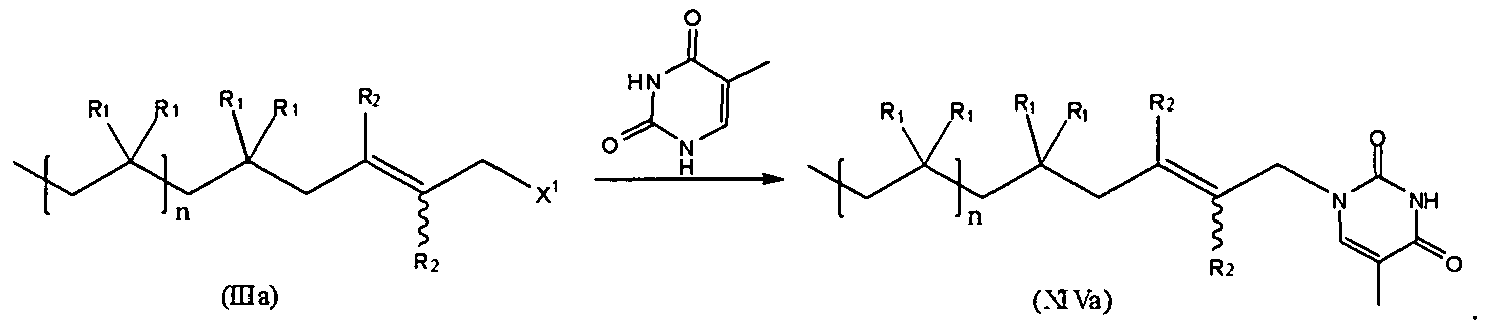
- The method of Claim 1, wherein the compound of formula (IIIc) is reacted according to the following scheme to nucleophilically substitute X1 with -CH2-COOH:

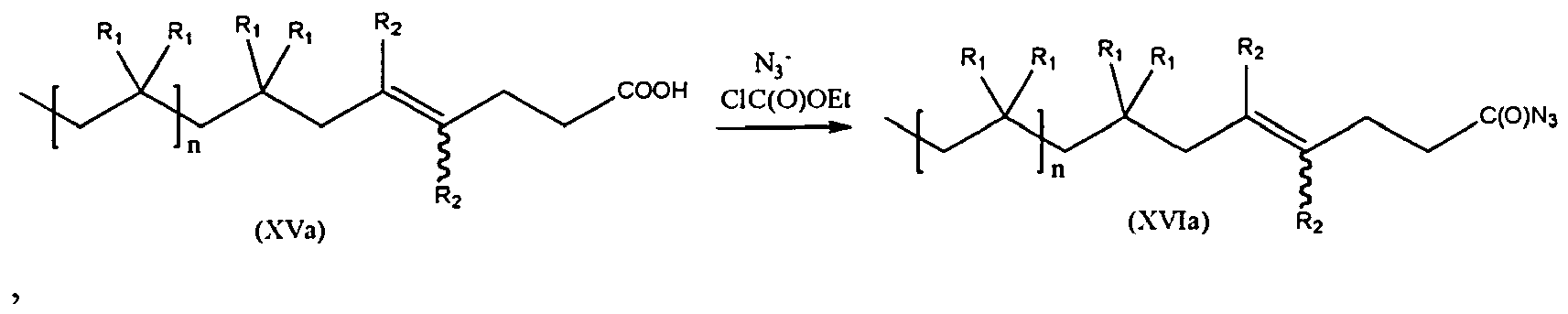 a) reacting the compound of formula (XVIa) with an alcohol R-OH to produce the compound of formula (XVIIa):
 b) reacting the compound of formula (XVIa) with an amine of formula R-NH2 to produce the compound of formula (XVIIIa):
 c) reacting the compound of formula (XVIa) with an amine of formula R-NH2 to produce a compound of formula (XIXa):
 d) reacting the compound of formula (XVIa) with a peptide to produce a compound of formula (XXa):
- The method of Claim 3, whereina) the polymer of formula (IIIc) is polyisobutylene, orb) the polymer of formula (IIIc) is a C4 to C7 isomonoolefin polymer, orc) X1 is Cl or Br, ord) the endcap group
 e) the endcap group
- The method of Claim 3, further including a step of producing the polymer of formula (IIIc) by reacting, in a solvent, a cationic living polymer of formula (I)


 a) further including the step of producing the cationic living polymer of formula (I) by reacting a cationically polymerizable monomer in the presence of a coinitiator, orb) wherein the coinitiator is one or more of BCl3, TiCl4, and organoaluminum halides, orc) wherein termination by halogenation is at least 10-fold faster than the addition of additional molecules of the conjugated diene, ord) wherein the solvent comprises at least one component having a dielectric constant less than 9, ore) wherein the solvent is selected from one or more of hexane, cyclohexane, methylcyclohexane, methylchloride, n-butyl chloride, dichloromethane, toluene, and chloroform.
 - The method of Claim 3, wherein X1 is Cl, and optionally wherein the hydrolysis is carried outa) at a temperature from 80 °C to 120 °C, orb) at a temperature from 100 °C to 150 °C, orc) for the duration from 12 hours to 36 hours, ord) in the presence of from 1% to 25% alkali metal hydroxide by weight.
- The method of Claim 3, whereina) X1 is Cl, the hydrolysis is carried out at a temperature from 80 °C to 120 °C for the duration from 12 hours to 36 hours in the presence of from 1% to 25% alkali metal hydroxide by weight, and optionally the alkali metal hydroxide concentration is at 1-10% by weight, and the hydrolysis is carried out for 20-28 hours at 90-110 °C, orb) X1 is Cl, the hydrolysis is carried out at a temperature from 100 °C to 150 °C for the duration from 12 hours to 36 hours in the presence of 1% to 25% alkali metal hydroxide by weight, and optionally the alkali metal hydroxide concentration is at 1-10% by weight, and the hydrolysis is carried out for 20-28 hours at 120-140 °C.
- The method of Claim 3, wherein X1 is Br, and optionally wherein the hydrolysis is carried outa) at a temperature from 60 °C to 100 °C, orb) at a temperature from 100 °C to 150 °C, orc) for the duration from 1 hours to 10 hours, ord) in the presence of from 0.5% to 60% alkali metal hydroxide by weight.
- The method of Claim 3, whereina) X1 is Br, the hydrolysis is carried out at a temperature from 60 °C to 100 °C, for the duration from 12 hours to 36 hours, in the presence of from 0.5% to 60% alkali metal hydroxide by weight, and optionally the alkali metal hydroxide concentration is at 40-60% by weight, and the hydrolysis is carried out for 20-28 hours at 55-75 °C, orb) X1 is Br, the hydrolysis is carried out at a temperature from 100 °C to 150 °C, for the duration from 12 hours to 36 hours, in the presence of from 0.5% to 60% alkali metal hydroxide by weight, and optionally the alkali metal hydroxide concentration is at 0.5-1.5% by weight, and the hydrolysis is carried out for 20-28 hours at 120-140 °C.
- A functional end-capped living cationic polymer of formula (XXXa):

n is an integer not less than 2;
k is an integer greater than or equal to 1;
L is an initiator residue;
R1 for each occasion is independently H or a C1-C4 alkyl, an alkoxy or a substituted or unsubstituted aryl; and
R2 for each occasion is independently H or X2, CH2X2, CHX2 2, -CX2 3, -C= N, -NO2, wherein X2, for each occurrence, is independently a halogen;
Nu2 is selected from N3-, HC2CH2-O-, HO-, RaO-, wherein Ra is a C1-C12 alkyl or a polymer or copolymer fragment, thymine, -CH2-C(O)OH, -C(O)N3, -NHC(O)OR, -C(O)NHR, -NHC(O)NHR, wherein R is a C1-C12 alkyl, or a peptide-NH-. - A compound of Claim 14 represented by formula (XXXI):
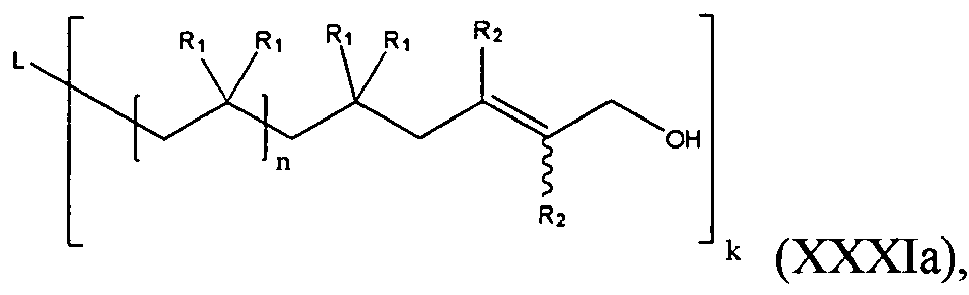 b) by formula (XXXIIa):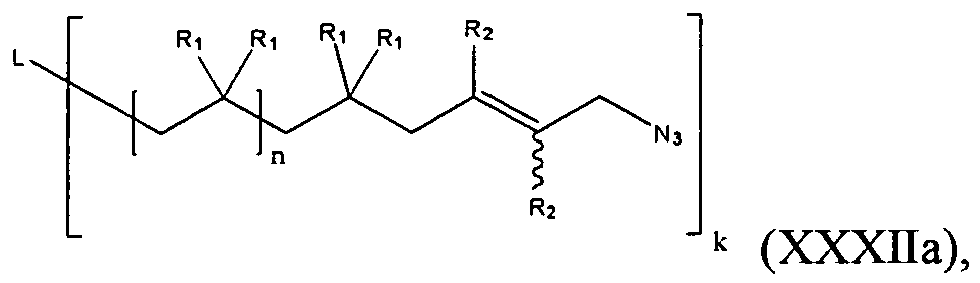
 c) by formula (XXXIVa):
 d) by formula (XXXVa):
 e) by formula (XXXVIa):
 f) by formula (XXXVIIa):
 g) by formula (XXXVIIIa):
 h) by formula (XXXIXa):
 i) by formula (XLa):
 j) by formula (XLIa):
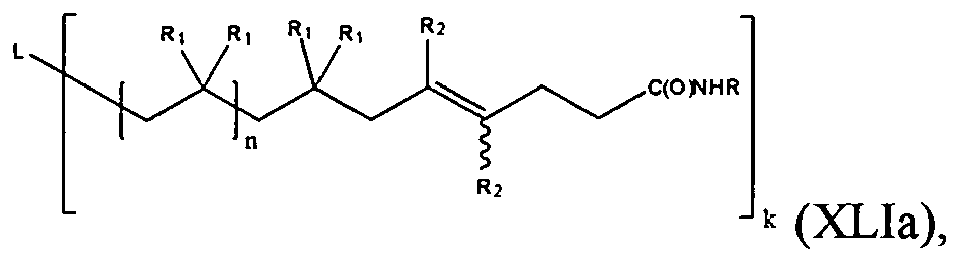 k) by formula (XLIIa):
 l) by formula (XLIII):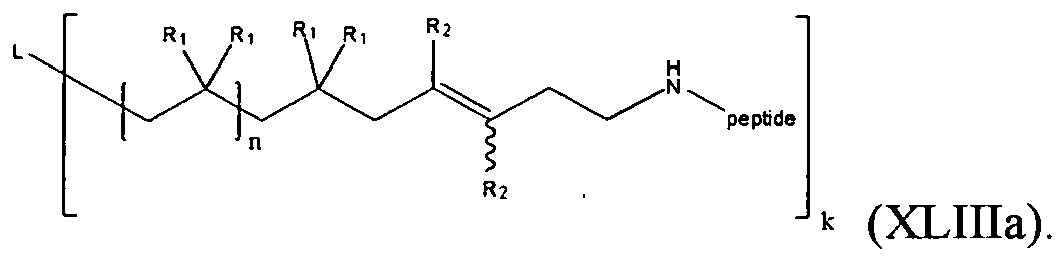
- The method of claim 1, wherein the groups R2 are in a relative trans position.
Applications Claiming Priority (2)
| Application Number | Priority Date | Filing Date | Title |
|---|---|---|---|
| US85988306P | 2006-11-17 | 2006-11-17 | |
| PCT/US2007/012948 WO2008060333A1 (en) | 2006-11-17 | 2007-06-01 | Functional hydrocarbon polymers and process for producing same |
Publications (2)
| Publication Number | Publication Date |
|---|---|
| EP2094738A1 EP2094738A1 (en) | 2009-09-02 |
| EP2094738B1 true EP2094738B1 (en) | 2013-02-27 |
Family
ID=38596602
Family Applications (1)
| Application Number | Title | Priority Date | Filing Date |
|---|---|---|---|
| EP07795606A Not-in-force EP2094738B1 (en) | 2006-11-17 | 2007-06-01 | Functional hydrocarbon polymers and process for producing same |
Country Status (5)
| Country | Link |
|---|---|
| US (1) | US20100069578A1 (en) |
| EP (1) | EP2094738B1 (en) |
| JP (1) | JP2010510348A (en) |
| CA (1) | CA2669970A1 (en) |
| WO (1) | WO2008060333A1 (en) |
Families Citing this family (41)
| Publication number | Priority date | Publication date | Assignee | Title |
|---|---|---|---|---|
| WO2006110647A1 (en) * | 2005-04-08 | 2006-10-19 | University Of Massachusetts Lowell Research Foundation | Capping reactions in cationic polymerization; kinetic and synthetic utility |
| US8034396B2 (en) * | 2008-04-01 | 2011-10-11 | Tyco Healthcare Group Lp | Bioadhesive composition formed using click chemistry |
| JP5592882B2 (en) | 2008-06-27 | 2014-09-17 | カーディアック ペースメイカーズ, インコーポレイテッド | Polyisobutylene urethane, urea and urethane / urea copolymer and medical devices containing the same |
| EP4282449A3 (en) | 2009-01-12 | 2024-02-28 | University Of Massachusetts Lowell | Polyisobutylene-based polyurethanes |
| US9375699B2 (en) | 2009-02-21 | 2016-06-28 | Sofradim Production | Apparatus and method of reacting polymers by exposure to UV radiation to produce injectable medical devices |
| CA2753189A1 (en) | 2009-02-21 | 2010-08-26 | Nadya Belcheva | Medical devices having activated surfaces |
| WO2010095052A2 (en) | 2009-02-21 | 2010-08-26 | Sofradim Production | Compounds and medical devices activated with solvophobic linkers |
| US9273191B2 (en) | 2009-02-21 | 2016-03-01 | Sofradim Production | Medical devices with an activated coating |
| AU2010215192B2 (en) | 2009-02-21 | 2015-04-30 | Sofradim Production | Amphiphilic compounds and self-assembling compositions made therefrom |
| US8535477B2 (en) | 2009-02-21 | 2013-09-17 | Sofradim Production | Medical devices incorporating functional adhesives |
| EP2398943B1 (en) | 2009-02-21 | 2013-04-17 | Sofradim Production | Crosslinked fibers and method of making same using uv radiation |
| US8512728B2 (en) | 2009-02-21 | 2013-08-20 | Sofradim Production | Method of forming a medical device on biological tissue |
| US8968733B2 (en) * | 2009-02-21 | 2015-03-03 | Sofradim Production | Functionalized surgical adhesives |
| WO2010095049A1 (en) | 2009-02-21 | 2010-08-26 | Sofradim Production | Crosslinked fibers and method of making same by extrusion |
| US8877170B2 (en) * | 2009-02-21 | 2014-11-04 | Sofradim Production | Medical device with inflammatory response-reducing coating |
| US8663689B2 (en) * | 2009-02-21 | 2014-03-04 | Sofradim Production | Functionalized adhesive medical gel |
| CA2753217A1 (en) | 2009-02-21 | 2010-08-26 | Sofradim Production | Apparatus and method of reacting polymers passing through metal ion chelated resin matrix to produce injectable medical devices |
| CA2753188A1 (en) | 2009-02-21 | 2010-08-26 | Tyco Healthcare Group Lp | Medical devices having activated surfaces |
| US20120077934A1 (en) | 2009-03-23 | 2012-03-29 | University Of Massachusetts | Functional Polyisobutylene Based Macromonomers And Methods For Making And Using The Same |
| US8552122B2 (en) * | 2009-03-31 | 2013-10-08 | The University Of Southern Mississippi | Amine-terminated telechelic polymers and precursors thereto and methods for their preparation |
| WO2011022583A1 (en) | 2009-08-21 | 2011-02-24 | Cardiac Pacemakers, Inc. | Crosslinkable polyisobutylene-based polymers and medical devices containing the same |
| US8374704B2 (en) | 2009-09-02 | 2013-02-12 | Cardiac Pacemakers, Inc. | Polyisobutylene urethane, urea and urethane/urea copolymers and medical leads containing the same |
| US8644952B2 (en) | 2009-09-02 | 2014-02-04 | Cardiac Pacemakers, Inc. | Medical devices including polyisobutylene based polymers and derivatives thereof |
| US8795331B2 (en) | 2010-03-25 | 2014-08-05 | Covidien Lp | Medical devices incorporating functional adhesives |
| AU2011231246B2 (en) | 2010-03-25 | 2015-05-21 | Sofradim Production | Surgical fasteners and methods for sealing wounds |
| WO2012006147A1 (en) | 2010-06-29 | 2012-01-12 | Tyco Healthcare Group Lp | Microwave-powered reactor and method for in situ forming implants |
| CA2804251A1 (en) | 2010-07-01 | 2012-01-05 | Sofradim Production | Medical device with predefined activated cellular integration |
| WO2012014080A2 (en) | 2010-07-27 | 2012-02-02 | Sofradim Production | Polymeric fibers having tissue reactive members |
| WO2012087480A1 (en) | 2010-12-20 | 2012-06-28 | Cardiac Pacemakers, Inc. | Lead having a conductive polymer conductor |
| WO2013025465A1 (en) | 2011-08-12 | 2013-02-21 | Cardiac Pacemakers, Inc. | Method for coating devices using electrospinning and melt blowing |
| EP2782635B1 (en) | 2011-11-23 | 2020-09-02 | Cardiac Pacemakers, Inc. | Fibrous matrix coating materials |
| CN104011092A (en) | 2011-12-22 | 2014-08-27 | 朗盛国际股份公司 | Azide copolymer and its preparation method |
| CN104520345B (en) | 2012-11-21 | 2017-10-03 | 马萨诸塞州大学 | The poly- poly- mephenesin Carbamate of ammonia isobutene of high intensity |
| WO2014124072A2 (en) * | 2013-02-07 | 2014-08-14 | University Of Massachusetts | Coumarin-functionalized polyolefin and associated cyclodimerization products, preparation methods, and electronic devices |
| US9775928B2 (en) | 2013-06-18 | 2017-10-03 | Covidien Lp | Adhesive barbed filament |
| US20150025608A1 (en) | 2013-07-22 | 2015-01-22 | Cardiac Pacemakers, Inc. | Lubricious, biocompatible hydrophilic thermoset coating using interpenetrating hydrogel networks |
| CN107847737B (en) | 2015-07-25 | 2021-03-02 | 心脏起搏器股份公司 | Medical electrical lead with biostable PVDF-based material |
| EP3562524B1 (en) | 2016-12-27 | 2021-04-07 | Boston Scientific Scimed Inc. | Degradable scaffolding for electrospinning on a medical device |
| CN110382568B (en) | 2017-03-07 | 2022-03-04 | 心脏起搏器股份公司 | Hydroboration/oxidation of allyl-terminated polyisobutylenes |
| EP3668912B1 (en) | 2017-08-17 | 2021-06-30 | Cardiac Pacemakers, Inc. | Photocrosslinked polymers for enhanced durability |
| CN111479596B (en) | 2018-01-17 | 2023-04-07 | 心脏起搏器股份公司 | Blocked polyisobutylene polyurethanes |
Family Cites Families (20)
| Publication number | Priority date | Publication date | Assignee | Title |
|---|---|---|---|---|
| US3328372A (en) * | 1964-05-11 | 1967-06-27 | Exxon Research Engineering Co | Soluble high molecular weight polymers of cyclopentadiene |
| US4118427A (en) * | 1973-02-13 | 1978-10-03 | California Institute Of Technology | Curable liquid hydrocarbon prepolymers containing hydroxyl groups and process for producing same |
| GB1542319A (en) * | 1975-11-26 | 1979-03-14 | Exxon Research Engineering Co | Halogenated organoaluminium catalyst compositions and method of their preparation |
| US4276394A (en) * | 1979-09-10 | 1981-06-30 | The University Of Akron | Novel telechelic polymers, block copolymers and processes for the preparation thereof |
| JPS56122803A (en) * | 1980-03-03 | 1981-09-26 | Shigeru Hayama | Production of anion exchange resin |
| US4767885A (en) * | 1984-08-06 | 1988-08-30 | University Of Akron | Sterically hindered binifers telechelic polymers made therefrom |
| ES2097169T3 (en) * | 1990-08-16 | 1997-04-01 | Basf Ag | PROCEDURE FOR THE OBTAINING OF HYDROCARBONS AND POLYMERS WITH GROUPS CHLORIDE ALILIC TERMINALS. |
| US5637647A (en) * | 1993-10-15 | 1997-06-10 | University Of Massachusetts Lowell | Capping of living polymers |
| JP3322759B2 (en) * | 1994-07-04 | 2002-09-09 | 鐘淵化学工業株式会社 | Isobutylene-based polymer having reactive silicon group at terminal, method for producing the same, and curable composition thereof |
| US5442010A (en) * | 1994-10-04 | 1995-08-15 | Dow Corning Corporation | Epoxy-terminated polyisobutylene-polydimethylsiloxane compositions |
| JP2000103810A (en) * | 1998-09-28 | 2000-04-11 | Kanegafuchi Chem Ind Co Ltd | Hydrocarbon polymer having hydroxy terminal group |
| JP2001131879A (en) * | 1999-10-25 | 2001-05-15 | Kanegafuchi Chem Ind Co Ltd | Artificial leather |
| US7188143B2 (en) * | 2001-07-06 | 2007-03-06 | Yahoo! Inc. | Messenger-controlled applications in an instant messaging environment |
| JP2005516382A (en) * | 2002-01-15 | 2005-06-02 | ハネウェル・インターナショナル・インコーポレーテッド | Organic composition |
| US6777026B2 (en) * | 2002-10-07 | 2004-08-17 | Lord Corporation | Flexible emissive coatings for elastomer substrates |
| US7196142B2 (en) * | 2002-04-04 | 2007-03-27 | The University Of Akron | Polyisobutylene-based block anionomers and cationomers and synthesis thereof |
| JP3959043B2 (en) * | 2003-05-19 | 2007-08-15 | 孝志 澤口 | Terminally aminated polyolefin and method for producing the same |
| WO2006110647A1 (en) * | 2005-04-08 | 2006-10-19 | University Of Massachusetts Lowell Research Foundation | Capping reactions in cationic polymerization; kinetic and synthetic utility |
| EP4282449A3 (en) * | 2009-01-12 | 2024-02-28 | University Of Massachusetts Lowell | Polyisobutylene-based polyurethanes |
| US20120077934A1 (en) * | 2009-03-23 | 2012-03-29 | University Of Massachusetts | Functional Polyisobutylene Based Macromonomers And Methods For Making And Using The Same |
-
2007
- 2007-06-01 EP EP07795606A patent/EP2094738B1/en not_active Not-in-force
- 2007-06-01 JP JP2009537136A patent/JP2010510348A/en active Pending
- 2007-06-01 CA CA002669970A patent/CA2669970A1/en not_active Abandoned
- 2007-06-01 WO PCT/US2007/012948 patent/WO2008060333A1/en not_active Ceased
- 2007-06-01 US US12/514,838 patent/US20100069578A1/en not_active Abandoned
Also Published As
| Publication number | Publication date |
|---|---|
| JP2010510348A (en) | 2010-04-02 |
| US20100069578A1 (en) | 2010-03-18 |
| WO2008060333A1 (en) | 2008-05-22 |
| CA2669970A1 (en) | 2008-05-22 |
| EP2094738A1 (en) | 2009-09-02 |
Similar Documents
| Publication | Publication Date | Title |
|---|---|---|
| EP2094738B1 (en) | Functional hydrocarbon polymers and process for producing same | |
| US5830948A (en) | Polymerizable macromonomers and polymers prepared therefrom | |
| US6583260B2 (en) | Functionalized diene monomers and polymers containing functionalized dienes and methods for their preparation | |
| Bruzaud et al. | ω‐Chloro‐α‐olefins as co‐and termonomers for the synthesis of functional polyolefins | |
| CA2306640A1 (en) | End-functionalized polymers by controlled free-radical polymerization process and polymers made therefrom | |
| AU604828B2 (en) | Monomers and initiators for group transfer polymerization | |
| EP1395622B1 (en) | Arborescent thermoplastic elastomers and products therefrom | |
| EP2004715A2 (en) | Method to prepare block copolymers by the combination of cationic and anionic polymerization | |
| CN114456293B (en) | Branched polymers | |
| CN108409993B (en) | A kind of fluorine-containing polycaprolactone film and preparation method thereof | |
| Degée et al. | Macromolecular engineering of polylactones and polylactides. 9. Synthesis, characterization, and application of ι-primary amine poly (iε-caprolactone) | |
| Higashimura et al. | Living cationic polymerization of vinyl ethers with a functional group. VII. Polymerization of vinyl ethers with a silyloxyl group and synthesis of polyalcohols and related functional polymers | |
| EP0683183B1 (en) | Michael adducts of n-vinylformamide and acrylic and methacrylic esters | |
| JPH10330427A (en) | Allylamine polymer | |
| JP4125884B2 (en) | Oligo (1-butene) with terminal vinylidene group | |
| Nuyken et al. | Living cationic polymerization of isobutyl vinyl ether, 2: Telechelics by controlled chain termination and their application to the synthesis of blockcopolymers | |
| David et al. | Poly (N-isopropylacrylamide)/poly [(N-acetylimino) ethylene] thermosensitive block and graft copolymers | |
| US20230383143A1 (en) | Method of branching polymerization induced by chain-transfer reaction | |
| Wörner et al. | Syntheses of mono (1, 3-oxazolin-2-yl)-terminated oligopropene macromonomers and novel polymers containing oligopropene side chains | |
| US6063885A (en) | Oxazoline or oxazine methacrylate aqueous coating compositions | |
| JP3140537B2 (en) | Method for producing lactone-modified unsaturated compound | |
| US4536566A (en) | Process for preparing substantially linear polyamides from acrylamide and aqueous ammonia | |
| Shimano et al. | Group transfer polymerization of methacryl-type poly (2-oxazoline) macromonomers | |
| JP4190928B2 (en) | Poly (N-ethyleneimine) derivative and method for producing the same | |
| CN117720734B (en) | Polyethylene glycol monomethyl ether-itaconic acid polyester-polyethylene glycol monomethyl ether amphiphilic block copolymer and preparation method and application thereof |
Legal Events
| Date | Code | Title | Description |
|---|---|---|---|
| PUAI | Public reference made under article 153(3) epc to a published international application that has entered the european phase |
Free format text: ORIGINAL CODE: 0009012 |
|
| 17P | Request for examination filed |
Effective date: 20090610 |
|
| AK | Designated contracting states |
Kind code of ref document: A1 Designated state(s): AT BE BG CH CY CZ DE DK EE ES FI FR GB GR HU IE IS IT LI LT LU LV MC MT NL PL PT RO SE SI SK TR |
|
| 17Q | First examination report despatched |
Effective date: 20091202 |
|
| DAX | Request for extension of the european patent (deleted) | ||
| GRAC | Information related to communication of intention to grant a patent modified |
Free format text: ORIGINAL CODE: EPIDOSCIGR1 |
|
| GRAP | Despatch of communication of intention to grant a patent |
Free format text: ORIGINAL CODE: EPIDOSNIGR1 |
|
| GRAS | Grant fee paid |
Free format text: ORIGINAL CODE: EPIDOSNIGR3 |
|
| GRAA | (expected) grant |
Free format text: ORIGINAL CODE: 0009210 |
|
| AK | Designated contracting states |
Kind code of ref document: B1 Designated state(s): AT BE BG CH CY CZ DE DK EE ES FI FR GB GR HU IE IS IT LI LT LU LV MC MT NL PL PT RO SE SI SK TR |
|
| REG | Reference to a national code |
Ref country code: GB Ref legal event code: FG4D |
|
| REG | Reference to a national code |
Ref country code: CH Ref legal event code: EP |
|
| REG | Reference to a national code |
Ref country code: AT Ref legal event code: REF Ref document number: 598491 Country of ref document: AT Kind code of ref document: T Effective date: 20130315 |
|
| REG | Reference to a national code |
Ref country code: IE Ref legal event code: FG4D |
|
| REG | Reference to a national code |
Ref country code: DE Ref legal event code: R096 Ref document number: 602007028753 Country of ref document: DE Effective date: 20130425 |
|
| REG | Reference to a national code |
Ref country code: AT Ref legal event code: MK05 Ref document number: 598491 Country of ref document: AT Kind code of ref document: T Effective date: 20130227 |
|
| REG | Reference to a national code |
Ref country code: LT Ref legal event code: MG4D |
|
| PG25 | Lapsed in a contracting state [announced via postgrant information from national office to epo] |
Ref country code: BG Free format text: LAPSE BECAUSE OF FAILURE TO SUBMIT A TRANSLATION OF THE DESCRIPTION OR TO PAY THE FEE WITHIN THE PRESCRIBED TIME-LIMIT Effective date: 20130527 Ref country code: SE Free format text: LAPSE BECAUSE OF FAILURE TO SUBMIT A TRANSLATION OF THE DESCRIPTION OR TO PAY THE FEE WITHIN THE PRESCRIBED TIME-LIMIT Effective date: 20130227 Ref country code: AT Free format text: LAPSE BECAUSE OF FAILURE TO SUBMIT A TRANSLATION OF THE DESCRIPTION OR TO PAY THE FEE WITHIN THE PRESCRIBED TIME-LIMIT Effective date: 20130227 Ref country code: LT Free format text: LAPSE BECAUSE OF FAILURE TO SUBMIT A TRANSLATION OF THE DESCRIPTION OR TO PAY THE FEE WITHIN THE PRESCRIBED TIME-LIMIT Effective date: 20130227 Ref country code: IS Free format text: LAPSE BECAUSE OF FAILURE TO SUBMIT A TRANSLATION OF THE DESCRIPTION OR TO PAY THE FEE WITHIN THE PRESCRIBED TIME-LIMIT Effective date: 20130627 Ref country code: ES Free format text: LAPSE BECAUSE OF FAILURE TO SUBMIT A TRANSLATION OF THE DESCRIPTION OR TO PAY THE FEE WITHIN THE PRESCRIBED TIME-LIMIT Effective date: 20130607 |
|
| REG | Reference to a national code |
Ref country code: NL Ref legal event code: VDEP Effective date: 20130227 |
|
| PG25 | Lapsed in a contracting state [announced via postgrant information from national office to epo] |
Ref country code: GR Free format text: LAPSE BECAUSE OF FAILURE TO SUBMIT A TRANSLATION OF THE DESCRIPTION OR TO PAY THE FEE WITHIN THE PRESCRIBED TIME-LIMIT Effective date: 20130528 Ref country code: PL Free format text: LAPSE BECAUSE OF FAILURE TO SUBMIT A TRANSLATION OF THE DESCRIPTION OR TO PAY THE FEE WITHIN THE PRESCRIBED TIME-LIMIT Effective date: 20130227 Ref country code: LV Free format text: LAPSE BECAUSE OF FAILURE TO SUBMIT A TRANSLATION OF THE DESCRIPTION OR TO PAY THE FEE WITHIN THE PRESCRIBED TIME-LIMIT Effective date: 20130227 Ref country code: SI Free format text: LAPSE BECAUSE OF FAILURE TO SUBMIT A TRANSLATION OF THE DESCRIPTION OR TO PAY THE FEE WITHIN THE PRESCRIBED TIME-LIMIT Effective date: 20130227 Ref country code: FI Free format text: LAPSE BECAUSE OF FAILURE TO SUBMIT A TRANSLATION OF THE DESCRIPTION OR TO PAY THE FEE WITHIN THE PRESCRIBED TIME-LIMIT Effective date: 20130227 Ref country code: PT Free format text: LAPSE BECAUSE OF FAILURE TO SUBMIT A TRANSLATION OF THE DESCRIPTION OR TO PAY THE FEE WITHIN THE PRESCRIBED TIME-LIMIT Effective date: 20130627 Ref country code: BE Free format text: LAPSE BECAUSE OF FAILURE TO SUBMIT A TRANSLATION OF THE DESCRIPTION OR TO PAY THE FEE WITHIN THE PRESCRIBED TIME-LIMIT Effective date: 20130227 |
|
| PG25 | Lapsed in a contracting state [announced via postgrant information from national office to epo] |
Ref country code: SK Free format text: LAPSE BECAUSE OF FAILURE TO SUBMIT A TRANSLATION OF THE DESCRIPTION OR TO PAY THE FEE WITHIN THE PRESCRIBED TIME-LIMIT Effective date: 20130227 Ref country code: DK Free format text: LAPSE BECAUSE OF FAILURE TO SUBMIT A TRANSLATION OF THE DESCRIPTION OR TO PAY THE FEE WITHIN THE PRESCRIBED TIME-LIMIT Effective date: 20130227 Ref country code: NL Free format text: LAPSE BECAUSE OF FAILURE TO SUBMIT A TRANSLATION OF THE DESCRIPTION OR TO PAY THE FEE WITHIN THE PRESCRIBED TIME-LIMIT Effective date: 20130227 Ref country code: CZ Free format text: LAPSE BECAUSE OF FAILURE TO SUBMIT A TRANSLATION OF THE DESCRIPTION OR TO PAY THE FEE WITHIN THE PRESCRIBED TIME-LIMIT Effective date: 20130227 Ref country code: EE Free format text: LAPSE BECAUSE OF FAILURE TO SUBMIT A TRANSLATION OF THE DESCRIPTION OR TO PAY THE FEE WITHIN THE PRESCRIBED TIME-LIMIT Effective date: 20130227 Ref country code: RO Free format text: LAPSE BECAUSE OF FAILURE TO SUBMIT A TRANSLATION OF THE DESCRIPTION OR TO PAY THE FEE WITHIN THE PRESCRIBED TIME-LIMIT Effective date: 20130227 |
|
| PG25 | Lapsed in a contracting state [announced via postgrant information from national office to epo] |
Ref country code: CY Free format text: LAPSE BECAUSE OF FAILURE TO SUBMIT A TRANSLATION OF THE DESCRIPTION OR TO PAY THE FEE WITHIN THE PRESCRIBED TIME-LIMIT Effective date: 20130227 |
|
| PG25 | Lapsed in a contracting state [announced via postgrant information from national office to epo] |
Ref country code: IT Free format text: LAPSE BECAUSE OF FAILURE TO SUBMIT A TRANSLATION OF THE DESCRIPTION OR TO PAY THE FEE WITHIN THE PRESCRIBED TIME-LIMIT Effective date: 20130227 |
|
| PLBE | No opposition filed within time limit |
Free format text: ORIGINAL CODE: 0009261 |
|
| STAA | Information on the status of an ep patent application or granted ep patent |
Free format text: STATUS: NO OPPOSITION FILED WITHIN TIME LIMIT |
|
| PG25 | Lapsed in a contracting state [announced via postgrant information from national office to epo] |
Ref country code: MC Free format text: LAPSE BECAUSE OF FAILURE TO SUBMIT A TRANSLATION OF THE DESCRIPTION OR TO PAY THE FEE WITHIN THE PRESCRIBED TIME-LIMIT Effective date: 20130227 |
|
| REG | Reference to a national code |
Ref country code: CH Ref legal event code: PL |
|
| 26N | No opposition filed |
Effective date: 20131128 |
|
| GBPC | Gb: european patent ceased through non-payment of renewal fee |
Effective date: 20130601 |
|
| REG | Reference to a national code |
Ref country code: DE Ref legal event code: R097 Ref document number: 602007028753 Country of ref document: DE Effective date: 20131128 |
|
| REG | Reference to a national code |
Ref country code: IE Ref legal event code: MM4A |
|
| REG | Reference to a national code |
Ref country code: FR Ref legal event code: ST Effective date: 20140228 |
|
| REG | Reference to a national code |
Ref country code: DE Ref legal event code: R119 Ref document number: 602007028753 Country of ref document: DE Effective date: 20140101 |
|
| PG25 | Lapsed in a contracting state [announced via postgrant information from national office to epo] |
Ref country code: LI Free format text: LAPSE BECAUSE OF NON-PAYMENT OF DUE FEES Effective date: 20130630 Ref country code: IE Free format text: LAPSE BECAUSE OF NON-PAYMENT OF DUE FEES Effective date: 20130601 Ref country code: GB Free format text: LAPSE BECAUSE OF NON-PAYMENT OF DUE FEES Effective date: 20130601 Ref country code: CH Free format text: LAPSE BECAUSE OF NON-PAYMENT OF DUE FEES Effective date: 20130630 Ref country code: DE Free format text: LAPSE BECAUSE OF NON-PAYMENT OF DUE FEES Effective date: 20140101 |
|
| PG25 | Lapsed in a contracting state [announced via postgrant information from national office to epo] |
Ref country code: FR Free format text: LAPSE BECAUSE OF NON-PAYMENT OF DUE FEES Effective date: 20130701 |
|
| PG25 | Lapsed in a contracting state [announced via postgrant information from national office to epo] |
Ref country code: MT Free format text: LAPSE BECAUSE OF FAILURE TO SUBMIT A TRANSLATION OF THE DESCRIPTION OR TO PAY THE FEE WITHIN THE PRESCRIBED TIME-LIMIT Effective date: 20130227 |
|
| PG25 | Lapsed in a contracting state [announced via postgrant information from national office to epo] |
Ref country code: TR Free format text: LAPSE BECAUSE OF FAILURE TO SUBMIT A TRANSLATION OF THE DESCRIPTION OR TO PAY THE FEE WITHIN THE PRESCRIBED TIME-LIMIT Effective date: 20130227 |
|
| PG25 | Lapsed in a contracting state [announced via postgrant information from national office to epo] |
Ref country code: HU Free format text: LAPSE BECAUSE OF FAILURE TO SUBMIT A TRANSLATION OF THE DESCRIPTION OR TO PAY THE FEE WITHIN THE PRESCRIBED TIME-LIMIT; INVALID AB INITIO Effective date: 20070601 Ref country code: LU Free format text: LAPSE BECAUSE OF NON-PAYMENT OF DUE FEES Effective date: 20130601 |