EP2091560B1 - Feline vaccines against avian influenza - Google Patents
Feline vaccines against avian influenza Download PDFInfo
- Publication number
- EP2091560B1 EP2091560B1 EP07844876.8A EP07844876A EP2091560B1 EP 2091560 B1 EP2091560 B1 EP 2091560B1 EP 07844876 A EP07844876 A EP 07844876A EP 2091560 B1 EP2091560 B1 EP 2091560B1
- Authority
- EP
- European Patent Office
- Prior art keywords
- see
- influenza virus
- influenza
- virus strain
- strain
- Prior art date
- Legal status (The legal status is an assumption and is not a legal conclusion. Google has not performed a legal analysis and makes no representation as to the accuracy of the status listed.)
- Not-in-force
Links
- DRFRKEWVOHGVFR-YRNVUSSQSA-N CC(C)C(C)(C(C)C)/N=C/C Chemical compound CC(C)C(C)(C(C)C)/N=C/C DRFRKEWVOHGVFR-YRNVUSSQSA-N 0.000 description 1
- QTYARKOMFKRPSY-UHFFFAOYSA-N CCC(C)C1CCCCC1 Chemical compound CCC(C)C1CCCCC1 QTYARKOMFKRPSY-UHFFFAOYSA-N 0.000 description 1
Images


Classifications
-
- A—HUMAN NECESSITIES
- A61—MEDICAL OR VETERINARY SCIENCE; HYGIENE
- A61K—PREPARATIONS FOR MEDICAL, DENTAL OR TOILETRY PURPOSES
- A61K39/00—Medicinal preparations containing antigens or antibodies
- A61K39/12—Viral antigens
- A61K39/145—Orthomyxoviridae, e.g. influenza virus
-
- A—HUMAN NECESSITIES
- A61—MEDICAL OR VETERINARY SCIENCE; HYGIENE
- A61K—PREPARATIONS FOR MEDICAL, DENTAL OR TOILETRY PURPOSES
- A61K39/00—Medicinal preparations containing antigens or antibodies
- A61K39/12—Viral antigens
-
- A—HUMAN NECESSITIES
- A61—MEDICAL OR VETERINARY SCIENCE; HYGIENE
- A61P—SPECIFIC THERAPEUTIC ACTIVITY OF CHEMICAL COMPOUNDS OR MEDICINAL PREPARATIONS
- A61P31/00—Antiinfectives, i.e. antibiotics, antiseptics, chemotherapeutics
- A61P31/12—Antivirals
- A61P31/14—Antivirals for RNA viruses
- A61P31/16—Antivirals for RNA viruses for influenza or rhinoviruses
-
- A—HUMAN NECESSITIES
- A61—MEDICAL OR VETERINARY SCIENCE; HYGIENE
- A61P—SPECIFIC THERAPEUTIC ACTIVITY OF CHEMICAL COMPOUNDS OR MEDICINAL PREPARATIONS
- A61P37/00—Drugs for immunological or allergic disorders
- A61P37/02—Immunomodulators
- A61P37/04—Immunostimulants
-
- C—CHEMISTRY; METALLURGY
- C12—BIOCHEMISTRY; BEER; SPIRITS; WINE; VINEGAR; MICROBIOLOGY; ENZYMOLOGY; MUTATION OR GENETIC ENGINEERING
- C12N—MICROORGANISMS OR ENZYMES; COMPOSITIONS THEREOF; PROPAGATING, PRESERVING, OR MAINTAINING MICROORGANISMS; MUTATION OR GENETIC ENGINEERING; CULTURE MEDIA
- C12N15/00—Mutation or genetic engineering; DNA or RNA concerning genetic engineering, vectors, e.g. plasmids, or their isolation, preparation or purification; Use of hosts therefor
- C12N15/09—Recombinant DNA-technology
- C12N15/63—Introduction of foreign genetic material using vectors; Vectors; Use of hosts therefor; Regulation of expression
- C12N15/79—Vectors or expression systems specially adapted for eukaryotic hosts
- C12N15/85—Vectors or expression systems specially adapted for eukaryotic hosts for animal cells
- C12N15/86—Viral vectors
-
- A—HUMAN NECESSITIES
- A61—MEDICAL OR VETERINARY SCIENCE; HYGIENE
- A61K—PREPARATIONS FOR MEDICAL, DENTAL OR TOILETRY PURPOSES
- A61K39/00—Medicinal preparations containing antigens or antibodies
- A61K2039/51—Medicinal preparations containing antigens or antibodies comprising whole cells, viruses or DNA/RNA
- A61K2039/525—Virus
- A61K2039/5252—Virus inactivated (killed)
-
- A—HUMAN NECESSITIES
- A61—MEDICAL OR VETERINARY SCIENCE; HYGIENE
- A61K—PREPARATIONS FOR MEDICAL, DENTAL OR TOILETRY PURPOSES
- A61K39/00—Medicinal preparations containing antigens or antibodies
- A61K2039/51—Medicinal preparations containing antigens or antibodies comprising whole cells, viruses or DNA/RNA
- A61K2039/525—Virus
- A61K2039/5254—Virus avirulent or attenuated
-
- A—HUMAN NECESSITIES
- A61—MEDICAL OR VETERINARY SCIENCE; HYGIENE
- A61K—PREPARATIONS FOR MEDICAL, DENTAL OR TOILETRY PURPOSES
- A61K39/00—Medicinal preparations containing antigens or antibodies
- A61K2039/51—Medicinal preparations containing antigens or antibodies comprising whole cells, viruses or DNA/RNA
- A61K2039/525—Virus
- A61K2039/5256—Virus expressing foreign proteins
-
- A—HUMAN NECESSITIES
- A61—MEDICAL OR VETERINARY SCIENCE; HYGIENE
- A61K—PREPARATIONS FOR MEDICAL, DENTAL OR TOILETRY PURPOSES
- A61K39/00—Medicinal preparations containing antigens or antibodies
- A61K2039/55—Medicinal preparations containing antigens or antibodies characterised by the host/recipient, e.g. newborn with maternal antibodies
- A61K2039/552—Veterinary vaccine
-
- A—HUMAN NECESSITIES
- A61—MEDICAL OR VETERINARY SCIENCE; HYGIENE
- A61K—PREPARATIONS FOR MEDICAL, DENTAL OR TOILETRY PURPOSES
- A61K39/00—Medicinal preparations containing antigens or antibodies
- A61K2039/555—Medicinal preparations containing antigens or antibodies characterised by a specific combination antigen/adjuvant
- A61K2039/55511—Organic adjuvants
- A61K2039/55566—Emulsions, e.g. Freund's adjuvant, MF59
-
- C—CHEMISTRY; METALLURGY
- C12—BIOCHEMISTRY; BEER; SPIRITS; WINE; VINEGAR; MICROBIOLOGY; ENZYMOLOGY; MUTATION OR GENETIC ENGINEERING
- C12N—MICROORGANISMS OR ENZYMES; COMPOSITIONS THEREOF; PROPAGATING, PRESERVING, OR MAINTAINING MICROORGANISMS; MUTATION OR GENETIC ENGINEERING; CULTURE MEDIA
- C12N2710/00—MICROORGANISMS OR ENZYMES; COMPOSITIONS THEREOF; PROPAGATING, PRESERVING, OR MAINTAINING MICROORGANISMS; MUTATION OR GENETIC ENGINEERING; CULTURE MEDIA dsDNA viruses
- C12N2710/00011—Details
- C12N2710/24011—Poxviridae
- C12N2710/24041—Use of virus, viral particle or viral elements as a vector
- C12N2710/24043—Use of virus, viral particle or viral elements as a vector viral genome or elements thereof as genetic vector
-
- C—CHEMISTRY; METALLURGY
- C12—BIOCHEMISTRY; BEER; SPIRITS; WINE; VINEGAR; MICROBIOLOGY; ENZYMOLOGY; MUTATION OR GENETIC ENGINEERING
- C12N—MICROORGANISMS OR ENZYMES; COMPOSITIONS THEREOF; PROPAGATING, PRESERVING, OR MAINTAINING MICROORGANISMS; MUTATION OR GENETIC ENGINEERING; CULTURE MEDIA
- C12N2710/00—MICROORGANISMS OR ENZYMES; COMPOSITIONS THEREOF; PROPAGATING, PRESERVING, OR MAINTAINING MICROORGANISMS; MUTATION OR GENETIC ENGINEERING; CULTURE MEDIA dsDNA viruses
- C12N2710/00011—Details
- C12N2710/24011—Poxviridae
- C12N2710/24071—Demonstrated in vivo effect
-
- C—CHEMISTRY; METALLURGY
- C12—BIOCHEMISTRY; BEER; SPIRITS; WINE; VINEGAR; MICROBIOLOGY; ENZYMOLOGY; MUTATION OR GENETIC ENGINEERING
- C12N—MICROORGANISMS OR ENZYMES; COMPOSITIONS THEREOF; PROPAGATING, PRESERVING, OR MAINTAINING MICROORGANISMS; MUTATION OR GENETIC ENGINEERING; CULTURE MEDIA
- C12N2760/00—MICROORGANISMS OR ENZYMES; COMPOSITIONS THEREOF; PROPAGATING, PRESERVING, OR MAINTAINING MICROORGANISMS; MUTATION OR GENETIC ENGINEERING; CULTURE MEDIA ssRNA viruses negative-sense
- C12N2760/00011—Details
- C12N2760/16011—Orthomyxoviridae
- C12N2760/16111—Influenzavirus A, i.e. influenza A virus
- C12N2760/16134—Use of virus or viral component as vaccine, e.g. live-attenuated or inactivated virus, VLP, viral protein
Definitions
- the present invention encompasses influenza vaccines, in particular avian influenza vaccines.
- the vaccine may be a recombinant poxvirus vaccine or an inactivated vaccine.
- the invention also encompasses recombinant poxvirus vectors encoding and expressing avian influenza antigens, epitopes or immunogens which can be used to protect animals, in particular cats, against avian influenza.
- UPTD Upper respiratory tract diseases
- felines are common in felines, especially domestic cats. These diseases exhibit influenza-like symptoms, including fever, nasal discharge, sneezing, coughing, sinusitis and bronchitis, and can potentially be fatal.
- the most common agents for UPTD include chlamydia, feline herpesvirus-1, feline calicivirus, and Bordetella bronchiseptica. More recently, felines have displayed susceptibility of infection to influenza viruses, especially the avian influenza virus (AIV).
- AIV avian influenza virus
- AIV is an RNA virus belonging to the family of Orthomyxoviridae, and is classified as a type A influenza virus, which relates to its nucleoprotein and membrane proteins.
- AIV has a lipid envelope that features two distinct glycoproteins: hemagglutinin (HA), which facilitates entry of the virus into the host cells, and neuraminidase (NA), which assists in the release of progeny virus from infected cells (de Jong et al., 2006).
- HA hemagglutinin
- NA neuraminidase
- 16 HA and 9 NA have been detected and can exist in varying combinations (Olsen et al., 2006), thereby forming subtypes of AIV that are based upon these antigenic differences.
- the H5N1 subtype (virus featuring HA 5 and NA 1) has specifically been associated with recent outbreaks in Asia, Russia, the Middle East, Europe and Africa, and is responsible for the growing concern of avian influenza infection of felids.
- felines Considering the susceptibility of felines to AIV and their ability to excrete the virus into their surroundings, a method of preventing AIV infection and protecting felines is essential. The urgency is compounded given the possibility that feline infection may play a role in the epidemiology of AIV in poultry, humans, and other species (Influenza team, 2006; Kuiken et al., 2006). Accordingly, there is a need for an effective vaccine against influenza in felines.
- avian influenza immunological compositions which may be a recombinant avian influenza immunological composition or an inactivated avian influenza immunological composition.
- avian influenza vaccines which may be a recombinant avian influenza vaccine or an inactivated avian influenza vaccine.
- influenza vaccines wherein the vaccine comprises one or more of an inactivated feline influenza isolate, an inactivated avian influenza isolate, or mixtures thereof.
- the avian influenza immunological composition or vaccine is a recombinant immunological composition or vaccine
- the composition or vaccine comprising a recombinant viral vector and a pharmaceutical or veterinary acceptable excipient, carrier or vehicle
- the recombinant viral vector is an avipox expression vector which may comprise a polynucleotide encoding an influenza polypeptide, antigen, epitope or immunogen.
- the influenza polypeptide, antigen, epitope or immunogen may be a hemagglutinin, matrix protein, neuraminidase, nonstructural protein, nucleoprotein, polymerase or any fragment thereof.
- the avian influenza polypeptide, antigen, epitope or immunogen may be derived from a feline infected with influenza.
- influenza virus may be isolated from the broncho alveolar lavage and/or lung tissues of an affected felid. Isolation and characterization of the nucleotide sequence of the influenza infecting the felid may be done by routine experimentation by a person of ordinary skill in the art.
- the avian influenza polypeptide, antigen, epitope or immunogen may be isolated from an avian influenza.
- the avipox expression vector may be an attenuated avipox expression vector.
- the avipox expression vector may be a fowlpox vector, advantageously TROVAC.
- the avipox expression vector may be a canarypox vector, advantageously ALVAC.
- the influenza antigen, epitope, or immunogen may be a hemagglutinin, such as H5.
- the fowlpox vector may be vFP89 or vFP2211.
- the canarypox vector may be vCP2241
- the present disclosure also encompasses an inactivated influenza immunological composition or vaccine.
- the inactivated influenza immunological composition or vaccine may be an inactivated influenza.
- the inactivated influenza immunological composition or vaccine may be an avian influenza.
- the immunological composition or vaccine may be inactivated with formalin or beta-propiolactone.
- the disclosure also relates to method of eliciting an immune response against influenza in a Felidae, in particular a cat, which may comprise administering a formulation comprising any one of the above recombinant influenza immunological composition or vaccine, or inactivated immunological composition or vaccine, and a pharmaceutically or veterinarily acceptable carrier, excipient or vehicle in an effective amount for eliciting an immune response.
- an adjuvant may be added.
- the adjuvant may be aluminum hydroxide, aluminum phosphate, a carbomer or an oil-in-water-emulsion and optionally may comprise CpG.
- the administration may be subcutaneous intramuscular or transdermal with a needle-free injector.
- the disclosure further relates to method of inducing a immune response against influenza in a Felidae, in particular in a cat, which may comprise administering a formulation comprising any one of the above recombinant influenza immunological compositions or vaccines, or inactivated immunological compositions or vaccines, and a pharmaceutically or veterinarily acceptable carrier, excipient or vehicle in an effective amount for inducing a immune response.
- an adjuvant may be added.
- the adjuvant may be aluminum hydroxide, aluminum phosphate, a carbomer or an oil-in-water-emulsion and optionally may comprise CpG.
- the administration may be subcutaneous or intramuscular.
- the invention further relates to the inducement or elicitation of an immune response against influenza in a Felidae wherein the immune response induced or elicited is a protective immune response.
- the invention further encompasses a kit for performing a method of eliciting or inducing an immune response as defined in claim 11.
- the present invention is based, in part, on Applicants' studies demonstrating a recombinant canarypox expressing avian influenza HA is immunogenic in cats.
- influenza polypeptide, antige, epitope or immunogen that elicits an immunogenic response in an animal, advantageously a vertebrate, more advantageously a Felidae, even more advantageously a cat.
- the influenza polypeptide, antigen, epitope or immunogen may be any influenza polypeptide, antigen, epitope or immunogen, such as, but not limited to, a protein, peptide or fragment thereof, that elicits, induces or stimulates a response in an animal, advantageously a vertebrate, a Felidae more advantageously a cat.
- influenza polypeptide, antigen, epitope or immunogen is derived from a feline infected with influenza.
- influenza virus may be isolated from the broncho alveolar lavage and/or lung tissues of an affected felid. Isolation and characterization of the nucleotide sequence of the influenza infecting the felid may be done by routine experimentation by a person of ordinary skill in the art.
- influenza polypeptide, antigen, epitope or immunogen may be derived from an avian infected with influenza or an avian influenza strain.
- the avian influenza antigen, epitope or immunogen is a hemagglutinin (HA) (e.g., HA precursor, H1, H2), protein, matrix protein (e.g., matrix protein M1 or M2), neuraminidase, nonstructural (NS) protein (e.g., NS1 or NS2), nucleoprotein (NP) and polymerase (e.g., PA polymerase, PB1 polymerase 1 or PB2 polymerase 2).
- HA hemagglutinin
- NS nonstructural protein
- NP nucleoprotein
- polymerase e.g., PA polymerase, PB1 polymerase 1 or PB2 polymerase 2
- avian influenza strains that may be used in methods of the present invention include, but are not limited to, turkey influenza virus strain A/Turkey/Ireland/1378/83 (H5N8) (see, e.g., Taylor et al., 1988b), turkey influenza virus strain A/Turkey/England/63 (H7N3) (see, e.g., Alexander et al., 1979; Rott et al., 1979; Horimoto et al., 2001), turkey influenza virus strain A/Turkey/England/66 (H6N2) (see, e.g., Alexander et al., 1979), A/Turkey/England/69 (H7N2) (see, e.g., Alexander et al., 1979; Horimoto et al., 2001), A/Turkey/Scotland/70 (H6N2) (see, e.g., Banks et al., 2000; Alexander et al., 1979
- avian influenza virus strain A/Gull/Maryland/704/77 H13N6
- H13N6 avian influenza virus strain A/Gull/Maryland/704/77
- H16N3 avian influenza virus strain A/Black-headed gull/Sweden/5/99
- H2N8 avian influenza virus strain A/Herring gull/DE/677/88
- H5N1 see, e.g., Terregino et al., 2006
- avian influenza virus strain A/Hong Kong/156/97 A/HK/156/97
- the avian influenza polypeptide, antigen, epitope or immunogen may be derived from an avian infected with influenza or an avian influenza strain derived from a recent isolate.
- influenza vaccine comprises one or more influenza polypeptide, antigen, epitope or immunogen, wherein the influenza isolate is selected from one or more strain of influenza.
- influenza vaccine comprises one or more influenza isolates chosen from the group consisting of a feline influenza isolate, an avian influenza isolate, or mixtures thereof.
- influenza vaccine comprises one or more influenza isolates chosen from the group consisting of an inactivated feline influenza isolate, an inactivated avian influenza isolate, or mixtures thereof.
- the term "antigen” or “immunogen” means a substance that induces a specific immune response in a host animal.
- the antigen may comprise a whole organism, killed, attenuated or live; a subunit or portion of an organism; a recombinant vector containing an insert with immunogenic properties; a piece or fragment of DNA capable of inducing an immune response upon presentation to a host animal; a protein, a polypeptide, a peptide, an epitope, a hapten, or any combination thereof.
- the immunogen or antigen may comprise a toxin or antitoxin.
- immunological protein or peptide refers to peptides and polypeptides that are immunologically active in the sense that once administered to the host, it is able to evoke an immune response of the humoral and/or cellular type directed against the protein.
- the protein fragment is such that it has substantially the same immunological activity as the total protein.
- a protein fragment according to the disclosure comprises or consists essentially of or consists of at least one epitope or antigenic determinant.
- epitope relates to a protein site able to induce an immune reaction of the humoral type (B cells) and/or cellular type (T cells).
- immunological response as defmed herein.
- particularly preferred substitutions will generally be conservative in nature, i.e., those substitutions that take place within a family of amino acids.
- amino acids are generally divided into four families: (1) acidic--aspartate and glutamate; (2) basic--lysine, arginine, histidine; (3) non-polar--alanine, valine, leucine, isoleucine, proline, phenylalanine, methionine, tryptophan; and (4) uncharged polar--glycine, asparagine, glutamine, cystine, serine threonine, tyrosine. Phenylalanine, tryptophan, and tyrosine are sometimes classified as aromatic amino acids.
- epitope refers to the site on an antigen or hapten to which specific B cells and/or T cells respond.
- the term is also used interchangeably with "antigenic determinant” or "antigenic determinant site”.
- Antibodies that recognize the same epitope can be identified in a simple immunoassay showing the ability of one antibody to block the binding of another antibody to a target antigen.
- an "immunological response" to a composition or vaccine is the development in the host of a cellular and/or antibody-mediated immune response to a composition or vaccine of interest.
- an "immunological response” includes but is not limited to one or more of the following effects: the production of antibodies, B cells, helper T cells, and/or cytotoxic T cells, directed specifically to an antigen or antigens included in the composition or vaccine of interest.
- the host will display either a therapeutic or protective immunological response such that resistance to new infection will be enhanced and/or the clinical severity of the disease reduced. Such protection will be demonstrated by either a reduction or lack of symptoms normally displayed by an infected host, a quicker recovery time and/or a lowered viral titer in the infected host.
- immunogenic protein or polypeptide as used herein also refers to an amino acid sequence which elicits an immunological response as described above.
- immunogenic fragment is meant a fragment of a protein which includes one or more epitopes and thus elicits the immunological response described above. Such fragments can be identified using any number of epitope mapping techniques, well known in the art. See, e.g., Epitope Mapping Protocols in Methods in Molecular Biology, Vol. 66 (Glenn E. Morris, Ed., 1996 ).
- linear epitopes may be determined by e.g., concurrently synthesizing large numbers of peptides on solid supports, the peptides corresponding to-portions of the protein-molecule, and reacting the peptides with antibodies while the peptides are still attached to the supports.
- Such techniques are known in the art and described in, e.g., U.S. Pat. No. 4,708,871 ; Geysen et al., 1984; Geysen et al., 1986.
- conformational epitopes are readily identified by determining spatial conformation of amino acids such as by, e.g., x-ray crystallography and 2-dimensional nuclear magnetic resonance. See, e.g., Epitope Mapping Protocols, supra. Methods especially applicable to the proteins of T. parva are fully described in the PCT Application WO 2005/007691 .
- Synthetic antigens are also included within the definition, for example, polyepitopes, flanking epitopes, and other recombinant or synthetically derived antigens. See, e.g., Bergmann et al., 1993; Bergmann et al., 1996; Suhrbier 1997; Gardner et al., 1998.
- Immunogenic fragments will usually include at least about 3 amino acids, preferably at least about 5 amino acids, more preferably at least about 10-15 amino acids, and most preferably about 15-25 amino acids or more amino acids, of the molecule. There is no critical upper limit to the length of the fragment, which could comprise nearly the full-length of the protein sequence, or even a fusion protein comprising at least one epitope of the protein.
- a minimum structure of a polynucleotide expressing an epitope is that it comprises or consists essentially of or consists of nucleotides to encode an epitope or antigenic determinant of an influenza protein or polyprotein.
- a polynucleotide encoding a fragment of the total protein or polyprotein more advantageously, comprises or consists essentially of or consists of a minimum of 15 nucleotides, at least 15-30, advantageously about 30-45 nucleotides, and preferably about 45-75, at least 57, 87 or 150 consecutive or contiguous nucleotides of the sequence encoding the total protein or polyprotein.
- Epitope determination procedures such as, generating overlapping peptide libraries (Hemmer et al., 1998), Pepscan (Geysen et al., 1984; Geysen et al., 1985; Van der Zee R. et al., 1989; Geysen, 1990; Multipin.RTM. Peptide Synthesis Kits de Chiron) and algorithms (De Groot et al., 1999), and in PCT Application WO 2005/007691 , can be used in the practice of the disclosure, without undue experimentation. Other documents cited and incorporated herein may also be consulted for methods for determining epitopes of an immunogen or antigen and thus nucleic acid molecules that encode such epitopes.
- polynucleotide is a polymeric form of nucleotides of any length, which contain deoxyribonucleotides, ribonucleotides, and analogs in any combination. Polynucleotides may have three-dimensional structure, and may perform any function, known or unknown.
- the term "polynucleotide” includes double-, single-stranded, and triple-helical molecules. Unless otherwise specified or required, any embodiment of the disclosure described herein that is a polynucleotide encompasses both the double stranded form and each of two complementary forms known or predicted to make up the double stranded form of either the DNA, RNA or hybrid molecule.
- polynucleotides a gene or gene fragment, exons, introns, mRNA, tRNA, rRNA, ribozymes, cDNA, recombinant polynucleotides, branched polynucleotides, plasmids, vectors, isolated DNA of any sequence, isolated RNA of any sequence, nucleic acid probes and primers.
- a polynucleotide may comprise modified nucleotides, such as methylated nucleotides and nucleotide analogs, uracyl, other sugars and linking groups such as fluororibose and thiolate, and nucleotide branches.
- sequence of nucleotides may be further modified after polymerization, such as by conjugation, with a labeling component.
- modifications included in this definition are caps, substitution of one or more of the naturally occurring nucleotides with an analog, and introduction of means for attaching the polynucleotide to proteins, metal ions, labeling components, other polynucleotides or solid support.
- the polynucleotides can be obtained by chemical synthesis or derived from a microorganism.
- the invention further comprises a complementary strand to a polynucleotide encoding an influenza antigen, epitope or immunogen.
- the complementary strand can be polymeric and of any length, and can contain deoxyribonucleotides, ribonucleotides, and analogs in any combination.
- protein protein
- peptide polypeptide
- polypeptide fragment polymers of amino acid residues of any length.
- the polymer can be linear or branched; it may comprise modified amino acids or-amino acid analogs, and it may-be-interrupted by chemical moieties other than amino acids.
- the terms also.encompass an amino acid polymer that has been modified naturally or by intervention; for example disulfide bond formation, glycosylation, lipidation, acetylation, phosphorylation, or any other manipulation or modification, such as conjugation with a labeling or bioactive component.
- isolated polynucleotide or polypeptide is one that is substantially free of the materials with which it is associated in its native environment.
- substantially free is meant at least 50%, advantageously at least 70%, more advantageously at least 80%, and even more advantageously at least 90% or at least 95% free of these materials.
- Hybridization reactions can be performed under conditions of different "stringency.” Conditions that increase stringency of a hybridization reaction are well known. See for example, "Molecular Cloning: A Laboratory Manual", second edition (Sambrook et al., 1989). Examples of relevant conditions include (in order of increasing stringency): incubation temperatures of 25°C, 37°C, 50°C, and 68°C; buffer concentrations of 10 x SSC, 6 x SSC, 1 x SSC, 0.1 x SSC (where SSC is 0.15 M NaCl and 15 mM citrate buffer) and their equivalent using other buffer systems; formamide concentrations of 0%, 25%, 50%, and 75%; incubation times from 5 minutes to 24 hours; 1, 2 or more washing steps; wash incubation times of 1, 2, or 15 minutes; and wash solutions of 6 x SSC, 1 x SSC, 0.1 x SSC, or deionized water.
- the invention further encompasses polynucleotides encoding functionally equivalent variants and derivatives of the influenza polypeptides and functionally equivalent fragments thereof which may enhance, decrease or not significantly affect properties of the polypeptides encoded thereby.
- These functionally equivalent variants, derivatives, and fragments display the ability to retain influenza activity. For instance, changes in a DNA sequence that do not change the encoded amino acid sequence, as well as those that result in conservative substitutions of amino acid residues, one or a few amino acid deletions or additions, and substitution of amino acid residues by amino acid analogs are those which will not significantly affect properties of the encoded polypeptide.
- Conservative amino acid substitutions are glycine/alanine; valine/isoleucine/leucine; asparagine/glutamine; aspartic acid/glutamic acid; serine/threonine/methionine; lysine/arginine; and phenylalanine/tyrosine/tryptophan.
- the variants have at least 50%, at least 55%, at least 60%, at least 65%, at least 70%, at least 75%, at least 80%, at least 85%, at least 86%, at least 87%, at least 88%, at least 89%, at least 90%, at least 91%, at least 92%, at least 93%, at least 94%, at least 95%, at least 96%, at least 97%, at least 98% or at least 99% homology or identity to the influenza polynucleotide or polypeptide of interest.
- sequence identity or homology is determined by comparing the sequences when aligned so as to maximize overlap and identity while minimizing sequence gaps.
- sequence identity may be determined using any of a number of mathematical algorithms.
- a nonlimiting example of a mathematical algorithm used for comparison of two sequences is the algorithm of Karlin et al., 1990 modified as in Karlin et al., 1993.
- Another example of a mathematical algorithm used for comparison of sequences is the algorithm of Myers et al., 1988. Such an algorithm is incorporated into the ALIGN program (version 2.0) which is part of the GCG sequence alignment software package. When utilizing the ALIGN program for comparing amino acid sequences, a PAM120 weight residue table, a gap length penalty of 12, and a gap penalty of 4 can be used. Yet another useful algorithm for identifying regions of local sequence similarity and alignment is the FASTA algorithm as described in Pearson et al., 1988.
- WU-BLAST Woodington University BLAST
- WU-BLAST version 2.0 executable programs for several UNIX platforms can be downloaded from ftp ://blast.wustl.edu/blast/executables.
- This program is based on WU-BLAST version 1.4, which in turn is based on the public domain NCBI-BLAST version 1.4 (Altschul et al., 1996; Altschul et al., 1990; Gish et al., 1993; Karlin et al., 1993).
- comparison of amino acid sequences is accomplished by aligning an amino acid sequence of a polypeptide of a known structure with the amino acid sequence of a the polypeptide of unknown structure. Amino acids in the sequences are then compared and groups of amino acids that are homologous are grouped together. This method detects conserved regions of the polypeptides and accounts for amino acid insertions and deletions. Homology between amino acid sequences can be determined by using commercially available algorithms (see also the description of homology above). In addition to those otherwise mentioned herein, mention is made too of the programs BLAST, gapped BLAST, BLASTN, BLASTP, and PSI-BLAST, provided by the National Center for Biotechnology Information. These programs are widely used in the art for this purpose and can align homologous regions of two amino acid sequences.
- the gapped alignment routines are integral to the database search itself. Gapping can be turned off if desired.
- the default amino acid comparison matrix is BLOSUM62, but other amino acid comparison matrices such as PAM can be utilized.
- the term "homology” or "identity”, for instance, with respect to a nucleotide or amino acid sequence, can indicate a quantitative measure of homology between two sequences.
- the percent sequence homology can be calculated as (N ref - N dif )* 100/N ref , wherein N dif is the total number of non-identical residues in the two sequences when aligned and wherein N ref is the number of residues in one of the sequences.
- homology or “identity” with respect to sequences can refer to the number of positions with identical nucleotides or amino acids divided by the number of nucleotides or amino acids in the shorter of the two sequences wherein alignment of the two sequences can be determined in accordance with the Wilbur and Lipman algorithm (Wilbur et al., 1983), for instance, using a window size of 20 nucleotides, a word length of 4 nucleotides, and a gap penalty of 4, and computer-assisted analysis and interpretation of the sequence data including alignment can be conveniently performed using commercially available programs (e.g., Intelligenetics TM Suite, Intelligenetics Inc. CA).
- RNA sequences are said to be similar, or have a degree of sequence identity or homology with DNA sequences, thymidine (T) in the DNA sequence is considered equal to uracil (U) in the RNA sequence.
- RNA sequences are within the scope of the invention and can be derived from DNA sequences, by thymidine (T) in the DNA sequence being considered equal to uracil (U) in RNA sequences.
- the invention further encompasses the influenza polynucleotides contained in a vector molecule or an expression vector and operably linked to a promoter element and optionally to an enhancer.
- a “vector” refers to a recombinant DNA or RNA plasmid or virus that comprises a heterologous polynucleotide to be delivered to a target cell, either in vitro or in vivo .
- the heterologous polynucleotide may comprise a sequence of interest for purposes of prevention or therapy, and may optionally be in the form of an expression cassette.
- a vector needs not be capable of replication in the ultimate target cell or subject.
- the term includes cloning vectors also included are viral vectors.
- the vector of the disclosure is advantageously a poxvirus, particularly a vaccinia virus or an avipox virus, such as fowlpox virus.
- the virus is a fowlpox virus.
- An advantageous fowlpox strains may be an attenuated strain.
- the vector can express at least one epitope from avian strains.
- Advantageous fowlpox constructs include, but are not limited to, vFP89 and vFP2211.
- the virus used in the invention is the canarypox virus ALVAC.
- Advantageous canarypox strains may be an attenuated strain.
- the disclosed vector can express at least one epitope of an avian strain.
- An advantageous canarypox construct includes, but is not limited to, vCP2241.
- Recombinant avipox viruses see, e.g., U.S. Patent Nos. 5,505,941 and 5,756,103 ), such as an attenuated recombinant fowlpox virus, for instance TROVAC.
- the recombinant TROVAC vaccine described by Karaca et al., 2005 may be used as a feline influenza immunological composition or vaccine.
- vaccinia viruses such as an attenuated vaccinia virus, for instance NYVAC
- adenoviruses such as canine adenoviruses (CAV)
- CAV canine adenoviruses
- herpesviruses such as canine herpesvirus (CHV) or a feline herpesvirus (FHV).
- CHV canine herpesvirus
- FHV feline herpesvirus
- recombinant means a polynucleotide semisynthetic, or synthetic origin which either does not occur in nature or is linked to another polynucleotide in an arrangement not found in nature.
- Heterologous means derived from a genetically distinct entity from the rest of the entity to which it is being compared.
- a polynucleotide may be placed by genetic engineering techniques into a plasmid or vector derived from a different source, and is a heterologous polynucleotide.
- a promoter removed from its native coding sequence and operatively linked to a coding sequence other than the native sequence is a heterologous promoter.
- the polynucleotides of the invention may comprise additional sequences, such as additional encoding sequences within the same transcription unit, controlling elements such as promoters, ribosome binding sites, 5'UTR, 3'UTR, transcription terminators, polyadenylation sites, additional transcription units under control of the same or a different promoter, sequences that permit cloning, expression, homologous recombination, and transformation of a host cell, and any such construct as may be desirable to provide embodiments of this invention.
- additional sequences such as additional encoding sequences within the same transcription unit, controlling elements such as promoters, ribosome binding sites, 5'UTR, 3'UTR, transcription terminators, polyadenylation sites, additional transcription units under control of the same or a different promoter, sequences that permit cloning, expression, homologous recombination, and transformation of a host cell, and any such construct as may be desirable to provide embodiments of this invention.
- Elements for the expression of an influenza polypeptide, antigen, epitope or immunogen are advantageously present in the vector used in the invention.
- this comprises, consists essentially of, or consists of an initiation codon (ATG), a stop codon and a promoter, and optionally also a polyadenylation sequence for certain vectors such as plasmid and certain viral vectors, e.g., viral vectors other than poxviruses.
- ATG initiation codon
- viral vectors e.g., viral vectors other than poxviruses.
- an ATG is placed at 5' of the reading frame and a stop codon is placed at 3'.
- Other elements for controlling expression may be present, such as enhancer sequences, stabilizing sequences, such as intron and signal sequences permitting the secretion of the protein.
- Methods for making and/or administering a vector or recombinants or plasmid for expression of gene products of genes of the disclosure either in vivo or in vitro can be any desired method, e.g., a method which is by or analogous to the methods disclosed in, or disclosed in documents cited in: U.S. Patent Nos.
- the vector in the invention can be any suitable recombinant virus or virus vector, such as a poxvirus (e.g., vaccinia virus, avipox virus, canarypox virus, fowlpox virus, raccoonpox virus, swinepox virus, etc.), adenovirus (e.g., human adenovirus, canine adenovirus), herpesvirus (e.g. canine herpesvirus), baculovirus, retrovirus, etc.; or the vector can be a plasmid.
- a poxvirus e.g., vaccinia virus, avipox virus, canarypox virus, fowlpox virus, raccoonpox virus, swinepox virus, etc.
- adenovirus e.g., human adenovirus, canine adenovirus
- herpesvirus e.g. canine herpesvirus
- the present disclosure also relates to preparations comprising vectors, such as expression vectors, e.g., therapeutic compositions.
- the preparations can comprise, consist essentially of, or consist of one or more vectors, e.g., expression vectors, such as in vivo expression vectors, comprising, consisting essentially or consisting of (and advantageously expressing) one or more of influenza polypeptides, antigens, epitopes or immunogens.
- the vector contains and expresses a polynucleotide that includes, consists essentially of, or consists of a polynucleotide coding for (and advantageously expressing) an influenza antigen, epitope or immunogen, in a pharmaceutically or veterinarily acceptable carrier, excipient or vehicle.
- the other vector or vectors in the preparation comprises, consists essentially of or consists of a polynucleotide that encodes, and under appropriate circumstances the vector expresses one or more other proteins of an influenza polypeptide, antigen, epitope or immunogen (e.g., hemagglutinin, neuraminidase, nucleoprotein) or a fragment thereof.
- the vector or vectors in the preparation comprise, or consist essentially of, or consist of polynucleotide(s) encoding one or more proteins or fragment(s) thereof of an influenza polypeptide, antigen, epitope or immunogen, the vector or vectors expressing the polynucleotide(s).
- the disclosed preparation advantageously comprises, consists essentially of, or consists of, at least two vectors comprising, consisting essentially of, or consisting of, and advantageously also expressing, advantageously in vivo under appropriate conditions or suitable conditions or in a suitable host cell, polynucleotides from different feline influenza isolates encoding the same proteins and/or for different proteins, but advantageously the same proteins.
- the disclosure is also directed at mixtures of vectors that contain, consist essentially of, or consist of coding for, and express, different influenza polypeptides, antigens, epitopes or immunogens, e.g., an influenza polypeptide, antigen, epitope or immunogen from different species such as, but not limited to, humans, horses, pigs, in addition to avian species including chicken, ducks and geese.
- the expression vector is a viral vector, in particular an in vivo expression vector.
- the expression vector is an adenovirus vector.
- the adenovirus is a human Ad5 vector, an E1-deleted and/ or an E3-deleted adenovirus.
- the viral vector is a poxvirus, e.g. a vaccinia virus or an attenuated vaccinia virus, (for instance, MVA, a modified Ankara strain obtained after more than 570 passages of the Ankara vaccine strain on chicken embryo fibroblasts; see Stickl et al., 1971; Sutter et al., 1992; available as ATCC VR-1508; or NYVAC, available under VR-2259, see U.S. Patent No. 5,494,807 , for instance, Examples 1 to 6 and et seq of U.S. Patent No.
- MVA a modified Ankara strain obtained after more than 570 passages of the Ankara vaccine strain on chicken embryo fibroblasts
- the poxvirus vector is a fowlpox virus, advantageously an attenuated fowlpox virus.
- attenuated fowlpox viruses are available, such asDIFTOSEC CT strain marketed by MERIAL and the NOBILIS VARIOLE vaccine marketed by INTERVET.
- Attenuated fowlpox viruses are described in U.S. Patent No. 5,766,599 which pertains to the attenuated fowlpox strain TROVAC.
- Canarypox viruses are also available from the ATCC under access number VR-111, and are described in U.S. Patent No. 5,756,103 (ALVAC) and WO01/05934 .
- insertion site or sites for the polynucleotide or polynucleotides to be expressed are advantageously at the thymidine kinase (TK) gene or insertion site, the hemagglutinin (HA) gene or insertion site, the region encoding the inclusion body of the A type (ATI); see also documents cited herein, especially those pertaining to vaccinia virus.
- TK thymidine kinase
- HA hemagglutinin
- ATI inclusion body of the A type
- the insertion site or sites are ORFs F7 and/or F8; see also documents cited herein, especially those pertaining to fowlpox virus.
- the insertion site or sites are ORF(s) C3, C5 and/or C6; see also documents cited herein, especially those pertaining to canarypox virus.
- the insertion site or sites for MVA virus area advantageously as in various publications, including Carroll et al., 1997; Stittelaar et al., 2000; Sutter et al., 1994; and, in this regard it is also noted that the complete MVA genome is described in Antoine, 1998, which enables the skilled artisan to use other insertion sites or other promoters.
- the polynucleotide to be expressed is inserted under the control of a specific poxvirus promoter, e.g., the vaccinia promoter 7.5 kDa (Cochran et al., 1985), the vaccinia promoter I3L (Riviere et al., 1992), the vaccinia promoter HA (Shida, 1986), the cowpox promoter ATI (Funahashi et al., 1988), the vaccinia promoter H6 (Taylor et al., 1988b; Guo et al., 1989; Perkus et al., 1989), inter alia.
- a specific poxvirus promoter e.g., the vaccinia promoter 7.5 kDa (Cochran et al., 1985), the vaccinia promoter I3L (Riviere et al., 1992), the vaccinia promoter HA (Shida, 1986), the cowpox promoter
- the viral vector is an adenovirus, such as a human adenovirus (HAV) or a canine adenovirus (CAV).
- HAV human adenovirus
- CAV canine adenovirus
- the viral vector is a human adenovirus, in particular a serotype 5 adenovirus, rendered incompetent for replication by a deletion in the E1 region of the viral genome, in particular from about nucleotide 459 to about nucleotide 3510 by reference to the sequence of the hAd5 disclosed in Genbank under the accession number M73260 and in the referenced publication Chroboczek et al, 1992.
- the deleted adenovirus is propagated in E1-expressing 293 (Graham et al., 1977) or PER cells, in particular PER.C6 (Falloux et al., 1998).
- the human adenovirus can be deleted in the E3 region, in particular from about nucleotide 28592 to about nucleotide 30470.
- the deletion in the E1 region can be done in combination with a deletion in the E3 region (see, e.g. Shriver et al., 2002; Graham et al., 1991; Ilan et al., 1997; U.S. Patent Nos. 6,133,028 and 6,692,956 ; Tripathy et al., 1994; Tapnell, 1993; Danthinne et al., 2000; Berkner, 1988; Berkner et al., 1983; Chavier et al., 1996).
- the insertion sites can be the E1 and/or E3 loci (region) eventually after a partial or complete deletion of the E1 and/or E3 regions.
- the expression vector is an adenovirus
- the polynucleotide to be expressed is inserted under the control of a promoter functional in eukaryotic cells, such as a strong promoter, preferably a cytomegalovirus immediate-early gene promoter (CMV-IE promoter), in particular the enhancer / promoter region from about nucleotide -734 to about nucleotide +7 in Boshart et al., 1985 or the enhancer / promoter region from the pCI vector from Promega Corp.
- a promoter functional in eukaryotic cells such as a strong promoter, preferably a cytomegalovirus immediate-early gene promoter (CMV-IE promoter), in particular the enhancer / promoter region from about nucleotide -734 to about nucleotide +7 in
- the CMV-IE promoter is advantageously of murine or human origin.
- the promoter of the elongation factor 1 ⁇ can also be used.
- a muscle specific promoter can also be used (Li et al., 1999). Strong promoters are also discussed herein in relation to plasmid vectors.
- a splicing sequence can be located downstream of the enhancer / promoter region.
- the intron 1 isolated from the CMV-IE gene (Stenberg et al., 1984)
- the intron isolated from the rabbit or human ⁇ -globin gene in particular the intron 2 from the b-globin gene
- the intron isolated from the immunoglobulin gene a splicing sequence from the SV40 early gene or the chimeric intron sequence isolated from the pCI vector from Promege Corp. comprising the human ⁇ -globin gene donor sequence fused to the mouse immunoglobulin acceptor sequence (from about nucleotide 890 to about nucleotide 1022 in Genbank under the accession number CVU47120).
- a poly(A) sequence and terminator sequence can be inserted downstream the polynucleotide to be expressed, e.g. a bovine growth hormone gene, in particular from about nucleotide 2339 to about nucleotide 2550 in Genbank under the accession number BOVGHRH, a rabbit ⁇ -globin gene or a SV40 late gene polyadenylation signal.
- a bovine growth hormone gene in particular from about nucleotide 2339 to about nucleotide 2550 in Genbank under the accession number BOVGHRH, a rabbit ⁇ -globin gene or a SV40 late gene polyadenylation signal.
- the viral vector is a canine adenovirus, in particular a CAV-2 (see, e.g. Fischer et al., 2002; U.S. Patent Nos. 5,529,780 and 5,688,920 ; PCT Application No. WO95/14102 ).
- the insertion sites can be in the E3 region and /or in the region located between the E4 region and the right ITR region (see U.S. Patent Nos. 6,090,393 and 6,156,567 ).
- the insert is under the control of a promoter, such as a cytomegalovirus immediate-early gene promoter (CMV-IE promoter) or a promoter already described for a human adenovirus vector.
- a promoter such as a cytomegalovirus immediate-early gene promoter (CMV-IE promoter) or a promoter already described for a human adenovirus vector.
- a poly(A) sequence and terminator sequence can be inserted downstream the polynucleotide to be expressed, e.g. a bovine growth hormone gene or a rabbit ⁇ -globin gene polyadenylation signal.
- the viral vector is a herpesvirus such as a canine herpesvirus (CHV) or a feline herpesvirus (FHV).
- CHV canine herpesvirus
- FHV feline herpesvirus
- the insertion sites may be in particular in the thymidine kinase gene, in the ORF3, or in the UL43 ORF (see U.S. Patent No. 6,159,477 ).
- the polynucleotide to be expressed is inserted under the control of a promoter functional in eukaryotic cells, advantageously a CMV-IE promoter (murine or human).
- a poly(A) sequence and terminator sequence can be inserted downstream the polynucleotide to be expressed, e.g. bovine growth hormone or a rabbit ⁇ -globin gene polyadenylation signal.
- the expression vector is a plasmid vector or a DNA plasmid vector, in particular an in vivo expression vector.
- the pVR1020 or 1012 plasmid can be utilized as a vector for the insertion of a polynucleotide sequence.
- the pVR1020 plasmid is derived from pVR1012 and contains the human tPA signal sequence.
- the human tPA signal comprises from amino acid M(1) to amino acid S(23) in Genbank under the accession number HUMTPA14.
- the plasmid utilized as a vector for the insertion of a polynucleotide sequence can contain the signal peptide sequence of equine IGF1 from amino acid M(24) to amino acid A(48) in Genbank under the accession number U28070. Additional information on DNA plasmids which may be consulted or employed in the practice are found, for example, in U.S. Patent Nos. 6,852,705 ; 6,818,628 ; 6,586,412 ; 6,576,243 ; 6,558,674 ; 6,464,984 ; 6,451,770 ; 6,376,473 and 6,221,362 .
- plasmid covers any DNA transcription unit comprising a polynucleotide according to the disclosure and the elements necessary for its in vivo expression in a cell or cells of the desired host or target; and, in this regard, it is noted that a supercoiled or non-supercoiled, circular plasmid, as well as a linear form, are intended to be within the scope of the invention.
- Each plasmid comprises or contains or consists essentially of, in addition to the polynucleotide encoding an influenza antigen, epitope or immunogen, optionally fused with a heterologous peptide sequence, variant, analog or fragment, operably linked to a promoter or under the control of a promoter or dependent upon a promoter.
- a strong promoter functional in eukaryotic cells.
- the preferred strong promoter is the immediate early cytomegalovirus promoter (CMV-IE) of human or murine origin, or optionally having another origin such as the rat or guinea pig.
- the CMV-IE promoter can comprise the actual promoter part, which may or may not be associated with the enhancer part.
- the CMV-IE promoter is advantageously a human CMV-IE (Boshart et al., 1985) or murine CMV-IE.
- the promoter has either a viral or a cellular origin.
- a strong viral promoter other than CMV-IE that may be usefully employed in the practice of the invention is the early/late promoter of the SV40 virus or the LTR promoter of the Rous sarcoma virus.
- a strong cellular promoter that may be usefully employed in the practice of the invention is the promoter of a gene of the cytoskeleton, such as e.g. the desmin promoter (Kwissa et al., 2000), or the actin promoter (Miyazaki et al., 1989).
- a promoter consequently includes derivatives and sub fragments of a full-length promoter that maintain an adequate promoting activity and hence function as a promoter, preferably promoting activity substantially similar to that of the actual or full-length promoter from which the derivative or sub fragment is derived, e.g., akin to the activity of the truncated CMV-IE promoters of U.S. Patent No.
- a CMV-IE promoter can comprise or consist essentially of or consist of the promoter portion of the full-length promoter and/or the enhancer portion of the full-length promoter, as well as derivatives and sub fragments.
- the plasmids comprise or consist essentially of other expression control elements. It is particularly advantageous to incorporate stabilizing sequence(s), e.g., intron sequence(s), preferably the first intron of the hCMV-IE ( PCT Application No. WO89/01036 ), the intron II of the rabbit ⁇ -globin gene (van Ooyen et al., 1979).
- stabilizing sequence(s) e.g., intron sequence(s), preferably the first intron of the hCMV-IE ( PCT Application No. WO89/01036 ), the intron II of the rabbit ⁇ -globin gene (van Ooyen et al., 1979).
- polyA polyadenylation signal
- bGH bovine growth hormone
- the expression vectors are expression vectors used for the in vitro expression of proteins in an appropriate cell system.
- the expressed proteins can be harvested in or from the culture supernatant after, or not after secretion (if there is no secretion a cell lysis typically occurs or is performed), optionally concentrated by concentration methods such as ultrafiltration and/or purified by purification means, such as affinity, ion exchange or gel filtration-type chromatography methods.
- a "host cell” denotes a prokaryotic or eukaryotic cell that has been genetically altered, or is capable of being genetically altered by administration of an exogenous polynucleotide, such as a recombinant plasmid or vector.
- an exogenous polynucleotide such as a recombinant plasmid or vector.
- genetically altered cells the term refers both to the originally altered cell and to the progeny thereof.
- Advantageous host cells include, but are not limited to, baby hamster kidney (BHK) cells, colon carcinoma (Caco-2) cells, COS7 cells, MCF-7 cells, MCF-10A cells, Madin-Darby canine kidney (MDCK) lines, mink lung (Mv1Lu) cells, MRC-5 cells, U937 cells, CHO cells, and VERO cells.
- Polynucleotides comprising a desired sequence can be inserted into a suitable cloning or expression vector, and the vector in turn can be introduced into a suitable host cell for replication and amplification.
- Polynucleotides can be introduced into host cells by any means known in the art.
- the vectors containing the polynucleotides of interest can be introduced into the host cell by any of a number of appropriate means, including direct uptake, endocytosis, transfection, f-mating, electroporation, transfection employing calcium chloride, rubidium chloride, calcium phosphate, DEAE-dextran, or other substances; microprojectile bombardment; lipofection; and infection (where the vector is infectious, for instance, a retroviral vector).
- the choice of introducing vectors or polynucleotides will often depend on features of the host cell.
- the disclosure provides for the administration of a therapeutically effective amount of a formulation for the delivery and expression of an influenza antigen, epitope or immunogen in a target cell. Determination of the therapeutically effective amount is routine experimentation for one of ordinary skill in the art.
- the formulation comprises an expression vector comprising a polynucleotide that expresses an influenza antigen, epitope or immunogen and a pharmaceutically or veterinarily acceptable carrier, vehicle or excipient.
- the pharmaceutically or veterinarily acceptable carrier, vehicle or excipient facilitates transfection and/or improves preservation of the vector or protein.
- a pharmaceutically or veterinarily acceptable carrier or vehicle or excipient can be a 0.9% NaCl (e.g., saline) solution or a phosphate buffer.
- Other pharmaceutically or veterinarily acceptable carrier or vehicle or excipients that can be used for methods of this invention include, but are not limited to, poly-(L-glutamate) or polyvinylpyrrolidone.
- the pharmaceutically or veterinarily acceptable carrier or vehicle or excipients may be any compound or combination of compounds facilitating the administration of the vector (or protein expressed from an inventive vector in vitro); advantageously, the carrier, vehicle or excipient may facilitate transfection and/or improve preservation of the vector (or protein). Doses and dose volumes are herein discussed in the general description and can also be determined by the skilled artisan from this disclosure read in conjunction with the knowledge in the art, without any undue experimentation.
- the cationic lipids containing a quaternary ammonium salt which are advantageously but not exclusively suitable for plasmids, are advantageously those having the following formula: in which R1 is a saturated or unsaturated straight-chain aliphatic radical having 12 to 18 carbon atoms, R2 is another aliphatic radical containing 2 or 3 carbon atoms and X is an amine or hydroxyl group, e.g. the DMRIE.
- the cationic lipid can be associated with a neutral lipid, e.g. the DOPE.
- DMRIE N-(2-hydroxyethyl)-N,N-dimethyl-2,3-bis(tetradecyloxy)-1-propane ammonium; WO96/34109
- DOPE dioleoyl-phosphatidyl-ethanol amine
- the plasmid mixture with the adjuvant is formed extemporaneously and advantageously contemporaneously with administration of the preparation or shortly before administration of the preparation; for instance, shortly before or prior to administration, the plasmid-adjuvant mixture is formed, advantageously so as to give enough time prior to administration for the mixture to form a complex, e.g. between about 10 and about 60 minutes prior to administration, such as approximately 30 minutes prior to administration.
- the DMRIE:DOPE molar ratio is advantageously about 95: about 5 to about 5:about 95, more advantageously about 1: about 1, e.g., 1:1.
- the DMRIE or DMRIE-DOPE adjuvant:plasmid weight ratio can be between about 50: about 1 and about 1: about 10, such as about 10: about 1 and about 1:about 5, and advantageously about 1: about 1 and about 1: about 2, e.g., 1:1 and 1:2.
- the invention also provides for inactivated feline influenza immunological compositions or vaccines.
- inactivated immunological composition or “inactivated vaccine” means an immunological composition or vaccine containing an infectious organism or pathogen that is no longer capable of replication or growth. Inactivation may be accomplished by a variety of methods sufficient to prevent replication or growth of the organism while maintaining its immunogenicity.
- the inactivated immunological composition or vaccine may be an inactivated form of an isolate of an influenza virus from an affected cat.
- the virus may be isolated from the alveoli or lung of an affected cat.
- the inactivated immunological composition or vaccine may be an inactivated avian influenza.
- the inactivated immunological composition or vaccine may be an inactivated version of any one of the influenza strains described above.
- An inactivated immunological composition or vaccine may be prepared as well from the harvested culture fluid.
- the virus may be produced either by inoculation of 10-11-day embryonated eggs ( U.S. Patent No. 6,048,537 ) or by inoculation of BHK-21 cell culture (Ross et al., 1970; Tolstova et al., 1966; Merten et al., 1996), of MDCK cell culture (Tree et al., 2001; Ghendon et al., 2005; Brands et al., 1999; Youil et al., 2004), of Vero cell culture (Kistner et al., 1998; Govorkova et al., 1996).
- the allantoic fluid or the cell culture supernatant can be clarified by low centrifugation and/or filtration.
- the virus can be concentrated by ultrafiltration and can be purified by zonal centrifugation on sucrose gradient ( U.S. Patent No. 6,048,537 ; O. Kistner et al. idem), by gel filtration (Nayak et al., 2005; Tomita et al., 1971).
- Inactivation may be achieved by treating the viruses by any of the methods commonly employed to make inactivated immunological compositions or vaccines. These methods include but are not limited to formaldehyde treatment (O. Kistner et al. idem; Garcia et al., 1998), betapropriolactone treatment (Budowsky et al., 1991; Budowsky et al., 1993; Keverin et al., 2000), ethylene-imine treatment (Swayne et al., 2001), treatment with organic solvents, treatment with detergents, treatment with Tween-ether or treatment with Triton X-100 (J. Vilay et al. idem) for allantoic fluid.
- formaldehyde treatment O. Kistner et al. idem; Garcia et al., 1998)
- betapropriolactone treatment Budowsky et al., 1991; Budowsky et al., 1993; Keverin et al., 2000
- the concentration can be about 0.01-0.2 % w/v for the formaldehyde; about 0.03-0.2 % w/v for the betapropiolactone; about 0.5-20 mM for ethyleneimine.
- the methods recited herein serve as art-known examples for inactivating virus.
- Inactivated virus immunological compositions or vaccines are usually administered mixed with an adjuvant.
- the inactivated immunological composition or vaccine can be administered to the animal by any of a plurality of methods which include but are not limited to inoculation intramuscularly or subcutaneously, spraying, ocularly, nasally, orally, or in ovo.
- the immunological compositions and vaccines according to the disclosure may comprise or consist essentially of one or more adjuvants.
- Suitable adjuvants for use in the practice of the present invention are (1) polymers of acrylic or methacrylic acid, maleic anhydride and alkenyl derivative polymers, (2) immunostimulating sequences (ISS), such as oligodeoxyribonucleotide sequences having one ore more non-methylated CpG units ( Klinman et al., 1996; WO98/16247 ), (3) an oil in water emulsion, such as the SPT emulsion described on p 147 of "Vaccine Design, The Subunit and Adjuvant Approach" published by M. Powell, M.
- cation lipids containing a quaternary ammonium salt e.g., DDA (5) cytokines, (6) aluminum hydroxide or aluminum phosphate, (7) saponin or (8) other adjuvants discussed in any document cited, or (9) any combinations or mixtures thereof.
- the oil in water emulsion (3) which is especially appropriate for viral vectors, can be based on: light liquid paraffin oil (European pharmacopoeia type), isoprenoid oil such as squalane, squalene, oil resulting from the oligomerization of alkenes, e.g. isobutene or decene, esters of acids or alcohols having a straight-chain alkyl group, such as vegetable oils, ethyl oleate, propylene glycol, di(caprylate/caprate), glycerol tri(caprylate/caprate) and propylene glycol dioleate, or esters of branched, fatty alcohols or acids, especially isostearic acid esters.
- light liquid paraffin oil European pharmacopoeia type
- isoprenoid oil such as squalane, squalene
- oil resulting from the oligomerization of alkenes e.g. isobutene or
- the oil is used in combination with emulsifiers to form an emulsion.
- the emulsifiers may be nonionic surfactants, such as: esters of on the one hand sorbitan, mannide (e.g. anhydromannitol oleate), glycerol, polyglycerol or propylene glycol and on the other hand oleic, isostearic, ricinoleic or hydroxystearic acids, said esters being optionally ethoxylated, or polyoxypropylene-polyoxyethylene copolymer blocks, such as Pluronic, e.g., L121.
- esters of on the one hand sorbitan mannide (e.g. anhydromannitol oleate), glycerol, polyglycerol or propylene glycol and on the other hand oleic, isostearic, ricinoleic or hydroxystearic acids, said esters being optionally e
- type (1) adjuvant polymers preference is given to polymers of crosslinked acrylic or methacrylic acid, especially crosslinked by polyalkenyl ethers of sugars or polyalcohols. These compounds are known under the name carbomer ( Pharmeuropa, vol. 8, no. 2, June 1996 ).
- carbomer Pharmeuropa, vol. 8, no. 2, June 1996 .
- U.S. Patent No. 2,909,462 which provides such acrylic polymers crosslinked by a polyhydroxyl compound having at least three hydroxyl groups, preferably no more than eight such groups, the hydrogen atoms of at least three hydroxyl groups being replaced by unsaturated, aliphatic radicals having at least two carbon atoms.
- the preferred radicals are those containing 2 to 4 carbon atoms, e.g.
- the unsaturated radicals can also contain other substituents, such as methyl.
- Products sold under the name Carbopol are especially suitable. They are crosslinked by allyl saccharose or by allyl pentaerythritol. Among them, reference is made to Carbopol 974P, 934P and 971P.
- EMA Monsanto
- EMA straight-chain or crosslinked ethylene-maleic anhydride copolymers and they are, for example, crosslinked by divinyl ether.
- acrylic or methacrylic acid polymers and EMA are preferably formed by basic units having the following formula: in which:
- polymers are soluble in water or physiological salt solution (20 g/l NaCl) and the pH can be adjusted to 7.3 to 7.4, e.g., by soda (NaOH), to provide the adjuvant solution in which the expression vector(s) can be incorporated.
- the polymer concentration in the final immunological or vaccine composition can range between 0.01 and 1.5% w/v, advantageously 0.05 to 1% w/v and preferably 0.1 to 0.4% w/v.
- the cytokine or cytokines (5) can be in protein form in the immunological or vaccine composition, or can be co-expressed in the host with the immunogen or immunogens or epitope(s) thereof. Preference is given to the co-expression of the cytokine or cytokines, either by the same vector as that expressing the immunogen or immunogens or epitope(s) thereof, or by a separate vector therefor.
- the disclosure comprehends preparing such combination compositions; for instance by admixing the active components, advantageously together and with an adjuvant, carrier, cytokine, and/or diluent.
- Cytokines that may be used in the present invention include, but are not limited to, granulocyte colony stimulating factor (G-CSF), granulocyte/macrophage colony stimulating factor (GM-CSF), interferon ⁇ (IFN ⁇ ), interferon ⁇ (IFN ⁇ ), interferon ⁇ , (IFN ⁇ ), interleukin-1 ⁇ (IL-1 ⁇ ), interleukin-1 ⁇ (IL-1 ⁇ ), interleukin-2 (IL-2), interleukin-3 (IL-3), interleukin-4 (IL-4), interleukin-5 (IL-5), interleukin-6 (IL-6), interleukin-7 (IL-7), interleukin-8 (IL-8), interleukin-9 (IL-9), interleukin-10 (IL-10), interleukin-11 (IL-11), interleukin-12 (IL-12), tumor necrosis factor ⁇ (TNF ⁇ ), tumor necrosis factor ⁇ (TNF ⁇ ), and transforming growth factor ⁇ (TGF ⁇ ).
- G-CSF granulocyte colony
- cytokines can be co-administered and/or sequentially administered with the immunological or vaccine composition of the present invention.
- the vaccine of the instant disclosure can also contain an exogenous nucleic acid molecule that expresses in vivo a suitable cytokine, e.g., a cytokine matched to this host to be vaccinated or in which an immunological response is to be elicited (for instance, a feline cytokine for preparations to be administered to felids).
- the immunological composition and/or vaccine according to the invention comprise or consist essentially of or consist of an effective quantity to elicit a therapeutic response of one or more expression vectors and/or polypeptides as discussed herein; and, an effective quantity can be determined from this disclosure, including the documents cited herein, and the knowledge in the art, without undue experimentation.
- a dose can comprise, consist essentially of or consist of, in general terms, about in 1 ⁇ g to about 2000 ⁇ g, advantageously about 50 ⁇ g to about 1000 ⁇ g and more advantageously from about 100 ⁇ g to about 800 ⁇ g of plasmid expressing the influenza antigen, epitope or immunogen.
- the dose of plasmid is generally between about 0.1 ⁇ g and 1mg, advantageously between about 1 ⁇ g and 100 ⁇ g, advantageously between about 2 ⁇ g and 50 ⁇ g.
- the dose volumes can be between about 0.1 and about 2 ml, advantageously between about 0.2 and about 1 ml.
- the immunological composition and/or vaccine contains per dose from about 10 4 to about 10 11 , advantageously from about 10 5 to about 10 10 and more advantageously from about 10 6 to about 10 9 viral particles of recombinant adenovirus expressing an influenza antigen, epitope or immunogen.
- a dose can be between about 10 2 pfu and about 10 9 pfu.
- the immunological composition and/or vaccine contains per dose from about 10 5 to 10 9 , advantageously from about 10 6 to 10 8 pfu of poxvirus or herpesvirus recombinant expressing the influenza antigen, epitope or immunogen.
- the dose volume of compositions for target species that are mammals is generally between about 0.1 to about 2.0 ml, preferably between about 0.1 to about 1.0 ml, and more preferably between about 0.5 ml to about 1.0 ml.
- a prime-boost regimen can be employed, which is comprised of at least one primary administration and at least one booster administration using at least one common polypeptide, antigen, epitope or immunogen.
- the immunological composition or vaccine used in primary administration is different in nature from those used as a booster. This administration protocol is called "prime-boost".
- the prime-boost protocol comprises a primary administration with an immunological composition or vaccine comprising, in a pharmaceutically acceptable vehicle or excipient, a plasmid containing a polynucleotide sequence for expressing, in vivo, an avian influenza polypeptide, antigen, epitope or immunogen, followed by a booster with an immunological composition or vaccine, or a recombined immunological composition or vaccine comprising, in a pharmaceutically acceptable vehicle or excipient, a viral vector containing a polynucleotide sequence for expressing, in vivo, an avian influenza polypeptide antigen, epitope or immunogen, with the condition according to which at least one of the polypeptides, antigens, epitopes or immunogens is encoded by both the plasmids and the viral vectors.
- the booster can be comprised of an inactivated immunological composition or vaccine.
- the avian influenza polypeptide antigen, epitope or immunogen of the primary administration may derive from a different avian influenza strain than the avian influenza polypeptide antigen, epitope or immunogen of the booster administration
- the primary administration may comprise one or more administrations of the same plasmid-based immunological compositions of vaccines.
- the booster administration may comprise one or more administrations of the same viral vector-based immunological composition of vaccine.
- the protocol comprises two successive administrations of the same plasmid-based immunological compositions of vaccines, and then one administration of a viral vector-based immunological composition of vaccine, as a booster.
- the primary administration may be a plasmid-based or viral vector-based immunological composition or vaccine
- the booster administration may be an inactivated immunological composition or vaccine.
- the various administrations are preferably carried out 3 to 6 weeks apart, and more particularly about 4 weeks apart.
- an annual booster preferably using the viral vector-based immunological composition of vaccine, is also envisaged.
- the animals are preferably at least 6 to 8 weeks old at the time of the first administration.
- the animal may be administered approximately 10 4 -10 9 equivalent CCID50 (titer before inactivation), advantageously approximately 10 5 -10 8 equivalent CCID50 in a single dosage unit.
- the volume of one single dosage unit can be between 0.2 ml and 5.0 ml and advantageously between 0.5 ml and 2.0 ml and more advantageously about 2.0 ml.
- One or more administrations can be done; e.g. with two injections at 2-4 weeks interval, and advantageously with a boost about 3 weeks after the first inj ection.
- a felid is vaccinated with two doses of inactivated vaccine at about 3 to 4 week intervals via the subcutaneous route, although an intramuscular route is also contemplated.
- Blood samples may be collected on the day of the first and/or second vaccination and about 2 to 10 weeks after the second vaccination to determine the levels of anti-influenza virus-specific antibodies by methods known to one of skill in the art, for example, virus neutralization, hemagglutination inhibition, ELISA, or single radial heamolysis (SRH) tests.
- the efficacy of the inactivated vaccines may be tested about 2 to 4 weeks after the second immunization by challenging animals, advantageously felids, with a virulent strain of influenza, advantageously the influenza H5N1, H5N8 or H5N9 strains.
- the animal may be challenged by spray, intra-nasally, intra-tracheally, orally, and/or by contact.
- the challenge viral may be about 10 5-8 EID50 in a volume depending upon the route of administration.
- a virus suspension is aerosolized to generate about 1 to 100 ⁇ m droplets
- the volume of the challenge virus is about 0.5 ml, 1-2 ml, and 5-10 ml, respectively.
- Animals may be observed daily for 14 days following challenge for clinical signs, for example, fever, cough, nasal, ocular discharge, respiratory distress, anorexia, and lethargy.
- the groups of animals may be euthanized and evaluated for pathological findings of pulmonary and pleural hemorrhage, tracheitis, bronchitis, broncolilitis, and bronchopneumonia.
- Tracheal swabs may be collected from all animals post challenge days 1-14 for virus isolation.
- the presence or absence of viral antigens in respiratory tissues may be evaluated by immunohistochemistry, for example, on days 3, 7, and 10 post-challenge.
- Blood samples may be collected post-challenge (e.g., on days 7 and 14 post-challenge) and may be analyzed for the presence of anti-influenza H5N1 virus-specific antibody.
- the present invention contemplates at least one administration to a felid of an efficient amount of the therapeutic composition made according to the invention.
- the animal may be male, female, pregnant female and newborn. This administration may be via various routes including, but not limited to, intramuscular (IM), intradermal (ID) or subcutaneous (SC) injection or via intranasal or oral administration.
- IM intramuscular
- ID intradermal
- SC subcutaneous
- the therapeutic composition according to the invention can also be administered by a needleless apparatus (as, for example with a Pigjet, Dermojet, Biojector, Vetjet or Vitajet apparatus (Bioject, Oregon, USA)).
- Another approach to administer plasmid compositions is to use electroporation (see, e.g.
- the therapeutic composition is delivered to the felid by gene gun or gold particle bombardment.
- One embodiment of the disclosure is a method of eliciting an immune response against avian influenza virus in an animal, comprising administering a formulation for delivery and expression of a recombinant poxvirus influenza immunological composition or vaccine or inactivated influenza immunological composition or vaccine in an effective amount for eliciting an immune response.
- Still another embodiment of the invention is a method of inducing an immunological or a protective immune response against avian influenza virus in an animal, comprising administering to the animal an effective amount of a formulation for delivery and expression of an influenza antigen, epitope or immunogen wherein the formulation comprises recombinant poxvirus influenza immunological composition or vaccine or inactivated influenza immunological composition or vaccine and a pharmaceutically or veterinarily acceptable carrier, vehicle or excipient.
- the disclosure relates to a method to elicit, induce or stimulate the immune response of an animal, advantageously a felid.
- the immune response elicited to induced is a protective immune response.
- a protective immune response is one that successfully protects a subject from challenge.
- Another embodiment of the invention is a kit for performing a method of inducing a protective response against influenza in a felid comprising a recombinant influenza ALVAC immunological composition as defined in claim 11.
- Example 1 The construction of vFP89 disclosed herein Example 1 can be found in the following U.S. Patent Nos. 5,494,807 , 5,529,780 , 5,688,920 , 5,756,102 , 5,756,103 , 5,762,938 , 5,766,599 , 5,833,975 , 5,863,542 , 5,942,235 , 6,017,542 , 6,265,189 , 6,309,647 , 6,537,594 , 6,596,279 , and 6,780,407 .
- Plasmids containing cDNA clones of the H5 hemagglutinin gene was obtained from Dr. Robert Webster, St. Jude Children's Research Hospital, Memphis, Tenn.
- the strain of FPV designated FP-1 has been described previously (Taylor et al., 1988a, b). It is a vaccine strain useful in vaccination of day old chickens.
- the parental virus strain Duvette was obtained in France as a fowlpox scab from a chicken. The virus was attenuated by approximately 50 serial passages in chicken embryonated eggs followed by 25 passages on chick embryo fibroblast (CEF) cells. This virus was obtained in September 1980 by Rhone Merieux, Lyon, France, and a master viral seed established.
- the virus was received by Virogenetics in September 1989, where it was subjected to four successive plaque purifications.
- One plaque isolate was further amplified in primary CEF cells and a stock virus, designated as TROVAC, was established.
- the stock virus used in the in vitro recombination test to produce TROVAC-AIV H5 (vFP89) and TROVAC-AIV H4 (vFP92) had been further amplified though 8 passages in primary CEF cells.
- the stock virus used to produce TROVAC-AIV H7 (vFP 100) had been further amplified through 12 passages in primary CEF cells.
- Plasmid pRW731.15 contains a 10 kbp PvuII-PvuII fragment cloned from TROVAC genomic DNA. The nucleotide sequence was determined on both strands for a 3659 bp PvuII-EcoRV fragment. This sequence is shown in SEQ ID NO: 1. The limits of an open reading frame designated in this laboratory as F8 were determined within this sequence. The open reading frame is initiated at position 495 and terminates at position 1887. A deletion was made from position 779 to position 1926, as described below. With respect to plasmid pRW731.15, reference is made to U.S. Patent Nos. 5,494,807 , 5,529,780 , 5,756,102 , 5,756,103 , 5,766,599 , 5,833,975 , and 6,596,279 .
- Plasmid pRW761 is a sub-clone of pRW731.15 containing a 2430 bp EcoRV-EcORV fragment. Plasmid pRW761 was completely digested with XbaI and partially digested with SspI. A 3700 bp XbaI-SspI band was isolated and ligated with the annealed double-stranded oligonucleotides JCA017 (SEQ ID NO: 2) and JCA018 (SEQ ID NO: 3). With respect to plasmid pRW761, reference is made to U.S. Patent Nos. 5,494,807 , 5,529,780 , 5,756,102 , 5,756,103 , 5,766,599 , 5,833,975 , and 6,596,279 .
- Plasmid pJCA004 contains a non-pertinent gene linked to the vaccinia virus H6 promoter in plasmid pJCA002.
- the sequence of the vaccinia virus H6 promoter has been previously described (Taylor et al., 1988a, b; Guo et al., 1989; Perkus et al., 1989).
- Plasmid pJCA004 was digested with EcoRV and BamHI which deletes the non-pertinent gene and a portion of the 3' end of the H6 promoter.
- Annealed oligonucleotides RW178 (SEQ ID NO: 4) and RW179 (SEQ ID NO: 5) were cut with EcoRV and BamHI and inserted between the EcoRV and BamHI sites of JCA004 to form pRW846.
- Plasmid pRW846 therefore contains the H6 promoter 5' of EcoRV in the de-ORFed F8 locus.
- the HincII site 3' of the H6 promoter in pRW846 is followed by translation stop codons, a transcriptional stop sequence recognized by vaccinia virus early promoters (Yuen et al., 1987) and a SmaI site.
- a cDNA clone of avian influenza H5 derived from A/Turkey/Ireland/1378/83 was received in plasmid pTH29 from Dr. R. Webster.
- Synthetic oligonucleotides RW10 (SEQ ID NO: 6) through RW 13 (SEQ ID NO: 9) were designed to overlap the translation initiation codon of the previously described vaccinia virus H6 promoter with the ATG of the H5 gene. The sequence continues through the 5' SalI site of the H5 gene and begins again at the 3' H5 DraI site containing the H5 stop codon.
- the oligonucleotides were annealed at 95°C for three minutes followed by slow cooling at room temperature. This results in the following double strand structure.
- Plasmid pRW742B contains the vaccinia virus H6 promoter linked to a non-pertinent gene inserted at the HincII site of pRW731.15 described previously. Digestion with PstI and EcoRV eliminates the non-pertinent gene and the 3'-end of the H6 promoter. Plasmid pRW744 now contains the 3' portion of the H6 promoter overlapping the ATG of avian influenza H5.
- the plasmid also contains the H5 sequence through the 5' SalI site and the 3' sequence from the H5 stop codon (containing a DraI site). Use of the DraI site removes the H5 3' non-coding end.
- the oligonucleotides add a transcription termination signal recognized by early vaccinia virus RNA polymerase (Yuen et al., 1987). To complete the H6 promoted H5 construct, the H5 coding region was isolated as a 1.6 kpb SalI-DraI fragment from pTH29.
- Plasmid pRW744 was partially digested with DraI, the linear fragment isolated, recut with SalI and the plasmid now with eight bases deleted between SalI and DraI was used as a vector for the 1.6 kpb pTH29 SalI and DraI fragment.
- the resulting plasmid pRW759 was cut with EcoRV and DraI.
- the 1.7 kbp PRW759 EcoRV-DraI fragment containing the 3' H6 promoter and the H5 gene was inserted between the EcoRV and HincII sites of pRW846 (previously described).
- the resulting plasmid pRW849 contains the H6 promoted avian influenza virus H5 gene in the de-ORFed F8 locus.
- plasmids pRW742B, pRW744, pRW759, and pRW849 references are made to U.S. Patent Nos. 5,494,807 , 5,529,780 , 5,756,102 , 5,756,103 , 5,766,599 , 5,833,975 , and 6,596,279 .
- Insertion plasmids containing the avian influenza virus HA coding sequences were individually transfected into TROVAC infected primary CEF cells by using the calcium phosphate precipitation method previously described (Panicali et al., 1982; Piccini et al., 1987). Positive plaques were selected on the basis of hybridization to HA specific radiolabeled probes and subjected to sequential rounds of plaque purification until a pure population was achieved. One representative plaque was then amplified to produce a stock virus. Plasmid pRW849 was used in an in vitro recombination test to produce recombinant TROVAC-AIV H5 (vFP89) expressing the H5 hemagglutinin.
- the HA molecule In influenza virus infected cells, the HA molecule is synthesized and glycosylated as a precursor molecule at the rough endoplasmic reticulum. During passage to the plasma membrane it undergoes extensive post-translational modification culminating in proteolytic cleavage into the disulphide linked HA.sub. 1 and HA.sub.2 subunits and insertion into the host cell membrane where it is subsequently incorporated into mature viral envelopes.
- immunofluorescence studies were performed. Indirect immunofluorescence was performed as described (Taylor et al., 1990).
- H5 hemagglutininin was confirmed by indirect immunofluorescence. Expression of the H5 hemagglutinin was detected using a pool of monoclonal antibodies specific for the H5 HA.
- hemagglutininin protein of the virulent H5 possesses more than one basic amino acid at the carboxy terminus of HA1. It is thought that this allows cellular proteases which recognize a series of basic amino acids to cleave the hemagglutinin and allow the infectious virus to spread both in vitro and in vivo.
- nucleotide sequence used in the construction of vFP2211 was derived from AIV A/Chicken/Indonesia/03 H5 HA gene supplied by GeneArt GmbH (Regensburg, Germany). The sequence is synthetic with codon optimization for expression in avian cells and with a modification of HA cleavage site (SEQ ID NO: 15, SEQ ID NO: 16).
- plasmid pRW744 (see Example 1) was partially digested with DraI.
- the linear fragment was isolated, recut with SalI, and the plasmid now with 8 bases deleted between SalI and DraI was used as a vector for the insertion of the double stranded SalI and DraI fragment comprising the synthetic AIV H5 HA without cleavage site.
- the resulting plasmid was cut with EcoRV and DraI, providing a 1.8 kbp EcoRV-DraI fragment containing the 3' H6 promoter and the H5 HA gene.
- plasmid pJY1394.1 contains the vaccinia H6 promoter followed by the synthetic codon-optimized/cleavage site deleted avian influenza virus A/chicken/Indonesia/03 H5 HA gene in the de-ORFed F8 locus.
- plasmids pRW744 and pRW846 references are made to U.S. Patent Nos. 5,494,807 , 5,529,780 , 5,756,102 , 5,756,103 , 5,766,599 , 5,833,975 , and 6,596,279 .
- plasmid pJY1394.1 which contained the synthetic A/chicken/Indonesia/03 H5 HA gene, was linearized with NotI restriction enzyme.
- the linearized fragments were individually transfected into TROVAC-infected primary CEF cells by using the calcium phosphate precipitation method described previously (Panicali et al. 1982; Piccini et al. 1987). After 42 h, the transfected infected cells were harvested, sonicated and used for recombinant virus screening.
- Recombinant plaques were screened based on the plaque lift hybridization method using an AIV-specific probe which was labeled with horse radish peroxidase according to the manufacturer's protocol (Amersham Cat# RPN-3000). After four sequential rounds of plaque purification, the recombinants, designated as vFP2211 and vFP2211, were generated. vFP2211 was confirmed by hybridization as 100% positive for the AIV insert and 100% negative for the F8 ORF.
- the vFP2211 recombinants were expanded and concentrated to produce virus stock
- the stock of vFP2211 was re-confirmed by hybridization as 100 % positive for the AIV probe and 100 % negative for the F8 ORF.
- the stock of vFP2211 was re-confirmed by hybridization but found to be contaminated with the parental virus.
- Genomic DNA was extracted and digested with BamHI, HindIII and PstI.
- the genomic DNA was transferred to nylon membrane and analyses were performed by probing with an AIV probe (see Fig. 4 ). Bands were observed at the expected sizes, indicating the correct insertion of AIV into the F8 locus (see table 1) Table 1. Size of the bands generated by digestion of genomic DNA with restriction enzymes. Restriction Enzymes # of bp BamHI 23567 HindIII 17141 PstI 24376
- nucleotide sequence used in the construction of vFP2241 was derived from AIV A/Chicken/Indonesia/03 H5 HA gene supplied by GeneArt GmbH (Regensburg, Germany). The sequence is contained in plasmid pCR-Script/HA-CK/Indonesia/03-(modified)-avipox and is synthetic with codon optimization for expression in avian cells and with a modification of HA cleavage site (SEQ ID NO: 15, SEQ ID NO: 16).
- the plasmid pJY1394.1 (see-Example 2) was digested using EcoRV/Spel digestion in order to isolate the expression cassette comprised of the H6 promoter and synthetic AIV H5 HA gene. This fragment was then ligated to Eco DNA digested pALVAC C5 H6p donor (pCXL148.2) (see Fig. 9 ). The resulting plasmid pLH1852.5 ( Fig. 10 ) was confirmed to contain the correct nucleotide (SEQ ID NO: 18) and amino amino acid (SEQ ID NO: 17) sequences.
- plasmid pLH1852.5 which contained the synthetic A/Chicken/Indonesia/03 H5 HA gene, was linearized with NotI restriction enzyme.
- the linearized fragments were individually transfected into ALVAC-infected primary CEF cells by using the calcium phosphate precipitation method described previously (Panicali et al. 1982; Piccini et al. 1987) ( Fig. 11 ). After 24h, the transfected-infected cells were harvested, sonicated and used for recombinant virus screening.
- Recombinant plaques were screened based on the plaque lift hybridization method using an AIV synthetic H5-specific probe which was labeled with horse radish peroxidase according to the manufacturer's protocol (Amersham Cat# RPN-3001). After four sequential rounds of plaque purification, the recombinants, designated as vCP2241 was generated and confirmed by hybridization as 100 % positive for the AIV synthetic H5 insert and 100 % negative for the C5 ORF.
- a single plaque was selected from the final round of plaque purification and expanded to obtain stocks to amplify vCP2241.
- the recombinant was re-confirmed by hybridization and was again found to be 100 % positive for the AIV synthetic H5 insert and 100 % negative for the C5 ORF.
- the infected cell culture fluid from the roller bottles was harvested and concentrated to produce virus stock.
- vCP2241 was re-confirmed by hybridization as 100% positive for the AIV probe and 100% negative for the C5 ORF.
- Genomic DNA was extracted from vCP2241 and digested with BamHI, HindIII and PstI, and separated by 0.8 % agarose gel electrophoresis. The results revealed the correct insertion of the foreign gene sequence (see Fig. 13 ).
- the homogeneity of the vCP2241 population was 100 % as evidenced by an immunoplaque assay, using HA-specific chicken polyclonal antiserum TK/WI/68 ( Fig. 16 ).
- Example 4 Vaccination of Cats with vFP89 (TROVAC AIV-H5)
- hemagglutination inhibition (HI) test was performed as described previously (Swayne et al., 1997). Briefly, chicken red blood cell-(cRBC)-treated cat serum was serially diluted and then incubated in wells with 4 HA units of homologous (H5N8 AIV A/Turkey/Ireland/1378/83) and heterologous (H5N1 AIV A/Chicken/Indonesia/03) H5 AIV antigens. A 0.5 % (vol/vol) suspension of cRBCs were allotted per well. Antibodies titers corresponding to the reciprocal of the highest dilution that inhibited hemagglutination were presented as geometric mean titers (GMTs).
- GTTs geometric mean titers
- Vaccination did not induce systemic or local adverse reactions.
- Antibodies to homologous AIV antigen were first detected in 8 of 10 cats at 1 week, and all cats thereafter.
- the GMTs at days 14, 21, and 29 were 91, 97, and 79, respectively.
- the GMTs on day 35 and 42 were 446.
- Antibodies to heterologous AIV antigen were detectable after the second vaccination on days 35 and 42, in which the GMTs were 34 and 39, respectively.
- Example 5 Vaccination of Cats with vFP89 (TROVAC AIV-H5), vFP2211 (TROVAC AIV H5) and vCP2241 (ALVAC AIV H5)
- vFP89 TROVAC fowlpox cvirus expressing H5 gene from the avian influenza strain A/Turkey/Ireland/1378/83
- vFP2211 TROVAC fowlpox virus expressing H5 gene from the avian influenza strain A/Chicken/Indonesia/03
- vCP2241 AVAC canarypox virus expressing H5 gene from the avian influenza strain A/Chicken/Indonesia/03.
- the fourth group was unvaccinated and served as a control. On day 0 and day 21, the vaccinated cats received subcutaneous injections in the interscapula area of approximately 7.2 log 10 of 50 % cell culture infective dose, per dose (CCID50/dose).
- Example 6 Vaccination of Cats with vCP2241 (ALVAC AIV H5) and vFP89 (TROVAC AIV H5) with AIV H5 Challenge
- vCP2241 AVAC canarypox virus expressing H5 gene from the AIV strain A/Chicken/Indonesia/03, H5N1
- vFP89 TROVAC fowlpox virus expressing H5 gene from the AIV strain A/Turkey/Ireland/1378/83, H5N8
- the third group served as challenge controls and received no vaccination.
- day 69 All animals were challenged on day 69 by intratracheal infection with 3 mL containing 1.0 x 10 5 TCID 50 of AIV strain A/Indonesia/5/2005 (H5N1). The day the challenge was administered is hereinafter referred to as day 0.
- Blood was collected from the jugular vein on day 0 prior to the challenge and on days 6 and 14 after challenge. Serum was extracted and antibody titers to AIV strain A/Vietnam/1194/2004 and A/Indonesia/5/05 were determined by hemagglutination inhibition (HI) assay.
- HI hemagglutination inhibition
- Pharyngeal, nasal, and rectal swabs were collected from all animals on day 0 prior to challenge and on days 2, 4, 6, 8, 10, 12, and 14 after the challenge.
- Levels of viral RNA were determined using a H5N1-specific TaqMan PCR, and levels of infectious virus were determined using a virus titration assay on Madine Darby canine kidney (MDCK) cells.
- the PCR results were expressed as control dilution units (CDU), which were determined from a standard curve produced from a stock of virus, serially diluted; each dilution underwent nucleic acid extraction and TaqMan PCR amplification in the same manner as test samples.
- the virus titer results were expressed as TCID 50 .
- the animals vaccinated with vCP2241 experienced weight less of less than 6 % of their initial weight (see Figure 20A ), while the animals vaccinated with vFP89 showed weight loss from 2.3 % to 16.2 % that occurred on days 6-8 (see Figure 20B ).
- the weights of the animals that experienced the greater weight loss began to normalize to initial values after the maximum loss was reached. In the control group, only two animals survived; one animal had suffered a maximum weight loss of 22.3 % by day 10, while the other animal loss 17 % of its initial weight by day 12 (see Figure 20C ).
- Body temperature (BT) was recorded throughout the study.
- three animals did not show clear changes in BT, two animals displayed a temporary elevation in BT, and one animal showed a fever that lasted from day 1 to day 4 with a maximal BT at ⁇ 40°C (see Figures 21A and 21B ).
- animals vaccinated with vFP89 one animal died on day 1 and experienced a rapid increase in BT, while the other animals experienced a fever from ⁇ 40°C to ⁇ 41°C on days 1 to 3 (see Figures 21C and 21D ).
- In the control group one animal experienced two episodes of fever lasting 5 days and 3 days with a maximal BT ⁇ 41.2°C (see Figures 21E and 21F ).
- Four of the animals experienced a fever on day 1 that lasted until they died or were moribund sacrificed, while one animal showed normal BT by day 6 after initially experiencing a fever.
- the animals vaccinated with vCP2241 did not display signs of respiratory distress, while only one of the animals vaccinated with vFP89 exhibited respiratory distress. In contrast, all animals of the control group experienced severe respiratory distress after AIV H5 challenge.
- Virus detection measurements in the lungs revealed that the vaccinated animals displayed low levels of virus as assessed through PCR and virus titration assay. In contrast, the four animals in the challenge control group that died or were moribund sacrificed early displayed high viral titers in the lungs. These results are shown in Table 3. Table 3. Virus detection results in the lungs as measured by PCR and virus titration.
- vCP2241 AVAC canarypox virus expressing H5 gene from the AIV strain A/Chicken/Indonesia/03, H5N1
- vFP89 TROVAC fowlpox virus expressing H5 gene from the AIV strain A/Turkey/Ireland/1378/83, H5N8
- the third group served as challenge controls and received no vaccination. All animals were challenged on day 69 by intratracheal infection with 3 mL containing 1.0 x 10 5 TCID 50 of AIV strain A/Vietnam/1194/2004 (H5N1).
- Clinical examinations, HI assays of collected blood, and viral RNA levels in pharyngeal, nasal, and rectal swabs were all conducted as described above. Further, similar to the previous AIV challenge study, all surviving animals were euthanized on day 14, and a complete post-mortem examination was performed, including detection of levels of viral RNA in the lungs.
- Virus was detectable in the pharyngeal, nasal, or rectal swabs in five of the six animals vaccinated with vCP2241, although no virus was measured in these animals after day 8 (see Figure 27 ).
- animals vaccinated with vFP89 five of the six animals exhibited a measurable presence of the virus at day 4 of the study, but none displayed detectable levels atfter day 8 (see Figure 27 ).
- five of the six animals showed virus shedding in all of the swabbed cavities.
- Example 7 Vaccination of cats with inactivated AIV
- the viruses H5N9 AIV A/Chicken/Italy/22A/98
- the vaccine was adjuvanted with oil-in-water emulsion.
- hemagglutination inhibition (HI) test was performed as described in Example 4.
- the homologous AIV antigen was H5N9 AIV A/Turkey/Wisconsin/68
- the heterologous antigen was H5N1 AIV A/Vietnam/1194/04 (NIBRG14 strain).
- a 0.5 % (vol/vol) suspension of cRBCs were allotted per well. The results are presented as log 10 of the highest dilution of cat serum that inhibited hemaggluntination.
Landscapes
- Health & Medical Sciences (AREA)
- Life Sciences & Earth Sciences (AREA)
- Virology (AREA)
- Chemical & Material Sciences (AREA)
- General Health & Medical Sciences (AREA)
- Genetics & Genomics (AREA)
- Immunology (AREA)
- Engineering & Computer Science (AREA)
- Microbiology (AREA)
- Public Health (AREA)
- Medicinal Chemistry (AREA)
- Organic Chemistry (AREA)
- Pharmacology & Pharmacy (AREA)
- Animal Behavior & Ethology (AREA)
- Veterinary Medicine (AREA)
- Bioinformatics & Cheminformatics (AREA)
- Mycology (AREA)
- Biotechnology (AREA)
- Zoology (AREA)
- Wood Science & Technology (AREA)
- Epidemiology (AREA)
- Biomedical Technology (AREA)
- General Engineering & Computer Science (AREA)
- Molecular Biology (AREA)
- Pulmonology (AREA)
- Biophysics (AREA)
- Plant Pathology (AREA)
- General Chemical & Material Sciences (AREA)
- Physics & Mathematics (AREA)
- Biochemistry (AREA)
- Chemical Kinetics & Catalysis (AREA)
- Nuclear Medicine, Radiotherapy & Molecular Imaging (AREA)
- Communicable Diseases (AREA)
- Oncology (AREA)
- Medicines Containing Antibodies Or Antigens For Use As Internal Diagnostic Agents (AREA)
- Micro-Organisms Or Cultivation Processes Thereof (AREA)
Description
- The present invention encompasses influenza vaccines, in particular avian influenza vaccines. The vaccine may be a recombinant poxvirus vaccine or an inactivated vaccine. The invention also encompasses recombinant poxvirus vectors encoding and expressing avian influenza antigens, epitopes or immunogens which can be used to protect animals, in particular cats, against avian influenza.
- Upper respiratory tract diseases (UPTD) are common in felines, especially domestic cats. These diseases exhibit influenza-like symptoms, including fever, nasal discharge, sneezing, coughing, sinusitis and bronchitis, and can potentially be fatal. The most common agents for UPTD include chlamydia, feline herpesvirus-1, feline calicivirus, and Bordetella bronchiseptica. More recently, felines have displayed susceptibility of infection to influenza viruses, especially the avian influenza virus (AIV).
- AIV is an RNA virus belonging to the family of Orthomyxoviridae, and is classified as a type A influenza virus, which relates to its nucleoprotein and membrane proteins. AIV has a lipid envelope that features two distinct glycoproteins: hemagglutinin (HA), which facilitates entry of the virus into the host cells, and neuraminidase (NA), which assists in the release of progeny virus from infected cells (de Jong et al., 2006). Thus far, 16 HA and 9 NA have been detected and can exist in varying combinations (Olsen et al., 2006), thereby forming subtypes of AIV that are based upon these antigenic differences. The H5N1 subtype (
virus featuring HA 5 and NA 1) has specifically been associated with recent outbreaks in Asia, Russia, the Middle East, Europe and Africa, and is responsible for the growing concern of avian influenza infection of felids. - Reports regarding avian influenza infection of domestic cats and zoo felids emerged during the 2003 to 2004 avian influenza outbreak in Asia (Keawcharoen et al 2004). These reports described over 150 deaths of tigers and leopards as a result of feeding on raw chicken carcasses that were infected with the avian influenza. These felids developed lesions in the lungs, resulting in congestion and hemorrhaging, moderate meningoencephalitis, and mutifocal necrotizing hepatitis. Since then, scientists have confirmed that felines are susceptible to avian influenza infection via intratracheal injection, consumption of virus-infected chickens, and horizontal transmission through regular contact (Kuiken et al., 2004). The infected cats initially developed such symptoms as raised body temperature, conjunctivitis, and labored breathing, which eventually progressed to severe diffuse alveolar damage and death, although the virus can replicate in the respiratory tract without inducing any signs of the disease (Hinshaw et al. 1981). Further studies revealed that experimentally-infected cats displayed a presence of the virus in both respiratory and extra-respiratory organs, and excreted the virus through both the respiratory and digestive tracts (Rimmelzwaan et al., 2006). In addition, numerous new reports have described infection of domestic cats in Europe and Asia (Butler, 2006).
- Considering the susceptibility of felines to AIV and their ability to excrete the virus into their surroundings, a method of preventing AIV infection and protecting felines is essential. The urgency is compounded given the possibility that feline infection may play a role in the epidemiology of AIV in poultry, humans, and other species (Influenza team, 2006; Kuiken et al., 2006). Accordingly, there is a need for an effective vaccine against influenza in felines.
- Citation or identification of any document in this application is not an admission that such document is available as prior art to the present invention.
- The present invention is defined in the appended claims.
- The present disclosure encompasses avian influenza immunological compositions, which may be a recombinant avian influenza immunological composition or an inactivated avian influenza immunological composition.
- The present disclosure also encompasses avian influenza vaccines, which may be a recombinant avian influenza vaccine or an inactivated avian influenza vaccine.
- Furthermore, the present disclosure encompasses influenza vaccines wherein the vaccine comprises one or more of an inactivated feline influenza isolate, an inactivated avian influenza isolate, or mixtures thereof.
- In an embodiment of the disclosure wherein the avian influenza immunological composition or vaccine is a recombinant immunological composition or vaccine, advantageously, the composition or vaccine comprising a recombinant viral vector and a pharmaceutical or veterinary acceptable excipient, carrier or vehicle; the recombinant viral vector is an avipox expression vector which may comprise a polynucleotide encoding an influenza polypeptide, antigen, epitope or immunogen. The influenza polypeptide, antigen, epitope or immunogen may be a hemagglutinin, matrix protein, neuraminidase, nonstructural protein, nucleoprotein, polymerase or any fragment thereof.
- In an embodiment of the disclosure, the avian influenza polypeptide, antigen, epitope or immunogen may be derived from a feline infected with influenza. For example, but not by limitation, influenza virus may be isolated from the broncho alveolar lavage and/or lung tissues of an affected felid. Isolation and characterization of the nucleotide sequence of the influenza infecting the felid may be done by routine experimentation by a person of ordinary skill in the art.
- The avian influenza polypeptide, antigen, epitope or immunogen may be isolated from an avian influenza.
- The avipox expression vector may be an attenuated avipox expression vector. In one embodiment of the disclosure, the avipox expression vector may be a fowlpox vector, advantageously TROVAC. In another embodiment of the disclosure, the avipox expression vector may be a canarypox vector, advantageously ALVAC. The influenza antigen, epitope, or immunogen may be a hemagglutinin, such as H5. The fowlpox vector may be vFP89 or vFP2211. The canarypox vector may be vCP2241
- The present disclosure also encompasses an inactivated influenza immunological composition or vaccine. The inactivated influenza immunological composition or vaccine may be an inactivated influenza. In another embodiment of the disclosure, the inactivated influenza immunological composition or vaccine may be an avian influenza. The immunological composition or vaccine may be inactivated with formalin or beta-propiolactone.
- The disclosure also relates to method of eliciting an immune response against influenza in a Felidae, in particular a cat, which may comprise administering a formulation comprising any one of the above recombinant influenza immunological composition or vaccine, or inactivated immunological composition or vaccine, and a pharmaceutically or veterinarily acceptable carrier, excipient or vehicle in an effective amount for eliciting an immune response. In an advantageous embodiment of the disclosure, an adjuvant may be added. The adjuvant may be aluminum hydroxide, aluminum phosphate, a carbomer or an oil-in-water-emulsion and optionally may comprise CpG. Advantageously, the administration may be subcutaneous intramuscular or transdermal with a needle-free injector.
- The disclosure further relates to method of inducing a immune response against influenza in a Felidae, in particular in a cat, which may comprise administering a formulation comprising any one of the above recombinant influenza immunological compositions or vaccines, or inactivated immunological compositions or vaccines, and a pharmaceutically or veterinarily acceptable carrier, excipient or vehicle in an effective amount for inducing a immune response. In an advantageous embodiment, an adjuvant may be added. The adjuvant may be aluminum hydroxide, aluminum phosphate, a carbomer or an oil-in-water-emulsion and optionally may comprise CpG. Advantageously, the administration may be subcutaneous or intramuscular.
- The invention further relates to the inducement or elicitation of an immune response against influenza in a Felidae wherein the immune response induced or elicited is a protective immune response.
- The invention further encompasses a kit for performing a method of eliciting or inducing an immune response as defined in
claim 11. - Accordingly, it is an object of the invention to not encompass within the invention any previously known product, process of making the product, or method of using the product such that Applicants reserve the right and hereby disclose a disclaimer of any previously known product, process, or method. It is further noted that the invention does not intend to encompass within the scope of the invention any product, process, or making of the product or method of using the product, which does not meet the written description and enablement requirements of the USPTO (35 U.S.C. §112, first paragraph) or the EPO (Article 83 of the EPC), such that Applicants reserve the right and hereby disclose a disclaimer of any previously described product, process of making the product, or method of using the product.
- It is noted that in this disclosure and particularly in the claims and/or paragraphs, terms such as "comprises", "comprised", "comprising" and the like can have the meaning attributed to it in U.S. Patent law; e.g., they can mean "includes", "included", "including", and the like; and that terms such as "consisting essentially of" and "consists essentially of" have the meaning ascribed to them in U.S. Patent law, e.g., they allow for elements not explicitly recited, but exclude elements that are found in the prior art or that affect a basic or novel characteristic of the invention.
- These and other embodiments are disclosed or are obvious from and encompassed by, the following Detailed Description.
- The following detailed description, given by way of example, but not intended to limit the invention solely to the specific embodiments described, may best be understood in conjunction with the accompanying drawings, in which:
-
Figure 1 illustrates the generation of vFP2211, in which plasmid pJY1394.1, containing the synthetic AIV H5 HA insert, and a fragment of the Fowlpox genome at the F8 locus generates vFP2211 through in vitro recombination. -
Figure 2 illustrates the fragment of vFP2211, indicating the positions of the primers for amplifying the AIV probe and for PCR amplification of the F8 arms and insert. -
Figure 3 illustrates a theoretical restriction enzyme gel for the genomic DNA of vFP2211. -
Figure 4 illustrates a gel from electrophoresis of genomic DNA extracted from vFP2211 and digested with BamHI, Hind III, and Pst I. -
Figure 5 illustrates a gel from Western blot analysis indicating the correct insertion of synthetic AIV H5 HA into the C5 locus. -
Figure 6 illustrates the results of an immunoplaque assay of vFP2211, indicating that the homogeneity of the population was 100%. -
Figure 7 illustrates a comparison of nucleotide sequences between the wild type H5 HA without cleavage site (CK/Indonesia/2003) and the synthetic AIV H5 HA without cleavage site from plasmid pCR-Script/HA-CK/Indonesia/03-(modified)-avipox. -
Figure 8 illustrates a comparison of amino acid sequences between the wild type H5 HA without cleavage site (CK/Indonesia/2003) and the synthetic AIV H5 HA without cleavage site from plasmid pCR-Script/HA-CK/Indonesia/03-(modified)-avipox. -
Figure 9 illustrates the construction of the ALVAC plasmid pLH1852.5, in which the expression cassette of H6p-AIV synthetic H5 HA is isolated by digestion of the plasmid pJY 1394.1 and ligated to Eco DNA digested pALVAC C5 H6p donor (pCXL148.2). -
Figure 10 illustrates the ALVAC plasmid pLH1852.5. -
Figure 11 illustrates the generation of vCP2241, in which ALVAC plasmid pLH1852.5, containing the AIV synthetic H5 HA insert, and a fragment of the ALVAC genome at the C5 locus generates vCP2241 through in vitro recombination. -
Figure 12 illustrates a theoretical restriction enzyme gel for the genomic DNA of vCP2241.4.1.1.1. -
Figure 13 illustrates a gel from electrophoresis of genomic DNA extracted from vCP2241.4.1.1.1 and digested with BamHI, Hind III, and Pst I. -
Figure 14 illustrates a gel from Southern blot analysis indicating the expression of the H5 HA protein. -
Figure 15 illustrates a gel from Western blot analysis indicating the correct insertion of AIV synthetic H5 HA into the C5 locus. -
Figure 16 illustrates the results of an immunoplaque assay of vCP2241.4.1.1.1, indicating that the homogeneity of the population was 100%. -
Figure 17 illustrates the fragment of vCP2241, indicating the positions of the primers for amplifying the AIV probe and for PCR amplification of the C5 arms and insert. -
Figure 18 illustrates the HI antibody responses to H5N1 AIV (A/Vietnam/1194/04 antigens in cats vaccinated with either vFP89 (TROVAC fowlpox virus expressing the H5 gene from A/Turkey/Ireland/1378/83), vFP2211 (TROVAC fowlpox virus expressing the H5 gene from A/Chicken/Indonesia/03), or vCP2241 (ALVAC canarypox virus expressing the H5 gene from A/Chicken/Indonesia/03). -
Figure 19 illustrates the HI antibody responses to H5N8 AIV (A/Turkey/Ireland/1378/83, NIBRG14 strain) antigens in cats vaccinated with either vFP89 (TROVAC fowlpox virus expressing the H5 gene from A/Turkey/Ireland/1378/83), vFP2211 (TROVAC fowlpox virus expressing the H5 gene from A/Chicken/Indonesia/03), or vCP2241 (ALVAC canarypox virus expressing the H5 gene from A/Chicken/Indonesia/03). -
Figures 20A-20C illustrate the body weights of the animals in this study.Figure 20A shows the body weights of the animals vaccinated with vCP2241 (ALVAC canarypox virus expressing the H5 gene from A/Chicken/Indonesia/03), whileFigure 20B displays the body weights of the animals vaccinated with vFP89 (TROVAC fowlpox virus expressing the H5 gene from A/Turkey/Ireland/1378/83).Figure 20C shows the body weights of the animals in the control group. -
Figures 21A-21E illustrate the body temperatures of the animals in this study.Figures 21A and21B show the body temperature of the male and female animals, respectively, that were vaccinated with vCP2241 (ALVAC canarypox virus expressing the H5 gene from A/Chicken/Indonesia/03).Figures 21C and21D display the body temperature of the male and female animals, respectively, that were vaccinated with vFP89 (TROVAC fowlpox virus expressing the H5 gene from A/Turkey/Ireland/1378/83).Figures 21E and21F shows the body temperature of the male and female animals, respectively, that were in the control group. -
Figure 22 illustrates the Kaplain-Meier Survival Analysis, which shows the mortality results of the study. Group A refers to the animals vaccinated with vCP2241 (ALVAC canarypox virus expressing the H5 gene from A/Chicken/Indonesia/03), while Group B refers to animals vaccinated with vFP89 (TROVAC fowlpox virus expressing the H5 gene from A/Turkey/Ireland/1378/83). Group C refers to animals in the control group. -
Figure 23 illustrates the HI antibody responses to A/Vietnam/1194/04 and A/Indonesia/5/05 antigens in animals of Group A, which are vaccinated with vCP2241 (ALVAC canarypox virus expressing the H5 gene from A/Chicken/Indonesia/03); Group B, which are vaccinated with vFP89 (TROVAC fowlpox virus expressing the H5 gene from A/Turkey/Ireland/1378/83); or Group C, which are the control group. The white bars refer to the titer results of the HI antibody against A/Vietnam/1194/04, while the black bars refer to the titer results of the HI antibody against A/Indonesia/5/05. -
Figure 24 illustrates viral loads in the nasal and pharyngeal swabs in animals of Group A, which are vaccinated with vCP2241 (ALVAC canarypox virus expressing the H5 gene from A/Chicken/Indonesia/03); Group B, which are vaccinated with vFP89 (TROVAC fowlpox virus expressing the H5 gene from A/Turkey/Ireland/1378/83); Group C, which are in the control group. The solid triangles refer to viral load in nasal swabs as determined by qRT-PCR, while the solid circles refer to viral load in pharyngeal swabs as determined by qRT-PCR. The open circles refer to viral load in pharyngeal swabs as determined by virus isolation. -
Figure 25 illustrates the Kaplain-Meier Survival Analysis, which shows the mortality results of the study. Group D refers to the animals vaccinated with vCP2241 (ALVAC canarypox virus expressing the H5 gene from A/Chicken/Indonesia/03), while Group E refers to animals vaccinated with vFP89 (TROVAC fowlpox virus expressing the H5 gene from A/Turkey/Ireland/1378/83). Group F refers to animals in the control group. -
Figure 26 illustrates the HI antibody responses to A/Vietnam/1194/04 and A/Indonesia/5/05 antigens in animals of Group D, which are vaccinated with vCP2241 (ALVAC canarypox virus expressing the H5 gene from A/Chicken/Indonesia/03); Group E, which are vaccinated with vFP89 (TROVAC fowlpox virus expressing the H5 gene from A/Turkey/Ireland/1378/83); of Group F, which are in the control group. The white bars refer to the titer results of the HI antibody against A/Vietnam/1194/04, while the black bars refer to the titer results of the HI antibody against A/Indonesia/5/05. -
Figure 27 illustrates viral loads in the nasal and pharyngeal swabs in animals of Group D, which are vaccinated with vCP2241 (ALVAC canarypox virus expressing the H5 gene from A/Chicken/Indonesia/03); or Group E, which are vaccinated with vFP89 (TROVAC fowlpox virus expressing the H5 gene from A/Turkey/Ireland/1378/83). The solid triangles refer to viral load in nasal swabs as determined by qRT-PCR, while the solid circles refer to viral load in pharyngeal swabs as determined by qRT-PCR. The open circles refer to viral load in pharyngeal swabs as determined by virus isolation. -
Figure 28 illustrates the HI antibody responses to H5N1 AIV (A/Vietnam/1194/04, NIBRG14 strain) antigens in cats vaccinated with an inactivated H5N9 AIV (A/Chicken/Italy/22A/98) at dosages of 512UHA/dose and 1536UHA/dose. -
Figure 29 illustrates the HI antibody responses to H5N9 AIV (A/Turkey/Wisconsin/68) antigens in cats vaccinated with an inactivated H5N9 AIV (A/Chicken/Italy/22A/98) at dosages of 512UHA/dose and 1536UHA/dose. - The present invention is based, in part, on Applicants' studies demonstrating a recombinant canarypox expressing avian influenza HA is immunogenic in cats.
- The present disclosure encompasses any influenza polypeptide, antige, epitope or immunogen that elicits an immunogenic response in an animal, advantageously a vertebrate, more advantageously a Felidae, even more advantageously a cat. The influenza polypeptide, antigen, epitope or immunogen may be any influenza polypeptide, antigen, epitope or immunogen, such as, but not limited to, a protein, peptide or fragment thereof, that elicits, induces or stimulates a response in an animal, advantageously a vertebrate, a Felidae more advantageously a cat.
- In an embodiment of the disclosure, the influenza polypeptide, antigen, epitope or immunogen is derived from a feline infected with influenza. For example, but not by limitation, influenza virus may be isolated from the broncho alveolar lavage and/or lung tissues of an affected felid. Isolation and characterization of the nucleotide sequence of the influenza infecting the felid may be done by routine experimentation by a person of ordinary skill in the art.
- In another embodiment of the disclosure, the influenza polypeptide, antigen, epitope or immunogen may be derived from an avian infected with influenza or an avian influenza strain. Advantageously, the avian influenza antigen, epitope or immunogen is a hemagglutinin (HA) (e.g., HA precursor, H1, H2), protein, matrix protein (e.g., matrix protein M1 or M2), neuraminidase, nonstructural (NS) protein (e.g., NS1 or NS2), nucleoprotein (NP) and polymerase (e.g., PA polymerase,
PB1 polymerase 1 or PB2 polymerase 2). - Examples of avian influenza strains that may be used in methods of the present invention include, but are not limited to, turkey influenza virus strain A/Turkey/Ireland/1378/83 (H5N8) (see, e.g., Taylor et al., 1988b), turkey influenza virus strain A/Turkey/England/63 (H7N3) (see, e.g., Alexander et al., 1979; Rott et al., 1979; Horimoto et al., 2001), turkey influenza virus strain A/Turkey/England/66 (H6N2) (see, e.g., Alexander et al., 1979), A/Turkey/England/69 (H7N2) (see, e.g., Alexander et al., 1979; Horimoto et al., 2001), A/Turkey/Scotland/70 (H6N2) (see, e.g., Banks et al., 2000; Alexander et al., 1979), turkey influenza virus strain A/Turkey/England/N28/73 (H5N2) (see, e.g., Alexander et al., 1979), turkey influenza virus strain A/Turkey/England/110/77 (H6N2) (see, e.g., Alexander et al., 1979), turkey influenza virus strain A/Turkey/England/647/77 (H1N1) (see, e.g., Alexander et al., 1979; Karasin et al., 2002)), turkey influenza virus strain A/turkey/Ontario/7732/66 (H5N9) (see, e.g., Slemons et al., 1972; Philpott et al., 1989), turkey influenza virus strain A/Turkey/England/199/79 (H7N7) (see, e.g., Horimoto et al., 2001), turkey influenza virus strain A/Turkey/Ontario/7732/66 (H5N9) (see, e.g., Horimoto et al., 2001; Panigrahy et al., 1996), turkey influenza virus strain A/Turkey/Ireland/1378/85 (H5N8) (see, e.g., Horimoto et al., 2001; Walker et al., 1993), turkey influenza virus strain A/Turkey/England/50-92/91 (H5N1) (see, e.g., Horimoto et al., 2001; Howard et al., 2006), turkey influenza virus strain A/Turkey/Wisconsin/68 (H5N9), turkey influenza virus strain A/Turkey/Massachusetts/65 (H6N2), turkey influenza virus strain A/Turkey/Oregon/71 (H7N3), (see, e.g., Orlich et al., 1990), turkey influenza virus strain A/Turkey/Ontario/6228/67 (H8N4), turkey influenza virus strain A/Turkey/Wisconsin/66 (H9N2), (see, e.g., Zakstel'skaia et al., 1977), turkey influenza virus strain A/Turkey/England/647/77 (H1N1) (see, e.g., Karasin et al., 2002; Alexander et al., 1979), turkey influenza virus strain A/Turkey/Ontario/6118/68 (H8N4) (see, e.g., Blok et al., 1982), turkey influenza virus strain A/Tur/Ger 3/91 (see, e.g., Zakay-Rones et al., 1995), turkey influenza virus strain A/Turkey/Minnesota/833/80 (H4N2) (see, e.g., Gubareva et al., 1997) chicken influenza virus strain A/Chicken/Indonesia/03 (H5N1), chicken influenza virus strain A/Chicken/FPV/Rostock/1934 (see, e.g., Ohuchi et al., 1994), chicken influenza virus strain A/Chicken/Texas/298313/04 (see, e.g., Lee et al., 2005), chicken influenza virus strain A/Chicken/Texas/167280-4-/02 (see, e.g., Lee et al., 2005), chicken influenza virus strain A/Chicken/Hong Kong/220/97 (see, e.g., Perkins et al., 2001), chicken influenza virus strain A/Chicken/Italy/8/98 (see, e.g., Capua et al., 1999), chicken influenza virus strain A/Chicken/Victoria/76 (H7N7) (see, e.g., Zambon, 2001; Nestorowicz et al., 1987), chicken influenza virus strain A/Chicken/Germany/79 (H7N7) (see, e.g., Rohm et al., 1996), chicken influenza virus strain A/Chicken/Scotland/59 (H5N1) (see, e.g., Horimoto et al., 2001; De et al., 1988; Wood et al., 1993), chicken influenza virus strain A/Chicken/Pennsylvania/1370/83 (H5N2) (see, e.g., Bean et al., 1985; van der Goot et al., 2002), chicken influenza virus strain A/Chicken/Queretaro-19/95 (H5N2) (see, e.g., Horimoto et al., 2001; Garcia et al., 1998), chicken influenza virus strain A/Chicken/Queretaro-20/95 (H5N2) (see, e.g., Horimoto et al., 2001), chicken influenza virus strain A/Chicken/Hong Kong/258/97 (H5N1) (see, e.g., Horimoto et al., 2001; Webster, 1998), chicken influenza virus strain A/Chicken/Italy/1487/97 (H5N2) (see, e.g., Horimoto et al., 2001), chicken influenza virus strain A/Chicken/Leipzig/79 (H7N7) (see, e.g., Horimoto et al., 2001; Rohm et al., 1996), chicken influenza virus strain A/Chicken/Victoria/85 (H7N7) (see, e.g., Horimoto et al., 2001), chicken influenza virus strain A/Chicken/Victoria/92 (H7N3) (see, e.g., Horimoto et al., 2001), chicken influenza virus strain A/Chicken/Queensland/95 (H7N3) (see, e.g., Horimoto et al., 2001), chicken influenza virus strain A/Chicken/Pakistan/1369/95 (H7N2) (see, e.g., Horimoto et al., 2001), chicken influenza virus strain A/Chicken/Pakistan/447-4/95 (H7N3) (see, e.g., Horimoto et al., 2001), chicken influenza virus strain A/Chicken/HK/G9/97 (H9N2) (see, e.g., Leneva et al., 2001), chicken influenza virus strain A/Chicken/Nakorn-Patom/Thailand/CU-K2/2004(H5N1) (see, e.g., Anwar et al., 2006; Viseshakul et al., 2004), chicken influenza virus strain A/Chicken/Hong Kong/31.2/2002 (H5N1), (see, e.g., Anwar et al., 2006), chicken influenza virus strain A/Chicken/Vietnam/C58/04 (H5N1), (see, e.g., Anwar et al., 2006;), chicken influenza virus strain A/Chicken/Vietnam/38/2004(H5N1). (see, e.g., Anwar et al., 2006), chicken influenza virus strain A/Chicken/Alabama/7395/75 (H4N8), (see, e.g., Swayne et al., 1994), chicken influenza virus strain A/Chicken/Germany/N/49 (H10N7), (see, e.g., Yamane et al., 1981), chicken influenza virus strain A/Chicken/Beijing/1/94 (H9N2) (see, e.g., Karasin et al., 2002), chicken influenza virus strain A/Chicken/Hong Kong/G23/97 (H9N2) (see, e.g., Karasin et al., 2002), chicken influenza virus strain A/Chicken/Pennsylvania/8125/83 (H5N2) (see, e.g., Karasin et al., 2002; Shortridge et al., 1998), chicken influenza virus strain A/Chicken/Hong Kong/97 (H5N1) (see, e.g., Chen et al., 2003), duck influenza virus strain A/Duck/Anyang/AVL-1/01 (see, e.g., Tumpey et al., 2002), duck influenza virus strain A/Duck/New York/17542-4/86 (H9N1) (see, e.g., Banks et al., 2000), duck influenza virus strain A/Duck/Alberta/28/76 (H4N6) (see, e.g., Blok et al., 1982), duck influenza virus strain A/Duck/Nanchang/4-165/2000 (H4N6) (see, e.g., Liu et al., 2003), duck influenza virus strain A/Duck/Germany/49 (H10N7) (see, e.g., Blok et al., 1982), duck influenza virus strain A/Black Duck/Australia/702/78 (H3N8) (see, e.g., Blok et al., 1982), duck influenza virus strain A/Duck/Vietnam/11/2004 (H5N1), (see, e.g., Anwar et al., 2006), duck influenza virus strain A/Duck/Alberta/60/76 (H12N5), (see, e.g., Baez et al., 1981), duck influenza virus strain A/Duck/Hong Kong/196/77 (H1) (see, e.g., Karasin et al., 2002; Kanegae et al., 1994), duck influenza virus strain A/Duck/Wisconsin/1938/80 (H1N1) (see, e.g., Karasin et al., 2002), duck influenza virus strain A/DuckBavaria/2/77 (H1N1) (see, e.g., Karasin et al., 2002; Ottis et al., 1980), duck influenza virus strain A/DuckBavaria/1/77 (H1N1) (see, e.g., Ottis et al., 1980), duck influenza virus strain A/Duck/Australia/749/80 (H1N1) (see, e.g., Karasin et al., 2002), duck influenza virus strain A/Duck/Hong Kong/Y280/97 (H9N2) (see, e.g., Karasin et al., 2002; Guan et al., 2000), duck influenza virus strain A/Duck/Alberta/35/76 H1N1) (see, e.g., Austin et al., 1990), avian influenza virus strain A/Mallard duck/Gurjev/263/82 (H14N5), (see, e.g., Kawaoka et al., 1990), avian influenza virus strain A/Mallard duck/PA/10218/84 (H5N2) (see, e.g., Smirnov et al., 2000), avian influenza virus strain A/Mallard duck/Astrakhan/244/82 (H14N6) (see, e.g., Karasin et al., 2002), goose influenza virus strain A/Goose/Guangdong/1/96 (see, e.g., Xu et al., 1999), goose influenza virus strain A/Goose/Leipzig/137-8/79 (H7N7) (see, e.g., Horimoto et al., 2001), goose influenza virus strain A/Goose/Hong Kong/W222/97 (H6N7) (see, e.g., Chin et al., 2002), goose influenza virus strain A/Goose/Leipzig/187-7/79 (H7N7) (see, e.g., Horimoto et al., 2001), goose influenza virus strain A/Goose/Leipzig/192-7/79 (H7N7) (see, e.g., Horimoto et al., 2001), avian influenza virus strain A/Env/HK/437-4/99 (see, e.g., Cauthen et al., 2000), avian influenza virus strain A/Env/HK/437-6/99 (see, e.g., Cauthen et al., 2000), avian influenza virus strain A/Env/HK/437-8/99 (see, e.g., Cauthen et al., 2000), avian influenza virus strain A/Env/HK/437-10/99, (see, e.g., Cauthen et al., 2000), avian influenza virus strain A/Fowl plague virus strain/Dutch/27 (H7N7) (see, e.g., Horimoto et al., 2001; Carter et al., 1982), avian influenza virus strain A/Fowl plague virus strain/Dobson/27 (H7N7) (see, e.g., Horimoto et al., 2001), avian influenza virus strain A/Fowl plague virus strain/Rostock/34 (H7N1) (see, e.g., Horimoto et al., 2001; Takeuchi et al., 1994), avian influenza virus strain A/Fowl plague virus strain/Egypt/45 (H7N1) (see, e.g., Horimoto et al., 2001), avian influenza virus strain A/Fowl plague virus strain/Weybridge (H7N7) (see, e.g., Tonew et al., 1982), avian influenza virus strain A/Tern/South Africa/61 (H5N3) (see, e.g., Horimoto et al., 2001; Perkins et al., 2002; Walker et al., 1992), avian influenza virus strain A/Tern/Australia/G70C/75 (H11N9) (see, e.g., Pruett et al., 1998), avian influenza virus strain A/Quail/Vietnam/36/04(H5N1). (see, e.g., Anwar et al., 2006), avian influenza virus strain A/Gull/Maryland/704/77 (H13N6), (see, e.g., Iamnikova et al., 1989), avian influenza virus strain A/Black-headed gull/Sweden/5/99 (H16N3) (see, e.g., Fouchier et al., 2005), avian influenza virus strain A/Herring gull/DE/677/88 (H2N8) (see, e.g., Saito et al., 1993), avian influenza virus strain A/Swan/Italy/179/06 (H5N1) (see, e.g., Terregino et al., 2006), avian influenza virus strain A/Hong Kong/156/97 (A/HK/156/97) (see, e.g., Leneva et al., 2001; Claas et al., 1998; Cauthen et al., 2000), avian influenza virus strain A/Quail/HK/G1/97 (H9N2) (see, e.g., Leneva et al., 2001), avian influenza virus strain A/Quail/Hong Kong/AF157/93 (H9N2) (see, e.g., Karasin et al., 2002), avian influenza virus strain A/Teal/HK/W312/97 (H6N1) (see, e.g., Leneva et al., 2001), avian influenza virus strain A/Shearwater/West Australia/2576/79 (H15N9) (see, e.g., Rohm et al., 1996), avian influenza virus strain A/Shearwater/Australia/72 (H6N5) (see, e.g., Harley et al., 1990), avian influenza virus strain A/Hong Kong/212/03 (see, e.g., Shinya et al., 2005), avian influenza virus strain A/England/321/77 (H3N2) (see, e.g., Hauptmann et al., 1983), avian pandemic influenza A viruses of avian origin (see, e.g., Audsley et al., 2004) avian H5N1 influenza virus, , avian H7N1 influenza strain (see, e.g., Foni et al., 2005), avian H9N2 influenza virus (see, e.g., Leneva et al., 2001), and avian influenza virus, cold-adapted (ca) and temperature sensitive (ts) master donor strain, A/Leningrad/134/17/57 (H2N2) (see, e.g., Youil et al., 2004).
- Other influenza strains that may be used in methods of the present invention include, but are not limited to, equine influenza virus (A/Equi 2 (H3N8), Newmarket 1/93) (see, e.g., Mohler et al., 2005; Nayak et al., 2005), equine-2 influenza virus (EIV; subtype H3N8) (see, e.g., Lin et al., 2001), equine-2 influenza virus, A/Equine/Kentucky/1/91 (H3N8) (see, e.g., Youngner et al., 2001), equine influenza virus strain A/Equine/Berlin/2/91 (H3N8) (see, e.g., Ilobi et al., 1998), equine influenza virus strain A/Equine/Cambridge/1/63 (H7N7) (see, e.g., Gibson et al., 1992), equine influenza virus strain A/Equine/Prague/1/56 (H7N7) (see, e.g., Karasin et al., 2002; Appleton et al., 1989), equine influenza virus strain A/Eq/Kentucky/98 (see, e.g., Crouch et al., 2004), equine influenza virus strain A/Equi 2 (Kentucky 81) (see, e.g., Short et al., 1986; Homer et al., 1988), equine influenza virus strain A/Equine/Kentucky/1/81 (Eq/Ky) (see, e.g., Breathnach et al., 2004), equine influenza virus strain A/Equine/Kentucky/1/81 (H3N8) (see, e.g., Olsen et al., 1997; Morley et al., 1995; Ozaki et al., 2001; Sugiura et al., 2001; Goto et al., 1993), equine influenza virus strain A/Equine/Kentucky/1/91 (H3N8) (see, e.g., Youngner et al., 2001), equine influenza virus strain A/Equine/Kentucky/1277/90 (Eq/Kentucky) (see, e.g., Webster et al., 1993), equine influenza virus strain A/Equine/Kentucky/2/91 (H3N8) (see, e.g., Donofrio et al., 1994), equine influenza virus strain A/Equine/Kentucky/79 (H3N8) (see, e.g., Donofrio et al., 1994), equine influenza virus strain A/Equine/Kentucky/81 (see, e.g., Sugiura et al., 2001), equine influenza virus strain A/Equine/Kentucky/91 (H3N8) (see, e.g., Gross et al., 1998), equine influenza virus strain A/Equine-2/Kentucky/95 (H3N8) (see, e.g., Heldens et al., 2004) and equine influenza virus strain A/Equine-2/Kentucky/98 (see, e.g., Chambers et al., 2001), equine influenza virus strain A/Eq/Newmarket/1/77 (see, e.g., Lindstrom et al., 1998), equine influenza virus strain A/Eq/Newmarket/5/03 (see, e.g., Edlund Toulemonde et al., 2005), equine influenza virus strain A/Equi 2 (H3N8), Newmarket 1/93 (see, e.g., Mohler et al., 2005; Nayak et al., 2005), equine influenza virus strain A/Equi-2/Newmarket-1/93 (see, e.g., Heldens et al., 2002), equine influenza virus strain A/Equine/Newmarket/2/93 (see, e.g., Wattrang et al., 2003), equine influenza virus strain A/Equine/Newmarket/79 (H3N8) (see, e.g., Duhaut et al., 2000 ; Noble et al., 1994; Duhaut et al., 1998; Hannant et al., 1989; Hannant et al., 1989; Hannant et al., 1988; Richards et al., 1992; Heldens et al., 2004), equine influenza virus strain A/Equine/Newmarket/1/77 (H7N7) (see, e.g., Goto et al., 1993; Sugiura et al., 2001) and equine influenza virus strain A/Equine-2/Newmarket-2/93 (see, e.g., Heldens et al., 2004), equine influenza virus strain A/Eq/Miami/63 (H3N8) (see, e.g., van Maanen et al., 2003), A/Equi 1 (Prague strain) (see, e.g., Homer et al., 1988; Short et al., 1986), equine influenza virus strain A/Equi 2 (Miami) (see, e.g., Short et al., 1986), equine influenza virus strain A/Equi-1/Prague/56 (Pr/56) (see, e.g., Heldens et al., 2002), equine influenza virus strain A/Equi-2/Suffolk/89 (Suf/89) (see, e.g., Heldens et al., 2002), equine influenza virus strain A/Equine 2/Sussex/89 (H3N8) (see, e.g., Mumford et al., 1994), equine influenza virus strain A/Equine/Sussex/89 (see, e.g., Wattrang et al., 2003), equine influenza virus strain A/Equine-2/Saskatoon/90 (see, e.g., Chambers et al., 2001), equine influenza virus strain A/Equine/Prague/1/56 (H7N7) (see, e.g., Donofrio et al., 1994; Morley et al., 1995), equine influenza virus strain A/Equine/Miami/1/63 (H3N8) (see, e.g., Morley et al., 1995; Ozaki et al., 2001; Thomson et al., 1977; Mumford et al., 1988; Donofrio et al., 1994; Mumford et al., 1983), A/Aichi/2/68 (H3N2) (see, e.g., Ozaki et al., 2001), equine influenza virus strain A/Equine/Tokyo/2/71 (H3N8) (see, e.g., Goto et al., 1993), equine influenza virus strain A/Eq/LaPlata/1/88 (see, e.g., Lindstrom et al., 1998), equine influenza virus strain A/Equine/Jilin/1/89 (Eq/Jilin) (see, e.g., Webster et al., 1993), equine influenza virus strain A/Equine/Alaska/1/91 (H3N8) (see, e.g., Webster et al., 1993), equine influenza virus strain A/Equine/Saskatoon/1/91 (H3N8) (see, e.g., Morley et al., 1995), equine influenza virus strain A/Equine/Rome/5/91 (H3N8) (see, e.g., Sugiura et al., 2001), equine influenza virus strain A/Equine/La Plata/1/93 (H3N8) (see, e.g., Ozaki et al., 2001), equine influenza virus strain A/Equine/La Plata/1/93 (LP/93) (see, e.g., Sugiura et al., 2001), equine influenza virus strain A/Eq/Holland/1/95 (H3N8) (see, e.g., van Maanen et al., 2003) and equine influenza virus strain A/Eq/Holland/2/95 (H3N8) (see, e.g., van Maanen et al., 2003), human influenza virus A(H3N2) isolates (see, e.g., Abed et al., 2002), human influenza virus A/Memphis/1/71 (H3N2) (see, e.g., Suzuki et al., 1996), human influenza virus A/Nanchang/933/95 (H3N2) virus (see, e.g., Scholtissek et al., 2002), human influenza virus A/PR/8/34 (H1N1) virus (see, e.g., Scholtissek et al., 2002), human influenza virus A/Singapore/57 (H2N2) virus (see, e.g., Scholtissek et al., 2002), influenza virus A (see, e.g., Chare et al., 2003), influenza virus A/HK/213/03 (see, e.g., Guan et al., 2004; Anwar et al., 2006), influenza virus strain A/HK/483/97 (see, e.g., Cheung et al., 2002), influenza virus strain A/HK/486/97 (see, e.g., Cheung et al., 2002), influenza virus strain A/Thailand/5(KK-494)/2004 (H5N1).(see, e.g., Anwar et al., 2006), influenza virus strain A PR/8/34 (PR8) virus strain (H1N1 subtype) (see, e.g., Mantani et al., 2001), influenza virus strain A/Aichi/2/68(H3N2) (see, e.g., Miyamoto et al., 1998), influenza virus strain A/Ann Arbor/6/60 cold-adapted virus strain (see, e.g., Treanor et al., 1994), influenza virus strain A/Beijing 32/92 (H3N2) (see, e.g., Zakay-Rones et al., 1995), influenza virus strain A/Charlottesville/31/95 (H1N1) (see, e.g., Gubareva et al., 2002), influenza virus strain A/Kawasaki/86 (H1N1) virus strain (see, e.g., Staschke et al., 1998), influenza virus strain A/Korea/82 (H3N2) (see, e.g., Treanor et al., 1994), influenza virus strain A/Leningrad/134/57 (see, e.g., Egorov et al., 1998), influenza virus strain A/NWS/33 (H1N1) (see, e.g., Sidwell et al., 1998), influenza virus strain A/PR/8/34(H1N1) (see, e.g., Miyamoto et al., 1998), influenza virus strain A/PR8/34 (see, e.g., Nunes-Correia et al., 1999; Tree et al., 2001), influenza virus strain A/Puerto Rico (PR)/8/34 (see, e.g., Egorov et al., 1998), influenza virus strain A/Puerto Rico/8-Mount Sinai (see, e.g., Mazanec et al., 1995), influenza virus strain A/Shangdong 9/93 (H3N2) (see, e.g., Zakay-Rones et al., 1995; Sidwell et al., 1998), influenza virus strain A/Shingapol/1/57(H2N2) (see, e.g., Miyamoto et al., 1998), influenza virus strain A/Singapore 6/86 (H1N1) (see, e.g., Zakay-Rones et al., 1995), influenza virus strain A/Singapore/1/57 (H2N2) (see, e.g., Bantia et al., 1998), influenza virus strain A/Texas 36/91 (H1N1) (see, e.g., Zakay-Rones et al., 1995), influenza virus strain A/Texas/36/91 (H1N1) virus strain (see, e.g., Gubareva et al., 2001; Halperin et al., 1998), influenza virus strain A/Texas/36/91(H1N1) (see, e.g., Hayden et al., 1994), influenza virus strain A/Udorn/72 virus infection (see, e.g., Shimizu et al., 1999), influenza virus A/Victoria/3/75 (H3N2) (see, e.g., Sidwell et al., 1998), influenza virus A/Virginia/88(H3N2) (see, e.g., Hayden et al., 1994), influenza virus A/WSN/33 (H1N1) (see, e.g., Lu et al., 2002), influenza virus A/WSN/33 (see, e.g., Gujuluva et al., 1994), influenza virus B (see, e.g., Chare et al., 2003), influenza virus B/Ann Arbor 1/86 (see, e.g., Zakay-Rones et al., 1995), influenza virus B/Harbin/7/94 (see, e.g., Halperin et al., 1998), influenza virus B/Hong Kong/5/72 (see, e.g., Sidwell et al., 1998), influenza virus B/Lee/40 (see, e.g., Miyamoto et al., 1998), influenza virus B/Victoria group (see, e.g., Nakagawa et al., 1999), influenza virus B/Yamagata 16/88 (see, e.g., Zakay-Rones et al., 1995), influenza virus B/Yamagata group (see, e.g., Nakagawa et al., 1999), influenza virus B/Yamanashi/166/98 (see, e.g., Hoffmann et al., 2002), influenza virus C (see, e.g., Chare et al., 2003), influenza virus strain A/Equi/2/Kildare/89 (see, e.g., Quinlivan et al., 2004), influenza virus type B/Panama 45/90 (see, e.g., Zakay-Rones et al., 1995), live, cold-adapted, temperature-sensitive (ca/ts) Russian influenza A vaccines (see, e.g., Palker et al., 2004), swine H1 and H3 influenza viruses (see, e.g., Gambaryan et al., 2005), swine influenza A viruses (see, e.g., Landolt et al., 2005), swine influenza virus (SIV) (see, e.g., Clavijo et al., 2002), swine influenza virus A/Sw/Ger 2/81 (see, e.g., Zakay-Rones et al., 1995), swine influenza virus A/Sw/Ger 8533/91 (see, e.g., Zakay-Rones et al., 1995), swine influenza virus strain A/Swine/Wisconsin/125/97 (H1N1) (see, e.g., Karasin et al., 2002; Karasin et al., 2006), swine influenza virus strain A/Swine/Wisconsin/136/97 (H1N1) (see, e.g., Karasin et al., 2002), swine influenza virus strain A/Swine/Wisconsin/163/97 (H1N1) (see, e.g., Karasin et al., 2002), swine influenza virus strain A/Swine/Wisconsin/164/97 (H1N1) (see, e.g., Karasin et al., 2002), swine influenza virus strain A/Swine/Wisconsin/166/97 (H1N1) (see, e.g., Karasin et al., 2002), swine influenza virus strain A/Swine/Wisconsin/168/97 (H1N1) (see, e.g., Karasin et al., 2002), swine influenza virus strain A/Swine/Wisconsin/235/97 (H1N1) (see, e.g., Karasin et al., 2002; Olsen et al., 2000), swine influenza virus strain A/Swine/Wisconsin/238/97 (H1N1) (see, e.g., Karasin et al., 2002; Ayora-Talavera et al., 2005), swine influenza virus strain A/Swine/Wisconsin/457/98 (H1N1) (see, e.g., Karasin et al., 2002), swine influenza virus strain A/Swine/Wisconsin/458/98 (H1N1) (see, e.g., Karasin et al., 2002; Karasin et al., 2006), swine influenza virus strain A/Swine/Wisconsin/464/98 (H1N1) (see, e.g., Karasin et al., 2002; Karasin et al., 2006), swine influenza virus strain A/Swine/Indiana/1726/88 (H1N1) (see, e.g., Karasin et al., 2002; Macklin et al., 1998), swine influenza virus strain A/Swine/Indiana/9K035/99 (H1N2) (see, e.g., Karasin et al., 2002; Karasin et al., 2000), swine influenza virus strain A/Swine/Nebraska/1/92 (H1N1) (see, e.g., Karasin et al., 2002), swine influenza virus strain A/Swine/Quebec/91 (H1N1) (see, e.g., Karasin et al., 2002), swine influenza virus strain A/Swine/Quebec/81 (H1N1) (see, e.g., Karasin et al., 2002), swine influenza virus strain A/Swine/New Jersey/11/76 (H1N1) (see, e.g., Karasin et al., 2002), swine influenza virus strain A/Swine/Ehime/1/80 (H1N2) (see, e.g., Karasin et al., 2002; Nerome et al., 1985), swine influenza virus strain A/Swine/England/283902/93 (H1N1) (see, e.g., Karasin et al., 2002), swine influenza virus strain A/Swine/England/195852/92 (H1N1) (see, e.g., Karasin et al., 2002; Brown et al., 1993), swine influenza virus strain A/Swine/Germany/8533/91 (H1N1) (see, e.g., Karasin et al., 2002), swine influenza virus strain A/Swine/Germany/2/81 (H1N1) (see, e.g., Karasin et al., 2002), swine influenza virus strain A/Swine/Nebraska/209/98 (H3N2) (see, e.g., Karasin et al., 2002), A/Swine/Iowa/533/99 (H3N2) (see, e.g., Karasin et al., 2002), swine influenza virus strain A/Swine/Iowa/569/99 (H3N2) (see, e.g., Karasin et al., 2002), swine influenza virus strain A/Swine/Minnesota/593/99 (H3N2) (see, e.g., Karasin et al., 2002; Ayora-Talavera et al., 2005), swine influenza virus strain A/Swine/Iowa/8548-1/98 (H3N2) (see, e.g., Karasin et al., 2002), swine influenza virus strain A/Swine/Minnesota/9088-2/98 (H3N2) (see, e.g., Karasin et al., 2002), swine influenza virus strain A/Swine/Texas/4199-2/98 (H3N2) (see, e.g., Karasin et al., 2002), swine influenza virus strain A/Swine/Ontario/41848/97 (H3N2) (see, e.g., Karasin et al., 2002), swine influenza virus strain A/Swine/North Carolina/35922/98 (H3N2) (see, e.g., Karasin et al., 2002), /Swine/Colorado/1/77 (H3N2) (see, e.g., Karasin et al., 2002), swine influenza virus strain A/Swine/Hong Kong/3/76 (H3N2) (see, e.g., Karasin et al., 2002), swine influenza virus strain A/Swine/Hong Kong/13/77 (H3N2) (see, e.g., Karasin et al., 2002), swine influenza virus strain A/Swine/Nagasaki/1/90 (H1N2) (see, e.g., Karasin et al., 2002), swine influenza virus strain A/Swine/Nagasaki/1/89 (H1N2) (see, e.g., Karasin et al., 2002), swine influenza virus strain A/Swine/Wisconsin/1915/88 (H1N1) (see, e.g., Karasin et al., 2002), swine influenza virus strain A/Swine/Iowa/17672/88 (H1N1) (see, e.g., Karasin et al., 2002), swine influenza virus strain A/Swine/Tennessee/24/77 (H1N1) (see, e.g., Karasin et al., 2002), swine influenza virus strain A/Swine/Ontario/2/81 (H1N1) (see, e.g., Karasin et al., 2002), swine influenza virus strain A/Swine/Wisconsin/1/67 (H1N1) (see, e.g., Karasin et al., 2002), swine influenza virus strain A/Swine/Italy/1521/98 (H1N2) (see, e.g., Marozin et al., 2002), swine influenza virus strain A/Swine/Italy/839/89 (H1N1) (see, e.g., Karasin et al., 2002), swine influenza virus strain A/Swine/Hong Kong/126/82 (H3N2) (see, e.g., Karasin et al., 2002), influenza virus strain A/Idaho/4/95 (H3N2) (see, e.g., Karasin et al., 2002), influenza virus strain A/Johannesburg/33/94 (H3N2) (see, e.g., Karasin et al., 2002; Johansson et al., 1998), influenza virus strain A/Bangkok/1/79 (H3N2) (see, e.g., Karasin et al., 2002; Nelson et al., 2001), influenza virus strain A/Udorn/72 (H3N2) (see, e.g., Karasin et al., 2002; Markoff et al., 1982), influenza virus strain A/Hokkaido/2/92 (H1N1) (see, e.g., Karasin et al., 2002), influenza virus strain A/Thailand/KAN-1/04 (see, e.g., Puthavathana et al., 2005; Amonsin et al., 2006), influenza virus strain A/England/1/53 (see, e.g., Govorkova EA, et al.,, 1995), influenza virus strain A/Vietnam/3046/2004 (H5N1), (see, e.g., Anwar et al., 2006), influenza virus strain A/Vietnam/1203/2004 (H5N1), (see, e.g., Anwar et al., 2006; Gao et al., 2006), influenza virus strain A/tiger/Thailand/SPB-1(H5N1), (see, e.g., Anwar et al., 2006), influenza virus strain A/Japan/305/57 (H2N2) (see, e.g., Naeve et al., 1990; Brown et al., 1982), influenza virus strain A/Adachi/2/57 (H2N2) (see, e.g., Gething et al., 1980), influenza virus strain A/Camel/Mongolia/82 (H1N1) (see, e.g., Yamnikova et al., 1993), influenza virus strain A/RI/5/57 (H2N2) (see, e.g., Elleman et al., 1982), influenza virus strain A/Whale/Maine/1/84 (H13N9) (see, e.g., Air et al., ,1987), influenza virus strain A/Taiwan/1/86 (H1N1) (see, e.g., Karasin et al., 2002; Brown, 1988), influenza virus strain A/Bayern/7/95 (H1N1) (see, e.g., Karasin et al., 2002), influenza virus strain A/USSR/90/77 (H1N1) (see, e.g., Karasin et al., 2002; Iftimovici et al., 1980), influenza virus strain A/Wuhan/359/95 (H3N2) (see, e.g., Karasin et al., 2002; Hardy et al., 2001), influenza virus strain A/Hong Kong/5/83 (H3N2) (see, e.g., Karasin et al., 2002), influenza virus strain A/Memphis/8/88 (H3N2) (see, e.g., Karasin et al., 2002; Hatta et al., 2002), influenza virus strain A/Beijing/337/89 (H3N2) (see, e.g., Karasin et al., 2002), influenza virus strain A/Shanghai/6/90 (H3N2) (see, e.g., Karasin et al., 2002), influenza virus strain A/Akita/1/94 (H3N2) (see, e.g., Karasin et al., 2002), influenza virus strain A/Akita/1/95 (H3N2) (see, e.g., Karasin et al., 2002), influenza virus strain A/Memphis/6/90 (H3N2) (see, e.g., Karasin et al., 2002), influenza virus strain A/Udorn/307/72 (H3N2) (see, e.g., Karasin et al., 2002; Iuferov et al., 1984), influenza virus strain A/Singapore/1/57 (H2N2) (see, e.g., Karasin et al., 2002; Zhukova et al., 1975), influenza virus strain A/Ohio/4/83 (H1N1) (see, e.g., Karasin et al., 2002), influenza virus strain Madin Darby Canine Kidney (MDCK)-derived cell line (see, e.g., Halperin et al., 2002), mouse-adapted influenza virus strain A/Guizhou/54/89 (H3N2 subtype) (see, e.g., Nagai et al., 1995), mouse-adapted influenza virus A/PR/8/34 (A/PR8) (see, e.g., Nagai et al., 1995), mouse-adapted influenza virus B/Ibaraki/2/85 (see, e.g., Nagai et al., 1995), Russian live attenuated influenza vaccine donor strains A/Leningrad/134/17/57, A/Leningrad/134/47/57 and B/USSR/60/69 (see, e.g., Audsley et al. 2005).
- In another embodiment of the disclosure, the avian influenza polypeptide, antigen, epitope or immunogen may be derived from an avian infected with influenza or an avian influenza strain derived from a recent isolate.
- In one embodiment of the disclosure, the influenza vaccine comprises one or more influenza polypeptide, antigen, epitope or immunogen, wherein the influenza isolate is selected from one or more strain of influenza. In one embodiment of the disclosure, the influenza vaccine comprises one or more influenza isolates chosen from the group consisting of a feline influenza isolate, an avian influenza isolate, or mixtures thereof. In yet another embodiment of the disclosure, the influenza vaccine comprises one or more influenza isolates chosen from the group consisting of an inactivated feline influenza isolate, an inactivated avian influenza isolate, or mixtures thereof.
- As used herein, the term "antigen" or "immunogen" means a substance that induces a specific immune response in a host animal. The antigen may comprise a whole organism, killed, attenuated or live; a subunit or portion of an organism; a recombinant vector containing an insert with immunogenic properties; a piece or fragment of DNA capable of inducing an immune response upon presentation to a host animal; a protein, a polypeptide, a peptide, an epitope, a hapten, or any combination thereof. Alternately, the immunogen or antigen may comprise a toxin or antitoxin.
- The term "immunogenic protein or peptide" as used herein refers to peptides and polypeptides that are immunologically active in the sense that once administered to the host, it is able to evoke an immune response of the humoral and/or cellular type directed against the protein. Preferably the protein fragment is such that it has substantially the same immunological activity as the total protein. Thus, a protein fragment according to the disclosure comprises or consists essentially of or consists of at least one epitope or antigenic determinant. The term epitope relates to a protein site able to induce an immune reaction of the humoral type (B cells) and/or cellular type (T cells).
- The term "immunogenic protein or peptide" further contemplates deletions, additions and substitutions to the sequence, so long as the polypeptide functions to produce an immunological response as defmed herein. In this regard, particularly preferred substitutions will generally be conservative in nature, i.e., those substitutions that take place within a family of amino acids. For example, amino acids are generally divided into four families: (1) acidic--aspartate and glutamate; (2) basic--lysine, arginine, histidine; (3) non-polar--alanine, valine, leucine, isoleucine, proline, phenylalanine, methionine, tryptophan; and (4) uncharged polar--glycine, asparagine, glutamine, cystine, serine threonine, tyrosine. Phenylalanine, tryptophan, and tyrosine are sometimes classified as aromatic amino acids. It is reasonably predictable that an isolated replacement of leucine with isoleucine or valine, or vice versa; an aspartate with a glutamate or vice versa; a threonine with a serine or vice versa; or a similar conservative replacement of an amino acid with.a structurally related amino acid, will.not have a major effect on the biological activity. Proteins having substantially the same amino acid sequence as the reference molecule but possessing minor amino acid substitutions that do not substantially affect the immunogenicity of the protein are, therefore, within the definition of the reference polypeptide.
- The term "epitope" refers to the site on an antigen or hapten to which specific B cells and/or T cells respond. The term is also used interchangeably with "antigenic determinant" or "antigenic determinant site". Antibodies that recognize the same epitope can be identified in a simple immunoassay showing the ability of one antibody to block the binding of another antibody to a target antigen.
- An "immunological response" to a composition or vaccine is the development in the host of a cellular and/or antibody-mediated immune response to a composition or vaccine of interest. Usually, an "immunological response" includes but is not limited to one or more of the following effects: the production of antibodies, B cells, helper T cells, and/or cytotoxic T cells, directed specifically to an antigen or antigens included in the composition or vaccine of interest. Preferably, the host will display either a therapeutic or protective immunological response such that resistance to new infection will be enhanced and/or the clinical severity of the disease reduced. Such protection will be demonstrated by either a reduction or lack of symptoms normally displayed by an infected host, a quicker recovery time and/or a lowered viral titer in the infected host.
- The terms "immunogenic" protein or polypeptide as used herein also refers to an amino acid sequence which elicits an immunological response as described above. An "immunogenic" protein or polypeptide, as used herein, includes the full-length sequence of the protein, analogs thereof, or immunogenic fragments thereof. By "immunogenic fragment" is meant a fragment of a protein which includes one or more epitopes and thus elicits the immunological response described above. Such fragments can be identified using any number of epitope mapping techniques, well known in the art. See, e.g., Epitope Mapping Protocols in Methods in Molecular Biology, Vol. 66 (Glenn E. Morris, Ed., 1996). For example, linear epitopes may be determined by e.g., concurrently synthesizing large numbers of peptides on solid supports, the peptides corresponding to-portions of the protein-molecule, and reacting the peptides with antibodies while the peptides are still attached to the supports. Such techniques are known in the art and described in, e.g.,
U.S. Pat. No. 4,708,871 ; Geysen et al., 1984; Geysen et al., 1986. Similarly, conformational epitopes are readily identified by determining spatial conformation of amino acids such as by, e.g., x-ray crystallography and 2-dimensional nuclear magnetic resonance. See, e.g., Epitope Mapping Protocols, supra. Methods especially applicable to the proteins of T. parva are fully described in thePCT Application WO 2005/007691 . - Synthetic antigens are also included within the definition, for example, polyepitopes, flanking epitopes, and other recombinant or synthetically derived antigens. See, e.g., Bergmann et al., 1993; Bergmann et al., 1996; Suhrbier 1997; Gardner et al., 1998. Immunogenic fragments, for purposes of the present disclosure, will usually include at least about 3 amino acids, preferably at least about 5 amino acids, more preferably at least about 10-15 amino acids, and most preferably about 15-25 amino acids or more amino acids, of the molecule. There is no critical upper limit to the length of the fragment, which could comprise nearly the full-length of the protein sequence, or even a fusion protein comprising at least one epitope of the protein.
- Accordingly, a minimum structure of a polynucleotide expressing an epitope is that it comprises or consists essentially of or consists of nucleotides to encode an epitope or antigenic determinant of an influenza protein or polyprotein. A polynucleotide encoding a fragment of the total protein or polyprotein, more advantageously, comprises or consists essentially of or consists of a minimum of 15 nucleotides, at least 15-30, advantageously about 30-45 nucleotides, and preferably about 45-75, at least 57, 87 or 150 consecutive or contiguous nucleotides of the sequence encoding the total protein or polyprotein. Epitope determination procedures, such as, generating overlapping peptide libraries (Hemmer et al., 1998), Pepscan (Geysen et al., 1984; Geysen et al., 1985; Van der Zee R. et al., 1989; Geysen, 1990; Multipin.RTM. Peptide Synthesis Kits de Chiron) and algorithms (De Groot et al., 1999), and in
PCT Application WO 2005/007691 , can be used in the practice of the disclosure, without undue experimentation. Other documents cited and incorporated herein may also be consulted for methods for determining epitopes of an immunogen or antigen and thus nucleic acid molecules that encode such epitopes. - A "polynucleotide" is a polymeric form of nucleotides of any length, which contain deoxyribonucleotides, ribonucleotides, and analogs in any combination. Polynucleotides may have three-dimensional structure, and may perform any function, known or unknown. The term "polynucleotide" includes double-, single-stranded, and triple-helical molecules. Unless otherwise specified or required, any embodiment of the disclosure described herein that is a polynucleotide encompasses both the double stranded form and each of two complementary forms known or predicted to make up the double stranded form of either the DNA, RNA or hybrid molecule.
- The following are non-limiting examples of polynucleotides: a gene or gene fragment, exons, introns, mRNA, tRNA, rRNA, ribozymes, cDNA, recombinant polynucleotides, branched polynucleotides, plasmids, vectors, isolated DNA of any sequence, isolated RNA of any sequence, nucleic acid probes and primers. A polynucleotide may comprise modified nucleotides, such as methylated nucleotides and nucleotide analogs, uracyl, other sugars and linking groups such as fluororibose and thiolate, and nucleotide branches. The sequence of nucleotides may be further modified after polymerization, such as by conjugation, with a labeling component. Other types of modifications included in this definition are caps, substitution of one or more of the naturally occurring nucleotides with an analog, and introduction of means for attaching the polynucleotide to proteins, metal ions, labeling components, other polynucleotides or solid support. The polynucleotides can be obtained by chemical synthesis or derived from a microorganism.
- The invention further comprises a complementary strand to a polynucleotide encoding an influenza antigen, epitope or immunogen. The complementary strand can be polymeric and of any length, and can contain deoxyribonucleotides, ribonucleotides, and analogs in any combination.
- The terms "protein", "peptide", "polypeptide" and "polypeptide fragment" are used interchangeably herein to refer to polymers of amino acid residues of any length. The polymer can be linear or branched; it may comprise modified amino acids or-amino acid analogs, and it may-be-interrupted by chemical moieties other than amino acids. The terms also.encompass an amino acid polymer that has been modified naturally or by intervention; for example disulfide bond formation, glycosylation, lipidation, acetylation, phosphorylation, or any other manipulation or modification, such as conjugation with a labeling or bioactive component.
- An "isolated" polynucleotide or polypeptide is one that is substantially free of the materials with which it is associated in its native environment. By substantially free, is meant at least 50%, advantageously at least 70%, more advantageously at least 80%, and even more advantageously at least 90% or at least 95% free of these materials.
- Hybridization reactions can be performed under conditions of different "stringency." Conditions that increase stringency of a hybridization reaction are well known. See for example, "Molecular Cloning: A Laboratory Manual", second edition (Sambrook et al., 1989). Examples of relevant conditions include (in order of increasing stringency): incubation temperatures of 25°C, 37°C, 50°C, and 68°C; buffer concentrations of 10 x SSC, 6 x SSC, 1 x SSC, 0.1 x SSC (where SSC is 0.15 M NaCl and 15 mM citrate buffer) and their equivalent using other buffer systems; formamide concentrations of 0%, 25%, 50%, and 75%; incubation times from 5 minutes to 24 hours; 1, 2 or more washing steps; wash incubation times of 1, 2, or 15 minutes; and wash solutions of 6 x SSC, 1 x SSC, 0.1 x SSC, or deionized water.
- The invention further encompasses polynucleotides encoding functionally equivalent variants and derivatives of the influenza polypeptides and functionally equivalent fragments thereof which may enhance, decrease or not significantly affect properties of the polypeptides encoded thereby. These functionally equivalent variants, derivatives, and fragments display the ability to retain influenza activity. For instance, changes in a DNA sequence that do not change the encoded amino acid sequence, as well as those that result in conservative substitutions of amino acid residues, one or a few amino acid deletions or additions, and substitution of amino acid residues by amino acid analogs are those which will not significantly affect properties of the encoded polypeptide. Conservative amino acid substitutions are glycine/alanine; valine/isoleucine/leucine; asparagine/glutamine; aspartic acid/glutamic acid; serine/threonine/methionine; lysine/arginine; and phenylalanine/tyrosine/tryptophan. In one embodiment, the variants have at least 50%, at least 55%, at least 60%, at least 65%, at least 70%, at least 75%, at least 80%, at least 85%, at least 86%, at least 87%, at least 88%, at least 89%, at least 90%, at least 91%, at least 92%, at least 93%, at least 94%, at least 95%, at least 96%, at least 97%, at least 98% or at least 99% homology or identity to the influenza polynucleotide or polypeptide of interest.
- For the purposes of the present invention, sequence identity or homology is determined by comparing the sequences when aligned so as to maximize overlap and identity while minimizing sequence gaps. In particular, sequence identity may be determined using any of a number of mathematical algorithms. A nonlimiting example of a mathematical algorithm used for comparison of two sequences is the algorithm of Karlin et al., 1990 modified as in Karlin et al., 1993.
- Another example of a mathematical algorithm used for comparison of sequences is the algorithm of Myers et al., 1988. Such an algorithm is incorporated into the ALIGN program (version 2.0) which is part of the GCG sequence alignment software package. When utilizing the ALIGN program for comparing amino acid sequences, a PAM120 weight residue table, a gap length penalty of 12, and a gap penalty of 4 can be used. Yet another useful algorithm for identifying regions of local sequence similarity and alignment is the FASTA algorithm as described in Pearson et al., 1988.
- Advantageous for use according to the present disclosure is the WU-BLAST (Washington University BLAST) version 2.0 software. WU-BLAST version 2.0 executable programs for several UNIX platforms can be downloaded from ftp ://blast.wustl.edu/blast/executables. This program is based on WU-BLAST version 1.4, which in turn is based on the public domain NCBI-BLAST version 1.4 (Altschul et al., 1996; Altschul et al., 1990; Gish et al., 1993; Karlin et al., 1993).
- In general, comparison of amino acid sequences is accomplished by aligning an amino acid sequence of a polypeptide of a known structure with the amino acid sequence of a the polypeptide of unknown structure. Amino acids in the sequences are then compared and groups of amino acids that are homologous are grouped together. This method detects conserved regions of the polypeptides and accounts for amino acid insertions and deletions. Homology between amino acid sequences can be determined by using commercially available algorithms (see also the description of homology above). In addition to those otherwise mentioned herein, mention is made too of the programs BLAST, gapped BLAST, BLASTN, BLASTP, and PSI-BLAST, provided by the National Center for Biotechnology Information. These programs are widely used in the art for this purpose and can align homologous regions of two amino acid sequences.
- In all search programs in the suite the gapped alignment routines are integral to the database search itself. Gapping can be turned off if desired. The default penalty (Q) for a gap of length one is Q=9 for proteins and BLASTP, and Q=10 for BLASTN, but may be changed to any integer. The default per-residue penalty for extending a gap (R) is R=2 for proteins and BLASTP, and R=10 for BLASTN, but may be changed to any integer. Any combination of values for Q and R can be used in order to align sequences so as to maximize overlap and identity while minimizing sequence gaps. The default amino acid comparison matrix is BLOSUM62, but other amino acid comparison matrices such as PAM can be utilized.
- Alternatively or additionally, the term "homology" or "identity", for instance, with respect to a nucleotide or amino acid sequence, can indicate a quantitative measure of homology between two sequences. The percent sequence homology can be calculated as
(N ref - N dif )* 100/N ref , wherein N dif is the total number of non-identical residues in the two sequences when aligned and wherein N ref is the number of residues in one of the sequences. Hence, the DNA sequence AGTCAGTC will have a sequence identity of 75% with the sequence AATCAATC (N ref = 8; N dif =2). - Alternatively or additionally, "homology" or "identity" with respect to sequences can refer to the number of positions with identical nucleotides or amino acids divided by the number of nucleotides or amino acids in the shorter of the two sequences wherein alignment of the two sequences can be determined in accordance with the Wilbur and Lipman algorithm (Wilbur et al., 1983), for instance, using a window size of 20 nucleotides, a word length of 4 nucleotides, and a gap penalty of 4, and computer-assisted analysis and interpretation of the sequence data including alignment can be conveniently performed using commercially available programs (e.g., Intelligenetics ™ Suite, Intelligenetics Inc. CA). When RNA sequences are said to be similar, or have a degree of sequence identity or homology with DNA sequences, thymidine (T) in the DNA sequence is considered equal to uracil (U) in the RNA sequence. Thus, RNA sequences are within the scope of the invention and can be derived from DNA sequences, by thymidine (T) in the DNA sequence being considered equal to uracil (U) in RNA sequences.
- And, without undue experimentation, the skilled artisan can consult with many other programs or references for determining percent homology.
- The invention further encompasses the influenza polynucleotides contained in a vector molecule or an expression vector and operably linked to a promoter element and optionally to an enhancer.
- A "vector" refers to a recombinant DNA or RNA plasmid or virus that comprises a heterologous polynucleotide to be delivered to a target cell, either in vitro or in vivo. The heterologous polynucleotide may comprise a sequence of interest for purposes of prevention or therapy, and may optionally be in the form of an expression cassette. As used herein, a vector needs not be capable of replication in the ultimate target cell or subject. The term includes cloning vectors also included are viral vectors.
- The vector of the disclosure is advantageously a poxvirus, particularly a vaccinia virus or an avipox virus, such as fowlpox virus. Advantageously, the virus is a fowlpox virus. An advantageous fowlpox strains may be an attenuated strain. The vector can express at least one epitope from avian strains. Advantageous fowlpox constructs include, but are not limited to, vFP89 and vFP2211. The virus used in the invention is the canarypox virus ALVAC. Advantageous canarypox strains may be an attenuated strain. The disclosed vector can express at least one epitope of an avian strain. An advantageous canarypox construct includes, but is not limited to, vCP2241. Recombinant avipox viruses (see, e.g.,
U.S. Patent Nos. 5,505,941 and5,756,103 ), such as an attenuated recombinant fowlpox virus, for instance TROVAC. In one embodiment of the disclosure, the recombinant TROVAC vaccine described by Karaca et al., 2005, may be used as a feline influenza immunological composition or vaccine. Other viruses that may be used in methods of the disclosure include, but are not limited to, vaccinia viruses, such as an attenuated vaccinia virus, for instance NYVAC, adenoviruses, such as canine adenoviruses (CAV), and herpesviruses, such as canine herpesvirus (CHV) or a feline herpesvirus (FHV). - The term "recombinant" means a polynucleotide semisynthetic, or synthetic origin which either does not occur in nature or is linked to another polynucleotide in an arrangement not found in nature.
- "Heterologous" means derived from a genetically distinct entity from the rest of the entity to which it is being compared. For example, a polynucleotide, may be placed by genetic engineering techniques into a plasmid or vector derived from a different source, and is a heterologous polynucleotide. A promoter removed from its native coding sequence and operatively linked to a coding sequence other than the native sequence is a heterologous promoter.
- The polynucleotides of the invention may comprise additional sequences, such as additional encoding sequences within the same transcription unit, controlling elements such as promoters, ribosome binding sites, 5'UTR, 3'UTR, transcription terminators, polyadenylation sites, additional transcription units under control of the same or a different promoter, sequences that permit cloning, expression, homologous recombination, and transformation of a host cell, and any such construct as may be desirable to provide embodiments of this invention.
- Elements for the expression of an influenza polypeptide, antigen, epitope or immunogen are advantageously present in the vector used in the invention. In minimum manner, this comprises, consists essentially of, or consists of an initiation codon (ATG), a stop codon and a promoter, and optionally also a polyadenylation sequence for certain vectors such as plasmid and certain viral vectors, e.g., viral vectors other than poxviruses. When the polynucleotide encodes a polyprotein fragment, e.g. an influenza peptide, advantageously, in the vector, an ATG is placed at 5' of the reading frame and a stop codon is placed at 3'. Other elements for controlling expression may be present, such as enhancer sequences, stabilizing sequences, such as intron and signal sequences permitting the secretion of the protein.
- Methods for making and/or administering a vector or recombinants or plasmid for expression of gene products of genes of the disclosure either in vivo or in vitro can be any desired method, e.g., a method which is by or analogous to the methods disclosed in, or disclosed in documents cited in:
U.S. Patent Nos. 4,603,112 ;4,769,330 ;4,394,448 ;4,722,848 ;4,745,051 ;4,769,331 ;4,945,050 ;5,494,807 ;5,514,375 ;5,744,140 ;5,744,141 ;5,756,103 ;5,762,938 ;5,766,599 ;5,990,091 ;5,174,993 ;5,505,941 ;5,338,683 ;5,494,807 ;5,591,639 ;5,589,466 ;5,677,178 ;5,591,439 ;5,552,143 ;5,580,859 ;6,130,066 ;6,004,777 ;6,130,066 ;6,497,883 ;6,464,984 ;6,451,770 ;6,391,314 ;6,387,376 ;6,376,473 ;6,368,603 ;6,348,196 ;6,306,400 ;6,228,846 ;6,221,362 ;6,217,883 ;6,207,166 ;6,207,165 ;6,159,477 ;6,153,199 ;6,090,393 ;6,074,649 ;6,045,803 ;6,033,670 ;6,485,729 ;6,103,526 ;6,224,882 ;6,312,682 ;6,348,450 ,6; 312,683 , and6,596,279 ;EP 0 265 785 ;WO 90/01543 WO91/11525 WO 94/16716 WO 96/39491 WO 98/33510 EP 265785 EP 0 370 573 ; Andreansky et al., 1996; Ballay et al., 1993; Felgner et al., 1994; Frolov et al., 1996; Graham, 1990; Grunhaus et al., 1992; Ju et al., 1998; Kitson et al., 1991; McClements et al., 1996; Moss, 1996; Paoletti, 1996; Pennock et al., 1984; Richardson (Ed), 1995; Smith et al., 1983; Robertson et al., 1996; Robinson et al., 1997; and Roizman, 1996. Thus, the vector in the invention can be any suitable recombinant virus or virus vector, such as a poxvirus (e.g., vaccinia virus, avipox virus, canarypox virus, fowlpox virus, raccoonpox virus, swinepox virus, etc.), adenovirus (e.g., human adenovirus, canine adenovirus), herpesvirus (e.g. canine herpesvirus), baculovirus, retrovirus, etc.; or the vector can be a plasmid. The herein cited documents, in addition to providing examples of vectors useful in the practice of the dislcosure, can also provide sources for non-influenza peptides or fragments thereof to be expressed by vector or vectors in, or included in, the compositions of the disclosure. - The present disclosure also relates to preparations comprising vectors, such as expression vectors, e.g., therapeutic compositions. The preparations can comprise, consist essentially of, or consist of one or more vectors, e.g., expression vectors, such as in vivo expression vectors, comprising, consisting essentially or consisting of (and advantageously expressing) one or more of influenza polypeptides, antigens, epitopes or immunogens. Advantageously, the vector contains and expresses a polynucleotide that includes, consists essentially of, or consists of a polynucleotide coding for (and advantageously expressing) an influenza antigen, epitope or immunogen, in a pharmaceutically or veterinarily acceptable carrier, excipient or vehicle. Thus, according to an embodiment of the disclosure, the other vector or vectors in the preparation comprises, consists essentially of or consists of a polynucleotide that encodes, and under appropriate circumstances the vector expresses one or more other proteins of an influenza polypeptide, antigen, epitope or immunogen (e.g., hemagglutinin, neuraminidase, nucleoprotein) or a fragment thereof.
- According to another embodiment of the disclosure, the vector or vectors in the preparation comprise, or consist essentially of, or consist of polynucleotide(s) encoding one or more proteins or fragment(s) thereof of an influenza polypeptide, antigen, epitope or immunogen, the vector or vectors expressing the polynucleotide(s). The disclosed preparation advantageously comprises, consists essentially of, or consists of, at least two vectors comprising, consisting essentially of, or consisting of, and advantageously also expressing, advantageously in vivo under appropriate conditions or suitable conditions or in a suitable host cell, polynucleotides from different feline influenza isolates encoding the same proteins and/or for different proteins, but advantageously the same proteins. Preparations containing one or more vectors containing, consisting essentially of or consisting of polynucleotides encoding, and advantageously expressing, advantageously in vivo, an influenza polypeptide, antigen, fusion protein or an epitope thereof. The disclosure is also directed at mixtures of vectors that contain, consist essentially of, or consist of coding for, and express, different influenza polypeptides, antigens, epitopes or immunogens, e.g., an influenza polypeptide, antigen, epitope or immunogen from different species such as, but not limited to, humans, horses, pigs, in addition to avian species including chicken, ducks and geese.
- According to one embodiment of the disclosure, the expression vector is a viral vector, in particular an in vivo expression vector. In an advantageous embodiment, the expression vector is an adenovirus vector. Advantageously, the adenovirus is a human Ad5 vector, an E1-deleted and/ or an E3-deleted adenovirus.
- In one particular embodiment of the disclosure the viral vector is a poxvirus, e.g. a vaccinia virus or an attenuated vaccinia virus, (for instance, MVA, a modified Ankara strain obtained after more than 570 passages of the Ankara vaccine strain on chicken embryo fibroblasts; see Stickl et al., 1971; Sutter et al., 1992; available as ATCC VR-1508; or NYVAC, available under VR-2259, see
U.S. Patent No. 5,494,807 , for instance, Examples 1 to 6 and et seq ofU.S. Patent No. 5,494,807 which discuss the construction of NYVAC, as well as variations of NYVAC with additional ORFs deleted from the Copenhagen strain vaccinia virus genome, as well as the insertion of heterologous coding nucleic acid molecules into sites of this recombinant, and also, the use of matched promoters; see alsoWO96/40241 U.S. Patent No. 5,505,941 ,5,494,807 ), swinepox, raccoonpox, camelpox, or myxomatosis virus. - According to another embodiment of the disclosure, the poxvirus vector is a fowlpox virus, advantageously an attenuated fowlpox virus. In this regard, attenuated fowlpox viruses are available, such asDIFTOSEC CT strain marketed by MERIAL and the NOBILIS VARIOLE vaccine marketed by INTERVET. Attenuated fowlpox viruses are described in
U.S. Patent No. 5,766,599 which pertains to the attenuated fowlpox strain TROVAC. Canarypox viruses are also available from the ATCC under access number VR-111, and are described inU.S. Patent No. 5,756,103 (ALVAC) andWO01/05934 - For information on the method to generate recombinants thereof and how to administer recombinants thereof, the skilled artisan can refer documents cited herein and to
WO90/12882 U.S. Patents Nos. 4,769,330 ,4,722,848 ,4,603,112 ,5,110,587 ,5,494,807 , and5,762,938 inter alia; as to fowlpox, mention is made ofU.S. Patents Nos. 5,174,993 ,5,505,941 andUS-5,766,599 inter alia; as to canarypox mentionis made ofU.S. Patent No. 5,756,103 inter alia; as to swinepox mention is made ofU.S. Patent No. 5,382,425 inter alia; and, as to raccoonpox, mention is made ofWO00/03030 - When the expression vector is a vaccinia virus, insertion site or sites for the polynucleotide or polynucleotides to be expressed are advantageously at the thymidine kinase (TK) gene or insertion site, the hemagglutinin (HA) gene or insertion site, the region encoding the inclusion body of the A type (ATI); see also documents cited herein, especially those pertaining to vaccinia virus. In the case of fowlpox, advantageously the insertion site or sites are ORFs F7 and/or F8; see also documents cited herein, especially those pertaining to fowlpox virus. In the case of canarypox, advantageously the insertion site or sites are ORF(s) C3, C5 and/or C6; see also documents cited herein, especially those pertaining to canarypox virus. The insertion site or sites for MVA virus area advantageously as in various publications, including Carroll et al., 1997; Stittelaar et al., 2000; Sutter et al., 1994; and, in this regard it is also noted that the complete MVA genome is described in Antoine, 1998, which enables the skilled artisan to use other insertion sites or other promoters.
- Advantageously, the polynucleotide to be expressed is inserted under the control of a specific poxvirus promoter, e.g., the vaccinia promoter 7.5 kDa (Cochran et al., 1985), the vaccinia promoter I3L (Riviere et al., 1992), the vaccinia promoter HA (Shida, 1986), the cowpox promoter ATI (Funahashi et al., 1988), the vaccinia promoter H6 (Taylor et al., 1988b; Guo et al., 1989; Perkus et al., 1989), inter alia.
- In a particular embodiment of the disclosure the viral vector is an adenovirus, such as a human adenovirus (HAV) or a canine adenovirus (CAV).
- In one embodiment of the disclosure the viral vector is a human adenovirus, in particular a
serotype 5 adenovirus, rendered incompetent for replication by a deletion in the E1 region of the viral genome, in particular from about nucleotide 459 to about nucleotide 3510 by reference to the sequence of the hAd5 disclosed in Genbank under the accession number M73260 and in the referenced publication Chroboczek et al, 1992. The deleted adenovirus is propagated in E1-expressing 293 (Graham et al., 1977) or PER cells, in particular PER.C6 (Falloux et al., 1998). The human adenovirus can be deleted in the E3 region, in particular from about nucleotide 28592 to about nucleotide 30470. The deletion in the E1 region can be done in combination with a deletion in the E3 region (see, e.g. Shriver et al., 2002; Graham et al., 1991; Ilan et al., 1997;U.S. Patent Nos. 6,133,028 and6,692,956 ; Tripathy et al., 1994; Tapnell, 1993; Danthinne et al., 2000; Berkner, 1988; Berkner et al., 1983; Chavier et al., 1996). The insertion sites can be the E1 and/or E3 loci (region) eventually after a partial or complete deletion of the E1 and/or E3 regions. Advantageously, when the expression vector is an adenovirus, the polynucleotide to be expressed is inserted under the control of a promoter functional in eukaryotic cells, such as a strong promoter, preferably a cytomegalovirus immediate-early gene promoter (CMV-IE promoter), in particular the enhancer / promoter region from about nucleotide -734 to about nucleotide +7 in Boshart et al., 1985 or the enhancer / promoter region from the pCI vector from Promega Corp. The CMV-IE promoter is advantageously of murine or human origin. The promoter of the elongation factor 1α can also be used. A muscle specific promoter can also be used (Li et al., 1999). Strong promoters are also discussed herein in relation to plasmid vectors. In one embodiment, a splicing sequence can be located downstream of the enhancer / promoter region. For example, theintron 1 isolated from the CMV-IE gene (Stenberg et al., 1984), the intron isolated from the rabbit or human β-globin gene, in particular theintron 2 from the b-globin gene, the intron isolated from the immunoglobulin gene, a splicing sequence from the SV40 early gene or the chimeric intron sequence isolated from the pCI vector from Promege Corp. comprising the human β-globin gene donor sequence fused to the mouse immunoglobulin acceptor sequence (from about nucleotide 890 to about nucleotide 1022 in Genbank under the accession number CVU47120). A poly(A) sequence and terminator sequence can be inserted downstream the polynucleotide to be expressed, e.g. a bovine growth hormone gene, in particular from about nucleotide 2339 to about nucleotide 2550 in Genbank under the accession number BOVGHRH, a rabbit β-globin gene or a SV40 late gene polyadenylation signal. - In another embodiment of the disclosure the viral vector is a canine adenovirus, in particular a CAV-2 (see, e.g.
Fischer et al., 2002; U.S. Patent Nos. 5,529,780 and5,688,920 ;PCT Application No. WO95/14102 U.S. Patent Nos. 6,090,393 and6,156,567 ). In one embodiment the insert is under the control of a promoter, such as a cytomegalovirus immediate-early gene promoter (CMV-IE promoter) or a promoter already described for a human adenovirus vector. A poly(A) sequence and terminator sequence can be inserted downstream the polynucleotide to be expressed, e.g. a bovine growth hormone gene or a rabbit β-globin gene polyadenylation signal. - In another particular embodiment of the disclosure the viral vector is a herpesvirus such as a canine herpesvirus (CHV) or a feline herpesvirus (FHV). For CHV, the insertion sites may be in particular in the thymidine kinase gene, in the ORF3, or in the UL43 ORF (see
U.S. Patent No. 6,159,477 ). In one embodiment of the disclosure the polynucleotide to be expressed is inserted under the control of a promoter functional in eukaryotic cells, advantageously a CMV-IE promoter (murine or human).. A poly(A) sequence and terminator sequence can be inserted downstream the polynucleotide to be expressed, e.g. bovine growth hormone or a rabbit β-globin gene polyadenylation signal. - According to a yet further embodiment of the disclosure, the expression vector is a plasmid vector or a DNA plasmid vector, in particular an in vivo expression vector. In a specific, non-limiting example, the pVR1020 or 1012 plasmid (VICAL Inc.; Luke et al., 1997; Hartikka et al., 1996, see, e.g.,
U.S. Patent Nos. 5,846,946 and6,451,769 ) can be utilized as a vector for the insertion of a polynucleotide sequence. The pVR1020 plasmid is derived from pVR1012 and contains the human tPA signal sequence. In one embodiment of the disclosure the human tPA signal comprises from amino acid M(1) to amino acid S(23) in Genbank under the accession number HUMTPA14. In another specific, non-limiting example, the plasmid utilized as a vector for the insertion of a polynucleotide sequence can contain the signal peptide sequence of equine IGF1 from amino acid M(24) to amino acid A(48) in Genbank under the accession number U28070. Additional information on DNA plasmids which may be consulted or employed in the practice are found, for example, inU.S. Patent Nos. 6,852,705 ;6,818,628 ;6,586,412 ;6,576,243 ;6,558,674 ;6,464,984 ;6,451,770 ;6,376,473 and6,221,362 . - The term plasmid covers any DNA transcription unit comprising a polynucleotide according to the disclosure and the elements necessary for its in vivo expression in a cell or cells of the desired host or target; and, in this regard, it is noted that a supercoiled or non-supercoiled, circular plasmid, as well as a linear form, are intended to be within the scope of the invention.
- Each plasmid comprises or contains or consists essentially of, in addition to the polynucleotide encoding an influenza antigen, epitope or immunogen, optionally fused with a heterologous peptide sequence, variant, analog or fragment, operably linked to a promoter or under the control of a promoter or dependent upon a promoter. In general, it is advantageous to employ a strong promoter functional in eukaryotic cells. The preferred strong promoter is the immediate early cytomegalovirus promoter (CMV-IE) of human or murine origin, or optionally having another origin such as the rat or guinea pig. The CMV-IE promoter can comprise the actual promoter part, which may or may not be associated with the enhancer part. Reference can be made to
EP-A-260 148 EP-A-323 597 U.S. Patents Nos. 5,168,062 ,5,385,839 , and4,968,615 , as well as toPCT Application No WO87/03905 - In more general terms, the promoter has either a viral or a cellular origin. A strong viral promoter other than CMV-IE that may be usefully employed in the practice of the invention is the early/late promoter of the SV40 virus or the LTR promoter of the Rous sarcoma virus. A strong cellular promoter that may be usefully employed in the practice of the invention is the promoter of a gene of the cytoskeleton, such as e.g. the desmin promoter (Kwissa et al., 2000), or the actin promoter (Miyazaki et al., 1989).
- Functional sub fragments of these promoters, i.e., portions of these promoters that maintain an adequate promoting activity, are included within the present invention, e.g. truncated CMV-IE promoters according to
PCT Application No. WO98/00166 U.S. Patent No. 6,156,567 can be used. A promoter consequently includes derivatives and sub fragments of a full-length promoter that maintain an adequate promoting activity and hence function as a promoter, preferably promoting activity substantially similar to that of the actual or full-length promoter from which the derivative or sub fragment is derived, e.g., akin to the activity of the truncated CMV-IE promoters ofU.S. Patent No. 6,156,567 to the activity of full-length CMV-IE promoters. Thus, a CMV-IE promoter can comprise or consist essentially of or consist of the promoter portion of the full-length promoter and/or the enhancer portion of the full-length promoter, as well as derivatives and sub fragments. - Preferably, the plasmids comprise or consist essentially of other expression control elements. It is particularly advantageous to incorporate stabilizing sequence(s), e.g., intron sequence(s), preferably the first intron of the hCMV-IE (
PCT Application No. WO89/01036 - As to the polyadenylation signal (polyA) for the plasmids and viral vectors other than poxviruses, use can more be made of the poly(A) signal of the bovine growth hormone (bGH) gene (see
U.S. Patent No. 5,122,458 ), or the poly(A) signal of the rabbit β-globin gene or the poly(A) signal of the SV40 virus. - According to_another.embodiment of the disclosure, the expression vectors are expression vectors used for the in vitro expression of proteins in an appropriate cell system. The expressed proteins can be harvested in or from the culture supernatant after, or not after secretion (if there is no secretion a cell lysis typically occurs or is performed), optionally concentrated by concentration methods such as ultrafiltration and/or purified by purification means, such as affinity, ion exchange or gel filtration-type chromatography methods.
- A "host cell" denotes a prokaryotic or eukaryotic cell that has been genetically altered, or is capable of being genetically altered by administration of an exogenous polynucleotide, such as a recombinant plasmid or vector. When referring to genetically altered cells, the term refers both to the originally altered cell and to the progeny thereof. Advantageous host cells include, but are not limited to, baby hamster kidney (BHK) cells, colon carcinoma (Caco-2) cells, COS7 cells, MCF-7 cells, MCF-10A cells, Madin-Darby canine kidney (MDCK) lines, mink lung (Mv1Lu) cells, MRC-5 cells, U937 cells, CHO cells, and VERO cells. Polynucleotides comprising a desired sequence can be inserted into a suitable cloning or expression vector, and the vector in turn can be introduced into a suitable host cell for replication and amplification. Polynucleotides can be introduced into host cells by any means known in the art. The vectors containing the polynucleotides of interest can be introduced into the host cell by any of a number of appropriate means, including direct uptake, endocytosis, transfection, f-mating, electroporation, transfection employing calcium chloride, rubidium chloride, calcium phosphate, DEAE-dextran, or other substances; microprojectile bombardment; lipofection; and infection (where the vector is infectious, for instance, a retroviral vector). The choice of introducing vectors or polynucleotides will often depend on features of the host cell.
- In an embodiment, the disclosure provides for the administration of a therapeutically effective amount of a formulation for the delivery and expression of an influenza antigen, epitope or immunogen in a target cell. Determination of the therapeutically effective amount is routine experimentation for one of ordinary skill in the art. In one embodiment of the disclosure, the formulation comprises an expression vector comprising a polynucleotide that expresses an influenza antigen, epitope or immunogen and a pharmaceutically or veterinarily acceptable carrier, vehicle or excipient. In an embodiment of the disclosure, the pharmaceutically or veterinarily acceptable carrier, vehicle or excipient facilitates transfection and/or improves preservation of the vector or protein.
- The pharmaceutically or veterinarily acceptable carriers or vehicles or excipients are well known to the one skilled in the art. For example, a pharmaceutically or veterinarily acceptable carrier or vehicle or excipient can be a 0.9% NaCl (e.g., saline) solution or a phosphate buffer. Other pharmaceutically or veterinarily acceptable carrier or vehicle or excipients that can be used for methods of this invention include, but are not limited to, poly-(L-glutamate) or polyvinylpyrrolidone. The pharmaceutically or veterinarily acceptable carrier or vehicle or excipients may be any compound or combination of compounds facilitating the administration of the vector (or protein expressed from an inventive vector in vitro); advantageously, the carrier, vehicle or excipient may facilitate transfection and/or improve preservation of the vector (or protein). Doses and dose volumes are herein discussed in the general description and can also be determined by the skilled artisan from this disclosure read in conjunction with the knowledge in the art, without any undue experimentation.
- The cationic lipids containing a quaternary ammonium salt which are advantageously but not exclusively suitable for plasmids, are advantageously those having the following formula:

- Among these cationic lipids, preference is given to DMRIE (N-(2-hydroxyethyl)-N,N-dimethyl-2,3-bis(tetradecyloxy)-1-propane ammonium;
WO96/34109 - Advantageously, the plasmid mixture with the adjuvant is formed extemporaneously and advantageously contemporaneously with administration of the preparation or shortly before administration of the preparation; for instance, shortly before or prior to administration, the plasmid-adjuvant mixture is formed, advantageously so as to give enough time prior to administration for the mixture to form a complex, e.g. between about 10 and about 60 minutes prior to administration, such as approximately 30 minutes prior to administration.
- When DOPE is present, the DMRIE:DOPE molar ratio is advantageously about 95: about 5 to about 5:about 95, more advantageously about 1: about 1, e.g., 1:1.
- The DMRIE or DMRIE-DOPE adjuvant:plasmid weight ratio can be between about 50: about 1 and about 1: about 10, such as about 10: about 1 and about 1:about 5, and advantageously about 1: about 1 and about 1: about 2, e.g., 1:1 and 1:2.
- The invention also provides for inactivated feline influenza immunological compositions or vaccines. As used herein, the term "inactivated immunological composition" or "inactivated vaccine" means an immunological composition or vaccine containing an infectious organism or pathogen that is no longer capable of replication or growth. Inactivation may be accomplished by a variety of methods sufficient to prevent replication or growth of the organism while maintaining its immunogenicity.
- The inactivated immunological composition or vaccine may be an inactivated form of an isolate of an influenza virus from an affected cat. The virus may be isolated from the alveoli or lung of an affected cat. In another embodiment of the disclosure, the inactivated immunological composition or vaccine may be an inactivated avian influenza. The inactivated immunological composition or vaccine may be an inactivated version of any one of the influenza strains described above.
- An inactivated immunological composition or vaccine may be prepared as well from the harvested culture fluid. The virus may be produced either by inoculation of 10-11-day embryonated eggs (
U.S. Patent No. 6,048,537 ) or by inoculation of BHK-21 cell culture (Ross et al., 1970; Tolstova et al., 1966; Merten et al., 1996), of MDCK cell culture (Tree et al., 2001; Ghendon et al., 2005; Brands et al., 1999; Youil et al., 2004), of Vero cell culture (Kistner et al., 1998; Govorkova et al., 1996). The allantoic fluid or the cell culture supernatant can be clarified by low centrifugation and/or filtration. The virus can be concentrated by ultrafiltration and can be purified by zonal centrifugation on sucrose gradient (U.S. Patent No. 6,048,537 ; O. Kistner et al. idem), by gel filtration (Nayak et al., 2005; Tomita et al., 1971). - Inactivation may be achieved by treating the viruses by any of the methods commonly employed to make inactivated immunological compositions or vaccines. These methods include but are not limited to formaldehyde treatment (O. Kistner et al. idem; Garcia et al., 1998), betapropriolactone treatment (Budowsky et al., 1991; Budowsky et al., 1993; Keverin et al., 2000), ethylene-imine treatment (Swayne et al., 2001), treatment with organic solvents, treatment with detergents, treatment with Tween-ether or treatment with Triton X-100 (J. Vilay et al. idem) for allantoic fluid. For the inactivation the concentration can be about 0.01-0.2 % w/v for the formaldehyde; about 0.03-0.2 % w/v for the betapropiolactone; about 0.5-20 mM for ethyleneimine. The methods recited herein serve as art-known examples for inactivating virus. Inactivated virus immunological compositions or vaccines are usually administered mixed with an adjuvant. The inactivated immunological composition or vaccine can be administered to the animal by any of a plurality of methods which include but are not limited to inoculation intramuscularly or subcutaneously, spraying, ocularly, nasally, orally, or in ovo.
- The immunological compositions and vaccines according to the disclosure may comprise or consist essentially of one or more adjuvants. Suitable adjuvants for use in the practice of the present invention are (1) polymers of acrylic or methacrylic acid, maleic anhydride and alkenyl derivative polymers, (2) immunostimulating sequences (ISS), such as oligodeoxyribonucleotide sequences having one ore more non-methylated CpG units (
Klinman et al., 1996; WO98/16247 - The oil in water emulsion (3), which is especially appropriate for viral vectors, can be based on: light liquid paraffin oil (European pharmacopoeia type), isoprenoid oil such as squalane, squalene, oil resulting from the oligomerization of alkenes, e.g. isobutene or decene, esters of acids or alcohols having a straight-chain alkyl group, such as vegetable oils, ethyl oleate, propylene glycol, di(caprylate/caprate), glycerol tri(caprylate/caprate) and propylene glycol dioleate, or esters of branched, fatty alcohols or acids, especially isostearic acid esters.
- The oil is used in combination with emulsifiers to form an emulsion. The emulsifiers may be nonionic surfactants, such as: esters of on the one hand sorbitan, mannide (e.g. anhydromannitol oleate), glycerol, polyglycerol or propylene glycol and on the other hand oleic, isostearic, ricinoleic or hydroxystearic acids, said esters being optionally ethoxylated, or polyoxypropylene-polyoxyethylene copolymer blocks, such as Pluronic, e.g., L121.
- Among the type (1) adjuvant polymers, preference is given to polymers of crosslinked acrylic or methacrylic acid, especially crosslinked by polyalkenyl ethers of sugars or polyalcohols. These compounds are known under the name carbomer (Pharmeuropa, vol. 8, no. 2, June 1996). One skilled in the art can also refer to
U.S. Patent No. 2,909,462 , which provides such acrylic polymers crosslinked by a polyhydroxyl compound having at least three hydroxyl groups, preferably no more than eight such groups, the hydrogen atoms of at least three hydroxyl groups being replaced by unsaturated, aliphatic radicals having at least two carbon atoms. The preferred radicals are those containing 2 to 4 carbon atoms, e.g. vinyls, allyls and other ethylenically unsaturated groups. The unsaturated radicals can also contain other substituents, such as methyl. Products sold under the name Carbopol (BF Goodrich, Ohio, USA) are especially suitable. They are crosslinked by allyl saccharose or by allyl pentaerythritol. Among them, reference is made to Carbopol 974P, 934P and 971P. - As to the maleic anhydride-alkenyl derivative copolymers, preference is given to EMA (Monsanto), which are straight-chain or crosslinked ethylene-maleic anhydride copolymers and they are, for example, crosslinked by divinyl ether. Reference is also made to J. Fields et al., 1960.
- With regard to structure, the acrylic or methacrylic acid polymers and EMA are preferably formed by basic units having the following formula:

- R1 and R2, which can be the same or different, represent H or CH3
- x = 0 or 1, preferably x = 1
- y= 1 or 2, with x + y = 2.
- For EMA, x = 0 and y = 2 and for carbomers x = y = 1.
- These polymers are soluble in water or physiological salt solution (20 g/l NaCl) and the pH can be adjusted to 7.3 to 7.4, e.g., by soda (NaOH), to provide the adjuvant solution in which the expression vector(s) can be incorporated. The polymer concentration in the final immunological or vaccine composition can range between 0.01 and 1.5% w/v, advantageously 0.05 to 1% w/v and preferably 0.1 to 0.4% w/v.
- The cytokine or cytokines (5) can be in protein form in the immunological or vaccine composition, or can be co-expressed in the host with the immunogen or immunogens or epitope(s) thereof. Preference is given to the co-expression of the cytokine or cytokines, either by the same vector as that expressing the immunogen or immunogens or epitope(s) thereof, or by a separate vector therefor.
- The disclosure comprehends preparing such combination compositions; for instance by admixing the active components, advantageously together and with an adjuvant, carrier, cytokine, and/or diluent.
- Cytokines that may be used in the present invention include, but are not limited to, granulocyte colony stimulating factor (G-CSF), granulocyte/macrophage colony stimulating factor (GM-CSF), interferon α (IFNα), interferon β (IFNβ), interferon γ, (IFNγ), interleukin-1α(IL-1α), interleukin-1β (IL-1β), interleukin-2 (IL-2), interleukin-3 (IL-3), interleukin-4 (IL-4), interleukin-5 (IL-5), interleukin-6 (IL-6), interleukin-7 (IL-7), interleukin-8 (IL-8), interleukin-9 (IL-9), interleukin-10 (IL-10), interleukin-11 (IL-11), interleukin-12 (IL-12), tumor necrosis factor α (TNFα), tumor necrosis factor β (TNFβ), and transforming growth factor β (TGFβ). It is understood that cytokines can be co-administered and/or sequentially administered with the immunological or vaccine composition of the present invention. Thus, for instance, the vaccine of the instant disclosure can also contain an exogenous nucleic acid molecule that expresses in vivo a suitable cytokine, e.g., a cytokine matched to this host to be vaccinated or in which an immunological response is to be elicited (for instance, a feline cytokine for preparations to be administered to felids).
- Advantageously, the immunological composition and/or vaccine according to the invention comprise or consist essentially of or consist of an effective quantity to elicit a therapeutic response of one or more expression vectors and/or polypeptides as discussed herein; and, an effective quantity can be determined from this disclosure, including the documents cited herein, and the knowledge in the art, without undue experimentation.
- In the case of immunological composition and/or vaccine based on a plasmid vector, a dose can comprise, consist essentially of or consist of, in general terms, about in 1 µg to about 2000 µg, advantageously about 50 µg to about 1000 µg and more advantageously from about 100 µg to about 800 µg of plasmid expressing the influenza antigen, epitope or immunogen. When immunological composition and/or vaccine based on a plasmid vector is administered with electroporation the dose of plasmid is generally between about 0.1 µg and 1mg, advantageously between about 1µg and 100µg, advantageously between about 2µg and 50µg. The dose volumes can be between about 0.1 and about 2 ml, advantageously between about 0.2 and about 1 ml. These doses and dose volumes are suitable for the treatment of felines.
- The immunological composition and/or vaccine contains per dose from about 104 to about 1011, advantageously from about 105 to about 1010 and more advantageously from about 106 to about 109 viral particles of recombinant adenovirus expressing an influenza antigen, epitope or immunogen. In the case of immunological composition and/or vaccine based on a poxvirus, a dose can be between about 102 pfu and about 109 pfu. The immunological composition and/or vaccine contains per dose from about 105 to 109, advantageously from about 106 to 108 pfu of poxvirus or herpesvirus recombinant expressing the influenza antigen, epitope or immunogen.
- The dose volume of compositions for target species that are mammals, e.g., the dose volume of feline compositions, based on viral vectors, e.g., non-poxvirus-viral-vector-based compositions, is generally between about 0.1 to about 2.0 ml, preferably between about 0.1 to about 1.0 ml, and more preferably between about 0.5 ml to about 1.0 ml.
- In one embodiment of the disclosure, a prime-boost regimen can be employed, which is comprised of at least one primary administration and at least one booster administration using at least one common polypeptide, antigen, epitope or immunogen. The immunological composition or vaccine used in primary administration is different in nature from those used as a booster. This administration protocol is called "prime-boost". The prime-boost protocol according to the invention comprises a primary administration with an immunological composition or vaccine comprising, in a pharmaceutically acceptable vehicle or excipient, a plasmid containing a polynucleotide sequence for expressing, in vivo, an avian influenza polypeptide, antigen, epitope or immunogen, followed by a booster with an immunological composition or vaccine, or a recombined immunological composition or vaccine comprising, in a pharmaceutically acceptable vehicle or excipient, a viral vector containing a polynucleotide sequence for expressing, in vivo, an avian influenza polypeptide antigen, epitope or immunogen, with the condition according to which at least one of the polypeptides, antigens, epitopes or immunogens is encoded by both the plasmids and the viral vectors. Alternatively, the booster can be comprised of an inactivated immunological composition or vaccine. In another alternative embodiment of the disclosure, the avian influenza polypeptide antigen, epitope or immunogen of the primary administration may derive from a different avian influenza strain than the avian influenza polypeptide antigen, epitope or immunogen of the booster administration
- The primary administration may comprise one or more administrations of the same plasmid-based immunological compositions of vaccines. Similarly, the booster administration may comprise one or more administrations of the same viral vector-based immunological composition of vaccine. According to a particular embodiment of the disclosure, the protocol comprises two successive administrations of the same plasmid-based immunological compositions of vaccines, and then one administration of a viral vector-based immunological composition of vaccine, as a booster. Alternatively, the primary administration may be a plasmid-based or viral vector-based immunological composition or vaccine, and the booster administration may be an inactivated immunological composition or vaccine.
- The various administrations are preferably carried out 3 to 6 weeks apart, and more particularly about 4 weeks apart. According to a preferred mode, an annual booster, preferably using the viral vector-based immunological composition of vaccine, is also envisaged. The animals are preferably at least 6 to 8 weeks old at the time of the first administration.
- With inactivated compositions of the virus or organism or pathogen produced on the new cell culture, the animal may be administered approximately 104-109 equivalent CCID50 (titer before inactivation), advantageously approximately 105-108 equivalent CCID50 in a single dosage unit. The volume of one single dosage unit can be between 0.2 ml and 5.0 ml and advantageously between 0.5 ml and 2.0 ml and more advantageously about 2.0 ml. One or more administrations can be done; e.g. with two injections at 2-4 weeks interval, and advantageously with a boost about 3 weeks after the first inj ection.
- In an advantageous embodiment, a felid is vaccinated with two doses of inactivated vaccine at about 3 to 4 week intervals via the subcutaneous route, although an intramuscular route is also contemplated. Blood samples may be collected on the day of the first and/or second vaccination and about 2 to 10 weeks after the second vaccination to determine the levels of anti-influenza virus-specific antibodies by methods known to one of skill in the art, for example, virus neutralization, hemagglutination inhibition, ELISA, or single radial heamolysis (SRH) tests.
- The efficacy of the inactivated vaccines may be tested about 2 to 4 weeks after the second immunization by challenging animals, advantageously felids, with a virulent strain of influenza, advantageously the influenza H5N1, H5N8 or H5N9 strains. The animal may be challenged by spray, intra-nasally, intra-tracheally, orally, and/or by contact. The challenge viral may be about 105-8 EID50 in a volume depending upon the route of administration. For example, if the administration is by spray, a virus suspension is aerosolized to generate about 1 to 100 µm droplets, if the administration is intra-nasal, intra-tracheal or oral, the volume of the challenge virus is about 0.5 ml, 1-2 ml, and 5-10 ml, respectively. Animals may be observed daily for 14 days following challenge for clinical signs, for example, fever, cough, nasal, ocular discharge, respiratory distress, anorexia, and lethargy. In addition, the groups of animals may be euthanized and evaluated for pathological findings of pulmonary and pleural hemorrhage, tracheitis, bronchitis, broncolilitis, and bronchopneumonia. Tracheal swabs may be collected from all animals post challenge days 1-14 for virus isolation. The presence or absence of viral antigens in respiratory tissues may be evaluated by immunohistochemistry, for example, on
days days - It should be understood by one of skill in the art that the disclosure herein is provided by way of example and the present invention is not limited thereto. From the disclosure herein and the knowledge in the art, the skilled artisan can determine the number of administrations, the administration route, and the doses to be used for each injection protocol, without any undue experimentation.
- The present invention contemplates at least one administration to a felid of an efficient amount of the therapeutic composition made according to the invention. The animal may be male, female, pregnant female and newborn. This administration may be via various routes including, but not limited to, intramuscular (IM), intradermal (ID) or subcutaneous (SC) injection or via intranasal or oral administration. The therapeutic composition according to the invention can also be administered by a needleless apparatus (as, for example with a Pigjet, Dermojet, Biojector, Vetjet or Vitajet apparatus (Bioject, Oregon, USA)). Another approach to administer plasmid compositions is to use electroporation (see, e.g. Tollefsen et al., 2002; Tollefsen et al., 2003; Babiuk et al., 2002;
PCT Application No. WO99/01158 - One embodiment of the disclosure is a method of eliciting an immune response against avian influenza virus in an animal, comprising administering a formulation for delivery and expression of a recombinant poxvirus influenza immunological composition or vaccine or inactivated influenza immunological composition or vaccine in an effective amount for eliciting an immune response. Still another embodiment of the invention is a method of inducing an immunological or a protective immune response against avian influenza virus in an animal, comprising administering to the animal an effective amount of a formulation for delivery and expression of an influenza antigen, epitope or immunogen wherein the formulation comprises recombinant poxvirus influenza immunological composition or vaccine or inactivated influenza immunological composition or vaccine and a pharmaceutically or veterinarily acceptable carrier, vehicle or excipient.
- The disclosure relates to a method to elicit, induce or stimulate the immune response of an animal, advantageously a felid.
- In the invention, the immune response elicited to induced is a protective immune response. As is accepted by those of skill in the art, a protective immune response is one that successfully protects a subject from challenge.
- Another embodiment of the invention is a kit for performing a method of inducing a protective response against influenza in a felid comprising a recombinant influenza ALVAC immunological composition as defined in
claim 11. - The invention will now be further described by way of the following non-limiting examples which further illustrate the invention, and are not intended, nor should they be interpreted to, limit the scope of the invention.
-
- Plasmids containing cDNA clones of the H5 hemagglutinin gene was obtained from Dr. Robert Webster, St. Jude Children's Research Hospital, Memphis, Tenn. The strain of FPV designated FP-1 has been described previously (Taylor et al., 1988a, b). It is a vaccine strain useful in vaccination of day old chickens. The parental virus strain Duvette was obtained in France as a fowlpox scab from a chicken. The virus was attenuated by approximately 50 serial passages in chicken embryonated eggs followed by 25 passages on chick embryo fibroblast (CEF) cells. This virus was obtained in September 1980 by Rhone Merieux, Lyon, France, and a master viral seed established. The virus was received by Virogenetics in September 1989, where it was subjected to four successive plaque purifications. One plaque isolate was further amplified in primary CEF cells and a stock virus, designated as TROVAC, was established. The stock virus used in the in vitro recombination test to produce TROVAC-AIV H5 (vFP89) and TROVAC-AIV H4 (vFP92) had been further amplified though 8 passages in primary CEF cells. The stock virus used to produce TROVAC-AIV H7 (vFP 100) had been further amplified through 12 passages in primary CEF cells.
- Plasmid pRW731.15 contains a 10 kbp PvuII-PvuII fragment cloned from TROVAC genomic DNA. The nucleotide sequence was determined on both strands for a 3659 bp PvuII-EcoRV fragment. This sequence is shown in SEQ ID NO: 1. The limits of an open reading frame designated in this laboratory as F8 were determined within this sequence. The open reading frame is initiated at position 495 and terminates at position 1887. A deletion was made from position 779 to position 1926, as described below. With respect to plasmid pRW731.15, reference is made to
U.S. Patent Nos. 5,494,807 ,5,529,780 ,5,756,102 ,5,756,103 ,5,766,599 ,5,833,975 , and6,596,279 . - Plasmid pRW761 is a sub-clone of pRW731.15 containing a 2430 bp EcoRV-EcORV fragment. Plasmid pRW761 was completely digested with XbaI and partially digested with SspI. A 3700 bp XbaI-SspI band was isolated and ligated with the annealed double-stranded oligonucleotides JCA017 (SEQ ID NO: 2) and JCA018 (SEQ ID NO: 3). With respect to plasmid pRW761, reference is made to
U.S. Patent Nos. 5,494,807 ,5,529,780 ,5,756,102 ,5,756,103 ,5,766,599 ,5,833,975 , and6,596,279 .

- The plasmid resulting from this ligation was designated pJCA002. Plasmid pJCA004 contains a non-pertinent gene linked to the vaccinia virus H6 promoter in plasmid pJCA002. The sequence of the vaccinia virus H6 promoter has been previously described (Taylor et al., 1988a, b; Guo et al., 1989; Perkus et al., 1989). Plasmid pJCA004 was digested with EcoRV and BamHI which deletes the non-pertinent gene and a portion of the 3' end of the H6 promoter. Annealed oligonucleotides RW178 (SEQ ID NO: 4) and RW179 (SEQ ID NO: 5) were cut with EcoRV and BamHI and inserted between the EcoRV and BamHI sites of JCA004 to form pRW846. With respect to plasmids pJCA002, pJCA004, and pRW846, references are made to
U.S. Patent Nos. 5,494,807 ,5,529,780 ,5,756,102 ,5,756,103 ,5,766,599 ,5,833,975 , and6,596,279 .

- Plasmid pRW846 therefore contains the H6 promoter 5' of EcoRV in the de-ORFed F8 locus. The HincII site 3' of the H6 promoter in pRW846 is followed by translation stop codons, a transcriptional stop sequence recognized by vaccinia virus early promoters (Yuen et al., 1987) and a SmaI site.
- A cDNA clone of avian influenza H5 derived from A/Turkey/Ireland/1378/83 was received in plasmid pTH29 from Dr. R. Webster. Synthetic oligonucleotides RW10 (SEQ ID NO: 6) through RW 13 (SEQ ID NO: 9) were designed to overlap the translation initiation codon of the previously described vaccinia virus H6 promoter with the ATG of the H5 gene. The sequence continues through the 5' SalI site of the H5 gene and begins again at the 3' H5 DraI site containing the H5 stop codon.


- The oligonucleotides were annealed at 95°C for three minutes followed by slow cooling at room temperature. This results in the following double strand structure.
- Cloning of oligonucleotides between the EcoRV and PstI sites of pRW742B resulted in pRW744. Plasmid pRW742B contains the vaccinia virus H6 promoter linked to a non-pertinent gene inserted at the HincII site of pRW731.15 described previously. Digestion with PstI and EcoRV eliminates the non-pertinent gene and the 3'-end of the H6 promoter. Plasmid pRW744 now contains the 3' portion of the H6 promoter overlapping the ATG of avian influenza H5. The plasmid also contains the H5 sequence through the 5' SalI site and the 3' sequence from the H5 stop codon (containing a DraI site). Use of the DraI site removes the H5 3' non-coding end. The oligonucleotides add a transcription termination signal recognized by early vaccinia virus RNA polymerase (Yuen et al., 1987). To complete the H6 promoted H5 construct, the H5 coding region was isolated as a 1.6 kpb SalI-DraI fragment from pTH29. Plasmid pRW744 was partially digested with DraI, the linear fragment isolated, recut with SalI and the plasmid now with eight bases deleted between SalI and DraI was used as a vector for the 1.6 kpb pTH29 SalI and DraI fragment. The resulting plasmid pRW759 was cut with EcoRV and DraI. The 1.7 kbp PRW759 EcoRV-DraI fragment containing the 3' H6 promoter and the H5 gene was inserted between the EcoRV and HincII sites of pRW846 (previously described). The resulting plasmid pRW849 contains the H6 promoted avian influenza virus H5 gene in the de-ORFed F8 locus. With respect to plasmids pRW742B, pRW744, pRW759, and pRW849, references are made to
U.S. Patent Nos. 5,494,807 ,5,529,780 ,5,756,102 ,5,756,103 ,5,766,599 ,5,833,975 , and6,596,279 . - Insertion plasmids containing the avian influenza virus HA coding sequences were individually transfected into TROVAC infected primary CEF cells by using the calcium phosphate precipitation method previously described (Panicali et al., 1982; Piccini et al., 1987). Positive plaques were selected on the basis of hybridization to HA specific radiolabeled probes and subjected to sequential rounds of plaque purification until a pure population was achieved. One representative plaque was then amplified to produce a stock virus. Plasmid pRW849 was used in an in vitro recombination test to produce recombinant TROVAC-AIV H5 (vFP89) expressing the H5 hemagglutinin.
- In influenza virus infected cells, the HA molecule is synthesized and glycosylated as a precursor molecule at the rough endoplasmic reticulum. During passage to the plasma membrane it undergoes extensive post-translational modification culminating in proteolytic cleavage into the disulphide linked HA.sub. 1 and HA.sub.2 subunits and insertion into the host cell membrane where it is subsequently incorporated into mature viral envelopes. To determine whether the HA molecules produced in cells infected with the TROVAC-AIV recombinant viruses were expressed on the cell surface, immunofluorescence studies were performed. Indirect immunofluorescence was performed as described (Taylor et al., 1990). Surface expression of the H5 hemagglutinin in TROVAC-AIV H5 was confirmed by indirect immunofluorescence. Expression of the H5 hemagglutinin was detected using a pool of monoclonal antibodies specific for the H5 HA.
- It has been determined that the sequence at and around the cleavage site of the hemagglutinin molecule plays an important role in determining viral virulence since cleavage of the hemagglutinin polypeptide is necessary for virus particles to be infectious. The hemagglutinin protein of the virulent H5 possesses more than one basic amino acid at the carboxy terminus of HA1. It is thought that this allows cellular proteases which recognize a series of basic amino acids to cleave the hemagglutinin and allow the infectious virus to spread both in vitro and in vivo.
- In order to determine that the hemagglutinin molecules expressed by the TROVAC recombinant was authentically processed, immunoprecipitation experiments were performed as described (Taylor et al., 1990) using the specific reagents described above.
- Immunoprecipitation analysis of the H5 hemagglutinin showed that the glycoprotein is evident as the two cleavage products HA.sub.1 and HA.sub.2 with approximate molecular weights of 44 and 23 kDa, respectively. No such proteins were precipitated from uninfected cells or cells infected with parental TROVAC. Generation of recombinant virus by recombination, in situ hybridization of nitrocellulose filters and screening for B-galactosidase activity are as previously described (Panicali et al., 1982; Perkus et al., 1989).
- The nucleotide sequence used in the construction of vFP2211 was derived from AIV A/Chicken/Indonesia/03 H5 HA gene supplied by GeneArt GmbH (Regensburg, Germany). The sequence is synthetic with codon optimization for expression in avian cells and with a modification of HA cleavage site (SEQ ID NO: 15, SEQ ID NO: 16).
- To construct the donor plasmid pF8 AIV synthetic H5 HA without cleavage site (pJY1394.1), plasmid pRW744 (see Example 1) was partially digested with DraI. The linear fragment was isolated, recut with SalI, and the plasmid now with 8 bases deleted between SalI and DraI was used as a vector for the insertion of the double stranded SalI and DraI fragment comprising the synthetic AIV H5 HA without cleavage site. The resulting plasmid was cut with EcoRV and DraI, providing a 1.8 kbp EcoRV-DraI fragment containing the 3' H6 promoter and the H5 HA gene. This fragment was inserted between the EcoRV and HincII sites of a donor plasmid based on pRW846 (see Example 1). The resulting plasmid pJY1394.1 contains the vaccinia H6 promoter followed by the synthetic codon-optimized/cleavage site deleted avian influenza virus A/chicken/Indonesia/03 H5 HA gene in the de-ORFed F8 locus. With respect to plasmids pRW744 and pRW846, references are made to
U.S. Patent Nos. 5,494,807 ,5,529,780 ,5,756,102 ,5,756,103 ,5,766,599 ,5,833,975 , and6,596,279 . - To generate vFP2211, plasmid pJY1394.1, which contained the synthetic A/chicken/Indonesia/03 H5 HA gene, was linearized with NotI restriction enzyme. The linearized fragments were individually transfected into TROVAC-infected primary CEF cells by using the calcium phosphate precipitation method described previously (Panicali et al. 1982; Piccini et al. 1987). After 42 h, the transfected infected cells were harvested, sonicated and used for recombinant virus screening.
- Recombinant plaques were screened based on the plaque lift hybridization method using an AIV-specific probe which was labeled with horse radish peroxidase according to the manufacturer's protocol (Amersham Cat# RPN-3000). After four sequential rounds of plaque purification, the recombinants, designated as vFP2211 and vFP2211, were generated. vFP2211 was confirmed by hybridization as 100% positive for the AIV insert and 100% negative for the F8 ORF.
- The vFP2211 recombinants were expanded and concentrated to produce virus stock
- To re-determine genetic purity, the stock of vFP2211 was re-confirmed by hybridization as 100 % positive for the AIV probe and 100 % negative for the F8 ORF. The stock of vFP2211 was re-confirmed by hybridization but found to be contaminated with the parental virus.
- A theoretical restriction enzyme gel for the genomic DNA was created in Vector NTI and is shown in
Fig. 3 . - Genomic DNA was extracted and digested with BamHI, HindIII and PstI. The genomic DNA was transferred to nylon membrane and analyses were performed by probing with an AIV probe (see
Fig. 4 ). Bands were observed at the expected sizes, indicating the correct insertion of AIV into the F8 locus (see table 1)Table 1. Size of the bands generated by digestion of genomic DNA with restriction enzymes. Restriction Enzymes # of bp BamHI 23567 HindIII 17141 PstI 24376 - Expression of the recombinant was examined through Western Blot Analysis. Primary CEF cells were infected with vFP2211 at MOI of 10 and incubated for 24 hours. The supernatant was harvested and clarified, and the cells were harvested and suspended in water to lyse. Lysate and supernatant were separated by 10 % SDS-PAGE. The protein was transferred to nylon membrane and then incubated with HA-specific chicken polyserum TK/W1/68. The AIV-specific proteins were visualized using the Amersham ECL chemiluminescence detection system. The results indicated that the vFP2211 recombinants express the AIV HA genes in the cell lysates (see
Fig. 5 ). There is no HA protein secretion into the supernatant. - In addition, an immunoplaque assay of stock using HA-specific chicken polyclonal antiserum TK/W1/68 reveled that the homogeneity of the vFP2211 population was 100 % (see
Fig. 6 ) - Furthermore, a more detailed analysis of the P2 stock genomic DNA was performed by PCR amplification and sequence analysis of the flanking arms of the F8 locus and the H6p AIV synthetic H5 HA cleavage mutant insert. Primers 11339 (SEQ ID NO: 12) and 11340(SEQ ID NO: 13), located beyond the arms of the F8 locus in the donor plasmid, were used to amplify the entire F8L-insert-F8R fragment (SEQ ID NO: 14; see
Fig. 2 ). The results showed that the sequences of the H6p AIV synthetic H5 HA cleavage mutant insert and the F8 left and right arms in vFP2211 were correct. - The nucleotide sequence used in the construction of vFP2241 was derived from AIV A/Chicken/Indonesia/03 H5 HA gene supplied by GeneArt GmbH (Regensburg, Germany). The sequence is contained in plasmid pCR-Script/HA-CK/Indonesia/03-(modified)-avipox and is synthetic with codon optimization for expression in avian cells and with a modification of HA cleavage site (SEQ ID NO: 15, SEQ ID NO: 16). Comparison between the synthetic H5 HA without cleavage site (from plasmid pCR-Script/HA-CK/Indonesia/03-(modified)-avipox) and wild type H5 HA without cleavage site (Ck/Indonesia/2003) indicate that the nucleotide and amino acid sequences were very similar (see
Figs. 7 ,8 ) - To construct the ALVAC plasmid pALVAC C5 H6p-AIV synthetic H5 HA without cleavage site (pLH1852.5), the plasmid pJY1394.1 (see-Example 2) was digested using EcoRV/Spel digestion in order to isolate the expression cassette comprised of the H6 promoter and synthetic AIV H5 HA gene. This fragment was then ligated to Eco DNA digested pALVAC C5 H6p donor (pCXL148.2) (see
Fig. 9 ). The resulting plasmid pLH1852.5 (Fig. 10 ) was confirmed to contain the correct nucleotide (SEQ ID NO: 18) and amino amino acid (SEQ ID NO: 17) sequences. - To generate vCP2241, plasmid pLH1852.5, which contained the synthetic A/Chicken/Indonesia/03 H5 HA gene, was linearized with NotI restriction enzyme. The linearized fragments were individually transfected into ALVAC-infected primary CEF cells by using the calcium phosphate precipitation method described previously (Panicali et al. 1982; Piccini et al. 1987) (
Fig. 11 ). After 24h, the transfected-infected cells were harvested, sonicated and used for recombinant virus screening. - Recombinant plaques were screened based on the plaque lift hybridization method using an AIV synthetic H5-specific probe which was labeled with horse radish peroxidase according to the manufacturer's protocol (Amersham Cat# RPN-3001). After four sequential rounds of plaque purification, the recombinants, designated as vCP2241 was generated and confirmed by hybridization as 100 % positive for the AIV synthetic H5 insert and 100 % negative for the C5 ORF.
- A single plaque was selected from the final round of plaque purification and expanded to obtain stocks to amplify vCP2241. The recombinant was re-confirmed by hybridization and was again found to be 100 % positive for the AIV synthetic H5 insert and 100 % negative for the C5 ORF. The infected cell culture fluid from the roller bottles was harvested and concentrated to produce virus stock.
- To re-determine genetic purity, vCP2241 was re-confirmed by hybridization as 100% positive for the AIV probe and 100% negative for the C5 ORF.
- A theoretical restriction enzyme gel for the genomic DNA was created in Vector NTI and is shown in
Fig. 12 . Genomic DNA was extracted from vCP2241 and digested with BamHI, HindIII and PstI, and separated by 0.8 % agarose gel electrophoresis. The results revealed the correct insertion of the foreign gene sequence (seeFig. 13 ). - The genomic DNA digested with BamHI, HindIII and PstI was transferred to nylon membrane and Southern blot analysis was performed by probing with AIV synthetic H5 probe. Bands were observed at the expected sizes, indicating the correct insertion of AIV synthetic H5 into the C5 locus (
Fig. 14 ) - Expression of the recombinant was examined through Western Blot Analysis. Primary CEF cells were infected vCP2241 at MOI of 10 and incubated at 37°C for 24 hours. The cells and culture supernatant were then harvested. Sample proteins were separated on a 10 % SDS-PAGE gel, transferred to Immobilon nylon membrane, and probed with HA specific chicken polyclonal antiserum (TK/WI/68) at 1:2000. Peroxidase conjugated donkey anti-chicken antiserum was used as a secondary antibody and the bands were visualized using Amersham detection reagents. One protein band was detected in the cell pellets of vCP2241 and vFP2211, indicating the expression of the hemagglutinin protein. The expressed protein did not secrete into the cell culture (
Fig. 15 ) - The homogeneity of the vCP2241 population was 100 % as evidenced by an immunoplaque assay, using HA-specific chicken polyclonal antiserum TK/WI/68 (
Fig. 16 ). - A more detailed analysis of the P3 stock genomic DNA was performed by PCR amplification and sequence analysis of the flanking arms of the C5 locus and the AIV synthetic H5 insert. Primers 7931.DC (SEQ ID NO. 20).and 7932.DC (SEQ ID NO: 21) located beyond the arms of the C5 locus (SEQ ID NO. 22,
Fig. 17 ), were used to amplify the entire C5R- AIV synthetic H5 insert-C5L fragment. The results showed that the sequence of the AIV synthetic H5 insert and the C5 left and right arms around the AIV synthetic H5 insert in vCP2241 was correct. - A study was conducted in which 20 cats, aged 16-18 weeks-old, were randomly divided into 2 groups. The first group was immunized with vFP89 (TROVAC fowlpox virus expressing H5 genes from the avian influenza strain A/Turkey/Ireland/1378/83), while the second groups served as a control. On
day 0 and day 29, the vaccinated cats were subcutaneously administered 6.8 log10 of 50 % cell culture infective dose, per dose (CCID50/dose). - Blood samples were collected from all
cats 3 days prior to the first vaccination, and ondays - Vaccination did not induce systemic or local adverse reactions. Antibodies to homologous AIV antigen were first detected in 8 of 10 cats at 1 week, and all cats thereafter. The GMTs at
days day - Antibodies to heterologous AIV antigen were detectable after the second vaccination on
days - Together, these results indicate that the vaccines induced high levels of antibodies to H5 avian influenza virus.
- A study was conducted in which 24 cats, aged 16-18 weeks old, were randomly divided into 4 groups. Three groups were immunized with either vFP89 (TROVAC fowlpox cvirus expressing H5 gene from the avian influenza strain A/Turkey/Ireland/1378/83), vFP2211 (TROVAC fowlpox virus expressing H5 gene from the avian influenza strain A/Chicken/Indonesia/03, or vCP2241 (ALVAC canarypox virus expressing H5 gene from the avian influenza strain A/Chicken/Indonesia/03). The fourth group was unvaccinated and served as a control. On
day 0 andday 21, the vaccinated cats received subcutaneous injections in the interscapula area of approximately 7.2log 10 of 50 % cell culture infective dose, per dose (CCID50/dose). - The vaccines were tirated, as shown in Table 2.
Table 2. Injection titers at Day 0 andDay 21 for vFP89, vFP2211, and vCP2241.Group Vectors Injection titer at D0 (log10 CCID50/dose) Injection titer at D21 (log10 CCID50/dose) vFP89 TROVAC AIV H5 vector A/Turkev/Ireland/1378/83 7.0 6.7 vFP2211 TROVAC AIV H5 vector A/chicken/Indonesia/03 7.4 7.1 vCP2241 ALVAC AIV H5 vector A/chicken/Indonesia/03 6.4 6.7 - Individual clinical examinations, including temperature records, were conducted daily on all cats for 3 days after each vaccination, i.e.,
days 1 to 3 and days 22 to 25. The cats were observed for presence of local reaction at the injection point (e.g., pain, oedema, pruritis, and heat). - Blood samples were collected for serology on
days day 84 for the vaccinated groups. A hemagglutination inhibition (HI) test was performed as described in Example 4. For this study, the homologous AIV antigen was H5N8 AIV A/Turkey/Ireland/1378/83, and the heterologous antigen was H5N1 AIV A/Vietnam/1194/04 (NIBRG14 strain). A 0.5 % (vol/vol) suspension of cRBCs were allotted per well. The results are presented aslog 10 of the highest dilution of cat serum that inhibited hemaggluntination. - Injection with the recombinant vaccines induced high levels of antibodies to H5 avian influenza virus. Among the vaccinated groups, cats injected with the vFP89 plasmid displayed higher HI responses against both the homologous and heterologus antigens (see
Figures 18 and19 ). In addition, vCP2241 showed greater HI responses than vFP2211 against both types of antigens. Nonetheless, all three vaccines induced an immunogenic response in cats. - Eighteen cats, aged 7 months old, were divided into 3 groups with 3 males and 3 females in each group. Two groups were subcutaneously vaccinated on
day 0 andday 21 with either vCP2241 (ALVAC canarypox virus expressing H5 gene from the AIV strain A/Chicken/Indonesia/03, H5N1) at a dose of 6.8 log10 CCID50, or vFP89 (TROVAC fowlpox virus expressing H5 gene from the AIV strain A/Turkey/Ireland/1378/83, H5N8) at a dose of 7.4 log10 CCID50. The third group served as challenge controls and received no vaccination. All animals were challenged on day 69 by intratracheal infection with 3 mL containing 1.0 x 10⁵ TCID50 of AIV strain A/Indonesia/5/2005 (H5N1). The day the challenge was administered is hereinafter referred to asday 0. - Individual clinical examinations, including animal weight and body temperature recordings, were conducted on all animals.
- Blood was collected from the jugular vein on
day 0 prior to the challenge and ondays - Pharyngeal, nasal, and rectal swabs were collected from all animals on
day 0 prior to challenge and ondays - On
day 14, all surviving animals were euthanized by exsanguination under anaesthesia. A complete macroscopic post-mortem examination was performed and all abnormalities were recorded. The lung lobes were inspected and the cranioventral, craniodorsal, caudoventral, and caudodorsal sections of the right lungs were pooled and homogenized for virus titration analysis. Levels of viral RNA were determined using a H5N1-specific TaqMan PCR, and levels of infectious virus were determined using a virus titration assay on MDCK cells. - The animals vaccinated with vCP2241 experienced weight less of less than 6 % of their initial weight (see
Figure 20A ), while the animals vaccinated with vFP89 showed weight loss from 2.3 % to 16.2 % that occurred on days 6-8 (seeFigure 20B ). The weights of the animals that experienced the greater weight loss began to normalize to initial values after the maximum loss was reached. In the control group, only two animals survived; one animal had suffered a maximum weight loss of 22.3 % byday 10, while the other animal loss 17 % of its initial weight by day 12 (seeFigure 20C ). - Body temperature (BT) was recorded throughout the study. In the animals vaccinated with vCP2241, three animals did not show clear changes in BT, two animals displayed a temporary elevation in BT, and one animal showed a fever that lasted from
day 1 today 4 with a maximal BT at ~40°C (seeFigures 21A and21B ). In animals vaccinated with vFP89, one animal died onday 1 and experienced a rapid increase in BT, while the other animals experienced a fever from ~40°C to ~41°C ondays 1 to 3 (seeFigures 21C and21D ). In the control group one animal experienced two episodes of fever lasting 5 days and 3 days with a maximal BT ~41.2°C (seeFigures 21E and21F ). Four of the animals experienced a fever onday 1 that lasted until they died or were moribund sacrificed, while one animal showed normal BT byday 6 after initially experiencing a fever. - The animals vaccinated with vCP2241 did not display signs of respiratory distress, while only one of the animals vaccinated with vFP89 exhibited respiratory distress. In contrast, all animals of the control group experienced severe respiratory distress after AIV H5 challenge.
- No animal vaccinated with vCP2241 died before the end of the study, while one animal in the group vaccinated with vFP89 died on
day 1 due to complications of the anaesthesia. In the challenge control group, one animal was found dead and two other animals were moribund sacrificed onday 4. Another animal was found dead onday 6, such that only two animals survived the duration of the study (seeFigure 22 ). - Analysis of antibody titers using the HI assay revealed that, in animals vaccinated with vCP2241, antibody titers against the Vietnam strain were generally lower as compared to antibody titers against the Indonesia strain (see
Figure 23 ). Two animals of this group had detectable antibody titers against the Indonesia strain onday 0 and all six animals had antibody titers against the Indonesia strain byday 14. In animals vaccinated with vFP89, the antibody titers against the Vietnam strain were slightly higher as compared to the antibody titers against the Indonesia strain. Three animals remained sero-negative until day 14 (seeFigure 23 ). In the control group, one animal was sero-positive against the Indonesia strain on the day of the challenge, and showed antibody titers against the Vietnam strain byday 14. The other animal that survived for the duration of the study also showed antibody titers against the Indonesia strain on day 14 (seeFigure 23 ). - No detectable virus was measured in the plasma sample of any of the animals.
- No virus was detectable in the pharyngeal, nasal, or rectal swabs in the animals vaccinated with vCP2241 (see
Figure 24 ). In animals vaccinated with vFP89, all five of the surviving animals shed high levels of virus in the pharynx fromday 2 today 6, although no virus could be measured in the nasal or rectal swabs (seeFigure 24 ). In the control group, five of the six animals showed virus shedding in the pharynx and two of these animals also showed virus shedding in the nasal cavity (seeFigure 24 ). One animal did not show any detectable virus in the pharynx or nasal, but was moribund sacrificed onday 4. None of the challenge controls showed any detectable virus in the rectal swabs. - Virus detection measurements in the lungs revealed that the vaccinated animals displayed low levels of virus as assessed through PCR and virus titration assay. In contrast, the four animals in the challenge control group that died or were moribund sacrificed early displayed high viral titers in the lungs. These results are shown in Table 3.
Table 3. Virus detection results in the lungs as measured by PCR and virus titration. Group Animal # Day of death/ euthanasia PCR (10 log CDU) Virus titration (10 log TCID50/g) vCP2241 97361 14 2.00 1.21 vCP2241 97364 14 2.06 1.27 vCP2241 97365 14 2.03 1.24 vCP2241 97231 14 2.18 1.39 vCP2241 97232 14 2.10 1.31 vCP2241 97237 14 2.22 1.43 vFP89 97366 14 2.12 1.33 vFP89 97371 1 nd nd vFP89 97369 14 2.18 1.39 vFP89 97242 14 2.32 1.53 vFP89 97239 14 2.42 1.63 vFP89 97233 14 2.18 1.39 Challenge controls 97363 6 6.39 6.56 Challenge controls 97368 4 5.06 6.91 Challenge controls 97370 14 2.25 1.46 Challenge controls 97234 4 5.17 6.92 Challenge controls 97284 14 2.06 1.27 Challenge controls 97367 4 6.07 7.37 - Observation of the lungs showed a lower incidence and/or severity of diffuse dark red areas and lesions in animals vaccinated with vCP2241. In the animals vaccinated with vFP89, there was a slightly higher incidence/severity of subacute bronchiolitis as compared to the other groups.
- Eighteen cats, aged 7 months old, were divided into 3 groups with 3 males and 3 females in each group. Two groups were subcutaneously vaccinated on
day 0 andday 21 with either vCP2241 (ALVAC canarypox virus expressing H5 gene from the AIV strain A/Chicken/Indonesia/03, H5N1) or vFP89 (TROVAC fowlpox virus expressing H5 gene from the AIV strain A/Turkey/Ireland/1378/83, H5N8), both at a dose of 7.2log10 CCID 50. The third group served as challenge controls and received no vaccination. All animals were challenged on day 69 by intratracheal infection with 3 mL containing 1.0 x 10⁵ TCID50 of AIV strain A/Vietnam/1194/2004 (H5N1). - Clinical examinations, HI assays of collected blood, and viral RNA levels in pharyngeal, nasal, and rectal swabs were all conducted as described above. Further, similar to the previous AIV challenge study, all surviving animals were euthanized on
day 14, and a complete post-mortem examination was performed, including detection of levels of viral RNA in the lungs. - In general, the animals challenged with AIV strain A/Vietnam/1194/2004 exhibited similar clinical results as the animals challenged with AIV than A/Indonesia/5/2005, although the effects of the AIV strain A/Vietnam/1194/2004 were more severe. Animals vaccinated with vCP2241 experienced a lower incidence of weight loss and hyperthermia than animals vaccinated with vFP89.
- No animal vaccinated with either vCP2241 or vFP89 died before the end of the study. This is in contrast to the animals of the challenge control group, wherein no animals survived the duration of the study (see
Figure 25 ). - Analysis of antibody titers using the HI assay revealed that, in animals vaccinated with vCP2241, antibody titers against the Vietnam strain were generally equal or higher as compared to antibody titers against the Indonesia strain (see
Figure 26 ). Three animals of this group had no detectable antibody titers against either AIV strain onday 0 and all six animals had antibody titers against both strains byday 6. In animals vaccinated with vFP89, the antibody titers against both strains were essentially equal except for one animal. Moreover, only one animal had detectable antibody titers in either AIV strain onday 0, but all animals vaccined with vFP89 had detectable titer levels of both strains by day 6 (seeFigure 26 ). No animal of the challenge control group survived throughday 6 in order for blood to be collected for the HI assay. - Virus was detectable in the pharyngeal, nasal, or rectal swabs in five of the six animals vaccinated with vCP2241, although no virus was measured in these animals after day 8 (see
Figure 27 ). Simiarly, in animals vaccinated with vFP89, five of the six animals exhibited a measurable presence of the virus atday 4 of the study, but none displayed detectable levels atfter day 8 (seeFigure 27 ). In the control group, five of the six animals showed virus shedding in all of the swabbed cavities. - Overall, vaccination with vCP2241 and vFP89 protected cats from mortality and morbidity, thereby demonstrating the protective capacity of both vaccines.
- A study was conducted in which two groups of 20 week-old cats received vaccines comprising inactivated AIV. The viruses (H5N9 AIV A/Chicken/Italy/22A/98) were inactivated by 0.1 % beta-propiolactone at 5°C for 18 hours, and were then harvested and filtrated through a 10µm cutoff filter. The vaccine was adjuvanted with oil-in-water emulsion.
- All cats experienced subcutaneous injections in the interscapula area of a 1ml dose on
days - Blood samples were collected on
days log 10 of the highest dilution of cat serum that inhibited hemaggluntination. - The results indicate that cats injected with the inactivated vaccine induced high levels of antibodies to H5 avian influenza. While cats injected with 512 UHA/dose displayed higher HI responses against both homologous (see
Figure 28 ) and heterologous (seeFigure 29 ) antigens than cats injected with 1536 UHA/dose, both dosages induced an immunogenic response. -
- 1. Abed et al. J Infect Dis. 186: 1074-1080, 2002
- 2. Air et al. Virology. 160: 346-54, 1987
- 3. Alexander et al. Res Vet Sci. 26: 17-20, 1979
- 4. Altschul et al. J Mol Biol.215: 403-410, 1990
- 5. Altschul et al. Local alignment statistics. Methods Enzymol. 266: 460-480, 1996
- 6. Amonsin et al. Virology. 344:480-491, 2006
- 7. Andreansky et al. Proc Natl Acad Sci USA. 93: 11313-11318, 1996
- 8. Antoine. Virology 244: 365-396, 1998
- 9. Anwar et al. In Silico Biology 6: 0015, 2006
- 10. Appleton et al. Vet Immunol Immunopathol 23: 257-266, 1989
- 11. Audsley et al. Expert Opin Biol Ther. 4: 709-717, 2004
- 12. Audsley et al. J Virol Methods. 123: 187-193, 2005
- 13. Austin et al. J Gen Virol. 71: 2471-2474, 1990
- 14. Ayora-Talavera et al. Emerg Infect Dis. 11:158-161, 2005
- 15. Babiuk et al. Vaccine. 20: 3399-3408, 2002
- 16. Baez et al. Virology. 113: 397-402, 1981
- 17. Ballay et al. EMBO J. 4:3861-3865, 1994
- 18. Banks et al. Avian Pathol. 29: 353-360, 2000
- 19. Bantia et al. Antimicrob Agents Chemother. 42: 801-807, 1998
- 20. Bean et al. J Virol. 54: 151-160, 1985
- 21. Behr. Bioconjug Chem. 5: 382-389, 1994
- 22. Bergmann et al. Eur J Immunol. 23: 2777-2781, 1993
- 23. Bergmann et al. J Immunol. 157: 3242-3249; 1996
- 24. Berkner et al. Nucl Acid Res. 11: 6003-6020, 1983
- 25. Berkner. Bio Techniques. 6: 616-629, 1988
- 26. Blok et al. Biochemistry 21: 4001-4007, 1982
- 27. Boshart et al. Cell. 41: 521-530, 1985
- 28. Brands et al. Dev Biol Stand. 98: 93-100, 1999
- 29. Breathnach et al. Vet Immunol Immunopathol. 98: 127-136, 2004
- 30. Brown et al. Clin Microbiol. 26: 313-318, 1988
- 31. Brown et al. Mol Immunol. 19: 329-338, 1982
- 32. Brown et al. Vet Rec. 132: 598-602, 1993
- 33. Budowsky et al. Vaccine. 11: 343-348, 1993
- 34. Budowsky et al. Vaccine. 9: 398-402, 1991
- 35. Butler. Nature. 440: 135, 2006
- 36. Capua et al. Avian Pathol. 28: 455-460, 1999
- 37. Carroll et al. Vaccine 15: 387-394, 1997
- 38. Carter et al. Arch Virol. 71: 13-25, 1982
- 39. Cauthen et al. J Virol. 74: 6592-6599, 2000
- 40. Chambers et al. Equine Vet J. 33: 630-636, 2001
- 41. Chare et al. J Gen Virol. 84: 2691-2703, 2003
- 42. Chavier et al J Virol. 70: 4805-4810, 1996
- 43. Chen et al. Avian Dis. 47: 1127-1130, 2003
- 44. Cheung et al. Lancet. 360: 1831-1137, 2002
- 45. Chin et al. J. Virol. 76: 507-516, 2002
- 46. Chroboczek et al. Virol 186: 280-285, 1992
- 47. Claas et al. Lancet. 351: 472-477, 1998
- 48. Clavijo et al. Can J Vet Res. 66 :117-121,2002
- 49. Cochran et al. J Virol. 54: 30-35, 1985
- 50. Crouch et al. Vaccine. 23: 418-425, 2004
- 51. Danthinne et al. Gene Therapy. 7: 1707-1714, 2000
- 52. De et al. Nucleic Acids Res. 16: 4181-4182, 1988
- 53. De Groot et al. Nat Biotechnol. 17: 533-561, 1990
- 54. de Jong et al. J Clin Virol. 35: 2-13, 2006
- 55. Donofrio et al. J Vet Diagn Invest. 6: 39-43, 1994
- 56. Duhaut et al. Virology. 248: 241-253, 1998
- 57. Duhaut et al. Virology. 275: 278-285, 2000
- 58. Egorov et al. J Virol. 72: 6437-6441, 1998
- 59. Elleman et al. Nucleic Acids Res. 10: 7005-7015, 1982
- 60.
EP 0370573 - 61.
EP 265785 - 62.
EP-A-260148 - 63.
EP-A-323597 - 64. Falloux et al. Hum Gene Ther. 9: 1909-1917, 1998
- 65. Felgner et al. J Biol Chem. 269:2550-2561, 1994
- 66. Fields et al. Nature. 186: 778-780, 1960
- 67. Fischer et al. Vaccine. 20: 3485-3497, 2002
- 68. Foni et al. New Microbiol. 28: 31-35, 2005
- 69. Fouchier et al. J Virol. 79: 2814-2822, 2005
- 70. Frolov et al. Proc Natl Acad Sci USA. 93: 11371-11377, 1996
- 71. Funahashi et al. J Gen Virol. 69: 35-47, 1988
- 72. Gambaryan et al. Virus Res. 114: 15-22, 2005
- 73. Gao et al. J Virol. 80: 1959-1964, 2006
- 74. Garcia et al. Avian Dis. 42: 248-256, 1998
- 75. Gardner et al. 12th World AIDS Conference, Geneva, Switzerland, 1998.
- 76. Gething et al. Nature 287: 301-306, 1980
- 77. Geysen et al. Molec Immunol. 23: 709-715, 1986
- 78. Geysen et al. Proc Natl Acad Sci USA. 81: 3998-4002, 1984
- 79. Geysen et al. Proc Natl Acad Sci USA. 82: 178-182, 1985
- 80. Geysen. Southeast Asian J Trop Med Public Health 21: 523-533, 1990
- 81. Ghendon et al. Vaccine. 23: 4678-4684, 2005
- 82. Gibson et al. Virus Res. 22: 93-106, 1992
- 83. Gish et al. Nat Genet. 3: 266-272, 1993
- 84. Goto et al. J Vet Med Sci. 55: 33-37, 1993
- 85. Govorkova et al. J Virol. 70: 5519-5524, 1996
- 86. Govorkova et al. J. Infect. Dis. 172: 250-253, 1995
- 87. Graham et al. Gene Transfer and Expression Protocols. Methods in Mol. Biol. The Human Press Inc. 7: 109-128, 1991
- 88. Graham et al. J Gen Virol 36: 59-72, 1977
- 89. Graham. Tibtech 8: 85-87; , 1990
- 90. Gross et al. Equine Vet J. 30: 489-497, 1998
- 91. Grunhaus et al. Sem Virol. 3: 237-252, 1992
- 92. Guan et al. J Virol. 74: 9372-9380, 2000
- 93. Guan et al. Proc Natl Acad Sci U S A. 10: 8156-8161, 2004
- 94. Gubareva et al. J Gen Virol. 83: 2683-2692, 2002
- 95. Gubareva et al. J Infect Dis. 183: 523-531, 2001
- 96. Gubareva et al. J Virol. 71: 3385-3390, 1997
- 97. Gujuluva et al. Virology. 204: 491-505, 1994
- 98. Guo et al. J Virol 63: 4189-4198, 1989
- 99. Halperin et al. Vaccine. 16: 1331-1335, 1998
- 100. Halperin et al. Vaccine. 20: 1240-1247, 2002
- 101. Hannant et al Vet Immunol Immunopathol. 21: 327-337, 1989
- 102. Hannant et al. Vet Microbiol. 19: 293-303, 1989
- 103. Hannant et al. Vet Rec. 122: 125-128, 1988
- 104. Hardy et al. Virus Res. 77: 89-96, 2001
- 105. Harley et al. Arch Virol. 113: 267-277, 1990
- 106. Hartikka et al. Hum Gene Ther. 7: 1205-1217, 1996
- 107. Hatta et al. Virology 295: 250-55, 2002
- 108. Hauptmann et al. J Gen Virol. 64: 215-20, 1983
- 109. Hayden et al. Antiviral Res. 25: 123-131, 1994
- 110. Heldens et al. J Immunol Methods. 264: 11-17, 2002
- 111. Heldens et al. Vet J. 167:150-157, 2004
- 112. Hemmer et al. Immunol Today, 19: 163-168, 1998
- 113. Hinshaw et al. Infect Immun. 24 : 354-361, 1981
- 114. Hoffmann et al. Proc Natl Acad Sci USA. 99: 11411-11416, 2002
- 115. Horimoto et al. Clin Microbiol Rev. 14: 129-149, 2001
- 116. Homer et al. Ledgard, N Z Vet J. 36: 205-206, 1988
- 117. Homer et al. N Z Vet J. 36:205-206, 1988
- 118. Howard et al. Avian Dis. 2006
- 119. Iamnikova et al. Vopr Virusol. 34: 568-572, 1989
- 120. Iftimovici et al. Virologie. 31: 243, 1980
- 121. Ilan et al. Proc Natl Acad Sci USA. 94: 2587-2592, 1997
- 122. Ilobi et al. Arch. Virol. 143: 891-901, 1998
- 123. Influenza team. Euro Surveill. 11: E060413.4, 2006
- 124. Iuferov et al. Dokl Akad Nauk SSSR. 278: 738-742, 1984
- 125. Johansson et al. Vaccine. 16: 1009-1015, 1998
- 126. Ju et al. Diabetologia 41: 736-739, 1998
- 127. Kanegae et al. Arch Virol. 134: 17-28, 1994
- 128. Karaca et al. Clin Diagn Lab Immunol. 12: 1340-1342, 2005
- 129. Karasin et al. J Clin Microbiol. 38: 2453-2456, 2000
- 130. Karasin et al. J Clin. Microbiol. 40: 1073-1079, 2002
- 131. Karasin et al. J Clinical Microbiol. 44: 1123-1126, 2006
- 132. Karlin et al. Proc Natl Acad Sci USA. 87: 2264-2268, 1990
- 133. Karlin et al. Proc Natl Acad Sci. USA 90: 5873-5877, 1993
- 134. Kawaoka et al. Virology 179: 759-767, 1990
- 135. Keawcharoen et al. Emerg Infect Dis. 10: 2189-91, 2004
- 136. Keverin et al. Arch Virol. 145: 1059-1066, 2000
- 137. Kistner et al. Vaccine. 16: 960-968, 1998
- 138. Kitson et al. J Virol. 65: 3068-3075, 1991
- 139. Klinman et al. Proc Natl Acad Sci USA. 93: 2879-2883, 1996
- 140. Kuiken et al. Nature. 440: 741-742, 2006,
- 141. Kuiken et al. Science. 306: 241-242, 2006
- 142. Kwissa et al. Vaccine. 18: 2337-2344, 2000
- 143. Landolt et al. Am J Vet Res. 66: 119-124, 2005
- 144. Lee et al. J Virol. 79: 11412-11421, 2005
- 145. Leneva et al. Antimicrob Agents Chemother. 45: 1216-1224, 2001
- 146. Li et al. Nat Biotechnol. 17: 241-245, 1999
- 147. Lin et al. Virology. 287: 202-213, 2001
- 148. Lindstrom et al. Arch Virol. 143: 1585-1598, 1998
- 149. Liu et al. Virology 305: 267-275, 2003
- 150. Lu et al. Arch Virol. 147: 273-284, 2002
- 151. Luke et al. J Infect Dis. 175: 91-97, 1997
- 152. Macklin et al. J Virol. 72: 1491-1496, 1998
- 153. Mantani et al. Planta Med. 67: 240-243, 2001
- 154. Markoff et al. Virology. 119: 288-297, 1982
- 155. Marozin et al. J. Gen. Virol. 83:735-745, 2002
- 156. Mazanec et al. J Virol. 69: 1339-1343, 1995
- 157. McClements et al. Proc Natl Acad Sci USA. 93: 11414-11420, 1996
- 158. Merten et al Adv Exp Med Biol. 397: 141-151, 1996
- 159. Miyamoto et al. Antiviral Res. 39: 89-100, 1998
- 160. Miyazaki et al. Gene. 79: 269-277, 1989
- 161. Mohler et al. Biotechnol Bioeng. 90: 46-58, 2005
- 162. Morley et al. Vet Microbiol. 45: 81-92, 1995
- 163. Morris GE, ed. Epitope Mapping Protocols in Methods in Mol. Bio. Humana Press Inc. 66, 1996
- 164. Moss. Proc Natl Acad Sci USA. 93: 11341-11348, 1996
- 165. Mumford et al. Epidemiol Infect. 100: 501-510, 1988
- 166. Mumford et al. J Hyg (Lond). 9: 385-395, 1983
- 167. Mumford et al. Vet Rec. 134:158-162, 1994
- 168. Naeve et al. EMBO J. 9: 3857-3866, 1990
- 169. Nagai et al. Antiviral Res. 26: 11-25, 1995
- 170. Nagai et al. Biol Pharm Bull. 18: 295-299, 1995
- 171. Nakagawa et al. J Virol Methods. 79: 113-120, 1999
- 172. Nayak et al. J Chromatogr B Analyt Technol Biomed Life Sci. 823: 75-81, 2005
- 173. Nelson et al. FASEB J. 15: 1846-1848, 2001
- 174. Nerome et al. Arch Virol. 86: 197-211, 1985
- 175. Nestorowicz et al. Virology 160: 411-418, 1987
- 176. Noble et al. J Gen Virol. 75: 3485-3491, 1994
- 177. Nunes-Correia et al. Biochemistry. 38: 1095-1101, 1999
- 178. Ohuchi et al. J Virol. 68: 920-926, 1994
- 179. Olsen et al. Arch Virol. 145: 1399-1419, 2000
- 180. Olsen et al. Science. 312: 384-388, 2006
- 181. Olsen et al. Vaccine. 15: 1149-1156, 1997
- 182. Orlich et al. Virology. 176: 531-538, 1990
- 183. Ottis et al. Arch Virol. 63: 185-190, 1980
- 184. Ozaki et al. Vet Microbiol. 82: 111-119, 2001
- 185. Palker et al. Virus Res. 105: 183-194, 2004
- 186. Panicali et al. Proc. Natl Acad Sci USA. 79: 4927-4931, 1982
- 187. Panigrahy et al. Avian Dis. 40: 600-604, 1996
- 188. Paoletti. Proc Natl Acad Sci USA. 93: 11349-11353, 1996
- 189.
PCT Application No. WO87/03905 - 190.
PCT Application No. WO89/01036 - 191.
PCT Application No. WO95/14102 - 192.
PCT Application No. WO98/00166 - 193.
PCT Application No. WO99/01158 - 194. PCT Application Serial No.
PCT/US2004/022605 - 195. Pearson et al. Proc Natl Acad Sci USA. 85: 2444-2448, 1988
- 196. Pennock et al. Mol Cell Biol. 4: 399-406, 1984
- 197. Perkins et al. Avian Dis. 46: 877-885, 2002
- 198. Perkins et al. Vet Pathol. 38: 149-164, 2001
- 199. Perkus et al. J Virol 63: 3829-3836, 1989
- 200. Pharmeuropa 8(2), 1996
- 201. Philpott et al. J Virol 63: 3453-3458, 1989
- 202. Piccini et al. Methods Enzymol. 153: 545-563, 1987
- 203. Powell. Vaccine Design, The Subunit and Adjuvant Approach. Plenum Press. 147, 1995
- 204. Pruett et al. Biochemistry. 37: 10660-10670, 1998
- 205. Puthavathana et al. J Gen Virol. 86: 423-433, 2005
- 206. Quinlivan et al. J Clin Microbiol. 42: 759-763, 2004
- 207. Richards et al. Vet Immunol Immunopathol. 33: 129-143, 1992
- 208. Richardson (Ed). Baculovirus Expression Protocols. Methods in Mol. Biol. 39, Humana Press Inc., 1995
- 209. Rimmelzwaan et al. Am J Pathol. 168: 176-183, 2006
- 210. Riviere et al. J Virol. 66: 3424-3434, 1992
- 211. Robertson et al. Proc Natl Acad Sci USA. 93: 11334-11340, 1996
- 212. Robinson et al. Sem Immunol. 9: 271-283, 1997
- 213. Rohm et al. Virology 218: 253-257, 1996
- 214. Rohin et al. Virology. 217: 508-516, 1996
- 215. Roizman. Proc Natl Acad Sci. USA. 93: 11307-11312, 1996
- 216. Ross et al. Archiv Für die gesamte Virusforschung. 30: 82-88, 1970
- 217. Rott et al. J Gen Virol. 44: 471-77, 1979
- 218. Saito et al. Virology. 193: 868-876, 1993
- 219. Sambrook et al. Molecular Cloning: A Laboratory Manual 2nd ed, 1989
- 220. Scholtissek et al. J Virol. 76: 1781-1786, 2002
- 221. Shida. Virology. 150: 451-457, 1986
- 222. Shimizu et al. Virology. 254: 213-219, 1999
- 223. Shinya et al. J Virol. 79: 9926-9932, 2005
- 224. Short et al. J Vet Pharmacol Ther. 9: 426-432, 1986
- 225. Shortridge et al. Virology 252: 331-342, 1998
- 226. Shriver et al. Nature. 415: 331-335, 2002
- 227. Sidwell et al. Antiviral Res. 37: 107-120, 1998
- 228. Slemons et al. Bull World Health Organ. 47: 521-525, 1972
- 229. Smirnov et al. Acta Virol. 44: 1-8, 2000
- 230. Smith et al. Mol Cell Biol. 3: 2156-2165, 1983
- 231. Staschke et al. Virology. 248: 264-274, 1998
- 232. Stenberg et al. J Virol. 49: 190-199, 1984
- 233. Stickl et al. Munch Med Wschr. 113: 1149-1153, 1971
- 234. Stittelaar et al. J Virol. 74: 4236-4243, 2000
- 235. Sugiura et al. J Virol Methods. 98: 1-8, 2001
- 236. Suhrbier. Immunol. Cell Biol. 75: 402-408; 1997
- 237. Sutter et al. Proc Natl Acad Sci USA. 89: 10847-10851, 1992
- 238. Sutter et al. Vaccine. 12: 1032-1040, 1994
- 239. Suzuki et al. Biochem J. 318: 389-393, 1996
- 240. Swayne et al. Avian Dis. 38: 151-157, 1994
- 241. Swayne et al. Avian Dis. 45: 355-365, 2001
- 242. Takeuchi et al. J Virol. 68: 911-919, 1994
- 243. Tapnell. Adv Drug Deliv Rep.12: 185-199, 1993
- 244. Taylo et al. J-Virol. 64, 1441-1450, 1990
- 245. Taylor et al. Vaccine. 6: 497-503, 1988a
- 246. Taylor et al. Vaccine. 6: 504-508, 1988b
- 247. Terregino et al. Vet Rec. 158: 491, 2006
- 248. Thomson et al. Vet Rec. 100: 465-468, 1977
- 249. Tollefsen et al. Scand. J. Immunol. 57: 229-238, 2003
- 250. Tollefsen et al. Vaccine. 20: 3370-3378, 2002
- 251. Tolstova et al. Acta Virol. 10: 315-321, 1966
- 252. Tomita et al. Kitasato Arch Exp Med. 44: 185-196, 1971
- 253. Tonew et al. Acta Virol. 26: 444-452, 1982
- 254. Toulemonde et al. Vet Rec. 156: 367-371, 2005
- 255. Treanor et al. J Virol. 68: 7684-7688, 1994
- 256. Tree et al. Vaccine. 19: 3444-3450, 2001
- 257. Tripathy et al. Proc Natl Acad Sci USA. 91: 11557-11561, 1994
- 258. Tumpey et al. J Virol. 76: 6344-6355, 2002
- 259.
U.S. Patent Application Serial No. 920,197 - 260.
U.S. Patent No. 2,909,462 - 261.
U.S. Patent No. 4,394,448 - 262.
U.S. Patent No. 4,603,112 - 263.
U.S. Patent No. 4,603,112 - 264.
U.S. Patent No. 4,708,871 - 265.
U.S. Patent No. 4,722,848 - 266.
U.S. Patent No. 4,722,848 - 267.
U.S. Patent No. 4,745,051 - 268.
U.S. Patent No. 4,769,330 - 269.
U.S. Patent No. 4,769,330 - 270.
U.S. Patent No. 4,769,331 - 271.
U.S. Patent No. 4,945,050 - 272.
U.S. Patent No. 4,968,615 - 273.
U.S. Patent No. 5,110,587 - 274.
U.S. Patent No. 5,122,458 - 275.
U.S. Patent No. 5,168,062 - 276.
U.S. Patent No. 5,174,993 - 277.
U.S. Patent No. 5,174,993 - 278.
U.S. Patent No. 5,338,683 - 279.
U.S. Patent No. 5,382,425 - 280.
U.S. Patent No. 5,385,839 - 281.
U.S. Patent No. 5,494,807 - 282.
U.S. Patent No. 5,494,807 - 283.
U.S. Patent No. 5,494,807 - 284.
U.S. Patent No. 5,494,807 - 285.
U.S. Patent No. 5,494,807 - 286.
U.S. Patent No. 5,505,941 - 287.
U.S. Patent No. 5,505,941 - 288.
U.S. Patent No. 5,505,941 - 289.
U.S. Patent No. 5,505,941 - 290.
U.S. Patent No. 5,514,375 - 291.
U.S. Patent No. 5,529,780 - 292.
U.S. Patent No. 5,552,143 - 293.
U.S. Patent No. 5,580,859 - 294.
U.S. Patent No. 5,589,466 - 295.
U.S. Patent No. 5,591,439 - 296.
U.S. Patent No. 5,591,639 - 297.
U.S. Patent No. 5,677,178 - 298.
U.S. Patent No. 5,688,920 - 299.
U.S. Patent No. 5,744,140 - 300.
U.S. Patent No. 5,744,141 - 301.
U.S. Patent No. 5,756,103 - 302.
U.S. Patent No. 5,756,103 - 303.
U.S. Patent No. 5,756,103 - 304.
U.S. Patent No. 5,756,103 - 305.
U.S. Patent No. 5,762,938 - 306.
U.S. Patent No. 5,762,938 - 307.
U.S. Patent No. 5,766,599 - 308.
U.S. Patent No. 5,766,599 - 309.
U.S. Patent No. 5,766,599 - 310.
U.S. Patent No. 5,846,946 - 311.
U.S. Patent No. 5,990,091 - 312.
U.S. Patent No. 6,004,777 - 313.
U.S. Patent No. 6,033,670 - 314.
U.S. Patent No. 6,045,803 - 315.
U.S. Patent No. 6,048,537 - 316.
U.S. Patent No. 6,048,537 - 317.
U.S. Patent No. 6,074,649 - 318.
U.S. Patent No. 6,090,393 - 319.
U.S. Patent No. 6,090,393 - 320.
U.S. Patent No. 6,103,526 - 321.
U.S. Patent No. 6,130,066 - 322.
U.S. Patent No. 6,130,066 - 323.
U.S. Patent No. 6,133,028 - 324.
U.S. Patent No. 6,153,199 - 325.
U.S. Patent No. 6,156,567 - 326.
U.S. Patent No. 6,156,567 - 327.
U.S. Patent No. 6,159,477 - 328.
U.S. Patent No. 6,159,477 - 329.
U.S. Patent No. 6,207,165 - 330.
U.S. Patent No. 6,207,166 - 331.
U.S. Patent No. 6,217,883 - 332.
U.S. Patent No. 6,221,362 - 333.
U.S. Patent No. 6,221,362 - 334.
U.S. Patent No. 6,224,882 - 335.
U.S. Patent No. 6,228,846 - 336.
U.S. Patent No. 6,306,400 - 337.
U.S. Patent No. 6,312,682 - 338.
U.S. Patent No. 6,348,196 - 339.
U.S. Patent No. 6,348,450 - 340.
U.S. Patent No. 6,368,603 - 341.
U.S. Patent No. 6,376,473 - 342.
U.S. Patent No. 6,376,473 - 343.
U.S. Patent No. 6,387,376 - 344.
U.S. PatentNo. 6,391,314 - 345.
U.S. Patent No. 6,451,769 - 346.
U.S. Patent No. 6,451,770 - 347.
U.S. Patent No. 6,451,770 - 348.
U.S. Patent No. 6,464,984 - 349.
U.S. Patent No. 6,464,984 - 350.
U.S. Patent No. 6,485,729 - 351.
U.S. Patent No. 6,497,883 - 352.
U.S. Patent No. 6,558,674 - 353.
U.S. Patent No. 6,576,243 - 354.
U.S. Patent No. 6,586,412 - 355.
U.S. Patent No. 6,596,279 - 356.
U.S. Patent No. 6,692,956 - 357.
U.S. Patent No. 6,818,628 - 358.
U.S. Patent No. 6,852,705 - 359.
U.S. Patent No. 6;312,683 - 360. van der Goot et al. Avian Dis. 47: 939-941, 2002
- 361. Van der Zee et al. Eur J Immunol. 19: 43-47, 1989
- 362. van Maanen et al. Vet Microbiol. 93: 291-306, 2003
- 363. van Ooyen et al. Science. 206: 337-344, 1979
- 364. Viseshakul et al. Virology 328: 169-176, 2004
- 365. Walker et al. J Gen Virol. 74: 311-4, 1993
- 366. Walker et al. Virology. 190: 278-87, 1992
- 367. Wattrang et al. Viral Immunol. 16: 57-67, 2003
- 368. Webster
- 369. Webster et al. Vaccine. 11: 987-993, 1993
- 370. Wilbur et al. Proc Natl Acad Sci USA 80: 726-730, 1983
- 371.
WO 00/03030 - 372.
WO 01/05934 - 373.
WO 90/01543 - 374.
WO 91/11525 - 375.
WO 94/16716 - 376.
WO 96/34109 - 377.
WO 96/39491 - 378.
WO 98/16247 - 379.
WO 98/33510 - 380. Wood et al. Arch. Virol. 130: 209-217, 1993
- 381. Xu, et al. Virology 261: 15-19, 1999
- 382. Yamane et al. Tohoku J Exp Med. 245-55,1981 1
- 383. Yamnikova et al. Virology. 197: 558-563, 1993
- 384. Youil et al. J Virol Methods 120: 23-31, 2004
- 385. Youil et al. Virus Res. 102: 165-176, 2004
- 386. Youngner et al. Am J Vet Res. 62: 1290-1294, 2001
- 387. Yuen et al. Proc Natl Acad Sci USA. 84: 6417-6421, 1987
- 388. Zakay-Rones et al. J Altern Complement Med. 1: 361-369, 1995
- 389. Zakstel'skaia et al. Vopr Virusol. 551-557, 1977
- 390. Zambon. Rev Med Virol. 11: 227-241, 2001
- 391. Zhukova et al. Acta Virol. 19: 281-286, 1975
-
SEQ ID NO 1- LENGTH: 3659
- TYPE: DNA
- ORGANISM: Fowlpox virus
- SEQUENCE:


-
SEQ ID NO 2- LENGTH: 68
- TYPE: DNA
- ORGANISM: Artificial Sequence
- OTHER INFORMATION: Double-stranded oligonucleotide referred to as JCA017
- SEQUENCE:

-
SEQ ID NO 3- LENGTH: 65
- TYPE: DNA
- ORGANISM: Artificial Sequence
- OTHER INFORMATION: Double-stranded oligonucleotide referred to as JCA018
- SEQUENCE: 38

-
SEQ ID NO 4- LENGTH: 60
- TYPE: DNA
- ORGANISM: Artificial Sequence
- OTHER INFORMATION: Oligonucleotide referred to as RW178
- SEQUENCE:
- 1 tcattatcgc gatatccgtg ttaactagct agctaatttt tattcccggg atccttatca
-
SEQ ID NO 5- LENGTH: 60
- TYPE: DNA
- ORGANISM: Artificial Sequence
- OTHER INFORMATION: Oligonucleotide referred to as RW179
- 1 gtataaggat cccgggaata aaaattagct agctagttaa cacggatatc gcgataatga
-
SEQ ID NO 6- LENGTH: 66
- TYPE: DNA
- ORGANISM: Artificial Sequence
- OTHER INFORMATION: Synthetic oligonucleotide referred to as RW10
- SEQUENCE: 58

-
SEQ ID NO 7- LENGTH: 66
- TYPE: DNA
- ORGANISM: Artificial Sequence
- OTHER INFORMATION: Synthetic oligonucleotide referred to as RW11
- SEQUENCE:

-
SEQ ID NO 8- LENGTH: 87
- TYPE: DNA
- ORGANISM: Artificial Sequence
- OTHER INFORMATION: Synthetic oligonucleotide referred to as RW12
- SEQUENCE:

-
SEQ ID NO 9- LENGTH: 49
- TYPE: DNA
- ORGANISM: Artificial Sequence
- OTHER INFORMATION: Synthetic oligonucleotide referred to as RW13
- SEQUENCE:
- 1 taccacgcaa acaactcaac aaaacaggtc gactttaaat ttttctgca
-
SEQ ID NO 10- LENGTH: 21
- ORGANISM: Artificial Sequence
- OTHER INFORMATION: Primer for amplifying AIV probe referred to as 11526JY
- SEQUENCE:
- 1 ACGAAGCCAGCAGCGGAGTGA
-
SEQ ID NO 11- LENGTH: 21
- ORGANISM: Artificial Sequence
- OTHER INFORMATION: Primer for amplifying AIV probe referred to as 11531JY
- SEQUENCE:
- 1 TCAGCACCAGCAGTTCGGCGT
-
SEQ ID NO 12- LENGTH: 24
- ORGANISM: Artificial Sequence
- OTHER INFORMATION: Primer for PCR amplification of the F8 arms plus insert, referred to as 11339CXL
- SEQUENCE:
- 1 GTAGTGATCAAAATACAGAACCAT
-
SEQ ID NO 13- LENGTH: 24
- ORGANISM: Artificial Sequence
- OTHER INFORMATION: Primer for PCR amplification of the F8 arms plus insert, referred to as 11340CXL
- SEQUENCE:
- 1 GAATCCGTCATTCAACTTTCTAGT
-
SEQ ID NO 14- LENGTH: 4737
- OTHER INFORMATION: F8 right arm (1-1429), H6 promoter (1516-1639), AIV synethetic H5 HA (1640-3334), and F8 left arm (3362-4737) determined through sequence analysis
- SEQUENCE:

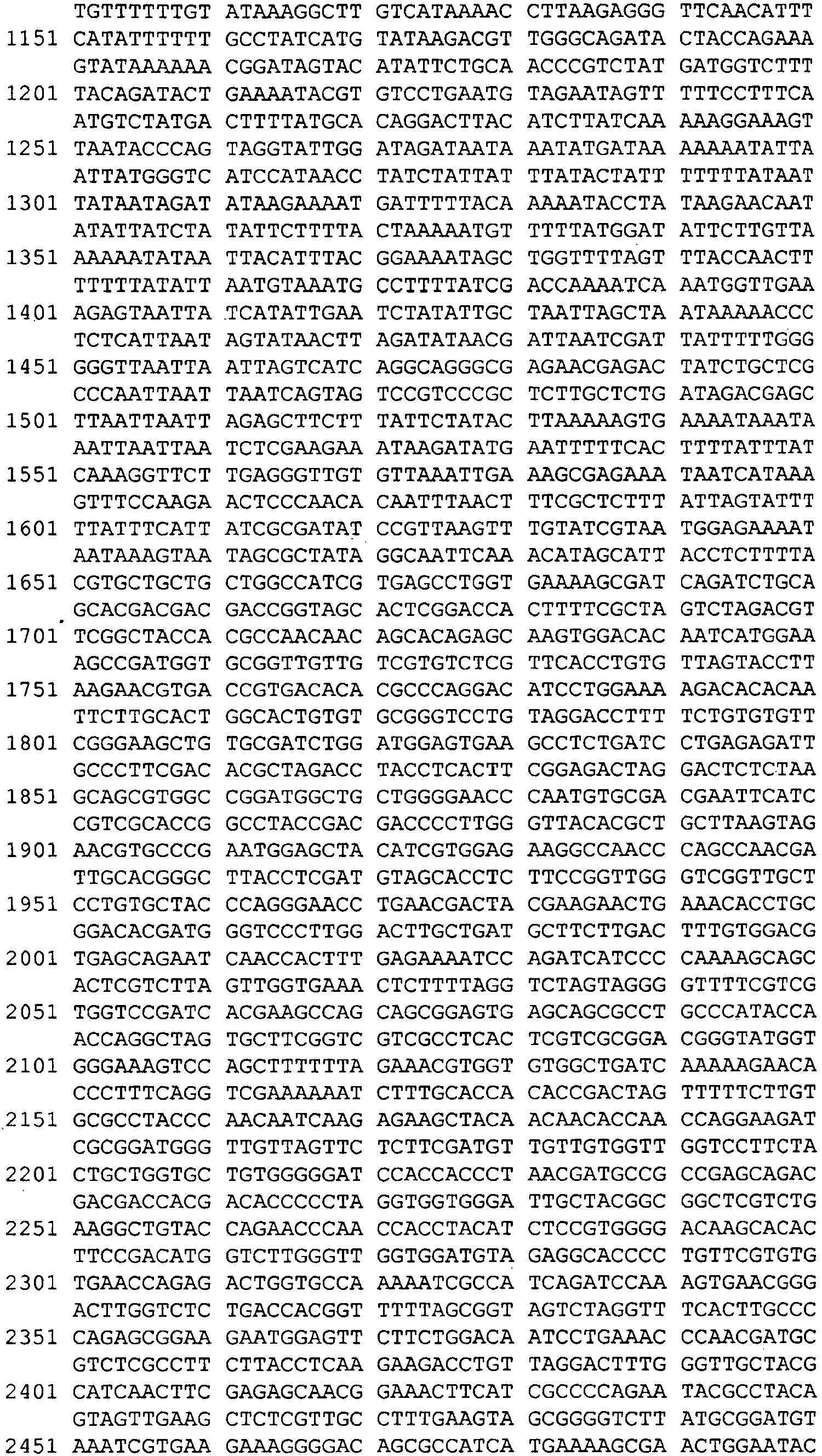


- SEQ ID NO 15
- LENGTH: 1692
- OTHER INFORMATION: nucleotide sequence of wild type H5 HA without cleavage sequence from plasmid pCR-Script/HA-CK/Indonesia/03-(modified)-avipox
- SEQUENCE:
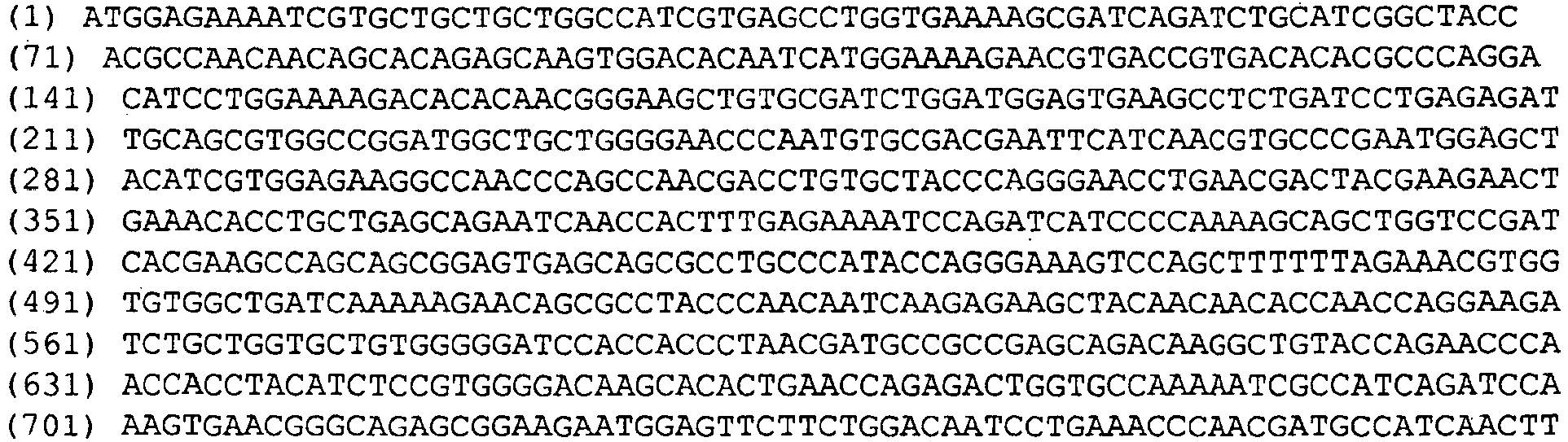

- SEQ ID NO 16
- LENGTH: 564
- OTHER INFORMATION: amino acid sequence of wild type H5 HA without cleavage sequence from plasmid pCR-Script/HA-CK/Indonesia/03-(modified)-avipox
- SEQUENCE:

- SEQ ID NO 17
- LENGTH: 564
- OTHER INFORMATION: Predicted amino acid sequence of H5 HA without cleavage sequence
- SEQUENCE:


- SEQ ID NO 18
- LENGTH: 3956
- ORGANISM: Artificial Sequence
- OTHER INFORMATION: Nucleotide sequence of C5 right arm (43-1578), H6 promoter (1675-1799) AIV synthetic H5 HA (1800-3494), and C5 left arm (3529-3932) in plasmid
- SEQUENCE:


-
SEQ ID NO 19- LENGTH: 6551
- OTHER INFORMATION: Theoretical sequence of entire vector
- SEQUENCE:


-
SEQ ID NO 20- LENGTH: 25
- OTHER INFORMATION: Primer for PCR amplification of the vCP2241 C5 arms plus insert, referred to as 7931.DC
- SEQUENCE:
- 1 GAATCTGTTAGTTAGTTACTTGGAT
-
SEQ ID NO 21- LENGTH: 25
- OTHER INFORMATION: Primer for PCR amplification of the vCP2241 C5 arms plus insert, referred to as 7932.DC
- SEQUENCE:
- 1 TGATTATAGCTATTATCACAGACTC
- SEQ ID NO 22
- LENGTH: ORGANISM: Artificial Sequence
- OTHER INFORMATION: C5 right arm (1-1536), H6 promoter (1634-1757), AIV synethetic H5 HA (1758-3452), and C5 left arm (3485-3890) determined through sequence analysis SEQUENCE:


-
- <110> MERIAL LIMITED
- <120> FELINE VACCINES AGAINST AVIAN INFLUENZA
- <130> MER 05-051.3PCT
- <140>
PCT/US07/083648
<141> 2007-11-05 - <150>
11/557,040
<151> 2006-11-06 - <150>
11/211,983
<151> 2005-08-25 - <160> 25
- <170> PatentIn Ver. 3.3
- <210> 1
<211> 3659
<212> DNA
<213> Fowlpox virus - <400> 1


- <210> 2
<211> 68
<212> DNA
<213> Artificial Sequence - <220>
<223> Description of Artificial Sequence: Synthetic oligonucleotide - <400> 2

- <210> 3
<211> 65
<212> DNA
<213> Artificial Sequence - <220>
<223> Description of Artificial Sequence: Synthetic oligonucleotide - <400> 3

- <210> 4
<211> 60
<212> DNA
<213> Artificial Sequence - <220>
<223> Description of Artificial Sequence: Synthetic oligonucleotide - <400> 4
tcattatcgc gatatccgtg ttaactagct agctaatttt tattcccggg atccttatca 60 - <210> 5
<211> 60
<212> DNA
<213> Artificial Sequence - <220>
<223> Description of Artificial Sequence: Synthetic oligonucleotide - <400> 5
gtataaggat cccgggaata aaaattagct agctagttaa cacggatatc gcgataatga 60 - <210> 6
<211> 66
<212> DNA
<213> Artificial Sequence - <220>
<223> Description of Artificial Sequence: Synthetic oligonucleotide - <400> 6

- <210> 7
<211> 66
<212> DNA
<213> Artificial Sequence - <220>
<223> Description of Artificial Sequence: Synthetic oligonucleotide - <400> 7

- <210> 8
<211> 87
<212> DNA
<213> Artificial Sequence - <220>
<223> Description of Artificial Sequence: Synthetic oligonucleotide - <400> 8

- <210> 9
<211> 49
<212> DNA
<213> Artificial Sequence - <220>
<223> Description of Artificial Sequence: Synthetic oligonucleotide - <400> 9
taccacgcaa acaactcaac aaaacaggtc gactttaaat ttttctgca 49 - <210> 10
<211> 21
<212> DNA
<213> Artificial Sequence - <220>
<223> Description of Artificial Sequence: Synthetic primer - <400> 10
acgaagccag cagcggagtg a 21 - <210> 11
<211> 21
<212> DNA
<213> Artificial Sequence - <220>
<223> Description of Artificial Sequence: Synthetic primer - <400> 11
tcagcaccag cagttcggcg t 21 - <210> 12
<211> 24
<212> DNA
<213> Artificial Sequence - <220>
<223> Description of Artificial Sequence: Synthetic primer - <400> 12
gtagtgatca aaatacagaa ccat 24 - <210> 13
<211> 24
<212> DNA
<213> Artificial Sequence - <220>
<223> Description of Artificial Sequence: Synthetic primer - <400> 13
gaatccgtca ttcaactttc tagt 24 - <210> 14
<211> 4737
<212> DNA
<213> Artificial Sequence - <220>
<223> Description of Artificial Sequence: Synthetic construct - <400> 14

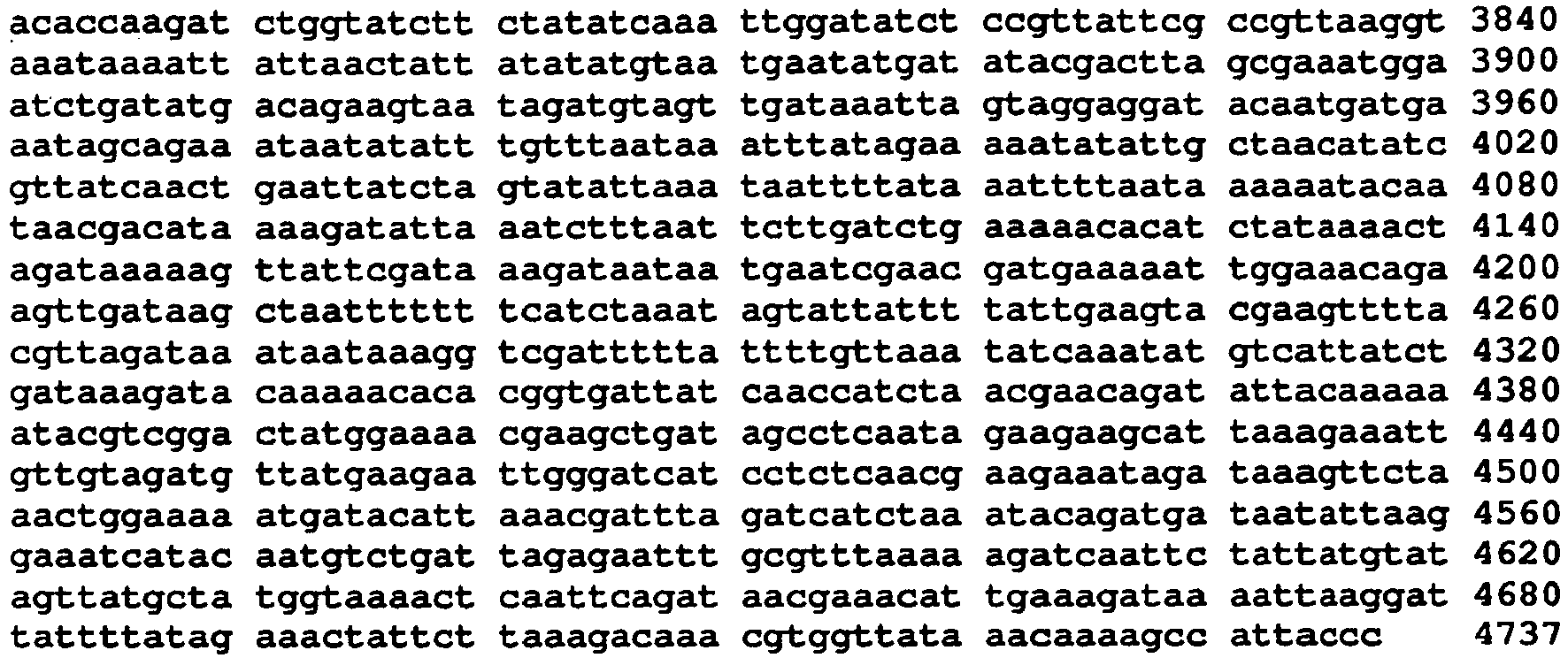
- <210> 15
<211> 1692
<212> DNA
<213> Artificial Sequence - <220>
<223> Description of Artificial Sequence: Synthetic construct - <400> 15

- <210> 16
<211> 564
<212> PRT
<213> Artificial Sequence - <220>
<223> Description of Artificial Sequence: Synthetic construct - <400> 16


- <210> 17
<211> 564
<212> PRT
<213> Artificial Sequence - <220>
<223> Description of Artificial Sequence: Synthetic construct - <400> 17

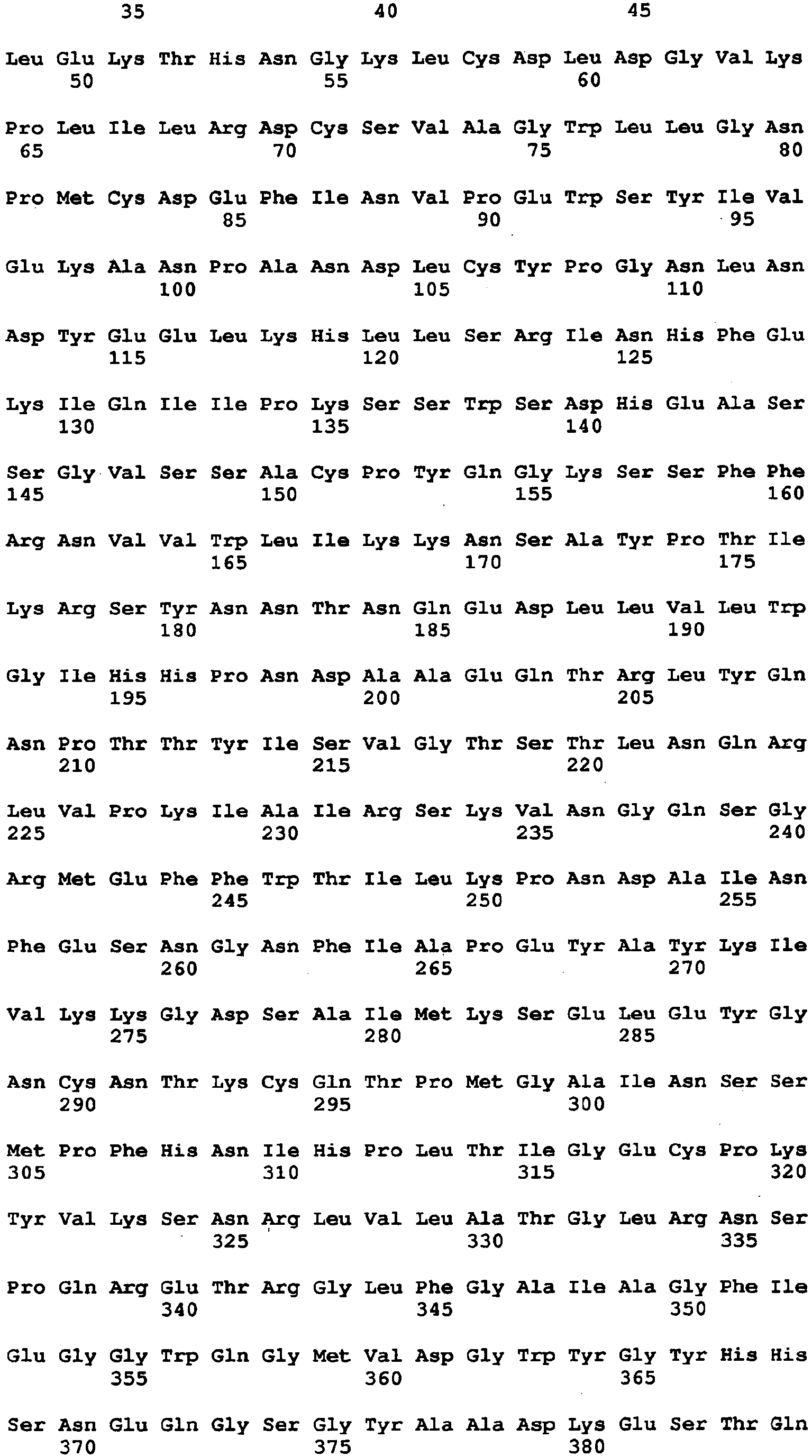

- <210> 18
<211> 3966
<212> DNA
<213> Artificial Sequence - <220>
<221> CDS
<222> (1800)..(3491) - <220>
<223> Description of Artificial Sequence: Synthetic construct - <400> 18


- <210> 19
<211> 6551
<212> DNA
<213> Artificial Sequence - <220>
<223> Description of Artificial Sequence: Synthetic construct - <400> 19


- <210> 20
<211> 25
<212> DNA
<213> Artificial Sequence - <220>
<223> Description of Artificial Sequence: Synthetic primer - <400> 20
gaatctgtta gttagttact tggat 25 - <210> 21
<211> 25
<212> DNA
<213> Artificial Sequence - <220>
<223> Description of Artificial Sequence: Synthetic primer - <400> 21
tgattatagc tattatcaca gactc 25 - <210> 22
<211> 3890
<212> DNA
<213> Artificial Sequence - <220>
<223> Description of Artificial Sequence: Synthetic construct - <400> 22


- <210> 23
<211> 564
<212> PRT
<213> Artificial Sequence - <220>
<223> Description of Artificial Sequence: Synthetic construct - <400> 23


- <210> 24
<211> 1692
<212> DNA
<213> Artificial Sequence - <220>
<223> Description of Artificial Sequence: Synthetic construct - <400> 24


- <210> 25
<211> 568
<212> PRT
<213> Influenza A virus - <400> 25


Claims (11)
- An immunological composition comprising an avipox expression vector, wherein said expression vector comprises a polynucleotide encoding an influenza antigen;wherein the avipox expression vector is an ALVAC vector and wherein the influenza antigen is hemagglutinin H5.
- The immunogenic composition according to claim 1, further comprising one or more of a pharmaceutically or veterinarily acceptable carrier, excipient, vehicle, or adjuvant.
- The immunological composition according to claim 1 or 2 for use in protecting Felidae against avian influenza.
- The immunological composition according to claim 3, wherein either prior or subsequent to administration of said immunological composition, a second immunological composition comprising either an avipox expression vector, wherein said vector comprises a polynucleotide encoding an influenza antigen, or an inactivated influenza immunological composition is administered.
- The immunological composition of claim 3, wherein the Felidae is a cat.
- The immunological composition according to any one of claims 3 to 5 wherein said composition is formulated for intramuscular administration, subcutaneous administration, oral administration or administration by needleless apparatus.
- Use of the immunological composition according to claim 1 or 2 for the manufacture of a medicament for protecting Felidae against avian influenza.
- The use according to claim 7, wherein either prior or subsequent to administration of said immunological composition, a second immunological composition comprising either an avipox expression vector, wherein said vector comprises a polynucleotide encoding an influenza antigen, or an inactivated influenza immunological composition is administered.
- The use according to claim 7 or 8, wherein the Felidae is a cat.
- The use according to any one of claims 7 to 9 wherein said composition is formulated for intramuscular administration, subcutaneous administration, oral administration or administration by needleless apparatus.
- A kit comprising a recombinant influenza poxvirus immunological composition according to claim 1 or 2 and instructions for the use as defined in any one of claims 3 to 10.
Priority Applications (1)
| Application Number | Priority Date | Filing Date | Title |
|---|---|---|---|
| SI200731432T SI2091560T1 (en) | 2006-11-06 | 2007-11-05 | Feline vaccines against avian influenza |
Applications Claiming Priority (3)
| Application Number | Priority Date | Filing Date | Title |
|---|---|---|---|
| US11/557,040 US7910112B2 (en) | 2006-11-06 | 2006-11-06 | Feline vaccines against avian influenza |
| US11/767,276 US20080107687A1 (en) | 2006-11-06 | 2007-06-22 | Feline vaccines against avian influenza |
| PCT/US2007/083648 WO2008058081A1 (en) | 2006-11-06 | 2007-11-05 | Feline vaccines against avian influenza |
Publications (3)
| Publication Number | Publication Date |
|---|---|
| EP2091560A1 EP2091560A1 (en) | 2009-08-26 |
| EP2091560A4 EP2091560A4 (en) | 2012-05-30 |
| EP2091560B1 true EP2091560B1 (en) | 2014-02-19 |
Family
ID=39364854
Family Applications (1)
| Application Number | Title | Priority Date | Filing Date |
|---|---|---|---|
| EP07844876.8A Not-in-force EP2091560B1 (en) | 2006-11-06 | 2007-11-05 | Feline vaccines against avian influenza |
Country Status (8)
| Country | Link |
|---|---|
| US (1) | US20080107687A1 (en) |
| EP (1) | EP2091560B1 (en) |
| AU (1) | AU2007316465B2 (en) |
| CA (1) | CA2668632C (en) |
| DK (1) | DK2091560T3 (en) |
| NZ (1) | NZ576996A (en) |
| SI (1) | SI2091560T1 (en) |
| WO (1) | WO2008058081A1 (en) |
Families Citing this family (20)
| Publication number | Priority date | Publication date | Assignee | Title |
|---|---|---|---|---|
| US9481912B2 (en) | 2006-09-12 | 2016-11-01 | Longhorn Vaccines And Diagnostics, Llc | Compositions and methods for detecting and identifying nucleic acid sequences in biological samples |
| US8652782B2 (en) | 2006-09-12 | 2014-02-18 | Longhorn Vaccines & Diagnostics, Llc | Compositions and methods for detecting, identifying and quantitating mycobacterial-specific nucleic acids |
| US8080645B2 (en) * | 2007-10-01 | 2011-12-20 | Longhorn Vaccines & Diagnostics Llc | Biological specimen collection/transport compositions and methods |
| US8097419B2 (en) | 2006-09-12 | 2012-01-17 | Longhorn Vaccines & Diagnostics Llc | Compositions and method for rapid, real-time detection of influenza A virus (H1N1) swine 2009 |
| ES2744126T3 (en) | 2006-10-25 | 2020-02-21 | Intervet Int Bv | Feline flu vaccine and method of use |
| US11041215B2 (en) | 2007-08-24 | 2021-06-22 | Longhorn Vaccines And Diagnostics, Llc | PCR ready compositions and methods for detecting and identifying nucleic acid sequences |
| US9683256B2 (en) | 2007-10-01 | 2017-06-20 | Longhorn Vaccines And Diagnostics, Llc | Biological specimen collection and transport system |
| US10004799B2 (en) | 2007-08-27 | 2018-06-26 | Longhorn Vaccines And Diagnostics, Llc | Composite antigenic sequences and vaccines |
| CA2697373C (en) | 2007-08-27 | 2019-05-21 | Longhorn Vaccines & Diagnostics, Llc | Immunogenic compositions and methods |
| AU2008343745B2 (en) | 2007-10-01 | 2012-05-10 | Longhorn Vaccines & Diagnostics Llc | Biological specimen collection and transport system and methods of use |
| US11041216B2 (en) | 2007-10-01 | 2021-06-22 | Longhorn Vaccines And Diagnostics, Llc | Compositions and methods for detecting and quantifying nucleic acid sequences in blood samples |
| US20140205993A1 (en) * | 2013-01-18 | 2014-07-24 | Biolex Therapeutics, Inc. | Recombinant avian influenza vaccine and uses thereof |
| MX2011005604A (en) | 2008-11-28 | 2011-09-01 | Merial Ltd | Recombinant avian influenza vaccine and uses thereof. |
| US20140205619A1 (en) * | 2008-11-28 | 2014-07-24 | Biolex Therapeutics, Inc. | Recombinant avian influenza vaccine and uses thereof |
| US20120003263A1 (en) * | 2008-12-05 | 2012-01-05 | Warf - Wisconsin Alumni Research Foundation | Recombinant raccoon pox virus vaccine against highly pathogenic avian influenza |
| US8871220B2 (en) | 2009-04-03 | 2014-10-28 | Merial Limited | Newcastle disease virus vectored avian vaccines |
| CA3207612A1 (en) | 2012-01-26 | 2013-08-01 | Longhorn Vaccines And Diagnostics, Llc | Composite antigenic sequences and vaccines |
| EP3294448A4 (en) | 2015-05-14 | 2018-12-12 | Longhorn Vaccines and Diagnostics, LLC | Rapid methods for the extraction of nucleic acids from biological samples |
| US12485166B2 (en) | 2020-02-06 | 2025-12-02 | Longhorn Vaccines And Diagnostics, Llc | Vaccines for the treatment and prevention of zoonotic infections |
| KR20230091978A (en) | 2020-10-20 | 2023-06-23 | 롱혼 백신즈 앤드 다이어그나스틱스, 엘엘씨 | immunogenic antigen |
Citations (1)
| Publication number | Priority date | Publication date | Assignee | Title |
|---|---|---|---|---|
| US5756103A (en) * | 1991-03-07 | 1998-05-26 | Virogenetics Corporation | Alvac canarypox virus recombinants comprising heterlogous inserts |
Family Cites Families (6)
| Publication number | Priority date | Publication date | Assignee | Title |
|---|---|---|---|---|
| US5505941A (en) * | 1981-12-24 | 1996-04-09 | Health Research, Inc. | Recombinant avipox virus and method to induce an immune response |
| US6309647B1 (en) * | 1999-07-15 | 2001-10-30 | Aventis Pasteur | Poxvirus—canine dispemper virus (CDV) or measles virus recombinants and compositions and methods employing the recombinants |
| US7052831B2 (en) * | 2000-09-29 | 2006-05-30 | Becton Dickinson And Company | Detection of multiple analytes from a single sample using a multi-well, multi-analyte flow-through diagnostic test device |
| US20040037848A1 (en) * | 2001-04-06 | 2004-02-26 | Audonnet Jean-Christophe Francis | Recombinant vaccine against West Nile Virus |
| PL1651265T3 (en) * | 2003-07-24 | 2008-10-31 | Merial Ltd | Vaccine formulations comprising an oil-in-water emulsion |
| WO2007047728A2 (en) * | 2005-10-20 | 2007-04-26 | Wyeth | Compositions and methods for the treatment of canine influenza virus disease |
-
2007
- 2007-06-22 US US11/767,276 patent/US20080107687A1/en not_active Abandoned
- 2007-11-05 NZ NZ576996A patent/NZ576996A/en not_active IP Right Cessation
- 2007-11-05 DK DK07844876.8T patent/DK2091560T3/en active
- 2007-11-05 SI SI200731432T patent/SI2091560T1/en unknown
- 2007-11-05 EP EP07844876.8A patent/EP2091560B1/en not_active Not-in-force
- 2007-11-05 AU AU2007316465A patent/AU2007316465B2/en not_active Ceased
- 2007-11-05 CA CA2668632A patent/CA2668632C/en not_active Expired - Fee Related
- 2007-11-05 WO PCT/US2007/083648 patent/WO2008058081A1/en not_active Ceased
Patent Citations (1)
| Publication number | Priority date | Publication date | Assignee | Title |
|---|---|---|---|---|
| US5756103A (en) * | 1991-03-07 | 1998-05-26 | Virogenetics Corporation | Alvac canarypox virus recombinants comprising heterlogous inserts |
Non-Patent Citations (2)
| Title |
|---|
| FERRARI ET AL: "Replication-defective canarypox (ALVAC) vectors effectively activate anti-human immunodeficiency virus-1 cytotoxic T lymphocytes present in infected patients: implications for antigen-specific immunotherapy.", BLOOD, vol. 90, no. 6, 1 September 1997 (1997-09-01), pages 2406 - 2416, XP055024919, ISSN: 0006-4971 * |
| TARTAGLIA J ET AL: "PROTECTION OF CATS AGAINST FELINE LEUKEMIA VIRUS BY VACCINATION WITH A CANARYPOX VIRUS RECOMBINANT, ALVAC-FL", JOURNAL OF VIROLOGY, THE AMERICAN SOCIETY FOR MICROBIOLOGY, US, vol. 67, no. 4, 1 April 1993 (1993-04-01), pages 2370 - 2375, XP002916084, ISSN: 0022-538X * |
Also Published As
| Publication number | Publication date |
|---|---|
| AU2007316465A1 (en) | 2008-05-15 |
| CA2668632A1 (en) | 2008-05-15 |
| NZ576996A (en) | 2012-03-30 |
| DK2091560T3 (en) | 2014-03-10 |
| AU2007316465B2 (en) | 2013-06-20 |
| EP2091560A1 (en) | 2009-08-26 |
| WO2008058081A1 (en) | 2008-05-15 |
| CA2668632C (en) | 2016-02-16 |
| EP2091560A4 (en) | 2012-05-30 |
| WO2008058081A9 (en) | 2013-05-16 |
| SI2091560T1 (en) | 2014-05-30 |
| US20080107687A1 (en) | 2008-05-08 |
| HK1134781A1 (en) | 2010-05-14 |
Similar Documents
| Publication | Publication Date | Title |
|---|---|---|
| AU2007316465B2 (en) | Feline vaccines against avian influenza | |
| US10350286B2 (en) | Newcastle disease virus vectored avian vaccines | |
| CA2744454C (en) | Recombinant avian influenza vaccine and uses thereof | |
| EP1942933B1 (en) | Canine influenza vaccines | |
| EP2611460A1 (en) | Newcastle disease virus vectored herpesvirus vaccines | |
| US7384642B2 (en) | Canine influenza vaccines | |
| US7910112B2 (en) | Feline vaccines against avian influenza | |
| EP2244731B1 (en) | Canine influenza vaccines | |
| HK1134781B (en) | Feline vaccines against avian influenza | |
| HK1243353B (en) | Canine influenza vaccines | |
| HK1129299A (en) | Canine influenza vaccines |
Legal Events
| Date | Code | Title | Description |
|---|---|---|---|
| PUAI | Public reference made under article 153(3) epc to a published international application that has entered the european phase |
Free format text: ORIGINAL CODE: 0009012 |
|
| 17P | Request for examination filed |
Effective date: 20090605 |
|
| AK | Designated contracting states |
Kind code of ref document: A1 Designated state(s): AT BE BG CH CY CZ DE DK EE ES FI FR GB GR HU IE IS IT LI LT LU LV MC MT NL PL PT RO SE SI SK TR |
|
| DAX | Request for extension of the european patent (deleted) | ||
| REG | Reference to a national code |
Ref country code: HK Ref legal event code: DE Ref document number: 1134781 Country of ref document: HK |
|
| A4 | Supplementary search report drawn up and despatched |
Effective date: 20120502 |
|
| RIC1 | Information provided on ipc code assigned before grant |
Ipc: A61K 39/12 20060101AFI20120424BHEP |
|
| REG | Reference to a national code |
Ref country code: DE Ref legal event code: R079 Ref document number: 602007035152 Country of ref document: DE Free format text: PREVIOUS MAIN CLASS: A61K0039120000 Ipc: A61K0039145000 |
|
| RIC1 | Information provided on ipc code assigned before grant |
Ipc: A61K 39/145 20060101AFI20130129BHEP Ipc: C12N 15/863 20060101ALI20130129BHEP |
|
| GRAP | Despatch of communication of intention to grant a patent |
Free format text: ORIGINAL CODE: EPIDOSNIGR1 |
|
| INTG | Intention to grant announced |
Effective date: 20130410 |
|
| GRAP | Despatch of communication of intention to grant a patent |
Free format text: ORIGINAL CODE: EPIDOSNIGR1 |
|
| INTG | Intention to grant announced |
Effective date: 20130924 |
|
| GRAS | Grant fee paid |
Free format text: ORIGINAL CODE: EPIDOSNIGR3 |
|
| GRAA | (expected) grant |
Free format text: ORIGINAL CODE: 0009210 |
|
| AK | Designated contracting states |
Kind code of ref document: B1 Designated state(s): AT BE BG CH CY CZ DE DK EE ES FI FR GB GR HU IE IS IT LI LT LU LV MC MT NL PL PT RO SE SI SK TR |
|
| REG | Reference to a national code |
Ref country code: GB Ref legal event code: FG4D |
|
| REG | Reference to a national code |
Ref country code: CH Ref legal event code: EP |
|
| REG | Reference to a national code |
Ref country code: DK Ref legal event code: T3 Effective date: 20140304 |
|
| REG | Reference to a national code |
Ref country code: AT Ref legal event code: REF Ref document number: 652683 Country of ref document: AT Kind code of ref document: T Effective date: 20140315 |
|
| REG | Reference to a national code |
Ref country code: DE Ref legal event code: R096 Ref document number: 602007035152 Country of ref document: DE Effective date: 20140327 |
|
| REG | Reference to a national code |
Ref country code: CH Ref legal event code: NV Representative=s name: BOHEST AG, CH |
|
| REG | Reference to a national code |
Ref country code: IE Ref legal event code: FG4D |
|
| REG | Reference to a national code |
Ref country code: SE Ref legal event code: TRGR |
|
| REG | Reference to a national code |
Ref country code: NL Ref legal event code: T3 |
|
| REG | Reference to a national code |
Ref country code: HK Ref legal event code: GR Ref document number: 1134781 Country of ref document: HK |
|
| REG | Reference to a national code |
Ref country code: AT Ref legal event code: MK05 Ref document number: 652683 Country of ref document: AT Kind code of ref document: T Effective date: 20140219 |
|
| REG | Reference to a national code |
Ref country code: LT Ref legal event code: MG4D |
|
| PG25 | Lapsed in a contracting state [announced via postgrant information from national office to epo] |
Ref country code: LT Free format text: LAPSE BECAUSE OF FAILURE TO SUBMIT A TRANSLATION OF THE DESCRIPTION OR TO PAY THE FEE WITHIN THE PRESCRIBED TIME-LIMIT Effective date: 20140219 |
|
| REG | Reference to a national code |
Ref country code: CH Ref legal event code: PCAR Free format text: NEW ADDRESS: HOLBEINSTRASSE 36-38, 4051 BASEL (CH) |
|
| PG25 | Lapsed in a contracting state [announced via postgrant information from national office to epo] |
Ref country code: FI Free format text: LAPSE BECAUSE OF FAILURE TO SUBMIT A TRANSLATION OF THE DESCRIPTION OR TO PAY THE FEE WITHIN THE PRESCRIBED TIME-LIMIT Effective date: 20140219 Ref country code: ES Free format text: LAPSE BECAUSE OF FAILURE TO SUBMIT A TRANSLATION OF THE DESCRIPTION OR TO PAY THE FEE WITHIN THE PRESCRIBED TIME-LIMIT Effective date: 20140219 Ref country code: AT Free format text: LAPSE BECAUSE OF FAILURE TO SUBMIT A TRANSLATION OF THE DESCRIPTION OR TO PAY THE FEE WITHIN THE PRESCRIBED TIME-LIMIT Effective date: 20140219 Ref country code: PT Free format text: LAPSE BECAUSE OF FAILURE TO SUBMIT A TRANSLATION OF THE DESCRIPTION OR TO PAY THE FEE WITHIN THE PRESCRIBED TIME-LIMIT Effective date: 20140619 Ref country code: CY Free format text: LAPSE BECAUSE OF FAILURE TO SUBMIT A TRANSLATION OF THE DESCRIPTION OR TO PAY THE FEE WITHIN THE PRESCRIBED TIME-LIMIT Effective date: 20140219 |
|
| REG | Reference to a national code |
Ref country code: HU Ref legal event code: AG4A Ref document number: E020446 Country of ref document: HU |
|
| PG25 | Lapsed in a contracting state [announced via postgrant information from national office to epo] |
Ref country code: BE Free format text: LAPSE BECAUSE OF FAILURE TO SUBMIT A TRANSLATION OF THE DESCRIPTION OR TO PAY THE FEE WITHIN THE PRESCRIBED TIME-LIMIT Effective date: 20140219 Ref country code: LV Free format text: LAPSE BECAUSE OF FAILURE TO SUBMIT A TRANSLATION OF THE DESCRIPTION OR TO PAY THE FEE WITHIN THE PRESCRIBED TIME-LIMIT Effective date: 20140219 |
|
| PG25 | Lapsed in a contracting state [announced via postgrant information from national office to epo] |
Ref country code: CZ Free format text: LAPSE BECAUSE OF FAILURE TO SUBMIT A TRANSLATION OF THE DESCRIPTION OR TO PAY THE FEE WITHIN THE PRESCRIBED TIME-LIMIT Effective date: 20140219 Ref country code: RO Free format text: LAPSE BECAUSE OF FAILURE TO SUBMIT A TRANSLATION OF THE DESCRIPTION OR TO PAY THE FEE WITHIN THE PRESCRIBED TIME-LIMIT Effective date: 20140219 Ref country code: EE Free format text: LAPSE BECAUSE OF FAILURE TO SUBMIT A TRANSLATION OF THE DESCRIPTION OR TO PAY THE FEE WITHIN THE PRESCRIBED TIME-LIMIT Effective date: 20140219 |
|
| REG | Reference to a national code |
Ref country code: DE Ref legal event code: R097 Ref document number: 602007035152 Country of ref document: DE |
|
| PG25 | Lapsed in a contracting state [announced via postgrant information from national office to epo] |
Ref country code: PL Free format text: LAPSE BECAUSE OF FAILURE TO SUBMIT A TRANSLATION OF THE DESCRIPTION OR TO PAY THE FEE WITHIN THE PRESCRIBED TIME-LIMIT Effective date: 20140219 Ref country code: SK Free format text: LAPSE BECAUSE OF FAILURE TO SUBMIT A TRANSLATION OF THE DESCRIPTION OR TO PAY THE FEE WITHIN THE PRESCRIBED TIME-LIMIT Effective date: 20140219 |
|
| PLBE | No opposition filed within time limit |
Free format text: ORIGINAL CODE: 0009261 |
|
| STAA | Information on the status of an ep patent application or granted ep patent |
Free format text: STATUS: NO OPPOSITION FILED WITHIN TIME LIMIT |
|
| 26N | No opposition filed |
Effective date: 20141120 |
|
| REG | Reference to a national code |
Ref country code: DE Ref legal event code: R097 Ref document number: 602007035152 Country of ref document: DE Effective date: 20141120 |
|
| PG25 | Lapsed in a contracting state [announced via postgrant information from national office to epo] |
Ref country code: IT Free format text: LAPSE BECAUSE OF FAILURE TO SUBMIT A TRANSLATION OF THE DESCRIPTION OR TO PAY THE FEE WITHIN THE PRESCRIBED TIME-LIMIT Effective date: 20140219 |
|
| PG25 | Lapsed in a contracting state [announced via postgrant information from national office to epo] |
Ref country code: MC Free format text: LAPSE BECAUSE OF FAILURE TO SUBMIT A TRANSLATION OF THE DESCRIPTION OR TO PAY THE FEE WITHIN THE PRESCRIBED TIME-LIMIT Effective date: 20140219 |
|
| REG | Reference to a national code |
Ref country code: FR Ref legal event code: PLFP Year of fee payment: 9 |
|
| PG25 | Lapsed in a contracting state [announced via postgrant information from national office to epo] |
Ref country code: BG Free format text: LAPSE BECAUSE OF FAILURE TO SUBMIT A TRANSLATION OF THE DESCRIPTION OR TO PAY THE FEE WITHIN THE PRESCRIBED TIME-LIMIT Effective date: 20140219 |
|
| PG25 | Lapsed in a contracting state [announced via postgrant information from national office to epo] |
Ref country code: GR Free format text: LAPSE BECAUSE OF FAILURE TO SUBMIT A TRANSLATION OF THE DESCRIPTION OR TO PAY THE FEE WITHIN THE PRESCRIBED TIME-LIMIT Effective date: 20140520 |
|
| PG25 | Lapsed in a contracting state [announced via postgrant information from national office to epo] |
Ref country code: MT Free format text: LAPSE BECAUSE OF FAILURE TO SUBMIT A TRANSLATION OF THE DESCRIPTION OR TO PAY THE FEE WITHIN THE PRESCRIBED TIME-LIMIT Effective date: 20140219 Ref country code: TR Free format text: LAPSE BECAUSE OF FAILURE TO SUBMIT A TRANSLATION OF THE DESCRIPTION OR TO PAY THE FEE WITHIN THE PRESCRIBED TIME-LIMIT Effective date: 20140219 |
|
| REG | Reference to a national code |
Ref country code: FR Ref legal event code: PLFP Year of fee payment: 10 |
|
| REG | Reference to a national code |
Ref country code: FR Ref legal event code: PLFP Year of fee payment: 11 |
|
| PGFP | Annual fee paid to national office [announced via postgrant information from national office to epo] |
Ref country code: LU Payment date: 20211119 Year of fee payment: 15 |
|
| PGFP | Annual fee paid to national office [announced via postgrant information from national office to epo] |
Ref country code: FR Payment date: 20211122 Year of fee payment: 15 Ref country code: DK Payment date: 20211122 Year of fee payment: 15 Ref country code: NL Payment date: 20211118 Year of fee payment: 15 Ref country code: IE Payment date: 20211119 Year of fee payment: 15 Ref country code: GB Payment date: 20211119 Year of fee payment: 15 Ref country code: SE Payment date: 20211118 Year of fee payment: 15 |
|
| PGFP | Annual fee paid to national office [announced via postgrant information from national office to epo] |
Ref country code: SI Payment date: 20211028 Year of fee payment: 15 Ref country code: IS Payment date: 20211111 Year of fee payment: 15 Ref country code: HU Payment date: 20211117 Year of fee payment: 15 Ref country code: CH Payment date: 20211119 Year of fee payment: 15 |
|
| PGFP | Annual fee paid to national office [announced via postgrant information from national office to epo] |
Ref country code: DE Payment date: 20220620 Year of fee payment: 16 |
|
| REG | Reference to a national code |
Ref country code: DK Ref legal event code: EBP Effective date: 20221130 |
|
| REG | Reference to a national code |
Ref country code: CH Ref legal event code: PL |
|
| REG | Reference to a national code |
Ref country code: SE Ref legal event code: EUG |
|
| REG | Reference to a national code |
Ref country code: NL Ref legal event code: MM Effective date: 20221201 |
|
| GBPC | Gb: european patent ceased through non-payment of renewal fee |
Effective date: 20221105 |
|
| PG25 | Lapsed in a contracting state [announced via postgrant information from national office to epo] |
Ref country code: LI Free format text: LAPSE BECAUSE OF NON-PAYMENT OF DUE FEES Effective date: 20221130 Ref country code: HU Free format text: LAPSE BECAUSE OF NON-PAYMENT OF DUE FEES Effective date: 20221106 Ref country code: CH Free format text: LAPSE BECAUSE OF NON-PAYMENT OF DUE FEES Effective date: 20221130 |
|
| PG25 | Lapsed in a contracting state [announced via postgrant information from national office to epo] |
Ref country code: SI Free format text: LAPSE BECAUSE OF NON-PAYMENT OF DUE FEES Effective date: 20221106 Ref country code: SE Free format text: LAPSE BECAUSE OF NON-PAYMENT OF DUE FEES Effective date: 20221106 Ref country code: NL Free format text: LAPSE BECAUSE OF NON-PAYMENT OF DUE FEES Effective date: 20221201 Ref country code: LU Free format text: LAPSE BECAUSE OF NON-PAYMENT OF DUE FEES Effective date: 20221105 |
|
| REG | Reference to a national code |
Ref country code: SI Ref legal event code: KO00 Effective date: 20230712 |
|
| PG25 | Lapsed in a contracting state [announced via postgrant information from national office to epo] |
Ref country code: IE Free format text: LAPSE BECAUSE OF NON-PAYMENT OF DUE FEES Effective date: 20221105 Ref country code: GB Free format text: LAPSE BECAUSE OF NON-PAYMENT OF DUE FEES Effective date: 20221105 Ref country code: DK Free format text: LAPSE BECAUSE OF NON-PAYMENT OF DUE FEES Effective date: 20221130 |
|
| PG25 | Lapsed in a contracting state [announced via postgrant information from national office to epo] |
Ref country code: FR Free format text: LAPSE BECAUSE OF NON-PAYMENT OF DUE FEES Effective date: 20221130 |
|
| REG | Reference to a national code |
Ref country code: DE Ref legal event code: R119 Ref document number: 602007035152 Country of ref document: DE |
|
| PG25 | Lapsed in a contracting state [announced via postgrant information from national office to epo] |
Ref country code: DE Free format text: LAPSE BECAUSE OF NON-PAYMENT OF DUE FEES Effective date: 20240601 |
|
| PG25 | Lapsed in a contracting state [announced via postgrant information from national office to epo] |
Ref country code: DE Free format text: LAPSE BECAUSE OF NON-PAYMENT OF DUE FEES Effective date: 20240601 |
|
| PG25 | Lapsed in a contracting state [announced via postgrant information from national office to epo] |
Ref country code: IS Free format text: LAPSE BECAUSE OF NON-PAYMENT OF DUE FEES Effective date: 20230606 |