EP2089466B1 - Polyamide housings for portable electronic devices - Google Patents
Polyamide housings for portable electronic devices Download PDFInfo
- Publication number
- EP2089466B1 EP2089466B1 EP07862596.9A EP07862596A EP2089466B1 EP 2089466 B1 EP2089466 B1 EP 2089466B1 EP 07862596 A EP07862596 A EP 07862596A EP 2089466 B1 EP2089466 B1 EP 2089466B1
- Authority
- EP
- European Patent Office
- Prior art keywords
- polyamide
- housing
- section
- cross
- composition
- Prior art date
- Legal status (The legal status is an assumption and is not a legal conclusion. Google has not performed a legal analysis and makes no representation as to the accuracy of the status listed.)
- Active
Links
Images
Classifications
-
- C—CHEMISTRY; METALLURGY
- C08—ORGANIC MACROMOLECULAR COMPOUNDS; THEIR PREPARATION OR CHEMICAL WORKING-UP; COMPOSITIONS BASED THEREON
- C08J—WORKING-UP; GENERAL PROCESSES OF COMPOUNDING; AFTER-TREATMENT NOT COVERED BY SUBCLASSES C08B, C08C, C08F, C08G or C08H
- C08J5/00—Manufacture of articles or shaped materials containing macromolecular substances
- C08J5/04—Reinforcing macromolecular compounds with loose or coherent fibrous material
- C08J5/0405—Reinforcing macromolecular compounds with loose or coherent fibrous material with inorganic fibres
-
- C—CHEMISTRY; METALLURGY
- C08—ORGANIC MACROMOLECULAR COMPOUNDS; THEIR PREPARATION OR CHEMICAL WORKING-UP; COMPOSITIONS BASED THEREON
- C08J—WORKING-UP; GENERAL PROCESSES OF COMPOUNDING; AFTER-TREATMENT NOT COVERED BY SUBCLASSES C08B, C08C, C08F, C08G or C08H
- C08J5/00—Manufacture of articles or shaped materials containing macromolecular substances
- C08J5/04—Reinforcing macromolecular compounds with loose or coherent fibrous material
- C08J5/0405—Reinforcing macromolecular compounds with loose or coherent fibrous material with inorganic fibres
- C08J5/043—Reinforcing macromolecular compounds with loose or coherent fibrous material with inorganic fibres with glass fibres
-
- C—CHEMISTRY; METALLURGY
- C08—ORGANIC MACROMOLECULAR COMPOUNDS; THEIR PREPARATION OR CHEMICAL WORKING-UP; COMPOSITIONS BASED THEREON
- C08K—Use of inorganic or non-macromolecular organic substances as compounding ingredients
- C08K7/00—Use of ingredients characterised by shape
- C08K7/02—Fibres or whiskers
- C08K7/04—Fibres or whiskers inorganic
- C08K7/14—Glass
-
- C—CHEMISTRY; METALLURGY
- C08—ORGANIC MACROMOLECULAR COMPOUNDS; THEIR PREPARATION OR CHEMICAL WORKING-UP; COMPOSITIONS BASED THEREON
- C08J—WORKING-UP; GENERAL PROCESSES OF COMPOUNDING; AFTER-TREATMENT NOT COVERED BY SUBCLASSES C08B, C08C, C08F, C08G or C08H
- C08J2377/00—Characterised by the use of polyamides obtained by reactions forming a carboxylic amide link in the main chain; Derivatives of such polymers
Definitions
- the present invention relates to portable electronic device housings comprising a polyamide composition having excellent stiffness and impact resistance and low anisotropic shrinkage on molding.
- Portable electronic devices such as mobile telephones, personal digital assistants, laptop computers, tablet computers, global positioning system receivers, portable games, radios, cameras and camera accessories, and the like are becoming increasingly widely used globally in many different environments. It is often important that the housings of such devices be made from materials that are able to withstand the rigors of frequent use and can meet challenging aesthetic demands while not interfering with their intended operability. It is often desirable that such materials have good stiffness and impact resistance and that they exhibit minimal shrinkage (i.e., low warpage or high dimensional stability) when they are formed (as by injection molding, for example) into housings.
- Thermoplastic polyamide compositions are desirable for use in making housings for portable electronic devices because of their good physical properties and that they may be conveniently and flexibly molded into a variety of articles of varying degrees of complexity and intricacy. Reinforcing agents are typically added to polyamide compositions to increase stiffness, but can often result in compositions that exhibit undesirable degrees of anisotropic shrinkage up on molding. It would thus be desirable to obtain housings for portable electronic devices that are made from polyamide compositions having excellent stiffness and impact resistance and low anisotropic warpage (i.e., good dimensional stability).
- warpage is meant the deformation of molded parts in one or more directions that may be caused by anisotropic shrinkage of the resin during molding.
- EP 0 190 001 discloses a flat glass fiber strand comprising a multiplicity of glass filaments having an oblong, elliptical, or rectangular cross-sectional shape.
- EP 0 196 194 discloses a strand comprising glass fibers having at least two expanded apex portions and a recess.
- EP 0 246 620 discloses a glass-fiber reinforced resin molded article that comprises a thermoplastic resin reinforced with glass fibers having oblong, elliptical, or cocoon-shaped cross sections.
- EP 0 376 616 discloses a thermoplastic resin composition reinforced with a fibrous reinforcing agent having a non-circular cross section.
- JP 2004/168849 describes a mobile phone housing molded from a mixture of an aromatic polyamide, an amorphous polyamide, polyamide 6 and a fibrous reinforcing material.
- thermoplastic polyamide comprising a melt-mixed blend of (A) at least one thermoplastic polyamide and (B) at least one fibrous reinforcing agent having a non-circular cross section
- the thermoplastic polyamide is selected from the group consisting of polyamide 6,6; polyamide 4,6; polyamide 6,10; polyamide 6,12; polyamide 11; polyamide 12; polyamide 9,10; polyamide 9,12; polyamide 9,13; polyamide 9,14; polyamide 9,15; polyamide 6,16; polyamide 9,36; polyamide 10,10; polyamide 10,12; polyamide 10,13; polyamide 10,14; polyamide 12,10; polyamide 12,12; polyamide 12,13; polyamide 12,14; polyamide 6,14; polyamide 6,13; polyamide 6,15; polyamide 6,16; and copolymers and mixtures of these polymers, wherein the thermoplastic polyamide (A) comprises 30 to 75 weight percent of the polyamide composition.
- portable electronic device is meant an electronic device that is designed to be conveniently transported and used in various locations.
- portable electronic devices include mobile telephones, personal digital assistants, laptop computers, tablet computers, radios, cameras and camera accessories, watches, calculators, music players, global positioning system receivers, portable games, hard drives and other electronic storage devices, and the like.
- portable electronic device housing is meant a cover, backbone, or the like of the device.
- the housing may be a single article or comprise two or more components.
- backbone is meant a structural component onto which other components of the device, such as electronics, microprocessors, screens, keyboards and keypads, antennas, battery sockets, and the like are mounted.
- the backbone may be an interior component that is not visible or only partially visible from the exterior of the telephone.
- the housing may provide protection for internal components of the device from impact and contamination and/or damage from environmental agents (such as liquids, dust, and the like). Housing components such as covers may also provide substantial or primary structural support for and protection against impact of certain components having exposure to the exterior of the device such as screens and/or antennas.
- the housings of the present invention are mobile telephone housings.
- mobile telephone housing is meant one or more of the back cover, front cover, antenna housing, and/or backbone of a mobile phone.
- the housing may be a single article incorporating one or more of the foregoing.
- backbone is meant a structural component onto which other components of the mobile telephone, such as electronics, screens, battery sockets, and the like are mounted.
- the backbone may be an interior component that is not visible or only partially visible from the exterior of the telephone.
- the housing of the present invention comprises a composition comprising a melt-mixed blend of (A) at least one thermoplastic polyamide and (B) at least one fibrous reinforcing agent having a non-circular cross section.
- Thermoplastic polyamide (A) is at least one polyamide.
- Suitable polyamides can be condensation products of one or more dicarboxylic acids and one or more diamines, and/or one or more aminocarboxylic acids, and/or ring-opening polymerization products of one or more cyclic lactams.
- Suitable dicarboxylic acids include, but are not limited to adipic acid. Preferred are dicarboxylic acids having 10 or more carbon atoms, including, but not limited to sebacic acid; dodecanedioic acid, tetradecanedioic acid, and pentadecanedioic acid.
- Suitable diamines include, but are not limited to, tetramethylenediamine; hexamethylenediamine; and nonamethylenediamine.
- Preferred diamines have 10 or more carbon atoms, including decamethylenediamine; and dodecamethylenediamine.
- a suitable aminocarboxylic acid is 11-aminododecanoic acid.
- Suitable cyclic lactams are caprolactam and laurolactam.
- Polyamides are selected from aliphatic polyamides such as polyamide 6,6; polyamide 4,6; polyamide 6,10; polyamide 6,12; polyamide 11; polyamide 12; polyamide 9,10; polyamide 9,12; polyamide 9,13; polyamide 9,14; polyamide 9,15; polyamide 6,16; polyamide 9,36; polyamide 10,10; polyamide 10,12; polyamide 10,13; polyamide 10,14; polyamide 12,10; polyamide 12,12; polyamide 12,13; polyamide 12,14; polyamide 6,14; polyamide 6,13; polyamide 6,15; polyamide 6,16; and copolymers and mixtures of these polymers.
- the polyamides may be amorphous polyamides or semicrystalline.
- Polyamide (A) is present in the composition in 30 to about 75 weight percent, or preferably in about 35 to about 65 weight percent, or still more preferably in about 40 to about 55 weight percent, based on the total weight of the composition.
- Fibrous reinforcing agent (B) has a non-circular cross section having a major axis lying perpendicular to a longitudinal direction of the reinforcing agent and corresponding to the longest linear distance in the cross section.
- the non-circular cross section has a minor axis corresponding to the longest linear distance in the cross section in a direction perpendicular to the major axis.
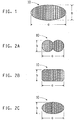
- Fig. 1 shows a representative non-circular cross sectional view of a fiber 10 having a major axis a and a minor axis b.
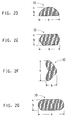
- the non-circular cross section of the fiber 10 may have a variety of shapes. Representative shapes of the non-circular cross section of the fiber 10 are shown in Fig.
- Fig. 2A shows a cocoon-type (figure-eight) shape
- Fig. 2B shows a rectangular shape
- Fig. 2C shows an elliptical shape
- Fig. 2D shows a semielliptical shape
- Fig. 2E shows a roughly triangular shape
- Fig. 2F shows a polygonal shape
- Fig. 2B shows an oblong shape.
- the cross section may have other shapes.
- the ratio of the length of the major axis to that of the minor access is preferably between about 1.5:1 and about 6:1.
- the ratio is more preferably between about 2:1 and 5:1 and yet more preferably between about 3:1 to about 4:1.
- the fibrous reinforcing agent may be glass, carbon fibers, or other materials. Glass fibers are preferred. Suitable glass fibrous reinforcing agents are disclosed in EP 0 190 001 and EP 0 196 194 .
- the fibrous reinforcing agent may be in the form of long glass fibers, chopped strands, milled short glass fibers, or other suitable forms known to those skilled in the art.
- Fibrous reinforcing agent (B) is preferably present in the composition in about 15 to about 75 weight percent, or more preferably in about 25 to about 70 weight percent, or yet more preferably in about 35 to about 65 weight percent, or still more preferably in about 45 to about 60 weight percent based on the total weight of the composition.
- the composition may optionally further comprise an impact modifier (C).
- C impact modifiers include those typically used for polyamides, including carboxyl-substituted polyolefins, which are polyolefins that have carboxylic moieties attached thereto, either on the polyolefin backbone itself or on side chains.
- carboxylic moieties is meant carboxylic groups such as one or more of dicarboxylic acids, diesters, dicarboxylic monoesters, acid anhydrides, and monocarboxylic acids and esters.
- Useful impact modifiers include dicarboxyl-substituted polyolefins, which are polyolefins that have dicarboxylic moieties attached thereto, either on the polyolefin backbone itself or on side chains.
- dicarboxylic moieties attached thereto, either on the polyolefin backbone itself or on side chains.
- 'dicarboxylic moiety' is meant dicarboxylic groups such as one or more of dicarboxylic acids, diesters, dicarboxylic monoesters, and acid anhydrides.
- the impact modifier may preferably be based on an ethylene/a-olefin polyolefin. Diene monomers such as 1,4-butadiene; 1,4-hexadiene; or dicyclopentadiene may optionally be used in the preparation of the polyolefin.
- Preferred polyolefins include ethylene-propylene-diene (EPDM) polymers made from 1,4-hexadiene and/or dicyclopentadiene and styrene-ethylene-butadiene-styrene (SEBS) polymers.
- EPDM ethylene-propylene-diene
- SEBS styrene-ethylene-butadiene-styrene
- the impact modifier may or may not have one or more carboxyl moieties attached thereto.
- the carboxyl moiety may be introduced during the preparation of the polyolefin by copolymerizing with an unsaturated carboxyl-containing monomer. Preferred is a copolymer of ethylene and maleic anhydride monoethyl ester.
- the carboxyl moiety may also be introduced by grafting the polyolefin with an unsaturated compound containing a carboxyl moiety, such as an acid, ester, diacid, diester, acid ester, or anhydride.
- a preferred grafting agent is maleic anhydride.
- a preferred impact modifier is an EPDM polymer grafted with maleic anhydride, such as Fusabond® N MF521D, which is commercially available from E. I.
- Blends of polyolefins, such as polyethylene, polypropylene, and EPDM polymers with polyolefins that have been grafted with an unsaturated compound containing a carboxyl moiety may be used as an impact modifier.
- Suitable impact modifiers may also include ionomers.
- an ionomer is meant a carboxyl group containing polymer that has been neutralized or partially neutralized with metal cations such as zinc, sodium, or lithium and the like. Examples of ionomers are described in US patents 3,264,272 and 4,187,358 . Examples of suitable carboxyl group containing polymers include, but are not limited to, ethylene/acrylic acid copolymers and ethylene/methacrylic acid copolymers. The carboxyl group containing polymers may also be derived from one or more additional monomers, such as, but not limited to, butyl acrylate. Zinc salts are preferred neutralizing agents. Ionomers are commercially available under the Surlyn® trademark from E.I. du Pont de Nemours and Co., Wilmington, DE.
- Impact modifier (C) is present in the composition in 0 to about 20 weight percent, or preferably in about 3 to about 20 weight percent, or more preferably in about 5 to about 15 weight percent, based on the total weight of the composition.
- compositions used in the present invention may optionally contain additional reinforcing agents such as fibrous reinforcing agents having a circular cross section or flakey or particulate reinforcing agents.
- additional reinforcing agents may include mineral reinforcing agents. Examples include glass fibers having a circular cross section, glass flakes, carbon fibers, wollastonite, calcined clay, kaolin, and the like.
- compositions used in the present invention may optionally comprise additional additives such as ultraviolet light stabilizers, heat stabilizers, antioxidants, processing aids, lubricants, flame retardants, and/or colorants (including dyes, pigments, carbon black, and the like).
- additional additives such as ultraviolet light stabilizers, heat stabilizers, antioxidants, processing aids, lubricants, flame retardants, and/or colorants (including dyes, pigments, carbon black, and the like).
- compositions used in the present invention preferably have a tensile modulus that is at least about 10 GPa, or preferably at least about 12 GPa, or more preferably at least about 14 GPa or yet more preferably at least 15 GPa.
- test specimens used are tensile type 1B with a radius r of 60 mm, which are described into the ISO procedure and obtained by injection molding. Test specimens are placed into sealed bags immediately after molding until testing in order to prevent moisture pick up. Tensile modulus is measured for 8 specimens for each polymer and the results is the average of them. Cross section S is determined for each sample by measuring its thickness and its breadth.
- compositions used in the present invention preferably have notched Charpy impact strength of at least about 7 kJ/m 2 , or more preferable of at least about 10 kJ/m 2 , or yet more preferably of about 12 kJ/m 2 or still more preferable of about 12 kJ/m 2 .
- Notched Charpy impact strength is measured according to ISO 179 using test specimens prepared according to ISO 179-1/1eA. The energy E necessary to break the specimen is measure and Charpy impact strength is calculated by dividing the energy E by the cross-sectional area of the specimen. The impact strength is average of the results from testing 10 specimens.
- compositions used in the present invention preferably have a warpage of less than about 0.45, or more preferably of less than about 0.40, or yet more preferably of less than about 0.35.
- Warpage is determined as follows: Compositions are injection molded into plaques having dimension of 60 x 60 x 2 mm according to ISO 29 4-3. Following molding and cooling, the widths of the plaques in the flow and cross-flow directions were measured. The flow direction is defined by the direction into which the molten resin was injected into the mold and the cross-flow direction is perpendicular across the surface of the plaque relative to the flow direction. The percentage by which the plaques had shrunken in each direction was calculated relative to the mold dimensions. The warpage is the absolute value of the percent shrinkage in the cross-flow direction minus the percent shrinkage in the flow direction.
- compositions used in the present invention are made by melt-blending the components using any known methods.
- the component materials may be mixed to uniformity using a melt-mixer such as a single or twin-screw extruder, blender, kneader, Banbury mixer, etc. to give a resin composition.
- a melt-mixer such as a single or twin-screw extruder, blender, kneader, Banbury mixer, etc.
- part of the materials may be mixed in a melt-mixer, and the rest of the materials may then be added and further melt-mixed until uniform.
- the housings for portable electronic devices are made from the compositions using any suitable melt-processing method. Injection molding is a preferred method.
- compositions of the Examples (abbreviated as “Ex.” In the tables) and Comparative Examples (abbreviated as “CE” in the tables were prepared by melt-compounding the ingredients shown in Table 1 in a twin-screw extruder.
- Comparative Example 3 The material used in Comparative Example 3 is Zytel® HTN 53G50 HFLR, a polyamide 6,I/6,T-polyamide 6,6 blend supplied by E.I. du Pont de Nemours & Co., Wilmington, DE, which was injection molded into test specimens.
- Tensile properties (tensile modulus, stress at break, and strain at break) were measured according to ISO 157-1/2 at 23 °C on samples that were dry as molded.
- Warpage properties were measured as described above under the Detailed Description of the Invention.
- Process aids refers to calcium montanate.
- Table 1 Ex. 1* Ex. 2* Ex. 3* Ex. 4* Ex. 5* Ex. 6 Ex. 7 Ex. 8 CE 1 CE 2 Polyamide 10,10 -- -- -- -- -- -- 47.9 47.9 37.9 46 36 Polyamide 6,6 32.9 25.9 32.9 29 30 -- -- -- -- -- -- Polyamide 6,I/6,T 15 12 15 11 11 -- -- -- -- -- -- Circular glass fibers -- -- -- 19 -- -- -- -- -- 50 60 Glass fibers A 50 60 -- 27 50 - 50 60 -- -- Glass fibers B -- -- 50 -- -- 50 -- -- -- -- -- -- Impact modifier -- -- -- 10 5 -- -- -- -- -- -- -- -- -- Antioxidants 0.6 0.6 0.6 0.7 0.7 0.6 0.6 0.7 0.7 Process aids 0.3 0.3 0.3 0.3 0.3 0.3 0.3 0.3 0.3 0.3 0.3 0.3 0.3 0.3 0.3 0.3 0.3 0.3 0.3 0.3 0.3 0.3 0.3 0.3 0.3 0.3 0.3 0.3 0.3 0.3
Landscapes
- Chemical & Material Sciences (AREA)
- Health & Medical Sciences (AREA)
- Chemical Kinetics & Catalysis (AREA)
- Medicinal Chemistry (AREA)
- Polymers & Plastics (AREA)
- Organic Chemistry (AREA)
- Inorganic Chemistry (AREA)
- Engineering & Computer Science (AREA)
- Manufacturing & Machinery (AREA)
- Materials Engineering (AREA)
- Compositions Of Macromolecular Compounds (AREA)
- Reinforced Plastic Materials (AREA)
Description
- The present invention relates to portable electronic device housings comprising a polyamide composition having excellent stiffness and impact resistance and low anisotropic shrinkage on molding.
- Portable electronic devices, such as mobile telephones, personal digital assistants, laptop computers, tablet computers, global positioning system receivers, portable games, radios, cameras and camera accessories, and the like are becoming increasingly widely used globally in many different environments. It is often important that the housings of such devices be made from materials that are able to withstand the rigors of frequent use and can meet challenging aesthetic demands while not interfering with their intended operability. It is often desirable that such materials have good stiffness and impact resistance and that they exhibit minimal shrinkage (i.e., low warpage or high dimensional stability) when they are formed (as by injection molding, for example) into housings.
- Thermoplastic polyamide compositions are desirable for use in making housings for portable electronic devices because of their good physical properties and that they may be conveniently and flexibly molded into a variety of articles of varying degrees of complexity and intricacy. Reinforcing agents are typically added to polyamide compositions to increase stiffness, but can often result in compositions that exhibit undesirable degrees of anisotropic shrinkage up on molding. It would thus be desirable to obtain housings for portable electronic devices that are made from polyamide compositions having excellent stiffness and impact resistance and low anisotropic warpage (i.e., good dimensional stability). By "warpage" is meant the deformation of molded parts in one or more directions that may be caused by anisotropic shrinkage of the resin during molding.
-
EP 0 190 001 discloses a flat glass fiber strand comprising a multiplicity of glass filaments having an oblong, elliptical, or rectangular cross-sectional shape.EP 0 196 194 discloses a strand comprising glass fibers having at least two expanded apex portions and a recess.EP 0 246 620 discloses a glass-fiber reinforced resin molded article that comprises a thermoplastic resin reinforced with glass fibers having oblong, elliptical, or cocoon-shaped cross sections.EP 0 376 616 discloses a thermoplastic resin composition reinforced with a fibrous reinforcing agent having a non-circular cross section.JP 2004/168849 - There is disclosed and claimed herein a portable electronic device housing comprising a polyamide composition comprising a melt-mixed blend of (A) at least one thermoplastic polyamide and (B) at least one fibrous reinforcing agent having a non-circular cross section, wherein the thermoplastic polyamide is selected from the group consisting of polyamide 6,6; polyamide 4,6;
polyamide 6,10; polyamide 6,12; polyamide 11; polyamide 12;polyamide 9,10; polyamide 9,12; polyamide 9,13; polyamide 9,14; polyamide 9,15; polyamide 6,16; polyamide 9,36;polyamide polyamide 10,12;polyamide 10,13;polyamide 10,14;polyamide 12,10; polyamide 12,12; polyamide 12,13; polyamide 12,14; polyamide 6,14; polyamide 6,13; polyamide 6,15; polyamide 6,16; and copolymers and mixtures of these polymers, wherein the thermoplastic polyamide (A) comprises 30 to 75 weight percent of the polyamide composition. -
-
Figure 1 is a cross-sectional view of a fibrous reinforcing agent having a non-circular cross section where the cross section has a major axis and a minor axis. -
Figure 2A is a cross-sectional view of a fibrous reinforcing agent having a cocoon-type non-circular cross section. -
Figure 2B is a cross-sectional view of a fibrous reinforcing agent having a rectangular non-circular cross section. -
Figure 2C is a cross-sectional view of a fibrous reinforcing agent having an elliptical non-circular cross section. -
Figure 2D is a cross-sectional view of a fibrous reinforcing agent having a semielliptical non-circular cross section. -
Figure 2E is a cross-sectional view of a fibrous reinforcing agent having a roughly triangular non-circular cross section. -
Figure 2F is a cross-sectional view of a fibrous reinforcing agent having a polygonal non-circular cross section. -
Figure 2G is a cross-sectional view of a fibrous reinforcing agent having an oblong non-circular cross section. - By "portable electronic device" is meant an electronic device that is designed to be conveniently transported and used in various locations. Representative examples of portable electronic devices include mobile telephones, personal digital assistants, laptop computers, tablet computers, radios, cameras and camera accessories, watches, calculators, music players, global positioning system receivers, portable games, hard drives and other electronic storage devices, and the like.
- By "portable electronic device housing" is meant a cover, backbone, or the like of the device. The housing may be a single article or comprise two or more components. By "backbone" is meant a structural component onto which other components of the device, such as electronics, microprocessors, screens, keyboards and keypads, antennas, battery sockets, and the like are mounted. The backbone may be an interior component that is not visible or only partially visible from the exterior of the telephone. The housing may provide protection for internal components of the device from impact and contamination and/or damage from environmental agents (such as liquids, dust, and the like). Housing components such as covers may also provide substantial or primary structural support for and protection against impact of certain components having exposure to the exterior of the device such as screens and/or antennas.
- In a preferred embodiment, the housings of the present invention are mobile telephone housings. By "mobile telephone housing" is meant one or more of the back cover, front cover, antenna housing, and/or backbone of a mobile phone. The housing may be a single article incorporating one or more of the foregoing. By "backbone" is meant a structural component onto which other components of the mobile telephone, such as electronics, screens, battery sockets, and the like are mounted. The backbone may be an interior component that is not visible or only partially visible from the exterior of the telephone.
- The housing of the present invention comprises a composition comprising a melt-mixed blend of (A) at least one thermoplastic polyamide and (B) at least one fibrous reinforcing agent having a non-circular cross section.
- Thermoplastic polyamide (A) is at least one polyamide. Suitable polyamides can be condensation products of one or more dicarboxylic acids and one or more diamines, and/or one or more aminocarboxylic acids, and/or ring-opening polymerization products of one or more cyclic lactams.
- Suitable dicarboxylic acids include, but are not limited to adipic acid. Preferred are dicarboxylic acids having 10 or more carbon atoms, including, but not limited to sebacic acid; dodecanedioic acid, tetradecanedioic acid, and pentadecanedioic acid.
- Suitable diamines include, but are not limited to, tetramethylenediamine; hexamethylenediamine; and nonamethylenediamine. Preferred diamines have 10 or more carbon atoms, including decamethylenediamine; and dodecamethylenediamine.
- A suitable aminocarboxylic acid is 11-aminododecanoic acid. Suitable cyclic lactams are caprolactam and laurolactam.
- Polyamides are selected from aliphatic polyamides such as polyamide 6,6; polyamide 4,6;
polyamide 6,10; polyamide 6,12; polyamide 11; polyamide 12;polyamide 9,10; polyamide 9,12; polyamide 9,13; polyamide 9,14; polyamide 9,15; polyamide 6,16; polyamide 9,36;polyamide polyamide 10,12;polyamide 10,13;polyamide 10,14;polyamide 12,10; polyamide 12,12; polyamide 12,13; polyamide 12,14; polyamide 6,14; polyamide 6,13; polyamide 6,15; polyamide 6,16; and copolymers and mixtures of these polymers. - The polyamides may be amorphous polyamides or semicrystalline.
- Polyamide (A) is present in the composition in 30 to about 75 weight percent, or preferably in about 35 to about 65 weight percent, or still more preferably in about 40 to about 55 weight percent, based on the total weight of the composition.
- Fibrous reinforcing agent (B) has a non-circular cross section having a major axis lying perpendicular to a longitudinal direction of the reinforcing agent and corresponding to the longest linear distance in the cross section. The non-circular cross section has a minor axis corresponding to the longest linear distance in the cross section in a direction perpendicular to the major axis.
Fig. 1 shows a representative non-circular cross sectional view of afiber 10 having a major axis a and a minor axis b. The non-circular cross section of thefiber 10 may have a variety of shapes. Representative shapes of the non-circular cross section of thefiber 10 are shown inFig. 2 , wherein the cross sections each have a major axis a and a minor axis bFig. 2A shows a cocoon-type (figure-eight) shape;Fig. 2B shows a rectangular shape;Fig. 2C shows an elliptical shape;Fig. 2D shows a semielliptical shape;Fig. 2E shows a roughly triangular shapeFig. 2F shows a polygonal shape; andFig. 2B shows an oblong shape. As will be understood by those skilled in the art, the cross section may have other shapes. - The ratio of the length of the major axis to that of the minor access is preferably between about 1.5:1 and about 6:1. The ratio is more preferably between about 2:1 and 5:1 and yet more preferably between about 3:1 to about 4:1.
- The fibrous reinforcing agent may be glass, carbon fibers, or other materials. Glass fibers are preferred. Suitable glass fibrous reinforcing agents are disclosed in
EP 0 190 001 andEP 0 196 194 . - The fibrous reinforcing agent may be in the form of long glass fibers, chopped strands, milled short glass fibers, or other suitable forms known to those skilled in the art.
- Fibrous reinforcing agent (B) is preferably present in the composition in about 15 to about 75 weight percent, or more preferably in about 25 to about 70 weight percent, or yet more preferably in about 35 to about 65 weight percent, or still more preferably in about 45 to about 60 weight percent based on the total weight of the composition.
- The composition may optionally further comprise an impact modifier (C). Preferred impact modifiers include those typically used for polyamides, including carboxyl-substituted polyolefins, which are polyolefins that have carboxylic moieties attached thereto, either on the polyolefin backbone itself or on side chains. By "carboxylic moieties" is meant carboxylic groups such as one or more of dicarboxylic acids, diesters, dicarboxylic monoesters, acid anhydrides, and monocarboxylic acids and esters. Useful impact modifiers include dicarboxyl-substituted polyolefins, which are polyolefins that have dicarboxylic moieties attached thereto, either on the polyolefin backbone itself or on side chains. By 'dicarboxylic moiety' is meant dicarboxylic groups such as one or more of dicarboxylic acids, diesters, dicarboxylic monoesters, and acid anhydrides.
- The impact modifier may preferably be based on an ethylene/a-olefin polyolefin. Diene monomers such as 1,4-butadiene; 1,4-hexadiene; or dicyclopentadiene may optionally be used in the preparation of the polyolefin. Preferred polyolefins include ethylene-propylene-diene (EPDM) polymers made from 1,4-hexadiene and/or dicyclopentadiene and styrene-ethylene-butadiene-styrene (SEBS) polymers. As will be understood by those skilled in the art, the impact modifier may or may not have one or more carboxyl moieties attached thereto.
- The carboxyl moiety may be introduced during the preparation of the polyolefin by copolymerizing with an unsaturated carboxyl-containing monomer. Preferred is a copolymer of ethylene and maleic anhydride monoethyl ester. The carboxyl moiety may also be introduced by grafting the polyolefin with an unsaturated compound containing a carboxyl moiety, such as an acid, ester, diacid, diester, acid ester, or anhydride. A preferred grafting agent is maleic anhydride. A preferred impact modifier is an EPDM polymer grafted with maleic anhydride, such as Fusabond® N MF521D, which is commercially available from E. I. DuPont de Nemours & Co., Inc., Wilmington, DE. Blends of polyolefins, such as polyethylene, polypropylene, and EPDM polymers with polyolefins that have been grafted with an unsaturated compound containing a carboxyl moiety may be used as an impact modifier.
- Suitable impact modifiers may also include ionomers. By an ionomer is meant a carboxyl group containing polymer that has been neutralized or partially neutralized with metal cations such as zinc, sodium, or lithium and the like. Examples of ionomers are described in
US patents 3,264,272 and4,187,358 . Examples of suitable carboxyl group containing polymers include, but are not limited to, ethylene/acrylic acid copolymers and ethylene/methacrylic acid copolymers. The carboxyl group containing polymers may also be derived from one or more additional monomers, such as, but not limited to, butyl acrylate. Zinc salts are preferred neutralizing agents. Ionomers are commercially available under the Surlyn® trademark from E.I. du Pont de Nemours and Co., Wilmington, DE. - Impact modifier (C) is present in the composition in 0 to about 20 weight percent, or preferably in about 3 to about 20 weight percent, or more preferably in about 5 to about 15 weight percent, based on the total weight of the composition.
- The compositions used in the present invention may optionally contain additional reinforcing agents such as fibrous reinforcing agents having a circular cross section or flakey or particulate reinforcing agents. The addition reinforcing agents may include mineral reinforcing agents. Examples include glass fibers having a circular cross section, glass flakes, carbon fibers, wollastonite, calcined clay, kaolin, and the like.
- The compositions used in the present invention may optionally comprise additional additives such as ultraviolet light stabilizers, heat stabilizers, antioxidants, processing aids, lubricants, flame retardants, and/or colorants (including dyes, pigments, carbon black, and the like).
- The compositions used in the present invention preferably have a tensile modulus that is at least about 10 GPa, or preferably at least about 12 GPa, or more preferably at least about 14 GPa or yet more preferably at least 15 GPa. Tensile modulus is determined according to the ISO 527-1/2 method. Test specimens are elongated at a constant rate of 1 mm/min. The tensile modulus E is determined using Young's law by measuring the forces F1 and F2 needed to elongate test specimens to 0.05 percent (e1) and 0.25 percent (e2):

- The test specimens used are tensile type 1B with a radius r of 60 mm, which are described into the ISO procedure and obtained by injection molding. Test specimens are placed into sealed bags immediately after molding until testing in order to prevent moisture pick up. Tensile modulus is measured for 8 specimens for each polymer and the results is the average of them. Cross section S is determined for each sample by measuring its thickness and its breadth.
- The compositions used in the present invention preferably have notched Charpy impact strength of at least about 7 kJ/m2, or more preferable of at least about 10 kJ/m2, or yet more preferably of about 12 kJ/m2 or still more preferable of about 12 kJ/m2. Notched Charpy impact strength is measured according to ISO 179 using test specimens prepared according to ISO 179-1/1eA. The energy E necessary to break the specimen is measure and Charpy impact strength is calculated by dividing the energy E by the cross-sectional area of the specimen. The impact strength is average of the results from testing 10 specimens.
- The compositions used in the present invention preferably have a warpage of less than about 0.45, or more preferably of less than about 0.40, or yet more preferably of less than about 0.35. Warpage is determined as follows: Compositions are injection molded into plaques having dimension of 60 x 60 x 2 mm according to ISO 29 4-3. Following molding and cooling, the widths of the plaques in the flow and cross-flow directions were measured. The flow direction is defined by the direction into which the molten resin was injected into the mold and the cross-flow direction is perpendicular across the surface of the plaque relative to the flow direction. The percentage by which the plaques had shrunken in each direction was calculated relative to the mold dimensions. The warpage is the absolute value of the percent shrinkage in the cross-flow direction minus the percent shrinkage in the flow direction.
- The compositions used in the present invention are made by melt-blending the components using any known methods. The component materials may be mixed to uniformity using a melt-mixer such as a single or twin-screw extruder, blender, kneader, Banbury mixer, etc. to give a resin composition. Or, part of the materials may be mixed in a melt-mixer, and the rest of the materials may then be added and further melt-mixed until uniform.
- The housings for portable electronic devices are made from the compositions using any suitable melt-processing method. Injection molding is a preferred method.
- The compositions of the Examples (abbreviated as "Ex." In the tables) and Comparative Examples (abbreviated as "CE" in the tables were prepared by melt-compounding the ingredients shown in Table 1 in a twin-screw extruder.
- The material used in Comparative Example 3 is Zytel® HTN 53G50 HFLR, a polyamide 6,I/6,T-polyamide 6,6 blend supplied by E.I. du Pont de Nemours & Co., Wilmington, DE, which was injection molded into test specimens.
- Tensile properties (tensile modulus, stress at break, and strain at break) were measured according to ISO 157-1/2 at 23 °C on samples that were dry as molded.
- Impact properties (unnotched Charpy and notched Charpy impact strengths) were measured according to ISO 179/1eA at 23 °C on samples that were dry as molded.
- Warpage properties were measured as described above under the Detailed Description of the Invention.
- Surface appearance was assessed by visually inspecting the flat surfaces of injection molded test specimens. Surfaces having a relatively rough appearance caused by the presence of glass fibers were deemed to be "poor," while surfaces having a relatively smooth appearance were deemed to be "good"
- The following ingredients are referred to in Table 1:
- Circular glass fibers refers to refers to E-glass fibers having a number average diameter of about 10 microns and a circular cross section.
- Glass fibers A refers to CSG3PA820, glass fibers having a non-circular cross section supplied by Nitto Boseki Co. Ltd. (Nittobo) Tokyo, Japan.
- Glass fibers B refers to CSG3PA830, glass fibers having a non-circular cross section supplied by Nitto Boseki Co. Ltd. (Nittobo) Tokyo, Japan Impact modifier refers to ethylene/propylene/diene copolymers partially grafted with maleic anhydride.
- Color concentrate A refers to a master batch containing about 30 weight percent carbon black in polyamide 6.
- Color concentrate B refers to a master batch containing about 40 weigh percent of a blue pigment in polyamide 6
- Process aids refers to calcium montanate.
Table 1 Ex. 1* Ex. 2* Ex. 3* Ex. 4* Ex. 5* Ex. 6 Ex. 7 Ex. 8 CE 1 CE 2 Polyamide -- -- -- -- -- 47.9 47.9 37.9 46 36 Polyamide 6,6 32.9 25.9 32.9 29 30 -- -- -- -- -- Polyamide 6,I/6,T 15 12 15 11 11 -- -- -- -- -- Circular glass fibers -- -- -- 19 -- -- -- -- 50 60 Glass fibers A 50 60 -- 27 50 - 50 60 -- -- Glass fibers B -- -- 50 -- -- 50 -- -- -- -- Impact modifier -- -- -- 10 5 -- -- -- -- -- Antioxidants 0.6 0.6 0.6 0.7 0.7 0.6 0.6 0.6 0.7 0.7 Process aids 0.3 0.3 0.3 0.3 0.3 0.3 0.3 0.3 0.3 0.3 Color concentrate A 1.2 1.2 1.2 1.2 1.2 1.2 -- -- Color concentrate B -- -- -- 3 3 -- -- -- 3 3 * Reference example
Ingredient quantities are given in weight percentages based on the total weight of the composition.Table 2 Ex. 1* Ex. 2* Ex. 3* Ex. 4* Ex. 5* Ex. 6 Ex. 7 Ex. 8 CE 1 CE 2 CE 3 Tensile modulus (GPa) 17.2 21.2 17.3 11 14 14.3 14.1 18.1 15.1 18ln mtl.6 17 Elongation at break (%) 2.1 1.8 1.6 2.1 1.5 2.6 2.7 2.4 2.8 2.5 2.7 Notched Charpy impact strength (kJ/m2) 14.7 13.6 11.6 14.1 8.9 19.5 19.3 20.1 11.9 10.5 12.9 Unnotched Charpy impact strength (kJ/m2) 70.1 61.2 53.8 41.5 31.2 89.8 93.8 89.4 84.9 64.9 96.8 Mold shrinkage: Flow direction (%) 0.08 0.09 0.11 -- -- 0.13 0.13 0.12 0.01 0.03 0.15 Cross-flow direction (%) 0.25 0.29 0.33 -- -- 0.39 0.39 0.36 0.49 0.39 0.65 Warpage 0.17 0.2 0.22 -- -- 0.26 0.26 0.24 0.48 0.36 0.5 Surface appearance good good good good good good good good good poor good * Reference example
Claims (10)
- A portable electronic device housing comprising a polyamide composition comprising a melt-mixed blend of (A) at least one thermoplastic polyamide and (B) at least one fibrous reinforcing agent having a non-circular cross section, wherein the thermoplastic polyamide is selected from the group consisting of polyamide 6,6; polyamide 4,6; polyamide 6,10; polyamide 6,12; polyamide 11; polyamide 12; polyamide 9,10; polyamide 9,12; polyamide 9,13; polyamide 9,14; polyamide 9,15; polyamide 6,16; polyamide 9,36; polyamide 10,10; polyamide 10,12; polyamide 10,13; polyamide 10,14; polyamide 12,10; polyamide 12,12; polyamide 12,13; polyamide 12,14; polyamide 6,14; polyamide 6,13; polyamide 6,15; polyamide 6,16; and copolymers and mixtures of these polymers, wherein the thermoplastic polyamide (A) comprises 30 to 75 weight percent of the polyamide composition.
- The housing of claim 1, wherein the fibrous reinforcing agent (B) comprises 25 to 70 weight percent of the polyamide composition.
- The housing of claim 1 or 2, wherein the fibrous reinforcing agent (B) has a cross-section selected from a cocoon-type cross-section, a rectangular cross-section, and an elliptical cross-section.
- The housing of any one of claims 1 to 3, wherein the polyamide composition further comprises up to 20 weight percent of at least one impact modifier.
- The housing of claim 4, wherein the impact modifier is present in 3 to 20 weight percent, based on the total weight of the composition.
- The housing of claim 4 or 5, wherein the impact modifier is an ethylene-propylene-diene polymer and/or a styrene-ethylene-butadiene-styrene polymer.
- The housing of any one of claims 4 to 6, wherein the impact modifier has one or more carboxyl moieties attached thereto.
- The housing of any one of claims 1 to 7, wherein the polyamide composition further comprises one or more additional reinforcing agents selected from the group consisting of fibrous reinforcing agents having a circular cross-section; flakey reinforcing agents; and particulate reinforcing agents.
- The housing of claim 8, wherein the additional reinforcing agents are selected from one or more of the group consisting of glass fibers, glass flakes, wollastonite, calcined clay, and kaolin.
- The housing of any one of claims 1 to 9 in the form of a mobile telephone housing, a laptop computer or tablet computer housing, a personal digital assistant housing, a radio, camera, watch calculator, music player, global positioning system receiver, portable game, or hard drive housing.
Applications Claiming Priority (2)
| Application Number | Priority Date | Filing Date | Title |
|---|---|---|---|
| US87322706P | 2006-12-05 | 2006-12-05 | |
| PCT/US2007/025004 WO2008070157A2 (en) | 2006-12-05 | 2007-12-05 | Polyamide housings for portable electronic devices |
Publications (2)
| Publication Number | Publication Date |
|---|---|
| EP2089466A2 EP2089466A2 (en) | 2009-08-19 |
| EP2089466B1 true EP2089466B1 (en) | 2019-01-30 |
Family
ID=39492869
Family Applications (1)
| Application Number | Title | Priority Date | Filing Date |
|---|---|---|---|
| EP07862596.9A Active EP2089466B1 (en) | 2006-12-05 | 2007-12-05 | Polyamide housings for portable electronic devices |
Country Status (4)
| Country | Link |
|---|---|
| US (1) | US8859665B2 (en) |
| EP (1) | EP2089466B1 (en) |
| JP (1) | JP5539726B2 (en) |
| WO (1) | WO2008070157A2 (en) |
Families Citing this family (23)
| Publication number | Priority date | Publication date | Assignee | Title |
|---|---|---|---|---|
| KR100243834B1 (en) | 1996-12-02 | 2000-02-01 | 김승욱 | Apparatus for treating waste water |
| WO2007080754A1 (en) * | 2006-01-13 | 2007-07-19 | Mitsubishi Engineering-Plastics Corporation | Polyamide resin composition for portable electronic device and molded article for portable electronic device |
| KR100756349B1 (en) | 2006-12-18 | 2007-09-10 | 제일모직주식회사 | Nylon Resin Composites |
| US9567462B2 (en) | 2006-12-28 | 2017-02-14 | Ems-Chemie Ag | Polyamide molding materials reinforced with glass fibers and injection molded parts thereof |
| ES2392792T3 (en) * | 2007-08-24 | 2012-12-13 | Ems-Patent Ag | High temperature polyamide molding masses reinforced with flat glass fibers |
| JP5279415B2 (en) * | 2007-09-03 | 2013-09-04 | ユニチカ株式会社 | Resin composition and molded body using the same |
| EP2060607B2 (en) | 2007-11-16 | 2019-11-27 | Ems-Patent Ag | Filled polyamide moulding materials |
| EP2274375A1 (en) * | 2008-05-08 | 2011-01-19 | E.I. Du Pont De Nemours And Company | Portable electronic device cover comprising renewable polyamide resin composition |
| JP5526500B2 (en) * | 2008-07-04 | 2014-06-18 | 東洋紡株式会社 | Fiber reinforced polyamide resin composition |
| CN102264810A (en) | 2008-12-23 | 2011-11-30 | 纳幕尔杜邦公司 | Polymer compositions for metal coatings and articles made therefrom and methods for their preparation |
| US8476354B2 (en) | 2008-12-23 | 2013-07-02 | E I Du Pont De Nemours And Company | Low sink marks and excellent surface appearance reinforced polyamide compositions |
| CN102206411B (en) * | 2010-03-30 | 2013-08-21 | E.I.内穆尔杜邦公司 | Flame-retardant polyamide resin composition and products containing same |
| US20130022786A1 (en) | 2011-07-21 | 2013-01-24 | E I Du Pont De Nemours And Company | Device housings having excellent surface appearance |
| CN102719071B (en) * | 2012-07-02 | 2014-12-10 | 上海锦湖日丽塑料有限公司 | Buckling deformation-resistant glass fiber reinforced polycarbonate resin and preparation method thereof |
| US20160122510A1 (en) * | 2013-06-05 | 2016-05-05 | Solvay Specialty Polymers Usa, Llc | Filled polymer compositions for mobile electronic devices |
| EP3020746B1 (en) * | 2014-11-11 | 2020-08-26 | Ems-Patent Ag | Polyamide moulding material, moulded article produced from same, and uses of same |
| US10589060B2 (en) * | 2016-12-21 | 2020-03-17 | Biosense Webster (Israel) Ltd. | Extrusion with preferential bend axis |
| JP6873363B2 (en) * | 2017-06-08 | 2021-05-19 | 日立Astemo株式会社 | Lower spring seat |
| WO2020104412A1 (en) * | 2018-11-20 | 2020-05-28 | Solvay Specialty Polymers Usa, Llc | Polyamide/polyolefin blends and corresponding mobile electronic device components |
| JP2020164660A (en) * | 2019-03-29 | 2020-10-08 | 三井化学株式会社 | Glass fiber reinforced polyamide resin composition and molded product |
| WO2021181362A1 (en) * | 2020-03-13 | 2021-09-16 | Inv Nylon Chemicals Americas, Llc | Thermoplastic resins for network applications |
| WO2026029341A1 (en) * | 2024-07-31 | 2026-02-05 | 삼성전자 주식회사 | Electronic component and electronic device including thermally bonded metal members |
| CN120640581A (en) * | 2025-06-30 | 2025-09-12 | 歌尔股份有限公司 | Electronic device housing and electronic device |
Citations (12)
| Publication number | Priority date | Publication date | Assignee | Title |
|---|---|---|---|---|
| EP0376616A2 (en) * | 1988-12-26 | 1990-07-04 | Polyplastics Co. Ltd. | Fiber-reinforced thermoplastic resin composition |
| JPH0718186A (en) | 1993-06-29 | 1995-01-20 | Nitto Boseki Co Ltd | Powder-reinforced thermoplastic resin composition of glass fiber having flat cross-sectional shape |
| JPH08259808A (en) | 1995-03-22 | 1996-10-08 | Mitsubishi Eng Plast Kk | Polyamide resin vibration welded hollow body molded product |
| JP2003082228A (en) | 2001-09-14 | 2003-03-19 | Kuraray Co Ltd | Polyamide composition |
| EP1354915A1 (en) * | 2002-04-15 | 2003-10-22 | Kuraray Co., Ltd. | Polyamide resin composition |
| JP2004168849A (en) | 2002-11-19 | 2004-06-17 | Fujitsu Ltd | Electronic equipment housing |
| JP2006045390A (en) | 2004-08-05 | 2006-02-16 | Nitto Boseki Co Ltd | Flat glass fiber-containing pellets, flat glass fiber-containing thermoplastic resin moldings, and methods for producing the same |
| WO2006122602A1 (en) * | 2005-05-20 | 2006-11-23 | Ems-Chemie Ag | Polyamide molding materials with an improved flowability, the production thereof and its use |
| WO2007046536A1 (en) | 2005-10-18 | 2007-04-26 | Ube Industries, Ltd. | Material for laser fusion bonding |
| WO2007080754A1 (en) | 2006-01-13 | 2007-07-19 | Mitsubishi Engineering-Plastics Corporation | Polyamide resin composition for portable electronic device and molded article for portable electronic device |
| WO2008068898A1 (en) | 2006-12-04 | 2008-06-12 | Mitsubishi Engineering-Plastics Corporation | Flame-retardant polyamide resin composition and molded article |
| EP1942147A1 (en) | 2006-12-28 | 2008-07-09 | Ems-Chemie Ag | Polyamide moulding materials reinforced with flat glass fibers and articles injection-moulded therefrom |
Family Cites Families (9)
| Publication number | Priority date | Publication date | Assignee | Title |
|---|---|---|---|---|
| NL288151A (en) * | 1961-08-31 | 1900-01-01 | ||
| JPS5493043A (en) * | 1977-12-29 | 1979-07-23 | Unitika Ltd | Resin composition and its production |
| GB2170593B (en) | 1985-02-01 | 1988-09-14 | Central Electr Generat Board | Temperature measurement |
| EP0196194B1 (en) | 1985-03-23 | 1989-12-27 | Nitto Boseki Co., Ltd. | Glass fiber strand and method of producing the same |
| JPS62268612A (en) | 1986-05-19 | 1987-11-21 | Nitto Boseki Co Ltd | Glass-fiber reinforced resin molded form |
| JPH09316325A (en) * | 1996-05-24 | 1997-12-09 | Du Pont Kk | Aromatic polyamide resin composition with excellent balance of rigidity and toughness |
| US6319986B1 (en) * | 1998-07-02 | 2001-11-20 | Mitsui Chemicals | Semiaromatic polyamide resin composition |
| JP3977563B2 (en) * | 1999-11-02 | 2007-09-19 | ダイセル化学工業株式会社 | Thermoplastic resin composition |
| JP2007302866A (en) * | 2006-01-13 | 2007-11-22 | Mitsubishi Engineering Plastics Corp | Polyamide resin composition for portable electronic devices and molded article for portable electronic devices |
-
2007
- 2007-11-15 US US11/985,430 patent/US8859665B2/en active Active
- 2007-12-05 EP EP07862596.9A patent/EP2089466B1/en active Active
- 2007-12-05 WO PCT/US2007/025004 patent/WO2008070157A2/en not_active Ceased
- 2007-12-05 JP JP2009540295A patent/JP5539726B2/en active Active
Patent Citations (15)
| Publication number | Priority date | Publication date | Assignee | Title |
|---|---|---|---|---|
| EP0376616A2 (en) * | 1988-12-26 | 1990-07-04 | Polyplastics Co. Ltd. | Fiber-reinforced thermoplastic resin composition |
| JPH0718186A (en) | 1993-06-29 | 1995-01-20 | Nitto Boseki Co Ltd | Powder-reinforced thermoplastic resin composition of glass fiber having flat cross-sectional shape |
| JPH08259808A (en) | 1995-03-22 | 1996-10-08 | Mitsubishi Eng Plast Kk | Polyamide resin vibration welded hollow body molded product |
| JP2003082228A (en) | 2001-09-14 | 2003-03-19 | Kuraray Co Ltd | Polyamide composition |
| EP1354915A1 (en) * | 2002-04-15 | 2003-10-22 | Kuraray Co., Ltd. | Polyamide resin composition |
| JP2004168849A (en) | 2002-11-19 | 2004-06-17 | Fujitsu Ltd | Electronic equipment housing |
| JP2006045390A (en) | 2004-08-05 | 2006-02-16 | Nitto Boseki Co Ltd | Flat glass fiber-containing pellets, flat glass fiber-containing thermoplastic resin moldings, and methods for producing the same |
| WO2006122602A1 (en) * | 2005-05-20 | 2006-11-23 | Ems-Chemie Ag | Polyamide molding materials with an improved flowability, the production thereof and its use |
| WO2007046536A1 (en) | 2005-10-18 | 2007-04-26 | Ube Industries, Ltd. | Material for laser fusion bonding |
| EP1939254A1 (en) | 2005-10-18 | 2008-07-02 | Ube Industries, Ltd. | Material for laser fusion bonding |
| WO2007080754A1 (en) | 2006-01-13 | 2007-07-19 | Mitsubishi Engineering-Plastics Corporation | Polyamide resin composition for portable electronic device and molded article for portable electronic device |
| EP1972659A1 (en) | 2006-01-13 | 2008-09-24 | Mitsubishi Engineering-Plastics Corporation | Polyamide resin composition for portable electronic device and molded article for portable electronic device |
| WO2008068898A1 (en) | 2006-12-04 | 2008-06-12 | Mitsubishi Engineering-Plastics Corporation | Flame-retardant polyamide resin composition and molded article |
| EP2100919A1 (en) | 2006-12-04 | 2009-09-16 | Mitsubishi Engineering-Plastics Corporation | Flame-retardant polyamide resin composition and molded article |
| EP1942147A1 (en) | 2006-12-28 | 2008-07-09 | Ems-Chemie Ag | Polyamide moulding materials reinforced with flat glass fibers and articles injection-moulded therefrom |
Non-Patent Citations (1)
| Title |
|---|
| MELVIN I. KOHAN: "Nylon Plastics Handbook", 1995, pages: 1 - 11, XP055649166 |
Also Published As
| Publication number | Publication date |
|---|---|
| JP2010511778A (en) | 2010-04-15 |
| EP2089466A2 (en) | 2009-08-19 |
| WO2008070157A3 (en) | 2008-09-25 |
| US20080132633A1 (en) | 2008-06-05 |
| WO2008070157A2 (en) | 2008-06-12 |
| JP5539726B2 (en) | 2014-07-02 |
| US8859665B2 (en) | 2014-10-14 |
Similar Documents
| Publication | Publication Date | Title |
|---|---|---|
| US8859665B2 (en) | Polyamide housings for portable electronic devices | |
| EP2089475B1 (en) | Mobile telephone housing comprising polyamide resin composition | |
| US8476354B2 (en) | Low sink marks and excellent surface appearance reinforced polyamide compositions | |
| US20080119603A1 (en) | Mobile telephone housing comprising polyamide resin composition | |
| EP0315451B1 (en) | Glass fiber reinforced thermoplastic resin compositions | |
| US20150045494A1 (en) | Polyamide-based thermoplastic polymer compositions | |
| EP2431418B1 (en) | Resin composition for use in coated molded article | |
| EP2274375A1 (en) | Portable electronic device cover comprising renewable polyamide resin composition | |
| JP2001522906A (en) | Non-cohesive toughener for polyamide | |
| CN111004430B (en) | High-rigidity composite resin composition having excellent touch and heat resistance, and molded article produced from same | |
| US20040072936A1 (en) | Polyolefin resin composition | |
| JPH0613626B2 (en) | Polypropylene composition | |
| KR20200073335A (en) | Glass fiber reinforced polyamide resin composition, method for preparing the same and molded product comprising the composition | |
| KR101447352B1 (en) | Polypropylene Resin Composition | |
| WO2001060919A1 (en) | Molding material for electrical and electronic parts | |
| JPH0621207B2 (en) | Polyolefin resin composition | |
| KR19980055561A (en) | Polypropylene resin composition with excellent rigidity, heat resistance and dimensional stability | |
| CA2570281A1 (en) | A process for the preparation of thermoplastic polyamide compositions exhibiting increased melt flow and articles formed therefrom | |
| JP3295979B2 (en) | Method for producing reinforced crystalline engineering plastics composition | |
| CN113512252A (en) | Polypropylene composition and preparation method thereof | |
| KR20120084412A (en) | Low gravity polypropylene composition having excellent rigidity | |
| JPS58206666A (en) | Polyamide resin composition |
Legal Events
| Date | Code | Title | Description |
|---|---|---|---|
| PUAI | Public reference made under article 153(3) epc to a published international application that has entered the european phase |
Free format text: ORIGINAL CODE: 0009012 |
|
| 17P | Request for examination filed |
Effective date: 20090609 |
|
| AK | Designated contracting states |
Kind code of ref document: A2 Designated state(s): AT BE BG CH CY CZ DE DK EE ES FI FR GB GR HU IE IS IT LI LT LU LV MC MT NL PL PT RO SE SI SK TR |
|
| RIN1 | Information on inventor provided before grant (corrected) |
Inventor name: TOPOULOS, GEORGIOS |
|
| DAX | Request for extension of the european patent (deleted) | ||
| TPAC | Observations filed by third parties |
Free format text: ORIGINAL CODE: EPIDOSNTIPA |
|
| STAA | Information on the status of an ep patent application or granted ep patent |
Free format text: STATUS: EXAMINATION IS IN PROGRESS |
|
| 17Q | First examination report despatched |
Effective date: 20170215 |
|
| GRAP | Despatch of communication of intention to grant a patent |
Free format text: ORIGINAL CODE: EPIDOSNIGR1 |
|
| STAA | Information on the status of an ep patent application or granted ep patent |
Free format text: STATUS: GRANT OF PATENT IS INTENDED |
|
| INTG | Intention to grant announced |
Effective date: 20180919 |
|
| GRAS | Grant fee paid |
Free format text: ORIGINAL CODE: EPIDOSNIGR3 |
|
| GRAA | (expected) grant |
Free format text: ORIGINAL CODE: 0009210 |
|
| STAA | Information on the status of an ep patent application or granted ep patent |
Free format text: STATUS: THE PATENT HAS BEEN GRANTED |
|
| AK | Designated contracting states |
Kind code of ref document: B1 Designated state(s): AT BE BG CH CY CZ DE DK EE ES FI FR GB GR HU IE IS IT LI LT LU LV MC MT NL PL PT RO SE SI SK TR |
|
| REG | Reference to a national code |
Ref country code: GB Ref legal event code: FG4D |
|
| REG | Reference to a national code |
Ref country code: CH Ref legal event code: EP |
|
| REG | Reference to a national code |
Ref country code: AT Ref legal event code: REF Ref document number: 1093226 Country of ref document: AT Kind code of ref document: T Effective date: 20190215 |
|
| REG | Reference to a national code |
Ref country code: IE Ref legal event code: FG4D |
|
| RAP2 | Party data changed (patent owner data changed or rights of a patent transferred) |
Owner name: E. I. DU PONT DE NEMOURS AND COMPANY |
|
| REG | Reference to a national code |
Ref country code: DE Ref legal event code: R096 Ref document number: 602007057552 Country of ref document: DE |
|
| REG | Reference to a national code |
Ref country code: LT Ref legal event code: MG4D |
|
| REG | Reference to a national code |
Ref country code: NL Ref legal event code: MP Effective date: 20190130 |
|
| PG25 | Lapsed in a contracting state [announced via postgrant information from national office to epo] |
Ref country code: NL Free format text: LAPSE BECAUSE OF FAILURE TO SUBMIT A TRANSLATION OF THE DESCRIPTION OR TO PAY THE FEE WITHIN THE PRESCRIBED TIME-LIMIT Effective date: 20190130 Ref country code: ES Free format text: LAPSE BECAUSE OF FAILURE TO SUBMIT A TRANSLATION OF THE DESCRIPTION OR TO PAY THE FEE WITHIN THE PRESCRIBED TIME-LIMIT Effective date: 20190130 Ref country code: PT Free format text: LAPSE BECAUSE OF FAILURE TO SUBMIT A TRANSLATION OF THE DESCRIPTION OR TO PAY THE FEE WITHIN THE PRESCRIBED TIME-LIMIT Effective date: 20190530 Ref country code: SE Free format text: LAPSE BECAUSE OF FAILURE TO SUBMIT A TRANSLATION OF THE DESCRIPTION OR TO PAY THE FEE WITHIN THE PRESCRIBED TIME-LIMIT Effective date: 20190130 Ref country code: FI Free format text: LAPSE BECAUSE OF FAILURE TO SUBMIT A TRANSLATION OF THE DESCRIPTION OR TO PAY THE FEE WITHIN THE PRESCRIBED TIME-LIMIT Effective date: 20190130 Ref country code: PL Free format text: LAPSE BECAUSE OF FAILURE TO SUBMIT A TRANSLATION OF THE DESCRIPTION OR TO PAY THE FEE WITHIN THE PRESCRIBED TIME-LIMIT Effective date: 20190130 Ref country code: LT Free format text: LAPSE BECAUSE OF FAILURE TO SUBMIT A TRANSLATION OF THE DESCRIPTION OR TO PAY THE FEE WITHIN THE PRESCRIBED TIME-LIMIT Effective date: 20190130 |
|
| REG | Reference to a national code |
Ref country code: AT Ref legal event code: MK05 Ref document number: 1093226 Country of ref document: AT Kind code of ref document: T Effective date: 20190130 |
|
| PG25 | Lapsed in a contracting state [announced via postgrant information from national office to epo] |
Ref country code: IS Free format text: LAPSE BECAUSE OF FAILURE TO SUBMIT A TRANSLATION OF THE DESCRIPTION OR TO PAY THE FEE WITHIN THE PRESCRIBED TIME-LIMIT Effective date: 20190530 Ref country code: LV Free format text: LAPSE BECAUSE OF FAILURE TO SUBMIT A TRANSLATION OF THE DESCRIPTION OR TO PAY THE FEE WITHIN THE PRESCRIBED TIME-LIMIT Effective date: 20190130 Ref country code: BG Free format text: LAPSE BECAUSE OF FAILURE TO SUBMIT A TRANSLATION OF THE DESCRIPTION OR TO PAY THE FEE WITHIN THE PRESCRIBED TIME-LIMIT Effective date: 20190430 Ref country code: GR Free format text: LAPSE BECAUSE OF FAILURE TO SUBMIT A TRANSLATION OF THE DESCRIPTION OR TO PAY THE FEE WITHIN THE PRESCRIBED TIME-LIMIT Effective date: 20190501 |
|
| REG | Reference to a national code |
Ref country code: DE Ref legal event code: R026 Ref document number: 602007057552 Country of ref document: DE |
|
| PG25 | Lapsed in a contracting state [announced via postgrant information from national office to epo] |
Ref country code: CZ Free format text: LAPSE BECAUSE OF FAILURE TO SUBMIT A TRANSLATION OF THE DESCRIPTION OR TO PAY THE FEE WITHIN THE PRESCRIBED TIME-LIMIT Effective date: 20190130 Ref country code: SK Free format text: LAPSE BECAUSE OF FAILURE TO SUBMIT A TRANSLATION OF THE DESCRIPTION OR TO PAY THE FEE WITHIN THE PRESCRIBED TIME-LIMIT Effective date: 20190130 Ref country code: RO Free format text: LAPSE BECAUSE OF FAILURE TO SUBMIT A TRANSLATION OF THE DESCRIPTION OR TO PAY THE FEE WITHIN THE PRESCRIBED TIME-LIMIT Effective date: 20190130 Ref country code: DK Free format text: LAPSE BECAUSE OF FAILURE TO SUBMIT A TRANSLATION OF THE DESCRIPTION OR TO PAY THE FEE WITHIN THE PRESCRIBED TIME-LIMIT Effective date: 20190130 Ref country code: IT Free format text: LAPSE BECAUSE OF FAILURE TO SUBMIT A TRANSLATION OF THE DESCRIPTION OR TO PAY THE FEE WITHIN THE PRESCRIBED TIME-LIMIT Effective date: 20190130 Ref country code: EE Free format text: LAPSE BECAUSE OF FAILURE TO SUBMIT A TRANSLATION OF THE DESCRIPTION OR TO PAY THE FEE WITHIN THE PRESCRIBED TIME-LIMIT Effective date: 20190130 |
|
| PLBI | Opposition filed |
Free format text: ORIGINAL CODE: 0009260 |
|
| PLAX | Notice of opposition and request to file observation + time limit sent |
Free format text: ORIGINAL CODE: EPIDOSNOBS2 |
|
| 26 | Opposition filed |
Opponent name: SOLVAY SPECIALTY POLYMERS USA, LLC Effective date: 20191030 |
|
| PG25 | Lapsed in a contracting state [announced via postgrant information from national office to epo] |
Ref country code: AT Free format text: LAPSE BECAUSE OF FAILURE TO SUBMIT A TRANSLATION OF THE DESCRIPTION OR TO PAY THE FEE WITHIN THE PRESCRIBED TIME-LIMIT Effective date: 20190130 |
|
| PG25 | Lapsed in a contracting state [announced via postgrant information from national office to epo] |
Ref country code: SI Free format text: LAPSE BECAUSE OF FAILURE TO SUBMIT A TRANSLATION OF THE DESCRIPTION OR TO PAY THE FEE WITHIN THE PRESCRIBED TIME-LIMIT Effective date: 20190130 |
|
| PLBB | Reply of patent proprietor to notice(s) of opposition received |
Free format text: ORIGINAL CODE: EPIDOSNOBS3 |
|
| PG25 | Lapsed in a contracting state [announced via postgrant information from national office to epo] |
Ref country code: TR Free format text: LAPSE BECAUSE OF FAILURE TO SUBMIT A TRANSLATION OF THE DESCRIPTION OR TO PAY THE FEE WITHIN THE PRESCRIBED TIME-LIMIT Effective date: 20190130 |
|
| REG | Reference to a national code |
Ref country code: CH Ref legal event code: PL |
|
| REG | Reference to a national code |
Ref country code: BE Ref legal event code: MM Effective date: 20191231 |
|
| PG25 | Lapsed in a contracting state [announced via postgrant information from national office to epo] |
Ref country code: MC Free format text: LAPSE BECAUSE OF FAILURE TO SUBMIT A TRANSLATION OF THE DESCRIPTION OR TO PAY THE FEE WITHIN THE PRESCRIBED TIME-LIMIT Effective date: 20190130 |
|
| PG25 | Lapsed in a contracting state [announced via postgrant information from national office to epo] |
Ref country code: IE Free format text: LAPSE BECAUSE OF NON-PAYMENT OF DUE FEES Effective date: 20191205 Ref country code: LU Free format text: LAPSE BECAUSE OF NON-PAYMENT OF DUE FEES Effective date: 20191205 |
|
| PG25 | Lapsed in a contracting state [announced via postgrant information from national office to epo] |
Ref country code: LI Free format text: LAPSE BECAUSE OF NON-PAYMENT OF DUE FEES Effective date: 20191231 Ref country code: CH Free format text: LAPSE BECAUSE OF NON-PAYMENT OF DUE FEES Effective date: 20191231 Ref country code: BE Free format text: LAPSE BECAUSE OF NON-PAYMENT OF DUE FEES Effective date: 20191231 |
|
| PG25 | Lapsed in a contracting state [announced via postgrant information from national office to epo] |
Ref country code: CY Free format text: LAPSE BECAUSE OF FAILURE TO SUBMIT A TRANSLATION OF THE DESCRIPTION OR TO PAY THE FEE WITHIN THE PRESCRIBED TIME-LIMIT Effective date: 20190130 |
|
| RDAF | Communication despatched that patent is revoked |
Free format text: ORIGINAL CODE: EPIDOSNREV1 |
|
| PG25 | Lapsed in a contracting state [announced via postgrant information from national office to epo] |
Ref country code: HU Free format text: LAPSE BECAUSE OF FAILURE TO SUBMIT A TRANSLATION OF THE DESCRIPTION OR TO PAY THE FEE WITHIN THE PRESCRIBED TIME-LIMIT; INVALID AB INITIO Effective date: 20071205 Ref country code: MT Free format text: LAPSE BECAUSE OF FAILURE TO SUBMIT A TRANSLATION OF THE DESCRIPTION OR TO PAY THE FEE WITHIN THE PRESCRIBED TIME-LIMIT Effective date: 20190130 |
|
| APAH | Appeal reference modified |
Free format text: ORIGINAL CODE: EPIDOSCREFNO |
|
| APBM | Appeal reference recorded |
Free format text: ORIGINAL CODE: EPIDOSNREFNO |
|
| APBP | Date of receipt of notice of appeal recorded |
Free format text: ORIGINAL CODE: EPIDOSNNOA2O |
|
| APBQ | Date of receipt of statement of grounds of appeal recorded |
Free format text: ORIGINAL CODE: EPIDOSNNOA3O |
|
| PLAB | Opposition data, opponent's data or that of the opponent's representative modified |
Free format text: ORIGINAL CODE: 0009299OPPO |
|
| R26 | Opposition filed (corrected) |
Opponent name: SOLVAY SPECIALTY POLYMERS USA, LLC Effective date: 20191030 |
|
| REG | Reference to a national code |
Ref country code: DE Ref legal event code: R081 Ref document number: 602007057552 Country of ref document: DE Owner name: DUPONT POLYMERS, INC., WILMINGTON, US Free format text: FORMER OWNER: E.I. DU PONT DE NEMOURS AND COMPANY, WILMINGTON, DEL., US Ref country code: DE Ref legal event code: R081 Ref document number: 602007057552 Country of ref document: DE Owner name: CELANESE POLYMERS HOLDING, INC., WILMINGTON, US Free format text: FORMER OWNER: E.I. DU PONT DE NEMOURS AND COMPANY, WILMINGTON, DEL., US |
|
| RAP2 | Party data changed (patent owner data changed or rights of a patent transferred) |
Owner name: DUPONT POLYMERS, INC. |
|
| REG | Reference to a national code |
Ref country code: GB Ref legal event code: 732E Free format text: REGISTERED BETWEEN 20230427 AND 20230503 |
|
| P01 | Opt-out of the competence of the unified patent court (upc) registered |
Effective date: 20230528 |
|
| PLAB | Opposition data, opponent's data or that of the opponent's representative modified |
Free format text: ORIGINAL CODE: 0009299OPPO |
|
| APBU | Appeal procedure closed |
Free format text: ORIGINAL CODE: EPIDOSNNOA9O |
|
| PLAB | Opposition data, opponent's data or that of the opponent's representative modified |
Free format text: ORIGINAL CODE: 0009299OPPO |
|
| R26 | Opposition filed (corrected) |
Opponent name: SOLVAY SPECIALTY POLYMERS USA, LLC Effective date: 20191030 |
|
| R26 | Opposition filed (corrected) |
Opponent name: SOLVAY SPECIALTY POLYMERS USA, LLC Effective date: 20191030 |
|
| PLCK | Communication despatched that opposition was rejected |
Free format text: ORIGINAL CODE: EPIDOSNREJ1 |
|
| APAH | Appeal reference modified |
Free format text: ORIGINAL CODE: EPIDOSCREFNO |
|
| APBP | Date of receipt of notice of appeal recorded |
Free format text: ORIGINAL CODE: EPIDOSNNOA2O |
|
| PLAB | Opposition data, opponent's data or that of the opponent's representative modified |
Free format text: ORIGINAL CODE: 0009299OPPO |
|
| R26 | Opposition filed (corrected) |
Opponent name: SOLVAY SPECIALTY POLYMERS USA, LLC Effective date: 20191030 |
|
| APBQ | Date of receipt of statement of grounds of appeal recorded |
Free format text: ORIGINAL CODE: EPIDOSNNOA3O |
|
| PLAB | Opposition data, opponent's data or that of the opponent's representative modified |
Free format text: ORIGINAL CODE: 0009299OPPO |
|
| R26 | Opposition filed (corrected) |
Opponent name: SYENSQO SPECIALTY POLYMERS USA, LLC Effective date: 20191030 |
|
| PGFP | Annual fee paid to national office [announced via postgrant information from national office to epo] |
Ref country code: DE Payment date: 20251126 Year of fee payment: 19 |
|
| PGFP | Annual fee paid to national office [announced via postgrant information from national office to epo] |
Ref country code: GB Payment date: 20251119 Year of fee payment: 19 |
|
| PGFP | Annual fee paid to national office [announced via postgrant information from national office to epo] |
Ref country code: FR Payment date: 20251120 Year of fee payment: 19 |
|
| REG | Reference to a national code |
Ref country code: DE Ref legal event code: R081 Ref document number: 602007057552 Country of ref document: DE Owner name: CELANESE POLYMERS HOLDING, INC., WILMINGTON, US Free format text: FORMER OWNER: DUPONT POLYMERS, INC., WILMINGTON, DE, US |