EP2088285A2 - Compound propulsion engine - Google Patents
Compound propulsion engine Download PDFInfo
- Publication number
- EP2088285A2 EP2088285A2 EP09007027A EP09007027A EP2088285A2 EP 2088285 A2 EP2088285 A2 EP 2088285A2 EP 09007027 A EP09007027 A EP 09007027A EP 09007027 A EP09007027 A EP 09007027A EP 2088285 A2 EP2088285 A2 EP 2088285A2
- Authority
- EP
- European Patent Office
- Prior art keywords
- rotary
- turbine
- compressor
- axial
- fans
- Prior art date
- Legal status (The legal status is an assumption and is not a legal conclusion. Google has not performed a legal analysis and makes no representation as to the accuracy of the status listed.)
- Withdrawn
Links
- 150000001875 compounds Chemical class 0.000 title claims abstract description 17
- 238000002485 combustion reaction Methods 0.000 claims abstract description 49
- 239000012530 fluid Substances 0.000 claims abstract description 15
- 238000012546 transfer Methods 0.000 claims abstract description 15
- 238000011144 upstream manufacturing Methods 0.000 claims 2
- 238000007906 compression Methods 0.000 description 18
- 230000006835 compression Effects 0.000 description 17
- 230000002093 peripheral effect Effects 0.000 description 12
- 239000000446 fuel Substances 0.000 description 7
- 238000000034 method Methods 0.000 description 6
- 230000007246 mechanism Effects 0.000 description 5
- 238000007792 addition Methods 0.000 description 4
- 238000013461 design Methods 0.000 description 4
- 238000000605 extraction Methods 0.000 description 4
- 238000004519 manufacturing process Methods 0.000 description 4
- 239000000203 mixture Substances 0.000 description 4
- 230000008569 process Effects 0.000 description 4
- 230000008878 coupling Effects 0.000 description 3
- 238000010168 coupling process Methods 0.000 description 3
- 238000005859 coupling reaction Methods 0.000 description 3
- 238000010304 firing Methods 0.000 description 3
- 230000006872 improvement Effects 0.000 description 3
- 230000014759 maintenance of location Effects 0.000 description 3
- 238000001816 cooling Methods 0.000 description 2
- 238000012423 maintenance Methods 0.000 description 2
- 230000036961 partial effect Effects 0.000 description 2
- 230000000737 periodic effect Effects 0.000 description 2
- 230000009467 reduction Effects 0.000 description 2
- 238000005057 refrigeration Methods 0.000 description 2
- 230000001360 synchronised effect Effects 0.000 description 2
- 230000005540 biological transmission Effects 0.000 description 1
- 230000002860 competitive effect Effects 0.000 description 1
- 239000002826 coolant Substances 0.000 description 1
- 238000006073 displacement reaction Methods 0.000 description 1
- 238000002347 injection Methods 0.000 description 1
- 239000007924 injection Substances 0.000 description 1
- 239000007788 liquid Substances 0.000 description 1
- 238000003754 machining Methods 0.000 description 1
- 239000007800 oxidant agent Substances 0.000 description 1
- 238000012545 processing Methods 0.000 description 1
- 230000004044 response Effects 0.000 description 1
- 238000007789 sealing Methods 0.000 description 1
- 238000004513 sizing Methods 0.000 description 1
- 239000007787 solid Substances 0.000 description 1
- 238000009423 ventilation Methods 0.000 description 1
- XLYOFNOQVPJJNP-UHFFFAOYSA-N water Substances O XLYOFNOQVPJJNP-UHFFFAOYSA-N 0.000 description 1
Images





Classifications
-
- B—PERFORMING OPERATIONS; TRANSPORTING
- B64—AIRCRAFT; AVIATION; COSMONAUTICS
- B64C—AEROPLANES; HELICOPTERS
- B64C27/00—Rotorcraft; Rotors peculiar thereto
- B64C27/04—Helicopters
- B64C27/12—Rotor drives
-
- F—MECHANICAL ENGINEERING; LIGHTING; HEATING; WEAPONS; BLASTING
- F01—MACHINES OR ENGINES IN GENERAL; ENGINE PLANTS IN GENERAL; STEAM ENGINES
- F01C—ROTARY-PISTON OR OSCILLATING-PISTON MACHINES OR ENGINES
- F01C1/00—Rotary-piston machines or engines
- F01C1/30—Rotary-piston machines or engines having the characteristics covered by two or more groups F01C1/02, F01C1/08, F01C1/22, F01C1/24 or having the characteristics covered by one of these groups together with some other type of movement between co-operating members
- F01C1/34—Rotary-piston machines or engines having the characteristics covered by two or more groups F01C1/02, F01C1/08, F01C1/22, F01C1/24 or having the characteristics covered by one of these groups together with some other type of movement between co-operating members having the movement defined in group F01C1/08 or F01C1/22 and relative reciprocation between the co-operating members
- F01C1/344—Rotary-piston machines or engines having the characteristics covered by two or more groups F01C1/02, F01C1/08, F01C1/22, F01C1/24 or having the characteristics covered by one of these groups together with some other type of movement between co-operating members having the movement defined in group F01C1/08 or F01C1/22 and relative reciprocation between the co-operating members with vanes reciprocating with respect to the inner member
- F01C1/3441—Rotary-piston machines or engines having the characteristics covered by two or more groups F01C1/02, F01C1/08, F01C1/22, F01C1/24 or having the characteristics covered by one of these groups together with some other type of movement between co-operating members having the movement defined in group F01C1/08 or F01C1/22 and relative reciprocation between the co-operating members with vanes reciprocating with respect to the inner member the inner and outer member being in contact along one line or continuous surface substantially parallel to the axis of rotation
- F01C1/3442—Rotary-piston machines or engines having the characteristics covered by two or more groups F01C1/02, F01C1/08, F01C1/22, F01C1/24 or having the characteristics covered by one of these groups together with some other type of movement between co-operating members having the movement defined in group F01C1/08 or F01C1/22 and relative reciprocation between the co-operating members with vanes reciprocating with respect to the inner member the inner and outer member being in contact along one line or continuous surface substantially parallel to the axis of rotation the surfaces of the inner and outer member, forming the working space, being surfaces of revolution
-
- F—MECHANICAL ENGINEERING; LIGHTING; HEATING; WEAPONS; BLASTING
- F01—MACHINES OR ENGINES IN GENERAL; ENGINE PLANTS IN GENERAL; STEAM ENGINES
- F01C—ROTARY-PISTON OR OSCILLATING-PISTON MACHINES OR ENGINES
- F01C11/00—Combinations of two or more machines or engines, each being of rotary-piston or oscillating-piston type
- F01C11/002—Combinations of two or more machines or engines, each being of rotary-piston or oscillating-piston type of similar working principle
- F01C11/004—Combinations of two or more machines or engines, each being of rotary-piston or oscillating-piston type of similar working principle and of complementary function, e.g. internal combustion engine with supercharger
-
- F—MECHANICAL ENGINEERING; LIGHTING; HEATING; WEAPONS; BLASTING
- F01—MACHINES OR ENGINES IN GENERAL; ENGINE PLANTS IN GENERAL; STEAM ENGINES
- F01C—ROTARY-PISTON OR OSCILLATING-PISTON MACHINES OR ENGINES
- F01C11/00—Combinations of two or more machines or engines, each being of rotary-piston or oscillating-piston type
- F01C11/006—Combinations of two or more machines or engines, each being of rotary-piston or oscillating-piston type of dissimilar working principle
- F01C11/008—Combinations of two or more machines or engines, each being of rotary-piston or oscillating-piston type of dissimilar working principle and of complementary function, e.g. internal combustion engine with supercharger
-
- F—MECHANICAL ENGINEERING; LIGHTING; HEATING; WEAPONS; BLASTING
- F01—MACHINES OR ENGINES IN GENERAL; ENGINE PLANTS IN GENERAL; STEAM ENGINES
- F01C—ROTARY-PISTON OR OSCILLATING-PISTON MACHINES OR ENGINES
- F01C13/00—Adaptations of machines or engines for special use; Combinations of engines with devices driven thereby
-
- F—MECHANICAL ENGINEERING; LIGHTING; HEATING; WEAPONS; BLASTING
- F01—MACHINES OR ENGINES IN GENERAL; ENGINE PLANTS IN GENERAL; STEAM ENGINES
- F01C—ROTARY-PISTON OR OSCILLATING-PISTON MACHINES OR ENGINES
- F01C21/00—Component parts, details or accessories not provided for in groups F01C1/00 - F01C20/00
- F01C21/08—Rotary pistons
- F01C21/0809—Construction of vanes or vane holders
- F01C21/0818—Vane tracking; control therefor
- F01C21/0827—Vane tracking; control therefor by mechanical means
- F01C21/0836—Vane tracking; control therefor by mechanical means comprising guiding means, e.g. cams, rollers
-
- F—MECHANICAL ENGINEERING; LIGHTING; HEATING; WEAPONS; BLASTING
- F01—MACHINES OR ENGINES IN GENERAL; ENGINE PLANTS IN GENERAL; STEAM ENGINES
- F01C—ROTARY-PISTON OR OSCILLATING-PISTON MACHINES OR ENGINES
- F01C21/00—Component parts, details or accessories not provided for in groups F01C1/00 - F01C20/00
- F01C21/10—Outer members for co-operation with rotary pistons; Casings
- F01C21/104—Stators; Members defining the outer boundaries of the working chamber
- F01C21/106—Stators; Members defining the outer boundaries of the working chamber with a radial surface, e.g. cam rings
-
- F—MECHANICAL ENGINEERING; LIGHTING; HEATING; WEAPONS; BLASTING
- F02—COMBUSTION ENGINES; HOT-GAS OR COMBUSTION-PRODUCT ENGINE PLANTS
- F02C—GAS-TURBINE PLANTS; AIR INTAKES FOR JET-PROPULSION PLANTS; CONTROLLING FUEL SUPPLY IN AIR-BREATHING JET-PROPULSION PLANTS
- F02C3/00—Gas-turbine plants characterised by the use of combustion products as the working fluid
- F02C3/04—Gas-turbine plants characterised by the use of combustion products as the working fluid having a turbine driving a compressor
- F02C3/055—Gas-turbine plants characterised by the use of combustion products as the working fluid having a turbine driving a compressor the compressor being of the positive-displacement type
-
- F—MECHANICAL ENGINEERING; LIGHTING; HEATING; WEAPONS; BLASTING
- F04—POSITIVE - DISPLACEMENT MACHINES FOR LIQUIDS; PUMPS FOR LIQUIDS OR ELASTIC FLUIDS
- F04C—ROTARY-PISTON, OR OSCILLATING-PISTON, POSITIVE-DISPLACEMENT MACHINES FOR LIQUIDS; ROTARY-PISTON, OR OSCILLATING-PISTON, POSITIVE-DISPLACEMENT PUMPS
- F04C2250/00—Geometry
- F04C2250/30—Geometry of the stator
- F04C2250/301—Geometry of the stator compression chamber profile defined by a mathematical expression or by parameters
-
- F—MECHANICAL ENGINEERING; LIGHTING; HEATING; WEAPONS; BLASTING
- F05—INDEXING SCHEMES RELATING TO ENGINES OR PUMPS IN VARIOUS SUBCLASSES OF CLASSES F01-F04
- F05D—INDEXING SCHEME FOR ASPECTS RELATING TO NON-POSITIVE-DISPLACEMENT MACHINES OR ENGINES, GAS-TURBINES OR JET-PROPULSION PLANTS
- F05D2220/00—Application
- F05D2220/30—Application in turbines
- F05D2220/32—Application in turbines in gas turbines
-
- Y—GENERAL TAGGING OF NEW TECHNOLOGICAL DEVELOPMENTS; GENERAL TAGGING OF CROSS-SECTIONAL TECHNOLOGIES SPANNING OVER SEVERAL SECTIONS OF THE IPC; TECHNICAL SUBJECTS COVERED BY FORMER USPC CROSS-REFERENCE ART COLLECTIONS [XRACs] AND DIGESTS
- Y02—TECHNOLOGIES OR APPLICATIONS FOR MITIGATION OR ADAPTATION AGAINST CLIMATE CHANGE
- Y02E—REDUCTION OF GREENHOUSE GAS [GHG] EMISSIONS, RELATED TO ENERGY GENERATION, TRANSMISSION OR DISTRIBUTION
- Y02E20/00—Combustion technologies with mitigation potential
- Y02E20/16—Combined cycle power plant [CCPP], or combined cycle gas turbine [CCGT]
Definitions
- This invention relates to energy systems and more particularly to componentry and thermodynamic cycle for enabling shaft work, propulsion drive, electric power source, jet propulsion and thermodynamic systems such as ventilation, cooling, heat, pressure or vacuum generating systems.
- the present invention combines the advantages of Otto and Diesel cycles at intake, compression and combustion phases of the thermodynamic cycle by limiting the peak combustion temperature.
- the present invention also claims an expanded power stroke that greatly improves power extraction and efficiency. With a proper thermodynamic and geometrical match of the compressor and turbine working chambers, it is shown that the expansion process can be improved and lower exhaust pressure and temperature levels can be achieved.
- a search of the prior art did not disclose any rotary vane engine patent with separate compression and expansion chambers that considers and provides an expansion process that would take the combusted products further down to ambient pressure levels. The overlook of such thermodynamic cycle improvement is a major source of wasted energy that ultimately translates in engine fuel inefficiency.
- the present invention provides proper sizing of the compression and expansion chambers, the rotors, and the vanes so as to achieve optimum compression (151ab), combustion (151bce, 151bcdf, 151bcg) and expansion (151eh, 151fh, 151gh).
- One of the objects of this invention is to increase the thermal efficiency above levels reached by today's heat engines. This is achieved by implementing a longer power extraction phase (151eh, 151fh, 151gh) and by realising high compression ratios with less shaft power input, by processing the fluid through a smooth crescent shape constriction (72 and 49 and 53). The operational and maintenance costs are also minimised, as maximum peak temperature is limited. All together, the present invention discloses an efficient, powerful, compact, simple and reliable heat engine.
- rotary components and gas turbine engine components have been matched with each other.
- the objective is to combine the high efficiency and "no-stall" characteristics of internal combustion engines with the high mass flow, smaller size and lighter weight characteristics of the gas turbine engines.
- Another objective is to eliminate the long, heavy and cumbersome concentric shafts and reduction gears that are present in today's turbofan, turboprops and turbojet engines.
- the present invention extends the efficient but narrow operating range of the gas turbine engine by mechanically decoupling and eliminating the long shaft drive between the expander (turbine) and the turbo-compressor.
- Each said fan (153, 155) and compressor group (158, 161, 182, 197) is allowed to be driven at its own speed, by its own rotary turbine (154, 156, 157, 162, 181, 196) wherein amounts of combustion fuel and air is delivered is dictated by the instantaneous compressor load requirements.
- Turbines (170, 171, 178, 191) drive rotary compressors (164, 166, 168, 179, 195, 190) that pump high pressure fluid to respective rotary turbines. Therefore the present invention overcomes some of the off-design limitations of conventional gas turbine engines. Because rotary vane compressors and turbines are partial admission components, they have low mass flow rate requirements and it also becomes extremely cheap and useful to equip the system with intercoolers (193) and reheat (198) systems. Other features, advantages, and applications of the invention will be apparent from the following descriptions, the accompanying figures, and from the claims.
- Figures 1 and 2 depict an example of an internal combustion rotary vane engine where combustion occurs within the turbine chamber (66).
- Figure 3 depicts a different example of an external combustion (74, 92) rotary vane engine where combustion starts in a chamber (72) prior to entry within the turbine expansion chamber (103).
- the rotary combustion engine casing (14, 21, 35, 44) comprises at least one rotary compressor unit wherein, said unit has inner (19, 48) and outer (46) housings.
- the engine casing also comprises at least one rotary turbine unit wherein, said unit has inner (59) and outer (57) housings. Said housings are surrounded by a liquid cooled jacket (18, 41, 45). For example, water may be used as coolant.
- the housings each have a circularly cylindrical (3, 13) rotor (12, 128), rotatably and eccentrically mounted.
- the said rotary engine breathes through the intake (20) and exhaust (34, 116) ports.
- the compressor rotor outer boundary (83, 126) and turbine rotor outer boundary (98) are sealingly (86, 101) mounted (90, 95) tangent to the chamber inner peripherals (88, 97). Accordingly, the respective rotor outer boundary and the chamber inner peripheral are osculating at their common tangency plane (90, 95).
- each of the said rotors (135) has an internal vane groove (1) and many seal slots (118, 129, 134, 136) and oil cooling holes (2, 130, 133).
- the sliding vane also carries many slots (14, 38, 40, 52, 64, 84, 124, 120) that accommodate seals.
- the radially outer vane tips (51, 86, 101, 109) are always in a natural contact with the housing inner peripheral (88, 97). This is because the housing inner peripheral is non-circular and has a cycloidal shape that accommodates well an eccentrically placed sliding vane of fixed length.
- the cycloidal peripheral (88, 97) is a unique shape, mainly depending on 4 parameters: the radial offset distance between the rotor center 'o' and the center of the chamber 'c', the sliding vane length 'L', the seal height (145) and the seal spring (144).
- the dynamic and thermal loading behaviour of the seal spring under rotation and the circumferential temperature differences may slightly alter the cycloidal shape.
- the machining and the manufacturing of the cycloidal shape of the present invention is achieved by enlarging by a distance ' ⁇ ', both opposite sides of the largest circle of diameter 'L' in such a way that, as the rotor rotates around its eccentrically placed axis over a range 0° ⁇ ⁇ ⁇ 180°, the radially outer tips of the springless vane define the said cycloidal shape of the housing inner peripheral.
- the exact coordinates of such cycloidal shape is used in the precision manufacturing of the housing inner peripheral using modern manufacturing techniques, including using CNC techniques.
- the pivot axle vane retention mechanism (54, 55; 61, 62; 81, 82; 104, 105) is a unique mechanism where the pivot is always tangent to the rotor central cavity (80).
- the pivot is a tubing (150) and retains the pin (139) which is embedded by one end into the sliding vane center socket ( Figure 5 ).
- the pivot rotates at twice the speed of the pin and the vane.
- Roller, gear (not shown) or sliding head (55, 81) of said pivot axle is engaging the cylindrical rotor inner peripheral (80) to guide the vane through its eccentric rotating and reciprocating sliding motion.
- Intake chamber (53) is receiving the fluid from intake port (20), said fluid is either air, or any other working gas, or any other liquid-gas mixture. Said fluid is compressed by the compressor rotor (12, 89) and the single rigid sliding vane (50, 87) which is sealingly (86) and movably mounted within the rotor groove. The sliding vane is contoured (127) to fit the said groove. By placing the sliding vane (16, 50, 87) within the compressor housing, a plurality of working chambers (72, 49, 53 and 106, 107, 108) are sequentially created within the crescent shaped cavity, delimited by the compressor housing inner peripheral (88) and the rotor outer surface (83).
- the rotary compression work is at least 2-15% more efficient as the fluid is sealed within the closed control volume (49, 107).
- the compression work within the crescent shape is smooth and gradual and therefore the compression is nearly isentropic.
- a periodic sequence of compressed fluid is delivered to the exhaust port (56, 76) of the compressor housing.
- the rotary combustion engine compressor casing is sealed at its opposite ends by bolted (9) plates (10).
- One of the compressor end plates is apertured at its centerline to allow for the drive shaft.
- Figures 1 , 2 and 3 depict examples where compressor and turbine housings are arranged in tandem.
- power and torque transfer and synchronization of compressor and turbine rotors (12, 3) and valve rotation (67, 69) are achieved with drive shafts (31, 8, 6, 69), gears (33, 28, 26, 24) or other transmission mechanisms (7, 25, 30), and bearings (not shown) supported by the engine casing (32, 21, 22, 23, 27).
- drive shafts 31, 8, 6, 69
- gears 33, 28, 26, 24
- bearings not shown supported by the engine casing (32, 21, 22, 23, 27.
- power transfer between the turbine and the compressor is much simpler, as the compressor (129) and turbine (117) rotors are directly coupled to the drive shaft (110).
- the shaft is journalled in bearings supported by the engine casing (121,122).
- a fluid transfer passage (114) connects the exhaust port (76) of the compressor and the intake port (73) of the turbine.
- the said transfer passage includes a combustion chamber (74, 92) which is periodically pressurised by gas flow from the compressor exhaust port. Downstream of said compressor exhaust port there is at least one check valve and/or at least one cyclo-valve (67, 68, 93), operating between open and closed positions, in timed sequence with the passage of the turbine sliding vane (100). The closed position (94) of the said valve prevents gas flow from the combustion chamber into the compressor.
- the cyclo-valve comprises a tubing (70) having inlet (115) and exhaust ports (71) and a rotatably and sealingly mounted slotted cylinder (69) within the said tubing.
- the rotary turbine unit is similar to the compressor unit but its size differs.
- Working chambers (60, 66, 103, 99), belonging to the turbine are delimited by the housing inner peripheral (97), the rotor outer surface (98) and the side surface of the sliding vane (37).
- the combustion working chamber (74) and the expansion chamber (103) are separate but linked.
- the turbine housing is allowed to run at a reduced temperature.
- a periodic sequence of expanded fluid is delivered from the exhaust port (34) with each rotation of the turbine rotor in response to high pressure and temperature gas expansion in the said turbine.
- the exhaust gas pressure is lowered to about local ambient pressure values to allow maximum shaft work extraction and increase in thermal efficiency.
- the maximum volume of the turbine expansion chamber (66) is sized such that the combusted gas pressure (151e, 151f, 151g) is expanded to local ambient pressure (151 h).
- the height of the turbine inner housing (36) and the turbine rotor (117) is sized in such a way that, the pressure of the gas, as it is being transferred from the compressor chamber (72) is maintained to about a constant high value (151 b).
- the turbine casing (35) is sealed at its opposite ends by bolted (42) plates (43). One of the said plates is apertured at its centerline, to accommodate the drive shaft (31) protruding therefrom.
- a fuel or a fuel/atomiser mixture (75) is supplied to said combustion chamber (74, 66) using commercially available fuel injection or fuel aspiration means.
- the fuel/oxidizer mixture is ignited using commercially available spark (91) or pressure ignition means.
- spark (91) or pressure ignition means for each 360 degrees of rotation of said compressor rotor, there are two complete and consecutive cycles of intake (108, 151a), compression (92, 151ab), combustion (74, 151bce; 151bcdf; 151bcg), power (66,103, 151eh; 151fh; 151gh) and exhaust (60, 99, 151 h) phases.
- thermodynamic cycle associated with the intake, compression, combustion, expansion and exhaust phases of the rotary vane engine contains innovations when compared to the Otto, Brayton, Diesel or more recent increased expansion cycles proposed in prior arts ( WO 02/090738 , US 5,341,771 ).
- the present invention combines the advantages of Otto and Diesel thermodynamic cycles. It is well known that for a given compression ratio, the ideal Otto cycle currently provides the most efficient combustion/expansion process since it combines high peak temperature during the isochoric (constant volume) heat addition, while still keeping an acceptable mean chamber temperature. However, high peak combustion temperatures can cause auto-ignition of a portion of fuel-air mixture, resulting in engine knocks.
- Diesel is an improvement of the Otto cycle as it provides higher useful compression ratios and isobaric (constant pressure) heat addition and do not have knock problem as air alone is present during the compression process.
- the high compression ratio makes Diesel engines more fuel-efficient but for this same reason, they also become much heavier.
- Diesel cycle also delivers less power for the same displacement.
- the ideal would be to follow a limited combustion pressure cycle that would first use a combined isochoric heat addition followed by isobaric and/or isothermal heat additions.
- the present invention By limiting the peak combustion pressures, the present invention also provides an expanded power stroke that improves power extraction (151eh; 151fh; 151gh).
- a search of the prior art did not disclose any patents that considers a thermodynamic heat engine cycle, whether it be reciprocating or rotary, that jointly proposes a limited peak combustion pressure and an expansion phase where the pressure exhausts (180, 192) to about ambient pressure.
- the present invention provides a practical and effective means of adding higher degrees of freedom to the gas turbine engines by eliminating the shaft coupling between fans, compressors and turbines.
- the compound engine ( Figures 8 , 9 , 10 ) of the present invention combines the efficiency of the heat engines with the compactness, lightweight and high power characteristics of gas turbine engines. Heat engines can produce kilowatts of power at high power densities and efficiencies but they are heavy and of relatively large sizes.
- the invention provides a mechanical coupling (162, 165, 167) of the rotary engine components with conventional gas turbine engine components.
- the turbo-rotary compound engines ( Figures 8 , 9 , 10 ) of the invention, eliminates conventional long and heavy concentric shafts and disclose a novel configuration where conventional rotational wing (186), fans (153, 155) compressors (158, 161, 182, 197) and turbines (170, 171, 178, 191) are only aero-thermodynamically coupled with each other.
- rotary turbines (154, 156, 157, 163, 181, 188, 196) drive said rotational wing, fans and compressors.
- said conventional turbines drive single or a plurality of rotary compressors (163,164, 166, 168, 179, 195, 190).
- Rotary compressors supply compressed fluid via flexible high-pressure connections (172, 187, 189, 194).
- Relatively low mass flow will move through such connection as both rotary compressors and turbines are partial admission machines.
- Low mass flow also favours the efficient use of intercooler (193) and reheat (198) systems, giving a further boost to thermal efficiency.
- the compound engine of the invention combines the thermal efficiency of the rotary internal engine cycle and the high mass flow, compact size and lightweight of the gas turbine engines.
- Such a compound cycle propulsion engine may comprise propellers, conventional fans, contra-rotating fans, hub-turbine driven fans (177, 176), contra-rotating hub-turbine driven fans (175, 174, 184,185), axial and/or centrifugal compressor stages, combustion chambers (169, 173), axial and/or centrifugal turbine stages, rotary compressors and turbines, intercoolers and reheaters.
- the current design is versatile and simple, therefore well adapted to turboprop, turbofan, marine and land based power production and refrigeration applications.
- the subject design can also be applied to geothermal power plants.
- turbo-rotary engines where conventional axial and/or radial turbines drive both conventional axial and/or centrifugal compressors and rotary compressors.
- hybrid applications where conventional axial and/or centrifugal compressors are driven by both conventional axial and/or radial turbines and rotary turbines. While the description cannot address each and every application, it is intended to indicate the extensive capabilities contemplated by the invention.
Landscapes
- Engineering & Computer Science (AREA)
- Mechanical Engineering (AREA)
- General Engineering & Computer Science (AREA)
- Chemical & Material Sciences (AREA)
- Combustion & Propulsion (AREA)
- Aviation & Aerospace Engineering (AREA)
- Structures Of Non-Positive Displacement Pumps (AREA)
- Supercharger (AREA)
Abstract
Description
- This invention relates to energy systems and more particularly to componentry and thermodynamic cycle for enabling shaft work, propulsion drive, electric power source, jet propulsion and thermodynamic systems such as ventilation, cooling, heat, pressure or vacuum generating systems.
- Since the start of the industrial revolution, the reciprocating piston engine based on the Otto and Diesel cycles and, the gas turbine engine based on the Brayton cycle, have largely dominated the market. Despite this fact, for many years, patents on rotary vane combustion engines have claimed that rotary engines possess many advantages over reciprocating engines such as having high torque, fewer parts, lower weight and fewer reciprocating imbalance. Fundamental design characteristics of the present invention address the main problems related to rotary vane engines and bridge the mass flow and rotational speed gaps between reciprocating and gas turbine engines.
- Instead of having hinged vanes (
US 5,352,295 ,WO 02/31318 US 4,414,938 ,US 4,422,419 ,US 5,596,963 ). In these arts, a plurality of spring-loaded vanes is used against the housing wall to achieve air-tightness. Furthermore, above-mentioned prior arts do not have any central vane retention mechanism (138, 139, 150) that would prevent the related wear problem. Moreover, only a portion of the entire inner peripheral of the housing is elliptic. Another patent related to rotary heat engine with 'all-through solid' vane (US 5,511,525 ) uses at least two mutually perpendicular vanes with radially extending guide. The plural use of vanes within one compressor housing substantially reduces the pressure ratio. This leads to a reduction of the rotary component efficiency and also increase the system complexity as more stage is required. Furthermore, the vane guide path mechanism described in this prior art is an additional cause for increased friction wear. - There are many rotary engine patents which provide separate compression, combustion and expansion chambers (
WO 02/31318 WO 99/041141 US 5,596,963 ,US 5,335,497 ,US 5,352,295 ,US 5,235,945 ,EP 1 016 785 A1 ,WO 98/53210 - The present invention combines the advantages of Otto and Diesel cycles at intake, compression and combustion phases of the thermodynamic cycle by limiting the peak combustion temperature. The present invention also claims an expanded power stroke that greatly improves power extraction and efficiency. With a proper thermodynamic and geometrical match of the compressor and turbine working chambers, it is shown that the expansion process can be improved and lower exhaust pressure and temperature levels can be achieved. A search of the prior art did not disclose any rotary vane engine patent with separate compression and expansion chambers that considers and provides an expansion process that would take the combusted products further down to ambient pressure levels. The overlook of such thermodynamic cycle improvement is a major source of wasted energy that ultimately translates in engine fuel inefficiency. Accordingly, the present invention provides proper sizing of the compression and expansion chambers, the rotors, and the vanes so as to achieve optimum compression (151ab), combustion (151bce, 151bcdf, 151bcg) and expansion (151eh, 151fh, 151gh).
- One of the objects of this invention, is to increase the thermal efficiency above levels reached by today's heat engines. This is achieved by implementing a longer power extraction phase (151eh, 151fh, 151gh) and by realising high compression ratios with less shaft power input, by processing the fluid through a smooth crescent shape constriction (72 and 49 and 53). The operational and maintenance costs are also minimised, as maximum peak temperature is limited. All together, the present invention discloses an efficient, powerful, compact, simple and reliable heat engine.
- For the compound engine configuration of the instant invention, rotary components and gas turbine engine components have been matched with each other. The objective is to combine the high efficiency and "no-stall" characteristics of internal combustion engines with the high mass flow, smaller size and lighter weight characteristics of the gas turbine engines. Another objective is to eliminate the long, heavy and cumbersome concentric shafts and reduction gears that are present in today's turbofan, turboprops and turbojet engines. By simplifying the mechanical links and by integrating low mass flow rotary components, the implementation of high efficiency reheat and intercooling systems have become extremely feasible.
- For a power range of 500 kW - 5 MW, the present invention (
Figures 8 ,9 ,10 ) extends the efficient but narrow operating range of the gas turbine engine by mechanically decoupling and eliminating the long shaft drive between the expander (turbine) and the turbo-compressor. Each said fan (153, 155) and compressor group (158, 161, 182, 197) is allowed to be driven at its own speed, by its own rotary turbine (154, 156, 157, 162, 181, 196) wherein amounts of combustion fuel and air is delivered is dictated by the instantaneous compressor load requirements. Turbines (170, 171, 178, 191) drive rotary compressors (164, 166, 168, 179, 195, 190) that pump high pressure fluid to respective rotary turbines. Therefore the present invention overcomes some of the off-design limitations of conventional gas turbine engines. Because rotary vane compressors and turbines are partial admission components, they have low mass flow rate requirements and it also becomes extremely cheap and useful to equip the system with intercoolers (193) and reheat (198) systems. Other features, advantages, and applications of the invention will be apparent from the following descriptions, the accompanying figures, and from the claims. - The present invention is illustrated hereinafter through preferred and alternative embodiments wherein:
- Figure 1
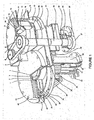
- is a schematic isometric view of a rotary engine where compressor (10) and turbine (43) housings are arranged in tandem. The gas transfer from the compressor to the turbine is sequenced by a rotor synchronised (24, 25, 26, 27, 8, 7, 6) cyclo-valve. Combustion occurs within the turbine expansion chamber.
- Figure 2
- is a schematic top view of the rotary engine of
Figure 1 , sectioned at mid height of the turbine housing. Isometric view of the cyclo-valve (69, 70, 71) is added. - Figure 3
- is a schematic isometric view of a rotary engine where compressor and turbine housings are arranged in tandem. The gas is transferred from the compressor to the turbine through an intermediary cyclo-combustion chamber (74) synchronised with the rotational speed of the compressor and the turbine. Expansion occurs within the turbine chamber (103).
- Figure 4
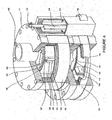
- is a schematic isometric view of a rotary engine where compressor (122) and turbine (121) housings are arranged back-to-back thereof, the compressor rotor (126) is coaxial with the turbine rotor (117). Combustion occurs externally within a cyclo chamber (114) and expansion occurs within the turbine.
- Figure 5
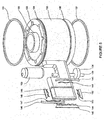
- is an exploded isometric view of rotor (135), sliding vne, sealing elements (131, 137, 140, 145, 146, 148), under seal springs (141, 143, 144, 147, 149), vane retention pivot axle (150) and pin (138, 139).
- Figure 6
- shows the geometry of the cycloid machined by enlarging by '28', the largest circle of diameter 'L' that fits the housing peripheral (88, 97).
- Figure 7
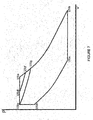
- shows high efficiency, high power, low peak temperature new thermodynamic cycles (151abceh, 151abcdfh, 151abcgh) pertaining to the invention.
- Figure 8
- shows a turbo-rotary-fan compound engine with high inlet (152) mass flow rate.
- Figure 9
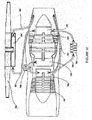
- shows a turbo-rotary-prop compound engine.
- Figure 10
- shows a turbo-rotary compound engine for helicopter or power applications.
- The embodiments of the invention for which an exclusive privilege or property is claimed are described below.
-
Figures 1 and2 depict an example of an internal combustion rotary vane engine where combustion occurs within the turbine chamber (66).Figure 3 depicts a different example of an external combustion (74, 92) rotary vane engine where combustion starts in a chamber (72) prior to entry within the turbine expansion chamber (103). The rotary combustion engine casing (14, 21, 35, 44) comprises at least one rotary compressor unit wherein, said unit has inner (19, 48) and outer (46) housings. The engine casing also comprises at least one rotary turbine unit wherein, said unit has inner (59) and outer (57) housings. Said housings are surrounded by a liquid cooled jacket (18, 41, 45). For example, water may be used as coolant. The housings each have a circularly cylindrical (3, 13) rotor (12, 128), rotatably and eccentrically mounted. The said rotary engine breathes through the intake (20) and exhaust (34, 116) ports. The compressor rotor outer boundary (83, 126) and turbine rotor outer boundary (98) are sealingly (86, 101) mounted (90, 95) tangent to the chamber inner peripherals (88, 97). Accordingly, the respective rotor outer boundary and the chamber inner peripheral are osculating at their common tangency plane (90, 95). As shown in more detail inFigure 5 , each of the said rotors (135) has an internal vane groove (1) and many seal slots (118, 129, 134, 136) and oil cooling holes (2, 130, 133). - The sliding vane also carries many slots (14, 38, 40, 52, 64, 84, 124, 120) that accommodate seals. The radially outer vane tips (51, 86, 101, 109) are always in a natural contact with the housing inner peripheral (88, 97). This is because the housing inner peripheral is non-circular and has a cycloidal shape that accommodates well an eccentrically placed sliding vane of fixed length. As seen from
Figure 6 , the cycloidal peripheral (88, 97) is a unique shape, mainly depending on 4 parameters: the radial offset distance between the rotor center 'o' and the center of the chamber 'c', the sliding vane length 'L', the seal height (145) and the seal spring (144). The dynamic and thermal loading behaviour of the seal spring under rotation and the circumferential temperature differences may slightly alter the cycloidal shape. - The machining and the manufacturing of the cycloidal shape of the present invention is achieved by enlarging by a distance 'δ', both opposite sides of the largest circle of diameter 'L' in such a way that, as the rotor rotates around its eccentrically placed axis over a range 0° ≤ θ ≤ 180°, the radially outer tips of the springless vane define the said cycloidal shape of the housing inner peripheral. The exact coordinates of such cycloidal shape is used in the precision manufacturing of the housing inner peripheral using modern manufacturing techniques, including using CNC techniques.
- The pivot axle vane retention mechanism (54, 55; 61, 62; 81, 82; 104, 105) is a unique mechanism where the pivot is always tangent to the rotor central cavity (80). The pivot is a tubing (150) and retains the pin (139) which is embedded by one end into the sliding vane center socket (
Figure 5 ). The pivot rotates at twice the speed of the pin and the vane. Roller, gear (not shown) or sliding head (55, 81) of said pivot axle is engaging the cylindrical rotor inner peripheral (80) to guide the vane through its eccentric rotating and reciprocating sliding motion. - Intake chamber (53) is receiving the fluid from intake port (20), said fluid is either air, or any other working gas, or any other liquid-gas mixture. Said fluid is compressed by the compressor rotor (12, 89) and the single rigid sliding vane (50, 87) which is sealingly (86) and movably mounted within the rotor groove. The sliding vane is contoured (127) to fit the said groove. By placing the sliding vane (16, 50, 87) within the compressor housing, a plurality of working chambers (72, 49, 53 and 106, 107, 108) are sequentially created within the crescent shaped cavity, delimited by the compressor housing inner peripheral (88) and the rotor outer surface (83). When compared with gas turbine engine compressor, the rotary compression work is at least 2-15% more efficient as the fluid is sealed within the closed control volume (49, 107). The compression work within the crescent shape is smooth and gradual and therefore the compression is nearly isentropic. As a result of the rotation of the rotor, a periodic sequence of compressed fluid is delivered to the exhaust port (56, 76) of the compressor housing. The rotary combustion engine compressor casing is sealed at its opposite ends by bolted (9) plates (10). One of the compressor end plates is apertured at its centerline to allow for the drive shaft.
-
Figures 1 ,2 and3 depict examples where compressor and turbine housings are arranged in tandem. For such configurations, power and torque transfer and synchronization of compressor and turbine rotors (12, 3) and valve rotation (67, 69) are achieved with drive shafts (31, 8, 6, 69), gears (33, 28, 26, 24) or other transmission mechanisms (7, 25, 30), and bearings (not shown) supported by the engine casing (32, 21, 22, 23, 27). For the example inFigure 4 , power transfer between the turbine and the compressor is much simpler, as the compressor (129) and turbine (117) rotors are directly coupled to the drive shaft (110). The shaft is journalled in bearings supported by the engine casing (121,122). The back-to-back compressor and turbine configuration is compact and lightweight as no gear, pulley and auxiliary power and torque transfer equipment is used. A fluid transfer passage (114) connects the exhaust port (76) of the compressor and the intake port (73) of the turbine. In the external combustion engine depicted inFigure 3 , the said transfer passage includes a combustion chamber (74, 92) which is periodically pressurised by gas flow from the compressor exhaust port. Downstream of said compressor exhaust port there is at least one check valve and/or at least one cyclo-valve (67, 68, 93), operating between open and closed positions, in timed sequence with the passage of the turbine sliding vane (100). The closed position (94) of the said valve prevents gas flow from the combustion chamber into the compressor. The cyclo-valve comprises a tubing (70) having inlet (115) and exhaust ports (71) and a rotatably and sealingly mounted slotted cylinder (69) within the said tubing. - Two firing cycles occur per rotor revolution. As one firing takes place (91), new cycles (92, 107, 108) are preceding the present firing and at least one old cycle (60, 99) is terminating thereof, a smooth operation is assured. The rotary turbine unit is similar to the compressor unit but its size differs. Working chambers (60, 66, 103, 99), belonging to the turbine are delimited by the housing inner peripheral (97), the rotor outer surface (98) and the side surface of the sliding vane (37). For
Figure 3 , the combustion working chamber (74) and the expansion chamber (103) are separate but linked. Thus, the turbine housing is allowed to run at a reduced temperature. A periodic sequence of expanded fluid is delivered from the exhaust port (34) with each rotation of the turbine rotor in response to high pressure and temperature gas expansion in the said turbine. The exhaust gas pressure is lowered to about local ambient pressure values to allow maximum shaft work extraction and increase in thermal efficiency. As shown inFigure 7 , the maximum volume of the turbine expansion chamber (66) is sized such that the combusted gas pressure (151e, 151f, 151g) is expanded to local ambient pressure (151 h). The height of the turbine inner housing (36) and the turbine rotor (117) is sized in such a way that, the pressure of the gas, as it is being transferred from the compressor chamber (72) is maintained to about a constant high value (151 b). The turbine casing (35) is sealed at its opposite ends by bolted (42) plates (43). One of the said plates is apertured at its centerline, to accommodate the drive shaft (31) protruding therefrom. - A fuel or a fuel/atomiser mixture (75) is supplied to said combustion chamber (74, 66) using commercially available fuel injection or fuel aspiration means. The fuel/oxidizer mixture is ignited using commercially available spark (91) or pressure ignition means. For each 360 degrees of rotation of said compressor rotor, there are two complete and consecutive cycles of intake (108, 151a), compression (92, 151ab), combustion (74, 151bce; 151bcdf; 151bcg), power (66,103, 151eh; 151fh; 151gh) and exhaust (60, 99, 151 h) phases.
- The thermodynamic cycle associated with the intake, compression, combustion, expansion and exhaust phases of the rotary vane engine contains innovations when compared to the Otto, Brayton, Diesel or more recent increased expansion cycles proposed in prior arts (
WO 02/090738 US 5,341,771 ). At intake, compression and combustion phases, the present invention combines the advantages of Otto and Diesel thermodynamic cycles. It is well known that for a given compression ratio, the ideal Otto cycle currently provides the most efficient combustion/expansion process since it combines high peak temperature during the isochoric (constant volume) heat addition, while still keeping an acceptable mean chamber temperature. However, high peak combustion temperatures can cause auto-ignition of a portion of fuel-air mixture, resulting in engine knocks. Diesel is an improvement of the Otto cycle as it provides higher useful compression ratios and isobaric (constant pressure) heat addition and do not have knock problem as air alone is present during the compression process. The high compression ratio makes Diesel engines more fuel-efficient but for this same reason, they also become much heavier. Compared to the Otto cycle, Diesel cycle also delivers less power for the same displacement. For the compression and combustion phases of the cycle, the ideal would be to follow a limited combustion pressure cycle that would first use a combined isochoric heat addition followed by isobaric and/or isothermal heat additions. As mentioned in a prior art (US 5,566,650 ) such hybrid engine process has been developed (Texaco TCCS, Ford PROCO, Ricardo, MAN-FM and KHD-AD) but they have been proven impractical. The rotary engine of the present invention naturally follows the above-described limited peak cycle (151bce; 151bcdf; 151bcg) multi-step (isochoric, isobaric and/or isothermal) combustion phases. - By limiting the peak combustion pressures, the present invention also provides an expanded power stroke that improves power extraction (151eh; 151fh; 151gh). A search of the prior art did not disclose any patents that considers a thermodynamic heat engine cycle, whether it be reciprocating or rotary, that jointly proposes a limited peak combustion pressure and an expansion phase where the pressure exhausts (180, 192) to about ambient pressure.
- One of the drawbacks of the current gas turbine engines are their highly sensitive stall characteristics always placed close to the high performance region. Furthermore, shaft and aero-thermodynamic coupling and feedback loop between the compressor and the turbine, only allows a narrow, high efficiency operational band. The present invention provides a practical and effective means of adding higher degrees of freedom to the gas turbine engines by eliminating the shaft coupling between fans, compressors and turbines. The compound engine (
Figures 8 ,9 ,10 ) of the present invention combines the efficiency of the heat engines with the compactness, lightweight and high power characteristics of gas turbine engines. Heat engines can produce kilowatts of power at high power densities and efficiencies but they are heavy and of relatively large sizes. After 50 MW, most of thermodynamic scaling and cost considerations have favoured large size gas turbine engines. 100 MW gas turbine combined cycle power plant costs about 500 USD per kW, whereas 10 MW power plant costs 750 USD per kW and 1 MW power plant costs 1000 USD per kW. For small power range (0.1 - 10 MW), internal combustion engine becomes highly competitive despite their size, weight and high maintenance cost. The present invention overcomes the limitations of both small gas turbine engines and large internal combustion engines and meets the modularity, high efficiency, mobility weight and cost requirements of today's modern power and propulsion applications. - The invention provides a mechanical coupling (162, 165, 167) of the rotary engine components with conventional gas turbine engine components. The turbo-rotary compound engines (
Figures 8 ,9 ,10 ) of the invention, eliminates conventional long and heavy concentric shafts and disclose a novel configuration where conventional rotational wing (186), fans (153, 155) compressors (158, 161, 182, 197) and turbines (170, 171, 178, 191) are only aero-thermodynamically coupled with each other. In this invention, rotary turbines (154, 156, 157, 163, 181, 188, 196) drive said rotational wing, fans and compressors. Conversely, said conventional turbines drive single or a plurality of rotary compressors (163,164, 166, 168, 179, 195, 190). Rotary compressors supply compressed fluid via flexible high-pressure connections (172, 187, 189, 194). Relatively low mass flow will move through such connection as both rotary compressors and turbines are partial admission machines. Low mass flow also favours the efficient use of intercooler (193) and reheat (198) systems, giving a further boost to thermal efficiency. The compound engine of the invention combines the thermal efficiency of the rotary internal engine cycle and the high mass flow, compact size and lightweight of the gas turbine engines. Such a compound cycle propulsion engine may comprise propellers, conventional fans, contra-rotating fans, hub-turbine driven fans (177, 176), contra-rotating hub-turbine driven fans (175, 174, 184,185), axial and/or centrifugal compressor stages, combustion chambers (169, 173), axial and/or centrifugal turbine stages, rotary compressors and turbines, intercoolers and reheaters. The current design is versatile and simple, therefore well adapted to turboprop, turbofan, marine and land based power production and refrigeration applications. The subject design can also be applied to geothermal power plants. - As is demonstrated by the breath of this description, the range of application for the compound and solo use of the turbo-rotary engine provided by the invention is truly vast. In particular, the scope of the present invention includes hybrid turbo-rotary engines where conventional axial and/or radial turbines drive both conventional axial and/or centrifugal compressors and rotary compressors. Also included in the present invention, hybrid applications where conventional axial and/or centrifugal compressors are driven by both conventional axial and/or radial turbines and rotary turbines. While the description cannot address each and every application, it is intended to indicate the extensive capabilities contemplated by the invention.
Claims (12)
- A compound propulsion engine comprising:a primary stage including an axial compressor having compressor blades and a rotary shaft defining an axial direction such that ram air is compressed and exits the axial compressor in the axial direction, a sliding vane rotary vane turbine connected by an interconnecting shaft to rotationally drive the axial compressor, and a combustor that is disposed downstream of the axial compressor and that adds heat energy to the exiting compressed air to produce combustion products; anda secondary stage including an axial turbine having turbine blades and a rotary shaft extending in the axial direction and driven by the combustion products exiting the combustor, and a sliding vane rotary vane compressor connected by an interconnecting shaft to the axial turbine so as to be rotationally driven by the axial turbine, the sliding vane rotary vane compressor being connected to receive andfurther compress a portion of the ram air or a portion of the compressed air exiting the axial compressor to produce a secondary compressed air flow that is directed through one or more transfer passages to an intake of the sliding vane rotary vane turbine, said fluid transfer passages between sliding vane rotary vane compressor and sliding vane rotary vane turbine comprise at least one check valve and/or at least a cyclo valve.
- A compound propulsion engine according to claim 1, further including a reheater or a combustor disposed in one of the transfer passages.
- A compound propulsion engine according to claim 1 or 2, further including an intercooler disposed in one of the transfer passages.
- A compound propulsion engine according to any one of preceding claims, wherein the first and second stages are aerothermodynamically coupled to each other and are not mechanically connected together by a shaft.
- A compound propulsion cycle engine, comprising: a single or a plurality of rotating wings, propellers, contrarotating propellers, fans, contrarotating fans, hub turbine driven fans, axial compressor stage rows, centrifugal compressor stage rows, combustion chambers, axial turbine stage rows, radial turbine stage rows, rotary compressors, rotary turbines, reheat systems, intercooler systems.
- A single or a plurality of rotating wings, propellers, contrarotating propellers, fans, contrarotating fans, hubturbine driven fans, axial compressor stage rows, centrifugal compressor stage rows of claim 5, driven by a rotary turbine of a sliding vane rotary combustion engine which is characterised by having at least one rotary compressor and at least one rotary turbine, an ignition and a combustion system.
- A single or a plurality of rotating wings, propellers, contrarotating propellers, fans, contrarotating fans, hubturbine driven fans, axial compressor stage rows, centrifugal compressor stage rows of claim 5, simultaneously driven by a rotary turbine of a sliding vane rotary combustion engine which is characterised by having at least one rotary compressor and at least one rotary turbine, an ignition and a combustion system, and conventional axial and/or radial turbines.
- A single or a plurality of rotating wings, propellers, contrarotating propellers, fans, contrarotating fans, hubturbine driven fans, axial compressor stage rows, centrifugal compressor stage rows of claim 5, simultaneously driven by rotary or piston type internal or external combustion engines and axial and/or radial turbines.
- A single or a plurality of axial and/or centrifugal turbine stage rows of claim 5, driving a single or a plurality of rotary compressors of a sliding vane rotary combustion engine which is characterised by having at least one rotary compressor and at least one rotary turbine, an ignition and a combustion system.
- A single or a plurality of axial and/or centrifugal turbine stage rows of claim 5, simultaneously driving a single or a plurality of rotary compressors of a sliding vane rotary combustion engine which is characterised by having at least one rotary compressor and at least one rotary turbine, an ignition and a combustion system, and one or a plurality of the following components: rotating wings, propellers, contrarotating propellers, fans, contrarotating fans, hubturbine driven fans, axial compressor stage rows, centrifugal compressor stage rows.
- Compound turbo rotary engine of claim 5, comprising: said single or a plurality of rotary compressor supplying compressed fluid to said single or a plurality of rotary turbines; a single or a plurality of fluid transfer passages connected between the exhaust port of the rotary compressor and the intake port of the rotary turbine, wherein said transfer passage comprises at least one check valve and/or at least one cyclovalve, and wherein said fluid transfer passages may incorporate reheat systems upstream of rotary engine combustion chamber inlet ports and/or intercooler systems upstream of rotary compressor inlet ports.
- A single or a plurality of hubturbine driven propeller of claim 5, wherein said hub turbine driven propeller comprises a circumferentially extending row of radially extending turbine blades and a circumferentially extending row of radially extending fan or propeller blades thereof, concentrically disposed about and extending radially outwardly from the radial outer ends of said turbine blades, wherein said hubturbine is adapted to receive the combusted product efflux from the said gas turbine combustor and to produce shaft power.
Applications Claiming Priority (3)
| Application Number | Priority Date | Filing Date | Title |
|---|---|---|---|
| TR200202132 | 2002-09-09 | ||
| TR200301486 | 2003-09-08 | ||
| EP03759169A EP1537294A1 (en) | 2002-09-09 | 2003-09-09 | Rotary vane engine and thermodynamic cycle |
Related Parent Applications (2)
| Application Number | Title | Priority Date | Filing Date |
|---|---|---|---|
| EP03759169.0 Division | 2003-09-09 | ||
| EP03759169A Division EP1537294A1 (en) | 2002-09-09 | 2003-09-09 | Rotary vane engine and thermodynamic cycle |
Publications (2)
| Publication Number | Publication Date |
|---|---|
| EP2088285A2 true EP2088285A2 (en) | 2009-08-12 |
| EP2088285A3 EP2088285A3 (en) | 2012-08-01 |
Family
ID=31980733
Family Applications (2)
| Application Number | Title | Priority Date | Filing Date |
|---|---|---|---|
| EP03759169A Withdrawn EP1537294A1 (en) | 2002-09-09 | 2003-09-09 | Rotary vane engine and thermodynamic cycle |
| EP09007027A Withdrawn EP2088285A3 (en) | 2002-09-09 | 2003-09-09 | Compound propulsion engine |
Family Applications Before (1)
| Application Number | Title | Priority Date | Filing Date |
|---|---|---|---|
| EP03759169A Withdrawn EP1537294A1 (en) | 2002-09-09 | 2003-09-09 | Rotary vane engine and thermodynamic cycle |
Country Status (5)
| Country | Link |
|---|---|
| US (1) | US7314035B2 (en) |
| EP (2) | EP1537294A1 (en) |
| AU (1) | AU2003274889A1 (en) |
| TR (2) | TR200502164T2 (en) |
| WO (1) | WO2004022919A1 (en) |
Families Citing this family (20)
| Publication number | Priority date | Publication date | Assignee | Title |
|---|---|---|---|---|
| RU2300001C2 (en) * | 2004-08-17 | 2007-05-27 | Владимир Петрович Голощапов | Cylindrical eccentric internal combustion rotary engine (versions) |
| GB0423748D0 (en) * | 2004-10-26 | 2004-11-24 | Harding Stephen M | An engine |
| WO2007049226A1 (en) * | 2005-10-24 | 2007-05-03 | Botha Stephanus Christoffel He | External combustion rotary vane engine |
| US8708643B2 (en) * | 2007-08-14 | 2014-04-29 | General Electric Company | Counter-rotatable fan gas turbine engine with axial flow positive displacement worm gas generator |
| DE102008050014B4 (en) * | 2008-04-17 | 2011-04-07 | Zink, Alexander M., Dipl.-Ing. | A rotary internal combustion engine |
| ITBL20080014A1 (en) * | 2008-09-19 | 2010-03-19 | Libralato Ruggero | THERMO-DYNAMIC CYCLE OF COMBUSTION ENGINE, IN PARTICULAR OF THE ROTARY TYPE WITH DOUBLE ROTATION CENTER AND MOTOR SO AS IT IS MADE |
| US8225767B2 (en) * | 2010-03-15 | 2012-07-24 | Tinney Joseph F | Positive displacement rotary system |
| RU2444635C2 (en) * | 2010-05-07 | 2012-03-10 | Ольгерд Яковлевич Скрипко | Rotary engine |
| US20110296843A1 (en) * | 2010-06-04 | 2011-12-08 | Lawson Jr T Towles | Positive displacement power extraction compensation device |
| US8579615B2 (en) | 2011-03-01 | 2013-11-12 | Pars Makina Sanayi Ve Ticaret Limited Sirketi | Pivoting, hinged arc vane rotary compressor or expander |
| US20130192216A1 (en) * | 2011-09-20 | 2013-08-01 | Light Sail Energy Inc. | Compressed gas energy storage system using turbine |
| EP2604822B1 (en) | 2011-12-16 | 2019-07-10 | José Ramón Martinez Casañ | Jet engine with sliding vane compressor |
| WO2013103977A2 (en) * | 2012-01-05 | 2013-07-11 | Jvf Energy Liberator 3 Llc | Rotational engine |
| US9709069B2 (en) | 2013-10-22 | 2017-07-18 | Dayspring Church Of God Apostolic | Hybrid drive engine |
| US10634049B2 (en) | 2017-01-16 | 2020-04-28 | Pratt & Whitney Canada Corp. | Turbofan engine assembly with intercooler |
| US10450952B2 (en) | 2017-01-16 | 2019-10-22 | Pratt & Whitney Canada Corp. | Turbofan engine assembly with gearbox |
| RU183285U1 (en) * | 2018-04-23 | 2018-09-17 | Юрий Иосипович Новицкий | VEHICLE ENGINE |
| RU2723266C1 (en) * | 2019-08-29 | 2020-06-09 | Елена Николаевна Городовикова | Rotary internal combustion engine |
| RU2729311C1 (en) * | 2020-01-29 | 2020-08-05 | Борис Яппарович Альмухаметов | Hybrid turbofan plant with built-in rotor ice |
| WO2022173975A1 (en) * | 2021-02-10 | 2022-08-18 | Gas Technologies Llc | High oxygen operation of internal combustion engines |
Citations (13)
| Publication number | Priority date | Publication date | Assignee | Title |
|---|---|---|---|---|
| US4414938A (en) | 1978-08-25 | 1983-11-15 | Soei Umeda | Rotary internal combustion engine |
| US4422419A (en) | 1979-10-15 | 1983-12-27 | Soei Umeda | Rotary internal combustion engine |
| US5235945A (en) | 1991-12-20 | 1993-08-17 | George Testea | Rotary engine system |
| US5335497A (en) | 1993-02-10 | 1994-08-09 | Macomber Bennie D | Rotary Stirling cycle engine |
| US5341771A (en) | 1991-12-03 | 1994-08-30 | Motive Holdings Limited | Internal combustion engine with variable combustion chambers and increased expansion cycle |
| US5352295A (en) | 1992-05-16 | 1994-10-04 | Yi Chou | Rotary vane engine |
| US5511525A (en) | 1995-03-08 | 1996-04-30 | Jirnov; Alexei | Sliding-blade heat engine with vortex combustion chamber |
| US5566650A (en) | 1992-07-27 | 1996-10-22 | Kruse; Douglas C. | Internal combustion engine with limited temperature cycle |
| US5596963A (en) | 1995-08-14 | 1997-01-28 | Lai; Jui H. | Stage combustion rotary engine |
| WO1998053210A1 (en) | 1997-05-23 | 1998-11-26 | Junyan Song | Eccentric sliding vane equilibrium rotor device and its applications |
| WO1999041141A2 (en) | 1998-02-16 | 1999-08-19 | Kaaden Hans Heinrich | Multiple hulled water craft for high speeds |
| WO2002031318A1 (en) | 2000-09-28 | 2002-04-18 | Vading Holding As | Rotary-piston machine |
| WO2002090738A2 (en) | 2001-05-07 | 2002-11-14 | Saddle Rock Technologies, Llc | Rotary machine and thermal cycle |
Family Cites Families (23)
| Publication number | Priority date | Publication date | Assignee | Title |
|---|---|---|---|---|
| FR538666A (en) * | 1921-07-23 | 1922-06-13 | Improvements to pumps, motors or rotary meters | |
| US2580591A (en) * | 1944-12-30 | 1952-01-01 | Gen Mechanique Appliquee Soc I | Jet engine having a plurality of turbocompressors operable in parallel or in series |
| GB697078A (en) * | 1952-04-30 | 1953-09-16 | Robert Desmond Parker | Improvements in or relating to rotary pumps |
| US3108767A (en) * | 1960-03-14 | 1963-10-29 | Rolls Royce | By-pass gas turbine engine with air bleed means |
| US3780530A (en) * | 1969-10-23 | 1973-12-25 | United Aircraft Corp | Combustion chamber |
| US3900942A (en) * | 1973-12-11 | 1975-08-26 | Glenn C Ainsworth | Method of forming a rotary motor or pump |
| JPS50102711A (en) * | 1974-01-25 | 1975-08-14 | ||
| US3987621A (en) * | 1974-06-03 | 1976-10-26 | United Technologies Corporation | Method for reducing jet exhaust takeoff noise from a turbofan engine |
| JPS55107002A (en) * | 1979-02-09 | 1980-08-16 | Shigeyuki Kimura | Device for maintaining airtightness of rotary internal combustion engine |
| GB2072750B (en) * | 1980-03-28 | 1983-10-26 | Miles M A P | Rotary positive-displacement fluidmachines |
| JPS5928735B2 (en) * | 1980-05-02 | 1984-07-16 | 弥一郎 工藤 | Explosive expansion force rotating machine in which the passive body rotates in a perfect circle due to the explosive expansion force of the filling explosion chamber mixture. |
| US4876850A (en) * | 1981-01-13 | 1989-10-31 | Karl Eickmann | Combustion engine for solid block fuel |
| DE3128309C2 (en) * | 1981-07-17 | 1994-05-11 | Ses Minicars Kg Rainer Schmidt | Rotary piston internal combustion engine |
| FR2539184A1 (en) * | 1983-01-12 | 1984-07-13 | Boudon Charles | Volumetric vane-type machine, especially combustion engine |
| FR2541368B3 (en) * | 1983-02-17 | 1987-03-20 | Roty Loic | ROTARY PISTON MACHINE WITH CONSTANT TORQUE AND FLOW RATE |
| US4732538A (en) * | 1984-03-02 | 1988-03-22 | General Electric Company | Blade hub air scoop |
| US4863352A (en) * | 1984-11-02 | 1989-09-05 | General Electric Company | Blade carrying means |
| GB2301632B (en) * | 1995-03-18 | 1998-06-24 | Rolls Royce Plc | Aircraft compound cycle propulsion engine |
| KR0173342B1 (en) * | 1995-07-27 | 1999-02-18 | 이대성 | Precision Machining of Deep and Non-Concentric Heart Casing Surfaces of Eccentric Rotor Vane Pump |
| US5839270A (en) * | 1996-12-20 | 1998-11-24 | Jirnov; Olga | Sliding-blade rotary air-heat engine with isothermal compression of air |
| US6526937B1 (en) * | 2000-05-22 | 2003-03-04 | Alexander Bolonkin | Economical eccentric internal combustion engine |
| US7117839B2 (en) * | 2003-06-20 | 2006-10-10 | Abraham H. Horstin | Multi-stage modular rotary internal combustion engine |
| DE102004046683A1 (en) * | 2004-09-24 | 2006-03-30 | Würtz, Michael | Engine and power generation process |
-
2003
- 2003-09-09 EP EP03759169A patent/EP1537294A1/en not_active Withdrawn
- 2003-09-09 TR TR2005/02164T patent/TR200502164T2/en unknown
- 2003-09-09 TR TR2006/03859T patent/TR200603859T2/en unknown
- 2003-09-09 EP EP09007027A patent/EP2088285A3/en not_active Withdrawn
- 2003-09-09 WO PCT/TR2003/000071 patent/WO2004022919A1/en not_active Ceased
- 2003-09-09 US US10/526,997 patent/US7314035B2/en not_active Expired - Fee Related
- 2003-09-09 AU AU2003274889A patent/AU2003274889A1/en not_active Abandoned
Patent Citations (14)
| Publication number | Priority date | Publication date | Assignee | Title |
|---|---|---|---|---|
| US4414938A (en) | 1978-08-25 | 1983-11-15 | Soei Umeda | Rotary internal combustion engine |
| US4422419A (en) | 1979-10-15 | 1983-12-27 | Soei Umeda | Rotary internal combustion engine |
| US5341771A (en) | 1991-12-03 | 1994-08-30 | Motive Holdings Limited | Internal combustion engine with variable combustion chambers and increased expansion cycle |
| US5235945A (en) | 1991-12-20 | 1993-08-17 | George Testea | Rotary engine system |
| US5352295A (en) | 1992-05-16 | 1994-10-04 | Yi Chou | Rotary vane engine |
| US5566650A (en) | 1992-07-27 | 1996-10-22 | Kruse; Douglas C. | Internal combustion engine with limited temperature cycle |
| US5335497A (en) | 1993-02-10 | 1994-08-09 | Macomber Bennie D | Rotary Stirling cycle engine |
| US5511525A (en) | 1995-03-08 | 1996-04-30 | Jirnov; Alexei | Sliding-blade heat engine with vortex combustion chamber |
| US5596963A (en) | 1995-08-14 | 1997-01-28 | Lai; Jui H. | Stage combustion rotary engine |
| WO1998053210A1 (en) | 1997-05-23 | 1998-11-26 | Junyan Song | Eccentric sliding vane equilibrium rotor device and its applications |
| EP1016785A1 (en) | 1997-05-23 | 2000-07-05 | Junyan Song | Eccentric sliding vane equilibrium rotor device and its applications |
| WO1999041141A2 (en) | 1998-02-16 | 1999-08-19 | Kaaden Hans Heinrich | Multiple hulled water craft for high speeds |
| WO2002031318A1 (en) | 2000-09-28 | 2002-04-18 | Vading Holding As | Rotary-piston machine |
| WO2002090738A2 (en) | 2001-05-07 | 2002-11-14 | Saddle Rock Technologies, Llc | Rotary machine and thermal cycle |
Also Published As
| Publication number | Publication date |
|---|---|
| AU2003274889A1 (en) | 2004-03-29 |
| US20060124101A1 (en) | 2006-06-15 |
| WO2004022919A1 (en) | 2004-03-18 |
| TR200502164T2 (en) | 2008-02-21 |
| EP1537294A1 (en) | 2005-06-08 |
| US7314035B2 (en) | 2008-01-01 |
| TR200603859T2 (en) | 2006-09-21 |
| EP2088285A3 (en) | 2012-08-01 |
Similar Documents
| Publication | Publication Date | Title |
|---|---|---|
| US7314035B2 (en) | Rotary vane engine and thermodynamic cycle | |
| US6301891B2 (en) | High efficiency, air bottoming engine | |
| US4825827A (en) | Shaft power generator | |
| RU2472026C2 (en) | Gas-turbine engine with fans of opposite rotation, which has screw gas generator with positive flow displacement | |
| US10309222B2 (en) | Revolving outer body rotary vane compressor or expander | |
| EP2551447A2 (en) | Compound engine system with rotary engine | |
| US7503307B2 (en) | Energy transfer machine with inner rotor | |
| US5771678A (en) | Water-injected stoichiometric-combustion gas turbine engine | |
| CN103912489B (en) | Eccentric moving vane pump | |
| US7040278B2 (en) | Integrated microturbine system | |
| EP1490587A1 (en) | Gas turbine engine system | |
| JP2017520708A (en) | Eccentric blade pump | |
| CN106948936B (en) | A kind of rotor motor | |
| GB2295857A (en) | Rotary-piston machine | |
| EP2495396B1 (en) | Pivothing hinged arc vane rotary compressor or expander | |
| US4005682A (en) | Rotary internal combustion engine | |
| CN107923310A (en) | Compound cycle engine | |
| WO2006046027A1 (en) | Rotary vane engine | |
| CN109139234B (en) | Engine assembly with intercooler | |
| EP3538750B1 (en) | Multiple axis rotary engine | |
| US3853434A (en) | Positive displacement rotary machine | |
| CN113167172A (en) | Rotor type internal combustion engine and method of operating the same | |
| EP4613973A1 (en) | Turbine blade and gas turbine including same | |
| US9752485B2 (en) | Exhaust gas energy recovery system | |
| CN201277093Y (en) | Isochoric kinetic energy engine |
Legal Events
| Date | Code | Title | Description |
|---|---|---|---|
| PUAI | Public reference made under article 153(3) epc to a published international application that has entered the european phase |
Free format text: ORIGINAL CODE: 0009012 |
|
| 17P | Request for examination filed |
Effective date: 20090526 |
|
| AC | Divisional application: reference to earlier application |
Ref document number: 1537294 Country of ref document: EP Kind code of ref document: P |
|
| AK | Designated contracting states |
Kind code of ref document: A2 Designated state(s): AT BE BG CH CY CZ DE DK EE ES FI FR GB GR HU IE IT LI LU MC NL PT RO SE SI SK TR |
|
| AX | Request for extension of the european patent |
Extension state: AL LT LV MK |
|
| PUAL | Search report despatched |
Free format text: ORIGINAL CODE: 0009013 |
|
| AK | Designated contracting states |
Kind code of ref document: A3 Designated state(s): AT BE BG CH CY CZ DE DK EE ES FI FR GB GR HU IE IT LI LU MC NL PT RO SE SI SK TR |
|
| AX | Request for extension of the european patent |
Extension state: AL LT LV MK |
|
| RIC1 | Information provided on ipc code assigned before grant |
Ipc: F02K 3/12 20060101ALI20120622BHEP Ipc: F01C 1/344 20060101ALI20120622BHEP Ipc: F02C 3/055 20060101ALI20120622BHEP Ipc: F01C 21/08 20060101ALI20120622BHEP Ipc: F02K 3/062 20060101ALI20120622BHEP Ipc: F02K 5/00 20060101ALI20120622BHEP Ipc: F01C 11/00 20060101AFI20120622BHEP Ipc: F01C 13/00 20060101ALI20120622BHEP Ipc: F01C 21/10 20060101ALI20120622BHEP Ipc: F02C 3/13 20060101ALI20120622BHEP Ipc: B64D 27/10 20060101ALI20120622BHEP Ipc: F02C 3/10 20060101ALI20120622BHEP |
|
| STAA | Information on the status of an ep patent application or granted ep patent |
Free format text: STATUS: THE APPLICATION IS DEEMED TO BE WITHDRAWN |
|
| 18D | Application deemed to be withdrawn |
Effective date: 20140401 |