EP2087784A1 - Transmission mechanism for angle sensor - Google Patents
Transmission mechanism for angle sensor Download PDFInfo
- Publication number
- EP2087784A1 EP2087784A1 EP09001758A EP09001758A EP2087784A1 EP 2087784 A1 EP2087784 A1 EP 2087784A1 EP 09001758 A EP09001758 A EP 09001758A EP 09001758 A EP09001758 A EP 09001758A EP 2087784 A1 EP2087784 A1 EP 2087784A1
- Authority
- EP
- European Patent Office
- Prior art keywords
- tractor
- angle sensor
- implement
- transmission mechanism
- spacer
- Prior art date
- Legal status (The legal status is an assumption and is not a legal conclusion. Google has not performed a legal analysis and makes no representation as to the accuracy of the status listed.)
- Granted
Links
Images


Classifications
-
- B—PERFORMING OPERATIONS; TRANSPORTING
- B60—VEHICLES IN GENERAL
- B60D—VEHICLE CONNECTIONS
- B60D1/00—Traction couplings; Hitches; Draw-gear; Towing devices
- B60D1/58—Auxiliary devices
-
- B—PERFORMING OPERATIONS; TRANSPORTING
- B62—LAND VEHICLES FOR TRAVELLING OTHERWISE THAN ON RAILS
- B62D—MOTOR VEHICLES; TRAILERS
- B62D13/00—Steering specially adapted for trailers
- B62D13/02—Steering specially adapted for trailers for centrally-pivoted axles
- B62D13/025—Steering specially adapted for trailers for centrally-pivoted axles the pivoted movement being initiated by the coupling means between tractor and trailer
Definitions
- the present invention relates to transmission mechanisms to be used when connecting an angle sensor between two equipment parts such as an implement and a tractor, where the angle sensor is adapted to measure the angle between the equipment parts.
- a tractor with an implement e.g. a tractor connected to an implement such as a sprayer or a slurry spreader
- an implement such as a sprayer or a slurry spreader
- the tractor drives through the fields with crop to be sprayed and in order to minimize the damage on the crop it is of interest that the wheel of the tractor and the wheels of the sprayer follows the same wheel track.
- an angle sensor which comprises two angular displaceable parts, where the angle between these parts are measured and e.g. converted to an electrical signal.
- the angle sensor is positioned above the connection shaft between the tractor and the implement.
- One part of the angle sensor is connected to the implement via a rod and the angular displacement of this rod then influences the angle sensor measuring the shaft angle between the tractor and the implement.
- a problem with this method is that it is required that the axis of the angle sensor is positioned directly above the connection shaft which requires special arrangements in this area, and further an electrical connection to the angle sensor is exposed to damage.
- One alternative solution solving this particular problem is to replace the rod connection to the angle sensor with a fork connection, where the angle sensor is connected to the tractor via two spaced apart connections. This makes it possible to mount the angle sensor axis away from the connection shaft axis.
- the actual measurement of the angle is also challenging due to the motions of the tractor and the implement.
- the angle between the tractor and implement In order for the wheels to follow the tracks of the tractor only the angle between the tractor and implement must be fed to the system controlling the direction of the wheels of the implement. This, however, implies that all other rotations and displacements cannot affect or disturb the measurement of the angle between the tractor and the implement.
- the angle between the tractor and the implement is also known as yaw.
- the two other rotation angles roll and pitch must therefore be isolated from the measurement of yaw.
- the object of the invention is to solve the above-mentioned problems.
- the present invention solves the above-mentioned problems by providing a transmission mechanism to be used when connecting an angle sensor between two equipment parts such as an implement and a tractor, where the angle sensor is adapted to measure the angle between the equipment parts, wherein the connection is flexible and comprises two spaced apart flexible connection arms which in one end is connected to one of the equipment parts and in the other end is connected to a spacer part mounted on the angle sensor, characterized in that the transmission mechanism comprises a common tightening element for tightening the flexible connection arms, thereby ensuring a tight connection between the angle sensor and one of the equipment parts.
- This is advantageous as high precision measure of the angle between the equipment parts is obtained. This is essential as the accuracy and the validity of the angle measure is used as the reference value in the control system, e.g.
- the transmission mechanism of the present invention eliminates the disturbance of yaw angle signal due to roll and pitch movements and due to displacements in the connection between the tow bar of the tractor and the draw bar of the implement. Further, the pre-tension of the common tightening element is so strong that it can overcome the friction between the different elements of the transmission mechanism.
- the common tightening element is a common spring.
- the advantage of having one common spring is that it dampens or requires larger force to overcome spring pre-tensioning from external impacts on the connection between e.g. a tractor and an implement.
- the spring is an integrated part of the spacer element in the form of a common twisting spring.
- this particular embodiment is also advantageous as the spacer element comprises a number of functionalities in only one element.
- the flexible connection arms are chains.
- the advantages are as listed above.
- the spacer part and the connection part are formed by at least one common wire with a tightening element integrated in the spacer part.
- the common tightening element is a weight element. This is particularly advantageous when the transmission element is embodied as a wire pull.
- an equipment part is adapted to be connected to another equipment part, wherein the equipment part comprises a transmission mechanism according to the present invention.
- the present invention relates to a method to be used when connecting an angle sensor between two equipment parts such as an implement and a tractor, where the angle sensor is adapted to measure the angle between the equipment parts, wherein the connection is flexible and comprises two spaced apart flexible connection arms which in one end is connected to one of the equipment parts and in the other end is connected to a spacer part mounted on the angle sensor, characterized in that the method comprises tightening of the flexible connection arms and thereby ensuring a tight connection between the angle sensor and the equipment part by using a common tightening element.
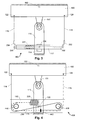
- Figure 1 illustrates a prior art connection between a tow bar 151 of a tractor 150 and the draw bar 110 of an implement comprising a transmission mechanism 100.
- the transmission mechanism 100 is fastened to the draw bar 110 of the implement.
- the transmission mechanism 100 comprises a spacer 112 rotationally connected to the shaft or axle 126 of the angle sensor 114.
- a spring 104, 106 is fastened to each end of the spacer 112.
- One end of the two wires 116, 118 is fastened to the tractor 150 and the other to the two springs 104, 106 fastened to the spacer 112 of the transmission mechanism 100.
- the distance between the two fastenings points 122, 124 on the tractor 150 essentially equals the length of the spacer 112.
- the spacer 112 When the tractor moves, the spacer 112 will follow the turning of the tractor 150 around the rotation point 152, such that the line going through the two fastenings points 122, 124 on the tractor is substantially parallel to the longitudinal axis of the spacer 112.
- the angle between the tow bar 151 and the draw bar 110 is via the spacer 112 measured by the angle sensor 114 and transmitted to e.g. a hydraulic system (not shown) controlling the direction of the wheel on the implement.
- a hydraulic system not shown
- the wheels on the implement can be set to run in the wheel tracks from the tractor.
- the distance between the tractor and the spacer will not always be constant (see figures 5c-5g ).
- the transmission mechanisms traditionally comprise springs 104, 106 whereby wires 116, 118 are kept tight.
- This is, however, problematic as the difference in spring force between the two springs cannot overcome the friction between the different parts of the transmission mechanism 100, particularly at minor changes in the angle between tow bar 151 and the draw bar 110.
- the friction occurs between tractor 150 and wire 116 and 118, between spacer 112 and spring 104, 106 and finally between spacer 112 and angle sensor 114.
- the two springs 104, 106 cannot overcome this friction as the pre-tensioning of the two springs counterbalance each other.
- the difference between the forces of the two springs is the resulting force which can move the spacer 112 into a correct position parallel to the tractor.
- the difference in the pulling force of the two springs is proportional to the difference in the extension of the two springs which is usually a force of a low magnitude.
- This small force can therefore not move the spacer 112 such that it is completely parallel to the tractor 150 (meaning the spacer 112 will not be parallel to the line through 122, 124).
- the implement will not follow the tracks of the tractor 150. In this case it does not help to change the pre-tensioning of the springs 104, 106.
- the spacer 112 when e.g. the spacer 112, wires 116, 118 or springs 104, 106 of the transmission mechanism 100 are stroke or hit by e.g. crop or stone, the spacer will oscillate and thereby create noise in the measurement of the yaw angle. This is very disadvantageous as this signal is difficult to process and subsequently use in controlling the direction of the trailer. These oscillations occur because the transmission mechanism 100, when fastened to the tractor, corresponds to a system in simple harmonic motion.
- Figure 2 illustrates a top view of a first embodiment of the present invention showing the coupling between the tow bar 151 of a tractor 150 and the draw bar 110 of an implement.
- the transmission mechanism 200 is fastened to the draw bar 110 of an implement and comprises an angle sensor 114 and a spacer 112.
- the transmission mechanism 200 is by means of two wires 116, 118 connected parallel to two fastening points 122, 124 on a tractor 150, which when turning rotates around the point 152.
- the wires 116, 118 are of equal length and are connected to each end of the spacer 112 and fastened to corresponding fastening points 122, 124 on the tractor 150.
- the distance between the two fastening points 122, 124 and the two fastening points (not indicated) on the respective ends of the spacer 112 are essentially the same.
- the center of the spacer 112 is fastened to the angle sensor 114 via the shaft or axle 126 around which the spacer 112 can rotate.
- the spacer 112 will rotate correspondingly so that the line going through the two fastenings points 122, 124 is parallel to the longitudinal axis of the spacer 112. In order to do so, the connection between the spacer 112 and the fastenings points on the tractor has to be tight. This is enabled by the spring 228 that via a wire 230 is fastened to the displacement plate 113 which again is displaceable fastened to the draw bar 110.
- the angle sensor 114 can e.g. by means of a rail (not shown) move relative to the draw bar 110 unidirectional along the longitudinal axis of the tow bar 110 of the implement.
- the angle between the tow bar 110 and the spacer 112 measured by the angle sensor 114 is transmitted to e.g. a hydraulic system (not shown) controlling the direction of the wheel on the trailer.
- the wheels on the trailer can be set to run in the wheel tracks from the tractor.
- the wires 116, 118 are kept tight by only one spring 228, the yaw angle measured by the angle sensor 114 is insensitive to the noise created by rotations (roll and pitch) and displacing movements. This means that the spring 228 dampens or requires larger force to overcome spring pre-tensioning from external impacts on the connection between the tractor 150 and the implement.
- Figure 3 illustrates a top view of a second embodiment of the present invention, showing the coupling between the tow bar 151 of a tractor 150 and the draw bar 110 of an implement.
- the transmission mechanism 300 is fastened to e.g. a draw bar 110 of an implement and serves the same purpose as the transmission mechanism 200 described in figure 2 . That is, the spacer 112 is connected to the two fastenings points 122, 124 via the wires 116, 118, whereby the spacer 112 and the line going through the two fastenings points 122, 124 can move parallel to each other.
- the wires 116, 118 are tightened by means of a torsion spring 331 comprised in the spacer 112.
- the torsion spring 331 is connected to the wire arms 332, 334 via the torsion axle 330 which again are connected to the wires 116, 118.
- the torsion spring 331 in the spacer 112 is a common spring, whereby the wire arm 332, 334 can rotate uniformly in each end of the spacer 112 around the longitudinal axis of the spacer 112. Hereby the wires 116, 118 are kept tight, whereby the spacer 112 and the line going through the two fastenings points 122, 124 and the wires 116, 118 will be parallel in pairs.
- the sole common torsion spring 331 comprised in the spacer 212 ensures that the angle measured by the angle sensor is insensitive to the noise created by rotations (roll and pitch) and displacing movements.
- Figure 4 illustrates a top view of the principle of a third embodiment of the present invention, showing the coupling between the tow bar 151 of a tractor 150 and the draw bar 110 of an implement.
- the transmission mechanism 400 is in this embodiment designed as a rope pull comprising one spring 228.
- One end of the two wires 116, 118 is connected to two fastening points 122, 124 on e.g. a tractor 150, which when turning rotates around the point 152.
- the wire 116 extends around runner 440 and then runner 438 and is at the other end connected to the fastening point 442.
- the wire 118 extends around runner 438 and the other end is connected to the fastening point 442.
- the wire 230 extends around the runner 440, where one end of the wire 230 is connected to the fastening point 442 and the other is connected to the spring 228.
- the spring 228 and runner 438, 440 are fastened to a spacer 112 which is rotationally, via the shaft 126, fastened to an angle sensor 114, which again is fastened to the draw bar 110 of an implement (not shown).
- the spacer 114 will rotate correspondingly so that the line going through the two fastenings points 122, 124 are parallel to a line going through the rotation axis of the two runners 438, 440. This is enabled by the spring 228 which keep all wires tight at all times.
- the yaw angle between the tow bar or draw bar 112 of the implement (not shown) and the spacer 114 can then be measured and the signal used to determine the wheel direction of the implement.
- the wires 116, 118, 230 extend and move around the runners 438, 440 in the same direction. In an alternative embodiment of the transmission mechanism more than two runners could be used to simplify the course of the wires 116, 118, 230.
- a common advantage of the embodiments illustrated in figures 2 , 3, and 4 is that the pre-tension of the springs 228, 331 can overcome friction between the tractor 150 and wire 116 and 118, between spacer 112 and spring 104, 106 and finally between spacer 112 and angle sensor 114. This is not possible with the mentioned prior art. This means that very small changes in the yaw angle are measured correctly, whereby it is ensured that the implement follows the tracks of the tractor. Thus, the pre-tension of the spring 228, 331 adds to the turning of the spacer 112. Further, these embodiments of the present invention eliminate the influence of roll, pitch and the three types of displacement described in figures 5c-g .
- Figure 5a illustrates a combined vehicle 500 comprising a tractor 150 connected to an implement 566, and will through figures 5b-5g be used to illustrate the three types of rotations (yaw, pitch and roll) and three kinds of displacement.
- the present invention provides a transmission mechanism used to measure the yaw angle between the tractor and the implement, without being influenced by the other types of rotation and displacements.
- rotations and displacements only a few elements of the tractor and the implements are used. These are the left rear wheel 560 of the tractor, the left wheel 562 of the implement 566 and the connection point 564 of the tow bar 151 of the tractor 150 and the draw bar 110 of the implement 566.
- Figure 5b illustrates the rotation angle, yaw. This is the angle between the tow bar 151 and the draw bar 110 and arises when the tractor turns.
- the yaw angle is the angle used to change or control the direction of the wheels of the implement such that they essentially follow the tracks of the tractor. If only the yaw angle existed, the prior art solutions were very applicable. However, the two rotation angles and the three types of displacement to be described in the following can all influence the measurement of the yaw angle. Therefore the prior cannot be applied.
- Figure 5c illustrates the rotation angle, pitch.
- the situation here is that the draw bar 110 of the implement is placed higher or lower relative to the horizontal line going through the connection point 564. This will either increase of decrease the distance from the fastening points 122, 124 to the spacer 112 of figures 1-4 . This will affect the measurement of the yaw angle ( figure 5b ) if not accounted for by the transmission mechanism measuring the yaw angle.
- Figure 5d illustrates the rotation angle, roll.
- the left rear wheel 560 of the tractor (not shown) is positioned lower relative to the right rear wheel of the tractor (not indicated). This means that the tractor (not shown) heels to the left and rolls relative to a horizontal axis. Since the implement is oriented horizontally, the roll angle between the tractor and the implement will affect the measurement of the yaw angle ( figure 5b ). This must be accounted for by the transmission mechanism measuring the yaw angle.
- Figure 5e illustrates the longitudinal displacement between the tractor and the implement arising due to the clearance in the connection point 564 between the tow bar (151, not indicated here) and draw bar (110, not indicated here). Since the tractor is the towing vehicle, the displacements will be caused by back and forth movements of the implement relative to the tractor indicated by the arrows. This will either increase of decrease the distance from the fastening points 122, 124 to the spacer 112 of figures 1-4 . This will affect the measurement of the yaw angle ( figure 5b ), if not accounted for by the transmission mechanism measuring the yaw angle.
- Figure 5f illustrates the transversal displacement between the tractor and the implement arising due to the clearance in the connection point 564 between the tow bar (151, not indicated here) and draw bar (110, not indicated here). Since the tractor is the towing vehicle, the displacements will be caused by sideways movements of the implement relative to the tractor indicated by the arrows. This will directly affect the measurement yaw angle ( figure 5b ) leading to deviations relative to the actual yaw angle. Thus, this must be accounted for in the measurement of the yaw angle ( figure 5b ).
- Figure 5g illustrates vertical displacement in the connection point 564 between the tow bar (151, not indicated) and the draw bar (110, not indicated). Since the tractor is the towing vehicle, the displacements will be caused by up and down movements of the implement relative to the tractor indicated by the arrow. This will either increase of decrease the distance from the fastenings points 122, 124 to the spacer 112 of figures 1-4 . This will affect the measurement of the yaw angle ( figure 5b ), if not accounted for by the transmission mechanism measuring the yaw angle.
- the influence of roll, pitch and the three types of displacement, slack or skidding will normally not affect the measurement of the yaw angle one at the time, but jointly.
- the transmission mechanism of the present invention takes account for this when measuring the yaw angle by isolating their (roll, pitch, displacements) influence.
Landscapes
- Engineering & Computer Science (AREA)
- Transportation (AREA)
- Mechanical Engineering (AREA)
- Chemical & Material Sciences (AREA)
- Combustion & Propulsion (AREA)
- Agricultural Machines (AREA)
Abstract
Description
- The present invention relates to transmission mechanisms to be used when connecting an angle sensor between two equipment parts such as an implement and a tractor, where the angle sensor is adapted to measure the angle between the equipment parts.
- When treating crop in a field, a tractor with an implement, e.g. a tractor connected to an implement such as a sprayer or a slurry spreader, is used where the implement is pulled through the field for treating the crop. When using a tractor with a sprayer, the tractor drives through the fields with crop to be sprayed and in order to minimize the damage on the crop it is of interest that the wheel of the tractor and the wheels of the sprayer follows the same wheel track.
- This problem has been solved by measuring the angle between the tractor and the spraying machine and then controlling the direction of the wheels of the spraying machine accordingly, thus ensuring that the wheels of the spraying machine follow the wheel track of the tractor.
- Different techniques for performing these measurements exist and generally they are all based on an angle sensor which comprises two angular displaceable parts, where the angle between these parts are measured and e.g. converted to an electrical signal. In one embodiment the angle sensor is positioned above the connection shaft between the tractor and the implement. One part of the angle sensor is connected to the implement via a rod and the angular displacement of this rod then influences the angle sensor measuring the shaft angle between the tractor and the implement. A problem with this method is that it is required that the axis of the angle sensor is positioned directly above the connection shaft which requires special arrangements in this area, and further an electrical connection to the angle sensor is exposed to damage. One alternative solution solving this particular problem is to replace the rod connection to the angle sensor with a fork connection, where the angle sensor is connected to the tractor via two spaced apart connections. This makes it possible to mount the angle sensor axis away from the connection shaft axis.
- Apart from the practical problems of arranging the angle sensor between the tractor and the implement, the actual measurement of the angle is also challenging due to the motions of the tractor and the implement. In order for the wheels to follow the tracks of the tractor only the angle between the tractor and implement must be fed to the system controlling the direction of the wheels of the implement. This, however, implies that all other rotations and displacements cannot affect or disturb the measurement of the angle between the tractor and the implement. The angle between the tractor and the implement is also known as yaw. The two other rotation angles roll and pitch must therefore be isolated from the measurement of yaw. Due to the connection or hitch between the tractor and the implement, the measurement of yaw must not be affected by unavoidable displacements in the connection or hitch. Such displacements are also known as slack or clearance.
- Because of slack in the shaft connection and because of the uneven field surfaces it is necessary to have a flexible connection between the implement and the tractor. It is further required that the connections are constantly extended, and in the prior art solution this is obtained by using two separate springs for connecting the angle sensor to the tractor, these springs are part of each of the two spaced apart connections and they are mutually balanced. A problem with this solution is that the angle sensor is very sensitive to the friction between the elements of the transmission mechanism as these cannot be overcome. In addition, external forces such as e.g. crop striking the two spaced apart connections can influence the measurement of the yaw angle negatively.
- Another prior art solution is provided in the utility model
DK 1997 00231 figure 5e ). - The object of the invention is to solve the above-mentioned problems.
- The present invention solves the above-mentioned problems by providing a transmission mechanism to be used when connecting an angle sensor between two equipment parts such as an implement and a tractor, where the angle sensor is adapted to measure the angle between the equipment parts, wherein the connection is flexible and comprises two spaced apart flexible connection arms which in one end is connected to one of the equipment parts and in the other end is connected to a spacer part mounted on the angle sensor, characterized in that the transmission mechanism comprises a common tightening element for tightening the flexible connection arms, thereby ensuring a tight connection between the angle sensor and one of the equipment parts. This is advantageous as high precision measure of the angle between the equipment parts is obtained. This is essential as the accuracy and the validity of the angle measure is used as the reference value in the control system, e.g. for steering the direction of the implement and thereby the wheel tracks. Further, the transmission mechanism of the present invention eliminates the disturbance of yaw angle signal due to roll and pitch movements and due to displacements in the connection between the tow bar of the tractor and the draw bar of the implement. Further, the pre-tension of the common tightening element is so strong that it can overcome the friction between the different elements of the transmission mechanism. These advantages of the transmission mechanism of the present invention enables e.g. an implement to be driven in the same tracks as a tractor, a higher yield from fields of crop can be achieved.
- In one embodiment of the transmission mechanism the common tightening element is a common spring. The advantage of having one common spring is that it dampens or requires larger force to overcome spring pre-tensioning from external impacts on the connection between e.g. a tractor and an implement.
- In another embodiment of the transmission element the spring is an integrated part of the spacer element in the form of a common twisting spring. Apart from the above listed advantages, this particular embodiment is also advantageous as the spacer element comprises a number of functionalities in only one element.
- In yet another embodiment of the transmission mechanism the flexible connection arms are chains. Here the advantages are as listed above.
- In a further embodiment of the transmission mechanism the spacer part and the connection part are formed by at least one common wire with a tightening element integrated in the spacer part. Here the advantages are as mentioned above.
- In one embodiment of the transmission mechanism the common tightening element is a weight element. This is particularly advantageous when the transmission element is embodied as a wire pull.
- In another embodiment an equipment part is adapted to be connected to another equipment part, wherein the equipment part comprises a transmission mechanism according to the present invention. Here the advantages are as mentioned above.
- In yet another embodiment the present invention relates to a method to be used when connecting an angle sensor between two equipment parts such as an implement and a tractor, where the angle sensor is adapted to measure the angle between the equipment parts, wherein the connection is flexible and comprises two spaced apart flexible connection arms which in one end is connected to one of the equipment parts and in the other end is connected to a spacer part mounted on the angle sensor, characterized in that the method comprises tightening of the flexible connection arms and thereby ensuring a tight connection between the angle sensor and the equipment part by using a common tightening element. Here the advantages are as mentioned above.
- In the following, preferred embodiments of the invention will be described referring to the figures, where
-
figure 1 illustrates prior art connection between tractor and implement comprising a transmission mechanism; -
figure 2 illustrates a top view of a first embodiment of the present invention, -
figure 3 illustrates a top view of a second embodiment of the present invention; -
figure 4 illustrates a top view of the principle of a third embodiment of the present invention; -
figure 5a illustrates a combined vehicle comprising a tractor and an implement; -
figures 5b-g illustrate the three types of rotation and the three kinds of displacement in the connection or hitch between the tractor and the implement. -
Figure 1 illustrates a prior art connection between atow bar 151 of atractor 150 and thedraw bar 110 of an implement comprising atransmission mechanism 100. Thetransmission mechanism 100 is fastened to thedraw bar 110 of the implement. Thetransmission mechanism 100 comprises aspacer 112 rotationally connected to the shaft oraxle 126 of theangle sensor 114. Aspring spacer 112. One end of the twowires tractor 150 and the other to the twosprings spacer 112 of thetransmission mechanism 100. The distance between the twofastenings points tractor 150 essentially equals the length of thespacer 112. When the tractor moves, thespacer 112 will follow the turning of thetractor 150 around therotation point 152, such that the line going through the twofastenings points spacer 112. The angle between thetow bar 151 and thedraw bar 110 is via thespacer 112 measured by theangle sensor 114 and transmitted to e.g. a hydraulic system (not shown) controlling the direction of the wheel on the implement. Hereby the wheels on the implement can be set to run in the wheel tracks from the tractor. However, due to the draw bar and tow bar design practices, the distance between the tractor and the spacer will not always be constant (seefigures 5c-5g ). To compensate for this the transmission mechanisms traditionally comprisesprings wires transmission mechanism 100, particularly at minor changes in the angle betweentow bar 151 and thedraw bar 110. The friction occurs betweentractor 150 andwire spacer 112 andspring spacer 112 andangle sensor 114. The twosprings spacer 112 into a correct position parallel to the tractor. The difference in the pulling force of the two springs is proportional to the difference in the extension of the two springs which is usually a force of a low magnitude. This small force can therefore not move thespacer 112 such that it is completely parallel to the tractor 150 (meaning thespacer 112 will not be parallel to the line through 122, 124). Thus, even small deviations in the measured angle will lead the implement to take a different and indeed very undesired direction than thetractor 150. Hence, the implement will not follow the tracks of thetractor 150. In this case it does not help to change the pre-tensioning of thesprings - Also, when e.g. the
spacer 112,wires transmission mechanism 100 are stroke or hit by e.g. crop or stone, the spacer will oscillate and thereby create noise in the measurement of the yaw angle. This is very disadvantageous as this signal is difficult to process and subsequently use in controlling the direction of the trailer. These oscillations occur because thetransmission mechanism 100, when fastened to the tractor, corresponds to a system in simple harmonic motion. -
Figure 2 illustrates a top view of a first embodiment of the present invention showing the coupling between thetow bar 151 of atractor 150 and thedraw bar 110 of an implement. Thetransmission mechanism 200 is fastened to thedraw bar 110 of an implement and comprises anangle sensor 114 and aspacer 112. Thetransmission mechanism 200 is by means of twowires fastening points tractor 150, which when turning rotates around thepoint 152. Thewires spacer 112 and fastened to corresponding fastening points 122, 124 on thetractor 150. The distance between the twofastening points spacer 112 are essentially the same. The center of thespacer 112 is fastened to theangle sensor 114 via the shaft oraxle 126 around which thespacer 112 can rotate. When the tractor moves, thespacer 112 will rotate correspondingly so that the line going through the twofastenings points spacer 112. In order to do so, the connection between thespacer 112 and the fastenings points on the tractor has to be tight. This is enabled by thespring 228 that via awire 230 is fastened to thedisplacement plate 113 which again is displaceable fastened to thedraw bar 110. Thus, theangle sensor 114 can e.g. by means of a rail (not shown) move relative to thedraw bar 110 unidirectional along the longitudinal axis of thetow bar 110 of the implement. As thewires tow bar 110 and thespacer 112 measured by theangle sensor 114 is transmitted to e.g. a hydraulic system (not shown) controlling the direction of the wheel on the trailer. Hereby the wheels on the trailer can be set to run in the wheel tracks from the tractor. As thewires spring 228, the yaw angle measured by theangle sensor 114 is insensitive to the noise created by rotations (roll and pitch) and displacing movements. This means that thespring 228 dampens or requires larger force to overcome spring pre-tensioning from external impacts on the connection between thetractor 150 and the implement. -
Figure 3 illustrates a top view of a second embodiment of the present invention, showing the coupling between thetow bar 151 of atractor 150 and thedraw bar 110 of an implement. Thetransmission mechanism 300 is fastened to e.g. adraw bar 110 of an implement and serves the same purpose as thetransmission mechanism 200 described infigure 2 . That is, thespacer 112 is connected to the twofastenings points wires spacer 112 and the line going through the twofastenings points wires torsion spring 331 comprised in thespacer 112. Thetorsion spring 331 is connected to thewire arms torsion axle 330 which again are connected to thewires torsion spring 331 in thespacer 112 is a common spring, whereby thewire arm spacer 112 around the longitudinal axis of thespacer 112. Hereby thewires spacer 112 and the line going through the twofastenings points wires common torsion spring 331 comprised in the spacer 212 ensures that the angle measured by the angle sensor is insensitive to the noise created by rotations (roll and pitch) and displacing movements. -
Figure 4 illustrates a top view of the principle of a third embodiment of the present invention, showing the coupling between thetow bar 151 of atractor 150 and thedraw bar 110 of an implement. Thetransmission mechanism 400 is in this embodiment designed as a rope pull comprising onespring 228. One end of the twowires fastening points tractor 150, which when turning rotates around thepoint 152. Thewire 116 extends aroundrunner 440 and thenrunner 438 and is at the other end connected to thefastening point 442. Thewire 118 extends aroundrunner 438 and the other end is connected to thefastening point 442. Thewire 230 extends around therunner 440, where one end of thewire 230 is connected to thefastening point 442 and the other is connected to thespring 228. Thespring 228 andrunner spacer 112 which is rotationally, via theshaft 126, fastened to anangle sensor 114, which again is fastened to thedraw bar 110 of an implement (not shown). When thetractor 150 moves, thespacer 114 will rotate correspondingly so that the line going through the twofastenings points runners spring 228 which keep all wires tight at all times. The yaw angle between the tow bar or drawbar 112 of the implement (not shown) and thespacer 114 can then be measured and the signal used to determine the wheel direction of the implement. Thewires runners wires - A common advantage of the embodiments illustrated in
figures 2 ,3, and 4 is that the pre-tension of thesprings tractor 150 andwire spacer 112 andspring spacer 112 andangle sensor 114. This is not possible with the mentioned prior art. This means that very small changes in the yaw angle are measured correctly, whereby it is ensured that the implement follows the tracks of the tractor. Thus, the pre-tension of thespring spacer 112. Further, these embodiments of the present invention eliminate the influence of roll, pitch and the three types of displacement described infigures 5c-g . -
Figure 5a illustrates a combinedvehicle 500 comprising atractor 150 connected to an implement 566, and will throughfigures 5b-5g be used to illustrate the three types of rotations (yaw, pitch and roll) and three kinds of displacement. The present invention provides a transmission mechanism used to measure the yaw angle between the tractor and the implement, without being influenced by the other types of rotation and displacements. In order to illustrate these rotations and displacements, only a few elements of the tractor and the implements are used. These are the leftrear wheel 560 of the tractor, theleft wheel 562 of the implement 566 and theconnection point 564 of thetow bar 151 of thetractor 150 and thedraw bar 110 of the implement 566. -
Figure 5b illustrates the rotation angle, yaw. This is the angle between thetow bar 151 and thedraw bar 110 and arises when the tractor turns. The yaw angle is the angle used to change or control the direction of the wheels of the implement such that they essentially follow the tracks of the tractor. If only the yaw angle existed, the prior art solutions were very applicable. However, the two rotation angles and the three types of displacement to be described in the following can all influence the measurement of the yaw angle. Therefore the prior cannot be applied. -
Figure 5c illustrates the rotation angle, pitch. The situation here is that thedraw bar 110 of the implement is placed higher or lower relative to the horizontal line going through theconnection point 564. This will either increase of decrease the distance from the fastening points 122, 124 to thespacer 112 offigures 1-4 . This will affect the measurement of the yaw angle (figure 5b ) if not accounted for by the transmission mechanism measuring the yaw angle. -
Figure 5d illustrates the rotation angle, roll. Here the leftrear wheel 560 of the tractor (not shown) is positioned lower relative to the right rear wheel of the tractor (not indicated). This means that the tractor (not shown) heels to the left and rolls relative to a horizontal axis. Since the implement is oriented horizontally, the roll angle between the tractor and the implement will affect the measurement of the yaw angle (figure 5b ). This must be accounted for by the transmission mechanism measuring the yaw angle. -
Figure 5e illustrates the longitudinal displacement between the tractor and the implement arising due to the clearance in theconnection point 564 between the tow bar (151, not indicated here) and draw bar (110, not indicated here). Since the tractor is the towing vehicle, the displacements will be caused by back and forth movements of the implement relative to the tractor indicated by the arrows. This will either increase of decrease the distance from the fastening points 122, 124 to thespacer 112 offigures 1-4 . This will affect the measurement of the yaw angle (figure 5b ), if not accounted for by the transmission mechanism measuring the yaw angle. -
Figure 5f illustrates the transversal displacement between the tractor and the implement arising due to the clearance in theconnection point 564 between the tow bar (151, not indicated here) and draw bar (110, not indicated here). Since the tractor is the towing vehicle, the displacements will be caused by sideways movements of the implement relative to the tractor indicated by the arrows. This will directly affect the measurement yaw angle (figure 5b ) leading to deviations relative to the actual yaw angle. Thus, this must be accounted for in the measurement of the yaw angle (figure 5b ). -
Figure 5g illustrates vertical displacement in theconnection point 564 between the tow bar (151, not indicated) and the draw bar (110, not indicated). Since the tractor is the towing vehicle, the displacements will be caused by up and down movements of the implement relative to the tractor indicated by the arrow. This will either increase of decrease the distance from the fastenings points 122, 124 to thespacer 112 offigures 1-4 . This will affect the measurement of the yaw angle (figure 5b ), if not accounted for by the transmission mechanism measuring the yaw angle. - The influence of roll, pitch and the three types of displacement, slack or skidding will normally not affect the measurement of the yaw angle one at the time, but jointly. The transmission mechanism of the present invention takes account for this when measuring the yaw angle by isolating their (roll, pitch, displacements) influence.
-
- 100
- transmission mechanism
- 104
- spring
- 106
- spring
- 110
- draw bar
- 112
- spacer
- 114
- angle sensor
- 116
- wire
- 118
- wire
- 122
- fastening point
- 124
- fastening point
- 126
- axle or shaft
- 150
- tractor
- 151
- tow bar of
tractor 150 - 152
- rotation point of
tractor 150 when turning - 200
- transmission mechanism
- 228
- spring
- 230
- wire
- 300
- transmission mechanism
- 330
- torsion axle
- 331
- torsion spring
- 332
- wire arm
- 334
- wire arm
- 400
- transmission mechanism
- 438
- runner
- 440
- runner
- 442
- fastening point
- 500
- tractor with implement
- 560
- left rear wheel of
tractor 150 - 562
- left wheel of implement
- 564
- connection point of
tow bar 151 and drawbar 110 - 566
- Implement
Claims (8)
- A transmission mechanism to be used when connecting an angle sensor between two equipment parts such as an implement and a tractor, said angle sensor is adapted to measure the angle between the equipment parts, wherein said connection is flexible and comprises two spaced apart flexible connection arms which in one end is connected to one of said equipment parts and in the other end is connected to a spacer part mounted on said angle sensor, characterized in that the transmission mechanism comprises a common tightening element for tightening said flexible connection arms, ensuring a tight connection between said angle sensor and one of said equipment parts.
- A transmission mechanism according to claim 1, wherein said common tightening element is a common spring.
- A transmission element according to claim 2, wherein said spring is an integrated part of said spacer element in the form of a common torsion spring.
- A transmission mechanism according to claims 1-3, wherein said flexible connection arms are chains.
- A transmission mechanism according to claims 1-4, wherein the spacer part and the connection part are formed by at least one common wire with a tightening element integrated in said spacer part.
- A transmission mechanism according to claims 1-4, wherein said common tightening element is a weight element.
- An equipment part adapted to be connected to another equipment part, wherein said equipment part comprises a transmission mechanism according to claims 1-6.
- A method to be used when connecting an angle sensor between two equipment parts such as an implement and a tractor, said angle sensor is adapted to measure the angle between the equipment parts, wherein said connection is flexible and comprises two spaced apart flexible connection arms which in one end is connected to one of said equipment parts and in the other end is connected to a spacer part mounted on said angle sensor, characterized in that the method comprises tightening said flexible connection arms and thereby ensuring a tight connection between said angle sensor and said equipment part by using a common tightening element.
Applications Claiming Priority (2)
| Application Number | Priority Date | Filing Date | Title |
|---|---|---|---|
| DKPA200800186 | 2008-02-08 | ||
| DKPA200800466 | 2008-03-28 |
Publications (2)
| Publication Number | Publication Date |
|---|---|
| EP2087784A1 true EP2087784A1 (en) | 2009-08-12 |
| EP2087784B1 EP2087784B1 (en) | 2011-01-12 |
Family
ID=40547468
Family Applications (1)
| Application Number | Title | Priority Date | Filing Date |
|---|---|---|---|
| EP09001758A Active EP2087784B1 (en) | 2008-02-08 | 2009-02-09 | Transmission mechanism for angle sensor |
Country Status (2)
| Country | Link |
|---|---|
| EP (1) | EP2087784B1 (en) |
| DE (1) | DE602009000541D1 (en) |
Cited By (3)
| Publication number | Priority date | Publication date | Assignee | Title |
|---|---|---|---|---|
| EP2497658A1 (en) * | 2011-03-05 | 2012-09-12 | Sebastian Zunhammer | Tractor with trailer |
| DE102013111758B4 (en) * | 2013-10-25 | 2016-11-10 | Amazonen-Werke H. Dreyer Gmbh & Co. Kg | transmission rod |
| US10018291B2 (en) | 2010-04-02 | 2018-07-10 | Pentair Flow Technologies, Llc | Air aspiration device |
Citations (2)
| Publication number | Priority date | Publication date | Assignee | Title |
|---|---|---|---|---|
| US4122390A (en) * | 1976-10-28 | 1978-10-24 | Gerhard Kollitz | Apparatus for sensing and indicating the angular relationship between a towing and a towed vehicle |
| EP2025536A1 (en) * | 2007-08-15 | 2009-02-18 | Josef Kotte Landtechnik GmbH & Co. KG | Trailer with tow bar and angle sensor |
-
2009
- 2009-02-09 DE DE602009000541T patent/DE602009000541D1/en active Active
- 2009-02-09 EP EP09001758A patent/EP2087784B1/en active Active
Patent Citations (2)
| Publication number | Priority date | Publication date | Assignee | Title |
|---|---|---|---|---|
| US4122390A (en) * | 1976-10-28 | 1978-10-24 | Gerhard Kollitz | Apparatus for sensing and indicating the angular relationship between a towing and a towed vehicle |
| EP2025536A1 (en) * | 2007-08-15 | 2009-02-18 | Josef Kotte Landtechnik GmbH & Co. KG | Trailer with tow bar and angle sensor |
Cited By (3)
| Publication number | Priority date | Publication date | Assignee | Title |
|---|---|---|---|---|
| US10018291B2 (en) | 2010-04-02 | 2018-07-10 | Pentair Flow Technologies, Llc | Air aspiration device |
| EP2497658A1 (en) * | 2011-03-05 | 2012-09-12 | Sebastian Zunhammer | Tractor with trailer |
| DE102013111758B4 (en) * | 2013-10-25 | 2016-11-10 | Amazonen-Werke H. Dreyer Gmbh & Co. Kg | transmission rod |
Also Published As
| Publication number | Publication date |
|---|---|
| EP2087784B1 (en) | 2011-01-12 |
| DE602009000541D1 (en) | 2011-02-24 |
Similar Documents
| Publication | Publication Date | Title |
|---|---|---|
| RU2297938C1 (en) | Hitch for connecting wheeled tractor and trailer | |
| EP2087784B1 (en) | Transmission mechanism for angle sensor | |
| US8998240B2 (en) | Tractor rear hitch | |
| WO2011050796A1 (en) | Towing device for a towing vehicle | |
| WO2013156607A1 (en) | Monitoring system for tractive and compressive forces in a power track chain and corresponding force sensor | |
| JP5547822B2 (en) | Method for protecting an aircraft landing gear when the aircraft is towed and a pin for connecting a tow bar to the steerable lower portion of the landing gear | |
| DE102017123328B4 (en) | Yaw angle measuring device | |
| CN101539487A (en) | Automotive stability control real vehicle testing system | |
| US9913422B2 (en) | Apparatus to reliably locate pull-type implement according to a localizing signal | |
| Chethan et al. | Transducers for measurement of draft and torque of tractor-implement system—a review | |
| RU2553494C1 (en) | Rope weight transfer unit of drive axle of wheel-type mtz tractor | |
| US10684182B2 (en) | Method for determining a mass of an attached implement for a utility vehicle | |
| EP1612081A1 (en) | Method and device for operating a motor vehicle with a tow bar | |
| US12364178B2 (en) | Boom working device and method for detecting loads acting on the boom | |
| DE102014223412B4 (en) | Device and method for measuring the height of the chassis | |
| CN102079328A (en) | Front steering device capable of changing wheel span and ground clearance | |
| US6328327B1 (en) | Adapter device allowing the drawbar of an agricultural machine to be connected optimally to a hitching bar of a tractor | |
| CA2991821A1 (en) | Agricultural row planter mounting bracket | |
| EP1931966B1 (en) | Friction measuring device | |
| AU2021289354A1 (en) | Force and position sensing system for a towed vehicle | |
| RU2548249C1 (en) | Wheeled tractor train adhesion weight regulator | |
| DE3346890C2 (en) | Measuring device for determining the speed / acceleration for trackless land vehicles, in particular wheeled vehicles | |
| DE3722041C2 (en) | ||
| RU210076U1 (en) | DEVICE FOR INCREASING THE PASSAGE OF WHEELED TRACTORS WHEN WORKING WITH TWO-AXLE TRAILERS | |
| DE102010028015A1 (en) | Rolling motion reducing method for vehicle axle, involves detecting rolling motion of trailer vehicle, and reducing rolling motion of vehicle axle by changing track or steering angle of vehicle axle |
Legal Events
| Date | Code | Title | Description |
|---|---|---|---|
| PUAI | Public reference made under article 153(3) epc to a published international application that has entered the european phase |
Free format text: ORIGINAL CODE: 0009012 |
|
| AK | Designated contracting states |
Kind code of ref document: A1 Designated state(s): AT BE BG CH CY CZ DE DK EE ES FI FR GB GR HR HU IE IS IT LI LT LU LV MC MK MT NL NO PL PT RO SE SI SK TR |
|
| AX | Request for extension of the european patent |
Extension state: AL BA RS |
|
| 17P | Request for examination filed |
Effective date: 20091001 |
|
| 17Q | First examination report despatched |
Effective date: 20091028 |
|
| AKX | Designation fees paid |
Designated state(s): DE FR GB NL |
|
| GRAP | Despatch of communication of intention to grant a patent |
Free format text: ORIGINAL CODE: EPIDOSNIGR1 |
|
| GRAS | Grant fee paid |
Free format text: ORIGINAL CODE: EPIDOSNIGR3 |
|
| GRAA | (expected) grant |
Free format text: ORIGINAL CODE: 0009210 |
|
| AK | Designated contracting states |
Kind code of ref document: B1 Designated state(s): DE FR GB NL |
|
| REG | Reference to a national code |
Ref country code: GB Ref legal event code: FG4D |
|
| REF | Corresponds to: |
Ref document number: 602009000541 Country of ref document: DE Date of ref document: 20110224 Kind code of ref document: P |
|
| REG | Reference to a national code |
Ref country code: DE Ref legal event code: R096 Ref document number: 602009000541 Country of ref document: DE Effective date: 20110224 |
|
| REG | Reference to a national code |
Ref country code: NL Ref legal event code: T3 |
|
| PLBE | No opposition filed within time limit |
Free format text: ORIGINAL CODE: 0009261 |
|
| STAA | Information on the status of an ep patent application or granted ep patent |
Free format text: STATUS: NO OPPOSITION FILED WITHIN TIME LIMIT |
|
| 26N | No opposition filed |
Effective date: 20111013 |
|
| REG | Reference to a national code |
Ref country code: DE Ref legal event code: R097 Ref document number: 602009000541 Country of ref document: DE Effective date: 20111013 |
|
| REG | Reference to a national code |
Ref country code: FR Ref legal event code: PLFP Year of fee payment: 8 |
|
| REG | Reference to a national code |
Ref country code: DE Ref legal event code: R082 Ref document number: 602009000541 Country of ref document: DE Representative=s name: HOFFMANN - EITLE PATENT- UND RECHTSANWAELTE PA, DE Ref country code: DE Ref legal event code: R081 Ref document number: 602009000541 Country of ref document: DE Owner name: SA EXEL INDUSTRIES, FR Free format text: FORMER OWNER: HARDI INTERNATIONAL A/S, TAASTRUP, DK |
|
| REG | Reference to a national code |
Ref country code: GB Ref legal event code: 732E Free format text: REGISTERED BETWEEN 20160929 AND 20161004 |
|
| REG | Reference to a national code |
Ref country code: FR Ref legal event code: PLFP Year of fee payment: 9 |
|
| REG | Reference to a national code |
Ref country code: NL Ref legal event code: PD Owner name: SA EXEL INDUSTRIES; FR Free format text: DETAILS ASSIGNMENT: CHANGE OF OWNER(S), ASSIGNMENT; FORMER OWNER NAME: HARDI INTERNATIONAL A/S Effective date: 20170123 |
|
| REG | Reference to a national code |
Ref country code: FR Ref legal event code: TP Owner name: SA EXEL INDUSTRIES, FR Effective date: 20170803 |
|
| REG | Reference to a national code |
Ref country code: FR Ref legal event code: PLFP Year of fee payment: 10 |
|
| PGFP | Annual fee paid to national office [announced via postgrant information from national office to epo] |
Ref country code: NL Payment date: 20260127 Year of fee payment: 18 |
|
| PGFP | Annual fee paid to national office [announced via postgrant information from national office to epo] |
Ref country code: GB Payment date: 20260219 Year of fee payment: 18 |
|
| PGFP | Annual fee paid to national office [announced via postgrant information from national office to epo] |
Ref country code: DE Payment date: 20260206 Year of fee payment: 18 |
|
| PGFP | Annual fee paid to national office [announced via postgrant information from national office to epo] |
Ref country code: FR Payment date: 20260227 Year of fee payment: 18 |