EP2085200A1 - Method for manufacturing retreated tire - Google Patents
Method for manufacturing retreated tire Download PDFInfo
- Publication number
- EP2085200A1 EP2085200A1 EP07832317A EP07832317A EP2085200A1 EP 2085200 A1 EP2085200 A1 EP 2085200A1 EP 07832317 A EP07832317 A EP 07832317A EP 07832317 A EP07832317 A EP 07832317A EP 2085200 A1 EP2085200 A1 EP 2085200A1
- Authority
- EP
- European Patent Office
- Prior art keywords
- bag
- tire
- tread rubber
- bead
- seal rings
- Prior art date
- Legal status (The legal status is an assumption and is not a legal conclusion. Google has not performed a legal analysis and makes no representation as to the accuracy of the status listed.)
- Withdrawn
Links
- 238000000034 method Methods 0.000 title claims abstract description 24
- 238000004519 manufacturing process Methods 0.000 title description 5
- 239000011347 resin Substances 0.000 claims abstract description 6
- 229920005989 resin Polymers 0.000 claims abstract description 6
- 238000007789 sealing Methods 0.000 claims abstract description 6
- 239000011324 bead Substances 0.000 claims description 32
- 238000002844 melting Methods 0.000 claims description 3
- 230000008018 melting Effects 0.000 claims description 3
- 238000004073 vulcanization Methods 0.000 description 10
- -1 polypropylene Polymers 0.000 description 6
- 239000004743 Polypropylene Substances 0.000 description 5
- 229920001155 polypropylene Polymers 0.000 description 5
- 238000010438 heat treatment Methods 0.000 description 3
- 230000004927 fusion Effects 0.000 description 2
- 239000004677 Nylon Substances 0.000 description 1
- 230000001154 acute effect Effects 0.000 description 1
- 239000004744 fabric Substances 0.000 description 1
- 229920001778 nylon Polymers 0.000 description 1
- XLYOFNOQVPJJNP-UHFFFAOYSA-N water Substances O XLYOFNOQVPJJNP-UHFFFAOYSA-N 0.000 description 1
Images


Classifications
-
- B—PERFORMING OPERATIONS; TRANSPORTING
- B29—WORKING OF PLASTICS; WORKING OF SUBSTANCES IN A PLASTIC STATE IN GENERAL
- B29D—PRODUCING PARTICULAR ARTICLES FROM PLASTICS OR FROM SUBSTANCES IN A PLASTIC STATE
- B29D30/00—Producing pneumatic or solid tyres or parts thereof
- B29D30/06—Pneumatic tyres or parts thereof (e.g. produced by casting, moulding, compression moulding, injection moulding, centrifugal casting)
- B29D30/52—Unvulcanised treads, e.g. on used tyres; Retreading
- B29D30/54—Retreading
- B29D30/542—Retreading using envelopes or membranes provided with sealings for curing
-
- B—PERFORMING OPERATIONS; TRANSPORTING
- B29—WORKING OF PLASTICS; WORKING OF SUBSTANCES IN A PLASTIC STATE IN GENERAL
- B29C—SHAPING OR JOINING OF PLASTICS; SHAPING OF MATERIAL IN A PLASTIC STATE, NOT OTHERWISE PROVIDED FOR; AFTER-TREATMENT OF THE SHAPED PRODUCTS, e.g. REPAIRING
- B29C35/00—Heating, cooling or curing, e.g. crosslinking or vulcanising; Apparatus therefor
- B29C35/02—Heating or curing, e.g. crosslinking or vulcanizing during moulding, e.g. in a mould
-
- B—PERFORMING OPERATIONS; TRANSPORTING
- B29—WORKING OF PLASTICS; WORKING OF SUBSTANCES IN A PLASTIC STATE IN GENERAL
- B29L—INDEXING SCHEME ASSOCIATED WITH SUBCLASS B29C, RELATING TO PARTICULAR ARTICLES
- B29L2030/00—Pneumatic or solid tyres or parts thereof
Definitions
- the present invention relates to a method of producing a retreaded tire, and particularly aims to simplify steps of retreading a tire to realize an efficient production.
- a process comprising the following steps is common: a tread rubber is removed from a surface of a tire to obtain a tire casing; a unvulcanized cushion rubber layer is arranged on an outer surface of the tire casing; a new tread rubber is applied on the cushion rubber layer; the tire is covered with a pouched body such a rubber tube, which is a so-called envelop, closely similar to a shape of the tire and then is placed in a vulcanizer to be vulcanized.
- the above-mentioned retreading method of a tire is also referred to as a cold retread vulcanize process because an already-vulcanized tread rubber is used and thus the method need only an amount of heat just enough for the vulcanization of the cushion rubber layer (the vulcanization temperature is about 120-130 deg C). It has been considered that this method has an advantage that a vulcanization mold is not necessary and, beside that, is suitable for retreading tires of wide variety of kinds and brands in small quantities.
- envelops there are two types of envelops: one is a double envelop having outer and inner envelops which are arranged on the outer and the surface, respectively, of the tire; and the other is a rim-type envelop using a rim.
- the double envelop needs a horizontal or vertical expander or expansion device for attaching and detaching the outer envelop and a reversing station for attaching and detaching the inner envelop.
- the rim envelope needs not only a horizontal or vertical expander like the above-mentioned double envelop but also a lot of rims corresponding to tire sizes. In any cases, extra spaces for installing devices and apparatus are necessary to be assured. Further, the expander is, in fact, manually attached and detached manually, so that manpower necessary for this operation is inevitably increased.
- the present invention relates to a method of producing a retreaded tire comprising: providing a tread rubber on a tire casing; and then heat-treating them to vulcanize-bond said tread rubber to the tire casing, wherein the tire casing provided with the tread rubber is put into a bag consisting of a resin film and air remaining inside the bag is evacuated to perform a sealing operation.
- annular bead seal rings are preferably mounted on both bead portions of the tire casing from outside of the bag and then air remaining inside the bag is evacuated to perform the sealing operation.
- a through-hole extending through the bag is preferably provided in a region surrounded by at least one of the bead seal rings before or after the bead seal rings are mounted on both bead portions of the tire casing from outside of the bag.
- the resin film preferably has a melting point of 120 deg C or more, and specifically polypropylene, poliamide, nylon or the like are applicable.
- the followings are essential requirements: it must be tolerant of a heat (100 deg C) from a heater; side faces of the tire (end portions of a precure tread) can be pressed by surface as flat as possible; the shape is flexible for fitting to the outer contour of the tire; and an air layer can be formed in a groove portion of the end portion of the precure tread to stabilize a sectional shape of the groove portion (an air layer is ordinary secured by applying a wicking sheet, which is a sheet made of fabric or rubber and which ensures a communication of the air between the tire and the envelope, on the tire).
- a bag made of resin film is particularly advantageous for fulfill these requirements. This can eliminate operations using an expander or a turn table, and makes it sufficient for satisfying the requirements to put a shaped tire (a tire casing provided with a tread rubber) into a bag and evacuate (vacuum) air remaining inside the bag.
- a bag made of a polypropylene film is good in a point that it is tolerant of hot water and microwave but has some difficulties in applying on an uneven profile having an acute angle.
- a problem is, however, never raised from the unevenness found in the side face of the tire or the change in the shape of the outer profile of the tire.
- the thickness of the film is preferably 0.1 mm or less in order to fit the bag to the shape of the tire during the vacuum operation.
- Figs. 1-5 illustrate a procedure of vulcanizing a retreaded tire according to the present invention.
- a shaped tire 2 shown in Fig. 1 is put into a bag 3 made of a polypropylene film shown in Fig. 1 prior to a heat treatment (vulcanization) in a heater 1.
- the film preferably has a melting point of 120 deg C or more to be tolerant of the temperature during a vulcanization operation. Then, as shown in Fig.
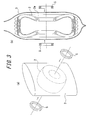
- annular bead seal rings 5 which prevent a deformation of the shaped tire 2 are engaged with and mounted on both bead portions 2a of the shaped tire 2 via the bag 3 made of a polypropylene film from outside of the bag 3.
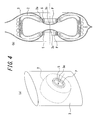
- a through-hole 3c extending through the bag 3 is provided in a region P surrounded by the bead seal ring 5. It is noted that the through-hole 3 may be provided in respective regions P surrounded by both bead seal rings 5 or may be provided in a region P surrounded by either one of the bead seal rings 5. As shown in Figs.
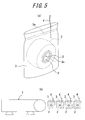
- a mouth 3a of the bag 3 is closed and sealed by, for example, pressure bonding or fusion bonding.
- the shaped tires 2 together with the bags 3 are installed in the heater 1, as shown in Fig. 5(b) , and air remaining in the bags 3 are evacuated via, for example, a vacuum path 4 (such as a vacuum valve).
- a vacuum path 4 such as a vacuum valve.
- a seal is achieved between the bag 3 and the shaped tire 2 by the bead seal rings 5, so that it is possible to evacuate only air existing in a space S (see Fig. 4(b) ) formed between the bag 3 and the shaped tire 2.
- the shaped tire 2 is subjected to a heat treatment under a desired condition. After the heat treatment, the bag 3 is severed to remove the tire therefrom.
- a sequence of the sealing of the mouth 3a of the bag 3 and the evacuation of the residual air in the bag via the vacuum path 4 is not limited to the above-mentioned example, but the mouth 3a of the bag 3 may be closed and sealed by pressure bonding or fusion bonding after the air remaining in the bag 3 is evacuated via the vacuum path 4, as shown in Fig. 6 .
- the bead seal rings 5 are engaged with and mounted on the both bead portions 2a of the shaped tire 2 from outside of the bag 3 and then the through-hole 3c extending through the bag 3 is provided in the region P surrounded by the bead seal ring 5.
- the through-hole 3c may be formed prior to inserting the shaped tire 2 into the bag 3 or it may be formed after inserting the shaped tire 2 into the bag 3 but prior to engaging the bead seal rings 5 with the both bead portions 2a of the shaped tire 2.
- the through-hole 3c needs to be preliminarily formed in a region P1 which is supposed to be surrounded by the bead ring 5 when the bead seal ring 5 is mounted on the bead portion 2a of the shaped tire 2 via the bag 3, as shown in Fig. 7 .
- Vulcanizing the retreaded tire according to the above-mentioned procedure enables to eliminate a step necessary for attaching and detaching an envelope and to fully automate the process to realize an efficient production of a retreaded tire.
- the used bag 3 is not reusable since it was heated during the vulcanization step, but it can be recycled as a bag to promote efficient resource utilization.
- the shaped tire 2 is put into the bag 3 and thereafter the annular bead seal rings 5 are mounted on both of the bead portions 2a of the shaped tire 2 from outside of the bag 3, so that the shaped tire 2 is prevented from being deformed during the vulcanization process.
- the through-hole extending through the bag is provided in the region P of the bag 3 surrounded by the bead seal rings 5, so that a pressure difference does not occur between the interior of the shaped tire and the interior of the heater during the vulcanization process, which further prevents the shaped tire 2 from being deformed during the vulcanization process.
- a tread rubber was applied onto a tire casing to form a shaped tire (cold retreading), and the shaped tire was loaded in a bag made of a polypropylene film with a size of 1.7 m x 1.7 m. Residual air in the bag was evacuated and the bag was sealed. Then, the shaped tire and the bag were subjected to a vulcanization process. It was proven that a time necessary for producing a retreaded tire can be shortened and the quality of the retreaded tire is not different from that of the conventional tire at all.
- the present invention can provide a producing method which enables an efficient production by simplifying the process.
Landscapes
- Engineering & Computer Science (AREA)
- Mechanical Engineering (AREA)
- Tyre Moulding (AREA)
- Heating, Cooling, Or Curing Plastics Or The Like In General (AREA)
- Tires In General (AREA)
Abstract
Description
- The present invention relates to a method of producing a retreaded tire, and particularly aims to simplify steps of retreading a tire to realize an efficient production.
- When a used tire is subjected to a retreading process, a process comprising the following steps is common: a tread rubber is removed from a surface of a tire to obtain a tire casing; a unvulcanized cushion rubber layer is arranged on an outer surface of the tire casing; a new tread rubber is applied on the cushion rubber layer; the tire is covered with a pouched body such a rubber tube, which is a so-called envelop, closely similar to a shape of the tire and then is placed in a vulcanizer to be vulcanized.
- The above-mentioned retreading method of a tire is also referred to as a cold retread vulcanize process because an already-vulcanized tread rubber is used and thus the method need only an amount of heat just enough for the vulcanization of the cushion rubber layer (the vulcanization temperature is about 120-130 deg C). It has been considered that this method has an advantage that a vulcanization mold is not necessary and, beside that, is suitable for retreading tires of wide variety of kinds and brands in small quantities.
- The conventional retreading method which uses an envelope, however, still has the following drawbacks, which has to be improved.
- That is, there are two types of envelops: one is a double envelop having outer and inner envelops which are arranged on the outer and the surface, respectively, of the tire; and the other is a rim-type envelop using a rim. The double envelop needs a horizontal or vertical expander or expansion device for attaching and detaching the outer envelop and a reversing station for attaching and detaching the inner envelop. Meanwhile, the rim envelope needs not only a horizontal or vertical expander like the above-mentioned double envelop but also a lot of rims corresponding to tire sizes. In any cases, extra spaces for installing devices and apparatus are necessary to be assured. Further, the expander is, in fact, manually attached and detached manually, so that manpower necessary for this operation is inevitably increased.
- It is an object of the present invention to propose a novel method which can simplify steps and realize an effective production.
- The present invention relates to a method of producing a retreaded tire comprising: providing a tread rubber on a tire casing; and then heat-treating them to vulcanize-bond said tread rubber to the tire casing, wherein the tire casing provided with the tread rubber is put into a bag consisting of a resin film and air remaining inside the bag is evacuated to perform a sealing operation.
- In the method mentioned in above, after the tire casing provided with the tread rubber is put into the bag, annular bead seal rings are preferably mounted on both bead portions of the tire casing from outside of the bag and then air remaining inside the bag is evacuated to perform the sealing operation.
- Further, a through-hole extending through the bag is preferably provided in a region surrounded by at least one of the bead seal rings before or after the bead seal rings are mounted on both bead portions of the tire casing from outside of the bag.
- Moreover, the resin film preferably has a melting point of 120 deg C or more, and specifically polypropylene, poliamide, nylon or the like are applicable.
- In order to vulcanize the retreaded tire without an envelope, the followings are essential requirements: it must be tolerant of a heat (100 deg C) from a heater; side faces of the tire (end portions of a precure tread) can be pressed by surface as flat as possible; the shape is flexible for fitting to the outer contour of the tire; and an air layer can be formed in a groove portion of the end portion of the precure tread to stabilize a sectional shape of the groove portion (an air layer is ordinary secured by applying a wicking sheet, which is a sheet made of fabric or rubber and which ensures a communication of the air between the tire and the envelope, on the tire). A bag made of resin film is particularly advantageous for fulfill these requirements. This can eliminate operations using an expander or a turn table, and makes it sufficient for satisfying the requirements to put a shaped tire (a tire casing provided with a tread rubber) into a bag and evacuate (vacuum) air remaining inside the bag.
- Among others, a bag made of a polypropylene film is good in a point that it is tolerant of hot water and microwave but has some difficulties in applying on an uneven profile having an acute angle. A problem is, however, never raised from the unevenness found in the side face of the tire or the change in the shape of the outer profile of the tire. The thickness of the film is preferably 0.1 mm or less in order to fit the bag to the shape of the tire during the vacuum operation.
-
-
Fig. 1 is a schematic view of a shaped tire to be vulcanized according to the present invention. -
Fig. 2 is a perspective view illustrating a condition that the shaped tire is put into a bag. -
Fig. 3(a) is a perspective view illustrating a condition that bead seal rings are about to be mounted on both bead portions of the shaped tire via the bag, andFig 3(b) is a sectional view in the tire width direction of the same. -
Fig. 4(a) is a perspective view illustrating a condition that bead seal rings have been mounted on both bead portions of the shaped tire via the bag, andFig 4(b) is a sectional view in the tire width direction of the same. -
Fig. 5(a) is a perspective view illustrating a condition that a mouth of the bag is closed and sealed, andFig. 5(b) is a schematic view of a condition that the shaped tires together with the bags are about to be installed in the heater. -
Fig. 6 is a schematic view of a condition that the mouth of the bag has been pressure bonded. -
Fig. 7 is a perspective view illustrating another bag applicable for the method of producing a retread tire according to the present invention. -
- 1
- heater
- 2
- shaped tire
- 3
- bag
- 4
- vacuum path
- 5
- bead seal ring
-
Figs. 1-5 illustrate a procedure of vulcanizing a retreaded tire according to the present invention. In order to vulcanize a retreaded tire according to the present invention, ashaped tire 2 shown inFig. 1 is put into abag 3 made of a polypropylene film shown inFig. 1 prior to a heat treatment (vulcanization) in a heater 1. The film preferably has a melting point of 120 deg C or more to be tolerant of the temperature during a vulcanization operation. Then, as shown inFig. 3 , annularbead seal rings 5 which prevent a deformation of theshaped tire 2 are engaged with and mounted on bothbead portions 2a of theshaped tire 2 via thebag 3 made of a polypropylene film from outside of thebag 3. Thereafter, as shown inFig. 4 , a through-hole 3c extending through thebag 3 is provided in a region P surrounded by thebead seal ring 5. It is noted that the through-hole 3 may be provided in respective regions P surrounded by bothbead seal rings 5 or may be provided in a region P surrounded by either one of thebead seal rings 5. As shown inFigs. 5(a) and6 , amouth 3a of thebag 3 is closed and sealed by, for example, pressure bonding or fusion bonding. Theshaped tires 2 together with thebags 3 are installed in the heater 1, as shown inFig. 5(b) , and air remaining in thebags 3 are evacuated via, for example, a vacuum path 4 (such as a vacuum valve). In this state, a seal is achieved between thebag 3 and theshaped tire 2 by thebead seal rings 5, so that it is possible to evacuate only air existing in a space S (seeFig. 4(b) ) formed between thebag 3 and theshaped tire 2. Then, theshaped tire 2 is subjected to a heat treatment under a desired condition. After the heat treatment, thebag 3 is severed to remove the tire therefrom. - It is noted that a sequence of the sealing of the
mouth 3a of thebag 3 and the evacuation of the residual air in the bag via thevacuum path 4 is not limited to the above-mentioned example, but themouth 3a of thebag 3 may be closed and sealed by pressure bonding or fusion bonding after the air remaining in thebag 3 is evacuated via thevacuum path 4, as shown inFig. 6 . - Further, in the above-mentioned example, the
bead seal rings 5 are engaged with and mounted on the bothbead portions 2a of theshaped tire 2 from outside of thebag 3 and then the through-hole 3c extending through thebag 3 is provided in the region P surrounded by thebead seal ring 5. However, the through-hole 3c may be formed prior to inserting theshaped tire 2 into thebag 3 or it may be formed after inserting theshaped tire 2 into thebag 3 but prior to engaging thebead seal rings 5 with the bothbead portions 2a of theshaped tire 2. In this case, the through-hole 3c needs to be preliminarily formed in a region P1 which is supposed to be surrounded by thebead ring 5 when thebead seal ring 5 is mounted on thebead portion 2a of theshaped tire 2 via thebag 3, as shown inFig. 7 . - Vulcanizing the retreaded tire according to the above-mentioned procedure enables to eliminate a step necessary for attaching and detaching an envelope and to fully automate the process to realize an efficient production of a retreaded tire.
- The used
bag 3 is not reusable since it was heated during the vulcanization step, but it can be recycled as a bag to promote efficient resource utilization. - Furthermore, the
shaped tire 2 is put into thebag 3 and thereafter the annularbead seal rings 5 are mounted on both of thebead portions 2a of theshaped tire 2 from outside of thebag 3, so that theshaped tire 2 is prevented from being deformed during the vulcanization process. - Moreover, the through-hole extending through the bag is provided in the region P of the
bag 3 surrounded by thebead seal rings 5, so that a pressure difference does not occur between the interior of the shaped tire and the interior of the heater during the vulcanization process, which further prevents theshaped tire 2 from being deformed during the vulcanization process. - A tread rubber was applied onto a tire casing to form a shaped tire (cold retreading), and the shaped tire was loaded in a bag made of a polypropylene film with a size of 1.7 m x 1.7 m. Residual air in the bag was evacuated and the bag was sealed. Then, the shaped tire and the bag were subjected to a vulcanization process. It was proven that a time necessary for producing a retreaded tire can be shortened and the quality of the retreaded tire is not different from that of the conventional tire at all.
- The present invention can provide a producing method which enables an efficient production by simplifying the process.
Claims (4)
- A method of producing a retreaded tire comprising: providing a tread rubber on a tire casing; and then heat-treating them to vulcanize-bond said tread rubber to the tire casing, wherein the tire casing provided with the tread rubber is put into a bag consisting of a resin film and air remaining inside the bag is evacuated to perform a sealing operation.
- The method of producing a retreaded tire according to claim 1, wherein after the tire casing provided with the tread rubber is put into the bag, annular bead seal rings are mounted on both bead portions of the tire casing from outside of the bag and then air remaining inside the bag is evacuated to perform the sealing operation.
- The method of producing a retreaded tire according to claim 1 or 2, wherein a through-hole extending through the bag is provided in a region surrounded by at least one of the bead seal rings before or after the bead seal rings are mounted on both bead portions of the tire casing from outside of the bag.
- The method of producing a retreaded tire according to according to any one of claims 1-3, wherein the resin film has a melting point of 120 deg C or more.
Applications Claiming Priority (2)
| Application Number | Priority Date | Filing Date | Title |
|---|---|---|---|
| JP2006322119 | 2006-11-29 | ||
| PCT/JP2007/072587 WO2008065951A1 (en) | 2006-11-29 | 2007-11-21 | Method for manufacturing retreaded tire |
Publications (2)
| Publication Number | Publication Date |
|---|---|
| EP2085200A1 true EP2085200A1 (en) | 2009-08-05 |
| EP2085200A4 EP2085200A4 (en) | 2012-12-26 |
Family
ID=39467744
Family Applications (1)
| Application Number | Title | Priority Date | Filing Date |
|---|---|---|---|
| EP07832317A Withdrawn EP2085200A4 (en) | 2006-11-29 | 2007-11-21 | Method for manufacturing retreated tire |
Country Status (6)
| Country | Link |
|---|---|
| US (1) | US20100012256A1 (en) |
| EP (1) | EP2085200A4 (en) |
| JP (1) | JPWO2008065951A1 (en) |
| CN (1) | CN101541498A (en) |
| BR (1) | BRPI0719385A2 (en) |
| WO (1) | WO2008065951A1 (en) |
Families Citing this family (5)
| Publication number | Priority date | Publication date | Assignee | Title |
|---|---|---|---|---|
| JP5435966B2 (en) * | 2009-01-19 | 2014-03-05 | 株式会社ブリヂストン | Pneumatic tire manufacturing method |
| JP5739593B2 (en) | 2013-01-23 | 2015-06-24 | 積水化学工業株式会社 | Tire manufacturing method |
| CN106239955A (en) * | 2016-08-26 | 2016-12-21 | 芜湖市南陵县众鑫橡胶有限公司 | A kind of tyre rebuilding technique |
| JP7005949B2 (en) * | 2017-06-08 | 2022-02-10 | 横浜ゴム株式会社 | Tire manufacturing method and equipment |
| JP6874546B2 (en) * | 2017-06-08 | 2021-05-19 | 横浜ゴム株式会社 | Radial tire manufacturing method and equipment |
Family Cites Families (10)
| Publication number | Priority date | Publication date | Assignee | Title |
|---|---|---|---|---|
| US2976910A (en) * | 1958-12-19 | 1961-03-28 | Bandag Inc | Method and material for retreading pneumatic tire casings |
| US3884740A (en) * | 1973-09-20 | 1975-05-20 | Wilhelm Schelkmann | Method of retreading tires |
| JPS55177421U (en) * | 1979-06-08 | 1980-12-19 | ||
| US4634357A (en) * | 1985-11-08 | 1987-01-06 | Bandag Licensing Corporation | Bead seal ring unit |
| US5123985A (en) * | 1986-09-02 | 1992-06-23 | Patricia Evans | Vacuum bagging apparatus and method including a thermoplastic elastomer film vacuum bag |
| US4850834A (en) * | 1987-12-30 | 1989-07-25 | The Hercules Tire And Rubber Company | Retread ring |
| JP2781200B2 (en) * | 1989-05-09 | 1998-07-30 | 株式会社ブリヂストン | Method for manufacturing tire using precured tread |
| JP4114710B2 (en) * | 1997-01-08 | 2008-07-09 | 横浜ゴム株式会社 | Pneumatic tire manufacturing method |
| US7581911B2 (en) * | 2002-09-18 | 2009-09-01 | Utility Composites International Limited | Plastic impact driven fasteners |
| JP2006281683A (en) * | 2005-04-04 | 2006-10-19 | Bridgestone Corp | Manufacturing method of regenerated tire |
-
2007
- 2007-11-21 JP JP2008546959A patent/JPWO2008065951A1/en active Pending
- 2007-11-21 WO PCT/JP2007/072587 patent/WO2008065951A1/en not_active Ceased
- 2007-11-21 CN CNA2007800437755A patent/CN101541498A/en active Pending
- 2007-11-21 EP EP07832317A patent/EP2085200A4/en not_active Withdrawn
- 2007-11-21 US US12/515,505 patent/US20100012256A1/en not_active Abandoned
- 2007-11-21 BR BRPI0719385-8A2A patent/BRPI0719385A2/en not_active Application Discontinuation
Also Published As
| Publication number | Publication date |
|---|---|
| WO2008065951A8 (en) | 2008-12-11 |
| JPWO2008065951A1 (en) | 2010-03-04 |
| EP2085200A4 (en) | 2012-12-26 |
| BRPI0719385A2 (en) | 2014-02-18 |
| US20100012256A1 (en) | 2010-01-21 |
| WO2008065951A1 (en) | 2008-06-05 |
| CN101541498A (en) | 2009-09-23 |
Similar Documents
| Publication | Publication Date | Title |
|---|---|---|
| EP0750984B1 (en) | A truck tire having an improved precured tread and its method of manufacturing | |
| US2966936A (en) | Working method for recapping and repairing tires | |
| EP2463087B1 (en) | Method for retreading tires | |
| EP2337674B1 (en) | Method of controlling tread shrinkage during curing | |
| US20100012256A1 (en) | Method of producing retreaded tire | |
| CN100556677C (en) | Method and apparatus for molding and curing wheel tires | |
| CN100400274C (en) | Apparatus for treading a tire carcass | |
| US5306130A (en) | Apparatus for recapping a tire and an improved curing envelope for use therein | |
| EP1391290B1 (en) | Sealant charging process in sealant-incorporated tire tube | |
| US4175991A (en) | Tire retreading method | |
| US5698064A (en) | Apparatus for manufacturing recapped tire | |
| EP2295231B1 (en) | Method for securing a tread to a tire casing | |
| JPH02307739A (en) | Reclamation of tire tread | |
| CN104903082B (en) | Method and apparatus for preparing retreaded tires | |
| US20030218275A1 (en) | Curing envelope for and method of retreading tires | |
| CN117529399B (en) | Curing mold assembly for non-pneumatic tire and method of manufacture | |
| JP2009143132A (en) | Vulcanized envelope and retreaded tire manufacturing method | |
| EP0235071B1 (en) | Method and apparatus for assembling a vehicle tyre | |
| US1481895A (en) | Method and apparatus for making rubber articles | |
| KR20200117172A (en) | Improved Air Vent Performance of Cure Bladder | |
| JP5596533B2 (en) | Rehabilitated tire manufacturing method | |
| JP2018202801A (en) | Method and device for manufacturing bias tire | |
| JP5462079B2 (en) | Retread tire manufacturing method | |
| CN121794121A (en) | Universal folding inner tube with end compression and its manufacturing method | |
| US20160318271A1 (en) | Elevated Pressure and Temperature Tire Curing Utilizing Liquids |
Legal Events
| Date | Code | Title | Description |
|---|---|---|---|
| PUAI | Public reference made under article 153(3) epc to a published international application that has entered the european phase |
Free format text: ORIGINAL CODE: 0009012 |
|
| 17P | Request for examination filed |
Effective date: 20090522 |
|
| AK | Designated contracting states |
Kind code of ref document: A1 Designated state(s): AT BE BG CH CY CZ DE DK EE ES FI FR GB GR HU IE IS IT LI LT LU LV MC MT NL PL PT RO SE SI SK TR |
|
| DAX | Request for extension of the european patent (deleted) | ||
| A4 | Supplementary search report drawn up and despatched |
Effective date: 20121128 |
|
| RIC1 | Information provided on ipc code assigned before grant |
Ipc: B29D 30/54 20060101ALI20121122BHEP Ipc: B29C 35/02 20060101AFI20121122BHEP Ipc: B29L 30/00 20060101ALI20121122BHEP Ipc: B29C 33/02 20060101ALI20121122BHEP |
|
| STAA | Information on the status of an ep patent application or granted ep patent |
Free format text: STATUS: THE APPLICATION IS DEEMED TO BE WITHDRAWN |
|
| 18D | Application deemed to be withdrawn |
Effective date: 20130628 |