EP2083465B1 - A Process for Fabrication of a Fully Dense Electrolyte layer embedded in membrane electrolyte assembly of solid oxide fuel cell - Google Patents
A Process for Fabrication of a Fully Dense Electrolyte layer embedded in membrane electrolyte assembly of solid oxide fuel cell Download PDFInfo
- Publication number
- EP2083465B1 EP2083465B1 EP08100806A EP08100806A EP2083465B1 EP 2083465 B1 EP2083465 B1 EP 2083465B1 EP 08100806 A EP08100806 A EP 08100806A EP 08100806 A EP08100806 A EP 08100806A EP 2083465 B1 EP2083465 B1 EP 2083465B1
- Authority
- EP
- European Patent Office
- Prior art keywords
- electrolyte layer
- fully dense
- solid oxide
- oxide fuel
- fuel cell
- Prior art date
- Legal status (The legal status is an assumption and is not a legal conclusion. Google has not performed a legal analysis and makes no representation as to the accuracy of the status listed.)
- Ceased
Links
- 239000003792 electrolyte Substances 0.000 title claims description 57
- 238000004519 manufacturing process Methods 0.000 title claims description 26
- 238000000034 method Methods 0.000 title claims description 24
- 239000000446 fuel Substances 0.000 title claims description 19
- 239000007787 solid Substances 0.000 title claims description 19
- 239000012528 membrane Substances 0.000 title claims description 8
- 238000005245 sintering Methods 0.000 claims description 14
- 239000000463 material Substances 0.000 claims description 11
- 238000007650 screen-printing Methods 0.000 claims description 7
- 238000010345 tape casting Methods 0.000 claims description 7
- 239000010406 cathode material Substances 0.000 claims description 5
- 239000011148 porous material Substances 0.000 claims description 5
- 239000000919 ceramic Substances 0.000 claims description 3
- 239000002001 electrolyte material Substances 0.000 claims description 3
- 238000010030 laminating Methods 0.000 claims description 3
- 230000000630 rising effect Effects 0.000 claims description 3
- 239000002131 composite material Substances 0.000 claims description 2
- 230000003197 catalytic effect Effects 0.000 claims 2
- 239000007789 gas Substances 0.000 claims 2
- 238000007689 inspection Methods 0.000 claims 1
- 238000005259 measurement Methods 0.000 claims 1
- 229910001233 yttria-stabilized zirconia Inorganic materials 0.000 description 6
- 229910002080 8 mol% Y2O3 fully stabilized ZrO2 Inorganic materials 0.000 description 4
- 238000005516 engineering process Methods 0.000 description 4
- 238000011161 development Methods 0.000 description 3
- 238000010248 power generation Methods 0.000 description 3
- 239000010405 anode material Substances 0.000 description 2
- 239000011248 coating agent Substances 0.000 description 2
- 238000000576 coating method Methods 0.000 description 2
- 238000003475 lamination Methods 0.000 description 2
- 238000004528 spin coating Methods 0.000 description 2
- 238000005507 spraying Methods 0.000 description 2
- 238000004544 sputter deposition Methods 0.000 description 2
- 238000012360 testing method Methods 0.000 description 2
- 101100468275 Caenorhabditis elegans rep-1 gene Proteins 0.000 description 1
- OKTJSMMVPCPJKN-UHFFFAOYSA-N Carbon Chemical compound [C] OKTJSMMVPCPJKN-UHFFFAOYSA-N 0.000 description 1
- 229910010293 ceramic material Inorganic materials 0.000 description 1
- 230000003247 decreasing effect Effects 0.000 description 1
- 230000001419 dependent effect Effects 0.000 description 1
- 238000013461 design Methods 0.000 description 1
- 238000010586 diagram Methods 0.000 description 1
- 230000000694 effects Effects 0.000 description 1
- 230000007613 environmental effect Effects 0.000 description 1
- 229910002804 graphite Inorganic materials 0.000 description 1
- 239000010439 graphite Substances 0.000 description 1
- 239000007769 metal material Substances 0.000 description 1
- 239000000203 mixture Substances 0.000 description 1
- 238000012986 modification Methods 0.000 description 1
- 230000004048 modification Effects 0.000 description 1
- 238000011056 performance test Methods 0.000 description 1
- 238000002360 preparation method Methods 0.000 description 1
- 238000004626 scanning electron microscopy Methods 0.000 description 1
Images
Classifications
-
- H—ELECTRICITY
- H01—ELECTRIC ELEMENTS
- H01M—PROCESSES OR MEANS, e.g. BATTERIES, FOR THE DIRECT CONVERSION OF CHEMICAL ENERGY INTO ELECTRICAL ENERGY
- H01M8/00—Fuel cells; Manufacture thereof
- H01M8/10—Fuel cells with solid electrolytes
- H01M8/12—Fuel cells with solid electrolytes operating at high temperature, e.g. with stabilised ZrO2 electrolyte
- H01M8/1213—Fuel cells with solid electrolytes operating at high temperature, e.g. with stabilised ZrO2 electrolyte characterised by the electrode/electrolyte combination or the supporting material
-
- H—ELECTRICITY
- H01—ELECTRIC ELEMENTS
- H01M—PROCESSES OR MEANS, e.g. BATTERIES, FOR THE DIRECT CONVERSION OF CHEMICAL ENERGY INTO ELECTRICAL ENERGY
- H01M4/00—Electrodes
- H01M4/86—Inert electrodes with catalytic activity, e.g. for fuel cells
- H01M4/8605—Porous electrodes
- H01M4/8621—Porous electrodes containing only metallic or ceramic material, e.g. made by sintering or sputtering
-
- H—ELECTRICITY
- H01—ELECTRIC ELEMENTS
- H01M—PROCESSES OR MEANS, e.g. BATTERIES, FOR THE DIRECT CONVERSION OF CHEMICAL ENERGY INTO ELECTRICAL ENERGY
- H01M4/00—Electrodes
- H01M4/86—Inert electrodes with catalytic activity, e.g. for fuel cells
- H01M4/88—Processes of manufacture
- H01M4/8878—Treatment steps after deposition of the catalytic active composition or after shaping of the electrode being free-standing body
- H01M4/8882—Heat treatment, e.g. drying, baking
- H01M4/8885—Sintering or firing
-
- H—ELECTRICITY
- H01—ELECTRIC ELEMENTS
- H01M—PROCESSES OR MEANS, e.g. BATTERIES, FOR THE DIRECT CONVERSION OF CHEMICAL ENERGY INTO ELECTRICAL ENERGY
- H01M8/00—Fuel cells; Manufacture thereof
- H01M8/10—Fuel cells with solid electrolytes
- H01M8/12—Fuel cells with solid electrolytes operating at high temperature, e.g. with stabilised ZrO2 electrolyte
- H01M8/124—Fuel cells with solid electrolytes operating at high temperature, e.g. with stabilised ZrO2 electrolyte characterised by the process of manufacturing or by the material of the electrolyte
- H01M8/1246—Fuel cells with solid electrolytes operating at high temperature, e.g. with stabilised ZrO2 electrolyte characterised by the process of manufacturing or by the material of the electrolyte the electrolyte consisting of oxides
- H01M8/1253—Fuel cells with solid electrolytes operating at high temperature, e.g. with stabilised ZrO2 electrolyte characterised by the process of manufacturing or by the material of the electrolyte the electrolyte consisting of oxides the electrolyte containing zirconium oxide
-
- H—ELECTRICITY
- H01—ELECTRIC ELEMENTS
- H01M—PROCESSES OR MEANS, e.g. BATTERIES, FOR THE DIRECT CONVERSION OF CHEMICAL ENERGY INTO ELECTRICAL ENERGY
- H01M8/00—Fuel cells; Manufacture thereof
- H01M8/10—Fuel cells with solid electrolytes
- H01M8/12—Fuel cells with solid electrolytes operating at high temperature, e.g. with stabilised ZrO2 electrolyte
- H01M8/124—Fuel cells with solid electrolytes operating at high temperature, e.g. with stabilised ZrO2 electrolyte characterised by the process of manufacturing or by the material of the electrolyte
- H01M8/1246—Fuel cells with solid electrolytes operating at high temperature, e.g. with stabilised ZrO2 electrolyte characterised by the process of manufacturing or by the material of the electrolyte the electrolyte consisting of oxides
- H01M8/126—Fuel cells with solid electrolytes operating at high temperature, e.g. with stabilised ZrO2 electrolyte characterised by the process of manufacturing or by the material of the electrolyte the electrolyte consisting of oxides the electrolyte containing cerium oxide
-
- H—ELECTRICITY
- H01—ELECTRIC ELEMENTS
- H01M—PROCESSES OR MEANS, e.g. BATTERIES, FOR THE DIRECT CONVERSION OF CHEMICAL ENERGY INTO ELECTRICAL ENERGY
- H01M2300/00—Electrolytes
- H01M2300/0017—Non-aqueous electrolytes
- H01M2300/0065—Solid electrolytes
- H01M2300/0068—Solid electrolytes inorganic
- H01M2300/0071—Oxides
- H01M2300/0074—Ion conductive at high temperature
- H01M2300/0077—Ion conductive at high temperature based on zirconium oxide
-
- Y—GENERAL TAGGING OF NEW TECHNOLOGICAL DEVELOPMENTS; GENERAL TAGGING OF CROSS-SECTIONAL TECHNOLOGIES SPANNING OVER SEVERAL SECTIONS OF THE IPC; TECHNICAL SUBJECTS COVERED BY FORMER USPC CROSS-REFERENCE ART COLLECTIONS [XRACs] AND DIGESTS
- Y02—TECHNOLOGIES OR APPLICATIONS FOR MITIGATION OR ADAPTATION AGAINST CLIMATE CHANGE
- Y02E—REDUCTION OF GREENHOUSE GAS [GHG] EMISSIONS, RELATED TO ENERGY GENERATION, TRANSMISSION OR DISTRIBUTION
- Y02E60/00—Enabling technologies; Technologies with a potential or indirect contribution to GHG emissions mitigation
- Y02E60/30—Hydrogen technology
- Y02E60/50—Fuel cells
-
- Y—GENERAL TAGGING OF NEW TECHNOLOGICAL DEVELOPMENTS; GENERAL TAGGING OF CROSS-SECTIONAL TECHNOLOGIES SPANNING OVER SEVERAL SECTIONS OF THE IPC; TECHNICAL SUBJECTS COVERED BY FORMER USPC CROSS-REFERENCE ART COLLECTIONS [XRACs] AND DIGESTS
- Y02—TECHNOLOGIES OR APPLICATIONS FOR MITIGATION OR ADAPTATION AGAINST CLIMATE CHANGE
- Y02P—CLIMATE CHANGE MITIGATION TECHNOLOGIES IN THE PRODUCTION OR PROCESSING OF GOODS
- Y02P70/00—Climate change mitigation technologies in the production process for final industrial or consumer products
- Y02P70/50—Manufacturing or production processes characterised by the final manufactured product
Definitions
- the invention relates to a manufacturing technology for the electrolyte layer in a solid oxide fuel cell (SOFC). It refers to a membrane fabrication method that primarily uses tape casting process and is assisted with processes like sputtering coating, screen printing, spin coating or plasma spray coating. With design and control for sintering condition, the invention enables a process for successful preparation of fully dense electrolyte layer that will be embedded in a high performance membrane electrolyte assembly.
- SOFC solid oxide fuel cell
- Solid oxide fuel cell is a power generation system with high efficiency, low pollution and diversified energy source. It has become the power generation system that has the most development potential because its features like simple material composition, modulized structure and stable and sustainable power generation.
- the operation temperature for an Electrolyte Supported Cell (ESC) that uses YSZ for electrolyte support is 800 ⁇ 1000°C.
- the thickness for its electrolyte layer is about 150 ⁇ 300 ⁇ m. This is the first-generation SOFC-MEA.
- the operation temperature for an Anode Supported Cell (ASC) that uses anode material, NiO + YSZ, for anode support is about 650 - 800°C.
- the thickness for its electrolyte layer (YSZ as primary material) is about 10 ⁇ m.
- NiO + 8YSZ is the anode material for ASC/ESC.
- the cathode material is mainly LSM and LSCF and about 30 ⁇ 60 ⁇ m thick.
- REP 1 433 767 A discloses a manufacturing process for producing a planar SOFC having a fully dense effectrolyte layer involving the steps of tape casting, laminating and sintering.
- the main objective for the invention is to develop the manufacturing process for a fully dense electrolyte layer for SOFC-MEA. This object is solved by the manufacturing process according to claim 1. Advantages improvements of said process are presented by the dependent claims.
- a tape casting process is proposed as the membrane fabrication method, which is also assisted with sputtering coating, screen printing, spin coating or plasma spray coating.
- the mentioned process under specially designed and controlled sintering condition can successfully produce a fully dense electrolyte layer.
- ASC Anode Supported Cell
- the invented process uses tape casting to produce electrolyte green tape, which through lamination is securely put onto anode green tape.
- the anode/electrolyte composite green tape is subject to high-temperature sintering to produce half cell. Then, screen printing is used to coat cathode layer onto the electrolyte surface of the half cell.
- the SOFC-MEA produced from this process has high performance, durability and stability, which can be verified by performance test of SDFC-MEEA.
- the invention is to produce planar solid oxide fuel cell (SOFC- MEA), a unit cell, which has embedded fully dense/zero gas leakage rate or airtight electrolyte (like 8YSZ/GDC/YDC/LSGM etc.).
- SOFC- MEA planar solid oxide fuel cell
- the implementation for such process is described as follows:
- Step 1 A process to manufacture SOFC-MEA for solid oxide fuel cell (unit cell) that has a fully dense/ airtight electrolyte layer (8YSZ/GDC/LSGM).
- the anode for this MEA is made from 50wt% NiO + 50wt% 8YSZ and a specific amount of pore former (graphite).
- Tape casting process is used to produce electrode green tape.
- Lamination process makes the tape 1000 ⁇ m thick and 5x5 cm 2 ⁇ 10x10 cm 2 in size with 13.79 ⁇ 148.24MPa (2000 ⁇ 21500psi). 50 ⁇ 100°C and system vacuum about 1.33 ⁇ (10 -4 ⁇ 10 -10 )MPa ( 1 ⁇ 10 -6 torrs).
- the electrode green tape can be anode or electrolyte green tape. Its material can be, but not limited to, YSZ + NiO, GDC + NiO, LSGM + NiO, SDC + NiO, YDC + NiO and YSZ, GDC, LSGM, SDC, YDC et al, respectively.
- Step 2 Build the electrolyte green tape in membrane (5 - 300 ⁇ m) firmly onto the electrode to produce SOFC half cell.
- the thickness of electrolyte layer is about 20 ⁇ m, which is a fully dense and airtight structure that can meet the requirement for SOFC-MEA electrolyte layer. The remaining closed fine pores do not affect the requirement for zero gas leakage rate.
- Step 3 To assure the airtightness for the electrolyte layer, measure the gas leakage rate for the half cell obtained from Step 2. When the gas leakage rate is below 1 ⁇ 10 -6 L/cm 2 /sec, it is to assure that the electrolyte layer is fully dense.
- the half cell with fully dense electrolyte layer is named HC-fd.
- Step 4 On the electrolyte layer of HC-fd, use screen printing process to build on a porous layer of cathode LSM material. Then conduct sintering at about 1200°C for 3 hrs. The sintering temperature rising/dropping rate can be, but not limited to, 3°C/min. This will complete the manufacturing of high-performance SOFC-MEA (Unit cell).
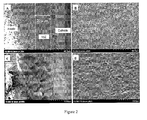
- the microstructure for the unit cell analyzed by SEM is shown in Figure 2 .
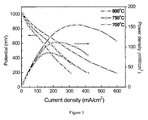
- the testing result for electrical performance for the produced SOFC-MEA is shown in Figure 3 .
Landscapes
- Engineering & Computer Science (AREA)
- Manufacturing & Machinery (AREA)
- Chemical & Material Sciences (AREA)
- Chemical Kinetics & Catalysis (AREA)
- General Chemical & Material Sciences (AREA)
- Electrochemistry (AREA)
- Sustainable Development (AREA)
- Sustainable Energy (AREA)
- Life Sciences & Earth Sciences (AREA)
- Ceramic Engineering (AREA)
- Physics & Mathematics (AREA)
- Thermal Sciences (AREA)
- Fuel Cell (AREA)
Description
- The invention relates to a manufacturing technology for the electrolyte layer in a solid oxide fuel cell (SOFC). It refers to a membrane fabrication method that primarily uses tape casting process and is assisted with processes like sputtering coating, screen printing, spin coating or plasma spray coating. With design and control for sintering condition, the invention enables a process for successful preparation of fully dense electrolyte layer that will be embedded in a high performance membrane electrolyte assembly.
- With rising oil price and growing consciousness of environmental protection, renewable energy technology is one of the most important technologies in the century. Solid oxide fuel cell is a power generation system with high efficiency, low pollution and diversified energy source. It has become the power generation system that has the most development potential because its features like simple material composition, modulized structure and stable and sustainable power generation.
- The operation temperature for an Electrolyte Supported Cell (ESC) that uses YSZ for electrolyte support is 800 ~ 1000°C. The thickness for its electrolyte layer is about 150 ~ 300µm. This is the first-generation SOFC-MEA. The operation temperature for an Anode Supported Cell (ASC) that uses anode material, NiO + YSZ, for anode support is about 650 - 800°C. The thickness for its electrolyte layer (YSZ as primary material) is about 10µm. This is the second-generation SOFC-MEA. NiO + 8YSZ is the anode material for ASC/ESC. The cathode material is mainly LSM and LSCF and about 30 ~ 60µm thick. Many researchers in the world are actively developing new electrolyte materials and cathode materials. It is expected that new materials could lower the operation temperature for SOFC-MEA to about 500~700°C. Then, the parts in SOFC stack, like interconnector, could use metallic materials to replace ceramic materials. The benefits include not only easy manufacturing but also increased mechanical strength/ stability/durability, as well as decreased overall cost for SOFC. The technological development in universities and national laboratories emphasize material development, which expects new materials to lower resistance, increase ionic/ electrical conductivity, and improve SOFC power
- REP
1 433 767 A US 2003/232230 A1 ,US 2006i113034 A1 EP 1 699 104 A , andWO 01/49485 A - The main objective for the invention is to develop the manufacturing process for a fully dense electrolyte layer for SOFC-MEA. This object is solved by the manufacturing process according to claim 1. Advantages improvements of said process are presented by the dependent claims.
- To achieve the above objective, a tape casting process is proposed as the membrane fabrication method, which is also assisted with sputtering coating, screen printing, spin coating or plasma spray coating. The mentioned process under specially designed and controlled sintering condition can successfully produce a fully dense electrolyte layer. Take Anode Supported Cell (ASC) as example. The invented process uses tape casting to produce electrolyte green tape, which through lamination is securely put onto anode green tape. The anode/electrolyte composite green tape is subject to high-temperature sintering to produce half cell. Then, screen printing is used to coat cathode layer onto the electrolyte surface of the half cell. This will conclude the manufacturing of a fully dense electrolyte layer for a solid oxide fuel cell that is also anode supported cell. The SOFC-MEA produced from this process has high performance, durability and stability, which can be verified by performance test of SDFC-MEEA.
- The present invention will be apparent to those skilled in the art by reading the following description of a preferred embodiment thereof, with reference to the accompanying drawings, in which:
-
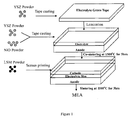
Figure 1 : a simple illustration for the manufacturing process in the invention; -
Figure 2 : SEM picture for cross-sectional microstructure of a completed solid oxide fuel cell by membrane technology at specially designed and controlled sintering condition; and -
Figure 3 : testing result for the electrical performance for the solid oxide fuel cell in the invention. - The invention is to produce planar solid oxide fuel cell (SOFC- MEA), a unit cell, which has embedded fully dense/zero gas leakage rate or airtight electrolyte (like 8YSZ/GDC/YDC/LSGM etc.). The implementation for such process is described as follows:
- Step 1: Use tape casting process to produce planar SOFC-MEA anode and electrolyte green tape. Cut and laminate the electrolyte green tape (5 ~ 300µm) and anode green tape (600 ~ 1200µm) to produce SOFC half cell. Conduct sintering at about 1200°C ~ 1600°C (preferably at 1500°C) for several hours (more than 3 hours) to produce the first-stage ceramic half cell. In this stage, the electrolytes can be YSZ, GDC, YDC, SmDC and LSGM. Use scanning electronic microscope (SEM) to analyze the microstructure for the half cell to assure the electrolyte layer reaches a microstructure that is open pore free and fully dense.
- Step 2: On the electrolyte layer of the half cell, use screen printing process to build a porous cathode layer (usually the material is LSM or LSCF). Then conduct sintering at about 1200°C for about 3 hours to complete the manufacturing of SOFC-MEA. The above process is to manufacture SOFC-MEA that has a fully dense and airtight electrolyte layer. A simple process flow diagram for Step 1 and Step 2 above is shown in
Figure 1 . - The following describes in details the embodiment for the invention:
- Step 1: A process to manufacture SOFC-MEA for solid oxide fuel cell (unit cell) that has a fully dense/ airtight electrolyte layer (8YSZ/GDC/LSGM). The anode for this MEA is made from 50wt% NiO + 50wt% 8YSZ and a specific amount of pore former (graphite). Tape casting process is used to produce electrode green tape. Lamination process makes the
tape 1000 µm thick and 5x5 cm2~10x10 cm2 in size with 13.79~148.24MPa (2000~21500psi). 50 ~ 100°C and system vacuum about 1.33×(10-4 ~10-10)MPa ( 1 ~ 10-6 torrs). The electrode green tape can be anode or electrolyte green tape. Its material can be, but not limited to, YSZ + NiO, GDC + NiO, LSGM + NiO, SDC + NiO, YDC + NiO and YSZ, GDC, LSGM, SDC, YDC et al, respectively. - Step 2: Build the electrolyte green tape in membrane (5 - 300µm) firmly onto the electrode to produce SOFC half cell. Conduct sintering at about 1200°C - 1600°C (preferably 1400°C) for several hours (more than 3 hours) to produce ceramic half cell in the first stage. Then conduct SEM analysis on microstructure to assure that the electrolyte layer has reached the microstructure that is open pore free. As shown in
Figure 2 , the thickness of electrolyte layer is about 20µm, which is a fully dense and airtight structure that can meet the requirement for SOFC-MEA electrolyte layer. The remaining closed fine pores do not affect the requirement for zero gas leakage rate. - Step 3: To assure the airtightness for the electrolyte layer, measure the gas leakage rate for the half cell obtained from Step 2. When the gas leakage rate is below 1 × 10⁻⁶ L/cm2/sec, it is to assure that the electrolyte layer is fully dense. The half cell with fully dense electrolyte layer is named HC-fd.
- Step 4: On the electrolyte layer of HC-fd, use screen printing process to build on a porous layer of cathode LSM material. Then conduct sintering at about 1200°C for 3 hrs. The sintering temperature rising/dropping rate can be, but not limited to, 3°C/min. This will complete the manufacturing of high-performance SOFC-MEA (Unit cell). The microstructure for the unit cell analyzed by SEM is shown in
Figure 2 . The testing result for electrical performance for the produced SOFC-MEA is shown inFigure 3 . It indicates that OCV (1.037 ~ 1.016V) has reached the theoretical value, maximum power density is larger than 150mW/cm2, indicating the excellence of the manufacturing process, innovation and technical criticalness for the invention have met the patent requirements. Therefore, the application is submitted. - The above description is only for an embodiment of the invention, but not to limit the scope of the invention. Those modifications and changes with equivalent effect to the description of the invention shall be all covered in the scope of the invention.
Claims (11)
- A manufacturing process for producing a planar solid oxide fuel cell (SOFC-MEA) having a fully dense electrolyte layer, comprising steps:a. Producing planar SOFC-MEA anode and electrolyte green tapes by tape casting;b. Building electrolyte green tape thin layer onto the electrode green tape and producing SOFC green half cell by laminating with specific pressure, temperature and system vacuum;c. Combining green tapes of electrolyte and electrode tightly; the anode/electrolyte composite green tape is subject to high-temperature sintering to produce ceramic half cell at temperature 1500_°C for 5 hours; inspecting the structure of the half cell, if open pores still exist, spin coat or sputter coat additional electrolyte material onto the electrolyte layer and subject the sintered half SOFC half cell to further sintering until fully dense electrolyte layer is achieved, wherein the inspection uses SEM to inspect the microstructure of the half cell, including measurement of gas leakage rate, which is under 1 x 10⁻⁶ L/cm2/sec for fully dense/airtight electrolyte layer;d. Building a layer of cathode material onto the electrolyte layer of half cell using screen printing process, and sinter the half cell with the printed cathode layer at 1200 °C for 3 hours, wherein the sintering temperature rising/dropping rate is 3°C/min.
- A manufacturing process as described in claim 1 for producing a planar solid oxide fuel cell having a fully dense electrolyte layer, wherein the electrolyte materials include YSZ, GDC, LSGM, SDC and YDC.
- A manufacturing process as described in claim 1 for producing a planar solid oxide fuel cell having a fully dense electrolyte layer, wherein the electrode green tape to prepare SOFC in Step a is anode or electrolyte green tape, the materials include YSZ+NiO, GDC + NiO, LSGM+NiO, SDC + NiO, YDC+NiO and YSZ, GDC, LSGM, SDC, and YDC.
- A manufacturing process as described in claim 1 for producing a planar solid oxide fuel cell having a fully dense electrolyte layer, the anode catalytic material is NiO, and the electrolyte weight ratio is 30 ~ 60wt%.
- A manufacturing process as described in claim 1 for producing a planar solid oxide fuel cell having a fully dense electrolyte layer, wherein the anode catalytic material is NiO.
- A manufacturing process as described in claim 1 for producing a planar solid oxide fuel cell having a fully dense electrolyte layer, wherein Step b builds electrolyte membrane green tape onto electrode green tape, or electrode membrane green tape onto the electrolyte green tape.
- A, manufacturing process as described in claim 1 for producing a planar solid oxide fuel cell having a fully dense electrolyte layer, wherein the process in Step b to build SOFC electrolyte layer onto electrode layer by laminating with 13.79~148.24MPa (2000~21500psi), 50~100°C and system vacuum 1.33×(10-4 ~ 10-10) Pa (1 ~ 10-6torrs).
- A manufacturing process as described in claim 1 for producing a planar solid oxide fuel cell having a fully dense electrolyte layer, wherein the sintering process in Step c is 1500°C for 5 hours in high-temperature furnace that circulates air or other gases.
- A manufacturing process as described in claim 1 for producing a planar solid oxide fuel cell having a fully dense electrolyte layer, wherein the process in Step d uses screen printing to build a layer of cathode material onto the electrolyte layer of half cell.
- A manufacturing process as described in claim 1 for producing a planar solid oxide fuel cell having a fully dense electrolyte layer, wherein Step d the cathode material is LSM and LSCF.
- A manufacturing process as described in claim 1 for producing a planar solid oxide fuel cell having a fully dense electrolyte layer, wherein Step d the thickness of cathode layer is 30~50µm.
Priority Applications (1)
| Application Number | Priority Date | Filing Date | Title |
|---|---|---|---|
| EP08100806A EP2083465B1 (en) | 2008-01-23 | 2008-01-23 | A Process for Fabrication of a Fully Dense Electrolyte layer embedded in membrane electrolyte assembly of solid oxide fuel cell |
Applications Claiming Priority (1)
| Application Number | Priority Date | Filing Date | Title |
|---|---|---|---|
| EP08100806A EP2083465B1 (en) | 2008-01-23 | 2008-01-23 | A Process for Fabrication of a Fully Dense Electrolyte layer embedded in membrane electrolyte assembly of solid oxide fuel cell |
Publications (2)
| Publication Number | Publication Date |
|---|---|
| EP2083465A1 EP2083465A1 (en) | 2009-07-29 |
| EP2083465B1 true EP2083465B1 (en) | 2012-08-01 |
Family
ID=39495768
Family Applications (1)
| Application Number | Title | Priority Date | Filing Date |
|---|---|---|---|
| EP08100806A Ceased EP2083465B1 (en) | 2008-01-23 | 2008-01-23 | A Process for Fabrication of a Fully Dense Electrolyte layer embedded in membrane electrolyte assembly of solid oxide fuel cell |
Country Status (1)
| Country | Link |
|---|---|
| EP (1) | EP2083465B1 (en) |
Families Citing this family (3)
| Publication number | Priority date | Publication date | Assignee | Title |
|---|---|---|---|---|
| FR2974452B1 (en) * | 2011-04-22 | 2014-04-04 | Commissariat Energie Atomique | PROCESS FOR PREPARING AN ELECTROCHEMICAL SEMI-CELL |
| CN106770583B (en) * | 2016-12-02 | 2019-01-08 | 东北大学 | The method that rotary coating prepares limit-current type oxygen sensor dense diffusion barrier |
| CN114335640B (en) * | 2021-12-27 | 2023-06-02 | 安徽壹石通材料科学研究院有限公司 | Sintering method of anode support type SOFC half-cell |
Family Cites Families (5)
| Publication number | Priority date | Publication date | Assignee | Title |
|---|---|---|---|---|
| AUPQ492199A0 (en) * | 1999-12-30 | 2000-02-03 | Ceramic Fuel Cells Limited | Laminated structure and method of forming same |
| JP4252453B2 (en) * | 2001-09-26 | 2009-04-08 | 日本碍子株式会社 | Electrochemical cell and method for producing the same |
| US20030232230A1 (en) * | 2002-06-12 | 2003-12-18 | Carter John David | Solid oxide fuel cell with enhanced mechanical and electrical properties |
| EP1812229A2 (en) * | 2004-10-29 | 2007-08-01 | Franklin Fuel Cells, Inc. | Electrochemical cell architecture and method of making same via controlled powder morphology |
| US7595019B2 (en) * | 2005-03-01 | 2009-09-29 | Air Products And Chemicals, Inc. | Method of making an ion transport membrane oxygen separation device |
-
2008
- 2008-01-23 EP EP08100806A patent/EP2083465B1/en not_active Ceased
Also Published As
| Publication number | Publication date |
|---|---|
| EP2083465A1 (en) | 2009-07-29 |
Similar Documents
| Publication | Publication Date | Title |
|---|---|---|
| Wang et al. | Dynamic evaluation of low-temperature metal-supported solid oxide fuel cell oriented to auxiliary power units | |
| Mizutani et al. | From rare earth doped zirconia to 1 kW solid oxide fuel cell system | |
| Ge et al. | Screen-printed thin YSZ films used as electrolytes for solid oxide fuel cells | |
| Kim et al. | Solid oxide fuel cells with zirconia/ceria bilayer electrolytes via roll calendering process | |
| EP2398102B1 (en) | Fuel cell | |
| CA3018128A1 (en) | Solid oxide fuel cells with cathode functional layers | |
| CN112952108A (en) | Solid oxide fuel cell and preparation method thereof | |
| Timurkutluk et al. | Novel electrolytes for solid oxide fuel cells with improved mechanical properties | |
| Hussain et al. | High performing and durable anode-supported solid oxide fuel cell by using tape casting, lamination and co-firing method | |
| An et al. | The effect of porosity gradient in a Nickel/Yttria Stabilized Zirconia anode for an anode-supported planar solid oxide fuel cell | |
| Onbilgin et al. | Comparison of electrolyte fabrication techniques on the performance of anode supported solid oxide fuel cells | |
| Szabo et al. | Progress in the metal supported solid oxide fuel cells and stacks for APU | |
| JP5198908B2 (en) | A method for producing a completely dense electrolyte layer laminated on a high performance solid oxide fuel cell membrane electrode assembly (SOFC-MEA). | |
| Hatae et al. | Current density dependence of changes in the microstructure of SOFC anodes during electrochemical oxidation | |
| EP2083466A1 (en) | Process for the fabrication of a sputter deposited fully dense electrolyte layer embedded in a high performance membrane electrolyte assembly of solid oxide fuel cell | |
| US7815843B2 (en) | Process for anode treatment of solid oxide fuel cell—membrane electrode assembly to upgrade power density in performance test | |
| Ansar et al. | Metal supported solid oxide fuel cells and stacks for auxilary power units-progress, challenges and lessons learned | |
| Timurkutluk et al. | Novel structured electrolytes for solid oxide fuel cells | |
| US20090151850A1 (en) | Process for fabrication of a fully dense electrolyte layer embedded in membrane electrolyte assembly of solid oxide fuel cell | |
| Han et al. | Fabrication and properties of anode-supported solid oxide fuel cell | |
| Lenser et al. | Performance analysis of a planar solid oxide fuel cell stack between 750° C and 500° C | |
| EP2083465A1 (en) | A Process for Fabrication of a Fully Dense Electrolyte layer embedded in membrane electrolyte assembly of solid oxide fuel cell | |
| US8920612B2 (en) | Process for fabrication of a sputter deposited fully dense electrolyte layer embedded in a high performance membrane electrolyte assembly of solid oxide fuel cell | |
| DK2669984T3 (en) | Layered anode system for electrochemical applications and processes for their preparation | |
| JP2025045901A (en) | Method for manufacturing a solid oxide electrolysis cell |
Legal Events
| Date | Code | Title | Description |
|---|---|---|---|
| PUAI | Public reference made under article 153(3) epc to a published international application that has entered the european phase |
Free format text: ORIGINAL CODE: 0009012 |
|
| AK | Designated contracting states |
Kind code of ref document: A1 Designated state(s): AT BE BG CH CY CZ DE DK EE ES FI FR GB GR HR HU IE IS IT LI LT LU LV MC MT NL NO PL PT RO SE SI SK TR |
|
| AX | Request for extension of the european patent |
Extension state: AL BA MK RS |
|
| 17P | Request for examination filed |
Effective date: 20090709 |
|
| 17Q | First examination report despatched |
Effective date: 20100107 |
|
| AKX | Designation fees paid |
Designated state(s): DE FR NL |
|
| GRAP | Despatch of communication of intention to grant a patent |
Free format text: ORIGINAL CODE: EPIDOSNIGR1 |
|
| GRAS | Grant fee paid |
Free format text: ORIGINAL CODE: EPIDOSNIGR3 |
|
| GRAA | (expected) grant |
Free format text: ORIGINAL CODE: 0009210 |
|
| AK | Designated contracting states |
Kind code of ref document: B1 Designated state(s): DE FR NL |
|
| REG | Reference to a national code |
Ref country code: NL Ref legal event code: T3 |
|
| REG | Reference to a national code |
Ref country code: DE Ref legal event code: R096 Ref document number: 602008017514 Country of ref document: DE Effective date: 20120927 |
|
| REG | Reference to a national code |
Ref country code: DE Ref legal event code: R082 Ref document number: 602008017514 Country of ref document: DE Representative=s name: LERMERRAIBLE PATENT- U. RECHTSANWALTS PARTGMBB, DE Ref country code: DE Ref legal event code: R082 Ref document number: 602008017514 Country of ref document: DE Representative=s name: LERMERRAIBLE GBR PATENT- UND RECHTSANWAELTE, DE |
|
| PLBE | No opposition filed within time limit |
Free format text: ORIGINAL CODE: 0009261 |
|
| STAA | Information on the status of an ep patent application or granted ep patent |
Free format text: STATUS: NO OPPOSITION FILED WITHIN TIME LIMIT |
|
| 26N | No opposition filed |
Effective date: 20130503 |
|
| REG | Reference to a national code |
Ref country code: DE Ref legal event code: R097 Ref document number: 602008017514 Country of ref document: DE Effective date: 20130503 |
|
| REG | Reference to a national code |
Ref country code: FR Ref legal event code: PLFP Year of fee payment: 9 |
|
| REG | Reference to a national code |
Ref country code: FR Ref legal event code: PLFP Year of fee payment: 10 |
|
| REG | Reference to a national code |
Ref country code: FR Ref legal event code: PLFP Year of fee payment: 11 |
|
| PGFP | Annual fee paid to national office [announced via postgrant information from national office to epo] |
Ref country code: NL Payment date: 20200122 Year of fee payment: 13 Ref country code: DE Payment date: 20191219 Year of fee payment: 13 |
|
| PGFP | Annual fee paid to national office [announced via postgrant information from national office to epo] |
Ref country code: FR Payment date: 20200123 Year of fee payment: 13 |
|
| REG | Reference to a national code |
Ref country code: DE Ref legal event code: R119 Ref document number: 602008017514 Country of ref document: DE |
|
| REG | Reference to a national code |
Ref country code: NL Ref legal event code: MM Effective date: 20210201 |
|
| PG25 | Lapsed in a contracting state [announced via postgrant information from national office to epo] |
Ref country code: NL Free format text: LAPSE BECAUSE OF NON-PAYMENT OF DUE FEES Effective date: 20210201 Ref country code: FR Free format text: LAPSE BECAUSE OF NON-PAYMENT OF DUE FEES Effective date: 20210131 |
|
| PG25 | Lapsed in a contracting state [announced via postgrant information from national office to epo] |
Ref country code: DE Free format text: LAPSE BECAUSE OF NON-PAYMENT OF DUE FEES Effective date: 20210803 |