EP2083157A2 - Exhaust reduction system having oxygen and temperature control - Google Patents
Exhaust reduction system having oxygen and temperature control Download PDFInfo
- Publication number
- EP2083157A2 EP2083157A2 EP09000840A EP09000840A EP2083157A2 EP 2083157 A2 EP2083157 A2 EP 2083157A2 EP 09000840 A EP09000840 A EP 09000840A EP 09000840 A EP09000840 A EP 09000840A EP 2083157 A2 EP2083157 A2 EP 2083157A2
- Authority
- EP
- European Patent Office
- Prior art keywords
- exhaust
- treatment device
- temperature
- constituent
- sensor
- Prior art date
- Legal status (The legal status is an assumption and is not a legal conclusion. Google has not performed a legal analysis and makes no representation as to the accuracy of the status listed.)
- Granted
Links
Images


Classifications
-
- F—MECHANICAL ENGINEERING; LIGHTING; HEATING; WEAPONS; BLASTING
- F02—COMBUSTION ENGINES; HOT-GAS OR COMBUSTION-PRODUCT ENGINE PLANTS
- F02D—CONTROLLING COMBUSTION ENGINES
- F02D41/00—Electrical control of supply of combustible mixture or its constituents
- F02D41/02—Circuit arrangements for generating control signals
- F02D41/14—Introducing closed-loop corrections
- F02D41/1438—Introducing closed-loop corrections using means for determining characteristics of the combustion gases; Sensors therefor
- F02D41/1444—Introducing closed-loop corrections using means for determining characteristics of the combustion gases; Sensors therefor characterised by the characteristics of the combustion gases
- F02D41/1446—Introducing closed-loop corrections using means for determining characteristics of the combustion gases; Sensors therefor characterised by the characteristics of the combustion gases the characteristics being exhaust temperatures
-
- F—MECHANICAL ENGINEERING; LIGHTING; HEATING; WEAPONS; BLASTING
- F01—MACHINES OR ENGINES IN GENERAL; ENGINE PLANTS IN GENERAL; STEAM ENGINES
- F01N—GAS-FLOW SILENCERS OR EXHAUST APPARATUS FOR MACHINES OR ENGINES IN GENERAL; GAS-FLOW SILENCERS OR EXHAUST APPARATUS FOR INTERNAL-COMBUSTION ENGINES
- F01N3/00—Exhaust or silencing apparatus having means for purifying, rendering innocuous, or otherwise treating exhaust
- F01N3/08—Exhaust or silencing apparatus having means for purifying, rendering innocuous, or otherwise treating exhaust for rendering innocuous
- F01N3/10—Exhaust or silencing apparatus having means for purifying, rendering innocuous, or otherwise treating exhaust for rendering innocuous by thermal or catalytic conversion of noxious components of exhaust
- F01N3/18—Exhaust or silencing apparatus having means for purifying, rendering innocuous, or otherwise treating exhaust for rendering innocuous by thermal or catalytic conversion of noxious components of exhaust characterised by methods of operation; Control
- F01N3/20—Exhaust or silencing apparatus having means for purifying, rendering innocuous, or otherwise treating exhaust for rendering innocuous by thermal or catalytic conversion of noxious components of exhaust characterised by methods of operation; Control specially adapted for catalytic conversion
- F01N3/206—Adding periodically or continuously substances to exhaust gases for promoting purification, e.g. catalytic material in liquid form, NOx reducing agents
- F01N3/2066—Selective catalytic reduction [SCR]
-
- F—MECHANICAL ENGINEERING; LIGHTING; HEATING; WEAPONS; BLASTING
- F02—COMBUSTION ENGINES; HOT-GAS OR COMBUSTION-PRODUCT ENGINE PLANTS
- F02D—CONTROLLING COMBUSTION ENGINES
- F02D41/00—Electrical control of supply of combustible mixture or its constituents
- F02D41/02—Circuit arrangements for generating control signals
- F02D41/021—Introducing corrections for particular conditions exterior to the engine
- F02D41/0235—Introducing corrections for particular conditions exterior to the engine in relation with the state of the exhaust gas treating apparatus
-
- F—MECHANICAL ENGINEERING; LIGHTING; HEATING; WEAPONS; BLASTING
- F02—COMBUSTION ENGINES; HOT-GAS OR COMBUSTION-PRODUCT ENGINE PLANTS
- F02D—CONTROLLING COMBUSTION ENGINES
- F02D41/00—Electrical control of supply of combustible mixture or its constituents
- F02D41/02—Circuit arrangements for generating control signals
- F02D41/14—Introducing closed-loop corrections
- F02D41/1438—Introducing closed-loop corrections using means for determining characteristics of the combustion gases; Sensors therefor
- F02D41/1444—Introducing closed-loop corrections using means for determining characteristics of the combustion gases; Sensors therefor characterised by the characteristics of the combustion gases
- F02D41/1454—Introducing closed-loop corrections using means for determining characteristics of the combustion gases; Sensors therefor characterised by the characteristics of the combustion gases the characteristics being an oxygen content or concentration or the air-fuel ratio
-
- F—MECHANICAL ENGINEERING; LIGHTING; HEATING; WEAPONS; BLASTING
- F02—COMBUSTION ENGINES; HOT-GAS OR COMBUSTION-PRODUCT ENGINE PLANTS
- F02D—CONTROLLING COMBUSTION ENGINES
- F02D41/00—Electrical control of supply of combustible mixture or its constituents
- F02D41/02—Circuit arrangements for generating control signals
- F02D41/14—Introducing closed-loop corrections
- F02D41/1438—Introducing closed-loop corrections using means for determining characteristics of the combustion gases; Sensors therefor
- F02D41/1444—Introducing closed-loop corrections using means for determining characteristics of the combustion gases; Sensors therefor characterised by the characteristics of the combustion gases
- F02D41/146—Introducing closed-loop corrections using means for determining characteristics of the combustion gases; Sensors therefor characterised by the characteristics of the combustion gases the characteristics being an NOx content or concentration
- F02D41/1463—Introducing closed-loop corrections using means for determining characteristics of the combustion gases; Sensors therefor characterised by the characteristics of the combustion gases the characteristics being an NOx content or concentration of the exhaust gases downstream of exhaust gas treatment apparatus
- F02D41/1465—Introducing closed-loop corrections using means for determining characteristics of the combustion gases; Sensors therefor characterised by the characteristics of the combustion gases the characteristics being an NOx content or concentration of the exhaust gases downstream of exhaust gas treatment apparatus with determination means using an estimation
-
- F—MECHANICAL ENGINEERING; LIGHTING; HEATING; WEAPONS; BLASTING
- F01—MACHINES OR ENGINES IN GENERAL; ENGINE PLANTS IN GENERAL; STEAM ENGINES
- F01N—GAS-FLOW SILENCERS OR EXHAUST APPARATUS FOR MACHINES OR ENGINES IN GENERAL; GAS-FLOW SILENCERS OR EXHAUST APPARATUS FOR INTERNAL-COMBUSTION ENGINES
- F01N2610/00—Adding substances to exhaust gases
- F01N2610/02—Adding substances to exhaust gases the substance being ammonia or urea
-
- F—MECHANICAL ENGINEERING; LIGHTING; HEATING; WEAPONS; BLASTING
- F02—COMBUSTION ENGINES; HOT-GAS OR COMBUSTION-PRODUCT ENGINE PLANTS
- F02B—INTERNAL-COMBUSTION PISTON ENGINES; COMBUSTION ENGINES IN GENERAL
- F02B29/00—Engines characterised by provision for charging or scavenging not provided for in groups F02B25/00, F02B27/00 or F02B33/00 - F02B39/00; Details thereof
- F02B29/04—Cooling of air intake supply
- F02B29/0406—Layout of the intake air cooling or coolant circuit
-
- F—MECHANICAL ENGINEERING; LIGHTING; HEATING; WEAPONS; BLASTING
- F02—COMBUSTION ENGINES; HOT-GAS OR COMBUSTION-PRODUCT ENGINE PLANTS
- F02B—INTERNAL-COMBUSTION PISTON ENGINES; COMBUSTION ENGINES IN GENERAL
- F02B37/00—Engines characterised by provision of pumps driven at least for part of the time by exhaust
- F02B37/013—Engines characterised by provision of pumps driven at least for part of the time by exhaust with exhaust-driven pumps arranged in series
-
- F—MECHANICAL ENGINEERING; LIGHTING; HEATING; WEAPONS; BLASTING
- F02—COMBUSTION ENGINES; HOT-GAS OR COMBUSTION-PRODUCT ENGINE PLANTS
- F02D—CONTROLLING COMBUSTION ENGINES
- F02D13/00—Controlling the engine output power by varying inlet or exhaust valve operating characteristics, e.g. timing
- F02D13/02—Controlling the engine output power by varying inlet or exhaust valve operating characteristics, e.g. timing during engine operation
- F02D13/0203—Variable control of intake and exhaust valves
-
- F—MECHANICAL ENGINEERING; LIGHTING; HEATING; WEAPONS; BLASTING
- F02—COMBUSTION ENGINES; HOT-GAS OR COMBUSTION-PRODUCT ENGINE PLANTS
- F02D—CONTROLLING COMBUSTION ENGINES
- F02D13/00—Controlling the engine output power by varying inlet or exhaust valve operating characteristics, e.g. timing
- F02D13/02—Controlling the engine output power by varying inlet or exhaust valve operating characteristics, e.g. timing during engine operation
- F02D13/0269—Controlling the valves to perform a Miller-Atkinson cycle
-
- F—MECHANICAL ENGINEERING; LIGHTING; HEATING; WEAPONS; BLASTING
- F02—COMBUSTION ENGINES; HOT-GAS OR COMBUSTION-PRODUCT ENGINE PLANTS
- F02D—CONTROLLING COMBUSTION ENGINES
- F02D41/00—Electrical control of supply of combustible mixture or its constituents
- F02D41/0002—Controlling intake air
- F02D41/0007—Controlling intake air for control of turbo-charged or super-charged engines
-
- F—MECHANICAL ENGINEERING; LIGHTING; HEATING; WEAPONS; BLASTING
- F02—COMBUSTION ENGINES; HOT-GAS OR COMBUSTION-PRODUCT ENGINE PLANTS
- F02M—SUPPLYING COMBUSTION ENGINES IN GENERAL WITH COMBUSTIBLE MIXTURES OR CONSTITUENTS THEREOF
- F02M26/00—Engine-pertinent apparatus for adding exhaust gases to combustion-air, main fuel or fuel-air mixture, e.g. by exhaust gas recirculation [EGR] systems
- F02M26/01—Internal exhaust gas recirculation, i.e. wherein the residual exhaust gases are trapped in the cylinder or pushed back from the intake or the exhaust manifold into the combustion chamber without the use of additional passages
-
- F—MECHANICAL ENGINEERING; LIGHTING; HEATING; WEAPONS; BLASTING
- F02—COMBUSTION ENGINES; HOT-GAS OR COMBUSTION-PRODUCT ENGINE PLANTS
- F02M—SUPPLYING COMBUSTION ENGINES IN GENERAL WITH COMBUSTIBLE MIXTURES OR CONSTITUENTS THEREOF
- F02M26/00—Engine-pertinent apparatus for adding exhaust gases to combustion-air, main fuel or fuel-air mixture, e.g. by exhaust gas recirculation [EGR] systems
- F02M26/02—EGR systems specially adapted for supercharged engines
- F02M26/08—EGR systems specially adapted for supercharged engines for engines having two or more intake charge compressors or exhaust gas turbines, e.g. a turbocharger combined with an additional compressor
-
- Y—GENERAL TAGGING OF NEW TECHNOLOGICAL DEVELOPMENTS; GENERAL TAGGING OF CROSS-SECTIONAL TECHNOLOGIES SPANNING OVER SEVERAL SECTIONS OF THE IPC; TECHNICAL SUBJECTS COVERED BY FORMER USPC CROSS-REFERENCE ART COLLECTIONS [XRACs] AND DIGESTS
- Y02—TECHNOLOGIES OR APPLICATIONS FOR MITIGATION OR ADAPTATION AGAINST CLIMATE CHANGE
- Y02T—CLIMATE CHANGE MITIGATION TECHNOLOGIES RELATED TO TRANSPORTATION
- Y02T10/00—Road transport of goods or passengers
- Y02T10/10—Internal combustion engine [ICE] based vehicles
- Y02T10/12—Improving ICE efficiencies
Definitions
- the present disclosure is directed to an exhaust reduction system and, more particularly, to an exhaust reduction system having oxygen and temperature control.
- SCR is a process where gaseous or liquid reductant (most commonly urea) is added to the exhaust gas stream of an engine and is absorbed onto a catalyst. The reductant reacts with NOx in the exhaust gas to form H 2 O and N 2 .
- gaseous or liquid reductant most commonly urea
- the reductant reacts with NOx in the exhaust gas to form H 2 O and N 2 .
- SCR can be effective, it is most effective when a concentration of NO to NO 2 supplied to the SCR is about 1:1.
- DOC Diesel Oxidation Catalyst
- the NO 2 produced (i.e., converted from NO) by the DOC can also facilitate the combustion of collected particulate matter.
- a particulate trap is commonly used to collect unburned particulates also known as soot. Over time, the particulate matter builds up in the trap and, if left unchecked, the particulate trap could negatively affect performance of the engine. As such, the particulate matter collected by the trap must be periodically or continuously removed through a process called regeneration.
- a fuel typically diesel or partially combusted diesel products from the engine
- a fuel is combusted upstream of the trap, either in a burner device or over an oxidation catalyst, resulting in an increase in exhaust gas temperature.
- the organic and elemental carbon components of the diesel particulate matter are then oxidized by oxygen and NO 2 present in the exhaust gas at this elevated temperature.
- An efficiency of the regeneration process like the SCR process, can be affected by the amount of NO 2 present in the exhaust flow.
- the ratio of NO to NO 2 contained in the exhaust stream exiting the DOC may vary based at least partially on the flow rate of exhaust passing through the DOC and a temperature of the exhaust within the DOC.
- the flow rate of exhaust passing through the DOC in most situations, may be almost completely dependent on operation of the engine (i.e., on a flow rate of gases combusted and subsequently exhausted from the engine).
- the conversion rate of NO to NO 2 has historically been controlled by varying the temperature of the exhaust.
- the '807 patent discloses an exhaust gas purifying apparatus having a particulate filter, an oxidation catalyst, a front oxidation catalyst, a bypass path, and a passage switching device disposed in an exhaust path.
- the front oxidation catalyst is disposed further upstream than the oxidation catalyst.
- the bypass path bypasses the upstream side and the downstream side of the front oxidation catalyst during normal operation such that the entire gas flow passes only through the oxidation catalyst and the particulate trap.
- the passage switching device switches the flow of exhaust gas to the front oxidation catalyst from the bypass path during filter regeneration.
- the filter when the filter is forcibly recovered (i.e., regenerated), the temperature of the exhaust gas is raised by an injection of fuel and is made to pass through the front oxidation catalyst such that the oxidation catalyst is sufficiently warmed and an adequate amount of NO is converted to NO 2 for optimum regeneration of the filter. After the oxidation catalyst is properly activated, the flow of exhaust gas is switched back to pass through the bypass path, and regeneration of the filter is completed in the presence of NO 2 .
- the exhaust gas purifying apparatus of the '807 patent may be complex, inefficient, and lack applicability. That is, the apparatus of the '807 patent requires multiple oxidation catalysts and complicated bypass and heating structures. These components increase the complexity of the system, as well as part and assembly cost.
- the temperature required by the DOC to convert the appropriate amount of NO to NO 2 may be at least partially dependent on an amount of oxygen available to the DOC. For example, a relatively low amount of oxygen available to the DOC may require a relatively low temperature for the proper conversion of NO to NO 2 . In contrast, a relatively high amount of oxygen available to the DOC may require a relatively high temperature for the proper conversion.
- the control strategy described in the '807 patent may be suboptimal when implemented in conjunction with an SCR device requiring a precise ratio of NO to NO 2 .
- the system of the present disclosure solves one or more of the problems set forth above.
- the exhaust system may include a first treatment device situated to receive a flow of exhaust and convert a first constituent of the exhaust to a second constituent, and a second treatment device located downstream of the first treatment device to reduce the first and second constituents.
- the exhaust system may also include a sensor configured to generate a signal indicative of one of a temperature and an oxygen concentration of the exhaust, and a controller in communication with the sensor.
- the controller may be configured to vary the other of the temperature and the oxygen concentration based on the signal such that a desired amount of the first constituent is converted to the second constituent by the first treatment device prior to reduction by the second treatment device.
- the method may include combusting fuel to produce a flow of exhaust, and passing the exhaust through a catalyst to convert a first constituent of the exhaust to a second constituent.
- the method may also include reducing the first constituent and the second constituent.
- the method may further include determining one of a temperature and an oxygen concentration of the exhaust entering the catalyst, and responsively varying the other of the temperature and the oxygen concentration such that a desired amount of the first constituent is converted to the second constituent.
- Fig. 1 illustrates an exemplary power system 10.
- power system 10 is depicted and described as a diesel-fueled, internal combustion engine.
- power system 10 may embody any other type of internal combustion engine, such as, for example, a gasoline or gaseous fuel-powered engine.
- Power system 10 may include an engine block 12 that at least partially defines a plurality of cylinders 14, and a plurality of piston assemblies 16 disposed within cylinders 14. It is contemplated that power system 10 may include any number of cylinders 14 and that cylinders 14 may be disposed in an "in-line" configuration, a "V" configuration, or any other conventional configuration.
- Each piston assembly 16 may be configured to reciprocate between a bottom-dead-center (BDC) position (lower-most position within cylinder 14), and a top-dead-center (TDC) position (upper-most position within cylinder 14).
- piston assembly 16 may be pivotally coupled to a crankshaft 18 by way of a connecting rod (not shown).
- Crankshaft 18 of power system 10 may be rotatably disposed within engine block 12, and each piston assembly 16 coupled to crankshaft 18 such that a sliding motion of each piston assembly 16 within each cylinder 14 results in a rotation of crankshaft 18.
- a rotation of crankshaft 18 may result in a sliding motion of piston assemblies 16.
- power system 10 may be a four stroke (e.g., four cycle) engine, wherein a complete cycle includes an intake stroke (TDC to BDC), a compression stroke (BDC to TDC), a power stroke (TDC to BDC), and an exhaust stroke (BDC to TDC). It is also contemplated that power system 10 may alternatively embody a two stroke (e.g., two cycle) engine, wherein a complete cycle includes a compression/exhaust stroke (BDC to TDC) and a power/exhaust/intake stroke (TDC to BDC).
- An intake valve 20 may be associated with each cylinder 14 to selectively restrict fluid flow through a respective intake port 22. Each intake valve 20 may be actuated to move or "lift” to thereby open the respective intake port 22. In a cylinder 14 having a pair of intake ports 22 and a pair of intake valves 20, the pair of intake valves 20 may be actuated by a single valve actuator (not shown) or by a pair of valve actuators (not shown). Of the four piston strokes described above, each intake valve 20 may open during a portion of the intake stroke to allow air or an air and fuel mixture to enter each respective cylinder 14 during normal operation.
- An exhaust valve 24 may also be associated with each cylinder 14, and configured to selectively block a respective exhaust port 26. Each exhaust valve 24 may be lifted to thereby open the respective exhaust port 26.
- the pair of exhaust valves 24 may be actuated by a single valve actuator (not shown) or by a pair of valve actuators (not shown). Of the four piston strokes described above, each exhaust valve 24 may open during a portion of the exhaust stroke to allow exhaust to be pushed from each respective cylinder 14 by the motion of piston assemblies 16.
- Each of intake and exhaust valves 20, 24 may be operated in any conventional way to move from the closed or flow blocking position to the open or flow passing position in a cyclical manner.
- intake and exhaust valves 20, 24 may be lifted by way of a cam (not shown) that is rotatingly driven by crankshaft 18, by way of a hydraulic actuator (not shown), by way of an electronic actuator (not shown), or in any other manner.
- intake and exhaust valves 20, 24 may be lifted in a predefined cycle related to the motion of piston assemblies 16. It is contemplated, however, that a variable valve actuator 28 may be associated with one or more of intake and/or exhaust valves 20, 24 to selectively interrupt the cyclical motion thereof during alternative modes of operation.
- one or more of intake and/or exhaust valves 20, 24 may be selectively opened, held open, closed, or held closed by variable valve actuator 28 to implement a mode of operation that varies an air-to-fuel ratio (A/F) of fluid passing into and/or through power system 10.
- A/F air-to-fuel ratio
- variable valve actuator 28 may vary an opening timing of intake valve 20 during an intake stroke and/or a closing timing of exhaust valve 24 during a preceding exhaust stroke to implement an internal exhaust gas recirculation (EGR) mode of operation where exhaust may be redirected back into power system 10 for subsequent combustion.
- EGR exhaust gas recirculation
- variable valve actuator 28 may be controlled to reduce the amount of exhaust gas being recirculated. A reduction in exhaust gas recirculation may result in higher concentrations of O 2 in the exhaust and higher temperatures.
- variable valve actuator 28 may maintain intake valve 20 open into a portion of the compression stroke to implement a Miller cycle mode of operation where some portion of the O 2 within cylinders 14 is pushed in reverse direction through inlet ports 22, rather than being combusted.
- the reduced amount of O 2 being combusted as a result of the Miller cycle may reduce the production of NOx and result in lower O 2 concentrations and higher temperatures in the exhaust.
- variable valve actuator 28 may be controlled to reduce the amount of O 2 being pushed from cylinders 14, thereby increasing O 2 concentrations and lowering temperatures of the exhaust exiting power system 10. It is contemplated that variable valve actuator 28 may implement additional or alternative modes of operation known in the art to vary the A/F of and/or amount of fluid passing through power system 10, if desired.
- An air induction system 30 may be associated with power system 10 and include components that condition and introduce compressed air into cylinders 14 by way of intake ports 22 and intake valves 20.
- air induction system 30 may include an air cooler 32 located downstream of one or more compressors 34.
- Compressors 34 may be connected to pressurize inlet air directed through and chilled by cooler 32.
- a throttle valve 36 may be located upstream of compressors 34 to selectively regulate (i.e., restrict) the flow of inlet air into power system 10.
- a restriction may reduce the A/F of power system 10 and/or an overall amount of fluid passing through power system, resulting in less O 2 entering and exiting power system 10 and a higher exhaust temperature.
- air induction system 30 may include different or additional components than described above such as, for example, filtering components, compressor bypass components, thermostat devices associated selective control of air cooler 32, and other known components.
- An exhaust system 38 may also be associated with power system 10, and include components that condition and direct exhaust from cylinders 14 to the atmosphere.
- exhaust system 38 may include one or more turbines 40 driven by the exiting exhaust, a first and a second treatment device 42, 44 disposed in series and fluidly connected downstream of turbine 40, and an exhaust outlet 46 configured to direct treated exhaust from second treatment device 44 to the atmosphere.
- exhaust system 38 may include different or additional components than described above such as, for example, bypass components, an exhaust heater, a braking device, an attenuation device, additional treatment devices, and other known components.
- Turbine 40 may be located to receive exhaust leaving power system 10 via exhaust ports 26. Turbine 40 may be connected to one or more compressors 34 of air induction system 30 by way of a common shaft 48 to form a turbocharger. As the hot exhaust gases exiting power system 10 move through turbine 40 and expand against vanes (not shown) thereof, turbine 40 may rotate and drive the connected compressor 34 to pressurize inlet air.
- Turbine 40 may embody a variable geometry turbine (VGT).
- VGTs are a variety of turbochargers having geometry adjustable to attain different aspect ratios such that adequate boost pressure may be supplied to cylinders 14 under a range of operational conditions.
- turbine 40 may include vanes movable by an actuator 50. As these vanes move, a flow area between the vanes may change, thereby changing the aspect ratio of the turbocharger.
- turbine 40 may have nozzle ring adjustable by actuator 50. During operation of the turbocharger, the orientation of the nozzle ring may be adjusted to vary a flow area through a nozzle portion (not shown) of turbine 40.
- the performance of the turbocharger may also change. For example, as the flow area decreases, the flow rate of exhaust through turbine 40 may proportionally decrease, while the pressure and/or flow of the inlet air produced by compressor 34 may increase. In contrast, as the flow area of turbine 40 increases, the flow rate of exhaust through turbine 40 may proportionally increase and the pressure and/or flow rate of the inlet air produced by compressor 34 may decrease. An increased pressure and/or flow rate of air entering power system 10 may result in an increased amount of O 2 entering and exiting power system and/or a lower combustion temperature within power system 10.
- a wastegate (not shown) or a pressure relief valve may also or alternatively be associated with compressor 34 and/or turbine 40.
- the wastegate and/or pressure relief valve may also or alternatively be operated by actuator 50, if desired, to affect the A/F of and/or amount of fluid passing through power system 10.
- actuator 50 whether associated with the variable flow area of turbine 40, a wastegate, a pressure relief valve, or another device may function to vary the A/F and/or amount of fluid passing through power system 10 and, subsequently, the O 2 concentration and temperature of exhaust exiting power system 10.
- First treatment device 42 may cooperate with second treatment device 44 to condition the exhaust flow from power system 10.
- first treatment device 42 may embody a catalyst configured to convert a first constituent of the exhaust flow to a second constituent, which may be more susceptible to conditioning within second treatment device 44.
- first treatment device 42 may be a catalyst such as a diesel oxidation catalyst (DOC).
- DOC diesel oxidation catalyst
- first treatment device 42 may include a porous ceramic honeycomb structure or metal mesh substrate coated with a material, for example a precious metal, that catalyzes a chemical reaction to alter the composition of the exhaust.
- first treatment device 42 may include platinum or vanadium to facilitate the conversion of NO to NO 2 .
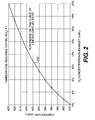
- the conversion efficiency and/or rate of first treatment device 42 may be related to an amount of O 2 within and a temperature of exhaust entering first treatment device 42. That is, for a given concentration of O 2 in the exhaust, a particular temperature may force a desired amount of NO (about 50% of the total NOx in one example) to be converted to NO 2 through thermodynamic equilibrium. Similarly, for a given temperature of the exhaust, a particular concentration of O 2 may force the desired conversion. This relationship may be illustrated by the map of Fig. 2 . Specifically, a non-linear curve 100 in the map of Fig. 2 may represent a desired concentration of NO to NO 2 (about 1:1 in one example) exiting first treatment device 42, and the corresponding exhaust temperature and O 2 concentration levels required to force the desired conversion.
- Second treatment device 44 may receive exhaust from first treatment device 42 to reduce constituents of the exhaust to innocuous gases.
- second treatment device 44 may embody a Selective Catalytic Reduction (SCR) device.
- SCR Selective Catalytic Reduction
- second treatment device 44 may include a catalyst substrate 44a located downstream from a reductant injector 44b.
- a gaseous or liquid reductant, most commonly urea (NH 3 ) may be sprayed or otherwise advanced into the exhaust upstream of catalyst substrate 44a.
- the reductant may react with NOx (NO and NO 2 ) in the exhaust gas to form water (H 2 O) and elemental nitrogen (N 2 ).
- the reduction process performed by second treatment device 44 may be most effective when a concentration of NO to NO 2 supplied to second treatment device 44 is about 1:1.
- an external EGR circuit 51 may also be associated with power system 10 to redirect a portion of the exhaust from exhaust system 38 to air induction system 30, if desired.
- EGR circuit 51 may be connected to exhaust system 38 at a location downstream of turbine 40, and connected to air induction system 30 at a location upstream of compressor 34.
- throttle valve 36 may perform dual functions, regulating the flow of inlet air and the flow of exhaust into power system 10.
- a dedicated exhaust valve (not shown) may be located within EGR circuit 51 to control the flow rate of exhaust passing to air induction system 30.
- the recirculation of exhaust gases may also reduce a temperature of and O 2 concentration within the exhaust exiting power system 10 and passing through first and second treatment devices 42, 44.
- a control system 52 may be associated with power system 10 and include component configured to regulate the O 2 concentration and/or the temperature of exhaust within first treatment device 42 in order to enhance the operation of second treatment device 44.
- control system 52 may include a sensor 54 configured to determine one of the O 2 concentration in and the temperature of the exhaust flow from power system 10, a fluid regulator 56 configured to affect the other of the O 2 concentration and the temperature of the exhaust, and a controller 58 in communication with sensor 54 and fluid regulator 56.
- Controller 58 may be configured to control operation of fluid regulator 56 in response to input received from sensor 54. For example, based on a sensed O 2 concentration, the exhaust temperature may be adjusted such that the desired amount of NO is forced to convert to NO 2 .
- the O 2 concentration may be adjusted to force the desired conversion. It is contemplated that both the O 2 concentration and the temperature may be simultaneously sensed and/or adjusted to achieve the desired ratio of NO to NO 2 , if desired.
- Sensor 54 may embody a constituent sensor configured to generate a signal indicative of the presence of O 2 (i.e., quantity, relative percent, ratio, etc.). If embodied as a physical sensor, sensor 54 may be located upstream of or within first treatment device 42. Sensor 54 may generate a signal indicative of this measurement and send the signal to controller 58.
- sensor 54 may embody a temperature sensor situated to generate a signal indicative of the temperature of the exhaust entering or within first treatment device 42. Sensor 54 may generate a signal indicative of the temperature measurement and send the signal to controller 58.
- sensor 54 may embody a virtual sensor rather than a physical sensor, if desired.
- a virtual sensor may be a model-driven estimate based on one or more known or sensed operational parameters of power system 10 and/or first treatment device 42. For example, based on a known operating speed, load, inlet temperature, boost pressure, and/or other parameter of power system 10, a model may be referenced to determine the O 2 concentration or temperature of the exhaust entering first treatment device 42.
- the signal directed from sensor 54 to controller 58 may be based on calculated or estimated values rather than direct measurements, if desired
- first treatment device 42 CO and OH produced by power system 10 can negatively affect operation of first treatment device 42.
- the catalyst of first treatment device 42 in addition to reacting with NO, may also react with CO and OH.
- first treatment device 42 when first treatment device 42 is preoccupied with CO and OH, its ability to convert NO to NO 2 may diminish.
- sensor 54 or another sensor(s) may be used to generate signals indicative of concentration levels of CO, OH, and/or other exhaust constituents being produced by power system 10, and direct these signals to controller 58.
- Fluid regulator 56 may be associated with one or more components of power system 10, air induction system 30, exhaust system 38, and/or EGR circuit 51 to control the A/F and/or amount of fluid entering power system 10 and, subsequently the O 2 concentration and/or temperature of the exhaust exiting power system 10. By changing the A/F of power system 10, the amount of O 2 exiting power system may be adjusted. By changing the amount of fluid passing through power system 10, the temperature of the exhaust may be adjusted.
- flow regulator 56 may be associated with throttle valve 36 to regulate the flow of air and/or exhaust entering power system 10, with variable valve actuator 28 to regulate modes of operation affecting the amount of air combusted within power system 10 and/or the temperature of the combustion process, and/or with actuator 50 to regulate operation of the turbocharger.
- fluid regulator 56 may selectively increase or decrease the O 2 concentration and/or the temperature of exhaust passing through first treatment device 42. It is contemplated that fluid regulator 56 may be integral with throttle valve 36, variable valve actuator 28, and/or actuator 50, if desired.
- Controller 58 may embody a single microprocessor or multiple microprocessors that include a means for controlling an operation of flow regulator 56 in response to signals received from sensor 54. Numerous commercially available microprocessors can be configured to perform the functions of controller 58. It should be appreciated that controller 58 could readily embody a general power system microprocessor capable of controlling numerous power system functions and modes of operation. Various other known circuits may be associated with controller 58, including power supply circuitry, signal-conditioning circuitry, solenoid driver circuitry, communication circuitry, and other appropriate circuitry.
- Controller 58 may operate the fluid regulator 56 such that a desired amount of a first constituent and a second constituent are received by second treatment device 44. Specifically, in order to enhance the reducing effectiveness of second treatment device 44, controller 58 may operate fluid regulator 56 to provide a ratio of NO:NO 2 exiting first treatment device 42 as close to 1:1 as possible, without negatively affecting operation of power system 10. For example, based on the signal received from sensor 54 and the relationship map of Fig. 2 , controller 58 may selectively increase or decrease the O 2 concentration and/or the temperature of exhaust within first treatment device 42 to increase or decrease the conversion of NO to NO 2 .
- Controller 58 may vary the O 2 concentration and/or the temperature of exhaust within first treatment device 42 in an open- or a closed-loop manner. Specifically, based on the signal from sensor 54 and known operating parameters of power system 10 and/or first treatment device 42, controller 58 may reference a relationship map stored in memory thereof and determine a desired O 2 concentration and/or temperature of exhaust through first treatment device that results in the ratio of NO:NO 2 exiting first treatment device 42 nearing 1:1. From the same or an additional map, controller 58 may determine a change(s) to throttle valve 36, variable valve actuator 28, and/or actuator 50 that results in the desired O 2 concentration and/or temperature, and then operate flow regulator 56 to affect the change(s).
- controller 58 may incrementally affect changes to throttle valve 36, variable valve actuator 28, and/or actuator 50 until the signal from sensor 54 indicates the actual O 2 concentration and/or temperature aligning along curve 100 (referring to Fig. 1 ) and the desired conversion of NO to NO 2 is achieved.
- Fig. 3 illustrates an alternative embodiment of power system 10. Similar to the embodiment of Fig. 1 , power system 10 of Fig. 3 may embody an engine having air induction system 30 and exhaust system 38. However, in contrast to the embodiment of Fig. 1 , the exhaust system 38 of Fig. 3 may include additional components.
- exhaust system 38 may include a soot filter such as a diesel particulate filter (DPF), a continuously regenerating trap (CRT), a catalyzed continuously regenerating trap (CCRT), or other similar device situated to remove soot from the exhaust flow exiting power system 10. Soot filter 60 may be located upstream or downstream of first treatment device 42.
- DPF diesel particulate filter
- CRT continuously regenerating trap
- CCRT catalyzed continuously regenerating trap
- soot filter 60 may affect operation of first treatment device 42 and/or second treatment device 44. That is, if soot filter 60 is overloaded with particulate matter, the amount of NO 2 being received by second treatment device 44 could be negatively affected, even though first treatment device 42 may be converting NO to NO 2 properly. To accommodate this situation, the loading of soot filter 60 may need to be monitored and the operation of first treatment device 42 adjusted accordingly. For this purpose, an additional sensor 62 may be associated with soot filter 60.
- Sensor 62 may embody any type of sensor utilized to determine an amount of particulate buildup within soot filter 60.
- sensor 62 may embody a pressure sensor or pair of pressure sensors, a temperature sensor, a model driven virtual sensor, an RF sensor, or any other type of sensor known in the art.
- Sensor 62 may generate a signal directed to controller 58 indicative of the particulate buildup, and controller 58 may adjust operation of first treatment device 42 accordingly (i.e., to convert a greater or lesser amount of NO to NO 2 ).
- the exhaust system of the present disclosure may be applicable to any power system having a treatment device, where performance of the device is enhanced when a particular ratio of exhaust constituents is received by the device.
- the disclosed exhaust system may be primarily beneficial when associated with a selective catalytic reduction (SCR) device benefiting from a 1:1 ratio of NO to NO2.
- SCR selective catalytic reduction
- the disclosed system provides the reduction enhancing NO:NO 2 ratio by selectively regulating an O 2 concentration and/or temperature of exhaust entering an upstream located diesel oxidation catalyst (DOC).
- DOC diesel oxidation catalyst
- air and fuel may be pressurized and forced into the combustion chambers of power system 10 for subsequent combustion.
- Fuel may be injected into the combustion chambers of power system 10, mixed with the pressurized air therein, and combusted by power system 10 to produce a mechanical work output and an exhaust flow of hot gases.
- the exhaust flow may contain a complex mixture of air pollutants composed of gaseous material, which can include oxides of nitrogen (NOx). As this NOx laden exhaust flow is directed from the combustion chambers through first treatment device 42, NO may be converted to NO 2 .
- NOx oxides of nitrogen
- controller 58 may regulate the O 2 concentration and/or the temperature of exhaust passing through first treatment device 42. Specifically, in response to a signal received from sensor 54 indicative of an O 2 concentration or a temperature of the exhaust flow (upstream or within first treatment device 42), controller 58 may operate flow regulator 56 to increase or decrease the A/F and/or amount of fluids passing through power system 10. An increase in the A/F may result in more O 2 passing into first treatment device 42, while an increase in the amount of fluids may result in a reduction in exhaust temperatures. In contrast, a decrease in the A/F may result in less O 2 , while a decrease in the amount of fluids may result in higher exhaust temperatures.
- the desired amount of NO may be converted to NO 2 through thermodynamic equilibrium.
- Controller 58 may also adjust operation of first treatment device 42 in response to a concentration of CO and/or OH within the exhaust flow exiting power system 10 and/or a particulate buildup within soot filter 60. Specifically, based on signals from sensor 62 and/or additional sensors, controller 58 may adjust the temperature and/or the amount of O 2 entering first treatment device 42 to increase or decrease the conversion effectiveness thereof accordingly.
- the disclosed exhaust system may utilize only a single oxidation catalyst, it may be simple, reliable, and relatively inexpensive. Further, because the disclosed exhaust system may utilize existing components for regulation of the exhaust O 2 concentration and/or temperature without significantly impacting fuel consumption of the associated power system, efficiency of the power system may be maintained. In addition, although described as being useful in conjunction with an SCR device, the disclosed exhaust system may be used with many different treatment devices.
Landscapes
- Engineering & Computer Science (AREA)
- Chemical & Material Sciences (AREA)
- Combustion & Propulsion (AREA)
- Mechanical Engineering (AREA)
- General Engineering & Computer Science (AREA)
- Chemical Kinetics & Catalysis (AREA)
- Health & Medical Sciences (AREA)
- Toxicology (AREA)
- Exhaust Gas After Treatment (AREA)
Abstract
Description
- The present disclosure is directed to an exhaust reduction system and, more particularly, to an exhaust reduction system having oxygen and temperature control.
- Internal combustion engines, including diesel engines, gasoline engines, gaseous fuel-powered engines, and other engines known in the art exhaust a complex mixture of air pollutants. These air pollutants may be composed of gaseous compounds such as, for example, the oxides of nitrogen (NOx). Due to increased awareness of the environment, exhaust emission standards have become more stringent, and the amount of NOx emitted from an engine may be regulated depending on the type of engine, size of engine, and/or class of engine. In order to ensure compliance with the regulation of these compounds, some engine manufacturers have implemented a strategy called Selective Catalytic Reduction (SCR).
- SCR is a process where gaseous or liquid reductant (most commonly urea) is added to the exhaust gas stream of an engine and is absorbed onto a catalyst. The reductant reacts with NOx in the exhaust gas to form H2O and N2. Although SCR can be effective, it is most effective when a concentration of NO to NO2 supplied to the SCR is about 1:1. In order to achieve this optimum ratio, a Diesel Oxidation Catalyst (DOC) is often located upstream of the SCR to convert NO to NO2.
- In addition to facilitating the reduction process of the SCR, the NO2 produced (i.e., converted from NO) by the DOC can also facilitate the combustion of collected particulate matter. Specifically, a particulate trap is commonly used to collect unburned particulates also known as soot. Over time, the particulate matter builds up in the trap and, if left unchecked, the particulate trap could negatively affect performance of the engine. As such, the particulate matter collected by the trap must be periodically or continuously removed through a process called regeneration. To regenerate the particulate trap, a fuel (typically diesel or partially combusted diesel products from the engine) is combusted upstream of the trap, either in a burner device or over an oxidation catalyst, resulting in an increase in exhaust gas temperature. The organic and elemental carbon components of the diesel particulate matter are then oxidized by oxygen and NO2 present in the exhaust gas at this elevated temperature. An efficiency of the regeneration process, like the SCR process, can be affected by the amount of NO2 present in the exhaust flow.
- It is known that the ratio of NO to NO2 contained in the exhaust stream exiting the DOC may vary based at least partially on the flow rate of exhaust passing through the DOC and a temperature of the exhaust within the DOC. The flow rate of exhaust passing through the DOC, in most situations, may be almost completely dependent on operation of the engine (i.e., on a flow rate of gases combusted and subsequently exhausted from the engine). Thus, the conversion rate of NO to NO2 has historically been controlled by varying the temperature of the exhaust.
- A system implementing such a strategy is described in
US Patent No. 6,807,807 (the '807 patent) issued to Kagenishi on 26 October 2004. The '807 patent discloses an exhaust gas purifying apparatus having a particulate filter, an oxidation catalyst, a front oxidation catalyst, a bypass path, and a passage switching device disposed in an exhaust path. The front oxidation catalyst is disposed further upstream than the oxidation catalyst. The bypass path bypasses the upstream side and the downstream side of the front oxidation catalyst during normal operation such that the entire gas flow passes only through the oxidation catalyst and the particulate trap. The passage switching device switches the flow of exhaust gas to the front oxidation catalyst from the bypass path during filter regeneration. That is, when the filter is forcibly recovered (i.e., regenerated), the temperature of the exhaust gas is raised by an injection of fuel and is made to pass through the front oxidation catalyst such that the oxidation catalyst is sufficiently warmed and an adequate amount of NO is converted to NO2 for optimum regeneration of the filter. After the oxidation catalyst is properly activated, the flow of exhaust gas is switched back to pass through the bypass path, and regeneration of the filter is completed in the presence of NO2. - Although somewhat effective at controlling the conversion of NO to NO2 during filter regeneration, the exhaust gas purifying apparatus of the '807 patent may be complex, inefficient, and lack applicability. That is, the apparatus of the '807 patent requires multiple oxidation catalysts and complicated bypass and heating structures. These components increase the complexity of the system, as well as part and assembly cost. In addition, the temperature required by the DOC to convert the appropriate amount of NO to NO2 may be at least partially dependent on an amount of oxygen available to the DOC. For example, a relatively low amount of oxygen available to the DOC may require a relatively low temperature for the proper conversion of NO to NO2. In contrast, a relatively high amount of oxygen available to the DOC may require a relatively high temperature for the proper conversion. Because the '807 patent does not account for this relationship, there may be situations where the temperature provided by the gas purifying apparatus is too cold or too hot for optimum conversion (or when the amount of oxygen provided to the DOC is inappropriate for a given temperature of the DOC). Thus, the control strategy described in the '807 patent, which may be successfully applied to particulate trap regeneration, may be suboptimal when implemented in conjunction with an SCR device requiring a precise ratio of NO to NO2.
- The system of the present disclosure solves one or more of the problems set forth above.
- One aspect of the present disclosure is directed to an exhaust system. The exhaust system may include a first treatment device situated to receive a flow of exhaust and convert a first constituent of the exhaust to a second constituent, and a second treatment device located downstream of the first treatment device to reduce the first and second constituents. The exhaust system may also include a sensor configured to generate a signal indicative of one of a temperature and an oxygen concentration of the exhaust, and a controller in communication with the sensor. The controller may be configured to vary the other of the temperature and the oxygen concentration based on the signal such that a desired amount of the first constituent is converted to the second constituent by the first treatment device prior to reduction by the second treatment device.
- Another aspect of the present disclosure is directed to a method of operating an engine. The method may include combusting fuel to produce a flow of exhaust, and passing the exhaust through a catalyst to convert a first constituent of the exhaust to a second constituent. The method may also include reducing the first constituent and the second constituent. The method may further include determining one of a temperature and an oxygen concentration of the exhaust entering the catalyst, and responsively varying the other of the temperature and the oxygen concentration such that a desired amount of the first constituent is converted to the second constituent.
-
-
Fig. 1 is a schematic and diagrammatic illustration of an exemplary disclosed power system; -
Fig. 2 is an exemplary relationship map that may be utilized by the power system ofFig. 1 ; and -
Fig. 3 is another schematic and diagrammatic illustration of another exemplary power system. -
Fig. 1 illustrates anexemplary power system 10. For the purposes of this disclosure,power system 10 is depicted and described as a diesel-fueled, internal combustion engine. However, it is contemplated thatpower system 10 may embody any other type of internal combustion engine, such as, for example, a gasoline or gaseous fuel-powered engine.Power system 10 may include anengine block 12 that at least partially defines a plurality ofcylinders 14, and a plurality ofpiston assemblies 16 disposed withincylinders 14. It is contemplated thatpower system 10 may include any number ofcylinders 14 and thatcylinders 14 may be disposed in an "in-line" configuration, a "V" configuration, or any other conventional configuration. - Each
piston assembly 16 may be configured to reciprocate between a bottom-dead-center (BDC) position (lower-most position within cylinder 14), and a top-dead-center (TDC) position (upper-most position within cylinder 14). In particular,piston assembly 16 may be pivotally coupled to acrankshaft 18 by way of a connecting rod (not shown).Crankshaft 18 ofpower system 10 may be rotatably disposed withinengine block 12, and eachpiston assembly 16 coupled tocrankshaft 18 such that a sliding motion of eachpiston assembly 16 within eachcylinder 14 results in a rotation ofcrankshaft 18. Similarly, a rotation ofcrankshaft 18 may result in a sliding motion ofpiston assemblies 16. Ascrankshaft 18 rotates through about 180 degrees,piston assembly 16 may move through one full stroke between BDC and TDC. In one embodiment,power system 10 may be a four stroke (e.g., four cycle) engine, wherein a complete cycle includes an intake stroke (TDC to BDC), a compression stroke (BDC to TDC), a power stroke (TDC to BDC), and an exhaust stroke (BDC to TDC). It is also contemplated thatpower system 10 may alternatively embody a two stroke (e.g., two cycle) engine, wherein a complete cycle includes a compression/exhaust stroke (BDC to TDC) and a power/exhaust/intake stroke (TDC to BDC). - An
intake valve 20 may be associated with eachcylinder 14 to selectively restrict fluid flow through arespective intake port 22. Eachintake valve 20 may be actuated to move or "lift" to thereby open therespective intake port 22. In acylinder 14 having a pair ofintake ports 22 and a pair ofintake valves 20, the pair ofintake valves 20 may be actuated by a single valve actuator (not shown) or by a pair of valve actuators (not shown). Of the four piston strokes described above, eachintake valve 20 may open during a portion of the intake stroke to allow air or an air and fuel mixture to enter eachrespective cylinder 14 during normal operation. - An
exhaust valve 24 may also be associated with eachcylinder 14, and configured to selectively block arespective exhaust port 26. Eachexhaust valve 24 may be lifted to thereby open therespective exhaust port 26. In acylinder 14 having a pair ofexhaust ports 26 and a pair ofexhaust valves 24, the pair ofexhaust valves 24 may be actuated by a single valve actuator (not shown) or by a pair of valve actuators (not shown). Of the four piston strokes described above, eachexhaust valve 24 may open during a portion of the exhaust stroke to allow exhaust to be pushed from eachrespective cylinder 14 by the motion ofpiston assemblies 16. - Each of intake and
exhaust valves exhaust valves crankshaft 18, by way of a hydraulic actuator (not shown), by way of an electronic actuator (not shown), or in any other manner. During normal operation ofpower system 10, intake andexhaust valves piston assemblies 16. It is contemplated, however, that avariable valve actuator 28 may be associated with one or more of intake and/orexhaust valves exhaust valves variable valve actuator 28 to implement a mode of operation that varies an air-to-fuel ratio (A/F) of fluid passing into and/or throughpower system 10. - For example,
variable valve actuator 28 may vary an opening timing ofintake valve 20 during an intake stroke and/or a closing timing ofexhaust valve 24 during a preceding exhaust stroke to implement an internal exhaust gas recirculation (EGR) mode of operation where exhaust may be redirected back intopower system 10 for subsequent combustion. By reintroducing exhaust into the engine, less oxygen (O2) may be brought into the engine during any one cycle, while more CO2 and H2O may be brought in. Less O2 enteringpower system 10 may result in less NOx production and less O2 in the exhaust exitingpower system 10. More CO2 and H2O may result in a greater heat capacity of the system and, thus, lower exhaust temperatures. Alternatively, if internal EGR is already being implemented,variable valve actuator 28 may be controlled to reduce the amount of exhaust gas being recirculated. A reduction in exhaust gas recirculation may result in higher concentrations of O2 in the exhaust and higher temperatures. - In another example,
variable valve actuator 28 may maintainintake valve 20 open into a portion of the compression stroke to implement a Miller cycle mode of operation where some portion of the O2 withincylinders 14 is pushed in reverse direction throughinlet ports 22, rather than being combusted. The reduced amount of O2 being combusted as a result of the Miller cycle may reduce the production of NOx and result in lower O2 concentrations and higher temperatures in the exhaust. Alternatively, if the Miller cycle is already being implemented,variable valve actuator 28 may be controlled to reduce the amount of O2 being pushed fromcylinders 14, thereby increasing O2 concentrations and lowering temperatures of the exhaust exitingpower system 10. It is contemplated thatvariable valve actuator 28 may implement additional or alternative modes of operation known in the art to vary the A/F of and/or amount of fluid passing throughpower system 10, if desired. - An
air induction system 30 may be associated withpower system 10 and include components that condition and introduce compressed air intocylinders 14 by way ofintake ports 22 andintake valves 20. For example,air induction system 30 may include an air cooler 32 located downstream of one ormore compressors 34.Compressors 34 may be connected to pressurize inlet air directed through and chilled by cooler 32. Athrottle valve 36 may be located upstream ofcompressors 34 to selectively regulate (i.e., restrict) the flow of inlet air intopower system 10. A restriction may reduce the A/F ofpower system 10 and/or an overall amount of fluid passing through power system, resulting in less O2 entering and exitingpower system 10 and a higher exhaust temperature. It is contemplated thatair induction system 30 may include different or additional components than described above such as, for example, filtering components, compressor bypass components, thermostat devices associated selective control ofair cooler 32, and other known components. - An
exhaust system 38 may also be associated withpower system 10, and include components that condition and direct exhaust fromcylinders 14 to the atmosphere. For example,exhaust system 38 may include one ormore turbines 40 driven by the exiting exhaust, a first and asecond treatment device turbine 40, and anexhaust outlet 46 configured to direct treated exhaust fromsecond treatment device 44 to the atmosphere. It is contemplated thatexhaust system 38 may include different or additional components than described above such as, for example, bypass components, an exhaust heater, a braking device, an attenuation device, additional treatment devices, and other known components. -
Turbine 40 may be located to receive exhaust leavingpower system 10 viaexhaust ports 26.Turbine 40 may be connected to one ormore compressors 34 ofair induction system 30 by way of acommon shaft 48 to form a turbocharger. As the hot exhaust gases exitingpower system 10 move throughturbine 40 and expand against vanes (not shown) thereof,turbine 40 may rotate and drive the connectedcompressor 34 to pressurize inlet air. -
Turbine 40 may embody a variable geometry turbine (VGT). VGTs are a variety of turbochargers having geometry adjustable to attain different aspect ratios such that adequate boost pressure may be supplied tocylinders 14 under a range of operational conditions. In one embodiment,turbine 40 may include vanes movable by anactuator 50. As these vanes move, a flow area between the vanes may change, thereby changing the aspect ratio of the turbocharger. In another embodiment,turbine 40 may have nozzle ring adjustable byactuator 50. During operation of the turbocharger, the orientation of the nozzle ring may be adjusted to vary a flow area through a nozzle portion (not shown) ofturbine 40. - As the flow area of
turbine 40 changes, the performance of the turbocharger may also change. For example, as the flow area decreases, the flow rate of exhaust throughturbine 40 may proportionally decrease, while the pressure and/or flow of the inlet air produced bycompressor 34 may increase. In contrast, as the flow area ofturbine 40 increases, the flow rate of exhaust throughturbine 40 may proportionally increase and the pressure and/or flow rate of the inlet air produced bycompressor 34 may decrease. An increased pressure and/or flow rate of air enteringpower system 10 may result in an increased amount of O2 entering and exiting power system and/or a lower combustion temperature withinpower system 10. - It is contemplated that a wastegate (not shown) or a pressure relief valve may also or alternatively be associated with
compressor 34 and/orturbine 40. The wastegate and/or pressure relief valve may also or alternatively be operated byactuator 50, if desired, to affect the A/F of and/or amount of fluid passing throughpower system 10. Thus,actuator 50, whether associated with the variable flow area ofturbine 40, a wastegate, a pressure relief valve, or another device may function to vary the A/F and/or amount of fluid passing throughpower system 10 and, subsequently, the O2 concentration and temperature of exhaust exitingpower system 10. -
First treatment device 42 may cooperate withsecond treatment device 44 to condition the exhaust flow frompower system 10. In particular,first treatment device 42 may embody a catalyst configured to convert a first constituent of the exhaust flow to a second constituent, which may be more susceptible to conditioning withinsecond treatment device 44. In one example,first treatment device 42 may be a catalyst such as a diesel oxidation catalyst (DOC). As a DOC,first treatment device 42 may include a porous ceramic honeycomb structure or metal mesh substrate coated with a material, for example a precious metal, that catalyzes a chemical reaction to alter the composition of the exhaust. For example,first treatment device 42 may include platinum or vanadium to facilitate the conversion of NO to NO2. - The conversion efficiency and/or rate of
first treatment device 42 may be related to an amount of O2 within and a temperature of exhaust enteringfirst treatment device 42. That is, for a given concentration of O2 in the exhaust, a particular temperature may force a desired amount of NO (about 50% of the total NOx in one example) to be converted to NO2 through thermodynamic equilibrium. Similarly, for a given temperature of the exhaust, a particular concentration of O2 may force the desired conversion. This relationship may be illustrated by the map ofFig. 2 . Specifically, anon-linear curve 100 in the map ofFig. 2 may represent a desired concentration of NO to NO2 (about 1:1 in one example) exitingfirst treatment device 42, and the corresponding exhaust temperature and O2 concentration levels required to force the desired conversion. As can be seen fromcurve 100, when the O2 concentration is kept within a range of about 4-20% and the temperature is correspondingly kept within a range of about 375-425°C (i.e.,power system 10 is operated along curve 100), the desired concentration of NO to NO2 may be maintained. -
Second treatment device 44 may receive exhaust fromfirst treatment device 42 to reduce constituents of the exhaust to innocuous gases. In particular,second treatment device 44 may embody a Selective Catalytic Reduction (SCR) device. As an SCR device,second treatment device 44 may include acatalyst substrate 44a located downstream from areductant injector 44b. A gaseous or liquid reductant, most commonly urea (NH3), may be sprayed or otherwise advanced into the exhaust upstream ofcatalyst substrate 44a. As the reductant is absorbed onto the surface ofcatalyst substrate 44a, the reductant may react with NOx (NO and NO2) in the exhaust gas to form water (H2O) and elemental nitrogen (N2). The reduction process performed bysecond treatment device 44 may be most effective when a concentration of NO to NO2 supplied tosecond treatment device 44 is about 1:1. - It is contemplated that an
external EGR circuit 51 may also be associated withpower system 10 to redirect a portion of the exhaust fromexhaust system 38 toair induction system 30, if desired.EGR circuit 51 may be connected toexhaust system 38 at a location downstream ofturbine 40, and connected toair induction system 30 at a location upstream ofcompressor 34. In one embodiment,throttle valve 36 may perform dual functions, regulating the flow of inlet air and the flow of exhaust intopower system 10. In another example, a dedicated exhaust valve (not shown) may be located withinEGR circuit 51 to control the flow rate of exhaust passing toair induction system 30. In addition to reducing the formulation of NOx by reducing a concentration of O2 enteringpower system 10, the recirculation of exhaust gases may also reduce a temperature of and O2 concentration within the exhaust exitingpower system 10 and passing through first andsecond treatment devices - A
control system 52 may be associated withpower system 10 and include component configured to regulate the O2 concentration and/or the temperature of exhaust withinfirst treatment device 42 in order to enhance the operation ofsecond treatment device 44. Specifically,control system 52 may include asensor 54 configured to determine one of the O2 concentration in and the temperature of the exhaust flow frompower system 10, afluid regulator 56 configured to affect the other of the O2 concentration and the temperature of the exhaust, and acontroller 58 in communication withsensor 54 andfluid regulator 56.Controller 58 may be configured to control operation offluid regulator 56 in response to input received fromsensor 54. For example, based on a sensed O2 concentration, the exhaust temperature may be adjusted such that the desired amount of NO is forced to convert to NO2. Alternatively, based on a sensed exhaust temperature, the O2 concentration may be adjusted to force the desired conversion. It is contemplated that both the O2 concentration and the temperature may be simultaneously sensed and/or adjusted to achieve the desired ratio of NO to NO2, if desired. -
Sensor 54 may embody a constituent sensor configured to generate a signal indicative of the presence of O2 (i.e., quantity, relative percent, ratio, etc.). If embodied as a physical sensor,sensor 54 may be located upstream of or withinfirst treatment device 42.Sensor 54 may generate a signal indicative of this measurement and send the signal tocontroller 58. - Alternatively or additionally,
sensor 54 may embody a temperature sensor situated to generate a signal indicative of the temperature of the exhaust entering or withinfirst treatment device 42.Sensor 54 may generate a signal indicative of the temperature measurement and send the signal tocontroller 58. - It is contemplated that
sensor 54 may embody a virtual sensor rather than a physical sensor, if desired. A virtual sensor may be a model-driven estimate based on one or more known or sensed operational parameters ofpower system 10 and/orfirst treatment device 42. For example, based on a known operating speed, load, inlet temperature, boost pressure, and/or other parameter ofpower system 10, a model may be referenced to determine the O2 concentration or temperature of the exhaust enteringfirst treatment device 42. As a result, the signal directed fromsensor 54 tocontroller 58 may be based on calculated or estimated values rather than direct measurements, if desired - It is further contemplated that additional parameters affecting the conversion of NO to NO2 may also be monitored, if desired. For example, CO and OH produced by
power system 10 can negatively affect operation offirst treatment device 42. Specifically, the catalyst offirst treatment device 42, in addition to reacting with NO, may also react with CO and OH. And, whenfirst treatment device 42 is preoccupied with CO and OH, its ability to convert NO to NO2 may diminish. Thus, it may be important to monitor the production of CO and OH (and/or other constituents affecting the performance of first treatment device 42), and adjust operation offirst treatment device 42 accordingly. For this purpose,sensor 54 or another sensor(s) (not shown) may be used to generate signals indicative of concentration levels of CO, OH, and/or other exhaust constituents being produced bypower system 10, and direct these signals tocontroller 58. -
Fluid regulator 56 may be associated with one or more components ofpower system 10,air induction system 30,exhaust system 38, and/orEGR circuit 51 to control the A/F and/or amount of fluid enteringpower system 10 and, subsequently the O2 concentration and/or temperature of the exhaust exitingpower system 10. By changing the A/F ofpower system 10, the amount of O2 exiting power system may be adjusted. By changing the amount of fluid passing throughpower system 10, the temperature of the exhaust may be adjusted. For example, flowregulator 56 may be associated withthrottle valve 36 to regulate the flow of air and/or exhaust enteringpower system 10, withvariable valve actuator 28 to regulate modes of operation affecting the amount of air combusted withinpower system 10 and/or the temperature of the combustion process, and/or withactuator 50 to regulate operation of the turbocharger. In response to a signal fromcontroller 58,fluid regulator 56 may selectively increase or decrease the O2 concentration and/or the temperature of exhaust passing throughfirst treatment device 42. It is contemplated thatfluid regulator 56 may be integral withthrottle valve 36,variable valve actuator 28, and/oractuator 50, if desired. -
Controller 58 may embody a single microprocessor or multiple microprocessors that include a means for controlling an operation offlow regulator 56 in response to signals received fromsensor 54. Numerous commercially available microprocessors can be configured to perform the functions ofcontroller 58. It should be appreciated thatcontroller 58 could readily embody a general power system microprocessor capable of controlling numerous power system functions and modes of operation. Various other known circuits may be associated withcontroller 58, including power supply circuitry, signal-conditioning circuitry, solenoid driver circuitry, communication circuitry, and other appropriate circuitry. -
Controller 58 may operate thefluid regulator 56 such that a desired amount of a first constituent and a second constituent are received bysecond treatment device 44. Specifically, in order to enhance the reducing effectiveness ofsecond treatment device 44,controller 58 may operatefluid regulator 56 to provide a ratio of NO:NO2 exitingfirst treatment device 42 as close to 1:1 as possible, without negatively affecting operation ofpower system 10. For example, based on the signal received fromsensor 54 and the relationship map ofFig. 2 ,controller 58 may selectively increase or decrease the O2 concentration and/or the temperature of exhaust withinfirst treatment device 42 to increase or decrease the conversion of NO to NO2. -
Controller 58 may vary the O2 concentration and/or the temperature of exhaust withinfirst treatment device 42 in an open- or a closed-loop manner. Specifically, based on the signal fromsensor 54 and known operating parameters ofpower system 10 and/orfirst treatment device 42,controller 58 may reference a relationship map stored in memory thereof and determine a desired O2 concentration and/or temperature of exhaust through first treatment device that results in the ratio of NO:NO2 exitingfirst treatment device 42 nearing 1:1. From the same or an additional map,controller 58 may determine a change(s) to throttlevalve 36,variable valve actuator 28, and/oractuator 50 that results in the desired O2 concentration and/or temperature, and then operateflow regulator 56 to affect the change(s). Alternatively,controller 58 may incrementally affect changes to throttlevalve 36,variable valve actuator 28, and/oractuator 50 until the signal fromsensor 54 indicates the actual O2 concentration and/or temperature aligning along curve 100 (referring toFig. 1 ) and the desired conversion of NO to NO2 is achieved. -
Fig. 3 illustrates an alternative embodiment ofpower system 10. Similar to the embodiment ofFig. 1 ,power system 10 ofFig. 3 may embody an engine havingair induction system 30 andexhaust system 38. However, in contrast to the embodiment ofFig. 1 , theexhaust system 38 ofFig. 3 may include additional components. For example,exhaust system 38 may include a soot filter such as a diesel particulate filter (DPF), a continuously regenerating trap (CRT), a catalyzed continuously regenerating trap (CCRT), or other similar device situated to remove soot from the exhaust flow exitingpower system 10.Soot filter 60 may be located upstream or downstream offirst treatment device 42. - The operation of
soot filter 60 may affect operation offirst treatment device 42 and/orsecond treatment device 44. That is, ifsoot filter 60 is overloaded with particulate matter, the amount of NO2 being received bysecond treatment device 44 could be negatively affected, even thoughfirst treatment device 42 may be converting NO to NO2 properly. To accommodate this situation, the loading ofsoot filter 60 may need to be monitored and the operation offirst treatment device 42 adjusted accordingly. For this purpose, an additional sensor 62 may be associated withsoot filter 60. - Sensor 62 may embody any type of sensor utilized to determine an amount of particulate buildup within
soot filter 60. For example, sensor 62 may embody a pressure sensor or pair of pressure sensors, a temperature sensor, a model driven virtual sensor, an RF sensor, or any other type of sensor known in the art. Sensor 62 may generate a signal directed tocontroller 58 indicative of the particulate buildup, andcontroller 58 may adjust operation offirst treatment device 42 accordingly (i.e., to convert a greater or lesser amount of NO to NO2). - The exhaust system of the present disclosure may be applicable to any power system having a treatment device, where performance of the device is enhanced when a particular ratio of exhaust constituents is received by the device. Although applicable to a range of treatment devices, the disclosed exhaust system may be primarily beneficial when associated with a selective catalytic reduction (SCR) device benefiting from a 1:1 ratio of NO to NO2. The disclosed system provides the reduction enhancing NO:NO2 ratio by selectively regulating an O2 concentration and/or temperature of exhaust entering an upstream located diesel oxidation catalyst (DOC). The operation of
power system 10 will now be explained. - Referring to
Fig. 1 , air and fuel may be pressurized and forced into the combustion chambers ofpower system 10 for subsequent combustion. Fuel may be injected into the combustion chambers ofpower system 10, mixed with the pressurized air therein, and combusted bypower system 10 to produce a mechanical work output and an exhaust flow of hot gases. The exhaust flow may contain a complex mixture of air pollutants composed of gaseous material, which can include oxides of nitrogen (NOx). As this NOx laden exhaust flow is directed from the combustion chambers throughfirst treatment device 42, NO may be converted to NO2. - To enhance operation of
second treatment device 44,controller 58 may regulate the O2 concentration and/or the temperature of exhaust passing throughfirst treatment device 42. Specifically, in response to a signal received fromsensor 54 indicative of an O2 concentration or a temperature of the exhaust flow (upstream or within first treatment device 42),controller 58 may operateflow regulator 56 to increase or decrease the A/F and/or amount of fluids passing throughpower system 10. An increase in the A/F may result in more O2 passing intofirst treatment device 42, while an increase in the amount of fluids may result in a reduction in exhaust temperatures. In contrast, a decrease in the A/F may result in less O2, while a decrease in the amount of fluids may result in higher exhaust temperatures. When the O2 concentration and the temperature of the exhaust enteringfirst treatment device 42 approximately align alongcurve 100 of relationship map ofFig. 2 , the desired amount of NO may be converted to NO2 through thermodynamic equilibrium. -
Controller 58 may also adjust operation offirst treatment device 42 in response to a concentration of CO and/or OH within the exhaust flow exitingpower system 10 and/or a particulate buildup withinsoot filter 60. Specifically, based on signals from sensor 62 and/or additional sensors,controller 58 may adjust the temperature and/or the amount of O2 enteringfirst treatment device 42 to increase or decrease the conversion effectiveness thereof accordingly. - Several advantages may be associated with the currently disclosed exhaust system. In particular, because the disclosed exhaust system may utilize only a single oxidation catalyst, it may be simple, reliable, and relatively inexpensive. Further, because the disclosed exhaust system may utilize existing components for regulation of the exhaust O2 concentration and/or temperature without significantly impacting fuel consumption of the associated power system, efficiency of the power system may be maintained. In addition, although described as being useful in conjunction with an SCR device, the disclosed exhaust system may be used with many different treatment devices.
- It will be apparent to those skilled in the art that various modifications and variations can be made to the system of the present disclosure without departing from the scope of the disclosure. Other embodiments will be apparent to those skilled in the art from consideration of the specification and practice of the system disclosed herein. For example, although some devices having an affect on exhaust O2 concentration and temperature have been illustrated and described herein, additional devices and systems may also or alternatively be utilized including, but not limited to, an auxiliary air supply configured to direct a gas (e.g., air) into the exhaust stream for the purpose of increasing the O2 concentration or affecting the temperature of the exhaust, an exhaust brake utilized to increase a backpressure of
power system 10 and thereby affect O2 concentration levels and/or exhaust temperature, a direct heating or cooling device situated withinair induction system 30 and/orexhaust system 38, and other devices known in the art. It is intended that the specification and examples be considered as exemplary only, with a true scope of the disclosure being indicated by the following claims and their equivalents.
Claims (10)
- An exhaust system (38), comprising:a first treatment device (42) situated to receive a flow of exhaust and convert a first constituent of the exhaust to a second constituent;a second treatment device (44) located downstream of the first treatment device to reduce the first and second constituents;a sensor (54) configured to generate a signal indicative of one of a temperature and an oxygen concentration of the exhaust; anda controller (58) in communication with the sensor and being configured to vary the other of the temperature and the oxygen concentration based on the signal such that a desired amount of the first constituent is converted to the second constituent by the first treatment device prior to reduction by the second treatment device.
- The exhaust system of claim 1, wherein the sensor is an oxygen sensor located upstream of the first treatment device.
- The exhaust system of claim 1, wherein the sensor is a temperature sensor situated to detect a temperature of the exhaust within the first treatment device.
- The exhaust system of claim 1, wherein:the first and second constituents are oxides of nitrogen;the desired amount is a ratio of NO to NO2; andthe ratio is about 1:1.
- The exhaust system of claim 1, wherein the controller includes a map stored in memory relating an oxygen concentration and a temperature of the exhaust to the desired amount.
- The exhaust system of claim 5, wherein the controller varies the other of the temperature and the oxygen concentration based on the map such that an oxygen concentration of between about 4-20% O2 and a temperature of about 375-425°C is maintained in the exhaust entering the first treatment device.
- A method of operating an engine (10), comprising:combusting fuel to produce a flow of exhaust;passing the exhaust through a catalyst (42) to convert a first constituent of the exhaust to a second constituent;reducing the first constituent and the second constituent; determining one of a temperature and an oxygen concentration of the exhaust entering the catalyst; andresponsively varying the other of the temperature and the oxygen concentration such that a desired amount of the first constituent is converted to the second constituent.
- The method of claim 7, wherein:the first and second constituents are oxides of nitrogen;the desired amount is a ratio of NO to NO2; andthe ratio is about 1:1.
- The method of claim 7, wherein varying the other of the temperature and the oxygen concentration includes adjusting at least one of an air to fuel ratio and an amount of fluids entering the engine.
- A power system (10), comprising:an engine (12) configured to combust fuel and produce a flow of exhaust;a passageway (26) configured to direct exhaust away from the engine to the atmosphere; andthe exhaust system (38) as in any one of claims 1-6 configured to treat the exhaust passing through the passageway.
Applications Claiming Priority (1)
| Application Number | Priority Date | Filing Date | Title |
|---|---|---|---|
| US12/010,488 US8635853B2 (en) | 2008-01-25 | 2008-01-25 | Exhaust reduction system having oxygen and temperature control |
Publications (3)
| Publication Number | Publication Date |
|---|---|
| EP2083157A2 true EP2083157A2 (en) | 2009-07-29 |
| EP2083157A3 EP2083157A3 (en) | 2014-02-26 |
| EP2083157B1 EP2083157B1 (en) | 2017-02-22 |
Family
ID=40562247
Family Applications (1)
| Application Number | Title | Priority Date | Filing Date |
|---|---|---|---|
| EP09000840.0A Revoked EP2083157B1 (en) | 2008-01-25 | 2009-01-22 | Exhaust reduction system having oxygen and temperature control |
Country Status (3)
| Country | Link |
|---|---|
| US (1) | US8635853B2 (en) |
| EP (1) | EP2083157B1 (en) |
| CN (1) | CN101493026B (en) |
Cited By (3)
| Publication number | Priority date | Publication date | Assignee | Title |
|---|---|---|---|---|
| DE102010005814A1 (en) * | 2010-01-27 | 2011-07-28 | Bayerische Motoren Werke Aktiengesellschaft, 80809 | Exhaust gas system for internal combustion engine of passenger car, has exhaust manifold which is connected with exhaust tract in gas guiding manner, in which exhaust turbocharger is arranged |
| EP2957738A4 (en) * | 2013-02-14 | 2016-10-26 | Mitsubishi Motors Corp | ENGINE EMISSION CONTROL DEVICE |
| EP3159516A1 (en) * | 2015-10-22 | 2017-04-26 | MAN Truck & Bus AG | Method for operating a combustion engine, in particular a diesel engine |
Families Citing this family (15)
| Publication number | Priority date | Publication date | Assignee | Title |
|---|---|---|---|---|
| DE102006009241A1 (en) * | 2006-02-28 | 2007-09-06 | Siemens Ag | Method and device for operating an internal combustion engine |
| FR2952674B1 (en) * | 2009-11-17 | 2012-11-16 | Peugeot Citroen Automobiles Sa | METHOD FOR CONTROLLING A SYSTEM FOR TREATING EXHAUST GASES OF AN INTERNAL COMBUSTION ENGINE |
| FR2957381B1 (en) | 2010-03-10 | 2012-03-16 | Peugeot Citroen Automobiles Sa | METHOD FOR CONTROLLING THE REGENERATION TEMPERATURE OF A PARTICLE FILTER |
| CN102022214B (en) * | 2010-11-23 | 2013-09-18 | 天津大学 | Method and device for achieving low emission of heavy-duty diesel engine through controlling exhaust temperature |
| US8490606B2 (en) * | 2011-03-03 | 2013-07-23 | New Vision Fuel Technology, Inc. | Passive re-induction apparatus, system, and method for recirculating exhaust gas in gasoline and diesel engines |
| US8276571B2 (en) * | 2011-03-03 | 2012-10-02 | New Vision Fuel Technology, Inc. | Passive re-induction apparatus, system, and method for recirculating exhaust gas in gasoline and diesel engines |
| US9021779B2 (en) * | 2011-06-15 | 2015-05-05 | General Electric Company | Systems and methods for combustor emissions control |
| US10077722B2 (en) * | 2012-07-24 | 2018-09-18 | GM Global Technology Operations LLC | Control of engine EGR with backpressure control valve |
| US8820059B1 (en) | 2013-02-22 | 2014-09-02 | Caterpillar Inc. | Mounting assembly for reductant injector with thermal isolation and sealing gasket |
| DE102014019195B4 (en) * | 2014-12-19 | 2023-01-19 | Audi Ag | Method for operating a drive device and corresponding drive device |
| GB2534284A (en) * | 2015-12-14 | 2016-07-20 | Gm Global Tech Operations Llc | A method of operating an internal combustion engine having a turbocharger |
| CN106014567A (en) * | 2016-08-05 | 2016-10-12 | 广西联邦农业科技有限公司 | Engine exhaust-gas treatment system |
| DE102016222801B4 (en) * | 2016-11-18 | 2019-12-24 | Mtu Friedrichshafen Gmbh | Method for operating an exhaust gas aftertreatment system of an internal combustion engine, exhaust gas aftertreatment system for an internal combustion engine and internal combustion engine with such an exhaust gas aftertreatment system |
| US10914246B2 (en) | 2017-03-14 | 2021-02-09 | General Electric Company | Air-fuel ratio regulation for internal combustion engines |
| DE102018215714A1 (en) * | 2018-09-14 | 2020-03-19 | Robert Bosch Gmbh | Sensor for determining at least one parameter of a fluid medium flowing through a measuring channel |
Citations (1)
| Publication number | Priority date | Publication date | Assignee | Title |
|---|---|---|---|---|
| US6807807B2 (en) | 2002-11-25 | 2004-10-26 | Mitsubishi Fuso Truck And Bus Corporation | Exhaust gas purifying apparatus and exhaust gas purifying method for an internal combustion engine |
Family Cites Families (29)
| Publication number | Priority date | Publication date | Assignee | Title |
|---|---|---|---|---|
| GB9511412D0 (en) | 1995-06-06 | 1995-08-02 | Johnson Matthey Plc | Improvements in emission control |
| JP3589763B2 (en) * | 1995-12-06 | 2004-11-17 | 株式会社アイシーティー | Exhaust gas purification method for gasoline engine |
| US6615580B1 (en) | 1999-06-23 | 2003-09-09 | Southwest Research Institute | Integrated system for controlling diesel engine emissions |
| DE19963936A1 (en) * | 1999-12-31 | 2001-07-12 | Bosch Gmbh Robert | Method for operating an internal combustion engine, in particular a motor vehicle |
| US6276139B1 (en) * | 2000-03-16 | 2001-08-21 | Ford Global Technologies, Inc. | Automotive engine with controlled exhaust temperature and oxygen concentration |
| DE10020100A1 (en) * | 2000-04-22 | 2001-10-31 | Dmc2 Degussa Metals Catalysts | Process and catalyst for the reduction of nitrogen oxides |
| US6826906B2 (en) | 2000-08-15 | 2004-12-07 | Engelhard Corporation | Exhaust system for enhanced reduction of nitrogen oxides and particulates from diesel engines |
| JP2002188432A (en) * | 2000-12-19 | 2002-07-05 | Isuzu Motors Ltd | Diesel engine exhaust purification system |
| WO2003100225A1 (en) | 2002-05-07 | 2003-12-04 | Extengine Transport Systems | Emission control system |
| US7032572B2 (en) | 2002-06-04 | 2006-04-25 | Ford Global Technologies, Llc | Method for controlling an engine to obtain rapid catalyst heating |
| US7134273B2 (en) | 2002-09-04 | 2006-11-14 | Ford Global Technologies, Llc | Exhaust emission control and diagnostics |
| US6701707B1 (en) | 2002-09-04 | 2004-03-09 | Ford Global Technologies, Llc | Exhaust emission diagnostics |
| US20040112046A1 (en) | 2002-12-13 | 2004-06-17 | Prasad Tumati | Thermal management of integrated emission reduction system |
| US6871489B2 (en) | 2003-04-16 | 2005-03-29 | Arvin Technologies, Inc. | Thermal management of exhaust systems |
| JP4224383B2 (en) * | 2003-06-12 | 2009-02-12 | 日野自動車株式会社 | Exhaust purification equipment |
| KR100528577B1 (en) | 2003-06-25 | 2005-11-16 | (주)빛과창 테크놀로지 | Blind system enable to be set up at an incline plane |
| US6988361B2 (en) * | 2003-10-27 | 2006-01-24 | Ford Global Technologies, Llc | Method and system for controlling simultaneous diesel particulate filter regeneration and lean NOx trap desulfation |
| US7490464B2 (en) | 2003-11-04 | 2009-02-17 | Basf Catalysts Llc | Emissions treatment system with NSR and SCR catalysts |
| US7114324B2 (en) * | 2004-03-19 | 2006-10-03 | Ford Global Technologies, Llc | Method for operating a lean burn engine with an aftertreatment system including nonthermal plasma discharge device |
| DE602005022061D1 (en) | 2004-04-20 | 2010-08-12 | David Lange | SYSTEM AND METHOD FOR OPERATING A COMBUSTION FOSSIL FUELS |
| US7114325B2 (en) | 2004-07-23 | 2006-10-03 | Ford Global Technologies, Llc | Control system with a sensor |
| US7765800B2 (en) | 2004-08-23 | 2010-08-03 | Hino Motors, Ltd. | Exhaust gas purification apparatus |
| US7178328B2 (en) | 2004-12-20 | 2007-02-20 | General Motors Corporation | System for controlling the urea supply to SCR catalysts |
| US7398644B2 (en) * | 2005-06-15 | 2008-07-15 | Ford Global Technologies, Llc | System and method for reducing NOx emissions in an apparatus having a diesel engine |
| JP4698314B2 (en) | 2005-07-15 | 2011-06-08 | Udトラックス株式会社 | Exhaust purification device |
| US7587889B2 (en) * | 2006-07-11 | 2009-09-15 | Cummins Filtration Ip, Inc. | System for determining NOx conversion efficiency of an exhaust gas aftertreatment component |
| EP2142771A1 (en) | 2007-05-02 | 2010-01-13 | Perkins Engines Company Limited | Exhaust treatment system implementing selective doc bypass |
| JP5173340B2 (en) | 2007-09-26 | 2013-04-03 | 三菱重工業株式会社 | Exhaust gas purification system |
| DE102007060623B4 (en) | 2007-12-15 | 2011-04-14 | Umicore Ag & Co. Kg | Denitrification of diesel engine exhaust gases using a tempered pre-catalyst for on-demand NO2 provision |
-
2008
- 2008-01-25 US US12/010,488 patent/US8635853B2/en not_active Expired - Fee Related
-
2009
- 2009-01-22 EP EP09000840.0A patent/EP2083157B1/en not_active Revoked
- 2009-01-24 CN CN200910002803XA patent/CN101493026B/en not_active Expired - Fee Related
Patent Citations (1)
| Publication number | Priority date | Publication date | Assignee | Title |
|---|---|---|---|---|
| US6807807B2 (en) | 2002-11-25 | 2004-10-26 | Mitsubishi Fuso Truck And Bus Corporation | Exhaust gas purifying apparatus and exhaust gas purifying method for an internal combustion engine |
Cited By (4)
| Publication number | Priority date | Publication date | Assignee | Title |
|---|---|---|---|---|
| DE102010005814A1 (en) * | 2010-01-27 | 2011-07-28 | Bayerische Motoren Werke Aktiengesellschaft, 80809 | Exhaust gas system for internal combustion engine of passenger car, has exhaust manifold which is connected with exhaust tract in gas guiding manner, in which exhaust turbocharger is arranged |
| EP2957738A4 (en) * | 2013-02-14 | 2016-10-26 | Mitsubishi Motors Corp | ENGINE EMISSION CONTROL DEVICE |
| EP3159516A1 (en) * | 2015-10-22 | 2017-04-26 | MAN Truck & Bus AG | Method for operating a combustion engine, in particular a diesel engine |
| US10125701B2 (en) | 2015-10-22 | 2018-11-13 | Man Truck & Bus Ag | Method for operating an internal combustion engine, in particular a diesel engine |
Also Published As
| Publication number | Publication date |
|---|---|
| US20090188235A1 (en) | 2009-07-30 |
| US8635853B2 (en) | 2014-01-28 |
| EP2083157A3 (en) | 2014-02-26 |
| EP2083157B1 (en) | 2017-02-22 |
| CN101493026A (en) | 2009-07-29 |
| CN101493026B (en) | 2013-07-17 |
Similar Documents
| Publication | Publication Date | Title |
|---|---|---|
| US8635853B2 (en) | Exhaust reduction system having oxygen and temperature control | |
| US8943803B2 (en) | Power system with cylinder-disabling strategy | |
| US7832200B2 (en) | Exhaust system implementing feedforward and feedback control | |
| CN102822481B (en) | Regenerative Assisted Calibration | |
| US20140090374A1 (en) | Exhaust aftertreatment system and method | |
| US20110289914A1 (en) | Upstream egr restriction | |
| US20120144802A1 (en) | Exhaust system having doc regeneration strategy | |
| CA2542453A1 (en) | Soot burn-off control strategy for a catalyzed diesel particulate filter | |
| KR20040060715A (en) | Method for controlling exhaust gas temperature and space velocity during regeneration to protect temperature sensitive diesel engine components and aftertreatment devices | |
| WO2008082465A1 (en) | Engine control system based on soot loading | |
| CN101960108A (en) | Be used to control the system of exhaust after-treatment | |
| EP1939439B1 (en) | Engine with internal EGR system | |
| US20070068149A1 (en) | Air and fuel supply system for combustion engine with particulate trap | |
| EP1925798B1 (en) | Exhaust gas purifying device for an internal combustion engine | |
| WO2005001253A2 (en) | System and method of gas recirculation in an internal combustion engine | |
| US8931256B2 (en) | Engine system with passive regeneration of a filter in EGR loop | |
| WO2012021061A1 (en) | System for controlling exhaust gas temperature of an internal combustion engine with an exhaust gas after-treatment device and prime mover including same | |
| US8069650B2 (en) | Method for internal combustion engine with exhaust recirculation | |
| EP2143919B1 (en) | Particulate filter regeneration system | |
| US8607553B2 (en) | Exhaust system implementing selective catalyst flow control | |
| GB2530101A (en) | Method of controlling an engine system | |
| EP2131022B1 (en) | Thermal management of the after treatment system | |
| JP2007162545A (en) | Engine supercharger system | |
| EP2642102B1 (en) | Control device for internal combustion engine | |
| JP5429404B2 (en) | Control device for internal combustion engine |
Legal Events
| Date | Code | Title | Description |
|---|---|---|---|
| PUAI | Public reference made under article 153(3) epc to a published international application that has entered the european phase |
Free format text: ORIGINAL CODE: 0009012 |
|
| AK | Designated contracting states |
Kind code of ref document: A2 Designated state(s): AT BE BG CH CY CZ DE DK EE ES FI FR GB GR HR HU IE IS IT LI LT LU LV MC MK MT NL NO PL PT RO SE SI SK TR |
|
| AX | Request for extension of the european patent |
Extension state: AL BA RS |
|
| PUAL | Search report despatched |
Free format text: ORIGINAL CODE: 0009013 |
|
| AK | Designated contracting states |
Kind code of ref document: A3 Designated state(s): AT BE BG CH CY CZ DE DK EE ES FI FR GB GR HR HU IE IS IT LI LT LU LV MC MK MT NL NO PL PT RO SE SI SK TR |
|
| AX | Request for extension of the european patent |
Extension state: AL BA RS |
|
| RIC1 | Information provided on ipc code assigned before grant |
Ipc: F02D 41/14 20060101AFI20140121BHEP Ipc: F02D 41/00 20060101ALI20140121BHEP Ipc: F01N 3/033 20060101ALI20140121BHEP Ipc: F01N 3/20 20060101ALI20140121BHEP Ipc: F02D 41/02 20060101ALI20140121BHEP |
|
| 17P | Request for examination filed |
Effective date: 20140826 |
|
| AKX | Designation fees paid |
Designated state(s): AT BE BG CH CY CZ DE DK EE ES FI FR GB GR HR HU IE IS IT LI LT LU LV MC MK MT NL NO PL PT RO SE SI SK TR |
|
| 17Q | First examination report despatched |
Effective date: 20150526 |
|
| GRAP | Despatch of communication of intention to grant a patent |
Free format text: ORIGINAL CODE: EPIDOSNIGR1 |
|
| INTG | Intention to grant announced |
Effective date: 20160429 |
|
| GRAS | Grant fee paid |
Free format text: ORIGINAL CODE: EPIDOSNIGR3 |
|
| GRAJ | Information related to disapproval of communication of intention to grant by the applicant or resumption of examination proceedings by the epo deleted |
Free format text: ORIGINAL CODE: EPIDOSDIGR1 |
|
| GRAL | Information related to payment of fee for publishing/printing deleted |
Free format text: ORIGINAL CODE: EPIDOSDIGR3 |
|
| INTC | Intention to grant announced (deleted) | ||
| GRAR | Information related to intention to grant a patent recorded |
Free format text: ORIGINAL CODE: EPIDOSNIGR71 |
|
| STAA | Information on the status of an ep patent application or granted ep patent |
Free format text: STATUS: GRANT OF PATENT IS INTENDED |
|
| GRAA | (expected) grant |
Free format text: ORIGINAL CODE: 0009210 |
|
| STAA | Information on the status of an ep patent application or granted ep patent |
Free format text: STATUS: THE PATENT HAS BEEN GRANTED |
|
| INTG | Intention to grant announced |
Effective date: 20170112 |
|
| AK | Designated contracting states |
Kind code of ref document: B1 Designated state(s): AT BE BG CH CY CZ DE DK EE ES FI FR GB GR HR HU IE IS IT LI LT LU LV MC MK MT NL NO PL PT RO SE SI SK TR |
|
| REG | Reference to a national code |
Ref country code: GB Ref legal event code: FG4D |
|
| REG | Reference to a national code |
Ref country code: CH Ref legal event code: EP |
|
| REG | Reference to a national code |
Ref country code: AT Ref legal event code: REF Ref document number: 869471 Country of ref document: AT Kind code of ref document: T Effective date: 20170315 |
|
| REG | Reference to a national code |
Ref country code: IE Ref legal event code: FG4D |
|
| REG | Reference to a national code |
Ref country code: DE Ref legal event code: R096 Ref document number: 602009044275 Country of ref document: DE |
|
| REG | Reference to a national code |
Ref country code: LT Ref legal event code: MG4D |
|
| REG | Reference to a national code |
Ref country code: NL Ref legal event code: MP Effective date: 20170222 |
|
| REG | Reference to a national code |
Ref country code: AT Ref legal event code: MK05 Ref document number: 869471 Country of ref document: AT Kind code of ref document: T Effective date: 20170222 |
|
| PG25 | Lapsed in a contracting state [announced via postgrant information from national office to epo] |
Ref country code: LT Free format text: LAPSE BECAUSE OF FAILURE TO SUBMIT A TRANSLATION OF THE DESCRIPTION OR TO PAY THE FEE WITHIN THE PRESCRIBED TIME-LIMIT Effective date: 20170222 Ref country code: FI Free format text: LAPSE BECAUSE OF FAILURE TO SUBMIT A TRANSLATION OF THE DESCRIPTION OR TO PAY THE FEE WITHIN THE PRESCRIBED TIME-LIMIT Effective date: 20170222 Ref country code: GR Free format text: LAPSE BECAUSE OF FAILURE TO SUBMIT A TRANSLATION OF THE DESCRIPTION OR TO PAY THE FEE WITHIN THE PRESCRIBED TIME-LIMIT Effective date: 20170523 Ref country code: NO Free format text: LAPSE BECAUSE OF FAILURE TO SUBMIT A TRANSLATION OF THE DESCRIPTION OR TO PAY THE FEE WITHIN THE PRESCRIBED TIME-LIMIT Effective date: 20170522 Ref country code: HR Free format text: LAPSE BECAUSE OF FAILURE TO SUBMIT A TRANSLATION OF THE DESCRIPTION OR TO PAY THE FEE WITHIN THE PRESCRIBED TIME-LIMIT Effective date: 20170222 |
|
| PG25 | Lapsed in a contracting state [announced via postgrant information from national office to epo] |
Ref country code: LV Free format text: LAPSE BECAUSE OF FAILURE TO SUBMIT A TRANSLATION OF THE DESCRIPTION OR TO PAY THE FEE WITHIN THE PRESCRIBED TIME-LIMIT Effective date: 20170222 Ref country code: ES Free format text: LAPSE BECAUSE OF FAILURE TO SUBMIT A TRANSLATION OF THE DESCRIPTION OR TO PAY THE FEE WITHIN THE PRESCRIBED TIME-LIMIT Effective date: 20170222 Ref country code: SE Free format text: LAPSE BECAUSE OF FAILURE TO SUBMIT A TRANSLATION OF THE DESCRIPTION OR TO PAY THE FEE WITHIN THE PRESCRIBED TIME-LIMIT Effective date: 20170222 Ref country code: PT Free format text: LAPSE BECAUSE OF FAILURE TO SUBMIT A TRANSLATION OF THE DESCRIPTION OR TO PAY THE FEE WITHIN THE PRESCRIBED TIME-LIMIT Effective date: 20170622 Ref country code: BG Free format text: LAPSE BECAUSE OF FAILURE TO SUBMIT A TRANSLATION OF THE DESCRIPTION OR TO PAY THE FEE WITHIN THE PRESCRIBED TIME-LIMIT Effective date: 20170522 Ref country code: NL Free format text: LAPSE BECAUSE OF FAILURE TO SUBMIT A TRANSLATION OF THE DESCRIPTION OR TO PAY THE FEE WITHIN THE PRESCRIBED TIME-LIMIT Effective date: 20170222 Ref country code: AT Free format text: LAPSE BECAUSE OF FAILURE TO SUBMIT A TRANSLATION OF THE DESCRIPTION OR TO PAY THE FEE WITHIN THE PRESCRIBED TIME-LIMIT Effective date: 20170222 |
|
| PG25 | Lapsed in a contracting state [announced via postgrant information from national office to epo] |
Ref country code: SK Free format text: LAPSE BECAUSE OF FAILURE TO SUBMIT A TRANSLATION OF THE DESCRIPTION OR TO PAY THE FEE WITHIN THE PRESCRIBED TIME-LIMIT Effective date: 20170222 Ref country code: EE Free format text: LAPSE BECAUSE OF FAILURE TO SUBMIT A TRANSLATION OF THE DESCRIPTION OR TO PAY THE FEE WITHIN THE PRESCRIBED TIME-LIMIT Effective date: 20170222 Ref country code: CZ Free format text: LAPSE BECAUSE OF FAILURE TO SUBMIT A TRANSLATION OF THE DESCRIPTION OR TO PAY THE FEE WITHIN THE PRESCRIBED TIME-LIMIT Effective date: 20170222 Ref country code: RO Free format text: LAPSE BECAUSE OF FAILURE TO SUBMIT A TRANSLATION OF THE DESCRIPTION OR TO PAY THE FEE WITHIN THE PRESCRIBED TIME-LIMIT Effective date: 20170222 |
|
| REG | Reference to a national code |
Ref country code: DE Ref legal event code: R026 Ref document number: 602009044275 Country of ref document: DE |
|
| PLBI | Opposition filed |
Free format text: ORIGINAL CODE: 0009260 |
|
| PG25 | Lapsed in a contracting state [announced via postgrant information from national office to epo] |
Ref country code: DK Free format text: LAPSE BECAUSE OF FAILURE TO SUBMIT A TRANSLATION OF THE DESCRIPTION OR TO PAY THE FEE WITHIN THE PRESCRIBED TIME-LIMIT Effective date: 20170222 Ref country code: PL Free format text: LAPSE BECAUSE OF FAILURE TO SUBMIT A TRANSLATION OF THE DESCRIPTION OR TO PAY THE FEE WITHIN THE PRESCRIBED TIME-LIMIT Effective date: 20170222 |
|
| PLAX | Notice of opposition and request to file observation + time limit sent |
Free format text: ORIGINAL CODE: EPIDOSNOBS2 |
|
| 26 | Opposition filed |
Opponent name: MAN TRUCK & BUS AG Effective date: 20171120 |
|
| PG25 | Lapsed in a contracting state [announced via postgrant information from national office to epo] |
Ref country code: IT Free format text: LAPSE BECAUSE OF FAILURE TO SUBMIT A TRANSLATION OF THE DESCRIPTION OR TO PAY THE FEE WITHIN THE PRESCRIBED TIME-LIMIT Effective date: 20170222 Ref country code: SI Free format text: LAPSE BECAUSE OF FAILURE TO SUBMIT A TRANSLATION OF THE DESCRIPTION OR TO PAY THE FEE WITHIN THE PRESCRIBED TIME-LIMIT Effective date: 20170222 |
|
| PGFP | Annual fee paid to national office [announced via postgrant information from national office to epo] |
Ref country code: DE Payment date: 20171229 Year of fee payment: 10 |
|
| REG | Reference to a national code |
Ref country code: CH Ref legal event code: PL |
|
| RDAF | Communication despatched that patent is revoked |
Free format text: ORIGINAL CODE: EPIDOSNREV1 |
|
| REG | Reference to a national code |
Ref country code: DE Ref legal event code: R064 Ref document number: 602009044275 Country of ref document: DE Ref country code: DE Ref legal event code: R103 Ref document number: 602009044275 Country of ref document: DE |
|
| GBPC | Gb: european patent ceased through non-payment of renewal fee |
Effective date: 20180122 |
|
| PG25 | Lapsed in a contracting state [announced via postgrant information from national office to epo] |
Ref country code: FR Free format text: LAPSE BECAUSE OF NON-PAYMENT OF DUE FEES Effective date: 20180131 Ref country code: LU Free format text: LAPSE BECAUSE OF NON-PAYMENT OF DUE FEES Effective date: 20180122 |
|
| REG | Reference to a national code |
Ref country code: IE Ref legal event code: MM4A |
|
| REG | Reference to a national code |
Ref country code: FR Ref legal event code: ST Effective date: 20180928 |
|
| REG | Reference to a national code |
Ref country code: BE Ref legal event code: MM Effective date: 20180131 |
|
| PG25 | Lapsed in a contracting state [announced via postgrant information from national office to epo] |
Ref country code: BE Free format text: LAPSE BECAUSE OF NON-PAYMENT OF DUE FEES Effective date: 20180131 Ref country code: GB Free format text: LAPSE BECAUSE OF NON-PAYMENT OF DUE FEES Effective date: 20180122 Ref country code: LI Free format text: LAPSE BECAUSE OF NON-PAYMENT OF DUE FEES Effective date: 20180131 Ref country code: CH Free format text: LAPSE BECAUSE OF NON-PAYMENT OF DUE FEES Effective date: 20180131 |
|
| RDAG | Patent revoked |
Free format text: ORIGINAL CODE: 0009271 |
|
| STAA | Information on the status of an ep patent application or granted ep patent |
Free format text: STATUS: PATENT REVOKED |
|
| 27W | Patent revoked |
Effective date: 20180917 |
|
| PG25 | Lapsed in a contracting state [announced via postgrant information from national office to epo] |
Ref country code: IE Free format text: LAPSE BECAUSE OF NON-PAYMENT OF DUE FEES Effective date: 20180122 |
|
| PG25 | Lapsed in a contracting state [announced via postgrant information from national office to epo] |
Ref country code: MC Free format text: LAPSE BECAUSE OF FAILURE TO SUBMIT A TRANSLATION OF THE DESCRIPTION OR TO PAY THE FEE WITHIN THE PRESCRIBED TIME-LIMIT Effective date: 20170222 |
|
| PG25 | Lapsed in a contracting state [announced via postgrant information from national office to epo] |
Ref country code: CY Free format text: LAPSE BECAUSE OF FAILURE TO SUBMIT A TRANSLATION OF THE DESCRIPTION OR TO PAY THE FEE WITHIN THE PRESCRIBED TIME-LIMIT Effective date: 20170222 |
|
| PG25 | Lapsed in a contracting state [announced via postgrant information from national office to epo] |
Ref country code: MK Free format text: LAPSE BECAUSE OF NON-PAYMENT OF DUE FEES Effective date: 20170222 |
|
| PG25 | Lapsed in a contracting state [announced via postgrant information from national office to epo] |
Ref country code: IS Free format text: LAPSE BECAUSE OF FAILURE TO SUBMIT A TRANSLATION OF THE DESCRIPTION OR TO PAY THE FEE WITHIN THE PRESCRIBED TIME-LIMIT Effective date: 20170622 |
|
| PG25 | Lapsed in a contracting state [announced via postgrant information from national office to epo] |
Ref country code: TR Free format text: LAPSE BECAUSE OF FAILURE TO SUBMIT A TRANSLATION OF THE DESCRIPTION OR TO PAY THE FEE WITHIN THE PRESCRIBED TIME-LIMIT Effective date: 20170222 |