EP2082804A1 - Hybrid organic-inorganic materials that contain stabilized carbene - Google Patents
Hybrid organic-inorganic materials that contain stabilized carbene Download PDFInfo
- Publication number
- EP2082804A1 EP2082804A1 EP08290068A EP08290068A EP2082804A1 EP 2082804 A1 EP2082804 A1 EP 2082804A1 EP 08290068 A EP08290068 A EP 08290068A EP 08290068 A EP08290068 A EP 08290068A EP 2082804 A1 EP2082804 A1 EP 2082804A1
- Authority
- EP
- European Patent Office
- Prior art keywords
- substituted
- group
- previous
- organic
- organometallic
- Prior art date
- Legal status (The legal status is an assumption and is not a legal conclusion. Google has not performed a legal analysis and makes no representation as to the accuracy of the status listed.)
- Granted
Links
- HZVOZRGWRWCICA-UHFFFAOYSA-N methanediyl Chemical compound [CH2] HZVOZRGWRWCICA-UHFFFAOYSA-N 0.000 title claims abstract description 44
- 229910010272 inorganic material Inorganic materials 0.000 title description 4
- 239000011147 inorganic material Substances 0.000 title description 4
- 239000000463 material Substances 0.000 claims abstract description 308
- 229910052751 metal Inorganic materials 0.000 claims abstract description 64
- 239000002184 metal Substances 0.000 claims abstract description 64
- 239000002638 heterogeneous catalyst Substances 0.000 claims abstract description 20
- RTZKZFJDLAIYFH-UHFFFAOYSA-N Diethyl ether Chemical compound CCOCC RTZKZFJDLAIYFH-UHFFFAOYSA-N 0.000 claims description 100
- 238000000034 method Methods 0.000 claims description 87
- 230000015572 biosynthetic process Effects 0.000 claims description 80
- 238000003786 synthesis reaction Methods 0.000 claims description 76
- RAXXELZNTBOGNW-UHFFFAOYSA-N 1H-imidazole Chemical group C1=CNC=N1 RAXXELZNTBOGNW-UHFFFAOYSA-N 0.000 claims description 70
- LFQSCWFLJHTTHZ-UHFFFAOYSA-N Ethanol Chemical compound CCO LFQSCWFLJHTTHZ-UHFFFAOYSA-N 0.000 claims description 69
- 239000002243 precursor Substances 0.000 claims description 43
- KYQCOXFCLRTKLS-UHFFFAOYSA-N Pyrazine Chemical class C1=CN=CC=N1 KYQCOXFCLRTKLS-UHFFFAOYSA-N 0.000 claims description 36
- JUJWROOIHBZHMG-UHFFFAOYSA-N Pyridine Chemical compound C1=CC=NC=C1 JUJWROOIHBZHMG-UHFFFAOYSA-N 0.000 claims description 36
- XLYOFNOQVPJJNP-UHFFFAOYSA-N water Substances O XLYOFNOQVPJJNP-UHFFFAOYSA-N 0.000 claims description 36
- XUIMIQQOPSSXEZ-UHFFFAOYSA-N Silicon Chemical compound [Si] XUIMIQQOPSSXEZ-UHFFFAOYSA-N 0.000 claims description 35
- 238000006243 chemical reaction Methods 0.000 claims description 35
- 239000004094 surface-active agent Substances 0.000 claims description 34
- 239000011148 porous material Substances 0.000 claims description 33
- 125000002524 organometallic group Chemical group 0.000 claims description 32
- 230000008569 process Effects 0.000 claims description 32
- 150000001875 compounds Chemical class 0.000 claims description 31
- 125000005842 heteroatom Chemical group 0.000 claims description 29
- 239000010936 titanium Substances 0.000 claims description 29
- KDLHZDBZIXYQEI-UHFFFAOYSA-N Palladium Chemical compound [Pd] KDLHZDBZIXYQEI-UHFFFAOYSA-N 0.000 claims description 26
- -1 germylene Chemical group 0.000 claims description 25
- XEEYBQQBJWHFJM-UHFFFAOYSA-N Iron Chemical compound [Fe] XEEYBQQBJWHFJM-UHFFFAOYSA-N 0.000 claims description 24
- PXHVJJICTQNCMI-UHFFFAOYSA-N Nickel Chemical compound [Ni] PXHVJJICTQNCMI-UHFFFAOYSA-N 0.000 claims description 24
- PCNDJXKNXGMECE-UHFFFAOYSA-N Phenazine Chemical class C1=CC=CC2=NC3=CC=CC=C3N=C21 PCNDJXKNXGMECE-UHFFFAOYSA-N 0.000 claims description 24
- 125000000743 hydrocarbylene group Chemical group 0.000 claims description 24
- UMJSCPRVCHMLSP-UHFFFAOYSA-N pyridine Natural products COC1=CC=CN=C1 UMJSCPRVCHMLSP-UHFFFAOYSA-N 0.000 claims description 24
- VEXZGXHMUGYJMC-UHFFFAOYSA-N Hydrochloric acid Chemical compound Cl VEXZGXHMUGYJMC-UHFFFAOYSA-N 0.000 claims description 21
- 125000003118 aryl group Chemical group 0.000 claims description 20
- 239000000376 reactant Substances 0.000 claims description 19
- XYFCBTPGUUZFHI-UHFFFAOYSA-N Phosphine Chemical compound P XYFCBTPGUUZFHI-UHFFFAOYSA-N 0.000 claims description 18
- 239000003054 catalyst Substances 0.000 claims description 18
- 239000003446 ligand Substances 0.000 claims description 18
- 229910052707 ruthenium Inorganic materials 0.000 claims description 18
- 229910052710 silicon Inorganic materials 0.000 claims description 18
- 150000001336 alkenes Chemical class 0.000 claims description 17
- 150000001408 amides Chemical class 0.000 claims description 17
- 229910052719 titanium Inorganic materials 0.000 claims description 17
- 229920002415 Pluronic P-123 Polymers 0.000 claims description 16
- 150000001412 amines Chemical class 0.000 claims description 16
- 239000011651 chromium Substances 0.000 claims description 16
- 239000010931 gold Substances 0.000 claims description 16
- 239000010948 rhodium Substances 0.000 claims description 16
- PUZPDOWCWNUUKD-UHFFFAOYSA-M sodium fluoride Chemical compound [F-].[Na+] PUZPDOWCWNUUKD-UHFFFAOYSA-M 0.000 claims description 16
- KJTLSVCANCCWHF-UHFFFAOYSA-N Ruthenium Chemical compound [Ru] KJTLSVCANCCWHF-UHFFFAOYSA-N 0.000 claims description 15
- 239000002904 solvent Substances 0.000 claims description 15
- 150000003222 pyridines Chemical class 0.000 claims description 14
- 229910052726 zirconium Inorganic materials 0.000 claims description 14
- RTAQQCXQSZGOHL-UHFFFAOYSA-N Titanium Chemical compound [Ti] RTAQQCXQSZGOHL-UHFFFAOYSA-N 0.000 claims description 13
- 229910052799 carbon Inorganic materials 0.000 claims description 13
- 150000002460 imidazoles Chemical class 0.000 claims description 13
- 150000002466 imines Chemical class 0.000 claims description 13
- 125000000027 (C1-C10) alkoxy group Chemical group 0.000 claims description 12
- 125000003837 (C1-C20) alkyl group Chemical group 0.000 claims description 12
- MWUXSHHQAYIFBG-UHFFFAOYSA-N Nitric oxide Chemical group O=[N] MWUXSHHQAYIFBG-UHFFFAOYSA-N 0.000 claims description 12
- 229910019142 PO4 Inorganic materials 0.000 claims description 12
- 229910052782 aluminium Inorganic materials 0.000 claims description 12
- RBFQJDQYXXHULB-UHFFFAOYSA-N arsane Chemical compound [AsH3] RBFQJDQYXXHULB-UHFFFAOYSA-N 0.000 claims description 12
- 125000003178 carboxy group Chemical group [H]OC(*)=O 0.000 claims description 12
- 229910052739 hydrogen Inorganic materials 0.000 claims description 12
- 125000004435 hydrogen atom Chemical class [H]* 0.000 claims description 12
- 229910052741 iridium Inorganic materials 0.000 claims description 12
- GKOZUEZYRPOHIO-UHFFFAOYSA-N iridium atom Chemical compound [Ir] GKOZUEZYRPOHIO-UHFFFAOYSA-N 0.000 claims description 12
- NBIIXXVUZAFLBC-UHFFFAOYSA-K phosphate Chemical compound [O-]P([O-])([O-])=O NBIIXXVUZAFLBC-UHFFFAOYSA-K 0.000 claims description 12
- 239000010452 phosphate Substances 0.000 claims description 12
- 125000005538 phosphinite group Chemical group 0.000 claims description 12
- BASFCYQUMIYNBI-UHFFFAOYSA-N platinum Chemical compound [Pt] BASFCYQUMIYNBI-UHFFFAOYSA-N 0.000 claims description 12
- 150000003216 pyrazines Chemical class 0.000 claims description 12
- 150000003462 sulfoxides Chemical class 0.000 claims description 12
- 150000003568 thioethers Chemical class 0.000 claims description 12
- 239000001257 hydrogen Substances 0.000 claims description 11
- 239000002253 acid Substances 0.000 claims description 10
- 150000001335 aliphatic alkanes Chemical class 0.000 claims description 10
- 238000005649 metathesis reaction Methods 0.000 claims description 10
- 239000010703 silicon Substances 0.000 claims description 10
- 229910052721 tungsten Inorganic materials 0.000 claims description 10
- 229910052720 vanadium Inorganic materials 0.000 claims description 10
- QCWXUUIWCKQGHC-UHFFFAOYSA-N Zirconium Chemical compound [Zr] QCWXUUIWCKQGHC-UHFFFAOYSA-N 0.000 claims description 9
- 125000004429 atom Chemical group 0.000 claims description 9
- 229910052747 lanthanoid Inorganic materials 0.000 claims description 9
- 150000002602 lanthanoids Chemical class 0.000 claims description 9
- 229910052763 palladium Inorganic materials 0.000 claims description 9
- WLPUWLXVBWGYMZ-UHFFFAOYSA-N tricyclohexylphosphine Chemical compound C1CCCCC1P(C1CCCCC1)C1CCCCC1 WLPUWLXVBWGYMZ-UHFFFAOYSA-N 0.000 claims description 9
- 229910052727 yttrium Inorganic materials 0.000 claims description 9
- IJGRMHOSHXDMSA-UHFFFAOYSA-N Atomic nitrogen Chemical compound N#N IJGRMHOSHXDMSA-UHFFFAOYSA-N 0.000 claims description 8
- VYZAMTAEIAYCRO-UHFFFAOYSA-N Chromium Chemical compound [Cr] VYZAMTAEIAYCRO-UHFFFAOYSA-N 0.000 claims description 8
- ZOKXTWBITQBERF-UHFFFAOYSA-N Molybdenum Chemical compound [Mo] ZOKXTWBITQBERF-UHFFFAOYSA-N 0.000 claims description 8
- 238000000944 Soxhlet extraction Methods 0.000 claims description 8
- 150000001298 alcohols Chemical class 0.000 claims description 8
- 125000003368 amide group Chemical group 0.000 claims description 8
- 229910052804 chromium Inorganic materials 0.000 claims description 8
- 239000010949 copper Substances 0.000 claims description 8
- 150000002148 esters Chemical class 0.000 claims description 8
- PCHJSUWPFVWCPO-UHFFFAOYSA-N gold Chemical compound [Au] PCHJSUWPFVWCPO-UHFFFAOYSA-N 0.000 claims description 8
- 229910052737 gold Inorganic materials 0.000 claims description 8
- 229910052742 iron Inorganic materials 0.000 claims description 8
- 229910052750 molybdenum Inorganic materials 0.000 claims description 8
- 239000011733 molybdenum Substances 0.000 claims description 8
- 229910052759 nickel Inorganic materials 0.000 claims description 8
- 229910000064 phosphane Inorganic materials 0.000 claims description 8
- 150000003002 phosphanes Chemical class 0.000 claims description 8
- 239000002798 polar solvent Substances 0.000 claims description 8
- 229910052702 rhenium Inorganic materials 0.000 claims description 8
- WUAPFZMCVAUBPE-UHFFFAOYSA-N rhenium atom Chemical compound [Re] WUAPFZMCVAUBPE-UHFFFAOYSA-N 0.000 claims description 8
- 229910052703 rhodium Inorganic materials 0.000 claims description 8
- MHOVAHRLVXNVSD-UHFFFAOYSA-N rhodium atom Chemical compound [Rh] MHOVAHRLVXNVSD-UHFFFAOYSA-N 0.000 claims description 8
- 235000013024 sodium fluoride Nutrition 0.000 claims description 8
- 239000011775 sodium fluoride Substances 0.000 claims description 8
- JOXIMZWYDAKGHI-UHFFFAOYSA-N toluene-4-sulfonic acid Chemical compound CC1=CC=C(S(O)(=O)=O)C=C1 JOXIMZWYDAKGHI-UHFFFAOYSA-N 0.000 claims description 8
- WFKWXMTUELFFGS-UHFFFAOYSA-N tungsten Chemical compound [W] WFKWXMTUELFFGS-UHFFFAOYSA-N 0.000 claims description 8
- 239000010937 tungsten Substances 0.000 claims description 8
- 150000001345 alkine derivatives Chemical class 0.000 claims description 7
- 239000003795 chemical substances by application Substances 0.000 claims description 7
- 238000005859 coupling reaction Methods 0.000 claims description 7
- 238000005984 hydrogenation reaction Methods 0.000 claims description 7
- 238000007254 oxidation reaction Methods 0.000 claims description 7
- 239000001301 oxygen Substances 0.000 claims description 7
- 229910052760 oxygen Inorganic materials 0.000 claims description 7
- 125000000008 (C1-C10) alkyl group Chemical group 0.000 claims description 6
- 125000003860 C1-C20 alkoxy group Chemical group 0.000 claims description 6
- OKTJSMMVPCPJKN-UHFFFAOYSA-N Carbon Chemical compound [C] OKTJSMMVPCPJKN-UHFFFAOYSA-N 0.000 claims description 6
- 239000005922 Phosphane Substances 0.000 claims description 6
- 125000002252 acyl group Chemical group 0.000 claims description 6
- 125000004453 alkoxycarbonyl group Chemical group 0.000 claims description 6
- 125000005599 alkyl carboxylate group Chemical group 0.000 claims description 6
- 125000005103 alkyl silyl group Chemical group 0.000 claims description 6
- 125000004644 alkyl sulfinyl group Chemical group 0.000 claims description 6
- 125000004414 alkyl thio group Chemical group 0.000 claims description 6
- 150000004945 aromatic hydrocarbons Chemical class 0.000 claims description 6
- 125000005129 aryl carbonyl group Chemical group 0.000 claims description 6
- 125000005104 aryl silyl group Chemical group 0.000 claims description 6
- 125000005163 aryl sulfanyl group Chemical group 0.000 claims description 6
- 125000005135 aryl sulfinyl group Chemical group 0.000 claims description 6
- 125000004104 aryloxy group Chemical group 0.000 claims description 6
- QVGXLLKOCUKJST-UHFFFAOYSA-N atomic oxygen Chemical compound [O] QVGXLLKOCUKJST-UHFFFAOYSA-N 0.000 claims description 6
- 125000004122 cyclic group Chemical group 0.000 claims description 6
- 125000000058 cyclopentadienyl group Chemical group C1(=CC=CC1)* 0.000 claims description 6
- ZSWFCLXCOIISFI-UHFFFAOYSA-N endo-cyclopentadiene Natural products C1C=CC=C1 ZSWFCLXCOIISFI-UHFFFAOYSA-N 0.000 claims description 6
- 150000004820 halides Chemical class 0.000 claims description 6
- 238000007037 hydroformylation reaction Methods 0.000 claims description 6
- 238000011065 in-situ storage Methods 0.000 claims description 6
- 229910052752 metalloid Inorganic materials 0.000 claims description 6
- 150000002738 metalloids Chemical class 0.000 claims description 6
- 230000000269 nucleophilic effect Effects 0.000 claims description 6
- 150000003003 phosphines Chemical class 0.000 claims description 6
- 229910000073 phosphorus hydride Inorganic materials 0.000 claims description 6
- 238000006116 polymerization reaction Methods 0.000 claims description 6
- 235000010486 polyoxyethylene sorbitan monolaurate Nutrition 0.000 claims description 6
- IUBQJLUDMLPAGT-UHFFFAOYSA-N potassium bis(trimethylsilyl)amide Chemical compound C[Si](C)(C)N([K])[Si](C)(C)C IUBQJLUDMLPAGT-UHFFFAOYSA-N 0.000 claims description 6
- 229910052715 tantalum Inorganic materials 0.000 claims description 6
- 125000005309 thioalkoxy group Chemical group 0.000 claims description 6
- 125000005296 thioaryloxy group Chemical group 0.000 claims description 6
- 238000005406 washing Methods 0.000 claims description 6
- VSCBATMPTLKTOV-UHFFFAOYSA-N 2-tert-butylimino-n,n-diethyl-1,3-dimethyl-1,3,2$l^{5}-diazaphosphinan-2-amine Chemical compound CCN(CC)P1(=NC(C)(C)C)N(C)CCCN1C VSCBATMPTLKTOV-UHFFFAOYSA-N 0.000 claims description 5
- 125000003545 alkoxy group Chemical group 0.000 claims description 5
- 238000005810 carbonylation reaction Methods 0.000 claims description 5
- 238000009833 condensation Methods 0.000 claims description 5
- 229910052738 indium Inorganic materials 0.000 claims description 5
- 150000002739 metals Chemical class 0.000 claims description 5
- 229910052758 niobium Inorganic materials 0.000 claims description 5
- 229910052757 nitrogen Inorganic materials 0.000 claims description 5
- 238000006384 oligomerization reaction Methods 0.000 claims description 5
- 238000006478 transmetalation reaction Methods 0.000 claims description 5
- GQHTUMJGOHRCHB-UHFFFAOYSA-N 2,3,4,6,7,8,9,10-octahydropyrimido[1,2-a]azepine Chemical compound C1CCCCN2CCCN=C21 GQHTUMJGOHRCHB-UHFFFAOYSA-N 0.000 claims description 4
- RYGMFSIKBFXOCR-UHFFFAOYSA-N Copper Chemical compound [Cu] RYGMFSIKBFXOCR-UHFFFAOYSA-N 0.000 claims description 4
- ZRALSGWEFCBTJO-UHFFFAOYSA-N Guanidine Chemical compound NC(N)=N ZRALSGWEFCBTJO-UHFFFAOYSA-N 0.000 claims description 4
- OAICVXFJPJFONN-UHFFFAOYSA-N Phosphorus Chemical compound [P] OAICVXFJPJFONN-UHFFFAOYSA-N 0.000 claims description 4
- 229920001213 Polysorbate 20 Polymers 0.000 claims description 4
- NINIDFKCEFEMDL-UHFFFAOYSA-N Sulfur Chemical compound [S] NINIDFKCEFEMDL-UHFFFAOYSA-N 0.000 claims description 4
- 239000005864 Sulphur Substances 0.000 claims description 4
- 150000007513 acids Chemical class 0.000 claims description 4
- 125000002947 alkylene group Chemical group 0.000 claims description 4
- 239000004411 aluminium Substances 0.000 claims description 4
- XAGFODPZIPBFFR-UHFFFAOYSA-N aluminium Chemical compound [Al] XAGFODPZIPBFFR-UHFFFAOYSA-N 0.000 claims description 4
- 125000000732 arylene group Chemical group 0.000 claims description 4
- 150000001721 carbon Chemical group 0.000 claims description 4
- 229910017052 cobalt Inorganic materials 0.000 claims description 4
- 239000010941 cobalt Substances 0.000 claims description 4
- GUTLYIVDDKVIGB-UHFFFAOYSA-N cobalt atom Chemical compound [Co] GUTLYIVDDKVIGB-UHFFFAOYSA-N 0.000 claims description 4
- 150000004696 coordination complex Chemical class 0.000 claims description 4
- 229910052802 copper Inorganic materials 0.000 claims description 4
- 230000008878 coupling Effects 0.000 claims description 4
- 238000010168 coupling process Methods 0.000 claims description 4
- 150000002170 ethers Chemical class 0.000 claims description 4
- 229910052732 germanium Inorganic materials 0.000 claims description 4
- GNPVGFCGXDBREM-UHFFFAOYSA-N germanium atom Chemical group [Ge] GNPVGFCGXDBREM-UHFFFAOYSA-N 0.000 claims description 4
- 229910052735 hafnium Inorganic materials 0.000 claims description 4
- VBJZVLUMGGDVMO-UHFFFAOYSA-N hafnium atom Chemical compound [Hf] VBJZVLUMGGDVMO-UHFFFAOYSA-N 0.000 claims description 4
- 230000007062 hydrolysis Effects 0.000 claims description 4
- 238000006460 hydrolysis reaction Methods 0.000 claims description 4
- 229910052762 osmium Inorganic materials 0.000 claims description 4
- SYQBFIAQOQZEGI-UHFFFAOYSA-N osmium atom Chemical compound [Os] SYQBFIAQOQZEGI-UHFFFAOYSA-N 0.000 claims description 4
- 230000003647 oxidation Effects 0.000 claims description 4
- 230000000737 periodic effect Effects 0.000 claims description 4
- 229910052698 phosphorus Inorganic materials 0.000 claims description 4
- 239000011574 phosphorus Substances 0.000 claims description 4
- 229910052697 platinum Inorganic materials 0.000 claims description 4
- 238000006068 polycondensation reaction Methods 0.000 claims description 4
- 150000003839 salts Chemical class 0.000 claims description 4
- 229940100890 silver compound Drugs 0.000 claims description 4
- 150000003379 silver compounds Chemical class 0.000 claims description 4
- 125000001424 substituent group Chemical group 0.000 claims description 4
- FPGGTKZVZWFYPV-UHFFFAOYSA-M tetrabutylammonium fluoride Chemical compound [F-].CCCC[N+](CCCC)(CCCC)CCCC FPGGTKZVZWFYPV-UHFFFAOYSA-M 0.000 claims description 4
- LEONUFNNVUYDNQ-UHFFFAOYSA-N vanadium atom Chemical compound [V] LEONUFNNVUYDNQ-UHFFFAOYSA-N 0.000 claims description 4
- VWQVUPCCIRVNHF-UHFFFAOYSA-N yttrium atom Chemical compound [Y] VWQVUPCCIRVNHF-UHFFFAOYSA-N 0.000 claims description 4
- 238000010499 C–H functionalization reaction Methods 0.000 claims description 3
- 230000006315 carbonylation Effects 0.000 claims description 3
- 239000013385 inorganic framework Substances 0.000 claims description 3
- JNYAEWCLZODPBN-JGWLITMVSA-N (2r,3r,4s)-2-[(1r)-1,2-dihydroxyethyl]oxolane-3,4-diol Chemical compound OC[C@@H](O)[C@H]1OC[C@H](O)[C@H]1O JNYAEWCLZODPBN-JGWLITMVSA-N 0.000 claims description 2
- FJLUATLTXUNBOT-UHFFFAOYSA-N 1-Hexadecylamine Chemical compound CCCCCCCCCCCCCCCCN FJLUATLTXUNBOT-UHFFFAOYSA-N 0.000 claims description 2
- NMSBTWLFBGNKON-UHFFFAOYSA-N 2-(2-hexadecoxyethoxy)ethanol Chemical compound CCCCCCCCCCCCCCCCOCCOCCO NMSBTWLFBGNKON-UHFFFAOYSA-N 0.000 claims description 2
- BMYNFMYTOJXKLE-UHFFFAOYSA-N 3-azaniumyl-2-hydroxypropanoate Chemical compound NCC(O)C(O)=O BMYNFMYTOJXKLE-UHFFFAOYSA-N 0.000 claims description 2
- ADLVDYMTBOSDFE-UHFFFAOYSA-N 5-chloro-6-nitroisoindole-1,3-dione Chemical class C1=C(Cl)C([N+](=O)[O-])=CC2=C1C(=O)NC2=O ADLVDYMTBOSDFE-UHFFFAOYSA-N 0.000 claims description 2
- LZZYPRNAOMGNLH-UHFFFAOYSA-M Cetrimonium bromide Chemical compound [Br-].CCCCCCCCCCCCCCCC[N+](C)(C)C LZZYPRNAOMGNLH-UHFFFAOYSA-M 0.000 claims description 2
- CHJJGSNFBQVOTG-UHFFFAOYSA-N N-methyl-guanidine Natural products CNC(N)=N CHJJGSNFBQVOTG-UHFFFAOYSA-N 0.000 claims description 2
- DBMJMQXJHONAFJ-UHFFFAOYSA-M Sodium laurylsulphate Chemical compound [Na+].CCCCCCCCCCCCOS([O-])(=O)=O DBMJMQXJHONAFJ-UHFFFAOYSA-M 0.000 claims description 2
- WILCROQRLHMVAL-UHFFFAOYSA-N [GeH2]=[Ge] Chemical compound [GeH2]=[Ge] WILCROQRLHMVAL-UHFFFAOYSA-N 0.000 claims description 2
- 150000003863 ammonium salts Chemical class 0.000 claims description 2
- 229920000469 amphiphilic block copolymer Polymers 0.000 claims description 2
- 239000003945 anionic surfactant Substances 0.000 claims description 2
- 239000003093 cationic surfactant Substances 0.000 claims description 2
- YMKDRGPMQRFJGP-UHFFFAOYSA-M cetylpyridinium chloride Chemical compound [Cl-].CCCCCCCCCCCCCCCC[N+]1=CC=CC=C1 YMKDRGPMQRFJGP-UHFFFAOYSA-M 0.000 claims description 2
- SWSQBOPZIKWTGO-UHFFFAOYSA-N dimethylaminoamidine Natural products CN(C)C(N)=N SWSQBOPZIKWTGO-UHFFFAOYSA-N 0.000 claims description 2
- 125000003438 dodecyl group Chemical group [H]C([H])([H])C([H])([H])C([H])([H])C([H])([H])C([H])([H])C([H])([H])C([H])([H])C([H])([H])C([H])([H])C([H])([H])C([H])([H])C([H])([H])* 0.000 claims description 2
- 125000002887 hydroxy group Chemical group [H]O* 0.000 claims description 2
- 150000004693 imidazolium salts Chemical class 0.000 claims description 2
- 125000005647 linker group Chemical group 0.000 claims description 2
- 150000007522 mineralic acids Chemical class 0.000 claims description 2
- 239000002736 nonionic surfactant Substances 0.000 claims description 2
- 229920002113 octoxynol Polymers 0.000 claims description 2
- 150000007524 organic acids Chemical class 0.000 claims description 2
- 235000005985 organic acids Nutrition 0.000 claims description 2
- 150000004714 phosphonium salts Chemical class 0.000 claims description 2
- 229920001992 poloxamer 407 Polymers 0.000 claims description 2
- 239000000256 polyoxyethylene sorbitan monolaurate Substances 0.000 claims description 2
- 229920000136 polysorbate Polymers 0.000 claims description 2
- 229950008882 polysorbate Drugs 0.000 claims description 2
- LPNYRYFBWFDTMA-UHFFFAOYSA-N potassium tert-butoxide Chemical compound [K+].CC(C)(C)[O-] LPNYRYFBWFDTMA-UHFFFAOYSA-N 0.000 claims description 2
- 125000004665 trialkylsilyl group Chemical group 0.000 claims description 2
- 229920000428 triblock copolymer Polymers 0.000 claims description 2
- ZDWSNKPLZUXBPE-UHFFFAOYSA-N 3,5-ditert-butylphenol Chemical compound CC(C)(C)C1=CC(O)=CC(C(C)(C)C)=C1 ZDWSNKPLZUXBPE-UHFFFAOYSA-N 0.000 claims 1
- 238000006053 organic reaction Methods 0.000 claims 1
- 230000003197 catalytic effect Effects 0.000 abstract description 10
- 238000006555 catalytic reaction Methods 0.000 abstract description 6
- 239000002086 nanomaterial Substances 0.000 abstract description 5
- YXFVVABEGXRONW-UHFFFAOYSA-N Toluene Chemical compound CC1=CC=CC=C1 YXFVVABEGXRONW-UHFFFAOYSA-N 0.000 description 183
- OKKJLVBELUTLKV-UHFFFAOYSA-N Methanol Chemical compound OC OKKJLVBELUTLKV-UHFFFAOYSA-N 0.000 description 87
- 239000007787 solid Substances 0.000 description 78
- 238000000371 solid-state nuclear magnetic resonance spectroscopy Methods 0.000 description 72
- YMWUJEATGCHHMB-UHFFFAOYSA-N Dichloromethane Chemical compound ClCCl YMWUJEATGCHHMB-UHFFFAOYSA-N 0.000 description 63
- WEVYAHXRMPXWCK-UHFFFAOYSA-N Acetonitrile Chemical compound CC#N WEVYAHXRMPXWCK-UHFFFAOYSA-N 0.000 description 57
- 239000011541 reaction mixture Substances 0.000 description 53
- 239000000203 mixture Substances 0.000 description 45
- CSCPPACGZOOCGX-UHFFFAOYSA-N Acetone Chemical compound CC(C)=O CSCPPACGZOOCGX-UHFFFAOYSA-N 0.000 description 42
- 239000000243 solution Substances 0.000 description 39
- 238000004482 13C cross polarization magic angle spinning Methods 0.000 description 38
- WYURNTSHIVDZCO-UHFFFAOYSA-N Tetrahydrofuran Chemical compound C1CCOC1 WYURNTSHIVDZCO-UHFFFAOYSA-N 0.000 description 32
- 238000000921 elemental analysis Methods 0.000 description 30
- 238000003756 stirring Methods 0.000 description 27
- 238000001914 filtration Methods 0.000 description 23
- XKRFYHLGVUSROY-UHFFFAOYSA-N Argon Chemical compound [Ar] XKRFYHLGVUSROY-UHFFFAOYSA-N 0.000 description 20
- 229960004132 diethyl ether Drugs 0.000 description 20
- 238000001035 drying Methods 0.000 description 19
- 238000002474 experimental method Methods 0.000 description 18
- BOTDANWDWHJENH-UHFFFAOYSA-N Tetraethyl orthosilicate Chemical compound CCO[Si](OCC)(OCC)OCC BOTDANWDWHJENH-UHFFFAOYSA-N 0.000 description 16
- YMWUJEATGCHHMB-DICFDUPASA-N dichloromethane-d2 Chemical compound [2H]C([2H])(Cl)Cl YMWUJEATGCHHMB-DICFDUPASA-N 0.000 description 16
- 238000002336 sorption--desorption measurement Methods 0.000 description 16
- ZMANZCXQSJIPKH-UHFFFAOYSA-N Triethylamine Chemical compound CCN(CC)CC ZMANZCXQSJIPKH-UHFFFAOYSA-N 0.000 description 15
- HEDRZPFGACZZDS-MICDWDOJSA-N Trichloro(2H)methane Chemical compound [2H]C(Cl)(Cl)Cl HEDRZPFGACZZDS-MICDWDOJSA-N 0.000 description 14
- 238000002441 X-ray diffraction Methods 0.000 description 13
- 239000003153 chemical reaction reagent Substances 0.000 description 13
- 238000009826 distribution Methods 0.000 description 13
- 238000010992 reflux Methods 0.000 description 13
- 239000012300 argon atmosphere Substances 0.000 description 12
- 239000000047 product Substances 0.000 description 12
- 239000000725 suspension Substances 0.000 description 12
- 238000005160 1H NMR spectroscopy Methods 0.000 description 11
- 229910052786 argon Inorganic materials 0.000 description 10
- 239000000706 filtrate Substances 0.000 description 10
- 238000004627 transmission electron microscopy Methods 0.000 description 10
- 238000003980 solgel method Methods 0.000 description 9
- 125000000649 benzylidene group Chemical group [H]C(=[*])C1=C([H])C([H])=C([H])C([H])=C1[H] 0.000 description 8
- 239000000499 gel Substances 0.000 description 8
- FFUAGWLWBBFQJT-UHFFFAOYSA-N hexamethyldisilazane Chemical compound C[Si](C)(C)N[Si](C)(C)C FFUAGWLWBBFQJT-UHFFFAOYSA-N 0.000 description 8
- MPPFOAIOEZRFPO-UHFFFAOYSA-N triethoxy(3-iodopropyl)silane Chemical compound CCO[Si](OCC)(OCC)CCCI MPPFOAIOEZRFPO-UHFFFAOYSA-N 0.000 description 8
- 238000001644 13C nuclear magnetic resonance spectroscopy Methods 0.000 description 7
- 238000003917 TEM image Methods 0.000 description 7
- 239000006227 byproduct Substances 0.000 description 7
- 239000012634 fragment Substances 0.000 description 7
- 239000013335 mesoporous material Substances 0.000 description 7
- 238000001000 micrograph Methods 0.000 description 7
- WYECURVXVYPVAT-UHFFFAOYSA-N 1-(4-bromophenyl)ethanone Chemical compound CC(=O)C1=CC=C(Br)C=C1 WYECURVXVYPVAT-UHFFFAOYSA-N 0.000 description 6
- 238000004400 29Si cross polarisation magic angle spinning Methods 0.000 description 6
- KWOLFJPFCHCOCG-UHFFFAOYSA-N Acetophenone Chemical compound CC(=O)C1=CC=CC=C1 KWOLFJPFCHCOCG-UHFFFAOYSA-N 0.000 description 6
- 229910021640 Iridium dichloride Inorganic materials 0.000 description 6
- IYYIVELXUANFED-UHFFFAOYSA-N bromo(trimethyl)silane Chemical compound C[Si](C)(C)Br IYYIVELXUANFED-UHFFFAOYSA-N 0.000 description 6
- 239000002815 homogeneous catalyst Substances 0.000 description 6
- 238000002360 preparation method Methods 0.000 description 6
- 239000007858 starting material Substances 0.000 description 6
- 239000000758 substrate Substances 0.000 description 6
- 238000000408 29Si solid-state nuclear magnetic resonance spectroscopy Methods 0.000 description 5
- OKKJLVBELUTLKV-MZCSYVLQSA-N Deuterated methanol Chemical compound [2H]OC([2H])([2H])[2H] OKKJLVBELUTLKV-MZCSYVLQSA-N 0.000 description 5
- VYPSYNLAJGMNEJ-UHFFFAOYSA-N Silicium dioxide Chemical compound O=[Si]=O VYPSYNLAJGMNEJ-UHFFFAOYSA-N 0.000 description 5
- 238000001160 cross-polarisation magic angle spinning nuclear magnetic resonance spectrum Methods 0.000 description 5
- 238000000696 nitrogen adsorption--desorption isotherm Methods 0.000 description 5
- 239000000843 powder Substances 0.000 description 5
- 238000004064 recycling Methods 0.000 description 5
- LVGKNOAMLMIIKO-UHFFFAOYSA-N Elaidinsaeure-aethylester Natural products CCCCCCCCC=CCCCCCCCC(=O)OCC LVGKNOAMLMIIKO-UHFFFAOYSA-N 0.000 description 4
- 238000005481 NMR spectroscopy Methods 0.000 description 4
- MVPPADPHJFYWMZ-UHFFFAOYSA-N chlorobenzene Chemical compound ClC1=CC=CC=C1 MVPPADPHJFYWMZ-UHFFFAOYSA-N 0.000 description 4
- LVGKNOAMLMIIKO-QXMHVHEDSA-N ethyl oleate Chemical compound CCCCCCCC\C=C/CCCCCCCC(=O)OCC LVGKNOAMLMIIKO-QXMHVHEDSA-N 0.000 description 4
- 229940093471 ethyl oleate Drugs 0.000 description 4
- 238000000605 extraction Methods 0.000 description 4
- 238000010438 heat treatment Methods 0.000 description 4
- 239000007791 liquid phase Substances 0.000 description 4
- 125000002496 methyl group Chemical group [H]C([H])([H])* 0.000 description 4
- 239000003921 oil Substances 0.000 description 4
- 235000019198 oils Nutrition 0.000 description 4
- HXITXNWTGFUOAU-UHFFFAOYSA-N phenylboronic acid Chemical compound OB(O)C1=CC=CC=C1 HXITXNWTGFUOAU-UHFFFAOYSA-N 0.000 description 4
- 238000007152 ring opening metathesis polymerisation reaction Methods 0.000 description 4
- 239000000126 substance Substances 0.000 description 4
- 239000010414 supernatant solution Substances 0.000 description 4
- XEFLCLZQKDDENB-UHFFFAOYSA-N 1-(2,4,6-trimethylphenyl)imidazole Chemical compound CC1=CC(C)=CC(C)=C1N1C=NC=C1 XEFLCLZQKDDENB-UHFFFAOYSA-N 0.000 description 3
- 238000004922 13C solid-state nuclear magnetic resonance spectroscopy Methods 0.000 description 3
- XEKOWRVHYACXOJ-UHFFFAOYSA-N Ethyl acetate Chemical compound CCOC(C)=O XEKOWRVHYACXOJ-UHFFFAOYSA-N 0.000 description 3
- 229910002666 PdCl2 Inorganic materials 0.000 description 3
- 229910008051 Si-OH Inorganic materials 0.000 description 3
- 229910006358 Si—OH Inorganic materials 0.000 description 3
- VDBXFOSIYUSNQB-UHFFFAOYSA-N [3-(chloromethyl)phenyl]-trimethoxysilane Chemical compound CO[Si](OC)(OC)C1=CC=CC(CCl)=C1 VDBXFOSIYUSNQB-UHFFFAOYSA-N 0.000 description 3
- 239000007864 aqueous solution Substances 0.000 description 3
- 238000004817 gas chromatography Methods 0.000 description 3
- 150000002576 ketones Chemical class 0.000 description 3
- 238000002386 leaching Methods 0.000 description 3
- 238000004519 manufacturing process Methods 0.000 description 3
- 239000004530 micro-emulsion Substances 0.000 description 3
- 230000004048 modification Effects 0.000 description 3
- 238000012986 modification Methods 0.000 description 3
- YJVFFLUZDVXJQI-UHFFFAOYSA-L palladium(ii) acetate Chemical compound [Pd+2].CC([O-])=O.CC([O-])=O YJVFFLUZDVXJQI-UHFFFAOYSA-L 0.000 description 3
- 238000000634 powder X-ray diffraction Methods 0.000 description 3
- 238000005872 self-metathesis reaction Methods 0.000 description 3
- 229910052709 silver Inorganic materials 0.000 description 3
- 238000001988 small-angle X-ray diffraction Methods 0.000 description 3
- 239000011734 sodium Substances 0.000 description 3
- 239000011343 solid material Substances 0.000 description 3
- 238000001228 spectrum Methods 0.000 description 3
- 239000006228 supernatant Substances 0.000 description 3
- 238000012360 testing method Methods 0.000 description 3
- YLQBMQCUIZJEEH-UHFFFAOYSA-N tetrahydrofuran Natural products C=1C=COC=1 YLQBMQCUIZJEEH-UHFFFAOYSA-N 0.000 description 3
- LAXRNWSASWOFOT-UHFFFAOYSA-J (cymene)ruthenium dichloride dimer Chemical compound [Cl-].[Cl-].[Cl-].[Cl-].[Ru+2].[Ru+2].CC(C)C1=CC=C(C)C=C1.CC(C)C1=CC=C(C)C=C1 LAXRNWSASWOFOT-UHFFFAOYSA-J 0.000 description 2
- RYHBNJHYFVUHQT-UHFFFAOYSA-N 1,4-Dioxane Chemical compound C1COCCO1 RYHBNJHYFVUHQT-UHFFFAOYSA-N 0.000 description 2
- YNCPXBIZAPNQIJ-UHFFFAOYSA-N 1h-imidazole;sodium Chemical compound [Na].C1=CNC=N1 YNCPXBIZAPNQIJ-UHFFFAOYSA-N 0.000 description 2
- 208000016444 Benign adult familial myoclonic epilepsy Diseases 0.000 description 2
- UGFAIRIUMAVXCW-UHFFFAOYSA-N Carbon monoxide Chemical compound [O+]#[C-] UGFAIRIUMAVXCW-UHFFFAOYSA-N 0.000 description 2
- 239000007818 Grignard reagent Substances 0.000 description 2
- LRHPLDYGYMQRHN-UHFFFAOYSA-N N-Butanol Chemical compound CCCCO LRHPLDYGYMQRHN-UHFFFAOYSA-N 0.000 description 2
- 239000004743 Polypropylene Substances 0.000 description 2
- BQCADISMDOOEFD-UHFFFAOYSA-N Silver Chemical compound [Ag] BQCADISMDOOEFD-UHFFFAOYSA-N 0.000 description 2
- 229910021612 Silver iodide Inorganic materials 0.000 description 2
- 238000010535 acyclic diene metathesis reaction Methods 0.000 description 2
- 238000004458 analytical method Methods 0.000 description 2
- ONYUNXBLLCKZOL-UHFFFAOYSA-N benzyl-(2-chloroethoxy)-diethoxysilane Chemical compound ClCCO[Si](OCC)(OCC)CC1=CC=CC=C1 ONYUNXBLLCKZOL-UHFFFAOYSA-N 0.000 description 2
- ZADPBFCGQRWHPN-UHFFFAOYSA-N boronic acid Chemical compound OBO ZADPBFCGQRWHPN-UHFFFAOYSA-N 0.000 description 2
- 239000011203 carbon fibre reinforced carbon Substances 0.000 description 2
- 238000001311 chemical methods and process Methods 0.000 description 2
- 238000001816 cooling Methods 0.000 description 2
- 238000005384 cross polarization magic-angle spinning Methods 0.000 description 2
- 238000006880 cross-coupling reaction Methods 0.000 description 2
- 238000010908 decantation Methods 0.000 description 2
- 238000001514 detection method Methods 0.000 description 2
- 150000005690 diesters Chemical class 0.000 description 2
- 238000010790 dilution Methods 0.000 description 2
- 239000012895 dilution Substances 0.000 description 2
- 238000004821 distillation Methods 0.000 description 2
- 229940052303 ethers for general anesthesia Drugs 0.000 description 2
- DQYBDCGIPTYXML-UHFFFAOYSA-N ethoxyethane;hydrate Chemical compound O.CCOCC DQYBDCGIPTYXML-UHFFFAOYSA-N 0.000 description 2
- 230000007717 exclusion Effects 0.000 description 2
- 208000016427 familial adult myoclonic epilepsy Diseases 0.000 description 2
- 125000002485 formyl group Chemical group [H]C(*)=O 0.000 description 2
- 150000004795 grignard reagents Chemical class 0.000 description 2
- 238000006459 hydrosilylation reaction Methods 0.000 description 2
- 125000001449 isopropyl group Chemical group [H]C([H])([H])C([H])(*)C([H])([H])[H] 0.000 description 2
- 229910044991 metal oxide Inorganic materials 0.000 description 2
- 150000004706 metal oxides Chemical class 0.000 description 2
- 238000000655 nuclear magnetic resonance spectrum Methods 0.000 description 2
- JRZJOMJEPLMPRA-UHFFFAOYSA-N olefin Natural products CCCCCCCC=C JRZJOMJEPLMPRA-UHFFFAOYSA-N 0.000 description 2
- PIBWKRNGBLPSSY-UHFFFAOYSA-L palladium(II) chloride Chemical compound Cl[Pd]Cl PIBWKRNGBLPSSY-UHFFFAOYSA-L 0.000 description 2
- 239000002245 particle Substances 0.000 description 2
- 229920000642 polymer Polymers 0.000 description 2
- 229920001155 polypropylene Polymers 0.000 description 2
- 238000000607 proton-decoupled 31P nuclear magnetic resonance spectroscopy Methods 0.000 description 2
- 238000006798 ring closing metathesis reaction Methods 0.000 description 2
- 239000000523 sample Substances 0.000 description 2
- 238000000926 separation method Methods 0.000 description 2
- 125000005372 silanol group Chemical group 0.000 description 2
- 239000004332 silver Substances 0.000 description 2
- QRUBYZBWAOOHSV-UHFFFAOYSA-M silver trifluoromethanesulfonate Chemical compound [Ag+].[O-]S(=O)(=O)C(F)(F)F QRUBYZBWAOOHSV-UHFFFAOYSA-M 0.000 description 2
- VFWRGKJLLYDFBY-UHFFFAOYSA-N silver;hydrate Chemical compound O.[Ag].[Ag] VFWRGKJLLYDFBY-UHFFFAOYSA-N 0.000 description 2
- 230000003407 synthetizing effect Effects 0.000 description 2
- FXGUXKQBFGTIBN-UHFFFAOYSA-N triethoxy(6-iodohexyl)silane Chemical compound CCO[Si](OCC)(OCC)CCCCCCI FXGUXKQBFGTIBN-UHFFFAOYSA-N 0.000 description 2
- VOLGAXAGEUPBDM-UHFFFAOYSA-N $l^{1}-oxidanylethane Chemical compound CC[O] VOLGAXAGEUPBDM-UHFFFAOYSA-N 0.000 description 1
- 238000004009 13C{1H}-NMR spectroscopy Methods 0.000 description 1
- DIUVNDUMTSPNGZ-UHFFFAOYSA-N 2,3-bis(2,4,6-trimethylphenyl)-1h-imidazol-3-ium;chloride Chemical compound [Cl-].CC1=CC(C)=CC(C)=C1[NH+]1C(C=2C(=CC(C)=CC=2C)C)=NC=C1 DIUVNDUMTSPNGZ-UHFFFAOYSA-N 0.000 description 1
- JKFYKCYQEWQPTM-UHFFFAOYSA-N 2-azaniumyl-2-(4-fluorophenyl)acetate Chemical class OC(=O)C(N)C1=CC=C(F)C=C1 JKFYKCYQEWQPTM-UHFFFAOYSA-N 0.000 description 1
- 238000005133 29Si NMR spectroscopy Methods 0.000 description 1
- KHVIAGJJSLUYIT-UHFFFAOYSA-N 3-(4,5-dihydro-1h-imidazol-2-yl)propyl-triethoxysilane Chemical compound CCO[Si](OCC)(OCC)CCCC1=NCCN1 KHVIAGJJSLUYIT-UHFFFAOYSA-N 0.000 description 1
- KSCAZPYHLGGNPZ-UHFFFAOYSA-N 3-chloropropyl(triethoxy)silane Chemical compound CCO[Si](OCC)(OCC)CCCCl KSCAZPYHLGGNPZ-UHFFFAOYSA-N 0.000 description 1
- OXYZDRAJMHGSMW-UHFFFAOYSA-N 3-chloropropyl(trimethoxy)silane Chemical compound CO[Si](OC)(OC)CCCCl OXYZDRAJMHGSMW-UHFFFAOYSA-N 0.000 description 1
- PAERVRSLRGCFNW-UHFFFAOYSA-N 3-iodopropyl-tri(propan-2-yloxy)silane Chemical compound CC(C)O[Si](OC(C)C)(OC(C)C)CCCI PAERVRSLRGCFNW-UHFFFAOYSA-N 0.000 description 1
- WDBQJSCPCGTAFG-QHCPKHFHSA-N 4,4-difluoro-N-[(1S)-3-[4-(3-methyl-5-propan-2-yl-1,2,4-triazol-4-yl)piperidin-1-yl]-1-pyridin-3-ylpropyl]cyclohexane-1-carboxamide Chemical compound FC1(CCC(CC1)C(=O)N[C@@H](CCN1CCC(CC1)N1C(=NN=C1C)C(C)C)C=1C=NC=CC=1)F WDBQJSCPCGTAFG-QHCPKHFHSA-N 0.000 description 1
- BWGRDBSNKQABCB-UHFFFAOYSA-N 4,4-difluoro-N-[3-[3-(3-methyl-5-propan-2-yl-1,2,4-triazol-4-yl)-8-azabicyclo[3.2.1]octan-8-yl]-1-thiophen-2-ylpropyl]cyclohexane-1-carboxamide Chemical compound CC(C)C1=NN=C(C)N1C1CC2CCC(C1)N2CCC(NC(=O)C1CCC(F)(F)CC1)C1=CC=CS1 BWGRDBSNKQABCB-UHFFFAOYSA-N 0.000 description 1
- UQRONKZLYKUEMO-UHFFFAOYSA-N 4-methyl-1-(2,4,6-trimethylphenyl)pent-4-en-2-one Chemical group CC(=C)CC(=O)Cc1c(C)cc(C)cc1C UQRONKZLYKUEMO-UHFFFAOYSA-N 0.000 description 1
- CZRCFAOMWRAFIC-UHFFFAOYSA-N 5-(tetradecyloxy)-2-furoic acid Chemical compound CCCCCCCCCCCCCCOC1=CC=C(C(O)=O)O1 CZRCFAOMWRAFIC-UHFFFAOYSA-N 0.000 description 1
- 230000035495 ADMET Effects 0.000 description 1
- 239000004215 Carbon black (E152) Substances 0.000 description 1
- YZCKVEUIGOORGS-OUBTZVSYSA-N Deuterium Chemical compound [2H] YZCKVEUIGOORGS-OUBTZVSYSA-N 0.000 description 1
- WSFSSNUMVMOOMR-UHFFFAOYSA-N Formaldehyde Chemical compound O=C WSFSSNUMVMOOMR-UHFFFAOYSA-N 0.000 description 1
- UFHFLCQGNIYNRP-UHFFFAOYSA-N Hydrogen Chemical compound [H][H] UFHFLCQGNIYNRP-UHFFFAOYSA-N 0.000 description 1
- DGAQECJNVWCQMB-PUAWFVPOSA-M Ilexoside XXIX Chemical compound C[C@@H]1CC[C@@]2(CC[C@@]3(C(=CC[C@H]4[C@]3(CC[C@@H]5[C@@]4(CC[C@@H](C5(C)C)OS(=O)(=O)[O-])C)C)[C@@H]2[C@]1(C)O)C)C(=O)O[C@H]6[C@@H]([C@H]([C@@H]([C@H](O6)CO)O)O)O.[Na+] DGAQECJNVWCQMB-PUAWFVPOSA-M 0.000 description 1
- RAXXELZNTBOGNW-UHFFFAOYSA-O Imidazolium Chemical compound C1=C[NH+]=CN1 RAXXELZNTBOGNW-UHFFFAOYSA-O 0.000 description 1
- KFZMGEQAYNKOFK-UHFFFAOYSA-N Isopropanol Chemical compound CC(C)O KFZMGEQAYNKOFK-UHFFFAOYSA-N 0.000 description 1
- NUGPIZCTELGDOS-QHCPKHFHSA-N N-[(1S)-3-[4-(3-methyl-5-propan-2-yl-1,2,4-triazol-4-yl)piperidin-1-yl]-1-pyridin-3-ylpropyl]cyclopentanecarboxamide Chemical compound C(C)(C)C1=NN=C(N1C1CCN(CC1)CC[C@@H](C=1C=NC=CC=1)NC(=O)C1CCCC1)C NUGPIZCTELGDOS-QHCPKHFHSA-N 0.000 description 1
- 229910021586 Nickel(II) chloride Inorganic materials 0.000 description 1
- 235000019502 Orange oil Nutrition 0.000 description 1
- 238000004639 Schlenk technique Methods 0.000 description 1
- BLRPTPMANUNPDV-UHFFFAOYSA-N Silane Chemical compound [SiH4] BLRPTPMANUNPDV-UHFFFAOYSA-N 0.000 description 1
- HXYXTCJDWHHCBW-UHFFFAOYSA-N acetonitrile;toluene Chemical compound CC#N.CC1=CC=CC=C1 HXYXTCJDWHHCBW-UHFFFAOYSA-N 0.000 description 1
- 239000003929 acidic solution Substances 0.000 description 1
- 230000004913 activation Effects 0.000 description 1
- 150000004703 alkoxides Chemical class 0.000 description 1
- 229940095054 ammoniac Drugs 0.000 description 1
- 239000012298 atmosphere Substances 0.000 description 1
- 239000012965 benzophenone Substances 0.000 description 1
- 238000010504 bond cleavage reaction Methods 0.000 description 1
- 229910052796 boron Inorganic materials 0.000 description 1
- FJDQFPXHSGXQBY-UHFFFAOYSA-L caesium carbonate Chemical compound [Cs+].[Cs+].[O-]C([O-])=O FJDQFPXHSGXQBY-UHFFFAOYSA-L 0.000 description 1
- 229910000024 caesium carbonate Inorganic materials 0.000 description 1
- 229910002091 carbon monoxide Inorganic materials 0.000 description 1
- NFCRBQADEGXVDL-UHFFFAOYSA-M cetylpyridinium chloride monohydrate Chemical compound O.[Cl-].CCCCCCCCCCCCCCCC[N+]1=CC=CC=C1 NFCRBQADEGXVDL-UHFFFAOYSA-M 0.000 description 1
- 150000005829 chemical entities Chemical class 0.000 description 1
- 239000007795 chemical reaction product Substances 0.000 description 1
- 238000004587 chromatography analysis Methods 0.000 description 1
- 239000000084 colloidal system Substances 0.000 description 1
- 230000005494 condensation Effects 0.000 description 1
- 238000012790 confirmation Methods 0.000 description 1
- 239000013256 coordination polymer Substances 0.000 description 1
- 238000005686 cross metathesis reaction Methods 0.000 description 1
- 229910052805 deuterium Inorganic materials 0.000 description 1
- 230000000694 effects Effects 0.000 description 1
- 238000001704 evaporation Methods 0.000 description 1
- 230000008020 evaporation Effects 0.000 description 1
- 230000001747 exhibiting effect Effects 0.000 description 1
- 235000019387 fatty acid methyl ester Nutrition 0.000 description 1
- 239000012847 fine chemical Substances 0.000 description 1
- 238000010304 firing Methods 0.000 description 1
- ZGNITFSDLCMLGI-UHFFFAOYSA-N flubendiamide Chemical compound CC1=CC(C(F)(C(F)(F)F)C(F)(F)F)=CC=C1NC(=O)C1=CC=CC(I)=C1C(=O)NC(C)(C)CS(C)(=O)=O ZGNITFSDLCMLGI-UHFFFAOYSA-N 0.000 description 1
- 238000007306 functionalization reaction Methods 0.000 description 1
- 239000007789 gas Substances 0.000 description 1
- 238000007210 heterogeneous catalysis Methods 0.000 description 1
- 229930195733 hydrocarbon Natural products 0.000 description 1
- 238000007327 hydrogenolysis reaction Methods 0.000 description 1
- JCYWCSGERIELPG-UHFFFAOYSA-N imes Chemical compound CC1=CC(C)=CC(C)=C1N1C=CN(C=2C(=CC(C)=CC=2C)C)[C]1 JCYWCSGERIELPG-UHFFFAOYSA-N 0.000 description 1
- APFVFJFRJDLVQX-UHFFFAOYSA-N indium atom Chemical compound [In] APFVFJFRJDLVQX-UHFFFAOYSA-N 0.000 description 1
- 230000006698 induction Effects 0.000 description 1
- 230000003993 interaction Effects 0.000 description 1
- 239000000543 intermediate Substances 0.000 description 1
- INQOMBQAUSQDDS-UHFFFAOYSA-N iodomethane Chemical compound IC INQOMBQAUSQDDS-UHFFFAOYSA-N 0.000 description 1
- 150000002500 ions Chemical class 0.000 description 1
- 239000007788 liquid Substances 0.000 description 1
- 229910052744 lithium Inorganic materials 0.000 description 1
- 230000004807 localization Effects 0.000 description 1
- 229910052749 magnesium Inorganic materials 0.000 description 1
- 238000003760 magnetic stirring Methods 0.000 description 1
- 229910001510 metal chloride Inorganic materials 0.000 description 1
- 239000002808 molecular sieve Substances 0.000 description 1
- 239000012452 mother liquor Substances 0.000 description 1
- QMMRZOWCJAIUJA-UHFFFAOYSA-L nickel dichloride Chemical compound Cl[Ni]Cl QMMRZOWCJAIUJA-UHFFFAOYSA-L 0.000 description 1
- 239000012038 nucleophile Substances 0.000 description 1
- 239000010502 orange oil Substances 0.000 description 1
- 239000007800 oxidant agent Substances 0.000 description 1
- 230000001590 oxidative effect Effects 0.000 description 1
- 150000002924 oxiranes Chemical class 0.000 description 1
- BPUBBGLMJRNUCC-UHFFFAOYSA-N oxygen(2-);tantalum(5+) Chemical class [O-2].[O-2].[O-2].[O-2].[O-2].[Ta+5].[Ta+5] BPUBBGLMJRNUCC-UHFFFAOYSA-N 0.000 description 1
- 230000037361 pathway Effects 0.000 description 1
- 150000002978 peroxides Chemical class 0.000 description 1
- 238000000425 proton nuclear magnetic resonance spectrum Methods 0.000 description 1
- 238000000746 purification Methods 0.000 description 1
- 230000035484 reaction time Effects 0.000 description 1
- 238000011084 recovery Methods 0.000 description 1
- 238000002407 reforming Methods 0.000 description 1
- 239000013557 residual solvent Substances 0.000 description 1
- 229920006395 saturated elastomer Polymers 0.000 description 1
- 230000007017 scission Effects 0.000 description 1
- 229910000077 silane Inorganic materials 0.000 description 1
- 239000000741 silica gel Substances 0.000 description 1
- 229910002027 silica gel Inorganic materials 0.000 description 1
- 239000000377 silicon dioxide Substances 0.000 description 1
- 125000004469 siloxy group Chemical group [SiH3]O* 0.000 description 1
- 229940045105 silver iodide Drugs 0.000 description 1
- 229910000108 silver(I,III) oxide Inorganic materials 0.000 description 1
- 229910052708 sodium Inorganic materials 0.000 description 1
- URGAHOPLAPQHLN-UHFFFAOYSA-N sodium aluminosilicate Chemical compound [Na+].[Al+3].[O-][Si]([O-])=O.[O-][Si]([O-])=O URGAHOPLAPQHLN-UHFFFAOYSA-N 0.000 description 1
- 239000007790 solid phase Substances 0.000 description 1
- 238000000279 solid-state nuclear magnetic resonance spectrum Methods 0.000 description 1
- 241000894007 species Species 0.000 description 1
- 238000009987 spinning Methods 0.000 description 1
- 230000002194 synthesizing effect Effects 0.000 description 1
- 238000010189 synthetic method Methods 0.000 description 1
- 229910001936 tantalum oxide Inorganic materials 0.000 description 1
- 238000007669 thermal treatment Methods 0.000 description 1
- 230000009466 transformation Effects 0.000 description 1
- 125000005389 trialkylsiloxy group Chemical group 0.000 description 1
- 239000003039 volatile agent Substances 0.000 description 1
- 229910052725 zinc Inorganic materials 0.000 description 1
Images







Classifications
-
- B—PERFORMING OPERATIONS; TRANSPORTING
- B01—PHYSICAL OR CHEMICAL PROCESSES OR APPARATUS IN GENERAL
- B01J—CHEMICAL OR PHYSICAL PROCESSES, e.g. CATALYSIS OR COLLOID CHEMISTRY; THEIR RELEVANT APPARATUS
- B01J31/00—Catalysts comprising hydrides, coordination complexes or organic compounds
- B01J31/16—Catalysts comprising hydrides, coordination complexes or organic compounds containing coordination complexes
- B01J31/22—Organic complexes
- B01J31/2265—Carbenes or carbynes, i.e.(image)
- B01J31/2269—Heterocyclic carbenes
- B01J31/2273—Heterocyclic carbenes with only nitrogen as heteroatomic ring members, e.g. 1,3-diarylimidazoline-2-ylidenes
-
- B—PERFORMING OPERATIONS; TRANSPORTING
- B01—PHYSICAL OR CHEMICAL PROCESSES OR APPARATUS IN GENERAL
- B01J—CHEMICAL OR PHYSICAL PROCESSES, e.g. CATALYSIS OR COLLOID CHEMISTRY; THEIR RELEVANT APPARATUS
- B01J31/00—Catalysts comprising hydrides, coordination complexes or organic compounds
- B01J31/02—Catalysts comprising hydrides, coordination complexes or organic compounds containing organic compounds or metal hydrides
- B01J31/0277—Catalysts comprising hydrides, coordination complexes or organic compounds containing organic compounds or metal hydrides comprising ionic liquids, as components in catalyst systems or catalysts per se, the ionic liquid compounds being used in the molten state at the respective reaction temperature
- B01J31/0292—Catalysts comprising hydrides, coordination complexes or organic compounds containing organic compounds or metal hydrides comprising ionic liquids, as components in catalyst systems or catalysts per se, the ionic liquid compounds being used in the molten state at the respective reaction temperature immobilised on a substrate
- B01J31/0295—Catalysts comprising hydrides, coordination complexes or organic compounds containing organic compounds or metal hydrides comprising ionic liquids, as components in catalyst systems or catalysts per se, the ionic liquid compounds being used in the molten state at the respective reaction temperature immobilised on a substrate by covalent attachment to the substrate, e.g. silica
-
- B—PERFORMING OPERATIONS; TRANSPORTING
- B01—PHYSICAL OR CHEMICAL PROCESSES OR APPARATUS IN GENERAL
- B01J—CHEMICAL OR PHYSICAL PROCESSES, e.g. CATALYSIS OR COLLOID CHEMISTRY; THEIR RELEVANT APPARATUS
- B01J31/00—Catalysts comprising hydrides, coordination complexes or organic compounds
- B01J31/16—Catalysts comprising hydrides, coordination complexes or organic compounds containing coordination complexes
- B01J31/18—Catalysts comprising hydrides, coordination complexes or organic compounds containing coordination complexes containing nitrogen, phosphorus, arsenic or antimony as complexing atoms, e.g. in pyridine ligands, or in resonance therewith, e.g. in isocyanide ligands C=N-R or as complexed central atoms
- B01J31/1805—Catalysts comprising hydrides, coordination complexes or organic compounds containing coordination complexes containing nitrogen, phosphorus, arsenic or antimony as complexing atoms, e.g. in pyridine ligands, or in resonance therewith, e.g. in isocyanide ligands C=N-R or as complexed central atoms the ligands containing nitrogen
- B01J31/181—Cyclic ligands, including e.g. non-condensed polycyclic ligands, comprising at least one complexing nitrogen atom as ring member, e.g. pyridine
-
- B—PERFORMING OPERATIONS; TRANSPORTING
- B01—PHYSICAL OR CHEMICAL PROCESSES OR APPARATUS IN GENERAL
- B01J—CHEMICAL OR PHYSICAL PROCESSES, e.g. CATALYSIS OR COLLOID CHEMISTRY; THEIR RELEVANT APPARATUS
- B01J2231/00—Catalytic reactions performed with catalysts classified in B01J31/00
- B01J2231/40—Substitution reactions at carbon centres, e.g. C-C or C-X, i.e. carbon-hetero atom, cross-coupling, C-H activation or ring-opening reactions
- B01J2231/42—Catalytic cross-coupling, i.e. connection of previously not connected C-atoms or C- and X-atoms without rearrangement
- B01J2231/4205—C-C cross-coupling, e.g. metal catalyzed or Friedel-Crafts type
- B01J2231/4211—Suzuki-type, i.e. RY + R'B(OR)2, in which R, R' are optionally substituted alkyl, alkenyl, aryl, acyl and Y is the leaving group
-
- B—PERFORMING OPERATIONS; TRANSPORTING
- B01—PHYSICAL OR CHEMICAL PROCESSES OR APPARATUS IN GENERAL
- B01J—CHEMICAL OR PHYSICAL PROCESSES, e.g. CATALYSIS OR COLLOID CHEMISTRY; THEIR RELEVANT APPARATUS
- B01J2531/00—Additional information regarding catalytic systems classified in B01J31/00
- B01J2531/80—Complexes comprising metals of Group VIII as the central metal
- B01J2531/82—Metals of the platinum group
- B01J2531/821—Ruthenium
-
- B—PERFORMING OPERATIONS; TRANSPORTING
- B01—PHYSICAL OR CHEMICAL PROCESSES OR APPARATUS IN GENERAL
- B01J—CHEMICAL OR PHYSICAL PROCESSES, e.g. CATALYSIS OR COLLOID CHEMISTRY; THEIR RELEVANT APPARATUS
- B01J2531/00—Additional information regarding catalytic systems classified in B01J31/00
- B01J2531/80—Complexes comprising metals of Group VIII as the central metal
- B01J2531/82—Metals of the platinum group
- B01J2531/827—Iridium
-
- B—PERFORMING OPERATIONS; TRANSPORTING
- B01—PHYSICAL OR CHEMICAL PROCESSES OR APPARATUS IN GENERAL
- B01J—CHEMICAL OR PHYSICAL PROCESSES, e.g. CATALYSIS OR COLLOID CHEMISTRY; THEIR RELEVANT APPARATUS
- B01J2540/00—Compositional aspects of coordination complexes or ligands in catalyst systems
- B01J2540/30—Non-coordinating groups comprising sulfur
- B01J2540/32—Sulfonic acid groups or their salts
Definitions
- Heterogeneous catalysis is a very important part of catalysis: 80 % of the industrial processes use heterogeneous catalysts instead of homogeneous ones because they are much easier to handle (continuous flow products are separated from the catalyst by a simple filtration) and because they are most of the time recyclable and stable which represent major differences from homogeneous systems.
- classical heterogeneous catalysts only contain a small fraction of active sites and the leaching of metal can be observed into the liquid phase during the catalytic reaction thus leading to the pollution of the products, which are not easy to purify since the recovery of traces amounts of metal is difficult and/or costly. Concerning "supported homogeneous catalysts", their lack of efficiency (compared to their homogeneous analogues) has prevented their use in industrial processes.
- organic-inorganic materials containing various types of organic moieties regularly distributed within the framework, either in the pore channel or in the walls, have been developped.
- These organic-inorganic materials were prepared by sol-gel process by hydrolysis and condensation of organosilylated precursors with or without dilutants in presence of surfactants as structure directing agents.
- the first example of such materials containing organic moieties in the channel pores was described in 1996 by Mann et al. ( Burkett et al., Chem. Commun. 1996, 1367 ) and Macquarrie D.J. et al. ( Macquarrie D.J. et al., Chem.
- a large number of reactions uses homogeneous catalysts based on organometallic complex which arte sensitive to protic media and oxygen.
- these homogeneous catalysts the family of the metallo-monocarbenes as published by Grubbs and Hermann are part of the most highly active catalysts ever described, but these chemical entities are very sensitive and deactivate rapidly during the catalytic process. Moreoever, these catalysts are not suitable for the synthesis of all the chemical products, like pharmaceutical active principles, because they are difficult to separate from the reaction products and are not quantitatively recovered at the end of the reaction.
- the present invention relates to materials and particularly "organometallic-organic-inorganic hybrid materials" that can be used as heterogeneous catalysts for selective catalytic reactions. More precisely this invention relates to organic-inorganic hybrid nanostructured materials comprising a regularly distributed stabilized carbene that binds strongly to a metal so as to form a stable organometallic-organic-inorganic hybrid material having high catalytic performances.
- porous structured material which comprises
- the said framework further comprises at least a component (2) comprising at least:
- the organometallic part of conponent (1) is bonded to its inorganic part via one covalent bond and/or the organic part of conponent (2) is bonded to its inorganic part via one covalent bond.
- the organometallic part of conponent (1) is bonded to its inorganic part via two covalent bonds and/or the organic part of conponent (2) is bonded to its inorganic part via two covalent bonds.
- the material comprises at least an inorganic component (3).
- said material of any of the previous claims said material further comprising at least an inorganic component (3) selected from a metalloid oxide defined as Z'O o ', wherein the Z' atom may be selected from silicon Si, zirconium Zr, titanium Ti, aluminium Al and o' is 2 when Z' is Si, Zr or Ti, o' is 1.5 when Z' is Al or In and o' is 2.5 when Z' is Nb or Ta.
- organic-inorganic hybrid material broadly refers to a three-dimensional solid framework made of non-carbon-containing (inorganic) fragments and carbon-containing (organic) fragments.
- porous means that the solid framework contains channels and/or pores and/or cavities. The channels may be interconnected or not and are regularly distributed throughout the framework.
- said structured porous network being structured in a one or two dimensional hexagonal array of pores or in a cubic or wormlike arrangement of the pores (may be text only).
- the porous network may be structured, and send the material of any of the previous claims, said material comprising a three-dimensional framework that can be crystalline, amorphous or quasi-crystalline and further contains a series of pores and/or channels.
- the porous material of the invention mayhave a mean pore diameter from 20 to 500 ⁇ , preferably from 20 to 150 ⁇ . Pores diameters was calculated using BJH (Barrett-Joyner-Halenda) equation.
- the molar ratio r between the total amount of components (1), (2) and (3) divided by the total amount of components (1) and (2) ranges from 1 to about 1000.
- the molar ratio r' between the total amount of component (2), divided by the total amount of component (1) ranges from 0 to about 1000.
- the Z' atom may be selected from silicon Si, zirconium Zr, titanium Ti, aluminium Al, Nb nobium or tantalium Ta, and o' is 2 when Z' is Si, Zr or Ti, o' is 1.5 when Z' is Al or In and o' is 2,5 when Z' is Nb or Ta.
- Z' is silicon
- the inorganic part of component (1) and (2) is selected from metalloid-oxygen linkages of formula -ZO o , wherein the Z atom is silicon and o is 1.5.
- the term stabilized carbene, silylene or germylene is a L-type carbene-carbon, a silylene-silicium or a germylene-germanium.
- the L-type carbene-carbon is defined according to Green formalism ( G. Parkin, Comprehensive Organometallic Chemistry III, Vol. 1, Chap. 1, Ed. Elsevier 2007 ).
- the organometallic part of component (1) consists in a stabilized carbene bonded to a metal and/or the organic part of component (2) consists in a stabilized carbène or a precursor of a stabilized carbene.
- the stabilized carbene is a substituted N-heterocyclic carbene.
- the precursor of the stabilized carbene is a substituted N-heterocyclic group.
- the precursor of the stabilized carbene is a substituted imidazolium unit.
- metal shall refer to any metal that are classified into Group 3 through group 11 of the Periodic Table of Elements, as referenced by the IUPAC (1985) and into lanthanides.
- the material of the invention can be represented by the followings formulas.
- the organometallic part of the component (1) comprising a stabilized carbene, silylene or germylene bonded to a metal may be chosen among radicals of formula I wherein
- organometallic part of the component (1) comprising a stabilized carbene, silylene or germylene may be chosen among radicals of formulas Ia or Ib wherein
- the metal M is selected from the group consisting to the group 3 elements to group 11 elements (III B to I B)
- the metal M is selected from the group consisting of ruthenium Ru, molybdenum Mo, tungsten W or rhenium Re.
- the metal M is selected from the group consisting of iron Fe, copper Cu, nickel Ni, palladium Pd or gold Au.
- the metal M is selected from the group consisting of vanadium V, chromium Cr, molybdenum Mo, tungsten W, rhenium Re, iron Fe, ruthenium Ru, osmium Os, platinum Pt or gold Au.
- the metal M is selected from the group consisting of lanthanides preferably neodinium Nd and yttrium Y, titanium Ti, zirconium Zr, hafnium Hf, chromium Cr or nickel Ni.
- the metal M is selected from the group consisting of cobalt Co, rhodium Rh or iridium Ir.
- the metal is selected from the group consisting of titanium Ti, ruthenium Ru, rhodium Rh, or Iridium Ir.
- the organic part of the component (2) comprising a stabilized carbene or a precursor of a stabilized carbene may be chosen among radicals of formula I' wherein V' can be identical to V or be a precursor to V that can be a sp 2 C-H along with a counter-anion, or a sp 3 C(-H)(A),
- A is selected from the group consisting of C 1-20 alkyl, Halogeno-C 1-20 alkyl, C 5-20 aryl, halogeno-C 5-20 aryl, C 1-20 alkoxo, C 5-20 aryloxo, with can be substituted with one or more moieties selected from the group consisting of C 1-10 alkoxy, phosphine, sulfonated phosphine, phosphate, phosphinite, arsine, ether, amine, amide, imine, sulfoxide, carboxyl, nitrosyl, pyridine, substituted pyridine, imidazole,
- the organic part of the organic- inorganic component (2) comprising a stabilized carbene or a precursor of a stabilized carbene may be chosen among radicals of formula I'a or I'b wherein V' R, L, L', X, X', Y are as defined hereinabove.
- the component (1) may be chosen among the components of formula II
- the organometallic-inorganic component (1) may be chosen among the components of formula II a or IIb wherein V, R, L, L', M, Q, X, X',Y, q, y and o are as defined herein above and may be identical or different from one organometallic organic-inorganic component to another.
- the component (2) may be chosen among the components of formula III wherein V', R, L, 1, X, X',Y, y and o are as defined herein above and may be identical or different from one organic-inorganic component to another.
- the organic-inorganic component (2) may be chosen among the components of formulas IIIa and IIIb wherein V', R, L, L', X, X', Y, Z, o and y are as defined herein above and may be identical or different from one organic-inorganic component to another.
- the organometallic-organic-inorganic hybrid material is made of an organic-inorganic component comprising an inorganic part and an organic part and from an organometallic-inorganic component comprising an inorganic part and an organometallic part and optionally an inorganic component.
- the inorganic part can be derived from silicium, zirconium, titanium, indium, nobium or tantalum oxides.
- the invention concerns also the experimental procedures to obtain a material as described above.
- the organometallic-organic-inorganic hybrid material of this invention can be prepared by any synthetic method that is capable of inserting organic fragments into an inorganic framework.
- a sol-gel method using structure directing agents is the preferred method of synthesizing the organometallic-organic-inorganic hybrid material.
- organometallic organic-inorganic hybrid material of this invention is not limited to a particular synthesis strategy, and the following stategies could be described.
- the first strategy comprises third steps:
- the second strategy comprises the following steps:
- Both strategies may also include an additional step of converting residual hydroxyl- or alkoxy- functionalities, present on the surface of the hybrid material to other surface functionalities, such as alkoxy and trialkylsiloxy- groups.
- a "sol-gel process” is a wet-chemical technique for the fabrication of materials (typically a metal oxide) starting from a chemical solution that reacts to produce colloidal particles (sol).
- Typical precursors are metal alkoxides and metal chlorides, which undergo hydrolysis and polycondensation reactions to form a colloid, a system composed of solid particles (size ranging from 1 nm to 1 ⁇ m) dispersed in a solvent.
- the sol evolves then towards the formation of an inorganic network containing a liquid phase (gel).
- Formation of a metal oxide involves connecting the metal centers with oxo (M-O-M) or hydroxo (M-OH-M) bridges, therefore generating metal-oxo or metal-hydroxo polymers in solution.
- the drying process serves to remove the liquid phase from the gel thus forming a porous material, then a thermal treatment (firing) may be performed in order to favor further polycondensation and enhance mechanical properties.
- the invention also concerns a method for synthetizing a material of the invention comprising at least the following steps:
- the invention further concerns a second method for synthetizing a material of the invention comprising at least the following steps:
- the invention also concerns the methods as described above wherein the co-solvents can be chosen among alcohols, amides, ethers, esters.
- the invention also concerns the methods as described above wherein the polar solvents can be chosen among alcohols, amides, ethers, esters.
- the invention also concerns the methods as described above wherein the surfactant is chosen among:
- the invention also concerns the methods as described above wherein the hydrolysis polycondensation catalyst is a base chosen among amines, an acid chosen among inorganic acids such as hydrochloric acid, hydrobromic acid, iodidric acid... or organic acids such as p-toluene sulfonic acid or a nucleophilic such as sodium fluoride, tetrabutylammonium fluoride.
- a base chosen among amines
- an acid chosen among inorganic acids such as hydrochloric acid, hydrobromic acid, iodidric acid... or organic acids such as p-toluene sulfonic acid or a nucleophilic such as sodium fluoride, tetrabutylammonium fluoride.
- the invention also concerns the methods as described above wherein the surfactant is removed by washing with the proper polar solvent as describe above (alcohol, water%) with/without the presence of an acid or Soxhlet extraction.
- KHMDS potassium hexamethyldisilazide
- DBU 1,8-diazabicyclo[5.4.0]undec-7-ène
- phosphazenes BEMP
- pyridines phosphanes
- the invention also concerns the methods as described above wherein the silver compound is chosen among the soluble Ag salts, Ag-Alkoxysilane or Ag-Alkoxyde: AgO-Si(iPr) 3 , AgO-C(CF 3 ) 3
- the invention also concerns the methods as described above wherein the metal complex is defined as MQ' q' , where M is a metal chosen for the periodic classification, Q' is a ligand, and q' is comprised between 0 to 11 as a function of the metal, the ligands could be the same or different and could be linked together to form a cyclic group in a 3 to 8 membered ring.
- the invention also concerns the methods as described above wherein a further step a' is included after the step a, which consist in removing the residual hydroxyl or alkoxy- groups. This is typically done by reaction the material with passivating agents, typically considered as hydrobobic and chosen among trialkylsilyl derivatives (chloro, bromo, iodo, amido or alkoxysilanes) or alcohols.
- passivating agents typically considered as hydrobobic and chosen among trialkylsilyl derivatives (chloro, bromo, iodo, amido or alkoxysilanes) or alcohols.
- transmetallation corresponds to the exchange of one metal to another in appropriate conditions ( Comprehensive Organometallic Chemistry III, Vol. 1, Elsevier 2007 ), respecting the material like Ag for Ru and Ag for Ir.
- the invention concerns also the synthesis intermediates.
- the invention concerns also the use of the materials of the invention in a broad range of synthesis processes (catalytic reaction processes) like metathesis, coupling reactions, oxidation, polymerization, hydroformylation, C-H activation and hydrogenation and the corresponding synthesis processes.
- the invention concerns a synthesis process comprising at least a step where one or more reactants are contacted with the material of the invention.
- the invention also concerns the use of the material of the invention as a heterogeneous catalyst in a chemical reaction process.
- the invention further concerns a metathesis reaction process comprising contacting one or more reactant with the material of the invention, wherein the metal M is selected from the group consisting of ruthenium Ru, molybdenum Mo, tungsten W or rhenium Re.
- the invention further concerns the use of a material wherein the metal M is selected from the group consisting of ruthenium Ru, molybdenum Mo, tungsten W or rhenium Re.as a heterogeneous catalyst in a metathesis reaction process.
- metal is well known in the art and refers to a “metal-catalyzed redistribution of carbon-carbon double bonds”.
- one or more reactant olefins are converted through carbon-carbon double bond scission and reforming to produce at least one product olefin that is structurally distinct from the reactant olefin(s).
- Metathesis processes are organized into several useful classifications, most notably, self-metathesis, cross metathesis (“CM” or “XMET”), ring-closing metathesis (“RCM”), ring-opening metathesis (“ROM”), ring-opening metathesis polymerization (“ROMP”), and acyclic diene metathesis polymerization (“ADMET").
- the invention further concerns a coupling reaction process comprising contacting one or more reactant with the material of the invention wherein the metal M is selected from the group consisting of iron Fe, copper Cu, nickel Ni, palladium Pd or gold Au.
- the invention further concerns the use of the material of the invention wherein the metal M is selected from the group consisting of iron Fe, copper Cu, nickel Ni, palladium Pd or gold Au as a heterogeneous catalyst in a coupling C-C reaction process
- R-R' organic substrate
- R-X, X Cl, Br, I, OR
- R'MX, M Li, Mg, Zn, B, Al, Zr
- the invention further concerns an oxidation process comprising contacting one or more reactant with the material of the invention wherein the metal M is selected from the group consisting of vanadium V, chromium Cr, molybdenum Mo, tungsten W, rhenium Re, iron Fe, ruthenium Ru, osmium Os, platinum Pt or gold Au.
- the metal M is selected from the group consisting of vanadium V, chromium Cr, molybdenum Mo, tungsten W, rhenium Re, iron Fe, ruthenium Ru, osmium Os, platinum Pt or gold Au.
- the invention further concerns the use of the material of the invention wherein the metal M is selected from the group consisting of vanadium V, chromium Cr, molybdenum Mo, tungsten W, rhenium Re, iron Fe, ruthenium Ru, osmium Os, platinum Pt or gold Au. as a heterogeneous catalyst in an oxidation reaction process
- Oxidation corresponds to a large class of reactions. For instance, alkenes and alcohols can be transformed respectively into epoxides and ketones, which correspond to important chemical processes. These reactions are performed in the presence of metal catalysts in the presence of an oxidant such as air, H 2 O 2 , other peroxide reagents (ROOH, R 3 NO) or in the case of ketones by alcohol.
- an oxidant such as air, H 2 O 2 , other peroxide reagents (ROOH, R 3 NO) or in the case of ketones by alcohol.
- the invention further concerns a polymerization or oligomerization process comprising contacting one or more reactant with the material of the invention wherein the metal M is selected from the group consisting of lanthanides preferably neodinium Nd and yttrium Y, titanium Ti, zirconium Zr, hafnium Hf, chromium Cr or nickel Ni.
- the metal M is selected from the group consisting of lanthanides preferably neodinium Nd and yttrium Y, titanium Ti, zirconium Zr, hafnium Hf, chromium Cr or nickel Ni.
- the invention further concerns the use of the material of the invention wherein the metal M is selected from the group consisting of lanthanides preferably neodinium Nd and yttrium Y, titanium Ti, zirconium Zr, hafnium Hf, chromium Cr or nickel Ni. as a heterogeneous catalyst in a polymerization or oligomerization reaction process.
- the metal M is selected from the group consisting of lanthanides preferably neodinium Nd and yttrium Y, titanium Ti, zirconium Zr, hafnium Hf, chromium Cr or nickel Ni.
- the invention further concerns an hydroformylation or carbonylation process comprising contacting one or more reactant with the material of the invention wherein the metal M is selected from the group consisting of cobalt Co, rhodium Rh or iridium Ir.
- the invention further concerns the use of the material of the invention wherein the metal M is selected from the group consisting of cobalt Co, rhodium Rh or iridium I as a heterogeneous catalyst in a hydroformylation or carbonylation reaction process
- Carbonylation is a reaction, which incorporates carbon monoxide (CO) units in the product. It can be carried out in the presence of a nucleophile such as alcohols or amines to yield the corresponding ester and amides. It can also be performed in the presence of H 2 (hydroformylation), which allows one hydrogen and one formyl unit to be incorporated in the product, e.g. an alkene provides a saturated aldehyde.
- a nucleophile such as alcohols or amines
- H 2 hydroformylation
- the invention further concerns an alkane conversion process comprising contacting one or more of the reactant with the material of the invention wherein the metal M is selected from the group consisting of Iridium Ir.
- the invention further concerns the use of material of the invention wherein the metal M is selected from the group consisting of Iridium Ir as a heterogeneous catalyst in alkane conversion process.
- Alkane conversion processes allow alkane to be functionalized or transformed and involves the activation of a C-H bonds followed by a subsequent reaction.
- H/D exchange reaction allows deuterium to be incorporated into substrates, alkane hydrogenolysis to decrease the molecular weight of alkanes by reaction with H 2 and alkane metathesis to disproportionate alkanes into their lower and higher homologues.
- the invention further concerns an hydrogenation and hydrosilylation process comprising contacting one or more of the reactant with the material of the invention wherein the metal M is selected from the group consisting of titanium Ti, ruthenium Ru, rhodium Rh or Iridium Ir.
- the invention further concerns the use of the material of the of the invention wherein the metal M is selected from the group consisting of titanium Ti, ruthenium Ru, rhodium Rh or Iridium Ir as heterogeneous catalyst in a hydrogenation reaction process.
- the metal M is selected from the group consisting of titanium Ti, ruthenium Ru, rhodium Rh or Iridium Ir as heterogeneous catalyst in a hydrogenation reaction process.
- Hydrogenation is well-known and typically involves the addition of H 2 to reagents having at least one unsaturation (alkenes, alkynes, imines and ketones for instance).
- hydrosilylation corresponds to the addition of silane reagents (H x SiX 4-x ) to these unsaturated reagents, yielding the silylated reagents.
- All the schemes and the formulas are only illustrative and represent a simplified (and an ideal) representation of the materials.
- 3-chloropropyltriethoxysilane, 3-chloromethylphenyltrimethoxysilane and 3-triethoxysilylpropyl-4,5-dihydrogenoimidazole were purchased form Aldrich and used as received.
- Silver (I) oxide was purchase from Strem, and used as received. All solvents were further purified by distillation and kept over molecular sieves prior to use: THF over Na - benzophenone ketyl, Toluene over Na. All reactions were performed under argon atmosphere using Schlenk techniques. [RuCl 2 (p-cymene)] 2 and (3-iodopropyl)triethoxysilane were prepared as previously reported ( M. A. Bennett, A. K.
- Liquid NMR spectra were recorded on a Bruker Avance 300 MHz (standard QNP probe) spectrometer using the peaks of residual solvents as internal references.
- the compound 4 was prepared according to the Scheme 1.
- the Grignard reagent B was prepared as previously described ( J. Mater. Chem., 1998, 8, 1749 ) starting from 17 g (4.7 mmol, 2equiv.) of A in THF solution (80 mL), 1.37 g of Mg (56.3 mmol, 2.35 equiv.).
- the Grignard reagent was filtered under argon atmosphere and added dropwise to a THF solution (110 mL) containing 6.02 g (24 mmol, 1 equiv.) of C, ( Synthesis, 2003, 17, 2661 ) 500 mg (4 mmol) of freshly dry NiCl 2 .
- the reaction mixture was stirred at room temperature for 24 h. After evaporation of the solvent, the resulting product was purified by chromatography on silica gel using iPrOH/ CH 2 Cl 2 (1/25) as the eluant to give 4 in 80% yield.
- a dried schlenk tube under argon was charged with 12.1 g (30 mmol) of 3-iodopropyltriethoxysilane, 14.6 g (30 mmol) of 3-triethoxysilylpropyl-4,5-dihydroimidazole and 30 mL of acetonitrile.
- a dried condenser with an oil bubbler was adapted, and the reaction mixture was heated under reflux for 48 h. The solvent was removed under vacuum to give 15.9 g of 6 obtained as an orange oil (90%).
- the surfactants P123 (EO 20 PO 70 EO 20 ) and F127 (EO 106 P0 70 EO 106 ) were obtained from BASF and used without further purification.
- Tetraethoxysilane (TEOS) was purchased from Aldrich and purified by distillation over Mg.
- the Grubbs I complex was bought from Strem. Solid state NMR spectra were recorded on a Bruker Avance 300 MHz and 500 MHz spectrometers, with repetition time of 2 s and contact time of 5 ms, and sample was spinning at 10 kHz. Chemical shifts ⁇ are given in ppm from TMS as an external reference.
- T n and Q n notations are given for ((SiO) n (R)SiO 3-n ) and ((SiO) n SiO 4-n ) environments, respectively. Elemental analyses were performed by the Service Central d'Analyses of the CNRS (Vernaison, France). Porosity was determined by N 2 adsorption/ desorption at 77K, surface area was determined by B.E.T. equation (Brunauer Emmett Teller), mean pores diameters were calculated using B.J.H. equation (Barrett-Joyner-Halenda).
- P 30 1 corresponds to the hybrid material functionnalized in the pores and obtained using the precursor 1 (3-chloropropyltrimethoxysilane) and 30 equivalents of dilutant (T.E.O.S)
- W 16 6 corresponds to the hybrid material functionnalized in the walls and obtained using the precursor 6 and 19 equivalents of dilutant (T.E.O.S)
- TEM Transmission Electron Microscopy
- the XRD pattern of P 30 2 is represented in Figure 4 .
- the surfactant was removed by three washings with ethanolic solution of HCl (3 g of HCl, 37%) and ethanol (200 mL) for 2h.
- the material was washed with water, ethanol, acetone, diethyl ether, and then dried by heating at 135 °C under high vacuum (10 -5 mbar) for 12 h to give 1.28 g of P 30 3 .
- N2 adsorption-desorption experiment ( Fig. 11 ): SBET: 933 m2/g ; Vp: 0,8 cm3/g ; DpBJH: 34 ⁇ .
- the 13C solid state CP MAS NMR spectrum of the material P 3 30 is represented in Figure 7 .
- the Small angle X ray diffraction patterns of material P 3 30 is represented in Figure 9 .
- This material was prepared using the experimental procedure described for the preparation of P 30 1 : aqueous solution of HI (435 mL), 1.47g of iodohexyltriethoxysilane, 24.25 g of TEOS and 10.78 g of P123.
- TEM Transmission Electron Microscopy
- This compound was prepared using the experimental procedure described for the preparation of P 30 2 : TEOS 6.07 g (29.2 mmol), 4 0.440 g (0.97 mmol), P123 2.70 g, H 2 O (pH 1.5) 109 mL, NaF (15 mg).
- X-ray diffraction the pattern of this material exhibits three reflexions in the low angle region indicating a high degree of mesostructural order ( Fig. 12b ). These reflections can be indexed as (100), (110) and (200) in accordance with a 2D hexagonal structure.
- N 2 adsorption-desorption experiment ( Fig. 12a ): type IV isotherm, characteristic of mesoporous materials with a narrow pore size distribution.
- S BET 563 m 2 g -1 ; Vp 1.28 cm 3 g -1 ; Dp BJH : 7.6 nm.
- N 2 adsorption-desorption experiment ( Fig. 17 ): S BET : 608 m 2 /g; Vp: 1.0 cm 3 /g; Dp BJH : 63 ⁇ .
- the Small angle X-ray diffraction patterns of material W 19 6 (55) is represented in Figure 15 .
- the TEM micrographs of W 19 6 (55) is represented in Figure 16 .
- the Isotherm of N 2 adsorption/desorption at 77K. and the pores diameter distribution (calculated from BJH method) for material W 19 6 (55) are represented in Figure 17 .
- Transmission electron microscopy ( Fig. 21 ): The micrograph is consistent with a worm-like structure.
- W 19 6 (55) with the following amounts of reactants : P123 (3.84 g, 0.6 mmol), 3.2 mL of aqueous HCl solution (pH 1.5), TEOS (7.3 g, 26.4 mmol), 2 (0.94 g, 1.84 mmol), yielding 3.4 g of W 19 7 (55)(quantitative yield).
- N 2 adsorption-desorption experiment ( Fig. 23 ): S BET : 625 m 2 /g; Vp: 0.43 cm 3 /g ; Dp BJH : 54 ⁇ .
- the material P 30 3 (1.0 g) was suspended in 200 mL of aqueous 2M HCl, and heated at 45 °C for 2 h. After filtration and washings with H 2 O (3x50 mL), the material was dried (135 °C, 10 -5 mm Hg, 12 h) and then treated with CH 3 I (5 mmol, 10 equiv.) in THF. The resulting suspension was heated under reflux under argon for 24 h, and the volatiles were evacuated in vacuo. The solid was filtered and was dried at 135 °C under high vacuum to give 1 g of material P 30 ⁇ H 3 ⁇ Me .
- the material P 30 ⁇ H 3 ⁇ Me (1.5 g, 0.7 mmol) was extracted using a soxhlet apparatus with freshly prepared dry methanol (500 mL of MeOH was kept under white Mg-cake) for 2 days. Then, the product P 30 ⁇ HOMe 3 ⁇ Me . was transferred into a Schlenk tube inside the globe-box, dried under high vacuum (135 °C, 10 -5 mm Hg) for 14 h which afforded 1.2 g of P 30 ⁇ HOMe 3 ⁇ Me .
- the material P 30 ⁇ HOMeSi 3 ⁇ MeAgIr was prepared according to the procedure described above for P 30 ⁇ HSi 3 ⁇ MeAgIr , but using the following modification: P 30 ⁇ HOMeSi 3 ⁇ Me (200 mg, 0.08 mmol), AgOC(CF 3 ) 3 (34 mg, 0.099 mmol, [Cp*IrCl 2 ] 2 (27 mg, 0.033 mmol), yielded 0.24 g of material.
- the material P 2 30 (1.5 g) was suspended in 300 mL of 2 M aqueous HCl, and heated at 45 °C for 2 h. After filtration, washings with H2O (3x50 mL), and drying (135 °C, 10-5 mmHg, 12 h), the resulting material P 2 30 ⁇ H was further contacted with toluene (150 mL), triethylamine (22.5 mL) and then trimethylsilylbromide (10.5 mL). The reaction mixture was stirred overnight, filtered and the solid was washed successively with toluene, ethanol and diethyl ether. The material was dried under vacuum overnight (135 °C, 10-5 mmHg) affording 1.7 g of white material P 2 30 ⁇ HSi .
- the material P 30 2 (1.5 g) was suspended in 300 mL of 2M aqueous HCl, and heated at 45 °C for 2 h. After filtration, washings (3x50 mL of H 2 O), and drying (135 °C, 10 -5 mm Hg, 12 h), the material was further treated with mesitylimidazole (2.43 g, 0.013 mol) and toluene (30 mL), and the reaction mixture was heated to reflux for 48 h.
- the dried solid P 30 ⁇ H 2 ⁇ Mes (0.55 g) was extracted using a Soxhlet apparatus with freshly prepared dry methanol (distilled from white Mg-cake) for 2 days and then dried under high vacuum (135 °C, 10-5 mm Hg) for 14 h to give 0.46 g of P 30 ⁇ HOMe 2 ⁇ Mes .
- the material P 30 1 ⁇ Mes (1.4 g) was treated in a Soxhlet with anhydrous methanol drying over Mg for 48h, and then washed with methanol, diethyl ether. After drying under vacuum overnight (135 °C, 10 -5 mm Hg), the white powder was treated with PTSA (6 mg, 0.03 mmol) and anhydrous methanol (30 mL), and the reaction mixture was heated to reflux for 4h. The supernatant solution was filtered off, and replaced by a fresh solution of PTSA (6 mg, 0.03 mmol) in anhydrous methanol (30 mL) for an additional treatment at reflux for 12 h.
Landscapes
- Chemical & Material Sciences (AREA)
- Engineering & Computer Science (AREA)
- Materials Engineering (AREA)
- Organic Chemistry (AREA)
- Chemical Kinetics & Catalysis (AREA)
- Inorganic Chemistry (AREA)
- Catalysts (AREA)
- Organic Low-Molecular-Weight Compounds And Preparation Thereof (AREA)
Abstract
Description
- Heterogeneous catalysis is a very important part of catalysis: 80 % of the industrial processes use heterogeneous catalysts instead of homogeneous ones because they are much easier to handle (continuous flow products are separated from the catalyst by a simple filtration) and because they are most of the time recyclable and stable which represent major differences from homogeneous systems. However, classical heterogeneous catalysts only contain a small fraction of active sites and the leaching of metal can be observed into the liquid phase during the catalytic reaction thus leading to the pollution of the products, which are not easy to purify since the recovery of traces amounts of metal is difficult and/or costly. Concerning "supported homogeneous catalysts", their lack of efficiency (compared to their homogeneous analogues) has prevented their use in industrial processes.
- Advances in the chemistry of materials have been achieved since the discovery of nanostructured silica synthesized by Sol-Gel process via templating routes and their further functionalization by classical grafting reaction of silylated molecules. These methods have however not given access to highly active "supported homogeneous catalysts" because neither the good control of the concentration of grafted functionalities nor the homogeneous distribution of the functionalities within the materials were obtained.
- Recently, new synthetic pathways to synthesize nanostructured hybrid organic-inorganic materials containing various types of organic moieties regularly distributed within the framework, either in the pore channel or in the walls, have been developped. These organic-inorganic materials were prepared by sol-gel process by hydrolysis and condensation of organosilylated precursors with or without dilutants in presence of surfactants as structure directing agents. The first example of such materials containing organic moieties in the channel pores was described in 1996 by Mann et al. (Burkett et al., Chem. Commun. 1996, 1367) and Macquarrie D.J. et al. (Macquarrie D.J. et al., Chem. Comm 1996, 1961), whereas the first example of a nanostructured material functionnalized in the walls was only achieved in 1999 by Inagaki S ( Inagaki et al., J. Am. Chem. Soc. 1999, vol 121, 9611). In this type of synthesis, the structuration of the material as well as the regular distribution of the organic moieties within the framework are attributed to interactions between the structure-directing agent (surfactant) and the silylated precursors (organoalkoxysilane or alcoxysilane). Numerous advanced hybrid nanostructured materials designed for various applications (optic, gas separation (
Corriu et al., Patent WO 2002/076991 ), ions separation (B. Lee et al. Langmuir, 2005, vol. 21, 5372)...) have been developed so far. Recently, Corriu R.J.P. et al. have investigated the structuration of such materials and have demonstrated the regular distribution of the organic moieties within the materials wherever their localisation (in the pores or in the walls) in the J. Mater. Chem., 2005, 15, 4285-429, in the New J. Chem., 2006, 30, 1077-1082., and in the J. Mater. Chem., 2005, 15, 803-809. Until now, the use of these types of materials in catalytic applications has been limited only to a few examples such as acido-basic catalysis or hydrogenation/oxidation reactions, in fact only two examples of these above described materials have been currently used as catalysts for challenging reactions such as metathesis of olefins (X Elias et al,. Adv. Synth. Catal., 2007, Vol 349, 1701) and C-C coupling (V. Polshettiwar et al., Tetrahedron Letters, 2007, Vol 48, 5363) because most of the time they are limited to simple systems, typically not sensitive towards H2O, oxygen... - A large number of reactions uses homogeneous catalysts based on organometallic complex which arte sensitive to protic media and oxygen. As an exemple, of these homogeneous catalysts, the family of the metallo-monocarbenes as published by Grubbs and Hermann are part of the most highly active catalysts ever described, but these chemical entities are very sensitive and deactivate rapidly during the catalytic process. Moreoever, these catalysts are not suitable for the synthesis of all the chemical products, like pharmaceutical active principles, because they are difficult to separate from the reaction products and are not quantitatively recovered at the end of the reaction.
- Surprisingly hybrid organic-inorganic materials that contain stabilized carbene could be prepared with a good stability of the metallo-carbene species and more surprisingly, their catalytic performances are comparable or greater to these of the corresponding homogeneous catalysts.
- Moreover, the synthesis of these materials could be achieved by Sol-Gel process using surfactants to regurlarly distribute the metallo-carbene moieties within the material. Noteworthy, after the catalytic process, the catalytic material can be completely recovered, recycled, and no leaching of metal was observed in the reaction mixture.
- The present invention relates to materials and particularly "organometallic-organic-inorganic hybrid materials" that can be used as heterogeneous catalysts for selective catalytic reactions. More precisely this invention relates to organic-inorganic hybrid nanostructured materials comprising a regularly distributed stabilized carbene that binds strongly to a metal so as to form a stable organometallic-organic-inorganic hybrid material having high catalytic performances.
- More precisely the present invention relates to porous structured material which comprises
- 1) at least a component (1) comprising at least:
- an inorganic part selected from metalloid-oxygen units of formula -ZOo,
- an organometallic part consisting of a stabilized carbene, silylene or germylene and a metal bonded to a single stabilized carbene, silylene or germylene
- said organometallic part being bonded to the inorganic part via at least one covalent bond
said component (1) being an integral part of the porous structured material and being regularly distributed within the porous structured material via siloxy bonds
- In alternative embodiments of this invention the said framework further comprises at least a component (2) comprising at least:
- an inorganic part, selected from metalloid-oxygen units of formula -ZOo,
- an organic part consisting in a stabilized carbene, silylene or germylene or in a precursor of a stabilized carbene, silylene or germylene,
- said organic part being bonded to the inorganic part via at least one covalent bond
said component (2) being an integral part of the porous structured material and being regularly distributed within the porous structured material via siloxy bonds
the components (1) and (2) having an identical or a different inorganic part.
the components (1) and (2) having an identical or a different stabilized carbene, silylene or germylene. - In alternative embodiments of this invention, the organometallic part of conponent (1) is bonded to its inorganic part via one covalent bond and/or the organic part of conponent (2) is bonded to its inorganic part via one covalent bond.
- In alternative embodiments of this invention, the organometallic part of conponent (1) is bonded to its inorganic part via two covalent bonds and/or the organic part of conponent (2) is bonded to its inorganic part via two covalent bonds.
- In alternative embodiments of this invention the material comprises at least an inorganic component (3). the material of any of the previous claims, said material further comprising at least an inorganic component (3) selected from a metalloid oxide defined as Z'Oo', wherein the Z' atom may be selected from silicon Si, zirconium Zr, titanium Ti, aluminium Al and o' is 2 when Z' is Si, Zr or Ti, o' is 1.5 when Z' is Al or In and o' is 2.5 when Z' is Nb or Ta.
- For the purposes of this invention, the term "organic-inorganic hybrid material" broadly refers to a three-dimensional solid framework made of non-carbon-containing (inorganic) fragments and carbon-containing (organic) fragments. The term "porous" means that the solid framework contains channels and/or pores and/or cavities. The channels may be interconnected or not and are regularly distributed throughout the framework.
- In alternative embodiments of this invention, the material of the previous claims, said structured porous network being structured in a one or two dimensional hexagonal array of pores or in a cubic or wormlike arrangement of the pores (may be text only).
- The porous network may be structured, and send the material of any of the previous claims, said material comprising a three-dimensional framework that can be crystalline, amorphous or quasi-crystalline and further contains a series of pores and/or channels.
- In alternative embodiments of this invention the porous material of the invention mayhave a mean pore diameter from 20 to 500 Å, preferably from 20 to 150 Å. Pores diameters was calculated using BJH (Barrett-Joyner-Halenda) equation.
- In alternative embodiments of this invention the molar ratio r between the total amount of components (1), (2) and (3) divided by the total amount of components (1) and (2) ranges from 1 to about 1000.
- In alternative embodiments of this invention the molar ratio r' between the total amount of component (2), divided by the total amount of component (1) ranges from 0 to about 1000.
- The Z' atom may be selected from silicon Si, zirconium Zr, titanium Ti, aluminium Al, Nb nobium or tantalium Ta, and o' is 2 when Z' is Si, Zr or Ti, o' is 1.5 when Z' is Al or In and o' is 2,5 when Z' is Nb or Ta.
- In a preferred embodiment Z' is silicon.
- The inorganic part of component (1) and (2) is selected from metalloid-oxygen linkages of formula -ZOo, wherein the Z atom is silicon and o is 1.5.
- For the purposes of this invention, the term stabilized carbene, silylene or germylene is a L-type carbene-carbon, a silylene-silicium or a germylene-germanium.
- The L-type carbene-carbon, is defined according to Green formalism (G. Parkin, Comprehensive Organometallic Chemistry III, Vol. 1, Chap. 1, Ed. Elsevier 2007).
- In a preferred embodiment of this invention, the organometallic part of component (1) consists in a stabilized carbene bonded to a metal and/or the organic part of component (2) consists in a stabilized carbène or a precursor of a stabilized carbene.
- In a preferred embodiment the stabilized carbene is a substituted N-heterocyclic carbene.
- In a preferred embodiment the precursor of the stabilized carbene is a substituted N-heterocyclic group.
- In a preferred embodiment the precursor of the stabilized carbene is a substituted imidazolium unit.
- The term "metal" shall refer to any metal that are classified into
Group 3 through group 11 of the Periodic Table of Elements, as referenced by the IUPAC (1985) and into lanthanides. - The material of the invention can be represented by the followings formulas.
- The organometallic part of the component (1) comprising a stabilized carbene, silylene or germylene bonded to a metal may be chosen among radicals of formula I

- V is a carbon atom C, a silicon atom Si or a germanium atom Ge,
- M is a metal, selected from lanthanides and metals from the
group 3 elements to group 11 elements (III B to I B), - Q is a ligand, and q is comprised between 0 to 11 as a function of the metal, the ligands could be the same or different and could be linked together to form a cyclic group in a 3 to 8 membered ring.
- Q is selected from the group consisting of hydrogen, halide, C1-20 alkyl, C5-20 aryl, C1-20 alkoxy and thioalkoxy, C5-20 aryloxy and thioaryloxy, C1-20 alkyldiketonat, diketiminate ligand (such as the NacNac: CH[C(Me)NAr]2 -, Ar = 2,6-Me2C6H3), C1-20 alkoxycarbonyl, C1-20 arylcarbonyl, C1-20 acyl, C1-20 alkylsulfonato, C1-20 arylsulfonato, C1-20 alkylsulfanyl, C1-20 arylsulfanyl C1-20 alkylsulfinyl, C1-20 arylsulfinyl, C1-20 alkylcarboxylate, C1-20 arylcarboxylate, C1-20 alkylsilyl, C1-20 arylsilyl, C1-20, substituted with one or more moieties selected from the group consisting of . C1-10 alkoxy, C1-10 alkyl, C1-10 aryl), cyclopentadienyl, amido, imido, phosphido, nitrido, alkene, alkyne, arene, phosphane, sulfonated phosphane, phosphate, phosphinite, arsine, ether, amine, amide, imine, sulfoxide, carboxyl, nitrosyl, pyridine, substituted pyridine, imidazole, substituted imidazole, pyrazine, substituted pyrazine and thioether.
- - X et X' are each independently selected from carbon or heteroatom, the heteroatom being selected from nitrogen N, oxygen O, sulphur S or phosphorus, provided that at least one of X or X' is a heteroatom, eventually substituted if not bonded to L, by an hydrogen atom H or a R substituent.
- - Y is a divalent radical from 1 to 6 atoms including a substituted hydrocarbylene, a hydrocarbylene comprising at least a heteroatom, or a substituted hydrocarbylene comprising at least a heteroatom and forms a ring between X and X' when y is comprised between 1 to 10, or if y is 0, X and X' can be directly linked or not.
- - L is a divalent radical and 1 is comprised between 1 and 2 (2+y), comprising a hydrocarbylene bonding X or X' or any of the divalent hydrocarbon radical Y, respectively including a substituted hydrocarbylene, a hydrocarbylene comprising a heteroatom, or substituted hydrocarbylene comprising a heteroatom, like a C1-10 alkylene, a C6-40 arylene substituted or not. -R is selected from the group consisting of hydrogen, C1-20 alkyl, C5-20 aryl, with can be substituted with one or more moieties selected from the group consisting of C1-10 alkoxy, phosphine, sulfonated phosphine, phosphate, phosphinite, arsine, ether, amine, amide, imine, sulfoxide, carboxyl, nitrosyl, pyridine, substituted pyridine, imidazole, substituted imidazole, pyrazine, substituted pyrazine and thioether.
- In an alternative embodiment, the organometallic part of the component (1) comprising a stabilized carbene, silylene or germylene may be chosen among radicals of formulas Ia or Ib

- V is a carbon atom C, a silicon atom Si or a germanium atom Ge,
- M is a metal, selected from lanthanides and metals from the
group 3 elements to group 11 elements (III B to I B), - Q is a ligand, and q is comprised between 0 to 11 as a function of the metal, the ligands could be the same or different and could be linked together to form a cyclic group in a 3 to 8 membered ring.
Q is selected from the group consisting of hydrogen, halide, C1-20 alkyl, C5-20 aryl, C1-20 alkoxy and thioalkoxy, C5-20 aryloxy and thioaryloxy, C1-20 alkyldiketonat, diketiminate ligand (such as the NacNac: CH[C(Me)NAr]2 -, Ar = 2,6-Me2C6H3), C1-20 alkoxycarbonyl, C1-20 arylcarbonyl, C1-20 acyl, C1-20 alkylsulfonato, C1-20 arylsulfonato, C1-20 alkylsulfanyl, C1-20 arylsulfanyl C1-20 alkylsulfinyl, C1-20 arylsulfinyl, C1-20 alkylcarboxylate, C1-20 arylcarboxylate, C1-20 alkylsilyl, C1-20 arylsilyl, C1-20, substituted with one or more moieties selected from the group consisting of . C1-10 alkoxy, C1-10 alkyl, C1-10 aryl), cyclopentadienyl, amido, imido, phosphido, alkene, alkyne, arene, phosphane, sulfonated phosphane, phosphate, phosphinite, arsine, ether, amine, amide, imine, sulfoxide, carboxyl, nitrosyl, pyridine, substituted pyridine, imidazole, substituted imidazole, pyrazine, substituted pyrazine and thioether. - X et X' are each independently selected from carbon or heteroatom, the heteroatom being selected from nitrogen N, oxygen O, sulphur S or phosphorus, provided that at least one of X or X' is a heteroatom,
- L and L' are divalent linkers, each individually comprising a hydrocarbylene bonding X or X', respectively including a substituted hydrocarbylene, a hydrocarbylene comprising a heteroatom, or substituted hydrocarbylene comprising a heteroatom, like a C1-10 alkylene, a C6-40 arylene substituted or not, provided that when the organometallic part is part of the organic-inorganic framework via only one covalent bond one of the L or L' is replaced by an R substituent.
- Y is a divalent radical from 1 to 6 atoms including a substituted hydrocarbylene, a hydrocarbylene comprising at least a heteroatom, or a substituted hydrocarbylene comprising at least a heteroatom and forms a ring between X and X' when y is comprised between 1 to 10, or if y is 0, X and X' can be directly linked or not.
- R is selected from the group consisting of hydrogen, C1-20 alkyl, C5-20 aryl, with can be substituted with one or more moieties selected from the group consisting of. C1-10 alkoxy, phosphine, sulfonated phosphine, phosphate, phosphinite, arsine, ether, amine, amide, imine, sulfoxide, carboxyl, nitrosyl, pyridine, substituted pyridine, imidazole, substituted imidazole, pyrazine, substituted pyrazine and thioether.
- In alternative embodiments of this invention, the metal M is selected from the group consisting to the
group 3 elements to group 11 elements (III B to I B) - In alternative embodiments of this invention the metal M is selected from the group consisting of ruthenium Ru, molybdenum Mo, tungsten W or rhenium Re.
- In alternative embodiments of this invention the metal M is selected from the group consisting of iron Fe, copper Cu, nickel Ni, palladium Pd or gold Au.
- In alternative embodiments of this invention the metal M is selected from the group consisting of vanadium V, chromium Cr, molybdenum Mo, tungsten W, rhenium Re, iron Fe, ruthenium Ru, osmium Os, platinum Pt or gold Au.
- In alternative embodiments of this invention the metal M is selected from the group consisting of lanthanides preferably neodinium Nd and yttrium Y, titanium Ti, zirconium Zr, hafnium Hf, chromium Cr or nickel Ni.
- In alternative embodiments of this invention the metal M is selected from the group consisting of cobalt Co, rhodium Rh or iridium Ir.
- In alternative embodiments of this invention, the metal is selected from the group consisting of titanium Ti, ruthenium Ru, rhodium Rh, or Iridium Ir.
- The organic part of the component (2) comprising a stabilized carbene or a precursor of a stabilized carbene may be chosen among radicals of formula I'

wherein R, L,1, X, X',Y are as defined hereinabove. - In a preferred embodiment, the organic part of the organic- inorganic component (2) comprising a stabilized carbene or a precursor of a stabilized carbene may be chosen among radicals of formula I'a or I'b

- The component (1) may be chosen among the components of formula II

- In a preferred embodiment the organometallic-inorganic component (1) may be chosen among the components of formula II a or IIb

- The component (2) may be chosen among the components of formula III

- In a preferred embodiment the organic-inorganic component (2) may be chosen among the components of formulas IIIa and IIIb

- The material of the invention may be selected from the compounds of formula IV

With 1 ≤r= (a+b+c)/(a+b) ≤1000
wherein L, L', X, X', Y, R, Z, Z', V, V', o, o', a, b, c and y are as defined herein above and may be identical or different from one organometallic-inorganic component to another; they may be identical or different from one organic-inorganic component to another, identical or different from the organometallic-inorganic component to the organic-inorganic component. - As previously explained, in a preferred embodiment the organometallic-organic-inorganic hybrid material, is made of an organic-inorganic component comprising an inorganic part and an organic part and from an organometallic-inorganic component comprising an inorganic part and an organometallic part and optionally an inorganic component.
- In a preferred embodiment the inorganic part can be derived from silicium, zirconium, titanium, indium, nobium or tantalum oxides.
- The invention concerns also the experimental procedures to obtain a material as described above.
- The organometallic-organic-inorganic hybrid material of this invention can be prepared by any synthetic method that is capable of inserting organic fragments into an inorganic framework.
- A sol-gel method using structure directing agents is the preferred method of synthesizing the organometallic-organic-inorganic hybrid material.
- However the complete synthesis of the organometallic organic-inorganic hybrid material of this invention is not limited to a particular synthesis strategy, and the following stategies could be described.
- Two strategies are preferred.
- In broad terms the first strategy comprises third steps:
- The first step is the synthesis of the organic silylated precursors.
- the second step is the synthesis of an organic-inorganic hybrid material by sol-gel process
- the third step is the formation of the carbene and its further coordination with an organometallic complexe to obtain an organometallic-organic-inorganic hybrid material of this invention.
- optionally the desired organometallic-organic-inorganic hybrid material can be obtained by in-situ transmetallation from the organometallic-organic-inorganic hybrid material previously synthetized in the third step
- In broad terms the second strategy comprises the following steps:
- the first step is the synthesis of the organic silylated precursors.
- the second step is the transformation of the organic silylated precursors into organometallic silylated precursors
- the third step is the synthesis of an organometallic-organic-inorganic hybrid material by sol-gel process,
- optionally the desired organometallic-organic-inorganic hybrid material can be obtained by in-situ transmetallation from the organometallic-organic-inorganic hybrid material previously synthetized in the third step
- Both strategies may also include an additional step of converting residual hydroxyl- or alkoxy- functionalities, present on the surface of the hybrid material to other surface functionalities, such as alkoxy and trialkylsiloxy- groups.
- A "sol-gel process" is a wet-chemical technique for the fabrication of materials (typically a metal oxide) starting from a chemical solution that reacts to produce colloidal particles (sol). Typical precursors are metal alkoxides and metal chlorides, which undergo hydrolysis and polycondensation reactions to form a colloid, a system composed of solid particles (size ranging from 1 nm to 1 µm) dispersed in a solvent. The sol evolves then towards the formation of an inorganic network containing a liquid phase (gel). Formation of a metal oxide involves connecting the metal centers with oxo (M-O-M) or hydroxo (M-OH-M) bridges, therefore generating metal-oxo or metal-hydroxo polymers in solution. The drying process serves to remove the liquid phase from the gel thus forming a porous material, then a thermal treatment (firing) may be performed in order to favor further polycondensation and enhance mechanical properties.
- The classical sol-gel process and the synthesis of hybrid nanostructured materials by sol-gel process using a templating route have been respectively described by Corriu R.J.P et al. in Angew. Chem. Int; Ed. 1996, 35, 1420-1436 and in J. Mater. .
- Regarding the first strategy, the invention also concerns a method for synthetizing a material of the invention comprising at least the following steps:
- a) a sol-gel step, with at least a mono or disilytated carbene, silylene or germylene precursor of formula V wherein L, L', X, X',Y and y are as defined herein above and may be identical or different and optionally with trialkoxyalkylmetalloid and/or peralkoxymetal/metalloid of formula R'Si(OR)3 R'Ge(OR)3 or Z'(OR)x Z'(OH)x or Z'(O-)x.(x/n)(En+):
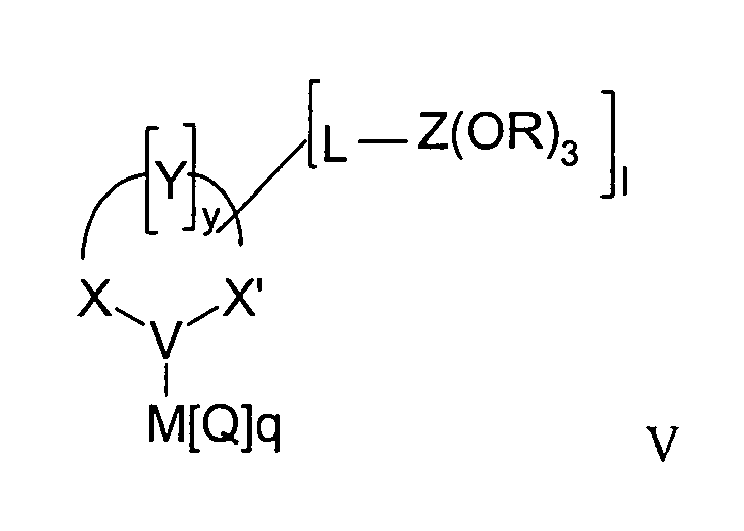
- b) optionally the compound of formula III is treated to remove surfactant and,
- c) the compound of formula III is contacted with a base or a silver compound and,
- d) Simultaneously or subsequently, the material obtained in step c) is reacted with a metal complex under conditions so as to form an organometallic-organic-inorganic hybrid material of formula IV.
- Regarding the second strategy, the invention further concerns a second method for synthetizing a material of the invention comprising at least the following steps:
- a) a sol-gel step, with at least an organometallic mono or disilylated carbene, silylene or germylene precursor of formula VI wherein L, L', X, X',Y and y are as defined herein above and may be identical or different and optionally with trialkoxyalkylmetalloid and/or peralkoxymetal/metalloid of formula R'Si(OR)3 R'Ge(OR)3or Z'(OR)x, Z'(OH)x or Z'(O-)x.(x/n)(En+) :

- b) optionally the compound of formula III is treated to remove surfactant,
- c) optionally the compound of formula III obtained is subjected to an in-situ transmetallation or contacted with a appropriate component to obtain the desired material of formula IV.
- The invention also concerns the methods as described above wherein the co-solvents can be chosen among alcohols, amides, ethers, esters.
- The invention also concerns the methods as described above wherein the polar solvents can be chosen among alcohols, amides, ethers, esters.
- The invention also concerns the methods as described above wherein the surfactant is chosen among:
- 1) anionic surfactants (Sodium dodecyl sulfate);
- 2) cationic surfactants: ammonium salts (Cetyltrimethylammonium bromide), imidazolium salts (1-Hexadecane-3-methylimidazolium Bromide C16H33-CH3-imidazoliumBr), pyridiium salts (n-Hexadecylpyridinium chloride), phosphonium salts;
- 3) non-ionic surfactants:
- amines (hexadecylamine (C16H33NH2),
- alkylpolyethyleneoxides or alkylarylpolyethylene oxides (Brij 52 (C16H33O(CH2CH2O)2H), Tergitol 15-S-12 (C11-15H23-31O(CH2CH2O12H), Triton X 100 (C1H22OC2H4O,nn=9-10), Montanox 20 (Sorbitan.20EO.monooleyl ester), Octylphenol-10EO (p-C8H)7C6H4O(CH2CH2O)10H), Lauryl ether-nEO (C12H25O(CH2CH2O)nH n∼2,4,8)),
- polysorbate surfactants (such as Tween 20 (IUPAC name: polyoxyethylene (20) sorbitan monolaurate) and,
- amphiphilic block copolymers (like Pluronic P123 triblock copolymer (EO20-PO70-EO20), Pluronic F127 (EO100-PO70-EO100) or F108 (EO132-PO50-EO132)).
- The invention also concerns the methods as described above wherein the hydrolysis polycondensation catalyst is a base chosen among amines, an acid chosen among inorganic acids such as hydrochloric acid, hydrobromic acid, iodidric acid... or organic acids such as p-toluene sulfonic acid or a nucleophilic such as sodium fluoride, tetrabutylammonium fluoride.
- The invention also concerns the methods as described above wherein the surfactant is removed by washing with the proper polar solvent as describe above (alcohol, water...) with/without the presence of an acid or Soxhlet extraction.
- The invention also concerns the methods as described above wherein the base in step c is chosen among potassium hexamethyldisilazide (KHMDS), tBuOK, DBU: 1,8-diazabicyclo[5.4.0]undec-7-ène, phosphazenes (BEMP), pyridines, phosphanes, guanidine type bases : (R1R2N)(R3R4N)C=N-R5.
- The invention also concerns the methods as described above wherein the silver compound is chosen among the soluble Ag salts, Ag-Alkoxysilane or Ag-Alkoxyde: AgO-Si(iPr)3, AgO-C(CF3)3
- The invention also concerns the methods as described above wherein the metal complex is defined as MQ'q', where M is a metal chosen for the periodic classification, Q' is a ligand, and q' is comprised between 0 to 11 as a function of the metal, the ligands could be the same or different and could be linked together to form a cyclic group in a 3 to 8 membered ring. Q' is selected from the group consisting of hydrogen, halide, C1-20 alkyl, C5-20 aryl, C1-20 alkoxy and thioalkoxy, C5-20 aryloxy and thioaryloxy, C1-20 alkyldiketonat, diketiminate ligand (such as the NacNac: CH[C(Me)NAr]2 -, Ar = 2,6-Me2C6H3), C1-20 alkoxycarbonyl, C1-20 arylcarbonyl, C1-20 acyl, C1-20 alkylsulfonato, C1-20 arylsulfonato, C1-20 alkylsulfanyl, C1-20 arylsulfanyl C1-20 alkylsulfinyl, C1-20 arylsulfinyl, C1-20 alkylcarboxylate, C1-20 arylcarboxylate, C1-20 alkylsilyl, C1-20 arylsilyl, C1-20, substituted with one or more moieties selected from the group consisting of . C1-10 alkoxy, C1-10 alkyl, C1-10 aryl), cyclopentadienyl, amido, imido, phosphido, nitrido, alkene, alkyne, arene, phosphane, sulfonated phosphane, phosphate, phosphinite, arsine, ether, amine, amide, imine, sulfoxide, carboxyl, nitrosyl, pyridine, substituted pyridine, imidazole, substituted imidazole, pyrazine, substituted pyrazine and thioether (G. Parkin, Comprehensive Organometallic Chemistry III, Vol. 1, Chap. 1, Ed. Elsevier 2007).
- The invention also concerns the methods as described above wherein a further step a' is included after the step a, which consist in removing the residual hydroxyl or alkoxy- groups. This is typically done by reaction the material with passivating agents, typically considered as hydrobobic and chosen among trialkylsilyl derivatives (chloro, bromo, iodo, amido or alkoxysilanes) or alcohols.
- For the purposes of the invention the transmetallation corresponds to the exchange of one metal to another in appropriate conditions (Comprehensive Organometallic Chemistry III, Vol. 1, Elsevier 2007), respecting the material like Ag for Ru and Ag for Ir.
- All the schemes and the formulas are only illustrative and represent a simplified (and an ideal) representation of the materials.
- By convention, in this application all the materials presented will be quoted using letters and figures:
- for materials containing organic fragments in the pores, they will be quoted by the letter P with the number referring to the silylated organic precursor introduced within the material in exponent and the number referring to the expected dilution of the organic precursor in the material (i.e the ratio of dilutant/the silylated precursor) in index leading to

- N.B : When no dilutant is introduced the figure y in index is 0.
- - the same nomenclature will be used for materials being functionnalized in the walls with the letter W.
- - when in-situ reactions are achieved in the materials, letters and figures will be added to the above-mentioned symbols


- The invention also concerns also each of the following materials of
formulas 




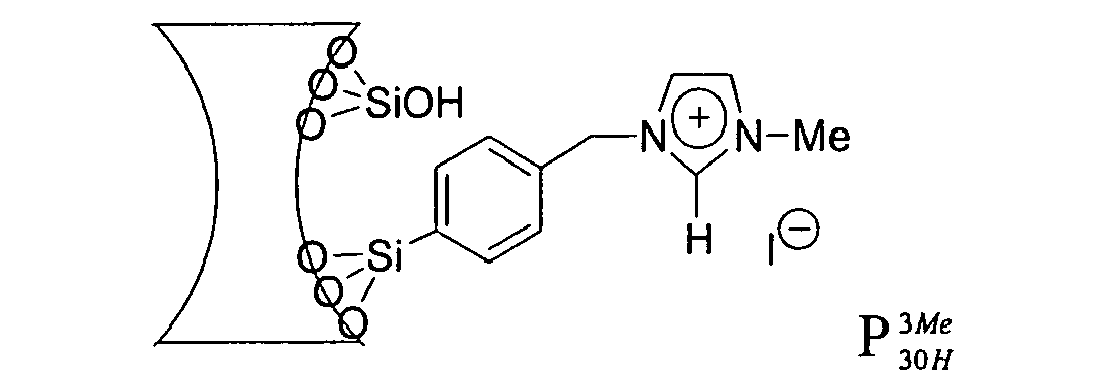


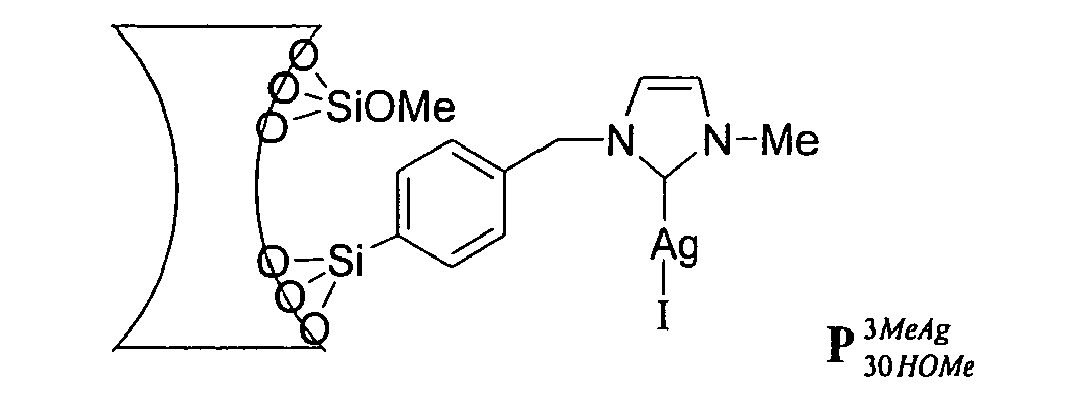
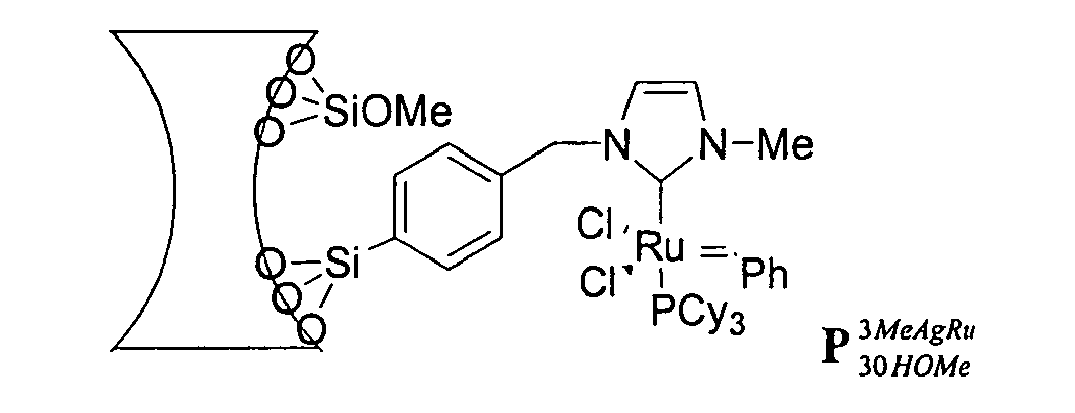


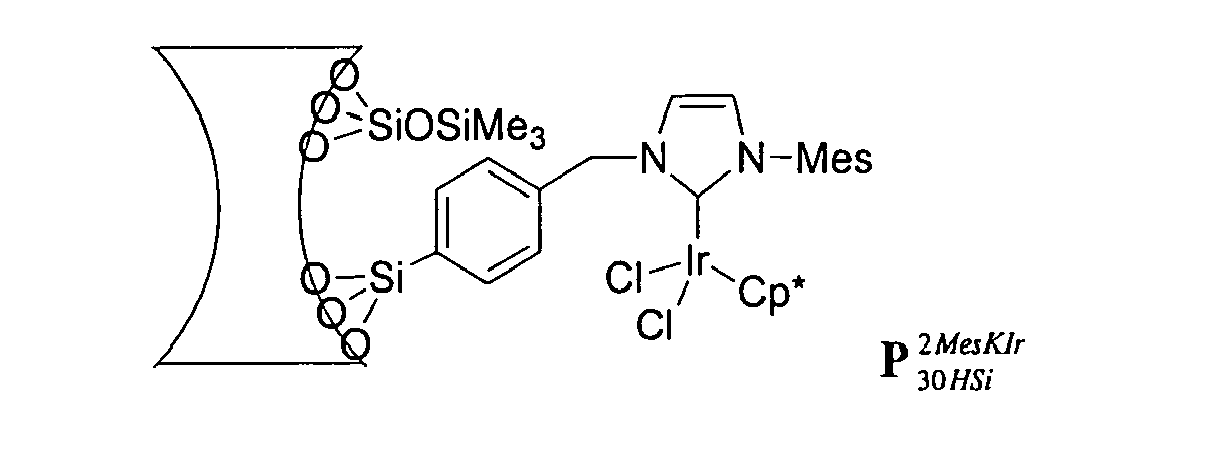

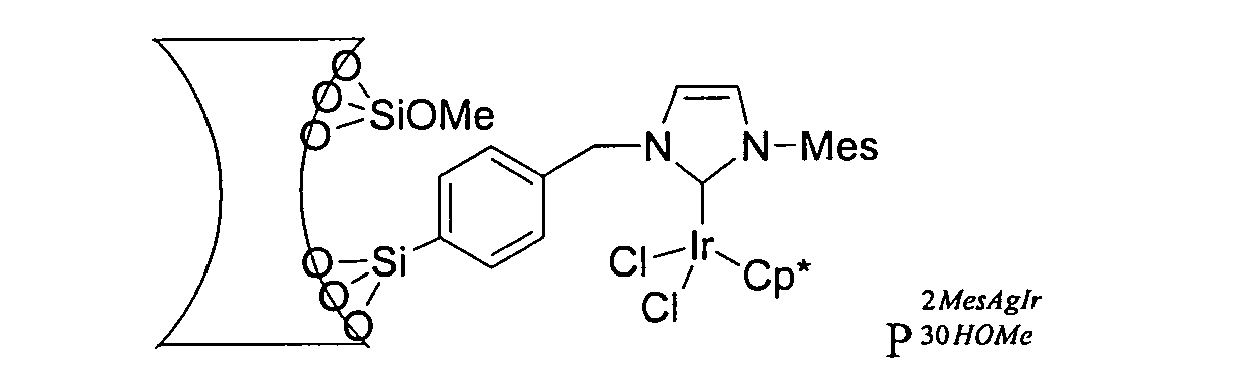


- The invention concerns also the synthesis intermediates.
- It concerns more particularly each of the mono- or bis-silylated precursors of
formulas 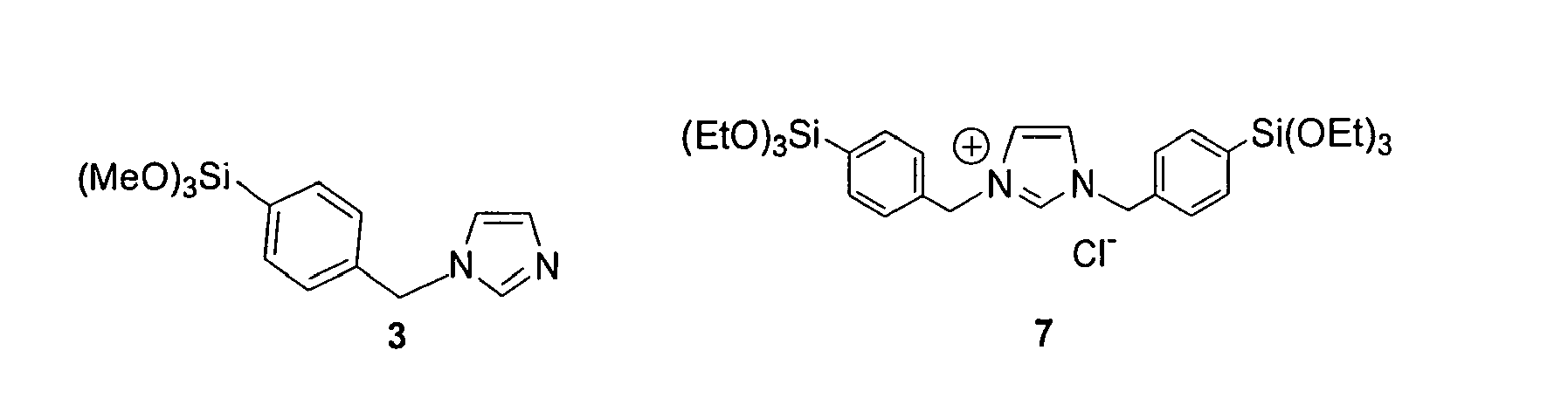

- It concerns more particularly each of the structured hybrid materials of
formulas 


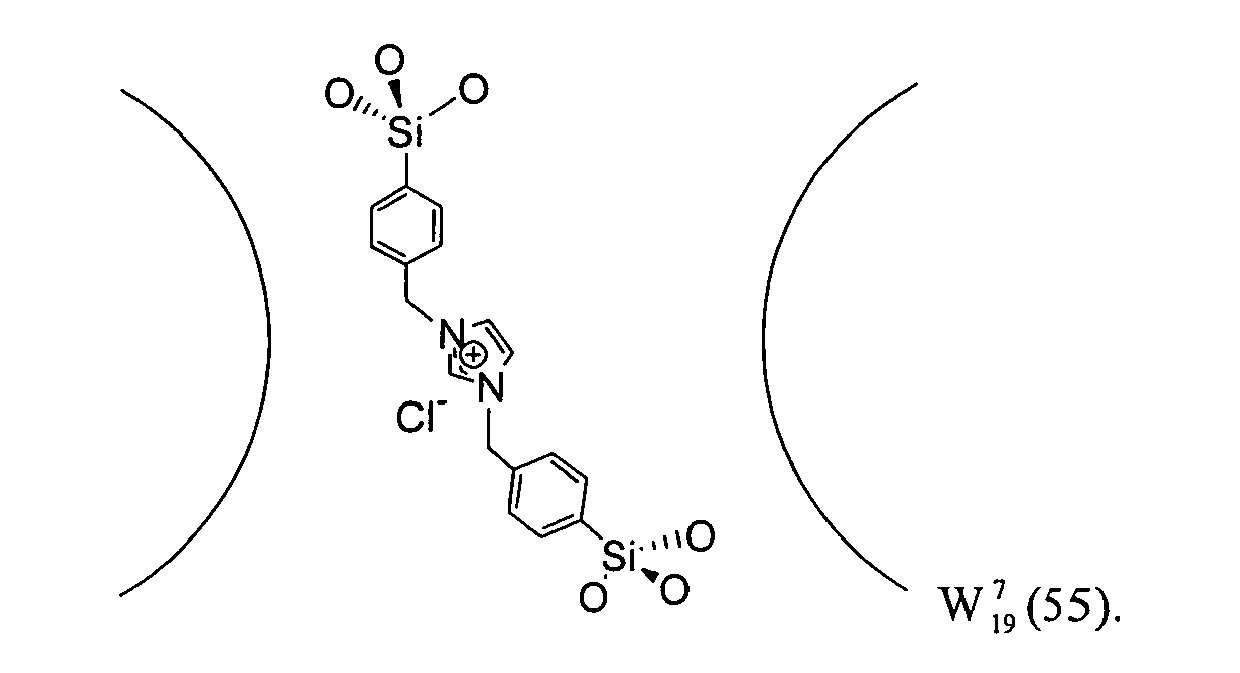


- It concerns more particularly each of the non-structured hybrid materials of
formulas 


- The invention concerns also the use of the materials of the invention in a broad range of synthesis processes (catalytic reaction processes) like metathesis, coupling reactions, oxidation, polymerization, hydroformylation, C-H activation and hydrogenation and the corresponding synthesis processes.
- In an embodiment the invention concerns a synthesis process comprising at least a step where one or more reactants are contacted with the material of the invention.
- The invention also concerns the use of the material of the invention as a heterogeneous catalyst in a chemical reaction process.
- The invention further concerns a metathesis reaction process comprising contacting one or more reactant with the material of the invention, wherein the metal M is selected from the group consisting of ruthenium Ru, molybdenum Mo, tungsten W or rhenium Re.
- The invention further concerns the use of a material wherein the metal M is selected from the group consisting of ruthenium Ru, molybdenum Mo, tungsten W or rhenium Re.as a heterogeneous catalyst in a metathesis reaction process.
- The term "metathesis" is well known in the art and refers to a "metal-catalyzed redistribution of carbon-carbon double bonds".
- In its simplest concept, one or more reactant olefins are converted through carbon-carbon double bond scission and reforming to produce at least one product olefin that is structurally distinct from the reactant olefin(s). Metathesis processes are organized into several useful classifications, most notably, self-metathesis, cross metathesis ("CM" or "XMET"), ring-closing metathesis ("RCM"), ring-opening metathesis ("ROM"), ring-opening metathesis polymerization ("ROMP"), and acyclic diene metathesis polymerization ("ADMET").
- A wide variety of metathesis processes are known with applications in the pharmaceutical industry, fine chemical synthesis, and the synthesis of polymers.
- The invention further concerns a coupling reaction process comprising contacting one or more reactant with the material of the invention wherein the metal M is selected from the group consisting of iron Fe, copper Cu, nickel Ni, palladium Pd or gold Au.
- The invention further concerns the use of the material of the invention wherein the metal M is selected from the group consisting of iron Fe, copper Cu, nickel Ni, palladium Pd or gold Au as a heterogeneous catalyst in a coupling C-C reaction process
- Coupling reactions corresponds to well-known reactions, which involves the formation of a C-C bond in an organic substrate (R-R') starting from two reagents, one having an activated bond (R-X, X = Cl, Br, I, OR) and the other one being an organometallic partner (R'MX, M = Li, Mg, Zn, B, Al, Zr...) in the presence of a catalyst, typically based on late metals. This type of reaction has been recently extended to the efficient formation of C-N and C-O bond.
- The invention further concerns an oxidation process comprising contacting one or more reactant with the material of the invention wherein the metal M is selected from the group consisting of vanadium V, chromium Cr, molybdenum Mo, tungsten W, rhenium Re, iron Fe, ruthenium Ru, osmium Os, platinum Pt or gold Au.
- The invention further concerns the use of the material of the invention wherein the metal M is selected from the group consisting of vanadium V, chromium Cr, molybdenum Mo, tungsten W, rhenium Re, iron Fe, ruthenium Ru, osmium Os, platinum Pt or gold Au. as a heterogeneous catalyst in an oxidation reaction process
- Oxidation corresponds to a large class of reactions. For instance, alkenes and alcohols can be transformed respectively into epoxides and ketones, which correspond to important chemical processes. These reactions are performed in the presence of metal catalysts in the presence of an oxidant such as air, H2O2, other peroxide reagents (ROOH, R3NO) or in the case of ketones by alcohol.
- The invention further concerns a polymerization or oligomerization process comprising contacting one or more reactant with the material of the invention wherein the metal M is selected from the group consisting of lanthanides preferably neodinium Nd and yttrium Y, titanium Ti, zirconium Zr, hafnium Hf, chromium Cr or nickel Ni.
- The invention further concerns the use of the material of the invention wherein the metal M is selected from the group consisting of lanthanides preferably neodinium Nd and yttrium Y, titanium Ti, zirconium Zr, hafnium Hf, chromium Cr or nickel Ni. as a heterogeneous catalyst in a polymerization or oligomerization reaction process.
- Starting from Alkenes the oligomerization or polymerization process leads to the formation of higher alkene homologs.
- The invention further concerns an hydroformylation or carbonylation process comprising contacting one or more reactant with the material of the invention wherein the metal M is selected from the group consisting of cobalt Co, rhodium Rh or iridium Ir.
- The invention further concerns the use of the material of the invention wherein the metal M is selected from the group consisting of cobalt Co, rhodium Rh or iridium I as a heterogeneous catalyst in a hydroformylation or carbonylation reaction process
- Carbonylation is a reaction, which incorporates carbon monoxide (CO) units in the product. It can be carried out in the presence of a nucleophile such as alcohols or amines to yield the corresponding ester and amides. It can also be performed in the presence of H2 (hydroformylation), which allows one hydrogen and one formyl unit to be incorporated in the product, e.g. an alkene provides a saturated aldehyde.
- The invention further concerns an alkane conversion process comprising contacting one or more of the reactant with the material of the invention wherein the metal M is selected from the group consisting of Iridium Ir.
- The invention further concerns the use of material of the invention wherein the metal M is selected from the group consisting of Iridium Ir as a heterogeneous catalyst in alkane conversion process.
- Alkane conversion processes allow alkane to be functionalized or transformed and involves the activation of a C-H bonds followed by a subsequent reaction. For instance, H/D exchange reaction allows deuterium to be incorporated into substrates, alkane hydrogenolysis to decrease the molecular weight of alkanes by reaction with H2 and alkane metathesis to disproportionate alkanes into their lower and higher homologues.
- The invention further concerns an hydrogenation and hydrosilylation process comprising contacting one or more of the reactant with the material of the invention
wherein the metal M is selected from the group consisting of titanium Ti, ruthenium Ru, rhodium Rh or Iridium Ir. - The invention further concerns the use of the material of the of the invention
wherein the metal M is selected from the group consisting of titanium Ti, ruthenium Ru, rhodium Rh or Iridium Ir as heterogeneous catalyst in a hydrogenation reaction process. - Hydrogenation is well-known and typically involves the addition of H2 to reagents having at least one unsaturation (alkenes, alkynes, imines and ketones for instance). By extension, hydrosilylation corresponds to the addition of silane reagents (HxSiX4-x) to these unsaturated reagents, yielding the silylated reagents.
All the schemes and the formulas are only illustrative and represent a simplified (and an ideal) representation of the materials. - 3-chloropropyltriethoxysilane, 3-chloromethylphenyltrimethoxysilane and 3-triethoxysilylpropyl-4,5-dihydrogenoimidazole were purchased form Aldrich and used as received. Silver (I) oxide was purchase from Strem, and used as received. All solvents were further purified by distillation and kept over molecular sieves prior to use: THF over Na - benzophenone ketyl, Toluene over Na. All reactions were performed under argon atmosphere using Schlenk techniques. [RuCl2(p-cymene)]2 and (3-iodopropyl)triethoxysilane were prepared as previously reported (M. A. Bennett, A. K. Smith, J. C. S. Dalton Trans. 1974, 233-241; B. L. Booth, G. C. Ofunne, C. Stacey, P. J. T. Tait, J. Organomet. Chem. 1986, 315, 143-156). Liquid NMR spectra were recorded on a
Bruker Avance 300 MHz (standard QNP probe) spectrometer using the peaks of residual solvents as internal references. - 3-iodopropyltriethoxysilane will be quoted as
precursor 1 - 6-iodohexyltriethoxysilane will be quoted as precursor 1'
- 3-chloromethylphenyltrimethoxysilane will be quoted as
precursor 2 -

- The
precursor 3 was prepared by contacting, under Argon atmosphere, 3.7 g of 3-chloromethylphenyltrimethoxysilane (15 mmol), 2.7 g of Sodium imidazolyde (15 mmol) and 60 mL of THF. The reaction mixture was put under reflux for 48 h under Ar and the the THF was further removed under vacuum (10-2 mbar). The brown residue was treated three times with 15 mL de CH2Cl2 and the supernatant was recovered by filtration. CH2Cl2 was evaporated under vacuum and 3.7g of 3 were obtained as a brown oil (Yield = 88%). - 1H NMR (δ, 200 MHz, CDCl3): 3.8, 5.6 (2H, s), 7.2 (1H, d), 7.5 (1H, d), 7.7 (2H, d), 11.3 (H, s).
- 13C NMR (δ, 50 MHz, CDCl3): 25.2, 53, 121, 122, 127.8, 134.8, 135.8, 139.
-

- The
compound 4 was prepared according to theScheme 1.
- The Grignard reagent B was prepared as previously described (J. Mater. Chem., 1998, 8, 1749) starting from 17 g (4.7 mmol, 2equiv.) of A in THF solution (80 mL), 1.37 g of Mg (56.3 mmol, 2.35 equiv.). The Grignard reagent was filtered under argon atmosphere and added dropwise to a THF solution (110 mL) containing 6.02 g (24 mmol, 1 equiv.) of C, ( Synthesis, 2003, 17, 2661) 500 mg (4 mmol) of freshly dry NiCl2. The reaction mixture was stirred at room temperature for 24 h. After evaporation of the solvent, the resulting product was purified by chromatography on silica gel using iPrOH/ CH2Cl2(1/25) as the eluant to give 4 in 80% yield.
- 1H NMR (δ, 200 MHz, CDCl3): 1.28 (18H, 3JHH = 4.3 Hz, d), 2.12 (6H, s), 4.33 (3H,
3JHH = 6.1 Hz, sept), 6.97 (1H, s), 7.29 (1H, 3JHH = 4Hz, d), 7.40 (2H, s), 7.53 (1H, 3JHH = 1Hz, d), 7.60 (2H, 3JHH = 8.2 Hz, d), 7.79 (2H, 3JHH = 8.1 Hz, d).
13C NMR (δ, 50 MHz, CDCl3): 17.6, 25.5, 65.5, 120.0, 126.4, 127.2, 129.5, 132.41, 135.2, 135.5, 136.1, 137.3, 141.4, 141.9.
29Si NMR (δ, 40 MHz, CDCl3): -61.91 ppm.
SM (FAB+, NBA): m/z = 453 [M + H+]+ (100 %).
Elemental analyses: calcd. for C26H36N2O3Si: C 69.03, H 7.96, N 6.19, Si 6.19 ; found: C 69.78, H 7.89, N 6.08, Si 6.24 (%). -

- 1.92 g (4.25 mmol, lequiv.) of 4 was added to 1.59 g (4.25 mmol, 1 equiv.) of iodopropyl triisopropoxysilane in 35 mL of toluene (J. Mater. Chem. 2005, 15, 803). After solubilisation, the mixture was heated under reflux with stirring 72 h to give 5 in 95 % yield.
- 1H NMR (δ, 200 MHz, CDCl3): 0.64 (2H, m), 1.20 (18H, 3JHH = 6.0 Hz, d), 1.25 (18H, 3JHH = 6.0 Hz, d), 2.14 (2H, m), 2.22 (6H, s), 4.23 (3H, 3JHH = 6.0 Hz, sept), 4.31 (3H, 3JHH = 6.0 Hz, sept), 4.76 (2H, 3JHH =7.0 Hz, t), 7.35 (1H, dd, 2 Hz, 2Hz), 7.42 (2H, s), 7.56 (2H, 3JHH =8.0 Hz, d), 7.78 (2H, 3JHH =8.0 Hz, d), 7.83 (1H, 3JHH =2.0 Hz, t), 10.10 (1H, s).
13C NMR (δ, 50 MHz, CDCl3): 8.9, 18.6, 21.8, 25.9, 26.0, 52.8, 65.5, 65.9, 123.6, 123.8, 126.9, 128.6, 129.4, 132.6, 133.5, 135.4, 135.9, 137.8, 141.0, 144.5.
SM (FAB+, NBA): m/z = 699 (50 %).
Elemental analyses: calcd. for C38H63N2O6Si2I: C 55.21, H 7.63, N 3.39, Si 6.78, I 15.38; found: C 55.52, H 7.92, N 3.19, Si 6.38, 14.99 (%). -

- A dried schlenk tube under argon was charged with 12.1 g (30 mmol) of 3-iodopropyltriethoxysilane, 14.6 g (30 mmol) of 3-triethoxysilylpropyl-4,5-dihydroimidazole and 30 mL of acetonitrile. A dried condenser with an oil bubbler was adapted, and the reaction mixture was heated under reflux for 48 h. The solvent was removed under vacuum to give 15.9 g of 6 obtained as an orange oil (90%).
- 1H NMR (300 MHz, CD2Cl2, 25°C) δ : 0.6 (t, 3J = 8.3Hz, 4H), 1.3 (t, 3J= 6.9 Hz, 18 H), 1.5-1.9 (ma, 4H), 3.7 (t, 3J = 7.1Hz, 4H), 3.8 (q, 3J = 6.9 Hz, 6 H), 3.9 (s, 2 H), 8.9 (s, 1H).
13C NMR (75 MHz, CD2Cl2): 7.2, 18.2, 21.1, 48.4, 50.5, 58.5, 157.6 ppm. - Elemental analyses: calcd for C9H17IO4Si21: C, 41.5; H, 7.8; I, 20.9; N, 4.6; Si, 9.2; found: C, 44.6; H, 7.9; I, 21.1; N, 5.1; Si, 9.1 (%).
-

- In the first step, 7.4 g (30 mmol) of 2 were added to a mixture of 7.0 g (30 mmol) of sodium imidazolide and 60 mL of tetrahydrofuran under Argon. The mixture was heated under reflux with magnetic stirring for 48 h. The mixture was filtered and the sodium imidazolide residual was extracted with dichloromethane (40 mL). The solvent was removed under vacuum and 7.4 g of dark brown oil was obtained (yield 88%). In the second step, 7.3 g (26.4 mmol) of this previously prepared of N,N-3-(trimethoxysilylbenzyl)imidazole were added to a solution of 2 (6.5 g 26.4 mmol) and 60 ml of toluene. The mixture was heated for 12 h under reflux under inert atmosphere. Removal of the solvent and the residual 2 under vacuum afforded 12.4 g of 7 as a dark brown solid (90%).
- 1H NMR (300 MHz, CD2Cl2, 25°C): 3.6 (s, 9H), 5.6 (s, 2H), 7.4-7.7 (ma, 2H), 7.1-7.3 (ma, 2H), 11.3(s,1H).
13C NMR (75 MHz, CD2Cl2): 50.8, 119.3, 126.7, 129.8, 136.3, 137.3, 138.3.
Elemental analyses: Calcd: C23H33ClN2O6Si2: C, 52,6; H, 6,3; Cl, 6,8; N, 5,3;Si, 10,7; found: C, 60.65; H, 6.9; Cl, 7.0; N, 6.9; Si, 10.3 (%). -

- 0.4 g of silver (I) oxide (1.72 mmol, 0.52 equiv.) was added under stirring to a mixture of 2.15g of 6( 3.3 mmol, 1.0 equiv.) and 8 mL of methylene chloride (8 mL).The suspension was vigorously stirred at 25°C for 2h with exclusion of light. The excess of Ag2O was filtered off, and the solution was concentrated under vacuum to give 2.21 g of 8 obtained as a dark brown oil (Yield = 94%).
- 1H NMR (300 MHz, CD2Cl2, 25°C) δ: 0.59-0.75 (4H, m, CH2-Si), 1.13-1.32 (18H, m, CH3), 1.89-2.04 (4H, m, CH2), 3.70-3.85 (12H, m, CH2-O), 4.12-4.30 (4H, m, CH2-N), 7.05-7.12 (2H, m, CH=CH).
13C NMR (75.5 MHz, CD2Cl2, 25°C) δ: 7.7 (CH2-Si), 18.5 (CH3CH2O), 25.6 (CH2), 58.6 (CH2-N), 58.7 (CH2-O), 121.2 (CH=CH), 183.1 (C-AgI). -

- A dried Schlenk tube under argon was charged with [RuCl2(p-cymene)]2 (0.46 g, 0.75 mmol, 0.5 equiv.) and 3 mL of dichloromethane. A solution of 8 (1.07 g, 1.5 mmol, 1.0 equiv.) in 2 mL of dichloromethane was added at 25 °C, and the resulting mixture was stirred at 25 °C for 2h with exclusion of light. 5 mL of diethyl ether were added, and after decantation, the mother liquor was collected and filtered (to remove the generated silver iodide salt). This sequence was repeated four times; the fractions were combined and concentrated under vacuum to afford 1.05 g of 9 as an orange solid (90 %).
- 1H NMR (300 MHz, CD2Cl2, 25 °C) δ: 0.6-0.8 (4H, bs, CH2-Si), 1.19-1.34 (24H, m, CH3-CH2O & (CH3)2CH), 1.72-2.00 (4H, bs, CH2), 1.96 (3H, s, CH3-Carom), 2.92 (1H, sept, J3= 7.0 Hz, CH(CH3)2), 3.82 (12H, q, J3= 7.0 Hz, CH2-O), 3.83-4.08 and 4.40-4.76 (4H, 2bs, CH2-N), 5.01 (2H, d, J3=6.0 Hz, CHarom), 5.38 (2H, d, J3=6.0 Hz, CHarom), 7.13 (2H, s, CH=CH).
13C NMR (75.5 MHz, CD2Cl2, 25°C) δ: 7.8 (CH2-Si), 18.5 (CH3-CH2O), 18.7 (CH3-Carom), 22.5 ((CH3)2CH), 25.7 (CH2), 31.0 (CH(CH3)2), 53.9 (CH2-N), 58.7 (CH2O), 82.1 (CHarom), 86.4 (CHarom), 99.3 (Carom), 108.9 (Carom), 122.2 (CH=CH), 174.0 (C-Ru). - The surfactants P123 (EO20PO70EO20) and F127 (EO106P070EO106) were obtained from BASF and used without further purification. Tetraethoxysilane (TEOS) was purchased from Aldrich and purified by distillation over Mg. The Grubbs I complex was bought from Strem. Solid state NMR spectra were recorded on a
Bruker Avance 300 MHz and 500 MHz spectrometers, with repetition time of 2 s and contact time of 5 ms, and sample was spinning at 10 kHz. Chemical shifts δ are given in ppm from TMS as an external reference. Tn and Qn notations are given for ((SiO)n(R)SiO3-n) and ((SiO)nSiO4-n) environments, respectively. Elemental analyses were performed by the Service Central d'Analyses of the CNRS (Vernaison, France). Porosity was determined by N2 adsorption/ desorption at 77K, surface area was determined by B.E.T. equation (Brunauer Emmett Teller), mean pores diameters were calculated using B.J.H. equation (Barrett-Joyner-Halenda). - All the materials presented below will be quoted using letters and figures:
- For materials containing organic fragments in the pores, they will be quoted by the letter P with the number referring to the silylated organic precursor introduced within the material in exponent and the number referring to the expected dilution of the organic precursor in the material (i.e the ratio of dilutant/the silylated precursor) in index leading to

- N.B : When no dilutant is introduced the figure y in index is 0.
- As an example,

- The same nomenclature will be used for materials being functionnalized in the walls with the letter W : As an example,

precursor 6 and 19 equivalents of dilutant (T.E.O.S) - When in-situ reactions are achieved in the materials, letters and figures will be added to the above-mentioned symbols


- in exponent when these reactions concern the organic fragments contained in the material :
- 1) When the organic fragment contained in a material will be transformed into an imidazolium unit with a part of the silylated precursor X as a first substituant and one mesityl group or one methyl group as the second substituant, the letter Mes or Me will be added in exponent to


- 2) When the metal will be loaded into the imidazolium containing material, the base or the silver complex used will be quoted in exponent by K (for KHMDS), by B (for BEMP) and by Ag (for the silver complex) and the chemical symbol of the loaded metal will also be added in exponent (Ru for Ruthenium, Ir for Iridium, Pd for Palladium - Concerning Palladium, as several precursors have be loaded onto the materials, they are mentioned in exponent : PdOAc, PdCl2 and PdCl2COD). For example, a material containing mesityl substituted imidazolium units loaded with ruthenium via the use of KHMDS as the deprotonating agent will be quoted as

- 1) When the organic fragment contained in a material will be transformed into an imidazolium unit with a part of the silylated precursor X as a first substituant and one mesityl group or one methyl group as the second substituant, the letter Mes or Me will be added in exponent to
- in index, when these reactions concern the inorganic surface of the material:
- 1) When the material has been treated with aqueous acidic solutions (HCl/H2O or HI/H2O) so as to transform surface Si-OR groups (R = Me or Et) in Si-OH groups the letter H will be added in index leading to

- 2) When the material has been treated with a silylated agent such as hexamethyldisilazane or bromotrimethylsilane so as to transform Si-OH grops into siloxy Si-OSiMe3 groups the letters Si will be added in index leading to

- 3) When the material has been treated with methanol to transform the Si-OR groups and Si-OH groups into SiOMe group the letters OMe will be added in index leading to

- 1) When the material has been treated with aqueous acidic solutions (HCl/H2O or HI/H2O) so as to transform surface Si-OR groups (R = Me or Et) in Si-OH groups the letter H will be added in index leading to
- Representative procedure (J. Alauzun, A. Mehdi, C. Reyé, R. J. P. Corriu, New J. Chem., 31, 911-915 (2007)).

- A mixture of 4.0 g of P123 in aqueous HI solution (160 mL, pH ≈ 1.5) was added to a mixture of TEOS (8.85 g, 42.56 mmol) and 3-iodopropyltriethoxysilane (0.74 g, 2.24 mmol) at ambient temperature. The mixture was stirred for 90 min giving rise to a micro-emulsion. After heating this perfectly transparent solution at 60 °C, a small amount of NaF (80 mg) was added under stirring (molar composition of the reaction mixture: 0.04 F- : 1 TEOS: 0.05 of 3-iodopropyltriethoxysilane: 0.02 P123: 0.12 HI: 220 H2O. The mixture was left at 60°C under stirring for 72 h. The resulting solid was filtered and washed with acetone. The surfactant was removed by an extraction with ethanol using a Soxhlet during 24 h. After filtration and drying at 120 °C under vacuum, 2.75 g (90%) of

- Powder X-ray diffraction. The pattern exhibits an intense diffraction peak (d =97 Å and a= 112 Å) (
Figure 1 ). - Transmission Electron Microscopy (TEM). The micrograph shown in
Figure 2 confirms that the material exhibit a local hexagonal symmetry. - The N2 adsorption-desorption experiment. Isotherm of type IV, characteristic of mesoporous materials with a narrow pore size distribution (
Figure 3 ). SBET : 900 m2/g, Vp = 1.0 cm3/g and DpBHI = 5.8 nm.
13C CP-MAS solid state NMR: 27.1 (CH2-I), 16.4 (CH2-CH2-CH2) and 8.1 ppm (CH2-Si). 29Si CP-MAS NMR : -65.5 (T3), -92.2 (Q2), -101.0 (Q3) and -110.1 (Q4). - The XRD diffraction of

Figure 1 . - The TEM micrograph of

Figure 2 . - The Nitrogen adsorption-desorption isotherm of

Figure 3 .
Synthesis of the Iodopropyl-functionalised material 
- A mixture of 4.0 g of P123 in aqueous HI solution (160 mL, pH ≈ 1.5) was added to a mixture of TEOS (8.85 g, 42.56 mmol) and 3-iodopropyltriethoxysilane (0.59 g, 1.33 mmol) at ambient temperature. The mixture was stirred for 90 min giving rise to a micro-emulsion. After heating this perfectly transparent solution at 60 °C, a small amount of NaF (79 mg, 1.88 mmol) was added under stirring (molar composition of the reaction mixture: 0.04 F- : 1 TEOS: 0.031 of 3-iodopropyltriethoxysilane: 0.02 P123: 0.12 HI: 220 H2O. The mixture was left at 60°C under stirring for 72 h. The resulting solid was filtered and washed with acetone. The surfactant was removed by an extraction with ethanol using a Soxhlet during 24 h. After filtration and drying at 120 °C under vacuum, 2.75 g (90%) of

- Powder X-ray diffraction. The pattern exhibits an intense diffraction peak (d =102 Å and a = 118 Å).
- Transmission Electron Microscopy (TEM). The micrograph confirms that the material exhibit a local hexagonal symmetry.
- The N2 adsorption-desorption experiment. Isotherm of type IV, characteristic of mesoporous materials with a narrow pore size distribution. SBET : 811 m2/g, Vp = 0.77 cm3/g and DpBJH = 6.2 nm.
13C CP-MAS solid state NMR: 8.1, 16.4 and 27.1 ppm.
29Si CP-MAS NMR : -65.5 (T3), -92.2 (Q2), - -101.0 (Q3) and -110.1 (Q4).
Synthesis of the Chlorobenzyl-functionnalised material 
-

- A mixture of 4.21 g of P123 dissolved in an aqueous HCl solution (168 mL, pH ≈ 1.5) was added on a mixture of TEOS (9.47 g, 45.51 mmol) and chlorobenzyltriethoxysilane (0.37g, 1.51 mmol) at room temperature. The reaction mixture was stirred for 90 min giving rise to a micro-emulsion (transparent mixture). To the reaction mixture heated at 45 °C, a small amount of NaF (79 mg, 1.88 mmol) was added under stirring (mixture composition: 0.04 F- : 1 TEOS: 0.033 of chlorobenzyltriethoxysilane: 0.016 P123: 0.12 HCl: 220 H2O). The mixture was left at 45 °C under stirring for 72 h. The resulting solid was filtered and washed with acetone. The surfactant was removed by an extraction with ethanol using a Soxhlet during 24 h.
- After filtration and drying at 135 °C under vacuum, 2.93 g of

- 13C CP-MAS solid state NMR: δ = 15.9, 43.8, 59.5, 127, 130, 134, 140 ppm.
- 29Si CP-MAS solid state NMR: -79 (T3), -91.2 (Q2), -101 (Q3) and -110.5 (Q4)
- Elemental analyses : C, 6.07; Si, 37.71; Cl, 1.3 (%).
- Powder X-ray diffraction (
Fig. 4 ): The pattern exhibits an intense diffraction peak (d =105 Å and a =121 Å) - Transmission Electron Microscopy (
Fig. 5 ): the micrographs are consistent with a material exhibiting local hexagonal symmetry. - The N2 adsorption-desorption experiment (
Fig. 6 ). Isotherm of type IV, characteristic of mesoporous materials with a narrow pore size distribution SBET: 956 m2/g, Vp: 0.8-1.0 cm3/g and DpBJH: 5.2 nm. - The XRD pattern of

Figure 4 . - The TEM micrograph of

Figure 5 . - The Nitrogen adsorption-desorption isotherm of

Figure 6 .
Synthesis ofmaterial 
-

- In a 100 mL erlenmeyer, 1.02 g (2.85 mmol) of monohydrate hexadecylpyridiniumchloride was added to an aqueous ammoniac solution (prepared from 28.9 g of 25% NH4 OH and 26.6 g of H2O). The reaction mixture was vigorously stirred until a transparent solution was obtained, to which was then rapidly added a mixture of TEOS (4.464 g, 21.43 mmol) and the precursor 3 (0.192 g, 0.70 mmol). The reaction mixture was then heated to 80 °C, under stirring for 48 h. Finally the powder obtained was washed with H2O, ethanol, acetone then diethyl ether. The surfactant was removed by three washings with ethanolic solution of HCl (3 g of HCl, 37%) and ethanol (200 mL) for 2h. The material was washed with water, ethanol, acetone, diethyl ether, and then dried by heating at 135 °C under high vacuum (10-5 mbar) for 12 h to give 1.28 g of

- 1H solid state NMR (500 MHz): 1.0, 1.8, 3.96, 7.6, 8.4, 9.3, 14.3 ppm.
- 13C{1H} NMR (125.7 MHz): 45, 119, 127, 135 ppm (
Fig. 7 ). - 29Si solid state NMR (CP MAS): -XX (T3), -102 (Q3) and -111 (Q4) (
Fig. 8 ). - Elemental analyses: C, 5,6; N, 1.2; Si, 40,5 (%).
- X ray diffraction: The pattern exhibits an intense diffraction peak and 2 broad and weak signals in accordance with a 2D hexagonal structure (d =39 Å and a = 45 Å) (
Fig. 9 ). - Transmission Electron Microscopy (
Fig. 10 ): the micrographs confirms that the material exhibit local hexagonal symmetry. - The N2 adsorption-desorption experiment (
Fig. 11 ): SBET: 933 m2/g ; Vp: 0,8 cm3/g ; DpBJH: 34 Å. - The 13C solid state CP MAS NMR spectrum of the
material 
Figure 7 . - The 29Si solid state CPMAS NMR spectrum of the
material 
Figure 8 . - The Small angle X ray diffraction patterns of
material 
Figure 9 . - The TEM micrographs of
material 
Figure 10 . - The Isotherm of N2 adsorption/desorption at 77K; and the pores diameter distribution
- (calculated from BJH method) for
material 
Figure 11 .
Synthesis of the iodohexyl-functionnalised material 
-

- This material was prepared using the experimental procedure described for the preparation of

- Transmission Electron Microscopy (TEM). The micrograph confirms that the material exhibit a local hexagonal symmetry.
- The N2 adsorption-desorption experiment. Isotherm of type IV, characteristic of mesoporous materials with a narrow pore size distribution: SBET: 850 m2/g, Vp: 0.9 cm3/g and DpBJH: 5.1 nm
13C CP-MAS solid state NMR: 8, 16 and 27 ppm.
29Si CP-MAS NMR: -65.5 (T3), -92.2 (Q2), -101.0 (Q3) and -110.1 (Q4).
Synthesis of the imidazole functionalizedhybrid material 
-

- This compound was prepared using the experimental procedure described for the preparation of

H2O (pH 1.5) 109 mL, NaF (15 mg). - Elemental analyses: C, 7.91; N, 1.02; Si, 40.0 (%).
- X-ray diffraction: the pattern of this material exhibits three reflexions in the low angle region indicating a high degree of mesostructural order (
Fig. 12b ). These reflections can be indexed as (100), (110) and (200) in accordance with a 2D hexagonal structure. - Transmission electron microscopy (TEM): image confirms this structure.
- N2 adsorption-desorption experiment (
Fig. 12a ): type IV isotherm, characteristic of mesoporous materials with a narrow pore size distribution. SBET: 563 m2g-1; Vp 1.28 cm3g-1; DpBJH: 7.6 nm. - The Nitrogen adsorption-desorption isotherm of


Figure 12 .
Synthesis of the imidazol functionnalizedhybrid material 
-

- In a polypropylene bottle, 0.77 g of F127 was added to an aqueous HCl solution (prepared from 35 mL of H2O and 1.51 g of HCl 37%). After about 2 h stirring, the transparent solution was heated at 45°C, 2.16 g of n-butanol were added and the reaction mixture was stirred for 1 h at 45 °C. Then, 204 mg of 4 and 3.35 g of TEOS were added, and the mixture was stirred vigorously for 48 h at 45 °C. Surfactant removal was accomplished by Soxlhet extraction with H2O for 24 h. The solid was then filtered and washed three times with ethanol, acetone and ether. After drying at 120 °C overnight under vacuum,

- Elemental analyses: C, 10.76 %; N, 0.64 %; Si, 33.8 %.
X-ray diffraction (Fig. 13 ): the pattern of this material exhibits three reflexions in the low angle region indicating a high degree of mesostructural order and consistent with cage-like pores arranged in a cubic close packed mesostructure. - Transmission electron microscopy (
Fig. 14 ): confirmation of the cubic structure.
N2 adsorption-desorption experiment: type IV isotherm, characteristic of mesoporous materials with a narrow pore size. SBET: 116 m2g-1; Vp: 0.4 cm3g-1; DpBJH: 3.2 nm.
The X-Ray diffraction pattern of
Figure 13 .
The TEM micrograph of
Figure 14 .
Synthesis of material
-

- In a 250 mL Erlenmeyer, 3.84 g of P123 (0.6mmol, 0.36 equiv.) were dissolved in 3.2 g of an aqueous HCl solution (pH 1.5) and 7.3 g TEOS (0.035 mmol, 19.0 equiv.) were added. The reaction mixture was vigorously stirred until a transparent solution was obtained, and then 1.04 g of 3-iodopropyltriethoxysilane (1.842 mmol, 1.0 equiv.) was added. The reaction mixture was further stirred for 30 min. and ethanol was removed under vacuum to give a pale yellow gel within 20 min. After keeping for 24 h at room temperature, 0.8 mL of water was added, the mixture was further heated at 100 °C for 24 h. The gel was finally ground into a fine powder, which was washed with water, ethanol, acetone and then diethyl ether. The surfactant was removed by Soxhlet extraction in hot ethanol for 3 days. The material was washed with water, ethanol, acetone, diethyl ether, and then dried under high vacuum (10-5 mbar) at 140 °C for 12 h to give 3.30 g of a white material

- 13C CP-MAS solid state NMR (75.5 MHz): 9, 20, 49, 157 ppm.
29Si solid state NMR (75.5MHz, HPDec): -62, (T2) ; -66 (T3) ; -104 (Q3) ; -109 (Q4).
Elemental analyses: C, 8.2; H, 2.86; N, 1.6; Si, 38.2 (%).
X ray diffraction (Fig. 15 ): The pattern exhibits an intense diffraction peak and one broad and weak signal in accordance with a 2D hexagonal structure. (d =82 Å, a = 95 Å).
Transmission electron microscopy (Fig. 16 ): The micrographs confirms that the material exhibit a local 2D hexagonal structure. - N2 adsorption-desorption experiment (
Fig. 17 ): SBET: 608 m2/g; Vp: 1.0 cm3/g; DpBJH: 63 Å. - The Small angle X-ray diffraction patterns of material

Figure 15 .
The TEM micrographs of
Figure 16 .
The Isotherm of N2 adsorption/desorption at 77K. and the pores diameter distribution (calculated from BJH method) for material
Figure 17 . - The 13C solid state CP MAS NMR spectrum of the material
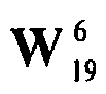
Figure 18 . - The 29Si solid state HPDEC NMR spectrum of the material

Figure 19 .
Synthesis of material
-

- The preparation of


- 13C CP-MAS solid state NMR (75.5 MHz): 8.9, 19.7, 48.5, 157.1 ppm.
- 29Si solid state NMR (75.5MHz, direct detection): -62, (T2); -66 (T3); -104 (Q3); -109 (Q4).
- Elemental analyses: C, 8.2; N, 1.6; Si, 38.2 (%).
- X ray diffraction (
Fig. 20 ) : The pattern exhibits a broad diffraction peak in accordance with a wormlike structuration (d = 100 Å). - Transmission electron microscopy (
Fig. 21 ): The micrograph is consistent with a worm-like structure. - N2 adsorption-desorption experiment (
Fig. 22 ): SBET: 625 m2/g; Vp: 0.43 cm3/g; DpBJH: 28 Å - The Small angle X ray diffraction patterns of material


Figure 20 . - The TEM micrographs of

Figure 21 . - The Isotherm of N2 adsorption/desorption at 77K; and the pores diameter distribution (calculated from BJH method) for material

Figure 22 .
Synthesis of material
-

-

-


- 13C solid state CP-MAS NMR (75.5 MHz,): 8.9, 19.7, 48.5, 157.06 ppm.
- 29Si solid state NMR (75.SMHz, direct detection): -62, (T2) ; -66 (T3) ; -104 (Q3) ; -109 (Q4).
- Elemental analyses: C 13.5; N, 1.5; Si, 33.9 (%).
- X ray diffraction: The pattern exhibits a broad diffraction peak in accordance with a wormlike structuration (d =81 Å).
- N2 adsorption-desorption experiment (
Fig. 23 ): SBET: 625 m2/g; Vp: 0.43 cm3/g ; DpBJH: 54 Å. - The Isotherm of N2 adsorption/desorption at 77K; and the pores diameter distribution (calculated from BJH method) for material

Figure 23 .
Synthesis of material
-

- Using the experimental procedure described for the preparation of


- 13C solid state CP-MAS NMR (75,5 MHz): 8, 19, 48, 157 ppm.
29Si solid state NMR (75,5MHz, HPDEC): -62, (T2); -66 (T3); -104 (Q3); -109 (Q4).
Elemental analyses: C, 10.0 ; N, 1.8; Si, 35.5 (%).
X ray diffraction: the pattern exhibits a broad diffraction peak in accordance with a wormlike structuration (d = 93 Å).
N2 adsorption-desorption experiment: SBET: 608 ± 4 m2/g; Vp: 1.0 cm3/g ; DpBJH: 34 Å.
Synthesis ofmaterial 
-

- In a 100mL Erlenmeyer, 3.06 g of P123 (EO20PO70EO20) dissolved in aqueous HCl (15 mL of H2O and 90 mL of 2M HCl) was added to a mixture of TEOS (6.24 g, 30 mmol) and 5 (0.826 mg, 1mmol). This reaction mixture was stirred at 40 °C for 24 h, transferred into a polypropylene bottle and then heated to 100 °C for 64 h. The surfactant template removal was accomplished by Soxhlet extraction with ethanol for 24 h. The solid was then filtered and washed three times with ethanol, acetone and ether. After drying overnight under vacuum at 120 °C,

- Elemental analyses: C, 11.62; N, 0.55; Si, 38.2 (%).
X-Ray diffraction (Fig. 24 ): the X-ray diffraction pattern of this material exhibited three reflexions in the low angle region indicating a high degree of mesostructural order. These reflections can be indexed as (100), (110) and (200) in accordance with a 2D hexagonal structure. - Transmission electron microscopy (
Fig. 25 ): image confirms this structure.
N2 adsorption-desorption isotherm (Fig. 26 ): Type IV isotherm, characteristic of mesoporous materials with a narrow pore size distribution SBET 832 m2g-1; Vp: 1.03 cm3g-1; DpBJH: 6.4 nm.
The X-Ray diffraction pattern of
Figure 24 .
The TEM micrograph of
Figure 25 .
The Nitrogen adsorption-desorption isotherm of
Figure 26 .
EXAMPLES PART III. SYNTHESIS OF NON STRUCTURED MATERIALS.
Preparation ofmaterial 
-

- To a mixture of F127 (3.36 g, 0.4 mmol, 0.05 equiv.) and water (1.09 g, 60.5 mmol, 7.5 equiv.) was added under stirring 8 (5.7 g, 8 mmol, 1.0 equiv.) in 91 mL of methanol. The resulting reaction mixture was vigorously stirred for 3 h at 25 °C, heated to 60 °C, and then NaF (0.017 g, 0.4 mmol, 0.04 equiv.) was added. The reaction mixture was further stirred at 60 °C for 72h. The obtained suspension was filtered at room temperature, and the resulting solid was washed with water, ethanol, acetone and then diethyl ether. After removal of the surfactant by Soxhlet extraction with ethanol for 3 days, the solid material was washed with water, ethanol, acetone, diethyl ether, and then dried by heating at 140 °C under high vacuum (10-5 mbar) for 12 h to give 2.35 g of the
beige material 
- 13C CP-MAS solid state NMR (75.5 MHz) δ:11, 26, 54,123,183 (br) (
Fig 27 ).
29Si CP-MAS solid state NMR (59.6 MHz) δ: -67 (T3).
Elemental analyses: C 20.47 , H 2.90, N 4.76, Si 12.52, Ag 19.39 (%). - The 13C solid state CP MAS NMR spectrum of the Ag-NHC containing
hybrid material 
Figure 27 .
Preparation ofmaterial 
-

- To a mixture of 9 (3.3 g, 4.2 mmol, 1 equiv.) in THF (4 mL) was added at 25 °C NaF (5 mg, 0.12 mmol, 0.028 equiv.) in water (0.25 mL; 13.9 mmol, 3.3 equiv.). The resulting reaction mixture was stirred at 25 °C for 1 min, and then kept at 25 °C without stirring for 5 days. The solid was powdered, washed with water, ethanol, acetone, diethyl ether, and then dried at 25 °C under high vacuum (10-5 mbar) for 12 h to give 2.15 g of an
orange material 
13C CP-MAS solid state NMR (75.5 MHz). δ: 10, 15, 19, 25, 31, 53, 65, 78, 95, 123, 172.
29Si CP-MAS solid state NMR (59.6 MHz, , 25°C). δ: -60 (T2), -67 (T3). - Elemental analysis: C 39.06, H 5.58, N 4.33, C1 10.14,I 1.79, Si 12.38, Ru 14.50 (%).
- The 13C solid state CP MAS NMR spectrum of the Ru-NHC containing
hybrid material 
Figure 28 .
EXAMPLES PART IV.
Overall synthesis of Ir-NHC containing hybridmaterial using 
Synthesis ofmaterial 
-

- The
material 
material 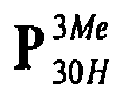
- 1H solid state NMR (500 MHz): 1H NMR (500 MHz): 1.2, 6.5-7.6 ppm.
13C CP-MAS solid state NMR (125.7 MHz): 17, 23, 52, 128, 135 ppm.
Synthesis ofmaterial 
-

-
Material 

- 1H solid state NMR (500 MHz): 1H NMR (500 MHz): 0.0, 1.2, 6.5-7.6 ppm.
13C CP-MAS solid state NMR (125.7 MHz): 0, 17, 23, 52, 128, 135 ppm.
Synthesis ofmaterial 
-

- The
material 
product 

- 1H solid state NMR (500 MHz): 3.4, 6.7, 7.1, 7.8 ppm.
13C CP-MAS solid state NMR (125.7 MHz): 49, 126, 129, 134 ppm.
Synthesis ofmaterial 
-
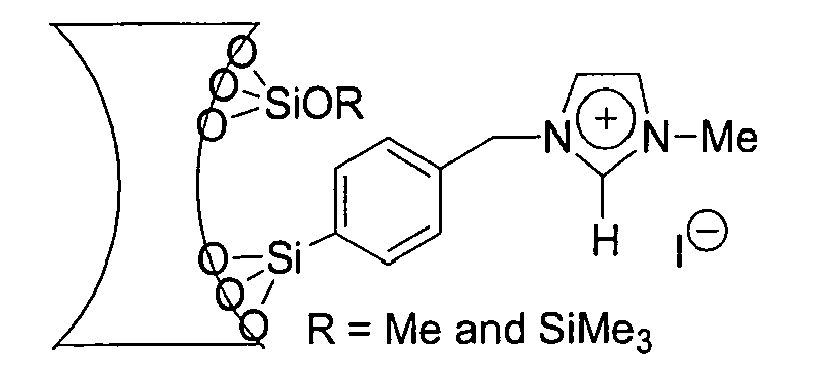
- To the
material 

- The above mentioned treatment was performed to protect the residual silanol group (if any) present in the
material 
product 
- 1H solid state NMR (500 MHz): 1H NMR (500 MHz): 0.0, 1.2, 3.4, 6.74, 7.05, 7.73 ppm.
13C CP-MAS solid state NMR (125.7 MHz): 0, 49, 126, 129, 134 ppm.
Synthesis ofmaterial 
-

- To a mixture of the
material 
solid 
- 1H solid state NMR (500 MHz): 0.0, 0.75, 1.16, 2.07, 7.05, 7.72 ppm.
13C CP-MAS solid state NMR (125.7 MHz): 0, 8, 18, 23, 26, 53, 127, 128, 135 ppm. Elemental analyses: Si: 31.55; Ir: 1.69 (%).
Synthesis ofmaterial 
-

- The
material 


- 1H solid state NMR (500 MHz): 0.0, 1.5, 3.4, 7.0, 7.6 ppm.
13C CP-MAS solid state NMR (125.7 MHz): 0, 7, 49, 126, 128, 134 ppm.
Elemental analyses: Ir : 8.08, Si: 30.14 (%).
Synthesis ofmaterial 
-
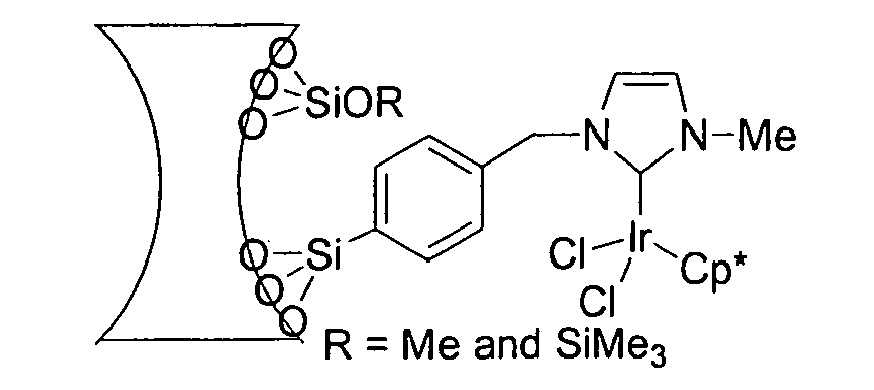
- A solution of [K(N(SiMe3)2] (0.5M in toluene, 0.28 ml, 0.14 mmol) was added to a suspension of

- Hg) at room temperature to yield 0.25 g of a very pale off-
white material 
1H solid state NMR (500 MHz): 0.0, 1.4, 3.4, 7.0, 7.6 ppm.
13C CP-MAS solid state NMR (125.7 MHz): 0, 6, 49, 85, 126, 130, 134 ppm. - Elemental analyses: Ir: 2.76, Si : 29.86 (%).
Synthesis ofmaterial 
-

- A mixture of

solid 
- 1H solid state NMR (500 MHz): 1.0, 3.4, 7.1, 7.7 ppm.
13C CP-MAS solid state NMR (125.7 MHz): 27, 29, 48, 118, 126, 128, 134 ppm.
Synthesis ofmaterial 
-

- To the

compound 
Overall synthesis of Ru-NHC or Ir-NHC containing hybridmaterial using 
Synthesis ofMaterial 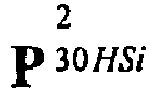
-

- The
material 
material 
white material 
- 1H solid state NMR (500 MHz): 0.0, 3.4, 7.1-7.6 ppm.
13C CP-MAS solid state NMR (125.7 MHz): 0.0, 44, 127, 130, 134, 140 ppm.
Synthesis ofmaterial 
-

- The
material 
white material 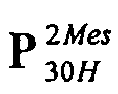
- 1H solid state NMR (500 MHz): 1.0, 7.1, 7.6 ppm.
13C CP-MAS solid state NMR (125.7 MHz): 16, 126, 131, 134, 139, 140 ppm.
Synthesis ofmaterial 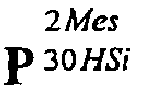

-

- Mesitylimidazole (2.43 g, 0.013 mol),

white material 
- 1H solid state NMR (500 MHz): 0.0, 7.1-7.6 ppm.
13C CP-MAS solid state NMR (125.7 MHz): 0.0, 16, 45, 127, 134, 139-141 ppm.
Elemental analyses: Si: 33.43%; N: 0.57%
Synthesis ofmaterial 

-

- To a suspension of


- 1H solid state NMR (500 MHz): 0.0, 7.1-7.6 ppm.
13C CP-MAS solid state NMR (125.7 MHz): 0.0, 16, 127, 134, 139, 141 ppm.
Synthesis ofmaterial 
-

- The dried
solid 

- 1H solid state NMR (500 MHz): 3.4, 7.0, 7.6 ppm.
13C CP-MAS solid state NMR (125.7 MHz): 16 (br), 49, 125, 141(br) ppm.
The 13C solid state NMR spectrum of the 13C labelled
Figure 29 .
Synthesis ofmaterial 
-
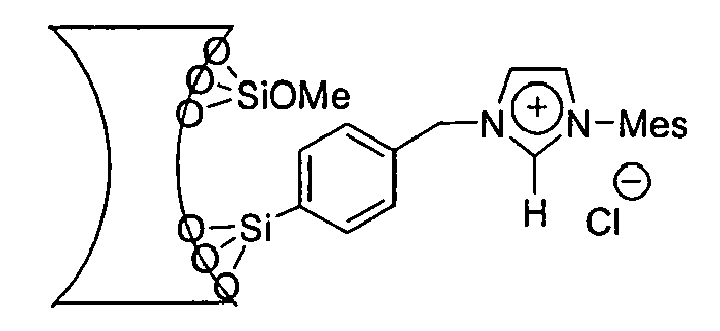
- To the
material 

- The above mentioned treatment was performed to protect the residual silanol group (if any) present in the
material 
product 
- 1H solid state NMR (500 MHz): 1H NMR (500 MHz): 0.0, 1.2, 3.4, 7.05, 7.62 ppm.
13C CP-MAS solid state NMR (125.7 MHz): 0, 9, 16, 18, 48, 126, 129, 134, 139, 141 ppm
2MesAg
Synthesis of
-

-

grey material 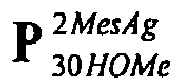
- 1H solid state NMR (500 MHz): 0.0, 3.4, 6.0-7.6 ppm.
13C CP-MAS solid state NMR (125.7 MHz): 0, 8, 18 (br), 50, 127, 134, 139, 181 ppm
The 13C solid state NMR spectrum of the 13C labelled
Figure 30 .
Synthesis ofmaterial 
-

- To a suspension of the
material 
solid 
- 1H solid state NMR (500 MHz): 0.0, 7.1, 7.6 ppm.
13C CP-MAS solid state NMR (125.7 MHz): 0, 16, 26, 44, 127, 134, 140 ppm.
Elemental analyses: Si: 34.9%; N: 0.47%; Ru: 0.47%
Material 
-

- To a suspension of the
material 
- Hg) at room temperature to yield 220 mg of a light beige
solid 
- 1H solid state NMR (500 MHz): 0.0, 7.1, 7.6 ppm.
13C CP-MAS solid state NMR (125.7 MHz): 0.0, 16, 26, 44, 127, 134, 140 ppm. Elemental analyses: Si: 33.01; N: 0.52; Ru: 0.19; P: 0.063 ppm (%).
Synthesis ofmaterial 
-

- To a suspension of the
material 
greenish material 
- 1H solid state NMR (500 MHz): 0.0, 3.4, 7.1, 7.6 ppm.
13C CP-MAS solid state NMR (125.7 MHz): 0.0, 16, 26, 49, 127, 135, 140 ppm.
Elemental analyses: Si: 34.82; Ru: 0.4 (%).
Synthesis ofMaterial 
-

- To a suspension of the
material 
brown material 
- 1H solid state NMR (500 MHz): 0.0, 3.0, 6.1-7.6 ppm.
13C CP-MAS solid state NMR (125.7 MHz): 0, 8, 14, 17, 25, 49, 126, 134 ppm
Synthesis ofMaterial 
-

- To a suspension of the
material 
brown material 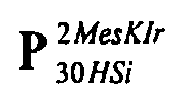
- 1H solid state NMR (500 MHz): 0.0, 1.0, 3.4, 6.0-7.6 ppm.
13C CP-MAS solid state NMR (125.7 MHz): 0, 8, 17, 25, 49, 126, 134 ppm.
Elemental analyses : Si: 31.94; Ir: 3.24; Cl: 4.37 (%).
Synthesis ofmaterial 
-

- To a mixture of

- 1H solid state NMR (500 MHz): 0.0, 3.4, 6.0-7.6 ppm.
13C CP-MAS solid state NMR (125.7 MHz): 0, 8, 16-19 (br), 50, 128, 134, 152, 175 ppm.
Elemental analyses: Si: 25.61%; Ir: 6.83%
The 13C solid state NMR spectrum of the 13C labelled
Figure 31 .
Synthesis ofMaterial 
-

- A mixture of

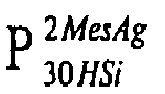
- 1H solid state NMR (500 MHz): 0.0, 2.9, 6.6, 7.1 ppm.
13C CP-MAS solid state NMR (125.7 MHz): 0, 15, 18, 49, 125, 127, 130, 134, 140, 182 ppm
Synthesis ofMaterial 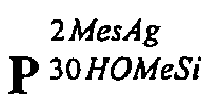
-

-


- 1H solid state NMR (500 MHz): 0.0, 3.50, 7.12, 7.81 ppm.
13C CP-MAS solid state NMR (125.7 MHz): 0, 16, 19, 51, 127, 135, 137, 140, 182 ppm
Overall synthesis of Ru-NHC containing hybridmaterial using 
Synthesis ofMaterial 
-

- A solution of mesitylimidazole (5.5 g, 0.03 mol) in toluene (60 mL) was added onto 3.0 g of

white material 
- 1H solid state NMR (500 MHz): 0.7, 1.2, 3.4, 6.5 ppm.
13C CP-MAS solid state NMR (125.7 MHz): 8.6, 16.3, 52, 59.1, 121-142 ppm. Elemental analyses: Si: 32.01; N: 0.94 (%).
Synthesis ofmaterial 
-

- A mixture of a 1M aqueous solution of HI (300 mL) and 3.0 g of
material 
solid material 
- 1H solid state NMR (500 MHz): 0.0, 6.0-7.6 ppm.
13C CP-MAS solid state NMR (125.7 MHz): 0.0, 7.7, 16-19.7, 50.0, 126-134.0, 175.5 ppm
Elemental analyses: Si: 34.08; N: 0.74 (%).
Synthesis ofMaterial 
-

- The
material 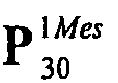
white material 
- 1H solid state NMR (500 MHz): 0.0, 2.1, 3.4, 6-7.6 ppm.
13C CP-MAS solid state NMR (125.7 MHz): 0.0, 9, 18, 22.7, 25.7, 50, 129-141 ppm
Elemental analyses: Si: 36.1; N: 0.71, C: 6.9 (%).
Synthesis ofmaterial 
-

- A mixture of

compound 
- 1H solid state NMR (500 MHz): 1.1, 3.4, 5.7, 6.7 ppm.
13C CP-MAS solid state NMR (125.7 MHz): 7, 9, 15, 17, 25, 48, 122, 123, 128, 129, 135, 138, 139 ppm.
Synthesis ofMaterial 
-

- To

compound 
Synthesis ofmaterial 
-

- A mixture of

compound 
- 1H solid state NMR (500 MHz): 0.0, 1.1, 1.8, 3.7, 6.8 ppm.
13C CP-MAS solid state NMR (125.7 MHz): 0, 9, 17, 26, 51, 118, 121, 124, 128, 131, 134, 138, 139 ppm.
31P{1H}NMR: 28-37 (br), 41-42 (br) ppm.
Synthesis ofMaterial 
-

- To a suspension of

grey material 
- 1H solid state NMR (500 MHz): 0.0, 3.1, 6.5 ppm.
13C CP-MAS solid state NMR (125.7 MHz): 0.0, 9, 18, 24, 26, 32, 52, 121-141 ppm.
31P{1H}NMR: 32-34, 49.9 ppm.
Elemental analyses: Si: 19.8; N: 0.43; Ru: 1.08; P : 0.98 (%).
Synthesis ofMaterial 
-

- To a suspension of

brown material 
- 1H solid state NMR (500 MHz): 0, 3.5, 6.5 ppm.
13C CP-MAS solid state NMR (125.7 MHz): 0.0, 9, 18, 26, 50, 121-141 ppm.
Elemental analyses: Si: 29.64; Ru: 0.68; P : 0.34 (%).
Synthesis of Pd-NHC containing hybride material using as the starting material Synthesis of Material
-
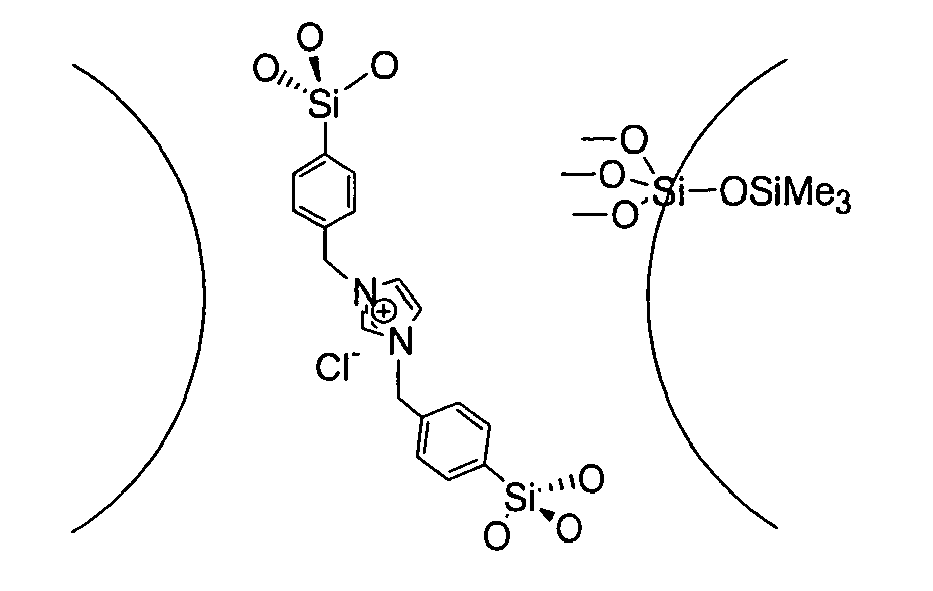
- A mixture of a 1M aqueous solution of HCl (300 mL) and 3.0 g of material


Synthesis of material
-

- The solid

Synthesis of material
-
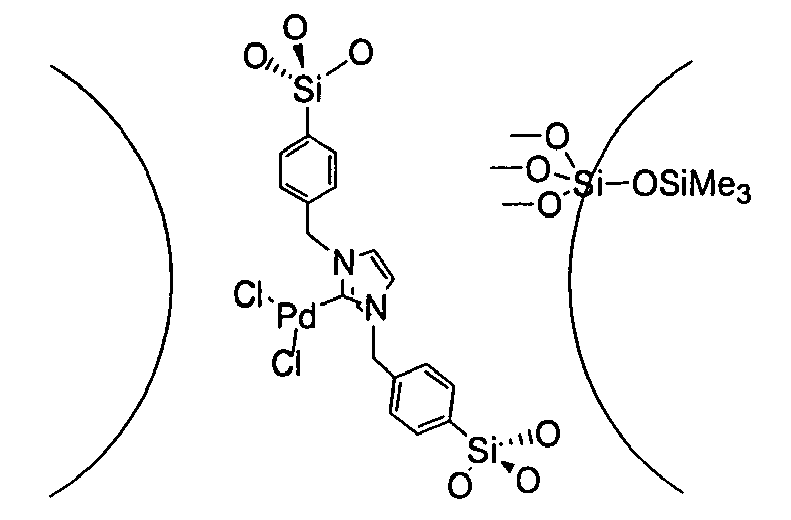
- The solid

Synthesis of material
-

- The solid

Catalytitic Performances of ruthenium containing materials starting from
- Ethyl Oleate self-metathesis with
material 
- Representative procedure. In a glove- Representative procedure. In a glove-box, 2 mL of ethyl oleate (5.54 mmol) was added onto 10 mg of


Table 1. Catalyst EO/Ru Temp/°C Conv.(time) TOFa Eq. time/ min 
12000 30 3.5 % (1h) 48 (5 min) 8880 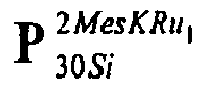
12000 40 8 % (1h) 48 (5 min) 1800 
29740 30 5 % (5h) 5 (5 h) 5760c 
29740 40 20 % (5h) 30 (10 min) 1800 G2-Bn 42000 30 12.6 % (5h) 30b 1440 
9340 30 10.8 % (1h) 16 (1h) 1440 
10000 20 3.2 % (1h) 5 (1h) 1800c 
10000 40 17.5 % (1h) 67 (5 min) 1200 G2-Pr 42560 30 2.3 % (1h) 50 (1h) 600 a The TOF (min-1) at a defined time (between brackets). b The TOF was measured after the end of the induction period. c The experiment was stopped after reaching 45 % conversion. 
- Recycling. In a glovebox, 0.4 mL of ethyl oleate (1.11 mmol) was added onto 50 mg of
material P8a 
- The recycling of

Figure 32 . - Leaching. Analysis by ICP of the supernatant solution resulting from the catalytic self-metathesis of Ethyl Oleate with Ru-loaded
materials 
- H/D exchange reaction. Representative procedure. Acetophenone, 2% mol of catalyst and 4 mol% of AgOTf in methanol-d4 were stirred at 100 °C in Young-style NMR-tube, and the reaction was monitored by NMR. Acetophenone showed quantitative deuteration at the alpha-positions
Table 2. Catalyst Substrate/Cat. Conversion (%) Time (min) Ir-Me 50 99.8 5 Ir- Ms 50 98.5 5 
50 94.7 15 
50 93.8 15 
- Recycling Test of

Material 
- Recycling Test of


EXAMPLES PART V
Catalytic Performances of palladium containing materials starting from
-

- A mixture of 100 mg of material

- A mixture of Pd(OAc)2 (16.8 mg, 0.075 mmol, 0.5mol% Pd ), bis-mesitylimidazolium chloride (25.6 mg, 0.075 mmol) and CsCO3 (5.76 g (30 mmol)) in 30 mL of dioxane was heated for 30 min at 80 °C under vigorous stirring. To the reaction mixture cooled down was added boronic acid (2.74 g, 22.5 mmol) and p-bromoacetophenone (3.0 g, 15 mmol). Then the reaction mixture was heated at 80 °C. The conversion of p-bromoacetophenone was monitored over time using gas chromatography equipped with a HP5 column.
Table 3. Catalyst Reaction Time Conv. Pd(OAc)2+ IMes.Hcl Suzuki 300 min 100 % 
Suzuki 300 min 92 %
Synthesis of the Iodopropyl-functionnalised material

Claims (66)
- Porous structured material which comprises1) at least a component (1) comprising at least:- an inorganic part selected from metalloid-oxygen units of formula -ZOo,
wherein Z is silicon and o is 1.5,- an organometallic part consisting of a stabilized carbene, silylene or germylene and a metal bonded to a single stabilized carbene, silylene or germylene- said organometallic part being bonded to the inorganic part via at least one covalent bondsaid component (1) being an integral part of the porous structured material and being regularly distributed within the porous structured material via siloxy bonds - The material of the claim 1, wherein said framework further comprises at least a component (2) comprising at least:- an inorganic part, selected from metalloid-oxygen units of formula -ZOo, wherein Z is silicon and o is 1.5,- an organic part consisting in a stabilized carbene, silylene or germylene or in a precursor of a stabilized carbene, silylene or germylene,- said organic part being bonded to the inorganic part via at least one covalent bondsaid component (2) being an integral part of the porous structured material and being regularly distributed within the porous structured material via siloxy bonds
the components (1) and (2) having an identical or a different inorganic part.
the components (1) and (2) having an identical or a different stabilized carbene, silylene or germylene. - The material of any of the previous claims, wherein the organometallic part of conponent (1) is bonded to its inorganic part via one covalent bond and/or the organic part of conponent (2) is bonded to its inorganic part via one covalent bond.
- The material of any of the claims 1 or 2, wherein the organometallic part of conponent (1) is bonded to its inorganic part via two covalent bonds and/or the organic part of conponent (2) is bonded to its inorganic part via two covalent bonds
- The material of any of the previous claims, said material further comprising at least an inorganic component (3) selected from a metalloid-oxide defined as Z'Oo',
wherein the Z' atom may be selected from silicon Si, zirconium Zr, titanium Ti, aluminium Al and o' is 2 when Z' is Si, Zr or Ti, o' is 1.5 when Z' is Al or In and o' is 2.5 when Z' is Nb or Ta. - The material of the previous claims, said structured porous network being structured in a one or two dimensional hexagonal array of pores or in a cubic or wormlike arrangement of the pores..
- The material of any of the previous claims, said material comprising a three-dimensional framework that can be crystalline, amorphous or quasi-crystalline and further contains a series of pores and/or channels.
- The material of any of the previous claims, said material having a mean pore diameter from 20 to 500 Å, preferably from 20 to 150 Å (specify the methods in the text).
- The material of any of the previous claims, said material having a molar ratio r between the total amount of components (1), (2) and (3) divided by the total amount of components (1) and (2) ranges from 1 to about 1000.
- The material of any of the previous claims, said material having a molar ratio r' between the total amount of component (2), divided by the total amount of component (1) ranges from 0 to about 1000.
- The material of any of the previous claims wherein the inorganic component (3) is a metalloid oxide defined as Z'Oo', wherein the Z' atom may be selected from silicon Si, zirconium Zr, titanium Ti, aluminium Al Nobium No and Tantalium Ta, and o' is 2 when Z' is Si, Zr or Ti, o' is 1.5 when Z' is Al or In and o' is 2.5 when Z' is Nb or Ta.
- The material of the previous claims wherein Z' is silicon. and o' is 2.
- The material of any of the previous claims wherein the stabilized carbene, silylene or germylene is a carbene-carbon, a silylene-silicium or a germylene-germanium which is bonded directly to at least one and preferably two heteroatoms.
- The material of any of the previous claims wherein the organometallic part of component (1) consists in a stabilized carbene bonded to a metal and/or wherein the organic part of component (2) consists in a stabilized carbene or a precursor of a stabilized carbene
- The material of the claim 14, wherein the stabilized carbene is a substituted N-heterocyclic carbene.
- The material of the claim 14, wherein the precursor of the stabilized carbene is a substituted N-heterocyclic group.
- The material of any of the previous claims wherein the precursor of the stabilized carbene is a substituted imidazolium unit.
- The material of any of the previous claims wherein the organometallic part of the organometallic-inorganic component (1) comprising a stabilized carbene, silylene or germylene bonded to a metal may be chosen among radicals of formula I
 - V is a carbon atom C, a silicon atom Si or a germanium atom Ge,- M is a metal, selected from lanthanides and metals from the group 3 elements to group 11 elements (III B to I B),- Q is a ligand, and q is comprised between 0 to 11 as a function of the metal, the ligands could be the same or different and could be linked together to form a cyclic group in a 3 to 8 membered ring.
Q is selected from the group consisting of hydrogen, halide, C1-20 alkyl, C5-20 aryl, C1-20 alkoxy and thioalkoxy, C5-20 aryloxy and thioaryloxy, C1-20 alkyldiketonat, diketiminate ligand (such as the NacNac: CH[C(Me)NAr]2 -, Ar = 2,6-Me2C6H3), C1-20 alkoxycarbonyl, C1-20 arylcarbonyl, C1-20 acyl, C1-20 alkylsulfonato, C1-20 arylsulfonato, C1-20 alkylsulfanyl, C1-20 arylsulfanyl C1-20 alkylsulfinyl, C1-20 arylsulfinyl, C1-20 alkylcarboxylate, C1-20 arylcarboxylate, C1-20 alkylsilyl, C1-20 arylsilyl, C1-20, substituted with one or more moieties selected from the group consisting of . C1-10 alkoxy, C1-10 alkyl, C1-10 aryl), cyclopentadienyl, amido, imido, phosphido, nitrido, alkene, alkyne, arene, phosphane, sulfonated phosphane, phosphate, phosphinite, arsine, ether, amine, amide, imine, sulfoxide, carboxyl, nitrosyl, pyridine, substituted pyridine, imidazole, substituted imidazole, pyrazine, substituted pyrazine and thioether.- X et X' are each independently selected from carbon or heteroatom, the heteroatom being selected from nitrogen N, oxygen O, sulphur S or phosphorus, provided that at least one of X or X' is a heteroatom, eventually substituted if not bonded to L, by an hydrogen atom H or a R substituent.- Y is a divalent radical from 1 to 6 atoms including a substituted hydrocarbylene, a hydrocarbylene comprising at least a heteroatom, or a substituted hydrocarbylene comprising at least a heteroatom and forms a ring between X and X' when y is comprised between 1 to 10, or if y is 0, X and X' can be directly linked or not.- L is a divalent radical and I is comprised between 1 and 2(2+y), comprising a hydrocarbylene bonding X or X' or any of the divalent radical Y, respectively including a substituted hydrocarbylene, a hydrocarbylene comprising a heteroatom, or substituted hydrocarbylene comprising a heteroatom, like a C1-10 alkylene, a C6-40 arylene substituted or not.- R is selected from the group consisting of hydrogen, C1-20 alkyl, C5-20 aryl, with can be substituted with one or more moieties selected from the group consisting of. C1-10 alkoxy, phosphine, sulfonated phosphine, phosphate, phosphinite, arsine, ether, amine, amide, imine, sulfoxide, carboxyl, nitrosyl, pyridine, substituted pyridine, imidazole, substituted imidazole, pyrazine, substituted pyrazine and thioether. - The material of any of the previous claims wherein the organometallic part of the component (1) comprising a stabilized carbene, silylene or germylene may be chosen among radicals of formulas Ia or Ib
 - V is a carbon atom C, a silicon atom Si or a germanium atom Ge,- M is a metal, selected from lanthanides and metals from the group 3 elements to group 11 elements (III B to I B),- Q is a ligand, and q is comprised between 0 to 11 as a function of the metal, the ligands could be the same or different and could be linked together to form a cyclic group in a 3 to 8 membered ring.
Q is selected from the group consisting of hydrogen, halide, C1-20 alkyl, C5-20 aryl, C1-20 alkoxy and thioalkoxy, C5-20 aryloxy and thioaryloxy, C1-20 alkyldiketonat, diketiminate ligand (such as the NacNac: CH[C(Me)NAr]2 -, Ar = 2,6-Me2C6H3), C1-20 alkoxycarbonyl, C1-20 arylcarbonyl, C1-20 acyl, C1-20 alkylsulfonato, C1-20 arylsulfonato, C1-20 alkylsulfanyl, C1-20 arylsulfanyl C1-20 alkylsulfinyl, C1-20 arylsulfinyl, C1-20 alkylcarboxylate, C1-20 arylcarboxylate, C1-20 alkylsilyl, C1-20 arylsilyl, C1-20, substituted with one or more moieties selected from the group consisting of . C1-10 alkoxy, C1-10 alkyl, C1-10 aryl), cyclopentadienyl, amido, imido, phosphido, alkene, alkyne, arene, phosphane, sulfonated phosphane, phosphate, phosphinite, arsine, ether, amine, amide, imine, sulfoxide, carboxyl, nitrosyl, pyridine, substituted pyridine, imidazole, substituted imidazole, pyrazine, substituted pyrazine and thioether.- X et X' are each independently selected from carbon or heteroatom, the heteroatom being selected from nitrogen N, oxygen O, sulphur S or phosphorus, provided that at least one of X or X' is a heteroatom,- L and L' are divalent linkers, each individually comprising a hydrocarbylene bonding X or X', respectively including a substituted hydrocarbylene, a hydrocarbylene comprising a heteroatom, or substituted hydrocarbylene comprising a heteroatom, like a C1-10 alkylene, a C6-40 arylene substituted or not, provided that when the organometallic part is part of the organic-inorganic framework via only one covalent bond one of the L or L' is replaced by an R substituent.- Y is a divalent radical from 1 to 6 atoms including a substituted hydrocarbylene, a hydrocarbylene comprising at least a heteroatom, or a substituted hydrocarbylene comprising at least a heteroatom and forms a ring between X and X' when y is comprised between 1 to 10, or if y is 0, X and X' can be directly linked or not.- R is selected from the group consisting of hydrogen, C1-20 alkyl, C5-20 aryl, with can be substituted with one or more moieties selected from the group consisting of C1-10 alkoxy, phosphine, sulfonated phosphine, phosphate, phosphinite, arsine, ether, amine, amide, imine, sulfoxide, carboxyl, nitrosyl, pyridine, substituted pyridine, imidazole, substituted imidazole, pyrazine, substituted pyrazine and thioether. - The material of any of the previous claims, wherein the metal M is selected from the group consisting of Group 3 elements through Group 11 elements of the Periodic Table of Elements.
- The material of any of the previous claims, wherein the metal M is selected from the group consisting of ruthenium Ru, molybdenum Mo, tungsten W or rhenium Re.
- The material of any of the previous claims, wherein the metal M is selected from the group consisting of iron Fe, copper Cu, nickel Ni, palladium Pd or gold Au.
- The material of any of the previous claims, wherein the metal M is selected from the group consisting of vanadium V, chromium Cr, molybdenum Mo, tungsten W, rhenium Re, iron Fe, ruthenium Ru, osmium Os, platinum Pt or gold Au.
- The material of any of the previous claims, wherein the metal M is selected from the group consisting of lanthanides preferably neodinium Nd and yttrium Y, titanium Ti, zirconium Zr, hafnium Hf, chromium Cr or nickel Ni.
- The material of any of the previous claims, wherein the metal M is selected from the group consisting of cobalt Co, rhodium Rh or iridium Ir.
- The material of any of the previous claims, wherein the metal M is selected from the group consisting of titanium Ti, ruthenium Ru, rhodium Rh or Iridium Ir.
- The material of any of the previous claims, wherein the organic part of the organic- inorganic component (2) comprising a stabilized carbene or a precursor of a stabilized carbene may be chosen among radicals of formula I'

- The material of any of the previous claims wherein, the organic part of the component (2) comprising a stabilized carbene or a precursor of a stabilized carbene may be chosen among radicals of formula I'a or I'b

- The material of any of the previous claims wherein the organometallic-inorganic component (1) may be chosen among the components of formula II

- The material of any of the previous claims wherein the organometallic-inorganic component (1) may be chosen among the components of formula II a or IIb

- The material of any of the previous claims wherein the organic-inorganic component (2) may be chosen among the components of formula III

- The material of any of the previous claims wherein the organic-inorganic component (2) may be chosen among the components of formulas IIIa and IIIb

- The material of any of the previous claims consisting in the compounds of formula IV

With 1/≤(a+b+c)/(a+b) ≤1000
wherein L, L', X, X', Y, R, Z, Z', V, V', o, o', a, b, c and y are as defined herein above and may be identical or different from one organometallic-inorganic component to another; they may be identical or different from one organic-inorganic component to an other, identical or different from the organometallic-inorganic component to the organic-inorganic component. - A method for forming a material of any of the previous claims comprising at least the following steps:a) a sol-gel step, with at least a mono or disilytated carbene, silylene or germylene precursor of formula V wherein V', L, X, X', Y, Z, R and y are as defined herein above and may be identical or different and optionally with trialkoxyalkylmetalloid and/or peralkoxymetal/metalloid of formula R'Si(OR)3, R'Ge(OR)3 or Z'(OR)x Z'(OH)x or Z'(O-)x.(x/n)(En+):
 b) optionally the compound of formula III is treated to remove surfactant and,c) the compound of formula III is contacted with a base or a silver compound and,d) simultaneously or subsequently, the material obtained in step c) is reacted with a metal complex under conditions so as to form a material of formula IV.
 - A method for forming a material of any of the previous claims comprising at least the following steps:a) a sol-gel step, with at least an organometallic mono or disilylated carbene, silylene or germylene precursor of formula VI wherein V, L, X, X', Y, Z, R, M, Q, q and y are as defined herein above and may be identical or different and optionally with trialkoxyalkylmetalloid and/or peralkoxymetal/metalloid of formula R'Si(OR)3, R'Ge(OR)3or Z'(OR)x, Z'(OH)x or Z'(O-)x.(x/n)(En+):
 b) optionally the compound of formula III is treated to remove surfactant,c) optionally the compound of formula III obtained is subjected to an in-situ transmetallation or contacted with a appropriate component to obtain the desired material of formula IV.
 - The method of any of the claim 34 or 35, wherein a further step a' is included after the step a, which consist in removing the residual hydroxyl or alkoxy-groups.
- The method of any of the claim 34 to 36, wherein the co-solvents are chosen among alcohols, amides, ethers, esters.
- The method of any of the claim 34 to 37, wherein the polar solvents are chosen among alcohols, amides, ethers, esters
- The method of any of the claim 34 to 38, wherein the surfactant is chosen among:1) anionic surfactants (Sodium dodecyl sulfate);2) cationic surfactants: ammonium salts (Cetyltrimethylammonium bromide), imidazolium salts (1-Hexadecane-3-methylimidazolium Bromide C16H33-CH3-imidazoliumBr), pyridiium salts (n-Hexadecylpyridinium chloride), phosphonium salts;3) non-ionic surfactants:- amines (hexadecylamine (C16H33NH2),- alkylpolyethyleneoxides or alkylarylpolyethylene oxides (Brij 52 (C16H33O(CH2CH2O)2H), Tergitol 15-S-12 (C11-15H23-31O(CH2CH2O)12H), Triton X 100 (C14H22O(C2H4On, n=9-10), Montanox 20 (Sorbitan.20EO.monooleyl ester), Octylphenol-10EO (p-C8H17C6H4O(CH2CH2O)10H), Lauryl ether-nEO (C12H25O(CH2CH2O)nH n∼2,4,8)),- polysorbate surfactants (such as Tween 20 (IUPAC name: polyoxyethylene (20) sorbitan monolaurate) and,- amphiphilic block copolymers (like Pluronic P123 triblock copolymer (EO20-PO70-EO20), Pluronic F127 (EO100-PO70-EO100) or F108 (EO132-PO50-EO132)).
- The method of any of the claim 34 to 39, wherein the hydrolysis polycondensation catalyst is a base chosen among amines, an acid chosen among inorganic acids such as hydrochloric acid, hydrobromic acid, iodidric acid... or organic acids such as p-toluene sulfonic acid or a nucleophilic such as sodium fluoride, tetrabutylammonium fluoride.
- The method of any of the claim 34 to 40, wherein the surfactant is removed by washing with the proper polar solvent as describe above (alcohol, water...) with/without the presence of an acid or Soxhlet extraction.
- The method of any of the claim 34 to 41, wherein the base in step c is chosen among potassium hexamethyldisilazide (KHMDS), tBuOK, DBU: 1,8-diazabicyclo[5.4.0]undec-7-ène, phosphazenes (BEMP), pyridines, phosphanes, guanidine type bases: (R1R2N)(R3R4N)C=N-R5.
- The method of any of the claim 34 to 42, wherein the silver compound is chosen among the soluble Ag salts, Ag-Alkoxysilane or Ag-Alkoxyde: AgO-Si(iPr)3, AgO-C(CF3)3
- The method of any of the claim 34 to 43, wherein the metal complex is defined as MQ'q', where M is a metal chosen for the periodic classification, Q' is a ligand, and q' is comprised between 0 to 11 as a function of the metal, the ligands could be the same or different and could be linked together to form a cyclic group in a 3 to 8 membered ring. Q' is selected from the group consisting of hydrogen, halide, C1-20 alkyl, C5-20 aryl, C1-20 alkoxy and thioalkoxy, C5-20 aryloxy and thioaryloxy, C1-20 alkyldiketonat, diketiminate ligand (such as the NacNac: CH[C(Me)NAr]2 -, Ar = 2,6-Me2C6H3), C1-20 alkoxycarbonyl, C1-20 arylcarbonyl, C1-20 acyl, C1-20 alkylsulfonato, C1-20 arylsulfonato, C1-20 alkylsulfanyl, C1-20 arylsulfanyl C1-20 alkylsulfinyl, C1-20 arylsulfinyl, C1-20 alkylcarboxylate, C1-20 arylcarboxylate, C1-20 alkylsilyl, C1-20 arylsilyl, C1-20, substituted with one or more moieties selected from the group consisting of . C1-10 alkoxy, C1-10 alkyl, C1-10 aryl), cyclopentadienyl, amido, imido, phosphido, nitrido, alkene, alkyne, arene, phosphane, sulfonated phosphane, phosphate, phosphinite, arsine, ether, amine, amide, imine, sulfoxide, carboxyl, nitrosyl, pyridine, substituted pyridine, imidazole, substituted imidazole, pyrazine, substituted pyrazine and thioether (G. Parkin, Comprehensive Organometallic Chemistry III, Vol. 1, Chap. 1, Ed. Elsevier 2007).
- The method of any of the claims 34 to 44, wherein the further step a' is done by reacting the material with passivating agents, typically considered as hydrobobic and chosen among trialkylsilyl derivatives (chloro, bromo, iodo, amido or alkoxysilanes) or alcohols.
- The material obtainable by a method as claimed in any of the claims 34 to 45.
- A synthesis process comprising at least a step where one or more reactants are contacted with the material as claimed in claim 1 to 36 or 42.
- A metathesis process comprising contacting one or more reactant with the material of the claim 21.
- A coupling C-C reaction process comprising contacting one or more reactant with the material of the claim 22
- An oxidation process comprising contacting one or more reactant with the material of the claim 23.
- A polymerization or oligomerization process comprising contacting one or more reactant with the material of the claim 24.
- An hydroformylation or carbonylation process comprising contacting one or more reactant with the material of the claim 25.
- An hydrogenation process comprising contacting one or more of the reactant with the material of the claim 26.
- An alkane conversion and C-H activation processes comprising contacting one or more of the reactant with the material of the claim 20.
- Use of the material of any of the claims 1 to 36 as a heterogeneous catalyst in an organic reaction process.
- Use of the material of the claim 21 as a heterogeneous catalyst in a metathesis reaction process.
- Use of the material of the claim 22 as a heterogeneous catalyst in a coupling C-C reaction process
- Use of the material of the claim 23 as a heterogeneous catalyst in an oxidation reaction process
- Use of the material of the claim 24 as a heterogeneous catalyst in a polymerization or oligomerization reaction process.
- Use of the material of the claim 25 as a heterogeneous catalyst in a hydroformylation or carbonylation reaction process
- Use of the material of the claim 26 as heterogeneous catalyst in a hydrogenation reaction process.
- Use of the material of the claim 20 as heterogeneous catalyst in an alkane conversion and C-H activation process.
- Materials of formulas


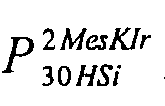


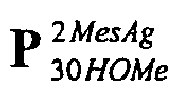


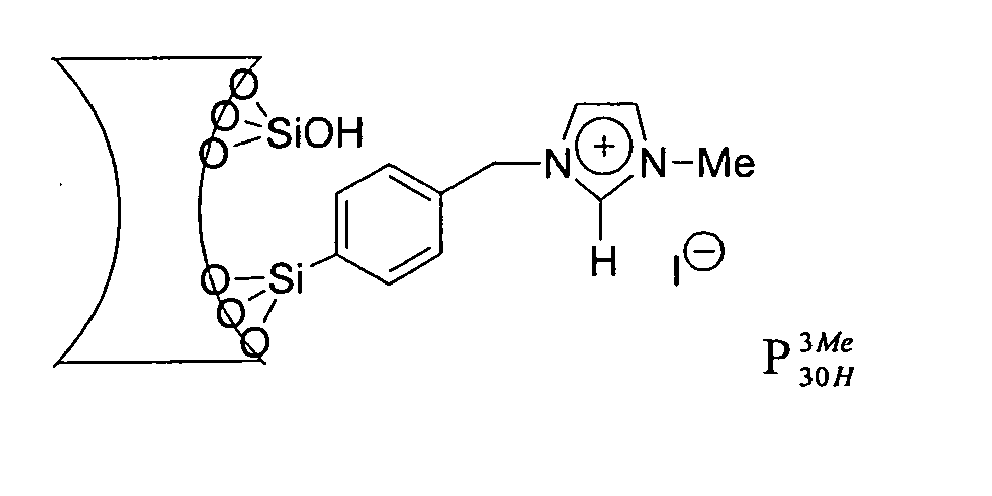


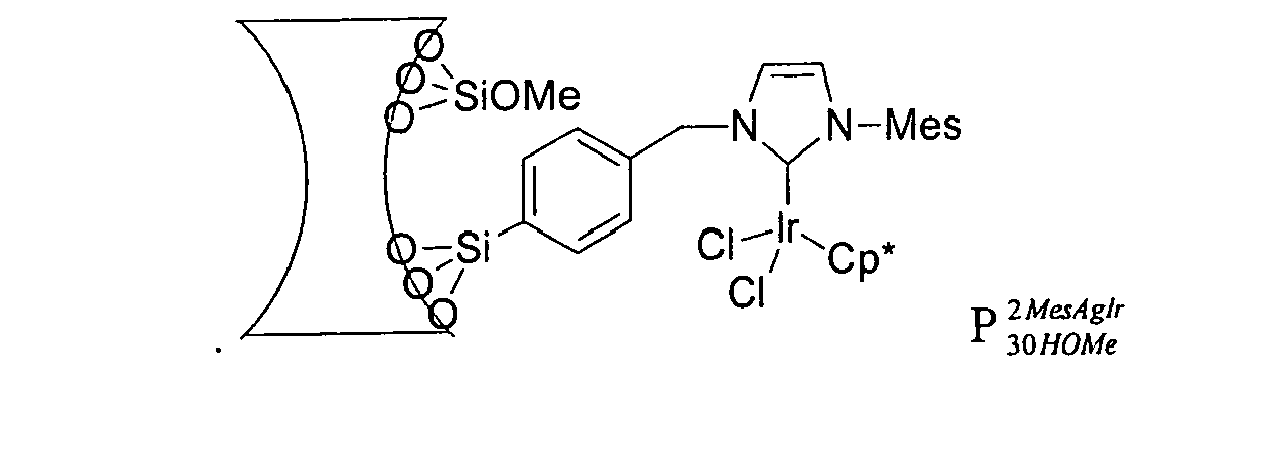


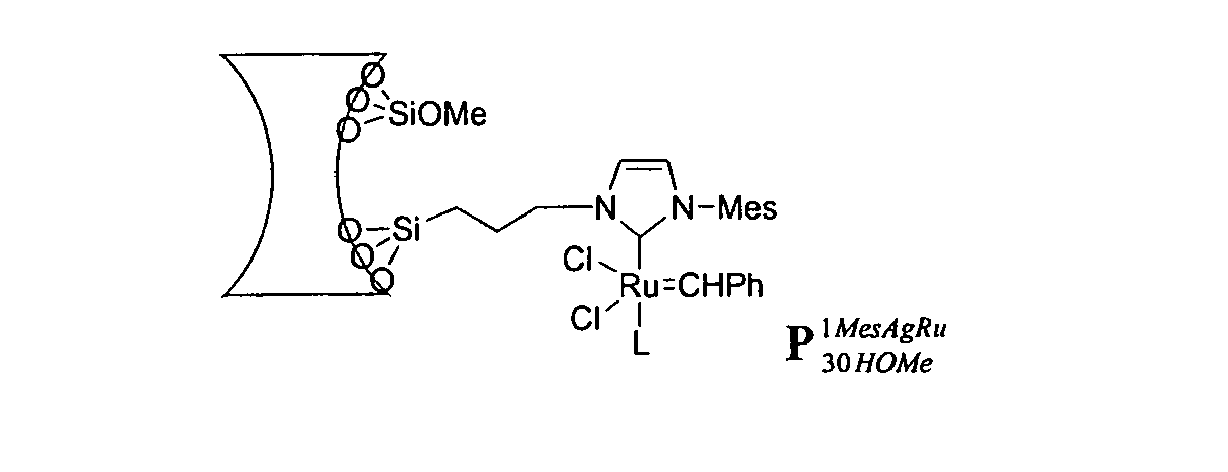

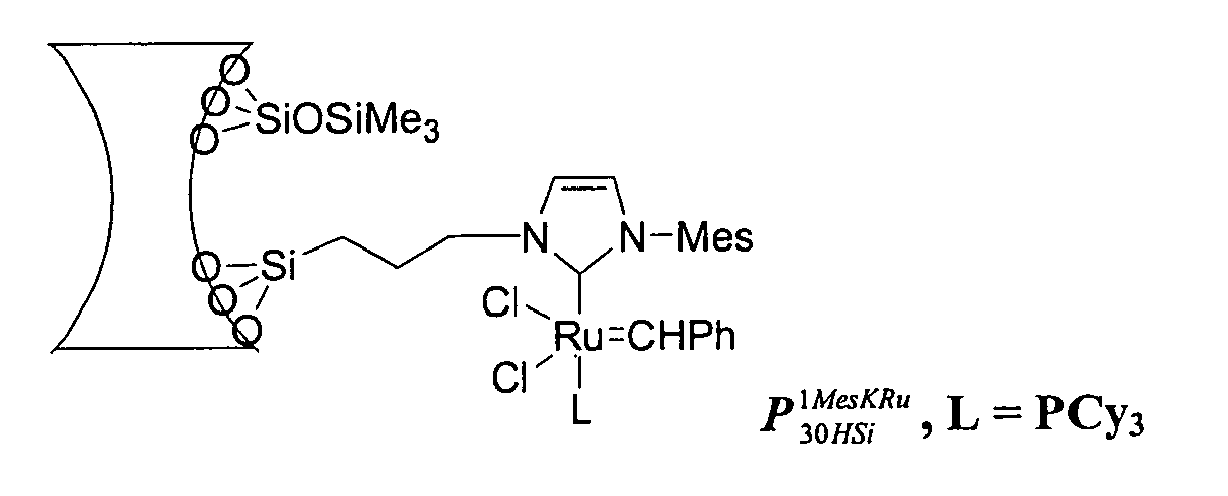

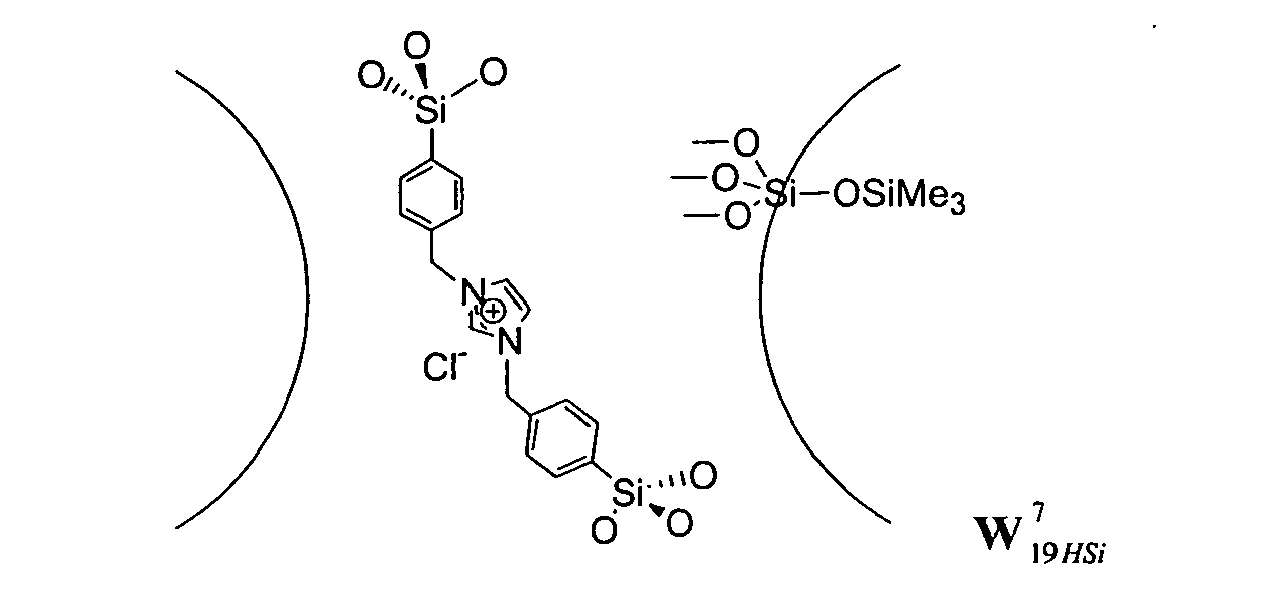


- Mono- or bis-silylated precursors of formulas 3, 4, 5, 7 as below represented:


- Structured hybrid materials of formulas


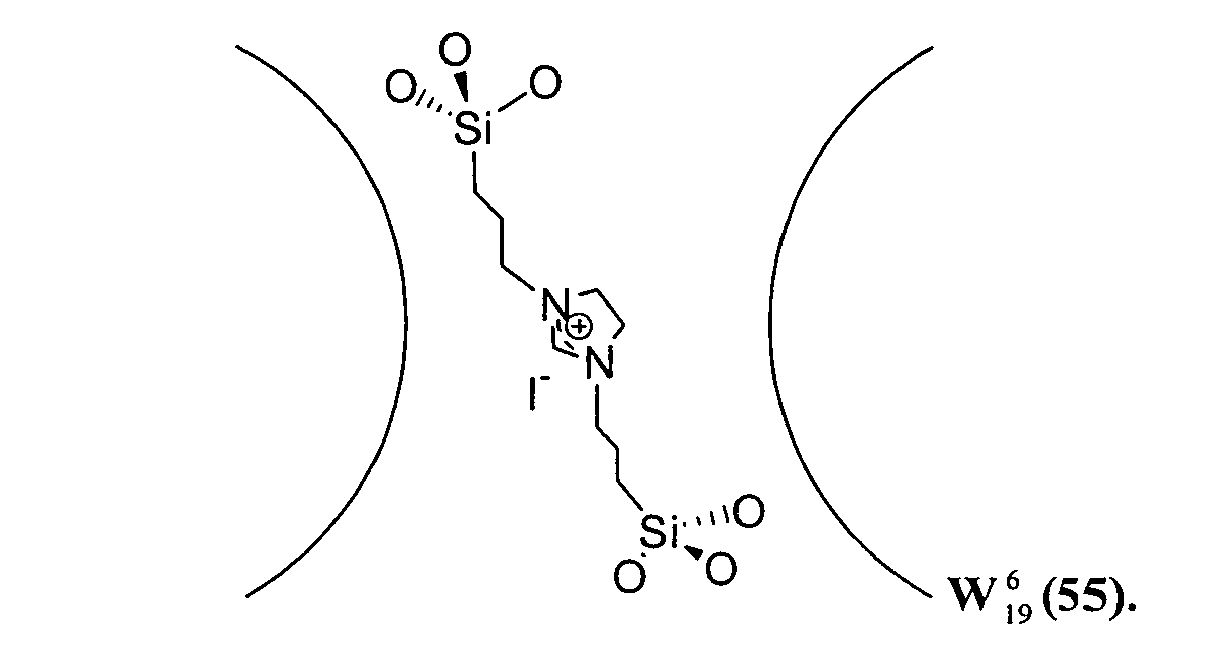


- Non-structured hybrid materials of formulas


Priority Applications (3)
| Application Number | Priority Date | Filing Date | Title |
|---|---|---|---|
| EP08290068A EP2082804B1 (en) | 2008-01-25 | 2008-01-25 | Hybrid organic-inorganic materials that contain stabilized carbene |
| PCT/EP2009/050810 WO2009092814A1 (en) | 2008-01-25 | 2009-01-23 | Hybrid organic-inorganic materials that contain stabilized carbene |
| US12/812,535 US8871877B2 (en) | 2008-01-25 | 2009-01-23 | Hybrid organic-inorganic materials that contain stabilized carbene |
Applications Claiming Priority (1)
| Application Number | Priority Date | Filing Date | Title |
|---|---|---|---|
| EP08290068A EP2082804B1 (en) | 2008-01-25 | 2008-01-25 | Hybrid organic-inorganic materials that contain stabilized carbene |
Publications (2)
| Publication Number | Publication Date |
|---|---|
| EP2082804A1 true EP2082804A1 (en) | 2009-07-29 |
| EP2082804B1 EP2082804B1 (en) | 2012-10-03 |
Family
ID=39535125
Family Applications (1)
| Application Number | Title | Priority Date | Filing Date |
|---|---|---|---|
| EP08290068A Not-in-force EP2082804B1 (en) | 2008-01-25 | 2008-01-25 | Hybrid organic-inorganic materials that contain stabilized carbene |
Country Status (3)
| Country | Link |
|---|---|
| US (1) | US8871877B2 (en) |
| EP (1) | EP2082804B1 (en) |
| WO (1) | WO2009092814A1 (en) |
Cited By (4)
| Publication number | Priority date | Publication date | Assignee | Title |
|---|---|---|---|---|
| CN106188565A (en) * | 2016-08-09 | 2016-12-07 | 郑州大学 | A kind of organic inorganic hybridization supermolecule polymer, its preparation method and application about silver |
| CN109897181A (en) * | 2019-02-19 | 2019-06-18 | 江西蓝星星火有机硅有限公司 | A kind of preparation method of high molecular weight MQ silicone resin |
| CN110532681A (en) * | 2019-08-28 | 2019-12-03 | 哈尔滨工业大学 | Gas Turbine Abnormal Detection Method Based on NARX Network-Box Diagram and Normal Pattern Extraction |
| CN110560049A (en) * | 2019-09-25 | 2019-12-13 | 陕西科技大学 | Method for preparing platinum-ruthenium-titanium composite nanoparticles by using microemulsion method |
Families Citing this family (16)
| Publication number | Priority date | Publication date | Assignee | Title |
|---|---|---|---|---|
| CN101979352B (en) * | 2010-10-28 | 2012-11-28 | 常熟耀皮特种玻璃有限公司 | Organic coating material capable of reducing light reflectivity of glass surface and glass |
| CN103801355B (en) * | 2012-11-13 | 2016-01-20 | 中国石油化工股份有限公司 | A kind of method for making of the hydrogenation catalyst containing molecular sieve |
| CN103801375B (en) * | 2012-11-13 | 2016-03-02 | 中国石油化工股份有限公司 | A kind of preparation method of hydrocarbons hydrogenation catalyst |
| WO2015129813A1 (en) * | 2014-02-26 | 2015-09-03 | 国立大学法人 長崎大学 | Deuteration method and deuteration catalyst |
| KR102235612B1 (en) | 2015-01-29 | 2021-04-02 | 삼성전자주식회사 | Semiconductor device having work-function metal and method of forming the same |
| CA2984704A1 (en) | 2015-05-07 | 2016-11-10 | Total Raffinage Chimie | Selective partial hydrogenation of terpenes using a nickel-based catalyst |
| WO2017019426A1 (en) | 2015-07-27 | 2017-02-02 | Dow Corning Corporation | Polyorganosiloxane compositions with metal based n-heterocyclic carbene condensation reaction catalysts and methods for the preparation thereof |
| DE102016206303A1 (en) * | 2016-04-14 | 2017-10-19 | Technische Universität Berlin | Catalyst for the hydroformylation of olefins and its use |
| JP6972102B2 (en) * | 2016-08-10 | 2021-11-24 | リサーチ トライアングル インスティテュート | Solid-phase crystallization method of metal-organic framework in mesoporous material and its hybrid material |
| CN107880181B (en) * | 2016-09-30 | 2020-02-18 | 中国石油化工股份有限公司 | Catalyst component for olefin polymerization and preparation and application thereof |
| WO2018213821A1 (en) * | 2017-05-19 | 2018-11-22 | The George Washington University | Catalysts for the transformation of carbon dioxide and glycerol to formic acid and lactic acid and methods of making the same |
| WO2019113752A1 (en) * | 2017-12-11 | 2019-06-20 | 天津科技大学 | Catalyst system for ethylene selective oligomerization and ethylene oligomerization reaction method |
| CN108906135B (en) * | 2018-07-24 | 2021-06-22 | 淄博凯美可工贸有限公司 | Double-function catalytic cracking metal passivator and preparation method thereof |
| KR102825056B1 (en) | 2019-06-25 | 2025-06-26 | 엘지이노텍 주식회사 | Circuit board |
| CN111617747B (en) * | 2020-05-11 | 2022-05-31 | 贵州大学 | A kind of chitosan/nano metal composite hydrogel and its preparation method and application |
| CN113387889B (en) * | 2021-06-17 | 2023-05-09 | 湖南文理学院 | A kind of preparation method of porous imidazole metal compound nanopowder |
Citations (4)
| Publication number | Priority date | Publication date | Assignee | Title |
|---|---|---|---|---|
| WO2002076991A1 (en) | 2001-03-21 | 2002-10-03 | Centre National De La Recherche Scientifique | Mesoporous organic-inorganic hybrid materials for separating gases |
| WO2005016941A1 (en) * | 2003-08-11 | 2005-02-24 | Merck Patent Gmbh | N-heterocyclic carbenes that can be immobilized |
| WO2005016524A2 (en) * | 2003-08-11 | 2005-02-24 | Merck Patent Gmbh | Immobilised imidazoles and ruthenium catalysts |
| DE102004039277A1 (en) * | 2004-08-13 | 2006-02-23 | Merck Patent Gmbh | At the central atom substituted immoblisierbaren ruthenium (II) catalysts, processes for their preparation and use |
-
2008
- 2008-01-25 EP EP08290068A patent/EP2082804B1/en not_active Not-in-force
-
2009
- 2009-01-23 WO PCT/EP2009/050810 patent/WO2009092814A1/en not_active Ceased
- 2009-01-23 US US12/812,535 patent/US8871877B2/en not_active Expired - Fee Related
Patent Citations (4)
| Publication number | Priority date | Publication date | Assignee | Title |
|---|---|---|---|---|
| WO2002076991A1 (en) | 2001-03-21 | 2002-10-03 | Centre National De La Recherche Scientifique | Mesoporous organic-inorganic hybrid materials for separating gases |
| WO2005016941A1 (en) * | 2003-08-11 | 2005-02-24 | Merck Patent Gmbh | N-heterocyclic carbenes that can be immobilized |
| WO2005016524A2 (en) * | 2003-08-11 | 2005-02-24 | Merck Patent Gmbh | Immobilised imidazoles and ruthenium catalysts |
| DE102004039277A1 (en) * | 2004-08-13 | 2006-02-23 | Merck Patent Gmbh | At the central atom substituted immoblisierbaren ruthenium (II) catalysts, processes for their preparation and use |
Non-Patent Citations (23)
| Title |
|---|
| "Comprehensive Organometallic Chemistry III", vol. 1, 2007, ELSEVIER |
| B. L. BOOTH ET AL., J. ORGANOMET. CHEM., vol. 315, 1986, pages 143 - 156 |
| B. LEE ET AL., LANGMUIR, vol. 21, 2005, pages 5372 |
| BURKETT ET AL., CHEM. COMMUN., 1996, pages 1367 |
| CETINKAYA B ET AL: "Synthesis and immobilization of N - heterocyclic carbene complexes of Ru(II): catalytic activity and recyclability for the furan formation", JOURNAL OF MOLECULAR CATALYSIS. A, CHEMICAL, ELSEVIER, AMSTERDAM, NL, vol. 184, 1 January 2002 (2002-01-01), pages 31 - 38, XP002300268, ISSN: 1381-1169 * |
| CORRIU R.J.P ET AL., ANGEW. CHEM. INT; ED., vol. 35, 1996, pages 1420 - 1436 |
| ELIAS XAVIER ET AL: "Hybrid organic-inorganic materials derived from a monosilylated Hoveyda-type ligand as recyclable diene and enyne metathesis catalysts", ADVANCED SYNTHESIS & CATALYSIS, WILEY VCH VERLAG, WEINHEIM, DE, vol. 349, no. 10, 1 January 2007 (2007-01-01), pages 1701 - 1713, XP009102330, ISSN: 1615-4150 * |
| G. PARKIN: "Comprehensive Organometallic Chemistry III", vol. 1, 2007, ELSEVIER |
| J MATER. CHEM., vol. 8, 1998, pages 1749 |
| J. ALAUZUN ET AL., NEW J. CHEM., vol. 31, 2007, pages 911 - 915 |
| J. MATER, CHEM, vol. 15, 2005, pages 4285 |
| J. MATER. CHEM, vol. 15, 2005, pages 803 |
| J. MATER. CHEM., vol. 15, 2005, pages 4285 - 429 |
| J. MATER. CHEM., vol. 15, 2005, pages 803 - 809 |
| KLAPDOHR, SIMONE ET AL: "Reactions of complex ligands, Part 89. Incorporation of chromium carbenes in a silica matrix by sol - gel processing: application to aminolysis of alkoxycarbene complexes", CHEMISTRY--A EUROPEAN JOURNAL , 6(16), 3006-3017 CODEN: CEUJED; ISSN: 0947-6539, 2000, XP009102331 * |
| LNAGAKI ET AL., J. AM. CHEM. SOC., vol. 121, 1999, pages 9611 |
| M. A. BENNETT; A. K. SMITH, J. C. S. DALTON TRANS., 1974, pages 233 - 241 |
| MACQUANIE D.J. ET AL., CHEM. COMM, 1996, pages 1961 |
| NEW J. CHEM., vol. 30, 2006, pages 1077 - 1082 |
| POLSHETTIWAR, VIVEK ET AL: "Silica hybrid material containing Pd-NHC complex as heterogeneous catalyst for Mizoroki-Heck reactions", TETRAHEDRON LETTERS , 48(31), 5363-5366 CODEN: TELEAY; ISSN: 0040-4039, 2007, XP022141734 * |
| SYNTHESIS, vol. 17, 2003, pages 2661 |
| V. POLSHETTIWAR ET AL., TETRAHEDRON LETTERS, vol. 48, 2007, pages 5363 |
| X ELIAS ET AL., ADV. SYNTH. CATAL., vol. 349, 2007, pages 1701 |
Cited By (7)
| Publication number | Priority date | Publication date | Assignee | Title |
|---|---|---|---|---|
| CN106188565A (en) * | 2016-08-09 | 2016-12-07 | 郑州大学 | A kind of organic inorganic hybridization supermolecule polymer, its preparation method and application about silver |
| CN106188565B (en) * | 2016-08-09 | 2018-12-28 | 郑州大学 | A kind of hybrid inorganic-organic supermolecule polymer, preparation method and application about silver |
| CN109897181A (en) * | 2019-02-19 | 2019-06-18 | 江西蓝星星火有机硅有限公司 | A kind of preparation method of high molecular weight MQ silicone resin |
| CN109897181B (en) * | 2019-02-19 | 2021-10-22 | 江西蓝星星火有机硅有限公司 | A kind of preparation method of high molecular weight MQ silicone resin |
| CN110532681A (en) * | 2019-08-28 | 2019-12-03 | 哈尔滨工业大学 | Gas Turbine Abnormal Detection Method Based on NARX Network-Box Diagram and Normal Pattern Extraction |
| CN110560049A (en) * | 2019-09-25 | 2019-12-13 | 陕西科技大学 | Method for preparing platinum-ruthenium-titanium composite nanoparticles by using microemulsion method |
| CN110560049B (en) * | 2019-09-25 | 2022-08-12 | 陕西科技大学 | A method for preparing platinum-ruthenium-titanium composite nanoparticles by microemulsion method |
Also Published As
| Publication number | Publication date |
|---|---|
| WO2009092814A1 (en) | 2009-07-30 |
| US8871877B2 (en) | 2014-10-28 |
| US20110160412A1 (en) | 2011-06-30 |
| EP2082804B1 (en) | 2012-10-03 |
Similar Documents
| Publication | Publication Date | Title |
|---|---|---|
| EP2082804B1 (en) | Hybrid organic-inorganic materials that contain stabilized carbene | |
| Kröcher et al. | Silica hybrid gel catalysts containing group (VIII) transition metal complexes: Preparation, structural, and catalytic properties in the synthesis ofN, N-dimethylformamide and methyl formate from supercritical carbon dioxide | |
| Adima et al. | Immobilization of rhodium complexes in chiral organic–inorganic hybrid materials | |
| Corma et al. | New Heterogenized Gold (i)‐Heterocyclic Carbene Complexes as Reusable Catalysts in Hydrogenation and Cross‐Coupling Reactions | |
| Waki et al. | A solid chelating ligand: periodic mesoporous organosilica containing 2, 2′-bipyridine within the pore walls | |
| Maishal et al. | A tailored organometallic-inorganic hybrid mesostructured material: a route to a well-defined, active, and reusable heterogeneous iridium-NHC catalyst for H/D exchange | |
| JP5452478B2 (en) | Preparation of surface-functionalized porous organic-inorganic hybrid materials or mesoporous materials with coordinately unsaturated metal sites and their catalytic application | |
| US6544923B1 (en) | Surface-confined catalytic compositions | |
| Monge-Marcet et al. | Sol–gel immobilized Hoveyda–Grubbs complex through the NHC ligand: A recyclable metathesis catalyst | |
| Sakthivel et al. | Heterogenization of organometallic molybdenum complexes with siloxane functional groups and their catalytic application | |
| Wang et al. | Chirally functionalized mesoporous organosilicas with built-in BINAP ligand for asymmetric catalysis | |
| JP6090759B2 (en) | Metal complex having disiloxane as ligand and supported metal complex, method for producing the same, and supported metal catalyst prepared using the same | |
| Mohan et al. | Emerging trends in mesoporous silica nanoparticle-based catalysts for CO 2 utilization reactions | |
| Nguyen et al. | Periodic mesoporous organosilica containing ionic bis-aryl-imidazolium entities: Heterogeneous precursors for silica-hybrid-supported NHC complexes | |
| Monge-Marcet et al. | Catalytic applications of recyclable silica immobilized NHC–ruthenium complexes | |
| Gürbüz et al. | Surface modification of inorganic oxide particles with a carbene complex of palladium: a recyclable catalyst for the Suzuki reaction | |
| Naganawa et al. | Heterogeneous hydrosilylation reaction catalysed by platinum complexes immobilized on bipyridine-periodic mesoporous organosilicas | |
| Crosman et al. | Enantioselective hydrogenation over immobilized rhodium diphosphine complexes on aluminated SBA-15 | |
| Dubois et al. | Organic–inorganic hybrid materials. Preparation and properties of dibenzo-18-crown-6 ether-bridged polysilsesquioxanes | |
| Bied et al. | Preparation and characterization of new templated hybrid materials containing a chiral diamine ligand | |
| Michalska et al. | Selective addition of hydrosilanes to 1, 3-dienes catalyzed by polyamide-supported metal complex catalysts | |
| Styskalik et al. | Surface reactivity of non-hydrolytic silicophosphate xerogels: A simple method to create Brønsted or Lewis acid sites on porous supports | |
| Mangala et al. | Palladium (II) supported on polycarbosilane: application as reusable catalyst for Heck reaction | |
| Pérez et al. | Immobilization of titanium chiral alkoxides on SBA-15 and modelling the active sites of heterogeneous catalyst using titanium silsesquioxane complexes | |
| Yang et al. | Periodic mesoporous organosilicas with bis (8-quinolinolato) dioxomolybdenum (VI) inside the channel walls |
Legal Events
| Date | Code | Title | Description |
|---|---|---|---|
| PUAI | Public reference made under article 153(3) epc to a published international application that has entered the european phase |
Free format text: ORIGINAL CODE: 0009012 |
|
| 17P | Request for examination filed |
Effective date: 20081107 |
|
| AK | Designated contracting states |
Kind code of ref document: A1 Designated state(s): AT BE BG CH CY CZ DE DK EE ES FI FR GB GR HR HU IE IS IT LI LT LU LV MC MT NL NO PL PT RO SE SI SK TR |
|
| AX | Request for extension of the european patent |
Extension state: AL BA MK RS |
|
| 17Q | First examination report despatched |
Effective date: 20100211 |
|
| AKX | Designation fees paid |
Designated state(s): AT BE BG CH CY CZ DE DK EE ES FI FR GB GR HR HU IE IS IT LI LT LU LV MC MT NL NO PL PT RO SE SI SK TR |
|
| RAP1 | Party data changed (applicant data changed or rights of an application transferred) |
Owner name: L'UNIVERSITE CLAUDE BERNARD 6 LYON 1 |
|
| GRAP | Despatch of communication of intention to grant a patent |
Free format text: ORIGINAL CODE: EPIDOSNIGR1 |
|
| RIN1 | Information on inventor provided before grant (corrected) |
Inventor name: CORRIU, ROBERT Inventor name: CAMUS, JEAN-MICHEL Inventor name: MEHDI, AHMAD Inventor name: THIEULEUX, CHLOE Inventor name: EZZEDDINE KARAME, IYAD Inventor name: VEYRE, LAURENT Inventor name: BOUALLEG, MALIKA Inventor name: BASSET, JEAN-MARIE Inventor name: COPERET, CHRISTOPHE Inventor name: ALAUZUN, JOHAN Inventor name: REYE, CATHERINE Inventor name: MAISHAL, TARUN |
|
| GRAS | Grant fee paid |
Free format text: ORIGINAL CODE: EPIDOSNIGR3 |
|
| GRAA | (expected) grant |
Free format text: ORIGINAL CODE: 0009210 |
|
| AK | Designated contracting states |
Kind code of ref document: B1 Designated state(s): AT BE BG CH CY CZ DE DK EE ES FI FR GB GR HR HU IE IS IT LI LT LU LV MC MT NL NO PL PT RO SE SI SK TR |
|
| REG | Reference to a national code |
Ref country code: GB Ref legal event code: FG4D |
|
| REG | Reference to a national code |
Ref country code: AT Ref legal event code: REF Ref document number: 577716 Country of ref document: AT Kind code of ref document: T Effective date: 20121015 Ref country code: CH Ref legal event code: EP |
|
| REG | Reference to a national code |
Ref country code: IE Ref legal event code: FG4D |
|
| REG | Reference to a national code |
Ref country code: DE Ref legal event code: R096 Ref document number: 602008019120 Country of ref document: DE Effective date: 20121129 |
|
| REG | Reference to a national code |
Ref country code: CH Ref legal event code: NV Representative=s name: BOVARD AG, CH |
|
| REG | Reference to a national code |
Ref country code: AT Ref legal event code: MK05 Ref document number: 577716 Country of ref document: AT Kind code of ref document: T Effective date: 20121003 |
|
| PG25 | Lapsed in a contracting state [announced via postgrant information from national office to epo] |
Ref country code: SI Free format text: LAPSE BECAUSE OF FAILURE TO SUBMIT A TRANSLATION OF THE DESCRIPTION OR TO PAY THE FEE WITHIN THE PRESCRIBED TIME-LIMIT Effective date: 20121003 |
|
| REG | Reference to a national code |
Ref country code: NL Ref legal event code: VDEP Effective date: 20121003 |
|
| REG | Reference to a national code |
Ref country code: LT Ref legal event code: MG4D |
|
| PG25 | Lapsed in a contracting state [announced via postgrant information from national office to epo] |
Ref country code: NL Free format text: LAPSE BECAUSE OF FAILURE TO SUBMIT A TRANSLATION OF THE DESCRIPTION OR TO PAY THE FEE WITHIN THE PRESCRIBED TIME-LIMIT Effective date: 20121003 Ref country code: ES Free format text: LAPSE BECAUSE OF FAILURE TO SUBMIT A TRANSLATION OF THE DESCRIPTION OR TO PAY THE FEE WITHIN THE PRESCRIBED TIME-LIMIT Effective date: 20130114 Ref country code: SE Free format text: LAPSE BECAUSE OF FAILURE TO SUBMIT A TRANSLATION OF THE DESCRIPTION OR TO PAY THE FEE WITHIN THE PRESCRIBED TIME-LIMIT Effective date: 20121003 Ref country code: LT Free format text: LAPSE BECAUSE OF FAILURE TO SUBMIT A TRANSLATION OF THE DESCRIPTION OR TO PAY THE FEE WITHIN THE PRESCRIBED TIME-LIMIT Effective date: 20121003 Ref country code: FI Free format text: LAPSE BECAUSE OF FAILURE TO SUBMIT A TRANSLATION OF THE DESCRIPTION OR TO PAY THE FEE WITHIN THE PRESCRIBED TIME-LIMIT Effective date: 20121003 Ref country code: HR Free format text: LAPSE BECAUSE OF FAILURE TO SUBMIT A TRANSLATION OF THE DESCRIPTION OR TO PAY THE FEE WITHIN THE PRESCRIBED TIME-LIMIT Effective date: 20121003 Ref country code: NO Free format text: LAPSE BECAUSE OF FAILURE TO SUBMIT A TRANSLATION OF THE DESCRIPTION OR TO PAY THE FEE WITHIN THE PRESCRIBED TIME-LIMIT Effective date: 20130103 Ref country code: IS Free format text: LAPSE BECAUSE OF FAILURE TO SUBMIT A TRANSLATION OF THE DESCRIPTION OR TO PAY THE FEE WITHIN THE PRESCRIBED TIME-LIMIT Effective date: 20130203 |
|
| PG25 | Lapsed in a contracting state [announced via postgrant information from national office to epo] |
Ref country code: GR Free format text: LAPSE BECAUSE OF FAILURE TO SUBMIT A TRANSLATION OF THE DESCRIPTION OR TO PAY THE FEE WITHIN THE PRESCRIBED TIME-LIMIT Effective date: 20130104 Ref country code: BE Free format text: LAPSE BECAUSE OF FAILURE TO SUBMIT A TRANSLATION OF THE DESCRIPTION OR TO PAY THE FEE WITHIN THE PRESCRIBED TIME-LIMIT Effective date: 20121003 Ref country code: LV Free format text: LAPSE BECAUSE OF FAILURE TO SUBMIT A TRANSLATION OF THE DESCRIPTION OR TO PAY THE FEE WITHIN THE PRESCRIBED TIME-LIMIT Effective date: 20121003 Ref country code: PT Free format text: LAPSE BECAUSE OF FAILURE TO SUBMIT A TRANSLATION OF THE DESCRIPTION OR TO PAY THE FEE WITHIN THE PRESCRIBED TIME-LIMIT Effective date: 20130204 Ref country code: CY Free format text: LAPSE BECAUSE OF FAILURE TO SUBMIT A TRANSLATION OF THE DESCRIPTION OR TO PAY THE FEE WITHIN THE PRESCRIBED TIME-LIMIT Effective date: 20121003 Ref country code: PL Free format text: LAPSE BECAUSE OF FAILURE TO SUBMIT A TRANSLATION OF THE DESCRIPTION OR TO PAY THE FEE WITHIN THE PRESCRIBED TIME-LIMIT Effective date: 20121003 |
|
| PG25 | Lapsed in a contracting state [announced via postgrant information from national office to epo] |
Ref country code: AT Free format text: LAPSE BECAUSE OF FAILURE TO SUBMIT A TRANSLATION OF THE DESCRIPTION OR TO PAY THE FEE WITHIN THE PRESCRIBED TIME-LIMIT Effective date: 20121003 |
|
| PG25 | Lapsed in a contracting state [announced via postgrant information from national office to epo] |
Ref country code: EE Free format text: LAPSE BECAUSE OF FAILURE TO SUBMIT A TRANSLATION OF THE DESCRIPTION OR TO PAY THE FEE WITHIN THE PRESCRIBED TIME-LIMIT Effective date: 20121003 Ref country code: SK Free format text: LAPSE BECAUSE OF FAILURE TO SUBMIT A TRANSLATION OF THE DESCRIPTION OR TO PAY THE FEE WITHIN THE PRESCRIBED TIME-LIMIT Effective date: 20121003 Ref country code: CZ Free format text: LAPSE BECAUSE OF FAILURE TO SUBMIT A TRANSLATION OF THE DESCRIPTION OR TO PAY THE FEE WITHIN THE PRESCRIBED TIME-LIMIT Effective date: 20121003 Ref country code: DK Free format text: LAPSE BECAUSE OF FAILURE TO SUBMIT A TRANSLATION OF THE DESCRIPTION OR TO PAY THE FEE WITHIN THE PRESCRIBED TIME-LIMIT Effective date: 20121003 Ref country code: BG Free format text: LAPSE BECAUSE OF FAILURE TO SUBMIT A TRANSLATION OF THE DESCRIPTION OR TO PAY THE FEE WITHIN THE PRESCRIBED TIME-LIMIT Effective date: 20130103 |
|
| PLBE | No opposition filed within time limit |
Free format text: ORIGINAL CODE: 0009261 |
|
| STAA | Information on the status of an ep patent application or granted ep patent |
Free format text: STATUS: NO OPPOSITION FILED WITHIN TIME LIMIT |
|
| PG25 | Lapsed in a contracting state [announced via postgrant information from national office to epo] |
Ref country code: MC Free format text: LAPSE BECAUSE OF NON-PAYMENT OF DUE FEES Effective date: 20130131 Ref country code: RO Free format text: LAPSE BECAUSE OF FAILURE TO SUBMIT A TRANSLATION OF THE DESCRIPTION OR TO PAY THE FEE WITHIN THE PRESCRIBED TIME-LIMIT Effective date: 20121003 Ref country code: IT Free format text: LAPSE BECAUSE OF FAILURE TO SUBMIT A TRANSLATION OF THE DESCRIPTION OR TO PAY THE FEE WITHIN THE PRESCRIBED TIME-LIMIT Effective date: 20121003 |
|
| 26N | No opposition filed |
Effective date: 20130704 |
|
| REG | Reference to a national code |
Ref country code: IE Ref legal event code: MM4A |
|
| REG | Reference to a national code |
Ref country code: DE Ref legal event code: R097 Ref document number: 602008019120 Country of ref document: DE Effective date: 20130704 |
|
| PG25 | Lapsed in a contracting state [announced via postgrant information from national office to epo] |
Ref country code: IE Free format text: LAPSE BECAUSE OF NON-PAYMENT OF DUE FEES Effective date: 20130125 |
|
| PG25 | Lapsed in a contracting state [announced via postgrant information from national office to epo] |
Ref country code: MT Free format text: LAPSE BECAUSE OF FAILURE TO SUBMIT A TRANSLATION OF THE DESCRIPTION OR TO PAY THE FEE WITHIN THE PRESCRIBED TIME-LIMIT Effective date: 20121003 |
|
| PG25 | Lapsed in a contracting state [announced via postgrant information from national office to epo] |
Ref country code: TR Free format text: LAPSE BECAUSE OF FAILURE TO SUBMIT A TRANSLATION OF THE DESCRIPTION OR TO PAY THE FEE WITHIN THE PRESCRIBED TIME-LIMIT Effective date: 20121003 |
|
| PG25 | Lapsed in a contracting state [announced via postgrant information from national office to epo] |
Ref country code: HU Free format text: LAPSE BECAUSE OF FAILURE TO SUBMIT A TRANSLATION OF THE DESCRIPTION OR TO PAY THE FEE WITHIN THE PRESCRIBED TIME-LIMIT; INVALID AB INITIO Effective date: 20080125 Ref country code: LU Free format text: LAPSE BECAUSE OF NON-PAYMENT OF DUE FEES Effective date: 20130125 |
|
| REG | Reference to a national code |
Ref country code: FR Ref legal event code: PLFP Year of fee payment: 9 |
|
| REG | Reference to a national code |
Ref country code: FR Ref legal event code: PLFP Year of fee payment: 10 |
|
| REG | Reference to a national code |
Ref country code: FR Ref legal event code: PLFP Year of fee payment: 11 |
|
| PGFP | Annual fee paid to national office [announced via postgrant information from national office to epo] |
Ref country code: CH Payment date: 20210120 Year of fee payment: 14 Ref country code: FR Payment date: 20210121 Year of fee payment: 14 |
|
| PGFP | Annual fee paid to national office [announced via postgrant information from national office to epo] |
Ref country code: GB Payment date: 20210121 Year of fee payment: 14 Ref country code: DE Payment date: 20210120 Year of fee payment: 14 |
|
| REG | Reference to a national code |
Ref country code: DE Ref legal event code: R119 Ref document number: 602008019120 Country of ref document: DE |
|
| REG | Reference to a national code |
Ref country code: CH Ref legal event code: PL |
|
| GBPC | Gb: european patent ceased through non-payment of renewal fee |
Effective date: 20220125 |
|
| PG25 | Lapsed in a contracting state [announced via postgrant information from national office to epo] |
Ref country code: GB Free format text: LAPSE BECAUSE OF NON-PAYMENT OF DUE FEES Effective date: 20220125 Ref country code: DE Free format text: LAPSE BECAUSE OF NON-PAYMENT OF DUE FEES Effective date: 20220802 |
|
| PG25 | Lapsed in a contracting state [announced via postgrant information from national office to epo] |
Ref country code: FR Free format text: LAPSE BECAUSE OF NON-PAYMENT OF DUE FEES Effective date: 20220131 |
|
| PG25 | Lapsed in a contracting state [announced via postgrant information from national office to epo] |
Ref country code: LI Free format text: LAPSE BECAUSE OF NON-PAYMENT OF DUE FEES Effective date: 20220131 Ref country code: CH Free format text: LAPSE BECAUSE OF NON-PAYMENT OF DUE FEES Effective date: 20220131 |