EP2079844B1 - Synthesis of inimers and hyperbranched polymers - Google Patents
Synthesis of inimers and hyperbranched polymers Download PDFInfo
- Publication number
- EP2079844B1 EP2079844B1 EP07839255.2A EP07839255A EP2079844B1 EP 2079844 B1 EP2079844 B1 EP 2079844B1 EP 07839255 A EP07839255 A EP 07839255A EP 2079844 B1 EP2079844 B1 EP 2079844B1
- Authority
- EP
- European Patent Office
- Prior art keywords
- inimer
- groups
- equals
- meth
- hyperbranched
- Prior art date
- Legal status (The legal status is an assumption and is not a legal conclusion. Google has not performed a legal analysis and makes no representation as to the accuracy of the status listed.)
- Not-in-force
Links
- 229920000587 hyperbranched polymer Polymers 0.000 title claims description 55
- 230000015572 biosynthetic process Effects 0.000 title description 35
- 238000003786 synthesis reaction Methods 0.000 title description 28
- 229920000642 polymer Polymers 0.000 claims description 91
- 238000006243 chemical reaction Methods 0.000 claims description 45
- 229920000058 polyacrylate Polymers 0.000 claims description 42
- 125000003118 aryl group Chemical group 0.000 claims description 40
- 238000006116 polymerization reaction Methods 0.000 claims description 36
- 238000000034 method Methods 0.000 claims description 29
- 239000002904 solvent Substances 0.000 claims description 27
- -1 poly(acrylate) Polymers 0.000 claims description 24
- 239000000178 monomer Substances 0.000 claims description 20
- 125000004185 ester group Chemical group 0.000 claims description 18
- HFBMWMNUJJDEQZ-UHFFFAOYSA-N acryloyl chloride Chemical compound ClC(=O)C=C HFBMWMNUJJDEQZ-UHFFFAOYSA-N 0.000 claims description 15
- 230000008569 process Effects 0.000 claims description 13
- 125000000391 vinyl group Chemical group [H]C([*])=C([H])[H] 0.000 claims description 13
- 125000002348 vinylic group Chemical group 0.000 claims description 12
- ARJOQCYCJMAIFR-UHFFFAOYSA-N prop-2-enoyl prop-2-enoate Chemical compound C=CC(=O)OC(=O)C=C ARJOQCYCJMAIFR-UHFFFAOYSA-N 0.000 claims description 11
- GAHMZBZGINHHJR-UHFFFAOYSA-N 2-chloro-3-hydroxypropanoic acid Chemical group OCC(Cl)C(O)=O GAHMZBZGINHHJR-UHFFFAOYSA-N 0.000 claims description 10
- 229910052736 halogen Inorganic materials 0.000 claims description 8
- 150000002367 halogens Chemical class 0.000 claims description 8
- 229920002554 vinyl polymer Polymers 0.000 claims description 8
- 125000001931 aliphatic group Chemical group 0.000 claims description 7
- NBVXSUQYWXRMNV-UHFFFAOYSA-N fluoromethane Chemical group FC NBVXSUQYWXRMNV-UHFFFAOYSA-N 0.000 claims description 7
- 125000006353 oxyethylene group Chemical group 0.000 claims description 7
- 125000005373 siloxane group Chemical group [SiH2](O*)* 0.000 claims description 7
- OIODSHQRJGRDLE-UHFFFAOYSA-N 2-bromo-3-hydroxypropanoic acid Chemical group OCC(Br)C(O)=O OIODSHQRJGRDLE-UHFFFAOYSA-N 0.000 claims description 5
- CERQOIWHTDAKMF-UHFFFAOYSA-N Methacrylic acid Chemical compound CC(=C)C(O)=O CERQOIWHTDAKMF-UHFFFAOYSA-N 0.000 claims description 5
- 238000010526 radical polymerization reaction Methods 0.000 claims description 5
- 229920002125 Sokalan® Polymers 0.000 claims description 4
- 150000003839 salts Chemical class 0.000 claims description 4
- 239000012038 nucleophile Substances 0.000 claims description 2
- 239000000376 reactant Substances 0.000 claims description 2
- 230000002194 synthesizing effect Effects 0.000 claims description 2
- LCHQHZMPERBYFH-UHFFFAOYSA-N 2-bromo-3-hydroxybutanoic acid Chemical compound CC(O)C(Br)C(O)=O LCHQHZMPERBYFH-UHFFFAOYSA-N 0.000 claims 1
- QTQIANGQRHQQJU-UHFFFAOYSA-N 2-chloro-3-hydroxybutanoic acid Chemical compound CC(O)C(Cl)C(O)=O QTQIANGQRHQQJU-UHFFFAOYSA-N 0.000 claims 1
- 150000008064 anhydrides Chemical class 0.000 claims 1
- 239000003638 chemical reducing agent Substances 0.000 claims 1
- 239000012351 deprotecting agent Substances 0.000 claims 1
- 125000005010 perfluoroalkyl group Chemical group 0.000 claims 1
- WYURNTSHIVDZCO-UHFFFAOYSA-N Tetrahydrofuran Chemical compound C1CCOC1 WYURNTSHIVDZCO-UHFFFAOYSA-N 0.000 description 74
- HEDRZPFGACZZDS-MICDWDOJSA-N Trichloro(2H)methane Chemical compound [2H]C(Cl)(Cl)Cl HEDRZPFGACZZDS-MICDWDOJSA-N 0.000 description 62
- 239000000243 solution Substances 0.000 description 52
- YLQBMQCUIZJEEH-UHFFFAOYSA-N tetrahydrofuran Natural products C=1C=COC=1 YLQBMQCUIZJEEH-UHFFFAOYSA-N 0.000 description 37
- OKKJLVBELUTLKV-UHFFFAOYSA-N Methanol Chemical compound OC OKKJLVBELUTLKV-UHFFFAOYSA-N 0.000 description 36
- XLYOFNOQVPJJNP-UHFFFAOYSA-N water Substances O XLYOFNOQVPJJNP-UHFFFAOYSA-N 0.000 description 35
- ZMANZCXQSJIPKH-UHFFFAOYSA-N Triethylamine Chemical compound CCN(CC)CC ZMANZCXQSJIPKH-UHFFFAOYSA-N 0.000 description 33
- 238000005160 1H NMR spectroscopy Methods 0.000 description 29
- LFQSCWFLJHTTHZ-UHFFFAOYSA-N Ethanol Chemical compound CCO LFQSCWFLJHTTHZ-UHFFFAOYSA-N 0.000 description 28
- 239000000047 product Substances 0.000 description 28
- YMWUJEATGCHHMB-UHFFFAOYSA-N Dichloromethane Chemical compound ClCCl YMWUJEATGCHHMB-UHFFFAOYSA-N 0.000 description 27
- FAPWRFPIFSIZLT-UHFFFAOYSA-M Sodium chloride Chemical compound [Na+].[Cl-] FAPWRFPIFSIZLT-UHFFFAOYSA-M 0.000 description 23
- 230000000977 initiatory effect Effects 0.000 description 23
- 238000005227 gel permeation chromatography Methods 0.000 description 21
- UIIMBOGNXHQVGW-UHFFFAOYSA-M Sodium bicarbonate Chemical compound [Na+].OC([O-])=O UIIMBOGNXHQVGW-UHFFFAOYSA-M 0.000 description 20
- IXCSERBJSXMMFS-UHFFFAOYSA-N hydrogen chloride Substances Cl.Cl IXCSERBJSXMMFS-UHFFFAOYSA-N 0.000 description 19
- 229910000041 hydrogen chloride Inorganic materials 0.000 description 19
- 239000007788 liquid Substances 0.000 description 19
- 238000001644 13C nuclear magnetic resonance spectroscopy Methods 0.000 description 18
- VMQMZMRVKUZKQL-UHFFFAOYSA-N Cu+ Chemical compound [Cu+] VMQMZMRVKUZKQL-UHFFFAOYSA-N 0.000 description 18
- 125000002496 methyl group Chemical group [H]C([H])([H])* 0.000 description 18
- 229920000193 polymethacrylate Polymers 0.000 description 18
- UKODFQOELJFMII-UHFFFAOYSA-N pentamethyldiethylenetriamine Chemical compound CN(C)CCN(C)CCN(C)C UKODFQOELJFMII-UHFFFAOYSA-N 0.000 description 17
- RDOXTESZEPMUJZ-UHFFFAOYSA-N anisole Chemical compound COC1=CC=CC=C1 RDOXTESZEPMUJZ-UHFFFAOYSA-N 0.000 description 16
- WEVYAHXRMPXWCK-UHFFFAOYSA-N Acetonitrile Chemical compound CC#N WEVYAHXRMPXWCK-UHFFFAOYSA-N 0.000 description 15
- HEDRZPFGACZZDS-UHFFFAOYSA-N Chloroform Chemical compound ClC(Cl)Cl HEDRZPFGACZZDS-UHFFFAOYSA-N 0.000 description 14
- 238000010560 atom transfer radical polymerization reaction Methods 0.000 description 14
- 229910052799 carbon Inorganic materials 0.000 description 14
- 239000000412 dendrimer Substances 0.000 description 14
- 229920000736 dendritic polymer Polymers 0.000 description 14
- RTZKZFJDLAIYFH-UHFFFAOYSA-N Diethyl ether Chemical compound CCOCC RTZKZFJDLAIYFH-UHFFFAOYSA-N 0.000 description 13
- VEXZGXHMUGYJMC-UHFFFAOYSA-N Hydrochloric acid Chemical compound Cl VEXZGXHMUGYJMC-UHFFFAOYSA-N 0.000 description 13
- 238000002390 rotary evaporation Methods 0.000 description 13
- IAZDPXIOMUYVGZ-WFGJKAKNSA-N Dimethyl sulfoxide Chemical compound [2H]C([2H])([2H])S(=O)C([2H])([2H])[2H] IAZDPXIOMUYVGZ-WFGJKAKNSA-N 0.000 description 12
- 150000002148 esters Chemical class 0.000 description 12
- 125000000524 functional group Chemical group 0.000 description 12
- 239000000203 mixture Substances 0.000 description 12
- CPELXLSAUQHCOX-UHFFFAOYSA-N Hydrogen bromide Chemical compound Br CPELXLSAUQHCOX-UHFFFAOYSA-N 0.000 description 11
- 239000007832 Na2SO4 Substances 0.000 description 11
- PMZURENOXWZQFD-UHFFFAOYSA-L Sodium Sulfate Chemical compound [Na+].[Na+].[O-]S([O-])(=O)=O PMZURENOXWZQFD-UHFFFAOYSA-L 0.000 description 11
- 229910052739 hydrogen Inorganic materials 0.000 description 11
- VMGSQCIDWAUGLQ-UHFFFAOYSA-N n',n'-bis[2-(dimethylamino)ethyl]-n,n-dimethylethane-1,2-diamine Chemical compound CN(C)CCN(CCN(C)C)CCN(C)C VMGSQCIDWAUGLQ-UHFFFAOYSA-N 0.000 description 11
- 229910000030 sodium bicarbonate Inorganic materials 0.000 description 11
- 239000011780 sodium chloride Substances 0.000 description 11
- 229910052938 sodium sulfate Inorganic materials 0.000 description 11
- 101710141544 Allatotropin-related peptide Proteins 0.000 description 10
- MTCFGRXMJLQNBG-UHFFFAOYSA-N Serine Natural products OCC(N)C(O)=O MTCFGRXMJLQNBG-UHFFFAOYSA-N 0.000 description 10
- 238000001035 drying Methods 0.000 description 10
- 230000032050 esterification Effects 0.000 description 10
- 238000005886 esterification reaction Methods 0.000 description 10
- 239000003446 ligand Substances 0.000 description 10
- XEKOWRVHYACXOJ-UHFFFAOYSA-N Ethyl acetate Chemical compound CCOC(C)=O XEKOWRVHYACXOJ-UHFFFAOYSA-N 0.000 description 9
- KWYUFKZDYYNOTN-UHFFFAOYSA-M Potassium hydroxide Chemical compound [OH-].[K+] KWYUFKZDYYNOTN-UHFFFAOYSA-M 0.000 description 9
- YXFVVABEGXRONW-UHFFFAOYSA-N Toluene Chemical compound CC1=CC=CC=C1 YXFVVABEGXRONW-UHFFFAOYSA-N 0.000 description 9
- PNJWIWWMYCMZRO-UHFFFAOYSA-N pent‐4‐en‐2‐one Natural products CC(=O)CC=C PNJWIWWMYCMZRO-UHFFFAOYSA-N 0.000 description 9
- ROFVEXUMMXZLPA-UHFFFAOYSA-N Bipyridyl Chemical compound N1=CC=CC=C1C1=CC=CC=N1 ROFVEXUMMXZLPA-UHFFFAOYSA-N 0.000 description 8
- 125000005907 alkyl ester group Chemical group 0.000 description 8
- 150000003944 halohydrins Chemical class 0.000 description 8
- BDAGIHXWWSANSR-UHFFFAOYSA-N methanoic acid Natural products OC=O BDAGIHXWWSANSR-UHFFFAOYSA-N 0.000 description 8
- UZKWTJUDCOPSNM-UHFFFAOYSA-N methoxybenzene Substances CCCCOC=C UZKWTJUDCOPSNM-UHFFFAOYSA-N 0.000 description 8
- 229910052757 nitrogen Inorganic materials 0.000 description 8
- 238000000149 argon plasma sintering Methods 0.000 description 7
- 238000000576 coating method Methods 0.000 description 7
- 238000001914 filtration Methods 0.000 description 7
- 229910000042 hydrogen bromide Inorganic materials 0.000 description 7
- 125000000325 methylidene group Chemical group [H]C([H])=* 0.000 description 7
- 239000012074 organic phase Substances 0.000 description 7
- 230000009257 reactivity Effects 0.000 description 7
- 238000010898 silica gel chromatography Methods 0.000 description 7
- UHOVQNZJYSORNB-UHFFFAOYSA-N Benzene Chemical compound C1=CC=CC=C1 UHOVQNZJYSORNB-UHFFFAOYSA-N 0.000 description 6
- JIGUQPWFLRLWPJ-UHFFFAOYSA-N Ethyl acrylate Chemical compound CCOC(=O)C=C JIGUQPWFLRLWPJ-UHFFFAOYSA-N 0.000 description 6
- 239000000463 material Substances 0.000 description 6
- 229910052760 oxygen Inorganic materials 0.000 description 6
- 239000012071 phase Substances 0.000 description 6
- IOLCXVTUBQKXJR-UHFFFAOYSA-M potassium bromide Chemical compound [K+].[Br-] IOLCXVTUBQKXJR-UHFFFAOYSA-M 0.000 description 6
- 230000009467 reduction Effects 0.000 description 6
- LPXPTNMVRIOKMN-UHFFFAOYSA-M sodium nitrite Chemical compound [Na+].[O-]N=O LPXPTNMVRIOKMN-UHFFFAOYSA-M 0.000 description 6
- 239000004793 Polystyrene Substances 0.000 description 5
- 239000000853 adhesive Substances 0.000 description 5
- 230000001070 adhesive effect Effects 0.000 description 5
- 230000008901 benefit Effects 0.000 description 5
- 230000003197 catalytic effect Effects 0.000 description 5
- 230000008602 contraction Effects 0.000 description 5
- 238000000354 decomposition reaction Methods 0.000 description 5
- 238000009826 distribution Methods 0.000 description 5
- 230000000694 effects Effects 0.000 description 5
- 125000005843 halogen group Chemical group 0.000 description 5
- 239000003999 initiator Substances 0.000 description 5
- 229920002521 macromolecule Polymers 0.000 description 5
- GVXAFLUDYYQGCG-UHFFFAOYSA-N methyl 2-bromo-3-hydroxypropanoate Chemical compound COC(=O)C(Br)CO GVXAFLUDYYQGCG-UHFFFAOYSA-N 0.000 description 5
- WTKTYFXERDSVCY-UHFFFAOYSA-N methyl 2-chloro-3-prop-2-enoyloxypropanoate Chemical compound COC(=O)C(Cl)COC(=O)C=C WTKTYFXERDSVCY-UHFFFAOYSA-N 0.000 description 5
- VLKZOEOYAKHREP-UHFFFAOYSA-N n-Hexane Chemical compound CCCCCC VLKZOEOYAKHREP-UHFFFAOYSA-N 0.000 description 5
- 230000000704 physical effect Effects 0.000 description 5
- 229920002223 polystyrene Polymers 0.000 description 5
- 238000012545 processing Methods 0.000 description 5
- 238000012546 transfer Methods 0.000 description 5
- 230000007704 transition Effects 0.000 description 5
- 125000002948 undecyl group Chemical group [H]C([*])([H])C([H])([H])C([H])([H])C([H])([H])C([H])([H])C([H])([H])C([H])([H])C([H])([H])C([H])([H])C([H])([H])C([H])([H])[H] 0.000 description 5
- MTCFGRXMJLQNBG-REOHCLBHSA-N (2S)-2-Amino-3-hydroxypropansäure Chemical compound OC[C@H](N)C(O)=O MTCFGRXMJLQNBG-REOHCLBHSA-N 0.000 description 4
- OSWFIVFLDKOXQC-UHFFFAOYSA-N 4-(3-methoxyphenyl)aniline Chemical compound COC1=CC=CC(C=2C=CC(N)=CC=2)=C1 OSWFIVFLDKOXQC-UHFFFAOYSA-N 0.000 description 4
- NIXOWILDQLNWCW-UHFFFAOYSA-M Acrylate Chemical compound [O-]C(=O)C=C NIXOWILDQLNWCW-UHFFFAOYSA-M 0.000 description 4
- WCUXLLCKKVVCTQ-UHFFFAOYSA-M Potassium chloride Chemical compound [Cl-].[K+] WCUXLLCKKVVCTQ-UHFFFAOYSA-M 0.000 description 4
- 239000007864 aqueous solution Substances 0.000 description 4
- 239000003054 catalyst Substances 0.000 description 4
- 239000003153 chemical reaction reagent Substances 0.000 description 4
- 238000007334 copolymerization reaction Methods 0.000 description 4
- 238000004132 cross linking Methods 0.000 description 4
- KPUWHANPEXNPJT-UHFFFAOYSA-N disiloxane Chemical class [SiH3]O[SiH3] KPUWHANPEXNPJT-UHFFFAOYSA-N 0.000 description 4
- 238000004821 distillation Methods 0.000 description 4
- LQZZUXJYWNFBMV-UHFFFAOYSA-N dodecan-1-ol Chemical compound CCCCCCCCCCCCO LQZZUXJYWNFBMV-UHFFFAOYSA-N 0.000 description 4
- GKIPXFAANLTWBM-UHFFFAOYSA-N epibromohydrin Chemical compound BrCC1CO1 GKIPXFAANLTWBM-UHFFFAOYSA-N 0.000 description 4
- 235000019253 formic acid Nutrition 0.000 description 4
- 239000011521 glass Substances 0.000 description 4
- IPNQALYYANAHGS-UHFFFAOYSA-N methyl 2-chloro-3-hydroxypropanoate Chemical compound COC(=O)C(Cl)CO IPNQALYYANAHGS-UHFFFAOYSA-N 0.000 description 4
- 230000000379 polymerizing effect Effects 0.000 description 4
- BWHMMNNQKKPAPP-UHFFFAOYSA-L potassium carbonate Chemical compound [K+].[K+].[O-]C([O-])=O BWHMMNNQKKPAPP-UHFFFAOYSA-L 0.000 description 4
- 238000000746 purification Methods 0.000 description 4
- 150000003254 radicals Chemical class 0.000 description 4
- 239000011541 reaction mixture Substances 0.000 description 4
- 229960001153 serine Drugs 0.000 description 4
- 239000007787 solid Substances 0.000 description 4
- 239000011877 solvent mixture Substances 0.000 description 4
- 239000000126 substance Substances 0.000 description 4
- ISXSCDLOGDJUNJ-UHFFFAOYSA-N tert-butyl prop-2-enoate Chemical compound CC(C)(C)OC(=O)C=C ISXSCDLOGDJUNJ-UHFFFAOYSA-N 0.000 description 4
- 238000001551 total correlation spectroscopy Methods 0.000 description 4
- MBYLVOKEDDQJDY-UHFFFAOYSA-N tris(2-aminoethyl)amine Chemical compound NCCN(CCN)CCN MBYLVOKEDDQJDY-UHFFFAOYSA-N 0.000 description 4
- 238000005406 washing Methods 0.000 description 4
- NLXLAEXVIDQMFP-UHFFFAOYSA-N Ammonia chloride Chemical compound [NH4+].[Cl-] NLXLAEXVIDQMFP-UHFFFAOYSA-N 0.000 description 3
- WSFSSNUMVMOOMR-UHFFFAOYSA-N Formaldehyde Chemical compound O=C WSFSSNUMVMOOMR-UHFFFAOYSA-N 0.000 description 3
- 238000005481 NMR spectroscopy Methods 0.000 description 3
- 229920002319 Poly(methyl acrylate) Polymers 0.000 description 3
- 238000004458 analytical method Methods 0.000 description 3
- 239000008346 aqueous phase Substances 0.000 description 3
- 239000012298 atmosphere Substances 0.000 description 3
- 239000006227 byproduct Substances 0.000 description 3
- 238000004364 calculation method Methods 0.000 description 3
- 238000011088 calibration curve Methods 0.000 description 3
- XENVCRGQTABGKY-ZHACJKMWSA-N chlorohydrin Chemical compound CC#CC#CC#CC#C\C=C\C(Cl)CO XENVCRGQTABGKY-ZHACJKMWSA-N 0.000 description 3
- 238000006193 diazotization reaction Methods 0.000 description 3
- 238000010828 elution Methods 0.000 description 3
- 238000002474 experimental method Methods 0.000 description 3
- 239000012634 fragment Substances 0.000 description 3
- 238000011835 investigation Methods 0.000 description 3
- 238000010550 living polymerization reaction Methods 0.000 description 3
- MHCWPIIUVPWRBO-UHFFFAOYSA-N methyl 2-bromo-3-prop-2-enoyloxypropanoate Chemical compound COC(=O)C(Br)COC(=O)C=C MHCWPIIUVPWRBO-UHFFFAOYSA-N 0.000 description 3
- 229920000867 polyelectrolyte Polymers 0.000 description 3
- 238000004445 quantitative analysis Methods 0.000 description 3
- 238000010791 quenching Methods 0.000 description 3
- 230000000171 quenching effect Effects 0.000 description 3
- 238000007086 side reaction Methods 0.000 description 3
- SQGYOTSLMSWVJD-UHFFFAOYSA-N silver(1+) nitrate Chemical compound [Ag+].[O-]N(=O)=O SQGYOTSLMSWVJD-UHFFFAOYSA-N 0.000 description 3
- 235000010288 sodium nitrite Nutrition 0.000 description 3
- 238000003756 stirring Methods 0.000 description 3
- KJIOQYGWTQBHNH-UHFFFAOYSA-N undecanol Chemical compound CCCCCCCCCCCO KJIOQYGWTQBHNH-UHFFFAOYSA-N 0.000 description 3
- 238000005292 vacuum distillation Methods 0.000 description 3
- RELMFMZEBKVZJC-UHFFFAOYSA-N 1,2,3-trichlorobenzene Chemical compound ClC1=CC=CC(Cl)=C1Cl RELMFMZEBKVZJC-UHFFFAOYSA-N 0.000 description 2
- XFGANBYCJWQYBI-UHFFFAOYSA-N 11-bromoundecan-1-ol Chemical compound OCCCCCCCCCCCBr XFGANBYCJWQYBI-UHFFFAOYSA-N 0.000 description 2
- SMZOUWXMTYCWNB-UHFFFAOYSA-N 2-(2-methoxy-5-methylphenyl)ethanamine Chemical compound COC1=CC=C(C)C=C1CCN SMZOUWXMTYCWNB-UHFFFAOYSA-N 0.000 description 2
- NIXOWILDQLNWCW-UHFFFAOYSA-N 2-Propenoic acid Natural products OC(=O)C=C NIXOWILDQLNWCW-UHFFFAOYSA-N 0.000 description 2
- JJUBFBTUBACDHW-UHFFFAOYSA-N 3,3,4,4,5,5,6,6,7,7,8,8,9,9,10,10,10-heptadecafluoro-1-decanol Chemical compound OCCC(F)(F)C(F)(F)C(F)(F)C(F)(F)C(F)(F)C(F)(F)C(F)(F)C(F)(F)F JJUBFBTUBACDHW-UHFFFAOYSA-N 0.000 description 2
- LGRGDYLIGJGYRN-UHFFFAOYSA-N 3,3,4,4,5,5,6,6,7,7,8,8,9,9,10,10,10-heptadecafluorodecyl 2-chloro-3-hydroxypropanoate Chemical compound OCC(Cl)C(=O)OCCC(F)(F)C(F)(F)C(F)(F)C(F)(F)C(F)(F)C(F)(F)C(F)(F)C(F)(F)F LGRGDYLIGJGYRN-UHFFFAOYSA-N 0.000 description 2
- ZRMIETZFPZGBEB-UHFFFAOYSA-N 4-(4-hydroxyphenyl)benzonitrile Chemical group C1=CC(O)=CC=C1C1=CC=C(C#N)C=C1 ZRMIETZFPZGBEB-UHFFFAOYSA-N 0.000 description 2
- QTBSBXVTEAMEQO-UHFFFAOYSA-N Acetic acid Chemical compound CC(O)=O QTBSBXVTEAMEQO-UHFFFAOYSA-N 0.000 description 2
- OKTJSMMVPCPJKN-UHFFFAOYSA-N Carbon Chemical compound [C] OKTJSMMVPCPJKN-UHFFFAOYSA-N 0.000 description 2
- RYGMFSIKBFXOCR-UHFFFAOYSA-N Copper Chemical compound [Cu] RYGMFSIKBFXOCR-UHFFFAOYSA-N 0.000 description 2
- 229910021589 Copper(I) bromide Inorganic materials 0.000 description 2
- JUJWROOIHBZHMG-UHFFFAOYSA-N Pyridine Chemical compound C1=CC=NC=C1 JUJWROOIHBZHMG-UHFFFAOYSA-N 0.000 description 2
- 239000004990 Smectic liquid crystal Substances 0.000 description 2
- PPBRXRYQALVLMV-UHFFFAOYSA-N Styrene Chemical compound C=CC1=CC=CC=C1 PPBRXRYQALVLMV-UHFFFAOYSA-N 0.000 description 2
- 239000000654 additive Substances 0.000 description 2
- 150000001336 alkenes Chemical class 0.000 description 2
- 125000000217 alkyl group Chemical group 0.000 description 2
- PNEYBMLMFCGWSK-UHFFFAOYSA-N aluminium oxide Inorganic materials [O-2].[O-2].[O-2].[Al+3].[Al+3] PNEYBMLMFCGWSK-UHFFFAOYSA-N 0.000 description 2
- 125000003277 amino group Chemical group 0.000 description 2
- 125000004429 atom Chemical group 0.000 description 2
- QVGXLLKOCUKJST-UHFFFAOYSA-N atomic oxygen Chemical compound [O] QVGXLLKOCUKJST-UHFFFAOYSA-N 0.000 description 2
- 238000001460 carbon-13 nuclear magnetic resonance spectrum Methods 0.000 description 2
- 230000008859 change Effects 0.000 description 2
- 239000011248 coating agent Substances 0.000 description 2
- 238000001816 cooling Methods 0.000 description 2
- 229910052802 copper Inorganic materials 0.000 description 2
- 239000010949 copper Substances 0.000 description 2
- 239000002537 cosmetic Substances 0.000 description 2
- 229920006037 cross link polymer Polymers 0.000 description 2
- 230000007423 decrease Effects 0.000 description 2
- 230000001419 dependent effect Effects 0.000 description 2
- 238000010511 deprotection reaction Methods 0.000 description 2
- ARKLDKQNWKHTMT-UHFFFAOYSA-N dodecyl 2-chloro-3-hydroxypropanoate Chemical compound CCCCCCCCCCCCOC(=O)C(Cl)CO ARKLDKQNWKHTMT-UHFFFAOYSA-N 0.000 description 2
- 238000002451 electron ionisation mass spectrometry Methods 0.000 description 2
- 238000005516 engineering process Methods 0.000 description 2
- 125000001495 ethyl group Chemical group [H]C([H])([H])C([H])([H])* 0.000 description 2
- 125000000816 ethylene group Chemical group [H]C([H])([*:1])C([H])([H])[*:2] 0.000 description 2
- 230000009477 glass transition Effects 0.000 description 2
- 239000012456 homogeneous solution Substances 0.000 description 2
- 239000000017 hydrogel Substances 0.000 description 2
- 125000002887 hydroxy group Chemical class [H]O* 0.000 description 2
- CBOIHMRHGLHBPB-UHFFFAOYSA-N hydroxymethyl Chemical compound O[CH2] CBOIHMRHGLHBPB-UHFFFAOYSA-N 0.000 description 2
- 229910052738 indium Inorganic materials 0.000 description 2
- APFVFJFRJDLVQX-UHFFFAOYSA-N indium atom Chemical compound [In] APFVFJFRJDLVQX-UHFFFAOYSA-N 0.000 description 2
- 229940030980 inova Drugs 0.000 description 2
- 239000004973 liquid crystal related substance Substances 0.000 description 2
- 238000005259 measurement Methods 0.000 description 2
- 125000001434 methanylylidene group Chemical group [H]C#[*] 0.000 description 2
- 239000002808 molecular sieve Substances 0.000 description 2
- 125000000896 monocarboxylic acid group Chemical group 0.000 description 2
- 238000000655 nuclear magnetic resonance spectrum Methods 0.000 description 2
- JRZJOMJEPLMPRA-UHFFFAOYSA-N olefin Natural products CCCCCCCC=C JRZJOMJEPLMPRA-UHFFFAOYSA-N 0.000 description 2
- 239000001301 oxygen Substances 0.000 description 2
- 230000035699 permeability Effects 0.000 description 2
- 229910000027 potassium carbonate Inorganic materials 0.000 description 2
- 239000001103 potassium chloride Substances 0.000 description 2
- 235000011164 potassium chloride Nutrition 0.000 description 2
- 239000002243 precursor Substances 0.000 description 2
- 230000001902 propagating effect Effects 0.000 description 2
- 238000000425 proton nuclear magnetic resonance spectrum Methods 0.000 description 2
- 238000004451 qualitative analysis Methods 0.000 description 2
- 238000011160 research Methods 0.000 description 2
- 229920006395 saturated elastomer Polymers 0.000 description 2
- URGAHOPLAPQHLN-UHFFFAOYSA-N sodium aluminosilicate Chemical compound [Na+].[Al+3].[O-][Si]([O-])=O.[O-][Si]([O-])=O URGAHOPLAPQHLN-UHFFFAOYSA-N 0.000 description 2
- 238000001228 spectrum Methods 0.000 description 2
- JOXIMZWYDAKGHI-UHFFFAOYSA-N toluene-4-sulfonic acid Chemical compound CC1=CC=C(S(O)(=O)=O)C=C1 JOXIMZWYDAKGHI-UHFFFAOYSA-N 0.000 description 2
- 239000004034 viscosity adjusting agent Substances 0.000 description 2
- 239000003643 water by type Substances 0.000 description 2
- 229920002818 (Hydroxyethyl)methacrylate Polymers 0.000 description 1
- VEXZGXHMUGYJMC-UHFFFAOYSA-M Chloride anion Chemical compound [Cl-] VEXZGXHMUGYJMC-UHFFFAOYSA-M 0.000 description 1
- SNRUBQQJIBEYMU-UHFFFAOYSA-N Dodecane Natural products CCCCCCCCCCCC SNRUBQQJIBEYMU-UHFFFAOYSA-N 0.000 description 1
- 101100136092 Drosophila melanogaster peng gene Proteins 0.000 description 1
- LYCAIKOWRPUZTN-UHFFFAOYSA-N Ethylene glycol Chemical group OCCO LYCAIKOWRPUZTN-UHFFFAOYSA-N 0.000 description 1
- UFHFLCQGNIYNRP-UHFFFAOYSA-N Hydrogen Chemical compound [H][H] UFHFLCQGNIYNRP-UHFFFAOYSA-N 0.000 description 1
- WOBHKFSMXKNTIM-UHFFFAOYSA-N Hydroxyethyl methacrylate Chemical compound CC(=C)C(=O)OCCO WOBHKFSMXKNTIM-UHFFFAOYSA-N 0.000 description 1
- 229920000106 Liquid crystal polymer Polymers 0.000 description 1
- QAOWNCQODCNURD-UHFFFAOYSA-N Sulfuric acid Chemical compound OS(O)(=O)=O QAOWNCQODCNURD-UHFFFAOYSA-N 0.000 description 1
- 238000010521 absorption reaction Methods 0.000 description 1
- 229960000583 acetic acid Drugs 0.000 description 1
- 239000002253 acid Substances 0.000 description 1
- 230000002378 acidificating effect Effects 0.000 description 1
- 150000001252 acrylic acid derivatives Chemical class 0.000 description 1
- 230000009471 action Effects 0.000 description 1
- 230000000996 additive effect Effects 0.000 description 1
- 235000015278 beef Nutrition 0.000 description 1
- RWCCWEUUXYIKHB-UHFFFAOYSA-N benzophenone Chemical compound C=1C=CC=CC=1C(=O)C1=CC=CC=C1 RWCCWEUUXYIKHB-UHFFFAOYSA-N 0.000 description 1
- 239000012965 benzophenone Substances 0.000 description 1
- 229910052794 bromium Inorganic materials 0.000 description 1
- 125000001246 bromo group Chemical group Br* 0.000 description 1
- 150000001721 carbon Chemical group 0.000 description 1
- 125000002843 carboxylic acid group Chemical group 0.000 description 1
- PBAYDYUZOSNJGU-UHFFFAOYSA-N chelidonic acid Natural products OC(=O)C1=CC(=O)C=C(C(O)=O)O1 PBAYDYUZOSNJGU-UHFFFAOYSA-N 0.000 description 1
- 239000000084 colloidal system Substances 0.000 description 1
- 230000000052 comparative effect Effects 0.000 description 1
- 150000001875 compounds Chemical class 0.000 description 1
- 239000002322 conducting polymer Substances 0.000 description 1
- 229920001940 conductive polymer Polymers 0.000 description 1
- 125000004122 cyclic group Chemical group 0.000 description 1
- 229920005565 cyclic polymer Polymers 0.000 description 1
- 230000003247 decreasing effect Effects 0.000 description 1
- 239000000539 dimer Substances 0.000 description 1
- AASUFOVSZUIILF-UHFFFAOYSA-N diphenylmethanone;sodium Chemical compound [Na].C=1C=CC=CC=1C(=O)C1=CC=CC=C1 AASUFOVSZUIILF-UHFFFAOYSA-N 0.000 description 1
- 239000012153 distilled water Substances 0.000 description 1
- GXLOBLAHFMQISJ-UHFFFAOYSA-N dodecyl 2-chloro-3-prop-2-enoyloxypropanoate Chemical compound CCCCCCCCCCCCOC(=O)C(Cl)COC(=O)C=C GXLOBLAHFMQISJ-UHFFFAOYSA-N 0.000 description 1
- 125000003438 dodecyl group Chemical group [H]C([H])([H])C([H])([H])C([H])([H])C([H])([H])C([H])([H])C([H])([H])C([H])([H])C([H])([H])C([H])([H])C([H])([H])C([H])([H])C([H])([H])* 0.000 description 1
- 238000012377 drug delivery Methods 0.000 description 1
- 238000000921 elemental analysis Methods 0.000 description 1
- 239000000284 extract Substances 0.000 description 1
- 239000000706 filtrate Substances 0.000 description 1
- ZYMKZMDQUPCXRP-UHFFFAOYSA-N fluoro prop-2-enoate Chemical compound FOC(=O)C=C ZYMKZMDQUPCXRP-UHFFFAOYSA-N 0.000 description 1
- 239000012362 glacial acetic acid Substances 0.000 description 1
- 238000010438 heat treatment Methods 0.000 description 1
- 239000001257 hydrogen Substances 0.000 description 1
- 239000012535 impurity Substances 0.000 description 1
- 238000010348 incorporation Methods 0.000 description 1
- 239000004615 ingredient Substances 0.000 description 1
- 230000003993 interaction Effects 0.000 description 1
- 239000013461 intermediate chemical Substances 0.000 description 1
- 238000002356 laser light scattering Methods 0.000 description 1
- PBOSTUDLECTMNL-UHFFFAOYSA-N lauryl acrylate Chemical compound CCCCCCCCCCCCOC(=O)C=C PBOSTUDLECTMNL-UHFFFAOYSA-N 0.000 description 1
- 238000004519 manufacturing process Methods 0.000 description 1
- 230000007246 mechanism Effects 0.000 description 1
- 239000000155 melt Substances 0.000 description 1
- QSHDDOUJBYECFT-UHFFFAOYSA-N mercury Chemical compound [Hg] QSHDDOUJBYECFT-UHFFFAOYSA-N 0.000 description 1
- 229910052753 mercury Inorganic materials 0.000 description 1
- 150000002734 metacrylic acid derivatives Chemical class 0.000 description 1
- VHRYZQNGTZXDNX-UHFFFAOYSA-N methacryloyl chloride Chemical compound CC(=C)C(Cl)=O VHRYZQNGTZXDNX-UHFFFAOYSA-N 0.000 description 1
- 239000012046 mixed solvent Substances 0.000 description 1
- 239000002086 nanomaterial Substances 0.000 description 1
- 239000012299 nitrogen atmosphere Substances 0.000 description 1
- 238000005580 one pot reaction Methods 0.000 description 1
- 230000003287 optical effect Effects 0.000 description 1
- 238000005457 optimization Methods 0.000 description 1
- 150000002924 oxiranes Chemical class 0.000 description 1
- 238000004806 packaging method and process Methods 0.000 description 1
- 239000003973 paint Substances 0.000 description 1
- 238000000059 patterning Methods 0.000 description 1
- 229920003229 poly(methyl methacrylate) Polymers 0.000 description 1
- 239000004584 polyacrylic acid Substances 0.000 description 1
- 239000005518 polymer electrolyte Substances 0.000 description 1
- 229920006254 polymer film Polymers 0.000 description 1
- 239000004926 polymethyl methacrylate Substances 0.000 description 1
- 239000004810 polytetrafluoroethylene Substances 0.000 description 1
- 229920001343 polytetrafluoroethylene Polymers 0.000 description 1
- 239000002244 precipitate Substances 0.000 description 1
- 238000001556 precipitation Methods 0.000 description 1
- UMJSCPRVCHMLSP-UHFFFAOYSA-N pyridine Natural products COC1=CC=CN=C1 UMJSCPRVCHMLSP-UHFFFAOYSA-N 0.000 description 1
- 230000035484 reaction time Effects 0.000 description 1
- 239000013557 residual solvent Substances 0.000 description 1
- 238000007142 ring opening reaction Methods 0.000 description 1
- ADZWSOLPGZMUMY-UHFFFAOYSA-M silver bromide Chemical compound [Ag]Br ADZWSOLPGZMUMY-UHFFFAOYSA-M 0.000 description 1
- 239000007858 starting material Substances 0.000 description 1
- 239000000758 substrate Substances 0.000 description 1
- 229920000247 superabsorbent polymer Polymers 0.000 description 1
- 125000000999 tert-butyl group Chemical group [H]C([H])([H])C(*)(C([H])([H])[H])C([H])([H])[H] 0.000 description 1
- CZDYPVPMEAXLPK-UHFFFAOYSA-N tetramethylsilane Chemical compound C[Si](C)(C)C CZDYPVPMEAXLPK-UHFFFAOYSA-N 0.000 description 1
- 239000004753 textile Substances 0.000 description 1
- 230000010512 thermal transition Effects 0.000 description 1
- 238000012582 total correlation spectroscopy experiment Methods 0.000 description 1
- DBGVGMSCBYYSLD-UHFFFAOYSA-N tributylstannane Chemical compound CCCC[SnH](CCCC)CCCC DBGVGMSCBYYSLD-UHFFFAOYSA-N 0.000 description 1
- RRLMGCBZYFFRED-UHFFFAOYSA-N undecyl prop-2-enoate Chemical compound CCCCCCCCCCCOC(=O)C=C RRLMGCBZYFFRED-UHFFFAOYSA-N 0.000 description 1
- 238000009827 uniform distribution Methods 0.000 description 1
Images


Classifications
-
- C—CHEMISTRY; METALLURGY
- C08—ORGANIC MACROMOLECULAR COMPOUNDS; THEIR PREPARATION OR CHEMICAL WORKING-UP; COMPOSITIONS BASED THEREON
- C08G—MACROMOLECULAR COMPOUNDS OBTAINED OTHERWISE THAN BY REACTIONS ONLY INVOLVING UNSATURATED CARBON-TO-CARBON BONDS
- C08G83/00—Macromolecular compounds not provided for in groups C08G2/00 - C08G81/00
- C08G83/002—Dendritic macromolecules
- C08G83/005—Hyperbranched macromolecules
-
- C—CHEMISTRY; METALLURGY
- C07—ORGANIC CHEMISTRY
- C07C—ACYCLIC OR CARBOCYCLIC COMPOUNDS
- C07C255/00—Carboxylic acid nitriles
- C07C255/49—Carboxylic acid nitriles having cyano groups bound to carbon atoms of six-membered aromatic rings of a carbon skeleton
- C07C255/54—Carboxylic acid nitriles having cyano groups bound to carbon atoms of six-membered aromatic rings of a carbon skeleton containing cyano groups and etherified hydroxy groups bound to the carbon skeleton
-
- C—CHEMISTRY; METALLURGY
- C07—ORGANIC CHEMISTRY
- C07C—ACYCLIC OR CARBOCYCLIC COMPOUNDS
- C07C67/00—Preparation of carboxylic acid esters
- C07C67/14—Preparation of carboxylic acid esters from carboxylic acid halides
-
- C—CHEMISTRY; METALLURGY
- C07—ORGANIC CHEMISTRY
- C07C—ACYCLIC OR CARBOCYCLIC COMPOUNDS
- C07C69/00—Esters of carboxylic acids; Esters of carbonic or haloformic acids
- C07C69/66—Esters of carboxylic acids having esterified carboxylic groups bound to acyclic carbon atoms and having any of the groups OH, O—metal, —CHO, keto, ether, acyloxy, groups, groups, or in the acid moiety
- C07C69/67—Esters of carboxylic acids having esterified carboxylic groups bound to acyclic carbon atoms and having any of the groups OH, O—metal, —CHO, keto, ether, acyloxy, groups, groups, or in the acid moiety of saturated acids
Definitions
- This invention relates to the synthesis of functional poly(meth)acrylates, particularly hyperbranched poly(meth)acrylates, from their corresponding inimers. These inimers and precursor esters are synthesized from halohydrins.
- Halohydrins are typically synthesized by either direct hydrohalogention of the corresponding olefin, or by the first converting the olefin to an epoxide, followed by reaction with HX (HCl/HBr). Ring-opening of glycidic esters with HCl and HBr generates the wrong regioisomer (Kuroyan et. al. and Talasbaeva et al.), with -OH alpha to the ester. Hydrobromination of methacrylates produces a mixture of regioisomers (Farook et. al.). Hydrobromination of acrylates also produces primarily the wrong regioisomer (Slieker et.
- Chemically similar polymers having different molecular architecture can exhibit various interesting properties that are different than the polymers of conventional architectures (like linear and branched, cross-linked polymers). Most importantly and distinctly, shear thinning behavior and lower viscosity of these polymers give processing advantages compared to the linear counterparts.
- This new class of architecture mainly consists of dendrimers and hyperbranched polymers. In contrast to dendrimers, which have uniform distribution of branches in three dimensions, hyperbranched polymers are characterized by random and non-uniform branching. It has been suggested in the reported literatures that dendrimers can successfully be employed in certain applications to achieve improved properties, especially processing properties. Due to lack of entanglements of the chains, the viscosity of these polymers is lower than that of linear polymers.
- Dendrimers are monodisperse (typically have polydispersity 1.02 or less) (reference: US Patent 6812298 B2 ) and synthesized with controlled step-growth reactions with tedious protection-deprotection strategies and purification.
- hyperbranched polymers are made from one-step, one-pot reactions and are polydisperse. This facilitates the synthesis of a large amount of polymers with higher yield at comparatively lower cost. Due to its imperfect branching and higher polydispersity, the properties of hyperbranched polymers lie between those of dendrimers and linear polymers. This wide window of properties between these of the two extreme architectures makes hyperbranched polymers a potential competitor superior to dendrimers in certain applications.
- the synthetic techniques used to prepare hyperbranched polymers could be divided into two major categories.
- the first category contains techniques of the single-monomer methodology in which hyperbranched polymers are synthesized by the polymerization of an AB n monomer. This method also includes self condensing vinyl polymerization (SCVP).
- SCVP self condensing vinyl polymerization
- the other category contains methods of the double-monomer methodology in which two types of monomers or a monomer pair generates hyperbranched polymers. ( C. Gao, D. yan; Prog. Polym. Sci. 29 (2004), 183-275 .)
- DB degree of branching
- Hyperbranched polymers obtained by SCVP generally have broad molecular weight distribution and any side reaction may lead to cross-linking during synthesis of these polymers.
- Living polymerizations like atom transfer radical polymerization and group transfer polymerization (GTP) are employed to better control the architecture of these polymers.
- Numerous styrene and (meth)acrylate based monomers and inimers have been synthesized to produce hyperbranched polymers using the concept of SCVP and living radical polymerization.
- Linear poly(meth)acrylates with free ester side chains of different functional groups can be synthesized but hyperbranched structure using SCVP of inimer having different functional groups have not been synthesized yet.
- numerous dendrimers and hyperbranched polyacrylates (Busson et. al., Sunder et. al., Peng et. al., Percec and Kricheldorf et. al.) have been synthesized with the mesogens (compounds that under suitable conditions of temperature, pressure, and concentration can exhibit a liquid crystal phase) are attached only at their periphery, or within the main chain of the polymer, none have been synthesized with the mesogens attached as a side chain throughout the branched structure.
- hyperbranched polyacrylates and poly(meth)acrylates synthesized by homopolymerization of an inimer were not analogs of linear poly(meth)acrylates.
- first hyperbranched polystyrene Hawker et. al.
- SCVP Frechet et. al.
- Subsequently synthesized "hyperbranched polystyrenes" (Gaynor et. al., Weimer et. al., Ishizu et.
- This method synthesizes the first hyperbranched analogs of the linear poly(meth)acrylates from the corresponding inimers based an a halohydrin (bromoydrin/chlorohydrin) intermediate.
- halohydrin bromoydrin/chlorohydrin
- the present invention relates to an inimer having the following formula wherein X equals a halogen; R equals a H or CH 3 ; and R' equals a linear or branched aliphatic hydrocarbon group, an aryl group or a group selected from fluorocarbon groups, oligo(oxyethylene) groups and siloxane groups.
- the present invention relates to a process of making the inimer as defined above, the process comprising reacting a halohydrin-ester according to the following reaction: wherein X equals a halogen; R equals a H or CH 3 ; and R' equals a linear or branched aliphatic hydrocarbon group, an aryl group or a group selected from fluorocarbon groups, oligo(oxyethylene) groups and siloxane groups.
- the present invention relates to a hyperbranched polymer synthesized from the inimer of any of claims 1 to 5 by self-condensing vinyl (co)polymerization and a process for synthesizing a hyperbranched polymer comprising (co)polymerization of the inimer of any of claims 1 to 5 according to the following reaction: wherein X equals a halogen; R equals a H or CH 3 ; and R' equals a linear or branched aliphatic hydrocarbon group, an aryl group or a group selected from fluorocarbon groups, oligo(oxyethylene) groups and siloxane groups.
- the present invention is directed to the synthesis of inimers and hyperbranched polymers based on, e.g., 2-halo-3-hydroxypropionic acid, 2-halo-3-hydroxybutyric acid and their derivatives.
- Polyacrylates synthesized in accordance with the present invention can have different functional groups attached as free ester chains.
- Polyacrylates, an important class of polymer are used in a variety of applications, and by having different functional groups can provide utility as, for example, ingredients in paints, coatings, textiles, adhesives, superabsorbent materials, contact lenses, display devices, polyelectrolytes & hydrogels.
- the architectural effects on the physical properties of polyacrylates will provide benefits and increase performance for a number of applications for such polymers.
- the polyacrylates are achieved by using the inimers (an inimer contains an initiating site and polymerizable group in the same molecule) of the present invention that have been synthesized from a key halohydrin based intermediate. This intermediate chemical is synthesized from serine using a diazotization synthetic route. Polymerisation of these inimers result in functional hyperbranched poly(meth)acrylates.
- poly(meth)acrylates indicates polyacrylates and polymethacrylates, including poly (methyl acrylate) and poly (methyl methacrylate) and their derivatives.
- the polymers can be made by using self-condensing vinyl polymerization (SCVP) and radical polymerization, such as, for example: atom transfer radical polymerisation.
- SCVP self-condensing vinyl polymerization
- radical polymerization such as, for example: atom transfer radical polymerisation.
- hyperbranched polyacrylates contain an ester group attached to every carbon atom along the polymer backbone, with a non-initiator-containing alkyl ester attached as a free side chain.
- the architecture of these polymers is more chemically analogous to linear polyacrylates.
- the ester substituents can be formed from any alcohol, and therefore include linear or branched aliphatic hydrocarbon groups, and aryl groups as well as groups selected from fluorocarbon groups, oligo(oxyethylene) groups, and siloxane groups.
- the present invention is directed to the synthesis of Hyperbranched functional poly(meth)acrylates by self-condensing vinyl polymerization or SCVCP of the corresponding inimers, which are synthesized from 2-halo-3-hydroxypropionate and 2-halo-3-hydroxybutyrate derivatives.
- This invention synthesizes the first hyperbranched analogs of linear poly(meth)acrylates, including those of the conventional monomers such as methyl, using inimers, which produce a polymer with an ester group attached to every other carbon along the polymer backbone, with a non-functionalized alkyl ester attached as a free side chain.
- the present invention synthesizes the inimer from halohydrin (eg: bromohydrin), in higher yields by converting the amine group of serine or its derivatives into halogen by diazotization reaction in the presence of halogen-containing salts (eg: KBr).
- halohydrin eg: bromohydrin
- an "inimer” is a molecule having a vinyl group and an initiating group which will initiate polymerization of the molecule. This step was followed by esterification of the alcohol of the desired functional group required in the polymer. This hydroxy group containing ester was further esterified with acryloyl chloride or acrylic anhydride using triethylamine as a reagent.
- the present invention synthesizes hyperbranched polymers using ATRP of the inimer by SCVP and by self-condensing vinyl copolymerization (SCVCP) (in which inimer and monomer are copolymerized together).
- SCVP self-condensing vinyl copolymerization
- Theoretical calculations of the different structural features of the architecture are available in the literature and we have obtained the qualitative information about the branching of hyperbranched architecture.
- Detailed analysis of the poly(methyl acrylate) by 1 H, 13 C and 1 H - 13 C HSQC NMR spectroscopy provided us information about branching.
- GPC, light scattering and solution viscosity molecular weight data further confirmed the existence of the hyperbranched structure.
- Poly(methyl acrylate) was synthesized, as was more complex molecular systems like poly(perfluoro acrylate) and poly(dodecyl acrylate).
- Contraction factors ratio of mean square radius of gyration of branched polymer to that of linear polymer
- architectures Three-arm, Comb and Six-arm mesogenic polyacrylates
- Detailed procedure for synthesis & studies of physical properties of Linear, Three-arm, Comb and Six-arm mesogenic polyacrylates are described in various research publications, such as ((i). Kasko, M. A.; Heintz, M. A.; Pugh, C. Macromolecules 1998, 31, 256-271 , (ii) Chang, C.; Pugh, C. Macromolecules 2001, 34, 2027-2039 , (iii) Kasko, M. A.; Pugh, C.
- Alkyl and perfluoro ester group containing polyacrylates could potentially be used in the adhesive and coating applications.
- Siloxane and oligo-oxyethylene ester substituents containing hyperbranched polyacrylates could be used in contact lenses and water based adhesives/cosmetics, respectively.
- Hyperbranched polyacrylic acid and its different salts could also be prepared for superabsorbent materials and polyelectrolytes. The flexibility of attaching any kind of free ester side group in the inimers and hence in the hyperbranched polyacrylates broadens the area of application of these hyperbranched polyacrylates.
- the present invention is directed to a process to synthesize hyperbranched functional poly(meth)acrylates by SCVP and SCVCP of the corresponding inimers, which are synthesized from halohydrins and their derivatives.
- the invention synthesizes the first hyperbranched analogs of linear poly(meth)acrylates, including those of the conventional monomers such as methyl, mesogenic and dodecyl using 2 nd type of inimers shown in Scheme 3, which produce a polymer with an ester group attached to every other carbon along the polymer backbone, with a non-functionalized alkyl ester attached as a free side chain unlike those synthesized to date by SCVP, which incorporate alkyl ester into the polymer backbone upon branching (Scheme 3), and leave an alkyl ester side chain functionalized with an initiator fragment at incomplete branching.
- the halogen group could be reduced to obtain a polymer without any initiator containing side chains in the polymer.
- chlorohydrin 2-chloro-3-hydroxypropionic acid
- HCl acidic aqueous solution
- DL-serine DL-serine
- This reaction is important to introduce initiating group in the final inimer, which will act as initiating group during polymerization.
- This step was followed by esterification of the alcohol of the desired functional group required in the polymer.
- This step requires an acid-catalyzed esterification method that can be done in the presence of the solvent or in the bulk.
- the alcohol (ROH) can be used in slight excess, in equimolar amount or in large excess to produce the ester in moderate to higher yields (Scheme 5).
- ROH acid-catalyzed esterification method
- 2-chloro-3-hydroxypropionic acid was reacted with a large excess of methanol in the presence of a catalytic amount of HCl at moderate temperatures to produce methyl-2-chloro-3-hydroxypropionate. Moderate temperature was used to avoid any formation of the side product which can be resulting from the self esterification of the 2-chloro-3-hydroxypropionic acid.
- This step incorporates a functional group in the final inimer and this functional group acts as a free ester pendant group in the polymer.
- the hydroxy group obtained in the last step was further esterified with acryloyl chloride or acrylic anhydride using triethylamine as a reagent to get the inimer (Scheme 4).
- This step incorporates vinylic group in the inimer which acts as a monomeric site in the polymerization.
- a side product as impurity was obtained during the synthesis of the inimer having Cl as initiating group (but not with Br as initiating group).
- the yield of the product varied with the type of the functional group present in the precursor ester.
- An ideal dendrimer contains only fully branched repeating units without any linearly repeating units, and an ideal linear polymer contains only linear repeating units, without any branches; in contrast a hyperbranched polymer contains a mixture of linear and fully branched repeat units.
- the degree of branching (DB) which is defined as the number of branched units relative to the total number of the units (includes linear, branched and terminal units). For an ideal dendrimer this value is 1 and for linear polymer it is 0. For a hyperbranched polymer it is greater than zero and less than 1, with typical values being from about 0.25 to 0.45. ( US Patent No. 6,812,298 B2 ) .
- hyperbranchcd polymers have a polydispersity that increases as conversion increases.
- the polydispersities can become more than 1.1 even at low conversions and can drastically increase with increasing conversion.
- the value of polydispersity can increase exponentially as conversion increases. So, for higher conversion the typical value of polydispersity can exceeds 2.0 even when controlled radical polymerization is used.
- Various authors have compiled data showing various polydispersity values of the hyperbranched polymer synthesized. These differences between the polydispersities and degree of branching of hyperbranched polymers versus dendrimers are indicative of the higher non-ideality.
- Table 1 shows the results for the different functional hyperbranched polyacrylate, which further confirms the formation of hyperbranched architecture.
- a variety of inimers containing different ester substituents were synthesized including methyl, perfluoro, dodecyl, oligo-oxyethylene and siloxane containing ester substituents.
- Table 1 Molecular weight data for different hyperbranched polyacrylates ( ° Cl).
- Figure 3 shows 1 H-NMR before reduction and after reduction of the -Cl end groups into -H groups.
- the backbone region of the polymer (1-3 ppm) is very broad, indistinct and overlapped. When reduced, some more peaks appeared and they are comparatively less overlapped.
- the resonance at ⁇ 2.8 ppm is assigned for methylene protons alpha to -OCH 2 . Adjacent to this resonance at ⁇ 2.7 ppm is methine proton alpha to -CH 2 . This resonance was broad and overlapped in the original polymer. 13 C NMR of original and reduced polymer are also shown, noticeable changes in the carobonyl region, 165-180 ppm and in the backbone region 30-35 ppm were observed.
- hyperbranched polymers obtained by this method generally have broad molecular weight distributions and any side reaction may lead to cross-linking. Optimization of the synthetic conditions for obtaining soluble polymer is required and these conditions may vary for different inimers. Living polymerizations like atom transfer radical polymerization and group transfer polymerization (GTP) are employed to get more control on the architecture of these polymers. ATRP was used to synthesize hyperbranched polyacrylates.
- GTP group transfer polymerization
- SCVP of inimer can be designated as AB* in which B* is a group capable of initiating the polymerization of vinyl groups, A.
- the chain initiation is the addition of an initiating B* group to the vinyl group of another monomer forming a dimer with two active sites and one double bond.
- Both the initiating center, B*, and the newly created propagating center, A* can, react with the vinyl group of another molecule (monomer or polymer) in the same way with rate constants, k b and k a , respectively.
- A* and B* are generally different from each other. If the reactivity of one of these two sites is very large compared to other site a linear polymer is obtained.
- ATRP of inimers having Cl as initiating group are slower when Cu(I)Cl is used as an ATRP catalyst. It is not easy to generate sufficient number of radicals and to obtain significant amount of polymer until we used Me 6 TREN as ligand which is more efficient ligand than PMDETA or 2,2'-bipyridine. There are several possibilities available to change the reaction conditions and the catalyst/ligand system in different solvents. Different polymerization conditions have been used for the different inimers.
- Soluble polymer from methyl-inimer (2-chloro-2-methoxycarbonyl)ethyl propenoate can be synthesized using Cu(I)Cl/Me 6 TREN in water at 50°C in hour time scale, but when methyl-inimer with Br initiating group (2-bromo-2-methoxycarbonyl) ethyl propenoate was polymerized using Cu(I)Br/Me 6 TREN in water at 50°C, within 10 min, mainly cross-linked polymer was obtained with some soluble in THF.
- Contraction factor, g which is the ratio of mean square radius of gyration of branched polymer to mean square radius of gyration of linear polymer, when extrapolated to a higher molecular weight for the different architectures provide us an idea of compactness.
- Figure 2 shows that contraction factors for different architectures and also support the fact that as branching is increasing, g, is decreasing.
- mesogenic hyperbranched polyacrylate is novel since the mesogen is attached as a side chain throughout the branched structure, unlike numerous dendrimers and hyperbranched polymers with the mesogens attached only at the periphery or within the main-chain of the polymer.
- the mesogen containing hyperbranched polyacrylate exhibited liquid crystalline behavior.
- This polymer showed liquid crystallinity with isotropization transition at 99°C in addition to a glass transition at 11°C. These transitions are at lower temperatures than those of other architectures of comparable molecular weight, and the isotropization transition was relatively broad (14°C).
- the polymer formed a smectic C and a Smectic A (S A ) mesophases like other architectures.
- S A Smectic A
- the liquid crystallinity of the hyperbranched polymer can be combined with the lower viscosity of the hyperbranched polymer and can be investigated for its use in display devices. These polymers can potentially be used alone or in combination with the lower molecular weight liquid crystals (eg: blend) in the display devices.
- hyperbranched polymers can also be synthesized by copolymerizing inimers with the corresponding monomers, which may be more economical, especially in the case of costly synthesis of a large quantity of inimers.
- Hyperbranched polyacrylates with different ester substituents could be polymerized by SCVP of corresponding inimers or by SCVCP with monomers.
- Hyperbranched poly (dodecyl acrylate) was synthesized, which might have potential applications in colloids and surface-coatings where surface of longer alkyl chains is required with lower viscosity of the polymer.
- Hyperbranched poly (perfluoro acrylate) are potential candidates in the field of coatings.
- Hyperbranched poly (acrylic acid) was synthesized by SCVCP of methyl inimer (Br) and t-butyl acrylate, which was further deprotected using formic acid to obtain carboxylic acid groups in the polymer. This hyperbranched poly (acrylic acid) can be used as a superabsorbent polymer, e.g. in diapers.
- the processing conditions can be varied depending upon the starting materials and inimers employed.
- (meth)acrylic acid, (meth)acryloyl chloride, or (meth)acrylic anhydride can be added as further reactants, a nucleophile/base, such as triethylamine or pyridine can optionally added, and a solvent such as tetrahydrofuran (THF) or dichloromethane can be employed.
- THF tetrahydrofuran
- dichloromethane dichloromethane
- inimers with different ester substituents can be produced.
- the hyperbranched polymers resulting from these inimers having different ester groups attached as pendant groups of the polyacrylates can be used in different applications. These polymers would have lower viscosity and shear thinning behavior, which would ease their processing. Since they have a large number of end groups, which can be directly used for better interactions with the other substrates or can be modified and used. Incorporation of the different functional groups in the polymer obtained can be potentially used in wide variety of the applications from additives, surface coatings, drug delivery materials to high-tech liquid crystalline display devices.
- Hyperbranched polyacrylate with oligo-oxyethylene/oligo (ethylene glycol) side chains can be used in water based adhesives, in cosmetics as viscosity modifiers and in polymer electrolytes or ion-conducting polymers.
- Hyperbranched polyacylic acid and its salts can also be used in superabsorbent materials and in polyelectrolytes.
- Siloxane containing hyperbranched polyacrylates could be a potential competitor in materials for contact lenses because of higher oxygen permeability. They can also be used in hydrogels as halogen end groups in the hyperbranched polymers can be used for cross-linking sites. The halogen end groups can also be reduced to hydrogen for other applications, such as those requiring more stability.
- Siloxane containing inimers can also be copolymerized with hydroxy ethyl methacrylate to get the optimum oxygen permeability and water absorption.
- These hyperbranched polymers can also be used in fabrication of organic-inorganic hybrids and nanomaterials. Patterning of polymer films at micron or submicron level can be achieved because of functional end groups present in the hyperbranched polymer. Moities with interesting optical, biological, mechanical and electrochemical properties can be incorporated into the hyperbranched polymer films. Because of the low viscosity and abundant functional end groups, these polymers can be used in coatings, adhesives, viscosity modifiers and in packaging. Since, various desired ester group can be incorporated within the inimer, a wide variety of polyacrylates for different applications can be used.
- Triethylamine (EM science, 98%) was stirred over KOH and distilled under N 2 at 80°C -85°C and stored over KOH.
- Acryloyl chloride (Aldrich, 96%) was distilled at 70°C -75°C and refrigerated.
- Benzene (Fisher Chemicals. Certified ACS) was washed with concentrated H 2 SO 4 and vacuum distilled over CaH 2 and stored over 4A° molecular sieves.
- Cuprous (I) chloride was purified by stirring it with glacial acetic acid overnight followed by washing several times with ethanol.
- Reagent grade tetrahydrofuran (THF) was dried by distillation from purple sodium benzophenone ketyl under N 2 . All other reagents and solvents are commercially available and used as received.
- a Perkin-Elmer Pyris 1 differential scanning calorimeter was used to determine the thermal transitions, which were read as the maximum or minimum of the endothermic and exothermic peaks, respectively. Glass transition temperature was read as the middle of the change in heat capacity. All heating and cooling rates were 10°C/min. Transition temperatures were calibrated using indium and benzophenone standards, and enthalpy changes were calibrated using indium. All samples were dried in the vacuum chamber before performing DSC experiments.
Landscapes
- Chemical & Material Sciences (AREA)
- Organic Chemistry (AREA)
- Health & Medical Sciences (AREA)
- Chemical Kinetics & Catalysis (AREA)
- Medicinal Chemistry (AREA)
- Polymers & Plastics (AREA)
- Addition Polymer Or Copolymer, Post-Treatments, Or Chemical Modifications (AREA)
- Organic Low-Molecular-Weight Compounds And Preparation Thereof (AREA)
- Macromonomer-Based Addition Polymer (AREA)
Description
- This invention relates to the synthesis of functional poly(meth)acrylates, particularly hyperbranched poly(meth)acrylates, from their corresponding inimers. These inimers and precursor esters are synthesized from halohydrins.
- The effect of different architectures on the chemical and physical properties of the polymers have been an area of research for many years, including of poly(meth)acrylates, which are of commercial and academic interest. Varieties of architectures like linear, star, graft, cyclic, dendritic and hyperbranched poly(meth)acrylates have been synthesized and their physical properties are under investigation.
- Halohydrins are typically synthesized by either direct hydrohalogention of the corresponding olefin, or by the first converting the olefin to an epoxide, followed by reaction with HX (HCl/HBr). Ring-opening of glycidic esters with HCl and HBr generates the wrong regioisomer (Kuroyan et. al. and Talasbaeva et al.), with -OH alpha to the ester. Hydrobromination of methacrylates produces a mixture of regioisomers (Farook et. al.). Hydrobromination of acrylates also produces primarily the wrong regioisomer (Slieker et. al.) in low yield due to the formation of a large amount of dibromide as side product (Bell et. al.), although the products were initially assumed to be 2-bromo-3-hyroxypropionate (Mattocks et. al.); the amount of dibromide can be reduced by adding AgNO3 to precipitate AgBr out of the reaction mixture (Leibman et. al.). We have found a much cleaner reaction is to convert the amine group of serine and its ester to a halogen group by diazotization in the presence of KX (Br/Cl) as shown in Scheme 5 (Larchevêque et. al. and Shimohigashi et. al.). The short alkyl esters of serine are either commercially available as HCl salts or are easily synthesized by acid-catalyzed esterification using the desired alcohol as solvent.
- Chemically similar polymers having different molecular architecture can exhibit various interesting properties that are different than the polymers of conventional architectures (like linear and branched, cross-linked polymers). Most importantly and distinctly, shear thinning behavior and lower viscosity of these polymers give processing advantages compared to the linear counterparts. This new class of architecture mainly consists of dendrimers and hyperbranched polymers. In contrast to dendrimers, which have uniform distribution of branches in three dimensions, hyperbranched polymers are characterized by random and non-uniform branching. It has been suggested in the reported literatures that dendrimers can successfully be employed in certain applications to achieve improved properties, especially processing properties. Due to lack of entanglements of the chains, the viscosity of these polymers is lower than that of linear polymers. These polymers also have reactive end groups that can be modified and used advantageously in coating and additive applications. Dendrimers are monodisperse (typically have polydispersity 1.02 or less) (reference:
US Patent 6812298 B2 ) and synthesized with controlled step-growth reactions with tedious protection-deprotection strategies and purification. In contrast, hyperbranched polymers are made from one-step, one-pot reactions and are polydisperse. This facilitates the synthesis of a large amount of polymers with higher yield at comparatively lower cost. Due to its imperfect branching and higher polydispersity, the properties of hyperbranched polymers lie between those of dendrimers and linear polymers. This wide window of properties between these of the two extreme architectures makes hyperbranched polymers a potential competitor superior to dendrimers in certain applications. - Until now, the synthetic techniques used to prepare hyperbranched polymers could be divided into two major categories. The first category contains techniques of the single-monomer methodology in which hyperbranched polymers are synthesized by the polymerization of an ABn monomer. This method also includes self condensing vinyl polymerization (SCVP). The other category contains methods of the double-monomer methodology in which two types of monomers or a monomer pair generates hyperbranched polymers. ( C. Gao, D. yan; Prog. Polym. Sci. 29 (2004), 183-275 .)
- Fréchet and co-workers proposed SCVP in which a vinyl monomer can be self-polymerized if it has a pendant group that can be transformed into an initiating site by the action of external stimulus ( Fréchet et. al., Science, 1995, 269, 1080-1083 ). Since there are two polymerizing growth sites (vinylic and initiating) and the activities of these sites may differ with each other, the degree of branching (DB) (which is defined as the number of branch units present in the architecture with respect to the total number of different structural units) will have different values for the different systems and/or at different conditions below a theoretical maximum value (DB = 0.465); (this value was obtained by theoretical calculations done by Müller et. al., Macromolecules 1997, 30, 7024-7033 .) detailed theoretical investigations for the hyperbranched polymers have been done by Müller and co-workers. Hyperbranched polymers obtained by SCVP generally have broad molecular weight distribution and any side reaction may lead to cross-linking during synthesis of these polymers. Living polymerizations like atom transfer radical polymerization and group transfer polymerization (GTP) are employed to better control the architecture of these polymers. Numerous styrene and (meth)acrylate based monomers and inimers have been synthesized to produce hyperbranched polymers using the concept of SCVP and living radical polymerization.
- Linear poly(meth)acrylates with free ester side chains of different functional groups can be synthesized but hyperbranched structure using SCVP of inimer having different functional groups have not been synthesized yet. As an example: although numerous dendrimers and hyperbranched polyacrylates (Busson et. al., Sunder et. al., Peng et. al., Percec and Kricheldorf et. al.) have been synthesized with the mesogens (compounds that under suitable conditions of temperature, pressure, and concentration can exhibit a liquid crystal phase) are attached only at their periphery, or within the main chain of the polymer, none have been synthesized with the mesogens attached as a side chain throughout the branched structure.
- In addition, the hyperbranched polyacrylates and poly(meth)acrylates synthesized by homopolymerization of an inimer were not analogs of linear poly(meth)acrylates. In contrast, the first hyperbranched polystyrene (Hawker et. al.) produced by SCVP (Fréchet et. al.) of an inimer by a radical mechanism produced a hyperbranched polymer that is fairly analogous to linear polystyrene (but with an extra-CH2O-) (Scheme 1).


- This method synthesizes the first hyperbranched analogs of the linear poly(meth)acrylates from the corresponding inimers based an a halohydrin (bromoydrin/chlorohydrin) intermediate. The detailed description of which is given in the subsequent sections.
- Karen L. Wooley et al. in POLYMER, vol. 35, no. 21, 1994, pages 4489-4495, discloses the Influence of shape on the reactivity and properties of dentritic, hyperbranched and linear aromatic polyesters.
- K. Matyjaszewski et al. in MACROMOLECULES, vol. 30, 1997, pages 5192-5194, discloses the preparation of hyperbranched polyacrylates by atom transfer radical polymerization, in particular by acrylc AB* monomers in living radical polymerizations.
- S.H. Yoo et al. in MACROMOLECULES, vol. 35, 2002, pages 1146-1148 discloses the synthesis of hyperbranched polyacrylates in emulsion by atom transfer radical polymerization.
- The present invention relates to an inimer having the following formula

- In a further embodiment the present invention relates to a process of making the inimer as defined above, the process comprising reacting a halohydrin-ester according to the following reaction:

- In a still further embodiment the present invention relates to a hyperbranched polymer synthesized from the inimer of any of claims 1 to 5 by self-condensing vinyl (co)polymerization and a process for synthesizing a hyperbranched polymer comprising (co)polymerization of the inimer of any of claims 1 to 5 according to the following reaction:

- Preferred embodiments of the invention are apparent from the respective dependent claims.
- The present invention is directed to the synthesis of inimers and hyperbranched polymers based on, e.g., 2-halo-3-hydroxypropionic acid, 2-halo-3-hydroxybutyric acid and their derivatives. Polyacrylates synthesized in accordance with the present invention can have different functional groups attached as free ester chains. Polyacrylates, an important class of polymer, are used in a variety of applications, and by having different functional groups can provide utility as, for example, ingredients in paints, coatings, textiles, adhesives, superabsorbent materials, contact lenses, display devices, polyelectrolytes & hydrogels. The architectural effects on the physical properties of polyacrylates will provide benefits and increase performance for a number of applications for such polymers.
- The polyacrylates are achieved by using the inimers (an inimer contains an initiating site and polymerizable group in the same molecule) of the present invention that have been synthesized from a key halohydrin based intermediate. This intermediate chemical is synthesized from serine using a diazotization synthetic route. Polymerisation of these inimers result in functional hyperbranched poly(meth)acrylates. For the purpose of this application, poly(meth)acrylates indicates polyacrylates and polymethacrylates, including poly (methyl acrylate) and poly (methyl methacrylate) and their derivatives. The polymers can be made by using self-condensing vinyl polymerization (SCVP) and radical polymerization, such as, for example: atom transfer radical polymerisation. These hyperbranched polyacrylates contain an ester group attached to every carbon atom along the polymer backbone, with a non-initiator-containing alkyl ester attached as a free side chain. The architecture of these polymers is more chemically analogous to linear polyacrylates.
- This invention provides greater flexibility of making different variety of Hyperbranched functional polyacrylates in a single pot, single step reaction and facilitates achieving a number of physical properties due to architectural differences of the polymers. The ester substituents can be formed from any alcohol, and therefore include linear or branched aliphatic hydrocarbon groups, and aryl groups as well as groups selected from fluorocarbon groups, oligo(oxyethylene) groups, and siloxane groups.
- The foregoing and other features and advantages of the present invention will become apparent to those skilled in the art to which the present invention relates upon reading the following description with preference to the accompanying drawings, in which:
-
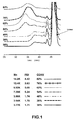
Figure 1 shows variation of molecular weight and its distribution with conversion during polymerization of mesogenic inimer; -
Figure 2 is a graph of the intrinsic viscosity vs mol. wt. of mesogenic polyacrylate with different architectures; -
Figure 3 is a graph of NMR spectrum of hyperbranched mesogenic polyacrylate before and after reduction; and -
Figure 4 is a graph of the contraction factor of different architecture or mesogenic polyacrylate. - The present invention is directed to the synthesis of Hyperbranched functional poly(meth)acrylates by self-condensing vinyl polymerization or SCVCP of the corresponding inimers, which are synthesized from 2-halo-3-hydroxypropionate and 2-halo-3-hydroxybutyrate derivatives. This invention synthesizes the first hyperbranched analogs of linear poly(meth)acrylates, including those of the conventional monomers such as methyl, using inimers, which produce a polymer with an ester group attached to every other carbon along the polymer backbone, with a non-functionalized alkyl ester attached as a free side chain.
- The present invention synthesizes the inimer from halohydrin (eg: bromohydrin), in higher yields by converting the amine group of serine or its derivatives into halogen by diazotization reaction in the presence of halogen-containing salts (eg: KBr). For the purpose of this application, an "inimer" is a molecule having a vinyl group and an initiating group which will initiate polymerization of the molecule. This step was followed by esterification of the alcohol of the desired functional group required in the polymer. This hydroxy group containing ester was further esterified with acryloyl chloride or acrylic anhydride using triethylamine as a reagent. In the case of bromohydrin-based esters, acrylic anhydride was used for the esterification to avoid any halogen-exchange of the halogen group (Br to Cl), which occurred when acryloyl chloride was used in esterification and this was confirmed with electron ionization mass-spectroscopy and 13C-NMR spectroscopy. During the polymerization of the inimer by ATRP, decomposition of the inimer was confirmed by 1H-NMR and 13C-NMR spectroscopy and occurred when free ligand (not complexed with the copper catalyst) of the higher basicity such as N, N, N', N'-pentamethyldiethylenetriamine (PMDETA) was present in the reaction system. This was avoided by performing a catalyst-ligand complex first and subsequently adding the inimer into the reaction mixture. This decomposition also did not occur if a ligand of low basicity (2,2'-dipyridine) was used.
- The present invention synthesizes hyperbranched polymers using ATRP of the inimer by SCVP and by self-condensing vinyl copolymerization (SCVCP) (in which inimer and monomer are copolymerized together). Theoretical calculations of the different structural features of the architecture are available in the literature and we have obtained the qualitative information about the branching of hyperbranched architecture. Detailed analysis of the poly(methyl acrylate) by 1H, 13C and 1H - 13C HSQC NMR spectroscopy provided us information about branching. GPC, light scattering and solution viscosity molecular weight data further confirmed the existence of the hyperbranched structure. Poly(methyl acrylate) was synthesized, as was more complex molecular systems like poly(perfluoro acrylate) and poly(dodecyl acrylate).
- Detailed NMR analysis of the hyperbranched mesogenic polyacrylate by 1H, 13C, 1H-13C Heteronuclear Single Quantum Correlation (HSQC), 1H-13C Heteronuclear Multiple Bond Correlation (HMBC) & TOtal Correlation Spectroscopy (TOCSY) was performed to obtain the branch points in the hyperbranched mesogenic polyacrylate. Gel Permeation Chromatography (GPC) molecular weights relative to polystyrene standards and absolute molecular weights (by light scattering) and solution viscosity molecular weight data further confirmed the existence of the hyperbranched structure. Contraction factors (ratio of mean square radius of gyration of branched polymer to that of linear polymer) of different architectures (Three-arm, Six-arm, Comb and Hyperbranched) for mesogenic polyacrylates were obtained and compared. Detailed procedure for synthesis & studies of physical properties of Linear, Three-arm, Comb and Six-arm mesogenic polyacrylates are described in various research publications, such as ((i). Kasko, M. A.; Heintz, M. A.; Pugh, C. Macromolecules 1998, 31, 256-271, (ii) Chang, C.; Pugh, C. Macromolecules 2001, 34, 2027-2039, (iii) Kasko, M. A.; Pugh, C. Macromolecules 2004, 37, 4993-5001, and (iv) Kasko, M. A.; Pugh, .). Results supported the fact that the structure becomes more compact as the branching in the polymers is increased. Intrinsic viscosity of the hyperbranched polymer is also lower compared to its linear counterpart, and at a particular molecular weight, intrinsic viscosity decreases as branching increases (Linear>Three-arm>Comb/Six-arm>Hyperbranched). Isotropization temperature of hyperbranched mesogenic polyacrylate is also lower compared to its linear counterpart with broader phase transitions.
- Numerous dendrimers and hyperbranched polymers have been synthesized with the mesogens attached only at the periphery, or within the main-chain of the polymer but unlike our's mesogenic hyperbranched polyacrylates, none have been synthesized with the mesogen attached as a side chain throughout the branched structure. The present invention makes it possible to produce hyperbranched polymers having different ester substituents, which can be used in different applications having the benefit of both the architecture and the free ester group present in the polymer. Mesogenic polyacrylate was synthesized for liquid crystalline applications where lower viscosity of the hyperbranched polymer potentially and advantageously can be used in the liquid crystalline display devices. Alkyl and perfluoro ester group containing polyacrylates could potentially be used in the adhesive and coating applications. Siloxane and oligo-oxyethylene ester substituents containing hyperbranched polyacrylates could be used in contact lenses and water based adhesives/cosmetics, respectively. Hyperbranched polyacrylic acid and its different salts could also be prepared for superabsorbent materials and polyelectrolytes. The flexibility of attaching any kind of free ester side group in the inimers and hence in the hyperbranched polyacrylates broadens the area of application of these hyperbranched polyacrylates.
- The present invention is directed to a process to synthesize hyperbranched functional poly(meth)acrylates by SCVP and SCVCP of the corresponding inimers, which are synthesized from halohydrins and their derivatives. The invention synthesizes the first hyperbranched analogs of linear poly(meth)acrylates, including those of the conventional monomers such as methyl, mesogenic and dodecyl using 2nd type of inimers shown in Scheme 3, which produce a polymer with an ester group attached to every other carbon along the polymer backbone, with a non-functionalized alkyl ester attached as a free side chain unlike those synthesized to date by SCVP, which incorporate alkyl ester into the polymer backbone upon branching (Scheme 3), and leave an alkyl ester side chain functionalized with an initiator fragment at incomplete branching. The halogen group could be reduced to obtain a polymer without any initiator containing side chains in the polymer.

- This new type of inimer will give hyperbranched polymers that are true analogs of the linear polyacrylates. As shown in Scheme 4 (examples), the key intermediate for the inimer is a halohydrin (bromohydrin/chlorohydrin). These inimers are prepared from the esterification of the ester of halohydrins.


- As an example, 2-chloro-3-hydroxypropionic acid (chlorohydrin) was synthesized from acidic aqueous solution (HCl) of (DL)-2-amino-3-hydroxy-propionic acid (DL-serine) (R = H) in the presence of KCl with yield ∼60%.
- This reaction is important to introduce initiating group in the final inimer, which will act as initiating group during polymerization.
- This step was followed by esterification of the alcohol of the desired functional group required in the polymer. This step requires an acid-catalyzed esterification method that can be done in the presence of the solvent or in the bulk. The alcohol (ROH) can be used in slight excess, in equimolar amount or in large excess to produce the ester in moderate to higher yields (Scheme 5). As an example: 2-chloro-3-hydroxypropionic acid was reacted with a large excess of methanol in the presence of a catalytic amount of HCl at moderate temperatures to produce methyl-2-chloro-3-hydroxypropionate. Moderate temperature was used to avoid any formation of the side product which can be resulting from the self esterification of the 2-chloro-3-hydroxypropionic acid.

- This step incorporates a functional group in the final inimer and this functional group acts as a free ester pendant group in the polymer.
- The hydroxy group obtained in the last step was further esterified with acryloyl chloride or acrylic anhydride using triethylamine as a reagent to get the inimer (Scheme 4). This step incorporates vinylic group in the inimer which acts as a monomeric site in the polymerization.
- In case of bromohydrin-based esters, acrylic anhydride was used for the esterification to avoid any halogen-exchange of the bromine group, which occurred when acryloyl chloride was used in esterification as confirmed with electron-ionization mass spectroscopy and 13C-NMR spectroscopy. When acryloyl chloride was used, a mixture of inimers having Br and Cl initiating groups was obtained.
- A side product as impurity was obtained during the synthesis of the inimer having Cl as initiating group (but not with Br as initiating group). The yield of the product varied with the type of the functional group present in the precursor ester.
- These synthesized inimers having vinylic monomeric site and initiating site both in the same molecule, which upon polymerization produce hyperbranched polymer containing branches upon branches (Scheme 7 for an example). This inimer can be polymerized or copolymerized with the monomer to obtain hyperbranched polymers.
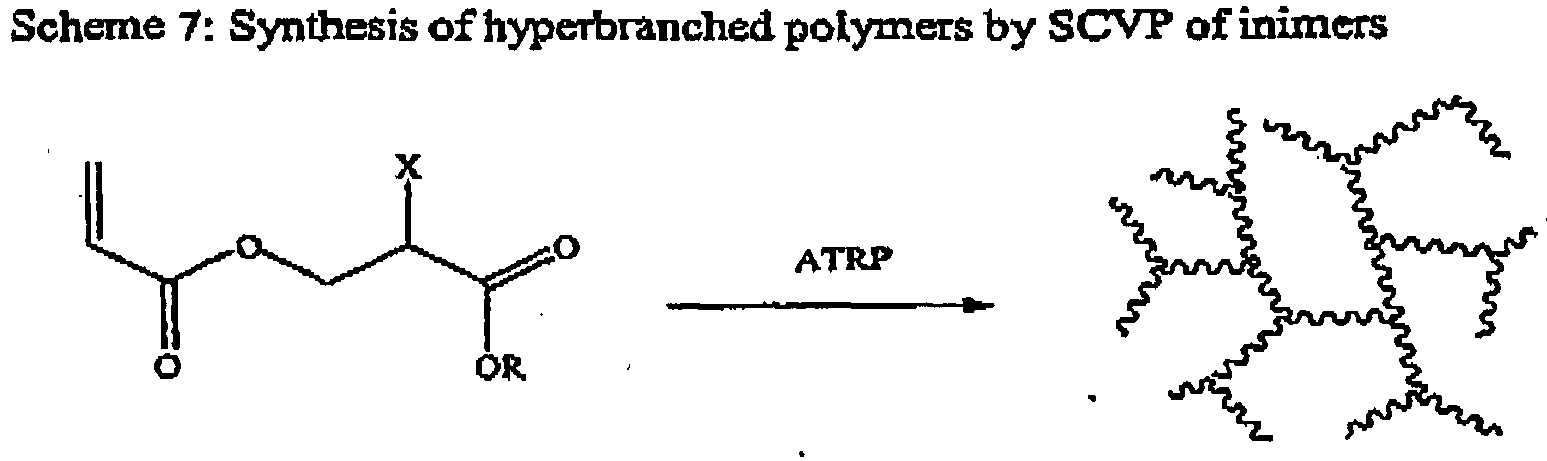
- We have used ATRP to obtain these polymers as these provide better control and living nature of the polymerization can be maintained. By this technique we are able to make hypcrbranched polyacrylates that have many halogenated chain end groups and functional groups attached as pendant groups. The halogenated chain end groups can be modified to other groups and advantageously used for different applications, A skilled worker or an expert can synthesize an inimer with a functional group suitable for other living polymerization.
- An ideal dendrimer contains only fully branched repeating units without any linearly repeating units, and an ideal linear polymer contains only linear repeating units, without any branches; in contrast a hyperbranched polymer contains a mixture of linear and fully branched repeat units. The degree of branching (DB), which is defined as the number of branched units relative to the total number of the units (includes linear, branched and terminal units). For an ideal dendrimer this value is 1 and for linear polymer it is 0. For a hyperbranched polymer it is greater than zero and less than 1, with typical values being from about 0.25 to 0.45. (
US Patent No. 6,812,298 B2 ) . - Unlike ideal dendrimers, which have a polydispersity of -1, hyperbranchcd polymers have a polydispersity that increases as conversion increases. The polydispersities can become more than 1.1 even at low conversions and can drastically increase with increasing conversion. As the different hyperbranched polymer molecules can combine to give higher Molecular weight polymer, the value of polydispersity can increase exponentially as conversion increases. So, for higher conversion the typical value of polydispersity can exceeds 2.0 even when controlled radical polymerization is used. Various authors have compiled data showing various polydispersity values of the hyperbranched polymer synthesized. These differences between the polydispersities and degree of branching of hyperbranched polymers versus dendrimers are indicative of the higher non-ideality. randomness and irregularity of hyperbranched polymers compared to dendrimers. Table 1 shows the results for the different functional hyperbranched polyacrylate, which further confirms the formation of hyperbranched architecture. A variety of inimers containing different ester substituents were synthesized including methyl, perfluoro, dodecyl, oligo-oxyethylene and siloxane containing ester substituents.
Table 1: Molecular weight data for different hyperbranched polyacrylates (°Cl). Sample bYield GPCPSt GPCLS Solution Viscosity Mw Pdi Mw Pdi Mw Pdi cmethyl 40% 1.76x10⁴ 1.52 21.2x10⁴ 1.97 21.1x10⁴ 2.19 dMesogenic 66% 3.26x10⁴ 1.90 11.6x10⁴ 2.49 11.1x10⁴ 2.75 eDodecyl 30% 2.07x10⁴ 2.13 2.03x10⁴ 1.80 2.07x10⁴ 2.40 fPerfluoxo 22% 11.9x10⁴ 2.39 23.9x10⁴ 1.93 NA a Initiating group in the inimer.
b Gravimetrical yield after several precipitations.
c Inimer/Cu(I)Cl/Me6TREN (50/1/1) in water (inimer/ water 50:50 w/v) at 50°C for 44 h, 53%
conversion by 1H-NMR.
d Inimer/Cu(I)Cl/Me6TREN (30/1/1.2) in a mixed solvent water/acetonitrile (16.6% of watar)
(inimer/solvent 30:70 w/v) at 90°C for 120 h, ∼80% conversion by 1H-NMR.
e Inimer/Cu(I)Br/PMDETA (50/1/1.2) in anisole (inimer/anisole 50:50 w/v) at 130°C for 18 h,
60% conversion by 1H-NMR.
fInimer/Cu(I)Cl/2,2'-bipyridine (43/1/1.5) in toluene (inimer/toluene 50:50 w/v) at 90°C for 6 h, 36% conversions by 1H-NMR(only in CDCl3). GPCPSL & GPCLS experiments were carried out in Trichlorobenzene (TCB) as a solvent. - SEC traces clearly showed formation of oligomers and as conversion increased molecular weight increased with broader distribution. At the early stage of conversion, smaller oligomers were prominent and higher molecular weight polymers were obtained at higher conversion. The statistical nature of inimer polymerization results in formation of oligomers and growth of polymer chain occurs by its addition to an inimer or oligomers resulting polymers with broader polydispersity index. Results obtained by SEC are consistent with statistical nature of inimer polymerization by SCVP technique.
- To get the reactivity ratio and degree of branching values for the inimer polymerization, qualitative and quantitative analysis by NMR is required. 1H & 13C NMR spectra of these hyperbranched polymers are very similar to corresponding NMR spectra of inimers and linear polymers. Several overlapped resonances limit the possibility of separate resonances for branched structure. More distinct and less overlapped resonances were obtained after reduction of -Cl end groups into -H is the mesogenic hyperbranched polymer. HSQC, HMBC and TOCSY experiments were performed for the qualitative analysis of the hyperbranched structure. Quantitative analysis is possible but difficult assuming errors in the calculated values of reactivity ratio and degree of branching.
-
Figure 3 shows 1H-NMR before reduction and after reduction of the -Cl end groups into -H groups. The backbone region of the polymer (1-3 ppm) is very broad, indistinct and overlapped. When reduced, some more peaks appeared and they are comparatively less overlapped. The resonance at ~2.8 ppm is assigned for methylene protons alpha to -OCH2. Adjacent to this resonance at ∼2.7 ppm is methine proton alpha to -CH2. This resonance was broad and overlapped in the original polymer. 13C NMR of original and reduced polymer are also shown, noticeable changes in the carobonyl region, 165-180 ppm and in the backbone region 30-35 ppm were observed. Detailed analysis by HSQC, HMBC and TOCSY enable us to assign the resonances of different carbons and protons present in the hyperbranched polymer. TOCSY clearly showed that -OCH2 protons are related to -CH proton and these are further related to -CH2 of the backbone. This relationship is due to branching present in the hyperbranched polymer as initiating site has reacted to another vinylic site and produces branching in the polymer. The resonance at ∼2.7 ppm is still overlapped but can be used for quantitative analysis of inimer polymerization as it is direct evidence of branching, though with errors associated with curve fitting of this peak. 1H NMR analysis shows the meth-mesogenic polyacrylate has a broad resonance at ∼2.5 ppm appears only due to methine protons alpha to -OCH2 and that is coming from branch points. The presence of branching can also be related to the GPC traces obtained at various conversions during the polymerization. The broad molecular weight distribution with different oligomers,Figure 1 is an outcome of statistical nature of polymerization of the inimer. The contraction factor and intrinsic viscosity (Figure 2 andFigure 4 ) data also supported the formation of branched structures during polymerization of the inimer. - As mentioned above inimer can be hompolymerized using SCVP or can be copolymerized with its corresponding monomer resulting in hyperbranched polymers. Since there are two polymerizing growth sites (vinylic and initiating) and the activities of these sites may differ, the degree of branching (DB) will have different values for the different systems and/or under different conditions below a theoretical maximum value (
DB = 0.465) (Müller et. al). - For our hyperbranched polymers, we have used modified mathematical definition given by Müller et. al. in which the degree of branching is expressed mathematically according to eq. 1.

- Detailed theoretical investigations have been done by Müller et. al. and to define and obtain values of the structural parameters some assumptions are made such as: the reactivity of the initiating site and vinylic sites are constant throughout the polymerization. There is no cyclic polymer formation. No other side reaction occurs. While comparing theoretical and experimental values of the different parameters, deviation from the predicted values is expected.
- As discussed earlier, hyperbranched polymers obtained by this method generally have broad molecular weight distributions and any side reaction may lead to cross-linking. Optimization of the synthetic conditions for obtaining soluble polymer is required and these conditions may vary for different inimers. Living polymerizations like atom transfer radical polymerization and group transfer polymerization (GTP) are employed to get more control on the architecture of these polymers. ATRP was used to synthesize hyperbranched polyacrylates.
- SCVP of inimer can be designated as AB* in which B* is a group capable of initiating the polymerization of vinyl groups, A. The chain initiation is the addition of an initiating B* group to the vinyl group of another monomer forming a dimer with two active sites and one double bond. Both the initiating center, B*, and the newly created propagating center, A* can, react with the vinyl group of another molecule (monomer or polymer) in the same way with rate constants, kb and ka, respectively.
- Example:

- In SCVP reactivities of initiating and propagating centers, A* and B*, are generally different from each other. If the reactivity of one of these two sites is very large compared to other site a linear polymer is obtained. A reactivity ratio r (r = ka/kb) is defined, which is a mathematical representation of the relative reactivities of these sites (A* and B*) and degree of branching (DB) in a polymerizing system (inimer and polymer both together) is defined as (Müller et. al):

in which, -
DB is average degree of branching - B is fraction of branch points
- M is fraction of monomer
- A' is fraction of vinyl group for polymer only.
- x is conversion of A groups (vinylic group)
- B* is fraction of initiating centers (reactive B groups)
- During the polymerization by ATRP, decomposition of the inimer, which was confirmed by 1H-NMR and 13C-NMR spectroscopy, occurred when free ligand (not complexed with the copper catalyst) of the higher basicity (PMDETA) was present in the reaction system. This was avoided by performing catalyst-ligand complex and subsequently adding inimer into the reaction mixture. This decomposition also did not occur if a less basic ligand (2,2'-bipyridine) was used. Example: When (2-chloro-2-methoxycarbonyl) ethyl propenoate (0.016 g, 0.820 mmol) was taken with PMDETA (1.70 µL, 0.008 mmol) in a vial and 1H-NMR was taken after 2.5 h and after 48 h. Extra resonances in 1H-NMR spectrum were obtained which indicated occurrence of some reaction of the inimer with the PMDETA. When Cu(I)Cl and PMDETA were allowed to complex first and kept with inimer, no changes in the spectrum were observed even after 48 h.
- This decomposition of the inimer in the presence of the free ligand in the polymerization mixture did not occur when 2,2'- bipyridine was used in place of PMDETA (2,2'-bipyridine has lower basicity than PMDETA).
- ATRP of inimers having Cl as initiating group are slower when Cu(I)Cl is used as an ATRP catalyst. It is not easy to generate sufficient number of radicals and to obtain significant amount of polymer until we used Me6TREN as ligand which is more efficient ligand than PMDETA or 2,2'-bipyridine. There are several possibilities available to change the reaction conditions and the catalyst/ligand system in different solvents. Different polymerization conditions have been used for the different inimers. Soluble polymer from methyl-inimer (2-chloro-2-methoxycarbonyl)ethyl propenoate can be synthesized using Cu(I)Cl/Me6TREN in water at 50°C in hour time scale, but when methyl-inimer with Br initiating group (2-bromo-2-methoxycarbonyl) ethyl propenoate was polymerized using Cu(I)Br/Me6TREN in water at 50°C, within 10 min, mainly cross-linked polymer was obtained with some soluble in THF. When mesogenic inimer with Cl initiating group was polymerized using Cu(I)Br/PMDETA, significant amount of the polymer was obtained compared to the polymer that was obtained using Cu(I)Cl/PMDETA for the same reaction time. For the different inimers, polymerization conditions were optimized to avoid cross-linking and to synthesize soluble polymer in significant quantity. Not all conditions produced polymers with significant amounts of polymer. The different polymerizing conditions will give polymers with structural variations and these conditions can be changed according to the requirements.
- In general, branched polymers are more compact in nature compared to the linear polymers. Contraction factor, g, which is the ratio of mean square radius of gyration of branched polymer to mean square radius of gyration of linear polymer, when extrapolated to a higher molecular weight for the different architectures provide us an idea of compactness.
Figure 2 shows that contraction factors for different architectures and also support the fact that as branching is increasing, g, is decreasing. - It has been reported that hyperbranched polymers in general have lower melt or intrinsic viscosity compared to linear polymers and increasing branching in the polymer decrease the melt and intrinsic viscosity at a particular molecular weight. We have performed comparative studies on molecular weight dependent intrinsic viscosity of mesogenic polyacrylate of different architectures (linear, three-arm, six-arm, comb and hyperbranched).
Figure 4 shows that at a particular molecular weight intrinsic viscosity of the hyperbranched mesogenic polyacrylate is lower than linear mesogenic polyacrylate. It also indicates that more branched polymer have comparatively lower intrinsic viscosity than linear polymer. We have observed that at particular molecular weight intrinsic viscosity of different architectures follow a trend: Linear>Three-arm>Comb>Six-arm>Hyperbranched. - This behavior is consistent with the fact that increasing branching cause reduction in intrinsic viscosity of the polymer. This property can be utilized in many applications having processing advantages over linear polymer.
- Since the polymerization of inimer could be done at different conditions resulting polymers of different degree of branching, the K and a values (from Mark-Hauwink-Sakurda equation, η = KMw a) differ. As an example: hyperbranched polymer synthesized at 120°C in anisole as a solvent after 120 h using CuBr/PMDETA, has K = 3.365X10⁻³ and a = 0.31, while hyperbranched polymer synthesized at 90°C in acetonitrile/water using CuBr/Me6TREN, has K = 5.572x10⁻³ and a = 0.28. The linear mesogenic polyacrylate has K = 3.273x10⁻⁴ and a = 0.59.
- As discussed earlier, mesogenic hyperbranched polyacrylate is novel since the mesogen is attached as a side chain throughout the branched structure, unlike numerous dendrimers and hyperbranched polymers with the mesogens attached only at the periphery or within the main-chain of the polymer. The mesogen containing hyperbranched polyacrylate exhibited liquid crystalline behavior. For example: a soluble mesogenic polymer with DPn~20 (Mn = 1.30x10⁴) and pdi =1.56 (both values by GPC) was obtained using the ratio of 20/1/1 Inimer/Cu(I)Br/ PMDETA for 10 h at 120°C. This polymer showed liquid crystallinity with isotropization transition at 99°C in addition to a glass transition at 11°C. These transitions are at lower temperatures than those of other architectures of comparable molecular weight, and the isotropization transition was relatively broad (14°C). The polymer formed a smectic C and a Smectic A (SA) mesophases like other architectures. Thus, it is possible to make a hyperbranched liquid crystalline polymer with a mesogen attached as a free ester group in all the branches of the hyperbranched polymer. The liquid crystallinity of the hyperbranched polymer can be combined with the lower viscosity of the hyperbranched polymer and can be investigated for its use in display devices. These polymers can potentially be used alone or in combination with the lower molecular weight liquid crystals (eg: blend) in the display devices.
- As noted earlier, these hyperbranched polymers can also be synthesized by copolymerizing inimers with the corresponding monomers, which may be more economical, especially in the case of costly synthesis of a large quantity of inimers. We have successfully made hyperbranched polymer by using SCVCP and ATRP. An example: mesogenic inimer [2-chloro-2-{11-(4'-cyanophenyl-4"-phenoxy)undecan-1-oxycarbonyl}] ethyl propenoate was copolymerized with 11-[(4'-cyanophenyl-4"-phenoxy)undecyl]acrylate in anisole at 130°C for 20 h to generate soluble polymer with Mn = 1.03x10⁴, pdi = 1.22 (both values by GPC) using 20:1:1.2:1 Monomer/Inimer/Cu(I)Cl/PMDETA.
- A wide variety of hyperbranched polyacrylates with different ester substituents could be polymerized by SCVP of corresponding inimers or by SCVCP with monomers. Examples: Hyperbranched poly (dodecyl acrylate) was synthesized, which might have potential applications in colloids and surface-coatings where surface of longer alkyl chains is required with lower viscosity of the polymer. Hyperbranched poly (perfluoro acrylate) are potential candidates in the field of coatings. Hyperbranched poly (acrylic acid) was synthesized by SCVCP of methyl inimer (Br) and t-butyl acrylate, which was further deprotected using formic acid to obtain carboxylic acid groups in the polymer. This hyperbranched poly (acrylic acid) can be used as a superabsorbent polymer, e.g. in diapers.
- The processing conditions can be varied depending upon the starting materials and inimers employed. For example, (meth)acrylic acid, (meth)acryloyl chloride, or (meth)acrylic anhydride can be added as further reactants, a nucleophile/base, such as triethylamine or pyridine can optionally added, and a solvent such as tetrahydrofuran (THF) or dichloromethane can be employed. The reaction will be conducted at a temperature range of about 0°C to ambient temperature or higher, such 50 °C.
- Depending upon the requirements, inimers with different ester substituents can be produced. The hyperbranched polymers resulting from these inimers having different ester groups attached as pendant groups of the polyacrylates can be used in different applications. These polymers would have lower viscosity and shear thinning behavior, which would ease their processing. Since they have a large number of end groups, which can be directly used for better interactions with the other substrates or can be modified and used. Incorporation of the different functional groups in the polymer obtained can be potentially used in wide variety of the applications from additives, surface coatings, drug delivery materials to high-tech liquid crystalline display devices. Hyperbranched polyacrylate with oligo-oxyethylene/oligo (ethylene glycol) side chains can be used in water based adhesives, in cosmetics as viscosity modifiers and in polymer electrolytes or ion-conducting polymers. Hyperbranched polyacylic acid and its salts can also be used in superabsorbent materials and in polyelectrolytes. Siloxane containing hyperbranched polyacrylates could be a potential competitor in materials for contact lenses because of higher oxygen permeability. They can also be used in hydrogels as halogen end groups in the hyperbranched polymers can be used for cross-linking sites. The halogen end groups can also be reduced to hydrogen for other applications, such as those requiring more stability. Siloxane containing inimers can also be copolymerized with hydroxy ethyl methacrylate to get the optimum oxygen permeability and water absorption. These hyperbranched polymers can also be used in fabrication of organic-inorganic hybrids and nanomaterials. Patterning of polymer films at micron or submicron level can be achieved because of functional end groups present in the hyperbranched polymer. Moities with interesting optical, biological, mechanical and electrochemical properties can be incorporated into the hyperbranched polymer films. Because of the low viscosity and abundant functional end groups, these polymers can be used in coatings, adhesives, viscosity modifiers and in packaging. Since, various desired ester group can be incorporated within the inimer, a wide variety of polyacrylates for different applications can be used.
- Materials. DL-Serine (Acros Organics, 99%), potassium bromide (Sigma-Aldrich, 99%), potassium carbonate (Riedel-De Haen, 99%), hydrogen bromide (Sigma-Aldrich, 48% aqueous solution), hydrogen chloride (EMD, GR ACS, 12M), sodium nitrite (Sigma-Aldrich, 99.5%), 11-bromo-1-undecanol (Alfa-Aeaser, 97%), 4-cyano-4'-hydroxy biphenyl (TCI, 95%), N, N, N', N'-pentamethyldiethylenetriamine (PMDETA) (Aldrich, 99%), 2,2'-dipyridyl (Lancaster Synthesis), tris(2-aminoethyl)amine (TREN) (Strem Chemicals, 97%), anisole (Aldrich, anhydrous, 99.7%), potassium hydroxide (Fisher Chemicals, certified ACS), 1H,1H,2H,2H-perfluoro-1-decanol (SynQuest), 1-dodecanol (Alfa Aesar, 98%) were used as received. Triethylamine (EM science, 98%) was stirred over KOH and distilled under N2 at 80°C -85°C and stored over KOH. Acryloyl chloride (Aldrich, 96%) was distilled at 70°C -75°C and refrigerated. Benzene (Fisher Chemicals. Certified ACS) was washed with concentrated H2SO4 and vacuum distilled over CaH2 and stored over 4A° molecular sieves. Cuprous (I) chloride was purified by stirring it with glacial acetic acid overnight followed by washing several times with ethanol. Reagent grade tetrahydrofuran (THF) was dried by distillation from purple sodium benzophenone ketyl under N2. All other reagents and solvents are commercially available and used as received.
- Techniques. All reactions were performed under a N2 atmosphere using a Schlenk line unless noted otherwise. Elemental analyses were performed on a PE 2400 Series II CHNS/O Analyzer. 1H and 13C NMR spectra (δ, ppm) were recorded on either a Varian Mercury 300 (300 MHz and 75 MHz, respectively), an INOVA 400 (400 MHz and 100 MHz, respectively) or an INOVA 750 (750 MHz and 188 MHz, respectively) spectrometer. All spectra were recorded in CDCl3 or a mixture of CDCl3 and DMSO-d6, and the resonances were measured relative to residual solvent resonances and referenced to tetramethylsilane. Number- (M n) and weight average (M w) molecular weights relative to linear polystyrene (GPCPSt) and polydisperisties (pdi = M w/M n) were determined by gel permeation chromatography (GPC) from calibration curves of log M n vs. elution volume at 35 °C using THF as solvent (1.0 mL/min), a set of 50 Å, 100 Å, 500 Å, 104 Å and linear (50-104 Å) Styragel 5 µm columns (note: 1Å = 10 nm), a Waters 486 tunable UV/Vis detector set at 254 nm, a Waters 410 differential refractometer, and Millenium Empower 2 software. Absolute molecular weights were determined by GPC with a light scattering detector (GPCLS) at 35 °C using THF as solvent (1.0 mL/min), a set of 100 Å and two linear (50.104 Å, 103-106 Å; 1 Å = 10 nm) Styragel 5 µm columns, and a Wyatt Technology DAWN-EOS 18-angle (20° - 153°) light scattering detector equipped with a Ga-As laser (690 nm, 30 mW), with the concentration at each elution volume determined using a Optilab 903 differential reftactomoter (690 nm). The molecular weight data were calculated using Astra 4.73.04 software (Wyatt Technology). The refractive index (RI) increments (dn/dc = 0.120 mL/g in CH2Cl2) were measured online at room temperature at 690 nm by Optilab 903 and used to determine the mass concentrations at each elution volume and the physical constant K* for the light scattering measurements. All samples (approximately 0.5 g/L) were dissolved overnight and filtered though a 0.45 µm PTFE filter. Molecular weights were also determine by GPC-RI-viscometry-right angle laser light scattering (GPCtriple) from universal calibration curves using GPCLS system combined with a Viscotek 100 differential viscometer and OmniSEC 4.3.1.246 software from Viscotek.
- Molecular weight from solution viscosity measurements were obtained from universal calibration curves with application of online viscosity detector and online light scattering detector at 90°. The calculation was done using OmniSEC 4.0 software from Viscotek and chromatographic set-up used was same as for light scattering experiment.
- A Perkin-Elmer Pyris 1 differential scanning calorimeter was used to determine the thermal transitions, which were read as the maximum or minimum of the endothermic and exothermic peaks, respectively. Glass transition temperature was read as the middle of the change in heat capacity. All heating and cooling rates were 10°C/min. Transition temperatures were calibrated using indium and benzophenone standards, and enthalpy changes were calibrated using indium. All samples were dried in the vacuum chamber before performing DSC experiments.
- Synthesis of 2-Bromo-3-hydroxypropionic acid. 2-Bromo-3-hydroxypropionic acid was synthesized in 50-63% yield as in the following example. Sodium nitrite (12 g, 0.17 mol) was added in portions over 270 min to a solution of D, L-serine (10 g, 0.10 mol), HBr (26 mL, 48% aq. w/w, 0.23 mol) and potassium bromide (40 g, 0.33 mol) in water (88 mL) at -10 to 0 °C. After stirring at room temperature for 16 h, the light-greenish solution was saturated with NaCl and extracted five times with ethyl acetate (50 mL each). The combined organic extracts were washed five times with saturated aqueous NaCl (50 mL each) and dried over Na2SO4. After filtration and removing the solvent by trap-to-trap distillation, the residue was recrystallized from CH2Cl2 to obtain 10 g (63%) of 2-bromo-3-hydroxypropionic acid as a white solid. 1H NMR (CDCl3/DMSO-d6): 2.01 (broad.s, OH), 3.77 (m, CH 2OH), 4.10 (t, CHBr), 7.20 (broad s, COOH). 13C NMR (CDCl3/DMSO-d6): 45.6 (CBr), 64.0 (COH), 171.0 (C=O). Anal. C, H: calcd. 21.32, 2.98; found 20.95, 2.90.
- Synthesis of 2-chloro-3-hydroxypropionic acid. In a 3-necked 1000 mL RB flask, sodium nitrite (68.4 g, 0.99 mol) was added in small batches to the aqueous solution of a mixture of DL-serine (52.4 g, 0.50 mol), potassium chloride (130.4 g, 1.75 mol) and HCl (116.0 g of 36.5%-38% w/v aq. sol., 1.21 mol) (taken together in 490 mL of water) at 0°C-10°C. After complete addition, reaction mixture brought to room temperature and kept overnight for the reaction. Solution turned from clear and off-white to clear and light green. The product was salted out with NaCl and extracted with 5 times of 100 mL of ethyl acetate. Organic phase was washed 5 times with saturated NaCl aqueous solution (50 mL each) and then dried over anhy. Na2SO4. Solution was filtered and solvent was evaporated by trap-to-trap distillation method followed by drying in the vacuum chamber. Product was recrystallized in CH2Cl2. Yield - 36.5 g (58%). 1H NMR (CDCl3/DMSO-d6): 2.01 (br s, OH), 3.98 (m, CH 2OH), 4.42 (t, CHCl), 7.20 (br s, COOH). 13C NMR (CDCl3/DMSO-d6): 57.8 (CClI), 64.3 (COH), 170.4 (C=O). Anal. C, H: calcd 28.94, 4.04; found 28.60, 3.80.
- Synthesis of Methyl 2-Bromo-3-hydroxypropionate. Methyl 2-Bromo-3-hydroxypropionate was synthesized in 68-87% yield as in the following example. A solution of 2-bromo-3-hydroxypropionic acid (6.0 g, 35.mmol) and a catalytic amount ofHBr (0.2mL, 48% aq. w/w) in methanol (50 mL, 1.2 mol) was heated at 65 °C for 21 h. Excess methanol was then removed by rotary evaporation. CH2Cl2 (100 mL) was added to the brownish liquid residue and the resulting solution was washed twice with dilute aq. NaHCO3 (50 mL) and once with 50 mL of satd. NaCl aq. soln, and then dried over Na2SO4. After filtration and removing the solvent by rotary evaporation methyl 2-bromo-3-hydroxypropionate was obtained as a light yellow liquid. Product (5.7 g, 87%) as a clear liquid was obtained by purification by silica gel chromatography using CH2Cl2/ethyl ether (90/10) with Rf = 0.31. 1H NMR (CDCl3): 2.70 (br s, OH), 3.81 (CH 3), 4.00 (m, CH 2OH), 4.35 (t, CHBr). 13C NMR (CDCl3): 44.2 (CBr), 53.5 (CH3), 63.8 (CH2OH), 169.7 (CO2CH3). AnaL C, H: calcd. 26.23, 3.86; found 25.83, 4.10.
- Synthesis of methyl 2-chloro-3-hydroxypropionate. Methyl 2-Chloro-3-hydroxypropionate was synthesized in 68-88% yield using a procedure as in the following example. In a 250 mL RB flask with a condenser, 2-chloro-3-hydroxypropionic acid (20.0 g, 0.16 mol) and methanol (200 mL, 5.00 mol) (was dried over 40 nm (4Å) molecular sieves) and a catalytic amount of hydrochloric acid were mixed and heated up to 65°C for 22 h. Unreacted excess methanol was removed by rotary evaporation. A brownish liquid was obtained and was added with 100 mL of CH2Cl2 and washed twice with dil. NaHCO3 aq. sol. (50 mL) and once with sat. aq. NaCl (50 mL) soln, and then dried over anhy. Na2SO4. Product as a clear liquid was purified by silica gel chromatography using chloroform/diethyl ether (90/10) with Rf = 0.51, yield = 17.0 g (76%). 1H NMR (CDCl3): 2.55 (br s, OH), 3.82 (CH 3), 3.99 (m, CH 2OH), 4.41 (t, CHCl). 13C NMR (CDCl3): 53.4 (CH3), 57.0 (CCl), 64.2 (CH2OH), 169.0 (CO2CH3). Anal. C, H: calcd. 34.68, 5.09; found 34.33, 4.99.
- Synthesis of (3,3,4,4,5,5,6,6,7,7,8,8,9,9,10,10,10-heptadecafluoro-1-decyl)-2-chloro-3-hydroxypropionate. In a 50 mL RB with a condenser, 2-chloro-3-hydroxypropionic acid (6.0 g, 0.05 mol) and 3,3,4,4,5,5,6,6,7,7,8,8,9,9,10,10,10-heptadecafluoro-1-decanol (18.0 g, 0.04 mol) and a catalytic amount of hydrochloric acid were taken together and heated up to 65°C for 36 h. Product was dissolved in 300 mL of ethyl ether and washed twice with 100 mL of dil. NaHCO3 aq. sol. and once with 100 mL of sat. aq. NaCl sol. and then dried over anhy. Na2SO4. Solution was filtered, solvent was removed by rotary evaporation and unreacted alcohol was sublimed off at 70°C under vacuum. Yield = 15.0 g (67%). 1H-NMR (CDCl3, 7.27 ppm): 2.54 (m, -CH 2CF2), 3.05-3.35 (broad, -OH), 4.01 (m, -CH 2OH), 4.42 (m, -CHCl), 4.52 (m, -CO2 CH2CH2 ).
- Synthesis of 11-(4'-cyanophenyl-4"-phenoxy)undecanol. In a 3-necked (500 mL) RB flask a mixture of 4-cyano-4'-hydroxybiphenyl (10.0 g, 0.05 mol) and K2CO3 (8.5 g, 0.06 mol) were dissolved in ethanol/water (128 mL/32 mL, 80%/20% (v/v)). A solution of 11-bromo-1-undecanol (14.2 g, 0.06 mol) in ethanol (100 mL) was added dropwise to it using a pressure equalizer at room temperature. After complete addition, solution was brought to an oil bath set at 60°C. After 23 h the solution was poured into 500 mL of ice-chilled distilled water and stirred for 1.5 h. The product was filtered out using a frit and recrystallized twice in ethanol (300 mL). Final yield = 8.92 g (47%). 1H-NMR (CDCl3, 7.27 ppm): 1.31 (m, (CH 2)6), 1.48 (m, -CH 2CH2CH2OAr), 1.59 (m, -CH 2CH2OH), 1.82 (m, -CH 2CH2OAr), 3.65 (t, -CH 2OH), 4.02 (t, -CH 2OAr), 7.00 (d, 2 aromatic H ortho to -OCH2), 7.53 (d, 2 aromatic H meta to - OCH2), 7.67 (m, 4 aromatic H ortho and meta to -CN).
- Synthesis of {11-(4'-cyanophenyl-4"-phenoxy)undecyl} 2-chloro-3-hydroxypropionate. In a 50 mL RB flask, 2-chloro-3-hydroxypropionic acid (2.1 g, 0.02 mol) and 11-(4'-cyanophenyl-4"-phenoxy)undecanol (5.2 g, 0.01 mol) and a catalytic amount of hydrochloric acid were stirred and heated up to 65°C for 42 h. 1H-NMR showed 20% unreacted alcohol. Product was purified by silica gel column chromatography using ether/chloroform (30/70 v/v) with Rf = 0.77 for the product. After removing the solvent by rotary evaporation and drying in the vacuum oven, final yield = 3.35 g (56%). 1H-NMR: 1.31 (m, (CH 2)6), 1.48 (m, - CH 2CH2CH2OAr), 1.69 (m, -CH 2CH2OCO), 1.82 (m, -CH 2CH2OAr), 2.40 (s, broad for - OH), 4.02 (m, -CH 2OH & -CH 2OAr), 4.21 (m, -CO2CH 2), 4.36 (s, -CHCl), 7.00 (d, 2 aromatic H ortho to -OCH2), 7.53 (d, 2 aromatic H meta to -OCH2), 7.67 (m, 4 aromatic H ortho and meta to -CN).
- Synthesis of dodecyl 2-chloro-3-hydroxypropionate. 2-chloro-3-hydroxypropionic acid (4.80 g, 0.03 mol), dodecanol (6.00 g, 0.03 mol) were taken with 5 mL dry benzene in a (50 mL) RB, with a dean-stark apparatus and condenser; 25 mg (0.26 mmol) para-Toluene sulfonic acid (pTSA) was added to it and the mixture was stirred at 75°C-80°C for 40 h. 1H-NMR showed 85% conversion. More 2-chloro-3-hydroxypropionic acid (1.00 g, 8.00 mmol) was added to it and heated at 75°C-80°C for 20 h. 1H-NMR showed almost complete conversion. After cooling it down, the product was added with 100 mL of CH2Cl2. Organic phase was washed twice with 50 mL of dil. NaHCO3 aq. sol. and once with 50 mL of sat. NaCl aq. sol. and then dried over anhy. Na2SO4. After filtration and removing the solvent by rotary evaporation, yield = 7.76 g (78%). It was used for the next reaction without further purification. 1H-NMR (CDCl3, 7.27 ppm): 2.18-2.40 (broad, -OH), 3.97 (m, -CH 2OH), 4.21 (m, -CO2CH 2), 4.39 (m, -CHCl).
- Synthesis of Acrylic Anhydride. Acrylic anhydride was synthesized in 70-80% yield as in the following example. Acryloyl chloride (2.7 g, 30 mmol) was added dropwise over 5 min to an ice-cooled solution of acrylic acid (2.0 g, 30 mmol) and triethylamine (2.8 g, 30 mmol) in THF (50 mL), and the solution was stirred at room temperature for 16 h. The NH4 +Cl- precipitate was collected in a fritted glass filter, and the solvent was then removed from the filtrate by rotary evaporation. The residue was dissolved in CH2Cl2 (25 mL), washed twice with dilute aq. NaHCO3 (50 mL each) and once with satd. NaCl aq. soln. (50 mL), and dried over anhy. Na2SO4. After filtration and removing the solvent by rotary evaporation, 2.8 g (80%) of acrylic anhydride was obtained as a light yellow liquid. It was used without further purification. 1H NMR (CDCl3, 77.23 ppm): 6.04 (m, =CH trans to CO2), 6.14 (m, =CH gem to CO2), 6.50 (d, =CH cis to CO2). 13C NMR (CDCl3/DMSO-d6): 127.4 (=CH), 134.7 (=CH2), 161.2 (C=O).
- Synthesis of (2-Bromo-2-methoxycarbonyl)ethyl propenoate. (2-Bromo-2-methoxycarbonyl)ethyl propenoate was synthesized in 55-68% (68%) yield as in the following example. A solution of acrylic anhydride (0.80 g, 6.3 mmol) in THF (5 mL) was added dropwise over 10 min to a solution of methyl 2-bromo-3-hydroxypropionate (0.50 g, 2.7 mmol) and triethylamine (0.55 g, 5.4 mmol) in THF (25 mL) at room temperature. After stirring at RT for 21 h, the solution was poured into ice-cooled water (25 mL) and stirred for 3 h. THF was removed by rotary evaporation and CH2Cl2 was added. After separating the two layers, the organic phase was washed twice with dil. aq. NaHCO3 (25 mL each) and once with satd. NaCl aq. soln. (25 mL), and dried over Na2SO4. After filtration and removing the solvent by rotary evaporation (2-bromo-2-methoxycarbonyl)ethyl propenoate was obtained as a yellow liquid. Pure product as a clear liquid (0.44 g, 68%) was obtained by vacuum distillation at full vacuum at 92-94°C. 1H NMR (CDCl3, 7.27 ppm): 3.83 (s, CH 3), 4.58 (m, CO2CH 2 & CHBr), 5.92 (dd, =CH trans to CO2), 6.14 (dd, =CHCO2), 6.43 (dd, =CH cis to CO2). 13C NMR (CDCl3, 77.23 ppm): 40.4 (CBr), 53.5 (CH3), 64.31 (CH2O2C), 127.6 (=CH), 132.4 (=CH2), 165.3 (CO2CH3), 168.3 (CO2CH2). Anal. C, H: calcd. 35.47, 3.83; found 35.24, 3.75.
- Synthesis of (2-Chloro-2-methoxycarbonyl)ethyl propenoate. (2-Chloro-2-methoxycarbonyl)ethyl propenoate was synthesized in 34-50% (34%) yield using the same procedure as above, except that methyl 2-chloro-3-hydroxypropionate was used instead of methyl 2-bromo-3-hydroxypropionate. Pure product as a clear liquid was obtained by vacuum distillation at full vacuum at 94-96°C. 1H NMR (CDCl3, 7.27 ppm): 3.79 (s, CH 3), 4.52 (m, CO2CH 2 & CHCl), 5.88 (dd, =CH trans to CO2 6.11 (dd, =CHCO2), 6.44 (dd, =CH cis to CO2). 13C NMR (CDCl3, 77.23 ppm): 53.5 (CH3), 53.7 (CCl), 64.6 (CH2O2 C), 127.6 (=CH2), 132.3 (=CH), 165.4 (CO2CH3), 167.9 (CO2CH2). Anal. C, H: calcd. 43.65, 4.71; found 43.48, 4.73,
- Synthesis of {2-chloro-2-(3,3,4,4,5,5,6,6,7,7,8,8,9,9,10,10,10-heptadecafluorodecan-1-oxycarbonyl)}ethyl propenoate. In a 3-necked RB flask (250 mL), a solution of triethylamine (1.80 g, 0.02 mol) in THF (5 mL) was added dropwise to the ice-cooled solution of (3,3,4,4,5,5,6,6,7,7,8,8,9,9,10,10,10-heptadecafluoro-1-decyl)-2-chloro-3-hydroxypropionate (5.00 g, 0.01 mol) and acryloyl chloride (1.54 g, 0.02 mol) in THF (80 mL). The solution was brought to ambient temperature for the further reaction. After 12 h, reaction was stopped by pouring solution into ice cooled water (100 mL) and was stirred overnight. Aqueous phase was added with CH2Cl2 (100 mL) and water phase was neutralized with addition of a small amount of NaHCO3. Product was extracted by washing water phase with 5 times of CH2Cl2 (50 mL). Combined organic phase was washed twice with 50 mL of dil. NaHCO3 aq. sol. and once with 50 mL of sat. NaCl aq. sol. and then dried over anhy. Na2SO4. Product was purified by a silica gel column chromatography using CHCl3 as an eluting solvent with Rf = 0.61-0.74. Yield = 2.37 g (43%). 1H-NMR (CDCl3, 7.27 ppm): 2.52 (m, -CH 2CF2), 4.55 (m, -CO2CH 2CH, -CHCl & -CO2CH 2CH2), 5.89 (dd, 1 olefinic H trans to -CO2), 6.12 (dd, 1 olefinic H gem to -CO2), 6.41 (dd, 1 olefinic H cis to -CO2)- 13C-NMR (CDCl3, 77.23 ppm): 30.5 (-CH2CF2), 53.4 (-CHCl), 58.4 (-OCH2CH2), 64.4 (-OCH2CHCl), 105.0-122.0 ((CF2)7 & -CF3),127.*5 (vinylic CH), 132.3 (vinylic CH2), 165.4 (-CO2CH2CHCl), 167.2 (-CO2CH2CH2). Anal. C, H: calcd. 30.76, 1.71; found 30.84, 1.55.
- Synthesis of [2-chloro-2-{11-(4'-cyanophenyl-4"-phenoxy)undecan-1-oxycarbonyl}] ethyl propenoate. In a 3 necked RB flask (50 mL), a solution of triethylamine (2.15 g, 0.02 mol) in THF (3 mL) was added dropwise to the ice-cooled solution of {11-(4'-cyanophenyl-4"-phenoxy)undecyl} 2-chloro-3-hydroxypropionate (3.20 g, 6.7 mmol) in THF (25 mL), which was followed by the dropwise addition of a solution of acryloyl chloride (1.88 g, 0.02 mol) in THF (3 mL). After 9 h, reaction was stopped by pouring solution into ice cooled water (50 mL) and was stirred overnight. Aqueous phase was added with chloroform (50 mL) and water phase was neutralized with addition of a small amount of NaHC03. Product was further extracted by washing water phase with 2 times of chloroform (50 mL). Organic phase was washed with dil. NaHCO3 aq. sol. and dried over anhy. Na2SO4. Solution was filtered and solvent was removed by rotary evaporation. Product was purified by silica gel chromatography using ether/chloroform (5%/95%) as an eluting solvent mixture, Rf = 0.70. After removing solvent, and drying, yield = 2.16 g (61%). Product was recrystallized in ethanol. After filtration and drying in the vacuum oven, yield = 1.36 g (38%)- 1H-NMR (CDCl3, 7.27 ppm): 1.31 (m, (CH 2)6), 1.48 (m, -CH 2CH2CH2OAr), 1.69 (m, -CH 2CH2OAr), 1.82 (m, -CH 2CH2OCO), 4.01 (t, -CH 2OAt), 4.20 (t, -CH2O2C), 4.54 (m, -CHCl & - CO2CH 2CHCl), 5.90 (dd, 1 olefinic H trans to -CO2) 6.15 (dd, 1 olefinic H gem to -CO2) 6.46 (dd, 1 olefinic H cis to -CO2) 6.99 (d, 2 aromatic H ortho to OCH2), 7.67 (m, 4 aromatic H ortho and meta to -CN), 7.53 (d, 2 aromatic H meta to OCH2). 13C-NMR (CDCl3, 77.23 ppm): 25.9-29.7 ((CH2)9), 53.9 (.CHCl), 64.7 (-OCH2(CH2)10), 66.8 (-OCH2CHCl), 68.4 (-CH2OAr), 110.2 (aromatic C adjacent to -CN), 115.3 (aromatic C ortho to O), 119.3 (-CN), 127.3 (aromatic C meta to CN), 127.6 (vinylic CH), 128.5 (aromatic C meta to O), 131.4 (aromatic C para to O), 132.3 (vinylic CH2), 132.8 (aromatic C ortho to -CN), 145.5 (aromatic C para to -CN), 160.0 (aromatic C adjacent to O), 165.4 (-CO2CH2CHCl), 167.4 (-CO2(CH2)11). Anal. C, H, N: calcd. 68.49, 6.90, 2.66; found 68.24, 6.88, 2.93.
- Synthesis of (2-chloro-2-dodecan-1-oxycarbonyl)ethyl propenoate. In a 3 necked 100 mL RB flask, a solution of acryloyl chloride (1.95 g, 21.5 mmol) in 5 mL THF was added dropwise to a solution of dodecyl 2-chloro-3-hydroxypropionate (4.20 g, 14.3 mmol) and triethylamine (2.17 g, 21.5 mmol) in 50 mL dry THF at 0°C. After complete addition, RB was brought to ambient temperature and stirred for 21 h. Reaction was stopped by pouring the solution into ice-chilled water (100 mL) and stirred overnight to evaporate THF. Product was extracted by washing aqueous phase 5 times with 50 mL of CH2Cl2. The organic phase was washed twice with 50 mL of dil. NaHCO3 aq. sol. and once with 50 mL of sat. NaCl aq. sol. The organic phase was dried over anhy. Na2SO4. After filtration, the solvent was removed by rotary evaporation. The product was purified silica gel column chromatography using ethyl acetate (1-5%)/hexane solvent mixture as an eluting medium. Yield = 2.92g (59%). 1H-NMR (CDCl3, 7.27 ppm): 0.84 (t, CH 3), 1.10-1.38 (m, (CH 2)9), 1.62 (m, - CH 2(CH2)9CH3), 4.18 (m, -CO2CH 2CH2), 4.54 (m, -CO2CH 2CHCl, -CHCl), 5.86 (d, olefinic H trans to CO2), 6.10 (dd , H gem to CO2), 6.45 (d, olefinic H cis to CO2). 13C-NMR (CDCl3, 77.23 ppm): 14.1 (CH3), 22.4-31.8 ((CH2)9), 53.9 (-CHCl), 66.8 (-OCH2CHCl), 127.7 (vinylic CH), 132.1 (vinylic CH2), 165.2 (-CO2CH2CHCl), 167.6 (-CO2(CH2)11CH3). Anal. C, H: calcd. 62.32, 9.01; found 62.19, 9.36.
- Synthesis of Tris(2-(dimethylamino)ethyl)amine (Me6TREN).
In a 250 mL round bottom flask TREN (10.00 g, 0.07 mol) in water (25 mL) was added dropwise using a pressure equalizer to an ice chilled mixture of formaldehyde (36% in water) (39.00 g, 0.47 mol) and formic acid (55.16 g, 1.2 mol). After complete addition of TREN, the RB was brought to an oil bath and the solution was refluxed gently overnight at 100°C. It was cooled to room temperature and water was removed by trap-to-trap distillation. To remove unreacted formic acid, product was dissolved in 20 mL of acetonitrile and passed through a basic alumina column. Acetonitrile was removed by rotary evaporation and product was further purified by vacuum distillation. Yield = 4.10 g (26%). 1H-NMR (CDCl3, 7.27 ppm): 2.22 (s, -CH3), 2.37 (dd, -CH 2N(CH2)2), 2.60 (dd, -CH 2N(CH3)2). 13C-NMR (CDCl3, 77.23 ppm): 46.1 (-CH3), 53.3 (-CH2N(CH2)2), 57.7 (-CH2N(CH3)2). - Synthesis of [11-(4'-cyanophenyl-4"-phenoxy)undecyl]acrylate. In a 250 mL 3- necked RB, a solution of triethylamine (0.42 g, 4.18 mmol) in THF (10 mL) was added dropwise to the ice-cooled solution of 11-(4'-cyanophenyl-4"-phenoxy)undecanol (0.91 g, 2.5 mmol) in THF (200 mL), which was followed by the dropwise addition of a solution of acryloyl chloride (0.33 g, 3.65 mmol) in THF (10 mL). After 18 h, reaction was stopped by pouring solution into ice cooled water (200 mL) and was stirred overnight to evaporate THF. Product was filtered out using a frit and dried. It was recrystallized in ethanol/toluene (50 mL/3 mL). After drying in the vacuum chamber, yield = 0.87 g (84%). 1H-NMR (CDCl3, 7.27 ppm): 1.31 (m, (CH 2)6), 1.48 (m, -CH 2CH2CH2OAr), 1.67 (m, -CH 2CH2OAr), 1.82 (m, - CH 2CH2OCO), 4.00 (t, -CH 2OAr), 4.15 (t, -CH2O2C), 5.81 (dd, 1 olefinic H trans to CO2), 6.10 (dd, 1 olefinic H gem to CO2), 6.40 (dd, 1 olefinic H cis to CO2), 7.00 (d, 2 aromatic H ortho to -OCH2), 7.53 (d, 2 aromatic H meta to -OCH2), 7.67 (m, 4 aromatic H ortho and meta to -CN).
- Synthesis of [2-chloro-2-{11-(4'-cyanophenyl-4"-phenoxy)undecan-1-oxycarbonyl}] ethyl propen-2-meth-oate. In a 3 necked RB flask (250 mL), a solution of methacryloyl chloride (0.67 g, 6.41 mmol) in THF (5 mL) was added dropwise to the ice-cooled solution of {11-(4'-cyanophenyl-4"-phenoxy)undecyl} 2-chloro-3-hydroxypropionate (2.0 g, 0.42 mmol ) in THF (100 mL) and triethylamine (0.65 g, 6.42 mmol). After 16 h, reaction was stopped by pouring solution into ice cooled water (200 mL) and was stirred overnight. White residual in water was filtered out and dried in the vacuum chamber. Product was purified by silica gel chromatography using ether/chloroform (5%/95%) as an eluting solvent mixture, Rf = 0.79. After removing solvent, and drying, yield = 1.63 g (71%). Product was recrystallized in ethanol, final yield =1.58 (69%). 1H-NMR (CDCl3, 7.27 ppm): 1.30 (m, (CH 2)6), 1.48 (m, - CH 2CH2CH2OAr), 1.66 (m, -CH 2CH2OAr), 1.82 (m, -CH 2CH2OCO), 1.95 (s, -CH3 ), 4.01 (t, -CH 2OAr), 4.21 (t, -CH 2O2C), 4.54 (m, -CHCl & -CO2CH 2CHCl), 5.63 (dd, 1 olefinic H trans to -CO2), 6.15 (dd, 1 olefinic H cis to -CO2) 7.00 (d, 2 aromatic H ortho to OCH2), 7.53 (d, 2 aromatic H meta to OCH2), 7.67 (m, 4 aromatic H ortho and meta to -CN). 13C-NMR (CDCl3, 77.23 ppm): 18.4 (CH3), 25.9-29.7 ((CH2)9), 54.0 (CHCl), 64.9 (-OCH2(CH2)10), 66.8 (-OCH2CHCl), 68.3 (-CH2OAr), 110.2 (aromatic C adjacent to -CN), 115.3 (aromatic C ortho to O), 119.3 (-CN), 126.9 (aromatic C meta to CN), 127.2 (vinylic CH), 128.5 (aromatic C meta to O), 131.4 (aromatic C para to O), 132.4 (vinylic CH2), 132.7 (aromatic C ortho to -CN), 145.5 (aromatic C para to -CN), 160.0 (aromatic C adjacent to O), 166.6 (-CO2CH2CHCl), 167.5 (-CO2(CH2)11). Anal. C, H, N: calcd. 68.94, 7.09, 2.59; found 68.49, 7.20, 2.42.
- Polymerization of [2-chloro-2-{11-(4'-cyanophenyl-4"-phenoxy)undecan-1-oxycarbonyl}] ethyl propen-2-meth-oate by ATRP. In a schlenk tube, Cu(I)Br and PMDETA were taken and stirred together under N2. Anisole was added to it and stirred for 10 min followed by addition of inimer. The schlenk tube was sealed with a glass stopper and the solution was stirred for some time, a homogeneous solution was obtained. After 3 cycles of freeze-pump-thaw tube was brought to an oil bath set at 120°C. After 100 h the tube was quenched into liq N2, thawed and aerated; a viscous solution was obtained. THF (5 mL) was added to it and precipitated thrice into methanol (25 mL). A light brown solid was obtained. After drying in the vacuum chamber, yield = 0.42 g (70%). GPCPSt (THF): Mn =17.5x10³, Pdi = 2.82.
- Atom Transfer Radical Polymerization of inimer. Example: Polymerization of (2-chloro-2-methoxycarbonyl)ethyl propenoate. In a dried schlenk tube with a stir-bar, Cu(I)Cl (3.1 mg, 0.03 mmol) and Me6TREN (6.7 mg, 0.03 mmol) were taken and stirred together under N2. (2-chloro-2-methoxycarbonyl)ethyl propenoate (0.30 g, 1.55 mmol) in water as a solvent (0.30 g) was added to it and stirred for sometime under N2. After 3 cycles of freeze-pump-thaw and backfilling with N2 (10-30-20-10 min) schlenk tube was brought to an oil bath set at 50°C. After 44 h, reaction was stopped by quenching the tube into liquid N2. It was followed by a thaw and the tube was opened to ambient atmosphere. The solution was added with 5 mL of THF and precipitated twice into 25 mL of sat. NH4Cl aq. sol. followed by once into 25 mL of methanol. The product was collected and dried in vacuum chamber. A light yellow paste was obtained. Yield = 0.12 g (40%). GPCPSt (THF): Mn = 1.76x10⁴, Pdi =1.52.
- Atom Transfer Radical Co-polymerization of inimer with monomer. Example: Co-polymerization of [2-chloro-2-{11-(4'-cyanophenyl-4"-phenoxy)undecan-1-oxycarbonyl}] ethyl propenoate and 11-(4'-cyanophenyl-4"-phenoxy)andecyl acrylate. In a dried schlenk tube with a stir-bar, Cu(I)Cl (4.1 mg, 0.04 mmol) and PMDETA (6.25 mg, 0.04 mmol) were taken and stirred together under N2. Mixture of [2-chloro-2-{11-(4'-cyanophenyl-4"-phenoxy)undecan-1-oxycarbonyl}] ethyl propenoate (0.02 g, 0.04 mmol) and 11-(4'-cyanophenyl-4"-phenoxy)undecyl acrylate (0.30 g, 0.72 mmol) was added to followed by addition of anisole as a solvent (0.6 mL). The solution was stirred for 15 min. under N2. After 5 cycles of freeze-pump-thaw (10-30-20 min), schlenk tube was brought to an oil bath set at 130°C. After 18 h, reaction was stopped by quenching the tube into liquid N2. It was followed by a thaw and the tube was opened to ambient atmosphere. The solution was added with 5 mL of THF and precipitated twice into 25 mL of sat. NH4Cl aq. sol. followed by once into 25 mL of methanol. The product was collected and dried in vacuum chamber. A white solid was obtained. Yield = 0.10 g (30%). GPCPSt (THF): Mn = 1.03x10⁴, Pdi = 1.22.
- Atom Transfer Radical Polymerization of inimer. Example: Polymerization of [2-chloro-2-{11-(4'-cyanophenyl-4"-phenoxy)undecan-1-oxycarbonyl}]ethyl propenoate.
In a dried schlenk tube with a stir-bar, Cu(I)Cl (1.00 mg, 0.01 mmol) and Me6TREN (2.1 mg, 0.01 mmol) were taken and stirred together under N2. [2-chloro-2-{11-(4'-cyanophenyl-4"-phenoxy)undecan-1-oxycarbonyl}] ethyl propenoate (0.20 g, 0.34 mmol) was added to followed by addition of acetonitrile/water (0.50 mL/0.10 mL) as a solvent mixture. The solution was stirred for 15 min. under N2. After 5 cycles of freeze-pump-thaw (10-30-20 min), schlenk tube was brought to an oil bath set at 90°C. After 120 h, reaction was stopped by quenching the tube into liquid N2. It was followed by a thaw and the tube was opened to ambient atmosphere. The solution was added with 5 mL of THF and precipitated twice into 25 mL of sat. NH4Cl aq. sol. followed by once into 25 mL of methanol. The product was collected and dried in vacuum chamber. A white solid was obtained. Yield = 0.12 g (66%). GPCPSt (THF): Mn = 3.26x10⁴, Pdi = 1.90. - Copolymerization of methyl inimer (Br) with t-butyl acrylate by ATRP. In a schlenk tube, Cu(I)Br and 2,2'-dipyridyl were taken and stirred under together under N2. Methyl inimer (Br) and t-butyl acrylate were mixed and added together to the schlenk tube. The tube was sealed with a glass stopper and the solution was stirred for 10 min and a homogeneous solution was obtained. After 3 cycles of freeze-pump-thaw tube was brought to an oil bath set at 90°C. After 4 h the tube was quenched into liq N2, thawed and aerated; a viscous solution was obtained. THF (5 mL) was added to it and precipitated thrice into methanol/water mixture (60 mL/30 mL). A white paste was obtained. After drying in the vacuum chamber, yield = 1.08 g (46%). GPCPSt (THF): Mn 15.3x10³, Pdi = 8.84.
- Deprotection of t-butyl group( synthesis of hyperbranched acrylic acid). In an RB (50 mL), 0.5 gm hyperbranched poly (t-butyl acrylate) was dissolved in excess of formic acid (10 mL) and stirred at 30°C for 24h. Solution was concentrated and dissolved in methanol (5 mL) and precipitated in hexanes (20 mL) thrice. A light brown paste was obtained. After drying in the vacuum chamber, yield = 0.18 g (67%). GPCPSt (DMF): Mn = 2.25x10⁵, Pdi = 10.5.
- Reduction of -Cl end group into -H (using tri in-butyl tin hydride). In a schlenk tube Cu(I)Br (4.4 mg, 0.037 mmol) and Me6TREN (7.2 mg, 0.037 mmol) were mixed together under N2. Anisole (5 mL) was added to the tube followed by addition of the hyperbranched polymer (0.16 g) (GPCPSt Mn =13.0x10³, Pdi=1.40). The solution was stirred for some time till the entire polymer dissolved in the solution, which was followed by the addition of tri n-butyl tin hydride (0.10 g). The schlenk tube was scaled with a glass stopper and after 3 cycles of freeze-pump-thaw, it was brought to an oil bath set at 120°C. After 5 h of the reaction, schlenk tube was quenched into liquid N2, thawed and then it was opened to air. Solution was diluted with THF (5 mL), passed through a plug of basic alumina and then precipitated into methanol (50 mL) thrice. After drying in the vacuum chamber overnight, yield = 0.13 g (86%), 13C NMR showed no residual CCl resonance. GPCPSI (THF: Mn - 9.90 × 10³, Pdi = 1.35.

In Which,
Claims (15)
- An inimer having the following formula

- The inimer of claim 1, wherein R' equals a group selected from perfluoroalkyl and perfluoroaryl groups.
- The inimer of claim 1, wherein the inimer is synthesized from 2-halo-3-hydroxypropionate or 2-halo-3-hydroxybutyrate derivatives using (meth)acrylic acid or (meth)acryloyl chloride or (meth)acrylic anhydride.
- The inimer of claims 1 or 3, wherein X equals Br and the inimer is derived from (meth)arylic anhydride or (meth)acrylic acid.
- The inimer of claims 1 or 3, wherein X equals Cl and the inimer is derived from (meth) acryloyl chloride or (meth)acrylic acid.
- A process of making the inimer of any of claims 1 to 5, the process comprising reacting a halohydrin-ester according to the following reaction:

- The process of claim 6, wherein the halohydrin-ester is 2-Chloro-3-hydroxypropionate or 2-chloro-3-hydroxybutyrate.
- The process of claim 6, wherein the halohydrin-ester is 2-bromo-3-hydroxypropionate or 2-bromo-3-hydroxybutyrate.
- The process of claim 6, wherein (meth)acrylic acid, (meth)acryloyl chloride, or (meth)acrylic anhydride are added as further reactants, wherein optionally a nucleophile/base and a solvent are added.
- A hyperbranched polymer synthesized from the inimer of any of claims 1 to 5 by self-condensing vinyl (co)polymerization.
- The polymer of claim 10, wherein the polymer is poly(arylate), poly(acrylate), poly(oligo-oxyethylene acrylate), poly(siloxane acrylate), poly(perfluoro acrylate), poly(fluoro acrylate), poly(silyl acrylate), poly(acrylic acid) or their salts.
- A process for synthesizing a hyperbranched polymer comprising (co)polymerization of the inimer of any of claims 1 to 5 according to the following reaction:

- The process of claim 12, wherein the reaction is by self-condensing vinyl (co)polymerization using radical polymerizations.
- The process of claim 12, wherein the inimer can be copolymerized with different monomers to obtain hyperbranched polymer.
- The polymers obtained from the process of claim 12, which are further modified by reacting the end groups, vinylic group, or ester groups with a reducing agent or a deprotecting agent.
Applications Claiming Priority (2)
| Application Number | Priority Date | Filing Date | Title |
|---|---|---|---|
| US84941506P | 2006-10-04 | 2006-10-04 | |
| PCT/US2007/021345 WO2008045299A1 (en) | 2006-10-04 | 2007-10-04 | Synthesis of inimers and hyperbranched polymers |
Publications (3)
| Publication Number | Publication Date |
|---|---|
| EP2079844A1 EP2079844A1 (en) | 2009-07-22 |
| EP2079844A4 EP2079844A4 (en) | 2010-12-22 |
| EP2079844B1 true EP2079844B1 (en) | 2015-01-07 |
Family
ID=39283153
Family Applications (1)
| Application Number | Title | Priority Date | Filing Date |
|---|---|---|---|
| EP07839255.2A Not-in-force EP2079844B1 (en) | 2006-10-04 | 2007-10-04 | Synthesis of inimers and hyperbranched polymers |
Country Status (6)
| Country | Link |
|---|---|
| US (1) | US8524942B2 (en) |
| EP (1) | EP2079844B1 (en) |
| JP (1) | JP5284265B2 (en) |
| CN (1) | CN101553571B (en) |
| CA (1) | CA2665607C (en) |
| WO (1) | WO2008045299A1 (en) |
Families Citing this family (16)
| Publication number | Priority date | Publication date | Assignee | Title |
|---|---|---|---|---|
| JP2008179764A (en) * | 2006-12-27 | 2008-08-07 | Lion Corp | Synthesis method of hyperbranched polymer |
| JP2008179770A (en) * | 2006-12-28 | 2008-08-07 | Lion Corp | Core-shell hyperbranched polymer synthesis method, core-shell hyperbranched polymer, resist composition, semiconductor integrated circuit, and semiconductor integrated circuit manufacturing method |
| EP2287217A1 (en) | 2009-08-20 | 2011-02-23 | BYK-Chemie GmbH | Statistically branched copolymers, production of same and application of same as levelling agent in coating materials |
| CN101814628B (en) * | 2009-12-18 | 2012-02-15 | 湛江师范学院 | Hyperbranched polyester lithium ion battery gel electrolyte and preparation method thereof |
| CN102268108B (en) * | 2011-05-13 | 2013-04-10 | 中科院广州化学有限公司 | Fluorine-containing acrylic ester ATRP (Atom Transfer Radical Polymerization) micro-molecular initiator and preparation method thereof |
| US9777082B2 (en) * | 2011-10-05 | 2017-10-03 | The University Of Akron | Synthesis of hyperbranched polyacrylates by emulsion polymerizsation of inimers |
| JP2013148798A (en) * | 2012-01-23 | 2013-08-01 | Konica Minolta Inc | Toner for electrostatic charge image development |
| CA2865578C (en) * | 2012-02-27 | 2023-01-17 | Amunix Operating Inc. | Xten conjugate compositions and methods of making same |
| CN104151483B (en) * | 2014-06-04 | 2016-02-10 | 常州大学 | A kind of preparation method of superbrnaching end-hydroxy polyacrylic ester |
| US10174159B2 (en) | 2014-10-31 | 2019-01-08 | The University Of Akron | Functional polymers |
| WO2017191766A1 (en) * | 2016-05-02 | 2017-11-09 | 国立大学法人京都大学 | Method for producing multibranched polymer and multibranched polymer |
| JP6369594B2 (en) * | 2017-04-27 | 2018-08-08 | 日本ゼオン株式会社 | Compound, polymerizable compound, mixture, polymerizable liquid crystal composition, polymer, optical film, optical anisotropic body, polarizing plate, flat panel display device, organic electroluminescence display device and antireflection film |
| EP3524589A1 (en) * | 2018-02-09 | 2019-08-14 | 3M Innovative Properties Company | Process for the manufacturing of a (meth)acrylic anhydride in a flow reactor |
| US11981777B2 (en) | 2018-08-20 | 2024-05-14 | The University Of Akron | Synthesis of hyperbranched polymethacrylates and polyacrylates by a haloinimer approach |
| TWI856233B (en) * | 2020-01-29 | 2024-09-21 | 美商艾德凡斯化學公司 | Amino acid surfactants |
| CN111269201B (en) * | 2020-03-02 | 2022-05-27 | 浙江微智源能源技术有限公司 | Preparation method of (2R,3R) -2, 3-epoxybutyric acid |
Family Cites Families (10)
| Publication number | Priority date | Publication date | Assignee | Title |
|---|---|---|---|---|
| BE789799A (en) * | 1971-10-06 | 1973-04-06 | Unilever Nv | DETERGENT COMPOSITIONS |
| JPS55145650A (en) * | 1979-04-28 | 1980-11-13 | Nippon Kayaku Co Ltd | Intermediate and its preparation |
| US5155043A (en) * | 1989-04-06 | 1992-10-13 | Idemitsu Kosan Company Limited | Method for preparing optically active substances |
| JP3251647B2 (en) * | 1992-08-05 | 2002-01-28 | 株式会社日本触媒 | Water-absorbing resin and method for producing the same |
| CA2247837A1 (en) | 1996-02-23 | 1997-08-28 | E.I. Du Pont De Nemours And Company | Catalytic polymerization process |
| DE19628450A1 (en) | 1996-07-15 | 1998-01-22 | Bayer Ag | Process for the preparation of highly branched polyisoolefins |
| IT1291624B1 (en) | 1997-04-18 | 1999-01-11 | Bracco Spa | COMPLEX CHELATES OF PARAMAGNETIC METALS WITH LOW TOXICITY |
| US6107408A (en) | 1998-02-26 | 2000-08-22 | Fmc Corporation | Processes for improving linking efficiencies in the synthesis of star polymers |
| US6534600B2 (en) | 2001-03-26 | 2003-03-18 | Michigan Molecular Institute | Hyperbranched polyureas, polyurethanes, polyamidoamines, polyamides and polyesters |
| CN1886431B (en) | 2003-11-26 | 2014-02-05 | 日本曹达株式会社 | A new type of multi-branched polymer |
-
2007
- 2007-10-04 EP EP07839255.2A patent/EP2079844B1/en not_active Not-in-force
- 2007-10-04 WO PCT/US2007/021345 patent/WO2008045299A1/en not_active Ceased
- 2007-10-04 CN CN200780044715.5A patent/CN101553571B/en not_active Expired - Fee Related
- 2007-10-04 US US12/444,166 patent/US8524942B2/en not_active Expired - Fee Related
- 2007-10-04 JP JP2009531456A patent/JP5284265B2/en not_active Expired - Fee Related
- 2007-10-04 CA CA2665607A patent/CA2665607C/en not_active Expired - Fee Related
Also Published As
| Publication number | Publication date |
|---|---|
| CN101553571A (en) | 2009-10-07 |
| EP2079844A4 (en) | 2010-12-22 |
| JP5284265B2 (en) | 2013-09-11 |
| WO2008045299A1 (en) | 2008-04-17 |
| US20110046334A1 (en) | 2011-02-24 |
| US8524942B2 (en) | 2013-09-03 |
| CN101553571B (en) | 2014-01-15 |
| JP2010506000A (en) | 2010-02-25 |
| CA2665607C (en) | 2014-12-02 |
| EP2079844A1 (en) | 2009-07-22 |
| CA2665607A1 (en) | 2008-04-17 |
Similar Documents
| Publication | Publication Date | Title |
|---|---|---|
| US8524942B2 (en) | Synthesis of inimers and hyperbranched polymers | |
| KR101437751B1 (en) | Macro-photoinitiators and curable compositions thereof | |
| Jariwala et al. | Syntheses, polymerization, and characterization of novel semifluorinated methacrylates, including novel liquid-crystalline materials | |
| Hong et al. | Synthesis and characterization of hyperbranched polyacrylates in the presence of a tetrafunctional initiator with higher reactivity than monomer by self-condensing vinyl polymerization | |
| US12441825B2 (en) | Fluorine-containing graft copolymer, and preparation method and use thereof | |
| Shi et al. | Rational design, syntheses, characterization and solution behavior of amphiphilic azobenzene-containing linear-dendritic block copolymers | |
| CN102617855B (en) | A kind of cyclic polymer and its preparation method | |
| CN104829848B (en) | A kind of soluble nitrogenous dissaving polymer and its preparation method and application | |
| Liu et al. | Synthesis and polymerization of a nonionic surfactant: poly (ethylene oxide) macromonomer | |
| JP4136886B2 (en) | Polymers of novel alicyclic vinyl ethers | |
| Zhou et al. | Synthesis and characters of hyperbranched poly (vinyl acetate) by RAFT polymeraztion | |
| WO2020006721A1 (en) | High-grafting density cyclic comb shaped polymer and preparation method therefor | |
| JP2000191640A (en) | Bismaleimide containing mesogen group | |
| Ramkumar et al. | Direct synthesis of terminally “clickable” linear and hyperbranched polyesters | |
| US6649697B2 (en) | Dendritic polyetherketone and heat-resistant blend of PVC with the same | |
| CN102775535A (en) | Novel hyperbranched polymer | |
| Choi et al. | Synthesis, thermal and radiation sensitivities of fluorine containing methylene-bridged aromatic polyesters | |
| CN108976426B (en) | High-grafting-density ring comb polymer and preparation method thereof | |
| CN113583245A (en) | Hyperbranched poly (benzoic acid ester) and preparation method and application thereof | |
| CN1431235A (en) | Method for preparing hyperbranched polymers and its preparing method | |
| Wang et al. | Synthesis and characterization of side-chain liquid-crystalline block-copolymers containing laterally attached photoluminescent quinquephenyl units via ATRP | |
| Styring et al. | Side chain liquid crystal polyacrylate and polymethacrylate nickel complexes free from covalent cross-linking | |
| CN119823330B (en) | Polyethylene glycol grafted poly (pentafluorophenyl) ester copolymer, functionalized copolymer and preparation method | |
| CN115304749B (en) | A fluorescent conjugated polymer containing catechol side groups and its preparation method | |
| Percec et al. | Polymer Effect on Heterochiral Molecular Recognition in Molecular and Macromolecular Pairs of Liquid Crystals of (R)-and (S)-2-Chloro-4-methylpentyl 4'-[[8-(Vinyloxy) octyl] oxy] biphenyl-4-carboxylate Enantiomers |
Legal Events
| Date | Code | Title | Description |
|---|---|---|---|
| PUAI | Public reference made under article 153(3) epc to a published international application that has entered the european phase |
Free format text: ORIGINAL CODE: 0009012 |
|
| 17P | Request for examination filed |
Effective date: 20090428 |
|
| AK | Designated contracting states |
Kind code of ref document: A1 Designated state(s): AT BE BG CH CY CZ DE DK EE ES FI FR GB GR HU IE IS IT LI LT LU LV MC MT NL PL PT RO SE SI SK TR |
|
| RIC1 | Information provided on ipc code assigned before grant |
Ipc: C07C 67/14 20060101ALI20101111BHEP Ipc: C07C 69/67 20060101ALI20101111BHEP Ipc: C12P 7/02 20060101AFI20080519BHEP |
|
| A4 | Supplementary search report drawn up and despatched |
Effective date: 20101122 |
|
| 17Q | First examination report despatched |
Effective date: 20110729 |
|
| DAX | Request for extension of the european patent (deleted) | ||
| RIC1 | Information provided on ipc code assigned before grant |
Ipc: C08G 83/00 20060101ALI20140512BHEP Ipc: C12P 7/02 20060101AFI20140512BHEP Ipc: C07C 255/54 20060101ALI20140512BHEP Ipc: C07C 67/14 20060101ALI20140512BHEP Ipc: C07C 69/67 20060101ALI20140512BHEP |
|
| GRAP | Despatch of communication of intention to grant a patent |
Free format text: ORIGINAL CODE: EPIDOSNIGR1 |
|
| INTG | Intention to grant announced |
Effective date: 20140819 |
|
| GRAS | Grant fee paid |
Free format text: ORIGINAL CODE: EPIDOSNIGR3 |
|
| GRAA | (expected) grant |
Free format text: ORIGINAL CODE: 0009210 |
|
| AK | Designated contracting states |
Kind code of ref document: B1 Designated state(s): AT BE BG CH CY CZ DE DK EE ES FI FR GB GR HU IE IS IT LI LT LU LV MC MT NL PL PT RO SE SI SK TR |
|
| REG | Reference to a national code |
Ref country code: GB Ref legal event code: FG4D |
|
| REG | Reference to a national code |
Ref country code: CH Ref legal event code: EP |
|
| REG | Reference to a national code |
Ref country code: IE Ref legal event code: FG4D |
|
| REG | Reference to a national code |
Ref country code: AT Ref legal event code: REF Ref document number: 705773 Country of ref document: AT Kind code of ref document: T Effective date: 20150215 |
|
| REG | Reference to a national code |
Ref country code: DE Ref legal event code: R096 Ref document number: 602007039995 Country of ref document: DE Effective date: 20150226 |
|
| REG | Reference to a national code |
Ref country code: NL Ref legal event code: VDEP Effective date: 20150107 |
|
| REG | Reference to a national code |
Ref country code: AT Ref legal event code: MK05 Ref document number: 705773 Country of ref document: AT Kind code of ref document: T Effective date: 20150107 |
|
| REG | Reference to a national code |
Ref country code: LT Ref legal event code: MG4D |
|
| PG25 | Lapsed in a contracting state [announced via postgrant information from national office to epo] |
Ref country code: BG Free format text: LAPSE BECAUSE OF FAILURE TO SUBMIT A TRANSLATION OF THE DESCRIPTION OR TO PAY THE FEE WITHIN THE PRESCRIBED TIME-LIMIT Effective date: 20150407 Ref country code: LT Free format text: LAPSE BECAUSE OF FAILURE TO SUBMIT A TRANSLATION OF THE DESCRIPTION OR TO PAY THE FEE WITHIN THE PRESCRIBED TIME-LIMIT Effective date: 20150107 Ref country code: ES Free format text: LAPSE BECAUSE OF FAILURE TO SUBMIT A TRANSLATION OF THE DESCRIPTION OR TO PAY THE FEE WITHIN THE PRESCRIBED TIME-LIMIT Effective date: 20150107 Ref country code: FI Free format text: LAPSE BECAUSE OF FAILURE TO SUBMIT A TRANSLATION OF THE DESCRIPTION OR TO PAY THE FEE WITHIN THE PRESCRIBED TIME-LIMIT Effective date: 20150107 Ref country code: SE Free format text: LAPSE BECAUSE OF FAILURE TO SUBMIT A TRANSLATION OF THE DESCRIPTION OR TO PAY THE FEE WITHIN THE PRESCRIBED TIME-LIMIT Effective date: 20150107 |
|
| PG25 | Lapsed in a contracting state [announced via postgrant information from national office to epo] |
Ref country code: AT Free format text: LAPSE BECAUSE OF FAILURE TO SUBMIT A TRANSLATION OF THE DESCRIPTION OR TO PAY THE FEE WITHIN THE PRESCRIBED TIME-LIMIT Effective date: 20150107 Ref country code: GR Free format text: LAPSE BECAUSE OF FAILURE TO SUBMIT A TRANSLATION OF THE DESCRIPTION OR TO PAY THE FEE WITHIN THE PRESCRIBED TIME-LIMIT Effective date: 20150408 Ref country code: PL Free format text: LAPSE BECAUSE OF FAILURE TO SUBMIT A TRANSLATION OF THE DESCRIPTION OR TO PAY THE FEE WITHIN THE PRESCRIBED TIME-LIMIT Effective date: 20150107 Ref country code: LV Free format text: LAPSE BECAUSE OF FAILURE TO SUBMIT A TRANSLATION OF THE DESCRIPTION OR TO PAY THE FEE WITHIN THE PRESCRIBED TIME-LIMIT Effective date: 20150107 Ref country code: NL Free format text: LAPSE BECAUSE OF FAILURE TO SUBMIT A TRANSLATION OF THE DESCRIPTION OR TO PAY THE FEE WITHIN THE PRESCRIBED TIME-LIMIT Effective date: 20150107 Ref country code: IS Free format text: LAPSE BECAUSE OF FAILURE TO SUBMIT A TRANSLATION OF THE DESCRIPTION OR TO PAY THE FEE WITHIN THE PRESCRIBED TIME-LIMIT Effective date: 20150507 |
|
| REG | Reference to a national code |
Ref country code: DE Ref legal event code: R097 Ref document number: 602007039995 Country of ref document: DE |
|
| PG25 | Lapsed in a contracting state [announced via postgrant information from national office to epo] |
Ref country code: EE Free format text: LAPSE BECAUSE OF FAILURE TO SUBMIT A TRANSLATION OF THE DESCRIPTION OR TO PAY THE FEE WITHIN THE PRESCRIBED TIME-LIMIT Effective date: 20150107 Ref country code: RO Free format text: LAPSE BECAUSE OF FAILURE TO SUBMIT A TRANSLATION OF THE DESCRIPTION OR TO PAY THE FEE WITHIN THE PRESCRIBED TIME-LIMIT Effective date: 20150107 Ref country code: DK Free format text: LAPSE BECAUSE OF FAILURE TO SUBMIT A TRANSLATION OF THE DESCRIPTION OR TO PAY THE FEE WITHIN THE PRESCRIBED TIME-LIMIT Effective date: 20150107 Ref country code: SK Free format text: LAPSE BECAUSE OF FAILURE TO SUBMIT A TRANSLATION OF THE DESCRIPTION OR TO PAY THE FEE WITHIN THE PRESCRIBED TIME-LIMIT Effective date: 20150107 Ref country code: CZ Free format text: LAPSE BECAUSE OF FAILURE TO SUBMIT A TRANSLATION OF THE DESCRIPTION OR TO PAY THE FEE WITHIN THE PRESCRIBED TIME-LIMIT Effective date: 20150107 |
|
| PLBE | No opposition filed within time limit |
Free format text: ORIGINAL CODE: 0009261 |
|
| STAA | Information on the status of an ep patent application or granted ep patent |
Free format text: STATUS: NO OPPOSITION FILED WITHIN TIME LIMIT |
|
| 26N | No opposition filed |
Effective date: 20151008 |
|
| PG25 | Lapsed in a contracting state [announced via postgrant information from national office to epo] |
Ref country code: IT Free format text: LAPSE BECAUSE OF FAILURE TO SUBMIT A TRANSLATION OF THE DESCRIPTION OR TO PAY THE FEE WITHIN THE PRESCRIBED TIME-LIMIT Effective date: 20150107 |
|
| PG25 | Lapsed in a contracting state [announced via postgrant information from national office to epo] |
Ref country code: SI Free format text: LAPSE BECAUSE OF FAILURE TO SUBMIT A TRANSLATION OF THE DESCRIPTION OR TO PAY THE FEE WITHIN THE PRESCRIBED TIME-LIMIT Effective date: 20150107 |
|
| REG | Reference to a national code |
Ref country code: DE Ref legal event code: R119 Ref document number: 602007039995 Country of ref document: DE |
|
| PG25 | Lapsed in a contracting state [announced via postgrant information from national office to epo] |
Ref country code: BE Free format text: LAPSE BECAUSE OF FAILURE TO SUBMIT A TRANSLATION OF THE DESCRIPTION OR TO PAY THE FEE WITHIN THE PRESCRIBED TIME-LIMIT Effective date: 20150107 Ref country code: LU Free format text: LAPSE BECAUSE OF FAILURE TO SUBMIT A TRANSLATION OF THE DESCRIPTION OR TO PAY THE FEE WITHIN THE PRESCRIBED TIME-LIMIT Effective date: 20151004 |
|
| REG | Reference to a national code |
Ref country code: CH Ref legal event code: PL |
|
| GBPC | Gb: european patent ceased through non-payment of renewal fee |
Effective date: 20151004 |
|
| PG25 | Lapsed in a contracting state [announced via postgrant information from national office to epo] |
Ref country code: MC Free format text: LAPSE BECAUSE OF FAILURE TO SUBMIT A TRANSLATION OF THE DESCRIPTION OR TO PAY THE FEE WITHIN THE PRESCRIBED TIME-LIMIT Effective date: 20150107 |
|
| REG | Reference to a national code |
Ref country code: IE Ref legal event code: MM4A |
|
| PG25 | Lapsed in a contracting state [announced via postgrant information from national office to epo] |
Ref country code: LI Free format text: LAPSE BECAUSE OF NON-PAYMENT OF DUE FEES Effective date: 20151031 Ref country code: GB Free format text: LAPSE BECAUSE OF NON-PAYMENT OF DUE FEES Effective date: 20151004 Ref country code: CH Free format text: LAPSE BECAUSE OF NON-PAYMENT OF DUE FEES Effective date: 20151031 Ref country code: DE Free format text: LAPSE BECAUSE OF NON-PAYMENT OF DUE FEES Effective date: 20160503 |
|
| REG | Reference to a national code |
Ref country code: FR Ref legal event code: ST Effective date: 20160630 |
|
| PG25 | Lapsed in a contracting state [announced via postgrant information from national office to epo] |
Ref country code: FR Free format text: LAPSE BECAUSE OF NON-PAYMENT OF DUE FEES Effective date: 20151102 |
|
| PG25 | Lapsed in a contracting state [announced via postgrant information from national office to epo] |
Ref country code: IE Free format text: LAPSE BECAUSE OF NON-PAYMENT OF DUE FEES Effective date: 20151004 |
|
| PG25 | Lapsed in a contracting state [announced via postgrant information from national office to epo] |
Ref country code: HU Free format text: LAPSE BECAUSE OF FAILURE TO SUBMIT A TRANSLATION OF THE DESCRIPTION OR TO PAY THE FEE WITHIN THE PRESCRIBED TIME-LIMIT; INVALID AB INITIO Effective date: 20071004 |
|
| PG25 | Lapsed in a contracting state [announced via postgrant information from national office to epo] |
Ref country code: CY Free format text: LAPSE BECAUSE OF FAILURE TO SUBMIT A TRANSLATION OF THE DESCRIPTION OR TO PAY THE FEE WITHIN THE PRESCRIBED TIME-LIMIT Effective date: 20150107 |
|
| PG25 | Lapsed in a contracting state [announced via postgrant information from national office to epo] |
Ref country code: MT Free format text: LAPSE BECAUSE OF FAILURE TO SUBMIT A TRANSLATION OF THE DESCRIPTION OR TO PAY THE FEE WITHIN THE PRESCRIBED TIME-LIMIT Effective date: 20150107 Ref country code: TR Free format text: LAPSE BECAUSE OF FAILURE TO SUBMIT A TRANSLATION OF THE DESCRIPTION OR TO PAY THE FEE WITHIN THE PRESCRIBED TIME-LIMIT Effective date: 20150107 |
|
| PG25 | Lapsed in a contracting state [announced via postgrant information from national office to epo] |
Ref country code: PT Free format text: LAPSE BECAUSE OF FAILURE TO SUBMIT A TRANSLATION OF THE DESCRIPTION OR TO PAY THE FEE WITHIN THE PRESCRIBED TIME-LIMIT Effective date: 20150107 |