EP2079479B1 - Hcv ns3 protease inhibitors - Google Patents
Hcv ns3 protease inhibitors Download PDFInfo
- Publication number
- EP2079479B1 EP2079479B1 EP07839703.1A EP07839703A EP2079479B1 EP 2079479 B1 EP2079479 B1 EP 2079479B1 EP 07839703 A EP07839703 A EP 07839703A EP 2079479 B1 EP2079479 B1 EP 2079479B1
- Authority
- EP
- European Patent Office
- Prior art keywords
- alkyl
- aryl
- heteroaryl
- cycloalkyl
- heterocyclyl
- Prior art date
- Legal status (The legal status is an assumption and is not a legal conclusion. Google has not performed a legal analysis and makes no representation as to the accuracy of the status listed.)
- Not-in-force
Links
- 0 CC(C)*(C(CC=C)N)(O)O Chemical compound CC(C)*(C(CC=C)N)(O)O 0.000 description 4
- KXRMTKPWRLTFMG-UCWKZMIHSA-N C=CCC(CCC1)[C@@H]1OC(N[C@H](C(O)O)C1CCCCC1)=O Chemical compound C=CCC(CCC1)[C@@H]1OC(N[C@H](C(O)O)C1CCCCC1)=O KXRMTKPWRLTFMG-UCWKZMIHSA-N 0.000 description 1
- HBLMKVRROPSBAK-LBPRGKRZSA-N C=CCCCCOC(N[C@@H](C1CCCC1)C(O)=O)=O Chemical compound C=CCCCCOC(N[C@@H](C1CCCC1)C(O)=O)=O HBLMKVRROPSBAK-LBPRGKRZSA-N 0.000 description 1
- ZNUQQBSUOAMEBA-UHFFFAOYSA-N C=CCOC(NCC(O)=O)=O Chemical compound C=CCOC(NCC(O)=O)=O ZNUQQBSUOAMEBA-UHFFFAOYSA-N 0.000 description 1
- IOHTZRQGZYJCDK-JTDFMLFRSA-O C=CC[C@H](CCC1)C1[OH+]C(CC1=[I]C1[C@@H](C1CCCC1)C(O)=O)=O Chemical compound C=CC[C@H](CCC1)C1[OH+]C(CC1=[I]C1[C@@H](C1CCCC1)C(O)=O)=O IOHTZRQGZYJCDK-JTDFMLFRSA-O 0.000 description 1
- BVWBIIKEXHUNIF-LBPRGKRZSA-N CC(C)(CC=C)COC(N[C@@H](C1CCCC1)C(O)=O)=O Chemical compound CC(C)(CC=C)COC(N[C@@H](C1CCCC1)C(O)=O)=O BVWBIIKEXHUNIF-LBPRGKRZSA-N 0.000 description 1
- SOUBETVVTDLLSH-BRIHSHBXSA-N CCC(C1)C1(NC([C@H](C[C@H](C1)Oc2c(cc(CCCC(C)(C)COC(N[C@H]3C4CCCCC4)=O)cc4)c4ccn2)N1C3=O)=O)[O](O)(O)O Chemical compound CCC(C1)C1(NC([C@H](C[C@H](C1)Oc2c(cc(CCCC(C)(C)COC(N[C@H]3C4CCCCC4)=O)cc4)c4ccn2)N1C3=O)=O)[O](O)(O)O SOUBETVVTDLLSH-BRIHSHBXSA-N 0.000 description 1
- WXOFJAIJHIJPCS-JTQLQIEISA-N CCCC[C@@H](C(O)=O)NC(OCCCC=C)=O Chemical compound CCCC[C@@H](C(O)=O)NC(OCCCC=C)=O WXOFJAIJHIJPCS-JTQLQIEISA-N 0.000 description 1
- OGMRLLPOVDBUHZ-VIFPVBQESA-N CCC[C@@H](C(O)=O)NC(OCCCC=C)=O Chemical compound CCC[C@@H](C(O)=O)NC(OCCCC=C)=O OGMRLLPOVDBUHZ-VIFPVBQESA-N 0.000 description 1
- MOSDQQUDSQINEP-RZMBMUCTSA-N C[C@@H](CCCc(ccc1ccn2)cc1c2O[C@H](C[C@H]1C(NC(C2)(C2C=C)[O](O)(O)O)=O)CN1C([C@H](C1CCCCC1)N1)=O)COC1=O Chemical compound C[C@@H](CCCc(ccc1ccn2)cc1c2O[C@H](C[C@H]1C(NC(C2)(C2C=C)[O](O)(O)O)=O)CN1C([C@H](C1CCCCC1)N1)=O)COC1=O MOSDQQUDSQINEP-RZMBMUCTSA-N 0.000 description 1
- MOSDQQUDSQINEP-ONZTZDNVSA-N C[C@H](CCCc(ccc1ccn2)cc1c2O[C@H](C[C@H]1C(NC(C2)([C@@H]2C=C)[O](O)(O)O)=O)CN1C([C@H](C1CCCCC1)N1)=O)COC1=O Chemical compound C[C@H](CCCc(ccc1ccn2)cc1c2O[C@H](C[C@H]1C(NC(C2)([C@@H]2C=C)[O](O)(O)O)=O)CN1C([C@H](C1CCCCC1)N1)=O)COC1=O MOSDQQUDSQINEP-ONZTZDNVSA-N 0.000 description 1
Classifications
-
- C—CHEMISTRY; METALLURGY
- C07—ORGANIC CHEMISTRY
- C07D—HETEROCYCLIC COMPOUNDS
- C07D498/00—Heterocyclic compounds containing in the condensed system at least one hetero ring having nitrogen and oxygen atoms as the only ring hetero atoms
- C07D498/12—Heterocyclic compounds containing in the condensed system at least one hetero ring having nitrogen and oxygen atoms as the only ring hetero atoms in which the condensed system contains three hetero rings
- C07D498/18—Bridged systems
-
- A—HUMAN NECESSITIES
- A61—MEDICAL OR VETERINARY SCIENCE; HYGIENE
- A61P—SPECIFIC THERAPEUTIC ACTIVITY OF CHEMICAL COMPOUNDS OR MEDICINAL PREPARATIONS
- A61P31/00—Antiinfectives, i.e. antibiotics, antiseptics, chemotherapeutics
- A61P31/12—Antivirals
- A61P31/14—Antivirals for RNA viruses
-
- A—HUMAN NECESSITIES
- A61—MEDICAL OR VETERINARY SCIENCE; HYGIENE
- A61P—SPECIFIC THERAPEUTIC ACTIVITY OF CHEMICAL COMPOUNDS OR MEDICINAL PREPARATIONS
- A61P43/00—Drugs for specific purposes, not provided for in groups A61P1/00-A61P41/00
-
- C—CHEMISTRY; METALLURGY
- C07—ORGANIC CHEMISTRY
- C07F—ACYCLIC, CARBOCYCLIC OR HETEROCYCLIC COMPOUNDS CONTAINING ELEMENTS OTHER THAN CARBON, HYDROGEN, HALOGEN, OXYGEN, NITROGEN, SULFUR, SELENIUM OR TELLURIUM
- C07F9/00—Compounds containing elements of Groups 5 or 15 of the Periodic Table
- C07F9/02—Phosphorus compounds
- C07F9/547—Heterocyclic compounds, e.g. containing phosphorus as a ring hetero atom
- C07F9/6561—Heterocyclic compounds, e.g. containing phosphorus as a ring hetero atom containing systems of two or more relevant hetero rings condensed among themselves or condensed with a common carbocyclic ring or ring system, with or without other non-condensed hetero rings
Definitions
- the present invention relates to macrocyclic compounds that are useful as inhibitors of the hepatitis C virus (HCV) NS3 protease, their synthesis, and describes their use for treating or preventing HCV infection.
- HCV hepatitis C virus
- HCV infection is a major health problem that leads to chronic liver disease, such as cirrhosis and hepatocellular carcinoma, in a substantial number of infected individuals, estimated to be 2-15% of the world's population.
- HCV human immunodeficiency virus
- WHO World Health Organization
- Dymock "Emerging therapies for hepatitis C virus infection,” Emerging Drugs, 6: 13-42 (2001 ); and C. Crabb, “Hard-Won Advances Spark Excitement about Hepatitis C,” Science: 506-507 (2001 ).
- WO-A-2008 051514 (Merck & Co., Inc.) is citeable for novelty only and discloses macrocyclic peptides as HCV NS3 protease inhibitors which contain a quinoline rather than isoquinoline group.
- WO-A-2007 016441 (Merck & Co., Inc.) and WO-A-2007 148135 (Istituto di Ricerche di Biologia Molecolare P. Angeletti Spa) are citeable for novelty only and disclose macrocyclic peptides as HCV NS3 protease inhibitors. They do not permit R 1 to be a phosphonate.
- WO-A-2008 057209 (Merck & Co., Inc. and Istituto di Ricerche di Biologia Molecolare P. Angeletti Spa) is citeable for novelty only and discloses macrocyclic peptides as HCV NS3 protease inhibitors. Isoquinoline groups attached to the rest of the macrocycle via positions 1 and 7 are not specifically disclosed.
- US-A-6608027 (Boehringer Ingelheim (Canada) Ltd.) discloses macrocyclic HCV NS3 protease inhibitors containing isoquinoline groups as substituents to the macrocycle.
- NS3 protease is located in the N-terminal domain of the NS3 protein, and is considered a prime drug target since it is responsible for an intramolecular cleavage at the NS3/4A site and for downstream intermolecular processing at the NS4A/4B, NS4B/5A and NS5A/5B junctions.
- Patent Application Publications US 2005/0020503 , US 2004/0229818 , and US 2004/00229776 showing degrees of activity in inhibiting the NS3 protease.
- the aim of the present invention is to provide further compounds which exhibit activity against the HCV NS3 protease.
- the present invention relates to novel macrocyclic compounds of formula (I) and/or pharmaceutically acceptable salts and/or hydrates thereof. These compounds are useful in the inhibition of HCV (hepatitis C virus) NS3 (non-structural 3) protease, the prevention or treatment of one or more of the symptoms of HCV infection, either as compounds or their pharmaceutically acceptable salts and/or hydrates (when appropriate), or as pharmaceutical composition ingredients, whether or not in combination with other HCV antivirals, antiinfectives, immunomodulators, antibiotics or vaccines. More particularly, the present invention relates to a compound of formula ( I ) or a pharmaceutically acceptable salt and/or hydrate thereof, wherein:
- n is 1, and all other variable are as previously defined.
- R 11 is independently C 1 -C 6 alkyl, or -OR 13
- R 12 is independently -OR 13 and all other variables are as previously defined.
- R 13 is H or C 1 -C 5 alkyl, and all other variables are as previously defined.
- R11 is selected from the group consisting of -OCH 2 CH 3 , -CH 3 , and -OH
- R 12 is -OH, and all other variables are as previously defined.
- R 2 is C 1 -C 6 alkyl or C 2 -C 6 alkenyl, and all other variables are as previously defined.
- R 3 is C 1 -C 8 alkyl or C 3 -C 8 cycloalkyl, and all other variables are as previously defined.
- R 3 is -C(CH 3 ) 3 , cyclohexyl or cyclopentyl, and all other variables are as previously defined.
- R 5 is H, and all other variables are as previously defined.
- W is H or -O-(C 1 -C 6 ) alkyl, and all other variables are as previously defined. In a preferred group of this embodiment, W is H or -OCH 3 .
- M is C 1 -C 12 alkylene wherein said alkylene is optionally substituted with 1 or 2 substituents selected from the group consisting of C 1 -C 8 alkyl, and all other variables are as previously defined.
- M is selected from the group consisting of -(CH 2 ) 5 -, -(CH 2 ) 3 CH(CH 3 )CH 2 -, and -(CH 2 ) 3 C(CH 3 ) 2 CH 2 -, and all other variables are as previously defined.
- the present invention also includes pharmaceutical compositions containing a compound of the present invention and methods of preparing such pharmaceutical compositions. Also described are methods of treating or preventing one or more symptoms of HCV infection.
- the present invention includes compounds of formula I above, and pharmaceutically acceptable salts and/or hydrates thereof These compounds and their pharmaceutically acceptable salts and/or hydrates are HCV protease inhibitors (e.g., HCV NS3 protease inhibitors).
- HCV protease inhibitors e.g., HCV NS3 protease inhibitors
- the present invention also includes compounds of formulae II , II-A, III and III-A wherein variables n, R 1 , R 2 , R 3 , Y, Z, M, W, A, R 5 and R 11 are as defined for formula I .
- each embodiment may be combined with one or more other embodiments, to the extent that such a combination provides a stable compound and is consistent with the description of the embodiments. It is further to be understood that the embodiments of compositions provided as (a) through (e) above are understood to include all embodiments of the compounds, including such embodiments as result from combinations of embodiments.
- the present invention also includes a compound of the present invention for use (i) in, (ii) as a medicament for, or (iii) in the preparation of a medicament for: (a) inhibiting HCV NS3 protease, or (b) treating HCV infection and/or reducing the likelihood or severity of symptoms of HCV infection.
- the compounds of the present invention can optionally be employed in combination with one or more second therapeutic agents selected from HCV antiviral agents, anti-infective agents, and immunomodulators.
- Additional embodiments of the invention include the pharmaceutical compositions, combinations and methods set forth in (a)-(k) above and the uses set forth in the preceding paragraph, wherein the compound of the present invention employed therein is a compound of one of the embodiments, aspects, classes, sub-classes, or features of the compounds described above. In all of these embodiments, the compound may optionally be used in the form of a pharmaceutically acceptable salt or hydrate as appropriate.
- alkyl refers to any linear or branched chain alkyl group having a number of carbon atoms in the specified range.
- C 1-6 alkyl refers to all of the hexyl alkyl and pentyl alkyl isomers as well as n-, iso-, sec- and t-butyl, n- and isopropyl, ethyl and methyl.
- C 1-4 alkyl refers to n-, iso-, sec- and t-butyl, n- and isopropyl, ethyl and methyl.
- haloalkyl refers to an alkyl group wherein a hydrogen has been replaced by a halogen.
- alkoxy refers to an "alkyl-O-" group.
- alkylene refers to any linear or branched chain alkylene group (or alternatively “alkanediyl”) having a number of carbon atoms in the specified range.
- -C 1-6 alkylene- refers to any of the C 1 to C 6 linear or branched alkylenes.
- a class of alkylenes of particular interest with respect to the invention is -(CH 2 ) 1-6 -, and sub-classes of particular interest include -(CH 2 ) 1-4 -, -(CH 2 ) 1-3 -, -CH 2 ) 1-2 -, and -CH 2 -.
- alkylene -CH(CH 3 )- is also of interest.
- cycloalkyl refers to any cyclic ring of an alkane or alkene having a number of carbon atoms in the specified range.
- C 3-8 cycloalkyl refers to cyclopropyl, cyclobutyl, cyclopentyl, cyclohexyl, cycloheptyl, and cyclooctyl.
- cycloalkoxy refers to a "cycloalkyle-O-" group.
- halogen refers to fluorine, chlorine, bromine and iodine (alternatively referred to as fluoro, chloro, bromo, and iodo).
- heteroaryl ring described as containing from “1 to 3 heteroatoms” means the ring can contain 1, 2, or 3 heteroatoms. It is also to be understood that any range cited herein includes within its scope all of the sub-ranges within that range. The oxidized forms of the heteroatoms N and S are also included within the scope of the present invention.
- any variable e.g., R 7 and R 10
- its definition on each occurrence is independent of its definition at every other occurrence. Also, combinations of substituents and/or variables are permissible only if such combinations result in stable compounds.
- substitution by a named substituent is permitted on any atom in a ring (e.g., aryl, a heteroaromatic ring, or a saturated heterocyclic ring) provided such ring substitution is chemically allowed and results in a stable compound.
- a “stable” compound is a compound which can be prepared and isolated and whose structure and properties remain or can be caused to remain essentially unchanged for a period of time sufficient to allow use of the compound for the purposes described herein (e.g., therapeutic or prophylactic administration to a subject).
- certain of the compounds of the present invention can have a symmetric centers and can occur as mixtures of stereoisomers, or as individual diastereomers or enantiomers. All isomeric forms of these compounds, whether isolated or in mixtures, are within the scope of the present invention.
- a reference to a compound of formula I, II, II-A , III or III-A is a reference to the compound per se, or to any one of its tautomers per se, or to mixtures of two or more tautomers.
- the compounds of the present inventions are useful in the inhibition of HCV protease (e.g., HCV NS3 protease) and the prevention or treatment of infection by FICV.
- HCV protease e.g., HCV NS3 protease
- the compounds of this invention are useful in treating infection by HCV after suspected past exposure to HCV by such means as blood transfusion, exchange of body fluids, bites, accidental needle stick, or exposure to patient blood during surgery.
- the compounds of this invention are useful in the preparation and execution of screening assays for antiviral compounds.
- the compounds of this invention are useful for isolating enzyme mutants, which are excellent screening tools for more powerful antiviral compounds.
- the compounds of this invention are useful in establishing or determining the binding site of other antivirals to HCV protease, e.g., by competitive inhibition.
- the compounds of this invention are commercial products to be sold for these purposes.
- the compounds of the present invention may be administered in the form of pharmaceutically acceptable salts.
- pharmaceutically acceptable salt refers to a salt which possesses the effectiveness of the parent compound and which is not biologically or otherwise undesirable (e.g., is neither toxic nor otherwise deleterious to the recipient thereof).
- Suitable salts include acid addition salts which may, for example, be formed by mixing a solution of the compound of the present invention with a solution of a pharmaceutically acceptable acid such as hydrochloric acid, sulfuric acid, acetic acid, trifluoroacetic acid, or benzoic acid.
- suitable pharmaceutically acceptable salts thereof can include alkali metal salts (e.g., sodium or potassium salts), alkaline earth metal salts (e.g., calcium or magnesium salts), and salts formed with suitable organic ligands such as quaternary ammonium salts.
- suitable pharmaceutically acceptable esters can be employed to modify the solubility or hydrolysis characteristics of the compound.
- administration and variants thereof (e.g., “administering” a compound) in reference to a compound of the invention mean providing the compound or a prodrug of the compound to the individual in need of treatment.
- administration and its variants are each understood to include concurrent and sequential provision of the compound or salt (or hydrate) and other agents.
- composition is intended to encompass a product comprising the specified ingredients, as well as any product which results, directly or indirectly, from combining the specified ingredients.
- pharmaceutically acceptable is meant that the ingredients of the pharmaceutical composition must be compatible with each other and not deleterious to the recipient thereof.
- subject refers to an animal, preferably a mammal, most preferably a human, who has been the object of treatment, observation or experiment.
- the term "effective amount” as used herein means that amount of active compound or pharmaceutical agent that elicits the biological or medicinal response in a tissue, system, animal or human that is being sought by a researcher, veterinarian, medical doctor or other clinician.
- the effective amount is a "therapeutically effective amount” for the alleviation of the symptoms of the disease or condition being treated.
- the effective amount is a "prophylactically effective amount” for prophylaxis of the symptoms of the disease or condition being prevented.
- the term also includes herein the amount of active compound sufficient to inhibit HCV NS3 protease and thereby elicit the response being sought (i.e., an "inhibition effective amount").
- the compounds of the present invention can be administered by any means that produces contact of the active agent with the agent's site of action. They can be administered by any conventional means available for use in conjunction with pharmaceuticals, either as individual therapeutic agents or in a combination of therapeutic agents. They can be administered alone, but typically are administered with a pharmaceutical carrier selected on the basis of the chosen route of administration and standard pharmaceutical practice.
- the compounds of the invention can, for example, be administered orally, parenterally (including subcutaneous injections, intravenous, intramuscular, intrasternal injection or infusion techniques), by inhalation spray, or rectally, in the form of a unit dosage of a pharmaceutical composition containing an effective amount of the compound and conventional non-toxic pharmaceutically-acceptable carriers, adjuvants and vehicles.
- Liquid preparations suitable for oral administration e.g., suspensions, syrups, elixirs and the like
- Solid preparations suitable for oral administration can be prepared according to techniques known in the art and can employ such solid excipients was starches, sugars, kaolin, lubricants, binders, disintegrating agents and the like.
- Parenteral compositions can be prepared according to techniques known in the art and typically employ sterile water as a carrier and optionally other ingredients, such as a solubility aid.
- Injectable solutions can be prepared according to methods known in the art wherein the carrier comprises a saline solution, a glucose solution or a solution containing a mixture of saline and glucose. Further description of methods suitable for use in preparing pharmaceutical compositions of the present invention and of ingredients suitable for use in said compositions is provided in Remington's Pharmaceutical Sciences, 18th edition, edited by A. R. Gennaro, Mack Publishing Co., 1990 .
- the compounds of this invention can be administered orally in a dosage range of 0.001 to 1000 mg/kg of mammal (e.g., human) body weight per day in a single dose or in divided doses.
- mammal e.g., human
- One preferred dosage range is 0.01 to 500 mg/kg body weight per day orally in a single dose or in divided doses.
- Another referred dosage range is 0.1 to 100 mg/kg body weight per day orally in single or divided doses.
- the compositions can be provided in the form of tablets or capsules containing 1.0 to 500 milligrams of the active ingredient, particularly 1, 5, 10, 15, 20, 25, 50, 75, 100, 150, 200, 250, 300, 400, and 500 milligrams of the active ingredient for the symptomatic adjustment of the dosage to the patient to be treated.
- the specific dose level and frequency of dosage for any particular patient may be varied and will depend upon a variety of factors including the activity of the specific compound employed, the metabolic stability and length of action of that compound, the age, body weight, general health, sex, diet, mode and time of administration, rate of excretion, drug combination, the severity of the particular condition, and the host undergoing therapy.
- Such therapeutic agents active against HCV include, but are not limited to, ribavirin, levovirin, viramidine, thymosin alpha-1, interferon- ⁇ , interferon- ⁇ , pegylated interferon- ⁇ (peginterferon- ⁇ ), a combination of interferon- ⁇ and ribavirin, a combination of peginterferon- ⁇ and ribavirin, a combination of interferon- ⁇ and levovirin, and a combination of peginterferon- ⁇ and levovirin.
- Interferon- ⁇ includes, but is not limited to, recombinant interferon- ⁇ 2a (such as ROFERON interferon available from Hoffmann-LaRoche, Nutley, NJ), pegylated interferon- ⁇ 2a (PEGASYS), interferon- ⁇ /2b (such as INTRON-A interferon available from Schering Corp., Kenilworth, NJ), pegylated interferon- ⁇ 2b (PEGINTRON), a recombinant consensus interferon (such as interferon alphacon-1), and a purified interferon- ⁇ product.
- Amgen's recombinant consensus interferon has the brand name INFERGEN®.
- Levovirin is the L-enantiomer of ribavirin which has shown immunomodulatory activity similar to ribavirin. Viramidine represents an analog of ribavirin disclosed in WO 01/60379 (assigned to ICN Pharmaceuticals).
- the individual components of the combination can be administered separately at different times during the course of therapy or concurrently in divided or single combination forms.
- the compounds of the present invention may also be administered in combination with an agent that is an inhibitor of HCV NS3 serine protease.
- HCV NS3 serine protease is an essential viral enzyme and has been described to be an excellent target for inhibition of HCV replication.
- Substrate and non-substrate basted inhibitors of HCV NS3 protease inhibitors are disclosed in WO 98/22496 , WO 98/46630 , WO 99/07733 , WO 99/07734 , WO 99/38888 , WO 99/50230 , WO 99/64442 , WO 00/09543 , WO 00/59929 , GB-2337262 , WO 02/48116 , WO 02/48172 , and U.S. Patent No. 6,323,180 .
- Ribavirin, levovirin, and viramidine may exert their anti-HCV effects by modulating intracellular pools of guanine nucleotides via inhibition of the intracellular enzyme inosine monophosphate dehydrogenase (IMPDH).
- IMPDH inosine monophosphate dehydrogenase
- Ribavirin is readily phosphorylated intracellularly and the monophosphate derivative is an inhibitor of IMPDH.
- inhibition of IMPDH represents another useful target for the discovery of inhibitors of HCV replication.
- the compounds of the present invention may also be administered in combination with an inhibitor of IMPDH, such as VX-497, which is disclosed in WO 97/41211 and WO 01/00622 (assigned to Vertex); another IMPDH inhibitor, such as that disclosed in WO 00/25780 (assigned to Bristol-Myers Scuibb); or mycophenolate mofetil [see A.C. Allison and E.M. Eugui, Agents Action, 44 (Suppl.): 165 (1993 )].
- an inhibitor of IMPDH such as VX-497, which is disclosed in WO 97/41211 and WO 01/00622 (assigned to Vertex)
- another IMPDH inhibitor such as that disclosed in WO 00/25780 (assigned to Bristol-Myers Scuibb)
- mycophenolate mofetil see A.C. Allison and E.M. Eugui, Agents Action, 44 (Suppl.): 165 (1993 )].
- the compounds of the present invention may also be administered in combination with the antiviral agent amantadine (1-aminoadamantane) [for a comprehensive description of this agent, see J. Kirschbaum, Anal. Profiles Drug Subs. 12: 1-36 (1983 )].
- the compounds of the present invention may also be combined for the treatment of HCV infection with antiviral 2'- C -branched ribonucleosides disclosed in R. E. Harry-O'Kuru, et al., J. Org. Chem., 62: 1754-1759 (1997 ); M. S. Wolfe, et al., Tetrahedron Lett., 36: 7611-7614 (1995 ); U.S. Patent No. 3,480,613 (Nov.
- Such 2'- C -branched ribonucleosides include, but are not limited to, 2'- C -methyl-cytidine, 2'- C -methyl-uridine, 2'- C -methyl-adendsine, 2'- C -methyl-guanosine, and 9-(2- C- methyl- ⁇ -D-ribofuranosyl)-2,5-diaminopurine, and the corresponding amino acid ester of the ribose C-2', C-3', and C-5' hydroxyls and the corresponding optionally substituted cyclic 1,3-propanediol esters of the 5'-phosphate derivatives.
- the compounds of the present invention may also be combined for the treatment of HCV infection with other nucleosides having anti-HCV properties, such as those disclosed in WO 02/51425 (4 July 2002 ), assigned to Mitsubishi Pharma Corp.; WO 01/79246 , WO 02/32920 , and WO 02/48165 (20 June 2002 ), assigned to Pharmasset, Ltd.; WO 01/68663 (20 September 2001 ), assigned to ICN Pharmaceuticals; WO 99/43691 (2 Sept. 1999 ); WO 02/18404 (7 March 2002 ), assigned to Hoffmann-LaRoche;- U.S. 2002/0019363 (14 Feb. 2002 ); WO 02/100415 (19 Dec.
- the compounds of the present invention may also be administered in combination with an agent that is an inhibitor of HCV NS5B polymerase.
- HCV NS5B-polymerase inhibitors that may be used as combination therapy include, but are not limited to, those disclosed in WO 02/057287 , US 6,777,395 , WO 02/057425 , US 2004/0067901 , WO 03/068244 , WO 2004/000858 , WO 04/003138 and WO 2004/007512 .
- HCV polymerase inhibitors include, but are not limited to, valopicitabine (NM-283; Idenix) and 2'-F--2'-beta-methylcytidine (see also WO 2005/003147 , assigned to Pharmasset, Ltd.).
- nucleoside HCV NS5B polymerase inhibitors that are used in combination with the present HCV NS3 protease inhibitors are selected from the following compounds:
- the compounds of the present invention may also be combined for the treatment of HCV infection with non-nucleoside inhibitors of HCV polymerase such as those disclosed in WO 01/77091 (18 Oct 2001 ), assigned to Tularik, Inc.; WO 01/47883 (5 July 2001 ), assigned to Japan Tobacco, Inc.; WO 02/04425 (17 January 2002 ), assigned to Bochringer Ingelheim; WO 02/06246 (24 Jan. 2002 ), assigned to Istituto di Ricerche di Biologia Moleculare P. Angeletti S.P.A.; WO 02/20497 (3 March 2002 ); WO 2005/016927 (in particular JTK003), assigned to Japan Tobacco, Inc. ; and HCV-796 (Viropharma Inc.).
- non-nucleoside inhibitors of HCV polymerase such as those disclosed in WO 01/77091 (18 Oct 2001 ), assigned to Tularik, Inc.; WO 01/47883 (5 July 2001 ), assigned to Japan Tobacco, Inc.;
- HCV NS3 protease inhibitory activity of the present compounds may be tested using assays known in the art.
- One such assay is HCV NS3 protease time-resolved fluorescence (TRF) assay as described below and in WO 2006/102087 .
- TRF time-resolved fluorescence
- Other examples of such assays are described in e.g., International patent publication WO 2005/046712 .
- Compounds useful as HCV NS3 protease inhibitors would have a K i less than 50 ⁇ M, more preferably less than 10 ⁇ M, and even more preferably less than 100 nM.
- the present invention also includes processes for making compounds of formula I, II, II-A, III, III-A .
- the compounds of the present invention can be readily prepared according to the following reaction schemes and examples, or modifications thereof, using readily available starting materials, reagents and conventional synthesis procedures. In these reactions, it is also possible to make use of variants which are themselves known to those of ordinary skill in this art, but are not mentioned in greater detail Furthermore, other methods for preparing compounds of the invention will be readily apparent to the person of ordinary skill in the art in light of the following reaction schemes and examples. Unless otherwise indicated, all variables are as defined above.
- the compounds of the present invention may be synthesized as outlined in the general Schemes 1, 2 and 3.
- An appropriately protected 4-hydroxyproline derivative (for example, a carbamate protected nitrogen) can be reacted with potassium t-butoxide or equivalent reagent and then reacted with an appropriately substituted chloro-isoquinoline.
- the acid can then be esterified with acid in an appropriate alcohol solvent. These conditions also remove the BOC protecting group on the proline nitrogen.
- Scheme 2 describes the synthesis of the olefin-containing amino acid portion.
- Preparation of the sulfonamides B can be accomplished by reaction with the appropriate sulfonyl chloride in an organic solvent (e.g., THF) with an amine base as scavenger.
- an organic solvent e.g., THF
- Urea derivatives C may be prepared by reacting the aminoester with a reagent such as carbonyldiimidazole, to form an intermediate isocyanate ( Catalano et al., WO 03/062192 ) followed by addition of a second olefin-containing amine.
- a reagent such as carbonyldiimidazole
- phosgene, diphosgene or triphosgene may be used in place of carbonyldiimidazole.
- Cyanoguanidine derivatives D can be prepared by reaction of the amino acid ester with diphenyl C-cyanocarbonimidate in an organic solvent, followed by addition of a second olefin-containing amine.
- Carbamate derivatives E may be prepared by reacting an olefin-containing alcohol with carbonyldiimidazole (or phosgene, triphosgene or diphosgene) in an organic solvent, followed by addition of the amino ester.
- the ester can be hydrolyzed under a range of basic conditions known to those skilled in the art ( Theodora W. Greene, Protective Groups in Organic Synthesis, Third Edition, John Wiley and Sons, 1999 ).
- Deprotection of the carbamate protecting group on the proline portion may be carried out by a variety of methods known to persons skilled in the art ( Theodora W. Greene, Protective Groups in Organic Synthesis, Third Edition, John Wiley and Sons, 1999 ).
- the amino acid derivative can be coupled to the proline derivative via a wide range of peptide coupling reagents such as DCC, EDC, BOP, TBTU etc (see Scheme 1).
- the alkenyl functionality may be introduced at this stage by palladium-catalyzed reaction of a halide substituent such as bromide or iodide, or other functionality such as a triflate with an organometallic reagent such as a vinyl or allyltrialkyltin. Macrocyclization is then achieved by an olefin metathesis using a range of catalysts that have been described in the literature for this purpose.
- the olefinic bond produced in the ring-closing metathesis may be optionally hydrogenated to give a saturated linkage or functionalized in alternative ways such as cyclopropanation.
- the proline ester is then hydrolyzed under basic conditions and coupled with an appropriate cyclopropyl containing P1 fragment, the syntheses of which have been described previously (Llinas-Brunet et al., US 6,323,180 ; Chaudhary, WO 2006/020276 ) and subjected to an additional hydrolysis step to provide the final compounds.
- Molecules with 3-substituted isoquinolines or 2-substituted quinazolines maybe prepared according to Scheme 3 (wherein V is, for example, halo such as chloro).
- V is, for example, halo such as chloro.
- An appropriately substituted 3-halo isoquinoline or 2-halo quinazoline can be employed in a sequence similar to the route shown in Scheme 1.
- an R 5 group can be installed via displacement reactions or metal-mediated coupling reactions.
- Olefin metathesis catalysts include the following Ruthenium-based species: F: Miller et al J. Am. Chem. Soc 1996, 118, 9606 ; G: Kingsbury et al J. Am. Chem. Soc 1999, 121, 791 ; H: Scholl et al Org. Lett. 1999, 1, 953 ; Hoveyda et al US2002/0107138 ; K: Furstner et al. J. Org. Chem 1999, 64, 8275 .
- the utility of these catalysts in ring-closing metathesis is well known in the literature (e.g. Trnka and Grubbs, Acc. Chem. Res. 2001, 34, 18 ).
- DIPEA 9.85 g, 76.2 mmol
- 4-penten-1-ol 7.22 g, 83.9 mmol
- triphosgene 11.3 g, 38.1 mmol
- the resulting white suspension was stirred for 5 minutes at 0°C, then allowed to warm to 25°C over 1 hour.
- the suspension was cooled to 0 °C with an ice bath and 1 N NaOH (76.2 mL) and L - t- butylglycine (10.0 g, 76.2 mmol) were added.
- the reaction mixture was warmed to 25°C and stirred for 18 hours.
- Step 1 Methyl N -(oxomethylene)-L-valinate
- Step 2 Methyl N - ⁇ [(1,1-dimethylpent-4-en-1-yl)amino]carbonyl ⁇ -L-valinate
- Step 3 N - ⁇ [(1,1-Dimethylpent-4-en-1-yl)amino]carbonyl ⁇ -L-valine
- Step 1 Methyl N -Hept-6-enoyl-3-methyl-L-valinate
- Step 4 Ethyl (4 R )-4-[(7-bromo-6-methoxyisoquinolin-1-yl)oxy]-L-prolinate hydrochloride
- Step 5 Ethyl (4R)-4-[(7-bromo-6-methoxyisoquinolin-1-yl)oxy]-1-[(2S)-2-cyclohexyl-2- ( ⁇ [(2,2-dimethylpent-4-en-1-yl)oxy]carbonyl ⁇ amino)acetyl]-L-prolinate
- Step 6 Ethyl(4R)-1-[(2S)-2-cyclohexyl-2-( ⁇ [(2,2-dimethylpent-4-en-1-yl)oxy]carbonyl ⁇ amino)acetyl]-4-[(6-methoxy-7-vinylisoquinolin-1-yl)oxy]-L-prolinate
- Step 7 Ethyl (2R,4S,7S,14E)-7-cyclohexyl-23-methoxy-12,12-dimethyl-6,9-dioxo-3,4,6,7,8,9,12,13-octahydro-2H,11H-16,18-(ethanediylidene)-2,5-methanopyrido[2,3-k][1,10,3,6]dioxadiazacyclononadecine-4-carboxylate
- Step 8 Ethyl (2R,45,75)-7-cyclohexyl-23-methoxy-12,12-dimethyl-6,9-dioxo-3,4,6,7,8,9,12,13,14,15-decahydro-2H,11H-16,18-(ethanediylidene)-2,5-methanopyrido[2,3-k][1,10,3,6]dioxadiazacyclononadecine-4-carboxylate
- Step 9 (3R,5S,8S)-8-cyclohexyl-18-methoxy-13,13-dimethyl-7,10-dioxo-2,11-dioxa-6,9,23-triazatetracyclo[15.6.2.1 ⁇ 3,6 ⁇ .0 ⁇ 20,24 ⁇ ]hexacosa-1(23),17,19,21,24-pentaene-5-carboxylic acid
- Step 10 Diethyl [1-( ⁇ [(3R,5S,8S)-8-cyclohexyl-18-methoxy-13,13-dimethyl-7,10-dioxo-2,11-dioxa-6,9,23-triazatetracyclo[15.6.2.1 ⁇ 3,6-.0-20,24 ⁇ ]hexacosa-1(23),17,19,21,24-pentaen-5-yl]carbonyl ⁇ amino)-2-vinylcyclopropyl]phosphonate
- Step 11 [1( ⁇ [(3R,5S,8S)-8-cyclohexyl-18-methoxy-13,13-dimethyl-7,10-dioxo-2,11-dioxa-6,9,23-triazatetracyclo[15.6.2.1 ⁇ 3,6 ⁇ .0 ⁇ 20,24 ⁇ ]hexacosa-1(23),17,19,21,24-pentaen-5-yl]carbonyl ⁇ amino)-2-vinylcyclopropyl]phosphonic acid
Landscapes
- Chemical & Material Sciences (AREA)
- Organic Chemistry (AREA)
- Health & Medical Sciences (AREA)
- Life Sciences & Earth Sciences (AREA)
- General Health & Medical Sciences (AREA)
- Molecular Biology (AREA)
- Public Health (AREA)
- Veterinary Medicine (AREA)
- General Chemical & Material Sciences (AREA)
- Medicinal Chemistry (AREA)
- Nuclear Medicine, Radiotherapy & Molecular Imaging (AREA)
- Chemical Kinetics & Catalysis (AREA)
- Pharmacology & Pharmacy (AREA)
- Animal Behavior & Ethology (AREA)
- Biochemistry (AREA)
- Virology (AREA)
- Oncology (AREA)
- Communicable Diseases (AREA)
- Engineering & Computer Science (AREA)
- Bioinformatics & Cheminformatics (AREA)
- Medicines That Contain Protein Lipid Enzymes And Other Medicines (AREA)
- Pharmaceuticals Containing Other Organic And Inorganic Compounds (AREA)
- Peptides Or Proteins (AREA)
Description
- The present invention relates to macrocyclic compounds that are useful as inhibitors of the hepatitis C virus (HCV) NS3 protease, their synthesis, and describes their use for treating or preventing HCV infection.
- Hepatitis C virus (HCV) infection is a major health problem that leads to chronic liver disease, such as cirrhosis and hepatocellular carcinoma, in a substantial number of infected individuals, estimated to be 2-15% of the world's population. There are an estimated 3.9 million infected people in the United States alone, according to the U.S. Center for Disease Control, roughly five times the number of people infected with the human immunodeficiency virus (HIV). According to the World Health Organization, there are more than 170 million infected individuals worldwide, with at least 3 to 4 million people being infected each year. Once infected, about 20% of people clear the virus, but the rest harbor HCV the rest of their lives. Ten to twenty percent of chronically infected individuals eventually develop liver-destroying cirrhosis or cancer. The viral disease is transmitted parenterally by contaminated blood and blood products, contaminated needles, or sexually and vertically from infected mothers or carrier mothers to their off-spring.
- Current treatments for HCV infection, which are restricted to immunotherapy with recombinant interferon-α alone or in combination with the nucleoside analog ribavirin, are of limited clinical benefit. Moreover, there is no established vaccine for HCV. Consequently, there is an urgent need for improved therapeutic agents that effectively combat chronic HCV infection. The current state of the art in the treatment of HCV infection has been discussed in the following references: B. Dymock, et al., "Novel approaches to the treatment of hepatitis C virus infection," Antiviral Chemistry & Chemotherapy, 11, 79-96 (2000); H. Roscn, et al., "Hepatitis C virus: current understanding and prospects for future therapies," Molecular Medicine Today, 5: 393-399 (1999); D. Moradpour, et al., "Current and evolving therapies for hepatitis C," European J. Gastroenteral. Hepatol., 11: 1189-1202 (1999); R. Bartenschlager, "Candidate Targets for Hepatitis C Virus-Specific Antiviral Therapy," Intervirology, 40: 378-393 (1997); G.M. Lauer and B.D. Walker, "Hepatitis C Virus Infection," N. Engl. J. Med., 345: 41-52 (2001); B.W. Dymock, "Emerging therapies for hepatitis C virus infection," Emerging Drugs, 6: 13-42 (2001); and C. Crabb, "Hard-Won Advances Spark Excitement about Hepatitis C," Science: 506-507 (2001).
-
WO-A-2008 051514 (Merck & Co., Inc.) is citeable for novelty only and discloses macrocyclic peptides as HCV NS3 protease inhibitors which contain a quinoline rather than isoquinoline group. -
WO-A-2007 016441 (Merck & Co., Inc.) andWO-A-2007 148135 (Istituto di Ricerche di Biologia Molecolare P. Angeletti Spa) are citeable for novelty only and disclose macrocyclic peptides as HCV NS3 protease inhibitors. They do not permit R1 to be a phosphonate. -
WO-A-2008 057209 (Merck & Co., Inc. and Istituto di Ricerche di Biologia Molecolare P. Angeletti Spa) is citeable for novelty only and discloses macrocyclic peptides as HCV NS3 protease inhibitors. Isoquinoline groups attached to the rest of the macrocycle via positions 1 and 7 are not specifically disclosed. -
US-A-6608027 (Boehringer Ingelheim (Canada) Ltd.) discloses macrocyclic HCV NS3 protease inhibitors containing isoquinoline groups as substituents to the macrocycle. - Several virally-encoded enzymes are putative targets for therapeutic intervention, including a metalloprotease (NS2-3), a serine protease (NS3), a helicase (NS3), and an RNA-dependent RNA polymerase (NS5B). The NS3 protease is located in the N-terminal domain of the NS3 protein, and is considered a prime drug target since it is responsible for an intramolecular cleavage at the NS3/4A site and for downstream intermolecular processing at the NS4A/4B, NS4B/5A and NS5A/5B junctions. Previous research has identified classes of peptides, such as hexapeptides as well as tripeptides discussed in U.S. Patent Application Publications
US 2005/0020503 ,US 2004/0229818 , andUS 2004/00229776 - The present invention relates to novel macrocyclic compounds of formula (I) and/or pharmaceutically acceptable salts and/or hydrates thereof. These compounds are useful in the inhibition of HCV (hepatitis C virus) NS3 (non-structural 3) protease, the prevention or treatment of one or more of the symptoms of HCV infection, either as compounds or their pharmaceutically acceptable salts and/or hydrates (when appropriate), or as pharmaceutical composition ingredients, whether or not in combination with other HCV antivirals, antiinfectives, immunomodulators, antibiotics or vaccines. More particularly, the present invention relates to a compound of formula (I)

- n is 1 or 2;
- R1 is -P(O)R11R12;
- R2 is C1-C6 alkyl, C2-C6 alkenyl or C3-C8 cycloalkyl, wherein said alkyl, alkenyl or cycloalkyl is optionally substituted with 1 to 3 halo;
- R3 is C1-C8 alkyl, C3-C8 cycloalkyl, C3-C8 cycloalkyl(C1-C8)akyl, aryl(C1-C8)alkyl, or Het, wherein aryl is phenyl or naphthyl and said alkyl, cycloalkyl, or aryl is optionally substituted with 1 to 3 substituents selected from the group consisting of halo, -OR10, -SR10, -N(R10)2, -N(C1-C6 alkyl)O(C1-C6 alkyl), C1-C6 alkyl, C1-C6 haloalkyl, halo(C1-C6 alkoxy), -NO2, -CN, -CF3, -SO2(C1-C6 alkyl), -S(O)(C1-C6 alkyl), -NR11SO2R6, SO2N(R6)2, -NHCOOR6, -NHCOR6, -NHCONHR6, -CO2R10, -C(O)R10, and -CON(R10)2; Het is a 5- to 6-membered saturated cyclic ring having 1, 2 or 3 heteroatoms selected from N, O and S, wherein said ring is optionally substituted with 1 to 3 substituents selected from the group consisting of halo, -OR10, -SR10, -N(R10)2, -N(C1-C6 alkyl)O(C1-C6 alkyl), C1-C6 alkyl, C1-C6 haloalkyl, halo(C1-C6 alkoxy), -NO2, -CN, -CF3, -SO2(C1-C6 alkyl), -S(O)(C1-C6 alkyl), -NR10SO2R6, -SO2N(R6)2, -NHCOOR6, -NHCOR6, -NHCONHR6, -CO2R10, -C(O)R10, and -CON(R10)2;
- R5 is H, halo, -OH, C1-C6 alkoxy, C1-C6 alkyl, -CN, -CF3, -SR10, -SO2(C1-C6 alkyl), C3-C8 cycloalkyl, C3-C8 cycloalkoxy, C1-C6 haloalkyl, -N(R7)2, aryl, heteroaryl or heterocyclyl; wherein aryl is phenyl or naphthyl, heteroaryl is a 5- or 6-membered aromatic ring having 1, 2 or 3 heteroatoms selected from N, O and S, attached through a ring carbon or nitrogen, and heterocyclyl is a 5- to 7-membered saturated or unsaturated non-aromatic ring having 1, 2, 3 or 4 heteroatoms selected from N, O and S, attached through a ring carbon or nitrogen; and wherein said aryl, heteroaryl, heterocyclyl, cycloalkyl, cycloalkoxy, alkyl or alkoxy is optionally substituted with 1 to 4 substituents selected from the group consisting of halo, -OR10, -SR10, -N(R7)2, -N(C1-C6 alkyl)O(C1-C6 alkyl), C1-C6 alkyl, C1-C6 haloalkyl, halo(C1-C6 alkoxy), C3-C6 cycloalkyl, C3-C6 cycloalkoxy, -NO2, -CN, -CF3, -SO2(C1-C6 alkyl), -NR10SO2R6, -SO2N(R6)2, -S(O)(C1-C6 alkyl), -NHCOOR6, -NHCOR6, -NHCONHR6, -CO2R10, -C(O)R10, and -CON(R10)2; wherein the 2 adjacent substituents of said cycloalkyl, cycloalkoxy, aryl, heteroaryl or heterocyclyl are optionally taken together to form a 3- to 6-membered cyclic ring containing 0 to 3 heteroatoms selected from N, O and S;
- R6 is C1-C8 alkyl, C3-C8 cycloalkyl, C3-C8 cycloalkyl(C3-C5)alkyl, aryl, aryl(C1-C4)alkyl, heteroaryl, heteroaryl(C1-C4 alkyl), heterocyclyl, or heterocyclyl(C1-C8 alkyl), wherein said alkyl, cycloalkyl, aryl, heteroaryl, or heterocyclyl is optionally substituted with 1 to 2 W' substituents or aryl is substituted by -P(O)R11R12; and wherein each aryl is independently phenyl or naphthyl, each heteroaryl is independently a 5- or 6-membered aromatic ring having 1, 2 or 3 heteroatoms selected from N, O and S, attached through a ring carbon or nitrogen, and each heterocyclyl is independently a 5- to 7-membered saturated or unsaturated non-aromatic ring having 1, 2, 3 or 4 heteroatoms selected from N, O and S, attached through a ring carbon or nitrogen;
- Y is -C(=O)
- Z is -O-,
- M is C1-C12 alkylene or C2-C12 alkenylene or C2-C12 alkynylene, wherein said alkylene or alkenylene is optionally substituted with 1, 2 or 3 substituent selected from the group consisting of C1-C8 alkyl, C3-C8 cycloalkyl(C1-C8 alkyl), and aryl(C1-C8 alkyl); wherein 2 substituents on adjacent carbon atoms of M are optionally taken together to form a 3 to 6-membered cyclic ring containing 0 to 3 heteroatoms selected from N, O and S, or 2 substituents on the same carbon atom of M are optionally taken together to form a 3- to 6-membered cyclic ring containing 0 to 3 heteroatoms selected from N, O and S;
- A is CH;
- each R7 is independently H, C1-C6 alkyl, C3-C6 cycloalkyl, C3-C6 cycloalkyl(C1-C5)alkyl, aryl, aryl(C1-C4)alkyl, heteroaryl, heteroaryl(C1-C4 alkyl), heterocyclyl, or heterocyclyl(C1-C8 alkyl), wherein said alkyl, cycloalkyl, aryl, heteroaryl, or heterocyclyl is optionally substituted with 1 to 2 W' substituents; and wherein each aryl is independently phenyl or naphthyl, each heteroaryl is independently a 5- or 6-membered aromatic ring having 1, 2 or 3 heteroatoms selected from N, O and S, attached through a ring carbon or nitrogen, and each heterocyclyl is independently a 5- to 7-membered saturated or unsaturated non-aromatic ring having 1, 2, 3 or 4 heteroatoms selected from N, O and S, attached through a ring carbon or nitrogen;
- each W is independently H, halo, -OR7, C1-C6 alkyl, -CN, -CF3, -NO2, -SR7, -CO2R7-CON(R7)2, -C(O)R7 -N(R10)C(O)R7, -SO2(C1-C6 alkyl), -S(O)(C1-C6 alkyl), C3-C8 cycloalkyl, C3-C8 cycloalkoxy, C1-C6 haloalkyl, -N(R7)2, -N(C1-C6 alkyl)O(C1-C6 alkyl), halo(C1-C6 alkoxy), -NR10SO2R7, -SO2N(R7)2, -NHCOOR7, -NHCONHR7, aryl, heteroaryl or heterocyclyl; wherein aryl is phenyl or naphthyl, heteroaryl is a 5- or 6-membered aromatic ring having 1, 2 or 3 heteroatoms selected from N, O and S, attached through a ring carbon or nitrogen, and heterocyclyl is a 5- to 7-membered saturated or unsaturated non-aromatic ring having 1, 2, 3 or 4 heteroatoms selected from N, O and S, attached through a ring carbon or nitrogen; and wherein 2 adjacent W moieties are optionally taken together with the atoms to which they are attached to form a 5- to 6-membered saturated, unsaturated non-aromatic, or aromatic cyclic ring having 0 to 2 heteroatoms selected from N, O and S;
- each W' is independently H, halo, -OR10, C1-C6 alkyl, -CN, -CF3, -NO2, -SR10, -CO2R10, -CON(R10)2, -C(O)R10, -N(R10)C(O)R10, -SO2(C1 -C6 alkyl), -S(O)(C1-C6 alkyl), C3-C8 cycloalkyl, C3-C8 cycloalkoxy, C1-C6 haloalkyl, -N(R10)2, -N(C1-C6 alkyl)O(C1-C6 alkyl), halo(C1-C4 alkoxy), -NR10SO2R10, -SO2N(R10)2, -NHCOOR10, -NHCONHR10, aryl, heteroaryl or heterocyclyl; wherein aryl is phenyl or naphthyl, heteroaryl is a 5- or 6-membered aromatic ring having 1, 2 or 3 heteroatoms selected from N, O and S, attached through a ring carbon or nitrogen, and heterocyclyl is a 5- to 7-membered saturated or unsaturated non-aromatic ring having 1, 2, 3 or 4 heteroatoms selected from N, O and S, attached through a ring carbon or nitrogen; and wherein 2 adjacent W' moieties are optionally taken together with the atoms to which they are attached to form a 5- to 6-membered saturated, unsaturated non-aromatic, or aromatic cyclic ring having 0 to 2 heteroatoms selected from N, O and S;
- each R10 is independently H or C1-C6 alkyl;
- each R11 is independently C1-C6 alkyl, -OR13, -N(R10)-V-CO2R10, -O-V-CO2R10, -S-V-CO2R10, -N(R10)(R13), R14, or -N(R10)SO2R6;
- each R12 is independently -OR13, -N(R10)-V-CO2R10, -O-V-CO2R10, -S-V-CO2R10, or -N(R10)(R13);
- or R11 and R12 are optionally taken together, with the phosphorus atom to which they are attached, to form a 5- to 7-membered monocyclic ring;
- each V is independently -CH(R15) or C1-C4 alkylene-CH(R15);
- each R13 is independently H, C1-C6 alkyl, C2-C6 alkenyl, C3-C8 cycloalkyl, aryl, heteroaryl, or heterocyclyl, wherein said alkyl, alkenyl, cycloalkyl, aryl, heteroaryl or heterocyclyl is optionally substituted with 1 to 2 substituents selected from the group consisting of aryl, aryl(C1-C4 alkyl), C3-C8 cycloalkyl, C3-C8 cycloalkyl(C1-C4 alkyl), heteroaryl, heteroaryl(C1-C4 alkyl), heterocyclyl, heterocyclyl(C1-C4 alkyl), C1-C6 alkyl, halo, -OC(O)OR6, -OC(O)R6, -OR10, -SR10, -N(R10)2, -C(O)R10, -NO2, -CN, -CF3, -SO2(C1-C6 alkyl), -S(O)(C1-C6 alkyl), -NR10SO2R6, -SO2N(R6)2, -NHCOOR6, -NHCOR6, -NHCONHR6, -CO2R10, and -C(O)N(R10)2; wherein each aryl is independently phenyl or naphthyl; each heteroaryl is independently a 5- or 6-membered aromatic ring having 1, 2 or 3 heteroatoms selected from N, O and S, attached through a ring carbon or nitrogen; and each heterocyclyl is independently a 5- to 7-membered saturated or unsaturated non-aromatic ring having 1, 2, 3 or 4 heteroatoms selected from N, O and S, attached through a ring carbon or nitrogen; and wherein the 2 adjacent substituents of said cycloalkyl, cycloalkoxy, aryl, heteroaryl or heterocyclyl are optionally taken together to form a 3- to 6-membered cyclic ring containing 0 to 3 heteroatoms selected from N, O and S;
- R14 is C1-C6 alkyl, C2-C6 alkenyl, aryl or heteroaryl, wherein aryl is phenyl or naphthyl, and heteroaryl is independently a 5- or 6-membered aromatic ring having 1, 2 or 3 heteroatoms selected from N, O and S, attached through a ring carbon or nitrogen, and wherein said aryl or heteroaryl is optionally substituted with 1 to 2 substituents selected from the group consisting of C1-C6 alkyl, halo, -OC(O)OR6, -OC(O)R6, -OR10, -SR10, -N(R10)2, -C(O)R10, -NO2, -CN, -CF3, -SO2(C1-C6 alkyl), -S(O)(C1-C6 alkyl), -NR10SO2R6, -SO2N(R6)2, -NHCOOR6, -NHCOR6, -NHCONHR6, -CO2R10, and -C(O)N(R10)2; and
- each R15 is independently C1-C6 alkyl, C2-C6 alkenyl, C3-C8 cycloalkyl, aryl, heteroaryl, or heterocyclyl, wherein said alkyl, alkenyl, cycloalkyl, aryl, heteroaryl or heterocyclyl is optionally substituted with 1 to 2 substituents selected from the group consisting of C1-C6 alkyl, halo, -OC(O)OR6, -OC(O)R6, OR10 -SR10, -N(R10)2, -C(O)R10, -NO2, -CN, -CF3, -SO2(C1-C6 alkyl), -S(O)(C1-C6 alkyl), -NR10SO2R6, -SO2N(R6)2, -NHCOOR6, NHCOR6, -NHCONHR6, -CO2R10, and -C(O)N(R10)2; wherein each aryl is independently phenyl or naphthyl, each heteroaryl is independently a 5- or 6-membered aromatic ring having 1, 2 or 3 heteroatoms selected from N, O and S, attached through a ring carbon or nitrogen; and each heterocyclyl is independently a 5- to 7-membered saturated or unsaturated non-aromatic ring having 1, 2, 3 or 4 heteroatoms selected from N, O and S, attached-through a ring carbon or nitrogen; and wherein the 2 adjacent substituents of said cycloalkyl, cycloalkoxy, aryl, heteroaryl or heterocyclyl are optionally taken together to form a 3- to 6-membered cyclic ring containing 0 to 3 heteroatoms selected from N, O and S.
- In one embodiment of the invention, n is 1, and all other variable are as previously defined.
- In a preferred embodiment, R11 is independently C1-C6 alkyl, or -OR13, and R12 is independently -OR13 and all other variables are as previously defined. In a more preferred group of this embodiment, R13 is H or C1-C5 alkyl, and all other variables are as previously defined. In an even more preferred embodiment of the invention, R11 is selected from the group consisting of -OCH2CH3, -CH3, and -OH, and R12 is -OH, and all other variables are as previously defined.
- In another embodiment of the invention, R2 is C1-C6 alkyl or C2-C6 alkenyl, and all other variables are as previously defined. In a more preferred group of this embodiment, R2 is -CH=CH2 or -CH2CH3, and all other variables are as previously defined.
- In another embodiment of the invention, R3 is C1-C8 alkyl or C3-C8 cycloalkyl, and all other variables are as previously defined. In a preferred group of this embodiment, R3 is -C(CH3)3, cyclohexyl or cyclopentyl, and all other variables are as previously defined.
- In another embodiment of the invention, R5 is H, and all other variables are as previously defined.
- In another embodiment of the invention, W is H or -O-(C1-C6) alkyl, and all other variables are as previously defined. In a preferred group of this embodiment, W is H or -OCH3.
- In another embodiment of the invention, M is C1-C12 alkylene wherein said alkylene is optionally substituted with 1 or 2 substituents selected from the group consisting of C1-C8 alkyl, and all other variables are as previously defined. In a preferred group of this embodiment, M is selected from the group consisting of -(CH2)5-, -(CH2)3CH(CH3)CH2-, and -(CH2)3C(CH3)2CH2-, and all other variables are as previously defined.
- The present invention also includes pharmaceutical compositions containing a compound of the present invention and methods of preparing such pharmaceutical compositions. Also described are methods of treating or preventing one or more symptoms of HCV infection.
- Other embodiments, aspects and features of the present invention are either further described in or will be apparent from the ensuing description, examples and appended claims.
- The present invention includes compounds of formula I above, and pharmaceutically acceptable salts and/or hydrates thereof These compounds and their pharmaceutically acceptable salts and/or hydrates are HCV protease inhibitors (e.g., HCV NS3 protease inhibitors). The present invention also includes compounds of formulae II, II-A, III and III-A wherein variables n, R1, R2, R3, Y, Z, M, W, A, R5 and R11 are as defined for formula I.


- Other embodiments of the present invention include the following in items (a) to (e). Items (f) to (k) are disclosed but do not form part of the invention.
- (a) A pharmaceutical composition comprising an effective amount of a compound of formula I, II, II-A, III or III-A and a pharmaceutically acceptable carrier.
- (b) The pharmaceutical composition of (a), further comprising a second therapeutic agent selected from the group consisting of a HCV antiviral agent, an immunomodulator, and an anti-infective agent.
- (c) The pharmaceutical composition of (b), wherein the HCV antiviral agent is an antiviral selected from the group consisting of a HCV protease inhibitor and a HCV NS5B polymerase inhibitor.
- (d) A pharmaceutical combination which is (i) a compound of formula I, II, II-A, III or III-A and (ii) a second therapeutic agent selected from the group consisting of a HCV antiviral agent, an immunomodulator, and an anti-infective agent; wherein the compound of formula I, II, II-A, III or III-A and the second therapeutic agent are each employed in an amount that renders the combination effective for inhibiting HCV NS3 protease, or for treating or preventing infection by HCV.
- (e) The combination of (d), wherein the HCV antiviral agent is an antiviral selected from the group consisting of a HCV protease inhibitor and a HCV NS5B polymerase inhibitor.
- In the embodiments of the compound provided above, it is to be understood that each embodiment may be combined with one or more other embodiments, to the extent that such a combination provides a stable compound and is consistent with the description of the embodiments. It is further to be understood that the embodiments of compositions provided as (a) through (e) above are understood to include all embodiments of the compounds, including such embodiments as result from combinations of embodiments.
- The present invention also includes a compound of the present invention for use (i) in, (ii) as a medicament for, or (iii) in the preparation of a medicament for: (a) inhibiting HCV NS3 protease, or (b) treating HCV infection and/or reducing the likelihood or severity of symptoms of HCV infection. In these uses, the compounds of the present invention can optionally be employed in combination with one or more second therapeutic agents selected from HCV antiviral agents, anti-infective agents, and immunomodulators.
- Additional embodiments of the invention include the pharmaceutical compositions, combinations and methods set forth in (a)-(k) above and the uses set forth in the preceding paragraph, wherein the compound of the present invention employed therein is a compound of one of the embodiments, aspects, classes, sub-classes, or features of the compounds described above. In all of these embodiments, the compound may optionally be used in the form of a pharmaceutically acceptable salt or hydrate as appropriate.
- As used herein, the term "alkyl" refers to any linear or branched chain alkyl group having a number of carbon atoms in the specified range. Thus, for example, "C1-6 alkyl" (or "C1-C6 alkyl") refers to all of the hexyl alkyl and pentyl alkyl isomers as well as n-, iso-, sec- and t-butyl, n- and isopropyl, ethyl and methyl. As another example, "C1-4 alkyl" refers to n-, iso-, sec- and t-butyl, n- and isopropyl, ethyl and methyl.
- The term "haloalkyl" refers to an alkyl group wherein a hydrogen has been replaced by a halogen. The term "alkoxy" refers to an "alkyl-O-" group.
- The term "alkylene" refers to any linear or branched chain alkylene group (or alternatively "alkanediyl") having a number of carbon atoms in the specified range. Thus, for example, "-C1-6 alkylene-" refers to any of the C1 to C6 linear or branched alkylenes. A class of alkylenes of particular interest with respect to the invention is -(CH2)1-6-, and sub-classes of particular interest include -(CH2)1-4-, -(CH2)1-3-, -CH2)1-2-, and -CH2-. Also of interest is the alkylene -CH(CH3)-.
- The terms "cycloalkyl" refers to any cyclic ring of an alkane or alkene having a number of carbon atoms in the specified range. Thus, for example, "C3-8 cycloalkyl" (or "C3-C8 cycloalkyl") refers to cyclopropyl, cyclobutyl, cyclopentyl, cyclohexyl, cycloheptyl, and cyclooctyl. The term "cycloalkoxy" refers to a "cycloalkyle-O-" group.
- The term "halogen" (or "halo") refers to fluorine, chlorine, bromine and iodine (alternatively referred to as fluoro, chloro, bromo, and iodo).
- Unless expressly stated to the contrary, all ranges cited herein are inclusive. For example, a heteroaryl ring described as containing from "1 to 3 heteroatoms" means the ring can contain 1, 2, or 3 heteroatoms. It is also to be understood that any range cited herein includes within its scope all of the sub-ranges within that range. The oxidized forms of the heteroatoms N and S are also included within the scope of the present invention.
- When any variable (e.g., R7 and R10) occurs more than one time in any constituent or in formula I, II, II-A, III or III-A or in any other formula depicting and describing compounds of the invention, its definition on each occurrence is independent of its definition at every other occurrence. Also, combinations of substituents and/or variables are permissible only if such combinations result in stable compounds.
- Unless expressly stated to the contrary, substitution by a named substituent is permitted on any atom in a ring (e.g., aryl, a heteroaromatic ring, or a saturated heterocyclic ring) provided such ring substitution is chemically allowed and results in a stable compound. A "stable" compound is a compound which can be prepared and isolated and whose structure and properties remain or can be caused to remain essentially unchanged for a period of time sufficient to allow use of the compound for the purposes described herein (e.g., therapeutic or prophylactic administration to a subject).
- Terms referring to 2 substituents "on adjacent carbon atoms," which "optionally taken together" form specified cyclic rings, and 2 substituents "on the same carbon atom," which "optionally taken together" form specified cyclic rings, mean that the 2 substituents can form a ring that includes both of the adjacent carbon atoms, or can form a ring that includes the same carbon atom. For example, ring 1 shown below is formed by two single carbon substituents each attached to adjacent carbon atoms, and ring 2 shown below is formed by two single carbon substituents each attached to the same carbon atom:

- As a result of the selection of substituents and substituent patterns, certain of the compounds of the present invention can have a symmetric centers and can occur as mixtures of stereoisomers, or as individual diastereomers or enantiomers. All isomeric forms of these compounds, whether isolated or in mixtures, are within the scope of the present invention.
- As would be recognized by one of ordinary skill in the art, certain of the compounds of the present invention can exist as tautomers. For the purposes of the present invention a reference to a compound of formula I, II, II-A, III or III-A is a reference to the compound per se, or to any one of its tautomers per se, or to mixtures of two or more tautomers.
- The compounds of the present inventions are useful in the inhibition of HCV protease (e.g., HCV NS3 protease) and the prevention or treatment of infection by FICV. For example, the compounds of this invention are useful in treating infection by HCV after suspected past exposure to HCV by such means as blood transfusion, exchange of body fluids, bites, accidental needle stick, or exposure to patient blood during surgery.
- The compounds of this invention are useful in the preparation and execution of screening assays for antiviral compounds. For example, the compounds of this invention are useful for isolating enzyme mutants, which are excellent screening tools for more powerful antiviral compounds. Furthermore, the compounds of this invention are useful in establishing or determining the binding site of other antivirals to HCV protease, e.g., by competitive inhibition. Thus the compounds of this invention are commercial products to be sold for these purposes.
- The compounds of the present invention may be administered in the form of pharmaceutically acceptable salts. The term "pharmaceutically acceptable salt" refers to a salt which possesses the effectiveness of the parent compound and which is not biologically or otherwise undesirable (e.g., is neither toxic nor otherwise deleterious to the recipient thereof). Suitable salts include acid addition salts which may, for example, be formed by mixing a solution of the compound of the present invention with a solution of a pharmaceutically acceptable acid such as hydrochloric acid, sulfuric acid, acetic acid, trifluoroacetic acid, or benzoic acid. Many of the compounds of the invention carry an acidic moiety, in which case suitable pharmaceutically acceptable salts thereof can include alkali metal salts (e.g., sodium or potassium salts), alkaline earth metal salts (e.g., calcium or magnesium salts), and salts formed with suitable organic ligands such as quaternary ammonium salts. Also, in the case of an acid (-COOH) or alcohol group being present, pharmaceutically acceptable esters can be employed to modify the solubility or hydrolysis characteristics of the compound.
- The term "administration" and variants thereof (e.g., "administering" a compound) in reference to a compound of the invention mean providing the compound or a prodrug of the compound to the individual in need of treatment. When a compound of the invention or a prodrug thereof is provided in combination with one or more other active agents (e.g., antiviral agents useful for treating HCV infection), "administration" and its variants are each understood to include concurrent and sequential provision of the compound or salt (or hydrate) and other agents.
- As used herein, the term "composition" is intended to encompass a product comprising the specified ingredients, as well as any product which results, directly or indirectly, from combining the specified ingredients.
- By "pharmaceutically acceptable" is meant that the ingredients of the pharmaceutical composition must be compatible with each other and not deleterious to the recipient thereof.
- The term "subject" (alternatively referred to herein as "patient") as used herein refers to an animal, preferably a mammal, most preferably a human, who has been the object of treatment, observation or experiment.
- The term "effective amount" as used herein means that amount of active compound or pharmaceutical agent that elicits the biological or medicinal response in a tissue, system, animal or human that is being sought by a researcher, veterinarian, medical doctor or other clinician. In one embodiment, the effective amount is a "therapeutically effective amount" for the alleviation of the symptoms of the disease or condition being treated. In another embodiment, the effective amount is a "prophylactically effective amount" for prophylaxis of the symptoms of the disease or condition being prevented. The term also includes herein the amount of active compound sufficient to inhibit HCV NS3 protease and thereby elicit the response being sought (i.e., an "inhibition effective amount"). When the active compound (i.e., active ingredient) is administered as the salt, references to the amount of active ingredient are to the free acid or free base form of the compound.
- For the purpose of inhibiting HCV NS3 protease and preventing or treating HCV infection, the compounds of the present invention, optionally in the form of a salt or a hydrate, can be administered by any means that produces contact of the active agent with the agent's site of action. They can be administered by any conventional means available for use in conjunction with pharmaceuticals, either as individual therapeutic agents or in a combination of therapeutic agents. They can be administered alone, but typically are administered with a pharmaceutical carrier selected on the basis of the chosen route of administration and standard pharmaceutical practice. The compounds of the invention can, for example, be administered orally, parenterally (including subcutaneous injections, intravenous, intramuscular, intrasternal injection or infusion techniques), by inhalation spray, or rectally, in the form of a unit dosage of a pharmaceutical composition containing an effective amount of the compound and conventional non-toxic pharmaceutically-acceptable carriers, adjuvants and vehicles. Liquid preparations suitable for oral administration (e.g., suspensions, syrups, elixirs and the like) can be prepared according to techniques known in the art and can employ any of the usual media such as water, glycols, oils, alcohols and the like. Solid preparations suitable for oral administration (e.g., powders, pills, capsules and tablets) can be prepared according to techniques known in the art and can employ such solid excipients was starches, sugars, kaolin, lubricants, binders, disintegrating agents and the like. Parenteral compositions can be prepared according to techniques known in the art and typically employ sterile water as a carrier and optionally other ingredients, such as a solubility aid. Injectable solutions can be prepared according to methods known in the art wherein the carrier comprises a saline solution, a glucose solution or a solution containing a mixture of saline and glucose. Further description of methods suitable for use in preparing pharmaceutical compositions of the present invention and of ingredients suitable for use in said compositions is provided in Remington's Pharmaceutical Sciences, 18th edition, edited by A. R. Gennaro, Mack Publishing Co., 1990.
- The compounds of this invention can be administered orally in a dosage range of 0.001 to 1000 mg/kg of mammal (e.g., human) body weight per day in a single dose or in divided doses. One preferred dosage range is 0.01 to 500 mg/kg body weight per day orally in a single dose or in divided doses. Another referred dosage range is 0.1 to 100 mg/kg body weight per day orally in single or divided doses. For oral administration, the compositions can be provided in the form of tablets or capsules containing 1.0 to 500 milligrams of the active ingredient, particularly 1, 5, 10, 15, 20, 25, 50, 75, 100, 150, 200, 250, 300, 400, and 500 milligrams of the active ingredient for the symptomatic adjustment of the dosage to the patient to be treated. The specific dose level and frequency of dosage for any particular patient may be varied and will depend upon a variety of factors including the activity of the specific compound employed, the metabolic stability and length of action of that compound, the age, body weight, general health, sex, diet, mode and time of administration, rate of excretion, drug combination, the severity of the particular condition, and the host undergoing therapy.
- As noted above, disclosed is a method of inhibiting HCV NS3 protease, inhibiting HCV replication, or preventing or treating HCV infection with a compound of the present invention in combination with one or more therapeutic agents and a pharmaceutical composition comprising a compound of the present invention and one or more therapeutic agents selected from the group consisting of a HCV antiviral agent, an immunomodulator, and an anti-infective agent. Such therapeutic agents active against HCV include, but are not limited to, ribavirin, levovirin, viramidine, thymosin alpha-1, interferon-β, interferon-α, pegylated interferon-α (peginterferon-α), a combination of interferon-α and ribavirin, a combination of peginterferon-α and ribavirin, a combination of interferon-α and levovirin, and a combination of peginterferon-α and levovirin. Interferon-α includes, but is not limited to, recombinant interferon-α2a (such as ROFERON interferon available from Hoffmann-LaRoche, Nutley, NJ), pegylated interferon-α2a (PEGASYS), interferon-α/2b (such as INTRON-A interferon available from Schering Corp., Kenilworth, NJ), pegylated interferon-α2b (PEGINTRON), a recombinant consensus interferon (such as interferon alphacon-1), and a purified interferon-α product. Amgen's recombinant consensus interferon has the brand name INFERGEN®. Levovirin is the L-enantiomer of ribavirin which has shown immunomodulatory activity similar to ribavirin. Viramidine represents an analog of ribavirin disclosed in
WO 01/60379 - The individual components of the combination can be administered separately at different times during the course of therapy or concurrently in divided or single combination forms.
- For the treatment of HCV infection, the compounds of the present invention may also be administered in combination with an agent that is an inhibitor of HCV NS3 serine protease. HCV NS3 serine protease is an essential viral enzyme and has been described to be an excellent target for inhibition of HCV replication. Both Substrate and non-substrate basted inhibitors of HCV NS3 protease inhibitors are disclosed in
WO 98/22496 WO 98/46630 WO 99/07733 WO 99/07734 WO 99/38888 WO 99/50230 WO 99/64442 WO 00/09543 WO 00/59929 GB-2337262 WO 02/48116 WO 02/48172 U.S. Patent No. 6,323,180 . - Ribavirin, levovirin, and viramidine may exert their anti-HCV effects by modulating intracellular pools of guanine nucleotides via inhibition of the intracellular enzyme inosine monophosphate dehydrogenase (IMPDH). IMPDH is the rate-limiting enzyme on the biosynthetic route in de novo guanine nuclootide biosynthesis. Ribavirin is readily phosphorylated intracellularly and the monophosphate derivative is an inhibitor of IMPDH. Thus, inhibition of IMPDH represents another useful target for the discovery of inhibitors of HCV replication. Therefore, the compounds of the present invention may also be administered in combination with an inhibitor of IMPDH, such as VX-497, which is disclosed in
WO 97/41211 WO 01/00622 WO 00/25780 - For the treatment of HCV infection, the compounds of the present invention may also be administered in combination with the antiviral agent amantadine (1-aminoadamantane) [for a comprehensive description of this agent, see J. Kirschbaum, Anal. Profiles Drug Subs. 12: 1-36 (1983)].
- The compounds of the present invention may also be combined for the treatment of HCV infection with antiviral 2'-C-branched ribonucleosides disclosed in R. E. Harry-O'Kuru, et al., J. Org. Chem., 62: 1754-1759 (1997); M. S. Wolfe, et al., Tetrahedron Lett., 36: 7611-7614 (1995);
U.S. Patent No. 3,480,613 (Nov. 25, 1969 ); International Publication NumberWO 01/90121 (29 November 2001 WO 01/92282 (6 December 2001 International Publication Number WO 02/32920 (25 April 2002 WO 04/002999 (8 January 2004 WO 04/003000 (8 January 2004 WO 04/002422 (8 January 2004 - The compounds of the present invention may also be combined for the treatment of HCV infection with other nucleosides having anti-HCV properties, such as those disclosed in
WO 02/51425 (4 July 2002 WO 01/79246 WO 02/32920 WO 02/48165 (20 June 2002 WO 01/68663 (20 September 2001 WO 99/43691 (2 Sept. 1999 WO 02/18404 (7 March 2002 U.S. 2002/0019363 (14 Feb. 2002 );WO 02/100415 (19 Dec. 2002 WO 03/026589 (3 Apr: 2003 WO-03/026675 (3 Apr. 2003 WO 03/093290(13 Nov.2003 US 2003/0236216 (25-Dec. 2003 );US 2004/0006007 (8 Jan. 2004 );WO 04/011478 (5 Feb. 2004 WO 04/013300(12 Feb. 2004 US 2004/0063658 (1 Apr. 2004 ); andWO 04/028481 (8 Apr. 2004 - For the treatment of HCV infection, the compounds of the present invention may also be administered in combination with an agent that is an inhibitor of HCV NS5B polymerase. Such HCV NS5B-polymerase inhibitors that may be used as combination therapy include, but are not limited to, those disclosed in
WO 02/057287 US 6,777,395 ,WO 02/057425 US 2004/0067901 ,WO 03/068244 WO 2004/000858 ,WO 04/003138 WO 2004/007512 . Other such HCV polymerase inhibitors include, but are not limited to, valopicitabine (NM-283; Idenix) and 2'-F--2'-beta-methylcytidine (see alsoWO 2005/003147 , assigned to Pharmasset, Ltd.). - In one embodiment, nucleoside HCV NS5B polymerase inhibitors that are used in combination with the present HCV NS3 protease inhibitors are selected from the following compounds:
- 4-amino-7-(2-C-methyl-β-D-arabinofuanosyl)-7H-pyrrolo[2,3-d]pyrimidine; 4-amino-7-(2-C-methyl-β-D-ribofuanosyl)-7H-pyrrolo[2,3-d]pyrimidine; 4-methylamino-7-(2-C-methyl-β-D-ribofuranosyl)-7H-pyrrolo[2,3-d]pyrimidine; 4-dimethylamino-7-(2-C-methyl-β-D-ribofuranosyl)-7H-pyrrolo[2,3-d]pyrimidine; 4-cyclopropylamino-7-(2-C-methyl-β-D-ribofuranosyl)-7H-pyrrolo[2,3-d]pyrimidine; 4-amino-7-(2-C-vinyl-β-D-ribofuranosyl)-7H-pyrrolo[2,3-d]pyrimidine; 4-amino-7-(2-C-hydroxymethyl-β-D-ribofuranosyl)-7H-pyrrolo[2,3-d]pyrimidine; 4-amino-7-(2-C-fluoromethyl-β-D-ribofuranosyl)-7H-pyrrolo[2,3-d]pyrimidine; 4-amino-5-methyl-7-(2-C-methyl-β-D-ribofuranosyl)-7H-pyrrolo[2,3-d]pyrimidine, 4-amino-7-(2-C-methyl-β-D-ribofuranosyl)-7H-pyrrolo[2,3-d]pyrimidine-5-carboxylic acid; 4-amino-5-bromo-7-(2-C-methyl-β-D-ribofuranosyl)-7H-pyrrolo[2,3-d]pyrimidine; 4-amino -5-chloro-7-(2-C-methyl β-D-ribofuranosyl)-7H-pyrrolo[2,3-d]pyrimidine; 4-amino-5-fluoro-7-(2-C-methyl-β-D-ribofuranosyl)-7H-pyrrolo[2,3-d]pyrimidine; 2,4-diamino-7-(2-C-methyl-β-D-ribofuranosyl)-7H-pyrrolo[2,3-d]pyrimidine; 2-amino-7-(2-C-methyl-β-D-ribofuranosyl)-7H-pyrrolo[2,3-d]pyrimidine; 2-amino-4-cyclopropylamino-7-(2-C-methyl-β-D-ribofuranosyl)-7H-pyrrolo[2,3-d]pyrimidine; 2-amino-7-(2-C-methyl-β-D-ribofuranosyl)-7H-Pyrrolo[2,3-d]pyrimidin-4(3H)-one; 4-amino-7-(2-C-ethyl-β-D-ribofuranosyl)-7H-pyrrolo[2,3-d]pyrimidine; 4-amino-7-(2-C,2-O-dimethyl-β-D-ribofuranosyl)-7H-pyrrolo[2,3-d]pyrimidine; 7-(2-C-methyl-β-D-ribofuranosyl)-7H-Pyrrolo[2,3-d]Pyrimidin-4(3H)-one; 2-amino-5-methyl-7-(2-C,2-O-dimethyl-β-D-ribofuranosyl)-7H-pyrrolo[2,3-d]pyrimidin-4(3H)-one; 4-amino-7-(3-deoxy-2-C-methyl-β-D-ribofuranosyl)-7H-pyrrolo[2,3-d]pyrimidine; 4-amino-7-3-deoxy-2-C-methyl-β-D-arabinofuranosyl)-7H-pyrrolo[2,3-d]pyrimidine; 4-amino-2-fluoro-7-(2-C-methyl-β-D-ribofuranosyl)-7H-pyrrolo[2,3-d]pyrimidine; 4-amino-7-(3-C-methyl-β-D-ribofuranosyl)-7H-pyrrolo[2,3-d]pyrimidine; 4-amino-7-(3-C-methyl-β-D-xylofuranosyl)-7H-pyrrolo[2,3-d]pyrimidine; 4-amino-7-(2,4-di-C-methyl-β-D-ribofuranosyl)-7H-pyrrolo[2,3-d]pyrimidine; 4-amino-7-(3-deoxy-3-fluoro-2-C-methyl-β-D-ribofuranosyl)-7H-pyrrolo[2,3-d]pyrimidine; and the corresponding 5'-triphosphates; or a pharmaceutically acceptable salt thereof.
- The compounds of the present invention may also be combined for the treatment of HCV infection with non-nucleoside inhibitors of HCV polymerase such as those disclosed in
WO 01/77091 (18 Oct 2001 WO 01/47883 (5 July 2001 WO 02/04425 (17 January 2002 WO 02/06246 (24 Jan. 2002 WO 02/20497 (3 March 2002 WO 2005/016927 (in particular JTK003), assigned to Japan Tobacco, Inc. ; and HCV-796 (Viropharma Inc.). - The HCV NS3 protease inhibitory activity of the present compoundsmay be tested using assays known in the art. One such assay is HCV NS3 protease time-resolved fluorescence (TRF) assay as described below and in
WO 2006/102087 . Other examples of such assays are described in e.g., International patent publicationWO 2005/046712 . Compounds useful as HCV NS3 protease inhibitors would have a Ki less than 50 µM, more preferably less than 10 µM, and even more preferably less than 100 nM. - The present invention also includes processes for making compounds of formula I, II, II-A, III, III-A. The compounds of the present invention can be readily prepared according to the following reaction schemes and examples, or modifications thereof, using readily available starting materials, reagents and conventional synthesis procedures. In these reactions, it is also possible to make use of variants which are themselves known to those of ordinary skill in this art, but are not mentioned in greater detail Furthermore, other methods for preparing compounds of the invention will be readily apparent to the person of ordinary skill in the art in light of the following reaction schemes and examples. Unless otherwise indicated, all variables are as defined above.
- The compounds of the present invention may be synthesized as outlined in the general Schemes 1, 2 and 3.

- Scheme 1 (m=0-9) outlines the synthesis of a representative molecule. An appropriately protected 4-hydroxyproline derivative (for example, a carbamate protected nitrogen) can be reacted with potassium t-butoxide or equivalent reagent and then reacted with an appropriately substituted chloro-isoquinoline. The acid can then be esterified with acid in an appropriate alcohol solvent. These conditions also remove the BOC protecting group on the proline nitrogen.

- Scheme 2 describes the synthesis of the olefin-containing amino acid portion. An amino acid (either commercially available or may be prepared readily using known methods in the art) in which the acid functionality is protected as an ester (for example, R=methyl) can be converted to amides A by coupling an olefinic carboxylic acid utilizing a wide range of peptide coupling agents known to those skilled in the art such as DCC, EDC, BOP, TBTU, etc. Preparation of the sulfonamides B can be accomplished by reaction with the appropriate sulfonyl chloride in an organic solvent (e.g., THF) with an amine base as scavenger. Urea derivatives C may be prepared by reacting the aminoester with a reagent such as carbonyldiimidazole, to form an intermediate isocyanate (
Catalano et al., WO 03/062192 - Following functionalization of the amine, the ester can be hydrolyzed under a range of basic conditions known to those skilled in the art (Theodora W. Greene, Protective Groups in Organic Synthesis, Third Edition, John Wiley and Sons, 1999).
- Deprotection of the carbamate protecting group on the proline portion may be carried out by a variety of methods known to persons skilled in the art (Theodora W. Greene, Protective Groups in Organic Synthesis, Third Edition, John Wiley and Sons, 1999).
- To complete the synthesis of the compounds of this invention, the amino acid derivative can be coupled to the proline derivative via a wide range of peptide coupling reagents such as DCC, EDC, BOP, TBTU etc (see Scheme 1). The alkenyl functionality may be introduced at this stage by palladium-catalyzed reaction of a halide substituent such as bromide or iodide, or other functionality such as a triflate with an organometallic reagent such as a vinyl or allyltrialkyltin. Macrocyclization is then achieved by an olefin metathesis using a range of catalysts that have been described in the literature for this purpose. At this stage, the olefinic bond produced in the ring-closing metathesis may be optionally hydrogenated to give a saturated linkage or functionalized in alternative ways such as cyclopropanation. The proline ester is then hydrolyzed under basic conditions and coupled with an appropriate cyclopropyl containing P1 fragment, the syntheses of which have been described previously (Llinas-Brunet et al.,
US 6,323,180 ; Chaudhary,WO 2006/020276 ) and subjected to an additional hydrolysis step to provide the final compounds.
- Molecules with 3-substituted isoquinolines or 2-substituted quinazolines maybe prepared according to Scheme 3 (wherein V is, for example, halo such as chloro). An appropriately substituted 3-halo isoquinoline or 2-halo quinazoline can be employed in a sequence similar to the route shown in Scheme 1. In a final additional step, an R5 group can be installed via displacement reactions or metal-mediated coupling reactions.
- Olefin metathesis catalysts include the following Ruthenium-based species: F: Miller et al J. Am. Chem. Soc 1996, 118, 9606; G: Kingsbury et al J. Am. Chem. Soc 1999, 121, 791; H: Scholl et al Org. Lett. 1999, 1, 953;
Hoveyda et al US2002/0107138 ; K: Furstner et al. J. Org. Chem 1999, 64, 8275. The utility of these catalysts in ring-closing metathesis is well known in the literature (e.g. Trnka and Grubbs, Acc. Chem. Res. 2001, 34, 18).
-
- BOP
- Benzotriazole-1-yl-oxy-tris-(dimethylamino)-phosphonium hexafluorophosphate
- Brosyl chloride
- 4-Bromophenyl sulfonylchloride
- CH3CN
- Acetonitrile
- DABCO
- 1,4-Diazabicyclo[2.2.2]octane
- DBU
- 1,8-Diazabicyclo[5.4.0]undec-7-ene
- DCC
- Dicyclohexylcarbodiimide
- DCE
- Dichloroethane
- DCM
- Dichloromethane
- DMAP
- 4-Dimethylamino pyridine
- DIPEA
- Diisoproylethylamine
- DMF
- Dimethylformamide
- DMSO
- Dimethyl Sulfoxide
- EDC
- N-(3-Dimethylaminopropyl)-N'-ethylcarbodiimide
- Et3N
- Triethylamine
- Et2O
- Diethyl ether
- EtOAc
- Ethyl Acetate
- EtOH
- Ethanol
- HATU
- O-(7-Azabenzotriazol-1-yl)-N,N,N',N'-tetramethylurorium hexafluorophosphate
- HBr
- Hydrobromic acid
- HCl
- Hydrochloric acid
- HOAc
- Acetic acid
- HOAt
- 1-Hydroxy-7-azabenzotriazole
- LiOH
- Lithium hydroxide
- MeOH
- Methanol
- MgSO4
- Magnesium Sulfate
- Na2SO4
- Sodium sulfate
- NaHCO3
- Sodium bicarbonate
- NaOH
- Sodium hydroxide
- NH4Cl
- Ammonium chloride
- NH4OH
- Ammonium hydroxide
- Nle
- Norleucine
- Pd/C
- Palladium on carbon
- PhMe
- Toluene
- PPh3
- Triphenylphosphine
- RT
- Room temperature
- TBAF
- Tetrabutylammonium fluoride
- TBTU
- O-Benzotriazol-1-yl-N,N,N',N'-tetramethyluronium tetrafluoroborate
- THF
- Tetrahydofuran
-
Intermediate # Structure Name Lit. Reference A1 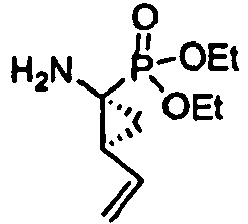
diethyl [(1S,2R)-1-amino-2-vinylcyclopropyl]phosphonate Chaudhary WO 2006/020276 A2 
ethyl hydrogen [(1S,2R)-1-amino-2-vinylcyclopropyl]phosphonate Chaudhary WO 2006/020276 A3 
[(1S,2R)-1-amino-2-vinylcyclopropyl]methylphosphinic acid Chaudhary WO 2006/020276 A4 
[(1S,2R)-1-amino-2-vinylcyclopropyl]ethylphosphinic acid Chaudhary WO 2006/020276 A5 
[(1S,2R)-1-amino-2-vinylcyclopropyl]isopropylphosphinic acid Chaudhary WO 2006/020276 A6 
[(1S,2R)-1-amino-2-vinylcyclopropyl]phenylphosphinic acid Chaudhary WO 2006/020276 A7 
[(1S,2R)-1-amino-2-vinylcyclopropyl]vinylphosphinic acid Chaudhary WO 2006/020276 A8 
1-amino-4-thia-3-azabicyclo[10.1.0]tridec-10-en-2-one 4,4-dioxide Chaudhary WO 2006/020276 A9 
1-amino-4-thia-3-azabicyclo[10.1.0]tridecan-2-one 4,4-dioxide Chaudhary WO 2006/020276 - By hydrogenation of the intermediates above, or a suitable intermediate in their preparation, for example by treatment in an appropriate solvent or solvent mixture with a palladium, platinum or rhodium catalyst, the following intermediates can be prepared by a person skilled in the art.
Intermediate # Structure Name A10 
diethyl [(1S,2S)-1-amino-2-ethylcyclopropyl]phosphonate A11 
ethyl hydrogen [(1S,2S)-1-amino-2-ethylcyclopropyl]phosphonate A12 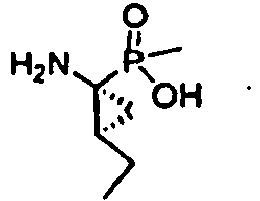
[(1S,2S)-1-amino-2-ethylcyclopropyl]methylphosphinic acid A13 
[(1S,2S)-1-amino-2-ethylcyclopropyl] ethylphosphinic acid A14 
[(1S,2S)-1-amino-2-ethylcyclopropyl]isopropylphosphinic acid A15 
[(1S,2S)-1-amino-2-ethylcyclopropyl]phenylphosphinic acid -

- To a solution of 1-penten-4-ol (0.95 g, 11.0 mmol) in DMF (15 mL) at 0°C was added carbonyldiimidazole (1.79 g, 11.0 mmol). The reaction mixture was warmed to RT and stirred for 30 minutes. L-norleucine methyl ester hydrochloride (2.0 g, 11.0 mmol) was then added, the reaction mixture was heated to 50°C and stirred for 15 minutes. Upon cooling, the reaction mixture was diluted with ethyl ether and washed twice with water. The organic layer was dried over Na2SO4, filtered and concentrated. The crude product was purified by silica gel chromatography (gradient elution 10 to 90% EtOAc in hexanes) to afford 2.1 g (74%) methyl N-[(pent-4-en-1-yloxy)carbonyl]-L-norleucinate as a clear oil.
- To a stirred solution of methyl N-[(pent-4-enyloxy)carbonyl]-L-norleucinate (8.50g, 33.03 mmol) in THF (20 mL) was added 1N NaOH (20 mL). This reaction solution was stirred at RT for 3 hours, then acidified to pH 3 with 1N HCl and extracted with (3 x 250 mL) EtOAc. The combined EtOAc layer was washed with 50 mL water, 50 mL brine, dried over Na2SO4, filtered and concentrated to give 7.09 g (88%) of the title product as clear oil. LRMS (ESI) m/z 244 [(M+H)+; calcd for C12H22NO4: 244].
-

- DIPEA (9.85 g, 76.2 mmol) was added dropwise to a 0°C solution of 4-penten-1-ol (7.22 g, 83.9 mmol) and triphosgene (11.3 g, 38.1 mmol) in 160 mL dioxane. The resulting white suspension was stirred for 5 minutes at 0°C, then allowed to warm to 25°C over 1 hour. The suspension was cooled to 0 °C with an ice bath and 1 N NaOH (76.2 mL) and L-t-butylglycine (10.0 g, 76.2 mmol) were added. The reaction mixture was warmed to 25°C and stirred for 18 hours. The dioxane was removed in vacuo and the reaction mixture was basified to pH 12 with 1 N NaOH. The aqueous layer was extracted with DCM (3x 150 mL), then acidified to pH~1 with 6 N HCl. The aqueous layer was extracted with DCM (3 x 150 mL). The combined organic layers were dried over MgSO4 and concentrated to give the compound as a tan oil (13.7 g, 73.9% yield). LRMS (ESI) m/z 244 [(M+H)+; calcd for C12H22NO4 244].
- The following carbamate intermediates (B3-B49) were prepared using the chemistry described for the preparation Intermediate B2, by utilizing the appropriate amino acid and alcohol or the preparation of Intermediate B1 by utilizing the appropriate alcohol and amino ester.
Int. Amino Acid Alcohol Structure Name LRMS (M+H)+ B1 L-Norleucine 4-Penten-1-ol 
N-[(Pent-4-en-1-yloxy)carbonyl]-L-norleucine (Intermediate 1) 244.3 B2 L-t-Butyl-glycine 4-Penten-1-ol 
(2S)-3,3-Dimethyl-2-{[(pent-4-en-1-yloxy)carbonyl] amino}butanoic acid 244.2 B3 L-Valine 4-Penten-1-ol 
N-[(Pent-4-en-1-yloxy)carbonyl]-L-valine 230.3 B4 L-t-Butyl-glycine 2,2-Dimethyl-4-penten-1-ol 
N-{[(2,2-Dimethylpent-4-en-1-yl)oxy]carbonyl}-3-methyl-L-valine 272.3 Ref: J.Org. Chem (1981), 46, 1177-1182. B5 L-t-Butyl-glycine 5-Hexen-1-ol 
N-[(Hex-5-en-1-yloxy)carbonyl]-3-methyl-L-valine 258.3 B6 L-Phenyl-glycine 4-Penten-1-ol 
(2S)-{[(Pent-4-en-1-yloxy)carbonyl] amino}(phenyl) acetic acid 264.3 B7 L-t-Butyl-glycine 6-Hepten-1-ol 
N-[(Hept-6-en-1-yloxy)carbonyl]-3-methyl-L-valine 272.3 B8 L-Cyclohexyl-glycine 4-Penten-1-ol 
(2S)-Cyclohexyl {[(pent-4-en-1-yloxy) carbonyl]amino} acetic acid 270.3 B9 L-Phenyl alanine 4-Penten-1-ol 
N-[(Pent-4-en-1-yloxy)carbonyl]-L-phenylalanine 278.2 B10 3,3,3-Trifluoroalanine 4-Penten-1-ol 
3,3,3-trifluoro-N [(pent-4-en-1-yloxy)carbonyl] alanine 256.2 B11 L-t-Butyl-glycine 4-Pentyn-1-ol 
3-Methyl-N-[(pent-4-yn-1-yloxy) carbonyl]-L-valine 242.2 B12 L-Norvaline 4-Penten-1-ol 
N-[(Pent-4-en-1-yloxy)carbonyl]-L-norvaline 230.3 B13 L-Cyclopentyl-glycine 4-Penten-1-ol 
(2S)-Cyclopentyl {[(pent-4-en-1-yloxy)carbonyl] amino} acetic acid 256.3 B14 2-Amino-4,4,4-trifluorobutanoic acid 5-Hexen-1-ol 
4,4,4-Trifluoro-2-{[(hex-5-en-1-yloxy)carbonyl]ami no}butanoic acid 305.2 (M+Na)+ B15 L-Leucine 4-Penten-1-ol 
N-[(Pent-4-en-1-yloxy)carbonyl]-L-leucine 244.3 B16 L-Tryptophan 4-Penten-1-ol 
N-[(Pent-4-en-1-yloxy)carbonyl]-L-tryptophan 317.4 B17 O-(t-Butyl)- L-serine 4-Penten-1-ol 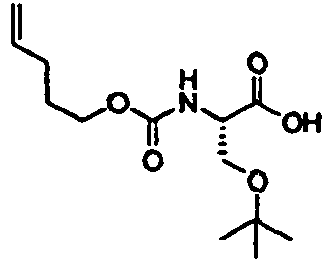
O-(t-Butyl)-N-[(pent-4-en-1-yloxy)carbonyl]-L-serine 218.3 (M-tBu)+ B18 6,6,6-trifluoronorleucine 5-Hexen-1-ol 
6,6,6-Trifluoro-N-[(hex-5-en-1-yloxy)carbonyl] norleucine 353.2 (M+MeCN)+ B19 Amino(2,3-dihydro-1H-inden-2-yl)acetic acid 4-Penten-1-ol 
2,3-Dihydro-1H-inden-2-yl {[(pent-4-en-1-yloxy)arbonyl] amino} acetic acid 304.3 B20 L-t-Butyl-glycine (trans)-2-allylcyclohexanol 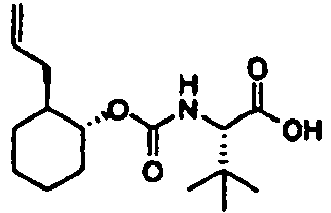
N-({[(trans)-2-Allylcyclohexyl] oxy}carbonyl)-3-methyl-L-valine 298.4 Ref: Tetrahedron (2004), 60, 4837. B21 L-Cyclohexyl-glycine 3-Buten-1-ol 
(2S)-{[(But-3-en-1-yloxy)carbonyl] amino} (cyclohexyl) acetic acid 256.2 B22 L-t-Butyl-glycine 3-Buten-1-ol 
N-[(But-3-en-1-yloxy)carbonyl]-3-methyl-L-valine 230.3 B23 L-Cyclohexyl-glycine 2,2-Dimethyl-4-penten-1-ol Ref: J.Org. Chem (1981), 46, 1177-1182. 
(2S)-Cyclohexyl({[(2,2-dimethylpent-4-en-1-yl)oxy]carbonyl} amino)acetic acid 298.3 B24 L-Cyclopentyl-glycine 2,2-Dimethyl-4-penten-1-ol Ref: J. Org. Chem (1981), 46, 1177-1182.. 
(2S)-Cyclopentyl({[(2,2-dimethylpent-4-en-1-yl)oxy]carbonyl} amino)acetic acid 284.3 B25 L-t-Butyl-glycine 2,2-Dimethylhex-5-en-1-ol Ref: J. Org. Chem. (1991), 56, 1623. 
N-{[(2,2-Dimethylhex-5-en-1-yl)oxy]carbonyl}-3-methyl-L-valine 286.3 B26 L-Cyclohexyl-glycine 6-Hepten-1-ol 
(2S)-Cyclohexyl {[(hept-6-en-1-yloxy)carbonyl] amino} acetic acid 298.3 B27 L-t-Butyl-glycine 7-Octen-1-ol 
3-Methyl-N-[(oct-7-en-1-yloxy) carbonyl]-L-valine 286.3 B28 L-Cyclohexyl-glycine 5-Hexen-1-ol 
(2S)-Cyclohexyl {[(hex-5-en-1-yloxy)carbonyl] amino} acetic acid 284.4 B29 L-t-Butyl-glycine (trans)-2-Allyl cyclopentanol Ref: J. Chem. Soc., Perkin Trans 1 (1994), 11, 1377. 
N-({[(trans)-2-Allylcyclopentyl]ox y} carbonyl)-3-methyl-L-valine 284.2 B30 L-Cyclohexyl-glycine 1-Methylpent-4-en-1-ol Ref: Tetrahedron Assym. (1998), 9, 657. 
(2S)-Cyclohexyl({[(1-methylpent-4-en-1-yl)oxy]carbonyl} amino)acetic acid 284.2 B31 L-Cyclopentyl-glycine 5-Hexen-1-ol 
(2S)-Cyclopentyl{[(hex-5-en-1-yloxy)carbonyl] amino} acetic acid 270.3 B32 L-Cyclopentyl-glycine 6-Hepten-1-ol 
(2S)-Cyclopentyl {[(hept-6-en-1-yloxy)carbonyl] amino} acetic acid 284.4 B33 L-Cyclobutyl-glycine 4-Penten-1-ol 
Cyclobutyl {[(pent-4-en-1-yloxy)carbonyl] amino} acetic acid 242.3 B34 L-Cyclopentyl-glycine 2,2-Dimethylhex-5-en-1-ol Ref: J. Org. Chem. (1991), 56, 1623. 
(2S)-Cyclopentyl({[(2,2-dimethylhex-5-en-1-yl)oxy]carbonyl} amino)acetic acid 298.3 B35 L-Cyclohexyl-glycine 2,2-Dimethylhex-5-en-1-ol Ref: J. Org. Chem. (1991), 56, 1623. 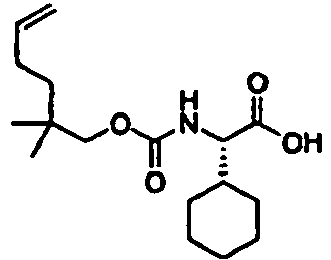
(2S)-Cyclohexyl({[(2,2-dimethylhex-5-en-1-yl)oxy]carbonyl} amino)acetic acid 312.3 B36 L-Cyclopentyl-glycine 2,2-Dimethylhept-6-en-1-ol Ref: J. Org. Chem. (1980), 45, 2685. 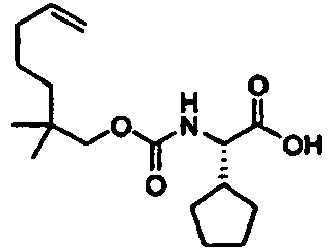
(2S)-Cyclopentyl({[(2,2-dimethylhept-6-en-1-yl)oxy]carbonyl} amino)acetic acid 312.2 B37 L-Cyclohexyl-glycine 8-Nonen-1-ol 
(2S)-Cyclohexyl {[(non-8-en-1-yloxy)carbonyl] amino} acetic acid 326.3 B38 L-Cyclopentyl-glycine (trans)-2-Allyl cyclopentanol Ref: J. Chem. Soc., Perkin Trans 1 (1994), 11, 1377. 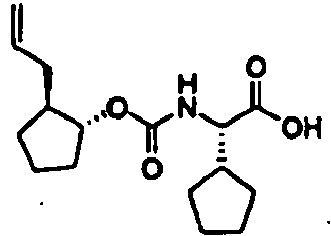
(2S)-[({[(trans)-2-Allylcyclopentyl]ox y} carbonyl)amino] (cyclopentyl)acetic acid 296.4 B39 L-Cyclohexyl-glycine 2-Methylpent-4-en-1-ol Ref: Tetrahedron (1993), 49, 947. 
(2S)-Cyclohexyl({[(2-methylpent-4-en-1-yl)oxy]carbonyl) amino)acetic acid 284.4 B40 L-Cyclohexyl-glycine 2,2-Dimethylhept-6-en-1-ol Ref J. Org. Chem. (1980), 45, 2685. 
(2S)-Cyclohexyl({[(2,2-dimethylhept-6-en-1-yl)oxy]carbonyl} amino)acetic acid 326.4 B41 L-Cyclohexyl-glycine (trans)-2-Allyl cyclopentanol Ref: J. Chem. Soc., Perkin Trans 1 (1994), 11, 1377. 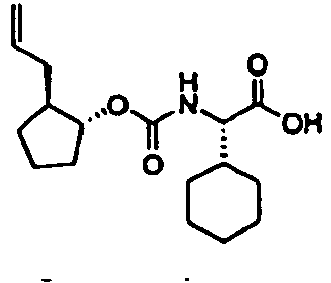
(2S)-[(([(trans)-2-Allylcyclopentyl]ox y}carbonyl)amino] (cyclohexyl) acetic acid 310.5 B42 L-Cyclohexyl-glycine (1-Allyl cyclopentyl) methanol Ref: J. Org. Chem. (1992), 57, 1727. 
(2S)-({[(1-Allylcyclopentyl) methoxy] carbonyl}amino) (cyclohexyl)acetic acid 324.3 B43 L-Cyclohexyl-glycine 2-Ethylpent-4-en-1-ol Ref: Tetrahedron Lett. (1985), 26, 6085. 
(2S)-Cyclohexyl({[(2-ethylpent-4-en-1-yl)oxy]carbonyl} amino) acetic acid 298.2 B44 L-Cyclopentyl-glycine (1-Allyl cyclopropyl) methanol Ref: Helv. Chim. Acta (1986), 69, 1655. 
(2S)-({[(1-Allylcyclopropyl) methoxy]carbonyl} amino)(cyclopentyl) acetic acid 282.3 B45 L-Cyclohexyl-glycine (1-Allyl cyclopropyl) methanol Ref: Helv. Chim. Acta (1986), 69, 1655. 
(2S)-({[(1-Allylcyclopropyl) methoxy]carbonyl} amino)(cyclohexyl) acetic acid 296.3 B46 L-t-Butyl-glycine 2-Methylpent-4-en-1-ol Ref: Tetrahedron (1993), 49, 947. 
3-Methyl-N-{[(2-methylpent-4-en-1-yl)oxy]carbonyl}-L-valine 258.3 B47 L-Cyclopentyl-glycine (1-Allyl cyclopentyl) methanol Ref: J. Org. Chem. (1992), 57, 1727. 
(2S)-({[(1-Allylcyclopentyl) methoxy] carbonyl} amino) (cyclopentyl)acetic acid 310.3 B48 L-Cyclopentyl-glycine 2-Methylpent-4-en-1-ol 
(2S)-Cyclopentyl({[(2-methylpent-4-en-1-yl)oxy]carbonyl} amino)acetic acid 270.2 Ref: Tetrahedron (1993), 49, 947. B49 L-t-Butyl-glycine Allyl alcohol 
N-[(allyloxy)carbonyl] -3-methyl-L-valine 215.2 -

-
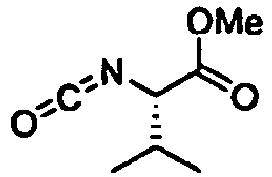
- A mixture of L-valine methyl ester hydrochloride (10.0 g, 59.9 mmol), DCM (300 mL), and pyridine (19.3 mL, 240 mmol) was cooled in an ice/salt bath and a solution of 20% phosgene in PhMe (35.6 mL, 719 mmol) added dropwise, maintaining the reaction temperature below 5°C during the addition. A white suspension resulted and after 1.5 hours, the reaction mixture was poured into ice-cold 1M HCl and extracted with DCM (2 x 500mL). The combined organic phases were washed with brine, dried over anhydrous MgSO4, and evaporated. Flash column chromatography on silica (95 hexanes / 5 EtOAc) gave the title compound as a colorless oil (6.43g). 1H NMR (CDCl3 500MHz) δ 3.94 (d, J = 4.0 Hz, 1 H), 3.82 (s, 3 H), 2.24 (m, 1 H), 1.03 (d, J = 7.0 Hz, 3 H), 0.90 (d, J = 6.5Hz, 3 H) ppm.
-

- Methyl N-(oxomethylene)-L-valinate (2.80 g, 17.7 mmol) was added to 2-methylhex-5-en-2-amine [J. Org. Chem. (1976) 41(5) 855-863.] (2.00 g, 17.7 mmol) in THF (15 mL). After 5 minutes, the reaction mixture was evaporated to give the title compound as a solid, which was triturated with hexane and isolated by filtration (2.7 1g). LRMS (M+H)+ = 271.4.
- 1M lithium hydroxide (54 mL, 54 mmol) was added to N-{[(1,1-dimethylpent-4-en-1-yl)amino]carbonyl}-L-valine (2.94 g, 10.9 mmol) in THF (20 mL). The reaction mixture was stirred at RT under nitrogen for 18 hours, then heated to reflux for 2 hours, and cooled to RT. The THF removed by evaporation. Water was then added, and the mixture extracted with DCM (4x). The aqueous layer was made acidic with 1M HCl and extracted with DCM (3 x 70 mL). The combined organic extracts were dried over anhydrous Na2SO4 and the solvent evaporated to give the title compound as a white foam (2.25 g). LRMS (M+H)+ = 257.3.
- The following urea intermediates (B51-B52) were prepared using the chemistry described for the preparation of N- {[(1,1-dimethylpent-4-en-1-yl)amino]carbonyl}-L-valine (as described in Intermediate B50), by utilizing the appropriate amino acid and amine.
Int Amino Acid Amine Structure Name LRMS (M+H)+ B51 L-t-Butyl-glycine N-Methylpent-4-en-1-amine 
3-Methyl-N-{[methyl(pent-4-en-1-yl)amino]carbonyl} -L-valine 257.3 B52 L-t-Butyl-glycine N-Isopropylhex-5-en-1-amine 
N-{[Hex-5-en-1-yl(isopropyl)amino]carbo nyl}-3-methyl-L-valine 299.3 -
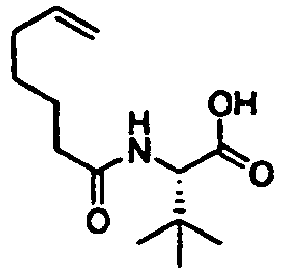
-

- A solution of L-tert-leucine methyl ester (1.00 g, 6.89 mmol), 6-heptenoic acid (1.06 g, 8.26 mmol), EDC (1.58 g, 8.26 mmol) and HOAt (1.23 g, 8.26 mmol) in DMF (10 mL) was stirred at 22°C for 2 hours. The reaction mixture was diluted with aqueous saturated NaHCO3 (30 mL), and extracted with EtOAc (3 x 50 mL). The combined organic layers were washed with water (3 x 30 mL), brine (20 mL), dried over Na2SO4, filtered and concentrated. The residue was chromatographed on silica gel, eluting with 5 - 50% EtOAc/hexane, to give the title product (1.42 g, 81%). LRMS (ESI) m/z 256.3 [(M+H)+; calcd for C14H26NO3: 256.2].
- A solution of methyl N-hept-6-enoyl-3-methyl-L-valinate (1.40 g, 5.48 mmol) in THF (10 mL) and 1N NaOH (10 mL) was stirred at 22°C for 2 hours. The reaction mixture was acidified to pH 3 with 1 N HCl and extracted with EtOAc (3 x 150 mL). The combined EtOAc layers were washed with water (50 mL), brine (50 mL), dried over Na2SO4, filtered and concentrated to give the title product (1.12 g, 84%). LRMS (ESI) m/z 242.3 [(M+H)+; calcd for C13H24NO3: 242.2].
-

-

- To a solution of 1-bromo-4-iodo-2-methoxybenzene (
L. A. Hasvold et al, US 2004/0254159 , EXAMPLE 57B) (33.45 g, 107 mmol) in MeCN (100 mL) was added acrylic acid (9.61 g" 133 mmol), Et3N (37.2 mL, 267 mmol) and palladium acetate (719 mg, 3.2 mmol). The reaction mixture was heated to 90°C for 40 minutes, cooled to RT and poured into 2.4 L 1M HCl. After stirring for 30 minutes, the solid was filtered, heated to reflux in EtOH (230 mL), allowed to cool to RT and stirred overnight. The solid was filtered and washed with 1:1 EtOH hexane (50 mL) to give desired product. LRMS ESI+ (M+H)+ 257.0. -

- A portion of the product from Step 1 (12.5 g, 48.6 mmol) was azeotroped with benzene and suspended in benzene (94 mL). Et3N (9.49 mL, 68.1 mmol) and diphenylphosphoryl azide (10.48 mL, 48.6 mmol) were added and the reaction mixture stirred at RT for 1 hour. The mixture was filtered through a pad of silica and eluted with ∼1 L of PhMe, the volatiles evaporated, the residue resuspended in diphenylmethane (94 mL) and the mixture heated to reflux for 3 hours (internal temperature 250°C). The reaction mixture was allowed to cool to RT, stirred overnight, filtered and the solid washed with hexanes (100 mL) to give tan solid (7.4 g). LRMS ESI+ (M+H)+ 254.1.
-

- A mixture of the product from Step 2 (7-bromo-6-methoxyisoquinolin-1(2H)-one) (4.7 g, 18.5 mmol) in phosphorus oxychloride (30 mL) was heated to reflux for 2 hours and cooled to RT. The volatiles were then evaporated, and the residue was partitioned between 3 M NaOH and DCM. The organic phase was dried over Na2SO4; the solvent was evaporated; and the solid was triturated with Et2O (20 mL) and filtered to give a solid (3.75 g). LRMS ESI+ (M+H)+ 274.0.
-

- Potassium t-butoxide (618 mg, 5.5 mmol) was added to a stirred solution of BOC trans-4-hydroxyproline (424 mg, 1.83 mmol) in DMSO (10 mL) at RT. The reaction mixture was stirred for 30 minutes, cooled to 15°C and the product from Step 3 (500 mg, 1.83 mmol) added. The reaction mixture was stirred overnight and partitioned between ice-cold 10 % citric acid and EtOAc. The organic phase was washed with water and brine, dried over Na2SO4 and the solvent evaporated. The crude product was dissolved in EtOH (100 mL), cooled to 0°C, and HCl was bubbled through until saturated. The reaction mixture was allowed to warm to RT and stirred for 24 hours. The volatiles were evaporated and the residue azeotroped with EtOH (x4) to give the title compound as a tan solid (555 mg). LRMS ESI+ (M+H)+ 395.0.
-

- To a solution of the product from step 4 (900 mg, 2.09 mmol) in DMF (10 mL), was added Intermediate B23 (682 mg, 2.29 mmol), DIPEA (1.09 mL, 6.25 mmol) and HATU (1,190 mg, 3.13 mmol), and the reaction mixture stirred for 6 hours at RT. The mixture was then partitioned between EtOAc and 10% KHSO4; the organic phase was washed with brine, dried over Na2SO4; and the solvent was evaporated. The crude product was purified by chromatography on silica (30-50% EtOAc/hexane) to afford the title compound (1.02 g) as a foam. LRMS ESI+ (M+H)+ 676.3.
-

- A solution of the product from Step 5 (1.02 g, 1.51 mmol) in PhMe (30 mL) was degassed for 30 minutes by bubbling nitrogen. Tri-n-butylvinyltin (533 µL, 1.81 mmol) and tetrakis(triphenylphosphine)palladium (175 mg, 0.151 mmol) were added, and the reaction mixture was heated to 105°C for 3 hours, then cooled to RT for 18 hours. The volatiles were evaporated, and the residue was purified by chromatography on silica (20-50% EtOAc/hexane) to afford the title compound (820 mg) as a foam. LRMS ESI+ (M+H)+ 622.5.
-

- A solution of the product from Step 6 (800 mg, 1.29 mmol) in DCM (200 mL) was degassed for 30 minutes by bubbling nitrogen. Zhan 1B catalyst (189 mg, 0.26 mmol) in degassed DCM (20 mL) was added over 1 hour; the reaction mixture was stirred at RT for 18 hours, then concentrated; and the residue was purified by chromatography on silica (20-50% EtOAc/hexane) to afford the title compound (700 mg) as a foam. LRMS ESI+ (M+H)+ 594.5.
-

- To a solution of the product from Step 7 (600 mg, 1.01 mmol) in EtOAc (50 mL) was added 10% Pd/C (100 mg), and the mixture was hydrogenated under 1 atmosphere of hydrogen for 18 hours. EtOH and additional 10% Pd/C (100 mg) were added, and hydrogenation was continued for 72 hours. The reaction mixture was filtered, and the filtrate was concentrated to afford the title compound (600 mg). LRMS ESI+ (M+H)+ 596.5.
-

- A solution of the product from Step 8 (600 mg, 1.01 mmol) was dissolved in THF (48 mL), water (12 mL) and EtOH (12 mL), and LiOH (169 mg, 7.05 mmol) was added. The reaction mixture was stirred at RT for 18 hours, diluted with 10% aqueous KHSO4, concentrated to remove THF and EtOH and partitioned between water and EtOAc. The organic phase was dried over Na2SO4, and the solvent was evaporated to afford the title compound (543 mg) as a foam. LRMS ESI+ (M+H)+ 568.4.
-

- A solution of the product from Step 9 (180 mg, 0.317 mmol) in DMF (2 mL) was treated with Intermediate A1 (77 mg, 0.351 mmol), DIPEA (0.166 mL, 0.95 mmol), DMAP (19 mg, 0.16 mmol) and HATU (145 mg, 0.38 mmol). The reaction mixture was stirred at RT for 18 hours and then directly purified by reverse-phase chromatography (C18 5-100% CH3CN/(water+0.1 % TFA)) to give the product (200 mg) as a white foam. LRMS ESI+ (M+H)+ 769.2.
-

- To a solution of the product from Step 10 (100 mg, 0.13 mmol) in CH3CN (5 mL) at 0°C, was added 2,6-lutidine (0.042 mL, 0.36 mmol) followed by iodotrimethylsilane (0.05 mL, 0.36 mmol). Three additional portions of iodotrimethylsilane (0.05 mL, 0.36 mmol) were added at 1 hour intervals, and the reaction mixture then was stirred at RT for 18 hours. MeOH (0.5 mL) and Et3N (0.2 mL) were added; the volatiles were evaporated; and the residue was dissolved in DMSO and purified by reverse-phase chromatography (C18 5-100% CH3CN/(water+0.1 % TFA)) to give the product (200 mg) as a white foam. LRMS ESI+ (M+H)+.
- By utilizing the appropriate Intermediates A and B, the following compounds may be prepared in a similar fashion:
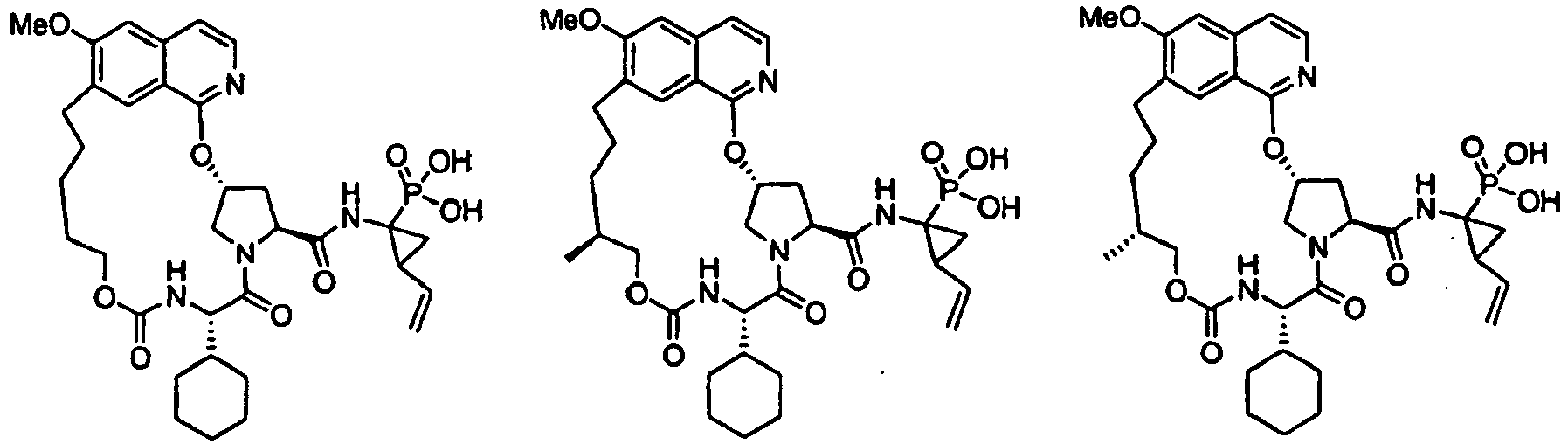


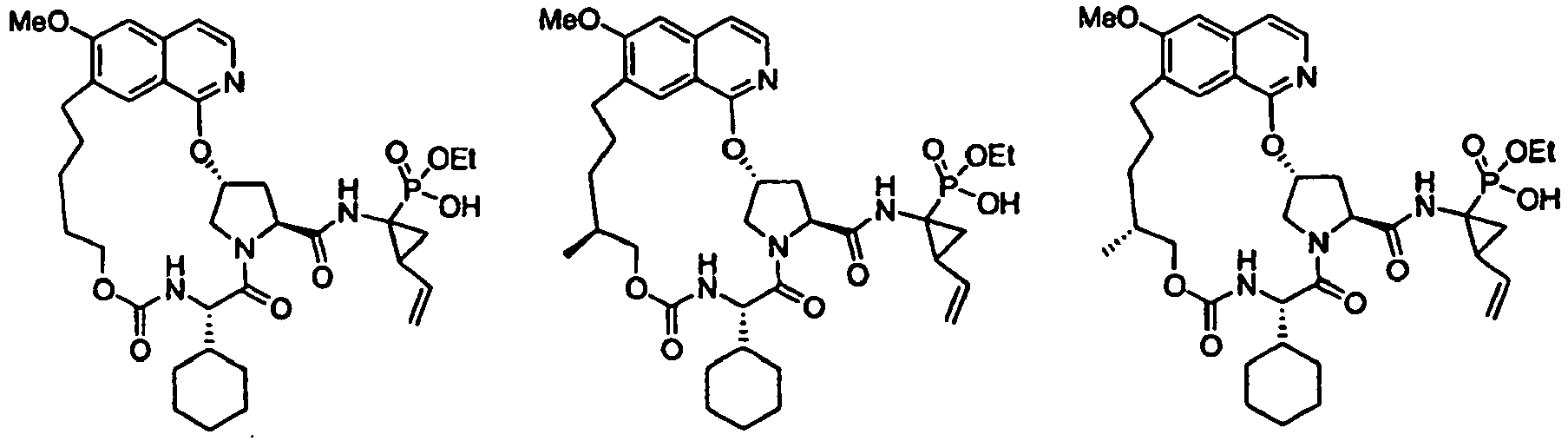


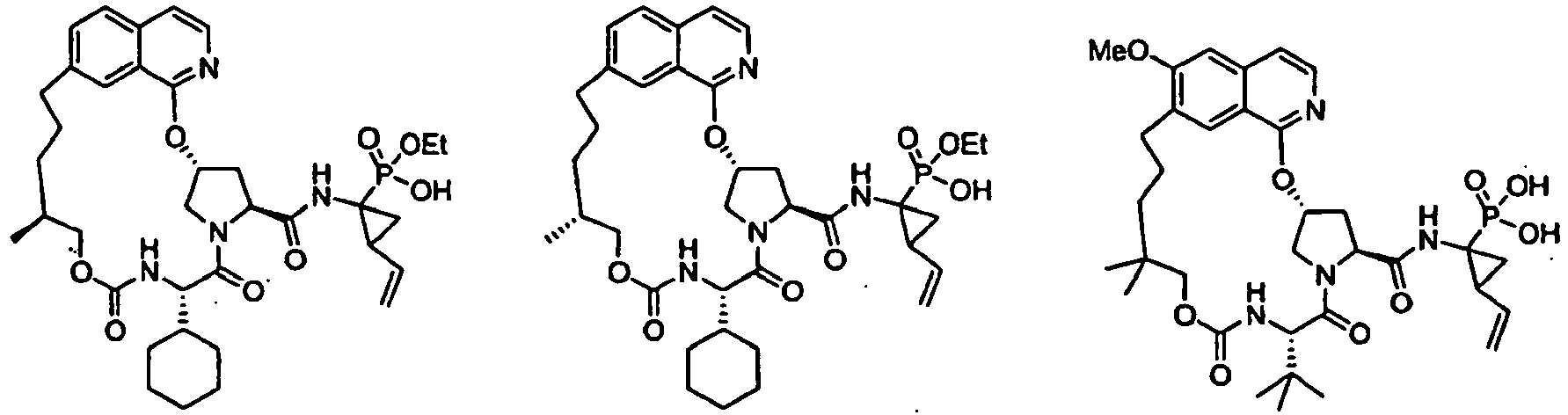


Claims (19)
- A compound of formula (I):
 n is 1 or 2;R1 is -P(O)R11R12;R2 is C1-C6 alkyl, C2-C6 alkenyl or C3-C8 cycloalkyl, wherein said alkyl, alkenyl or cycloalkyl is optionally substituted with 1 to 3 halo;R3 is C1-C8 alkyl, C3-C8 cycloalkyl, C3-C8 cycloakyl(C1-C8)alkyl, aryl(C1-C8)alkyl, or Het, wherein aryl is phenyl or naphthyl and said alkyl, cycloalkyl, or aryl is optionally substituted with 1 to 3 substituents selected from the group consisting of halo, -OR10, -SR10, -N(R10)2, -N(C1-C6 alkyl)O(C1-C6 alkyl), C1-C6 alkyl, C1-C6 haloalkyl, halo(C1-C6 alkoxy), -NO2, -CN, -CF3, -SO2(C1-C6 alkyl), -S(O)(C1-C6 alkyl), -NR10SO2R6, -SO2N(R6)2, -NHCOOR6, -NHCOR6, -NHCONHR6, -CO2R10, -C(O)R10, and -CON(R10)2; Het is a 5- to 6-membered saturated cyclic ring having 1, 2 or 3 heteroatoms selected from N, O and S, wherein said ring is optionally substituted with 1 to 3 substituents selected from the group consisting of halo, -OR10, -SR10, -N(R10)2, -N(C1-C6 alkyl)O(C1-C6 alkyl), C1-C6 alkyl, C1-C6 haloalkyl, halo(C1-C6 alkoxy), -NO2, -CN, -CF3, -SO2(C1-C6 alkyl), -S(O)(C1-C6 alkyl), -NR10SO2R6, -SO2N(R6)2, -NHCOOR6, -NHCOR6, -NHCONHR6, -CO2R10, -C(O)R10, and -CON(R10)2;R5 is H, halo, -OH, C1-C6 alkoxy, C1-C6 alkyl, -CN, -CF3, -SR10, -SO2(C1-C6 alkyl), C3-C8 cycloalkyl, C3-C8 cycloalkoxy, C1-C6 haloalkyl, -N(R7)2, aryl, heteroaryl, or heterocyclyl; wherein aryl is phenyl or naphthyl, heteroaryl is a 5- or 6-membered aromatic ring having 1, 2 or 3 heteroatoms selected from N, O and S, attached through a ring carbon or nitrogen, and heterocyclyl is a 5- to 7-membered saturated or unsaturated non-aromatic ring having 1, 2, 3 or 4 heteroatoms selected from N, O and S, attached through a ring carbon or nitrogen; and wherein said aryl, heteroaryl, heterocyclyl, cycloalkyl, cycloalkoxy; alkyl or alkoxy is optionally substituted with 1 to 4 substituents selected from the group consisting of halo, -OR10, -SR10, -N(R7)2, -N(C1-C6 alkyl)O(C1-C6 alkyl), C1-C6 alkyl, C1-C6 haloalkyl, halo(C1-C6 alkoxy), C3-C6 cycloalkyl, C3-C6 cycloalkoxy, -NO2, -CN, -CF3, -SO2(C1-C6 alkyl), -NR10SO2R6, -SO2N(R6)2, -S(O)(C1-C6 alkyl), -NHCOOR6, -NHCOR6, -NHCONHR6, -CO2R10. -C(O)R10, and -CON(R10)2; wherein the 2 adjacent substituents of said cycloalkyl, cycloalkoxy, aryl, heteroaryl or heterocyclyl are optionally taken together to form a 3- to 6-membered cyclic ring containing 0 to 3 heteroatoms selected from N, O and S;R6 is C1-C8 alkyl, C3-C8 cycloalkyl, C3-C8 cycloalkyl(C1-C5)alkyl, aryl, aryl(C1-C4)alkyl, heteroaryl, heteroaryl(C1-C4 alkyl), heterocyclyl, or heterocyclyl(C1-C8 alkyl), wherein said alkyl, cycloalkyl, aryl, heteroaryl, or heterocyclyl is optionally substituted with 1 to 2 W' substituents or aryl is substituted by -P(O)R11R12; and wherein each aryl is independently phenyl or naphthyl, each heteroaryl is independently a 5- or 6-membered aromatic ring having 1, 2 or 3 heteroatoms selected from N, O and S, attached through a ring carbon or nitrogen, and each heterocyclyl is independently a 5- to 7-membered saturated or unsaturated non-aromatic ring having 1, 2, 3 or 4 heteroatoms selected from N, O and S, attached through a ring carbon or nitrogen;Y is -C(=O)-;Z is -O- ;M is C1-C12 alkylene or C2-C12 alkenylene or C2-C12 akynylene, wherein said alkylene or alkenylene is optionally substituted with 1, 2 or 3 substituents selected from the group consisting of C1-C8 alkyl, C1-C8 cycloalkyl(C1-C8 alkyl), and aryl(C1-C8 alkyl); wherein 2 substituents on adjacent carbon atoms of M are optionally taken together to form a 3- to 6-membered cyclic ring containing 0 to 3 heteroatoms selected from N, O and S, or 2 substituents on the same carbon atom of M are optionally taken together to form a 3- to 6-membered cyclic ring containing 0 to 3 heteroatoms selected from N, O and S;A is -CH ;each R7 is independently H, C1-C6 alkyl, C3-C6 cycloalkyl, C3-C6 cycloalkyl(C1-C5)alkyl, aryl, aryl(C1-C4)alkyl, heteroaryl, heteroaryl(C1-C4 alkyl), heterocyclyl, or heterocyclyl(C1-C8 alkyl), wherein said alkyl, cycloalkyl, aryl, heteroaryl, or heterocyclyl is optionally substituted with 1 to 2 W' substituents; and wherein each aryl is independently phenyl or naphthyl, each heteroaryl is independently a 5- or 6-membered aromatic ring having 1, 2 or 3 heteroatoms selected from N, O and S, attached through a ring carbon or nitrogen, and each heterocyclyl is independently a 5- to 7-membered saturated or unsaturated non-aromatic ring having 1, 2, 3 or 4 heteroatoms selected from N, O and S, attached through a ring carbon or nitrogen;each W is independently H, halo, -OR7, C1-C6 alkyl, -CN, -CF3, -NO2, -SR7, -CO2R7, -CON(R7)2, -C(O)R7, -N(R10)C(O)R7, -SO2(C1-C6 alkyl), -S(O)(C1-C6 alkyl), C3-C8 cycloalkyl, C3-C8 cycloalkoxy, C1-C6 haloalkyl, -N(R7)2, -N(C1-C6 alkyl)O(C1-C6 alkyl), halo(C1-C6 alkoxy), -NR10SO2R7, -SO2N(R7)2 -NHCOOR7, -NHCONHR7, aryl, heteroaryl or heterocyclyl; wherein aryl is phenyl or naphthyl, heteroaryl is a 5- or 6-membered aromatic ring having 1, 2 or 3 heteroatoms selected from N, O and S, attached through a ring carbon or nitrogen, and heterocyclyl is a 5- to 7-membered saturated or unsaturated non-aromatic ring having 1, 2, 3 or 4 heteroatoms selected from N, O and S, attached through a ring carbon or nitrogen; and wherein 2 adjacent W moieties are optionally taken together with the atoms to which they are attached to form a 5- to 6-membered saturated, unsaturated non-aromatic, or aromatic cyclic ring having 0 to 2 heteroatoms selected from N, O and S;each W' is independently H, halo, -OR10, C1-C6 alkyl, -CN, -CF3, -NO2, -SR10, -CO2R10, -CON(R10)2, -C(O)R10, -N(R10)C(O)R10, -SO2(C1-C6 alkyl), -S(O)(C1-C6 alkyl), C3-C8 cycloalkyl, C3-C8 cycloalkoxy, C1-C6 haloalkyl, -N(R10)2, -N(C1-C6 alkyl)O(C1-C6 alkyl), halo(C1-C6 alkoxy), -NR10SO2R10, -SO2N(R10)2, -NHCOOR10, -NHCONHR10, aryl, heteroaryl or heterocyclyl; wherein aryl is phenyl or naphthyl, heteroaryl is a 5- or 6-membered aromatic ring having 1, 2 or 3 heteroatoms selected from N, O and S, attached through a ring carbon or nitrogen, and heterocyclyl is a 5- to 7-membered saturated or unsaturated non-aromatic ring having 1, 2, 3 or 4 heteroatoms selected from N, O and S, attached through a ring carbon or nitrogen; and wherein 2 adjacent W' moieties are optionally taken together with the atoms to which they are attached to form a 5- to 6-membered saturated, unsaturated non-aromatic, or aromatic cyclic ring having 0 to 2 heteroatoms selected from N, O and S;each R10 is independently H or C1-C6 alkyl;each R11 is independently C1-C6 alkyl, -OR13, -N(R10)-V-CO2R10, -O-V-CO2R10, -S-V-CO2R10, -N(R10)(R13), R14, or -N(R10)SO2R6;each R12 is independently -OR13, -N(R10)-V-CO2R10, -O-V-CO2R10, -S-V-CO2R10, or -N(R10)(R13);or R11 and R12 are optionally taken together, with the phosphorus atom to which they are attached, to form a 5- to 7-membered monocyclic ring;each V is independently -CH(R15) or C1-C4 alkylene-CH(R15);each R13 is independently H, C1-C6 alkyl, C2-C6 alkenyl, C3-C8 cycloalkyl, aryl, heteroaryl, or heterocyclyl, wherein said alkyl, alkenyl, cycloalkyl, aryl, heteroaryl or heterocyclyl is optionally substituted with 1 to 2 substituents selected from the group consisting of aryl, aryl(C1-C4 alkyl), C3-C8 cycloalkyl, C3-C8 cycloalkyl(C1-C4 alkyl), heteroaryl, heteroaryl(C1-C4 alkyl), heterocyclyl, heterocyclyl(C1-C4 alkyl), C1-C6 alkyl, halo, -OC(O)OR6, -OC(O)R6, -OR10, -SR10, -N(R10)2, -C(O)R10, -NO2, -CN, -CF3, -SO2(C1-C6 alkyl), -S(O)(C1-C6 alkyl), -NR10SO2R6, -SO2N(R6)2, -NHCOOR6, -NHCOR6, -NHCONHR6, -CO2R10, and -C(O)N(R10)2; wherein each aryl is independently phenyl or naphthyl; each heteroaryl is independently a 5- or 6-membered aromatic ring having 1, 2 or 3 heteroatoms selected from N, O and S, attached through a ring carbon or nitrogen; and each heterocyclyl is independently a 5- to 7-membered saturated or unsaturated non-aromatic ring having 1, 2, 3 or 4 heteroatoms selected from N, O and S, attached through a ring carbon or nitrogen; and wherein the 2 adjacent substituents of said cycloalkyl, cycloalkoxy, aryl, heteroaryl or heterocyclyl are optionally taken together to form a 3- to 6-membered cyclic ring containing 0 to 3 heteroatoms selected from N, O and S;R14 is C1-C6 alkyl, C2-C6 alkenyl, aryl or heteroaryl, wherein aryl is phenyl or naphthyl, and heteroaryl is independently a 5- or 6-membered aromatic ring having 1, 2 or 3 heteroatoms selected from N, O and S, attached through a ring carbon or nitrogen, and wherein said aryl or heteroaryl is optionally substituted with 1 to 2 substituents selected from the group consisting of C1-C6 alkyl, halo, -OC(O)OR6, -OC(O)R6, -OR10, -SR10, -N(R10)2, -C(O)R10, -NO2, -CN, -CF3, -SO2(C1-C6 alkyl), -S(O)(C1-C6 alkyl), -NR10SO2R6, -SO2N(R6)2, -NHCOOR6, -NHCOR6, -NHCONHR6, -CO2R10, and -C(O)N(R10)2; andeach R15 is independently C1-C6 alkyl, C2-C6 alkenyl, C3-C8 cycloalkyl, aryl, heteroaryl, or heterocyclyl, wherein said alkyl, alkenyl, cycloalkyl, aryl, heteroaryl or heterocyclyl is optionally substituted with 1 to 2 substituents selected from the group consisting of C1-C6 alkyl, halo, -OC(O)OR6, -OC(O)R6, -OR10, -SR10, -N(R10)2, -C(O)R10, -NO2, -CN, -CF3, -SO2(C1-C6 alkyl), -S(O)(C1-C6 alkyl), -NR10SO2R6, -SO2N(R6)2, -NHCOOR6, -NHCOR6, -NHCONHR6, -CO2R10, and -C(O)N(R10)2; wherein each aryl is independently phenyl or naphthyl; each heteroaryl is independently a 5- or 6-membered aromatic ring having 1, 2 or 3 heteroatoms selected from N, O and S, attached through a ring carbon or nitrogen; and each heterocyclyl is independently a 5- to 7-membered saturated or unsaturated non-aromatic ring having 1, 2, 3 or 4 heteroatoms selected from N, O and S, attached through a ring carbon or nitrogen; and wherein the 2 adjacent substituents of said cycloalkyl, cycloalkoxy, aryl, heteroaryl or heterocyclyl are optionally taken together to form a 3- to 6-membered cyclic ring containing 0 to 3 heteroatoms selected from N, O and S.
 - A compound of Claim 1, wherein n is 1.
- A compound of Claim 1 or 2, wherein R11 is independently C1-C6 alkyl, or -OR13, and R12 is independently -OR13.
- A compound of Claim 3, wherein R13 is H or C1-C6 alkyl.
- A compound of Claim 3, wherein R11 is selected from the group consisting of -OCH2CH3, -CH3, and -OH, and R12 is -OH.
- A compound of any preceding Claim, wherein R2 is C1-C6 alkyl or C2-C6 alkenyl.
- A compound of Claim 6, wherein R2 is -CH=CH2 or -CH2CH3.
- A compound of any preceding Claim, wherein R3 is C1-C8 alkyl or C3-C8 cycloalkyl.
- A compound of Claim 8, wherein R3 is -C(CH3)3, cyclohexyl or cyclopentyl.
- A compound of Claim 1, wherein R5 is H.
- A compound of any preceding Claim, wherein W is H or -O-C1-C6 alkyl.
- A compound of Claim 11, wherein W is H or -OCH3.
- A compound of any preceding Claim, wherein M is C1-C12 alkylene wherein said alkylene is optionally substituted with 1 or 2 substituents selected from the group consisting of C1-C8 alkyl.
- A compound of Claim 13, wherein M is selected from the group consisting of -(CH2)5-, -(CH2)3CH(CH3)CH2-, and -(CH2)3C(CH3)2CH2-.
- A pharmaceutical composition comprising an effective amount of a compound of any preceding Claim or a pharmaceutically acceptable salt and/or hydrate thereof, and a pharmaceutically acceptable carrier.
- A combination of a compound of any one of Claims 1 to 14 or a pharmaceutically acceptable salt and/or hydrate thereof and a second therapeutic agent selected from the group consisting of a HCV antiviral agent, an immunomodulator, and an anti-infective agent.
- The use of a compound of any one of Claims 1 to 14 or a pharmaceutically acceptable salt and/or hydrate thereof in the preparation of a medicament for preventing or treating infection by HCV in a subject in need thereof.
- A compound of any one of Claims 1 to 14 or a pharmaceutically acceptable salt and/or hydrate thereof for use in a method of treatment of the human body by therapy.
- A compound for use according to Claim 18 wherein the therapy is preventing or treating infection by HCV.
Applications Claiming Priority (2)
| Application Number | Priority Date | Filing Date | Title |
|---|---|---|---|
| US85401706P | 2006-10-24 | 2006-10-24 | |
| PCT/US2007/022342 WO2008051475A2 (en) | 2006-10-24 | 2007-10-19 | Hcv ns3 protease inhibitors |
Publications (3)
| Publication Number | Publication Date |
|---|---|
| EP2079479A2 EP2079479A2 (en) | 2009-07-22 |
| EP2079479A4 EP2079479A4 (en) | 2010-12-22 |
| EP2079479B1 true EP2079479B1 (en) | 2014-11-26 |
Family
ID=39325131
Family Applications (1)
| Application Number | Title | Priority Date | Filing Date |
|---|---|---|---|
| EP07839703.1A Not-in-force EP2079479B1 (en) | 2006-10-24 | 2007-10-19 | Hcv ns3 protease inhibitors |
Country Status (6)
| Country | Link |
|---|---|
| US (1) | US8138164B2 (en) |
| EP (1) | EP2079479B1 (en) |
| JP (1) | JP5345541B2 (en) |
| AU (1) | AU2007309544B2 (en) |
| CA (1) | CA2667146C (en) |
| WO (1) | WO2008051475A2 (en) |
Families Citing this family (49)
| Publication number | Priority date | Publication date | Assignee | Title |
|---|---|---|---|---|
| MY140680A (en) | 2002-05-20 | 2010-01-15 | Bristol Myers Squibb Co | Hepatitis c virus inhibitors |
| WO2006119061A2 (en) | 2005-05-02 | 2006-11-09 | Merck & Co., Inc. | Hcv ns3 protease inhibitors |
| KR20080036598A (en) | 2005-08-01 | 2008-04-28 | 머크 앤드 캄파니 인코포레이티드 | Macrocyclic Peptides as HCV NS3 Protease Inhibitors |
| GB0609492D0 (en) | 2006-05-15 | 2006-06-21 | Angeletti P Ist Richerche Bio | Therapeutic agents |
| GB0612423D0 (en) | 2006-06-23 | 2006-08-02 | Angeletti P Ist Richerche Bio | Therapeutic agents |
| AU2007309488B2 (en) | 2006-10-24 | 2012-10-11 | Merck Sharp & Dohme Corp. | HCV NS3 protease inhibitors |
| AU2007309546A1 (en) | 2006-10-24 | 2008-05-02 | Istituto Di Ricerche Di Biologia Molecolare P. Angeletti S.P.A. | HCV NS3 protease inhibitors |
| EP2079479B1 (en) | 2006-10-24 | 2014-11-26 | Merck Sharp & Dohme Corp. | Hcv ns3 protease inhibitors |
| CA2667031C (en) | 2006-10-27 | 2013-01-22 | Merck & Co., Inc. | Hcv ns3 protease inhibitors |
| CN101568346B (en) | 2006-10-27 | 2015-11-25 | 默沙东公司 | HCV NS3 protease inhibitor |
| CA2672250C (en) | 2006-12-20 | 2013-04-30 | Ian Stansfield | Antiviral indoles |
| GB0625349D0 (en) | 2006-12-20 | 2007-01-31 | Angeletti P Ist Richerche Bio | Therapeutic compounds |
| GB0625345D0 (en) | 2006-12-20 | 2007-01-31 | Angeletti P Ist Richerche Bio | Therapeutic compounds |
| JP2010533699A (en) | 2007-07-17 | 2010-10-28 | イステイチユート・デイ・リチエルケ・デイ・ビオロジア・モレコラーレ・ピ・アンジエレツテイ・エツセ・ピー・アー | Macrocyclic indole derivatives for the treatment of hepatitis C infection |
| AU2008277377B2 (en) * | 2007-07-19 | 2013-08-01 | Msd Italia S.R.L. | Macrocyclic compounds as antiviral agents |
| EP2271345B1 (en) | 2008-04-28 | 2015-05-20 | Merck Sharp & Dohme Corp. | Hcv ns3 protease inhibitors |
| ME02024B (en) | 2008-07-22 | 2015-05-20 | Merck Sharp & Dohme | Macrocyclic quinoxaline compounds as hcv ns3 protease inhibitors |
| PL2331554T3 (en) * | 2008-08-14 | 2013-08-30 | Janssen R&D Ireland | Macrocyclic indole derivatives useful as hepatitis c virus inhibitors |
| US8207341B2 (en) | 2008-09-04 | 2012-06-26 | Bristol-Myers Squibb Company | Process or synthesizing substituted isoquinolines |
| UY32099A (en) | 2008-09-11 | 2010-04-30 | Enanta Pharm Inc | HEPATITIS C SERINA PROTEASAS MACROCYCLIC INHIBITORS |
| US20100080770A1 (en) | 2008-09-29 | 2010-04-01 | Bristol-Myers Squibb Company | Hepatitis C Virus Inhibitors |
| US8377962B2 (en) | 2009-04-08 | 2013-02-19 | Idenix Pharmaceuticals, Inc. | Macrocyclic serine protease inhibitors |
| CN102458444A (en) * | 2009-05-13 | 2012-05-16 | 英安塔制药有限公司 | Macrocyclic compounds as hepatitis c virus inhibitors |
| US8232246B2 (en) | 2009-06-30 | 2012-07-31 | Abbott Laboratories | Anti-viral compounds |
| WO2011014487A1 (en) | 2009-07-30 | 2011-02-03 | Merck Sharp & Dohme Corp. | Hepatitis c virus ns3 protease inhibitors |
| US9284307B2 (en) | 2009-08-05 | 2016-03-15 | Idenix Pharmaceuticals Llc | Macrocyclic serine protease inhibitors |
| HUE028384T2 (en) | 2010-09-21 | 2016-12-28 | Enanta Pharm Inc | HCV serine protease inhibitors derived from macrocyclic proline |
| CN103534256B (en) | 2010-12-30 | 2016-08-10 | 益安药业 | Macrocyclic hepatitis c serine protease inhibitors |
| WO2012092411A2 (en) | 2010-12-30 | 2012-07-05 | Enanta Pharmaceuticals, Inc. | Phenanthridine macrocyclic hepatitis c serine protease inhibitors |
| US9353100B2 (en) | 2011-02-10 | 2016-05-31 | Idenix Pharmaceuticals Llc | Macrocyclic serine protease inhibitors, pharmaceutical compositions thereof, and their use for treating HCV infections |
| US8957203B2 (en) | 2011-05-05 | 2015-02-17 | Bristol-Myers Squibb Company | Hepatitis C virus inhibitors |
| US10201584B1 (en) | 2011-05-17 | 2019-02-12 | Abbvie Inc. | Compositions and methods for treating HCV |
| US8691757B2 (en) | 2011-06-15 | 2014-04-08 | Bristol-Myers Squibb Company | Hepatitis C virus inhibitors |
| CN102617705B (en) | 2012-02-16 | 2014-12-31 | 上海纬诺医药科技有限公司 | Macrocyclic compound for suppressing replication of hepatitis c viruses |
| UA119315C2 (en) | 2012-07-03 | 2019-06-10 | Гіліад Фармассет Елелсі | HEPATITIS VIRUS INHIBITORS C |
| SI2909205T1 (en) | 2012-10-19 | 2017-02-28 | Bristol-Myers Squibb Company | 9-methyl substituted hexadecahydrocyclopropa(e)pyrrolo(1,2-a)(1,4)diazacyclopentadecinyl carbamate derivatives as non-structural 3 (ns3) protease inhibitors for the treatment of hepatitis c virus infections |
| EP2914613B1 (en) | 2012-11-02 | 2017-11-22 | Bristol-Myers Squibb Company | Hepatitis c virus inhibitors |
| US9643999B2 (en) | 2012-11-02 | 2017-05-09 | Bristol-Myers Squibb Company | Hepatitis C virus inhibitors |
| EP2914598B1 (en) | 2012-11-02 | 2017-10-18 | Bristol-Myers Squibb Company | Hepatitis c virus inhibitors |
| US9409943B2 (en) | 2012-11-05 | 2016-08-09 | Bristol-Myers Squibb Company | Hepatitis C virus inhibitors |
| US9580463B2 (en) | 2013-03-07 | 2017-02-28 | Bristol-Myers Squibb Company | Hepatitis C virus inhibitors |
| US11484534B2 (en) | 2013-03-14 | 2022-11-01 | Abbvie Inc. | Methods for treating HCV |
| SG11201507223TA (en) | 2013-03-15 | 2015-10-29 | Gilead Sciences Inc | Macrocyclic and bicyclic inhibitors of hepatitis c virus |
| WO2015103490A1 (en) | 2014-01-03 | 2015-07-09 | Abbvie, Inc. | Solid antiviral dosage forms |
| EP3455219A4 (en) | 2016-05-10 | 2019-12-18 | C4 Therapeutics, Inc. | AMINE-LINKED C3-GLUTARIMIDE DEGRONIMERS FOR THE DEGRADATION OF TARGET PROTEINS |
| CN109562107A (en) | 2016-05-10 | 2019-04-02 | C4医药公司 | Heterocycle degron body for target protein degradation |
| CN109641874A (en) | 2016-05-10 | 2019-04-16 | C4医药公司 | C for target protein degradation3The glutarimide degron body of carbon connection |
| EP4483875A3 (en) | 2016-05-10 | 2025-04-02 | C4 Therapeutics, Inc. | Spirocyclic degronimers for target protein degradation |
| EP3641762B1 (en) | 2017-06-20 | 2026-02-18 | C4 Therapeutics, Inc. | N/o-linked degrons and degronimers for protein degradation |
Family Cites Families (102)
| Publication number | Priority date | Publication date | Assignee | Title |
|---|---|---|---|---|
| US3480613A (en) * | 1967-07-03 | 1969-11-25 | Merck & Co Inc | 2-c or 3-c-alkylribofuranosyl - 1-substituted compounds and the nucleosides thereof |
| US6128582A (en) | 1996-04-30 | 2000-10-03 | Vertex Pharmaceuticals Incorporated | Molecules comprising an IMPDH-like binding pocket and encoded data storage medium capable of graphically displaying them |
| GB9623908D0 (en) | 1996-11-18 | 1997-01-08 | Hoffmann La Roche | Amino acid derivatives |
| GB9707659D0 (en) | 1997-04-16 | 1997-06-04 | Peptide Therapeutics Ltd | Hepatitis C NS3 Protease inhibitors |
| EP1012180B1 (en) | 1997-08-11 | 2004-12-01 | Boehringer Ingelheim (Canada) Ltd. | Hepatitis c inhibitor peptide analogues |
| DE69829381T2 (en) | 1997-08-11 | 2006-04-13 | Boehringer Ingelheim (Canada) Ltd., Laval | HEPATITIS C INHIBITOR PEPTIDE |
| IT1299134B1 (en) | 1998-02-02 | 2000-02-29 | Angeletti P Ist Richerche Bio | PROCEDURE FOR THE PRODUCTION OF PEPTIDES WITH PROTEAS INHIBITING THE NS3 PROTEASIS OF THE HCV VIRUS, PEPTIDES SO OBTAINABLE AND PEPTIDES |
| EP1058686B1 (en) | 1998-02-25 | 2006-11-02 | Emory University | 2'-fluoronucleosides |
| GB9806815D0 (en) | 1998-03-30 | 1998-05-27 | Hoffmann La Roche | Amino acid derivatives |
| DK1066247T3 (en) | 1998-03-31 | 2007-04-02 | Vertex Pharma | Inhibitors of serine proteases, especially hepatitis C virus NS3 protease |
| GB9812523D0 (en) | 1998-06-10 | 1998-08-05 | Angeletti P Ist Richerche Bio | Peptide inhibitors of hepatitis c virus ns3 protease |
| US6323180B1 (en) * | 1998-08-10 | 2001-11-27 | Boehringer Ingelheim (Canada) Ltd | Hepatitis C inhibitor tri-peptides |
| DE69908376T2 (en) | 1998-08-10 | 2004-04-01 | The Hokkaido Electric Power Co., Inc., Sapporo | METHOD FOR PRODUCING NORMAL GLYCOPEPTIDES |
| JP2002528499A (en) | 1998-10-29 | 2002-09-03 | ブリストル−マイヤーズ スクイブ カンパニー | Amino nucleus-derived compounds that are inhibitors of the IMPDH enzyme |
| UA74546C2 (en) | 1999-04-06 | 2006-01-16 | Boehringer Ingelheim Ca Ltd | Macrocyclic peptides having activity relative to hepatitis c virus, a pharmaceutical composition and use of the pharmaceutical composition |
| US6608027B1 (en) * | 1999-04-06 | 2003-08-19 | Boehringer Ingelheim (Canada) Ltd | Macrocyclic peptides active against the hepatitis C virus |
| DK1196414T3 (en) | 1999-06-25 | 2003-11-24 | Vertex Pharma | Carbamate inhibitor prodrug for IMPDH |
| EP1162196A4 (en) | 1999-12-27 | 2003-04-16 | Japan Tobacco Inc | Fused-ring compounds and use thereof as drugs |
| US6495677B1 (en) | 2000-02-15 | 2002-12-17 | Kanda S. Ramasamy | Nucleoside compounds |
| US6455508B1 (en) | 2000-02-15 | 2002-09-24 | Kanda S. Ramasamy | Methods for treating diseases with tirazole and pyrrolo-pyrimidine ribofuranosyl nucleosides |
| CN1427722A (en) * | 2000-02-18 | 2003-07-02 | 希拉生物化学股份有限公司 | Method for treatment or prevention of flavivirus infections using nucleoside analogues |
| AU2001253206A1 (en) | 2000-04-05 | 2001-10-23 | Tularik, Inc. | Ns5b hcv polymerase inhibitors |
| JP4748911B2 (en) * | 2000-04-05 | 2011-08-17 | シェーリング コーポレイション | Macrocyclic NS3-serine protease inhibitor of hepatitis C virus containing N-cyclic P2 moiety |
| EP1964569A3 (en) | 2000-04-13 | 2009-07-22 | Pharmasset, Inc. | 3'-or 2'-hydroxymethyl substituted nucleoside derivatives for treatment of viral infections |
| PY0111577A (en) | 2000-05-23 | 2017-01-02 | Idenix Cayman Ltd | METHODS AND COMPOSITIONS FOR THE TREATMENT OF HEPATITIS C VIRUS |
| AP2006003708A0 (en) | 2000-05-26 | 2006-08-31 | Idenix Cayman Ltd | Methods and compositions for treating flavivirusesand pestiviruses |
| US6448281B1 (en) | 2000-07-06 | 2002-09-10 | Boehringer Ingelheim (Canada) Ltd. | Viral polymerase inhibitors |
| GB0017676D0 (en) | 2000-07-19 | 2000-09-06 | Angeletti P Ist Richerche Bio | Inhibitors of viral polymerase |
| AU2001284773B2 (en) * | 2000-08-10 | 2004-08-05 | Trustees Of Boston College | Recyclable metathesis catalysts |
| US6955174B2 (en) * | 2000-08-18 | 2005-10-18 | Uryovascular Systems, Inc. | Cryotherapy method for detecting and treating vulnerable plaque |
| US20030008841A1 (en) | 2000-08-30 | 2003-01-09 | Rene Devos | Anti-HCV nucleoside derivatives |
| AU2001282528A1 (en) | 2000-09-01 | 2002-03-22 | Shionogi And Co., Ltd. | Compounds having anti-hepatitis c virus effect |
| JP2004533406A (en) | 2000-10-18 | 2004-11-04 | フアーマセツト・リミテツド | Modified nucleosides for treating viral infections and abnormal cell proliferation |
| HUP0303436A2 (en) | 2000-12-12 | 2004-01-28 | Schering Corp. | Diaryl peptides as ns3-serine protease inhibitors of hepatitis c virus, pharmaceutical compositions containing them and their use |
| AU2002230763A1 (en) | 2000-12-13 | 2008-01-03 | Bristol-Myers Squibb Pharma Company | Inhibitors of hepatitis c virus ns3 protease |
| AU2002232660A1 (en) | 2000-12-15 | 2002-06-24 | Pharmasset Ltd. | Antiviral agents for treatment of flaviviridae infections |
| CN1482914A (en) | 2000-12-26 | 2004-03-17 | 三菱制药株式会社 | Hepatitis C treatment agent |
| SI1355916T1 (en) | 2001-01-22 | 2007-04-30 | Merck & Co Inc | Nucleoside derivatives as inhibitors of rna-dependent rna viral polymerase |
| GB0114286D0 (en) * | 2001-06-12 | 2001-08-01 | Hoffmann La Roche | Nucleoside Derivatives |
| US7544374B2 (en) | 2001-08-14 | 2009-06-09 | Tel Aviv University Future Technology Development L.P. | Lipidated glycosaminoglycan particles and their use in drug and gene delivery for diagnosis and therapy |
| EP1438054A4 (en) | 2001-09-28 | 2006-07-26 | Idenix Cayman Ltd | METHOD AND COMPOSITIONS FOR THE TREATMENT OF FLAVIVIRES AND PESTIVERS WITH 4'-MODIFIED NUCLEOSIDE |
| AU2002330154A1 (en) * | 2001-09-28 | 2003-04-07 | Centre National De La Recherche Scientifique | Methods and compositions for treating hepatitis c virus using 4'-modified nucleosides |
| US6867185B2 (en) * | 2001-12-20 | 2005-03-15 | Bristol-Myers Squibb Company | Inhibitors of hepatitis C virus |
| JP2005515254A (en) | 2002-01-17 | 2005-05-26 | スミスクライン ビーチャム コーポレーション | Cycloalkylketoamide derivatives useful as cathepsin K inhibitors |
| GB0201179D0 (en) | 2002-01-18 | 2002-03-06 | Angeletti P Ist Richerche Bio | Therapeutic agents |
| CA2369711A1 (en) * | 2002-01-30 | 2003-07-30 | Boehringer Ingelheim (Canada) Ltd. | Macrocyclic peptides active against the hepatitis c virus |
| WO2003068244A1 (en) | 2002-02-13 | 2003-08-21 | Merck & Co., Inc. | Methods of inhibiting orthopoxvirus replication with nucleoside compounds |
| KR20050006221A (en) * | 2002-05-06 | 2005-01-15 | 제네랩스 테크놀로지스, 인코포레이티드 | Nucleoside derivatives for treating hepatitis c virus infection |
| MY140680A (en) | 2002-05-20 | 2010-01-15 | Bristol Myers Squibb Co | Hepatitis c virus inhibitors |
| JP2005530843A (en) | 2002-06-21 | 2005-10-13 | メルク エンド カムパニー インコーポレーテッド | Nucleoside derivatives as RNA-dependent RNA viral polymerase inhibitors |
| AU2003269892A1 (en) | 2002-06-27 | 2004-01-19 | Isis Pharmaceuticals, Inc. | Nucleoside derivatives as inhibitors of rna-dependent rna viral polymerase |
| EP1525209B1 (en) | 2002-06-28 | 2017-11-15 | Idenix Pharmaceuticals LLC | 1'-, 2'- and 3' -modified nucleoside derivatives for treating flaviviridae infections |
| CN1678326A (en) | 2002-06-28 | 2005-10-05 | 埃迪尼克斯(开曼)有限公司 | 2'-C-methyl-3'-O-L-valine ester ribofuranocytidine for the treatment of flavivirus infection |
| PT1523489E (en) | 2002-06-28 | 2014-06-24 | Centre Nat Rech Scient | MODIFIED 2 'AND 3' NUCLEOUS PROPERTIES FOR THE TREATMENT OF FLAVIRIDAE INFECTIONS |
| AU2003269902A1 (en) | 2002-07-16 | 2004-02-02 | Isis Pharmaceuticals, Inc. | Nucleoside derivatives as inhibitors of rna-dependent rna viral polymerase |
| EP1527082A2 (en) | 2002-07-25 | 2005-05-04 | Micrologix Biotech, Inc. | Anti-viral 7-deaza d-nucleosides and uses thereof |
| JP2006507235A (en) | 2002-08-01 | 2006-03-02 | フアーマセツト・インコーポレイテツド | Compounds having bicyclo [4.2.1] nonane system for the treatment of Flaviviridae virus infection |
| US7425547B2 (en) | 2002-09-30 | 2008-09-16 | Genelabs Technologies, Inc. | Nucleoside derivatives for treating hepatitis C virus infection |
| UA79834C2 (en) | 2002-11-01 | 2007-07-25 | Viropharma Inc | Benzofuran compounds, compositions and methods for treatment and prophylaxis of hepatitis c viral infections and associated diseases |
| US20040254159A1 (en) * | 2003-02-27 | 2004-12-16 | Hasvold Lisa A. | Heterocyclic kinase inhibitors |
| EP1601685A1 (en) * | 2003-03-05 | 2005-12-07 | Boehringer Ingelheim International GmbH | Hepatitis c inhibiting compounds |
| UA81028C2 (en) * | 2003-04-02 | 2007-11-26 | Boehringer Ingelheim Int | Pharmaceutical compositions for hepatitis c viral protease inhibitors |
| GB0307891D0 (en) | 2003-04-04 | 2003-05-14 | Angeletti P Ist Richerche Bio | Chemical compounds,compositions and uses |
| EP1629000B1 (en) * | 2003-04-16 | 2009-02-18 | Bristol-Myers Squibb Company | Macrocyclic isoquinoline peptide inhibitors of hepatitis c virus |
| US7176208B2 (en) * | 2003-04-18 | 2007-02-13 | Enanta Pharmaceuticals, Inc. | Quinoxalinyl macrocyclic hepatitis C serine protease inhibitors |
| HRP20080014T3 (en) | 2003-05-21 | 2008-02-29 | Boehringer Ingelheim International Gmbh | Hepatitis c inhibitor compounds |
| BRPI0419345B8 (en) | 2003-05-30 | 2021-05-25 | Gilead Pharmasset Llc | use of (2'r)-2'-deoxy-2'-fluor-2'-c-methyl nucleoside and a pharmaceutical composition comprising it |
| GB0313250D0 (en) | 2003-06-09 | 2003-07-16 | Angeletti P Ist Richerche Bio | Therapeutic agents |
| KR20060026426A (en) * | 2003-06-19 | 2006-03-23 | 에프. 호프만-라 로슈 아게 | Process for preparing 4'-azido nucleoside derivative |
| TW200510425A (en) | 2003-08-13 | 2005-03-16 | Japan Tobacco Inc | Nitrogen-containing fused ring compound and use thereof as HIV integrase inhibitor |
| GB0321003D0 (en) | 2003-09-09 | 2003-10-08 | Angeletti P Ist Richerche Bio | Compounds, compositions and uses |
| GB0323845D0 (en) | 2003-10-10 | 2003-11-12 | Angeletti P Ist Richerche Bio | Chemical compounds,compositions and uses |
| US7132504B2 (en) | 2003-11-12 | 2006-11-07 | Bristol-Myers Squibb Company | Hepatitis C virus inhibitors |
| ATE495185T1 (en) | 2004-01-21 | 2011-01-15 | Boehringer Ingelheim Int | MACROCYCLIC PEPTIDES ACTIVE AGAINST HEPATITIS C VIRUS |
| PT1719773E (en) | 2004-02-24 | 2009-06-03 | Japan Tobacco Inc | Fused heterotetracyclic compounds and use tehreof as hcv polymerase inhibitor |
| GB0413087D0 (en) | 2004-06-11 | 2004-07-14 | Angeletti P Ist Richerche Bio | Therapeutic compounds |
| GB0416396D0 (en) | 2004-07-22 | 2004-08-25 | Angeletti P Ist Richerche Bio | Therapeutic agents |
| US7153848B2 (en) | 2004-08-09 | 2006-12-26 | Bristol-Myers Squibb Company | Inhibitors of HCV replication |
| DE602005015466D1 (en) | 2004-08-23 | 2009-08-27 | Hoffmann La Roche | ANTIVIRAL 4'-AZIDONUCLEOSIDE |
| GB0419850D0 (en) | 2004-09-07 | 2004-10-13 | Angeletti P Ist Richerche Bio | Therapeutic agents |
| CA2585084A1 (en) | 2004-10-26 | 2006-05-04 | Immacolata Conte | Tetracyclic indole derivatives as antiviral agents |
| WO2006119061A2 (en) | 2005-05-02 | 2006-11-09 | Merck & Co., Inc. | Hcv ns3 protease inhibitors |
| GB0509326D0 (en) | 2005-05-09 | 2005-06-15 | Angeletti P Ist Richerche Bio | Therapeutic compounds |
| TWI387603B (en) | 2005-07-20 | 2013-03-01 | Merck Sharp & Dohme | Hcv ns3 protease inhibitors |
| KR20080036598A (en) | 2005-08-01 | 2008-04-28 | 머크 앤드 캄파니 인코포레이티드 | Macrocyclic Peptides as HCV NS3 Protease Inhibitors |
| WO2007028789A1 (en) | 2005-09-07 | 2007-03-15 | Istituto Di Ricerche Di Biologia Molecolare P. Angeletti Spa | Quinazoline derivatives as antiviral agents |
| GB0518390D0 (en) | 2005-09-09 | 2005-10-19 | Angeletti P Ist Richerche Bio | Therapeutic compounds |
| GB0519797D0 (en) | 2005-09-29 | 2005-11-09 | Istituto Di Ricerche D Biolog | Therapeutic agents |
| GB0609492D0 (en) | 2006-05-15 | 2006-06-21 | Angeletti P Ist Richerche Bio | Therapeutic agents |
| EP2029741A4 (en) | 2006-06-08 | 2011-03-16 | Merck Sharp & Dohme | RAPID METHOD FOR DETERMINING THE SENSITIVITY TO INHIBITORS OF CLASSIFIED CLASSIFIED NS3 / 4A PROTEASE SEQUENCES |
| GB0612423D0 (en) | 2006-06-23 | 2006-08-02 | Angeletti P Ist Richerche Bio | Therapeutic agents |
| AU2007309488B2 (en) * | 2006-10-24 | 2012-10-11 | Merck Sharp & Dohme Corp. | HCV NS3 protease inhibitors |
| EP2079479B1 (en) | 2006-10-24 | 2014-11-26 | Merck Sharp & Dohme Corp. | Hcv ns3 protease inhibitors |
| AU2007309546A1 (en) | 2006-10-24 | 2008-05-02 | Istituto Di Ricerche Di Biologia Molecolare P. Angeletti S.P.A. | HCV NS3 protease inhibitors |
| CN101568346B (en) | 2006-10-27 | 2015-11-25 | 默沙东公司 | HCV NS3 protease inhibitor |
| CA2667031C (en) | 2006-10-27 | 2013-01-22 | Merck & Co., Inc. | Hcv ns3 protease inhibitors |
| WO2008057028A1 (en) | 2006-11-09 | 2008-05-15 | Twinblade Technologies Holding Sweden Ab | Hub device |
| US20100143886A1 (en) | 2007-03-09 | 2010-06-10 | Ludmerer Steven W | In vivo hcv resistance to anti-viral inhibitors |
| SI2170888T1 (en) | 2007-06-29 | 2015-10-30 | Gilead Sciences, Inc. | Purine derivatives and their use as modulators of toll-like receptor 7 |
| AU2008277377B2 (en) | 2007-07-19 | 2013-08-01 | Msd Italia S.R.L. | Macrocyclic compounds as antiviral agents |
| MX2010005261A (en) | 2007-11-14 | 2010-10-15 | Enanta Pharm Inc | Macrocyclic tetrazolyl hepatitis c serine protease inhibitors. |
| CL2008003384A1 (en) | 2007-11-14 | 2009-12-11 | Enanta Pharm Inc | Macrocyclic quinoxaline derived compounds, serine protease inhibitors; pharmaceutical composition comprising them; and its use in the treatment of hepatitis c. |
-
2007
- 2007-10-19 EP EP07839703.1A patent/EP2079479B1/en not_active Not-in-force
- 2007-10-19 WO PCT/US2007/022342 patent/WO2008051475A2/en not_active Ceased
- 2007-10-19 JP JP2009534604A patent/JP5345541B2/en not_active Expired - Fee Related
- 2007-10-19 AU AU2007309544A patent/AU2007309544B2/en not_active Ceased
- 2007-10-19 CA CA2667146A patent/CA2667146C/en not_active Expired - Fee Related
- 2007-10-19 US US12/446,341 patent/US8138164B2/en active Active
Also Published As
| Publication number | Publication date |
|---|---|
| US20100317623A1 (en) | 2010-12-16 |
| EP2079479A4 (en) | 2010-12-22 |
| JP5345541B2 (en) | 2013-11-20 |
| CA2667146A1 (en) | 2008-05-02 |
| WO2008051475A3 (en) | 2008-11-20 |
| WO2008051475A2 (en) | 2008-05-02 |
| CA2667146C (en) | 2016-01-19 |
| AU2007309544B2 (en) | 2012-05-31 |
| EP2079479A2 (en) | 2009-07-22 |
| JP2010507655A (en) | 2010-03-11 |
| US8138164B2 (en) | 2012-03-20 |
| AU2007309544A1 (en) | 2008-05-02 |
Similar Documents
| Publication | Publication Date | Title |
|---|---|---|
| US8138164B2 (en) | HCV NS3 protease inhibitors | |
| EP2076278B1 (en) | Macrocyclic HCV NS3 protease inhibitors | |
| EP1913016B1 (en) | Macrocyclic peptides as hcv ns3 protease inhibitors | |
| EP1910404B1 (en) | Hcv ns3 protease inhibitors | |
| AU2007318164B2 (en) | HCV NS3 protease inhibitors | |
| EP2079480B1 (en) | Hcv ns3 protease inhibitors | |
| EP1879607B1 (en) | Hcv ns3 protease inhibitors | |
| US8461107B2 (en) | HCV NS3 protease inhibitors |
Legal Events
| Date | Code | Title | Description |
|---|---|---|---|
| PUAI | Public reference made under article 153(3) epc to a published international application that has entered the european phase |
Free format text: ORIGINAL CODE: 0009012 |
|
| 17P | Request for examination filed |
Effective date: 20090525 |
|
| AK | Designated contracting states |
Kind code of ref document: A2 Designated state(s): AT BE BG CH CY CZ DE DK EE ES FI FR GB GR HU IE IS IT LI LT LU LV MC MT NL PL PT RO SE SI SK TR |
|
| DAX | Request for extension of the european patent (deleted) | ||
| RAP1 | Party data changed (applicant data changed or rights of an application transferred) |
Owner name: MERCK SHARP & DOHME CORP. Owner name: ISTITUTO DI RICERCHE DI BIOLOGIA MOLECOLARE P. ANG |
|
| A4 | Supplementary search report drawn up and despatched |
Effective date: 20101118 |
|
| 17Q | First examination report despatched |
Effective date: 20110926 |
|
| RAP1 | Party data changed (applicant data changed or rights of an application transferred) |
Owner name: MERCK SHARP & DOHME CORP. Owner name: ISTITUTO DI RICERCHE DI BIOLOGIA MOLECOLARE P. ANG |
|
| GRAP | Despatch of communication of intention to grant a patent |
Free format text: ORIGINAL CODE: EPIDOSNIGR1 |
|
| INTG | Intention to grant announced |
Effective date: 20140211 |
|
| RAP1 | Party data changed (applicant data changed or rights of an application transferred) |
Owner name: MSD ITALIA S.R.L. Owner name: MERCK SHARP & DOHME CORP. |
|
| GRAP | Despatch of communication of intention to grant a patent |
Free format text: ORIGINAL CODE: EPIDOSNIGR1 |
|
| INTG | Intention to grant announced |
Effective date: 20140630 |
|
| GRAS | Grant fee paid |
Free format text: ORIGINAL CODE: EPIDOSNIGR3 |
|
| GRAA | (expected) grant |
Free format text: ORIGINAL CODE: 0009210 |
|
| AK | Designated contracting states |
Kind code of ref document: B1 Designated state(s): AT BE BG CH CY CZ DE DK EE ES FI FR GB GR HU IE IS IT LI LT LU LV MC MT NL PL PT RO SE SI SK TR |
|
| REG | Reference to a national code |
Ref country code: GB Ref legal event code: FG4D |
|
| REG | Reference to a national code |
Ref country code: CH Ref legal event code: EP |
|
| REG | Reference to a national code |
Ref country code: AT Ref legal event code: REF Ref document number: 697796 Country of ref document: AT Kind code of ref document: T Effective date: 20141215 |
|
| REG | Reference to a national code |
Ref country code: IE Ref legal event code: FG4D |
|
| REG | Reference to a national code |
Ref country code: DE Ref legal event code: R096 Ref document number: 602007039469 Country of ref document: DE Effective date: 20150108 |
|
| REG | Reference to a national code |
Ref country code: NL Ref legal event code: VDEP Effective date: 20141126 |
|
| REG | Reference to a national code |
Ref country code: AT Ref legal event code: MK05 Ref document number: 697796 Country of ref document: AT Kind code of ref document: T Effective date: 20141126 |
|
| REG | Reference to a national code |
Ref country code: LT Ref legal event code: MG4D |
|
| PG25 | Lapsed in a contracting state [announced via postgrant information from national office to epo] |
Ref country code: IS Free format text: LAPSE BECAUSE OF FAILURE TO SUBMIT A TRANSLATION OF THE DESCRIPTION OR TO PAY THE FEE WITHIN THE PRESCRIBED TIME-LIMIT Effective date: 20150326 Ref country code: PT Free format text: LAPSE BECAUSE OF FAILURE TO SUBMIT A TRANSLATION OF THE DESCRIPTION OR TO PAY THE FEE WITHIN THE PRESCRIBED TIME-LIMIT Effective date: 20150326 Ref country code: ES Free format text: LAPSE BECAUSE OF FAILURE TO SUBMIT A TRANSLATION OF THE DESCRIPTION OR TO PAY THE FEE WITHIN THE PRESCRIBED TIME-LIMIT Effective date: 20141126 Ref country code: LT Free format text: LAPSE BECAUSE OF FAILURE TO SUBMIT A TRANSLATION OF THE DESCRIPTION OR TO PAY THE FEE WITHIN THE PRESCRIBED TIME-LIMIT Effective date: 20141126 Ref country code: FI Free format text: LAPSE BECAUSE OF FAILURE TO SUBMIT A TRANSLATION OF THE DESCRIPTION OR TO PAY THE FEE WITHIN THE PRESCRIBED TIME-LIMIT Effective date: 20141126 Ref country code: NL Free format text: LAPSE BECAUSE OF FAILURE TO SUBMIT A TRANSLATION OF THE DESCRIPTION OR TO PAY THE FEE WITHIN THE PRESCRIBED TIME-LIMIT Effective date: 20141126 |
|
| PG25 | Lapsed in a contracting state [announced via postgrant information from national office to epo] |
Ref country code: LV Free format text: LAPSE BECAUSE OF FAILURE TO SUBMIT A TRANSLATION OF THE DESCRIPTION OR TO PAY THE FEE WITHIN THE PRESCRIBED TIME-LIMIT Effective date: 20141126 Ref country code: GR Free format text: LAPSE BECAUSE OF FAILURE TO SUBMIT A TRANSLATION OF THE DESCRIPTION OR TO PAY THE FEE WITHIN THE PRESCRIBED TIME-LIMIT Effective date: 20150227 Ref country code: AT Free format text: LAPSE BECAUSE OF FAILURE TO SUBMIT A TRANSLATION OF THE DESCRIPTION OR TO PAY THE FEE WITHIN THE PRESCRIBED TIME-LIMIT Effective date: 20141126 Ref country code: CY Free format text: LAPSE BECAUSE OF FAILURE TO SUBMIT A TRANSLATION OF THE DESCRIPTION OR TO PAY THE FEE WITHIN THE PRESCRIBED TIME-LIMIT Effective date: 20141126 Ref country code: SE Free format text: LAPSE BECAUSE OF FAILURE TO SUBMIT A TRANSLATION OF THE DESCRIPTION OR TO PAY THE FEE WITHIN THE PRESCRIBED TIME-LIMIT Effective date: 20141126 |
|
| PG25 | Lapsed in a contracting state [announced via postgrant information from national office to epo] |
Ref country code: CZ Free format text: LAPSE BECAUSE OF FAILURE TO SUBMIT A TRANSLATION OF THE DESCRIPTION OR TO PAY THE FEE WITHIN THE PRESCRIBED TIME-LIMIT Effective date: 20141126 Ref country code: DK Free format text: LAPSE BECAUSE OF FAILURE TO SUBMIT A TRANSLATION OF THE DESCRIPTION OR TO PAY THE FEE WITHIN THE PRESCRIBED TIME-LIMIT Effective date: 20141126 Ref country code: EE Free format text: LAPSE BECAUSE OF FAILURE TO SUBMIT A TRANSLATION OF THE DESCRIPTION OR TO PAY THE FEE WITHIN THE PRESCRIBED TIME-LIMIT Effective date: 20141126 Ref country code: SK Free format text: LAPSE BECAUSE OF FAILURE TO SUBMIT A TRANSLATION OF THE DESCRIPTION OR TO PAY THE FEE WITHIN THE PRESCRIBED TIME-LIMIT Effective date: 20141126 Ref country code: RO Free format text: LAPSE BECAUSE OF FAILURE TO SUBMIT A TRANSLATION OF THE DESCRIPTION OR TO PAY THE FEE WITHIN THE PRESCRIBED TIME-LIMIT Effective date: 20141126 |
|
| REG | Reference to a national code |
Ref country code: DE Ref legal event code: R097 Ref document number: 602007039469 Country of ref document: DE |
|
| PG25 | Lapsed in a contracting state [announced via postgrant information from national office to epo] |
Ref country code: PL Free format text: LAPSE BECAUSE OF FAILURE TO SUBMIT A TRANSLATION OF THE DESCRIPTION OR TO PAY THE FEE WITHIN THE PRESCRIBED TIME-LIMIT Effective date: 20141126 |
|
| PLBE | No opposition filed within time limit |
Free format text: ORIGINAL CODE: 0009261 |
|
| STAA | Information on the status of an ep patent application or granted ep patent |
Free format text: STATUS: NO OPPOSITION FILED WITHIN TIME LIMIT |
|
| 26N | No opposition filed |
Effective date: 20150827 |
|
| PG25 | Lapsed in a contracting state [announced via postgrant information from national office to epo] |
Ref country code: IT Free format text: LAPSE BECAUSE OF FAILURE TO SUBMIT A TRANSLATION OF THE DESCRIPTION OR TO PAY THE FEE WITHIN THE PRESCRIBED TIME-LIMIT Effective date: 20141126 |
|
| PG25 | Lapsed in a contracting state [announced via postgrant information from national office to epo] |
Ref country code: SI Free format text: LAPSE BECAUSE OF FAILURE TO SUBMIT A TRANSLATION OF THE DESCRIPTION OR TO PAY THE FEE WITHIN THE PRESCRIBED TIME-LIMIT Effective date: 20141126 |
|
| PG25 | Lapsed in a contracting state [announced via postgrant information from national office to epo] |
Ref country code: LU Free format text: LAPSE BECAUSE OF FAILURE TO SUBMIT A TRANSLATION OF THE DESCRIPTION OR TO PAY THE FEE WITHIN THE PRESCRIBED TIME-LIMIT Effective date: 20151019 |
|
| REG | Reference to a national code |
Ref country code: CH Ref legal event code: PL |
|
| PG25 | Lapsed in a contracting state [announced via postgrant information from national office to epo] |
Ref country code: MC Free format text: LAPSE BECAUSE OF FAILURE TO SUBMIT A TRANSLATION OF THE DESCRIPTION OR TO PAY THE FEE WITHIN THE PRESCRIBED TIME-LIMIT Effective date: 20141126 |
|
| REG | Reference to a national code |
Ref country code: IE Ref legal event code: MM4A |
|
| PG25 | Lapsed in a contracting state [announced via postgrant information from national office to epo] |
Ref country code: CH Free format text: LAPSE BECAUSE OF NON-PAYMENT OF DUE FEES Effective date: 20151031 Ref country code: LI Free format text: LAPSE BECAUSE OF NON-PAYMENT OF DUE FEES Effective date: 20151031 |
|
| REG | Reference to a national code |
Ref country code: FR Ref legal event code: PLFP Year of fee payment: 10 |
|
| PG25 | Lapsed in a contracting state [announced via postgrant information from national office to epo] |
Ref country code: IE Free format text: LAPSE BECAUSE OF NON-PAYMENT OF DUE FEES Effective date: 20151019 |
|
| PG25 | Lapsed in a contracting state [announced via postgrant information from national office to epo] |
Ref country code: BG Free format text: LAPSE BECAUSE OF FAILURE TO SUBMIT A TRANSLATION OF THE DESCRIPTION OR TO PAY THE FEE WITHIN THE PRESCRIBED TIME-LIMIT Effective date: 20141126 Ref country code: HU Free format text: LAPSE BECAUSE OF FAILURE TO SUBMIT A TRANSLATION OF THE DESCRIPTION OR TO PAY THE FEE WITHIN THE PRESCRIBED TIME-LIMIT; INVALID AB INITIO Effective date: 20071019 |
|
| PG25 | Lapsed in a contracting state [announced via postgrant information from national office to epo] |
Ref country code: MT Free format text: LAPSE BECAUSE OF FAILURE TO SUBMIT A TRANSLATION OF THE DESCRIPTION OR TO PAY THE FEE WITHIN THE PRESCRIBED TIME-LIMIT Effective date: 20141126 Ref country code: TR Free format text: LAPSE BECAUSE OF FAILURE TO SUBMIT A TRANSLATION OF THE DESCRIPTION OR TO PAY THE FEE WITHIN THE PRESCRIBED TIME-LIMIT Effective date: 20141126 |
|
| REG | Reference to a national code |
Ref country code: FR Ref legal event code: PLFP Year of fee payment: 11 |
|
| PG25 | Lapsed in a contracting state [announced via postgrant information from national office to epo] |
Ref country code: BE Free format text: LAPSE BECAUSE OF FAILURE TO SUBMIT A TRANSLATION OF THE DESCRIPTION OR TO PAY THE FEE WITHIN THE PRESCRIBED TIME-LIMIT Effective date: 20141126 |
|
| REG | Reference to a national code |
Ref country code: FR Ref legal event code: PLFP Year of fee payment: 12 |
|
| REG | Reference to a national code |
Ref country code: DE Ref legal event code: R081 Ref document number: 602007039469 Country of ref document: DE Owner name: MSD ITALIA S.R.L., IT Free format text: FORMER OWNERS: MERCK SHARP & DOHME CORP., RAHWAY, N.J., US; MSD ITALIA S.R.L., ROME, IT Ref country code: DE Ref legal event code: R081 Ref document number: 602007039469 Country of ref document: DE Owner name: MERCK SHARP & DOHME LLC, RAHWAY, US Free format text: FORMER OWNERS: MERCK SHARP & DOHME CORP., RAHWAY, N.J., US; MSD ITALIA S.R.L., ROME, IT |
|
| REG | Reference to a national code |
Ref country code: GB Ref legal event code: 732E Free format text: REGISTERED BETWEEN 20220908 AND 20220914 |
|
| PGFP | Annual fee paid to national office [announced via postgrant information from national office to epo] |
Ref country code: GB Payment date: 20220914 Year of fee payment: 16 |
|
| PGFP | Annual fee paid to national office [announced via postgrant information from national office to epo] |
Ref country code: FR Payment date: 20220916 Year of fee payment: 16 |
|
| PGFP | Annual fee paid to national office [announced via postgrant information from national office to epo] |
Ref country code: DE Payment date: 20220615 Year of fee payment: 16 |
|
| REG | Reference to a national code |
Ref country code: DE Ref legal event code: R119 Ref document number: 602007039469 Country of ref document: DE |
|
| GBPC | Gb: european patent ceased through non-payment of renewal fee |
Effective date: 20231019 |
|
| PG25 | Lapsed in a contracting state [announced via postgrant information from national office to epo] |
Ref country code: GB Free format text: LAPSE BECAUSE OF NON-PAYMENT OF DUE FEES Effective date: 20231019 |
|
| PG25 | Lapsed in a contracting state [announced via postgrant information from national office to epo] |
Ref country code: GB Free format text: LAPSE BECAUSE OF NON-PAYMENT OF DUE FEES Effective date: 20231019 Ref country code: FR Free format text: LAPSE BECAUSE OF NON-PAYMENT OF DUE FEES Effective date: 20231031 Ref country code: DE Free format text: LAPSE BECAUSE OF NON-PAYMENT OF DUE FEES Effective date: 20240501 |