WO2007148135A1 - Macrocyclic compounds as antiviral agents - Google Patents

Macrocyclic compounds as antiviral agents Download PDF

Info

Publication number
WO2007148135A1
WO2007148135A1 PCT/GB2007/050346 GB2007050346W WO2007148135A1 WO 2007148135 A1 WO2007148135 A1 WO 2007148135A1 GB 2007050346 W GB2007050346 W GB 2007050346W WO 2007148135 A1 WO2007148135 A1 WO 2007148135A1
Authority
WO
WIPO (PCT)
Prior art keywords
carbonyl
amino
carboxamide
cyclopropylsulfonyl
alkyl
Prior art date
Legal status (The legal status is an assumption and is not a legal conclusion. Google has not performed a legal analysis and makes no representation as to the accuracy of the status listed.)
Ceased
Application number
PCT/GB2007/050346
Other languages
French (fr)
Inventor
Benedetta Crescenzi
Monica Donghi
Marco Ferrara
Cristina Gardelli
Steven Harper
Uwe Koch
Michael Rowley
Vincenzo Summa
Current Assignee (The listed assignees may be inaccurate. Google has not performed a legal analysis and makes no representation or warranty as to the accuracy of the list.)
Istituto di Ricerche di Biologia Molecolare P Angeletti SpA
Original Assignee
Istituto di Ricerche di Biologia Molecolare P Angeletti SpA
Priority date (The priority date is an assumption and is not a legal conclusion. Google has not performed a legal analysis and makes no representation as to the accuracy of the date listed.)
Filing date
Publication date
Application filed by Istituto di Ricerche di Biologia Molecolare P Angeletti SpA filed Critical Istituto di Ricerche di Biologia Molecolare P Angeletti SpA
Priority to CA2654884A priority Critical patent/CA2654884C/en
Priority to AU2007262748A priority patent/AU2007262748B2/en
Priority to EP07733767A priority patent/EP2041159B8/en
Priority to CN200780029908.3A priority patent/CN101501061B/en
Priority to AT07733767T priority patent/ATE526341T1/en
Priority to US12/306,137 priority patent/US8314062B2/en
Priority to JP2009515966A priority patent/JP5254964B2/en
Publication of WO2007148135A1 publication Critical patent/WO2007148135A1/en
Anticipated expiration legal-status Critical
Ceased legal-status Critical Current

Links

Classifications

    • CCHEMISTRY; METALLURGY
    • C07ORGANIC CHEMISTRY
    • C07KPEPTIDES
    • C07K5/00Peptides containing up to four amino acids in a fully defined sequence; Derivatives thereof
    • C07K5/04Peptides containing up to four amino acids in a fully defined sequence; Derivatives thereof containing only normal peptide links
    • C07K5/08Tripeptides
    • C07K5/0827Tripeptides containing heteroatoms different from O, S, or N
    • AHUMAN NECESSITIES
    • A61MEDICAL OR VETERINARY SCIENCE; HYGIENE
    • A61PSPECIFIC THERAPEUTIC ACTIVITY OF CHEMICAL COMPOUNDS OR MEDICINAL PREPARATIONS
    • A61P31/00Antiinfectives, i.e. antibiotics, antiseptics, chemotherapeutics
    • AHUMAN NECESSITIES
    • A61MEDICAL OR VETERINARY SCIENCE; HYGIENE
    • A61PSPECIFIC THERAPEUTIC ACTIVITY OF CHEMICAL COMPOUNDS OR MEDICINAL PREPARATIONS
    • A61P31/00Antiinfectives, i.e. antibiotics, antiseptics, chemotherapeutics
    • A61P31/12Antivirals
    • AHUMAN NECESSITIES
    • A61MEDICAL OR VETERINARY SCIENCE; HYGIENE
    • A61PSPECIFIC THERAPEUTIC ACTIVITY OF CHEMICAL COMPOUNDS OR MEDICINAL PREPARATIONS
    • A61P31/00Antiinfectives, i.e. antibiotics, antiseptics, chemotherapeutics
    • A61P31/12Antivirals
    • A61P31/14Antivirals for RNA viruses
    • CCHEMISTRY; METALLURGY
    • C07ORGANIC CHEMISTRY
    • C07KPEPTIDES
    • C07K5/00Peptides containing up to four amino acids in a fully defined sequence; Derivatives thereof
    • C07K5/04Peptides containing up to four amino acids in a fully defined sequence; Derivatives thereof containing only normal peptide links
    • C07K5/08Tripeptides
    • C07K5/0802Tripeptides with the first amino acid being neutral
    • C07K5/0804Tripeptides with the first amino acid being neutral and aliphatic
    • C07K5/0806Tripeptides with the first amino acid being neutral and aliphatic the side chain containing 0 or 1 carbon atoms, i.e. Gly, Ala
    • CCHEMISTRY; METALLURGY
    • C07ORGANIC CHEMISTRY
    • C07KPEPTIDES
    • C07K5/00Peptides containing up to four amino acids in a fully defined sequence; Derivatives thereof
    • C07K5/04Peptides containing up to four amino acids in a fully defined sequence; Derivatives thereof containing only normal peptide links
    • C07K5/08Tripeptides
    • C07K5/0802Tripeptides with the first amino acid being neutral
    • C07K5/0804Tripeptides with the first amino acid being neutral and aliphatic
    • C07K5/0808Tripeptides with the first amino acid being neutral and aliphatic the side chain containing 2 to 4 carbon atoms, e.g. Val, Ile, Leu
    • CCHEMISTRY; METALLURGY
    • C07ORGANIC CHEMISTRY
    • C07KPEPTIDES
    • C07K5/00Peptides containing up to four amino acids in a fully defined sequence; Derivatives thereof
    • C07K5/04Peptides containing up to four amino acids in a fully defined sequence; Derivatives thereof containing only normal peptide links
    • C07K5/08Tripeptides
    • C07K5/0802Tripeptides with the first amino acid being neutral
    • C07K5/0812Tripeptides with the first amino acid being neutral and aromatic or cycloaliphatic

Definitions

  • the present invention relates to macrocyclic compounds that are useful as inhibitors of the hepatitis C virus (HCV) NS3 protease, their synthesis, and their use for treating or preventing HCV infection.
  • HCV hepatitis C virus
  • Hepatitis C virus (HCV) infection is a major health problem that leads to chronic liver disease, such as cirrhosis and hepatocellular carcinoma, in a substantial number of infected individuals, estimated to be 2-15% of the world's population.
  • WHO World Health Organization
  • Ten to twenty percent of chronically infected individuals eventually develop liver-destroying cirrhosis or cancer.
  • the viral disease is transmitted parenterally by contaminated blood and blood products, contaminated needles, or sexually and vertically from infected mothers or carrier mothers to their offspring.
  • the NS3 protease is located in the N-terminal domain of the NS3 protein, and is considered a prime drug target since it is responsible for an intramolecular cleavage at the NS3/4A site and for downstream intermolecular processing at the NS4A/4B, NS4B/5A and NS5A/5B junctions.
  • Previous research has identified classes of peptides, such as hexapeptides as well as tripeptides discussed in U.S. patent applications US2005/0020503, US2004/0229818, and US2004/00229776, showing degrees of activity in inhibiting the NS3 protease.
  • the aim of the present invention is to provide further compounds which exhibit activity against the HCV NS3 protease.
  • R 1 is CO 2 R 6 , CONR 6 SO 2 R 6 or CONR 6 SO 2 N(R 6 ),;
  • R 2 is H, Ci- 6 alkyl, C 2 - 6 alkenyl or Q-scycloalkyl, wherein said alkyl, alkenyl or cycloalkyl is optionally substituted with 1 to 3 halo;
  • R 3 is Ci- 6 alkyl, (CH 2 ) 0 - 3 C 3 - 8 cycloalkyl, (CH 2 ) 0 - 3 aryl or (CH 2 ) 0 - 3 Het, optionally substituted by halo, OR 6 , SR 6 , N(R 6 ) 2 , d_ 6 alkyl, NO 2 , CN, CF 3 , NR 6 SO 2 R 6 , SO 2 N(R 6 ) 2 , NHCO 2 R 6 , NHCOR 6 , NHCONHR 6 , CO 2 R 6 , C(O)R 6 or CON(R 6 ) 2 ;
  • R 4 is hydrogen, halo, hydroxy, Ci_ 6 alkyl, C 2 _ 6 alkenyl, C 2 _ 6 alkynyl, (CH 2 ) 0 - 3 C 3 _ 8 cycloalkyl, (CH 2 ) 0 - 3 aryl or Ci_ 6 alkoxy, optionally substituted by halo, OR 6 , SR 6 , N(R 6 ) 2 , d_ 6 alkyl, NO 2 , CN, CF 3 NR 6 SO 2 R 6 , SO 2 N(R 6 ) 2 , NHCO 2 R 6 , NHCOR 6 , NHCONHR 6 , CO 2 R 6 , C(O)R 6 or CON(R 6 ) 2 ;
  • R 5 is hydrogen, halo, hydroxy, Ci- 6 alkyl, Ci- 6 alkoxy, CN, NO 2 , C 3 _ 8 cycloalkyl, N(R 6 ) 2 , aryl or heteroaryl
  • M is C 2 _i 2 alkylene or C 2 _i 2 alkenylene, optionally substituted by halo, Ci_6alkyl, (CH 2 )o- 3 C 3 _ 8 cycloalkyl or (CH 2 ) 0 - 3 aryl, and optionally containing O, NR 6 , S, SO or SO 2 ; and
  • ring B is and ring A is pyridinyl, pyrrolidinyl or pyrimidinyl.
  • n 0, 1 or 2;
  • R 1 is CO 2 R 6 , CONR 6 SO 2 R 6 or CONR 6 SO 2 N(R 6 ),;
  • R 2 is H, Ci- 6 alkyl, C 2 - 6 alkenyl or d-scycloalkyl, wherein said alkyl, alkenyl or cycloalkyl is optionally substituted with 1 to 3 halo;
  • R 3 is Ci- 6 alkyl, (CH ⁇ o ⁇ d-scycloalkyl, (CH 2 ) 0 - 3 aryl or (CH 2 ) 0 - 3 Het, optionally substituted by halo, OR 6 , SR 6 , N(R 6 ) 2 , d_ 6 alkyl, NO 2 , CN, CF 3 , NR 6 SO 2 R 6 , SO 2 N(R 6 ) 2 , NHCO 2 R 6 , NHCOR 6 , NHCONHR 6 , CO 2 R 6 , C(O)R 6 or CON(R 6 ) 2 ;
  • R 4 is hydrogen, C ⁇ aUcyl, C 2 _ 6 alkenyl, C 2 _ 6 alkynyl, (CH 2 ) 0 - 3 C 3 _ 8 cycloalkyl, (CH 2 ) 0 - 3 aryl or d_ 6 alkoxy, optionally substituted by halo, OR 6 ,
  • R 5 is hydrogen, halo, hydroxy, Ci- 6 alkyl, Ci- 6 alkoxy, CN, NO 2 , C 3 _ 8 cycloalkyl, N(R 6 ) 2 , aryl or heteroaryl, optionally substituted by 1 to 8 halo, Ci ⁇ alkyl or N(R 6 ) 2 ; each R 6 is independently hydrogen, Ci- 6 alkyl or C 3 _ 8 cycloalkyl;
  • M is C 2 _i 2 alkylene or C 2 _i 2 alkenylene, optionally substituted by halo, C ⁇ aUcyl, (CH 2 )o- 3 C 3 _ 8 cycloalkyl or (CH 2 ) 0 - 3 aryl, and optionally containing O, NR 6 , S, SO or SO 2 ; and ring A is pyridinyl, pyrrolidinyl or pyrimidinyl.
  • n is 1 or 2.
  • m is 1.
  • n is 0 or 1.
  • n is 0.
  • R 1 is CO 2 R 6 , CONR 6 SO 2 R 6 or CONR 6 SO 2 N(R 6 ) 2 where R 6 is as hereinbefore defined.
  • R 1 is CO 2 R 6 or CONR 6 SO 2 R 6 where R 6 is as hereinbefore defined.
  • R 1 is CO 2 H or CONHSO 2 R 6 where R 6 is as hereinbefore defined.
  • R 1 is CO 2 H or CONHSO 2 -C 3 _ 8 cycloalkyl. More especially, R 1 is CO 2 H or CONHSO 2 -C 3 _ 6 cycloalkyl.
  • R 1 is CO 2 H or CONHSO 2 -cyclopropyl.
  • R 2 is C ⁇ aUcyl or C 2 _ 6 alkenyl.
  • R 3 is Ci_ 6 alkyl, or (CH 2 ) 0 - 3 C 3 _ 8 cycloalkyl, optionally substituted by halo, OR 6 or C ⁇ aUcyl, where R 6 is as hereinbefore defined.
  • R 3 is C ⁇ aUcyl or (CH 2 )o-3C3_8cycloalkyl, optionally substituted by halo.
  • R 3 is Ci ⁇ alkyl or C 3 . 6 cycloalkyl, optionally substituted by fiuoro or chloro.
  • R 3 is methyl, propyl, butyl, cyclopentyl or cyclohexyl, optionally substituted by fiuoro.
  • R 3 is methyl, 'propyl, 'butyl, CF 3 , cyclopentyl or cyclohexyl.
  • R a is hydrogen or Ci_ 2 alkyl.
  • R a is hydrogen or methyl.
  • R a and R 3 are joined to form a 5- or 6- membered heterocycle containing 1 or 2 N atoms, which heterocycle is optionally substituted by Ci ⁇ alkyl.
  • R a and R 3 are joined to form a 5- or 6- membered heterocycle containing one N atom, which heterocycle is optionally substituted by Ci ⁇ alkyl.
  • R a and R 3 are joined to form a pyrrolidinyl or a piperidinyl ring, optionally substituted by Ci_ 2 alkyl.
  • R a and R 3 are joined to form a pyrrolidinyl ring, optionally substituted by methyl.
  • R a and R 3 form
  • R 4 is hydrogen, Ci- 6 alkyl, (CH 2 )o- 3 C 3 _ 8 cycloalkyl, (CH 2 ) 0 - 3 phenyl or Ci_ 6 alkoxy, optionally substituted by halo, OR 6 , SR 6 , N(R 6 ) 2 , Ci_ 6 alkyl, NO 2 or CN, where R 6 is as hereinbefore defined.
  • R is hydrogen, Ci- 6 alkyl or Ci- 6 alkoxy, optionally substituted by halo or OR 6 , where R 6 is as hereinbefore defined. More preferably, R 4 is hydrogen or Ci_ 6 alkyl, optionally substituted by halo.
  • R 4 is hydrogen or Ci_ 4 alkyl, optionally substituted by fiuoro or chloro. Especially, R 4 is hydrogen or Ci_ 2 alkyl, optionally substituted by fiuoro. Examples of suitable R 4 groups include hydrogen, methyl, CF 3 and CF 2 CF 3
  • R 5 is hydrogen, halo, hydroxy, C ⁇ aUcyl, Ci_ 6 alkoxy, C 3 - 8 cycloalkyl, aryl or heteroaryl, optionally substituted by N(R 6 ) 2 .
  • R 5 is hydrogen, Ci_ 6 alkyl, C 3 _ 8 cycloalkyl, phenyl or thiazolyl, optionally substituted by NHR 6 . More preferably, R 5 is hydrogen, Ci ⁇ alkyl, phenyl or thiazolyl, where thiazolyl is optionally substituted by NHR 6 .
  • R 5 is hydrogen, phenyl or
  • R 5 is other than hydrogen, preferably it is attached to the carbon atom adjacent to the nitrogen atom of the pyridinyl, pyrrolidinyl or pyrimidinyl moiety.
  • each W is independently halo, OR 6 , C ⁇ aUcyl, CF 3 , CO 2 R 6 , CON(R 6 ) 2 , COR 6 or NR 6 C(O)R 6 , where R 6 is as hereinbefore defined.
  • each W is independently halo, OR 6 , CF 3 , CO 2 R 6 or CONHR 6 , where R 6 is as hereinbefore defined.
  • each W is independently fluoro, chloro, OCi- 6 alkyl or CF 3 .
  • each W is independently OCi ⁇ alkyl or CF 3 .
  • each W is independently OCi -2 alkyl.
  • W is methoxy.
  • M is C 2 _8alkylene or C 2 -salkenylene, optionally substituted by halo, Ci- 4 alkyl or C 3 _ 6 cycloalkyl, and optionally containing O.
  • M is C 4 _ 7 alkylene or C 4 . 7 alkenylene, optionally substituted by fluoro, chloro or Ci ⁇ alkyl, and optionally containing O.
  • M is Cs ⁇ alkylene or Cs ⁇ alkenylene, optionally substituted by fluoro or methyl, and optionally containing O.
  • suitable M groups include pentylene, hexylene, heptylene,
  • ring A is pyridinyl or pyrrolidinyl.
  • R 1 , R 2 , R 3 , R 4 and M are as defined in relation to formula (I).
  • R 1 is C(O)NR 6 SO 2 R 6 where R 6 is as defined in relation to formula (I). More preferably, R 1 is C(O)NHSO 2 R 6 where R 6 is as defined in relation to formula (I). Most preferably, R 1 is C(O)NHSO 2 -C 3 - 6 cycloalkyl. Especially R 1 is C(O)NHSO 2 -cyclopropyl.
  • R 3 is Ci- 6 alkyl or (CH 2 )o- 3 C 3 _ 8 cycloalkyl, optionally substituted by halo. More preferably, R 3 is Ci_ 4 alkyl or C 3 _ 6 cycloalkyl, optionally substituted by fiuoro or chloro. Most preferably, R 3 is Ci_ 4 alkyl or C 5 - 6 cycloalkyl, optionally substituted by fiuoro. Especially, R 3 is 'propyl, cyclopentyl or CF 3 .
  • R 4 is hydrogen, halo, hydroxy, Ci- 6 alkyl, Ci- 6 alkoxy, C 3 _ 8 cycloalkyl or phenyl, optionally substituted by halo or OR 6 , where R 6 is as hereinbefore defined. More preferably, R 4 is hydrogen, Ci- 6 alkyl or C 3 _ 8 cycloalkyl, optionally substituted by halo. Most preferably, R 4 is hydrogen or Ci_ 4 alkyl, optionally substituted by fiuoro or chloro. Especially, R 4 is hydrogen or Ci_ 2 alkyl, optionally substituted by fiuoro. More especially, R 4 is hydrogen, methyl or CF 3 .
  • M is C 3 _i 2 alkylene or C 3 _i 2 alkenylene, optionally substituted by halo or Ci_ 6 alkyl. More preferably, M is C 4 _ 8 alkylene or C 4 -8alkenylene, optionally substituted by fiuoro or Ci- 4 alkyl. Most preferably, M is C6-7alkylene or C6-7alkenylene, optionally substituted by Ci_ 2 alkyl. Especially, M is hexylene or
  • R 1 , R 2 , R 3 , R 4 and M are as defined in relation to formula (I).
  • R 1 is CO 2 R 6 or C(O)NR 6 SO 2 R 6 where R 6 is as defined in relation to formula (I). More preferably, R 1 is CO 2 R 6 or C(O)NHSO 2 R 6 where R 6 is as defined in relation to formula (I). Most preferably, R 1 is CO 2 H or C(O)NHSO 2 -C 3 - 6 cycloalkyl. Especially R 1 is CO 2 H or C(O)NHSO 2 -cyclopropyl.
  • R 3 is Ci- 6 alkyl or (CH 2 ) 0 -3C 3 -8cycloalkyl, optionally substituted by halo. More preferably, R 3 is Ci_ 4 alkyl or C 3 _ 6 cycloalkyl, optionally substituted by fiuoro or chloro. Most preferably, R 3 is Ci_ 4 alkyl or C 5 - 6 cycloalkyl, optionally substituted by fiuoro. Especially, R 3 is methyl, 'propyl, 'butyl, CF 3 , cyclopentyl or cyclohexyl.
  • R a is hydrogen or Ci_ 2 alkyl. More preferably, R a is hydrogen or methyl.
  • R a and R 3 are joined to form a 5- or 6-membered heterocycle containing 1 or 2 N atoms, which heterocycle is optionally substituted by Ci_ 4 alkyl. More preferably, R a and R 3 are joined to form a 5- or 6- membered heterocycle containing one N atom, which heterocycle is optionally substituted by Ci_ 4 alkyl.
  • R a and R 3 are joined to form a pyrrolidinyl or a piperidinyl ring, optionally substituted by Ci_ 2 alkyl.
  • R a and R 3 are joined to form a
  • R 4 is hydrogen, halo, hydroxy, C ⁇ aUcyl, Ci_6alkoxy, Cs-scycloalkyl or phenyl, optionally substituted by halo or OR 6 , where R 6 is as hereinbefore defined. More preferably, R 4 is hydrogen, Ci- 6 alkyl or C 3 - 8 cycloalkyl, optionally substituted by halo. Most preferably, R 4 is hydrogen or Ci ⁇ alkyl, optionally substituted by fiuoro or chloro. Especially, R 4 is hydrogen or Ci_ 2 alkyl, optionally substituted by fiuoro. More especially, R 4 is hydrogen, methyl, CF 3 or CF 2 CF 3 .
  • M is C 2 -8alkylene or C 2 -8alkenylene, optionally substituted by halo or C ⁇ aUcyl. More preferably, M is C4_7alkylene or C4_7alkenylene, optionally substituted by fiuoro, chloro or Ci-4alkyl. Most preferably, M is Cs ⁇ alkylene or Cs ⁇ alkenylene, optionally substituted by fiuoro or Ci- 2 alkyl. Especially, M is pentylene, hexylene,
  • R 1 , R 2 , R 3 , R 4 and M are defined in relation to formula (I).
  • R 1 is C(O)NR 6 SO 2 R 6 where R 6 is as defined in relation to formula (I). More preferably, R 1 is C(O)NHSO 2 R 6 where R 6 is as defined in relation to formula (I). Most preferably, R 1 is C(O)NHSO 2 -C 3 _ 6 cycloalkyl. Especially, R 1 is C(O)NHSO 2 -cyclopropyl.
  • R 3 is Ci- 6 alkyl or (CH 2 )o- 3 C 3 _ 8 cycloalkyl, optionally substituted by halo. More preferably, R 3 is Ci ⁇ alkyl or C 3 _ 6 cycloalkyl. Most preferably, R 3 is C ⁇ alkyl or Cs-oCycloalkyl. Especially, R 3 is 'butyl or cyclohexyl.
  • R 4 is hydrogen or d- 6 alkyl. More preferably, R 4 is hydrogen or Ci_ 4 alkyl. Most preferably, R 4 is hydrogen or Ci -2 alkyl. Especially, R 4 is hydrogen.
  • M is C 2 -8alkylene pr C 2 -8alkenylene, optionally substituted by halo or C ⁇ aUcyl. More preferably, M is C3-7alkylene or C3-7alkenylene, optionally substituted by Ci_ 4 alkyl. Most preferably, M is C 4 -6alkenylene or C 4 -6alkenylene, optionally substituted by Ci_ 2 alkyl. Especially, M is pentylene or
  • R 1 , R 2 , R 3 , R 4 , R 5 , M and W are defined in relation to formula (I).
  • R 1 is C(O)NR 6 SO 2 R 6 where R 6 is as defined in relation to formula (I). More preferably, R 1 is C(O)NHSO 2 R 6 where R 6 is as defined in relation to formula (I). Most preferably, R 1 is C(O)NHSO 2 -C 3 -6cycloalkyl. Especially, R 1 is C(O)NHSO 2 -cycopropyl.
  • R 3 is Ci_ 6 alkyl or (CH 2 ) 0 - 3 C 3 _ 8 cycloalkyl, optionally substituted by halo. More preferably, R 3 is Ci_ 4 alkyl or Cs- ⁇ Cycloalkyl. Most preferably, R 3 is C 3 - 4 alkyl or Cs- ⁇ Cycloalkyl. Especially, R 3 is cyclohexyl.
  • R 4 is hydrogen or Ci-6alkyl. More preferably, R 4 is hydrogen or Ci_ 4 alkyl. Most preferably, R 4 is hydrogen or Ci_ 2 alkyl. Especially, R 4 is hydrogen.
  • R 5 is hydrogen, halo, hydroxy, Ci- 6 alkyl, Ci- 6 alkoxy, C 3 - 8 cycloalkyl, aryl or heteroaryl. More preferably, R 5 is hydrogen, C ⁇ aUcyl, C 3 _ 8 cycloalkyl or aryl. Most preferably, R 5 is hydrogen, Ci_ 4 alkyl, C 3 -6cycloalkyl or phenyl. Especially, R 5 is hydrogen, Ci_ 2 alkyl, C 5 - 6 cycloalkyl or phenyl. More especially, R 5 is phenyl.
  • W is halo, OR 6 , d_ 6 alkyl, CF 3 , CO 2 R 6 , CON(R 6 ) 2 , COR 6 Or NR 6 C(O)R 6 , where R 6 is as hereinbefore defined. More preferably, W is fiuoro, chloro, 0Ci_6alkyl, CF 3 , CO 2 Ci_ 6 alkyl, or CONHC 1-6 alkyl. Most preferably, W is fiuoro, chloro, OCi_ 4 alkyl or CF 3 . Especially, W is OCi_ 2 alkyl. More especially, W is methoxy.
  • M is C 3 _i 2 alkylene or C 3 _i 2 alkenylene, optionally substituted by halo or Ci- 6 alkyl. More preferably, M is C4_8alkylene or C4_8alkenylene, optionally substituted by fiuoro or Ci_ 4 alkyl. Most preferably, M is C 6 -7alkylene or C 6 -7alkenylene, optionally substituted by Ci_ 2 alkyl. Especially, M is hexylene, heptylene,
  • alkyl refers to any linear or branched chain alkyl group having a number of carbon atoms in the specified range.
  • Ci_6alkyl refers to all of the hexyl alkyl and pentyl alkyl isomers as well as n-, iso-, sec- and t-butyl, n- and iso-propyl, ethyl and methyl.
  • “Ci ⁇ alkyl” refers to n-, iso-, sec- and t-butyl, n- and iso-propyl, ethyl and methyl.
  • alkoxy represents any linear or branched chain alkyl group having a number of carbon atoms in the specified range and attached through an oxygen bridge. Examples of suitable alkoxy groups include methoxy, ethoxy, n-propoxy, i-propoxy, n-butoxy, s-butoxy, i-butoxy and t-butoxy.
  • alkenyl as a group or part of a group refers to any linear or branched chain alkyl group containing at least one double bond, which may occur at any point along the chain, and having a number of carbon atoms in the specified range. E- and Z- forms are both included, where applicable. Examples of suitable alkenyl groups include vinyl, allyl, butenyl and pentenyl.
  • cycloalkyl refers to any cyclic alkyl ring having a number of carbon atoms in the specified range.
  • suitable cycloalkyl groups include cyclopropyl, cyclobutyl, cyclopentyl and cyclohexyl.
  • alkylene and alkenylene as a group or part of a group refer to the groups “alkyl” and “alkenyl” respectively, when they are divalent, i.e. attached at two atoms.
  • halogen or "halo” means fluorine, chlorine, bromine and iodine (alternatively referred to as fiuoro, chloro, bromo and iodo, respectively).
  • aryl as a group or part of a group means a carbocyclic aromatic ring. Examples of suitable aryl groups include phenyl and naphthyl.
  • Het as a group or part of a group means a 5- to 7-membered saturated or unsaturated non-aromatic ring having 1 to 4 heteroatoms selected from N, O and S.
  • heteroaryl as a group or part of a group means a 5- to 10-membered heteroaromatic ring system containing 1 to 4 heteroatoms selected from N, O and S.
  • Examples of such groups include pyrrolyl, furanyl, thienyl, pyridyl, pyrazolyl, imidazolyl, oxazolyl, isoxazolyl, thiazolyl, isothiazolyl, pyrazinyl, pyrimidinyl, pyridazinyl, triazolyl, oxadiazolyl, thiadiazolyl, triazinyl, tetrazolyl, indolyl, benzothienyl, benzimidazolyl, benzofuryl, quinolyl and isoquinolyl. Unless expressly stated to the contrary, all ranges cited herein are inclusive. For example, a heteroaryl ring described as containing from “1 to 3 heteroatoms" means the ring can contain 1, 2, or 3 heteroatoms.
  • substituents may be present.
  • substituents may be attached to the compounds or groups which they substitute in a variety of ways, either directly or through a connecting group of which the following are examples: amine, amide, ester, ether, thioether, sulfonamide, sulfamide, sulfoxide, urea, thiourea and urethane.
  • an optional substituent may itself be substituted by another substituent, the latter being connected directly to the former or through a connecting group such as those exemplified above.
  • Specific compounds within the scope of this invention include those named in the
  • the salts of the compounds of formula (I) will be non-toxic pharmaceutically acceptable salts.
  • Other salts may, however, be useful in the preparation of the compounds according to the invention or of their non-toxic pharmaceutically acceptable salts.
  • Suitable pharmaceutically acceptable salts of the compounds of this invention include acid addition salts which may, for example, be formed by mixing a solution of the compound according to the invention with a solution of a pharmaceutically acceptable acid such as hydrochloric acid, fumaric acid, p-toluenesulfonic acid, maleic acid, succinic acid, acetic acid, citric acid, tartaric acid, carbonic acid, phosphoric acid or sulfuric acid.
  • a pharmaceutically acceptable acid such as hydrochloric acid, fumaric acid, p-toluenesulfonic acid, maleic acid, succinic acid, acetic acid, citric acid, tartaric acid, carbonic acid, phosphoric acid or sulfuric acid.
  • Salts of amine groups may also comprise quaternary ammonium salts in which the amino nitrogen atom carries a suitable organic group such as an alkyl, alkenyl, alkynyl or aralkyl moiety.
  • suitable pharmaceutically acceptable salts thereof may include metal salts such as alkali metal salts, e.g. sodium or potassium salts; and alkaline earth metal salts, e.g. calcium or magnesium salts.
  • the salts may be formed by conventional means, such as by reacting the free base form of the product with one or more equivalents of the appropriate acid in a solvent or medium in which the salt is insoluble, or in a solvent such as water which is removed in vacuo or by freeze drying or by exchanging the anions of an existing salt for another anion on a suitable ion exchange resin.
  • the present invention includes within its scope prodrugs of the compounds of formula (I) above. In general, such prodrugs will be functional derivatives of the compounds of formula (I) which are readily convertible in vivo into the required compound of formula (I). Conventional procedures for the selection and preparation of suitable prodrug derivatives are described, for example, in "Design of Prodrugs", ed. H. Bundgaard, Elsevier, 1985.
  • a prodrug may be a pharmacologically inactive derivative of a biologically active substance (the "parent drug” or “parent molecule”) that requires transformation within the body in order to release the active drug, and that has improved delivery properties over the parent drug molecule.
  • the transformation in vivo may be, for example, as the result of some metabolic process, such as chemical or enzymatic hydrolysis of a carboxylic, phosphoric or sulfate ester, or reduction or oxidation of a susceptible functionality.
  • the present invention includes within its scope solvates of the compounds of formula (I) and salts thereof, for example, hydrates.
  • the present invention also includes within its scope any enantiomers, diastereomers, geometric isomers and tautomers of the compounds of formula (I). It is to be understood that all such isomers and mixtures thereof are encompassed within the scope of the invention.
  • the present invention further provides a compound of formula (I) or a pharmaceutically acceptable salt thereof for use in therapy.
  • the invention provides the use of a compound of formula (I) as defined above, or a pharmaceutically acceptable salt thereof, for the manufacture of a medicament for treatment or prevention of infection by hepatitis C virus in a human or animal.
  • a further aspect of the invention provides a pharmaceutical composition
  • a pharmaceutical composition comprising a compound of formula (I) as defined above, or a pharmaceutically acceptable salt thereof, in association with a pharmaceutically acceptable carrier.
  • the composition may be in any suitable form, depending on the intended method of administration. It may for example be in the form of a tablet, capsule or liquid for oral administration, or of a solution or suspension for administration parenterally.
  • compositions optionally also include one or more other agents for the treatment of viral infections such as an antiviral agent, or an immunomodulatory agent such as ⁇ -, ⁇ - or ⁇ -interferon.
  • agents for the treatment of viral infections such as an antiviral agent, or an immunomodulatory agent such as ⁇ -, ⁇ - or ⁇ -interferon.
  • the invention provides a method of inhibiting hepatitis C virus protease and/or of treating or preventing an illness due to hepatitis C virus, the method involving administering to a human or animal (preferably mammalian) subject suffering from the condition a therapeutically or prophylactically effective amount of the pharmaceutical composition described above or of a compound of formula (I) as defined above, or a pharmaceutically acceptable salt thereof.
  • Effective amount means an amount sufficient to cause a benefit to the subject or at least to cause a change in the subject's condition.
  • subject refers to an animal, preferably a mammal, most preferably a human, who has been the object of treatment, observation or experiment.
  • the dosage rate at which the compound is administered will depend on a variety of factors including the activity of the specific compound employed, the metabolic stability and length of action of that compound, the age of the patient, body weight, general health, sex, diet, mode and time of administration, rate of excretion, drug combination, the severity of the particular condition and the host undergoing therapy. Suitable dosage levels may be of the order of 0.02 to 5 or 10 g per day, with oral dosages two to five times higher. For instance, administration of from 10 to 50 mg of the compound per kg of body weight from one to three times per day may be in order. Appropriate values are selectable by routine testing. The compound may be administered alone or in combination with other treatments, either simultaneously or sequentially.
  • it may be administered in combination with effective amounts of antiviral agents, immunomodulators, anti-infectives or vaccines known to those of ordinary skill in the art. It may be administered by any suitable route, including orally, intravenously, cutaneously and subcutaneously. It may be administered directly to a suitable site or in a manner in which it targets a particular site, such as a certain type of cell. Suitable targeting methods are already known.
  • An additional aspect of the invention provides a method of preparation of a pharmaceutical composition, involving admixing at least one compound of formula (I) as defined above, or a pharmaceutically acceptable salt thereof, with one or more pharmaceutically acceptable adjuvants, diluents or carriers and/or with one or more other therapeutically or prophylactically active agents.
  • the present invention also relates to a method of inhibiting HCV NS3 protease, inhibiting HCV replication, or preventing or treating HCV infection with a compound of the present invention in combination with one or more therapeutic agents and a pharmaceutical composition comprising a compound of the present invention and one or more therapeutic agents selected from the group consisting of a HCV antiviral agent, an immunomodulator, and an anti- infective agent.
  • Such therapeutic agents active against HCV include ribavirin, levovirin, viramidine, thymosin alpha- 1, interferon- ⁇ , interferon- ⁇ , pegylated interferon- ⁇ (peginterferon- ⁇ ), a combination of interferon- ⁇ and ribavirin, a combination of peginterferon- ⁇ and ribavirin, a combination of interferon- ⁇ and levovirin, and a combination of peginterferon- ⁇ and levovirin.
  • Interferon- ⁇ includes recombinant interferon- ⁇ 2a (such as Roferon interferon available from Hoffmann-LaRoche, Nutley, NJ), pegylated interferon- ⁇ 2a (PegasysTM), interferon- ⁇ 2b (such as Intron-A interferon available from Schering Corp., Kenilworth, NJ), pegylated interferon- ⁇ 2b (PeglntronTM), a recombinant consensus interferon (such as interferon alphacon-1), and a purified interferon- ⁇ product.
  • Amgen's recombinant consensus interferon has the brand name Infergen®.
  • Levovirin is the L-enantiomer of ribavirin which has shown immunomodulatory activity similar to ribavirin.
  • Viramidine represents an analog of ribavirin disclosed in WO 01/60379 (ICN Pharmaceuticals).
  • the individual components of the combination can be administered separately at different times during the course of therapy or concurrently in divided or single combination forms.
  • the compounds of the present invention may also be administered in combination with an agent that is an inhibitor of HCV NS3 serine protease.
  • HCV NS3 protease inhibitors are disclosed in WO 98/22496, WO 98/46630, WO 99/07733, WO 99/07734, WO 99/38888, WO 99/50230, WO 99/64442, WO 00/09543, WO 00/59929, GB- 2337262, WO 02/48116, WO 02/48172, and U.S. Patent No. 6,323,180.
  • Ribavirin, levovirin, and viramidine may exert their anti-HCV effects by modulating intracellular pools of guanine nucleotides via inhibition of the intracellular enzyme inosine monophosphate dehydrogenase (IMPDH).
  • IMPDH inosine monophosphate dehydrogenase
  • the compounds of the present invention may also be administered in combination with an inhibitor of IMPDH, such as VX-497, disclosed in WO 97/41211 and WO 01/00622 (Vertex); another IMPDH inhibitor, such as that disclosed in WO 00/25780 (Bristol-Myers Squibb); or mycophenolate mofetil [see A.C. Allison and E.M. Eugui, Agents Action. 44 (Suppl): 165 (1993)].
  • an inhibitor of IMPDH such as VX-497, disclosed in WO 97/41211 and WO 01/00622 (Vertex
  • another IMPDH inhibitor such as that disclosed in WO 00
  • the compounds of the present invention may also be administered in combination with the antiviral agent amantadine (1-aminoadamantane) [see J. Kirschbaum, Anal. Profiles Drug Subs. 12: 1-36 (1983)].
  • the compounds of the present invention may also be combined for the treatment of HCV infection with antiviral 2'-C-branched ribonucleosides disclosed in R. E. Harry-O'kuru, et al., J 1 Org. Chem.. 62: 1754-1759 (1997); M. S. Wolfe, et al.. Tetrahedron Lett.. 36: 7611-7614 (1995); U.S. Patent No. 3,480,613; WO 01/90121; WO 01/92282; WO 02/32920; WO
  • Such 2'-C-branched ribonucleosides include 2'-C-methyl-cytidine, 2'-C-methyl-uridine, 2'-C-methyl-adenosine, 2'-C-methyl-guanosine, and 9- (2-C-methyl- ⁇ -D-ribofuranosyl)-2,6-diaminopurine, and the corresponding amino acid ester of the ribose C-2', C-3', and C-5' hydroxyls and the corresponding optionally substituted cyclic 1,3- propanediol esters of the 5 '-phosphate derivatives.
  • the compounds of the present invention may also be combined for the treatment of HCV infection with other nucleosides having anti-HCV properties, such as those disclosed in WO 02/51425 (Mitsubishi Pharma Corp.); WO 01/79246, WO 02/32920 and WO 02/48165 (Pharmasset, Ltd.); WO 01/68663 (ICN Pharmaceuticals); WO 99/43691; WO 02/18404 (Hoffmann-LaRoche); U.S.
  • the compounds of the present invention may also be administered in combination with an agent that is an inhibitor of HCV NS5B polymerase.
  • HCV NS5B polymerase inhibitors that may be used as combination therapy include those disclosed in WO 02/057287, US 6,777,395, WO 02/057425, US 2004/0067901, WO 03/068244, WO 2004/000858, WO 04/003138 and WO 2004/007512.
  • HCV polymerase inhibitors include valopicitabine (NM-283; Idenix) and 2'-F-2'-beta-methylcytidine (see also WO 2005/003147, assigned to Pharmasset, Ltd.).
  • the compounds of the present invention may also be combined for the treatment of HCV infection with non-nucleoside inhibitors of HCV polymerase such as those disclosed in WO 01/77091 (Tularik, Inc.); WO 01/47883 (Japan Tobacco, Inc.); WO 02/04425 (Boehringer Ingelheim); WO 02/06246, WO 03/062211, WO 2004/087714, WO 2004/110442, WO 2005/034941, WO 2005/023819, WO2006/029912, WO 2006/008556, WO 2006/027628, GB2430621, WO2006/046030, WO2006/046039, WO2006/119975, WO2007/028789 and WO2007/029029 (all Istituto di Ricerche di Biologia Molecolare P.
  • non-nucleoside inhibitors of HCV polymerase such as those disclosed in WO 01/77091 (Tularik, Inc.);
  • Angeletti S.p.A. WO 02/20497; WO 2005/016927 (in particular JTK003), and WO 2005/080399 (Japan Tobacco, Inc.); WO 2006/020082 (Bristol-Myers Squibb Company); and HCV-796 (Viropharma Inc.).
  • the present invention also provides a process for the preparation of compounds of formula (I).
  • compounds of formula (I) may be prepared by the coupling of the ester of formula (II) with the amine of formula (III):
  • ester (II) is first hydrolysed under standard conditions (e.g. in the presence of a base, such as lithium hydroxide, in a solvent, such as THF/water, MeOH/water or dioxane/water) to give the free acid.
  • a base such as lithium hydroxide
  • a solvent such as THF/water, MeOH/water or dioxane/water
  • the coupling reaction is then conveniently carried out in the presence of a coupling reagent, such as TBTU or HATU, and a base, such as diisopropylethylamine or triethylamine, in a solvent.
  • a coupling reagent such as TBTU or HATU
  • a base such as diisopropylethylamine or triethylamine
  • Suitable solvents include DMF and dichloromethane.
  • a dehydrating agent such as DMAP, may also be used.
  • the compound of formula (II) where M has 4 or more carbon atoms in the tether and one or more double bonds may be prepared by the internal ring closure of the diene of formula (IV):
  • n, R 3 , R 4 , R 5 , R a , W, Z and ring B are as defined in relation to formula (I)
  • P 1 is as defined in relation to formula (II)
  • M' is a suitable precursor moiety of group M in formula (II) which can be converted into the corresponding moiety of M during the ring closure or after it using methods described in the accompanying Schemes and Examples or known to the person skilled in the art.
  • the reaction is conveniently carried out in the presence of a metathesis catalyst, such as Zhan catalyst [dichloro(5-chloro-2-isopropoxy benzylidene)(l,3-dimethylimidazolidin-2- ylidene)ruthenium], preferably at raised temperature or under microwave irradiation, in a suitable solvent such as dichloromethane or 1,2-dichloroethane.
  • a metathesis catalyst such as Zhan catalyst [dichloro(5-chloro-2-isopropoxy benzylidene)(l,3-dimethylimidazolidin-2- ylidene)ruthenium]
  • a suitable solvent such as dichloromethane or 1,2-dichloroethane.
  • the resultant ring double bond may be hydrogenated to give a further compound of formula (II).
  • the hydrogenation is preferably carried out in the presence of a suitable catalyst, such as palladium on carbon, in a suitable solvent, such as m
  • the compound of formula (I) where M is unsaturated may be converted into the compound of formula (I) where M is saturated by hydrogenation, preferably in the presence of a suitable catalyst, such as palladium on carbon, in a suitable solvent, such as methanol/ethyl acetate mixture.
  • a suitable catalyst such as palladium on carbon
  • a suitable solvent such as methanol/ethyl acetate mixture.
  • the compound of formula (I) where R a is Ci ⁇ alkyl may be prepared from the compound of formula (I) where R a is hydrogen by alkylation.
  • the reaction may be carried out in the presence of a mild base, such as sodium cyanoborohydride, and a catalyst, such as zinc (II) chloride, in a suitable solvent, such as methanol.
  • a mild base such as sodium cyanoborohydride
  • a catalyst such as zinc (II) chloride
  • a suitable solvent such as methanol.
  • the alkyl source is formaldehyde or CH 3 (CH 2 V 2 CHO.
  • any of the described synthetic sequences it may be necessary and/or desirable to protect sensitive or reactive groups on any of the molecules concerned. This may be achieved by means of conventional protecting groups such as those described in Protective Groups in Organic Chemistry, ed. J.F.W. McOmie, Plenum Press, 1973; and T.W. Greene & P.G.M. Wuts, Protective Groups in Organic Synthesis, John Wiley & Sons, 3 rd ed., 1999.
  • the protecting groups may be removed at a convenient subsequent stage using methods known from the art.
  • the compounds of the present inventions are useful in the inhibition of HCV protease (e.g., HCV NS3 protease) and the prevention or treatment of infection by HCV.
  • the compounds of this invention are useful in treating infection by HCV after suspected past exposure to HCV by such means as blood transfusion, exchange of body fluids, bites, accidental needle stick, or exposure to patient blood during surgery.
  • the compounds of this invention are useful in the preparation and execution of screening assays for antiviral compounds.
  • the compounds of this invention are useful for isolating enzyme mutants, which are excellent screening tools for more powerful antiviral compounds.
  • the compounds of this invention are useful in establishing or determining the binding site of other antivirals to HCV protease, e.g., by competitive inhibition.
  • the HCV NS3 protease inhibitory activity of the present compounds may be tested using assays known in the art.
  • One such assay is HCV NS3 protease time-resolved fluorescence (TRF) assay as described as follows:
  • the NS3 protease TRF assay was performed in a final volume of lOO ⁇ l in assay buffer containing 50 mM HEPES, pH 7.5, 150 mM NaCl, 15 % glycerol, 0.15 % Triton X-IOO, 10 mM DTT, and 0.1 % PEG 8000.
  • the NS3 protease was pre-incubated with various concentrations of inhibitors for 10-30 minutes.
  • the peptide substrate for the assay is Ac-C(Eu)-DDMEE- Abu- [COO]- XSAK(QSY7)-NH2, where Eu is an europium-labeled group, Abu is 1-aminobutanoic acid which connects an ester linkage with 2-hydroxy propanoic acid (X).
  • Hydrolysis of the peptide by NS3 protease activity causes in separation of the fiuorophore from the quencher, resulting in an increase in fluorescence.
  • Activity of the protease was initiated by adding the TRF peptide substrate (final concentration 50-100 nM). The reaction was quenched after 1 hour at room temperature with 100 ⁇ l of 500 mM MES, pH 5.5.
  • Mass spectral (MS) data were obtained on a Perkin Elmer API 100, or Waters MicroMass ZQ, operating in negative (ES " ) or positive (ES + ) ionization mode and results are reported as the ratio of mass over charge (m/z).
  • Preparative scale HPLC separations were carried out on a Waters Micromass System incorporating a 2525 pump module, a Micromass ZMD detector and a 2767 collection module, under Fraction Linx software or on a Shimadzu preparative system.
  • aq. saturated aqueous
  • TBTU O-benzotriazol-l-yl-N,N,N',N'-tetramethyluronium tetrafluoroborate
  • TEA triethylamine
  • THF tetrahydrofuran.
  • Compound 1 (5R,7S,10S,12R or S)-N-((lR,25)-l- ⁇ [(cyclopropylsulfonyl)amino]carbonyl ⁇ - 2-vinylcyclopropyl)-10-isopropyl-3,9-dioxo-12-(trifluoromethyl)- 6,7,9,10,ll,12,13,14,15,16,17,18-dodecahydro-lH,5H-2,22:5,8-dimethano-4,2,8,ll- benzoxatriazacycloicosine-7-carboxamide
  • the oxazolidine 40 was obtained as a 7:3 mixture of diastereoisomers prepared as described in Organic Letters 2004, 641.
  • Zhan catalyst I (0.15 eq.) was added to methyl N-[I -(trifluoromethyl)hept-6-en-l-yl]-L-valyl- (4R)-4- ⁇ [(4-vinyl-l,3-dihydro-2H-isoindol-2-yl)carbonyl]oxy ⁇ -L-prolinate 44a in DCE (0.016 M) and the mixture was refiuxed for 45 min. Volatiles were evaporated under reduced pressure affording a residue, which was used in the following step without further purification. MS (ES + ) m/z 552 (M+ ⁇ ) + .
  • Step 8 (5RJS ⁇ 0S ⁇ 2R or ⁇ -N-rdR ⁇ -l-irrcvclopropylsulfonvnaminoicarbonvU ⁇ - vinylcvclopropyD-lO-isopropyl-S ⁇ -dioxo- ⁇ - ⁇ rifluoromethvD- ⁇ J ⁇ .lO.l l. ⁇ .n.M.lS.l ⁇ . ⁇ .l ⁇ - dodecahvdro-lH,5H-2,22:5,8-dimethano-4,2,8,l l-benzoxatriazacycloicosine-7-carboxamide 1 To a stirred mixture of (5i?, 75,105)- 10-isopropyl-3, 9-dioxo-l 2-(trifluoromethyl)- 6,7,9,10,11, 12,13, 14,15, 16,17,18-dodecahydro-lH,5H-2,22:5,8-dimethano-4,2,8,l l
  • Step 1 N-methoxy-N-methylhept-6-enamide 58 EDC (1.1 eq.) was added in small portions over 1.5 h to a stirred mixture of hept-6-enoic acid, methoxy(methyl)ammonium chloride (1.1 eq.) and DMAP (1.1 eq.) in CH 2 Cl 2 (0.2 M). After 14 h, the mixture was diluted with CH 2 Cl 2 , then washed sequentially with hydrochloric acid (IM), NaOH (IM), brine and dried (Na 2 SO 4 ). Evaporation of the solvent afforded the title compound (97%) as a colorless oil.
  • IM hydrochloric acid
  • IM NaOH
  • brine Na 2 SO 4
  • Methyl magnesium bromide (3M in ether, 3 eq.) was added dropwise to a stirred mixture of /V- methoxy-7V-methylhept-6-enamide 58 in THF (0.1 M) cooled at 0 0 C. After stirring for 1 h at 0 0 C, the mixture was poured into sat. aq. NH 4 Cl and diluted with EtOAc. The aqueous layer was further extracted with EtOAc, the combined organic layers were washed with brine and dried (Na 2 SO 4 ).
  • a solution OfNaCNBH 3 (1.2 eq.) and ZnCl 2 (0.6 eq.) in methanol (0.3 M with respect to NaCNBH 3 ) was added dropwise to a solution of L-valine methyl ester hydrochloride (1.1 eq.) and oct-7-en-2- one 59 in methanol (0.5 M).
  • volatiles were evaporated under reduced pressure and the residue partitioned between CH 2 Cl 2 and sat. aq. NaHCO 3 .
  • the organic layer was dried (Na 2 SO 4 ) and evaporated under reduced pressure affording the title compounds (57%) as a colorless oil.
  • a solution OfNaCNBH 3 (1.2 eq.) and ZnCl 2 (0.6 eq.) in methanol (0.2 M with respect to NaCNBH 3 ) was added dropwise to a solution of (15)-l-cyclohexyl-2-methoxy-2-oxoethanaminium chloride (1.1 eq.) and oct-7-en-2-one 59 in methanol (0.05 M). After stirring overnight, volatiles were evaporated under reduced pressure and the residue partitioned between CH 2 Cl 2 and sat.
  • Zhan catalyst I (0.2 eq.) was added to (2R and 5)-N- ⁇ (15)-l-[((25',4i?)-2-(methoxycarbonyl)-4- ⁇ [(4- vinyl-l,3-dihydro-2H-isoindol-2-yl)carbonyl]oxy ⁇ pyrrolidin-l-yl)carbonyl]-2-methylpropyl ⁇ oct-7-en- 2-aminium trifluoroacetate 62 in CH 2 Cl 2 (0.016 M) and the mixture was heated under microwave irradiation at 100 0 C for 40 min.
  • Step 8 (5RJS ⁇ 0S ⁇ 2R or ,S)-7-carboxy-10-isopropyl-12-methyl-3.9-dioxo-
  • Lithium hydroxide monohydrate (12 eq.) was added to a stirred mixture of (5i?,7>S,10>S,12i? or S)-IO- isopropyl-7-(methoxycarbonyl)-12-methyl-3,9-dioxo-6,7,9,10,l l,12,13,14,15,16,17,18- dodecahydro-l//,5H-2,22:5,8-dimethano-4,2,8,l l-benzoxatriazacycloicosin-l 1-ium trifluoroacetate 64a in MeOH and water (3/1 v/v, 0.01 M) and the mixture was stirred at 40 0 C.
  • Lithium hydroxide monohydrate (5 eq.) was added to a stirred mixture of(5R,7S,10S,12R or S)-IO- cyclohexyl-7-(methoxycarbonyl)-12-methyl-3,9-dioxo-6,7,9,10,l l,12,13,14,15,16,17,18- dodecahydro-lH,5H-2,22:5,8-dimethano-4,2,8,l l-benzoxatriazacycloicosin-l 1-ium trifluoroacetate 64a in THF and water (2/1 v/v, 0.01 M) and the mixture was stirred at 40 0 C.
  • Step 9 (5RJS ⁇ 0S ⁇ 2R or ⁇ -N-((li?.2 ⁇ -l- ⁇ r(cvclopropylsulfonyl)aminolcarbonvU-2- vinylcvclopropylVlO-isopropyl- ⁇ -methyl-S ⁇ -dioxo- ⁇ J ⁇ .lO.l l. ⁇ .n.M.lS.l ⁇ . ⁇ .l ⁇ - dodecahydro-lH,5H-2,22:5,8-dimethano-4,2,8J l-benzoxatriazacvcloicosine-7-carboxamide 10 /-Pr 2 EtN (7.5 eq.), DMAP (0.5 eq.) and TBTU (1.3 eq.) were added to a stirred mixture of (5R,7S, 105 * , 12R or S)- 10-isopropyl-7-(methoxycarbonyl)- 12-methyl-3 ,9-dioxo- 6,7,9
  • Step 9 (5RJS ⁇ 0S ⁇ 2R or ⁇ -10-cvclohexyl-N-((li?.2 ⁇ -l- ⁇ r(cvclopropylsulfonyl)aminolcarbonvU- 2-vinylcvclopropyl)-12-methyl-3.9-dioxo-6.7.9.10.11.12.13.14.15.16.17.18-dodecahvdro-lH.5H- 2,22:5, 8-dimethano-4,2, 8, l l-benzoxatriazacvcloicosine-7-carboxamide 25 i-Pr 2 EtN (6.5 eq.), DMAP (0.5 eq.) and TBTU (1.3 eq.) were added to a stirred mixture of (5R,7S, 1 OS, 12R or 5)-7-carboxy- 10-cyclohexyl- 12-methyl-3 ,9-dioxo- 6,7,9,10,11,12,13, 14,15, 16,17,
  • N-[(15)-l-carboxy-2-methylpropyl]hept-6-en-l-aminium chloride 68 in dry CH 2 Cl 2 was added (25 * ,4i?)-2-(methoxycarbonyl)-4- ⁇ [(4-vinyl-l,3-dihydro-2H-isoindol-2- yl)carbonyl]oxy ⁇ pyrrolidinium chloride 43 (1.2 eq.), z ' -Pr 2 Et(3.2 e
  • Step 4 N-(5RJS, 1 OS.1 IE)- 10-isopropyl-7-(methoxycarbonyl)-3.9-dioxo-
  • Zhan catalyst I (0.05 eq.) was added to N- ⁇ (15)-l-[((25 * ,4i?)-2-(methoxycarbonyl)-4- ⁇ [(4-vinyl-l,3- dihydro-2H-isoindol-2-yl)carbonyl]oxy ⁇ pyrrolidin- 1 -yl)carbonyl]-2-methylpropyl ⁇ hept-6-en- 1 - aminium trifluoroacetate 69 in DCE (0.04 M) and the mixture was heated at 90 0 C for Ih. The volatiles were then evaporated at reduced pressure and the crude crystallized from a mixture of PE/EtOAc 8/2. The precipitate was collected and dried overnight. The title compound (78%) was obtained as a brownish solid. MS (ES + ) m/z 484 (M+H) + .
  • Step 7 (5RJS.1 OS)-N-(C 1R.2SV 1 - ( rCcvclopropylsulfonyPaminolcarbonyli -2-vinylcvclopropyl)- 10- isopropyl-3.9-dioxo-6.7.9.10.11.12.13.14.15.16.17.18-dodecahvdro-lH.5H-2.22:5.8-dimethano- 4,2,8,1 l-benzoxatriazacvcloicosine-7-carboxamide 19
  • Step 1 methyl N-(2.2-difluorohept-6-en-l-yl)-L-valinate 73
  • Step 2 N-(2.2-difluorohept-6-en-l-yl)-L-valine 74
  • Lithium hydroxide monohydrate (6 eq.) was added to a stirred mixture of methyl N-(2,2- difiuorohept-6-en-l-yl)-L-valinate 73 in THF and water (2/1 v/v, 0.013 M) and the mixture was stirred at 60 0 C. After 1 h, it was cooled to RT and THF was evaporated under reduced pressure.
  • Step 3 methyl N-(2.2-difluorohept-6-en- 1 -yl)-L-valyl-(4i?)-4- ( IY4-vinyl- 1.3-dihydro-2H-isoindol-2- vDcarbonylloxyl-L-prolinate 75
  • Step 4 Methyl (5i?.7 ⁇ 10 ⁇ 17Z)-13.13-difluoro-10-isopropyl-3.9-dioxo-6.7.9.10.11.12.13.14.15.16- decahvdro-lH,5H-2,22:5,8-dimethano-4,2,8,l l-benzoxatriazacvcloicosine-7-carboxylate 76
  • Zhan catalyst I (0.2 eq.) was added to methyl N-(2,2-difiuorohept-6-en-l-yl)-L-valyl-(4i?)-4- ⁇ [(4- vinyl-l,3-dihydro-2H-isoindol-2-yl)carbonyl]oxy ⁇ -L-prolinate 75 in CH 2 Cl 2 (0.02 M) and the mixture was heated under microwave irradiation at 100 0 C for 15 min.
  • Step 5 methvK5i?.7S.10,Syi3.13-difluoro-10-isopropyl-3.9-dioxo- 6.7.9.10.11.12.13.14.15. l ⁇ . ⁇ .l ⁇ -dodecahvdro-lH.SH ⁇ . ⁇ -dimethano ⁇ . ⁇ .l l- benzoxatriazacvcloicosine-7-carboxylate 77
  • Step 6 (5i?.7 ⁇ 10 ⁇ -13.13-difluoro-10-isopropyl-3.9-dioxo-6.7.9.10.11.12.13.14.15.16.17.18- dodecahvdro-lH,5H-2,22:5,8-dimethano-4,2,8,l l-benzoxatriazacvcloicosine-7-carboxylic acid 79
  • Lithium hydroxide monohydrate (3 eq.) was added to a stirred mixture of methyl (5i?,75 * ,105)-13,13- difiuoro-10-isopropyl-3,9-dioxo-6,7,9,10,l 1,12,13, 14,15, 16,17,18-dodecahydro-lH,5H-2,22:5,8- dimethano-4,2,8,1 l-benzoxatriazacycloicosine-7-carboxylate 77 in THF and water (2/1 v/v, 0.02 M)
  • Step 7 (5RJS, 1 OS)-N-((1R,2S)- 1 - ( [(cvclopropylsulfonvBaminolcarbonyli -2-vinylcvclopropyl)- 13.13-difluoro-10-isopropyl-3.9-dioxo-6.7.9.10.11.12.13.14.15.16.17.18-dodecahydro-lH.5H- 2,22:5, 8-dimethano-4,2, 8, l l-benzoxatriazacvcloicosine-7-carboxamide 14 /-Pr 2 EtN (6.5 eq.), DMAP (0.5 eq.) and TBTU (1.3 eq.) were added to a stirred mixture of (5i?,75,105)-13,13-difluoro-10-isopropyl-3,9-dioxo-6,7,9,10,l 1,12,13, 14,15, 16,17,18-dodecahydro-
  • Step 1 l-bromo-2,3-bis(bromomethyl)benzene 80
  • Step 4 4-vinylisoindoline 83
  • Step 5 1-tert-butyl 2-methyl (26'.4i?)-4-(r(4-vinyl-1.3-dihvdro-2H-isoindol-2- vDcarbonylloxylpyrrolidine- 1 ,2-dicarboxylate 84
  • Step 1 l-tert-butyl 2-methyl (26 * ,4i?)-4-r(7-bromoisoquinolin-l-yl)oxylpyrrolidine-l,2- dicarboxylate 85
  • Step 2 ⁇ -tert-but ⁇ l 2-methyl (26 * ,4i?)-4-r(7-vinylisoquinolin-l-yl)oxylpyrrolidine-l,2- dicarboxylate 86
  • Aryl bromide 85 (1.0 eq.) was dissolved in toluene (0.2 M) and treated with tributylvinyltin (1.5 eq) and [Ph 3 P] 4 Pd(O) (0.1 eq). The reaction mixture was stirred at 80 0 C under N 2 atmosphere for 2 h. After cooling to RT, the reaction mixture was poured into EtOAc and washed with brine. The organic phase was separated, dried (Na 2 SO 4 ) and concentrated under reduced pressure. The residue was purified by flash chromatography (Horizon system, column SiO 2 , eluent: PEiEtOAc with EtOAc from 20 to 40%) to give the title compound 86 as a viscous oil (74%).
  • Step 3 (26 * ,4i?)-2-(methoxycarbonyl)-4-r(7-vinylisoquinolin-l-yl)oxylpyrrolidinium chloride 50
  • Carbamate 86 was dissolved in a 4.0 M HCl solution in dioxane. The resulting mixture was stirred at RT for 0.5 h, during which time the product precipitated. The title compound 50 was filtered off and washed with hexane/EtOAc 1/1 v/v (96%).
  • Step 1 ferf -butyl ((li?,2i?)-l- ⁇ r(cvclopropylsulfonyl)aminolcarbonvU-2- ethylcvclopropyDcarbamate 88
  • a hydrogenation vessel was charged with a solution of t ⁇ t-butyl ((1R,2S)-1- ⁇ [(cyclopropylsulfonyl)amino]carbonyl ⁇ -2-vinylcyclopropyl)carbamate 87 (prepared as described in WO 03/099274) in MeOH followed by Ru/C (7.5 wt%).
  • the vessel was placed under N 2 (20 psig) and vented to atmospheric pressure three times to remove residual oxygen.
  • the vessel was then placed under H 2 (50 psig) and the reaction was complete in ⁇ 5 h based on H 2 consumption. After 20 h, the vessel was vented to atmospheric pressure.
  • the reaction slurry was then filtered and evaporated to a yellow oil which was brought to the following step without further purification.
  • Step 2 (li?,26 f )-l-amino- ⁇ /-(cvclopropylsulfonyl)amino-2-ethylcvclopropane carboxamide hydrochloride 49
  • Step 3 1-ferf -butyl 2 -methyl (26',4i?)-4-r(3'-bromobiphenyl-3-yl)methoxylpyrrolidine-l,2- dicarboxylate 96
  • Step 4 (26 * ,4i?)-4-r(3'-bromobiphenyl-3-yl)methoxyl-2-(methoxycarbonyl)pyrrolidinium chloride 97
  • 1-tert-Butyl 2-methyl (25 * ,4i?)-4-[(3'-bromobiphenyl-3-yl)methoxy]pyrrolidine-l,2-dicarboxylate 96 (1.0 eq.) was dissolved at 0 0 C in a 4M solution of HCl in dioxane (3.0 eq.) to give a 1.0 M solution.
  • the reaction mixture was stirred at RT for 2h then the solvent was evaporated under reduced pressure to afford the title compound 97 as a white foam (96%).
  • Step 5 methyl iV-hex-5 -en- l-yl-3-methyl-L-valinate 99
  • Hex-5-enal 98 obtained from hex-5-en-l-ol via a PCC oxidation (0.95 eq.) was added at RT to a 0.11 M solution of (25)-l-methoxy-3,3-dimethyl-l-oxobutan-2-aminium chloride (1.0 eq.) and TEA (1.0 eq.) in DCE.
  • Sodium triacetoxyborohydride (1.0 eq.) was added in one portion and the reaction mixture was stirred at RT overnight.
  • the reaction mixture was diluted with DCM/saturated aqueous NaHCC>3.
  • Step 6 ⁇ /-hex-5-en-l-yl-3-methyl-L-valine 100
  • Step 7 methyl iV-hex-5 -en- 1 -yl-3 -methyl-L-valyl-(4i?)-4- [(3 '-bromobiphenyl-3 -vDmethoxyl -L- prolinate 101
  • Step 8 methyl ⁇ /-hex-5-en-l-yl-3-methyl-L-valyl-(4i?)-4-r(3'-vinylbiphenyl-3-yl)methoxyl-L- prolinate 102
  • Vinyltri-n-butyltin (1.5 eq.) was added to a 0.08 M degassed solution of methyl 7V-hex-5-en-l-yl-3- methyl-L-valyl-(4i?)-4-[(3'-bromobiphenyl-3-yl)methoxy]-L-prolinate 101 in toluene.
  • Tetrakis (triphenylphosphine) palladium(O) (0.15 eq.) was added and the reaction mixture was stirred in a preheated oil bath (100 0 C) for 2h.
  • Step 9 Methyl (9R ⁇ lS ⁇ 4S20E)- ⁇ 4-tert-but ⁇ l- ⁇ 3-oxo-S-oxa- ⁇ 2 ⁇ 5- diazatetracvclor20.3.1.1 2 ' 6 .l 9 ' 12 loctacosa-l(26).2(28).3.5.20.22.24-heptaene-l l-carboxylate l03 Zhan catalyst I (0.15 eq.) was added to a 0.01 M solution of methyl 7V-hex-5-en-l-yl-3-methyl-L- valyl-(4i?)-4-[(3'-vinylbiphenyl-3-yl)methoxy]-L-prolinate 102 in DCM containing trifiuoroacetic acid (1.3 eq.).
  • Step 10 meth ⁇ l (9R ⁇ lS ⁇ 4S)- ⁇ 4-tert-but ⁇ l- ⁇ 3-oxo-S-oxa- ⁇ 2 ⁇ 5- diazatetracvclor20.3.1.1 2 ' 6 .l 9 ' 12 loctacosa-l(26).2(28).3.5.22.24-hexaene-l l-carboxylate l04 Pd/C 10% (20% w/w) was added to a 0.025 M solution of methyl (9R, ⁇ l ⁇ M ⁇ O ⁇ -M-tert-butyl- 13-oxo-8-oxa-12,15-diazatetracyclo[20.3.1.1 2 ' 6 .l 9 ' 12 ]octacosa-l(26),2(28),3,5,20,22,24-heptaene- 11-carboxylate 103 in MeOH containing trifiuoroacetic acid (1.0 eq.).
  • Step 11 (9i?.116'.14 ⁇ -14-tert-butyl-13-oxo-8-oxa-12.15-diazatetracvclor20.3.1.1 2 ' 6 .l 9 ' 12 loctacosa- l(26).2(28).3.5.22.24-hexaene-l l-carboxylic acid 105 LiOH (3.0 eq.) was added to a 0.05 M solution of methyl (9R, ⁇ ⁇ S, ⁇ 4S)-14-tert-butyl- ⁇ 3-oxo-8- oxa-12,15-diazatetracyclo[20.3.1.1 2 ' 6 .l 9 ' 12 ]octacosa-l(26),2(28),3,5,22,24-hexaene-l l-carboxylate 104 in a mixture of THFiEtOHiH 2 O (2: 1:1).
  • Step 12 (9R ⁇ 16'.14 ⁇ -14-tert-butyl-N-((li?.2 ⁇ -l-(r(cvclopropylsulfonyl)aminolcarbonyli-2- vinylcvclopropyl)-13-oxo-8-oxa-12J5-diazatetracvclor20.3.1.1 2 ' 6 .l 9 ' 12 loctacosa- l(26).2(28).3.5.22.24-hexaene-l 1-carboxamide 142
  • reaction mixture was stirred at RT overnight.
  • the reaction mixture was concentrated to dryness, dissolved in DMSO and purified by RP-HPLC (stationary phase: column Waters XTerra Ci 8 , 5um, 19x150.
  • Mobile phase MeCN/H 2 O buffered with 0.1% TFA from 30% to 90 % of MeCN in 14 minutes, run time 18 minutes).
  • Fractions containing the pure compound were combined and freeze dried to afford compound 142 (TFA salt)as an off white solid (30 % over 4 steps).
  • Step 1 methyl (4i?)-4-r(3'-bromobiphenyl-3-yl)methoxyl-l- ⁇ (26 f )-2-r(tert-butoxycarbonyl)aminol- 2-cyclohexylacetvU -L-prolinate 106 (25)-[(tert-butoxycarbonyl)amino](cyclohexyl)acetic acid (1.05 eq.), DIPEA (3.2 eq.) and TBTU (1.1 eq.) were added to a 0.12M solution of methyl (4i?)-4-[(3'-bromobiphenyl-3-yl)methoxy]-L- prolinate hydrochloride 97 in DMF.
  • reaction mixture was stirred at RT for 2h then it was diluted with EtOAc:H 2 O and acidified with aqueous (IN) HCl.
  • the phases were separated and the organic layer was washed sequentially with aqueous (IN) HCl, aqueous (2N) NaOH and brine, dried (Na 2 SO 4 ) and evaporated under reduced pressure to afford the title compound 106 (95 % crude yield) as a pale yellow foam which was used without further purification.
  • Step 2 methyl (4i?)-l-((2y)-2-r(tert-butoxycarbonyl)amino1-2-cvclohexylacetyli-4-r(3'- vinylbiphenyl-3 -vDmethoxyl -L-prolinate 107
  • Step 3 methyl (4i?)-l-r(26 f )-2-amino-2-cvclohexylacetyll-4-r(3'-vinylbiphenyl-3-yl)methoxyl-L- prolinate hydrochloride 108
  • Methyl (4R)- 1 - ⁇ (25)-2-[(tert-butoxycarbonyl)amino]-2-cyclohexylacetyl ⁇ -4- [(3 '-vinylbiphenyl-3 - yl)methoxy] -L-prolinate 107 was suspended in 4M solution of HCl in dioxane (final cone. 1.3 M) and stirred at RT for 2 h. The solvent was removed under reduced pressure, the residue was taken up with Et 2 O and evaporated to dryness to afford the title compound 108 (95% crude yield) as a white foam.
  • Step 4 methyl (4R)- 1 - r(2y)-2-cvclohexyl-2-(hex-5 -en- 1 -ylamino)acetyll -4- [(3 '-vinylbiphenyl-3 - vDmethoxyi -L-prolinate 109 Et 3 N (2.0 eq.), hex-5-enal (1.0 eq.) (obtained from hex-5-en-l-ol via a PCC oxidation and sodium triacetoxyborohydride (1.3 eq.) were sequentially added to a 0.07 M solution of methyl (4i?)-l- [(25)-2-amino-2-cyclohexylacetyl] -4- [(3 '-vinylbiphenyl-3 -yl)methoxy] -L-prolinate hydrochloride 108 in DCE.
  • Step 5 methyl (9iU l>S'.14,S'.20Eyi4-cvclohexyl-13-oxo-8-oxa-12.15- diazatetracvclor20.3.1.1 2 ' 6 .l 9 ' 12 loctacosa-l(26).2(28).3.5.20.22.24-heptaene-l l-carboxylate ll0
  • TFA 1.3 eq.
  • Zhan I (0.15 eq.).
  • Step 6 (9i?.11 ⁇ 14 ⁇ 20E)-14-cvclohexyl-13-oxo-8-oxa-12.15- diazatetracvclor20.3.1.1 2 ' 6 .l 9 ' 12 loctacosa-l(26).2(28).3.5.20.22.24-heptaene-l l-carboxylic acid 111 LiOH (3.0 eq.) was added to a 0.04M solution of methyl ⁇ 9R, ⁇ lS ⁇ S ⁇ OE ⁇ M-cyclohexyl-D-oxo- 8-oxa-12,15-diazatetracyclo[20.3.1.1 2 ' 6 .l 9 ' 12 ]octacosa-l(26),2(28),3,5,20,22,24-heptaene-l l- carboxylate 110 in a mixture of THF:EtOH:H 2 O (2:1:1) and the reaction mixture was stirred at 40 0
  • Step 7 (9R ⁇ 16'.146'.20E)-14-cvclohexyl-N-((li?.2 ⁇ -l-(r(cvclopropylsulfonyl)aminolcarbonyli-2- vinylcvclopropyl)-13-oxo-8-oxa-12J5-diazatetracvclor20.3.1.1 2 ' 6 .l 9 ' 12 loctacosa- l(26).2(28).3.5.20.22.24-heptaene-l 1-carboxamide 146 Compound 48 (1.2 eq.) and HATU (1.2 eq.) were added to a 0.12M solution of (9R, ⁇ 15,145,20E)- 14-cyclohexyl-13-oxo-8-oxa-12,15-diazatetracyclo[20.3.1.1 2 ' 6 .l 9 ' 12 ]octacosa- l(26),2(28),3,
  • reaction mixture was stirred at RT overnight then it was concentrated to dryness and the residue was dissolved in DMSO and purified by RP-HPLC (stationary phase: column Waters XBridge 19x150 mm, 5um; mobile phase: MeCN/ H 2 O buffered with 0.1% TFA from 50% to 90 % of MeCN in 14 min., run time 18 min.). Fractions containing the pure compound were combined and freeze dried to afford compound 146 (TFA salt) as an off white solid (4.0 % over 3 steps).
  • Step 1 Ethyl 3-r(4-bromo-3-methoxyphenyl)aminol-3-phenylacrylate 113
  • PPTS 4-bromo-3-methoxyaniline
  • Step 2 6-Bromo-7-methoxy-2-phenylquinolin-4(l//)-one 114
  • Step 3 1-tert-Butyl 2-methyl (2£,4i0-44(6-bromo-7-methoxy-2-phenylquinolin-4- vDoxylpyrrolidine- 1 ,2-dicarboxylate 116
  • Step 4 Methyl (4i0-44(7-methoxy-2-phenyl-6-vinylquinolin-4-yl)oxy1-L-prolinate hydrochloride 117 Tributylvinylstannane (1.15 eq.) and tetrakis(triphenylphosphine) palladium(O) (0.07 eq.) were added to a solution of compound 116 in toluene (0.09 M) and the reaction mixture was heated at 100 0 C.
  • Step 6 (2i?.4 ⁇ .7 ⁇ .14E)-7-cvclohexyl-N-((li?.2 ⁇ -l- ⁇ r(cvclopropylsulfonyl) aminolcarbonvU-2- vinylcvclopropyl)-23-methoxy-6-oxo-20-phenyl-3,4,6,7,8,9, 10,11,12, 13-decahvdro-2H- 16,18- etheno -2,5 -methanop yrido [3 ,4-rl [ 1 ,5 , 81 oxadiazacvclononadecine-4-carboxamide 138
  • Treatment of the compound 118 as described for Compound 19 Steps 6-7 afforded the title compound 138 (54%, TFA salt) as a white solid.
  • MS (ES + ) m/z 810 (M+H) + .
  • Step 5 (2RAS J S, 15E)-7-cvclohexyl-24-methoxy-4-(methoxycarbonyl)-6-oxo-21 -phenyl-
  • Step 6 (2RAS J S.15£V 7-cvclohexyl-N-(Y 1R.2SD- 1 - ( rfcvclopropylsulfonvDaminolcarbonyli -2- vinylcvclopropyl)-24-methoxy-6-oxo-21 -phenyl-3.4.7.8. 9.10.11.12.13.14-decahydro-2H.6H- 17,19-etheno-2,5-methanopyrido[3,4-sl [ 1 ,5 ,81oxadiazacycloicosine-4-carboxamide 140 Treatment of compound 118a as described for Compound 138 afforded the title compound 140 (43%, TFA salt) as a solid. MS (ES + ) m/z 824 (M+ ⁇ ) + .
  • Step 5 (2RAS J S, 14£V 7-cvclohexyl-23-methoxy-4-(methoxycarbonyiy 12.12-dimethyl-6-oxo-20-
  • Step 6 (2RASJS.14£V 7-cvclohexyl-N-(Y 1R.2SD- 1 - ( rfcvclopropylsulfonvDaminolcarbonvU -2- vinylcvclopropyl)-23-methoxy-12, 12-dimethyl-6-oxo-20-phenyl-3,4,6,7,8,9,l 0, 11 , 12, 13- decahvdro-2H- 16,18-etheno-2,5-methanopyridor3,4-rl [ 1 ,5 ,81oxadiaza cyclononadecine-4- carboxamide 147
  • Step 1 7-Bromo-6-methoxyisoquinolin-l(2//)-one 120
  • Compound 119 was azeotroped with benzene, suspended in benzene (0.5 M) with TEA (1.4 eq.), diphenylphosphoryl azide (1 eq.) was added and the reaction mixture stirred at RT for Ih.
  • the mixture was filtered through a pad of silica and eluted with toluene, the volatiles evaporated, the residue resuspended in diphenylmethane (0.5 M) and the mixture heated to reflux for 3h (internal temperature 25O 0 C).
  • the reaction mixture was allowed to cool to RT, stirred overnight, filtered and the solid washed with hexanes to give a tan solid (60%).
  • Step 2 7-Bromo-l-chloro-6-methoxyisoquinoline 121
  • Step 3 (4i?)-4-r(7-bromo-6-methoxyisoquinolin-l-yl)oxyl-l-(tert-butoxycarbonyl)-L-proline 122
  • potassium t-butoxide (3 eq.) was added.
  • the reaction mixture was stirred at RT for 30 min, cooled to 15 0 C and compound 121 (1 eq) was added as a solution DMSO (0.9 M), the reaction mixture was allowed to warm to RT and stirred for 30 min.
  • the reaction mixture was quenched with ice-cold 10% citric acid solution and partitioned with EtOAc.
  • Step 4 (26 * ,4i?)-2-(methoxycarbonyl)-4-r(6-methoxy-7-vinylisoquinolin- 1 -vDoxylpyrrolidinium chloride 123
  • Step 6 (2i?.4 ⁇ .7 ⁇ .14Z)-7-cvclohexyl-N-((li?.2 ⁇ -l- ⁇ r(cvclopropylsulfonyl) aminolcarbonvU-2- vinylcvclopropyl)-23-methoxy-6-oxo-3,4,6,7,8,9,10,l l, 12,13-decahvdro-2H-16,18- (ethanediylidene)-2,5-methanopyrido r3,2-riri,5,81oxadiazacvclononadecine-4-carboxamide 143
  • Treatment of compound 124b as described for compound 138 Step 6 afforded the title compound 143 (23%, TFA salt) as a solid.
  • MS (ES + ) m/z 734 (M+H) + .
  • Table 1 lists specific compounds of the present invention including the compounds described in the experimental section. The table provides the structure and name of each compound and the mass of its molecular ion plus 1 (M+ 1) as determined via mass spectrometry (ES-MS). The synthetic scheme employed to prepare the compound is indicated in the last column. Table 1

Landscapes

  • Chemical & Material Sciences (AREA)
  • Organic Chemistry (AREA)
  • Health & Medical Sciences (AREA)
  • Life Sciences & Earth Sciences (AREA)
  • General Health & Medical Sciences (AREA)
  • Medicinal Chemistry (AREA)
  • Molecular Biology (AREA)
  • Biochemistry (AREA)
  • Proteomics, Peptides & Aminoacids (AREA)
  • Genetics & Genomics (AREA)
  • Biophysics (AREA)
  • Oncology (AREA)
  • Chemical Kinetics & Catalysis (AREA)
  • Public Health (AREA)
  • Veterinary Medicine (AREA)
  • Animal Behavior & Ethology (AREA)
  • General Chemical & Material Sciences (AREA)
  • Pharmacology & Pharmacy (AREA)
  • Communicable Diseases (AREA)
  • Nuclear Medicine, Radiotherapy & Molecular Imaging (AREA)
  • Virology (AREA)
  • Pharmaceuticals Containing Other Organic And Inorganic Compounds (AREA)
  • Medicines That Contain Protein Lipid Enzymes And Other Medicines (AREA)
  • Nitrogen And Oxygen Or Sulfur-Condensed Heterocyclic Ring Systems (AREA)
  • Peptides Or Proteins (AREA)
  • Acyclic And Carbocyclic Compounds In Medicinal Compositions (AREA)
  • Steroid Compounds (AREA)

Abstract

The present invention relates to macrocyclic compounds of formula (I): wherein W, n, m, R1, R2, R3, R4, R5, Ra, M, Z and ring B are defined herein, and pharmaceutically acceptable salts thereof, pharmaceutical co mposit ions comprising them, and their use for the treatment or prevention of infection by hepatitis C virus.

Description

Macrocyclic compounds as antiviral agents
The present invention relates to macrocyclic compounds that are useful as inhibitors of the hepatitis C virus (HCV) NS3 protease, their synthesis, and their use for treating or preventing HCV infection.
Hepatitis C virus (HCV) infection is a major health problem that leads to chronic liver disease, such as cirrhosis and hepatocellular carcinoma, in a substantial number of infected individuals, estimated to be 2-15% of the world's population. According to the World Health Organization, there are more than 170 million infected individuals worldwide, with at least 3 to 4 million people being infected each year. Once infected, about 20% of people clear the virus, but the rest harbor HCV the rest of their lives. Ten to twenty percent of chronically infected individuals eventually develop liver-destroying cirrhosis or cancer. The viral disease is transmitted parenterally by contaminated blood and blood products, contaminated needles, or sexually and vertically from infected mothers or carrier mothers to their offspring. Current treatments for HCV infection, which are restricted to immunotherapy with recombinant interferon-α alone or in combination with the nucleoside analog ribavirin, are of limited clinical benefit. Moreover, there is no established vaccine for HCV. Consequently, there is an urgent need for improved therapeutic agents that effectively combat chronic HCV infection. Several virally-encoded enzymes are putative targets for therapeutic intervention, including a metalloprotease (NS2-3), a serine protease (NS3), a helicase (NS3), and an RNA- dependent RNA polymerase (NS5B). The NS3 protease is located in the N-terminal domain of the NS3 protein, and is considered a prime drug target since it is responsible for an intramolecular cleavage at the NS3/4A site and for downstream intermolecular processing at the NS4A/4B, NS4B/5A and NS5A/5B junctions. Previous research has identified classes of peptides, such as hexapeptides as well as tripeptides discussed in U.S. patent applications US2005/0020503, US2004/0229818, and US2004/00229776, showing degrees of activity in inhibiting the NS3 protease. The aim of the present invention is to provide further compounds which exhibit activity against the HCV NS3 protease.
Macrocyclic compounds that exhibit activity against the HCV NS3 protease have already been disclosed in published International patent application nos. WO2006/119061, WO2007/015855 and WO2007/016441 (all Merck & Co., Inc.)
Thus, in one aspect, there is provided the compound of formula (I):
Figure imgf000003_0001
or a pharmaceutically acceptable salt thereof, wherein: m is 1, 2, 3 or 4; n is 0, 1 or 2;
R1 is CO2R6, CONR6SO2 R6 or CONR6SO2N(R6),;
R2 is H, Ci-6alkyl, C2-6alkenyl or Q-scycloalkyl, wherein said alkyl, alkenyl or cycloalkyl is optionally substituted with 1 to 3 halo;
R3 is Ci-6alkyl, (CH2)0-3C3-8cycloalkyl, (CH2)0-3aryl or (CH2)0-3Het, optionally substituted by halo, OR6, SR6, N(R6)2, d_6alkyl, NO2, CN, CF3, NR6SO2R6, SO2N(R6)2, NHCO2R6, NHCOR6, NHCONHR6, CO2R6, C(O)R6 or CON(R6)2;
R4 is hydrogen, halo, hydroxy, Ci_6alkyl, C2_6alkenyl, C2_6alkynyl, (CH2)0-3C3_8cycloalkyl, (CH2)0-3aryl or Ci_6alkoxy, optionally substituted by halo, OR6, SR6, N(R6)2, d_6alkyl, NO2, CN, CF3 NR6SO2R6, SO2N(R6)2, NHCO2R6, NHCOR6, NHCONHR6, CO2R6, C(O)R6 or CON(R6)2; R5 is hydrogen, halo, hydroxy, Ci-6alkyl, Ci-6alkoxy, CN, NO2, C3_8cycloalkyl, N(R6)2, aryl or heteroaryl, optionally substituted by 1 to 8 halo, Ci^alkyl or N(R6)2; each R6 is independently hydrogen, Ci-6alkyl or C3_8cycloalkyl; Ra is hydrogen or Ci^alkyl; or Ra and R3 are joined to form a 5- to 7-membered heterocycle containing 1, 2 or 3 N atoms, which heterocycle is optionally substituted by Ci^alkyl; each W is independently halo, OR6, d_6alkyl, CN, NO2, CF3, OCF3, OCHF2, CO2R6, CON(R6)2, COR6, NR6C(O)R6, aryl or heteroaryl; Z is a bond, -CH2- or C=O;
M is C2_i2alkylene or C2_i2alkenylene, optionally substituted by halo, Ci_6alkyl, (CH2)o-3C3_8cycloalkyl or (CH2)0-3aryl, and optionally containing O, NR6, S, SO or SO2; and
ring B is
Figure imgf000003_0002
and ring A is pyridinyl, pyrrolidinyl or pyrimidinyl.
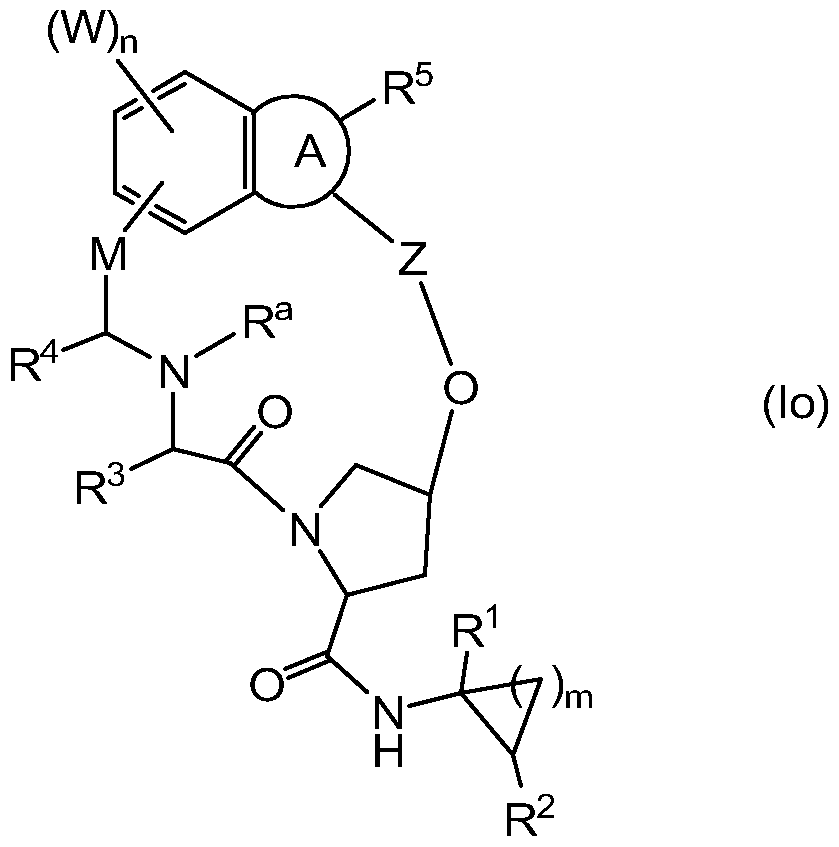
In one embodiment of the present invention, there is provided the compound of formula (Io):
Figure imgf000004_0001
or a pharmaceutically acceptable salt thereof, wherein: m is 1, 2, 3 or 4; n is 0, 1 or 2;
R1 is CO2R6, CONR6SO2 R6 or CONR6SO2N(R6),; R2 is H, Ci-6alkyl, C2-6alkenyl or d-scycloalkyl, wherein said alkyl, alkenyl or cycloalkyl is optionally substituted with 1 to 3 halo;
R3 is Ci-6alkyl, (CH^o^d-scycloalkyl, (CH2)0-3aryl or (CH2)0-3Het, optionally substituted by halo, OR6, SR6, N(R6)2, d_6alkyl, NO2, CN, CF3, NR6SO2R6, SO2N(R6)2, NHCO2R6, NHCOR6, NHCONHR6, CO2R6, C(O)R6 or CON(R6)2; R4 is hydrogen, C^aUcyl, C2_6alkenyl, C2_6alkynyl, (CH2)0-3C3_8cycloalkyl, (CH2)0-3aryl or d_6alkoxy, optionally substituted by halo, OR6, SR6, N(R6)2, d_6alkyl, NO2, CN, CF3 NR6SO2R6, SO2N(R6)2, NHCO2R6, NHCOR6, NHCONHR6, CO2R6, C(O)R6 or CON(R6)2;
R5 is hydrogen, halo, hydroxy, Ci-6alkyl, Ci-6alkoxy, CN, NO2, C3_8cycloalkyl, N(R6)2, aryl or heteroaryl, optionally substituted by 1 to 8 halo, Ci^alkyl or N(R6)2; each R6 is independently hydrogen, Ci-6alkyl or C3_8cycloalkyl;
Ra is hydrogen or Ci^alkyl; or Ra and R3 are joined to form a 5- to 7-membered heterocycle containing 1, 2 or 3 N atoms, which heterocycle is optionally substituted by Ci^alkyl; each W is independently halo, OR6, d_6alkyl, CN, NO2, CF3, OCF3, OCHF2, CO2R6, CON(R6)2, COR6, NR6C(O)R6, aryl or heteroaryl; Z is a bond or C=O;
M is C2_i2alkylene or C2_i2alkenylene, optionally substituted by halo, C^aUcyl, (CH2)o-3C3_8cycloalkyl or (CH2)0-3aryl, and optionally containing O, NR6, S, SO or SO2; and ring A is pyridinyl, pyrrolidinyl or pyrimidinyl.
In another embodiment of the present invention, m is 1 or 2. Preferably, m is 1.
In another embodiment of the present invention, n is 0 or 1. Preferably, n is 0.
In another embodiment, R1 is CO2R6, CONR6SO2R6 or CONR6SO2N(R6)2 where R6 is as hereinbefore defined. Preferably, R1 is CO2R6 or CONR6SO2R6 where R6 is as hereinbefore defined. More preferably, R1 is CO2H or CONHSO2R6 where R6 is as hereinbefore defined. Especially, R1 is CO2H or CONHSO2-C3_8cycloalkyl. More especially, R1 is CO2H or CONHSO2-C3_6cycloalkyl. Most especially, R1 is CO2H or CONHSO2-cyclopropyl.
In another embodiment, R2 is C^aUcyl or C2_6alkenyl. Preferably, R2 is Ci^alkyl or C2. 4alkenyl. More preferably, R2 is Ci_2alkyl or -CH=CH2. Most preferably, R2 is ethyl or - CH=CH2.
In another embodiment, R3 is Ci_6alkyl, or (CH2)0-3C3_8cycloalkyl, optionally substituted by halo, OR6 or C^aUcyl, where R6 is as hereinbefore defined. Preferably, R3 is C^aUcyl or (CH2)o-3C3_8cycloalkyl, optionally substituted by halo. More preferably, R3 is Ci^alkyl or C3. 6cycloalkyl, optionally substituted by fiuoro or chloro. Most preferably, R3 is methyl, propyl, butyl, cyclopentyl or cyclohexyl, optionally substituted by fiuoro. Especially, R3 is methyl, 'propyl, 'butyl, CF3, cyclopentyl or cyclohexyl.
In another embodiment, Ra is hydrogen or Ci_2alkyl. Preferably, Ra is hydrogen or methyl.
In another embodiment, Ra and R3 are joined to form a 5- or 6- membered heterocycle containing 1 or 2 N atoms, which heterocycle is optionally substituted by Ci^alkyl. Preferably, Ra and R3 are joined to form a 5- or 6- membered heterocycle containing one N atom, which heterocycle is optionally substituted by Ci^alkyl. More preferably, Ra and R3 are joined to form a pyrrolidinyl or a piperidinyl ring, optionally substituted by Ci_2alkyl. Most preferably, Ra and R3 are joined to form a pyrrolidinyl ring, optionally substituted by methyl. Especially, Ra and R3 form
Figure imgf000005_0001
where * indicates the nitrogen atom to which Ra is attached and ** indicates the carbon atom to which R3 is attached.
In another embodiment, R4 is hydrogen, Ci-6alkyl, (CH2)o-3C3_8cycloalkyl, (CH2)0-3phenyl or Ci_6alkoxy, optionally substituted by halo, OR6, SR6, N(R6)2, Ci_6alkyl, NO2 or CN, where R6 is as hereinbefore defined. Preferably, R is hydrogen, Ci-6alkyl or Ci-6alkoxy, optionally substituted by halo or OR6, where R6 is as hereinbefore defined. More preferably, R4 is hydrogen or Ci_ 6alkyl, optionally substituted by halo. Most preferably, R4 is hydrogen or Ci_4alkyl, optionally substituted by fiuoro or chloro. Especially, R4 is hydrogen or Ci_2alkyl, optionally substituted by fiuoro. Examples of suitable R4 groups include hydrogen, methyl, CF3 and CF2CF3 In another embodiment, R5 is hydrogen, halo, hydroxy, C^aUcyl, Ci_6alkoxy, C3-8cycloalkyl, aryl or heteroaryl, optionally substituted by N(R6)2. Preferably, R5 is hydrogen, Ci_ 6alkyl, C3_8cycloalkyl, phenyl or thiazolyl, optionally substituted by NHR6. More preferably, R5 is hydrogen, Ci^alkyl, phenyl or thiazolyl, where thiazolyl is optionally substituted by NHR6. Most preferably, R5 is hydrogen, phenyl or
Figure imgf000006_0001
When R5 is other than hydrogen, preferably it is attached to the carbon atom adjacent to the nitrogen atom of the pyridinyl, pyrrolidinyl or pyrimidinyl moiety.
In another embodiment, each W is independently halo, OR6, C^aUcyl, CF3, CO2R6, CON(R6)2, COR6 or NR6C(O)R6, where R6 is as hereinbefore defined. Preferably, each W is independently halo, OR6, CF3, CO2R6 or CONHR6, where R6 is as hereinbefore defined. More preferably, each W is independently fluoro, chloro, OCi-6alkyl or CF3. Most preferably, each W is independently OCi^alkyl or CF3. Especially, each W is independently OCi-2alkyl. Most especially, W is methoxy.
In another embodiment, Z is a bond when A is pyridinyl or pyrimidinyl. In another embodiment, Z is C=O when A is pyrrolidinyl. Preferably, Z is attached to the nitrogen atom of the pyrrolidinyl moiety. In another embodiment, Z is -CH2- when ring B is biphenyl.
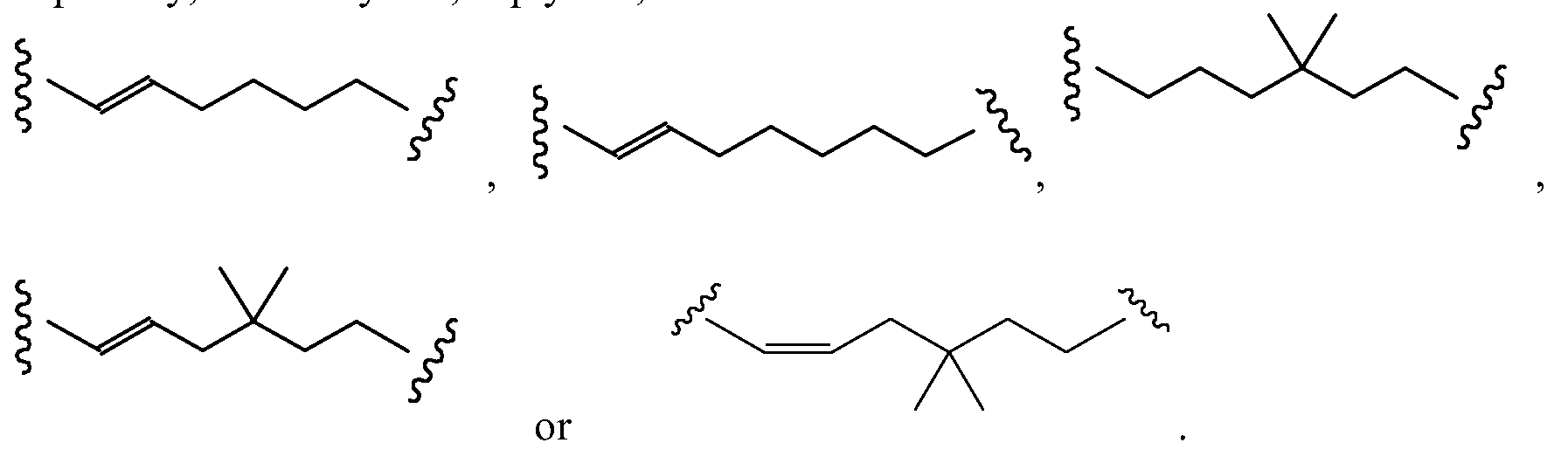
In another embodiment, M is C2_8alkylene or C2-salkenylene, optionally substituted by halo, Ci-4alkyl or C3_6cycloalkyl, and optionally containing O. Preferably, M is C4_7alkylene or C4. 7alkenylene, optionally substituted by fluoro, chloro or Ci^alkyl, and optionally containing O. More preferably, M is Cs^alkylene or Cs^alkenylene, optionally substituted by fluoro or methyl, and optionally containing O. Examples of suitable M groups include pentylene, hexylene, heptylene,
Figure imgf000006_0002
In another embodiment, ring A is pyridinyl or pyrrolidinyl.
In another embodiment of the present invention, there is provided the compound of formula (Ia):
Figure imgf000007_0001
or a pharmaceutically acceptable salt thereof, wherein R1, R2, R3, R4 and M are as defined in relation to formula (I).
Preferably, R1 is C(O)NR6SO2R6 where R6 is as defined in relation to formula (I). More preferably, R1 is C(O)NHSO2R6 where R6 is as defined in relation to formula (I). Most preferably, R1 is C(O)NHSO2-C3-6cycloalkyl. Especially R1 is C(O)NHSO2-cyclopropyl.
Preferably, R2 is C2_6alkenyl. More preferably, R2 is -CH=CH2.
Preferably, R3 is Ci-6alkyl or (CH2)o-3C3_8cycloalkyl, optionally substituted by halo. More preferably, R3 is Ci_4alkyl or C3_6cycloalkyl, optionally substituted by fiuoro or chloro. Most preferably, R3 is Ci_4alkyl or C5-6cycloalkyl, optionally substituted by fiuoro. Especially, R3 is 'propyl, cyclopentyl or CF3.
Preferably, R4 is hydrogen, halo, hydroxy, Ci-6alkyl, Ci-6alkoxy, C3_8cycloalkyl or phenyl, optionally substituted by halo or OR6, where R6 is as hereinbefore defined. More preferably, R4 is hydrogen, Ci-6alkyl or C3_8cycloalkyl, optionally substituted by halo. Most preferably, R4 is hydrogen or Ci_4alkyl, optionally substituted by fiuoro or chloro. Especially, R4 is hydrogen or Ci_2alkyl, optionally substituted by fiuoro. More especially, R4 is hydrogen, methyl or CF3.
Preferably, M is C3_i2alkylene or C3_i2alkenylene, optionally substituted by halo or Ci_ 6alkyl. More preferably, M is C4_8alkylene or C4-8alkenylene, optionally substituted by fiuoro or Ci-4alkyl. Most preferably, M is C6-7alkylene or C6-7alkenylene, optionally substituted by Ci_2alkyl. Especially, M is hexylene or
Figure imgf000007_0002
In another embodiment of the present invention, there is provided the compound of formula (Ib):
Figure imgf000008_0001
or a pharmaceutically acceptable salt thereof, wherein R1, R2, R3, R4 and M are as defined in relation to formula (I).
Preferably, R1 is CO2R6 or C(O)NR6SO2R6 where R6 is as defined in relation to formula (I). More preferably, R1 is CO2R6 or C(O)NHSO2R6 where R6 is as defined in relation to formula (I). Most preferably, R1 is CO2H or C(O)NHSO2-C3-6cycloalkyl. Especially R1 is CO2H or C(O)NHSO2-cyclopropyl. Preferably, R2 is Ci_4alkyl or C2_4alkenyl. More preferably, R2 is Ci_2alkyl or -CH=CH2.
Most preferably, R2 is ethyl or -CH=CH2.
Preferably, R3 is Ci-6alkyl or (CH2)0-3C3-8cycloalkyl, optionally substituted by halo. More preferably, R3 is Ci_4alkyl or C3_6cycloalkyl, optionally substituted by fiuoro or chloro. Most preferably, R3 is Ci_4alkyl or C5-6cycloalkyl, optionally substituted by fiuoro. Especially, R3 is methyl, 'propyl, 'butyl, CF3, cyclopentyl or cyclohexyl.
Preferably, Ra is hydrogen or Ci_2alkyl. More preferably, Ra is hydrogen or methyl. Preferably, Ra and R3 are joined to form a 5- or 6-membered heterocycle containing 1 or 2 N atoms, which heterocycle is optionally substituted by Ci_4alkyl. More preferably, Ra and R3 are joined to form a 5- or 6- membered heterocycle containing one N atom, which heterocycle is optionally substituted by Ci_4alkyl. Most preferably, Ra and R3 are joined to form a pyrrolidinyl or a piperidinyl ring, optionally substituted by Ci_2alkyl. Especially, Ra and R3 are joined to form a
pyrrolidinyl ring, optionally substituted by methyl. More especially, Ra and R3 form
Figure imgf000008_0002
where * indicates the nitrogen atom to which Ra is attached and ** indicates the carbon atom to which R3 is attached. Preferably, R4 is hydrogen, halo, hydroxy, C^aUcyl, Ci_6alkoxy, Cs-scycloalkyl or phenyl, optionally substituted by halo or OR6, where R6 is as hereinbefore defined. More preferably, R4 is hydrogen, Ci-6alkyl or C3-8cycloalkyl, optionally substituted by halo. Most preferably, R4 is hydrogen or Ci^alkyl, optionally substituted by fiuoro or chloro. Especially, R4 is hydrogen or Ci_2alkyl, optionally substituted by fiuoro. More especially, R4 is hydrogen, methyl, CF3 or CF2CF3.
Preferably, M is C2-8alkylene or C2-8alkenylene, optionally substituted by halo or C^aUcyl. More preferably, M is C4_7alkylene or C4_7alkenylene, optionally substituted by fiuoro, chloro or Ci-4alkyl. Most preferably, M is Cs^alkylene or Cs^alkenylene, optionally substituted by fiuoro or Ci-2alkyl. Especially, M is pentylene, hexylene,
Figure imgf000009_0001
In another embodiment of the present invention, there is provided the compound of formula (Ic):
Figure imgf000009_0002
or a pharmaceutically acceptable salt thereof, wherein R1, R2, R3, R4 and M are defined in relation to formula (I).
Preferably, R1 is C(O)NR6SO2R6 where R6 is as defined in relation to formula (I). More preferably, R1 is C(O)NHSO2R6 where R6 is as defined in relation to formula (I). Most preferably, R1 is C(O)NHSO2-C3_6cycloalkyl. Especially, R1 is C(O)NHSO2-cyclopropyl.
Preferably, R2 is C2-6alkenyl. More preferably, R2 is -CH=CH2.
Preferably, R3 is Ci-6alkyl or (CH2)o-3C3_8cycloalkyl, optionally substituted by halo. More preferably, R3 is Ci^alkyl or C3_6cycloalkyl. Most preferably, R3 is C^alkyl or Cs-oCycloalkyl. Especially, R3 is 'butyl or cyclohexyl. Preferably, R4 is hydrogen or d-6alkyl. More preferably, R4 is hydrogen or Ci_4alkyl. Most preferably, R4 is hydrogen or Ci-2alkyl. Especially, R4 is hydrogen.
Preferably, M is C2-8alkylene pr C2-8alkenylene, optionally substituted by halo or C^aUcyl. More preferably, M is C3-7alkylene or C3-7alkenylene, optionally substituted by Ci_4alkyl. Most preferably, M is C4-6alkenylene or C4-6alkenylene, optionally substituted by Ci_2alkyl. Especially, M is pentylene or
Figure imgf000010_0002
In another embodiment of the present invention, there is provided the compound of formula (Id):
Figure imgf000010_0001
or a pharmaceutically acceptable salt thereof, wherein R1, R2, R3, R4, R5, M and W are defined in relation to formula (I).
Preferably, R1 is C(O)NR6SO2R6 where R6 is as defined in relation to formula (I). More preferably, R1 is C(O)NHSO2R6 where R6 is as defined in relation to formula (I). Most preferably, R1 is C(O)NHSO2-C3-6cycloalkyl. Especially, R1 is C(O)NHSO2-cycopropyl.
Preferably, R2 is C2_6alkenyl. More preferably, R2 is -CH=CH2
Preferably, R3 is Ci_6alkyl or (CH2)0-3C3_8cycloalkyl, optionally substituted by halo. More preferably, R3 is Ci_4alkyl or Cs-όCycloalkyl. Most preferably, R3 is C3-4alkyl or Cs-όCycloalkyl. Especially, R3 is cyclohexyl.
Preferably, R4 is hydrogen or Ci-6alkyl. More preferably, R4 is hydrogen or Ci_4alkyl. Most preferably, R4 is hydrogen or Ci_2alkyl. Especially, R4 is hydrogen.
Preferably, R5 is hydrogen, halo, hydroxy, Ci-6alkyl, Ci-6alkoxy, C3-8cycloalkyl, aryl or heteroaryl. More preferably, R5 is hydrogen, C^aUcyl, C3_8cycloalkyl or aryl. Most preferably, R5 is hydrogen, Ci_4alkyl, C3-6cycloalkyl or phenyl. Especially, R5 is hydrogen, Ci_2alkyl, C5- 6cycloalkyl or phenyl. More especially, R5 is phenyl. Preferably, W is halo, OR6, d_6alkyl, CF3, CO2R6, CON(R6)2, COR6 Or NR6C(O)R6, where R6 is as hereinbefore defined. More preferably, W is fiuoro, chloro, 0Ci_6alkyl, CF3, CO2Ci_6alkyl, or CONHC1-6alkyl. Most preferably, W is fiuoro, chloro, OCi_4alkyl or CF3. Especially, W is OCi_2alkyl. More especially, W is methoxy.
Preferably, M is C3_i2alkylene or C3_i2alkenylene, optionally substituted by halo or Ci- 6alkyl. More preferably, M is C4_8alkylene or C4_8alkenylene, optionally substituted by fiuoro or Ci_4alkyl. Most preferably, M is C6-7alkylene or C6-7alkenylene, optionally substituted by Ci_2alkyl. Especially, M is hexylene, heptylene,
Figure imgf000011_0001
When any variable occurs more than one time in formula (I) or in any substituent, its definition on each occurrence is independent of its definition at every other occurrence. As used herein, the term "alkyl" as a group or part of a group refers to any linear or branched chain alkyl group having a number of carbon atoms in the specified range. Thus, for example, "Ci_6alkyl" refers to all of the hexyl alkyl and pentyl alkyl isomers as well as n-, iso-, sec- and t-butyl, n- and iso-propyl, ethyl and methyl. As another example, "Ci^alkyl" refers to n-, iso-, sec- and t-butyl, n- and iso-propyl, ethyl and methyl. The term "alkoxy" represents any linear or branched chain alkyl group having a number of carbon atoms in the specified range and attached through an oxygen bridge. Examples of suitable alkoxy groups include methoxy, ethoxy, n-propoxy, i-propoxy, n-butoxy, s-butoxy, i-butoxy and t-butoxy.
The term "alkenyl" as a group or part of a group refers to any linear or branched chain alkyl group containing at least one double bond, which may occur at any point along the chain, and having a number of carbon atoms in the specified range. E- and Z- forms are both included, where applicable. Examples of suitable alkenyl groups include vinyl, allyl, butenyl and pentenyl.
The term "cycloalkyl" refers to any cyclic alkyl ring having a number of carbon atoms in the specified range. Examples of suitable cycloalkyl groups include cyclopropyl, cyclobutyl, cyclopentyl and cyclohexyl.
The terms "alkylene" and "alkenylene" as a group or part of a group refer to the groups "alkyl" and "alkenyl" respectively, when they are divalent, i.e. attached at two atoms.
The term "halogen" or "halo" means fluorine, chlorine, bromine and iodine (alternatively referred to as fiuoro, chloro, bromo and iodo, respectively). The term "aryl" as a group or part of a group means a carbocyclic aromatic ring. Examples of suitable aryl groups include phenyl and naphthyl.
The term "Het" as a group or part of a group means a 5- to 7-membered saturated or unsaturated non-aromatic ring having 1 to 4 heteroatoms selected from N, O and S. The term "heteroaryl" as a group or part of a group means a 5- to 10-membered heteroaromatic ring system containing 1 to 4 heteroatoms selected from N, O and S. Examples of such groups include pyrrolyl, furanyl, thienyl, pyridyl, pyrazolyl, imidazolyl, oxazolyl, isoxazolyl, thiazolyl, isothiazolyl, pyrazinyl, pyrimidinyl, pyridazinyl, triazolyl, oxadiazolyl, thiadiazolyl, triazinyl, tetrazolyl, indolyl, benzothienyl, benzimidazolyl, benzofuryl, quinolyl and isoquinolyl. Unless expressly stated to the contrary, all ranges cited herein are inclusive. For example, a heteroaryl ring described as containing from "1 to 3 heteroatoms" means the ring can contain 1, 2, or 3 heteroatoms.
Where a compound or group is described as "optionally substituted" one or more substituents may be present. Furthermore, optional substituents may be attached to the compounds or groups which they substitute in a variety of ways, either directly or through a connecting group of which the following are examples: amine, amide, ester, ether, thioether, sulfonamide, sulfamide, sulfoxide, urea, thiourea and urethane. As appropriate an optional substituent may itself be substituted by another substituent, the latter being connected directly to the former or through a connecting group such as those exemplified above. Specific compounds within the scope of this invention include those named in the
Examples and Table hereinbelow and their pharmaceutically acceptable salts.
For use in medicine, the salts of the compounds of formula (I) will be non-toxic pharmaceutically acceptable salts. Other salts may, however, be useful in the preparation of the compounds according to the invention or of their non-toxic pharmaceutically acceptable salts. Suitable pharmaceutically acceptable salts of the compounds of this invention include acid addition salts which may, for example, be formed by mixing a solution of the compound according to the invention with a solution of a pharmaceutically acceptable acid such as hydrochloric acid, fumaric acid, p-toluenesulfonic acid, maleic acid, succinic acid, acetic acid, citric acid, tartaric acid, carbonic acid, phosphoric acid or sulfuric acid. Salts of amine groups may also comprise quaternary ammonium salts in which the amino nitrogen atom carries a suitable organic group such as an alkyl, alkenyl, alkynyl or aralkyl moiety. Furthermore, where the compounds of the invention carry an acidic moiety, suitable pharmaceutically acceptable salts thereof may include metal salts such as alkali metal salts, e.g. sodium or potassium salts; and alkaline earth metal salts, e.g. calcium or magnesium salts. The salts may be formed by conventional means, such as by reacting the free base form of the product with one or more equivalents of the appropriate acid in a solvent or medium in which the salt is insoluble, or in a solvent such as water which is removed in vacuo or by freeze drying or by exchanging the anions of an existing salt for another anion on a suitable ion exchange resin. The present invention includes within its scope prodrugs of the compounds of formula (I) above. In general, such prodrugs will be functional derivatives of the compounds of formula (I) which are readily convertible in vivo into the required compound of formula (I). Conventional procedures for the selection and preparation of suitable prodrug derivatives are described, for example, in "Design of Prodrugs", ed. H. Bundgaard, Elsevier, 1985.
A prodrug may be a pharmacologically inactive derivative of a biologically active substance (the "parent drug" or "parent molecule") that requires transformation within the body in order to release the active drug, and that has improved delivery properties over the parent drug molecule. The transformation in vivo may be, for example, as the result of some metabolic process, such as chemical or enzymatic hydrolysis of a carboxylic, phosphoric or sulfate ester, or reduction or oxidation of a susceptible functionality.
The present invention includes within its scope solvates of the compounds of formula (I) and salts thereof, for example, hydrates.
The present invention also includes within its scope any enantiomers, diastereomers, geometric isomers and tautomers of the compounds of formula (I). It is to be understood that all such isomers and mixtures thereof are encompassed within the scope of the invention.
The preferred compounds of the present invention will have the stereochemistry as shown in formula (Ie):
Figure imgf000013_0001
The present invention further provides a compound of formula (I) or a pharmaceutically acceptable salt thereof for use in therapy.
In another aspect, the invention provides the use of a compound of formula (I) as defined above, or a pharmaceutically acceptable salt thereof, for the manufacture of a medicament for treatment or prevention of infection by hepatitis C virus in a human or animal.
A further aspect of the invention provides a pharmaceutical composition comprising a compound of formula (I) as defined above, or a pharmaceutically acceptable salt thereof, in association with a pharmaceutically acceptable carrier. The composition may be in any suitable form, depending on the intended method of administration. It may for example be in the form of a tablet, capsule or liquid for oral administration, or of a solution or suspension for administration parenterally.
The pharmaceutical compositions optionally also include one or more other agents for the treatment of viral infections such as an antiviral agent, or an immunomodulatory agent such as α-, β- or γ-interferon.
In a further aspect, the invention provides a method of inhibiting hepatitis C virus protease and/or of treating or preventing an illness due to hepatitis C virus, the method involving administering to a human or animal (preferably mammalian) subject suffering from the condition a therapeutically or prophylactically effective amount of the pharmaceutical composition described above or of a compound of formula (I) as defined above, or a pharmaceutically acceptable salt thereof. "Effective amount" means an amount sufficient to cause a benefit to the subject or at least to cause a change in the subject's condition.
The term "subject" (alternatively referred to herein as "patient") as used herein refers to an animal, preferably a mammal, most preferably a human, who has been the object of treatment, observation or experiment.
The dosage rate at which the compound is administered will depend on a variety of factors including the activity of the specific compound employed, the metabolic stability and length of action of that compound, the age of the patient, body weight, general health, sex, diet, mode and time of administration, rate of excretion, drug combination, the severity of the particular condition and the host undergoing therapy. Suitable dosage levels may be of the order of 0.02 to 5 or 10 g per day, with oral dosages two to five times higher. For instance, administration of from 10 to 50 mg of the compound per kg of body weight from one to three times per day may be in order. Appropriate values are selectable by routine testing. The compound may be administered alone or in combination with other treatments, either simultaneously or sequentially. For instance, it may be administered in combination with effective amounts of antiviral agents, immunomodulators, anti-infectives or vaccines known to those of ordinary skill in the art. It may be administered by any suitable route, including orally, intravenously, cutaneously and subcutaneously. It may be administered directly to a suitable site or in a manner in which it targets a particular site, such as a certain type of cell. Suitable targeting methods are already known.
An additional aspect of the invention provides a method of preparation of a pharmaceutical composition, involving admixing at least one compound of formula (I) as defined above, or a pharmaceutically acceptable salt thereof, with one or more pharmaceutically acceptable adjuvants, diluents or carriers and/or with one or more other therapeutically or prophylactically active agents.
As noted above, the present invention also relates to a method of inhibiting HCV NS3 protease, inhibiting HCV replication, or preventing or treating HCV infection with a compound of the present invention in combination with one or more therapeutic agents and a pharmaceutical composition comprising a compound of the present invention and one or more therapeutic agents selected from the group consisting of a HCV antiviral agent, an immunomodulator, and an anti- infective agent. Such therapeutic agents active against HCV include ribavirin, levovirin, viramidine, thymosin alpha- 1, interferon-β, interferon-α, pegylated interferon-α (peginterferon-α), a combination of interferon-α and ribavirin, a combination of peginterferon-α and ribavirin, a combination of interferon-α and levovirin, and a combination of peginterferon-α and levovirin. Interferon-α includes recombinant interferon-α2a (such as Roferon interferon available from Hoffmann-LaRoche, Nutley, NJ), pegylated interferon-α2a (Pegasys™), interferon-α2b (such as Intron-A interferon available from Schering Corp., Kenilworth, NJ), pegylated interferon-α2b (Peglntron™), a recombinant consensus interferon (such as interferon alphacon-1), and a purified interferon-α product. Amgen's recombinant consensus interferon has the brand name Infergen®. Levovirin is the L-enantiomer of ribavirin which has shown immunomodulatory activity similar to ribavirin. Viramidine represents an analog of ribavirin disclosed in WO 01/60379 (ICN Pharmaceuticals). In accordance with the method of the present invention, the individual components of the combination can be administered separately at different times during the course of therapy or concurrently in divided or single combination forms.
For the treatment of HCV infection, the compounds of the present invention may also be administered in combination with an agent that is an inhibitor of HCV NS3 serine protease. HCV NS3 protease inhibitors are disclosed in WO 98/22496, WO 98/46630, WO 99/07733, WO 99/07734, WO 99/38888, WO 99/50230, WO 99/64442, WO 00/09543, WO 00/59929, GB- 2337262, WO 02/48116, WO 02/48172, and U.S. Patent No. 6,323,180.
Ribavirin, levovirin, and viramidine may exert their anti-HCV effects by modulating intracellular pools of guanine nucleotides via inhibition of the intracellular enzyme inosine monophosphate dehydrogenase (IMPDH). Thus, inhibition of IMPDH represents another useful target for the discovery of inhibitors of HCV replication. Therefore, the compounds of the present invention may also be administered in combination with an inhibitor of IMPDH, such as VX-497, disclosed in WO 97/41211 and WO 01/00622 (Vertex); another IMPDH inhibitor, such as that disclosed in WO 00/25780 (Bristol-Myers Squibb); or mycophenolate mofetil [see A.C. Allison and E.M. Eugui, Agents Action. 44 (Suppl): 165 (1993)].
For the treatment of HCV infection, the compounds of the present invention may also be administered in combination with the antiviral agent amantadine (1-aminoadamantane) [see J. Kirschbaum, Anal. Profiles Drug Subs. 12: 1-36 (1983)].
The compounds of the present invention may also be combined for the treatment of HCV infection with antiviral 2'-C-branched ribonucleosides disclosed in R. E. Harry-O'kuru, et al., J1 Org. Chem.. 62: 1754-1759 (1997); M. S. Wolfe, et al.. Tetrahedron Lett.. 36: 7611-7614 (1995); U.S. Patent No. 3,480,613; WO 01/90121; WO 01/92282; WO 02/32920; WO
04/002999; WO 04/003000; and WO 04/002422. Such 2'-C-branched ribonucleosides include 2'-C-methyl-cytidine, 2'-C-methyl-uridine, 2'-C-methyl-adenosine, 2'-C-methyl-guanosine, and 9- (2-C-methyl-β-D-ribofuranosyl)-2,6-diaminopurine, and the corresponding amino acid ester of the ribose C-2', C-3', and C-5' hydroxyls and the corresponding optionally substituted cyclic 1,3- propanediol esters of the 5 '-phosphate derivatives.
The compounds of the present invention may also be combined for the treatment of HCV infection with other nucleosides having anti-HCV properties, such as those disclosed in WO 02/51425 (Mitsubishi Pharma Corp.); WO 01/79246, WO 02/32920 and WO 02/48165 (Pharmasset, Ltd.); WO 01/68663 (ICN Pharmaceuticals); WO 99/43691; WO 02/18404 (Hoffmann-LaRoche); U.S. 2002/0019363; WO 02/100415; WO 03/026589; WO 03/026675; WO 03/093290; US 2003/0236216; US 2004/0006007; WO 04/011478; WO 04/013300; US 2004/0063658; and WO 04/028481. For the treatment of HCV infection, the compounds of the present invention may also be administered in combination with an agent that is an inhibitor of HCV NS5B polymerase. Such HCV NS5B polymerase inhibitors that may be used as combination therapy include those disclosed in WO 02/057287, US 6,777,395, WO 02/057425, US 2004/0067901, WO 03/068244, WO 2004/000858, WO 04/003138 and WO 2004/007512. Other such HCV polymerase inhibitors include valopicitabine (NM-283; Idenix) and 2'-F-2'-beta-methylcytidine (see also WO 2005/003147, assigned to Pharmasset, Ltd.).
The compounds of the present invention may also be combined for the treatment of HCV infection with non-nucleoside inhibitors of HCV polymerase such as those disclosed in WO 01/77091 (Tularik, Inc.); WO 01/47883 (Japan Tobacco, Inc.); WO 02/04425 (Boehringer Ingelheim); WO 02/06246, WO 03/062211, WO 2004/087714, WO 2004/110442, WO 2005/034941, WO 2005/023819, WO2006/029912, WO 2006/008556, WO 2006/027628, GB2430621, WO2006/046030, WO2006/046039, WO2006/119975, WO2007/028789 and WO2007/029029 (all Istituto di Ricerche di Biologia Molecolare P. Angeletti S.p.A.); WO 02/20497; WO 2005/016927 (in particular JTK003), and WO 2005/080399 (Japan Tobacco, Inc.); WO 2006/020082 (Bristol-Myers Squibb Company); and HCV-796 (Viropharma Inc.).
The present invention also provides a process for the preparation of compounds of formula (I).
According to a general process (a), compounds of formula (I) may be prepared by the coupling of the ester of formula (II) with the amine of formula (III):
Figure imgf000017_0001
where m, n, R1, R2, R3, R4, R5, Ra, M, W, Z and ring B are as defined in relation to formula (I) and P1 is Ci_6alkyl, such as methyl. The ester (II) is first hydrolysed under standard conditions (e.g. in the presence of a base, such as lithium hydroxide, in a solvent, such as THF/water, MeOH/water or dioxane/water) to give the free acid. The coupling reaction is then conveniently carried out in the presence of a coupling reagent, such as TBTU or HATU, and a base, such as diisopropylethylamine or triethylamine, in a solvent. Suitable solvents include DMF and dichloromethane. Optionally, a dehydrating agent, such as DMAP, may also be used.
The compound of formula (II) where M has 4 or more carbon atoms in the tether and one or more double bonds may be prepared by the internal ring closure of the diene of formula (IV):
Figure imgf000017_0002
where n, R3, R4, R5, Ra, W, Z and ring B are as defined in relation to formula (I), P1 is as defined in relation to formula (II) and M' is a suitable precursor moiety of group M in formula (II) which can be converted into the corresponding moiety of M during the ring closure or after it using methods described in the accompanying Schemes and Examples or known to the person skilled in the art. The reaction is conveniently carried out in the presence of a metathesis catalyst, such as Zhan catalyst [dichloro(5-chloro-2-isopropoxy benzylidene)(l,3-dimethylimidazolidin-2- ylidene)ruthenium], preferably at raised temperature or under microwave irradiation, in a suitable solvent such as dichloromethane or 1,2-dichloroethane. The resultant ring double bond may be hydrogenated to give a further compound of formula (II). The hydrogenation is preferably carried out in the presence of a suitable catalyst, such as palladium on carbon, in a suitable solvent, such as methanol or methanol/ethyl acetate mixture. Compounds of formulae (II), (III) and (IV) are either well known in the art or may be prepared by conventional methodology well known to one of ordinary skill in the art using, for instance, procedures described in the accompanying Schemes and Examples, or by alternative procedures which will be readily apparent.
Further details of suitable procedures will be found in the accompanying Schemes and Examples. For instance compounds of formula (I) can be converted into other compounds of formula (I) using synthetic methodology well known in the art.
Thus, for instance, the compound of formula (I) where M is unsaturated may be converted into the compound of formula (I) where M is saturated by hydrogenation, preferably in the presence of a suitable catalyst, such as palladium on carbon, in a suitable solvent, such as methanol/ethyl acetate mixture.
Furthermore, the compound of formula (I) where Ra is Ci^alkyl may be prepared from the compound of formula (I) where Ra is hydrogen by alkylation. The reaction may be carried out in the presence of a mild base, such as sodium cyanoborohydride, and a catalyst, such as zinc (II) chloride, in a suitable solvent, such as methanol. The alkyl source is formaldehyde or CH3(CH2V2CHO.
During any of the described synthetic sequences, it may be necessary and/or desirable to protect sensitive or reactive groups on any of the molecules concerned. This may be achieved by means of conventional protecting groups such as those described in Protective Groups in Organic Chemistry, ed. J.F.W. McOmie, Plenum Press, 1973; and T.W. Greene & P.G.M. Wuts, Protective Groups in Organic Synthesis, John Wiley & Sons, 3rd ed., 1999. The protecting groups may be removed at a convenient subsequent stage using methods known from the art. The compounds of the present inventions are useful in the inhibition of HCV protease (e.g., HCV NS3 protease) and the prevention or treatment of infection by HCV. For example, the compounds of this invention are useful in treating infection by HCV after suspected past exposure to HCV by such means as blood transfusion, exchange of body fluids, bites, accidental needle stick, or exposure to patient blood during surgery.
The compounds of this invention are useful in the preparation and execution of screening assays for antiviral compounds. For example, the compounds of this invention are useful for isolating enzyme mutants, which are excellent screening tools for more powerful antiviral compounds. Furthermore, the compounds of this invention are useful in establishing or determining the binding site of other antivirals to HCV protease, e.g., by competitive inhibition. Thus the compounds of this invention are commercial products to be sold for these purposes. The HCV NS3 protease inhibitory activity of the present compounds may be tested using assays known in the art. One such assay is HCV NS3 protease time-resolved fluorescence (TRF) assay as described as follows:
HCV NS3 protease time-resolved fluorescence (TRF) assay
The NS3 protease TRF assay was performed in a final volume of lOOμl in assay buffer containing 50 mM HEPES, pH 7.5, 150 mM NaCl, 15 % glycerol, 0.15 % Triton X-IOO, 10 mM DTT, and 0.1 % PEG 8000. The NS3 protease was pre-incubated with various concentrations of inhibitors for 10-30 minutes. The peptide substrate for the assay is Ac-C(Eu)-DDMEE- Abu- [COO]- XSAK(QSY7)-NH2, where Eu is an europium-labeled group, Abu is 1-aminobutanoic acid which connects an ester linkage with 2-hydroxy propanoic acid (X). Hydrolysis of the peptide by NS3 protease activity causes in separation of the fiuorophore from the quencher, resulting in an increase in fluorescence. Activity of the protease was initiated by adding the TRF peptide substrate (final concentration 50-100 nM). The reaction was quenched after 1 hour at room temperature with 100 μl of 500 mM MES, pH 5.5. Product fluorescence was detected using either a Victor V2 or Fusion fluorimeter (Perkin Elmer Life and Analytical Sciences) with excitation at 340 nm and emission at 615 nm with 50-400 μs delay. Testing concentrations of different enzyme forms was selected with a signal to background ratio of 10-30. The inhibition constants were derived using a four-parameter fit.
Other examples of such assays are described in e.g., International patent publication WO2005/046712. Compounds useful as HCV NS3 protease inhibitors would have a Ki less than 50 μM, more preferably less than 10 μM, most preferably less than 1 μM, especially less than 100 nM, and more especially less than 50 nM. The following schemes and examples serve to illustrate the invention and its practice.
1H NMR spectra were recorded on Bruker AM series spectrometers operating at (reported) frequencies between 300 and 600 MHz. Chemical shifts (δ) for signals corresponding to non-exchangeable protons (and exchangeable protons where visible) are recorded in parts per million (ppm) relative to tetramethylsilane and are measured using the residual solvent peak as reference. Signals are tabulated in the order: multiplicity (s, singlet; d, doublet; t, triplet; q, quartet; m, multiplet; b, broad, and combinations thereof); coupling constant(s) in Hertz (Hz); number of protons. Mass spectral (MS) data were obtained on a Perkin Elmer API 100, or Waters MicroMass ZQ, operating in negative (ES") or positive (ES+) ionization mode and results are reported as the ratio of mass over charge (m/z). Preparative scale HPLC separations were carried out on a Waters Micromass System incorporating a 2525 pump module, a Micromass ZMD detector and a 2767 collection module, under Fraction Linx software or on a Shimadzu preparative system.
The following abbreviations are used in the examples, the schemes and the tables: AcOH: acetic acid; dioxan(e): 1,4-dioxane; DIPEA or 1Pr2NEt: diisopropylethylamine; DCE: 1,2- dichloroethane; DCM: dichloromethane; DMAP: 4-dimethylaminopyridine; DMF: N, N- dimethylformamide; DMSO: dimethylsulfoxide; EDC: l-(3-dimethylaminopropyl)-3- ethylcarbodiimide; Et2O: diethyl ether; EtOAc: ethyl acetate; eq.: equivalent(s); h: hour(s); HATU: O-(7-azabenzotriazol-l-yl)-Λ/,Λ/>N',N'-tetramethyluronium hexafluorophosphate; MeCN: acetonitrile; MeOH: methanol; min: minute(s); MS: mass spectrum; MTBE: tert Butyl methyl ether; PCC: pyridinium chlorochromate; PE: petroleum ether 30/60; quant.: quantitative; RP- HPLC: reversed phase high-performance liquid chromatography; RP-MS-HPLC: mass-guided reversed phase high-pressure liquid chromatography; RT: room temperature; sat. aq.: saturated aqueous; TBTU: O-benzotriazol-l-yl-N,N,N',N'-tetramethyluronium tetrafluoroborate; TEA: triethylamine; THF: tetrahydrofuran.
Scheme 1
Figure imgf000021_0001
Compound 1: (5R,7S,10S,12R or S)-N-((lR,25)-l-{[(cyclopropylsulfonyl)amino]carbonyl}- 2-vinylcyclopropyl)-10-isopropyl-3,9-dioxo-12-(trifluoromethyl)- 6,7,9,10,ll,12,13,14,15,16,17,18-dodecahydro-lH,5H-2,22:5,8-dimethano-4,2,8,ll- benzoxatriazacycloicosine-7-carboxamide
Step 1: (46f)-4-isopropyl-2-(trifluoromethyl)-l,3-oxazolidine 40 (R3 = isopropyl) The oxazolidine 40 was obtained as a 7:3 mixture of diastereoisomers prepared as described in Organic Letters 2004, 641. Step 2: (25V3-methyl-2- ([(Ii? or y)-l-(trifluoromethyl)hept-6-en-l-yl1aminoibutan-l-ol 41a (R3 = isopropyl)
A small amount of a solution (3M) of 6-bromohex-l-ene in dry Et2O was added dropwise to magnesium turnings (1 eq.). A small crystal of iodine was added followed by the remainder of the bromide solution. The reaction mixture was cooled to -78°C and (4S)-4-isopropyl-2-
(trifluoromethyl)-l,3-oxazolidine 40 (1 eq.) dissolved in Et2O (3M) was added dropwise. The reaction mixture was stirred at 00C for Ih and then quenched with aqueous HCl (IN). Aqueous NaOH (IN) was added until pH = 7. The two layers were separated and the aqueous phase was diluted with brine and extracted with CH2Cl2. The organic layers were joined, washed with brine, dried over Na2SO4, filtered and concentrated in vacuo. The residue was purified by flash chromatography on silica gel (EtOAc/PE gradient from 5:95 to 20:80) to afford the title compound as a mixture of two diastereoisomers (50%) that were separated by RP-HPLC (stationary phase: column Waters Symmetry prep. C18, 7 μm, 19 x 300 mm, mobile phase: MeCN/H2O containing 0.1 % TFA). Fractions containing the desired compounds as pure diastereoisomers were combined and freeze dried to afford 41a (second eluting) and 41b (first eluting) (67%, 41a : 41b = 1 : 0.14).
41a) 1H NMR (300 MHz, CDCl3, 300 K) δ 5.75 (ddt, J 17.0, 10.2, 6.7, IH), 5.47-5.17 (bs, IH), 5.06-4.90 (m, 2H), 3.96-3.70 (m, 3H), 3.24-3.09 (m, IH) 2.13-1.74 (m, 5H), 1.60-1.34 (m, 4H), 1.07 (d, J 6.9, 3H), 1.01 (d, J 6.9, 3H). MS (ES+) m/z 268 (M+H)+.
Step 3: f26f)-3-methyl-2-{[(li? or S)-I -(trifluoromethyl)hept-6-en-l-vH amino jbutanoic acid 42a (R3 = isopropyl)
To a solution (0.13 M) of (25)-3-methyl-2-{[l-(trifluoromethyl)hept-6-en-l-yl]amino}butan-l-ol 41a in acetone cooled to 00C, Jones reagent (8N) (5 eq.) was added. The reaction mixture was stirred at 00C for 15 min at RT overnight then was diluted with water and stirred at RT for 20 min. Aqueous NaOH (IN) was added to reach pH=5 and the mixture was extracted with CH2Cl2. The organic layer was dried over Na2SO4, filtered and concentrated in vacuo to afford the crude product, which was used in the following step without further purification. MS (ES+) m/z 282 (M+H)+.
Step 4: methyl N-F(IR or ^-l-(trifluoromethyl)hept-6-en-l-yll-L-valyl-(4i?)-4-(r(4-vinyl-1.3- dihvdro-2H-isoindol-2-yl)carbonyl1oxy}-L-prolinate 44a (R3 = isopropyl)
To a stirred mixture of (25)-3-methyl-2-{[(lR or 5)-l-(trifluoromethyl)hept-6-en-l- yl] amino }butanoic acid 42a in CH2Cl2 (0.09M) were added /Pr2EtN (2.4 eq.), TBTU (1.2 eq.) and after 5 min (25*,4i?)-2-(methoxycarbonyl)-4-{[(4-vinyl-l,3-dihydro-2H-isoindol-2- yl)carbonyl]oxy}pyrrolidinium chloride 43 (1 eq.). The mixture was stirred at RT overnight. Aqueous HCl (IN) was added, the organic layer was separated and washed with sat. aq. NaHCO3 and brine, dried over Na2SO4 and filtered. Evaporation under reduced pressure afforded a residue, which was purified by flash chromatography on silica gel (EtOAc/PE gradient from 5:95 to 15:85) to afford compound 44a as a white foam (24% after two steps). MS (ES+) m/z 580 (M+H)+.
Step 5: methyl (5R.75U 05.12R or S.17£yiO-isopropyl-3.9-dioxo-12-(trifluoromethviy 6.7.9.10.1 U2.13.14.15.16-decahydro-lH.5H-2.22:5.8-dimethano-4.2.8.11- benzoxatriazacvcloicosine-7-carboxylate 45a (R3 = isopropyl)
Zhan catalyst I (0.15 eq.) was added to methyl N-[I -(trifluoromethyl)hept-6-en-l-yl]-L-valyl- (4R)-4-{[(4-vinyl-l,3-dihydro-2H-isoindol-2-yl)carbonyl]oxy}-L-prolinate 44a in DCE (0.016 M) and the mixture was refiuxed for 45 min. Volatiles were evaporated under reduced pressure affording a residue, which was used in the following step without further purification. MS (ES+) m/z 552 (M+Η)+.
Step 6: methyl (5^75.105.12Jg or 5V10-isopropyl-3.9-dioxo-12-(trffluoromemylV 6.7.9.10.11.12.13.14.15.16.17.18-dodecahvdro-lH.5H-2.22:5.8-dimethano-4.2.8.11- benzoxatriazacycloicosine-7-carboxylate 46a (R3 = isopropyl)
Palladium 10% on carbon (20% w/w) and methyl (5R,7S,\0S,\2R or 5*,17E)-10-isopropyl-3,9- dioxo-12-(trifiuoromethyl)-6,7,9,10,l 1,12,13, 14,15, 16-decahydro-lH,5H-2,22:5,8-dimethano- 4,2,8,1 l-benzoxatriazacycloicosine-7-carboxylate 45a in methanol (0.035M) were stirred under a hydrogen atmosphere overnight. Solids were filtered over celite and the resulting solution was evaporated under reduced pressure. The residue was purified by flash chromatography on silica gel (EtOAc/PE gradient from 1:9 to 3:7) to afford compound 46a as a white foam (70% over two steps). MS (ES+) m/z 554 (M+H)+.
Step 7: (5RJSΛ0SΛ2R or ^-10-isopropyl-3.9-dioxo-12-(trifluoromethyl)- 6.7.9.10.11.12.13.14.15.16.17.18-dodecahvdro-lH.5H-2.22:5.8-dimethano-4.2.8.11- benzoxatriazacvcloicosine-7-carboxylic acid 47a (R3 = isopropyl)
Lithium hydroxide (3 eq.) was added to a stirred mixture of methyl (5R,7S,10S, \2R or 5)-10- isopropyl-3,9-dioxo-12-(trifluoromethyl)-6,7,9,10,l l,12,13,14,15,16,17,18-dodecahydro-lH,5H- 2,22:5, 8-dimethano-4,2, 8,1 l-benzoxatriazacycloicosine-7-carboxylate 46a in THF and water (2/1 v/v, 0.01 M) and the mixture was stirred at RT overnight. Aqueous HCl (IN) was added to reach pH = 6 and the mixture extracted with EtOAc. The organic layer was separated, dried over Na2SO4, filtered and concentrated to obtain the crude product 47a which was used in the following step without further purification. MS (ES+) m/z 540 (M+H)+.
Step 8: (5RJSΛ0SΛ2R or ^-N-rdR^^-l-irrcvclopropylsulfonvnaminoicarbonvU^- vinylcvclopropyD-lO-isopropyl-S^-dioxo-^-αrifluoromethvD-όJ^.lO.l l.^.n.M.lS.lό.π.lδ- dodecahvdro-lH,5H-2,22:5,8-dimethano-4,2,8,l l-benzoxatriazacycloicosine-7-carboxamide 1 To a stirred mixture of (5i?, 75,105)- 10-isopropyl-3, 9-dioxo-l 2-(trifluoromethyl)- 6,7,9,10,11, 12,13, 14,15, 16,17,18-dodecahydro-lH,5H-2,22:5,8-dimethano-4,2,8,l l- benzoxatriazacycloicosine-7-carboxylic acid 47a in CH2CI2 (5mM) were added /-Pr2EtN (2.4 eq), TBTU (1.2 eq.) and after 5 min (li?,25)-l-{[(cyclopropylsulfonyl)amino]carbonyl}-2- vinylcyclopropanaminium chloride 48 (prepared as described in WO 03/099274) (1.2 eq.). The mixture was stirred at RT overnight. The reaction mixture was extracted with aqueous HCl (IN), sat. aq. NaHCC>3 and brine, dried over Na2SO4 and filtered. Evaporation under reduced pressure afforded a residue, which was dissolved in DMSO and purified by RP-HPLC (stationary phase: column Symmetry C18, 7 urn, 19 x 300 mm. Mobile phase: MeCN/H2O buffered with 0.1 % TFA). Fractions containing the pure compound were combined and freeze dried to afford compound 1 as a white powder (34 %). 1H NMR (600 MHz, DMSO-d6, 300 K) δ 10.57 (s, IH), 9.22 (s, IH), 7.24 (t, J 7.5, IH), 7.18 (d, J 7.5, IH), 7.11 (d, J 7.5, IH), 5.68 (ddd, J 17.2, 10.0, 9.6, IH), 5.42 (bt, IH), 5.28 (dd, J 17.2, 1.5, IH), 5.12 (dd, J 10.4, 1.7, IH), 4.67-4.56 (m, 4H), 4.40 (dd, J 11.0, 6.5, IH), 3.96 (d, J 10.3, IH), 3.76 (dd, J 11.7, 3.1, IH), 3.31 (d, J 6.3, IH), 2.92-2.86 (m, IH), 2.92-2.30 (m, IH), 2.55-2.50 (partially obscured by residual DMSO, IH), 2.47-2.40 (m, IH), 2.22 (dd, J 13.8, 6.4, IH), 2.16 (q, J 8.8, IH), 2.09-2.02 (m, IH), 1.79-1.71 (m, 2H), 1.57-1.46 (m, 3H), 1.44-1.18 (m, 8H), 1.13-1.07 (m, IH), 1.06-0.98 (m, 3H), 0.91 (d, J 6.6, 3H), 0.83 (d, J 6.6, 3H). 13C NMR (600 MHz, DMSO-d6, 300 K) δ 174.08, 172.16, 169.17, 152.92, 137.09, 136.23, 135.00, 133.37, 127.93, 127.57, 126.04, 120.32, 117.87, 73.50, 64.83, 59.03, 58.87, 53.23, 52.12, 50.67, 40.79, 34.59, 33.81, 31.42, 31.17, 30.74, 28.90, 28.48, 26.43, 26.02, 23.47, 22.76, 19.09, 17.93, 5.73, 5.36. MS (ES+) m/z 752 (M+H)+.
Scheme 2
Figure imgf000024_0001
Scheme 3
Figure imgf000025_0001
Scheme 4
Figure imgf000025_0002
Scheme 5
Figure imgf000026_0001
Scheme 6
Figure imgf000027_0001
Compounds 10 and 25:
10) (5R,7S,IOS,12R or 5)-N-((lR,2S)-l-{[(cyclopropylsulfonyl)amino]carbonyl}-2- vinylcyclopropyl)-10-isopropyl-12-methyl-3,9-dioxo-6,7,9,10,ll,12,13,14,15,16,17,18- dodecahydro-lH,5H-2,22:5,8-dimethano-4,2,8,ll-benzoxatriazacycloicosine-7-carboxamide 25) (5R,7S,IOS,12R or S)-10-cyclohexyl-N-((lR,2S)-l-{[(cyclopropylsulfonyl)amino]carbonyl}- 2-vinylcyclopropyl)-12-methyl-3,9-dioxo-6,7,9,10,ll,12,13,14,15,16,17,18-dodecahydro-lH,5H- 2,22:5,8-dimethano-4,2,8,ll-benzoxatriazacycloicosine-7-carboxamide
Step 1 : N-methoxy-N-methylhept-6-enamide 58 EDC (1.1 eq.) was added in small portions over 1.5 h to a stirred mixture of hept-6-enoic acid, methoxy(methyl)ammonium chloride (1.1 eq.) and DMAP (1.1 eq.) in CH2Cl2 (0.2 M). After 14 h, the mixture was diluted with CH2Cl2, then washed sequentially with hydrochloric acid (IM), NaOH (IM), brine and dried (Na2SO4). Evaporation of the solvent afforded the title compound (97%) as a colorless oil. 1H NMR (400 MHz, CDCl3, 300 K) δ 5.87-5.75 (m, IH), 5.01 (d, J 17.1, IH), 4.95 (d, J 10.1, IH), 3.68 (s, 3H), 3.18 (s, 3H), 2.48-2.36 (m, 2H), 2.13-2.04 (m, 2H), 1.71-1.60 (m, 2H), 1.50-1.40 (m, 2H).
Step 2: oct-7-en-2-one 59
Methyl magnesium bromide (3M in ether, 3 eq.) was added dropwise to a stirred mixture of /V- methoxy-7V-methylhept-6-enamide 58 in THF (0.1 M) cooled at 00C. After stirring for 1 h at 00C, the mixture was poured into sat. aq. NH4Cl and diluted with EtOAc. The aqueous layer was further extracted with EtOAc, the combined organic layers were washed with brine and dried (Na2SO4).
Evaporation of the solvent at 30 mbar afforded the title compound (96%) as a colorless oil. 1H NMR
(400 MHz, CDCl3, 300 K) δ 5.81 (ddt, J 17.1, 10.3, 6.7, IH), 5.02 (dd, J 17.1, 1.5, IH), 4.97 (d, J 10.3, IH), 2.46-2.43 (m, 2H), 2.15 (s, 3H), 2.10-2.05 (m, 2H), 1.65-1.57 (m, 2H), 1.45-1.37 (m,
2H).
Step 3: Methyl (2y)-3-methyl-2-(r(16' and i?)-l-methylhept-6-en-l-yl1aminoibutanoate 60 (R3 = /Pr) A solution OfNaCNBH3 (1.2 eq.) and ZnCl2 (0.6 eq.) in methanol (0.3 M with respect to NaCNBH3) was added dropwise to a solution of L-valine methyl ester hydrochloride (1.1 eq.) and oct-7-en-2- one 59 in methanol (0.5 M). After stirring for 2 days, volatiles were evaporated under reduced pressure and the residue partitioned between CH2Cl2 and sat. aq. NaHCO3. The organic layer was dried (Na2SO4) and evaporated under reduced pressure affording the title compounds (57%) as a colorless oil. MS (ES+) m/z 242 (M+H)+.
Step 3: Methyl (^SVcvclohexyl-ϋYlig and SV l-methylhept-6-en-l-yl)aminolacetate 60 (R3 = cHex) A solution OfNaCNBH3 (1.2 eq.) and ZnCl2 (0.6 eq.) in methanol (0.2 M with respect to NaCNBH3) was added dropwise to a solution of (15)-l-cyclohexyl-2-methoxy-2-oxoethanaminium chloride (1.1 eq.) and oct-7-en-2-one 59 in methanol (0.05 M). After stirring overnight, volatiles were evaporated under reduced pressure and the residue partitioned between CH2Cl2 and sat. aq. NaHCO3. The organic layer was dried (Na2SO4) and evaporated under reduced pressure. The title compounds (obtained as a mixture of two diastereoisomers in ratio 7:2) was used in the following step without further purification. MS (ES+) m/z 282 (M+H)+.
Step 4: (25V3-methyl-2-(rπ<S and liQ-l-methylhept-6-en-l-yllaminoibutanoic acid 61 (R3 = /Pr) Lithium hydroxide monohydrate (3.3 eq.) was added to a stirred mixture of methyl (2S)-3-methyl-2- {[(15* and i?)-l-methylhept-6-en-l-yl]amino}butanoate 60 in MeOH and water (3/1 v/v, 0.03 M) and the mixture was stirred at reflux. After 22 h it was cooled to RT and MeOH was evaporated under reduced pressure. IN HCl was added until pH = 5, and the aq. phase was extracted with CH2Cl2. The organic layers were dried (Na2SO4) and evaporated under reduced pressure affording the title compound (65%) as a white solid. MS (ES+) m/z 228 (M+H)+.
Step 4: (2R and 6f)-N-r(6f)-carboxy(cvclohexyl)methylloct-7-en-2-aminium chloride 61 (R3 = cHex) Lithium hydroxide monohydrate (4 eq.) was added to a stirred mixture of methyl (2S)-cyclohexyl- {[(IR and 5)-l-methylhept-6-en-l-yl)amino]acetate 60 in THF and water (3/2 v/v, 0.1 M) and the mixture was stirred at reflux. After 30 h, the mixture was cooled to RT and THF was evaporated under reduced pressure. IN HCl was added until pH = 5, and the aq. phase was extracted with EtOAc. HCl (4N) in dioxane (2 eq.) was added to the organic layers. Drying over Na2SO4, filtration and evaporation under reduced pressure afforded the title compounds as mixture of diastereomers that was used in the following step without further purification. MS (ES+) m/z 268 (M+H)+.
Step 5: (2R and ^-N-{(l^-l-r((2^4i?)-2-(methoxycarbonyl)-4-{r(4-vinyl-1.3-dihvdro-2H-isoindol- 2-yl)carbonylloxy}pyrrolidin-l-yl)carbonyll-2-methylpropyl}oct-7-en-2-aminium trifluoroacetate 62 (R3= /Pr)
/-Pr2EtN (4 eq.) followed by TBTU (1.2 eq.) were added to a stirred mixture of (2S)-3-methyl-2- {[(15* and li?)-l-methylhept-6-en-l-yl]amino}butanoic acid 61 and (25*,4i?)-2-(methoxycarbonyl)-4- {[(4-vinyl-l,3-dihydro-2H-isoindol-2-yl)carbonyl]oxy}pyrrolidinium chloride 43 (1 eq.) in CH2Cl2 (0.03 M) and the mixture was stirred at RT. After 3.5 h, sat. aq. NaHCO3 was added, the organic layer was separated and dried (Na2SO4). Evaporation under reduced pressure afforded a residue, which was redissolved in DMSO and purified by RP-HPLC (stationary phase: column Symmetry C18, 7 urn, 19 x 300 mm. Mobile phase: MeCN/H2O buffered with 0.1 % TFA). Fractions containing the pure compounds were combined and freeze dried to afford the title compounds as a white powder (76 %). MS (ES+) m/z 526 (M+H)+.
Step 5: (3R.5S)-l-t(2S)-2-cvdohexyl-2-\((lR and ^-l-methylhept-6-en-l-yl)aminolacetyli-5- (methoxycarbonyl)pyrrolidin-3-yl-4-vinyl-l,3-dihvdro-2H-isoindole-2-carboxylate 62 (R3= cHex) /-Pr2EtN (5eq.) followed by TBTU (1.2 eq.) were added to a stirred mixture of (2R and S)-N-[OS)- carboxy(cyclohexyl)methyl]oct-7-en-2-aminium chloride 61 and (25*,4i?)-2-(methoxycarbonyl)-4- {[(4-vinyl-l,3-dihydro-2H-isoindol-2-yl)carbonyl]oxy}pyrrolidinium chloride 43 (1 eq.) in CH2CI2 (0.03 M) and the mixture was stirred at RT overnight. Saturated aq. NaHCC>3 was added, the organic layer was separated and dried (Na2SO4). Evaporation under reduced pressure afforded a residue that was purified by flash chromatography on silica gel (EtOAc/PE + 0.05% TEA gradient from 10\90 to 35\65) to afford the title compound as a mixture of two diastereomers (45% over three steps). MS (ES+) m/z 566 (M+H)+.
Step 6: (5RJSΛ0SΛ2R or SU7£yl0-isopropyl-7-(methoxycarbonylyl2-methyl-3.9-dioxo- 6.7.9.10.11.12.13.14.15.16-decahvdro-lH.5H-2.22:5.8-dimethano-4.2.8.11- benzoxatriazacvcloicosin-11-ium trifluoroacetate 63a (R3=/Pr)
Zhan catalyst I (0.2 eq.) was added to (2R and 5)-N-{(15)-l-[((25',4i?)-2-(methoxycarbonyl)-4-{[(4- vinyl-l,3-dihydro-2H-isoindol-2-yl)carbonyl]oxy}pyrrolidin-l-yl)carbonyl]-2-methylpropyl}oct-7-en- 2-aminium trifluoroacetate 62 in CH2Cl2 (0.016 M) and the mixture was heated under microwave irradiation at 100 0C for 40 min. Undissolved material was filtered away and the resulting solution was evaporated under reduced pressure affording a residue, which was redissolved with DMSO and purified by RP-HPLC (stationary phase: column Symmetry C18, 7 um, 19 x 300 mm. Mobile phase: MeCN/H2O buffered with 0.1 % TFA; the title compound 63a was the first diastereoisomer eluted). Fractions containing the pure compounds were combined and freeze dried to afford the title compounds as a white powder (37 %). MS (ES+) m/z 498 (M+H)+.
Step 6: (5RJSΛ0SΛ2R or SVlO-cvclohexyl^-fmethoxycarbonviy^-methyl-S.g-dioxo- όJ.g.lO.l l.^.n.KlS.lό-decahvdro-lH.SH^^S.δ-dimethano^.δ.l l- benzoxatriazacvcloicosin-11-ium trifluoroacetate 63a (R3=cHex) Zhan catalyst I (0.2 eq.) was added to (3i?,55)-l-{(25)-2-cyclohexyl-2-[((li? and S)- l-methylhept-6- en- 1 -yl)amino]acetyl} -5-(methoxycarbonyl)pyrrolidin-3-yl 4-vinyl- 1 ,3-dihydro-2H-isoindole-2- carboxylate 62 in CH2Cl2 (0.02 M) and the mixture was heated under microwave irradiation at 100 0C for 40 min. Volatiles were evaporated under reduced pressure affording a residue, which was redissolved with DMSO and purified by RP-HPLC (stationary phase: column Symmetry C 18, 7 um, 19 x 300 mm. Mobile phase: MeCN/H2O buffered with 0.1 % TFA). The title compound 63a was the first diastereoisomer eluted. The fractions containing the pure compounds were combined and freeze dried to afford the title compounds as a white powder (31 %).
63a) 1H NMR (300 MHz, DMSO-d6, 300 K) δ 8.60 (br s, 2H), 7.35-7.15 (m, 3H), 6.27 (d, J 16.4, IH,), 6.07 (dt, J 15.8, 5.7, IH), 5.42 (br s, IH), 4.89-4.54 (m, 4H), 4.46 (d, J 14.8, IH), 4.40-4.31 (m, IH), 4.26 (d, J 12.2, IH), 3.76-3.60 (m, 4H), 2.95-2.77 (m, IH), 2.47-2.40 (partially obscured by residual DMSO, IH), 2.30-2.03 (m, 3H), 2.01-1.71 (m, 6H), 1.70-0.97 (m, 14H). MS (ES+) m/z 538 (M+H)+. Step 7: (5RJSΛ0SΛ2R or ,SyiO-isopropyl-7-(methoxycarbonviyi2-methyl-3.9-dioxo- 6.7.9.10.11.12.13.14.15.16.17.18-dodecahvdro-lH.5H-2.22:5.8-dimethano-4.2.8.11- benzoxatriazacycloicosin-11-ium trifluoroacetate 64a (R3 = /Pr)
Palladium on carbon (10% Pd, 20% weight) and (5R,7S,10S,12R or 5*,17E)-10-isopropyl-7- (methoxycarbonyl)-12-methyl-3,9-dioxo-6,7,9,10,l 1,12,13, 14,15, 16-decahydro-lH,5H-2,22:5,8- dimethano-4,2,8,1 l-benzoxatriazacycloicosin-l 1-ium trifluoroacetate 63a in MeOH (5 mM) were stirred under a hydrogen atmosphere. After 2 h, solids were filtered away on celite and the resulting solution was evaporated under reduced pressure affording the title compound (67%) as a pale brown oil. MS (ES+) m/z 500 (M+H)+.
Step 7: (5RJSΛ0SΛ2R or .SyiO-cvclohexyl^-fmethoxycarbonviy^-methyl-S^-dioxo- 6.7.9.10.11.12.13.14.15.16.17.18-dodecahvdro-lH.5H-2.22:5.8-dimethano-4.2.8.11- benzoxatriazacvcloicosin-11-ium trifluoroacetate 64a (R3 = cHex) Palladium on carbon (10% Pd, 20% weight) and (5R,7S,10S,12R or 5)-10-cyclohexyl-7- (methoxycarbonyl)-12-methyl-3,9-dioxo-6,7,9,10,l 1,12,13, 14,15, 16-decahydro-lH,5H-2,22:5,8- dimethano-4,2,8,1 l-benzoxatriazacycloicosin-l 1-ium trifluoroacetate 63a in methanol (0.013M) were stirred under a hydrogen atmosphere. After 3 h, solids were filtered away on celite and the resulting solution was evaporated under reduced pressure affording the title compound (88%) as a pale brown oil. MS (ES+) m/z 540 (M+H)+.
Step 8: (5RJSΛ0SΛ2R or ,S)-7-carboxy-10-isopropyl-12-methyl-3.9-dioxo-
6.7.9.10.11.12.13.14.15.16.17.18-dodecahvdro-lH.5H-2.22:5.8-dimethano-4.2.8.11- benzoxatriazacvcloicosin-11-ium trifluoroacetate 65a (R3 = /Pr)
Lithium hydroxide monohydrate (12 eq.) was added to a stirred mixture of (5i?,7>S,10>S,12i? or S)-IO- isopropyl-7-(methoxycarbonyl)-12-methyl-3,9-dioxo-6,7,9,10,l l,12,13,14,15,16,17,18- dodecahydro-l//,5H-2,22:5,8-dimethano-4,2,8,l l-benzoxatriazacycloicosin-l 1-ium trifluoroacetate 64a in MeOH and water (3/1 v/v, 0.01 M) and the mixture was stirred at 40 0C. After 6 h, the mixture was cooled, TFA was added to pH = 1 and the mixture was evaporated under reduced pressure affording a residue, which was redissolved with DMSO and purified by RP-HPLC (stationary phase: column Symmetry C18, 5 um, 19 x 100 mm. Mobile phase: MeCN/H2O buffered with 0.1 % TFA). Fractions containing the pure compound were combined and freeze dried to afford the title compound 65a as a white powder (57 %). MS (ES+) m/z 486 (M+H)+.
Step 8: (5RJSΛ0SΛ2R or ^-7-carboxy-10-cvclohexyl-12-methyl-3.9-dioxo- 6.7.9.10.11.12.13.14.15.16.17.18-dodecahvdro-lH'.5H-2.22:5.8-dimethano-4.2.8.11- benzoxatriazacvcloicosin-11-ium trifluoroacetate 65a (R3 = cHex)
Lithium hydroxide monohydrate (5 eq.) was added to a stirred mixture of(5R,7S,10S,12R or S)-IO- cyclohexyl-7-(methoxycarbonyl)-12-methyl-3,9-dioxo-6,7,9,10,l l,12,13,14,15,16,17,18- dodecahydro-lH,5H-2,22:5,8-dimethano-4,2,8,l l-benzoxatriazacycloicosin-l 1-ium trifluoroacetate 64a in THF and water (2/1 v/v, 0.01 M) and the mixture was stirred at 40 0C. After 6 h the mixture was cooled, TFA was added to pH = 1 and the mixture was evaporated under reduced pressure affording a residue, which was redissolved with DMSO and purified by RP-HPLC (stationary phase: column Symmetry C18, 5 urn, 19 x 100 mm. Mobile phase: MeCN/H2O buffered with 0.1 % TFA). Fractions containing the pure compound were combined and freeze dried to afford the title compound as a white powder (44 %). MS (ES+) m/z 526 (M+H)+.
Step 9: (5RJSΛ0SΛ2R or ^-N-((li?.2^-l-{r(cvclopropylsulfonyl)aminolcarbonvU-2- vinylcvclopropylVlO-isopropyl-^-methyl-S^-dioxo-όJ^.lO.l l.^.n.M.lS.lό.π.lδ- dodecahydro-lH,5H-2,22:5,8-dimethano-4,2,8J l-benzoxatriazacvcloicosine-7-carboxamide 10 /-Pr2EtN (7.5 eq.), DMAP (0.5 eq.) and TBTU (1.3 eq.) were added to a stirred mixture of (5R,7S, 105*, 12R or S)- 10-isopropyl-7-(methoxycarbonyl)- 12-methyl-3 ,9-dioxo- 6,7,9,10,11,12,13, 14,15, 16,17,18-dodecahydro-lH,5H-2,22:5,8-dimethano-4,2,8,l l- benzoxatriazacycloicosin- 11 -ium trifluoroacetate 65a and (1R,2S)- 1 -
{[(cyclopropylsulfonyl)amino]carbonyl}-2-vinylcyclopropanaminium chloride 48 (prepared as described in WO 03/099274) (1.5 eq.) in CH2Cl2 (0.02 M) and the mixture was stirred at RT. After 13 h, the mixture was evaporated under reduced pressure affording a residue, which was redissolved with DMSO and purified by RP-HPLC (stationary phase: column Symmetry C18, 7 um, 19 x 300 mm. Mobile phase: MeCN/H2O buffered with 0.1 % TFA). Fractions containing the pure compound were combined and freeze dried to afford the title compound 10 (TFA salt) as a white powder (57 %). 1H NMR (600 MHz, DMSO-d6, 300 K) δ 10.90 (br s, NH), 8.73 (br s, NH), 8.50-8.25 (m, NH2), 7.26 (t, J 7.3, IH), 7.18 (d, J 7.4, IH), 7.14 (d, J 7.4, IH), 5.56 (dt, J 17.5, 9.5, IH), 5.41 (br s, IH), 5.22 (d, J 17.5, IH), 5.11 (d, J 11.1, IH), 4.67 (m, 2H), 4.62-4.49 (m, 3H), 4.40-4.34 (m, IH), 4.18 (d, J 12.2, IH), 3.74 (dd, J 12.2, 2.5, IH), 2.94-2.82 (m, 2H), 2.52-2.43 (obscured by residual DMSO, 2H), 2.42-2.34 (m, IH), 2.23 (m, IH), 2.15 (q, J 8.7, IH), 2.06 (m, IH), 1.74 (dd, J 7.6, 5.5, IH), 1.71 (m, IH), 1.63-1.44 (m, 3H), 1.41-0.97 (m, 20H). MS (ES+) m/z 698 (M+H)+.
Step 9: (5RJSΛ0SΛ2R or ^-10-cvclohexyl-N-((li?.2^-l-{r(cvclopropylsulfonyl)aminolcarbonvU- 2-vinylcvclopropyl)-12-methyl-3.9-dioxo-6.7.9.10.11.12.13.14.15.16.17.18-dodecahvdro-lH.5H- 2,22:5, 8-dimethano-4,2, 8, l l-benzoxatriazacvcloicosine-7-carboxamide 25 i-Pr2EtN (6.5 eq.), DMAP (0.5 eq.) and TBTU (1.3 eq.) were added to a stirred mixture of (5R,7S, 1 OS, 12R or 5)-7-carboxy- 10-cyclohexyl- 12-methyl-3 ,9-dioxo- 6,7,9,10,11,12,13, 14,15, 16,17,18-dodecahydro-lH,5H-2,22:5,8-dimethano-4,2,8,l l- benzoxatriazacycloicosin- 11 -ium trifluoroacetate 65a and (li?,25)-l-{[(cyclopropylsulfonyl)amino] carbonyl}-2-vinylcyclopropanaminium chloride (prepared as described in WO 03/099274) (1.5 eq.) 48 in CH2Cl2 (0.02 M) and the mixture was stirred at RT overnight. Volatiles were evaporated under reduced pressure affording a residue, which was redissolved with DMSO and purified by RP- HPLC (stationary phase: column Symmetry C 18, 7 um, 19 x 300 mm. Mobile phase: MeCN/H2O buffered with 0.1 % TFA). Fractions containing the pure compound were combined and freeze dried to afford the title compound 25 (TFA salt) as a white powder (62 %). 1H NMR (400 MHz, DMSO- d6, 300 K) δ 10.85 (br s, IH), 8.73 (br s, IH), 8.43 (br s, IH), 8.34-8.20 (m, IH), 7.26 (t, J 7.5, IH,), 7.18 (d, J 7.6, IH), 7.14 (d, J 7.4, IH), 5.58 (dt, J 17.7, 9.1, IH), 5.41 (br s, IH), 5.21 (d, J 17.4, IH), 5.11 (d, J 11.4, IH), 4.72-4.45 (m, 5H), 4.48-4.39 (m, IH), 4.17 (d, J 12.1, IH), 3.76 (dd, J 12.9, 2.3, IH), 2.97-2.78 (m, 2H), 2.47-2.34 (partially obscured by residual DMSO, 2H), 2.19-2.03 (m, 2H), 1.99-1.42 (m, HH), 1.41-0.93 (m, 20H). MS (ES+) m/z 738 (M+H)+.
Scheme 7
Figure imgf000033_0001
Scheme 8
Figure imgf000034_0001
Compound l9: (5R,7S,10S)-N-((lR,2S)-l-{[(cyclopropylsulfonyl)amino]carbonyl}-2- vinylcyclopropyl)-10-isopropyl-3,9-dioxo-6,7,9,10,l 1,12,13, 14,15,16,17,18-dodecahydro- lH,5H-2,22:5,8-dimethano-4,2,8,ll-benzoxatriazacycloicosine-7-carboxamide
Step 1: Methyl (2S) -2-(hept-6-en-l-ylamino)-3-methylbutanoate 67 (R3 = /Pr)
To a solution (0.3M) of L-valine, methyl ester, hydrochloride in dry MeOH was added ZnCl2 (1.0 eq.), NaCNBH3 (1.2 eq.), hept-6-enal 66 (1.2 eq.), and the reaction mixture was stirred at RT overnight. Then the volatiles were evaporated at reduced pressure and the residue taken-up in CH2CI2 and washed with a saturated aq. solution OfNaHCO3. The organic layer was dried over Na2SO4 and evaporated at reduced pressure affording the title compound (98%) as yellow pale oil. 1H NMR ^OO MHZ, CDCl3, 300 K) 5 5.81 (ddt, J 17.0, 10.1, 6.7, IH), 5.00 (dd, J 17.0, 1.5, IH), 4.94 (d, J 10.1, IH), 3.72 (s, 3H), 2.99 (d, J 5.6, IH), 2.60-2.54 (m, IH), 2.45-2.39 (m, IH), 2.05 (dd, J 13.5, 6.6, 2H), 1.94-1.86 (m, IH), 1.53-1.26 (m, 6H), 0.96 (d, J 7.1, 3H), 0.93 (d, J 6.8, 3H). Step 2: N-[Q^V l-carboxy-2-methylpropyl1hept-6-en-l -aminium chloride 68 (R3 = /Pr) To a solution (0.4M) of methyl (2S) -2-(hept-6-en-l-ylamino)-3-methylbutanoate 67 in a 1:1 mixture of dioxane and water, LiOH (4 eq.) was added, and the reaction mixture was stirred at reflux for 24h. The reaction mixture was then cooled and brought to pH=2 by small additions of HCl(aq) 6N. The white precipitate was filtered and washed with H2O and dried overnight. The title compound (71%) as a white precipitate was used in the next step without any further purification. 1H NMR (400 MHz, DMSO-d6, 300 K) δ 9.80 (bs, IH), 8.95 (bs, IH), 5.74 (ddt, J 17.0, 16.9, 6.7, IH), 4.95 (d, J 17.0, IH), 4.89 (d, J 10.2, IH), 3.73-3.70 (m, IH), 2.91-2.72 (m, 2H), 2.43-2.35 (m, IH), 1.96 (q, J 6.7, 2H), 1.78-1.65 (m, 2H), 1.33-1.24 (m, 4H), 1.01 (d, J 7.1, 3H), 0.92 (d, J 6.8, 3H).
Step 3 : N- UlS)- 1 -r((2^4i?)-2-(methoxycarbonyl)-4- (IY4-vinyl- 1.3-dihydro-2H-isoindol-2- vDcarbonylloxylpyrrolidin- 1 -yl)carbonyll-2-methylpropyUhept-6-en- 1 -aminium trifluoroacetate 69 (R3 = /Pr) To a solution (0.1M) of N-[(15)-l-carboxy-2-methylpropyl]hept-6-en-l-aminium chloride 68 in dry CH2Cl2 was added (25*,4i?)-2-(methoxycarbonyl)-4-{[(4-vinyl-l,3-dihydro-2H-isoindol-2- yl)carbonyl]oxy}pyrrolidinium chloride 43 (1.2 eq.), z'-Pr2Et(3.2 eq.) and TBTU (1.2 eq.). The reaction mixture was stirred at RT for 4h, then taken up in DCM and washed with an aq. saturated solution of NaHCOs. The organic phase was dried over Na2SO4 and the volatiles evaporated at reduced pressure. The crude was purified by flash chromatography eluting with a mixture of
PE/EtOAc (7/3) in presence with 0.1% of TEA. The desired fractions were collected and the solvent evaporated. The compound was solubilized in CH2Cl2 and 1 eq. of TFA was added in order to obtain the complete formation of the trifluoroacetate salt. The procedure afforded the title compound (90%) as a white solid. MS (ES+) m/z 512 (M+H)+.
Step 4: N-(5RJS, 1 OS.1 IE)- 10-isopropyl-7-(methoxycarbonyl)-3.9-dioxo-
6.7.9.10.11.12.13.14.15.16-decahydro-lH.5H-2.22:5.8-dimethano-4.2.8.11- benzoxatriazacvcloicosin-11-ium trifluoroacetate 70 (R3 = /Pr)
Zhan catalyst I (0.05 eq.) was added to N-{(15)-l-[((25*,4i?)-2-(methoxycarbonyl)-4-{[(4-vinyl-l,3- dihydro-2H-isoindol-2-yl)carbonyl]oxy}pyrrolidin- 1 -yl)carbonyl]-2-methylpropyl}hept-6-en- 1 - aminium trifluoroacetate 69 in DCE (0.04 M) and the mixture was heated at 900C for Ih. The volatiles were then evaporated at reduced pressure and the crude crystallized from a mixture of PE/EtOAc 8/2. The precipitate was collected and dried overnight. The title compound (78%) was obtained as a brownish solid. MS (ES+) m/z 484 (M+H)+.
Step Si fS^JS.lO^-lO-isopropyl^-fmethoxycarbonylVS^-dioxo-όJ^.lO.l l.^.n.M.lS.lό.π.lδ- dodecahvdro-lH,5H-2,22:5,8-dimethano-4,2,8,l l-benzoxatriazacvcloicosin-l 1-ium trifluoroacetate 71 (R3 = /Pr) Palladium on carbon (10% Pd, 20% weight) and N-(5R JS, 1OS, 17E)-10-isopropyl-7- (methoxycarbonyl)-3,9-dioxo-6,7,9,10,l 1,12,13, 14,15, 16-decahydro-lH,5H-2,22:5,8-dimethano- 4,2,8,11-benzoxatriazacycloicosin-l 1-ium trifluoroacetate 70 in MeOH (1 mM) were stirred overnight under hydrogen atmosphere. Then the catalyst was filtered-ofTand the volatiles evaporated. The title compound (95%) was recovered as a brown solid. MS (ES+) m/z 487 (M+H)+.
Step 6: (5i?.7S.10,Sy7-carboxy-10-isopropyl-3.9-dioxo-6.7.9.10.11.12.13.14.15.16.17.18- dodecahvdro-lH,5H-2,22:5,8-dimethano-4,2,8,l l-benzoxatriazacvcloicosin-l 1-ium trifluoroacetate 72 (R3 = /Pr) Lithium hydroxide monohydrate (5 eq.) was added to a stirred mixture of (5i?,75*,105)-10-isopropyl- 7-(methoxycarbonyl)-3,9-dioxo-6,7,9,10,l 1,12,13, 14,15, 16,17,18-dodecahydro-lH,5H-2,22:5,8- dimethano-4,2,8,11-benzoxatriazacycloicosin-l 1-ium trifluoroacetate 71 in a 1:1 mixture of dioxane and H2O (3 mM). By small aliquots of HCl(aq) 6N the pH was brought to 6.5 and the volatiles evaporated. The crude was taken up in a mixture 95:5 H2O:MeCN and the solid was collected by suction. The title compound (quantitative recovery) was obtained as a light grey solid. MS (ES+) m/z All (M+H)+.
Step 7: (5RJS.1 OS)-N-(C 1R.2SV 1 - ( rCcvclopropylsulfonyPaminolcarbonyli -2-vinylcvclopropyl)- 10- isopropyl-3.9-dioxo-6.7.9.10.11.12.13.14.15.16.17.18-dodecahvdro-lH.5H-2.22:5.8-dimethano- 4,2,8,1 l-benzoxatriazacvcloicosine-7-carboxamide 19
/-Pr2EtN (3.5 eq.), DMAP (0.5 eq.), TBTU (1.5 eq.) were added to a stirred mixture Of (SRJS9IO-S)- 7-carboxy-10-isopropyl-3,9-dioxo-6,7,9,10,l 1,12,13, 14,15, 16,17,18-dodecahydro-lH,5H-2,22:5,8- dimethano-4,2,8,11-benzoxatriazacycloicosin-l 1-ium trifluoroacetate 72 and (1R,2S)-1- {[(cyclopropylsulfonyl)amino]carbonyl}-2-vinylcyclopropanaminium chloride (prepared as described in WO 03/099274) (1.5 eq.) 48 (1.5 eq.) in CH2Cl2 (0.06 M) and the mixture was stirred at RT for 2 h. The mixture was evaporated under reduced pressure affording a residue, which was redissolved with DMSO and purified by RP-HPLC (stationary phase: column Symmetry C 18, 7 um, 19 x 300 mm. Mobile phase: MeCN/H2O buffered with 0.1 % TFA). Fractions containing the pure compound were combined and freeze dried to afford the title compound 19 (TFA salt) as a white solid (23%). 1H NMR (400 MHz, DMSO-d6, 300 K) δ 10.74 (s, IH), 8.74 (s, IH), 8.70-8.56 (m, 2H), 7.25 (t, J 7.6, IH), 7.17 (d, J 7.8, IH), 7.13 (d, J 7.3, IH), 5.56 (dt, J 17.1, 9.3, IH), 5.39 (br s, IH), 5.22 (d, J 17.4, IH), 5.11 (d, J 11.3, IH), 4.78-4.48 (m, 5H), 4.27 (br s, IH), 3.74 (dd, J 11.6, 2.5, IH), 2.95- 2.89 (m, 2H), 2.69-2.66 (m, IH), 2.38-2.32 (obscured by residual DMSO, IH), 2.21-2.06(m, 3H), 1.73 (dd, J 9.7, 6.9, 2H), 1.69-1.55 (m, 4H), 1.32-1.26 (m, IH), 4.49-4.62 (m, 7H), 1.15-1.09 (m, IH), 1.04 (dd, J 9.7, 6.9, 9H). MS (ES+) m/z 685 (M+H)+.
Scheme 9
Figure imgf000037_0001
Compound 26: (5R,7S,10S,12R or S)-10-cyclohexyl-N-((lR,2S)-l- {[(cyclopropylsulfonyl)amino]carbonyl}-2-vinylcyclopropyl)-ll,12-dimethyl-3,9-dioxo- 6,7,9,10,ll,12,13,14,15,16,17,18-dodecahydro-lH,5H-2,22:5,8-dimethano-4,2,8,ll- benzoxatriazacycloicosine-7-carboxamide
A solution of NaCNBH3 (1.2 eq.) and ZnCl2 (0.6 eq.) in methanol (0.04 M with respect to
NaCNBH3) was added dropwise to a solution of 37% aq. formaldehyde (35 eq.) and
(5R,7S, 1 OS, 12R or S)- 10-cyclohexyl-N-(( 1R,2S)- 1 - { [(cyclopropylsulfonyl)amino]carbonyl} -2- vinylcyclopropyl)-12-methyl-3,9-dioxo-6,7,9,10,l l,12,13,14,15,16,17,18-dodecahydro-lH,5H- 2,22:5, 8-dimethano-4,2, 8, l l-benzoxatriazacycloicosine-7-carboxamide 25 in MeOH (0.03 M). After stirring overnight, volatiles were evaporated under reduced pressure. The residue was redissolved with DMSO and purified by RP-HPLC (stationary phase: column Symmetry Cl 8, 7 um, 19 x 300 mm. Mobile phase: MeCN/H2O buffered with 0.1 % TFA). Fractions containing the pure compound were combined and freeze dried to afford the title compound 26 (TFA salt) as a white powder (55 %). 1H NMR (400 MHz, DMSO-d6, 300 K) δ 10.88 (s, IH), 8.73 (br s, IH), 8.65 (br s, IH), 7.26 (t, J 7.5, IH), 7.19 (d, J 7.6, IH), 7.13 (d, J 7.4, IH), 5.60 (dt, J 17.3, 9.5, IH), 5.37 (br s, IH), 5.20 (d, J 17.0, IH), 5.11 (d, J 11.1, IH), 4.77-5.55 (m, 4H), 4.56-4.39 (m, 2H), 3.92 (d, J 12.1, IH), 3.80 (dd, J 12.1, 2.5, IH), 2.97-2.80 (m, 2H), 2.62 (d, J 4.0, 3H), 2.47- 2.36 (partially obscured by residual DMSO, 3H), 2.15 (q, J 8.9, IH), 2.10-1.93 (m, 2H), 1.92- 1.41 (m, 12H), 1.40-1.81 (m, HH), 1.17-0.94 (m, 6H). MS (ES+) m/z 752 (M+H)+.
Scheme 10
Figure imgf000038_0001
Compound 14: (5R,7S,10S)-N-((lR,2S)-l-{[(cyclopropylsulfonyl)amino]carbonyl}-2- vinylcyclopropyl)-13,13-difluoro-10-isopropyl-3,9-dioxo-6,7,9,10,ll, 12,13,14,15,16,17,18- dodecahydro-lH,5H-2,22:5,8-dimethano-4,2,8,ll-benzoxatriazacycloicosine-7-carboxamide
Step 1: methyl N-(2.2-difluorohept-6-en-l-yl)-L-valinate 73
To hept-6-enal 59 dissolved in TΗF (0.09M), racemic proline, followed by N-Αworo-N- (phenylsulfonyl)benzenesulfonamide were added. The mixture was stirred at RT overnight. The reaction mixture was diluted with Et2O and washed with sat. aq. NaΗCC>3 The organic layer was separated, dried over Na2SO4, filtered and concentrated. To the residue redissolved in MeOH (0.5 M), L-valine methyl ester hydrochloride (1.1 eq.) followed by a solution OfNaCNBH3 (1.2 eq.) and ZnCl2 (0.6 eq.) in MeOH (0.3 M with respect to NaCNBH3) were added dropwise. After stirring overnight, volatiles were evaporated under reduced pressure and the residue partitioned between CH2Cl2 and sat. aq. NaHCO3. The organic layer was dried (Na2SO4) and evaporated under reduced pressure. The residue was purified by flash chromatography on silica gel (EtOAc:PE = 5:95) to afford the title compound as a yellow oil (25%). 1H NMR (400 MHz, DMSOd6, 300 K) δ 5.86 (m, IH), 5.03 (d, J 17.2, IH), 5.0 (d, J 10.1, IH), 3.65 (s, 3H), 3.05- 2.87 (m, 2H), 2.76-2.60 (m, IH), 2.25-2.15 (m, IH), 2.13-1.99 (m, 2H), 1.97-1.77 (m, 3H), 1.56-1.40 (m, 2H), 0.86 (d, J 6.8, 6H). MS (ES+) m/z 264 (M+H)+.
Step 2: N-(2.2-difluorohept-6-en-l-yl)-L-valine 74
Lithium hydroxide monohydrate (6 eq.) was added to a stirred mixture of methyl N-(2,2- difiuorohept-6-en-l-yl)-L-valinate 73 in THF and water (2/1 v/v, 0.013 M) and the mixture was stirred at 600C. After 1 h, it was cooled to RT and THF was evaporated under reduced pressure.
Aqueous IN HCl was added until pH = 5, and the aq. phase was extracted with EtOAc. Drying over Na2SO4, filtration and evaporation under reduced pressure afforded the title compound that was used in the following step without further purification. MS (ES+) m/z 250 (M+H)+.
Step 3 : methyl N-(2.2-difluorohept-6-en- 1 -yl)-L-valyl-(4i?)-4- ( IY4-vinyl- 1.3-dihydro-2H-isoindol-2- vDcarbonylloxyl-L-prolinate 75
/-Pr2EtN (2.2 eq.) followed by TBTU (1.2 eq.) was added to a stirred mixture of N-(2,2- difiuorohept-6-en-l-yl)-L-valine 74 and (25*,4i?)-2-(methoxycarbonyl)-4-{[(4-vinyl-l,3-dihydro-2H- isoindol-2-yl)carbonyl]oxy}pyrrolidinium chloride (1 eq.) in CH2Cl2 (0.06 M) and the mixture was stirred at RT overnight. Sat. aq. NaHCOs was added, the organic layer was separated and dried (Na2SO4). Evaporation under reduced pressure afforded a residue, which was purified by flash chromatography on silica gel (EtOAc:PE = 1 :9). The title compound was obtained as a yellow foam (39%). MS (ES+) m/z 548 (M+H)+.
Step 4: Methyl (5i?.7^10^17Z)-13.13-difluoro-10-isopropyl-3.9-dioxo-6.7.9.10.11.12.13.14.15.16- decahvdro-lH,5H-2,22:5,8-dimethano-4,2,8,l l-benzoxatriazacvcloicosine-7-carboxylate 76 Zhan catalyst I (0.2 eq.) was added to methyl N-(2,2-difiuorohept-6-en-l-yl)-L-valyl-(4i?)-4-{ [(4- vinyl-l,3-dihydro-2H-isoindol-2-yl)carbonyl]oxy}-L-prolinate 75 in CH2Cl2 (0.02 M) and the mixture was heated under microwave irradiation at 100 0C for 15 min. Volatiles were evaporated under reduced pressure affording a residue, which was purified by flash chromatography on silica gel (EtOAc:PE = 2:8). The title compound was obtained as a yellow foam (66%). MS (ES+) m/z 520 (M+H)+.
Step 5: methvK5i?.7S.10,Syi3.13-difluoro-10-isopropyl-3.9-dioxo- 6.7.9.10.11.12.13.14.15. lό.π.lδ-dodecahvdro-lH.SH^^^.δ-dimethano^^.δ.l l- benzoxatriazacvcloicosine-7-carboxylate 77
Palladium on carbon (10% Pd, 20% weight) and methyl (S^J^lO^πz^-DJS-difiuoro-lO- isopropyl-3,9-dioxo-6,7,9,10,l 1,12,13, 14,15, 16-decahydro-lH,5H-2,22:5,8-dimethano-4,2,8,l l- benzoxatriazacycloicosine-7-carboxylate 76 in MeOH (0.02M) were stirred under a hydrogen atmosphere. After 4 h solids were filtered on celite and the resulting solution was evaporated under reduced pressure affording the title compound as a pale brown oil. MS (ES+) m/z 522 (M+H)+.
Step 6: (5i?.7^10^-13.13-difluoro-10-isopropyl-3.9-dioxo-6.7.9.10.11.12.13.14.15.16.17.18- dodecahvdro-lH,5H-2,22:5,8-dimethano-4,2,8,l l-benzoxatriazacvcloicosine-7-carboxylic acid 79 Lithium hydroxide monohydrate (3 eq.) was added to a stirred mixture of methyl (5i?,75*,105)-13,13- difiuoro-10-isopropyl-3,9-dioxo-6,7,9,10,l 1,12,13, 14,15, 16,17,18-dodecahydro-lH,5H-2,22:5,8- dimethano-4,2,8,1 l-benzoxatriazacycloicosine-7-carboxylate 77 in THF and water (2/1 v/v, 0.02 M) and the mixture was stirred at RT overnight. Aqueous HCl (IN) was added to reach pH = 5 and the mixture was extracted with EtOAc. The organic layer was separated, dried over Na2SO4, filtered and concentrated to obtain the crude product which was used in the following step without further purification. MS (ES+) m/z 508 (M+H)+.
Step 7: (5RJS, 1 OS)-N-((1R,2S)- 1 - ( [(cvclopropylsulfonvBaminolcarbonyli -2-vinylcvclopropyl)- 13.13-difluoro-10-isopropyl-3.9-dioxo-6.7.9.10.11.12.13.14.15.16.17.18-dodecahydro-lH.5H- 2,22:5, 8-dimethano-4,2, 8, l l-benzoxatriazacvcloicosine-7-carboxamide 14 /-Pr2EtN (6.5 eq.), DMAP (0.5 eq.) and TBTU (1.3 eq.) were added to a stirred mixture of (5i?,75,105)-13,13-difluoro-10-isopropyl-3,9-dioxo-6,7,9,10,l 1,12,13, 14,15, 16,17,18-dodecahydro- lH,5H-2,22:5,8-dimethano-4,2,8,l l-benzoxatriazacycloicosine-7-carboxylic acid 78 and (IR,2S)-1- {[(cyclopropylsulfonyl)amino]carbonyl}-2-vinylcyclopropanaminium chloride (prepared as described in WO 03/099274) (1.5 eq.) 48 (1.5 eq.) in CH2Cl2 (0.02 M) and the mixture was stirred at RT. After 13 h, the mixture was evaporated under reduced pressure affording a residue, which was redissolved in DMSO and purified by RP-HPLC (stationary phase: column Symmetry C 18, 7 um, 19 x 300 mm. Mobile phase: MeCN/H2O buffered with 0.1 % TFA). Fractions containing the pure compound were combined and freeze dried to afford the title compound 14 as a white powder (15 % over three steps). 1H NMR (400 MHz, DMSO-d6, 300 K) δ 10.66 (s, IH), 8.97 (br s, IH), 7.25 (t, J 7.5, IH), 7.17 (d, J 7.3, IH), 7.13 (d, J 7.6, IH), 5.61 (dt, J 17.3, 9.5, IH), 5.38 (br s, IH), 5.25 (d, J 16.9, IH), 5.11 (d, J 11.4, IH), 4.73-4.54 (m, 4H), 4.45 (dd, J 10.1, 7.3, IH), 4.04 (d, J 12.1, IH), 3.75 (dd, J 12.0, 3.2, IH), 3.50-3.02 (m, 3H), 2.96-2.85 (m, IH), 2.45-2.34 (partially obscured by residual DMSO, 3H), 2.24-1.67 (m, 6H), 1.66-1.48 (m, 2H), 1.49-1.20 (m, 5H), 1.14-0.91 (m, 10H). MS (ES+) m/z 720 (M+H)+.
Scheme 11
Figure imgf000041_0001
Compound 43: (3R,55)-5-(methoxycarbonyl)pyrrolidin-3-yl-4-vinyl-l,3-dihydro-2H- isoindole-2-carboxylate hydrochloride
Step 1: l-bromo-2,3-bis(bromomethyl)benzene 80
A suspension of 3-bromo-ø-xylene (1.0 eq.), 7V-bromosuccinimide (2.15 eq.) and benzoyl peroxide (1.0 eq.) in CCl4 (0.55 M) was heated to reflux under nitrogen for 15 h. The contents of the reaction flask were cooled, filtered, and the filtrate evaporated. The crude material was distilled under high vacuum. Major fractions were distilled between 88 0C and 152 0C. Pure material was recovered in 85% yield. 1H NMR (CDCl3) δ (ppm) 7.56 (d, J 8.0, IH), 7.31 (d, J 8.0, IH), 7.26 (s, IH), 7.16 (t, J 8.0, IH), 4.84 (s, 2H), 4.64 (s, 2H).
Step 2: 2-benzyl-4-bromoisoindoline 81 Potassium bicarbonate (2.5 eq.) was suspended in MeCN (0.17 M) and the mixture was heated to 80 0C. Solutions of l-bromo-2,3-bis(bromomethyl)benzene 80 (1.0 eq.) in MeCN (1.64 M) and benzylamine (1.0 eq.) in MeCN (1.64 M) were added concurrently via addition funnels over 1 h. The reaction mixture was stirred at 77 0C for 16h. The contents of the reaction flask were cooled, filtered and the solvent removed by evaporation. The reaction was partitioned between IM K2CO3 and EtOAc. The organics were washed with brine, dried with anhydrous Na2SO4, filtered, and evaporated. Flash column chromatography (gradient elution: heptane to 10% EtOAc in heptane) gave after evaporation the title compound 81 as a pale oil. 1H NMR (CDCI3) δ (ppm) 7.41-7.39 (m, 2H), 7.37-7.34 (m, 2H), 7.32-7.27 (m, 2H), 7.10-7.03 (m, 2H), 4.02 (s, 2H), 3.97 (s, 2H), 3.91 (s, 2H). LRMS (ESI) m/z 289 (M+H)+. Converted to HCl salt in HCl/MeOH by adding MTBE and filtering solid to give the corresponding HCl salt. Step 3: 2-benzyl-4-vinylisoindoline 82
A solution of 2-benzyl-4-bromoisoindoline 81 (1.0 eq.) and tributyl(vinyl)tin (1.2 eq.) in toluene (4 M) was degassed by bubbling nitrogen gas through the solution for 0.25h. Tetrakis(triphenylphosphine)palladium(0) (0.02 eq.) was added and the resulting solution heated in a 100 0C oil bath under nitrogen for 24h. The contents of the reaction flask were cooled, evaporated and subjected to flash column chromatography eluting with hexane/EtOAc 95/5 to give after evaporation the title compound as a pale oil that turned pink on standing. LRMS (ESI) m/z 236 (M+H)+.
Step 4: 4-vinylisoindoline 83
A solution of 2-benzyl-4-vinylisoindoline 82 (1.0 eq.) in DCE (0.38 M) was placed in a round bottom flask under nitrogen. To this was attached an addition funnel containing a solution of 1- chloroethyl chloro formate (1.2 eq.) in DCE. The reaction flask was cooled in an ice bath and the contents of the addition funnel were added dropwise over 20 min keeping the internal reaction temperature <5 0C. After the addition was complete the reaction flask was allowed to warm to RT then heated to reflux for 45 min. The contents of the reaction flask were cooled to RT then the solvent removed by evaporation. MeOH was added and the contents of the reaction flask were heated to reflux for 30 min. The reaction flask was cooled and the solvent removed by evaporation. Water was added and the resulting mixture washed with EtOAc. The aqueous layer was made basic with 2N sodium hydroxide then extracted with DCM (4x250 mL). The combined organic extracts were dried with anhydrous sodium sulfate, filtered and the filtrate evaporated. The remaining residue was subjected to flash column chromatography eluting with DCM/MeOH/ammonium hydroxide 97/3/0.3 to 95/5/0.5. Evaporation of fractions gave the title compound 83 as a brown oil, (71% for two steps). LRMS (ESI) m/z 146 (M+H)+.
Step 5: 1-tert-butyl 2-methyl (26'.4i?)-4-(r(4-vinyl-1.3-dihvdro-2H-isoindol-2- vDcarbonylloxylpyrrolidine- 1 ,2-dicarboxylate 84
A solution of 1-tøt-butyl 2-methyl (25*,4i?)-4-hydroxypyrrolidine-l,2-dicarboxylate (1.0 eq.) in DMF (0.5 M) under nitrogen was cooled to 0 0C. Solid l,l'-carbonyldiimidazole (1.0 eq.) was added to the reaction. The contents of the reaction flask were warmed to RT and after 2 h a solution of 4-vinylisoindoline (1.0 eq.) in DMF (4 M) was added. The reaction was heated in a 60 0C oil bath for 2 h then cooled and poured into water and 5% potassium bisulfate. The resulting mixture was extracted with EtOAc. Combined organics were washed with brine, dried with anhydrous sodium sulfate, filtered and evaporated. Flash column chromatography eluting with hexane/EtOAc 70/30 gave the title compound as a white foam (81%). LRMS (ESI) m/z 417 (M+H).
Scheme 12
Figure imgf000043_0001
Compound 50: (2S,4R)-2-(methoxycarbonyl)-4-[(7-vinylisoquinolin-l-yl)oxy]pyrrolidinium chloride
Step 1: l-tert-butyl 2-methyl (26*,4i?)-4-r(7-bromoisoquinolin-l-yl)oxylpyrrolidine-l,2- dicarboxylate 85
To a solution of trans 4-hydroxy L-BOC-proline (1 eq) in DMSO (0.2 M) at RT was added 'BuOK (3 eq) in a single portion. The reaction mixture was stirred at RT for 30 min, cooled to 100C and 7-bromo-l-chloroisoquinoline was added (1 eq). The resulting mixture was allowed to warm to RT and stirred overnight. The organic layer was washed with citric acid 10% solution, water and brine and the aqueous phases were back extracted with EtOAc. The combined organic phases were dried (Na2SO4) and the solvent evaporated under reduced pressure to give a dark solid that was dissolved in MeOH. To the stirred solution, trimethylsilyldiazomethane 2.0 M in hexanes (4.0 eq.) was added dropwise at 15 0C. The resulting mixture was stirred for 15 min after gas evolution has ceased. Volatiles were removed by rotary evaporation and the residue was purified by flash chromatography (Horizon system, column SiO2, eluent: PEiEtOAc with EtOAc (from 60 to 80%) to give the title product 85 as a solid (71%). MS (ES+) m/z 452 (M+H+).
Step 2: \-tert-butγl 2-methyl (26*,4i?)-4-r(7-vinylisoquinolin-l-yl)oxylpyrrolidine-l,2- dicarboxylate 86
Aryl bromide 85 (1.0 eq.) was dissolved in toluene (0.2 M) and treated with tributylvinyltin (1.5 eq) and [Ph3P]4Pd(O) (0.1 eq). The reaction mixture was stirred at 800C under N2 atmosphere for 2 h. After cooling to RT, the reaction mixture was poured into EtOAc and washed with brine. The organic phase was separated, dried (Na2SO4) and concentrated under reduced pressure. The residue was purified by flash chromatography (Horizon system, column SiO2, eluent: PEiEtOAc with EtOAc from 20 to 40%) to give the title compound 86 as a viscous oil (74%). MS (ES+) m/z 399 (M+H+). Step 3: (26*,4i?)-2-(methoxycarbonyl)-4-r(7-vinylisoquinolin-l-yl)oxylpyrrolidinium chloride 50 Carbamate 86 was dissolved in a 4.0 M HCl solution in dioxane. The resulting mixture was stirred at RT for 0.5 h, during which time the product precipitated. The title compound 50 was filtered off and washed with hexane/EtOAc 1/1 v/v (96%). 1H NMR (400 MHz, DMSOd6, 300 K) δ 8.30 (s, IH), 8.01-7.98 (m, 2H), 7.89 (d, J 8.5, IH), 7.43 (d, J 5.8, IH), 6.93 (dd, J 17.6, 10.9, IH), 6.07 (d, J 17.6, IH), 5.85 (bs, IH), 5.43 (d, J 11.0, IH), 4.86 (dd, J 10.4, 7.7, IH), 3.81 (s, 3H), 3.78-3.74 (m, IH), 3.60 (d, J 12.8, IH), 2.71-2.66 (m, IH), 2.57-2.50 (m, partially obscured by residual DMSO, IH). MS (ES+) m/z 299 (M+H+).
Scheme 13
Figure imgf000044_0001
Compound 49: (lR,25)-l-amino-N-(cyclopropylsulfonyl)amino-2-ethylcyclopropane carboxamide hydrochloride
Step 1: ferf -butyl ((li?,2i?)-l-{r(cvclopropylsulfonyl)aminolcarbonvU-2- ethylcvclopropyDcarbamate 88
A hydrogenation vessel was charged with a solution of tøt-butyl ((1R,2S)-1- {[(cyclopropylsulfonyl)amino]carbonyl}-2-vinylcyclopropyl)carbamate 87 (prepared as described in WO 03/099274) in MeOH followed by Ru/C (7.5 wt%). The vessel was placed under N2 (20 psig) and vented to atmospheric pressure three times to remove residual oxygen. The vessel was then placed under H2 (50 psig) and the reaction was complete in <5 h based on H2 consumption. After 20 h, the vessel was vented to atmospheric pressure. The reaction slurry was then filtered and evaporated to a yellow oil which was brought to the following step without further purification. MS (ES+) m/z 333 (M+H+).
Step 2: (li?,26f)-l-amino-Λ/-(cvclopropylsulfonyl)amino-2-ethylcvclopropane carboxamide hydrochloride 49
A 0.33 M solution of carbamate in 4N HCl/dioxane was stirred at RT for 12 h. The volatiles were then removed under reduced pressure to give the title compound 49 as a pale yellow solid that was used directly in the next step. 1H NMR (300 MHz, DMSO-d6) δ 8.83 (bs, 2H), 3.03 (m, IH), 1.71-1.37 (m, 5H), 1.16-1.09 (m, 4H), 0.97 (t, J 7.3, 3H).
Scheme 14
Figure imgf000045_0001
Scheme 15
Figure imgf000045_0002
Scheme 16
Figure imgf000046_0001
Compound 142: (9R,11S,14S)-14-tert-butyl-N-((1R,2S)-1- {[(cyclopropylsulfonyl)amino]carbonyl}-2-vinylcyclopropyl)-13-oxo-8-oxa-12,15- diazatetracyclo[20.3.1.12'6.19 12]octacosa-1(26),2(28),3,5,22,24-hexaene-11-carboxamide Step 1: (3'-bromobiphenyl-3-yl)methanol 94
To a 0.2 M solution of [3-(hydroxymethyl)phenyl]boronic acid in DME were sequentially added 1- bromo-3-iodobenzene (0.83 eq.) and a 2M solution of Na2COs (3.0 eq.). The reaction mixture was degassed, trans-bis(triphenylphosphine)palladium(II) chloride (0.01 eq.) was added and it was stirred at 800C for 6h. After cooling down to RT the reaction mixture was diluted with EtOAc and washed with saturated aq. NaHCOs, IN HCl and brine. The residue was dried (Na2SO4) and evaporated under reduced pressure to afford an oil which was purified by flash chromatography (SiO2, PE:EtOAc=8:2) to afford the title compound 94 as an oil (80%). 1H NMR (400 MHz, DMSO-de, 300 K) δ 7.87 (s, IH), 7.71 (d, J 7.7, IH), 7.66 (bs, IH), 7.59 (t, J 6.8, 2H), 7.47 (t, J 7.7, 2H), 7.39 (d, J 7.7, IH), 4.61 (s, 2H).
Step 2: 3-bromo-3'-(bromomethyl)biphenyl 95
A 0.5 M solution of (3'-bromobiphenyl-3-yl)methanol 94 in DCM was added to a 10 min. prestirred suspension of triphenylphosphine resin (1.6 eq.), Br2 (1.6 eq.) and 0.25 M solution of imidazole (1.7 eq.) in DCM. The reaction mixture was gently stirred at RT for 3h. The resin was then filtered off and washed with DCM, the filtrate was evaporated to dryness to afford the title compound 95 (78% crude yield) as a brown oil. The material was used in the following step without further purification. 1H NMR (400 MHz, DMSO-d6, 300 K) δ 7.90 (s, IH), 7.86-7.82 (m, IH), 7.76-7.70 (m, IH), 7.70-7.65 (m, IH), 7.65-7.60 (m, IH), 7.55-7.49 (m, 2H), 7.47 (d, J 7.8, IH), 4.81 (s, 2H).
Step 3: 1-ferf -butyl 2 -methyl (26',4i?)-4-r(3'-bromobiphenyl-3-yl)methoxylpyrrolidine-l,2- dicarboxylate 96
(4i?)-l-(tert-butoxycarbonyl)-4-hydroxy-L-proline (1.0 eq.) in DMF was added to a 00C cooled suspension of 18-crown-6 (0.1 eq.) and NaH (3.0 eq.) in DMF (0.5 M final concentration). The reaction mixture was allowed to warm up to RT and stirred for 1 h. A 0.5M solution of 3-bromo- 3'-(bromomethyl)biphenyl 95 (1.0 eq.) in DMF was added dropwise and the reaction mixture was stirred at RT overnight. The reaction mixture was quenched with aqueous HCl (IN) at 00C and diluted with EtOAc. The organic layer was separated, washed with aqueous HCl (IN) and brine, dried (Na2SO4) and evaporated to a solid. MS (ES+) m/z 498, 500 (M+Na)+. A 0.5 M solution of the crude material in a mixture of toluene:MeOH (2:1) was cooled to 00C and treated dropwise with TMS-diazomethane (1.5 eq.). The reaction mixture was allowed to warm up to RT and stirred for 1 h. The solvents were evaporated under reduced pressure and the residue was purified by flash chromatography (SiO2, PE:EtOAc=8:2) to afford the title compound 96 as a yellow oil (78%). 1H NMR (400 MHz, DMSO-d6, 300 K) δ 7.90-7.86 (m, IH), 7.71 (d, J 7.7, IH), 7.69-7.58 (m, 3H), 7.54-7.44 (m, 2H), 7.40 (d, J 7.7, IH), 4.66-4.55 (m, 2H), 4.31-4.21 (m, 2H), 3.74-3.65 (m, 3H), 3.60-3.45 (m, 2H), 2.51-2.37 (m, IH), 2.10-2.00 (m, IH), 1.44-1.31 (m, 9H). MS (ES+) m/z 512, 514 (M+Na)+. Step 4: (26*,4i?)-4-r(3'-bromobiphenyl-3-yl)methoxyl-2-(methoxycarbonyl)pyrrolidinium chloride 97 1-tert-Butyl 2-methyl (25*,4i?)-4-[(3'-bromobiphenyl-3-yl)methoxy]pyrrolidine-l,2-dicarboxylate 96 (1.0 eq.) was dissolved at 00C in a 4M solution of HCl in dioxane (3.0 eq.) to give a 1.0 M solution. The reaction mixture was stirred at RT for 2h then the solvent was evaporated under reduced pressure to afford the title compound 97 as a white foam (96%). 1H NMR (400 MHz, DMSOd6, 300 K) δ 10.33-9.33 (bs, IH), 7.89 (s, IH), 7.77-7.71 (m, 2H), 7.67 (d, J 7.7, IH), 7.62 (d, J 7.7, IH), 7.54-7.43 (m, 3H), 4.63 (s, 2H), 4.55 (dd, J 10.7, 7.4 Hz, IH), 4.41 (bs, IH), 3.81 (s, 3H), 3.51-3.40 (m, 2H), 2.59-2.51 (m, IH), 2.27-2.16 (m, IH). MS (ES+) m/z 390, 392 (M+H)+.
Step 5: methyl iV-hex-5 -en- l-yl-3-methyl-L-valinate 99
Hex-5-enal 98 (obtained from hex-5-en-l-ol via a PCC oxidation) (0.95 eq.) was added at RT to a 0.11 M solution of (25)-l-methoxy-3,3-dimethyl-l-oxobutan-2-aminium chloride (1.0 eq.) and TEA (1.0 eq.) in DCE. Sodium triacetoxyborohydride (1.0 eq.) was added in one portion and the reaction mixture was stirred at RT overnight. The reaction mixture was diluted with DCM/saturated aqueous NaHCC>3. The phases were separated; the organic layer was washed with brine, dried (Na2SO4) and filtered though a short path of silica gel (PE:EtOAc=9:l) to afford the title compound 99 as a pale yellow liquid (72 %). 1H NMR (300 MHz, CDCl3, 300 K) δ 5.89-5.71 (m, IH), 5.07-4.88 (m, 2H), 3.71 (s, 3H), 2.88 (s, IH), 2.62-2.48 (m, IH), 2.45-2.31 (m, IH), 2.13-1.98 (m, 2H), 1.67-1.54 (m, IH), 1.53-1.35 (m, 4H), 0.95 (s, 9H).
Step 6: Λ/-hex-5-en-l-yl-3-methyl-L-valine 100
A 0.25M solution of methyl TV-hex- 5 -en- l-yl-3-methyl-L-valinate 99 in a mixture of MeOH:water (3:1) was treated with LiOH (3.0 eq.) at RT. The reaction mixture was stirred at 700C for 3h. The organic solvent was removed under reduced pressure and the residue was acidified with aqueous HCl (IN). The water phase was repeatedly extracted with EtOAc, dried (Na2SO4) and concentrated under reduced pressure to afford the crude product, which was used in the following step without further purification. MS (ES+) m/z 214 (M+H)+
Step 7 : methyl iV-hex-5 -en- 1 -yl-3 -methyl-L-valyl-(4i?)-4- [(3 '-bromobiphenyl-3 -vDmethoxyl -L- prolinate 101
7V-hex-5-en-l-yl-3-methyl-L-valine (1.2 eq.), DIPEA (3.7 eq.) and HATU (1.2 eq.) were sequentially added to a 0.10 M solution of (25*, 4R)-4- [(3 '-bromobiphenyl-3 -yl)methoxy] -2- (methoxycarbonyl)pyrrolidinium chloride in DMF. The reaction mixture was stirred at RT overnight then it was diluted with H2O/EtOAc and extracted. The collected organic layers were washed with brine, dried (Na2SO4) and evaporated under reduced pressure. The residue was purified by flash chromatography (SiO2, PEiEtOAc with EtOAc from 30 to 100%) to afford the title compound 101 as a solid (50%). 1H NMR (400 MHz, DMSO-d6, 300 K) δ 7.85 (bs, IH), 7.69 (d, J 7.8, IH), 7.66-7.58 (m, 3H), 7.51-7.43 (m, 2H), 7.37 (d, J 7.8, IH), 5.76-5.64 (m, IH), 4.97- 4.87 (m, 2H), 4.63 (s, 2H), 4.45 (t, J 8.6, IH), 4.31 (bs, IH), 4.07 (d, J 11.7, IH), 3.66 (s, 3H), 3.73-3.55 (m, 2H), 2.50-2.41 (m, IH), 2.40-2.32 (m, IH), 2.31-2.23 (m, IH), 2.08-1.96 (m, IH), 1.94-1.85 (m, 2H), 1.34-1.18 (m, 3H), 0.96 (s, 9H), 0.94-0.85 (m, 2H). MS (ES+) m/z 585, 587 (M+H)+.
Step 8: methyl Λ/-hex-5-en-l-yl-3-methyl-L-valyl-(4i?)-4-r(3'-vinylbiphenyl-3-yl)methoxyl-L- prolinate 102
Vinyltri-n-butyltin (1.5 eq.) was added to a 0.08 M degassed solution of methyl 7V-hex-5-en-l-yl-3- methyl-L-valyl-(4i?)-4-[(3'-bromobiphenyl-3-yl)methoxy]-L-prolinate 101 in toluene. Tetrakis (triphenylphosphine) palladium(O) (0.15 eq.) was added and the reaction mixture was stirred in a preheated oil bath (1000C) for 2h. The crude mixture was cooled down to RT and evaporated under reduced pressure to give a residue that was purified by flash chromatography (SiO2, PE:EtOAc=7:3) to afford the title compound 102 as a yellow oil (38 %). 1H NMR (400 MHz, DMSOd6, 300K) δ 7.74 (bs, IH), 7.69-7.60 (m, 2H), 7.57 (d, J 7.7, IH), 7.52 (t, J 7.7, IH), 7.50- 7.44 (m, 2H), 7.34 (d, J 7.7, IH), 6.86 (dd, J 17.7, 10.9, IH), 5.97 (d, J 17.7, IH), 5.76-5.64 (m, IH), 5.36 (d, J 10.9, IH), 4.97-4.86 (m, 2H), 4.63 (s, 2H), 4.46 (t, J 8.6, IH), 4.31 (bs, IH), 3.74- 3.55 (m, 2H), 3.66 (s, 3H), 2.50-2.41 (m, IH), 2.40-2.31 (m, IH), 2.31-2.23 (m, IH), 1.94-1.85 (m, 2H), 1.70-1.53 (m, 3H), 1.41-1.30 (m, 4H), 1.00-0.85 (m, 8H), 0.96 (s, 9H). MS (ES+) m/z 533 (M+H)+
Step 9: Methyl (9RΛ lSΛ4S20E)-\4-tert-butγl-\3-oxo-S-oxa-\2Λ5- diazatetracvclor20.3.1.12'6.l9'12loctacosa-l(26).2(28).3.5.20.22.24-heptaene-l l-carboxylate l03 Zhan catalyst I (0.15 eq.) was added to a 0.01 M solution of methyl 7V-hex-5-en-l-yl-3-methyl-L- valyl-(4i?)-4-[(3'-vinylbiphenyl-3-yl)methoxy]-L-prolinate 102 in DCM containing trifiuoroacetic acid (1.3 eq.). The reaction mixture was stirred under microwave irradiation at 1000C for 20 min. The crude material was evaporated under reduced pressure affording a black residue which was used without further purification. MS (ES+) m/z 505 (M+H)+.
Step 10: methγl (9RΛ lSΛ4S)-\4-tert-butΥl-\3-oxo-S-oxa-\2Λ5- diazatetracvclor20.3.1.12'6.l9'12loctacosa-l(26).2(28).3.5.22.24-hexaene-l l-carboxylate l04 Pd/C 10% (20% w/w) was added to a 0.025 M solution of methyl (9R,\ l^M^^O^-M-tert-butyl- 13-oxo-8-oxa-12,15-diazatetracyclo[20.3.1.12'6.l9'12]octacosa-l(26),2(28),3,5,20,22,24-heptaene- 11-carboxylate 103 in MeOH containing trifiuoroacetic acid (1.0 eq.). The reaction mixture was stirred under a hydrogen atmosphere for 6h. Solids were filtered off and the resulting solution was evaporated under reduced pressure. The residue was used without further purification in the following step. MS (ES+) m/z 507 (M+H)+.
Step 11: (9i?.116'.14^-14-tert-butyl-13-oxo-8-oxa-12.15-diazatetracvclor20.3.1.12'6.l9'12loctacosa- l(26).2(28).3.5.22.24-hexaene-l l-carboxylic acid 105 LiOH (3.0 eq.) was added to a 0.05 M solution of methyl (9R,\ \S,\4S)-14-tert-butyl-\3-oxo-8- oxa-12,15-diazatetracyclo[20.3.1.12'6.l9'12]octacosa-l(26),2(28),3,5,22,24-hexaene-l l-carboxylate 104 in a mixture of THFiEtOHiH2O (2: 1:1). The reaction mixture was stirred at 400C for 2 h then the solvent was evaporated under reduced pressure. Aqueous HCl (IN) was added to reach pH = 6 and the mixture was evaporated to dryness to yield a dark solid which was used without further purification. MS (ES+) m/z 493 (M+H)+.
Step 12: (9RΛ 16'.14^-14-tert-butyl-N-((li?.2^-l-(r(cvclopropylsulfonyl)aminolcarbonyli-2- vinylcvclopropyl)-13-oxo-8-oxa-12J5-diazatetracvclor20.3.1.12'6.l9'12loctacosa- l(26).2(28).3.5.22.24-hexaene-l 1-carboxamide 142
( 1R,2S)- 1 - { [(cyclopropylsulfonyl)amino]carbonyl} -2-vinylcyclopropanaminium chloride 48 (prepared as described in WO 03/099274) (1.2 eq.) and HATU (1.2 eq.) were added to a 0.1M solution of (9R,1 \S,\4S)-14-tert-butyl-\3-oxo-8-oxa-\2,\5- diazatetracyclo[20.3.1.12'6.l9'12]octacosa-l(26),2(28),3,5,22,24-hexaene-l 1-carboxylic acid 105 in DMF containing DIPEA (4.0 eq.). The reaction mixture was stirred at RT overnight. The reaction mixture was concentrated to dryness, dissolved in DMSO and purified by RP-HPLC (stationary phase: column Waters XTerra Ci8, 5um, 19x150. Mobile phase: MeCN/H2O buffered with 0.1% TFA from 30% to 90 % of MeCN in 14 minutes, run time 18 minutes). Fractions containing the pure compound were combined and freeze dried to afford compound 142 (TFA salt)as an off white solid (30 % over 4 steps). 1H NMR (400 MHz, DMSO-d6, 300 K) δ 10.65 (s, IH), 8.89 (s, IH), 8.65-8.49 (bs, IH), 8.25-8.11 (bs, IH), 7.62-7.56 (m, 2H), 7.51-7.38 (m, 4H), 7.31 (d, J 7.3, IH), 7.24 (d, J 7.3, IH), 5.69-5.53 (m, IH), 5.24 (d, J 17.2, IH), 5.14 (d, J 11.9, IH), 4.71 (d, J 12.4, IH), 4.61 (d, J 12.4, IH), 4.31 (bt, IH), 4.37 (bs, IH), 4.16 (d, J 8.8, IH), 4.04 (d, J 11.9, IH), 3.79 (dd, J 11.5, 3.9, IH), 3.00-2.91 (m, IH), 2.91-2.81 (m, IH), 2.80-2.68 (m, 2H), 2.22 (q, J 17.5, 8.8, IH), 2.02-1.91 (m, IH), 1.83-1.69 (m, 2H), 1.68-1.56 (m, 2H), 1.41-1.24 (m, 5H), 1.22- 1.02 (m, 13H), 0.91 (t, J 7.3, 4H). MS (ES+) m/z 705 (M+H)+.
Scheme 17
Figure imgf000051_0001
Compound 146: (9R,llS,14S,20^)-14-cyclohexyl-N-((lR,2S)-l-{[(cyclopropylsulfonyl) aminolcarbonylJ-l-vinylcyclopropylJ-lS-oxo-S-oxa-HjlS- diazatetracyclo[20.3.1.12'6.l9 12]octacosa-l(26),2(28),3,5,20,22,24-heptaene-ll-carboxamide
Step 1: methyl (4i?)-4-r(3'-bromobiphenyl-3-yl)methoxyl-l-{(26f)-2-r(tert-butoxycarbonyl)aminol- 2-cyclohexylacetvU -L-prolinate 106 (25)-[(tert-butoxycarbonyl)amino](cyclohexyl)acetic acid (1.05 eq.), DIPEA (3.2 eq.) and TBTU (1.1 eq.) were added to a 0.12M solution of methyl (4i?)-4-[(3'-bromobiphenyl-3-yl)methoxy]-L- prolinate hydrochloride 97 in DMF. The reaction mixture was stirred at RT for 2h then it was diluted with EtOAc:H2O and acidified with aqueous (IN) HCl. The phases were separated and the organic layer was washed sequentially with aqueous (IN) HCl, aqueous (2N) NaOH and brine, dried (Na2SO4) and evaporated under reduced pressure to afford the title compound 106 (95 % crude yield) as a pale yellow foam which was used without further purification. 1H NMR (400 MHz, DMSOd6, 300 K) δ 7.86 (s, IH), 7.70 (d, J 7.8, IH), 7.66-7.57 (m, 3H), 7.54-7.33 (m, 3H), 6.94 (d, J 8.6, IH), 4.65 (d, J 11.6, IH), 4.58 (d, J 11.6, IH), 4.36 (t, J 8.5, IH), 4.32 (bs, IH), 4.19 (d, J 11.1, IH), 4.11 (t, J 11.1, IH), 3.74-3.66 (m, IH), 3.65 (s, 3H), 2.48-2.35 (m, IH), 2.08- 1.97 (m, IH), 1.83-1.55 (m, 6H), 1.44-1.37 (m, IH), 1.34 (s, 9H), 1.22-1.09 (m, 2H), 1.08-0.93 (m, 2H). MS (ES+) m/z 629, 631 (M+H)+
Step 2: methyl (4i?)-l-((2y)-2-r(tert-butoxycarbonyl)amino1-2-cvclohexylacetyli-4-r(3'- vinylbiphenyl-3 -vDmethoxyl -L-prolinate 107
Potassium vinyltrifiuoroborate (2.0 eq.), Et3N (2.0 eq.) and PdCl2(dppf)-DCM adduct (0.05 eq.) were sequentially added to a 0.12 M solution of methyl (4i?)-4-[(3'-bromobiphenyl-3-yl)methoxy]- l-{(25)-2-[(tert-butoxycarbonyl)amino]-2-cyclohexylacetyl} -L-prolinate 106 in EtOH. The reaction mixture was stirred with heating at reflux for 3 h then it was cooled down to RT and diluted with H2OiEtOAc. The phases were separated and the organic layer was washed with brine, dried (Na2SO4) and evaporated under reduced pressure. The residue was purified by flash chromatography (SiO2, PE:EtOAc=8:2) to afford the title compound 107 (72%) as a foam. 1H NMR (400 MHz, DMSO-d6, 300 K) δ 7.75 (s, IH), 7.71-7.61 (m, 2H), 7.59 (d, J 7.3, IH), 7.56- 4.43 (m, 3H), 7.39 (d, J 7.3, IH), 6.94 (d, J 8.6, IH), 6.86 (dd, J 17.7, 10.9, IH), 5.98 (d, J 17.7, IH), 5.36 (d, J 10.9, IH), 4.66 (d, J 11.7, IH), 4.58 (d, J 11.7, IH), 4.36 (t, J 8.6, IH), 4.32 (bs, IH), 4.19 (d, J 10.9, IH), 4.15-4.07 (m, IH), 3.73-3.66 (m, IH), 3.65 (s, 3H), 2.46-2.35 (m, IH), 2.07-1.98 (m, IH), 1.82-1.57 (m, 6H), 1.42-1.36 (m, IH), 1.34 (s, 9H), 1.20-1.12 (m, 2H), 1.07- 0.94 (m, 2H). MS (ES+) m/z 577 (M+H)+
Step 3: methyl (4i?)-l-r(26f)-2-amino-2-cvclohexylacetyll-4-r(3'-vinylbiphenyl-3-yl)methoxyl-L- prolinate hydrochloride 108
Methyl (4R)- 1 - {(25)-2-[(tert-butoxycarbonyl)amino]-2-cyclohexylacetyl} -4- [(3 '-vinylbiphenyl-3 - yl)methoxy] -L-prolinate 107 was suspended in 4M solution of HCl in dioxane (final cone. 1.3 M) and stirred at RT for 2 h. The solvent was removed under reduced pressure, the residue was taken up with Et2O and evaporated to dryness to afford the title compound 108 (95% crude yield) as a white foam. 1H NMR (400 MHz, DMSO-d6, 300 K) δ 8.15 (bs, 3H), 7.46 (s, IH), 7.72-7.64 (m, 2H), 7.60 (d, J 7.6, IH), 7.57-7.46 (m, 3H), 7.40 (d, J 7.6, IH), 6.87 (dd, J 17.7, 11.1, IH), 5.98 (d, J 17.7, IH), 5.37 (d, J 11.1, IH), 4.65 (s, 2H), 4.46 (t, J 8.5, IH), 4.36 (bs, IH), 4.25-4.18 (m, IH), 4.10 (d, J 11.4, IH), 3.72-3.65 (m, IH), 3.68 (s, 3H), 2.60-2.55 (m, partially obscured by residual DMSO-d6, IH), 2.11-2.00 (m, IH), 1.89-1.61 (m, 6H), 1.32-1.02 (m, 5H). MS (ES+) m/z 477 (M+H)+
Step 4 : methyl (4R)- 1 - r(2y)-2-cvclohexyl-2-(hex-5 -en- 1 -ylamino)acetyll -4- [(3 '-vinylbiphenyl-3 - vDmethoxyi -L-prolinate 109 Et3N (2.0 eq.), hex-5-enal (1.0 eq.) (obtained from hex-5-en-l-ol via a PCC oxidation and sodium triacetoxyborohydride (1.3 eq.) were sequentially added to a 0.07 M solution of methyl (4i?)-l- [(25)-2-amino-2-cyclohexylacetyl] -4- [(3 '-vinylbiphenyl-3 -yl)methoxy] -L-prolinate hydrochloride 108 in DCE. The reaction mixture was stirred at RT for 2 h then it was diluted with DCM, saturated aqueous NaHCO3 and extracted. The collected organic layers were washed with brine, dried (Na2SO4) and evaporated under reduced pressure to yield a residue that was purified by flash chromatography (SiO2, PE:EtOAc=7:3) to afford the title compound 109 (67%) as a colourless oil. 1H NMR (400 MHz, DMSO-d6, 300 K) δ 7.74 (s, IH), 7.70-7.43 (m, 7H), 7.35 (d, J 7.6, IH), 6.86 (dd, J 17.7, 10.9, IH), 5.97 (d, J 17.7, IH), 5.79-5.76 (m, IH), 5.36 (d, J 10.9, IH), 4.99-4.87 (m, 2H), 4.64 (s, 2H), 4.43 (t, J 8.3, IH), 4.32 (bs, IH), 4.00 (d, J 11.4, IH), 3.64 (s, 3H), 3.64-3.57 (m, IH), 3.21-3.13 (m, IH), 2.49-2.34 (m, 2H), 2.33-2.22 (m, IH), 2.06-1.97 (m, IH), 1.97-1.83 (m, 3H), 1.75-1.57 (m, 5H), 1.34-1.06 (m, 9H). MS (ES+) m/z 559 (M+H)+
Step 5: methyl (9iU l>S'.14,S'.20Eyi4-cvclohexyl-13-oxo-8-oxa-12.15- diazatetracvclor20.3.1.12'6.l9'12loctacosa-l(26).2(28).3.5.20.22.24-heptaene-l l-carboxylate ll0 To a 0.0 IM solution of methyl (4i?)-l-[(25)-2-cyclohexyl-2-(hex-5-en-l-ylamino)acetyl]-4-[(3'- vinylbiphenyl-3-yl)methoxy] -L-prolinate 109 in DCM was added TFA (1.3 eq.) and Zhan I (0.15 eq.). The reaction mixture was stirred under microwave irradiation for 20 min. at 1000C. The solvent was evaporated under reduced pressure and the crude material was used in the following step without further purification. MS (ES+) m/z 531 (M+H)+
Step 6: (9i?.11^14^20E)-14-cvclohexyl-13-oxo-8-oxa-12.15- diazatetracvclor20.3.1.12'6.l9'12loctacosa-l(26).2(28).3.5.20.22.24-heptaene-l l-carboxylic acid 111 LiOH (3.0 eq.) was added to a 0.04M solution of methyl {9R,\ lS^S^OE^M-cyclohexyl-D-oxo- 8-oxa-12,15-diazatetracyclo[20.3.1.12'6.l9'12]octacosa-l(26),2(28),3,5,20,22,24-heptaene-l l- carboxylate 110 in a mixture of THF:EtOH:H2O (2:1:1) and the reaction mixture was stirred at 400C for 2 h. The solvents were removed under reduced pressure, the residue was suspended in EtOAc/H2O, aqueous (IN) HCl was added to acidic pH and the phases separated. The collected organic layers were dried (Na2SO4) and evaporated under reduced pressure to afford a residue which was used without further purification. MS (ES+) m/z 517 (M+H)+
Step 7: (9RΛ 16'.146'.20E)-14-cvclohexyl-N-((li?.2^-l-(r(cvclopropylsulfonyl)aminolcarbonyli-2- vinylcvclopropyl)-13-oxo-8-oxa-12J5-diazatetracvclor20.3.1.12'6.l9'12loctacosa- l(26).2(28).3.5.20.22.24-heptaene-l 1-carboxamide 146 Compound 48 (1.2 eq.) and HATU (1.2 eq.) were added to a 0.12M solution of (9R,\ 15,145,20E)- 14-cyclohexyl-13-oxo-8-oxa-12,15-diazatetracyclo[20.3.1.12'6.l9'12]octacosa- l(26),2(28),3,5,20,22,24-heptaene-l 1-carboxylic acid 111 in DMF containing DIPEA (4.0 eq.). The reaction mixture was stirred at RT overnight then it was concentrated to dryness and the residue was dissolved in DMSO and purified by RP-HPLC (stationary phase: column Waters XBridge 19x150 mm, 5um; mobile phase: MeCN/ H2O buffered with 0.1% TFA from 50% to 90 % of MeCN in 14 min., run time 18 min.). Fractions containing the pure compound were combined and freeze dried to afford compound 146 (TFA salt) as an off white solid (4.0 % over 3 steps). 1H NMR (400 MHz, DMSOd6, 300 K) δ 10.73 (s, IH), 8.83 (s, IH), 8.80-8.68 (m, IH), 8.58-8.42 (m, IH), 7.92 (s, 2H), 7.68 (d, J 7.6, IH), 7.62 (d, J 7.6, IH), 7.51-7.40 (m, 2H), 7.29 (t, J 8.1, 2H), 6.58 (d, J 15.7, IH), 6.49-6.37 (m, IH), 5.68-5.54 (m, IH), 5.27 (d, J 16.9, IH), 5.16 (d, J 11.6, IH), 4.74 (d, J 11.9, IH), 4.60 (d, J 11.9, IH), 4.50-4.33 (m, 3H), 4.19 (d, J 11.1, IH), 3.86 (dd, J 11.1, 3.8, IH), 3.18-2.91 (m, 3H), 2.60-2.46 (m, partially obscured by residual DMSO-d6, IH), 2.43-2.24 (m, 2H), 2.19 (q, J 8.8, IH), 2.09-1.97 (m, IH), 1.92-1.65 (m, 9H), 1.64-1.52 (m, IH), 1.38-1.02 (m, HH). MS (ES+) m/z 729 (M+H)+.
Scheme 18
Figure imgf000055_0001
Compound 138: (2R,4S,7S,14E)-7-cyclohexyl-N-((lR,2S)-1-{[(cyclopropylsulfonyl) amino]carbonyl}-2-vinylcyclopropyl)-12-methoxy-6-oxo-20-phenyl-3,4,6,7,8,9,10,11,12,13- decahydro-2H- 16,18-etheno-2,5-methanopyrido [3,4-r] [ 1 ,5,8] oxadiazacyclononadecine-4- carboxamide
^iSyCyclohexylfliept-ό-en- l-ylamino)acetic acid 68 (R3 = cΗex) Following the procedure described above for Compound 19 Steps 1-2, treatment of cyclohexylglycine tert-butyl ester hydrochloride with hept-6-enal afforded the title compound 68 (76%) as an oil. MS (ES+) m/z 254 (M+Η)+.
Ethyl 3-(methylamino)-3-phenylacrylate (112) To a solution of ethyl benzoylacetate and methylamine (2M in THF, 8 eq.) in EtOH (1 M) was added acetic acid (8 eq.). The reaction mixture was heated to reflux and stirred for three days. The reaction mixture was concentrated and partition between DCM and IN HCl. The layers were separated and the organic layer was dried (Na2SO4), filtered and concentrated to give the title compound 112 (20%) which was used with no further purification.
Step 1: Ethyl 3-r(4-bromo-3-methoxyphenyl)aminol-3-phenylacrylate 113 To a solution of compound 112 and 4-bromo-3-methoxyaniline (1 eq.) in DCM (0.15 M) was added PPTS (1 eq.). The mixture was heated to reflux and stirred for one day. The mixture was cooled and the solids were removed by filtration and washed with dichloromethane. The filtrate was concentrated and purified by column chromatography (SiO2, PEiEtOAc with EtOAc from 1 to 15%) to give the title compound 113 (80%). 1H NMR (CDCl3) δ (ppm) 10.32 (br s, IH), 7.32 (m, 5H), 7.20 (d, J 8.5, IH), 6.19 (dd, J 8.5, 2.5, IH), 6.11 (d, J 2.5, IH), 5.03 (s, IH), 4.21 (q, J 7.0, 2H), 3.50 (s, 3H), 1.32 (t, J 7.0, 3H).
Step 2: 6-Bromo-7-methoxy-2-phenylquinolin-4(l//)-one 114
Dowtherm A (0.19 M) was heated to reflux (~300°C). A mixture of the product 113 in Dowtherm A (2.5 M) was added to the heated Dowtherm A solution portionwise. The mixture was stirred at reflux for Ih after the addition was complete. The mixture was cooled to RT, filtered, and the solid was washed with hexane to give the title compound 114 (86%). 1H NMR (DMSO-d6) δ (ppm) 11.69 (s, IH), 8.19 (s, IH), 7.82 (m, 2H), 7.59 (m, 3H), 7.35 (s, IH), 6.33 (s, IH), 3.96 (s, 3H).
1-tert-Butyl 2 -methyl (26*, 45V4- {r(4-bromophenyl)sulfonyl1oxy}pyrrolidine-l,2-dicarboxylate 115 To a solution of 1 -tert-butyl 2-methyl (25*,45)-4-hydroxypyrrolidine-l,2-dicarboxylate and DABCO (1.6 eq.) in toluene (0.20 M) at O0C was added a solution of brosyl chloride (3.14 g, 12.3 mmol) in toluene (0.41 M) and stirring was continued at RT. EtOAc was added and a white precipitate formed, the reaction mixture was stirred for 20 min and filtered. The filtrate was partitioned between EtOAc and 2.5% aqueous NaHCO3. The layers were separated and the organic was washed with 5% aqueous potassium bisulfate and brine, dried (Na2SO4), filtered and concentrated. The resulting oil was triturated with hexane/ether and the resulting white solid recovered by filtration affording the title compound 115 (67%), which was then used without further purification. MS (ES+) m/z 464 and 466 (M+F£)+.
Step 3: 1-tert-Butyl 2-methyl (2£,4i0-44(6-bromo-7-methoxy-2-phenylquinolin-4- vDoxylpyrrolidine- 1 ,2-dicarboxylate 116
To a solution of compounds 115 and 114 in N-methylpyrrolidine (0.36 M), cesium carbonate (2 eq.) was added. The reaction mixture was heated to 5O0C and stirred for 3h and cooled. The reaction mixture was diluted with EtOAc, washed with saturated aqueous NaHCC>3, water and brine, dried (Na2SO4), filtered and concentrated. The residue was purified by column chromatography (SiO2, PEiEtOAc with EtOAc from 1 to 60%) to give the title compound 116 (99%) as a pale yellow solid. MS (ES+) m/z 557 and 559 (M+H)+.
Step 4: Methyl (4i0-44(7-methoxy-2-phenyl-6-vinylquinolin-4-yl)oxy1-L-prolinate hydrochloride 117 Tributylvinylstannane (1.15 eq.) and tetrakis(triphenylphosphine) palladium(O) (0.07 eq.) were added to a solution of compound 116 in toluene (0.09 M) and the reaction mixture was heated at 1000C. After 2Oh volatiles were removed in vacuo and the residue was purified by column chromatography (SiO2, PEiEtOAc with EtOAc from 1 to 60%) to give a pale yellow solid, that was taken up in a 4N solution of HCl in dioxane (0.31 M). The reaction mixture was stirred for Ih and the resulting white solid recovered by filtration, washed with EtO Ac/petroleum ether affording the title compound 117 (99%) as a pale yellow solid. MS (ES+) m/z 405 (M+H)+.
Step 5: (2i?,4>S',76'J4E)-7-cvclohexyl-23-methoxy-4-(methoxycarbonyl)-6-oxo-20-phenyl- 3.4.6.7.8.9.10.1 U2.13-decahvdro-2H-16.18-etheno-2.5-methanopyridor3.4- riri,5,81oxadiazacyclononadecin-8-ium trifluoroacetate 118 (R3=cHex)
Following the procedure described for Compound 19 Step 3, treatment of the compounds 117 and 68 with TBTU and DIPEA afforded methyl (4i?)-l-[(25)-2-cyclohexyl-2-(hept-6-en-l- ylamino)acetyl]-4-[(7-methoxy-2-phenyl-6-vinylquinolin-4-yl)oxy]-L-prolinate (35%) as an oil. MS (ES+) m/z 640 (M+H)+. Treatment of this material as described for compound 19 Step 4 afforded the title compound 118 (65%) as a solid.
Step 6: (2i?.4^.7^.14E)-7-cvclohexyl-N-((li?.2^-l-{r(cvclopropylsulfonyl) aminolcarbonvU-2- vinylcvclopropyl)-23-methoxy-6-oxo-20-phenyl-3,4,6,7,8,9, 10,11,12, 13-decahvdro-2H- 16,18- etheno -2,5 -methanop yrido [3 ,4-rl [ 1 ,5 , 81 oxadiazacvclononadecine-4-carboxamide 138 Treatment of the compound 118 as described for Compound 19 Steps 6-7 afforded the title compound 138 (54%, TFA salt) as a white solid. MS (ES+) m/z 810 (M+H)+.
Compound 139: αR,4SJS)-7-cvclohexyl-N-(αR,2S)-l-{[(cvclopropylsulfonyl)aminol carbonyll-Z-vinylcvclopropyD-ZS-methoxy-ό-oxo-ZO-phenyl-S^^J^^JOJl, 12,13,14,15- dodecahvdro-2H-16,18-etheno-2,5-methanopyrido[3,4-rl [1,5,81 oxadiazacyclononadecine-4- carboxamide
Treatment of compound 118 as described for Compound 19 Steps 5-7 afforded the title compound 139 (38%, TFA salt) as a white solid. MS (ES+) m/z 812 (M+Η)+.
Compound 140: (2R,4S,7S,15ff)-7-cvclohexyl-N-(qR,2SM-
{[fcvclopropylsulfonyl)aminolcarbonyl}-2-vinylcvclopropyl)-24-methoxy-6-oxo-21-phenyl- 3,4,7,8, 9aoaia2a3a4-decahvdro-2H,6H-17a9-etheno-2,5-methanopyrido[3,4- sl [1,5,81 oxadiazacycloicosine-4-carboxamide
A/-[(ιSV carboxy(cvclohexyl)methvHoct-7-en- 1 -aminium trifluoroacetate (68a) Following the procedure described above for Compound 19 Steps 1-2, treatment of cyclohexylglycine tert-butyl ester hydrochloride with oct-7-enal afforded the title compound 68a (19%) as a white solid. MS (ES+) m/z 268 (M+Η)+.
Step 5 : (2RAS J S, 15E)-7-cvclohexyl-24-methoxy-4-(methoxycarbonyl)-6-oxo-21 -phenyl-
3.4.7.8.9.10.11.12.13.14-decahvdro-2H.6H-17.19-etheno-2.5-methanopyridor3.4- s~\ [1, 5, 81oxadiazacycloicosin-8-ium trifluoroacetate 118a (n=2, R3=cHex)
Following the procedure described for Compound 118, treatment of compounds 68a and 117 afforded the title compound 118a (19%) as an oil. MS (ES+) m/z 626 (M+H)+.
Step 6: (2RAS J S.15£V 7-cvclohexyl-N-(Y 1R.2SD- 1 - ( rfcvclopropylsulfonvDaminolcarbonyli -2- vinylcvclopropyl)-24-methoxy-6-oxo-21 -phenyl-3.4.7.8. 9.10.11.12.13.14-decahydro-2H.6H- 17,19-etheno-2,5-methanopyrido[3,4-sl [ 1 ,5 ,81oxadiazacycloicosine-4-carboxamide 140 Treatment of compound 118a as described for Compound 138 afforded the title compound 140 (43%, TFA salt) as a solid. MS (ES+) m/z 824 (M+Η)+.
Compound 141: (2R,4S,7S)-7-cvclohexyl-N-(qR,2SM-
{[fcvclopropylsulfonyl)aminolcarbonyl}-2-vinylcvclopropyl)-24-methoxy-6-oxo-21-phenyl- 3,4,7,8,9,10,ll,12,13,14,15,16-dodecahvdro-2H,6H-17,19-etheno-2,5-methanopyrido[3,4- sl [1,5,81 oxa diazacycloicosine-4-carboxamide
Treatment of compound 118a as described for Compound 19 Steps 5-7 afforded the title compound 141 (47%, TFA salt) as a white solid. MS (ES+) m/z 826 (M+H)+.
Compound 147: (2R,4S,7S,14JE)-7-cyclohexyl-N-((lR,2S)-l-{[(cyclopropylsulfonyl) amino]carbonyl}-2-vinylcyclopropyl)-23-methoxy-12,12-dimethyl-6-oxo-20-phenyl- 3,4,6,7,8,9,10,ll,12,13-decahydro-2H-16,18-etheno-2,5-methanopyrido[3,4-r] [l,5,8]oxadiaza cyclononadecine-4-carboxamide (26f)-cvclohexyir(4,4-dimethylhept-6-en-l-yl)aminolacetic acid 68b Following the procedure described above for Compound 19 Steps 1-2, treatment of cyclohexylglycine methyl ester hydrochloride with 4,4-dimethylhept-6-enal afforded the title compound 68b (56%) as a solid. 1H NMR (CD3OD) δ (ppm) 5.84 (m, IH), 5.06-4.99 (m, 2H), 3.28 (d, J 4.3, IH), 2.98-2.83 (m, 2H), 1.99 (m, 2H), 1.88-1.65 (m, 8H), 1.36-1.16 (m, 7H), 1.99 (s, 6H). MS (ES+) m/z 282 (M+H)+.
Step 5 : (2RAS J S, 14£V 7-cvclohexyl-23-methoxy-4-(methoxycarbonyiy 12.12-dimethyl-6-oxo-20-
Ohζ^γl-3AMJ.S,9Λ0Λ lΛ2Λ3-dQcahγdro-2HA6ΛS-Qthζ^o-2,5-methanoOyήdo\3A- riri,5,81oxadiazacvclononadecin-8-ium trifluoroacetate 118b and (2i?,46*,76*J4Z)-7-cvclohexyl-23- methoxy-4-(methoxycarbonviy 12.12-dimethyl-6-oxo-20-phenyl-3.4.6.7.8.9.10.11.12.13- decahydro-2H- 16,18-etheno-2,5-methanopyridor3,4-rl [ 1 ,5 ,81oxadiazacvclononadecin-8-ium trifluoroacetate 118c
Following the procedure described for compound 118, treatment of compounds 117 and 68b afforded after chromatography compounds 118b (80%) and 118c (2%) as oils. MS (ES+) m/z 640
(M+H)+.
Step 6: (2RASJS.14£V 7-cvclohexyl-N-(Y 1R.2SD- 1 - ( rfcvclopropylsulfonvDaminolcarbonvU -2- vinylcvclopropyl)-23-methoxy-12, 12-dimethyl-6-oxo-20-phenyl-3,4,6,7,8,9,l 0, 11 , 12, 13- decahvdro-2H- 16,18-etheno-2,5-methanopyridor3,4-rl [ 1 ,5 ,81oxadiaza cyclononadecine-4- carboxamide 147
Treatment of compound 118b following Step 6 for compound 138 afforded the title compound 147 (41%, TFA salt) as a solid. 1H NMR (DMSO-d6) δ (ppm) 10.78 (br s, IH), 8.93-8.68 (br m, 2H), 8.66 (s, IH), 8.30-8.20 (m, 2H), 8.11 (s, IH), 7.67-7.54 (m, 5H), 7.47 (s, IH), 6.76 (d, J 15.7, IH), 6.33-6.23 (m, IH), 5.76 (br s, IH), 5.56 (dt, J 17.1, 9.5, IH), 5.18 (d, J 17.1, IH), 5.09 (d, J 11.9, IH), 4.63 (d, J 11.9, IH), 4.50-4.40 (m, 2H), 4.00 (s, 3H), 4.01-3.90 (m, IH), 3.23-3.12 (m, IH), 2.90 (m, IH), 2.81-2.68 (m, 2H), 2.26-2.06 (m, 4H), 2.00-1.66 (m, 8H), 1.32-0.95 (m, 12H), 0.93 (s, 3H), 0.91(s, 3H). MS (ES+) m/z 838 (M+H)+.
Compound 148: (2R,4S,7S)-7-cyclohexyl-N-((lR,2S)-l-{[(cyclopropylsulfonyl)amino] carbonylJ-l-vinylcyclopropylJ-lS-methoxy-HjH-dimethyl-ό-oxo-lO-phenyl- 3,4,6,7,8,9,10,ll,12,13,14,15-dodecahydro-2H-16,18-etheno-2,5-methanopyrido[3,4- r] [1,5,8] oxadiazacyclononadecine-4-carboxamide
Treatment of compound 118c as described for Compound 19 Steps 5-7 afforded the title compound 148 (37%, TFA salt) as a white solid. 1H NMR (DMSO-d6) δ (ppm) 10.83 (br s, IH), 8.79 (s, IH), 8.65-8.55 (br s, IH), 8.51-8.41 (br s, IH), 8.28-8.20 (m, 2H), 7.83 (s, IH), 7.67-7.54 (m, 5H), 7.47 (s, IH), 5.85 (br s, IH), 5.58 (dt, J 16.7, 9.5, IH), 5.22 (d, J 16.7, IH), 5.12 (d, J 11.6, IH), 4.63 (dd, J 9.2, 8.2, IH), 4.41 (d, J 12.1, IH), 4.38-4.31 (br m, IH), 3.98 (s, 3H), 4.01-3.89 (m, IH), 2.97-2.84 (m, 3H), 2.80-2.73 (m, IH), 2.68-2.57 (m, 2H), 2.35-2.25 (m, IH), 2.14 (q, J 8.7, IH), 2.01-1.90 (m, IH), 1.81-0.99 (m, 22H), 0.85 (s, 3H), 0.77(s, 3H). MS (ES+) m/z 840 (M+H)+.
Compound 149: (2R,4S,7S,14Z)-7-cyclohexyl-N-((lR,2S)-l-{[(cyclopropylsulfonyl) aminolcarbonylJ-l-vinylcyclopropylJ-lS-methoxy-HjH-dimethyl-ό-oxo-lO-phenyl- 3,4,6,7,8,9,10,11, 12,13-decahydro-2H-16,18-etheno-2,5-methanopyrido[3,4-r] [l,5,8]oxadiaza cyclononadecine-4-carboxamide
Treatment of compound 118c as described for Compound 19 Steps 6-7 afforded the title compound 149 (24%, TFA salt) as a white solid. MS (ES+) m/z 838 (M+Η)+.
Scheme 19
Figure imgf000060_0001
Compound 143: (2R,4S,7S,14Z)-7-cyclohexyl-N-((lR,2S)-l- {[(cyclopropylsulfonyl)amino]carbonyl}-2-vinylcyclopropyl)-23-methoxy-6-oxo- 3,4,6,7,8,9,10,ll,12,13-decahydro-2H-16,18-(ethanediylidene)-2,5-methanopyrido[3,2- r] [1,5,8] oxadiazacyclononadecine-4-carboxamide
(2iT)-3-(4-Bromo-3-metrioxyphenyl)acrylic acid 119
To a solution of l-bromo-4-iodo-2-methoxybenzene (L. A. Ηasvold et al., US 2004/0254159) in MeCN (1.1 M) was added acrylic acid (1.24 eq.), TEA (2.5 eq.) and palladium acetate (0.03 eq). The reaction mixture was heated to 9O0C for 40 min, cooled to RT and poured into IN HCl. After stirring for 30 min, the solid was filtered, heated to reflux in EtOH (2.3 M), allowed to cool to RT and stirred overnight. The solid was filtered and washed with 1 : 1 EtOH: hexane to give the desired product 119. LRMS ESI+ (M+H)+ 257.0.
Step 1: 7-Bromo-6-methoxyisoquinolin-l(2//)-one 120 Compound 119 was azeotroped with benzene, suspended in benzene (0.5 M) with TEA (1.4 eq.), diphenylphosphoryl azide (1 eq.) was added and the reaction mixture stirred at RT for Ih. The mixture was filtered through a pad of silica and eluted with toluene, the volatiles evaporated, the residue resuspended in diphenylmethane (0.5 M) and the mixture heated to reflux for 3h (internal temperature 25O0C). The reaction mixture was allowed to cool to RT, stirred overnight, filtered and the solid washed with hexanes to give a tan solid (60%). LRMS ESI+ (M+H)+ 254.1.
Step 2: 7-Bromo-l-chloro-6-methoxyisoquinoline 121
A mixture of compound 120 in phosphorus oxychloride (0.6 M) was heated to reflux for 2h, cooled to RT, the volatiles evaporated and the residue partitioned between 3N NaOH and DCM. The organic phase was dried (Na2SO4), solvent evaporated and the solid triturated with Et2O and filtered to give a solid (74%). LRMS ESI+ (M+H)+ 274.0.
Step 3: (4i?)-4-r(7-bromo-6-methoxyisoquinolin-l-yl)oxyl-l-(tert-butoxycarbonyl)-L-proline 122 To a solution of trans 4-hydroxy L-BOC-proline in DMSO (0.23 M) at RT potassium t-butoxide (3 eq.) was added. The reaction mixture was stirred at RT for 30 min, cooled to 15 0C and compound 121 (1 eq) was added as a solution DMSO (0.9 M), the reaction mixture was allowed to warm to RT and stirred for 30 min. The reaction mixture was quenched with ice-cold 10% citric acid solution and partitioned with EtOAc. The organic layer was washed with aqueous citric acid solution, water and brine and the aqueous phases back extracted with EtOAc. The combined organic phases were dried (Na2SO4) and the solvent evaporated. LRMS ESI+ (M+H-tBu)+ 411.2.
Step 4: (26*,4i?)-2-(methoxycarbonyl)-4-r(6-methoxy-7-vinylisoquinolin- 1 -vDoxylpyrrolidinium chloride 123
To a solution of compound 122 in MeOH (0.1 M) was added TMS-diazomethane (4.2 eq.) and the mixture was stirred at RT for 20 min. Volatiles were evaporated and the crude purified by chromatography to obtain \-tert-h\xty\ 2-methyl (25*,4i?)-4-[(7-bromo-6-methoxyisoquinolin-l- yl)oxy]pyrrolidine-l,2-dicarboxylate as a pale orange foam (79%). To the previous compound dissolved in toluene (0.1 M) tetrakis-(triphenylphospin)-palladium(0) (0.1 eq.) and vinyltri-N- butyltin (1 eq) were added and the mixture was heated at 1000C for 2Oh. Volatiles were evaporated and the residue purified by chromatography to obtain \-tert-h\xty\ 2-methyl (25*,4i?)-4-[(6-methoxy- 7-vinylisoquinolin-l-yl)oxy]pyrrolidine-l,2-dicarboxylate as a pale yellow foam (45%) that was treated with HCl 4N in dioxane (26 eq) at RT. After 30 min volatiles were evaporated to obtain the title compound 123 in quantitative yield. MS (ES+) m/z 329 (M+H)+. Step 5: (2i?,46'J6'J4E)-7-cvclohexyl-23-methoxy-4-(methoxycarbonyl)-6-oxo- 3.4.6.7.8.9.10.11.12.13-decahydro-2H- 16.18-(ethanediylidene)-2.5-methanopyridor3.2- riπ,5,81oxadiazacvclononadecin-8-ium trifluoroacetate 124a (11% yield) and (2RAS J S, 14Z)-I - cvclohexyl-23-methoxy-4-(methoxycarbonyl)-6-oxo-3,4,6,7,8,9, 10,11,12, 13-decahydro-2H- 16,18- (ethanediylidene)-2, 5-methanopyridor3,2-riπ, 5, δloxadiazacyclononadecin-δ-ium trifluoroacetate 124b
Following the procedure described for compound 19 Step 3, treatment of compound 123 and 68 (R3=cHex) with TBTU and DIPEA afforded methyl (4i?)-l-[(25)-2-cyclohexyl-2-(hept-6-en-l- ylamino)acetyl]-4-[(6-methoxy-7-vinylisoquinolin-l-yl)oxy]-L-prolinate (57%) as a oil. Treatment of this material as described for Compound 19 Step 4 afforded after purification by preparative RP- HPLC (stationary phase: column Waters XBridge C 18, 19x100mm, mobile phase MeCN/water buffered with 0.1% TFA) the two title compounds: 124a (first eluted, 59% yield) and 124b (second eluted, 11% yield). MS (ES+) m/z 536 (M+F£)+.
Step 6: (2i?.4^.7^.14Z)-7-cvclohexyl-N-((li?.2^-l-{r(cvclopropylsulfonyl) aminolcarbonvU-2- vinylcvclopropyl)-23-methoxy-6-oxo-3,4,6,7,8,9,10,l l, 12,13-decahvdro-2H-16,18- (ethanediylidene)-2,5-methanopyrido r3,2-riri,5,81oxadiazacvclononadecine-4-carboxamide 143 Treatment of compound 124b as described for compound 138 Step 6 afforded the title compound 143 (23%, TFA salt) as a solid. MS (ES+) m/z 734 (M+H)+.
Compound 144: (2R,4S,7S,14JE)-7-cyclohexyl-N-((lR,2S)-l-{[(cyclopropylsulfonyl) amino]carbonyl}-2-vinylcyclopropyl)-23-methoxy-6-oxo-3,4,6,7,8,9,10, 11,12,13-decahydro- 2H-16,18-(ethanediylidene)-2,5-methanopyrido [3,2-r] [1,5,8] oxadiazacyclo nonadecine-4- carboxamide Treatment of ((2R,4S,7S, 14E)-7-cyclohexyl-23-methoxy-4-(methoxycarbonyl)-6-oxo- 3,4,6,7,8,9, 10,11,12, 13-decahydro-2H- 16, 18-(ethanediylidene)-2,5-methanopyrido[3,2- r][l,5,8]oxadiazacyclononadecin-8-ium trifluoroacetate as described for Compound 138 Step 6 afforded the title compound 144 (25%, TFA salt) as a solid. MS (ES+) m/z 734 (M+Η)+.
Compound 145: (2R,4S,7S)-7-cyclohexyl-N-((lR,2S)-l-
{[(cyclopropylsulfonyl)amino]carbonyl}-2-vinylcyclopropyl)-23-methoxy-6-oxo- 3,4,6,7,8,9,10,ll,12,13,14,15-dodecahydro-2H-16,18-(ethanediylidene)-2,5-methanopyrido [3,2-r] [1,5,8] oxadiazacyclononadecine-4-carboxamide
Treatment of compound 124a as described for Compound 19 Steps 5-7 afforded the title compound 145 (25%, TFA salt) as a white solid. MS (ES+) m/z 736 (M+Η)+.
Compound 150: (2R,4S,7S,14JE)-7-cyclohexyl-N-((lR,2S)-l-{[(cyclopropylsulfonyl) amino]carbonyl}-2-vinylcyclopropyl)-23-methoxy-12,12-dimethyl-6-oxo- S^^^^^^O^l^l^S-decahydro-lH-lό^S-CethanediylideneJ-l^-methanopyridoP,!- r] [1,5,8] oxadiaza cyclononadecine-4-carboxamide
Following the procedures described for compound 143 Steps 5-6, treatment of (2<S,4i?)-2- (methoxycarbonyl)-4-[(6-methoxy-7-vinylisoquinolin- 1 -yl)oxy]pyrrolidinium chloride with compound 68b afforded the title compound 150 (14%, TFA salt) as a white solid. MS (ES+) m/z 762 (M+Η)+.
Compound 134 : (3S,3aR,6S,8R)-N-((lR,2S)-l-{[(cyclopropylsulfonyl)amino]carbonyl}-2- vinylcyclopropyl)-3-methyl-4,10-dioxo-2,3,3a,4,7,8,12,17,18,19,20,21,22,23-tetradecahydro- lH,6H-5,8:ll,13-dimethanopyrrolo [2,1-j] [4,2,8,ll]benzoxatriazacycloicosine-6-carboxamide
(3S)- 1 -hept-6-en- 1 -yl-3-methyl-L-proline 125
Following the procedure described above for Compound 19 Steps 1-2, treatment of methyl (35)-3- methyl-L-prolinate with hept-6-enal afforded the title compound 125 (80 %) as an oil. 1H NMR (400 MHz, DMSOd6, 300 K) δ 5.78 (m, IH), 5.03-4.92 (m, 2H), 3.58-3.48 (m, 2H), 3.19-3.01 (m, 2H), 3.07-2.95 (m, IH), 2.34-2.22 (m, IH), 2.12-2.00 (m, 3H), 1.69-1.55 (m, 3H), 1.41-1.22 (m, 4H), 1.18 (d, J 8.8, 3H).
(3^3a^.6^8i?)-6-{r((li?.2^-l-{r(cvclopropylsulfonyl)aminolcarbonvU-2- vinylcvclopropyDaminoicarbonyli-S-methvM.lO-dioxo^JJa^J.δ.12.17.18.19.20.21.22.23- tetradecahvdro-lH,6H-5,8:l l,13-dimethanopyrrolor2,l-/'ir4,2,8,l llbenzoxatriazacycloicosin-24- ium trifluoroacetate
Following the procedures described for Compound 19, Steps 3-7, treatment of compound 125 with
(25*,4i?)-2-(methoxycarbonyl)-4-{[(4-vinyl-l,3-dihydro-2H-isoindol-2- yl)carbonyl]oxy}pyrrolidinium chloride afforded the title compound 134 (24 %, TFA salt) as a solid. MS (ES+) m/z 696 (M+H)+.
Table 1 lists specific compounds of the present invention including the compounds described in the experimental section. The table provides the structure and name of each compound and the mass of its molecular ion plus 1 (M+ 1) as determined via mass spectrometry (ES-MS). The synthetic scheme employed to prepare the compound is indicated in the last column. Table 1
Figure imgf000064_0001
Figure imgf000065_0001
Figure imgf000066_0001
Figure imgf000067_0001
Figure imgf000068_0001
Figure imgf000069_0001
Figure imgf000070_0001
Figure imgf000071_0001
Figure imgf000072_0001
Figure imgf000073_0001

Claims

Claims
1. A compound of formula (I):
Figure imgf000074_0001
or a pharmaceutically acceptable salt thereof, wherein: m is 1, 2, 3 or 4; n is 0, 1 or 2;
R1 is CO2R6, CONR6SO2 R6 or CONR6SO2N(R6),; R2 is H, Ci-6alkyl, C2-6alkenyl or C3-8cycloalkyl, wherein said alkyl, alkenyl or cycloalkyl is optionally substituted with 1 to 3 halo;
R3 is Ci-6alkyl, (CH2)o-3C3-8cycloalkyl, (CH2)0-3aryl or (CH2)0-3Het, optionally substituted by halo, OR6, SR6, N(R6)2, d_6alkyl, NO2, CN, CF3, NR6SO2R6, SO2N(R6)2, NHCO2R6, NHCOR6, NHCONHR6, CO2R6, C(O)R6 or CON(R6)2; R4 is hydrogen, halo, hydroxy, Ci_6alkyl, C2_6alkenyl, C2_6alkynyl, (CH2)0-3C3_8cycloalkyl,
(CH2)0-3aryl or Ci_6alkoxy, optionally substituted by halo, OR6, SR6, N(R6)2, d_6alkyl, NO2, CN, CF3 NR6SO2R6, SO2N(R6)2, NHCO2R6, NHCOR6, NHCONHR6, CO2R6, C(O)R6 or CON(R6)2;
R5 is hydrogen, halo, hydroxy, Ci-6alkyl, Ci-6alkoxy, CN, NO2, C3_8cycloalkyl, N(R6)2, aryl or heteroaryl, optionally substituted by 1 to 8 halo, Ci^alkyl or N(R6)2; each R6 is independently hydrogen, Ci-6alkyl or C3_8cycloalkyl;
Ra is hydrogen or Ci^alkyl; or Ra and R3 are joined to form a 5- to 7-membered heterocycle containing 1, 2 or 3 N atoms, which heterocycle is optionally substituted by Ci^alkyl; each W is independently halo, OR6, C1-6alkyl, CN, NO2, CF3, OCF3, OCHF2, CO2R6, CON(R6)2, COR6, NR6C(O)R6, aryl or heteroaryl; Z is a bond, -CH2- or C=O; M is C2-i2alkylene or C2-i2alkenylene, optionally substituted by halo, Ci-6alkyl, (CH2)o-3C3_8cycloalkyl or (CH2)o-3aryl, and optionally containing O, NR6, S, SO or SO2; and
Figure imgf000075_0002
and ring A is pyridinyl, pyrrolidinyl or pyrimidinyl.
2. A compound as claimed in Claim 1 of formula (Io):
Figure imgf000075_0001
or a pharmaceutically acceptable salt thereof, wherein: m is 1, 2, 3 or 4; n is 0, 1 or 2;
R1 is CO2R6, CONR6SO2 R6 or CONR6SO2N(R6),;
R2 is H, Ci-6alkyl, C2-6alkenyl or Q-scycloalkyl, wherein said alkyl, alkenyl or cycloalkyl is optionally substituted with 1 to 3 halo; R3 is Ci_6alkyl, (CH2)o-3C3-8cycloalkyl, (CH2)0-3aryl or (CH2)0-3Het, optionally substituted by halo, OR6, SR6, N(R6)2, d_6alkyl, NO2, CN, CF3, NR6SO2R6, SO2N(R6)2, NHCO2R6, NHCOR6, NHCONHR6, CO2R6, C(O)R6 or CON(R6)2;
R4 is hydrogen, C^aUcyl, C2_6alkenyl, C2_6alkynyl, (CH2)0-3C3_8cycloalkyl, (CH2)0-3aryl or d_6alkoxy, optionally substituted by halo, OR6, SR6, N(R6)2, d_6alkyl, NO2, CN, CF3 NR6SO2R6, SO2N(R6)2, NHCO2R6, NHCOR6, NHCONHR6, CO2R6, C(O)R6 or CON(R6)2;
R5 is hydrogen, halo, hydroxy, Ci-6alkyl, Ci-6alkoxy, CN, NO2, C3_8cycloalkyl, N(R6)2, aryl or heteroaryl, optionally substituted by 1 to 8 halo, Ci^alkyl or N(R6)2; each R6 is independently hydrogen, Ci-6alkyl or C3_8cycloalkyl; Ra is hydrogen or Ci^alkyl; or Ra and R3 are joined to form a 5- to 7-membered heterocycle containing 1, 2 or 3 N atoms, which heterocycle is optionally substituted by Chalky!; each W is independently halo, OR6, C1-6alkyl, CN, NO2, CF3, OCF3, OCHF2, CO2R6, CON(R6)2, COR6, NR6C(O)R6, aryl or heteroaryl; Z is a bond or C=O;
M is C2_i2alkylene or C2_i2alkenylene, optionally substituted by halo, Ci_6alkyl, (CH2)o-3C3_8cycloalkyl or (CH2)0-3aryl, and optionally containing O, NR6, S, SO or SO2; and ring A is pyridinyl, pyrrolidinyl or pyrimidinyl.
3. A compound as claimed in Claim 1 or Claim 2 wherein m is 1 or 2.
4. A compound as claimed in any one of Claims 1 to 3 wherein n is O or 1.
5. A compound as claimed in any one of Claims 1 to 4 wherein R1 is CO2R6, CONR6SO2R6 or CONR6SO2N(R6)2 where R6 is as defined in Claim 1.
6. A compound as claimed in any one of Claims 1 to 5 wherein R2 is Ci_6alkyl or C2_6alkenyl.
7. A compound as claimed in any one of Claims 1 to 6 wherein R3 is C^aUcyl, or (CH2)0-3C3_ scycloalkyl, optionally substituted by halo, OR6 or C^aUcyl, where R6 is as defined in Claim 1.
8. A compound as claimed in any one of Claims 1 to 7 wherein Ra is hydrogen or Ci_2alkyl.
9. A compound as claimed in any one of Claims 1 to 6 wherein Ra and R3 are joined to form a 5- or 6- membered heterocycle containing 1 or 2 N atoms, which heterocycle is optionally substituted by Ci^alkyl.
10. A compound as claimed in any one of Claims 1 to 9 wherein R4 is hydrogen, Ci_6alkyl, (CH2)o-3C3_8cycloalkyl, (CH2)0-3phenyl or Ci-6alkoxy, optionally substituted by halo, OR6, SR6, N(R6)2, Ci_6alkyl, NO2 or CN, where R6 is as defined in Claim 1.
11. A compound as claimed in any one of Claims 1 to 10 wherein R5 is hydrogen, halo, hydroxy, Ci-6alkyl, Ci-6alkoxy, C3_8cycloalkyl, aryl or heteroaryl, optionally substituted by N(R6)2, where R6 is as defined in Claim 1.
12. A compound as claimed in any one of Claims 1 to 11 wherein each W is independently halo, OR6, d_6alkyl, CF3, CO2R6, CON(R6)2, COR6 or NR6C(O)R6, where R6 is as defined in Claim 1.
13. A compound as claimed in any one of Claims 1 to 12 wherein M is C2-salkylene or C2- galkenylene, optionally substituted by halo, Ci^alkyl or C3_6cycloalkyl, and optionally containing O.
14. A compound as claimed in any one of Claims 2 to 13 wherein ring A is pyridinyl or pyrrolidinyl.
15. A compound as claimed in Claim 1 of formula (Ia):
Figure imgf000077_0001
or a pharmaceutically acceptable salt thereof, wherein R1, R2, R3, R4 and M are as defined in Claim 1.
16. A compound as claimed in Claim 1 of formula (Ib):
Figure imgf000077_0002
or a pharmaceutically acceptable salt thereof, wherein R1, R2, R3, R4 and M are as defined in Claim 1.
17. A compound as claimed in Claim 1 of formula (Ic):
Figure imgf000078_0001
or a pharmaceutically acceptable salt thereof, wherein R1, R2, R3, R4 and M are defined in Claim 1.
18. A compound as claimed in Claim 1 of formula (Id):
Figure imgf000078_0002
or a pharmaceutically acceptable salt thereof, wherein R1, R2, R3, R4, R5, M and W are defined in Claim 1.
19. A compound as claimed in Claim 1 selected from:
(5RJS, 105*, 12R or <S)-N-(( \R,2S)- 1 - { [(cyclopropylsulfonyl)amino]carbonyl} -2-vinylcyclo propyl)-10-isopropyl-3,9-dioxo-12-(trifiuoromethyl)-6,7,9,10,l l,12,13,14,15,16,17,18- dodecahydro-lH,5H-2,22:5,8-dimethano-4,2,8,l l-benzoxatriazacycloicosine-7-carboxamide, (2R,4S,7S,9R or S)-N-((1R,2S)- 1 - { [(cyclopropylsulfonyl)amino]carbonyl} -2-vinylcyclopropyl)- 7-isopropyl-6-oxo-9-(trifiuoromethyl)-3,4,6,7,8,9,10,l 1,12,13, 14,15-dodecahydro-2H-16,18- (ethanediylidene)-2,5-methanopyrido[3,2-r][l,5,8]oxadiazacyclononadecine-4-carboxamide, (5R,7S, 1 OR, 17£)-N-(( IR,2S)- 1 - { [(cyclopropylsulfonyl)amino]carbonyl} -2-vinylcyclopropyl)-
3,9-dioxo-10-(trifluoromethyl)-6,7,9,10,l 1,12,13, 14,15, 16-decahydro-lH,5H-2,22:5,8- dimethano-4,2,8,11-benzoxatriaza cycl icosine-7-carboxamide,
(5R,7S, 105, 12R or 5)-N-(( li?,25)- 1 - { [(cyclopropylsulfonyl)amino]carbonyl} -2-vinylcyclo propyl)-10-isopropyl-3,9-dioxo-12-(trifluoromethyl)-6,7,9,10,l l,12,13,14,15,16,17,18- dodecahydro-lH,5H-2,22:5,8-dimethano-4,2,8,l l-benzoxatriazacycloicosine-7-carboxamide,
(5i?,75, 1 OS, 12i? or 5)- 10-cyclohexyl-N-(( 1R,2S)- 1 - { [(cyclopropylsulfonyl)amino]carbonyl} -2- vinylcyclopropyl)-3,9-dioxo-12-(trifluoromethyl)-6,7,9,10,l l,12,13,14,15,16,17,18- dodecahydro-lH,5H-2,22:5,8-dimethano-4,2,8,l l-benzoxatriazacycloicosine-7-carboxamide,
(5R,7S, 105, 12i? or S)- 10-cyclohexyl-N-(( 1R,2/?)- 1 - { [(cyclopropylsulfonyl)amino]carbonyl} -2- ethylcyclopropyl)-3,9-dioxo-12-(trifluoromethyl)-6,7,9,10,l l,12,13,14,15,16,17,18- dodecahydro-lH,5H-2,22:5,8-dimethano-4,2,8,l l-benzoxatriazacycloicosine-7-carboxamide
(5R,7S, 105, 12R or 5)- 10-cyclohexyl-N-(( 1R,2S)- 1 - { [(cyclopropylsulfonyl)amino]carbonyl} -2- vinylcyclopropyl)-3,9-dioxo-12-(trifluoromethyl)-l,6,7,9,10,l l,12,13,14,15,16,17-dodecahydro-
5H-2,21:5,8-dimethano-4,2,8,l l-benzoxatriazacyclononadecine-7-carboxamide,
(2R,4S,7R, 14£)-N-(( li?,25)- 1 - { [(cyclopropylsulfonyl)amino]carbonyl} ^-vinylcyclopropy^-ό- oxo-7-(trifluoromethyl)-3,4,6,7,8,9, 10,11,12, 13-decahydro-2H- 16, 18-(ethanediylidene)-2,5- methanopyrido [3 ,2-r] [ 1 ,5 , 8] oxadiazacyclononadecine-4-carboxamide,
(2R,4S,7R)-N-(( \R,2S)- 1 - { [(cyclopropylsulfonyl)amino]carbonyl} -2-vinylcyclopropyl)-6-oxo-7-
(trifluoromethyl)-3,4,6,7,8,9,10,l 1,12,13, 14,15-dodecahydro-2H-16,18-etheno-2,5- methanopyrido [3 ,2-r] [ 1 ,5 , 8] oxadiazacyclononadecine-4-carboxamide,
(5R,7S, 1 OS, 12R or 5)-N-(( 1R.25)- 1 - { [(cyclopropylsulfonyl)amino]carbonyl} -2- vinylcyclopropyl)-10-isopropyl-12-methyl-3,9-dioxo-6,7,9,10,l l,12,13,14,15,16,17,18- dodecahydro-lH,5H-2,22:5,8-dimethano-4,2,8,l l-benzoxatriazacycloicosine-7-carboxamide,
(5R,7S, 105, 12R or 5)-N-(( 1R.25)- 1 - { [(cyclopropylsulfonyl)amino]carbonyl} -2- vinylcyclopropyl)-10-isopropyl-12-methyl-3,9-dioxo-6,7,9,10,l l,12,13,14,15,16,17,18- dodecahydro-lH,5H-2,22:5,8-dimethano-4,2,8,l l-benzoxatriazacycloicosine-7-carboxamide,
(5R,7S, 105, 17£)-N-(( li?,25)- 1 - { [(cyclopropylsulfonyl)amino]carbonyl} ^-vinylcyclopropyl)- 10- methyl-3,9-dioxo-6,7,9,10,l l, 12,13, 14,15, 16-decahydro-lH,5H-2,22:5,8-dimethano-4,2,8,l l- benzoxatriazacycloicosine-7-carboxamide,
(5R,7S, 105, 17E)-N-((\R,2S)- 1 - { [(cyclopropylsulfonyl)amino]carbonyl} -2-vinylcyclopropyl)-
13,13-difluoro-10-isopropyl-3,9-dioxo-6,7,9,10,l 1,12,13, 14,15, 16-decahydro-lH,5H-2,22:5,8- dimethano-4,2,8,11-benzoxatriazacyclo icosine-7-carboxamide,
(5R,7S, 105)-N-(( \R,2S)- 1 - { [(cyclopropylsulfonyl)amino]carbonyl} -2-vinylcyclopropyl)- 13,13- difluoro-10-isopropyl-3,9-dioxo-6,7,9,10,l l,12,13,14,15,16,17,18-dodecahydro-lH,5H-
2,22:5, 8-dimethano-4,2, 8,11-benzoxatriaza cycloicosine-7-carboxamide,
(5R,7S, 105, 12R or 5, 17£)-N-(( 1R,2S)- 1 - { [(cyclopropylsulfonyl)amino]carbonyl} -2- vinylcyclopropyl)-10-isopropyl-12-methyl-3,9-dioxo-6,7,9,10,l l,12,13,14,15,16-decahydro- lH,5H-2,22:5,8-dimethano-4,2,8,l l-benzoxatriazacycloicosine-7-carboxamide,
(5RJS, 105, 12R or S)-N-(X 1R,2S)- 1 - { [(cyclopropylsulfonyl)amino]carbonyl} -2-vinylcyclo propyl)-10-isopropyl-3,9-dioxo-12-(pentafluoroethyl)-6,7,9,10,l l,12,13,14,15,16,17,18- dodecahydro-lH,5H-2,22:5,8-dimethano-4,2,8,l l-benzoxatriaza cycloicosine-7-carboxamide,
(5RJS, 105, 12R or 5)-N-(( 1R,2/?)- 1 - { [(cyclopropylsulfonyl)amino]carbonyl} -2- ethylcyclopropyl)-10-isopropyl-12-methyl-3,9-dioxo-6,7,9,10,l l,12,13,14,15,16,17,18- dodecahydro-lH,5H-2,22:5,8-dimethano-4,2,8,l l-benzoxatriazacycloicosine-7-carboxamide,
(5i?,75, 10S)-N-((\R,2S)- 1 - { [(cyclopropylsulfonyl)amino]carbonyl} ^-vinylcyclopropyl)- 10- methyl-3,9-dioxo-6,7,9,10,l 1,12,13, 14,15, 16,17,18-dodecahydro-lH,5H-2,22:5,8-dimethano-
4,2,8, 11 -benzoxatriazacycloicosine-7-carboxamide,
(5RJS, 10S)-N-((\R,2S)- 1 - { [(cyclopropylsulfonyl)amino]carbonyl} -2-vinylcyclopropyl)- 10- isopropyl-3,9-dioxo-6,7,9,10,l 1,12,13, 14,15, 16,17,18-dodecahydro-lH,5H-2,22:5,8- dimethano-4,2,8, 11 -benzoxatriazacycloicosine-7-carboxamide,
(5RJS, 1 OS, 17E)-N-(( li?,25)- 1 - { [(cyclopropylsulfonyl)amino]carbonyl} -2-vinylcyclopropyl)- 10- isopropyl-3,9-dioxo-6,7,9,10,l 1,12,13, 14,15, 16-decahydro-lH,5H-2,22:5,8-dimethano-
4,2,8, 11 -benzoxatriazacycloicosine-7-carboxamide,
(5RJS, 1 OS, 12i? or S)- 10-cyclohexyl-N-(( 1R,25)- 1 - { [(cyclopropylsulfonyl)amino]carbonyl} -2- vinylcyclopropyl)-12-methyl-3,9-dioxo-6,7,9,10,l l,12,13,14,15,16,17,18-dodecahydro-lH,5H-
2,22:5, 8-dimethano-4,2, 8, 11-benzoxatriaza cycloicosine-7-carboxamide,
(2R,4SJS,9R or S)-N-((\R,2S)- 1 - { [(cyclopropylsulfonyl)amino]carbonyl} -2-vinylcyclopropyl)-
7-isopropyl-9-methyl-6-oxo-3,4,6,7,8,9,10,l 1,12,13, 14,15-dodecahydro-2H-16,18-etheno-2,5- methanopyrido[3,2-r][l,5,8]oxadiazacyclononadecine-4-carboxamide,
(2R,4SJS,9S or R)-N-(( \R,2S)- 1 - { [(cyclopropylsulfonyl)amino]carbonyl} -2-vinylcyclopropyl)-
7-isopropyl-9-methyl-6-oxo-3,4,6,7,8,9,10,l 1,12,13, 14,15-dodecahydro-2H-16,18-etheno-2,5- methanopyrido[3,2-r][l,5,8]oxadiazacyclononadecine-4-carboxamide,
(5RJS, 1 OS, 12R or 5,7E)- 10-cyclohexyl-N-(( 1R,2S)- 1 - { [(cyclopropylsulfonyl)amino]carbonyl} -
2-vinylcyclopropyl)- 12-methyl-3,9-dioxo-6,7,9, 10,11,12, 13, 14, 15,16-decahydro- 1H,5H-
2,22:5, 8-dimethano-4,2, 8, l l-benzoxatriazacycloicosine-7-carboxamide,
(5RJS, 1 OS, 12i? or 5)- 10-cyclohexyl-N-(( 1R,2S)- 1 - { [(cyclopropylsulfonyl)amino]carbonyl} -2- vinylcyclopropyl)-12-methyl-3,9-dioxo-6,7,9,10,l l,12,13,14,15,16,17,18-dodecahydro-lH,5H-
2,22:5, 8-dimethano-4,2, 8, 11-benzoxa triazacycloicosine-7-carboxamide,
(5RJS, 105, 12R or 5)- 10-cyclohexyl-N-(( 1 R,2S)- 1 - { [(cyclopropylsulfonyl)amino]carbonyl} -2- vinylcyclopropyl)-l l,12-dimethyl-3,9-dioxo-6,7,9,10,l l,12,13,14,15,16,17,18-dodecahydro- lH,5H-2,22:5,8-dimethano-4,2,8,l l-benzoxatriazacycloicosine-7-carboxamide,
(5RJS, 1 OS, 12i? or S, 17E)- 10-cyclopentyl-N-(( 1R,2S)- 1 - { [(cyclopropylsulfony^amino] carbonyl} -2-vinylcyclopropyl)- 12-methyl-3,9-dioxo-6, 7, 9, 10,11,12, 13, 14,15, 16-decahydro- lH,5H-2,22:5,8-dimethano-4,2,8,l l-benzoxatriazacycloicosine-7-carboxamide,
(5RJS, 105, 12R or 5, 17E)- 10-cyclopentyl-N-(( 1R,2S)- 1 - { [(cyclopropylsulfonyijamino] carbonyl}-2-vinylcyclopropyl)-12-methyl-3,9-dioxo-6,7,9,10,l l,12,13,14,15,16-decahydro- lH,5H-2,22:5,8-dimethano-4,2,8,l l-benzoxatriazacycloicosine-7-carboxamide,
(5R,7S, 105*, 12R or S)- 10-cyclopentyl-N-(( \R,2S)- 1 - { [(cyclopropylsulfonyl)amino]carbonyl} -2- vinylcyclopropyl)-12-methyl-3,9-dioxo-6,7,9,10,l l,12,13,14,15,16,17,18-dodecahydro-lH,5H-
2,22:5, 8-dimethano-4,2, 8, 11-benzoxatriaza cycloicosine-7-carboxamide,
( \R,2S)- 1 -( { [(5R,7S, 1 OS, 12R or S, 1 IE)- 10-cyclohexyl- 12-methyl-3 ,9-dioxo-
6,7,9,10,11,12,13, 14,15, 16-decahydro-lH,5H-2,22:5,8-dimethano-4,2,8,l l- benzoxatriazacycloicosin-7-yl] carbonyl} amino)-2-vinylcyclopropanecarboxylic acid,
{5R,1S, 105*, 12R or S)-N-((\R,2R)- 1 - { [(cyclopropylsulfonyl)amino]carbonyl} -2-ethylcyclo propyl)-12-methyl-10-[(15)-l-methylpropyl]-3,9-dioxo-6,7,9,10,l 1,12,13, 14,15, 16,17,18- dodecahydro-lH,5H-2,22:5,8-dimethano-4,2,8,l l-benzoxatriazacycloicosine-7-carboxamide,
(2R,4S,7S, 14E)-7-cyclopentyl-N-(( \R,2S)- 1 - { [(cyclopropylsulfonyl)amino]carbonyl} -2- vinylcyclopropy^-ό-oxo-S^^J^^JOJ ^^JS-decahydro^H-lόJδ-etheno^^- methanopyrido[3,2-r][l,5,8]oxadiazacyclononadecine-4-carboxamide,
(2i?,45*,75)-7-cyclopentyl-N-(( 1R,2S)- 1 - { [(cyclopropylsulfonyl)amino]carbonyl} -2- vinylcyclopropyl)-6-oxo-3,4,6,7,8,9,10,l 1,12,13, 14,15-dodecahydro-2H-16,18-etheno-2,5- methanopyrido[3,2-r][l,5,8]oxadiazacyclononadecine-4-carboxamide,
(35',3ai?,65',8i?)-N-((li?,25)-l-{[(cyclopropylsulfonyl)amino]carbonyl}-2-vinylcyclopropyl)-3- methyl-4,10-dioxo-2,3,3a,4,7,8,12,17,18,19,20,21,22,23-tetradecahydro-lH,6H-5,8:l l,13- dimethanopyrrolo[2,l-j][4,2,8,l l]benzoxatriazacycloicosine-6-carboxamide,
(5R,7S, 1 OS)- 10-cyclopentyl-N-(( li?,25)- 1 - { [(cyclopropylsulfonyl)amino]carbonyl} -2- vinylcyclopropyl)- 11 -methyl-3 ,9-dioxo-6,7, 10, 11 , 12, 13 , 15 , 16, 17, 18-decahydro- W,5H,9H-
2,22:5, 8-dimethano-4, 14,2, 8, l l-benzodioxatriazacycloicosine-7-carboxamide,
(5R,7S, 1 OS)- 10-cyclopentyl-N-(( \R,2S)- 1 - { [(cyclopropylsulfonyl)amino]carbonyl} -2- vinylcyclopropyl)-13,13-dimethyl-3,9-dioxo-6,7,9,10,l 1,12,13, 14,15, 16,17,18-dodecahydro- lH,5H-2,22:5,8-dimethano-4,2,8,l l-benzoxa triazacycloicosine-7-carboxamide,
(5R,7S, 105)- 10-cyclopentyl-N-(( \R,2S)- 1 - { [(cyclopropylsulfonyl)amino]carbonyl} -2- vinylcyclopropyl)-l 1,13, 13-trimethyl-3,9-dioxo-6,7,9,10,l 1,12,13, 14,15, 16,17,18-dodecahydro- lH,5H-2,22:5,8-dimethano-4,2,8,l l-benzoxatriazacycloicosine-7-carboxamide,
(2i?,45',75<, 14£)-7-cyclohexyl-N-(( \R,2S)- 1 - { [(cyclopropylsulfonyl)amino]carbonyl} -2- vinylcyclopropyl)-23-methoxy-6-oxo-20-phenyl-3,4,6,7,8,9, 10,11,12, 13-decahydro-2H- 16,18- etheno-2,5-methanopyrido[3,4-r][l,5,8]oxadiazacyclononadecine-4-carboxamide,
(2R,4S,7S)-7-cγdohexγl-N-((\R,2S)- 1 - { [(cyclopropylsulfonyl)amino]carbonyl} -2- vinylcyclopropyl)-23-methoxy-6-oxo-20-phenyl-3,4,6,7,8,9,10,l 1,12,13, 14,15-dodecahydro-
2H- 16,18-etheno-2,5-methanopyrido[3,4-r] [ 1 ,5 ,8]oxadiazacyclononadecine-4-carboxamide, (2R,4S,7S, 15£)-7-cyclohexyl-N-(( \R,2S)- 1 - { [(cyclopropylsulfonyl)amino]carbonyl} -2- vinylcyclopropyl)-24-methoxy-6-oxo-21 -phenyl-3 ,4,7,8, 9,10,11,12,13,14-decahydro-2H,6H-
17,19-etheno-2,5-methanopyrido[3,4-s] [ 1 ,5 ,8]oxadiazacycloicosine-4-carboxamide,
(2i?,45*,75)-7-cyclohexyl-N-(( \R,2S)- 1 - { [(cyclopropylsulfonyl)amino]carbonyl} -2- vinylcyclopropyl)-24-methoxy-6-oxo-21 -phenyl-3 ,4,7,8,9, 10, 11 , 12, 13 , 14, 15 , 16-dodecahydro-
2H,6H- 17,19-etheno-2,5-methanopyrido[3,4-s] [ 1 ,5 ,8]oxadiazacycloicosine-4-carboxamide,
(9R,US,14S)- 14-tert-butyl-N-(( 1R,2S)- 1 - { [(cyclopropylsulfonyl)amino]carbonyl} -2- vinylcyclopropyl)-13-oxo-8-oxa-12,15-diazatetracyclo[20.3.1.12'6.l9'12]octacosa- l(26),2(28),3,5,22,24-hexaene-l l-carboxamide,
(2R,4S,7S, 14Z)-7-cyclohexyl-N-(( 1R,2S)- 1 - { [(cyclopropylsulfonyl)amino]carbonyl} -2- vinylcyclopropyl)-23-methoxy-6-oxo-3,4,6,7,8,9, 10,11,12, 13-decahydro-2H- 16,18-
(ethanediylidene)-2,5-methanopyrido[3,2-r][l,5,8]oxadiazacyclononadecine-4-carboxamide,
(2R,4S,7S, 14£)-7-cyclohexyl-N-(( 1R,2S)- 1 - { [(cyclopropylsulfonyl)amino]carbonyl} -2- vinylcyclopropyl)-23-methoxy-6-oxo-3,4,6,7,8,9, 10,11,12, 13-decahydro-2H- 16,18-
(ethanediylidene)-2,5-methanopyrido[3,2-r][l,5,8]oxadiazacyclo nonadecine-4-carboxamide,
(2i?,45*,75)-7-cyclohexyl-N-(( \R,2S)- 1 - { [(cyclopropylsulfonyl)amino]carbonyl} -2- vinylcyclopropyl)-23-methoxy-6-oxo-3,4,6,7,8,9,10, 11, 12,13, 14,15-dodecahydro-2H-16,18-
(ethanediylidene)-2,5-methanopyrido[3,2-r][l,5,8]oxadiazacyclononadecine-4-carboxamide,
(9R,US,14S,20E)- 14-cyclohexyl-N-(( 1R,2S)- 1 - { [(cyclopropylsulfonyl)amino]carbonyl} -2- vinylcyclopropyl)-13-oxo-8-oxa-12,15-diazatetracyclo[20.3.1.12'6.l9'12]octacosa- l(26),2(28),3,5,20,22,24-heptaene-l l-carboxamide,
(2R,4S,7S, 14E)-7-cyclohexyl-N-(( \R,2S)- 1 - { [(cyclopropylsulfonyl)amino]carbonyl} -2-vinyl cyclopropyl)-23-methoxy-12, 12-dimethyl-6-oxo-20-phenyl-3,4,6,7,8,9, 10, 11 , 12, 13-decahydro-
2H- 16,18-etheno-2,5-methanopyrido[3,4-r] [ 1 ,5 ,8]oxadiazacyclononadecine-4-carboxamide,
(2i?,45*,75)-7-cyclohexyl-N-(( \R,2S)- 1 - { [(cyclopropylsulfonyl)amino]carbonyl} -2- vinylcyclopropyl)-23-methoxy-12, 12-dimethyl-6-oxo-20-phenyl-3,4,6,7,8,9, 10, 11 , 12, 13, 14, 15- dodecahydro-2H- 16,18-etheno-2,5-methanopyrido[3,4-r] [ 1 ,5 ,8]oxadiazacyclononadecine-4- carboxamide,
(2R,4S,7S, 14Z)-7-cyclohexyl-N-(( IR,2S)- 1 - { [(cyclopropylsulfonyl)amino]carbonyl} -2-vinyl cyclopropyl)-23-methoxy-12, 12-dimethyl-6-oxo-20-phenyl-3,4,6,7,8,9,l 0, 11 , 12, 13-decahydro-
2H- 16,18-etheno-2,5-methanopyrido[3,4-r] [ 1 ,5 ,8]oxadiazacyclononadecine-4-carboxamide,
(2R,4S,7S, 14£)-7-cyclohexyl-N-(( IR,2S)- 1 - { [(cyclopropylsulfonyl) amino]carbonyl} -2-vinyl cyclopropyl)-23-methoxy-12,12-dimethyl-6-oxo-3,4,6,7,8,9,10,l l,12,13-decahydro-2H-16,18-
(ethanediylidene)-2,5-methanopyrido[3,2-r][l,5,8]oxadiazacyclononadecine-4-carboxamide, or a pharmaceutically acceptable salt thereof.
20. A compound as claimed in any one of Claims 1 to 19 or a pharmaceutically acceptable salt thereof for use in therapy.
21. A compound as claimed in any one of Claims 1 to 19, or a pharmaceutically acceptable salt thereof, for the manufacture of a medicament for treatment or prevention of infection by hepatitis C virus in a human or animal.
22. A pharmaceutical composition comprising a compound as claimed in any one of Claims 1 to 19, or a pharmaceutically acceptable salt thereof, in association with a pharmaceutically acceptable carrier.
23. The pharmaceutical composition as claimed in Claim 22 further comprising one or more other agents for the treatment of viral infections such as an antiviral agent, or an immunomodulatory agent such as α-, β- or γ-interferon.
24. A method of inhibiting hepatitis C virus protease and/or of treating or preventing an illness due to hepatitis C virus, the method involving administering to a human or animal subject suffering from the condition a therapeutically or prophylactically effective amount of the pharmaceutical composition as claimed in Claim 22 or Claim 23 or of a compound as claimed in any one of Claims 1 to 19, or a pharmaceutically acceptable salt thereof.
PCT/GB2007/050346 2006-06-23 2007-06-21 Macrocyclic compounds as antiviral agents Ceased WO2007148135A1 (en)

Priority Applications (7)

Application Number Priority Date Filing Date Title
CA2654884A CA2654884C (en) 2006-06-23 2007-06-21 Macrocyclic compounds as antiviral agents
AU2007262748A AU2007262748B2 (en) 2006-06-23 2007-06-21 Macrocyclic compounds as antiviral agents
EP07733767A EP2041159B8 (en) 2006-06-23 2007-06-21 Macrocyclic compounds as antiviral agents
CN200780029908.3A CN101501061B (en) 2006-06-23 2007-06-21 As the macrocylc compound of antiviral
AT07733767T ATE526341T1 (en) 2006-06-23 2007-06-21 MACROCYCLIC COMPOUNDS AS ANTIVIRAL AGENTS
US12/306,137 US8314062B2 (en) 2006-06-23 2007-06-21 Macrocyclic compounds as antiviral agents
JP2009515966A JP5254964B2 (en) 2006-06-23 2007-06-21 Macrocyclic compounds as antiviral agents

Applications Claiming Priority (2)

Application Number Priority Date Filing Date Title
GBGB0612423.4A GB0612423D0 (en) 2006-06-23 2006-06-23 Therapeutic agents
GB0612423.4 2006-06-23

Publications (1)

Publication Number Publication Date
WO2007148135A1 true WO2007148135A1 (en) 2007-12-27

Family

ID=36803735

Family Applications (1)

Application Number Title Priority Date Filing Date
PCT/GB2007/050346 Ceased WO2007148135A1 (en) 2006-06-23 2007-06-21 Macrocyclic compounds as antiviral agents

Country Status (9)

Country Link
US (1) US8314062B2 (en)
EP (1) EP2041159B8 (en)
JP (1) JP5254964B2 (en)
CN (1) CN101501061B (en)
AT (1) ATE526341T1 (en)
AU (1) AU2007262748B2 (en)
CA (1) CA2654884C (en)
GB (1) GB0612423D0 (en)
WO (1) WO2007148135A1 (en)

Cited By (51)

* Cited by examiner, † Cited by third party
Publication number Priority date Publication date Assignee Title
WO2008051475A2 (en) 2006-10-24 2008-05-02 Merck & Co., Inc. Hcv ns3 protease inhibitors
WO2008051514A2 (en) 2006-10-24 2008-05-02 Merck & Co., Inc. Hcv ns3 protease inhibitors
WO2008051477A3 (en) * 2006-10-24 2008-10-16 Merck & Co Inc Hcv ns3 protease inhibitors
WO2008057208A3 (en) * 2006-10-27 2008-10-30 Merck & Co Inc Hcv ns3 protease inhibitors
JP2010507661A (en) * 2006-10-27 2010-03-11 メルク エンド カムパニー インコーポレーテッド HCV NS3 protease inhibitor
US7767660B2 (en) 2006-12-20 2010-08-03 Istituto Di Richerche Di Biologia Molecolare P. Angeletti Spa Antiviral indoles
US7781422B2 (en) 2006-12-20 2010-08-24 Istituto Di Ricerche Di Biologia Molecolare P. Angeletti Spa Antiviral indoles
US7879797B2 (en) 2005-05-02 2011-02-01 Merck Sharp & Dohme Corp. HCV NS3 protease inhibitors
JP2011505339A (en) * 2007-11-14 2011-02-24 エナンタ ファーマシューティカルズ インコーポレイテッド Quinoxaline-containing compounds as hepatitis C virus inhibitors
JP2011513224A (en) * 2008-02-25 2011-04-28 メルク・シャープ・エンド・ドーム・コーポレイション Therapeutic compounds
JP2011515413A (en) * 2008-03-20 2011-05-19 エナンタ ファーマシューティカルズ インコーポレイテッド Fluorinated macrocycles as hepatitis C virus inhibitors
US7973040B2 (en) 2008-07-22 2011-07-05 Merck Sharp & Dohme Corp. Macrocyclic quinoxaline compounds as HCV NS3 protease inhibitors
US7989438B2 (en) 2007-07-17 2011-08-02 Istituto Di Ricerche Di Biologia Molecolare P. Angeletti Spa Therapeutic compounds
US8101595B2 (en) 2006-12-20 2012-01-24 Istituto di Ricerche di Biologia Molecolare P. Angletti SpA Antiviral indoles
JP2012504129A (en) * 2008-09-29 2012-02-16 ブリストル−マイヤーズ スクイブ カンパニー Hepatitis C virus inhibitor
WO2011156337A3 (en) * 2010-06-07 2012-04-26 Abbott Laboratories Macrocyclic hepatitis c serine protease inhibitors
US8178520B2 (en) 2006-05-15 2012-05-15 Istituto Di Ricerche Di Biologia Molecolare P. Angeletti Spa Macrocyclic compounds as antiviral agents
CN102458444A (en) * 2009-05-13 2012-05-16 英安塔制药有限公司 Macrocyclic compounds as hepatitis c virus inhibitors
US8278322B2 (en) 2005-08-01 2012-10-02 Merck Sharp & Dohme Corp. HCV NS3 protease inhibitors
US8314062B2 (en) 2006-06-23 2012-11-20 Instituto Di Ricerche Di Biologia Molecolare P. Angeletti S.P.A. Macrocyclic compounds as antiviral agents
WO2012171332A1 (en) * 2011-06-16 2012-12-20 爱博新药研发(上海)有限公司 Macrocyclic heterocyclic compound for inhibiting hepatitis c virus and preparation and use thereof
GB2470495B (en) * 2008-01-16 2012-12-26 Biotechnology Res Corp Ltd Oxazolidine derivatives as NMDA antagonists
WO2013028470A1 (en) 2011-08-19 2013-02-28 Merck Sharp & Dohme Corp. Process and intermediates for preparing macrolactams
US8420596B2 (en) 2008-09-11 2013-04-16 Abbott Laboratories Macrocyclic hepatitis C serine protease inhibitors
US8461107B2 (en) 2008-04-28 2013-06-11 Merck Sharp & Dohme Corp. HCV NS3 protease inhibitors
WO2013120371A1 (en) * 2012-02-16 2013-08-22 银杏树药业(苏州)有限公司 Macrocyclic compounds for suppressing replication of hepatitis c virus
US8648037B2 (en) 2010-09-21 2014-02-11 Enanta Pharmaceuticals, Inc. Macrocyclic proline derived HCV serine protease inhibitors
US8691757B2 (en) 2011-06-15 2014-04-08 Bristol-Myers Squibb Company Hepatitis C virus inhibitors
US8828930B2 (en) 2009-07-30 2014-09-09 Merck Sharp & Dohme Corp. Hepatitis C virus NS3 protease inhibitors
US8877929B2 (en) 2008-09-04 2014-11-04 Bristol-Myers Squibb Company Process for synthesizing substituted isoquinolines
US8889871B2 (en) 2002-05-20 2014-11-18 Bristol-Myers Squibb Company Hepatitis C virus inhibitors
US8927569B2 (en) 2007-07-19 2015-01-06 Merck Sharp & Dohme Corp. Macrocyclic compounds as antiviral agents
US8937041B2 (en) 2010-12-30 2015-01-20 Abbvie, Inc. Macrocyclic hepatitis C serine protease inhibitors
US8951964B2 (en) 2010-12-30 2015-02-10 Abbvie Inc. Phenanthridine macrocyclic hepatitis C serine protease inhibitors
US8957203B2 (en) 2011-05-05 2015-02-17 Bristol-Myers Squibb Company Hepatitis C virus inhibitors
US8993595B2 (en) 2009-04-08 2015-03-31 Idenix Pharmaceuticals, Inc. Macrocyclic serine protease inhibitors
US9120818B2 (en) 2010-12-14 2015-09-01 Merck Sharp & Dohme Corp. Process and intermediates for preparing macrolactams
US9284307B2 (en) 2009-08-05 2016-03-15 Idenix Pharmaceuticals Llc Macrocyclic serine protease inhibitors
US9296782B2 (en) 2012-07-03 2016-03-29 Gilead Sciences, Inc. Inhibitors of hepatitis C virus
US9333204B2 (en) 2014-01-03 2016-05-10 Abbvie Inc. Solid antiviral dosage forms
US9334279B2 (en) 2012-11-02 2016-05-10 Bristol-Myers Squibb Company Hepatitis C virus inhibitors
US9353100B2 (en) 2011-02-10 2016-05-31 Idenix Pharmaceuticals Llc Macrocyclic serine protease inhibitors, pharmaceutical compositions thereof, and their use for treating HCV infections
US9409943B2 (en) 2012-11-05 2016-08-09 Bristol-Myers Squibb Company Hepatitis C virus inhibitors
US9499550B2 (en) 2012-10-19 2016-11-22 Bristol-Myers Squibb Company Hepatitis C virus inhibitors
US9580463B2 (en) 2013-03-07 2017-02-28 Bristol-Myers Squibb Company Hepatitis C virus inhibitors
US9598433B2 (en) 2012-11-02 2017-03-21 Bristol-Myers Squibb Company Hepatitis C virus inhibitors
US9617310B2 (en) 2013-03-15 2017-04-11 Gilead Sciences, Inc. Inhibitors of hepatitis C virus
US9643999B2 (en) 2012-11-02 2017-05-09 Bristol-Myers Squibb Company Hepatitis C virus inhibitors
US9873707B2 (en) 2013-10-18 2018-01-23 Merck Sharp & Dohme Corp. Methods and intermediates for preparing macrolactams
US10201584B1 (en) 2011-05-17 2019-02-12 Abbvie Inc. Compositions and methods for treating HCV
US11484534B2 (en) 2013-03-14 2022-11-01 Abbvie Inc. Methods for treating HCV

Citations (4)

* Cited by examiner, † Cited by third party
Publication number Priority date Publication date Assignee Title
WO2005070955A1 (en) * 2004-01-21 2005-08-04 Boehringer Ingelheim International Gmbh Macrocyclic peptides active against the hepatitis c virus
WO2006119061A2 (en) * 2005-05-02 2006-11-09 Merck & Co., Inc. Hcv ns3 protease inhibitors
WO2007016441A1 (en) * 2005-08-01 2007-02-08 Merck & Co., Inc. Macrocyclic peptides as hcv ns3 protease inhibitors
WO2007015787A1 (en) * 2005-07-20 2007-02-08 Merck & Co., Inc. Hcv ns3 protease inhibitors

Family Cites Families (100)

* Cited by examiner, † Cited by third party
Publication number Priority date Publication date Assignee Title
US2337262A (en) * 1941-05-28 1943-12-21 Shell Dev Process for completely regenerating contaminated solutizer solutions
US3480613A (en) 1967-07-03 1969-11-25 Merck & Co Inc 2-c or 3-c-alkylribofuranosyl - 1-substituted compounds and the nucleosides thereof
US6128582A (en) 1996-04-30 2000-10-03 Vertex Pharmaceuticals Incorporated Molecules comprising an IMPDH-like binding pocket and encoded data storage medium capable of graphically displaying them
GB9623908D0 (en) 1996-11-18 1997-01-08 Hoffmann La Roche Amino acid derivatives
GB9707659D0 (en) 1997-04-16 1997-06-04 Peptide Therapeutics Ltd Hepatitis C NS3 Protease inhibitors
EP1012180B1 (en) 1997-08-11 2004-12-01 Boehringer Ingelheim (Canada) Ltd. Hepatitis c inhibitor peptide analogues
DE69829381T2 (en) 1997-08-11 2006-04-13 Boehringer Ingelheim (Canada) Ltd., Laval HEPATITIS C INHIBITOR PEPTIDE
IT1299134B1 (en) 1998-02-02 2000-02-29 Angeletti P Ist Richerche Bio PROCEDURE FOR THE PRODUCTION OF PEPTIDES WITH PROTEAS INHIBITING THE NS3 PROTEASIS OF THE HCV VIRUS, PEPTIDES SO OBTAINABLE AND PEPTIDES
EP1058686B1 (en) 1998-02-25 2006-11-02 Emory University 2'-fluoronucleosides
GB9806815D0 (en) 1998-03-30 1998-05-27 Hoffmann La Roche Amino acid derivatives
DK1066247T3 (en) 1998-03-31 2007-04-02 Vertex Pharma Inhibitors of serine proteases, especially hepatitis C virus NS3 protease
GB9812523D0 (en) 1998-06-10 1998-08-05 Angeletti P Ist Richerche Bio Peptide inhibitors of hepatitis c virus ns3 protease
US6323180B1 (en) 1998-08-10 2001-11-27 Boehringer Ingelheim (Canada) Ltd Hepatitis C inhibitor tri-peptides
DE69908376T2 (en) 1998-08-10 2004-04-01 The Hokkaido Electric Power Co., Inc., Sapporo METHOD FOR PRODUCING NORMAL GLYCOPEPTIDES
JP2002528499A (en) 1998-10-29 2002-09-03 ブリストル−マイヤーズ スクイブ カンパニー Amino nucleus-derived compounds that are inhibitors of the IMPDH enzyme
UA74546C2 (en) 1999-04-06 2006-01-16 Boehringer Ingelheim Ca Ltd Macrocyclic peptides having activity relative to hepatitis c virus, a pharmaceutical composition and use of the pharmaceutical composition
US6608027B1 (en) 1999-04-06 2003-08-19 Boehringer Ingelheim (Canada) Ltd Macrocyclic peptides active against the hepatitis C virus
DK1196414T3 (en) 1999-06-25 2003-11-24 Vertex Pharma Carbamate inhibitor prodrug for IMPDH
EP1162196A4 (en) 1999-12-27 2003-04-16 Japan Tobacco Inc Fused-ring compounds and use thereof as drugs
US6455508B1 (en) 2000-02-15 2002-09-24 Kanda S. Ramasamy Methods for treating diseases with tirazole and pyrrolo-pyrimidine ribofuranosyl nucleosides
US6495677B1 (en) 2000-02-15 2002-12-17 Kanda S. Ramasamy Nucleoside compounds
CN1427722A (en) 2000-02-18 2003-07-02 希拉生物化学股份有限公司 Method for treatment or prevention of flavivirus infections using nucleoside analogues
AU2001253206A1 (en) 2000-04-05 2001-10-23 Tularik, Inc. Ns5b hcv polymerase inhibitors
JP4748911B2 (en) * 2000-04-05 2011-08-17 シェーリング コーポレイション Macrocyclic NS3-serine protease inhibitor of hepatitis C virus containing N-cyclic P2 moiety
EP1964569A3 (en) 2000-04-13 2009-07-22 Pharmasset, Inc. 3'-or 2'-hydroxymethyl substituted nucleoside derivatives for treatment of viral infections
PY0111577A (en) 2000-05-23 2017-01-02 Idenix Cayman Ltd METHODS AND COMPOSITIONS FOR THE TREATMENT OF HEPATITIS C VIRUS
AP2006003708A0 (en) 2000-05-26 2006-08-31 Idenix Cayman Ltd Methods and compositions for treating flavivirusesand pestiviruses
US6448281B1 (en) 2000-07-06 2002-09-10 Boehringer Ingelheim (Canada) Ltd. Viral polymerase inhibitors
GB0017676D0 (en) 2000-07-19 2000-09-06 Angeletti P Ist Richerche Bio Inhibitors of viral polymerase
AU2001284773B2 (en) 2000-08-10 2004-08-05 Trustees Of Boston College Recyclable metathesis catalysts
US6955174B2 (en) * 2000-08-18 2005-10-18 Uryovascular Systems, Inc. Cryotherapy method for detecting and treating vulnerable plaque
US20030008841A1 (en) 2000-08-30 2003-01-09 Rene Devos Anti-HCV nucleoside derivatives
AU2001282528A1 (en) 2000-09-01 2002-03-22 Shionogi And Co., Ltd. Compounds having anti-hepatitis c virus effect
JP2004533406A (en) 2000-10-18 2004-11-04 フアーマセツト・リミテツド Modified nucleosides for treating viral infections and abnormal cell proliferation
US20020107139A1 (en) * 2000-12-05 2002-08-08 Degnan Thomas F. Encapsulated hydrogenation catalysts with controlled dispersion and activity
HUP0303436A2 (en) 2000-12-12 2004-01-28 Schering Corp. Diaryl peptides as ns3-serine protease inhibitors of hepatitis c virus, pharmaceutical compositions containing them and their use
AU2002230763A1 (en) 2000-12-13 2008-01-03 Bristol-Myers Squibb Pharma Company Inhibitors of hepatitis c virus ns3 protease
AU2002232660A1 (en) 2000-12-15 2002-06-24 Pharmasset Ltd. Antiviral agents for treatment of flaviviridae infections
CN1482914A (en) 2000-12-26 2004-03-17 三菱制药株式会社 Hepatitis C treatment agent
SI1355916T1 (en) 2001-01-22 2007-04-30 Merck & Co Inc Nucleoside derivatives as inhibitors of rna-dependent rna viral polymerase
GB0114286D0 (en) 2001-06-12 2001-08-01 Hoffmann La Roche Nucleoside Derivatives
US7544374B2 (en) 2001-08-14 2009-06-09 Tel Aviv University Future Technology Development L.P. Lipidated glycosaminoglycan particles and their use in drug and gene delivery for diagnosis and therapy
EP1438054A4 (en) 2001-09-28 2006-07-26 Idenix Cayman Ltd METHOD AND COMPOSITIONS FOR THE TREATMENT OF FLAVIVIRES AND PESTIVERS WITH 4'-MODIFIED NUCLEOSIDE
AU2002330154A1 (en) 2001-09-28 2003-04-07 Centre National De La Recherche Scientifique Methods and compositions for treating hepatitis c virus using 4'-modified nucleosides
JP2005515254A (en) 2002-01-17 2005-05-26 スミスクライン ビーチャム コーポレーション Cycloalkylketoamide derivatives useful as cathepsin K inhibitors
GB0201179D0 (en) 2002-01-18 2002-03-06 Angeletti P Ist Richerche Bio Therapeutic agents
CA2369711A1 (en) 2002-01-30 2003-07-30 Boehringer Ingelheim (Canada) Ltd. Macrocyclic peptides active against the hepatitis c virus
WO2003068244A1 (en) 2002-02-13 2003-08-21 Merck & Co., Inc. Methods of inhibiting orthopoxvirus replication with nucleoside compounds
KR20050006221A (en) 2002-05-06 2005-01-15 제네랩스 테크놀로지스, 인코포레이티드 Nucleoside derivatives for treating hepatitis c virus infection
MY140680A (en) 2002-05-20 2010-01-15 Bristol Myers Squibb Co Hepatitis c virus inhibitors
JP2005530843A (en) 2002-06-21 2005-10-13 メルク エンド カムパニー インコーポレーテッド Nucleoside derivatives as RNA-dependent RNA viral polymerase inhibitors
AU2003269892A1 (en) 2002-06-27 2004-01-19 Isis Pharmaceuticals, Inc. Nucleoside derivatives as inhibitors of rna-dependent rna viral polymerase
CN1678326A (en) 2002-06-28 2005-10-05 埃迪尼克斯(开曼)有限公司 2'-C-methyl-3'-O-L-valine ester ribofuranocytidine for the treatment of flavivirus infection
PT1523489E (en) 2002-06-28 2014-06-24 Centre Nat Rech Scient MODIFIED 2 'AND 3' NUCLEOUS PROPERTIES FOR THE TREATMENT OF FLAVIRIDAE INFECTIONS
EP1525209B1 (en) 2002-06-28 2017-11-15 Idenix Pharmaceuticals LLC 1'-, 2'- and 3' -modified nucleoside derivatives for treating flaviviridae infections
AU2003269902A1 (en) 2002-07-16 2004-02-02 Isis Pharmaceuticals, Inc. Nucleoside derivatives as inhibitors of rna-dependent rna viral polymerase
EP1527082A2 (en) 2002-07-25 2005-05-04 Micrologix Biotech, Inc. Anti-viral 7-deaza d-nucleosides and uses thereof
JP2006507235A (en) 2002-08-01 2006-03-02 フアーマセツト・インコーポレイテツド Compounds having bicyclo [4.2.1] nonane system for the treatment of Flaviviridae virus infection
US7425547B2 (en) 2002-09-30 2008-09-16 Genelabs Technologies, Inc. Nucleoside derivatives for treating hepatitis C virus infection
UA79834C2 (en) 2002-11-01 2007-07-25 Viropharma Inc Benzofuran compounds, compositions and methods for treatment and prophylaxis of hepatitis c viral infections and associated diseases
US20040254159A1 (en) 2003-02-27 2004-12-16 Hasvold Lisa A. Heterocyclic kinase inhibitors
EP1601685A1 (en) 2003-03-05 2005-12-07 Boehringer Ingelheim International GmbH Hepatitis c inhibiting compounds
UA81028C2 (en) 2003-04-02 2007-11-26 Boehringer Ingelheim Int Pharmaceutical compositions for hepatitis c viral protease inhibitors
GB0307891D0 (en) 2003-04-04 2003-05-14 Angeletti P Ist Richerche Bio Chemical compounds,compositions and uses
EP1629000B1 (en) 2003-04-16 2009-02-18 Bristol-Myers Squibb Company Macrocyclic isoquinoline peptide inhibitors of hepatitis c virus
US7176208B2 (en) 2003-04-18 2007-02-13 Enanta Pharmaceuticals, Inc. Quinoxalinyl macrocyclic hepatitis C serine protease inhibitors
HRP20080014T3 (en) 2003-05-21 2008-02-29 Boehringer Ingelheim International Gmbh Hepatitis c inhibitor compounds
US6955184B2 (en) 2003-05-29 2005-10-18 Honeywell International, Inc. Pneumatic generator system for simulating operating conditions of an aircraft
BRPI0419345B8 (en) 2003-05-30 2021-05-25 Gilead Pharmasset Llc use of (2'r)-2'-deoxy-2'-fluor-2'-c-methyl nucleoside and a pharmaceutical composition comprising it
GB0313250D0 (en) 2003-06-09 2003-07-16 Angeletti P Ist Richerche Bio Therapeutic agents
KR20060026426A (en) 2003-06-19 2006-03-23 에프. 호프만-라 로슈 아게 Process for preparing 4'-azido nucleoside derivative
TW200510425A (en) 2003-08-13 2005-03-16 Japan Tobacco Inc Nitrogen-containing fused ring compound and use thereof as HIV integrase inhibitor
GB0321003D0 (en) 2003-09-09 2003-10-08 Angeletti P Ist Richerche Bio Compounds, compositions and uses
GB0323845D0 (en) 2003-10-10 2003-11-12 Angeletti P Ist Richerche Bio Chemical compounds,compositions and uses
US7132504B2 (en) 2003-11-12 2006-11-07 Bristol-Myers Squibb Company Hepatitis C virus inhibitors
PT1719773E (en) 2004-02-24 2009-06-03 Japan Tobacco Inc Fused heterotetracyclic compounds and use tehreof as hcv polymerase inhibitor
GB0413087D0 (en) 2004-06-11 2004-07-14 Angeletti P Ist Richerche Bio Therapeutic compounds
GB0416396D0 (en) 2004-07-22 2004-08-25 Angeletti P Ist Richerche Bio Therapeutic agents
US7153848B2 (en) 2004-08-09 2006-12-26 Bristol-Myers Squibb Company Inhibitors of HCV replication
DE602005015466D1 (en) 2004-08-23 2009-08-27 Hoffmann La Roche ANTIVIRAL 4'-AZIDONUCLEOSIDE
GB0419850D0 (en) 2004-09-07 2004-10-13 Angeletti P Ist Richerche Bio Therapeutic agents
CA2585084A1 (en) 2004-10-26 2006-05-04 Immacolata Conte Tetracyclic indole derivatives as antiviral agents
GB0509326D0 (en) 2005-05-09 2005-06-15 Angeletti P Ist Richerche Bio Therapeutic compounds
WO2007028789A1 (en) 2005-09-07 2007-03-15 Istituto Di Ricerche Di Biologia Molecolare P. Angeletti Spa Quinazoline derivatives as antiviral agents
GB0518390D0 (en) 2005-09-09 2005-10-19 Angeletti P Ist Richerche Bio Therapeutic compounds
GB0519797D0 (en) 2005-09-29 2005-11-09 Istituto Di Ricerche D Biolog Therapeutic agents
GB0609492D0 (en) 2006-05-15 2006-06-21 Angeletti P Ist Richerche Bio Therapeutic agents
EP2029741A4 (en) 2006-06-08 2011-03-16 Merck Sharp & Dohme RAPID METHOD FOR DETERMINING THE SENSITIVITY TO INHIBITORS OF CLASSIFIED CLASSIFIED NS3 / 4A PROTEASE SEQUENCES
GB0612423D0 (en) 2006-06-23 2006-08-02 Angeletti P Ist Richerche Bio Therapeutic agents
EP2079479B1 (en) 2006-10-24 2014-11-26 Merck Sharp & Dohme Corp. Hcv ns3 protease inhibitors
AU2007309488B2 (en) 2006-10-24 2012-10-11 Merck Sharp & Dohme Corp. HCV NS3 protease inhibitors
AU2007309546A1 (en) 2006-10-24 2008-05-02 Istituto Di Ricerche Di Biologia Molecolare P. Angeletti S.P.A. HCV NS3 protease inhibitors
CN101568346B (en) 2006-10-27 2015-11-25 默沙东公司 HCV NS3 protease inhibitor
CA2667031C (en) 2006-10-27 2013-01-22 Merck & Co., Inc. Hcv ns3 protease inhibitors
WO2008057028A1 (en) 2006-11-09 2008-05-15 Twinblade Technologies Holding Sweden Ab Hub device
US20100143886A1 (en) 2007-03-09 2010-06-10 Ludmerer Steven W In vivo hcv resistance to anti-viral inhibitors
SI2170888T1 (en) 2007-06-29 2015-10-30 Gilead Sciences, Inc. Purine derivatives and their use as modulators of toll-like receptor 7
AU2008277377B2 (en) 2007-07-19 2013-08-01 Msd Italia S.R.L. Macrocyclic compounds as antiviral agents
CL2008003384A1 (en) 2007-11-14 2009-12-11 Enanta Pharm Inc Macrocyclic quinoxaline derived compounds, serine protease inhibitors; pharmaceutical composition comprising them; and its use in the treatment of hepatitis c.
MX2010005261A (en) 2007-11-14 2010-10-15 Enanta Pharm Inc Macrocyclic tetrazolyl hepatitis c serine protease inhibitors.

Patent Citations (4)

* Cited by examiner, † Cited by third party
Publication number Priority date Publication date Assignee Title
WO2005070955A1 (en) * 2004-01-21 2005-08-04 Boehringer Ingelheim International Gmbh Macrocyclic peptides active against the hepatitis c virus
WO2006119061A2 (en) * 2005-05-02 2006-11-09 Merck & Co., Inc. Hcv ns3 protease inhibitors
WO2007015787A1 (en) * 2005-07-20 2007-02-08 Merck & Co., Inc. Hcv ns3 protease inhibitors
WO2007016441A1 (en) * 2005-08-01 2007-02-08 Merck & Co., Inc. Macrocyclic peptides as hcv ns3 protease inhibitors

Non-Patent Citations (1)

* Cited by examiner, † Cited by third party
Title
GOUDREAU N ET AL: "The Therapeutic Potential of NS3 Protease Inhibitors in HCV Infection", EXPERT OPINION ON INVESTIGATIONAL DRUGS, ASHLEY PUBLICATIONS LTD., LONDON, GB, vol. 14, no. 9, 2005, pages 1129 - 1144, XP003005098, ISSN: 1354-3784 *

Cited By (86)

* Cited by examiner, † Cited by third party
Publication number Priority date Publication date Assignee Title
US8889871B2 (en) 2002-05-20 2014-11-18 Bristol-Myers Squibb Company Hepatitis C virus inhibitors
US9227940B2 (en) 2002-05-20 2016-01-05 Bristol-Myers Squibb Company Hepatitis C virus inhibitors
US9636375B2 (en) 2002-05-20 2017-05-02 Bristol-Myers Squibb Company Hepatitis C virus inhibitors
US7879797B2 (en) 2005-05-02 2011-02-01 Merck Sharp & Dohme Corp. HCV NS3 protease inhibitors
US8278322B2 (en) 2005-08-01 2012-10-02 Merck Sharp & Dohme Corp. HCV NS3 protease inhibitors
US8178520B2 (en) 2006-05-15 2012-05-15 Istituto Di Ricerche Di Biologia Molecolare P. Angeletti Spa Macrocyclic compounds as antiviral agents
US8314062B2 (en) 2006-06-23 2012-11-20 Instituto Di Ricerche Di Biologia Molecolare P. Angeletti S.P.A. Macrocyclic compounds as antiviral agents
US8377873B2 (en) 2006-10-24 2013-02-19 Merck Sharp & Dohme Corp. HCV NS3 protease inhibitors
WO2008051514A2 (en) 2006-10-24 2008-05-02 Merck & Co., Inc. Hcv ns3 protease inhibitors
US8309540B2 (en) 2006-10-24 2012-11-13 Merck Sharp & Dohme Corp. HCV NS3 protease inhibitors
WO2008051475A2 (en) 2006-10-24 2008-05-02 Merck & Co., Inc. Hcv ns3 protease inhibitors
EP2079480A4 (en) * 2006-10-24 2011-06-15 Merck Sharp & Dohme INHIBITORS OF HCV NS3 PROTEASE
WO2008051477A3 (en) * 2006-10-24 2008-10-16 Merck & Co Inc Hcv ns3 protease inhibitors
AU2007309488B2 (en) * 2006-10-24 2012-10-11 Merck Sharp & Dohme Corp. HCV NS3 protease inhibitors
EP2079479A4 (en) * 2006-10-24 2010-12-22 Merck Sharp & Dohme INHIBITORS OF HCV NS3 PROTEASE
US8138164B2 (en) 2006-10-24 2012-03-20 Merck Sharp & Dohme Corp. HCV NS3 protease inhibitors
US8377874B2 (en) 2006-10-27 2013-02-19 Merck Sharp & Dohme Corp. HCV NS3 protease inhibitors
WO2008057208A3 (en) * 2006-10-27 2008-10-30 Merck & Co Inc Hcv ns3 protease inhibitors
JP2010507661A (en) * 2006-10-27 2010-03-11 メルク エンド カムパニー インコーポレーテッド HCV NS3 protease inhibitor
US9738661B2 (en) 2006-10-27 2017-08-22 Merck Sharp & Dohme Corp. HCV NS3 protease inhibitors
US8101595B2 (en) 2006-12-20 2012-01-24 Istituto di Ricerche di Biologia Molecolare P. Angletti SpA Antiviral indoles
US7781422B2 (en) 2006-12-20 2010-08-24 Istituto Di Ricerche Di Biologia Molecolare P. Angeletti Spa Antiviral indoles
US7767660B2 (en) 2006-12-20 2010-08-03 Istituto Di Richerche Di Biologia Molecolare P. Angeletti Spa Antiviral indoles
US7989438B2 (en) 2007-07-17 2011-08-02 Istituto Di Ricerche Di Biologia Molecolare P. Angeletti Spa Therapeutic compounds
US8927569B2 (en) 2007-07-19 2015-01-06 Merck Sharp & Dohme Corp. Macrocyclic compounds as antiviral agents
JP2011505339A (en) * 2007-11-14 2011-02-24 エナンタ ファーマシューティカルズ インコーポレイテッド Quinoxaline-containing compounds as hepatitis C virus inhibitors
GB2470495B (en) * 2008-01-16 2012-12-26 Biotechnology Res Corp Ltd Oxazolidine derivatives as NMDA antagonists
JP2011513224A (en) * 2008-02-25 2011-04-28 メルク・シャープ・エンド・ドーム・コーポレイション Therapeutic compounds
JP2011515413A (en) * 2008-03-20 2011-05-19 エナンタ ファーマシューティカルズ インコーポレイテッド Fluorinated macrocycles as hepatitis C virus inhibitors
US8461107B2 (en) 2008-04-28 2013-06-11 Merck Sharp & Dohme Corp. HCV NS3 protease inhibitors
US8080654B2 (en) 2008-07-22 2011-12-20 Insituto di Ricerche di Biologia Molecolare P. Angeletti SpA Macrocyclic quinoxaline compounds as HCV NS3 protease inhibitors
US7973040B2 (en) 2008-07-22 2011-07-05 Merck Sharp & Dohme Corp. Macrocyclic quinoxaline compounds as HCV NS3 protease inhibitors
EP2540349A1 (en) 2008-07-22 2013-01-02 Merck Sharp & Dohme Corp. Pharmaceutical compositions comprising a macrocyclic quinoxaline compound which is an HCV NS3 protease inhibitor
EP2540350A1 (en) 2008-07-22 2013-01-02 Merck Sharp & Dohme Corp. Combinations of a macrocyclic quinoxaline compound which is an HCV NS3 protease inhibitors with other HCV agents
US8877929B2 (en) 2008-09-04 2014-11-04 Bristol-Myers Squibb Company Process for synthesizing substituted isoquinolines
US9309279B2 (en) 2008-09-11 2016-04-12 Abbvie Inc. Macrocyclic hepatitis C serine protease inhibitors
US8642538B2 (en) 2008-09-11 2014-02-04 Abbvie, Inc. Macrocyclic hepatitis C serine protease inhibitors
US8420596B2 (en) 2008-09-11 2013-04-16 Abbott Laboratories Macrocyclic hepatitis C serine protease inhibitors
JP2012504129A (en) * 2008-09-29 2012-02-16 ブリストル−マイヤーズ スクイブ カンパニー Hepatitis C virus inhibitor
US8993595B2 (en) 2009-04-08 2015-03-31 Idenix Pharmaceuticals, Inc. Macrocyclic serine protease inhibitors
US8936781B2 (en) 2009-05-13 2015-01-20 Enanta Pharmaceuticals, Inc. Macrocyclic compounds as hepatitis C virus inhibitors
EP2429568A4 (en) * 2009-05-13 2012-12-05 Enanta Pharm Inc Macrocyclic compounds as hepatitis c virus inhibitors
JP2012526812A (en) * 2009-05-13 2012-11-01 エナンタ ファーマシューティカルズ インコーポレイテッド Macrocyclic compounds as hepatitis C virus inhibitors
CN102458444A (en) * 2009-05-13 2012-05-16 英安塔制药有限公司 Macrocyclic compounds as hepatitis c virus inhibitors
US8828930B2 (en) 2009-07-30 2014-09-09 Merck Sharp & Dohme Corp. Hepatitis C virus NS3 protease inhibitors
US9284307B2 (en) 2009-08-05 2016-03-15 Idenix Pharmaceuticals Llc Macrocyclic serine protease inhibitors
US8748374B2 (en) 2010-06-07 2014-06-10 Abbvie, Inc. Macrocyclic hepatitis C serine protease inhibitors
WO2011156337A3 (en) * 2010-06-07 2012-04-26 Abbott Laboratories Macrocyclic hepatitis c serine protease inhibitors
US9493506B2 (en) 2010-06-07 2016-11-15 Abbvie Inc. Macrocyclic hepatitis C serine protease inhibitors
CN103025736B (en) * 2010-06-07 2016-07-06 Abbvie公司 Macrocyclic hepatitis C serine protease inhibitors
CN103025736A (en) * 2010-06-07 2013-04-03 Abbvie公司 Macrocyclic hepatitis c serine protease inhibitors
US9220748B2 (en) 2010-09-21 2015-12-29 Enanta Pharmaceuticals, Inc. Macrocyclic proline derived HCV serine protease inhibitors
US8648037B2 (en) 2010-09-21 2014-02-11 Enanta Pharmaceuticals, Inc. Macrocyclic proline derived HCV serine protease inhibitors
US9120818B2 (en) 2010-12-14 2015-09-01 Merck Sharp & Dohme Corp. Process and intermediates for preparing macrolactams
US8937041B2 (en) 2010-12-30 2015-01-20 Abbvie, Inc. Macrocyclic hepatitis C serine protease inhibitors
US8951964B2 (en) 2010-12-30 2015-02-10 Abbvie Inc. Phenanthridine macrocyclic hepatitis C serine protease inhibitors
US9353100B2 (en) 2011-02-10 2016-05-31 Idenix Pharmaceuticals Llc Macrocyclic serine protease inhibitors, pharmaceutical compositions thereof, and their use for treating HCV infections
US9527885B2 (en) 2011-05-05 2016-12-27 Bristol-Myers Squibb Company Hepatitis C virus inhibitors
US8957203B2 (en) 2011-05-05 2015-02-17 Bristol-Myers Squibb Company Hepatitis C virus inhibitors
US10201541B1 (en) 2011-05-17 2019-02-12 Abbvie Inc. Compositions and methods for treating HCV
US10201584B1 (en) 2011-05-17 2019-02-12 Abbvie Inc. Compositions and methods for treating HCV
US8691757B2 (en) 2011-06-15 2014-04-08 Bristol-Myers Squibb Company Hepatitis C virus inhibitors
US8962810B2 (en) 2011-06-16 2015-02-24 AB Pharma Ltd. Macrocyclic heterocyclic compound for inhibiting hepatitis C virus and preparation and use thereof
WO2012171332A1 (en) * 2011-06-16 2012-12-20 爱博新药研发(上海)有限公司 Macrocyclic heterocyclic compound for inhibiting hepatitis c virus and preparation and use thereof
WO2013028470A1 (en) 2011-08-19 2013-02-28 Merck Sharp & Dohme Corp. Process and intermediates for preparing macrolactams
US9073825B2 (en) 2011-08-19 2015-07-07 Merck Sharp & Dohme Limited Methods and intermediates for preparing macrolactams
US9242917B2 (en) 2011-08-19 2016-01-26 Merck Sharp & Dohme Limited Crystal forms of a HCV protease inhibitor
US9238604B2 (en) 2011-08-19 2016-01-19 Merck Sharp & Dohme Corp. Process and intermediates for preparing macrolactams
KR20140134273A (en) * 2012-02-16 2014-11-21 징코 파르마 컴퍼니 리미티드 Macrocyclic Compounds for Suppressing Replication of Hepatitis C Virus
WO2013120371A1 (en) * 2012-02-16 2013-08-22 银杏树药业(苏州)有限公司 Macrocyclic compounds for suppressing replication of hepatitis c virus
KR102004381B1 (en) 2012-02-16 2019-10-01 징코 파르마 컴퍼니 리미티드 Macrocyclic Compounds for Suppressing Replication of Hepatitis C Virus
US9296782B2 (en) 2012-07-03 2016-03-29 Gilead Sciences, Inc. Inhibitors of hepatitis C virus
US10335409B2 (en) 2012-07-03 2019-07-02 Gilead Pharmasset Llc Inhibitors of hepatitis C virus
US10603318B2 (en) 2012-07-03 2020-03-31 Gilead Pharmasset Llc Inhibitors of hepatitis C virus
US9499550B2 (en) 2012-10-19 2016-11-22 Bristol-Myers Squibb Company Hepatitis C virus inhibitors
US9598433B2 (en) 2012-11-02 2017-03-21 Bristol-Myers Squibb Company Hepatitis C virus inhibitors
US9643999B2 (en) 2012-11-02 2017-05-09 Bristol-Myers Squibb Company Hepatitis C virus inhibitors
US9334279B2 (en) 2012-11-02 2016-05-10 Bristol-Myers Squibb Company Hepatitis C virus inhibitors
US9409943B2 (en) 2012-11-05 2016-08-09 Bristol-Myers Squibb Company Hepatitis C virus inhibitors
US9580463B2 (en) 2013-03-07 2017-02-28 Bristol-Myers Squibb Company Hepatitis C virus inhibitors
US11484534B2 (en) 2013-03-14 2022-11-01 Abbvie Inc. Methods for treating HCV
US9617310B2 (en) 2013-03-15 2017-04-11 Gilead Sciences, Inc. Inhibitors of hepatitis C virus
US9873707B2 (en) 2013-10-18 2018-01-23 Merck Sharp & Dohme Corp. Methods and intermediates for preparing macrolactams
US10105365B2 (en) 2014-01-03 2018-10-23 Abbvie Inc. Solid antiviral dosage forms
US9744170B2 (en) 2014-01-03 2017-08-29 Abbvie Inc. Solid antiviral dosage forms
US9333204B2 (en) 2014-01-03 2016-05-10 Abbvie Inc. Solid antiviral dosage forms

Also Published As

Publication number Publication date
CA2654884A1 (en) 2007-12-27
GB0612423D0 (en) 2006-08-02
EP2041159A1 (en) 2009-04-01
AU2007262748B2 (en) 2012-07-19
ATE526341T1 (en) 2011-10-15
CN101501061B (en) 2016-03-09
CA2654884C (en) 2014-07-29
CN101501061A (en) 2009-08-05
JP2009541293A (en) 2009-11-26
EP2041159B1 (en) 2011-09-28
JP5254964B2 (en) 2013-08-07
AU2007262748A1 (en) 2007-12-27
EP2041159B8 (en) 2012-02-22
US8314062B2 (en) 2012-11-20
US20090312241A1 (en) 2009-12-17

Similar Documents

Publication Publication Date Title
EP2041159B1 (en) Macrocyclic compounds as antiviral agents
CA2652219C (en) Macrocyclic compounds as antiviral agents
CA2699891C (en) Macrocyclic compounds as antiviral agents
CA2615022C (en) Hcv ns3 protease inhibitors
JP5352464B2 (en) HCV NS3 protease inhibitor
EP1879607A2 (en) Hcv ns3 protease inhibitors
WO2012040040A1 (en) Hcv ns3 protease inhibitors
CN101228181B (en) Hcv ns3 protease inhibitors
HK1121169B (en) Hcv ns3 protease inhibitors

Legal Events

Date Code Title Description
WWE Wipo information: entry into national phase

Ref document number: 200780029908.3

Country of ref document: CN

121 Ep: the epo has been informed by wipo that ep was designated in this application

Ref document number: 07733767

Country of ref document: EP

Kind code of ref document: A1

WWE Wipo information: entry into national phase

Ref document number: 2654884

Country of ref document: CA

Ref document number: 2007262748

Country of ref document: AU

WWE Wipo information: entry into national phase

Ref document number: 2007733767

Country of ref document: EP

WWE Wipo information: entry into national phase

Ref document number: 12306137

Country of ref document: US

Ref document number: 2009515966

Country of ref document: JP

NENP Non-entry into the national phase

Ref country code: DE

ENP Entry into the national phase

Ref document number: 2007262748

Country of ref document: AU

Date of ref document: 20070621

Kind code of ref document: A

WWE Wipo information: entry into national phase

Ref document number: 263/DELNP/2009

Country of ref document: IN