EP2079142A1 - Rechargeable battery pack - Google Patents
Rechargeable battery pack Download PDFInfo
- Publication number
- EP2079142A1 EP2079142A1 EP08150163A EP08150163A EP2079142A1 EP 2079142 A1 EP2079142 A1 EP 2079142A1 EP 08150163 A EP08150163 A EP 08150163A EP 08150163 A EP08150163 A EP 08150163A EP 2079142 A1 EP2079142 A1 EP 2079142A1
- Authority
- EP
- European Patent Office
- Prior art keywords
- switching device
- battery pack
- electronic switching
- rechargeable battery
- power cell
- Prior art date
- Legal status (The legal status is an assumption and is not a legal conclusion. Google has not performed a legal analysis and makes no representation as to the accuracy of the status listed.)
- Granted
Links
Images
Classifications
-
- H—ELECTRICITY
- H02—GENERATION; CONVERSION OR DISTRIBUTION OF ELECTRIC POWER
- H02J—ELECTRIC POWER NETWORKS; CIRCUIT ARRANGEMENTS OR SYSTEMS FOR SUPPLYING OR DISTRIBUTING ELECTRIC POWER; SYSTEMS FOR STORING ELECTRIC ENERGY
- H02J7/00—Circuit arrangements for charging or discharging batteries or for supplying loads from batteries
- H02J7/60—Circuit arrangements for charging or discharging batteries or for supplying loads from batteries including safety or protection arrangements
- H02J7/663—Circuit arrangements for charging or discharging batteries or for supplying loads from batteries including safety or protection arrangements using battery or load disconnect circuits
-
- H—ELECTRICITY
- H01—ELECTRIC ELEMENTS
- H01M—PROCESSES OR MEANS, e.g. BATTERIES, FOR THE DIRECT CONVERSION OF CHEMICAL ENERGY INTO ELECTRICAL ENERGY
- H01M10/00—Secondary cells; Manufacture thereof
- H01M10/42—Methods or arrangements for servicing or maintenance of secondary cells or secondary half-cells
- H01M10/44—Methods for charging or discharging
-
- H—ELECTRICITY
- H01—ELECTRIC ELEMENTS
- H01M—PROCESSES OR MEANS, e.g. BATTERIES, FOR THE DIRECT CONVERSION OF CHEMICAL ENERGY INTO ELECTRICAL ENERGY
- H01M10/00—Secondary cells; Manufacture thereof
- H01M10/42—Methods or arrangements for servicing or maintenance of secondary cells or secondary half-cells
- H01M10/44—Methods for charging or discharging
- H01M10/443—Methods for charging or discharging in response to temperature
-
- H—ELECTRICITY
- H02—GENERATION; CONVERSION OR DISTRIBUTION OF ELECTRIC POWER
- H02J—ELECTRIC POWER NETWORKS; CIRCUIT ARRANGEMENTS OR SYSTEMS FOR SUPPLYING OR DISTRIBUTING ELECTRIC POWER; SYSTEMS FOR STORING ELECTRIC ENERGY
- H02J7/00—Circuit arrangements for charging or discharging batteries or for supplying loads from batteries
- H02J7/60—Circuit arrangements for charging or discharging batteries or for supplying loads from batteries including safety or protection arrangements
- H02J7/64—Circuit arrangements for charging or discharging batteries or for supplying loads from batteries including safety or protection arrangements against overvoltage
-
- H—ELECTRICITY
- H02—GENERATION; CONVERSION OR DISTRIBUTION OF ELECTRIC POWER
- H02J—ELECTRIC POWER NETWORKS; CIRCUIT ARRANGEMENTS OR SYSTEMS FOR SUPPLYING OR DISTRIBUTING ELECTRIC POWER; SYSTEMS FOR STORING ELECTRIC ENERGY
- H02J7/00—Circuit arrangements for charging or discharging batteries or for supplying loads from batteries
- H02J7/60—Circuit arrangements for charging or discharging batteries or for supplying loads from batteries including safety or protection arrangements
- H02J7/65—Circuit arrangements for charging or discharging batteries or for supplying loads from batteries including safety or protection arrangements against overtemperature
-
- H—ELECTRICITY
- H01—ELECTRIC ELEMENTS
- H01M—PROCESSES OR MEANS, e.g. BATTERIES, FOR THE DIRECT CONVERSION OF CHEMICAL ENERGY INTO ELECTRICAL ENERGY
- H01M10/00—Secondary cells; Manufacture thereof
- H01M10/05—Accumulators with non-aqueous electrolyte
- H01M10/052—Li-accumulators
- H01M10/0525—Rocking-chair batteries, i.e. batteries with lithium insertion or intercalation in both electrodes; Lithium-ion batteries
-
- H—ELECTRICITY
- H02—GENERATION; CONVERSION OR DISTRIBUTION OF ELECTRIC POWER
- H02J—ELECTRIC POWER NETWORKS; CIRCUIT ARRANGEMENTS OR SYSTEMS FOR SUPPLYING OR DISTRIBUTING ELECTRIC POWER; SYSTEMS FOR STORING ELECTRIC ENERGY
- H02J7/00—Circuit arrangements for charging or discharging batteries or for supplying loads from batteries
- H02J7/60—Circuit arrangements for charging or discharging batteries or for supplying loads from batteries including safety or protection arrangements
- H02J7/62—Circuit arrangements for charging or discharging batteries or for supplying loads from batteries including safety or protection arrangements against overcurrent
-
- Y—GENERAL TAGGING OF NEW TECHNOLOGICAL DEVELOPMENTS; GENERAL TAGGING OF CROSS-SECTIONAL TECHNOLOGIES SPANNING OVER SEVERAL SECTIONS OF THE IPC; TECHNICAL SUBJECTS COVERED BY FORMER USPC CROSS-REFERENCE ART COLLECTIONS [XRACs] AND DIGESTS
- Y02—TECHNOLOGIES OR APPLICATIONS FOR MITIGATION OR ADAPTATION AGAINST CLIMATE CHANGE
- Y02E—REDUCTION OF GREENHOUSE GAS [GHG] EMISSIONS, RELATED TO ENERGY GENERATION, TRANSMISSION OR DISTRIBUTION
- Y02E60/00—Enabling technologies; Technologies with a potential or indirect contribution to GHG emissions mitigation
- Y02E60/10—Energy storage using batteries
Definitions
- the embodiments described herein relate generally to rechargeable battery packs, and in particular to a method of reducing the equivalent series resistance (ESR) of a rechargeable battery pack, such as a Li-Ion battery pack, without sacrificing safety.
- ESR equivalent series resistance
- Rechargeable battery packs such as Li-Ion battery packs
- PDAs personal digital assistants
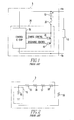
- FIG 1 is a schematic diagram of a prior art rechargeable battery pack 5, such as a Li-Ion battery pack, that may be used to provide power to a passive load 10, such as a cell phone or a PDA.
- the passive load 10 is supplanted by an active element such as a battery charger, which can recharge the rechargeable battery pack 5.
- the rechargeable battery pack 5 includes a power cell 15, such as a Li-Ion cell, a thermal protector 20 and a protection circuit module (PCM) 25 driving the load 10.
- PCM protection circuit module
- the PCM 25 includes an integrated circuit control chip 30 operatively coupled to one or more electronic switching devices 35 and 40, which in Figure 1 are modeled as MOSFETs.
- the PCM 25 is essentially a switch that detects abnormal currents and/or voltages and disconnects the cell 15 from the load 10, or, alternatively, a charger if the rechargeable battery pack 5 is being charged.
- the thermal protector 20 provides protection for the rechargeable battery pack 5 from overtemperature conditions. Overtemperature conditions can have any of several causes or combinations of causes. Overtemperature conditions can damage or impair electronic components such as those in the load 10. In the event of an overtemperature condition, it may be desirable to substantially reduce current, and thereby substantially reduce delivered power, to the load 10, thereby reducing the risk of damage or impairment.
- the thermal protector 20 may be, for example, a thermal fuse, a thermal breaker or a positive temperature coefficient (PTC) thermistor. Thermal protector 20 may also be either non-resettable or resettable. Non-resettable thermal protectors have lower equivalent series resistance (ESR), but once tripped, a rechargeable battery pack employing the non-resettable thermal protector is essentially no longer of any use. Resettable thermal protectors have higher ESRs, but can be tripped and reset many times.
- ESR equivalent series resistance
- ESR is one of the main parameters determining the usable energy stored in the cell 15, and thus the usable energy stored in the rechargeable battery pack 5.
- Lower ESR in general, means longer operation such as longer talk times for a cell phone.
- the ESR thereof includes the internal resistance of the cell 15, the resistance of the thermal protector 20, the resistance of the electronic switching devices 35 and 40, and the resistance of any connectors and other conductors in the circuit path to the load 10.
- the thermal protector 20 adds to the ESR of the rechargeable battery pack 5, and the resistance of the thermal protector 20 is not negligible.
- the circuit control chip 30 is not in the circuit path that includes the cell 15, the thermal protector 20 and the load 10, and does not significantly contribute to the ESR.
- Figure 2 is a schematic diagram of an equivalent conceptual circuit of the rechargeable battery pack 5 that shows each of the resistance components which add to the ESR of the rechargeable battery pack 5.
- the equivalent circuit includes a resistor 50 that represents the resistance of the cell 15, a resistor 55 that represents the resistance of the thermal protector 20, resistors 56 and 57 that represent the resistance of the electronic switching devices 35 and 40, and a resistor 58 that represents the resistance of the connectors and other conductors in the circuit path to the load 10 (which is represented by the resistor 59).
- ESR is one of the main parameters determining the usable energy in a rechargeable battery pack
- FIG 1 is a schematic diagram of a prior art rechargeable battery pack, such as a Li-Ion battery pack, that may be used to provide power to a load, such as a cell phone or a PDA;
- a prior art rechargeable battery pack such as a Li-Ion battery pack
- a load such as a cell phone or a PDA
- Figure 2 is a schematic diagram of an equivalent conceptual circuit of the rechargeable battery pack shown in Figure 1 ;
- Figure 3 is a schematic diagram of a rechargeable battery pack
- Figure 4 is a schematic diagram of an alternate embodiment of a rechargeable battery pack
- Figure 5 is a schematic diagram of a rechargeable battery pack showing a switching configuration in more detail.
- Figure 6 is a schematic diagram of a rechargeable battery pack showing in further detail one embodiment of the rechargeable battery pack
- Figure 7 is a schematic illustration of an equivalent conceptual circuit for the rechargeable battery pack shown in Figure 6 .
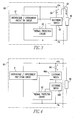
- FIG. 3 is a schematic diagram of a rechargeable battery pack 60 according to one aspect of the disclosed embodiments.
- the rechargeable battery pack 60 provides power to a load 68 (between the upper and lower power supply rails, denoted as +Ve and -Ve) and includes a power cell 64, such as one or more Li-Ion cells. (Use of the term "battery" pack is not intended to indicate that more than one power cell 64 is necessarily employed, although in various embodiments, more than one power cell may be employed.)
- the rechargeable battery pack 60 further includes circuitry 61 that monitors for overvoltage and/or overcurrent conditions, and thermal protection circuitry 62 that monitors for overtemperature conditions.
- the rechargeable battery pack 60 also includes an electronic switch 66.
- the electronic switch is coupled to the power cell 64 such that substantially all of the current passing through the power cell 64 also passes through the electronic switch 66.
- An arrow 69 shows the direction of positive current flow in a loop that includes the power cell 64, the load 68 and the electronic switch 66. When the load 68 is supplanted by a charger, the direction of positive current flow 69 in the loop is reversed.
- circuit loops that include the overvoltage/overcurrent circuitry 61 and the thermal protection circuitry 62. These currents, however, are negligible in comparison to the current in the loop that includes the power cell 64, the load 68 and the electronic switch 66. Under normal operation, the electronic switch 66 is "ON," that is, in a conducting condition in which it can conduct current.
- the overvoltage/overcurrent circuitry 61 and the thermal protection circuitry 62 are operatively coupled to the electronic switch 66 such that the overvoltage/overcurrent circuitry 61 and the thermal protection circuitry 62 can each independently cause the electronic switch 66 to assume an "OFF" or non-conducting condition, in which the electronic switch 66 will not conduct current.
- the electronic switch 66 is OFF, the loop that includes the power cell 64, the load 68 and the electronic switch 66 is effectively made open, thereby preventing the power cell 64 from supplying current to the load 68.
- Figure 4 is a schematic diagram similar to Figure 3 .
- the overvoltage/overcurrent circuitry 61 and the thermal protection circuitry 62 each controls an electronic switch.
- the overvoltage/overcurrent circuitry 61 controls electronic switch 66A and the thermal protection circuitry 62 controls electronic switch 66B.
- the electronic switches 66A and 66B can independently be controlled to become OFF and assume a non-conducting condition. When either electronic switch 66A or 66B is in a non-conducting condition, the power cell 64 is prevented from supplying current to the load 68.
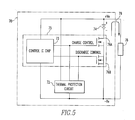
- FIG. 5 is a schematic diagram of a rechargeable battery pack 70 according to another aspect of the disclosed embodiments.
- the rechargeable battery pack 70 provides power to a load 78 between the upper and lower power supply rails +Ve and -Ve, and includes a power cell 74, such as one or more Li-Ion cells.
- the rechargeable battery pack 70 further includes circuitry 75 that monitors for overvoltage and/or overcurrent conditions, and thermal protection circuitry 72 that monitors for overtemperature conditions. In operation, when the temperature within the rechargeable battery pack 70 exceeds some predetermined threshold level, one or more circuit elements in the thermal protection circuitry 72 will be caused to trip, thereby triggering a change in operation of the thermal protection circuitry 72.
- the overvoltage/overcurrent circuitry 75 is similar to PCM 25 in Figure 1 , and includes an integrated circuit control chip 73 operatively coupled to one or more electronic switching devices 76A and 76B, which in Figure 5 are modeled as MOSFETs.
- the integrated circuit control chip 73 is configured to supply a voltage to a controlling terminal of the electronic switching devices 76A and 76B, particularly, the gates of electronic switching devices 76A and 76B, causing the electronic switching devices 76A and 76B to be ON during normal operation.
- Either the integrated circuit control chip 73 or the thermal protection circuitry 72 can independently cause the electronic switching devices 76A or 76B, or both, to turn OFF.
- An arrow 79 shows the direction of positive current flow in a loop that includes the power cell 74, the load 78 and the electronic switches 76A and 76B.
- the loop current 79 effectively goes to zero.
- the electronic switch 76A is directed to charge control and the electronic switch 76B is directed to discharge control.
- Separate electronic switches to control discharge (in which the direction of positive current flow is in the direction shown by arrow 79) and charge (in which the direction of positive current flow is in the direction opposite that shown by arrow 79) are advantageous in that some transistors are more effective in cutting off current flow in particular directions. As a result, two electronic switches are better able to cut off current flow regardless of the direction of current flow 79.
- This disclosure does not require, however, that separate electronic switches be provided for charge and discharge.
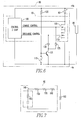
- FIG 6 is a schematic diagram of a rechargeable battery pack 80, such as a Li-Ion battery pack, according to one aspect of the disclosed embodiments, which has a reduced ESR without sacrificing safety.
- the rechargeable battery pack 80 provides power to a load 85 between the power supply rails +Ve and -Ve and includes a power cell 90, such as one or more Li-Ion cells, and a PCM 95.
- the PCM 95 includes an integrated circuit control chip 100 operatively coupled to electronic switching devices 105 and 110, which are modeled in Figure 6 as MOSFETs but which may comprise any electronic switching component or circuitry under the control of the integrated circuit control chip 100.
- the power cell 90 is coupled to the electronic switching devices 105 and 110 such that substantially all current passing through the power cell 90 also passes through the electronic switching devices 105 and 110.
- the electronic switching devices 105 and 110 are ON, the electronic switching devices 105 and 110 are in a conducting condition, and current passes through the power cell 90.
- the electronic switching devices 105 and 110 are OFF, the electronic switching devices 105 and 110 are in a non-conducting condition, and effectively no current passes through the power cell 90, thereby cutting off the power cell 90 as a power source for load 85.
- the power cell 90 may continue to deliver current to other electronic components, such as the PCM 95, when the electronic switching devices 105 and 110 are OFF. These other currents, however, are negligible in comparison to currents passing through the load 85 under normal operating conditions. In a typical implementation, over ninety-nine percent of the current passing through the power cell 90 would pass through the load 85, and less than one percent would pass through other components of rechargeable battery pack 80. In other words, substantially all of the current passing through the power cell 90 passes through the load 85, and substantially all of the current passing through the power cell 90 also passes through the electronic switching devices 105 and 110.
- Whether the electronic switching devices 105 and 110 are ON or OFF is under the control of integrated circuit control chip 100, which is responsive to overvoltage and over current conditions. As discussed below, however, whether the electronic switching devices 105 and 110 are OFF can also be controlled by thermal protection circuitry that is responsive to overtemperature conditions. Concerns about overvoltages, overcurrents and overtemperature conditions are similar whether cell 90 is supplying power during ordinary operation or consuming power during recharging (although overvoltage is generally not a problem when the power cell 90 is coupled to a passive load 85, but overvoltage can be a concern during recharging). For simplicity, the focus below will assume that the cell 90 is supplying power to the passive load 85.
- the rechargeable battery pack 80 further includes a thermal protector 115 for providing overtemperature protection for the rechargeable battery pack 80.
- the thermal protector 115 is not provided in the circuit path that includes the cell 90 and the switching devices 105 and 110 for providing power to the load 85. Rather, the thermal protector 115 is removed from that circuit path and instead is, as shown in Figure 6 , provided in a separate circuit path.
- the thermal protector 115 may be, for example, a thermal fuse, a thermal breaker or a positive temperature coefficient (PTC) thermistor. Because the thermal protector 115 is not provided in the circuit path to the load 85, it does not add to the ESR of the rechargeable battery pack 80, thereby reducing the ESR as compared to the prior art rechargeable battery pack 5 shown in Figure 1 .
- PTC positive temperature coefficient
- the resistor 120 is provided to bias the electronic switching device 125 ON when the thermal protector 115 trips and the impedance of the thermal protector 115 goes from low to high.
- the resistor 120 is further sized to have a large impedance in comparison to the load 85, such that most current passing through the cell 90 will pass through the load 85, and the current flowing through the thermal protector 115 will be comparatively low.
- the impedance of the load 85 would be in the range of a few ohms.
- the resistor by comparison, might be sized in the range of tens of thousands of ohms, such as fifty thousand ohms.
- Current flowing through the load 85 is in the range of several amperes, and current flowing through the resistor 120 is in the range of millionths of an ampere.
- Current flowing through the integrated circuit control chip 100 is also very small in comparison to current flowing through the load 85 under normal operating conditions. As a result, currents flowing through other loops in rechargeable battery pack 80 are negligible in comparison to current flowing through the load 85.
- currents passing through the cell 90 may not be of the same magnitudes as in the case when the cell 90 is supplying power to a passive load, but currents supplied to the overvoltage/overcurrent circuitry and the thermal protection circuitry generally remain negligible, and substantially all of the current supplied by the charger passes through the cell 90 and the electronic switching devices 105 and 110.
- the electronic switching device 125 in Figure 6 is modeled as an NPN bi-polar junction transistor, but electronic switching device 125 can also be realized as a PNP bi-polar junction transistor, or other transistor or combination of transistors.
- the electronic switching device 125 turns ON, it robs the drive to the switching devices 105 and 110, and they turn OFF, thereby cutting off the load 85 from the cell 90.
- the thermal protector 115 in ON (operating normally), the electronic switching device 125 cannot be biased ON since the thermal protector 115 itself is robbing the bias from the base of the electronic switching device 125.
- the thermal protector 115 is operatively coupled to the electronic switching devices 105 and 110 through the electronic switching device 125 and the diodes 130 and 135.
- the thermal protector 115 will be caused to trip.
- the electronic switching devices 105 and 110 are caused to turn OFF (assume a non-conducting condition), effectively interrupting the current path from the power cell 90 through the load 85.
- the electronic switching devices 105 and 110 are controlled by the outputs of the integrated circuit control chip 100 to be ON, the electronic switching device 125 is OFF, and effectively no current flows into the collector node (where the junction of the cathodes of the two diodes 130 and 135 connect) because the collector-to-emitter connection behaves like an open circuit.
- the two diodes 130 and 135 are essentially out of the picture, because the diodes 130 and 135 are not conducting and behave like open circuits.
- the electronic switching device 125 is OFF because the thermal protector 115 in ON (typically at a relatively low impedance).
- thermal protector 115 robs the base drive current flowing through the resistor 120, effectively bypassing the base of electronic switching device 125.
- the thermal protector 115 trips due to a high temperature, the impedance of the thermal protector 115 changes from a low impedance to a high impedance.
- Current now flows through the resistor 120 to the base of electronic switching device 125.
- the electronic switching device 125 turns ON, driving the collector voltage down, close to the emitter voltage.
- the voltage at the collector node, to which the cathodes of the diodes 130 and 135 are connected is also driven low.
- the diodes 130 and 135 turn ON and conduct current.
- the implementation described herein effectively causes the control electronic switching devices 105 and 110 of the PCM 95 to act as temperature-dependent switches (on top of their other duties in the PCM 95 as required by the integrated circuit control chip 100).
- the temperature cutoff protection provided by the thermal protector 115 is independent, meaning that it is not under the control of any controller or processor, and in particular not under the control of the integrated circuit control chip 100.
- a thermal protector 115 can be utilized that has a very high impedance during normal temperature conditions, and a low impedance during overtemperature conditions.
- the electronic switching device 125 can be eliminated and the thermal protector 115 can be directly coupled between the lower power rail and the cathodes of the diodes 130 and 135.
- the impedance of the thermal protector 115 is high, and virtually no current is able to flow through the thermal protector 115. As a result, the diodes 130 and 135 are OFF.
- the impedance of the thermal protector 115 is low, effectively pulling down the cathode voltage of the diodes 130 and 135, turning them ON and turning OFF the electronic switching devices 105 and 110.
- the thermal protector 115 can serve both as a temperature-sensitive element and as a switching element to turn ON diodes 130 and 135.
- FIG. 7 is a schematic illustration of an equivalent conceptual circuit 140 for the rechargeable battery pack 80.
- the equivalent circuit 140 includes a resistor 145 that represents the resistance of the cell 90, resistors 150 and 155 that represent the resistance of the electronic switching devices 105 and 110, and a resistor 160 that represents the resistance of connectors and other conductors in the series path to the load 85 (which is represented by the resistor 165).
- the circuit path that includes the cell 90 and the electronic switching devices 105 and 110, which provide power to the load 85 does not include any resistance that is attributable to the thermal protector 115, because any resistance that is attributable to the thermal protector 115 is negligible.
- nearly all current passing through the 90 cell passes through the load 85, while a much smaller and comparatively insignificant amount of current flows through the thermal protector 115 and other circuit elements.
- the circuit described above may realize one or more advantages. Because the thermal protector 115 is not provided in the circuit path that includes the cell 90 and the load 85 and because the circuit path that includes the resistor 120 and the thermal protector 115 has a comparably higher impedance, very low currents will flow through the thermal protector 115. This disclosure is not limited to any particular amount of current flowing through thermal protector 115, but in general, the amount of current flowing through thermal protector 115 is negligible, such that thermal protector 115 has a negligible effect upon the ESR. Because very low currents will flow through the thermal protector 115, a smaller, typically less expensive component can be utilized as the thermal protector 115.
- the thermal protector 115 is a positive temperature coefficient (PTC) thermistor
- PTC positive temperature coefficient
- the effect of residual high post-trip resistance will not add to the ESR of the rechargeable battery pack 80.
- the resistance of a PTC thermistor never quite relaxes back to its original level, but rather settles at a higher level (this is the high post-trip resistance cited above).
- PTC thermistor is used in the circuit path that includes a cell in a rechargeable battery, as is the case in the rechargeable battery pack 5 of Figure 1 , the fact that post-trip resistance is increased adds to the ESR of the battery pack 5 in Figure 1 .
- An increased post-trip resistance in the configuration of Figure 6 would not necessarily result in a corresponding increase in ESR.
- the rechargeable battery pack 80 provides a reduced ESR, and therefore increased battery time. Increased battery time results in increased device usage time between chargings. Further, the configuration depicted in Figure 6 protects against overvoltage, overcurrent and overtemperture conditions, thereby effectively preserving the safety of the rechargeable battery pack 80.
- circuit elements depicted as directly coupled may be coupled via one or more intermediate elements, such as a resistor or diode.
- intermediate elements such as a resistor or diode.
- the electronic switching devices 105 and 110 in Figure 6 could be coupled via resistors to the integrated circuit control chip 100. Accordingly, these and other embodiments are within the scope of the following claims.
Landscapes
- Engineering & Computer Science (AREA)
- Power Engineering (AREA)
- Manufacturing & Machinery (AREA)
- Chemical & Material Sciences (AREA)
- Chemical Kinetics & Catalysis (AREA)
- Electrochemistry (AREA)
- General Chemical & Material Sciences (AREA)
- Protection Of Static Devices (AREA)
- Charge And Discharge Circuits For Batteries Or The Like (AREA)
Abstract
Description
- The embodiments described herein relate generally to rechargeable battery packs, and in particular to a method of reducing the equivalent series resistance (ESR) of a rechargeable battery pack, such as a Li-Ion battery pack, without sacrificing safety.
- Rechargeable battery packs, such as Li-Ion battery packs, are commonly used in many consumer electronics such as cell phones and personal digital assistants (PDAs).
Figure 1 is a schematic diagram of a prior artrechargeable battery pack 5, such as a Li-Ion battery pack, that may be used to provide power to apassive load 10, such as a cell phone or a PDA. In some implementations, thepassive load 10 is supplanted by an active element such as a battery charger, which can recharge therechargeable battery pack 5. As seen inFigure 1 , therechargeable battery pack 5 includes apower cell 15, such as a Li-Ion cell, athermal protector 20 and a protection circuit module (PCM) 25 driving theload 10. The PCM 25 includes an integratedcircuit control chip 30 operatively coupled to one or moreelectronic switching devices Figure 1 are modeled as MOSFETs. As is known in the art, thePCM 25 is essentially a switch that detects abnormal currents and/or voltages and disconnects thecell 15 from theload 10, or, alternatively, a charger if therechargeable battery pack 5 is being charged. Thethermal protector 20 provides protection for therechargeable battery pack 5 from overtemperature conditions. Overtemperature conditions can have any of several causes or combinations of causes. Overtemperature conditions can damage or impair electronic components such as those in theload 10. In the event of an overtemperature condition, it may be desirable to substantially reduce current, and thereby substantially reduce delivered power, to theload 10, thereby reducing the risk of damage or impairment. Thethermal protector 20 may be, for example, a thermal fuse, a thermal breaker or a positive temperature coefficient (PTC) thermistor.Thermal protector 20 may also be either non-resettable or resettable. Non-resettable thermal protectors have lower equivalent series resistance (ESR), but once tripped, a rechargeable battery pack employing the non-resettable thermal protector is essentially no longer of any use. Resettable thermal protectors have higher ESRs, but can be tripped and reset many times. - As is known in the art, ESR is one of the main parameters determining the usable energy stored in the
cell 15, and thus the usable energy stored in therechargeable battery pack 5. Lower ESR, in general, means longer operation such as longer talk times for a cell phone. In therechargeable battery pack 5, the ESR thereof includes the internal resistance of thecell 15, the resistance of thethermal protector 20, the resistance of theelectronic switching devices load 10. In other words, because thethermal protector 20 is in the circuit path coupling thecell 15 to theload 10, thethermal protector 20 adds to the ESR of therechargeable battery pack 5, and the resistance of thethermal protector 20 is not negligible. Thecircuit control chip 30 is not in the circuit path that includes thecell 15, thethermal protector 20 and theload 10, and does not significantly contribute to the ESR. -
Figure 2 is a schematic diagram of an equivalent conceptual circuit of therechargeable battery pack 5 that shows each of the resistance components which add to the ESR of therechargeable battery pack 5. In particular, the equivalent circuit includes aresistor 50 that represents the resistance of thecell 15, aresistor 55 that represents the resistance of thethermal protector 20,resistors electronic switching devices resistor 58 that represents the resistance of the connectors and other conductors in the circuit path to the load 10 (which is represented by the resistor 59). - Since, as described above, ESR is one of the main parameters determining the usable energy in a rechargeable battery pack, it would be advantageous to be able to reduce the ESR of a rechargeable battery pack in a manner that does not adversely affect the safety of the rechargeable battery pack.
- A full understanding of the invention can be gained from the following Detailed Description when read in conjunction with the accompanying drawings, in which:
-
Figure 1 is a schematic diagram of a prior art rechargeable battery pack, such as a Li-Ion battery pack, that may be used to provide power to a load, such as a cell phone or a PDA; -
Figure 2 is a schematic diagram of an equivalent conceptual circuit of the rechargeable battery pack shown inFigure 1 ; -
Figure 3 is a schematic diagram of a rechargeable battery pack; -
Figure 4 is a schematic diagram of an alternate embodiment of a rechargeable battery pack; -
Figure 5 is a schematic diagram of a rechargeable battery pack showing a switching configuration in more detail. -
Figure 6 is a schematic diagram of a rechargeable battery pack showing in further detail one embodiment of the rechargeable battery pack; -
Figure 7 is a schematic illustration of an equivalent conceptual circuit for the rechargeable battery pack shown inFigure 6 . -
Figure 3 is a schematic diagram of arechargeable battery pack 60 according to one aspect of the disclosed embodiments. Therechargeable battery pack 60 provides power to a load 68 (between the upper and lower power supply rails, denoted as +Ve and -Ve) and includes apower cell 64, such as one or more Li-Ion cells. (Use of the term "battery" pack is not intended to indicate that more than onepower cell 64 is necessarily employed, although in various embodiments, more than one power cell may be employed.) Therechargeable battery pack 60 further includescircuitry 61 that monitors for overvoltage and/or overcurrent conditions, andthermal protection circuitry 62 that monitors for overtemperature conditions. Therechargeable battery pack 60 also includes anelectronic switch 66. The electronic switch is coupled to thepower cell 64 such that substantially all of the current passing through thepower cell 64 also passes through theelectronic switch 66. Anarrow 69 shows the direction of positive current flow in a loop that includes thepower cell 64, theload 68 and theelectronic switch 66. When theload 68 is supplanted by a charger, the direction of positivecurrent flow 69 in the loop is reversed. - Currents flow through circuit loops that include the overvoltage/
overcurrent circuitry 61 and thethermal protection circuitry 62. These currents, however, are negligible in comparison to the current in the loop that includes thepower cell 64, theload 68 and theelectronic switch 66. Under normal operation, theelectronic switch 66 is "ON," that is, in a conducting condition in which it can conduct current. - The overvoltage/
overcurrent circuitry 61 and thethermal protection circuitry 62 are operatively coupled to theelectronic switch 66 such that the overvoltage/overcurrent circuitry 61 and thethermal protection circuitry 62 can each independently cause theelectronic switch 66 to assume an "OFF" or non-conducting condition, in which theelectronic switch 66 will not conduct current. When theelectronic switch 66 is OFF, the loop that includes thepower cell 64, theload 68 and theelectronic switch 66 is effectively made open, thereby preventing thepower cell 64 from supplying current to theload 68. -
Figure 4 is a schematic diagram similar toFigure 3 . InFigure 4 , the overvoltage/overcurrent circuitry 61 and thethermal protection circuitry 62 each controls an electronic switch. The overvoltage/overcurrent circuitry 61 controlselectronic switch 66A and thethermal protection circuitry 62 controlselectronic switch 66B. Theelectronic switches electronic switch power cell 64 is prevented from supplying current to theload 68. -
Figure 5 is a schematic diagram of arechargeable battery pack 70 according to another aspect of the disclosed embodiments. Therechargeable battery pack 70 provides power to aload 78 between the upper and lower power supply rails +Ve and -Ve, and includes apower cell 74, such as one or more Li-Ion cells. Therechargeable battery pack 70 further includescircuitry 75 that monitors for overvoltage and/or overcurrent conditions, andthermal protection circuitry 72 that monitors for overtemperature conditions. In operation, when the temperature within therechargeable battery pack 70 exceeds some predetermined threshold level, one or more circuit elements in thethermal protection circuitry 72 will be caused to trip, thereby triggering a change in operation of thethermal protection circuitry 72. - In the embodiment depicted in
Figure 5 , the overvoltage/overcurrent circuitry 75 is similar toPCM 25 inFigure 1 , and includes an integratedcircuit control chip 73 operatively coupled to one or moreelectronic switching devices Figure 5 are modeled as MOSFETs. In the embodiment depicted inFigure 5 , the integratedcircuit control chip 73 is configured to supply a voltage to a controlling terminal of theelectronic switching devices electronic switching devices electronic switching devices circuit control chip 73 or thethermal protection circuitry 72 can independently cause theelectronic switching devices arrow 79 shows the direction of positive current flow in a loop that includes thepower cell 74, theload 78 and theelectronic switches electronic switch 76A is OFF or theelectronic switch 76B is OFF or both are OFF, theloop current 79 effectively goes to zero. - In
Figure 5 , theelectronic switch 76A is directed to charge control and theelectronic switch 76B is directed to discharge control. Separate electronic switches to control discharge (in which the direction of positive current flow is in the direction shown by arrow 79) and charge (in which the direction of positive current flow is in the direction opposite that shown by arrow 79) are advantageous in that some transistors are more effective in cutting off current flow in particular directions. As a result, two electronic switches are better able to cut off current flow regardless of the direction ofcurrent flow 79. This disclosure does not require, however, that separate electronic switches be provided for charge and discharge. -
Figure 6 is a schematic diagram of arechargeable battery pack 80, such as a Li-Ion battery pack, according to one aspect of the disclosed embodiments, which has a reduced ESR without sacrificing safety. Therechargeable battery pack 80 provides power to aload 85 between the power supply rails +Ve and -Ve and includes apower cell 90, such as one or more Li-Ion cells, and aPCM 95. ThePCM 95 includes an integratedcircuit control chip 100 operatively coupled toelectronic switching devices Figure 6 as MOSFETs but which may comprise any electronic switching component or circuitry under the control of the integratedcircuit control chip 100. Thepower cell 90 is coupled to theelectronic switching devices power cell 90 also passes through theelectronic switching devices electronic switching devices electronic switching devices power cell 90. When theelectronic switching devices electronic switching devices power cell 90, thereby cutting off thepower cell 90 as a power source forload 85. - As shown in
Figure 6 , thepower cell 90 may continue to deliver current to other electronic components, such as thePCM 95, when theelectronic switching devices load 85 under normal operating conditions. In a typical implementation, over ninety-nine percent of the current passing through thepower cell 90 would pass through theload 85, and less than one percent would pass through other components ofrechargeable battery pack 80. In other words, substantially all of the current passing through thepower cell 90 passes through theload 85, and substantially all of the current passing through thepower cell 90 also passes through theelectronic switching devices - Whether the
electronic switching devices circuit control chip 100, which is responsive to overvoltage and over current conditions. As discussed below, however, whether theelectronic switching devices cell 90 is supplying power during ordinary operation or consuming power during recharging (although overvoltage is generally not a problem when thepower cell 90 is coupled to apassive load 85, but overvoltage can be a concern during recharging). For simplicity, the focus below will assume that thecell 90 is supplying power to thepassive load 85. - The
rechargeable battery pack 80 further includes athermal protector 115 for providing overtemperature protection for therechargeable battery pack 80. However, unlike thethermal protector 20 in therechargeable battery pack 5 shown inFigure 1 , thethermal protector 115 is not provided in the circuit path that includes thecell 90 and theswitching devices load 85. Rather, thethermal protector 115 is removed from that circuit path and instead is, as shown inFigure 6 , provided in a separate circuit path. Thethermal protector 115 may be, for example, a thermal fuse, a thermal breaker or a positive temperature coefficient (PTC) thermistor. Because thethermal protector 115 is not provided in the circuit path to theload 85, it does not add to the ESR of therechargeable battery pack 80, thereby reducing the ESR as compared to the prior artrechargeable battery pack 5 shown inFigure 1 . - Nearly all of the current passing through the
thermal protector 115 passes through aresistor 120. Theresistor 120 is provided to bias theelectronic switching device 125 ON when thethermal protector 115 trips and the impedance of thethermal protector 115 goes from low to high. Theresistor 120 is further sized to have a large impedance in comparison to theload 85, such that most current passing through thecell 90 will pass through theload 85, and the current flowing through thethermal protector 115 will be comparatively low. In ordinary operation, the impedance of theload 85 would be in the range of a few ohms. The resistor, by comparison, might be sized in the range of tens of thousands of ohms, such as fifty thousand ohms. Current flowing through theload 85 is in the range of several amperes, and current flowing through theresistor 120 is in the range of millionths of an ampere. Current flowing through the integratedcircuit control chip 100 is also very small in comparison to current flowing through theload 85 under normal operating conditions. As a result, currents flowing through other loops inrechargeable battery pack 80 are negligible in comparison to current flowing through theload 85. During recharging, currents passing through thecell 90 may not be of the same magnitudes as in the case when thecell 90 is supplying power to a passive load, but currents supplied to the overvoltage/overcurrent circuitry and the thermal protection circuitry generally remain negligible, and substantially all of the current supplied by the charger passes through thecell 90 and theelectronic switching devices - The
electronic switching device 125 inFigure 6 is modeled as an NPN bi-polar junction transistor, butelectronic switching device 125 can also be realized as a PNP bi-polar junction transistor, or other transistor or combination of transistors. When theelectronic switching device 125 turns ON, it robs the drive to theswitching devices load 85 from thecell 90. When thethermal protector 115 in ON (operating normally), theelectronic switching device 125 cannot be biased ON since thethermal protector 115 itself is robbing the bias from the base of theelectronic switching device 125. - As seen in
Figure 6 , thethermal protector 115 is operatively coupled to theelectronic switching devices electronic switching device 125 and thediodes rechargeable battery pack 80 exceeds some predetermined threshold level, thethermal protector 115 will be caused to trip. When this happens, theelectronic switching devices power cell 90 through theload 85. In particular, under normal operation, theelectronic switching devices circuit control chip 100 to be ON, theelectronic switching device 125 is OFF, and effectively no current flows into the collector node (where the junction of the cathodes of the twodiodes diodes diodes electronic switching device 125 is OFF because thethermal protector 115 in ON (typically at a relatively low impedance). As described above,thermal protector 115 robs the base drive current flowing through theresistor 120, effectively bypassing the base ofelectronic switching device 125. When thethermal protector 115 trips due to a high temperature, the impedance of thethermal protector 115 changes from a low impedance to a high impedance. Current now flows through theresistor 120 to the base ofelectronic switching device 125. As a result, theelectronic switching device 125 turns ON, driving the collector voltage down, close to the emitter voltage. The result is that the voltage at the collector node, to which the cathodes of thediodes diodes circuit control chip 100 to theelectronic switching devices electronic switching devices PCM 95 to act as temperature-dependent switches (on top of their other duties in thePCM 95 as required by the integrated circuit control chip 100). In this sense, the temperature cutoff protection provided by thethermal protector 115 is independent, meaning that it is not under the control of any controller or processor, and in particular not under the control of the integratedcircuit control chip 100. - In a variation of the embodiment depicted in
Figure 6 , athermal protector 115 can be utilized that has a very high impedance during normal temperature conditions, and a low impedance during overtemperature conditions. With such athermal protector 115, theelectronic switching device 125 can be eliminated and thethermal protector 115 can be directly coupled between the lower power rail and the cathodes of thediodes thermal protector 115 is high, and virtually no current is able to flow through thethermal protector 115. As a result, thediodes thermal protector 115 is low, effectively pulling down the cathode voltage of thediodes electronic switching devices thermal protector 115 can serve both as a temperature-sensitive element and as a switching element to turn ONdiodes -
Figure 7 is a schematic illustration of an equivalentconceptual circuit 140 for therechargeable battery pack 80. Theequivalent circuit 140 includes a resistor 145 that represents the resistance of thecell 90,resistors electronic switching devices resistor 160 that represents the resistance of connectors and other conductors in the series path to the load 85 (which is represented by the resistor 165). As can be seen inFigure 7 , the circuit path that includes thecell 90 and theelectronic switching devices load 85, does not include any resistance that is attributable to thethermal protector 115, because any resistance that is attributable to thethermal protector 115 is negligible. As described above, nearly all current passing through the 90 cell passes through theload 85, while a much smaller and comparatively insignificant amount of current flows through thethermal protector 115 and other circuit elements. - The circuit described above may realize one or more advantages. Because the
thermal protector 115 is not provided in the circuit path that includes thecell 90 and theload 85 and because the circuit path that includes theresistor 120 and thethermal protector 115 has a comparably higher impedance, very low currents will flow through thethermal protector 115. This disclosure is not limited to any particular amount of current flowing throughthermal protector 115, but in general, the amount of current flowing throughthermal protector 115 is negligible, such thatthermal protector 115 has a negligible effect upon the ESR. Because very low currents will flow through thethermal protector 115, a smaller, typically less expensive component can be utilized as thethermal protector 115. - In addition, in the case where the
thermal protector 115 is a positive temperature coefficient (PTC) thermistor, the effect of residual high post-trip resistance (that is often the case with PTC thermistor) will not add to the ESR of therechargeable battery pack 80. More specifically, as is known, once tripped, the resistance of a PTC thermistor never quite relaxes back to its original level, but rather settles at a higher level (this is the high post-trip resistance cited above). Thus, when a PTC thermistor is used in the circuit path that includes a cell in a rechargeable battery, as is the case in therechargeable battery pack 5 ofFigure 1 , the fact that post-trip resistance is increased adds to the ESR of thebattery pack 5 inFigure 1 . An increased post-trip resistance in the configuration ofFigure 6 , however, would not necessarily result in a corresponding increase in ESR. - Thus, the
rechargeable battery pack 80 provides a reduced ESR, and therefore increased battery time. Increased battery time results in increased device usage time between chargings. Further, the configuration depicted inFigure 6 protects against overvoltage, overcurrent and overtemperture conditions, thereby effectively preserving the safety of therechargeable battery pack 80. - While various embodiments have been described and illustrated above, it should be understood that these are exemplary and are not to be considered as limiting. Additions, deletions, substitutions, and other modifications can be made without departing from the spirit or scope hereof. The described devices and techniques are not limited to the particular circuit elements shown. In particular and without limitation, various transistors and switching elements in
Figure 6 need not employ the particular circuit elements shown, but may include different transistors or switching elements. In addition, the particular circuit elements may be, but need not be, arranged as depicted in the Figures. For example, if integratedcircuit control chip 100 includes a housing, components of the thermal protection circuitry, such as thethermal protector 115 or theelectronic switching device 125, may be employed inside the housing and need not be physically separate from the integratedcircuit control chip 100. - Further, various embodiments may include elements not depicted in any of the figures. For example, circuit elements depicted as directly coupled may be coupled via one or more intermediate elements, such as a resistor or diode. In particular and without limitation, the
electronic switching devices Figure 6 could be coupled via resistors to the integratedcircuit control chip 100. Accordingly, these and other embodiments are within the scope of the following claims.
Claims (25)
- A rechargeable battery pack, comprising:a power cell;a protection circuit module, said protection circuit module including a control circuit operatively coupled to an electronic switching device, said power cell and said electronic switching device being in an electrical connection in which substantially all of the current passing through said power cell passes through said electronic switching device, wherein when one or both of an overvoltage and overcurrent condition exists, said control circuit controls said electronic switching device to cause said electronic switching device to assume a non-conducting condition; anda thermal protection circuit operatively coupled to said electronic switching device and said power cell, said thermal protection circuit receiving a negligible current from said power cell, wherein in response to a temperature within said rechargeable battery pack exceeding a threshold value, said thermal protection circuit controls said electronic switching device to assume a non-conducting condition.
- The rechargeable battery pack according to claim 1, wherein said electronic switching device is a first electronic switching device, and wherein said thermal protection circuit comprises:a diode, an anode of said diode being coupled to a controlling terminal of said electronic switching device; anda second electronic switching device being coupled between a cathode of said diode and a lower power rail, wherein said second electronic switching device is configured to assume a conducting condition when a temperature within said rechargeable battery pack exceeds said threshold value.
- The rechargeable battery pack according to claim 2, wherein said second electronic switching device comprises a thermal protector element having a low impedance when said temperature within said rechargeable battery pack exceeds said threshold value, and otherwise has a high impedance.
- The rechargeable battery pack according to claim 2, wherein said second electronic switching device comprises a bipolar junction transistor.
- The rechargeable battery pack according to claim 1, wherein said electronic switching device is a MOSFET.
- The rechargeable battery pack according to claim 1, wherein said thermal protection circuit comprises a thermal fuse.
- The rechargeable battery pack according to claim 1, wherein said thermal protection circuit comprises a positive temperature coefficient thermistor.
- The rechargeable battery pack according to claim 1, wherein said thermal protection circuit comprises a thermal breaker.
- The rechargeable battery pack according to claim 1, wherein said power cell is a Li-Ion cell.
- A method of operating a rechargeable battery pack, comprising:employing a power cell to supply current;employing an electronic switch to conduct substantially all of the current passing through the power cell when the electronic switch is in a conducting condition, and to prevent substantially all of the current from passing through the power cell when the electronic switch is in a non-conducting condition;employing a thermal protection circuit to monitor for an overtemperature condition and to cause the electronic switch to assume the non-conducting condition when the overtemperature condition exists; andproviding a negligible current from the power cell to the thermal protection circuit.
- The method according to claim 10, further comprising employing a first protection circuit to monitor for one or both of an overvoltage condition and an' overcurrent condition, and to cause the electronic switch to assume the non-conducting condition when at least one of the overvoltage condition and the overcurrent condition exists.
- The method according to claim 11, wherein the first protection circuit is further employed to cause the electronic switch to assume the conducting condition.
- The method according to claim 10, wherein an overtemperature condition exists when a temperature within the rechargeable battery pack exceeds a threshold value.
- The method according to claim 10, further comprising employing the electronic switch, following causing the electronic switch to assume the non-conducting condition when the overtemperature condition exists, to cause the electronic switch to assume the conducting condition when the overtemperature condition no longer exists.
- The method according to claim 10, further comprising, when a passive load is electrically coupled to the battery pack, providing substantially all of the current from the power cell to the load when the electronic switch is in the conducting condition, and preventing the load from receiving substantially all of the current from the power cell when the electronic switch is in the non-conducting condition.
- A rechargeable battery pack, comprising:a power cell;a first electronic switching device operatively coupled to the power cell in which current passing through the power cell passes through the first electronic switching device when first electronic switching device is in a conducting condition;a second electronic switching device operatively coupled to the power cell in which current passing through the power cell passes through the second electronic switching device when second electronic switching device is in a conducting condition;a first protection circuit module operatively coupled to the first electronic switching device and configured to cause the first electronic switching device to assume a non-conducting condition when one or both of an overvoltage and overcurrent condition exists; anda second protection circuit module operatively coupled to the second electronic switching device and configured to cause the second electronic switching device to assume a non-conducting condition when a temperature in the rechargeable battery pack exceeds a threshold value.
- The rechargeable battery pack according to claim 16, wherein the first electronic switching device and the second electronic switching device are the same electronic switching device.
- The rechargeable battery pack according to claim 16, wherein said second protection circuit comprises:a diode, an anode of said diode being coupled to a controlling terminal of said second electronic switching device; anda third electronic switching device being coupled between a cathode of said diode and a lower power rail, wherein said third electronic switching device is configured to assume a conducting condition when a temperature within said rechargeable battery pack exceeds said threshold value.
- The rechargeable battery pack according to claim 18, wherein said third electronic switching device comprises a thermal protector element having a low impedance when said temperature within said rechargeable battery pack exceeds said threshold value, and otherwise has a high impedance.
- The rechargeable battery pack according to claim 19, wherein said thermal protector element comprises a thermal fuse.
- The rechargeable battery pack according to claim 19, wherein said thermal protector element comprises a positive temperature coefficient thermistor.
- The rechargeable battery pack according to claim 19, wherein said thermal protector element comprises a thermal breaker.
- The rechargeable battery pack according to claim 19, wherein said third electronic switching device comprises a bipolar junction transistor.
- The rechargeable battery pack according to claim 16, wherein the first electronic switching device and the second electronic switching device is each a MOSFET.
- The rechargeable battery pack according to claim 16, wherein said power cell is a Li-Ion cell.
Priority Applications (6)
| Application Number | Priority Date | Filing Date | Title |
|---|---|---|---|
| EP08150163A EP2079142B1 (en) | 2008-01-10 | 2008-01-10 | Rechargeable battery pack with a thermal protection circuit |
| DE602008002808T DE602008002808D1 (en) | 2008-01-10 | 2008-01-10 | Battery with a thermal protection circuit |
| US11/972,214 US7956581B2 (en) | 2008-01-10 | 2008-01-10 | Rechargeable battery pack |
| AT08150163T ATE483269T1 (en) | 2008-01-10 | 2008-01-10 | BATTERY WITH A THERMAL PROTECTION CIRCUIT |
| CA2648610A CA2648610C (en) | 2008-01-10 | 2009-01-09 | Rechargeable battery pack |
| US13/089,896 US8026696B2 (en) | 2008-01-10 | 2011-04-19 | Rechargeable battery pack |
Applications Claiming Priority (2)
| Application Number | Priority Date | Filing Date | Title |
|---|---|---|---|
| EP08150163A EP2079142B1 (en) | 2008-01-10 | 2008-01-10 | Rechargeable battery pack with a thermal protection circuit |
| US11/972,214 US7956581B2 (en) | 2008-01-10 | 2008-01-10 | Rechargeable battery pack |
Publications (2)
| Publication Number | Publication Date |
|---|---|
| EP2079142A1 true EP2079142A1 (en) | 2009-07-15 |
| EP2079142B1 EP2079142B1 (en) | 2010-09-29 |
Family
ID=50550121
Family Applications (1)
| Application Number | Title | Priority Date | Filing Date |
|---|---|---|---|
| EP08150163A Active EP2079142B1 (en) | 2008-01-10 | 2008-01-10 | Rechargeable battery pack with a thermal protection circuit |
Country Status (5)
| Country | Link |
|---|---|
| US (2) | US7956581B2 (en) |
| EP (1) | EP2079142B1 (en) |
| AT (1) | ATE483269T1 (en) |
| CA (1) | CA2648610C (en) |
| DE (1) | DE602008002808D1 (en) |
Cited By (5)
| Publication number | Priority date | Publication date | Assignee | Title |
|---|---|---|---|---|
| WO2016016620A1 (en) * | 2014-07-29 | 2016-02-04 | Nicoventures Holdings Limited | E-cigarette and re-charging pack |
| EP3282544A1 (en) * | 2014-01-13 | 2018-02-14 | Littelfuse, Inc. | Secondary battery protection with permanent disable |
| US10218193B2 (en) | 2014-07-29 | 2019-02-26 | Nicoventures Holdings Limited | E-cigarette and re-charging pack |
| CN113270853A (en) * | 2018-12-21 | 2021-08-17 | 荣耀终端有限公司 | Battery protection circuit, battery protection board, battery and terminal equipment |
| EP3920362A4 (en) * | 2019-01-31 | 2022-03-30 | Vivo Mobile Communication Co., Ltd. | CHARGING CIRCUIT AND ELECTRONIC DEVICE |
Families Citing this family (16)
| Publication number | Priority date | Publication date | Assignee | Title |
|---|---|---|---|---|
| US8102154B2 (en) * | 2008-09-04 | 2012-01-24 | Medtronic Minimed, Inc. | Energy source isolation and protection circuit for an electronic device |
| TWI383167B (en) * | 2008-09-23 | 2013-01-21 | 緯創資通股份有限公司 | Method for detecting the operation of a power storage device and related power storage device |
| US9199543B2 (en) | 2009-07-31 | 2015-12-01 | Thermo King Corporation | Bi-directional battery voltage converter |
| JP5428675B2 (en) * | 2009-09-09 | 2014-02-26 | 株式会社リコー | Secondary battery protection circuit, battery pack and electronic equipment |
| JP2011142789A (en) * | 2010-01-08 | 2011-07-21 | Seiko Instruments Inc | Battery pack |
| KR101108188B1 (en) * | 2010-06-10 | 2013-03-08 | 삼성에스디아이 주식회사 | Battery protection circuit and controlling method of the same |
| US8649140B2 (en) | 2011-03-04 | 2014-02-11 | Electrochem Solutions, Inc. | Voltage activated 2nd level safety circuit for permanent isolation |
| WO2014045745A1 (en) * | 2012-09-18 | 2014-03-27 | Necエナジーデバイス株式会社 | Power storage system and battery protection method |
| JP5937050B2 (en) * | 2013-10-25 | 2016-06-22 | 横河電機株式会社 | Charging circuit |
| JP6221685B2 (en) * | 2013-11-25 | 2017-11-01 | ミツミ電機株式会社 | Secondary battery protection circuit, battery protection module, battery pack and processing method |
| CN104753034B (en) * | 2013-12-27 | 2018-10-12 | 富泰华工业(深圳)有限公司 | Electronic device and its charge protector |
| DE102014200640A1 (en) * | 2014-01-16 | 2015-07-30 | Robert Bosch Gmbh | Battery system and method for disconnecting a battery system from a connected electrical load |
| KR102394741B1 (en) * | 2018-11-29 | 2022-05-06 | 주식회사 엘지에너지솔루션 | Battery module with improved radiant heat, battery pack comprising the battery module and vehicle comprising the same |
| CN114388904B (en) * | 2021-12-13 | 2024-11-22 | 西安奇点能源股份有限公司 | Lithium-ion battery thermal runaway suppression circuit and lithium-ion battery thermal runaway suppression method |
| CN115966793B (en) * | 2022-12-26 | 2024-11-29 | 深圳华晓科技有限公司 | A lithium battery charging and discharging control method and device under low temperature conditions |
| CN118713242B (en) * | 2024-06-07 | 2025-01-07 | 东莞航电新能源科技有限公司 | Lithium battery control circuit and camera battery compartment |
Citations (3)
| Publication number | Priority date | Publication date | Assignee | Title |
|---|---|---|---|---|
| US5625273A (en) * | 1994-12-30 | 1997-04-29 | Bren-Tronics Inc. | Battery safety device |
| EP1551088A1 (en) | 2002-10-09 | 2005-07-06 | Sony Chemicals Corp. | Secondary battery with protective circuit |
| EP1868274A1 (en) | 2006-02-27 | 2007-12-19 | Sony Corporation | Battery pack, and battery protecting method |
Family Cites Families (27)
| Publication number | Priority date | Publication date | Assignee | Title |
|---|---|---|---|---|
| US5563496A (en) * | 1990-12-11 | 1996-10-08 | Span, Inc. | Battery monitoring and charging control unit |
| EP0644642A3 (en) * | 1993-07-30 | 1995-05-24 | Texas Instruments Inc | Power supply. |
| KR100193736B1 (en) * | 1996-09-17 | 1999-06-15 | 윤종용 | Battery pack with battery protection |
| US6331763B1 (en) * | 1998-04-15 | 2001-12-18 | Tyco Electronics Corporation | Devices and methods for protection of rechargeable elements |
| CN1178328C (en) * | 1999-05-17 | 2004-12-01 | 松下电器产业株式会社 | Protection circuit and protection element for secondary battery |
| JP3431867B2 (en) * | 1999-09-21 | 2003-07-28 | 松下電器産業株式会社 | Battery power supply device and electric equipment using the same |
| US6804100B2 (en) * | 1999-12-31 | 2004-10-12 | Nokia Mobile Phones, Ltd. | Method and apparatus for protection of batteries |
| CN1322050A (en) * | 2000-04-28 | 2001-11-14 | 索尼公司 | Cell assembly and signal sending system |
| JP4744673B2 (en) * | 2000-06-30 | 2011-08-10 | パナソニック株式会社 | Charging device, battery pack and charging system using them |
| JP4566392B2 (en) * | 2000-11-16 | 2010-10-20 | レノボ シンガポール プライヴェート リミテッド | Battery, battery pack, computer apparatus, electric device, and battery temperature control method for determining action level associated with temperature control |
| WO2004053510A1 (en) * | 2002-12-11 | 2004-06-24 | Japan Storage Battery Co., Ltd. | Battery charged condition computing device and battery charged condition computing method |
| KR100497374B1 (en) * | 2002-12-13 | 2005-06-28 | 삼성전자주식회사 | An embedded battery control device in personal communication terminal |
| JP4186052B2 (en) * | 2003-03-26 | 2008-11-26 | ミツミ電機株式会社 | Battery pack with charge control function |
| US6819083B1 (en) * | 2003-04-25 | 2004-11-16 | Motorola, Inc. | Dual use thermistor for battery cell thermal protection and battery pack overcharge/undercharge protection |
| WO2005038952A2 (en) * | 2003-10-14 | 2005-04-28 | Black & Decker Inc. | Protection methods, protection circuits and protective devices for secondary batteries, a power tool, charger and battery pack adapted to provide protection against fault conditions in the battery pack |
| US7456614B2 (en) * | 2003-10-27 | 2008-11-25 | Sony Corporation | Battery pack |
| JP2005160169A (en) * | 2003-11-21 | 2005-06-16 | Texas Instr Japan Ltd | Battery protection circuit |
| JP4079871B2 (en) * | 2003-12-17 | 2008-04-23 | 三洋電機株式会社 | Pack battery |
| JP4278622B2 (en) * | 2004-03-18 | 2009-06-17 | 三洋電機株式会社 | Power supply |
| US20050212483A1 (en) * | 2004-03-24 | 2005-09-29 | Wenman Li | Charging/discharging management system for lithium battery packs |
| EP1758226A1 (en) * | 2004-06-16 | 2007-02-28 | Murata Manufacturing Co., Ltd. | Battery pack protecting circuit and battery pack |
| DE102004031601A1 (en) * | 2004-06-30 | 2006-02-09 | Hilti Ag | Battery pack for electric hand tool |
| US20060119322A1 (en) * | 2004-12-04 | 2006-06-08 | Hossein Maleki | Battery pack with temperature activated boost |
| KR100686794B1 (en) * | 2005-01-25 | 2007-02-23 | 삼성에스디아이 주식회사 | Battery pack monitoring device and method |
| JP4882235B2 (en) * | 2005-01-27 | 2012-02-22 | ミツミ電機株式会社 | Battery protection module |
| JP4245571B2 (en) * | 2005-02-09 | 2009-03-25 | Necエレクトロニクス株式会社 | Charging control circuit and charging device |
| US7808212B2 (en) * | 2006-07-24 | 2010-10-05 | Research In Motion Limited | Temperature-based charge and discharge control for a battery |
-
2008
- 2008-01-10 EP EP08150163A patent/EP2079142B1/en active Active
- 2008-01-10 AT AT08150163T patent/ATE483269T1/en not_active IP Right Cessation
- 2008-01-10 US US11/972,214 patent/US7956581B2/en active Active
- 2008-01-10 DE DE602008002808T patent/DE602008002808D1/en active Active
-
2009
- 2009-01-09 CA CA2648610A patent/CA2648610C/en active Active
-
2011
- 2011-04-19 US US13/089,896 patent/US8026696B2/en active Active
Patent Citations (3)
| Publication number | Priority date | Publication date | Assignee | Title |
|---|---|---|---|---|
| US5625273A (en) * | 1994-12-30 | 1997-04-29 | Bren-Tronics Inc. | Battery safety device |
| EP1551088A1 (en) | 2002-10-09 | 2005-07-06 | Sony Chemicals Corp. | Secondary battery with protective circuit |
| EP1868274A1 (en) | 2006-02-27 | 2007-12-19 | Sony Corporation | Battery pack, and battery protecting method |
Cited By (20)
| Publication number | Priority date | Publication date | Assignee | Title |
|---|---|---|---|---|
| EP3282544A1 (en) * | 2014-01-13 | 2018-02-14 | Littelfuse, Inc. | Secondary battery protection with permanent disable |
| EP3745524A1 (en) * | 2014-07-29 | 2020-12-02 | Nicoventures Holdings Limited | E-cigarette and re-charging pack |
| US10873196B2 (en) | 2014-07-29 | 2020-12-22 | Nicoventures Holdings Limited | E-cigarette and re-charging pack |
| CN106575877A (en) * | 2014-07-29 | 2017-04-19 | 尼科创业控股有限公司 | E-cigarettes and rechargeable packaging |
| WO2016016620A1 (en) * | 2014-07-29 | 2016-02-04 | Nicoventures Holdings Limited | E-cigarette and re-charging pack |
| RU2681208C2 (en) * | 2014-07-29 | 2019-03-05 | Никовенчерс Холдингз Лимитед | E-cigarette and rechargeable pack |
| RU2682333C2 (en) * | 2014-07-29 | 2019-03-19 | Никовенчерс Холдингз Лимитед | Electronic cigarette and recharging cigarette pack |
| US10276898B2 (en) * | 2014-07-29 | 2019-04-30 | Nicoventures Holdings Limited | E-cigarette and re-charging pack |
| US10536013B2 (en) | 2014-07-29 | 2020-01-14 | Nicoventures Holdings Limited | E-cigarette and re-charging pack |
| US20170207499A1 (en) * | 2014-07-29 | 2017-07-20 | Nicoventures Holdings Limited | E-cigarette and re-charging pack |
| EP3175507B1 (en) | 2014-07-29 | 2020-09-02 | Nicoventures Holdings Limited | E-cigarette and re-charging pack |
| US10218193B2 (en) | 2014-07-29 | 2019-02-26 | Nicoventures Holdings Limited | E-cigarette and re-charging pack |
| US12095052B2 (en) | 2014-07-29 | 2024-09-17 | Nicoventures Trading Limited | E-cigarette and re-charging pack |
| EP4340170A3 (en) * | 2014-07-29 | 2024-04-17 | Nicoventures Trading Limited | E-cigarette and re-charging pack |
| US11811027B2 (en) | 2014-07-29 | 2023-11-07 | Nicoventures Trading Limited | E-cigarette and re-charging pack |
| US11831155B2 (en) | 2014-07-29 | 2023-11-28 | Nicoventures Trading Limited | E-cigarette and re-charging pack |
| US11962143B2 (en) | 2018-12-21 | 2024-04-16 | Honor Device Co., Ltd. | Battery protection circuit, battery protection board, battery, and terminal device |
| CN113270853A (en) * | 2018-12-21 | 2021-08-17 | 荣耀终端有限公司 | Battery protection circuit, battery protection board, battery and terminal equipment |
| EP3920362A4 (en) * | 2019-01-31 | 2022-03-30 | Vivo Mobile Communication Co., Ltd. | CHARGING CIRCUIT AND ELECTRONIC DEVICE |
| US12046932B2 (en) | 2019-01-31 | 2024-07-23 | Vivo Mobile Communication Co., Ltd. | Charging circuit and electronic device |
Also Published As
| Publication number | Publication date |
|---|---|
| CA2648610C (en) | 2011-06-14 |
| CA2648610A1 (en) | 2009-07-10 |
| EP2079142B1 (en) | 2010-09-29 |
| ATE483269T1 (en) | 2010-10-15 |
| US20110193530A1 (en) | 2011-08-11 |
| DE602008002808D1 (en) | 2010-11-11 |
| US7956581B2 (en) | 2011-06-07 |
| US20090179618A1 (en) | 2009-07-16 |
| US8026696B2 (en) | 2011-09-27 |
Similar Documents
| Publication | Publication Date | Title |
|---|---|---|
| US7956581B2 (en) | Rechargeable battery pack | |
| EP1181760B1 (en) | Devices and methods for protection of rechargeable elements | |
| US9130383B2 (en) | Charging/discharging control device, battery pack, electrical equipment, and charging/discharging control method | |
| US6300750B1 (en) | Shunt voltage regulator with self-contained thermal crowbar safety protection | |
| US7079003B2 (en) | Secondary battery with protective circuit | |
| US8193774B2 (en) | Battery pack | |
| JP2009183141A (en) | Apparatus and method for protection of rechargeable elements | |
| US6118641A (en) | Overcurrent protection device | |
| JP5376641B2 (en) | Battery device | |
| CN102064541A (en) | Device and method for protection of chargeable element | |
| KR101108188B1 (en) | Battery protection circuit and controlling method of the same | |
| US20120224289A1 (en) | Voltage activated 2nd level safety circuit for permanent isolation | |
| KR20140025674A (en) | Operation method of electric vehicle energy system with electric power relay assembly and power relay assembly | |
| KR101729730B1 (en) | Apparatus for protecting battery from overcurrent | |
| US20240297512A1 (en) | Battery management system | |
| KR20160035798A (en) | Battery protection circuit, battery protection apparatus, and battery pack, and battery protection mathod | |
| JP2004515197A (en) | Charger circuit | |
| JP2006121827A (en) | Protection circuit for secondary battery | |
| JP4999004B2 (en) | Secondary battery protection circuit and battery pack provided with the secondary battery protection circuit | |
| WO2004070908A1 (en) | Secondary cell with bypass resistor and secondary cell protective method | |
| CN116264407A (en) | Protection circuit of silicon-oxygen negative electrode battery and silicon-oxygen negative electrode battery | |
| JPH08149701A (en) | Secondary battery overcurrent protection device |
Legal Events
| Date | Code | Title | Description |
|---|---|---|---|
| PUAI | Public reference made under article 153(3) epc to a published international application that has entered the european phase |
Free format text: ORIGINAL CODE: 0009012 |
|
| 17P | Request for examination filed |
Effective date: 20080111 |
|
| AK | Designated contracting states |
Kind code of ref document: A1 Designated state(s): AT BE BG CH CY CZ DE DK EE ES FI FR GB GR HR HU IE IS IT LI LT LU LV MC MT NL NO PL PT RO SE SI SK TR |
|
| AX | Request for extension of the european patent |
Extension state: AL BA MK RS |
|
| RIN1 | Information on inventor provided before grant (corrected) |
Inventor name: LITINGTUN, SIONG |
|
| RIN1 | Information on inventor provided before grant (corrected) |
Inventor name: LITINGTUN, SIONG |
|
| AKX | Designation fees paid |
Designated state(s): AT BE BG CH CY CZ DE DK EE ES FI FR GB GR HR HU IE IS IT LI LT LU LV MC MT NL NO PL PT RO SE SI SK TR |
|
| RTI1 | Title (correction) |
Free format text: RECHARGEABLE BATTERY PACK WITH A THERMAL PROTECTION CIRCUIT |
|
| GRAP | Despatch of communication of intention to grant a patent |
Free format text: ORIGINAL CODE: EPIDOSNIGR1 |
|
| RIN1 | Information on inventor provided before grant (corrected) |
Inventor name: LITINGTUN, SIONG |
|
| GRAS | Grant fee paid |
Free format text: ORIGINAL CODE: EPIDOSNIGR3 |
|
| GRAA | (expected) grant |
Free format text: ORIGINAL CODE: 0009210 |
|
| AK | Designated contracting states |
Kind code of ref document: B1 Designated state(s): AT BE BG CH CY CZ DE DK EE ES FI FR GB GR HR HU IE IS IT LI LT LU LV MC MT NL NO PL PT RO SE SI SK TR |
|
| REG | Reference to a national code |
Ref country code: GB Ref legal event code: FG4D |
|
| REG | Reference to a national code |
Ref country code: CH Ref legal event code: EP |
|
| REG | Reference to a national code |
Ref country code: IE Ref legal event code: FG4D |
|
| REF | Corresponds to: |
Ref document number: 602008002808 Country of ref document: DE Date of ref document: 20101111 Kind code of ref document: P |
|
| PG25 | Lapsed in a contracting state [announced via postgrant information from national office to epo] |
Ref country code: LT Free format text: LAPSE BECAUSE OF FAILURE TO SUBMIT A TRANSLATION OF THE DESCRIPTION OR TO PAY THE FEE WITHIN THE PRESCRIBED TIME-LIMIT Effective date: 20100929 Ref country code: NO Free format text: LAPSE BECAUSE OF FAILURE TO SUBMIT A TRANSLATION OF THE DESCRIPTION OR TO PAY THE FEE WITHIN THE PRESCRIBED TIME-LIMIT Effective date: 20101229 Ref country code: AT Free format text: LAPSE BECAUSE OF FAILURE TO SUBMIT A TRANSLATION OF THE DESCRIPTION OR TO PAY THE FEE WITHIN THE PRESCRIBED TIME-LIMIT Effective date: 20100929 Ref country code: FI Free format text: LAPSE BECAUSE OF FAILURE TO SUBMIT A TRANSLATION OF THE DESCRIPTION OR TO PAY THE FEE WITHIN THE PRESCRIBED TIME-LIMIT Effective date: 20100929 |
|
| PGFP | Annual fee paid to national office [announced via postgrant information from national office to epo] |
Ref country code: MC Payment date: 20101230 Year of fee payment: 4 |
|
| REG | Reference to a national code |
Ref country code: NL Ref legal event code: VDEP Effective date: 20100929 |
|
| LTIE | Lt: invalidation of european patent or patent extension |
Effective date: 20100929 |
|
| PG25 | Lapsed in a contracting state [announced via postgrant information from national office to epo] |
Ref country code: HR Free format text: LAPSE BECAUSE OF FAILURE TO SUBMIT A TRANSLATION OF THE DESCRIPTION OR TO PAY THE FEE WITHIN THE PRESCRIBED TIME-LIMIT Effective date: 20100929 Ref country code: SI Free format text: LAPSE BECAUSE OF FAILURE TO SUBMIT A TRANSLATION OF THE DESCRIPTION OR TO PAY THE FEE WITHIN THE PRESCRIBED TIME-LIMIT Effective date: 20100929 |
|
| PG25 | Lapsed in a contracting state [announced via postgrant information from national office to epo] |
Ref country code: SE Free format text: LAPSE BECAUSE OF FAILURE TO SUBMIT A TRANSLATION OF THE DESCRIPTION OR TO PAY THE FEE WITHIN THE PRESCRIBED TIME-LIMIT Effective date: 20100929 Ref country code: LV Free format text: LAPSE BECAUSE OF FAILURE TO SUBMIT A TRANSLATION OF THE DESCRIPTION OR TO PAY THE FEE WITHIN THE PRESCRIBED TIME-LIMIT Effective date: 20100929 Ref country code: GR Free format text: LAPSE BECAUSE OF FAILURE TO SUBMIT A TRANSLATION OF THE DESCRIPTION OR TO PAY THE FEE WITHIN THE PRESCRIBED TIME-LIMIT Effective date: 20101230 |
|
| PG25 | Lapsed in a contracting state [announced via postgrant information from national office to epo] |
Ref country code: SK Free format text: LAPSE BECAUSE OF FAILURE TO SUBMIT A TRANSLATION OF THE DESCRIPTION OR TO PAY THE FEE WITHIN THE PRESCRIBED TIME-LIMIT Effective date: 20100929 Ref country code: CZ Free format text: LAPSE BECAUSE OF FAILURE TO SUBMIT A TRANSLATION OF THE DESCRIPTION OR TO PAY THE FEE WITHIN THE PRESCRIBED TIME-LIMIT Effective date: 20100929 Ref country code: IT Free format text: LAPSE BECAUSE OF FAILURE TO SUBMIT A TRANSLATION OF THE DESCRIPTION OR TO PAY THE FEE WITHIN THE PRESCRIBED TIME-LIMIT Effective date: 20100929 Ref country code: PT Free format text: LAPSE BECAUSE OF FAILURE TO SUBMIT A TRANSLATION OF THE DESCRIPTION OR TO PAY THE FEE WITHIN THE PRESCRIBED TIME-LIMIT Effective date: 20110131 Ref country code: IS Free format text: LAPSE BECAUSE OF FAILURE TO SUBMIT A TRANSLATION OF THE DESCRIPTION OR TO PAY THE FEE WITHIN THE PRESCRIBED TIME-LIMIT Effective date: 20110129 Ref country code: RO Free format text: LAPSE BECAUSE OF FAILURE TO SUBMIT A TRANSLATION OF THE DESCRIPTION OR TO PAY THE FEE WITHIN THE PRESCRIBED TIME-LIMIT Effective date: 20100929 Ref country code: EE Free format text: LAPSE BECAUSE OF FAILURE TO SUBMIT A TRANSLATION OF THE DESCRIPTION OR TO PAY THE FEE WITHIN THE PRESCRIBED TIME-LIMIT Effective date: 20100929 Ref country code: NL Free format text: LAPSE BECAUSE OF FAILURE TO SUBMIT A TRANSLATION OF THE DESCRIPTION OR TO PAY THE FEE WITHIN THE PRESCRIBED TIME-LIMIT Effective date: 20100929 |
|
| PG25 | Lapsed in a contracting state [announced via postgrant information from national office to epo] |
Ref country code: BE Free format text: LAPSE BECAUSE OF FAILURE TO SUBMIT A TRANSLATION OF THE DESCRIPTION OR TO PAY THE FEE WITHIN THE PRESCRIBED TIME-LIMIT Effective date: 20100929 |
|
| PG25 | Lapsed in a contracting state [announced via postgrant information from national office to epo] |
Ref country code: ES Free format text: LAPSE BECAUSE OF FAILURE TO SUBMIT A TRANSLATION OF THE DESCRIPTION OR TO PAY THE FEE WITHIN THE PRESCRIBED TIME-LIMIT Effective date: 20110109 |
|
| PLBE | No opposition filed within time limit |
Free format text: ORIGINAL CODE: 0009261 |
|
| STAA | Information on the status of an ep patent application or granted ep patent |
Free format text: STATUS: NO OPPOSITION FILED WITHIN TIME LIMIT |
|
| PG25 | Lapsed in a contracting state [announced via postgrant information from national office to epo] |
Ref country code: DK Free format text: LAPSE BECAUSE OF FAILURE TO SUBMIT A TRANSLATION OF THE DESCRIPTION OR TO PAY THE FEE WITHIN THE PRESCRIBED TIME-LIMIT Effective date: 20100929 Ref country code: PL Free format text: LAPSE BECAUSE OF FAILURE TO SUBMIT A TRANSLATION OF THE DESCRIPTION OR TO PAY THE FEE WITHIN THE PRESCRIBED TIME-LIMIT Effective date: 20100929 |
|
| REG | Reference to a national code |
Ref country code: IE Ref legal event code: MM4A |
|
| REG | Reference to a national code |
Ref country code: DE Ref legal event code: R097 Ref document number: 602008002808 Country of ref document: DE Effective date: 20110630 |
|
| PG25 | Lapsed in a contracting state [announced via postgrant information from national office to epo] |
Ref country code: MT Free format text: LAPSE BECAUSE OF FAILURE TO SUBMIT A TRANSLATION OF THE DESCRIPTION OR TO PAY THE FEE WITHIN THE PRESCRIBED TIME-LIMIT Effective date: 20100929 |
|
| PG25 | Lapsed in a contracting state [announced via postgrant information from national office to epo] |
Ref country code: IE Free format text: LAPSE BECAUSE OF NON-PAYMENT OF DUE FEES Effective date: 20110110 |
|
| PG25 | Lapsed in a contracting state [announced via postgrant information from national office to epo] |
Ref country code: MC Free format text: LAPSE BECAUSE OF NON-PAYMENT OF DUE FEES Effective date: 20120131 |
|
| REG | Reference to a national code |
Ref country code: CH Ref legal event code: PL |
|
| PG25 | Lapsed in a contracting state [announced via postgrant information from national office to epo] |
Ref country code: LI Free format text: LAPSE BECAUSE OF NON-PAYMENT OF DUE FEES Effective date: 20120131 Ref country code: CH Free format text: LAPSE BECAUSE OF NON-PAYMENT OF DUE FEES Effective date: 20120131 |
|
| PG25 | Lapsed in a contracting state [announced via postgrant information from national office to epo] |
Ref country code: LU Free format text: LAPSE BECAUSE OF NON-PAYMENT OF DUE FEES Effective date: 20110110 Ref country code: CY Free format text: LAPSE BECAUSE OF FAILURE TO SUBMIT A TRANSLATION OF THE DESCRIPTION OR TO PAY THE FEE WITHIN THE PRESCRIBED TIME-LIMIT Effective date: 20100929 |
|
| PG25 | Lapsed in a contracting state [announced via postgrant information from national office to epo] |
Ref country code: TR Free format text: LAPSE BECAUSE OF FAILURE TO SUBMIT A TRANSLATION OF THE DESCRIPTION OR TO PAY THE FEE WITHIN THE PRESCRIBED TIME-LIMIT Effective date: 20100929 Ref country code: BG Free format text: LAPSE BECAUSE OF FAILURE TO SUBMIT A TRANSLATION OF THE DESCRIPTION OR TO PAY THE FEE WITHIN THE PRESCRIBED TIME-LIMIT Effective date: 20101229 |
|
| PG25 | Lapsed in a contracting state [announced via postgrant information from national office to epo] |
Ref country code: HU Free format text: LAPSE BECAUSE OF FAILURE TO SUBMIT A TRANSLATION OF THE DESCRIPTION OR TO PAY THE FEE WITHIN THE PRESCRIBED TIME-LIMIT Effective date: 20100929 |
|
| REG | Reference to a national code |
Ref country code: DE Ref legal event code: R082 Ref document number: 602008002808 Country of ref document: DE Representative=s name: MERH-IP MATIAS ERNY REICHL HOFFMANN, DE |
|
| REG | Reference to a national code |
Ref country code: DE Ref legal event code: R081 Ref document number: 602008002808 Country of ref document: DE Owner name: BLACKBERRY LTD., WATERLOO, CA Free format text: FORMER OWNER: RESEARCH IN MOTION LTD., ONTARIO, CA Effective date: 20141215 Ref country code: DE Ref legal event code: R082 Ref document number: 602008002808 Country of ref document: DE Representative=s name: MERH-IP MATIAS ERNY REICHL HOFFMANN, DE Effective date: 20141215 Ref country code: DE Ref legal event code: R082 Ref document number: 602008002808 Country of ref document: DE Representative=s name: MERH-IP MATIAS ERNY REICHL HOFFMANN PATENTANWA, DE Effective date: 20141215 |
|
| REG | Reference to a national code |
Ref country code: FR Ref legal event code: PLFP Year of fee payment: 9 |
|
| REG | Reference to a national code |
Ref country code: FR Ref legal event code: PLFP Year of fee payment: 10 |
|
| REG | Reference to a national code |
Ref country code: FR Ref legal event code: PLFP Year of fee payment: 11 |
|
| REG | Reference to a national code |
Ref country code: DE Ref legal event code: R082 Ref document number: 602008002808 Country of ref document: DE Ref country code: DE Ref legal event code: R081 Ref document number: 602008002808 Country of ref document: DE Owner name: MALIKIE INNOVATIONS LTD., IE Free format text: FORMER OWNER: BLACKBERRY LTD., WATERLOO, ONTARIO, CA |
|
| REG | Reference to a national code |
Ref country code: GB Ref legal event code: 732E Free format text: REGISTERED BETWEEN 20240530 AND 20240605 |
|
| PGFP | Annual fee paid to national office [announced via postgrant information from national office to epo] |
Ref country code: GB Payment date: 20260126 Year of fee payment: 19 |
|
| PGFP | Annual fee paid to national office [announced via postgrant information from national office to epo] |
Ref country code: DE Payment date: 20260127 Year of fee payment: 19 |
|
| PGFP | Annual fee paid to national office [announced via postgrant information from national office to epo] |
Ref country code: FR Payment date: 20260126 Year of fee payment: 19 |