EP2079119A1 - Separator for nonaqueous electrolyte secondary battery and multilayer separator for nonaqueous electrolyte secondary battery - Google Patents
Separator for nonaqueous electrolyte secondary battery and multilayer separator for nonaqueous electrolyte secondary battery Download PDFInfo
- Publication number
- EP2079119A1 EP2079119A1 EP07829661A EP07829661A EP2079119A1 EP 2079119 A1 EP2079119 A1 EP 2079119A1 EP 07829661 A EP07829661 A EP 07829661A EP 07829661 A EP07829661 A EP 07829661A EP 2079119 A1 EP2079119 A1 EP 2079119A1
- Authority
- EP
- European Patent Office
- Prior art keywords
- separator
- secondary battery
- electrolyte secondary
- nonaqueous electrolyte
- electrolyte
- Prior art date
- Legal status (The legal status is an assumption and is not a legal conclusion. Google has not performed a legal analysis and makes no representation as to the accuracy of the status listed.)
- Granted
Links
Images
Classifications
-
- H—ELECTRICITY
- H01—ELECTRIC ELEMENTS
- H01M—PROCESSES OR MEANS, e.g. BATTERIES, FOR THE DIRECT CONVERSION OF CHEMICAL ENERGY INTO ELECTRICAL ENERGY
- H01M50/00—Constructional details or processes of manufacture of the non-active parts of electrochemical cells other than fuel cells, e.g. hybrid cells
- H01M50/40—Separators; Membranes; Diaphragms; Spacing elements inside cells
- H01M50/403—Manufacturing processes of separators, membranes or diaphragms
-
- H—ELECTRICITY
- H01—ELECTRIC ELEMENTS
- H01M—PROCESSES OR MEANS, e.g. BATTERIES, FOR THE DIRECT CONVERSION OF CHEMICAL ENERGY INTO ELECTRICAL ENERGY
- H01M50/00—Constructional details or processes of manufacture of the non-active parts of electrochemical cells other than fuel cells, e.g. hybrid cells
- H01M50/40—Separators; Membranes; Diaphragms; Spacing elements inside cells
- H01M50/409—Separators, membranes or diaphragms characterised by the material
- H01M50/411—Organic material
- H01M50/414—Synthetic resins, e.g. thermoplastics or thermosetting resins
- H01M50/417—Polyolefins
-
- H—ELECTRICITY
- H01—ELECTRIC ELEMENTS
- H01M—PROCESSES OR MEANS, e.g. BATTERIES, FOR THE DIRECT CONVERSION OF CHEMICAL ENERGY INTO ELECTRICAL ENERGY
- H01M10/00—Secondary cells; Manufacture thereof
- H01M10/05—Accumulators with non-aqueous electrolyte
-
- H—ELECTRICITY
- H01—ELECTRIC ELEMENTS
- H01M—PROCESSES OR MEANS, e.g. BATTERIES, FOR THE DIRECT CONVERSION OF CHEMICAL ENERGY INTO ELECTRICAL ENERGY
- H01M50/00—Constructional details or processes of manufacture of the non-active parts of electrochemical cells other than fuel cells, e.g. hybrid cells
- H01M50/40—Separators; Membranes; Diaphragms; Spacing elements inside cells
- H01M50/409—Separators, membranes or diaphragms characterised by the material
- H01M50/449—Separators, membranes or diaphragms characterised by the material having a layered structure
-
- H—ELECTRICITY
- H01—ELECTRIC ELEMENTS
- H01M—PROCESSES OR MEANS, e.g. BATTERIES, FOR THE DIRECT CONVERSION OF CHEMICAL ENERGY INTO ELECTRICAL ENERGY
- H01M50/00—Constructional details or processes of manufacture of the non-active parts of electrochemical cells other than fuel cells, e.g. hybrid cells
- H01M50/40—Separators; Membranes; Diaphragms; Spacing elements inside cells
- H01M50/489—Separators, membranes, diaphragms or spacing elements inside the cells, characterised by their physical properties, e.g. swelling degree, hydrophilicity or shut down properties
-
- H—ELECTRICITY
- H01—ELECTRIC ELEMENTS
- H01M—PROCESSES OR MEANS, e.g. BATTERIES, FOR THE DIRECT CONVERSION OF CHEMICAL ENERGY INTO ELECTRICAL ENERGY
- H01M50/00—Constructional details or processes of manufacture of the non-active parts of electrochemical cells other than fuel cells, e.g. hybrid cells
- H01M50/40—Separators; Membranes; Diaphragms; Spacing elements inside cells
- H01M50/489—Separators, membranes, diaphragms or spacing elements inside the cells, characterised by their physical properties, e.g. swelling degree, hydrophilicity or shut down properties
- H01M50/491—Porosity
-
- Y—GENERAL TAGGING OF NEW TECHNOLOGICAL DEVELOPMENTS; GENERAL TAGGING OF CROSS-SECTIONAL TECHNOLOGIES SPANNING OVER SEVERAL SECTIONS OF THE IPC; TECHNICAL SUBJECTS COVERED BY FORMER USPC CROSS-REFERENCE ART COLLECTIONS [XRACs] AND DIGESTS
- Y02—TECHNOLOGIES OR APPLICATIONS FOR MITIGATION OR ADAPTATION AGAINST CLIMATE CHANGE
- Y02E—REDUCTION OF GREENHOUSE GAS [GHG] EMISSIONS, RELATED TO ENERGY GENERATION, TRANSMISSION OR DISTRIBUTION
- Y02E60/00—Enabling technologies; Technologies with a potential or indirect contribution to GHG emissions mitigation
- Y02E60/10—Energy storage using batteries
-
- Y—GENERAL TAGGING OF NEW TECHNOLOGICAL DEVELOPMENTS; GENERAL TAGGING OF CROSS-SECTIONAL TECHNOLOGIES SPANNING OVER SEVERAL SECTIONS OF THE IPC; TECHNICAL SUBJECTS COVERED BY FORMER USPC CROSS-REFERENCE ART COLLECTIONS [XRACs] AND DIGESTS
- Y02—TECHNOLOGIES OR APPLICATIONS FOR MITIGATION OR ADAPTATION AGAINST CLIMATE CHANGE
- Y02P—CLIMATE CHANGE MITIGATION TECHNOLOGIES IN THE PRODUCTION OR PROCESSING OF GOODS
- Y02P70/00—Climate change mitigation technologies in the production process for final industrial or consumer products
- Y02P70/50—Manufacturing or production processes characterised by the final manufactured product
Definitions
- the present invention relates to fluorinated separators for a nonaqueous electrolyte secondary battery, and separators for a nonaqueous electrolyte secondary battery using the same.
- Separators of nonaqueous electrolyte secondary batteries such as lithium ion secondary batteries have to be electrically insulative to separate the negative and positive electrodes from each other, and be chemically or electrochemically stable against nonaqueous electrolyte.
- separators in general is used a microporous film made of resin such as polyolefin, nonwoven fabric, or the like.
- a current-shutting-down characteristic hereinafter, shutdown characteristic is also essential for ensuring safety.
- a low-melting polyolefin based resin such as polyethylene or polypropylene is often used as a material for separators.
- the insulation property and mechanical strength of the separator have been maintained by molecular mass, porosity, or pore distribution of the resin.
- a typical polyolefin-based material however is hydrophobic and not sufficiently capable of retaining an electrolyte. If an electrolyte is not sufficiently retained, leakage of electrolyte may take place due to, for example, contraction/expansion of the negative electrode at the time of charging/discharging. This may dry up the electrolyte, consequently leading to capacity drop or battery deterioration.
- various approaches have been suggested for hydrophilizing a polyolefin based material and improving affinity for the electrolyte. These approaches include: sulfonation, corona discharge, plasma discharge, exposure to an ultra-violet ray, or the like.
- sulfonation corona discharge
- plasma discharge exposure to an ultra-violet ray
- Another approach for hydrophilizing a polyolefin based material is to expose the material to a gas containing fluorine gas.
- This method and a separator produced by the method are disclosed in for example, Patent Document 1 and Patent documents 2.
- the method provides through a simple process a separator whose material strength is not reduced.
- a separator of the present invention for a nonaqueous electrolyte secondary battery is obtained by processing, a polyolefin based resin with fluorine gas.
- a contact angle of the separator with a nonaqueous solvent electrolyte is 40° or smaller.
- a shutdown temperature of the separator is 170°C or lower.
- a multilayered separator of the present invention for a nonaqueous electrolyte secondary battery includes a plurality of layers, at least one of which is the foregoing separator for a nonaqueous electrolyte secondary battery.
- a functional group having affinity for electrolyte is introduced to at least a part of a surface of a polyolefin based resin.
- a contact angle of the separator with a nonaqueous solvent electrolyte is 40° or smaller.
- a shutdown temperature of the separator is 170°C or lower.
- the separator and the multilayered separators of the present invention for a nonaqueous electrolyte secondary battery has a remarkably improved electrolyte-retaining characteristic, while maintaining the shutdown characteristic thereof.
- nonaqueous electrolyte secondary battery separator for nonaqueous electrolyte secondary battery (hereinafter, referred to as nonaqueous electrolyte secondary battery separator), according to the present invention.
- a functional group such as carbonyl group or carboxyl group, which exhibits affinity for electrolyte is introduced through a fluorination to at least a part of the surface of an unprocessed separator, so as to achieve an electrolyte-retaining characteristic.
- the fluorination is performed under specific conditions. Note that fluorination of the present invention is a minor process conducted to a part of or the entire surface of the separator, with the lowest possible partial pressure of fluorine gas.
- the process exposes partially or entirely the surface of the separator to a mixed gas containing oxygen gas and fluorine gas, at a temperature between -50°C and 100°C.
- the fluorine gas is generated by a not-shown fluorine gas generator.
- the partial pressure of the fluorine gas generated is between 1 to 100 Pa.
- the shutdown characteristic and the electrolyte retaining characteristic are suitably maintained.
- Introduction of the functional group having affinity for electrolyte is not possible when a fluorine gas partial pressure is lower than 1Pa.
- the fluorine gas partial pressure higher than 100 Pa allows introduction of the functional group having affinity for electrolyte, such a partial pressure also progresses the cross-linking reaction of macromolecular chain. Therefore, the fluidity of molecules is deteriorated, consequently raising the shutdown temperature. Further, the reaction heat also increases during the process, and may melt the separator surface. The molten separator surface of the separator may plug the fine pores of the separator. Thus, there is a possibility of losing the shutdown characteristic itself.
- the fluorine partial pressure is more preferably between 1 and 50Pa.
- the partial pressure of the oxygen gas to be mixed in is not particularly limited; however, the partial pressure of the oxygen gas is preferably between 1kPa and 300 kPa, more preferably, between 50kPa and 200kPa.
- the oxygen gas to be mixed in may be suitably diluted by an inert gas such as nitrogen gas or helium gas.
- a functional group such as a carbonyl group or a carboxyl group, having affinity for electrolyte is introduced to at least a part of the surface of the separator.
- the introduced functional group with affinity for electrolyte can be confirmed by a known analysis method such as X-ray photoemission spectroscopy (XPS) or Time of Flight Secondary Ion Mass Spectrometry (TOF-SIMS).
- a contact angle formed between a nonaqueous solvent electrolyte and the separator of the present invention needs to be 40° or less.
- a contact angle of more than 40° results in a poor electrolyte retaining characteristic, and sufficient battery performance is not achieved.
- the contact angle is preferably 30° or less, and is more preferably 20°.
- a shutdown temperature needs to be 170°C or lower.
- the shutdown temperature is 160°C or lower, and is more preferably 155°C.
- a shutdown temperature of more than 170°C delays the shut down, and does not therefore provide sufficient prevention of short-circuits in the battery.
- the specific surface area measured by a nitrogen adsorption method using a surface area measuring instrument is preferably 1m 2 /g or more, but not more than 100m 2 /g in consideration that the wall surface of air hole parts are evenly processed in the fluorination.
- the specific surface area is more preferably between 10m 2 /g and 80m 2 /g, and even more preferably between 15m 2 /g and 60m 2 /g.
- the thickness of the separator of the present invention is preferably 1 ⁇ m or more, but not more than 100 ⁇ m.
- a separator having a thickness of 1 ⁇ m or more is sufficiently insulative. Further, a separator having a thickness of 100 ⁇ m or less occupies a less volume, and is therefore advantageous in realizing a battery having a higher capacity. More preferably, the thickness of the separator is between 2 ⁇ m and 50 ⁇ m, and even more preferably between 5 ⁇ m and 40 ⁇ m.
- the porosity of the separator of the present invention is preferably 25% or more in terms of permeability, and is preferably 90% or less so that the possibility of self-discharge is reduced and the reliability is ensured.
- the porosity is more preferably between 30% and 70%, and more preferably between 35% and 60%.
- the air permeability of the separator of the present embodiment is preferably 10 sec or more (measured by a Gurley air permeability tester in compliance with Japanese Industrial Standard (JIS) P-8117), as an amount of self-discharge is less in a battery adopting a separator having such an air permeability. Further, to achieve a favorable charge/discharge characteristic, the air permeability is preferably 1000 sec or less. More preferably, the air permeability of the separator is between 50 to 700 sec, and even more 80 to 500 sec.
- the mode diameter (porosi mode diameter/) of the separators pore of the present embodiment is preferably 0.05 ⁇ m or larger, when measured by a mercury penetration method using a mercury porosimeter. Such a pore diameter allows the walls of hole portions to be evenly fluorinated, and results in excellent ion permeability. Further, in order to achieve the reliability by reducing the possibility of self-discharge and obtaining a favorable shutdown characteristic, the pore diameter (porosi mode diameter) is preferably not more than 5 ⁇ m. The pore diameter is more preferably between 0.07 ⁇ m and 1 ⁇ m, and even more preferably between 0.1 ⁇ m and 0.7 ⁇ m.
- the puncture strength of the separator is preferably 2N or more. This is because the puncture strength of 2N or more prevents membrane rapture caused by an active material or the like having fallen away at the time of a battery foiling process. Further, such a puncture strength reduces the possibility of short-circuits caused by expansion/contraction at the time of charging/discharging.
- the maximum puncture strength is not limited. However, the puncture strength is preferably not more than 20N, in terms of reducing the width contraction by orientation relaxation at the time of heating. More preferably, the puncture strength is between 3N and 10N, and even more preferably between 4N and 8N.
- the puncture strength in this specification is the maximum puncture load (N) resulting from a puncture test conducted using a handy compression tester (KES-G5; produced by Kato Tech CO., LTD.) with a needlepoint curvature radius of 0.5 mm and at a puncture speed of 2 mm/sec.
- the thermal shrinkage of the separator of the present embodiment is 30% or lower, more preferably 20% or lower, and even more preferably 10% or lower.
- a microporous film made of a polyolefin resin such as polyethylene and polypropylene is used.
- the production method of such a microporous film is not particularly limited. For example, methods described in the following documents are adopted as the production method: Japanese Unexamined Patent Publications No. 220453/1997 ( Tokukaihei 9-220453 ) and No. No. 322989/1999 ( Tokukaihei 11-322989 ); and Japanese Patents No. 3258737 and No. 3235669 . More specifically, there is a so-called wet method, and a so-called dry method. In the wet method, polyolefin powder is mixed with a plasticizer.
- polyolefin without mixing a plasticizer, is molten and is extruded to form a film through a T-die method or tubular method.
- the film is then subjected to a heat treatment at a temperature nearby the crystallization temperature of polyolefin, and is stretched in one axis or two axes to form fine pores.
- the following method or the like for forming a microporous film is also adoptable. Namely, polyolefin is mixed with inorganic particles, and the mixture is molten and extruded to form a film.
- a multilayered separator may be formed by laminating plural pieces of single-layered microporous film produced by a given method, and thermally bonding the pieces of single-layered microporous film between heated press rolls or the like.
- the polyethylene used is preferably a single-stage or multi-stage polymer of high-pressure method low-density polyethylene, linear low-density polyethylene, or high-density polyethylene.
- the density of the high-density polyethylene is preferably between 0.941g/cm 3 and 0.959g/cm 3 , so that a high strength is easily achieved and that affinity for electrolyte is easily improved through fluorination.
- a catalyst for producing the linear low-density polyethylene and high-density polyethylene is not particularly limited. For example, a typical titanium based catalyst, chrome based catalyst, or metallocene based catalyst may be used. Further, the configuration of polypropylene is not particularly limited.
- Polypropylene may be isotactic polymer, sydiotactic polymer, atactic polymer, or the like. Further, polypropylene may be a random copolymer or block copolymer. These resins may be mixed with one another or mixed with another resin provided that the effects of the separator of the present embodiment is not lost. An inorganic filler, a heat stabilizer, or the like may be added. Further, to achieve a favorable shutdown characteristic and favorable affinity for electrolyte, polyolefin having a side chain of alkyl group may be mixed.
- polystyrene resin examples include polyethylene copolymer including comonomer such as 1-butene, 4-methyl-1-pentenel-hexene, and 1-octene, polypropylene, or polyethylene produced by using a chrome series based catalyst.
- the temperature at which the separator is exposed to fluorine gas is preferably between -50 °C to 100°C. At temperatures lower than -50°C, a functional group with affinity for electrolyte is not sufficiently introduced. This is not preferable in terms of affinity for electrolyte. Further, temperatures higher than 100°C causes deformation or combustion of the separator due to an excessive heat generated in the reaction with fluorine gas. More preferably, the temperature is 50°C or lower.
- the volume ratio of fluorine gas versus oxygen gas is preferably less than 0.01, and is more preferably less than 0.001.
- the volume ratio of less than 0.01 ensures favorable shutdown characteristic.
- cross-linking reaction of the macromolecular chain may progress, or fine pores of the separator may be clogged due to generation of an excessive reaction heat, consequently harming the shutdown characteristic.
- nonaqueous electrolyte secondary battery separator of the present embodiment the electrolyte-retaining characteristic is remarkably improved, while the shutdown performance is maintained.
- the same effect is achieved in a multilayered separator for a nonaqueous electrolyte secondary battery (hereinafter, nonaqueous electrolyte secondary battery multilayered separator) including at least one layer which is the nonaqueous electrolyte secondary battery separator of the present embodiment.
- nonaqueous electrolyte secondary battery separator or nonaqueous electrolyte secondary battery multilayered separator of the present invention with reference to various examples. First, examples and comparative examples are described. Then, a measurement method, evaluation method, and results of measurement and evaluation are described.
- a polyethylene microporous film (Product Name: Highpore, produced by Asahi Kasei Chemicals Corporation) of 20 ⁇ m in thickness is placed in a stainless reaction vessel. The vessel is vacuum-pumped, and fluorination is conducted under conditions indicated in Table 1 below.
- Comparative Example 1 a non-fluorinated polyethylene porous film is used.
- test pieces are prepared by conducting fluorination under conditions indicated in Table 1.
- a contact angle between the surface of each test piece and a nonaqueous solvent electrolyte was measured using a contact angle meter (Model: G-1, produced by Erma Inc, and propylene carbonate (PC) as the nonaqueous solvent electrolyte.
- a contact angle meter Model: G-1, produced by Erma Inc, and propylene carbonate (PC) as the nonaqueous solvent electrolyte.
- PC propylene carbonate
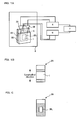
- Fig. 1(a) illustrates an overview of a shutdown temperature evaluation test device.
- the reference numeral 1 indicates a microporous film (any one of the test pieces for Examples and Comparative Examples of the nonaqueous electrolyte secondary battery separator of the present invention).
- the reference numerals 2A and 2B each indicates a nickel foil of 10 ⁇ m in thickness.
- the reference numerals 3A and 3B each indicates a glass plate of 25 mm in width, 76 mm in length, and 1.4 mm in thickness.
- the reference numeral 4 indicates an electric resistance meter (LCR meter (Model: AG-4311®) of Ando Electrical Co. Ltd.), and is connected to the nickel foils 2A and 2B.
- the reference numeral 5 indicates a thermoelectric couple and is connected to a thermometer 6.
- the reference numeral 7 indicates a data collector, and is connected to an electric resistance device 4 and the thermometer 6.
- the reference numeral 8 is an oven for heating the microporous film.
- the microporous film 1 is placed on the nickel foil 2A and both ends of the microporous film 1 in the longitudinal direction are fixed on the nickel foil 2A with a use of a Teflon® tape (shaded portions of the figure).
- a Teflon® tape is pasted as illustrated in Fig.
- the microporous film 1 is sandwiched between the nickel foils 2A and 2B, and the two nickel foils 2A and 2B are sandwiched between the glass plates 3A and 3B.
- the microporous film 1 and the window portion of the nickel foil 2B are positioned to face each other.
- the two glass plates are fixed by clipping a commercially available double clip: LION OFFICE PRODUCTS CORP.
- thermoelectric couple 5 is fixed to the glass plate with a use of a Teflon® tape. With this device, the temperature and electric resistance are continuously measured. The temperature was raised from 25°C to 200°C, at a speed of 2°C/min. The electric resistance is measured at AC 1kHz. The shutdown temperature is defined as a temperature at which the electric resistance of the microporous film reaches 10 3 ⁇ .
- Table 1 shows that the contact angle of the polyethylene microporous film of each Example is smaller than that of the non-fluorinated separator of Comparative Example 1. That is, the affinity for electrolyte of the separator of each Example is improved. Further, it is further understood that the shutdown performance is also favorable. In Comparative Examples 2 and 4, the contact angle was not reduced due to insufficient fluorination. Further, in Comparative Examples 3 and 5, the contact angle was reduced but the shutdown temperature significantly increased, due to excessive fluorination. Introduction of COOH group was confirmed in Examples 1 to 7. The presence of COOH group was not confirmed in Comparative Example 1.
- the specific surface area was measured by a surface area measuring instrument (ASAP2400) produced by Shimadzu Corporation, through a nitrogen adsorption method.
- the test piece was cut into strips, and a strip of approximately 0.2g was folded to fit in a cell.
- the strip of test piece was placed in a cell, and degassed for about 15 hours at room temperatures, in a test piece pre-processing unit. Then, the specific surface area was measured.
- the surface area was derived using BET theory, and was 36m 2 /g.
- the air permeability was measured by using a Gurley air permeability tester in compliance with JIS P-8117. The resulting air permeability was 250 sec.
- the pore diameter was measured by a mercury porosimeter (AutoPore 9520, produced by Shimadzu Corporation) through a mercury penetration method.
- the mode diameter was defined as the pore diameter.
- the resulting pore diameter was 0.08 ⁇ .
- the puncture strength which is the maximum puncture load (N) was measured by a handy compression tester (KES-G5; produced by Kato Tech CO., LTD.) with a needlepoint curvature radius of 0.5 mm and at a puncture speed of 2 mm/sec. The resulting puncture strength was 4.5N.
- a sample (MD120 mm ⁇ TD120mm) was cutout from the microporous film, and three points were marked at an interval of TD100mm with a use of a permanent marker.
- the microporous film was sandwiched between sheets of copy paper (A4 size, 64g/m 2 in weight, and 0.092 mm in thickness) produced by KOKUYO S&T Co., Ltd. These sheets were bound by stapling the side edges of the sheets. Then, the sheets were left for one hour, in an oven at a temperature of 100°C. After that, the sheets were air-cooled, and the TD lengths (mm) between the three markings were measured.
- the thermal shrinkage was calculated from the following equation, applying the average of the TD lengths among three markings. The resulting thermal shrinkage was 1% or lower.
- Thermal Skrinkage % 1 - TD length mm / 100 ⁇ 100
- the following describes an example in which overcharging test is conducted with respect to a lithium ion secondary battery including the nonaqueous electrolyte secondary battery multilayered separator of the present invention. Particularly examined was whether the shutdown characteristic and liquid-retaining characteristic can be realized in separator layers, instead of a single layer, to form a nonaqueous electrolyte secondary battery multilayered separator of the present invention having improved shutdown characteristic, electrolyte-wettability, and liquid-retaining characteristic.
- the nonaqueous electrolyte secondary battery multilayered separator of the present example is prepared as follows. A single 5 ⁇ m-thick polyethylene porous layer is sandwiched between two 10 ⁇ m-thick fluorinated polyethylene porous layer. The three layers are thermally bonded through a heat-pinch rolls heated to 120°C, to form a three-layered separator. This separator was measured and evaluated as was done in Examples 1 to 6. The results are indicated in the above Table 1, along with results of other Examples.
- the positive electrode was produced by sufficiently mixing 95 wt% of LiCoO 2 with 2 wt% of acetylene black and 3 wt% of PVDF, and shaping the mixture into an article of 40 mm ⁇ 40 mm.
- a lithium metal for the negative electrode is used a lithium metal.
- the electrolyte a mixed solvent of ethylene carbonate containing 1 mol/L of lithium hexafluorophosphate and diethyl carbonate at a ratio of 3:7.
- the lithium ion secondary battery thus produced is full-charged by constant voltage at 4.2V (current limiting: 0.2CA). Then, the battery was discharged to 2.7V at a constant current of 0.2CA. Subsequently, the battery was connected to a stabilized power supply of 10V or higher, and charged for 1.25 hours at 2CA. When the safety device in the battery is activated, the charging was stopped immediately. The testing environment temperature was between 20 ⁇ 5°C, and the battery was considered as acceptable if no burst or ignition occurred. Even if acceptable, the measurement was continued until the heat generated in the battery reaches the maximum temperature.
- the Table 2 shows the results of the overcharging test.
- Example 8 the liquid-wettability was retained, and the battery temperature at the time of overcharging was approximately 80°C, at the highest.
- the overcharge current was restrained at a relatively low temperature, and the increase in the battery temperature was restrained. This is because the liquid is retained by the 10 ⁇ m-separators (two outer layers of the three layers, which respectively contact the positive and negative electrodes). This increases the reaction area, and the apparent overcharge current contributing to reaction is reduced as compared to a battery whose separator is not capable of retaining liquid.
- an exothermic reaction attributed to metallic lithium deposition and dendrite growth is restrained.
- the electrolyte is decomposed on the positive electrode at the time of overcharging, thus generating oxygen gas.
- the larger the amount of fluid phase the better is restrained a heat-generating reaction which involves LiC 6 and metallic lithium, and takes place in the interfaces among three (phases)layers, i.e. solid phase(the surface of negative electrode), fluid phase (the electrolyte), and gas phase (space).
- solid phase the surface of negative electrode
- fluid phase the electrolyte
- gas phase space
- Example 8 deals with a separator having multiple layers each made of a porous film.
- a separator having multiple porous layers formed in one piece or laminated, each of which layers is made of a nonwoven fabric, a woven fabric, or a microporous film is made of a nonwoven fabric, a woven fabric, or a microporous film.
- the present invention provides a separator having both a favorable electrolyte-retaining characteristic and a suitable shutdown performance.
- the present invention therefore is suitably applied to separators of nonaqueous electrolyte secondary batteries.
- FIG. 1 (a) is a schematic diagram illustrating a shutdown characteristic measuring device of the present invention, (b) is a plane diagram of one of nickel foils shown in (a), and (c) is a plane view of another one of the nickel foil shown in (a).
Landscapes
- Chemical & Material Sciences (AREA)
- Chemical Kinetics & Catalysis (AREA)
- Electrochemistry (AREA)
- General Chemical & Material Sciences (AREA)
- Engineering & Computer Science (AREA)
- Manufacturing & Machinery (AREA)
- Cell Separators (AREA)
- Secondary Cells (AREA)
- Manufacture Of Porous Articles, And Recovery And Treatment Of Waste Products (AREA)
Abstract
Description
- The present invention relates to fluorinated separators for a nonaqueous electrolyte secondary battery, and separators for a nonaqueous electrolyte secondary battery using the same.
- Separators of nonaqueous electrolyte secondary batteries such as lithium ion secondary batteries have to be electrically insulative to separate the negative and positive electrodes from each other, and be chemically or electrochemically stable against nonaqueous electrolyte. For such separators in general is used a microporous film made of resin such as polyolefin, nonwoven fabric, or the like. For the past several years, there has been a need for a separator whose thickness is reduced while maintaining a high capacity of a battery, and which separator having a sufficient mechanical strength to prevent internal short-circuits. Further, a current-shutting-down characteristic (hereinafter, shutdown characteristic) is also essential for ensuring safety. This is because, when overcharging, mishandling, or the like leads to an excessive rise in the temperature of the battery, fine pores of a separator are clogged and the movement of ions is blocked due to the characteristic, and the temperature of the battery is consequently restrained from further rising. To this end, a low-melting polyolefin based resin such as polyethylene or polypropylene is often used as a material for separators. The insulation property and mechanical strength of the separator have been maintained by molecular mass, porosity, or pore distribution of the resin.
- A typical polyolefin-based material however is hydrophobic and not sufficiently capable of retaining an electrolyte. If an electrolyte is not sufficiently retained, leakage of electrolyte may take place due to, for example, contraction/expansion of the negative electrode at the time of charging/discharging. This may dry up the electrolyte, consequently leading to capacity drop or battery deterioration. On this account, various approaches have been suggested for hydrophilizing a polyolefin based material and improving affinity for the electrolyte. These approaches include: sulfonation, corona discharge, plasma discharge, exposure to an ultra-violet ray, or the like. However, there still remains a problem of decrease in the material strength and a problem in the processing cost or the sustainability of the effects, and none of the approaches provides a sufficient solution.
- Another approach for hydrophilizing a polyolefin based material is to expose the material to a gas containing fluorine gas. This method and a separator produced by the method are disclosed in for example,
Patent Document 1 and Patent documents 2. The method provides through a simple process a separator whose material strength is not reduced. -
- [Patent Document 1] Japanese Unexamined Patent Publication No.
116436/1994 Tokukaihei 6-116436 - [Patent Document 2] Japanese Patent No.
3521523 - However, with the separators disclosed in the
above Patent documents 1 and 2, there is a problem that the shutdown characteristic of the polyolefin-based material is lost when the battery heats up to high temperatures. This is mainly because a cross-linking reaction of macromolecular chain take place during a process reaction, and this reaction reduces the fluidity of the molten polyolefin-based material. - It is therefore an object of the present invention to provide a separator and a multilayered separator, for nonaqueous electrolyte secondary battery such as lithium ion secondary battery, whose affinity for electrolyte is improved to retain electrolyte better and whose shutdown characteristic is maintained.
- A separator of the present invention for a nonaqueous electrolyte secondary battery is obtained by processing, a polyolefin based resin with fluorine gas. A contact angle of the separator with a nonaqueous solvent electrolyte is 40° or smaller. A shutdown temperature of the separator is 170°C or lower. A multilayered separator of the present invention for a nonaqueous electrolyte secondary battery includes a plurality of layers, at least one of which is the foregoing separator for a nonaqueous electrolyte secondary battery. In a separator of the present invention for a nonaqueous electrolyte secondary battery, a functional group having affinity for electrolyte is introduced to at least a part of a surface of a polyolefin based resin. A contact angle of the separator with a nonaqueous solvent electrolyte is 40° or smaller. A shutdown temperature of the separator is 170°C or lower.
- The separator and the multilayered separators of the present invention for a nonaqueous electrolyte secondary battery has a remarkably improved electrolyte-retaining characteristic, while maintaining the shutdown characteristic thereof.
- The following describes an embodiment of a separator for nonaqueous electrolyte secondary battery (hereinafter, referred to as nonaqueous electrolyte secondary battery separator), according to the present invention. In the present embodiment, a functional group, such as carbonyl group or carboxyl group, which exhibits affinity for electrolyte is introduced through a fluorination to at least a part of the surface of an unprocessed separator, so as to achieve an electrolyte-retaining characteristic. To maintain the shutdown characteristic at this time, the fluorination is performed under specific conditions. Note that fluorination of the present invention is a minor process conducted to a part of or the entire surface of the separator, with the lowest possible partial pressure of fluorine gas. Specifically, the process exposes partially or entirely the surface of the separator to a mixed gas containing oxygen gas and fluorine gas, at a temperature between -50°C and 100°C. The fluorine gas is generated by a not-shown fluorine gas generator. The partial pressure of the fluorine gas generated is between 1 to 100 Pa.
- With the fluorine gas partial pressure within the above range, the shutdown characteristic and the electrolyte retaining characteristic are suitably maintained. Introduction of the functional group having affinity for electrolyte is not possible when a fluorine gas partial pressure is lower than 1Pa. Although the fluorine gas partial pressure higher than 100 Pa allows introduction of the functional group having affinity for electrolyte, such a partial pressure also progresses the cross-linking reaction of macromolecular chain. Therefore, the fluidity of molecules is deteriorated, consequently raising the shutdown temperature. Further, the reaction heat also increases during the process, and may melt the separator surface. The molten separator surface of the separator may plug the fine pores of the separator. Thus, there is a possibility of losing the shutdown characteristic itself. The fluorine partial pressure is more preferably between 1 and 50Pa. The partial pressure of the oxygen gas to be mixed in is not particularly limited; however, the partial pressure of the oxygen gas is preferably between 1kPa and 300 kPa, more preferably, between 50kPa and 200kPa. Note that the oxygen gas to be mixed in may be suitably diluted by an inert gas such as nitrogen gas or helium gas.
- By subjecting the separator made of a polyolefin based resin to the fluorination of the present invention, a functional group, such as a carbonyl group or a carboxyl group, having affinity for electrolyte is introduced to at least a part of the surface of the separator. The introduced functional group with affinity for electrolyte can be confirmed by a known analysis method such as X-ray photoemission spectroscopy (XPS) or Time of Flight Secondary Ion Mass Spectrometry (TOF-SIMS).
- A contact angle formed between a nonaqueous solvent electrolyte and the separator of the present invention needs to be 40° or less. A contact angle of more than 40° results in a poor electrolyte retaining characteristic, and sufficient battery performance is not achieved. The contact angle is preferably 30° or less, and is more preferably 20°. Further, a shutdown temperature needs to be 170°C or lower. Preferably, the shutdown temperature is 160°C or lower, and is more preferably 155°C. A shutdown temperature of more than 170°C delays the shut down, and does not therefore provide sufficient prevention of short-circuits in the battery.
- Further, a suitable amount of cross-linking reaction occurs when the separator undergoes the fluorination, and a favorable shutdown characteristic is easily achieved. In view of this, the specific surface area measured by a nitrogen adsorption method using a surface area measuring instrument is preferably 1m2/g or more, but not more than 100m2/g in consideration that the wall surface of air hole parts are evenly processed in the fluorination. The specific surface area is more preferably between 10m2/g and 80m2/g, and even more preferably between 15m2/g and 60m2/g.
- The thickness of the separator of the present invention is preferably 1µm or more, but not more than 100µm. A separator having a thickness of 1µm or more is sufficiently insulative. Further, a separator having a thickness of 100µm or less occupies a less volume, and is therefore advantageous in realizing a battery having a higher capacity. More preferably, the thickness of the separator is between 2µm and 50µm, and even more preferably between 5µm and 40µm.
- The porosity of the separator of the present invention is preferably 25% or more in terms of permeability, and is preferably 90% or less so that the possibility of self-discharge is reduced and the reliability is ensured. The porosity is more preferably between 30% and 70%, and more preferably between 35% and 60%.
- Further, the air permeability of the separator of the present embodiment is preferably 10 sec or more (measured by a Gurley air permeability tester in compliance with Japanese Industrial Standard (JIS) P-8117), as an amount of self-discharge is less in a battery adopting a separator having such an air permeability. Further, to achieve a favorable charge/discharge characteristic, the air permeability is preferably 1000 sec or less. More preferably, the air permeability of the separator is between 50 to 700 sec, and even more 80 to 500 sec.
- The mode diameter (porosi mode diameter/) of the separators pore of the present embodiment is preferably 0.05µm or larger, when measured by a mercury penetration method using a mercury porosimeter. Such a pore diameter allows the walls of hole portions to be evenly fluorinated, and results in excellent ion permeability. Further, in order to achieve the reliability by reducing the possibility of self-discharge and obtaining a favorable shutdown characteristic, the pore diameter (porosi mode diameter) is preferably not more than 5µm. The pore diameter is more preferably between 0.07µm and 1µm, and even more preferably between 0.1µm and 0.7µm.
- Further, in the present embodiment, the puncture strength of the separator is preferably 2N or more. This is because the puncture strength of 2N or more prevents membrane rapture caused by an active material or the like having fallen away at the time of a battery foiling process. Further, such a puncture strength reduces the possibility of short-circuits caused by expansion/contraction at the time of charging/discharging. The maximum puncture strength is not limited. However, the puncture strength is preferably not more than 20N, in terms of reducing the width contraction by orientation relaxation at the time of heating. More preferably, the puncture strength is between 3N and 10N, and even more preferably between 4N and 8N. The puncture strength in this specification is the maximum puncture load (N) resulting from a puncture test conducted using a handy compression tester (KES-G5; produced by Kato Tech CO., LTD.) with a needlepoint curvature radius of 0.5 mm and at a puncture speed of 2 mm/sec.
- In terms of restraining short-circuits between electrodes, the thermal shrinkage of the separator of the present embodiment is 30% or lower, more preferably 20% or lower, and even more preferably 10% or lower.
- As such a separator mentioned above is used a microporous film made of a polyolefin resin such as polyethylene and polypropylene. The production method of such a microporous film is not particularly limited. For example, methods described in the following documents are adopted as the production method: Japanese Unexamined Patent Publications No.
220453/1997 Tokukaihei 9-220453 322989/1999 Tokukaihei 11-322989 3258737 3235669 - The polyethylene used is preferably a single-stage or multi-stage polymer of high-pressure method low-density polyethylene, linear low-density polyethylene, or high-density polyethylene. The density of the high-density polyethylene is preferably between 0.941g/cm3 and 0.959g/cm3, so that a high strength is easily achieved and that affinity for electrolyte is easily improved through fluorination. A catalyst for producing the linear low-density polyethylene and high-density polyethylene is not particularly limited. For example, a typical titanium based catalyst, chrome based catalyst, or metallocene based catalyst may be used. Further, the configuration of polypropylene is not particularly limited. Polypropylene may be isotactic polymer, sydiotactic polymer, atactic polymer, or the like. Further, polypropylene may be a random copolymer or block copolymer. These resins may be mixed with one another or mixed with another resin provided that the effects of the separator of the present embodiment is not lost. An inorganic filler, a heat stabilizer, or the like may be added. Further, to achieve a favorable shutdown characteristic and favorable affinity for electrolyte, polyolefin having a side chain of alkyl group may be mixed. Examples of such polyolefin are: polyethylene copolymer including comonomer such as 1-butene, 4-methyl-1-pentenel-hexene, and 1-octene, polypropylene, or polyethylene produced by using a chrome series based catalyst.
- The temperature at which the separator is exposed to fluorine gas is preferably between -50 °C to 100°C. At temperatures lower than -50°C, a functional group with affinity for electrolyte is not sufficiently introduced. This is not preferable in terms of affinity for electrolyte. Further, temperatures higher than 100°C causes deformation or combustion of the separator due to an excessive heat generated in the reaction with fluorine gas. More preferably, the temperature is 50°C or lower.
- Further, the volume ratio of fluorine gas versus oxygen gas (fluorine gas/oxygen gas) is preferably less than 0.01, and is more preferably less than 0.001. The volume ratio of less than 0.01 ensures favorable shutdown characteristic. On the other hand, when the volume ratio is 0.01 or more, cross-linking reaction of the macromolecular chain may progress, or fine pores of the separator may be clogged due to generation of an excessive reaction heat, consequently harming the shutdown characteristic.
- In the nonaqueous electrolyte secondary battery separator of the present embodiment, the electrolyte-retaining characteristic is remarkably improved, while the shutdown performance is maintained. The same effect is achieved in a multilayered separator for a nonaqueous electrolyte secondary battery (hereinafter, nonaqueous electrolyte secondary battery multilayered separator) including at least one layer which is the nonaqueous electrolyte secondary battery separator of the present embodiment.
- The following describes the nonaqueous electrolyte secondary battery separator or nonaqueous electrolyte secondary battery multilayered separator of the present invention with reference to various examples. First, examples and comparative examples are described. Then, a measurement method, evaluation method, and results of measurement and evaluation are described.
- To prepare test pieces for Examples 1 to 7 of the present invention, a polyethylene microporous film (Product Name: Highpore, produced by Asahi Kasei Chemicals Corporation) of 20µm in thickness is placed in a stainless reaction vessel. The vessel is vacuum-pumped, and fluorination is conducted under conditions indicated in Table 1 below.
- In Comparative Example 1, a non-fluorinated polyethylene porous film is used. For Comparative Examples 2 to 5, test pieces are prepared by conducting fluorination under conditions indicated in Table 1.
- A contact angle between the surface of each test piece and a nonaqueous solvent electrolyte was measured using a contact angle meter (Model: G-1, produced by Erma Inc, and propylene carbonate (PC) as the nonaqueous solvent electrolyte. To measure the contact angle, each test piece was placed in a 20°C-atmosphere, and a droplet of the nonaqueous solvent electrolyte was dropped on the surface of the test piece. Then, the angle formed between the surface of and the droplet was measured by a protractor in the field of vision.
-
Fig. 1(a) illustrates an overview of a shutdown temperature evaluation test device. Thereference numeral 1 indicates a microporous film (any one of the test pieces for Examples and Comparative Examples of the nonaqueous electrolyte secondary battery separator of the present invention). Thereference numerals reference numerals reference numeral 4 indicates an electric resistance meter (LCR meter (Model: AG-4311®) of Ando Electrical Co. Ltd.), and is connected to the nickel foils 2A and 2B. Thereference numeral 5 indicates a thermoelectric couple and is connected to athermometer 6. Thereference numeral 7 indicates a data collector, and is connected to anelectric resistance device 4 and thethermometer 6. Thereference numeral 8 is an oven for heating the microporous film. - More specifically, as shown in
Fig. 1(b) , themicroporous film 1 is placed on thenickel foil 2A and both ends of themicroporous film 1 in the longitudinal direction are fixed on thenickel foil 2A with a use of a Teflon® tape (shaded portions of the figure). Themicroporous film 1 was impregnated with an electrolyte: a 1 mol/L lithium borofluoride solution (solvent: propylene carbonate /ethylene carbonate /λ-butyl lactone =1/1/2). On thenickel foil 2B, a Teflon® tape is pasted as illustrated inFig. 1(c) (shaded portion of the figure) to mask thenickel foil 2B except for acenter portion 2B1 (15 mm × 10 mm window portion) of thenickel foil 2B. As to set the test piece, themicroporous film 1 is sandwiched between the nickel foils 2A and 2B, and the two nickel foils 2A and 2B are sandwiched between theglass plates microporous film 1 and the window portion of thenickel foil 2B are positioned to face each other. The two glass plates are fixed by clipping a commercially available double clip: LION OFFICE PRODUCTS CORP. Product Name: BINDER CLIPS No. 107N. Thethermoelectric couple 5 is fixed to the glass plate with a use of a Teflon® tape. With this device, the temperature and electric resistance are continuously measured. The temperature was raised from 25°C to 200°C, at a speed of 2°C/min. The electric resistance is measured at AC 1kHz. The shutdown temperature is defined as a temperature at which the electric resistance of the microporous film reaches 103Ω. - TOF-SIMS measurement was conducted using TRIFT III (device name) produced by Physical Electronics to confirm the presence of COOH (M/Z=45). The measurement was conducted under the following conditions: the primary ion = Ga+, the acceleration voltage = 15kV, the current = 600 pA, the elapsed time = 3 min, and analyzed area = 200µm×200µm.
- The measurement and evaluation were conducted, and each separator is evaluated as acceptable if the PC contact angle is not more than 40° and the shutdown temperature is not more than 170°C. The results are indicated in the following Table 1, along with fluorination conditions of each Examples.
-
[Table 1] Test Pieces Fluorination Conditions PC Contact Angle ° Shutdown Temp. (°C) Evaluation Partial Pressure of F2 (Pa) Partial Pressure of O2 (k Pa) Process Temp. (°C) Example 1 1 120 20 40 148 Acceptable Example 2 20 120 20 26 155 Acceptable Example 3 60 120 20 14 162 Acceptable Example 4 100 120 20 10 165 Acceptable Example 5 20 120 -50 32 150 Acceptable Example 6 20 120 100 6 170 Acceptable Example 7 20 100 20 22 142 Acceptable Comp. Example 1 - - - 71 140 Not Acceptable Comp. Example 2 0.5 120 20 41 147 Not Acceptable Comp. Example 3 200 120 20 8 171 Not Acceptable Comp. Example 4 20 120 -70 71 148 Not Acceptable Comp. Example 5 20 120 135 6 195 Not Acceptable - The results in Table 1 shows that the contact angle of the polyethylene microporous film of each Example is smaller than that of the non-fluorinated separator of Comparative Example 1. That is, the affinity for electrolyte of the separator of each Example is improved. Further, it is further understood that the shutdown performance is also favorable. In Comparative Examples 2 and 4, the contact angle was not reduced due to insufficient fluorination. Further, in Comparative Examples 3 and 5, the contact angle was reduced but the shutdown temperature significantly increased, due to excessive fluorination. Introduction of COOH group was confirmed in Examples 1 to 7. The presence of COOH group was not confirmed in Comparative Example 1.
- Next, measurements were conducted on the specific surface area, porosity, air permeability, pore diameter, puncture strength, and thermal shrinkage of the nonaqueous electrolyte secondary battery separator of Example 7. Note that the polyethylene porous film of 0.95g/cm3 in density was used for the nonaqueous electrolyte secondary battery separator of Example 7.
- The specific surface area was measured by a surface area measuring instrument (ASAP2400) produced by Shimadzu Corporation, through a nitrogen adsorption method. The test piece was cut into strips, and a strip of approximately 0.2g was folded to fit in a cell. The strip of test piece was placed in a cell, and degassed for about 15 hours at room temperatures, in a test piece pre-processing unit. Then, the specific surface area was measured. The surface area was derived using BET theory, and was 36m2/g.
- A sample of 10 cm square was cut out from the microporous film, the volume and weight of the sample was measured. Then, the porosity was calculated applying the volume and weight thus calculated in the following equation.

From the above equation, the porosity was found to be 41%. - The air permeability was measured by using a Gurley air permeability tester in compliance with JIS P-8117. The resulting air permeability was 250 sec.
- The pore diameter was measured by a mercury porosimeter (AutoPore 9520, produced by Shimadzu Corporation) through a mercury penetration method. The mode diameter was defined as the pore diameter. The resulting pore diameter was 0.08µ.
- The puncture strength, which is the maximum puncture load (N), was measured by a handy compression tester (KES-G5; produced by Kato Tech CO., LTD.) with a needlepoint curvature radius of 0.5 mm and at a puncture speed of 2 mm/sec. The resulting puncture strength was 4.5N.
- A sample (MD120 mm×TD120mm) was cutout from the microporous film, and three points were marked at an interval of TD100mm with a use of a permanent marker. The microporous film was sandwiched between sheets of copy paper (A4 size, 64g/m2 in weight, and 0.092 mm in thickness) produced by KOKUYO S&T Co., Ltd. These sheets were bound by stapling the side edges of the sheets. Then, the sheets were left for one hour, in an oven at a temperature of 100°C. After that, the sheets were air-cooled, and the TD lengths (mm) between the three markings were measured. The thermal shrinkage was calculated from the following equation, applying the average of the TD lengths among three markings. The resulting thermal shrinkage was 1% or lower.

- The following describes an example in which overcharging test is conducted with respect to a lithium ion secondary battery including the nonaqueous electrolyte secondary battery multilayered separator of the present invention. Particularly examined was whether the shutdown characteristic and liquid-retaining characteristic can be realized in separator layers, instead of a single layer, to form a nonaqueous electrolyte secondary battery multilayered separator of the present invention having improved shutdown characteristic, electrolyte-wettability, and liquid-retaining characteristic.
- First, the nonaqueous electrolyte secondary battery multilayered separator of the present example is prepared as follows. A single 5µm-thick polyethylene porous layer is sandwiched between two 10 µm-thick fluorinated polyethylene porous layer. The three layers are thermally bonded through a heat-pinch rolls heated to 120°C, to form a three-layered separator. This separator was measured and evaluated as was done in Examples 1 to 6. The results are indicated in the above Table 1, along with results of other Examples.
- Next, the thus produced nonaqueous electrolyte secondary battery multilayered separator is disposed between positive and negative electrodes, and to make a lithium ion secondary battery. The positive electrode was produced by sufficiently mixing 95 wt% of LiCoO2 with 2 wt% of acetylene black and 3 wt% of PVDF, and shaping the mixture into an article of 40 mm×40 mm. For the negative electrode is used a lithium metal. For the electrolyte is used a mixed solvent of ethylene carbonate containing 1 mol/L of lithium hexafluorophosphate and diethyl carbonate at a ratio of 3:7. Through these processes, the lithium ion secondary battery of the present example is made.
- The lithium ion secondary battery thus produced is full-charged by constant voltage at 4.2V (current limiting: 0.2CA). Then, the battery was discharged to 2.7V at a constant current of 0.2CA. Subsequently, the battery was connected to a stabilized power supply of 10V or higher, and charged for 1.25 hours at 2CA. When the safety device in the battery is activated, the charging was stopped immediately. The testing environment temperature was between 20±5°C, and the battery was considered as acceptable if no burst or ignition occurred. Even if acceptable, the measurement was continued until the heat generated in the battery reaches the maximum temperature. The Table 2 shows the results of the overcharging test.
-
[Table 2] Separator Result of Overcharging Test Structure Thickness (µm) Max. Battery Temp. (°C) Evaluation Example 8 1st Layer 10 80 Acceptable 2nd Layer 5 3rd Layer 10 - In Example 8, the liquid-wettability was retained, and the battery temperature at the time of overcharging was approximately 80°C, at the highest. Thus, in Example 8, the overcharge current was restrained at a relatively low temperature, and the increase in the battery temperature was restrained. This is because the liquid is retained by the 10µm-separators (two outer layers of the three layers, which respectively contact the positive and negative electrodes). This increases the reaction area, and the apparent overcharge current contributing to reaction is reduced as compared to a battery whose separator is not capable of retaining liquid. Thus, an exothermic reaction attributed to metallic lithium deposition and dendrite growth is restrained. Further, the electrolyte is decomposed on the positive electrode at the time of overcharging, thus generating oxygen gas. Therefore, the larger the amount of fluid phase, the better is restrained a heat-generating reaction which involves LiC6 and metallic lithium, and takes place in the interfaces among three (phases)layers, i.e. solid phase(the surface of negative electrode), fluid phase (the electrolyte), and gas phase (space). As a result, it is found that the heat generation of the battery is restrained, and a highly safe separator is provided.
- The present invention may be altered in various ways, within the scope of the claims set forth below, and is not limited to the above described embodiment and examples. For example, Example 8 deals with a separator having multiple layers each made of a porous film. For example, the same effect is achieved by a separator having multiple porous layers formed in one piece or laminated, each of which layers is made of a nonwoven fabric, a woven fabric, or a microporous film.
- The present invention provides a separator having both a favorable electrolyte-retaining characteristic and a suitable shutdown performance. The present invention therefore is suitably applied to separators of nonaqueous electrolyte secondary batteries.
- [
Fig. 1 ] (a) is a schematic diagram illustrating a shutdown characteristic measuring device of the present invention, (b) is a plane diagram of one of nickel foils shown in (a), and (c) is a plane view of another one of the nickel foil shown in (a). -
- 1 Microporous Film
- 2A, 2B Nickel Foil
- 3A, 3B Glass Plate
- 4 Electric Resistance Device
- 5 Thermoelectric Couple
- 6 Thermometer
- 7 Data Collector
Claims (3)
- A separator for a nonaqueous electrolyte secondary battery obtained by processing, a polyolefin based resin with fluorine gas, which forms a contact angle of 40° or smaller with a nonaqueous solvent electrolyte, and whose shutdown temperature is 170°C or lower.
- A multilayered separator for a nonaqueous electrolyte secondary battery, comprising a plurality of layers, at least one of which is the separator for nonaqueous electrolyte secondary battery defined in claim 1.
- A separator for a nonaqueous electrolyte secondary battery, wherein
a functional group having affinity for electrolyte is introduced at least a part of a surface of a polyolefin based resin;
a contact angle of the separator with a nonaqueous solvent electrolyte is 40° or smaller; and
a shutdown temperature of the separator is 170°C or lower.
Applications Claiming Priority (2)
| Application Number | Priority Date | Filing Date | Title |
|---|---|---|---|
| JP2006280212 | 2006-10-13 | ||
| PCT/JP2007/069925 WO2008044761A1 (en) | 2006-10-13 | 2007-10-12 | Separator for nonaqueous electrolyte secondary battery and multilayer separator for nonaqueous electrolyte secondary battery |
Publications (3)
| Publication Number | Publication Date |
|---|---|
| EP2079119A1 true EP2079119A1 (en) | 2009-07-15 |
| EP2079119A4 EP2079119A4 (en) | 2011-12-07 |
| EP2079119B1 EP2079119B1 (en) | 2013-01-02 |
Family
ID=39282948
Family Applications (1)
| Application Number | Title | Priority Date | Filing Date |
|---|---|---|---|
| EP07829661A Not-in-force EP2079119B1 (en) | 2006-10-13 | 2007-10-12 | Process for manufacturing a separator for a nonaqueous electrolyte secondary battery |
Country Status (6)
| Country | Link |
|---|---|
| US (1) | US20100009249A1 (en) |
| EP (1) | EP2079119B1 (en) |
| JP (1) | JPWO2008044761A1 (en) |
| KR (1) | KR101313458B1 (en) |
| CN (1) | CN101663778B (en) |
| WO (1) | WO2008044761A1 (en) |
Cited By (1)
| Publication number | Priority date | Publication date | Assignee | Title |
|---|---|---|---|---|
| EP3340344A4 (en) * | 2016-05-30 | 2018-09-05 | LG Chem, Ltd. | Lithium secondary battery separator and lithium secondary battery comprising same |
Families Citing this family (10)
| Publication number | Priority date | Publication date | Assignee | Title |
|---|---|---|---|---|
| CN102130315B (en) | 2010-01-13 | 2015-12-16 | 索尼公司 | Barrier film and nonaqueous electrolyte battery |
| JP6121697B2 (en) * | 2012-11-26 | 2017-04-26 | 株式会社東芝 | Non-aqueous electrolyte battery |
| US9083034B2 (en) * | 2013-03-15 | 2015-07-14 | Ford Global Technologies, Llc | Treated battery separator |
| WO2016157736A1 (en) * | 2015-03-31 | 2016-10-06 | 三洋電機株式会社 | Non-aqueous electrolyte secondary cell |
| KR20160139720A (en) | 2015-05-28 | 2016-12-07 | (주)다위월드 | The system mat based on optical recognition and the optical recognition device for the system mat and the method for the manufacturing of the system mat based on optical recognition |
| JP6380306B2 (en) | 2015-09-07 | 2018-08-29 | トヨタ自動車株式会社 | Nonaqueous electrolyte secondary battery |
| WO2017209495A1 (en) * | 2016-05-30 | 2017-12-07 | 주식회사 엘지화학 | Lithium secondary battery separator and lithium secondary battery comprising same |
| CN106972139B (en) * | 2017-03-10 | 2023-05-30 | 深圳中兴新材技术股份有限公司 | Hydrophilic modification method and device for polyolefin microporous membrane |
| CN115799756A (en) * | 2022-12-05 | 2023-03-14 | 湖南东舟能源有限公司 | Polyolefin diaphragm and modification method thereof |
| WO2025041623A1 (en) * | 2023-08-23 | 2025-02-27 | 東レ株式会社 | Hydrophilic porous film and production method therefor |
Family Cites Families (16)
| Publication number | Priority date | Publication date | Assignee | Title |
|---|---|---|---|---|
| JPS6119056A (en) * | 1984-07-05 | 1986-01-27 | Fuji Elelctrochem Co Ltd | Separator for battery |
| US5281491A (en) * | 1991-12-20 | 1994-01-25 | W. R. Grace & Co. | Battery separator |
| US5240655A (en) | 1991-12-20 | 1993-08-31 | W. R. Grace & Co.-Conn. | Process of making a battery separator |
| JPH06116436A (en) | 1992-10-02 | 1994-04-26 | Mitsubishi Kasei Corp | Porous polymer membrane treatment method |
| JP3258737B2 (en) | 1993-01-19 | 2002-02-18 | 旭化成株式会社 | Polyethylene microporous diaphragm |
| JP3521523B2 (en) | 1994-02-14 | 2004-04-19 | 三菱化学株式会社 | Battery separator and battery using the same |
| JP3482606B2 (en) * | 1994-08-11 | 2003-12-22 | 日本電池株式会社 | Sealed alkaline storage battery |
| EP0743690A1 (en) * | 1995-05-17 | 1996-11-20 | Mitsubishi Chemical Corporation | Battery separator and method for its production |
| JP3444712B2 (en) | 1996-02-16 | 2003-09-08 | 旭化成株式会社 | Microporous membrane suitable for battery separator |
| JP4098401B2 (en) | 1998-05-19 | 2008-06-11 | 旭化成ケミカルズ株式会社 | Microporous membrane for battery separator made of polyolefin |
| DE69939253D1 (en) * | 1998-12-02 | 2008-09-18 | Lg Chemical Ltd | PROCESS FOR CHANGING POLYMER SURFACES FOR BETTER BENEFICIALITY |
| JP2000173665A (en) * | 1998-12-10 | 2000-06-23 | Mitsubishi Chemicals Corp | Lithium secondary battery |
| JP4804630B2 (en) * | 2001-01-31 | 2011-11-02 | 旭化成イーマテリアルズ株式会社 | Microporous membrane and lithium battery separator |
| JP2002343326A (en) * | 2001-05-16 | 2002-11-29 | Asahi Kasei Corp | Battery separator |
| JP4675574B2 (en) * | 2004-04-26 | 2011-04-27 | ダイワボウホールディングス株式会社 | Organic electrolyte battery separator and method for producing the same |
| US20070238017A1 (en) * | 2006-04-07 | 2007-10-11 | Celgard Llc | Multilayer separator exhibiting improved strength and stability |
-
2007
- 2007-10-12 EP EP07829661A patent/EP2079119B1/en not_active Not-in-force
- 2007-10-12 KR KR1020097007244A patent/KR101313458B1/en not_active Expired - Fee Related
- 2007-10-12 JP JP2008538764A patent/JPWO2008044761A1/en active Pending
- 2007-10-12 WO PCT/JP2007/069925 patent/WO2008044761A1/en not_active Ceased
- 2007-10-12 US US12/445,226 patent/US20100009249A1/en not_active Abandoned
- 2007-10-12 CN CN2007800382502A patent/CN101663778B/en not_active Expired - Fee Related
Cited By (2)
| Publication number | Priority date | Publication date | Assignee | Title |
|---|---|---|---|---|
| EP3340344A4 (en) * | 2016-05-30 | 2018-09-05 | LG Chem, Ltd. | Lithium secondary battery separator and lithium secondary battery comprising same |
| US10886514B2 (en) | 2016-05-30 | 2021-01-05 | Lg Chem, Ltd. | Separator for lithium secondary battery and lithium secondary battery including the same |
Also Published As
| Publication number | Publication date |
|---|---|
| KR20090069287A (en) | 2009-06-30 |
| KR101313458B1 (en) | 2013-10-01 |
| CN101663778A (en) | 2010-03-03 |
| EP2079119B1 (en) | 2013-01-02 |
| JPWO2008044761A1 (en) | 2010-02-18 |
| US20100009249A1 (en) | 2010-01-14 |
| EP2079119A4 (en) | 2011-12-07 |
| WO2008044761A1 (en) | 2008-04-17 |
| CN101663778B (en) | 2012-10-03 |
Similar Documents
| Publication | Publication Date | Title |
|---|---|---|
| EP2079119B1 (en) | Process for manufacturing a separator for a nonaqueous electrolyte secondary battery | |
| EP3376562B1 (en) | Separator for non-aqueous secondary cell, and non-aqueous secondary cell | |
| KR102771571B1 (en) | Separator for non-aqueous secondary battery and non-aqueous secondary battery | |
| EP2696391B1 (en) | Nonaqueous secondary battery separator and nonaqueous secondary battery | |
| EP3415556B1 (en) | Polyolefin microporous film, separator film for power storage device, and power storage device | |
| KR101429579B1 (en) | Nonaqueous secondary battery separator and non-aqueous secondary battery | |
| US9917289B2 (en) | Laminate, non-aqueous electrolyte secondary battery separator including the laminate, and non-aqueous electrolyte secondary battery including the laminate | |
| EP3800699A1 (en) | Separator for electrochemical device, and electrochemical device comprising same | |
| EP2549566A1 (en) | Separator for Nonaqueous Secondary Battery, Method for Producing the Same, and Nonaqueous Secondary Battery | |
| EP3920299B1 (en) | Separator for non-aqueous secondary battery, method for producing same, and non-aqueous secondary battery | |
| EP2458660A1 (en) | Microporous polyolefin film, separator for non-aqueous secondary battery, non-aqueous secondary battery, and process for production of microporous polyolefin film | |
| EP3920265B1 (en) | Separator for non-aqueous secondary battery, and non-aqueous secondary battery | |
| EP2765630B1 (en) | Separator with heat resistant insulating layer | |
| US20170155115A1 (en) | Nonaqueous electrolyte secondary battery separator, nonaqueous electrolyte secondary battery laminated separator, nonaqueous electrolyte secondary battery member, nonaqueous electrolyte secondary battery, and method for producing porous film | |
| EP2551293A1 (en) | Polyolefin microporous membrane, method for producing same, separator for nonaqueous secondary battery and nonaqueous secondary battery | |
| KR20160102108A (en) | Laminate, non-aqueous electrolyte secondary battery separator including the laminate, and non-aqueous electrolyte secondary battery including the laminate | |
| EP3644407A1 (en) | Separator for secondary battery and electrochemical device using the same | |
| EP3644406A1 (en) | Separator for secondary battery and electrochemical device using the same | |
| EP4057411A1 (en) | Composite separator for secondary battery, method for producing the same, and lithium secondary battery including the same | |
| EP4120459A1 (en) | Separator for batteries | |
| EP4322307B1 (en) | A separator for an electrochemical device and an electrochemical device comprising the same | |
| JP7483154B2 (en) | Separator for non-aqueous secondary battery and non-aqueous secondary battery | |
| JP7781266B2 (en) | Separator for non-aqueous secondary battery and non-aqueous secondary battery | |
| US20250158135A1 (en) | Separator for electrochemical devices and electrochemical device comprising same | |
| HK1141897A (en) | Separator for nonaqueous electrolyte secondary battery and multilayer separator for nonaqueous electrolyte secondary battery |
Legal Events
| Date | Code | Title | Description |
|---|---|---|---|
| PUAI | Public reference made under article 153(3) epc to a published international application that has entered the european phase |
Free format text: ORIGINAL CODE: 0009012 |
|
| 17P | Request for examination filed |
Effective date: 20090420 |
|
| AK | Designated contracting states |
Kind code of ref document: A1 Designated state(s): AT BE BG CH CY CZ DE DK EE ES FI FR GB GR HU IE IS IT LI LT LU LV MC MT NL PL PT RO SE SI SK TR |
|
| RAP1 | Party data changed (applicant data changed or rights of an application transferred) |
Owner name: ASAHI KASEI CHEMICALS CORPORATION Owner name: TOYO TANSO CO., LTD. |
|
| A4 | Supplementary search report drawn up and despatched |
Effective date: 20111104 |
|
| RIC1 | Information provided on ipc code assigned before grant |
Ipc: H01M 2/16 20060101AFI20111028BHEP |
|
| GRAP | Despatch of communication of intention to grant a patent |
Free format text: ORIGINAL CODE: EPIDOSNIGR1 |
|
| DAX | Request for extension of the european patent (deleted) | ||
| GRAS | Grant fee paid |
Free format text: ORIGINAL CODE: EPIDOSNIGR3 |
|
| GRAA | (expected) grant |
Free format text: ORIGINAL CODE: 0009210 |
|
| AK | Designated contracting states |
Kind code of ref document: B1 Designated state(s): AT BE BG CH CY CZ DE DK EE ES FI FR GB GR HU IE IS IT LI LT LU LV MC MT NL PL PT RO SE SI SK TR |
|
| REG | Reference to a national code |
Ref country code: GB Ref legal event code: FG4D |
|
| REG | Reference to a national code |
Ref country code: AT Ref legal event code: REF Ref document number: 592038 Country of ref document: AT Kind code of ref document: T Effective date: 20130115 Ref country code: CH Ref legal event code: EP |
|
| REG | Reference to a national code |
Ref country code: IE Ref legal event code: FG4D |
|
| REG | Reference to a national code |
Ref country code: DE Ref legal event code: R096 Ref document number: 602007027828 Country of ref document: DE Effective date: 20130307 |
|
| REG | Reference to a national code |
Ref country code: AT Ref legal event code: MK05 Ref document number: 592038 Country of ref document: AT Kind code of ref document: T Effective date: 20130102 |
|
| REG | Reference to a national code |
Ref country code: NL Ref legal event code: VDEP Effective date: 20130102 |
|
| PG25 | Lapsed in a contracting state [announced via postgrant information from national office to epo] |
Ref country code: SI Free format text: LAPSE BECAUSE OF FAILURE TO SUBMIT A TRANSLATION OF THE DESCRIPTION OR TO PAY THE FEE WITHIN THE PRESCRIBED TIME-LIMIT Effective date: 20130102 |
|
| REG | Reference to a national code |
Ref country code: LT Ref legal event code: MG4D Ref country code: DE Ref legal event code: R082 Ref document number: 602007027828 Country of ref document: DE Representative=s name: TBK, DE |
|
| PG25 | Lapsed in a contracting state [announced via postgrant information from national office to epo] |
Ref country code: BG Free format text: LAPSE BECAUSE OF FAILURE TO SUBMIT A TRANSLATION OF THE DESCRIPTION OR TO PAY THE FEE WITHIN THE PRESCRIBED TIME-LIMIT Effective date: 20130402 Ref country code: SE Free format text: LAPSE BECAUSE OF FAILURE TO SUBMIT A TRANSLATION OF THE DESCRIPTION OR TO PAY THE FEE WITHIN THE PRESCRIBED TIME-LIMIT Effective date: 20130102 Ref country code: CZ Free format text: LAPSE BECAUSE OF FAILURE TO SUBMIT A TRANSLATION OF THE DESCRIPTION OR TO PAY THE FEE WITHIN THE PRESCRIBED TIME-LIMIT Effective date: 20130102 Ref country code: IS Free format text: LAPSE BECAUSE OF FAILURE TO SUBMIT A TRANSLATION OF THE DESCRIPTION OR TO PAY THE FEE WITHIN THE PRESCRIBED TIME-LIMIT Effective date: 20130502 Ref country code: ES Free format text: LAPSE BECAUSE OF FAILURE TO SUBMIT A TRANSLATION OF THE DESCRIPTION OR TO PAY THE FEE WITHIN THE PRESCRIBED TIME-LIMIT Effective date: 20130413 Ref country code: LT Free format text: LAPSE BECAUSE OF FAILURE TO SUBMIT A TRANSLATION OF THE DESCRIPTION OR TO PAY THE FEE WITHIN THE PRESCRIBED TIME-LIMIT Effective date: 20130102 Ref country code: BE Free format text: LAPSE BECAUSE OF FAILURE TO SUBMIT A TRANSLATION OF THE DESCRIPTION OR TO PAY THE FEE WITHIN THE PRESCRIBED TIME-LIMIT Effective date: 20130102 Ref country code: AT Free format text: LAPSE BECAUSE OF FAILURE TO SUBMIT A TRANSLATION OF THE DESCRIPTION OR TO PAY THE FEE WITHIN THE PRESCRIBED TIME-LIMIT Effective date: 20130102 |
|
| REG | Reference to a national code |
Ref country code: DE Ref legal event code: R082 Ref document number: 602007027828 Country of ref document: DE Representative=s name: TBK, DE Effective date: 20130625 Ref country code: DE Ref legal event code: R081 Ref document number: 602007027828 Country of ref document: DE Owner name: TOYO TANSO CO., LTD., JP Free format text: FORMER OWNER: ASAHI KASEI CHEMICALS CORPORATI, TOYO TANSO CO., LTD., , JP Effective date: 20130625 Ref country code: DE Ref legal event code: R081 Ref document number: 602007027828 Country of ref document: DE Owner name: TOYO TANSO CO., LTD., JP Free format text: FORMER OWNERS: ASAHI KASEI CHEMICALS CORPORATION, TOKIO/TOKYO, JP; TOYO TANSO CO., LTD., OSAKA, JP Effective date: 20130625 |
|
| PG25 | Lapsed in a contracting state [announced via postgrant information from national office to epo] |
Ref country code: FI Free format text: LAPSE BECAUSE OF FAILURE TO SUBMIT A TRANSLATION OF THE DESCRIPTION OR TO PAY THE FEE WITHIN THE PRESCRIBED TIME-LIMIT Effective date: 20130102 Ref country code: PT Free format text: LAPSE BECAUSE OF FAILURE TO SUBMIT A TRANSLATION OF THE DESCRIPTION OR TO PAY THE FEE WITHIN THE PRESCRIBED TIME-LIMIT Effective date: 20130502 Ref country code: NL Free format text: LAPSE BECAUSE OF FAILURE TO SUBMIT A TRANSLATION OF THE DESCRIPTION OR TO PAY THE FEE WITHIN THE PRESCRIBED TIME-LIMIT Effective date: 20130102 Ref country code: PL Free format text: LAPSE BECAUSE OF FAILURE TO SUBMIT A TRANSLATION OF THE DESCRIPTION OR TO PAY THE FEE WITHIN THE PRESCRIBED TIME-LIMIT Effective date: 20130102 Ref country code: GR Free format text: LAPSE BECAUSE OF FAILURE TO SUBMIT A TRANSLATION OF THE DESCRIPTION OR TO PAY THE FEE WITHIN THE PRESCRIBED TIME-LIMIT Effective date: 20130403 Ref country code: LV Free format text: LAPSE BECAUSE OF FAILURE TO SUBMIT A TRANSLATION OF THE DESCRIPTION OR TO PAY THE FEE WITHIN THE PRESCRIBED TIME-LIMIT Effective date: 20130102 |
|
| PG25 | Lapsed in a contracting state [announced via postgrant information from national office to epo] |
Ref country code: EE Free format text: LAPSE BECAUSE OF FAILURE TO SUBMIT A TRANSLATION OF THE DESCRIPTION OR TO PAY THE FEE WITHIN THE PRESCRIBED TIME-LIMIT Effective date: 20130102 Ref country code: RO Free format text: LAPSE BECAUSE OF FAILURE TO SUBMIT A TRANSLATION OF THE DESCRIPTION OR TO PAY THE FEE WITHIN THE PRESCRIBED TIME-LIMIT Effective date: 20130102 Ref country code: SK Free format text: LAPSE BECAUSE OF FAILURE TO SUBMIT A TRANSLATION OF THE DESCRIPTION OR TO PAY THE FEE WITHIN THE PRESCRIBED TIME-LIMIT Effective date: 20130102 Ref country code: DK Free format text: LAPSE BECAUSE OF FAILURE TO SUBMIT A TRANSLATION OF THE DESCRIPTION OR TO PAY THE FEE WITHIN THE PRESCRIBED TIME-LIMIT Effective date: 20130102 |
|
| PLBE | No opposition filed within time limit |
Free format text: ORIGINAL CODE: 0009261 |
|
| STAA | Information on the status of an ep patent application or granted ep patent |
Free format text: STATUS: NO OPPOSITION FILED WITHIN TIME LIMIT |
|
| PG25 | Lapsed in a contracting state [announced via postgrant information from national office to epo] |
Ref country code: CY Free format text: LAPSE BECAUSE OF FAILURE TO SUBMIT A TRANSLATION OF THE DESCRIPTION OR TO PAY THE FEE WITHIN THE PRESCRIBED TIME-LIMIT Effective date: 20130102 |
|
| 26N | No opposition filed |
Effective date: 20131003 |
|
| PG25 | Lapsed in a contracting state [announced via postgrant information from national office to epo] |
Ref country code: IT Free format text: LAPSE BECAUSE OF FAILURE TO SUBMIT A TRANSLATION OF THE DESCRIPTION OR TO PAY THE FEE WITHIN THE PRESCRIBED TIME-LIMIT Effective date: 20130102 |
|
| REG | Reference to a national code |
Ref country code: DE Ref legal event code: R097 Ref document number: 602007027828 Country of ref document: DE Effective date: 20131003 |
|
| PG25 | Lapsed in a contracting state [announced via postgrant information from national office to epo] |
Ref country code: MC Free format text: LAPSE BECAUSE OF FAILURE TO SUBMIT A TRANSLATION OF THE DESCRIPTION OR TO PAY THE FEE WITHIN THE PRESCRIBED TIME-LIMIT Effective date: 20130102 |
|
| REG | Reference to a national code |
Ref country code: CH Ref legal event code: PL |
|
| GBPC | Gb: european patent ceased through non-payment of renewal fee |
Effective date: 20131012 |
|
| REG | Reference to a national code |
Ref country code: IE Ref legal event code: MM4A |
|
| PG25 | Lapsed in a contracting state [announced via postgrant information from national office to epo] |
Ref country code: CH Free format text: LAPSE BECAUSE OF NON-PAYMENT OF DUE FEES Effective date: 20131031 Ref country code: LI Free format text: LAPSE BECAUSE OF NON-PAYMENT OF DUE FEES Effective date: 20131031 Ref country code: GB Free format text: LAPSE BECAUSE OF NON-PAYMENT OF DUE FEES Effective date: 20131012 |
|
| REG | Reference to a national code |
Ref country code: FR Ref legal event code: ST Effective date: 20140630 |
|
| PG25 | Lapsed in a contracting state [announced via postgrant information from national office to epo] |
Ref country code: FR Free format text: LAPSE BECAUSE OF NON-PAYMENT OF DUE FEES Effective date: 20131031 |
|
| PG25 | Lapsed in a contracting state [announced via postgrant information from national office to epo] |
Ref country code: IE Free format text: LAPSE BECAUSE OF NON-PAYMENT OF DUE FEES Effective date: 20131012 |
|
| PG25 | Lapsed in a contracting state [announced via postgrant information from national office to epo] |
Ref country code: TR Free format text: LAPSE BECAUSE OF FAILURE TO SUBMIT A TRANSLATION OF THE DESCRIPTION OR TO PAY THE FEE WITHIN THE PRESCRIBED TIME-LIMIT Effective date: 20130102 |
|
| PG25 | Lapsed in a contracting state [announced via postgrant information from national office to epo] |
Ref country code: LU Free format text: LAPSE BECAUSE OF NON-PAYMENT OF DUE FEES Effective date: 20131012 Ref country code: HU Free format text: LAPSE BECAUSE OF FAILURE TO SUBMIT A TRANSLATION OF THE DESCRIPTION OR TO PAY THE FEE WITHIN THE PRESCRIBED TIME-LIMIT; INVALID AB INITIO Effective date: 20071012 |
|
| PG25 | Lapsed in a contracting state [announced via postgrant information from national office to epo] |
Ref country code: MT Free format text: LAPSE BECAUSE OF FAILURE TO SUBMIT A TRANSLATION OF THE DESCRIPTION OR TO PAY THE FEE WITHIN THE PRESCRIBED TIME-LIMIT Effective date: 20130102 |
|
| PGFP | Annual fee paid to national office [announced via postgrant information from national office to epo] |
Ref country code: DE Payment date: 20151006 Year of fee payment: 9 |
|
| REG | Reference to a national code |
Ref country code: DE Ref legal event code: R119 Ref document number: 602007027828 Country of ref document: DE |
|
| PG25 | Lapsed in a contracting state [announced via postgrant information from national office to epo] |
Ref country code: DE Free format text: LAPSE BECAUSE OF NON-PAYMENT OF DUE FEES Effective date: 20170503 |