EP2077504A1 - Data packet transmitting/receiving system, data packet transmitting/receiving method and data packet transmitting/receiving program - Google Patents
Data packet transmitting/receiving system, data packet transmitting/receiving method and data packet transmitting/receiving program Download PDFInfo
- Publication number
- EP2077504A1 EP2077504A1 EP06822094A EP06822094A EP2077504A1 EP 2077504 A1 EP2077504 A1 EP 2077504A1 EP 06822094 A EP06822094 A EP 06822094A EP 06822094 A EP06822094 A EP 06822094A EP 2077504 A1 EP2077504 A1 EP 2077504A1
- Authority
- EP
- European Patent Office
- Prior art keywords
- credit
- data packet
- size
- receive buffer
- transmission
- Prior art date
- Legal status (The legal status is an assumption and is not a legal conclusion. Google has not performed a legal analysis and makes no representation as to the accuracy of the status listed.)
- Granted
Links
Images








Classifications
-
- G—PHYSICS
- G06—COMPUTING OR CALCULATING; COUNTING
- G06F—ELECTRIC DIGITAL DATA PROCESSING
- G06F13/00—Interconnection of, or transfer of information or other signals between, memories, input/output devices or central processing units
- G06F13/38—Information transfer, e.g. on bus
-
- G—PHYSICS
- G06—COMPUTING OR CALCULATING; COUNTING
- G06F—ELECTRIC DIGITAL DATA PROCESSING
- G06F13/00—Interconnection of, or transfer of information or other signals between, memories, input/output devices or central processing units
- G06F13/38—Information transfer, e.g. on bus
- G06F13/382—Information transfer, e.g. on bus using universal interface adapter
- G06F13/387—Information transfer, e.g. on bus using universal interface adapter for adaptation of different data processing systems to different peripheral devices, e.g. protocol converters for incompatible systems, open system
-
- G—PHYSICS
- G06—COMPUTING OR CALCULATING; COUNTING
- G06F—ELECTRIC DIGITAL DATA PROCESSING
- G06F5/00—Methods or arrangements for data conversion without changing the order or content of the data handled
-
- G—PHYSICS
- G06—COMPUTING OR CALCULATING; COUNTING
- G06F—ELECTRIC DIGITAL DATA PROCESSING
- G06F9/00—Arrangements for program control, e.g. control units
Definitions
- the present invention relates to a data packet transmission and reception system, a data packet transmission and reception method, and a data packet transmission and reception program.
- the receiving end informs the transmitting end of the read state of data packets at the receive buffer, so as not to discard data packets due to overflow at the receive buffer.
- the transmitting end controls transmission of data packets in general.
- Patent Document 1 Japanese Laid-open Patent Publication No. 09-135270 discloses a technology involved in determining, based on the maximum length size (maximum size) of a data packet, the fixed number of queues (number of packets) in advance that can be stored in the receive buffer, and controlling transmission of data packets using the fixed number of queues determined.
- Fig. 22 the following describes this conventional technique in detail.
- Fig. 22 is a drawing for explaining an overview and features of a data packet transmission control system according to the conventional technique. As depicted in Fig.
- the size of the receive buffer at a receiving end is 16 bytes
- the maximum length size of a data packet to be transmitted from the transmitting end is 4 bytes
- the fixed number of queues (number of packets) that can be stored in the receive buffer is determined as four in advance.
- the transmitting end includes a credit control counter. Every time a data packet is read out from the transmit buffer and transmitted to the receiving end, the value in the credit control counter is incremented by one regardless of the size (data size) of a data packet to be transmitted (see (1) in Fig. 22 ). On the other hand, when receiving the data packet from the transmitting end, the receiving end writes the received data packet to the leading portion of the receive buffer (see (2) in Fig. 22 ). Every time reading out a data packet from the receive buffer, the receiving end transmits one credit back to the transmitting end, regardless of the size of the read data packet (see (3) in Fig. 22 ). Every time receiving such credit from the receiving end, the transmitting end subtracts the value of the credit from the value in the credit control counter (see (4) in Fig. 22 ).
- the transmitting end increments and decrements the value in the credit control counter.
- this credit control counter four is set and fixed in advance as the number of queues (the number of packets) that can be stored in the receive buffer. Therefore, at timing for reading out a data packet from the transmit buffer and transmitting the data packet to the receiving end, the transmitting end determines whether the current value in the credit control counter has reached the fixed value (four). If the current value in the credit control counter has not reached the fixed value (four), the transmitting end reads out a data packet from the transmit buffer, and transmits the data packet to the receiving end.
- the transmitting end determines that the receive buffer may be filled with data packets, so as to stop transmitting the data packet (see (5) in Fig. 22 ).
- the transmitting end determines that the receive buffer may be filled with data packets, so as to stop transmitting the data packet (see (5) in Fig. 22 ).
- a known technology uses a buffer as a ring buffer, by controlling credits so as to issue an additional credit depending on a free space in a receive buffer (see, for example, Patent Document 2). Further, a known technology enables easy management of transmitted data by using a management table for the use state of a transmit buffer in buffer control (see, for example, Patent Document 3).
- the fixed number of queues that can be stored in the receive buffer is determined in advance based on the maximum length size of a data packet (four in the above example).
- the receive buffer stores therein data packets of small sizes not reaching the maximum length size of a data packet, for example, even when the receive buffer stores therein four packets of sizes: "4 bytes, 2 bytes, 2 bytes, and 2 bytes" as illustrated in Fig. 22
- the value in the credit control counter at the transmitting end reaches the fixed value (four).
- the transmission of a data packet is stopped.
- a large unused area is created in the receive buffer (an unused area of 6 bytes is created in the above example), causing a problem of not efficiently using resources of the receive buffer.
- the above problems are not limited to data packet transmission between communication apparatuses via a network, and also occur similarly in any systems that transmit a data packet from a transmit buffer at a transmitting end to a receive buffer at a receiving end, for example, in data packet transmission between circuits inside a computer system.
- the present invention is made in view of the problems in the above conventional techniques, and has an object to provide a data packet transmission and reception system, a data packet transmission and reception method, and a data packet transmission and reception program that enable efficient use of resources of a receive buffer.
- the invention according to claim 1 is a data packet transmission and reception system, transmitting a data packet from a transmitting apparatus including a transmit buffer to a receiving apparatus including a receive buffer; and the receiving apparatus transmits, when a data packet stored in the receive buffer is read, size specifying information to be used in the transmitting apparatus to specify a size of a read data packet to the transmitting apparatus; and the transmitting apparatus stores, as a credit, a value corresponding to a total size of all data packets currently stored in a capacity of the receive buffer; adds, when the data packet is transmitted from the transmit buffer to the receiving apparatus, a credit of a value corresponding to a size of a transmitted data packet to the credit stored in the credit storage unit, and stores a resulting credit in the credit storage unit; specifies, when the size specifying information is received from the receiving apparatus, a size of a data packet read out from the receive buffer, using the size specifying information, and subtracts a credit of a value corresponding to
- a size specifying information transmitting unit transmits, as the size specifying information, a credit of a value corresponding to a size of a data packet read out from the receive buffer to the transmitting apparatus; a credit adding unit adds a credit of a value corresponding to a size of a data packet transmitted to the receiving apparatus to a credit stored in the credit storage unit, and stores a resulting credit in the credit storage unit; and a credit subtracting unit subtracts a credit of a value received from the receiving apparatus, from a credit stored in the credit storage unit, and stores a resulting credit in the credit storage unit.
- the size specifying information transmitting unit transmits the size specifying information to the transmitting apparatus regardless of a size of a data packet read out from the receive buffer;
- the credit adding unit adds a credit of a value corresponding to a size of a data packet transmitted to the receiving apparatus to a credit stored in the credit storage unit and stores a resulting credit in the credit storage unit, in an order in which such data packets have been transmitted;
- the credit subtracting unit subtracts a credit of an oldest data packet having been transmitted from among credit elements that have been stored in the credit storage unit in the order in which such data packets have been transmitted, and stores a resulting credit in the credit storage unit.
- the transmission controlling unit adds, when permitting transmission of the data packet, identification information for uniquely identifying the data packet to be transmitted to the data packet, and transmits the data packet to the receiving apparatus;
- the size specifying information transmitting unit transmits the identification information added to the data packet to the transmitting apparatus, regardless of a size of a data packet read out from the receive buffer;
- the credit adding unit segments a credit of a value, corresponding to a size of a data packet transmitted to the receiving apparatus, for each such data packet and adds the identification information, so as to add the credit to a credit stored in the credit storage unit and store a resulting credit in the credit storage unit;
- the credit subtracting unit subtracts a credit of a data packet corresponding to identification information received from the receiving apparatus, from credit elements segmented for each such data packet and stored with addition of the identification information into the credit storage unit, and stores a resulting credit in the credit storage unit.
- the transmission controlling unit determines whether a sum value, obtained by adding a value of a credit corresponding to a size of a data packet to be transmitted from the transmitting apparatus to a value of a credit stored in the credit storage unit, has reached a predetermined value determined depending on a capacity of the receive buffer, so as to control transmission of the data packet by permission of the transmission of the data packet when the sum value has not reached the predetermined value and to control transmission of the data packet by suspension of the transmission of the data packet when the sum value has reached the predetermined value.
- the transmission controlling unit determines whether a value of a credit stored in the credit storage unit has reached a predetermined value determined depending on a capacity of the receive buffer, so as to control transmission of the data packet by permission of the transmission of the data packet when the value of the credit has not reached the predetermined value and to control transmission of the data packet by suspension of the transmission of the data packet when the value of the credit has reached the predetermined value.
- an invention according two claim 7 is a data packet transmission and reception method, for transmitting a data packet from a transmitting apparatus including a transmit buffer to a receiving apparatus including a receive buffer; the receiving apparatus includes transmitting, when a data packet stored in the receive buffer is read, size specifying information to be used in the transmitting apparatus to specify a size of a read data packet to the transmitting apparatus; and the transmitting apparatus includes storing in a credit counter, as a credit, a value corresponding to a total size of all data packets currently stored in a capacity of the receive buffer; adding, when the data packet is transmitted from the transmit buffer to the receiving apparatus, a credit of a value corresponding to a size of a transmitted data packet to the credit stored in the credit counter, and storing a resulting credit in the credit counter; specifying, when the size specifying information is received from the receiving apparatus, a size of a data packet read out from the receive buffer, using the size specifying information, subtracting a credit of a value corresponding to the size thus specified, from
- an invention according to claim 8 is a data packet transmission and reception program that causes a computer to execute a method of transmitting a data packet from a transmitting apparatus including a transmit buffer to a receiving apparatus including a receive buffer; the program causes a computer as the receiving apparatus to execute transmitting, when a data packet stored in the receive buffer is read, size specifying information to be used in the transmitting apparatus to specify a size of a read data packet to the transmitting apparatus; and, the program further causes a computer as the transmitting apparatus to execute storing in a credit counter, as a credit, a value corresponding to a total size of all data packets currently stored in a capacity of the receive buffer; adding, when the data packet is transmitted from the transmit buffer to the receiving apparatus, a credit of a value corresponding to a size of a transmitted data packet to the credit stored in the credit counter, and stores a resulting credit in the credit counter; specifying, when the size specifying information is received from the receiving apparatus, a size of a data packet read out from the receive buffer
- an invention according to claim 9 is a receiving apparatus, receiving a data packet transmitted from a transmitting apparatus, and the receiving apparatus includes a receive buffer that stores therein the data packet, an output unit that reads out a data packet stored in the receive buffer, and a size specifying information transmitting unit that transmits, when the data packet stored in the receives buffer is read, size specifying information used to specify a size of a read data packet, to the transmitting apparatus.
- the size specifying information transmitting unit transmits, as the size specifying information, a credit of a value corresponding to a size of a data packet read out from the receive buffer to the transmitting apparatus.
- an invention according to claim 11 is a transmitting apparatus transmitting a data packet to a receiving apparatus including a receive buffer, and the transmitting apparatus: stores therein, as a credit, a value corresponding to a total size of all data packets stored in the receive buffer; adds, when the data packet is transmitted to the receiving apparatus, a credit of a value corresponding to a size of a transmitted data packet to a credit stored in the credit storage unit; subtracts, based on size specifying information received from the receiving apparatus and specifying a size of a data packet read out from the receive buffer, a credit of a value corresponding to a size of a data packet read out from the receive buffer from a credit stored in the credit storage unit; and controls transmission of the data packet by permission and suspension of the transmission of the data packet based on a value of a credit stored in the credit storage unit.
- a receiving apparatus transmits, when a data packet stored in a receive buffer is read, size specifying information is transmitted to a transmitting apparatus, and the transmitting apparatus stores therein, as a credit, a value corresponding to a total size of all data packets currently stored in a capacity of the receive buffer.
- the transmitting apparatus adds a credit of a value corresponding to a size of a transmitted data packet to the current credit, and stores a resulting credit in a credit storage unit.
- the transmitting apparatus specifies, using the size specifying information, a size of data packet read out from the receive buffer, subtracts a credit of a value corresponding to the size thus specified from the current credit, and stores a resulting credit in the credit storage unit.
- the transmitting apparatus controls the transmission of data packets by permission or suspension based on a value of a credit stored in the credit storage unit.
- the transmitting apparatus grasps how the receive buffer is congested with data packets based on the data size, not on the number of data packets, and transmits data packets while dynamically adjusting the number of data packets (the number of queues) to be stored in the receive buffer to make it fall within a range not causing overflow of the data packets. Accordingly, an unused area can be reduced in the receive buffer, so that resources of the receive buffer can be used efficiently.
- the receiving apparatus transmits, as the size specifying information, a credit of a value corresponding to a size of a data packet read out from the receive buffer to the transmitting apparatus, and the transmitting apparatus adds a credit of a value corresponding to a size of a data packet transmitted to the receiving apparatus to the current credit, and stores a resulting credit in the credit storage unit.
- the transmitting apparatus subtracts the credit of the value received from the receiving apparatus from the current credit, and stores the credit. Accordingly, the transmitting apparatus can grasp how the receive buffer is congested with data packets, only by subtracting the credit received from the receiving apparatus. This enables to simplify the process for incrementing and decrementing the credit in the transmitting apparatus.
- the receiving apparatus transmits the size specifying information to the transmitting apparatus regardless of a size of a data packet read out from the receive buffer.
- the transmitting apparatus adds a credit of a value corresponding to a size of a data packet transmitted to the receiving apparatus to the current credit and stores a resulting credit in the credit storage unit, in the order in which data packets have been transmitted.
- the transmitting apparatus subtracts a credit of an oldest data packet having been transmitted from among credit elements that have been stored in the credit storage unit in the order in which data packets have been transmitted, and stores a resulting credit in the credit storage unit.
- the receiving apparatus how the receive buffer is congested with data packets is grasped only by transmitting a credit of the same amount from the receiving apparatus to the transmitting apparatus each time regardless of the size of the data packet read out from the receive buffer.
- the process for giving a response from the receiving apparatus to the transmitting apparatus can be simplified.
- the transmitting apparatus adds, when permitting transmission of the data packet, identification information for uniquely identifying the data packet to be transmitted to the data packet, and transmits the data packet to the receiving apparatus, and the receiving apparatus transmits the identification information added to the data packet to the transmitting apparatus regardless of a size of a data packet read out from the receive buffer.
- the transmitting apparatus segments a credit of a value, corresponding to a size of a data packet transmitted to the receiving apparatus, for each data packet and adds the identification information, so as to add the credit to the current credit and store a resulting credit in the credit storage unit.
- the transmitting apparatus subtracts a credit of a data packet corresponding to identification information received from the receiving apparatus, from credit elements segmented for each data packet and stored with the addition of the identification information into the credit storage unit, and stores a resulting credit in the credit storage unit.
- how the receive buffer is congested with data packets is grasped only by transmitting the identification information of the packet from the receiving apparatus to the transmitting apparatus regardless of the size of the data packet read out from the receive buffer.
- the process for giving a response from the receiving apparatus to the transmitting apparatus can be simplified.
- the size of the data packet read out from the receive buffer can be reliably specified only by transmitting the identification information of the packet from the receiving apparatus to the transmitting apparatus. This enables to reliably grasp how the receive buffer is congested with data packets.
- the transmitting apparatus determines whether a sum value, obtained by adding a value of a credit corresponding to a size of a data packet to be transmitted from the transmitting apparatus to a value of the current credit, has reached a predetermined value determined depending on a capacity of the receive buffer, so as to control to permit transmission of the data packet when the sum value has not reached the predetermined value or to stop transmission of the data packet when the sum value has reached the predetermined value. Accordingly, estimation can be made as to how the receive buffer is congested with data packets after the data packet to be transmitted is transmitted. This reliably prevents the overflow at the receive buffer.
- the transmitting apparatus determines whether a value of the current credit has reached a predetermined value determined depending on a capacity of the receive buffer, so as to control to permit transmission of the data packet when the value of the credit has not reached the predetermined value or to stop transmission of the data packet when the value of the credit has reached the predetermined value.
- data packet transmission can be controlled by setting, as an upper limit for a credit counter, a value obtained by subtracting a maximum length size of the data packet from the capacity of the receive buffer, and then by determining whether the credit exceeds this upper limit. This enables to simplify the process for permitting or stopping transmission of the packet.
- a receiving apparatus includes a receive buffer storing therein a data packet, reads out a data packet stored in the receive buffer, and transmits, when the data packet stored in the receive buffer is read, size specifying information used to specify a size of a read data packet to the transmitting apparatus. Because the transmitting apparatus controls to permit or stop transmission of the data packet based on the current credit, the transmitting apparatus grasps how the receive buffer is congested with data packets based on the data size, not on the number of data packets, so as to transmit data packets while dynamically adjusting the number of data packets (the number of queues) to be stored in the receive buffer to make it fall in a range not causing overflow of the data packets. Accordingly, an unused area can be reduced in the receive buffer, so that resources of the receive buffer can be used efficiently.
- the receiving apparatus transmits, as the size specifying information, a credit of a value corresponding to a size of a data packet read out from the receive buffer to the transmitting apparatus.
- the transmitting apparatus adds the credit of the value corresponding to the size of the data packet transmitted to the receiving apparatus to the current credit and stores a resulting credit in the credit storage unit, and the transmitting apparatus subtracts the credit of the value received from the receiving apparatus from the current credit and stores a resulting credit in the credit storage unit.
- the transmitting apparatus can grasp how the receive buffer is congested with data packets, only by subtracting the credit received from the receiving apparatus. This enables to simplify the process for incrementing and decrementing the credit in the transmitting apparatus.
- a transmitting apparatus stores therein, as a credit, a value corresponding to a total size of all data packets stored in a receive buffer.
- the transmitting apparatus adds a credit of a value corresponding to a size of a transmitted data packet to the current credit.
- the transmitting apparatus subtracts, based on size specifying information received from the receiving apparatus and specifying a size of a data packet read out from the receive buffer, a credit of a value corresponding to the size of the data packet read out from the receive buffer from the current credit.
- the transmitting apparatus controls to permit or stop transmission of the data packet based on a value of a credit stored in the credit storage unit.
- the receiving apparatus When the data packet stored in the receive buffer is read, the receiving apparatus transmits the size specifying information to the transmission apparatus. This enables the transmitting apparatus to grasp how the receive buffer is congested with data packets based on the data size, not on the number of data packets, so as to transmit data packets while dynamically adjusting the number of data packets (the number of queues) to be stored in the receive buffer to make it fall in a range not causing overflow with the data packets. Accordingly, an unused area can be reduced in the receive buffer, so that resources of the receive buffer can be used efficiently.
- Embodiments of a data packet transmission and reception system, a data packet transmission and reception method, and a data packet transmission and reception program according to the present invention are described in detail with reference to the accompanying drawings.
- a first embodiment below an overview and features of a data packet transmission and reception system according to the first embodiment, a configuration of the data packet transmission and reception system, its process flow, and advantages are described in this order.
- FIG. 1 is a drawing for explaining an overview and features of the data packet transmission and reception system according to the first embodiment.
- the data packet transmission and reception system is a data packet transmission and reception system that transmits a data packet from a transmitting apparatus 100 including a transmit buffer 120 to a receiving apparatus 200 including a receive buffer 210.
- the data packet transmission and reception system configured as such has a main feature of being capable of efficiently using resources of the receive buffer 210, as described below.
- the transmitting apparatus 100 includes a credit counter section 133 that stores therein, as a credit, a value corresponding to a total size of all data packets currently stored in the capacity of the receive buffer 210.
- the transmitting apparatus 100 sets a credit value (e.g., "16") corresponding to the capacity of the receive buffer 210 of the receiving apparatus 200, as an upper limit of a credit value in the credit counter section 133.
- the transmitting apparatus 100 can know a free space in the receive buffer 210, based on a credit value left in the credit counter section 133.
- the transmitting apparatus 100 When transmitting a data packet from the transmit buffer 120 to the receive buffer 210 of the receiving apparatus 200, the transmitting apparatus 100 adds a credit corresponding to the size of the transmitted data packet to the credit stored in the credit counter section 133, and stores the resulting credit in the credit counter section 133 (see (1) in Fig. 1 ). As depicted in Fig. 1 for example, the transmitting apparatus 100 adds a credit "2" to the credit value in the credit counter section 133 when transmitting a data packet of 2 bytes, or adds a credit "1" to the credit value in the credit counter section 133 when transmitting a data packet of 1 byte.
- the receiving apparatus 200 receives, at the receive buffer 210, the data packets transmitted from the transmitting apparatus 100 (see (2) in Fig. 1 ).
- the receiving apparatus 200 then reads out the received data packets in the order in which the data packets have been stored in the receive buffer 210, with the oldest data packet first, and transmits a credit corresponding to the size of the data read out from the receive buffer 210 to the transmitting apparatus 100 (see (3) in Fig. 1 ).
- the receiving apparatus 200 transmits a credit "1" to the transmitting apparatus 100 when reading out a data packet of 1 byte from the receive buffer 210, transmits a credit "2" to the transmitting apparatus 100 when reading a data packet of 2 bytes, or transmits a credit "3" to the transmitting apparatus 100 when reading a data packet of 3 bytes.
- the transmitting apparatus 100 When receiving such credit transmitted from the receiving apparatus 200, the transmitting apparatus 100 subtracts the received credit from the credit value stored in the credit counter section 133, and stores the resulting credit in the credit counter section 133 (see (4) in Fig. 1 ). For example, the transmitting apparatus 100 subtracts a credit "1" from the credit value in the credit counter section 133 when receiving a credit "1”, subtracts a credit "2" from the credit value in the credit counter section 133 when receiving a credit "2”, or subtracts a credit "3" from the credit value in the credit counter section 133 when receiving a credit "3".
- the transmitting apparatus 100 controls the transmission of data packets by permission and suspension based on the credit value stored in the credit counter section 133. Specifically, the transmitting apparatus 100 determines whether a sum value of credit values, obtained by adding a value of a credit corresponding to the size of a data packet to be transmitted from the transmitting apparatus 100 to the credit value stored in the credit counter section 133, has reached a predetermined value (an upper limit) determined depending on the capacity of the receive buffer 210. If the sum value of the credit values has not reached the upper limit, the transmitting apparatus 100 controls the transmission by permitting the transmission of the data packet. If the sum value of the credit values has reached the upper limit, the transmitting apparatus 100 controls the transmission by stopping the transmission of the data packet.
- a predetermined value an upper limit
- the transmitting apparatus 100 permits the transmission. If the current credit value is "12" and a credit value corresponding to the size of a data packet to be transmitted is "1", the sum value of the credits is "13". Therefore, the transmission apparatus 100 permits the transmission. On the other hand, if the current credit value is "13” and a credit value corresponding two the size of a data packet to be transmitted is "4", the sum value of the credits is "17” and reaches the upper limit "16". Thus, the transmitting apparatus 100 stops the transmission (see (5) in Fig. 1 ).
- the transmitting apparatus 100 grasps how the receive buffer 210 is congested with data packets based on the data size, not on the number of data packets, so as to transmit data packets while dynamically adjusting the number of data packets (the number of queues) to be stored in the receive buffer 210 to make it fall in a range not causing overflow of the data packets. Accordingly, an unused area can be reduced in the receive buffer 210, so that the resources of the receive buffer 210 can be used efficiently.
- the transmitting apparatus 100 and the receiving apparatus 200 are: electronic devices, such as portable telephones, personal digital assistants (PDAs), or personal computers, that transmit or receive information as packets via a network or wired communication, or wirelessly (infrared communication, Bluetooth, or the like); or electronic circuits, such as circuits or chips inside the same electronic device, that transmit or receive information as packets via a bus or a wire inside an electronic device.
- electronic devices such as portable telephones, personal digital assistants (PDAs), or personal computers, that transmit or receive information as packets via a network or wired communication, or wirelessly (infrared communication, Bluetooth, or the like)
- electronic circuits such as circuits or chips inside the same electronic device, that transmit or receive information as packets via a bus or a wire inside an electronic device.
- Fig. 2 is a schematic block diagram of the data packet transmission and reception system according to the first embodiment.
- the data packet transmission and reception system includes the transmitting apparatus 100 and the receiving apparatus 200.
- the transmitting apparatus 100 includes a data input unit 110, the transmit buffer 120, and a transmit buffer controlling unit 130.
- the receiving apparatus 200 includes the receive buffer 210, a data output unit 220, and a receive buffer controlling unit 230. Further, the transmitting apparatus 100 and the receiving apparatus 200 are connected via a network or wired communication, or wirelessly (infrared communication, Bluetooth, or the like), or via a bus or a wire inside an electronic device.
- the data input unit 110 inputs various kinds of information to the transmit buffer 120. Specifically, the data input unit 110 writes to the leading portion of the transmit buffer 120 a data packet to be transmitted from the transmitting apparatus 100 to the receiving apparatus 200.
- the transmit buffer 120 constituted by a memory or the like, stores therein a data packet to be transmitted from the transmitting apparatus 100 to the receiving apparatus 200. Specifically, the transmit buffer 120 stores in its leading portion a data packet input from the data input unit 110. In the transmit buffer 120, every time a data packet is read, the read data packet is removed and a new data packet is overwritten.
- the transmit buffer controlling unit 130 controls transmission and reception of a data packet, and includes a packet transmission controlling section 131, a credit adding section 132, the credit counter section 133, and a credit subtracting section 134 as elements involved in the present invention, as depicted in Fig. 2 .
- the packet transmission controlling section 131 corresponds to a "transmission controlling unit” recited in the appended claims
- the credit adding section 32 corresponds to a "credit adding unit” in the claims
- the credit counter section 133 corresponds to a "credit storage unit” in the claims
- the credit subtracting section 134 corresponds to a "credit subtracting unit" in the claims.
- the credit counter section 133 stores therein, as a credit, a value corresponding to a total size of all data packets currently stored in the capacity of the receive buffer 210. Specifically, the credit counter section 133 stores therein, as a credit, a value corresponding to a total size of all data packets currently stored in the capacity of the receive buffer 210 after the credit adding section 132 and the credit subtracting section 134, described later, respectively increment and decrement the stored credit value.
- the credit counter section 133 stores therein, as a predetermined value (an upper limit), a credit corresponding to a maximum value of the capacity of the receive buffer 210. For example, if the maximum value of the capacity of the receive buffer 210 is 16 bytes, the credit counter section 133 stores therein a credit "16" corresponding to 16 bytes, as the credit upper limit for the credit counter section 133. If the maximum value of the capacity of the receive buffer 210 is 32 bytes, the credit counter section 133 stores therein a credit "32" corresponding to 32 bytes, as the credit upper limit for the credit counter section 133.
- the credit adding section 132 adds a credit of a value corresponding to the size of the transmitted data packet to the credit value stored in the credit counter section 133, and stores the resulting credit in the credit counter section 133.
- the credit adding section 132 adds a credit of a value corresponding to 2 bytes, i.e., a credit "2", to the credit value in the credit counter section 133 and stores the resulting credit in the credit counter section 133.
- the transmitting apparatus 100 transmits a data packet of 1 byte from the transmit buffer 120, the credit adding section 132 adds a credit corresponding to 1 byte, i.e., a credit "1", to the credit value in the credit counter section 133 and stores the resulting credit in the credit counter section 133.
- the credit subtracting section 134 specifies, using the size specifying information, the size of a data packet read out from the receive buffer 210, subtracts a credit of a value corresponding to the specified size from the credit value stored in the credit counter section 133, and stores the resulting credit in the credit counter section 133. Specifically, the credit subtracting section 134 subtracts a credit value received from the receiving apparatus 200 from the credit value stored in the credit counter section 133, and stores the resulting credit in the credit counter section 133.
- the credit subtracting section 134 subtracts the credit "1” from the credit value in the credit counter section 133.
- the credit subtracting section 134 subtracts the credit "2” from the credit value in the credit counter section 133.
- the credit subtracting section 134 subtracts the credit "3" from the credit value in the credit counter section 133.
- the packet transmission controlling section 131 is a controlling section that controls the transmission of data packets by permission or suspension based on the credit value stored in the credit counter section. Specifically, at timing for transmitting a data packet, the packet transmission controlling section 131 determines whether a sum value, obtained by adding a credits value corresponding to the size of a data packet to be transmitted from the transmitting apparatus 100 to the credit value stored in the credit counter section 133, has reached a predetermined value (an upper limit) determined depending on the capacity of the receive buffer 210. If the sum value has not reached the upper limit, the packet transmission controlling section 131 controls the transmission by permitting the transmission of the data packet. If the sum value has reached the upper limit, the packet transmission controlling section 131 controls the transmission by stopping the transmission of the data packet.
- a predetermined value an upper limit
- the packet transmission controlling section 131 permits the transmission. If the current credit value is "12" and a credit value corresponding to the size of a data packet to be transmitted is "1", the sum value of the credits is "13". Therefore, the packet transmission controlling section 131 permits the transmission.
- the packet transmission controlling section 131 stops the transmission.
- the receive buffer 210 stores therein a data packet transmitted from the transmitting apparatus 100. Specifically, the receive buffer 210 stores in its leading portion a data packet transmitted from the transmitting apparatus 100. In the receive buffer 210, when a data packet is read by the data output unit 220 described later, the read data packet is removed and a new data packet is overwritten.
- the data output unit 220 reads out data stored in the receive buffer 210. Specifically, the data output unit 220 reads out data stored in the receive buffer 210, in the order in which pieces of the data have been received, with the oldest piece first.
- the receive buffer controlling unit 230 controls transmission and reception of a data packet, and includes a credit transmitting section 231 as an element involved in the present invention, as depicted in Fig. 2 .
- the credit transmitting section 231 corresponds to a "size specifying information transmitting unit" recited in the appended claims.
- the credit transmitting section 231 transmits to the transmitting apparatus 100 the size specifying information to be used in the transmitting apparatus 100 to specify the size of the read data packet.
- the credit transmitting section 231 transmits, as the size specifying information, a credit of a value corresponding to the size of the data packet read out from the receive buffer 210 to the transmitting apparatus 100.
- the credit transmitting section 231 transmits a credit "1" corresponding to 1 byte to the transmitting apparatus 100.
- a credit "2" is transmitted to the transmitting apparatus 100.
- a credit "3" is transmitted to the transmitting apparatus 100.
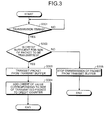
- FIG. 3 is a flowchart of processing for transmitting a packet according to the first embodiment.
- the packet transmission controlling section 131 determines whether the credit is sufficient for the size of a data packet to be transmitted (specifically, whether the sum value obtained by adding a credit value corresponding to the size of a data packet to be transmitted to the credit value in the credit counter section 133 has reached an upper limit for the capacity of the receive buffer 210) (Step S302).
- the packet transmission controlling section 131 Transmits the data packet from the transmit buffer 120 (Step S303). Specifically, the packet transmission controlling section 131 permits transmission of the data packet.
- the credit adding section 132 adds a credit corresponding to the size of the transmitted data packet to the credit stored in the credit counter section 133, and stores the resulting credit in the credit counter section 133 (Step S304).
- Step S302 if the credit counter section 133 does not have a sufficient credit for the size of the data packet to be transmitted (if the sum value has reached the upper limit) (NO at Step S302), the packet transmission controlling section 131 stops transmission of the data packet from the transmit buffer 120 (Step S305).
- FIG. 4 is a flowchart of processing for receiving a credit according to the first embodiment.
- the credit subtracting section 134 subtracts the received credit value from the credit value stored in the credit counter section 133, and stores the resulting credit in the credit counter section 133 (Step S402). For example, the transmitting apparatus 100 subtracts a credit "1" from the credit value in the credit counter section 133 when receiving a credit "1", subtracts a credit "2" from the credit value in the credit counter section 133 when receiving a credit "2", or subtracts a credit "3" from the credit value in the credit counter section 133 when receiving a credit "3".
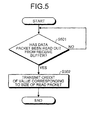
- FIG. 5 is a flowchart of processing for transmitting a credit according to the first embodiment.
- a credit corresponding to the size of the read data is transmitted to the credit counter section 133 (Step S502).
- the credit transmitting section 231 transmits a credit "1" corresponding to 1 byte to the transmitting apparatus 100.
- a credit "2" is transmitted to the transmitting apparatus 100.
- a credit "3" is transmitted to the transmitting apparatus 100.
- the receiving apparatus 200 transmits to the transmitting apparatus 100 the size specifying information to be used in the transmitting apparatus 100 to specify the size of the read data packet.
- the transmitting apparatus 100 stores therein, as a credit, a value corresponding to a total size of all data packets currently stored in the capacity of the receive buffer 210.
- the transmitting apparatus 100 adds a credit of a value corresponding to the size of the transmitted data packet to the credit stored in the credit counter section 133, and stores the resulting credit in the credit counter section 133.
- the transmitting apparatus 100 When receiving the size specifying information from the receiving apparatus 200, the transmitting apparatus 100 specifies, using the size specifying information, the size of the data packet read out from the receive buffer 210, subtracts a credit of a value corresponding to the specified size from the credit stored in the credit counter section 133, and stores the resulting credit in the credit counter section 133. Based on the credit value stored in the credit counter section 133, the transmitting apparatus 100 controls the transmission by permission or suspension of the transmission of the data packet.
- the transmitting apparatus 100 grasps how the receive buffer 210 is congested with data packets based on the data size, not on the number of data packets, so as to transmit data packets while dynamically adjusting the number of data packets (the number of queues) to be stored in the receive buffer 210 to make it fall in a range not causing overflow of the data packets. Accordingly, an unused area can be reduced in the receive buffer 210, so that the resources of the receive buffer 210 can be used efficiently.
- the credit transmitting section 231 transmits, as size specifying information, a credit of a value corresponding to the size of a data packet read out from the receive buffer 210 to the transmitting apparatus 100.
- the credit adding section 132 adds a credit of a value corresponding to the size of the data packet transmitted to the receiving apparatus 200 to the credit stored in the credit counter section 133, and stores the resulting credit in the credit counter section 133.
- the credit subtracting section 134 subtracts a credit of a value received from the receiving apparatus 200 from the credit stored in the credit counter section 133, and stores the resulting credit in the credit counter section 133. Accordingly, the transmitting apparatus 100 can grasp how the receive buffer 210 is congested with data packets, only by subtracting the credit received from the receiving apparatus 200. This enables to simplify the process for incrementing and decrementing the credit in the transmitting apparatus 100.
- the packet transmission controlling section 131 determines whether a sum value, obtained by adding a value of a credit corresponding to the size of a data packet to be transmitted from the transmitting apparatus 100 to the credit value stored in the credit counter section 133, has reached a predetermined value defined depending on the capacity of the receive buffer 210. If the sum value has not reached the predetermined value (the upper limit), the packet transmission controlling section 131 controls the transmission by permitting the transmission of the data packet. If the sum value has reached the upper limit, the packet transmission controlling section 131 controls the transmission by stopping the transmission of the data packet. Accordingly, estimation can be made as to how the receive buffer 210 is congested with data packets after the data packet to be transmitted is transmitted. This reliably prevents the overflow at the receive buffer 210.
- the first embodiment describes transmission of a credit corresponding to the size of data read out from the receive buffer.
- the present invention is not limited to this, and a credit of the same amount may be transmitted each time regardless of the size of the read data.
- a second embodiment describes that a credit of the same amount is transmitted each time regardless of the size of a data packet read out from the receive buffer.
- FIG. 6 is a drawing for explaining an overview and features of the data packet transmission and reception system according to the second embodiment. Elements similar to those of the data packet transmission and reception system according to the first embodiment are described briefly.
- the transmitting apparatus 100 includes a packet segmentation credit counter section 133b that stores therein, as a credit, a value corresponding to a total size of all data packets currently stored in the capacity of the receive buffer 210, such that credit elements are arranged in the order in which the data packets have been transmitted.
- the transmitting apparatus 100 When transmitting a data packet from the transmit buffer 120 to the receive buffer 210 of the receiving apparatus 200, the transmitting apparatus 100 adds a credit corresponding to the size of the transmitted data packet to the credit stored in the packet segmentation credit counter section 133b and stores the resulting credit in the credit counter section 133b, in the order in which the data packets have been transmitted (see (1) in Fig. 6 ).
- the transmitting apparatus 100 when transmitting a data packet of 2 bytes, the transmitting apparatus 100 adds (makes increment of) a credit "2" as a most recently transmitted data packet to the credit value in the packet segmentation credit counter section 133b, so as to make the credit value (total) in the packet segmentation credit counter section 133b from "7" to "9".
- the transmitting apparatus 100 When transmitting a data packet of 1 byte subsequently, the transmitting apparatus 100 adds (makes increment of) a credit "1" as a most recently transmitted data packet (e.g., after a packet 5) to the credit value in the packet segmentation credit counter section 133b, so as to make the credit value (total) in the packet segmentation credit counter section 133b from "9” to "10” (see Fig. 8 ).
- the receiving apparatus 200 receives, at the receive buffer 210, data packets transmitted from the transmitting apparatus 100 (see (2) in Fig. 6 ). The receiving apparatus 200 then reads out the received data packets in the order in which the data packets have been stored in the receive buffer 210, with the oldest data packet first. Further, the receiving apparatus 200 transmits a credit "1" to the transmitting apparatus 100 regardless of the size of the read data (see (3) in Fig. 6 ).
- the receiving apparatus 200 transmits a credit "1" to the transmitting apparatus 100 when reading out a data packet of 1 byte from the receive buffer 210, transmits a credit "1" to the transmitting apparatus 100 when reading a data packet of 2 bytes, or transmits a credit "1" to the transmitting apparatus 100 when reading a data packet of 3 bytes.
- the transmitting apparatus 100 When receiving a credit transmitted from the receiving apparatus 200, the transmitting apparatus 100 subtracts a credit value of the oldest data packet having been transmitted, from the credit elements that have been stored in the packet segmentation credit counter section 133b in the order in which data packets have been transmitted, and stores the resulting credit in the packet segmentation credit counter section 133b (see (4) in Fig. 6 ).
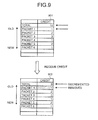
- the transmitting apparatus 100 subtracts (removes), from the credit value in the packet segmentation credit counter section 133b, the oldest credit value among the credit elements stored in the packet segmentation credit counter section 133b, i.e., a credit "1”, so as to make the credit value (total) in the packet segmentation credit counter section 133b from "10" to "9” (see Fig. 9 ).
- the transmitting apparatus 100 When receiving a credit "1" subsequently, the transmitting apparatus 100 subtracts, from the credit value in the packet segmentation credit counter section 133b, the oldest credit value among the credit elements stored in the packet segmentation credit counter section 133b, i.e., a credit "2", so as to make the credit value in the packet segmentation credit counter section 133b from "9" to "7".
- the transmitting apparatus 100 controls the transmission by permission or suspension of the transmission of a data packet based on the credit value stored in the packet segmentation credit counter section 133b (see (5) in Fig. 6 ), as in the transmitting apparatus 100 according to the first embodiment.
- the transmitting apparatus 100 can grasp how the receive buffer 210 is congested with data packets, only by transmitting a credit of the same amount from the receiving apparatus 200 to the transmitting apparatus 100 each time regardless of the size of a data packet read out from the receive buffer 210. This enables to simplify the process for giving a response from the receiving apparatus 200 to the transmitting apparatus 100.
- Fig. 7 is a schematic block diagram of the data packet transmission and reception system according to the second embodiment.
- the data packet transmission and reception system includes the transmitting apparatus 100 and the receiving apparatus 200.
- the transmitting apparatus 100 includes the data input unit 110, the transmit buffer 120, and the transmit buffer controlling unit 130.
- the receiving apparatus 200 includes the receive buffer 210, the data output unit 220, and the receive buffer controlling unit 230.
- the packet segmentation credit counter section 133b stores therein, as a credit, a value corresponding to a total size of all data packets currently stored in the capacity of the receive buffer 210. Specifically, the packet segmentation credit counter section 133b stores credit elements therein in the order in which the respective packets have been transmitted from the transmitting apparatus 100, as described later.
- the credit adding section 132b adds a credit of a value corresponding to the size of the data packet transmitted to the receiving apparatus 200 to the credit value stored in the packet segmentation credit counter section 133b and stores the resulting credit in the packet segmentation credit counter section 133b, in the order in which data packets have been transmitted.
- the transmitting apparatus 100 when transmitting a data packet of 1 byte, places a credit "1" to the end (e.g., after a packet 5) as a credit corresponding to the most recently transmitted data packet, so as to add (make increment of) the credit "1" to the credit value in the packet segmentation credit counter section 133b.
- Fig. 8 is a conceptual diagram of processing for adding a credit according to the second embodiment.
- the credit subtracting section 134b subtracts the oldest credit having been transmitted, from the credit elements that have been stored in the packet segmentation credit counter 133b in the order in which the respective data packets have been transmitted.
- Fig. 9 is a conceptual diagram of processing for subtracting a credit according to the second embodiment.
- the credit transmitting section 231b transmits the size specifying information to the transmitting apparatus 100 regardless of the size of a data packet read out from the receive buffer 210. Specifically, the credit transmitting section 231b transmits, as the size specifying information, a credit "1" to the transmitting apparatus 100 regardless of the size of a data packet read out from the receive buffer 210.
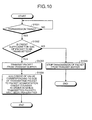
- FIG. 10 is a flowchart of processing for transmitting a packet according to the second embodiment. Elements similar to those of the data packet transmission and reception system according to the first embodiment are described briefly.
- the credit adding section 132b adds a credit corresponding to the size of the transmitted data packet to the credit stored in the packet segmentation credit counter section 133b and stores the resulting credit in the packet segmentation credit counter section 133b, in the order in which packets have been transmitted (Step S1004).
- the transmitting apparatus 100 when transmitting a data packet of 1 byte, the transmitting apparatus 100 adds (makes increment of) a credit "1" to the credit value in the packet segmentation credit counter section 133b, so as to make the credit value (total) in the packet segmentation credit counter section 133b from "9" to "10".
- Fig. 11 is a flowchart of processing for receiving a credit according to the second embodiment.
- the credit subtracting section 134b obtains a credit of the oldest data packet having been transmitted, from credit elements that have been stored in the packet segmentation credit counter section 133b in the order in which the respective packets have been transmitted (Step S1102).
- the obtained credit is subtracted from the credit value stored in the packet segmentation credit counter section 133b and stored therein (Step S1103). Specifically, as depicted in Fig. 9 , when receiving a credit "1", the transmitting apparatus 100 subtracts (removes) the oldest credit value among the credit elements stored in the packet segmentation credit counter section 133b, i.e., a credit "1", from the credit value in the packet segmentation credit counter section 133b. This makes the credit value (total) in the packet segmentation credit counter section 133b from "10" to "9".
- Fig. 12 is a flowchart of processing for transmitting a credit according to the second embodiment.
- a credit is transmitted to the packet segmentation credit counter section 133b regardless of the size of the read data (Step S1212).
- the credit transmitting section 231b transmits a credit "1" to the transmitting apparatus 100 regardless of the 1 byte read out from the receive buffer 210.
- a credit "1" is transmitted to the transmitting apparatus 100 regardless of the 2 bytes read.
- a credit "1" is transmitted to the transmitting apparatus 100 regardless of 3 bytes read.
- the credit transmitting section 231b transmits the size specifying information to the transmitting apparatus 100 regardless of the size of a data packet read out from the receive buffer 210.
- the credit adding section 132b adds a credit of a value corresponding to the size of the data packet transmitted to the receiving apparatus 200 to the credit stored in the packet segmentation credit counter section 133b and stores the resulting credit in the packet segmentation credit counter section 133b, in the order in which data packets have been transmitted.
- the credit subtracting section 134b subtracts a credit of the oldest data packet having been transmitted, from the credit elements that have been stored in the packet segmentation credit counter section 133b in the order in which the respective data packets have been transmitted, and stores the resulting credit in the packet segmentation credit counter section 133b.
- the transmitting apparatus 100 can grasp how the receive buffer 210 is congested with data packets, only by transmitting a credit of the same amount from the receiving apparatus 200 to the transmitting apparatus 100 regardless of the size of a data packet read out from the receive buffer 210. This enables to simplify the process for giving a response from the receiving apparatus 200 to the transmitting apparatus 100.
- the second embodiment describes subtraction of a credit in the order in which data packets have been transmitted.
- the present invention is not limited to this, and a credit may be subtracted by specifying a data packet.
- a third embodiment describes subtraction of a credit by specifying a data packet.
- FIG. 13 is a drawing for explaining an overview and features of the data packet transmission and reception system according to the third embodiment. Elements similar to those of the data packet transmission and reception systems according to the first and the second embodiments are described briefly.
- the transmitting apparatus 100 transmits, from the transmit buffer 120 to the receiving apparatus 200, a data packet with the addition of identification information for uniquely identifying the data packet to be transmitted. Thereupon, the transmitting apparatus 100 segments a credit of a value corresponding to the size of each transmitted data packet, and adds identification information, so as to add the credit and store the resulting credit in a packet segmentation credit counter section 133c (see (1) in Fig. 13 ). Specifically, as depicted in Fig. 13 , when transmitting a data packet of 1 byte with the addition of identification information "x007", the transmitting apparatus 100 associates the identification information "x007" with a credit "1" corresponding to the data size of 1 byte, so as to add the credit and store the resulting credit therein.
- the receiving apparatus 200 receives, at the receive buffer 210, the data packet transmitted from the transmitting apparatus 100 (see (2) in Fig. 13 ).
- the receiving apparatus 200 then reads out the received data packet from the receive buffer 210, and transmits the identification information added to the packet read out from the receive buffer 210 to the transmitting apparatus 100 (see (3) in Fig. 13 ).
- the receiving apparatus 20 transmits, the identification information "x002" added to the data of 1 byte to the transmitting apparatus 100.
- the transmitting apparatus 100 When receiving the identification information transmitted from the receiving apparatus 200, the transmitting apparatus 100 subtracts a credit of a data packet corresponding to the identification information received from the receiving apparatus 200, from credit elements that have been segmented for each data packet and stored with the addition of identification information into the packet segmentation credit counter section 133c, and stores the resulting credit in the packet segmentation credit counter section 133c (see (4) in Fig. 2 ). Specifically, as depicted in Fig. 13 , when receiving identification information "x002", the transmitting apparatus 100 subtracts a credit "1" corresponding to the identification information "x002" from the credit value in the packet segmentation credit counter section 133c, and stores the resulting credit therein.
- the transmitting apparatus 100 controls the transmission of data packets by permission and suspension of the transmission based on the credit value stored in the packet segmentation credit counter section 133c (see (5) in Fig. 13 ).
- the transmitting apparatus 100 can grasp how the receive buffer 210 is congested with data packets, only by transmitting the identification information of the packet from the receiving apparatus 200 to the transmitting apparatus 100 regardless of the size of a data packet read out from the receive buffer 210.
- This enables to simplify the process for giving a response from the receiving apparatus 200 to the transmitting apparatus 100.
- the size of the data packet read out from the receives buffer 210 can be reliably specified only by transmitting the identification information of the packet from the receiving apparatus 200 to the transmitting apparatus 100. This enables the Transmitting apparatus 100 to reliably grasp how the receive buffer 210 is congested with data packets.
- Fig. 14 is a schematic block diagram of the data packet transmission and reception system according to the third embodiment.
- the data packet transmission and reception system includes the transmitting apparatus 100 and the receiving apparatus 200.
- the transmitting apparatus 100 includes the data input unit 110, the transmit buffer 120, and the transmit buffer controlling unit 130.
- the receiving apparatus 200 includes the receive buffer 210, the data output unit 220, and the receive buffer controlling unit 230.
- the packet segmentation credit counter section 133c stores therein, as a credit, a value corresponding two a total size of all data packets currently stored in the capacity of the receive buffer 210. Specifically, the packet segmentation credit counter section 133c stores therein the stored credit as credit elements segmented for each packet with the addition of identification information, as described later (see Fig. 15 ).
- the identification information adding section 135c adds, to the data packet to be transmitted, identification information for uniquely identifying the data packet. Specifically, identification information such as "x006" or "x007" is added into the data packet to be transmitted.
- the credit adding section 132c segments a credit of a value, corresponding to the size of the data packet transmitted to the receiving apparatus 200, for each data packet, and associates the credit with the identification information added by the identification information adding section 135c to the data packet. In this way, the credit adding section 132c adds the credit to the credit stored in the packet segmentation credit counter section 133c and stores the resulting credit in the packet segmentation credit counter section 133c.
- the credit adding section 132c adds the identification information "x006" to a credit corresponding to 2 bytes, i.e., a credit "2", so as to add the credits to the credit value in the packet segmentation credit counter section 133c and store the resulting credit in the packet segmentation credit counter section 133c.
- Fig. 15 is a conceptual diagram of processing for adding a credit according to the third embodiment.
- the credit subtracting section 134c When receiving identification information from the receiving apparatus 200, the credit subtracting section 134c subtracts a credit of a data packet corresponding to the identification information received from the receiving apparatus 200 from credit elements that have been segmented for each data packet and stored with the addition of the identification information into the packet segmentation credit counter section 133c, and stores the resulting credit in the packet segmentation credit counter section 133c.
- Fig. 16 is a conceptual diagram of processing for subtracting a credit according to the third embodiment.
- the identification information transmitting section 231c transmits identification information added to the data packet to the transmitting apparatus 100.
- FIG. 17 is a flowchart of processing for transmitting a packet according to the third embodiment. Elements similar to those of the data packet transmission and reception systems according to the first and the second embodiments are described briefly.
- the transmission information adding section 135c adds identification information for uniquely discriminating the data packet to be transmitted, and the packet transmission controlling section 131 transmits the data packet with the addition of the identification information from the transmit buffer 120 (Step S703).
- the credit adding section 132c segments a credit, corresponding to the size of the transmitted data packet, for each transmitted data packet and associates the credit with identification information, so as to add the credit to the credit stored in the packet segmentation credit counter section 133c and store the resulting credit in the packet segmentation credit counter section 133c (Step S704).
- the credit adding section 132c segments a credit of a value, corresponding to the size of the data packet transmitted to the receiving apparatus 200, for each data packet and adds identification information, so as to add the credit to the credit stored in the packet segmentation credit counter section 133c and store the resulting credit in the packet segmentation credit counter section 133c.
- Fig. 18 is a flowchart of processing for receiving a credit according to the third embodiment.
- the credit subtracting section 134c obtains a credit that has been segmented for each packet and stored in the packet segmentation credit counter section 133c, and that corresponds to the received identification information (Step S1802). Specifically, the credit subtracting section 134c obtains a credit that corresponds to the identification information received from the receiving apparatus 200, from credit elements that have been segmented for each data packet and stored with the addition of the identification information into the packet segmentation credit counter section 133c.
- the transmitting apparatus 100 when receiving identification information "x002", the transmitting apparatus 100 obtains a credit “1" corresponding to the identification information "x002". When receiving identification information "x001”, the transmitting apparatus 100 obtains a credit 2 corresponding to the identification information "x001” . When receiving identification information "x003”, the transmitting apparatus 100 obtains a credit "3" corresponding to the identification information "x003” (see Fig. 16 ).
- the credit obtained as such is subtracted from the credit value stored in the packet segmentation credit counter section 133c and stored therein (Step S1803). Specifically, as depicted in Fig. 16 , when receiving identification information "x002", the transmitting apparatus 100 subtracts a credit "1" corresponding to the identification information "x002" from the credit value in the packet segmentation credit counter section 133c, and stores the resulting credit therein.
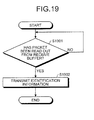
- Fig. 19 is a flowchart of processing for transmitting a credit according to the third embodiment.
- Step S1902 when the data output unit 220 reads out data stored in the receive buffer 210 of the receiving apparatus 200 (YES at Step S1901), the identification information added to the read data packet is transmitted to the packet segmentation credit counter section 133c (Step S1902).
- the packet transmission controlling section 131 when permitting transmission of a data packet, adds identification information for uniquely identifying the data packet to the data packet to be transmitted, so as to transmit the data packet to the receiving apparatus 200.
- the identification information transmitting section 231c transmits the identification information added to the data packet to the transmitting apparatus 100, regardless of the size of the data packet read out from the receive buffer zit.
- the credit adding section 132c segments a credit of a value, corresponding to the size of the data packet transmitted to the receiving apparatus 200, for each data packet and adds identification information, so as to add the credit to the credit stored in the packet segmentation credit counter section 133c and store the resulting credit in the packet segmentation credit counter section 133c.
- the credit subtracting section 134c subtracts a credit of a data packet corresponding to the identification information received from the receiving apparatus 200 from credit elements that have been segmented for each data packet and stored with the addition of the identification information into the packet segmentation credit counter section 133c, and stores the resulting credit in the packet segmentation credit counter section 133c.
- the transmitting apparatus 100 can grasp how the receive buffer 210 is congested with data packets, only by transmitting identification information of the packet from the receiving apparatus 200 to the transmitting apparatus 100 regardless of the size of a data packet read out from the receive buffer 210. This enables to simplify the process for giving a response from the receiving apparatus 200 to the transmitting apparatus 100.
- the size of the data packet read out from the receive buffer 210 can be reliably specified only by transmitting the identification information of the packet from the receiving apparatus 200 to the transmitting apparatus 100. This enables to reliably grasp how the receive buffer 210 is congested with data packets.
- the above embodiments describe data packet transmission controlled by determining whether the sum value of credit values, obtained by adding a credit value corresponding to the size of a data packet to be transmitted from the transmitting apparatus, has reached a predetermined value (an upper limit) determined depending on the capacity of the receive buffer.
- the present invention is not limited to this, and may also be applied similarly to data packet transmission controlled by determining whether a predetermined value (an upper limit) determined depending on the capacity of the receive buffer is reached.
- a packet transmission controlling section determines whether a credit value stored in a credit counter section has reached a predetermined value (an upper limit) determined depending on the capacity of a receive buffer. When the credit value has not reached the upper limit, the packet transmission controlling section permits transmission of a data packet. If the credit value has reached the upper limit, the packet transmission controlling section controls the transmission by stopping the transmission of the data packet.
- a predetermined value an upper limit
- data packet transmission can be controlled by, for example, setting a value resulting from subtracting the maximum length sizes of data packets from the capacity of the receive buffer as an upper limit of the credit counter, and then by determining whether the credit exceeds this upper limit. This enables to simplify the process for permitting or stopping transmission of the packet.
- a data packet transmission and reception system including a transmitting apparatus and a receiving apparatus provided separately.
- the present invention is not limited to this, and may also be applied similarly to data packet transmission between circuits inside a computer system.
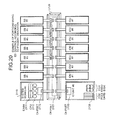
- Fig. 20 is an exemplary view of a computer system to which the present invention is applied.
- a chipset 2113, a chipset 2121, and a chipset 2133 employ control according to the present invention.
- the present invention may be applied to data packet transmission and reception between a system board 2110 and a memory system interconnect 2120, and to data packet transmission and reception between the memory system interconnect 2120 and an input-output (IO) unit 2130.
- IO input-output
- the above embodiments describe a system that newly adds identification information of packet data.
- the present invention is not limited to this, and may also be applied similarly to a method using given information that is contained in advance in a data packet to be transmitted, and to a method using both such given information and identification information of a data packet.
- the above embodiments describe a data packet transmission and reception system including one transmitting apparatus and one receiving apparatus.
- the present invention is not limited to this, and may also be applied similarly to a system including one transmitting apparatus and a plurality of receiving apparatuses, and to a system including a plurality of transmitting apparatuses and one receiving apparatus.
- the above embodiments describe a transmitting apparatus and a receiving apparatus serving as different terminals.
- the present invention is not limited to this, and may also be applied similarly to a terminal realized as both a transmitting apparatus and a receiving apparatus (one terminal having both the functions of a transmitting apparatus and the functions of a receiving apparatus).
- the transmit buffer controlling section and the receive buffer controlling section may be removed from the transmitting apparatus and the receiving apparatus, and alternatively a device may be provided that controls transmission and reception of a data packet.
- a device may be provided that controls transmission and reception of a data packet.
- all of or any portion of the devices can be distributed and integrated concerning functional and physical aspects based on given units with various loads and use conditions taken into account.
- the credit adding section and the credit subtracting section may be integrated.
- processing functions performer by the devices, all of or any portion of the functions may be implemented by central processing units (CPUs) and computer programs readable and executable by the CPUs, or implemented in hardware using wired logic.
- CPUs central processing units
- the processing procedures, controlling procedure, specific names, and information including various kinds of data and parameters (e.g., information illustrated in Figs. 8 and 9 ) illustrated in the description and the drawings may be changed in any way unless otherwise specified.
- the first embodiment describes various processes implemented in hardware logic.
- the present invention is not limited to this, and may be realized by executing a prepared computer program on a computer.
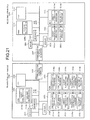
- Fig. 21 the following describes an example of a computer that executes a data packet transmission and reception program including the same functions as the data packet transmission and reception system shown in the first embodiment.
- Fig. 21 is a drawing of a computer program in the data packet transmission and reception system according to the first embodiment.
- a transmitting apparatus 2100 includes a mouse 2101, a keyboard 2102, a CPU 2103, a read only memory (ROM) 2104, a hard disk drive (HDD) 2105, a random access memory (RAM) 2106, and a communication control interface 2107, which are connected via a bus 2109 and the like.
- a receiving apparatus 2200 includes a mouse 2201, a keyboard 2202, a CPU 2203, a ROM 2204, a RAM 2206, a HDD 2205, and a communication control interface 2207, which are connected via a bus 2209 and the like.
- the transmitting apparatus 2100 and the receiving apparatus 2200 are connected at the communication control interface 2107 and the communication control interface 2207, via a network or wired communication, or wirelessly (infrared communication, Bluetooth, or the like).
- the ROM 2104 stores therein in advance transmit buffer control programs realizing the same functions as the transmit buffer controlling unit 130 and the data input unit 110, i.e., a credit counter program 2104a, a credit adding program 2104b, a credit subtracting program 2104c, a packet transmission control program 2104d, and a data input program 2104e, as depicted in Fig. 21 .
- These programs 2104a to 2104e may be integrated or separated appropriately, as in the constituting elements of the transmitting apparatus 100 depicted in Fig. 2 .
- these programs 2104a to 2104e function as a credit counter process 2103a, a credit adding process 2103b, a credit subtracting process 2103c, a packet transmission controlling process 2103d, and a data input process 2103e as depicted in Fig. 21 .
- These processes 2103a to 2103e respectively correspond to the credit counter section 133, the credit adding section 132, the credit subtracting section 134, the packet transmission controlling section 131, and the data input unit 110 depicted in Fig. 2 .
- the CPU 2103 executes the transmit buffer control programs based on packet counter data 2106a and transmit buffer data 2106b, stored in the RAM 2106.
- the ROM 2204 stores therein in advance receive buffer control programs realizing the same functions as the receive buffer controlling unit 230 and the data output unit 220 shown in the first embodiment, i.e., a credit transmission program 2204a and a data output program 2204b, as depicted in Fig. 21 .
- the programs 2204a and 2204b may be integrated or separated mately as in the constituting elements of the receiving apparatus 200 depicted in Fig. 2 .
- the CPU 2203 reads out the programs 2204a and 2204b from the ROM 2204 and executes them, accordingly the programs 2204a and 2204b function as a credit transmission process 2203a and a data output process 2203b as depicted in Fig. 21 .
- the processes 2203a to 2203b respectively correspond to the credit transmitting section 231 and the data output unit 220 depicted in Fig. 2 .
- the CPU 2203 executes the receive buffer control programs based on receive buffer data 2206a stored in the RAM 2206.
- the programs 2104a to 2104e and 2204a to 2204b described in the present embodiment need not always be stored in the ROMs initially.
- the programs may be stored in advance in: a "carrying physical medium" to be inserted to the transmitting apparatus 2100 or the receiving apparatus 2200, such as a flexible disk, a compact disk read only memory (CD-ROM), a magneto-optical (MO) disk, a digital versatile disk (DVD), a magnet-optical disk, or an integrated circuit (IC) card; a "fixed physical medium” such as a HDD provided inside or outside the transmitting apparatus 2100 or the receiving apparatus 2200; "other computers (or servers)" connected to the transmitting apparatus 2100 or the receiving apparatus 2200 via a public line, the Internet, a local area network (LAN), a wide area network (WAN), or the like.
- the programs may be read out and executed by the transmitting apparatus 2100 or the receiving apparatus 2200.
- a data packet transmission and reception system is useful for a data packet transmission and reception system that transmits a data packet from a transmitting apparatus including a transmit buffer to a receiving apparatus including a receive buffer.
- the present invention is particularly suitable for realizing a data packet transmission and reception system that transmits a data packet and that is capable of efficiently using resources of the receive buffer.
Landscapes
- Engineering & Computer Science (AREA)
- Theoretical Computer Science (AREA)
- Physics & Mathematics (AREA)
- General Engineering & Computer Science (AREA)
- General Physics & Mathematics (AREA)
- Software Systems (AREA)
- Data Exchanges In Wide-Area Networks (AREA)
- Communication Control (AREA)
- Information Transfer Systems (AREA)
Abstract
Description
- The present invention relates to a data packet transmission and reception system, a data packet transmission and reception method, and a data packet transmission and reception program.
- Conventionally, in systems transmitting a data packet from a transmit buffer at a transmitting end to a receive buffer at a receiving end, the receiving end informs the transmitting end of the read state of data packets at the receive buffer, so as not to discard data packets due to overflow at the receive buffer. In this way, the transmitting end controls transmission of data packets in general.
- For example, Patent Document 1 (Japanese Laid-open Patent Publication No.
09-135270 Fig. 22 , the following describes this conventional technique in detail.Fig. 22 is a drawing for explaining an overview and features of a data packet transmission control system according to the conventional technique. As depicted inFig. 22 , an example is explained in which the size of the receive buffer at a receiving end is 16 bytes, the maximum length size of a data packet to be transmitted from the transmitting end is 4 bytes, and the fixed number of queues (number of packets) that can be stored in the receive buffer is determined as four in advance. - As depicted in
Fig. 22 , the transmitting end includes a credit control counter. Every time a data packet is read out from the transmit buffer and transmitted to the receiving end, the value in the credit control counter is incremented by one regardless of the size (data size) of a data packet to be transmitted (see (1) inFig. 22 ). On the other hand, when receiving the data packet from the transmitting end, the receiving end writes the received data packet to the leading portion of the receive buffer (see (2) inFig. 22 ). Every time reading out a data packet from the receive buffer, the receiving end transmits one credit back to the transmitting end, regardless of the size of the read data packet (see (3) inFig. 22 ). Every time receiving such credit from the receiving end, the transmitting end subtracts the value of the credit from the value in the credit control counter (see (4) inFig. 22 ). - In this way, the transmitting end increments and decrements the value in the credit control counter. As described, in this credit control counter, four is set and fixed in advance as the number of queues (the number of packets) that can be stored in the receive buffer. Therefore, at timing for reading out a data packet from the transmit buffer and transmitting the data packet to the receiving end, the transmitting end determines whether the current value in the credit control counter has reached the fixed value (four). If the current value in the credit control counter has not reached the fixed value (four), the transmitting end reads out a data packet from the transmit buffer, and transmits the data packet to the receiving end. On the other hand, if the current value in the credit control counter has reached the fixed value (four), the transmitting end determines that the receive buffer may be filled with data packets, so as to stop transmitting the data packet (see (5) in
Fig. 22 ). Through such a series of processes, discarding data packets due to the overflow at the receive buffer is prevented inPatent Document 1. - Other than the above conventional technique, a known technology uses a buffer as a ring buffer, by controlling credits so as to issue an additional credit depending on a free space in a receive buffer (see, for example, Patent Document 2). Further, a known technology enables easy management of transmitted data by using a management table for the use state of a transmit buffer in buffer control (see, for example, Patent Document 3).
-
-
Patent Document 1 Japanese Laid-open Patent Publication No.09-135270 pages 2 to 4,Figs. 1 to 3 ) -
Patent Document 2 Japanese Laid-open Patent Publication No.2001-94613 pages 3 to 5,Fig. 1 ) -
Patent Document 3 Japanese Laid-open Patent Publication No.11-110315 pages 6 to 10,Figs. 1 to 2 ) - The above conventional techniques, however, tend to create an unused area in the receive buffer as described below, posing a problem of not efficiently using resources of the receive buffer.
- Specifically, in the above conventional techniques, the fixed number of queues that can be stored in the receive buffer is determined in advance based on the maximum length size of a data packet (four in the above example). Thus, even when the receive buffer stores therein data packets of small sizes not reaching the maximum length size of a data packet, for example, even when the receive buffer stores therein four packets of sizes: "4 bytes, 2 bytes, 2 bytes, and 2 bytes" as illustrated in
Fig. 22 , the value in the credit control counter at the transmitting end reaches the fixed value (four). As a result, the transmission of a data packet is stopped. In this case, a large unused area is created in the receive buffer (an unused area of 6 bytes is created in the above example), causing a problem of not efficiently using resources of the receive buffer. - The above problems are not limited to data packet transmission between communication apparatuses via a network, and also occur similarly in any systems that transmit a data packet from a transmit buffer at a transmitting end to a receive buffer at a receiving end, for example, in data packet transmission between circuits inside a computer system.
- The present invention is made in view of the problems in the above conventional techniques, and has an object to provide a data packet transmission and reception system, a data packet transmission and reception method, and a data packet transmission and reception program that enable efficient use of resources of a receive buffer.
- To solve the problems as described above and to achieve an object, the invention according to
claim 1 is a data packet transmission and reception system, transmitting a data packet from a transmitting apparatus including a transmit buffer to a receiving apparatus including a receive buffer; and the receiving apparatus transmits, when a data packet stored in the receive buffer is read, size specifying information to be used in the transmitting apparatus to specify a size of a read data packet to the transmitting apparatus; and the transmitting apparatus stores, as a credit, a value corresponding to a total size of all data packets currently stored in a capacity of the receive buffer; adds, when the data packet is transmitted from the transmit buffer to the receiving apparatus, a credit of a value corresponding to a size of a transmitted data packet to the credit stored in the credit storage unit, and stores a resulting credit in the credit storage unit; specifies, when the size specifying information is received from the receiving apparatus, a size of a data packet read out from the receive buffer, using the size specifying information, and subtracts a credit of a value corresponding to the size thus specified, from a credit stored in the credit storage unit, and stores a resulting credit in the credit storage unit; and controls transmission of the data packet by permission and suspension of the transmission of the data packet based on a value of a credit stored in the credit storage unit. - Further, in an invention according to
claim 2 in an aspect of the invention as described above, a size specifying information transmitting unit transmits, as the size specifying information, a credit of a value corresponding to a size of a data packet read out from the receive buffer to the transmitting apparatus; a credit adding unit adds a credit of a value corresponding to a size of a data packet transmitted to the receiving apparatus to a credit stored in the credit storage unit, and stores a resulting credit in the credit storage unit; and a credit subtracting unit subtracts a credit of a value received from the receiving apparatus, from a credit stored in the credit storage unit, and stores a resulting credit in the credit storage unit. - Further, in an invention according to
claim 3 in an aspect of the invention as described above, the size specifying information transmitting unit transmits the size specifying information to the transmitting apparatus regardless of a size of a data packet read out from the receive buffer; the credit adding unit adds a credit of a value corresponding to a size of a data packet transmitted to the receiving apparatus to a credit stored in the credit storage unit and stores a resulting credit in the credit storage unit, in an order in which such data packets have been transmitted; and the credit subtracting unit subtracts a credit of an oldest data packet having been transmitted from among credit elements that have been stored in the credit storage unit in the order in which such data packets have been transmitted, and stores a resulting credit in the credit storage unit. - Further, in an invention according to
claim 4 in an aspect of the invention as described above, the transmission controlling unit adds, when permitting transmission of the data packet, identification information for uniquely identifying the data packet to be transmitted to the data packet, and transmits the data packet to the receiving apparatus; the size specifying information transmitting unit transmits the identification information added to the data packet to the transmitting apparatus, regardless of a size of a data packet read out from the receive buffer; the credit adding unit segments a credit of a value, corresponding to a size of a data packet transmitted to the receiving apparatus, for each such data packet and adds the identification information, so as to add the credit to a credit stored in the credit storage unit and store a resulting credit in the credit storage unit; the credit subtracting unit subtracts a credit of a data packet corresponding to identification information received from the receiving apparatus, from credit elements segmented for each such data packet and stored with addition of the identification information into the credit storage unit, and stores a resulting credit in the credit storage unit. - Further, in an invention according to
claim 5 in an aspect of the invention as described above, the transmission controlling unit determines whether a sum value, obtained by adding a value of a credit corresponding to a size of a data packet to be transmitted from the transmitting apparatus to a value of a credit stored in the credit storage unit, has reached a predetermined value determined depending on a capacity of the receive buffer, so as to control transmission of the data packet by permission of the transmission of the data packet when the sum value has not reached the predetermined value and to control transmission of the data packet by suspension of the transmission of the data packet when the sum value has reached the predetermined value. - Further, in an invention according to
claim 6 in an aspect of the invention as described above, the transmission controlling unit determines whether a value of a credit stored in the credit storage unit has reached a predetermined value determined depending on a capacity of the receive buffer, so as to control transmission of the data packet by permission of the transmission of the data packet when the value of the credit has not reached the predetermined value and to control transmission of the data packet by suspension of the transmission of the data packet when the value of the credit has reached the predetermined value. - Further, an invention according two
claim 7 is a data packet transmission and reception method, for transmitting a data packet from a transmitting apparatus including a transmit buffer to a receiving apparatus including a receive buffer; the receiving apparatus includes transmitting, when a data packet stored in the receive buffer is read, size specifying information to be used in the transmitting apparatus to specify a size of a read data packet to the transmitting apparatus; and the transmitting apparatus includes storing in a credit counter, as a credit, a value corresponding to a total size of all data packets currently stored in a capacity of the receive buffer; adding, when the data packet is transmitted from the transmit buffer to the receiving apparatus, a credit of a value corresponding to a size of a transmitted data packet to the credit stored in the credit counter, and storing a resulting credit in the credit counter; specifying, when the size specifying information is received from the receiving apparatus, a size of a data packet read out from the receive buffer, using the size specifying information, subtracting a credit of a value corresponding to the size thus specified, from a credit stored in the credit counter, and storing a resulting credit in the credit counter; and controlling transmission of the data packet by permission and suspension of the transmission of the data packet based on a value of a credit stored in the credit counter. - Further, an invention according to
claim 8 is a data packet transmission and reception program that causes a computer to execute a method of transmitting a data packet from a transmitting apparatus including a transmit buffer to a receiving apparatus including a receive buffer; the program causes a computer as the receiving apparatus to execute transmitting, when a data packet stored in the receive buffer is read, size specifying information to be used in the transmitting apparatus to specify a size of a read data packet to the transmitting apparatus; and, the program further causes a computer as the transmitting apparatus to execute storing in a credit counter, as a credit, a value corresponding to a total size of all data packets currently stored in a capacity of the receive buffer; adding, when the data packet is transmitted from the transmit buffer to the receiving apparatus, a credit of a value corresponding to a size of a transmitted data packet to the credit stored in the credit counter, and stores a resulting credit in the credit counter; specifying, when the size specifying information is received from the receiving apparatus, a size of a data packet read out from the receive buffer, using the size specifying information, subtracting a credit of a value corresponding to the size thus specified, from a credit stored in the credit counter, and storing a resulting credit in the credit counter; and controlling transmission of the data packet by permission and suspension of the transmission of the data packet based on a value of a credit stored in the credit counter. - Further, an invention according to
claim 9 is a receiving apparatus, receiving a data packet transmitted from a transmitting apparatus, and the receiving apparatus includes a receive buffer that stores therein the data packet, an output unit that reads out a data packet stored in the receive buffer, and a size specifying information transmitting unit that transmits, when the data packet stored in the receives buffer is read, size specifying information used to specify a size of a read data packet, to the transmitting apparatus. - Further, in an invention according to
claim 10 in an aspect of the invention as described above, the size specifying information transmitting unit transmits, as the size specifying information, a credit of a value corresponding to a size of a data packet read out from the receive buffer to the transmitting apparatus. - Further, an invention according to claim 11 is a transmitting apparatus transmitting a data packet to a receiving apparatus including a receive buffer, and the transmitting apparatus: stores therein, as a credit, a value corresponding to a total size of all data packets stored in the receive buffer; adds, when the data packet is transmitted to the receiving apparatus, a credit of a value corresponding to a size of a transmitted data packet to a credit stored in the credit storage unit; subtracts, based on size specifying information received from the receiving apparatus and specifying a size of a data packet read out from the receive buffer, a credit of a value corresponding to a size of a data packet read out from the receive buffer from a credit stored in the credit storage unit; and controls transmission of the data packet by permission and suspension of the transmission of the data packet based on a value of a credit stored in the credit storage unit.
- According to an invention recited in
claim - According to the invention recited in
claim 2, the receiving apparatus transmits, as the size specifying information, a credit of a value corresponding to a size of a data packet read out from the receive buffer to the transmitting apparatus, and the transmitting apparatus adds a credit of a value corresponding to a size of a data packet transmitted to the receiving apparatus to the current credit, and stores a resulting credit in the credit storage unit. The transmitting apparatus subtracts the credit of the value received from the receiving apparatus from the current credit, and stores the credit. Accordingly, the transmitting apparatus can grasp how the receive buffer is congested with data packets, only by subtracting the credit received from the receiving apparatus. This enables to simplify the process for incrementing and decrementing the credit in the transmitting apparatus. - According to the invention recited in
claim 3, the receiving apparatus transmits the size specifying information to the transmitting apparatus regardless of a size of a data packet read out from the receive buffer. The transmitting apparatus adds a credit of a value corresponding to a size of a data packet transmitted to the receiving apparatus to the current credit and stores a resulting credit in the credit storage unit, in the order in which data packets have been transmitted. The transmitting apparatus subtracts a credit of an oldest data packet having been transmitted from among credit elements that have been stored in the credit storage unit in the order in which data packets have been transmitted, and stores a resulting credit in the credit storage unit. In the receiving apparatus, how the receive buffer is congested with data packets is grasped only by transmitting a credit of the same amount from the receiving apparatus to the transmitting apparatus each time regardless of the size of the data packet read out from the receive buffer. Thus, the process for giving a response from the receiving apparatus to the transmitting apparatus can be simplified. - According to the invention recited in
claim 4, the transmitting apparatus adds, when permitting transmission of the data packet, identification information for uniquely identifying the data packet to be transmitted to the data packet, and transmits the data packet to the receiving apparatus, and the receiving apparatus transmits the identification information added to the data packet to the transmitting apparatus regardless of a size of a data packet read out from the receive buffer. The transmitting apparatus segments a credit of a value, corresponding to a size of a data packet transmitted to the receiving apparatus, for each data packet and adds the identification information, so as to add the credit to the current credit and store a resulting credit in the credit storage unit. The transmitting apparatus subtracts a credit of a data packet corresponding to identification information received from the receiving apparatus, from credit elements segmented for each data packet and stored with the addition of the identification information into the credit storage unit, and stores a resulting credit in the credit storage unit. In the receiving apparatus, how the receive buffer is congested with data packets is grasped only by transmitting the identification information of the packet from the receiving apparatus to the transmitting apparatus regardless of the size of the data packet read out from the receive buffer. Thus, the process for giving a response from the receiving apparatus to the transmitting apparatus can be simplified. Further, the size of the data packet read out from the receive buffer can be reliably specified only by transmitting the identification information of the packet from the receiving apparatus to the transmitting apparatus. This enables to reliably grasp how the receive buffer is congested with data packets. - According to the invention recited in
claim 5, the transmitting apparatus determines whether a sum value, obtained by adding a value of a credit corresponding to a size of a data packet to be transmitted from the transmitting apparatus to a value of the current credit, has reached a predetermined value determined depending on a capacity of the receive buffer, so as to control to permit transmission of the data packet when the sum value has not reached the predetermined value or to stop transmission of the data packet when the sum value has reached the predetermined value. Accordingly, estimation can be made as to how the receive buffer is congested with data packets after the data packet to be transmitted is transmitted. This reliably prevents the overflow at the receive buffer. - According to the invention recited in
claim 6, the transmitting apparatus determines whether a value of the current credit has reached a predetermined value determined depending on a capacity of the receive buffer, so as to control to permit transmission of the data packet when the value of the credit has not reached the predetermined value or to stop transmission of the data packet when the value of the credit has reached the predetermined value. For example, data packet transmission can be controlled by setting, as an upper limit for a credit counter, a value obtained by subtracting a maximum length size of the data packet from the capacity of the receive buffer, and then by determining whether the credit exceeds this upper limit. This enables to simplify the process for permitting or stopping transmission of the packet. - According to an invention recited in
claim 9, a receiving apparatus includes a receive buffer storing therein a data packet, reads out a data packet stored in the receive buffer, and transmits, when the data packet stored in the receive buffer is read, size specifying information used to specify a size of a read data packet to the transmitting apparatus. Because the transmitting apparatus controls to permit or stop transmission of the data packet based on the current credit, the transmitting apparatus grasps how the receive buffer is congested with data packets based on the data size, not on the number of data packets, so as to transmit data packets while dynamically adjusting the number of data packets (the number of queues) to be stored in the receive buffer to make it fall in a range not causing overflow of the data packets. Accordingly, an unused area can be reduced in the receive buffer, so that resources of the receive buffer can be used efficiently. - According to the invention recited in
claim 10, the receiving apparatus transmits, as the size specifying information, a credit of a value corresponding to a size of a data packet read out from the receive buffer to the transmitting apparatus. Thus, the transmitting apparatus adds the credit of the value corresponding to the size of the data packet transmitted to the receiving apparatus to the current credit and stores a resulting credit in the credit storage unit, and the transmitting apparatus subtracts the credit of the value received from the receiving apparatus from the current credit and stores a resulting credit in the credit storage unit. Accordingly, the transmitting apparatus can grasp how the receive buffer is congested with data packets, only by subtracting the credit received from the receiving apparatus. This enables to simplify the process for incrementing and decrementing the credit in the transmitting apparatus. - According to an invention recited in claim 11, a transmitting apparatus stores therein, as a credit, a value corresponding to a total size of all data packets stored in a receive buffer. When a data packet is transmitted to a receiving apparatus, the transmitting apparatus adds a credit of a value corresponding to a size of a transmitted data packet to the current credit. The transmitting apparatus subtracts, based on size specifying information received from the receiving apparatus and specifying a size of a data packet read out from the receive buffer, a credit of a value corresponding to the size of the data packet read out from the receive buffer from the current credit. The transmitting apparatus controls to permit or stop transmission of the data packet based on a value of a credit stored in the credit storage unit. When the data packet stored in the receive buffer is read, the receiving apparatus transmits the size specifying information to the transmission apparatus. This enables the transmitting apparatus to grasp how the receive buffer is congested with data packets based on the data size, not on the number of data packets, so as to transmit data packets while dynamically adjusting the number of data packets (the number of queues) to be stored in the receive buffer to make it fall in a range not causing overflow with the data packets. Accordingly, an unused area can be reduced in the receive buffer, so that resources of the receive buffer can be used efficiently.
-
- [
Fig. 1] Fig. 1 is a drawing for explaining an overview and features of a data packet transmission and reception system according to a first embodiment. - [
Fig. 2] Fig. 2 is a schematic block diagram of a configuration of the data packet transmission and reception system according to the first embodiment. - [
Fig. 3] Fig. 3 is a flowchart of processing for transmitting a packet according to the first embodiment. [Fig. 4] Fig. 4 is a flowchart of processing for receiving a credit according to the first embodiment. - [
Fig. 5] Fig. 5 is a flowchart of processing for transmitting a credit according to the first embodiment. - [
Fig. 6] Fig. 6 is a drawing for explaining an overview and features of a data packet transmission and reception system according to a second embodiment. - [
Fig. 7] Fig. 7 is a schematic block diagram of the packet transmission and reception system according to the second embodiment. - [
Fig. 8] Fig. 8 is a conceptual diagram of processing for adding a credit according to the second embodiment. - [
Fig. 9] Fig. 9 is a conceptual diagram of processing for subtracting a credit according to the second embodiment. - [
Fig. 10] Fig. 10 is a flowchart of processing for transmitting a packet according to the second embodiment. - [
Fig. 11] Fig. 11 is a flowchart of processing for receiving a credit according to the second embodiment. - [
Fig. 12] Fig. 12 is a flowchart of processing for transmitting a credit according to the second embodiment. - [
Fig. 13] Fig. 13 is a drawing for explaining an overview and features of a data packet transmission and reception system according to a third embodiment. - [
Fig. 14] Fig. 14 is a schematic block diagram of the packet transmission and reception system according to the third embodiment. - [
Fig. 15] Fig. 15 is a conceptual diagram of processing for adding a credit according to the third embodiment. - [
Fig. 16] Fig. 16 is a conceptual diagram of processing for subtracting a credit according to the third embodiment. - [
Fig. 17] Fig. 17 is a flowchart of processing for transmitting a packet according to the third embodiment. - [
Fig. 18] Fig. 18 is a flowchart of processing for receiving a credit according to the third embodiment. - [
Fig. 19] Fig. 19 is a flowchart of processing for transmitting identification information according to the third embodiment. - [
Fig. 20] Fig. 20 is an exemplary view of a computer system to which the present invention is applied. - [
Fig. 21] Fig. 21 is a drawing of a computer program in the data packet transmission and reception system according to the first embodiment. - [
Fig. 22] Fig. 22 is a drawing for explaining an overview and features of a data packet transmission control system according to a conventional technique. -
- 100
- transmitting apparatus
- 110
- data input unit
- 120
- transmit buffer
- 130
- transmit buffer controlling unit
- 131
- packet transmission controlling section
- 132
- credit adding section
- 133
- credit counter section
- 134
- credit subtracting section
- 200
- receiving apparatus
- 210
- receive buffer
- 220
- data output unit
- 230
- receive buffer controlling unit
- 231
- credit transmitting section
- Embodiments of a data packet transmission and reception system, a data packet transmission and reception method, and a data packet transmission and reception program according to the present invention are described in detail with reference to the accompanying drawings. In a first embodiment below, an overview and features of a data packet transmission and reception system according to the first embodiment, a configuration of the data packet transmission and reception system, its process flow, and advantages are described in this order.
- Referring first to
Fig. 1 , an overview and features of a data packet transmission and reception system according to the first embodiment are described.Fig. 1 is a drawing for explaining an overview and features of the data packet transmission and reception system according to the first embodiment. - As depicted in
Fig. 1 , the data packet transmission and reception system according to the first embodiment is a data packet transmission and reception system that transmits a data packet from a transmittingapparatus 100 including a transmitbuffer 120 to a receivingapparatus 200 including a receivebuffer 210. The data packet transmission and reception system configured as such has a main feature of being capable of efficiently using resources of the receivebuffer 210, as described below. - As illustrated in
Fig. 1 , the transmittingapparatus 100 includes acredit counter section 133 that stores therein, as a credit, a value corresponding to a total size of all data packets currently stored in the capacity of the receivebuffer 210. The transmittingapparatus 100 sets a credit value (e.g., "16") corresponding to the capacity of the receivebuffer 210 of the receivingapparatus 200, as an upper limit of a credit value in thecredit counter section 133. Thus, the transmittingapparatus 100 can know a free space in the receivebuffer 210, based on a credit value left in thecredit counter section 133. - When transmitting a data packet from the transmit
buffer 120 to the receivebuffer 210 of the receivingapparatus 200, the transmittingapparatus 100 adds a credit corresponding to the size of the transmitted data packet to the credit stored in thecredit counter section 133, and stores the resulting credit in the credit counter section 133 (see (1) inFig. 1 ). As depicted inFig. 1 for example, the transmittingapparatus 100 adds a credit "2" to the credit value in thecredit counter section 133 when transmitting a data packet of 2 bytes, or adds a credit "1" to the credit value in thecredit counter section 133 when transmitting a data packet of 1 byte. - On the other hand, the receiving
apparatus 200 receives, at the receivebuffer 210, the data packets transmitted from the transmitting apparatus 100 (see (2) inFig. 1 ). The receivingapparatus 200 then reads out the received data packets in the order in which the data packets have been stored in the receivebuffer 210, with the oldest data packet first, and transmits a credit corresponding to the size of the data read out from the receivebuffer 210 to the transmitting apparatus 100 (see (3) inFig. 1 ). For example, the receivingapparatus 200 transmits a credit "1" to the transmittingapparatus 100 when reading out a data packet of 1 byte from the receivebuffer 210, transmits a credit "2" to the transmittingapparatus 100 when reading a data packet of 2 bytes, or transmits a credit "3" to the transmittingapparatus 100 when reading a data packet of 3 bytes. - When receiving such credit transmitted from the receiving
apparatus 200, the transmittingapparatus 100 subtracts the received credit from the credit value stored in thecredit counter section 133, and stores the resulting credit in the credit counter section 133 (see (4) inFig. 1 ). For example, the transmittingapparatus 100 subtracts a credit "1" from the credit value in thecredit counter section 133 when receiving a credit "1", subtracts a credit "2" from the credit value in thecredit counter section 133 when receiving a credit "2", or subtracts a credit "3" from the credit value in thecredit counter section 133 when receiving a credit "3". - The transmitting
apparatus 100 controls the transmission of data packets by permission and suspension based on the credit value stored in thecredit counter section 133. Specifically, the transmittingapparatus 100 determines whether a sum value of credit values, obtained by adding a value of a credit corresponding to the size of a data packet to be transmitted from the transmittingapparatus 100 to the credit value stored in thecredit counter section 133, has reached a predetermined value (an upper limit) determined depending on the capacity of the receivebuffer 210. If the sum value of the credit values has not reached the upper limit, the transmittingapparatus 100 controls the transmission by permitting the transmission of the data packet. If the sum value of the credit values has reached the upper limit, the transmittingapparatus 100 controls the transmission by stopping the transmission of the data packet. - For example, when the upper limit for the
credit counter section 133 is 16, and if the current credit value is "10" and a credit value corresponding to the size of a data packet to be transmitted is "2", the sum value of the credit values is "12" and does not reach the upper limit "16". Thus, the transmittingapparatus 100 permits the transmission. If the current credit value is "12" and a credit value corresponding to the size of a data packet to be transmitted is "1", the sum value of the credits is "13". Therefore, thetransmission apparatus 100 permits the transmission. On the other hand, if the current credit value is "13" and a credit value corresponding two the size of a data packet to be transmitted is "4", the sum value of the credits is "17" and reaches the upper limit "16". Thus, the transmittingapparatus 100 stops the transmission (see (5) inFig. 1 ). - As such, in the data packet transmission and reception system, the transmitting
apparatus 100 grasps how the receivebuffer 210 is congested with data packets based on the data size, not on the number of data packets, so as to transmit data packets while dynamically adjusting the number of data packets (the number of queues) to be stored in the receivebuffer 210 to make it fall in a range not causing overflow of the data packets. Accordingly, an unused area can be reduced in the receivebuffer 210, so that the resources of the receivebuffer 210 can be used efficiently. - The transmitting
apparatus 100 and the receivingapparatus 200 are: electronic devices, such as portable telephones, personal digital assistants (PDAs), or personal computers, that transmit or receive information as packets via a network or wired communication, or wirelessly (infrared communication, Bluetooth, or the like); or electronic circuits, such as circuits or chips inside the same electronic device, that transmit or receive information as packets via a bus or a wire inside an electronic device. - Referring to
Fig. 2 , the following describes a configuration of the data packet transmission and reception system according to the first embodiment.Fig. 2 is a schematic block diagram of the data packet transmission and reception system according to the first embodiment. As depicted inFig. 2 , the data packet transmission and reception system includes the transmittingapparatus 100 and the receivingapparatus 200. The transmittingapparatus 100 includes adata input unit 110, the transmitbuffer 120, and a transmitbuffer controlling unit 130. The receivingapparatus 200 includes the receivebuffer 210, adata output unit 220, and a receivebuffer controlling unit 230. Further, the transmittingapparatus 100 and the receivingapparatus 200 are connected via a network or wired communication, or wirelessly (infrared communication, Bluetooth, or the like), or via a bus or a wire inside an electronic device. - The
data input unit 110 inputs various kinds of information to the transmitbuffer 120. Specifically, thedata input unit 110 writes to the leading portion of the transmit buffer 120 a data packet to be transmitted from the transmittingapparatus 100 to the receivingapparatus 200. - The transmit
buffer 120, constituted by a memory or the like, stores therein a data packet to be transmitted from the transmittingapparatus 100 to the receivingapparatus 200. Specifically, the transmitbuffer 120 stores in its leading portion a data packet input from thedata input unit 110. In the transmitbuffer 120, every time a data packet is read, the read data packet is removed and a new data packet is overwritten. - The transmit
buffer controlling unit 130 controls transmission and reception of a data packet, and includes a packettransmission controlling section 131, acredit adding section 132, thecredit counter section 133, and acredit subtracting section 134 as elements involved in the present invention, as depicted inFig. 2 . The packettransmission controlling section 131 corresponds to a "transmission controlling unit" recited in the appended claims, the credit adding section 32 corresponds to a "credit adding unit" in the claims, thecredit counter section 133 corresponds to a "credit storage unit" in the claims, and thecredit subtracting section 134 corresponds to a "credit subtracting unit" in the claims. - The
credit counter section 133 stores therein, as a credit, a value corresponding to a total size of all data packets currently stored in the capacity of the receivebuffer 210. Specifically, thecredit counter section 133 stores therein, as a credit, a value corresponding to a total size of all data packets currently stored in the capacity of the receivebuffer 210 after thecredit adding section 132 and thecredit subtracting section 134, described later, respectively increment and decrement the stored credit value. - The
credit counter section 133 stores therein, as a predetermined value (an upper limit), a credit corresponding to a maximum value of the capacity of the receivebuffer 210. For example, if the maximum value of the capacity of the receivebuffer 210 is 16 bytes, thecredit counter section 133 stores therein a credit "16" corresponding to 16 bytes, as the credit upper limit for thecredit counter section 133. If the maximum value of the capacity of the receivebuffer 210 is 32 bytes, thecredit counter section 133 stores therein a credit "32" corresponding to 32 bytes, as the credit upper limit for thecredit counter section 133. - When a data packet is transmitted from the transmit
buffer 120 to the receivingapparatus 200, thecredit adding section 132 adds a credit of a value corresponding to the size of the transmitted data packet to the credit value stored in thecredit counter section 133, and stores the resulting credit in thecredit counter section 133. - For example, when date packet of 2 bytes is transmitted from the transmit
buffer 120, thecredit adding section 132 adds a credit of a value corresponding to 2 bytes, i.e., a credit "2", to the credit value in thecredit counter section 133 and stores the resulting credit in thecredit counter section 133. the transmittingapparatus 100 transmits a data packet of 1 byte from the transmitbuffer 120, thecredit adding section 132 adds a credit corresponding to 1 byte, i.e., a credit "1", to the credit value in thecredit counter section 133 and stores the resulting credit in thecredit counter section 133. - When receiving size specifying information described later from the receiving
apparatus 200, thecredit subtracting section 134 specifies, using the size specifying information, the size of a data packet read out from the receivebuffer 210, subtracts a credit of a value corresponding to the specified size from the credit value stored in thecredit counter section 133, and stores the resulting credit in thecredit counter section 133. Specifically, thecredit subtracting section 134 subtracts a credit value received from the receivingapparatus 200 from the credit value stored in thecredit counter section 133, and stores the resulting credit in thecredit counter section 133. - For example, when receiving a credit "1", the
credit subtracting section 134 subtracts the credit "1" from the credit value in thecredit counter section 133. When receiving a credit "2", thecredit subtracting section 134 subtracts the credit "2" from the credit value in thecredit counter section 133. When receiving a credit "3", thecredit subtracting section 134 subtracts the credit "3" from the credit value in thecredit counter section 133. - The packet
transmission controlling section 131 is a controlling section that controls the transmission of data packets by permission or suspension based on the credit value stored in the credit counter section. Specifically, at timing for transmitting a data packet, the packettransmission controlling section 131 determines whether a sum value, obtained by adding a credits value corresponding to the size of a data packet to be transmitted from the transmittingapparatus 100 to the credit value stored in thecredit counter section 133, has reached a predetermined value (an upper limit) determined depending on the capacity of the receivebuffer 210. If the sum value has not reached the upper limit, the packettransmission controlling section 131 controls the transmission by permitting the transmission of the data packet. If the sum value has reached the upper limit, the packettransmission controlling section 131 controls the transmission by stopping the transmission of the data packet. - For example, when the upper limit set in the
credit counter section 133 is "16", and if the current credit value is "10" and a credit value corresponding to the size of a data packet to be transmitted is "2", the sum value of the credit values is "12" and does not reach the upper limit "16". Thus, the packettransmission controlling section 131 permits the transmission. If the current credit value is "12" and a credit value corresponding to the size of a data packet to be transmitted is "1", the sum value of the credits is "13". Therefore, the packettransmission controlling section 131 permits the transmission. On the other hand, if the current credit value is "13" and a credit value corresponding to the size of a data packet to be transmitted is "4", the sum value of the credits is "17" and reaches the upper limit "16". Thus, the packettransmission controlling section 131 stops the transmission. - In the receiving
apparatus 200, the receivebuffer 210, constituted by a memory or the like, stores therein a data packet transmitted from the transmittingapparatus 100. Specifically, the receivebuffer 210 stores in its leading portion a data packet transmitted from the transmittingapparatus 100. In the receivebuffer 210, when a data packet is read by thedata output unit 220 described later, the read data packet is removed and a new data packet is overwritten. - The
data output unit 220 reads out data stored in the receivebuffer 210. Specifically, thedata output unit 220 reads out data stored in the receivebuffer 210, in the order in which pieces of the data have been received, with the oldest piece first. - The receive
buffer controlling unit 230 controls transmission and reception of a data packet, and includes acredit transmitting section 231 as an element involved in the present invention, as depicted inFig. 2 . Thecredit transmitting section 231 corresponds to a "size specifying information transmitting unit" recited in the appended claims. When a data packet stored in the receivebuffer 210 is read, thecredit transmitting section 231 transmits to the transmittingapparatus 100 the size specifying information to be used in the transmittingapparatus 100 to specify the size of the read data packet. Specifically, thecredit transmitting section 231 transmits, as the size specifying information, a credit of a value corresponding to the size of the data packet read out from the receivebuffer 210 to the transmittingapparatus 100. - For example, when the receiving
apparatus 200 reads out a data packet of 1 byte from the receivebuffer 210, thecredit transmitting section 231 transmits a credit "1" corresponding to 1 byte to the transmittingapparatus 100. When a data packet of 2 bytes is read, a credit "2" is transmitted to the transmittingapparatus 100. When a data packet of 3 bytes is read, a credit "3" is transmitted to the transmittingapparatus 100. - Referring to
Fig. 3 , the following describes a procedure for transmitting a packet according to the first embodiment.Fig. 3 is a flowchart of processing for transmitting a packet according to the first embodiment. - As depicted in
Fig. 3 , at timing for transmitting a data packet (YES at Step S301), the packettransmission controlling section 131 determines whether the credit is sufficient for the size of a data packet to be transmitted (specifically, whether the sum value obtained by adding a credit value corresponding to the size of a data packet to be transmitted to the credit value in thecredit counter section 133 has reached an upper limit for the capacity of the receive buffer 210) (Step S302). - If the
credit counter section 133 has a sufficient credit for the size of the data packet to be transmitted (if the sum value has not reached the upper limit) (YES at Step S302), the packettransmission controlling section 131 Transmits the data packet from the transmit buffer 120 (Step S303). Specifically, the packettransmission controlling section 131 permits transmission of the data packet. - When the transmitting
apparatus 100 transmits the data packet from the transmitbuffer 120, thecredit adding section 132 adds a credit corresponding to the size of the transmitted data packet to the credit stored in thecredit counter section 133, and stores the resulting credit in the credit counter section 133 (Step S304). - On the other hand, at Step S302 above, if the
credit counter section 133 does not have a sufficient credit for the size of the data packet to be transmitted (if the sum value has reached the upper limit) (NO at Step S302), the packettransmission controlling section 131 stops transmission of the data packet from the transmit buffer 120 (Step S305). - Referring to
Fig. 4 , the following describes a procedure for receiving a credit according to the first embodiment.Fig. 4 is a flowchart of processing for receiving a credit according to the first embodiment. - As depicted in
Fig. 4 , when the transmittingapparatus 100 receives a credit from the receiving apparatus 200 (YES at Step S401), thecredit subtracting section 134 subtracts the received credit value from the credit value stored in thecredit counter section 133, and stores the resulting credit in the credit counter section 133 (Step S402). For example, the transmittingapparatus 100 subtracts a credit "1" from the credit value in thecredit counter section 133 when receiving a credit "1", subtracts a credit "2" from the credit value in thecredit counter section 133 when receiving a credit "2", or subtracts a credit "3" from the credit value in thecredit counter section 133 when receiving a credit "3". - Referring to
Fig. 5 , the following describes a procedure for transmitting a credit according to the first embodiment.Fig. 5 is a flowchart of processing for transmitting a credit according to the first embodiment. - As depicted in
Fig. 5 , when thedata output unit 220 reads out data stored in the receivebuffer 210 of the receiving apparatus 200 (YES at Step S501), a credit corresponding to the size of the read data is transmitted to the credit counter section 133 (Step S502). For example, when the receivingapparatus 200 reads out a data packet of 1 byte from the receivebuffer 210, thecredit transmitting section 231 transmits a credit "1" corresponding to 1 byte to the transmittingapparatus 100. When a data packet of 2 bytes is read, a credit "2" is transmitted to the transmittingapparatus 100. When a data packet of 3 bytes is read, a credit "3" is transmitted to the transmittingapparatus 100. - As described, according to the first embodiment, when a data packet stored in the receive
buffer 210 is read, the receivingapparatus 200 transmits to the transmittingapparatus 100 the size specifying information to be used in the transmittingapparatus 100 to specify the size of the read data packet. The transmittingapparatus 100 stores therein, as a credit, a value corresponding to a total size of all data packets currently stored in the capacity of the receivebuffer 210. When a data packet is transmitted from the transmitbuffer 120 to the receivingapparatus 200, the transmittingapparatus 100 adds a credit of a value corresponding to the size of the transmitted data packet to the credit stored in thecredit counter section 133, and stores the resulting credit in thecredit counter section 133. When receiving the size specifying information from the receivingapparatus 200, the transmittingapparatus 100 specifies, using the size specifying information, the size of the data packet read out from the receivebuffer 210, subtracts a credit of a value corresponding to the specified size from the credit stored in thecredit counter section 133, and stores the resulting credit in thecredit counter section 133. Based on the credit value stored in thecredit counter section 133, the transmittingapparatus 100 controls the transmission by permission or suspension of the transmission of the data packet. Thus, the transmittingapparatus 100 grasps how the receivebuffer 210 is congested with data packets based on the data size, not on the number of data packets, so as to transmit data packets while dynamically adjusting the number of data packets (the number of queues) to be stored in the receivebuffer 210 to make it fall in a range not causing overflow of the data packets. Accordingly, an unused area can be reduced in the receivebuffer 210, so that the resources of the receivebuffer 210 can be used efficiently. - According to the first embodiment, the
credit transmitting section 231 transmits, as size specifying information, a credit of a value corresponding to the size of a data packet read out from the receivebuffer 210 to the transmittingapparatus 100. Thecredit adding section 132 adds a credit of a value corresponding to the size of the data packet transmitted to the receivingapparatus 200 to the credit stored in thecredit counter section 133, and stores the resulting credit in thecredit counter section 133. Thecredit subtracting section 134 subtracts a credit of a value received from the receivingapparatus 200 from the credit stored in thecredit counter section 133, and stores the resulting credit in thecredit counter section 133. Accordingly, the transmittingapparatus 100 can grasp how the receivebuffer 210 is congested with data packets, only by subtracting the credit received from the receivingapparatus 200. This enables to simplify the process for incrementing and decrementing the credit in the transmittingapparatus 100. - According to the first embodiment, the packet
transmission controlling section 131 determines whether a sum value, obtained by adding a value of a credit corresponding to the size of a data packet to be transmitted from the transmittingapparatus 100 to the credit value stored in thecredit counter section 133, has reached a predetermined value defined depending on the capacity of the receivebuffer 210. If the sum value has not reached the predetermined value (the upper limit), the packettransmission controlling section 131 controls the transmission by permitting the transmission of the data packet. If the sum value has reached the upper limit, the packettransmission controlling section 131 controls the transmission by stopping the transmission of the data packet. Accordingly, estimation can be made as to how the receivebuffer 210 is congested with data packets after the data packet to be transmitted is transmitted. This reliably prevents the overflow at the receivebuffer 210. - The first embodiment describes transmission of a credit corresponding to the size of data read out from the receive buffer. The present invention is not limited to this, and a credit of the same amount may be transmitted each time regardless of the size of the read data. A second embodiment describes that a credit of the same amount is transmitted each time regardless of the size of a data packet read out from the receive buffer.
- Referring first to
Fig. 6 , an overview and features of a data packet transmission and reception system according to the second embodiment are described.Fig. 6 is a drawing for explaining an overview and features of the data packet transmission and reception system according to the second embodiment. Elements similar to those of the data packet transmission and reception system according to the first embodiment are described briefly. - As illustrated in
Fig. 6 , the transmittingapparatus 100 includes a packet segmentationcredit counter section 133b that stores therein, as a credit, a value corresponding to a total size of all data packets currently stored in the capacity of the receivebuffer 210, such that credit elements are arranged in the order in which the data packets have been transmitted. - When transmitting a data packet from the transmit
buffer 120 to the receivebuffer 210 of the receivingapparatus 200, the transmittingapparatus 100 adds a credit corresponding to the size of the transmitted data packet to the credit stored in the packet segmentationcredit counter section 133b and stores the resulting credit in thecredit counter section 133b, in the order in which the data packets have been transmitted (see (1) inFig. 6 ). - As depicted in
Fig. 6 for example, when transmitting a data packet of 2 bytes, the transmittingapparatus 100 adds (makes increment of) a credit "2" as a most recently transmitted data packet to the credit value in the packet segmentationcredit counter section 133b, so as to make the credit value (total) in the packet segmentationcredit counter section 133b from "7" to "9". When transmitting a data packet of 1 byte subsequently, the transmittingapparatus 100 adds (makes increment of) a credit "1" as a most recently transmitted data packet (e.g., after a packet 5) to the credit value in the packet segmentationcredit counter section 133b, so as to make the credit value (total) in the packet segmentationcredit counter section 133b from "9" to "10" (seeFig. 8 ). - On the other hand, the receiving
apparatus 200 receives, at the receivebuffer 210, data packets transmitted from the transmitting apparatus 100 (see (2) inFig. 6 ). The receivingapparatus 200 then reads out the received data packets in the order in which the data packets have been stored in the receivebuffer 210, with the oldest data packet first. Further, the receivingapparatus 200 transmits a credit "1" to the transmittingapparatus 100 regardless of the size of the read data (see (3) inFig. 6 ). For example, the receivingapparatus 200 transmits a credit "1" to the transmittingapparatus 100 when reading out a data packet of 1 byte from the receivebuffer 210, transmits a credit "1" to the transmittingapparatus 100 when reading a data packet of 2 bytes, or transmits a credit "1" to the transmittingapparatus 100 when reading a data packet of 3 bytes. - When receiving a credit transmitted from the receiving
apparatus 200, the transmittingapparatus 100 subtracts a credit value of the oldest data packet having been transmitted, from the credit elements that have been stored in the packet segmentationcredit counter section 133b in the order in which data packets have been transmitted, and stores the resulting credit in the packet segmentationcredit counter section 133b (see (4) inFig. 6 ). - For example, when receiving a credit "1", the transmitting
apparatus 100 subtracts (removes), from the credit value in the packet segmentationcredit counter section 133b, the oldest credit value among the credit elements stored in the packet segmentationcredit counter section 133b, i.e., a credit "1", so as to make the credit value (total) in the packet segmentationcredit counter section 133b from "10" to "9" (seeFig. 9 ). When receiving a credit "1" subsequently, the transmittingapparatus 100 subtracts, from the credit value in the packet segmentationcredit counter section 133b, the oldest credit value among the credit elements stored in the packet segmentationcredit counter section 133b, i.e., a credit "2", so as to make the credit value in the packet segmentationcredit counter section 133b from "9" to "7". - The transmitting
apparatus 100 controls the transmission by permission or suspension of the transmission of a data packet based on the credit value stored in the packet segmentationcredit counter section 133b (see (5) inFig. 6 ), as in the transmittingapparatus 100 according to the first embodiment. - As such, in the data packet transmission and reception system according to the second embodiment, the transmitting
apparatus 100 can grasp how the receivebuffer 210 is congested with data packets, only by transmitting a credit of the same amount from the receivingapparatus 200 to the transmittingapparatus 100 each time regardless of the size of a data packet read out from the receivebuffer 210. This enables to simplify the process for giving a response from the receivingapparatus 200 to the transmittingapparatus 100. - Referring to
Fig. 7 , the following describes a configuration of the data packet transmission and reception system according to the second embodiment.Fig. 7 is a schematic block diagram of the data packet transmission and reception system according to the second embodiment. As depicted inFig. 7 , the data packet transmission and reception system includes the transmittingapparatus 100 and the receivingapparatus 200. The transmittingapparatus 100 includes thedata input unit 110, the transmitbuffer 120, and the transmitbuffer controlling unit 130. The receivingapparatus 200 includes the receivebuffer 210, thedata output unit 220, and the receivebuffer controlling unit 230. - Elements performing the same operations as in the first embodiment are given the same numerals wand descriptions thereof are omitted here. The following only describes the packet segmentation
credit counter section 133b, acredit adding section 132b, acredit subtracting section 134b, and acredit transmitting section 231b. - The packet segmentation
credit counter section 133b stores therein, as a credit, a value corresponding to a total size of all data packets currently stored in the capacity of the receivebuffer 210. Specifically, the packet segmentationcredit counter section 133b stores credit elements therein in the order in which the respective packets have been transmitted from the transmittingapparatus 100, as described later. - When a data packet is transmitted from the transmit
buffer 120 to the receivingapparatus 200, thecredit adding section 132b adds a credit of a value corresponding to the size of the data packet transmitted to the receivingapparatus 200 to the credit value stored in the packet segmentationcredit counter section 133b and stores the resulting credit in the packet segmentationcredit counter section 133b, in the order in which data packets have been transmitted. - Specifically, as depicted in
Fig. 8 , when transmitting a data packet of 1 byte, the transmittingapparatus 100 places a credit "1" to the end (e.g., after a packet 5) as a credit corresponding to the most recently transmitted data packet, so as to add (make increment of) the credit "1" to the credit value in the packet segmentationcredit counter section 133b. This makes the credit value (total) in the packet segmentationcredit counter section 133b from "9" to "10".Fig. 8 is a conceptual diagram of processing for adding a credit according to the second embodiment. - When receiving size specifying information described later from the receiving
apparatus 200, thecredit subtracting section 134b subtracts the oldest credit having been transmitted, from the credit elements that have been stored in the packetsegmentation credit counter 133b in the order in which the respective data packets have been transmitted. - As depicted in
Fig. 9 for example, when receiving a credit "1", the transmittingapparatus 100 subtracts (removes) the oldest credit value among the credit elements stored in the packet segmentationcredit counter section 133b, i.e., a credit "1", from the credit value in the packet segmentationcredit counter section 133b. This makes the credit value (total) in the packet segmentationcredit counter section 133b from "10" to "9".Fig. 9 is a conceptual diagram of processing for subtracting a credit according to the second embodiment. - The
credit transmitting section 231b transmits the size specifying information to the transmittingapparatus 100 regardless of the size of a data packet read out from the receivebuffer 210. Specifically, thecredit transmitting section 231b transmits, as the size specifying information, a credit "1" to the transmittingapparatus 100 regardless of the size of a data packet read out from the receivebuffer 210. - Referring to
Fig. 10 , the following describes a procedure for transmitting a packet according to the second embodiment.Fig. 10 is a flowchart of processing for transmitting a packet according to the second embodiment. Elements similar to those of the data packet transmission and reception system according to the first embodiment are described briefly. - As depicted in
Fig. 10 , at transmission timing, when a data packet is transmitted from the transmit buffer 120 (Step S1001 to Step S1003), thecredit adding section 132b adds a credit corresponding to the size of the transmitted data packet to the credit stored in the packet segmentationcredit counter section 133b and stores the resulting credit in the packet segmentationcredit counter section 133b, in the order in which packets have been transmitted (Step S1004). - As depicted in
Fig. 8 for example, when transmitting a data packet of 1 byte, the transmittingapparatus 100 adds (makes increment of) a credit "1" to the credit value in the packet segmentationcredit counter section 133b, so as to make the credit value (total) in the packet segmentationcredit counter section 133b from "9" to "10". - Referring to
Fig. 11 , the following describes a procedure for receiving a credit according to the second embodiment.Fig. 11 is a flowchart of processing for receiving a credit according to the second embodiment. - As depicted in
Fig. 11 , when the transmittingapparatus 100 receives a credit from the receiving apparatus 200 (YES at Step S1101), thecredit subtracting section 134b obtains a credit of the oldest data packet having been transmitted, from credit elements that have been stored in the packet segmentationcredit counter section 133b in the order in which the respective packets have been transmitted (Step S1102). - The obtained credit is subtracted from the credit value stored in the packet segmentation
credit counter section 133b and stored therein (Step S1103). Specifically, as depicted inFig. 9 , when receiving a credit "1", the transmittingapparatus 100 subtracts (removes) the oldest credit value among the credit elements stored in the packet segmentationcredit counter section 133b, i.e., a credit "1", from the credit value in the packet segmentationcredit counter section 133b. This makes the credit value (total) in the packet segmentationcredit counter section 133b from "10" to "9". - Referring to
Fig. 12 , the following describes a procedure for transmitting a credit according to the second embodiment.Fig. 12 is a flowchart of processing for transmitting a credit according to the second embodiment. - As depicted in
Fig. 12 , when thedata output unit 220 reads out data stored in the receivebuffer 210 of the receiving apparatus 200 (YES at Step S1211), a credit is transmitted to the packet segmentationcredit counter section 133b regardless of the size of the read data (Step S1212). Specifically, when the receivingapparatus 200 reads out a data packet of 1 byte from the receivebuffer 210, thecredit transmitting section 231b transmits a credit "1" to the transmittingapparatus 100 regardless of the 1 byte read out from the receivebuffer 210. When a data packet of 2 bytes is read, a credit "1" is transmitted to the transmittingapparatus 100 regardless of the 2 bytes read. When a data packet of 3 bytes is read, a credit "1" is transmitted to the transmittingapparatus 100 regardless of 3 bytes read. - As described, according to the data packet transmission and reception system according to the second embodiment, the
credit transmitting section 231b transmits the size specifying information to the transmittingapparatus 100 regardless of the size of a data packet read out from the receivebuffer 210. Thecredit adding section 132b adds a credit of a value corresponding to the size of the data packet transmitted to the receivingapparatus 200 to the credit stored in the packet segmentationcredit counter section 133b and stores the resulting credit in the packet segmentationcredit counter section 133b, in the order in which data packets have been transmitted. Thecredit subtracting section 134b subtracts a credit of the oldest data packet having been transmitted, from the credit elements that have been stored in the packet segmentationcredit counter section 133b in the order in which the respective data packets have been transmitted, and stores the resulting credit in the packet segmentationcredit counter section 133b. Thus, the transmittingapparatus 100 can grasp how the receivebuffer 210 is congested with data packets, only by transmitting a credit of the same amount from the receivingapparatus 200 to the transmittingapparatus 100 regardless of the size of a data packet read out from the receivebuffer 210. This enables to simplify the process for giving a response from the receivingapparatus 200 to the transmittingapparatus 100. - The second embodiment describes subtraction of a credit in the order in which data packets have been transmitted. The present invention is not limited to this, and a credit may be subtracted by specifying a data packet. A third embodiment describes subtraction of a credit by specifying a data packet.
- Referring first to
Fig. 13 , an overview and features of a data packet transmission and reception system according to the third embodiment are described.Fig. 13 is a drawing for explaining an overview and features of the data packet transmission and reception system according to the third embodiment. Elements similar to those of the data packet transmission and reception systems according to the first and the second embodiments are described briefly. - The transmitting
apparatus 100 transmits, from the transmitbuffer 120 to the receivingapparatus 200, a data packet with the addition of identification information for uniquely identifying the data packet to be transmitted. Thereupon, the transmittingapparatus 100 segments a credit of a value corresponding to the size of each transmitted data packet, and adds identification information, so as to add the credit and store the resulting credit in a packet segmentationcredit counter section 133c (see (1) inFig. 13 ). Specifically, as depicted inFig. 13 , when transmitting a data packet of 1 byte with the addition of identification information "x007", the transmittingapparatus 100 associates the identification information "x007" with a credit "1" corresponding to the data size of 1 byte, so as to add the credit and store the resulting credit therein. - On the other hand, the receiving
apparatus 200 receives, at the receivebuffer 210, the data packet transmitted from the transmitting apparatus 100 (see (2) inFig. 13 ). The receivingapparatus 200 then reads out the received data packet from the receivebuffer 210, and transmits the identification information added to the packet read out from the receivebuffer 210 to the transmitting apparatus 100 (see (3) inFig. 13 ). Specifically, when reading out a data packet of 1 byte with the addition of identification information "x002" from the receivebuffer 210, the receiving apparatus 20 transmits, the identification information "x002" added to the data of 1 byte to the transmittingapparatus 100. - When receiving the identification information transmitted from the receiving
apparatus 200, the transmittingapparatus 100 subtracts a credit of a data packet corresponding to the identification information received from the receivingapparatus 200, from credit elements that have been segmented for each data packet and stored with the addition of identification information into the packet segmentationcredit counter section 133c, and stores the resulting credit in the packet segmentationcredit counter section 133c (see (4) inFig. 2 ). Specifically, as depicted inFig. 13 , when receiving identification information "x002", the transmittingapparatus 100 subtracts a credit "1" corresponding to the identification information "x002" from the credit value in the packet segmentationcredit counter section 133c, and stores the resulting credit therein. - The transmitting
apparatus 100 controls the transmission of data packets by permission and suspension of the transmission based on the credit value stored in the packet segmentationcredit counter section 133c (see (5) inFig. 13 ). - As such, in the data packet transmission and reception system according to the third embodiment, the transmitting
apparatus 100 can grasp how the receivebuffer 210 is congested with data packets, only by transmitting the identification information of the packet from the receivingapparatus 200 to the transmittingapparatus 100 regardless of the size of a data packet read out from the receivebuffer 210. This enables to simplify the process for giving a response from the receivingapparatus 200 to the transmittingapparatus 100. Further, the size of the data packet read out from the receivesbuffer 210 can be reliably specified only by transmitting the identification information of the packet from the receivingapparatus 200 to the transmittingapparatus 100. This enables theTransmitting apparatus 100 to reliably grasp how the receivebuffer 210 is congested with data packets. - Referring to
Fig. 14 , the following describes a configuration of a data packet transmission and reception system according to the third embodiment.Fig. 14 is a schematic block diagram of the data packet transmission and reception system according to the third embodiment. As depicted inFig. 14 , the data packet transmission and reception system includes the transmittingapparatus 100 and the receivingapparatus 200. The transmittingapparatus 100 includes thedata input unit 110, the transmitbuffer 120, and the transmitbuffer controlling unit 130. The receivingapparatus 200 includes the receivebuffer 210, thedata output unit 220, and the receivebuffer controlling unit 230. - Elements performing the same operations as in the first and the second embodiments are given the same numerals and descriptions thereof are omitted here. The following only describes the packet segmentation
credit counter section 133c, an identificationinformation adding section 135c, acredit adding section 132c, acredit subtracting section 134c, and an identification information transmitting section 231c. - The packet segmentation
credit counter section 133c stores therein, as a credit, a value corresponding two a total size of all data packets currently stored in the capacity of the receivebuffer 210. Specifically, the packet segmentationcredit counter section 133c stores therein the stored credit as credit elements segmented for each packet with the addition of identification information, as described later (seeFig. 15 ). - When the packet
transmission controlling section 131 permits transmission of a data packet, the identificationinformation adding section 135c adds, to the data packet to be transmitted, identification information for uniquely identifying the data packet. Specifically, identification information such as "x006" or "x007" is added into the data packet to be transmitted. - When a data packet is transmitted from the transmit
buffer 120 to the receivingapparatus 200, thecredit adding section 132c segments a credit of a value, corresponding to the size of the data packet transmitted to the receivingapparatus 200, for each data packet, and associates the credit with the identification information added by the identificationinformation adding section 135c to the data packet. In this way, thecredit adding section 132c adds the credit to the credit stored in the packet segmentationcredit counter section 133c and stores the resulting credit in the packet segmentationcredit counter section 133c. - As depicted in
Fig. 15 for example, at transmission timing, when the transmittingapparatus 100 transmits a data packet of 2 bytes with the addition of identification information "x006" from the transmitbuffer 120, thecredit adding section 132c adds the identification information "x006" to a credit corresponding to 2 bytes, i.e., a credit "2", so as to add the credits to the credit value in the packet segmentationcredit counter section 133c and store the resulting credit in the packet segmentationcredit counter section 133c. When the transmittingapparatus 100 transmits a data packet of 1 byte with the addition of identification information, "007" from the transmitbuffer 120, thecredit adding section 132c adds the identification information "x007" to a credit corresponding to 1 byte, i.e., a credit "1", so as to add the credit to the credit value in the packet segmentationcredit counter section 133c and store the resulting credit in the packet segmentationcredit counter section 133c.Fig. 15 is a conceptual diagram of processing for adding a credit according to the third embodiment. - When receiving identification information from the receiving
apparatus 200, thecredit subtracting section 134c subtracts a credit of a data packet corresponding to the identification information received from the receivingapparatus 200 from credit elements that have been segmented for each data packet and stored with the addition of the identification information into the packet segmentationcredit counter section 133c, and stores the resulting credit in the packet segmentationcredit counter section 133c. - As depicted in
Fig. 16 for example, when receiving identification information "x002", thecredit subtracting section 134c subtracts a credit "1" corresponding to the identification information "x002" from the credit value in the packet segmentationcredit counter section 133c. When receiving identification information "x001", thecredit subtracting section 134c subtracts a credit "2" corresponding to the identification information "x001" from the credit value in the packet segmentationcredit counter section 133c. When receiving identification information "x003", thecredit subtracting section 134c subtracts a credit "3" corresponding to the identification information "x003" from the credit value in the packet segmentationcredit counter section 133c.Fig. 16 is a conceptual diagram of processing for subtracting a credit according to the third embodiment. - Regardless of the size of a data packet read out from the receive
buffer 210, the identification information transmitting section 231c transmits identification information added to the data packet to the transmittingapparatus 100. - Referring to
Fig. 17 , the following describes a procedure for transmitting a packet according to the third embodiment.Fig. 17 is a flowchart of processing for transmitting a packet according to the third embodiment. Elements similar to those of the data packet transmission and reception systems according to the first and the second embodiments are described briefly. - As depicted in
Fig. 17 , at transmission timing, if the packet segmentationcredit counter section 133c has a sufficient credit for the size of a data packet to be transmitted (if the sum value has not reached the upper limit) (YES at Step S701 to Step S702), the transmissioninformation adding section 135c adds identification information for uniquely discriminating the data packet to be transmitted, and the packettransmission controlling section 131 transmits the data packet with the addition of the identification information from the transmit buffer 120 (Step S703). - When the transmitting
apparatus 100 transmits a data packet from the transmitbuffer 120, thecredit adding section 132c segments a credit, corresponding to the size of the transmitted data packet, for each transmitted data packet and associates the credit with identification information, so as to add the credit to the credit stored in the packet segmentationcredit counter section 133c and store the resulting credit in the packet segmentationcredit counter section 133c (Step S704). Specifically, thecredit adding section 132c segments a credit of a value, corresponding to the size of the data packet transmitted to the receivingapparatus 200, for each data packet and adds identification information, so as to add the credit to the credit stored in the packet segmentationcredit counter section 133c and store the resulting credit in the packet segmentationcredit counter section 133c. - Referring to
Fig. 18 , the following describes a procedure for receiving a credit according to the third embodiment.Fig. 18 is a flowchart of processing for receiving a credit according to the third embodiment. - As depicted in
Fig. 18 , when the transmittingapparatus 100 receives identification information from the receiving apparatus 200 (YES at Step S1801), thecredit subtracting section 134c obtains a credit that has been segmented for each packet and stored in the packet segmentationcredit counter section 133c, and that corresponds to the received identification information (Step S1802). Specifically, thecredit subtracting section 134c obtains a credit that corresponds to the identification information received from the receivingapparatus 200, from credit elements that have been segmented for each data packet and stored with the addition of the identification information into the packet segmentationcredit counter section 133c. - For example, when receiving identification information "x002", the transmitting
apparatus 100 obtains a credit "1" corresponding to the identification information "x002". When receiving identification information "x001", the transmittingapparatus 100 obtains acredit 2 corresponding to the identification information "x001" . When receiving identification information "x003", the transmittingapparatus 100 obtains a credit "3" corresponding to the identification information "x003" (seeFig. 16 ). - The credit obtained as such is subtracted from the credit value stored in the packet segmentation
credit counter section 133c and stored therein (Step S1803). Specifically, as depicted inFig. 16 , when receiving identification information "x002", the transmittingapparatus 100 subtracts a credit "1" corresponding to the identification information "x002" from the credit value in the packet segmentationcredit counter section 133c, and stores the resulting credit therein. - Referring to
Fig. 19 , the following describes a procedure for transmitting a credit according to the third embodiment.Fig. 19 is a flowchart of processing for transmitting a credit according to the third embodiment. - As depicted in
Fig. 19 , when thedata output unit 220 reads out data stored in the receivebuffer 210 of the receiving apparatus 200 (YES at Step S1901), the identification information added to the read data packet is transmitted to the packet segmentationcredit counter section 133c (Step S1902). - As described, according to the third embodiment, when permitting transmission of a data packet, the packet
transmission controlling section 131 adds identification information for uniquely identifying the data packet to the data packet to be transmitted, so as to transmit the data packet to the receivingapparatus 200. The identification information transmitting section 231c transmits the identification information added to the data packet to the transmittingapparatus 100, regardless of the size of the data packet read out from the receive buffer zit. Thecredit adding section 132c segments a credit of a value, corresponding to the size of the data packet transmitted to the receivingapparatus 200, for each data packet and adds identification information, so as to add the credit to the credit stored in the packet segmentationcredit counter section 133c and store the resulting credit in the packet segmentationcredit counter section 133c. Thecredit subtracting section 134c subtracts a credit of a data packet corresponding to the identification information received from the receivingapparatus 200 from credit elements that have been segmented for each data packet and stored with the addition of the identification information into the packet segmentationcredit counter section 133c, and stores the resulting credit in the packet segmentationcredit counter section 133c. Thus, the transmittingapparatus 100 can grasp how the receivebuffer 210 is congested with data packets, only by transmitting identification information of the packet from the receivingapparatus 200 to the transmittingapparatus 100 regardless of the size of a data packet read out from the receivebuffer 210. This enables to simplify the process for giving a response from the receivingapparatus 200 to the transmittingapparatus 100. Further, the size of the data packet read out from the receivebuffer 210 can be reliably specified only by transmitting the identification information of the packet from the receivingapparatus 200 to the transmittingapparatus 100. This enables to reliably grasp how the receivebuffer 210 is congested with data packets. - The foregoing describes the data packet transmission and reception systems according to the first to the third embodiments. The present invention may be practiced in various different embodiments other than the above embodiments. The following describes a different embodiment, as a data packet transmission and reception system according to a fourth embodiment.
- The above embodiments describe data packet transmission controlled by determining whether the sum value of credit values, obtained by adding a credit value corresponding to the size of a data packet to be transmitted from the transmitting apparatus, has reached a predetermined value (an upper limit) determined depending on the capacity of the receive buffer. The present invention is not limited to this, and may also be applied similarly to data packet transmission controlled by determining whether a predetermined value (an upper limit) determined depending on the capacity of the receive buffer is reached.
- Specifically, a packet transmission controlling section determines whether a credit value stored in a credit counter section has reached a predetermined value (an upper limit) determined depending on the capacity of a receive buffer. When the credit value has not reached the upper limit, the packet transmission controlling section permits transmission of a data packet. If the credit value has reached the upper limit, the packet transmission controlling section controls the transmission by stopping the transmission of the data packet.
- In this way, data packet transmission can be controlled by, for example, setting a value resulting from subtracting the maximum length sizes of data packets from the capacity of the receive buffer as an upper limit of the credit counter, and then by determining whether the credit exceeds this upper limit. This enables to simplify the process for permitting or stopping transmission of the packet.
- The above embodiments describe a data packet transmission and reception system including a transmitting apparatus and a receiving apparatus provided separately. The present invention is not limited to this, and may also be applied similarly to data packet transmission between circuits inside a computer system. For example,
Fig. 20 is an exemplary view of a computer system to which the present invention is applied. As depicted inFig. 20 , achipset 2113, achipset 2121, and achipset 2133 employ control according to the present invention. The present invention may be applied to data packet transmission and reception between asystem board 2110 and amemory system interconnect 2120, and to data packet transmission and reception between thememory system interconnect 2120 and an input-output (IO)unit 2130. - The above embodiments describe a system that newly adds identification information of packet data. The present invention is not limited to this, and may also be applied similarly to a method using given information that is contained in advance in a data packet to be transmitted, and to a method using both such given information and identification information of a data packet.
- The above embodiments describe a data packet transmission and reception system including one transmitting apparatus and one receiving apparatus. The present invention is not limited to this, and may also be applied similarly to a system including one transmitting apparatus and a plurality of receiving apparatuses, and to a system including a plurality of transmitting apparatuses and one receiving apparatus.
- The above embodiments describe a transmitting apparatus and a receiving apparatus serving as different terminals. The present invention is not limited to this, and may also be applied similarly to a terminal realized as both a transmitting apparatus and a receiving apparatus (one terminal having both the functions of a transmitting apparatus and the functions of a receiving apparatus).
- Constituting elements of the devices shown in the drawings are ideational functions, and their physical arrangements are not necessarily the same as those shown in the drawings. Specifically, the arrangement of distributing and integrating the devices is not limited to those specifically shown in the drawings. For example, the transmit buffer controlling section and the receive buffer controlling section may be removed from the transmitting apparatus and the receiving apparatus, and alternatively a device may be provided that controls transmission and reception of a data packet. Further, all of or any portion of the devices can be distributed and integrated concerning functional and physical aspects based on given units with various loads and use conditions taken into account. For example, the credit adding section and the credit subtracting section may be integrated. Further, as to processing functions performer by the devices, all of or any portion of the functions may be implemented by central processing units (CPUs) and computer programs readable and executable by the CPUs, or implemented in hardware using wired logic. In addition, the processing procedures, controlling procedure, specific names, and information including various kinds of data and parameters (e.g., information illustrated in
Figs. 8 and9 ) illustrated in the description and the drawings may be changed in any way unless otherwise specified. - The first embodiment describes various processes implemented in hardware logic. The present invention is not limited to this, and may be realized by executing a prepared computer program on a computer. Referring to
Fig. 21 , the following describes an example of a computer that executes a data packet transmission and reception program including the same functions as the data packet transmission and reception system shown in the first embodiment.Fig. 21 is a drawing of a computer program in the data packet transmission and reception system according to the first embodiment. - As depicted in
Fig. 21 , atransmitting apparatus 2100 includes amouse 2101, a keyboard 2102, aCPU 2103, a read only memory (ROM) 2104, a hard disk drive (HDD) 2105, a random access memory (RAM) 2106, and acommunication control interface 2107, which are connected via abus 2109 and the like. A receivingapparatus 2200 includes amouse 2201, a keyboard 2202, aCPU 2203, aROM 2204, aRAM 2206, aHDD 2205, and acommunication control interface 2207, which are connected via abus 2209 and the like. The transmittingapparatus 2100 and thereceiving apparatus 2200 are connected at thecommunication control interface 2107 and thecommunication control interface 2207, via a network or wired communication, or wirelessly (infrared communication, Bluetooth, or the like). - The
ROM 2104 stores therein in advance transmit buffer control programs realizing the same functions as the transmitbuffer controlling unit 130 and thedata input unit 110, i.e., acredit counter program 2104a, acredit adding program 2104b, acredit subtracting program 2104c, a packettransmission control program 2104d, and adata input program 2104e, as depicted inFig. 21 . Theseprograms 2104a to 2104e may be integrated or separated appropriately, as in the constituting elements of the transmittingapparatus 100 depicted inFig. 2 . - As the
CPU 2103 reads out theseprograms 2104a to 2104e from theROM 2104 and executes them, accordingly theseprograms 2104a to 2104e function as acredit counter process 2103a, acredit adding process 2103b, acredit subtracting process 2103c, a packettransmission controlling process 2103d, and adata input process 2103e as depicted inFig. 21 . Theseprocesses 2103a to 2103e respectively correspond to thecredit counter section 133, thecredit adding section 132, thecredit subtracting section 134, the packettransmission controlling section 131, and thedata input unit 110 depicted inFig. 2 . - The
CPU 2103 executes the transmit buffer control programs based onpacket counter data 2106a and transmitbuffer data 2106b, stored in theRAM 2106. - The
ROM 2204 stores therein in advance receive buffer control programs realizing the same functions as the receivebuffer controlling unit 230 and thedata output unit 220 shown in the first embodiment, i.e., acredit transmission program 2204a and adata output program 2204b, as depicted inFig. 21 . Theprograms apparatus 200 depicted inFig. 2 . - As the
CPU 2203 reads out theprograms ROM 2204 and executes them, accordingly theprograms credit transmission process 2203a and adata output process 2203b as depicted inFig. 21 . Theprocesses 2203a to 2203b respectively correspond to thecredit transmitting section 231 and thedata output unit 220 depicted inFig. 2 . - The
CPU 2203 executes the receive buffer control programs based on receivebuffer data 2206a stored in theRAM 2206. - The
programs 2104a to 2104e and 2204a to 2204b described in the present embodiment need not always be stored in the ROMs initially. For example, the programs may be stored in advance in: a "carrying physical medium" to be inserted to thetransmitting apparatus 2100 or thereceiving apparatus 2200, such as a flexible disk, a compact disk read only memory (CD-ROM), a magneto-optical (MO) disk, a digital versatile disk (DVD), a magnet-optical disk, or an integrated circuit (IC) card; a "fixed physical medium" such as a HDD provided inside or outside the transmittingapparatus 2100 or thereceiving apparatus 2200; "other computers (or servers)" connected to thetransmitting apparatus 2100 or thereceiving apparatus 2200 via a public line, the Internet, a local area network (LAN), a wide area network (WAN), or the like. Then, the programs may be read out and executed by the transmittingapparatus 2100 or thereceiving apparatus 2200. - As described, a data packet transmission and reception system according to the present invention is useful for a data packet transmission and reception system that transmits a data packet from a transmitting apparatus including a transmit buffer to a receiving apparatus including a receive buffer. The present invention is particularly suitable for realizing a data packet transmission and reception system that transmits a data packet and that is capable of efficiently using resources of the receive buffer.
Claims (11)
- A data packet transmission and reception system, transmitting a data packet from a transmitting apparatus including a transmit buffer to a receiving apparatus including a receive buffer,
the receiving apparatus including
a size specifying information transmitting unit that transmits, when a data packet stored in the receive buffer is read, size specifying information to be used in the transmitting apparatus to specify a size of a read data packet to the transmitting apparatus, and
the transmitting apparatus including
a credit storage unit that stores therein, as a credit, a value corresponding to a total size of all data packets currently stored in a capacity of the receive buffer;
a credit adding unit that adds, when the data packet is transmitted from the transmit buffer to the receiving apparatus, a credit of a value corresponding to a size of the transmitted data packet to the credit stored in the credit storage unit, and stores a resulting credit in the credit storage unit;
a credit subtracting unit that specifies, when the size specifying information is received from the receiving apparatus, a size of a data packet read out from the receive buffer, using the size specifying information, and that subtracts a credit of a value corresponding to the size thus specified, from a credit stored in the credit storage unit, and stores a resulting credit in the credit storage unit; and
a transmission controlling unit that controls transmission of the data packet by permission and suspension of the transmission of the data packet based on a value of a credit stored in the credit storage unit. - The data packet transmission and reception system according to claim 1, wherein
the size specifying information transmitting unit transmits, as the size specifying information, a credit of a value corresponding to a size of a data packet read out from the receive buffer to the transmitting apparatus,
the credit adding unit adds a credit of a value corresponding to a size of a data packet transmitted to the receiving apparatus to a credit stored in the credit storage unit, and stores a resulting credit in the credit storage unit, and
the credit subtracting unit subtracts a credit of a value received from the receiving apparatus, from a credit stored in the credit storage unit, and stores a resulting credit in the credit storage unit. - The data packet transmission and reception system according to claim 1, wherein
the size specifying information transmitting unit transmits the size specifying information to the transmitting apparatus regardless of a size of a data packet read out from the receive buffer;
the credit adding unit adds a credit of a value corresponding to a size of a data packet transmitted to the receiving apparatus to a credit stored in the credit storage unit and stores a resulting credit in credit storage unit, in an order in which such data packets have been transmitted, and
the credit subtracting unit subtracts a credit of an oldest data packet having been transmitted from among credit elements that have been stored in the credit storage unit in the order in which such data packets have been transmitted, and stores a resulting credit in the credit storage unit. - The data packet transmission and reception system according to claim 1, wherein
the transmission controlling unit adds, when permitting transmission of the data packet, identification information for uniquely identifying the data packet to be transmitted to the data packet, and transmits the data packet to the receiving apparatus,
the size specifying information transmitting unit transmits the identification information added to the data packet to the transmitting apparatus, regardless of a size of a data packet read out from the receive buffer,
the credit adding unit segments a credit of a value, corresponding to a size of a data packet transmitted to the receiving apparatus, for each such data packet and adds the identification information, so as to add the credit to a credit stored in the credit storage unit and store a resulting credit in the credit storage unit,
the credit subtracting unit subtracts a credit of a data packet corresponding to identification information received from the receiving apparatus, from credit elements segmented for each such data packet and stored with addition of the identification information into the credit storage unit, and stores a resulting credit in the credit storage unit. - The data packet transmission and reception system according to any one of claims 1 to 4, wherein the transmission controlling unit determines whether a sum value, obtained by adding a value of a credit corresponding to a size of a data packet to be transmitted from the transmitting apparatus to a value of a credit stored in the credit storage unit, has reached a predetermined value determined depending on a capacity of the receive buffer, so as to control transmission of the data packet by permission of the transmission of the data packet when the sum value has not reached the predetermined value and to control transmission of the data packet by suspension of the transmission of the data packet when the sum value has reached the predetermined value.
- The data packet transmission and reception system according to any one of claims 1 to 4, wherein the transmission controlling unit determines whether a value of a credit stored in the credit storage unit has reached a predetermined value determined depending on a capacity of the receive buffer, so as to control transmission of the data packet by permission of the transmission of the data packet when the value of the credit has not reached the predetermined value and to control transmission of the data packet by suspension of the transmission of the data packet when the value of the credit has reached the predetermined value.
- A data packet transmission and reception method, for transmitting a data packet from a transmitting apparatus including a transmit buffer to a receiving apparatus including a receive buffer, wherein
the receiving apparatus including
transmitting, when a data packet stored in the receive buffer is read, size specifying information to be used in the transmitting apparatus to specify a size of a read data packet to the transmitting apparatus, and
the transmitting apparatus including:storing in a credit counter, as a credit, a value corresponding to a total size of all data packets currently stored in a capacity of the receive buffer;adding, when the data packet is transmitted from the transmit buffer to the receiving apparatus, a credit of a value corresponding to a size of the transmitted data packet to the credit stored in the credit counter, and storing a resulting credit in the credit counter;specifying, when the size specifying information is received from the receiving apparatus, a size of a data packet read out from the receive buffer, using the size specifying information, subtracting a credit of a value corresponding to the size thus specified, from a credit stored in the credit counter, and storing a resulting credit in the credit counter; andcontrolling transmission of the data packet by permission and suspension of the transmission of the data packet based on a value of a credit stored in the credit counter. - A data packet transmission and reception program that causes a computer to execute a method of transmitting a data packet from a transmitting apparatus including a transmit buffer to a receiving apparatus including a receive buffer, wherein the program causes a computer as the receiving apparatus to execute
transmitting, when a data packet stored in the receive buffer is read, size specifying information to be used in the transmitting apparatus to specify a size of a read data packet to the transmitting apparatus, and, the program further causes a computer as the transmitting apparatus to execute
storing in a credit counter, as a credit, a value corresponding to a total size of all data packets currently stored in a capacity out the receive buffer;
adding, when the data packet is transmitted from the transmit buffer to the receiving apparatus, a credit of a value corresponding to a size of a transmitted data packet to the credit stored in the credit counter, and stores a resulting credit in the credit counter;
specifying, when the size specifying information is received from the receiving apparatus, a size of a data packet read out from the receive buffer, using the size specifying information, subtracting a credit of a value corresponding to the size thus specified, from a credit stored in the credit counter, and storing a resulting credit in the credit counter; and
controlling transmission of the data packet by permission and suspension of the transmission of the data packet based on a value of a credit stored in the credit counter. - A receiving apparatus, receiving a data packet transmitted from a transmitting apparatus, the receiving apparatus comprising:a receive buffer that stores therein the data packet;an output unit that reads out a data packet stored in the receive buffer; anda size specifying information transmitting unit that transmits, when the data packet stored in the receive buffer is read, size specifying information used to specify a size of a read data packet, to the transmitting apparatus.
- The receiving apparatus according to claim 9, wherein the size specifying information transmitting unit transmits, as the size specifying information, a credit of a value corresponding to a size of a data packet read out from the receive buffer to the transmitting apparatus.
- A transmitting apparatus, transmitting a data packet to a receiving apparatus including a receive buffer, the transmitting apparatus comprising:a credit storage unit that stores therein, as a credit, a value corresponding to a total size of all data packets stored in the receive buffer;a credit adding unit that adds, when the data packet is transmitted to the receiving apparatus, a credit of a value corresponding to a size of a transmitted data packet to a credit stored in the credit storage unit;a credit subtracting unit that subtracts, based on size specifying information received from the receiving apparatus and specifying a size of a data packet read out from the receive buffer, a credit of a value corresponding to a size of a data packet read out from the receive buffer from a credit stored in the credit storage unit; anda transmission controlling unit that controls transmission of the data packet by permission and suspension of the transmission of the data packet based on a value of a credit stored in the credit storage unit.
Applications Claiming Priority (1)
| Application Number | Priority Date | Filing Date | Title |
|---|---|---|---|
| PCT/JP2006/321114 WO2008050394A1 (en) | 2006-10-24 | 2006-10-24 | Data packet transmitting/receiving system, data packet transmitting/receiving method and data packet transmitting/receiving program |
Publications (3)
| Publication Number | Publication Date |
|---|---|
| EP2077504A1 true EP2077504A1 (en) | 2009-07-08 |
| EP2077504A4 EP2077504A4 (en) | 2010-03-24 |
| EP2077504B1 EP2077504B1 (en) | 2013-03-13 |
Family
ID=39324209
Family Applications (1)
| Application Number | Title | Priority Date | Filing Date |
|---|---|---|---|
| EP06822094A Expired - Fee Related EP2077504B1 (en) | 2006-10-24 | 2006-10-24 | Data packet transmitting/receiving system, data packet transmitting/receiving method and data packet transmitting/receiving program |
Country Status (6)
| Country | Link |
|---|---|
| US (1) | US8631152B2 (en) |
| EP (1) | EP2077504B1 (en) |
| JP (1) | JP5056762B2 (en) |
| KR (1) | KR101227770B1 (en) |
| CN (1) | CN101535970B (en) |
| WO (1) | WO2008050394A1 (en) |
Families Citing this family (12)
| Publication number | Priority date | Publication date | Assignee | Title |
|---|---|---|---|---|
| EP2198557B1 (en) | 2007-09-13 | 2014-04-23 | Accedian Networks Inc. | System for testing ethernet paths and links without impacting non-test traffic |
| US9137160B2 (en) * | 2009-01-29 | 2015-09-15 | Qualcomm Incorporated | Method and apparatus for accomodating a receiver buffer to prevent data overflow |
| US8472437B2 (en) * | 2010-02-15 | 2013-06-25 | Texas Instruments Incorporated | Wireless chip-to-chip switching |
| CN102566515B (en) * | 2010-12-09 | 2013-07-24 | 沈阳高精数控技术有限公司 | Data Interoperation method used for bus-based numerical control system |
| KR101670917B1 (en) | 2013-03-15 | 2016-11-01 | 인텔 코포레이션 | A memory system |
| US9166918B1 (en) * | 2013-09-30 | 2015-10-20 | Juniper Networks, Inc. | Methods and apparatus for scheduling transmission of data in a network |
| JP6331787B2 (en) * | 2014-07-08 | 2018-05-30 | 富士通株式会社 | Data transmission / reception system, data transmission apparatus, and data transmission / reception system control method |
| JP6593164B2 (en) * | 2015-12-28 | 2019-10-23 | 富士通株式会社 | Transmission device, transmission / reception device, and transmission / reception method |
| US10163508B2 (en) | 2016-02-26 | 2018-12-25 | Intel Corporation | Supporting multiple memory types in a memory slot |
| US11381509B2 (en) | 2017-03-17 | 2022-07-05 | Citrix Systems, Inc. | Increased packet scheduling throughput and efficiency using úber batching |
| US10567285B2 (en) | 2017-03-17 | 2020-02-18 | Citrix Systems, Inc. | Increasing QoS throughput and efficiency through lazy byte batching |
| US11588745B2 (en) * | 2020-08-31 | 2023-02-21 | Micron Technology, Inc. | Early credit return for credit-based flow control |
Family Cites Families (17)
| Publication number | Priority date | Publication date | Assignee | Title |
|---|---|---|---|---|
| JPH0821969B2 (en) * | 1988-09-13 | 1996-03-04 | 日本電気株式会社 | Transmission control method |
| JP3438442B2 (en) | 1995-11-08 | 2003-08-18 | 日本電信電話株式会社 | Communications system |
| US5748613A (en) * | 1996-03-29 | 1998-05-05 | Hewlett-Packard Company | Communication pacing method |
| US5825748A (en) * | 1997-04-08 | 1998-10-20 | International Business Machines Corporation | Credit-based flow control checking and correction system |
| JPH11110315A (en) | 1997-07-31 | 1999-04-23 | Matsushita Electric Ind Co Ltd | Communication device |
| US6046979A (en) * | 1998-05-04 | 2000-04-04 | Cabletron Systems, Inc. | Method and apparatus for controlling the flow of variable-length packets through a multiport switch |
| US6337865B1 (en) * | 1998-09-23 | 2002-01-08 | Maxtor Corporation | Fair buffer credit distribution flow control |
| JP2001094613A (en) | 1999-09-21 | 2001-04-06 | Canon Inc | Communication control device, method and recording medium |
| US7165094B2 (en) | 2001-03-09 | 2007-01-16 | Sonics, Inc. | Communications system and method with non-blocking shared interface |
| JP3626697B2 (en) * | 2001-04-25 | 2005-03-09 | エヌイーシーコンピュータテクノ株式会社 | Data transfer method and data transfer system |
| JP2004102378A (en) * | 2002-09-05 | 2004-04-02 | Seiko Epson Corp | Printer with high printing efficiency |
| JP4111974B2 (en) * | 2003-07-18 | 2008-07-02 | 富士通株式会社 | Transmission-driven flow control device |
| US20050063308A1 (en) * | 2003-09-24 | 2005-03-24 | Wise Jeffrey L. | Method of transmitter oriented link flow control |
| US7480730B2 (en) * | 2004-04-08 | 2009-01-20 | Nortel Networks Limited | Credit recovery in a credit based flow control system |
| JP4106564B2 (en) * | 2004-08-13 | 2008-06-25 | 日本電気株式会社 | Flow control method |
| US20060050639A1 (en) * | 2004-09-03 | 2006-03-09 | David Stuart | Credit-based method and apparatus for controlling data communications |
| JP2006189937A (en) * | 2004-12-28 | 2006-07-20 | Toshiba Corp | Receiving device, transmitting / receiving device, receiving method, and transmitting / receiving method |
-
2006
- 2006-10-24 KR KR1020097005806A patent/KR101227770B1/en not_active Expired - Fee Related
- 2006-10-24 WO PCT/JP2006/321114 patent/WO2008050394A1/en not_active Ceased
- 2006-10-24 EP EP06822094A patent/EP2077504B1/en not_active Expired - Fee Related
- 2006-10-24 CN CN2006800561870A patent/CN101535970B/en not_active Expired - Fee Related
- 2006-10-24 JP JP2008540825A patent/JP5056762B2/en not_active Expired - Fee Related
-
2009
- 2009-04-22 US US12/385,885 patent/US8631152B2/en not_active Expired - Fee Related
Also Published As
| Publication number | Publication date |
|---|---|
| JP5056762B2 (en) | 2012-10-24 |
| JPWO2008050394A1 (en) | 2010-02-25 |
| US20090207850A1 (en) | 2009-08-20 |
| WO2008050394A1 (en) | 2008-05-02 |
| US8631152B2 (en) | 2014-01-14 |
| KR20090042985A (en) | 2009-05-04 |
| KR101227770B1 (en) | 2013-01-29 |
| EP2077504B1 (en) | 2013-03-13 |
| EP2077504A4 (en) | 2010-03-24 |
| CN101535970A (en) | 2009-09-16 |
| CN101535970B (en) | 2011-05-04 |
Similar Documents
| Publication | Publication Date | Title |
|---|---|---|
| US8631152B2 (en) | System and method for data packet transmission and reception | |
| JP4852194B2 (en) | System and method for coordinating message flows in a digital data network | |
| RU2487401C2 (en) | Data processing method, router node and data medium | |
| US5987507A (en) | Multi-port communication network device including common buffer memory with threshold control of port packet counters | |
| US6704817B1 (en) | Computer architecture and system for efficient management of bi-directional bus | |
| US7836195B2 (en) | Preserving packet order when migrating network flows between cores | |
| EP0617368A1 (en) | Arbitration process for controlling data flow through an I/O controller | |
| US7426602B2 (en) | Switch for bus optimization | |
| EP3326347B1 (en) | Method and system for usb 2.0 bandwidth reservation | |
| EP1970815A1 (en) | Data transfering apparatus and information processing system | |
| US7245617B2 (en) | Queuing packets written to memory for switching | |
| US8156265B2 (en) | Data processor coupled to a sequencer circuit that provides efficient scalable queuing and method | |
| US7609708B2 (en) | Dynamic buffer configuration | |
| EP1591907B1 (en) | Resource management | |
| EP4094145A1 (en) | Sub-queue insertion schemes executable by queue managers and related systems and operations | |
| JP4992296B2 (en) | Transfer processing device | |
| US9996489B2 (en) | Memory aggregation device | |
| EP2363807A1 (en) | Address encryption/rate pacing | |
| CN117743239A (en) | Read request sending device, chip and electronic equipment | |
| CN100555242C (en) | Semiconductor device including a plurality of memory structures | |
| EP1362288B1 (en) | Pipelined multi-access memory apparatus and method | |
| EP1760600B1 (en) | Apparatus and method for data transfer control | |
| Müller | Vertex trigger implementation using shared memory technology | |
| Zhang et al. | Lark: A Buffer-aware Building Block for Programmable Packet Scheduling in Datacenters | |
| CN106095714A (en) | The storage device of USB data transmission and electronic equipment |
Legal Events
| Date | Code | Title | Description |
|---|---|---|---|
| PUAI | Public reference made under article 153(3) epc to a published international application that has entered the european phase |
Free format text: ORIGINAL CODE: 0009012 |
|
| 17P | Request for examination filed |
Effective date: 20090331 |
|
| AK | Designated contracting states |
Kind code of ref document: A1 Designated state(s): AT BE BG CH CY CZ DE DK EE ES FI FR GB GR HU IE IS IT LI LT LU LV MC NL PL PT RO SE SI SK TR |
|
| AX | Request for extension of the european patent |
Extension state: AL BA HR MK RS |
|
| DAX | Request for extension of the european patent (deleted) | ||
| RBV | Designated contracting states (corrected) |
Designated state(s): DE FR GB |
|
| A4 | Supplementary search report drawn up and despatched |
Effective date: 20100218 |
|
| 17Q | First examination report despatched |
Effective date: 20101129 |
|
| GRAP | Despatch of communication of intention to grant a patent |
Free format text: ORIGINAL CODE: EPIDOSNIGR1 |
|
| GRAS | Grant fee paid |
Free format text: ORIGINAL CODE: EPIDOSNIGR3 |
|
| GRAA | (expected) grant |
Free format text: ORIGINAL CODE: 0009210 |
|
| AK | Designated contracting states |
Kind code of ref document: B1 Designated state(s): DE FR GB |
|
| REG | Reference to a national code |
Ref country code: GB Ref legal event code: FG4D |
|
| REG | Reference to a national code |
Ref country code: DE Ref legal event code: R096 Ref document number: 602006035103 Country of ref document: DE Effective date: 20130508 |
|
| PLBE | No opposition filed within time limit |
Free format text: ORIGINAL CODE: 0009261 |
|
| STAA | Information on the status of an ep patent application or granted ep patent |
Free format text: STATUS: NO OPPOSITION FILED WITHIN TIME LIMIT |
|
| 26N | No opposition filed |
Effective date: 20131216 |
|
| REG | Reference to a national code |
Ref country code: DE Ref legal event code: R097 Ref document number: 602006035103 Country of ref document: DE Effective date: 20131216 |
|
| PGFP | Annual fee paid to national office [announced via postgrant information from national office to epo] |
Ref country code: DE Payment date: 20141023 Year of fee payment: 9 Ref country code: GB Payment date: 20141022 Year of fee payment: 9 Ref country code: FR Payment date: 20141008 Year of fee payment: 9 |
|
| REG | Reference to a national code |
Ref country code: DE Ref legal event code: R119 Ref document number: 602006035103 Country of ref document: DE |
|
| GBPC | Gb: european patent ceased through non-payment of renewal fee |
Effective date: 20151024 |
|
| PG25 | Lapsed in a contracting state [announced via postgrant information from national office to epo] |
Ref country code: GB Free format text: LAPSE BECAUSE OF NON-PAYMENT OF DUE FEES Effective date: 20151024 Ref country code: DE Free format text: LAPSE BECAUSE OF NON-PAYMENT OF DUE FEES Effective date: 20160503 |
|
| REG | Reference to a national code |
Ref country code: FR Ref legal event code: ST Effective date: 20160630 |
|
| PG25 | Lapsed in a contracting state [announced via postgrant information from national office to epo] |
Ref country code: FR Free format text: LAPSE BECAUSE OF NON-PAYMENT OF DUE FEES Effective date: 20151102 |