EP2070968A2 - Method for the Preparation of 1-Benzotriazolyl Carbonate Esters of Poly(ethylene glycol) - Google Patents
Method for the Preparation of 1-Benzotriazolyl Carbonate Esters of Poly(ethylene glycol) Download PDFInfo
- Publication number
- EP2070968A2 EP2070968A2 EP09154211A EP09154211A EP2070968A2 EP 2070968 A2 EP2070968 A2 EP 2070968A2 EP 09154211 A EP09154211 A EP 09154211A EP 09154211 A EP09154211 A EP 09154211A EP 2070968 A2 EP2070968 A2 EP 2070968A2
- Authority
- EP
- European Patent Office
- Prior art keywords
- poly
- soluble
- water
- group
- polymer
- Prior art date
- Legal status (The legal status is an assumption and is not a legal conclusion. Google has not performed a legal analysis and makes no representation as to the accuracy of the status listed.)
- Withdrawn
Links
- -1 Poly(ethylene glycol) Polymers 0.000 title claims abstract description 92
- 229920001223 polyethylene glycol Polymers 0.000 title claims abstract description 80
- 238000000034 method Methods 0.000 title claims description 44
- 238000002360 preparation method Methods 0.000 title claims description 8
- MRRGUJJLGZLUNU-UHFFFAOYSA-N benzotriazol-1-yl hydrogen carbonate Chemical class C1=CC=C2N(OC(=O)O)N=NC2=C1 MRRGUJJLGZLUNU-UHFFFAOYSA-N 0.000 title description 2
- 102000004169 proteins and genes Human genes 0.000 claims abstract description 12
- 108090000623 proteins and genes Proteins 0.000 claims abstract description 12
- 150000003862 amino acid derivatives Chemical class 0.000 claims abstract description 7
- 229920000642 polymer Polymers 0.000 claims description 81
- 150000002148 esters Chemical class 0.000 claims description 38
- YMWUJEATGCHHMB-UHFFFAOYSA-N Dichloromethane Chemical compound ClCCl YMWUJEATGCHHMB-UHFFFAOYSA-N 0.000 claims description 27
- WEVYAHXRMPXWCK-UHFFFAOYSA-N Acetonitrile Chemical compound CC#N WEVYAHXRMPXWCK-UHFFFAOYSA-N 0.000 claims description 18
- 125000002887 hydroxy group Chemical group [H]O* 0.000 claims description 18
- 239000000203 mixture Substances 0.000 claims description 17
- 125000000524 functional group Chemical group 0.000 claims description 14
- KDXKERNSBIXSRK-UHFFFAOYSA-N Lysine Natural products NCCCCC(N)C(O)=O KDXKERNSBIXSRK-UHFFFAOYSA-N 0.000 claims description 13
- 239000004472 Lysine Substances 0.000 claims description 13
- JUJWROOIHBZHMG-UHFFFAOYSA-N Pyridine Chemical compound C1=CC=NC=C1 JUJWROOIHBZHMG-UHFFFAOYSA-N 0.000 claims description 12
- LYCAIKOWRPUZTN-UHFFFAOYSA-N ethylene glycol Natural products OCCO LYCAIKOWRPUZTN-UHFFFAOYSA-N 0.000 claims description 12
- 150000001412 amines Chemical class 0.000 claims description 10
- ZMXDDKWLCZADIW-UHFFFAOYSA-N N,N-Dimethylformamide Chemical compound CN(C)C=O ZMXDDKWLCZADIW-UHFFFAOYSA-N 0.000 claims description 9
- 239000013543 active substance Substances 0.000 claims description 9
- PPQNDCSTOHZQEH-UHFFFAOYSA-N bis(benzotriazol-1-yl) carbonate Chemical compound N1=NC2=CC=CC=C2N1OC(=O)ON1C2=CC=CC=C2N=N1 PPQNDCSTOHZQEH-UHFFFAOYSA-N 0.000 claims description 9
- 150000001732 carboxylic acid derivatives Chemical class 0.000 claims description 9
- 150000003573 thiols Chemical class 0.000 claims description 9
- IAZDPXIOMUYVGZ-UHFFFAOYSA-N Dimethylsulphoxide Chemical compound CS(C)=O IAZDPXIOMUYVGZ-UHFFFAOYSA-N 0.000 claims description 8
- 239000003960 organic solvent Substances 0.000 claims description 7
- HEDRZPFGACZZDS-UHFFFAOYSA-N Chloroform Chemical compound ClC(Cl)Cl HEDRZPFGACZZDS-UHFFFAOYSA-N 0.000 claims description 6
- SMWDFEZZVXVKRB-UHFFFAOYSA-N Quinoline Chemical compound N1=CC=CC2=CC=CC=C21 SMWDFEZZVXVKRB-UHFFFAOYSA-N 0.000 claims description 6
- WYURNTSHIVDZCO-UHFFFAOYSA-N Tetrahydrofuran Chemical compound C1CCOC1 WYURNTSHIVDZCO-UHFFFAOYSA-N 0.000 claims description 6
- 230000008569 process Effects 0.000 claims description 6
- UMJSCPRVCHMLSP-UHFFFAOYSA-N pyridine Natural products COC1=CC=CN=C1 UMJSCPRVCHMLSP-UHFFFAOYSA-N 0.000 claims description 6
- 150000001413 amino acids Chemical class 0.000 claims description 5
- 125000003277 amino group Chemical group 0.000 claims description 5
- KGIGUEBEKRSTEW-UHFFFAOYSA-N 2-vinylpyridine Chemical compound C=CC1=CC=CC=N1 KGIGUEBEKRSTEW-UHFFFAOYSA-N 0.000 claims description 4
- CYWHLOXWVAWMFO-UHFFFAOYSA-N 3-sulfanyl-1h-pyridine-2-thione Chemical compound SC1=CC=CN=C1S CYWHLOXWVAWMFO-UHFFFAOYSA-N 0.000 claims description 4
- HRPVXLWXLXDGHG-UHFFFAOYSA-N Acrylamide Chemical compound NC(=O)C=C HRPVXLWXLXDGHG-UHFFFAOYSA-N 0.000 claims description 4
- NIXOWILDQLNWCW-UHFFFAOYSA-M Acrylate Chemical compound [O-]C(=O)C=C NIXOWILDQLNWCW-UHFFFAOYSA-M 0.000 claims description 4
- BVKZGUZCCUSVTD-UHFFFAOYSA-L Carbonate Chemical compound [O-]C([O-])=O BVKZGUZCCUSVTD-UHFFFAOYSA-L 0.000 claims description 4
- 241000551547 Dione <red algae> Species 0.000 claims description 4
- 108090000790 Enzymes Proteins 0.000 claims description 4
- 102000004190 Enzymes Human genes 0.000 claims description 4
- PEEHTFAAVSWFBL-UHFFFAOYSA-N Maleimide Chemical compound O=C1NC(=O)C=C1 PEEHTFAAVSWFBL-UHFFFAOYSA-N 0.000 claims description 4
- CERQOIWHTDAKMF-UHFFFAOYSA-M Methacrylate Chemical compound CC(=C)C([O-])=O CERQOIWHTDAKMF-UHFFFAOYSA-M 0.000 claims description 4
- AFVFQIVMOAPDHO-UHFFFAOYSA-N Methanesulfonic acid Chemical class CS(O)(=O)=O AFVFQIVMOAPDHO-UHFFFAOYSA-N 0.000 claims description 4
- 241000700605 Viruses Species 0.000 claims description 4
- DHKHKXVYLBGOIT-UHFFFAOYSA-N acetaldehyde Diethyl Acetal Natural products CCOC(C)OCC DHKHKXVYLBGOIT-UHFFFAOYSA-N 0.000 claims description 4
- 125000002777 acetyl group Chemical class [H]C([H])([H])C(*)=O 0.000 claims description 4
- 125000003342 alkenyl group Chemical group 0.000 claims description 4
- 229920001577 copolymer Polymers 0.000 claims description 4
- AFOSIXZFDONLBT-UHFFFAOYSA-N divinyl sulfone Chemical compound C=CS(=O)(=O)C=C AFOSIXZFDONLBT-UHFFFAOYSA-N 0.000 claims description 4
- 125000002485 formyl group Chemical class [H]C(*)=O 0.000 claims description 4
- PGLTVOMIXTUURA-UHFFFAOYSA-N iodoacetamide Chemical compound NC(=O)CI PGLTVOMIXTUURA-UHFFFAOYSA-N 0.000 claims description 4
- 239000012948 isocyanate Substances 0.000 claims description 4
- 150000002513 isocyanates Chemical class 0.000 claims description 4
- 150000002540 isothiocyanates Chemical class 0.000 claims description 4
- 125000000956 methoxy group Chemical group [H]C([H])([H])O* 0.000 claims description 4
- 125000002924 primary amino group Chemical group [H]N([H])* 0.000 claims description 4
- 150000003457 sulfones Chemical class 0.000 claims description 4
- 125000005490 tosylate group Chemical group 0.000 claims description 4
- LFQSCWFLJHTTHZ-UHFFFAOYSA-N Ethanol Chemical compound CCO LFQSCWFLJHTTHZ-UHFFFAOYSA-N 0.000 claims description 3
- 108091034117 Oligonucleotide Proteins 0.000 claims description 3
- JLCPHMBAVCMARE-UHFFFAOYSA-N [3-[[3-[[3-[[3-[[3-[[3-[[3-[[3-[[3-[[3-[[3-[[5-(2-amino-6-oxo-1H-purin-9-yl)-3-[[3-[[3-[[3-[[3-[[3-[[5-(2-amino-6-oxo-1H-purin-9-yl)-3-[[5-(2-amino-6-oxo-1H-purin-9-yl)-3-hydroxyoxolan-2-yl]methoxy-hydroxyphosphoryl]oxyoxolan-2-yl]methoxy-hydroxyphosphoryl]oxy-5-(5-methyl-2,4-dioxopyrimidin-1-yl)oxolan-2-yl]methoxy-hydroxyphosphoryl]oxy-5-(6-aminopurin-9-yl)oxolan-2-yl]methoxy-hydroxyphosphoryl]oxy-5-(6-aminopurin-9-yl)oxolan-2-yl]methoxy-hydroxyphosphoryl]oxy-5-(6-aminopurin-9-yl)oxolan-2-yl]methoxy-hydroxyphosphoryl]oxy-5-(6-aminopurin-9-yl)oxolan-2-yl]methoxy-hydroxyphosphoryl]oxyoxolan-2-yl]methoxy-hydroxyphosphoryl]oxy-5-(5-methyl-2,4-dioxopyrimidin-1-yl)oxolan-2-yl]methoxy-hydroxyphosphoryl]oxy-5-(4-amino-2-oxopyrimidin-1-yl)oxolan-2-yl]methoxy-hydroxyphosphoryl]oxy-5-(5-methyl-2,4-dioxopyrimidin-1-yl)oxolan-2-yl]methoxy-hydroxyphosphoryl]oxy-5-(5-methyl-2,4-dioxopyrimidin-1-yl)oxolan-2-yl]methoxy-hydroxyphosphoryl]oxy-5-(6-aminopurin-9-yl)oxolan-2-yl]methoxy-hydroxyphosphoryl]oxy-5-(6-aminopurin-9-yl)oxolan-2-yl]methoxy-hydroxyphosphoryl]oxy-5-(4-amino-2-oxopyrimidin-1-yl)oxolan-2-yl]methoxy-hydroxyphosphoryl]oxy-5-(4-amino-2-oxopyrimidin-1-yl)oxolan-2-yl]methoxy-hydroxyphosphoryl]oxy-5-(4-amino-2-oxopyrimidin-1-yl)oxolan-2-yl]methoxy-hydroxyphosphoryl]oxy-5-(6-aminopurin-9-yl)oxolan-2-yl]methoxy-hydroxyphosphoryl]oxy-5-(4-amino-2-oxopyrimidin-1-yl)oxolan-2-yl]methyl [5-(6-aminopurin-9-yl)-2-(hydroxymethyl)oxolan-3-yl] hydrogen phosphate Polymers Cc1cn(C2CC(OP(O)(=O)OCC3OC(CC3OP(O)(=O)OCC3OC(CC3O)n3cnc4c3nc(N)[nH]c4=O)n3cnc4c3nc(N)[nH]c4=O)C(COP(O)(=O)OC3CC(OC3COP(O)(=O)OC3CC(OC3COP(O)(=O)OC3CC(OC3COP(O)(=O)OC3CC(OC3COP(O)(=O)OC3CC(OC3COP(O)(=O)OC3CC(OC3COP(O)(=O)OC3CC(OC3COP(O)(=O)OC3CC(OC3COP(O)(=O)OC3CC(OC3COP(O)(=O)OC3CC(OC3COP(O)(=O)OC3CC(OC3COP(O)(=O)OC3CC(OC3COP(O)(=O)OC3CC(OC3COP(O)(=O)OC3CC(OC3COP(O)(=O)OC3CC(OC3COP(O)(=O)OC3CC(OC3COP(O)(=O)OC3CC(OC3CO)n3cnc4c(N)ncnc34)n3ccc(N)nc3=O)n3cnc4c(N)ncnc34)n3ccc(N)nc3=O)n3ccc(N)nc3=O)n3ccc(N)nc3=O)n3cnc4c(N)ncnc34)n3cnc4c(N)ncnc34)n3cc(C)c(=O)[nH]c3=O)n3cc(C)c(=O)[nH]c3=O)n3ccc(N)nc3=O)n3cc(C)c(=O)[nH]c3=O)n3cnc4c3nc(N)[nH]c4=O)n3cnc4c(N)ncnc34)n3cnc4c(N)ncnc34)n3cnc4c(N)ncnc34)n3cnc4c(N)ncnc34)O2)c(=O)[nH]c1=O JLCPHMBAVCMARE-UHFFFAOYSA-N 0.000 claims description 3
- 125000003545 alkoxy group Chemical group 0.000 claims description 3
- 229920006037 cross link polymer Polymers 0.000 claims description 3
- 239000000975 dye Substances 0.000 claims description 3
- 150000002632 lipids Chemical class 0.000 claims description 3
- 239000002502 liposome Substances 0.000 claims description 3
- 239000000693 micelle Substances 0.000 claims description 3
- 239000011859 microparticle Substances 0.000 claims description 3
- PSHKMPUSSFXUIA-UHFFFAOYSA-N n,n-dimethylpyridin-2-amine Chemical compound CN(C)C1=CC=CC=N1 PSHKMPUSSFXUIA-UHFFFAOYSA-N 0.000 claims description 3
- 239000002777 nucleoside Substances 0.000 claims description 3
- 125000003835 nucleoside group Chemical group 0.000 claims description 3
- 229920000765 poly(2-oxazolines) Polymers 0.000 claims description 3
- 229920001583 poly(oxyethylated polyols) Polymers 0.000 claims description 3
- 229920002627 poly(phosphazenes) Polymers 0.000 claims description 3
- 229920002451 polyvinyl alcohol Polymers 0.000 claims description 3
- 102000004196 processed proteins & peptides Human genes 0.000 claims description 3
- 108090000765 processed proteins & peptides Proteins 0.000 claims description 3
- 229940126586 small molecule drug Drugs 0.000 claims description 3
- 229920001897 terpolymer Polymers 0.000 claims description 3
- YLQBMQCUIZJEEH-UHFFFAOYSA-N tetrahydrofuran Natural products C=1C=COC=1 YLQBMQCUIZJEEH-UHFFFAOYSA-N 0.000 claims description 3
- 125000005270 trialkylamine group Chemical group 0.000 claims description 3
- WGCNASOHLSPBMP-UHFFFAOYSA-N hydroxyacetaldehyde Natural products OCC=O WGCNASOHLSPBMP-UHFFFAOYSA-N 0.000 claims description 2
- 150000002118 epoxides Chemical class 0.000 claims 3
- XLPJNCYCZORXHG-UHFFFAOYSA-N 1-morpholin-4-ylprop-2-en-1-one Chemical compound C=CC(=O)N1CCOCC1 XLPJNCYCZORXHG-UHFFFAOYSA-N 0.000 claims 1
- 239000000243 solution Substances 0.000 description 12
- RTZKZFJDLAIYFH-UHFFFAOYSA-N Diethyl ether Chemical compound CCOCC RTZKZFJDLAIYFH-UHFFFAOYSA-N 0.000 description 9
- PEDCQBHIVMGVHV-UHFFFAOYSA-N Glycerine Chemical compound OCC(O)CO PEDCQBHIVMGVHV-UHFFFAOYSA-N 0.000 description 9
- 238000006243 chemical reaction Methods 0.000 description 9
- 239000000047 product Substances 0.000 description 8
- 102000016943 Muramidase Human genes 0.000 description 7
- 108010014251 Muramidase Proteins 0.000 description 7
- 108010062010 N-Acetylmuramoyl-L-alanine Amidase Proteins 0.000 description 7
- 239000004325 lysozyme Substances 0.000 description 7
- 229960000274 lysozyme Drugs 0.000 description 7
- 235000010335 lysozyme Nutrition 0.000 description 7
- YGYAWVDWMABLBF-UHFFFAOYSA-N Phosgene Chemical compound ClC(Cl)=O YGYAWVDWMABLBF-UHFFFAOYSA-N 0.000 description 6
- HEMHJVSKTPXQMS-UHFFFAOYSA-M Sodium hydroxide Chemical compound [OH-].[Na+] HEMHJVSKTPXQMS-UHFFFAOYSA-M 0.000 description 6
- 229920001427 mPEG Polymers 0.000 description 6
- 125000006239 protecting group Chemical group 0.000 description 6
- XLYOFNOQVPJJNP-UHFFFAOYSA-N water Substances O XLYOFNOQVPJJNP-UHFFFAOYSA-N 0.000 description 6
- IJGRMHOSHXDMSA-UHFFFAOYSA-N Atomic nitrogen Chemical compound N#N IJGRMHOSHXDMSA-UHFFFAOYSA-N 0.000 description 4
- 239000000126 substance Substances 0.000 description 4
- WVDDGKGOMKODPV-UHFFFAOYSA-N Benzyl alcohol Chemical compound OCC1=CC=CC=C1 WVDDGKGOMKODPV-UHFFFAOYSA-N 0.000 description 3
- KFZMGEQAYNKOFK-UHFFFAOYSA-N Isopropanol Chemical compound CC(C)O KFZMGEQAYNKOFK-UHFFFAOYSA-N 0.000 description 3
- 241001465754 Metazoa Species 0.000 description 3
- DNIAPMSPPWPWGF-UHFFFAOYSA-N Propylene glycol Chemical compound CC(O)CO DNIAPMSPPWPWGF-UHFFFAOYSA-N 0.000 description 3
- ZMANZCXQSJIPKH-UHFFFAOYSA-N Triethylamine Chemical compound CCN(CC)CC ZMANZCXQSJIPKH-UHFFFAOYSA-N 0.000 description 3
- 230000015556 catabolic process Effects 0.000 description 3
- 239000003795 chemical substances by application Substances 0.000 description 3
- 238000006731 degradation reaction Methods 0.000 description 3
- XBDQKXXYIPTUBI-UHFFFAOYSA-N dimethylselenoniopropionate Natural products CCC(O)=O XBDQKXXYIPTUBI-UHFFFAOYSA-N 0.000 description 3
- 229940088598 enzyme Drugs 0.000 description 3
- 238000001914 filtration Methods 0.000 description 3
- 230000028993 immune response Effects 0.000 description 3
- 125000002496 methyl group Chemical group [H]C([H])([H])* 0.000 description 3
- 230000000269 nucleophilic effect Effects 0.000 description 3
- WXZMFSXDPGVJKK-UHFFFAOYSA-N pentaerythritol Chemical compound OCC(CO)(CO)CO WXZMFSXDPGVJKK-UHFFFAOYSA-N 0.000 description 3
- 239000002904 solvent Substances 0.000 description 3
- UBOXGVDOUJQMTN-UHFFFAOYSA-N 1,1,2-trichloroethane Chemical compound ClCC(Cl)Cl UBOXGVDOUJQMTN-UHFFFAOYSA-N 0.000 description 2
- XKRFYHLGVUSROY-UHFFFAOYSA-N Argon Chemical compound [Ar] XKRFYHLGVUSROY-UHFFFAOYSA-N 0.000 description 2
- FERIUCNNQQJTOY-UHFFFAOYSA-N Butyric acid Natural products CCCC(O)=O FERIUCNNQQJTOY-UHFFFAOYSA-N 0.000 description 2
- IAZDPXIOMUYVGZ-WFGJKAKNSA-N Dimethyl sulfoxide Chemical compound [2H]C([2H])([2H])S(=O)C([2H])([2H])[2H] IAZDPXIOMUYVGZ-WFGJKAKNSA-N 0.000 description 2
- CSNNHWWHGAXBCP-UHFFFAOYSA-L Magnesium sulfate Chemical compound [Mg+2].[O-][S+2]([O-])([O-])[O-] CSNNHWWHGAXBCP-UHFFFAOYSA-L 0.000 description 2
- NBIIXXVUZAFLBC-UHFFFAOYSA-N Phosphoric acid Chemical compound OP(O)(O)=O NBIIXXVUZAFLBC-UHFFFAOYSA-N 0.000 description 2
- 229920003171 Poly (ethylene oxide) Polymers 0.000 description 2
- 239000002202 Polyethylene glycol Substances 0.000 description 2
- FAPWRFPIFSIZLT-UHFFFAOYSA-M Sodium chloride Chemical compound [Na+].[Cl-] FAPWRFPIFSIZLT-UHFFFAOYSA-M 0.000 description 2
- 238000004458 analytical method Methods 0.000 description 2
- 239000012736 aqueous medium Substances 0.000 description 2
- 239000012964 benzotriazole Substances 0.000 description 2
- 125000003354 benzotriazolyl group Chemical group N1N=NC2=C1C=CC=C2* 0.000 description 2
- 125000001797 benzyl group Chemical group [H]C1=C([H])C([H])=C(C([H])=C1[H])C([H])([H])* 0.000 description 2
- 239000003054 catalyst Substances 0.000 description 2
- 239000003153 chemical reaction reagent Substances 0.000 description 2
- 150000001875 compounds Chemical class 0.000 description 2
- 238000001212 derivatisation Methods 0.000 description 2
- 238000004821 distillation Methods 0.000 description 2
- 239000003814 drug Substances 0.000 description 2
- 230000000694 effects Effects 0.000 description 2
- 239000000017 hydrogel Substances 0.000 description 2
- 230000005847 immunogenicity Effects 0.000 description 2
- 125000005647 linker group Chemical group 0.000 description 2
- 150000002668 lysine derivatives Chemical class 0.000 description 2
- GRVDJDISBSALJP-UHFFFAOYSA-N methyloxidanyl Chemical compound [O]C GRVDJDISBSALJP-UHFFFAOYSA-N 0.000 description 2
- 229910052757 nitrogen Inorganic materials 0.000 description 2
- 229920001451 polypropylene glycol Polymers 0.000 description 2
- 239000002244 precipitate Substances 0.000 description 2
- 239000011541 reaction mixture Substances 0.000 description 2
- 239000007787 solid Substances 0.000 description 2
- 125000005931 tert-butyloxycarbonyl group Chemical group [H]C([H])([H])C(OC(*)=O)(C([H])([H])[H])C([H])([H])[H] 0.000 description 2
- 125000003088 (fluoren-9-ylmethoxy)carbonyl group Chemical group 0.000 description 1
- ASOKPJOREAFHNY-UHFFFAOYSA-N 1-Hydroxybenzotriazole Chemical compound C1=CC=C2N(O)N=NC2=C1 ASOKPJOREAFHNY-UHFFFAOYSA-N 0.000 description 1
- VHYFNPMBLIVWCW-UHFFFAOYSA-N 4-Dimethylaminopyridine Chemical compound CN(C)C1=CC=NC=C1 VHYFNPMBLIVWCW-UHFFFAOYSA-N 0.000 description 1
- 241000894006 Bacteria Species 0.000 description 1
- BTBUEUYNUDRHOZ-UHFFFAOYSA-N Borate Chemical compound [O-]B([O-])[O-] BTBUEUYNUDRHOZ-UHFFFAOYSA-N 0.000 description 1
- KXDHJXZQYSOELW-UHFFFAOYSA-M Carbamate Chemical compound NC([O-])=O KXDHJXZQYSOELW-UHFFFAOYSA-M 0.000 description 1
- 206010053567 Coagulopathies Diseases 0.000 description 1
- FBPFZTCFMRRESA-FSIIMWSLSA-N D-Glucitol Natural products OC[C@H](O)[C@H](O)[C@@H](O)[C@H](O)CO FBPFZTCFMRRESA-FSIIMWSLSA-N 0.000 description 1
- FBPFZTCFMRRESA-JGWLITMVSA-N D-glucitol Chemical compound OC[C@H](O)[C@@H](O)[C@H](O)[C@H](O)CO FBPFZTCFMRRESA-JGWLITMVSA-N 0.000 description 1
- QOSSAOTZNIDXMA-UHFFFAOYSA-N Dicylcohexylcarbodiimide Chemical compound C1CCCCC1N=C=NC1CCCCC1 QOSSAOTZNIDXMA-UHFFFAOYSA-N 0.000 description 1
- 229920005682 EO-PO block copolymer Polymers 0.000 description 1
- 241000196324 Embryophyta Species 0.000 description 1
- IAYPIBMASNFSPL-UHFFFAOYSA-N Ethylene oxide Chemical compound C1CO1 IAYPIBMASNFSPL-UHFFFAOYSA-N 0.000 description 1
- 241000233866 Fungi Species 0.000 description 1
- 241000282412 Homo Species 0.000 description 1
- WHNWPMSKXPGLAX-UHFFFAOYSA-N N-Vinyl-2-pyrrolidone Chemical compound C=CN1CCCC1=O WHNWPMSKXPGLAX-UHFFFAOYSA-N 0.000 description 1
- 108091006006 PEGylated Proteins Proteins 0.000 description 1
- 229930012538 Paclitaxel Natural products 0.000 description 1
- 230000003213 activating effect Effects 0.000 description 1
- HAXFWIACAGNFHA-UHFFFAOYSA-N aldrithiol Chemical compound C=1C=CC=NC=1SSC1=CC=CC=N1 HAXFWIACAGNFHA-UHFFFAOYSA-N 0.000 description 1
- 125000000217 alkyl group Chemical group 0.000 description 1
- 229910000147 aluminium phosphate Inorganic materials 0.000 description 1
- 239000003242 anti bacterial agent Substances 0.000 description 1
- 239000002260 anti-inflammatory agent Substances 0.000 description 1
- 229940121363 anti-inflammatory agent Drugs 0.000 description 1
- 229940088710 antibiotic agent Drugs 0.000 description 1
- 239000002246 antineoplastic agent Substances 0.000 description 1
- 239000003443 antiviral agent Substances 0.000 description 1
- 239000002249 anxiolytic agent Substances 0.000 description 1
- 239000012062 aqueous buffer Substances 0.000 description 1
- 239000007864 aqueous solution Substances 0.000 description 1
- 229910052786 argon Inorganic materials 0.000 description 1
- 239000012300 argon atmosphere Substances 0.000 description 1
- 125000003118 aryl group Chemical group 0.000 description 1
- QRUDEWIWKLJBPS-UHFFFAOYSA-N benzotriazole Chemical compound C1=CC=C2N[N][N]C2=C1 QRUDEWIWKLJBPS-UHFFFAOYSA-N 0.000 description 1
- 235000019445 benzyl alcohol Nutrition 0.000 description 1
- 230000015572 biosynthetic process Effects 0.000 description 1
- 239000008280 blood Substances 0.000 description 1
- 210000004369 blood Anatomy 0.000 description 1
- 239000000872 buffer Substances 0.000 description 1
- 238000005251 capillar electrophoresis Methods 0.000 description 1
- 125000005587 carbonate group Chemical group 0.000 description 1
- 150000004649 carbonic acid derivatives Chemical class 0.000 description 1
- 239000002327 cardiovascular agent Substances 0.000 description 1
- 229940125692 cardiovascular agent Drugs 0.000 description 1
- 239000013043 chemical agent Substances 0.000 description 1
- 238000007385 chemical modification Methods 0.000 description 1
- FZFAMSAMCHXGEF-UHFFFAOYSA-N chloro formate Chemical compound ClOC=O FZFAMSAMCHXGEF-UHFFFAOYSA-N 0.000 description 1
- 230000035602 clotting Effects 0.000 description 1
- 239000012043 crude product Substances 0.000 description 1
- 238000003745 diagnosis Methods 0.000 description 1
- 230000006806 disease prevention Effects 0.000 description 1
- 229940079593 drug Drugs 0.000 description 1
- 238000012377 drug delivery Methods 0.000 description 1
- 125000004494 ethyl ester group Chemical group 0.000 description 1
- 125000001495 ethyl group Chemical group [H]C([H])([H])C([H])([H])* 0.000 description 1
- 239000000417 fungicide Substances 0.000 description 1
- 238000005227 gel permeation chromatography Methods 0.000 description 1
- 239000003102 growth factor Substances 0.000 description 1
- 231100001261 hazardous Toxicity 0.000 description 1
- 239000005556 hormone Substances 0.000 description 1
- 229940088597 hormone Drugs 0.000 description 1
- 229920001477 hydrophilic polymer Polymers 0.000 description 1
- 230000002163 immunogen Effects 0.000 description 1
- 238000001727 in vivo Methods 0.000 description 1
- 229910052943 magnesium sulfate Inorganic materials 0.000 description 1
- 239000000463 material Substances 0.000 description 1
- 230000003340 mental effect Effects 0.000 description 1
- 230000000116 mitigating effect Effects 0.000 description 1
- 231100000252 nontoxic Toxicity 0.000 description 1
- 230000003000 nontoxic effect Effects 0.000 description 1
- 230000009965 odorless effect Effects 0.000 description 1
- 150000002924 oxiranes Chemical class 0.000 description 1
- 125000004430 oxygen atom Chemical group O* 0.000 description 1
- 229960001592 paclitaxel Drugs 0.000 description 1
- 239000008363 phosphate buffer Substances 0.000 description 1
- 230000004962 physiological condition Effects 0.000 description 1
- 229920001515 polyalkylene glycol Polymers 0.000 description 1
- 229920005862 polyol Polymers 0.000 description 1
- 150000003077 polyols Chemical class 0.000 description 1
- 238000001556 precipitation Methods 0.000 description 1
- 230000002265 prevention Effects 0.000 description 1
- 235000019260 propionic acid Nutrition 0.000 description 1
- 230000017854 proteolysis Effects 0.000 description 1
- IUVKMZGDUIUOCP-BTNSXGMBSA-N quinbolone Chemical compound O([C@H]1CC[C@H]2[C@H]3[C@@H]([C@]4(C=CC(=O)C=C4CC3)C)CC[C@@]21C)C1=CCCC1 IUVKMZGDUIUOCP-BTNSXGMBSA-N 0.000 description 1
- 239000000376 reactant Substances 0.000 description 1
- 239000011780 sodium chloride Substances 0.000 description 1
- 239000012064 sodium phosphate buffer Substances 0.000 description 1
- 239000000600 sorbitol Substances 0.000 description 1
- 230000003637 steroidlike Effects 0.000 description 1
- 238000003756 stirring Methods 0.000 description 1
- RCINICONZNJXQF-MZXODVADSA-N taxol Chemical compound O([C@@H]1[C@@]2(C[C@@H](C(C)=C(C2(C)C)[C@H](C([C@]2(C)[C@@H](O)C[C@H]3OC[C@]3([C@H]21)OC(C)=O)=O)OC(=O)C)OC(=O)[C@H](O)[C@@H](NC(=O)C=1C=CC=CC=1)C=1C=CC=CC=1)O)C(=O)C1=CC=CC=C1 RCINICONZNJXQF-MZXODVADSA-N 0.000 description 1
- IMCGHZIGRANKHV-AJNGGQMLSA-N tert-butyl (3s,5s)-2-oxo-5-[(2s,4s)-5-oxo-4-propan-2-yloxolan-2-yl]-3-propan-2-ylpyrrolidine-1-carboxylate Chemical compound O1C(=O)[C@H](C(C)C)C[C@H]1[C@H]1N(C(=O)OC(C)(C)C)C(=O)[C@H](C(C)C)C1 IMCGHZIGRANKHV-AJNGGQMLSA-N 0.000 description 1
- 231100000419 toxicity Toxicity 0.000 description 1
- 230000001988 toxicity Effects 0.000 description 1
- 230000036642 wellbeing Effects 0.000 description 1
Classifications
-
- C—CHEMISTRY; METALLURGY
- C08—ORGANIC MACROMOLECULAR COMPOUNDS; THEIR PREPARATION OR CHEMICAL WORKING-UP; COMPOSITIONS BASED THEREON
- C08G—MACROMOLECULAR COMPOUNDS OBTAINED OTHERWISE THAN BY REACTIONS ONLY INVOLVING UNSATURATED CARBON-TO-CARBON BONDS
- C08G65/00—Macromolecular compounds obtained by reactions forming an ether link in the main chain of the macromolecule
- C08G65/02—Macromolecular compounds obtained by reactions forming an ether link in the main chain of the macromolecule from cyclic ethers by opening of the heterocyclic ring
- C08G65/32—Polymers modified by chemical after-treatment
- C08G65/329—Polymers modified by chemical after-treatment with organic compounds
- C08G65/333—Polymers modified by chemical after-treatment with organic compounds containing nitrogen
-
- A—HUMAN NECESSITIES
- A61—MEDICAL OR VETERINARY SCIENCE; HYGIENE
- A61K—PREPARATIONS FOR MEDICAL, DENTAL OR TOILETRY PURPOSES
- A61K47/00—Medicinal preparations characterised by the non-active ingredients used, e.g. carriers or inert additives; Targeting or modifying agents chemically bound to the active ingredient
- A61K47/50—Medicinal preparations characterised by the non-active ingredients used, e.g. carriers or inert additives; Targeting or modifying agents chemically bound to the active ingredient the non-active ingredient being chemically bound to the active ingredient, e.g. polymer-drug conjugates
- A61K47/51—Medicinal preparations characterised by the non-active ingredients used, e.g. carriers or inert additives; Targeting or modifying agents chemically bound to the active ingredient the non-active ingredient being chemically bound to the active ingredient, e.g. polymer-drug conjugates the non-active ingredient being a modifying agent
- A61K47/56—Medicinal preparations characterised by the non-active ingredients used, e.g. carriers or inert additives; Targeting or modifying agents chemically bound to the active ingredient the non-active ingredient being chemically bound to the active ingredient, e.g. polymer-drug conjugates the non-active ingredient being a modifying agent the modifying agent being an organic macromolecular compound, e.g. an oligomeric, polymeric or dendrimeric molecule
- A61K47/58—Medicinal preparations characterised by the non-active ingredients used, e.g. carriers or inert additives; Targeting or modifying agents chemically bound to the active ingredient the non-active ingredient being chemically bound to the active ingredient, e.g. polymer-drug conjugates the non-active ingredient being a modifying agent the modifying agent being an organic macromolecular compound, e.g. an oligomeric, polymeric or dendrimeric molecule obtained by reactions only involving carbon-to-carbon unsaturated bonds, e.g. poly[meth]acrylate, polyacrylamide, polystyrene, polyvinylpyrrolidone, polyvinylalcohol or polystyrene sulfonic acid resin
-
- A—HUMAN NECESSITIES
- A61—MEDICAL OR VETERINARY SCIENCE; HYGIENE
- A61K—PREPARATIONS FOR MEDICAL, DENTAL OR TOILETRY PURPOSES
- A61K31/00—Medicinal preparations containing organic active ingredients
- A61K31/70—Carbohydrates; Sugars; Derivatives thereof
- A61K31/7088—Compounds having three or more nucleosides or nucleotides
-
- A—HUMAN NECESSITIES
- A61—MEDICAL OR VETERINARY SCIENCE; HYGIENE
- A61K—PREPARATIONS FOR MEDICAL, DENTAL OR TOILETRY PURPOSES
- A61K47/00—Medicinal preparations characterised by the non-active ingredients used, e.g. carriers or inert additives; Targeting or modifying agents chemically bound to the active ingredient
- A61K47/50—Medicinal preparations characterised by the non-active ingredients used, e.g. carriers or inert additives; Targeting or modifying agents chemically bound to the active ingredient the non-active ingredient being chemically bound to the active ingredient, e.g. polymer-drug conjugates
- A61K47/51—Medicinal preparations characterised by the non-active ingredients used, e.g. carriers or inert additives; Targeting or modifying agents chemically bound to the active ingredient the non-active ingredient being chemically bound to the active ingredient, e.g. polymer-drug conjugates the non-active ingredient being a modifying agent
- A61K47/56—Medicinal preparations characterised by the non-active ingredients used, e.g. carriers or inert additives; Targeting or modifying agents chemically bound to the active ingredient the non-active ingredient being chemically bound to the active ingredient, e.g. polymer-drug conjugates the non-active ingredient being a modifying agent the modifying agent being an organic macromolecular compound, e.g. an oligomeric, polymeric or dendrimeric molecule
- A61K47/59—Medicinal preparations characterised by the non-active ingredients used, e.g. carriers or inert additives; Targeting or modifying agents chemically bound to the active ingredient the non-active ingredient being chemically bound to the active ingredient, e.g. polymer-drug conjugates the non-active ingredient being a modifying agent the modifying agent being an organic macromolecular compound, e.g. an oligomeric, polymeric or dendrimeric molecule obtained otherwise than by reactions only involving carbon-to-carbon unsaturated bonds, e.g. polyureas or polyurethanes
- A61K47/60—Medicinal preparations characterised by the non-active ingredients used, e.g. carriers or inert additives; Targeting or modifying agents chemically bound to the active ingredient the non-active ingredient being chemically bound to the active ingredient, e.g. polymer-drug conjugates the non-active ingredient being a modifying agent the modifying agent being an organic macromolecular compound, e.g. an oligomeric, polymeric or dendrimeric molecule obtained otherwise than by reactions only involving carbon-to-carbon unsaturated bonds, e.g. polyureas or polyurethanes the organic macromolecular compound being a polyoxyalkylene oligomer, polymer or dendrimer, e.g. PEG, PPG, PEO or polyglycerol
-
- A—HUMAN NECESSITIES
- A61—MEDICAL OR VETERINARY SCIENCE; HYGIENE
- A61K—PREPARATIONS FOR MEDICAL, DENTAL OR TOILETRY PURPOSES
- A61K47/00—Medicinal preparations characterised by the non-active ingredients used, e.g. carriers or inert additives; Targeting or modifying agents chemically bound to the active ingredient
- A61K47/50—Medicinal preparations characterised by the non-active ingredients used, e.g. carriers or inert additives; Targeting or modifying agents chemically bound to the active ingredient the non-active ingredient being chemically bound to the active ingredient, e.g. polymer-drug conjugates
- A61K47/69—Medicinal preparations characterised by the non-active ingredients used, e.g. carriers or inert additives; Targeting or modifying agents chemically bound to the active ingredient the non-active ingredient being chemically bound to the active ingredient, e.g. polymer-drug conjugates the conjugate being characterised by physical or galenical forms, e.g. emulsion, particle, inclusion complex, stent or kit
- A61K47/6901—Conjugates being cells, cell fragments, viruses, ghosts, red blood cells or viral vectors
-
- A—HUMAN NECESSITIES
- A61—MEDICAL OR VETERINARY SCIENCE; HYGIENE
- A61P—SPECIFIC THERAPEUTIC ACTIVITY OF CHEMICAL COMPOUNDS OR MEDICINAL PREPARATIONS
- A61P29/00—Non-central analgesic, antipyretic or antiinflammatory agents, e.g. antirheumatic agents; Non-steroidal antiinflammatory drugs [NSAID]
-
- A—HUMAN NECESSITIES
- A61—MEDICAL OR VETERINARY SCIENCE; HYGIENE
- A61P—SPECIFIC THERAPEUTIC ACTIVITY OF CHEMICAL COMPOUNDS OR MEDICINAL PREPARATIONS
- A61P43/00—Drugs for specific purposes, not provided for in groups A61P1/00-A61P41/00
-
- C—CHEMISTRY; METALLURGY
- C08—ORGANIC MACROMOLECULAR COMPOUNDS; THEIR PREPARATION OR CHEMICAL WORKING-UP; COMPOSITIONS BASED THEREON
- C08G—MACROMOLECULAR COMPOUNDS OBTAINED OTHERWISE THAN BY REACTIONS ONLY INVOLVING UNSATURATED CARBON-TO-CARBON BONDS
- C08G63/00—Macromolecular compounds obtained by reactions forming a carboxylic ester link in the main chain of the macromolecule
- C08G63/91—Polymers modified by chemical after-treatment
-
- C—CHEMISTRY; METALLURGY
- C08—ORGANIC MACROMOLECULAR COMPOUNDS; THEIR PREPARATION OR CHEMICAL WORKING-UP; COMPOSITIONS BASED THEREON
- C08G—MACROMOLECULAR COMPOUNDS OBTAINED OTHERWISE THAN BY REACTIONS ONLY INVOLVING UNSATURATED CARBON-TO-CARBON BONDS
- C08G65/00—Macromolecular compounds obtained by reactions forming an ether link in the main chain of the macromolecule
- C08G65/34—Macromolecular compounds obtained by reactions forming an ether link in the main chain of the macromolecule from hydroxy compounds or their metallic derivatives
- C08G65/48—Polymers modified by chemical after-treatment
Definitions
- This invention relates to activated poly(ethylene glycol) derivatives and methods of preparing such derivatives.
- PEG hydrophilic polymer
- PEO poly(ethylene oxide)
- alpha-,omega-dihydroxylpoly(ethylene glycol) can be represented in brief form as HO-PEG-OH where it is understood that the -PEG-symbol represents the following structural unit: -CH 2 CH 2 O-(CH 2 CH 2 O) n -CH 2 CH 2 - where n typically ranges from about 3 to about 4000.
- PEG is commonly used as methoxy-PEG-OH, or mPEG in brief, in which one terminus is the relatively inert methoxy group, while the other terminus is a hydroxyl group that is subject to ready chemical modification.
- the structure of mPEG is given below, CH 3 O-(CH 2 CH 2 O) n -CH 2 CH 2 -OH Random or block copolymers of ethylene oxide and propylene oxide, shown below, are closely related to PEG in their chemistry, and they can be substituted for PEG in many of its applications.
- PEG is a polymer having the properties of solubility in water and in many organic solvents, lack of toxicity, and lack of immunogenicity.
- One use of PEG is to covalently attach the polymer to insoluble molecules to make the resulting PEG-molecule "conjugate" soluble.
- the water-insoluble drug paclitaxel when coupled to PEG, becomes water-soluble. Greenwald, et al. J. Org. Chem., 60:331-336 (1995 ).
- PEG poly(ethylene glycol)
- a molecule such as a protein
- the functional group can react with certain moieties on the protein, such as an amino group, thus forming a PEG-protein conjugate.
- the invention provides a method for the preparation of a 1-benzotriazolylcarbonate ester of a water-soluble and non-peptidic polymer by reacting the polymer with di(1-benzotriazolyl)carbonate.
- the 1-benzotriazolylcarbonate ester can be formed in a single step and without using phosgene, thereby avoiding the safety and quality problems associated with that compound.
- the method of the invention includes providing a water-soluble and non-peptidic polymer having at least one terminal hydroxyl group and reacting the terminal hydroxyl group of the water-soluble and non-peptidic polymer with di(1-benzotriazolyl)carbonate to form the 1-benzotriazolylcarbonate ester of the water-soluble and non-peptidic polymer.
- suitable water-soluble and non-peptidic polymers include poly(alkylene glycol), poly(oxyethylated polyol), poly(olefinic alcohol), poly(vinylpyrrolidone), poly(hydroxypropylmethacrylamide), poly( ⁇ -hydroxy acid), poly(vinyl alcohol), polyphosphazene, polyoxazoline, poly(N-acryloylmorpholine), and copolymers, terpolymers, and mixtures thereof.
- the polymer is poly(ethylene glycol) having an average molecular weight from about 200 Da to about 100,000 Da.
- the reaction step can be conducted in the presence of an organic solvent and a base.
- organic solvents include methylene chloride, chloroform, acetonitrile, tetrahydrofuran, dimethylformamide, dimethyl sulfoxide, and mixtures thereof.
- the base can be, for example, pyridine, dimethylaminopyridine, quinoline, trialkylamines, and mixtures thereof.
- the method of the invention can further include reacting the 1-benzotriazolylcarbonate ester of the water-soluble and non-peptidic polymer with the amino groups of a second polymer having a plurality of primary amino groups, such as a protein, poly(ethylene glycol), aminocarbohydrates, or poly(vinylamine), to form a cross-linked polymer. Additionally, the 1-benzotriazolylcarbonate ester can be reacted with either an amino acid, such as lysine, to form a polymeric amino acid derivative, or a biologically active agent to form a biologically active polymer conjugate.
- an amino acid such as lysine
- the terms “functional group”, “active moiety”, “activating group”, “reactive site”, “chemically reactive group” and “ chemically reactive moiety” are used in the art and herein to refer to distinct, definable portions or units of a molecule. The terms are somewhat synonymous in the chemical arts and are used herein to indicate that the portions of molecules that perform some function or activity and are reactive with other molecules.
- the term “active,” when uses in conjunction with functional groups, is intended to include those functional groups that react readily with electrophilic or nucleophilic groups on other molecules, in contrast to those groups that require strong catalysts or highly impractical reaction conditions in order to react.
- the term “active ester” would include those esters that react readily with nucleophilic groups such as amines. Typically, an active ester will react with an amine in aqueous medium in a matter of minutes, whereas certain esters, such as methyl or ethyl esters, require a strong catalyst in order to react with a nucleophilic group.
- linkage or “linker” is used herein to refer to groups or bonds that normally are formed as the result of a chemical reaction and typically are covalent linkages.
- Hydrolytically stable linkages means that the linkages are substantially stable in water and do not react with water at useful pHs, e.g., under physiological conditions for an extended period of time, perhaps even indefinitely.
- Hydrolytically unstable or degradable linkages means that the linkages are degradable in water or in aqueous solutions, including for example, blood.
- Enzymatically unstable or degradable linkages means that the linkage can be degraded by one or more enzymes.
- PEG and related polymers may include degradable linkages in the polymer backbone or in the linker group between the polymer backbone and one or more of the terminal functional groups of the polymer molecule.
- biologically active molecule means any substance which can affect any physical or biochemical properties of a biological organism, including but not limited to viruses, bacteria, fungi, plants, animals, and humans.
- biologically active molecules include any substance intended for diagnosis, cure mitigation, treatment, or prevention of disease in humans or other animals, or to otherwise enhance physical or mental well-being of humans or animals.
- biologically active molecules include, but are not limited to, peptides, proteins, enzymes, small molecule drugs, dyes, lipids, nucleosides, oligonucleotides, cells, viruses, liposomes, microparticles and micelles.
- Classes of biologically active agents that are suitable for use with the invention include, but are not limited to, antibiotics, fungicides, anti-viral agents, anti-inflammatory agents, anti-tumor agents, cardiovascular agents, anti-anxiety agents, hormones, growth factors, steroidal agents, and the like.
- the invention provides a method for the preparation of a 1-benzotriazolylcarbonate ester (also referred to as a BTC ester) of a water-soluble and non-peptidic polymer, wherein a terminal hydroxyl group of a water-soluble and non-peptidic polymer is reacted with di(1-benzotriazolyl)carbonate, the structure of which is shown below, to form the 1-benzotriazolylcarbonate ester.
- Di(1-benzotriazolyl)carbonate which should not pose significant safety or handling problems as a reagent and should not cause degradation of the polymer backbone, can be purchased as a 70% (w/w) mixture with 1,1,2-trichloroethane from Fluka Chemical Corporation of Milwaukee, WI.
- the polymer backbone of the water-soluble and non-peptidic polymer can be poly(ethylene glycol) (i.e. PEG).
- PEG poly(ethylene glycol)
- other related polymers are also suitable for use in the practice of this invention and that the use of the term PEG or polyethylene glycol) is intended to be inclusive and not exclusive in this respect.
- PEG includes poly(ethylene glycol) in any of its forms, including alkoxy PEG, difunctional PEG, multiarmed PEG, forked PEG, branched PEG, pendent PEG (i.e. PEG or related polymers having one or more functional groups pendent to the polymer backbone), or PEG with degradable linkages therein.
- PEG is typically clear, colorless, odorless, soluble in water, stable to heat, inert to many chemical agents, does not hydrolyze or deteriorate, and is generally non-toxic.
- Poly(ethylene glycol) is considered to be biocompatible, which is to say that PEG is capable of coexistence with living tissues or organisms without causing harm. More specifically, PEG is substantially non-immunogenic, which is to say that PEG does not tend to produce an immune response in the body. When attached to a molecule having some desirable function in the body, such as a biologically active agent, the PEG tends to mask the agent and can reduce or eliminate any immune response so that an organism can tolerate the presence of the agent. PEG conjugates tend not to produce a substantial immune response or cause clotting or other undesirable effects.
- PEG having a molecular weight of from about 200 Da to about 00,000 Da are particularly useful as the polymer backbone.
- the polymer backbone can be linear or branched.
- Branched polymer backbones are generally known in the art.
- a branched polymer has a central branch core moiety and a plurality of linear polymer chains linked to the central branch core.
- PEG is commonly used in branched forms that can be prepared by addition of ethylene oxide to various polyols, such as glycerol, pentaerythritol and sorbitol.
- the central branch moiety can also be derived from several amino acids, such as lysine.
- the branched poly(ethylene glycol) can be represented in general form as R(-PEG-OH) m in which R represents the core moiety, such as glycerol or pentaerythritol, and m represents the number of arms.
- R represents the core moiety, such as glycerol or pentaerythritol
- m represents the number of arms.
- Multi-armed PEG molecules such as those described in U.S. Patent No. 5,932,462 , which is incorporated by reference herein in its entirety, can also be used as the polymer backbone.
- polymers are also suitable for the invention.
- suitable polymers include, but are not limited to, other poly(alkylene glycols), such as poly(propylene glycol) ("PPG"), copolymers of ethylene glycol and propylene glycol and the like, poly(oxyethylated polyol), poly(olefinic alcohol), poly(vinylpyrrolidone ⁇ , poly(hydroxypropylmethacrylamide), poly( ⁇ -hydroxy acid), poly(vinyl alcohol), polyphosphazene, polyoxazoline, poly(N-acryloylmorpholine), such as described in U.S.
- PPG poly(propylene glycol)
- copolymers of ethylene glycol and propylene glycol and the like poly(oxyethylated polyol), poly(olefinic alcohol), poly(vinylpyrrolidone ⁇ , poly
- Patent No. 5,629,384 which is incorporated by reference herein in its entirety, and copolymers, terpolymers, and mixtures thereof.
- molecular weight of each chain of the polymer backbone can vary, it is typically in the range of from about 100 Da to about 100,000 Da, often from about 6,000 Da to about 80,000 Da.
- the reaction between the polymer and diBTC takes place in an organic solvent and in the presence of a base.
- suitable organic solvents include methylene chloride, chloroform, acetonitrile, tetrahydrofuran, dimethylformamide, dimethyl sulfoxide, and mixtures thereof.
- Amine bases such as pyridine, dimethylaminopyridine, quinoline, trialkylamines, including triethylamine, and mixtures thereof, are examples of suitable bases.
- the molar ratio of di(1-benzotriazolyl) carbonate to the water-soluble and non-peptidic polymer is about 30:1 or less.
- the water-soluble and non-peptidic polymer has the structure R'-POLY-OH and the 1-benzotriazolylcarbonate ester of the water-soluble and non-peptidic polymer has the structure wherein POLY is a water-soluble and non-peptidic polymer backbone, such as PEG, and R' is a capping group.
- R' can be any suitable capping group known in the art for polymers of this type.
- R' can be a relatively inert capping group, such as an alkoxy group (e.g. methoxy).
- R' can be a functional group.
- Suitable functional groups include hydroxyl, protected hydroxyl, active ester, such as N-hydroxysuccinimidyl esters and 1-benzatriazalyl esters, active carbonate, such as N-hydroxysuccinimidyl carbonates and 1-benzotriazolyl carbonates, acetal, aldehyde, aldehyde hydrates, alkenyl, acrylate, methacrylate, acrylamide, active sulfone, protected amine, protected hydrazide, thiol, protected thiol, carboxylic acid, protected carboxylic acid, isocyanate, isothiocyanate, maleimide, vinylsulfone, dithiopyridine, vinylpyridine, iodoacetamide, epoxide, glyoxals, diones, mesylates, tosylates, and tresylate.
- the functional group is typically chosen for attachment to a functional group on a biologically active agent.
- the term "protected” refers to the presence of a protecting group or moiety that prevents reaction of the chemically reactive functional group under certain reaction conditions.
- the protecting group will vary depending on the type of chemically reactive group being protected. For example, if the chemically reactive group is an amine or a hydrazide, the protecting group can be selected from the group of tert-butyloxycarbonyl (t-Boc) and 9-fluorenylmethoxycarbonyl (Fmoc). If the chemically reactive group is a thiol, the protecting group can be orthopyridyldisulfide.
- the chemically reactive group is a carboxylic acid, such as butanoic or propionic acid, or a hydroxyl group
- the protecting group can be benzyl or an alkyl group such as methyl or ethyl.
- Other protecting groups known in the art may also be used in the invention.
- the water-soluble and non-peptidic polymer has the structure HO-POLYa-R(POLYb-X)q and the 1-benzotriazolylcarbonate ester of the water-soluble and non-peptidic polymer has the structure wherein
- the X capping groups may be the same as discussed above for R'.
- a difunctional or higher functional BTC ester of the water-soluble and non-peptidic polymer is reacted with at least two amino groups of a second polymer having a plurality of primary amino groups, such as amino PEGs or other multifunctional amine polymers, such as proteins, aminocarbohydrates, or poly(vinylamine), to form cross-linked polymers.
- the amine polymer will generally have three or more available amino groups.
- Such polymers form hydrogels; that is, they become highly hydrated in aqueous media, but do not dissolve. Since these hydrogels are commonly biocompatable and may be degradable, many biomedical applications are possible in the areas of drug delivery, wound covering, and adhesion prevention.
- a further embodiment of the invention involves the reaction of BTC esters of water-soluble and non-peptidic polymers with amino acids to form amino acid derivatives.
- PEG-BTC esters are reacted with lysine to form a polymeric lysine derivative.
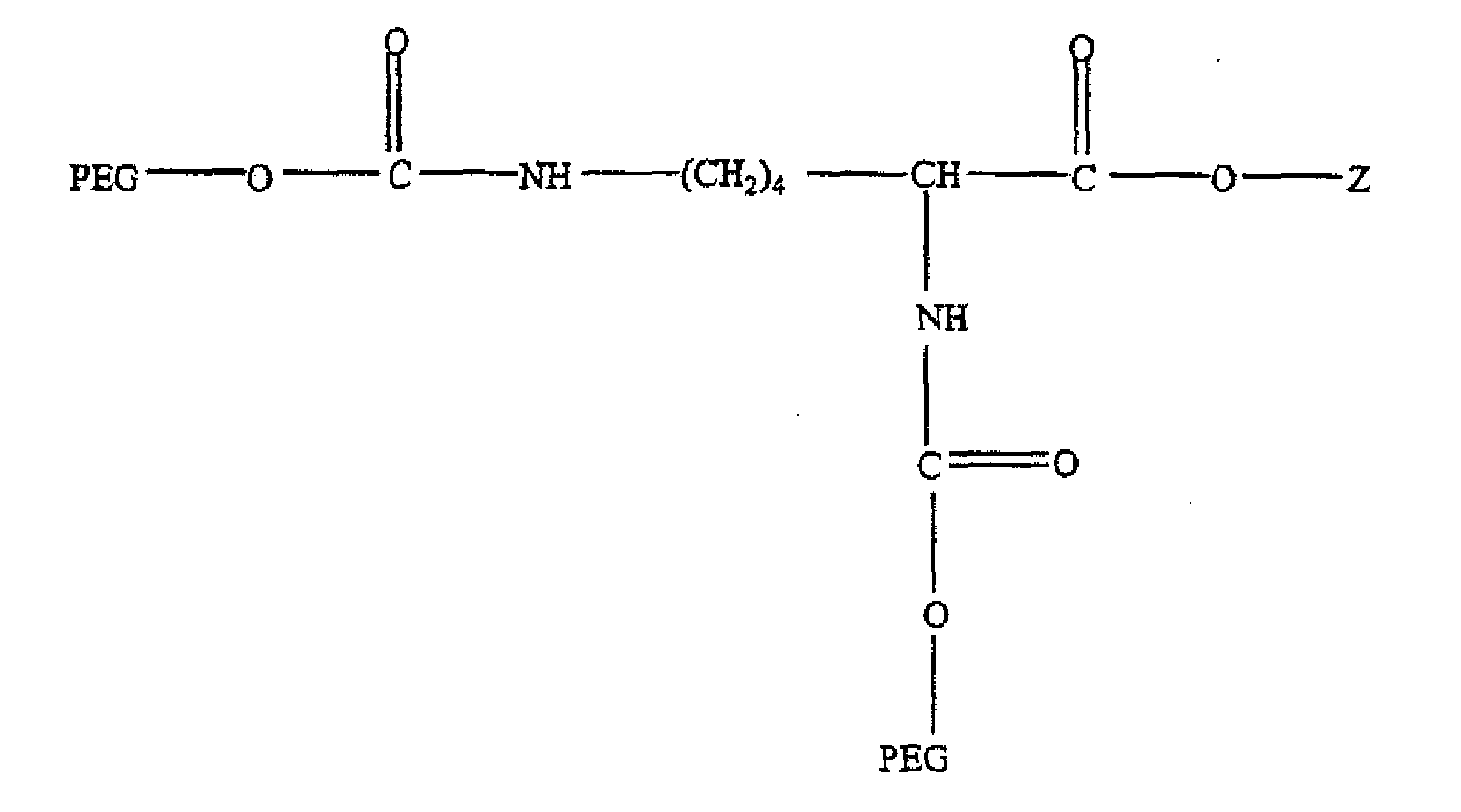
- one such lysine derivative is a doubly PEGylated lysine, wherein the two PEGs are linked to the lysine amines by carbamate bonds, as shown below.
- PEG is poly(ethylene glycol) and Z is selected from the group consisting of H, N-succinimidyl, or 1-benzotriazolyl.
- PEG derivative of lysine are useful as reagents for preparation of PEG derivatives of proteins.
- These PEG derivatives often offer advantages over non-PEGylated proteins, such as longer circulating life-times in vivo, reduced rates of proteolysis, and lowered immunogenicity.
- PEG BTC derivatives are used directly in attaching PEG to proteins through carbamate linkages and may offer advantages similar to those described for the lysine PEG derivatives.
- BTC esters of water-soluble and non-peptidic polymers can also be reacted with biologically active agents to form biologically active polymer conjugates.
- biologically active agents include peptides, proteins, enzymes, small molecule drugs, dyes, lipids, nucleosides, oligonucleotides, cells, viruses, liposomes, microparticles and micelles.
- the invention also includes 1-benzotriazolylcarbonate esters of water-soluble and non-peptidic polymers prepared according to the above-described process. As noted above, it is believed that polymer derivatives prepared according to the invention exhibit higher quality because degradation of the polymer backbone caused by phosgene is avoided. Further, since the method of the invention requires only one step and fewer reactants, process efficiency is enhanced and cost is reduced.
- Lysine.HCl (0.0275 g, 0.000151 moles) was dissolved in 26 ml of 0.1 M borate buffer and the pH was adjusted to 8.0 with 0.1 M NaOH.
- mPEG 20,000 BTC 7.0 g, 0.00350 moles
- 15 g of H 2 O and 4 g of NaCl were added and the pH was adjusted to 3.0 with 10% phosphoric acid.
- the product was extracted with methylene chloride and the extract dried over MgSO 4 .
- lysozyme solution 3 mg/ml in 50 mM sodium phosphate buffer, pH 7.2
- mPEG 5000 BTC 5-fold excess of mPEG5000 BTC
Landscapes
- Health & Medical Sciences (AREA)
- Chemical & Material Sciences (AREA)
- Life Sciences & Earth Sciences (AREA)
- Medicinal Chemistry (AREA)
- General Health & Medical Sciences (AREA)
- Veterinary Medicine (AREA)
- Public Health (AREA)
- Pharmacology & Pharmacy (AREA)
- Animal Behavior & Ethology (AREA)
- Epidemiology (AREA)
- Bioinformatics & Cheminformatics (AREA)
- Engineering & Computer Science (AREA)
- General Chemical & Material Sciences (AREA)
- Organic Chemistry (AREA)
- Chemical Kinetics & Catalysis (AREA)
- Polymers & Plastics (AREA)
- Molecular Biology (AREA)
- Cell Biology (AREA)
- Hematology (AREA)
- Virology (AREA)
- Nuclear Medicine, Radiotherapy & Molecular Imaging (AREA)
- Rheumatology (AREA)
- Pain & Pain Management (AREA)
- Medicinal Preparation (AREA)
- Polyethers (AREA)
- Other Resins Obtained By Reactions Not Involving Carbon-To-Carbon Unsaturated Bonds (AREA)
- Polyesters Or Polycarbonates (AREA)
- Enzymes And Modification Thereof (AREA)
- Macromolecular Compounds Obtained By Forming Nitrogen-Containing Linkages In General (AREA)
- Addition Polymer Or Copolymer, Post-Treatments, Or Chemical Modifications (AREA)
- Low-Molecular Organic Synthesis Reactions Using Catalysts (AREA)
- Heterocyclic Carbon Compounds Containing A Hetero Ring Having Nitrogen And Oxygen As The Only Ring Hetero Atoms (AREA)
- Immobilizing And Processing Of Enzymes And Microorganisms (AREA)
- Medicines That Contain Protein Lipid Enzymes And Other Medicines (AREA)
Abstract
with a protein.
Description
- This invention relates to activated poly(ethylene glycol) derivatives and methods of preparing such derivatives.
- Covalent attachment of the hydrophilic polymer poly(ethylene glycol), abbreviated PEG, also known as poly(ethylene oxide), abbreviated PEO, to molecules and surfaces is of considerable utility in biotechnology and medicine. In its most common form, PEG is a linear polymer terminated at each end with hydroxyl groups:
HO-CH2CH2O-(CH2CH2O)n-CH2CH2-OH
- The above polymer, alpha-,omega-dihydroxylpoly(ethylene glycol), can be represented in brief form as HO-PEG-OH where it is understood that the -PEG-symbol represents the following structural unit:
-CH2CH2O-(CH2CH2O)n-CH2CH2-
where n typically ranges from about 3 to about 4000. - PEG is commonly used as methoxy-PEG-OH, or mPEG in brief, in which one terminus is the relatively inert methoxy group, while the other terminus is a hydroxyl group that is subject to ready chemical modification. The structure of mPEG is given below,
CH3O-(CH2CH2O)n-CH2CH2-OH
Random or block copolymers of ethylene oxide and propylene oxide, shown below, are closely related to PEG in their chemistry, and they can be substituted for PEG in many of its applications.
HO-CH2CHRO(CH2CHRO)nCH2CHR-OH
wherein each R is independently H or CH3, - PEG is a polymer having the properties of solubility in water and in many organic solvents, lack of toxicity, and lack of immunogenicity. One use of PEG is to covalently attach the polymer to insoluble molecules to make the resulting PEG-molecule "conjugate" soluble. For example, it has been shown that the water-insoluble drug paclitaxel, when coupled to PEG, becomes water-soluble. Greenwald, et al. J. Org. Chem., 60:331-336 (1995).
- To couple PEG to a molecule, such as a protein, it is often necessary to "activate" the PEG by preparing a derivative of the PEG having a functional group at a terminus thereof. The functional group can react with certain moieties on the protein, such as an amino group, thus forming a PEG-protein conjugate.
- In
U.S. Patent No. 5,650,234 , which is incorporated by reference herein in its entirety, a 1-benzotriazolylcarbonate ester of poly(ethylene glycol) is described. The multi-step process described in the '234 patent for forming the I - benzotriazolylcarbonate ester of PEG includes reaction of a PEG molecule with the volatile and hazardous compound, phosgene, in order to form a PEG chloroformate intermediate. The use of phosgene in the process results in the formation of HCl, which can cause degradation of the PEG backbone. Due to the volatile nature of phosgene, and the resulting safety and quality problems associated with its use, there is a need in the art for a method for preparing 1-benzotriazolylcarbonate esters of PEG without using phosgene. - The invention provides a method for the preparation of a 1-benzotriazolylcarbonate ester of a water-soluble and non-peptidic polymer by reacting the polymer with di(1-benzotriazolyl)carbonate. Using the invention, the 1-benzotriazolylcarbonate ester can be formed in a single step and without using phosgene, thereby avoiding the safety and quality problems associated with that compound.
- The method of the invention includes providing a water-soluble and non-peptidic polymer having at least one terminal hydroxyl group and reacting the terminal hydroxyl group of the water-soluble and non-peptidic polymer with di(1-benzotriazolyl)carbonate to form the 1-benzotriazolylcarbonate ester of the water-soluble and non-peptidic polymer. Examples of suitable water-soluble and non-peptidic polymers include poly(alkylene glycol), poly(oxyethylated polyol), poly(olefinic alcohol), poly(vinylpyrrolidone), poly(hydroxypropylmethacrylamide), poly(α-hydroxy acid), poly(vinyl alcohol), polyphosphazene, polyoxazoline, poly(N-acryloylmorpholine), and copolymers, terpolymers, and mixtures thereof. In one embodiment, the polymer is poly(ethylene glycol) having an average molecular weight from about 200 Da to about 100,000 Da.
- The reaction step can be conducted in the presence of an organic solvent and a base. Examples of suitable organic solvents include methylene chloride, chloroform, acetonitrile, tetrahydrofuran, dimethylformamide, dimethyl sulfoxide, and mixtures thereof. The base can be, for example, pyridine, dimethylaminopyridine, quinoline, trialkylamines, and mixtures thereof.
- The method of the invention can further include reacting the 1-benzotriazolylcarbonate ester of the water-soluble and non-peptidic polymer with the amino groups of a second polymer having a plurality of primary amino groups, such as a protein, poly(ethylene glycol), aminocarbohydrates, or poly(vinylamine), to form a cross-linked polymer. Additionally, the 1-benzotriazolylcarbonate ester can be reacted with either an amino acid, such as lysine, to form a polymeric amino acid derivative, or a biologically active agent to form a biologically active polymer conjugate.
- The terms "functional group", "active moiety", "activating group", "reactive site", "chemically reactive group" and " chemically reactive moiety" are used in the art and herein to refer to distinct, definable portions or units of a molecule. The terms are somewhat synonymous in the chemical arts and are used herein to indicate that the portions of molecules that perform some function or activity and are reactive with other molecules. The term "active," when uses in conjunction with functional groups, is intended to include those functional groups that react readily with electrophilic or nucleophilic groups on other molecules, in contrast to those groups that require strong catalysts or highly impractical reaction conditions in order to react. For example, as would be understood in the art, the term "active ester" would include those esters that react readily with nucleophilic groups such as amines. Typically, an active ester will react with an amine in aqueous medium in a matter of minutes, whereas certain esters, such as methyl or ethyl esters, require a strong catalyst in order to react with a nucleophilic group.
- The term "linkage" or "linker" is used herein to refer to groups or bonds that normally are formed as the result of a chemical reaction and typically are covalent linkages. Hydrolytically stable linkages means that the linkages are substantially stable in water and do not react with water at useful pHs, e.g., under physiological conditions for an extended period of time, perhaps even indefinitely. Hydrolytically unstable or degradable linkages means that the linkages are degradable in water or in aqueous solutions, including for example, blood. Enzymatically unstable or degradable linkages means that the linkage can be degraded by one or more enzymes. As understood in the art, PEG and related polymers may include degradable linkages in the polymer backbone or in the linker group between the polymer backbone and one or more of the terminal functional groups of the polymer molecule.
- The term "biologically active molecule", "biologically active moiety" or "biologically active agent" when used herein means any substance which can affect any physical or biochemical properties of a biological organism, including but not limited to viruses, bacteria, fungi, plants, animals, and humans. In particular, as used herein, biologically active molecules include any substance intended for diagnosis, cure mitigation, treatment, or prevention of disease in humans or other animals, or to otherwise enhance physical or mental well-being of humans or animals. Examples of biologically active molecules include, but are not limited to, peptides, proteins, enzymes, small molecule drugs, dyes, lipids, nucleosides, oligonucleotides, cells, viruses, liposomes, microparticles and micelles. Classes of biologically active agents that are suitable for use with the invention include, but are not limited to, antibiotics, fungicides, anti-viral agents, anti-inflammatory agents, anti-tumor agents, cardiovascular agents, anti-anxiety agents, hormones, growth factors, steroidal agents, and the like.
- The invention provides a method for the preparation of a 1-benzotriazolylcarbonate ester (also referred to as a BTC ester) of a water-soluble and non-peptidic polymer, wherein a terminal hydroxyl group of a water-soluble and non-peptidic polymer is reacted with di(1-benzotriazolyl)carbonate, the structure of which is shown below, to form the 1-benzotriazolylcarbonate ester. Di(1-benzotriazolyl)carbonate, which should not pose significant safety or handling problems as a reagent and should not cause degradation of the polymer backbone, can be purchased as a 70% (w/w) mixture with 1,1,2-trichloroethane from Fluka Chemical Corporation of Milwaukee, WI.

- The polymer backbone of the water-soluble and non-peptidic polymer can be poly(ethylene glycol) (i.e. PEG). However, it should be understood that other related polymers are also suitable for use in the practice of this invention and that the use of the term PEG or polyethylene glycol) is intended to be inclusive and not exclusive in this respect. The term PEG includes poly(ethylene glycol) in any of its forms, including alkoxy PEG, difunctional PEG, multiarmed PEG, forked PEG, branched PEG, pendent PEG (i.e. PEG or related polymers having one or more functional groups pendent to the polymer backbone), or PEG with degradable linkages therein.
- PEG is typically clear, colorless, odorless, soluble in water, stable to heat, inert to many chemical agents, does not hydrolyze or deteriorate, and is generally non-toxic. Poly(ethylene glycol) is considered to be biocompatible, which is to say that PEG is capable of coexistence with living tissues or organisms without causing harm. More specifically, PEG is substantially non-immunogenic, which is to say that PEG does not tend to produce an immune response in the body. When attached to a molecule having some desirable function in the body, such as a biologically active agent, the PEG tends to mask the agent and can reduce or eliminate any immune response so that an organism can tolerate the presence of the agent. PEG conjugates tend not to produce a substantial immune response or cause clotting or other undesirable effects. PEG having the formula -CH2CH2O-(CH2CH2O)n-CH2CH2-, where n is from about 3 to about 4000, typically from about 3 to about 2000, is one useful polymer in the practice of the invention. PEG having a molecular weight of from about 200 Da to about 00,000 Da are particularly useful as the polymer backbone.
- The polymer backbone can be linear or branched. Branched polymer backbones are generally known in the art. Typically, a branched polymer has a central branch core moiety and a plurality of linear polymer chains linked to the central branch core. PEG is commonly used in branched forms that can be prepared by addition of ethylene oxide to various polyols, such as glycerol, pentaerythritol and sorbitol. The central branch moiety can also be derived from several amino acids, such as lysine. The branched poly(ethylene glycol) can be represented in general form as R(-PEG-OH)m in which R represents the core moiety, such as glycerol or pentaerythritol, and m represents the number of arms. Multi-armed PEG molecules, such as those described in
U.S. Patent No. 5,932,462 , which is incorporated by reference herein in its entirety, can also be used as the polymer backbone. - Many other polymers are also suitable for the invention. Polymer backbones that are non-peptidic and water-soluble, with from 2 to about 300 termini, are particularly useful in the invention. Examples of suitable polymers include, but are not limited to, other poly(alkylene glycols), such as poly(propylene glycol) ("PPG"), copolymers of ethylene glycol and propylene glycol and the like, poly(oxyethylated polyol), poly(olefinic alcohol), poly(vinylpyrrolidone}, poly(hydroxypropylmethacrylamide), poly(α-hydroxy acid), poly(vinyl alcohol), polyphosphazene, polyoxazoline, poly(N-acryloylmorpholine), such as described in
U.S. Patent No. 5,629,384 , which is incorporated by reference herein in its entirety, and copolymers, terpolymers, and mixtures thereof. Although the molecular weight of each chain of the polymer backbone can vary, it is typically in the range of from about 100 Da to about 100,000 Da, often from about 6,000 Da to about 80,000 Da. - Those of ordinary skill in the art will recognize that the foregoing list for substantially water soluble and non-peptidic polymer backbones is by no means exhaustive and is merely illustrative, and that all polymeric materials having the qualities described above are contemplated.
- For purposes of illustration, a simplified reaction scheme for the method of the invention is shown below.


- In one embodiment, the reaction between the polymer and diBTC takes place in an organic solvent and in the presence of a base. Examples of suitable organic solvents include methylene chloride, chloroform, acetonitrile, tetrahydrofuran, dimethylformamide, dimethyl sulfoxide, and mixtures thereof. Amine bases, such as pyridine, dimethylaminopyridine, quinoline, trialkylamines, including triethylamine, and mixtures thereof, are examples of suitable bases. In one aspect of the invention, the molar ratio of di(1-benzotriazolyl) carbonate to the water-soluble and non-peptidic polymer is about 30:1 or less.
- In one embodiment, the water-soluble and non-peptidic polymer has the structure R'-POLY-OH and the 1-benzotriazolylcarbonate ester of the water-soluble and non-peptidic polymer has the structure

- As would be understood in the art, the term "protected" refers to the presence of a protecting group or moiety that prevents reaction of the chemically reactive functional group under certain reaction conditions. The protecting group will vary depending on the type of chemically reactive group being protected. For example, if the chemically reactive group is an amine or a hydrazide, the protecting group can be selected from the group of tert-butyloxycarbonyl (t-Boc) and 9-fluorenylmethoxycarbonyl (Fmoc). If the chemically reactive group is a thiol, the protecting group can be orthopyridyldisulfide. If the chemically reactive group is a carboxylic acid, such as butanoic or propionic acid, or a hydroxyl group, the protecting group can be benzyl or an alkyl group such as methyl or ethyl. Other protecting groups known in the art may also be used in the invention.
- In another embodiment, the water-soluble and non-peptidic polymer has the structure HO-POLYa-R(POLYb-X)q and the 1-benzotriazolylcarbonate ester of the water-soluble and non-peptidic polymer has the structure
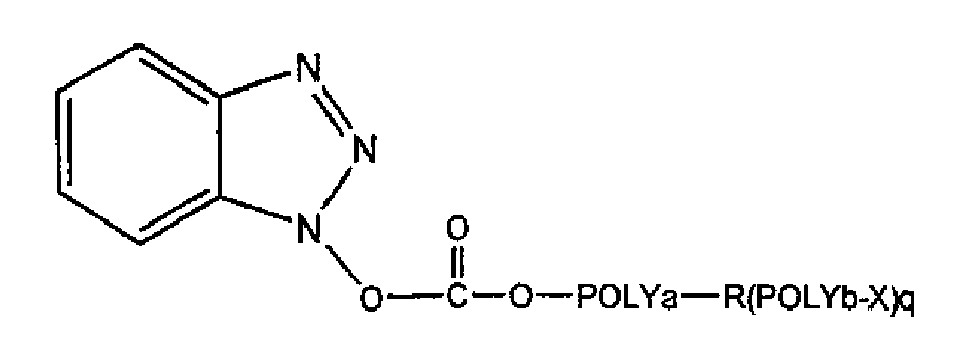
- POLYa and POLYb are water-soluble and non-peptidic polymer backbones, such as PEG, that may be the same or different;
- R is a central core molecule, such as glycerol or pentaerythritol;
- q is an integer from 2 to about 300; and
- each X is a capping group.
- The X capping groups may be the same as discussed above for R'.
- In another aspect, a difunctional or higher functional BTC ester of the water-soluble and non-peptidic polymer is reacted with at least two amino groups of a second polymer having a plurality of primary amino groups, such as amino PEGs or other multifunctional amine polymers, such as proteins, aminocarbohydrates, or poly(vinylamine), to form cross-linked polymers. The amine polymer will generally have three or more available amino groups. Such polymers form hydrogels; that is, they become highly hydrated in aqueous media, but do not dissolve. Since these hydrogels are commonly biocompatable and may be degradable, many biomedical applications are possible in the areas of drug delivery, wound covering, and adhesion prevention.
- A further embodiment of the invention involves the reaction of BTC esters of water-soluble and non-peptidic polymers with amino acids to form amino acid derivatives. In one embodiment, PEG-BTC esters are reacted with lysine to form a polymeric lysine derivative. For example, one such lysine derivative is a doubly PEGylated lysine, wherein the two PEGs are linked to the lysine amines by carbamate bonds, as shown below.

- Such PEG derivative; of lysine are useful as reagents for preparation of PEG derivatives of proteins. These PEG derivatives often offer advantages over non-PEGylated proteins, such as longer circulating life-times in vivo, reduced rates of proteolysis, and lowered immunogenicity. In another aspect, PEG BTC derivatives are used directly in attaching PEG to proteins through carbamate linkages and may offer advantages similar to those described for the lysine PEG derivatives.
- BTC esters of water-soluble and non-peptidic polymers can also be reacted with biologically active agents to form biologically active polymer conjugates. Examples of biologically active agents include peptides, proteins, enzymes, small molecule drugs, dyes, lipids, nucleosides, oligonucleotides, cells, viruses, liposomes, microparticles and micelles.
- The invention also includes 1-benzotriazolylcarbonate esters of water-soluble and non-peptidic polymers prepared according to the above-described process. As noted above, it is believed that polymer derivatives prepared according to the invention exhibit higher quality because degradation of the polymer backbone caused by phosgene is avoided. Further, since the method of the invention requires only one step and fewer reactants, process efficiency is enhanced and cost is reduced.
- The following examples are given to illustrate the invention, but should not be considered in limitation of the invention.
- A solution of mPEG5000-OH (MW 5000,15 g, 0.003 moles), di(1-benzotriazolyl) carbonate (4.0 g of 70% mixture, 0.000945 moles), and pyridine (2.2 ml) in acetonitrile (30 ml) was stirred at room temperature under nitrogen overnight. The solvent was removed by distillation, the residue was dissolved in 80 ml of methylene chloride, and the resulting solution was added to 850 ml of ethyl ether. The mixture was cooled to 0-5°C and the precipitate was collected by filtration. The precipitation process was then repeated to obtain a white solid which was dried under vacuum at room temperature to yield 13.5 g of product which was shown by 1H nmr to be 100% substituted. 1H nmr (dmso d-6): 3.23 ppm, CH3O; 3.51 ppm, O-CH 2CH 2-O; 4.62 ppm, m, mPEG-O-CH2-OCO2- ; 7.41-8.21, complex mult., benzotriazole protons.
- A solution of mPEG20,000-OH (MW 20,000,20 g, 0.001 moles), di(1-benzotriazolyl) carbonate (3.4 g of 70% mixture, 0.00803moles), and pyridine (3.0 ml) in acetonitrile (40 ml) was stirred at room temperature under nitrogen overnight. The solvent was removed by distillation and the residue was dissolved in 80 ml of methylene chloride and the resulting solution was added to 800 ml of ethyl ether. The precipitate was collected by filtration and was dried under vacuum at room temperature to yield 16.8 g of product which was shown by 1H nmr to be 100% substituted. 1H nmr (dmso d-6): 3.23 ppm, CH3O; 3.51 ppm, O-CH 2CH 2-O-, 4.62 ppm, m, mPEG-O-CH 2-OCO2-; 7.41-8.21, complex mult., benzotriazole protons.
- Lysine.HCl (0.0275 g, 0.000151 moles) was dissolved in 26 ml of 0.1 M borate buffer and the pH was adjusted to 8.0 with 0.1 M NaOH. To the resulting solution was added mPEG20,000BTC (7.0 g, 0.00350 moles) over 15 minutes and the pH was kept at 8 by addition of 0.1 M NaOH. After stirring the resulting solution for 3 h, 15 g of H2O and 4 g of NaCl were added and the pH was adjusted to 3.0 with 10% phosphoric acid. The product was extracted with methylene chloride and the extract dried over MgSO4. After concentrating the solution to 30 ml, the solution was poured into 300 ml of ethyl ether and the product collected by filtration and dried under vacuum at room temperature to yield 5.9 g of product as a white solid. Analysis by gel permeation chromatography (Ultrahydrogel 250, column temperature 75°C, aqueous buffer pH 7.2) showed the product to be a mixture of di-N-PEGylated lysine (MW - 40 KDa, 63.05%), mono-N-PEGylated lysine (MW-20 KDa,36.95%), and mPEG20,000.
- To 4 ml of lysozyme solution (3 mg/ml in 50 mM sodium phosphate buffer, pH 7.2) was added 20.3 mg of mPEG5000 BTC (5-fold excess of mPEG5000 BTC) and the mixture was continually mixed at room temperature. Analysis by capillary electrophoresis (57cm x 76um column; 30mM phosphate buffer; operating voltage 25 kV) after 4 hours showed that 6.94% of unreacted lysozyme remained, while 33.99 % of mono-PEGylated lysozyme, 43.11 % di-PEGylated lysozyme, 13.03% tri-PEGylated lysozyme, and 2.92% of tetra-PEGylated lysozyme had formed.
- To a solution of PEG2KDa-α-hydroxy-ω-propionic acid (10g, 0.0050 moles)(Shearwatcr Corp.) in anhydrous methylene chloride (100 ml) 1-hydroxybenzotriazole (0.30g), 4-(dimethylamino)pyridine (1.0g), benzyl alcohol (10.8g, 0.100 moles) and 1,3-dicyclohexylcarbodiimide (1.0 M solution in methylene chloride, 7.5 ml, 0.0075 moles) were added. The reaction mixture was stirred overnight at room temperature under argon. The mixture was then concentrated to about 50 ml, filtered and added to 800 ml cold diethyl ether. The precipitated product was filtered off and dried under reduced pressure. Yield 8.2g. NMR (d6-DMSO): 2.60 ppm (t, -CH2 -COO-), 3.51 ppm (s, PEG backbone), 4.57 ppm (t, -OH-), 5.11 ppm (s, -CH2- (benzyl)), 7.36 ppm (m, -C6H5 (bcnzyl)).
- To a solution of PEG2KDa-α-hydroxy-ω-propionic acid, benzyl ester (8.2g, 0.0025 moles) in acetonitrile (82 ml), pyridine (0.98 ml) and di(1-bsnzotriazolyl)carbonato (1.48g) were added and the reaction mixture was stirred overnight at room temperature under argon atmosphere. The mixture was then filtered and solvent was evaporated to dryness. The crude product was dissolved in methylene chloride and precipitated with isopropyl alcohol. The wet product was dried under reduced pressure. Yield 6.8g. NMR (d6-DMSO): 2.60 ppm (t, -CH2-COO-), 3.51 ppm (s, PEG backbone), 4.62 ppm (m, -CH2-O(C=O)-), 5.11 ppm (s, -CH2-(benzyl)), 7.36 ppm (m, -C6H5 (benzy)), 7.60 - 8.50 ppm (4m, aromatic protons of benzotriazole).
Claims (33)
- A biologically active conjugate, obtainable by reacting an amino acid derivative of the following structure

with a protein. - Biologically active conjugate according to claim 1, wherein the amino acid derivative is obtainable by reacting the 1-benzotriazolylcarbonate ester of poly(ethylene glycol) with lysine.
- Biologically active conjugate according to claim 1 or 2, wherein the poly(ethylene glycol) has a molecular weight of from 200 Da to 100,000 Da.
- A method for the preparation of a 1-benzotriazolylcarbonate ester of a water-soluble and non-peptidic polymer, comprising:providing a water-soluble and non-peptidic polymer having at least one terminal hydroxyl group; andreacting the terminal hydroxyl group of the water-soluble and non-peptidic polymer with di(1-benzotriazolyl)carbonate to form a 1-benzotriazolylcarbonate ester of the water-soluble and non-peptidic polymer.
- The method of Claim 4, wherein the water-soluble and non-peptidic polymer is selected from the group consisting of poly(alkylene glycol), poly(oxyethylated polyol), poly(olefinic alcohol), poly(vinylpynolidone), poly(hydroxypropylmethacrylamide), poly(α-hydroxy acid), poly(vinyl alcohol), polyphosphazene, polyoxazoline, pnly(N-acryloylmorpholine), and copolymers, terpolymers, and mixtures thereof.
- The method of Claim 4, wherein the water-soluble and non-peptidic polymer is poly(ethylene glycol).
- The method of Claim 6, wherein the poly(ethylene glycol) has an average molecular weight from about 200 Da to about 100,000 Da.
- The method of Claim 4, wherein the water-soluble and non-peptidic polymer has from about 2 to about 300 termini.
- The method of Claim 4, wherein the water-soluble and non-peptidic polymer has the structure R'-POLY-OH and the 1-benzotriazolylcarbonate ester of the water-soluble and non-peptidic polymer has the structure

- The method of Claim 9, wherein POLY is poly(ethylene glycol).
- The method of Claim 10, wherein the poly(ethylene glycol) has an average molecular weight from about 200 Da to about 100,000 Da.
- The method of Claim 9, wherein R' is methoxy.
- The method of Claim 9, wherein R' is a functional group selected from the group consisting of hydroxyl, protected hydroxyl, active ester, active carbonate, acetal, aldehyde, aldehyde hydrates, alkenyl, acrylate, methacrylate, acrylamide, active sulfone, protected amine, protected hydrazide, thiol, protected thiol, carboxylic acid, protected carboxylic acid, isocyanate, isothiocyanate, maleimide, vinylsulfone, dithiopyridine, vinylpyridine, iodoacetamide, epoxide, glyoxals, diones, mesylates, tosylates, and tresylate.
- The method of Claim 4, wherein the water-soluble and non-peptidic polymer has the structure HO-POLYa-R(POLYb-X)q and the 1-benzotriazolylcarbonate ester of the water-soluble and non-peptidic polymer has the structure
 wherein POLYa and POLYb are water-soluble and non-peptidic polymer backbones that may be the same or different;R is a central core molecule;q is an integer from 2 to about 300; andeach X is a capping group.
- The method of Claim 14, wherein POLYa and POLYb are poly(ethylene glycol).
- The method of Claim 15, wherein POLYa and POLYb each have an average molecular weight from about 200 Da to about 100,000 Da.
- The method of Claim 14, wherein each X is independently selected from the group consisting of alkoxy, hydroxyl, protected hydroxyl, active ester, active carbonate, acetal, aldehyde, aldehyde hydrates, alkenyl, acrylate, methacrylate, acrylamide, active sulfone, protected amine, protected hydrazide, thiol, protected thiol, carboxylic acid, protected carboxylic acid, isocyanate, isothiocyanate, maleimide, vinylsulfone, dithiopyridine, vinylpyridine, iodoacetamide, epoxide, glyoxals, diones, mesylates, tosylates, and tresylate.
- The method of Claim 4, wherein said reacting step is conducted in an organic solvent.
- The method of Claim 18, wherein the organic solvent is selected from the group consisting of methylene chloride, chloroform, acetonitrile, tetrahydrofuran, dimethylformamide, dimethyl sulfoxide, and mixtures thereof.
- The method of Claim 4, wherein said reacting step is conducted in the presence of a base.
- The method of Claim 20, wherein the base is selected from the group consisting of pyridine, dimethylaminopyridine, quinoline, trialkylamines, and mixtures thereof.
- The method of Claim 4, wherein the molar ratio of di(1-benzotriazolyl) carbonate to the water-soluble and non-peptidic polymer is about 30:1 or less.
- The method of Claim 4, further comprising the steps of:providing a second polymer having a plurality of primary amino groups; andreacting the 1-benzotriazolylcarbonate ester of the water-soluble and non-peptidic polymer with at least two of the amino groups of the second polymer to form a cross-linked polymer.
- The method of Claim 23, wherein the second polymer is selected from the group consisting of proteins, aminopoly(ethylene glycol), aminocarbohydrates, and poly(vinylamine).
- The method of Claim4, further comprising the step of reacting the 1-benzotriazolylcarbonate ester of the water-soluble and non-peptidic polymer with an amino acid to form an amino acid derivative.
- The method of Claim 25, wherein the amino acid is lysine.
- The method of Claim 26, wherein the amino acid derivative has the structure

- The method of Claim 4, further comprising the step of reacting the 1-benzotriazolylcarbonate ester of the water-soluble and non-peptidic polymer with a biologically active agent to form a biologically active polymer conjugate.
- The method of Claim 28, wherein the biologically active agent is selected from the group consisting of peptides, proteins, enzymes, small molecule drugs, dyes, lipids, nucleosides, oligonucleotides, cells, viruses, liposomes, microparticles and micelles.
- A 1-benzotriazolylcarbonate ester of a water-soluble and non-peptidic polymer prepared according to the process of Claim 4.
- A method for the preparation of a 1-benzotriazolylcarbonate ester of a water-soluble and non-pepti lie polymer, comprising:providing a poly(ethylene glycol) molecule with a terminal hydroxyl group and an average molecular weight from about 200 Da to about 100,000 Da and having the structure
R'-PEG-OH
wherein R' is a capping group; and
reacting the terminal hydroxyl group with di(1-benzotriazolyl)carhonate to form a 1-benzotriazolylcarbanate ester of the poly(ethylene glycol) having the structure
- The method of Claim 31, wherein R' is methoxy.
- The method of Claim 31, wherein R' is a functional group selected from the group consisting of hydroxyl, protected hydroxyl, active ester, active carbonate, acetal, aldehyde, aldehyde hydrates, alkenyl, acrylate, methacrylate, acrylamide, active sulfone, protected amine, protected hydrazide, thiol, protected thiol, carboxylic acid, protected carboxylic acid, isocyanate, isothiocyanate, maleimide, vinylsulfone, dithiopyridine, vinylpyridine, iodoacetamide, epoxide, glyoxals, diones, mesylates, tosylates, and tresylate.
Applications Claiming Priority (2)
| Application Number | Priority Date | Filing Date | Title |
|---|---|---|---|
| US17183499P | 1999-12-22 | 1999-12-22 | |
| EP00986602.1A EP1259563B2 (en) | 1999-12-22 | 2000-12-18 | Method for the preparation of 1-benzotriazolyl carbonate esters of water soluble polymers. |
Related Parent Applications (3)
| Application Number | Title | Priority Date | Filing Date |
|---|---|---|---|
| EP00986602.1 Division | 2000-12-18 | ||
| EP00986602.1A Division-Into EP1259563B2 (en) | 1999-12-22 | 2000-12-18 | Method for the preparation of 1-benzotriazolyl carbonate esters of water soluble polymers. |
| EP00986602.1A Division EP1259563B2 (en) | 1999-12-22 | 2000-12-18 | Method for the preparation of 1-benzotriazolyl carbonate esters of water soluble polymers. |
Publications (2)
| Publication Number | Publication Date |
|---|---|
| EP2070968A2 true EP2070968A2 (en) | 2009-06-17 |
| EP2070968A3 EP2070968A3 (en) | 2013-07-24 |
Family
ID=22625322
Family Applications (2)
| Application Number | Title | Priority Date | Filing Date |
|---|---|---|---|
| EP00986602.1A Expired - Lifetime EP1259563B2 (en) | 1999-12-22 | 2000-12-18 | Method for the preparation of 1-benzotriazolyl carbonate esters of water soluble polymers. |
| EP09154211.8A Withdrawn EP2070968A3 (en) | 1999-12-22 | 2000-12-18 | Method for the Preparation of 1-Benzotriazolyl Carbonate Esters of Poly(ethylene glycol) |
Family Applications Before (1)
| Application Number | Title | Priority Date | Filing Date |
|---|---|---|---|
| EP00986602.1A Expired - Lifetime EP1259563B2 (en) | 1999-12-22 | 2000-12-18 | Method for the preparation of 1-benzotriazolyl carbonate esters of water soluble polymers. |
Country Status (14)
| Country | Link |
|---|---|
| US (15) | US6376604B2 (en) |
| EP (2) | EP1259563B2 (en) |
| JP (2) | JP5095061B2 (en) |
| KR (1) | KR100729977B1 (en) |
| AT (1) | ATE424431T2 (en) |
| AU (1) | AU781729B2 (en) |
| CA (1) | CA2393638C (en) |
| CY (1) | CY1109102T1 (en) |
| DE (1) | DE60041715D1 (en) |
| DK (1) | DK1259563T4 (en) |
| ES (1) | ES2321800T5 (en) |
| MX (1) | MXPA02006215A (en) |
| PT (1) | PT1259563E (en) |
| WO (1) | WO2001045796A2 (en) |
Families Citing this family (136)
| Publication number | Priority date | Publication date | Assignee | Title |
|---|---|---|---|---|
| KR100361933B1 (en) * | 1993-09-08 | 2003-02-14 | 라 졸라 파마슈티칼 컴파니 | Chemically defined nonpolymeric bonds form the platform molecule and its conjugate |
| US6057287A (en) | 1994-01-11 | 2000-05-02 | Dyax Corp. | Kallikrein-binding "Kunitz domain" proteins and analogues thereof |
| US6458953B1 (en) * | 1998-12-09 | 2002-10-01 | La Jolla Pharmaceutical Company | Valency platform molecules comprising carbamate linkages |
| AU779887B2 (en) * | 1999-06-08 | 2005-02-17 | La Jolla Pharmaceutical Company | Valency platform molecules comprising aminooxy groups |
| ES2321800T5 (en) | 1999-12-22 | 2017-02-17 | Nektar Therapeutics | Preparation procedure of 1-benzotriazolyl carbonate esters of water soluble polymers |
| EP1292337A2 (en) | 2000-06-08 | 2003-03-19 | La Jolla Pharmaceutical | Multivalent platform molecules comprising high molecular weight polyethylene oxide |
| US7829074B2 (en) | 2001-10-18 | 2010-11-09 | Nektar Therapeutics | Hydroxypatite-targeting poly(ethylene glycol) and related polymers |
| US6436386B1 (en) * | 2000-11-14 | 2002-08-20 | Shearwater Corporation | Hydroxyapatite-targeting poly (ethylene glycol) and related polymers |
| US6765069B2 (en) * | 2001-09-28 | 2004-07-20 | Biosurface Engineering Technologies, Inc. | Plasma cross-linked hydrophilic coating |
| AU2004236174B2 (en) | 2001-10-10 | 2011-06-02 | Novo Nordisk A/S | Glycopegylation methods and proteins/peptides produced by the methods |
| DK2322229T3 (en) | 2001-10-10 | 2017-03-27 | Novo Nordisk As | Remodeling and Glycoconjugation of Factor IX |
| US7214660B2 (en) | 2001-10-10 | 2007-05-08 | Neose Technologies, Inc. | Erythropoietin: remodeling and glycoconjugation of erythropoietin |
| US7157277B2 (en) | 2001-11-28 | 2007-01-02 | Neose Technologies, Inc. | Factor VIII remodeling and glycoconjugation of Factor VIII |
| US8008252B2 (en) * | 2001-10-10 | 2011-08-30 | Novo Nordisk A/S | Factor VII: remodeling and glycoconjugation of Factor VII |
| US7173003B2 (en) * | 2001-10-10 | 2007-02-06 | Neose Technologies, Inc. | Granulocyte colony stimulating factor: remodeling and glycoconjugation of G-CSF |
| US7153829B2 (en) | 2002-06-07 | 2006-12-26 | Dyax Corp. | Kallikrein-inhibitor therapies |
| DK2298278T3 (en) * | 2002-06-07 | 2016-02-01 | Dyax Corp | Prevention and reduction of blood loss and inflammatory response |
| MXPA04012496A (en) * | 2002-06-21 | 2005-09-12 | Novo Nordisk Healthcare Ag | Pegylated factor vii glycoforms. |
| US8663650B2 (en) | 2003-02-21 | 2014-03-04 | Ac Immune Sa | Methods and compositions comprising supramolecular constructs |
| EP1608688B1 (en) * | 2003-03-14 | 2013-02-27 | BioGeneriX AG | Branched water-soluble polymers and their conjugates |
| US20060276618A1 (en) * | 2003-03-18 | 2006-12-07 | Defrees Shawn | Activated forms of water-soluble polymers |
| WO2006127896A2 (en) | 2005-05-25 | 2006-11-30 | Neose Technologies, Inc. | Glycopegylated factor ix |
| US8791070B2 (en) | 2003-04-09 | 2014-07-29 | Novo Nordisk A/S | Glycopegylated factor IX |
| CA2524936A1 (en) * | 2003-05-09 | 2004-12-02 | Neose Technologies, Inc. | Compositions and methods for the preparation of human growth hormone glycosylation mutants |
| US7947261B2 (en) | 2003-05-23 | 2011-05-24 | Nektar Therapeutics | Conjugates formed from polymer derivatives having particular atom arrangements |
| PL2644206T3 (en) * | 2003-05-23 | 2019-09-30 | Nektar Therapeutics | PEG derivatives containing two PEG chains |
| EP1656410B1 (en) | 2003-07-22 | 2010-03-10 | Nektar Therapeutics | Method for preparing functionalized polymers from polymer alcohols |
| US20080026995A1 (en) * | 2003-07-25 | 2008-01-31 | Ac Immune Sa | Therapeutic vaccine targeted against p-glycoprotein 170 for inhibiting multidrug resistance in the treatment of cancers |
| WO2005012484A2 (en) | 2003-07-25 | 2005-02-10 | Neose Technologies, Inc. | Antibody-toxin conjugates |
| US7807171B2 (en) | 2003-07-25 | 2010-10-05 | Ac Immune Sa | Therapeutic vaccine targeted against P-glycoprotein 170 for inhibiting multidrug resistance in the treatment of cancers |
| EP1663281B1 (en) * | 2003-08-29 | 2013-12-25 | Dyax Corp. | Poly-pegylated protease inhibitors |
| US8633157B2 (en) * | 2003-11-24 | 2014-01-21 | Novo Nordisk A/S | Glycopegylated erythropoietin |
| EP1694347B1 (en) * | 2003-11-24 | 2013-11-20 | BioGeneriX AG | Glycopegylated erythropoietin |
| US7842661B2 (en) * | 2003-11-24 | 2010-11-30 | Novo Nordisk A/S | Glycopegylated erythropoietin formulations |
| US20080305992A1 (en) * | 2003-11-24 | 2008-12-11 | Neose Technologies, Inc. | Glycopegylated erythropoietin |
| US7956032B2 (en) | 2003-12-03 | 2011-06-07 | Novo Nordisk A/S | Glycopegylated granulocyte colony stimulating factor |
| JP4657219B2 (en) * | 2003-12-03 | 2011-03-23 | バイオジェネリックス アーゲー | GlycoPEGylated granulocyte colony stimulating factor |
| US20060040856A1 (en) | 2003-12-03 | 2006-02-23 | Neose Technologies, Inc. | Glycopegylated factor IX |
| WO2005067644A2 (en) * | 2004-01-07 | 2005-07-28 | Ambit Biosciences Corporation | Conjugated small molecules |
| WO2005070138A2 (en) * | 2004-01-08 | 2005-08-04 | Neose Technologies, Inc. | O-linked glycosylation of peptides |
| WO2005074650A2 (en) | 2004-02-02 | 2005-08-18 | Ambrx, Inc. | Modified human four helical bundle polypeptides and their uses |
| ES2385226T3 (en) * | 2004-02-20 | 2012-07-19 | Ac Immune S.A. | Methods and compositions comprising supramolecular constructs |
| US7588745B2 (en) * | 2004-04-13 | 2009-09-15 | Si Options, Llc | Silicon-containing products |
| EP1753805A4 (en) * | 2004-05-17 | 2009-11-25 | Univ Mcmaster | HYDROPHILIC SILICONE SURFACE REACTING TO A BIOLOGICAL MOLECULE |
| MXPA06014684A (en) | 2004-06-18 | 2007-02-12 | Ambrx Inc | Novel antigen-binding polypeptides and their uses. |
| EP1771066A2 (en) | 2004-07-13 | 2007-04-11 | Neose Technologies, Inc. | Branched peg remodeling and glycosylation of glucagon-like peptide-1 glp-1 |
| US7456151B2 (en) | 2004-07-14 | 2008-11-25 | University Of Utah Research Foundation | Promoting angiogenesis with netrin1 polypeptides |
| US7638299B2 (en) | 2004-07-21 | 2009-12-29 | Ambrx, Inc. | Biosynthetic polypeptides utilizing non-naturally encoded amino acids |
| US20090292110A1 (en) * | 2004-07-23 | 2009-11-26 | Defrees Shawn | Enzymatic modification of glycopeptides |
| EP1799249A2 (en) * | 2004-09-10 | 2007-06-27 | Neose Technologies, Inc. | Glycopegylated interferon alpha |
| US7235530B2 (en) | 2004-09-27 | 2007-06-26 | Dyax Corporation | Kallikrein inhibitors and anti-thrombolytic agents and uses thereof |
| HUE026826T2 (en) | 2004-10-29 | 2016-07-28 | Ratiopharm Gmbh | Remodeling and glycopegylation of fibroblast growth factor (FGF) |
| SG161209A1 (en) | 2004-12-22 | 2010-05-27 | Ambrx Inc | Formulations of human growth hormone comprising a non-naturally encoded amino acid |
| KR101252835B1 (en) | 2004-12-22 | 2013-04-10 | 암브룩스, 인코포레이티드 | COMPOSITIONS OF AMINOACYL-tRNA SYNTHETASE AND USES THEREOF |
| CN103290084A (en) | 2004-12-22 | 2013-09-11 | Ambrx公司 | Method for expression and purification of recombinant human growth hormone |
| JP2008525473A (en) * | 2004-12-22 | 2008-07-17 | アンブレツクス・インコーポレイテツド | Modified human growth hormone |
| WO2006074279A1 (en) * | 2005-01-06 | 2006-07-13 | Neose Technologies, Inc. | Glycoconjugation using saccharyl fragments |
| ES2449195T3 (en) | 2005-01-10 | 2014-03-18 | Ratiopharm Gmbh | Glycopegylated granulocyte colony stimulating factor |
| US20070154992A1 (en) * | 2005-04-08 | 2007-07-05 | Neose Technologies, Inc. | Compositions and methods for the preparation of protease resistant human growth hormone glycosylation mutants |
| US20110003744A1 (en) * | 2005-05-25 | 2011-01-06 | Novo Nordisk A/S | Glycopegylated Erythropoietin Formulations |
| AU2006255122B2 (en) | 2005-06-03 | 2010-10-21 | Ambrx, Inc. | Improved human interferon molecules and their uses |
| DE602005007199D1 (en) * | 2005-06-10 | 2008-07-10 | 3M Espe Ag | Dental composition containing a prepolymer and a crosslinker, methods of production and their use |
| EP2412744B1 (en) | 2005-07-18 | 2014-01-22 | Nektar Therapeutics | Method for preparing branched functionalised polymers using branched polyol cores |
| HRP20150247T1 (en) | 2005-07-29 | 2015-04-10 | Nektar Therapeutics | Methods for preparing polymeric reagents |
| JP4829969B2 (en) | 2005-08-18 | 2011-12-07 | アンブルックス,インコーポレイテッド | tRNA compositions and uses thereof |
| AU2006280932A1 (en) * | 2005-08-19 | 2007-02-22 | Novo Nordisk A/S | Glycopegylated factor VII and factor Vila |
| US20070105755A1 (en) * | 2005-10-26 | 2007-05-10 | Neose Technologies, Inc. | One pot desialylation and glycopegylation of therapeutic peptides |
| WO2007056191A2 (en) | 2005-11-03 | 2007-05-18 | Neose Technologies, Inc. | Nucleotide sugar purification using membranes |
| PT2339014E (en) | 2005-11-16 | 2015-10-13 | Ambrx Inc | METHODS AND COMPOSITIONS UNDERSTANDING NON-NATURAL AMINO ACIDS |
| JP2009544327A (en) | 2006-07-21 | 2009-12-17 | ノヴォ ノルディスク アー/エス | Glycosylation of peptides with O-linked glycosylation sequences |
| US8618257B2 (en) | 2006-09-08 | 2013-12-31 | Ambrx, Inc. | Modified human plasma polypeptide or Fc scaffolds and their uses |
| NZ574960A (en) | 2006-09-08 | 2012-02-24 | Ambrx Inc | Suppressor trna transcription in vertebrate cells |
| KR20090051227A (en) | 2006-09-08 | 2009-05-21 | 암브룩스, 인코포레이티드 | Hybrid Suppressors for Vertebrate Cells |
| EP2054521A4 (en) | 2006-10-03 | 2012-12-19 | Novo Nordisk As | METHODS OF PURIFYING CONJUGATES OF POLYPEPTIDES |
| CA2665480C (en) * | 2006-10-04 | 2019-11-12 | Novo Nordisk A/S | Glycerol linked pegylated sugars and glycopeptides |
| US8101729B2 (en) * | 2007-03-19 | 2012-01-24 | Henry Joseph Niemczyk | Pegylated amino acid derivatives and the process to synthesize the same |
| BRPI0809583B1 (en) | 2007-03-30 | 2022-02-22 | Ambrx, Inc | Modified fgf-21 polypeptide, composition comprising the same, method for producing said fgf-21 polypeptide, and cell comprising a polynucleotide |
| WO2008124406A2 (en) | 2007-04-03 | 2008-10-16 | Neose Technologies, Inc. | Methods of treatment using glycopegylated g-csf |
| WO2008137471A2 (en) | 2007-05-02 | 2008-11-13 | Ambrx, Inc. | Modified interferon beta polypeptides and their uses |
| CN101778937A (en) * | 2007-06-04 | 2010-07-14 | 诺和诺德公司 | O-linked glycosylation using N-acetylglucosaminyltransferase |
| JP5876649B2 (en) * | 2007-06-12 | 2016-03-02 | ラツィオファルム ゲーエムベーハーratiopharm GmbH | Improved process for producing nucleotide sugars |
| US7968811B2 (en) * | 2007-06-29 | 2011-06-28 | Harley-Davidson Motor Company Group, Inc. | Integrated ignition and key switch |
| CA2696208A1 (en) * | 2007-08-21 | 2009-02-26 | Genzyme Corporation | Treatment with kallikrein inhibitors |
| US8207112B2 (en) * | 2007-08-29 | 2012-06-26 | Biogenerix Ag | Liquid formulation of G-CSF conjugate |
| WO2009067636A2 (en) | 2007-11-20 | 2009-05-28 | Ambrx, Inc. | Modified insulin polypeptides and their uses |
| SG188143A1 (en) | 2008-02-08 | 2013-03-28 | Ambrx Inc | Modified leptin polypeptides and their uses |
| EP2626079A3 (en) | 2008-02-27 | 2014-03-05 | Novo Nordisk A/S | Conjungated factor VIII molecules |
| UA103774C2 (en) | 2008-07-23 | 2013-11-25 | Амбркс, Інк. | Modified bovine g-csf polypeptides and their uses |
| EP2334337A1 (en) * | 2008-09-19 | 2011-06-22 | Nektar Therapeutics | Polymer conjugates of opioid growth factor peptides |
| EP2337585A1 (en) * | 2008-09-19 | 2011-06-29 | Nektar Therapeutics | Polymer conjugates of glp-2-like peptides |
| US20110165113A1 (en) * | 2008-09-19 | 2011-07-07 | Nektar Therapeutics | Polymer conjugates of v681-like peptides |
| WO2010033207A1 (en) | 2008-09-19 | 2010-03-25 | Nektar Therapeutics | Polymer conjugates of therapeutic peptides |
| WO2010033204A2 (en) * | 2008-09-19 | 2010-03-25 | Nektar Therapeutics | Polymer conjugates of c-peptides |
| US20110171166A1 (en) * | 2008-09-19 | 2011-07-14 | Nektar Therapeutics | Polymer conjugates of osteocalcin peptides |
| EP2334335A1 (en) * | 2008-09-19 | 2011-06-22 | Nektar Therapeutics | Polymer conjugates of cd-np peptides |
| EP2340050A2 (en) * | 2008-09-19 | 2011-07-06 | Nektar Therapeutics | Polymer conjugates of aod-like peptides |
| WO2010033221A1 (en) | 2008-09-19 | 2010-03-25 | Nektar Therapeutics | Polymer conjugates of protegrin peptides |
| WO2010033220A2 (en) * | 2008-09-19 | 2010-03-25 | Nektar Therapeutics | Modified therapeutics peptides, methods of their preparation and use |
| US20110171162A1 (en) * | 2008-09-19 | 2011-07-14 | Nektar Therapeutics | Polymer conjugates of thymosin alpha 1 peptides |
| WO2010033224A1 (en) * | 2008-09-19 | 2010-03-25 | Nektar Therapeutics | Polymer conjugates of kiss1 peptides |
| US20110171163A1 (en) * | 2008-09-19 | 2011-07-14 | Nektar Therapeutics | Polymer conjugates of ziconotide peptides |
| UA106731C2 (en) | 2008-09-26 | 2014-10-10 | Амбркс, Інк. | modified animal erythropoietin polypeptides and their application |
| BRPI0919031A2 (en) | 2008-09-26 | 2014-09-23 | Ambrx Inc | MICRO-ORGANISMS AND REPLICATION DEPENDENT VACCINES USING NON-NATURAL AMINO ACIDS |
| WO2010080833A1 (en) | 2009-01-06 | 2010-07-15 | Dyax Corp. | Treatment of mucositis with kallikrein inhibitors |
| US8975445B2 (en) * | 2009-04-06 | 2015-03-10 | Solvay Specialty Polymers Italy S.P.A. | Process for the manufacture of functional PFPE derivative |
| MY199187A (en) | 2009-06-09 | 2023-10-19 | Prolong Pharmaceuticals Llc | Hemoglobin compositions |
| EP2507381A4 (en) | 2009-12-04 | 2016-07-20 | Hoffmann La Roche | PLURISPECIFIC ANTIBODIES, ANTIBODY ANALOGUES, COMPOSITIONS AND METHODS |
| EA201290541A1 (en) | 2009-12-21 | 2013-05-30 | Амбркс, Инк. | MODIFIED BULL SOMATOTROPINE POLYPEPTIDES AND THEIR APPLICATION |
| PE20121799A1 (en) | 2009-12-21 | 2013-01-02 | Ambrx Inc | MODIFIED PORCINE SOMATOTROPIN POLYPEPTIDES AND THEIR USES |
| SMT202200056T1 (en) | 2010-01-06 | 2022-03-21 | Takeda Pharmaceuticals Co | Plasma kallikrein binding proteins |
| WO2012020124A1 (en) | 2010-08-12 | 2012-02-16 | Ac Immune S.A. | Vaccine engineering |
| US9567386B2 (en) | 2010-08-17 | 2017-02-14 | Ambrx, Inc. | Therapeutic uses of modified relaxin polypeptides |
| CA2808596C (en) | 2010-08-17 | 2020-12-15 | Ambrx, Inc. | Modified relaxin polypeptides and their uses |
| TWI480288B (en) | 2010-09-23 | 2015-04-11 | Lilly Co Eli | Formulations for bovine granulocyte colony stimulating factor and variants thereof |
| WO2012054822A1 (en) | 2010-10-22 | 2012-04-26 | Nektar Therapeutics | Pharmacologically active polymer-glp-1 conjugates |
| EP2632434B1 (en) | 2010-10-26 | 2025-08-20 | AC Immune S.A. | Liposome-based construct comprising a peptide modified through hydrophobic moieties |
| WO2012094587A1 (en) | 2011-01-06 | 2012-07-12 | Dyax Corp. | Plasma kallikrein binding proteins |
| EP3505534A1 (en) | 2012-06-08 | 2019-07-03 | Sutro Biopharma, Inc. | Antibodies comprising sitespecific nonnatural amino acid residues, methods of their preparation and methods of their use |
| ES2611788T3 (en) | 2012-06-26 | 2017-05-10 | Sutro Biopharma, Inc. | Modified Fc proteins comprising site-specific non-natural amino acid residues, conjugates thereof, methods for their preparation and methods for use |
| SI2890402T1 (en) | 2012-08-31 | 2019-07-31 | Sutro Biopharma, Inc. | Modified amino acids comprising an azido group |
| WO2015006555A2 (en) | 2013-07-10 | 2015-01-15 | Sutro Biopharma, Inc. | Antibodies comprising multiple site-specific non-natural amino acid residues, methods of their preparation and methods of their use |
| US9840493B2 (en) | 2013-10-11 | 2017-12-12 | Sutro Biopharma, Inc. | Modified amino acids comprising tetrazine functional groups, methods of preparation, and methods of their use |
| IL295414B2 (en) | 2014-03-27 | 2026-02-01 | Takeda Pharmaceuticals Co | Compositions and methods for treatment of diabetic macular edema |
| CN114853868A (en) | 2014-10-24 | 2022-08-05 | 百时美施贵宝公司 | Modified FGF-21 polypeptides and uses thereof |
| JP7003354B2 (en) | 2015-12-11 | 2022-03-04 | 武田薬品工業株式会社 | Plasma kallikrein inhibitors and their uses for the treatment of hereditary angioedema attacks |
| EP3580232B1 (en) | 2017-02-08 | 2023-09-20 | Bristol-Myers Squibb Company | Modified relaxin polypeptides comprising a pharmacokinetic enhancer and uses thereof |
| FI3849614T3 (en) | 2018-09-11 | 2024-02-08 | Ambrx Inc | Interleukin-2 polypeptide conjugates and their uses |
| JP7577055B2 (en) * | 2018-10-11 | 2024-11-01 | ネクター セラピューティクス | Methods for making releasable polymeric reagents |
| EP3867265A1 (en) | 2018-10-19 | 2021-08-25 | Ambrx, Inc. | Interleukin-10 polypeptide conjugates, dimers thereof, and their uses |
| MX2021009644A (en) | 2019-02-12 | 2021-09-08 | Ambrx Inc | Compositions containing, methods and uses of antibody-tlr agonist conjugates. |
| JP2022525164A (en) | 2019-03-14 | 2022-05-11 | 武田薬品工業株式会社 | Plasma kallikrein inhibitors and their use for treating stroke of hereditary angioedema |
| CA3167336A1 (en) | 2020-01-13 | 2021-07-22 | Takeda Pharmaceutical Company Limited | Plasma kallikrein inhibitors and uses thereof for treating pediatric hereditary angioedema attack |
| JP2023517595A (en) | 2020-03-11 | 2023-04-26 | アンブルックス,インコーポレイテッド | Interleukin-2 polypeptide conjugates and methods of use thereof |
| CA3190606A1 (en) | 2020-08-20 | 2022-02-24 | Ambrx, Inc. | Antibody-tlr agonist conjugates, methods and uses thereof |
| WO2022212899A1 (en) | 2021-04-03 | 2022-10-06 | Ambrx, Inc. | Anti-her2 antibody-drug conjugates and uses thereof |
| WO2026043823A2 (en) | 2024-08-19 | 2026-02-26 | Sutro Biopharma, Inc. | Antibodies comprising site-specific non-natural amino acid residues, methods of preparation and uses thereof |
Citations (3)
| Publication number | Priority date | Publication date | Assignee | Title |
|---|---|---|---|---|
| US5629384A (en) | 1994-05-17 | 1997-05-13 | Consiglio Nazionale Delle Ricerche | Polymers of N-acryloylmorpholine activated at one end and conjugates with bioactive materials and surfaces |
| US5650234A (en) | 1994-09-09 | 1997-07-22 | Surface Engineering Technologies, Division Of Innerdyne, Inc. | Electrophilic polyethylene oxides for the modification of polysaccharides, polypeptides (proteins) and surfaces |
| US5932462A (en) | 1995-01-10 | 1999-08-03 | Shearwater Polymers, Inc. | Multiarmed, monofunctional, polymer for coupling to molecules and surfaces |
Family Cites Families (14)
| Publication number | Priority date | Publication date | Assignee | Title |
|---|---|---|---|---|
| DE287951C (en) | ||||
| KR850001206B1 (en) | 1984-04-27 | 1985-08-20 | 한국과학기술원 | Process for preparing cephem derivatives |
| JPS62181269A (en) * | 1986-02-06 | 1987-08-08 | Haruo Ogura | Novel active esterification agent compound |
| DD287951A5 (en) * | 1989-09-15 | 1991-03-14 | Adw Zi F. Molekularbiologie,De | PROCESS FOR IMMOBILIZING BIOLOGICALLY ACTIVE COMPOUNDS ON POLYOXYALKYLENE GLYCOL AND ITS MONOALKOXY DERIVATIVES |
| US5281698A (en) † | 1991-07-23 | 1994-01-25 | Cetus Oncology Corporation | Preparation of an activated polymer ester for protein conjugation |
| US6229002B1 (en) | 1995-06-07 | 2001-05-08 | Nexstar Pharmaceuticlas, Inc. | Platelet derived growth factor (PDGF) nucleic acid ligand complexes |
| US5985263A (en) * | 1997-12-19 | 1999-11-16 | Enzon, Inc. | Substantially pure histidine-linked protein polymer conjugates |
| PT1411075E (en) * | 1998-03-12 | 2008-08-05 | Nektar Therapeutics Al Corp | METHOD FOR THE PREPARATION OF POLYMER CONJUGATES |
| US6348558B1 (en) * | 1999-12-10 | 2002-02-19 | Shearwater Corporation | Hydrolytically degradable polymers and hydrogels made therefrom |
| ES2321800T5 (en) * | 1999-12-22 | 2017-02-17 | Nektar Therapeutics | Preparation procedure of 1-benzotriazolyl carbonate esters of water soluble polymers |
| US6436386B1 (en) * | 2000-11-14 | 2002-08-20 | Shearwater Corporation | Hydroxyapatite-targeting poly (ethylene glycol) and related polymers |
| TW593427B (en) * | 2000-12-18 | 2004-06-21 | Nektar Therapeutics Al Corp | Synthesis of high molecular weight non-peptidic polymer derivatives |
| BRPI0407511A (en) * | 2003-02-19 | 2006-02-14 | Pharmacia Corp | activated polyethylene glycol esters |
| FR2876461B1 (en) * | 2004-10-07 | 2006-12-29 | Commissariat Energie Atomique | OPTICAL SYSTEM WITH BEAM PROPAGATION EXTENSION. |
-
2000
- 2000-12-18 ES ES00986602.1T patent/ES2321800T5/en not_active Expired - Lifetime
- 2000-12-18 DK DK00986602.1T patent/DK1259563T4/en active
- 2000-12-18 AT AT00986602T patent/ATE424431T2/en active
- 2000-12-18 WO PCT/US2000/034590 patent/WO2001045796A2/en not_active Ceased
- 2000-12-18 US US09/740,556 patent/US6376604B2/en not_active Expired - Lifetime
- 2000-12-18 AU AU22810/01A patent/AU781729B2/en not_active Expired
- 2000-12-18 DE DE60041715T patent/DE60041715D1/en not_active Expired - Lifetime
- 2000-12-18 CA CA002393638A patent/CA2393638C/en not_active Expired - Lifetime
- 2000-12-18 MX MXPA02006215A patent/MXPA02006215A/en active IP Right Grant
- 2000-12-18 KR KR1020027008016A patent/KR100729977B1/en not_active Expired - Lifetime
- 2000-12-18 EP EP00986602.1A patent/EP1259563B2/en not_active Expired - Lifetime
- 2000-12-18 PT PT00986602T patent/PT1259563E/en unknown
- 2000-12-18 EP EP09154211.8A patent/EP2070968A3/en not_active Withdrawn
- 2000-12-18 JP JP2001546734A patent/JP5095061B2/en not_active Expired - Lifetime
-
2002
- 2002-02-06 US US10/068,349 patent/US6624246B2/en not_active Expired - Lifetime
- 2002-02-06 US US10/068,371 patent/US6710125B2/en not_active Expired - Lifetime
-
2003
- 2003-12-02 US US10/727,337 patent/US7101932B2/en not_active Expired - Lifetime
-
2006
- 2006-07-24 US US11/492,133 patent/US7378469B2/en not_active Expired - Lifetime
-
2008
- 2008-04-25 US US12/150,136 patent/US7544738B2/en not_active Expired - Lifetime
-
2009
- 2009-04-30 US US12/433,874 patent/US7723432B2/en not_active Expired - Fee Related
- 2009-05-28 CY CY20091100563T patent/CY1109102T1/en unknown
-
2010
- 2010-04-08 US US12/756,905 patent/US7977427B2/en not_active Expired - Fee Related
-
2011
- 2011-06-07 US US13/154,917 patent/US8299173B2/en not_active Expired - Fee Related
-
2012
- 2012-03-22 JP JP2012065779A patent/JP2012122080A/en not_active Withdrawn
- 2012-10-30 US US13/664,021 patent/US8563651B2/en not_active Expired - Fee Related
-
2013
- 2013-10-21 US US14/059,020 patent/US8816002B2/en not_active Expired - Fee Related
-
2014
- 2014-08-25 US US14/467,634 patent/US9346917B2/en not_active Expired - Fee Related
-
2016
- 2016-04-22 US US15/136,632 patent/US9839695B2/en not_active Expired - Fee Related
-
2017
- 2017-11-08 US US15/807,335 patent/US10456476B2/en not_active Expired - Fee Related
-
2019
- 2019-09-20 US US16/578,141 patent/US20200009260A1/en not_active Abandoned
Patent Citations (3)
| Publication number | Priority date | Publication date | Assignee | Title |
|---|---|---|---|---|
| US5629384A (en) | 1994-05-17 | 1997-05-13 | Consiglio Nazionale Delle Ricerche | Polymers of N-acryloylmorpholine activated at one end and conjugates with bioactive materials and surfaces |
| US5650234A (en) | 1994-09-09 | 1997-07-22 | Surface Engineering Technologies, Division Of Innerdyne, Inc. | Electrophilic polyethylene oxides for the modification of polysaccharides, polypeptides (proteins) and surfaces |
| US5932462A (en) | 1995-01-10 | 1999-08-03 | Shearwater Polymers, Inc. | Multiarmed, monofunctional, polymer for coupling to molecules and surfaces |
Non-Patent Citations (1)
| Title |
|---|
| GREENWALD ET AL., J. ORG. CHEM., vol. 60, 1995, pages 331 - 336 |
Also Published As
Similar Documents
| Publication | Publication Date | Title |
|---|---|---|
| EP1259563B1 (en) | Method for the preparation of 1-benzotriazolyl carbonate esters of water soluble polymers. | |
| US10385165B2 (en) | N-maleimidyl polymer derivatives | |
| HK1132001A (en) | Method for the preparation of 1-benzotriazolyl carbonate esters of poly(ethylene glycol) |
Legal Events
| Date | Code | Title | Description |
|---|---|---|---|
| PUAI | Public reference made under article 153(3) epc to a published international application that has entered the european phase |
Free format text: ORIGINAL CODE: 0009012 |
|
| AC | Divisional application: reference to earlier application |
Ref document number: 1259563 Country of ref document: EP Kind code of ref document: P |
|
| AK | Designated contracting states |
Kind code of ref document: A2 Designated state(s): AT BE CH CY DE DK ES FI FR GB GR IE IT LI LU MC NL PT SE TR |
|
| AX | Request for extension of the european patent |
Extension state: AL LT LV MK RO SI |
|
| REG | Reference to a national code |
Ref country code: HK Ref legal event code: DE Ref document number: 1132001 Country of ref document: HK |
|
| RAP1 | Party data changed (applicant data changed or rights of an application transferred) |
Owner name: NEKTAR THERAPEUTICS |
|
| PUAL | Search report despatched |
Free format text: ORIGINAL CODE: 0009013 |
|
| AK | Designated contracting states |
Kind code of ref document: A3 Designated state(s): AT BE CH CY DE DK ES FI FR GB GR IE IT LI LU MC NL PT SE TR |
|
| AX | Request for extension of the european patent |
Extension state: AL LT LV MK RO SI |
|
| RIC1 | Information provided on ipc code assigned before grant |
Ipc: C08G 65/333 20060101AFI20130620BHEP Ipc: C08G 65/329 20060101ALI20130620BHEP Ipc: A61K 47/48 20060101ALI20130620BHEP Ipc: C08G 65/332 20060101ALI20130620BHEP |
|
| 17P | Request for examination filed |
Effective date: 20140124 |
|
| RBV | Designated contracting states (corrected) |
Designated state(s): AT BE CH CY DE DK ES FI FR GB GR IE IT LI LU MC NL PT SE TR |
|
| AKX | Designation fees paid |
Designated state(s): AT BE CH CY DE DK ES FI FR GB GR IE IT LI LU MC NL PT SE TR |
|
| STAA | Information on the status of an ep patent application or granted ep patent |
Free format text: STATUS: EXAMINATION IS IN PROGRESS |
|
| 17Q | First examination report despatched |
Effective date: 20170712 |
|
| GRAP | Despatch of communication of intention to grant a patent |
Free format text: ORIGINAL CODE: EPIDOSNIGR1 |
|
| STAA | Information on the status of an ep patent application or granted ep patent |
Free format text: STATUS: GRANT OF PATENT IS INTENDED |
|
| RIC1 | Information provided on ipc code assigned before grant |
Ipc: A61K 47/60 20170101AFI20190529BHEP |
|
| INTG | Intention to grant announced |
Effective date: 20190619 |
|
| GRAJ | Information related to disapproval of communication of intention to grant by the applicant or resumption of examination proceedings by the epo deleted |
Free format text: ORIGINAL CODE: EPIDOSDIGR1 |
|
| STAA | Information on the status of an ep patent application or granted ep patent |
Free format text: STATUS: EXAMINATION IS IN PROGRESS |
|
| GRAP | Despatch of communication of intention to grant a patent |
Free format text: ORIGINAL CODE: EPIDOSNIGR1 |
|
| INTC | Intention to grant announced (deleted) | ||
| RIN1 | Information on inventor provided before grant (corrected) |
Inventor name: KOZLOWSKI, ANTONI |
|
| STAA | Information on the status of an ep patent application or granted ep patent |
Free format text: STATUS: GRANT OF PATENT IS INTENDED |
|
| INTG | Intention to grant announced |
Effective date: 20191212 |
|
| GRAJ | Information related to disapproval of communication of intention to grant by the applicant or resumption of examination proceedings by the epo deleted |
Free format text: ORIGINAL CODE: EPIDOSDIGR1 |
|
| STAA | Information on the status of an ep patent application or granted ep patent |
Free format text: STATUS: EXAMINATION IS IN PROGRESS |
|
| INTC | Intention to grant announced (deleted) | ||
| GRAP | Despatch of communication of intention to grant a patent |
Free format text: ORIGINAL CODE: EPIDOSNIGR1 |
|
| STAA | Information on the status of an ep patent application or granted ep patent |
Free format text: STATUS: GRANT OF PATENT IS INTENDED |
|
| INTG | Intention to grant announced |
Effective date: 20201112 |
|
| STAA | Information on the status of an ep patent application or granted ep patent |
Free format text: STATUS: THE APPLICATION IS DEEMED TO BE WITHDRAWN |
|
| 18D | Application deemed to be withdrawn |
Effective date: 20210323 |
|
| REG | Reference to a national code |
Ref country code: HK Ref legal event code: WD Ref document number: 1132001 Country of ref document: HK |