EP2070887A1 - Sound-absorbing, resistant panels and process for making same - Google Patents
Sound-absorbing, resistant panels and process for making same Download PDFInfo
- Publication number
- EP2070887A1 EP2070887A1 EP20070356174 EP07356174A EP2070887A1 EP 2070887 A1 EP2070887 A1 EP 2070887A1 EP 20070356174 EP20070356174 EP 20070356174 EP 07356174 A EP07356174 A EP 07356174A EP 2070887 A1 EP2070887 A1 EP 2070887A1
- Authority
- EP
- European Patent Office
- Prior art keywords
- slurry
- sound
- composition
- glycoside compound
- hydraulic binder
- Prior art date
- Legal status (The legal status is an assumption and is not a legal conclusion. Google has not performed a legal analysis and makes no representation as to the accuracy of the status listed.)
- Granted
Links
Images
Classifications
-
- C—CHEMISTRY; METALLURGY
- C04—CEMENTS; CONCRETE; ARTIFICIAL STONE; CERAMICS; REFRACTORIES
- C04B—LIME, MAGNESIA; SLAG; CEMENTS; COMPOSITIONS THEREOF, e.g. MORTARS, CONCRETE OR LIKE BUILDING MATERIALS; ARTIFICIAL STONE; CERAMICS; REFRACTORIES; TREATMENT OF NATURAL STONE
- C04B38/00—Porous mortars, concrete, artificial stone or ceramic ware; Preparation thereof
- C04B38/10—Porous mortars, concrete, artificial stone or ceramic ware; Preparation thereof by using foaming agents or by using mechanical means, e.g. adding preformed foam
-
- C—CHEMISTRY; METALLURGY
- C04—CEMENTS; CONCRETE; ARTIFICIAL STONE; CERAMICS; REFRACTORIES
- C04B—LIME, MAGNESIA; SLAG; CEMENTS; COMPOSITIONS THEREOF, e.g. MORTARS, CONCRETE OR LIKE BUILDING MATERIALS; ARTIFICIAL STONE; CERAMICS; REFRACTORIES; TREATMENT OF NATURAL STONE
- C04B24/00—Use of organic materials as active ingredients for mortars, concrete or artificial stone, e.g. plasticisers
- C04B24/10—Carbohydrates or derivatives thereof
-
- C—CHEMISTRY; METALLURGY
- C04—CEMENTS; CONCRETE; ARTIFICIAL STONE; CERAMICS; REFRACTORIES
- C04B—LIME, MAGNESIA; SLAG; CEMENTS; COMPOSITIONS THEREOF, e.g. MORTARS, CONCRETE OR LIKE BUILDING MATERIALS; ARTIFICIAL STONE; CERAMICS; REFRACTORIES; TREATMENT OF NATURAL STONE
- C04B28/00—Compositions of mortars, concrete or artificial stone, containing inorganic binders or the reaction product of an inorganic and an organic binder, e.g. polycarboxylate cements
- C04B28/14—Compositions of mortars, concrete or artificial stone, containing inorganic binders or the reaction product of an inorganic and an organic binder, e.g. polycarboxylate cements containing calcium sulfate cements
- C04B28/142—Compositions of mortars, concrete or artificial stone, containing inorganic binders or the reaction product of an inorganic and an organic binder, e.g. polycarboxylate cements containing calcium sulfate cements containing synthetic or waste calcium sulfate cements
- C04B28/144—Compositions of mortars, concrete or artificial stone, containing inorganic binders or the reaction product of an inorganic and an organic binder, e.g. polycarboxylate cements containing calcium sulfate cements containing synthetic or waste calcium sulfate cements the synthetic calcium sulfate being a flue gas desulfurization product
-
- E—FIXED CONSTRUCTIONS
- E04—BUILDING
- E04B—GENERAL BUILDING CONSTRUCTIONS; WALLS, e.g. PARTITIONS; ROOFS; FLOORS; CEILINGS; INSULATION OR OTHER PROTECTION OF BUILDINGS
- E04B1/00—Constructions in general; Structures which are not restricted either to walls, e.g. partitions, or floors or ceilings or roofs
- E04B1/62—Insulation or other protection; Elements or use of specified material therefor
- E04B1/74—Heat, sound or noise insulation, absorption, or reflection; Other building methods affording favourable thermal or acoustical conditions, e.g. accumulating of heat within walls
- E04B1/82—Heat, sound or noise insulation, absorption, or reflection; Other building methods affording favourable thermal or acoustical conditions, e.g. accumulating of heat within walls specifically with respect to sound only
- E04B1/84—Sound-absorbing elements
-
- G—PHYSICS
- G10—MUSICAL INSTRUMENTS; ACOUSTICS
- G10K—SOUND-PRODUCING DEVICES; METHODS OR DEVICES FOR PROTECTING AGAINST, OR FOR DAMPING, NOISE OR OTHER ACOUSTIC WAVES IN GENERAL; ACOUSTICS NOT OTHERWISE PROVIDED FOR
- G10K11/00—Methods or devices for transmitting, conducting or directing sound in general; Methods or devices for protecting against, or for damping, noise or other acoustic waves in general
- G10K11/16—Methods or devices for protecting against, or for damping, noise or other acoustic waves in general
- G10K11/162—Selection of materials
-
- C—CHEMISTRY; METALLURGY
- C04—CEMENTS; CONCRETE; ARTIFICIAL STONE; CERAMICS; REFRACTORIES
- C04B—LIME, MAGNESIA; SLAG; CEMENTS; COMPOSITIONS THEREOF, e.g. MORTARS, CONCRETE OR LIKE BUILDING MATERIALS; ARTIFICIAL STONE; CERAMICS; REFRACTORIES; TREATMENT OF NATURAL STONE
- C04B2111/00—Mortars, concrete or artificial stone or mixtures to prepare them, characterised by specific function, property or use
- C04B2111/52—Sound-insulating materials
-
- Y—GENERAL TAGGING OF NEW TECHNOLOGICAL DEVELOPMENTS; GENERAL TAGGING OF CROSS-SECTIONAL TECHNOLOGIES SPANNING OVER SEVERAL SECTIONS OF THE IPC; TECHNICAL SUBJECTS COVERED BY FORMER USPC CROSS-REFERENCE ART COLLECTIONS [XRACs] AND DIGESTS
- Y10—TECHNICAL SUBJECTS COVERED BY FORMER USPC
- Y10T—TECHNICAL SUBJECTS COVERED BY FORMER US CLASSIFICATION
- Y10T428/00—Stock material or miscellaneous articles
- Y10T428/249921—Web or sheet containing structurally defined element or component
- Y10T428/249953—Composite having voids in a component [e.g., porous, cellular, etc.]
- Y10T428/249987—With nonvoid component of specified composition
Definitions
- the present invention relates to sound-absorbing panels and to a process for making the same, as well as to a composition useful for making the abovementioned sound-absorbing panels.
- compositions of set hydraulic binders have been increasingly used in combination with other materials to form composite structures. These structures typically comprise layers of differing thicknesses of compositions of set hydraulic binders and a wide variety of fibrous materials.
- fibrous materials When the fibrous materials are formed into a sheet material and placed on the outer surface of the set hydraulic binder composition it is referred to as a facer.
- the fibrous material surrounds the composition of set hydraulic binder, the interior element is referred to as a core.
- Panels in particular wallboard panels generally consist of two sheets of a facer material having a certain tensile strength, like paper, covering a core based on a set hydraulic binder, notably gypsum plaster.
- Other types of panels do not necessarily have a facer in particular those used for acoustic insulation which are moulded into shaped articles.
- the core it is desirable to lighten the core by for example incorporating air into the slurry used for making the core.
- the incorporated air in the core could appear in the form of bubbles.
- Increasing the amount of air is known to improve the acoustic properties of the boards, but also to deteriorate the mechanical resistance.
- It is a first object of the invention to provide a composition comprising at least
- the invention also provides panels and slurries comprising the said composition.
- the invention also relates to a sound-absorbing panel comprising a core, wherein said core comprises at least a set hydraulic binder and a glycoside compound.
- the invention also relates to a process of making a sound-absorbing panel, comprising the steps of:
- the present invention enables one to overcome the inconveniences cited-above.
- the invention provides boards based on a set hydraulic binder and being both sound absorbing and resistant to compression.
- the invention also has the following advantageous features:
- the invention is a composition comprising at least
- the invention is a slurry comprising the above cited composition.
- the composition or the slurry according to the present invention comprises a set hydraulic binder.
- the set hydraulic binder is preferably a cementitious material, i.e. any material that will set with water.
- the cementitious material is hydratable gypsum, referred to as plaster, stucco, calcium sulfate hemi hydrate, or calcium sulfate semi-hydrate (or alternatively anhydrite).
- the source of the gypsum before it is calcined by any method known to one skilled in the art may be natural or synthetic production of gypsum.
- Cementitious material is generally a fine-grained powder with a median particle size in the range of 5 to 100 ⁇ m. Specific embodiments of the invention are particularly designed for quick-setting cement, having a setting time of less than 30 min, preferably less than 20 min, more preferably less than 10 min.
- One of the most preferred set hydraulic binder for use in the present composition of the invention is set gypsum plaster and more particularly hydratable flue gas desulfurization (FGD) gypsum.
- FGD gypsum plaster The advantages of FGD gypsum plaster are among others higher purity, more uniform and finer particles size, lighter color and no abrasive fines. Higher purity results in more set hydraulic binder per unit weight for generally improved strength over natural gypsum plaster of lower purity. Uniform fine particles are more uniformly and completely calcined for a more uniform setting time. Lighter color is more aesthetically pleasing. The lack of abrasive fines in the gypsum plaster causes less wear on conveying equipment and mixer parts.
- the slurry according to the present invention comprises water.
- the final water-to-plaster (W/P) ratio in the slurry prior to setting is preferably comprised between 0.3 and 0.9, more preferably between 0.45 and 0.75 and most preferably between 0.55 and 0.65.
- composition or the slurry of the present invention comprise a foaming agent.
- foaming agents useful for the invention are alkylpolyglucosides, betaines, amine oxydes, alkylpolysaccharides, alkylethersulfates, ethoxylated alcohols,alkylsulfonates, alkylsulfosuccinates.
- foaming agent any suitable compound or any surfactant able to foam a composition comprising a set hydraulic binder.
- composition or the slurry of the present invention comprise as preferred foaming agent glycoside compound (which is also meant to cover mixtures of several glycoside compounds).
- glycoside compound means any chemical compound comprising a sugar part (glycone) bound to a non-sugar part (aglycone).
- the glycone may comprise one or more sugar units. If more than one unit is present on average, the glycoside compound may be termed polyglycoside.
- the glycoside compound may be a (poly)fructoside compound (if the glycone is based on fructose), a (poly)galactoside compound (if the glycone is based on galactose), a (poly)glucoronide compound (if the glycone is based on glucoronic acid) etc.
- the glycoside compound is a glucoside or polyglucoside, i.e. a glycoside based on glucose.
- the glycoside compound may also be an alkylpolysaccharide having the general formula RO(R 1 O) t Z x as defined in US 4,565,647 on col.1, 1.36-55, and more particularly an alkylpolysaccharide as described in US 4,565,647 on col.2, 1.25-col.3, 1.57, notably a compound having the general formula R 2 O(C n H 2n O) t (Z) x .
- the glycoside used according to the invention is an alkylpolyglycoside (or advantageously alkylpolyglucoside).
- This compound comprises one or more sugar moieties in the glycone part, said moieties being chained via O-glycosidic bonds, and an alkyl moiety (linear or branched) in the aglycone part, said alkyl moiety being linked to the glycone part via an O-glycosidic bond.
- the alkyl moiety is a linear chain having an average length of between C4-C16, more preferably C6-C12 and most preferably C8-C10.
- the glycoside compound is a C4-C16 alkylpolyglycoside or C4-C16 alkylpolyglucoside.
- Molecules made by Cognis in the GLUCOPON family are particularly well-suited, notably GLUCOPON 215 CS UP.
- the glycoside compound mentioned above is the sole foaming agent or surfactant used in the composition or slurry according to the invention.
- the composition or the slurry preferably does not substantially comprise any other foaming agent or surfactant.
- the glycoside compound represents more than 90% of any surfactant composition, advantageously more than 95%, by weight.
- composition or the slurry of the present invention comprises preferably from 0.1 to 2.0 wt% (% by weight of the weight of the set hydraulic binder) of the glycoside compound (which is also meant to cover mixtures of several glycoside compounds).
- composition or the slurry of the present invention may also comprise aggregates and/or fillers.
- Aggregates are particles with a median size essentially higher than the cementitious material.
- Fillers are powders with a median size essentially lower than the cementitious material. Examples of fillers are fumed silica, fly ash, blast furnace slag, micro-silica and fine limestone. Examples of likely aggregates are lightweight vermiculite, perlite, micro-spheres, and expanded shale, while heavy aggregates would be silica or limestone sand.
- Additives influencing the behavior of the composition or slurry like retarders/accelerators pairs are advantageously used in the present invention.
- An example of a retarder/accelerator pair is conventional protein plaster retarder/ball milled accelerator (BMA).
- any additive classically used in the art could also be used in the instant composition or slurry, in particular additives like thickeners or viscosity modifiers or fluidizers but not limited to them.
- the range of additives is very wide as will be appreciated by the skilled person.
- Resins for the improvement of the mechanical and/or aesthetic properties can be added to the composition or slurry of the present invention.
- resins beneficial alone or in combination are: polyacrylic, polyvinylalcohol, fluoropolymer and mixtures thereof. These types of resins can by combined in copolymers or other combinations, e.g. as styrene-butadiene copolymers, styrene-acrylate copolymers, vinyl-acetate-ethylene copolymers and acrylate copolymers.
- composition or slurry of the present invention may also comprise a thickener (also named stabilizing agent).
- the thickener may be effective by increasing the viscosity of the water in the matrix, or by stabilizing the bubble formation by the foaming agent.
- polyvinyl alcohol is a suitable bubble stabilizing agent.
- composition or slurry of the present invention may also comprise a viscosity modifier like for example a water-soluble viscosity modifier.
- a viscosity modifier like for example a water-soluble viscosity modifier.
- examples are polymers (cellulosic, polyalcohol, polyurethane, polyester, polyether, polyacrylic, co- and terpolymers thereof), clay (modified/natural), fumed silica, hydrophobically-modified or surface-modified additives.
- the composition or slurry of the present invention may comprise a fluidizer which is usefully incorporated into the gypsum slurry in order to minimize the water to calcined gypsum ratio.
- a fluidizer also referred to as a water-reducing agent or a plasticizer
- Some examples of such fluidizer are carboxylate compounds such as polycarboxylate ethers.
- Preferred additives are polycarboxylate ethers or the like.
- the composition or slurry of the present invention may comprise a blocking agent which is preferably incorporated into the slurry in order to stop the setting of the set hydraulic binder with water.
- a blocking agent is also referred to as a calcium sequestering agent and may also serve as a water-reducing agent in the aqueous gypsum slurry to increase the flow of the slurry. Any suitable product with a calcium sequestering functionality can be used.
- Blocking agents are typically used with and unblocking agent in a pair. Examples of typical blocking unblocking pairs are sodium polyacrylate/aluminum sulfate and sodium phosphonate/zinc sulfate.
- the present invention may be practiced in the absence of fibers.
- the absence of fibers means that the amount could be less than 0.01% by weight (% by weight of the weight of the set hydraulic binder), preferably less than 0.001% (only unintended impurities) and preferably no fiber will be present at all.
- a fiber is any fiber typically used in the art. "In the absence of fibers" does not exclude the presence of cellulosic material, especially originating from reclaim material, as is typically used in the instant field.
- the composition or the slurry of the present invention does not comprise fibers.
- the composition of the present invention may have a volume of air voids incorporated into the composition in order to absorb sound.
- the quantity of air voids may come from two sources, water voids created when water of convenience is dried out of the composition and air voids that may be created when air is injected into the slurry.
- the water voids may be smaller than the air voids and may have a slight contribution to sound absorption at higher frequencies and at higher water-to-plaster ratio.
- the air voids may be larger than the water voids, and may tend to be interconnected which may allow the composition to absorb sound.
- the term « porosity » means the total of the porosity induced by the presence of air voids and the porority resulting from the evaporation of water (water voids). Consequently the porosity values take into account the airs voids and the water voids.
- composition of the present invention may have
- the composition of the present invention may have a density comprised between 250 and 450 kg/m 3 , particularly between 290 and 350 kg/m 3 , more particularly between 300 and 320 kg/m 3 .
- composition of the present invention has sound-absorbing properties.
- the invention is a slurry comprising the composition of the present invention.
- the composition or the slurry of the present invention can be used to make the core of sound-absorbing panels, in particular gypsum boards.
- the invention provides a panel comprising a core, the said core comprising a composition according to the invention.
- This panel is a sound-absorbing panel, having a sound absorption average (SAA) of at least 0.3, preferably at least 0.5, most preferably at least 0.6 as measured by modified ASTM E1050 - 98 (see example 3 below).
- SAA sound absorption average
- this panel has a compressive strength of at least 0.30 MPa as measured by modified ASTM C472. More particularly, this panel has a compressive strength of at least 0.35 MPa, preferably of at least 0.40 MPa, and more preferably of at least 0.50 MPa.
- the invention provides also in a third embodiment a sound-absorbing panel which comprises a core wherein the core comprises at least a set hydraulic binder, and a glycoside compound.
- the invention provides also as an improvement a sound-absorbing panel or board which comprises a core wherein the core comprises at least a set hydraulic binder, water, and a glycoside compound.
- the set hydraulic binder of sound-absorbing panel of the invention is set gypsum plaster.
- the set gypsum plaster of sound-absorbing panel of the invention is a set flue gas desulphurization gypsum plaster (FGD).
- the sound absorbing panels comprise a glycoside compound, in particular an alkylpolyglycoside or alkylpolyglucoside.
- the sound absorbing panels comprise a C4-C16 alkylpolyglycoside or C4-C16 alkylpolyglucoside.
- the sound-absorbing panel comprises from 0.1 to 2.0 wt% glycoside compound, particularly from 0.15 to 0.8 wt% glycoside compound, more particularly from 0.20 to 0.4 wt% glycoside compound, and preferably from 0.25 to 0.35 wt% glycoside compound (% by weight of the weight of the set hydraulic binder).
- sound absorbing panels as described above according to any embodiments of the invention, is meant in particular boards having a sound absorption average (SAA) of at least 0.3, preferably at least 0.5, most preferably at least 0.6 as measured by modified ASTM E1050 - 98 (see example 3 below).
- SAA sound absorption average
- the sound-absorbing panel of the invention has a compressive strength of at least 0.30 MPa as measured by modified ASTM C472. More particularly, the sound-absorbing panel of the invention has a compressive strength of at least 0.35 MPa, preferably of at least 0.40 MPa, and more preferably of at least 0.50 MPa.
- the sound-absorbing panel of the invention has a compressive strength of at least 0.30 MPa as measured by modified ASTM C472, and a sound absorption average of at least 0.65 as measured by modified ASTM E1050 - 98.
- the sound-absorbing panel of the invention has a compressive strength of at least 0.40 MPa as measured by modified ASTM C472, and a sound absorption average of at least 0.65 as measured by modified ASTM E1050 - 98.
- the sound-absorbing panel of the invention has a compressive strength of at least 0.50 MPa as measured by modified ASTM C472, and a sound absorption average of at least 0.65 as measured by modified ASTM E1050 - 98.
- composition of the invention could be used to produce the core of sound-absorbing panels.
- the thus obtained core of the sound-absorbing panels could be made either with the composition of the invention or partially with the composition of the invention and the rest of the core is made with conventional plaster core composition.
- the sound-absorbing panels comprising the composition of the invention could include paper, reinforced joint or abutted joint.
- paper means paper used to form the facing or backing of the panel.
- Another object of the invention is an assembly comprising at least the panel according to the invention, a coating and a fixing system.
- the invention provides a process of making a sound-absorbing panel, comprising the steps of:
- the set hydraulic binder could be gypsum plaster.
- the glycoside compound incorporated during the step b) could be an alkylpolyglycoside or alkylpolyglucoside, in particular a C4-C16 alkylpolyglycoside or a C4-C16 alkylpolyglucoside.
- the process of the invention may comprise further step(s).
- the step a) could comprise a step of pre-mixing the set hydraulic binder with water and a blocking agent.
- the process of the invention could further comprise a step of introducing an unblocking agent into the aerated slurry.
- the step a) could comprise pre-mixing the set hydraulic binder with water and a retarding agent.
- the step d) (casting of the aerated slurry) of the process according to the invention could comprise a step of depositing the aerated slurry onto a facer, said process also comprising:
- the invention provides two embodiments for the manufacture of compositions and boards, but is not limited thereto.
- the panel of the present invention may be produced by mixing together, in a primary mixer, gypsum plaster, water, a fluidizer, an accelerator and a blocking agent (preferably dispersed in part or all of the gauging water).
- a blocked and unfoamed gypsum slurry is obtained.
- the slurry is continuously pumped to a secondary mixer.
- the foaming agent glycoside compound solution
- the secondary mixer namely an air mixer (e.g. a rotating, vibrating agitator) achieves aeration and foaming of the slurry.
- the size of the air bubbles produced is adjusted by the speed of agitation of the secondary mixer.
- the foamed slurry is passed to yet a tertiary mixer, where an unblocking agent is added at an inlet.
- the tertiary mixer achieves mixing of the slurry with the unblocking agent and thus the foamed slurry becomes unblocked (relative to setting).
- the tertiary mixer can be for example one or more static mixers, optionally with a slow rotating motion.
- the foamed and unblocked slurry is then deposited on a facer. A second facer may be applied to the exposed surface of the slurry and the edges glued to the first facer.
- the cross section of the board is adjusted by a forming plate and transported by a conveyor belt until the slurry is set.
- the continuous board is then cut to length and dried in a hot, forced air wallboard dryer that is known in the art of making gypsum wallboard to provide the final board.
- the panel may be produced by mixing together in a primary mixer, gypsum plaster, water, a fluidizer, a retarder and an accelerator dosed in order to retard setting of the plaster.
- the primary mixer is a continuous mixer.
- the slurry thus produced is then continuously poured into a tank from which it is pumped to a secondary mixer.
- the time the slurry resides in the tank is preferably small.
- the foaming agent (glycoside compound solution) is injected into the slurry prior to entry in the secondary mixer.
- the secondary mixer is an air mixer similar to the one mentioned in relation with the above semi-batch embodiment, which achieves aeration and foaming of the slurry.
- the foamed slurry is then directly deposited on a facer without any need for a tertiary mixer and an unblocking agent. The rest of the process is as described above in relation with the semi-batch process.
- the amount of air injected during the aeration step is such that it permits to obtain a density of about 310 kg/m 3 for the dried panel.
- direct air injection can be used, as is disclosed in document US 2005/0219938 , the content thereof being incorporated herein by reference.
- the facer materials also named liner or paper, used to produce the panels are those that are used in the art in a conventional manner.
- the facer may be paper.
- the facer material may be a non-woven mat, preferably a glass mat or a mat formed of other fibers (e.g. synthetic fibers or a mixture of cellulosic fibers and synthetic fibers).
- the cementitious slurry may penetrate partly in the facer, fully, or the facer may even be embedded in the cementitious core.
- the stiffness of the facer should preferably be such that a load of at least 1 kN, preferably of at least 2 kN, more particularly of at least 3.4 kN is obtained at 1% elongation on a 50 mm wide by 280 mm long sample in tension as described in EN 13963.
- a load of at least 1 kN, preferably of at least 2 kN, more particularly of at least 3.4 kN is obtained at 1% elongation on a 50 mm wide by 280 mm long sample in tension as described in EN 13963.
- the following steps in the process are those commonly used in the field and easily identified and implemented by the skilled person: covering the slurry with a second facer, forming a preform (by passing under a conventional wallboard forming plate), allowing the gypsum slurry to set (supported on the conveyor belt), cutting boards from the continuous ribbon of set material, inverting the boards to expose the underside of the boards, drying the boards in a wallboard dryer, optionally coating with a reinforcing binder.
- the foamed slurry could be moulded into tiles, as is commonly practiced in the art of acoustic tile manufacturing.
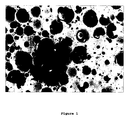
- the figure 1 provides a picture the composition according to the invention, in particular the microstructure of the gypsum core (SEM pictures).
- the primary slurry thus obtained was pumped in a tube at a flow rate of 1 L/min.
- a solution of Glucopon 215 CS UP (containing 64% by weight of alkylpolyglycoside surfactant) obtained from Cognis, prepared with 61.1 g of Glucopon diluted in water (400g Glucopon and 600g of water) was continuously injected into the circulation tube of the primary slurry by an injection pump (flow rate: 10 g/min).
- the mean concentration of the active material contained in the slurry is thus 0.11%.
- the primary slurry then entered a Mondomix® air mixer (secondary mixer) rotating at 450 rpm, where air was introduced at a flow rate of 1.5 L/min to 2.5 L/min so that foaming took place.
- Mondomix® air mixer secondary mixer
- the foamed slurry was then transported to a tertiary mixer where a solution of aluminum sulfate (unblocking agent) was added and continuously mixed to the foamed slurry.
- the solution of aluminum sulfate was prepared with 85 g of aluminum sulfate powder, at an active content of 150 g/kg.
- the injection rate was 27 g/min.
- the tertiary mixer was a 30-cm long vertical static mixer having a 20-mm diameter, based on a Kenics ® geometry. At the outlet of the mixer, the slurry was directly deposited on a liner and a second liner was applied on top of the slurry and it was allowed to set. The distance between the tertiary mixer and the liner was 10 cm.
- the liner used was FF 0.55/6 supplied by Johns Manville. This liner is a non-woven glass mat of 8 ⁇ m fibers adhered together by 20 g/m 2 of a blend of acrylic and polyvinyl alcohol polymers. A coating of 15 to 30 g/m 2 of an acrylic resin binder was applied to the boards after the dryer.
- the powder premix was composed of:
- the K 2 SO 4 aims at providing acceleration of the final set and hardening.
- the W/P ratio was 0.58.
- a strength reinforcement solution could be added if necessary.
- the setting time was comprised between 6.5 minutes and 7.5 minutes (based on the knife test), otherwise it could be adjusted by varying the quantity of Plastretard. If the Gilmore test indicated a setting time of less than 9 minutes, K 2 SO 4 could be adjusted accordingly.
- the slurry thus prepared exited the primary mixer and was continuously transferred to the top of a cylindrical tank having a 20 mm diameter and a 200 mm height.
- the slurry was then continuously pumped at the bottom of the tank at a flow rate of 1 L/min in a tube so that the amount of material in the tank remained constant.
- the average passing time in the tank was less than 5 seconds and the residence time distribution was narrow (95% of the slurry leaved the tank less than 10 seconds after entering the tank), as was measured by dyes concentration evolution techniques.
- the concentration in active material is thus about 0.3% by weight relatively to the gypsum hemihydrate.
- the primary slurry then entered a Mondomix® air mixer (secondary mixer) rotating at 300-500 rpm (400-450 rpm being preferred), where air was introduced at a flow rate of 2.5 L/min so that foaming took place.
- the foamed slurry was deposited on a liner where it was allowed to set after the addition of a second liner on the top.
- the distance between the air mixer and the liner was less than 10 cm and the direction of the deposition was horizontal.
- the liner used was FF 0.55/6 supplied by Johns Manville. This liner is a non-woven glass mat of 8 ⁇ m fibers adhered together by 20 g/m 2 of a blend of acrylic and polyvinyl alcohol polymers.
- the compressive strength of the example specimens were measured according to a modified ASTM C472 method.
- the 75 mm round samples were de-moulded, weighed and the thickness and diameter were measured. The thickness must be at least 20 mm, and the average of 3 diameter measurements was calculated.
- the samples were dried in a ventilated oven at 45°C to constant weight, and cooled to 25°C in a desiccator.
- the samples were removed from the desiccator and placed in the center of the compressive strength press platen.
- the cross head is lowered onto the specimen until the load cell detects the sample and the load cell is zeroed.
- the force is applied at 4 mm per minute crosshead speed from initial loading through elastic failure and then to plastic failure and force falls.
- the force and displacement of the crosshead are recorded every 0.01 second until plastic failure of the specimen.
- the force and crosshead displacement are plotted to determine the force at elastic failure. For each of the samples the force that corresponds to the lowest point of the linear plastic region of the graph is taken as the elastic failure force.
- the force at elastic failure in Newton is divided by the area of the specimen in square millimeters and reported as compressive strength in MPa.
- the porosity, the flow resistivity, the tortuosity, the thermal characteristic length and the viscous characteristic length were measured according to the following teaching: - X. Olny, R. Panneton, and J. Tran-van, An indirect acoustical method for determining intrinsic parameters of porous materials. In Poromechanics II, Actes de la 2nde conference de BIOT, 2002 .
Landscapes
- Chemical & Material Sciences (AREA)
- Engineering & Computer Science (AREA)
- Ceramic Engineering (AREA)
- Structural Engineering (AREA)
- Physics & Mathematics (AREA)
- Materials Engineering (AREA)
- Organic Chemistry (AREA)
- Acoustics & Sound (AREA)
- Architecture (AREA)
- Multimedia (AREA)
- Inorganic Chemistry (AREA)
- Chemical Kinetics & Catalysis (AREA)
- Health & Medical Sciences (AREA)
- Life Sciences & Earth Sciences (AREA)
- Molecular Biology (AREA)
- Electromagnetism (AREA)
- Civil Engineering (AREA)
- Building Environments (AREA)
- Porous Artificial Stone Or Porous Ceramic Products (AREA)
- Curing Cements, Concrete, And Artificial Stone (AREA)
- Laminated Bodies (AREA)
Abstract
Description
- The present invention relates to sound-absorbing panels and to a process for making the same, as well as to a composition useful for making the abovementioned sound-absorbing panels.
- Compositions of set hydraulic binders have been increasingly used in combination with other materials to form composite structures. These structures typically comprise layers of differing thicknesses of compositions of set hydraulic binders and a wide variety of fibrous materials. When the fibrous materials are formed into a sheet material and placed on the outer surface of the set hydraulic binder composition it is referred to as a facer. When the fibrous material surrounds the composition of set hydraulic binder, the interior element is referred to as a core.
- Panels (or boards), in particular wallboard panels generally consist of two sheets of a facer material having a certain tensile strength, like paper, covering a core based on a set hydraulic binder, notably gypsum plaster. Other types of panels do not necessarily have a facer in particular those used for acoustic insulation which are moulded into shaped articles.
- In both cases, it is desirable to lighten the core by for example incorporating air into the slurry used for making the core. The incorporated air in the core could appear in the form of bubbles. Increasing the amount of air is known to improve the acoustic properties of the boards, but also to deteriorate the mechanical resistance.
- Therefore, it is difficult to produce a board having both sound-absorbing and mechanical satisfactory characteristics.
- Consequently, there is a need for boards, and a method of producing boards, in particular gypsum boards, which have satisfactory properties both in terms of acoustics and mechanics.
- There is thus still a need for boards based on a set hydraulic binder which are both sound absorbing and resistant to compression.
- It is a first object of the invention to provide a composition comprising at least
- a set hydraulic binder; and
- a foaming agent and having
- a porosity ≥ 0.55;
- a flow resistivity between 10000 and 150000 N.s.m-4;
- a tortuosity between 1.2 and 3.4;
- a viscous characteristic length between 10 µm and 60 µm;
- a thermal characteristic length between 60 µm and 1000 µm. and having
- a compressive strength of at least 0.30 MPa as measured by modified ASTM C472.
- The invention also provides panels and slurries comprising the said composition.
- The invention also relates to a sound-absorbing panel comprising a core, wherein said core comprises at least a set hydraulic binder and a glycoside compound.
- The invention also relates to a process of making a sound-absorbing panel, comprising the steps of:
- a) pre-mixing the set hydraulic binder with water;
- b) adding a glycoside compound;
- c) injecting air into the obtained slurry of the step b) and mixing.
- d) casting the aerated slurry;
- e) setting the cast slurry. And finally, the invention relates to an assembly comprising at least the panel according to the invention, a coating and a fixing system.
- The present invention enables one to overcome the inconveniences cited-above. In particular the invention provides boards based on a set hydraulic binder and being both sound absorbing and resistant to compression.
- According to particular embodiments, the invention also has the following advantageous features:
- Use could be made of foaming agent derived from renewable raw materials (for example namely glucose derived for example from corn or potato starch and natural fatty alcohols derived for example from coconut or palm kernel oil);
- The good sound absorbing performance of the objects according to the invention make them useful for acoustic application;
- Besides the compressive strength in the core of the panels according to the invention results in an improved handling. The compressive strength is also important during transportation and mounting. The facer covering the core of panels (if present) provides most of the flexural strength as long as the core does not collapse. The high compressive strength of the acoustic core of the invention provides panels that have an improved rigidity during handling and that are more resistant when supported on conventional screws.
- Surprisingly, the composition of the invention does not enhance mould growth on the surface even after inoculation. Thus, the invention substantially avoids the specific addition of fungicides, which are often expensive and which may present health concerns.
- The compressive strength in the core of the panels according to the invention results in an improved resistance to surface imperfections. In particular, the acoustic ceiling application is frequently illuminated by low angle light. Impressions in the face panels create unsightly shadows in the ceiling that are unsatisfactory for architects and interior design specialists. Such defects may be reduced owing to the invention.
- The invention will now be described in more details without limitation in the following description.
- In a first embodiment, the invention is a composition comprising at least
- a set hydraulic binder; and
- a foaming agent and having
- a porosity ≥ 0.55;
- a flow resistivity between 10000 and 150000 N.s.m-4;
- a tortuosity between 1.2 and 3.4;
- a viscous characteristic length between 10 µm and 60 µm;
- a thermal characteristic length between 60 µm and 1000 µm. and having
- a compressive strength of at least 0.30 MPa as measured by modified ASTM C472.
- In a second embodiment, the invention is a slurry comprising the above cited composition.
- The composition or the slurry according to the present invention comprises a set hydraulic binder. The set hydraulic binder is preferably a cementitious material, i.e. any material that will set with water. Preferably, the cementitious material is hydratable gypsum, referred to as plaster, stucco, calcium sulfate hemi hydrate, or calcium sulfate semi-hydrate (or alternatively anhydrite). The source of the gypsum before it is calcined by any method known to one skilled in the art may be natural or synthetic production of gypsum.
- Cementitious material is generally a fine-grained powder with a median particle size in the range of 5 to 100 µm. Specific embodiments of the invention are particularly designed for quick-setting cement, having a setting time of less than 30 min, preferably less than 20 min, more preferably less than 10 min. One of the most preferred set hydraulic binder for use in the present composition of the invention is set gypsum plaster and more particularly hydratable flue gas desulfurization (FGD) gypsum.
- The advantages of FGD gypsum plaster are among others higher purity, more uniform and finer particles size, lighter color and no abrasive fines. Higher purity results in more set hydraulic binder per unit weight for generally improved strength over natural gypsum plaster of lower purity. Uniform fine particles are more uniformly and completely calcined for a more uniform setting time. Lighter color is more aesthetically pleasing. The lack of abrasive fines in the gypsum plaster causes less wear on conveying equipment and mixer parts.
- The slurry according to the present invention comprises water. The final water-to-plaster (W/P) ratio in the slurry prior to setting is preferably comprised between 0.3 and 0.9, more preferably between 0.45 and 0.75 and most preferably between 0.55 and 0.65.
- The composition or the slurry of the present invention comprise a foaming agent. Examples of foaming agents useful for the invention are alkylpolyglucosides, betaines, amine oxydes, alkylpolysaccharides, alkylethersulfates, ethoxylated alcohols,alkylsulfonates, alkylsulfosuccinates.
- By foaming agent according to the invention, it must be understood any suitable compound or any surfactant able to foam a composition comprising a set hydraulic binder.
- The composition or the slurry of the present invention comprise as preferred foaming agent glycoside compound (which is also meant to cover mixtures of several glycoside compounds).
- The term glycoside compound according to the invention means any chemical compound comprising a sugar part (glycone) bound to a non-sugar part (aglycone). The glycone may comprise one or more sugar units. If more than one unit is present on average, the glycoside compound may be termed polyglycoside. The glycoside compound may be a (poly)fructoside compound (if the glycone is based on fructose), a (poly)galactoside compound (if the glycone is based on galactose), a (poly)glucoronide compound (if the glycone is based on glucoronic acid) etc. Preferably, the glycoside compound is a glucoside or polyglucoside, i.e. a glycoside based on glucose.
- The glycoside compound may also be an alkylpolysaccharide having the general formula RO(R1O)tZx as defined in
US 4,565,647 on col.1, 1.36-55, and more particularly an alkylpolysaccharide as described inUS 4,565,647 on col.2, 1.25-col.3, 1.57, notably a compound having the general formula R2O(CnH2nO)t(Z)x. - Preferably, the glycoside used according to the invention is an alkylpolyglycoside (or advantageously alkylpolyglucoside). This compound comprises one or more sugar moieties in the glycone part, said moieties being chained via O-glycosidic bonds, and an alkyl moiety (linear or branched) in the aglycone part, said alkyl moiety being linked to the glycone part via an O-glycosidic bond. Preferably, the alkyl moiety is a linear chain having an average length of between C4-C16, more preferably C6-C12 and most preferably C8-C10.
- According to a preferred embodiment of the composition of the invention, the glycoside compound is a C4-C16 alkylpolyglycoside or C4-C16 alkylpolyglucoside.
- Molecules made by Cognis in the GLUCOPON family are particularly well-suited, notably GLUCOPON 215 CS UP.
- Advantageously, the glycoside compound mentioned above is the sole foaming agent or surfactant used in the composition or slurry according to the invention. In other terms, the composition or the slurry preferably does not substantially comprise any other foaming agent or surfactant. In one embodiment, the glycoside compound represents more than 90% of any surfactant composition, advantageously more than 95%, by weight. In one embodiment, there is no other surfactant or foaming agent. It is to be understood that the absence of any other foaming agent or surfactant also covers the case where there are less than 0.01 wt% (preferably less than 0.001 wt%) of other foaming agent(s) or surfactant(s) in the composition.
- The composition or the slurry of the present invention comprises preferably from 0.1 to 2.0 wt% (% by weight of the weight of the set hydraulic binder) of the glycoside compound (which is also meant to cover mixtures of several glycoside compounds).
- The composition or the slurry of the present invention may also comprise aggregates and/or fillers. Aggregates are particles with a median size essentially higher than the cementitious material. Fillers are powders with a median size essentially lower than the cementitious material. Examples of fillers are fumed silica, fly ash, blast furnace slag, micro-silica and fine limestone. Examples of likely aggregates are lightweight vermiculite, perlite, micro-spheres, and expanded shale, while heavy aggregates would be silica or limestone sand.
- Additives influencing the behavior of the composition or slurry like retarders/accelerators pairs are advantageously used in the present invention. An example of a retarder/accelerator pair is conventional protein plaster retarder/ball milled accelerator (BMA).
- It should be understood that any additive classically used in the art could also be used in the instant composition or slurry, in particular additives like thickeners or viscosity modifiers or fluidizers but not limited to them. The range of additives is very wide as will be appreciated by the skilled person.
- Resins for the improvement of the mechanical and/or aesthetic properties, known in the art can be added to the composition or slurry of the present invention. Examples of resins beneficial alone or in combination are: polyacrylic, polyvinylalcohol, fluoropolymer and mixtures thereof. These types of resins can by combined in copolymers or other combinations, e.g. as styrene-butadiene copolymers, styrene-acrylate copolymers, vinyl-acetate-ethylene copolymers and acrylate copolymers.
- The composition or slurry of the present invention may also comprise a thickener (also named stabilizing agent). The thickener may be effective by increasing the viscosity of the water in the matrix, or by stabilizing the bubble formation by the foaming agent. One skilled in the art will appreciate that polyvinyl alcohol is a suitable bubble stabilizing agent.
- The composition or slurry of the present invention may also comprise a viscosity modifier like for example a water-soluble viscosity modifier. Examples are polymers (cellulosic, polyalcohol, polyurethane, polyester, polyether, polyacrylic, co- and terpolymers thereof), clay (modified/natural), fumed silica, hydrophobically-modified or surface-modified additives.
- The composition or slurry of the present invention may comprise a fluidizer which is usefully incorporated into the gypsum slurry in order to minimize the water to calcined gypsum ratio. A fluidizer (also referred to as a water-reducing agent or a plasticizer) may be added to the aqueous gypsum slurry (e.g., via a pump) to increase the flow of the slurry. Some examples of such fluidizer are carboxylate compounds such as polycarboxylate ethers. Preferred additives are polycarboxylate ethers or the like.
- The composition or slurry of the present invention may comprise a blocking agent which is preferably incorporated into the slurry in order to stop the setting of the set hydraulic binder with water. A blocking agent is also referred to as a calcium sequestering agent and may also serve as a water-reducing agent in the aqueous gypsum slurry to increase the flow of the slurry. Any suitable product with a calcium sequestering functionality can be used. Blocking agents are typically used with and unblocking agent in a pair. Examples of typical blocking unblocking pairs are sodium polyacrylate/aluminum sulfate and sodium phosphonate/zinc sulfate.
- The present invention may be practiced in the absence of fibers. In the absence of fibers means that the amount could be less than 0.01% by weight (% by weight of the weight of the set hydraulic binder), preferably less than 0.001% (only unintended impurities) and preferably no fiber will be present at all. A fiber is any fiber typically used in the art. "In the absence of fibers" does not exclude the presence of cellulosic material, especially originating from reclaim material, as is typically used in the instant field.
- Advantageously, in a particular embodiment, the composition or the slurry of the present invention does not comprise fibers.
- The composition of the present invention may have a volume of air voids incorporated into the composition in order to absorb sound. The quantity of air voids may come from two sources, water voids created when water of convenience is dried out of the composition and air voids that may be created when air is injected into the slurry.
- The water voids may be smaller than the air voids and may have a slight contribution to sound absorption at higher frequencies and at higher water-to-plaster ratio.
- The air voids may be larger than the water voids, and may tend to be interconnected which may allow the composition to absorb sound.
- According to the invention, the term « porosity » means the total of the porosity induced by the presence of air voids and the porority resulting from the evaporation of water (water voids). Consequently the porosity values take into account the airs voids and the water voids.
- According to another aspect of the invention, the composition of the present invention may have
- a porosity ≥ 0.55;
- a flow resistivity between 10000 and 150000 N.s.m-4;
- a tortuosity between 1.2 and 3.4;
- a viscous characteristic length between 10 µm and 60 µm;
- a thermal characteristic length between 60 µm and 1000 µm.
Preferably, according to the composition of the present invention - the porosity is ≥ 0.70;
- the flow resistivity is between 20000 and 90000 N.s.m-4;
- the tortuosity is between 1.3 and 2.5;
- the viscous characteristic length is between 15 µm and 50 µm;
- the thermal characteristic length is between
70 µm and 500 µm.
More preferably, according to the composition of the present invention - the porosity is ≥ 0.82;
- the flow resistivity is between 20000 and 85000 N.s.m-4;
- the tortuosity is between 1.4 and 2.3;
- the viscous characteristic length is between 15 µm and 40 µm;
- the thermal characteristic length is between
- 80 µm and 300 µm.
- These 5 parameters correspond to those which have been well described by the model of Biot-Johnson-Allard in the following book: J.F.Allard, Propagation of Sound in Porous Media, Elsevier Applied Science, 1993):
- porosity is as defined above; the porosity can be easily measured by picnometry;
- flow resistivity means the velocity of air volume displacement which is the material quantity that flows through an area in a time period. The resistance to air flow is equal to the pressure loss measured between the two sides of the porous sample when it is crossed by a constant laminar air flow. Flow resistivity is thus equal to the ratio of the air pressure over the flow rate times the sample surface divided by the sample thickness.
- tortuosity means the complexity of the internal structure of the material;
- thermal characteristic length characterizes the heat exchange between the air and the rigid frame. This is a measure of the effective size of the pores involved in the heat exchange. For gypsum cores, this is directly related to the bubble size.
- viscous characteristic length characterizes the viscous interaction of the air with the stiff frame. This is a measure of the effective size of the pores involved in the viscous interaction. For gypsum cores, this is directly related to the size of the interconnections between the air voids.
- Several methods exist for the measurement of characteristic lengths and tortuosity. The most accurate way to achieve measurements consists in an analytic inversion of acoustic models. References of scientific articles describing these methods are: - X. Olny, R. Panneton, and J. Tran-van, An indirect acoustical method for determining intrinsic parameters of porous materials. In Poromechanics II, Actes de la 2nde conference de BIOT, 2002.
- According to another aspect of the invention, the composition of the present invention may have a density comprised between 250 and 450 kg/m3, particularly between 290 and 350 kg/m3, more particularly between 300 and 320 kg/m3.
- The composition of the present invention has sound-absorbing properties.
- In another embodiment, the invention is a slurry comprising the composition of the present invention.
- The composition or the slurry of the present invention can be used to make the core of sound-absorbing panels, in particular gypsum boards. Thus, the invention provides a panel comprising a core, the said core comprising a composition according to the invention. This panel is a sound-absorbing panel, having a sound absorption average (SAA) of at least 0.3, preferably at least 0.5, most preferably at least 0.6 as measured by modified ASTM E1050 - 98 (see example 3 below). In particular, this panel has a compressive strength of at least 0.30 MPa as measured by modified ASTM C472. More particularly, this panel has a compressive strength of at least 0.35 MPa, preferably of at least 0.40 MPa, and more preferably of at least 0.50 MPa.
- The invention provides also in a third embodiment a sound-absorbing panel which comprises a core wherein the core comprises at least a set hydraulic binder, and a glycoside compound.
- The invention provides also as an improvement a sound-absorbing panel or board which comprises a core
wherein the core comprises at least a set hydraulic binder, water, and a glycoside compound. - Preferably, the set hydraulic binder of sound-absorbing panel of the invention is set gypsum plaster.
- More preferably, the set gypsum plaster of sound-absorbing panel of the invention is a set flue gas desulphurization gypsum plaster (FGD).
- As mentioned above for the composition and the slurry, the sound absorbing panels comprise a glycoside compound, in particular an alkylpolyglycoside or alkylpolyglucoside.
- In a preferred embodiment, the sound absorbing panels comprise a C4-C16 alkylpolyglycoside or C4-C16 alkylpolyglucoside.
- Preferably, the sound-absorbing panel comprises from 0.1 to 2.0 wt% glycoside compound, particularly from 0.15 to 0.8 wt% glycoside compound, more particularly from 0.20 to 0.4 wt% glycoside compound, and preferably from 0.25 to 0.35 wt% glycoside compound (% by weight of the weight of the set hydraulic binder).
- By sound absorbing panels, as described above according to any embodiments of the invention, is meant in particular boards having a sound absorption average (SAA) of at least 0.3, preferably at least 0.5, most preferably at least 0.6 as measured by modified ASTM E1050 - 98 (see example 3 below).
- In particular, the sound-absorbing panel of the invention has a compressive strength of at least 0.30 MPa as measured by modified ASTM C472. More particularly, the sound-absorbing panel of the invention has a compressive strength of at least 0.35 MPa, preferably of at least 0.40 MPa, and more preferably of at least 0.50 MPa.
- In a particular embodiment, the sound-absorbing panel of the invention has a compressive strength of at least 0.30 MPa as measured by modified ASTM C472, and a sound absorption average of at least 0.65 as measured by modified ASTM E1050 - 98.
- In a particular embodiment, the sound-absorbing panel of the invention has a compressive strength of at least 0.40 MPa as measured by modified ASTM C472, and a sound absorption average of at least 0.65 as measured by modified ASTM E1050 - 98.
- In a particular embodiment, the sound-absorbing panel of the invention has a compressive strength of at least 0.50 MPa as measured by modified ASTM C472, and a sound absorption average of at least 0.65 as measured by modified ASTM E1050 - 98.
- The composition of the invention could be used to produce the core of sound-absorbing panels. The thus obtained core of the sound-absorbing panels could be made either with the composition of the invention or partially with the composition of the invention and the rest of the core is made with conventional plaster core composition.
- In another embodiment the sound-absorbing panels comprising the composition of the invention could include paper, reinforced joint or abutted joint. By paper it means paper used to form the facing or backing of the panel.
- Another object of the invention is an assembly comprising at least the panel according to the invention, a coating and a fixing system.
- The invention provides a process of making a sound-absorbing panel, comprising the steps of:
- a) pre-mixing a set hydraulic binder with water;
- b) adding a glycoside compound;
- c) injecting air into the obtained slurry of step b) and mixing;
- d) casting the aerated slurry;
- e) setting the cast slurry.
- According to the process of the invention, the set hydraulic binder could be gypsum plaster.
- The glycoside compound incorporated during the step b) could be an alkylpolyglycoside or alkylpolyglucoside, in particular a C4-C16 alkylpolyglycoside or a C4-C16 alkylpolyglucoside.
- The process of the invention may comprise further step(s). In particular the step a) could comprise a step of pre-mixing the set hydraulic binder with water and a blocking agent. The process of the invention could further comprise a step of introducing an unblocking agent into the aerated slurry. Alternatively, the step a) could comprise pre-mixing the set hydraulic binder with water and a retarding agent. And also, the step d) (casting of the aerated slurry) of the process according to the invention could comprise a step of depositing the aerated slurry onto a facer, said process also comprising:
- covering the deposited slurry with another facer,
- forming a ribbon from the deposited slurry, and
- cutting the ribbon into panels. In particular, the process of the invention may comprise a step of depositing the aerated slurry into moulds.
- By casting, it must be understood according to the invention, to give shape, by any means.
- The invention provides two embodiments for the manufacture of compositions and boards, but is not limited thereto.
- According to an embodiment hereafter referred to as the semi-batch embodiment, the panel of the present invention may be produced by mixing together, in a primary mixer, gypsum plaster, water, a fluidizer, an accelerator and a blocking agent (preferably dispersed in part or all of the gauging water). A blocked and unfoamed gypsum slurry is obtained. The slurry is continuously pumped to a secondary mixer. Prior to entry in the secondary mixer, the foaming agent (glycoside compound solution) is continuously injected into the slurry. The secondary mixer namely an air mixer (e.g. a rotating, vibrating agitator) achieves aeration and foaming of the slurry. The size of the air bubbles produced is adjusted by the speed of agitation of the secondary mixer. After the secondary mixer, the foamed slurry is passed to yet a tertiary mixer, where an unblocking agent is added at an inlet. The tertiary mixer achieves mixing of the slurry with the unblocking agent and thus the foamed slurry becomes unblocked (relative to setting). The tertiary mixer can be for example one or more static mixers, optionally with a slow rotating motion. The foamed and unblocked slurry is then deposited on a facer. A second facer may be applied to the exposed surface of the slurry and the edges glued to the first facer. The cross section of the board is adjusted by a forming plate and transported by a conveyor belt until the slurry is set. The continuous board is then cut to length and dried in a hot, forced air wallboard dryer that is known in the art of making gypsum wallboard to provide the final board.
- Alternatively, according to an embodiment hereafter referred to as the continuous embodiment, the panel may be produced by mixing together in a primary mixer, gypsum plaster, water, a fluidizer, a retarder and an accelerator dosed in order to retard setting of the plaster. The primary mixer is a continuous mixer. The slurry thus produced is then continuously poured into a tank from which it is pumped to a secondary mixer. The time the slurry resides in the tank is preferably small. The foaming agent (glycoside compound solution) is injected into the slurry prior to entry in the secondary mixer. The secondary mixer is an air mixer similar to the one mentioned in relation with the above semi-batch embodiment, which achieves aeration and foaming of the slurry. The foamed slurry is then directly deposited on a facer without any need for a tertiary mixer and an unblocking agent. The rest of the process is as described above in relation with the semi-batch process.
- Preferably, the amount of air injected during the aeration step (according to either the first or second embodiment) is such that it permits to obtain a density of about 310 kg/m3 for the dried panel.
- In either of the two processes of the invention, direct air injection can be used, as is disclosed in document
US 2005/0219938 , the content thereof being incorporated herein by reference. - The facer materials also named liner or paper, used to produce the panels are those that are used in the art in a conventional manner. The facer may be paper. Alternatively, the facer material may be a non-woven mat, preferably a glass mat or a mat formed of other fibers (e.g. synthetic fibers or a mixture of cellulosic fibers and synthetic fibers). The cementitious slurry may penetrate partly in the facer, fully, or the facer may even be embedded in the cementitious core.
- The stiffness of the facer should preferably be such that a load of at least 1 kN, preferably of at least 2 kN, more particularly of at least 3.4 kN is obtained at 1% elongation on a 50 mm wide by 280 mm long sample in tension as described in EN 13963. We have interpreted the need for at least this value from trials on sample boards to make the facer an effective composite member that remains bonded to the core during flexure.
- The following steps in the process are those commonly used in the field and easily identified and implemented by the skilled person: covering the slurry with a second facer, forming a preform (by passing under a conventional wallboard forming plate), allowing the gypsum slurry to set (supported on the conveyor belt), cutting boards from the continuous ribbon of set material, inverting the boards to expose the underside of the boards, drying the boards in a wallboard dryer, optionally coating with a reinforcing binder.
- Alternatively, the foamed slurry could be moulded into tiles, as is commonly practiced in the art of acoustic tile manufacturing.
- The
figure 1 provides a picture the composition according to the invention, in particular the microstructure of the gypsum core (SEM pictures). - The following examples illustrate without limiting the invention.
- In a stirred tank (primary mixer), a slurry was prepared using the following ingredients:
- 15 kg of gypsum hemi-hydrate from the Ottmarsheim factory (France);
- 9.45 kg of water;
- 24 g of Coatex TP169 (polyacrylate blocking agent, obtained from Coatex);
- 15 g of Ball milled accelerator (BMA, from the Ottmarsheim factory, France) which comprises gypsum, starch and lignosulfonate;
- 35.7 g of Optima 100 (phosphonate fluidizer obtained from Chryso);
- 363 g of Vinnapas CEF52W (vinyl acetate resin obtained from Wacker).
- The primary slurry thus obtained was pumped in a tube at a flow rate of 1 L/min. A solution of Glucopon 215 CS UP (containing 64% by weight of alkylpolyglycoside surfactant) obtained from Cognis, prepared with 61.1 g of Glucopon diluted in water (400g Glucopon and 600g of water) was continuously injected into the circulation tube of the primary slurry by an injection pump (flow rate: 10 g/min). The mean concentration of the active material contained in the slurry is thus 0.11%.
- The primary slurry then entered a Mondomix® air mixer (secondary mixer) rotating at 450 rpm, where air was introduced at a flow rate of 1.5 L/min to 2.5 L/min so that foaming took place.
- The foamed slurry was then transported to a tertiary mixer where a solution of aluminum sulfate (unblocking agent) was added and continuously mixed to the foamed slurry. The solution of aluminum sulfate was prepared with 85 g of aluminum sulfate powder, at an active content of 150 g/kg. The injection rate was 27 g/min. The tertiary mixer was a 30-cm long vertical static mixer having a 20-mm diameter, based on a Kenics® geometry. At the outlet of the mixer, the slurry was directly deposited on a liner and a second liner was applied on top of the slurry and it was allowed to set. The distance between the tertiary mixer and the liner was 10 cm.
- The liner used was FF 0.55/6 supplied by Johns Manville. This liner is a non-woven glass mat of 8 µm fibers adhered together by 20 g/m2 of a blend of acrylic and polyvinyl alcohol polymers. A coating of 15 to 30 g/m2 of an acrylic resin binder was applied to the boards after the dryer.
- In a primary mixer, a powder premix was continuously introduced at a flow rate of 1 kg/min. The powder premix was composed of:
- gypsum hemi-hydrate from the Ottmarsheim factory (France) so that the water to plaster ratio is 0.58; and
- 1 g Ball milled accelerator (BMA, see above) per kg of gypsum hemihydrate.
- The following liquid ingredients were also introduced into the mixer:
- 410 g/min of water;
- 57 g/min of a solution of sodium polyacrylate (Coatex TP1431EXP: fluidizing agent obtained from Coatex), the solution being a 1/10th dilution of the commercial solution, so that the weight concentration in active material is 0.3% relative to the gypsum hemihydrate;
- 50 g/min of a blend of natural product with proteins in solution (Plastretard L: retarder supplied by Sicit, Vincenza Chiampo, Italy) containing 6 g per kg of the initial commercial solution;
- 50 g/min of a solution of K2SO4 obtained from Riedal de Haën containing 100 g per kg of active material.
- The K2SO4 aims at providing acceleration of the final set and hardening.
- The W/P ratio was 0.58. A strength reinforcement solution could be added if necessary. When a slump test was performed (with a 50-mm height and a 60-mm width ring), the diameter of the slump was between 205 and 240 mm. The setting time was comprised between 6.5 minutes and 7.5 minutes (based on the knife test), otherwise it could be adjusted by varying the quantity of Plastretard. If the Gilmore test indicated a setting time of less than 9 minutes, K2SO4 could be adjusted accordingly.
- The slurry thus prepared exited the primary mixer and was continuously transferred to the top of a cylindrical tank having a 20 mm diameter and a 200 mm height. The slurry was then continuously pumped at the bottom of the tank at a flow rate of 1 L/min in a tube so that the amount of material in the tank remained constant. The average passing time in the tank was less than 5 seconds and the residence time distribution was narrow (95% of the slurry leaved the tank less than 10 seconds after entering the tank), as was measured by dyes concentration evolution techniques.
- A solution of Glucopon 215 CS UP (containing 64% of alkylpolyglycoside surfactant) obtained from Cognis, prepared with 400 g of Glucopon and 600 g of water, was continuously injected into the circulation tube of the primary slurry by an injection pump (flow rate: 13 g/min). The concentration in active material is thus about 0.3% by weight relatively to the gypsum hemihydrate.
- The primary slurry then entered a Mondomix® air mixer (secondary mixer) rotating at 300-500 rpm (400-450 rpm being preferred), where air was introduced at a flow rate of 2.5 L/min so that foaming took place. After the exit of the air mixer, the foamed slurry was deposited on a liner where it was allowed to set after the addition of a second liner on the top. The distance between the air mixer and the liner was less than 10 cm and the direction of the deposition was horizontal.
- The liner used was FF 0.55/6 supplied by Johns Manville. This liner is a non-woven glass mat of 8 µm fibers adhered together by 20 g/m2 of a blend of acrylic and polyvinyl alcohol polymers.
- Samples of the foamed slurry produced according to examples 1 and 2 were taken at the outlet of the last mixer (i.e. the secondary mixer in the continuous process and the tertiary mixer in the semi-batch process).
- Some samples were placed in a 20-mm high and 75-mm wide cup where they were allowed to set. These samples were used for the analysis of mechanical performances (compression test). However, it is also possible to make the analysis directly on the boards. Force-displacement curves were plotted and the strength before breaking was measured and converted to a corresponding pressure in MPa.
- Other samples were placed in a 100-mm high and 45-mm wide cup where they were allowed to set. 2-cm high slices were subsequently extracted and used for the analysis of the acoustic performances of the gypsum core. Acoustics was evaluated by Kundt tube measurements, which allow to vary the frequency of the incident waves crossing a sample perpendicularly. The normal incidence measurements made in the Kundt tube were then converted to an estimation of the Sound Absorption Average (SAA) as defined in ASTM C-423, by assuming that a), the effects of 200-mm plenum between the material and the ceiling can be taken into account, and b), calculations allows to predict the real diffuse field behavior of the material from the transformation of the normal incidence results. Practical means to achieve this prediction correction can be found for instance in:
- A. London, The determination of reverberant sound absorption coefficients from acoustic impedance measurements, J. Acoust. Soc. Am. 22(2), pp. 263-269, 1950. or in:
- L. L. Beranek LL. Noise Reduction. NewYork: McGraw-Hill; 1971 (Chapter 13).
- The present method was thus close to ASTM E1050-98 and is therefore termed in the present application "modified ASTM E1050-98".
- The estimation of SAA is achieved on small samples when only small amounts of material are available. If the material is produced in larger amounts, SAA can be directly evaluated in an acoustic room (also named reverberating room). More precisely, a floor surface of 3600 mm by 3000 mm, with a metallic frame supported over a 200 mm plenum, was covered with 19.5 mm thick panels according to the invention supported every 600 mm. The joints over the supports were taped with 50 mm wide plastic tape. An omnidirectional loudspeaker was located in one position of the reverberating room to send a continuous spectrum in the frequency band of interest. When the sound emission stops, the sound decay was measured at eight different locations while the sound source was recorded by rotating microphones. The calculation of the equivalent absorption area is calculated from international standard ISO 354 and defined using Sabine formula: A = X (V / Tr) where X is an air temperature and humidity coefficient (0.16 for standard conditions), V is the volume of the room in cubic meters, and Tr is the reverberation time in seconds. The measurement of absorption area is made without (A1) and then with the specimens in place (A2). The absorption area of the room in square meters is then A1 - A2. For each band of frequency, the sound absorption coefficient of the test specimen is calculated. α = (A1 - A2)/S + α1 where α1 is the performance of the liner alone. In the acoustic room, the panels according to the invention are necessarily covered with liners or facers, whereas the small samples are not. It is known by the experts in acoustics that the individual characterization of both the core of the panels and the liners is sufficient to calculate the acoustic behavior of the panels. Therefore, providing the acoustic characteristics of the liners are known, the SAA measured in the room and the evaluation of the SAA through the application of the "modified ASTM E1050-98" methods applied to the core and to the liner provide very close results. Therefore, SAA be evaluated either way.
- The mechanical and acoustical results are presented below in Table 1. Each sample is labeled "C" for continuous process according to example 2). The quantity of air injected and thus the final density of the product is adjusted via the air mixer speed at a constant air flow for the continuous process, and via the air flow at a constant air mixer speed for the semi-batch process.
- The compressive strength of the example specimens were measured according to a modified ASTM C472 method. The 75 mm round samples were de-moulded, weighed and the thickness and diameter were measured. The thickness must be at least 20 mm, and the average of 3 diameter measurements was calculated. The samples were dried in a ventilated oven at 45°C to constant weight, and cooled to 25°C in a desiccator. The samples were removed from the desiccator and placed in the center of the compressive strength press platen. The cross head is lowered onto the specimen until the load cell detects the sample and the load cell is zeroed. The force is applied at 4 mm per minute crosshead speed from initial loading through elastic failure and then to plastic failure and force falls. The force and displacement of the crosshead are recorded every 0.01 second until plastic failure of the specimen. The force and crosshead displacement are plotted to determine the force at elastic failure. For each of the samples the force that corresponds to the lowest point of the linear plastic region of the graph is taken as the elastic failure force. The force at elastic failure in Newton is divided by the area of the specimen in square millimeters and reported as compressive strength in MPa.
- The porosity, the flow resistivity, the tortuosity, the thermal characteristic length and the viscous characteristic length were measured according to the following teaching: - X. Olny, R. Panneton, and J. Tran-van, An indirect acoustical method for determining intrinsic parameters of porous materials. In Poromechanics II, Actes de la 2nde conference de BIOT, 2002.
- The results demonstrate that the invention achieves good mechanical and acoustical results at the same time.
Table 1 - acoustical and mechanical performances of plaster board samples according to the invention made with the continuous process Sample No. C1 C2 C3 Air mixer speed (rpm) 450 400 350 Air flow (L/min) 2.5 2.5 2.5 Compressive strength (MPa) 0.68 0.61 0.49 Sound absorption average 0.79 0.76 0.76 Porosity 0.87 0.89 0.88 Flow resistivity (N.s.m-4) 26 100 64 000 67 900 tortuosity 1.64 1.75 1.84 viscous characteristic length (µm) 27 20 22 thermal characteristic 231 251 143 length (µm)
Claims (28)
- A composition comprising at least- a set hydraulic binder; and- a foaming agent and having- a porosity ≥ 0.55;- a flow resistivity between 10000 and 150000 N.s.m-4;- a tortuosity between 1.2 and 3.4;- a viscous characteristic length between 10 µm and 60 µm;- a thermal characteristic length between 60 µm and 1000 µm. and having- a compressive strength of at least 0.30 MPa as measured by modified ASTM C472.
- The composition of claim 1, wherein the set hydraulic binder is set gypsum plaster.
- The composition of claim 1, wherein the foaming agent is a glycoside compound preferably alkylpolyglycoside or alkylpolyglucoside.
- The composition of claim 3, wherein the glycoside compound is a C4-C16 alkylpolyglycoside or C4-C16 alkylpolyglucoside.
- The composition of claim 3, wherein the composition comprises from 0.1 to 2.0 wt% of the glycoside compound.
- The composition of claim 3, wherein the glycoside compound is the sole foaming agent.
- The composition of claim 1, wherein- the porosity is ≥ 0.70;- the flow resistivity is between 20000 and 90000 N.s.m-4;- the tortuosity is between 1.3 and 2.5;- the viscous characteristic length is between 15 µm and 50 µm;- the thermal characteristic length is between 70 µm and 500 µm.
- The composition of claim 1, wherein- the porosity is ≥ 0.82;- the flow resistivity is between 20000 and 85000 N.s.m-4;- the tortuosity is between 1.4 and 2.3;- the viscous characteristic length is between 15 µm and 40 µm;- the thermal characteristic length is between 80 µm and 300 µm.
- A slurry comprising a composition according to any claims 1 to 8.
- A panel comprising a core, wherein said core comprises a composition according to any claims 1 to 8.
- The panel of the claim 10, wherein the said panel is a sound-absorbing panel.
- A sound-absorbing panel comprising a core, wherein said core comprises at least a set hydraulic binder and a glycoside compound.
- The sound-absorbing panel of claim 12, wherein the set hydraulic binder is set gypsum plaster.
- The sound-absorbing panel of claim 13, wherein the set gypsum plaster is set flue gas desulphurization gypsum plaster.
- The sound-absorbing panel as claimed in any one of claims 12 to 14, wherein the glycoside compound is an alkylpolyglycoside or alkylpolyglucoside.
- The sound-absorbing panel of claim 15 wherein the glycoside compound is a C4-C16 alkylpolyglycoside or C4-C16 alkylpolyglucoside.
- The sound-absorbing panel as claimed in any one of claims 12 to 16, wherein the core comprises from 0.1 to 2.0 wt% glycoside compound.
- The sound-absorbing panel as claimed in any one of claims 12 to 17, having a compressive strength of at least 0.30 MPa as measured by modified ASTM C472, and a sound absorption average of at least 0.65 as measured by modified ASTM E1050 - 98.
- A process of making a sound-absorbing panel, comprising the steps of:a) pre-mixing a set hydraulic binder with water;b) adding a glycoside compound;c) injecting air into the obtained slurry of the step b) and mixing.d) casting the aerated slurry;e) setting the cast slurry.
- The process as claimed in claim 19, wherein the set hydraulic binder is gypsum plaster.
- The process as claimed in any of claims 19 to 20, wherein the glycoside compound is an alkylpolyglycoside or alkylpolyglucoside.
- The process of claim 21, wherein the glycoside compound is a C4-C16 alkylpolyglycoside or a C4-C16 alkylpolyglucoside.
- The process of claims 19 to 22, wherein step a) comprises pre-mixing the set hydraulic binder with water and a blocking agent.
- The process of claims 19 to 23, wherein the process comprises a step of introducing an unblocking agent into the aerated slurry.
- The process of claim 19, wherein step a) comprises pre-mixing the set hydraulic binder with water and a retarding agent.
- The process of any one of claims 19 to 25, wherein the casting of the aerated slurry comprises depositing the aerated slurry onto a facer, said process also comprising:- covering the deposited slurry with another facer,- forming a ribbon from the deposited slurry, and- cutting the ribbon into panels.
- The process as claimed in of any one of claims 19 to 26 wherein it comprises a step of depositing the aerated slurry into moulds.
- An assembly comprising at least the panel according to claims 10 to 18, a coating and a fixing system.
Priority Applications (16)
| Application Number | Priority Date | Filing Date | Title |
|---|---|---|---|
| PL07356174T PL2070887T3 (en) | 2007-12-10 | 2007-12-10 | Process for Making A Sound-Absorbing Panel |
| ES07356174T ES2431139T3 (en) | 2007-12-10 | 2007-12-10 | Procedure to make a soundproof panel |
| DK07356174T DK2070887T3 (en) | 2007-12-10 | 2007-12-10 | Process for making a sound-absorbing panel |
| EP20070356174 EP2070887B1 (en) | 2007-12-10 | 2007-12-10 | Process for Making A Sound-Absorbing Panel |
| ES08859877T ES2431574T3 (en) | 2007-12-10 | 2008-12-09 | Soundproofing resistant panels and their realization procedure |
| JP2010537539A JP2011506250A (en) | 2007-12-10 | 2008-12-09 | Sound absorbing resistor panel and method for manufacturing the same |
| PCT/IB2008/003757 WO2009074875A1 (en) | 2007-12-10 | 2008-12-09 | Sound-absorbing, resistant panels and process for making same |
| KR1020107013971A KR20100099706A (en) | 2007-12-10 | 2008-12-09 | Sound-absorbing, resistant panels and process for making same |
| CA2708230A CA2708230A1 (en) | 2007-12-10 | 2008-12-09 | Sound-absorbing, resistant panels and process for making same |
| US12/747,057 US20100272983A1 (en) | 2007-12-10 | 2008-12-09 | Sound-absorbing, resistant panels and process for making same |
| DK08859877.6T DK2225185T3 (en) | 2007-12-10 | 2008-12-09 | SOUND-ABSORBING, RESISTANT PANELS AND PROCEDURES FOR PRODUCING THEREOF |
| AU2008334394A AU2008334394B2 (en) | 2007-12-10 | 2008-12-09 | Sound-absorbing, resistant panels and process for making same |
| EP08859877.6A EP2225185B1 (en) | 2007-12-10 | 2008-12-09 | Sound-absorbing, resistant panels and process for making same |
| PL08859877T PL2225185T3 (en) | 2007-12-10 | 2008-12-09 | Sound-absorbing, resistant panels and process for making same |
| CN200880116121A CN101861287A (en) | 2007-12-10 | 2008-12-09 | Sound-absorbing sound-insulating board and preparation method thereof |
| US15/012,273 US20160318815A1 (en) | 2007-12-10 | 2016-02-01 | Sound-absorbing, resistant panels and process for making same |
Applications Claiming Priority (1)
| Application Number | Priority Date | Filing Date | Title |
|---|---|---|---|
| EP20070356174 EP2070887B1 (en) | 2007-12-10 | 2007-12-10 | Process for Making A Sound-Absorbing Panel |
Publications (2)
| Publication Number | Publication Date |
|---|---|
| EP2070887A1 true EP2070887A1 (en) | 2009-06-17 |
| EP2070887B1 EP2070887B1 (en) | 2013-08-07 |
Family
ID=39661723
Family Applications (2)
| Application Number | Title | Priority Date | Filing Date |
|---|---|---|---|
| EP20070356174 Active EP2070887B1 (en) | 2007-12-10 | 2007-12-10 | Process for Making A Sound-Absorbing Panel |
| EP08859877.6A Active EP2225185B1 (en) | 2007-12-10 | 2008-12-09 | Sound-absorbing, resistant panels and process for making same |
Family Applications After (1)
| Application Number | Title | Priority Date | Filing Date |
|---|---|---|---|
| EP08859877.6A Active EP2225185B1 (en) | 2007-12-10 | 2008-12-09 | Sound-absorbing, resistant panels and process for making same |
Country Status (11)
| Country | Link |
|---|---|
| US (2) | US20100272983A1 (en) |
| EP (2) | EP2070887B1 (en) |
| JP (1) | JP2011506250A (en) |
| KR (1) | KR20100099706A (en) |
| CN (1) | CN101861287A (en) |
| AU (1) | AU2008334394B2 (en) |
| CA (1) | CA2708230A1 (en) |
| DK (2) | DK2070887T3 (en) |
| ES (2) | ES2431139T3 (en) |
| PL (2) | PL2070887T3 (en) |
| WO (1) | WO2009074875A1 (en) |
Cited By (2)
| Publication number | Priority date | Publication date | Assignee | Title |
|---|---|---|---|---|
| CN103556738A (en) * | 2013-10-13 | 2014-02-05 | 许庆华 | Environment-friendly sludge sound-absorbing board |
| CN117735940A (en) * | 2024-02-20 | 2024-03-22 | 山东信泰节能科技股份有限公司 | Light sound insulation gypsum board |
Families Citing this family (21)
| Publication number | Priority date | Publication date | Assignee | Title |
|---|---|---|---|---|
| AR082207A1 (en) | 2010-07-15 | 2012-11-21 | Lafarge Sa | A CEMENTICIOUS BINDING, A FRAGUABLE CEMENTIC COMPOSITION, AND A CEMENTATION METHOD THAT USES |
| US8435930B2 (en) | 2010-07-15 | 2013-05-07 | Lafarge | Low density cementitious compositions using lime kiln dust |
| JP2013541741A (en) * | 2010-11-09 | 2013-11-14 | カリフォルニア インスティチュート オブ テクノロジー | Acoustic suppression system and related method |
| PL2508316T3 (en) | 2011-04-08 | 2015-04-30 | Saint Gobain Placo Sas | Method for manufacturing gypsum products |
| FR2978459B1 (en) * | 2011-07-28 | 2013-08-02 | Saint Gobain Adfors | ACOUSTIC ABSORBENT WALL COATING COMPRISING A MULTILOBE FIBER LAYER |
| FR2978373B1 (en) * | 2011-07-28 | 2013-08-02 | Saint Gobain Adfors | ACOUSTIC ABSORBENT WALL COATING |
| FR2979281B1 (en) * | 2011-08-25 | 2013-08-23 | Saint Gobain Adfors | WALL COATING FOR THERMAL AND ACOUSTIC COMFORT |
| US10093587B2 (en) * | 2013-06-18 | 2018-10-09 | Robin Crawford | Processes for the manufacture of lightweight ceramic materials and articles produced thereby |
| CN103526839B (en) * | 2013-10-13 | 2016-06-15 | 重庆晨宇机床制造有限公司 | Environment-friendly volcanic ash acoustic board |
| CN103526841B (en) * | 2013-10-13 | 2016-05-25 | 枫林环保科技股份有限公司 | Tailings environmental-friendly abatvoix |
| EP2868638A1 (en) * | 2013-10-31 | 2015-05-06 | Construction Research & Technology GmbH | Self-foaming geopolymer composition containing aluminum dross |
| EP2868637A1 (en) | 2013-10-31 | 2015-05-06 | Construction Research & Technology GmbH | Geopolymer foam formulation |
| CN107709413A (en) * | 2015-06-29 | 2018-02-16 | 株式会社Kcc | Waterproof organic silicon emulsion, the splash guard and its manufacture method for showing excellent crack resistance |
| CN110317024B (en) * | 2019-07-29 | 2020-04-17 | 绍兴华放新材料有限公司 | Photocatalytic concrete light sound insulation wall and preparation method thereof |
| JP7473315B2 (en) | 2019-10-03 | 2024-04-23 | ニチアス株式会社 | Soundproofing materials |
| CN110563427A (en) * | 2019-10-31 | 2019-12-13 | 天津中晨科技有限公司 | gypsum-based building material prepared from industrial solid waste and preparation method thereof |
| EP4116079A1 (en) * | 2021-07-07 | 2023-01-11 | Knauf Gips KG | Gypsum-based acoustic panel |
| FR3139139B1 (en) | 2022-08-23 | 2026-02-13 | Saint Gobain Placo | Plasterboard and its manufacture |
| EP4349555A1 (en) * | 2022-10-05 | 2024-04-10 | Saint-Gobain Placo | Method of forming a gypsum panel, method of analyzing a gypsum core and gypsum core analysis tool |
| US12612336B2 (en) | 2022-11-04 | 2026-04-28 | Knauf Gips Kg | Perlite-free, lightweight setting-type joint compound compositions |
| EP4588638A1 (en) | 2024-01-17 | 2025-07-23 | Saint-Gobain Placo | Gypsum board with sound absorption properties and manufacture thereof |
Citations (5)
| Publication number | Priority date | Publication date | Assignee | Title |
|---|---|---|---|---|
| US4565647A (en) | 1982-04-26 | 1986-01-21 | The Procter & Gamble Company | Foaming surfactant compositions |
| WO1993021123A1 (en) * | 1992-04-10 | 1993-10-28 | Henkel Corporation | Dispersant, setting retarder and air entrainment additive for cement |
| EP1394234A1 (en) * | 2002-08-29 | 2004-03-03 | Cognis Deutschland GmbH & Co. KG | Dust reduced air entraining agent |
| US20050219938A1 (en) | 2004-02-24 | 2005-10-06 | Lafarge Platres | Process And Apparatus For Manufacturing Set Cellular Cement |
| WO2008026006A1 (en) * | 2006-08-29 | 2008-03-06 | Bpb Limited | Gypsum building boards |
Family Cites Families (8)
| Publication number | Priority date | Publication date | Assignee | Title |
|---|---|---|---|---|
| DE4007755A1 (en) * | 1990-03-12 | 1991-09-19 | Henkel Kgaa | FOAMING SURFACE PREPARATIONS |
| EP0738183A4 (en) * | 1993-12-13 | 1997-08-06 | Henkel Corp | Foaming agent composition and process |
| DE19914367A1 (en) * | 1998-04-17 | 1999-10-21 | Henkel Kgaa | Hydraulic binder compositions based on inorganic hydraulic binder and assistant |
| US6217629B1 (en) * | 1999-04-15 | 2001-04-17 | Rutgers, The State University Of New Jersey | Phosphate sulfur fertilizer particles and methods for making same |
| US6443258B1 (en) * | 1999-10-01 | 2002-09-03 | Awi Licensing Company | Durable porous article of manufacture and a process to create same |
| FR2814459B1 (en) * | 2000-09-22 | 2002-12-06 | Lafarge Platres | SURFACTANT COMPOSITION FOR PLASTERBOARDS |
| KR20050116378A (en) * | 2003-03-19 | 2005-12-12 | 유나이티드 스테이츠 집섬 컴파니 | Acoustical panel comprising interlocking matrix of set gypsum and method for making same |
| US7332114B2 (en) * | 2005-02-04 | 2008-02-19 | Lafarge Platres | Process for manufacturing sound absorbing cement tile |
-
2007
- 2007-12-10 PL PL07356174T patent/PL2070887T3/en unknown
- 2007-12-10 DK DK07356174T patent/DK2070887T3/en active
- 2007-12-10 EP EP20070356174 patent/EP2070887B1/en active Active
- 2007-12-10 ES ES07356174T patent/ES2431139T3/en active Active
-
2008
- 2008-12-09 JP JP2010537539A patent/JP2011506250A/en active Pending
- 2008-12-09 CN CN200880116121A patent/CN101861287A/en active Pending
- 2008-12-09 AU AU2008334394A patent/AU2008334394B2/en not_active Ceased
- 2008-12-09 US US12/747,057 patent/US20100272983A1/en not_active Abandoned
- 2008-12-09 DK DK08859877.6T patent/DK2225185T3/en active
- 2008-12-09 KR KR1020107013971A patent/KR20100099706A/en not_active Withdrawn
- 2008-12-09 EP EP08859877.6A patent/EP2225185B1/en active Active
- 2008-12-09 WO PCT/IB2008/003757 patent/WO2009074875A1/en not_active Ceased
- 2008-12-09 ES ES08859877T patent/ES2431574T3/en active Active
- 2008-12-09 PL PL08859877T patent/PL2225185T3/en unknown
- 2008-12-09 CA CA2708230A patent/CA2708230A1/en not_active Abandoned
-
2016
- 2016-02-01 US US15/012,273 patent/US20160318815A1/en not_active Abandoned
Patent Citations (6)
| Publication number | Priority date | Publication date | Assignee | Title |
|---|---|---|---|---|
| US4565647A (en) | 1982-04-26 | 1986-01-21 | The Procter & Gamble Company | Foaming surfactant compositions |
| US4565647B1 (en) | 1982-04-26 | 1994-04-05 | Procter & Gamble | Foaming surfactant compositions |
| WO1993021123A1 (en) * | 1992-04-10 | 1993-10-28 | Henkel Corporation | Dispersant, setting retarder and air entrainment additive for cement |
| EP1394234A1 (en) * | 2002-08-29 | 2004-03-03 | Cognis Deutschland GmbH & Co. KG | Dust reduced air entraining agent |
| US20050219938A1 (en) | 2004-02-24 | 2005-10-06 | Lafarge Platres | Process And Apparatus For Manufacturing Set Cellular Cement |
| WO2008026006A1 (en) * | 2006-08-29 | 2008-03-06 | Bpb Limited | Gypsum building boards |
Non-Patent Citations (2)
| Title |
|---|
| J. ACOUST. SOC. AM., vol. 22, no. 2, 1950, pages 263 - 269 |
| L. L. BERANEK; LL. NOISE: "Reduction", vol. 13, 1971, MCGRAW-HILL |
Cited By (3)
| Publication number | Priority date | Publication date | Assignee | Title |
|---|---|---|---|---|
| CN103556738A (en) * | 2013-10-13 | 2014-02-05 | 许庆华 | Environment-friendly sludge sound-absorbing board |
| CN117735940A (en) * | 2024-02-20 | 2024-03-22 | 山东信泰节能科技股份有限公司 | Light sound insulation gypsum board |
| CN117735940B (en) * | 2024-02-20 | 2024-04-23 | 山东信泰节能科技股份有限公司 | Light sound insulation gypsum board |
Also Published As
| Publication number | Publication date |
|---|---|
| PL2225185T3 (en) | 2014-01-31 |
| EP2070887B1 (en) | 2013-08-07 |
| PL2070887T3 (en) | 2014-01-31 |
| KR20100099706A (en) | 2010-09-13 |
| CA2708230A1 (en) | 2009-06-18 |
| ES2431574T3 (en) | 2013-11-27 |
| CN101861287A (en) | 2010-10-13 |
| AU2008334394A1 (en) | 2009-06-18 |
| JP2011506250A (en) | 2011-03-03 |
| DK2225185T3 (en) | 2013-10-14 |
| US20160318815A1 (en) | 2016-11-03 |
| DK2070887T3 (en) | 2013-10-07 |
| EP2225185A1 (en) | 2010-09-08 |
| US20100272983A1 (en) | 2010-10-28 |
| ES2431139T3 (en) | 2013-11-25 |
| AU2008334394B2 (en) | 2012-04-12 |
| WO2009074875A8 (en) | 2010-06-17 |
| EP2225185B1 (en) | 2013-07-31 |
| WO2009074875A1 (en) | 2009-06-18 |
Similar Documents
| Publication | Publication Date | Title |
|---|---|---|
| EP2070887B1 (en) | Process for Making A Sound-Absorbing Panel | |
| EP2655755B1 (en) | High performance non-combustible gypsum-cement compositions with enhanced water durability and thermal stability for reinforced cementitious lightweight structural cement panels | |
| US11608297B2 (en) | Lightweight gypsum products having enhanced water resistance | |
| EP2877435B1 (en) | Mortar composition | |
| CZ20032658A3 (en) | Spattering apparatus | |
| CA2662229C (en) | Gypsum building boards | |
| WO1993001148A1 (en) | Foamed cementitious composition and method of making | |
| KR20090050058A (en) | Dust reduction sound insulation panel | |
| TW200840805A (en) | Gypsum wallboard containing acoustical tile | |
| JP5392469B2 (en) | Composite board | |
| US20050269730A1 (en) | Method for manufacturing a wood cement board | |
| US20260062358A1 (en) | Plasterboard and manufacture thereof | |
| KR20100046939A (en) | Manufacturing methods for light weight panel of inorganic cement composites | |
| WO2008037001A1 (en) | Improvements in sandwich panels | |
| KR100790201B1 (en) | Cement Binder Board and Manufacturing Method Thereof | |
| EP2273023B1 (en) | Acoustic fire-resisting insulating partition, ceiling or lining | |
| EP2276897A1 (en) | Fire-resisting acoustic insulating partition, ceiling or lining | |
| EP2196589A1 (en) | Acoustic fire-resisting insulating partition, ceiling or lining | |
| CN118221402B (en) | A cement-based sound-absorbing board and its preparation method and application | |
| JP2010137414A (en) | Method for manufacturing cement-based sheet | |
| JP2758449B2 (en) | Fire-resistant hardened asbestos-free gypsum body and method for producing the same | |
| AU2007291024B2 (en) | Gypsum building boards | |
| KR20130108918A (en) | Alc composition for carbonation resistance enhancement and fabrication method of alc using this composition | |
| JP2005335967A (en) | Lightweight cellular concrete panel with excellent sound insulation |
Legal Events
| Date | Code | Title | Description |
|---|---|---|---|
| PUAI | Public reference made under article 153(3) epc to a published international application that has entered the european phase |
Free format text: ORIGINAL CODE: 0009012 |
|
| AK | Designated contracting states |
Kind code of ref document: A1 Designated state(s): AT BE BG CH CY CZ DE DK EE ES FI FR GB GR HU IE IS IT LI LT LU LV MC MT NL PL PT RO SE SI SK TR |
|
| AX | Request for extension of the european patent |
Extension state: AL BA HR MK RS |
|
| 17P | Request for examination filed |
Effective date: 20091217 |
|
| AKX | Designation fees paid |
Designated state(s): AT BE BG CH CY CZ DE DK EE ES FI FR GB GR HU IE IS IT LI LT LU LV MC MT NL PL PT RO SE SI SK TR |
|
| 17Q | First examination report despatched |
Effective date: 20100203 |
|
| GRAP | Despatch of communication of intention to grant a patent |
Free format text: ORIGINAL CODE: EPIDOSNIGR1 |
|
| RIC1 | Information provided on ipc code assigned before grant |
Ipc: C04B 38/10 20060101ALI20130123BHEP Ipc: C04B 24/10 20060101AFI20130123BHEP Ipc: C04B 28/14 20060101ALI20130123BHEP Ipc: G10K 11/162 20060101ALI20130123BHEP |
|
| GRAS | Grant fee paid |
Free format text: ORIGINAL CODE: EPIDOSNIGR3 |
|
| GRAA | (expected) grant |
Free format text: ORIGINAL CODE: 0009210 |
|
| RAP1 | Party data changed (applicant data changed or rights of an application transferred) |
Owner name: SINIAT S.A. |
|
| AK | Designated contracting states |
Kind code of ref document: B1 Designated state(s): AT BE BG CH CY CZ DE DK EE ES FI FR GB GR HU IE IS IT LI LT LU LV MC MT NL PL PT RO SE SI SK TR |
|
| REG | Reference to a national code |
Ref country code: GB Ref legal event code: FG4D |
|
| REG | Reference to a national code |
Ref country code: AT Ref legal event code: REF Ref document number: 625691 Country of ref document: AT Kind code of ref document: T Effective date: 20130815 Ref country code: CH Ref legal event code: EP |
|
| REG | Reference to a national code |
Ref country code: IE Ref legal event code: FG4D |
|
| REG | Reference to a national code |
Ref country code: DE Ref legal event code: R096 Ref document number: 602007032096 Country of ref document: DE Effective date: 20131002 |
|
| REG | Reference to a national code |
Ref country code: DK Ref legal event code: T3 Effective date: 20131003 Ref country code: DK Ref legal event code: T3 |
|
| REG | Reference to a national code |
Ref country code: RO Ref legal event code: EPE |
|
| REG | Reference to a national code |
Ref country code: SE Ref legal event code: TRGR |
|
| REG | Reference to a national code |
Ref country code: ES Ref legal event code: FG2A Ref document number: 2431139 Country of ref document: ES Kind code of ref document: T3 Effective date: 20131125 |
|
| REG | Reference to a national code |
Ref country code: NL Ref legal event code: T3 |
|
| REG | Reference to a national code |
Ref country code: LT Ref legal event code: MG4D |
|
| PG25 | Lapsed in a contracting state [announced via postgrant information from national office to epo] |
Ref country code: LT Free format text: LAPSE BECAUSE OF FAILURE TO SUBMIT A TRANSLATION OF THE DESCRIPTION OR TO PAY THE FEE WITHIN THE PRESCRIBED TIME-LIMIT Effective date: 20130807 Ref country code: IS Free format text: LAPSE BECAUSE OF FAILURE TO SUBMIT A TRANSLATION OF THE DESCRIPTION OR TO PAY THE FEE WITHIN THE PRESCRIBED TIME-LIMIT Effective date: 20131207 Ref country code: CY Free format text: LAPSE BECAUSE OF FAILURE TO SUBMIT A TRANSLATION OF THE DESCRIPTION OR TO PAY THE FEE WITHIN THE PRESCRIBED TIME-LIMIT Effective date: 20130731 Ref country code: PT Free format text: LAPSE BECAUSE OF FAILURE TO SUBMIT A TRANSLATION OF THE DESCRIPTION OR TO PAY THE FEE WITHIN THE PRESCRIBED TIME-LIMIT Effective date: 20131209 |
|
| REG | Reference to a national code |
Ref country code: PL Ref legal event code: T3 |
|
| PG25 | Lapsed in a contracting state [announced via postgrant information from national office to epo] |
Ref country code: LV Free format text: LAPSE BECAUSE OF FAILURE TO SUBMIT A TRANSLATION OF THE DESCRIPTION OR TO PAY THE FEE WITHIN THE PRESCRIBED TIME-LIMIT Effective date: 20130807 Ref country code: SI Free format text: LAPSE BECAUSE OF FAILURE TO SUBMIT A TRANSLATION OF THE DESCRIPTION OR TO PAY THE FEE WITHIN THE PRESCRIBED TIME-LIMIT Effective date: 20130807 Ref country code: GR Free format text: LAPSE BECAUSE OF FAILURE TO SUBMIT A TRANSLATION OF THE DESCRIPTION OR TO PAY THE FEE WITHIN THE PRESCRIBED TIME-LIMIT Effective date: 20131108 |
|
| PG25 | Lapsed in a contracting state [announced via postgrant information from national office to epo] |
Ref country code: CY Free format text: LAPSE BECAUSE OF FAILURE TO SUBMIT A TRANSLATION OF THE DESCRIPTION OR TO PAY THE FEE WITHIN THE PRESCRIBED TIME-LIMIT Effective date: 20130807 |
|
| PG25 | Lapsed in a contracting state [announced via postgrant information from national office to epo] |
Ref country code: SK Free format text: LAPSE BECAUSE OF FAILURE TO SUBMIT A TRANSLATION OF THE DESCRIPTION OR TO PAY THE FEE WITHIN THE PRESCRIBED TIME-LIMIT Effective date: 20130807 Ref country code: CZ Free format text: LAPSE BECAUSE OF FAILURE TO SUBMIT A TRANSLATION OF THE DESCRIPTION OR TO PAY THE FEE WITHIN THE PRESCRIBED TIME-LIMIT Effective date: 20130807 Ref country code: EE Free format text: LAPSE BECAUSE OF FAILURE TO SUBMIT A TRANSLATION OF THE DESCRIPTION OR TO PAY THE FEE WITHIN THE PRESCRIBED TIME-LIMIT Effective date: 20130807 |
|
| PLBE | No opposition filed within time limit |
Free format text: ORIGINAL CODE: 0009261 |
|
| STAA | Information on the status of an ep patent application or granted ep patent |
Free format text: STATUS: NO OPPOSITION FILED WITHIN TIME LIMIT |
|
| 26N | No opposition filed |
Effective date: 20140508 |
|
| REG | Reference to a national code |
Ref country code: CH Ref legal event code: PL |
|
| REG | Reference to a national code |
Ref country code: DE Ref legal event code: R097 Ref document number: 602007032096 Country of ref document: DE Effective date: 20140508 |
|
| PG25 | Lapsed in a contracting state [announced via postgrant information from national office to epo] |
Ref country code: MC Free format text: LAPSE BECAUSE OF FAILURE TO SUBMIT A TRANSLATION OF THE DESCRIPTION OR TO PAY THE FEE WITHIN THE PRESCRIBED TIME-LIMIT Effective date: 20130807 Ref country code: LU Free format text: LAPSE BECAUSE OF FAILURE TO SUBMIT A TRANSLATION OF THE DESCRIPTION OR TO PAY THE FEE WITHIN THE PRESCRIBED TIME-LIMIT Effective date: 20131210 |
|
| PG25 | Lapsed in a contracting state [announced via postgrant information from national office to epo] |
Ref country code: CH Free format text: LAPSE BECAUSE OF NON-PAYMENT OF DUE FEES Effective date: 20131231 Ref country code: LI Free format text: LAPSE BECAUSE OF NON-PAYMENT OF DUE FEES Effective date: 20131231 |
|
| PGFP | Annual fee paid to national office [announced via postgrant information from national office to epo] |
Ref country code: TR Payment date: 20141120 Year of fee payment: 8 |
|
| PG25 | Lapsed in a contracting state [announced via postgrant information from national office to epo] |
Ref country code: HU Free format text: LAPSE BECAUSE OF FAILURE TO SUBMIT A TRANSLATION OF THE DESCRIPTION OR TO PAY THE FEE WITHIN THE PRESCRIBED TIME-LIMIT; INVALID AB INITIO Effective date: 20071210 Ref country code: BG Free format text: LAPSE BECAUSE OF FAILURE TO SUBMIT A TRANSLATION OF THE DESCRIPTION OR TO PAY THE FEE WITHIN THE PRESCRIBED TIME-LIMIT Effective date: 20130807 |
|
| PG25 | Lapsed in a contracting state [announced via postgrant information from national office to epo] |
Ref country code: MT Free format text: LAPSE BECAUSE OF FAILURE TO SUBMIT A TRANSLATION OF THE DESCRIPTION OR TO PAY THE FEE WITHIN THE PRESCRIBED TIME-LIMIT Effective date: 20130807 |
|
| REG | Reference to a national code |
Ref country code: FR Ref legal event code: PLFP Year of fee payment: 9 |
|
| PGFP | Annual fee paid to national office [announced via postgrant information from national office to epo] |
Ref country code: FI Payment date: 20151229 Year of fee payment: 9 Ref country code: DK Payment date: 20151228 Year of fee payment: 9 |
|
| PGFP | Annual fee paid to national office [announced via postgrant information from national office to epo] |
Ref country code: SE Payment date: 20151230 Year of fee payment: 9 |
|
| REG | Reference to a national code |
Ref country code: FR Ref legal event code: PLFP Year of fee payment: 10 |
|
| PG25 | Lapsed in a contracting state [announced via postgrant information from national office to epo] |
Ref country code: IT Free format text: LAPSE BECAUSE OF NON-PAYMENT OF DUE FEES Effective date: 20151210 |
|
| PG25 | Lapsed in a contracting state [announced via postgrant information from national office to epo] |
Ref country code: FI Free format text: LAPSE BECAUSE OF NON-PAYMENT OF DUE FEES Effective date: 20161210 |
|
| REG | Reference to a national code |
Ref country code: DK Ref legal event code: EBP Effective date: 20161231 |
|
| REG | Reference to a national code |
Ref country code: SE Ref legal event code: EUG |
|
| PG25 | Lapsed in a contracting state [announced via postgrant information from national office to epo] |
Ref country code: IT Free format text: LAPSE BECAUSE OF NON-PAYMENT OF DUE FEES Effective date: 20151210 Ref country code: SE Free format text: LAPSE BECAUSE OF NON-PAYMENT OF DUE FEES Effective date: 20161211 |
|
| PGRI | Patent reinstated in contracting state [announced from national office to epo] |
Ref country code: IT Effective date: 20170710 |
|
| REG | Reference to a national code |
Ref country code: FR Ref legal event code: PLFP Year of fee payment: 11 |
|
| PG25 | Lapsed in a contracting state [announced via postgrant information from national office to epo] |
Ref country code: DK Free format text: LAPSE BECAUSE OF NON-PAYMENT OF DUE FEES Effective date: 20161231 |
|
| PGFP | Annual fee paid to national office [announced via postgrant information from national office to epo] |
Ref country code: IE Payment date: 20191227 Year of fee payment: 13 Ref country code: RO Payment date: 20191121 Year of fee payment: 13 |
|
| PGFP | Annual fee paid to national office [announced via postgrant information from national office to epo] |
Ref country code: AT Payment date: 20191120 Year of fee payment: 13 |
|
| PGFP | Annual fee paid to national office [announced via postgrant information from national office to epo] |
Ref country code: DE Payment date: 20201211 Year of fee payment: 14 Ref country code: GB Payment date: 20201223 Year of fee payment: 14 |
|
| PGFP | Annual fee paid to national office [announced via postgrant information from national office to epo] |
Ref country code: PL Payment date: 20201130 Year of fee payment: 14 Ref country code: BE Payment date: 20201221 Year of fee payment: 14 |
|
| PGFP | Annual fee paid to national office [announced via postgrant information from national office to epo] |
Ref country code: NL Payment date: 20201221 Year of fee payment: 14 |
|
| PGFP | Annual fee paid to national office [announced via postgrant information from national office to epo] |
Ref country code: IT Payment date: 20201224 Year of fee payment: 14 |
|
| PGFP | Annual fee paid to national office [announced via postgrant information from national office to epo] |
Ref country code: ES Payment date: 20210223 Year of fee payment: 14 |
|
| PG25 | Lapsed in a contracting state [announced via postgrant information from national office to epo] |
Ref country code: RO Free format text: LAPSE BECAUSE OF NON-PAYMENT OF DUE FEES Effective date: 20201210 |
|
| REG | Reference to a national code |
Ref country code: AT Ref legal event code: MM01 Ref document number: 625691 Country of ref document: AT Kind code of ref document: T Effective date: 20201210 |
|
| PG25 | Lapsed in a contracting state [announced via postgrant information from national office to epo] |
Ref country code: AT Free format text: LAPSE BECAUSE OF NON-PAYMENT OF DUE FEES Effective date: 20201210 Ref country code: IE Free format text: LAPSE BECAUSE OF NON-PAYMENT OF DUE FEES Effective date: 20201210 |
|
| PG25 | Lapsed in a contracting state [announced via postgrant information from national office to epo] |
Ref country code: TR Free format text: LAPSE BECAUSE OF NON-PAYMENT OF DUE FEES Effective date: 20161210 |
|
| REG | Reference to a national code |
Ref country code: DE Ref legal event code: R119 Ref document number: 602007032096 Country of ref document: DE |
|
| REG | Reference to a national code |
Ref country code: NL Ref legal event code: MM Effective date: 20220101 |
|
| GBPC | Gb: european patent ceased through non-payment of renewal fee |
Effective date: 20211210 |
|
| REG | Reference to a national code |
Ref country code: BE Ref legal event code: MM Effective date: 20211231 |
|
| PG25 | Lapsed in a contracting state [announced via postgrant information from national office to epo] |
Ref country code: NL Free format text: LAPSE BECAUSE OF NON-PAYMENT OF DUE FEES Effective date: 20220101 |
|
| PG25 | Lapsed in a contracting state [announced via postgrant information from national office to epo] |
Ref country code: GB Free format text: LAPSE BECAUSE OF NON-PAYMENT OF DUE FEES Effective date: 20211210 Ref country code: DE Free format text: LAPSE BECAUSE OF NON-PAYMENT OF DUE FEES Effective date: 20220701 |
|
| PG25 | Lapsed in a contracting state [announced via postgrant information from national office to epo] |
Ref country code: BE Free format text: LAPSE BECAUSE OF NON-PAYMENT OF DUE FEES Effective date: 20211231 |
|
| REG | Reference to a national code |
Ref country code: ES Ref legal event code: FD2A Effective date: 20230221 |
|
| PG25 | Lapsed in a contracting state [announced via postgrant information from national office to epo] |
Ref country code: ES Free format text: LAPSE BECAUSE OF NON-PAYMENT OF DUE FEES Effective date: 20211211 |
|
| PG25 | Lapsed in a contracting state [announced via postgrant information from national office to epo] |
Ref country code: PL Free format text: LAPSE BECAUSE OF NON-PAYMENT OF DUE FEES Effective date: 20211210 |
|
| PG25 | Lapsed in a contracting state [announced via postgrant information from national office to epo] |
Ref country code: IT Free format text: LAPSE BECAUSE OF NON-PAYMENT OF DUE FEES Effective date: 20211231 |
|
| P01 | Opt-out of the competence of the unified patent court (upc) registered |
Effective date: 20230615 |
|
| PGFP | Annual fee paid to national office [announced via postgrant information from national office to epo] |
Ref country code: FR Payment date: 20251222 Year of fee payment: 19 |