EP2070728A1 - Tire with component containing polymeric nanofiber - Google Patents
Tire with component containing polymeric nanofiber Download PDFInfo
- Publication number
- EP2070728A1 EP2070728A1 EP08170865A EP08170865A EP2070728A1 EP 2070728 A1 EP2070728 A1 EP 2070728A1 EP 08170865 A EP08170865 A EP 08170865A EP 08170865 A EP08170865 A EP 08170865A EP 2070728 A1 EP2070728 A1 EP 2070728A1
- Authority
- EP
- European Patent Office
- Prior art keywords
- rubber
- parts
- weight
- tire
- pneumatic tire
- Prior art date
- Legal status (The legal status is an assumption and is not a legal conclusion. Google has not performed a legal analysis and makes no representation as to the accuracy of the status listed.)
- Withdrawn
Links
- 239000002121 nanofiber Substances 0.000 title description 13
- 229920001971 elastomer Polymers 0.000 claims abstract description 77
- 239000005060 rubber Substances 0.000 claims abstract description 57
- 239000000203 mixture Substances 0.000 claims abstract description 27
- 239000000806 elastomer Substances 0.000 claims abstract description 20
- 150000001993 dienes Chemical class 0.000 claims abstract description 13
- 229920005594 polymer fiber Polymers 0.000 claims abstract description 3
- 239000000835 fiber Substances 0.000 claims description 19
- 229920003048 styrene butadiene rubber Polymers 0.000 claims description 9
- 239000005062 Polybutadiene Substances 0.000 claims description 8
- 229920000642 polymer Polymers 0.000 claims description 7
- 229920002857 polybutadiene Polymers 0.000 claims description 6
- 244000043261 Hevea brasiliensis Species 0.000 claims description 3
- 229920003052 natural elastomer Polymers 0.000 claims description 3
- 229920001194 natural rubber Polymers 0.000 claims description 3
- 229920003051 synthetic elastomer Polymers 0.000 claims description 3
- 239000004952 Polyamide Substances 0.000 claims description 2
- 239000004372 Polyvinyl alcohol Substances 0.000 claims description 2
- 229920003235 aromatic polyamide Polymers 0.000 claims description 2
- 229920002647 polyamide Polymers 0.000 claims description 2
- 229920000728 polyester Polymers 0.000 claims description 2
- 229920002451 polyvinyl alcohol Polymers 0.000 claims description 2
- PPBRXRYQALVLMV-UHFFFAOYSA-N Styrene Chemical compound C=CC1=CC=CC=C1 PPBRXRYQALVLMV-UHFFFAOYSA-N 0.000 description 18
- KAKZBPTYRLMSJV-UHFFFAOYSA-N Butadiene Chemical compound C=CC=C KAKZBPTYRLMSJV-UHFFFAOYSA-N 0.000 description 16
- NINIDFKCEFEMDL-UHFFFAOYSA-N Sulfur Chemical compound [S] NINIDFKCEFEMDL-UHFFFAOYSA-N 0.000 description 15
- VYPSYNLAJGMNEJ-UHFFFAOYSA-N Silicium dioxide Chemical compound O=[Si]=O VYPSYNLAJGMNEJ-UHFFFAOYSA-N 0.000 description 14
- 229910052717 sulfur Inorganic materials 0.000 description 14
- 239000011593 sulfur Substances 0.000 description 14
- 239000003921 oil Substances 0.000 description 13
- 235000019198 oils Nutrition 0.000 description 13
- 150000003961 organosilicon compounds Chemical class 0.000 description 9
- 125000004432 carbon atom Chemical group C* 0.000 description 8
- -1 for example Chemical group 0.000 description 8
- 238000000034 method Methods 0.000 description 8
- 150000001875 compounds Chemical class 0.000 description 7
- DOIRQSBPFJWKBE-UHFFFAOYSA-N dibutyl phthalate Chemical compound CCCCOC(=O)C1=CC=CC=C1C(=O)OCCCC DOIRQSBPFJWKBE-UHFFFAOYSA-N 0.000 description 6
- 239000000945 filler Substances 0.000 description 6
- 239000000377 silicon dioxide Substances 0.000 description 6
- NLHHRLWOUZZQLW-UHFFFAOYSA-N Acrylonitrile Chemical compound C=CC#N NLHHRLWOUZZQLW-UHFFFAOYSA-N 0.000 description 5
- 239000003795 chemical substances by application Substances 0.000 description 5
- 229920001577 copolymer Polymers 0.000 description 5
- 238000007720 emulsion polymerization reaction Methods 0.000 description 5
- 238000002156 mixing Methods 0.000 description 5
- 238000004073 vulcanization Methods 0.000 description 5
- RRHGJUQNOFWUDK-UHFFFAOYSA-N Isoprene Chemical compound CC(=C)C=C RRHGJUQNOFWUDK-UHFFFAOYSA-N 0.000 description 4
- XLOMVQKBTHCTTD-UHFFFAOYSA-N Zinc monoxide Chemical compound [Zn]=O XLOMVQKBTHCTTD-UHFFFAOYSA-N 0.000 description 4
- 239000000654 additive Substances 0.000 description 4
- 239000006229 carbon black Substances 0.000 description 4
- 235000019241 carbon black Nutrition 0.000 description 4
- 229920003211 cis-1,4-polyisoprene Polymers 0.000 description 4
- 239000000463 material Substances 0.000 description 4
- 239000000049 pigment Substances 0.000 description 4
- 229920001897 terpolymer Polymers 0.000 description 4
- 230000000930 thermomechanical effect Effects 0.000 description 4
- 239000004215 Carbon black (E152) Substances 0.000 description 3
- 239000003963 antioxidant agent Substances 0.000 description 3
- MTAZNLWOLGHBHU-UHFFFAOYSA-N butadiene-styrene rubber Chemical compound C=CC=C.C=CC1=CC=CC=C1 MTAZNLWOLGHBHU-UHFFFAOYSA-N 0.000 description 3
- 229920003193 cis-1,4-polybutadiene polymer Polymers 0.000 description 3
- 229960002380 dibutyl phthalate Drugs 0.000 description 3
- HQQADJVZYDDRJT-UHFFFAOYSA-N ethene;prop-1-ene Chemical group C=C.CC=C HQQADJVZYDDRJT-UHFFFAOYSA-N 0.000 description 3
- 238000010528 free radical solution polymerization reaction Methods 0.000 description 3
- 229930195733 hydrocarbon Natural products 0.000 description 3
- 150000002430 hydrocarbons Chemical class 0.000 description 3
- 239000000178 monomer Substances 0.000 description 3
- 229920001195 polyisoprene Polymers 0.000 description 3
- 239000011347 resin Substances 0.000 description 3
- 229920005989 resin Polymers 0.000 description 3
- 238000010058 rubber compounding Methods 0.000 description 3
- ZGHFDIIVVIFNPS-UHFFFAOYSA-N 3-Methyl-3-buten-2-one Chemical compound CC(=C)C(C)=O ZGHFDIIVVIFNPS-UHFFFAOYSA-N 0.000 description 2
- HGINCPLSRVDWNT-UHFFFAOYSA-N Acrolein Chemical compound C=CC=O HGINCPLSRVDWNT-UHFFFAOYSA-N 0.000 description 2
- OKTJSMMVPCPJKN-UHFFFAOYSA-N Carbon Chemical compound [C] OKTJSMMVPCPJKN-UHFFFAOYSA-N 0.000 description 2
- ZRALSGWEFCBTJO-UHFFFAOYSA-N Guanidine Chemical compound NC(N)=N ZRALSGWEFCBTJO-UHFFFAOYSA-N 0.000 description 2
- 230000009102 absorption Effects 0.000 description 2
- 238000010521 absorption reaction Methods 0.000 description 2
- 125000003545 alkoxy group Chemical group 0.000 description 2
- RTACIUYXLGWTAE-UHFFFAOYSA-N buta-1,3-diene;2-methylbuta-1,3-diene;styrene Chemical compound C=CC=C.CC(=C)C=C.C=CC1=CC=CC=C1 RTACIUYXLGWTAE-UHFFFAOYSA-N 0.000 description 2
- 229920005549 butyl rubber Polymers 0.000 description 2
- 235000014113 dietary fatty acids Nutrition 0.000 description 2
- 239000012990 dithiocarbamate Substances 0.000 description 2
- 238000001523 electrospinning Methods 0.000 description 2
- 239000000839 emulsion Substances 0.000 description 2
- FJKIXWOMBXYWOQ-UHFFFAOYSA-N ethenoxyethane Chemical compound CCOC=C FJKIXWOMBXYWOQ-UHFFFAOYSA-N 0.000 description 2
- 239000000194 fatty acid Substances 0.000 description 2
- 229930195729 fatty acid Natural products 0.000 description 2
- 150000004665 fatty acids Chemical class 0.000 description 2
- 238000010438 heat treatment Methods 0.000 description 2
- 239000004615 ingredient Substances 0.000 description 2
- 229920001084 poly(chloroprene) Polymers 0.000 description 2
- 239000005077 polysulfide Substances 0.000 description 2
- 229920001021 polysulfide Polymers 0.000 description 2
- 150000008117 polysulfides Polymers 0.000 description 2
- 239000010734 process oil Substances 0.000 description 2
- 238000010074 rubber mixing Methods 0.000 description 2
- 239000000126 substance Substances 0.000 description 2
- 239000005061 synthetic rubber Substances 0.000 description 2
- 125000000391 vinyl group Chemical group [H]C([*])=C([H])[H] 0.000 description 2
- 239000001993 wax Substances 0.000 description 2
- 239000011787 zinc oxide Substances 0.000 description 2
- PMJHHCWVYXUKFD-SNAWJCMRSA-N (E)-1,3-pentadiene Chemical compound C\C=C\C=C PMJHHCWVYXUKFD-SNAWJCMRSA-N 0.000 description 1
- CBXRMKZFYQISIV-UHFFFAOYSA-N 1-n,1-n,1-n',1-n',2-n,2-n,2-n',2-n'-octamethylethene-1,1,2,2-tetramine Chemical compound CN(C)C(N(C)C)=C(N(C)C)N(C)C CBXRMKZFYQISIV-UHFFFAOYSA-N 0.000 description 1
- HECLRDQVFMWTQS-RGOKHQFPSA-N 1755-01-7 Chemical compound C1[C@H]2[C@@H]3CC=C[C@@H]3[C@@H]1C=C2 HECLRDQVFMWTQS-RGOKHQFPSA-N 0.000 description 1
- LLMLGZUZTFMXSA-UHFFFAOYSA-N 2,3,4,5,6-pentachlorobenzenethiol Chemical compound SC1=C(Cl)C(Cl)=C(Cl)C(Cl)=C1Cl LLMLGZUZTFMXSA-UHFFFAOYSA-N 0.000 description 1
- SDJHPPZKZZWAKF-UHFFFAOYSA-N 2,3-dimethylbuta-1,3-diene Chemical compound CC(=C)C(C)=C SDJHPPZKZZWAKF-UHFFFAOYSA-N 0.000 description 1
- OVSKIKFHRZPJSS-UHFFFAOYSA-N 2,4-D Chemical compound OC(=O)COC1=CC=C(Cl)C=C1Cl OVSKIKFHRZPJSS-UHFFFAOYSA-N 0.000 description 1
- SMZOUWXMTYCWNB-UHFFFAOYSA-N 2-(2-methoxy-5-methylphenyl)ethanamine Chemical compound COC1=CC=C(C)C=C1CCN SMZOUWXMTYCWNB-UHFFFAOYSA-N 0.000 description 1
- NIXOWILDQLNWCW-UHFFFAOYSA-N 2-Propenoic acid Natural products OC(=O)C=C NIXOWILDQLNWCW-UHFFFAOYSA-N 0.000 description 1
- ZCYVEMRRCGMTRW-UHFFFAOYSA-N 7553-56-2 Chemical compound [I] ZCYVEMRRCGMTRW-UHFFFAOYSA-N 0.000 description 1
- IJGRMHOSHXDMSA-UHFFFAOYSA-N Atomic nitrogen Chemical compound N#N IJGRMHOSHXDMSA-UHFFFAOYSA-N 0.000 description 1
- 238000004438 BET method Methods 0.000 description 1
- BWGNESOTFCXPMA-UHFFFAOYSA-N Dihydrogen disulfide Chemical compound SS BWGNESOTFCXPMA-UHFFFAOYSA-N 0.000 description 1
- 102100031809 Espin Human genes 0.000 description 1
- 101710118108 Espin Proteins 0.000 description 1
- VQTUBCCKSQIDNK-UHFFFAOYSA-N Isobutene Chemical group CC(C)=C VQTUBCCKSQIDNK-UHFFFAOYSA-N 0.000 description 1
- 241000254043 Melolonthinae Species 0.000 description 1
- CERQOIWHTDAKMF-UHFFFAOYSA-N Methacrylic acid Chemical compound CC(=C)C(O)=O CERQOIWHTDAKMF-UHFFFAOYSA-N 0.000 description 1
- VVQNEPGJFQJSBK-UHFFFAOYSA-N Methyl methacrylate Chemical compound COC(=O)C(C)=C VVQNEPGJFQJSBK-UHFFFAOYSA-N 0.000 description 1
- UTGQNNCQYDRXCH-UHFFFAOYSA-N N,N'-diphenyl-1,4-phenylenediamine Chemical compound C=1C=C(NC=2C=CC=CC=2)C=CC=1NC1=CC=CC=C1 UTGQNNCQYDRXCH-UHFFFAOYSA-N 0.000 description 1
- CHJJGSNFBQVOTG-UHFFFAOYSA-N N-methyl-guanidine Natural products CNC(N)=N CHJJGSNFBQVOTG-UHFFFAOYSA-N 0.000 description 1
- 239000006057 Non-nutritive feed additive Substances 0.000 description 1
- BPQQTUXANYXVAA-UHFFFAOYSA-N Orthosilicate Chemical compound [O-][Si]([O-])([O-])[O-] BPQQTUXANYXVAA-UHFFFAOYSA-N 0.000 description 1
- 229920005683 SIBR Polymers 0.000 description 1
- 229920000026 Si 363 Polymers 0.000 description 1
- XUIMIQQOPSSXEZ-UHFFFAOYSA-N Silicon Chemical compound [Si] XUIMIQQOPSSXEZ-UHFFFAOYSA-N 0.000 description 1
- 239000004115 Sodium Silicate Substances 0.000 description 1
- 229920002472 Starch Polymers 0.000 description 1
- 235000021355 Stearic acid Nutrition 0.000 description 1
- ATJFFYVFTNAWJD-UHFFFAOYSA-N Tin Chemical compound [Sn] ATJFFYVFTNAWJD-UHFFFAOYSA-N 0.000 description 1
- 229920010741 Ultra High Molecular Weight Polyethylene (UHMWPE) Polymers 0.000 description 1
- 239000012190 activator Substances 0.000 description 1
- 230000000996 additive effect Effects 0.000 description 1
- 239000000853 adhesive Substances 0.000 description 1
- 230000001070 adhesive effect Effects 0.000 description 1
- 150000001299 aldehydes Chemical class 0.000 description 1
- 150000001336 alkenes Chemical class 0.000 description 1
- 125000005370 alkoxysilyl group Chemical group 0.000 description 1
- 125000000217 alkyl group Chemical group 0.000 description 1
- 150000001412 amines Chemical class 0.000 description 1
- 238000004458 analytical method Methods 0.000 description 1
- 125000003118 aryl group Chemical group 0.000 description 1
- 229920005557 bromobutyl Polymers 0.000 description 1
- WFYPICNXBKQZGB-UHFFFAOYSA-N butenyne Chemical group C=CC#C WFYPICNXBKQZGB-UHFFFAOYSA-N 0.000 description 1
- DKVNPHBNOWQYFE-UHFFFAOYSA-N carbamodithioic acid Chemical compound NC(S)=S DKVNPHBNOWQYFE-UHFFFAOYSA-N 0.000 description 1
- 229920005556 chlorobutyl Polymers 0.000 description 1
- 239000002131 composite material Substances 0.000 description 1
- 238000013329 compounding Methods 0.000 description 1
- 239000000470 constituent Substances 0.000 description 1
- 125000000000 cycloalkoxy group Chemical group 0.000 description 1
- 125000000113 cyclohexyl group Chemical group [H]C1([H])C([H])([H])C([H])([H])C([H])(*)C([H])([H])C1([H])[H] 0.000 description 1
- 230000003111 delayed effect Effects 0.000 description 1
- 230000001419 dependent effect Effects 0.000 description 1
- CJSBUWDGPXGFGA-UHFFFAOYSA-N dimethyl-butadiene Natural products CC(C)=CC=C CJSBUWDGPXGFGA-UHFFFAOYSA-N 0.000 description 1
- SWSQBOPZIKWTGO-UHFFFAOYSA-N dimethylaminoamidine Natural products CN(C)C(N)=N SWSQBOPZIKWTGO-UHFFFAOYSA-N 0.000 description 1
- 229910001873 dinitrogen Inorganic materials 0.000 description 1
- 150000002019 disulfides Chemical class 0.000 description 1
- 150000004659 dithiocarbamates Chemical class 0.000 description 1
- 238000005516 engineering process Methods 0.000 description 1
- 150000002170 ethers Chemical class 0.000 description 1
- 125000002534 ethynyl group Chemical class [H]C#C* 0.000 description 1
- 239000000499 gel Substances 0.000 description 1
- 150000002357 guanidines Chemical class 0.000 description 1
- 229920005555 halobutyl Polymers 0.000 description 1
- 125000004968 halobutyl group Chemical group 0.000 description 1
- 229910052740 iodine Inorganic materials 0.000 description 1
- 239000011630 iodine Substances 0.000 description 1
- 150000002576 ketones Chemical class 0.000 description 1
- 238000004519 manufacturing process Methods 0.000 description 1
- QIQXTHQIDYTFRH-UHFFFAOYSA-N octadecanoic acid Chemical compound CCCCCCCCCCCCCCCCCC(O)=O QIQXTHQIDYTFRH-UHFFFAOYSA-N 0.000 description 1
- OQCDKBAXFALNLD-UHFFFAOYSA-N octadecanoic acid Natural products CCCCCCCC(C)CCCCCCCCC(O)=O OQCDKBAXFALNLD-UHFFFAOYSA-N 0.000 description 1
- JRZJOMJEPLMPRA-UHFFFAOYSA-N olefin Natural products CCCCCCCC=C JRZJOMJEPLMPRA-UHFFFAOYSA-N 0.000 description 1
- 125000001979 organolithium group Chemical group 0.000 description 1
- 230000020477 pH reduction Effects 0.000 description 1
- 239000002245 particle Substances 0.000 description 1
- PMJHHCWVYXUKFD-UHFFFAOYSA-N penta-1,3-diene Chemical compound CC=CC=C PMJHHCWVYXUKFD-UHFFFAOYSA-N 0.000 description 1
- 239000013500 performance material Substances 0.000 description 1
- 230000000737 periodic effect Effects 0.000 description 1
- 239000003208 petroleum Substances 0.000 description 1
- 125000001997 phenyl group Chemical group [H]C1=C([H])C([H])=C(*)C([H])=C1[H] 0.000 description 1
- 239000004014 plasticizer Substances 0.000 description 1
- 230000000379 polymerizing effect Effects 0.000 description 1
- 230000001698 pyrogenic effect Effects 0.000 description 1
- JPPLPDOXWBVPCW-UHFFFAOYSA-N s-(3-triethoxysilylpropyl) octanethioate Chemical compound CCCCCCCC(=O)SCCC[Si](OCC)(OCC)OCC JPPLPDOXWBVPCW-UHFFFAOYSA-N 0.000 description 1
- 238000000926 separation method Methods 0.000 description 1
- 229910052710 silicon Inorganic materials 0.000 description 1
- 239000010703 silicon Substances 0.000 description 1
- NTHWMYGWWRZVTN-UHFFFAOYSA-N sodium silicate Chemical compound [Na+].[Na+].[O-][Si]([O-])=O NTHWMYGWWRZVTN-UHFFFAOYSA-N 0.000 description 1
- 229910052911 sodium silicate Inorganic materials 0.000 description 1
- 239000002904 solvent Substances 0.000 description 1
- 238000010561 standard procedure Methods 0.000 description 1
- 239000008107 starch Substances 0.000 description 1
- 235000019698 starch Nutrition 0.000 description 1
- 239000008117 stearic acid Substances 0.000 description 1
- QAZLUNIWYYOJPC-UHFFFAOYSA-M sulfenamide Chemical group [Cl-].COC1=C(C)C=[N+]2C3=NC4=CC=C(OC)C=C4N3SCC2=C1C QAZLUNIWYYOJPC-UHFFFAOYSA-M 0.000 description 1
- 238000004381 surface treatment Methods 0.000 description 1
- 229920001059 synthetic polymer Polymers 0.000 description 1
- 239000004753 textile Substances 0.000 description 1
- 150000003557 thiazoles Chemical class 0.000 description 1
- 150000003585 thioureas Chemical class 0.000 description 1
- 229960002447 thiram Drugs 0.000 description 1
- VTHOKNTVYKTUPI-UHFFFAOYSA-N triethoxy-[3-(3-triethoxysilylpropyltetrasulfanyl)propyl]silane Chemical compound CCO[Si](OCC)(OCC)CCCSSSSCCC[Si](OCC)(OCC)OCC VTHOKNTVYKTUPI-UHFFFAOYSA-N 0.000 description 1
- 235000015112 vegetable and seed oil Nutrition 0.000 description 1
- 239000008158 vegetable oil Substances 0.000 description 1
- 229920001567 vinyl ester resin Polymers 0.000 description 1
- 239000012991 xanthate Substances 0.000 description 1
Classifications
-
- B—PERFORMING OPERATIONS; TRANSPORTING
- B60—VEHICLES IN GENERAL
- B60C—VEHICLE TYRES; TYRE INFLATION; TYRE CHANGING; CONNECTING VALVES TO INFLATABLE ELASTIC BODIES IN GENERAL; DEVICES OR ARRANGEMENTS RELATED TO TYRES
- B60C1/00—Tyres characterised by the chemical composition or the physical arrangement or mixture of the composition
-
- B—PERFORMING OPERATIONS; TRANSPORTING
- B60—VEHICLES IN GENERAL
- B60C—VEHICLE TYRES; TYRE INFLATION; TYRE CHANGING; CONNECTING VALVES TO INFLATABLE ELASTIC BODIES IN GENERAL; DEVICES OR ARRANGEMENTS RELATED TO TYRES
- B60C11/00—Tyre tread bands; Tread patterns; Anti-skid inserts
- B60C11/14—Anti-skid inserts, e.g. vulcanised into the tread band
-
- C—CHEMISTRY; METALLURGY
- C08—ORGANIC MACROMOLECULAR COMPOUNDS; THEIR PREPARATION OR CHEMICAL WORKING-UP; COMPOSITIONS BASED THEREON
- C08L—COMPOSITIONS OF MACROMOLECULAR COMPOUNDS
- C08L21/00—Compositions of unspecified rubbers
-
- C—CHEMISTRY; METALLURGY
- C08—ORGANIC MACROMOLECULAR COMPOUNDS; THEIR PREPARATION OR CHEMICAL WORKING-UP; COMPOSITIONS BASED THEREON
- C08K—Use of inorganic or non-macromolecular organic substances as compounding ingredients
- C08K7/00—Use of ingredients characterised by shape
- C08K7/02—Fibres or whiskers
-
- C—CHEMISTRY; METALLURGY
- C08—ORGANIC MACROMOLECULAR COMPOUNDS; THEIR PREPARATION OR CHEMICAL WORKING-UP; COMPOSITIONS BASED THEREON
- C08L—COMPOSITIONS OF MACROMOLECULAR COMPOUNDS
- C08L29/00—Compositions of homopolymers or copolymers of compounds having one or more unsaturated aliphatic radicals, each having only one carbon-to-carbon double bond, and at least one being terminated by an alcohol, ether, aldehydo, ketonic, acetal or ketal radical; Compositions of hydrolysed polymers of esters of unsaturated alcohols with saturated carboxylic acids; Compositions of derivatives of such polymers
- C08L29/02—Homopolymers or copolymers of unsaturated alcohols
- C08L29/04—Polyvinyl alcohol; Partially hydrolysed homopolymers or copolymers of esters of unsaturated alcohols with saturated carboxylic acids
-
- C—CHEMISTRY; METALLURGY
- C08—ORGANIC MACROMOLECULAR COMPOUNDS; THEIR PREPARATION OR CHEMICAL WORKING-UP; COMPOSITIONS BASED THEREON
- C08L—COMPOSITIONS OF MACROMOLECULAR COMPOUNDS
- C08L67/00—Compositions of polyesters obtained by reactions forming a carboxylic ester link in the main chain; Compositions of derivatives of such polymers
-
- C—CHEMISTRY; METALLURGY
- C08—ORGANIC MACROMOLECULAR COMPOUNDS; THEIR PREPARATION OR CHEMICAL WORKING-UP; COMPOSITIONS BASED THEREON
- C08L—COMPOSITIONS OF MACROMOLECULAR COMPOUNDS
- C08L77/00—Compositions of polyamides obtained by reactions forming a carboxylic amide link in the main chain; Compositions of derivatives of such polymers
Definitions
- Rubber components for use in pneumatic tires are sometimes reinforced with short textile fibers.
- short fibers in a cured rubber compound results in an increase in initial or low strain (low elongation) modulus (stiffness).
- initial or low strain (low elongation) modulus (stiffness) results in an increase in initial or low strain (low elongation) modulus (stiffness).
- stiffness initial or low strain (low elongation) modulus
- the presence of short fibers in the rubber often times results in reduced fatigue endurance and in higher hysteretic heat build-up under periodic stresses.
- Improvement in the performance of tires containing short fibers can be obtained by treating the surface of the fibers with chemical adhesives to improve the adhesion between the fiber and the rubber.
- surface treatments do not always result in the desired performance.
- the present invention is directed to a pneumatic tire according to claim 1.
- a pneumatic tire comprising at least one component, the at least one component comprising a rubber composition, the rubber composition comprising a diene based elastomer and from 1 to 100 parts by weight, per 100 parts by weight of elastomer, of a polymer fiber having a thickness ranging from 10 to 200 nm or from 20 to 200 nm such as from 30 to 100 nm, i.e. a polymer nanofiber.
- the rubber composition includes a polymer nanofiber.
- the polymeric nanofiber is produced by an electrospinning method, for example as taught in US-A- 2006/0290031 , WO-A- 2006/108364 , WO-A- 2006/131081 , or WO-A- 2007/054039 , the teachings of all of which are fully incorporated herein by reference. After production of polymeric fiber by electrospinning, the fiber may be cut to the desired length by methods as are known in the art.
- the chopped fibers are in the form of a chopped fleece.
- the chopped fibers are dispersed in an oil to facilitate separation of the fibers.
- the polymeric nanofiber is used in the form of a fleece, and the fleece is disposed as one or more individual layers with a rubber compound disposed between fleece layers.
- the nanofiber comprises a polymer selected from polyvinyl alcohol, polyamides, polyaramides and polyesters.
- the polymeric nanofiber has an average length of from 0.5 to 20 microns. In one embodiment, the polymeric nanofiber has an average length of from 1 to 10 microns. In one embodiment, the polymeric nanofiber has an average thickness of from 10 to 200 nanometers. Suitable polymeric nanofibers are available commercially from Espin Technologies Inc. of Chatanooga, Tennessee, USA, or from Elmarco s.r.o. of Liberec, Czech Republic.
- the polymeric nanofiber is present in the rubber composition in a concentration ranging from 1 to 100 parts by weight per 100 parts by weight of diene based elastomer (phr). In another embodiment, the polymeric nanofiber is present in the rubber composition in a concentration ranging from 5 to 50 parts by weight per 100 parts by weight of diene based elastomer (phr). In another embodiment, the polymeric nanofiber is present in the rubber composition in a concentration ranging from 10 to 30 parts by weight per 100 parts by weight of diene based elastomer (phr).
- the rubber composition may be used with rubbers or elastomers containing olefinic unsaturation.
- the phrases "rubber or elastomer containing olefinic unsaturation” or “diene based elastomer” are intended to include both natural rubber and its various raw and reclaim forms as well as various synthetic rubbers.
- the terms “rubber” and “elastomer” may be used interchangeably, unless otherwise prescribed.
- the terms “rubber composition,” “compounded rubber” and “rubber compound” are used interchangeably to refer to rubber which has been blended or mixed with various ingredients and materials and such terms are well known to those having skill in the rubber mixing or rubber compounding art.
- Representative synthetic polymers are the homopolymerization products of butadiene and its homologues and derivatives, for example, methylbutadiene, dimethylbutadiene and pentadiene as well as copolymers such as those formed from butadiene or its homologues or derivatives with other unsaturated monomers.
- acetylenes for example, vinyl acetylene
- olefins for example, isobutylene, which copolymerizes with isoprene to form butyl rubber
- vinyl compounds for example, acrylic acid, acrylonitrile (which polymerize with butadiene to form NBR), methacrylic acid and styrene, the latter compound polymerizing with butadiene to form SBR, as well as vinyl esters and various unsaturated aldehydes, ketones and ethers, e.g., acrolein, methyl isopropenyl ketone and vinylethyl ether.
- synthetic rubbers include neoprene (polychloroprene), polybutadiene (including cis-1,4-polybutadiene), polyisoprene (including cis-1,4-polyisoprene), butyl rubber, halobutyl rubber such as chlorobutyl rubber or bromobutyl rubber, styrene/isoprene/butadiene rubber, copolymers of 1,3-butadiene or isoprene with monomers such as styrene, acrylonitrile and methyl methacrylate, as well as ethylene/propylene terpolymers, also known as ethylene/propylene/diene monomer (EPDM), and in particular, ethylene/propylene/ dicyclopentadiene terpolymers.
- neoprene polychloroprene
- polybutadiene including cis-1,4-polybutadiene
- rubbers which may be used include alkoxy-silyl end functionalized solution polymerized polymers (SBR, PBR, IBR and SIBR), silicon-coupled and tin-coupled star-branched polymers.
- SBR alkoxy-silyl end functionalized solution polymerized polymers
- PBR polybutadiene
- SIBR silicon-coupled and tin-coupled star-branched polymers.
- the preferred rubber or elastomers are polyisoprene (natural or synthetic), polybutadiene and SBR.
- the rubber is preferably of at least two of diene based rubbers.
- a combination of two or more rubbers is preferred such as cis 1,4-polyisoprene rubber (natural or synthetic, although natural is preferred), 3,4-polyisoprene rubber, styrene/isoprene/butadiene rubber, emulsion and solution polymerization derived styrene/butadiene rubbers, cis 1,4-polybutadiene rubbers and emulsion polymerization prepared butadiene/acrylonitrile copolymers.
- an emulsion polymerization derived styrene/butadiene might be used having a relatively conventional styrene content of 20 to 28 percent bound styrene or, for some applications, an E-SBR having a medium to relatively high bound styrene content, namely, a bound styrene content of 30 to 45 percent.
- E-SBR emulsion polymerization prepared E-SBR
- styrene and 1,3-butadiene are copolymerized as an aqueous emulsion.
- the bound styrene content can vary, for example, from 5 to 50 percent.
- the E-SBR may also contain acrylonitrile to form a terpolymer rubber, as E-SBAR, in amounts, for example, of 2 to 30 weight percent bound acrylonitrile in the terpolymer.
- Emulsion polymerization prepared styrene/butadiene/acrylonitrile copolymer rubbers containing 2 to 40 weight percent bound acrylonitrile in the copolymer are also contemplated as diene based rubbers for use in this invention.
- S-SBR solution polymerization prepared SBR
- S-SBR typically has a bound styrene content in a range of 5 to 50, preferably 9 to 36, percent.
- the S-SBR can be conveniently prepared, for example, by organo lithium catalyzation in the presence of an organic hydrocarbon solvent.
- cis 1,4-polybutadiene rubber may be used.
- BR cis 1,4-polybutadiene rubber
- Such BR can be prepared, for example, by organic solution polymerization of 1,3-butadiene.
- the BR may be conveniently characterized, for example, by having at least a 90 percent cis 1,4-content.
- cis 1,4-polyisoprene and cis 1,4-polyisoprene natural rubber are well known to those having skill in the rubber art.
- the rubber composition may also include up to 70 phr of processing oil.
- Processing oil may be included in the rubber composition as extending oil typically used to extend elastomers. Processing oil may also be included in the rubber composition by addition of the oil directly during rubber compounding.
- the processing oil used may include both extending oil present in the elastomers, and process oil added during compounding.
- Suitable process oils include various oils as are known in the art, including aromatic, paraffinic, naphthenic, vegetable oils, and low PCA oils, such as MES, TDAE, SRAE and heavy naphthenic oils.
- Suitable low PCA oils include those having a polycyclic aromatic content of less than 3 percent by weight as determined by the IP346 method. Procedures for the IP346 method may be found in Standard Methods for Analysis & Testing of Petroleum and Related Products and British Standard 2000 Parts, 2003, 62nd edition, published by the Institute of Petroleum, United Kingdom .
- the rubber composition may include from 10 to 150 phr of silica. In another embodiment, from 20 to 80 phr of silica may be used.
- the commonly employed siliceous pigments which may be used in the rubber compound include conventional pyrogenic and precipitated siliceous pigments (silica).
- precipitated silica is used.
- the conventional siliceous pigments employed in this invention are precipitated silicas such as, for example, those obtained by the acidification of a soluble silicate, e.g., sodium silicate.
- Such conventional silicas might be characterized, for example, by having a BET surface area, as measured using nitrogen gas.
- the BET surface area may be in the range of 40 to 600 square meters per gram. In another embodiment, the BET surface area may be in a range of 80 to 300 square meters per gram. The BET method of measuring surface area is described in the Journal of the American Chemical Society, Volume 60, Page 304 (1930 ).
- the conventional silica may also be characterized by having a dibutylphthalate (DBP) absorption value in a range of about 100 to about 400, alternatively about 150 to about 300.
- DBP dibutylphthalate
- the conventional silica might be expected to have an average ultimate particle size, for example, in the range of 0.01 to 0.05 micron as determined by the electron microscope, although the silica particles may be even smaller, or possibly larger, in size.
- silicas commercially available from PPG Industries under the Hi-Sil trademark with designations 210 and 243
- silicas available from Rhodia with, for example, designations of Z1165MP and Z165GR
- silicas available from Degussa AG with, for example, designations VN2 and VN3.
- Commonly employed carbon blacks can be used as a conventional filler in an amount ranging from 10 to 150 phr. In another embodiment, from 20 to 80 phr of carbon black may be used.
- Representative examples of such carbon blacks include N110, N121, N134, N220, N231, N234, N242, N293, N299, N315, N326, N330, N332, N339, N343, N347, N351, N358, N375, N539, N550, N582, N630, N642, N650, N683, N754, N762, N765, N774, N787, N907, N908, N990 and N991.
- These carbon blacks have iodine absorptions ranging from 9 to 145 g/kg and DBP number ranging from 34 to 150 cm 3 /100 g.
- fillers may be used in the rubber composition including, but not limited to, particulate fillers including ultra high molecular weight polyethylene (UHMWPE), crosslinked particulate polymer gels including those disclosed in US-A- 6,242,534 ; US-A-6,207,757 ; US-A- 6,133,364 ; US-A- 6,372,857 ; US-A- 5,395,891 ; or US-A-6,127,488 , and plasticized starch composite filler including that disclosed in US-A-5,672,639 .
- UHMWPE ultra high molecular weight polyethylene
- crosslinked particulate polymer gels including those disclosed in US-A- 6,242,534 ; US-A-6,207,757 ; US-A- 6,133,364 ; US-A- 6,372,857 ; US-A- 5,395,891 ; or US-A-6,127,488
- plasticized starch composite filler including that disclosed in US-A-5,672,6
- the rubber composition may contain a conventional sulfur containing organosilicon compound.
- suitable sulfur containing organosilicon compounds are of the formula: Z-Alk-S n -Alk-Z III in which Z is selected from the group consisting of where R 1 is an alkyl group of 1 to 4 carbon atoms, cyclohexyl or phenyl; R 2 is alkoxy of 1 to 8 carbon atoms, or cycloalkoxy of 5 to 8 carbon atoms; Alk is a divalent hydrocarbon of 1 to 18 carbon atoms and n is an integer of 2 to 8.
- the sulfur containing organosilicon compounds are the 3,3'-bis(trimethoxy or triethoxy silylpropyl) polysulfides. In one embodiment, the sulfur containing organosilicon compounds are 3,3'-bis(triethoxysilylpropyl) disulfide and/or 3,3'-bis(triethoxysilylpropyl) tetrasulfide. Therefore, as to formula III, Z may be where R 2 is an alkoxy of 2 to 4 carbon atoms, alternatively 2 carbon atoms; alk is a divalent hydrocarbon of 2 to 4 carbon atoms, alternatively with 3 carbon atoms; and n is an integer of from 2 to 5, alternatively 2 or 4.
- suitable sulfur containing organosilicon compounds include compounds disclosed in U.S. Patent No. 6,608,125 .
- suitable sulfur containing organosilicon compounds include those disclosed in US-A- 2003/0130535 .
- the sulfur containing organosilicon compound is Si-363 from Degussa.
- the amount of the sulfur containing organosilicon compound in a rubber composition will vary depending on the level of other additives that are used. Generally speaking, the amount of the compound will range from 0.5 to 20 phr. In one embodiment, the amount will range from 1 to 10 phr.
- the rubber composition would be compounded by methods generally known in the rubber compounding art, such as mixing the various sulfur-vulcanizable constituent rubbers with various commonly used additive materials such as, for example, sulfur donors, curing aids, such as activators and retarders and processing additives, such as oils, resins including tackifying resins and plasticizers, fillers, pigments, fatty acid, zinc oxide, waxes, antioxidants and antiozonants and peptizing agents.
- additives mentioned above are selected and commonly used in conventional amounts.
- sulfur donors include elemental sulfur (free sulfur), an amine disulfide, polymeric polysulfide and sulfur olefin adducts.
- the sulfur-vulcanizing agent is elemental sulfur.
- the sulfur-vulcanizing agent may be used in an amount ranging from 0.5 to 8 phr, alternatively with a range of from 1.5 to 6 phr.
- Typical amounts of tackifier resins, if used, comprise 0.5 to 10 phr.
- processing aids comprise 1 to 50 phr.
- Typical amounts of antioxidants comprise 1 to 5 phr.
- antioxidants may be, for example, diphenyl-p-phenylenediamine and others, such as, for example, those disclosed in The Vanderbilt Rubber Handbook (1978), Pages 344 through 346 .
- Typical amounts of antiozonants comprise 1 to 5 phr.
- Typical amounts of fatty acids, if used, which can include stearic acid comprise 0.5 to 3 phr.
- Typical amounts of zinc oxide comprise 2 to 5 phr.
- Typical amounts of waxes comprise 1 to 5 phr.
- peptizers comprise about 0.1 to 1 phr.
- Typical peptizers may be, for example, pentachlorothiophenol and dibenzamidodiphenyl disulfide.
- Accelerators are used to control the time and/or temperature required for vulcanization and to improve the properties of the vulcanizate.
- a single accelerator system may be used, i.e., primary accelerator.
- the primary accelerator(s) may be used in total amounts ranging from 0.5 to 4.
- combinations of a primary and a secondary accelerator might be used with the secondary accelerator being used in smaller amounts, such as from 0.05 to 3 phr, in order to activate and to improve the properties of the vulcanizate.
- delayed action accelerators may be used which are not affected by normal processing temperatures but produce a satisfactory cure at ordinary vulcanization temperatures.
- Vulcanization retarders might also be used.
- Suitable types of accelerators that may be used in the present invention are amines, disulfides, guanidines, thioureas, thiazoles, thiurams, sulfenamides, dithiocarbamates and xanthates.
- the primary accelerator is a sulfenamide.
- the secondary accelerator may be a guanidine, dithiocarbamate or thiuram compound.
- the mixing of the rubber composition can be accomplished by methods known to those having skill in the rubber mixing art.
- the ingredients are typically mixed in at least two stages, namely, at least one non-productive stage followed by a productive mix stage.
- the final curatives including sulfur-vulcanizing agents are typically mixed in the final stage which is conventionally called the "productive" mix stage in which the mixing typically occurs at a temperature, or ultimate temperature, lower than the mix temperature(s) than the preceding non-productive mix stage(s).
- the rubber composition may be subjected to a thermomechanical mixing step.
- the thermomechanical mixing step generally comprises a mechanical working in a mixer or extruder for a period of time suitable in order to produce a rubber temperature between 140°C and 190°C.
- the appropriate duration of the thermomechanical working varies as a function of the operating conditions, and the volume and nature of the components.
- the thermomechanical working may be from 1 to 20 minutes.
- the rubber composition may be incorporated in a variety of rubber components of the tire.
- the rubber component may be a tread (including tread cap and tread base), sidewall, apex, chafer, chipper, flipper, sidewall insert, wirecoat or innerliner.
- the component is a apex, chipper, or flipper.
- the pneumatic tire of the present invention may be a race tire, passenger tire, aircraft tire, agricultural, earthmover, off-the-road, truck tire, and the like.
- the tire is a passenger or truck tire.
- the tire may also be a radial or bias.
- Vulcanization of the pneumatic tire of the present invention is generally carried out at conventional temperatures ranging from 100°C to 200°C. Any of the usual vulcanization processes may be used such as heating in a press or mold, heating with superheated steam or hot air. Such tires can be built, shaped, molded and cured by various methods which are known and will be readily apparent to those having skill in such art.
Landscapes
- Chemical & Material Sciences (AREA)
- Engineering & Computer Science (AREA)
- Mechanical Engineering (AREA)
- Health & Medical Sciences (AREA)
- Chemical Kinetics & Catalysis (AREA)
- Medicinal Chemistry (AREA)
- Polymers & Plastics (AREA)
- Organic Chemistry (AREA)
- Compositions Of Macromolecular Compounds (AREA)
- Tires In General (AREA)
Abstract
The present invention is directed to a pneumatic tire comprising at least one component, the at least one component comprising a rubber composition, the rubber composition comprising a diene based elastomer and from 1 to 100 parts by weight, per 100 parts by weight of elastomer, of a polymer fiber having a thickness ranging from 10 to 200 nm.
Description
- Rubber components for use in pneumatic tires are sometimes reinforced with short textile fibers. In general, the presence of short fibers in a cured rubber compound results in an increase in initial or low strain (low elongation) modulus (stiffness). Concomitantly, the presence of short fibers in the rubber often times results in reduced fatigue endurance and in higher hysteretic heat build-up under periodic stresses.
- Improvement in the performance of tires containing short fibers can be obtained by treating the surface of the fibers with chemical adhesives to improve the adhesion between the fiber and the rubber. However, such surface treatments do not always result in the desired performance.
- There is, therefore, a need for an improved tire with a component containing short fibers.
- The present invention is directed to a pneumatic tire according to claim 1.
- Dependent claims refer to preferred embodiments of the invention.
- There is disclosed a pneumatic tire comprising at least one component, the at least one component comprising a rubber composition, the rubber composition comprising a diene based elastomer and from 1 to 100 parts by weight, per 100 parts by weight of elastomer, of a polymer fiber having a thickness ranging from 10 to 200 nm or from 20 to 200 nm such as from 30 to 100 nm, i.e. a polymer nanofiber.
- The rubber composition includes a polymer nanofiber. In one embodiment, the polymeric nanofiber is produced by an electrospinning method, for example as taught in
US-A- 2006/0290031 ,WO-A- 2006/108364 ,WO-A- 2006/131081 , orWO-A- 2007/054039 , the teachings of all of which are fully incorporated herein by reference. After production of polymeric fiber by electrospinning, the fiber may be cut to the desired length by methods as are known in the art. In one embodiment, the chopped fibers are in the form of a chopped fleece. In one embodiment, the chopped fibers are dispersed in an oil to facilitate separation of the fibers. In one embodiment, the polymeric nanofiber is used in the form of a fleece, and the fleece is disposed as one or more individual layers with a rubber compound disposed between fleece layers. - In one embodiment, the nanofiber comprises a polymer selected from polyvinyl alcohol, polyamides, polyaramides and polyesters.
- In one embodiment, the polymeric nanofiber has an average length of from 0.5 to 20 microns. In one embodiment, the polymeric nanofiber has an average length of from 1 to 10 microns. In one embodiment, the polymeric nanofiber has an average thickness of from 10 to 200 nanometers. Suitable polymeric nanofibers are available commercially from Espin Technologies Inc. of Chatanooga, Tennessee, USA, or from Elmarco s.r.o. of Liberec, Czech Republic.
- In one embodiment, the polymeric nanofiber is present in the rubber composition in a concentration ranging from 1 to 100 parts by weight per 100 parts by weight of diene based elastomer (phr). In another embodiment, the polymeric nanofiber is present in the rubber composition in a concentration ranging from 5 to 50 parts by weight per 100 parts by weight of diene based elastomer (phr). In another embodiment, the polymeric nanofiber is present in the rubber composition in a concentration ranging from 10 to 30 parts by weight per 100 parts by weight of diene based elastomer (phr).
- The rubber composition may be used with rubbers or elastomers containing olefinic unsaturation. The phrases "rubber or elastomer containing olefinic unsaturation" or "diene based elastomer" are intended to include both natural rubber and its various raw and reclaim forms as well as various synthetic rubbers. In the description of this invention, the terms "rubber" and "elastomer" may be used interchangeably, unless otherwise prescribed. The terms "rubber composition," "compounded rubber" and "rubber compound" are used interchangeably to refer to rubber which has been blended or mixed with various ingredients and materials and such terms are well known to those having skill in the rubber mixing or rubber compounding art. Representative synthetic polymers are the homopolymerization products of butadiene and its homologues and derivatives, for example, methylbutadiene, dimethylbutadiene and pentadiene as well as copolymers such as those formed from butadiene or its homologues or derivatives with other unsaturated monomers. Among the latter are acetylenes, for example, vinyl acetylene; olefins, for example, isobutylene, which copolymerizes with isoprene to form butyl rubber; vinyl compounds, for example, acrylic acid, acrylonitrile (which polymerize with butadiene to form NBR), methacrylic acid and styrene, the latter compound polymerizing with butadiene to form SBR, as well as vinyl esters and various unsaturated aldehydes, ketones and ethers, e.g., acrolein, methyl isopropenyl ketone and vinylethyl ether. Specific examples of synthetic rubbers include neoprene (polychloroprene), polybutadiene (including cis-1,4-polybutadiene), polyisoprene (including cis-1,4-polyisoprene), butyl rubber, halobutyl rubber such as chlorobutyl rubber or bromobutyl rubber, styrene/isoprene/butadiene rubber, copolymers of 1,3-butadiene or isoprene with monomers such as styrene, acrylonitrile and methyl methacrylate, as well as ethylene/propylene terpolymers, also known as ethylene/propylene/diene monomer (EPDM), and in particular, ethylene/propylene/ dicyclopentadiene terpolymers. Additional examples of rubbers which may be used include alkoxy-silyl end functionalized solution polymerized polymers (SBR, PBR, IBR and SIBR), silicon-coupled and tin-coupled star-branched polymers. The preferred rubber or elastomers are polyisoprene (natural or synthetic), polybutadiene and SBR.
- In one aspect the rubber is preferably of at least two of diene based rubbers. For example, a combination of two or more rubbers is preferred such as cis 1,4-polyisoprene rubber (natural or synthetic, although natural is preferred), 3,4-polyisoprene rubber, styrene/isoprene/butadiene rubber, emulsion and solution polymerization derived styrene/butadiene rubbers, cis 1,4-polybutadiene rubbers and emulsion polymerization prepared butadiene/acrylonitrile copolymers.
- In one aspect of this invention, an emulsion polymerization derived styrene/butadiene (E-SBR) might be used having a relatively conventional styrene content of 20 to 28 percent bound styrene or, for some applications, an E-SBR having a medium to relatively high bound styrene content, namely, a bound styrene content of 30 to 45 percent.
- By emulsion polymerization prepared E-SBR, it is meant that styrene and 1,3-butadiene are copolymerized as an aqueous emulsion. The bound styrene content can vary, for example, from 5 to 50 percent. In one aspect, the E-SBR may also contain acrylonitrile to form a terpolymer rubber, as E-SBAR, in amounts, for example, of 2 to 30 weight percent bound acrylonitrile in the terpolymer.
- Emulsion polymerization prepared styrene/butadiene/acrylonitrile copolymer rubbers containing 2 to 40 weight percent bound acrylonitrile in the copolymer are also contemplated as diene based rubbers for use in this invention.
- The solution polymerization prepared SBR (S-SBR) typically has a bound styrene content in a range of 5 to 50, preferably 9 to 36, percent. The S-SBR can be conveniently prepared, for example, by organo lithium catalyzation in the presence of an organic hydrocarbon solvent.
- In one embodiment, cis 1,4-polybutadiene rubber (BR) may be used. Such BR can be prepared, for example, by organic solution polymerization of 1,3-butadiene. The BR may be conveniently characterized, for example, by having at least a 90 percent cis 1,4-content.
- The cis 1,4-polyisoprene and cis 1,4-polyisoprene natural rubber are well known to those having skill in the rubber art.
- The term "phr" as used herein, and according to conventional practice, refers to "parts by weight of a respective material per 100 parts by weight of rubber, or elastomer."
- The rubber composition may also include up to 70 phr of processing oil. Processing oil may be included in the rubber composition as extending oil typically used to extend elastomers. Processing oil may also be included in the rubber composition by addition of the oil directly during rubber compounding. The processing oil used may include both extending oil present in the elastomers, and process oil added during compounding. Suitable process oils include various oils as are known in the art, including aromatic, paraffinic, naphthenic, vegetable oils, and low PCA oils, such as MES, TDAE, SRAE and heavy naphthenic oils. Suitable low PCA oils include those having a polycyclic aromatic content of less than 3 percent by weight as determined by the IP346 method. Procedures for the IP346 method may be found in Standard Methods for Analysis & Testing of Petroleum and Related Products and British Standard 2000 Parts, 2003, 62nd edition, published by the Institute of Petroleum, United Kingdom.
- The rubber composition may include from 10 to 150 phr of silica. In another embodiment, from 20 to 80 phr of silica may be used.
- The commonly employed siliceous pigments which may be used in the rubber compound include conventional pyrogenic and precipitated siliceous pigments (silica). In one embodiment, precipitated silica is used. The conventional siliceous pigments employed in this invention are precipitated silicas such as, for example, those obtained by the acidification of a soluble silicate, e.g., sodium silicate.
- Such conventional silicas might be characterized, for example, by having a BET surface area, as measured using nitrogen gas. In one embodiment, the BET surface area may be in the range of 40 to 600 square meters per gram. In another embodiment, the BET surface area may be in a range of 80 to 300 square meters per gram. The BET method of measuring surface area is described in the Journal of the American Chemical Society, Volume 60, Page 304 (1930).
- The conventional silica may also be characterized by having a dibutylphthalate (DBP) absorption value in a range of about 100 to about 400, alternatively about 150 to about 300.
- The conventional silica might be expected to have an average ultimate particle size, for example, in the range of 0.01 to 0.05 micron as determined by the electron microscope, although the silica particles may be even smaller, or possibly larger, in size.
- Various commercially available silicas may be used, such as silicas commercially available from PPG Industries under the Hi-Sil trademark with designations 210 and 243, silicas available from Rhodia, with, for example, designations of Z1165MP and Z165GR and silicas available from Degussa AG with, for example, designations VN2 and VN3.
- Commonly employed carbon blacks can be used as a conventional filler in an amount ranging from 10 to 150 phr. In another embodiment, from 20 to 80 phr of carbon black may be used. Representative examples of such carbon blacks include N110, N121, N134, N220, N231, N234, N242, N293, N299, N315, N326, N330, N332, N339, N343, N347, N351, N358, N375, N539, N550, N582, N630, N642, N650, N683, N754, N762, N765, N774, N787, N907, N908, N990 and N991. These carbon blacks have iodine absorptions ranging from 9 to 145 g/kg and DBP number ranging from 34 to 150 cm3/100 g.
- Other fillers may be used in the rubber composition including, but not limited to, particulate fillers including ultra high molecular weight polyethylene (UHMWPE), crosslinked particulate polymer gels including those disclosed in
US-A- 6,242,534 ;US-A-6,207,757 ;US-A- 6,133,364 ;US-A- 6,372,857 ;US-A- 5,395,891 ; orUS-A-6,127,488 , and plasticized starch composite filler including that disclosed inUS-A-5,672,639 . Such other fillers may be used in an amount ranging from 1 to 30 phr. - In one embodiment the rubber composition may contain a conventional sulfur containing organosilicon compound. Examples of suitable sulfur containing organosilicon compounds are of the formula:
Z-Alk-Sn-Alk-Z III
in which Z is selected from the group consisting of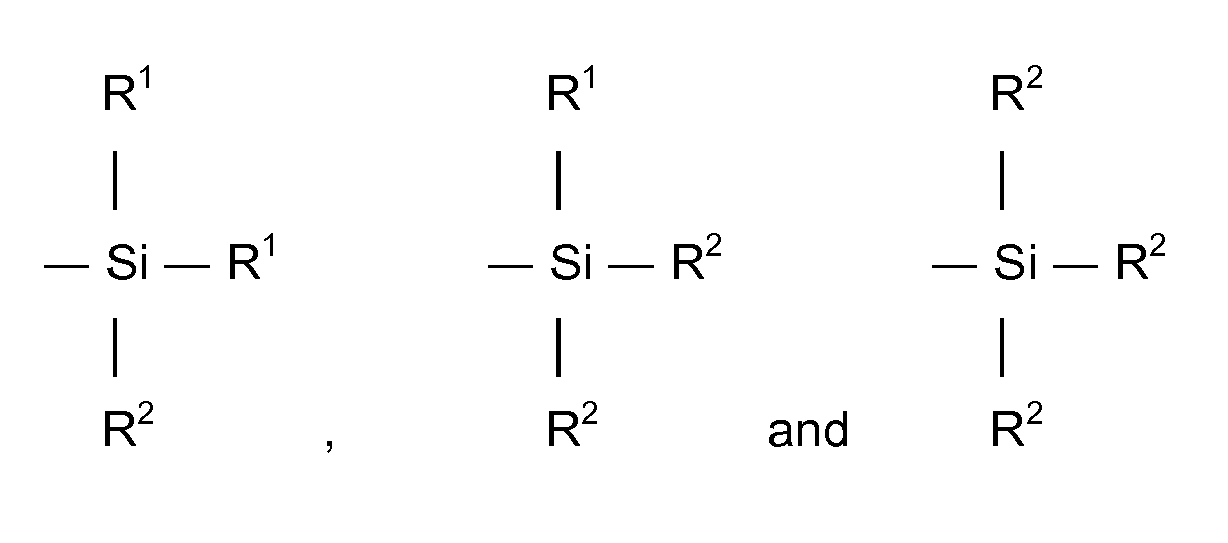
- In one embodiment, the sulfur containing organosilicon compounds are the 3,3'-bis(trimethoxy or triethoxy silylpropyl) polysulfides. In one embodiment, the sulfur containing organosilicon compounds are 3,3'-bis(triethoxysilylpropyl) disulfide and/or 3,3'-bis(triethoxysilylpropyl) tetrasulfide. Therefore, as to formula III, Z may be

- In another embodiment, suitable sulfur containing organosilicon compounds include compounds disclosed in
U.S. Patent No. 6,608,125 . In one embodiment, the sulfur containing organosilicon compounds includes 3-(octanoylthio)-1-propyltriethoxysilane, CH3(CH2)6C(=O) -S-CH2CH2CH2Si(OCH2CH3)3, which is available commercially as NXT™ from Momentive Performance Materials. - In another embodiment, suitable sulfur containing organosilicon compounds include those disclosed in
US-A- 2003/0130535 . In one embodiment, the sulfur containing organosilicon compound is Si-363 from Degussa. - The amount of the sulfur containing organosilicon compound in a rubber composition will vary depending on the level of other additives that are used. Generally speaking, the amount of the compound will range from 0.5 to 20 phr. In one embodiment, the amount will range from 1 to 10 phr.
- It is readily understood by those having skill in the art that the rubber composition would be compounded by methods generally known in the rubber compounding art, such as mixing the various sulfur-vulcanizable constituent rubbers with various commonly used additive materials such as, for example, sulfur donors, curing aids, such as activators and retarders and processing additives, such as oils, resins including tackifying resins and plasticizers, fillers, pigments, fatty acid, zinc oxide, waxes, antioxidants and antiozonants and peptizing agents. As known to those skilled in the art, depending on the intended use of the sulfur vulcanizable and sulfur-vulcanized material (rubbers), the additives mentioned above are selected and commonly used in conventional amounts. Representative examples of sulfur donors include elemental sulfur (free sulfur), an amine disulfide, polymeric polysulfide and sulfur olefin adducts. In one embodiment, the sulfur-vulcanizing agent is elemental sulfur. The sulfur-vulcanizing agent may be used in an amount ranging from 0.5 to 8 phr, alternatively with a range of from 1.5 to 6 phr. Typical amounts of tackifier resins, if used, comprise 0.5 to 10 phr. Typical amounts of processing aids comprise 1 to 50 phr. Typical amounts of antioxidants comprise 1 to 5 phr. Representative antioxidants may be, for example, diphenyl-p-phenylenediamine and others, such as, for example, those disclosed in The Vanderbilt Rubber Handbook (1978), Pages 344 through 346. Typical amounts of antiozonants comprise 1 to 5 phr. Typical amounts of fatty acids, if used, which can include stearic acid comprise 0.5 to 3 phr. Typical amounts of zinc oxide comprise 2 to 5 phr. Typical amounts of waxes comprise 1 to 5 phr. Typical amounts of peptizers comprise about 0.1 to 1 phr. Typical peptizers may be, for example, pentachlorothiophenol and dibenzamidodiphenyl disulfide.
- Accelerators are used to control the time and/or temperature required for vulcanization and to improve the properties of the vulcanizate. In one embodiment, a single accelerator system may be used, i.e., primary accelerator. The primary accelerator(s) may be used in total amounts ranging from 0.5 to 4. In another embodiment, combinations of a primary and a secondary accelerator might be used with the secondary accelerator being used in smaller amounts, such as from 0.05 to 3 phr, in order to activate and to improve the properties of the vulcanizate. In addition, delayed action accelerators may be used which are not affected by normal processing temperatures but produce a satisfactory cure at ordinary vulcanization temperatures. Vulcanization retarders might also be used. Suitable types of accelerators that may be used in the present invention are amines, disulfides, guanidines, thioureas, thiazoles, thiurams, sulfenamides, dithiocarbamates and xanthates. In one embodiment, the primary accelerator is a sulfenamide. If a second accelerator is used, the secondary accelerator may be a guanidine, dithiocarbamate or thiuram compound.
- The mixing of the rubber composition can be accomplished by methods known to those having skill in the rubber mixing art. For example, the ingredients are typically mixed in at least two stages, namely, at least one non-productive stage followed by a productive mix stage. The final curatives including sulfur-vulcanizing agents are typically mixed in the final stage which is conventionally called the "productive" mix stage in which the mixing typically occurs at a temperature, or ultimate temperature, lower than the mix temperature(s) than the preceding non-productive mix stage(s). The rubber composition may be subjected to a thermomechanical mixing step. The thermomechanical mixing step generally comprises a mechanical working in a mixer or extruder for a period of time suitable in order to produce a rubber temperature between 140°C and 190°C. The appropriate duration of the thermomechanical working varies as a function of the operating conditions, and the volume and nature of the components. For example, the thermomechanical working may be from 1 to 20 minutes.
- The rubber composition may be incorporated in a variety of rubber components of the tire. For example, the rubber component may be a tread (including tread cap and tread base), sidewall, apex, chafer, chipper, flipper, sidewall insert, wirecoat or innerliner. In one embodiment, the component is a apex, chipper, or flipper.
- The pneumatic tire of the present invention may be a race tire, passenger tire, aircraft tire, agricultural, earthmover, off-the-road, truck tire, and the like. In one embodiment, the tire is a passenger or truck tire. The tire may also be a radial or bias.
- Vulcanization of the pneumatic tire of the present invention is generally carried out at conventional temperatures ranging from 100°C to 200°C. Any of the usual vulcanization processes may be used such as heating in a press or mold, heating with superheated steam or hot air. Such tires can be built, shaped, molded and cured by various methods which are known and will be readily apparent to those having skill in such art.
Claims (10)
- A pneumatic tire comprising at least one component, the at least one component comprising a rubber composition, the rubber composition comprising a diene based elastomer and from 1 to 100 parts by weight, per 100 parts by weight of elastomer, of a polymer fiber having a thickness ranging from 10 to 200 nm.
- The pneumatic tire of claim 1, wherein the fiber comprises a polymer selected from polyvinyl alcohol, polyamides, polyaramides and polyesters.
- The pneumatic tire of claim 1 or 2, wherein the fiber is present in an amount ranging from 5 to 50 parts by weight per 100 parts by weight of diene based elastomer (phr).
- The pneumatic tire of claim 3, wherein the ofiber is present in an amount ranging 10 to 30 parts by weight per 100 parts by weight of diene based elastomer (phr).
- The pneumatic tire of at least one of the previous claims, wherein the component is selected from an apex, a flipper, and a chipper.
- The pneumatic tire of at least one of the previous claims, wherein the diene based elastomer is selected from the group consisting of natural rubber, synthetic polyisoprene, polybutadiene, and styrene-butadiene rubber.
- The pneumatic tire of at least one of the previous claims, wherein the fiber is an electrospun fiber.
- The pneumatic tire of at least one of the previous claims wherein the fiber has a length of from 0.5 to 20 microns.
- The tire of at least one of the previous claims wherein the fiber has a thickness as of from 20 to 100 nm.
- The tire of at least one of the previous claims wherein the fiber has a thickness as of from 20 nm to 100 nm.
Applications Claiming Priority (1)
| Application Number | Priority Date | Filing Date | Title |
|---|---|---|---|
| US1402507P | 2007-12-15 | 2007-12-15 |
Publications (1)
| Publication Number | Publication Date |
|---|---|
| EP2070728A1 true EP2070728A1 (en) | 2009-06-17 |
Family
ID=40566189
Family Applications (1)
| Application Number | Title | Priority Date | Filing Date |
|---|---|---|---|
| EP08170865A Withdrawn EP2070728A1 (en) | 2007-12-15 | 2008-12-05 | Tire with component containing polymeric nanofiber |
Country Status (5)
| Country | Link |
|---|---|
| US (1) | US20090156740A1 (en) |
| EP (1) | EP2070728A1 (en) |
| JP (1) | JP2009144157A (en) |
| CN (1) | CN101456980B (en) |
| AU (1) | AU2008255214A1 (en) |
Cited By (3)
| Publication number | Priority date | Publication date | Assignee | Title |
|---|---|---|---|---|
| WO2013087879A1 (en) * | 2011-12-16 | 2013-06-20 | Compagnie Generale Des Etablissements Michelin | Tyre having a tread comprising an impregnated felt |
| US9962996B2 (en) | 2011-12-16 | 2018-05-08 | Compagnie Generale Des Etablissements Michelin | Tread comprising tread pattern elements covered with an impregnated fibre assembly |
| US20210163721A1 (en) * | 2019-12-03 | 2021-06-03 | The Goodyear Tire & Rubber Company | Rubber composition and an article of manufacture comprising a rubber composition |
Families Citing this family (3)
| Publication number | Priority date | Publication date | Assignee | Title |
|---|---|---|---|---|
| CN103741230B (en) * | 2014-01-08 | 2015-12-30 | 青岛科技大学 | A kind of cross-linked rubber nano-fiber material and method for making thereof and purposes |
| CN105504406A (en) * | 2015-12-28 | 2016-04-20 | 张桂华 | Novel rubber and preparation method thereof |
| KR102111466B1 (en) * | 2018-10-24 | 2020-05-15 | 한국화학연구원 | aramid nanofibers reinforced thermoplastic elastomer nanocomposite and method for manufacturing the same |
Citations (21)
| Publication number | Priority date | Publication date | Assignee | Title |
|---|---|---|---|---|
| US5049610A (en) * | 1986-09-26 | 1991-09-17 | Ube Industries, Ltd. | Fiber-reinforced rubber composition and production process and use thereof |
| US5395891A (en) | 1992-06-24 | 1995-03-07 | Bayer Aktiengesellschaft | Rubber mixtures containing polybutadiene gel |
| US5672639A (en) | 1996-03-12 | 1997-09-30 | The Goodyear Tire & Rubber Company | Starch composite reinforced rubber composition and tire with at least one component thereof |
| US6127488A (en) | 1997-01-17 | 2000-10-03 | Bayer Ag | Rubber mixtures which contain SBR rubber gels |
| US6133364A (en) | 1998-08-01 | 2000-10-17 | Continental Aktiengesellschaft | Rubber composition, method of formulating the composition and vehicle tire made from the composition |
| US6207757B1 (en) | 1998-08-01 | 2001-03-27 | Continental Aktiengesellschaft | Rubber composition, method of adding and blending the composition and vehicle tire made from the composition |
| US6242534B1 (en) | 1998-08-01 | 2001-06-05 | Continental Aktiengesellschaft | Rubber composition, method of formulating and blending the same and article and tires made therefrom |
| US6255379B1 (en) * | 1999-09-16 | 2001-07-03 | The Goodyear Tire & Rubber Company | Rubber containing short fiber reinforcement with anchoring agent and articles, including tires, having a component thereof |
| US6372857B1 (en) | 1999-09-07 | 2002-04-16 | Bayer Aktiengesellschaft | Microgel-containing rubber mixtures with masked bi-functional mercaptans and vulcanization products produced therefrom |
| US6550508B1 (en) * | 1998-11-27 | 2003-04-22 | The Yokohama Rubber Co., Ltd. | Rubber composition for tire tread having high performance on ice and pneumatic tire using the same |
| US20030130535A1 (en) | 2001-08-06 | 2003-07-10 | Degussa Ag, | Organosilicon compounds |
| WO2003060002A1 (en) * | 2002-01-17 | 2003-07-24 | Kh Chemicals Co., Ltd. | Rubber composition comprising carbon nanotubes as reinforcing agent and preparation thereof |
| WO2003066353A1 (en) * | 2002-02-04 | 2003-08-14 | Bridgestone Corporation | Belt for a pneumatic tire belt made of differente rubber compositions |
| US6608125B2 (en) | 1997-08-21 | 2003-08-19 | Crompton Corporation | Blocked mercaptosilane coupling agents for filled rubbers |
| EP1454765A1 (en) * | 2003-03-07 | 2004-09-08 | The Goodyear Tire & Rubber Company | Tire with rubber component containing electrically conductive carbon black and fibrillated aramid fibers |
| US20050092414A1 (en) * | 2003-10-03 | 2005-05-05 | Regents Of The University Of California | Apparatus for friction enhancement of curved surfaces |
| WO2006108364A1 (en) | 2005-04-11 | 2006-10-19 | Elmarco, S.R.O | Textiles containing at least one layer of polymeric nanofibres and method of production of the layer of polymeric nanofibres from the polymer solution through electrostatic spinning |
| WO2006131081A1 (en) | 2005-06-07 | 2006-12-14 | Elmarco, S.R.O. | A method and device for production of nanofibres from the polymeric solution through electrostatic spinning |
| US20060290031A1 (en) | 2003-09-08 | 2006-12-28 | Oldrich Jirsak | Method of nanofibres production from a polymer solution using electrostatic spinning and a device for carrying out the method |
| WO2007024804A1 (en) * | 2005-08-22 | 2007-03-01 | Bridgestone/Firestone North American Tire, Llc | Pneumatic tires |
| WO2007054039A1 (en) | 2005-11-10 | 2007-05-18 | Elmarco, S.R.O. | A method and device for production of nanofibres through electrostatic spinning of solutions or melts of polymers |
Family Cites Families (26)
| Publication number | Priority date | Publication date | Assignee | Title |
|---|---|---|---|---|
| US4328133A (en) * | 1980-06-25 | 1982-05-04 | Bridgestone Tire Company Limited | Organic micro-fiber reinforced rubber compositions |
| JPS6124605A (en) * | 1984-07-16 | 1986-02-03 | Bridgestone Corp | High performance pneumatic tire |
| US5309971A (en) * | 1992-06-12 | 1994-05-10 | Michelin Recherche Et Technique S.A. | Tire flipper structure |
| JP2788715B2 (en) * | 1994-12-27 | 1998-08-20 | 住友ゴム工業株式会社 | Pneumatic tire |
| JPH11129711A (en) * | 1997-10-27 | 1999-05-18 | Yokohama Rubber Co Ltd:The | Pneumatic radial tire |
| JP3090444B2 (en) * | 1998-06-19 | 2000-09-18 | 住友ゴム工業株式会社 | Pneumatic tire |
| JP2000142038A (en) * | 1998-11-13 | 2000-05-23 | Bridgestone Corp | Pneumatic radial tire |
| JP4889851B2 (en) * | 2000-11-16 | 2012-03-07 | 株式会社ブリヂストン | Rubber composition for tire and tire |
| JP2002155164A (en) * | 2000-11-21 | 2002-05-28 | Bridgestone Corp | Rubber composition and pneumatic tire using the same |
| US6467520B2 (en) * | 2000-12-19 | 2002-10-22 | The Goodyear Tire & Rubber Company | Tire with apex rubber containing in-situ resin |
| JP2002206036A (en) * | 2001-01-10 | 2002-07-26 | Bridgestone Corp | Colored rubber composition and pneumatic tire using the same |
| US20040203304A1 (en) * | 2001-05-25 | 2004-10-14 | Celine Almonacil | Rubberized fabric and pneumatic tire comprising said rubberized fabric |
| EP1310385B1 (en) * | 2001-11-08 | 2006-03-29 | Sumitomo Rubber Industries Ltd. | Pneumatic radial tire |
| JP2004203128A (en) * | 2002-12-24 | 2004-07-22 | Sumitomo Rubber Ind Ltd | Pneumatic tire and method of manufacturing the same |
| ES2309365T3 (en) * | 2003-10-31 | 2008-12-16 | Pirelli Tyre S.P.A. | HIGH QUALITY TIRES FOR VEHICLES. |
| US7819155B2 (en) * | 2004-03-25 | 2010-10-26 | Sumitomo Rubber Industries, Ltd. | Rubber composition for tire and pneumatic tire using the same |
| US7441575B2 (en) * | 2005-10-05 | 2008-10-28 | The Goodyear Tire & Rubber Company | Tire with component having nanozeolite |
| JP2007239114A (en) * | 2006-03-06 | 2007-09-20 | Univ Of Fukui | Melt-type electrospinning method and ultrafine fiber |
| WO2007129580A1 (en) * | 2006-05-09 | 2007-11-15 | Sumitomo Rubber Industries, Ltd. | Run flat tire |
| US20090151840A1 (en) * | 2007-12-18 | 2009-06-18 | Annette Lechtenboehmer | Tire with component containing short fiber |
| US20100108218A1 (en) * | 2008-10-30 | 2010-05-06 | E. I. Du Pont De Nemours And Company | Extensible non-load bearing cut resistant tire side-wall component cotaining elastomeric filament, tire containing said component, and processes for making same |
| US8261796B2 (en) * | 2008-11-06 | 2012-09-11 | The Goodyear Tire & Rubber Company | Tire with component containing polybenzobisoxazole short fiber and epoxidized palm oil |
| US8127815B2 (en) * | 2008-11-06 | 2012-03-06 | The Goodyear Tire & Rubber Company | Tire with component containing polybenzobisoxazole short fiber and epoxidized polyisoprene |
| US20100116403A1 (en) * | 2008-11-07 | 2010-05-13 | Ralf Mruk | Tire with component containing polyketone short fiber and epoxidized polyisoprene |
| US7669626B1 (en) * | 2008-11-07 | 2010-03-02 | The Goodyear Tire & Rubber Company | Tire with component containing polyketone short fiber and polyethyleneimine |
| US20100116404A1 (en) * | 2008-11-11 | 2010-05-13 | Annette Lechtenboehmer | Tire with component containing polyketone short fiber and functionalized elastomer |
-
2008
- 2008-10-30 US US12/261,370 patent/US20090156740A1/en not_active Abandoned
- 2008-12-05 EP EP08170865A patent/EP2070728A1/en not_active Withdrawn
- 2008-12-09 AU AU2008255214A patent/AU2008255214A1/en not_active Abandoned
- 2008-12-15 CN CN200810184252.9A patent/CN101456980B/en not_active Expired - Fee Related
- 2008-12-15 JP JP2008318773A patent/JP2009144157A/en active Pending
Patent Citations (21)
| Publication number | Priority date | Publication date | Assignee | Title |
|---|---|---|---|---|
| US5049610A (en) * | 1986-09-26 | 1991-09-17 | Ube Industries, Ltd. | Fiber-reinforced rubber composition and production process and use thereof |
| US5395891A (en) | 1992-06-24 | 1995-03-07 | Bayer Aktiengesellschaft | Rubber mixtures containing polybutadiene gel |
| US5672639A (en) | 1996-03-12 | 1997-09-30 | The Goodyear Tire & Rubber Company | Starch composite reinforced rubber composition and tire with at least one component thereof |
| US6127488A (en) | 1997-01-17 | 2000-10-03 | Bayer Ag | Rubber mixtures which contain SBR rubber gels |
| US6608125B2 (en) | 1997-08-21 | 2003-08-19 | Crompton Corporation | Blocked mercaptosilane coupling agents for filled rubbers |
| US6133364A (en) | 1998-08-01 | 2000-10-17 | Continental Aktiengesellschaft | Rubber composition, method of formulating the composition and vehicle tire made from the composition |
| US6207757B1 (en) | 1998-08-01 | 2001-03-27 | Continental Aktiengesellschaft | Rubber composition, method of adding and blending the composition and vehicle tire made from the composition |
| US6242534B1 (en) | 1998-08-01 | 2001-06-05 | Continental Aktiengesellschaft | Rubber composition, method of formulating and blending the same and article and tires made therefrom |
| US6550508B1 (en) * | 1998-11-27 | 2003-04-22 | The Yokohama Rubber Co., Ltd. | Rubber composition for tire tread having high performance on ice and pneumatic tire using the same |
| US6372857B1 (en) | 1999-09-07 | 2002-04-16 | Bayer Aktiengesellschaft | Microgel-containing rubber mixtures with masked bi-functional mercaptans and vulcanization products produced therefrom |
| US6255379B1 (en) * | 1999-09-16 | 2001-07-03 | The Goodyear Tire & Rubber Company | Rubber containing short fiber reinforcement with anchoring agent and articles, including tires, having a component thereof |
| US20030130535A1 (en) | 2001-08-06 | 2003-07-10 | Degussa Ag, | Organosilicon compounds |
| WO2003060002A1 (en) * | 2002-01-17 | 2003-07-24 | Kh Chemicals Co., Ltd. | Rubber composition comprising carbon nanotubes as reinforcing agent and preparation thereof |
| WO2003066353A1 (en) * | 2002-02-04 | 2003-08-14 | Bridgestone Corporation | Belt for a pneumatic tire belt made of differente rubber compositions |
| EP1454765A1 (en) * | 2003-03-07 | 2004-09-08 | The Goodyear Tire & Rubber Company | Tire with rubber component containing electrically conductive carbon black and fibrillated aramid fibers |
| US20060290031A1 (en) | 2003-09-08 | 2006-12-28 | Oldrich Jirsak | Method of nanofibres production from a polymer solution using electrostatic spinning and a device for carrying out the method |
| US20050092414A1 (en) * | 2003-10-03 | 2005-05-05 | Regents Of The University Of California | Apparatus for friction enhancement of curved surfaces |
| WO2006108364A1 (en) | 2005-04-11 | 2006-10-19 | Elmarco, S.R.O | Textiles containing at least one layer of polymeric nanofibres and method of production of the layer of polymeric nanofibres from the polymer solution through electrostatic spinning |
| WO2006131081A1 (en) | 2005-06-07 | 2006-12-14 | Elmarco, S.R.O. | A method and device for production of nanofibres from the polymeric solution through electrostatic spinning |
| WO2007024804A1 (en) * | 2005-08-22 | 2007-03-01 | Bridgestone/Firestone North American Tire, Llc | Pneumatic tires |
| WO2007054039A1 (en) | 2005-11-10 | 2007-05-18 | Elmarco, S.R.O. | A method and device for production of nanofibres through electrostatic spinning of solutions or melts of polymers |
Non-Patent Citations (3)
| Title |
|---|
| "Standard Methods for Analysis & Testinq of Petroleum and Related Products and British Standard 2000 Parts", 2003, INSTITUTE OF PETROLEUM |
| "The Vanderbilt Rubber Handbook", 1978, pages: 344 - 346 |
| JOURNAL OF THE AMERICAN CHEMICAL SOCIETY, vol. 60, 1930, pages 304 |
Cited By (5)
| Publication number | Priority date | Publication date | Assignee | Title |
|---|---|---|---|---|
| WO2013087879A1 (en) * | 2011-12-16 | 2013-06-20 | Compagnie Generale Des Etablissements Michelin | Tyre having a tread comprising an impregnated felt |
| FR2984225A1 (en) * | 2011-12-16 | 2013-06-21 | Michelin Soc Tech | PNEUMATIC BANDAGE WITH A TREAD COMPRISING AN IMPREGNATED FELT |
| US9962996B2 (en) | 2011-12-16 | 2018-05-08 | Compagnie Generale Des Etablissements Michelin | Tread comprising tread pattern elements covered with an impregnated fibre assembly |
| US20210163721A1 (en) * | 2019-12-03 | 2021-06-03 | The Goodyear Tire & Rubber Company | Rubber composition and an article of manufacture comprising a rubber composition |
| US11905414B2 (en) * | 2019-12-03 | 2024-02-20 | The Goodyear Tire & Rubber Company | Rubber composition and an article of manufacture comprising a rubber composition |
Also Published As
| Publication number | Publication date |
|---|---|
| CN101456980A (en) | 2009-06-17 |
| AU2008255214A1 (en) | 2009-07-02 |
| CN101456980B (en) | 2013-08-28 |
| JP2009144157A (en) | 2009-07-02 |
| US20090156740A1 (en) | 2009-06-18 |
Similar Documents
| Publication | Publication Date | Title |
|---|---|---|
| EP2333008B1 (en) | Tire with component containing cellulose | |
| EP2072283B1 (en) | Tire with component containing aramid fibers | |
| US7625970B2 (en) | Tire with component containing cellulose | |
| EP2338697A1 (en) | Tire with a component containing carbon nanotubes | |
| US8701727B2 (en) | Truck drive tire | |
| US7897662B2 (en) | Tire with component containing cellulose | |
| EP2028021B1 (en) | Tire with component having combination plasticizer | |
| EP2353887A2 (en) | Pneumatic tire | |
| US8418737B2 (en) | Tire with component containing polybenzobisoxazole short fiber and epoxidized polyisoprene | |
| US8536264B2 (en) | Pneumatic tire and rubber composition containing twin polymerization structures | |
| US8261796B2 (en) | Tire with component containing polybenzobisoxazole short fiber and epoxidized palm oil | |
| US20090156740A1 (en) | Tire with component containing polymeric nanofiber | |
| US20100116404A1 (en) | Tire with component containing polyketone short fiber and functionalized elastomer | |
| US7669626B1 (en) | Tire with component containing polyketone short fiber and polyethyleneimine | |
| EP2030809B1 (en) | Tire with component containing asphaltene. | |
| EP2380757A2 (en) | Pneumatic tire with a tread comprising fibers | |
| US20110136938A1 (en) | Silica/elastomer composite, rubber composition and pneumatic tire | |
| EP2371895A1 (en) | Rubber composition and pneumatic tire with a rubber component containing alkylalkoxysilane and silicone resin | |
| EP2184184B1 (en) | Tire with component containing polyketone short fiber and epoxidized polyisoprene |
Legal Events
| Date | Code | Title | Description |
|---|---|---|---|
| PUAI | Public reference made under article 153(3) epc to a published international application that has entered the european phase |
Free format text: ORIGINAL CODE: 0009012 |
|
| AK | Designated contracting states |
Kind code of ref document: A1 Designated state(s): AT BE BG CH CY CZ DE DK EE ES FI FR GB GR HR HU IE IS IT LI LT LU LV MC MT NL NO PL PT RO SE SI SK TR |
|
| AX | Request for extension of the european patent |
Extension state: AL BA MK RS |
|
| AKX | Designation fees paid | ||
| REG | Reference to a national code |
Ref country code: DE Ref legal event code: 8566 |
|
| STAA | Information on the status of an ep patent application or granted ep patent |
Free format text: STATUS: THE APPLICATION IS DEEMED TO BE WITHDRAWN |
|
| 18D | Application deemed to be withdrawn |
Effective date: 20091218 |