EP2069415B1 - Process for preparing a curable silylated polyurethane resin - Google Patents
Process for preparing a curable silylated polyurethane resin Download PDFInfo
- Publication number
- EP2069415B1 EP2069415B1 EP07838574.7A EP07838574A EP2069415B1 EP 2069415 B1 EP2069415 B1 EP 2069415B1 EP 07838574 A EP07838574 A EP 07838574A EP 2069415 B1 EP2069415 B1 EP 2069415B1
- Authority
- EP
- European Patent Office
- Prior art keywords
- isocyanate
- viscosity
- polyurethane resin
- silylated polyurethane
- group
- Prior art date
- Legal status (The legal status is an assumption and is not a legal conclusion. Google has not performed a legal analysis and makes no representation as to the accuracy of the status listed.)
- Active
Links
Images


Classifications
-
- C—CHEMISTRY; METALLURGY
- C08—ORGANIC MACROMOLECULAR COMPOUNDS; THEIR PREPARATION OR CHEMICAL WORKING-UP; COMPOSITIONS BASED THEREON
- C08G—MACROMOLECULAR COMPOUNDS OBTAINED OTHERWISE THAN BY REACTIONS ONLY INVOLVING UNSATURATED CARBON-TO-CARBON BONDS
- C08G18/00—Polymeric products of isocyanates or isothiocyanates
- C08G18/06—Polymeric products of isocyanates or isothiocyanates with compounds having active hydrogen
- C08G18/08—Processes
- C08G18/089—Reaction retarding agents
-
- C—CHEMISTRY; METALLURGY
- C08—ORGANIC MACROMOLECULAR COMPOUNDS; THEIR PREPARATION OR CHEMICAL WORKING-UP; COMPOSITIONS BASED THEREON
- C08G—MACROMOLECULAR COMPOUNDS OBTAINED OTHERWISE THAN BY REACTIONS ONLY INVOLVING UNSATURATED CARBON-TO-CARBON BONDS
- C08G18/00—Polymeric products of isocyanates or isothiocyanates
- C08G18/06—Polymeric products of isocyanates or isothiocyanates with compounds having active hydrogen
- C08G18/08—Processes
- C08G18/10—Prepolymer processes involving reaction of isocyanates or isothiocyanates with compounds having active hydrogen in a first reaction step
-
- C—CHEMISTRY; METALLURGY
- C08—ORGANIC MACROMOLECULAR COMPOUNDS; THEIR PREPARATION OR CHEMICAL WORKING-UP; COMPOSITIONS BASED THEREON
- C08G—MACROMOLECULAR COMPOUNDS OBTAINED OTHERWISE THAN BY REACTIONS ONLY INVOLVING UNSATURATED CARBON-TO-CARBON BONDS
- C08G18/00—Polymeric products of isocyanates or isothiocyanates
- C08G18/06—Polymeric products of isocyanates or isothiocyanates with compounds having active hydrogen
- C08G18/28—Polymeric products of isocyanates or isothiocyanates with compounds having active hydrogen characterised by the compounds used containing active hydrogen
- C08G18/40—High-molecular-weight compounds
- C08G18/48—Polyethers
-
- C—CHEMISTRY; METALLURGY
- C08—ORGANIC MACROMOLECULAR COMPOUNDS; THEIR PREPARATION OR CHEMICAL WORKING-UP; COMPOSITIONS BASED THEREON
- C08G—MACROMOLECULAR COMPOUNDS OBTAINED OTHERWISE THAN BY REACTIONS ONLY INVOLVING UNSATURATED CARBON-TO-CARBON BONDS
- C08G18/00—Polymeric products of isocyanates or isothiocyanates
- C08G18/06—Polymeric products of isocyanates or isothiocyanates with compounds having active hydrogen
- C08G18/70—Polymeric products of isocyanates or isothiocyanates with compounds having active hydrogen characterised by the isocyanates or isothiocyanates used
-
- C—CHEMISTRY; METALLURGY
- C08—ORGANIC MACROMOLECULAR COMPOUNDS; THEIR PREPARATION OR CHEMICAL WORKING-UP; COMPOSITIONS BASED THEREON
- C08G—MACROMOLECULAR COMPOUNDS OBTAINED OTHERWISE THAN BY REACTIONS ONLY INVOLVING UNSATURATED CARBON-TO-CARBON BONDS
- C08G18/00—Polymeric products of isocyanates or isothiocyanates
- C08G18/06—Polymeric products of isocyanates or isothiocyanates with compounds having active hydrogen
- C08G18/70—Polymeric products of isocyanates or isothiocyanates with compounds having active hydrogen characterised by the isocyanates or isothiocyanates used
- C08G18/71—Monoisocyanates or monoisothiocyanates
-
- C—CHEMISTRY; METALLURGY
- C08—ORGANIC MACROMOLECULAR COMPOUNDS; THEIR PREPARATION OR CHEMICAL WORKING-UP; COMPOSITIONS BASED THEREON
- C08G—MACROMOLECULAR COMPOUNDS OBTAINED OTHERWISE THAN BY REACTIONS ONLY INVOLVING UNSATURATED CARBON-TO-CARBON BONDS
- C08G18/00—Polymeric products of isocyanates or isothiocyanates
- C08G18/06—Polymeric products of isocyanates or isothiocyanates with compounds having active hydrogen
- C08G18/70—Polymeric products of isocyanates or isothiocyanates with compounds having active hydrogen characterised by the isocyanates or isothiocyanates used
- C08G18/71—Monoisocyanates or monoisothiocyanates
- C08G18/718—Monoisocyanates or monoisothiocyanates containing silicon
Definitions
- the present invention relates to a process for the manufacture of silylated polyurethane resins with consistent viscosity and improved viscosity stability. More particularly, the present invention is directed to a process for the production of silylated polyurethane resins possessing consistent viscosity and stability that is free of unreacted residual isocyanate and the curable silylated polyurethane resin obtained by this process.
- Silylated polyurethane resins are useful as coatings, adhesives, sealants and industrial elastomeric goods and can be prepared from polyols and isocyanatosilanes.
- Silylated polyurethane resins can be prepared by known methods. One such method is disclosed by Johnston, U.S. Patent No. 5,990,257 , wherein the resin is prepared by the reaction of a polyol and a diisocyanate to form hydroxyl terminated prepolymer followed by the addition of an isocyanatosilane. Another suitable method for the preparation of silylated polyurethane resin is taught by Huang in published U.S. Patent Application, Serial No.
- silylated polyurethane resins typically there is a hydroxyl functional group for every isocyanate group so that at the completion of the reaction there should be no residual isocyanate.
- small amounts of isocyanate and hydroxyl groups remain when the manufacturing process is complete because the reactions proceed to completion very slowly due to the low levels of reactants.
- the small amount of residual isocyanate slowly reacts over time with the residual hydroxyl-terminated polymer resulting in an undesirable increase in product viscosity.
- the reaction mixture can be held under reaction conditions for a prolonged period of time, during which the viscosity may increase to an undesirable level and the viscosity may vary significantly from batch-to-batch.
- the viscosity may increase to an undesirable level and the viscosity may vary significantly from batch-to-batch.
- Resins free of isocyanates are desirable because isocyanates are toxic and present health risks, and because even small levels of residual isocyanate in the resin can cause viscosity instability, i.e. the viscosity of the resin can increase on storage after manufacture due to the slow reaction of the residual isocyanate. Efforts to "react out,” or remove all of the isocyanate can result in resins that have viscosity variability from batch-to-batch.
- the present invention discloses a process for preparing silylated polyurethane resins that are free of isocyanate. More particularly, the present invention is directed to a process for preparing a curable silylated polyurethane resin which comprises:
- R 1 is selected from the group consisting of methylene, ethylene, propylene, butylenes, isobutylene, 3-oxa-hexylene, dodecylene, phenylene, 1,4-bis-(methylene)benzene, 1,4-bis-(ethylene)benzene; or R 2 and R 3 are selected from the group consisting of methyl, ethyl, propyl, isopropyl, tert-butyl, hexyl, octyl, phenyl, 4-ethylphenyl, benzyl, and 2-phenylethyl.
- the mono-alcohol of part (vii) possesses the general formula: R 4 -OH wherein R 4 is a monovalent hydrocarbon radical containing from 1 to 30 carbon atoms, and optionally, contains a heteroatom.
- this hydrocarbon radical R 4 is selected from the group consisting of linear alkyl, branched alkyl, cyclic alkyl, alkenyl, aryl, arenyl, aralkyl and mixtures thereof.
- this alkyl hydrocarbon radical R 4 is selected from the group consisting of methyl, ethyl, propyl, isopropyl, butyl, pentyl, dodecyl, cyclohexyl, cyclopentyl, and 3-methylhexyl
- the alkenyl hydrocarbon radical is selected from the group consisting of vinyl, allyl, and methallyl
- the aryl hydrocarbon radical is phenyl
- the arenyl hydrocarbon radical is selected from the group consisting of 4-methylphenyl, 2,4-dimethylphenyl and 2,4,6-trimethylphenyl
- the aralkyl hydrocarbon radical is selected from the group consisting of benzyl and 2-phenylethyl.
- the monoalkanol is at least one member selected from the group consisting of methanol, ethanol, n-propanol, isopropanol, n-butanol, sec-butanol and tert-butanol.
- the present invention discloses a curable silylated polyurethane resin of reduced isocyanate content resulting from the process disclosed herein having consistent viscosity and improved viscosity stability.
- the silylated polyurethane resin of the present invention is especially useful for the manufacture of sealants, coatings, adhesives, gaskets, and the like.
- the present invention relates to a process for the manufacture of curable silylated polyurethane resin compositions that are substantially free of residual amounts of isocyanate.
- the process for preparing curable silylated polyurethane resin of the present invention is accomplished by reaction with an isocyanate-reactive scavenging agent.
- the curable silylated polyurethane resin of the present invention in general can be obtained by reacting a hydroxyl-terminated polymer with a suitable isocyanate-terminated silane, e.g., one possessing one to three alkoxy groups bonded to the silicon atom.
- a suitable isocyanate-terminated silane e.g., one possessing one to three alkoxy groups bonded to the silicon atom.
- the details of these reactions, and those for preparing the hydroxyl-terminated polymers employed therein can be found in, amongst others: U.S. Patent Nos. 3,786,081 and 4,481,367 (hydroxyl-terminated polymers); and, U.S. Patent Nos. 4,345,053 , 4,625,012 , 6,833,423 and published U.S. Patent Application 2002/0198352 (curable silylated polyurethane resin obtained from reaction of hydroxyl-terminated polyurethane prepolymer and isocyanatosi
- the curable silylated polyurethane resin of the present invention may be obtained by reacting isocyanatosilane directly with hydroxyl-terminated polyol.
- hydroxyl-terminated polyol is meant liquid polyols possessing at least two terminal hydroxyl groups and whose chain optionally includes two or more urethane linkages.
- the hydroxyl-terminated polyols employed in the process of this invention include polyether polyols, polyester polyols such as the hydroxyl-terminated polycaprolatones, polyetherester polyols such as those obtained from the reaction of polyether polyol with ⁇ -caprolactone, polyesterether polyols such as those obtained from the reaction of hydroxyl-terminated polycaprolactones with one or more alkylene oxides such as ethylene oxide and propylene oxide, hydroxyl-terminated polybutadienes and hydroxy-terminated polyurethane prepolymers derived therefrom, e.g., by the reaction of a slight excess of one or a mixture of said polyols with one or a mixture of polyisocyanates.
- polystyrene diols examples include the polyether diols, in particular, the poly(oxyethylene) diols, the poly(oxypropylene) diols and the poly(oxyethyleneoxypropylene) diols, polyoxyalkylene triols, polytetramethylene glycols, polyacetals, polyhydroxy polyacrylates, polyhydroxy polyester amides and polyhydroxy polythioethers, polycaprolactone diols and triols, and the like.
- the polyols used in the production of the silylated polyurethane resins are poly(oxyethylene) diols with number average molecular weights from about 500 to about 25,000 grams per mole (g/mol).
- the polyols used in the production of the silylated polyurethane resins are poly(oxypropylene) diols with number average molecular weights from about 1,000 to about 20,000 grams per mole. Mixtures of polyols of various structures, molecular weights and/or functionalities can also be used.
- the polyether polyols can have specifically functionality up to about 8 hydroxyl groups per polymer chain and more specifically have a functionality of from about 2 to 4 hydroxyl groups per polymer chain and most specifically, a functionality of 2 hydroxyl groups per polymer chain (i.e., diols).
- Especially suitable are the polyether polyols prepared in the presence of double-metal cyanide (DMC) catalysts, an alkaline metal hydroxide catalyst, or an alkaline metal alkoxide catalyst; see, for example, U.S. Pat. Nos.
- DMC double-metal cyanide
- Polyether polyols produced in the presence of double-metal cyanide catalysts tend to have high molecular weights and low levels of unsaturation, properties of which, it is believed, are responsible for the improved performance.
- the polyether polyols specifically have a number average molecular weight of from about 1,000 to about 25,000 grams per mole, more specifically from about 2,000 to about 20,000 grams per mole, and even more specifically from about 4,000 to about 18,000 grams per mole. In one embodiment of the invention, the polyether polyols have an end group unsaturation level of no greater than about 0.04 milliequivalents per gram of polyol. In another embodiment of the invention, the polyether polyol has an end group unsaturation of no greater than about 0.02 milliequivalents per gram of polyol.
- these polyols can be prepared by the reaction of the same or different hydroxyl-terminated polymers with a di- or polyisocyanate to increase the molecular weight of the polyols.
- the ratio of hydroxyl groups to isocyanate groups is specifically from about 1.01 to about 3 and more specifically from about 1.05 to about 1.50.
- Polyols prepared by the reaction of hydroxyl-terminated polymers with di- or polyisocyanates may contain residual isocyanate, either from partially reacted di- or polyisocyanate, or from unreacted di- or polyisocyanate.
- the molecular weight of the polyols can be increased by reacting them and low molecular weight glycols, triols or higher functionality alcohols, di- or polyamines, polysiloxanes containing pendent and/or terminal hydroxyl or amino groups with di- or polyisocyanates.
- Examples of commercially available polyols include the Arcol® polyol family and the Acclaim® polyol family of polyether polyol products which are used in a variety of urethane applications, such as, for example, adhesives, sealants, elastomers, molded foams and flexible foams.
- the Arcol® product line includes diol, triol and polymer polyols possessing number average molecular weights that vary from less than 300 to as much as 6,000 grams per mole.
- TheAcclaim® polyol family of polyether polyol products which are also used in a variety of polyurethane and other applications, such as, for example, cast elastomers, adhesives and sealants, epoxy flexibilizers, defoamers, lubricants, crude oil de-emulsifiers and plasticizers.
- the Acclaim® polyols contain extremely low levels of unsaturation.
- the Acclaim® product line includes diol, triol and polymer polyols possessing number average molecular weights that vary from as low as 700 to as much as 12,000 grams per mole.
- the polyisocyanate can be diphenylmethane diisocyanate ("MDI"), polymeric diphenylmethane diisocyanate (“pMDI”), paraphenylene diisocyanate, naphthalene diisocyanate, liquid carbodiimide-modified MDI and derivatives thereof, isophorone diisocyanate, dicyclohexylmethane-4,4'-diisocyanate, toluene diisocyanate (“TDI”), particularly the 2,6-TDI isomer, as well as various other aliphatic and aromatic polyisocyanates that are well-established in the art, and combinations thereof.
- MDI diphenylmethane diisocyanate
- pMDI polymeric diphenylmethane diisocyanate
- paraphenylene diisocyanate paraphenylene diisocyanate
- naphthalene diisocyanate liquid carbodiimide-modified MDI and derivatives thereof
- the diisocyanate is at least one member selected from the group consisting of hexamethylene diisocyanate, phenylene diisocyanate, toluene diisocyanate, 4,4'-diphenylmethane diisocyanate and various isomers thereof, isophorone diisocyanate, dicyclohexylmethane diisocyanate, cyclohexane diisocyanate and 1,3-bis-(isocyanatomethyl) cyclohexane.
- a catalyst will ordinarily be used in the preparation of the hydroxyl-terminated polyurethane prepolymers. These catalysts are employed to increase the reaction rates of the hydroxyl-terminated polymers with the di- or polyisocyanatosilanes. Suitable catalysts include the dialkyltin dicarboxylates such as dibutyltin dilaurate and dibutyltin acetate, tertiary amines, the stannous salts of carboxylic acids, such as stannous octoate and stannous acetate, and the like. In one embodiment of the present invention, dibutyltin dilaurate catalyst is used in the production of the PUR prepolymer.
- Other useful catalysts include zirconium complex KAT XC6212, K-KAT XC-A209 available from King Industries, Inc., aluminum chelate TYZER® types available from DuPont Company, and KR types available from Kenrich Petrochemical, Inc., and other compounds of metals, such as Bi, Zr, Zn, Co, Ni, and Fe, and the like.
- the curable silylated polyurethane resin can, as previously indicated, be prepared by reacting a hydroxyl-terminated polymer with an isocyanatosilane.
- silylation reactants for the hydroxyl-terminated polymers are those containing isocyanate groups and readily hydrolyzable functionality, e.g., 1 to 3 alkoxy groups bonded to the silicon.
- Suitable silylating reactants are the isocyanatosilanes of the general formula: OCN-R 1 -Si(R 2 ) y (OR 3 ) 3-y (1) wherein R 1 is a divalent hydrocarbon radical containing from about 1 to about 12 carbon atoms, optionally containing one or more heteroatoms; each occurrence of R 2 is independently the same or different monovalent hydrocarbon radical of from about 1 to about 8 carbon atoms; each occurrence of R 3 is independently the same or different monovalent hydrocarbon radical group of up to 6 carbon atoms and y is 0, 1 or 2.
- R 1 are alkylene groups, such as methylene, ethylene, propylene, butylenes, isobutylene, 3-oxa-hexylene, and dodecylene; arylene groups, such as phenylene; aralkylene groups, such as 1,4-bis-(methylene)benzene, and 1,4-bis-(ethylene)benzene.
- R 2 and R 3 are alkyl, such as methyl, ethyl, propyl, isopropyl, tert-butyl, hexyl, and octyl; aryl, such as phenyl, 4-ethylphenyl; aralkyl, such as benzyl, and 2-phenylethyl.
- isocyanatosilanes that can be used herein to react with the foregoing hydroxyl-terminated polymers to provide silylated polyurethane resins include 3-isocyanatopropyltrimethoxysilane, 2-isocyanatoisopropyltrimethoxysilane, 4-isocyanato-n-butyltrimethoxysilane, 2-isocyanato-1,1-dimethylethyltrimethoxysilane, 1-isocyanatomethyltrimethoxysilane, 3-isocyanatopropyltriethoxysilane, 2-isocyanato-2-methylethyltriethoxysilane, 4-isocyanatobutyltriethoxysilane, 2-isocyanato-1,1-dimethylethyltriethoxysilane, 1-isocyanatomethyltriethoxysilane, 3-isocyanatopropylmethyldimethoxysilane, 3
- the curable silylated polyurethane resins of the present invention can be obtained from one or more polyols, advantageously, diols, reacting directly with isocyanatosilane without the initial formation of a polyurethane prepolymer.
- the materials, i.e., polyols and silanes (e.g., one possessing both hydrolyzable and isocyanato functionality), useful for this approach to producing silylated polyurethane resin are described above.
- suitable polyols include, hydroxyl-terminated polyols having specifically a number average molecular weight from about 100 to 25,000 grams/mole and more specifically from about 200 to about 20,000 grams per mole and most specifically from about 4,000 to about 18,000 grams per mole.
- Suitable isocyanatosilanes used to react with the foregoing polyols to provide silylated polyurethane resins are described above.
- curable silylated polyurethane resin examples include, e.g., isocyanatosilane added to a reaction mixture of polyol and diisocyanate before all of the diisocyanate has been reacted.
- isocyanatosilane added to a reaction mixture of polyol and diisocyanate before all of the diisocyanate has been reacted.
- any functionally terminated polyurethane prepolymer that can be silylated for purposes of preparing silylated polyurethane resin.
- Resins prepared by these and other methods may contain small amounts of residual isocyanate, whether inadvertently or by design. Removal of these residual amounts of isocyanate can be accomplished by reaction with an isocyanate-reactive scavenging agent more fully described herein below.
- the urethane prepolymer synthesis and subsequent silylation reaction, as well as the direct reaction of polyol and isocyanatosilane are conducted under anhydrous conditions and preferably under an inert atmosphere, such as a blanket of nitrogen, to prevent premature hydrolysis of the alkoxysilane groups.
- Typical temperature range for both reaction steps is specifically from about 0° to about 200° C, and more specifically from about 60° to about 90° C.
- the total reaction time for the synthesis of the silylated polyurethane is between 4 and 20 hours, though synthesis can take longer depending on the chosen conditions.
- the isocyanatosilane is at least one member selected from the group consisting of 3-isocyanatopropyltrimethoxysilane, 3-isocyanatopropyltriethoxysilane, 1-isocyanatomethytrimethoxysilane, and 1-isocyanatomethylmethyldimethoxysilane.
- the isocyanate-reactive scavenging agent of the present invention is an agent possessing at least one active hydrogen. Moreover, the isocyanate-reactive scavenging agent of the present invention is one that reacts with isocyanate at a rate greater than that of the undesired reaction that causes an increase in viscosity.
- the undesirable reactions include, for example, the further reaction of isocyanate with hydroxyl-terminated polymers (if there is still hydroxyl present); reaction of isocyanate with urethane to form allophanate; reaction of isocyanate with urea to form biuret; and reaction of the hydroxyl-terminated polymers with the alkoxysilyl group.
- the isocyanate-reactive scavenging agent can be added to the reaction mixture of isocyanatosilane, hydroxyl-terminated polymer and optionally other ingredients, such as catalysts and non-protic solvents, at a desired point near the end of the silylation reaction. It is understood that for di- or polyisocyanate-extended polyols the hydroxyl-terminated polymer may contain residual isocyanate, either from partially reacted di- or polyisocyanate, or from unreacted di- or polyisocyanate.
- the residual isocyanate present in the silylated polyurethane resin can come from the di- or polyisocyanate used to chain extend the polyol, or from the isocyanatosilane used to react with the hydroxyl-terminated polymer.
- the desired point for the addition of the isocyanate-reactive agent is determined by the viscosity of the reaction mixture.
- the isocyanate-reactive scavenging agent is added to the reaction mixture at a particular viscosity depending on formulation and the desired properties of the final product.
- the isocyanate-reactive scavenging agent is added to the reaction mixture at a viscosity range from 1,000 cP to 150,000 cP (measured at a temperature of 25 °C), and in another embodiment of the invention from about 30,000 cP to about 75,000 cP (measured at a temperature of 25 °C). In this manner, the isocyanate-reactive scavenging agent minimizes batch-to-batch variation of the final viscosity of the silylated polyurethane resin.
- the viscosity is measured at 25°C on a Brookfield RVDV-II + cone and plate viscometer and aging is achieved in an oven at 50°C for 28 days.
- the isocyanate-reactive scavenging agent is allowed to react with the isocyanate-containing reaction mixture for sufficient time to ensure that all of the residual isocyanate has reacted.
- the isocyanate-reactive scavenging agent can be added in a stoichiometric amount relative to the residual isocyanate, but it is preferable to add an excess of the isocyanate-reactive scavenging agent to ensure that all of the residual isocyanate is reacted and to inhibit the reaction of the residual hydroxyl groups of the hydroxyl-terminated polymer with the alkoxysilyl groups.
- the amount of isocyanate-reactive scavenging agent added to the isocyanate-containing reaction mixture is from about 0.01 to about 5 weight percent based upon the total weight of the silylated polyurethane resin, and from about 0.01 to about 0.5 weight percent based upon the total weight of the silylated polyurethane resin in another embodiment of the invention, and in still another embodiment from about 0.02 to about 0.2 weight percent based upon the total weight of the silylated polyurethane resin.
- the silylated polyurethane resin of reduced isocyanate content contains less than 0.02 weight percent isocyanate (measured as %NCO).
- the isocyanate-reactive scavenging agent can be added neat, or as a mixture with other materials.
- the disappearance of the isocyanate can be determined directly by analytical techniques such as infra-red spectroscopy and titration, or indirectly by the measurement of constant viscosity of the reaction mixture.
- the synthesis can be monitored using titration, or infrared analysis. Silylation of the urethane prepolymers is considered complete when no residual -NCO can be detected by either technique.
- the isocyanate-scavenging agent is a mono-alcohol or a mixture of different mono-alcohols.
- Mono-alcohols are used because they have low odor, do not contribute to the color of the silylated polyurethane resin and inhibit the reaction of residual hydroxyl-terminated polymer with the alkoxysilyl group.
- Other active hydrogen compounds such as amines and organic acids, have strong odor, can form color and can catalyze the reaction of the residual hydroxyl-terminated polymer with alkoxysilyl group.
- the selected isocyanate-reactive scavenging agent is one that has little or no effect on the physical or cure properties of the resin, or on the properties of an adhesive, coating or sealant made from the resins disclosed herein.
- the monoalkanol isocyanate-reactive scavenging agent possesses the general formula: R 4 -OH (2) in which R 4 is a monovalent hydrocarbon radical containing from about 1 to about 30 carbon atoms and optionally may contain a heteroatom.
- the heteroatom can, for example, be oxygen, which can form organofunctional groups, such as ethers, ester, and ketone groups.
- the hydrocarbon radical is selected from the group consisting of linear, branched and cyclic alkyl, and alkenyl, aryl, arenyl and aralkyl.
- alkyl such as methyl, ethyl, propyl, isopropyl, butyl, pentyl, dodecyl, cyclohexyl, cyclopentyl, and 3-methylhexyl
- alkenyl such as vinyl, allyl and methallyl
- aryl such as phenyl
- arenyl such as 4-methylphenyl, 2,4-dimethylphenyl and 2,4,6-trimethylphenyl
- aralkyl such as benzyl and 2-phenylethyl.
- the mono-alcohols have the hydroxyl group attached to a primary carbon.
- a primary carbon is one in which at least two hydrogen atoms are attached to the carbon, -CH 2 OH.
- the mono-alcohol scavenging agents of the present invention are more reactive with the isocyanate group because they are less sterically hindered.
- useful mono-alcohols as isocyanate-reactive scavenging agents include methanol, ethanol, n-propanol, isopropanol, n-butanol, sec-butanol, tert-butanol, hexanol, cyclohexanol and the like, and mixtures thereof.
- the specific isocyanate-reactive scavenging agent when the terminal alkoxysilyl group of the silylated polyurethane resin is a methoxysilyl the specific isocyanate-reactive scavenging agent is methanol. In another specific embodiment of the invention, when the terminal terminal alkoxysilyl group of the silylated polyurethane resin is an ethoxysilyl, the specific isocyanate-reactive scavenging agent is ethanol.
- the silylated polyurethane resin of reduced isocyanate content resulting from the process disclosed herein, following aging has specifically a viscosity of about 1,000 cP to about 150,000 cP, more specifically from about 30,000 cP to about 75,000 cP and most specifically from about 35,000 cP to about 65,000 cP.
- Catalysts typically used in the preparation of the above mentioned hydroxyl-terminated polyurethane prepolymers can also be used to catalyze the reaction of the isocyanatosilane with the hydroxyl-terminated polymer and include metal and nonmetal catalysts.
- metal portion of the metal condensation catalysts useful in the present invention include tin, titanium, zirconium, lead, iron cobalt, antimony, manganese, bismuth and zinc compounds.
- catalysts used for making polyurethane prepolymer include chelates of various metals such as those which can be obtained from acetylacetone, benzoylacetone, trifluoroacetylacetone, ethyl acetoacetate, salicylaldehyde, cyclopentanone-2-carboxylate, acetylacetoneimine, bis-acetylaceone-alkylenediimines, salicylaldehydeimine, and the like, with the various metals such as Al, Be, Mg, Zn, Cd, Pb, Ti, Zr, Sn, As, Bi, Cr, Mo, Mn, Fe, Co, Ni, and metal oxide ions as MoO 2 ++, UO 2 ++, and the like; alcoholates and phenolates of various metals such as Ti(OR) 4 , Sn(OR) 4 , Sn(OR) 2 , Al(OR) 3 , Bi(OR)
- organotin compounds that are dialkyltin salts of carboxylic acids can include the non-limiting examples of dibutyltin diacetate, dibutyltin dilaurate, dibutyltin maleate, dilauryltin diacetate, dioctyltin diacetate, dibutyltin-bis(4-methylaminobenzoate), dibutyltindilaurylmercaptide, dibutyltin-bis(6-methylaminocaproate), and the like, and combinations thereof.
- trialkyltin hydroxide dialkyltin oxide, dialkyltin dialkoxide, or dialkyltin dichloride and combinations thereof.
- these compounds include trimethyltin hydroxide, tributyltin hydroxide, trioctyltin hydroxide, dibutyltin oxide, dioctyltin oxide, dilauryltin oxide, dibutyltinbis(isopropoxide), dibutyltin-bis(2-dimethylaminopentylate), dibutyltin dichloride, dioctyltin dichloride, and the like, and combinations thereof.
- the catalyst is a metal catalyst.
- the metal catalyst is selected from the group consisting of tin compounds, and in yet another aspect of the invention, the metal catalyst is dibutyltin dilaurate.
- Still another aspect of the invention is directed to curable silylated polyurethane resin composition
- curable silylated polyurethane resin composition comprising at least one curable silylated polyurethane resin made from the process of the invention and at least one additional ingredient selected from the group consisting of plasticizers, resins, defoamers, UV stabilizers, viscosity controllers, thixotropic agents, cure catalysts, fragrances, dyes, fillers, preservative, antioxidants, carbon black, titanium oxide, clays, surface treated silicas and mixtures thereof.
- plasticizers plasticizers, resins, defoamers, UV stabilizers, viscosity controllers, thixotropic agents, cure catalysts, fragrances, dyes, fillers, preservative, antioxidants, carbon black, titanium oxide, clays, surface treated silicas and mixtures thereof.
- Antioxidants that may be added to the polymers to provide protection against oxidative changes.
- the quantities in which such additives are used vary within wide limits, i.e. from 0.01 to 100% by weight and, more particularly, from 0.01 to 30% by weight, based on the silylated polyurethane resin.
- the curable silylated polyurethane resin composition made from silylated polyurethane resin by the process of the invention can be used as adhesives, sealants, coatings, gaskets, industrial rubber goods, and the like.
- the silylated resin compositions of the present invention are combined with fillers and additives known in the prior art for use in elastomeric compositions. By the addition of such materials, physical properties such as viscosity, flow rate, sag, and the like can be modified.
- the silylated polyurethane resin with residual isocyanate groups was made by a batch process. Into a 22 L reactor were charged Acclaim® 12200N polyol (Bayer, OH# 10.2 mgKOH/g, 14600 g) and Irganox® 1135 (Ciba, 73 g). The mixture was sparged with nitrogen at 85 °C for 16 hours.
- the silylated polyurethane resin with residual isocyanate groups was made by a batch process. Into a 22 L reactor were charged Acclaim® 12200N polyol (Bayer, OH# 10.2 mgKOH/g, 14600 g) and Irganox® 1135 (Ciba, 73 g). The mixture was sparged with nitrogen at 85 °C for 16 hours.
- the reaction was continued until the reaction mixture reached viscosity 55,000 cP and isocyanate concentration 0.06%, when vinyltrimethoxysilane (General Electric Advanced Materials, Silquest A-171®, 302.2 g) was added. Ten minutes after the addition of the vinyltrimethoxysilane the viscosity was 40,000 cP, at which point the reaction temperature set point was lowered to 80 °C. After a further period of 170 minutes the viscosity was 59,000 cP and then the reaction temperature set point was lowered to 50 °C. After another 853 minutes the viscosity of the reaction mixture was 78,000 cP and the isocyanate concentration was 0.00%. The reaction was considered complete and the product was drained from the reactor.
- vinyltrimethoxysilane General Electric Advanced Materials, Silquest A-171®, 302.2 g
- the silylated polyurethane resin with isocyanate-reactive scavenging agent was made by a batch process. Into a 22 L reactor were charged Acclaim® 12200N polyol (Bayer, OH# 10.2 mgKOH/g, 14600 g) and Irganox® 1135 (Ciba, 73 g). The mixture was sparged with nitrogen at 85 °C for 16 hours.
- reaction was continued until the reaction mixture reached viscosity 52,000 cP and isocyanate concentration 0.07%, when methanol (9.21 g, 0.06 wt%, stoichiometric equivalent of 0.08% NCO) was added. After a further 37 minutes the reaction temperature set point was lowered to 80 °C, then after another 81 minutes the viscosity was 49,000 cP and the isocyanate concentration was 0.04%, and vinyltrimethoxysilane (General Electric Advanced Materials, Silquest A-171®, 302.2 g) was added. Twenty-three minutes after the addition of the vinyltrimethoxysilane the viscosity was 42,000 cP, at which point the reaction temperature set point was lowered to 50 °C.
- the silylated polyurethane resin with isocyanate-reactive scavenging agent was made by a batch process. Into a 22 L reactor were charged Acclaim® 12200N polyol (Bayer, OH# 10.2 mgKOH/g, 14600 g) and Irganox® 1135 (Ciba, 73 g). The mixture was sparged with nitrogen at 85 °C for 16 hours.
- reaction was continued until the reaction mixture reached viscosity 47,000 cP and isocyanate concentration 0.06%, when methanol (18.4 g, 0.12 wt%, stoichiometric equivalent of 0.16% NCO) was added and the reaction temperature set point was lowered to 80 °C. After another 136 minutes the viscosity was 48,000 cP and the isocyanate concentration was 0.01%, and vinyltrimethoxysilane (GE Silicones, Silquest A-171®, 302.2 g) was added after a further 46 minutes. Twenty-nine minutes after the addition of the vinyltrimethoxysilane the viscosity was 38,000 cP, at which point the reaction temperature set point was lowered to 50 °C.
- methanol 18.4 g, 0.12 wt%, stoichiometric equivalent of 0.16% NCO
- the silylated polyurethane resin with isocyanate-reactive scavenging agent was made by a batch process. Into a 22 L reactor were charged Acclaim® 12200N polyol (Bayer, OH# 10.2 mgKOH/g, 14600 g) and Irganox® 1135 (Ciba, 73 g). The mixture was sparged with nitrogen at 85 °C for 16 hours.
- reaction was continued until the reaction mixture reached viscosity 57,000 cP and isocyanate concentration 0.05%, when a mixture of methanol (18.4 g, 0.12 wt%, stoichiometric equivalent of 0.16% NCO) and vinyltrimethoxysilane (General Electric Advanced Materials, Silquest A-171®, 302.2 g) was added and the reaction temperature set point was lowered to 80 °C. After another 25 minutes the viscosity was 44,000 cP and the isocyanate concentration was 0.02%. The reaction mixture was held at 80 °C for a further 269 minutes and then the reaction temperature set point was lowered to 50 °C. After another 975 minutes the viscosity of the reaction mixture was 45,000 cP and the isocyanate concentration was 0.00%. The reaction was considered complete and the product was drained from the reactor.
- the silylated polyurethane resin with isocyanate-reactive scavenging agent was made by a batch process. Into a 1 L reactor were charged Acclaim® 12200 polyol (Bayer, OH# 9.3 mgKOH/g, 500 g) and Irganox® 1135 (Ciba, 2.5 g). The mixture was sparged with nitrogen at 80 °C for 16 hours.
- the mixture was reacted until the viscosity was 54,000 cP and the isocyanate concentration was 0.06%, at which point vinyltrimethoxysilane (General Electric Advanced Materials, Silquest A-171®, 10.0 g) was added and the reactor was cooled to room temperature. By the time the reaction was cooled to room temperature the viscosity was 59,000 cP and the isocyanate concentration was 0.04%, when the reaction was considered complete and the product was drained from the reactor. A peak for NCO was detected in the IR spectrum of the product.
- the silylated polyurethane resin with isocyanate-reactive scavenging agent was made by a batch process. Into a 1 L reactor were charged Acclaim® 12200 polyol (Bayer, OH# 9.3 mgKOH/g, 500 g) and Irganox® 1135 (Ciba, 2.5 g). The mixture was sparged with nitrogen at 80 °C for 16 hours.
- the mixture was reacted until the viscosity was 63,000 cP and the isocyanate concentration was 0.06%, at which point a mixture of methanol (0.60 g) and vinyltrimethoxysilane (General Electric Advanced Materials, Silquest A-171®, 9.94 g) was added. After two hours at 80 °C the reaction was cooled to room temperature when the viscosity was 59,000 cP and the isocyanate concentration was 0.01%. The reaction was considered complete and the product was drained from the reactor. No peak for NCO was detected in the IR spectrum of the product.
- the silylated polyurethane resin with residual isocyanate groups in ethyl acetate was made by a batch process.
- Poly bd® R-20LM (Sartomer, 16 kg), Krasol®LBH-P2000 (Sartomer, 35 kg), Krasol®LBH-P5000 (Sartomer, 71 kg), ethyl acetate (189 kg), dimethyltin di-neodecanoate (General Electric Advanced Materials, Fomrez® Catalyst UL-28, 100 g of a 10 wt% solution in ethyl acetate) and isophorone diisocyanate (Bayer, Desmodur® I, 9 kg).
- the silylated polyurethane resin with isocyanate-reactive scavenging agent was made by a batch process.
- An aliquot (220 g) of the silylated polyurethane resin in ethyl acetate produced in Comparative Example 8 (viscosity 7800 cP, isocyanate content 0.02%) and methanol (0.13 g) were heated at 75 °C for 2 hours in a 500 mL glass reactor equipped with a mechanical agitator and condenser. After heating the product had viscosity 7900 cP and isocyanate content 0.00%. It can be seen that methanol reacts with residual isocyanate in this silylated polyurethane resin giving a product that is more stable to viscosity build than the resin in Comparative Example 8.
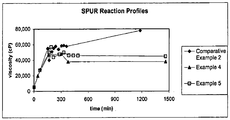
- the viscosity stability of a silylated polyurethane resin during manufacture is demonstrated graphically in Figure 1 .
- the viscosity profile of Comparative Example 2 (prepared without the use of an isocyanate-reactive scavenging agent) shows continued viscosity build, whereas the viscosity profiles of Examples 4 and 5 (prepared with the use of an isocyanate-reactive scavenging agent) show stable viscosity after addition of methanol, whether added by itself, or when mixed with A-171.
- FIG. 3 The storage stability of silylated resins prepared using diphenylmethane diisocyanate is shown in Figure 3 .
- Samples of the resins of Comparative Example 6 and Example 7 were stored in an oven at 80 °C and the viscosity of the samples was measured periodically.
- the viscosity of the sample of Comparative Example 6 (prepared without the use of an isocyanate-reactive scavenging agent) continued to increase on storage, whereas the viscosity of the sample of Example 7 (prepared with the use of an isocyanate-reactive scavenging agent) was more stable over the same period of time.
Landscapes
- Chemical & Material Sciences (AREA)
- Health & Medical Sciences (AREA)
- Chemical Kinetics & Catalysis (AREA)
- Medicinal Chemistry (AREA)
- Polymers & Plastics (AREA)
- Organic Chemistry (AREA)
- Polyurethanes Or Polyureas (AREA)
Description
- The present invention relates to a process for the manufacture of silylated polyurethane resins with consistent viscosity and improved viscosity stability. More particularly, the present invention is directed to a process for the production of silylated polyurethane resins possessing consistent viscosity and stability that is free of unreacted residual isocyanate and the curable silylated polyurethane resin obtained by this process.
- Silylated polyurethane resins are useful as coatings, adhesives, sealants and industrial elastomeric goods and can be prepared from polyols and isocyanatosilanes. Silylated polyurethane resins can be prepared by known methods. One such method is disclosed by
Johnston, U.S. Patent No. 5,990,257 , wherein the resin is prepared by the reaction of a polyol and a diisocyanate to form hydroxyl terminated prepolymer followed by the addition of an isocyanatosilane. Another suitable method for the preparation of silylated polyurethane resin is taught byHuang in published U.S. Patent Application, Serial No. 11/260598 , by which the isocyanatosilane may be added to the reaction mixture of polyol and diisocyanate before all of the diisocyanate has been reacted. Resins prepared by these and other methods may contain small amounts of residual isocyanate, whether inadvertently or by design.
DocumentWO 2007 / 025667 A discloses a method for the preparation of silylated polymers in which the silyl group is connected to the polymer through an allophate group; i.e. the process and the resulting products differ from the one of the current invention.
DocumentsWO 2007 / 025668 A ,US 2003 / 0232950 A andEP 0931800 A each disclose a process for preparing a curable silylated polyurethane resins. These processes have some similarities with the one of the current invention, but, among other differences to the current invention, do not use a mono-alcohol or a mixture of mono-alcohols as scavenging agent. - When preparing silylated polyurethane resins, typically there is a hydroxyl functional group for every isocyanate group so that at the completion of the reaction there should be no residual isocyanate. In reality small amounts of isocyanate and hydroxyl groups remain when the manufacturing process is complete because the reactions proceed to completion very slowly due to the low levels of reactants. Thus, the small amount of residual isocyanate slowly reacts over time with the residual hydroxyl-terminated polymer resulting in an undesirable increase in product viscosity. Alternatively, to ensure that all of the isocyanate has reacted the reaction mixture can be held under reaction conditions for a prolonged period of time, during which the viscosity may increase to an undesirable level and the viscosity may vary significantly from batch-to-batch. During the production of silylated polyurethane resins it is difficult to ensure that all of the isocyanate has reacted with the hydroxyl-terminated polymer.
- Resins free of isocyanates are desirable because isocyanates are toxic and present health risks, and because even small levels of residual isocyanate in the resin can cause viscosity instability, i.e. the viscosity of the resin can increase on storage after manufacture due to the slow reaction of the residual isocyanate. Efforts to "react out," or remove all of the isocyanate can result in resins that have viscosity variability from batch-to-batch.
- There remains a need in the industry for a process to manufacture silylated polyurethane resin that is free of residual isocyanate and provides consistent viscosity and viscosity stability.
-
-
Figure 1 is a graphical representation of the viscosity stability of silylated polyurethane resins of Comparative Example 2 and Examples 4 and 5. -
Figure 2 is a graphical representation of the viscosity stability of silylated polyurethane resins of Comparative Example 1 and Examples 3, 4 and 5. -
Figure 3 is a graphical representation of the storage stability of silylated polyurethane resins of Comparative Example 6 and Example 7. - The present invention discloses a process for preparing silylated polyurethane resins that are free of isocyanate. More particularly, the present invention is directed to a process for preparing a curable silylated polyurethane resin which comprises:
- a) silylating hydroxyl-terminated polyol polymer, which is a di- or polyisocyanate-extended polyols which contains partially reacted di- or polyisocyanate, with isocyanatosilane under anhydrous conditions to provide a silylated polyurethane containing residual isocyanate; and,
- b) at the desired point near the end of the silylation reaction, which is determined by viscosity of the reaction mixture being in the range of 1,000 mPa•s (1,000 cP) to 150,000 mPa•s (150,000 cP), scavenging isocyanate present in the silylated polyurethane of step (a) with an excess of at least one isocyanate-reactive scavenging agent which is a mono-alcohol or a mixture of different mono-alcohols to provide a silylated polyurethane resin which contains less than 0.02 weight percent isocyanate,
- According to one aspect of the process of the current invention, one of the following (i)-(ix) is fulfilled:
- (i) the silylated polyurethane resin which contains less than 0.02 weight percent isocyanate resulting from step (b) and having a viscosity in the range of 1,000 mPa•s (1,000 cP) to 150,000 mPa•s (150,000 cP) possesses following aging a viscosity which is 10 percent less than that of the isocyanate-containing silylated polyurethane resin resulting from step (a) following the same conditions of aging, wherein the viscosity is measured at 25°C on a Brookfield RVDV-II + cone and plate viscometer and aging is achieved in an oven at 50°C for 28 days; or
- (ii) the silylated polyurethane resin resulting from step (b) which contains less than 0.02 weight percent isocyanate and having a viscosity in the range of 1,000 mPa•s (1,000 cP) to 150,000 mPa•s (150,000 cP) possesses following aging a viscosity which is 60 percent less than that of the isocyanate-containing silylated polyurethane resin resulting from step (a) following the same conditions of aging, wherein the viscosity is measured at 25°C on a Brookfield RVDV-II + cone and plate viscometer and aging is achieved in an oven at 50°C for 28 days; or
- (iii) the polyol is at least one selected from the group consisting of polyether polyols, polyester polyols, polyetherester polyols, polyesterether, and hydroxyl-terminated polybutadiene; or
- (iv) the polyol is a poly(oxyethylene) diol with a number average molecular weights from 500 to 25,000 grams per mole; or
- (v) the isocyanatosilanes possesses the general formula:
OCN-R1-Si(R2)y(OR3)3-y
wherein R1 is a divalent hydrocarbon radical containing from 1 to 12 carbon atoms, optionally containing one or more heteroatoms, each R2 is the same or different monovalent hydrocarbon radical of from 1 to 8 carbon atoms, each R3 is the same or different monovalent hydrocarbon radical alkyl group of up to 6 carbon atoms and y is 0, 1 or 2; or - (vi) the isocyanatosilane is selected from the group consisting of 3-isocyanatopropyltrimethoxysilane, 2-isocyanatoisopropyltrimethoxysilane, 4-isocyanato-n-butyltrimethoxysilane, 2-isocyanato-1,1-dimethylethyltrimethoxysilane, 1-isocyanatomethyltrimethoxysilane, 3 -isocyanatopropyltriethoxysilane, 2-isocyanato-2-methylethyltriethoxysilane, 4-isocyanatobutyltriethoxysilane, 2-isocyanato-1,1-dimethylethyltriethoxysilane, 1-isocyanatomethyltriethoxysilane, 3-isocyanatopropylmethyldimethoxysilane, 3 -isocyanatopropyldimethylmethoxysilane, 3-isocyanatopropylphenylmethylmethoxysilane, 1-isocyanatomethylmethyldimethoxysilane, 3-isocyanatopropylethyldiethoxysilane, 3-isocyanatopropylmethyldiethoxysilane, 1-isocyanatomethylmethyldiethoxysilane, and mixtures thereof; or
- (vii) the isocyanate-reactive scavenging agent is a mono-alcohol; or
- (viii) the isocyanate-reactive scavenging agent is methanol when the polyurethane prepolymer is silylated with methoxysilane.
- (ix) the isocyanate-reactive scavenging agent is ethanol when the polyurethane prepolymer is silylated with ethoxysilane; or
- According to one aspect of the process of the current invention described above, in part (v) R1 is selected from the group consisting of methylene, ethylene, propylene, butylenes, isobutylene, 3-oxa-hexylene, dodecylene, phenylene, 1,4-bis-(methylene)benzene, 1,4-bis-(ethylene)benzene; or R2 and R3 are selected from the group consisting of methyl, ethyl, propyl, isopropyl, tert-butyl, hexyl, octyl, phenyl, 4-ethylphenyl, benzyl, and 2-phenylethyl.
- According to one aspect of the process of the current invention described above, the mono-alcohol of part (vii) possesses the general formula:
R4-OH
wherein R4 is a monovalent hydrocarbon radical containing from 1 to 30 carbon atoms, and optionally, contains a heteroatom. - Preferably, this hydrocarbon radical R4 is selected from the group consisting of linear alkyl, branched alkyl, cyclic alkyl, alkenyl, aryl, arenyl, aralkyl and mixtures thereof.
- More preferably, this alkyl hydrocarbon radical R4 is selected from the group consisting of methyl, ethyl, propyl, isopropyl, butyl, pentyl, dodecyl, cyclohexyl, cyclopentyl, and 3-methylhexyl, and the alkenyl hydrocarbon radical is selected from the group consisting of vinyl, allyl, and methallyl, and the aryl hydrocarbon radical is phenyl, and the arenyl hydrocarbon radical is selected from the group consisting of 4-methylphenyl, 2,4-dimethylphenyl and 2,4,6-trimethylphenyl, and the aralkyl hydrocarbon radical is selected from the group consisting of benzyl and 2-phenylethyl.
- Even more preferably, the monoalkanol is at least one member selected from the group consisting of methanol, ethanol, n-propanol, isopropanol, n-butanol, sec-butanol and tert-butanol.
- According to another aspect of the current invention a curable silylated polyurethane resin obtained by the process described above is provided.
- Furthermore, the present invention discloses a curable silylated polyurethane resin of reduced isocyanate content resulting from the process disclosed herein having consistent viscosity and improved viscosity stability. The silylated polyurethane resin of the present invention is especially useful for the manufacture of sealants, coatings, adhesives, gaskets, and the like.
- The present invention relates to a process for the manufacture of curable silylated polyurethane resin compositions that are substantially free of residual amounts of isocyanate. The process for preparing curable silylated polyurethane resin of the present invention is accomplished by reaction with an isocyanate-reactive scavenging agent.
- The curable silylated polyurethane resin of the present invention, in general can be obtained by reacting a hydroxyl-terminated polymer with a suitable isocyanate-terminated silane, e.g., one possessing one to three alkoxy groups bonded to the silicon atom. The details of these reactions, and those for preparing the hydroxyl-terminated polymers employed therein can be found in, amongst others:
U.S. Patent Nos. 3,786,081 and4,481,367 (hydroxyl-terminated polymers); and,U.S. Patent Nos. 4,345,053 ,4,625,012 ,6,833,423 and publishedU.S. Patent Application 2002/0198352 (curable silylated polyurethane resin obtained from reaction of hydroxyl-terminated polyurethane prepolymer and isocyanatosilane). - The curable silylated polyurethane resin of the present invention may be obtained by reacting isocyanatosilane directly with hydroxyl-terminated polyol. By the expression "hydroxyl-terminated polyol" is meant liquid polyols possessing at least two terminal hydroxyl groups and whose chain optionally includes two or more urethane linkages. Thus, the hydroxyl-terminated polyols employed in the process of this invention include polyether polyols, polyester polyols such as the hydroxyl-terminated polycaprolatones, polyetherester polyols such as those obtained from the reaction of polyether polyol with ε-caprolactone, polyesterether polyols such as those obtained from the reaction of hydroxyl-terminated polycaprolactones with one or more alkylene oxides such as ethylene oxide and propylene oxide, hydroxyl-terminated polybutadienes and hydroxy-terminated polyurethane prepolymers derived therefrom, e.g., by the reaction of a slight excess of one or a mixture of said polyols with one or a mixture of polyisocyanates.
- Specific suitable polyols include the polyether diols, in particular, the poly(oxyethylene) diols, the poly(oxypropylene) diols and the poly(oxyethyleneoxypropylene) diols, polyoxyalkylene triols, polytetramethylene glycols, polyacetals, polyhydroxy polyacrylates, polyhydroxy polyester amides and polyhydroxy polythioethers, polycaprolactone diols and triols, and the like. In one embodiment of the present invention, the polyols used in the production of the silylated polyurethane resins are poly(oxyethylene) diols with number average molecular weights from about 500 to about 25,000 grams per mole (g/mol). In another embodiment of the present invention, the polyols used in the production of the silylated polyurethane resins are poly(oxypropylene) diols with number average molecular weights from about 1,000 to about 20,000 grams per mole. Mixtures of polyols of various structures, molecular weights and/or functionalities can also be used.
- The polyether polyols can have specifically functionality up to about 8 hydroxyl groups per polymer chain and more specifically have a functionality of from about 2 to 4 hydroxyl groups per polymer chain and most specifically, a functionality of 2 hydroxyl groups per polymer chain (i.e., diols). Especially suitable are the polyether polyols prepared in the presence of double-metal cyanide (DMC) catalysts, an alkaline metal hydroxide catalyst, or an alkaline metal alkoxide catalyst; see, for example,
U.S. Pat. Nos. 3,829,505 ;3,941,849 ;4,242,490 ;4,335,188 ;4,687,851 ;4,985,491 ;5,096,993 ;5,100,997 ;5,106,874 ;5,116,931 ;5,136,010 ;5,185,420 ; and5,266,681 . Polyether polyols produced in the presence of double-metal cyanide catalysts tend to have high molecular weights and low levels of unsaturation, properties of which, it is believed, are responsible for the improved performance. The polyether polyols specifically have a number average molecular weight of from about 1,000 to about 25,000 grams per mole, more specifically from about 2,000 to about 20,000 grams per mole, and even more specifically from about 4,000 to about 18,000 grams per mole. In one embodiment of the invention, the polyether polyols have an end group unsaturation level of no greater than about 0.04 milliequivalents per gram of polyol. In another embodiment of the invention, the polyether polyol has an end group unsaturation of no greater than about 0.02 milliequivalents per gram of polyol. In yet another embodiment of the invention, these polyols can be prepared by the reaction of the same or different hydroxyl-terminated polymers with a di- or polyisocyanate to increase the molecular weight of the polyols. The ratio of hydroxyl groups to isocyanate groups is specifically from about 1.01 to about 3 and more specifically from about 1.05 to about 1.50. Polyols prepared by the reaction of hydroxyl-terminated polymers with di- or polyisocyanates may contain residual isocyanate, either from partially reacted di- or polyisocyanate, or from unreacted di- or polyisocyanate. In still another embodiment, the molecular weight of the polyols can be increased by reacting them and low molecular weight glycols, triols or higher functionality alcohols, di- or polyamines, polysiloxanes containing pendent and/or terminal hydroxyl or amino groups with di- or polyisocyanates. - Examples of commercially available polyols include the Arcol® polyol family and the Acclaim® polyol family of polyether polyol products which are used in a variety of urethane applications, such as, for example, adhesives, sealants, elastomers, molded foams and flexible foams. The Arcol® product line includes diol, triol and polymer polyols possessing number average molecular weights that vary from less than 300 to as much as 6,000 grams per mole. TheAcclaim® polyol family of polyether polyol products which are also used in a variety of polyurethane and other applications, such as, for example, cast elastomers, adhesives and sealants, epoxy flexibilizers, defoamers, lubricants, crude oil de-emulsifiers and plasticizers. The Acclaim® polyols contain extremely low levels of unsaturation. The Acclaim® product line includes diol, triol and polymer polyols possessing number average molecular weights that vary from as low as 700 to as much as 12,000 grams per mole.
- Any of numerous polyisocyanates, advantageously, diisocyanates, and mixtures thereof, can be used to provide the hydroxyl-terminated polyurethane prepolymers. In one embodiment, the polyisocyanate can be diphenylmethane diisocyanate ("MDI"), polymeric diphenylmethane diisocyanate ("pMDI"), paraphenylene diisocyanate, naphthalene diisocyanate, liquid carbodiimide-modified MDI and derivatives thereof, isophorone diisocyanate, dicyclohexylmethane-4,4'-diisocyanate, toluene diisocyanate ("TDI"), particularly the 2,6-TDI isomer, as well as various other aliphatic and aromatic polyisocyanates that are well-established in the art, and combinations thereof. In one embodiment of the invention the diisocyanate is at least one member selected from the group consisting of hexamethylene diisocyanate, phenylene diisocyanate, toluene diisocyanate, 4,4'-diphenylmethane diisocyanate and various isomers thereof, isophorone diisocyanate, dicyclohexylmethane diisocyanate, cyclohexane diisocyanate and 1,3-bis-(isocyanatomethyl) cyclohexane.
- A catalyst will ordinarily be used in the preparation of the hydroxyl-terminated polyurethane prepolymers. These catalysts are employed to increase the reaction rates of the hydroxyl-terminated polymers with the di- or polyisocyanatosilanes. Suitable catalysts include the dialkyltin dicarboxylates such as dibutyltin dilaurate and dibutyltin acetate, tertiary amines, the stannous salts of carboxylic acids, such as stannous octoate and stannous acetate, and the like. In one embodiment of the present invention, dibutyltin dilaurate catalyst is used in the production of the PUR prepolymer. Other useful catalysts include zirconium complex KAT XC6212, K-KAT XC-A209 available from King Industries, Inc., aluminum chelate TYZER® types available from DuPont Company, and KR types available from Kenrich Petrochemical, Inc., and other compounds of metals, such as Bi, Zr, Zn, Co, Ni, and Fe, and the like.
- The curable silylated polyurethane resin can, as previously indicated, be prepared by reacting a hydroxyl-terminated polymer with an isocyanatosilane.
- Useful silylation reactants for the hydroxyl-terminated polymers are those containing isocyanate groups and readily hydrolyzable functionality, e.g., 1 to 3 alkoxy groups bonded to the silicon. Suitable silylating reactants are the isocyanatosilanes of the general formula:
OCN-R1-Si(R2)y(OR3)3-y (1)
wherein R1 is a divalent hydrocarbon radical containing from about 1 to about 12 carbon atoms, optionally containing one or more heteroatoms; each occurrence of R2 is independently the same or different monovalent hydrocarbon radical of from about 1 to about 8 carbon atoms; each occurrence of R3 is independently the same or different monovalent hydrocarbon radical group of up to 6 carbon atoms and y is 0, 1 or 2. - Representative non-limiting examples of R1 are alkylene groups, such as methylene, ethylene, propylene, butylenes, isobutylene, 3-oxa-hexylene, and dodecylene; arylene groups, such as phenylene; aralkylene groups, such as 1,4-bis-(methylene)benzene, and 1,4-bis-(ethylene)benzene.
- Representative non-limiting examples of R2 and R3 are alkyl, such as methyl, ethyl, propyl, isopropyl, tert-butyl, hexyl, and octyl; aryl, such as phenyl, 4-ethylphenyl; aralkyl, such as benzyl, and 2-phenylethyl.
- Specific isocyanatosilanes that can be used herein to react with the foregoing hydroxyl-terminated polymers to provide silylated polyurethane resins include 3-isocyanatopropyltrimethoxysilane, 2-isocyanatoisopropyltrimethoxysilane, 4-isocyanato-n-butyltrimethoxysilane, 2-isocyanato-1,1-dimethylethyltrimethoxysilane, 1-isocyanatomethyltrimethoxysilane, 3-isocyanatopropyltriethoxysilane, 2-isocyanato-2-methylethyltriethoxysilane, 4-isocyanatobutyltriethoxysilane, 2-isocyanato-1,1-dimethylethyltriethoxysilane, 1-isocyanatomethyltriethoxysilane, 3-isocyanatopropylmethyldimethoxysilane, 3 -isocyanatopropyldimethylmethoxysilane, 3-isocyanatopropylphenylmethylmethoxysilane, 1-isocyanatomethylmethyldimethoxysilane, 3 -isocyanatopropylethyldiethoxysilane, 3-isocyanatopropylmethyldiethoxysilane, 1-isocyanatomethylmethyldiethoxysilane, and the like.
- The curable silylated polyurethane resins of the present invention can be obtained from one or more polyols, advantageously, diols, reacting directly with isocyanatosilane without the initial formation of a polyurethane prepolymer. The materials, i.e., polyols and silanes (e.g., one possessing both hydrolyzable and isocyanato functionality), useful for this approach to producing silylated polyurethane resin are described above. As such, suitable polyols include, hydroxyl-terminated polyols having specifically a number average molecular weight from about 100 to 25,000 grams/mole and more specifically from about 200 to about 20,000 grams per mole and most specifically from about 4,000 to about 18,000 grams per mole. However, mixtures of polyols of various structures, molecular weights and/or functionalities can also be used. Suitable isocyanatosilanes used to react with the foregoing polyols to provide silylated polyurethane resins are described above.
- Other suitable methods for the preparation of curable silylated polyurethane resin are contemplated herein and include, e.g., isocyanatosilane added to a reaction mixture of polyol and diisocyanate before all of the diisocyanate has been reacted. As well as any functionally terminated polyurethane prepolymer that can be silylated for purposes of preparing silylated polyurethane resin. Resins prepared by these and other methods may contain small amounts of residual isocyanate, whether inadvertently or by design. Removal of these residual amounts of isocyanate can be accomplished by reaction with an isocyanate-reactive scavenging agent more fully described herein below.
- The urethane prepolymer synthesis and subsequent silylation reaction, as well as the direct reaction of polyol and isocyanatosilane are conducted under anhydrous conditions and preferably under an inert atmosphere, such as a blanket of nitrogen, to prevent premature hydrolysis of the alkoxysilane groups. Typical temperature range for both reaction steps, is specifically from about 0° to about 200° C, and more specifically from about 60° to about 90° C. Typically, the total reaction time for the synthesis of the silylated polyurethane is between 4 and 20 hours, though synthesis can take longer depending on the chosen conditions.
- According to one embodiment of the invention, the isocyanatosilane is at least one member selected from the group consisting of 3-isocyanatopropyltrimethoxysilane, 3-isocyanatopropyltriethoxysilane, 1-isocyanatomethytrimethoxysilane, and 1-isocyanatomethylmethyldimethoxysilane.
- The isocyanate-reactive scavenging agent of the present invention is an agent possessing at least one active hydrogen. Moreover, the isocyanate-reactive scavenging agent of the present invention is one that reacts with isocyanate at a rate greater than that of the undesired reaction that causes an increase in viscosity. The undesirable reactions include, for example, the further reaction of isocyanate with hydroxyl-terminated polymers (if there is still hydroxyl present); reaction of isocyanate with urethane to form allophanate; reaction of isocyanate with urea to form biuret; and reaction of the hydroxyl-terminated polymers with the alkoxysilyl group.
- The isocyanate-reactive scavenging agent can be added to the reaction mixture of isocyanatosilane, hydroxyl-terminated polymer and optionally other ingredients, such as catalysts and non-protic solvents, at a desired point near the end of the silylation reaction. It is understood that for di- or polyisocyanate-extended polyols the hydroxyl-terminated polymer may contain residual isocyanate, either from partially reacted di- or polyisocyanate, or from unreacted di- or polyisocyanate. The residual isocyanate present in the silylated polyurethane resin can come from the di- or polyisocyanate used to chain extend the polyol, or from the isocyanatosilane used to react with the hydroxyl-terminated polymer. The desired point for the addition of the isocyanate-reactive agent is determined by the viscosity of the reaction mixture. Thus, the isocyanate-reactive scavenging agent is added to the reaction mixture at a particular viscosity depending on formulation and the desired properties of the final product. The isocyanate-reactive scavenging agent is added to the reaction mixture at a viscosity range from 1,000 cP to 150,000 cP (measured at a temperature of 25 °C), and in another embodiment of the invention from about 30,000 cP to about 75,000 cP (measured at a temperature of 25 °C). In this manner, the isocyanate-reactive scavenging agent minimizes batch-to-batch variation of the final viscosity of the silylated polyurethane resin. The viscosity is measured at 25°C on a Brookfield RVDV-II + cone and plate viscometer and aging is achieved in an oven at 50°C for 28 days.
- The isocyanate-reactive scavenging agent is allowed to react with the isocyanate-containing reaction mixture for sufficient time to ensure that all of the residual isocyanate has reacted. The isocyanate-reactive scavenging agent can be added in a stoichiometric amount relative to the residual isocyanate, but it is preferable to add an excess of the isocyanate-reactive scavenging agent to ensure that all of the residual isocyanate is reacted and to inhibit the reaction of the residual hydroxyl groups of the hydroxyl-terminated polymer with the alkoxysilyl groups. In one embodiment of the invention, the amount of isocyanate-reactive scavenging agent added to the isocyanate-containing reaction mixture is from about 0.01 to about 5 weight percent based upon the total weight of the silylated polyurethane resin, and from about 0.01 to about 0.5 weight percent based upon the total weight of the silylated polyurethane resin in another embodiment of the invention, and in still another embodiment from about 0.02 to about 0.2 weight percent based upon the total weight of the silylated polyurethane resin.
- According the invention, the silylated polyurethane resin of reduced isocyanate content contains less than 0.02 weight percent isocyanate (measured as %NCO).
- The isocyanate-reactive scavenging agent can be added neat, or as a mixture with other materials. The disappearance of the isocyanate can be determined directly by analytical techniques such as infra-red spectroscopy and titration, or indirectly by the measurement of constant viscosity of the reaction mixture. The synthesis can be monitored using titration, or infrared analysis. Silylation of the urethane prepolymers is considered complete when no residual -NCO can be detected by either technique.
- The isocyanate-scavenging agent is a mono-alcohol or a mixture of different mono-alcohols.
- Mono-alcohols are used because they have low odor, do not contribute to the color of the silylated polyurethane resin and inhibit the reaction of residual hydroxyl-terminated polymer with the alkoxysilyl group. Other active hydrogen compounds, such as amines and organic acids, have strong odor, can form color and can catalyze the reaction of the residual hydroxyl-terminated polymer with alkoxysilyl group.
- In one embodiment of the invention, the selected isocyanate-reactive scavenging agent is one that has little or no effect on the physical or cure properties of the resin, or on the properties of an adhesive, coating or sealant made from the resins disclosed herein.
- The monoalkanol isocyanate-reactive scavenging agent possesses the general formula:
R4-OH (2)
in which R4 is a monovalent hydrocarbon radical containing from about 1 to about 30 carbon atoms and optionally may contain a heteroatom. The heteroatom can, for example, be oxygen, which can form organofunctional groups, such as ethers, ester, and ketone groups. In another embodiment, the hydrocarbon radical is selected from the group consisting of linear, branched and cyclic alkyl, and alkenyl, aryl, arenyl and aralkyl. - Representative non-limiting examples include alkyl, such as methyl, ethyl, propyl, isopropyl, butyl, pentyl, dodecyl, cyclohexyl, cyclopentyl, and 3-methylhexyl; alkenyl, such as vinyl, allyl and methallyl; aryl, such as phenyl; arenyl, such as 4-methylphenyl, 2,4-dimethylphenyl and 2,4,6-trimethylphenyl; and aralkyl, such as benzyl and 2-phenylethyl.
- In another embodiment of the invention, the mono-alcohols have the hydroxyl group attached to a primary carbon. A primary carbon is one in which at least two hydrogen atoms are attached to the carbon, -CH2OH. The mono-alcohol scavenging agents of the present invention are more reactive with the isocyanate group because they are less sterically hindered.
- According to one embodiment of the invention, useful mono-alcohols as isocyanate-reactive scavenging agents include methanol, ethanol, n-propanol, isopropanol, n-butanol, sec-butanol, tert-butanol, hexanol, cyclohexanol and the like, and mixtures thereof.
- In a specific embodiment of the invention, when the terminal alkoxysilyl group of the silylated polyurethane resin is a methoxysilyl the specific isocyanate-reactive scavenging agent is methanol. In another specific embodiment of the invention, when the terminal terminal alkoxysilyl group of the silylated polyurethane resin is an ethoxysilyl, the specific isocyanate-reactive scavenging agent is ethanol.
- In one embodiment of the invention, the silylated polyurethane resin of reduced isocyanate content resulting from the process disclosed herein, following aging, has specifically a viscosity of about 1,000 cP to about 150,000 cP, more specifically from about 30,000 cP to about 75,000 cP and most specifically from about 35,000 cP to about 65,000 cP.
- Catalysts typically used in the preparation of the above mentioned hydroxyl-terminated polyurethane prepolymers can also be used to catalyze the reaction of the isocyanatosilane with the hydroxyl-terminated polymer and include metal and nonmetal catalysts. Examples of the metal portion of the metal condensation catalysts useful in the present invention include tin, titanium, zirconium, lead, iron cobalt, antimony, manganese, bismuth and zinc compounds. Other suitable non-limiting examples of catalysts used for making polyurethane prepolymer are well known in the art and include chelates of various metals such as those which can be obtained from acetylacetone, benzoylacetone, trifluoroacetylacetone, ethyl acetoacetate, salicylaldehyde, cyclopentanone-2-carboxylate, acetylacetoneimine, bis-acetylaceone-alkylenediimines, salicylaldehydeimine, and the like, with the various metals such as Al, Be, Mg, Zn, Cd, Pb, Ti, Zr, Sn, As, Bi, Cr, Mo, Mn, Fe, Co, Ni, and metal oxide ions as MoO2 ++, UO2 ++, and the like; alcoholates and phenolates of various metals such as Ti(OR)4, Sn(OR)4, Sn(OR)2, Al(OR)3, Bi(OR)3 and the like, wherein R is alkyl or aryl of from 1 to about 18 carbon atoms, and reaction products of alcoholates of various metals with carboxylic acids, beta-diketones, and 2-(N,N-dialkylamino) alkanols, such as well known chelates of titanium obtained by this or equivalent procedures. Further catalysts include organometallic derivatives of tetravalent tin, trivalent and pentavalent As, Sb, and Bi, and metal carbonyls of iron and cobalt; and combinations thereof. In one specific embodiment organotin compounds that are dialkyltin salts of carboxylic acids, can include the non-limiting examples of dibutyltin diacetate, dibutyltin dilaurate, dibutyltin maleate, dilauryltin diacetate, dioctyltin diacetate, dibutyltin-bis(4-methylaminobenzoate), dibutyltindilaurylmercaptide, dibutyltin-bis(6-methylaminocaproate), and the like, and combinations thereof. Similarly, in another specific embodiment there may be used trialkyltin hydroxide, dialkyltin oxide, dialkyltin dialkoxide, or dialkyltin dichloride and combinations thereof. Non-limiting examples of these compounds include trimethyltin hydroxide, tributyltin hydroxide, trioctyltin hydroxide, dibutyltin oxide, dioctyltin oxide, dilauryltin oxide, dibutyltinbis(isopropoxide), dibutyltin-bis(2-dimethylaminopentylate), dibutyltin dichloride, dioctyltin dichloride, and the like, and combinations thereof.
- In one aspect of the present invention, the catalyst is a metal catalyst. In another aspect of the present invention, the metal catalyst is selected from the group consisting of tin compounds, and in yet another aspect of the invention, the metal catalyst is dibutyltin dilaurate.
- Still another aspect of the invention is directed to curable silylated polyurethane resin composition comprising at least one curable silylated polyurethane resin made from the process of the invention and at least one additional ingredient selected from the group consisting of plasticizers, resins, defoamers, UV stabilizers, viscosity controllers, thixotropic agents, cure catalysts, fragrances, dyes, fillers, preservative, antioxidants, carbon black, titanium oxide, clays, surface treated silicas and mixtures thereof. This list, however, is not comprehensive and is given merely as illustrative.
- Antioxidants that may be added to the polymers to provide protection against oxidative changes. The quantities in which such additives are used vary within wide limits, i.e. from 0.01 to 100% by weight and, more particularly, from 0.01 to 30% by weight, based on the silylated polyurethane resin.
- The curable silylated polyurethane resin composition made from silylated polyurethane resin by the process of the invention can be used as adhesives, sealants, coatings, gaskets, industrial rubber goods, and the like. For formulation in sealant compositions, the silylated resin compositions of the present invention are combined with fillers and additives known in the prior art for use in elastomeric compositions. By the addition of such materials, physical properties such as viscosity, flow rate, sag, and the like can be modified.
- In order to illustrate various illustrative embodiments of the present inventions, the following examples are provided.
- The stability of polyurethane resins with and without residual isocyanate is demonstrated in the examples below. The viscosities were measured at 25 °C on a Brookfield RVDV-II+ cone and plate viscometer.
- The silylated polyurethane resin with residual isocyanate groups was made by a batch process. Into a 22 L reactor were charged Acclaim® 12200N polyol (Bayer, OH# 10.2 mgKOH/g, 14600 g) and Irganox® 1135 (Ciba, 73 g). The mixture was sparged with nitrogen at 85 °C for 16 hours. While maintaining the reaction temperature at 85 °C, sequentially were added 85% phosphoric acid (35 µL), isophorone diisocyanate (Bayer, Desmodur® I, 147.5 g) and dibutyltin dilaurate (General Electric Advanced Materials, Fomrez® Catalyst SUL-4, 7.77 g of a 10 wt% solution in di(propylene glycol) dimethyl ether). The mixture was reacted until the viscosity was 24,000 cP and the isocyanate concentration was 0.08%, at which point was added 3-isocyanatopropyltrimethoxysilane (GE Silicones, Silquest® A-Link™ 35, 302.3 g). Heating was continued until the reaction mixture reached viscosity 53,000 cP and isocyanate concentration 0.05%, when the heat was turned off and the reaction was allowed to cool slowly. When the reaction temperature dropped to 65 °C (123 minutes after turning off heat to the reactor) the viscosity was 63,000 cP and the isocyanate concentration was 0.04%, vinyltrimethoxysilane (GE Silicones, Silquest A-171®, 302.2 g) was added. At 55 °C (after a further 67 minutes) the viscosity was 50,000 cP and the isocyanate concentration was 0.04%, when the reaction was considered complete and the product was drained from the reactor. A peak for NCO was detected in the IR spectrum of the product.
- The silylated polyurethane resin with residual isocyanate groups was made by a batch process. Into a 22 L reactor were charged Acclaim® 12200N polyol (Bayer, OH# 10.2 mgKOH/g, 14600 g) and Irganox® 1135 (Ciba, 73 g). The mixture was sparged with nitrogen at 85 °C for 16 hours. While maintaining the reaction temperature at 85 °C, sequentially were added 85% phosphoric acid (35 µL), isophorone diisocyanate (Bayer, Desmodur® I, 147.5 g) and dibutyltin dilaurate (General Electric Advanced Materials, Fomrez® Catalyst SUL-4, 7.77 g of a 10 wt% solution in di(propylene glycol) dimethyl ether). The mixture was reacted until the viscosity was 28,000 cP and the isocyanate concentration was 0.07%, at which point was added 3-isocyanatopropyltrimethoxysilane (General Electric Advanced Materials, Silquest® A-Link™ 35, 302.3 g). The reaction was continued until the reaction mixture reached viscosity 55,000 cP and isocyanate concentration 0.06%, when vinyltrimethoxysilane (General Electric Advanced Materials, Silquest A-171®, 302.2 g) was added. Ten minutes after the addition of the vinyltrimethoxysilane the viscosity was 40,000 cP, at which point the reaction temperature set point was lowered to 80 °C. After a further period of 170 minutes the viscosity was 59,000 cP and then the reaction temperature set point was lowered to 50 °C. After another 853 minutes the viscosity of the reaction mixture was 78,000 cP and the isocyanate concentration was 0.00%. The reaction was considered complete and the product was drained from the reactor.
- The silylated polyurethane resin with isocyanate-reactive scavenging agent was made by a batch process. Into a 22 L reactor were charged Acclaim® 12200N polyol (Bayer, OH# 10.2 mgKOH/g, 14600 g) and Irganox® 1135 (Ciba, 73 g). The mixture was sparged with nitrogen at 85 °C for 16 hours. While maintaining the reaction temperature at 85 °C, sequentially were added 85% phosphoric acid (35 µL), isophorone diisocyanate (Bayer, Desmodur® I, 147.5 g) and dibutyltin dilaurate (General Electric Advanced Materials, Fomrez® Catalyst SUL-4, 7.77 g of a 10 wt% solution in di(propylene) glycol dimethyl ether). The mixture was reacted until the viscosity was 22,000 cP and the isocyanate concentration was 0.10%, at which point was added 3-isocyanatopropyltrimethoxysilane (General Electric Advanced Materials, Silquest® A-Link™ 35, 302.3 g). The reaction was continued until the reaction mixture reached viscosity 52,000 cP and isocyanate concentration 0.07%, when methanol (9.21 g, 0.06 wt%, stoichiometric equivalent of 0.08% NCO) was added. After a further 37 minutes the reaction temperature set point was lowered to 80 °C, then after another 81 minutes the viscosity was 49,000 cP and the isocyanate concentration was 0.04%, and vinyltrimethoxysilane (General Electric Advanced Materials, Silquest A-171®, 302.2 g) was added. Twenty-three minutes after the addition of the vinyltrimethoxysilane the viscosity was 42,000 cP, at which point the reaction temperature set point was lowered to 50 °C. After another 920 minutes the viscosity of the reaction mixture was 41,000 cP and the isocyanate concentration was 0.02%. No peak for NCO was detected in the IR spectrum of the product. The reaction was considered complete and the product was drained from the reactor.
- The silylated polyurethane resin with isocyanate-reactive scavenging agent was made by a batch process. Into a 22 L reactor were charged Acclaim® 12200N polyol (Bayer, OH# 10.2 mgKOH/g, 14600 g) and Irganox® 1135 (Ciba, 73 g). The mixture was sparged with nitrogen at 85 °C for 16 hours. While maintaining the reaction temperature at 85 °C, sequentially were added 85% phosphoric acid (35 µL), isophorone diisocyanate (Bayer, Desmodur® I, 147.5 g) and dibutyltin dilaurate (General Electric Advanced Materials, Fomrez® Catalyst SUL-4, 7.77 g of a 10 wt% solution in di(propylene) glycol dimethyl ether). The mixture was reacted until the viscosity was 20,000 cP and the isocyanate concentration was 0.10%, at which point was added 3-isocyanatopropyltrimethoxysilane (General Electric Advanced Materials, Silquest® A-Link™ 35, 302.3 g). The reaction was continued until the reaction mixture reached viscosity 47,000 cP and isocyanate concentration 0.06%, when methanol (18.4 g, 0.12 wt%, stoichiometric equivalent of 0.16% NCO) was added and the reaction temperature set point was lowered to 80 °C. After another 136 minutes the viscosity was 48,000 cP and the isocyanate concentration was 0.01%, and vinyltrimethoxysilane (GE Silicones, Silquest A-171®, 302.2 g) was added after a further 46 minutes. Twenty-nine minutes after the addition of the vinyltrimethoxysilane the viscosity was 38,000 cP, at which point the reaction temperature set point was lowered to 50 °C. After another 1103 minutes the viscosity of the reaction mixture was 38,000 cP and the isocyanate concentration was 0.00%. No peak for NCO was detected in the IR spectrum of the product. The reaction was considered complete and the product was drained from the reactor.
- The silylated polyurethane resin with isocyanate-reactive scavenging agent was made by a batch process. Into a 22 L reactor were charged Acclaim® 12200N polyol (Bayer, OH# 10.2 mgKOH/g, 14600 g) and Irganox® 1135 (Ciba, 73 g). The mixture was sparged with nitrogen at 85 °C for 16 hours. While maintaining the reaction temperature at 85 °C, sequentially were added 85% phosphoric acid (35 µL), isophorone diisocyanate (Bayer, Desmodur® I, 147.5 g) and dibutyltin dilaurate (General Electric Advanced Materials, Fomrez® Catalyst SUL-4, 7.77 g of a 10 wt% solution in di(propylene) glycol dimethyl ether). The mixture was reacted until the viscosity was 27,000 cP and the isocyanate concentration was 0.07%, at which point was added 3-isocyanatopropyltrimethoxysilane (General Electric Advanced Materials, Silquest® A-Link™ 35, 302.3 g). The reaction was continued until the reaction mixture reached viscosity 57,000 cP and isocyanate concentration 0.05%, when a mixture of methanol (18.4 g, 0.12 wt%, stoichiometric equivalent of 0.16% NCO) and vinyltrimethoxysilane (General Electric Advanced Materials, Silquest A-171®, 302.2 g) was added and the reaction temperature set point was lowered to 80 °C. After another 25 minutes the viscosity was 44,000 cP and the isocyanate concentration was 0.02%. The reaction mixture was held at 80 °C for a further 269 minutes and then the reaction temperature set point was lowered to 50 °C. After another 975 minutes the viscosity of the reaction mixture was 45,000 cP and the isocyanate concentration was 0.00%. The reaction was considered complete and the product was drained from the reactor.
- The silylated polyurethane resin with isocyanate-reactive scavenging agent was made by a batch process. Into a 1 L reactor were charged Acclaim® 12200 polyol (Bayer, OH# 9.3 mgKOH/g, 500 g) and Irganox® 1135 (Ciba, 2.5 g). The mixture was sparged with nitrogen at 80 °C for 16 hours. While maintaining the reaction temperature at 80 °C, sequentially were added monomeric diphenylmethane diisocyanate (Bayer, Mondur® ML, 4.61 g), 3-isocyanatopropyltrimethoxysilane (General Electric Advanced Materials, Silquest® A-Link™ 35, 9.45 g) and dibutyltin dilaurate (General Electric Advanced Materials, Fomrez® Catalyst SUL-4, 0.27 g of a 10 wt% solution in di(propylene) glycol dimethyl ether). The mixture was reacted until the viscosity was 54,000 cP and the isocyanate concentration was 0.06%, at which point vinyltrimethoxysilane (General Electric Advanced Materials, Silquest A-171®, 10.0 g) was added and the reactor was cooled to room temperature. By the time the reaction was cooled to room temperature the viscosity was 59,000 cP and the isocyanate concentration was 0.04%, when the reaction was considered complete and the product was drained from the reactor. A peak for NCO was detected in the IR spectrum of the product.
- The silylated polyurethane resin with isocyanate-reactive scavenging agent was made by a batch process. Into a 1 L reactor were charged Acclaim® 12200 polyol (Bayer, OH# 9.3 mgKOH/g, 500 g) and Irganox® 1135 (Ciba, 2.5 g). The mixture was sparged with nitrogen at 80 °C for 16 hours. While maintaining the reaction temperature at 80 °C, sequentially were added monomeric diphenylmethane diisocyanate (Bayer, Mondur® ML, 4.61 g), 3-isocyanatopropyltrimethoxysilane (General Electric Advanced Materials, Silquest® A-Link™ 35, 9.45 g) and dibutyltin dilaurate (General Electric Advanced Materials, Fomrez® Catalyst SUL-4, 0.27 g of a 10 wt% solution in di(propylene) glycol dimethyl ether). The mixture was reacted until the viscosity was 63,000 cP and the isocyanate concentration was 0.06%, at which point a mixture of methanol (0.60 g) and vinyltrimethoxysilane (General Electric Advanced Materials, Silquest A-171®, 9.94 g) was added. After two hours at 80 °C the reaction was cooled to room temperature when the viscosity was 59,000 cP and the isocyanate concentration was 0.01%. The reaction was considered complete and the product was drained from the reactor. No peak for NCO was detected in the IR spectrum of the product.
- The silylated polyurethane resin with residual isocyanate groups in ethyl acetate was made by a batch process. Into a 130 gal reactor were charged Poly bd® R-20LM (Sartomer, 16 kg), Krasol®LBH-P2000 (Sartomer, 35 kg), Krasol®LBH-P5000 (Sartomer, 71 kg), ethyl acetate (189 kg), dimethyltin di-neodecanoate (General Electric Advanced Materials, Fomrez® Catalyst UL-28, 100 g of a 10 wt% solution in ethyl acetate) and isophorone diisocyanate (Bayer, Desmodur® I, 9 kg). The mixture was heated at 75 °C until the isocyanate concentration had dropped to 0.02% when 3-isocyanatopropyltrimethoxysilane (General Electric Advanced Materials, Silquest
® A-Link™ 35, 1 kg) was charged. The mixture was heated further until the isocyanate concentration had dropped to 0.02% when ethyl acetate (15 kg) was charged and the resulting product was discharged from the reactor. An aliquot (226 g) of the silylated polyurethane resin in ethyl acetate produced above (viscosity 7800 cP, isocyanate content 0.02%) was heated at 75 °C for 2 hours in a 500 mL glass reactor equipped with a mechanical agitator and condenser. After heating the product had viscosity 9900 cP and isocyanate content 0.01%. - The silylated polyurethane resin with isocyanate-reactive scavenging agent was made by a batch process. An aliquot (220 g) of the silylated polyurethane resin in ethyl acetate produced in Comparative Example 8 (viscosity 7800 cP, isocyanate content 0.02%) and methanol (0.13 g) were heated at 75 °C for 2 hours in a 500 mL glass reactor equipped with a mechanical agitator and condenser. After heating the product had viscosity 7900 cP and isocyanate content 0.00%. It can be seen that methanol reacts with residual isocyanate in this silylated polyurethane resin giving a product that is more stable to viscosity build than the resin in Comparative Example 8.
- The viscosity stability of a silylated polyurethane resin during manufacture is demonstrated graphically in
Figure 1 . The viscosity profile of Comparative Example 2 (prepared without the use of an isocyanate-reactive scavenging agent) shows continued viscosity build, whereas the viscosity profiles of Examples 4 and 5 (prepared with the use of an isocyanate-reactive scavenging agent) show stable viscosity after addition of methanol, whether added by itself, or when mixed with A-171. - The viscosity stability of a silylated polyurethane resin during storage is demonstrated graphically in
Figure 2 . After preparation of the resins samples were stored in an oven at 50 °C and the viscosity of the samples was measured periodically. The viscosity profile of Comparative Example 1 (prepared without the use of an isocyanate-reactive scavenging agent) shows continued viscosity build on storage, while the viscosity profiles of Examples 3, 4 and 5 (prepared with the use of an isocyanate-reactive scavenging agent) show more stable viscosity over the same period of time. - The storage stability of silylated resins prepared using diphenylmethane diisocyanate is shown in
Figure 3 . Samples of the resins of Comparative Example 6 and Example 7 were stored in an oven at 80 °C and the viscosity of the samples was measured periodically. The viscosity of the sample of Comparative Example 6 (prepared without the use of an isocyanate-reactive scavenging agent) continued to increase on storage, whereas the viscosity of the sample of Example 7 (prepared with the use of an isocyanate-reactive scavenging agent) was more stable over the same period of time.
Claims (9)
- A process for preparing a curable silylated polyurethane resin which comprises:a) silylating hydroxyl-terminated polyol polymer, which is a di- or polyisocyanate-extended polyols which contains partially reacted di- or polyisocyanate, with isocyanatosilane under anhydrous conditions to provide a silylated polyurethane containing residual isocyanate; and,b) at the desired point near the end of the silylation reaction, which is determined by viscosity of the reaction mixture being in the range of 1,000 mPa•s (1,000 cP) to 150,000 mPa•s (150,000 cP), scavenging isocyanate present in the silylated polyurethane of step (a) with an excess of at least one isocyanate-reactive scavenging agent which is a mono-alcohol or a mixture of different mono-alcohols to provide a silylated polyurethane resin which contains less than 0.02 weight percent isocyanate,the silylated polyurethane resin resulting from step (b) which contains less than 0.02 weight percent isocyanate possessing a viscosity following aging in the range of 1,000 mPa•s (1,000 cP) to 150,000 mPa•s (150,000 cP) which is less than that of the isocyanate-containing silylated polyurethane resin resulting from step (a) following the same conditions of aging, wherein the viscosity is measured at 25°C on a Brookfield RVDV-II + cone and plate viscometer and aging is achieved in an oven at 50°C for 28 days.
- The process of Claim 1 wherein one of the following (i)-(ix) is fulfilled:(i) the silylated polyurethane resin which contains less than 0.02 weight percent isocyanate resulting from step (b) and having a viscosity in the range of 1,000 mPa•s (1,000 cP) to 150,000 mPa•s (150,000 cP) possesses following aging a viscosity which is 10 percent less than that of the isocyanate-containing silylated polyurethane resin resulting from step (a) following the same conditions of aging, wherein the viscosity is measured at 25°C on a Brookfield RVDV-II + cone and plate viscometer and aging is achieved in an oven at 50°C for 28 days; or(ii) the silylated polyurethane resin resulting from step (b) which contains less than 0.02 weight percent isocyanate and having a viscosity in the range of 1,000 mPa•s (1,000 cP) to 150,000 mPa•s (150,000 cP) possesses following aging a viscosity which is 60 percent less than that of the isocyanate-containing silylated polyurethane resin resulting from step (a) following the same conditions of aging, wherein the viscosity is measured at 25°C on a Brookfield RVDV-II + cone and plate viscometer and aging is achieved in an oven at 50°C for 28 days; or(iii) the polyol is at least one selected from the group consisting of polyether polyols, polyester polyols, polyetherester polyols, polyesterether, and hydroxyl-terminated polybutadiene; or(iv) the polyol is a poly(oxyethylene) diol with a number average molecular weights from 500 to 25,000 grams per mole; or(v) the isocyanatosilanes possesses the general formula:
OCN-R1-Si(R2)y(OR3)3-y
wherein R1 is a divalent hydrocarbon radical containing from 1 to 12 carbon atoms, optionally containing one or more heteroatoms, each R2 is the same or different monovalent hydrocarbon radical of from 1 to 8 carbon atoms, each R3 is the same or different monovalent hydrocarbon radical alkyl group of up to 6 carbon atoms and y is 0, 1 or 2; or(vi) the isocyanatosilane is selected from the group consisting of 3-isocyanatopropyltrimethoxysilane, 2-isocyanatoisopropyltrimethoxysilane, 4-isocyanato-n-butyltrimethoxysilane, 2-isocyanato-1,1-dimethylethyltrimethoxysilane, 1-isocyanatomethyltrimethoxysilane, 3-isocyanatopropyltriethoxysilane, 2-isocyanato-2-methylethyltriethoxysilane, 4-isocyanatobutyltriethoxysilane, 2-isocyanato-1,1-dimethylethyltriethoxysilane, 1-isocyanatomethyltriethoxysilane, 3-isocyanatopropylmethyldimethoxysilane, 3-isocyanatopropyldimethylmethoxysilane, 3-isocyanatopropylphenylmethylmethoxysilane, 1-isocyanatomethylmethyldimethoxysilane, 3-isocyanatopropylethyldiethoxysilane, 3-isocyanatopropylmethyldiethoxysilane, 1-isocyanatomethylmethyldiethoxysilane, and mixtures thereof; or(vii) the isocyanate-reactive scavenging agent is a mono-alcohol; or(viii) the isocyanate-reactive scavenging agent is methanol when the polyurethane prepolymer is silylated with methoxysilane; or(ix) the isocyanate-reactive scavenging agent is ethanol when the polyurethane prepolymer is silylated with ethoxysilane. - The process of Claim 2, part (iv) wherein the polyol possesses a number average molecular weight from 1,000 to 20,000 grams per mole.
- The process of Claim 2, part (v) wherein
R1 is selected from the group consisting of methylene, ethylene, propylene, butylenes, isobutylene, 3-oxa-hexylene, dodecylene, phenylene, 1,4-bis-(methylene)benzene, 1,4-bis-(ethylene)benzene; or
R2 and R3 are selected from the group consisting of methyl, ethyl, propyl, isopropyl, tert-butyl, hexyl, octyl, phenyl, 4-ethylphenyl, benzyl, and 2-phenylethyl. - The process of Claim 2, part (vii) wherein the mono-alcohol possesses the general formula:
R4-OH
wherein R4 is a monovalent hydrocarbon radical containing from 1 to 30 carbon atoms, and optionally, contains a heteroatom. - The process of Claim 5 wherein the hydrocarbon radical is selected from the group consisting of linear alkyl, branched alkyl, cyclic alkyl, alkenyl, aryl, arenyl, aralkyl and mixtures thereof.
- The process of Claim 6 wherein the alkyl hydrocarbon radical is selected from the group consisting of methyl, ethyl, propyl, isopropyl, butyl, pentyl, dodecyl, cyclohexyl, cyclopentyl, and 3-methylhexyl, and the alkenyl hydrocarbon radical is selected from the group consisting of vinyl, allyl, and methallyl, and the aryl hydrocarbon radical is phenyl, and the arenyl hydrocarbon radical is selected from the group consisting of 4-methylphenyl, 2,4-dimethylphenyl and 2,4,6-trimethylphenyl, and the aralkyl hydrocarbon radical is selected from the group consisting of benzyl and 2-phenylethyl.
- The process of Claim 7 wherein the monoalkanol is at least one member selected from the group consisting of methanol, ethanol, n-propanol, isopropanol, n-butanol, sec-butanol and tert-butanol.
- A curable silylated polyurethane resin obtained by the process of claim 1.
Applications Claiming Priority (2)
| Application Number | Priority Date | Filing Date | Title |
|---|---|---|---|
| US11/524,844 US7732554B2 (en) | 2006-09-21 | 2006-09-21 | Process for preparing a curable silylated polyurethane resin |
| PCT/US2007/020389 WO2008036364A1 (en) | 2006-09-21 | 2007-09-20 | Process for preparing a curable silylated polyurethane resin |
Publications (2)
| Publication Number | Publication Date |
|---|---|
| EP2069415A1 EP2069415A1 (en) | 2009-06-17 |
| EP2069415B1 true EP2069415B1 (en) | 2021-04-21 |
Family
ID=38931976
Family Applications (1)
| Application Number | Title | Priority Date | Filing Date |
|---|---|---|---|
| EP07838574.7A Active EP2069415B1 (en) | 2006-09-21 | 2007-09-20 | Process for preparing a curable silylated polyurethane resin |
Country Status (9)
| Country | Link |
|---|---|
| US (1) | US7732554B2 (en) |
| EP (1) | EP2069415B1 (en) |
| JP (1) | JP5448821B2 (en) |
| KR (1) | KR101523310B1 (en) |
| CN (1) | CN101553515B (en) |
| BR (1) | BRPI0717056A2 (en) |
| CA (1) | CA2663658A1 (en) |
| TW (1) | TWI423994B (en) |
| WO (1) | WO2008036364A1 (en) |
Families Citing this family (29)
| Publication number | Priority date | Publication date | Assignee | Title |
|---|---|---|---|---|
| KR20090015591A (en) * | 2007-08-09 | 2009-02-12 | 삼성전자주식회사 | Polyurethane Foam Composites, Polyurethane Foam Composites Produced therefrom and Method of Making the Same |
| DE102007058483A1 (en) | 2007-12-04 | 2009-06-10 | Henkel Ag & Co. Kgaa | Curable compositions containing silylated polyurethanes |
| US8138297B2 (en) | 2009-02-09 | 2012-03-20 | Momentive Performance Materials Inc. | Moisture-curable silylated polymer possessing improved storage stability |
| JP5560795B2 (en) * | 2009-03-17 | 2014-07-30 | 旭硝子株式会社 | Curable composition |
| DE102009057599A1 (en) * | 2009-12-09 | 2011-06-16 | Bayer Materialscience Ag | sealants |
| WO2012003216A1 (en) | 2010-06-30 | 2012-01-05 | Dow Global Technologies Llc | Low viscosity silyl-modified polymers |
| TWI499618B (en) | 2010-09-08 | 2015-09-11 | Momentive Performance Mat Inc | Moisture curable organopolysiloxane composition |
| EP2726525B1 (en) | 2011-06-30 | 2020-12-30 | Dow Global Technologies LLC | Improved process for making low viscosity, fast curing silane terminated polymers |
| JP5972990B2 (en) | 2011-11-10 | 2016-08-17 | モーメンティブ・パフォーマンス・マテリアルズ・インク | Moisture curable organopolysiloxane composition |
| CA2859353A1 (en) | 2011-12-15 | 2013-06-20 | Sumi Dinkar | Moisture curable organopolysiloxane compositions |
| JP6267128B2 (en) | 2011-12-15 | 2018-01-24 | モーメンティブ・パフォーマンス・マテリアルズ・インク | Moisture curable organopolysiloxane composition |
| US9527959B2 (en) | 2011-12-29 | 2016-12-27 | Momentive Performance Materials Inc. | Moisture curable organopolysiloxane composition |
| TW201434882A (en) | 2013-03-13 | 2014-09-16 | Momentive Performance Mat Inc | Moisture curable organopolysiloxane compositions |
| WO2014183029A2 (en) | 2013-05-10 | 2014-11-13 | Momentive Performance Materials Inc. | Non-metal catalyzed room temperature moisture curable organopolysiloxane compositions |
| US9156981B2 (en) | 2013-07-24 | 2015-10-13 | Momentive Performance Materials Inc. | Moisture curable compositions with enhanced elongation and tear strength properties |
| US9321878B2 (en) | 2013-12-16 | 2016-04-26 | Momentive Performance Materials Inc. | Process for the preparation of silylated polyurethane polymers using titanium-containing and zirconium-containing catalysts |
| US20150203624A1 (en) * | 2014-01-21 | 2015-07-23 | Vladimyr Wolan | Second generation hybrid silane modified polymers of low viscosity for low toxicity rtv sealants and adhesives |
| US9856345B2 (en) * | 2014-03-19 | 2018-01-02 | Vladimyr Wolan | Low viscosity dimethoxy amino silane polyurethane with triethoxy silyl groups for sealants and adhesives with easy processing, high tensile strength and low methanol emissions on curing |
| US9828459B2 (en) * | 2015-08-11 | 2017-11-28 | Momentive Performance Materials Inc. | Process for the preparation of silylated polymers employing a backmixing step |
| US10138324B2 (en) | 2015-08-11 | 2018-11-27 | Momentive Performance Materials Inc. | Process for the preparation of silylated polymers having low color and color stability |
| BR112018068286B1 (en) * | 2016-03-10 | 2022-11-01 | Momentive Performance Materials Inc | MOISTURE CURABLE SILYLATED RESIN, AS WELL AS COMPOSITIONS AND CERAMIC, POLYMERIC OR METALLIC SUBSTRATE COMPRISING THE SAME |
| US11401379B2 (en) * | 2016-09-05 | 2022-08-02 | Merz+Benteli Ag | Oraganocarbonate-modified prepolymer, its use as a reactant for the preparation of isocyanate-free and isothiocyanate-free alkoxysilane polymers, and compositions thereof |
| US11021611B2 (en) * | 2016-09-23 | 2021-06-01 | Dupont Safety & Construction, Inc. | Sprayable composition |
| JP7354755B2 (en) * | 2019-10-17 | 2023-10-03 | Dic株式会社 | Urethane resin compositions, compounds and cured products |
| WO2021121543A1 (en) * | 2019-12-16 | 2021-06-24 | Wacker Chemie Ag | Method for producing organyloxysilane-terminated polymers |
| CN112608444B (en) * | 2020-12-04 | 2023-05-12 | 浙江皇马科技股份有限公司 | Polyurethane resin, MS sealant and preparation method |
| CN116606541B (en) * | 2023-05-15 | 2024-10-18 | 美瑞新材料股份有限公司 | High-strength dirt-resistant TPU material and preparation method thereof |
| CN116606415B (en) * | 2023-05-31 | 2026-02-27 | 湖北回天新材料股份有限公司 | Comb-type silane-terminated polyurethane polymer resins, their preparation methods and applications |
| WO2025170788A1 (en) | 2024-02-10 | 2025-08-14 | Momentive Performance Materials Inc. | Moisture-curable resin compositions |
Citations (6)
| Publication number | Priority date | Publication date | Assignee | Title |
|---|---|---|---|---|
| DE2155258A1 (en) | 1971-11-06 | 1973-05-10 | Bayer Ag | SILY-SUBSTITUTED UREA DERIVATIVES AND A METHOD FOR THEIR PRODUCTION |
| JPH10245482A (en) | 1997-03-03 | 1998-09-14 | Konishi Kk | Silicone-based resin composition |
| EP0931800A1 (en) | 1998-01-22 | 1999-07-28 | Witco Corporation | Process for producing prepolymers which cure to improved sealants, and products formed thereby |
| WO2000059974A1 (en) | 1999-04-01 | 2000-10-12 | Bayer Aktiengesellschaft | Polyurethane solutions containing alkoxysilane structural units |
| DE10108039C1 (en) | 2001-02-20 | 2002-11-21 | Consortium Elektrochem Ind | An isocyanate-free expandable fast curing mixture useful for filling hollow spaces, sealing window and door joints in buildings contains isocyanate-free alkyloxy terminated prepolymers and propellant |
| WO2007025668A1 (en) * | 2005-09-03 | 2007-03-08 | Bayer Materialscience Ag | Prepolymers comprising low-viscosity alkoxysilane groups, method for the preparation and use thereof |
Family Cites Families (43)
| Publication number | Priority date | Publication date | Assignee | Title |
|---|---|---|---|---|
| DE1745526B2 (en) * | 1967-03-16 | 1980-04-10 | Union Carbide Corp., New York, N.Y. (V.St.A.) | Process for the production of vulcanizable polymers which are stable under anhydrous conditions |
| JPS4836959B1 (en) * | 1969-03-25 | 1973-11-08 | ||
| US3627722A (en) * | 1970-05-28 | 1971-12-14 | Minnesota Mining & Mfg | Polyurethane sealant containing trialkyloxysilane end groups |
| US4345053A (en) * | 1981-07-17 | 1982-08-17 | Essex Chemical Corp. | Silicon-terminated polyurethane polymer |
| US4374237A (en) * | 1981-12-21 | 1983-02-15 | Union Carbide Corporation | Silane-containing isocyanate-terminated polyurethane polymers |
| US4446292A (en) * | 1983-01-31 | 1984-05-01 | Ppg Industries, Inc. | Moisture curable compositions containing reaction products of hydrophobic polyols and monomer organosilicon-containing substances |
| US4468492A (en) * | 1983-07-15 | 1984-08-28 | Ppg Industries, Inc. | Polymeric organo functional silanes as reactive modifying materials |
| DE3629237A1 (en) * | 1986-08-28 | 1988-03-03 | Henkel Kgaa | ALKOXYSILANE-TERMINATED, MOISTURIZING POLYURETHANES AND THEIR USE FOR ADHESIVE AND SEALANTS |
| DE3739261A1 (en) * | 1987-11-18 | 1989-06-01 | Bayer Ag | METHOD FOR PRODUCING POLYISOCYANATES CONTAINING URETHANE GROUPS AND THE USE THEREOF |
| US5068304A (en) * | 1988-12-09 | 1991-11-26 | Asahi Glass Company, Ltd. | Moisture-curable resin composition |
| US5147927A (en) * | 1989-01-27 | 1992-09-15 | Basf Corporation | Room-temperature, moisture-curable, primerless, polyurethane-based adhesive composition and method |
| US5272224A (en) * | 1990-05-30 | 1993-12-21 | Adco Products, Inc. | Polyurethane based adhesion composition and method |
| DE4029505A1 (en) * | 1990-09-18 | 1992-03-19 | Henkel Kgaa | MOISTURIZING, ALKOXYSILANE-TERMINATED POLYURETHANE |
| US5525654A (en) * | 1990-09-18 | 1996-06-11 | Henkel Kommanditgesellschaft Auf Aktien | Polyurethane-based sealing and adhesive compositions containing special diurethane plasticizers |
| CN1067442A (en) * | 1991-06-04 | 1992-12-30 | 浙江省三门聚氨酯制品厂 | The production method of double-component polyurethane decorative paint for leather |
| US5225512A (en) * | 1991-08-29 | 1993-07-06 | Basf Corporation | Polymer and adhesive composition |
| JP2832496B2 (en) * | 1991-09-09 | 1998-12-09 | 鐘淵化学工業株式会社 | Method for improving the tackiness or dust adhesion of the surface of a cured product while improving the workability of the curable composition |
| US5368943A (en) * | 1991-12-20 | 1994-11-29 | Adco Products, Inc. | Polyurethane block copolymer |
| FR2708199B1 (en) * | 1993-07-28 | 1995-09-01 | Oreal | New cosmetic compositions and uses. |
| US5539045A (en) | 1995-10-27 | 1996-07-23 | Morton International, Inc. | Aliphatic silylated polyurethane mixtures having reduced viscosites |
| FR2743297B1 (en) * | 1996-01-05 | 1998-03-13 | Oreal | COSMETIC COMPOSITION BASED ON MULTISEQUENCE IONIZABLE POLYCONDENSATES POLYSILOXANE / POLYURETHANE AND / OR POLYUREE IN SOLUTION AND USE |
| US6319311B1 (en) * | 1998-04-24 | 2001-11-20 | Osi Specialties, Inc. | Powder coatings employing silyl carbamates |
| US6124387A (en) | 1998-12-22 | 2000-09-26 | Adco Products, Inc. | Fast-cure silylated polymer adhesive |
| KR100311498B1 (en) * | 1999-01-12 | 2001-11-02 | 김영환 | Method for forming dual gate of semiconductor device |
| US6197912B1 (en) * | 1999-08-20 | 2001-03-06 | Ck Witco Corporation | Silane endcapped moisture curable compositions |
| US6265517B1 (en) | 1999-09-07 | 2001-07-24 | Bostik, Inc. | Silylated polyether sealant |
| US6498210B1 (en) | 2000-07-13 | 2002-12-24 | Adco Products, Inc. | Silylated polyurethanes for adhesives and sealants with improved mechanical properties |
| CA2353005A1 (en) * | 2000-08-01 | 2002-02-01 | Dai-Ichi Kogyo Seiyaku Co., Ltd. | Blocked urethane prepolymers as paper wet strength agent |
| KR100512319B1 (en) | 2001-02-20 | 2005-09-02 | 콘소티움 퓌르 에렉트로헤미쉐 인두스트리 게엠베하 | Isocyanate-free expandable mixtures exhibiting a fast hardening rate |
| DE10113980A1 (en) * | 2001-03-22 | 2002-10-02 | Consortium Elektrochem Ind | Silane-terminated polydiorganosiloxane-urethane copolymer |
| US6596819B2 (en) * | 2001-07-27 | 2003-07-22 | Nippon Polyurethane Industry Co., Ltd. | Polyisocyanate curing agent for laminate adhesive and process for production thereof |
| US7153923B2 (en) * | 2001-08-28 | 2006-12-26 | Consortium Fur Elektrochemische Industrie Gmbh | Rapid-cure, one-component mixtures, which contain alkoxysilane-terminated polymers |
| US6664414B2 (en) * | 2001-09-11 | 2003-12-16 | 3M Innovative Properties Company | Process for reducing residual isocyanate |
| DE10150722A1 (en) * | 2001-10-13 | 2003-04-30 | Henkel Kgaa | Reactive polyurethane compositions with low residual monomer content |
| JP2003138497A (en) * | 2001-10-31 | 2003-05-14 | Dai Ichi Kogyo Seiyaku Co Ltd | Wet strength agent |
| US20030232950A1 (en) | 2002-06-18 | 2003-12-18 | Roesler Richard R. | Moisture-curable, polyether urethanes with reactive silane groups and their use as sealants, adhesives and coatings |
| DE10311723A1 (en) * | 2003-03-17 | 2004-10-07 | Consortium für elektrochemische Industrie GmbH | Isocyanate-free foamable mixtures |
| DE10343750A1 (en) * | 2003-09-22 | 2005-04-28 | Henkel Kgaa | Polyurethane hot melt adhesives with long reactivity |
| US6989429B2 (en) * | 2003-10-02 | 2006-01-24 | Tremco Incorporated | Prepolymer compositions and sealants made therefrom |
| DE10355318A1 (en) * | 2003-11-27 | 2005-06-23 | Wacker-Chemie Gmbh | Process for the preparation of organyloxysilyl-terminated polymers |
| US7417105B2 (en) * | 2005-02-15 | 2008-08-26 | Momentive Performance Materials Inc. | Crosslinkable silane-terminated polymer and sealant composition made with same |
| DE102005041954A1 (en) | 2005-09-03 | 2007-03-08 | Bayer Materialscience Ag | Alkoxysilane and special allophanate and / or biuret having prepolymers, a process for their preparation and their use |
| US8153261B2 (en) * | 2006-09-01 | 2012-04-10 | Momentive Performance Materials Inc. | Solid polymeric substrate having adherent resin component derived from curable silylated polyurethane composition |
-
2006
- 2006-09-21 US US11/524,844 patent/US7732554B2/en active Active
-
2007
- 2007-09-13 TW TW096134273A patent/TWI423994B/en not_active IP Right Cessation
- 2007-09-20 EP EP07838574.7A patent/EP2069415B1/en active Active
- 2007-09-20 KR KR1020097005794A patent/KR101523310B1/en active Active
- 2007-09-20 CA CA002663658A patent/CA2663658A1/en not_active Abandoned
- 2007-09-20 CN CN2007800431689A patent/CN101553515B/en active Active
- 2007-09-20 JP JP2009529238A patent/JP5448821B2/en not_active Expired - Fee Related
- 2007-09-20 BR BRPI0717056-4A patent/BRPI0717056A2/en active IP Right Grant
- 2007-09-20 WO PCT/US2007/020389 patent/WO2008036364A1/en not_active Ceased
Patent Citations (6)
| Publication number | Priority date | Publication date | Assignee | Title |
|---|---|---|---|---|
| DE2155258A1 (en) | 1971-11-06 | 1973-05-10 | Bayer Ag | SILY-SUBSTITUTED UREA DERIVATIVES AND A METHOD FOR THEIR PRODUCTION |
| JPH10245482A (en) | 1997-03-03 | 1998-09-14 | Konishi Kk | Silicone-based resin composition |
| EP0931800A1 (en) | 1998-01-22 | 1999-07-28 | Witco Corporation | Process for producing prepolymers which cure to improved sealants, and products formed thereby |
| WO2000059974A1 (en) | 1999-04-01 | 2000-10-12 | Bayer Aktiengesellschaft | Polyurethane solutions containing alkoxysilane structural units |
| DE10108039C1 (en) | 2001-02-20 | 2002-11-21 | Consortium Elektrochem Ind | An isocyanate-free expandable fast curing mixture useful for filling hollow spaces, sealing window and door joints in buildings contains isocyanate-free alkyloxy terminated prepolymers and propellant |
| WO2007025668A1 (en) * | 2005-09-03 | 2007-03-08 | Bayer Materialscience Ag | Prepolymers comprising low-viscosity alkoxysilane groups, method for the preparation and use thereof |
Also Published As
| Publication number | Publication date |
|---|---|
| CN101553515A (en) | 2009-10-07 |
| US20080076899A1 (en) | 2008-03-27 |
| JP2010504398A (en) | 2010-02-12 |
| TWI423994B (en) | 2014-01-21 |
| EP2069415A1 (en) | 2009-06-17 |
| TW200821334A (en) | 2008-05-16 |
| CA2663658A1 (en) | 2008-03-27 |
| US7732554B2 (en) | 2010-06-08 |
| KR101523310B1 (en) | 2015-05-27 |
| KR20090071562A (en) | 2009-07-01 |
| WO2008036364A1 (en) | 2008-03-27 |
| CN101553515B (en) | 2012-12-26 |
| JP5448821B2 (en) | 2014-03-19 |
| BRPI0717056A2 (en) | 2013-10-15 |
Similar Documents
| Publication | Publication Date | Title |
|---|---|---|
| US7732554B2 (en) | Process for preparing a curable silylated polyurethane resin | |
| EP3024865B1 (en) | Moisture curable compositions with enhanced elongation and tear properties | |
| EP2134767B1 (en) | Process for making hydrolyzable silylated polymers | |
| EP2518094B1 (en) | Preperartion of amino-silane terminated polymer by using organic bismuth catalyst and cured polymer therefrom by using non-tin catalyst | |
| CA2626994C (en) | Process for making moisture-curable silylated resin composition, the resulting composition and moisture-curable products containing the composition | |
| EP3083738B1 (en) | Process for the preparation of silylated polyurethane polymers using titanium-containing and zirconium-containing catalysts | |
| US20080160200A1 (en) | Silane-Crosslinkable Coating Formulations | |
| CN108137772B (en) | Process for preparing silylated polymers with low color and color stability | |
| BRPI0717056B1 (en) | Process for preparing a curable silylated polyurethane resin and its curable compositions |
Legal Events
| Date | Code | Title | Description |
|---|---|---|---|
| PUAI | Public reference made under article 153(3) epc to a published international application that has entered the european phase |
Free format text: ORIGINAL CODE: 0009012 |
|
| 17P | Request for examination filed |
Effective date: 20090420 |
|
| AK | Designated contracting states |
Kind code of ref document: A1 Designated state(s): AT BE BG CH CY CZ DE DK EE ES FI FR GB GR HU IE IS IT LI LT LU LV MC MT NL PL PT RO SE SI SK TR |
|
| DAX | Request for extension of the european patent (deleted) | ||
| RAP1 | Party data changed (applicant data changed or rights of an application transferred) |
Owner name: MOMENTIVE PERFORMANCE MATERIALS INC. |
|
| RAP1 | Party data changed (applicant data changed or rights of an application transferred) |
Owner name: MOMENTIVE PERFORMANCE MATERIALS INC. |
|
| STAA | Information on the status of an ep patent application or granted ep patent |
Free format text: STATUS: EXAMINATION IS IN PROGRESS |
|
| 17Q | First examination report despatched |
Effective date: 20161118 |
|
| GRAP | Despatch of communication of intention to grant a patent |
Free format text: ORIGINAL CODE: EPIDOSNIGR1 |
|
| STAA | Information on the status of an ep patent application or granted ep patent |
Free format text: STATUS: GRANT OF PATENT IS INTENDED |
|
| INTG | Intention to grant announced |
Effective date: 20201204 |
|
| GRAS | Grant fee paid |
Free format text: ORIGINAL CODE: EPIDOSNIGR3 |
|
| GRAA | (expected) grant |
Free format text: ORIGINAL CODE: 0009210 |
|
| STAA | Information on the status of an ep patent application or granted ep patent |
Free format text: STATUS: THE PATENT HAS BEEN GRANTED |
|
| AK | Designated contracting states |
Kind code of ref document: B1 Designated state(s): AT BE BG CH CY CZ DE DK EE ES FI FR GB GR HU IE IS IT LI LT LU LV MC MT NL PL PT RO SE SI SK TR |
|
| REG | Reference to a national code |
Ref country code: GB Ref legal event code: FG4D |
|
| REG | Reference to a national code |
Ref country code: CH Ref legal event code: EP |
|
| REG | Reference to a national code |
Ref country code: DE Ref legal event code: R096 Ref document number: 602007061072 Country of ref document: DE |
|
| REG | Reference to a national code |
Ref country code: IE Ref legal event code: FG4D |
|
| REG | Reference to a national code |
Ref country code: AT Ref legal event code: REF Ref document number: 1384568 Country of ref document: AT Kind code of ref document: T Effective date: 20210515 |
|
| REG | Reference to a national code |
Ref country code: NL Ref legal event code: FP |
|
| REG | Reference to a national code |
Ref country code: LT Ref legal event code: MG9D |
|
| REG | Reference to a national code |
Ref country code: AT Ref legal event code: MK05 Ref document number: 1384568 Country of ref document: AT Kind code of ref document: T Effective date: 20210421 |
|
| PG25 | Lapsed in a contracting state [announced via postgrant information from national office to epo] |
Ref country code: LT Free format text: LAPSE BECAUSE OF FAILURE TO SUBMIT A TRANSLATION OF THE DESCRIPTION OR TO PAY THE FEE WITHIN THE PRESCRIBED TIME-LIMIT Effective date: 20210421 Ref country code: FI Free format text: LAPSE BECAUSE OF FAILURE TO SUBMIT A TRANSLATION OF THE DESCRIPTION OR TO PAY THE FEE WITHIN THE PRESCRIBED TIME-LIMIT Effective date: 20210421 Ref country code: AT Free format text: LAPSE BECAUSE OF FAILURE TO SUBMIT A TRANSLATION OF THE DESCRIPTION OR TO PAY THE FEE WITHIN THE PRESCRIBED TIME-LIMIT Effective date: 20210421 Ref country code: BG Free format text: LAPSE BECAUSE OF FAILURE TO SUBMIT A TRANSLATION OF THE DESCRIPTION OR TO PAY THE FEE WITHIN THE PRESCRIBED TIME-LIMIT Effective date: 20210721 |
|
| PG25 | Lapsed in a contracting state [announced via postgrant information from national office to epo] |
Ref country code: IS Free format text: LAPSE BECAUSE OF FAILURE TO SUBMIT A TRANSLATION OF THE DESCRIPTION OR TO PAY THE FEE WITHIN THE PRESCRIBED TIME-LIMIT Effective date: 20210821 Ref country code: GR Free format text: LAPSE BECAUSE OF FAILURE TO SUBMIT A TRANSLATION OF THE DESCRIPTION OR TO PAY THE FEE WITHIN THE PRESCRIBED TIME-LIMIT Effective date: 20210722 Ref country code: LV Free format text: LAPSE BECAUSE OF FAILURE TO SUBMIT A TRANSLATION OF THE DESCRIPTION OR TO PAY THE FEE WITHIN THE PRESCRIBED TIME-LIMIT Effective date: 20210421 Ref country code: SE Free format text: LAPSE BECAUSE OF FAILURE TO SUBMIT A TRANSLATION OF THE DESCRIPTION OR TO PAY THE FEE WITHIN THE PRESCRIBED TIME-LIMIT Effective date: 20210421 Ref country code: PL Free format text: LAPSE BECAUSE OF FAILURE TO SUBMIT A TRANSLATION OF THE DESCRIPTION OR TO PAY THE FEE WITHIN THE PRESCRIBED TIME-LIMIT Effective date: 20210421 Ref country code: PT Free format text: LAPSE BECAUSE OF FAILURE TO SUBMIT A TRANSLATION OF THE DESCRIPTION OR TO PAY THE FEE WITHIN THE PRESCRIBED TIME-LIMIT Effective date: 20210823 Ref country code: ES Free format text: LAPSE BECAUSE OF FAILURE TO SUBMIT A TRANSLATION OF THE DESCRIPTION OR TO PAY THE FEE WITHIN THE PRESCRIBED TIME-LIMIT Effective date: 20210421 |
|
| REG | Reference to a national code |
Ref country code: DE Ref legal event code: R026 Ref document number: 602007061072 Country of ref document: DE |
|
| PLBI | Opposition filed |
Free format text: ORIGINAL CODE: 0009260 |
|
| PG25 | Lapsed in a contracting state [announced via postgrant information from national office to epo] |
Ref country code: EE Free format text: LAPSE BECAUSE OF FAILURE TO SUBMIT A TRANSLATION OF THE DESCRIPTION OR TO PAY THE FEE WITHIN THE PRESCRIBED TIME-LIMIT Effective date: 20210421 Ref country code: CZ Free format text: LAPSE BECAUSE OF FAILURE TO SUBMIT A TRANSLATION OF THE DESCRIPTION OR TO PAY THE FEE WITHIN THE PRESCRIBED TIME-LIMIT Effective date: 20210421 Ref country code: DK Free format text: LAPSE BECAUSE OF FAILURE TO SUBMIT A TRANSLATION OF THE DESCRIPTION OR TO PAY THE FEE WITHIN THE PRESCRIBED TIME-LIMIT Effective date: 20210421 Ref country code: SK Free format text: LAPSE BECAUSE OF FAILURE TO SUBMIT A TRANSLATION OF THE DESCRIPTION OR TO PAY THE FEE WITHIN THE PRESCRIBED TIME-LIMIT Effective date: 20210421 Ref country code: RO Free format text: LAPSE BECAUSE OF FAILURE TO SUBMIT A TRANSLATION OF THE DESCRIPTION OR TO PAY THE FEE WITHIN THE PRESCRIBED TIME-LIMIT Effective date: 20210421 |
|
| PLAX | Notice of opposition and request to file observation + time limit sent |
Free format text: ORIGINAL CODE: EPIDOSNOBS2 |
|
| 26 | Opposition filed |
Opponent name: HENKEL AG & CO. KGAA Effective date: 20220121 |
|
| REG | Reference to a national code |
Ref country code: CH Ref legal event code: PL |
|
| PG25 | Lapsed in a contracting state [announced via postgrant information from national office to epo] |
Ref country code: IS Free format text: LAPSE BECAUSE OF FAILURE TO SUBMIT A TRANSLATION OF THE DESCRIPTION OR TO PAY THE FEE WITHIN THE PRESCRIBED TIME-LIMIT Effective date: 20210821 Ref country code: MC Free format text: LAPSE BECAUSE OF FAILURE TO SUBMIT A TRANSLATION OF THE DESCRIPTION OR TO PAY THE FEE WITHIN THE PRESCRIBED TIME-LIMIT Effective date: 20210421 |
|
| PLBB | Reply of patent proprietor to notice(s) of opposition received |
Free format text: ORIGINAL CODE: EPIDOSNOBS3 |
|
| PG25 | Lapsed in a contracting state [announced via postgrant information from national office to epo] |
Ref country code: LU Free format text: LAPSE BECAUSE OF NON-PAYMENT OF DUE FEES Effective date: 20210920 Ref country code: IE Free format text: LAPSE BECAUSE OF NON-PAYMENT OF DUE FEES Effective date: 20210920 |
|
| PG25 | Lapsed in a contracting state [announced via postgrant information from national office to epo] |
Ref country code: LI Free format text: LAPSE BECAUSE OF NON-PAYMENT OF DUE FEES Effective date: 20210930 Ref country code: CH Free format text: LAPSE BECAUSE OF NON-PAYMENT OF DUE FEES Effective date: 20210930 |
|
| PG25 | Lapsed in a contracting state [announced via postgrant information from national office to epo] |
Ref country code: HU Free format text: LAPSE BECAUSE OF FAILURE TO SUBMIT A TRANSLATION OF THE DESCRIPTION OR TO PAY THE FEE WITHIN THE PRESCRIBED TIME-LIMIT; INVALID AB INITIO Effective date: 20070920 Ref country code: CY Free format text: LAPSE BECAUSE OF FAILURE TO SUBMIT A TRANSLATION OF THE DESCRIPTION OR TO PAY THE FEE WITHIN THE PRESCRIBED TIME-LIMIT Effective date: 20210421 |
|
| P01 | Opt-out of the competence of the unified patent court (upc) registered |
Effective date: 20230513 |
|
| RDAF | Communication despatched that patent is revoked |
Free format text: ORIGINAL CODE: EPIDOSNREV1 |
|
| APAH | Appeal reference modified |
Free format text: ORIGINAL CODE: EPIDOSCREFNO |
|
| APBM | Appeal reference recorded |
Free format text: ORIGINAL CODE: EPIDOSNREFNO |
|
| APBP | Date of receipt of notice of appeal recorded |
Free format text: ORIGINAL CODE: EPIDOSNNOA2O |
|
| APAL | Date of receipt of statement of grounds of an appeal modified |
Free format text: ORIGINAL CODE: EPIDOSCNOA3O |
|
| APBQ | Date of receipt of statement of grounds of appeal recorded |
Free format text: ORIGINAL CODE: EPIDOSNNOA3O |
|
| PG25 | Lapsed in a contracting state [announced via postgrant information from national office to epo] |
Ref country code: MT Free format text: LAPSE BECAUSE OF FAILURE TO SUBMIT A TRANSLATION OF THE DESCRIPTION OR TO PAY THE FEE WITHIN THE PRESCRIBED TIME-LIMIT Effective date: 20210421 |
|
| APBU | Appeal procedure closed |
Free format text: ORIGINAL CODE: EPIDOSNNOA9O |
|
| PLAB | Opposition data, opponent's data or that of the opponent's representative modified |
Free format text: ORIGINAL CODE: 0009299OPPO |
|
| R26 | Opposition filed (corrected) |
Opponent name: HENKEL AG & CO. KGAA Effective date: 20220121 |
|
| PGFP | Annual fee paid to national office [announced via postgrant information from national office to epo] |
Ref country code: DE Payment date: 20250926 Year of fee payment: 19 |
|
| PGFP | Annual fee paid to national office [announced via postgrant information from national office to epo] |
Ref country code: NL Payment date: 20250925 Year of fee payment: 19 Ref country code: IT Payment date: 20250922 Year of fee payment: 19 |
|
| PGFP | Annual fee paid to national office [announced via postgrant information from national office to epo] |
Ref country code: BE Payment date: 20250925 Year of fee payment: 19 Ref country code: GB Payment date: 20250923 Year of fee payment: 19 |
|
| PGFP | Annual fee paid to national office [announced via postgrant information from national office to epo] |
Ref country code: FR Payment date: 20250925 Year of fee payment: 19 |
|
| PG25 | Lapsed in a contracting state [announced via postgrant information from national office to epo] |
Ref country code: TR Free format text: LAPSE BECAUSE OF FAILURE TO SUBMIT A TRANSLATION OF THE DESCRIPTION OR TO PAY THE FEE WITHIN THE PRESCRIBED TIME-LIMIT Effective date: 20210421 |
|
| PLCK | Communication despatched that opposition was rejected |
Free format text: ORIGINAL CODE: EPIDOSNREJ1 |
|
| PLBN | Opposition rejected |
Free format text: ORIGINAL CODE: 0009273 |
|
| STAA | Information on the status of an ep patent application or granted ep patent |
Free format text: STATUS: OPPOSITION REJECTED |