EP2067565B1 - Composition of brazing flux and method for manufacturing heat exchanger tubes using said composition - Google Patents
Composition of brazing flux and method for manufacturing heat exchanger tubes using said composition Download PDFInfo
- Publication number
- EP2067565B1 EP2067565B1 EP07022920.8A EP07022920A EP2067565B1 EP 2067565 B1 EP2067565 B1 EP 2067565B1 EP 07022920 A EP07022920 A EP 07022920A EP 2067565 B1 EP2067565 B1 EP 2067565B1
- Authority
- EP
- European Patent Office
- Prior art keywords
- brazing
- flux
- composition
- mixture
- fluoride
- Prior art date
- Legal status (The legal status is an assumption and is not a legal conclusion. Google has not performed a legal analysis and makes no representation as to the accuracy of the status listed.)
- Not-in-force
Links
Images
Classifications
-
- B—PERFORMING OPERATIONS; TRANSPORTING
- B23—MACHINE TOOLS; METAL-WORKING NOT OTHERWISE PROVIDED FOR
- B23K—SOLDERING OR UNSOLDERING; WELDING; CLADDING OR PLATING BY SOLDERING OR WELDING; CUTTING BY APPLYING HEAT LOCALLY, e.g. FLAME CUTTING; WORKING BY LASER BEAM
- B23K35/00—Rods, electrodes, materials, or media, for use in soldering, welding, or cutting
- B23K35/02—Rods, electrodes, materials, or media, for use in soldering, welding, or cutting characterised by mechanical features, e.g. shape
- B23K35/0222—Rods, electrodes, materials, or media, for use in soldering, welding, or cutting characterised by mechanical features, e.g. shape for use in soldering or brazing
- B23K35/0244—Powders, particles or spheres; Preforms made therefrom
- B23K35/025—Pastes, creams or slurries
-
- C—CHEMISTRY; METALLURGY
- C08—ORGANIC MACROMOLECULAR COMPOUNDS; THEIR PREPARATION OR CHEMICAL WORKING-UP; COMPOSITIONS BASED THEREON
- C08K—Use of inorganic or non-macromolecular organic substances as compounding ingredients
- C08K3/00—Use of inorganic substances as compounding ingredients
- C08K3/16—Halogen-containing compounds
-
- B—PERFORMING OPERATIONS; TRANSPORTING
- B23—MACHINE TOOLS; METAL-WORKING NOT OTHERWISE PROVIDED FOR
- B23K—SOLDERING OR UNSOLDERING; WELDING; CLADDING OR PLATING BY SOLDERING OR WELDING; CUTTING BY APPLYING HEAT LOCALLY, e.g. FLAME CUTTING; WORKING BY LASER BEAM
- B23K1/00—Soldering, e.g. brazing, or unsoldering
- B23K1/0008—Soldering, e.g. brazing, or unsoldering specially adapted for particular articles or work
- B23K1/0012—Brazing of heat exchangers
-
- B—PERFORMING OPERATIONS; TRANSPORTING
- B23—MACHINE TOOLS; METAL-WORKING NOT OTHERWISE PROVIDED FOR
- B23K—SOLDERING OR UNSOLDERING; WELDING; CLADDING OR PLATING BY SOLDERING OR WELDING; CUTTING BY APPLYING HEAT LOCALLY, e.g. FLAME CUTTING; WORKING BY LASER BEAM
- B23K1/00—Soldering, e.g. brazing, or unsoldering
- B23K1/008—Soldering within a furnace
-
- B—PERFORMING OPERATIONS; TRANSPORTING
- B23—MACHINE TOOLS; METAL-WORKING NOT OTHERWISE PROVIDED FOR
- B23K—SOLDERING OR UNSOLDERING; WELDING; CLADDING OR PLATING BY SOLDERING OR WELDING; CUTTING BY APPLYING HEAT LOCALLY, e.g. FLAME CUTTING; WORKING BY LASER BEAM
- B23K1/00—Soldering, e.g. brazing, or unsoldering
- B23K1/20—Preliminary treatment of work or areas to be soldered, e.g. in respect of a galvanic coating
- B23K1/203—Fluxing, i.e. applying flux onto surfaces
-
- B—PERFORMING OPERATIONS; TRANSPORTING
- B23—MACHINE TOOLS; METAL-WORKING NOT OTHERWISE PROVIDED FOR
- B23K—SOLDERING OR UNSOLDERING; WELDING; CLADDING OR PLATING BY SOLDERING OR WELDING; CUTTING BY APPLYING HEAT LOCALLY, e.g. FLAME CUTTING; WORKING BY LASER BEAM
- B23K35/00—Rods, electrodes, materials, or media, for use in soldering, welding, or cutting
- B23K35/02—Rods, electrodes, materials, or media, for use in soldering, welding, or cutting characterised by mechanical features, e.g. shape
- B23K35/0222—Rods, electrodes, materials, or media, for use in soldering, welding, or cutting characterised by mechanical features, e.g. shape for use in soldering or brazing
- B23K35/0233—Sheets or foils
-
- B—PERFORMING OPERATIONS; TRANSPORTING
- B23—MACHINE TOOLS; METAL-WORKING NOT OTHERWISE PROVIDED FOR
- B23K—SOLDERING OR UNSOLDERING; WELDING; CLADDING OR PLATING BY SOLDERING OR WELDING; CUTTING BY APPLYING HEAT LOCALLY, e.g. FLAME CUTTING; WORKING BY LASER BEAM
- B23K35/00—Rods, electrodes, materials, or media, for use in soldering, welding, or cutting
- B23K35/02—Rods, electrodes, materials, or media, for use in soldering, welding, or cutting characterised by mechanical features, e.g. shape
- B23K35/0222—Rods, electrodes, materials, or media, for use in soldering, welding, or cutting characterised by mechanical features, e.g. shape for use in soldering or brazing
- B23K35/0233—Sheets or foils
- B23K35/0238—Sheets or foils layered
-
- B—PERFORMING OPERATIONS; TRANSPORTING
- B23—MACHINE TOOLS; METAL-WORKING NOT OTHERWISE PROVIDED FOR
- B23K—SOLDERING OR UNSOLDERING; WELDING; CLADDING OR PLATING BY SOLDERING OR WELDING; CUTTING BY APPLYING HEAT LOCALLY, e.g. FLAME CUTTING; WORKING BY LASER BEAM
- B23K35/00—Rods, electrodes, materials, or media, for use in soldering, welding, or cutting
- B23K35/22—Rods, electrodes, materials, or media, for use in soldering, welding, or cutting characterised by the composition or nature of the material
- B23K35/36—Selection of non-metallic compositions, e.g. coatings or fluxes; Selection of soldering or welding materials, conjoint with selection of non-metallic compositions, both selections being of interest
-
- B—PERFORMING OPERATIONS; TRANSPORTING
- B23—MACHINE TOOLS; METAL-WORKING NOT OTHERWISE PROVIDED FOR
- B23K—SOLDERING OR UNSOLDERING; WELDING; CLADDING OR PLATING BY SOLDERING OR WELDING; CUTTING BY APPLYING HEAT LOCALLY, e.g. FLAME CUTTING; WORKING BY LASER BEAM
- B23K35/00—Rods, electrodes, materials, or media, for use in soldering, welding, or cutting
- B23K35/22—Rods, electrodes, materials, or media, for use in soldering, welding, or cutting characterised by the composition or nature of the material
- B23K35/36—Selection of non-metallic compositions, e.g. coatings or fluxes; Selection of soldering or welding materials, conjoint with selection of non-metallic compositions, both selections being of interest
- B23K35/3601—Selection of non-metallic compositions, e.g. coatings or fluxes; Selection of soldering or welding materials, conjoint with selection of non-metallic compositions, both selections being of interest with inorganic compounds as principal constituents
- B23K35/3603—Halide salts
- B23K35/3605—Fluorides
-
- B—PERFORMING OPERATIONS; TRANSPORTING
- B23—MACHINE TOOLS; METAL-WORKING NOT OTHERWISE PROVIDED FOR
- B23K—SOLDERING OR UNSOLDERING; WELDING; CLADDING OR PLATING BY SOLDERING OR WELDING; CUTTING BY APPLYING HEAT LOCALLY, e.g. FLAME CUTTING; WORKING BY LASER BEAM
- B23K35/00—Rods, electrodes, materials, or media, for use in soldering, welding, or cutting
- B23K35/22—Rods, electrodes, materials, or media, for use in soldering, welding, or cutting characterised by the composition or nature of the material
- B23K35/36—Selection of non-metallic compositions, e.g. coatings or fluxes; Selection of soldering or welding materials, conjoint with selection of non-metallic compositions, both selections being of interest
- B23K35/362—Selection of compositions of fluxes
-
- B—PERFORMING OPERATIONS; TRANSPORTING
- B23—MACHINE TOOLS; METAL-WORKING NOT OTHERWISE PROVIDED FOR
- B23K—SOLDERING OR UNSOLDERING; WELDING; CLADDING OR PLATING BY SOLDERING OR WELDING; CUTTING BY APPLYING HEAT LOCALLY, e.g. FLAME CUTTING; WORKING BY LASER BEAM
- B23K35/00—Rods, electrodes, materials, or media, for use in soldering, welding, or cutting
- B23K35/22—Rods, electrodes, materials, or media, for use in soldering, welding, or cutting characterised by the composition or nature of the material
- B23K35/38—Selection of media, e.g. special atmospheres for surrounding the working area
-
- B—PERFORMING OPERATIONS; TRANSPORTING
- B29—WORKING OF PLASTICS; WORKING OF SUBSTANCES IN A PLASTIC STATE IN GENERAL
- B29D—PRODUCING PARTICULAR ARTICLES FROM PLASTICS OR FROM SUBSTANCES IN A PLASTIC STATE
- B29D23/00—Producing tubular articles
-
- C—CHEMISTRY; METALLURGY
- C08—ORGANIC MACROMOLECULAR COMPOUNDS; THEIR PREPARATION OR CHEMICAL WORKING-UP; COMPOSITIONS BASED THEREON
- C08K—Use of inorganic or non-macromolecular organic substances as compounding ingredients
- C08K3/00—Use of inorganic substances as compounding ingredients
- C08K3/10—Metal compounds
-
- C—CHEMISTRY; METALLURGY
- C08—ORGANIC MACROMOLECULAR COMPOUNDS; THEIR PREPARATION OR CHEMICAL WORKING-UP; COMPOSITIONS BASED THEREON
- C08K—Use of inorganic or non-macromolecular organic substances as compounding ingredients
- C08K5/00—Use of organic ingredients
- C08K5/04—Oxygen-containing compounds
- C08K5/15—Heterocyclic compounds having oxygen in the ring
-
- F—MECHANICAL ENGINEERING; LIGHTING; HEATING; WEAPONS; BLASTING
- F28—HEAT EXCHANGE IN GENERAL
- F28D—HEAT-EXCHANGE APPARATUS, NOT PROVIDED FOR IN ANOTHER SUBCLASS, IN WHICH THE HEAT-EXCHANGE MEDIA DO NOT COME INTO DIRECT CONTACT
- F28D1/00—Heat-exchange apparatus having stationary conduit assemblies for one heat-exchange medium only, the media being in contact with different sides of the conduit wall, in which the other heat-exchange medium is a large body of fluid, e.g. domestic or motor car radiators
- F28D1/02—Heat-exchange apparatus having stationary conduit assemblies for one heat-exchange medium only, the media being in contact with different sides of the conduit wall, in which the other heat-exchange medium is a large body of fluid, e.g. domestic or motor car radiators with heat-exchange conduits immersed in the body of fluid
- F28D1/03—Heat-exchange apparatus having stationary conduit assemblies for one heat-exchange medium only, the media being in contact with different sides of the conduit wall, in which the other heat-exchange medium is a large body of fluid, e.g. domestic or motor car radiators with heat-exchange conduits immersed in the body of fluid with plate-like or laminated conduits
- F28D1/0391—Heat-exchange apparatus having stationary conduit assemblies for one heat-exchange medium only, the media being in contact with different sides of the conduit wall, in which the other heat-exchange medium is a large body of fluid, e.g. domestic or motor car radiators with heat-exchange conduits immersed in the body of fluid with plate-like or laminated conduits a single plate being bent to form one or more conduits
-
- B—PERFORMING OPERATIONS; TRANSPORTING
- B23—MACHINE TOOLS; METAL-WORKING NOT OTHERWISE PROVIDED FOR
- B23K—SOLDERING OR UNSOLDERING; WELDING; CLADDING OR PLATING BY SOLDERING OR WELDING; CUTTING BY APPLYING HEAT LOCALLY, e.g. FLAME CUTTING; WORKING BY LASER BEAM
- B23K2101/00—Articles made by soldering, welding or cutting
- B23K2101/04—Tubular or hollow articles
- B23K2101/14—Heat exchangers
Definitions
- the present invention relates to a method for manufacturing heat exchanger folding tubes used in automotive industry.
- the invention is particularly relevant to heating and air conditioning systems such as condensers, evaporators, heater cores, radiators, etc.
- tubes are made from sheets or strips of a metal core, generally an aluminium alloy chosen in the 3xxx or 6xxx series.
- the sheets of metal core are folded so as to form tubes like those known as B-shaped tubes, delimiting in the cross section of the tube two parallel channels for fluid flow.
- B-shaped tubes delimiting in the cross section of the tube two parallel channels for fluid flow.
- the invention is not limited to such B-shaped tubes.
- these tubes can be coated on one or two sides with a brazing material, also called “clad” material or “filler metal”, made from an aluminium alloy of the 4xxx series.
- a brazing material also called “clad” material or “filler metal”
- the clad material melts while the core material becomes viscous.
- Parts can be coated with brazing flux on their whole surface, or, in a preferred embodiment, only on the area to be brazed, or an area next to, so as to save brazing flux. This latter technology is known as "selective fluxing".
- Brazing flux is generally made from a fluoride-based flux which is a mixture of potassium and aluminium fluorides (K 2 AlF 5 , KAlF 4 and K 3 AlF 6 ) in various proportions.
- a fluoride-based flux is commercially available under the trade name "NOCOLOK”.
- the fluoride-based flux has the form of a powder which must be mixed to at least one other component in order to facilitate spreading on surfaces to be coated.
- a brazing flux including synthetic resin shows at room temperature a very high kinetic viscosity, over 100 Pa.s, not compatible with certain types of pumps that are used in the fluxing process, like perilstatic pumps, resulting in too long machine cycle to start fluxing operation, leading to difficulties to spread the mixture according to this known solution
- WO03089176 discloses flux-coated aluminum brazing sheet manufactured by combining brazing flux with polyvinyl butyral binder and organic solvent to form first mixture, shearing first mixture to form second mixture, combining second mixture with organic solvent to form brazing flux mixture, coating portion of surface of sheet with flux mixture, and drying flux mixture on sheet surface.
- US6656290B discloses a method of hard soldering a plurality of parts made of aluminium applying a hard soldering paste and an aluminum fluxing agent made of aluminum fluorides and organic solvent - hexylene glycol - to at least one of said parts, and bring at least one of said paste into contact with another of said plurality of parts, so that said parts is in contact with both of said parts and brazing them.
- an object of the present invention is to provide a method for manufacturing a heat exchanger folded tube, comprising the steps of contacting a first tube portion against a support surface of a second tube portion at a contact zone, and brazing the first and second tube portions at said contact zone using a brazing material and a brazing flux, wherein said brazing flux comprises a mixture of a fluoride-based flux with a hexylene glycol-based solvent.
- hexylene glycol (2-methyl-2,4-pentanediol) mixed with the fluoride-based flux could lead to kinetic viscosity as low as 1 Pa.s which is at least two orders of magnitude smaller than that obtained with a synthetic resin.
- the amount of said fluoride-based flux is 25 to 65 wt. % of said mixture. In particular, the amount of said fluoride-based flux is 38 wt. % of said mixture.
- the invention has many other advantages.
- the fluoride-based flux consumption can be decreased thanks to lower concentrations.
- Wettability of the brazing flux according to the invention is improved, thus making it possible to coat surfaces with 100% success.
- the Production Rate of Return (PRR) of machines is increased since the brazing flux of the invention cannot dry owing to a very low volatility which does not need the tools, roll and flux cup for instance, of fluxing machines to be changed or cleaned after a short while stop.
- the time needed maintenance of equipments is decreased thanks to the use of the paste according to the invention.
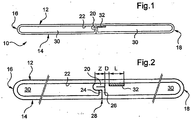
- FIG 1 is represented a cross sectional view of a tube 10 for heat exchanger, after it has been folded and before it is brazed.
- Tube 10 is made from a metal sheet, preferably an aluminium-based metal, and shows two large parallel surfaces 12, 14 connected by two smaller U-shaped surfaces 16, 18.
- Tube 10 comprises a first tube portion 20 made by rolling up a first edge area of said metal sheet, said first tube portion 20 being contacted against a support surface of a second tube portion 22.
- This second tube portion 22 is formed on the inner side of the large surface 12 and is oriented downwardly as can be seen on figure 1 and on the enlarged view of figure 2 .
- a second edge area 24 of the metal sheet is folded and put into contact with the starting section 26 of said first tube portion 20 so as to constitute altogether a separation wall 28 defining two parallel channels 30 for the fluid flowing through the tube.
- the two channels 30 have the same cross section.
- first tube portion 20 applies against the second tube portion 22 in a contact zone Z which will later be a brazing zone.
- Brazing of tube 10 is performed in a classical way with use of brazing material and a brazing flux.
- the brazing material generally consists of a metal layer plated on the inner side of the metal sheet. As shown on figures 1 and 2 , the brazing material is plated on the inner side of the sheet, i.e. the support surface of the second tube portion 22.
- a brazing flux is used in addition to the brazing material in order to improve the brazing process.
- the support surface of the second tube portion 22 is coated under controlled conditions with the brazing flux 32 at a distance D close to the contact zone Z and over a narrow band having a width L in accordance with the so-called "selective fluxing" technique.
- the distance D and the width L may respectively range between 0 and 6 mm and 0,5 and 3 mm.
- the brazing flux 32 can move to the contact zone Z to fulfil its usual functions of brazing improvement.
- the brazing flux can solve the alumina layer naturally formed on the surface of the parts to be put together. Moreover, the brazing flux is capable of wetting the portions of the tube to be brazed, thus enabling the brazing material to spread over the contacting surfaces.
- the brazing flux used in this process is a mixture of a fluoride-based flux with a hexylene glycol-based (2-methyl-2,4-pentanediol) solvent. The amount of said fluoride-based flux is 25 to 65 wt. % of said mixture.
- the amount of said fluoride-based flux is 38 wt. % of said mixture.
- This brazing flux is continuously deposited by means of a roll of a manufacturing device on a metal sheet unwounded from a reel. Then, the metal sheet is folded in the manufacturing device to give it the cross sectional profile desired for the tubes, and cut into sections constituting the individual tubes. The so obtained tubes are then put together with fins to form an assembly which is brazed in a single operation in a CAB furnace.
Landscapes
- Engineering & Computer Science (AREA)
- Mechanical Engineering (AREA)
- Chemical & Material Sciences (AREA)
- Polymers & Plastics (AREA)
- Health & Medical Sciences (AREA)
- Chemical Kinetics & Catalysis (AREA)
- Medicinal Chemistry (AREA)
- Organic Chemistry (AREA)
- General Engineering & Computer Science (AREA)
- Thermal Sciences (AREA)
- Physics & Mathematics (AREA)
- Inorganic Chemistry (AREA)
- Heat-Exchange Devices With Radiators And Conduit Assemblies (AREA)
- Details Of Heat-Exchange And Heat-Transfer (AREA)
Description
- The present invention relates to a method for manufacturing heat exchanger folding tubes used in automotive industry. In that context, the invention is particularly relevant to heating and air conditioning systems such as condensers, evaporators, heater cores, radiators, etc.
- It is current trend within heat exchanger field to use folded tubes for manufacturing tube stacking cores like heater cores, radiators, evaporators, condensers, etc. Theses tubes are made from sheets or strips of a metal core, generally an aluminium alloy chosen in the 3xxx or 6xxx series. In a further step of manufacturing, the sheets of metal core are folded so as to form tubes like those known as B-shaped tubes, delimiting in the cross section of the tube two parallel channels for fluid flow. However, it should be noted that the invention is not limited to such B-shaped tubes.
- Moreover, these tubes can be coated on one or two sides with a brazing material, also called "clad" material or "filler metal", made from an aluminium alloy of the 4xxx series. During the brazing step which allows for getting a product void of leaks, the clad material melts while the core material becomes viscous.
- However, it has been proved that better brazing results could be achieved by including in the manufacturing process a fluxing stage before brazing, this fluxing stage consisting of depositing a layer of brazing flux. Actually, fluxing of parts turns out to be necessary in order to crack alumina and promote clad material motion during the brazing stage thanks to its wettability and capillarity. It is thus possible to get a good brazing seal capable of improving the mechanical strength of the tubes, namely under hydrostatic pressure.
- As an example related to B-shaped folded tubes, it has been shown that the internal link of such tubes does not withstand pressures higher than 5 bars when merely brazed, while pressures up to 19 bars can be reached without damage when the area to be brazed, or an area next to, is coated with brazing flux prior to brazing.
- Parts can be coated with brazing flux on their whole surface, or, in a preferred embodiment, only on the area to be brazed, or an area next to, so as to save brazing flux. This latter technology is known as "selective fluxing".
- Brazing flux is generally made from a fluoride-based flux which is a mixture of potassium and aluminium fluorides (K2AlF5, KAlF4 and K3AlF6) in various proportions. A fluoride-based flux is commercially available under the trade name "NOCOLOK".
- The fluoride-based flux has the form of a powder which must be mixed to at least one other component in order to facilitate spreading on surfaces to be coated.
-
US patent n° 6,412,174 suggests to mix the fluoride-based flux with a synthetic resin, in particular a polybutene resin or an acrylic acid-based resin such as butyl acrylate. - However, a brazing flux including synthetic resin, as described in the above mentioned patent, shows at room temperature a very high kinetic viscosity, over 100 Pa.s, not compatible with certain types of pumps that are used in the fluxing process, like perilstatic pumps, resulting in too long machine cycle to start fluxing operation, leading to difficulties to spread the mixture according to this known solution,
WO03089176 -
US6656290B discloses a method of hard soldering a plurality of parts made of aluminium applying a hard soldering paste and an aluminum fluxing agent made of aluminum fluorides and organic solvent - hexylene glycol - to at least one of said parts, and bring at least one of said paste into contact with another of said plurality of parts, so that said parts is in contact with both of said parts and brazing them. - Accordingly, an object of the present invention is to provide a method for manufacturing a heat exchanger folded tube, comprising the steps of contacting a first tube portion against a support surface of a second tube portion at a contact zone, and brazing the first and second tube portions at said contact zone using a brazing material and a brazing flux, wherein said brazing flux comprises a mixture of a fluoride-based flux with a hexylene glycol-based solvent.
- It has been shown by the applicant that the use of hexylene glycol (2-methyl-2,4-pentanediol) mixed with the fluoride-based flux could lead to kinetic viscosity as low as 1 Pa.s which is at least two orders of magnitude smaller than that obtained with a synthetic resin. The amount of said fluoride-based flux is 25 to 65 wt. % of said mixture. In particular, the amount of said fluoride-based flux is 38 wt. % of said mixture.
- In addition to the above mentioned very low kinetic viscosity, the invention has many other advantages.
- The fluoride-based flux consumption can be decreased thanks to lower concentrations.
- Due to low viscosity, the machine and pump cycle to start fluxing can be greatly shortened, from 10 min to 15 s for instance.
- Wettability of the brazing flux according to the invention is improved, thus making it possible to coat surfaces with 100% success.
- The Production Rate of Return (PRR) of machines is increased since the brazing flux of the invention cannot dry owing to a very low volatility which does not need the tools, roll and flux cup for instance, of fluxing machines to be changed or cleaned after a short while stop. The time needed maintenance of equipments is decreased thanks to the use of the paste according to the invention.
- No black carbon residues can be formed in the tubes after brazing in controlled atmosphere (CAB) contrary to some brazing flux comprising organic compounds used as thickener, binder, etc.
- The invention will now be described in more detail, by way of example, with reference to the accompanying drawings in which :
-
Figure 1 is a cross section of a B-shaped tube for heat exchanger. -
Figure 2 is an enlarged view of the tube shown infigure 1 . - In
figure 1 is represented a cross sectional view of atube 10 for heat exchanger, after it has been folded and before it is brazed. Tube 10 is made from a metal sheet, preferably an aluminium-based metal, and shows two largeparallel surfaces smaller U-shaped surfaces - Tube 10 comprises a
first tube portion 20 made by rolling up a first edge area of said metal sheet, saidfirst tube portion 20 being contacted against a support surface of asecond tube portion 22. Thissecond tube portion 22 is formed on the inner side of thelarge surface 12 and is oriented downwardly as can be seen onfigure 1 and on the enlarged view offigure 2 . - A
second edge area 24 of the metal sheet is folded and put into contact with thestarting section 26 of saidfirst tube portion 20 so as to constitute altogether aseparation wall 28 defining twoparallel channels 30 for the fluid flowing through the tube. In a preferred embodiment, the twochannels 30 have the same cross section. - It is worth noting that the
first tube portion 20 applies against thesecond tube portion 22 in a contact zone Z which will later be a brazing zone. - Brazing of
tube 10 is performed in a classical way with use of brazing material and a brazing flux. - The brazing material generally consists of a metal layer plated on the inner side of the metal sheet. As shown on
figures 1 and 2 , the brazing material is plated on the inner side of the sheet, i.e. the support surface of thesecond tube portion 22. - As previously mentioned, a brazing flux is used in addition to the brazing material in order to improve the brazing process. As shown in
figures 1 and 2 , the support surface of thesecond tube portion 22 is coated under controlled conditions with thebrazing flux 32 at a distance D close to the contact zone Z and over a narrow band having a width L in accordance with the so-called "selective fluxing" technique. - The distance D and the width L may respectively range between 0 and 6 mm and 0,5 and 3 mm.
- During the brazing step which is carried out in a CAB ("Controlled Atmosphere Brazing") furnace, the
brazing flux 32 can move to the contact zone Z to fulfil its usual functions of brazing improvement. - So, after melting, the brazing flux can solve the alumina layer naturally formed on the surface of the parts to be put together. Moreover, the brazing flux is capable of wetting the portions of the tube to be brazed, thus enabling the brazing material to spread over the contacting surfaces. The brazing flux used in this process is a mixture of a fluoride-based flux with a hexylene glycol-based (2-methyl-2,4-pentanediol) solvent. The amount of said fluoride-based flux is 25 to 65 wt. % of said mixture.
- In a preferred embodiment, the amount of said fluoride-based flux is 38 wt. % of said mixture.
- This brazing flux is continuously deposited by means of a roll of a manufacturing device on a metal sheet unwounded from a reel. Then, the metal sheet is folded in the manufacturing device to give it the cross sectional profile desired for the tubes, and cut into sections constituting the individual tubes. The so obtained tubes are then put together with fins to form an assembly which is brazed in a single operation in a CAB furnace.
Claims (2)
- A method for manufacturing a heat exchanger folded tube (10), comprising the steps of contacting a first tube portion (20) against a support surface of a second tube portion (22) at a contact zone (Z), and brazing the first (20) and second (22) tube portions at said contact zone (Z) using a brazing material and a brazing flux, wherein said brazing flux comprises a mixture of a fluoride-based flux with a hexylene glycol-based solvent (2-methyl-2.4-pentanediol), wherein the amount of the fluoride-based flux is 25 to 65 wt. % of said mixture, and wherein the brazing material consists of a metal layer plated on the inner side of the sheet on the support surface of the second tube portion (22).
- The method as claimed in claim 1 wherein the amount of said fluoride-based flux is 38 wt. % of said mixture.
Priority Applications (3)
| Application Number | Priority Date | Filing Date | Title |
|---|---|---|---|
| EP07022920.8A EP2067565B1 (en) | 2007-11-27 | 2007-11-27 | Composition of brazing flux and method for manufacturing heat exchanger tubes using said composition |
| KR1020080118266A KR101576673B1 (en) | 2007-11-27 | 2008-11-26 | Composition of brazing flux and method of manufacturing heat exchanger tube using the composition |
| JP2008302206A JP5392814B2 (en) | 2007-11-27 | 2008-11-27 | Method for producing heat exchanger tube using brazing flux composition |
Applications Claiming Priority (1)
| Application Number | Priority Date | Filing Date | Title |
|---|---|---|---|
| EP07022920.8A EP2067565B1 (en) | 2007-11-27 | 2007-11-27 | Composition of brazing flux and method for manufacturing heat exchanger tubes using said composition |
Publications (2)
| Publication Number | Publication Date |
|---|---|
| EP2067565A1 EP2067565A1 (en) | 2009-06-10 |
| EP2067565B1 true EP2067565B1 (en) | 2017-06-21 |
Family
ID=39276290
Family Applications (1)
| Application Number | Title | Priority Date | Filing Date |
|---|---|---|---|
| EP07022920.8A Not-in-force EP2067565B1 (en) | 2007-11-27 | 2007-11-27 | Composition of brazing flux and method for manufacturing heat exchanger tubes using said composition |
Country Status (3)
| Country | Link |
|---|---|
| EP (1) | EP2067565B1 (en) |
| JP (1) | JP5392814B2 (en) |
| KR (1) | KR101576673B1 (en) |
Families Citing this family (2)
| Publication number | Priority date | Publication date | Assignee | Title |
|---|---|---|---|---|
| FR2969019B1 (en) * | 2010-12-20 | 2014-03-21 | Valeo Systemes Thermiques | METHOD FOR BRAZING A CORRUGATED THERMAL EXCHANGER TUBE, THERMAL TUBE AND HEAT EXCHANGER |
| US10682090B2 (en) | 2016-06-29 | 2020-06-16 | General Electric Company | Sensing device for controlling the delivery of care to immobile patients |
Family Cites Families (8)
| Publication number | Priority date | Publication date | Assignee | Title |
|---|---|---|---|---|
| JPH07185796A (en) * | 1993-12-27 | 1995-07-25 | Nippondenso Co Ltd | Brazing method |
| US5450666A (en) | 1994-02-28 | 1995-09-19 | S.A. Day Mfg. Co., Inc. | Flux composition for aluminum brazing |
| DE19731151C1 (en) * | 1997-07-21 | 1999-01-21 | Degussa | Solder paste for brazing and coating of aluminum and aluminum alloys |
| EP0982095B1 (en) * | 1998-08-25 | 2003-10-01 | Calsonic Kansei Corporation | Method of manufacturing heat exchange tube |
| JP3825211B2 (en) * | 1998-09-16 | 2006-09-27 | 株式会社デンソー | Aluminum brazing flux or paint for applying flux and brazing material, and aluminum brazing method |
| FR2832788B1 (en) * | 2001-11-26 | 2004-06-04 | Valeo Climatisation | TUBE PROFILES FOR HEAT EXCHANGER |
| DE10359222A1 (en) * | 2003-12-17 | 2005-07-28 | Solvay Fluor Gmbh | flux |
| FR2905076B1 (en) * | 2006-08-28 | 2008-12-05 | Valeo Systemes Thermiques | PROCESS FOR BRATING A HEAT EXCHANGER |
-
2007
- 2007-11-27 EP EP07022920.8A patent/EP2067565B1/en not_active Not-in-force
-
2008
- 2008-11-26 KR KR1020080118266A patent/KR101576673B1/en not_active Expired - Fee Related
- 2008-11-27 JP JP2008302206A patent/JP5392814B2/en not_active Expired - Fee Related
Also Published As
| Publication number | Publication date |
|---|---|
| EP2067565A1 (en) | 2009-06-10 |
| KR101576673B1 (en) | 2015-12-10 |
| JP2009125812A (en) | 2009-06-11 |
| KR20090054929A (en) | 2009-06-01 |
| JP5392814B2 (en) | 2014-01-22 |
Similar Documents
| Publication | Publication Date | Title |
|---|---|---|
| CA2145555C (en) | Differential coating for micro extruded tubes used in parallel flow heat exchangers | |
| EP3459676B1 (en) | Brazing sheet for flux-free brazing, flux-free brazing method and method for producing heat exchanger | |
| US5251374A (en) | Method for forming heat exchangers | |
| CN102884393B (en) | Aluminum alloy heat exchanger | |
| EP1399280B1 (en) | Method of manufacturing heat transfer tubes | |
| JP7042023B2 (en) | Brazing method | |
| EP0674966A1 (en) | Brazing composition, aluminum material provided with the brazing composition and heat exchanger | |
| EP3563968B1 (en) | Brazing sheet for flux-free brazing, method for flux-free brazing, and method for heat manufacturing heat exchanger | |
| CN107614178A (en) | The manufacture method of constructed of aluminium body | |
| JP2014226704A (en) | Soldering method for aluminum alloy material | |
| JP2019516563A (en) | Method and apparatus for manufacturing a brazed heat exchanger | |
| US6120848A (en) | Method of making a braze sheet | |
| US5180098A (en) | Air conditioner condenser assembly | |
| JP2015504371A (en) | Manufacturing method of tube plate fin type heat exchanger | |
| JP6231800B2 (en) | Al member for heat exchanger having fine passage and method for manufacturing the same | |
| EP2067565A1 (en) | Composition of brazing flux and method for manufacturing heat exchanger tubes using said composition | |
| EP1808255A1 (en) | Method of manufacturing a brazed assembly | |
| EP1004386A1 (en) | Brazed assembly and method of making same | |
| US20090126921A1 (en) | Method For Brazing A Heat Exchanger Folded Tube While Applying A Flux Near A Contact Zone Of The Walls, Resulting Tube | |
| JP2015021159A (en) | Al member for heat exchanger having fine passage and method for manufacturing the same | |
| JP2004042059A (en) | Brazing material, brazed article using the same, method for producing the same, and heat exchange tube for brazing, heat exchanger using the same, and method for producing the same | |
| JP2004330266A (en) | Manufacturing method of laminated heat exchanger | |
| JPWO2020196763A1 (en) | Brazing tubes and their manufacturing methods and heat exchangers | |
| JP2015020183A (en) | Al member for heat exchanger having fine passage and method for manufacturing the same | |
| JP2004190931A (en) | Brazing material, brazed article using the same and its manufacturing method, brazed heat exchange tube, heat exchanger using the same and its manufacturing method, and vehicle |
Legal Events
| Date | Code | Title | Description |
|---|---|---|---|
| PUAI | Public reference made under article 153(3) epc to a published international application that has entered the european phase |
Free format text: ORIGINAL CODE: 0009012 |
|
| AK | Designated contracting states |
Kind code of ref document: A1 Designated state(s): AT BE BG CH CY CZ DE DK EE ES FI FR GB GR HU IE IS IT LI LT LU LV MC MT NL PL PT RO SE SI SK TR |
|
| AX | Request for extension of the european patent |
Extension state: AL BA HR MK RS |
|
| 17P | Request for examination filed |
Effective date: 20091210 |
|
| AKX | Designation fees paid |
Designated state(s): AT BE BG CH CY CZ DE DK EE ES FI FR GB GR HU IE IS IT LI LT LU LV MC MT NL PL PT RO SE SI SK TR |
|
| 17Q | First examination report despatched |
Effective date: 20100408 |
|
| REG | Reference to a national code |
Ref country code: DE Ref legal event code: R079 Ref document number: 602007051378 Country of ref document: DE Free format text: PREVIOUS MAIN CLASS: B23K0035020000 Ipc: B23K0001000000 |
|
| GRAP | Despatch of communication of intention to grant a patent |
Free format text: ORIGINAL CODE: EPIDOSNIGR1 |
|
| RIC1 | Information provided on ipc code assigned before grant |
Ipc: B23K 101/14 20060101ALI20161207BHEP Ipc: B23K 1/008 20060101ALI20161207BHEP Ipc: B23K 35/362 20060101ALI20161207BHEP Ipc: B23K 35/36 20060101ALI20161207BHEP Ipc: B23K 1/00 20060101AFI20161207BHEP Ipc: F28D 1/03 20060101ALI20161207BHEP Ipc: B23K 1/20 20060101ALI20161207BHEP Ipc: B23K 35/02 20060101ALI20161207BHEP Ipc: B23K 35/38 20060101ALI20161207BHEP |
|
| INTG | Intention to grant announced |
Effective date: 20170105 |
|
| GRAS | Grant fee paid |
Free format text: ORIGINAL CODE: EPIDOSNIGR3 |
|
| GRAA | (expected) grant |
Free format text: ORIGINAL CODE: 0009210 |
|
| AK | Designated contracting states |
Kind code of ref document: B1 Designated state(s): AT BE BG CH CY CZ DE DK EE ES FI FR GB GR HU IE IS IT LI LT LU LV MC MT NL PL PT RO SE SI SK TR |
|
| REG | Reference to a national code |
Ref country code: GB Ref legal event code: FG4D |
|
| REG | Reference to a national code |
Ref country code: CH Ref legal event code: EP |
|
| REG | Reference to a national code |
Ref country code: IE Ref legal event code: FG4D |
|
| REG | Reference to a national code |
Ref country code: AT Ref legal event code: REF Ref document number: 902475 Country of ref document: AT Kind code of ref document: T Effective date: 20170715 |
|
| REG | Reference to a national code |
Ref country code: DE Ref legal event code: R096 Ref document number: 602007051378 Country of ref document: DE |
|
| REG | Reference to a national code |
Ref country code: NL Ref legal event code: MP Effective date: 20170621 |
|
| PG25 | Lapsed in a contracting state [announced via postgrant information from national office to epo] |
Ref country code: LT Free format text: LAPSE BECAUSE OF FAILURE TO SUBMIT A TRANSLATION OF THE DESCRIPTION OR TO PAY THE FEE WITHIN THE PRESCRIBED TIME-LIMIT Effective date: 20170621 Ref country code: GR Free format text: LAPSE BECAUSE OF FAILURE TO SUBMIT A TRANSLATION OF THE DESCRIPTION OR TO PAY THE FEE WITHIN THE PRESCRIBED TIME-LIMIT Effective date: 20170922 Ref country code: FI Free format text: LAPSE BECAUSE OF FAILURE TO SUBMIT A TRANSLATION OF THE DESCRIPTION OR TO PAY THE FEE WITHIN THE PRESCRIBED TIME-LIMIT Effective date: 20170621 |
|
| REG | Reference to a national code |
Ref country code: LT Ref legal event code: MG4D |
|
| REG | Reference to a national code |
Ref country code: AT Ref legal event code: MK05 Ref document number: 902475 Country of ref document: AT Kind code of ref document: T Effective date: 20170621 |
|
| PG25 | Lapsed in a contracting state [announced via postgrant information from national office to epo] |
Ref country code: NL Free format text: LAPSE BECAUSE OF FAILURE TO SUBMIT A TRANSLATION OF THE DESCRIPTION OR TO PAY THE FEE WITHIN THE PRESCRIBED TIME-LIMIT Effective date: 20170621 Ref country code: SE Free format text: LAPSE BECAUSE OF FAILURE TO SUBMIT A TRANSLATION OF THE DESCRIPTION OR TO PAY THE FEE WITHIN THE PRESCRIBED TIME-LIMIT Effective date: 20170621 Ref country code: LV Free format text: LAPSE BECAUSE OF FAILURE TO SUBMIT A TRANSLATION OF THE DESCRIPTION OR TO PAY THE FEE WITHIN THE PRESCRIBED TIME-LIMIT Effective date: 20170621 Ref country code: BG Free format text: LAPSE BECAUSE OF FAILURE TO SUBMIT A TRANSLATION OF THE DESCRIPTION OR TO PAY THE FEE WITHIN THE PRESCRIBED TIME-LIMIT Effective date: 20170921 |
|
| REG | Reference to a national code |
Ref country code: FR Ref legal event code: PLFP Year of fee payment: 11 |
|
| PG25 | Lapsed in a contracting state [announced via postgrant information from national office to epo] |
Ref country code: SK Free format text: LAPSE BECAUSE OF FAILURE TO SUBMIT A TRANSLATION OF THE DESCRIPTION OR TO PAY THE FEE WITHIN THE PRESCRIBED TIME-LIMIT Effective date: 20170621 Ref country code: RO Free format text: LAPSE BECAUSE OF FAILURE TO SUBMIT A TRANSLATION OF THE DESCRIPTION OR TO PAY THE FEE WITHIN THE PRESCRIBED TIME-LIMIT Effective date: 20170621 Ref country code: AT Free format text: LAPSE BECAUSE OF FAILURE TO SUBMIT A TRANSLATION OF THE DESCRIPTION OR TO PAY THE FEE WITHIN THE PRESCRIBED TIME-LIMIT Effective date: 20170621 Ref country code: CZ Free format text: LAPSE BECAUSE OF FAILURE TO SUBMIT A TRANSLATION OF THE DESCRIPTION OR TO PAY THE FEE WITHIN THE PRESCRIBED TIME-LIMIT Effective date: 20170621 Ref country code: EE Free format text: LAPSE BECAUSE OF FAILURE TO SUBMIT A TRANSLATION OF THE DESCRIPTION OR TO PAY THE FEE WITHIN THE PRESCRIBED TIME-LIMIT Effective date: 20170621 |
|
| PG25 | Lapsed in a contracting state [announced via postgrant information from national office to epo] |
Ref country code: ES Free format text: LAPSE BECAUSE OF FAILURE TO SUBMIT A TRANSLATION OF THE DESCRIPTION OR TO PAY THE FEE WITHIN THE PRESCRIBED TIME-LIMIT Effective date: 20170621 Ref country code: IT Free format text: LAPSE BECAUSE OF FAILURE TO SUBMIT A TRANSLATION OF THE DESCRIPTION OR TO PAY THE FEE WITHIN THE PRESCRIBED TIME-LIMIT Effective date: 20170621 Ref country code: IS Free format text: LAPSE BECAUSE OF FAILURE TO SUBMIT A TRANSLATION OF THE DESCRIPTION OR TO PAY THE FEE WITHIN THE PRESCRIBED TIME-LIMIT Effective date: 20171021 Ref country code: PL Free format text: LAPSE BECAUSE OF FAILURE TO SUBMIT A TRANSLATION OF THE DESCRIPTION OR TO PAY THE FEE WITHIN THE PRESCRIBED TIME-LIMIT Effective date: 20170621 |
|
| REG | Reference to a national code |
Ref country code: DE Ref legal event code: R097 Ref document number: 602007051378 Country of ref document: DE |
|
| PLBE | No opposition filed within time limit |
Free format text: ORIGINAL CODE: 0009261 |
|
| STAA | Information on the status of an ep patent application or granted ep patent |
Free format text: STATUS: NO OPPOSITION FILED WITHIN TIME LIMIT |
|
| PG25 | Lapsed in a contracting state [announced via postgrant information from national office to epo] |
Ref country code: DK Free format text: LAPSE BECAUSE OF FAILURE TO SUBMIT A TRANSLATION OF THE DESCRIPTION OR TO PAY THE FEE WITHIN THE PRESCRIBED TIME-LIMIT Effective date: 20170621 |
|
| 26N | No opposition filed |
Effective date: 20180322 |
|
| PG25 | Lapsed in a contracting state [announced via postgrant information from national office to epo] |
Ref country code: MC Free format text: LAPSE BECAUSE OF FAILURE TO SUBMIT A TRANSLATION OF THE DESCRIPTION OR TO PAY THE FEE WITHIN THE PRESCRIBED TIME-LIMIT Effective date: 20170621 |
|
| GBPC | Gb: european patent ceased through non-payment of renewal fee |
Effective date: 20171127 |
|
| PG25 | Lapsed in a contracting state [announced via postgrant information from national office to epo] |
Ref country code: CH Free format text: LAPSE BECAUSE OF NON-PAYMENT OF DUE FEES Effective date: 20171130 Ref country code: LI Free format text: LAPSE BECAUSE OF NON-PAYMENT OF DUE FEES Effective date: 20171130 |
|
| PG25 | Lapsed in a contracting state [announced via postgrant information from national office to epo] |
Ref country code: LU Free format text: LAPSE BECAUSE OF NON-PAYMENT OF DUE FEES Effective date: 20171127 Ref country code: SI Free format text: LAPSE BECAUSE OF FAILURE TO SUBMIT A TRANSLATION OF THE DESCRIPTION OR TO PAY THE FEE WITHIN THE PRESCRIBED TIME-LIMIT Effective date: 20170621 |
|
| REG | Reference to a national code |
Ref country code: BE Ref legal event code: MM Effective date: 20171130 |
|
| REG | Reference to a national code |
Ref country code: IE Ref legal event code: MM4A |
|
| PG25 | Lapsed in a contracting state [announced via postgrant information from national office to epo] |
Ref country code: MT Free format text: LAPSE BECAUSE OF NON-PAYMENT OF DUE FEES Effective date: 20171127 |
|
| PG25 | Lapsed in a contracting state [announced via postgrant information from national office to epo] |
Ref country code: IE Free format text: LAPSE BECAUSE OF NON-PAYMENT OF DUE FEES Effective date: 20171127 |
|
| PG25 | Lapsed in a contracting state [announced via postgrant information from national office to epo] |
Ref country code: BE Free format text: LAPSE BECAUSE OF NON-PAYMENT OF DUE FEES Effective date: 20171130 Ref country code: GB Free format text: LAPSE BECAUSE OF NON-PAYMENT OF DUE FEES Effective date: 20171127 |
|
| PG25 | Lapsed in a contracting state [announced via postgrant information from national office to epo] |
Ref country code: HU Free format text: LAPSE BECAUSE OF FAILURE TO SUBMIT A TRANSLATION OF THE DESCRIPTION OR TO PAY THE FEE WITHIN THE PRESCRIBED TIME-LIMIT; INVALID AB INITIO Effective date: 20071127 |
|
| PG25 | Lapsed in a contracting state [announced via postgrant information from national office to epo] |
Ref country code: CY Free format text: LAPSE BECAUSE OF NON-PAYMENT OF DUE FEES Effective date: 20170621 |
|
| PG25 | Lapsed in a contracting state [announced via postgrant information from national office to epo] |
Ref country code: TR Free format text: LAPSE BECAUSE OF FAILURE TO SUBMIT A TRANSLATION OF THE DESCRIPTION OR TO PAY THE FEE WITHIN THE PRESCRIBED TIME-LIMIT Effective date: 20170621 |
|
| PG25 | Lapsed in a contracting state [announced via postgrant information from national office to epo] |
Ref country code: PT Free format text: LAPSE BECAUSE OF FAILURE TO SUBMIT A TRANSLATION OF THE DESCRIPTION OR TO PAY THE FEE WITHIN THE PRESCRIBED TIME-LIMIT Effective date: 20170621 |
|
| PGFP | Annual fee paid to national office [announced via postgrant information from national office to epo] |
Ref country code: FR Payment date: 20221122 Year of fee payment: 16 Ref country code: DE Payment date: 20221114 Year of fee payment: 16 |
|
| P01 | Opt-out of the competence of the unified patent court (upc) registered |
Effective date: 20230528 |
|
| REG | Reference to a national code |
Ref country code: DE Ref legal event code: R119 Ref document number: 602007051378 Country of ref document: DE |
|
| PG25 | Lapsed in a contracting state [announced via postgrant information from national office to epo] |
Ref country code: DE Free format text: LAPSE BECAUSE OF NON-PAYMENT OF DUE FEES Effective date: 20240601 |
|
| PG25 | Lapsed in a contracting state [announced via postgrant information from national office to epo] |
Ref country code: FR Free format text: LAPSE BECAUSE OF NON-PAYMENT OF DUE FEES Effective date: 20231130 |
|
| PG25 | Lapsed in a contracting state [announced via postgrant information from national office to epo] |
Ref country code: FR Free format text: LAPSE BECAUSE OF NON-PAYMENT OF DUE FEES Effective date: 20231130 Ref country code: DE Free format text: LAPSE BECAUSE OF NON-PAYMENT OF DUE FEES Effective date: 20240601 |