EP2066650B1 - 3h-naphtho[2,1-b]pyrans as photochromic dichroic dyes and optical article containing them - Google Patents
3h-naphtho[2,1-b]pyrans as photochromic dichroic dyes and optical article containing them Download PDFInfo
- Publication number
- EP2066650B1 EP2066650B1 EP06790163A EP06790163A EP2066650B1 EP 2066650 B1 EP2066650 B1 EP 2066650B1 EP 06790163 A EP06790163 A EP 06790163A EP 06790163 A EP06790163 A EP 06790163A EP 2066650 B1 EP2066650 B1 EP 2066650B1
- Authority
- EP
- European Patent Office
- Prior art keywords
- naphtho
- pyran
- biphenyl
- group
- phenyl
- Prior art date
- Legal status (The legal status is an assumption and is not a legal conclusion. Google has not performed a legal analysis and makes no representation as to the accuracy of the status listed.)
- Active
Links
Classifications
-
- C—CHEMISTRY; METALLURGY
- C07—ORGANIC CHEMISTRY
- C07D—HETEROCYCLIC COMPOUNDS
- C07D471/00—Heterocyclic compounds containing nitrogen atoms as the only ring hetero atoms in the condensed system, at least one ring being a six-membered ring with one nitrogen atom, not provided for by groups C07D451/00 - C07D463/00
- C07D471/02—Heterocyclic compounds containing nitrogen atoms as the only ring hetero atoms in the condensed system, at least one ring being a six-membered ring with one nitrogen atom, not provided for by groups C07D451/00 - C07D463/00 in which the condensed system contains two hetero rings
- C07D471/04—Ortho-condensed systems
-
- C—CHEMISTRY; METALLURGY
- C07—ORGANIC CHEMISTRY
- C07D—HETEROCYCLIC COMPOUNDS
- C07D311/00—Heterocyclic compounds containing six-membered rings having one oxygen atom as the only hetero atom, condensed with other rings
- C07D311/02—Heterocyclic compounds containing six-membered rings having one oxygen atom as the only hetero atom, condensed with other rings ortho- or peri-condensed with carbocyclic rings or ring systems
- C07D311/78—Ring systems having three or more relevant rings
- C07D311/92—Naphthopyrans; Hydrogenated naphthopyrans
-
- C—CHEMISTRY; METALLURGY
- C07—ORGANIC CHEMISTRY
- C07D—HETEROCYCLIC COMPOUNDS
- C07D405/00—Heterocyclic compounds containing both one or more hetero rings having oxygen atoms as the only ring hetero atoms, and one or more rings having nitrogen as the only ring hetero atom
- C07D405/02—Heterocyclic compounds containing both one or more hetero rings having oxygen atoms as the only ring hetero atoms, and one or more rings having nitrogen as the only ring hetero atom containing two hetero rings
- C07D405/10—Heterocyclic compounds containing both one or more hetero rings having oxygen atoms as the only ring hetero atoms, and one or more rings having nitrogen as the only ring hetero atom containing two hetero rings linked by a carbon chain containing aromatic rings
-
- C—CHEMISTRY; METALLURGY
- C07—ORGANIC CHEMISTRY
- C07D—HETEROCYCLIC COMPOUNDS
- C07D455/00—Heterocyclic compounds containing quinolizine ring systems, e.g. emetine alkaloids, protoberberine; Alkylenedioxy derivatives of dibenzo [a, g] quinolizines, e.g. berberine
- C07D455/03—Heterocyclic compounds containing quinolizine ring systems, e.g. emetine alkaloids, protoberberine; Alkylenedioxy derivatives of dibenzo [a, g] quinolizines, e.g. berberine containing quinolizine ring systems directly condensed with at least one six-membered carbocyclic ring, e.g. protoberberine; Alkylenedioxy derivatives of dibenzo [a, g] quinolizines, e.g. berberine
- C07D455/04—Heterocyclic compounds containing quinolizine ring systems, e.g. emetine alkaloids, protoberberine; Alkylenedioxy derivatives of dibenzo [a, g] quinolizines, e.g. berberine containing quinolizine ring systems directly condensed with at least one six-membered carbocyclic ring, e.g. protoberberine; Alkylenedioxy derivatives of dibenzo [a, g] quinolizines, e.g. berberine containing a quinolizine ring system condensed with only one six-membered carbocyclic ring, e.g. julolidine
Definitions
- a number of substituted 3H-naphtho[2,1-b]pyrans are known to be capable of exerting a reversible photochromic effect as described for example in WO 99/31052 , US 6,630,597 , US 5,552,090 , US 5,520,853 , US 629620 and US 5,623,005 .
- none of these 3H-naphtho[2,1-b]pyrans compounds are reported to have dichroic properties.
Landscapes
- Chemical & Material Sciences (AREA)
- Organic Chemistry (AREA)
- Pyrane Compounds (AREA)
- Optical Filters (AREA)
- Eyeglasses (AREA)
- Non-Silver Salt Photosensitive Materials And Non-Silver Salt Photography (AREA)
- Polarising Elements (AREA)
- Nitrogen Condensed Heterocyclic Rings (AREA)
- Heterocyclic Carbon Compounds Containing A Hetero Ring Having Oxygen Or Sulfur (AREA)
Abstract
Description
- The present invention is directed to a group of novel dyes that are both photochromic and dichroic and to the use thereof in optical articles, especially in optical lenses such as ophthalmic lenses.
- Photochromism is a well known physical phenomenon that is observed with certain classes of chemical compounds. A detailed discussion of this phenomenon can be found in "Photochromism : Molecules and Systems", Studies in Organic Chemistry 40, edited by H. Durr and H. Bouas-Laurent, Elsevier, 1990.
- A number of substituted 3H-naphtho[2,1-b]pyrans are known to be capable of exerting a reversible photochromic effect as described for example in
WO 99/31052 US 6,630,597 ,US 5,552,090 ,US 5,520,853 ,US 629620 andUS 5,623,005 . However, none of these 3H-naphtho[2,1-b]pyrans compounds are reported to have dichroic properties. - Passive photochromic devices, i.e. devices containing photochromic dyes whose absorbance depends only from the presence or absence of UV light, typically exhibit rather quick activation (coloration) but it generally takes several minutes or even tens of minutes to revert from the coloured to the bleached state. This slow fading is a severe drawback for the user of photochromic glasses who has to take them off to have clear vision when leaving the sunlight and entering dimmer light conditions.
- Therefore, there is a need for photochromic dyes exhibiting not only good photochromic properties, such as high absorption in the coloured state, fast colouring and fading rates, but which also may be capable of dichroism and linear light polarization when in a spatially ordered condition, for example when incorporated into liquid crystals or oriented polymer host materials.
- In light of the foregoing, it is first aspect of the present invention to provide a dye that is both photochromic and dichroic.
- It is another aspect of the present invention to provide a naphthopyran compound represented by the formula (I)

- ■ n1 is an integer comprised from 0 to 5 inclusive;
- ■ n2 is an integer comprised from 0 to 5 inclusive;
- ■ p is an integer comprised from 0 to 5 inclusive;
- ■ m is an integer comprised from 0 to 4 inclusive;
- ■ q is an integer comprised from 0 to 5 inclusive;
- ■ R1 and R2, identical or different, independently from each other, represent a group selected from halogen, -Ra, -OH, -ORa, -SH, -SRa, -NH2,-NRaRa1, -NRbRc,
-CO-Ra, -O-CO-Ra and -CO2Ra1, wherein:- ○ Ra represents a linear or branched (C1-C18) alkyl group or a linear or branched (C1-C18) perfluoroalkyl group;
- ○ Ra1 represents a group selected from hydrogen, linear or branched (C1-C18) alkyl group and linear or branched (C1-C18) perfluoroalkyl group;
- ○ Rb and Rc,
- ■ together and in combination with the nitrogen atom, represent a saturated 5 to 7 membered heterocyclic group which comprises optionally one additional heteroatom selected from O, N and S, and which may be optionally substituted by a group selected from halogen, Ra, -OH, -ORa, -NH2, and -NRaRa1, wherein Ra and Ra1 are as defined hereinbefore;
- ■ or together and in combination with the nitrogen atom and the adjacent phenyl group form a heterocyclic group of formula (A) :

- ■ R3 represents a group selected from halogen, -Ra, -OH, -ORa, -SH, -SRa, -NH2, and -NRaRa1 wherein Ra and Ra1 are as defined hereinbefore;
- ■ R4 represents a group selected from halogen, -Ra, -OH, -ORa, -SH, -SRa, -NH2, -NRaRa1, -CO-Ra, and -CO2Ra1, wherein Ra and Ra1 are as defined hereinbefore;
- ■ R5 represents a group selected from:
- ○ halogen, -Ra, -OH, -ORa, -SH, -SRa, -NH2, and -NRaRa1, wherein Ra and Ra are as defined hereinbefore,
- ○ or when q is equal to 2 and then two R5 substituents are located onto two adjacent carbon atoms selected from C-7, C-8, C-9 and C-10 of the naphtho[2,1-b]pyran group, they may further represent together a group -O-(CH2)q1-O- wherein ql represents an integer comprised from 1 to 3 inclusive.
- Yet another aspect of the present invention provides an optical article comprising one or more naphthopyran compounds of the present invention.
- The present invention provides photochromic-dichroic 3H-naphtho[2,1-b]pyrans having a substituted biphenyl group at C-6 of the naphthopyran group.
- In one or more embodiments, incorporation of a biphenyl moiety significantly improves dichroic properties of the photochromic dyes in the activated state. The new dye compounds when incorporated into anisotropic host materials such as liquid crystals or oriented polymers will strongly align with the host material molecules and exhibit strong dichroism, i.e. light polarizing, in the coloured state. The new dyes present an order parameter of greater than about 0.6 and excellent solubility in liquid crystal hosts and most of organic solvents.
- In certain embodiments, the photochromic dyes of the present invention surprisingly present a very fast fading rate, especially when dissolved in a fluid, mesomorphous or gel host medium. In one or more embodiments, they are able to revert from the coloured to the bleached state in less than five minutes, which constitutes an important advantage over most of the prior art photochromic dyes.
- Accordingly, the present invention provides naphthopyran compounds represented by the formula (I)

- ■ n1 is an integer comprised from 0 to 5 inclusive;
- ■ n2 is an integer comprised from 0 to 5 inclusive;
- ■ p is an integer comprised from 0 to 5 inclusive;
- ■ m is an integer comprised from 0 to 4 inclusive;
- ■ q is an integer comprised from 0 to 5 inclusive;
- ■ R1 and R2, identical or different, independently from each other, represent a group selected from halogen, -Ra, -OH, -ORa, -SH, -SRa, -NH2, - NRaRa1, -NRbRc,
-CO-Ra, -O-CO-Ra and -CO2Ra1, wherein:- ○ Ra represents a linear or branched (C1-C15) alkyl group or a linear or branched (C1-C18) perfluoroalkyl group;
- ○ Ra1 represents a group selected from hydrogen, linear or branched C1-C18) alkyl group and linear or branched (C1-C18) perfluoroalkyl group;
- ○ Rb and Rc,
- ■ together and in combination with the nitrogen atom, represent a saturated 5 to 7 membered heterocyclic group which comprises optionally one additional heteroatom selected from O, N and S, and which may be optionally substituted by a group selected from halogen, Ra, -OH, -ORa, -NH2, and -NRaRa1, wherein Ra and Ra1 are as defined hereinbefore;
- ■ or together and in combination with the nitrogen atom and the adjacent phenyl group form a heterocyclic group of formula (A) :

- ■ R3 represents a group selected from halogen, -Ra, -OH, -ORa, -SH, -SRa, -NH2, and -NRaRa1, wherein Ra and Ra1 are as defined hereinbefore;
- ■ R4 represents a group selected from halogen, -Ra, -OH, -ORa, -SH, -SRa, -NH2, -NRaRa1, -CO-Ra, and -CO2Ra1, wherein Ra and Ra1 are as defined hereinbefore;
- ■ R5 represents a group selected from:
- ○ halogen, -Ra, -OH, -ORa, -SH, -SRa, -NH2, and NRaRa1, wherein Ra and Ra1 are as defined hereinbefore,
- ○ or when q is equal to 2 and then two R5 substituents are located onto two adjacent carbon atoms selected from C-7, C-8, C-9 and C-10 of the naphtho[2,1-b]pyran group, they may further represent together a group -O-(CH2)q1-O- wherein ql represents an integer comprised from 1 to 3 inclusive.
- Preferred naphthopyrans according to the present invention are compounds of formula (I), wherein:
- ■ n1 is equal to 0 or 1, and R1 represents a group selected from halogen, - OH and -ORa located at the para- or ortho- position of the phenyl group, wherein Ra is as defined hereinbefore;
- ■ n2 is equal to 1 and R2 represents a group selected from halogen, -OH, -ORa, and -NRbRc located at the para-position of the phenyl group, wherein Ra, Rb and Rc are as defined hereinbefore;
- ■ m is equal to zero;
- ■ p is equal to 1 and R4 represents a group selected from -Ra, -ORa, and -NRaRa1 located at the para-position of the phenyl group; and
- ■ q is an integer comprised from 0 to 2 inclusive, and R5 represents a group selected from -OH and -ORa located on the C-8 and/or C-9 of the naphtho[2,1-b] -pyran group.
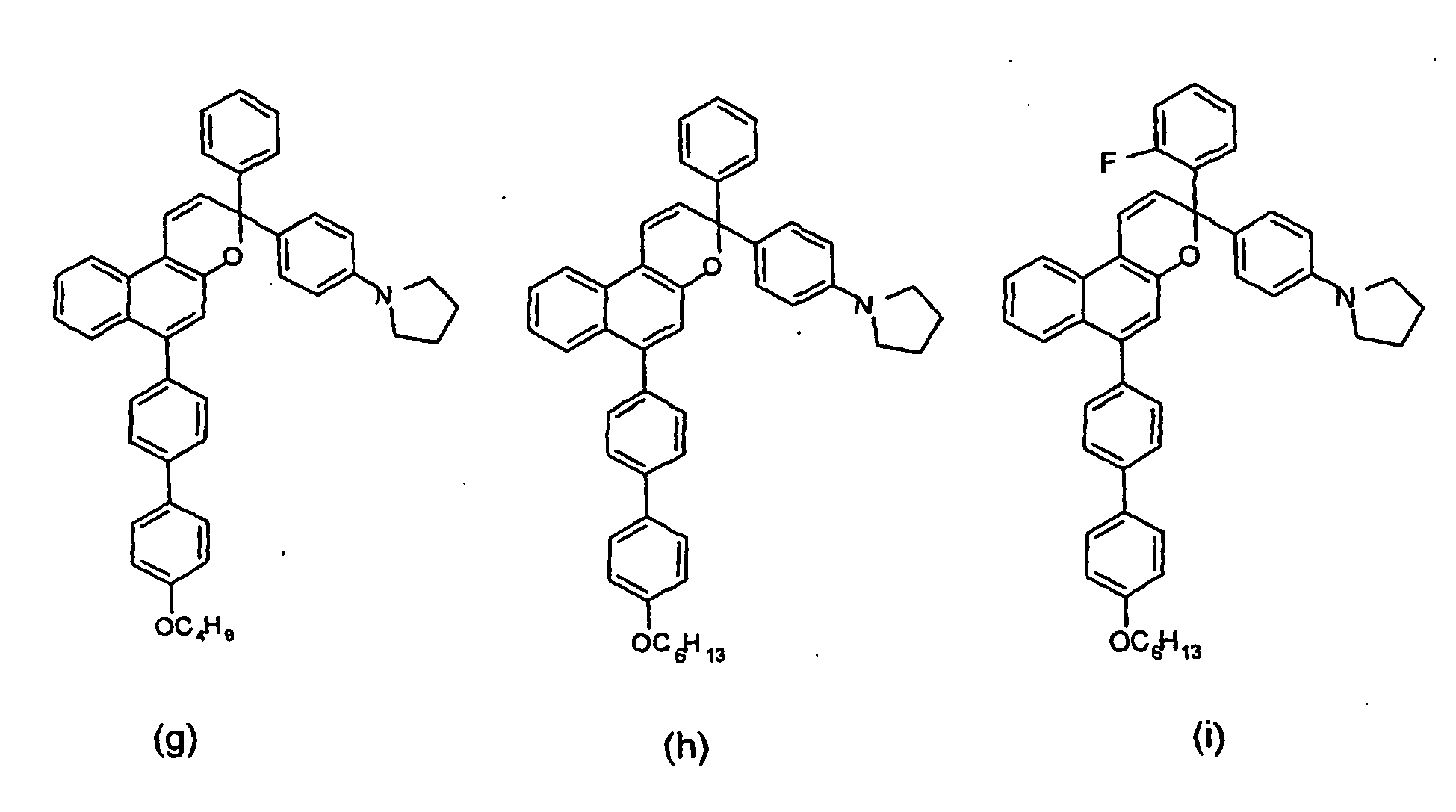
- Examples of most preferred compounds of formula (I) are the compounds represented by the following formulas (a) to (p):




- Compounds represented by formula (I) may be prepared according to the following descriptions and reaction schemes:
- The requisite naphthols may be prepared as shown in Schemes 1 - 4. For example, 4-bromo-2-naphthol 1 may be prepared, as shown in Scheme 1, by sequential bromination, diazotisation and reduction of 1-naphthylamine according to the published procedure (M. S. Newman, V. Sankaran and D. Olson, J. Am. Chem. Soc., 1976, 98, 3237).
- 1,3-Dihydroxynapthalene is readily available according to the procedure of Meyer and Bloch; (Org Synth. Coll. Vol., 3, p. 637), and may be selectively methylated to give 3-methoxy-1-naphthol in high yield as described in K. H. Bell and L. F. McCaffrey, Aust. J. Chem., 1993, 46, 731. Subsequent sulfonylation with trifluoromethanesulfonic anhydride provides the trifate 2 in about a 74% yield (Scheme 2), and this procedure is described in
S. C. Benson, J. Y. L. Lam, S. M. Menchen, US Pat. 5,936,087 . - Suzuki-Miyaura coupling of 2 with 4'-methoxybiphenyl-4-boronic acid may be employed to give 3, after treatment with excess boron tribromide (Scheme 3). Suzuki-Miyaura coupling is described in A. Suzuki, J. Organomet. Chem., 1999, 576, 147; N. Miyaura, Top. Curr. Chem., 2002, 219, 11. 4'-methoxybiphenyl-4-boronic acid is further described in V. Percec, P. Chu and M. Kawasumi, Macromolecules, 1994, 27, 4441.
- The preparation of naphthol 4 may involve an initial Claisen-type condensation of methyl (3,4-dimethoxyphenyl)acetate and 4'-bromoacetophenone mediated by sodium hydride (Scheme 4). Acylation reactions of this type of active CH compound have been reviewed (C. R. Hauser, F. W. Swamer and J. T. Adams, Org. React., 1954, 8, 126; B. R. Davies and P. J. Garratt, Comprehensive Organic Synthesis, Pergamon, Oxford, 1991, vol. 2, p. 795). Cyclodehydration of the intermediate 1,3-diketone to 4 may be accomplished under acidic conditions (A. V. Kel'in and Y. Yu. Kozyrkov Synthesis, 1998, 729;
WO 99/31082 - The preparation of 1,1-diarylprop-2-yn-1-ols 5 from lithium trimethylsilylacetylide and a benzophenone according to Scheme 5 has been documented (e.g. C. D. Gabbutt, J. D. Hepworth, B. M. Heron, S. M. Partington and D. A. Thomas, Dyes Pigm., 2001, 49, 65).
- The preparation of the 6-substituted naphtho[2,1-b]pyrans may be accomplished by the acid catalysed condensation of the appropriate 2-naphthol 1, 3 or 4 and alkynol derivatives 5 as shown in Scheme 6. This route to naphthopyrans has been reviewed (B. Van Gemert, Organic Photochromic and Thermochromic Compounds Volume 1: Main Photochromic Families, Ed. J. C. Crano and R. Gugglielmetti, Plenum Press, New York, 1998, p.111; J. D. Hepworth and B. M. Heron, Functional Dyes, Ed. S.-H. Kim, Elsevier, Amsterdam, 2006, p. 85; C. D. Gabbutt, B. M. Heron, A. C. Instone, P. R. Horton, M. B. Hursthouse, Tetrahedron, 2005, 61, p.463).
- The bromonaphthopyrans 6 and 8 may serve as substrates for further modification by Suzuki-Miyaura coupling to the appropriate 4'-substituted-4-biphenylboronic acid (prepared as described by e.g. M. R. Friedman, K. J. Toyne, J. W. Goodby and M. Hird, Liquid Crystals, 2001, 28, 901) and 4-substituted phenylboronic acid to give the 6-(4'-substituted-4-biphenyl)naphtho[2,1-b]pyrans of general structure (I) as illustrated by examples (a) - (j) and (m) - (p) respectively. Alternatively, the naphthopyran 7 may be alkylated as illustrated by examples (k) and (1). These three general sequences are shown in Scheme 7. More specifically, the preparation of Example (1) is outlined in Scheme 8. Noteworthy is the assembly of the 6-(4'-hydroxy-4-biphenyl) moiety via Suzuki-Miyaura coupling of a bromonaphthopyran derivative 8 to readily available 4-(trisopropylsilyloxy)phenylboronic acid (D. J. Aitken, S. Faure and S. S. Roche, Tetrahedron Lett., 2003, 44, 8827, see also M. E. Hart et al. J. Med. Chem., 2006, 49, 1101).


- The present invention also provides an optical article comprising one or more naphthopyran compounds (I) of the present invention. The naphthopyran compounds (I) of the present invention can be used in all kinds of optical devices and elements, such as ophthalmic elements and devices, display elements and devices, windows or mirrors. Non-limiting examples of ophthalmic elements include corrective and non-corrective lenses, including single vision or multi-vision lenses, which may be either segmented or non-segmented, as well as other elements used to correct, protect, or enhance vision, including without limitation contact lenses, intra-ocular lenses, magnifying lenses and protective lenses or visors. Non-limiting examples of display elements and devices include screens and monitors. Non-limiting examples of windows include automotive and aircraft transparencies, filters, shutters, and optical switches.
- The optical article of the present invention is preferably a lens, and more preferably an ophthalmic lens.
- When used in optical articles, the naphthopyran compounds may be incorporated, for example, in the bulk of a polymeric material of the optical article. Such a polymeric host material is generally a solid transparent or optically clear material. Preferred polymeric host materials are for example polymers of polyol(allyl carbonate) monomers, polyacrylates, poly(triethyleneglycol dimethacrylate), polyperfluoroacrylates, cellulose acetate, cellulose triacetate, cellulose acetate propionate, cellulose acetate butyrate, poly(vinyl acetate), poly(vinyl alcohol), polyurethane, polycarbonates, poly(ethylene terephthalate), polystyrene, polyfluorostyrene, poly(diethylene glycol bis(alkyl carbonate)) and mixtures thereof.
- The photochromic substances of the present invention may be incorporated into the polymeric host material by various methods described in the art. Such methods include dissolving or dispersing the photochromic substance within the host material by adding it to the monomeric host material prior to polymerization, or by imbibition of the photochromic substance into the host material by immersion of the host material in a hot solution of the photochromic substance.
- In another preferred embodiment of the present invention the photochromic dyes are not incorporated into the bulk of an organic polymeric host material, but are incorporated into a surface coating or a film applied onto an optical substrate. The substrate is preferably a transparent or optically clear material, such as glass or organic polymers commonly used in optical applications.
- The present invention of course also encompasses optical articles having at least one naphthopyran compound of formula (I) incorporated either in the bulk of the article, or in the coating of the article, or in the film applied onto the article. In one or more embodiments, the optical article includes a naphthopyran compound of formula (1) incorporated both into the bulk and into the coating of the article.
- In still a more preferred embodiment of the present invention, the coating or film incorporating the photochromic naphthopyran compounds of the present invention is an anisotropic film or coating, i.e. it comprises a layer or medium which is able to function as an alignment layer for the dye molecules. Such an alignment layer may be for example an organic polymer, such as polyvinyl alcohol (PVA). One common method of aligning the molecules of a dichroic dye involves heating a sheet or layer of PVA to soften the PVA and then stretching the sheet to orient the polymer chains. The dichroic dye is then impregnated into the stretched sheet and dye molecules take the orientation of the polymer chains. Alternatively, the dichroic dye can be first impregnated into the PVA sheet, and thereafter the sheet can be heated and stretched as described above to orient the PVA polymer chains and associated dyes. In this manner, the molecules of the dichroic dye can be suitably positioned or arranged within the oriented polymer chains of the PVA sheet and a net linear polarization can be achieved.
- In an even more preferred embodiment of the present invention, the novel naphthopyran compounds are not incorporated into a solid, isotropic or anisotropic host material, but into a fluid, mesomorphous or gel host medium. Dissolving or dispersing the naphthopyran compounds of the present invention in such a fluid, mesomorphous or gel host medium increases the coloration rate and even more drastically the fading rate. The recovery time, i.e. the time it takes the material to revert from an absorptive condition to a clear condition, can thus be reduced to less than 5 minutes.
- The fluid or mesomorphous host medium incorporating at least one naphthopyran compound is preferably selected from the group consisting of organic solvents, liquid crystals, and mixtures thereof.
- The naphthopyran compounds of the present invention are preferably dissolved in the host medium.
- The organic solvents may be selected for example from the group consisting of benzene, toluene, methyl ethyl ketone, acetone, ethanol, tetrahydrofurfuryl alcohol, N-methyl pyrrolidone, 2-methoxyethyl ether, xylene, cyclohexane, 3-methylcyclohexanone, ethyl acetate, ethyl phenylacetate, tetrahydrofuran, methanol, methyl propionate, ethylene glycol and mixtures thereof.
- The liquid crystal medium that may be used in the present invention includes, without being limited to, such materials as nematic or chiral nematic media. Alternatively a polymeric liquid crystal medium can be used as the host material. These liquid crystal and polymeric liquid crystal media are generally used in combination with an organic solvent, for example one of the organic solvents mentioned above.
- The mixture of a fluid, mesomorphous or gel host medium and at least one of the naphthopyran compounds of the present invention preferably is incorporated into a device containing a mechanism for holding the mixture in a mechanically stable environment.
- Such a device is disclosed for example in
US 6,690,495 which is hereby specifically incorporated by reference herein. Such a device comprises a pair of opposed substrates having a gap therebetween for receiving the mixture of a fluid, mesomorphous or gel host medium and at least one photochromic dye of the present invention, and a frame for holding said pair of substrates adjacent one another. - An even more preferred device for holding the mixture in a mechanically stable environment is the one described in
WO 2006/013250 andFR 2879757 - The preferred optical article of the present invention, disclosed in
WO 2006/013250 , comprises an optical component provided with at least one transparent cell arrangement juxtaposed in a parallel direction to the surface thereof, each cell being tightly closed and containing said fluid, mesomorphous or gel host medium and said at least one naphthopyran compound of the present invention. The transparent cell arrangement forms a layer whose height perpendicular to the component surface is less than 100 µm, preferably comprised between 1 µm and 50 µm. - The transparent cell arrangement may be formed either directly on a transparent rigid substrate of said optical component, or alternatively a transparent film incorporating the transparent cell arrangement may be applied on a transparent rigid substrate of the optical component.
- The cell arrangement preferably occupies a large fraction of the total surface of the optical component. The ratio of the total surface occupied by the cells to the total surface of the optical component is preferably at least 90 %, more preferable comprised between 90 and 99.5 %, and most preferably between 96 % and 98.5 %.
- The cell arrangement may be composed for example of hexagonal or rectangular cells, whose dimensions may be described by
- (a) their size parallel to the surface of the optical component, which is preferably of at least 1 µm, more preferably comprised between 5 µm and 100 µm;
- (b) the height of the cells perpendicular to the component surface, which is preferably less than 100 µm, and is more preferably comprised between 1 µm and 50 µm; and
- (c) the thickness of the partitions separating the tightly closed cells from each other, which is preferable comprised between 0.10 and 5.00 µm.
-

- Trifluoromethanesulfonic anhydride (9.35 g, 32.8 mmol) was added dropwise to a solution of 3-methoxy-1-naphthol (5.77 g, 32.8 mmol) and Et3N (10 ml) in dichloromethane (100 ml) at 0 °C with stirring. After 1 h the resulting solution was washed with HCl (50 ml, 1 M) and saturated Na2CO3 (50 ml), dried (MgSO4) and the solvent removed under reduced pressure. The residue was chromatographed on silica using EtOAc (7 % in hexanes) to give the title compound (7.45 g, 74 %) as a colourless oil.
-

- A mixture of 3-methoxynaphthalen-1-yl trifluoromethanesulfonate (0.5 g, 1.7 mmol), (4'-methoxy-4-biphenyl)boronic acid (0.58 g, 2.5 mmol), Na2CO3 (0.27 g, 2.5 mmol) and Pd(PPh3)4 (40 mg, 2 mol %) in PhMe (20 ml) and EtOH (20 ml) under N2 was heated at reflux. After 2 h the mixture was cooled, poured into water (100 ml), extracted with dichloromethane (3 x 50 ml), dried (MgSO4) and the solvent removed under reduced pressure. The residue was dissolved in dichloromethane, filtered through a short plug of silica and the solvent removed under reduced pressure to give the title compound (0.44 g, 76 %) as a colourless powder.
-

- Boron tribromide (1.00 g, 3.9 mmol) was added dropwise to a solution of 3-methoxy-1-(4'-methoxy-4-biphenyl)naphthalene (0.44 g, 1.3 mmol) in dichloromethane (50 ml) at 0 °C under N2. The solution was warmed to rt and stirring continued overnight, poured into water (200 ml), extracted with Et2O (3 x 50 ml), dried (MgSO4) and the solvent removed under reduced pressure to give the title compound (0.40 g, 100 %) as a brown powder.
-

- Sodium hydride (60% dispersion, 3.80 g, 95.1 mmol) was added portionwise to methyl 2-(3,4-dimethoxyphenyl)acetate (10 g, 47.6 mmol) in Et2O (100 ml) at 0°C. A solution of 4'-bromoacetophenone (9.48 g, 47.6 mmol) in Et2O (50 ml) was added dropwise over 1 h. The mixture was heated at reflux for 16 h, cooled, poured into ice/HCl (2 M), extracted with Et2O (3 x 100 ml), dried (MgSO4) and the solvent removed under reduced pressure. The residue was crystallized from MeOH to give the title compound (9 g, 50 %) as a tan powder.
-

- 1-(4-Bromophenyl)-4-(3,4-dimetlioxyphenyl)butane-1,3-dione (3 g, 8 mmol) in 85 % phosphoric acid was heated at 70 °C for 20 h. The resulting solution was cooled, poured into water (150 ml) and filtered. The residue was dissolved in dichloromethane (50 ml), washed with water (50 ml), dried (MgSO4) and the solvent was removed under reduced pressure to give the title compound (2.56 g, 90 %) as a brown powder.
- A mixture of 4-(4-bromophenyl)-6,7-dimethoxy-2-naphthol (9.7 mmol), 1,1-diarylprop-2-yn-1-ol (9.7 mmol) and acidic alumina (3 g) in toluene (100 ml) was heated at reflux. After 2 h the solution was filtered hot and the residue was washed with PhMe (50 ml). The solvent was removed under reduced pressure and the residue chromatographed on silica. The solvent was removed under reduced pressure and the residue was washed with MeOH to give the title compounds which was purified by flash chromatography from silica gel. The following compounds were prepared in this way:
-

-

-

- The appropriate 6-bromo-3H-naphtho[2,1-b]pyran (1 mmol) was dissolved in THF (10 ml) containing water (1 ml) under nitrogen and [1,1'-bis(diphenylphosphino)ferrocene]dichloro palladium(II) (1 mol%) was added. The solution was stirred for 5 min and potassium carbonate (1.1 mmol), potassium fluoride (3.3 mmol) and the appropriate 4'-susbtituted-4-biphenylboronic acid (1.1 mmol) were added. The reaction mixture was refluxed for 20 hours. Solvent was removed and the residue was flash chromatographed using petroleum ether - ethyl acetate (97-3) on silica gel. Recrystallisation from ethyl acetate and hexane gave the title compounds.
- The following examples were prepared using the intermediate steps described hereinbefore in this way.
- Example (a): 6-(4'-Pentyl-4-biphenyl)-3-phenyl-3-(4-piperidinophenyl)-3H-naphtho[2,1-b]pyran (m.p. 95-97°C) from 6-bromo-3-(4-piperidinophenyl)-3H-naphtho[2,1-b]pyran and 4'-pentylbiphenyl-4-boronic acid.
- Example (b): 6-(4'-Pentyl-4-biphenyl)-3-(4-methoxyphenyl)-3-(4-morpholinophenyl)-3H-naphtho[2,1-b]pyran : (m.p. 166-167°C) from 6-bromo-3-(4-methoxyphenyl)-3-(4-morpholinophenyl)-3H-naphtho[2,1-b]pyran and 4'-pentylbiphenyl-4-boronic acid.
- Example (c): 6-(4'-Pentyl-4-biphenyl)-3-phenyl-3-(4-pyrrolidinophenyl)-3H-naphtho[2,1-b]pyran : (m.p. 155-157°C) from 6-bromo-3-phenyl-3-(4-pyrrolidinophenyl)-3H-naphtho[2,1-b]pyran and 4'-pentylbiphenyl-4-boronic acid.
- Example (d): 6-(4'-Pentyl-4-biphenyl)-3-phenyl-3-(julolidin-9-yl)-3H-naphtho[2,1-b]pyran : (m.p. 130-132°C) from 6-bromo-3-phenyl-3-(julolidin-9-yl)-3H-naphtho[2,1-b]pyran and 4'-pentylbiphenyl-4-boronic acid.
- Example (e): 6-(4'-Pentyl-4-biphenyl)-3-(4-methoxyphenyl)-3-fulolidin-9yl)-3H-naphtho[2,1-b]pyran : (m.p. 89°C) from 6-bromo-3-(4-methoxyphenyl)- 3-(julolidin-9-yl)-3H-naphtho[2,1-b]pyran and 4'-pentylbiphenyl-4-boronic acid.
- Example (f): 6-(4'-Pentyl-4-biphenyl)-3-phenyl-3-(4-fluorophenyl)-3H-naphtho[2,1-b]pyran : (m.p. 55°C) from 6-bromo-3-phenyl-3-(4-fluorophenyl)-3H-naphtho[2,1-b]pyran and 4'-pentylbiphenyl-4-boronic acid.
- Example (g): 6-(4'-Butoxy-4-biphenyl)-3-phenyl-3-(4-pyrrolidinophenyl)-3H-naphtho[2,1-b]pyran : (m.p. 107°C) from 6-bromo-3-phenyl-3-(4-pyrrolidinophenyl)-3H-naphtho[2,1-b]pyran and 4'-butoxybiphenyl-4-boronic acid.
- Example (h): 6-(4'-Hexyloxy-4-biphenyl)-3-phenyl-3-(4-pyrrolidinophenyl)3H-naphtho[2,1-b]pyran : (m.p. 93°C) from 6-bromo-3-phenyl-3-(4-pyrrolidinophenyl)-3H-naphtho[2,1-b]pyran and 4'-hexyloxybiphenyl-4-boronic acid.
- Example (i): 6-(4'-Hexyloxy-4-biphenyl)-3-(4-fluorophenyl)-3-(4-pyrrolidinophenyl)-3H-naphtho[2,1-b]pyran : (m.p. 149°C) from 6-bromo-3-(4-fluorophenyl)-3-(4-pyrrolidinophenyl)-3H-naphtho[2,1-b]pyran and 4'-hexyloxybiphenyl-4-boronic acid.
- Example (j): 6-(4'-Pentyl-4-biphenyl)-3-(4-fluorophenyl)-3-(4-pyrrolidinophenyl)-3H-naphtho[2,1-b]pyran : (m.p. 153°C,) from 6-bromo-3-(4-fluorophenyl)-3-(4-pyrrolidinophenyl)-3H-naphtho[2,1-b]pyran and 4'-pentylbiphenyl-4-boronic acid.
- A mixture of the appropriate 6-bromophenyl-8,9-dimethoxynaphthopyran (2.4 mmol), and an arylboronic acid (3.6 mmol) in 1,2-dimethoxyethane (50 ml) was degassed by purging with nitrogen. Tetrakis(triphenylphosphine)palladium(0) (5 mol%) was added followed by Na2CO3 (7.2 mmol) in degassed water (50 ml). The mixture was heated at 100 °C for 16 h, cooled, poured into water, extracted with dichloromethane (5 x 50 ml), dried (MgSO4) and the solvent removed under reduced pressure. The residue was chromatographed on silica. The solvent was removed under reduced pressure and the residue crystallised from acetone-methanol by slow evaporation to give the title compounds.
- The following examples were prepared using the intermediate steps described hereinbefore in this way.
- Example (m): 6-(4'-Hexyloxy-4-biphenyl)-8,9-dimethoxy-3-phenyl-3-(4-piperidino phenyl)-3H-naphtho[2,1-b]pyran dichloromethane as eluent, 72 % as a purple powder, mp 198-199 °C
- Example (n): 6-(4'-Dibutylamino-4-biphenyl)-8,9-dimethoxy-3-phenyl-3-(4-pyrrolidinophenyl)-3H-naphtho[2,1-b]pyran butanone (15 % in cyclohexane) as eluent, 73 % as a colourless powder, mp 174-175 °C
- Example (o): 6-(4'-(Hexyloxy-4-biphenyl)-8,9-dimethoxy-3-phenyl-3-(4-pyrrolidinophenyl) -3H-naphtho[2,1-b]pyran butanone (20 % in cyclohexane) as eluent, 76 % as a colourless powder, mp 197-198 °C
- Example (p) : 3-(4-Butoxyphenyl)-8,9-dimethoxy-6-(4'-hexyloxy-4-biphenyl)-3-(9-julolidinyl)-3H-naphtho[2,1-b]pyran acetone, butanone, cyclohexane (8:8:84) as eluent, 53 % as a violet powder, mp 111-112 °C
- 8,9-Dimethoxy-3-phenyl-3-(4-pyrrolidinophenyl)-6-(4'-triisopropylsilyloxy-4-biphenyl)]-3H-naphtho[2,1-b]pyran dichloromethane as eluent, 70 % as a colourless powder
-

- A solution of tetrabutylammonium fluoride (1M in THF) (1.26 mmol) was added to a solution of 8,9-dimethoxy-3-phenyl-3-(4-pyrrolidinophenyl)-6-(4'-triisopropylsilyloxy-4-biphenyl)-3H-naphtho[2,1-b]pyran (1.26 mmol) in THF (30 ml) with stirring. After 5 min HCl (3 ml, 1 M) was added and the solvent removed under reduced pressure. The residue was chromatographed on silica using dichloromethane (70 % in hexanes) as eluent The solvent was removed under reduced pressure and the residue crystallised from acetone/MeOH to give the title compound (57 %) as a cream powder, mp 154-155 °C
- To a solution of 8,9-dimethoxy-6-(4'-hydroxy-4-biphenyl)-3-phenyl-3-(4-pyrrolidinophenyl)-3H-naphtho[2,1-b]pyran (0.63 g, 1.0 mmol) and 1-iododecane (0.59 g, 2 .0 mmol) in acetone (50 ml) was added potassium carbonate (1.38 g, 10 mmol) and the mixture refluxed for 6 h. After this time the mixture was poured into water and extracted with dichloromethane (3 x 50 ml). The extracts were dried and evaporated and the residue triturated with acetone to provide the title compound (70%) as a colourless powder, mp 173-175 °C.
- To a solution of 6-(4'-hydroxy-4-biphenyl)-3-[4-(hexyloxy)phenyl]-3-[4-(4-methylpiperidino)phenyl]-3H-naphtho[2,1-b]pyran (0.73 g, 1.0 mmol) and 1-iododecane (0.59 g, 2.0 mmol) in acetone (50 ml) was added potassium carbonate (0.72 g, 5 mmol) and the mixture refluxed for 24 h. After this time the mixture was poured into water and extracted with dichloromethane (3 x 50 ml). The extracts were dried and evaporated and the residue filtered through a short plug of silica using 60% dichloromethane in hexanes as eluent. The solvent was removed and the residue crystallised from acetone-methanol to give the title compound (0.81 g, 89%) as a pink powder, mp 45 °C.

Claims (20)
- A naphthopyran compound represented by the formula (I):
 ■ n1 is an integer comprised from 0 to 5 inclusive;■ n2 is an integer comprised from 0 to 5 inclusive;■ p is an integer comprised from 0 to 5 inclusive;■ m is an integer comprised from 0 to 4 inclusive;■ q is an integer comprised from 0 to 5 inclusive;■ R1 and R2, identical or different, independently from each other, represent a group selected from halogen, -Ra, -OH, -ORa, -SH, -SRa, NH2,-NRaRal, -NRbRc,
-CO-Ra, -O-CO-Ra and -CO2Ral, wherein:○ Ra represents a linear or branched (C1-C18) alkyl group or a linear or branched (C1-C18) perfluoroalkyl group;○ Ral represents a group selected from hydrogen, linear or branched (C1-C18) alkyl group and linear or branched (C1-C18) perfluoroalkyl group;○ Rb and Rc,■ together and in combination with the nitrogen atom, represent a saturated 5 to 7 membered heterocyclic group which comprises optionally one additional heteroatom selected from O, N and S, and which may be optionally substituted by a group selected from halogen, Ra, -OH, -ORa, -NH2, and -NRaRal, wherein Ra and Ral are as defined hereinbefore;■ or together and in combination with the nitrogen atom and the adjacent phenyl group form a heterocyclic group of formula (A) :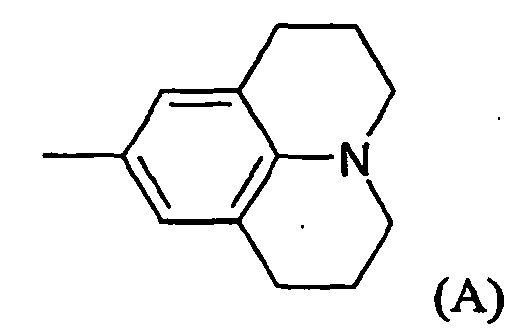 ■ R3 represents a group selected from halogen, -Ra,-OH, -ORa, -SH, -SRa, -NH2, and -NRaRa1, wherein Ra and Ra1 are as defined hereinbefore;■ R4 represents a group selected from halogen, -Ra, -OH, -ORa, -SH, -SRa, -NH2, -NRaRal, -CO-Ra, and -CO2Ra1, wherein Ra and Ra1 are as defined hereinbefore;■ R5 represents a group selected from:○ halogen, -Ra, -OH, -ORa, -SH, -SRa, -NH2, and -NRaRa1, wherein Ra and Ra1 are as defined hereinbefore,○ or when q is equal to 2 and then two R5 substituents are located onto two adjacent carbon atoms selected from C-7, C-8, C-9 and C-10 of the naphtho[2,1-b]pyran group, they may further represent together a group -O-(CH2)q1-O- wherein q1 represents an integer comprised from 1 to 3 inclusive.
 - The naphthopyran compound according to claim 1, wherein:■ n1 is equal to 0 or 1, and R1 represents a group selected from halogen, - OH and -ORa located at the para- or ortho- position of the phenyl group, wherein Ra is as defined hereinbefore;■ n2 is equal to 1 and R2 represents a group selected from halogen, -OH, -ORa, and -NRbRc located at the para-position of the phenyl group, wherein Ra, Rb and Rc are as defined hereinbefore;■ m is equal to zero;■ p is equal to 1 and R4 represents a group selected from -Ra, -ORa, and -NRaRal located at the para-position of the phenyl group; and■ q is an integer comprised from 0 to 2 inclusive, and R5 represents a group selected from -OH and -ORa located on the C-8 and/or C-9 of the naphtho[2,1-b] -pyran group.
- The naphthopyran compound of claim 1 or 2, which is selected from one of the following compounds:■ 6-(4-Pentyl-4-biphenyl)-3-phenyl-3-(4-piperidinophenyl)-3H-naphtho[2,1-b]pyran;■ 6-(4-Pentyl-4-biphenyl)-3-(4-methoxyphenyl)-3-(4-morpholinophenyl)-3H-naphtho[2,1-b]pyran ;■ 6-(4-Pentyl-4-biphenyl)-3-phenyl-3-(4-pyrrolidinophenyl)-3H-naphtho[2,1-b]Pyra ;■ 6-(4-Pentyl-4-biphenyl)-3-phenyl-3-(julolidin-9-yl)-3H-naphtho[2,1-b]pyran ;■ 6-(4-Pentyl-4-biphenyl)-3-(4-methoxyphenyl)1-3-(julolidin-9-yl)-3H-naphtho[2,1-b]pyran ;■ 6-(4-Pentyl-4-biphenyl)-3-phenyl-3-(4-fluorophenyl)-3H-naphtho[2,1-b]pyran ;■ 6-(4-Butoxy-4-biphenyl)-3-phenyl-3-(4-pyrrolidinophenyl)-3H-naphtho[2,1-b]pyran;■ 6-(4-Hexyloxy-4-biphenyl)-3-phenyl-3-(4-pyrrolidinophenyl)-3H-naphtho[2,1-b]pyran ;■ 6-(4-Hexyloxy-4-biphenyl)-3-(4-fluorophenyl)-3-(4-pyrrolidinophenyl)-3H-naphtho[2,1-b]pyran ;■ 6-(4-Pentyl-4-biphenyl)-3-(4-fluorophenyl)-3-(4-pyrrolidinophenyl)-3H-naphtho[2,1-b]pyran ;■ 6-(4-Hexyloxy-4-biphenyl)-8,9-dimethoxy-3-phenyl-3-(4-piperidinophenyl)-3H-naphtho[2,1-b]pyran■ 6-(4'-(Dibutylamino)-4-biphenyl)-8,9-dimethoxy-3-phenyl-3-(4-pyrrolidinophenyl)-3H-naphtho[2,1-b]pyran ;■ 6-(4-Hexyloxy-4-biphenyl)-8,9-dimethoxy-3-phenyl-3-(4-pyrrolidinophenyl) - 3H-naphtho[2,1-b]pyran ;■ 3-(4-Butoxyphenyl)-8,9-dimethoxy-6-(4'-hexyloxy-4-biphenyl)-3-(9-julolidinyl)-3H-naphtho[2,1-b]pyran ;■ 8,9-Dimethoxy-6-(4'-dodecyloxy)-4-biphenyl)-3-phenyl-3-(4-pyrrolidinophenyl)-3H-naphtho[2,1-b]pyran; and■ 8,9-Dimethoxy-6-(4'-dodecyloxy-4-biphenyl)-3-(4-hexyloxyphenyl)-3-[4-(4-methylpiperidino)phenyl]- 3H-naphtho[2,1-b]pyran.
- An optical article comprising at least one naphthopyran compound according to claims 1 to 3.
- Optical article according to claim 4, wherein the said article comprises further a polymeric host material, the at least one naphthopyran compound being incorporated in the bulk of said polymeric host material.
- Optical article according to claim 5, wherein the polymeric host material is selected from polymers of polyol(allyl carbonate) monomers, polyacrylates, poly(triethyleneglycol dimethacrylate), polyperfluoroacrylates, cellulose acetate, cellulose triacetate, cellulose acetate propionate, cellulose acetate butyrate, poly(vinyl acetate), poly(vinyl alcohol), polyurethanes, polycarbonates, poly(ethylene terephthalate), polystyrene), polyfluorostyrene, poly(diethylene glycol bis(alkyl carbonate)) and mixtures thereof.
- Optical article according to claim 4, wherein the said article comprises an optical substrate and at least one film or coating comprising the at least one naphthopyran compound.
- Optical article according to claim 7, wherein the at least one film or coating is a dichroic film or coating comprising an anisotropic oriented polymer layer and the at least one naphthopyran compound.
- Optical article according to claim 4, wherein the article includes a fluid host medium, a mesomorphous host medium or a gel host medium, or a mixture of a fluid, mesomorphous or gel host medium, and at least one naphthopyran compound, wherein the naphthopyran compound is dissolved or dispersed within the host medium.
- Optical article according to claim 9, wherein the fluid, mesomorphous or gel host medium incorporating the at least one naphthopyran compound is selected from the group consisting of organic solvents, liquid crystals, liquid crystal polymers and mixtures thereof.
- Optical article according to claim 9, wherein the said article comprises a device that includes a mechanism for holding the mixture in a mechanically stable environment.
- Optical article according to claim 11, wherein the said device comprises a pair of opposed substrates having a gap there between for receiving the mixture of the host medium and the at least one photochromic dye, and a frame for holding said pair of substrates adjacent one another.
- Optical article according to claim 11, wherein the said device comprises an optical component provided with at least one transparent cell arrangement juxtaposed in a parallel direction to the surface thereof, each cell being tightly closed and containing said fluid host medium and said at least one naphthopyran compound.
- Optical article according to claim 13, wherein the said transparent cell arrangement forms a layer whose height perpendicular to the component surface is less than 100 µm, preferably comprised between 1 µm and 50 µm.
- Optical article according to claim 13, wherein the said optical component comprises a transparent rigid substrate whereon is formed the transparent cell arrangement.
- Optical article according to claim 13, wherein the said optical component comprises a transparent rigid substrate and, applied on said substrate, a transparent film incorporating the transparent cell arrangement.
- Optical article according to any of claims 13 to 16, wherein the ratio of the total surface occupied by the cells to the total surface of the optical component is at least 90 %, preferable comprised between 90 and 99.5 %, most preferably between 96 % and 98.5 %.
- Optical article according to any of claims 13 to 17wherein the cells have a size of at least 1 µm, preferably comprised between 5 µm and 100 µm, parallel to the surface of the optical component.
- Optical article according to any of claims 13 to 18, wherein the cells are separated from each other by means of partitions having a thickness of 0.10 to 5.00 µm.
- Optical article according to any one of claims 13 to 19, wherein the said article is selected from the group consisting of ophthalmic elements, ophthalmic devices, display elements display devices, windows, and mirrors, preferably lenses, and most preferably ophthalmic lenses.
Priority Applications (1)
| Application Number | Priority Date | Filing Date | Title |
|---|---|---|---|
| PL06790163T PL2066650T3 (en) | 2006-09-06 | 2006-09-06 | 3h-naphtho[2,1-b]pyrans as photochromic dichroic dyes and optical article containing them |
Applications Claiming Priority (1)
| Application Number | Priority Date | Filing Date | Title |
|---|---|---|---|
| PCT/US2006/034507 WO2008030226A1 (en) | 2006-09-06 | 2006-09-06 | 3h-naphth0 [2, 1-b] pyrans as photochromic dichroic dyes and optical article containing them |
Publications (2)
| Publication Number | Publication Date |
|---|---|
| EP2066650A1 EP2066650A1 (en) | 2009-06-10 |
| EP2066650B1 true EP2066650B1 (en) | 2011-12-21 |
Family
ID=37903496
Family Applications (1)
| Application Number | Title | Priority Date | Filing Date |
|---|---|---|---|
| EP06790163A Active EP2066650B1 (en) | 2006-09-06 | 2006-09-06 | 3h-naphtho[2,1-b]pyrans as photochromic dichroic dyes and optical article containing them |
Country Status (10)
| Country | Link |
|---|---|
| US (1) | US9249136B2 (en) |
| EP (1) | EP2066650B1 (en) |
| JP (1) | JP5112437B2 (en) |
| AT (1) | ATE538112T1 (en) |
| AU (1) | AU2006347984B2 (en) |
| BR (1) | BRPI0621979B1 (en) |
| ES (1) | ES2383285T3 (en) |
| PL (1) | PL2066650T3 (en) |
| PT (1) | PT2066650E (en) |
| WO (1) | WO2008030226A1 (en) |
Families Citing this family (7)
| Publication number | Priority date | Publication date | Assignee | Title |
|---|---|---|---|---|
| WO2008029194A1 (en) * | 2006-09-06 | 2008-03-13 | Essilor International (Compagnie Générale d'Optique) | 6-(biphenyl-ester) -3h-naphtho [2, 1-b] pyrans as photochromic dichroic dyes and optical article containing them |
| EP2098520B1 (en) * | 2008-03-05 | 2013-07-03 | Essilor International (Compagnie Générale D'Optique) | Photochromic dichroic naphtho-pyrans and optical articles containing them |
| JP5616117B2 (en) * | 2010-05-07 | 2014-10-29 | 国立大学法人横浜国立大学 | Pattern formation method |
| US9200203B2 (en) | 2010-11-29 | 2015-12-01 | Alphamicron Incorporated | Phototropic liquid crystal material and processes |
| US20220325171A1 (en) | 2021-03-31 | 2022-10-13 | Hoya Lens Thailand Ltd. | Photochromic compound, photochromic article and eyeglasses |
| CN114957313B (en) * | 2022-04-29 | 2024-04-30 | 山东大学 | Siloxane-bridged tetraphenyl ethylene derivatives, process for their preparation and their use |
| CN117865933A (en) * | 2023-12-20 | 2024-04-12 | 上海陕煤高新技术研究院有限公司 | A triphenylethylene photochromic material containing dibenzothiophene and preparation method thereof |
Family Cites Families (9)
| Publication number | Priority date | Publication date | Assignee | Title |
|---|---|---|---|---|
| GB9306587D0 (en) | 1993-03-30 | 1993-05-26 | Pilkington Plc | Photochromic compounds |
| IT1264563B1 (en) * | 1993-06-09 | 1996-10-04 | Enichem Sintesi | PHOTOCROMATIC COMPOUNDS AND METHOD FOR THEIR PREPARATION |
| US5699182A (en) | 1995-05-25 | 1997-12-16 | Xytronyx, Inc. | Light fatigue resistant photochromic formulations |
| US6630597B1 (en) * | 1997-12-15 | 2003-10-07 | Transitions Optical, Inc. | Photochromic 6-aryl substituted 3H-naphtho(2,1-b)pyrans |
| DE50310363D1 (en) | 2002-03-21 | 2008-10-02 | Rodenstock Gmbh | BLUE 3H-NAPHTHO2,1-B-PYRAN DERIVATIVES AND THEIR USE |
| US7342112B2 (en) | 2003-07-01 | 2008-03-11 | Ppg Industries Ohio, Inc. | Photochromic compounds |
| ES2552373T3 (en) * | 2004-07-02 | 2015-11-27 | Essilor International (Compagnie Générale d'Optique) | Photochromic optical component |
| WO2008029194A1 (en) * | 2006-09-06 | 2008-03-13 | Essilor International (Compagnie Générale d'Optique) | 6-(biphenyl-ester) -3h-naphtho [2, 1-b] pyrans as photochromic dichroic dyes and optical article containing them |
| EP2098520B1 (en) * | 2008-03-05 | 2013-07-03 | Essilor International (Compagnie Générale D'Optique) | Photochromic dichroic naphtho-pyrans and optical articles containing them |
-
2006
- 2006-09-06 WO PCT/US2006/034507 patent/WO2008030226A1/en not_active Ceased
- 2006-09-06 PT PT06790163T patent/PT2066650E/en unknown
- 2006-09-06 BR BRPI0621979A patent/BRPI0621979B1/en not_active IP Right Cessation
- 2006-09-06 AU AU2006347984A patent/AU2006347984B2/en not_active Ceased
- 2006-09-06 US US12/439,738 patent/US9249136B2/en active Active
- 2006-09-06 PL PL06790163T patent/PL2066650T3/en unknown
- 2006-09-06 EP EP06790163A patent/EP2066650B1/en active Active
- 2006-09-06 JP JP2009527331A patent/JP5112437B2/en not_active Expired - Fee Related
- 2006-09-06 AT AT06790163T patent/ATE538112T1/en active
- 2006-09-06 ES ES06790163T patent/ES2383285T3/en active Active
Also Published As
| Publication number | Publication date |
|---|---|
| PL2066650T3 (en) | 2012-08-31 |
| ATE538112T1 (en) | 2012-01-15 |
| AU2006347984B2 (en) | 2012-09-20 |
| WO2008030226A1 (en) | 2008-03-13 |
| US20100202033A1 (en) | 2010-08-12 |
| AU2006347984A1 (en) | 2008-03-13 |
| US9249136B2 (en) | 2016-02-02 |
| EP2066650A1 (en) | 2009-06-10 |
| PT2066650E (en) | 2012-03-30 |
| BRPI0621979A2 (en) | 2011-12-20 |
| BRPI0621979B1 (en) | 2016-04-19 |
| JP2010502699A (en) | 2010-01-28 |
| ES2383285T3 (en) | 2012-06-20 |
| JP5112437B2 (en) | 2013-01-09 |
Similar Documents
| Publication | Publication Date | Title |
|---|---|---|
| AU2009322665B2 (en) | Photochromic compounds | |
| US6312811B1 (en) | Photochromic naphtho [2,1-b]pyran compounds containing bithienyl or terthienyl substituents, process for their manufacture, and photochromic materials and articles obtained | |
| EP2066651B1 (en) | 6-(biphenyl-ester)-3h-naphtho[2, 1-b]pyrans as photochromic dichroic dyes and optical article containing them | |
| AU2004256030B2 (en) | Photochromic compounds | |
| JP2014237691A (en) | Photochromic dichroic naphthopyran and optical article containing the same | |
| AU2006347984B2 (en) | 3H-naphtho[2, 1-b]pyrans as photochromic dichroic dyes and optical article containing them | |
| EP2076504B1 (en) | Dichroic-photochromic compounds and devices | |
| KR101295435B1 (en) | New phenanthropyran derivative and photochromic dye comprising the same |
Legal Events
| Date | Code | Title | Description |
|---|---|---|---|
| PUAI | Public reference made under article 153(3) epc to a published international application that has entered the european phase |
Free format text: ORIGINAL CODE: 0009012 |
|
| 17P | Request for examination filed |
Effective date: 20090216 |
|
| AK | Designated contracting states |
Kind code of ref document: A1 Designated state(s): AT BE BG CH CY CZ DE DK EE ES FI FR GB GR HU IE IS IT LI LT LU LV MC NL PL PT RO SE SI SK TR |
|
| AX | Request for extension of the european patent |
Extension state: AL BA HR MK RS |
|
| 17Q | First examination report despatched |
Effective date: 20100215 |
|
| GRAP | Despatch of communication of intention to grant a patent |
Free format text: ORIGINAL CODE: EPIDOSNIGR1 |
|
| DAX | Request for extension of the european patent (deleted) | ||
| RTI1 | Title (correction) |
Free format text: 3H-NAPHTHO(2,1-B)PYRANS AS PHOTOCHROMIC DICHROIC DYES AND OPTICAL ARTICLE CONTAINING THEM |
|
| GRAS | Grant fee paid |
Free format text: ORIGINAL CODE: EPIDOSNIGR3 |
|
| GRAA | (expected) grant |
Free format text: ORIGINAL CODE: 0009210 |
|
| AK | Designated contracting states |
Kind code of ref document: B1 Designated state(s): AT BE BG CH CY CZ DE DK EE ES FI FR GB GR HU IE IS IT LI LT LU LV MC NL PL PT RO SE SI SK TR |
|
| REG | Reference to a national code |
Ref country code: GB Ref legal event code: FG4D |
|
| REG | Reference to a national code |
Ref country code: CH Ref legal event code: EP |
|
| REG | Reference to a national code |
Ref country code: AT Ref legal event code: REF Ref document number: 538112 Country of ref document: AT Kind code of ref document: T Effective date: 20120115 |
|
| REG | Reference to a national code |
Ref country code: IE Ref legal event code: FG4D |
|
| REG | Reference to a national code |
Ref country code: DE Ref legal event code: R096 Ref document number: 602006026578 Country of ref document: DE Effective date: 20120308 |
|
| REG | Reference to a national code |
Ref country code: PT Ref legal event code: SC4A Free format text: AVAILABILITY OF NATIONAL TRANSLATION Effective date: 20120320 |
|
| REG | Reference to a national code |
Ref country code: NL Ref legal event code: VDEP Effective date: 20111221 |
|
| PG25 | Lapsed in a contracting state [announced via postgrant information from national office to epo] |
Ref country code: LT Free format text: LAPSE BECAUSE OF FAILURE TO SUBMIT A TRANSLATION OF THE DESCRIPTION OR TO PAY THE FEE WITHIN THE PRESCRIBED TIME-LIMIT Effective date: 20111221 |
|
| LTIE | Lt: invalidation of european patent or patent extension |
Effective date: 20111221 |
|
| PG25 | Lapsed in a contracting state [announced via postgrant information from national office to epo] |
Ref country code: SI Free format text: LAPSE BECAUSE OF FAILURE TO SUBMIT A TRANSLATION OF THE DESCRIPTION OR TO PAY THE FEE WITHIN THE PRESCRIBED TIME-LIMIT Effective date: 20111221 Ref country code: NL Free format text: LAPSE BECAUSE OF FAILURE TO SUBMIT A TRANSLATION OF THE DESCRIPTION OR TO PAY THE FEE WITHIN THE PRESCRIBED TIME-LIMIT Effective date: 20111221 Ref country code: GR Free format text: LAPSE BECAUSE OF FAILURE TO SUBMIT A TRANSLATION OF THE DESCRIPTION OR TO PAY THE FEE WITHIN THE PRESCRIBED TIME-LIMIT Effective date: 20120322 Ref country code: LV Free format text: LAPSE BECAUSE OF FAILURE TO SUBMIT A TRANSLATION OF THE DESCRIPTION OR TO PAY THE FEE WITHIN THE PRESCRIBED TIME-LIMIT Effective date: 20111221 Ref country code: SE Free format text: LAPSE BECAUSE OF FAILURE TO SUBMIT A TRANSLATION OF THE DESCRIPTION OR TO PAY THE FEE WITHIN THE PRESCRIBED TIME-LIMIT Effective date: 20111221 |
|
| REG | Reference to a national code |
Ref country code: ES Ref legal event code: FG2A Ref document number: 2383285 Country of ref document: ES Kind code of ref document: T3 Effective date: 20120620 |
|
| PG25 | Lapsed in a contracting state [announced via postgrant information from national office to epo] |
Ref country code: CY Free format text: LAPSE BECAUSE OF FAILURE TO SUBMIT A TRANSLATION OF THE DESCRIPTION OR TO PAY THE FEE WITHIN THE PRESCRIBED TIME-LIMIT Effective date: 20111221 Ref country code: BE Free format text: LAPSE BECAUSE OF FAILURE TO SUBMIT A TRANSLATION OF THE DESCRIPTION OR TO PAY THE FEE WITHIN THE PRESCRIBED TIME-LIMIT Effective date: 20111221 |
|
| PG25 | Lapsed in a contracting state [announced via postgrant information from national office to epo] |
Ref country code: EE Free format text: LAPSE BECAUSE OF FAILURE TO SUBMIT A TRANSLATION OF THE DESCRIPTION OR TO PAY THE FEE WITHIN THE PRESCRIBED TIME-LIMIT Effective date: 20111221 Ref country code: IS Free format text: LAPSE BECAUSE OF FAILURE TO SUBMIT A TRANSLATION OF THE DESCRIPTION OR TO PAY THE FEE WITHIN THE PRESCRIBED TIME-LIMIT Effective date: 20120421 Ref country code: CZ Free format text: LAPSE BECAUSE OF FAILURE TO SUBMIT A TRANSLATION OF THE DESCRIPTION OR TO PAY THE FEE WITHIN THE PRESCRIBED TIME-LIMIT Effective date: 20111221 Ref country code: BG Free format text: LAPSE BECAUSE OF FAILURE TO SUBMIT A TRANSLATION OF THE DESCRIPTION OR TO PAY THE FEE WITHIN THE PRESCRIBED TIME-LIMIT Effective date: 20120321 Ref country code: SK Free format text: LAPSE BECAUSE OF FAILURE TO SUBMIT A TRANSLATION OF THE DESCRIPTION OR TO PAY THE FEE WITHIN THE PRESCRIBED TIME-LIMIT Effective date: 20111221 |
|
| PG25 | Lapsed in a contracting state [announced via postgrant information from national office to epo] |
Ref country code: RO Free format text: LAPSE BECAUSE OF FAILURE TO SUBMIT A TRANSLATION OF THE DESCRIPTION OR TO PAY THE FEE WITHIN THE PRESCRIBED TIME-LIMIT Effective date: 20111221 |
|
| REG | Reference to a national code |
Ref country code: PL Ref legal event code: T3 |
|
| REG | Reference to a national code |
Ref country code: AT Ref legal event code: MK05 Ref document number: 538112 Country of ref document: AT Kind code of ref document: T Effective date: 20111221 |
|
| PLBI | Opposition filed |
Free format text: ORIGINAL CODE: 0009260 |
|
| PLAB | Opposition data, opponent's data or that of the opponent's representative modified |
Free format text: ORIGINAL CODE: 0009299OPPO |
|
| 26 | Opposition filed |
Opponent name: HEIROTH, SEBASTIAN Effective date: 20120919 |
|
| PLAX | Notice of opposition and request to file observation + time limit sent |
Free format text: ORIGINAL CODE: EPIDOSNOBS2 |
|
| PG25 | Lapsed in a contracting state [announced via postgrant information from national office to epo] |
Ref country code: DK Free format text: LAPSE BECAUSE OF FAILURE TO SUBMIT A TRANSLATION OF THE DESCRIPTION OR TO PAY THE FEE WITHIN THE PRESCRIBED TIME-LIMIT Effective date: 20111221 |
|
| R26 | Opposition filed (corrected) |
Opponent name: HEIROTH, SEBASTIAN Effective date: 20120919 |
|
| REG | Reference to a national code |
Ref country code: DE Ref legal event code: R026 Ref document number: 602006026578 Country of ref document: DE Effective date: 20120919 |
|
| PG25 | Lapsed in a contracting state [announced via postgrant information from national office to epo] |
Ref country code: AT Free format text: LAPSE BECAUSE OF FAILURE TO SUBMIT A TRANSLATION OF THE DESCRIPTION OR TO PAY THE FEE WITHIN THE PRESCRIBED TIME-LIMIT Effective date: 20111221 |
|
| PLBB | Reply of patent proprietor to notice(s) of opposition received |
Free format text: ORIGINAL CODE: EPIDOSNOBS3 |
|
| PG25 | Lapsed in a contracting state [announced via postgrant information from national office to epo] |
Ref country code: MC Free format text: LAPSE BECAUSE OF NON-PAYMENT OF DUE FEES Effective date: 20120930 |
|
| REG | Reference to a national code |
Ref country code: CH Ref legal event code: PL |
|
| PLAB | Opposition data, opponent's data or that of the opponent's representative modified |
Free format text: ORIGINAL CODE: 0009299OPPO |
|
| R26 | Opposition filed (corrected) |
Opponent name: HEIROTH, SEBASTIAN Effective date: 20120919 |
|
| PG25 | Lapsed in a contracting state [announced via postgrant information from national office to epo] |
Ref country code: FI Free format text: LAPSE BECAUSE OF FAILURE TO SUBMIT A TRANSLATION OF THE DESCRIPTION OR TO PAY THE FEE WITHIN THE PRESCRIBED TIME-LIMIT Effective date: 20111221 |
|
| PLBP | Opposition withdrawn |
Free format text: ORIGINAL CODE: 0009264 |
|
| PG25 | Lapsed in a contracting state [announced via postgrant information from national office to epo] |
Ref country code: CH Free format text: LAPSE BECAUSE OF NON-PAYMENT OF DUE FEES Effective date: 20120930 Ref country code: LI Free format text: LAPSE BECAUSE OF NON-PAYMENT OF DUE FEES Effective date: 20120930 |
|
| PLBD | Termination of opposition procedure: decision despatched |
Free format text: ORIGINAL CODE: EPIDOSNOPC1 |
|
| PLBM | Termination of opposition procedure: date of legal effect published |
Free format text: ORIGINAL CODE: 0009276 |
|
| STAA | Information on the status of an ep patent application or granted ep patent |
Free format text: STATUS: OPPOSITION PROCEDURE CLOSED |
|
| 27C | Opposition proceedings terminated |
Effective date: 20131003 |
|
| PG25 | Lapsed in a contracting state [announced via postgrant information from national office to epo] |
Ref country code: TR Free format text: LAPSE BECAUSE OF FAILURE TO SUBMIT A TRANSLATION OF THE DESCRIPTION OR TO PAY THE FEE WITHIN THE PRESCRIBED TIME-LIMIT Effective date: 20111221 |
|
| PG25 | Lapsed in a contracting state [announced via postgrant information from national office to epo] |
Ref country code: LU Free format text: LAPSE BECAUSE OF NON-PAYMENT OF DUE FEES Effective date: 20120906 |
|
| PG25 | Lapsed in a contracting state [announced via postgrant information from national office to epo] |
Ref country code: HU Free format text: LAPSE BECAUSE OF FAILURE TO SUBMIT A TRANSLATION OF THE DESCRIPTION OR TO PAY THE FEE WITHIN THE PRESCRIBED TIME-LIMIT Effective date: 20060906 |
|
| REG | Reference to a national code |
Ref country code: FR Ref legal event code: PLFP Year of fee payment: 10 |
|
| REG | Reference to a national code |
Ref country code: FR Ref legal event code: PLFP Year of fee payment: 11 |
|
| REG | Reference to a national code |
Ref country code: FR Ref legal event code: PLFP Year of fee payment: 12 |
|
| REG | Reference to a national code |
Ref country code: DE Ref legal event code: R081 Ref document number: 602006026578 Country of ref document: DE Owner name: ESSILOR INTERNATIONAL, FR Free format text: FORMER OWNERS: ALPHAMICRON, INC., KENT, OHIO, US; ESSILOR INTERNATIONAL (COMPAGNIE GENERALE D'OPTIQUE), CHARENTON-LE-PONT, FR Ref country code: DE Ref legal event code: R081 Ref document number: 602006026578 Country of ref document: DE Owner name: ALPHAMICRON, INC., KENT, US Free format text: FORMER OWNERS: ALPHAMICRON, INC., KENT, OHIO, US; ESSILOR INTERNATIONAL (COMPAGNIE GENERALE D'OPTIQUE), CHARENTON-LE-PONT, FR |
|
| REG | Reference to a national code |
Ref country code: ES Ref legal event code: PC2A Effective date: 20180521 Ref country code: ES Ref legal event code: PC2A Owner name: ESSILOR INTERNATIONAL Effective date: 20180521 |
|
| REG | Reference to a national code |
Ref country code: GB Ref legal event code: 732E Free format text: REGISTERED BETWEEN 20180517 AND 20180523 |
|
| REG | Reference to a national code |
Ref country code: FR Ref legal event code: TQ Owner name: ESSILOR INTERNATIONAL, FR Effective date: 20180601 Ref country code: FR Ref legal event code: TQ Owner name: ALPHAMICRON, INC., US Effective date: 20180601 |
|
| REG | Reference to a national code |
Ref country code: FR Ref legal event code: PLFP Year of fee payment: 13 |
|
| PGFP | Annual fee paid to national office [announced via postgrant information from national office to epo] |
Ref country code: PT Payment date: 20190816 Year of fee payment: 14 Ref country code: IT Payment date: 20190916 Year of fee payment: 14 Ref country code: IE Payment date: 20190814 Year of fee payment: 14 |
|
| PGFP | Annual fee paid to national office [announced via postgrant information from national office to epo] |
Ref country code: ES Payment date: 20191016 Year of fee payment: 14 |
|
| PGFP | Annual fee paid to national office [announced via postgrant information from national office to epo] |
Ref country code: PL Payment date: 20190829 Year of fee payment: 14 |
|
| PG25 | Lapsed in a contracting state [announced via postgrant information from national office to epo] |
Ref country code: PT Free format text: LAPSE BECAUSE OF NON-PAYMENT OF DUE FEES Effective date: 20210409 |
|
| PG25 | Lapsed in a contracting state [announced via postgrant information from national office to epo] |
Ref country code: IE Free format text: LAPSE BECAUSE OF NON-PAYMENT OF DUE FEES Effective date: 20200906 |
|
| PG25 | Lapsed in a contracting state [announced via postgrant information from national office to epo] |
Ref country code: IT Free format text: LAPSE BECAUSE OF NON-PAYMENT OF DUE FEES Effective date: 20200906 |
|
| REG | Reference to a national code |
Ref country code: ES Ref legal event code: FD2A Effective date: 20220114 |
|
| PG25 | Lapsed in a contracting state [announced via postgrant information from national office to epo] |
Ref country code: ES Free format text: LAPSE BECAUSE OF NON-PAYMENT OF DUE FEES Effective date: 20200907 |
|
| PG25 | Lapsed in a contracting state [announced via postgrant information from national office to epo] |
Ref country code: PL Free format text: LAPSE BECAUSE OF NON-PAYMENT OF DUE FEES Effective date: 20200906 |
|
| PGFP | Annual fee paid to national office [announced via postgrant information from national office to epo] |
Ref country code: DE Payment date: 20250916 Year of fee payment: 20 |
|
| PGFP | Annual fee paid to national office [announced via postgrant information from national office to epo] |
Ref country code: GB Payment date: 20250919 Year of fee payment: 20 |
|
| PGFP | Annual fee paid to national office [announced via postgrant information from national office to epo] |
Ref country code: FR Payment date: 20250821 Year of fee payment: 20 |