EP2065998A1 - Battery structure and charging device adapted for the battery structure - Google Patents
Battery structure and charging device adapted for the battery structure Download PDFInfo
- Publication number
- EP2065998A1 EP2065998A1 EP08015968A EP08015968A EP2065998A1 EP 2065998 A1 EP2065998 A1 EP 2065998A1 EP 08015968 A EP08015968 A EP 08015968A EP 08015968 A EP08015968 A EP 08015968A EP 2065998 A1 EP2065998 A1 EP 2065998A1
- Authority
- EP
- European Patent Office
- Prior art keywords
- battery
- battery cells
- charging
- junctions
- adjacent
- Prior art date
- Legal status (The legal status is an assumption and is not a legal conclusion. Google has not performed a legal analysis and makes no representation as to the accuracy of the status listed.)
- Withdrawn
Links
Images




Classifications
-
- H—ELECTRICITY
- H02—GENERATION; CONVERSION OR DISTRIBUTION OF ELECTRIC POWER
- H02J—ELECTRIC POWER NETWORKS; CIRCUIT ARRANGEMENTS OR SYSTEMS FOR SUPPLYING OR DISTRIBUTING ELECTRIC POWER; SYSTEMS FOR STORING ELECTRIC ENERGY
- H02J7/00—Circuit arrangements for charging or discharging batteries or for supplying loads from batteries
- H02J7/50—Circuit arrangements for charging or discharging batteries or for supplying loads from batteries acting upon multiple batteries simultaneously or sequentially
- H02J7/52—Circuit arrangements for charging or discharging batteries or for supplying loads from batteries acting upon multiple batteries simultaneously or sequentially for charge balancing, e.g. equalisation of charge between batteries
- H02J7/56—Active balancing, e.g. using capacitor-based, inductor-based or DC-DC converters
-
- H—ELECTRICITY
- H01—ELECTRIC ELEMENTS
- H01M—PROCESSES OR MEANS, e.g. BATTERIES, FOR THE DIRECT CONVERSION OF CHEMICAL ENERGY INTO ELECTRICAL ENERGY
- H01M10/00—Secondary cells; Manufacture thereof
- H01M10/04—Construction or manufacture in general
- H01M10/0413—Large-sized flat cells or batteries for motive or stationary systems with plate-like electrodes
-
- H—ELECTRICITY
- H01—ELECTRIC ELEMENTS
- H01M—PROCESSES OR MEANS, e.g. BATTERIES, FOR THE DIRECT CONVERSION OF CHEMICAL ENERGY INTO ELECTRICAL ENERGY
- H01M10/00—Secondary cells; Manufacture thereof
- H01M10/05—Accumulators with non-aqueous electrolyte
- H01M10/052—Li-accumulators
-
- H—ELECTRICITY
- H01—ELECTRIC ELEMENTS
- H01M—PROCESSES OR MEANS, e.g. BATTERIES, FOR THE DIRECT CONVERSION OF CHEMICAL ENERGY INTO ELECTRICAL ENERGY
- H01M10/00—Secondary cells; Manufacture thereof
- H01M10/24—Alkaline accumulators
- H01M10/30—Nickel accumulators
-
- H—ELECTRICITY
- H01—ELECTRIC ELEMENTS
- H01M—PROCESSES OR MEANS, e.g. BATTERIES, FOR THE DIRECT CONVERSION OF CHEMICAL ENERGY INTO ELECTRICAL ENERGY
- H01M10/00—Secondary cells; Manufacture thereof
- H01M10/34—Gastight accumulators
- H01M10/345—Gastight metal hydride accumulators
-
- H—ELECTRICITY
- H01—ELECTRIC ELEMENTS
- H01M—PROCESSES OR MEANS, e.g. BATTERIES, FOR THE DIRECT CONVERSION OF CHEMICAL ENERGY INTO ELECTRICAL ENERGY
- H01M10/00—Secondary cells; Manufacture thereof
- H01M10/42—Methods or arrangements for servicing or maintenance of secondary cells or secondary half-cells
- H01M10/425—Structural combination with electronic components, e.g. electronic circuits integrated to the outside of the casing
-
- H—ELECTRICITY
- H01—ELECTRIC ELEMENTS
- H01M—PROCESSES OR MEANS, e.g. BATTERIES, FOR THE DIRECT CONVERSION OF CHEMICAL ENERGY INTO ELECTRICAL ENERGY
- H01M10/00—Secondary cells; Manufacture thereof
- H01M10/42—Methods or arrangements for servicing or maintenance of secondary cells or secondary half-cells
- H01M10/44—Methods for charging or discharging
- H01M10/441—Methods for charging or discharging for several batteries or cells simultaneously or sequentially
-
- H—ELECTRICITY
- H01—ELECTRIC ELEMENTS
- H01M—PROCESSES OR MEANS, e.g. BATTERIES, FOR THE DIRECT CONVERSION OF CHEMICAL ENERGY INTO ELECTRICAL ENERGY
- H01M10/00—Secondary cells; Manufacture thereof
- H01M10/42—Methods or arrangements for servicing or maintenance of secondary cells or secondary half-cells
- H01M10/46—Accumulators structurally combined with charging apparatus
-
- Y—GENERAL TAGGING OF NEW TECHNOLOGICAL DEVELOPMENTS; GENERAL TAGGING OF CROSS-SECTIONAL TECHNOLOGIES SPANNING OVER SEVERAL SECTIONS OF THE IPC; TECHNICAL SUBJECTS COVERED BY FORMER USPC CROSS-REFERENCE ART COLLECTIONS [XRACs] AND DIGESTS
- Y02—TECHNOLOGIES OR APPLICATIONS FOR MITIGATION OR ADAPTATION AGAINST CLIMATE CHANGE
- Y02E—REDUCTION OF GREENHOUSE GAS [GHG] EMISSIONS, RELATED TO ENERGY GENERATION, TRANSMISSION OR DISTRIBUTION
- Y02E60/00—Enabling technologies; Technologies with a potential or indirect contribution to GHG emissions mitigation
- Y02E60/10—Energy storage using batteries
Definitions
- the present invention relates to a battery structure and a charging device adapted for the battery structure; and more particularly, relates to a battery structure that allows charging of individual battery cells therein respectively and a charging device adapted for the battery structure.
- rechargeable batteries As the power source. When the power runs out, the battery has to be recharged via an alternating current (AC) or a direct current (DC) power source for reuse.
- AC alternating current
- DC direct current
- Rechargeable batteries currently available generally fall into the following categories: nickel cadmium (NiCd) batteries, nickel metal hydride (NiMH) batteries and lithium batteries.
- an electronic apparatus usually has a number of rechargeable battery cells cascaded to supply a desired voltage.
- a schematic view of the cascaded battery cells in a conventional rechargeable battery 1 is schematically shown in FIG 1A .
- the rechargeable battery will have all the battery cells 10 recharged simultaneously.
- the individual battery cells 10 in the rechargeable battery 1 have different charging and discharging statuses. For example, during the charging process of the current rechargeable battery 1, some battery cells have already been fully charged while the others will have not. In other words, to complete the charging process on all the battery cells, those that are already fully charged will inevitably be over-charged due to the continued charging process. This may decrease the service life and capacity of the battery cells and even cause possible deformation or accidents such as explosion.
- FIG. 1B illustrates a schematic of the conventional charging method of an extended junction between the battery cells.
- the rechargeable battery 1' has a first battery cell 10a and a second battery cell 10b, both requiring or supplying a voltage of 3.6V
- the three junctions 11a, 11b, 11c extended from the battery cells 10a, 10b have a potential of 7.2V, 3.6V and 0V respectively.
- the battery cells are also charged with a voltage of these three voltage values.
- the battery structure comprises N battery cells and (N-1) movable connectors, wherein N is an integer larger than 1.
- the N battery cells are arranged next to each other and each has two junctions.
- Each of the (N-1) movable connectors electrically connects two adjacent junctions of every two adjacent battery cells so that all the battery cells are cascaded while the battery structure is discharging.
- Each of the movable connectors disconnects the two adjacent junctions of every two adjacent battery cells so that every two adjacent battery cells are electrically disconnected while the battery structure is charging.
- the charging device comprises an open circuit device and a power supply.
- the open circuit device is adapted to disconnect each of the movable connectors from the two adjacent junctions.
- the power supply comprises 2N charging junctions, which are electrically connected to the two junctions of each of the N battery cells respectively to provide a charging power.
- the power supply charges the battery cells individually through the 2N charging junctions while the open circuit device disconnects the movable connectors from the junctions to electrically disconnect the two adjacent junctions of the every two adjacent battery cells.
- the battery structure of this invention has movable connectors, which are disconnected from the junctions by the open circuit device during the charging process to disconnect the two originally electrically connected adjacent junctions. In this way, the battery structure allows the battery cells therein to be charged individually, thus meeting the different charging demands of the individual battery cells.
- the first embodiment of this invention discloses a battery structure 2 adapted to supply power to an electronic apparatus (not shown).
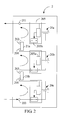
- the discharging process of the battery structure 2 is schematically illustrated in FIG 2 .
- the battery structure 2 comprises three battery cells 20a, 20b, 20c and two movable connectors 21a, 21b.
- the three battery cells 20a, 20b, 20c are arranged next to each other, and each have two junctions, namely, a positive junction 201 and a negative junction 203.
- each of the battery cells 20a, 20b, 20c has a protection device 205. It should be noted that the number of battery cells illustrated in the battery structure 2 of this embodiment is only for purpose of illustration, rather than to limit the scope of this invention.
- the number of battery cells in this embodiment may vary depending on the voltage level actually used.
- the three battery cells 20a, 20b, 20c of the battery structure 2 can be used in a cascade.
- each of the movable connectors 21a, 21b are electrically connected to two adjacent junctions of every two adjacent battery cells 20a, 20b, 20c to connect the battery cells 20a, 20b, 20c in cascade.
- a power supply with a voltage level of 4.5V is obtained.
- a charging device 3 is used in this invention to charge the battery structure 2.
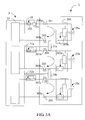
- a corresponding charging process is schematically shown in FIG. 3A .
- the charging device 3 comprises two open circuit devices 31a, 31b, and a power supply 33.
- the power supply 33 has six charging junctions 301a, 301b, 301c, 303a, 303b, 303c.
- the open circuit device 31 is a mechanical pushing device.
- the charging device 3 further comprises three overtemperature cutoff devices 35, the functions of which will be described in detail hereinafter.
- the charging device 3 has a profile conforming to the overall structure of the battery structure 2.
- the two open circuit devices 31a, 31b of the charging device 3 are inserted into the interior of the battery structure 2, which then push the two movable connectors 21a, 21b out of the battery structure 2 to disconnect from the two adjacent junctions between the two adjacent battery cells. Consequently, the two adjacent junctions between every two adjacent battery cells are electrically disconnected, thereby to disconnect the originally cascaded battery cells 20a, 20b, 20c from each other.
- the six charging junctions 301a, 301b, 301c, 303a, 303b, 303c of the power supply 33 are electrically connected with the two junctions 201, 203 of the battery cells 20a, 20b, 20c respectively to supply a charging power for charging the battery cells 20a, 20b, 20c individually. More specifically, the charging junctions 301a, 303a supply a charging voltage of 1.5V to the battery cell 20a, the charging junctions 301b, 303b supply a charging voltage of 1.so to the battery cell 20b, and the charging junctions 301c, 303c supply a charging voltage of 1.5V to the battery cell 20c, thereby charging the battery cells individually.
- the battery structure 2 and the charging device 3 both have a protection device adapted to protect the battery cells, i.e., the protection devices 205 within the battery cells 20a, 20b, 20c and the overtemperature cutoff device 35 within the charging device 3 as described above.
- the protection devices 205 are configured to prevent the battery cells 20a, 20b, 20c from overcharging, overdischarging, overcurrentting, and short circuiting.
- the battery cells 20a, 20b, 20c all have a number of protection devices 205, each of which includes a detecting unit and a first switch 205b.
- the detecting unit is an overcharge detecting unit 205a, which is connected in parallel in each of the battery cells 20a, 20b, 20c.
- the first switch 205b has a control input terminal adapted to control the overcharge or overdischarge in response to the detection signal from the overcharge detecting unit 205a.
- the overcharge detecting unit 205a detects an overcharge status
- the first switch 205b is opened to disconnect the charging or discharging circuit.
- the detecting unit may also comprise an overdischarge detecting unit or an overcurrent/short circuit detecting unit disposed in an appropriate connection manner within the battery cells 20a, 20b, 20c respectively.
- Each of the overtemperature cutoff devices 35 comprises a temperature sensing element 351 and an overtemperature cutoff switch 353.
- the temperature sensing elements 351 are configured to sense the temperature of the battery cells 20a, 20b, 20c and be connected with the battery cells 20a, 20b, 20c. Once the temperature of the battery structure 2 goes higher than the threshold value, the temperature sensing element 353 transmits a signal to the overtemperature cutoff switch 353. In response to this signal, the overtemperature cutoff switch 353 cuts off the charging power supplied by the power supply 33 to guarantee the charging safety of the individual battery cells.
- the battery structure 2 of this invention further provides a battery structure 2'.
- the schematic view of the battery structure 2' is shown in FIG 3B .
- common electronic apparatuses 6 such as notebook computers, mobile phones and multimedia players
- the electronic apparatus 6 is also enabled to operate on an AC power source 61 to provide more convenience.
- the battery structure 2' of this invention allows the battery cells to be charged individually in such a power source design of the electronic apparatus 6.
- the charging device 3' of this invention is disposed within the electronic apparatus 6, and can be electrically connected to the AC power source 61 via a plug of the electronic apparatus 6.
- the charging device 3' further has a power detecting device 37 which comprises a power detecting element 371 and a reset switch 373.
- the open circuit device 31' has a compressible resilient mechanism 311.
- the reset switch 373 drives the open circuit device 31' to enable the movable connectors 21a, 21b to connect the two adjacent junctions of every two adjacent battery cells 20. More specifically, the reset switch 373 compresses the resilient mechanism 311 of the open circuit device 31' to disconnect the open circuit device 31' from the movable connectors 21a, 21b, so that the movable connectors 21a, 21b connects the two adjacent junctions of every two adjacent battery cells 20. Then, the battery structure 2' acts as a power source adapted for the electronic apparatus 6.
- the AC power source 61 when the electronic apparatus 6 is electrically connected to the AC power source 61, the AC power source 61 will charge the battery cells of the battery structure 2' individually apart from powering the electronic apparatus 6.
- the reset switch 373 drives the open circuit device 31' to enable the movable connectors 21a, 21b to disconnect from the two adjacent junctions of every two adjacent battery cells 20. More specifically, the reset switch 373 releases the resilient mechanism 311 of the open circuit device 31'.
- the open circuit device 31' is reset under the releasing resilient mechanism 311, and drives the movable connectors 21a, 21b to be disconnected from the two adjacent junctions of the two adjacent battery cells 20.
- the AC power source 61 charges the battery cells of the battery structure 2' individually until the battery structure 2' is fully charged.
- the electronic apparatus 6 may be powered simply by the AC power source 61, with the battery structure 2' acting as the backup power source.
- the second embodiment of this invention is a battery structure 4. Unlike the first embodiment, a reed switch is used for the open circuit switch 51 of the charging device 5 in the battery structure 4, while the movable connectors 41 in the battery cells 40 have a magnetic polarity that repulses the reed switch.
- the movable connectors 41 electrically connects two adjacent junctions of every two adjacent battery cells 40 to cascade the battery cells 40, so that a positive and a negative junction of the two outermost battery cells 40 respectively are electrically connected to the electronic apparatus to supply power.
- the reed switch functions as the open circuit device 51.
- the reed switch delivers a repulsive magnetic force to disconnect the movable connectors 41 from the two corresponding adjacent junctions.
- the charging device 5 charges the battery cells 40 individually also via the charging junctions of the power supply 53.
- the movable connectors are set to have the same magnetic polarity as the reed switch. In this case, the movable connectors are disconnected when being attracted by the reed switch during the charging process.
- the number of various elements described in the previous embodiments are only for the purpose of illustration, and in practice, the number of battery cells used in the battery structure of this invention may be any positive integer larger than 1. That is, if there are N battery cells, where N is a positive integer larger than 1, then (N-1) movable connectors are needed to accomplish the electrical connections between the individual battery cells. Additionally, since each of the battery cells has two junctions, there are 2N junctions in total, and the power supply of the charging device also needs to have 2N charging junctions corresponding to the 2N junctions to accomplish the charging operation.
- the open circuit device in the aforesaid embodiments may also be implemented in other forms, shapes or at other locations.
- the battery cells in the aforesaid embodiments may be any kind of lithium battery cells, NiMH battery cells or NiCd battery cells.
Landscapes
- Engineering & Computer Science (AREA)
- Manufacturing & Machinery (AREA)
- Chemical & Material Sciences (AREA)
- Chemical Kinetics & Catalysis (AREA)
- Electrochemistry (AREA)
- General Chemical & Material Sciences (AREA)
- Power Engineering (AREA)
- Microelectronics & Electronic Packaging (AREA)
- Charge And Discharge Circuits For Batteries Or The Like (AREA)
- Secondary Cells (AREA)
Abstract
A battery structure and a charging device adapted for the battery structure are provided. The battery structure comprises N battery cells, (N-1) movable connectors, and protection device, wherein N is a positive integer greater than one. The charging device comprises an open circuit device and a power supply. The N battery cells are arranged next to each other, and each battery cell has two junctions. When the battery structure is discharging each movable connector electrically connects the two adjacent junctions of the every two adjacent battery cells, wi th all the battery cells cascaded. When the battery structure is changed by the charging device, the open circuit device will enable the movable connector to disconnect the two adjacent junctions of the two adjacent battery cells so that there would be open circuits between every two adjacent battery cells. Then, the 2N charging junctions of the power supply charge the junctions of each battery cell individually.
Description
- This application claims the benefit of priority based on
Taiwan Patent Application No. 096133842 filed on September 11, 2007 - Not applicable.
- The present invention relates to a battery structure and a charging device adapted for the battery structure; and more particularly, relates to a battery structure that allows charging of individual battery cells therein respectively and a charging device adapted for the battery structure.
- Presently, many portable electronic apparatuses adopt rechargeable batteries as the power source. When the power runs out, the battery has to be recharged via an alternating current (AC) or a direct current (DC) power source for reuse. Rechargeable batteries currently available generally fall into the following categories: nickel cadmium (NiCd) batteries, nickel metal hydride (NiMH) batteries and lithium batteries.
- To obtain an adequate voltage from a rechargeable battery, an electronic apparatus usually has a number of rechargeable battery cells cascaded to supply a desired voltage. A schematic view of the cascaded battery cells in a conventional
rechargeable battery 1 is schematically shown inFIG 1A . During the charging process, the rechargeable battery will have all thebattery cells 10 recharged simultaneously. However, due to the variations of the manufacturing process and other factors, theindividual battery cells 10 in therechargeable battery 1 have different charging and discharging statuses. For example, during the charging process of the currentrechargeable battery 1, some battery cells have already been fully charged while the others will have not. In other words, to complete the charging process on all the battery cells, those that are already fully charged will inevitably be over-charged due to the continued charging process. This may decrease the service life and capacity of the battery cells and even cause possible deformation or accidents such as explosion. - To overcome the aforesaid drawbacks and have battery cells be individually charged, some charging methods have been proposed in the prior art. For example, extended junctions have been formed between battery cells or the voltage has been divided via an external electronic component.
FIG. 1B illustrates a schematic of the conventional charging method of an extended junction between the battery cells. The rechargeable battery 1' has afirst battery cell 10a and asecond battery cell 10b, both requiring or supplying a voltage of 3.6V Hence, the threejunctions battery cells individual battery cells junction 11a at a potential level of 7.2V and thejunction 11c at a potential level of 0V, making it impossible to charge the battery cells individually. Similarly, in a structure which charges battery cells individually via external electronic components in a simulation way, a total voltage is inputted across two junctions at both ends and divided by the external electronic components to charge the battery cells individually. However, the battery cells in the battery structure remain connected in cascade. It is still impossible to substantially charge the battery cells individually, and thus is not a real individual-charging solution. - Although these prior art solutions charge battery cells by imitating an individual-charging process, they actually charge the battery cells by dividing the voltage levels and failing to cope with variations among the individual battery cells. Consequently, over-charging still occurs in such prior art solutions, which has an impact on the operational performance of the battery as a whole and even causes occurrence of risks. Accordingly, it is highly desirable in the art to provide a solution guaranteeing the complete charging of each battery cell without being influenced by the charging status of other battery cells.
- One objective of this invention is to provide a battery structure. The battery structure comprises N battery cells and (N-1) movable connectors, wherein N is an integer larger than 1. The N battery cells are arranged next to each other and each has two junctions. Each of the (N-1) movable connectors electrically connects two adjacent junctions of every two adjacent battery cells so that all the battery cells are cascaded while the battery structure is discharging. Each of the movable connectors disconnects the two adjacent junctions of every two adjacent battery cells so that every two adjacent battery cells are electrically disconnected while the battery structure is charging.
- Another objective of this invention is to provide a charging device adapted for the aforesaid battery structure. The charging device comprises an open circuit device and a power supply. The open circuit device is adapted to disconnect each of the movable connectors from the two adjacent junctions. The power supply comprises 2N charging junctions, which are electrically connected to the two junctions of each of the N battery cells respectively to provide a charging power. The power supply charges the battery cells individually through the 2N charging junctions while the open circuit device disconnects the movable connectors from the junctions to electrically disconnect the two adjacent junctions of the every two adjacent battery cells.
- The battery structure of this invention has movable connectors, which are disconnected from the junctions by the open circuit device during the charging process to disconnect the two originally electrically connected adjacent junctions. In this way, the battery structure allows the battery cells therein to be charged individually, thus meeting the different charging demands of the individual battery cells.
- The detailed technology and preferred embodiments implemented for the subject invention are described in the following paragraphs accompanying the appended drawings for people skilled in this field to well appreciate the features of the claimed invention.
-
-
FIG 1A illustrates the conventional rechargeable battery cells charged in cascade; -
FIG. 1B illustrates the conventional charging method of an extended junction between the battery cells; -
FIG. 2 illustrates the discharging process of a battery structure in accordance with the first embodiment of this invention; -
FIG 3A illustrates the charging process of the battery structure and a charging device thereof in accordance with the first embodiment of this invention; -
FIG. 3B illustrates the charging process of another example of the battery structure and the charging device thereof in accordance with the first embodiment of this invention; and -
FIG. 4 illustrates the charging process of a battery structure and a charging device thereof in accordance with the second embodiment of this invention. - The first embodiment of this invention discloses a
battery structure 2 adapted to supply power to an electronic apparatus (not shown). The discharging process of thebattery structure 2 is schematically illustrated inFIG 2 . Thebattery structure 2 comprises threebattery cells movable connectors battery cells positive junction 201 and anegative junction 203. Additionally, each of thebattery cells protection device 205. It should be noted that the number of battery cells illustrated in thebattery structure 2 of this embodiment is only for purpose of illustration, rather than to limit the scope of this invention. In practice, the number of battery cells in this embodiment may vary depending on the voltage level actually used. In this embodiment, if each of thebattery cells battery cells battery structure 2 can be used in a cascade. - As shown in
FIG. 2 , during the discharging process of thebattery structure 2, each of themovable connectors adjacent battery cells battery cells positive junction 201 of thebattery cell 20a and the negative junction of thebattery cell 20c to the electronic apparatus, a power supply with a voltage level of 4.5V is obtained. - When at least one of the
battery cells battery structure 2 needs to be charged, acharging device 3 is used in this invention to charge thebattery structure 2. A corresponding charging process is schematically shown inFIG. 3A . The chargingdevice 3 comprises twoopen circuit devices power supply 33. In this embodiment, thepower supply 33 has six chargingjunctions open circuit device 31 is a mechanical pushing device. In other preferred examples of this embodiment, the chargingdevice 3 further comprises threeovertemperature cutoff devices 35, the functions of which will be described in detail hereinafter. - Specifically, the charging
device 3 has a profile conforming to the overall structure of thebattery structure 2. During the charging process, the twoopen circuit devices charging device 3 are inserted into the interior of thebattery structure 2, which then push the twomovable connectors battery structure 2 to disconnect from the two adjacent junctions between the two adjacent battery cells. Consequently, the two adjacent junctions between every two adjacent battery cells are electrically disconnected, thereby to disconnect the originally cascadedbattery cells - The six
charging junctions power supply 33 are electrically connected with the twojunctions battery cells battery cells junctions battery cell 20a, the chargingjunctions battery cell 20b, and the chargingjunctions battery cell 20c, thereby charging the battery cells individually. - Furthermore, in the preferred example, to guarantee safety during the charging process of the individual battery cells, the
battery structure 2 and thecharging device 3 both have a protection device adapted to protect the battery cells, i.e., theprotection devices 205 within thebattery cells overtemperature cutoff device 35 within the chargingdevice 3 as described above. - The
protection devices 205 are configured to prevent thebattery cells battery cells protection devices 205, each of which includes a detecting unit and afirst switch 205b. In this embodiment, the detecting unit is anovercharge detecting unit 205a, which is connected in parallel in each of thebattery cells first switch 205b has a control input terminal adapted to control the overcharge or overdischarge in response to the detection signal from theovercharge detecting unit 205a. Once theovercharge detecting unit 205a detects an overcharge status, thefirst switch 205b is opened to disconnect the charging or discharging circuit. In other examples, the detecting unit may also comprise an overdischarge detecting unit or an overcurrent/short circuit detecting unit disposed in an appropriate connection manner within thebattery cells - Each of the
overtemperature cutoff devices 35 comprises atemperature sensing element 351 and anovertemperature cutoff switch 353. Thetemperature sensing elements 351 are configured to sense the temperature of thebattery cells battery cells battery structure 2 goes higher than the threshold value, thetemperature sensing element 353 transmits a signal to theovertemperature cutoff switch 353. In response to this signal, theovertemperature cutoff switch 353 cuts off the charging power supplied by thepower supply 33 to guarantee the charging safety of the individual battery cells. - Additionally, the
battery structure 2 of this invention further provides a battery structure 2'. The schematic view of the battery structure 2' is shown inFIG 3B . Currently, there is a tendency for commonelectronic apparatuses 6, such as notebook computers, mobile phones and multimedia players, to be designed to operate on a combination of AC/DC power supplies. In other words, in addition to the battery structure 2', theelectronic apparatus 6 is also enabled to operate on anAC power source 61 to provide more convenience. Accordingly, the battery structure 2' of this invention allows the battery cells to be charged individually in such a power source design of theelectronic apparatus 6. - Specifically, the charging device 3' of this invention is disposed within the
electronic apparatus 6, and can be electrically connected to theAC power source 61 via a plug of theelectronic apparatus 6. In this example, in addition to the elements described in thecharging device 3 of the previous embodiment, the charging device 3' further has apower detecting device 37 which comprises apower detecting element 371 and areset switch 373. Additionally, the open circuit device 31' has a compressibleresilient mechanism 311. - Once the
power detecting element 371 detects that theelectronic apparatus 6 is not operating on the AC power source, thereset switch 373 drives the open circuit device 31' to enable themovable connectors adjacent battery cells 20. More specifically, thereset switch 373 compresses theresilient mechanism 311 of the open circuit device 31' to disconnect the open circuit device 31' from themovable connectors movable connectors adjacent battery cells 20. Then, the battery structure 2' acts as a power source adapted for theelectronic apparatus 6. - On the other hand, when the
electronic apparatus 6 is electrically connected to theAC power source 61, theAC power source 61 will charge the battery cells of the battery structure 2' individually apart from powering theelectronic apparatus 6. In more detail, as shown inFIG. 3 , once thepower detecting element 371 detects that theelectronic apparatus 6 is operating on the AC power source, thereset switch 373 drives the open circuit device 31' to enable themovable connectors adjacent battery cells 20. More specifically, thereset switch 373 releases theresilient mechanism 311 of the open circuit device 31'. At this point, the open circuit device 31' is reset under the releasingresilient mechanism 311, and drives themovable connectors adjacent battery cells 20. Then, theAC power source 61 charges the battery cells of the battery structure 2' individually until the battery structure 2' is fully charged. Upon completion of the charging process, theelectronic apparatus 6 may be powered simply by theAC power source 61, with the battery structure 2' acting as the backup power source. - The second embodiment of this invention is a
battery structure 4. Unlike the first embodiment, a reed switch is used for theopen circuit switch 51 of thecharging device 5 in thebattery structure 4, while themovable connectors 41 in thebattery cells 40 have a magnetic polarity that repulses the reed switch. - Like the first embodiment, during the discharging process of the
battery structure 4, themovable connectors 41 electrically connects two adjacent junctions of every twoadjacent battery cells 40 to cascade thebattery cells 40, so that a positive and a negative junction of the twooutermost battery cells 40 respectively are electrically connected to the electronic apparatus to supply power. - On the other hand, during the charging process, the reed switch functions as the
open circuit device 51. When moving closer to the magneticmovable connectors 41, the reed switch delivers a repulsive magnetic force to disconnect themovable connectors 41 from the two corresponding adjacent junctions. As a result, the electrical connection between the two adjacent junctions is disconnected, and hence, thebattery cells 40 are disconnected from each other. Thereafter, the chargingdevice 5 charges thebattery cells 40 individually also via the charging junctions of thepower supply 53. - In another example, the movable connectors are set to have the same magnetic polarity as the reed switch. In this case, the movable connectors are disconnected when being attracted by the reed switch during the charging process. Those skilled in the art will appreciate that slight modifications shall be made to other elements in this example to match the structure of this example.
- It should be reemphasized that the number of various elements described in the previous embodiments are only for the purpose of illustration, and in practice, the number of battery cells used in the battery structure of this invention may be any positive integer larger than 1. That is, if there are N battery cells, where N is a positive integer larger than 1, then (N-1) movable connectors are needed to accomplish the electrical connections between the individual battery cells. Additionally, since each of the battery cells has two junctions, there are 2N junctions in total, and the power supply of the charging device also needs to have 2N charging junctions corresponding to the 2N junctions to accomplish the charging operation.
- Furthermore, the open circuit device in the aforesaid embodiments may also be implemented in other forms, shapes or at other locations. The battery cells in the aforesaid embodiments may be any kind of lithium battery cells, NiMH battery cells or NiCd battery cells.
- The above disclosure is related to the detailed technical contents and inventive features thereof. People skilled in this field may proceed with a variety of modifications and replacements based on the disclosures and suggestions of the invention as described without departing from the characteristics thereof. Nevertheless, although such modifications and replacements are not fully disclosed in the above descriptions, they have substantially been covered in the following claims as appended.
Claims (15)
- A battery structure, comprising:N battery cells, arranged next to each other, and each of the battery cells having two junctions, wherein N is an integer larger than 1; and(N-1) movable connectors, wherein each of the movable connectors electrically connects the two adjacent junctions of the every two adjacent battery cells so that all the battery cells would be cascaded while the battery structure is discharging, and each of the movable connectors disconnects the two adjacent junctions of the every two adjacent battery cells so that the every two adjacent battery cells is electrically disconnected while the battery structure is charging.
- The battery structure of claim 1, wherein each of the battery cells has a protection device, adapted to avoid overcharge, over discharge, over current, or short circuit.
- The battery structure of claim 1, wherein each of the battery cells is a lithium battery cell.
- The battery structure of claim 1, wherein each of the battery cells is a nickel metal hydride (NiMH) battery cell.
- The battery structure of claim 1, wherein each of the battery cells is a nickel cadmium (NiCd) battery cell.
- A charging device, adapted for a battery structure of claim 1, the charging device comprising:an open circuit device, adapted to disconnect each of the movable connectors from the two adjacent junctions; anda power supply, comprising 2N charging junctions corresponding to the two junctions of each of the N battery cells, and being configured to provide a charging power,wherein the power supply charges the battery cells separately through the 2N charging junctions while the open circuit device disconnects the movable connectors from the junctions for electrically disconnecting the two adjacent junctions of the every two adjacent battery cells.
- The charging device of claim 6, further comprising an overtemperature cutoff device, wherein the overtemperature cutoff device stops the power supply supplying the charging power when a temperature of the battery structure is over a threshold temperature.
- The charging device of claim 7, wherein the overtemperature cutoff device comprises a temperature sensing element and an overtemperature cutoff switch, the temperature sensing element is adapted to sense the temperature, and the overtemperature cutoff switch is adapted to cut off the power supply to stop supplying the charging power.
- The charging device of claim 6, further comprising a power detecting device, wherein the power detecting device comprises a power detecting element and a reset device, and the reset device drives the open circuit device to enable the movable connector to connect the two adjacent junctions of the every two adjacent battery cells when the power detecting device detects the battery structure is adopted as a power source by an electronic device.
- The charging device of claim 9, wherein the open circuit device is one of an electromagnetic switch and a mechanical device.
- The charging device of claim 9, wherein the charging device is adapted for the electronic device, and the electronic device uses an alternating current (AC) source and the battery structure as a power source.
- The charging device of claim 6, wherein each of the battery cells has a protection device, adapted to avoid overcharge, over discharge, over current, or short circuit.
- The charging device of claim 6, wherein each of the battery cells is a lithium battery cell.
- The charging device of claim 6, wherein each of the battery cells is a nickel metal hydride (NiMH) battery cell.
- The charging device of claim 6, wherein each of the battery cells is a nickel cadmium battery (NiCd) cell.
Applications Claiming Priority (1)
| Application Number | Priority Date | Filing Date | Title |
|---|---|---|---|
| TW096133842A TWI350019B (en) | 2007-09-11 | 2007-09-11 | Battery structure and power supply device of the battery structure |
Publications (1)
| Publication Number | Publication Date |
|---|---|
| EP2065998A1 true EP2065998A1 (en) | 2009-06-03 |
Family
ID=40431152
Family Applications (1)
| Application Number | Title | Priority Date | Filing Date |
|---|---|---|---|
| EP08015968A Withdrawn EP2065998A1 (en) | 2007-09-11 | 2008-09-10 | Battery structure and charging device adapted for the battery structure |
Country Status (4)
| Country | Link |
|---|---|
| US (1) | US20090066292A1 (en) |
| EP (1) | EP2065998A1 (en) |
| JP (1) | JP2009072059A (en) |
| TW (1) | TWI350019B (en) |
Cited By (3)
| Publication number | Priority date | Publication date | Assignee | Title |
|---|---|---|---|---|
| CN106059015A (en) * | 2016-08-09 | 2016-10-26 | 安徽安耐捷新能源科技有限公司 | Apparatus used for lithium battery charging and control method thereof |
| CN106160109A (en) * | 2016-08-09 | 2016-11-23 | 安徽安耐捷新能源科技有限公司 | A kind of many DC equalizing charge system and control method thereof |
| CN106208217A (en) * | 2016-08-09 | 2016-12-07 | 安徽安耐捷新能源科技有限公司 | Equalizing charge systems based on many DC and control method thereof |
Families Citing this family (9)
| Publication number | Priority date | Publication date | Assignee | Title |
|---|---|---|---|---|
| US8721868B2 (en) * | 2009-03-16 | 2014-05-13 | GM Global Technology Operations LLC | Integrated solar-powered high-pressure hydrogen production and battery charging system |
| JP5977943B2 (en) * | 2011-12-28 | 2016-08-24 | 矢崎総業株式会社 | Battery pack |
| CN103713697B (en) * | 2012-10-08 | 2016-12-21 | 英华达(上海)科技有限公司 | Display system and portable electronic devices thereof and display frame |
| US9267999B2 (en) * | 2012-11-01 | 2016-02-23 | Lg Chem, Ltd. | Test system for a battery pack and a method for testing the battery pack |
| CN106026315A (en) * | 2016-08-09 | 2016-10-12 | 安徽安耐捷新能源科技有限公司 | Equalizing charge device and control method thereof |
| CN106253379A (en) * | 2016-08-09 | 2016-12-21 | 安徽安耐捷新能源科技有限公司 | It is applied to balanced charging device and the control method thereof of lithium battery |
| CN106253378A (en) * | 2016-08-09 | 2016-12-21 | 安徽安耐捷新能源科技有限公司 | Lithium battery equalizing charge system and method |
| KR101751236B1 (en) * | 2016-12-13 | 2017-06-27 | 장원석 | Battery charging system for electric vehicle using separated multi-layer and method thereof |
| DE102017106058A1 (en) | 2017-03-21 | 2018-09-27 | Dr. Ing. H.C. F. Porsche Aktiengesellschaft | Battery system and method of operation |
Citations (5)
| Publication number | Priority date | Publication date | Assignee | Title |
|---|---|---|---|---|
| US3935525A (en) * | 1974-09-30 | 1976-01-27 | The Black And Decker Manufacturing Company | Battery charging circuit with thermostat control |
| EP0507569A2 (en) * | 1991-04-05 | 1992-10-07 | Tai-Her Yang | Battery charger with temperature-sensitive cut-out switch |
| EP0758812A1 (en) * | 1995-08-11 | 1997-02-19 | Alcatel Mobile Phones | Battery containing lithium-ion multicells connected in series |
| US5847542A (en) * | 1993-09-17 | 1998-12-08 | Nec Corporation | Circuit for preventing overdischarge of rechargeable battery pack consisting of a plurality of rechargeable batteries |
| US20070126399A1 (en) * | 2005-12-02 | 2007-06-07 | Southwest Electronic Energy Corporation | Method for balancing cells or groups of cells in a battery pack |
Family Cites Families (10)
| Publication number | Priority date | Publication date | Assignee | Title |
|---|---|---|---|---|
| JPS6288426A (en) * | 1985-10-15 | 1987-04-22 | Seiko Epson Corp | Touch key input device |
| JPH06284586A (en) * | 1993-03-30 | 1994-10-07 | Toyoda Mach Works Ltd | Power supply apparatus |
| JPH07135030A (en) * | 1993-09-17 | 1995-05-23 | Nec Corp | Charge circuit and discharge circuit for secondary battery |
| KR100222074B1 (en) * | 1996-12-17 | 1999-10-01 | 윤종용 | Constant power charging circuit and portable computer using the same |
| JP4744673B2 (en) * | 2000-06-30 | 2011-08-10 | パナソニック株式会社 | Charging device, battery pack and charging system using them |
| JP2002354690A (en) * | 2001-05-23 | 2002-12-06 | Matsushita Electric Ind Co Ltd | Battery power unit |
| JP3791351B2 (en) * | 2001-05-30 | 2006-06-28 | 三菱化学株式会社 | Battery pack |
| US7589500B2 (en) * | 2002-11-22 | 2009-09-15 | Milwaukee Electric Tool Corporation | Method and system for battery protection |
| JP4194399B2 (en) * | 2003-03-25 | 2008-12-10 | キヤノン株式会社 | Battery pack, charging device and method thereof |
| JP4353050B2 (en) * | 2004-09-30 | 2009-10-28 | ソニー株式会社 | battery pack |
-
2007
- 2007-09-11 TW TW096133842A patent/TWI350019B/en not_active IP Right Cessation
-
2008
- 2008-09-10 EP EP08015968A patent/EP2065998A1/en not_active Withdrawn
- 2008-09-11 JP JP2008233552A patent/JP2009072059A/en active Pending
- 2008-09-11 US US12/208,791 patent/US20090066292A1/en not_active Abandoned
Patent Citations (5)
| Publication number | Priority date | Publication date | Assignee | Title |
|---|---|---|---|---|
| US3935525A (en) * | 1974-09-30 | 1976-01-27 | The Black And Decker Manufacturing Company | Battery charging circuit with thermostat control |
| EP0507569A2 (en) * | 1991-04-05 | 1992-10-07 | Tai-Her Yang | Battery charger with temperature-sensitive cut-out switch |
| US5847542A (en) * | 1993-09-17 | 1998-12-08 | Nec Corporation | Circuit for preventing overdischarge of rechargeable battery pack consisting of a plurality of rechargeable batteries |
| EP0758812A1 (en) * | 1995-08-11 | 1997-02-19 | Alcatel Mobile Phones | Battery containing lithium-ion multicells connected in series |
| US20070126399A1 (en) * | 2005-12-02 | 2007-06-07 | Southwest Electronic Energy Corporation | Method for balancing cells or groups of cells in a battery pack |
Cited By (3)
| Publication number | Priority date | Publication date | Assignee | Title |
|---|---|---|---|---|
| CN106059015A (en) * | 2016-08-09 | 2016-10-26 | 安徽安耐捷新能源科技有限公司 | Apparatus used for lithium battery charging and control method thereof |
| CN106160109A (en) * | 2016-08-09 | 2016-11-23 | 安徽安耐捷新能源科技有限公司 | A kind of many DC equalizing charge system and control method thereof |
| CN106208217A (en) * | 2016-08-09 | 2016-12-07 | 安徽安耐捷新能源科技有限公司 | Equalizing charge systems based on many DC and control method thereof |
Also Published As
| Publication number | Publication date |
|---|---|
| TW200913349A (en) | 2009-03-16 |
| JP2009072059A (en) | 2009-04-02 |
| US20090066292A1 (en) | 2009-03-12 |
| TWI350019B (en) | 2011-10-01 |
Similar Documents
| Publication | Publication Date | Title |
|---|---|---|
| EP2065998A1 (en) | Battery structure and charging device adapted for the battery structure | |
| JP5209122B2 (en) | Apparatus and method for protecting battery pack by sensing destruction of sense resistor | |
| CN101604772B (en) | Battery pack as well as combination of battery pack and electric apparatus | |
| CN101604849B (en) | Charge unit as well as combination of charge unit and battery pack | |
| US20070210751A1 (en) | Battery system power path configuration and methods for implementing same | |
| CN104849536B (en) | It is a kind of be applied to can serial lithium battery group protection chip detection circuit | |
| CN102754245A (en) | Battery, battery component and subscriber equipment | |
| CN101604773B (en) | Battery pack and method for testing working status of same | |
| KR101201139B1 (en) | Protection circuit device of battery pack | |
| CN101350532A (en) | Overvoltage Protected Battery Charger with Bypass | |
| US6057670A (en) | Smart connector for rechargeable battery | |
| US8665572B2 (en) | Battery charge/discharge protection circuit | |
| US20120057259A1 (en) | Controller with battery recharge protective function | |
| KR20150107032A (en) | Battery pack | |
| CN101662048B (en) | Battery pack and combination of battery pack and electric device | |
| CN106300279B (en) | Compulsory charging protection circuit for secondary batteries after overdischarge | |
| US8253381B2 (en) | Charging device | |
| CN105870990A (en) | Rechargeable battery protection circuit and mobile terminal | |
| CN101602202A (en) | Electric tool, and the combination of electric tool and power brick | |
| US20060132087A1 (en) | Electronic device with function of protection against abnormal charging | |
| EP1391021B1 (en) | Power supply | |
| CN106786914A (en) | A kind of charging module and electronic equipment | |
| CN101399382A (en) | Battery construction and charging device used for the construction | |
| CN201303034Y (en) | Battery pack and combination of electric apparatus and battery pack | |
| KR102375844B1 (en) | Low-resistance Battery Protection Circuit For Protecting Electrostatic Discharge |
Legal Events
| Date | Code | Title | Description |
|---|---|---|---|
| PUAI | Public reference made under article 153(3) epc to a published international application that has entered the european phase |
Free format text: ORIGINAL CODE: 0009012 |
|
| AK | Designated contracting states |
Kind code of ref document: A1 Designated state(s): AT BE BG CH CY CZ DE DK EE ES FI FR GB GR HR HU IE IS IT LI LT LU LV MC MT NL NO PL PT RO SE SI SK TR |
|
| AX | Request for extension of the european patent |
Extension state: AL BA MK RS |
|
| AKX | Designation fees paid | ||
| STAA | Information on the status of an ep patent application or granted ep patent |
Free format text: STATUS: THE APPLICATION IS DEEMED TO BE WITHDRAWN |
|
| 18D | Application deemed to be withdrawn |
Effective date: 20091204 |
|
| REG | Reference to a national code |
Ref country code: DE Ref legal event code: 8566 |