EP2065418A1 - Imide-modified elastomer - Google Patents
Imide-modified elastomer Download PDFInfo
- Publication number
- EP2065418A1 EP2065418A1 EP07806537A EP07806537A EP2065418A1 EP 2065418 A1 EP2065418 A1 EP 2065418A1 EP 07806537 A EP07806537 A EP 07806537A EP 07806537 A EP07806537 A EP 07806537A EP 2065418 A1 EP2065418 A1 EP 2065418A1
- Authority
- EP
- European Patent Office
- Prior art keywords
- imide
- modified elastomer
- organic group
- polyol
- modified
- Prior art date
- Legal status (The legal status is an assumption and is not a legal conclusion. Google has not performed a legal analysis and makes no representation as to the accuracy of the status listed.)
- Withdrawn
Links
- 229920001971 elastomer Polymers 0.000 title claims abstract description 171
- 239000000806 elastomer Substances 0.000 title claims abstract description 167
- 125000000962 organic group Chemical group 0.000 claims abstract description 24
- 125000001931 aliphatic group Chemical group 0.000 claims abstract description 17
- 125000003118 aryl group Chemical group 0.000 claims abstract description 10
- 125000004432 carbon atom Chemical group C* 0.000 claims abstract description 5
- -1 diamine compound Chemical class 0.000 claims description 59
- JOYRKODLDBILNP-UHFFFAOYSA-N Ethyl urethane Chemical compound CCOC(N)=O JOYRKODLDBILNP-UHFFFAOYSA-N 0.000 claims description 48
- 150000003949 imides Chemical group 0.000 claims description 40
- GTDPSWPPOUPBNX-UHFFFAOYSA-N ac1mqpva Chemical compound CC12C(=O)OC(=O)C1(C)C1(C)C2(C)C(=O)OC1=O GTDPSWPPOUPBNX-UHFFFAOYSA-N 0.000 claims description 38
- 229920005862 polyol Polymers 0.000 claims description 38
- 150000003077 polyols Chemical class 0.000 claims description 36
- VLDPXPPHXDGHEW-UHFFFAOYSA-N 1-chloro-2-dichlorophosphoryloxybenzene Chemical compound ClC1=CC=CC=C1OP(Cl)(Cl)=O VLDPXPPHXDGHEW-UHFFFAOYSA-N 0.000 claims description 33
- NAQMVNRVTILPCV-UHFFFAOYSA-N hexane-1,6-diamine Chemical compound NCCCCCCN NAQMVNRVTILPCV-UHFFFAOYSA-N 0.000 claims description 22
- 125000006158 tetracarboxylic acid group Chemical group 0.000 claims description 20
- 125000005442 diisocyanate group Chemical group 0.000 claims description 19
- 229910052799 carbon Inorganic materials 0.000 claims description 16
- OKTJSMMVPCPJKN-UHFFFAOYSA-N Carbon Chemical compound [C] OKTJSMMVPCPJKN-UHFFFAOYSA-N 0.000 claims description 15
- 239000004202 carbamide Substances 0.000 claims description 11
- 239000004417 polycarbonate Substances 0.000 claims description 10
- 229920000515 polycarbonate Polymers 0.000 claims description 10
- 229920005906 polyester polyol Polymers 0.000 claims description 7
- IQPQWNKOIGAROB-UHFFFAOYSA-N isocyanate group Chemical group [N-]=C=O IQPQWNKOIGAROB-UHFFFAOYSA-N 0.000 claims description 6
- JCRRFJIVUPSNTA-UHFFFAOYSA-N 4-[4-(4-aminophenoxy)phenoxy]aniline Chemical compound C1=CC(N)=CC=C1OC(C=C1)=CC=C1OC1=CC=C(N)C=C1 JCRRFJIVUPSNTA-UHFFFAOYSA-N 0.000 claims description 4
- WUPRYUDHUFLKFL-UHFFFAOYSA-N 4-[3-(4-aminophenoxy)phenoxy]aniline Chemical compound C1=CC(N)=CC=C1OC1=CC=CC(OC=2C=CC(N)=CC=2)=C1 WUPRYUDHUFLKFL-UHFFFAOYSA-N 0.000 claims description 3
- LGRFSURHDFAFJT-UHFFFAOYSA-N Phthalic anhydride Natural products C1=CC=C2C(=O)OC(=O)C2=C1 LGRFSURHDFAFJT-UHFFFAOYSA-N 0.000 claims description 3
- 229920001400 block copolymer Polymers 0.000 claims description 3
- JHIWVOJDXOSYLW-UHFFFAOYSA-N butyl 2,2-difluorocyclopropane-1-carboxylate Chemical compound CCCCOC(=O)C1CC1(F)F JHIWVOJDXOSYLW-UHFFFAOYSA-N 0.000 claims description 3
- LFBALUPVVFCEPA-UHFFFAOYSA-N 4-(3,4-dicarboxyphenyl)phthalic acid Chemical compound C1=C(C(O)=O)C(C(=O)O)=CC=C1C1=CC=C(C(O)=O)C(C(O)=O)=C1 LFBALUPVVFCEPA-UHFFFAOYSA-N 0.000 claims description 2
- YGYCECQIOXZODZ-UHFFFAOYSA-N 4415-87-6 Chemical compound O=C1OC(=O)C2C1C1C(=O)OC(=O)C12 YGYCECQIOXZODZ-UHFFFAOYSA-N 0.000 claims description 2
- 125000003277 amino group Chemical group 0.000 claims description 2
- 125000002887 hydroxy group Chemical group [H]O* 0.000 claims description 2
- 239000000463 material Substances 0.000 abstract description 22
- 239000000126 substance Substances 0.000 abstract description 5
- 239000005060 rubber Substances 0.000 abstract description 4
- 230000015572 biosynthetic process Effects 0.000 description 85
- 238000003786 synthesis reaction Methods 0.000 description 85
- 238000012360 testing method Methods 0.000 description 53
- 150000001875 compounds Chemical class 0.000 description 43
- 229920003226 polyurethane urea Polymers 0.000 description 40
- 229920002635 polyurethane Polymers 0.000 description 31
- 239000004814 polyurethane Substances 0.000 description 31
- 239000000243 solution Substances 0.000 description 30
- 239000002904 solvent Substances 0.000 description 30
- 125000005462 imide group Chemical group 0.000 description 29
- 238000006243 chemical reaction Methods 0.000 description 25
- 238000000034 method Methods 0.000 description 18
- 230000035882 stress Effects 0.000 description 17
- LYCAIKOWRPUZTN-UHFFFAOYSA-N Ethylene glycol Chemical compound OCCO LYCAIKOWRPUZTN-UHFFFAOYSA-N 0.000 description 16
- 238000002329 infrared spectrum Methods 0.000 description 16
- 238000009864 tensile test Methods 0.000 description 16
- YXFVVABEGXRONW-UHFFFAOYSA-N Toluene Chemical compound CC1=CC=CC=C1 YXFVVABEGXRONW-UHFFFAOYSA-N 0.000 description 15
- 239000000203 mixture Substances 0.000 description 14
- 238000010521 absorption reaction Methods 0.000 description 13
- XKRFYHLGVUSROY-UHFFFAOYSA-N Argon Chemical compound [Ar] XKRFYHLGVUSROY-UHFFFAOYSA-N 0.000 description 12
- SECXISVLQFMRJM-UHFFFAOYSA-N N-Methylpyrrolidone Chemical compound CN1CCCC1=O SECXISVLQFMRJM-UHFFFAOYSA-N 0.000 description 12
- 238000003878 thermal aging Methods 0.000 description 12
- 230000000052 comparative effect Effects 0.000 description 11
- 238000000465 moulding Methods 0.000 description 11
- 230000009477 glass transition Effects 0.000 description 9
- 238000010998 test method Methods 0.000 description 9
- 239000007789 gas Substances 0.000 description 8
- 229920001721 polyimide Polymers 0.000 description 7
- 229910052786 argon Inorganic materials 0.000 description 6
- WERYXYBDKMZEQL-UHFFFAOYSA-N butane-1,4-diol Chemical compound OCCCCO WERYXYBDKMZEQL-UHFFFAOYSA-N 0.000 description 6
- 238000005227 gel permeation chromatography Methods 0.000 description 6
- 229920000728 polyester Polymers 0.000 description 6
- 230000002040 relaxant effect Effects 0.000 description 6
- 239000002253 acid Substances 0.000 description 5
- 150000002009 diols Chemical class 0.000 description 5
- 238000010438 heat treatment Methods 0.000 description 5
- WGCNASOHLSPBMP-UHFFFAOYSA-N hydroxyacetaldehyde Natural products OCC=O WGCNASOHLSPBMP-UHFFFAOYSA-N 0.000 description 5
- 230000000704 physical effect Effects 0.000 description 5
- 238000002076 thermal analysis method Methods 0.000 description 5
- HLBLWEWZXPIGSM-UHFFFAOYSA-N 4-Aminophenyl ether Chemical compound C1=CC(N)=CC=C1OC1=CC=C(N)C=C1 HLBLWEWZXPIGSM-UHFFFAOYSA-N 0.000 description 4
- 102100021792 Gamma-sarcoglycan Human genes 0.000 description 4
- 101000616435 Homo sapiens Gamma-sarcoglycan Proteins 0.000 description 4
- 239000004642 Polyimide Substances 0.000 description 4
- 239000004793 Polystyrene Substances 0.000 description 4
- WNLRTRBMVRJNCN-UHFFFAOYSA-N adipic acid Chemical compound OC(=O)CCCCC(O)=O WNLRTRBMVRJNCN-UHFFFAOYSA-N 0.000 description 4
- 230000018044 dehydration Effects 0.000 description 4
- 238000006297 dehydration reaction Methods 0.000 description 4
- 238000010528 free radical solution polymerization reaction Methods 0.000 description 4
- 238000007654 immersion Methods 0.000 description 4
- 229920002223 polystyrene Polymers 0.000 description 4
- YBRVSVVVWCFQMG-UHFFFAOYSA-N 4,4'-diaminodiphenylmethane Chemical compound C1=CC(N)=CC=C1CC1=CC=C(N)C=C1 YBRVSVVVWCFQMG-UHFFFAOYSA-N 0.000 description 3
- UHOVQNZJYSORNB-UHFFFAOYSA-N Benzene Chemical compound C1=CC=CC=C1 UHOVQNZJYSORNB-UHFFFAOYSA-N 0.000 description 3
- DNIAPMSPPWPWGF-UHFFFAOYSA-N Propylene glycol Chemical compound CC(O)CO DNIAPMSPPWPWGF-UHFFFAOYSA-N 0.000 description 3
- 238000006482 condensation reaction Methods 0.000 description 3
- 239000011261 inert gas Substances 0.000 description 3
- 239000009719 polyimide resin Substances 0.000 description 3
- 238000004064 recycling Methods 0.000 description 3
- PUPZLCDOIYMWBV-UHFFFAOYSA-N (+/-)-1,3-Butanediol Chemical compound CC(O)CCO PUPZLCDOIYMWBV-UHFFFAOYSA-N 0.000 description 2
- ZXHZWRZAWJVPIC-UHFFFAOYSA-N 1,2-diisocyanatonaphthalene Chemical compound C1=CC=CC2=C(N=C=O)C(N=C=O)=CC=C21 ZXHZWRZAWJVPIC-UHFFFAOYSA-N 0.000 description 2
- CYSGHNMQYZDMIA-UHFFFAOYSA-N 1,3-Dimethyl-2-imidazolidinon Chemical compound CN1CCN(C)C1=O CYSGHNMQYZDMIA-UHFFFAOYSA-N 0.000 description 2
- WZCQRUWWHSTZEM-UHFFFAOYSA-N 1,3-phenylenediamine Chemical compound NC1=CC=CC(N)=C1 WZCQRUWWHSTZEM-UHFFFAOYSA-N 0.000 description 2
- CBCKQZAAMUWICA-UHFFFAOYSA-N 1,4-phenylenediamine Chemical compound NC1=CC=C(N)C=C1 CBCKQZAAMUWICA-UHFFFAOYSA-N 0.000 description 2
- 229940043375 1,5-pentanediol Drugs 0.000 description 2
- VZXPHDGHQXLXJC-UHFFFAOYSA-N 1,6-diisocyanato-5,6-dimethylheptane Chemical compound O=C=NC(C)(C)C(C)CCCCN=C=O VZXPHDGHQXLXJC-UHFFFAOYSA-N 0.000 description 2
- PWGJDPKCLMLPJW-UHFFFAOYSA-N 1,8-diaminooctane Chemical compound NCCCCCCCCN PWGJDPKCLMLPJW-UHFFFAOYSA-N 0.000 description 2
- BAWUFGWWCWMUNU-UHFFFAOYSA-N 1-hexylpyrrolidin-2-one Chemical compound CCCCCCN1CCCC1=O BAWUFGWWCWMUNU-UHFFFAOYSA-N 0.000 description 2
- VOZKAJLKRJDJLL-UHFFFAOYSA-N 2,4-diaminotoluene Chemical compound CC1=CC=C(N)C=C1N VOZKAJLKRJDJLL-UHFFFAOYSA-N 0.000 description 2
- ZBMISJGHVWNWTE-UHFFFAOYSA-N 3-(4-aminophenoxy)aniline Chemical compound C1=CC(N)=CC=C1OC1=CC=CC(N)=C1 ZBMISJGHVWNWTE-UHFFFAOYSA-N 0.000 description 2
- RNLHGQLZWXBQNY-UHFFFAOYSA-N 3-(aminomethyl)-3,5,5-trimethylcyclohexan-1-amine Chemical compound CC1(C)CC(N)CC(C)(CN)C1 RNLHGQLZWXBQNY-UHFFFAOYSA-N 0.000 description 2
- SXFJDZNJHVPHPH-UHFFFAOYSA-N 3-methylpentane-1,5-diol Chemical compound OCCC(C)CCO SXFJDZNJHVPHPH-UHFFFAOYSA-N 0.000 description 2
- UPMLOUAZCHDJJD-UHFFFAOYSA-N 4,4'-Diphenylmethane Diisocyanate Chemical compound C1=CC(N=C=O)=CC=C1CC1=CC=C(N=C=O)C=C1 UPMLOUAZCHDJJD-UHFFFAOYSA-N 0.000 description 2
- NVKGJHAQGWCWDI-UHFFFAOYSA-N 4-[4-amino-2-(trifluoromethyl)phenyl]-3-(trifluoromethyl)aniline Chemical group FC(F)(F)C1=CC(N)=CC=C1C1=CC=C(N)C=C1C(F)(F)F NVKGJHAQGWCWDI-UHFFFAOYSA-N 0.000 description 2
- YHTLGFCVBKENTE-UHFFFAOYSA-N 4-methyloxan-2-one Chemical compound CC1CCOC(=O)C1 YHTLGFCVBKENTE-UHFFFAOYSA-N 0.000 description 2
- 0 CCN*(C)C(C)NC Chemical compound CCN*(C)C(C)NC 0.000 description 2
- BVKZGUZCCUSVTD-UHFFFAOYSA-L Carbonate Chemical compound [O-]C([O-])=O BVKZGUZCCUSVTD-UHFFFAOYSA-L 0.000 description 2
- MQJKPEGWNLWLTK-UHFFFAOYSA-N Dapsone Chemical compound C1=CC(N)=CC=C1S(=O)(=O)C1=CC=C(N)C=C1 MQJKPEGWNLWLTK-UHFFFAOYSA-N 0.000 description 2
- 239000005057 Hexamethylene diisocyanate Substances 0.000 description 2
- FXHOOIRPVKKKFG-UHFFFAOYSA-N N,N-Dimethylacetamide Chemical compound CN(C)C(C)=O FXHOOIRPVKKKFG-UHFFFAOYSA-N 0.000 description 2
- ALQSHHUCVQOPAS-UHFFFAOYSA-N Pentane-1,5-diol Chemical compound OCCCCCO ALQSHHUCVQOPAS-UHFFFAOYSA-N 0.000 description 2
- KKEYFWRCBNTPAC-UHFFFAOYSA-N Terephthalic acid Chemical compound OC(=O)C1=CC=C(C(O)=O)C=C1 KKEYFWRCBNTPAC-UHFFFAOYSA-N 0.000 description 2
- WYURNTSHIVDZCO-UHFFFAOYSA-N Tetrahydrofuran Chemical compound C1CCOC1 WYURNTSHIVDZCO-UHFFFAOYSA-N 0.000 description 2
- 229920006311 Urethane elastomer Polymers 0.000 description 2
- WNLRTRBMVRJNCN-UHFFFAOYSA-L adipate(2-) Chemical compound [O-]C(=O)CCCCC([O-])=O WNLRTRBMVRJNCN-UHFFFAOYSA-L 0.000 description 2
- 239000001361 adipic acid Substances 0.000 description 2
- 235000011037 adipic acid Nutrition 0.000 description 2
- WPYMKLBDIGXBTP-UHFFFAOYSA-N benzoic acid Chemical compound OC(=O)C1=CC=CC=C1 WPYMKLBDIGXBTP-UHFFFAOYSA-N 0.000 description 2
- 150000004985 diamines Chemical class 0.000 description 2
- 239000000539 dimer Substances 0.000 description 2
- QFTYSVGGYOXFRQ-UHFFFAOYSA-N dodecane-1,12-diamine Chemical compound NCCCCCCCCCCCCN QFTYSVGGYOXFRQ-UHFFFAOYSA-N 0.000 description 2
- RRAMGCGOFNQTLD-UHFFFAOYSA-N hexamethylene diisocyanate Chemical compound O=C=NCCCCCCN=C=O RRAMGCGOFNQTLD-UHFFFAOYSA-N 0.000 description 2
- XXMIOPMDWAUFGU-UHFFFAOYSA-N hexane-1,6-diol Chemical compound OCCCCCCO XXMIOPMDWAUFGU-UHFFFAOYSA-N 0.000 description 2
- 239000012948 isocyanate Substances 0.000 description 2
- 150000002513 isocyanates Chemical class 0.000 description 2
- QQVIHTHCMHWDBS-UHFFFAOYSA-N isophthalic acid Chemical compound OC(=O)C1=CC=CC(C(O)=O)=C1 QQVIHTHCMHWDBS-UHFFFAOYSA-N 0.000 description 2
- 238000005259 measurement Methods 0.000 description 2
- 238000002156 mixing Methods 0.000 description 2
- BDJRBEYXGGNYIS-UHFFFAOYSA-N nonanedioic acid Chemical compound OC(=O)CCCCCCCC(O)=O BDJRBEYXGGNYIS-UHFFFAOYSA-N 0.000 description 2
- 229920001610 polycaprolactone Polymers 0.000 description 2
- 239000004632 polycaprolactone Substances 0.000 description 2
- 238000012643 polycondensation polymerization Methods 0.000 description 2
- 229920001451 polypropylene glycol Polymers 0.000 description 2
- CXMXRPHRNRROMY-UHFFFAOYSA-N sebacic acid Chemical compound OC(=O)CCCCCCCCC(O)=O CXMXRPHRNRROMY-UHFFFAOYSA-N 0.000 description 2
- 238000000926 separation method Methods 0.000 description 2
- 230000008961 swelling Effects 0.000 description 2
- PAPBSGBWRJIAAV-UHFFFAOYSA-N ε-Caprolactone Chemical compound O=C1CCCCCO1 PAPBSGBWRJIAAV-UHFFFAOYSA-N 0.000 description 2
- SXGMVGOVILIERA-UHFFFAOYSA-N (2R,3S)-2,3-diaminobutanoic acid Natural products CC(N)C(N)C(O)=O SXGMVGOVILIERA-UHFFFAOYSA-N 0.000 description 1
- ZHUJMSMQIPIPTF-IBURTVSXSA-N (2r)-2-[[(2s)-2-[[2-[[(2r)-2-[[(2s)-2-amino-3-(4-hydroxyphenyl)propanoyl]amino]propanoyl]amino]acetyl]amino]-3-phenylpropanoyl]amino]-4-methylpentanoic acid Chemical compound C([C@@H](C(=O)N[C@H](CC(C)C)C(O)=O)NC(=O)CNC(=O)[C@@H](C)NC(=O)[C@@H](N)CC=1C=CC(O)=CC=1)C1=CC=CC=C1 ZHUJMSMQIPIPTF-IBURTVSXSA-N 0.000 description 1
- SFVSTECQIQQHHL-UHFFFAOYSA-N 1,2-dimethyl-5,5-dioxodibenzothiophene-3,7-diamine Chemical compound C1=C(N)C=C2S(=O)(=O)C3=CC(N)=C(C)C(C)=C3C2=C1 SFVSTECQIQQHHL-UHFFFAOYSA-N 0.000 description 1
- ATOUXIOKEJWULN-UHFFFAOYSA-N 1,6-diisocyanato-2,2,4-trimethylhexane Chemical compound O=C=NCCC(C)CC(C)(C)CN=C=O ATOUXIOKEJWULN-UHFFFAOYSA-N 0.000 description 1
- QGLRLXLDMZCFBP-UHFFFAOYSA-N 1,6-diisocyanato-2,4,4-trimethylhexane Chemical compound O=C=NCC(C)CC(C)(C)CCN=C=O QGLRLXLDMZCFBP-UHFFFAOYSA-N 0.000 description 1
- ICLCCFKUSALICQ-UHFFFAOYSA-N 1-isocyanato-4-(4-isocyanato-3-methylphenyl)-2-methylbenzene Chemical compound C1=C(N=C=O)C(C)=CC(C=2C=C(C)C(N=C=O)=CC=2)=C1 ICLCCFKUSALICQ-UHFFFAOYSA-N 0.000 description 1
- QFGCFKJIPBRJGM-UHFFFAOYSA-N 12-[(2-methylpropan-2-yl)oxy]-12-oxododecanoic acid Chemical compound CC(C)(C)OC(=O)CCCCCCCCCCC(O)=O QFGCFKJIPBRJGM-UHFFFAOYSA-N 0.000 description 1
- ZGDMDBHLKNQPSD-UHFFFAOYSA-N 2-amino-5-(4-amino-3-hydroxyphenyl)phenol Chemical group C1=C(O)C(N)=CC=C1C1=CC=C(N)C(O)=C1 ZGDMDBHLKNQPSD-UHFFFAOYSA-N 0.000 description 1
- QZWKEPYTBWZJJA-UHFFFAOYSA-N 3,3'-Dimethoxybenzidine-4,4'-diisocyanate Chemical compound C1=C(N=C=O)C(OC)=CC(C=2C=C(OC)C(N=C=O)=CC=2)=C1 QZWKEPYTBWZJJA-UHFFFAOYSA-N 0.000 description 1
- NUIURNJTPRWVAP-UHFFFAOYSA-N 3,3'-Dimethylbenzidine Chemical group C1=C(N)C(C)=CC(C=2C=C(C)C(N)=CC=2)=C1 NUIURNJTPRWVAP-UHFFFAOYSA-N 0.000 description 1
- HSTOKWSFWGCZMH-UHFFFAOYSA-N 3,3'-diaminobenzidine Chemical group C1=C(N)C(N)=CC=C1C1=CC=C(N)C(N)=C1 HSTOKWSFWGCZMH-UHFFFAOYSA-N 0.000 description 1
- DKKYOQYISDAQER-UHFFFAOYSA-N 3-[3-(3-aminophenoxy)phenoxy]aniline Chemical compound NC1=CC=CC(OC=2C=C(OC=3C=C(N)C=CC=3)C=CC=2)=C1 DKKYOQYISDAQER-UHFFFAOYSA-N 0.000 description 1
- XUSNPFGLKGCWGN-UHFFFAOYSA-N 3-[4-(3-aminopropyl)piperazin-1-yl]propan-1-amine Chemical compound NCCCN1CCN(CCCN)CC1 XUSNPFGLKGCWGN-UHFFFAOYSA-N 0.000 description 1
- UCQABCHSIIXVOY-UHFFFAOYSA-N 3-[4-[4-(3-aminophenoxy)phenyl]phenoxy]aniline Chemical group NC1=CC=CC(OC=2C=CC(=CC=2)C=2C=CC(OC=3C=C(N)C=CC=3)=CC=2)=C1 UCQABCHSIIXVOY-UHFFFAOYSA-N 0.000 description 1
- WCXGOVYROJJXHA-UHFFFAOYSA-N 3-[4-[4-(3-aminophenoxy)phenyl]sulfonylphenoxy]aniline Chemical compound NC1=CC=CC(OC=2C=CC(=CC=2)S(=O)(=O)C=2C=CC(OC=3C=C(N)C=CC=3)=CC=2)=C1 WCXGOVYROJJXHA-UHFFFAOYSA-N 0.000 description 1
- GPXCORHXFPYJEH-UHFFFAOYSA-N 3-[[3-aminopropyl(dimethyl)silyl]oxy-dimethylsilyl]propan-1-amine Chemical compound NCCC[Si](C)(C)O[Si](C)(C)CCCN GPXCORHXFPYJEH-UHFFFAOYSA-N 0.000 description 1
- ICNFHJVPAJKPHW-UHFFFAOYSA-N 4,4'-Thiodianiline Chemical compound C1=CC(N)=CC=C1SC1=CC=C(N)C=C1 ICNFHJVPAJKPHW-UHFFFAOYSA-N 0.000 description 1
- DPYROBMRMXHROQ-UHFFFAOYSA-N 4,6-diaminobenzene-1,3-diol Chemical compound NC1=CC(N)=C(O)C=C1O DPYROBMRMXHROQ-UHFFFAOYSA-N 0.000 description 1
- QYIMZXITLDTULQ-UHFFFAOYSA-N 4-(4-amino-2-methylphenyl)-3-methylaniline Chemical group CC1=CC(N)=CC=C1C1=CC=C(N)C=C1C QYIMZXITLDTULQ-UHFFFAOYSA-N 0.000 description 1
- QVMOHNTZLKZWNT-UHFFFAOYSA-N 4-[2-[2-[2-(4-aminophenoxy)ethoxy]ethoxy]ethoxy]aniline Chemical compound C1=CC(N)=CC=C1OCCOCCOCCOC1=CC=C(N)C=C1 QVMOHNTZLKZWNT-UHFFFAOYSA-N 0.000 description 1
- AJYDKROUZBIMLE-UHFFFAOYSA-N 4-[2-[2-[2-(4-aminophenoxy)phenyl]propan-2-yl]phenoxy]aniline Chemical compound C=1C=CC=C(OC=2C=CC(N)=CC=2)C=1C(C)(C)C1=CC=CC=C1OC1=CC=C(N)C=C1 AJYDKROUZBIMLE-UHFFFAOYSA-N 0.000 description 1
- HPUJEBAZZTZOFL-UHFFFAOYSA-N 4-[3-(4-aminophenoxy)-2,2-dimethylpropoxy]aniline Chemical compound C=1C=C(N)C=CC=1OCC(C)(C)COC1=CC=C(N)C=C1 HPUJEBAZZTZOFL-UHFFFAOYSA-N 0.000 description 1
- HHLMWQDRYZAENA-UHFFFAOYSA-N 4-[4-[2-[4-(4-aminophenoxy)phenyl]-1,1,1,3,3,3-hexafluoropropan-2-yl]phenoxy]aniline Chemical compound C1=CC(N)=CC=C1OC1=CC=C(C(C=2C=CC(OC=3C=CC(N)=CC=3)=CC=2)(C(F)(F)F)C(F)(F)F)C=C1 HHLMWQDRYZAENA-UHFFFAOYSA-N 0.000 description 1
- HYDATEKARGDBKU-UHFFFAOYSA-N 4-[4-[4-(4-aminophenoxy)phenyl]phenoxy]aniline Chemical group C1=CC(N)=CC=C1OC1=CC=C(C=2C=CC(OC=3C=CC(N)=CC=3)=CC=2)C=C1 HYDATEKARGDBKU-UHFFFAOYSA-N 0.000 description 1
- UTDAGHZGKXPRQI-UHFFFAOYSA-N 4-[4-[4-(4-aminophenoxy)phenyl]sulfonylphenoxy]aniline Chemical compound C1=CC(N)=CC=C1OC1=CC=C(S(=O)(=O)C=2C=CC(OC=3C=CC(N)=CC=3)=CC=2)C=C1 UTDAGHZGKXPRQI-UHFFFAOYSA-N 0.000 description 1
- KIFDSGGWDIVQGN-UHFFFAOYSA-N 4-[9-(4-aminophenyl)fluoren-9-yl]aniline Chemical compound C1=CC(N)=CC=C1C1(C=2C=CC(N)=CC=2)C2=CC=CC=C2C2=CC=CC=C21 KIFDSGGWDIVQGN-UHFFFAOYSA-N 0.000 description 1
- XPAQFJJCWGSXGJ-UHFFFAOYSA-N 4-amino-n-(4-aminophenyl)benzamide Chemical compound C1=CC(N)=CC=C1NC(=O)C1=CC=C(N)C=C1 XPAQFJJCWGSXGJ-UHFFFAOYSA-N 0.000 description 1
- IJGRMHOSHXDMSA-UHFFFAOYSA-N Atomic nitrogen Chemical compound N#N IJGRMHOSHXDMSA-UHFFFAOYSA-N 0.000 description 1
- 239000005711 Benzoic acid Substances 0.000 description 1
- KYXHKHDZJSDWEF-LHLOQNFPSA-N CCCCCCC1=C(CCCCCC)C(\C=C\CCCCCCCC(O)=O)C(CCCCCCCC(O)=O)CC1 Chemical compound CCCCCCC1=C(CCCCCC)C(\C=C\CCCCCCCC(O)=O)C(CCCCCCCC(O)=O)CC1 KYXHKHDZJSDWEF-LHLOQNFPSA-N 0.000 description 1
- OIFBSDVPJOWBCH-UHFFFAOYSA-N Diethyl carbonate Chemical compound CCOC(=O)OCC OIFBSDVPJOWBCH-UHFFFAOYSA-N 0.000 description 1
- 229920006347 Elastollan Polymers 0.000 description 1
- YCKRFDGAMUMZLT-UHFFFAOYSA-N Fluorine atom Chemical compound [F] YCKRFDGAMUMZLT-UHFFFAOYSA-N 0.000 description 1
- WMTLVUCMBWBYSO-UHFFFAOYSA-N N=C=O.N=C=O.C=1C=CC=CC=1OC1=CC=CC=C1 Chemical compound N=C=O.N=C=O.C=1C=CC=CC=1OC1=CC=CC=C1 WMTLVUCMBWBYSO-UHFFFAOYSA-N 0.000 description 1
- HDONYZHVZVCMLR-UHFFFAOYSA-N N=C=O.N=C=O.CC1CCCCC1 Chemical compound N=C=O.N=C=O.CC1CCCCC1 HDONYZHVZVCMLR-UHFFFAOYSA-N 0.000 description 1
- YGYAWVDWMABLBF-UHFFFAOYSA-N Phosgene Chemical compound ClC(Cl)=O YGYAWVDWMABLBF-UHFFFAOYSA-N 0.000 description 1
- 239000004952 Polyamide Substances 0.000 description 1
- 239000005062 Polybutadiene Substances 0.000 description 1
- 239000002202 Polyethylene glycol Substances 0.000 description 1
- 239000004721 Polyphenylene oxide Substances 0.000 description 1
- 229920002396 Polyurea Polymers 0.000 description 1
- KDYFGRWQOYBRFD-UHFFFAOYSA-N Succinic acid Natural products OC(=O)CCC(O)=O KDYFGRWQOYBRFD-UHFFFAOYSA-N 0.000 description 1
- YIMQCDZDWXUDCA-UHFFFAOYSA-N [4-(hydroxymethyl)cyclohexyl]methanol Chemical compound OCC1CCC(CO)CC1 YIMQCDZDWXUDCA-UHFFFAOYSA-N 0.000 description 1
- 238000004220 aggregation Methods 0.000 description 1
- 230000002776 aggregation Effects 0.000 description 1
- 230000032683 aging Effects 0.000 description 1
- 150000001335 aliphatic alkanes Chemical class 0.000 description 1
- 235000010233 benzoic acid Nutrition 0.000 description 1
- TUQQUUXMCKXGDI-UHFFFAOYSA-N bis(3-aminophenyl)methanone Chemical compound NC1=CC=CC(C(=O)C=2C=C(N)C=CC=2)=C1 TUQQUUXMCKXGDI-UHFFFAOYSA-N 0.000 description 1
- ZLSMCQSGRWNEGX-UHFFFAOYSA-N bis(4-aminophenyl)methanone Chemical compound C1=CC(N)=CC=C1C(=O)C1=CC=C(N)C=C1 ZLSMCQSGRWNEGX-UHFFFAOYSA-N 0.000 description 1
- 238000000071 blow moulding Methods 0.000 description 1
- 238000012662 bulk polymerization Methods 0.000 description 1
- KDYFGRWQOYBRFD-NUQCWPJISA-N butanedioic acid Chemical compound O[14C](=O)CC[14C](O)=O KDYFGRWQOYBRFD-NUQCWPJISA-N 0.000 description 1
- FZFAMSAMCHXGEF-UHFFFAOYSA-N chloro formate Chemical compound ClOC=O FZFAMSAMCHXGEF-UHFFFAOYSA-N 0.000 description 1
- 239000011248 coating agent Substances 0.000 description 1
- 238000000576 coating method Methods 0.000 description 1
- 229920001577 copolymer Polymers 0.000 description 1
- 125000004122 cyclic group Chemical group 0.000 description 1
- YMHQVDAATAEZLO-UHFFFAOYSA-N cyclohexane-1,1-diamine Chemical compound NC1(N)CCCCC1 YMHQVDAATAEZLO-UHFFFAOYSA-N 0.000 description 1
- KQWGXHWJMSMDJJ-UHFFFAOYSA-N cyclohexyl isocyanate Chemical compound O=C=NC1CCCCC1 KQWGXHWJMSMDJJ-UHFFFAOYSA-N 0.000 description 1
- 238000011161 development Methods 0.000 description 1
- 230000018109 developmental process Effects 0.000 description 1
- KORSJDCBLAPZEQ-UHFFFAOYSA-N dicyclohexylmethane-4,4'-diisocyanate Chemical compound C1CC(N=C=O)CCC1CC1CCC(N=C=O)CC1 KORSJDCBLAPZEQ-UHFFFAOYSA-N 0.000 description 1
- GKGXKPRVOZNVPQ-UHFFFAOYSA-N diisocyanatomethylcyclohexane Chemical compound O=C=NC(N=C=O)C1CCCCC1 GKGXKPRVOZNVPQ-UHFFFAOYSA-N 0.000 description 1
- IEJIGPNLZYLLBP-UHFFFAOYSA-N dimethyl carbonate Chemical compound COC(=O)OC IEJIGPNLZYLLBP-UHFFFAOYSA-N 0.000 description 1
- 229910001873 dinitrogen Inorganic materials 0.000 description 1
- 230000000694 effects Effects 0.000 description 1
- 210000004177 elastic tissue Anatomy 0.000 description 1
- 238000001125 extrusion Methods 0.000 description 1
- 229910052731 fluorine Inorganic materials 0.000 description 1
- 239000011737 fluorine Substances 0.000 description 1
- 238000001746 injection moulding Methods 0.000 description 1
- 239000011810 insulating material Substances 0.000 description 1
- NIMLQBUJDJZYEJ-UHFFFAOYSA-N isophorone diisocyanate Chemical compound CC1(C)CC(N=C=O)CC(C)(CN=C=O)C1 NIMLQBUJDJZYEJ-UHFFFAOYSA-N 0.000 description 1
- 229940018564 m-phenylenediamine Drugs 0.000 description 1
- 239000012528 membrane Substances 0.000 description 1
- ZIUHHBKFKCYYJD-UHFFFAOYSA-N n,n'-methylenebisacrylamide Chemical compound C=CC(=O)NCNC(=O)C=C ZIUHHBKFKCYYJD-UHFFFAOYSA-N 0.000 description 1
- SLCVBVWXLSEKPL-UHFFFAOYSA-N neopentyl glycol Chemical compound OCC(C)(C)CO SLCVBVWXLSEKPL-UHFFFAOYSA-N 0.000 description 1
- SXJVFQLYZSNZBT-UHFFFAOYSA-N nonane-1,9-diamine Chemical compound NCCCCCCCCCN SXJVFQLYZSNZBT-UHFFFAOYSA-N 0.000 description 1
- 230000003287 optical effect Effects 0.000 description 1
- 238000012856 packing Methods 0.000 description 1
- WXZMFSXDPGVJKK-UHFFFAOYSA-N pentaerythritol Chemical compound OCC(CO)(CO)CO WXZMFSXDPGVJKK-UHFFFAOYSA-N 0.000 description 1
- 238000005373 pervaporation Methods 0.000 description 1
- 229920002647 polyamide Polymers 0.000 description 1
- 229920002857 polybutadiene Polymers 0.000 description 1
- 229920000570 polyether Polymers 0.000 description 1
- 229920000921 polyethylene adipate Polymers 0.000 description 1
- 229920001223 polyethylene glycol Polymers 0.000 description 1
- 229920000642 polymer Polymers 0.000 description 1
- 229920001296 polysiloxane Polymers 0.000 description 1
- 239000002243 precursor Substances 0.000 description 1
- 239000002994 raw material Substances 0.000 description 1
- GHMLBKRAJCXXBS-UHFFFAOYSA-N resorcinol Chemical compound OC1=CC=CC(O)=C1 GHMLBKRAJCXXBS-UHFFFAOYSA-N 0.000 description 1
- 229960001755 resorcinol Drugs 0.000 description 1
- 238000007151 ring opening polymerisation reaction Methods 0.000 description 1
- 238000007142 ring opening reaction Methods 0.000 description 1
- 229920002379 silicone rubber Polymers 0.000 description 1
- 238000003756 stirring Methods 0.000 description 1
- 150000005846 sugar alcohols Polymers 0.000 description 1
- 150000003457 sulfones Chemical class 0.000 description 1
- YLQBMQCUIZJEEH-UHFFFAOYSA-N tetrahydrofuran Natural products C=1C=COC=1 YLQBMQCUIZJEEH-UHFFFAOYSA-N 0.000 description 1
- 238000002411 thermogravimetry Methods 0.000 description 1
- 229920002725 thermoplastic elastomer Polymers 0.000 description 1
- 229920001187 thermosetting polymer Polymers 0.000 description 1
- DVKJHBMWWAPEIU-UHFFFAOYSA-N toluene 2,4-diisocyanate Chemical compound CC1=CC=C(N=C=O)C=C1N=C=O DVKJHBMWWAPEIU-UHFFFAOYSA-N 0.000 description 1
- RUELTTOHQODFPA-UHFFFAOYSA-N toluene 2,6-diisocyanate Chemical compound CC1=C(N=C=O)C=CC=C1N=C=O RUELTTOHQODFPA-UHFFFAOYSA-N 0.000 description 1
- SRPWOOOHEPICQU-UHFFFAOYSA-N trimellitic anhydride Chemical compound OC(=O)C1=CC=C2C(=O)OC(=O)C2=C1 SRPWOOOHEPICQU-UHFFFAOYSA-N 0.000 description 1
- 238000005292 vacuum distillation Methods 0.000 description 1
- 238000001291 vacuum drying Methods 0.000 description 1
Images




Classifications
-
- C—CHEMISTRY; METALLURGY
- C08—ORGANIC MACROMOLECULAR COMPOUNDS; THEIR PREPARATION OR CHEMICAL WORKING-UP; COMPOSITIONS BASED THEREON
- C08G—MACROMOLECULAR COMPOUNDS OBTAINED OTHERWISE THAN BY REACTIONS ONLY INVOLVING UNSATURATED CARBON-TO-CARBON BONDS
- C08G73/00—Macromolecular compounds obtained by reactions forming a linkage containing nitrogen with or without oxygen or carbon in the main chain of the macromolecule, not provided for in groups C08G12/00 - C08G71/00
- C08G73/06—Polycondensates having nitrogen-containing heterocyclic rings in the main chain of the macromolecule
- C08G73/10—Polyimides; Polyester-imides; Polyamide-imides; Polyamide acids or similar polyimide precursors
- C08G73/14—Polyamide-imides
-
- C—CHEMISTRY; METALLURGY
- C08—ORGANIC MACROMOLECULAR COMPOUNDS; THEIR PREPARATION OR CHEMICAL WORKING-UP; COMPOSITIONS BASED THEREON
- C08G—MACROMOLECULAR COMPOUNDS OBTAINED OTHERWISE THAN BY REACTIONS ONLY INVOLVING UNSATURATED CARBON-TO-CARBON BONDS
- C08G18/00—Polymeric products of isocyanates or isothiocyanates
- C08G18/06—Polymeric products of isocyanates or isothiocyanates with compounds having active hydrogen
- C08G18/08—Processes
- C08G18/10—Prepolymer processes involving reaction of isocyanates or isothiocyanates with compounds having active hydrogen in a first reaction step
-
- C—CHEMISTRY; METALLURGY
- C08—ORGANIC MACROMOLECULAR COMPOUNDS; THEIR PREPARATION OR CHEMICAL WORKING-UP; COMPOSITIONS BASED THEREON
- C08G—MACROMOLECULAR COMPOUNDS OBTAINED OTHERWISE THAN BY REACTIONS ONLY INVOLVING UNSATURATED CARBON-TO-CARBON BONDS
- C08G18/00—Polymeric products of isocyanates or isothiocyanates
- C08G18/06—Polymeric products of isocyanates or isothiocyanates with compounds having active hydrogen
- C08G18/28—Polymeric products of isocyanates or isothiocyanates with compounds having active hydrogen characterised by the compounds used containing active hydrogen
- C08G18/40—High-molecular-weight compounds
- C08G18/42—Polycondensates having carboxylic or carbonic ester groups in the main chain
- C08G18/4266—Polycondensates having carboxylic or carbonic ester groups in the main chain prepared from hydroxycarboxylic acids and/or lactones
- C08G18/4269—Lactones
- C08G18/4277—Caprolactone and/or substituted caprolactone
-
- C—CHEMISTRY; METALLURGY
- C08—ORGANIC MACROMOLECULAR COMPOUNDS; THEIR PREPARATION OR CHEMICAL WORKING-UP; COMPOSITIONS BASED THEREON
- C08G—MACROMOLECULAR COMPOUNDS OBTAINED OTHERWISE THAN BY REACTIONS ONLY INVOLVING UNSATURATED CARBON-TO-CARBON BONDS
- C08G18/00—Polymeric products of isocyanates or isothiocyanates
- C08G18/06—Polymeric products of isocyanates or isothiocyanates with compounds having active hydrogen
- C08G18/28—Polymeric products of isocyanates or isothiocyanates with compounds having active hydrogen characterised by the compounds used containing active hydrogen
- C08G18/40—High-molecular-weight compounds
- C08G18/42—Polycondensates having carboxylic or carbonic ester groups in the main chain
- C08G18/44—Polycarbonates
-
- C—CHEMISTRY; METALLURGY
- C08—ORGANIC MACROMOLECULAR COMPOUNDS; THEIR PREPARATION OR CHEMICAL WORKING-UP; COMPOSITIONS BASED THEREON
- C08G—MACROMOLECULAR COMPOUNDS OBTAINED OTHERWISE THAN BY REACTIONS ONLY INVOLVING UNSATURATED CARBON-TO-CARBON BONDS
- C08G18/00—Polymeric products of isocyanates or isothiocyanates
- C08G18/06—Polymeric products of isocyanates or isothiocyanates with compounds having active hydrogen
- C08G18/28—Polymeric products of isocyanates or isothiocyanates with compounds having active hydrogen characterised by the compounds used containing active hydrogen
- C08G18/40—High-molecular-weight compounds
- C08G18/48—Polyethers
- C08G18/4854—Polyethers containing oxyalkylene groups having four carbon atoms in the alkylene group
-
- C—CHEMISTRY; METALLURGY
- C08—ORGANIC MACROMOLECULAR COMPOUNDS; THEIR PREPARATION OR CHEMICAL WORKING-UP; COMPOSITIONS BASED THEREON
- C08G—MACROMOLECULAR COMPOUNDS OBTAINED OTHERWISE THAN BY REACTIONS ONLY INVOLVING UNSATURATED CARBON-TO-CARBON BONDS
- C08G18/00—Polymeric products of isocyanates or isothiocyanates
- C08G18/06—Polymeric products of isocyanates or isothiocyanates with compounds having active hydrogen
- C08G18/83—Chemically modified polymers
-
- C—CHEMISTRY; METALLURGY
- C08—ORGANIC MACROMOLECULAR COMPOUNDS; THEIR PREPARATION OR CHEMICAL WORKING-UP; COMPOSITIONS BASED THEREON
- C08G—MACROMOLECULAR COMPOUNDS OBTAINED OTHERWISE THAN BY REACTIONS ONLY INVOLVING UNSATURATED CARBON-TO-CARBON BONDS
- C08G73/00—Macromolecular compounds obtained by reactions forming a linkage containing nitrogen with or without oxygen or carbon in the main chain of the macromolecule, not provided for in groups C08G12/00 - C08G71/00
- C08G73/06—Polycondensates having nitrogen-containing heterocyclic rings in the main chain of the macromolecule
- C08G73/10—Polyimides; Polyester-imides; Polyamide-imides; Polyamide acids or similar polyimide precursors
-
- C—CHEMISTRY; METALLURGY
- C08—ORGANIC MACROMOLECULAR COMPOUNDS; THEIR PREPARATION OR CHEMICAL WORKING-UP; COMPOSITIONS BASED THEREON
- C08G—MACROMOLECULAR COMPOUNDS OBTAINED OTHERWISE THAN BY REACTIONS ONLY INVOLVING UNSATURATED CARBON-TO-CARBON BONDS
- C08G73/00—Macromolecular compounds obtained by reactions forming a linkage containing nitrogen with or without oxygen or carbon in the main chain of the macromolecule, not provided for in groups C08G12/00 - C08G71/00
- C08G73/06—Polycondensates having nitrogen-containing heterocyclic rings in the main chain of the macromolecule
- C08G73/10—Polyimides; Polyester-imides; Polyamide-imides; Polyamide acids or similar polyimide precursors
- C08G73/1042—Copolyimides derived from at least two different tetracarboxylic compounds or two different diamino compounds
-
- C—CHEMISTRY; METALLURGY
- C08—ORGANIC MACROMOLECULAR COMPOUNDS; THEIR PREPARATION OR CHEMICAL WORKING-UP; COMPOSITIONS BASED THEREON
- C08G—MACROMOLECULAR COMPOUNDS OBTAINED OTHERWISE THAN BY REACTIONS ONLY INVOLVING UNSATURATED CARBON-TO-CARBON BONDS
- C08G73/00—Macromolecular compounds obtained by reactions forming a linkage containing nitrogen with or without oxygen or carbon in the main chain of the macromolecule, not provided for in groups C08G12/00 - C08G71/00
- C08G73/06—Polycondensates having nitrogen-containing heterocyclic rings in the main chain of the macromolecule
- C08G73/10—Polyimides; Polyester-imides; Polyamide-imides; Polyamide acids or similar polyimide precursors
- C08G73/1075—Partially aromatic polyimides
- C08G73/1082—Partially aromatic polyimides wholly aromatic in the tetracarboxylic moiety
Definitions
- the present invention relates to an imide-modified elastomer that is a rubber-like material having a pliable elastic modulus and also has high strength and high thermal resistance.
- Elastomers are required, depending on their purposes, to be rubber-like material having a pliable elastic modulus and have various physical properties such as high strength and high thermal resistance.
- fluorine-containing rubbers and silicone rubbers each having high thermal resistance among conventional rubber materials, have thermosetting property, so that the recycling property thereof is low and the molding process cost thereof is high.
- Thermoplastic rubbers have excellent recycling property and molding process cost, however, have poor thermal resistance.
- examples of elastomers having excellent thermal resistance include imide-modified elastomers.
- Patent Document 1 describes a polyimide elastomer compound (an imide-modified elastomer) having high elasticity and a wide temperature range of rubber-like elastic region.
- the imide-modified elastomer is obtained by allowing a high molecular weight polyurea compound, which is obtained by the reaction between diamine and isocyanate, to react with cyclic carboxylic dianhydride.
- Other imide-modified elastomers obtained by introducing imide bond into polyurethane are also described in Non- Patent Document 1 and Non-Patent Document 2. In these documents, thermal resistance is improved while maintaining the physical properties of polyurethane by introducing imide bond into polyurethane having poor thermal resistance.
- Patent Document 1 uses the diamine compound whose molecular weight is around several thousands, making it difficult to obtain a pliable elastomer.
- the prepolymer of polyimide is previously synthesized and copolymerized with urethane prepolymer.
- Non-Patent Document 2 urethane prepolymer is subjected to chain extension with tetracarboxylic dianhydride, resulting in a single imide unit.
- an imide-modified elastomer represented by the following general formula (I): wherein, R 1 represents a divalent organic group having an aromatic ring or an aliphatic ring; R 2 represents a divalent organic group having a weight average molecular weight of 100 to 10,000; R 3 represents a divalent organic group having an aromatic ring, an aliphatic ring or an aliphatic chain; R 4 represents a tetravalent organic group having 4 or more carbon atoms; n represents an integer of 1 to 100; and m represents an integer of 2 to 100.
- This imide-modified elastomer is a new compound described nowhere.
- the imide-modified elastomer represented by the general formula (I) contains polyurethane as an elastomer component. This enables to produce a rubber-like material having a pliable elastic modulus, and also enables two imide units continuous with a main chain to be introduced at a desired ratio (an imide fraction), while controlling the distribution thereof.
- the imide-modified elastomer therefore has high strength and high thermal resistance. Additionally, those represented by the general formula (I) have thermoplasticity and hence have excellent recycling property and molding property, as well as excellent solvent resistance.
- the imide-modified elastomer of the invention is represented by the above general formula (I).
- the above-mentioned R 1 represents a divalent organic group having an aromatic ring or an aliphatic ring.
- the organic group include residues except for an isocyanate group (-NCO) in diisocyanate (a) capable of forming urethane prepolymer (c) together with polyol (b) according to a reaction formula (A) described later.
- R 2 represents a divalent organic group having a weight average molecular weight of 100 to 10,000, preferably 300 to 5,000.
- examples of the organic group include residues except for two hydroxyl groups (-OH) in polyol (b) capable of forming urethane prepolymer (c) together with diisocyanate (a) according to the reaction formula (A).
- R 3 represents a divalent organic group having an aromatic ring, an aliphatic ring or an aliphatic chain.
- the organic group include residues except for an amino group (-NH 2 ) in at least one diamine compound (d) selected from aromatic diamine compounds having a carbon number of 6 to 27, aliphatic diamine compounds having a carbon number of 6 to 24 and alicyclic diamine compounds having a carbon number of 6 to 24, each of which can chain extend urethane prepolymer (c) by urea bond according to a reaction formula (B) described later.
- the aliphatic chain include those having a carbon number of 1.
- the above-mentioned R 4 represents a tetravalent organic group having 4 or more carbon atoms.
- the organic group include residues of at least one tetracarboxylic dianhydride (f) selected from aromatic tetracarboxylic dianhydrides having a carbon number of 6 to 18 and alicyclic tetracarboxylic dianhydrides having a carbon number of 4 to 6, each of which can introduce an imide unit into an urea bond site according to a reaction formula (C) described later.
- the above-mentioned n represents an integer of 1 to 100, preferably an integer of 2 to 50.
- the above-mentioned m represents an integer of 2 to 100, preferably an integer of 2 to 50.
- imide-modified elastomer represented by the general formula (I) include imide-modified elastomers represented by the following formula (1): wherein, n represents an integer of 1 to 100; m represents an integer of 2 to 100; and x represents an integer of 10 to 100.
- the imide-modified elastomer (I) is a block copolymer in which urethane prepolymer having an isocyanate group at both ends of each molecule obtained from diisocyanate and polyol is chain extended with a diamine compound by urea bond, and an imide unit is introduced into the urea bond site with tetracarboxylic dianhydride.
- This imide-modified elastomer (I) can be manufactured through, for example, the following reaction formulas (A) to (C).
- R 1 , R 2 and n are the same as above.
- urethane prepolymer (c) having an isocyanate group at both ends of the molecule thereof is obtained from diisocyanate (a) and polyol (b). Since the imide-modified elastomer (I) of the invention employs the urethane prepolymer (c) as an elastomer component, the elastic modulus in the rubber-like region (around room temperature) is lowered to impart more elastic properties, and by controlling the molecular weight of the urethane prepolymer (c), two successive imide units can be introduced into the main chain at a desired ratio while controlling the distribution thereof.
- diisocyanate (a) examples include 2,4-tolylenediisocyanate (TDI), 2,6-tolylenediisocyanate (TDI), 4,4'-diphenylmethanediisocyanate (MDI), polymeric MDI (Cr.
- MDI dianisidine diisocyanate
- DADL diphenylether diisocyanate
- TODI pitolylene diisocyanate
- NDI naphthalene diisocyanate
- HMDI hexamethylene diisocyanate
- IPDI isophorone diisocyanate
- LLI low density polyethylene diisocyanate
- MXDI methaxylene diisocyanate
- TMDI 2,2,4-trimethylhexamethylene diisocyanate
- TMDI 2,4,4- trimethylhexamethylene diisocyanate
- TMDI dimer acid diisocyanate
- IPCI isopropylidenebis (4-cyclohexyl isocyanate)
- IPCI cyclohexylmethane diisocyanate
- TDI methylcyclohexane diisocyanate
- TT TDI dimer
- polystyrene resin examples include polyether polyols such as polypropylene glycol (PPG), poly(oxytetramethylene)glycol (PTMG) and polymer polyol; polyester polyols such as adipate based polyol (condensed polyester polyol) and polycaprolactone based polyol; polycarbonate polyol; polybutadiene polyol; and acryl polyol. These may be used either singly or as a mixture of two or more selected therefrom.
- PPG polypropylene glycol
- PTMG poly(oxytetramethylene)glycol
- polyester polyols such as adipate based polyol (condensed polyester polyol) and polycaprolactone based polyol
- polycarbonate polyol polybutadiene polyol
- acryl polyol examples include polycarbonate polyol (b)
- the imide-modified elastomer (I) having particularly excellent thermal resistance can be obtained. That is, by using the polyol (b) thus selected, the main chain can contain at least one of a polycarbonate structure unit and a polyester structure unit. Consequently, the thermal resistance owing to the polycarbonate structure unit or the polyester structure unit is added to the thermal resistance owing to the two successive imide units. This improves the thermal resistance of the imide-modified elastomer (I).
- polycarbonate polyol examples include polycarbonate polyols obtained by condensation polymerization between polyol (polyhydric alcohol) and phosgene, chloroformate, dialkyl carbonate, dialyl carbonate, alkylene carbonate or the like.
- polyol examples include 1,6-hexanediol, 1,4-butanediol, 1,3-butanediol, neopentyl glycol and 1,5-pentanediol.
- dialky lcarbonate examples include dimethylcarbonate and diethylcarbonate.
- polycarbonate polyol include polycarbonate diols such as polytetramethylene carbonate diol and polyhexamethylene carbonate diol. These may be used either singly or as a mixture of two or more selected therefrom.
- polyester polyol examples include polyester polyol obtained by condensation polymerization between poly(carboxylic acid) and polyol. Specific examples thereof include polyethylene adipate, polydiethylene adipate, polypropylene adipate, polytetramethylene adipate, polyhexamethylene adipate, polyneopentylene adipate, polyol composed of 3-methyl-1,5-pentanediol and adipic acid, polycaprolactonepolyol obtained by subjecting ⁇ -caprolactone to ring-opening polymerization, polycaprolactone diol, and polyol obtained by subjecting ⁇ -methyl- ⁇ -valerolactone to ring-opening with ethylene glycol. These may be used either singly or as a mixture of two or more selected therefrom.
- polyester polyol examples include copolymers consisting of at least one kind of acid selected from terephthalic acid, isophthalic acid, phthalic anhydride, succinic acid, adipic acid, azelaic acid, sebacic acid, dodecanedioic acid, dimeric acid (mixture), paraoxy benzoic acid, trimellitic anhydride, ⁇ -caprolactone, ⁇ -methyl- ⁇ -valerolactone, and at least one kind of glycol selected from ethylene glycol, propylene glycol, 1,4-butanediol, 1,5-pentanediol, 1,6-hexane diol, neopenthyl glycol, polyethylene glycol, polytetramethylene glycol, 1,4-cyclohexane dimethanol, pentaerythritol and 3-methyl-1,5-pentane diol.
- acid selected from terephthalic acid, isophthalic acid, phthalic anhydride
- the weight average molecular weight of the polyol (b) is 100 to 10,000, preferably 300 to 5,000. These weight average molecular weights are obtained by measuring the polyol (b) through gel permeation chromatography (GPC), and expressing the obtained measured value in terms of polystyrene.
- the above-mentioned diisocyanate (a) and the polyol (b) are mixed in a predetermined ratio, and the mixture is then allowed to react at room temperature for about 1 to 5 hours under an inert gas atmosphere such as argon gas.
- the mixing ratio (mol) between the diisocyanate (a) and the polyol (b), namely (a):(b), is preferably in the range of 1.01:1 to 2:1. This enables the weight average molecular weight of the obtained urethane prepolymer (c) to be set at a predetermined value described later.
- the weight average molecular weight of the obtained urethane prepolymer (c) is 300 to 50,000, preferably 500 to 45,000.
- the imide unit is introduced at a desired ratio while controlling the weight average molecular weight of the urethane prepolymer (c) within the above-mentioned range, it is capable of obtaining the imide-modified elastomer (I) that is a pliable rubber-like material having an elastic module and has high strength and high thermal resistance.
- the imide fraction (the content of imide composition) of the imide-modified elastomer (I) can be set at 5 to 45% by weight, preferably 5 to 40% by weight.
- the imide fraction indicates the ratio of the imide composition in the imide-modified elastomer.
- the above-mentioned imide fraction is a value calculated from the charge amounts of the raw materials thereof, namely, the diisocyanate (a), the polyol (b), a later-described diamine compound (d) and the tetracarboxylic dianhydride (f), more specifically, a value calculated from the following equation ( ⁇ ).
- a harder imide-modified elastomer (I) can be obtained as the urethane prepolymer (c) has a smaller weight average molecular weight in the above-mentioned range.
- the molecular weight thereof is smaller than 300, the imide-modified elastomer (I) becomes too hard and the pliability might be lowered.
- the imide-modified elastomer (I) becomes too soft, the strength and thermal resistance thereof might be lowered.
- a polyurethane-urea compound (e) as an imide precursor is synthesized using the urethane prepolymer (c) obtained above. That is, the polyurethane-urea compound (e) is obtained by subjecting the urethane prepolymer (c) to chain extension by urea bond using the diamine compound (d).
- diamine compound (d) examples include aromatic diamine compounds having a carbon number of 6 to 27 such as 1,4-diaminobenzene (also known as p-phenylenediamine, abbreviated as PPD), 1, 3-diaminobenzene (known as m-phenylenediamine, abbreviated as MPD), 2,4-diaminotoluene (known as 2,4-toluenediamine, abbreviated as 2,4-TDA), 4,4'-diaminodiphenylmethane (known as 4,4'-methylenedianiline, abbreviated as MDA), 4,4'-diaminodiphenylether (known as 4,4'-oxydianiline, abbreviated as ODA, DPE), 3,4'-diaminodiphenylether (known as 3,4'-oxydianiline, abbreviated as 3,4'-DPE), 3,3'-dimethyl-4,4'-diaminobiphen
- HMDA 1,6-hexamethylenediamine
- TPE-Q 1,4-bis(4-aminophenoxy)benzene
- TPE-R 1,3-bis(4-aminophonoxy)benzene
- the urethane prepolymer (c) and the above-mentioned diamine compound (d) are mixed equimolecularly, preferably in an NCO/NH 2 ratio of approximately 1.0, and the mixture is then subjected to solution polymerization reaction or bulk polymerization reaction in an inert gas atmosphere such as argon gas, at room temperature to 100°C, preferably 50°C to 100°C, for about 2 to 30 hours.
- an inert gas atmosphere such as argon gas
- solvents usable for the solution polymerization reaction include N,N-dimethylacetoamide, N-methyl-2-pyrrolidone (NMP), N-hexyl-2-pyrrolidone and 1,3-dimethyl-2-imidazolidone. Particularly preferred are N,N-dimethylacetoamide, N-methyl-2-pyrrolidone (NMP), N-hexyl-2-pyrrolidone and 1,3-dimethyl-2-imidazolidone. These solvents may be used either singly or as a mixture of two or more selected therefrom. It is preferable to use those after being subjected to dehydration process according to the usual method.
- an imide-modified elastomer (I) is synthesized using the polyurethane-urea compound (e) obtained above. That is, the imide-modified elastomer (I) as a block copolymer is obtained by introducing an imide unit into a urea bond site using tetracarboxylic dianhydride (f).
- tetracarboxylic dianhydride (f) examples include aromatic tetracarboxylic dianhydrides having a carbon number of 6 to 18 such as pyromellitic dianhydride (PMDA), oxydiphthalic dianhydride (ODPA), biphenyl-3,4,3',4'-tetracarboxylic dianhydride (BPDA), benzophenone-3,4,3',4'-tetracarboxylic dianhydride (BTDA), diphenylsulfone-3,4,3',4'-tetracarboxylic dianhydride (DSDA), 4,4'-(2,2-hexafluoroisopropylidene)bis(phthalic anhydride) (6FDA) and m(p)-terphenyl-3,4,3',4'-tetracarboxylic dianhydride; and alicyclic tetracarboxylic dianhydrides having a carbon number of 4 to 6 such as cyclobuty
- An imidization reaction between the polyurethane-urea compound (e) and the tetracarboxylic dianhydride (f) is carried out.
- the imidization reaction may be carried out in the presence or absence of a solvent.
- the imidization reaction is carried out in the presence of a solvent, firstly, the polyurethane-urea compound (e) and the above-mentioned tetracarboxylic dianhydride (f) are added in a predetermined ratio into the solvent.
- PUA polyurethane amic acid
- R 1 to R 4 , n and m are the same as above.
- the polyurethane-urea compound (e) and the tetracarboxylic dianhydride (f) are mixed together so that the mixing ratio (mol) between the diamine compound (d) and the tetracarboxylic dianhydride (f) used to synthesize the polyurethane-urea compound (e) is 1:2 to 1:2.02 in the ratio between diamine compound (d) and the tetracarboxylic dianhydride (f).
- the mixing ratio (mol) between the diamine compound (d) and the tetracarboxylic dianhydride (f) used to synthesize the polyurethane-urea compound (e) is 1:2 to 1:2.02 in the ratio between diamine compound (d) and the tetracarboxylic dianhydride (f).
- Examples of usable solvents include the same solvents as exemplified above in the solution polymerization reaction of the reaction formula (B).
- the imidization reaction may be carried out in the solvent.
- the PUA solution thus obtained is poured into, for example, a centrifugal molding machine and then formed into a sheet shape by centrifugal molding at 100°C to 300°C, preferably 135°C to 200°C, and more preferably 150°C to 170°C, at 100 to 2,000 rpm for 30 minutes to 2 hours, thereby obtaining a PUA sheet.
- the sheet-shaped imide-modified elastomer (polyurethane-imide, PUI) represented by the general formula (I) can be obtained by subjecting the PUA sheet to a heat treatment (dehydration condensation reaction).
- the heat treatment is carried out under the conditions that the PUA sheet is not pyrolyzed, specifically under the reduced pressure conditions at 150°C to 450°C, preferably 150°C to 250°C for about 1 to 5 hours.
- the resulting sheet (the PUI sheet) has a thickness of approximately 50 to 500 ⁇ m.
- the reaction can also be carried out within an extruder provided with heating means having an exhaust system, besides any usual stirring tank reactor. Therefore, the obtained imide-modified elastomer (I) can be extruded and directly molded into a film shape or a plate shape.
- the imide-modified elastomer (I) thus obtained is a rubber-like material having a pliable elastic modulus and has high strength and high thermal resistance. Specifically, its storage elastic modulus E' at 50°C is preferably 5 ⁇ 10 6 to 5 ⁇ 10 8 Pa. The storage elastic modulus is a value measured by using a dynamic viscoelasticity measuring instrument as will be described later.
- the imide-modified elastomer (I) having the pliable elastic modulus usually has a glass transition temperature (Tg) of -30°C to -60°C, having a wide temperature range of rubber-like elastic region.
- the imide-modified elastomer (I) is the rubber-like material having a pliable elastic modulus and has high strength and high thermal resistance. That is, as described earlier, in the imide-modified elastomer (I) of the invention, the two successive imide units can be introduced into the main chain at a desired ratio (an imide fraction) while controlling the distribution thereof, so that the aggregation of hard segments composed of these imide units can become uniform and strong. Hence, the imide-modified elastomer (I) forms a more uniform and stronger microphase separation structure, and the glass transition temperature thereof is lowered to widen the temperature range of the rubber-like elastic region. As a result, even when the imide-modified elastomer (I) contains polyurethane as the elastomer component and becomes the rubber-like material having a pliable elastic modulus, it can have high strength and high thermal resistance.
- the weight average molecular weight of the imide-modified elastomer (I) is 10,000 to 1000,000, preferably 50,000 to 800,000, and more preferably 50,000 to 500,000. In contrast, strength and thermal resistance might be lowered when the molecular weight is smaller than 10,000, and molding property might be lowered when it exceeds 1000,000. These weight average molecular weights are obtained by measuring the PUA solution through GPC, and expressing the obtained measured value in terms of polystyrene. The reason why instead of the imide-modified elastomer (I), the PUA solution is measured by GPC is that the imide-modified elastomer (I) is insoluble in the solvent.
- the imide-modified elastomer of the invention is the rubber-like material having a pliable elastic modulus and has high strength and high thermal resistance, as well as thermoplasticity, thus facilitating its molding by an injection molding machine, an extrusion molding machine and a blow molding machine which are usually employed.
- the imide-modified elastomer is applicable to sheets, films, tubes, hoses, roll gears, packing materials, sound insulating materials, vibration isolating materials, boots, gaskets, belt laminate products, coating materials, separation membranes for pervaporation, optical non-linear materials, elastic fibers, piezoelectric elements, actuators, other various types of car parts, industrial mechanical parts and sports products. These applications are cited merely by way of example and without limitation.
- An imide-modified elastomer (1) was synthesized according to the following formulas. wherein, n represents an integer of 1 to 100, m represents an integer of 2 to 100, and x represents an integer of 5 to 100.
- urethane prepolymer (j) having an isocyanate group at both ends of each molecular.
- the urethane prepolymer (j) was measured by GPC, and the weight average molecular weight thereof in terms of polystyrene was 1.5 ⁇ 10 4 .
- a solution of 10g of the urethane prepolymer (j) obtained above in 60 ml of dehydrated N-methyl-2-pyrrolidone (NMP), and a solution of 1.034 g of 4,4'-diaminodiphenylmethane (MDA) (k) in 20 ml of dehydrated NMP were put in a 500-ml-four-mouth separable flask provided with a stirrer and a gas introducing tube, and stirred in argon gas atmosphere at room temperature (23°C) for 24 hours, thereby obtaining a solution of polyurethane-urea compound (1).
- the PUA sheet was then subjected to a heat treatment (dehydration condensation reaction) in a vacuum desiccator at 200°C for 2 hours, thereby obtaining a sheet-shaped imide-modified elastomer (1) (a PUI sheet) having a thickness of 100 ⁇ m (35% by weight of imide fraction).
- This imide fraction was a value calculated from the above-mentioned equation ( ⁇ ).
- the weight average molecular weight of the obtained imide-modified elastomer (1) was 57,000.
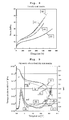
- the IR spectrum of the imide-modified elastomer (1) was measured by KBr method. The result is shown in Fig. 1 . As apparent from Fig. 1 , the absorption derived from the imide ring was observed at 1780 cm -1 , 1720 cm -1 and 1380 cm -1 .
- An urethane prepolymer (j) having a weight average molecular weight of 2.5 ⁇ 10 4 was obtained in the same manner as in Synthesis Example 1, except to use 27.3 g of the MDI (h) instead of 30.4 g, and 72.7 g of the PTMG (i) instead of 69.6 g. Subsequently, a solution of a polyurethane-urea compound (1) was obtained in the same manner as in Synthesis Example 1, except to use 0.721 g of the MDA (k) instead of 1.034 g.
- a sheet-shaped imide-modified elastomer (2) (a PUI sheet) having a thickness of 100 ⁇ m (25% by weight of imide fraction) was obtained in the same manner as in Synthesis Example 1, except to add 1.586 g of the PMDA (m) instead of 2.276 g to the solution of the polyurethane-urea compound (1).
- the IR spectrum of the imide-modified elastomer (2) was measured in the same manner as in Synthesis Example 1. The result is shown in Fig. 2 . As apparent from Fig. 2 , the absorption derived from the imide ring was observed at 1780 cm -1 , 1720 cm -1 and 1380 cm -1 .
- An urethane prepolymer (j) having a weight average molecular weight of 4.6 ⁇ 10 4 was obtained in the same manner as in Synthesis Example 1, except to use 23.8 g of the MDI (h) instead of 30.4 g, and 76.2 g of the PTMG (i) instead of 69.6 g. Subsequently, a solution of a polyurethane-urea compound (1) was obtained in the same manner as in Synthesis Example 1, except to use 0.378 g of the MDA (k) instead of 1.034 g.
- a sheet-shaped imide-modified elastomer (3) (a PUI sheet) having a thickness of 100 ⁇ m (15% by weight of imide fraction) was obtained in the same manner as in Synthesis Example 1, except to add 0.831 g of the PMDA (m) instead of 2.276 g to the solution of the polyurethane-urea compound (1).
- the IR spectrum of the imide-modified elastomer (3) was measured in the same manner as in Synthesis Example 1. The result is shown in Fig. 3 . As apparent from Fig. 3 , the absorption derived from the imide ring was observed at 1780 cm -1 , 1720 cm -1 and 1380 cm -1 .
- An urethane prepolymer (j) having a weight average molecular weight of 1.5 ⁇ 10 4 was obtained in the same manner as in Synthesis Example 1, and a solution of a polyurethane-urea compound was obtained in the same manner as in Synthesis Example 1, except to use 0.753 g of 1,8-octamethylenediamine (OMDA) instead of 1.034 g of the MDA (k).
- OMDA 1,8-octamethylenediamine
- a sheet-shaped imide-modified elastomer (4) (a PUI sheet) having a thickness of 100 ⁇ m (35% by weight of imide fraction) was obtained in the same manner as in Synthesis Example 1, except to use the obtained polyurethane-urea compound.
- An urethane prepolymer (j) having a weight average molecular weight of 1.5 ⁇ 10 4 was obtained in the same manner as in Synthesis Example 1, and a solution of a polyurethane-urea compound was obtained in the same manner as in Synthesis Example 1, except to use 1.045 g of 1,12-dodecamethylene diamine (DMDA) instead of 1.034 g of the MDA (k).
- DMDA 1,12-dodecamethylene diamine
- a sheet-shaped imide-modified elastomer (5) (a PUI sheet) having a thickness of 100 ⁇ m (35% by weight of imide fraction) was obtained in the same manner as in Synthesis Example 1, except to use the obtained polyurethane-urea compound.
- An urethane prepolymer (j) having a weight average molecular weight of 1.5 ⁇ 10 4 was obtained in the same manner as in Synthesis Example 1, and a solution of a polyurethane-urea compound was obtained in the same manner as in Synthesis Example 1, except to use 1.045 g of 4,4'-diaminodiphenylether (ODA) instead of 1.034 g of the MDA (k).
- ODA 4,4'-diaminodiphenylether
- a sheet-shaped imide-modified elastomer (6) (a PUI sheet) having a thickness of 100 ⁇ m (35% by weight of imide fraction) was obtained in the same manner as in Synthesis Example 1, except to use the obtained polyurethane-urea compound.
- urethane prepolymer (j) having a weight average molecular weight of 4.6 ⁇ 10 4 was obtained in the same manner as in Synthesis Example 3, and a solution of a polyurethane-urea compound was obtained in the same manner as in Synthesis Example 3, except to use 0.221 g of 1,6-hexamethylenediamine (HMDA) instead of 0.378 g of the MDA (k).
- HMDA 1,6-hexamethylenediamine
- a sheet-shaped imide-modified elastomer (7) (a PUI sheet) having a thickness of 100 ⁇ m (15% by weight of imide fraction) was obtained in the same manner as in Synthesis Example 3, except to use the obtained polyurethane-urea compound.
- An urethane prepolymer (j) having a weight average molecular weight of 1.5 ⁇ 10 4 was obtained in the same manner as in Synthesis Example 1, and a solution of a polyurethane-urea compound was obtained in the same manner as in Synthesis Example 1, except to use 1.524 g of 1,3-bis(4-aminophenoxy)benzene (TPE-R) instead of 1.034 g of the MDA (k).
- TPE-R 1,3-bis(4-aminophenoxy)benzene
- a sheet-shaped imide-modified elastomer (8) (a PUI sheet) having a thickness of 100 ⁇ m (35% by weight of imide fraction) was obtained in the same manner as in Synthesis Example 1, except to use the obtained polyurethane-urea compound.
- the IR spectrum of the imide-modified elastomer (8) was measured by KBr method, and the absorption derived from the imide ring was observed at 1780 cm -1 , 1.720 cm -1 and 1380 cm -1 .
- An urethane prepolymer (j) having a weight average molecular weight of 1.5 ⁇ 10 4 was obtained in the same manner as in Synthesis Example 1, and a solution of a polyurethane-urea compound was obtained in the same manner as in Synthesis Example 1, except to use 1.524 g of 1,4-bis(4-aminophenoxy)benzene (TPE-Q) instead of 1.034 g of the MDA (k).
- TPE-Q 1,4-bis(4-aminophenoxy)benzene
- a sheet-shaped imide-modified elastomer (9) (a PUI sheet) having a thickness of 100 ⁇ m (35% by weight of imide fraction) was obtained in the same manner as in Synthesis Example 1, except to use the obtained polyurethane-urea compound.
- the IR spectrum of the imide-modified elastomer (9) was measured by KBr method, and the absorption derived from the imide ring was observed at 1780 cm -1 , 1720 cm -1 and 1380 cm -1 .
- a solution of a polyurethane-urea compound was obtained in the same manner as in Synthesis Example 8. Subsequently, a sheet-shaped imide-modified elastomer (10) (a PUI sheet) having a thickness of 100 ⁇ m (35% by weight of imide fraction) was obtained in the same manner as in Synthesis Example 8, except to add 3.362 g of benzophenone-3,4,3',4'-tetracarboxylic dianhydride (BTDA) instead of 2.276 g of the PMDA (m) to the solution of the obtained polyurethane-urea compound.
- BTDA benzophenone-3,4,3',4'-tetracarboxylic dianhydride
- the IR spectrum of the imide-modified elastomer (10) was measured by KBr method, and the absorption derived from the imide ring was observed at 1780 cm -1 , 1720 cm -1 and 1380 cm -1 .
- a solution of a polyurethane-urea compound was obtained in the same manner as in Synthesis Example 9. Subsequently, a sheet-shaped imide-modified elastomer (11) (a PUI sheet) having a thickness of 100 ⁇ m (35% by weight of imide fraction) was obtained in the same manner as in Synthesis Example 9, except to add 3.362 g of BTDA instead of 2.276 g of the PMDA (m) to the solution of the obtained polyurethane-urea compound.
- the IR spectrum of the imide-modified elastomer (11) was measured by KBr method, and the absorption derived from the imide ring was observed at 1780 cm -1 , 1720 cm -1 and 1380 cm -1 .
- PCD polycarbonate diol
- NIPPOLLAN 981 having a weight average molecular weight of 1,000 manufactured by Nippon Polyurethane Industry Co., Ltd.
- urethane prepolymer having a weight average molecular weight of 0.8 ⁇ 10 4 was obtained in the same manner as in Synthesis Example 1, except to use 69.6 g of the PCD instead of 69.6 g of the PTMG.
- a sheet-shaped imide-modified elastomer (12) (a PUI sheet) having a thickness of 100 ⁇ m (35% by weight of imide fraction) was obtained in the same manner as in Synthesis Example 1, except to use the obtained urethane-prepolymer.
- the IR spectrum of the imide-modified elastomer (12) was measured by KBr method, and the absorption derived from the imide ring was observed at 1780 cm -1 , 1720 cm -1 and 1380 cm -1 .
- PCL polycaprolactonediol
- PLACCEL 210 polycaprolactonediol
- urethane prepolymer having a weight average molecular weight of 0.6 ⁇ 10 4 was obtained in the same manner as in Synthesis Example 1, except to use 69.6 g of the PCL instead of 69.6 g of the PTMG.
- a sheet-shaped imide-modified elastomer (13) (a PUI sheet) having a thickness of 100 ⁇ m (35% by weight of imide fraction) was obtained in the same manner as in Synthesis Example 1, except to use the obtained urethane-prepolymer.
- the IR spectrum of the imide-modified elastomer (13) was measured by KBr method, and the absorption derived from the imide ring was observed at 1780 cm -1 , 1720 cm -1 and 1380 cm -1 .
- a sheet-shaped imide-modified elastomer (14) (a PUI sheet) having a thickness of 100 ⁇ m (35% by weight of imide fraction) was obtained in the same manner as in Synthesis Example 1, except to use the obtained polyurethane-urea compound.
- the IR spectrum of the imide-modified elastomer (14) was measured by KBr method, and the absorption derived from the imide ring was observed at 1780 cm -1 , 1720 cm -1 and 1380 cm -1 .
- a sheet-shaped imide-modified elastomer (15) (a PUI sheet) having a thickness of 100 ⁇ m (35% by weight of imide fraction) was obtained in the same manner as in Synthesis Example 1, except to use the obtained polyurethane-urea compound.
- the IR spectrum of the imide-modified elastomer (15) was measured by KBr method, and the absorption derived from the imide ring was observed at 1780 cm -1 , 1720 cm -1 and 1380 cm -1 .
- a sheet-shaped imide-modified elastomer (16) (a PUI sheet) having a thickness of 100 ⁇ m (35% by weight of imide fraction) was obtained in the same manner as in Synthesis Example 1, except to use the obtained polyurethane-urea compound.
- the IR spectrum of the imide-modified elastomer (16) was measured by KBr method, and the absorption derived from the imide ring was observed at 1780 cm -1 , 1720 cm -1 and 1380 cm -1 .
- a sheet-shaped imide-modified elastomer (17) (a PUI sheet) having a thickness of 100 ⁇ m (35% by weight of imide fraction) was obtained in the same manner as in Synthesis Example 1, except to use the obtained polyurethane-urea compound.
- the IR spectrum of the imide-modified elastomer (17) was measured by KBr method, and the absorption derived from the imide ring was observed at 1780 cm -1 , 1720 cm -1 and 1380 cm -1 .
- a sheet-shaped imide-modified elastomer (18) (a PUI sheet) having a thickness of 100 ⁇ m (45% by weight of imide fraction) as shown in the following formula (18), containing no polyurethane as the elastomer component, was obtained by using MDI as diisocyanate, "Elastomer 1000" manufactured by IHARA CHEMICAL INDUSTRY CO., LTD., and PMDA as tetracarboxylic dianhydride, according to the method described in Japanese Unexamined Patent Publication No. 11-106507 . wherein, y represents an integer of 10 to 100, and z represents an integer of 2 to 500.
- Measurements were carried out using a dynamic viscoelasticity measuring instrument manufactured by Seiko Instruments Inc., at 20 Hz and 5°C/min in the step of raising temperature from -100°C to 400°C. Glass transition temperature (Tg) was obtained from the peak temperature of tan ⁇ .
- thermogravimetric analysis instrument "TG/DTA 6200” manufactured by Seiko Instruments Inc., in nitrogen gas atmosphere at 10°C/min in the step of raising temperature from room temperature to 1000°C.
- polyurethane was brought into a sheet-shaped one having a thickness of 100 ⁇ m and then subjected to the tensile test, dynamic viscoelasticity test and thermal analysis test in the same manner as in Example 1. The results thereof are shown in Table 2 and Figs. 5 and 6 .
- the used polyurethane was as follows. Polyurethane whose product name is "Miractran E394PDTA” manufactured by Nippon Miractran Co, Ltd., and composition is PTMG1000/MDA/1,4-butanediol (BD).
- the PUI sheet of the imide-modified elastomer (18) obtained in Comparative Synthesis Example 1 was subjected to the tensile test, dynamic viscoelasticity test and thermal analysis test in the same manner as in Example 1. The results thereof are shown in Table 2 and Fig. 7 .
- these imide-modified elastomers (1) to (3) are rubber-like materials having a pliable elastic modulus, and have a wide temperature range of the rubber-like elastic region. As apparent from Fig. 6 , they have improved thermal resistance than polyurethane.
- the imide-modified elastomer (18) is inferior in pliability to these imide-modified elastomers (1) to (3).
- the imide-modified elastomer (18) employs the diamine compound having a molecular weight of around several thousands, making it difficult to obtain a pliable elastomer.
- the elastomer segment amount can be suitably controlled by urethane prepolymer synthesis, achieving more pliable imide-modified elastomers.
- these imide-modified elastomers of the invention enable the imide units to have a desired structure by using various types of diamine compounds.
- these imide elastomers (4) to (6) obtained by using the various types of diamine compounds have excellent physical strength (stress and breaking strength) and excellent cold resistance, and are rubber-like materials having a pliable elastic modulus, as well as a wide temperature range of the rubber-like elastic region and excellent thermal resistance.
- the PUI sheet of the imide-modified elastomer (7) obtained in Synthesis Example 7 was subjected to the tensile test and dynamic viscoelasticity test in the same manner as in Example 1. The results thereof are shown in Table 4 and Figs. 10 and 11 .
- the test results of the imide-modified elastomers (1) and (3), and the polyurethane used in Comparative Example 1 are also shown for comparison.
- the dynamic viscoelasticity test the test result of only the elastomer (1) out of the elastomers (1) and (3) is shown.
- the imide-modified elastomer (7) using 1,6-hexamethylenediamine (HMDA) as the diamine compound and having an imide fraction of 15% by weight has more excellent physical strength (stress and breaking strength) and substantially the same elasticity with respect to polyurethane, and has a wide temperature range of the rubber-like elastic region and excellent thermal resistance.
- the imide-modified elastomer (7) has thermoplasticity, and its plasticization temperature is 100°C or above higher than that of polyurethane.
- Each PUI sheet was punched out by a dumbbell into an angle shape without a notch, and measured at 500m/min according to JIS K6252.
- the tearing test among the PUI sheets of the imide-modified elastomers (1), (3) and (7), those of the elastomers (1) and (7) except the elastomer (3) were evaluated.
- the imide-modified elastomers (1), (3) and (7) have excellent tearing strength, thermal resistance and chemical resistance.
- the elastomer having a higher imide fraction is superior in tearing strength, thermal resistance and chemical resistance.
- these elastomers have higher tearing strength than polyurethane.
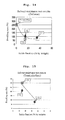
- Fig. 14 it can be seen from Fig. 14 that they have improved thermal resistance than polyurethane.
- polyurethane was completely dissolved in THF.
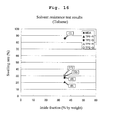
- these imide-modified elastomers (1), (3) and (7) are superior in solvent resistance to polyurethane.
- the imide-modified elastomers (8) to (11), using TPE-R or TPE-Q as the diamine compound, and PMDA or BTDA as the tetracarboxylic dianhydride, have excellent physical strength (breaking strength) substantially identical to that of the imide-modified elastomer (1), and have a low glass transition temperature of -44°C to -60°C and excellent cold resistance and pliability (elongation).
- these imide-modified elastomers (8) to (11) have excellent solvent resistance as apparent from Fig. 16 .
- the tearing test, thermal aging test and solvent resistant test (toluene) were also carried out in the same manner as in Example 4.
- thermal aging conditions in the thermal aging test the conditions of 96 hours at 150°C, 180°C and 200°C, respectively, were employed instead of the above-mentioned 72 hours at 150°C. Further, a stress relaxing test was carried out. Its test method is described below, and these results are also shown in Table 6.
- the PUI sheet was punched out with a No. 1 dumbbell and set at an interchuck distance of 50 mm and extended 5 mm at 500 mm/min and then stopped.
- the stress after an elapse of 30 seconds after the stop and the stress after an elapse of 3630 seconds after the stop were measured.
- the stress relaxing rate (%) was calculated by applying these measured values to the following equation: (Stress after 3630 sec/Stress after 30 sec) ⁇ 100.
- thermally resistant polyester and thermally resistant polyurethane were brought into a sheet shape having a thickness of 100 ⁇ m. This was subjected to the tensile test, tearing test, stress relaxing test, thermal aging test, dynamic viscoelasticity test and solvent resistance test in the same manner as in Example 6. The results thereof are shown in Table 6.
- the used thermally resistant polyester and the used thermally resistant polyurethane were as follows. Thermally resistant polyester whose product name is "PELPRENE C-2000" manufactured by TOYOBO CO., LTD. Thermally resistant polyurethane whose product name is "Elastollan C85A50" manufactured by BASF Japan Ltd.
- a polyamide acid solution whose product name is "U-VARNISH-A” manufactured by Ube Industries, Ltd., was poured into a centrifugal molding machine and then formed into a sheet shape by centrifugal molding at 150°C and 1,000 rpm for 1 hour. This was then subjected to a heat treatment (dehydration condensation reaction) in a vacuum desiccator at 200°C for 2 hours, thereby obtaining a sheet-shaped polyimide resin having a thickness of 100 ⁇ m.
- the obtained polyimide resin sheet was subjected to the tensile test, tearing test, stress relaxing test, thermal aging test, dynamic viscoelasticity test and solvent resistance test in the same manner as in Example 6. The results thereof are shown in Table 6.
- the imide-modified elastomers (12) to (17) have excellent physical strength (100% tensile stress, breaking strength, tearing strength and stress relaxing), as well as excellent pliability (breaking elongation and the storage elastic modulus E' at 50°C). These imide-modified elastomers have a small strength drop rate and hence have high thermal resistance.
- the imide-modified elastomers (14) to (17), each using TPE-R or TPE-Q as the diamine compound have excellent solvent resistance.
- the thermally resistant polyester have more excellent breaking elongation than the imide-modified elastomers (12) to (17), however, have low breaking strength. Its strength drop rate at 200°C is almost the same as those of the imide-modified elastomers (12) and (13), however, its breaking strength TB after 96 hours at 200°C (namely thermally aging) is small.
- the thermally resistant polyurethane has more excellent breaking elongation than the imide-modified elastomers (12) to (17), however, has poor 100% tensile stress, breaking strength and tearing strength. Its strength drop rates at 180°C and 200°C are inferior to the imide-modified elastomers (12) and (13).
- the polyimide resin has more excellent physical strength, thermal resistance and solvent resistance than the imide-modified elastomers (12) to (17), however, has low breaking elongation and low storage elastic modulus E' at 50°C, and poor pliability.
Landscapes
- Chemical & Material Sciences (AREA)
- Health & Medical Sciences (AREA)
- Chemical Kinetics & Catalysis (AREA)
- Medicinal Chemistry (AREA)
- Polymers & Plastics (AREA)
- Organic Chemistry (AREA)
- General Chemical & Material Sciences (AREA)
- Macromolecular Compounds Obtained By Forming Nitrogen-Containing Linkages In General (AREA)
- Polyurethanes Or Polyureas (AREA)
Abstract

Description
- The present invention relates to an imide-modified elastomer that is a rubber-like material having a pliable elastic modulus and also has high strength and high thermal resistance.
- Elastomers are required, depending on their purposes, to be rubber-like material having a pliable elastic modulus and have various physical properties such as high strength and high thermal resistance. However, fluorine-containing rubbers and silicone rubbers, each having high thermal resistance among conventional rubber materials, have thermosetting property, so that the recycling property thereof is low and the molding process cost thereof is high. Thermoplastic rubbers have excellent recycling property and molding process cost, however, have poor thermal resistance.
- On the other hand, examples of elastomers having excellent thermal resistance include imide-modified elastomers. For example,
Patent Document 1 describes a polyimide elastomer compound (an imide-modified elastomer) having high elasticity and a wide temperature range of rubber-like elastic region. InPatent Document 1, the imide-modified elastomer is obtained by allowing a high molecular weight polyurea compound, which is obtained by the reaction between diamine and isocyanate, to react with cyclic carboxylic dianhydride. Other imide-modified elastomers obtained by introducing imide bond into polyurethane are also described in Non-Patent Document 1 andNon-Patent Document 2. In these documents, thermal resistance is improved while maintaining the physical properties of polyurethane by introducing imide bond into polyurethane having poor thermal resistance. - However, any of the imide-modified elastomers described in these three documents fails to satisfy the above-mentioned physical properties, namely, the rubber-like material having a pliable elastic modulus, as well as high strength and high thermal resistance. Specifically,
Patent Document 1 uses the diamine compound whose molecular weight is around several thousands, making it difficult to obtain a pliable elastomer. InNon-Patent Document 1, the prepolymer of polyimide is previously synthesized and copolymerized with urethane prepolymer. This produces a random number of imide units consisting of tetracarboxylic dianhydride formed between imide urethane prepolymer and urethane prepolymer, and isocyanate or diamine. These imide units aggregate non-uniformly. Therefore, even when the amount of an elastomer component is increased to form a pliable rubber-like material, neither sufficient strength nor sufficient thermal resistance can be obtained. InNon-Patent Document 2, urethane prepolymer is subjected to chain extension with tetracarboxylic dianhydride, resulting in a single imide unit. Therefore, even when the amount of an elastomer component is increased to form a pliable rubber-like material, neither sufficient strength nor sufficient thermal resistance can be obtained.
Hence, there is a need for development of a more excellent imide-modified elastomer. -
- Patent Document 1: Japanese Unexamined Patent Publication No.
11-106507 - Non-Patent Document 1: "Synthesis of Polyimide Urethane Elastomer and Physical Properties Thereof," Elastomer Discussion Summary by Hideyuki Tezeni, Tetsuo Shiiba and Mutsuhisa Furukawa, 1999, pp72-75
- Non-Patent Document 2: "Synthesis of Polyimide Urethane Elastomer and Physical Properties Thereof" written by Shoko Matsuo, Eisuke Yamada and Shinji Inagaki, Annual Meeting of Union of Chemistry-Related Societies in Chubu Area, Abstract collection, 1995, p381
- It is desirable to provide a new imide-modified elastomer that is a rubber shaped material having a pliable elastic modulus and also has high strength and high thermal resistance.
- There is provided an imide-modified elastomer represented by the following general formula (I):

- The imide-modified elastomer represented by the general formula (I) contains polyurethane as an elastomer component. This enables to produce a rubber-like material having a pliable elastic modulus, and also enables two imide units continuous with a main chain to be introduced at a desired ratio (an imide fraction), while controlling the distribution thereof. The imide-modified elastomer therefore has high strength and high thermal resistance. Additionally, those represented by the general formula (I) have thermoplasticity and hence have excellent recycling property and molding property, as well as excellent solvent resistance.
-
-
Fig. 1 shows the IR spectrum of an imide-modified elastomer (1) obtained in Synthesis Example 1; -
Fig. 2 shows the IR spectrum of an imide-modified elastomer (2) obtained in Synthesis Example 2; -
Fig. 3 shows the IR spectrum of an imide-modified elastomer (3) obtained in Synthesis Example 3; -
Fig. 4 is a graph showing the tensile test results of Example 1; -
Fig. 5 is a graph showing the dynamic viscoelasticity test results of Example 1; -
Fig. 6 is a graph showing the thermal analysis test results of Example 1; -
Fig. 7 is a graph showing the dynamic viscoelasticity test results of Comparative Example 2; -
Fig. 8 is a graph showing the tensile test results of Example 2; -
Fig. 9 is a graph showing the dynamic viscoelasticity test results of Example 2; -
Fig. 10 is a graph showing the tensile test results of Example 3; -
Fig. 11 is a graph showing the dynamic viscoelasticity test results of Example 3; -
Fig. 12 is a graph showing the tearing test results of Example 4; -
Fig. 13 is a graph showing the thermal aging test results of Example 4; -
Fig. 14 is a graph showing the solvent resistance test results (toluene) of Example 4; -
Fig. 15 is a graph showing the solvent resistance test results (tetrahydrofuran) of Example 4; and -
Fig. 16 is a graph showing the solvent resistance test results (toluene) of Example 5. - The imide-modified elastomer of the invention is represented by the above general formula (I). In this formula, the above-mentioned R1 represents a divalent organic group having an aromatic ring or an aliphatic ring. Examples of the organic group include residues except for an isocyanate group (-NCO) in diisocyanate (a) capable of forming urethane prepolymer (c) together with polyol (b) according to a reaction formula (A) described later.
- The above-mentioned R2 represents a divalent organic group having a weight average molecular weight of 100 to 10,000, preferably 300 to 5,000. Examples of the organic group include residues except for two hydroxyl groups (-OH) in polyol (b) capable of forming urethane prepolymer (c) together with diisocyanate (a) according to the reaction formula (A).
- The above-mentioned R3 represents a divalent organic group having an aromatic ring, an aliphatic ring or an aliphatic chain. Examples of the organic group include residues except for an amino group (-NH2) in at least one diamine compound (d) selected from aromatic diamine compounds having a carbon number of 6 to 27, aliphatic diamine compounds having a carbon number of 6 to 24 and alicyclic diamine compounds having a carbon number of 6 to 24, each of which can chain extend urethane prepolymer (c) by urea bond according to a reaction formula (B) described later. Examples of the aliphatic chain include those having a carbon number of 1.
- The above-mentioned R4 represents a tetravalent organic group having 4 or more carbon atoms. Examples of the organic group include residues of at least one tetracarboxylic dianhydride (f) selected from aromatic tetracarboxylic dianhydrides having a carbon number of 6 to 18 and alicyclic tetracarboxylic dianhydrides having a carbon number of 4 to 6, each of which can introduce an imide unit into an urea bond site according to a reaction formula (C) described later.
The above-mentioned n represents an integer of 1 to 100, preferably an integer of 2 to 50. The above-mentioned m represents an integer of 2 to 100, preferably an integer of 2 to 50. - Specific examples of the imide-modified elastomer represented by the general formula (I) (hereinafter also referred to as an "imide-modified elastomer (I)") include imide-modified elastomers represented by the following formula (1):

- Preferably, the imide-modified elastomer (I) is a block copolymer in which urethane prepolymer having an isocyanate group at both ends of each molecule obtained from diisocyanate and polyol is chain extended with a diamine compound by urea bond, and an imide unit is introduced into the urea bond site with tetracarboxylic dianhydride. This imide-modified elastomer (I) can be manufactured through, for example, the following reaction formulas (A) to (C).
-

- As shown in the reaction formula (A), firstly, urethane prepolymer (c) having an isocyanate group at both ends of the molecule thereof is obtained from diisocyanate (a) and polyol (b). Since the imide-modified elastomer (I) of the invention employs the urethane prepolymer (c) as an elastomer component, the elastic modulus in the rubber-like region (around room temperature) is lowered to impart more elastic properties, and by controlling the molecular weight of the urethane prepolymer (c), two successive imide units can be introduced into the main chain at a desired ratio while controlling the distribution thereof.
- Examples of the diisocyanate (a) include 2,4-tolylenediisocyanate (TDI), 2,6-tolylenediisocyanate (TDI), 4,4'-diphenylmethanediisocyanate (MDI), polymeric MDI (Cr. MDI), dianisidine diisocyanate (DADL), diphenylether diisocyanate (PEDI), pitolylene diisocyanate (TODI), naphthalene diisocyanate (NDI), hexamethylene diisocyanate (HMDI), isophorone diisocyanate (IPDI), lysine diisocyanate methyl ester (LDI), methaxylene diisocyanate (MXDI), 2,2,4-trimethylhexamethylene diisocyanate (TMDI), 2,4,4- trimethylhexamethylene diisocyanate (TMDI), dimer acid diisocyanate (DDI), isopropylidenebis (4-cyclohexyl isocyanate) (IPCI), cyclohexylmethane diisocyanate (hydrogenated MDI), methylcyclohexane diisocyanate (hydrogenated TDI) and TDI dimer (TT). These may be used either singly or as a mixture of two or more selected therefrom. Preferably, these are subjected to vacuum distillation.
- Examples of the polyol (b) include polyether polyols such as polypropylene glycol (PPG), poly(oxytetramethylene)glycol (PTMG) and polymer polyol; polyester polyols such as adipate based polyol (condensed polyester polyol) and polycaprolactone based polyol; polycarbonate polyol; polybutadiene polyol; and acryl polyol. These may be used either singly or as a mixture of two or more selected therefrom.
- When the polyol (b) is at least one kind selected from polycarbonate polyol and polyester polyol, the imide-modified elastomer (I) having particularly excellent thermal resistance can be obtained. That is, by using the polyol (b) thus selected, the main chain can contain at least one of a polycarbonate structure unit and a polyester structure unit. Consequently, the thermal resistance owing to the polycarbonate structure unit or the polyester structure unit is added to the thermal resistance owing to the two successive imide units. This improves the thermal resistance of the imide-modified elastomer (I).
- Examples of the polycarbonate polyol include polycarbonate polyols obtained by condensation polymerization between polyol (polyhydric alcohol) and phosgene, chloroformate, dialkyl carbonate, dialyl carbonate, alkylene carbonate or the like. Examples of the polyol include 1,6-hexanediol, 1,4-butanediol, 1,3-butanediol, neopentyl glycol and 1,5-pentanediol. Examples of the dialky lcarbonate include dimethylcarbonate and diethylcarbonate. Specific examples of polycarbonate polyol include polycarbonate diols such as polytetramethylene carbonate diol and polyhexamethylene carbonate diol. These may be used either singly or as a mixture of two or more selected therefrom.
- Examples of the polyester polyol include polyester polyol obtained by condensation polymerization between poly(carboxylic acid) and polyol. Specific examples thereof include polyethylene adipate, polydiethylene adipate, polypropylene adipate, polytetramethylene adipate, polyhexamethylene adipate, polyneopentylene adipate, polyol composed of 3-methyl-1,5-pentanediol and adipic acid, polycaprolactonepolyol obtained by subjecting ε-caprolactone to ring-opening polymerization, polycaprolactone diol, and polyol obtained by subjecting β-methyl-δ-valerolactone to ring-opening with ethylene glycol. These may be used either singly or as a mixture of two or more selected therefrom.
- Examples of the polyester polyol include copolymers consisting of at least one kind of acid selected from terephthalic acid, isophthalic acid, phthalic anhydride, succinic acid, adipic acid, azelaic acid, sebacic acid, dodecanedioic acid, dimeric acid (mixture), paraoxy benzoic acid, trimellitic anhydride, ε-caprolactone, β-methyl-δ-valerolactone, and at least one kind of glycol selected from ethylene glycol, propylene glycol, 1,4-butanediol, 1,5-pentanediol, 1,6-hexane diol, neopenthyl glycol, polyethylene glycol, polytetramethylene glycol, 1,4-cyclohexane dimethanol, pentaerythritol and 3-methyl-1,5-pentane diol.
- It is preferable to use the polyol (b) after being subjected to vacuum drying under the conditions of 70°C to 90°C, 1 to 5 mmHg and about 10 to 30 hours. The weight average molecular weight of the polyol (b) is 100 to 10,000, preferably 300 to 5,000. These weight average molecular weights are obtained by measuring the polyol (b) through gel permeation chromatography (GPC), and expressing the obtained measured value in terms of polystyrene.
- The above-mentioned diisocyanate (a) and the polyol (b) are mixed in a predetermined ratio, and the mixture is then allowed to react at room temperature for about 1 to 5 hours under an inert gas atmosphere such as argon gas. The mixing ratio (mol) between the diisocyanate (a) and the polyol (b), namely (a):(b), is preferably in the range of 1.01:1 to 2:1. This enables the weight average molecular weight of the obtained urethane prepolymer (c) to be set at a predetermined value described later.
- That is, the weight average molecular weight of the obtained urethane prepolymer (c) is 300 to 50,000, preferably 500 to 45,000. When the imide unit is introduced at a desired ratio while controlling the weight average molecular weight of the urethane prepolymer (c) within the above-mentioned range, it is capable of obtaining the imide-modified elastomer (I) that is a pliable rubber-like material having an elastic module and has high strength and high thermal resistance.
- More specifically, when the weight average molecular weight of the urethane prepolymer (c) is set at the above-mentioned predetermined range, the imide fraction (the content of imide composition) of the imide-modified elastomer (I) can be set at 5 to 45% by weight, preferably 5 to 40% by weight. The imide fraction indicates the ratio of the imide composition in the imide-modified elastomer. When the imide fraction is within the above-mentioned predetermined range, the distribution and the ratio of two successive imide units introduced into the main chain can be optimized to bring the imide-modified elastomer (I) into the pliable rubber-like material having an elastic module and impart high strength and high thermal resistance thereto. In contrast, when the imide fraction is lower than 5% by weight, the strength and the thermal resistance might be lowered. When it exceeds 45% by weight, the pliability might be lowered. The above-mentioned imide fraction is a value calculated from the charge amounts of the raw materials thereof, namely, the diisocyanate (a), the polyol (b), a later-described diamine compound (d) and the tetracarboxylic dianhydride (f), more specifically, a value calculated from the following equation (α).
-

wherein, Wtotal denotes Wa+Wb+Wc+Wd;
Wa denotes diisocyanate charge amount (mol) × diisocyanate formula weight;
Wb denotes polyol charge amount (mol) × polyol formula weight;
Wc denotes diamine compound charge amount (mol) × diamine compound formula weight;
Wd denotes tetracarboxylic dianhydride charge amount (mol) × tetracarboxylic dianhydride formula weight; and
Wa' denotes [diisocyanate charge amount (mol) - polyol charge amount (mol)] × diisocyanate formula weight - A harder imide-modified elastomer (I) can be obtained as the urethane prepolymer (c) has a smaller weight average molecular weight in the above-mentioned range. In contrast, when the molecular weight thereof is smaller than 300, the imide-modified elastomer (I) becomes too hard and the pliability might be lowered. When it is over 50,000, the imide-modified elastomer (I) becomes too soft, the strength and thermal resistance thereof might be lowered. These weight average molecular weights are obtained by measuring the urethane prepolymer (c) through GPC, and expressing the obtained measured value in terms of polystyrene.
- <Reaction Formula (B)>

- According to the reaction formula (B), a polyurethane-urea compound (e) as an imide precursor is synthesized using the urethane prepolymer (c) obtained above. That is, the polyurethane-urea compound (e) is obtained by subjecting the urethane prepolymer (c) to chain extension by urea bond using the diamine compound (d).
- Examples of the diamine compound (d) include aromatic diamine compounds having a carbon number of 6 to 27 such as 1,4-diaminobenzene (also known as p-phenylenediamine, abbreviated as PPD), 1, 3-diaminobenzene (known as m-phenylenediamine, abbreviated as MPD), 2,4-diaminotoluene (known as 2,4-toluenediamine, abbreviated as 2,4-TDA), 4,4'-diaminodiphenylmethane (known as 4,4'-methylenedianiline, abbreviated as MDA), 4,4'-diaminodiphenylether (known as 4,4'-oxydianiline, abbreviated as ODA, DPE), 3,4'-diaminodiphenylether (known as 3,4'-oxydianiline, abbreviated as 3,4'-DPE), 3,3'-dimethyl-4,4'-diaminobiphenyl (known as o-tridine, abbreviated as TB), 2,2'-dimethyl-4,4'-diaminobiphenyl (known as m-tridine, abbreviated as m-TB), 2,2'-bis(trifluoromethyl)-4,4'-diaminobiphenyl (abbreviated as TFMB), 3,7-diamino-dimethyldibenzothiophen-5,5-dioxide (known as o-tridine sulfone, abbreviated as TSN), 4,4'-diaminobenzophenone, 3,3'-diaminobenzophenone, 4,4'-bis(4-aminophenyl) sulfide (known as 4,4'- thiodianiline, abbreviated as ASD), 4,4'-diaminodiphenyl sulfone (known as 4,4'-sulfonyldianiline, abbreviated as ASN), 4, 4'-diaminobenzanilide (abbreviated as DABA), 1,n-bis(4-aminophenoxy)alkane (n=3, 4 or 5, abbreviated as DAnMG), 1,3-bis(4-aminophenoxy)-2,2-dimethylpropane (abbreviated as DANPG), 1,2-bis[2-(4-aminophenoxy)ethoxy] ethane (abbreviated as DA3EG), 9,9-bis(4-aminophenyl)fluorene (abbreviated as FDA), 5(6)-amino-1-(4-aminomethyl)-1,3,3-trimethylindan, 1,4-bis(4-aminophenoxy)benzene (abbreviated as TPE-Q), 1,3-bis(4-aminophenoxy)benzene (known as resorcin oxydianiline, abbreviated as TPE-R), 1,3-bis(3-aminophenoxy)benzene (abbreviated as APB), 4,4'-bis(4-aminophenoxy) biphenyl (abbreviated as BAPB), 4,4'-bis(3-aminophenoxy)biphenyl, 2,2-bis(4-aminophenoxyphenyl)propane (abbreviated as BAPP), bis[4-(4-aminophenoxy)phenyl] sulfone (abbreviated as BAPS), bis[4-(3-aminophenoxy)phenyl] sulfone (abbreviated as BAPS-M), 2,2-bis[4-(4-aminophenoxy)phenyl]hexafluoropropane (abbreviated as HFBAPP), 3,3'-dicarboxy-4,4'-diaminodiphenylmethane (abbreviated as MBAA), 4,6-dihydroxy-1,3-phenylenediamine (known as 4,6-diaminoresorein), 3,3'-dihydroxy-4,4'-diaminobiphenyl (known as 3,3'-dihydroxybendizine, abbreviated as HAB) and 3,3',4,4'-tetraaminobiphenyl (known as 3,3'-diaminobendizine, abbreviated as TAB); aliphatic or alicyclic diamine compounds having a carbon number of 6 to 24 such as 1,6-hexamethylenediamine (HMDA), 1,8-octamethylenediamine (OMDA), 1,9-nonamethylene diamine, 1,12-dodecamethylene diamine (DMDA), 1-amino-3-aminomethyl-3,5,5-trimethylcyclohexane (known as isophorondiamine), 4,4'-dicyclohexylmethanediamine and cyclohexanediamine; and silicone based diamine compounds such as 1,3-bis(3-aminopropyl)-1,1,3,3-tetramethyldisiloxane. These may be used either singly or as a mixture of two or more selected therefrom.
- Especially, the use of 1,6-hexamethylenediamine (HMDA) provides the imide-modified elastomer (I) having excellent strength. The use of 1,4-bis(4-aminophenoxy)benzene (TPE-Q) or 1,3-bis(4-aminophonoxy)benzene (TPE-R) provides the imide-modified elastomer (I) having excellent solvent resistance.
- The urethane prepolymer (c) and the above-mentioned diamine compound (d) are mixed equimolecularly, preferably in an NCO/NH2 ratio of approximately 1.0, and the mixture is then subjected to solution polymerization reaction or bulk polymerization reaction in an inert gas atmosphere such as argon gas, at room temperature to 100°C, preferably 50°C to 100°C, for about 2 to 30 hours.
- Examples of solvents usable for the solution polymerization reaction include N,N-dimethylacetoamide, N-methyl-2-pyrrolidone (NMP), N-hexyl-2-pyrrolidone and 1,3-dimethyl-2-imidazolidone. Particularly preferred are N,N-dimethylacetoamide, N-methyl-2-pyrrolidone (NMP), N-hexyl-2-pyrrolidone and 1,3-dimethyl-2-imidazolidone. These solvents may be used either singly or as a mixture of two or more selected therefrom. It is preferable to use those after being subjected to dehydration process according to the usual method.
- <Reaction Formula (c)>

- According to a reaction formula (C), an imide-modified elastomer (I) is synthesized using the polyurethane-urea compound (e) obtained above. That is, the imide-modified elastomer (I) as a block copolymer is obtained by introducing an imide unit into a urea bond site using tetracarboxylic dianhydride (f).
- Examples of the tetracarboxylic dianhydride (f) include aromatic tetracarboxylic dianhydrides having a carbon number of 6 to 18 such as pyromellitic dianhydride (PMDA), oxydiphthalic dianhydride (ODPA), biphenyl-3,4,3',4'-tetracarboxylic dianhydride (BPDA), benzophenone-3,4,3',4'-tetracarboxylic dianhydride (BTDA), diphenylsulfone-3,4,3',4'-tetracarboxylic dianhydride (DSDA), 4,4'-(2,2-hexafluoroisopropylidene)bis(phthalic anhydride) (6FDA) and m(p)-terphenyl-3,4,3',4'-tetracarboxylic dianhydride; and alicyclic tetracarboxylic dianhydrides having a carbon number of 4 to 6 such as cyclobutane-1,2,3,4-tetracarboxylic dianhydride and 1-carboxymethyl-2,3,5-cyclopentanetricarboxylic-2,6:3,5-dianhydride. These may be used either singly or as a mixture of two or more selected therefrom.
- An imidization reaction between the polyurethane-urea compound (e) and the tetracarboxylic dianhydride (f) is carried out. The imidization reaction may be carried out in the presence or absence of a solvent. When the imidization reaction is carried out in the presence of a solvent, firstly, the polyurethane-urea compound (e) and the above-mentioned tetracarboxylic dianhydride (f) are added in a predetermined ratio into the solvent. The mixture is then allowed to react in an inert gas atmosphere such as argon gas, at 100°C to 300°C, preferably 135°C to 200°C, more preferably 150°C to 170°C, for about 1 to 10 hours, thereby obtaining a solution containing polyurethane amic acid (PUA) (a PUA solution) represented by the following formula (g).
-

- Preferably, the polyurethane-urea compound (e) and the tetracarboxylic dianhydride (f) are mixed together so that the mixing ratio (mol) between the diamine compound (d) and the tetracarboxylic dianhydride (f) used to synthesize the polyurethane-urea compound (e) is 1:2 to 1:2.02 in the ratio between diamine compound (d) and the tetracarboxylic dianhydride (f). This ensures the introduction of the imide units into the urea bond site.
- Examples of usable solvents include the same solvents as exemplified above in the solution polymerization reaction of the reaction formula (B). When the polyurethane-urea compound (e) is obtained by the solution polymerization reaction in the reaction formula (B), the imidization reaction may be carried out in the solvent.
- Subsequently, the PUA solution thus obtained is poured into, for example, a centrifugal molding machine and then formed into a sheet shape by centrifugal molding at 100°C to 300°C, preferably 135°C to 200°C, and more preferably 150°C to 170°C, at 100 to 2,000 rpm for 30 minutes to 2 hours, thereby obtaining a PUA sheet.
- Then, the sheet-shaped imide-modified elastomer (polyurethane-imide, PUI) represented by the general formula (I) can be obtained by subjecting the PUA sheet to a heat treatment (dehydration condensation reaction). Preferably, the heat treatment is carried out under the conditions that the PUA sheet is not pyrolyzed, specifically under the reduced pressure conditions at 150°C to 450°C, preferably 150°C to 250°C for about 1 to 5 hours. The resulting sheet (the PUI sheet) has a thickness of approximately 50 to 500 µm.
- When the imidization reaction is carried out in the absence of a solvent, the reaction can also be carried out within an extruder provided with heating means having an exhaust system, besides any usual stirring tank reactor. Therefore, the obtained imide-modified elastomer (I) can be extruded and directly molded into a film shape or a plate shape.
- The imide-modified elastomer (I) thus obtained is a rubber-like material having a pliable elastic modulus and has high strength and high thermal resistance. Specifically, its storage elastic modulus E' at 50°C is preferably 5×10⁶ to 5×10⁸ Pa. The storage elastic modulus is a value measured by using a dynamic viscoelasticity measuring instrument as will be described later. The imide-modified elastomer (I) having the pliable elastic modulus usually has a glass transition temperature (Tg) of -30°C to -60°C, having a wide temperature range of rubber-like elastic region. The reasons why the imide-modified elastomer (I) is the rubber-like material having a pliable elastic modulus and has high strength and high thermal resistance seem to be as follows. That is, as described earlier, in the imide-modified elastomer (I) of the invention, the two successive imide units can be introduced into the main chain at a desired ratio (an imide fraction) while controlling the distribution thereof, so that the aggregation of hard segments composed of these imide units can become uniform and strong. Hence, the imide-modified elastomer (I) forms a more uniform and stronger microphase separation structure, and the glass transition temperature thereof is lowered to widen the temperature range of the rubber-like elastic region. As a result, even when the imide-modified elastomer (I) contains polyurethane as the elastomer component and becomes the rubber-like material having a pliable elastic modulus, it can have high strength and high thermal resistance.
- The weight average molecular weight of the imide-modified elastomer (I) is 10,000 to 1000,000, preferably 50,000 to 800,000, and more preferably 50,000 to 500,000. In contrast, strength and thermal resistance might be lowered when the molecular weight is smaller than 10,000, and molding property might be lowered when it exceeds 1000,000. These weight average molecular weights are obtained by measuring the PUA solution through GPC, and expressing the obtained measured value in terms of polystyrene. The reason why instead of the imide-modified elastomer (I), the PUA solution is measured by GPC is that the imide-modified elastomer (I) is insoluble in the solvent.
- The imide-modified elastomer of the invention is the rubber-like material having a pliable elastic modulus and has high strength and high thermal resistance, as well as thermoplasticity, thus facilitating its molding by an injection molding machine, an extrusion molding machine and a blow molding machine which are usually employed. The imide-modified elastomer is applicable to sheets, films, tubes, hoses, roll gears, packing materials, sound insulating materials, vibration isolating materials, boots, gaskets, belt laminate products, coating materials, separation membranes for pervaporation, optical non-linear materials, elastic fibers, piezoelectric elements, actuators, other various types of car parts, industrial mechanical parts and sports products. These applications are cited merely by way of example and without limitation.
- The imide-modified elastomer of the invention will be described in detail with reference to synthesis examples and examples, but it is to be understood that the invention is not limited to the following synthesis examples and examples.
- The following 18 kinds of imide-modified elastomers were used in the examples and comparative examples.
- An imide-modified elastomer (1) was synthesized according to the following formulas.

- Firstly, 4,4'-diphenyl methane diisocyanate (MDI) (h), manufactured by Nippon Polyurethane Industry Co., Ltd., was vacuum distillated. Poly(oxytetramethylene)glycol (PTMG) (i), whose product name is "PTMG1000" having a weight average molecular weight of 1,000 manufactured by Hodogaya Chemical Co., Ltd., was vacuum dried at 80°C and 2 to 3 mmHg for 24 hours.
- Subsequently, 30.4 g of the MDI (h) and 69.6 g of the PTMG (i) were put in a 500-ml-four-mouth separable flask provided with a stirrer and a gas introducing tube, and stirred in argon gas atmosphere at 80°C for 2 hours, thereby obtaining urethane prepolymer (j) having an isocyanate group at both ends of each molecular. The urethane prepolymer (j) was measured by GPC, and the weight average molecular weight thereof in terms of polystyrene was 1.5×10⁴.
- A solution of 10g of the urethane prepolymer (j) obtained above in 60 ml of dehydrated N-methyl-2-pyrrolidone (NMP), and a solution of 1.034 g of 4,4'-diaminodiphenylmethane (MDA) (k) in 20 ml of dehydrated NMP were put in a 500-ml-four-mouth separable flask provided with a stirrer and a gas introducing tube, and stirred in argon gas atmosphere at room temperature (23°C) for 24 hours, thereby obtaining a solution of polyurethane-urea compound (1).
- Into the solution of the polyurethane-urea compound (1) obtained above, 2.276 g of pyromellitic dianhydride (PMDA) (m) was added and stirred in argon gas atmosphere at 150°C for 2 hours, thereby obtaining a polyurethane amic acid (PUA) solution. The PUA solution thus obtained was then poured into a centrifugal molding machine and subjected to centrifugal molding at 150°C and 1,000 rpm for 1 hour, thereby obtaining a PUA sheet. The PUA sheet was then subjected to a heat treatment (dehydration condensation reaction) in a vacuum desiccator at 200°C for 2 hours, thereby obtaining a sheet-shaped imide-modified elastomer (1) (a PUI sheet) having a thickness of 100 µm (35% by weight of imide fraction). This imide fraction was a value calculated from the above-mentioned equation (α).
- The weight average molecular weight of the obtained imide-modified elastomer (1) was 57,000. The IR spectrum of the imide-modified elastomer (1) was measured by KBr method. The result is shown in
Fig. 1 .
As apparent fromFig. 1 , the absorption derived from the imide ring was observed at 1780 cm-1, 1720 cm-1 and 1380 cm-1. - An urethane prepolymer (j) having a weight average molecular weight of 2.5×10⁴ was obtained in the same manner as in Synthesis Example 1, except to use 27.3 g of the MDI (h) instead of 30.4 g, and 72.7 g of the PTMG (i) instead of 69.6 g. Subsequently, a solution of a polyurethane-urea compound (1) was obtained in the same manner as in Synthesis Example 1, except to use 0.721 g of the MDA (k) instead of 1.034 g.
- A sheet-shaped imide-modified elastomer (2) (a PUI sheet) having a thickness of 100 µm (25% by weight of imide fraction) was obtained in the same manner as in Synthesis Example 1, except to add 1.586 g of the PMDA (m) instead of 2.276 g to the solution of the polyurethane-urea compound (1). The IR spectrum of the imide-modified elastomer (2) was measured in the same manner as in Synthesis Example 1. The result is shown in
Fig. 2 .
As apparent fromFig. 2 , the absorption derived from the imide ring was observed at 1780 cm-1, 1720 cm-1 and 1380 cm-1. - An urethane prepolymer (j) having a weight average molecular weight of 4.6×10⁴ was obtained in the same manner as in Synthesis Example 1, except to use 23.8 g of the MDI (h) instead of 30.4 g, and 76.2 g of the PTMG (i) instead of 69.6 g. Subsequently, a solution of a polyurethane-urea compound (1) was obtained in the same manner as in Synthesis Example 1, except to use 0.378 g of the MDA (k) instead of 1.034 g.
- A sheet-shaped imide-modified elastomer (3) (a PUI sheet) having a thickness of 100 µm (15% by weight of imide fraction) was obtained in the same manner as in Synthesis Example 1, except to add 0.831 g of the PMDA (m) instead of 2.276 g to the solution of the polyurethane-urea compound (1). The IR spectrum of the imide-modified elastomer (3) was measured in the same manner as in Synthesis Example 1. The result is shown in
Fig. 3 .
As apparent fromFig. 3 , the absorption derived from the imide ring was observed at 1780 cm-1, 1720 cm-1 and 1380 cm-1. - An urethane prepolymer (j) having a weight average molecular weight of 1.5×10⁴ was obtained in the same manner as in Synthesis Example 1, and a solution of a polyurethane-urea compound was obtained in the same manner as in Synthesis Example 1, except to use 0.753 g of 1,8-octamethylenediamine (OMDA) instead of 1.034 g of the MDA (k).
- Subsequently, a sheet-shaped imide-modified elastomer (4) (a PUI sheet) having a thickness of 100 µm (35% by weight of imide fraction) was obtained in the same manner as in Synthesis Example 1, except to use the obtained polyurethane-urea compound.
- An urethane prepolymer (j) having a weight average molecular weight of 1.5×10⁴ was obtained in the same manner as in Synthesis Example 1, and a solution of a polyurethane-urea compound was obtained in the same manner as in Synthesis Example 1, except to use 1.045 g of 1,12-dodecamethylene diamine (DMDA) instead of 1.034 g of the MDA (k).
- Subsequently, a sheet-shaped imide-modified elastomer (5) (a PUI sheet) having a thickness of 100 µm (35% by weight of imide fraction) was obtained in the same manner as in Synthesis Example 1, except to use the obtained polyurethane-urea compound.
- An urethane prepolymer (j) having a weight average molecular weight of 1.5×10⁴ was obtained in the same manner as in Synthesis Example 1, and a solution of a polyurethane-urea compound was obtained in the same manner as in Synthesis Example 1, except to use 1.045 g of 4,4'-diaminodiphenylether (ODA) instead of 1.034 g of the MDA (k).
- Subsequently, a sheet-shaped imide-modified elastomer (6) (a PUI sheet) having a thickness of 100 µm (35% by weight of imide fraction) was obtained in the same manner as in Synthesis Example 1, except to use the obtained polyurethane-urea compound.
- An urethane prepolymer (j) having a weight average molecular weight of 4.6×10⁴ was obtained in the same manner as in Synthesis Example 3, and a solution of a polyurethane-urea compound was obtained in the same manner as in Synthesis Example 3, except to use 0.221 g of 1,6-hexamethylenediamine (HMDA) instead of 0.378 g of the MDA (k).
- Subsequently, a sheet-shaped imide-modified elastomer (7) (a PUI sheet) having a thickness of 100 µm (15% by weight of imide fraction) was obtained in the same manner as in Synthesis Example 3, except to use the obtained polyurethane-urea compound.
- An urethane prepolymer (j) having a weight average molecular weight of 1.5×10⁴ was obtained in the same manner as in Synthesis Example 1, and a solution of a polyurethane-urea compound was obtained in the same manner as in Synthesis Example 1, except to use 1.524 g of 1,3-bis(4-aminophenoxy)benzene (TPE-R) instead of 1.034 g of the MDA (k).
- Subsequently, a sheet-shaped imide-modified elastomer (8) (a PUI sheet) having a thickness of 100 µm (35% by weight of imide fraction) was obtained in the same manner as in Synthesis Example 1, except to use the obtained polyurethane-urea compound. The IR spectrum of the imide-modified elastomer (8) was measured by KBr method, and the absorption derived from the imide ring was observed at 1780 cm-1, 1.720 cm-1 and 1380 cm-1.
- An urethane prepolymer (j) having a weight average molecular weight of 1.5×10⁴ was obtained in the same manner as in Synthesis Example 1, and a solution of a polyurethane-urea compound was obtained in the same manner as in Synthesis Example 1, except to use 1.524 g of 1,4-bis(4-aminophenoxy)benzene (TPE-Q) instead of 1.034 g of the MDA (k).
- Subsequently, a sheet-shaped imide-modified elastomer (9) (a PUI sheet) having a thickness of 100 µm (35% by weight of imide fraction) was obtained in the same manner as in Synthesis Example 1, except to use the obtained polyurethane-urea compound. The IR spectrum of the imide-modified elastomer (9) was measured by KBr method, and the absorption derived from the imide ring was observed at 1780 cm-1, 1720 cm-1 and 1380 cm-1.
- A solution of a polyurethane-urea compound was obtained in the same manner as in Synthesis Example 8. Subsequently, a sheet-shaped imide-modified elastomer (10) (a PUI sheet) having a thickness of 100 µm (35% by weight of imide fraction) was obtained in the same manner as in Synthesis Example 8, except to add 3.362 g of benzophenone-3,4,3',4'-tetracarboxylic dianhydride (BTDA) instead of 2.276 g of the PMDA (m) to the solution of the obtained polyurethane-urea compound. The IR spectrum of the imide-modified elastomer (10) was measured by KBr method, and the absorption derived from the imide ring was observed at 1780 cm-1, 1720 cm-1 and 1380 cm-1.
- A solution of a polyurethane-urea compound was obtained in the same manner as in Synthesis Example 9. Subsequently, a sheet-shaped imide-modified elastomer (11) (a PUI sheet) having a thickness of 100 µm (35% by weight of imide fraction) was obtained in the same manner as in Synthesis Example 9, except to add 3.362 g of BTDA instead of 2.276 g of the PMDA (m) to the solution of the obtained polyurethane-urea compound. The IR spectrum of the imide-modified elastomer (11) was measured by KBr method, and the absorption derived from the imide ring was observed at 1780 cm-1, 1720 cm-1 and 1380 cm-1.
- Firstly, polycarbonate diol (PCD), whose product name of " NIPPOLLAN 981" having a weight average molecular weight of 1,000 manufactured by Nippon Polyurethane Industry Co., Ltd., was vacuum dried at 80°C and 2 to 3 mmHg for 24 hours. Subsequently, urethane prepolymer having a weight average molecular weight of 0.8×10⁴ was obtained in the same manner as in Synthesis Example 1, except to use 69.6 g of the PCD instead of 69.6 g of the PTMG.
- A sheet-shaped imide-modified elastomer (12) (a PUI sheet) having a thickness of 100 µm (35% by weight of imide fraction) was obtained in the same manner as in Synthesis Example 1, except to use the obtained urethane-prepolymer. The IR spectrum of the imide-modified elastomer (12) was measured by KBr method, and the absorption derived from the imide ring was observed at 1780 cm-1, 1720 cm-1 and 1380 cm-1.
- Firstly, polycaprolactonediol (PCL), whose product name is "PLACCEL 210" having a weight average molecular weight of 1,000 manufactured by DAICEL CHEMICAL INDUSTRIES, LTD., was vacuum dried at 80°C and 2 to 3 mmHg for 24 hours. Subsequently, urethane prepolymer having a weight average molecular weight of 0.6×10⁴ was obtained in the same manner as in Synthesis Example 1, except to use 69.6 g of the PCL instead of 69.6 g of the PTMG.
- A sheet-shaped imide-modified elastomer (13) (a PUI sheet) having a thickness of 100 µm (35% by weight of imide fraction) was obtained in the same manner as in Synthesis Example 1, except to use the obtained urethane-prepolymer. The IR spectrum of the imide-modified elastomer (13) was measured by KBr method, and the absorption derived from the imide ring was observed at 1780 cm-1, 1720 cm-1 and 1380 cm-1.
- An urethane prepolymer having a weight average molecular weight of 0.8×10⁴ was obtained in the same manner as in Synthesis Example 12, and a solution of a polyurethane-urea compound was obtained in the same manner as in Synthesis Example 1, except to use 1.525 g of TPE-R instead of 1.034 g of the MDA.
- Subsequently, a sheet-shaped imide-modified elastomer (14) (a PUI sheet) having a thickness of 100 µm (35% by weight of imide fraction) was obtained in the same manner as in Synthesis Example 1, except to use the obtained polyurethane-urea compound. The IR spectrum of the imide-modified elastomer (14) was measured by KBr method, and the absorption derived from the imide ring was observed at 1780 cm-1, 1720 cm-1 and 1380 cm-1.
- An urethane prepolymer having a weight average molecular weight of 0.8×10⁴ was obtained in the same manner as in Synthesis Example 12, and a solution of a polyurethane-urea compound was obtained in the same manner as in Synthesis Example 1, except to use 1.525 g of TPE-Q instead of 1.034 g of the MDA.
- Subsequently, a sheet-shaped imide-modified elastomer (15) (a PUI sheet) having a thickness of 100 µm (35% by weight of imide fraction) was obtained in the same manner as in Synthesis Example 1, except to use the obtained polyurethane-urea compound. The IR spectrum of the imide-modified elastomer (15) was measured by KBr method, and the absorption derived from the imide ring was observed at 1780 cm-1, 1720 cm-1 and 1380 cm-1.
- An urethane prepolymer having a weight average molecular weight of 0.6×10⁴ was obtained in the same manner as in Synthesis Example 13, and a solution of a polyurethane-urea compound was obtained in the same manner as in Synthesis Example 1, except to use 1.525 g of TPE-R instead of 1.034 g of the MDA.
- Subsequently, a sheet-shaped imide-modified elastomer (16) (a PUI sheet) having a thickness of 100 µm (35% by weight of imide fraction) was obtained in the same manner as in Synthesis Example 1, except to use the obtained polyurethane-urea compound. The IR spectrum of the imide-modified elastomer (16) was measured by KBr method, and the absorption derived from the imide ring was observed at 1780 cm-1, 1720 cm-1 and 1380 cm-1.
- An urethane prepolymer having a weight average molecular weight of 0.6×10⁴ was obtained in the same manner as in Synthesis Example 13, and a solution of a polyurethane-urea compound was obtained in the same manner as in Synthesis Example 1, except to use 1.525 g of TPE-Q instead of 1.034 g of the MDA.
- Subsequently, a sheet-shaped imide-modified elastomer (17) (a PUI sheet) having a thickness of 100 µm (35% by weight of imide fraction) was obtained in the same manner as in Synthesis Example 1, except to use the obtained polyurethane-urea compound. The IR spectrum of the imide-modified elastomer (17) was measured by KBr method, and the absorption derived from the imide ring was observed at 1780 cm-1, 1720 cm-1 and 1380 cm-1.
- A sheet-shaped imide-modified elastomer (18) (a PUI sheet) having a thickness of 100 µm (45% by weight of imide fraction) as shown in the following formula (18), containing no polyurethane as the elastomer component, was obtained by using MDI as diisocyanate, "
Elastomer 1000" manufactured by IHARA CHEMICAL INDUSTRY CO., LTD., and PMDA as tetracarboxylic dianhydride, according to the method described in Japanese Unexamined Patent Publication No.11-106507 
- These imide-modified elastomers (1) to (18) obtained above are shown in Table 1.
[Table 1] Imide-modified elastomer (1) (2) (3) (4) (5) (6) (7) (8) (9) (10) (11) (12) (13) (14) (15) (16) (17) (18) Urethane prepolymer molecular weight (Mw) 15×104 25×104 4.6×10⁴ 1.5×10⁴ 1.5×10⁴ 1.5×10⁴ 4.6×10⁴ 1.5×10⁴ 1.5×10⁴ 1.5×10⁴ 1.5×10⁴ 0.8×10⁴ 0.6×10⁴ 0.8×10⁴ 0.8×10⁴ 0.6×10⁴ 0.6×10⁴ - Imide fraction (% by weight) 35 25 15 35 35 35 15 35 35 35 35 35 35 35 35 35 35 45 Polyol PTMG PTMG PTMG PTMG PTMG PTMG PTMG PTMG PTMG PTMG PTMG PCD PCL PCD PCD PCL PCL - Diamine compound MDA MDA MDA OMDA DMDA ODA HMDA TPE-R TPE-Q TPE-R TPE-Q MDA MDA TPE-R TPE-Q TPE-R TPE-Q MDA Tetracarboxylic dianhydride PMDA PMDA PMDA PMDA PMDA PMDA PMDA PMDA PMDA BTDA BTDA PMDA PMDA PMDA PMDA PMDA PMDA PMDA - Each of the PUI sheets of the imide-modified elastomers (1) to (3) obtained in Synthesis Examples 1 to 3 was subjected to tensile test, dynamic viscoelasticity test and thermal analysis test. Their respective test methods are described below, and the results thereof are shown in Table 2 and
Figs. 4 to 6 . - These PUI sheets were punched out with a No. 3 dumbbell, and the stress, breaking strength (TB) and elongation (EB) thereof were measured under the conditions of an intergauge distance of 20 mm/min and 500 mm/min according to JIS K6251, respectively.
- Measurements were carried out using a dynamic viscoelasticity measuring instrument manufactured by Seiko Instruments Inc., at 20 Hz and 5°C/min in the step of raising temperature from -100°C to 400°C. Glass transition temperature (Tg) was obtained from the peak temperature of tanδ.
- Measurements were carried out using a thermogravimetric analysis instrument, "TG/DTA 6200" manufactured by Seiko Instruments Inc., in nitrogen gas atmosphere at 10°C/min in the step of raising temperature from room temperature to 1000°C.
- Commercially available polyurethane was brought into a sheet-shaped one having a thickness of 100 µm and then subjected to the tensile test, dynamic viscoelasticity test and thermal analysis test in the same manner as in Example 1. The results thereof are shown in Table 2 and
Figs. 5 and6 . The used polyurethane was as follows.
Polyurethane whose product name is "Miractran E394PDTA" manufactured by Nippon Miractran Co, Ltd., and composition is PTMG1000/MDA/1,4-butanediol (BD). - The PUI sheet of the imide-modified elastomer (18) obtained in Comparative Synthesis Example 1 was subjected to the tensile test, dynamic viscoelasticity test and thermal analysis test in the same manner as in Example 1.
The results thereof are shown in Table 2 andFig. 7 . -
[Table 2] Imide-modified elastomer (1) (2) (3) Polyurethane (18) Urethane prepolymer molecular weight (Mw) 1.5×10⁴ 2.5×10⁴ 4.6×10⁴ - - Imide fraction (% by weight) 35 25 15 - 45 Diamine compound MDA MDA MDA - MDA Breaking strength TB (MPa) 48 12 10 20 42 Elongation EB (%) 480 690 610 390 630 Glass transition temperature Tg (°C) -44 -45 -48 -37 -45 Storage elastic modulus at 50°C E'(Pa) 8.5×10⁷ 3.1×10⁷ 1.3×10⁷ 1.3×10⁷ 1.5×10⁸ - As apparent from Table 2, in the imide-modified elastomers (1) to (3) containing polyurethane as the elastomer component, by controlling the molecular weight of urethane prepolymer, two successive imide units can be introduced into the main chain at a desired ratio (an imide fraction), while controlling the distribution thereof. As can be seen from Table 2 and
Fig. 4 , these imide-modified elastomers (1) to (3) have excellent physical strength (stress and breaking strength), a low glass transition temperature of -44°C to -48°C and excellent cold resistance, particularly, more excellent pliability (elongation) than polyurethane. As apparent fromFig. 5 , these imide-modified elastomers (1) to (3) are rubber-like materials having a pliable elastic modulus, and have a wide temperature range of the rubber-like elastic region. As apparent fromFig. 6 , they have improved thermal resistance than polyurethane. - On the other hand, as apparent from Table 2 and
Fig. 7 , the imide-modified elastomer (18) is inferior in pliability to these imide-modified elastomers (1) to (3). These results show that the imide-modified elastomer (18) employs the diamine compound having a molecular weight of around several thousands, making it difficult to obtain a pliable elastomer. In contrast, it can be seen that according to the invention, the elastomer segment amount can be suitably controlled by urethane prepolymer synthesis, achieving more pliable imide-modified elastomers. - Each of the PUI sheets of the imide-modified elastomers (4) to (6) obtained in Synthesis Examples 4 to 6 were subjected to the tensile test and dynamic viscoelasticity test in the same manner as in Example 1. The results thereof are shown in Table 3 and
Figs. 8 and 9 . The test results of the imide-modified elastomer (1) are also shown for comparison. -
[Table 3] Imide-modified elastomer (4) (5) (6) (1) Diamine compound OMDA DMDA ODA MDA Imide fraction (% by weight) 35 35 35 35 Breaking strength TB (MPa) 40 30 55 48 Elongation EB (%) 400 520 420 480 Glass transition temperature Tg (°C) -44 -44 -44 -44 Storage elastic modulus E'(Pa) at 50°C 9.2×10⁷ 4.2×10⁷ 8.5×10⁷ 8.5×10⁷ - As apparent from Table 3, these imide-modified elastomers of the invention enable the imide units to have a desired structure by using various types of diamine compounds. As apparent from Table 3 and
Figs. 8 and 9 , these imide elastomers (4) to (6) obtained by using the various types of diamine compounds have excellent physical strength (stress and breaking strength) and excellent cold resistance, and are rubber-like materials having a pliable elastic modulus, as well as a wide temperature range of the rubber-like elastic region and excellent thermal resistance. - The PUI sheet of the imide-modified elastomer (7) obtained in Synthesis Example 7 was subjected to the tensile test and dynamic viscoelasticity test in the same manner as in Example 1. The results thereof are shown in Table 4 and
Figs. 10 and 11 . The test results of the imide-modified elastomers (1) and (3), and the polyurethane used in Comparative Example 1 are also shown for comparison. In the dynamic viscoelasticity test, the test result of only the elastomer (1) out of the elastomers (1) and (3) is shown. -
[Table 4] Imide-modified elastomer (1) (7) (3) Polyurethane Diamine compound MDA HMDA MDA - Imide fraction (% by weight) 35 15 15 - Breaking strength TB (MPa) 48 32 10 20 Elongation EB (%) 480 490 610 390 Glass transition temperature Tg(°C) -44 -48 -48 -37 Storage elastic modulus at 50°C E'(Pa) 8.5×10⁷ 1.3×10⁷ 1.3×10⁷ 1.3×10⁷ - As apparent from Table 4 and
Figs. 10 and 11 , the imide-modified elastomer (7) using 1,6-hexamethylenediamine (HMDA) as the diamine compound and having an imide fraction of 15% by weight has more excellent physical strength (stress and breaking strength) and substantially the same elasticity with respect to polyurethane, and has a wide temperature range of the rubber-like elastic region and excellent thermal resistance. Especially, as apparent fromFig. 11 , the imide-modified elastomer (7) has thermoplasticity, and its plasticization temperature is 100°C or above higher than that of polyurethane. - Each of the PUI sheets of the imide-modified elastomers (1), (3) and (7) obtained in Synthesis Examples 1, 3 and 7 were subjected to the tearing test, thermal aging test and solvent resistance test, respectively. Their respective test methods are shown below, and the results thereof are shown in
Figs. 12 to 15 . - Each PUI sheet was punched out by a dumbbell into an angle shape without a notch, and measured at 500m/min according to JIS K6252.
In the tearing test, among the PUI sheets of the imide-modified elastomers (1), (3) and (7), those of the elastomers (1) and (7) except the elastomer (3) were evaluated. - These PUI sheets were punched out with a No. 3 dumbbell, and thermally aged in a gear oven at 150°C for 72 hours. Thereafter, the tensile test was carried out under the same conditions as the above-mentioned tensile test method according to JIS K6257. The strength drop rate (%) was calculated by applying the breaking strengths before and after thermal aging to the following equation: [(Breaking strength after thermal aging/Breaking strength before thermal aging)-1]×100.
- Each PUI sheet was immersed in toluene and tetrahydroflane (THF) at room temperature (23°C) for 96 hours, and the weight increase after immersion was calculated. More specifically, a test piece having a width of 2.0 cm and a length of 3.0 cm was cut out from each PUI sheet. The test piece was then immersed in a solvent under the above-mentioned conditions, and its swelling rate (%) was calculated by applying the weights before and after immersion to the following equation (β).

wherein, S1 is the weight of a test piece before immersion, and S2 is the weight of the test piece after immersion. - Commercially available polyurethane was subjected to the tearing test, thermal aging test and solvent resistance test in the same manner as in Example 4. The results thereof are shown in
Figs. 12 to 14 . The used polyurethane was the same as that used in Comparative Example 1. - As apparent from
Figs. 12 to 15 , the imide-modified elastomers (1), (3) and (7) have excellent tearing strength, thermal resistance and chemical resistance. Among others, the elastomer having a higher imide fraction is superior in tearing strength, thermal resistance and chemical resistance. As apparent fromFig. 12 , these elastomers have higher tearing strength than polyurethane. It can be seen fromFig. 14 that they have improved thermal resistance than polyurethane. In the solvent resistance test, polyurethane was completely dissolved in THF. As can be seen from this result andFig. 14 , these imide-modified elastomers (1), (3) and (7) are superior in solvent resistance to polyurethane. - Each of the PUI sheets of the imide-modified elastomers (8) to (11) obtained in Synthesis Examples 8 to 11 were subjected to the tensile test and dynamic viscoelasticity test in the same manner as in Example 1. The results thereof are shown in Table 5. The solvent resistance test (toluene) was carried out in the same manner as in Example 4. The results thereof are shown in
Fig. 16 . The test results of the imide-modified elastomer (1) are also shown for comparison. -
[Table 5] Imide-modified elastomer (8) (9) (10) (11) (1) Diamine compound TPE-R TPE-Q TPE-R TPE-Q MDA Tetracarboxylic dianhydride PMDA PMDA BTDA BTDA PMDA Imide fraction (% by weight) 35 35 35 35 35 Breaking strength TB (MPa) 43 71 51 44 48 Elongation EB (%) 390 480 510 360 480 Glass transition temperature Tg (°C) -49 -44 -59 -60 -44 Storage elastic modulus at 50°C E'(Pa) 50°C 1.3×10⁸ 1.7×10⁸ 3.2×10⁸ 3.5×10⁸ 8.5×10⁷ - As apparent from Table 5, the imide-modified elastomers (8) to (11), using TPE-R or TPE-Q as the diamine compound, and PMDA or BTDA as the tetracarboxylic dianhydride, have excellent physical strength (breaking strength) substantially identical to that of the imide-modified elastomer (1), and have a low glass transition temperature of -44°C to -60°C and excellent cold resistance and pliability (elongation). Particularly, these imide-modified elastomers (8) to (11) have excellent solvent resistance as apparent from
Fig. 16 . These results show that the use of TPE-R or TPE-Q as the diamine compound provides the imide-modified elastomer having excellent solvent resistance. - Each of the PUI sheets of the imide-modified elastomers (12) to (17) obtained in Synthesis Examples 12 to 17 were subjected to the tensile test and dynamic viscoelasticity test in the same manner as in Example 1. In the tensile test, breaking elongation was evaluated as the elongation, and 100% tensile stress was also evaluated.
- The tearing test, thermal aging test and solvent resistant test (toluene) were also carried out in the same manner as in Example 4. As the thermal aging conditions in the thermal aging test, the conditions of 96 hours at 150°C, 180°C and 200°C, respectively, were employed instead of the above-mentioned 72 hours at 150°C. Further, a stress relaxing test was carried out. Its test method is described below, and these results are also shown in Table 6.
- The PUI sheet was punched out with a No. 1 dumbbell and set at an interchuck distance of 50 mm and extended 5 mm at 500 mm/min and then stopped. The stress after an elapse of 30 seconds after the stop and the stress after an elapse of 3630 seconds after the stop were measured. The stress relaxing rate (%) was calculated by applying these measured values to the following equation: (Stress after 3630 sec/Stress after 30 sec)×100.
- Commercially available thermally resistant polyester and thermally resistant polyurethane were brought into a sheet shape having a thickness of 100 µm. This was subjected to the tensile test, tearing test, stress relaxing test, thermal aging test, dynamic viscoelasticity test and solvent resistance test in the same manner as in Example 6. The results thereof are shown in Table 6. The used thermally resistant polyester and the used thermally resistant polyurethane were as follows.
Thermally resistant polyester whose product name is "PELPRENE C-2000" manufactured by TOYOBO CO., LTD.
Thermally resistant polyurethane whose product name is "Elastollan C85A50" manufactured by BASF Japan Ltd. - A polyamide acid solution, whose product name is "U-VARNISH-A" manufactured by Ube Industries, Ltd., was poured into a centrifugal molding machine and then formed into a sheet shape by centrifugal molding at 150°C and 1,000 rpm for 1 hour. This was then subjected to a heat treatment (dehydration condensation reaction) in a vacuum desiccator at 200°C for 2 hours, thereby obtaining a sheet-shaped polyimide resin having a thickness of 100 µm. The obtained polyimide resin sheet was subjected to the tensile test, tearing test, stress relaxing test, thermal aging test, dynamic viscoelasticity test and solvent resistance test in the same manner as in Example 6. The results thereof are shown in Table 6.
-

- As apparent from Table 6, the imide-modified elastomers (12) to (17) have excellent physical strength (100% tensile stress, breaking strength, tearing strength and stress relaxing), as well as excellent pliability (breaking elongation and the storage elastic modulus E' at 50°C). These imide-modified elastomers have a small strength drop rate and hence have high thermal resistance.
- Especially, the imide-modified elastomers (14) to (17), each using TPE-R or TPE-Q as the diamine compound, have excellent solvent resistance. These results show that the use of TPE-R or TPE-Q as the diamine compound provides the imide-modified elastomer having excellent solvent resistance.
- On the other hand, the thermally resistant polyester have more excellent breaking elongation than the imide-modified elastomers (12) to (17), however, have low breaking strength. Its strength drop rate at 200°C is almost the same as those of the imide-modified elastomers (12) and (13), however, its breaking strength TB after 96 hours at 200°C (namely thermally aging) is small.
- The thermally resistant polyurethane has more excellent breaking elongation than the imide-modified elastomers (12) to (17), however, has poor 100% tensile stress, breaking strength and tearing strength. Its strength drop rates at 180°C and 200°C are inferior to the imide-modified elastomers (12) and (13).
- The polyimide resin has more excellent physical strength, thermal resistance and solvent resistance than the imide-modified elastomers (12) to (17), however, has low breaking elongation and low storage elastic modulus E' at 50°C, and poor pliability.
Claims (12)
- An imide-modified elastomer represented by the following general formula (I):
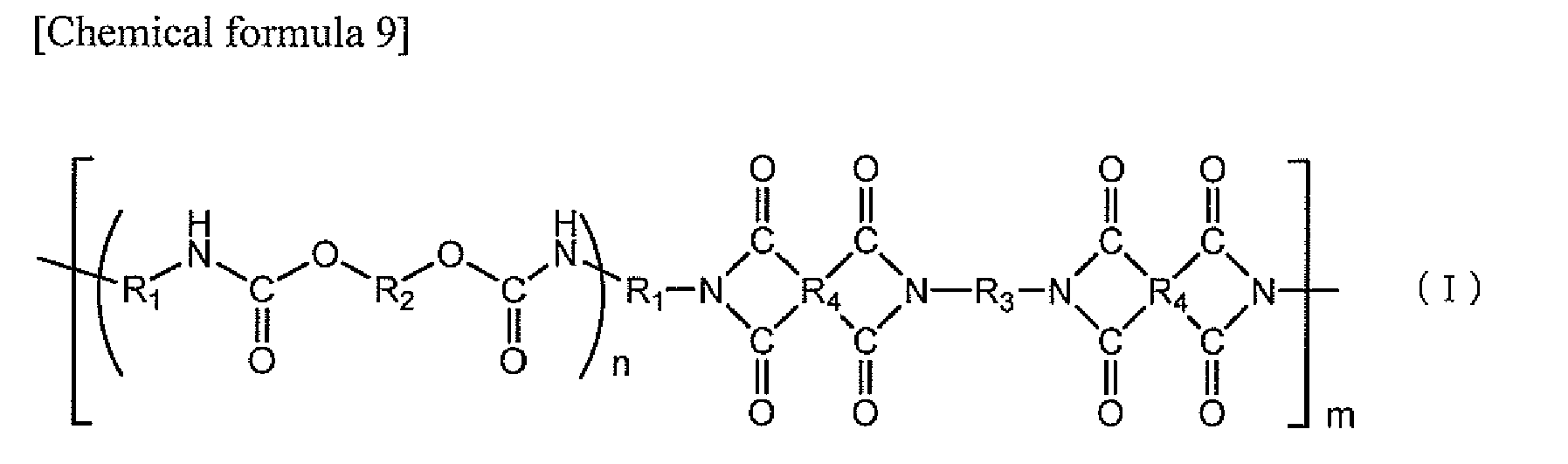
- The imide-modified elastomer according to claim 1, wherein in the general formula (I), the R1 is a residue except for isocyanate groups (-NCO) in diisocyanate capable of forming urethane prepolymer together with polyol, and the R2 is a residue except for two hydroxyl groups (-OH) in polyol capable of forming urethane prepolymer together with diisocyanate.
- The imide-modified elastomer according to claim 1 or 2, wherein in the general formula (I), the R3 is a residue except for amino groups (-NH2) in at least one diamine compound selected from aromatic diamine compounds having a carbon number of 6 to 27, aliphatic diamine compounds having a carbon number of 6 to 24 and alicyclic diamine compounds having a carbon number of 6 to 24, each of which can chain extend urethane prepolymer by urea bond.
- The imide-modified elastomer according to any one of claims 1 to 3, wherein in the general formula (I), the R4 is a residue of at least one kind of tetracarboxylic dianhydride selected from aromatic tetracarboxylic dianhydrides having a carbon number of 6 to 18 such as pyromellitic dianhydride (PMDA), oxydiphthalic dianhydride (ODPA), biphenyl-3,4,3',4'-tetracarboxylic dianhydride (BPDA), benzophenone-3,4,3',4'-tetracarboxylic dianhydride (BTDA), diphenylsulfone-3,4,3',4'-tetracarboxylic dianhydride (DSDA), 4,4'-(2,2-hexafluoroisopropylidene)bis(phthalic anhydride) (6FDA) and m(p)-terphenyl-3,4,3',4'-tetracarboxylic dianhydride; and alicyclic tetracarboxylic dianhydrides having a carbon number of 4 to 6 such as cyclobutane-1,2,3,4-tetracarboxylic dianhydride and 1-carboxymethyl-2,3,5-cyclopentanetricarboxylic-2,6:3,5-dianhydride, each of which can introduce an imide unit into a urea bond site.
- The imide-modified elastomer according to any one of claims 1 to 4, wherein the imide-modified elastomer is a block copolymer in which urethane prepolymer having an isocyanate group at both ends of each molecule obtained from diisocyanate and polyol is chain extended with a diamine compound by urea bond, and an imide unit is introduced into an urea bond site by using tetracarboxylic dianhydride.
- The imide-modified elastomer according to any one of claims 2 to 5, wherein the weight average molecular weight of the urethane prepolymer is 300 to 50,000.
- The imide-modified elastomer according to any one of claims 2 to 6, wherein the polyol is at least one kind selected from polycarbonate polyol and polyester polyol.
- The imide-modified elastomer according to any one of claims 3 to 7, wherein the diamine compound is 1,6-hexamethylenediamine.
- The imide-modified elastomer according to any one of claims 3 to 7, wherein the diamine compound is at least one kind selected from 1,4-bis(4-aminophenoxy)benzene and 1,3-bis(4-aminophenoxy)benzene.
- The imide-modified elastomer according to any one of claims 1 to 9, having an imide fraction of 5 to 45% by weight.
- The imide-modified elastomer according to any one of claims 1 to 10, wherein the storage elastic modulus E' at 50°C is 5×10⁶ to 5×10⁸ Pa.
- An imide-modified elastomer represented by the following formula (1):

Applications Claiming Priority (2)
| Application Number | Priority Date | Filing Date | Title |
|---|---|---|---|
| JP2006253388 | 2006-09-19 | ||
| PCT/JP2007/067064 WO2008035561A1 (en) | 2006-09-19 | 2007-08-31 | Imide-modified elastomer |
Publications (2)
| Publication Number | Publication Date |
|---|---|
| EP2065418A1 true EP2065418A1 (en) | 2009-06-03 |
| EP2065418A4 EP2065418A4 (en) | 2010-07-21 |
Family
ID=39200388
Family Applications (1)
| Application Number | Title | Priority Date | Filing Date |
|---|---|---|---|
| EP07806537A Withdrawn EP2065418A4 (en) | 2006-09-19 | 2007-08-31 | Imide-modified elastomer |
Country Status (7)
| Country | Link |
|---|---|
| US (1) | US20090240019A1 (en) |
| EP (1) | EP2065418A4 (en) |
| JP (1) | JP2008101195A (en) |
| KR (1) | KR101077944B1 (en) |
| CN (1) | CN101501098B (en) |
| TW (1) | TW200825124A (en) |
| WO (1) | WO2008035561A1 (en) |
Families Citing this family (22)
| Publication number | Priority date | Publication date | Assignee | Title |
|---|---|---|---|---|
| JP2008156560A (en) * | 2006-12-26 | 2008-07-10 | Nitta Ind Corp | Imide-modified elastomer and carbon nanotube belt |
| JP2008163219A (en) * | 2006-12-28 | 2008-07-17 | Nitta Ind Corp | Carbon nanotube-containing polyimide molded body and carbon nanotube-containing belt |
| JP4851970B2 (en) * | 2007-03-16 | 2012-01-11 | ニッタ株式会社 | Imide-modified silicone elastomer |
| JP5602339B2 (en) * | 2007-08-27 | 2014-10-08 | ニッタ株式会社 | Imide-modified elastomer |
| JP2009282294A (en) * | 2008-05-22 | 2009-12-03 | Canon Chemicals Inc | Cleaning blade for electrophotographic apparatus |
| US9267004B2 (en) | 2008-07-22 | 2016-02-23 | Kaneka Corporation | Polyimide precursor composition and use thereof |
| JP5437055B2 (en) * | 2009-12-25 | 2014-03-12 | ニッタ株式会社 | Release material |
| JP2012218400A (en) * | 2011-04-13 | 2012-11-12 | Nitta Corp | Release material |
| JP5755980B2 (en) * | 2011-09-08 | 2015-07-29 | 井上 眞一 | Method for producing imide-modified elastomer |
| EP2690124B1 (en) | 2012-07-27 | 2015-09-16 | Samsung Electronics Co., Ltd | Composition Comprising Polyimide Block Copolymer And Inorganic Particles, Method Of Preparing The Same, Article Including The Same, And Display Device Including The Article |
| CN103772643B (en) * | 2014-01-09 | 2015-09-30 | 福建锦江科技有限公司 | The preparation method of PA6 system thermoplastic polyamide elastomer |
| CN104877336B (en) * | 2015-05-07 | 2018-01-09 | 北京市射线应用研究中心 | A kind of imide-urethane Quito function and service damping material and preparation method thereof |
| CN106589289A (en) * | 2016-12-15 | 2017-04-26 | 湖北大学 | Thermal reversible self-repairing polyurethane-imide film and preparation method thereof |
| CN106916324B (en) * | 2017-03-14 | 2019-10-18 | 华南理工大学 | Preparation method of polyimide film with low dielectric constant and high fracture toughness |
| CN112041362B (en) * | 2018-04-12 | 2022-12-13 | 巴斯夫欧洲公司 | Electroactive polymers |
| JP2021175765A (en) * | 2020-05-01 | 2021-11-04 | Dic株式会社 | Imide resin, curable resin composition, method for producing imide resin, method for producing curable resin composition, cured product, and method for producing cured product |
| CN112390926B (en) * | 2020-11-16 | 2022-06-10 | 黑龙江省科学院高技术研究院 | Preparation method of ternary-structure liquid copolymer resin |
| US11746083B2 (en) * | 2020-12-30 | 2023-09-05 | Industrial Technology Research Institute | Compound, resin composition and laminated substrate thereof |
| TWI823337B (en) * | 2022-04-13 | 2023-11-21 | 黑木股份有限公司 | Modified polyurethane carrier substrate |
| US12129334B2 (en) | 2022-07-22 | 2024-10-29 | Kuroki Industrial Co., Ltd. | Modified polyurethane carrier substrate |
| EP4386027A1 (en) | 2022-12-12 | 2024-06-19 | Basf Se | Solvent-free process to produce imide-containing isocyanate prepolymers |
| CN120271785B (en) * | 2025-06-12 | 2025-08-05 | 苏州大学 | A high-intensity yellow fluorescent polyurethane elastomer and preparation method thereof |
Family Cites Families (13)
| Publication number | Priority date | Publication date | Assignee | Title |
|---|---|---|---|---|
| US3410876A (en) * | 1963-03-18 | 1968-11-12 | American Cyanamid Co | Process for the preparation of certain dianhydrides which comprises bringing into reactive contact under and atmosphere of nitric oxide at elevated temperature maleic anhydride and a vinyl benzene material having not more than two vinyl groups whereby the corresponding dianhydride is obtained |
| US4160753A (en) * | 1974-07-26 | 1979-07-10 | Bayer Aktiengesellschaft | Process for the production of polyamide-polyureas and dispersions thereof in water |
| JP2835654B2 (en) * | 1990-11-30 | 1998-12-14 | ニッタ株式会社 | Polyurethane elastomer composition |
| JPH05506060A (en) * | 1990-12-27 | 1993-09-02 | ザ ゲイツ ラバー カンパニー | High temperature resistant molded elastomer |
| JP3009087B2 (en) * | 1993-10-18 | 2000-02-14 | 株式会社レグルス | Thermoplastic polyurethane elastomer and method for producing the same |
| JPH11106507A (en) * | 1997-10-02 | 1999-04-20 | Asai Shokusan Kk | Imide linkage-containing compound and preparation thereof |
| JP4016226B2 (en) * | 1998-01-14 | 2007-12-05 | 味の素株式会社 | Modified polyimide resin and thermosetting resin composition containing the same |
| JP4362917B2 (en) * | 2000-01-31 | 2009-11-11 | 宇部興産株式会社 | Metal foil laminate and its manufacturing method |
| JP4370716B2 (en) * | 2000-11-07 | 2009-11-25 | 日立化成工業株式会社 | Polyimide resin composition and film forming material |
| JP4186445B2 (en) * | 2001-09-06 | 2008-11-26 | 東海ゴム工業株式会社 | Urethane urea material for office automation equipment |
| JP4055729B2 (en) * | 2004-03-24 | 2008-03-05 | 大日本インキ化学工業株式会社 | Method for producing curable imide resin |
| JP4650176B2 (en) * | 2004-09-10 | 2011-03-16 | 宇部興産株式会社 | Modified polyimide resin containing polybutadiene, composition thereof and cured insulating film |
| JP5208399B2 (en) * | 2006-10-24 | 2013-06-12 | ニッタ株式会社 | Polyimide resin |
-
2007
- 2007-08-27 JP JP2007220410A patent/JP2008101195A/en active Pending
- 2007-08-31 TW TW096132685A patent/TW200825124A/en unknown
- 2007-08-31 US US12/441,810 patent/US20090240019A1/en not_active Abandoned
- 2007-08-31 CN CN2007800300790A patent/CN101501098B/en not_active Expired - Fee Related
- 2007-08-31 EP EP07806537A patent/EP2065418A4/en not_active Withdrawn
- 2007-08-31 KR KR1020087022756A patent/KR101077944B1/en not_active Expired - Fee Related
- 2007-08-31 WO PCT/JP2007/067064 patent/WO2008035561A1/en not_active Ceased
Also Published As
| Publication number | Publication date |
|---|---|
| KR20090014337A (en) | 2009-02-10 |
| CN101501098A (en) | 2009-08-05 |
| US20090240019A1 (en) | 2009-09-24 |
| TW200825124A (en) | 2008-06-16 |
| JP2008101195A (en) | 2008-05-01 |
| WO2008035561A1 (en) | 2008-03-27 |
| EP2065418A4 (en) | 2010-07-21 |
| CN101501098B (en) | 2012-01-04 |
| KR101077944B1 (en) | 2011-10-28 |
Similar Documents
| Publication | Publication Date | Title |
|---|---|---|
| EP2065418A1 (en) | Imide-modified elastomer | |
| EP2058347B1 (en) | Polyimide resin | |
| EP2081087A1 (en) | Belt for image forming apparatus | |
| JP5602339B2 (en) | Imide-modified elastomer | |
| JP5485103B2 (en) | Release material | |
| CN102732030A (en) | Release material | |
| JP4953964B2 (en) | Precision drive seamless belt | |
| JP4851970B2 (en) | Imide-modified silicone elastomer | |
| JP2008163219A (en) | Carbon nanotube-containing polyimide molded body and carbon nanotube-containing belt | |
| JP5798912B2 (en) | Polyimide resin | |
| JP2010214903A (en) | Elastic sheet material, intermediate transfer belt, method of manufacturing the elastic sheet material, and method of manufacturing the intermediate transfer belt | |
| JP2008156560A (en) | Imide-modified elastomer and carbon nanotube belt | |
| JP5755980B2 (en) | Method for producing imide-modified elastomer | |
| JP2010217777A (en) | Multilayer endless belt and method of manufacturing the same | |
| JP5437055B2 (en) | Release material | |
| JP2013078880A (en) | Release material | |
| JP2010222567A (en) | Low friction elastic sheet | |
| JP2013129720A (en) | Imide-modified silicone elastomer | |
| JP2010208221A (en) | Chip-splitting endless belt |
Legal Events
| Date | Code | Title | Description |
|---|---|---|---|
| PUAI | Public reference made under article 153(3) epc to a published international application that has entered the european phase |
Free format text: ORIGINAL CODE: 0009012 |
|
| 17P | Request for examination filed |
Effective date: 20090312 |
|
| AK | Designated contracting states |
Kind code of ref document: A1 Designated state(s): AT BE BG CH CY CZ DE DK EE ES FI FR GB GR HU IE IS IT LI LT LU LV MC MT NL PL PT RO SE SI SK TR |
|
| AX | Request for extension of the european patent |
Extension state: AL BA HR MK RS |
|
| A4 | Supplementary search report drawn up and despatched |
Effective date: 20100623 |
|
| 17Q | First examination report despatched |
Effective date: 20110609 |
|
| DAX | Request for extension of the european patent (deleted) | ||
| STAA | Information on the status of an ep patent application or granted ep patent |
Free format text: STATUS: THE APPLICATION IS DEEMED TO BE WITHDRAWN |
|
| 18D | Application deemed to be withdrawn |
Effective date: 20140301 |