EP2065355A1 - Process for cooling the stream leaving an ethylbenzene dehydrogenation reactor - Google Patents
Process for cooling the stream leaving an ethylbenzene dehydrogenation reactor Download PDFInfo
- Publication number
- EP2065355A1 EP2065355A1 EP07291441A EP07291441A EP2065355A1 EP 2065355 A1 EP2065355 A1 EP 2065355A1 EP 07291441 A EP07291441 A EP 07291441A EP 07291441 A EP07291441 A EP 07291441A EP 2065355 A1 EP2065355 A1 EP 2065355A1
- Authority
- EP
- European Patent Office
- Prior art keywords
- ethylbenzene
- aqueous phase
- quenching
- decanter
- phase
- Prior art date
- Legal status (The legal status is an assumption and is not a legal conclusion. Google has not performed a legal analysis and makes no representation as to the accuracy of the status listed.)
- Withdrawn
Links
- YNQLUTRBYVCPMQ-UHFFFAOYSA-N Ethylbenzene Chemical compound CCC1=CC=CC=C1 YNQLUTRBYVCPMQ-UHFFFAOYSA-N 0.000 title claims abstract description 88
- 238000006356 dehydrogenation reaction Methods 0.000 title claims abstract description 30
- 238000000034 method Methods 0.000 title claims abstract description 13
- 238000001816 cooling Methods 0.000 title description 5
- 239000008346 aqueous phase Substances 0.000 claims abstract description 38
- 238000010791 quenching Methods 0.000 claims abstract description 33
- 230000000171 quenching effect Effects 0.000 claims abstract description 33
- PPBRXRYQALVLMV-UHFFFAOYSA-N Styrene Chemical group C=CC1=CC=CC=C1 PPBRXRYQALVLMV-UHFFFAOYSA-N 0.000 claims abstract description 30
- 239000007789 gas Substances 0.000 claims abstract description 24
- 239000007788 liquid Substances 0.000 claims abstract description 21
- 239000012074 organic phase Substances 0.000 claims abstract description 17
- MYRTYDVEIRVNKP-UHFFFAOYSA-N 1,2-Divinylbenzene Chemical compound C=CC1=CC=CC=C1C=C MYRTYDVEIRVNKP-UHFFFAOYSA-N 0.000 claims abstract description 14
- 238000010992 reflux Methods 0.000 claims abstract description 12
- 239000007792 gaseous phase Substances 0.000 claims abstract description 5
- 238000004519 manufacturing process Methods 0.000 claims abstract description 4
- 238000002156 mixing Methods 0.000 claims description 12
- 125000003118 aryl group Chemical group 0.000 claims description 9
- 239000007921 spray Substances 0.000 claims description 5
- 238000013508 migration Methods 0.000 claims description 3
- 230000005012 migration Effects 0.000 claims description 3
- UHOVQNZJYSORNB-UHFFFAOYSA-N Benzene Chemical compound C1=CC=CC=C1 UHOVQNZJYSORNB-UHFFFAOYSA-N 0.000 description 27
- YXFVVABEGXRONW-UHFFFAOYSA-N Toluene Chemical compound CC1=CC=CC=C1 YXFVVABEGXRONW-UHFFFAOYSA-N 0.000 description 27
- 239000000203 mixture Substances 0.000 description 6
- CURLTUGMZLYLDI-UHFFFAOYSA-N Carbon dioxide Chemical compound O=C=O CURLTUGMZLYLDI-UHFFFAOYSA-N 0.000 description 4
- 238000004821 distillation Methods 0.000 description 4
- 229910052739 hydrogen Inorganic materials 0.000 description 4
- 239000001257 hydrogen Substances 0.000 description 4
- 239000000463 material Substances 0.000 description 4
- VNWKTOKETHGBQD-UHFFFAOYSA-N methane Chemical compound C VNWKTOKETHGBQD-UHFFFAOYSA-N 0.000 description 4
- 239000003054 catalyst Substances 0.000 description 3
- 150000002431 hydrogen Chemical class 0.000 description 3
- 238000006116 polymerization reaction Methods 0.000 description 3
- 239000011269 tar Substances 0.000 description 3
- UGFAIRIUMAVXCW-UHFFFAOYSA-N Carbon monoxide Chemical compound [O+]#[C-] UGFAIRIUMAVXCW-UHFFFAOYSA-N 0.000 description 2
- OTMSDBZUPAUEDD-UHFFFAOYSA-N Ethane Chemical compound CC OTMSDBZUPAUEDD-UHFFFAOYSA-N 0.000 description 2
- UQSXHKLRYXJYBZ-UHFFFAOYSA-N Iron oxide Chemical compound [Fe]=O UQSXHKLRYXJYBZ-UHFFFAOYSA-N 0.000 description 2
- 229910002092 carbon dioxide Inorganic materials 0.000 description 2
- 239000001569 carbon dioxide Substances 0.000 description 2
- 229910002091 carbon monoxide Inorganic materials 0.000 description 2
- 239000012535 impurity Substances 0.000 description 2
- 238000012856 packing Methods 0.000 description 2
- 229920000642 polymer Polymers 0.000 description 2
- 238000011084 recovery Methods 0.000 description 2
- 238000005201 scrubbing Methods 0.000 description 2
- XLYOFNOQVPJJNP-UHFFFAOYSA-N water Substances O XLYOFNOQVPJJNP-UHFFFAOYSA-N 0.000 description 2
- OKTJSMMVPCPJKN-UHFFFAOYSA-N Carbon Chemical compound [C] OKTJSMMVPCPJKN-UHFFFAOYSA-N 0.000 description 1
- UFHFLCQGNIYNRP-UHFFFAOYSA-N Hydrogen Chemical compound [H][H] UFHFLCQGNIYNRP-UHFFFAOYSA-N 0.000 description 1
- 229910052799 carbon Inorganic materials 0.000 description 1
- 230000003197 catalytic effect Effects 0.000 description 1
- 238000006243 chemical reaction Methods 0.000 description 1
- 239000000571 coke Substances 0.000 description 1
- 230000006835 compression Effects 0.000 description 1
- 238000007906 compression Methods 0.000 description 1
- 238000009833 condensation Methods 0.000 description 1
- 230000005494 condensation Effects 0.000 description 1
- 238000010438 heat treatment Methods 0.000 description 1
- 238000003780 insertion Methods 0.000 description 1
- 230000037431 insertion Effects 0.000 description 1
- 238000000926 separation method Methods 0.000 description 1
- 238000005406 washing Methods 0.000 description 1
Images
Classifications
-
- C—CHEMISTRY; METALLURGY
- C07—ORGANIC CHEMISTRY
- C07C—ACYCLIC OR CARBOCYCLIC COMPOUNDS
- C07C7/00—Purification; Separation; Use of additives
- C07C7/09—Purification; Separation; Use of additives by fractional condensation
-
- C—CHEMISTRY; METALLURGY
- C07—ORGANIC CHEMISTRY
- C07C—ACYCLIC OR CARBOCYCLIC COMPOUNDS
- C07C5/00—Preparation of hydrocarbons from hydrocarbons containing the same number of carbon atoms
- C07C5/32—Preparation of hydrocarbons from hydrocarbons containing the same number of carbon atoms by dehydrogenation with formation of free hydrogen
- C07C5/327—Formation of non-aromatic carbon-to-carbon double bonds only
- C07C5/333—Catalytic processes
-
- C—CHEMISTRY; METALLURGY
- C07—ORGANIC CHEMISTRY
- C07C—ACYCLIC OR CARBOCYCLIC COMPOUNDS
- C07C2523/00—Catalysts comprising metals or metal oxides or hydroxides, not provided for in group C07C2521/00
- C07C2523/70—Catalysts comprising metals or metal oxides or hydroxides, not provided for in group C07C2521/00 of the iron group metals or copper
- C07C2523/74—Iron group metals
- C07C2523/745—Iron
Definitions
- the present invention relates to a process for cooling the stream leaving an ethylbenzene dehydrogenation reactor.
- the catalytic dehydrogenation of ethylbenzene to produce styrene is typically carried out at temperatures within the range of about 540-660°C under near atmospheric or even subatmospheric pressure conditions.
- an ethylbenzene steam feed having a steam to ethylbenzene mole ratio of perhaps 6, 7 or 8 or even higher is passed over a dehydrogenation catalyst such as iron oxide in an adiabatic dehydrogenation reactor.
- the stream (also called the effluent gas) leaving the ethylbenzene dehydrogenation reactor contains primarily styrene, hydrogen, unreacted ethylbenzene, benzene, toluene and small amounts of divinylbenzene, methane, ethane, carbon monoxide, carbon dioxide, various polymeric materials and tars as well as an aqueous component.
- US 3256355 relates to the dehydrogenation of ethylbenzene to make styrene.
- the latent heat of condensation of the contained steam is used to heat the reboilers of distillation columns in the overall process. Said stream is firstly washed with hot water to remove tars, then compressed and sent to the reboilers.
- US 4288234 describes an ethylbenzene dehydrogenation wherein the stream leaving the ethylbenzene dehydrogenation reactor is introduced in a cooling zone containing one or more cooling steps and a compression step. The remaining gases, essentially hydrogen, are washed with ethylbenzene and then polyethylbenzene to remove aromatics.
- US 4628136 describes an ethylbenzene dehydrogenation wherein the stream leaving the ethylbenzene dehydrogenation reactor is introduced in a conventional cooling zone where are recovered (i) a gaseous phase (essentially hydrogen), (ii) an organic phase (ethylbenzene and styrene) and (iii) an aqueous phase. Said aqueous phase is further mixed with fresh ethylbenzene then is vaporized while condensing the reflux of the ethylbenzene/styrene distillation column and then sent to the dehydrogenation catalyst.
- a gaseous phase essentially hydrogen
- an organic phase ethylbenzene and styrene
- aqueous phase aqueous phase
- US 6388155 relates to a process for the production of styrene monomer from ethylbenzene comprising the steps of:
- aqueous phase and an organic phase are recovered, said aqueous phase is mixed with aqueous phase recovered at step c) and said organic phase is fed to a distillation column for separation of the ethylbenzene and styrene monomer.
- step a) it has been discovered that if the dehydrogenation effluent of step a) is quenched with an aqueous phase most of the divinylbenzene and polymerics materials contained in said dehydrogenation effluent are removed. Said removal eliminates the fouling and plugging problems in condensers and other apparatus in the course of styrene recovering.
- the present invention is a process for the production of styrene monomer from ethylbenzene comprising the steps of:
- Styrene is recovered from organic phases of steps c) and e) by known means.
- An advantage is that most of the divinylbenzene and polymerics materials contained in said dehydrogenation effluent are removed. Said removal eliminates the fouling and plugging problems in condenser(s) of step c).
- a mixing tank is inserted on the liquid stream between the quenching column and the decanter of step e).
- an effective amount of an aromatic component advantageously an aromatic component which cannot polymerize
- ethylbenzene or benzene or toluene or mixture thereof advantageously ethylbenzene or benzene or toluene or mixture thereof.
- Purpose of said introduction is to cause the migration of organic heavies to the organic phase in the decanter which leads to a clean aqueous phase leaving the decanter.
- “Clean aqueous phase” means that said aqueous phase leaving the decanter will not induce fouling or random polymerizations in the vessels, pipes and any piece of equipment.
- the aqueous phase leaving the decanter of step e) goes through a stripper to remove a substantial part of any remaining organic component, mainly ethylbenzene and benzene or toluene.
- a stripper to remove a substantial part of any remaining organic component, mainly ethylbenzene and benzene or toluene.
- said aqueous phase is advantageously used to make steam.
- the aqueous phase from step c) is sent to the top of said quenching column and the dehydrogenation effluent from step a) is sent to the lower end of said quenching column.
- said aqueous phase from step c) is dispersed in the quenching column by spray nozzles.
- said quenching column has no liquid level in the bottoms in order to reduce the residence time to prevent fouling and random polymerizations.
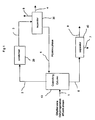
- Fig 1 illustrates a process according to the invention.
- 10 is the quenching column of step b)
- 20 is the condenser of step c)
- 30 is a decanter (separator)
- 40 the decanter of step e).
- the stream leaving the ethylbenzene dehydrogenation reactor is cooled at about 120-150°C and sent via line 1 to the quenching column 10.
- the quenching column is fed via line 5 by an aqueous phase at about 40°C.
- the liquid stream 6 leaving the quenching column is at about 65°C
- the quenching column overhead gas is at about 70°C and is sent via line 2 to a condenser 20.
- the condensed and uncondensed components leaving the condenser 20 at about 40°C are sent via line 3 to a decanter 30 producing a gaseous stream 9, a liquid organic phase 4 and an aqueous phase 5.
- the stream 6 leaving the quenching column 10 is sent to a decanter 40 to produce a liquid organic phase 8 and an aqueous phase 7.
- a mixing tank (not shown on this fig 1 ) is inserted on stream 6, In said mixing tank is introduced an effective amount of an aromatic component, advantageously ethylbenzene or benzene or toluene or mixture thereof.
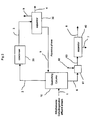
- Fig 2 derives from fig 1 by insertion of the mixing tank on stream 6.
- the stream (also called the effluent gas) leaving the ethylbenzene dehydrogenation reactor contains primarily styrene, hydrogen, unreacted ethylbenzene, benzene, toluene and small amounts of divinylbenzene, methane, ethane, carbon monoxide, carbon dioxide, various polymeric materials and tars as well as an aqueous component.
- the stream leaving the ethylbenzene dehydrogenation reactor is available at a reduced pressure and the quenching column is operating at said reduced pressure.
- this reduced pressure is in the range 0.2 to 0.7 bar absolute, advantageously in the range 0.3 to 0.5.
- the quenching column of step b can be any type of liquid /gas contactor such as, by way of example, a packed column or a column with trays or a combination of trays and packing.
- the aqueous phase sent on top of the quenching column is dispersed by spray nozzles and there is no packing.
- one or two washing trays can be located on top of the quenching column above the spray nozzles but they have to be fed with a part of the aqueous phase sent to the spray nozzles.
- liquid organic phases recovered at step c) and at step e) are sent to a recovery section to separate styrene and ethylbenzene from all impurities, ethylbenzene is recycled to the dehydrogenation.
- a mixing tank is inserted on the liquid stream between the quenching column and the decanter of step e).
- an effective amount of an aromatic component advantageously ethylbenzene or benzene or toluene or mixture thereof.
- Purpose of said introduction is to cause the migration of organic heavies to the organic phase in the decanter which leads to a clean aqueous phase leaving the decanter.
- Organic heavies means that said aqueous phase leaving the decanter will not induce fouling or random polymerizations in the vessels, pipes and any piece of equipment.
- the aromatic component introduced in the mixing tank can be any aromatic which cannot polymerize, advantageously it is ethylbenzene or benzene or toluene or mixture thereof.
- Amount of said aromatic component introduced is 0.05 to 5% by weight of the amount of the aqueous phase.
- Volume of said mixing tank is designed to have advantageously a residence time of 5 to 45 minutes.
- the aqueous phase leaving the decanter of step e) goes through a stripper to remove as much as possible any remaining organic component, mainly ethylbenzene and benzene or toluene. Then said aqueous phase is advantageously used to make steam.
- Said stripper is known per se and works like any stripper (exhausting section of a distillation column).
- the temperature of the top of the stripper is around 95°C to 110°C depending on the operating pressure of the stripper.
- Overhead of the stripper comprises water, benzene, toluene and other aromatics, is condensed and sent advantageously to a decanter, the organic phase being sent to the recovery section that separates styrene, ethylbenzene, and other impurities.
- Advantage of the quenching column of the invention is the energy savings in heating of said aqueous phase to be stripped.
Landscapes
- Chemical & Material Sciences (AREA)
- Organic Chemistry (AREA)
- Chemical Kinetics & Catalysis (AREA)
- Engineering & Computer Science (AREA)
- Analytical Chemistry (AREA)
- Oil, Petroleum & Natural Gas (AREA)
- Water Supply & Treatment (AREA)
- Organic Low-Molecular-Weight Compounds And Preparation Thereof (AREA)
- Low-Molecular Organic Synthesis Reactions Using Catalysts (AREA)
Abstract
The present invention is a process for the production of styrene monomer from ethylbenzene comprising the steps of:
a) catalytically dehydrogenating said ethylbenzene in the presence of steam thereby catalytically producing a dehydrogenation effluent gas containing essentially unreacted ethylbenzene, styrene monomer, steam and divinylbenzene;
b) quenching said effluent gas with an aqueous reflux in at least a quenching column to cool said effluent gas, and thereby obtaining a gas at the overhead and in the bottom a liquid stream warmer than the aqueous reflux;
c) condensing said overhead gas thereby producing a liquid organic phase, an aqueous phase and a gaseous phase;
d) using a portion or the whole of said aqueous phase of step c) as reflux for said step b) of quenching;
e) sending to a decanter the liquid stream obtained at step b) to recover an aqueous phase and an organic phase.
a) catalytically dehydrogenating said ethylbenzene in the presence of steam thereby catalytically producing a dehydrogenation effluent gas containing essentially unreacted ethylbenzene, styrene monomer, steam and divinylbenzene;
b) quenching said effluent gas with an aqueous reflux in at least a quenching column to cool said effluent gas, and thereby obtaining a gas at the overhead and in the bottom a liquid stream warmer than the aqueous reflux;
c) condensing said overhead gas thereby producing a liquid organic phase, an aqueous phase and a gaseous phase;
d) using a portion or the whole of said aqueous phase of step c) as reflux for said step b) of quenching;
e) sending to a decanter the liquid stream obtained at step b) to recover an aqueous phase and an organic phase.
Description
- The present invention relates to a process for cooling the stream leaving an ethylbenzene dehydrogenation reactor. The catalytic dehydrogenation of ethylbenzene to produce styrene is typically carried out at temperatures within the range of about 540-660°C under near atmospheric or even subatmospheric pressure conditions. Typically, an ethylbenzene steam feed having a steam to ethylbenzene mole ratio of perhaps 6, 7 or 8 or even higher is passed over a dehydrogenation catalyst such as iron oxide in an adiabatic dehydrogenation reactor. Large quantities of steam are employed in order to supply a part of the sensible heat to the dehydrogenation (endothermic reaction), to reduce the partial pressure of the ethyl benzene to favor the dehydrogenation reaction, and to keep the catalyst free of coke and carbon deposits. The stream (also called the effluent gas) leaving the ethylbenzene dehydrogenation reactor contains primarily styrene, hydrogen, unreacted ethylbenzene, benzene, toluene and small amounts of divinylbenzene, methane, ethane, carbon monoxide, carbon dioxide, various polymeric materials and tars as well as an aqueous component.
-
US 3256355 relates to the dehydrogenation of ethylbenzene to make styrene. In said prior art, referring to the stream leaving the ethylbenzene dehydrogenation reactor, the latent heat of condensation of the contained steam is used to heat the reboilers of distillation columns in the overall process. Said stream is firstly washed with hot water to remove tars, then compressed and sent to the reboilers. -
US 4288234 describes an ethylbenzene dehydrogenation wherein the stream leaving the ethylbenzene dehydrogenation reactor is introduced in a cooling zone containing one or more cooling steps and a compression step. The remaining gases, essentially hydrogen, are washed with ethylbenzene and then polyethylbenzene to remove aromatics. -
US 4628136 describes an ethylbenzene dehydrogenation wherein the stream leaving the ethylbenzene dehydrogenation reactor is introduced in a conventional cooling zone where are recovered (i) a gaseous phase (essentially hydrogen), (ii) an organic phase (ethylbenzene and styrene) and (iii) an aqueous phase. Said aqueous phase is further mixed with fresh ethylbenzene then is vaporized while condensing the reflux of the ethylbenzene/styrene distillation column and then sent to the dehydrogenation catalyst. -
US 6388155 relates to a process for the production of styrene monomer from ethylbenzene comprising the steps of: - a) catalytically dehydrogenating said ethylbenzene in the presence of steam thereby catalytically producing a dehydrogenation effluent gas containing unreacted ethylbenzene and lighter components and styrene monomer and heavier components;
- b) scrubbing said effluent gas with reflux to remove at least a portion of said styrene monomer and heavier components from said effluent gas;
- c) condensing said scrubbed effluent gas thereby producing a liquid organic dehydrogenation mixture, an aqueous phase and a gaseous phase;
and - d) using a portion of said liquid organic dehydrogenation mixture as said reflux for said step b) of scrubbing.
- In the bottoms of said scrubber of step b) an aqueous phase and an organic phase are recovered, said aqueous phase is mixed with aqueous phase recovered at step c) and said organic phase is fed to a distillation column for separation of the ethylbenzene and styrene monomer.
- It has been discovered that if the dehydrogenation effluent of step a) is quenched with an aqueous phase most of the divinylbenzene and polymerics materials contained in said dehydrogenation effluent are removed. Said removal eliminates the fouling and plugging problems in condensers and other apparatus in the course of styrene recovering.
- The present invention is a process for the production of styrene monomer from ethylbenzene comprising the steps of:
- a) catalytically dehydrogenating said ethylbenzene in the presence of steam thereby catalytically producing a dehydrogenation effluent gas containing essentially unreacted ethylbenzene, styrene monomer, steam and divinylbenzene;
- b) quenching said effluent gas with an aqueous reflux in at least a quenching column to cool said effluent gas, and thereby obtaining a gas at the overhead and in the bottom a liquid stream warmer than the aqueous reflux;
- c) condensing said overhead gas thereby producing a liquid organic phase, an aqueous phase and a gaseous phase;
- d) using a portion or the whole of said aqueous phase of step c) as reflux for said step b) of quenching;
- e) sending to a decanter the liquid stream obtained at step b) to recover an aqueous phase and an organic phase.
- Styrene is recovered from organic phases of steps c) and e) by known means.
- An advantage is that most of the divinylbenzene and polymerics materials contained in said dehydrogenation effluent are removed. Said removal eliminates the fouling and plugging problems in condenser(s) of step c).
- According to a specific embodiment a mixing tank is inserted on the liquid stream between the quenching column and the decanter of step e). In said mixing tank is introduced an effective amount of an aromatic component (advantageously an aromatic component which cannot polymerize), advantageously ethylbenzene or benzene or toluene or mixture thereof. Purpose of said introduction is to cause the migration of organic heavies to the organic phase in the decanter which leads to a clean aqueous phase leaving the decanter. "Clean aqueous phase" means that said aqueous phase leaving the decanter will not induce fouling or random polymerizations in the vessels, pipes and any piece of equipment.
- According to another specific embodiment the aqueous phase leaving the decanter of step e) goes through a stripper to remove a substantial part of any remaining organic component, mainly ethylbenzene and benzene or toluene. Advantageously as much as possible as the remaining organic components are to be removed. Then said aqueous phase is advantageously used to make steam.
- According to another specific embodiment relating to the quenching column of step b), the aqueous phase from step c) is sent to the top of said quenching column and the dehydrogenation effluent from step a) is sent to the lower end of said quenching column. According to another specific embodiment said aqueous phase from step c) is dispersed in the quenching column by spray nozzles.
- According to another specific embodiment said quenching column has no liquid level in the bottoms in order to reduce the residence time to prevent fouling and random polymerizations.
-
Fig 1 illustrates a process according to the invention. 10 is the quenching column of step b), 20 is the condenser of step c), 30 is a decanter (separator) and 40 the decanter of step e). The stream leaving the ethylbenzene dehydrogenation reactor is cooled at about 120-150°C and sent via line 1 to thequenching column 10. The quenching column is fed vialine 5 by an aqueous phase at about 40°C. Theliquid stream 6 leaving the quenching column is at about 65°C, the quenching column overhead gas is at about 70°C and is sent vialine 2 to acondenser 20. The condensed and uncondensed components leaving thecondenser 20 at about 40°C are sent vialine 3 to adecanter 30 producing agaseous stream 9, a liquid organic phase 4 and anaqueous phase 5. Thestream 6 leaving thequenching column 10 is sent to adecanter 40 to produce a liquidorganic phase 8 and anaqueous phase 7. Optionally a mixing tank (not shown on thisfig 1 ) is inserted onstream 6, In said mixing tank is introduced an effective amount of an aromatic component, advantageously ethylbenzene or benzene or toluene or mixture thereof.Fig 2 derives fromfig 1 by insertion of the mixing tank onstream 6.Stream 6 leaves the quenching column and is sent to themixing tank 61 wherein an aromatic component is introduced byline 62 and is sent vialine 63 to thedecanter 40 of step c). - As regards the stream (also called the effluent gas) leaving the ethylbenzene dehydrogenation reactor, it contains primarily styrene, hydrogen, unreacted ethylbenzene, benzene, toluene and small amounts of divinylbenzene, methane, ethane, carbon monoxide, carbon dioxide, various polymeric materials and tars as well as an aqueous component. Advantageously the stream leaving the ethylbenzene dehydrogenation reactor is available at a reduced pressure and the quenching column is operating at said reduced pressure. By way of example this reduced pressure is in the range 0.2 to 0.7 bar absolute, advantageously in the range 0.3 to 0.5.
- As regards the quenching column of step b), it can be any type of liquid /gas contactor such as, by way of example, a packed column or a column with trays or a combination of trays and packing. Advantageously the aqueous phase sent on top of the quenching column is dispersed by spray nozzles and there is no packing. Optionally one or two washing trays can be located on top of the quenching column above the spray nozzles but they have to be fed with a part of the aqueous phase sent to the spray nozzles.
- The liquid organic phases recovered at step c) and at step e) are sent to a recovery section to separate styrene and ethylbenzene from all impurities, ethylbenzene is recycled to the dehydrogenation.
- According to a specific embodiment a mixing tank is inserted on the liquid stream between the quenching column and the decanter of step e). In said mixing tank is introduced an effective amount of an aromatic component, advantageously ethylbenzene or benzene or toluene or mixture thereof. Purpose of said introduction is to cause the migration of organic heavies to the organic phase in the decanter which leads to a clean aqueous phase leaving the decanter. "Clean aqueous phase" means that said aqueous phase leaving the decanter will not induce fouling or random polymerizations in the vessels, pipes and any piece of equipment. The aromatic component introduced in the mixing tank can be any aromatic which cannot polymerize, advantageously it is ethylbenzene or benzene or toluene or mixture thereof. Amount of said aromatic component introduced is 0.05 to 5% by weight of the amount of the aqueous phase. Volume of said mixing tank is designed to have advantageously a residence time of 5 to 45 minutes.
- According to another specific embodiment the aqueous phase leaving the decanter of step e) goes through a stripper to remove as much as possible any remaining organic component, mainly ethylbenzene and benzene or toluene. Then said aqueous phase is advantageously used to make steam. Said stripper is known per se and works like any stripper (exhausting section of a distillation column). Advantageously the temperature of the top of the stripper is around 95°C to 110°C depending on the operating pressure of the stripper. Overhead of the stripper comprises water, benzene, toluene and other aromatics, is condensed and sent advantageously to a decanter, the organic phase being sent to the recovery section that separates styrene, ethylbenzene, and other impurities. Advantage of the quenching column of the invention is the energy savings in heating of said aqueous phase to be stripped.
Claims (6)
- Process for the production of styrene monomer from ethylbenzene comprising the steps of:a) catalytically dehydrogenating said ethylbenzene in the presence of steam thereby catalytically producing a dehydrogenation effluent gas containing essentially unreacted ethylbenzene, styrene monomer, steam and divinylbenzene;b) quenching said effluent gas with an aqueous reflux in at least a quenching column to cool said effluent gas, and thereby obtaining a gas at the overhead and in the bottom a liquid stream warmer than the aqueous reflux;c) condensing said overhead gas thereby producing a liquid organic phase, an aqueous phase and a gaseous phase;d) using a portion or the whole of said aqueous phase of step c) as reflux for said step b) of quenching;e) sending to a decanter the liquid stream obtained at step b) to recover an aqueous phase and an organic phase.
- Process according to claim 1 wherein a mixing tank is inserted on the liquid stream between the quenching column and the decanter of step e) and in said mixing tank is introduced an effective amount of an aromatic component to cause the migration of organic heavies to the organic phase in the said decanter of step e).
- Process according to any one of the preceding claims wherein the aqueous phase leaving the decanter of step e) goes through a stripper to remove a substantial part of any remaining organic component.
- Process according to any one of the preceding claims wherein the aqueous phase from step c) is sent to the top of the quenching column and the dehydrogenation effluent from step a) is sent to the lower end of said quenching column.
- Process according to claim 4 wherein said aqueous phase from step c) is dispersed in the quenching column by spray nozzles.
- Process according to any one of the preceding claims wherein the quenching column of step b) has no liquid level in the bottoms.
Priority Applications (12)
| Application Number | Priority Date | Filing Date | Title |
|---|---|---|---|
| EP07291441A EP2065355A1 (en) | 2007-11-29 | 2007-11-29 | Process for cooling the stream leaving an ethylbenzene dehydrogenation reactor |
| TW097142880A TWI432399B (en) | 2007-11-29 | 2008-11-06 | Process for cooling the stream leaving an ethylbenzene dehydrogenation reactor |
| PCT/EP2008/066023 WO2009068486A1 (en) | 2007-11-29 | 2008-11-21 | Process for cooling the stream leaving an ethylbenzene dehydrogenation reactor |
| JP2010535343A JP5197752B2 (en) | 2007-11-29 | 2008-11-21 | Method for cooling the stream leaving an ethylbenzene dehydrogenation reactor |
| CN200880118587.9A CN101883748B (en) | 2007-11-29 | 2008-11-21 | Process for cooling the stream leaving an ethylbenzene dehydrogenation reactor |
| CA2706010A CA2706010C (en) | 2007-11-29 | 2008-11-21 | Process for cooling the stream leaving an ethylbenzene dehydrogenation reactor |
| EA201000660A EA017838B1 (en) | 2007-11-29 | 2008-11-21 | Process for cooling the stream leaving an ethylbenzene dehydrogenation reactor |
| BRPI0820286A BRPI0820286B1 (en) | 2007-11-29 | 2008-11-21 | process for cooling the effluent vapor of an ethylbenzene dehydrogenation reactor. |
| EP08854917A EP2212268B1 (en) | 2007-11-29 | 2008-11-21 | Process for cooling the stream leaving an ethylbenzene dehydrogenation reactor |
| KR1020107011499A KR101166399B1 (en) | 2007-11-29 | 2008-11-21 | Process for cooling the stream leaving an ethylbenzene dehydrogenation reactor |
| US12/744,683 US8450547B2 (en) | 2007-11-29 | 2008-11-21 | Process for cooling the stream leaving an ethylbenzene dehydrogenation reactor |
| US13/868,755 US8729327B2 (en) | 2007-11-29 | 2013-04-23 | Process for cooling the stream leaving an ethylbenzene dehydrogenation reactor |
Applications Claiming Priority (1)
| Application Number | Priority Date | Filing Date | Title |
|---|---|---|---|
| EP07291441A EP2065355A1 (en) | 2007-11-29 | 2007-11-29 | Process for cooling the stream leaving an ethylbenzene dehydrogenation reactor |
Publications (1)
| Publication Number | Publication Date |
|---|---|
| EP2065355A1 true EP2065355A1 (en) | 2009-06-03 |
Family
ID=39301235
Family Applications (2)
| Application Number | Title | Priority Date | Filing Date |
|---|---|---|---|
| EP07291441A Withdrawn EP2065355A1 (en) | 2007-11-29 | 2007-11-29 | Process for cooling the stream leaving an ethylbenzene dehydrogenation reactor |
| EP08854917A Active EP2212268B1 (en) | 2007-11-29 | 2008-11-21 | Process for cooling the stream leaving an ethylbenzene dehydrogenation reactor |
Family Applications After (1)
| Application Number | Title | Priority Date | Filing Date |
|---|---|---|---|
| EP08854917A Active EP2212268B1 (en) | 2007-11-29 | 2008-11-21 | Process for cooling the stream leaving an ethylbenzene dehydrogenation reactor |
Country Status (10)
| Country | Link |
|---|---|
| US (2) | US8450547B2 (en) |
| EP (2) | EP2065355A1 (en) |
| JP (1) | JP5197752B2 (en) |
| KR (1) | KR101166399B1 (en) |
| CN (1) | CN101883748B (en) |
| BR (1) | BRPI0820286B1 (en) |
| CA (1) | CA2706010C (en) |
| EA (1) | EA017838B1 (en) |
| TW (1) | TWI432399B (en) |
| WO (1) | WO2009068486A1 (en) |
Families Citing this family (3)
| Publication number | Priority date | Publication date | Assignee | Title |
|---|---|---|---|---|
| US8999257B2 (en) | 2009-09-22 | 2015-04-07 | Fina Technology, Inc. | Offgas stream direct contact condenser |
| US8350109B2 (en) * | 2010-12-13 | 2013-01-08 | Lummus Technology Inc. | Production of styrene from ethylbenzene using azeotropic vaporization and low overall water to ethylbenzene ratios |
| WO2017079004A1 (en) * | 2015-11-06 | 2017-05-11 | Uop Llc | Reactor effluent wash to remove aromatics |
Citations (9)
| Publication number | Priority date | Publication date | Assignee | Title |
|---|---|---|---|---|
| US3256355A (en) | 1965-03-24 | 1966-06-14 | Halcon International Inc | Process for preparing styrene and recovery of ethylbenzene |
| US3515767A (en) * | 1968-05-21 | 1970-06-02 | Universal Oil Prod Co | Catalytic conversion process |
| US3515765A (en) * | 1968-05-21 | 1970-06-02 | Universal Oil Prod Co | Catalytic conversion process |
| US3515766A (en) * | 1968-05-21 | 1970-06-02 | Universal Oil Prod Co | Catalytic conversion process |
| US3515764A (en) * | 1968-05-21 | 1970-06-02 | Universal Oil Prod Co | Catalytic conversion process |
| US4288234A (en) | 1979-11-15 | 1981-09-08 | The Lummus Company | Recovery of aromatics from styrene production off-gas |
| GB2092018A (en) * | 1981-02-02 | 1982-08-11 | Cosden Technology | Method and apparatus for steaming alkyl-aromatic compound dehydrogenation catalyst |
| US4628136A (en) | 1985-12-17 | 1986-12-09 | Lummus Crest, Inc. | Dehydrogenation process for production of styrene from ethylbenzene comprising low temperature heat recovery and modification of the ethylbenzene-steam feed therewith |
| US6388155B1 (en) | 2000-08-01 | 2002-05-14 | Abb Lummus Global Inc. | Styrene dehydrogenation reactor effluent treatment |
Family Cites Families (8)
| Publication number | Priority date | Publication date | Assignee | Title |
|---|---|---|---|---|
| JPS4940214B1 (en) * | 1970-06-01 | 1974-10-31 | ||
| JPS4920186B1 (en) * | 1970-10-29 | 1974-05-23 | ||
| US4400569A (en) * | 1981-10-27 | 1983-08-23 | Cosden Technology, Inc. | Method and apparatus for dehydrogenation of alkylaromatic compounds to produce vinylaromatic monomers |
| JPH06239773A (en) * | 1993-02-18 | 1994-08-30 | Nippon Steel Chem Co Ltd | Production of divinylbenzene |
| DK0841317T3 (en) | 1996-11-08 | 2002-04-29 | Fina Technology | Process for dehydrogenation of ethylbenzene to styrene |
| EP1319648B1 (en) * | 2001-12-14 | 2008-04-02 | Stockhausen GmbH | Process for the production of acrylic acid |
| JP4449568B2 (en) * | 2004-05-14 | 2010-04-14 | 三菱化学株式会社 | Method for preventing accumulation of insoluble solid in production of styrene, and accumulation preventing apparatus therefor |
| CN100372819C (en) * | 2006-06-22 | 2008-03-05 | 华东理工大学 | A kind of reaction method of hydrogen oxidation preparation styrene |
-
2007
- 2007-11-29 EP EP07291441A patent/EP2065355A1/en not_active Withdrawn
-
2008
- 2008-11-06 TW TW097142880A patent/TWI432399B/en active
- 2008-11-21 JP JP2010535343A patent/JP5197752B2/en not_active Expired - Fee Related
- 2008-11-21 KR KR1020107011499A patent/KR101166399B1/en not_active Expired - Fee Related
- 2008-11-21 CA CA2706010A patent/CA2706010C/en not_active Expired - Fee Related
- 2008-11-21 WO PCT/EP2008/066023 patent/WO2009068486A1/en not_active Ceased
- 2008-11-21 US US12/744,683 patent/US8450547B2/en active Active
- 2008-11-21 BR BRPI0820286A patent/BRPI0820286B1/en active IP Right Grant
- 2008-11-21 EA EA201000660A patent/EA017838B1/en not_active IP Right Cessation
- 2008-11-21 EP EP08854917A patent/EP2212268B1/en active Active
- 2008-11-21 CN CN200880118587.9A patent/CN101883748B/en active Active
-
2013
- 2013-04-23 US US13/868,755 patent/US8729327B2/en active Active
Patent Citations (9)
| Publication number | Priority date | Publication date | Assignee | Title |
|---|---|---|---|---|
| US3256355A (en) | 1965-03-24 | 1966-06-14 | Halcon International Inc | Process for preparing styrene and recovery of ethylbenzene |
| US3515767A (en) * | 1968-05-21 | 1970-06-02 | Universal Oil Prod Co | Catalytic conversion process |
| US3515765A (en) * | 1968-05-21 | 1970-06-02 | Universal Oil Prod Co | Catalytic conversion process |
| US3515766A (en) * | 1968-05-21 | 1970-06-02 | Universal Oil Prod Co | Catalytic conversion process |
| US3515764A (en) * | 1968-05-21 | 1970-06-02 | Universal Oil Prod Co | Catalytic conversion process |
| US4288234A (en) | 1979-11-15 | 1981-09-08 | The Lummus Company | Recovery of aromatics from styrene production off-gas |
| GB2092018A (en) * | 1981-02-02 | 1982-08-11 | Cosden Technology | Method and apparatus for steaming alkyl-aromatic compound dehydrogenation catalyst |
| US4628136A (en) | 1985-12-17 | 1986-12-09 | Lummus Crest, Inc. | Dehydrogenation process for production of styrene from ethylbenzene comprising low temperature heat recovery and modification of the ethylbenzene-steam feed therewith |
| US6388155B1 (en) | 2000-08-01 | 2002-05-14 | Abb Lummus Global Inc. | Styrene dehydrogenation reactor effluent treatment |
Also Published As
| Publication number | Publication date |
|---|---|
| EP2212268B1 (en) | 2012-05-30 |
| EA201000660A1 (en) | 2010-12-30 |
| US8450547B2 (en) | 2013-05-28 |
| CN101883748B (en) | 2013-07-31 |
| KR101166399B1 (en) | 2012-07-23 |
| JP5197752B2 (en) | 2013-05-15 |
| US20110065971A1 (en) | 2011-03-17 |
| KR20100074302A (en) | 2010-07-01 |
| US8729327B2 (en) | 2014-05-20 |
| BRPI0820286A2 (en) | 2015-05-26 |
| EA017838B1 (en) | 2013-03-29 |
| EP2212268A1 (en) | 2010-08-04 |
| CN101883748A (en) | 2010-11-10 |
| JP2011504901A (en) | 2011-02-17 |
| TW200936537A (en) | 2009-09-01 |
| TWI432399B (en) | 2014-04-01 |
| CA2706010C (en) | 2013-04-09 |
| CA2706010A1 (en) | 2009-06-04 |
| WO2009068486A1 (en) | 2009-06-04 |
| BRPI0820286B1 (en) | 2017-05-09 |
| US20130303815A1 (en) | 2013-11-14 |
Similar Documents
| Publication | Publication Date | Title |
|---|---|---|
| USRE40124E1 (en) | Process and installation for recovery and purification of ethylene produced by pyrolysis of hydrocarbons, and gases obtained by this process | |
| US3515766A (en) | Catalytic conversion process | |
| JP2011521995A (en) | Process for producing low-concentration ethylene for chemical use | |
| EP2222605B1 (en) | Process for purification of an aqueous phase containing polyaromatics | |
| JP4471977B2 (en) | Process for the production of propylene and alkylaromatic compounds from dilute ethylene streams. | |
| US8729327B2 (en) | Process for cooling the stream leaving an ethylbenzene dehydrogenation reactor | |
| US4009218A (en) | Alkylaromatic hydrocarbon dehydrogenation process | |
| US4039602A (en) | Ethylbenzene Dehydrogenation process | |
| EP1697283B1 (en) | Process for production of ethylbenzene from dilute ethylene streams | |
| US12234415B2 (en) | Naphtha catalytic cracking process |
Legal Events
| Date | Code | Title | Description |
|---|---|---|---|
| PUAI | Public reference made under article 153(3) epc to a published international application that has entered the european phase |
Free format text: ORIGINAL CODE: 0009012 |
|
| AK | Designated contracting states |
Kind code of ref document: A1 Designated state(s): AT BE BG CH CY CZ DE DK EE ES FI FR GB GR HU IE IS IT LI LT LU LV MC MT NL PL PT RO SE SI SK TR |
|
| AX | Request for extension of the european patent |
Extension state: AL BA HR MK RS |
|
| AKX | Designation fees paid | ||
| REG | Reference to a national code |
Ref country code: DE Ref legal event code: 8566 |
|
| STAA | Information on the status of an ep patent application or granted ep patent |
Free format text: STATUS: THE APPLICATION IS DEEMED TO BE WITHDRAWN |
|
| 18D | Application deemed to be withdrawn |
Effective date: 20091204 |