EP2065347A1 - Durable frit composition and composites and devices comprised thereof - Google Patents
Durable frit composition and composites and devices comprised thereof Download PDFInfo
- Publication number
- EP2065347A1 EP2065347A1 EP20070301613 EP07301613A EP2065347A1 EP 2065347 A1 EP2065347 A1 EP 2065347A1 EP 20070301613 EP20070301613 EP 20070301613 EP 07301613 A EP07301613 A EP 07301613A EP 2065347 A1 EP2065347 A1 EP 2065347A1
- Authority
- EP
- European Patent Office
- Prior art keywords
- mol
- less
- glass
- frit
- alumina
- Prior art date
- Legal status (The legal status is an assumption and is not a legal conclusion. Google has not performed a legal analysis and makes no representation as to the accuracy of the status listed.)
- Withdrawn
Links
- 239000000203 mixture Substances 0.000 title claims abstract description 20
- 239000002131 composite material Substances 0.000 title claims abstract description 16
- 239000011521 glass Substances 0.000 claims abstract description 81
- PNEYBMLMFCGWSK-UHFFFAOYSA-N aluminium oxide Inorganic materials [O-2].[O-2].[O-2].[Al+3].[Al+3] PNEYBMLMFCGWSK-UHFFFAOYSA-N 0.000 claims abstract description 52
- VYPSYNLAJGMNEJ-UHFFFAOYSA-N Silicium dioxide Chemical compound O=[Si]=O VYPSYNLAJGMNEJ-UHFFFAOYSA-N 0.000 claims abstract description 22
- 239000003513 alkali Substances 0.000 claims abstract description 20
- MCMNRKCIXSYSNV-UHFFFAOYSA-N Zirconium dioxide Chemical compound O=[Zr]=O MCMNRKCIXSYSNV-UHFFFAOYSA-N 0.000 claims abstract description 14
- 239000005388 borosilicate glass Substances 0.000 claims abstract description 13
- 229910052747 lanthanoid Inorganic materials 0.000 claims abstract description 12
- 150000002602 lanthanoids Chemical class 0.000 claims abstract description 12
- 239000000377 silicon dioxide Substances 0.000 claims abstract description 10
- KKCBUQHMOMHUOY-UHFFFAOYSA-N Na2O Inorganic materials [O-2].[Na+].[Na+] KKCBUQHMOMHUOY-UHFFFAOYSA-N 0.000 claims abstract description 7
- 229910052681 coesite Inorganic materials 0.000 claims abstract description 7
- 229910052906 cristobalite Inorganic materials 0.000 claims abstract description 7
- 229910052682 stishovite Inorganic materials 0.000 claims abstract description 7
- 229910052905 tridymite Inorganic materials 0.000 claims abstract description 7
- 235000012239 silicon dioxide Nutrition 0.000 claims abstract description 4
- 239000011819 refractory material Substances 0.000 claims abstract description 3
- 239000000758 substrate Substances 0.000 claims description 39
- 239000000463 material Substances 0.000 claims description 30
- 239000002245 particle Substances 0.000 claims description 19
- 238000012360 testing method Methods 0.000 claims description 14
- 238000002425 crystallisation Methods 0.000 claims description 13
- 230000008025 crystallization Effects 0.000 claims description 13
- 239000002253 acid Substances 0.000 claims description 9
- 238000005245 sintering Methods 0.000 claims description 9
- 239000002585 base Substances 0.000 claims description 7
- 229910052708 sodium Inorganic materials 0.000 claims description 7
- 229910052782 aluminium Inorganic materials 0.000 claims description 6
- 229910052710 silicon Inorganic materials 0.000 claims description 4
- 229910052726 zirconium Inorganic materials 0.000 claims description 4
- 238000000034 method Methods 0.000 description 8
- 239000011734 sodium Substances 0.000 description 7
- 239000000126 substance Substances 0.000 description 7
- 238000004031 devitrification Methods 0.000 description 5
- 238000004519 manufacturing process Methods 0.000 description 5
- 239000000843 powder Substances 0.000 description 5
- 238000012545 processing Methods 0.000 description 5
- 230000000052 comparative effect Effects 0.000 description 4
- 238000009792 diffusion process Methods 0.000 description 4
- 239000011159 matrix material Substances 0.000 description 4
- 238000012546 transfer Methods 0.000 description 4
- 238000009736 wetting Methods 0.000 description 4
- 230000002378 acidificating effect Effects 0.000 description 3
- 230000008901 benefit Effects 0.000 description 3
- 230000015572 biosynthetic process Effects 0.000 description 3
- 238000006243 chemical reaction Methods 0.000 description 3
- 239000012530 fluid Substances 0.000 description 3
- 238000001000 micrograph Methods 0.000 description 3
- TWNQGVIAIRXVLR-UHFFFAOYSA-N oxo(oxoalumanyloxy)alumane Chemical compound O=[Al]O[Al]=O TWNQGVIAIRXVLR-UHFFFAOYSA-N 0.000 description 3
- 238000009700 powder processing Methods 0.000 description 3
- ZOXJGFHDIHLPTG-UHFFFAOYSA-N Boron Chemical compound [B] ZOXJGFHDIHLPTG-UHFFFAOYSA-N 0.000 description 2
- KRHYYFGTRYWZRS-UHFFFAOYSA-N Fluorane Chemical compound F KRHYYFGTRYWZRS-UHFFFAOYSA-N 0.000 description 2
- DGAQECJNVWCQMB-PUAWFVPOSA-M Ilexoside XXIX Chemical compound C[C@@H]1CC[C@@]2(CC[C@@]3(C(=CC[C@H]4[C@]3(CC[C@@H]5[C@@]4(CC[C@@H](C5(C)C)OS(=O)(=O)[O-])C)C)[C@@H]2[C@]1(C)O)C)C(=O)O[C@H]6[C@@H]([C@H]([C@@H]([C@H](O6)CO)O)O)O.[Na+] DGAQECJNVWCQMB-PUAWFVPOSA-M 0.000 description 2
- 229910052796 boron Inorganic materials 0.000 description 2
- 239000000919 ceramic Substances 0.000 description 2
- 238000012824 chemical production Methods 0.000 description 2
- 238000001816 cooling Methods 0.000 description 2
- 229910052593 corundum Inorganic materials 0.000 description 2
- 239000000945 filler Substances 0.000 description 2
- 239000012847 fine chemical Substances 0.000 description 2
- 238000010438 heat treatment Methods 0.000 description 2
- RVTZCBVAJQQJTK-UHFFFAOYSA-N oxygen(2-);zirconium(4+) Chemical compound [O-2].[O-2].[Zr+4] RVTZCBVAJQQJTK-UHFFFAOYSA-N 0.000 description 2
- 238000012216 screening Methods 0.000 description 2
- 238000003786 synthesis reaction Methods 0.000 description 2
- 229910001928 zirconium oxide Inorganic materials 0.000 description 2
- RZVAJINKPMORJF-UHFFFAOYSA-N Acetaminophen Chemical compound CC(=O)NC1=CC=C(O)C=C1 RZVAJINKPMORJF-UHFFFAOYSA-N 0.000 description 1
- FUJCRWPEOMXPAD-UHFFFAOYSA-N Li2O Inorganic materials [Li+].[Li+].[O-2] FUJCRWPEOMXPAD-UHFFFAOYSA-N 0.000 description 1
- ZLMJMSJWJFRBEC-UHFFFAOYSA-N Potassium Chemical compound [K] ZLMJMSJWJFRBEC-UHFFFAOYSA-N 0.000 description 1
- QCWXUUIWCKQGHC-UHFFFAOYSA-N Zirconium Chemical group [Zr] QCWXUUIWCKQGHC-UHFFFAOYSA-N 0.000 description 1
- 150000007513 acids Chemical class 0.000 description 1
- WYTGDNHDOZPMIW-RCBQFDQVSA-N alstonine Natural products C1=CC2=C3C=CC=CC3=NC2=C2N1C[C@H]1[C@H](C)OC=C(C(=O)OC)[C@H]1C2 WYTGDNHDOZPMIW-RCBQFDQVSA-N 0.000 description 1
- XAGFODPZIPBFFR-UHFFFAOYSA-N aluminium Chemical compound [Al] XAGFODPZIPBFFR-UHFFFAOYSA-N 0.000 description 1
- 238000004458 analytical method Methods 0.000 description 1
- KGBXLFKZBHKPEV-UHFFFAOYSA-N boric acid Chemical compound OB(O)O KGBXLFKZBHKPEV-UHFFFAOYSA-N 0.000 description 1
- 239000004327 boric acid Substances 0.000 description 1
- 239000002419 bulk glass Substances 0.000 description 1
- 150000004649 carbonic acid derivatives Chemical class 0.000 description 1
- 239000003054 catalyst Substances 0.000 description 1
- 229910010293 ceramic material Inorganic materials 0.000 description 1
- 238000012512 characterization method Methods 0.000 description 1
- 239000003153 chemical reaction reagent Substances 0.000 description 1
- 230000006835 compression Effects 0.000 description 1
- 238000007906 compression Methods 0.000 description 1
- 238000012937 correction Methods 0.000 description 1
- 239000010431 corundum Substances 0.000 description 1
- 230000007547 defect Effects 0.000 description 1
- 238000000280 densification Methods 0.000 description 1
- 239000010432 diamond Substances 0.000 description 1
- XUCJHNOBJLKZNU-UHFFFAOYSA-M dilithium;hydroxide Chemical compound [Li+].[Li+].[OH-] XUCJHNOBJLKZNU-UHFFFAOYSA-M 0.000 description 1
- 230000007613 environmental effect Effects 0.000 description 1
- 238000005530 etching Methods 0.000 description 1
- 239000000835 fiber Substances 0.000 description 1
- 238000010304 firing Methods 0.000 description 1
- 239000002241 glass-ceramic Substances 0.000 description 1
- 230000006698 induction Effects 0.000 description 1
- 238000012994 industrial processing Methods 0.000 description 1
- 238000007689 inspection Methods 0.000 description 1
- 229910052751 metal Inorganic materials 0.000 description 1
- 239000002184 metal Substances 0.000 description 1
- 150000002739 metals Chemical class 0.000 description 1
- 238000002156 mixing Methods 0.000 description 1
- 238000000465 moulding Methods 0.000 description 1
- PXXKQOPKNFECSZ-UHFFFAOYSA-N platinum rhodium Chemical compound [Rh].[Pt] PXXKQOPKNFECSZ-UHFFFAOYSA-N 0.000 description 1
- 229910052700 potassium Inorganic materials 0.000 description 1
- 239000011591 potassium Substances 0.000 description 1
- 238000003825 pressing Methods 0.000 description 1
- 239000005297 pyrex Substances 0.000 description 1
- 239000004065 semiconductor Substances 0.000 description 1
- 150000004760 silicates Chemical class 0.000 description 1
- 239000010703 silicon Substances 0.000 description 1
- 229910001948 sodium oxide Inorganic materials 0.000 description 1
- XLYOFNOQVPJJNP-UHFFFAOYSA-N water Substances O XLYOFNOQVPJJNP-UHFFFAOYSA-N 0.000 description 1
- 230000004580 weight loss Effects 0.000 description 1
- 229910001845 yogo sapphire Inorganic materials 0.000 description 1
- 229910052845 zircon Inorganic materials 0.000 description 1
- GFQYVLUOOAAOGM-UHFFFAOYSA-N zirconium(iv) silicate Chemical compound [Zr+4].[O-][Si]([O-])([O-])[O-] GFQYVLUOOAAOGM-UHFFFAOYSA-N 0.000 description 1
Images



Classifications
-
- B—PERFORMING OPERATIONS; TRANSPORTING
- B81—MICROSTRUCTURAL TECHNOLOGY
- B81C—PROCESSES OR APPARATUS SPECIALLY ADAPTED FOR THE MANUFACTURE OR TREATMENT OF MICROSTRUCTURAL DEVICES OR SYSTEMS
- B81C1/00—Manufacture or treatment of devices or systems in or on a substrate
- B81C1/00015—Manufacture or treatment of devices or systems in or on a substrate for manufacturing microsystems
- B81C1/00023—Manufacture or treatment of devices or systems in or on a substrate for manufacturing microsystems without movable or flexible elements
- B81C1/00055—Grooves
- B81C1/00071—Channels
-
- B—PERFORMING OPERATIONS; TRANSPORTING
- B01—PHYSICAL OR CHEMICAL PROCESSES OR APPARATUS IN GENERAL
- B01J—CHEMICAL OR PHYSICAL PROCESSES, e.g. CATALYSIS OR COLLOID CHEMISTRY; THEIR RELEVANT APPARATUS
- B01J19/00—Chemical, physical or physico-chemical processes in general; Their relevant apparatus
- B01J19/24—Stationary reactors without moving elements inside
- B01J19/248—Reactors comprising multiple separated flow channels
- B01J19/2485—Monolithic reactors
-
- C—CHEMISTRY; METALLURGY
- C03—GLASS; MINERAL OR SLAG WOOL
- C03C—CHEMICAL COMPOSITION OF GLASSES, GLAZES OR VITREOUS ENAMELS; SURFACE TREATMENT OF GLASS; SURFACE TREATMENT OF FIBRES OR FILAMENTS MADE FROM GLASS, MINERALS OR SLAGS; JOINING GLASS TO GLASS OR OTHER MATERIALS
- C03C3/00—Glass compositions
- C03C3/04—Glass compositions containing silica
- C03C3/076—Glass compositions containing silica with 40% to 90% silica, by weight
- C03C3/089—Glass compositions containing silica with 40% to 90% silica, by weight containing boron
- C03C3/091—Glass compositions containing silica with 40% to 90% silica, by weight containing boron containing aluminium
- C03C3/093—Glass compositions containing silica with 40% to 90% silica, by weight containing boron containing aluminium containing zinc or zirconium
-
- C—CHEMISTRY; METALLURGY
- C03—GLASS; MINERAL OR SLAG WOOL
- C03C—CHEMICAL COMPOSITION OF GLASSES, GLAZES OR VITREOUS ENAMELS; SURFACE TREATMENT OF GLASS; SURFACE TREATMENT OF FIBRES OR FILAMENTS MADE FROM GLASS, MINERALS OR SLAGS; JOINING GLASS TO GLASS OR OTHER MATERIALS
- C03C8/00—Enamels; Glazes; Fusion seal compositions being frit compositions having non-frit additions
- C03C8/02—Frit compositions, i.e. in a powdered or comminuted form
- C03C8/10—Frit compositions, i.e. in a powdered or comminuted form containing lead
- C03C8/12—Frit compositions, i.e. in a powdered or comminuted form containing lead containing titanium or zirconium
-
- C—CHEMISTRY; METALLURGY
- C03—GLASS; MINERAL OR SLAG WOOL
- C03C—CHEMICAL COMPOSITION OF GLASSES, GLAZES OR VITREOUS ENAMELS; SURFACE TREATMENT OF GLASS; SURFACE TREATMENT OF FIBRES OR FILAMENTS MADE FROM GLASS, MINERALS OR SLAGS; JOINING GLASS TO GLASS OR OTHER MATERIALS
- C03C8/00—Enamels; Glazes; Fusion seal compositions being frit compositions having non-frit additions
- C03C8/14—Glass frit mixtures having non-frit additions, e.g. opacifiers, colorants, mill-additions
-
- C—CHEMISTRY; METALLURGY
- C03—GLASS; MINERAL OR SLAG WOOL
- C03C—CHEMICAL COMPOSITION OF GLASSES, GLAZES OR VITREOUS ENAMELS; SURFACE TREATMENT OF GLASS; SURFACE TREATMENT OF FIBRES OR FILAMENTS MADE FROM GLASS, MINERALS OR SLAGS; JOINING GLASS TO GLASS OR OTHER MATERIALS
- C03C8/00—Enamels; Glazes; Fusion seal compositions being frit compositions having non-frit additions
- C03C8/24—Fusion seal compositions being frit compositions having non-frit additions, i.e. for use as seals between dissimilar materials, e.g. glass and metal; Glass solders
-
- B—PERFORMING OPERATIONS; TRANSPORTING
- B81—MICROSTRUCTURAL TECHNOLOGY
- B81B—MICROSTRUCTURAL DEVICES OR SYSTEMS, e.g. MICROMECHANICAL DEVICES
- B81B2201/00—Specific applications of microelectromechanical systems
- B81B2201/05—Microfluidics
- B81B2201/058—Microfluidics not provided for in B81B2201/051 - B81B2201/054
-
- Y—GENERAL TAGGING OF NEW TECHNOLOGICAL DEVELOPMENTS; GENERAL TAGGING OF CROSS-SECTIONAL TECHNOLOGIES SPANNING OVER SEVERAL SECTIONS OF THE IPC; TECHNICAL SUBJECTS COVERED BY FORMER USPC CROSS-REFERENCE ART COLLECTIONS [XRACs] AND DIGESTS
- Y10—TECHNICAL SUBJECTS COVERED BY FORMER USPC
- Y10T—TECHNICAL SUBJECTS COVERED BY FORMER US CLASSIFICATION
- Y10T137/00—Fluid handling
- Y10T137/206—Flow affected by fluid contact, energy field or coanda effect [e.g., pure fluid device or system]
- Y10T137/2224—Structure of body of device
-
- Y—GENERAL TAGGING OF NEW TECHNOLOGICAL DEVELOPMENTS; GENERAL TAGGING OF CROSS-SECTIONAL TECHNOLOGIES SPANNING OVER SEVERAL SECTIONS OF THE IPC; TECHNICAL SUBJECTS COVERED BY FORMER USPC CROSS-REFERENCE ART COLLECTIONS [XRACs] AND DIGESTS
- Y10—TECHNICAL SUBJECTS COVERED BY FORMER USPC
- Y10T—TECHNICAL SUBJECTS COVERED BY FORMER US CLASSIFICATION
- Y10T137/00—Fluid handling
- Y10T137/8593—Systems
- Y10T137/87249—Multiple inlet with multiple outlet
Definitions
- This invention is directed to chemically durable and crystallization-resistant glass compositions of low softening point (below 850°C) suitable for forming seals, glazes, and even composites and molded structures in conjunction with alumina and other temperature-resistant materials.
- the invention relates to frits composed of such glass compositions that are compatible with alumina and suitable for use in the fabrication of alumina-containing components, such as micro-reactor or other microfluidic components comprising alumina, as well as to microfluidic devices of various types formed using such glass compositions.
- Microfluidic devices broadly understood, and microreactors in particular, are typically devices arranged to take advantage of high surface to volume ratios available in channels or passages of multi-millimeter or sub-millimeter dimensions. Heat and mass transfer rates can become very large as process volumes shrink. Applications range from massively parallel biological screening utilizing very small amounts of reagent, laboratory reaction characterization and parallel catalyst screening to chemical production. Particularly for microfluidic devices useful in chemical production applications, chemical durability, heat transfer capability, and pressure resistance or mechanical robustness become key attributes.
- the present invention is directed to a glass material (1) that can produce reliable, robust and hermetic structures through powder processing; (2) that is chemically compatible with alumina ceramic (has no reactions causing glass immiscibility or devitrification) and has good wetting and flow characteristics, particularly with relation to alumina particles or structures, during thermal processing; (3) that is generally inert and that resists a broad range of corrosive environments at both extremes of pH (for synthesis of fine chemicals); (4) that has thermal expansion characteristics compatible with alumina ceramic in order to give low seal stress over the fabrication and working temperature ranges of the product.
- microreactors and processes for making microreactors Such are disclosed, for example, in U.S. Patent No. 7,007,709 , Microfluidic Device and Manufacture Thereof , assigned to the assignee of the present application.
- the most basic features of the disclosed process may be reviewed with reference to Figures 1A-1D of the present application.
- two substrates 102 and 104 are provided. More may be used if desired.
- the substrates may have holes or passages formed therethrough, such as the hole 108 through the substrate 104.
- two layers of frit material are positioned or deposited on the substrates and formed into desired shapes.
- Layer 204 of frit material is deposited on the surface 304 of substrate 104, while layer 202 of frit material is deposited on the surface 302 of substrate 102.
- the layer 204 has been deposited or formed into a thin flat layer 204a, while the layer 202 has been deposited or formed into a combination of raised ridges or walls 202b and a thin flat layer 202a.
- substrate 104 is turned over and placed on the substrate 102, with the respective frit layers 202, 204 in contact.
- the layers 202, 204 are then sintered, together with the substrates 102, 104, so as to adhere the entire assembly together, resulting in a microfluidic device 10 as shown in Figure 1D .
- the glass frit softens and flows, or at least deforms and consolidates to some degree, allowing the frit layers 202,204 to become densified and sintered together as shown in Figure 1D .
- Resulting is a microfluidic device 12 comprising a sintered frit 200, a first substrate 102, and a second substrate 104, the sintered frit 200, the first substrate 102 and the second substrate 104 being adhered together to form a one-piece device 12 in which the sintered frit 200 defines at least one recess 250 between the first and second substrates 102, 104.
- the substrates 102, 104 may be manufactured from materials selected from glasses, glass ceramics, ceramics, metals, semiconductors such as silicon, and/or combinations thereof.” Although some progress has been made in using substrates of other materials, the present inventor and colleagues have relied principally on glass substrates to produce microfluidic devices such as device 12 of Figure 1D .
- the thermal conductivities of such glass materials are typically in range of 0.9-1.2 W/m/K at room temperature. In order to achieve higher heat transfer capability, alternative substrate materials of higher thermal conductivity are generally desirable.
- alpha alumina is attractive both because such substrates are commercially available at low cost, and because alumina is inert and strongly resistant to chemical attack, and stable in air at high temperatures.
- the present invention provides a glass powder that can be fully densified through viscous flow without any devitrification or de-wetting of alumina structures or particles.
- the inventive glass has been successfully used to make multilayered glass structures and to fabricate thermally conductive glass composites.
- glasses of the present invention have excellent chemical resistance and are rated in class 1 and A1 in accordance with criteria of normalized tests DIN 12116 and ISO 695, respectively.
- the present invention is directed to glass compositions (1) that can produce reliable, robust and hermetic structures through powder processing (in other words, that are resistant to devitrification/crystallization during powder processing); (2) that are chemically compatible with alumina ceramic (have no reactions causing glass immiscibility or devitrification) and have good wetting and flow characteristics, particularly with relation to alumina particles or structures, during thermal processing; (3) that are generally inert and that resist a broad range of corrosive environments of both pH extremes (for use in synthesis of fine chemicals); and (4) that have thermal expansion characteristics compatible with alumina ceramic in order to give low seal stress over the fabrication and working temperature ranges of the product.
- a zirconium- and alumina-containing borosilicate glass suitable for use as a frit with refractory materials such as alumina and comprising a glass composition in mole percent (mol %) of: 2 ⁇ B 2 ⁇ O 3 ⁇ 7 mol % 75 ⁇ Si ⁇ O 2 ⁇ 80 mol % 3 ⁇ Al 2 ⁇ O 3 ⁇ 5 mol % 2 ⁇ Zr ⁇ O 2 ⁇ 5 mol % 9 ⁇ Na 2 ⁇ O + K 2 ⁇ O ⁇ 15 mol % 0 ⁇ alkali earth + lanthanide ⁇ 15 mol % and wherein the total mole percent of SiO2, AlO3 and ZrO2 together is greater than 82 but less than 86, and wherein the total mole percent of B203, Na2O, K20, alkali earth and lanthanide is greater than 13 and less than 18.
- the present invention is directed to this material and to frits, composites, and fluidic devices made
- the substrates and/or particles, such as aluminum oxide substrates or particles, generally useful in conjunction with the materials of the invention typically have a CTE in the range of 55-75 x 10 -7 /°C, preferably in the range of 60 to 70 x 10 -7 /°C, and the materials of the invention are desirably matched to these values, with the glass materials slilghtly lower in thermal expansion, such the glass remains slightly in compression throughout the desired range of working temperatures.
- the invention is directed to glasses, and frits made therefrom, having the following compositions:
- the glass compositions according to the invention are suitable for frit use in that they have no or very minimal crystallization after sintering on a substrate. Even after sintering on an alpha alumina (aluminum oxide) substrate and/or together with alumina particles as filler, the sintered frit has a crystallization layer of 10 ⁇ m or less.
- the glass compositions according to the present invention have a softening point less than 850°C, even less than 825°C.
- Low softening point is significantly desirable for several reasons.
- Lower softening point materials provide important environmental and economic advantages of requiring less energy to process.
- materials with softening points below 850 °C can generally be processed with standard industrial processing equipment, while higher softening points typically require specialized equipment.
- a lower softening point increases the range of materials with which the glass composition may be compatible, because maximum processing temperatures and overall processing temperature range are both reduced, lowering the performance requirements for potentially compatible materials.
- Figures 1A- 1D are cross sections of a microreactor or microfluidic device in process of being assembled.
- Figure 2 is a plan view of another type of microfluidic device or microreactor or "minireactor" formed within the cells of an extruded monolith.
- Figure 3 is a perspective view of the reactor of Figure 2 , with an arrow showing the general arrangement of a fluid path within the reactor of Figures 2 and 3 .
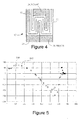
- Figure 4 is a cross-section of a device of the type shown in Figures 2 and 3 , in which cross section the locations and functions of plugs, desirably formed of materials of the present invention, may be seen.
- Figure 5 is a plot of thermal expansion mismatch, in parts per million, between the glass I2 of TABLE I and 96% alumina, as a function of temperature in degrees C.
- Figure 6 is a micrograph of a polished and etched sample of a composite according to the present invention, showing extremely good wetting of alumina particles by the glass matrix, and showing a thin diffusion layer of 100-200 nm thickness at the glass/particle interface.
- Figures 1A-1D represent, in a very general way, the basic steps of fabrication of a microfluidic device or microreactor having frit-based walls sandwiched between substrates 102 and 104.
- the steps depicted in Figure 1 may be modified in various ways, such as by including more than just two substrates 102 and 104, or by forming frit walls on both of the facing surfaces in Figure 1C , so that more complex structures can result.
- the resulting microfluidic device 12 includes a sintered frit 200, which may be in the form of a sintered frit plus filler forming a composite 600, and a first substrate 102 and a second substrate 104, with the sintered frit 200, the first substrate 102 and the second substrate 104 being adhered together to form a one-piece device 12 in which the sintered frit 200 defines at least one recess 250 between the first and second substrates 102, 104.
- a sintered frit 200 which may be in the form of a sintered frit plus filler forming a composite 600, and a first substrate 102 and a second substrate 104, with the sintered frit 200, the first substrate 102 and the second substrate 104 being adhered together to form a one-piece device 12 in which the sintered frit 200 defines at least one recess 250 between the first and second substrates 102, 104.
- Figures 2-4 show another type of microreactor device 12, sometimes also referred to as a "minireactor" 12.
- Minireactor 12 shown in Figures 2-4 is formed generally within an extruded body 20.
- Extruded body 20 has multiple cells 22, 24 extending along a common direction, some of which are open cells 22 and some of which are closed cells 24. Closed cells 24 are closed by a more-or-less individual or continuous plug or plug material 26.
- the plug material 26 has two openings 30 therethrough, each serving as an input/output port.
- a fluid passage or fluidic path 32 is provided in the closed cells 24 in the form of a serpentine path 32 that follows first along one or a few of the closed cells 24, than along another one or a few, and so back and forth as shown by the arrow in Figure 3 .
- a detailed cross-sectional view of a portion of a small device similar to the one in Figures 2-3 is shown in Figure 4 .
- Plugs or plug material 26 are used to close of groups of passages from the outside, while walls between these groups are reduced, allowing fluids to flow along the generally serpentine fluidic path 32.
- the extruded body may beneficially be formed of alpha alumina (aluminum oxide), and the plugs or plug material 26 may advantageously take the form of sintered frit 200 of the glass of the present invention, or the composite 600 of the present invention described below in connection with Figure 6 .
- alpha alumina aluminum oxide
- the substrate be made of alpha alumina, such as COORSTEK 96% (CoorsTek, Golden Colorado USA) having a CTE of 69 x 10 -7 /°C at 300 °C.
- the desired glass material used to make frit should be a moderate thermal expansion material.
- the glass material should also have a softening point temperature that does not exceed 850°C.
- the material should also have high crystallization resistance in order to insure full densification and good strength; and should have a high chemical resistance to acids and alkalies, the higher the better.
- the zirconium- and alumina-containing borosilicate glass compositions according to the invention satisfy these criteria.
- the glasses of the present invention have a composition in mole percent (mol %) of: 2 ⁇ B 2 ⁇ O 3 ⁇ 7 mol % 75 ⁇ Si ⁇ O 2 ⁇ 80 mol % 3 ⁇ Al 2 ⁇ O 3 ⁇ 5 mol % 2 ⁇ Zr ⁇ O 2 ⁇ 5 mol % 9 ⁇ Na 2 ⁇ O + K 2 ⁇ O ⁇ 15 mol % , and 0 ⁇ alkali earth + lanthanide ⁇ 15 mol %
- the inventive glasses further have the total mole percent of SiO2, AlO3 and ZrO2 together greater than 82 but less than 86, and the total mole percent of B2O3, Na20, K2O, alkali earths and lanthanides together greater than 13 but less than 18.
- the invention is directed to this material and to frits and fluidic devices made therefrom.
- Glass materials described in the present invention were prepared from silica, boric acid, calcined alumina, zircon, and alkali carbonates. After mixing, the vitrifiable mixture is melted in an induction furnace at 1650°C for 6 hours into a platinum-rhodium crucible. Then, the melted glasses were quenched in water and milled in dry conditions employing an alumina ball mill. The ball-milled powder was then sieved ( ⁇ 125 ⁇ m) and samples were prepared from the sieved powder by pressing powder or molding a frit paste onto an alumina substrate. The samples were then heated at 900°C for one hour.
- the crystallization resistance of bulk glasses was tested by heat treatment of a polished bulk sample for 48 hours at softening point temperature, followed by manual inspection and rating.
- Thermal expansion was measured by TMA (thermal mechanical analysis). Thermal expansion was adjusted according to sign and degree of curvature of calibrated bilame coupons after cooling. Seal stresses were examined at room and high temperature via photoelastic techniques.
- Softening point temperatures of the glasses were measured via the Labino method. A correction of +25°C was applied to the raw data to obtain the values in TABLE I, which values represent the real value of softening point (as confirmed by fiber elongation). Data for six comparative glasses C1-C6 and inventive glasses I1 and I2 are shown.
- Chemical durability was determined by measuring weight loss of samples immersed in acid or alkaline media in accordance with ISO 12116 (acid), and ISO 695 (alkali).
- Glasses of the present invention have excellent chemical resistance. It is desirable that they have acidic durability of less than 10 mg/dm 2 lost in testing under ISO 12116, more desirably less than 1 mg/dm 2 lost. Further, it is desirable that these glasses have a alkali durability of at less than 100 mg/dm 2 lost in testing under ISO 695, more desirably less than 30 mg/dm 2 lost. Performance of glass I2 in Table I actually equals acidic durability of PYREX® 7740 ( ⁇ 0,1 mg/dm 2 ) and well exceeds its alkali durability (110 mg/dm2) at 27 mg/dm 2 . Despite presence of large amount of sodium oxide in the composition, the inventive glasses keep excellent acidic resistance (Class 1) and surprisingly exceptional alkali resistance (Class A1).
- the thermal expansion of the glass can generally be adjusted by varying the content of sodium and boron.
- a high level of silica (above 75%) is necessary to ensure glass durability here, but silica should not exceed 80% since silica at such levels lowers the thermal expansion unacceptably.
- the CTE of the preferred glass composition I2 is essentially perfectly matched to that of alumina ceramic (only about 50 ppm mismatch at room temperature). Dynamic mismatch over temperature was recorded for a butt seal, and the results in parts per million are graphed in Figure 5 as a function of temperature in °C. The curve during heating is plotted in closed diamonds 502 while the curve during cooling is plotted in open squares 504.
- Frits of glasses of the present invention can be mixed with alumina particles to produce thermally conductive glass composite since the glass does not crystallize significantly during sintering. Even in the presence of bulk and/or particulate alumina, the sintered frit has a crystallization layer of 10 ⁇ m or less after sintering in contact with the alumina.
- FIG. 6 is a contrast-enhanced micrograph of such an etched polished sample of a composite 600 of the present invention.
- a particle of alumina 602 can be seen well-embedded in the glass matrix 604. That the particle 602 is well wetted by the glass may be seen from the extreme uniformity (in thickness) and extreme thinness of the diffusion layer 606 between the particle 602 and the matrix 604.
- a filled glass composite like that shown in the micrograph of Figure 6 was produced with a measured thermal conductivity of 2.2 W/m K.
- 30 % by volume of corundum particles (150 mesh) were added to the glass frit.
- Overall heat transfer coefficient of an alumina microreactor made with such filled frit was multiplied by two compared with the equivalent glass device component.
- the present invention can be considered as directed also to such composites and to microfluidic devices comprising the inventive glasses or composites.
Landscapes
- Chemical & Material Sciences (AREA)
- Engineering & Computer Science (AREA)
- Chemical Kinetics & Catalysis (AREA)
- Organic Chemistry (AREA)
- Life Sciences & Earth Sciences (AREA)
- General Chemical & Material Sciences (AREA)
- Geochemistry & Mineralogy (AREA)
- Materials Engineering (AREA)
- Manufacturing & Machinery (AREA)
- Analytical Chemistry (AREA)
- Microelectronics & Electronic Packaging (AREA)
- Glass Compositions (AREA)
Abstract






and wherein the total mole percent of SiO2, AlO3 and ZrO2 together is greater than 82 but less than 86, and wherein the total mole percent of B2O3, Na2O, K2O, alkali earths and lanthanides together is greater than 13 and less than 18. Frits (200,600), composites (600) and microfluidic devices (12) comprising the glass are also disclosed.
Description
- This invention is directed to chemically durable and crystallization-resistant glass compositions of low softening point (below 850°C) suitable for forming seals, glazes, and even composites and molded structures in conjunction with alumina and other temperature-resistant materials. In particular, the invention relates to frits composed of such glass compositions that are compatible with alumina and suitable for use in the fabrication of alumina-containing components, such as micro-reactor or other microfluidic components comprising alumina, as well as to microfluidic devices of various types formed using such glass compositions.
- Microfluidic devices, broadly understood, and microreactors in particular, are typically devices arranged to take advantage of high surface to volume ratios available in channels or passages of multi-millimeter or sub-millimeter dimensions. Heat and mass transfer rates can become very large as process volumes shrink. Applications range from massively parallel biological screening utilizing very small amounts of reagent, laboratory reaction characterization and parallel catalyst screening to chemical production. Particularly for microfluidic devices useful in chemical production applications, chemical durability, heat transfer capability, and pressure resistance or mechanical robustness become key attributes.
- The present invention is directed to a glass material (1) that can produce reliable, robust and hermetic structures through powder processing; (2) that is chemically compatible with alumina ceramic (has no reactions causing glass immiscibility or devitrification) and has good wetting and flow characteristics, particularly with relation to alumina particles or structures, during thermal processing; (3) that is generally inert and that resists a broad range of corrosive environments at both extremes of pH (for synthesis of fine chemicals); (4) that has thermal expansion characteristics compatible with alumina ceramic in order to give low seal stress over the fabrication and working temperature ranges of the product.
- An important application of such glass may be understood from the cross-sections of
Figures 1A-1D , which are cross-sectional views of one type of microfluidic device in process of being assembled. - The present inventor and/or colleagues of the present inventor have previously developed and disclosed microreactors and processes for making microreactors. Such are disclosed, for example, in
U.S. Patent No. 7,007,709 , Microfluidic Device and Manufacture Thereof, assigned to the assignee of the present application. The most basic features of the disclosed process may be reviewed with reference toFigures 1A-1D of the present application. - In
Figure 1A , twosubstrates hole 108 through thesubstrate 104. InFigure 1B , two layers of frit material, one for each substrate, are positioned or deposited on the substrates and formed into desired shapes.Layer 204 of frit material is deposited on the surface 304 ofsubstrate 104, whilelayer 202 of frit material is deposited on thesurface 302 ofsubstrate 102. Thelayer 204 has been deposited or formed into a thin flat layer 204a, while thelayer 202 has been deposited or formed into a combination of raised ridges orwalls 202b and a thinflat layer 202a. InFigure 1C ,substrate 104 is turned over and placed on thesubstrate 102, with the respectivefrit layers - The
layers substrates Figure 1D . The glass frit softens and flows, or at least deforms and consolidates to some degree, allowing the frit layers 202,204 to become densified and sintered together as shown inFigure 1D . - Resulting is a
microfluidic device 12 comprising a sintered frit 200, afirst substrate 102, and asecond substrate 104, the sintered frit 200, thefirst substrate 102 and thesecond substrate 104 being adhered together to form a one-piece device 12 in which the sintered frit 200 defines at least onerecess 250 between the first andsecond substrates - As disclosed in the above-mentioned
U.S. Patent No. 7,007,709 , thesubstrates device 12 ofFigure 1D . The thermal conductivities of such glass materials are typically in range of 0.9-1.2 W/m/K at room temperature. In order to achieve higher heat transfer capability, alternative substrate materials of higher thermal conductivity are generally desirable. Of various ceramic materials available, alpha alumina is attractive both because such substrates are commercially available at low cost, and because alumina is inert and strongly resistant to chemical attack, and stable in air at high temperatures. - Despite these attractive attributes of alumina and despite the recognition in the above-referenced patent of the potential use of ceramics, successful formation of microfluidic devices using alumina has been difficult. This is in part because, until the present invention, glass frit compositions having a good CTE match to alumina have been excessively subject to chemical attack and/or have been prone to devitrification on sintering, and/or have been unable thoroughly wet alumina particles or structures during sintering. The present invention generally overcomes these defects.
- The present invention provides a glass powder that can be fully densified through viscous flow without any devitrification or de-wetting of alumina structures or particles. The inventive glass has been successfully used to make multilayered glass structures and to fabricate thermally conductive glass composites. In addition, glasses of the present invention have excellent chemical resistance and are rated in class 1 and A1 in accordance with criteria of normalized tests DIN 12116 and ISO 695, respectively.
- As noted above, the present invention is directed to glass compositions (1) that can produce reliable, robust and hermetic structures through powder processing (in other words, that are resistant to devitrification/crystallization during powder processing); (2) that are chemically compatible with alumina ceramic (have no reactions causing glass immiscibility or devitrification) and have good wetting and flow characteristics, particularly with relation to alumina particles or structures, during thermal processing; (3) that are generally inert and that resist a broad range of corrosive environments of both pH extremes (for use in synthesis of fine chemicals); and (4) that have thermal expansion characteristics compatible with alumina ceramic in order to give low seal stress over the fabrication and working temperature ranges of the product.
- These desirable properties are provided by a zirconium- and alumina-containing borosilicate glass suitable for use as a frit with refractory materials such as alumina and comprising a glass composition in mole percent (mol %) of:






- The substrates and/or particles, such as aluminum oxide substrates or particles, generally useful in conjunction with the materials of the invention typically have a CTE in the range of 55-75 x 10-7/°C, preferably in the range of 60 to 70 x 10-7/°C, and the materials of the invention are desirably matched to these values, with the glass materials slilghtly lower in thermal expansion, such the glass remains slightly in compression throughout the desired range of working temperatures.
- Additionally, the invention is directed to glasses, and frits made therefrom, having the following compositions:
- 1.




- 2.





- 3.




- The glass compositions according to the invention are suitable for frit use in that they have no or very minimal crystallization after sintering on a substrate. Even after sintering on an alpha alumina (aluminum oxide) substrate and/or together with alumina particles as filler, the sintered frit has a crystallization layer of 10 µm or less.
- Further, the glass compositions according to the present invention have a softening point less than 850°C, even less than 825°C. Low softening point is significantly desirable for several reasons. Lower softening point materials provide important environmental and economic advantages of requiring less energy to process. Further, materials with softening points below 850 °C can generally be processed with standard industrial processing equipment, while higher softening points typically require specialized equipment. Still further, a lower softening point increases the range of materials with which the glass composition may be compatible, because maximum processing temperatures and overall processing temperature range are both reduced, lowering the performance requirements for potentially compatible materials.
-
Figures 1A- 1D are cross sections of a microreactor or microfluidic device in process of being assembled. -
Figure 2 is a plan view of another type of microfluidic device or microreactor or "minireactor" formed within the cells of an extruded monolith. -
Figure 3 is a perspective view of the reactor ofFigure 2 , with an arrow showing the general arrangement of a fluid path within the reactor ofFigures 2 and 3 . -
Figure 4 is a cross-section of a device of the type shown inFigures 2 and 3 , in which cross section the locations and functions of plugs, desirably formed of materials of the present invention, may be seen. -
Figure 5 is a plot of thermal expansion mismatch, in parts per million, between the glass I2 of TABLE I and 96% alumina, as a function of temperature in degrees C. -
Figure 6 is a micrograph of a polished and etched sample of a composite according to the present invention, showing extremely good wetting of alumina particles by the glass matrix, and showing a thin diffusion layer of 100-200 nm thickness at the glass/particle interface. - As described above in the Summary of the Invention section,
Figures 1A-1D represent, in a very general way, the basic steps of fabrication of a microfluidic device or microreactor having frit-based walls sandwiched betweensubstrates Figure 1 may be modified in various ways, such as by including more than just twosubstrates Figure 1C , so that more complex structures can result. Whether simple or complex, the resultingmicrofluidic device 12 includes a sintered frit 200, which may be in the form of a sintered frit plus filler forming acomposite 600, and afirst substrate 102 and asecond substrate 104, with the sintered frit 200, thefirst substrate 102 and thesecond substrate 104 being adhered together to form a one-piece device 12 in which the sintered frit 200 defines at least one recess 250 between the first andsecond substrates -
Figures 2-4 show another type ofmicroreactor device 12, sometimes also referred to as a "minireactor" 12.Minireactor 12 shown inFigures 2-4 is formed generally within an extrudedbody 20. Extrudedbody 20 hasmultiple cells open cells 22 and some of which are closedcells 24.Closed cells 24 are closed by a more-or-less individual or continuous plug or plugmaterial 26. In the embodiment shown, theplug material 26 has twoopenings 30 therethrough, each serving as an input/output port. A fluid passage orfluidic path 32 is provided in theclosed cells 24 in the form of aserpentine path 32 that follows first along one or a few of theclosed cells 24, than along another one or a few, and so back and forth as shown by the arrow inFigure 3 . A detailed cross-sectional view of a portion of a small device similar to the one inFigures 2-3 is shown inFigure 4 . Plugs or plugmaterial 26 are used to close of groups of passages from the outside, while walls between these groups are reduced, allowing fluids to flow along the generally serpentinefluidic path 32. - In
devices 12 of the type shown inFigures 2-4 , the extruded body may beneficially be formed of alpha alumina (aluminum oxide), and the plugs or plugmaterial 26 may advantageously take the form ofsintered frit 200 of the glass of the present invention, or the composite 600 of the present invention described below in connection withFigure 6 . - Similarly, in accordance with the invention, in making microreactors of the type shown in
Figures 1A-1D , it is preferred that the substrate be made of alpha alumina, such as COORSTEK 96% (CoorsTek, Golden Colorado USA) having a CTE of 69 x 10-7/°C at 300 °C. Accordingly, in accordance with the invention the desired glass material used to make frit should be a moderate thermal expansion material. For economical processing on standard industrial equipment, the glass material should also have a softening point temperature that does not exceed 850°C. The material should also have high crystallization resistance in order to insure full densification and good strength; and should have a high chemical resistance to acids and alkalies, the higher the better. The zirconium- and alumina-containing borosilicate glass compositions according to the invention satisfy these criteria. - The glasses of the present invention have a composition in mole percent (mol %) of:


- Glass materials described in the present invention were prepared from silica, boric acid, calcined alumina, zircon, and alkali carbonates. After mixing, the vitrifiable mixture is melted in an induction furnace at 1650°C for 6 hours into a platinum-rhodium crucible. Then, the melted glasses were quenched in water and milled in dry conditions employing an alumina ball mill. The ball-milled powder was then sieved (< 125 µm) and samples were prepared from the sieved powder by pressing powder or molding a frit paste onto an alumina substrate. The samples were then heated at 900°C for one hour.
- The crystallization resistance of bulk glasses was tested by heat treatment of a polished bulk sample for 48 hours at softening point temperature, followed by manual inspection and rating.
- Thermal expansion was measured by TMA (thermal mechanical analysis). Thermal expansion was adjusted according to sign and degree of curvature of calibrated bilame coupons after cooling. Seal stresses were examined at room and high temperature via photoelastic techniques.
- Softening point temperatures of the glasses were measured via the Labino method. A correction of +25°C was applied to the raw data to obtain the values in TABLE I, which values represent the real value of softening point (as confirmed by fiber elongation). Data for six comparative glasses C1-C6 and inventive glasses I1 and I2 are shown.
TABLE I % mol C1 C2 C3 C4 C5 C6 I1 I2 Si02 78,1 79,7 79,9 76,5 76,5 76,32 76,5 76,5 B203 1,35 1,52 5,3 5,3 7,57 5,3 3,2 Al2O3 2,0 3,74 3,0 3,0 Li2O 2,15 2,25 1,81 Na2O 12,5 11,4 11,7 12,3 12,3 9,74 12,3 14,4 K20 0,67 Zr02 7,3 5,3 5,1 5,9 3,9 2,9 2,9 CTE @ 300 60,8 58,7 58,3 57,0 57,6 59,2 59,0 63,7 x10⁻⁷/°C Soften. Point 873 818 819 853 829 781 823 813 °C Tg 576 581 641 627 583 618 597 °C Devit. Resist. Fair bad bad fair excellent fair excellent excellent rating DIN 12116 0,6 < 0,1 < 0,1 0,3 0,2 0,3 # < 0,1 mg/dm2 ISO 695 10 11 11 13 20 77 # 27 mg/dm2 density # # # # # # 2,44 2,47 g/cc - Chemical durability was determined by measuring weight loss of samples immersed in acid or alkaline media in accordance with ISO 12116 (acid), and ISO 695 (alkali).
- Glasses of the present invention have excellent chemical resistance. It is desirable that they have acidic durability of less than 10 mg/dm2 lost in testing under ISO 12116, more desirably less than 1 mg/dm2 lost. Further, it is desirable that these glasses have a alkali durability of at less than 100 mg/dm2 lost in testing under ISO 695, more desirably less than 30 mg/dm2 lost. Performance of glass I2 in Table I actually equals acidic durability of PYREX® 7740 (<0,1 mg/dm2) and well exceeds its alkali durability (110 mg/dm2) at 27 mg/dm2. Despite presence of large amount of sodium oxide in the composition, the inventive glasses keep excellent acidic resistance (Class 1) and surprisingly exceptional alkali resistance (Class A1).
- High levels of silica along with presence of alumina and significant level of zirconia (Si+Al+Zr > 82%) in the glass composition are likely the origin of such outstanding performance. Zirconium oxide is recognized to give good base durability in silicates without seriously sacrificing acid durability. A decrease of alkali resistance of glass is noted for comparative composition C6 in which zirconium oxide is not present.
- High levels of refractory oxides can make a glass impossible to melt in typical industrial equipment. Therefore, the presence of sufficient level of fluxing components is desirable to ensure good meltability of the glass and to keep viscosity at an acceptable level (i.e., to keep the softening point temperature less than 850°C). In order to satisfy this requirement, the sum of boron, sodium and potassium together should be above 13%. However, excessive amounts (greater than 18%) make the glass less durable. Moreover, a substantial (desirable) decrease of glass viscosity has been observed when part of zirconium was replaced by aluminum, as seen from comparison of comparative example C4 versus comparative example C5). Alkali earth and/or lanthanide elements may also be introduced advantageously to lower glass viscosity, provided that their sum does not exceed 15%.
- Keeping other glass properties unchanged, the thermal expansion of the glass can generally be adjusted by varying the content of sodium and boron. A high level of silica (above 75%) is necessary to ensure glass durability here, but silica should not exceed 80% since silica at such levels lowers the thermal expansion unacceptably. The CTE of the preferred glass composition I2 is essentially perfectly matched to that of alumina ceramic (only about 50 ppm mismatch at room temperature). Dynamic mismatch over temperature was recorded for a butt seal, and the results in parts per million are graphed in
Figure 5 as a function of temperature in °C. The curve during heating is plotted inclosed diamonds 502 while the curve during cooling is plotted inopen squares 504. - Frits of glasses of the present invention can be mixed with alumina particles to produce thermally conductive glass composite since the glass does not crystallize significantly during sintering. Even in the presence of bulk and/or particulate alumina, the sintered frit has a crystallization layer of 10 µm or less after sintering in contact with the alumina.
- In addition, during firing of with admixed alumina powder, the glass matrix properly wets the surface of the alumina particles. This is an important characteristic for making a glass composite with low interfacial resistance. A thin diffusion layer of 100-200 nm is actually formed at the glass/particle interface. This diffusion layer may be observed in a photomicrograph after etching of a polished sample by diluted Hydrofluoric acid solution.
Figure 6 is a contrast-enhanced micrograph of such an etched polished sample of a composite 600 of the present invention. A particle ofalumina 602 can be seen well-embedded in theglass matrix 604. That theparticle 602 is well wetted by the glass may be seen from the extreme uniformity (in thickness) and extreme thinness of thediffusion layer 606 between theparticle 602 and thematrix 604. - A filled glass composite like that shown in the micrograph of
Figure 6 was produced with a measured thermal conductivity of 2.2 W/m K. For this composite, 30 % by volume of corundum particles (150 mesh) were added to the glass frit. Overall heat transfer coefficient of an alumina microreactor made with such filled frit was multiplied by two compared with the equivalent glass device component. - The present invention can be considered as directed also to such composites and to microfluidic devices comprising the inventive glasses or composites.
- While the invention has been described with respect to a limited number of embodiments, those skilled in the art, having benefit of this disclosure, will appreciate that other embodiments can be devised which do not depart from the scope of the invention as disclosed herein. Accordingly, the scope of the invention should be limited only by the attached claims.
Claims (20)
- A crystallization-resistant zirconium- and alumina-containing borosilicate glass for use as a frit with refractory materials such as alumina, the glass comprising a composition in mole percent (mol %) of:


- The glass according to claim 1 wherein the glass has a softening point of less than 850°C and loses less than 10 mg/dm2 under DIN 12116 acid resistance testing and loses less than less than 100 mg/dm2 under ISO 695 base resistance testing.
- The glass according to either of claims 1 and 2 wherein the glass loses less than 30 mg/dm2 under ISO 695 base resistance testing.
- The glass according to any of claims 1-3 wherein the glass has a softening point of less than 825°C.
- The glass according to claim any of claims 1-4, wherein the glass comprises:


- The glass according to any of claims 1-4, wherein the glass comprises:




- A glass frit comprising the glass according to any of claims 1-6.
- The glass frit according to claim 7, wherein the frit after sintering in contact with alpha alumina has a crystallization layer of 10 µm or less.
- A microfluidic device (12) comprising a sintered frit (200, 600); a first substrate (102); and a second substrate (104); the sintered frit (200,600), the first substrate (102) and the second substrate (104) being adhered together to form a one-piece device (12) in which the sintered frit (200,600) defines at least one recess (250) between the first and second substrates (102,104), wherein the sintered frit (200,600) comprises a crystallization-resistant zirconium- and alumina-containing borosilicate glass comprising in mole percent (mol %) of:





- The microfluidic device (12) according to claim 9 wherein the borosilicate glass has a softening point of less than 850°C and loses less than 10 mg/dm2 under DIN 12116 acid resistance testing and loses less than less than 100 mg/dm2 under ISO 695 base resistance testing, and wherein the sintered frit has a crystallization layer of 10 µm or less after sintering in contact with alpha alumina.
- The microfluidic device (12) according to either of claim 9 and claim 10 wherein said first substrate (102) comprises alpha alumina.
- The microfluidic device according to any of claims 9-11 wherein said sintered frit (200,600) further comprises alpha-alumina particles.
- The microfluidic device according to any of claims 9-12 wherein said borosilicate glass loses less than 1 mg/dm2 under DIN 12116 acid resistance testing.
- The microfluidic device according to any of claims 9-13 wherein said borosilicate glass loses less than 30 mg/dm2 under ISO 695 base resistance testing.
- A microfluidic device (12) comprising a extruded body (20) with cells (22,24) extending along a common direction therein, the extruded body (20) having a fluidic path (32) defined therein in part by a plug material (26) closing off selected of the cells (24) of the extruded body (20), the plug material (26) comprising a sintered frit (200,600), the frit (200,600) comprising a crystallization-resistant zirconium- and alumina-containing borosilicate glass comprising in mole percent (mol %) of:






- The microfluidic device (12) according to claim 15 wherein the borosilicate glass has a softening point of less than 850°C and loses less than 10 mg/dm2 under DIN 12116 acid resistance testing and loses less than less than 100 mg/dm2 under ISO 695 base resistance testing, and wherein the sintered frit has a crystallization layer of 10 µm or less after sintering in contact with alpha alumina.
- The microfluidic device (12) according to either of claims 15 and 16 wherein said extruded body (20) comprises alpha alumina.
- The microfluidic device (12) according to any of claims 15-17 wherein said borosilicate glass loses less than 1 mg/dm2 under DIN 12116 acid resistance testing.
- The microfluidic device (12) according to any of claims 15-18 wherein said borosilicate glass loses less than 30 mg/dm2 under ISO 695 base resistance testing.
- A composite material (600) comprising alpha alumina particles and a frit according to claim 7, wherein the frit is sintered and the particles are embedded in the sintered frit.
Priority Applications (18)
| Application Number | Priority Date | Filing Date | Title |
|---|---|---|---|
| EP20070301613 EP2065347A1 (en) | 2007-11-30 | 2007-11-30 | Durable frit composition and composites and devices comprised thereof |
| CN200880015994A CN101678312A (en) | 2007-03-31 | 2008-03-31 | Extruded body devices and methods for fluid processing |
| KR1020097022931A KR101533854B1 (en) | 2007-03-31 | 2008-03-31 | Extrusion main body apparatus and method for fluid treatment |
| JP2010502111A JP5587173B2 (en) | 2007-03-31 | 2008-03-31 | Extrudate and fluid treatment method |
| US12/593,521 US8197769B2 (en) | 2007-03-31 | 2008-03-31 | Extruded body devices and methods for fluid processing |
| EP08742412A EP2134462A1 (en) | 2007-03-31 | 2008-03-31 | Extruded body devices and methods for fluid processing |
| PCT/US2008/004174 WO2008121390A1 (en) | 2007-03-31 | 2008-03-31 | Extruded body devices and methods for fluid processing |
| US12/277,009 US8162005B2 (en) | 2007-11-30 | 2008-11-24 | Durable frit composition and composites and devices comprised thereof |
| CA 2706942 CA2706942A1 (en) | 2007-11-30 | 2008-11-25 | Durable frit composition and composites and devices comprised thereof |
| KR1020107014137A KR20100099212A (en) | 2007-11-30 | 2008-11-25 | Durable frit composition and composites and devices comprised thereof |
| RU2010126602/03A RU2010126602A (en) | 2007-11-30 | 2008-11-25 | RESISTANT COMPOSITION OF FRITS AND CONTAINING COMPOSITION MATERIALS AND ITEMS |
| MX2010005958A MX2010005958A (en) | 2007-11-30 | 2008-11-25 | Durable frit composition & composites and devices comprised thereof. |
| PCT/US2008/013121 WO2009070290A1 (en) | 2007-11-30 | 2008-11-25 | Durable frit composition & composites and devices comprised thereof |
| BRPI0819619A BRPI0819619A2 (en) | 2007-11-30 | 2008-11-25 | durable frit composition and composites and devices made with it |
| CN2008801260193A CN101952214A (en) | 2007-11-30 | 2008-11-25 | Durable frit composition & composites and devices comprised thereof |
| AU2008330085A AU2008330085A1 (en) | 2007-11-30 | 2008-11-25 | Durable frit composition and composites and devices comprised thereof |
| JP2010536000A JP2011505328A (en) | 2007-11-30 | 2008-11-25 | Durable frit composition and composites and devices composed thereof |
| TW97146543A TW200944486A (en) | 2007-11-30 | 2008-11-28 | Durable frit composition and composites and devices comprised thereof |
Applications Claiming Priority (1)
| Application Number | Priority Date | Filing Date | Title |
|---|---|---|---|
| EP20070301613 EP2065347A1 (en) | 2007-11-30 | 2007-11-30 | Durable frit composition and composites and devices comprised thereof |
Publications (1)
| Publication Number | Publication Date |
|---|---|
| EP2065347A1 true EP2065347A1 (en) | 2009-06-03 |
Family
ID=39315592
Family Applications (1)
| Application Number | Title | Priority Date | Filing Date |
|---|---|---|---|
| EP20070301613 Withdrawn EP2065347A1 (en) | 2007-03-31 | 2007-11-30 | Durable frit composition and composites and devices comprised thereof |
Country Status (12)
| Country | Link |
|---|---|
| US (1) | US8162005B2 (en) |
| EP (1) | EP2065347A1 (en) |
| JP (1) | JP2011505328A (en) |
| KR (1) | KR20100099212A (en) |
| CN (1) | CN101952214A (en) |
| AU (1) | AU2008330085A1 (en) |
| BR (1) | BRPI0819619A2 (en) |
| CA (1) | CA2706942A1 (en) |
| MX (1) | MX2010005958A (en) |
| RU (1) | RU2010126602A (en) |
| TW (1) | TW200944486A (en) |
| WO (1) | WO2009070290A1 (en) |
Cited By (3)
| Publication number | Priority date | Publication date | Assignee | Title |
|---|---|---|---|---|
| WO2011026056A1 (en) | 2009-08-31 | 2011-03-03 | Corning Incorporated | Methods for producing extruded body reactors |
| WO2011106758A1 (en) | 2010-02-28 | 2011-09-01 | Corning Incorporated | Honeycomb body reactor plugging process improvements |
| CN102398890A (en) * | 2011-11-03 | 2012-04-04 | 西安交通大学 | Supersonic wave processing method of glass base microfluidic chip |
Families Citing this family (7)
| Publication number | Priority date | Publication date | Assignee | Title |
|---|---|---|---|---|
| US20110256658A1 (en) * | 2010-02-05 | 2011-10-20 | Hitachi Chemical Company, Ltd. | Method for producing photovoltaic cell |
| US20110195540A1 (en) * | 2010-02-05 | 2011-08-11 | Hitachi Chemical Company, Ltd. | Composition for forming p-type diffusion layer, method for forming p-type diffusion layer, and method for producing photovoltaic cell |
| JP5381800B2 (en) * | 2010-02-23 | 2014-01-08 | 旭硝子株式会社 | Light-emitting element mounting substrate and light-emitting device using the substrate |
| EP2422874A1 (en) | 2010-08-31 | 2012-02-29 | Corning Incorporated | Fluidic modules with enhanced thermal characteristics |
| JP5722736B2 (en) * | 2010-09-17 | 2015-05-27 | 地方独立行政法人東京都立産業技術研究センター | Glass composition for forming a channel, quartz glass microreactor having a fine channel formed from the composition, and method for forming the channel |
| EP2535105A1 (en) * | 2011-06-14 | 2012-12-19 | Corning Incorporated | Systems and methods for scale-up of microreactors |
| CN108609857A (en) * | 2016-12-09 | 2018-10-02 | 中国石油化工股份有限公司 | A method of devitrified glass is prepared using catalytic cracking spent catalyst |
Citations (6)
| Publication number | Priority date | Publication date | Assignee | Title |
|---|---|---|---|---|
| US3499776A (en) * | 1966-07-13 | 1970-03-10 | Owens Illinois Inc | Alkali metal borosilicate glass compositions containing zirconia |
| DE4430710C1 (en) * | 1994-08-30 | 1996-05-02 | Jenaer Glaswerk Gmbh | Low boric acid borosilicate glass and its use |
| EP0992462B1 (en) * | 1998-09-18 | 2001-05-09 | Schott Glas | Borosilicate glass of high chemical resistance and its application |
| WO2002008134A1 (en) * | 2000-07-22 | 2002-01-31 | Schott Glas | Borosilicate glass with high chemical resistance and use thereof |
| EP1426345A1 (en) * | 2002-12-03 | 2004-06-09 | Corning Incorporated | Borosilicate glass compositions and uses therof |
| US7007709B2 (en) | 2001-09-28 | 2006-03-07 | Corning Incorporated | Microfluidic device and manufacture thereof |
Family Cites Families (28)
| Publication number | Priority date | Publication date | Assignee | Title |
|---|---|---|---|---|
| ZA802231B (en) | 1979-04-19 | 1981-09-30 | Chloride Silent Power Ltd | Glass for sealing beta-alumina in electro-chemical cells or other energy conversion devices, glasses for use in seals and cells or other energy conversion devices with such selas |
| US4746578A (en) * | 1984-01-09 | 1988-05-24 | Ngk Spark Plug Co., Ltd. | Glaze compositions for ceramic substrates |
| JPH03237036A (en) * | 1989-08-24 | 1991-10-22 | Nippon Electric Glass Co Ltd | Thin plate type borosilicate glass for alumina package |
| GB9012533D0 (en) * | 1990-06-05 | 1990-07-25 | Johnson Matthey Plc | Glass composition |
| US5350718A (en) * | 1991-03-25 | 1994-09-27 | Degussa Aktiengesellschaft | Glass frits, a process for their production and their use in enamel barrier layers for stopping the migration of silver |
| ES2078658T3 (en) * | 1991-06-14 | 1995-12-16 | Cookson Group Plc | GLASS COMPOSITIONS. |
| GB9401818D0 (en) * | 1994-01-31 | 1994-03-23 | Cookson Group Plc | Glass compositions |
| US5637261A (en) * | 1994-11-07 | 1997-06-10 | The Curators Of The University Of Missouri | Aluminum nitride-compatible thick-film binder glass and thick-film paste composition |
| DE19502653A1 (en) * | 1995-01-28 | 1996-08-01 | Cerdec Ag | Lead-free glass composition and its use |
| DE69714622T2 (en) * | 1996-01-31 | 2003-04-10 | Corning Inc., Corning | Filters and their use |
| US5853446A (en) | 1996-04-16 | 1998-12-29 | Corning Incorporated | Method for forming glass rib structures |
| FR2758550B1 (en) * | 1997-01-17 | 1999-02-12 | Saint Gobain Vitrage | SILICO-SODO-CALCIUM GLASS COMPOSITIONS AND THEIR APPLICATIONS |
| TR200000344T2 (en) * | 1997-08-11 | 2001-01-22 | Colorobbia Italia S.P.A. | Process and its use for glass-ceramic preparation. |
| EP0897897A1 (en) | 1997-08-18 | 1999-02-24 | Siemens Aktiengesellschaft | Composite sealing glass, use of a composite sealing glass and high temperature fuel cell |
| US6171987B1 (en) * | 1997-12-29 | 2001-01-09 | Ben-Gurion University Of The Negev | Cadmium-free and lead-free glass compositions, thick film formulations containing them and uses thereof |
| TW565539B (en) * | 1998-08-11 | 2003-12-11 | Asahi Glass Co Ltd | Glass for a substrate |
| JP2000313681A (en) | 1999-02-26 | 2000-11-14 | Noritake Co Ltd | Lead-free glaze composition for alumina and glazed alumina |
| US6878651B2 (en) * | 2000-12-01 | 2005-04-12 | Ford Global Technologies, Llc | Glass compositions for ceramic electrolyte electrochemical conversion devices |
| EP1231189B2 (en) | 2001-02-08 | 2018-03-07 | Pfaudler GmbH | Highly corrosion-resistant enamel composition free from heavy metals, method for its production, use and coated bodies |
| WO2002096818A1 (en) * | 2001-05-29 | 2002-12-05 | Asahi Glass Company, Limited | Crystallized glass for optical filter substrate and optical filter |
| US6716275B1 (en) | 2001-12-11 | 2004-04-06 | Sandia Corporation | Gas impermeable glaze for sealing a porous ceramic surface |
| GB2395196B (en) * | 2002-11-14 | 2006-12-27 | Univ Cardiff | Microfluidic device and methods for construction and application |
| KR100522135B1 (en) * | 2003-04-02 | 2005-10-18 | 한국과학기술연구원 | Low dielectric constant, low temperature fired ceramics |
| US7004198B1 (en) * | 2004-07-20 | 2006-02-28 | Sandia Corporation | Micro-fluidic interconnect |
| EP1856003A2 (en) | 2005-02-24 | 2007-11-21 | James Hardie International Finance B.V. | Alkali resistant glass compositions |
| US20070123410A1 (en) * | 2005-11-30 | 2007-05-31 | Morena Robert M | Crystallization-free glass frit compositions and frits made therefrom for microreactor devices |
| ES2329713T3 (en) * | 2006-05-15 | 2009-11-30 | Corning Incorporated | SINTERED VITROCERAMIC AND GLASS STRUCTURES AND PRODUCTION PROCEDURES. |
| KR100787463B1 (en) * | 2007-01-05 | 2007-12-26 | 삼성에스디아이 주식회사 | Glass frit, composition for forming sealing material, light emitting device and manufacturing method of light emitting device |
-
2007
- 2007-11-30 EP EP20070301613 patent/EP2065347A1/en not_active Withdrawn
-
2008
- 2008-11-24 US US12/277,009 patent/US8162005B2/en not_active Expired - Fee Related
- 2008-11-25 KR KR1020107014137A patent/KR20100099212A/en not_active Withdrawn
- 2008-11-25 CA CA 2706942 patent/CA2706942A1/en not_active Abandoned
- 2008-11-25 MX MX2010005958A patent/MX2010005958A/en unknown
- 2008-11-25 AU AU2008330085A patent/AU2008330085A1/en not_active Abandoned
- 2008-11-25 JP JP2010536000A patent/JP2011505328A/en not_active Withdrawn
- 2008-11-25 BR BRPI0819619A patent/BRPI0819619A2/en not_active IP Right Cessation
- 2008-11-25 RU RU2010126602/03A patent/RU2010126602A/en not_active Application Discontinuation
- 2008-11-25 WO PCT/US2008/013121 patent/WO2009070290A1/en not_active Ceased
- 2008-11-25 CN CN2008801260193A patent/CN101952214A/en active Pending
- 2008-11-28 TW TW97146543A patent/TW200944486A/en unknown
Patent Citations (6)
| Publication number | Priority date | Publication date | Assignee | Title |
|---|---|---|---|---|
| US3499776A (en) * | 1966-07-13 | 1970-03-10 | Owens Illinois Inc | Alkali metal borosilicate glass compositions containing zirconia |
| DE4430710C1 (en) * | 1994-08-30 | 1996-05-02 | Jenaer Glaswerk Gmbh | Low boric acid borosilicate glass and its use |
| EP0992462B1 (en) * | 1998-09-18 | 2001-05-09 | Schott Glas | Borosilicate glass of high chemical resistance and its application |
| WO2002008134A1 (en) * | 2000-07-22 | 2002-01-31 | Schott Glas | Borosilicate glass with high chemical resistance and use thereof |
| US7007709B2 (en) | 2001-09-28 | 2006-03-07 | Corning Incorporated | Microfluidic device and manufacture thereof |
| EP1426345A1 (en) * | 2002-12-03 | 2004-06-09 | Corning Incorporated | Borosilicate glass compositions and uses therof |
Cited By (4)
| Publication number | Priority date | Publication date | Assignee | Title |
|---|---|---|---|---|
| WO2011026056A1 (en) | 2009-08-31 | 2011-03-03 | Corning Incorporated | Methods for producing extruded body reactors |
| WO2011106758A1 (en) | 2010-02-28 | 2011-09-01 | Corning Incorporated | Honeycomb body reactor plugging process improvements |
| CN102398890A (en) * | 2011-11-03 | 2012-04-04 | 西安交通大学 | Supersonic wave processing method of glass base microfluidic chip |
| CN102398890B (en) * | 2011-11-03 | 2014-04-23 | 西安交通大学 | Supersonic wave processing method of glass base microfluidic chip |
Also Published As
| Publication number | Publication date |
|---|---|
| KR20100099212A (en) | 2010-09-10 |
| TW200944486A (en) | 2009-11-01 |
| MX2010005958A (en) | 2010-08-11 |
| AU2008330085A1 (en) | 2009-06-04 |
| US20090139590A1 (en) | 2009-06-04 |
| US8162005B2 (en) | 2012-04-24 |
| JP2011505328A (en) | 2011-02-24 |
| RU2010126602A (en) | 2012-01-10 |
| CA2706942A1 (en) | 2009-06-04 |
| WO2009070290A1 (en) | 2009-06-04 |
| CN101952214A (en) | 2011-01-19 |
| BRPI0819619A2 (en) | 2017-06-13 |
Similar Documents
| Publication | Publication Date | Title |
|---|---|---|
| US8162005B2 (en) | Durable frit composition and composites and devices comprised thereof | |
| JP5355090B2 (en) | Crystal-free glass frit composition and frit produced therefrom for microreactor devices | |
| KR102721665B1 (en) | Black lithium silicate glass ceramic | |
| KR102147507B1 (en) | Ion exchangeable glass with deep compressive layer and high damage threshold | |
| JP5639737B2 (en) | A method of producing a metal-to-metal, metal-to-metal or ceramic-to-ceramic connection. | |
| JP5307795B2 (en) | SEALING MATERIAL, DEVICE USING SUCH MATERIAL, AND METHOD FOR PRODUCING SUCH DEVICE | |
| EP1844507A2 (en) | Low alkali sealing frits, and seals and devices utilizing such frits | |
| US20100178214A1 (en) | Glass Microfluidic Devices and Methods of Manufacture Thereof | |
| EP1567459A1 (en) | Borosilicate glass compositions and uses thereof | |
| TW202334057A (en) | Ion exchangeable glasses having high fracture toughness | |
| Duke et al. | Strengthening glass‐ceramics by application of compressive glazes | |
| Pan et al. | Optimizing PbO-B2O3-SiO2 glass fillers for joining reaction-bonded silicon Carbide: Mechanism and performance | |
| JP6936954B2 (en) | Glass substrate for microchannel devices | |
| TW201037797A (en) | Ceramic substrate and method for fabricating the same | |
| EP1964818A2 (en) | Method for making microfluidic devices | |
| TW200915373A (en) | Process for producing electrode-formed glass substrate | |
| HK40086050A (en) | Hydrogen-containing glass-based articles with high indentation cracking threshold | |
| HK40086050B (en) | Hydrogen-containing glass-based articles with high indentation cracking threshold | |
| WO2026063456A1 (en) | Sealing material and double-glazing panel | |
| TW202235268A (en) | Glass-based materials with adhesive and complex geometry | |
| Saied | Effect of glass joins on performance of layered dental ceramic systems | |
| Greven | Energie & Umwelt/Energy & Environment Band/Volume 255 ISBN 978-3-95806-042-5 | |
| TH48320B (en) | Glass for Chemical Enhancement Substrates for recording media And media for recording information | |
| TH65319A (en) | Glass for Chemical Enhancement Substrates for recording media And media for recording information |
Legal Events
| Date | Code | Title | Description |
|---|---|---|---|
| PUAI | Public reference made under article 153(3) epc to a published international application that has entered the european phase |
Free format text: ORIGINAL CODE: 0009012 |
|
| AK | Designated contracting states |
Kind code of ref document: A1 Designated state(s): AT BE BG CH CY CZ DE DK EE ES FI FR GB GR HU IE IS IT LI LT LU LV MC MT NL PL PT RO SE SI SK TR |
|
| AX | Request for extension of the european patent |
Extension state: AL BA HR MK RS |
|
| 17P | Request for examination filed |
Effective date: 20091119 |
|
| AKX | Designation fees paid |
Designated state(s): AT BE BG CH CY CZ DE DK EE ES FI FR GB GR HU IE IS IT LI LT LU LV MC MT NL PL PT RO SE SI SK TR |
|
| 17Q | First examination report despatched |
Effective date: 20100331 |
|
| STAA | Information on the status of an ep patent application or granted ep patent |
Free format text: STATUS: THE APPLICATION IS DEEMED TO BE WITHDRAWN |
|
| 18D | Application deemed to be withdrawn |
Effective date: 20140603 |