EP2060756A2 - Method and system using a reduction catalyst to reduce nitrate oxide - Google Patents
Method and system using a reduction catalyst to reduce nitrate oxide Download PDFInfo
- Publication number
- EP2060756A2 EP2060756A2 EP08019644A EP08019644A EP2060756A2 EP 2060756 A2 EP2060756 A2 EP 2060756A2 EP 08019644 A EP08019644 A EP 08019644A EP 08019644 A EP08019644 A EP 08019644A EP 2060756 A2 EP2060756 A2 EP 2060756A2
- Authority
- EP
- European Patent Office
- Prior art keywords
- amount
- filter
- reductant
- exhaust gas
- reduction catalyst
- Prior art date
- Legal status (The legal status is an assumption and is not a legal conclusion. Google has not performed a legal analysis and makes no representation as to the accuracy of the status listed.)
- Granted
Links
Images



Classifications
-
- F—MECHANICAL ENGINEERING; LIGHTING; HEATING; WEAPONS; BLASTING
- F01—MACHINES OR ENGINES IN GENERAL; ENGINE PLANTS IN GENERAL; STEAM ENGINES
- F01N—GAS-FLOW SILENCERS OR EXHAUST APPARATUS FOR MACHINES OR ENGINES IN GENERAL; GAS-FLOW SILENCERS OR EXHAUST APPARATUS FOR INTERNAL-COMBUSTION ENGINES
- F01N3/00—Exhaust or silencing apparatus having means for purifying, rendering innocuous, or otherwise treating exhaust
- F01N3/08—Exhaust or silencing apparatus having means for purifying, rendering innocuous, or otherwise treating exhaust for rendering innocuous
- F01N3/10—Exhaust or silencing apparatus having means for purifying, rendering innocuous, or otherwise treating exhaust for rendering innocuous by thermal or catalytic conversion of noxious components of exhaust
- F01N3/18—Exhaust or silencing apparatus having means for purifying, rendering innocuous, or otherwise treating exhaust for rendering innocuous by thermal or catalytic conversion of noxious components of exhaust characterised by methods of operation; Control
- F01N3/20—Exhaust or silencing apparatus having means for purifying, rendering innocuous, or otherwise treating exhaust for rendering innocuous by thermal or catalytic conversion of noxious components of exhaust characterised by methods of operation; Control specially adapted for catalytic conversion
- F01N3/206—Adding periodically or continuously substances to exhaust gases for promoting purification, e.g. catalytic material in liquid form, NOx reducing agents
- F01N3/208—Control of selective catalytic reduction [SCR], e.g. by adjusting the dosing of reducing agent
-
- F—MECHANICAL ENGINEERING; LIGHTING; HEATING; WEAPONS; BLASTING
- F01—MACHINES OR ENGINES IN GENERAL; ENGINE PLANTS IN GENERAL; STEAM ENGINES
- F01N—GAS-FLOW SILENCERS OR EXHAUST APPARATUS FOR MACHINES OR ENGINES IN GENERAL; GAS-FLOW SILENCERS OR EXHAUST APPARATUS FOR INTERNAL-COMBUSTION ENGINES
- F01N11/00—Monitoring or diagnostic devices for exhaust-gas treatment apparatus
- F01N11/002—Monitoring or diagnostic devices for exhaust-gas treatment apparatus the diagnostic devices measuring or estimating temperature or pressure in, or downstream of the exhaust apparatus
-
- F—MECHANICAL ENGINEERING; LIGHTING; HEATING; WEAPONS; BLASTING
- F01—MACHINES OR ENGINES IN GENERAL; ENGINE PLANTS IN GENERAL; STEAM ENGINES
- F01N—GAS-FLOW SILENCERS OR EXHAUST APPARATUS FOR MACHINES OR ENGINES IN GENERAL; GAS-FLOW SILENCERS OR EXHAUST APPARATUS FOR INTERNAL-COMBUSTION ENGINES
- F01N13/00—Exhaust or silencing apparatus characterised by constructional features
- F01N13/009—Exhaust or silencing apparatus characterised by constructional features having two or more separate purifying devices arranged in series
-
- F—MECHANICAL ENGINEERING; LIGHTING; HEATING; WEAPONS; BLASTING
- F01—MACHINES OR ENGINES IN GENERAL; ENGINE PLANTS IN GENERAL; STEAM ENGINES
- F01N—GAS-FLOW SILENCERS OR EXHAUST APPARATUS FOR MACHINES OR ENGINES IN GENERAL; GAS-FLOW SILENCERS OR EXHAUST APPARATUS FOR INTERNAL-COMBUSTION ENGINES
- F01N13/00—Exhaust or silencing apparatus characterised by constructional features
- F01N13/009—Exhaust or silencing apparatus characterised by constructional features having two or more separate purifying devices arranged in series
- F01N13/0097—Exhaust or silencing apparatus characterised by constructional features having two or more separate purifying devices arranged in series the purifying devices are arranged in a single housing
-
- F—MECHANICAL ENGINEERING; LIGHTING; HEATING; WEAPONS; BLASTING
- F01—MACHINES OR ENGINES IN GENERAL; ENGINE PLANTS IN GENERAL; STEAM ENGINES
- F01N—GAS-FLOW SILENCERS OR EXHAUST APPARATUS FOR MACHINES OR ENGINES IN GENERAL; GAS-FLOW SILENCERS OR EXHAUST APPARATUS FOR INTERNAL-COMBUSTION ENGINES
- F01N3/00—Exhaust or silencing apparatus having means for purifying, rendering innocuous, or otherwise treating exhaust
- F01N3/02—Exhaust or silencing apparatus having means for purifying, rendering innocuous, or otherwise treating exhaust for cooling, or for removing solid constituents of, exhaust
- F01N3/021—Exhaust or silencing apparatus having means for purifying, rendering innocuous, or otherwise treating exhaust for cooling, or for removing solid constituents of, exhaust by means of filters
- F01N3/023—Exhaust or silencing apparatus having means for purifying, rendering innocuous, or otherwise treating exhaust for cooling, or for removing solid constituents of, exhaust by means of filters using means for regenerating the filters, e.g. by burning trapped particles
- F01N3/0231—Exhaust or silencing apparatus having means for purifying, rendering innocuous, or otherwise treating exhaust for cooling, or for removing solid constituents of, exhaust by means of filters using means for regenerating the filters, e.g. by burning trapped particles using special exhaust apparatus upstream of the filter for producing nitrogen dioxide, e.g. for continuous filter regeneration systems [CRT]
-
- F—MECHANICAL ENGINEERING; LIGHTING; HEATING; WEAPONS; BLASTING
- F01—MACHINES OR ENGINES IN GENERAL; ENGINE PLANTS IN GENERAL; STEAM ENGINES
- F01N—GAS-FLOW SILENCERS OR EXHAUST APPARATUS FOR MACHINES OR ENGINES IN GENERAL; GAS-FLOW SILENCERS OR EXHAUST APPARATUS FOR INTERNAL-COMBUSTION ENGINES
- F01N9/00—Electrical control of exhaust gas treating apparatus
- F01N9/002—Electrical control of exhaust gas treating apparatus of filter regeneration
-
- F—MECHANICAL ENGINEERING; LIGHTING; HEATING; WEAPONS; BLASTING
- F02—COMBUSTION ENGINES; HOT-GAS OR COMBUSTION-PRODUCT ENGINE PLANTS
- F02D—CONTROLLING COMBUSTION ENGINES
- F02D41/00—Electrical control of supply of combustible mixture or its constituents
- F02D41/0025—Controlling engines characterised by use of non-liquid fuels, pluralities of fuels, or non-fuel substances added to the combustible mixtures
- F02D41/0047—Controlling exhaust gas recirculation [EGR]
- F02D41/005—Controlling exhaust gas recirculation [EGR] according to engine operating conditions
- F02D41/0055—Special engine operating conditions, e.g. for regeneration of exhaust gas treatment apparatus
-
- F—MECHANICAL ENGINEERING; LIGHTING; HEATING; WEAPONS; BLASTING
- F02—COMBUSTION ENGINES; HOT-GAS OR COMBUSTION-PRODUCT ENGINE PLANTS
- F02D—CONTROLLING COMBUSTION ENGINES
- F02D41/00—Electrical control of supply of combustible mixture or its constituents
- F02D41/02—Circuit arrangements for generating control signals
- F02D41/021—Introducing corrections for particular conditions exterior to the engine
- F02D41/0235—Introducing corrections for particular conditions exterior to the engine in relation with the state of the exhaust gas treating apparatus
- F02D41/024—Introducing corrections for particular conditions exterior to the engine in relation with the state of the exhaust gas treating apparatus to increase temperature of the exhaust gas treating apparatus
- F02D41/025—Introducing corrections for particular conditions exterior to the engine in relation with the state of the exhaust gas treating apparatus to increase temperature of the exhaust gas treating apparatus by changing the composition of the exhaust gas, e.g. for exothermic reaction on exhaust gas treating apparatus
-
- F—MECHANICAL ENGINEERING; LIGHTING; HEATING; WEAPONS; BLASTING
- F02—COMBUSTION ENGINES; HOT-GAS OR COMBUSTION-PRODUCT ENGINE PLANTS
- F02D—CONTROLLING COMBUSTION ENGINES
- F02D41/00—Electrical control of supply of combustible mixture or its constituents
- F02D41/02—Circuit arrangements for generating control signals
- F02D41/021—Introducing corrections for particular conditions exterior to the engine
- F02D41/0235—Introducing corrections for particular conditions exterior to the engine in relation with the state of the exhaust gas treating apparatus
- F02D41/027—Introducing corrections for particular conditions exterior to the engine in relation with the state of the exhaust gas treating apparatus to purge or regenerate the exhaust gas treating apparatus
- F02D41/029—Introducing corrections for particular conditions exterior to the engine in relation with the state of the exhaust gas treating apparatus to purge or regenerate the exhaust gas treating apparatus the exhaust gas treating apparatus being a particulate filter
-
- F—MECHANICAL ENGINEERING; LIGHTING; HEATING; WEAPONS; BLASTING
- F02—COMBUSTION ENGINES; HOT-GAS OR COMBUSTION-PRODUCT ENGINE PLANTS
- F02D—CONTROLLING COMBUSTION ENGINES
- F02D41/00—Electrical control of supply of combustible mixture or its constituents
- F02D41/30—Controlling fuel injection
- F02D41/38—Controlling fuel injection of the high pressure type
- F02D41/40—Controlling fuel injection of the high pressure type with means for controlling injection timing or duration
- F02D41/402—Multiple injections
- F02D41/405—Multiple injections with post injections
-
- F—MECHANICAL ENGINEERING; LIGHTING; HEATING; WEAPONS; BLASTING
- F01—MACHINES OR ENGINES IN GENERAL; ENGINE PLANTS IN GENERAL; STEAM ENGINES
- F01N—GAS-FLOW SILENCERS OR EXHAUST APPARATUS FOR MACHINES OR ENGINES IN GENERAL; GAS-FLOW SILENCERS OR EXHAUST APPARATUS FOR INTERNAL-COMBUSTION ENGINES
- F01N2560/00—Exhaust systems with means for detecting or measuring exhaust gas components or characteristics
- F01N2560/02—Exhaust systems with means for detecting or measuring exhaust gas components or characteristics the means being an exhaust gas sensor
- F01N2560/021—Exhaust systems with means for detecting or measuring exhaust gas components or characteristics the means being an exhaust gas sensor for measuring or detecting ammonia NH3
-
- F—MECHANICAL ENGINEERING; LIGHTING; HEATING; WEAPONS; BLASTING
- F01—MACHINES OR ENGINES IN GENERAL; ENGINE PLANTS IN GENERAL; STEAM ENGINES
- F01N—GAS-FLOW SILENCERS OR EXHAUST APPARATUS FOR MACHINES OR ENGINES IN GENERAL; GAS-FLOW SILENCERS OR EXHAUST APPARATUS FOR INTERNAL-COMBUSTION ENGINES
- F01N2560/00—Exhaust systems with means for detecting or measuring exhaust gas components or characteristics
- F01N2560/06—Exhaust systems with means for detecting or measuring exhaust gas components or characteristics the means being a temperature sensor
-
- F—MECHANICAL ENGINEERING; LIGHTING; HEATING; WEAPONS; BLASTING
- F01—MACHINES OR ENGINES IN GENERAL; ENGINE PLANTS IN GENERAL; STEAM ENGINES
- F01N—GAS-FLOW SILENCERS OR EXHAUST APPARATUS FOR MACHINES OR ENGINES IN GENERAL; GAS-FLOW SILENCERS OR EXHAUST APPARATUS FOR INTERNAL-COMBUSTION ENGINES
- F01N2560/00—Exhaust systems with means for detecting or measuring exhaust gas components or characteristics
- F01N2560/08—Exhaust systems with means for detecting or measuring exhaust gas components or characteristics the means being a pressure sensor
-
- F—MECHANICAL ENGINEERING; LIGHTING; HEATING; WEAPONS; BLASTING
- F01—MACHINES OR ENGINES IN GENERAL; ENGINE PLANTS IN GENERAL; STEAM ENGINES
- F01N—GAS-FLOW SILENCERS OR EXHAUST APPARATUS FOR MACHINES OR ENGINES IN GENERAL; GAS-FLOW SILENCERS OR EXHAUST APPARATUS FOR INTERNAL-COMBUSTION ENGINES
- F01N2560/00—Exhaust systems with means for detecting or measuring exhaust gas components or characteristics
- F01N2560/14—Exhaust systems with means for detecting or measuring exhaust gas components or characteristics having more than one sensor of one kind
-
- F—MECHANICAL ENGINEERING; LIGHTING; HEATING; WEAPONS; BLASTING
- F01—MACHINES OR ENGINES IN GENERAL; ENGINE PLANTS IN GENERAL; STEAM ENGINES
- F01N—GAS-FLOW SILENCERS OR EXHAUST APPARATUS FOR MACHINES OR ENGINES IN GENERAL; GAS-FLOW SILENCERS OR EXHAUST APPARATUS FOR INTERNAL-COMBUSTION ENGINES
- F01N2610/00—Adding substances to exhaust gases
- F01N2610/02—Adding substances to exhaust gases the substance being ammonia or urea
-
- F—MECHANICAL ENGINEERING; LIGHTING; HEATING; WEAPONS; BLASTING
- F01—MACHINES OR ENGINES IN GENERAL; ENGINE PLANTS IN GENERAL; STEAM ENGINES
- F01N—GAS-FLOW SILENCERS OR EXHAUST APPARATUS FOR MACHINES OR ENGINES IN GENERAL; GAS-FLOW SILENCERS OR EXHAUST APPARATUS FOR INTERNAL-COMBUSTION ENGINES
- F01N2610/00—Adding substances to exhaust gases
- F01N2610/14—Arrangements for the supply of substances, e.g. conduits
- F01N2610/1453—Sprayers or atomisers; Arrangement thereof in the exhaust apparatus
- F01N2610/146—Control thereof, e.g. control of injectors or injection valves
-
- F—MECHANICAL ENGINEERING; LIGHTING; HEATING; WEAPONS; BLASTING
- F01—MACHINES OR ENGINES IN GENERAL; ENGINE PLANTS IN GENERAL; STEAM ENGINES
- F01N—GAS-FLOW SILENCERS OR EXHAUST APPARATUS FOR MACHINES OR ENGINES IN GENERAL; GAS-FLOW SILENCERS OR EXHAUST APPARATUS FOR INTERNAL-COMBUSTION ENGINES
- F01N2900/00—Details of electrical control or of the monitoring of the exhaust gas treating apparatus
- F01N2900/06—Parameters used for exhaust control or diagnosing
- F01N2900/08—Parameters used for exhaust control or diagnosing said parameters being related to the engine
-
- F—MECHANICAL ENGINEERING; LIGHTING; HEATING; WEAPONS; BLASTING
- F02—COMBUSTION ENGINES; HOT-GAS OR COMBUSTION-PRODUCT ENGINE PLANTS
- F02B—INTERNAL-COMBUSTION PISTON ENGINES; COMBUSTION ENGINES IN GENERAL
- F02B29/00—Engines characterised by provision for charging or scavenging not provided for in groups F02B25/00, F02B27/00 or F02B33/00 - F02B39/00; Details thereof
- F02B29/04—Cooling of air intake supply
-
- F—MECHANICAL ENGINEERING; LIGHTING; HEATING; WEAPONS; BLASTING
- F02—COMBUSTION ENGINES; HOT-GAS OR COMBUSTION-PRODUCT ENGINE PLANTS
- F02D—CONTROLLING COMBUSTION ENGINES
- F02D41/00—Electrical control of supply of combustible mixture or its constituents
- F02D41/02—Circuit arrangements for generating control signals
- F02D41/14—Introducing closed-loop corrections
- F02D41/1438—Introducing closed-loop corrections using means for determining characteristics of the combustion gases; Sensors therefor
- F02D41/1444—Introducing closed-loop corrections using means for determining characteristics of the combustion gases; Sensors therefor characterised by the characteristics of the combustion gases
- F02D2041/1468—Introducing closed-loop corrections using means for determining characteristics of the combustion gases; Sensors therefor characterised by the characteristics of the combustion gases the characteristics being an ammonia content or concentration of the exhaust gases
-
- F—MECHANICAL ENGINEERING; LIGHTING; HEATING; WEAPONS; BLASTING
- F02—COMBUSTION ENGINES; HOT-GAS OR COMBUSTION-PRODUCT ENGINE PLANTS
- F02D—CONTROLLING COMBUSTION ENGINES
- F02D2200/00—Input parameters for engine control
- F02D2200/02—Input parameters for engine control the parameters being related to the engine
- F02D2200/08—Exhaust gas treatment apparatus parameters
- F02D2200/0812—Particle filter loading
-
- F—MECHANICAL ENGINEERING; LIGHTING; HEATING; WEAPONS; BLASTING
- F02—COMBUSTION ENGINES; HOT-GAS OR COMBUSTION-PRODUCT ENGINE PLANTS
- F02D—CONTROLLING COMBUSTION ENGINES
- F02D41/00—Electrical control of supply of combustible mixture or its constituents
- F02D41/02—Circuit arrangements for generating control signals
- F02D41/14—Introducing closed-loop corrections
- F02D41/1438—Introducing closed-loop corrections using means for determining characteristics of the combustion gases; Sensors therefor
- F02D41/1444—Introducing closed-loop corrections using means for determining characteristics of the combustion gases; Sensors therefor characterised by the characteristics of the combustion gases
- F02D41/1446—Introducing closed-loop corrections using means for determining characteristics of the combustion gases; Sensors therefor characterised by the characteristics of the combustion gases the characteristics being exhaust temperatures
-
- F—MECHANICAL ENGINEERING; LIGHTING; HEATING; WEAPONS; BLASTING
- F02—COMBUSTION ENGINES; HOT-GAS OR COMBUSTION-PRODUCT ENGINE PLANTS
- F02M—SUPPLYING COMBUSTION ENGINES IN GENERAL WITH COMBUSTIBLE MIXTURES OR CONSTITUENTS THEREOF
- F02M26/00—Engine-pertinent apparatus for adding exhaust gases to combustion-air, main fuel or fuel-air mixture, e.g. by exhaust gas recirculation [EGR] systems
- F02M26/02—EGR systems specially adapted for supercharged engines
- F02M26/04—EGR systems specially adapted for supercharged engines with a single turbocharger
- F02M26/05—High pressure loops, i.e. wherein recirculated exhaust gas is taken out from the exhaust system upstream of the turbine and reintroduced into the intake system downstream of the compressor
-
- F—MECHANICAL ENGINEERING; LIGHTING; HEATING; WEAPONS; BLASTING
- F02—COMBUSTION ENGINES; HOT-GAS OR COMBUSTION-PRODUCT ENGINE PLANTS
- F02M—SUPPLYING COMBUSTION ENGINES IN GENERAL WITH COMBUSTIBLE MIXTURES OR CONSTITUENTS THEREOF
- F02M26/00—Engine-pertinent apparatus for adding exhaust gases to combustion-air, main fuel or fuel-air mixture, e.g. by exhaust gas recirculation [EGR] systems
- F02M26/13—Arrangement or layout of EGR passages, e.g. in relation to specific engine parts or for incorporation of accessories
- F02M26/14—Arrangement or layout of EGR passages, e.g. in relation to specific engine parts or for incorporation of accessories in relation to the exhaust system
- F02M26/15—Arrangement or layout of EGR passages, e.g. in relation to specific engine parts or for incorporation of accessories in relation to the exhaust system in relation to engine exhaust purifying apparatus
-
- F—MECHANICAL ENGINEERING; LIGHTING; HEATING; WEAPONS; BLASTING
- F02—COMBUSTION ENGINES; HOT-GAS OR COMBUSTION-PRODUCT ENGINE PLANTS
- F02M—SUPPLYING COMBUSTION ENGINES IN GENERAL WITH COMBUSTIBLE MIXTURES OR CONSTITUENTS THEREOF
- F02M26/00—Engine-pertinent apparatus for adding exhaust gases to combustion-air, main fuel or fuel-air mixture, e.g. by exhaust gas recirculation [EGR] systems
- F02M26/13—Arrangement or layout of EGR passages, e.g. in relation to specific engine parts or for incorporation of accessories
- F02M26/22—Arrangement or layout of EGR passages, e.g. in relation to specific engine parts or for incorporation of accessories with coolers in the recirculation passage
- F02M26/23—Layout, e.g. schematics
-
- Y—GENERAL TAGGING OF NEW TECHNOLOGICAL DEVELOPMENTS; GENERAL TAGGING OF CROSS-SECTIONAL TECHNOLOGIES SPANNING OVER SEVERAL SECTIONS OF THE IPC; TECHNICAL SUBJECTS COVERED BY FORMER USPC CROSS-REFERENCE ART COLLECTIONS [XRACs] AND DIGESTS
- Y02—TECHNOLOGIES OR APPLICATIONS FOR MITIGATION OR ADAPTATION AGAINST CLIMATE CHANGE
- Y02T—CLIMATE CHANGE MITIGATION TECHNOLOGIES RELATED TO TRANSPORTATION
- Y02T10/00—Road transport of goods or passengers
- Y02T10/10—Internal combustion engine [ICE] based vehicles
- Y02T10/12—Improving ICE efficiencies
-
- Y—GENERAL TAGGING OF NEW TECHNOLOGICAL DEVELOPMENTS; GENERAL TAGGING OF CROSS-SECTIONAL TECHNOLOGIES SPANNING OVER SEVERAL SECTIONS OF THE IPC; TECHNICAL SUBJECTS COVERED BY FORMER USPC CROSS-REFERENCE ART COLLECTIONS [XRACs] AND DIGESTS
- Y02—TECHNOLOGIES OR APPLICATIONS FOR MITIGATION OR ADAPTATION AGAINST CLIMATE CHANGE
- Y02T—CLIMATE CHANGE MITIGATION TECHNOLOGIES RELATED TO TRANSPORTATION
- Y02T10/00—Road transport of goods or passengers
- Y02T10/10—Internal combustion engine [ICE] based vehicles
- Y02T10/40—Engine management systems
Definitions
- the present description relates to an exhaust-gas treatment system and a method for operating an exhaust-gas treatment system for an internal combustion engine. More particularly, the description relates to an exhaust-gas treatment system and a method for operating an exhaust-gas treatment system to decrease nitrogen oxide (NO x ) contained in the emissions from an internal combustion engine.
- NO x nitrogen oxide
- urea-SCR Selective Catalytic Reduction
- This technology provides a selective reduction catalyst in an exhaust passage from an engine for reducing NO x , and provides an urea aqueous solution injection nozzle upstream of the selective reduction catalyst for injecting urea aqueous solution (herein referred to as reductant) in the exhaust passage.
- reductant urea aqueous solution
- the urea aqueous solution injected from the nozzle is thermally decomposed or hydrolyzed into ammonia by heat from exhaust gas, then, the ammonia is adsorbed into the selective reduction catalyst and reduces NO x to give nitrogen (N 2 ) and water (H 2 O) by a denitrating reaction with NO x in exhaust gas.
- Some systems have a particulate filter in an exhaust passage to decrease a particulate matter such as soot contained in the emission.
- This particulate filter can trap particulate matter in the emission.
- a selective reduction catalyst may be arranged downstream of an oxidation catalyst and a particulate filter to avoid poisoning a selective reduction catalyst with sulfur oxides and/or emitted particulate matter.
- a selective reduction catalyst reducing NO x in the emission by receiving reductant, such as urea is arranged downstream of particulate filter along an exhaust passage.
- a particulate filter In the case that a particulate filter is provided in an exhaust passage, and when it is determined that an amount of particulate matter trapped in a particulate filter is larger than a predetermined amount, combusting and removing a particulate matter from a particulate trap, which is referred to as filter regeneration, is executed by combusting unburned fuel or using a heater to heat the particulate, for example.
- filter regeneration combusting and removing a particulate matter from a particulate trap, which is referred to as filter regeneration, is executed by combusting unburned fuel or using a heater to heat the particulate, for example.
- filter regeneration combusting and removing a particulate matter from a particulate trap
- the description can address an issue that may occur when a selective reduction catalyst in the exhaust, receiving reductant, is arranged downstream of a particulate filter along an exhaust passage.
- the techniques described herein can potentially avoid NO x emitting into the atmosphere even when NO x conversion efficiency of a selective reduction catalyst is decreased during combustion and removal of particulate matter trapped in a particulate filter.
- a first aspect of the present description includes a method of controlling a system having an internal combustion engine, a filter arranged in an exhaust passage and capable of trapping particulate matter contained in the exhaust gas from said internal combustion engine, a reduction catalyst arranged in said exhaust passage downstream of said filter and capable of reducing nitrate oxide contained in the exhaust gas with reductant supplied thereto, the method comprising: in a first mode, combusting a first amount of particulate matter trapped in said filter and supplying a first amount of reductant to said reduction catalyst when an amount of particulate matter trapped in said filter is less than a predetermined trapping amount; and in a second mode, combusting a second amount of particulate matter trapped in said filter that is greater than said first amount of particulate matter and supplying a second amount of reductant that is greater than said first amount to said reduction catalyst when an amount of particulate matter trapped in said filter is equal to or greater than said predetermined trapping amount.
- an amount of reductant supplied to said reduction catalyst can be increased in comparison to an amount of reductant supplied to a reduction catalyst when the particulate matter is not combusted and removed. Accordingly, even though NO x conversion efficiency (e.g., activation level of catalytic component contained in a reduction catalyst), is decreased during particulate matter combustion and removal, supplying an increased amount of reductant can restrain the decrease of the reduction reaction rate, thereby compensating for the decreased activation level of the catalytic component contained in a reduction catalyst, which results in avoidance of NO x release into atmosphere.
- NO x conversion efficiency e.g., activation level of catalytic component contained in a reduction catalyst
- said first amount of particulate matter in said first mode, is combusted by supplying the exhaust gas of a first temperature to said filter, and in said second mode, said second amount of particulate matter is combusted by supplying the exhaust gas of a second temperature that is higher than said first temperature to said filter.
- an internal combustion engine has a fuel injector which injects fuel directly into a combustion chamber, and wherein an end of fuel injection during a cylinder cycle in said second mode is retarded from that in said first mode.
- this method further comprises, in the first mode, recirculating a first amount of exhaust gas from said exhaust passage upstream of said filter to an intake passage of said internal combustion engine and recirculating a second amount of exhaust gas that is less than said first amount from said exhaust passage upstream of said filter to an intake passage.
- this example method can avoid NOx emission into an atmosphere.
- said internal combustion engine has a fuel injector which injects fuel directly into a combustion chamber
- the method further comprises: in said first mode, supplying fuel from said fuel injector to said combustion chamber so that an end of the fuel injection during a cylinder cycle is a first timing during a cylinder cycle and recirculating a first amount of exhaust gas from said exhaust passage upstream of said filter to an intake passage of said internal combustion engine; and in said second mode, supplying fuel from said fuel injector to said combustion chamber so that an end of the fuel injection during a cylinder cycle is a second timing that is later than said first timing during a cylinder cycle and recirculating a second amount of exhaust gas that is less than said first amount of exhaust gas from said exhaust passage upstream of said filter to said intake passage.
- this method further comprises increasing an amount of reductant supplied to a reduction catalyst as a desired torque of an internal combustion engine increases and increasing an amount of reductant supplied to a reduction catalyst as a speed of said internal combustion engine increases.
- an amount of reductant supplied to a reduction catalyst is set according to a desired torque or a speed of said internal combustion engine such that an amount of reductant supplied to a reduction catalyst can correspond with an amount of NOx emission from an internal combustion engine that is changed depending on a desired torque or a speed of said internal combustion engine, this can promote a reaction between a reductant and NOx such that an amount of one of them is not much larger than the other, regardless of whether filter regeneration is carried out or not.
- this method further comprises increasing an amount of reductant supplied to a reduction catalyst as a temperature of exhaust gas in said exhaust passage between a filter and a reduction catalyst increases.
- an amount of reductant supplied to a reduction catalyst is increased as a temperature of exhaust gas in said exhaust passage between a filter and a reduction catalyst increases, an amount of reductant can be made to correspond with the degree of decrease in NOx conversion efficiency or degree of decrease in activation level of catalytic component contained in a reduction catalyst, which can promote a reaction between a reductant and NOx such that an amount of one of them is not much larger than the other, regardless of whether filter regeneration is carried out or not.
- a second aspect of the present description includes a method of controlling a system having an internal combustion engine, a filter arranged in an exhaust passage and capable of trapping particulate matter contained in the exhaust gas from said internal combustion engine, a reduction catalyst arranged in said exhaust passage downstream of said filter and capable of reducing nitrate oxide contained in the exhaust gas with reductant supplied thereto, the method comprising: in a first mode, recirculating a first amount of exhaust gas from said exhaust passage upstream of said filter to an intake passage of said internal combustion engine and supplying a first amount of reductant to said reduction catalyst; and in a second mode, recirculating a second amount of exhaust gas that is less than said first amount of exhaust gas from said exhaust passage upstream of said filter to said intake passage and supplying a second amount of reductant that is greater than said first amount to said reduction catalyst in a second mode.
- this method can avoid introducing unburned fuel to an oxidation catalyst to combust and remove a particulate matter, by rerouting the unburned fuel into an intake air passage via an EGR conduit. Accordingly, this can promote the performance of regeneration of particulate filter with combustion of unburned fuel.
- this example method can avoid NOx emission into an atmosphere.
- a third aspect of the present description includes a system comprising: an internal combustion engine; a filter arranged in an exhaust passage and capable of trapping particulate matter contained in the exhaust gas from said internal combustion engine; a reduction catalyst arranged in said exhaust passage downstream of said filter and capable of reducing nitrate oxide contained in the exhaust gas with reductant supplied thereto; a reductant supplier which supplies reductant to said exhaust passage upstream said reduction catalyst; and a controller configured to control: in a first mode, said filter to combust a first amount of particulate matter trapped therein and said reductant supplier to supply a first amount of reductant when an amount of particulate matter trapped in said filter is less than a predetermined trapping amount; and in a second mode, said filter to combust a second amount of particulate matter trapped therein that is greater than said first amount of particulate matter and said reductant supplier to supply a second amount of reductant that is greater than said first amount of reductant when an amount of particulate matter trapped in said filter is greater than said predetermined trap
- a fourth aspect of the present description includes system comprising:
- said reductant supplier further comprises a tank accommodating urea solution to be supplied to said exhaust passage upstream said reduction catalyst.
- the invention provides a computer program product comprising computer-implemented instructions which, when loaded and executed on a suitable system, can perform the steps of a method, as described above, wherein the computer program product is particularly embodied a computer-readable storage medium, as a signal and/or as a data stream.
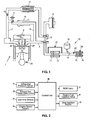
- Fig. 1 is a block diagram of an entire exhaust-gas treatment system of an engine according to an embodiment of the present invention.
- Fig. 2 is a view showing a control system of the exhaust-gas treatment system.
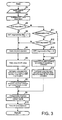
- Fig. 3 is a flowchart showing an example of a control operation of the exhaust-gas treatment system.
- Fig. 4 is a chart showing fuel injections, intake and exhaust valve lifts and piston strokes.
- Fig. 5 is a view showing an example of a urea injection map (A) for normal condition used by the control operation.
- Fig. 6 is a view similarly showing an example of an urea injection map (B) for diesel particulate matter filter (DPF) regeneration.
- B urea injection map
- DPF diesel particulate matter filter
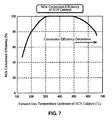
- Fig. 7 is a view showing a relationship of a temperature of the exhaust gas flowing into a SCR catalyst and a NOx conversion efficiency of the SCR catalyst.
- Fig. 8 is a timing chart showing an operation obtained by the control operation.
- Fig. 1 is a block diagram of an entire exhaust-gas treatment system 10 of an engine 1 according to an embodiment.
- the engine 1 is a diesel engine, including an intake passage 2, an exhaust passage 3, an exhaust gas recirculation (EGR) passage 4 for returning a part of the exhaust gas to the intake passage 2, and an EGR valve (which is one example of an EGR means) 5 arranged in the EGR passage 4 for adjusting an opening of the EGR passage 4.
- EGR exhaust gas recirculation
- an oxidation catalyst 11 for carrying out oxidization combustion of unburned fuel in the exhaust gas, a diesel particulate matter filter (DPF) 12 for trapping particulate matters in the exhaust gas, an urea injection nozzle (which is one example of an urea supplying means) 13 for injecting urea aqueous solution supplied from an urea aqueous solution tank 14 into the exhaust passage 3, and a SCR (Selective Catalytic Reduction) catalyst (reduction catalyst) 15 for reducing NOx in the exhaust gas when receiving the supply of the urea aqueous solution from the nozzle 13, and an ammonia oxidation catalyst 16 for preventing emission of a surplus amount of the ammonia generated from the urea aqueous solution injected from the nozzle 13 into the atmosphere (ammonia slip), are arranged in this order.
- DPF diesel particulate matter filter
- the EGR passage 4 connects the exhaust passage 3 upstream of the oxidation catalyst 11 and the intake passage 2.
- a differential-pressure sensor (which is one example of an exhaust particulate matter trapping amount detection means) 21 for detecting a differential pressure between an immediate upstream and an immediate downstream of the DPF 12, an exhaust gas temperature sensor 22 arranged immediate upstream of the SCR catalyst 15 for detecting a temperature of the exhaust gas flowing into the SCR catalyst 15, and an ammonia sensor 23 arranged between the SCR catalyst 15 and the ammonia oxidation catalyst 16 for detecting an ammonia concentration at immediate downstream of the SCR catalyst 15 (immediate upstream of the ammonia oxidation catalyst 16).
- the differential pressure detected by the differential-pressure sensor 21 When the differential pressure detected by the differential-pressure sensor 21 is above a predetermined value, it means that an amount of the exhaust particulate matters trapped by the DPF 12 has reached a predetermined amount, and in a such case, it may be necessary to regenerate the DPF 12 by carrying out combustion and removal of the exhaust particulate matters trapped by the DPF 12.
- a fuel injector 6 which injects fuel into a combustion chamber of the engine 1
- a piston 7 which reciprocates in a cylinder in the well known manner and defines the combustion chamber with the cylinder, an intake valve 25, and an exhaust valve 26.
- VVT variable geometry turbocharger 8 which supercharges air into the combustion chamber.
- the intake passage 2 an air cleaner 9 arranged upstream of a compressor of the turbocharger 8, an intercooler 17 arranged downstream of the compressor of the turbocharger 8, and an intake throttle valve 18 arranged downstream of the intercooler 17 for throttling the charged and cooled air before inducted into the combustion chamber when needed.
- the exhaust-gas treatment system 10 includes an urea SCR system for reducing nitrogen oxide contained in the exhaust gas of the engine 1, and its treatment reaction mechanism is as follows.
- urea in the urea aqueous solution injected from the urea injection nozzle 13 causes a thermally decomposing reaction by heat of the exhaust gas to generate ammonia and isocyanic acid.
- This thermally decomposing reaction starts at approximately 135 degrees C or above, and mainly occurs in a section of the exhaust passage from the urea injection nozzle 13 to the SCR catalyst 16.
- urea in the urea aqueous solution injected from the urea injection nozzle 13 and isocyanic acid generated by the thermally decomposing reaction cause a hydrolysis reaction to generate ammonia and carbon dioxide, respectively.
- This hydrolysis reaction starts at approximately 160 degrees C or above, and mainly occurs in a section of the exhaust passage from the urea injection nozzle 13 to the SCR catalyst 15.
- ammonia generated from urea causes a denitrating reaction with NO and NO 2 , and returns these nitrogen oxides to nitrogen and water.
- This reducing reaction starts at approximately 200 degrees C or above, and mainly occurs inside the SCR catalyst 15. 4NO + 2NO 2 + 4NH 3 ⁇ 5N 2 + 6H 2 O + O 2 ... (4)
- ammonia generated from urea causes a denitrating reaction with NO 2 under existence of oxygen to reduce this nitrogen oxide to nitrogen (its by-product is water).
- This reducing reaction starts at approximately 200 degrees C or above, and mainly occurs inside the SCR catalyst 15. 2NO 2 + O 2 + 4NH 3 ⁇ 3N 2 + 6H 2 O ... (5)
- Equation (6) a ratio of a concentration of NO in the exhaust gas and a concentration of NO 2 is efficient at a ratio of 1:1 with the highest reaction velocity.
- a control unit 30 of the exhaust-gas treatment system 10 is inputted with a signal from the differential-pressure sensor 21, a signal from the exhaust gas temperature sensor 22, a signal from the ammonia sensor 23, and a signal from an engine speed sensor 24 for detecting an engine speed of the engine 1.
- the control unit 30 outputs control signals to the EGR valve 5, fuel-injection valves 6 of the engine 1, and the urea injection nozzle 13 according to the inputted results.
- Fig. 3 is a flowchart showing an example of a particular control operation performed by the control unit 30 of the exhaust-gas treatment system 10.
- Step S1 the control unit 30 reads the various input signals, and then at Step S2, it estimates an amount of deposition of the exhaust particulate matters (soot) trapped by the DPF 12 based on the signal from the differential-pressure sensor 21.
- the control unit 30 determines whether the amount of soot deposition is greater than a predetermined amount ⁇ .
- the predetermined amount ⁇ is such an amount when clogging of the DPF 12 becomes remarkable, and an increase in resistance of the exhaust gas passing through the DPF 12 becomes excessive and thereby causing a great influence on power reduction of the engine 1.
- the control unit 30 sets a DPF regeneration flag to "1" at Step S4, and then at Step S5, the control unit 30 outputs control signals to the fuel-injection valves (which is one example of a fuel supplying means) 6 to perform post-injection.
- the post-injection is performed with a predetermined amount of fuel after an explosive combustion not to influence on the output of the engine 1.
- post-injected unburned fuel is discharged into the exhaust passage 3 from the engine 1 during an exhaust stroke, and then is combusted by the oxidation catalyst 11.
- the exhaust gas at a high temperature then flows into the DPF 12, and the exhaust particulate matters trapped by the DPF 12 are then combusted and removed.
- this is one example of a filter regenerating means.
- the post-injection is executed just before a bottom dead center (BDC) of an expansion stroke around a beginning of lift of the exhaust valve 26.
- BDC bottom dead center
- Step S6 during the regeneration of the DPF 12 (i.e., when carrying out the combustion and removal of the exhaust particulate matters), the control unit 30 outputs a control signal to the EGR valve 5 to fully close the EGR valve 5.
- Step S7 during the regeneration of the DPF 12 (i.e., when carrying out the combustion and removal of the exhaust particulate matters), the control unit 30 outputs a control signal to the urea injection nozzle 13 to increase the injection amount of urea aqueous solution compared with at the time of non-regeneration of the DPF 12 (when not carrying out the combustion and removal of the exhaust particulate matters).
- an urea injection map (A) for normal condition (for non-DPF regeneration) as illustrated in Fig. 5 and an urea injection map (B) for DPF regeneration as illustrated in Fig. 6 are stored.
- basic urea injection amounts are set corresponding to an engine speed and a fuel-injection amount (engine load), respectively.
- the basic urea injection amounts are in ascending order of a, b, c, and d (a ⁇ b ⁇ c ⁇ d), and ranges for the basic urea injection amounts a, b, c, and d are set in this order as the engine speed and/or the fuel-injection amount increases, as shown in Fig. 5 .
- the fuel-injection amount is an amount of fuel injected before an explosive combustion to contribute to the output of the engine 1, without including the post-injection to cause combustion by the oxidation catalyst 11.
- the urea injection map (B) for DPF regeneration is substantially the same in division of the ranges of the basic urea injection amounts as the urea injection map (A) for normal condition, the basic urea injection amounts a, b, c, and d are multiplied by coefficients K1, K2, K3, and K4, respectively.
- the coefficients K1, K2, K3, and K4 are all greater than 1. Therefore, the urea injection map (B) for DPF regeneration is set with increased values of the basic urea injection amounts comparing with the urea injection map (A) for normal condition.
- the coefficients are in ascending order of K1 ⁇ K2 ⁇ K3 ⁇ K4. That is, the urea injection amount is increased as the engine speed and/or the fuel-injection amount increases.
- the control unit 30 applies an engine speed detected by the engine speed sensor 24, and a fuel-injection amount (as described above, a fuel-injection amount injected before explosive combustion to contribute to the output of the engine 1 excluding the post-injection) to the urea injection map (B) for DPF regeneration illustrated in Fig. 6 , to set the basic urea injection amounts (axK1, bxK2, cxK3, or dxK4).
- the basic urea injection amounts with increased values will be set for DPF regeneration compared with that for non-DPF regeneration
- this is one example of an urea-supply-amount increasing means.
- Step S8 the basic urea injection amounts set at Step S7 are compensated based on the signal from the exhaust gas temperature sensor 22.
- a NOx conversion efficiency of the SCR catalyst 15 (an activation level of a catalyst component, such as platinum (Pt) contained in the SCR catalyst 15) changes according to a temperature of the exhaust gas flowing into the SCR catalyst 15 (i.e., a temperature of the SCR catalyst 15), and the NOx conversion efficiency of the SCR catalyst 15 is approximately 100% at approximately 300-500 degrees C.
- the NOx conversion efficiency of the SCR catalyst 15 decreases from 100% as the temperature decreases from 300 degrees C and the temperature increases from 500 degrees C.
- the temperature of the exhaust gas flowing into the SCR catalyst 15 is within a range of 300-500 degrees C.
- the temperature of the exhaust gas flowing into the SCR catalyst 15 is above 500 degrees.
- the basic urea injection amounts are set so that the NOx conversion efficiency of the SCR catalyst 15 is 100%. Therefore, at Step S8, the control unit 30 increasingly compensates the basic urea injection amounts set at Step S7, based on the temperature of the exhaust gas flowing into the SCR catalyst 15. As a result, for DPF regeneration, the urea injection amounts with further increasingly-compensated values compared with that for non-DPF regeneration is set. Thus, this is one example of an urea-supply-amount increasing means.
- Step S9 the control unit 30 compensates the urea injection amount set at Step S8, based on the signal from the ammonia sensor 23.
- ammonia will be discharged from the SCR catalyst 15 especially when the injection amount of urea aqueous solution is excess to make ammonia being surplus, and then, ammonia will be detected by the ammonia sensor 23.
- the control unit 30 increasingly compensates the urea injection amount set at Step S8, based on the ammonia concentration immediate downstream of the SCR catalyst 15 detected by the ammonia sensor 23 (e.g., amount-decreasing compensation)
- the compensation is not necessary when the ammonia concentration is detected as zero by the ammonia sensor 23.
- it can be avoided that excessive amount of ammonia is discharged from the SCR catalyst 15 due to the excessive amount of the urea injection by the urea injection nozzle 13.
- ammonia slip Even if excessive ammonia is discharged from the SCR catalyst 15, because the excessive ammonia is decomposed into nitrogen and water by the ammonia oxidation catalyst 16 as described above, the ammonia slip can be controlled.
- Step S10 the control unit 30 outputs a control signal to the urea injection nozzle 13 so that urea aqueous solution is injected into the exhaust passage 3 by the urea injection amount set at Step S9, and the control unit 30 then returns to Step S1.
- the control unit 30 determines whether the DPF regeneration flag is set to "1" at Step S11. If the flag is set to "1" (under regeneration of the DPF 12), the control unit 30 then determines whether the amount of soot deposition is less than the predetermined amount ⁇ at Step S12.
- the predetermined amount ⁇ is an amount when the clogging of the DPF 12 is almost dissolved, the increase in resistance of the exhaust gas passing through the DPF 12 is almost disappeared, and the power reduction of the engine 1 is hardly affected (for example, approximately "zero").
- the control unit 30 outputs a control signal to the EGR valve 5 at Step S14 without performing the post-injection to control an opening of EGR valve 5 according to an operating condition (EGR control for normal condition).
- Step S12 when the amount of soot deposition is not less than the predetermined amount ⁇ , the control unit 30 proceeds to Step S5, and then continues the regeneration of the DPF 12.
- Step S11 When the DPF regeneration flag is not set to "1" at Step S11 (under non-regeneration of the DPF 12), the control unit 30 skips Steps S12 and S13, and it then proceeds to Step S14.
- the control unit 30 applies the engine speed detected by the engine speed sensor 24, and the fuel-injection amount (as described above, the fuel-injection amount injected before explosive combustion to contribute to the output of the engine 1 excluding the post-injection) to the urea injection map (A) for normal condition illustrated in Fig. 5 .
- the basic urea injection amount (any one of a, b, c, and d) is set.
- Step S9 the control unit 30 compensates the basic urea injection amounts set at Step S15, based on the signal from the ammonia sensor 23 for the same reason as the above.
- Step S10 the control unit 30 outputs a control signal to the urea injection nozzle 13 so that urea aqueous solution is injected into the exhaust passage 3 by the urea injection amount set at Step S9, and the control unit 30 then returns to Step S1.
- Step S13 the control unit 30 performs the EGR control for normal condition (Step S14). Therefore, the amount of NOx emission immediately after discharge from the engine 1 to the exhaust passage 3 is at a relatively low level as illustrated by a solid line (1).
- the post-injection is not performed.
- the temperature of the exhaust gas flowing into the SCR catalyst 15 would not excessively increase (in the example of Fig. 7 , above 500 degrees C). Therefore, the NOx conversion efficiency of the SCR catalyst 15 does not decrease, but is maintained at approximately 100%.
- the urea injection amount is set according to the urea injection map (A) illustrated in Fig. 5 .
- the amount of NOx emission immediately after passing through the SCR catalyst 15 can be reduced down to a very low level.
- Step S4 unburned fuel is post-injected to make it combusted by the oxidation catalyst 11 (Step S5). Then, in order to prevent the unburned fuel from escaping into the intake passage 2, the EGR valve 5 is fully closed and thereby EGR is stopped (Step S6). Therefore, the amount of NOx emission immediately after discharge from the engine 1 to the exhaust passage 3 is at a relatively high level as illustrated by a dotted line (3).
- the NOx conversion efficiency of the SCR catalyst 15 does not decrease but is maintained at approximately 100%. Therefore, even if the urea injection amount is set according to the urea injection map (A) for normal condition illustrated in Fig. 5 , the amount of NOx emission immediately after passing through the SCR catalyst 15 can be reduced to a low level to some extent, as illustrated by a dotted line (4).
- the urea injection amount is increased using the coefficients K1, K2, K3, and K4 compared with the normal condition (Step S7).
- the chain line (5) the amount of NOx emission immediately after passing the SCR catalyst 15 which could not be reduced to the much lower level is decreased to a very low level as illustrated by the two-dot chain line (2).
- the urea injection amount is amount-increasingly compensated based on the temperature of the exhaust gas flowing into the SCR catalyst 15 (Step S8), a decreased amount of the NOx conversion efficiency of the SCR catalyst 15 can be appropriately compensated.
- the DPF 12 for trapping the particulate matters in the exhaust gas, and the SCR catalyst 15 for reducing NOx in the exhaust gas while being supplied with urea are arranged in the exhaust passage 3 of the engine 1 in this order from upstream side.
- the supply amount of urea is increased (Step S7) compared with that without combustion and removal (Step S13).
- the concentration of ammonia as a reductant increases.
- the decrease in the reaction velocity of ammonia and NOx is controlled (the decrease in the activation level of the catalyst component contained in the SCR catalyst 15 is compensated), and thereby the NOx emission into the atmosphere can be avoided.
- Step S6 the amount of NOx emission from the engine 1 increases due to the stopping of EGR (Step S6) as illustrated by a dotted line (3) of Fig. 8 .
- Step S7 because the supply amount of urea is increased (Step S7), even if the amount of NOx emission from the engine 1 increases when carrying out the combustion and removal of the exhaust particulate matters, the concentration of ammonia as a reductant will increase, and the reduction of NOx by ammonia will fully be performed. As a result, the emission of NOx into the atmosphere can be avoided.
- NOx may not be treated for two reasons.
- One reason is that the NOx conversion efficiency of the SCR catalyst 15 decreases due to the increase in temperature of the exhaust gas (See Fig. 7 ).
- the other reason is that the amount of NOx emission from the engine 1 increases due to the stop of EGR (Step S6 of Fig. 3 ). Even in these cases, the emission of NOx into the atmosphere can be avoided.
- the urea amount of supply from the urea injection nozzle 13 is set according to the engine speed and/or the engine load (fuel-injection amount). Therefore, it can appropriately handle the increasing and decreasing of the amount of NOx emission from the engine 1 according to the engine speed and/or the engine load. As a result, the reaction of ammonia and NOx can always be appropriately carried out even if either one is in excess or much less than the other, regardless of whether or not the regeneration of the DPF 12 is performed.
- the amount of urea supply during the regeneration of the DPF 12 is increased according to the temperature of the exhaust gas flowing into the SCR catalyst 15 (Step S8). Therefore, the decreasing level of the NOx conversion efficiency of the SCR catalyst 15 (activation level of the catalyst component contained in the SCR catalyst 15) can be appropriately handled. As a result, the reaction of ammonia and NOx can be appropriately carried out without either one being excessive or much less than the other during the regeneration of the DPF 12.
- the regeneration of the DPF 12 is achieved by the oxidation catalyst 11 and the post-injection from the engine 1.
- the DPF 12 may be directly increased in temperature using a heater, for example.
- EGR is not necessary to be stopped even during the regeneration of the DPF 12
- the amount of NOx emission from the engine 1 will not increase, and will thus be unlike those illustrated by the dotted line (3) of Fig. 8 .
- the NOx conversion efficiency of the SCR catalyst 15 may decrease due to the temperature increase in the exhaust gas to make the treatment of NOx impossible, the supply amount of urea should be increased during the regeneration of the DPF 12 compared with that of non-regeneration of the DPF 12.
- the increase in the urea injection amount is carried out by multiplying the coefficients K1, K2, K3, and K4 (refer to Fig. 6 ).
- the amount may be increased by other arithmetic methods.
- the division of the ranges of the urea injection amount is the same between the urea injection map (A) for normal condition in Fig. 5 and the urea injection map (B) for DPF regeneration in Fig. 6 .
- the division of the ranges may be changed.
- the increase in the urea injection amount is performed using the urea injection map (B) for DPF regeneration of Fig. 6 .
- a sensor for detecting the NOx concentration in the exhaust gas may be provided to the exhaust passage 3, and the control unit 30 may calculate the increased amount of the urea injection according to the detection result of the sensor, for example.
Landscapes
- Engineering & Computer Science (AREA)
- Chemical & Material Sciences (AREA)
- Combustion & Propulsion (AREA)
- Mechanical Engineering (AREA)
- General Engineering & Computer Science (AREA)
- Chemical Kinetics & Catalysis (AREA)
- Health & Medical Sciences (AREA)
- Toxicology (AREA)
- Processes For Solid Components From Exhaust (AREA)
- Exhaust Gas After Treatment (AREA)
- Combined Controls Of Internal Combustion Engines (AREA)
- Filtering Of Dispersed Particles In Gases (AREA)
- Exhaust Gas Treatment By Means Of Catalyst (AREA)
- Exhaust-Gas Circulating Devices (AREA)
Abstract
Description
- The present description relates to an exhaust-gas treatment system and a method for operating an exhaust-gas treatment system for an internal combustion engine. More particularly, the description relates to an exhaust-gas treatment system and a method for operating an exhaust-gas treatment system to decrease nitrogen oxide (NOx) contained in the emissions from an internal combustion engine.
- Using an urea-SCR (Selective Catalytic Reduction) system is known as a technology for reducing NOx contained in the emissions from an internal combustion engine. This technology provides a selective reduction catalyst in an exhaust passage from an engine for reducing NOx, and provides an urea aqueous solution injection nozzle upstream of the selective reduction catalyst for injecting urea aqueous solution (herein referred to as reductant) in the exhaust passage. The urea aqueous solution injected from the nozzle is thermally decomposed or hydrolyzed into ammonia by heat from exhaust gas, then, the ammonia is adsorbed into the selective reduction catalyst and reduces NOx to give nitrogen (N2) and water (H2O) by a denitrating reaction with NOx in exhaust gas.
- Some systems have a particulate filter in an exhaust passage to decrease a particulate matter such as soot contained in the emission. This particulate filter can trap particulate matter in the emission. In this regard, it is known by Japanese Unexamined Patent Application Publication No.
2003-232218 US 6,805,849 B1 , for example that a selective reduction catalyst may be arranged downstream of an oxidation catalyst and a particulate filter to avoid poisoning a selective reduction catalyst with sulfur oxides and/or emitted particulate matter. - However, the inventors herein have discovered the following issue that can occur in a system wherein a selective reduction catalyst reducing NOx in the emission by receiving reductant, such as urea, is arranged downstream of particulate filter along an exhaust passage.
- In the case that a particulate filter is provided in an exhaust passage, and when it is determined that an amount of particulate matter trapped in a particulate filter is larger than a predetermined amount, combusting and removing a particulate matter from a particulate trap, which is referred to as filter regeneration, is executed by combusting unburned fuel or using a heater to heat the particulate, for example. However, when particulate matter is combusted and removed from a particulate filter during the regenerating period, a higher temperature exhaust gas flows into a selective reduction catalyst compared to a lower temperature exhaust gas flow into a selective reduction catalyst during a non-regeneration period. As a result, the ability of the catalytic component contained in a selective reduction catalyst may be decreased, resulting in decreased NOx conversion efficiency of a selective reduction catalyst, and unreduced NOx may be emitted into an atmosphere.
Accordingly, it is a problem to reduce NOx emissions of an internal combustion engine which is equipped with a particulate filter.
This problem is solved by a method and system having the features of the independent claims. Preferred embodiments are subject of the dependent claims. - This description addresses this issue. In particular, the description can address an issue that may occur when a selective reduction catalyst in the exhaust, receiving reductant, is arranged downstream of a particulate filter along an exhaust passage. The techniques described herein can potentially avoid NOx emitting into the atmosphere even when NOx conversion efficiency of a selective reduction catalyst is decreased during combustion and removal of particulate matter trapped in a particulate filter.
- A first aspect of the present description includes a method of controlling a system having an internal combustion engine, a filter arranged in an exhaust passage and capable of trapping particulate matter contained in the exhaust gas from said internal combustion engine, a reduction catalyst arranged in said exhaust passage downstream of said filter and capable of reducing nitrate oxide contained in the exhaust gas with reductant supplied thereto, the method comprising: in a first mode, combusting a first amount of particulate matter trapped in said filter and supplying a first amount of reductant to said reduction catalyst when an amount of particulate matter trapped in said filter is less than a predetermined trapping amount; and in a second mode, combusting a second amount of particulate matter trapped in said filter that is greater than said first amount of particulate matter and supplying a second amount of reductant that is greater than said first amount to said reduction catalyst when an amount of particulate matter trapped in said filter is equal to or greater than said predetermined trapping amount..
- This method overcomes at least some of the disadvantages of the above mentioned reference.
- When a particulate matter trapped in a particulate filter is combusted and removed from a particulate filter, an amount of reductant supplied to said reduction catalyst can be increased in comparison to an amount of reductant supplied to a reduction catalyst when the particulate matter is not combusted and removed. Accordingly, even though NOx conversion efficiency (e.g., activation level of catalytic component contained in a reduction catalyst), is decreased during particulate matter combustion and removal, supplying an increased amount of reductant can restrain the decrease of the reduction reaction rate, thereby compensating for the decreased activation level of the catalytic component contained in a reduction catalyst, which results in avoidance of NOx release into atmosphere.
- In an example embodiment, in said first mode, said first amount of particulate matter is combusted by supplying the exhaust gas of a first temperature to said filter, and in said second mode, said second amount of particulate matter is combusted by supplying the exhaust gas of a second temperature that is higher than said first temperature to said filter.
- In one example, an internal combustion engine has a fuel injector which injects fuel directly into a combustion chamber, and wherein an end of fuel injection during a cylinder cycle in said second mode is retarded from that in said first mode.
- In one example, this method further comprises, in the first mode, recirculating a first amount of exhaust gas from said exhaust passage upstream of said filter to an intake passage of said internal combustion engine and recirculating a second amount of exhaust gas that is less than said first amount from said exhaust passage upstream of said filter to an intake passage.
- This may avoid the introduction of unburned fuel, which should have been burned off by the oxidation catalyst during burn off of the particulate matter in the particulate filter, into an air intake passage via an exhaust gas recirculation conduit. Accordingly, regeneration of the particulate filter can be better achieved by combustion of the unburned fuel.
- However, when exhaust gas recirculation (EGR) is stopped, the amount of NOx emission is increased. To prevent this increased NOx emission to an atmosphere, an amount of supplied reductant can be increased when an amount of NOx emission is increased. Accordingly, the NOx reduction reaction with reductant can become sufficient, which results in avoidance of NOx emission into an atmosphere.
- That is, during filter regeneration, even if there is a possibility that some NOx emission cannot be purified for two reasons, namely, decrease of NOx conversion efficiency of a reduction catalyst and increase of an amount of NOx emission from internal combustion engine, this example method can avoid NOx emission into an atmosphere.
- In another example embodiment, said internal combustion engine has a fuel injector which injects fuel directly into a combustion chamber, and the method further comprises: in said first mode, supplying fuel from said fuel injector to said combustion chamber so that an end of the fuel injection during a cylinder cycle is a first timing during a cylinder cycle and recirculating a first amount of exhaust gas from said exhaust passage upstream of said filter to an intake passage of said internal combustion engine; and in said second mode, supplying fuel from said fuel injector to said combustion chamber so that an end of the fuel injection during a cylinder cycle is a second timing that is later than said first timing during a cylinder cycle and recirculating a second amount of exhaust gas that is less than said first amount of exhaust gas from said exhaust passage upstream of said filter to said intake passage.
- In another example embodiment, this method further comprises increasing an amount of reductant supplied to a reduction catalyst as a desired torque of an internal combustion engine increases and increasing an amount of reductant supplied to a reduction catalyst as a speed of said internal combustion engine increases.
- Since an amount of reductant supplied to a reduction catalyst is set according to a desired torque or a speed of said internal combustion engine such that an amount of reductant supplied to a reduction catalyst can correspond with an amount of NOx emission from an internal combustion engine that is changed depending on a desired torque or a speed of said internal combustion engine, this can promote a reaction between a reductant and NOx such that an amount of one of them is not much larger than the other, regardless of whether filter regeneration is carried out or not.
- In another example embodiment, this method further comprises increasing an amount of reductant supplied to a reduction catalyst as a temperature of exhaust gas in said exhaust passage between a filter and a reduction catalyst increases.
- Since an amount of reductant supplied to a reduction catalyst is increased as a temperature of exhaust gas in said exhaust passage between a filter and a reduction catalyst increases, an amount of reductant can be made to correspond with the degree of decrease in NOx conversion efficiency or degree of decrease in activation level of catalytic component contained in a reduction catalyst, which can promote a reaction between a reductant and NOx such that an amount of one of them is not much larger than the other, regardless of whether filter regeneration is carried out or not.
- A second aspect of the present description includes a method of controlling a system having an internal combustion engine, a filter arranged in an exhaust passage and capable of trapping particulate matter contained in the exhaust gas from said internal combustion engine, a reduction catalyst arranged in said exhaust passage downstream of said filter and capable of reducing nitrate oxide contained in the exhaust gas with reductant supplied thereto, the method comprising: in a first mode, recirculating a first amount of exhaust gas from said exhaust passage upstream of said filter to an intake passage of said internal combustion engine and supplying a first amount of reductant to said reduction catalyst; and in a second mode, recirculating a second amount of exhaust gas that is less than said first amount of exhaust gas from said exhaust passage upstream of said filter to said intake passage and supplying a second amount of reductant that is greater than said first amount to said reduction catalyst in a second mode.
- This method also overcomes at least some of the disadvantages of the above references.
- For example, when the first mode is operated when particulate matter trapped in a particulate filter is combusted and removed (e.g., during filter regeneration), this method can avoid introducing unburned fuel to an oxidation catalyst to combust and remove a particulate matter, by rerouting the unburned fuel into an intake air passage via an EGR conduit. Accordingly, this can promote the performance of regeneration of particulate filter with combustion of unburned fuel.
- However, when EGR is stopped, an amount of NOx emission is increased. To prevent this increased NOx emission to an atmosphere, an amount of supplied reductant can be increased when an amount of NOx emission is increased. Accordingly, the NOx reduction reaction with reductant can become sufficient, which results in avoidance of NOx emission into an atmosphere.
- That is, during filter regeneration, even if there is a possibility that some NOx emission cannot be purified for two reasons, namely, decrease of NOx conversion efficiency of a reduction catalyst and increase of an amount of NOx emission from internal combustion engine, this example method can avoid NOx emission into an atmosphere.
- A third aspect of the present description includes a system comprising: an internal combustion engine; a filter arranged in an exhaust passage and capable of trapping particulate matter contained in the exhaust gas from said internal combustion engine; a reduction catalyst arranged in said exhaust passage downstream of said filter and capable of reducing nitrate oxide contained in the exhaust gas with reductant supplied thereto; a reductant supplier which supplies reductant to said exhaust passage upstream said reduction catalyst; and a controller configured to control: in a first mode, said filter to combust a first amount of particulate matter trapped therein and said reductant supplier to supply a first amount of reductant when an amount of particulate matter trapped in said filter is less than a predetermined trapping amount; and in a second mode, said filter to combust a second amount of particulate matter trapped therein that is greater than said first amount of particulate matter and said reductant supplier to supply a second amount of reductant that is greater than said first amount of reductant when an amount of particulate matter trapped in said filter is greater than said predetermined trapping amount.
- This system overcomes at least some of the disadvantages of the above mentioned reference in a same manner as first aspect described above. A fourth aspect of the present description includes system comprising:
- an internal combustion engine; a filter arranged in an exhaust passage and capable of trapping particulate matter contained in the exhaust gas from said internal combustion engine; a reduction catalyst arranged in said exhaust passage downstream of said filter and capable of reducing nitrate oxide contained in the exhaust gas with reductant supplied thereto; a reductant supplier which supplies reductant to said exhaust passage upstream said reduction catalyst; an EGR valve capable of recirculating exhaust gas from said exhaust passage to an intake passage of said internal combustion engine; and a controller configured to control:
- in a first mode, said EGR valve to recirculate a first amount of exhaust gas from said exhaust passage upstream of said filter to said intake passage and said reductant supplier to supply a first amount of reductant to said reduction catalyst; and
- in a second mode, said EGR valve to recirculate a second amount of exhaust gas that is less than said first amount of exhaust gas from said exhaust passage upstream of said filter to said intake passage and said reductant supplier to supply a second amount of reductant that is greater than said first amount to said reduction catalyst.
- In one example, said reductant supplier further comprises a tank accommodating urea solution to be supplied to said exhaust passage upstream said reduction catalyst.
Further, the invention provides a computer program product comprising computer-implemented instructions which, when loaded and executed on a suitable system, can perform the steps of a method, as described above, wherein the computer program product is particularly embodied a computer-readable storage medium, as a signal and/or as a data stream. - The above advantages and other advantages, and features of the present description will be readily apparent from the following Detailed Description when taken alone or in connection with the accompanying drawings.
Although several embodiments are described separately, single features thereof may be combined with single features of another embodiment so as to receive further embodiments. -
Fig. 1 is a block diagram of an entire exhaust-gas treatment system of an engine according to an embodiment of the present invention. -
Fig. 2 is a view showing a control system of the exhaust-gas treatment system. -
Fig. 3 is a flowchart showing an example of a control operation of the exhaust-gas treatment system. -
Fig. 4 is a chart showing fuel injections, intake and exhaust valve lifts and piston strokes. -
Fig. 5 is a view showing an example of a urea injection map (A) for normal condition used by the control operation. -
Fig. 6 is a view similarly showing an example of an urea injection map (B) for diesel particulate matter filter (DPF) regeneration. -
Fig. 7 is a view showing a relationship of a temperature of the exhaust gas flowing into a SCR catalyst and a NOx conversion efficiency of the SCR catalyst. -
Fig. 8 is a timing chart showing an operation obtained by the control operation. -
Fig. 1 is a block diagram of an entire exhaust-gas treatment system 10 of anengine 1 according to an embodiment. In this embodiment, theengine 1 is a diesel engine, including anintake passage 2, anexhaust passage 3, an exhaust gas recirculation (EGR)passage 4 for returning a part of the exhaust gas to theintake passage 2, and an EGR valve (which is one example of an EGR means) 5 arranged in theEGR passage 4 for adjusting an opening of theEGR passage 4. - In the
exhaust passage 3, from upstream side, anoxidation catalyst 11 for carrying out oxidization combustion of unburned fuel in the exhaust gas, a diesel particulate matter filter (DPF) 12 for trapping particulate matters in the exhaust gas, an urea injection nozzle (which is one example of an urea supplying means) 13 for injecting urea aqueous solution supplied from an ureaaqueous solution tank 14 into theexhaust passage 3, and a SCR (Selective Catalytic Reduction) catalyst (reduction catalyst) 15 for reducing NOx in the exhaust gas when receiving the supply of the urea aqueous solution from thenozzle 13, and anammonia oxidation catalyst 16 for preventing emission of a surplus amount of the ammonia generated from the urea aqueous solution injected from thenozzle 13 into the atmosphere (ammonia slip), are arranged in this order. - The
EGR passage 4 connects theexhaust passage 3 upstream of theoxidation catalyst 11 and theintake passage 2. - Further in the
exhaust passage 3, a differential-pressure sensor (which is one example of an exhaust particulate matter trapping amount detection means) 21 for detecting a differential pressure between an immediate upstream and an immediate downstream of theDPF 12, an exhaustgas temperature sensor 22 arranged immediate upstream of theSCR catalyst 15 for detecting a temperature of the exhaust gas flowing into theSCR catalyst 15, and anammonia sensor 23 arranged between theSCR catalyst 15 and theammonia oxidation catalyst 16 for detecting an ammonia concentration at immediate downstream of the SCR catalyst 15 (immediate upstream of the ammonia oxidation catalyst 16). - When the differential pressure detected by the differential-
pressure sensor 21 is above a predetermined value, it means that an amount of the exhaust particulate matters trapped by theDPF 12 has reached a predetermined amount, and in a such case, it may be necessary to regenerate theDPF 12 by carrying out combustion and removal of the exhaust particulate matters trapped by theDPF 12. - In addition to those described above, there are shown in
Fig. 1 afuel injector 6 which injects fuel into a combustion chamber of theengine 1, apiston 7 which reciprocates in a cylinder in the well known manner and defines the combustion chamber with the cylinder, anintake valve 25, and anexhaust valve 26. There is also shown a variable geometry (VGT)turbocharger 8 which supercharges air into the combustion chamber. Further, there are shown in theintake passage 2 anair cleaner 9 arranged upstream of a compressor of theturbocharger 8, anintercooler 17 arranged downstream of the compressor of theturbocharger 8, and anintake throttle valve 18 arranged downstream of theintercooler 17 for throttling the charged and cooled air before inducted into the combustion chamber when needed. - Specifically, the exhaust-
gas treatment system 10 according to this embodiment includes an urea SCR system for reducing nitrogen oxide contained in the exhaust gas of theengine 1, and its treatment reaction mechanism is as follows. - First, as shown in the following Equation (1), urea in the urea aqueous solution injected from the
urea injection nozzle 13 causes a thermally decomposing reaction by heat of the exhaust gas to generate ammonia and isocyanic acid. This thermally decomposing reaction starts at approximately 135 degrees C or above, and mainly occurs in a section of the exhaust passage from theurea injection nozzle 13 to theSCR catalyst 16.
CO(NH2)2 → NH3 + HNCO ... (1)
- As shown in the following Equations (2) and (3), urea in the urea aqueous solution injected from the
urea injection nozzle 13 and isocyanic acid generated by the thermally decomposing reaction cause a hydrolysis reaction to generate ammonia and carbon dioxide, respectively. This hydrolysis reaction starts at approximately 160 degrees C or above, and mainly occurs in a section of the exhaust passage from theurea injection nozzle 13 to theSCR catalyst 15.
CO(NH2)2 + H2O → 2NH3 + CO2 ... (2)
HNCO + H2O → NH3 + CO2 ... (3)
- Then, as shown in the following Equation (4), ammonia generated from urea causes a denitrating reaction with NO and NO2, and returns these nitrogen oxides to nitrogen and water. This reducing reaction starts at approximately 200 degrees C or above, and mainly occurs inside the
SCR catalyst 15.
4NO + 2NO2 + 4NH3 → 5N2 + 6H2O + O2 ... (4)
- As shown in the following Equation (5), ammonia generated from urea causes a denitrating reaction with NO2 under existence of oxygen to reduce this nitrogen oxide to nitrogen (its by-product is water). This reducing reaction starts at approximately 200 degrees C or above, and mainly occurs inside the
SCR catalyst 15.
2NO2 + O2 + 4NH3 → 3N2 + 6H2O ... (5)
- Here, if the Equations (4) and (5) are summarized, it will be as the following Equation (6). That is, a ratio of a concentration of NO in the exhaust gas and a concentration of NO2 is efficient at a ratio of 1:1 with the highest reaction velocity.
NO + NO2 + 2NH3 → 2N2 + 3H2O ... (6)
- As shown in the following Equation (7), surplus ammonia which is not reduced is decomposed into nitrogen and water under existence of oxygen. This oxidation reaction occurs inside the
ammonia oxidation catalyst 16.
4NH3 + 3O2 → 2N2 + 6H2O ... (7)
- As shown in
Fig. 2 , acontrol unit 30 of the exhaust-gas treatment system 10 is inputted with a signal from the differential-pressure sensor 21, a signal from the exhaustgas temperature sensor 22, a signal from theammonia sensor 23, and a signal from anengine speed sensor 24 for detecting an engine speed of theengine 1. Thecontrol unit 30 outputs control signals to theEGR valve 5, fuel-injection valves 6 of theengine 1, and theurea injection nozzle 13 according to the inputted results. -
Fig. 3 is a flowchart showing an example of a particular control operation performed by thecontrol unit 30 of the exhaust-gas treatment system 10. - First, at Step S1, the
control unit 30 reads the various input signals, and then at Step S2, it estimates an amount of deposition of the exhaust particulate matters (soot) trapped by theDPF 12 based on the signal from the differential-pressure sensor 21. - Then, at Step S3, the
control unit 30 determines whether the amount of soot deposition is greater than a predetermined amount α. Here, the predetermined amount α is such an amount when clogging of theDPF 12 becomes remarkable, and an increase in resistance of the exhaust gas passing through theDPF 12 becomes excessive and thereby causing a great influence on power reduction of theengine 1. - As a result, when the amount of soot deposition is greater than the predetermined amount α, the
control unit 30 sets a DPF regeneration flag to "1" at Step S4, and then at Step S5, thecontrol unit 30 outputs control signals to the fuel-injection valves (which is one example of a fuel supplying means) 6 to perform post-injection. - As shown in
Fig. 4 , the post-injection is performed with a predetermined amount of fuel after an explosive combustion not to influence on the output of theengine 1. Thus, post-injected unburned fuel is discharged into theexhaust passage 3 from theengine 1 during an exhaust stroke, and then is combusted by theoxidation catalyst 11. The exhaust gas at a high temperature then flows into theDPF 12, and the exhaust particulate matters trapped by theDPF 12 are then combusted and removed. Thus, this is one example of a filter regenerating means. - As can be seen from
Fig. 4 , the post-injection is executed just before a bottom dead center (BDC) of an expansion stroke around a beginning of lift of theexhaust valve 26. - At Step S6, during the regeneration of the DPF 12 (i.e., when carrying out the combustion and removal of the exhaust particulate matters), the
control unit 30 outputs a control signal to theEGR valve 5 to fully close theEGR valve 5. - Thus, the return of the exhaust gas from the
exhaust passage 3 to theintake passage 2 through theEGR passage 4 is stopped. Thus, this is one example of an EGR stopping means. - Further, at Step S7, during the regeneration of the DPF 12 (i.e., when carrying out the combustion and removal of the exhaust particulate matters), the
control unit 30 outputs a control signal to theurea injection nozzle 13 to increase the injection amount of urea aqueous solution compared with at the time of non-regeneration of the DPF 12 (when not carrying out the combustion and removal of the exhaust particulate matters). - More specifically described, in a memory (not shown) of the
control unit 30, an urea injection map (A) for normal condition (for non-DPF regeneration) as illustrated inFig. 5 , and an urea injection map (B) for DPF regeneration as illustrated inFig. 6 are stored. - In that case, for both of the maps (A) and (B), basic urea injection amounts are set corresponding to an engine speed and a fuel-injection amount (engine load), respectively. The basic urea injection amounts are in ascending order of a, b, c, and d (a<b<c<d), and ranges for the basic urea injection amounts a, b, c, and d are set in this order as the engine speed and/or the fuel-injection amount increases, as shown in
Fig. 5 . - In both of the maps (A) and (B), the fuel-injection amount is an amount of fuel injected before an explosive combustion to contribute to the output of the
engine 1, without including the post-injection to cause combustion by theoxidation catalyst 11. - The urea injection map (B) for DPF regeneration is substantially the same in division of the ranges of the basic urea injection amounts as the urea injection map (A) for normal condition, the basic urea injection amounts a, b, c, and d are multiplied by coefficients K1, K2, K3, and K4, respectively. Here, the coefficients K1, K2, K3, and K4 are all greater than 1. Therefore, the urea injection map (B) for DPF regeneration is set with increased values of the basic urea injection amounts comparing with the urea injection map (A) for normal condition.
- Here, the coefficients are in ascending order of K1<K2<K3<K4. That is, the urea injection amount is increased as the engine speed and/or the fuel-injection amount increases. Of course, the relationship of the coefficients K1, K2, K3, and K4 may have other relationship (for example, K1=K2=K3=K4).
- At Step S7, the
control unit 30 applies an engine speed detected by theengine speed sensor 24, and a fuel-injection amount (as described above, a fuel-injection amount injected before explosive combustion to contribute to the output of theengine 1 excluding the post-injection) to the urea injection map (B) for DPF regeneration illustrated inFig. 6 , to set the basic urea injection amounts (axK1, bxK2, cxK3, or dxK4). As a result, the basic urea injection amounts with increased values will be set for DPF regeneration compared with that for non-DPF regeneration Thus, this is one example of an urea-supply-amount increasing means. - Subsequently, at Step S8, the basic urea injection amounts set at Step S7 are compensated based on the signal from the exhaust
gas temperature sensor 22. - That is, as shown in
Fig. 7 , a NOx conversion efficiency of the SCR catalyst 15 (an activation level of a catalyst component, such as platinum (Pt) contained in the SCR catalyst 15) changes according to a temperature of the exhaust gas flowing into the SCR catalyst 15 (i.e., a temperature of the SCR catalyst 15), and the NOx conversion efficiency of theSCR catalyst 15 is approximately 100% at approximately 300-500 degrees C. The NOx conversion efficiency of theSCR catalyst 15 decreases from 100% as the temperature decreases from 300 degrees C and the temperature increases from 500 degrees C. - At the time of non-DPF regeneration in which the exhaust particulate matters trapped by the
DPF 12 are not combusted and removed, the temperature of the exhaust gas flowing into theSCR catalyst 15 is within a range of 300-500 degrees C. On the other hand, at the time of DPF regeneration in which the exhaust particulate matter trapped by theDPF 12 are combusted and removed, the temperature of the exhaust gas flowing into theSCR catalyst 15 is above 500 degrees. - For the urea injection map (A) for normal condition illustrated in
Fig. 5 and the urea injection map (B) for DPF regeneration illustrated inFig. 6 , the basic urea injection amounts are set so that the NOx conversion efficiency of theSCR catalyst 15 is 100%. Therefore, at Step S8, thecontrol unit 30 increasingly compensates the basic urea injection amounts set at Step S7, based on the temperature of the exhaust gas flowing into theSCR catalyst 15. As a result, for DPF regeneration, the urea injection amounts with further increasingly-compensated values compared with that for non-DPF regeneration is set. Thus, this is one example of an urea-supply-amount increasing means. - Subsequently, at Step S9, the
control unit 30 compensates the urea injection amount set at Step S8, based on the signal from theammonia sensor 23. - That is, in the
SCR catalyst 15, if a reaction of ammonia as a reductant generated from the urea aqueous solution injected into theexhaust passage 3 from theurea injection nozzle 13 with NOx in the exhaust gas are carried out in a good condition without either one is not excessive or much less than the other, ammonia will not be discharged from theSCR catalyst 15. Therefore, ammonia is not detected by theammonia sensor 23 for detecting the ammonia concentration immediate downstream of theSCR catalyst 15. However, if either one is excessive or much less than the other in the reaction between ammonia and NOx in theSCR catalyst 15, ammonia will be discharged from theSCR catalyst 15 especially when the injection amount of urea aqueous solution is excess to make ammonia being surplus, and then, ammonia will be detected by theammonia sensor 23. - Therefore, at Step S9, the
control unit 30 increasingly compensates the urea injection amount set at Step S8, based on the ammonia concentration immediate downstream of theSCR catalyst 15 detected by the ammonia sensor 23 (e.g., amount-decreasing compensation) Here, the compensation is not necessary when the ammonia concentration is detected as zero by theammonia sensor 23. As a result, it can be avoided that excessive amount of ammonia is discharged from theSCR catalyst 15 due to the excessive amount of the urea injection by theurea injection nozzle 13. - Even if excessive ammonia is discharged from the
SCR catalyst 15, because the excessive ammonia is decomposed into nitrogen and water by theammonia oxidation catalyst 16 as described above, the ammonia slip can be controlled. - At Step S10, the
control unit 30 outputs a control signal to theurea injection nozzle 13 so that urea aqueous solution is injected into theexhaust passage 3 by the urea injection amount set at Step S9, and thecontrol unit 30 then returns to Step S1. - On the other hand, when the amount of soot deposition is not greater than the predetermined amount α at Step S3, the
control unit 30 determines whether the DPF regeneration flag is set to "1" at Step S11. If the flag is set to "1" (under regeneration of the DPF 12), thecontrol unit 30 then determines whether the amount of soot deposition is less than the predetermined amount β at Step S12. Here, the predetermined amount β is an amount when the clogging of theDPF 12 is almost dissolved, the increase in resistance of the exhaust gas passing through theDPF 12 is almost disappeared, and the power reduction of theengine 1 is hardly affected (for example, approximately "zero"). - As a result, when the amount of soot deposition is less than the predetermined amount β, the DPF regeneration flag is reset to "0" at Step S13. Then, the
control unit 30 outputs a control signal to theEGR valve 5 at Step S14 without performing the post-injection to control an opening ofEGR valve 5 according to an operating condition (EGR control for normal condition). - At Step S12, when the amount of soot deposition is not less than the predetermined amount β, the
control unit 30 proceeds to Step S5, and then continues the regeneration of theDPF 12. - When the DPF regeneration flag is not set to "1" at Step S11 (under non-regeneration of the DPF 12), the
control unit 30 skips Steps S12 and S13, and it then proceeds to Step S14. - At Step S15, the
control unit 30 applies the engine speed detected by theengine speed sensor 24, and the fuel-injection amount (as described above, the fuel-injection amount injected before explosive combustion to contribute to the output of theengine 1 excluding the post-injection) to the urea injection map (A) for normal condition illustrated inFig. 5 . Thus, the basic urea injection amount (any one of a, b, c, and d) is set. - Subsequently, at Step S9, the
control unit 30 compensates the basic urea injection amounts set at Step S15, based on the signal from theammonia sensor 23 for the same reason as the above. - At Step S10, the
control unit 30 outputs a control signal to theurea injection nozzle 13 so that urea aqueous solution is injected into theexhaust passage 3 by the urea injection amount set at Step S9, and thecontrol unit 30 then returns to Step S1. - The operation obtained by the above control will be explained with reference to a timing chart of
Fig. 8 . - First, in the normal condition where regeneration of the
DPF 12 is not performed (Step S13), thecontrol unit 30 performs the EGR control for normal condition (Step S14). Therefore, the amount of NOx emission immediately after discharge from theengine 1 to theexhaust passage 3 is at a relatively low level as illustrated by a solid line (1). - In addition, in the normal condition where regeneration of the
DPF 12 is not performed, the post-injection is not performed. As a result, the temperature of the exhaust gas flowing into theSCR catalyst 15 would not excessively increase (in the example ofFig. 7 , above 500 degrees C). Therefore, the NOx conversion efficiency of theSCR catalyst 15 does not decrease, but is maintained at approximately 100%. - Thus, as illustrated by a two-dot chain line (2), in the normal condition where regeneration of the
DPF 12 is not performed, the urea injection amount is set according to the urea injection map (A) illustrated inFig. 5 . As a result, the amount of NOx emission immediately after passing through theSCR catalyst 15 can be reduced down to a very low level. - On the other hand, during the DPF regeneration where regeneration of the
DPF 12 is performed (Step S4), unburned fuel is post-injected to make it combusted by the oxidation catalyst 11 (Step S5). Then, in order to prevent the unburned fuel from escaping into theintake passage 2, theEGR valve 5 is fully closed and thereby EGR is stopped (Step S6). Therefore, the amount of NOx emission immediately after discharge from theengine 1 to theexhaust passage 3 is at a relatively high level as illustrated by a dotted line (3). - If the temperature of the exhaust gas flowing into the
SCR catalyst 15 still does not excessively increase (in the example ofFig. 6 , above 500 degrees C), the NOx conversion efficiency of theSCR catalyst 15 does not decrease but is maintained at approximately 100%. Therefore, even if the urea injection amount is set according to the urea injection map (A) for normal condition illustrated inFig. 5 , the amount of NOx emission immediately after passing through theSCR catalyst 15 can be reduced to a low level to some extent, as illustrated by a dotted line (4). - However, in fact, during the DPF regeneration, the post-injection is performed. As a result, the temperature of the exhaust gas flowing into the
SCR catalyst 15 excessively increases (in the example ofFig. 7 , above 500 degrees C). Here, because the NOx conversion efficiency of theSCR catalyst 15 decreases to less than 100%, when the urea injection amount is set according to the urea injection map (A) for normal condition illustrated inFig. 5 , the amount of NOx emission immediately after passing through theSCR catalyst 15 cannot be reduced to a much lower level as illustrated by a chain line (5). - Therefore, in the above-described control, during the DPF regeneration, the urea injection amount is increased using the coefficients K1, K2, K3, and K4 compared with the normal condition (Step S7). Thus, as illustrated by the chain line (5), the amount of NOx emission immediately after passing the
SCR catalyst 15 which could not be reduced to the much lower level is decreased to a very low level as illustrated by the two-dot chain line (2). - Here, because the urea injection amount is amount-increasingly compensated based on the temperature of the exhaust gas flowing into the SCR catalyst 15 (Step S8), a decreased amount of the NOx conversion efficiency of the
SCR catalyst 15 can be appropriately compensated. - Thus, in the exhaust-
gas treatment system 10 of theengine 1 according to this embodiment, theDPF 12 for trapping the particulate matters in the exhaust gas, and theSCR catalyst 15 for reducing NOx in the exhaust gas while being supplied with urea, are arranged in theexhaust passage 3 of theengine 1 in this order from upstream side. In addition, at the time of combustion and removal of the exhaust particulate matters trapped by the DPF 12 (Step S4), the supply amount of urea is increased (Step S7) compared with that without combustion and removal (Step S13). Therefore, even if the NOx conversion efficiency of the SCR catalyst 15 (activation level of the catalyst component contained in the SCR catalyst 15) decreases to that at the time of combustion and removal of the exhaust particulate matters, the concentration of ammonia as a reductant increases. As a result, the decrease in the reaction velocity of ammonia and NOx is controlled (the decrease in the activation level of the catalyst component contained in theSCR catalyst 15 is compensated), and thereby the NOx emission into the atmosphere can be avoided. - On the other hand, at the time of combustion and removal of the exhaust particulate matters trapped by the DPF 12 (Step S4), the
EGR valve 5 is fully closed (Step S6). Therefore, the unburned fuel to be combusted by theoxidation catalyst 11 for the combustion and removal of the exhaust particulate matters is avoided from escaping into theintake passage 2 through theEGR passage 4, and thereby the regeneration of theDPF 12 by combustion of the unburned fuel can be ensured. - However, at the same time, the amount of NOx emission from the
engine 1 increases due to the stopping of EGR (Step S6) as illustrated by a dotted line (3) ofFig. 8 . Here, because the supply amount of urea is increased (Step S7), even if the amount of NOx emission from theengine 1 increases when carrying out the combustion and removal of the exhaust particulate matters, the concentration of ammonia as a reductant will increase, and the reduction of NOx by ammonia will fully be performed. As a result, the emission of NOx into the atmosphere can be avoided. - In other words, in this embodiment, during the regeneration of the
DPF 12, NOx may not be treated for two reasons. One reason is that the NOx conversion efficiency of theSCR catalyst 15 decreases due to the increase in temperature of the exhaust gas (SeeFig. 7 ). The other reason is that the amount of NOx emission from theengine 1 increases due to the stop of EGR (Step S6 ofFig. 3 ). Even in these cases, the emission of NOx into the atmosphere can be avoided. - As illustrated in
Figs. 5 and6 , the urea amount of supply from theurea injection nozzle 13 is set according to the engine speed and/or the engine load (fuel-injection amount). Therefore, it can appropriately handle the increasing and decreasing of the amount of NOx emission from theengine 1 according to the engine speed and/or the engine load. As a result, the reaction of ammonia and NOx can always be appropriately carried out even if either one is in excess or much less than the other, regardless of whether or not the regeneration of theDPF 12 is performed. - Further, the amount of urea supply during the regeneration of the
DPF 12 is increased according to the temperature of the exhaust gas flowing into the SCR catalyst 15 (Step S8). Therefore, the decreasing level of the NOx conversion efficiency of the SCR catalyst 15 (activation level of the catalyst component contained in the SCR catalyst 15) can be appropriately handled. As a result, the reaction of ammonia and NOx can be appropriately carried out without either one being excessive or much less than the other during the regeneration of theDPF 12. - The above-described embodiment can, at present, be regarded as a preferred mode of the present invention. However, the embodiment may be modified or changed without departing from the claims.
- For example, in the above-described embodiment, the regeneration of the
DPF 12 is achieved by theoxidation catalyst 11 and the post-injection from theengine 1. However, it may not be limited to this, but theDPF 12 may be directly increased in temperature using a heater, for example. In this case, because EGR is not necessary to be stopped even during the regeneration of theDPF 12, the amount of NOx emission from theengine 1 will not increase, and will thus be unlike those illustrated by the dotted line (3) ofFig. 8 . However, because the NOx conversion efficiency of theSCR catalyst 15 may decrease due to the temperature increase in the exhaust gas to make the treatment of NOx impossible, the supply amount of urea should be increased during the regeneration of theDPF 12 compared with that of non-regeneration of theDPF 12. - In the above-described embodiment, the increase in the urea injection amount is carried out by multiplying the coefficients K1, K2, K3, and K4 (refer to
Fig. 6 ). However, it is not limited to this, but the amount may be increased by other arithmetic methods. - Further, in the above-described embodiment, the division of the ranges of the urea injection amount is the same between the urea injection map (A) for normal condition in
Fig. 5 and the urea injection map (B) for DPF regeneration inFig. 6 . However, it is not limited to this, but the division of the ranges may be changed. - Further, in the above-described embodiment, the increase in the urea injection amount is performed using the urea injection map (B) for DPF regeneration of
Fig. 6 . However, it is not limited to this, but a sensor for detecting the NOx concentration in the exhaust gas may be provided to theexhaust passage 3, and thecontrol unit 30 may calculate the increased amount of the urea injection according to the detection result of the sensor, for example. - It should be understood that the embodiments herein are illustrative and not restrictive, since the scope of the invention is defined by the appended claims rather than by the description preceding them, and all changes that fall within metes and bounds of the claims, or equivalence of such metes and bounds thereof are therefore intended to be embraced by the claims.
Claims (12)
- A method of controlling a system having an internal combustion engine (1), a filter (12) arranged in an exhaust passage (3), capable of trapping particulate matter contained in the exhaust gas from said internal combustion engine (1), a reduction catalyst (15) arranged in said exhaust passage (3) downstream of said filter (12) and capable of reducing nitrate oxide contained in the exhaust gas with reductant supplied thereto, the method comprising:in a first mode, combusting a first amount of particulate matter trapped in said filter (12) and supplying a first amount of reductant to said reduction catalyst (15) when an amount of particulate matter trapped in said filter (12) is less than a predetermined trapping amount; andin a second mode, combusting a second amount of particulate matter trapped in said filter (12) that is greater than said first amount of particulate matter and supplying a second amount of reductant that is greater than said first amount to said reduction catalyst (15) when an amount of particulate matter trapped in said filter (12) is equal to or greater than said predetermined trapping amount.
- The method as described in claim 1, wherein in said first mode, said first amount of particulate matter is combusted by supplying the exhaust gas of a first temperature to said filter (12), and in said second mode, said second amount of particulate matter is combusted by supplying the exhaust gas of a second temperature that is higher than said first temperature to said filter (12).
- The method as described in any one or more of the preceding claims, wherein said internal combustion engine (1) has a fuel injector (6) which injects fuel directly into a combustion chamber, and the method further comprises the step of:retarding an end of fuel injection during a cylinder cycle in said second mode from that in said first mode.
- The method as described in any one or more of the preceding claims, further comprising:recirculating a first amount of exhaust gas from said exhaust passage (3) upstream of said filter (12) to an intake passage (2) of said internal combustion engine (1) in said first mode; andrecirculating a second amount of exhaust gas that is less than said first amount of exhaust gas from said exhaust passage (3) upstream of said filter (12) to said intake passage (2) in said second mode.
- The method as described in any one or more of the preceding claims, wherein said internal combustion engine (1) has a fuel injector (6) which injects fuel directly into a combustion chamber, and the method further comprising:in said first mode, supplying fuel from said fuel injector (6) to said combustion chamber so that an end of the fuel injection during a cylinder cycle is a first timing during a cylinder cycle and recirculating a first amount of exhaust gas from said exhaust passage (3) upstream of said filter (12) to an intake passage (2) of said internal combustion engine (1); andin said second mode, supplying fuel from said fuel injector (6) to said combustion chamber so that an end of the fuel injection during a cylinder cycle is a second timing that is later than said first timing during a cylinder cycle and recirculating a second amount of exhaust gas that is less than said first amount of exhaust gas from said exhaust passage (3) upstream of said filter (12) to said intake passage (2).
- A method of controlling a system having an internal combustion engine (1), a filter (12) arranged in an exhaust passage (3) and capable of trapping particulate matter contained in the exhaust gas from said internal combustion engine (1), a reduction catalyst (15) arranged in said exhaust passage (3) downstream of said filter (12) and capable of reducing nitrate oxide contained in the exhaust gas with reductant supplied thereto, the method comprising:in a first mode, recirculating a first amount of exhaust gas from said exhaust passage (3) upstream of said filter (12) to an intake passage (2) of said internal combustion engine (1) and supplying a first amount of reductant to said reduction catalyst (15); andin a second mode, recirculating a second amount of exhaust gas that is less than said first amount of exhaust gas from said exhaust passage (3) upstream of said filter (12) to said intake passage (2) and supplying a second amount of reductant that is greater than said first amount to said reduction catalyst (15).
- The method as described in any one or more of the preceding claims, further comprising:increasing an amount of reductant supplied to said reduction catalyst (15) as a desired torque of said internal combustion engine (1) increases; andincreasing an amount of reductant supplied to said reduction catalyst (15) as a speed of said internal combustion engine (1) increases.
- The method as described in any one or more of the preceding claims, further comprising:increasing an amount of reductant supplied to said reduction catalyst (15) as a temperature of exhaust gas in said exhaust passage (3) between said filter (12) and said reduction catalyst (15) increases.
- A system comprising:an internal combustion engine (1);a filter (12) arranged in an exhaust passage (3) and capable of trapping particulate matter contained in the exhaust gas from said internal combustion engine (1);a reduction catalyst (15) arranged in said exhaust passage (3) downstream of said filter (12) and capable of reducing nitrate oxide contained in the exhaust gas with reductant supplied thereto;a reductant supplier (13) which supplies reductant to said exhaust passage (3) upstream said reduction catalyst (15); anda controller (30) configured to control:in a first mode, said filter (12) to combust a first amount of particulate matter trapped therein and said reductant supplier (13) to supply a first amount of reductant when an amount of particulate matter trapped in said filter (12) is less than a predetermined trapping amount; andin a second mode, said filter (12) to combust a second amount of particulate matter trapped therein that is greater than said first amount of particulate matter and said reductant supplier (13) to supply a second amount of reductant that is greater than said first amount of reductant when an amount of particulate matter trapped in said filter (12) is greater than said predetermined trapping amount.
- A system comprising:an internal combustion engine (1);a filter (12) arranged in an exhaust passage (3) and capable of trapping particulate matter contained in the exhaust gas from said internal combustion engine (1);a reduction catalyst (15) arranged in said exhaust passage (3) downstream of said filter (12) and capable of reducing nitrate oxide contained in the exhaust gas with reductant supplied thereto;a reductant supplier (13) which supplies reductant to said exhaust passage (3) upstream said reduction catalyst (15);an EGR valve (5) capable of recirculating exhaust gas from said exhaust passage (3) to an intake passage (2) of said internal combustion engine (1); anda controller (30) configured to control:in a first mode, said EGR valve (5) to recirculate a first amount of exhaust gas from said exhaust passage (3) upstream of said filter (12) to said intake passage (2) and said reductant supplier (13) to supply a first amount of reductant to said reduction catalyst (15); andin a second mode, said EGR valve (5) to recirculate a second amount of exhaust gas that is less than said first amount of exhaust gas from said exhaust passage (3) upstream of said filter (12) to said intake passage (2) and said reductant supplier (13) to supply a second amount of reductant that is greater than said first amount to said reduction catalyst (15).
- The system as described in claim 9 or 10, wherein said reductant supplier (13) further comprises a tank (14) accommodating urea solution to be supplied to said exhaust passage (3) upstream said reduction catalyst (15).
- Computer program product comprising computer-implemented instructions which, when loaded and executed on a suitable system, can perform the steps of a method of any one of the preceding claims 1 to 8.
Applications Claiming Priority (1)
| Application Number | Priority Date | Filing Date | Title |
|---|---|---|---|
| JP2007295171 | 2007-11-14 |
Publications (3)
| Publication Number | Publication Date |
|---|---|
| EP2060756A2 true EP2060756A2 (en) | 2009-05-20 |
| EP2060756A3 EP2060756A3 (en) | 2009-12-02 |
| EP2060756B1 EP2060756B1 (en) | 2011-10-19 |
Family
ID=40380745
Family Applications (1)
| Application Number | Title | Priority Date | Filing Date |
|---|---|---|---|
| EP08019644A Ceased EP2060756B1 (en) | 2007-11-14 | 2008-11-10 | Method and system using a reduction catalyst to reduce nitrate oxide |
Country Status (3)
| Country | Link |
|---|---|
| US (1) | US8117833B2 (en) |
| EP (1) | EP2060756B1 (en) |
| JP (1) | JP4947036B2 (en) |
Cited By (3)
| Publication number | Priority date | Publication date | Assignee | Title |
|---|---|---|---|---|
| GB2481057A (en) * | 2010-06-11 | 2011-12-14 | Johnson Matthey Plc | Exhaust system comprising a catalyst with a downstream filter and SCR catalyst |
| EP2573342A4 (en) * | 2010-05-17 | 2016-08-31 | Isuzu Motors Ltd | Exhaust gas purification system |
| US9636634B2 (en) | 2014-01-23 | 2017-05-02 | Johnson Matthey Public Limited Company | Diesel oxidation catalyst and exhaust system |
Families Citing this family (26)
| Publication number | Priority date | Publication date | Assignee | Title |
|---|---|---|---|---|
| DE102008046381B4 (en) * | 2008-09-09 | 2011-12-22 | Man Truck & Bus Ag | Process for reducing nitrogen oxides in the exhaust gas stream of internal combustion engines |
| CN103148293B (en) | 2009-01-27 | 2015-07-29 | 株式会社久保田 | Pipe joint |
| US8745973B2 (en) * | 2009-08-20 | 2014-06-10 | GM Global Technology Operations LLC | System and method for controlling reducing agent injection in a selective catalytic reduction system |
| US8413427B2 (en) * | 2009-08-25 | 2013-04-09 | GM Global Technology Operations LLC | Dosing control systems and methods |
| JP5281564B2 (en) * | 2009-12-25 | 2013-09-04 | 三菱重工業株式会社 | DPF regeneration control device |
| US8826644B2 (en) * | 2010-01-01 | 2014-09-09 | Cummins Intellectual Properties, Inc. | Engine and exhaust aftertreatment control |
| US8904994B2 (en) | 2010-04-26 | 2014-12-09 | Toyota Jidosha Kabushiki Kaisha | Ammonia burning internal combustion engine |
| BR112012031838B1 (en) | 2010-06-15 | 2020-12-08 | Shaw Development, Llc | head unit and combination |
| US9273576B2 (en) * | 2010-08-17 | 2016-03-01 | Ford Global Technologies, Llc | Method for reducing urea deposits in an aftertreatment system |
| US8822887B2 (en) | 2010-10-27 | 2014-09-02 | Shaw Arrow Development, LLC | Multi-mode heater for a diesel emission fluid tank |
| CN103987932A (en) * | 2011-12-20 | 2014-08-13 | 丰田自动车株式会社 | Failure detection device for electrically heated catalyst |
| JP5545503B2 (en) * | 2012-05-11 | 2014-07-09 | 株式会社デンソー | Inspection method |
| US20140090374A1 (en) * | 2012-10-03 | 2014-04-03 | Caterpollar Inc. | Exhaust aftertreatment system and method |
| US9097163B2 (en) * | 2012-11-30 | 2015-08-04 | Corning Incorporated | Method, apparatus, and system to control selective catalytic reduction (SCR) catalyst ammonia slip during high temperature transitions |
| US9850795B2 (en) * | 2013-04-03 | 2017-12-26 | Volvo Truck Corporation | Method and internal combustion engine arrangement for regenerating an exhaust after-treatment device |
| JP6119426B2 (en) * | 2013-05-28 | 2017-04-26 | いすゞ自動車株式会社 | Urea SCR system |
| JP6011504B2 (en) * | 2013-09-25 | 2016-10-19 | トヨタ自動車株式会社 | Exhaust gas purification device for internal combustion engine |
| JP6149940B2 (en) | 2013-11-27 | 2017-06-21 | トヨタ自動車株式会社 | Exhaust gas purification device for internal combustion engine |
| USD729141S1 (en) | 2014-05-28 | 2015-05-12 | Shaw Development LLC | Diesel emissions fluid tank |
| USD729722S1 (en) | 2014-05-28 | 2015-05-19 | Shaw Development LLC | Diesel emissions fluid tank floor |
| US10113453B2 (en) * | 2015-04-24 | 2018-10-30 | Randy Wayne McReynolds | Multi-fuel compression ignition engine |
| CN104929731B (en) * | 2015-05-05 | 2017-11-10 | 潍柴动力股份有限公司 | The method for controlling reproduction and device of a kind of particulate matter trap |
| JP6682972B2 (en) * | 2016-04-14 | 2020-04-15 | いすゞ自動車株式会社 | Exhaust gas purification device for internal combustion engine |
| CN114458429B (en) * | 2020-11-09 | 2025-10-28 | 罗伯特·博世有限公司 | Calibration method, calibration module and readable storage medium for enhancing passive regeneration of particle trap |
| GB202106257D0 (en) * | 2021-04-30 | 2021-06-16 | Agco Int Gmbh | Exhaust gas aftertreatment system and method |
| CN117379971A (en) * | 2023-10-17 | 2024-01-12 | 海南热带海洋学院 | A SCR flue gas denitrification ammonia injection optimization system |
Citations (2)
| Publication number | Priority date | Publication date | Assignee | Title |
|---|---|---|---|---|
| JP2003232218A (en) | 2002-02-08 | 2003-08-22 | Hino Motors Ltd | Engine exhaust gas purification device |
| US6805849B1 (en) | 1998-02-06 | 2004-10-19 | Johnson Matthey Public Limited Company | System for NOx reduction in exhaust gases |
Family Cites Families (10)
| Publication number | Priority date | Publication date | Assignee | Title |
|---|---|---|---|---|
| US6237326B1 (en) * | 1999-08-24 | 2001-05-29 | Ford Global Technolgies, Inc. | Engine control system and method with lean catalyst and particulate filter |
| US6253543B1 (en) * | 1999-08-24 | 2001-07-03 | Ford Global Technologies, Inc. | Lean catalyst and particulate filter control |
| JP4491932B2 (en) * | 2000-08-07 | 2010-06-30 | マツダ株式会社 | Engine exhaust purification system |
| JP4186422B2 (en) * | 2001-02-23 | 2008-11-26 | いすゞ自動車株式会社 | Exhaust gas purification equipment for diesel engines |
| GB0220645D0 (en) * | 2002-09-05 | 2002-10-16 | Johnson Matthey Plc | Exhaust system for a lean burn ic engine |
| DE10300298A1 (en) * | 2003-01-02 | 2004-07-15 | Daimlerchrysler Ag | Exhaust gas aftertreatment device and method |
| DE102005048117A1 (en) * | 2005-10-06 | 2007-04-12 | Emitec Gesellschaft Für Emissionstechnologie Mbh | Method and device for reducing the proportion of nitrogen oxide in the exhaust gas of an internal combustion engine |
| JP5296291B2 (en) * | 2005-12-08 | 2013-09-25 | いすゞ自動車株式会社 | Exhaust gas purification system |
| JP2007270705A (en) * | 2006-03-31 | 2007-10-18 | Mazda Motor Corp | EGR device for engine |
| JP2008106709A (en) | 2006-10-27 | 2008-05-08 | Mazda Motor Corp | Diesel engine exhaust purification system |
-
2008
- 2008-11-07 JP JP2008286067A patent/JP4947036B2/en not_active Expired - Fee Related
- 2008-11-10 EP EP08019644A patent/EP2060756B1/en not_active Ceased
- 2008-11-12 US US12/269,742 patent/US8117833B2/en active Active
Patent Citations (2)
| Publication number | Priority date | Publication date | Assignee | Title |
|---|---|---|---|---|
| US6805849B1 (en) | 1998-02-06 | 2004-10-19 | Johnson Matthey Public Limited Company | System for NOx reduction in exhaust gases |
| JP2003232218A (en) | 2002-02-08 | 2003-08-22 | Hino Motors Ltd | Engine exhaust gas purification device |
Cited By (6)
| Publication number | Priority date | Publication date | Assignee | Title |
|---|---|---|---|---|
| EP2573342A4 (en) * | 2010-05-17 | 2016-08-31 | Isuzu Motors Ltd | Exhaust gas purification system |
| GB2481057A (en) * | 2010-06-11 | 2011-12-14 | Johnson Matthey Plc | Exhaust system comprising a catalyst with a downstream filter and SCR catalyst |
| US9636634B2 (en) | 2014-01-23 | 2017-05-02 | Johnson Matthey Public Limited Company | Diesel oxidation catalyst and exhaust system |
| US9849423B2 (en) | 2014-01-23 | 2017-12-26 | Johnson Matthey Public Limited Company | Diesel oxidation catalyst and exhaust system |
| US10286359B2 (en) | 2014-01-23 | 2019-05-14 | Johnson Matthey Public Limited Company | Diesel oxidation catalyst and exhaust system |
| US11167246B2 (en) | 2014-01-23 | 2021-11-09 | Johnson Matthey Public Limited Company | Diesel oxidation catalyst and exhaust system |
Also Published As
| Publication number | Publication date |
|---|---|
| EP2060756B1 (en) | 2011-10-19 |
| US20090120068A1 (en) | 2009-05-14 |
| JP2009138737A (en) | 2009-06-25 |
| EP2060756A3 (en) | 2009-12-02 |
| US8117833B2 (en) | 2012-02-21 |
| JP4947036B2 (en) | 2012-06-06 |
Similar Documents
| Publication | Publication Date | Title |
|---|---|---|
| EP2060756B1 (en) | Method and system using a reduction catalyst to reduce nitrate oxide | |
| US7937207B2 (en) | Exhaust gas purification system for internal combustion engine | |
| US10371031B2 (en) | Methods and systems for introducing reductant into an exhaust passage | |
| US8096110B2 (en) | Ammonia (NH3) storage control system and method at low nitrogen oxide (NOx) mass flow rates | |
| CN103422950B (en) | Engine operating method and the system for lean-burn gasoline engines | |
| US8037675B2 (en) | Exhaust gas purification system for internal combustion engine and method for exhaust gas purification | |
| US20100223908A1 (en) | AMMONIA (NH3) STORAGE CONTROL SYSTEM AND METHOD BASED ON A NITROGEN OXIDE (NOx) SENSOR | |
| US20110030348A1 (en) | System and methods for controlling selective catalytic reduction systems | |
| KR100857338B1 (en) | Variable injection device and method for post injection of occlusion type NOX catalyst | |
| US20100043405A1 (en) | Exhaust purification device of an internal combustion engine | |
| US10174702B2 (en) | Regeneration device for exhaust-gas purifying device | |
| EP1867854A1 (en) | Exhaust purifier for internal combustion engine | |
| EP3073083B1 (en) | Exhaust gas control apparatus | |
| EP1933014A1 (en) | Exhaust gas purification device | |
| JP6278344B2 (en) | Engine exhaust purification system | |
| EP2682580A2 (en) | Exhaust emission control system for internal combustion engine, and control method for exhaust emission control system | |
| US8316633B2 (en) | Passive NOx and PM aftertreatment for diesel engine | |
| US8225596B2 (en) | Exhaust purification device of internal combustion engine | |
| JP6319561B2 (en) | Exhaust purification system | |
| EP2677150A2 (en) | Exhaust gas control apparatus of internal combustion engine | |
| JP5915856B2 (en) | Exhaust gas purification device for internal combustion engine | |
| KR101907685B1 (en) | Slippage prevention system and method for nh3 | |
| JP5915855B2 (en) | Exhaust gas purification device for internal combustion engine | |
| KR101957517B1 (en) | Reducing agent recirculation apparatus and method for improve LNT purification efficiency | |
| CN108979814B (en) | Determination of NOx Concentration in Engine Exhaust Gas |
Legal Events
| Date | Code | Title | Description |
|---|---|---|---|
| PUAI | Public reference made under article 153(3) epc to a published international application that has entered the european phase |
Free format text: ORIGINAL CODE: 0009012 |
|
| AK | Designated contracting states |
Kind code of ref document: A2 Designated state(s): AT BE BG CH CY CZ DE DK EE ES FI FR GB GR HR HU IE IS IT LI LT LU LV MC MT NL NO PL PT RO SE SI SK TR |
|
| AX | Request for extension of the european patent |
Extension state: AL BA MK RS |
|
| PUAL | Search report despatched |
Free format text: ORIGINAL CODE: 0009013 |
|
| AK | Designated contracting states |
Kind code of ref document: A3 Designated state(s): AT BE BG CH CY CZ DE DK EE ES FI FR GB GR HR HU IE IS IT LI LT LU LV MC MT NL NO PL PT RO SE SI SK TR |
|
| AX | Request for extension of the european patent |
Extension state: AL BA MK RS |
|
| RIC1 | Information provided on ipc code assigned before grant |
Ipc: F01N 3/023 20060101AFI20090305BHEP Ipc: F01N 7/02 20060101ALI20091029BHEP Ipc: F01N 11/00 20060101ALI20091029BHEP Ipc: F02M 25/07 20060101ALI20091029BHEP Ipc: F01N 3/20 20060101ALI20091029BHEP Ipc: F01N 9/00 20060101ALI20091029BHEP |
|
| 17P | Request for examination filed |
Effective date: 20100318 |
|
| RIC1 | Information provided on ipc code assigned before grant |
Ipc: F01N 3/023 20060101AFI20100624BHEP Ipc: F01N 13/02 20100101ALI20100624BHEP Ipc: F01N 9/00 20060101ALI20100624BHEP Ipc: F01N 11/00 20060101ALI20100624BHEP Ipc: F01N 3/20 20060101ALI20100624BHEP Ipc: F02M 25/07 20060101ALI20100624BHEP |
|
| AKX | Designation fees paid |
Designated state(s): DE |
|
| 17Q | First examination report despatched |
Effective date: 20100920 |
|
| GRAP | Despatch of communication of intention to grant a patent |
Free format text: ORIGINAL CODE: EPIDOSNIGR1 |
|
| GRAS | Grant fee paid |
Free format text: ORIGINAL CODE: EPIDOSNIGR3 |
|
| GRAA | (expected) grant |
Free format text: ORIGINAL CODE: 0009210 |
|
| AK | Designated contracting states |
Kind code of ref document: B1 Designated state(s): DE |
|
| REG | Reference to a national code |
Ref country code: DE Ref legal event code: R096 Ref document number: 602008010538 Country of ref document: DE Effective date: 20111215 |
|
| REG | Reference to a national code |
Ref country code: DE Ref legal event code: R084 Ref document number: 602008010538 Country of ref document: DE Effective date: 20120614 |
|
| PLBE | No opposition filed within time limit |
Free format text: ORIGINAL CODE: 0009261 |
|
| STAA | Information on the status of an ep patent application or granted ep patent |
Free format text: STATUS: NO OPPOSITION FILED WITHIN TIME LIMIT |
|
| 26N | No opposition filed |
Effective date: 20120720 |
|
| REG | Reference to a national code |
Ref country code: DE Ref legal event code: R097 Ref document number: 602008010538 Country of ref document: DE Effective date: 20120720 |
|
| PGFP | Annual fee paid to national office [announced via postgrant information from national office to epo] |
Ref country code: DE Payment date: 20201028 Year of fee payment: 13 |
|
| REG | Reference to a national code |
Ref country code: DE Ref legal event code: R119 Ref document number: 602008010538 Country of ref document: DE |
|
| PG25 | Lapsed in a contracting state [announced via postgrant information from national office to epo] |
Ref country code: DE Free format text: LAPSE BECAUSE OF NON-PAYMENT OF DUE FEES Effective date: 20220601 |