EP2058735A1 - System und Verfahren zur Ausführung eines dynamischen Programms in einer strukturierten Umgebung - Google Patents
System und Verfahren zur Ausführung eines dynamischen Programms in einer strukturierten Umgebung Download PDFInfo
- Publication number
- EP2058735A1 EP2058735A1 EP08015634A EP08015634A EP2058735A1 EP 2058735 A1 EP2058735 A1 EP 2058735A1 EP 08015634 A EP08015634 A EP 08015634A EP 08015634 A EP08015634 A EP 08015634A EP 2058735 A1 EP2058735 A1 EP 2058735A1
- Authority
- EP
- European Patent Office
- Prior art keywords
- program
- virtual machine
- programming language
- dynamic programming
- dynamic
- Prior art date
- Legal status (The legal status is an assumption and is not a legal conclusion. Google has not performed a legal analysis and makes no representation as to the accuracy of the status listed.)
- Ceased
Links
Images


Classifications
-
- G—PHYSICS
- G06—COMPUTING OR CALCULATING; COUNTING
- G06F—ELECTRIC DIGITAL DATA PROCESSING
- G06F9/00—Arrangements for program control, e.g. control units
- G06F9/06—Arrangements for program control, e.g. control units using stored programs, i.e. using an internal store of processing equipment to receive or retain programs
- G06F9/44—Arrangements for executing specific programs
- G06F9/455—Emulation; Interpretation; Software simulation, e.g. virtualisation or emulation of application or operating system execution engines
- G06F9/45533—Hypervisors; Virtual machine monitors
- G06F9/45537—Provision of facilities of other operating environments, e.g. WINE
-
- G—PHYSICS
- G06—COMPUTING OR CALCULATING; COUNTING
- G06F—ELECTRIC DIGITAL DATA PROCESSING
- G06F21/00—Security arrangements for protecting computers, components thereof, programs or data against unauthorised activity
- G06F21/50—Monitoring users, programs or devices to maintain the integrity of platforms, e.g. of processors, firmware or operating systems
- G06F21/52—Monitoring users, programs or devices to maintain the integrity of platforms, e.g. of processors, firmware or operating systems during program execution, e.g. stack integrity ; Preventing unwanted data erasure; Buffer overflow
- G06F21/53—Monitoring users, programs or devices to maintain the integrity of platforms, e.g. of processors, firmware or operating systems during program execution, e.g. stack integrity ; Preventing unwanted data erasure; Buffer overflow by executing in a restricted environment, e.g. sandbox or secure virtual machine
Definitions
- the present invention relates to dynamic programming languages, and in particular, to executing dynamic programs in a structured environment.
- Programming languages may be broadly categorized into two types: dynamic programming languages and non-dynamic programming languages.
- a non-dynamic language may be thought of as a programming language where the binding between method (or procedure) calls to the implementing methods happens at compile time.
- a dynamic language may be thought of as a programming language where the binding happens at runtime and usually can be overwritten in the program at any time.
- the method calls may be calls to procedures, which are assigned to classes.
- a method call may be a message to be sent to an instance of a class, and it is the task of the class to decide what to do with the message.
- dynamic programming language describes a class of high level programming languages that execute at runtime many common behaviors that other languages might perform during compilation, if at all. These behaviors could include extension of the program, by adding new code, by extending objects and definitions, or by modifying the type system, all during program execution. These behaviors can be emulated in nearly any language of sufficient complexity, but dynamic languages provide direct tools to make use of them.
- non-dynamic programming language describes languages that lack these behaviors. (Non-dynamic programming languages may also be referred to as "static programming languages”.)
- Dynamic programming languages have a number of benefits, either actual or perceived. They are flexible, for example, by allowing dynamic typing of variables, and giving the ability to change code and logical structures at runtime. Many dynamic languages are open source languages. Dynamic languages allow for high productivity, for example, being easy to learn and having a straightforward syntax. Dynamic languages often allow for easier integration, for example in environments such as mashups or other web services.
- Ruby is a reflective, dynamic, object-oriented programming language. It combines syntax inspired by Perl with Smalltalk-like object-oriented features, and also shares some features with Python, Lisp, Dylan, and CLU. Ruby is a single-pass interpreted language.
- the present invention solves these and other problems by providing systems and methods for executing dynamic programs in a structured environment.
- Embodiments of the present invention improve the robustness and scalability of dynamic programming languages.
- the present invention includes a computer system including software to execute a dynamic program in a structured environment.
- the software includes a virtual machine software file and a secured bridges software file.
- the virtual machine software file implements a first virtual machine to execute a first program.
- the first program is in a non dynamic programming language.
- the first virtual machine manages a first stack, and the first program uses the first stack.
- the secured bridges software file defines allowed interaction pathways between the first program and a second program.
- the second program is in a dynamic programming language.
- the first program implements a second virtual machine within the first virtual machine to execute the second program using the allowed interaction pathways.
- the first program manages a second stack in the second virtual machine, and the second program uses the second stack.
- the present invention includes a method to execute a dynamic program in a structured environment.
- the present invention includes a computer program product embodying a computer program to execute a dynamic program in a structured environment.
- the computer program product may be stored on a computer-readable medium.
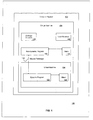
- FIG. 1 is a block diagram of a system that executes a dynamic program in a structured environment according to an embodiment of the present invention.
- FIG. 2 is a block diagram of a three-tier architecture system that may be used to implement the computer system according to an embodiment of the present invention.
- FIG. 3 is a block diagram showing multiple virtual machines according to an embodiment of the present invention.
- FIG. 4 is a block diagram of various components of the non-dynamic program and related programs according to an embodiment of the present invention.
- FIG. 5 is a flowchart of a method according to an embodiment of the present invention.
- FIG. 6 is a block diagram of an example computer system and network for implementing embodiments of the present invention.
- FIG. 1 is a block diagram of a system 100 that executes a dynamic program in a structured environment according to an embodiment of the present invention.
- the system 100 includes a computer system 102. (Specific implementation details of the computer system 102 are provided in subsequent sections.)
- the computer system 102 executes a computer program that implements a virtual machine 104.
- the virtual machine 104 implements a non-dynamic programming environment.
- computer programs written in the corresponding non-dynamic programming language may be executed.
- the non-dynamic program 106 is shown as an example.
- the non-dynamic programming language may be an object-oriented language, in which case the non-dynamic program 106 may define objects on which the virtual machine 104 operates.
- the non-dynamic program 106 interfaces with a stack 108.
- the stack 108 operates as a call stack for the non-dynamic program 106, where parameters are passed to methods, which again may have local variables and may call other methods (or the method may recursively call itself).
- the virtual machine 104 may include other components, such as a garbage collector 110.
- the garbage collector 110 reclaims memory in the computer system 102 allocated to the objects created by the non-dynamic program 106 once these objects are no longer needed.
- the non-dynamic program 106 generally implements and controls a structured environment for executing computer programs. As part of this structured environment, the non-dynamic program 106 implements a virtual machine 124 to execute a dynamic program 126.
- the virtual machine 124 implements a dynamic programming environment.
- computer programs written in the dynamic programming language may be executed.
- the dynamic program 126 is shown as an example.
- the dynamic programming language may be an object-oriented language, in which case the dynamic program 126 may define objects on which the virtual machine 124 operates.
- the dynamic program 126 interfaces with a stack 128.
- the stack 128 operates as a call stack for the dynamic program 126, where parameters are passed to methods, which again may have local variables and may call other methods (or the method may recursively call itself).
- the dynamic program 126 is isolated within the virtual machine 124 and interacts with the non-dynamic program 106 over a variety of allowed interaction pathways 130. These interaction pathways 130 are more fully described below. In this manner, the dynamic program 126 is isolated from the computer system 102 as well as from other dynamic programs that may belong to other users.
- the stacks 108 and 128 are not identical for different languages, since there are differences on how parameters are passed in different languages. The finding here for us was that you can combine the two languages, since every method either belongs to the one or the other language and you will need to assign different stack frames, i.e. a data structure on the call stack, which represents a method call, for the different languages.
- the dynamic language stack frame 128 is just an extension of the stack frame structure 108 of the non-dynamic language.
- the load balancer 140 performs load balancing of the virtual machine 104 among the components of the computer system 102. As discussed more fully with reference to FIGS. 2-3 and 6 , the components of the virtual machine 104 may be spread across multiple physical devices; the load balancer 140 manages this spreading.
- the non-dynamic programming environment of the ABAP TM programming language may provide a robust environment for executing dynamic programs written in Ruby.
- the ABAP TM language is a high level programming language created by SAP AG. It is currently positioned, alongside the more recently introduced Java, as the language for programming SAP's Web Application Server product, part of SAP's NetWeaverTM platform for building business applications.
- FIG. 2 is a block diagram of a three-tier architecture system 200 that may be used to implement the computer system 102.
- the system 200 includes a presentation tier 202, an application tier 204, and a database tier 206.
- a network 208 connects the devices within and between the tiers.
- the presentation tier 202 generally includes one or more client computers 212.
- the client computers 212 generally provide a graphical user interface for users to interact with the other parts of the system 200.
- the application tier 204 generally includes one or more application servers 214.
- the application servers 214 generally implement the business logic for processing interactions between the users and the underlying data.
- Various of the application servers 214 may perform different functions.
- one of the application servers 214 may be used for prototyping or development, while the others may be used for business intelligence production activities.
- the virtual machine 104 (see FIG. 1 ) resides on one or more of the application servers 214 in the application tier 204.
- the database tier 206 generally includes one or more database servers 216.
- the database servers 216 generally implement a database management system that stores and manipulates the underlying data and related metadata.
- a single database server may be used in the basic configuration, but as the amount of data in the databases increases, the number of database servers 216 may be increased.
- a single application server may be used in the basic configuration, but as the amount of business logic processes increases, the number of application servers 214 may be increased.
- the load balancer 140 (see FIG. 1 ) performs load balancing by distributing the virtual machine 104 over the application servers 214 in the application tier, as well as coordinating interaction with the database servers 216 in the database tier. In this manner, the load balancer 140 (see FIG. 1 ) enables scalability of the dynamic programming environment (for example, the virtual machine 124) within the structured programming environment (for example, the virtual machine 104).
- the system 200 may be implemented in a variety of operating systems, for example, UNIX (AIX, HP-UX, Solaris, Linux), Microsoft Windows, IBM Series i (former iSeries, AS/400) and IBM zSeries (former S/390).
- UNIX AIX, HP-UX, Solaris, Linux
- Microsoft Windows IBM Series i (former iSeries, AS/400)
- IBM zSeries former S/390.
- database systems including DB2, Informix, MaxDB, Oracle and Microsoft SQL Server.
- the SAP Web Application Server is a specific example of an implementation of the system 200.
- the SAP Web Application Server may be used to implement the computer system 102 (or the system 200, see FIG. 2 ).
- the non-dynamic programming language is the ABAP TM language.
- the SAP Web Application Server may implement the virtual machine 104 as part of the ABAP TM runtime environment.
- the non-dynamic program 106 includes components for executing dynamic programs in ABAP (as more fully discussed in subsequent sections).
- Ruby may be used as the dynamic programming language.
- FIG. 3 is a block diagram showing multiple virtual machines according to an embodiment of the present invention.
- the virtual machine 104 executes the non-dynamic program 106 (see FIG. 1 ), which may implement numerous virtual machines 124a, 124b, 124c, 124d and 124e (collectively "virtual machines 124"; see also FIG. 1 ).
- the interactions of the virtual machines 124 are via the allowed pathways 130 (see also FIG. 1 ).
- the virtual machine 124a (for example) is isolated from each other virtual machine 124b, 124c, 124d and 124e.
- the dynamic programs in the virtual machines 124 are also isolated from each other. The dynamic programs of one user cannot affect the dynamic programs of another user.
- FIG. 4 is a block diagram of various components of the non-dynamic program 106 and related programs. For conciseness, specific references to Eclipse, Ruby and ABAP TM are made. However, it is to be understood that similar concepts may be applied when using other modeling frameworks, dynamic languages, and non-dynamic languages.
- a user may interact with a software framework 402 (such as Eclipse) to develop Ruby programs.
- the software framework 402 generally provides a user interface for programming.
- the software framework 402 may provide a standard source control system.
- the software framework 402 may include a debugger.
- the software framework 402 interacts with a compiler 410.
- the Ruby program 404 is shown.
- the command "puts" is the basic command to print something out in Ruby, so purpose of the Ruby program 404 is to output the phrase "hello world”.
- the compiler 410 compiles the Ruby program 404 into an intermediate program 412.
- the language of the intermediate program 412 is termed the Blue Ruby Intermediate Language.
- the compiler 410 may be written in the Java® language.
- the compiler 410 interacts with the virtual machine 124.
- the virtual machine 124 generally is described above regarding FIG. 1 . More specifically, the Blue Ruby virtual machine 124 is a stack/register virtual machine that executes the intermediate program 412. The parameters of the virtual machine 124 may be changed as desired, in which case corresponding adjustments may be made to the compiler 410 so that the intermediate program 412 runs on the changed virtual machine 124.
- a language virtual machine is an engine which operates instructions one after the other.
- VMs for different languages can be seen to be additive, since a VM just consists of a unstructured set of instructions to be operated. You can add instructions needed for the second language to an existing VM without interferences. These new instructions can either be implemented natively as the instructions for the first language usually have been implemented or as a combination of more atomic base operations, which already existed for the first language (in hardware processor design the second is sometimes called micro code).
- the dynamic language for example may have an instruction to dynamically call a method by sending a message to an object instance - an instruction, which the non-dynamic language didn't need and doesn't have.
- the intermediate program 412 is shown. Since the virtual machine 124 is a stack machine, the command “push” is used to push the phrase “hello world” onto the stack. The command “call” is used to call the function "puts”.
- the loader 420 interfaces between the software framework 402, the virtual machine 124, and the virtual machine 104.
- the loader may be a component of the non-dynamic program 106 (see FIG. 1 ).
- the non-dynamic program 106 interfaces with a number of modules that are used for performing various functions related to managing the virtual machine 124 and running the intermediate program 412.
- the specifics of these modules depend upon the specifics of the particular dynamic language and the particular non-dynamic language implemented.
- FIG. 4 which uses Ruby and ABAP, these modules are written in ABAP.
- These modules are part of the virtual machine 104 and include an object store and runtime library module 432, a built-in operations module 434, and a secured bridges module 436.
- the object store and runtime library module 432 maps objects in the dynamic language to objects in the non-dynamic language.
- the object store and runtime library module 432 manages the basic class hierarchy and handles the relations between classes, methods and object instances.
- the object store and runtime library module 432 may also manage the lifetimes of objects, which may involve interacting with the garbage collector 110 (see FIG. 1 ).
- Ruby has objects, methods, blocks, arrays, modules, and classes.
- ABAP has classes.
- the object store and runtime library module 432 maps these Ruby objects to a variety of ABAP classes (objects). For example, the Ruby object "object” is mapped to the ABAP class "RubyObj ect".
- the tree of the second language can be put into the tree of the first language as a subtree just derived from the object root of the first language.
- the object root of the second language then may implement the dynamic method invocation capability for the second language, so that all objects of the dynamic language, which then derive from there, can receive dynamic method calls. Since the dynamic language does not know how to call methods of the first language, the methods of the first language's object root are not directly available to the dynamic language, so the language semantics are not broken. On the other side, since every object derived from the first language's object root are managed by the garbage collector of the first language, both languages share a common garbage collector, memory management and physical data representation.
- the built-in operations module 434 implements functions or operations in the dynamic language into functions or operations (objects) in the non-dynamic language.
- Ruby has a "string” function and a "fixnum” function.
- the built-in operations module 434 in the embodiment of FIG. 4 , implements these Ruby functions as ABAP classes (objects).
- the Ruby function "string” is implemented as an ABAP class "RubyString”.
- the class RubyString includes ABAP commands that result in the performance of the same function as the Ruby function "string” in the ABAP environment.
- the secured bridges module 436 defines the allowed interaction pathways 130 (see FIG. 1 ). These interaction pathways help guarantee that the dynamic program remains robust in the non-dynamic programming environment.
- ABAP includes the commands BADI, RFC and BQL. Ruby programs are allowed to call these commands in order to perform these specifically allowed ABAP functions.
- the allowed interaction pathways 130 are most closely associated with the secured bridges module 436, they may also be viewed as the specific mappings and implementations of the dynamic language objects as non-dynamic language objects. That is, the object store and runtime library module 432 further defines the allowed interaction pathways 130 according to its object mappings from Ruby to ABAP. The built-in operations module 434 further defines the allowed interaction pathways 130 according to its object mappings from Ruby to ABAP.
- the virtual machine 104 implements thread-level isolation among the processes of different users. Thus, the dynamic programs of one user cannot affect the underlying data or the programs of other users, except as allowed by the allowed interaction pathways 130.
- FIG. 5 is a flowchart of a method 500 according to an embodiment of the present invention.
- the method 500 executes a dynamic program in a structured environment.
- the method 500 may be implemented on a computer system, for example, the computer system 102 (see FIG. 1 ) or the system 200 (see FIG. 2 ).
- a first virtual machine is implemented to execute a first program.
- the first program is in a non-dynamic programming language.
- the computer system 102 may implement the virtual machine 104 to implement the non-dynamic program 106 (see FIG. 1 ).
- the non-dynamic programming language may be ABAP.
- a first stack is managed in the first virtual machine.
- the first program uses the first stack.
- the virtual machine 104 may manage the stack 108 (see FIG. 1 ).
- the non-dynamic program 108 uses the stack 108 (see FIG. 1 ).
- allowed interaction pathways are defined between the first program and a second program.
- the second program is in a dynamic programming language.
- the secured bridges module 436 defines at least some of the allowed interaction pathways 130 (see FIG. 1 ).
- the first program implements a second virtual machine to execute the second program within the first virtual machine using the allowed interaction pathways.
- the non-dynamic program 106 implements the virtual machine 124 (see FIG. 1 ).
- the virtual machine 124 executes the dynamic program 126 within the virtual machine 104 using the allowed interaction pathways (see FIG. 1 ).
- the first program manages a second stack in the second virtual machine.
- the second program uses the second stack.
- the non-dynamic program 106 manages the stack 128 in the virtual machine 124 (see FIG. 1 ).
- FIG. 6 is a block diagram of an example computer system and network 1400 for implementing embodiments of the present invention.
- Computer system 1410 includes a bus 1405 or other communication mechanism for communicating information, and a processor 1401 coupled with bus 1405 for processing information.
- Computer system 1410 also includes a memory 1402 coupled to bus 1405 for storing information and instructions to be executed by processor 1401, including information and instructions for performing the techniques described above, including the functions of the presentation layer 202 (see FIG. 2 ), for example.
- This memory may also be used for storing temporary variables or other intermediate information during execution of instructions to be executed by processor 1401. Possible implementations of this memory may be, but are not limited to, random access memory (RAM), read only memory (ROM), or both.
- a storage device 1403 is also provided for storing information and instructions.
- Storage device 1403 may include source code, binary code, or software files for performing the techniques or embodying the constructs above, for example.
- Computer system 1410 may be coupled via bus 1405 to a display 1412, such as a cathode ray tube (CRT) or liquid crystal display (LCD), for displaying information to a computer user.
- a display 1412 such as a cathode ray tube (CRT) or liquid crystal display (LCD)
- An input device 1411 such as a keyboard and/or mouse is coupled to bus 1405 for communicating information and command selections from the user to processor 1401.
- bus 1405 may be divided into multiple specialized buses.
- Computer system 1410 also includes a network interface 1404 coupled with bus 1405.
- Network interface 1404 may provide two-way data communication between computer system 1410 and the local network 1420.
- the network interface 1404 may be a digital subscriber line (DSL) or a modem to provide data communication connection over a telephone line, for example.
- DSL digital subscriber line
- Another example of the network interface is a local area network (LAN) card to provide a data communication connection to a compatible LAN.
- LAN local area network
- Wireless links is also another example.
- network interface 1404 sends and receives electrical, electromagnetic, or optical signals that carry digital data streams representing various types of information.
- Computer system 1410 can send and receive information, including messages or other interface actions, through the network interface 1404 to an Intranet or the Internet 1430.
- software components or services may reside on multiple different computer systems 1410 or servers 1431, 1432, 1433, 1434 and 1435 across the network.
- the virtual machine 104 (see FIG. 1 ) may be implemented on one or more servers, for example.
- a server 1431 may transmit actions or messages from one component, through Internet 1430, local network 1420, and network interface 1404 to a component on computer system 1410.
- the servers 1415 or 1431-1435 may be used to implement the application tier 204 and the database tier 206 (see FIG. 2 ). In such a case, the load balancer 140 (see FIG. 1 ) manages load balancing among the servers 1415 or 1431-1435.
- one feature is the structured environment in which the dynamic programs may be executed.
- aspects of embodiments of the present invention that, alone or in combination, contribute to the structured environment include the non-dynamic programming environment, the allowed interaction pathways, the virtual machine that implements the non-dynamic programming environment, the object store and runtime library, and the operations library.
- Thread-level isolation contributes to the robust, structured environment by constraining the dynamic programs except as allowed by the allowed interaction pathways.
- Java® language lacks thread-level isolation.
- a Java® language implementation would not result in a robust, structured environment for executing Ruby programs.
- a way to add thread-level isolation to Java® is not currently known.
- One advantage of certain embodiments of the present invention is that they provide a client-side integrated development environment.
- the structured business applications environment ensures robust access to the underlying business data, and users are free to test and develop dynamic programs that access the underlying business data without fear of disruption.
- Another advantage of certain embodiments of the present invention is that they provide for smooth life cycle management of software. For example, a user can perform rapid testing and development using dynamic programs using the actual underlying business data on the same system as the production system. Then when the dynamic program has been sufficiently tested, it can be released as part of a standard release on the production system without having to perform code porting or other procedures.
Landscapes
- Engineering & Computer Science (AREA)
- Software Systems (AREA)
- Theoretical Computer Science (AREA)
- Computer Security & Cryptography (AREA)
- Physics & Mathematics (AREA)
- General Engineering & Computer Science (AREA)
- General Physics & Mathematics (AREA)
- Computer Hardware Design (AREA)
- Devices For Executing Special Programs (AREA)
- Stored Programmes (AREA)
Applications Claiming Priority (1)
| Application Number | Priority Date | Filing Date | Title |
|---|---|---|---|
| US11/935,285 US8261248B2 (en) | 2007-11-05 | 2007-11-05 | System and method of executing a dynamic program in a structured environment |
Publications (1)
| Publication Number | Publication Date |
|---|---|
| EP2058735A1 true EP2058735A1 (de) | 2009-05-13 |
Family
ID=40241483
Family Applications (1)
| Application Number | Title | Priority Date | Filing Date |
|---|---|---|---|
| EP08015634A Ceased EP2058735A1 (de) | 2007-11-05 | 2008-09-04 | System und Verfahren zur Ausführung eines dynamischen Programms in einer strukturierten Umgebung |
Country Status (3)
| Country | Link |
|---|---|
| US (1) | US8261248B2 (de) |
| EP (1) | EP2058735A1 (de) |
| CN (1) | CN101430644B (de) |
Families Citing this family (15)
| Publication number | Priority date | Publication date | Assignee | Title |
|---|---|---|---|---|
| US8307358B1 (en) * | 2007-07-10 | 2012-11-06 | Parallels IP Holdings GmbH | Method and system for unattended installation of guest operating system |
| US8387031B2 (en) * | 2009-01-23 | 2013-02-26 | International Business Machines Corporation | Providing code improvements for nested virtual machines |
| KR101051600B1 (ko) * | 2010-03-29 | 2011-07-22 | 주식회사 소프트 포 소프트 | 아밥 소스코드의 코드 검사를 수행하는 코드검사 수행시스템 |
| CN102238208A (zh) | 2010-04-29 | 2011-11-09 | 国际商业机器公司 | 用于激活虚拟方案中的虚拟机的方法和装置 |
| US8412810B1 (en) * | 2010-07-02 | 2013-04-02 | Adobe Systems Incorporated | Provisioning and managing a cluster deployed on a cloud |
| US9160815B2 (en) * | 2012-06-28 | 2015-10-13 | Intel Corporation | Method and apparatus for virtual machine interoperability |
| US9177037B2 (en) | 2013-01-02 | 2015-11-03 | Sap Se | In-memory runtime for multidimensional analytical views |
| US9075601B1 (en) * | 2013-03-07 | 2015-07-07 | Ca, Inc. | Providing a scripting interface to existing code |
| GB2517408A (en) | 2013-07-05 | 2015-02-25 | Blue Prism Ltd | System for automating processes |
| US9015679B2 (en) | 2013-07-16 | 2015-04-21 | Sap Se | System and method for translating business application functions into DBMS internal programming language procedures |
| US9875274B2 (en) * | 2014-09-15 | 2018-01-23 | Sap Se | Extensibility of embedded database procedures |
| US10120655B2 (en) * | 2016-06-03 | 2018-11-06 | Microsoft Technology Licensing, Llc. | Seamless high performance interoperability between different type graphs that share a garbage collector |
| GB201702450D0 (en) | 2017-02-15 | 2017-03-29 | Blue Prism Ltd | System for optimising distribution of processing an automated process |
| GB2590967A (en) | 2020-01-10 | 2021-07-14 | Blue Prism Ltd | Method of remote access |
| CN114816414B (zh) * | 2022-03-07 | 2024-11-05 | 阿里巴巴(中国)有限公司 | 一种代码系统、代码执行方法、代码编译方法、及其装置 |
Citations (3)
| Publication number | Priority date | Publication date | Assignee | Title |
|---|---|---|---|---|
| US20030088604A1 (en) * | 2001-11-07 | 2003-05-08 | Norbert Kuck | Process attachable virtual machines |
| US20040255267A1 (en) * | 2003-06-10 | 2004-12-16 | Erik Meijer | Systems and methods for employing tagged types in a dynamic runtime environment |
| US20050198303A1 (en) * | 2004-01-02 | 2005-09-08 | Robert Knauerhase | Dynamic virtual machine service provider allocation |
Family Cites Families (1)
| Publication number | Priority date | Publication date | Assignee | Title |
|---|---|---|---|---|
| CN100339831C (zh) * | 2005-12-14 | 2007-09-26 | 浙江大学 | 应用于Java操作系统中虚拟机的编译体系实现方法 |
-
2007
- 2007-11-05 US US11/935,285 patent/US8261248B2/en active Active
-
2008
- 2008-09-04 EP EP08015634A patent/EP2058735A1/de not_active Ceased
- 2008-11-05 CN CN200810174818XA patent/CN101430644B/zh active Active
Patent Citations (3)
| Publication number | Priority date | Publication date | Assignee | Title |
|---|---|---|---|---|
| US20030088604A1 (en) * | 2001-11-07 | 2003-05-08 | Norbert Kuck | Process attachable virtual machines |
| US20040255267A1 (en) * | 2003-06-10 | 2004-12-16 | Erik Meijer | Systems and methods for employing tagged types in a dynamic runtime environment |
| US20050198303A1 (en) * | 2004-01-02 | 2005-09-08 | Robert Knauerhase | Dynamic virtual machine service provider allocation |
Non-Patent Citations (2)
| Title |
|---|
| HELANDER J ET AL: "MMLite: a highly componentized system architecture", ACM SIGOPS EUROPEAN WORKSHOP, XX, XX, vol. 8, 7 September 1998 (1998-09-07), pages 96 - 103, XP009111323 * |
| WIKIPEDIA: "Dynamic programming language", INTERNET CITATION, 22 February 2007 (2007-02-22), XP007906961, Retrieved from the Internet <URL:http://en.wikipedia.org/w/index.php?title=Dynamic_programming_languag e&oldid=109993610> [retrieved on 20090127] * |
Also Published As
| Publication number | Publication date |
|---|---|
| CN101430644B (zh) | 2012-12-26 |
| US20090119642A1 (en) | 2009-05-07 |
| CN101430644A (zh) | 2009-05-13 |
| US8261248B2 (en) | 2012-09-04 |
Similar Documents
| Publication | Publication Date | Title |
|---|---|---|
| US8261248B2 (en) | System and method of executing a dynamic program in a structured environment | |
| Orso et al. | A technique for dynamic updating of Java software | |
| US11099823B2 (en) | Systems and methods for transformation of reporting schema | |
| US6976262B1 (en) | Web-based enterprise management with multiple repository capability | |
| US8307015B2 (en) | Decorated model architecture for efficient model-driven application development | |
| US7716246B2 (en) | Dynamic mechanism for providing metadata | |
| US6892202B2 (en) | Optimistic transaction compiler | |
| US7770181B2 (en) | System and method for transferring computer-readable objects across a remote boundary | |
| US20100287528A1 (en) | Systems and Methods for Modifying Code Generation Templates | |
| CN101174217A (zh) | Java程序可动态更新化实现方法 | |
| US10120655B2 (en) | Seamless high performance interoperability between different type graphs that share a garbage collector | |
| CN113254317A (zh) | 基于字节码的指标自动生成方法及系统 | |
| EP1979825A1 (de) | Xna-beziehungsverwaltung | |
| US20110265070A1 (en) | Resumable methods | |
| CN1938679A (zh) | 用于程序执行的系统和方法 | |
| US8196152B2 (en) | Container context information propagation in an aspect-oriented environment | |
| US8260850B2 (en) | Thin-client and distributed development using data programming | |
| US7703108B2 (en) | Native code isolation in a multi-tasking Java virtual machine | |
| US20090144752A1 (en) | Unmanaged-to-managed aggregation | |
| CN112346820B (zh) | 区块链jvm应用方法、设备和存储介质 | |
| US8904372B2 (en) | Dialog to service conversion method and system | |
| KR100703285B1 (ko) | 메시르를 이용한 교환 시스템의 동적 서비스를 지원하는방법 | |
| Cassidy et al. | Concurrency analysis of Java RMI using source transformation and verisoft | |
| US20120254278A1 (en) | Dynamic Dispatch for Distributed Object-Oriented Software Systems | |
| Tyrrell et al. | Oo-motivated process algebra: A calculus for corba-like systems |
Legal Events
| Date | Code | Title | Description |
|---|---|---|---|
| PUAI | Public reference made under article 153(3) epc to a published international application that has entered the european phase |
Free format text: ORIGINAL CODE: 0009012 |
|
| AK | Designated contracting states |
Kind code of ref document: A1 Designated state(s): AT BE BG CH CY CZ DE DK EE ES FI FR GB GR HR HU IE IS IT LI LT LU LV MC MT NL NO PL PT RO SE SI SK TR |
|
| AX | Request for extension of the european patent |
Extension state: AL BA MK RS |
|
| 17P | Request for examination filed |
Effective date: 20090910 |
|
| AKX | Designation fees paid |
Designated state(s): AT BE BG CH CY CZ DE DK EE ES FI FR GB GR HR HU IE IS IT LI LT LU LV MC MT NL NO PL PT RO SE SI SK TR |
|
| 17Q | First examination report despatched |
Effective date: 20130916 |
|
| RAP1 | Party data changed (applicant data changed or rights of an application transferred) |
Owner name: SAP SE |
|
| STAA | Information on the status of an ep patent application or granted ep patent |
Free format text: STATUS: THE APPLICATION HAS BEEN REFUSED |
|
| 18R | Application refused |
Effective date: 20170420 |