EP2058298A2 - Process of hydrocyanation of unsaturated carboxylic acid derivatives - Google Patents
Process of hydrocyanation of unsaturated carboxylic acid derivatives Download PDFInfo
- Publication number
- EP2058298A2 EP2058298A2 EP09001657A EP09001657A EP2058298A2 EP 2058298 A2 EP2058298 A2 EP 2058298A2 EP 09001657 A EP09001657 A EP 09001657A EP 09001657 A EP09001657 A EP 09001657A EP 2058298 A2 EP2058298 A2 EP 2058298A2
- Authority
- EP
- European Patent Office
- Prior art keywords
- fragments
- group
- alkyl
- carboxylic acid
- acid
- Prior art date
- Legal status (The legal status is an assumption and is not a legal conclusion. Google has not performed a legal analysis and makes no representation as to the accuracy of the status listed.)
- Withdrawn
Links
- 238000000034 method Methods 0.000 title claims abstract description 53
- 238000005669 hydrocyanation reaction Methods 0.000 title claims abstract description 30
- 230000008569 process Effects 0.000 title claims description 31
- 150000001732 carboxylic acid derivatives Chemical class 0.000 title claims description 9
- 150000002825 nitriles Chemical class 0.000 claims abstract description 42
- 150000001735 carboxylic acids Chemical class 0.000 claims abstract description 32
- 150000001412 amines Chemical class 0.000 claims abstract description 21
- 239000012634 fragment Substances 0.000 claims description 54
- 239000003054 catalyst Substances 0.000 claims description 47
- 239000003446 ligand Substances 0.000 claims description 37
- PXHVJJICTQNCMI-UHFFFAOYSA-N Nickel Chemical compound [Ni] PXHVJJICTQNCMI-UHFFFAOYSA-N 0.000 claims description 33
- 150000001875 compounds Chemical class 0.000 claims description 29
- 229910052739 hydrogen Inorganic materials 0.000 claims description 29
- 239000001257 hydrogen Substances 0.000 claims description 23
- UFHFLCQGNIYNRP-UHFFFAOYSA-N Hydrogen Chemical compound [H][H] UFHFLCQGNIYNRP-UHFFFAOYSA-N 0.000 claims description 21
- 125000006539 C12 alkyl group Chemical group [H]C([H])([H])C([H])([H])C([H])([H])C([H])([H])C([H])([H])C([H])([H])C([H])([H])C([H])([H])C([H])([H])C([H])([H])C([H])([H])C([H])([H])* 0.000 claims description 19
- 150000001336 alkenes Chemical class 0.000 claims description 19
- -1 amine compounds Chemical class 0.000 claims description 18
- 229910052759 nickel Inorganic materials 0.000 claims description 12
- 235000020778 linoleic acid Nutrition 0.000 claims description 9
- OYHQOLUKZRVURQ-IXWMQOLASA-N linoleic acid Natural products CCCCC\C=C/C\C=C\CCCCCCCC(O)=O OYHQOLUKZRVURQ-IXWMQOLASA-N 0.000 claims description 9
- 239000003549 soybean oil Substances 0.000 claims description 9
- 235000012424 soybean oil Nutrition 0.000 claims description 9
- WRIDQFICGBMAFQ-UHFFFAOYSA-N (E)-8-Octadecenoic acid Natural products CCCCCCCCCC=CCCCCCCC(O)=O WRIDQFICGBMAFQ-UHFFFAOYSA-N 0.000 claims description 8
- LQJBNNIYVWPHFW-UHFFFAOYSA-N 20:1omega9c fatty acid Natural products CCCCCCCCCCC=CCCCCCCCC(O)=O LQJBNNIYVWPHFW-UHFFFAOYSA-N 0.000 claims description 8
- QSBYPNXLFMSGKH-UHFFFAOYSA-N 9-Heptadecensaeure Natural products CCCCCCCC=CCCCCCCCC(O)=O QSBYPNXLFMSGKH-UHFFFAOYSA-N 0.000 claims description 8
- ZQPPMHVWECSIRJ-UHFFFAOYSA-N Oleic acid Natural products CCCCCCCCC=CCCCCCCCC(O)=O ZQPPMHVWECSIRJ-UHFFFAOYSA-N 0.000 claims description 8
- 239000005642 Oleic acid Substances 0.000 claims description 8
- QXJSBBXBKPUZAA-UHFFFAOYSA-N isooleic acid Natural products CCCCCCCC=CCCCCCCCCC(O)=O QXJSBBXBKPUZAA-UHFFFAOYSA-N 0.000 claims description 8
- ZQPPMHVWECSIRJ-KTKRTIGZSA-N oleic acid Chemical compound CCCCCCCC\C=C/CCCCCCCC(O)=O ZQPPMHVWECSIRJ-KTKRTIGZSA-N 0.000 claims description 8
- OYHQOLUKZRVURQ-HZJYTTRNSA-N Linoleic acid Chemical compound CCCCC\C=C/C\C=C/CCCCCCCC(O)=O OYHQOLUKZRVURQ-HZJYTTRNSA-N 0.000 claims description 7
- 239000002253 acid Substances 0.000 claims description 7
- 125000000217 alkyl group Chemical group 0.000 claims description 7
- 150000002314 glycerols Chemical class 0.000 claims description 7
- XXJGBENTLXFVFI-UHFFFAOYSA-N 1-amino-methylene Chemical compound N[CH2] XXJGBENTLXFVFI-UHFFFAOYSA-N 0.000 claims description 6
- OJMIONKXNSYLSR-UHFFFAOYSA-N phosphorous acid Chemical compound OP(O)O OJMIONKXNSYLSR-UHFFFAOYSA-N 0.000 claims description 6
- UIUWNILCHFBLEQ-NSCUHMNNSA-N trans-pent-3-enoic acid Chemical compound C\C=C\CC(O)=O UIUWNILCHFBLEQ-NSCUHMNNSA-N 0.000 claims description 6
- 125000004642 (C1-C12) alkoxy group Chemical group 0.000 claims description 5
- 125000003118 aryl group Chemical group 0.000 claims description 5
- 229910017052 cobalt Inorganic materials 0.000 claims description 5
- 239000010941 cobalt Substances 0.000 claims description 5
- GUTLYIVDDKVIGB-UHFFFAOYSA-N cobalt atom Chemical compound [Co] GUTLYIVDDKVIGB-UHFFFAOYSA-N 0.000 claims description 5
- KDLHZDBZIXYQEI-UHFFFAOYSA-N Palladium Chemical compound [Pd] KDLHZDBZIXYQEI-UHFFFAOYSA-N 0.000 claims description 4
- 229910052760 oxygen Inorganic materials 0.000 claims description 4
- 229910052717 sulfur Inorganic materials 0.000 claims description 4
- 229910052799 carbon Inorganic materials 0.000 claims description 3
- 125000001997 phenyl group Chemical group [H]C1=C([H])C([H])=C(*)C([H])=C1[H] 0.000 claims description 3
- 125000001624 naphthyl group Chemical group 0.000 claims description 2
- 229910052763 palladium Inorganic materials 0.000 claims description 2
- 125000001183 hydrocarbyl group Chemical group 0.000 claims 4
- 229910021472 group 8 element Inorganic materials 0.000 claims 2
- OAICVXFJPJFONN-UHFFFAOYSA-N Phosphorus Chemical compound [P] OAICVXFJPJFONN-UHFFFAOYSA-N 0.000 claims 1
- 229910052698 phosphorus Inorganic materials 0.000 claims 1
- 239000011574 phosphorus Substances 0.000 claims 1
- 239000000203 mixture Substances 0.000 abstract description 35
- 235000014113 dietary fatty acids Nutrition 0.000 abstract description 20
- 239000000194 fatty acid Chemical class 0.000 abstract description 20
- 229930195729 fatty acid Chemical class 0.000 abstract description 20
- 150000004665 fatty acids Chemical class 0.000 abstract description 19
- 239000010685 fatty oil Chemical class 0.000 abstract description 14
- 125000002560 nitrile group Chemical group 0.000 abstract description 9
- 238000002360 preparation method Methods 0.000 abstract description 4
- LELOWRISYMNNSU-UHFFFAOYSA-N hydrogen cyanide Chemical compound N#C LELOWRISYMNNSU-UHFFFAOYSA-N 0.000 description 34
- 239000000047 product Substances 0.000 description 34
- 235000019198 oils Nutrition 0.000 description 32
- 238000006243 chemical reaction Methods 0.000 description 31
- YXFVVABEGXRONW-UHFFFAOYSA-N Toluene Chemical compound CC1=CC=CC=C1 YXFVVABEGXRONW-UHFFFAOYSA-N 0.000 description 30
- 238000005984 hydrogenation reaction Methods 0.000 description 24
- WEVYAHXRMPXWCK-UHFFFAOYSA-N Acetonitrile Chemical compound CC#N WEVYAHXRMPXWCK-UHFFFAOYSA-N 0.000 description 21
- 239000003921 oil Substances 0.000 description 19
- 239000000243 solution Substances 0.000 description 18
- WYURNTSHIVDZCO-UHFFFAOYSA-N Tetrahydrofuran Chemical compound C1CCOC1 WYURNTSHIVDZCO-UHFFFAOYSA-N 0.000 description 16
- 239000002904 solvent Substances 0.000 description 15
- 150000002430 hydrocarbons Chemical group 0.000 description 13
- 229910052751 metal Inorganic materials 0.000 description 13
- 239000002184 metal Substances 0.000 description 13
- 235000021122 unsaturated fatty acids Nutrition 0.000 description 11
- 150000004670 unsaturated fatty acids Chemical class 0.000 description 11
- QGZKDVFQNNGYKY-UHFFFAOYSA-N Ammonia Chemical compound N QGZKDVFQNNGYKY-UHFFFAOYSA-N 0.000 description 10
- 239000011541 reaction mixture Substances 0.000 description 9
- RZYHXKLKJRGJGP-UHFFFAOYSA-N 2,2,2-trifluoro-n,n-bis(trimethylsilyl)acetamide Chemical compound C[Si](C)(C)N([Si](C)(C)C)C(=O)C(F)(F)F RZYHXKLKJRGJGP-UHFFFAOYSA-N 0.000 description 8
- PEDCQBHIVMGVHV-UHFFFAOYSA-N Glycerol Natural products OCC(O)CO PEDCQBHIVMGVHV-UHFFFAOYSA-N 0.000 description 8
- YLQBMQCUIZJEEH-UHFFFAOYSA-N tetrahydrofuran Natural products C=1C=COC=1 YLQBMQCUIZJEEH-UHFFFAOYSA-N 0.000 description 8
- SYSQUGFVNFXIIT-UHFFFAOYSA-N n-[4-(1,3-benzoxazol-2-yl)phenyl]-4-nitrobenzenesulfonamide Chemical class C1=CC([N+](=O)[O-])=CC=C1S(=O)(=O)NC1=CC=C(C=2OC3=CC=CC=C3N=2)C=C1 SYSQUGFVNFXIIT-UHFFFAOYSA-N 0.000 description 7
- 239000011592 zinc chloride Substances 0.000 description 7
- JIAARYAFYJHUJI-UHFFFAOYSA-L zinc dichloride Chemical compound [Cl-].[Cl-].[Zn+2] JIAARYAFYJHUJI-UHFFFAOYSA-L 0.000 description 7
- JRTIUDXYIUKIIE-KZUMESAESA-N (1z,5z)-cycloocta-1,5-diene;nickel Chemical compound [Ni].C\1C\C=C/CC\C=C/1.C\1C\C=C/CC\C=C/1 JRTIUDXYIUKIIE-KZUMESAESA-N 0.000 description 6
- XEEYBQQBJWHFJM-UHFFFAOYSA-N Iron Chemical compound [Fe] XEEYBQQBJWHFJM-UHFFFAOYSA-N 0.000 description 6
- 150000002816 nickel compounds Chemical class 0.000 description 6
- 229910052723 transition metal Inorganic materials 0.000 description 6
- 150000003624 transition metals Chemical class 0.000 description 6
- 238000007792 addition Methods 0.000 description 5
- 235000013495 cobalt Nutrition 0.000 description 5
- 239000007788 liquid Substances 0.000 description 5
- 125000004437 phosphorous atom Chemical group 0.000 description 5
- 239000010773 plant oil Substances 0.000 description 5
- XLYOFNOQVPJJNP-UHFFFAOYSA-N water Substances O XLYOFNOQVPJJNP-UHFFFAOYSA-N 0.000 description 5
- 229910001868 water Inorganic materials 0.000 description 5
- 0 C*(*CC#N)C(O)=O Chemical compound C*(*CC#N)C(O)=O 0.000 description 4
- 235000019483 Peanut oil Nutrition 0.000 description 4
- VSCWAEJMTAWNJL-UHFFFAOYSA-K aluminium trichloride Chemical compound Cl[Al](Cl)Cl VSCWAEJMTAWNJL-UHFFFAOYSA-K 0.000 description 4
- 229910021529 ammonia Inorganic materials 0.000 description 4
- 235000011187 glycerol Nutrition 0.000 description 4
- 239000000314 lubricant Substances 0.000 description 4
- 239000000312 peanut oil Substances 0.000 description 4
- 239000002243 precursor Substances 0.000 description 4
- 239000000758 substrate Substances 0.000 description 4
- 239000011701 zinc Substances 0.000 description 4
- UHOVQNZJYSORNB-UHFFFAOYSA-N Benzene Chemical compound C1=CC=CC=C1 UHOVQNZJYSORNB-UHFFFAOYSA-N 0.000 description 3
- LFQSCWFLJHTTHZ-UHFFFAOYSA-N Ethanol Chemical compound CCO LFQSCWFLJHTTHZ-UHFFFAOYSA-N 0.000 description 3
- WSFSSNUMVMOOMR-UHFFFAOYSA-N Formaldehyde Chemical compound O=C WSFSSNUMVMOOMR-UHFFFAOYSA-N 0.000 description 3
- 229910021577 Iron(II) chloride Inorganic materials 0.000 description 3
- 239000002841 Lewis acid Substances 0.000 description 3
- OKKJLVBELUTLKV-UHFFFAOYSA-N Methanol Chemical compound OC OKKJLVBELUTLKV-UHFFFAOYSA-N 0.000 description 3
- 229910052782 aluminium Inorganic materials 0.000 description 3
- 125000003277 amino group Chemical group 0.000 description 3
- 238000004458 analytical method Methods 0.000 description 3
- 229940053200 antiepileptics fatty acid derivative Drugs 0.000 description 3
- 230000015572 biosynthetic process Effects 0.000 description 3
- 150000002148 esters Chemical class 0.000 description 3
- 229910052742 iron Inorganic materials 0.000 description 3
- NMCUIPGRVMDVDB-UHFFFAOYSA-L iron dichloride Chemical compound Cl[Fe]Cl NMCUIPGRVMDVDB-UHFFFAOYSA-L 0.000 description 3
- 150000007517 lewis acids Chemical class 0.000 description 3
- 125000001453 quaternary ammonium group Chemical group 0.000 description 3
- 239000004094 surface-active agent Substances 0.000 description 3
- 239000010936 titanium Substances 0.000 description 3
- VNDYJBBGRKZCSX-UHFFFAOYSA-L zinc bromide Chemical compound Br[Zn]Br VNDYJBBGRKZCSX-UHFFFAOYSA-L 0.000 description 3
- YWWVWXASSLXJHU-AATRIKPKSA-N (9E)-tetradecenoic acid Chemical compound CCCC\C=C\CCCCCCCC(O)=O YWWVWXASSLXJHU-AATRIKPKSA-N 0.000 description 2
- 239000004912 1,5-cyclooctadiene Substances 0.000 description 2
- NICLKHGIKDZZGV-UHFFFAOYSA-N 2-cyanopentanoic acid Chemical compound CCCC(C#N)C(O)=O NICLKHGIKDZZGV-UHFFFAOYSA-N 0.000 description 2
- 244000226021 Anacardium occidentale Species 0.000 description 2
- ZOXJGFHDIHLPTG-UHFFFAOYSA-N Boron Chemical compound [B] ZOXJGFHDIHLPTG-UHFFFAOYSA-N 0.000 description 2
- 240000002791 Brassica napus Species 0.000 description 2
- 235000006008 Brassica napus var napus Nutrition 0.000 description 2
- VYZAMTAEIAYCRO-UHFFFAOYSA-N Chromium Chemical compound [Cr] VYZAMTAEIAYCRO-UHFFFAOYSA-N 0.000 description 2
- 229910021580 Cobalt(II) chloride Inorganic materials 0.000 description 2
- 229910021584 Cobalt(II) iodide Inorganic materials 0.000 description 2
- 241000196324 Embryophyta Species 0.000 description 2
- 244000068988 Glycine max Species 0.000 description 2
- 235000010469 Glycine max Nutrition 0.000 description 2
- OAKJQQAXSVQMHS-UHFFFAOYSA-N Hydrazine Chemical compound NN OAKJQQAXSVQMHS-UHFFFAOYSA-N 0.000 description 2
- 240000006240 Linum usitatissimum Species 0.000 description 2
- 235000004431 Linum usitatissimum Nutrition 0.000 description 2
- ZOKXTWBITQBERF-UHFFFAOYSA-N Molybdenum Chemical compound [Mo] ZOKXTWBITQBERF-UHFFFAOYSA-N 0.000 description 2
- LRHPLDYGYMQRHN-UHFFFAOYSA-N N-Butanol Chemical compound CCCCO LRHPLDYGYMQRHN-UHFFFAOYSA-N 0.000 description 2
- 238000005481 NMR spectroscopy Methods 0.000 description 2
- 235000019482 Palm oil Nutrition 0.000 description 2
- KJTLSVCANCCWHF-UHFFFAOYSA-N Ruthenium Chemical compound [Ru] KJTLSVCANCCWHF-UHFFFAOYSA-N 0.000 description 2
- 235000019485 Safflower oil Nutrition 0.000 description 2
- RTAQQCXQSZGOHL-UHFFFAOYSA-N Titanium Chemical compound [Ti] RTAQQCXQSZGOHL-UHFFFAOYSA-N 0.000 description 2
- 150000007513 acids Chemical class 0.000 description 2
- 150000001298 alcohols Chemical class 0.000 description 2
- 239000000956 alloy Substances 0.000 description 2
- 229910045601 alloy Inorganic materials 0.000 description 2
- ZOJBYZNEUISWFT-UHFFFAOYSA-N allyl isothiocyanate Chemical compound C=CCN=C=S ZOJBYZNEUISWFT-UHFFFAOYSA-N 0.000 description 2
- XAGFODPZIPBFFR-UHFFFAOYSA-N aluminium Chemical compound [Al] XAGFODPZIPBFFR-UHFFFAOYSA-N 0.000 description 2
- 239000010775 animal oil Substances 0.000 description 2
- YZXBAPSDXZZRGB-DOFZRALJSA-N arachidonic acid Chemical compound CCCCC\C=C/C\C=C/C\C=C/C\C=C/CCCC(O)=O YZXBAPSDXZZRGB-DOFZRALJSA-N 0.000 description 2
- 229910052796 boron Inorganic materials 0.000 description 2
- YKYOUMDCQGMQQO-UHFFFAOYSA-L cadmium dichloride Chemical compound Cl[Cd]Cl YKYOUMDCQGMQQO-UHFFFAOYSA-L 0.000 description 2
- 235000020226 cashew nut Nutrition 0.000 description 2
- 239000004359 castor oil Substances 0.000 description 2
- 235000019438 castor oil Nutrition 0.000 description 2
- 230000003197 catalytic effect Effects 0.000 description 2
- 239000003153 chemical reaction reagent Substances 0.000 description 2
- 239000003638 chemical reducing agent Substances 0.000 description 2
- 229910052804 chromium Inorganic materials 0.000 description 2
- 239000011651 chromium Substances 0.000 description 2
- AVWLPUQJODERGA-UHFFFAOYSA-L cobalt(2+);diiodide Chemical compound [Co+2].[I-].[I-] AVWLPUQJODERGA-UHFFFAOYSA-L 0.000 description 2
- 239000003240 coconut oil Substances 0.000 description 2
- 235000019864 coconut oil Nutrition 0.000 description 2
- 239000010949 copper Substances 0.000 description 2
- 235000005687 corn oil Nutrition 0.000 description 2
- 239000002285 corn oil Substances 0.000 description 2
- 235000012343 cottonseed oil Nutrition 0.000 description 2
- 239000002385 cottonseed oil Substances 0.000 description 2
- 150000002170 ethers Chemical class 0.000 description 2
- 235000004426 flaxseed Nutrition 0.000 description 2
- 239000012530 fluid Substances 0.000 description 2
- 125000000524 functional group Chemical group 0.000 description 2
- 238000002290 gas chromatography-mass spectrometry Methods 0.000 description 2
- ZEMPKEQAKRGZGQ-XOQCFJPHSA-N glycerol triricinoleate Natural products CCCCCC[C@@H](O)CC=CCCCCCCCC(=O)OC[C@@H](COC(=O)CCCCCCCC=CC[C@@H](O)CCCCCC)OC(=O)CCCCCCCC=CC[C@H](O)CCCCCC ZEMPKEQAKRGZGQ-XOQCFJPHSA-N 0.000 description 2
- 230000036541 health Effects 0.000 description 2
- 150000002431 hydrogen Chemical class 0.000 description 2
- 229910052744 lithium Inorganic materials 0.000 description 2
- 238000001819 mass spectrum Methods 0.000 description 2
- 239000000463 material Substances 0.000 description 2
- 150000002739 metals Chemical class 0.000 description 2
- 229910052750 molybdenum Inorganic materials 0.000 description 2
- 239000011733 molybdenum Substances 0.000 description 2
- 235000019508 mustard seed Nutrition 0.000 description 2
- 150000002888 oleic acid derivatives Chemical class 0.000 description 2
- 239000004006 olive oil Substances 0.000 description 2
- 235000008390 olive oil Nutrition 0.000 description 2
- 239000002540 palm oil Substances 0.000 description 2
- SECPZKHBENQXJG-FPLPWBNLSA-N palmitoleic acid Chemical compound CCCCCC\C=C/CCCCCCCC(O)=O SECPZKHBENQXJG-FPLPWBNLSA-N 0.000 description 2
- ISWSIDIOOBJBQZ-UHFFFAOYSA-N phenol group Chemical group C1(=CC=CC=C1)O ISWSIDIOOBJBQZ-UHFFFAOYSA-N 0.000 description 2
- 125000005538 phosphinite group Chemical group 0.000 description 2
- 235000013824 polyphenols Nutrition 0.000 description 2
- 229910052700 potassium Inorganic materials 0.000 description 2
- XZQYTGKSBZGQMO-UHFFFAOYSA-I rhenium pentachloride Chemical compound Cl[Re](Cl)(Cl)(Cl)Cl XZQYTGKSBZGQMO-UHFFFAOYSA-I 0.000 description 2
- 229910052707 ruthenium Inorganic materials 0.000 description 2
- 235000005713 safflower oil Nutrition 0.000 description 2
- 239000003813 safflower oil Substances 0.000 description 2
- 239000011734 sodium Substances 0.000 description 2
- 229910052708 sodium Inorganic materials 0.000 description 2
- 239000006104 solid solution Substances 0.000 description 2
- 238000001228 spectrum Methods 0.000 description 2
- 238000003786 synthesis reaction Methods 0.000 description 2
- 229910052719 titanium Inorganic materials 0.000 description 2
- UFTFJSFQGQCHQW-UHFFFAOYSA-N triformin Chemical compound O=COCC(OC=O)COC=O UFTFJSFQGQCHQW-UHFFFAOYSA-N 0.000 description 2
- MXSVLWZRHLXFKH-UHFFFAOYSA-N triphenylborane Chemical compound C1=CC=CC=C1B(C=1C=CC=CC=1)C1=CC=CC=C1 MXSVLWZRHLXFKH-UHFFFAOYSA-N 0.000 description 2
- 239000002383 tung oil Substances 0.000 description 2
- 229910052725 zinc Inorganic materials 0.000 description 2
- GGQQNYXPYWCUHG-RMTFUQJTSA-N (3e,6e)-deca-3,6-diene Chemical compound CCC\C=C\C\C=C\CC GGQQNYXPYWCUHG-RMTFUQJTSA-N 0.000 description 1
- OYHQOLUKZRVURQ-NTGFUMLPSA-N (9Z,12Z)-9,10,12,13-tetratritiooctadeca-9,12-dienoic acid Chemical compound C(CCCCCCC\C(=C(/C\C(=C(/CCCCC)\[3H])\[3H])\[3H])\[3H])(=O)O OYHQOLUKZRVURQ-NTGFUMLPSA-N 0.000 description 1
- 239000001149 (9Z,12Z)-octadeca-9,12-dienoate Substances 0.000 description 1
- WTTJVINHCBCLGX-UHFFFAOYSA-N (9trans,12cis)-methyl linoleate Natural products CCCCCC=CCC=CCCCCCCCC(=O)OC WTTJVINHCBCLGX-UHFFFAOYSA-N 0.000 description 1
- POILWHVDKZOXJZ-ARJAWSKDSA-M (z)-4-oxopent-2-en-2-olate Chemical group C\C([O-])=C\C(C)=O POILWHVDKZOXJZ-ARJAWSKDSA-M 0.000 description 1
- VYXHVRARDIDEHS-UHFFFAOYSA-N 1,5-cyclooctadiene Chemical compound C1CC=CCCC=C1 VYXHVRARDIDEHS-UHFFFAOYSA-N 0.000 description 1
- KTOQRRDVVIDEAA-UHFFFAOYSA-N 2-methylpropane Chemical compound [CH2]C(C)C KTOQRRDVVIDEAA-UHFFFAOYSA-N 0.000 description 1
- LNJCGNRKWOHFFV-UHFFFAOYSA-N 3-(2-hydroxyethylsulfanyl)propanenitrile Chemical compound OCCSCCC#N LNJCGNRKWOHFFV-UHFFFAOYSA-N 0.000 description 1
- SKUPALMUTWEAPI-UHFFFAOYSA-N 5-cyanopentanoic acid Chemical class OC(=O)CCCCC#N SKUPALMUTWEAPI-UHFFFAOYSA-N 0.000 description 1
- FKLSONDBCYHMOQ-UHFFFAOYSA-N 9E-dodecenoic acid Natural products CCC=CCCCCCCCC(O)=O FKLSONDBCYHMOQ-UHFFFAOYSA-N 0.000 description 1
- YWWVWXASSLXJHU-UHFFFAOYSA-N 9E-tetradecenoic acid Natural products CCCCC=CCCCCCCCC(O)=O YWWVWXASSLXJHU-UHFFFAOYSA-N 0.000 description 1
- 101100347605 Arabidopsis thaliana VIII-A gene Proteins 0.000 description 1
- OYPRJOBELJOOCE-UHFFFAOYSA-N Calcium Chemical compound [Ca] OYPRJOBELJOOCE-UHFFFAOYSA-N 0.000 description 1
- OKTJSMMVPCPJKN-UHFFFAOYSA-N Carbon Chemical compound [C] OKTJSMMVPCPJKN-UHFFFAOYSA-N 0.000 description 1
- 229910021554 Chromium(II) chloride Inorganic materials 0.000 description 1
- RYGMFSIKBFXOCR-UHFFFAOYSA-N Copper Chemical compound [Cu] RYGMFSIKBFXOCR-UHFFFAOYSA-N 0.000 description 1
- 229910021591 Copper(I) chloride Inorganic materials 0.000 description 1
- 229910021592 Copper(II) chloride Inorganic materials 0.000 description 1
- LVGKNOAMLMIIKO-UHFFFAOYSA-N Elaidinsaeure-aethylester Natural products CCCCCCCCC=CCCCCCCCC(=O)OCC LVGKNOAMLMIIKO-UHFFFAOYSA-N 0.000 description 1
- DGAQECJNVWCQMB-PUAWFVPOSA-M Ilexoside XXIX Chemical compound C[C@@H]1CC[C@@]2(CC[C@@]3(C(=CC[C@H]4[C@]3(CC[C@@H]5[C@@]4(CC[C@@H](C5(C)C)OS(=O)(=O)[O-])C)C)[C@@H]2[C@]1(C)O)C)C(=O)O[C@H]6[C@@H]([C@H]([C@@H]([C@H](O6)CO)O)O)O.[Na+] DGAQECJNVWCQMB-PUAWFVPOSA-M 0.000 description 1
- 229910021579 Iron(II) iodide Inorganic materials 0.000 description 1
- 229910021578 Iron(III) chloride Inorganic materials 0.000 description 1
- 229910002249 LaCl3 Inorganic materials 0.000 description 1
- WHXSMMKQMYFTQS-UHFFFAOYSA-N Lithium Chemical compound [Li] WHXSMMKQMYFTQS-UHFFFAOYSA-N 0.000 description 1
- FYYHWMGAXLPEAU-UHFFFAOYSA-N Magnesium Chemical compound [Mg] FYYHWMGAXLPEAU-UHFFFAOYSA-N 0.000 description 1
- 229910021380 Manganese Chloride Inorganic materials 0.000 description 1
- GLFNIEUTAYBVOC-UHFFFAOYSA-L Manganese chloride Chemical compound Cl[Mn]Cl GLFNIEUTAYBVOC-UHFFFAOYSA-L 0.000 description 1
- PKIXXJPMNDDDOS-UHFFFAOYSA-N Methyl linoleate Natural products CCCCC=CCCC=CCCCCCCCC(=O)OC PKIXXJPMNDDDOS-UHFFFAOYSA-N 0.000 description 1
- 229910015221 MoCl5 Inorganic materials 0.000 description 1
- MKYBYDHXWVHEJW-UHFFFAOYSA-N N-[1-oxo-1-(2,4,6,7-tetrahydrotriazolo[4,5-c]pyridin-5-yl)propan-2-yl]-2-[[3-(trifluoromethoxy)phenyl]methylamino]pyrimidine-5-carboxamide Chemical compound O=C(C(C)NC(=O)C=1C=NC(=NC=1)NCC1=CC(=CC=C1)OC(F)(F)F)N1CC2=C(CC1)NN=N2 MKYBYDHXWVHEJW-UHFFFAOYSA-N 0.000 description 1
- 229910019804 NbCl5 Inorganic materials 0.000 description 1
- CTQNGGLPUBDAKN-UHFFFAOYSA-N O-Xylene Chemical compound CC1=CC=CC=C1C CTQNGGLPUBDAKN-UHFFFAOYSA-N 0.000 description 1
- 235000021319 Palmitoleic acid Nutrition 0.000 description 1
- ZLMJMSJWJFRBEC-UHFFFAOYSA-N Potassium Chemical compound [K] ZLMJMSJWJFRBEC-UHFFFAOYSA-N 0.000 description 1
- 229910018057 ScCl3 Inorganic materials 0.000 description 1
- VYPSYNLAJGMNEJ-UHFFFAOYSA-N Silicium dioxide Chemical compound O=[Si]=O VYPSYNLAJGMNEJ-UHFFFAOYSA-N 0.000 description 1
- XUIMIQQOPSSXEZ-UHFFFAOYSA-N Silicon Chemical compound [Si] XUIMIQQOPSSXEZ-UHFFFAOYSA-N 0.000 description 1
- 229910003074 TiCl4 Inorganic materials 0.000 description 1
- ATJFFYVFTNAWJD-UHFFFAOYSA-N Tin Chemical compound [Sn] ATJFFYVFTNAWJD-UHFFFAOYSA-N 0.000 description 1
- 229910021551 Vanadium(III) chloride Inorganic materials 0.000 description 1
- 229910009523 YCl3 Inorganic materials 0.000 description 1
- HCHKCACWOHOZIP-UHFFFAOYSA-N Zinc Chemical compound [Zn] HCHKCACWOHOZIP-UHFFFAOYSA-N 0.000 description 1
- QCWXUUIWCKQGHC-UHFFFAOYSA-N Zirconium Chemical compound [Zr] QCWXUUIWCKQGHC-UHFFFAOYSA-N 0.000 description 1
- 229910007932 ZrCl4 Inorganic materials 0.000 description 1
- BTGRAWJCKBQKAO-UHFFFAOYSA-N adiponitrile Chemical compound N#CCCCCC#N BTGRAWJCKBQKAO-UHFFFAOYSA-N 0.000 description 1
- 239000003513 alkali Substances 0.000 description 1
- 229910001854 alkali hydroxide Inorganic materials 0.000 description 1
- 229910001860 alkaline earth metal hydroxide Inorganic materials 0.000 description 1
- 230000004075 alteration Effects 0.000 description 1
- AZDRQVAHHNSJOQ-UHFFFAOYSA-N alumane Chemical class [AlH3] AZDRQVAHHNSJOQ-UHFFFAOYSA-N 0.000 description 1
- PNEYBMLMFCGWSK-UHFFFAOYSA-N aluminium oxide Inorganic materials [O-2].[O-2].[O-2].[Al+3].[Al+3] PNEYBMLMFCGWSK-UHFFFAOYSA-N 0.000 description 1
- 150000001408 amides Chemical class 0.000 description 1
- 235000011114 ammonium hydroxide Nutrition 0.000 description 1
- 229940114079 arachidonic acid Drugs 0.000 description 1
- 235000021342 arachidonic acid Nutrition 0.000 description 1
- 150000001491 aromatic compounds Chemical class 0.000 description 1
- 150000007860 aryl ester derivatives Chemical class 0.000 description 1
- 239000006227 byproduct Substances 0.000 description 1
- 229910052793 cadmium Inorganic materials 0.000 description 1
- BDOSMKKIYDKNTQ-UHFFFAOYSA-N cadmium atom Chemical compound [Cd] BDOSMKKIYDKNTQ-UHFFFAOYSA-N 0.000 description 1
- 229910052791 calcium Inorganic materials 0.000 description 1
- 239000011575 calcium Substances 0.000 description 1
- 150000007942 carboxylates Chemical group 0.000 description 1
- 125000003262 carboxylic acid ester group Chemical group [H]C([H])([*:2])OC(=O)C([H])([H])[*:1] 0.000 description 1
- 150000001768 cations Chemical class 0.000 description 1
- 238000004587 chromatography analysis Methods 0.000 description 1
- XBWRJSSJWDOUSJ-UHFFFAOYSA-L chromium(ii) chloride Chemical compound Cl[Cr]Cl XBWRJSSJWDOUSJ-UHFFFAOYSA-L 0.000 description 1
- XZJZNZATFHOMSJ-KTKRTIGZSA-N cis-3-dodecenoic acid Chemical compound CCCCCCCC\C=C/CC(O)=O XZJZNZATFHOMSJ-KTKRTIGZSA-N 0.000 description 1
- SECPZKHBENQXJG-UHFFFAOYSA-N cis-palmitoleic acid Natural products CCCCCCC=CCCCCCCCC(O)=O SECPZKHBENQXJG-UHFFFAOYSA-N 0.000 description 1
- 239000003426 co-catalyst Substances 0.000 description 1
- 238000000975 co-precipitation Methods 0.000 description 1
- 230000000052 comparative effect Effects 0.000 description 1
- 239000002131 composite material Substances 0.000 description 1
- 238000007796 conventional method Methods 0.000 description 1
- 229910052802 copper Inorganic materials 0.000 description 1
- OXBLHERUFWYNTN-UHFFFAOYSA-M copper(I) chloride Chemical compound [Cu]Cl OXBLHERUFWYNTN-UHFFFAOYSA-M 0.000 description 1
- ORTQZVOHEJQUHG-UHFFFAOYSA-L copper(II) chloride Chemical compound Cl[Cu]Cl ORTQZVOHEJQUHG-UHFFFAOYSA-L 0.000 description 1
- 230000008025 crystallization Effects 0.000 description 1
- 230000001419 dependent effect Effects 0.000 description 1
- 238000001212 derivatisation Methods 0.000 description 1
- ZTHNOZQGTXKVNZ-UHFFFAOYSA-L dichloroaluminum Chemical compound Cl[Al]Cl ZTHNOZQGTXKVNZ-UHFFFAOYSA-L 0.000 description 1
- 230000000694 effects Effects 0.000 description 1
- QYDYPVFESGNLHU-UHFFFAOYSA-N elaidic acid methyl ester Natural products CCCCCCCCC=CCCCCCCCC(=O)OC QYDYPVFESGNLHU-UHFFFAOYSA-N 0.000 description 1
- LVGKNOAMLMIIKO-QXMHVHEDSA-N ethyl oleate Chemical compound CCCCCCCC\C=C/CCCCCCCC(=O)OCC LVGKNOAMLMIIKO-QXMHVHEDSA-N 0.000 description 1
- 229940093471 ethyl oleate Drugs 0.000 description 1
- 238000001704 evaporation Methods 0.000 description 1
- 239000012847 fine chemical Substances 0.000 description 1
- 238000001640 fractional crystallisation Methods 0.000 description 1
- 238000004508 fractional distillation Methods 0.000 description 1
- 238000007306 functionalization reaction Methods 0.000 description 1
- 238000004817 gas chromatography Methods 0.000 description 1
- 150000004820 halides Chemical group 0.000 description 1
- BHEPBYXIRTUNPN-UHFFFAOYSA-N hydridophosphorus(.) (triplet) Chemical compound [PH] BHEPBYXIRTUNPN-UHFFFAOYSA-N 0.000 description 1
- 229930195733 hydrocarbon Natural products 0.000 description 1
- 238000005470 impregnation Methods 0.000 description 1
- 239000004615 ingredient Substances 0.000 description 1
- 150000002484 inorganic compounds Chemical class 0.000 description 1
- 238000005342 ion exchange Methods 0.000 description 1
- RBTARNINKXHZNM-UHFFFAOYSA-K iron trichloride Chemical compound Cl[Fe](Cl)Cl RBTARNINKXHZNM-UHFFFAOYSA-K 0.000 description 1
- BQZGVMWPHXIKEQ-UHFFFAOYSA-L iron(ii) iodide Chemical compound [Fe+2].[I-].[I-] BQZGVMWPHXIKEQ-UHFFFAOYSA-L 0.000 description 1
- 150000003951 lactams Chemical class 0.000 description 1
- 150000002596 lactones Chemical class 0.000 description 1
- ICAKDTKJOYSXGC-UHFFFAOYSA-K lanthanum(iii) chloride Chemical compound Cl[La](Cl)Cl ICAKDTKJOYSXGC-UHFFFAOYSA-K 0.000 description 1
- 238000002386 leaching Methods 0.000 description 1
- 238000004895 liquid chromatography mass spectrometry Methods 0.000 description 1
- 229910052749 magnesium Inorganic materials 0.000 description 1
- 239000011777 magnesium Substances 0.000 description 1
- 239000000395 magnesium oxide Substances 0.000 description 1
- CPLXHLVBOLITMK-UHFFFAOYSA-N magnesium oxide Inorganic materials [Mg]=O CPLXHLVBOLITMK-UHFFFAOYSA-N 0.000 description 1
- AXZKOIWUVFPNLO-UHFFFAOYSA-N magnesium;oxygen(2-) Chemical compound [O-2].[Mg+2] AXZKOIWUVFPNLO-UHFFFAOYSA-N 0.000 description 1
- 239000011565 manganese chloride Substances 0.000 description 1
- WPBNNNQJVZRUHP-UHFFFAOYSA-L manganese(2+);methyl n-[[2-(methoxycarbonylcarbamothioylamino)phenyl]carbamothioyl]carbamate;n-[2-(sulfidocarbothioylamino)ethyl]carbamodithioate Chemical compound [Mn+2].[S-]C(=S)NCCNC([S-])=S.COC(=O)NC(=S)NC1=CC=CC=C1NC(=S)NC(=O)OC WPBNNNQJVZRUHP-UHFFFAOYSA-L 0.000 description 1
- 238000004519 manufacturing process Methods 0.000 description 1
- 239000008204 material by function Substances 0.000 description 1
- 150000002736 metal compounds Chemical class 0.000 description 1
- WDWDWGRYHDPSDS-UHFFFAOYSA-N methanimine Chemical class N=C WDWDWGRYHDPSDS-UHFFFAOYSA-N 0.000 description 1
- QYDYPVFESGNLHU-KHPPLWFESA-N methyl oleate Chemical compound CCCCCCCC\C=C/CCCCCCCC(=O)OC QYDYPVFESGNLHU-KHPPLWFESA-N 0.000 description 1
- 229940073769 methyl oleate Drugs 0.000 description 1
- 238000012986 modification Methods 0.000 description 1
- 230000004048 modification Effects 0.000 description 1
- GICWIDZXWJGTCI-UHFFFAOYSA-I molybdenum pentachloride Chemical compound Cl[Mo](Cl)(Cl)(Cl)Cl GICWIDZXWJGTCI-UHFFFAOYSA-I 0.000 description 1
- 239000000178 monomer Substances 0.000 description 1
- WIBFFTLQMKKBLZ-SEYXRHQNSA-N n-butyl oleate Chemical compound CCCCCCCC\C=C/CCCCCCCC(=O)OCCCC WIBFFTLQMKKBLZ-SEYXRHQNSA-N 0.000 description 1
- VOKXPKSMYJLAIW-UHFFFAOYSA-N nickel;phosphane Chemical compound P.[Ni] VOKXPKSMYJLAIW-UHFFFAOYSA-N 0.000 description 1
- 229910052758 niobium Inorganic materials 0.000 description 1
- 239000010955 niobium Substances 0.000 description 1
- GUCVJGMIXFAOAE-UHFFFAOYSA-N niobium atom Chemical compound [Nb] GUCVJGMIXFAOAE-UHFFFAOYSA-N 0.000 description 1
- JRZJOMJEPLMPRA-UHFFFAOYSA-N olefin Natural products CCCCCCCC=C JRZJOMJEPLMPRA-UHFFFAOYSA-N 0.000 description 1
- UIAMCVSNZQYIQS-KTKRTIGZSA-N oleonitrile Chemical compound CCCCCCCC\C=C/CCCCCCCC#N UIAMCVSNZQYIQS-KTKRTIGZSA-N 0.000 description 1
- 125000000962 organic group Chemical group 0.000 description 1
- 125000005461 organic phosphorous group Chemical group 0.000 description 1
- 150000002902 organometallic compounds Chemical class 0.000 description 1
- 150000002941 palladium compounds Chemical class 0.000 description 1
- UIUWNILCHFBLEQ-UHFFFAOYSA-N pent-3-enoic acid Chemical compound CC=CCC(O)=O UIUWNILCHFBLEQ-UHFFFAOYSA-N 0.000 description 1
- HVAMZGADVCBITI-UHFFFAOYSA-N pent-4-enoic acid Chemical compound OC(=O)CCC=C HVAMZGADVCBITI-UHFFFAOYSA-N 0.000 description 1
- YHBDIEWMOMLKOO-UHFFFAOYSA-I pentachloroniobium Chemical compound Cl[Nb](Cl)(Cl)(Cl)Cl YHBDIEWMOMLKOO-UHFFFAOYSA-I 0.000 description 1
- AQSJGOWTSHOLKH-UHFFFAOYSA-N phosphite(3-) Chemical class [O-]P([O-])[O-] AQSJGOWTSHOLKH-UHFFFAOYSA-N 0.000 description 1
- 229920005554 polynitrile Polymers 0.000 description 1
- 239000011591 potassium Substances 0.000 description 1
- 239000000843 powder Substances 0.000 description 1
- BDERNNFJNOPAEC-UHFFFAOYSA-N propan-1-ol Chemical compound CCCO BDERNNFJNOPAEC-UHFFFAOYSA-N 0.000 description 1
- 230000035484 reaction time Effects 0.000 description 1
- 229910052702 rhenium Inorganic materials 0.000 description 1
- WUAPFZMCVAUBPE-UHFFFAOYSA-N rhenium atom Chemical compound [Re] WUAPFZMCVAUBPE-UHFFFAOYSA-N 0.000 description 1
- 229910052703 rhodium Inorganic materials 0.000 description 1
- 239000010948 rhodium Substances 0.000 description 1
- MHOVAHRLVXNVSD-UHFFFAOYSA-N rhodium atom Chemical compound [Rh] MHOVAHRLVXNVSD-UHFFFAOYSA-N 0.000 description 1
- BHXBZLPMVFUQBQ-UHFFFAOYSA-K samarium(iii) chloride Chemical compound Cl[Sm](Cl)Cl BHXBZLPMVFUQBQ-UHFFFAOYSA-K 0.000 description 1
- 239000000523 sample Substances 0.000 description 1
- 229910052706 scandium Inorganic materials 0.000 description 1
- SIXSYDAISGFNSX-UHFFFAOYSA-N scandium atom Chemical compound [Sc] SIXSYDAISGFNSX-UHFFFAOYSA-N 0.000 description 1
- 229910052710 silicon Inorganic materials 0.000 description 1
- 239000010703 silicon Substances 0.000 description 1
- 239000007858 starting material Substances 0.000 description 1
- 238000003756 stirring Methods 0.000 description 1
- 239000000126 substance Substances 0.000 description 1
- 238000006467 substitution reaction Methods 0.000 description 1
- 229910052718 tin Inorganic materials 0.000 description 1
- XJDNKRIXUMDJCW-UHFFFAOYSA-J titanium tetrachloride Chemical compound Cl[Ti](Cl)(Cl)Cl XJDNKRIXUMDJCW-UHFFFAOYSA-J 0.000 description 1
- 230000009466 transformation Effects 0.000 description 1
- 238000000844 transformation Methods 0.000 description 1
- 125000000026 trimethylsilyl group Chemical group [H]C([H])([H])[Si]([*])(C([H])([H])[H])C([H])([H])[H] 0.000 description 1
- WFKWXMTUELFFGS-UHFFFAOYSA-N tungsten Chemical compound [W] WFKWXMTUELFFGS-UHFFFAOYSA-N 0.000 description 1
- 229910052721 tungsten Inorganic materials 0.000 description 1
- 239000010937 tungsten Substances 0.000 description 1
- 229910052720 vanadium Inorganic materials 0.000 description 1
- GPPXJZIENCGNKB-UHFFFAOYSA-N vanadium Chemical compound [V]#[V] GPPXJZIENCGNKB-UHFFFAOYSA-N 0.000 description 1
- HQYCOEXWFMFWLR-UHFFFAOYSA-K vanadium(iii) chloride Chemical compound [Cl-].[Cl-].[Cl-].[V+3] HQYCOEXWFMFWLR-UHFFFAOYSA-K 0.000 description 1
- 239000008096 xylene Substances 0.000 description 1
- 229910052727 yttrium Inorganic materials 0.000 description 1
- VWQVUPCCIRVNHF-UHFFFAOYSA-N yttrium atom Chemical compound [Y] VWQVUPCCIRVNHF-UHFFFAOYSA-N 0.000 description 1
- PCMOZDDGXKIOLL-UHFFFAOYSA-K yttrium chloride Chemical compound [Cl-].[Cl-].[Cl-].[Y+3] PCMOZDDGXKIOLL-UHFFFAOYSA-K 0.000 description 1
- NWONKYPBYAMBJT-UHFFFAOYSA-L zinc sulfate Chemical compound [Zn+2].[O-]S([O-])(=O)=O NWONKYPBYAMBJT-UHFFFAOYSA-L 0.000 description 1
- 229910000368 zinc sulfate Inorganic materials 0.000 description 1
- 239000011686 zinc sulphate Substances 0.000 description 1
- 229910052726 zirconium Inorganic materials 0.000 description 1
- DUNKXUFBGCUVQW-UHFFFAOYSA-J zirconium tetrachloride Chemical compound Cl[Zr](Cl)(Cl)Cl DUNKXUFBGCUVQW-UHFFFAOYSA-J 0.000 description 1
Classifications
-
- C—CHEMISTRY; METALLURGY
- C07—ORGANIC CHEMISTRY
- C07C—ACYCLIC OR CARBOCYCLIC COMPOUNDS
- C07C255/00—Carboxylic acid nitriles
- C07C255/01—Carboxylic acid nitriles having cyano groups bound to acyclic carbon atoms
- C07C255/19—Carboxylic acid nitriles having cyano groups bound to acyclic carbon atoms containing cyano groups and carboxyl groups, other than cyano groups, bound to the same saturated acyclic carbon skeleton
-
- C—CHEMISTRY; METALLURGY
- C07—ORGANIC CHEMISTRY
- C07C—ACYCLIC OR CARBOCYCLIC COMPOUNDS
- C07C227/00—Preparation of compounds containing amino and carboxyl groups bound to the same carbon skeleton
- C07C227/04—Formation of amino groups in compounds containing carboxyl groups
-
- C—CHEMISTRY; METALLURGY
- C07—ORGANIC CHEMISTRY
- C07C—ACYCLIC OR CARBOCYCLIC COMPOUNDS
- C07C227/00—Preparation of compounds containing amino and carboxyl groups bound to the same carbon skeleton
- C07C227/04—Formation of amino groups in compounds containing carboxyl groups
- C07C227/06—Formation of amino groups in compounds containing carboxyl groups by addition or substitution reactions, without increasing the number of carbon atoms in the carbon skeleton of the acid
-
- C—CHEMISTRY; METALLURGY
- C07—ORGANIC CHEMISTRY
- C07C—ACYCLIC OR CARBOCYCLIC COMPOUNDS
- C07C227/00—Preparation of compounds containing amino and carboxyl groups bound to the same carbon skeleton
- C07C227/28—Preparation of compounds containing amino and carboxyl groups bound to the same carbon skeleton from natural products
-
- C—CHEMISTRY; METALLURGY
- C07—ORGANIC CHEMISTRY
- C07C—ACYCLIC OR CARBOCYCLIC COMPOUNDS
- C07C253/00—Preparation of carboxylic acid nitriles
- C07C253/08—Preparation of carboxylic acid nitriles by addition of hydrogen cyanide or salts thereof to unsaturated compounds
- C07C253/10—Preparation of carboxylic acid nitriles by addition of hydrogen cyanide or salts thereof to unsaturated compounds to compounds containing carbon-to-carbon double bonds
Definitions
- This invention is related to the field of hydrocyanation of olefins and in particular, hydrocyanation of unsaturated carboxylic acids, fatty acids and oils comprising these acids.
- Unsaturated fatty acids and oils comprising unsaturated carboxylic acids are attractive substrates for a variety of applications such as monomers for polymeric materials, as ingredients in composites, as lubricants or as fine chemicals. These materials are especially attractive since they are based on natural sources and therefore offer an environmentally and ecologically responsible route to useful chemicals. Significant effort has been devoted toward further transformations of these long chain unsaturated fatty acids to arrive at new, functional materials.
- the current invention provides a process of hydrocyanation of unsaturated and/or poly-unsaturated carboxylic acids, especially fatty acids and/or oils comprising these fatty acids to form the corresponding fatty acid/oil nitrile products.
- oils typical examples are natural occurring oils, for example soybean oil.
- the products can be mononitriles, dinitriles and/or polynitriles. Furthermore these nitriles can be converted to the corresponding methylene-amines via a hydrogenation reaction.
- Unsaturated carboxylic acids, and especially fatty acids and their derivatives containing nitrile groups are of interest as lubricants, surfactants or precursors to a variety of useful molecules.
- Typical examples of unsaturated fatty acids, which are naturally occurring, include mono- or polyunsaturated carboxylic acids, such as oleic acid, lauroleic acid, myristoleic acid, palmitoleic acid, linoleic acid, and arachidonic acid.
- Naturally occurring oils, for example soybean oil comprise glycerin esters of these unsaturated fatty acids.
- Other typical useful unsaturated carboxylic acids are, for example, 3-pentenoic acid or 4-pentenoic acid.
- WO 99 06358 A1 disclosed the hydrocyanation of monoethylenically unsaturated ester compounds to provide linear terminal nitrile molecules but did not disclose the hydrocyanation of carboxylic acids. Acidic compounds are known to deactivate catalysts and degrade typical hydrocyanation ligands.
- the present invention is directed to compositions of specific carboxylic acid, fatty acid or oil derivatives containing nitrile groups and methods of their preparation.
- the preparation involves a hydrocyanation reaction.
- a method of hydrogenating the nitrile containing carboxylic acid acids obtained by above hydrocyanation to produce amine containing carboxylic acids is also disclosed in this invention.
- composition of matter of structural formula III and a composition of matter of structural formula V: wherein:
- hydrocyanation process comprising converting a starting carboxylic acid in the presence of a catalyst to produce a derivative of carboxylic acid comprising one or more compounds of formula (I): wherein:
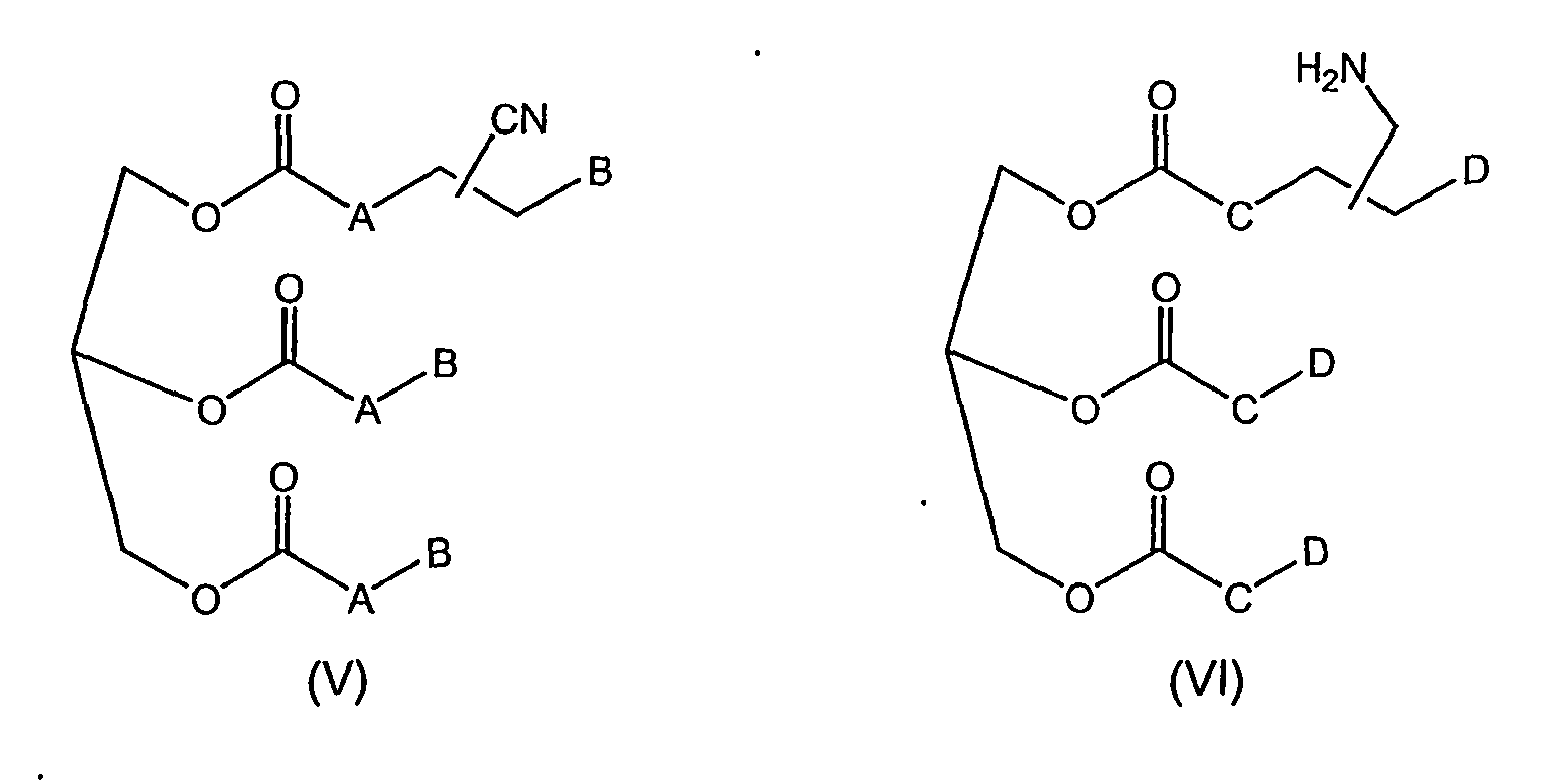
- Glycerol tri-esters with olefinic unsaturation comprising naturally occurring plant and/or animal oils, are important feedstocks within the scope of the present invention. These glycerol tri-esters may be constructed of fatty acid fragments. Products derived from them according to the present invention can be described by formula (V) and/or (VI): wherein, A, B, C and D are defined as above and are of independent identity each time utilized in the structure.
- These compounds are useful as organic synthesis precursors or as lubricants or in surfactant applications.
- Natural glyceridic oils may also contain different degrees of unsaturation, which deviate from the stoichiometry suggested by the oleic acid derivative.
- Other oils useful for this invention include unsaturated plant oils such as tung oil, mono-, di-, and tri-glyceride oils such as oils from soybeans, oil seed rape, linseed, olive oil, castor oil, mustard seed oil, ground nut oil, coconut oil, corn oil, cottonseed oil, palm oil, peanut oil, safflower oil and phenolic oils such as cashew nut shell liquid.
- Carboxylic acids comprising one or more of the compounds of formula (I): are obtained by hydrocyanation of unsaturated carboxylic acids wherein:
- oleic acid as the substrate to provide a nitrile derivative or a mixture of nitrile derivatives. While this invention may provide a variety of isomers described by (I), the process shows preference for the terminal nitrile, (III).
- the product is provided as a single compound or mixtures of isomers, described by (II).
- linoleic acid as the substrate to provide a product comprising nitrile derivatives (VII)-(VIII), and/or the amine derivatives of corresponding structure (VII-A) and (VIII-A).
- the products are provided as single compounds, mixtures of compounds and/or mixtures of isomers.
- Glycerol tri-esters with olefinic unsaturation comprising naturally occurring plant and/or animal oils, are important feedstocks within the scope of the present invention. These glycerol tri-esters may be constructed of fatty acid fragments. Products derived from them according to the present invention can be described by formula (V) and/or (VI): wherein, A, B, C and D are defined as above and are of independent identity each time utilized in the structure.
- These compounds are useful as organic synthesis precursors or as lubricants or in surfactant applications.
- Natural glyceridic oils may also contain different degrees of unsaturation, which deviate from the stochiometry suggested by the oleic acid derivative.
- Other oils useful for this invention include unsaturated plant oils such as tung oil, mono, di, and tri-glyceride oils such as oils from soybeans, oil seed rape, linseed, olive oil, castor oil, mustard seed oil, ground nut oil, coconut oil, corn oil, cottonseed oil, palm oil, peanut oil, safflower oil and phenolic oils such as cashew nut shell liquid.
- unsaturated carboxylic acids especially unsaturated fatty acids and/or oils of fatty acids can be contacted with hydrogen cyanide, in the presence of a catalyst and optionally a promoter at a temperature of about 0°C to about 120°C to yield carboxylic acid derivatives of the formula (I), wherein the catalyst comprises a transition metal, preferentially nickel and an organic phosphorous ligand.
- compounds or mixtures described by (I) (and thus (III) and (V)) may be converted to compounds or mixtures described by (II) (and thus (IV) and (VI)) by contacting compounds or mixtures (I) with hydrogen, in the presence of a transition metal catalyst at a temperature in the range of about 50°C to about 180°C and a pressure in the range of of about 50 to about 5000 psig (340 to 34,480 kPa), optionally in the presence of a solvent.
- a simple extension of this process would encompass the use of simple fatty acid esters as the starting material, instead of fatty acids.
- Such fatty acid esters can be prepared via the reaction of alcohols with fatty acid oils and comprise alkyl and aryl esters. Examples of fatty acid esters include methyl oleate, methyl linoleate, ethyl oleate, butyl oleate and the like.
- the present invention provides a hydrocyanation method for preparing derivatives of unsaturated carboxylic acids, especially fatty acids and/or oils, which contain nitrile groups.
- the present method yields the acid derivative as a mixture of isomers.
- the mixture obtained by the present method generally does not contain the isomers in equal amounts. Instead, the method may yield one or several compounds as main products, while others are formed as byproducts in varying amounts.
- the method can be implemented to favor one set of compounds as the main products.
- the set of compounds favored in this method is a function of process conditions and/or the type of catalyst or catalysts used and/or the type of ligand used in the hydrocyanation reaction and/or the use of an optional promoter in the hydrocyanation reaction.
- both the individual compounds and also the mixtures thereof are within the scope of the present invention.
- the method for making the compounds of the present invention involves a hydrocyanation process with the use of a ligand and a Group VIII metal or compound.
- a hydrocyanation process with the use of a ligand and a Group VIII metal or compound.
- a Group VIII metal or compound thereof is combined with at least one ligand to provide the catalyst.
- the Group VIII Il metals or compounds nickel, cobalt, and palladium compounds are preferred to make the hydrocyanation catalysts.
- a nickel compound is more preferred.
- a zero-valent nickel compound that contains a ligand that can be displaced by a ligand of the prior art is the most preferred source of Group VIII metal or Group VIII metal compound.
- Zero-valent nickel compounds can be prepared or generated according to methods known in the art.
- Three preferred zero-valent nickel compounds are Ni(COD) 2 (COD is 1,5-cyclooctadiene), Ni(P(o-OC 6 H 4 CH 3 ) 3 ) 3 and Ni ⁇ P(O-o-C 6 H 4 CH 3 ) 3 ⁇ 2 (C 2 H 4 ); these are known in the art.
- divalent nickel compounds can be combined with a reducing agent, to serve as a source of zero-valent nickel in the reaction.
- Suitable divalent nickel compounds include compounds of the formula NiX 2 2 wherein X 2 is halide, carboxylate, or acetylacetonate.
- Suitable reducing agents include metal borohydrides, metal aluminum hydrides, metal alkyls, Li, Na, K, Zn, Al or H 2 .
- Elemental nickel, preferably nickel powder, when combined with a halogenated catalyst is also a suitable source of zero-valent nickel.
- Suitable ligands for the present invention contain trivalent phosphorus atoms in which each trivalent phosphorous atom is known as phosphite or phosphinite.
- the ligands useful in the present invention can be bidentate ligands meaning that two trivalent phosphorus atoms in the molecule are each bonded to the same organic group, which bridges the trivalent phosphorus atoms together.
- the ligands in the present invention can also be multidentate with a number of phosphorous atoms in excess of 2 or of polymeric nature in which the ligand/catalyst composition is not homogeneously dissolved in the process mixture.
- Monodentate ligands may be used in place of the ligands of this invention, but they provide low conversion to the desired products and suffer from poor rate and productivity. Their performance is insufficient for commercial applications.
- the preferred ligands in this invention are bidentate phosphite ligands.
- Suitable bidentate phosphites are of the type disclosed in U. S. Patents 5,512,695 ; 5,512,696 ; 5,663,369 ; 5,688,986 ; 5,723,641 ; 5,959,135 ; 6,120,700 ; 6,171,996 ; 6,171,997 ; 6,399,534 , hereby incorporated by reference.
- Suitable bidentate phosphinites are of the type disclosed in U. S. Patents 5,523,453 and 5,693,843 , hereby incorporated by reference.
- the preferred bidentate phosphite ligands are of the following structural formulae: (R 1 O) 2 P(OZO)P(OR 1 ) 2 , (XI)
- R 1 is phenyl, unsubstituted or substituted with one or more C 1 to C 12 alkyl or C 1 to C 12 alkoxy groups; or naphthyl, unsubstituted or substituted with one or more C 1 to C 12 alkyl or C 1 to C 12 alkoxy groups; and Z and Z 1 are independently selected from the group consisting of structural formulae XIV, XV, XVI, XVII, and XVIII wherein:
- the C 1 to C 12 alkyl, and C 1 to C 12 alkoxy groups may be straight chains or branched.
- the ratio of ligand to active nickel can vary from a ligand to nickel ratio of about 0.5:1 to a ligand to nickel ratio of about 100:1. Preferentially the ligand to nickel ratio ranges from about 1:1 to about 4:1.
- the process of this invention is carried out in the presence of one or more Lewis acid promoters that affect both the activity and the selectivity of the catalyst system.
- the promoter may be an inorganic or organometallic compound in which the cation is selected from scandium, titanium, vanadium, chromium, manganese, iron, cobalt, copper, zinc, boron, aluminum, yttrium, zirconium, niobium, molybdenum, cadmium, rhenium and tin.
- Examples include but are not limited to ZnBr 2 , Znl 2 , ZnCl 2 , ZnSO 4 , CuCl 2 , CuCl, Cu(O 3 SCF 3 ) 2 , CoCl 2 , CoI 2 , FeI 2 , FeCl 3 , FeCl 2 , FeCl 2 (THF) 2 , TiCl 4 (THF) 2 , Cl 2 Ti(OiPr) 2 , MnCl 2 , ScCl 3 , AlCl 3 , (C 8 H 17 )AlCl 2 , (C 8 H 17 ) 2 AlCl, (iso-C 4 H 9 ) 2 AlCl, Ph 2 AlCl, PhAlCl 2 , ReCl 5 , ZrCl 4 , NbCl 5 , VCl 3 , CrCl 2 , MoCl 5 , YCl 3 , CdCl 2 , LaCl 3 , Er(O 3 S
- Preferred promoters include FeCl 2 , ZnCl 2 , CoCl 2 , CoI 2 , AlCl 3 , B(C 6 H 5 ) 3 . and (C 6 H 5 ) 3 Sn(O 3 SCF 3 ).
- the mole ratio of promoter to Group VIII transition metal present in the reaction can be within the range of about 1:16 to about 50:1, with 0.5:1 to about 2:1 being preferred.
- the ligand compositions of the present invention may be used to form catalysts, which may be used for the hydrocyanation of unsaturated carboxylic acids, especially fatty acids or esters with or without a Lewis acid promoter.
- the process comprises contacting, in the presence of the catalyst, an unsaturated carboxylic acid or oil or mixtures of one or more of these with a hydrogen cyanide-containing fluid under conditions sufficient to produce a nitrile.
- a hydrogen cyanide-containing fluid Any fluid containing about 1 to 100% HCN can be used. Pure hydrogen cyanide may be used.
- the hydrocyanation process can be carried out, for example, by charging a suitable vessel, such as a reactor, with an unsaturated fatty acid or oil, or mixtures of one or more of these, catalyst and optionally solvent, to form a reaction mixture.
- Hydrogen cyanide can be initially combined with other components to form the mixture. However, it is preferred that HCN be added slowly to the mixture after other components have been combined. Hydrogen cyanide can be delivered as a liquid or as a vapor to the reaction.
- a cyanohydrin can be used as the source of HCN as known in the art.
- Another suitable technique is to charge the vessel with the catalyst and, optionally, solvent and feed both the unsaturated carboxylic acid, the fatty acid or oil and the HCN slowly to the reaction mixture.
- the molar ratio of unsaturated carboxylic acid/ester to catalyst can be varied from about 10:1 to about 10,000:1.
- the molar ratio of HCN:catalyst can be varied from about 5:1 to about 10,000:1.
- the process can be run in continuous or batch mode.
- the reaction mixture is agitated, for example, by stirring or shaking.
- the present compounds can be individually isolated from the reaction mixture, using known conventional methods, such as chromatography or fractional distillation or crystallization.
- the hydrocyanation can be carried out with or without a solvent.
- the solvent if used, can be liquid at the reaction temperature and pressure and inert towards the unsaturated carboxylic acid/oil and the catalyst.
- suitable solvents include hydrocarbons such as benzene, xylene, toluene or combinations thereof; ethers such as tetrahydrofuran (THF), nitriles such as acetonitrile, adiponitrile, or combinations of two or more thereof.
- temperatures in the range of from about 0°C to about 200°C can be used, the range of about 25°C to about 120°C being preferred.
- the process can be run at atmospheric pressure. Pressures of from about 50.6 to about 1013 kPa are preferred. Higher pressures, up to 10,000 kPa or more, can be used, if desired.
- the time required can be in the range of from a few seconds to many hours (such as 2 seconds to 72 hours), depending on the particular conditions and method of operation.
- the present unsaturated carboxylic acid derivatives containing nitrile groups can be used alone or in mixtures with one another, for further functionalization. For example, they can be converted to their corresponding amines by hydrogenation. Thus the nitrile products either alone or as mixtures of isomers may be contacted with hydrogen in the presence of a catalyst, optionally in the presence of a solvent to yield amine compounds.
- the feed i.e. compounds described by (I) either alone or in mixtures of isomers
- the mole ratio of hydrogen to feed is not critical as long as sufficient hydrogen is present to produce the desired derivatives described by (II).
- Hydrogen is preferably used in excess. Hydrogen pressures are generally in the range of about 340 kPa (-50 psig) to about 34,480 kPa (-5000 psig), with about 1480 to about 7000 kPa preferred.
- the hydrogenation process can be conducted at temperatures from about 50°C to about 180°C, preferably from about 65°C to about 100°C.
- Preferred catalysts for hydrogenating nitriles to amines comprise one or more elements from the series of transition metals, particularly useful are iron, cobalt, nickel, rhodium and combinations thereof.
- the hydrogenation catalyst may also comprise one or more elements in addition to the transition metals mentioned above, for example, elements of Group IA (including lithium, sodium and potassium), elements of Group IIA (including magnesium and calcium), titanium, elements of Group VI (including chromium, molybdenum and tungsten), elements of Group VIII (including palladium) and/or aluminum, silicon, boron and/or phosphorous.
- the hydrogenation catalyst can also be in the form of an alloy, including a solid solution of two or more elements.
- the transition metal for hydrogenation can also be supported on an inorganic support such as alumina, magnesium oxide and combinations thereof.
- the metal can be supported on an inorganic support by any means known to one skilled in the art such as, for example, impregnation, co-precipitation, ion exchange, or combinations of two or more thereof.
- the metal can be reduced before the hydrogenation reaction by any means known to one skilled in the art such as, for example, pretreatment with hydrogen, formaldehyde or hydrazine.
- the hydrogenation catalyst can be present in any appropriate physical shape or form. It can be in fluidizable forms, powders, extrudates, tablets, spheres or combinations of two or more thereof.
- the hydrogenation catalyst may be in sponge metal form, for example, the Raney® nickels and Raney® cobalts.
- the molar ratio of hydrogenation catalyst to feed can be any ratio as long as the ratio can catalyze the hydrogenation.
- the weight ratio of hydrogenation catalyst to feed is generally in the range of from about 0.0001:1 to about 1:1, preferably about 0.001:1 to about 0.5:1.
- the catalytic element is supported on an inorganic support or is a portion of an alloy or solid solution, the catalytic element is generally present in the range of from about 0.1 to about 60, preferably about 1 to about 50, and most preferably about 2 to about 50 weight percent based on the total hydrogenation catalyst weight.
- the preferred nitrile hydrogenation catalyst is a sponge metal type catalyst.
- the metallic component is iron, ruthenium, cobalt, nickel or combinations thereof.
- Commercially available catalysts of this type are promoted or un-promoted Raney® Ni or Raney® Co catalysts that can be obtained from W.R. Grace and Co. (Chattanooga, TN), or alternative sponge metal catalysts available, for example, from Activated Metals Corporation (Sevierville, TN) or Degussa (Parsippany, NJ).
- a supported ruthenium catalyst may also be used.
- the hydrogenation can optionally be conducted in the presence of a solvent.
- Suitable solvents include those known in the art as useful for hydrogenation reactions. Examples of these are amines, aliphatic alcohols, aromatic compounds, ethers, esters (including lactones), and amides (including lactams). Specific examples of solvents include: ammonia, toluene, tetrahydrofuran, methanol, ethanol, any isomeric propanol, any isomeric butanol and water. Preferred solvents include ammonia, and toluene. It will be appreciated that the solvent may serve to reduce the viscosity of the system to improve fluidity of the catalyst in the reaction vessel, as well as serve to remove the heat of reaction from the feed and products.
- the solvent may be present in a range of about 1% to about 75% by weight of the total reaction mixture, excluding the catalyst, preferably from about 10% to about 50%.
- a promoter may be used in the hydrogenation process to alter the rate of the reaction and/or alter the selectivity of the reaction.
- Suitable promoters include water, alkali or alkaline earth metal hydroxides, quaternary ammonium hydroxides, quaternary ammonium cyanides, quaternary ammonium fluorides, and combinations of these. Promoters may be present at from about 10 ppm to about 3% by weight of the total reaction mixture, excluding the catalyst, preferably from about 50 ppm to about 1.5%.
- a solution of catalyst was prepared by combining Ni(COD) 2 in toluene with a bidentate phosphite ligand in a ratio of Ni:ligand of 1:1.1. This solution was sampled into a reaction vessel. Oleic acid was added to the reaction vessel, the mole ratio of oleic acid to catalyst was 50:1.
- a solution of promoter was prepared by adding ZnCl 2 to acetonitrile. This promoter solution was added to the reaction mixture adjusting a mole ratio of Ni to Zn of 1:1.
- Hydrogen cyanide was added to the reaction vessel via vapor feed. The hydrogen cyanide reservoir was at room temperature while the reaction vessel was maintained at 50°C.
- a solution of approximately 30g of nitrile derived from soybean oil (comprising compound V) and 170 mL of toluene was prepared.
- the solution was charged to a 300cc stirred pressure reactor with 3g Raney® Co 2724 and 4.5g water.
- the vessel was purged with hydrogen and then charged with hydrogen and heated to 75°C at which point the pressure was adjusted to approximately 500 psig (3447 kPa) with hydrogen.
- the reaction proceeded for ten hours during which hydrogen was constantly replenished to maintain the operating pressure.
- the hydrogen was vented and the product recovered.
- a solution of catalyst was prepared by combining Ni(COD) 2 in toluene with the phosphite ligand in a ratio of Ni:ligand of 1:1.1 if a bidentate ligand was used and in a ratio of Ni:ligand of 1:4.5 if a monodentate ligand was used. This solution was sampled into a reaction vessel. 3-Pentenoic acid was added to the reaction vessel, the ratio of 3-penteneoic acid to catalyst was 50:1.
- a solution of promoter was prepared by adding ZnCl 2 to acetonitrile, this promoter solution was added to the reaction mixture with a mole ratio of Ni to Zn of 1:1.
- Hydrogen cyanide was added to the reaction vessel by vapor feed of evaporating liquid hydrogen cyanide connected via feed tube to the reaction vessel.
- the hydrogen cyanide reservoir was at room temperature while the reaction vessel was maintained at 50°C.
- the vapor feed was maintained for 24 hours after which time the samples were analyzed using standard GC methodology.
- the samples were first derivatized for analysis with a commercial reagent following established procedures (BSTFA, bistrimethylsilyltrifluoroacetamide, for typical use see for example Takao, Yuji et al. in Journal of Health Science (2003), 49(1), 88-90 ).
- BSTFA bistrimethylsilyltrifluoroacetamide
- Linearity is defined as the ratio of concentrations of the 5-cyano-pentanoic acid isomer to the sum of all cyano-pentanoic acid isomers.
- Example Ligand Conversion [%] Linearity [%] 11 76 93 12 85 92 13 79 91 C.ex14 no conversion
Landscapes
- Chemical & Material Sciences (AREA)
- Organic Chemistry (AREA)
- Chemical Kinetics & Catalysis (AREA)
- Health & Medical Sciences (AREA)
- Toxicology (AREA)
- Organic Low-Molecular-Weight Compounds And Preparation Thereof (AREA)
- Low-Molecular Organic Synthesis Reactions Using Catalysts (AREA)
Abstract
Description
- This invention is related to the field of hydrocyanation of olefins and in particular, hydrocyanation of unsaturated carboxylic acids, fatty acids and oils comprising these acids.
- Unsaturated fatty acids and oils comprising unsaturated carboxylic acids are attractive substrates for a variety of applications such as monomers for polymeric materials, as ingredients in composites, as lubricants or as fine chemicals. These materials are especially attractive since they are based on natural sources and therefore offer an environmentally and ecologically responsible route to useful chemicals. Significant effort has been devoted toward further transformations of these long chain unsaturated fatty acids to arrive at new, functional materials.
- Towards this end the current invention provides a process of hydrocyanation of unsaturated and/or poly-unsaturated carboxylic acids, especially fatty acids and/or oils comprising these fatty acids to form the corresponding fatty acid/oil nitrile products. In case of the oils, typical examples are natural occurring oils, for example soybean oil. The products can be mononitriles, dinitriles and/or polynitriles. Furthermore these nitriles can be converted to the corresponding methylene-amines via a hydrogenation reaction.
- Unsaturated carboxylic acids, and especially fatty acids and their derivatives containing nitrile groups are of interest as lubricants, surfactants or precursors to a variety of useful molecules. Typical examples of unsaturated fatty acids, which are naturally occurring, include mono- or polyunsaturated carboxylic acids, such as oleic acid, lauroleic acid, myristoleic acid, palmitoleic acid, linoleic acid, and arachidonic acid. Naturally occurring oils, for example soybean oil, comprise glycerin esters of these unsaturated fatty acids. Other typical useful unsaturated carboxylic acids are, for example, 3-pentenoic acid or 4-pentenoic acid.
- Goertz et al. in Chem. Commun., 1521 (1997) disclosed a hydrocyanation reaction of ω-unsaturated fatty acid esters (i.e. containing a terminal olefin) using nickel phosphine catalysts. The reported yields are undesirable for commercial application. Additionally, it is known in the art that internal olefins, such as those in many naturally occurring fatty acids and esters, are more difficult to react in a hydrocyanation process than terminal olefins, such as those found in ω-unsaturated fatty acid esters.
-
WO 99 06358 A1 - Prior to the present invention, it was not known that unsaturated fatty acids or naturally occurring oils with olefinic unsaturation could be converted selectively in a hydrocyanation process to the corresponding fatty acid derivatives with nitrile groups in high yields. It was also not known that the so formed derivatives of fatty acids containing nitrile groups could be converted selectively in a hydrogenation process to the fatty acid derivatives with the corresponding amine groups. There is a need to access fatty acid derivatives, which have one or more additional functional groups, such as nitriles, amines, alcohols or carboxylic acids. In particular, derivatives of plant oils like soybean oil, which contain one or more additional functional groups are of interest.
- Therefore, there remains a need for specific nitrile derivatives of unsaturated carboxylic acids, especially unsaturated fatty acids and/or oils of unsaturated fatty acids and a method to produce these compounds in general. There is also a need for derivatives of unsaturated fatty acids, which contain amine groups and for a method to produce such derivatives, which contain amine groups. These needs are met by the present invention.
- The present invention is directed to compositions of specific carboxylic acid, fatty acid or oil derivatives containing nitrile groups and methods of their preparation. The preparation involves a hydrocyanation reaction. A method of hydrogenating the nitrile containing carboxylic acid acids obtained by above hydrocyanation to produce amine containing carboxylic acids is also disclosed in this invention.
- The present invention is, therefore, a composition of matter of structural formula III:


- each A is independently a group comprising one or more hydrocarbon fragments comprising -(CH2)w-, alkene containing fragments comprising -CH=CH-, or nitrile containing fragment comprising -(CH2CHCN)- or -(CH(CN)CH2)-, or a combination of two or more of these fragments in any order;
- each B is independently A'-H, wherein A' is a group comprising one or more hydrocarbon fragment comprising -(CH2)w-, alkene containing fragment comprising -CH=CH-, or a nitrile containing fragment comprising -(CH2CHCN)- or -(CH(CN)CH2)-, or a combination of two or more of these fragments in any order; and
- Also disclosed is a hydrocyanation process, said process comprising converting a starting carboxylic acid in the presence of a catalyst to produce a derivative of carboxylic acid comprising one or more compounds of formula (I):

- A is a group comprising one or more hydrocarbon fragments comprising -(CH2)w-, alkene containing fragments comprising -CH=CH-, or nitrile containing fragment comprisings -(CH2CHCN)- or -(CH(CN)CH2)-, or a combination of two or more of these fragments in any order;
- B is A'-H, wherein A' is group comprising one or more hydrocarbon fragment comprising -(CH2)w-, alkene containing fragment comprising -CH=CH-, or a nitrile containing fragment comprising -(CH2CHCN)- or -(CH(CN)CH2)-, or a combination of two or more of these fragments in any order; and
- R is H or a glycerol derivative; and
- Also disclosed is a process of hydrogenation comprising hydrogenating the carboxylic acid derivative to produce acid amine compounds of structural formula (II):

C is a group comprising one or more hydrocarbon fragments comprising -(CH2)x-, alkene containing fragments comprising -CH=CH-, nitrile containing fragments comprising -(CH2CHCN)- or -(CH(CN)CH2)-, or amine containing fragments comprising -(CH2CH(CH2NH2)- or -(CH(CH2NH2)CH2)-, or a combination of one or more of these fragments in any order;
D is H or C'-H wherein C' is a group comprising one or more hydrocarbon fragments comprising -(CH2)x-, alkene containing fragments comprising -CH=CH-, nitrile containing fragments comprising -(CH2CHCN)- or -(CH(CN)CH2)-, or amine containing fragments comprising -(CH2CH(CH2NH2)- or -(CH(CH2NH2)CH2)-, or a combination of two or more of these fragments in any order;
R is H or a glycerol derivative; and
x is 0 or a positive integer, preferably between 0 and 20, wherein x is independently chosen each time it is utilized in the structure. - Notable for this invention is the use of oleic acid as the substrate to provide a nitrile derivative or a mixture of nitrile derivatives. While this invention may provide a variety of isomers described by (I), the process shows preference for the terminal nitrile, (III):

- Additionally, notable is amine derivative (IV) of corresponding structure.

- Glycerol tri-esters with olefinic unsaturation, comprising naturally occurring plant and/or animal oils, are important feedstocks within the scope of the present invention. These glycerol tri-esters may be constructed of fatty acid fragments. Products derived from them according to the present invention can be described by formula (V) and/or (VI):

- These compounds are useful as organic synthesis precursors or as lubricants or in surfactant applications.
- Natural glyceridic oils may also contain different degrees of unsaturation, which deviate from the stoichiometry suggested by the oleic acid derivative. Other oils useful for this invention include unsaturated plant oils such as tung oil, mono-, di-, and tri-glyceride oils such as oils from soybeans, oil seed rape, linseed, olive oil, castor oil, mustard seed oil, ground nut oil, coconut oil, corn oil, cottonseed oil, palm oil, peanut oil, safflower oil and phenolic oils such as cashew nut shell liquid.
- Accordingly, it is one object of the present invention to provide carboxylic acid derivatives and especially fatty acid or oil derivatives containing nitrile groups, as well as a process for preparing them and their corresponding amines. It is another object of the present invention to provide a method for preparing such unsaturated fatty acid or oil derivatives. These and other objects will become apparent in the following detailed description.
- Carboxylic acids comprising one or more of the compounds of formula (I):

- A is a group comprising one or more hydrocarbon fragments comprising -(CH2)w-, alkene containing fragments comprising -CH=CH-, or nitrile containing fragment comprisings -(CH2CHCN)- or -(CH(CN)CH2)-, or a combination of two or more of these fragments in any order;
- B is A'-H, wherein A' is group comprising one or more hydrocarbon fragment comprising -(CH2)w-, alkene containing fragment comprising -CH=CH-, or a nitrile containing fragment comprising -(CH2CHCN)- or -(CH(CN)CH2)-, or a combination of two or more of these fragments in any order; and
- R is H or a glycerol derivative; and
wherein, w is 0 or a positive integer, preferably between 0 and 20.
These carboxylic acid derivatives, especially these fatty acid or oil derivatives containing nitrile groups, either alone, mixtures of these, and/or isomers of these, are also useful as precursors for other useful molecules. For instance, a carboxylic acid comprising one or more compounds of formula (I) can be converted in a hydrogenation reaction to the corresponding amines comprising one or more compounds of the formula (II):
- C is a group comprising one or more hydrocarbon fragments comprising -(CH2)x-, alkene containing fragments comprising -CH=CH-, nitrile containing fragments comprising -(CH2CHCN)- or -(CH(CN)CH2)-, or amine containing fragments comprising -(CH2CH(CH2NH2)- or -(CH(CH2NH2)CH2)-, or a combination of one or more of these fragments in any order;
- D is H or C'-H wherein C' is a group comprising one or more hydrocarbon fragments comprising -(CH2)x-, alkene containing fragments comprising -CH=CH-, nitrile containing fragments comprising -(CH2CHCN)- or -(CH(CN)CH2)-, or amine containing fragments comprising -(CH2CH(CH2NH2)- or -(CH(CH2NH2)CH2)-, or a combination of two or more of these fragments in any order;
R is H or a glycerol derivative; and
x is 0 or a positive integer, preferably between 0 and 20, wherein x is independently chosen each time it is utilized in the structure. - Notable for this invention is the use of oleic acid as the substrate to provide a nitrile derivative or a mixture of nitrile derivatives. While this invention may provide a variety of isomers described by (I), the process shows preference for the terminal nitrile, (III).

- Additionally, notable is amine derivative (IV) of corresponding structure.

- The product is provided as a single compound or mixtures of isomers, described by (II).
- Additionally, notable is the use of linoleic acid as the substrate to provide a product comprising nitrile derivatives (VII)-(VIII), and/or the amine derivatives of corresponding structure (VII-A) and (VIII-A). The products are provided as single compounds, mixtures of compounds and/or mixtures of isomers.


- Glycerol tri-esters with olefinic unsaturation, comprising naturally occurring plant and/or animal oils, are important feedstocks within the scope of the present invention. These glycerol tri-esters may be constructed of fatty acid fragments. Products derived from them according to the present invention can be described by formula (V) and/or (VI):
- These compounds are useful as organic synthesis precursors or as lubricants or in surfactant applications.
- Natural glyceridic oils may also contain different degrees of unsaturation, which deviate from the stochiometry suggested by the oleic acid derivative. Other oils useful for this invention include unsaturated plant oils such as tung oil, mono, di, and tri-glyceride oils such as oils from soybeans, oil seed rape, linseed, olive oil, castor oil, mustard seed oil, ground nut oil, coconut oil, corn oil, cottonseed oil, palm oil, peanut oil, safflower oil and phenolic oils such as cashew nut shell liquid.
- The inventors have discovered that unsaturated carboxylic acids, especially unsaturated fatty acids and/or oils of fatty acids can be contacted with hydrogen cyanide, in the presence of a catalyst and optionally a promoter at a temperature of about 0°C to about 120°C to yield carboxylic acid derivatives of the formula (I), wherein the catalyst comprises a transition metal, preferentially nickel and an organic phosphorous ligand. Further, they have discovered that compounds or mixtures described by (I) (and thus (III) and (V)) may be converted to compounds or mixtures described by (II) (and thus (IV) and (VI)) by contacting compounds or mixtures (I) with hydrogen, in the presence of a transition metal catalyst at a temperature in the range of about 50°C to about 180°C and a pressure in the range of of about 50 to about 5000 psig (340 to 34,480 kPa), optionally in the presence of a solvent. A simple extension of this process would encompass the use of simple fatty acid esters as the starting material, instead of fatty acids. Such fatty acid esters can be prepared via the reaction of alcohols with fatty acid oils and comprise alkyl and aryl esters. Examples of fatty acid esters include methyl oleate, methyl linoleate, ethyl oleate, butyl oleate and the like.
- Thus, in one embodiment, the present invention provides a hydrocyanation method for preparing derivatives of unsaturated carboxylic acids, especially fatty acids and/or oils, which contain nitrile groups. Generally, the present method yields the acid derivative as a mixture of isomers. The mixture obtained by the present method generally does not contain the isomers in equal amounts. Instead, the method may yield one or several compounds as main products, while others are formed as byproducts in varying amounts. The method can be implemented to favor one set of compounds as the main products. The set of compounds favored in this method is a function of process conditions and/or the type of catalyst or catalysts used and/or the type of ligand used in the hydrocyanation reaction and/or the use of an optional promoter in the hydrocyanation reaction. However, it is to be understood that both the individual compounds and also the mixtures thereof are within the scope of the present invention.
- The method for making the compounds of the present invention involves a hydrocyanation process with the use of a ligand and a Group VIII metal or compound. Optionally, one may use a Lewis acid in the process as a promoter, and one may optionally use a solvent.
- Generally, a Group VIII metal or compound thereof is combined with at least one ligand to provide the catalyst. Among the Group VIII Il metals or compounds, nickel, cobalt, and palladium compounds are preferred to make the hydrocyanation catalysts. A nickel compound is more preferred. A zero-valent nickel compound that contains a ligand that can be displaced by a ligand of the prior art is the most preferred source of Group VIII metal or Group VIII metal compound.
- Zero-valent nickel compounds can be prepared or generated according to methods known in the art. Three preferred zero-valent nickel compounds are Ni(COD)2 (COD is 1,5-cyclooctadiene), Ni(P(o-OC6H4CH3)3)3 and Ni{P(O-o-C6H4CH3)3}2(C2H4); these are known in the art.
- Alternatively, divalent nickel compounds can be combined with a reducing agent, to serve as a source of zero-valent nickel in the reaction. Suitable divalent nickel compounds include compounds of the formula NiX2 2 wherein X2 is halide, carboxylate, or acetylacetonate. Suitable reducing agents include metal borohydrides, metal aluminum hydrides, metal alkyls, Li, Na, K, Zn, Al or H2. Elemental nickel, preferably nickel powder, when combined with a halogenated catalyst is also a suitable source of zero-valent nickel.
- Suitable ligands for the present invention contain trivalent phosphorus atoms in which each trivalent phosphorous atom is known as phosphite or phosphinite. The ligands useful in the present invention can be bidentate ligands meaning that two trivalent phosphorus atoms in the molecule are each bonded to the same organic group, which bridges the trivalent phosphorus atoms together. The ligands in the present invention can also be multidentate with a number of phosphorous atoms in excess of 2 or of polymeric nature in which the ligand/catalyst composition is not homogeneously dissolved in the process mixture. Monodentate ligands, may be used in place of the ligands of this invention, but they provide low conversion to the desired products and suffer from poor rate and productivity. Their performance is insufficient for commercial applications. The preferred ligands in this invention are bidentate phosphite ligands.
- Suitable bidentate phosphites are of the type disclosed in
U. S. Patents 5,512,695 ;5,512,696 ;5,663,369 ;5,688,986 ;5,723,641 ;5,959,135 ;6,120,700 ;6,171,996 ;6,171,997 ;6,399,534 , hereby incorporated by reference. Suitable bidentate phosphinites are of the type disclosed inU. S. Patents 5,523,453 and 5,693,843 , hereby incorporated by reference. - The preferred bidentate phosphite ligands are of the following structural formulae:
(R1O)2P(OZO)P(OR1)2, (XI)

- In formulae XI, XII and XIII, R1 is phenyl, unsubstituted or substituted with one or more C1 to C12 alkyl or C1 to C12 alkoxy groups; or naphthyl, unsubstituted or substituted with one or more C1 to C12 alkyl or C1 to C12 alkoxy groups; and Z and Z1 are independently selected from the group consisting of structural formulae XIV, XV, XVI, XVII, and XVIII

- R2, R3, R4, R5, R6, R7, R8, and R9 are independently selected from H, C1 to C12 alkyl, and C1 to C12 alkoxy;
- W is O, S, or CH(R10); and
- R10 is H or C1 to C12 alkyl.

- R11 and R12 are independently selected from H, C1 to C12 alkyl, and C1 to C12 alkoxy; and CO2R13;
- R13 is C1 to C12 alkyl or C6 to C10 aryl, unsubstituted or substituted. with C1 to C4 alkyl;
- Y is O, S, CH(R14); and
- R14 is H or C1 to C12 alkyl.

- R15 is selected from H, C1 to C12 alkyl, and C1 to C12 alkoxy; and CO2R16; and
- R16 is C1 to C12 alkyl or C6 to C10 aryl, unsubstituted or substituted with C1 to C4 alkyl.
- In the structural formulae X through XVIII, the C1 to C12 alkyl, and C1 to C12 alkoxy groups may be straight chains or branched.
- The ratio of ligand to active nickel can vary from a ligand to nickel ratio of about 0.5:1 to a ligand to nickel ratio of about 100:1. Preferentially the ligand to nickel ratio ranges from about 1:1 to about 4:1.
- Preferably, the process of this invention is carried out in the presence of one or more Lewis acid promoters that affect both the activity and the selectivity of the catalyst system. The promoter may be an inorganic or organometallic compound in which the cation is selected from scandium, titanium, vanadium, chromium, manganese, iron, cobalt, copper, zinc, boron, aluminum, yttrium, zirconium, niobium, molybdenum, cadmium, rhenium and tin. Examples include but are not limited to ZnBr2, Znl2, ZnCl2, ZnSO4, CuCl2, CuCl, Cu(O3SCF3)2, CoCl2, CoI2, FeI2, FeCl3, FeCl2, FeCl2(THF)2, TiCl4 (THF)2, Cl2Ti(OiPr)2, MnCl2, ScCl3, AlCl3, (C8H17)AlCl2, (C8H17)2AlCl, (iso-C4H9)2AlCl, Ph2AlCl, PhAlCl2, ReCl5, ZrCl4, NbCl5, VCl3, CrCl2, MoCl5, YCl3, CdCl2, LaCl3, Er(O3SCF3)3, Yb(O2CCF3)3, SmCl3, B(C6H5)3, R40Sn(O3SCF3) where R40 is an alkyl or aryl group. Preferred promoters include FeCl2, ZnCl2, CoCl2, CoI2, AlCl3, B(C6H5)3. and (C6H5)3Sn(O3SCF3). The mole ratio of promoter to Group VIII transition metal present in the reaction can be within the range of about 1:16 to about 50:1, with 0.5:1 to about 2:1 being preferred.
- The ligand compositions of the present invention may be used to form catalysts, which may be used for the hydrocyanation of unsaturated carboxylic acids, especially fatty acids or esters with or without a Lewis acid promoter.
- The process comprises contacting, in the presence of the catalyst, an unsaturated carboxylic acid or oil or mixtures of one or more of these with a hydrogen cyanide-containing fluid under conditions sufficient to produce a nitrile. Any fluid containing about 1 to 100% HCN can be used. Pure hydrogen cyanide may be used.
- The hydrocyanation process can be carried out, for example, by charging a suitable vessel, such as a reactor, with an unsaturated fatty acid or oil, or mixtures of one or more of these, catalyst and optionally solvent, to form a reaction mixture. Hydrogen cyanide can be initially combined with other components to form the mixture. However, it is preferred that HCN be added slowly to the mixture after other components have been combined. Hydrogen cyanide can be delivered as a liquid or as a vapor to the reaction. As an alternative, a cyanohydrin can be used as the source of HCN as known in the art.
- Another suitable technique is to charge the vessel with the catalyst and, optionally, solvent and feed both the unsaturated carboxylic acid, the fatty acid or oil and the HCN slowly to the reaction mixture.
- The molar ratio of unsaturated carboxylic acid/ester to catalyst can be varied from about 10:1 to about 10,000:1. The molar ratio of HCN:catalyst can be varied from about 5:1 to about 10,000:1. The process can be run in continuous or batch mode.
- Preferably, the reaction mixture is agitated, for example, by stirring or shaking. The present compounds can be individually isolated from the reaction mixture, using known conventional methods, such as chromatography or fractional distillation or crystallization.
- The hydrocyanation can be carried out with or without a solvent. The solvent, if used, can be liquid at the reaction temperature and pressure and inert towards the unsaturated carboxylic acid/oil and the catalyst. Examples of suitable solvents include hydrocarbons such as benzene, xylene, toluene or combinations thereof; ethers such as tetrahydrofuran (THF), nitriles such as acetonitrile, adiponitrile, or combinations of two or more thereof.
- The exact temperature is dependent to a certain extent on the particular catalyst being used, and the desired reaction rate. Normally, temperatures in the range of from about 0°C to about 200°C can be used, the range of about 25°C to about 120°C being preferred.
- The process can be run at atmospheric pressure. Pressures of from about 50.6 to about 1013 kPa are preferred. Higher pressures, up to 10,000 kPa or more, can be used, if desired.
- The time required can be in the range of from a few seconds to many hours (such as 2 seconds to 72 hours), depending on the particular conditions and method of operation.
- The present unsaturated carboxylic acid derivatives containing nitrile groups can be used alone or in mixtures with one another, for further functionalization. For example, they can be converted to their corresponding amines by hydrogenation. Thus the nitrile products either alone or as mixtures of isomers may be contacted with hydrogen in the presence of a catalyst, optionally in the presence of a solvent to yield amine compounds.
- During the hydrogenation process the feed (i.e. compounds described by (I) either alone or in mixtures of isomers) is contacted with hydrogen. The mole ratio of hydrogen to feed is not critical as long as sufficient hydrogen is present to produce the desired derivatives described by (II). Hydrogen is preferably used in excess. Hydrogen pressures are generally in the range of about 340 kPa (-50 psig) to about 34,480 kPa (-5000 psig), with about 1480 to about 7000 kPa preferred. The hydrogenation process can be conducted at temperatures from about 50°C to about 180°C, preferably from about 65°C to about 100°C.
- Preferred catalysts for hydrogenating nitriles to amines comprise one or more elements from the series of transition metals, particularly useful are iron, cobalt, nickel, rhodium and combinations thereof. The hydrogenation catalyst may also comprise one or more elements in addition to the transition metals mentioned above, for example, elements of Group IA (including lithium, sodium and potassium), elements of Group IIA (including magnesium and calcium), titanium, elements of Group VI (including chromium, molybdenum and tungsten), elements of Group VIII (including palladium) and/or aluminum, silicon, boron and/or phosphorous. The hydrogenation catalyst can also be in the form of an alloy, including a solid solution of two or more elements.
- The transition metal for hydrogenation can also be supported on an inorganic support such as alumina, magnesium oxide and combinations thereof. The metal can be supported on an inorganic support by any means known to one skilled in the art such as, for example, impregnation, co-precipitation, ion exchange, or combinations of two or more thereof. The metal can be reduced before the hydrogenation reaction by any means known to one skilled in the art such as, for example, pretreatment with hydrogen, formaldehyde or hydrazine.
- The hydrogenation catalyst can be present in any appropriate physical shape or form. It can be in fluidizable forms, powders, extrudates, tablets, spheres or combinations of two or more thereof. The hydrogenation catalyst may be in sponge metal form, for example, the Raney® nickels and Raney® cobalts. The molar ratio of hydrogenation catalyst to feed can be any ratio as long as the ratio can catalyze the hydrogenation. The weight ratio of hydrogenation catalyst to feed is generally in the range of from about 0.0001:1 to about 1:1, preferably about 0.001:1 to about 0.5:1. If the catalytic element is supported on an inorganic support or is a portion of an alloy or solid solution, the catalytic element is generally present in the range of from about 0.1 to about 60, preferably about 1 to about 50, and most preferably about 2 to about 50 weight percent based on the total hydrogenation catalyst weight.
- It will be appreciated that one skilled in the art will select the catalyst to optimize the rate of reaction, selectivity of reaction and the level of catalyst leaching. The preferred nitrile hydrogenation catalyst is a sponge metal type catalyst. The metallic component is iron, ruthenium, cobalt, nickel or combinations thereof. Commercially available catalysts of this type are promoted or un-promoted Raney® Ni or Raney® Co catalysts that can be obtained from W.R. Grace and Co. (Chattanooga, TN), or alternative sponge metal catalysts available, for example, from Activated Metals Corporation (Sevierville, TN) or Degussa (Parsippany, NJ). A supported ruthenium catalyst may also be used.
- The hydrogenation can optionally be conducted in the presence of a solvent. Suitable solvents include those known in the art as useful for hydrogenation reactions. Examples of these are amines, aliphatic alcohols, aromatic compounds, ethers, esters (including lactones), and amides (including lactams). Specific examples of solvents include: ammonia, toluene, tetrahydrofuran, methanol, ethanol, any isomeric propanol, any isomeric butanol and water. Preferred solvents include ammonia, and toluene. It will be appreciated that the solvent may serve to reduce the viscosity of the system to improve fluidity of the catalyst in the reaction vessel, as well as serve to remove the heat of reaction from the feed and products. The solvent may be present in a range of about 1% to about 75% by weight of the total reaction mixture, excluding the catalyst, preferably from about 10% to about 50%.
- Optionally, a promoter may be used in the hydrogenation process to alter the rate of the reaction and/or alter the selectivity of the reaction. Suitable promoters include water, alkali or alkaline earth metal hydroxides, quaternary ammonium hydroxides, quaternary ammonium cyanides, quaternary ammonium fluorides, and combinations of these. Promoters may be present at from about 10 ppm to about 3% by weight of the total reaction mixture, excluding the catalyst, preferably from about 50 ppm to about 1.5%.
- Having generally described this invention, a further understanding can be obtained by reference to certain specific examples, which are provided herein for purpose of illustration only and are not intended to be limiting.
- A solution of catalyst was prepared by combining Ni(COD)2 in toluene with a bidentate phosphite ligand in a ratio of Ni:ligand of 1:1.1. This solution was sampled into a reaction vessel. Oleic acid was added to the reaction vessel, the mole ratio of oleic acid to catalyst was 50:1. A solution of promoter was prepared by adding ZnCl2 to acetonitrile. This promoter solution was added to the reaction mixture adjusting a mole ratio of Ni to Zn of 1:1. Hydrogen cyanide was added to the reaction vessel via vapor feed. The hydrogen cyanide reservoir was at room temperature while the reaction vessel was maintained at 50°C. The vapor feed was maintained for 24 hours after which time the samples were analyzed using standard GC methodology for products. The samples were first derivatized for analysis with a commercial reagent following established procedures (BSTFA, bistrimethylsilyltrifluoroacetamide, for typical use see for example Takao, Yuji et al. in Journal of Health Science (2003), 49(1), 88-90). All products were analyzed by GC-MS and NMR spectroscopy. Linearity is defined by the ratio of concentrations of the linear acid nitrile product to the sum of all acid nitrile products.
Entry Ligand Conversion
[%]Linearity
[%]1 
33 73 2 
52 75 3 
34 68 4 
31 63 - In a 100 mL flask soy bean oil (30g) was mixed with a toluene (16g) solution of Ni(COD)2 (0.31g) and the following ligand (1.03g):

- A solution of approximately 30g of nitrile derived from soybean oil (comprising compound V) and 170 mL of toluene was prepared. The solution was charged to a 300cc stirred pressure reactor with 3g Raney® Co 2724 and 4.5g water. The vessel was purged with hydrogen and then charged with hydrogen and heated to 75°C at which point the pressure was adjusted to approximately 500 psig (3447 kPa) with hydrogen. The reaction proceeded for ten hours during which hydrogen was constantly replenished to maintain the operating pressure. The hydrogen was vented and the product recovered. Infrared and nuclear magnetic spectra of the product were consistent with the formation of the amine product (comprising compound VI) (IR: N-H 3350cm-1, C=O 1742cm-1).
- To a 100 mL stirred pressure vessel were added 4.5g of oleic acid derived nitrile (comprising compound (III) and isomers), 20g tetrahydrofuran, 0.3g Raney® Co 2724 and 0.3g water. The vessel was purged with hydrogen and 21g anhydrous ammonia was added. The vessel was then charged with hydrogen and heated to 100°C at which point the pressure was adjusted to approximately 900 psig (6205 kPa) with hydrogen. The reaction proceeded for 335 minutes during which hydrogen was constantly replenished to maintain the operating pressure. The hydrogen and ammonia were vented and the product recovered. The product was sparingly soluble in common solvents such as tetrahydrofuran. Infrared and nuclear magnetic spectra of the product were consistent with the formation of the amine (IV). A probe mass spectrum further confirmed the identity of the desired product (mass 313.298).
- In a 500 mL flask linoleic acid (25g, 0.09 mol) was mixed with a toluene (5g) solution of Ni(COD)2 (0.16g, 0.6 mmol) and the following ligand (0.61g, 0.8 mmol).

- To this was added a solution of ZnCl2 (0.09g, 0.65 mmol) in acetonitrile (5g). A solution of hydrogen cyanide (4.3g, 0.16 mol) in acetonitrile (6.5g) was prepared and added to the above mixture using a syringe pump. After a reaction time of 26 hours at 50 °C a conversion of 87% of linoleic acid to nitrile products was achieved. By GC (BSTFA method) a product mixture of 90% linoleic acid nitrile and 10% linoleic acid dinitrile was observed.
- To a 100 mL stirred pressure vessel were added 2.7g of linoleic acid derived nitriles (comprising compound (VII) and isomers), 20g tetrahydrofuran, 0.5g Raney® Co 2724 and 1 g water. The vessel was purged with hydrogen and 20g anhydrous ammonia were added. The vessel was then charged with hydrogen and heated to 85°C at which point the pressure was adjusted to approximately 900 psig (6205 kPa) with hydrogen. The reactor conditions were maintained for 360 minutes, though a shorter time may have been sufficient. The hydrogen and ammonia were vented and the product recovered. A portion of the product was treated with excess bis(trimethylsilyl)trifluoroacetamide (BSTFA). Gas chromatography showed a major product peak accounting for 86% yield. A mass spectrum of the major peak from the product was consistent with formation of the amine (VII-A) (m/z = 455, product plus two derivatizing trimethylsilyl groups).
- In a 500 mL flask 3-pentenoic acid (10g, 0.1 mol) was mixed with a toluene (5g) solution of Ni(COD)2 (0.275g, 1 mmol) and the following ligand (1.14g, 1.35 mmol).

- To this was added a solution of ZnCl2 (0.15g, 1.1 mmol) in acetonitrile (5 ml). A solution of hydrogen cyanide (5.4g, 0.2 mol) in acetonitrile (8.1g) was prepared and added to the above mixture using a syringe pump. The reaction mixture was maintained at 50°C and the addition stopped after 18 hours. The product was analyzed after derivatization using BSTFA and a 50% conversion to cyano-pentanoic acid was observed.
- A solution of catalyst was prepared by combining Ni(COD)2 in toluene with the phosphite ligand in a ratio of Ni:ligand of 1:1.1 if a bidentate ligand was used and in a ratio of Ni:ligand of 1:4.5 if a monodentate ligand was used. This solution was sampled into a reaction vessel. 3-Pentenoic acid was added to the reaction vessel, the ratio of 3-penteneoic acid to catalyst was 50:1. A solution of promoter was prepared by adding ZnCl2 to acetonitrile, this promoter solution was added to the reaction mixture with a mole ratio of Ni to Zn of 1:1. Hydrogen cyanide was added to the reaction vessel by vapor feed of evaporating liquid hydrogen cyanide connected via feed tube to the reaction vessel. The hydrogen cyanide reservoir was at room temperature while the reaction vessel was maintained at 50°C. The vapor feed was maintained for 24 hours after which time the samples were analyzed using standard GC methodology. The samples were first derivatized for analysis with a commercial reagent following established procedures (BSTFA, bistrimethylsilyltrifluoroacetamide, for typical use see for example Takao, Yuji et al. in Journal of Health Science (2003), 49(1), 88-90). The products were analyzed by GC-MS and NMR spectroscopy. Linearity is defined as the ratio of concentrations of the 5-cyano-pentanoic acid isomer to the sum of all cyano-pentanoic acid isomers.
Example Ligand Conversion
[%]Linearity
[%]11 
76 93 12 
85 92 13 
79 91 C.ex14 
no conversion - Various modifications, alterations, additions or substitutions of the process and compositions of this invention will be apparent to those skilled in the art without departing from the spirit and scope of this invention. This invention is not limited to the illustrative embodiments set forth herein, but rather is defined by the following claims.
- Further aspects of the present invention are:-
- Aspect 1. A composition of matter of structural formula III:

- Aspect 2. A composition of matter of structural formula V:

each A is independently a group comprising one or more hydrocarbon fragments comprising -(CH2)w-, alkene containing fragments comprising -CH=CH-, or nitrile containing fragment comprising -(CH2CHCN)- or -(CH(CN)CH2)-, or a combination of two or more of these fragments in any order;
each B is independently A'-H, wherein A' is a group comprising one or more hydrocarbon fragment comprising -(CH2)w-, alkene containing fragment comprising -CH=CH-, or a nitrile containing fragment comprising -(CH2CHCN)- or -(CH(CN)CH2)-, or a combination of two or more of these fragments in any order; and
wherein, w is independently 0 or a positive integer, preferably between 0 and 20.
Claims (11)
- A hydrocyanation process, said process comprising converting a starting carboxylic acid in the presence of a catalyst to produce a derivative of carboxylic acid comprising one or more compounds of formula (I):
 A is a group comprising one or more hydrocarbon fragments comprising -(CH2)w-, alkene containing fragments comprising -CH=CH-, or nitrile containing fragment comprising -(CH2CHCN)- or -(CH(CN)CH2)-, or a combination of two or more of these fragments in any order;B is A'-H, wherein A' is group comprising one or more hydrocarbon fragment comprising -(CH2)w-, alkene containing fragment comprising -CH=CH-, or a nitrile containing fragment comprising -(CH2CHCN)- or -(CH(CN)CH2)-, or a combination of two or more of these fragments in any order; andR is H or a glycerol derivative; andwherein, w is 0 or a positive integer, preferably between 0 and 20.
 - The process of claim 1 wherein the starting carboxylic acid is oleic acid.
- The processing of claim 1 wherein the starting carboxylic acid is soybean oil.
- The process of claim 1 wherein the starting carboxylic acid is linoleic acid.
- The process of claim 1 wherein the starting carboxylic acid is 3-pentenoic acid.
- The process of claim 1 wherein the catalyst comprises an organic phosphorus ligand and a Group VIII element.
- The process of claim 6 wherein the Group VIII element is selected from the group consisting of nickel, cobalt and palladium.
- The process of claim 7 wherein the ligand is selected from the group consisting of a bidentate phosphite ligand of the following structural formulae:
(R1O)2P(OZO)P(OR1)2, (XI)

R1 is phenyl, unsubstituted or substituted with one or more C1 to C12 alkyl or C1 to C12 alkoxy groups; or naphthyl, unsubstituted or substituted with one or more C1 to C12 alkyl or C1 to C12 alkoxy groups; and
Z and Z1 are independently selected from the group consisting of the following structural formulae XIV, XV, XVI, XVII, and XVIII:
R2, R3, R4, R5, R6, R7, R8, and R9 are independently selected from the group consisting of H, C1 to C12 alkyl, and C1 to C12 alkoxy;
W is O, S, or CH(R10);
R10 is H or a C1 to C12 alkyl;
R11 and R12 are independently selected from the group consisting of H, C1 to C12 alkyl, and C1 to C12 alkoxy; and CO2R13;
R13 is C1 to C12 alkyl or C6 to C10 aryl, unsubstituted or substituted with C1 to C4 alkyl;
Y is O, S, CH(R14);
R14 is H or a C1 to C12 alkyl;
R15 is selected from the group consisting of H, C1 to C12 alkyl, and C1 to C12 alkoxy, and CO2R16; and
R16 is a C1 to C12 alkyl or a C6 to C10 aryl, unsubstituted or substituted with a C1 to C4 alkyl. - The process of claim 1 wherein the carboxylic acid derivative is a linear carboxylic acid.
- A process of claim 1 further comprising hydrogenating the carboxylic acid derivative to produce acid amine compounds of structural formula (II):

C is a group comprising one or more hydrocarbon fragments comprising -(CH2)x-, alkene containing fragments comprising -CH=CH-, nitrile containing fragments comprising -(CH2CHCN)- or -(CH(CN)CH2-, or amine containing fragments comprising -(CH2CH(CH2NH2)- or -(CH(CH2NH2)CH2)-, or a combination of one or more of these fragments in any order;
D is H or C'-H wherein C' is a group comprising one or more hydrocarbon fragments comprising -(CH2)x-, alkene containing fragments comprising -CH=CH-, nitrile containing fragments comprising -(CH2CHCN)- or -(CH(CN)CH2)-, or amine containing fragments comprising -(CH2CH(CH2NH2)- or -(CH(CH2NH2)CH2)-, or a combination of two or more of these fragments in any order;
R is H or a glycerol derivative; and
x is 0 or a positive integer, preferably between 0 and 20, wherein x is independently chosen each time it is utilized in the structure. - The process of claim 10 wherein the carboxylic acid derivative is contacted with hydrogen in the presence of a catalyst at a temperature in the range of about 60°C to about 200°C and a pressure in the range of about 340 kPa to about 34,480 kPa.
Priority Applications (1)
| Application Number | Priority Date | Filing Date | Title |
|---|---|---|---|
| EP10175248A EP2295400A3 (en) | 2003-09-11 | 2004-09-08 | Process of hydrocyanation of unsaturated carboxylic acid derivatives |
Applications Claiming Priority (2)
| Application Number | Priority Date | Filing Date | Title |
|---|---|---|---|
| US50192703P | 2003-09-11 | 2003-09-11 | |
| EP04783415A EP1663957B1 (en) | 2003-09-11 | 2004-09-08 | Process of hydrocyanation of unsaturated carboxylic acid derivatives |
Related Parent Applications (1)
| Application Number | Title | Priority Date | Filing Date |
|---|---|---|---|
| EP04783415A Division EP1663957B1 (en) | 2003-09-11 | 2004-09-08 | Process of hydrocyanation of unsaturated carboxylic acid derivatives |
Publications (2)
| Publication Number | Publication Date |
|---|---|
| EP2058298A2 true EP2058298A2 (en) | 2009-05-13 |
| EP2058298A3 EP2058298A3 (en) | 2009-08-19 |
Family
ID=34312320
Family Applications (4)
| Application Number | Title | Priority Date | Filing Date |
|---|---|---|---|
| EP09001657A Withdrawn EP2058298A3 (en) | 2003-09-11 | 2004-09-08 | Process of hydrocyanation of unsaturated carboxylic acid derivatives |
| EP09075111A Withdrawn EP2154127A3 (en) | 2003-09-11 | 2004-09-08 | Conversion of hydrocyanated unsaturated carboxylic acid derivatives into amines |
| EP04783415A Expired - Lifetime EP1663957B1 (en) | 2003-09-11 | 2004-09-08 | Process of hydrocyanation of unsaturated carboxylic acid derivatives |
| EP10175248A Withdrawn EP2295400A3 (en) | 2003-09-11 | 2004-09-08 | Process of hydrocyanation of unsaturated carboxylic acid derivatives |
Family Applications After (3)
| Application Number | Title | Priority Date | Filing Date |
|---|---|---|---|
| EP09075111A Withdrawn EP2154127A3 (en) | 2003-09-11 | 2004-09-08 | Conversion of hydrocyanated unsaturated carboxylic acid derivatives into amines |
| EP04783415A Expired - Lifetime EP1663957B1 (en) | 2003-09-11 | 2004-09-08 | Process of hydrocyanation of unsaturated carboxylic acid derivatives |
| EP10175248A Withdrawn EP2295400A3 (en) | 2003-09-11 | 2004-09-08 | Process of hydrocyanation of unsaturated carboxylic acid derivatives |
Country Status (8)
| Country | Link |
|---|---|
| US (1) | US7737294B2 (en) |
| EP (4) | EP2058298A3 (en) |
| JP (1) | JP2007505123A (en) |
| CN (1) | CN1878748B (en) |
| DE (1) | DE602004022429D1 (en) |
| MX (1) | MXPA06002667A (en) |
| TW (1) | TWI339200B (en) |
| WO (1) | WO2005026106A1 (en) |
Families Citing this family (16)
| Publication number | Priority date | Publication date | Assignee | Title |
|---|---|---|---|---|
| US6906218B2 (en) * | 2002-12-18 | 2005-06-14 | Invista North America S.A.R.L. | Cyclohexane derivatives and methods for their preparation |
| FR2849027B1 (en) * | 2002-12-23 | 2005-01-21 | Rhodia Polyamide Intermediates | PROCESS FOR THE SYNTHESIS OF COMPOUNDS COMPRISING NITRIL FUNCTIONS FROM ETHYLENE-UNSATURATED COMPOUNDS |
| FR2850966B1 (en) | 2003-02-10 | 2005-03-18 | Rhodia Polyamide Intermediates | PROCESS FOR PRODUCING DINITRIL COMPOUNDS |
| FR2854892B1 (en) * | 2003-05-12 | 2005-06-24 | Rhodia Polyamide Intermediates | PROCESS FOR PRODUCING DINITRILES |
| FR2854891B1 (en) | 2003-05-12 | 2006-07-07 | Rhodia Polyamide Intermediates | PROCESS FOR PREPARING DINITRILES |
| EP1856208B1 (en) | 2005-01-10 | 2016-12-28 | Elevance Renewable Sciences, Inc. | Wax composition containing metathesis products and method for making an article by extrusion thereof |
| US8888908B2 (en) | 2006-03-07 | 2014-11-18 | Elevance Renewable Sciences, Inc. | Colorant compositions comprising metathesized unsaturated polyol esters |
| BRPI0708675B1 (en) | 2006-03-07 | 2017-04-04 | Elevance Renewable Sciences | compositions comprising metathesis unsaturated polyol esters and personal care articles comprising said compositions |
| EP1996598B1 (en) * | 2006-03-17 | 2013-10-16 | Invista Technologies S.à.r.l. | Method for the purification of triorganophosphites by treatment with a basic additive |
| WO2008010961A2 (en) | 2006-07-13 | 2008-01-24 | Elevance Renewable Sciences, Inc. | Synthesis of terminal alkenes from internal alkenes and ethylene via olefin metathesis |
| US7709674B2 (en) * | 2006-07-14 | 2010-05-04 | Invista North America S.A R.L | Hydrocyanation process with reduced yield losses |
| CN101558027B (en) | 2006-10-13 | 2013-10-16 | 埃莱文斯可更新科学公司 | Methods of making alpha, omega-dicarboxylic acid alkene derivatives by double decomposition |
| CN102123979A (en) | 2006-10-13 | 2011-07-13 | 埃莱文斯可更新科学公司 | Process for the synthesis of terminal olefins from internal olefins by olefin metathesis |
| WO2008048520A2 (en) * | 2006-10-13 | 2008-04-24 | Elevance Renewable Sciences, Inc. | Methods of making organic compounds by metathesis and hydrocyanation |
| FR2938533B1 (en) * | 2008-11-17 | 2010-11-19 | Arkema France | PROCESS FOR SYNTHESIZING AN OMEGA-AMINOACIDE OR ESTERING FROM A MONO-UNSATURATED FATTY ACID OR ESTER |
| EP2797983A2 (en) * | 2012-03-13 | 2014-11-05 | Invista Technologies S.à.r.l. | Nylon polymer and process |
Citations (11)
| Publication number | Priority date | Publication date | Assignee | Title |
|---|---|---|---|---|
| US5512695A (en) | 1994-04-14 | 1996-04-30 | E. I. Du Pont De Nemours And Company | Bidentate phosphite and nickel catalyst compositions for hydrocyanation of monoolefins |
| US5512696A (en) | 1995-07-21 | 1996-04-30 | E. I. Du Pont De Nemours And Company | Hydrocyanation process and multidentate phosphite and nickel catalyst composition therefor |
| US5523453A (en) | 1995-03-22 | 1996-06-04 | E. I. Du Pont De Nemours And Company | Process for hydrocyanation |
| US5663369A (en) | 1994-10-07 | 1997-09-02 | E. I. Du Pont De Nemours And Company | Hydrocyanation process and multidentate phosphite and nickel catalyst composition therefor |
| US5688986A (en) | 1993-11-23 | 1997-11-18 | E. I. Du Pont De Nemours And Company | Processes and catalyst compositions for hydrocyanation of monoolefins |
| US5693843A (en) | 1995-12-22 | 1997-12-02 | E. I. Du Pont De Nemours And Company | Process for hydrocyanation of diolefins and isomerization of nonconjugated 2 alkyl-3-monoalkenenitriles |
| WO1999006358A1 (en) | 1997-07-29 | 1999-02-11 | E.I. Du Pont De Nemours And Company | Hydrocyanation processes and multidentate phosphite ligand and nickel catalyst compositions therefor |
| US5959135A (en) | 1997-07-29 | 1999-09-28 | E. I. Du Pont De Nemours And Company | Hydrocyanation processes and multidentate phosphite ligand and nickel catalyst compositions thereof |
| US6120700A (en) | 1997-07-29 | 2000-09-19 | E. I. Du Pont De Nemours And Company | Hydrocyanation of diolefins and isomerization of nonconjugated 2-alkyl-3-monoalkenenitriles |
| US6171997B1 (en) | 1997-07-29 | 2001-01-09 | E. I. Du Pont De Nemours And Company | Hydrocyanation of diolefins and isomerization of nonconjugated 2-aklyl-3-monoalkenenitriles |
| US6399534B2 (en) | 1999-09-20 | 2002-06-04 | E. I. Du Pont De Nemours And Company | Bidentate organic phosphite ligands and compositions |
Family Cites Families (9)
| Publication number | Priority date | Publication date | Assignee | Title |
|---|---|---|---|---|
| US2411593A (en) * | 1943-08-11 | 1946-11-26 | Shell Dev | Corrosion protection of metals |
| US2426056A (en) | 1945-07-16 | 1947-08-19 | Montelair Res Corp | Cyanoacetic acid esters of polyhydric alcohols and process of making same |
| GB1104115A (en) | 1964-09-03 | 1968-02-21 | Shionogi & Co | Hydrocyanation process |
| US3701802A (en) * | 1969-08-22 | 1972-10-31 | Us Agriculture | Cyanoethylation of hydroxy compounds |
| JP2783722B2 (en) * | 1991-07-12 | 1998-08-06 | 麒麟麦酒株式会社 | Spicamycin derivatives and antitumor agents containing the same |
| DE4222374A1 (en) * | 1992-07-08 | 1994-01-13 | Schneider Manfred Prof Dr | New 1,3-di:glyceride cpds. - and drug conjugates derived from them |
| JP2000302675A (en) * | 1999-04-19 | 2000-10-31 | Sankyo Co Ltd | Medicine containing basic compound |
| US6372939B1 (en) | 2000-11-16 | 2002-04-16 | E.I. Du Pont De Nemours And Company | Production of 6-aminocaproic acid |
| CN100379716C (en) * | 2002-04-29 | 2008-04-09 | 陶氏环球技术公司 | Integrated chemical process for industrial application of seed oil |
-
2004
- 2004-09-08 EP EP09001657A patent/EP2058298A3/en not_active Withdrawn
- 2004-09-08 US US10/935,819 patent/US7737294B2/en not_active Expired - Fee Related
- 2004-09-08 EP EP09075111A patent/EP2154127A3/en not_active Withdrawn
- 2004-09-08 MX MXPA06002667A patent/MXPA06002667A/en unknown
- 2004-09-08 CN CN2004800328631A patent/CN1878748B/en not_active Expired - Fee Related
- 2004-09-08 JP JP2006526239A patent/JP2007505123A/en active Pending
- 2004-09-08 DE DE602004022429T patent/DE602004022429D1/en not_active Expired - Lifetime
- 2004-09-08 WO PCT/US2004/029147 patent/WO2005026106A1/en not_active Ceased
- 2004-09-08 EP EP04783415A patent/EP1663957B1/en not_active Expired - Lifetime
- 2004-09-08 EP EP10175248A patent/EP2295400A3/en not_active Withdrawn
- 2004-09-10 TW TW093127494A patent/TWI339200B/en not_active IP Right Cessation
Patent Citations (13)
| Publication number | Priority date | Publication date | Assignee | Title |
|---|---|---|---|---|
| US5723641A (en) | 1993-11-23 | 1998-03-03 | E. I. Du Pont De Nemours And Company | Processes and catalyst compositions for hydrocyanation of monoolefins |
| US5688986A (en) | 1993-11-23 | 1997-11-18 | E. I. Du Pont De Nemours And Company | Processes and catalyst compositions for hydrocyanation of monoolefins |
| US5512695A (en) | 1994-04-14 | 1996-04-30 | E. I. Du Pont De Nemours And Company | Bidentate phosphite and nickel catalyst compositions for hydrocyanation of monoolefins |
| US5663369A (en) | 1994-10-07 | 1997-09-02 | E. I. Du Pont De Nemours And Company | Hydrocyanation process and multidentate phosphite and nickel catalyst composition therefor |
| US5523453A (en) | 1995-03-22 | 1996-06-04 | E. I. Du Pont De Nemours And Company | Process for hydrocyanation |
| US5512696A (en) | 1995-07-21 | 1996-04-30 | E. I. Du Pont De Nemours And Company | Hydrocyanation process and multidentate phosphite and nickel catalyst composition therefor |
| US5693843A (en) | 1995-12-22 | 1997-12-02 | E. I. Du Pont De Nemours And Company | Process for hydrocyanation of diolefins and isomerization of nonconjugated 2 alkyl-3-monoalkenenitriles |
| WO1999006358A1 (en) | 1997-07-29 | 1999-02-11 | E.I. Du Pont De Nemours And Company | Hydrocyanation processes and multidentate phosphite ligand and nickel catalyst compositions therefor |
| US5959135A (en) | 1997-07-29 | 1999-09-28 | E. I. Du Pont De Nemours And Company | Hydrocyanation processes and multidentate phosphite ligand and nickel catalyst compositions thereof |
| US6120700A (en) | 1997-07-29 | 2000-09-19 | E. I. Du Pont De Nemours And Company | Hydrocyanation of diolefins and isomerization of nonconjugated 2-alkyl-3-monoalkenenitriles |
| US6171997B1 (en) | 1997-07-29 | 2001-01-09 | E. I. Du Pont De Nemours And Company | Hydrocyanation of diolefins and isomerization of nonconjugated 2-aklyl-3-monoalkenenitriles |
| US6171996B1 (en) | 1997-07-29 | 2001-01-09 | E. I. Du Pont De Nemours And Company | Hydrocyanation processes and multidentate phosphite ligand and nickel catalyst compositions therefor |
| US6399534B2 (en) | 1999-09-20 | 2002-06-04 | E. I. Du Pont De Nemours And Company | Bidentate organic phosphite ligands and compositions |
Non-Patent Citations (3)
| Title |
|---|
| GOERTZ ET AL., CHEM. COMMUN., 1997, pages 1521 |
| TAKAO; YUJI ET AL., JOURNAL OF HEALTH SCIENCE, vol. 19, no. 1, 2003, pages 88 - 90 |
| TAKAO; YUJI ET AL., JOURNAL OF HEALTH SCIENCE, vol. 49, no. 1, 2003, pages 88 - 90 |
Also Published As
| Publication number | Publication date |
|---|---|
| TWI339200B (en) | 2011-03-21 |
| CN1878748B (en) | 2010-04-21 |
| DE602004022429D1 (en) | 2009-09-17 |
| WO2005026106A1 (en) | 2005-03-24 |
| US7737294B2 (en) | 2010-06-15 |
| EP1663957A1 (en) | 2006-06-07 |
| MXPA06002667A (en) | 2006-06-06 |
| EP2058298A3 (en) | 2009-08-19 |
| EP2295400A3 (en) | 2012-10-24 |
| CN1878748A (en) | 2006-12-13 |
| EP2295400A2 (en) | 2011-03-16 |
| JP2007505123A (en) | 2007-03-08 |
| TW200521107A (en) | 2005-07-01 |
| EP2154127A3 (en) | 2010-10-13 |
| EP1663957B1 (en) | 2009-08-05 |
| WO2005026106B1 (en) | 2005-07-28 |
| US20050059737A1 (en) | 2005-03-17 |
| EP2154127A2 (en) | 2010-02-17 |
Similar Documents
| Publication | Publication Date | Title |
|---|---|---|
| EP1663957B1 (en) | Process of hydrocyanation of unsaturated carboxylic acid derivatives | |
| KR100270499B1 (en) | Process for hydrocyanation in the presence of zero-valent nickel, a bidentate phosphorous compound and a lewis acid | |
| US6171996B1 (en) | Hydrocyanation processes and multidentate phosphite ligand and nickel catalyst compositions therefor | |
| EP2041075B1 (en) | Process for making 3-pentenenitrile by hydrocyanation of butadiene | |
| US6646148B1 (en) | Bidentate phosphite and nickel catalyst compositions for hydrocyanation of monoolefins | |
| JP4479925B2 (en) | Catalyst comprising at least one nickel (0) complex stabilized with a stereo-regulated phosphinite-phosphite chelate ligand, and production of a nitrile | |
| US6737539B2 (en) | Phosphonite ligands and their use in hydrocyanation | |
| EP0807120B1 (en) | Ruthenium hydrogenation catalysts | |
| KR101064021B1 (en) | Separation Method of Pentennitrile Isomers | |
| JP2005505630A (en) | Phosphonite | |
| CN101489992A (en) | Process for making 3-pentenenitrile by hydrocyanation of butadiene | |
| KR20040048948A (en) | Phosphinites | |
| EP1572621B1 (en) | Cyclohexane derivatives and methods for their preparation | |
| US8119829B2 (en) | Process of hydrocyanation of unsaturated carboxylic acid derivatives | |
| CN1234684C (en) | Method for hemihydrogenation of dinitriles in order to form aminonitriles | |
| KR0173326B1 (en) | Hydrocyanide of Conjugated 2-alkenoate | |
| SK15892003A3 (en) | Method for hemihydrogenation of dinitriles in order to form aminonitriles |
Legal Events
| Date | Code | Title | Description |
|---|---|---|---|
| PUAI | Public reference made under article 153(3) epc to a published international application that has entered the european phase |
Free format text: ORIGINAL CODE: 0009012 |
|
| AC | Divisional application: reference to earlier application |
Ref document number: 1663957 Country of ref document: EP Kind code of ref document: P |
|
| AK | Designated contracting states |
Kind code of ref document: A2 Designated state(s): BE DE FR NL |
|
| PUAL | Search report despatched |
Free format text: ORIGINAL CODE: 0009013 |
|
| AK | Designated contracting states |
Kind code of ref document: A3 Designated state(s): BE DE FR NL |
|
| 17P | Request for examination filed |
Effective date: 20100121 |
|
| 17Q | First examination report despatched |
Effective date: 20100216 |
|
| AKX | Designation fees paid |
Designated state(s): BE DE FR NL |
|
| RAP1 | Party data changed (applicant data changed or rights of an application transferred) |
Owner name: INVISTA TECHNOLOGIES S.A.R.L. |
|
| STAA | Information on the status of an ep patent application or granted ep patent |
Free format text: STATUS: THE APPLICATION IS DEEMED TO BE WITHDRAWN |
|
| 18D | Application deemed to be withdrawn |
Effective date: 20160126 |