EP2056501A1 - Basisstation - Google Patents
Basisstation Download PDFInfo
- Publication number
- EP2056501A1 EP2056501A1 EP07792469A EP07792469A EP2056501A1 EP 2056501 A1 EP2056501 A1 EP 2056501A1 EP 07792469 A EP07792469 A EP 07792469A EP 07792469 A EP07792469 A EP 07792469A EP 2056501 A1 EP2056501 A1 EP 2056501A1
- Authority
- EP
- European Patent Office
- Prior art keywords
- synchronization channel
- channel
- base station
- synchronization
- multiplexing unit
- Prior art date
- Legal status (The legal status is an assumption and is not a legal conclusion. Google has not performed a legal analysis and makes no representation as to the accuracy of the status listed.)
- Withdrawn
Links
Images




Classifications
-
- H—ELECTRICITY
- H04—ELECTRIC COMMUNICATION TECHNIQUE
- H04W—WIRELESS COMMUNICATION NETWORKS
- H04W56/00—Synchronisation arrangements
-
- H—ELECTRICITY
- H04—ELECTRIC COMMUNICATION TECHNIQUE
- H04L—TRANSMISSION OF DIGITAL INFORMATION, e.g. TELEGRAPHIC COMMUNICATION
- H04L5/00—Arrangements affording multiple use of the transmission path
- H04L5/003—Arrangements for allocating sub-channels of the transmission path
- H04L5/0048—Allocation of pilot signals, i.e. of signals known to the receiver
-
- H—ELECTRICITY
- H04—ELECTRIC COMMUNICATION TECHNIQUE
- H04L—TRANSMISSION OF DIGITAL INFORMATION, e.g. TELEGRAPHIC COMMUNICATION
- H04L5/00—Arrangements affording multiple use of the transmission path
- H04L5/003—Arrangements for allocating sub-channels of the transmission path
- H04L5/0058—Allocation criteria
- H04L5/0064—Rate requirement of the data, e.g. scalable bandwidth, data priority
-
- H—ELECTRICITY
- H04—ELECTRIC COMMUNICATION TECHNIQUE
- H04W—WIRELESS COMMUNICATION NETWORKS
- H04W88/00—Devices specially adapted for wireless communication networks, e.g. terminals, base stations or access point devices
- H04W88/08—Access point devices
-
- H—ELECTRICITY
- H04—ELECTRIC COMMUNICATION TECHNIQUE
- H04B—TRANSMISSION
- H04B1/00—Details of transmission systems, not covered by a single one of groups H04B3/00 - H04B13/00; Details of transmission systems not characterised by the medium used for transmission
- H04B1/69—Spread spectrum techniques
- H04B1/707—Spread spectrum techniques using direct sequence modulation
- H04B1/7073—Synchronisation aspects
- H04B1/70735—Code identification
-
- H—ELECTRICITY
- H04—ELECTRIC COMMUNICATION TECHNIQUE
- H04L—TRANSMISSION OF DIGITAL INFORMATION, e.g. TELEGRAPHIC COMMUNICATION
- H04L27/00—Modulated-carrier systems
- H04L27/26—Systems using multi-frequency codes
- H04L27/2601—Multicarrier modulation systems
- H04L27/2602—Signal structure
- H04L27/2605—Symbol extensions, e.g. Zero Tail, Unique Word [UW]
- H04L27/2607—Cyclic extensions
-
- H—ELECTRICITY
- H04—ELECTRIC COMMUNICATION TECHNIQUE
- H04L—TRANSMISSION OF DIGITAL INFORMATION, e.g. TELEGRAPHIC COMMUNICATION
- H04L27/00—Modulated-carrier systems
- H04L27/26—Systems using multi-frequency codes
- H04L27/2601—Multicarrier modulation systems
- H04L27/2647—Arrangements specific to the receiver only
- H04L27/2655—Synchronisation arrangements
-
- H—ELECTRICITY
- H04—ELECTRIC COMMUNICATION TECHNIQUE
- H04L—TRANSMISSION OF DIGITAL INFORMATION, e.g. TELEGRAPHIC COMMUNICATION
- H04L5/00—Arrangements affording multiple use of the transmission path
- H04L5/0001—Arrangements for dividing the transmission path
- H04L5/0003—Two-dimensional division
- H04L5/0005—Time-frequency
- H04L5/0007—Time-frequency the frequencies being orthogonal, e.g. OFDM(A) or DMT
-
- H—ELECTRICITY
- H04—ELECTRIC COMMUNICATION TECHNIQUE
- H04L—TRANSMISSION OF DIGITAL INFORMATION, e.g. TELEGRAPHIC COMMUNICATION
- H04L5/00—Arrangements affording multiple use of the transmission path
- H04L5/003—Arrangements for allocating sub-channels of the transmission path
- H04L5/0037—Inter-user or inter-terminal allocation
- H04L5/0039—Frequency-contiguous, i.e. with no allocation of frequencies for one user or terminal between the frequencies allocated to another
-
- H—ELECTRICITY
- H04—ELECTRIC COMMUNICATION TECHNIQUE
- H04L—TRANSMISSION OF DIGITAL INFORMATION, e.g. TELEGRAPHIC COMMUNICATION
- H04L5/00—Arrangements affording multiple use of the transmission path
- H04L5/003—Arrangements for allocating sub-channels of the transmission path
- H04L5/0042—Intra-user or intra-terminal allocation
-
- H—ELECTRICITY
- H04—ELECTRIC COMMUNICATION TECHNIQUE
- H04L—TRANSMISSION OF DIGITAL INFORMATION, e.g. TELEGRAPHIC COMMUNICATION
- H04L5/00—Arrangements affording multiple use of the transmission path
- H04L5/003—Arrangements for allocating sub-channels of the transmission path
- H04L5/0044—Allocation of payload; Allocation of data channels, e.g. PDSCH or PUSCH
Definitions
- the present invention relates to a base station for generating a synchronization channel to transmit to a mobile station.
- a mobile station performs cell search by means of a downlink physical channel referred to as a SCH (Synchronization Channel).
- the SCH includes two subchannels: a P-SCH (Primary SCH) and an S-SCH (Secondary SCH) (see " W-CDMA MOBILE COMMUNICATIONS SYSTEM” edited by Keiji Tachikawa, Japan, March 15, 2002, page 112 ).
- the P-SCH is used by the mobile station to detect slot timing.
- the S-SCH is used by the mobile station to detect frame timing and a scrambling code group (spreading code group).
- the mobile station achieves fast cell search by means of these two SCHs.
- the P-SCH signal and the S-SCH signal are code-multiplexed in the time domain for transmission.
- the mobile station despreads the P-SCH signal and the S-SCH signal and separates them. Since the P-SCH signal and the S-SCH signal are code-multiplexed and transmitted at the same timing, they experience the same channel fluctuations. Accordingly, the mobile station can perform synchronous detection of the S-SCH signal using the detected P-SCH signal as a reference signal (pilot signal) upon correlation detection of the S-SCH signal. In this manner, the S-SCH signal is detected with high accuracy.
- OFDM Orthogonal Frequency Division Multiplexing
- a wide system band for example, 20 MHz
- a narrower system band for example, 5 MHz
- various operators can provide their services.
- a spectrum in an OFDM radio communication system supporting multiple system bandwidths can be used for OFDM transmission within a system bandwidth (5 MHz) which is less than the maximum system bandwidth (for example, 20 MHz).
- the base station transmits a synchronization signal on a synchronization channel using the minimum system bandwidth (for example, 1.25 MHz).
- the minimum system bandwidth for example, 1.25 MHz.
- a mobile station can receive the synchronization signal without predetermined information about the system bandwidth of the base station to which the mobile station attempts to connect. In other words, the mobile station can always receive the synchronization signal on the synchronization channel with the minimum system bandwidth.
- the synchronization signal When the synchronization signal is transmitted with the minimum system bandwidth, there is unused transmission bandwidth for a base station with a wider system band. When the unused transmission bandwidth is used for a channel other than the synchronization channel, it is necessary to reduce interference with the synchronization channel in each mobile station.
- a base station for transmitting a synchronization signal on a synchronization channel with a system bandwidth which is less than the maximum system bandwidth in a radio communication system supporting multiple system bandwidths, including:
- reception quality of a synchronization channel in a mobile station can be improved.
- a “pass band” refers to a frequency band within which signals pass through the filter.
- a “stop band” refers to a frequency band within which signals are rejected by the filter.
- a “transition band” refers to a frequency band between the pass band and the stop band. It is ideal to use a filter without the transition band, which is referred to as an ideal filter.
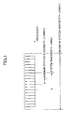
- the base station places the synchronization channel and the data channels on continuous subcarriers. Multiplexing the synchronization channel and the data channels in this manner allows for efficient use of frequency resources. On the contrary, the cost of the mobile station may increase because of the need for a filter with narrower transition bands in order to eliminate interference with the data channels.
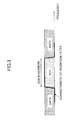
- guard bands are assigned to transition bands of the reception filter in the mobile station. Specifically, subcarriers corresponding to the transition bands are not used.
- guard bands to multiplex the synchronization channel and the data channels allows the mobile station to use a filter with wider transition bands (a filter with gradual or gentle cut-off or a filter with a smaller tap number).
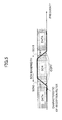
- cyclic prefixes are assigned to transition bands of the reception filter in the mobile station. Specifically, a cyclic prefix CP1 in a lower frequency component is generated using a copy of a signal SCH1 in a higher frequency component within the synchronization channel bandwidth. Similarly, a cyclic prefix CP2 in a higher frequency component is generated using a copy of a signal SCH2 in a lower frequency component within the synchronization channel bandwidth.
- Assigning cyclic prefixes in this manner allows the mobile station to combine the cyclic prefix CP1 in the lower frequency component and the signal SCH1 in the higher frequency component within the synchronization channel bandwidth after filtering to reproduce the original signal SCH1. Similarly, it allows the mobile station to combine the cyclic prefix CP2 in the higher frequency component and the signal SCH2 in the lower frequency component within the synchronization channel bandwidth after filtering to reproduce the original signal SCH2. Accordingly, downsampling in the mobile station is easily achieved.
- both the base station and the mobile station use Root-Nyquist filters with the same characteristic.
- the characteristic of the transmission filter is multiplied with that of the reception filter, the characteristic of the reception filter in the third embodiment can be derived. Accordingly, the base station can assign cyclic prefixes as described above and multiplex the synchronization channel and the data channels.
- Fig. 7 shows a base station 10 for implementing the aforementioned embodiments.
- the base station 10 includes a synchronization channel generating unit 101, a data channel generating unit 103, a multiplexing unit 105, and a transmission filter 107.
- the transmission filter 107 neeed not be included in the base station 10 to implement the first through third embodiments.
- the synchronization channel generating unit 101 generates timing information or the like which has to be detected by all the mobile stations.
- the data channel generating unit 103 generates data to be transmitted to the mobile station.
- the multiplexing unit 105 multiplexes a synchronization channel and a data channel.
- the multiplexing unit 105 places the synchronization channel on subcarriers corresponding to the minimum system bandwidths, such that the mobile stations can receive the synchronization signal on the synchronization channel without predetermined information about the system bandwidth of the base station.
- the multiplexing unit 105 further places the data channel on subcarriers other than the subcarriers used for the synchronization channel. Upon placing the data channel, the multiplexing unit 105 may assign a guard band or a cyclic prefix.
- the characteristic of the transmission filter 107 is adapted to that of the reception filter.
- the base station may multiplex the synchronization channel and any channel other than the synchronization channel.
- the base station may multiplex the synchronization channel and a control channel.
Landscapes
- Engineering & Computer Science (AREA)
- Signal Processing (AREA)
- Computer Networks & Wireless Communication (AREA)
- Mobile Radio Communication Systems (AREA)
Applications Claiming Priority (2)
| Application Number | Priority Date | Filing Date | Title |
|---|---|---|---|
| JP2006225921A JP4745168B2 (ja) | 2006-08-22 | 2006-08-22 | 基地局 |
| PCT/JP2007/065826 WO2008023599A1 (en) | 2006-08-22 | 2007-08-13 | Base station |
Publications (2)
| Publication Number | Publication Date |
|---|---|
| EP2056501A1 true EP2056501A1 (de) | 2009-05-06 |
| EP2056501A4 EP2056501A4 (de) | 2013-10-30 |
Family
ID=39106685
Family Applications (1)
| Application Number | Title | Priority Date | Filing Date |
|---|---|---|---|
| EP07792469.4A Withdrawn EP2056501A4 (de) | 2006-08-22 | 2007-08-13 | Basisstation |
Country Status (10)
| Country | Link |
|---|---|
| US (1) | US8331341B2 (de) |
| EP (1) | EP2056501A4 (de) |
| JP (1) | JP4745168B2 (de) |
| KR (1) | KR20090045241A (de) |
| CN (1) | CN101507160A (de) |
| AU (1) | AU2007288915B2 (de) |
| BR (1) | BRPI0715854A2 (de) |
| RU (1) | RU2438248C2 (de) |
| TW (1) | TW200820804A (de) |
| WO (1) | WO2008023599A1 (de) |
Family Cites Families (9)
| Publication number | Priority date | Publication date | Assignee | Title |
|---|---|---|---|---|
| DE4330672A1 (de) * | 1993-09-10 | 1995-03-16 | Thomson Brandt Gmbh | Verfahren zur ]bertragung von digitalisierten Fernseh- und/oder Tonrundfunksignalen |
| US5991330A (en) * | 1997-06-27 | 1999-11-23 | Telefonaktiebolaget L M Ericsson (Pub1) | Mobile Station synchronization within a spread spectrum communication systems |
| US7106689B1 (en) * | 1999-03-02 | 2006-09-12 | Matsushita Electric Industrial Co., Ltd. | OFDM transmission/reception apparatus |
| JP2003309533A (ja) * | 2002-04-17 | 2003-10-31 | Matsushita Electric Ind Co Ltd | 無線送信装置、無線受信装置及びその方法 |
| US7787572B2 (en) * | 2005-04-07 | 2010-08-31 | Rambus Inc. | Advanced signal processors for interference cancellation in baseband receivers |
| WO2005109709A1 (ja) * | 2004-05-06 | 2005-11-17 | Matsushita Electric Industrial Co., Ltd. | マルチキャリア送信装置、マルチキャリア受信装置、マルチキャリア送信方法およびマルチキャリア受信方法 |
| JP2006225921A (ja) | 2005-02-16 | 2006-08-31 | Yokohama Rubber Co Ltd:The | 室温硬化型建築材料及びその施工方法 |
| WO2006092852A1 (ja) * | 2005-03-02 | 2006-09-08 | Fujitsu Limited | Ofdm通信システム及びofdm通信方法 |
| US7911935B2 (en) * | 2006-02-08 | 2011-03-22 | Motorola Mobility, Inc. | Method and apparatus for interleaving sequence elements of an OFDMA synchronization channel |
-
2006
- 2006-08-22 JP JP2006225921A patent/JP4745168B2/ja not_active Expired - Fee Related
-
2007
- 2007-08-13 RU RU2009108208/08A patent/RU2438248C2/ru not_active IP Right Cessation
- 2007-08-13 EP EP07792469.4A patent/EP2056501A4/de not_active Withdrawn
- 2007-08-13 WO PCT/JP2007/065826 patent/WO2008023599A1/ja not_active Ceased
- 2007-08-13 BR BRPI0715854-8A patent/BRPI0715854A2/pt not_active IP Right Cessation
- 2007-08-13 CN CNA2007800305436A patent/CN101507160A/zh active Pending
- 2007-08-13 US US12/377,339 patent/US8331341B2/en not_active Expired - Fee Related
- 2007-08-13 AU AU2007288915A patent/AU2007288915B2/en not_active Ceased
- 2007-08-13 KR KR1020097002914A patent/KR20090045241A/ko not_active Ceased
- 2007-08-17 TW TW096130476A patent/TW200820804A/zh not_active IP Right Cessation
Also Published As
| Publication number | Publication date |
|---|---|
| RU2009108208A (ru) | 2010-09-27 |
| AU2007288915A1 (en) | 2008-02-28 |
| US20090245229A1 (en) | 2009-10-01 |
| RU2438248C2 (ru) | 2011-12-27 |
| TWI360973B (de) | 2012-03-21 |
| CN101507160A (zh) | 2009-08-12 |
| BRPI0715854A2 (pt) | 2013-07-23 |
| JP2008053861A (ja) | 2008-03-06 |
| JP4745168B2 (ja) | 2011-08-10 |
| KR20090045241A (ko) | 2009-05-07 |
| EP2056501A4 (de) | 2013-10-30 |
| TW200820804A (en) | 2008-05-01 |
| AU2007288915B2 (en) | 2012-08-09 |
| WO2008023599A1 (en) | 2008-02-28 |
| US8331341B2 (en) | 2012-12-11 |
Similar Documents
| Publication | Publication Date | Title |
|---|---|---|
| CA2691354C (en) | Base station apparatus, mobile station apparatus, and method of transmitting synchronization channels | |
| RU2435313C1 (ru) | Базовая станция (варианты), способ передачи данных (варианты) и система связи | |
| US6400679B1 (en) | Communication resource allocation method and apparatus | |
| EP2790340B1 (de) | Sender, Empfänger, Mobilkommunikationssystem und Synchronisationskanals | |
| EP2225838B1 (de) | Verfahren zum senden und empfangen von signalen mittels mehrbandfunkfrequenzen | |
| RU2462818C1 (ru) | Способ передачи пилот-сигнала, базовая станция, мобильная станция и система сотовой связи, в которой применен этот способ | |
| EP2031892A1 (de) | Basisstationsgerät | |
| US9565001B2 (en) | Guard subcarrier placement in an OFDM symbol used for synchronization | |
| CN108476552B (zh) | 传输数据的方法和用户设备 | |
| Demmer et al. | Filter-bank OFDM transceivers for 5G and beyond | |
| US8331341B2 (en) | Base station for transmitting a synchronization signal | |
| TWI501569B (zh) | 多播廣播單頻網路(mbsfn)下行鏈路最佳化廣播(dob)小區搜尋及同步碼產生 | |
| EP2273838B1 (de) | Basisstation, mobile station und gemeinsames informationsübertragungsverfahren | |
| RU2427083C2 (ru) | Способ передачи пилот-сигнала, базовая станция, мобильная станция и система сотовой связи, в которой применен этот способ |
Legal Events
| Date | Code | Title | Description |
|---|---|---|---|
| PUAI | Public reference made under article 153(3) epc to a published international application that has entered the european phase |
Free format text: ORIGINAL CODE: 0009012 |
|
| 17P | Request for examination filed |
Effective date: 20090212 |
|
| AK | Designated contracting states |
Kind code of ref document: A1 Designated state(s): AT BE BG CH CY CZ DE DK EE ES FI FR GB GR HU IE IS IT LI LT LU LV MC MT NL PL PT RO SE SI SK TR |
|
| AX | Request for extension of the european patent |
Extension state: AL BA HR MK RS |
|
| DAX | Request for extension of the european patent (deleted) | ||
| A4 | Supplementary search report drawn up and despatched |
Effective date: 20131002 |
|
| RIC1 | Information provided on ipc code assigned before grant |
Ipc: H04L 27/26 20060101ALI20130926BHEP Ipc: H04B 1/7073 20110101AFI20130926BHEP Ipc: H04L 5/00 20060101ALI20130926BHEP |
|
| STAA | Information on the status of an ep patent application or granted ep patent |
Free format text: STATUS: THE APPLICATION HAS BEEN WITHDRAWN |
|
| 18W | Application withdrawn |
Effective date: 20141030 |