EP2052250B1 - Solid-phase detection of terminal monosaccharides cleaved from glycosylated substrates - Google Patents
Solid-phase detection of terminal monosaccharides cleaved from glycosylated substrates Download PDFInfo
- Publication number
- EP2052250B1 EP2052250B1 EP07785724A EP07785724A EP2052250B1 EP 2052250 B1 EP2052250 B1 EP 2052250B1 EP 07785724 A EP07785724 A EP 07785724A EP 07785724 A EP07785724 A EP 07785724A EP 2052250 B1 EP2052250 B1 EP 2052250B1
- Authority
- EP
- European Patent Office
- Prior art keywords
- group
- monosaccharide
- tag
- boronate
- capture
- Prior art date
- Legal status (The legal status is an assumption and is not a legal conclusion. Google has not performed a legal analysis and makes no representation as to the accuracy of the status listed.)
- Not-in-force
Links
- 150000002772 monosaccharides Chemical group 0.000 title claims abstract description 164
- 238000001514 detection method Methods 0.000 title claims abstract description 68
- 239000000758 substrate Substances 0.000 title claims abstract description 53
- 239000007790 solid phase Substances 0.000 title description 7
- 238000000034 method Methods 0.000 claims abstract description 104
- 239000007787 solid Substances 0.000 claims abstract description 68
- 239000003795 chemical substances by application Substances 0.000 claims abstract description 66
- ZADPBFCGQRWHPN-UHFFFAOYSA-N boronic acid Chemical compound OBO ZADPBFCGQRWHPN-UHFFFAOYSA-N 0.000 claims abstract description 23
- 108090000288 Glycoproteins Proteins 0.000 claims description 29
- 102000003886 Glycoproteins Human genes 0.000 claims description 29
- 150000004676 glycans Chemical class 0.000 claims description 27
- 125000005647 linker group Chemical group 0.000 claims description 26
- 229920001282 polysaccharide Polymers 0.000 claims description 24
- 239000005017 polysaccharide Substances 0.000 claims description 24
- 229930186217 Glycolipid Natural products 0.000 claims description 16
- 238000005406 washing Methods 0.000 claims description 15
- 150000002148 esters Chemical class 0.000 claims description 14
- 230000013595 glycosylation Effects 0.000 claims description 13
- 238000006206 glycosylation reaction Methods 0.000 claims description 13
- 125000005620 boronic acid group Chemical group 0.000 claims description 12
- 230000001580 bacterial effect Effects 0.000 claims description 11
- 238000004458 analytical method Methods 0.000 claims description 10
- HVCOBJNICQPDBP-UHFFFAOYSA-N 3-[3-[3,5-dihydroxy-6-methyl-4-(3,4,5-trihydroxy-6-methyloxan-2-yl)oxyoxan-2-yl]oxydecanoyloxy]decanoic acid;hydrate Chemical compound O.OC1C(OC(CC(=O)OC(CCCCCCC)CC(O)=O)CCCCCCC)OC(C)C(O)C1OC1C(O)C(O)C(O)C(C)O1 HVCOBJNICQPDBP-UHFFFAOYSA-N 0.000 claims description 8
- 229910052799 carbon Inorganic materials 0.000 claims description 8
- 201000010099 disease Diseases 0.000 claims description 7
- 208000037265 diseases, disorders, signs and symptoms Diseases 0.000 claims description 7
- 238000011109 contamination Methods 0.000 claims description 6
- 238000012544 monitoring process Methods 0.000 claims description 6
- 238000003745 diagnosis Methods 0.000 claims description 5
- 238000000108 ultra-filtration Methods 0.000 claims description 5
- 230000002159 abnormal effect Effects 0.000 claims description 4
- 125000004432 carbon atom Chemical group C* 0.000 claims description 4
- 238000000502 dialysis Methods 0.000 claims description 3
- 239000000825 pharmaceutical preparation Substances 0.000 claims description 3
- 229940127557 pharmaceutical product Drugs 0.000 claims description 3
- 230000007717 exclusion Effects 0.000 claims description 2
- 238000012178 polysaccharide sequencing Methods 0.000 claims description 2
- 125000001483 monosaccharide substituent group Chemical group 0.000 claims 1
- 150000001720 carbohydrates Chemical class 0.000 abstract description 36
- 235000014633 carbohydrates Nutrition 0.000 abstract description 35
- 102000005744 Glycoside Hydrolases Human genes 0.000 abstract description 29
- 108010031186 Glycoside Hydrolases Proteins 0.000 abstract description 29
- 238000012163 sequencing technique Methods 0.000 abstract description 8
- 238000009482 thermal adhesion granulation Methods 0.000 description 80
- 125000003118 aryl group Chemical group 0.000 description 54
- 125000000217 alkyl group Chemical group 0.000 description 51
- 125000001072 heteroaryl group Chemical group 0.000 description 48
- 150000001875 compounds Chemical class 0.000 description 46
- 235000000346 sugar Nutrition 0.000 description 39
- ZMXDDKWLCZADIW-UHFFFAOYSA-N N,N-Dimethylformamide Chemical compound CN(C)C=O ZMXDDKWLCZADIW-UHFFFAOYSA-N 0.000 description 37
- 239000000243 solution Substances 0.000 description 36
- 150000002482 oligosaccharides Chemical class 0.000 description 34
- 239000011324 bead Substances 0.000 description 32
- 229920001542 oligosaccharide Polymers 0.000 description 32
- -1 carbohydrate diols Chemical class 0.000 description 28
- PEDCQBHIVMGVHV-UHFFFAOYSA-N Glycerine Chemical compound OCC(O)CO PEDCQBHIVMGVHV-UHFFFAOYSA-N 0.000 description 27
- OKKJLVBELUTLKV-UHFFFAOYSA-N Methanol Chemical compound OC OKKJLVBELUTLKV-UHFFFAOYSA-N 0.000 description 24
- 125000000547 substituted alkyl group Chemical group 0.000 description 21
- 125000002915 carbonyl group Chemical group [*:2]C([*:1])=O 0.000 description 20
- YMWUJEATGCHHMB-UHFFFAOYSA-N Dichloromethane Chemical compound ClCCl YMWUJEATGCHHMB-UHFFFAOYSA-N 0.000 description 19
- 239000000523 sample Substances 0.000 description 19
- 125000003107 substituted aryl group Chemical group 0.000 description 19
- HXITXNWTGFUOAU-UHFFFAOYSA-N phenylboronic acid Chemical class OB(O)C1=CC=CC=C1 HXITXNWTGFUOAU-UHFFFAOYSA-N 0.000 description 18
- 239000000047 product Substances 0.000 description 18
- 238000006243 chemical reaction Methods 0.000 description 17
- 239000002253 acid Substances 0.000 description 15
- 150000008163 sugars Chemical class 0.000 description 15
- 229910052717 sulfur Inorganic materials 0.000 description 14
- 238000003786 synthesis reaction Methods 0.000 description 14
- WGTODYJZXSJIAG-UHFFFAOYSA-N tetramethylrhodamine chloride Chemical compound [Cl-].C=12C=CC(N(C)C)=CC2=[O+]C2=CC(N(C)C)=CC=C2C=1C1=CC=CC=C1C(O)=O WGTODYJZXSJIAG-UHFFFAOYSA-N 0.000 description 14
- 150000001299 aldehydes Chemical class 0.000 description 13
- WLVJMFFJFXQUGK-UHFFFAOYSA-N hydroxymethylboronic acid Chemical compound OCB(O)O WLVJMFFJFXQUGK-UHFFFAOYSA-N 0.000 description 13
- JGFZNNIVVJXRND-UHFFFAOYSA-N N,N-Diisopropylethylamine (DIPEA) Chemical compound CCN(C(C)C)C(C)C JGFZNNIVVJXRND-UHFFFAOYSA-N 0.000 description 12
- 125000001931 aliphatic group Chemical group 0.000 description 12
- 239000000872 buffer Substances 0.000 description 12
- 229910052760 oxygen Inorganic materials 0.000 description 12
- WFDIJRYMOXRFFG-UHFFFAOYSA-N Acetic anhydride Chemical compound CC(=O)OC(C)=O WFDIJRYMOXRFFG-UHFFFAOYSA-N 0.000 description 11
- 108091003079 Bovine Serum Albumin Proteins 0.000 description 11
- 229940098773 bovine serum albumin Drugs 0.000 description 11
- 230000009467 reduction Effects 0.000 description 11
- 238000006722 reduction reaction Methods 0.000 description 11
- XLYOFNOQVPJJNP-UHFFFAOYSA-N water Substances O XLYOFNOQVPJJNP-UHFFFAOYSA-N 0.000 description 11
- 125000005621 boronate group Chemical class 0.000 description 10
- 239000003638 chemical reducing agent Substances 0.000 description 10
- 239000012528 membrane Substances 0.000 description 10
- HPWSILFIEPCDCG-UHFFFAOYSA-N nitroboronic acid Chemical compound OB(O)[N+]([O-])=O HPWSILFIEPCDCG-UHFFFAOYSA-N 0.000 description 10
- 230000002829 reductive effect Effects 0.000 description 10
- 230000015572 biosynthetic process Effects 0.000 description 9
- 229930182470 glycoside Natural products 0.000 description 9
- 150000002338 glycosides Chemical class 0.000 description 9
- 125000002887 hydroxy group Chemical group [H]O* 0.000 description 9
- 239000000203 mixture Substances 0.000 description 9
- 238000002360 preparation method Methods 0.000 description 9
- 239000002904 solvent Substances 0.000 description 9
- 125000001424 substituent group Chemical group 0.000 description 9
- GQHTUMJGOHRCHB-UHFFFAOYSA-N 2,3,4,6,7,8,9,10-octahydropyrimido[1,2-a]azepine Chemical compound C1CCCCN2CCCN=C21 GQHTUMJGOHRCHB-UHFFFAOYSA-N 0.000 description 8
- ZOXJGFHDIHLPTG-UHFFFAOYSA-N Boron Chemical group [B] ZOXJGFHDIHLPTG-UHFFFAOYSA-N 0.000 description 8
- 102000004190 Enzymes Human genes 0.000 description 8
- 108090000790 Enzymes Proteins 0.000 description 8
- 229910052796 boron Inorganic materials 0.000 description 8
- 229910002091 carbon monoxide Inorganic materials 0.000 description 8
- 239000011521 glass Substances 0.000 description 8
- 238000011002 quantification Methods 0.000 description 8
- 239000000126 substance Substances 0.000 description 8
- 150000007513 acids Chemical class 0.000 description 7
- 125000003277 amino group Chemical group 0.000 description 7
- 125000000837 carbohydrate group Chemical group 0.000 description 7
- 210000004027 cell Anatomy 0.000 description 7
- 125000000753 cycloalkyl group Chemical group 0.000 description 7
- 125000005842 heteroatom Chemical group 0.000 description 7
- 238000002372 labelling Methods 0.000 description 7
- 229910052757 nitrogen Inorganic materials 0.000 description 7
- 230000000007 visual effect Effects 0.000 description 7
- YBJHBAHKTGYVGT-ZKWXMUAHSA-N (+)-Biotin Chemical group N1C(=O)N[C@@H]2[C@H](CCCCC(=O)O)SC[C@@H]21 YBJHBAHKTGYVGT-ZKWXMUAHSA-N 0.000 description 6
- 108010093031 Galactosidases Proteins 0.000 description 6
- 102000002464 Galactosidases Human genes 0.000 description 6
- UIIMBOGNXHQVGW-UHFFFAOYSA-M Sodium bicarbonate Chemical compound [Na+].OC([O-])=O UIIMBOGNXHQVGW-UHFFFAOYSA-M 0.000 description 6
- YXFVVABEGXRONW-UHFFFAOYSA-N Toluene Chemical compound CC1=CC=CC=C1 YXFVVABEGXRONW-UHFFFAOYSA-N 0.000 description 6
- 239000000654 additive Substances 0.000 description 6
- 102000005936 beta-Galactosidase Human genes 0.000 description 6
- 108010005774 beta-Galactosidase Proteins 0.000 description 6
- 150000001642 boronic acid derivatives Chemical class 0.000 description 6
- 125000004122 cyclic group Chemical group 0.000 description 6
- 125000004435 hydrogen atom Chemical class [H]* 0.000 description 6
- 239000003446 ligand Substances 0.000 description 6
- 229910052751 metal Inorganic materials 0.000 description 6
- 239000002184 metal Substances 0.000 description 6
- 229920001223 polyethylene glycol Polymers 0.000 description 6
- 229920000642 polymer Polymers 0.000 description 6
- 235000018102 proteins Nutrition 0.000 description 6
- 102000004169 proteins and genes Human genes 0.000 description 6
- 108090000623 proteins and genes Proteins 0.000 description 6
- JUJWROOIHBZHMG-UHFFFAOYSA-N Pyridine Chemical compound C1=CC=NC=C1 JUJWROOIHBZHMG-UHFFFAOYSA-N 0.000 description 5
- 150000001323 aldoses Chemical class 0.000 description 5
- WQZGKKKJIJFFOK-PHYPRBDBSA-N alpha-D-galactose Chemical compound OC[C@H]1O[C@H](O)[C@H](O)[C@@H](O)[C@H]1O WQZGKKKJIJFFOK-PHYPRBDBSA-N 0.000 description 5
- 150000001412 amines Chemical class 0.000 description 5
- 230000008859 change Effects 0.000 description 5
- 238000003776 cleavage reaction Methods 0.000 description 5
- 229940079593 drug Drugs 0.000 description 5
- 239000003814 drug Substances 0.000 description 5
- 229930182830 galactose Natural products 0.000 description 5
- 150000002337 glycosamines Chemical class 0.000 description 5
- 150000002576 ketones Chemical class 0.000 description 5
- 239000003960 organic solvent Substances 0.000 description 5
- 230000003647 oxidation Effects 0.000 description 5
- 238000007254 oxidation reaction Methods 0.000 description 5
- 108090000765 processed proteins & peptides Proteins 0.000 description 5
- 229920005989 resin Polymers 0.000 description 5
- 239000011347 resin Substances 0.000 description 5
- 230000007017 scission Effects 0.000 description 5
- 238000004611 spectroscopical analysis Methods 0.000 description 5
- 150000005846 sugar alcohols Chemical class 0.000 description 5
- XKRFYHLGVUSROY-UHFFFAOYSA-N Argon Chemical compound [Ar] XKRFYHLGVUSROY-UHFFFAOYSA-N 0.000 description 4
- IJGRMHOSHXDMSA-UHFFFAOYSA-N Atomic nitrogen Chemical compound N#N IJGRMHOSHXDMSA-UHFFFAOYSA-N 0.000 description 4
- OKTJSMMVPCPJKN-UHFFFAOYSA-N Carbon Chemical group [C] OKTJSMMVPCPJKN-UHFFFAOYSA-N 0.000 description 4
- 208000007976 Ketosis Diseases 0.000 description 4
- UORVGPXVDQYIDP-UHFFFAOYSA-N borane Chemical compound B UORVGPXVDQYIDP-UHFFFAOYSA-N 0.000 description 4
- 150000001721 carbon Chemical group 0.000 description 4
- 238000012512 characterization method Methods 0.000 description 4
- 239000003153 chemical reaction reagent Substances 0.000 description 4
- 239000005289 controlled pore glass Substances 0.000 description 4
- 150000008266 deoxy sugars Chemical class 0.000 description 4
- 239000003599 detergent Substances 0.000 description 4
- 239000000706 filtrate Substances 0.000 description 4
- 125000000623 heterocyclic group Chemical group 0.000 description 4
- 238000011534 incubation Methods 0.000 description 4
- 150000002584 ketoses Chemical class 0.000 description 4
- 230000007935 neutral effect Effects 0.000 description 4
- 238000000926 separation method Methods 0.000 description 4
- 150000004760 silicates Chemical class 0.000 description 4
- 125000005346 substituted cycloalkyl group Chemical group 0.000 description 4
- 125000004169 (C1-C6) alkyl group Chemical group 0.000 description 3
- LMDZBCPBFSXMTL-UHFFFAOYSA-N 1-ethyl-3-(3-dimethylaminopropyl)carbodiimide Chemical compound CCN=C=NCCCN(C)C LMDZBCPBFSXMTL-UHFFFAOYSA-N 0.000 description 3
- OBYNJKLOYWCXEP-UHFFFAOYSA-N 2-[3-(dimethylamino)-6-dimethylazaniumylidenexanthen-9-yl]-4-isothiocyanatobenzoate Chemical compound C=12C=CC(=[N+](C)C)C=C2OC2=CC(N(C)C)=CC=C2C=1C1=CC(N=C=S)=CC=C1C([O-])=O OBYNJKLOYWCXEP-UHFFFAOYSA-N 0.000 description 3
- TWCMVXMQHSVIOJ-UHFFFAOYSA-N Aglycone of yadanzioside D Natural products COC(=O)C12OCC34C(CC5C(=CC(O)C(O)C5(C)C3C(O)C1O)C)OC(=O)C(OC(=O)C)C24 TWCMVXMQHSVIOJ-UHFFFAOYSA-N 0.000 description 3
- PLMKQQMDOMTZGG-UHFFFAOYSA-N Astrantiagenin E-methylester Natural products CC12CCC(O)C(C)(CO)C1CCC1(C)C2CC=C2C3CC(C)(C)CCC3(C(=O)OC)CCC21C PLMKQQMDOMTZGG-UHFFFAOYSA-N 0.000 description 3
- UHOVQNZJYSORNB-UHFFFAOYSA-N Benzene Chemical compound C1=CC=CC=C1 UHOVQNZJYSORNB-UHFFFAOYSA-N 0.000 description 3
- WQZGKKKJIJFFOK-GASJEMHNSA-N Glucose Natural products OC[C@H]1OC(O)[C@H](O)[C@@H](O)[C@@H]1O WQZGKKKJIJFFOK-GASJEMHNSA-N 0.000 description 3
- 108010015899 Glycopeptides Proteins 0.000 description 3
- 102000002068 Glycopeptides Human genes 0.000 description 3
- 241001465754 Metazoa Species 0.000 description 3
- 102000016611 Proteoglycans Human genes 0.000 description 3
- 108010067787 Proteoglycans Proteins 0.000 description 3
- 239000012317 TBTU Substances 0.000 description 3
- 238000005903 acid hydrolysis reaction Methods 0.000 description 3
- 150000007824 aliphatic compounds Chemical class 0.000 description 3
- 239000003242 anti bacterial agent Substances 0.000 description 3
- 229940088710 antibiotic agent Drugs 0.000 description 3
- 238000003491 array Methods 0.000 description 3
- 150000001543 aryl boronic acids Chemical class 0.000 description 3
- 108010044715 asialofetuin Proteins 0.000 description 3
- 230000009286 beneficial effect Effects 0.000 description 3
- 229960002685 biotin Drugs 0.000 description 3
- 235000020958 biotin Nutrition 0.000 description 3
- 239000011616 biotin Substances 0.000 description 3
- 125000003178 carboxy group Chemical group [H]OC(*)=O 0.000 description 3
- 150000001768 cations Chemical class 0.000 description 3
- 238000004587 chromatography analysis Methods 0.000 description 3
- 239000012043 crude product Substances 0.000 description 3
- 230000029087 digestion Effects 0.000 description 3
- 150000002009 diols Chemical class 0.000 description 3
- 239000012039 electrophile Substances 0.000 description 3
- 238000002330 electrospray ionisation mass spectrometry Methods 0.000 description 3
- 238000010828 elution Methods 0.000 description 3
- 230000002255 enzymatic effect Effects 0.000 description 3
- 125000001495 ethyl group Chemical group [H]C([H])([H])C([H])([H])* 0.000 description 3
- 239000000284 extract Substances 0.000 description 3
- 108060002885 fetuin Proteins 0.000 description 3
- 102000013361 fetuin Human genes 0.000 description 3
- 239000007850 fluorescent dye Substances 0.000 description 3
- 239000008103 glucose Substances 0.000 description 3
- PCHJSUWPFVWCPO-UHFFFAOYSA-N gold Chemical compound [Au] PCHJSUWPFVWCPO-UHFFFAOYSA-N 0.000 description 3
- 239000010931 gold Substances 0.000 description 3
- 229910052737 gold Inorganic materials 0.000 description 3
- PFOARMALXZGCHY-UHFFFAOYSA-N homoegonol Natural products C1=C(OC)C(OC)=CC=C1C1=CC2=CC(CCCO)=CC(OC)=C2O1 PFOARMALXZGCHY-UHFFFAOYSA-N 0.000 description 3
- 150000002430 hydrocarbons Chemical class 0.000 description 3
- 238000011065 in-situ storage Methods 0.000 description 3
- 238000004949 mass spectrometry Methods 0.000 description 3
- 125000002496 methyl group Chemical group [H]C([H])([H])* 0.000 description 3
- 125000000449 nitro group Chemical group [O-][N+](*)=O 0.000 description 3
- 125000004433 nitrogen atom Chemical group N* 0.000 description 3
- 230000003287 optical effect Effects 0.000 description 3
- 239000002245 particle Substances 0.000 description 3
- 125000001997 phenyl group Chemical group [H]C1=C([H])C([H])=C(*)C([H])=C1[H] 0.000 description 3
- 239000008363 phosphate buffer Substances 0.000 description 3
- 239000004033 plastic Substances 0.000 description 3
- 229920003023 plastic Polymers 0.000 description 3
- 102000004196 processed proteins & peptides Human genes 0.000 description 3
- 238000006268 reductive amination reaction Methods 0.000 description 3
- 229910000030 sodium bicarbonate Inorganic materials 0.000 description 3
- 238000010532 solid phase synthesis reaction Methods 0.000 description 3
- 241000894007 species Species 0.000 description 3
- 238000010186 staining Methods 0.000 description 3
- 150000003431 steroids Chemical class 0.000 description 3
- 229940124530 sulfonamide Drugs 0.000 description 3
- 150000003457 sulfones Chemical group 0.000 description 3
- 239000006228 supernatant Substances 0.000 description 3
- 230000001225 therapeutic effect Effects 0.000 description 3
- WQZGKKKJIJFFOK-SVZMEOIVSA-N (+)-Galactose Chemical compound OC[C@H]1OC(O)[C@H](O)[C@@H](O)[C@H]1O WQZGKKKJIJFFOK-SVZMEOIVSA-N 0.000 description 2
- CDGIRLKQNJXHBJ-UHFFFAOYSA-N (3-methoxycarbonyl-5-nitrophenyl)boronic acid Chemical compound COC(=O)C1=CC(B(O)O)=CC([N+]([O-])=O)=C1 CDGIRLKQNJXHBJ-UHFFFAOYSA-N 0.000 description 2
- 125000003088 (fluoren-9-ylmethoxy)carbonyl group Chemical group 0.000 description 2
- WEVYAHXRMPXWCK-UHFFFAOYSA-N Acetonitrile Chemical compound CC#N WEVYAHXRMPXWCK-UHFFFAOYSA-N 0.000 description 2
- YDNKGFDKKRUKPY-JHOUSYSJSA-N C16 ceramide Natural products CCCCCCCCCCCCCCCC(=O)N[C@@H](CO)[C@H](O)C=CCCCCCCCCCCCCC YDNKGFDKKRUKPY-JHOUSYSJSA-N 0.000 description 2
- BVKZGUZCCUSVTD-UHFFFAOYSA-L Carbonate Chemical compound [O-]C([O-])=O BVKZGUZCCUSVTD-UHFFFAOYSA-L 0.000 description 2
- HEDRZPFGACZZDS-UHFFFAOYSA-N Chloroform Chemical compound ClC(Cl)Cl HEDRZPFGACZZDS-UHFFFAOYSA-N 0.000 description 2
- KRKNYBCHXYNGOX-UHFFFAOYSA-K Citrate Chemical compound [O-]C(=O)CC(O)(CC([O-])=O)C([O-])=O KRKNYBCHXYNGOX-UHFFFAOYSA-K 0.000 description 2
- 229920000858 Cyclodextrin Polymers 0.000 description 2
- FBPFZTCFMRRESA-JGWLITMVSA-N D-glucitol Chemical compound OC[C@H](O)[C@@H](O)[C@H](O)[C@H](O)CO FBPFZTCFMRRESA-JGWLITMVSA-N 0.000 description 2
- KCXVZYZYPLLWCC-UHFFFAOYSA-N EDTA Chemical compound OC(=O)CN(CC(O)=O)CCN(CC(O)=O)CC(O)=O KCXVZYZYPLLWCC-UHFFFAOYSA-N 0.000 description 2
- ULGZDMOVFRHVEP-RWJQBGPGSA-N Erythromycin Chemical compound O([C@@H]1[C@@H](C)C(=O)O[C@@H]([C@@]([C@H](O)[C@@H](C)C(=O)[C@H](C)C[C@@](C)(O)[C@H](O[C@H]2[C@@H]([C@H](C[C@@H](C)O2)N(C)C)O)[C@H]1C)(C)O)CC)[C@H]1C[C@@](C)(OC)[C@@H](O)[C@H](C)O1 ULGZDMOVFRHVEP-RWJQBGPGSA-N 0.000 description 2
- PIICEJLVQHRZGT-UHFFFAOYSA-N Ethylenediamine Chemical compound NCCN PIICEJLVQHRZGT-UHFFFAOYSA-N 0.000 description 2
- IAJILQKETJEXLJ-UHFFFAOYSA-N Galacturonsaeure Natural products O=CC(O)C(O)C(O)C(O)C(O)=O IAJILQKETJEXLJ-UHFFFAOYSA-N 0.000 description 2
- AVXURJPOCDRRFD-UHFFFAOYSA-N Hydroxylamine Chemical compound ON AVXURJPOCDRRFD-UHFFFAOYSA-N 0.000 description 2
- CRJGESKKUOMBCT-VQTJNVASSA-N N-acetylsphinganine Chemical compound CCCCCCCCCCCCCCC[C@@H](O)[C@H](CO)NC(C)=O CRJGESKKUOMBCT-VQTJNVASSA-N 0.000 description 2
- UFWIBTONFRDIAS-UHFFFAOYSA-N Naphthalene Chemical compound C1=CC=CC2=CC=CC=C21 UFWIBTONFRDIAS-UHFFFAOYSA-N 0.000 description 2
- UQOXCVFYWKHHQG-UHFFFAOYSA-N OBO.C1=CC=NC=C1 Chemical class OBO.C1=CC=NC=C1 UQOXCVFYWKHHQG-UHFFFAOYSA-N 0.000 description 2
- 239000002202 Polyethylene glycol Substances 0.000 description 2
- 239000004793 Polystyrene Substances 0.000 description 2
- 238000004617 QSAR study Methods 0.000 description 2
- 238000001069 Raman spectroscopy Methods 0.000 description 2
- CDBYLPFSWZWCQE-UHFFFAOYSA-L Sodium Carbonate Chemical compound [Na+].[Na+].[O-]C([O-])=O CDBYLPFSWZWCQE-UHFFFAOYSA-L 0.000 description 2
- NINIDFKCEFEMDL-UHFFFAOYSA-N Sulfur Chemical compound [S] NINIDFKCEFEMDL-UHFFFAOYSA-N 0.000 description 2
- YTPLMLYBLZKORZ-UHFFFAOYSA-N Thiophene Chemical compound C=1C=CSC=1 YTPLMLYBLZKORZ-UHFFFAOYSA-N 0.000 description 2
- DTQVDTLACAAQTR-UHFFFAOYSA-N Trifluoroacetic acid Chemical compound OC(=O)C(F)(F)F DTQVDTLACAAQTR-UHFFFAOYSA-N 0.000 description 2
- CLZISMQKJZCZDN-UHFFFAOYSA-N [benzotriazol-1-yloxy(dimethylamino)methylidene]-dimethylazanium Chemical compound C1=CC=C2N(OC(N(C)C)=[N+](C)C)N=NC2=C1 CLZISMQKJZCZDN-UHFFFAOYSA-N 0.000 description 2
- 238000002835 absorbance Methods 0.000 description 2
- 230000002378 acidificating effect Effects 0.000 description 2
- 230000001476 alcoholic effect Effects 0.000 description 2
- 230000004075 alteration Effects 0.000 description 2
- 150000001408 amides Chemical class 0.000 description 2
- 229940024606 amino acid Drugs 0.000 description 2
- 235000001014 amino acid Nutrition 0.000 description 2
- 150000001413 amino acids Chemical class 0.000 description 2
- 150000001414 amino alcohols Chemical class 0.000 description 2
- 125000004103 aminoalkyl group Chemical group 0.000 description 2
- 239000012062 aqueous buffer Substances 0.000 description 2
- 229910052786 argon Inorganic materials 0.000 description 2
- 238000003556 assay Methods 0.000 description 2
- 125000004429 atom Chemical group 0.000 description 2
- SQVRNKJHWKZAKO-UHFFFAOYSA-N beta-N-Acetyl-D-neuraminic acid Natural products CC(=O)NC1C(O)CC(O)(C(O)=O)OC1C(O)C(O)CO SQVRNKJHWKZAKO-UHFFFAOYSA-N 0.000 description 2
- 239000011230 binding agent Substances 0.000 description 2
- 230000003115 biocidal effect Effects 0.000 description 2
- 238000006664 bond formation reaction Methods 0.000 description 2
- 229910000085 borane Inorganic materials 0.000 description 2
- 239000006227 byproduct Substances 0.000 description 2
- VTJUKNSKBAOEHE-UHFFFAOYSA-N calixarene Chemical class COC(=O)COC1=C(CC=2C(=C(CC=3C(=C(C4)C=C(C=3)C(C)(C)C)OCC(=O)OC)C=C(C=2)C(C)(C)C)OCC(=O)OC)C=C(C(C)(C)C)C=C1CC1=C(OCC(=O)OC)C4=CC(C(C)(C)C)=C1 VTJUKNSKBAOEHE-UHFFFAOYSA-N 0.000 description 2
- 239000003054 catalyst Substances 0.000 description 2
- 210000000170 cell membrane Anatomy 0.000 description 2
- 229940106189 ceramide Drugs 0.000 description 2
- ZVEQCJWYRWKARO-UHFFFAOYSA-N ceramide Natural products CCCCCCCCCCCCCCC(O)C(=O)NC(CO)C(O)C=CCCC=C(C)CCCCCCCCC ZVEQCJWYRWKARO-UHFFFAOYSA-N 0.000 description 2
- 239000002738 chelating agent Substances 0.000 description 2
- 125000003636 chemical group Chemical group 0.000 description 2
- 230000000536 complexating effect Effects 0.000 description 2
- 239000008139 complexing agent Substances 0.000 description 2
- 229940125904 compound 1 Drugs 0.000 description 2
- 229940097362 cyclodextrins Drugs 0.000 description 2
- 125000000113 cyclohexyl group Chemical group [H]C1([H])C([H])([H])C([H])([H])C([H])(*)C([H])([H])C1([H])[H] 0.000 description 2
- 125000001511 cyclopentyl group Chemical group [H]C1([H])C([H])([H])C([H])([H])C([H])(*)C1([H])[H] 0.000 description 2
- 206010012601 diabetes mellitus Diseases 0.000 description 2
- ZBCBWPMODOFKDW-UHFFFAOYSA-N diethanolamine Chemical compound OCCNCCO ZBCBWPMODOFKDW-UHFFFAOYSA-N 0.000 description 2
- 238000000612 dual polarization interferometry Methods 0.000 description 2
- 239000002158 endotoxin Substances 0.000 description 2
- 238000005516 engineering process Methods 0.000 description 2
- 238000006911 enzymatic reaction Methods 0.000 description 2
- 210000003527 eukaryotic cell Anatomy 0.000 description 2
- 230000002349 favourable effect Effects 0.000 description 2
- 150000002243 furanoses Chemical class 0.000 description 2
- MNQZXJOMYWMBOU-UHFFFAOYSA-N glyceraldehyde Chemical compound OCC(O)C=O MNQZXJOMYWMBOU-UHFFFAOYSA-N 0.000 description 2
- 102000035122 glycosylated proteins Human genes 0.000 description 2
- 108091005608 glycosylated proteins Proteins 0.000 description 2
- 125000001976 hemiacetal group Chemical group 0.000 description 2
- 150000002373 hemiacetals Chemical class 0.000 description 2
- 229930195733 hydrocarbon Natural products 0.000 description 2
- 229910052739 hydrogen Inorganic materials 0.000 description 2
- 239000001257 hydrogen Substances 0.000 description 2
- 230000002209 hydrophobic effect Effects 0.000 description 2
- CBOIHMRHGLHBPB-UHFFFAOYSA-N hydroxymethyl Chemical group O[CH2] CBOIHMRHGLHBPB-UHFFFAOYSA-N 0.000 description 2
- 238000000338 in vitro Methods 0.000 description 2
- 150000004001 inositols Chemical class 0.000 description 2
- 150000002632 lipids Chemical class 0.000 description 2
- 238000011068 loading method Methods 0.000 description 2
- 238000004519 manufacturing process Methods 0.000 description 2
- 239000000463 material Substances 0.000 description 2
- 239000011159 matrix material Substances 0.000 description 2
- VNWKTOKETHGBQD-UHFFFAOYSA-N methane Chemical compound C VNWKTOKETHGBQD-UHFFFAOYSA-N 0.000 description 2
- 125000006357 methylene carbonyl group Chemical group [H]C([H])([*:1])C([*:2])=O 0.000 description 2
- 239000003068 molecular probe Substances 0.000 description 2
- 150000002763 monocarboxylic acids Chemical class 0.000 description 2
- VVGIYYKRAMHVLU-UHFFFAOYSA-N newbouldiamide Natural products CCCCCCCCCCCCCCCCCCCC(O)C(O)C(O)C(CO)NC(=O)CCCCCCCCCCCCCCCCC VVGIYYKRAMHVLU-UHFFFAOYSA-N 0.000 description 2
- 239000012074 organic phase Substances 0.000 description 2
- 229920000620 organic polymer Polymers 0.000 description 2
- 125000004430 oxygen atom Chemical group O* 0.000 description 2
- 230000001575 pathological effect Effects 0.000 description 2
- 230000026731 phosphorylation Effects 0.000 description 2
- 238000006366 phosphorylation reaction Methods 0.000 description 2
- 125000003367 polycyclic group Chemical group 0.000 description 2
- 229920001184 polypeptide Polymers 0.000 description 2
- 229920002223 polystyrene Polymers 0.000 description 2
- 125000002924 primary amino group Chemical group [H]N([H])* 0.000 description 2
- 230000008569 process Effects 0.000 description 2
- UMJSCPRVCHMLSP-UHFFFAOYSA-N pyridine Natural products COC1=CC=CN=C1 UMJSCPRVCHMLSP-UHFFFAOYSA-N 0.000 description 2
- 230000002285 radioactive effect Effects 0.000 description 2
- 230000009257 reactivity Effects 0.000 description 2
- 238000011160 research Methods 0.000 description 2
- 239000012465 retentate Substances 0.000 description 2
- 238000012552 review Methods 0.000 description 2
- 150000003839 salts Chemical class 0.000 description 2
- 238000012216 screening Methods 0.000 description 2
- SQVRNKJHWKZAKO-OQPLDHBCSA-N sialic acid Chemical compound CC(=O)N[C@@H]1[C@@H](O)C[C@@](O)(C(O)=O)OC1[C@H](O)[C@H](O)CO SQVRNKJHWKZAKO-OQPLDHBCSA-N 0.000 description 2
- 150000004756 silanes Chemical class 0.000 description 2
- 239000012279 sodium borohydride Substances 0.000 description 2
- 229910000033 sodium borohydride Inorganic materials 0.000 description 2
- 238000011895 specific detection Methods 0.000 description 2
- UCSJYZPVAKXKNQ-HZYVHMACSA-N streptomycin Chemical compound CN[C@H]1[C@H](O)[C@@H](O)[C@H](CO)O[C@H]1O[C@@H]1[C@](C=O)(O)[C@H](C)O[C@H]1O[C@@H]1[C@@H](NC(N)=N)[C@H](O)[C@@H](NC(N)=N)[C@H](O)[C@H]1O UCSJYZPVAKXKNQ-HZYVHMACSA-N 0.000 description 2
- 230000019635 sulfation Effects 0.000 description 2
- 238000005670 sulfation reaction Methods 0.000 description 2
- 150000003456 sulfonamides Chemical group 0.000 description 2
- 238000010897 surface acoustic wave method Methods 0.000 description 2
- 238000002198 surface plasmon resonance spectroscopy Methods 0.000 description 2
- 208000011580 syndromic disease Diseases 0.000 description 2
- 238000012360 testing method Methods 0.000 description 2
- 125000003396 thiol group Chemical group [H]S* 0.000 description 2
- 238000004448 titration Methods 0.000 description 2
- XUFXOAAUWZOOIT-SXARVLRPSA-N (2R,3R,4R,5S,6R)-5-[[(2R,3R,4R,5S,6R)-5-[[(2R,3R,4S,5S,6R)-3,4-dihydroxy-6-methyl-5-[[(1S,4R,5S,6S)-4,5,6-trihydroxy-3-(hydroxymethyl)-1-cyclohex-2-enyl]amino]-2-oxanyl]oxy]-3,4-dihydroxy-6-(hydroxymethyl)-2-oxanyl]oxy]-6-(hydroxymethyl)oxane-2,3,4-triol Chemical compound O([C@H]1O[C@H](CO)[C@H]([C@@H]([C@H]1O)O)O[C@H]1O[C@@H]([C@H]([C@H](O)[C@H]1O)N[C@@H]1[C@@H]([C@@H](O)[C@H](O)C(CO)=C1)O)C)[C@@H]1[C@@H](CO)O[C@@H](O)[C@H](O)[C@H]1O XUFXOAAUWZOOIT-SXARVLRPSA-N 0.000 description 1
- MTCFGRXMJLQNBG-REOHCLBHSA-N (2S)-2-Amino-3-hydroxypropansäure Chemical compound OC[C@H](N)C(O)=O MTCFGRXMJLQNBG-REOHCLBHSA-N 0.000 description 1
- NOGFHTGYPKWWRX-UHFFFAOYSA-N 2,2,6,6-tetramethyloxan-4-one Chemical compound CC1(C)CC(=O)CC(C)(C)O1 NOGFHTGYPKWWRX-UHFFFAOYSA-N 0.000 description 1
- FALRKNHUBBKYCC-UHFFFAOYSA-N 2-(chloromethyl)pyridine-3-carbonitrile Chemical compound ClCC1=NC=CC=C1C#N FALRKNHUBBKYCC-UHFFFAOYSA-N 0.000 description 1
- GOLORTLGFDVFDW-UHFFFAOYSA-N 3-(1h-benzimidazol-2-yl)-7-(diethylamino)chromen-2-one Chemical compound C1=CC=C2NC(C3=CC4=CC=C(C=C4OC3=O)N(CC)CC)=NC2=C1 GOLORTLGFDVFDW-UHFFFAOYSA-N 0.000 description 1
- WNIFCLWDGNHGMX-UHFFFAOYSA-N 3-borono-5-nitrobenzoic acid Chemical compound OB(O)C1=CC(C(O)=O)=CC([N+]([O-])=O)=C1 WNIFCLWDGNHGMX-UHFFFAOYSA-N 0.000 description 1
- YERWMQJEYUIJBO-UHFFFAOYSA-N 5-chlorosulfonyl-2-[3-(diethylamino)-6-diethylazaniumylidenexanthen-9-yl]benzenesulfonate Chemical compound C=12C=CC(=[N+](CC)CC)C=C2OC2=CC(N(CC)CC)=CC=C2C=1C1=CC=C(S(Cl)(=O)=O)C=C1S([O-])(=O)=O YERWMQJEYUIJBO-UHFFFAOYSA-N 0.000 description 1
- 108010055851 Acetylglucosaminidase Proteins 0.000 description 1
- 102100034561 Alpha-N-acetylglucosaminidase Human genes 0.000 description 1
- 101710101545 Alpha-xylosidase Proteins 0.000 description 1
- 241001120493 Arene Species 0.000 description 1
- DCXYFEDJOCDNAF-UHFFFAOYSA-N Asparagine Natural products OC(=O)C(N)CC(N)=O DCXYFEDJOCDNAF-UHFFFAOYSA-N 0.000 description 1
- 241000894006 Bacteria Species 0.000 description 1
- 102100022548 Beta-hexosaminidase subunit alpha Human genes 0.000 description 1
- 102100032487 Beta-mannosidase Human genes 0.000 description 1
- 241000283690 Bos taurus Species 0.000 description 1
- AEMOLEFTQBMNLQ-YMDCURPLSA-N D-galactopyranuronic acid Chemical compound OC1O[C@H](C(O)=O)[C@H](O)[C@H](O)[C@H]1O AEMOLEFTQBMNLQ-YMDCURPLSA-N 0.000 description 1
- AEMOLEFTQBMNLQ-AQKNRBDQSA-N D-glucopyranuronic acid Chemical compound OC1O[C@H](C(O)=O)[C@@H](O)[C@H](O)[C@H]1O AEMOLEFTQBMNLQ-AQKNRBDQSA-N 0.000 description 1
- SHZGCJCMOBCMKK-UHFFFAOYSA-N D-mannomethylose Natural products CC1OC(O)C(O)C(O)C1O SHZGCJCMOBCMKK-UHFFFAOYSA-N 0.000 description 1
- GSNUFIFRDBKVIE-UHFFFAOYSA-N DMF Natural products CC1=CC=C(C)O1 GSNUFIFRDBKVIE-UHFFFAOYSA-N 0.000 description 1
- VGGSQFUCUMXWEO-UHFFFAOYSA-N Ethene Chemical compound C=C VGGSQFUCUMXWEO-UHFFFAOYSA-N 0.000 description 1
- 239000005977 Ethylene Substances 0.000 description 1
- KRHYYFGTRYWZRS-UHFFFAOYSA-M Fluoride anion Chemical compound [F-] KRHYYFGTRYWZRS-UHFFFAOYSA-M 0.000 description 1
- PNNNRSAQSRJVSB-SLPGGIOYSA-N Fucose Natural products C[C@H](O)[C@@H](O)[C@H](O)[C@H](O)C=O PNNNRSAQSRJVSB-SLPGGIOYSA-N 0.000 description 1
- 241000233866 Fungi Species 0.000 description 1
- 101000766307 Gallus gallus Ovotransferrin Proteins 0.000 description 1
- 108010060309 Glucuronidase Proteins 0.000 description 1
- 102000053187 Glucuronidase Human genes 0.000 description 1
- 229920002683 Glycosaminoglycan Polymers 0.000 description 1
- 241000238631 Hexapoda Species 0.000 description 1
- 208000026350 Inborn Genetic disease Diseases 0.000 description 1
- DCXYFEDJOCDNAF-REOHCLBHSA-N L-asparagine Chemical compound OC(=O)[C@@H](N)CC(N)=O DCXYFEDJOCDNAF-REOHCLBHSA-N 0.000 description 1
- SHZGCJCMOBCMKK-DHVFOXMCSA-N L-fucopyranose Chemical compound C[C@@H]1OC(O)[C@@H](O)[C@H](O)[C@@H]1O SHZGCJCMOBCMKK-DHVFOXMCSA-N 0.000 description 1
- AYFVYJQAPQTCCC-GBXIJSLDSA-N L-threonine Chemical compound C[C@@H](O)[C@H](N)C(O)=O AYFVYJQAPQTCCC-GBXIJSLDSA-N 0.000 description 1
- GUBGYTABKSRVRQ-QKKXKWKRSA-N Lactose Natural products OC[C@H]1O[C@@H](O[C@H]2[C@H](O)[C@@H](O)C(O)O[C@@H]2CO)[C@H](O)[C@@H](O)[C@H]1O GUBGYTABKSRVRQ-QKKXKWKRSA-N 0.000 description 1
- 102000004856 Lectins Human genes 0.000 description 1
- 108090001090 Lectins Proteins 0.000 description 1
- 102100024295 Maltase-glucoamylase Human genes 0.000 description 1
- NQTADLQHYWFPDB-UHFFFAOYSA-N N-Hydroxysuccinimide Chemical class ON1C(=O)CCC1=O NQTADLQHYWFPDB-UHFFFAOYSA-N 0.000 description 1
- OVRNDRQMDRJTHS-UHFFFAOYSA-N N-acelyl-D-glucosamine Natural products CC(=O)NC1C(O)OC(CO)C(O)C1O OVRNDRQMDRJTHS-UHFFFAOYSA-N 0.000 description 1
- 125000003047 N-acetyl group Chemical group 0.000 description 1
- OVRNDRQMDRJTHS-FMDGEEDCSA-N N-acetyl-beta-D-glucosamine Chemical compound CC(=O)N[C@H]1[C@H](O)O[C@H](CO)[C@@H](O)[C@@H]1O OVRNDRQMDRJTHS-FMDGEEDCSA-N 0.000 description 1
- MBLBDJOUHNCFQT-LXGUWJNJSA-N N-acetylglucosamine Natural products CC(=O)N[C@@H](C=O)[C@@H](O)[C@H](O)[C@H](O)CO MBLBDJOUHNCFQT-LXGUWJNJSA-N 0.000 description 1
- 229930182474 N-glycoside Natural products 0.000 description 1
- 238000005481 NMR spectroscopy Methods 0.000 description 1
- 239000007832 Na2SO4 Substances 0.000 description 1
- 206010028980 Neoplasm Diseases 0.000 description 1
- 229910004749 OS(O)2 Inorganic materials 0.000 description 1
- 229910019142 PO4 Inorganic materials 0.000 description 1
- LGRFSURHDFAFJT-UHFFFAOYSA-N Phthalic anhydride Natural products C1=CC=C2C(=O)OC(=O)C2=C1 LGRFSURHDFAFJT-UHFFFAOYSA-N 0.000 description 1
- 239000004952 Polyamide Substances 0.000 description 1
- 102100030122 Protein O-GlcNAcase Human genes 0.000 description 1
- 240000004808 Saccharomyces cerevisiae Species 0.000 description 1
- MTCFGRXMJLQNBG-UHFFFAOYSA-N Serine Natural products OCC(N)C(O)=O MTCFGRXMJLQNBG-UHFFFAOYSA-N 0.000 description 1
- PMZURENOXWZQFD-UHFFFAOYSA-L Sodium Sulfate Chemical compound [Na+].[Na+].[O-]S([O-])(=O)=O PMZURENOXWZQFD-UHFFFAOYSA-L 0.000 description 1
- QAOWNCQODCNURD-UHFFFAOYSA-L Sulfate Chemical compound [O-]S([O-])(=O)=O QAOWNCQODCNURD-UHFFFAOYSA-L 0.000 description 1
- 208000022292 Tay-Sachs disease Diseases 0.000 description 1
- 239000004809 Teflon Substances 0.000 description 1
- 229920006362 Teflon® Polymers 0.000 description 1
- WYURNTSHIVDZCO-UHFFFAOYSA-N Tetrahydrofuran Chemical group C1CCOC1 WYURNTSHIVDZCO-UHFFFAOYSA-N 0.000 description 1
- AYFVYJQAPQTCCC-UHFFFAOYSA-N Threonine Natural products CC(O)C(N)C(O)=O AYFVYJQAPQTCCC-UHFFFAOYSA-N 0.000 description 1
- 239000004473 Threonine Substances 0.000 description 1
- 108010059993 Vancomycin Proteins 0.000 description 1
- 241000700605 Viruses Species 0.000 description 1
- OSUCVBVWCGEPNU-UHFFFAOYSA-N [5-amino-2-(hydroxymethyl)phenyl]boronic acid Chemical compound NC1=CC=C(CO)C(B(O)O)=C1 OSUCVBVWCGEPNU-UHFFFAOYSA-N 0.000 description 1
- 238000010521 absorption reaction Methods 0.000 description 1
- 229960002632 acarbose Drugs 0.000 description 1
- XUFXOAAUWZOOIT-UHFFFAOYSA-N acarviostatin I01 Natural products OC1C(O)C(NC2C(C(O)C(O)C(CO)=C2)O)C(C)OC1OC(C(C1O)O)C(CO)OC1OC1C(CO)OC(O)C(O)C1O XUFXOAAUWZOOIT-UHFFFAOYSA-N 0.000 description 1
- 239000000370 acceptor Substances 0.000 description 1
- 150000001241 acetals Chemical class 0.000 description 1
- 150000008065 acid anhydrides Chemical class 0.000 description 1
- 230000003213 activating effect Effects 0.000 description 1
- 230000010933 acylation Effects 0.000 description 1
- 238000005917 acylation reaction Methods 0.000 description 1
- 230000000996 additive effect Effects 0.000 description 1
- 150000001298 alcohols Chemical class 0.000 description 1
- 150000001312 aldohexoses Chemical class 0.000 description 1
- 150000001334 alicyclic compounds Chemical class 0.000 description 1
- 150000001335 aliphatic alkanes Chemical class 0.000 description 1
- 150000001336 alkenes Chemical class 0.000 description 1
- 150000001345 alkine derivatives Chemical class 0.000 description 1
- 125000005119 alkyl cycloalkyl group Chemical group 0.000 description 1
- 239000002168 alkylating agent Substances 0.000 description 1
- 229940100198 alkylating agent Drugs 0.000 description 1
- 230000029936 alkylation Effects 0.000 description 1
- 238000005804 alkylation reaction Methods 0.000 description 1
- 239000000956 alloy Substances 0.000 description 1
- 229910045601 alloy Inorganic materials 0.000 description 1
- 102000005840 alpha-Galactosidase Human genes 0.000 description 1
- 108010030291 alpha-Galactosidase Proteins 0.000 description 1
- 108010028144 alpha-Glucosidases Proteins 0.000 description 1
- 108010061314 alpha-L-Fucosidase Proteins 0.000 description 1
- 102000012086 alpha-L-Fucosidase Human genes 0.000 description 1
- 108010012864 alpha-Mannosidase Proteins 0.000 description 1
- 102000019199 alpha-Mannosidase Human genes 0.000 description 1
- 108010015684 alpha-N-Acetylgalactosaminidase Proteins 0.000 description 1
- 102000002014 alpha-N-Acetylgalactosaminidase Human genes 0.000 description 1
- 108010009380 alpha-N-acetyl-D-glucosaminidase Proteins 0.000 description 1
- HSFWRNGVRCDJHI-UHFFFAOYSA-N alpha-acetylene Natural products C#C HSFWRNGVRCDJHI-UHFFFAOYSA-N 0.000 description 1
- 108010061261 alpha-glucuronidase Proteins 0.000 description 1
- 238000010976 amide bond formation reaction Methods 0.000 description 1
- 238000005576 amination reaction Methods 0.000 description 1
- 239000002647 aminoglycoside antibiotic agent Substances 0.000 description 1
- 239000003708 ampul Substances 0.000 description 1
- 150000001448 anilines Chemical class 0.000 description 1
- 239000000427 antigen Substances 0.000 description 1
- 102000036639 antigens Human genes 0.000 description 1
- 108091007433 antigens Proteins 0.000 description 1
- 239000002246 antineoplastic agent Substances 0.000 description 1
- 150000004945 aromatic hydrocarbons Chemical class 0.000 description 1
- 229960001230 asparagine Drugs 0.000 description 1
- 235000009582 asparagine Nutrition 0.000 description 1
- 238000004630 atomic force microscopy Methods 0.000 description 1
- QVGXLLKOCUKJST-UHFFFAOYSA-N atomic oxygen Chemical compound [O] QVGXLLKOCUKJST-UHFFFAOYSA-N 0.000 description 1
- WQZGKKKJIJFFOK-FPRJBGLDSA-N beta-D-galactose Chemical group OC[C@H]1O[C@@H](O)[C@H](O)[C@@H](O)[C@H]1O WQZGKKKJIJFFOK-FPRJBGLDSA-N 0.000 description 1
- 102000006995 beta-Glucosidase Human genes 0.000 description 1
- 108010047754 beta-Glucosidase Proteins 0.000 description 1
- 108010055059 beta-Mannosidase Proteins 0.000 description 1
- 108010008753 beta-N-Acetyl-Galactosaminidase Proteins 0.000 description 1
- 238000007068 beta-elimination reaction Methods 0.000 description 1
- 235000013361 beverage Nutrition 0.000 description 1
- 230000008827 biological function Effects 0.000 description 1
- 239000012472 biological sample Substances 0.000 description 1
- 229960000074 biopharmaceutical Drugs 0.000 description 1
- 239000012490 blank solution Substances 0.000 description 1
- 125000001626 borono group Chemical group [H]OB([*])O[H] 0.000 description 1
- 239000007853 buffer solution Substances 0.000 description 1
- JHIWVOJDXOSYLW-UHFFFAOYSA-N butyl 2,2-difluorocyclopropane-1-carboxylate Chemical compound CCCCOC(=O)C1CC1(F)F JHIWVOJDXOSYLW-UHFFFAOYSA-N 0.000 description 1
- 125000000484 butyl group Chemical group [H]C([*])([H])C([H])([H])C([H])([H])C([H])([H])[H] 0.000 description 1
- 238000012511 carbohydrate analysis Methods 0.000 description 1
- 102000023852 carbohydrate binding proteins Human genes 0.000 description 1
- 108091008400 carbohydrate binding proteins Proteins 0.000 description 1
- BVKZGUZCCUSVTD-UHFFFAOYSA-N carbonic acid Chemical class OC(O)=O BVKZGUZCCUSVTD-UHFFFAOYSA-N 0.000 description 1
- 150000004649 carbonic acid derivatives Chemical class 0.000 description 1
- 150000001728 carbonyl compounds Chemical class 0.000 description 1
- 150000001735 carboxylic acids Chemical class 0.000 description 1
- 210000002421 cell wall Anatomy 0.000 description 1
- 239000013043 chemical agent Substances 0.000 description 1
- 239000007805 chemical reaction reactant Substances 0.000 description 1
- 239000007979 citrate buffer Substances 0.000 description 1
- 238000000576 coating method Methods 0.000 description 1
- 238000002485 combustion reaction Methods 0.000 description 1
- 239000002131 composite material Substances 0.000 description 1
- 229940125782 compound 2 Drugs 0.000 description 1
- 238000007796 conventional method Methods 0.000 description 1
- 238000001816 cooling Methods 0.000 description 1
- 230000002596 correlated effect Effects 0.000 description 1
- 230000000875 corresponding effect Effects 0.000 description 1
- 150000001924 cycloalkanes Chemical class 0.000 description 1
- 125000001995 cyclobutyl group Chemical group [H]C1([H])C([H])([H])C([H])(*)C1([H])[H] 0.000 description 1
- 125000000582 cycloheptyl group Chemical group [H]C1([H])C([H])([H])C([H])([H])C([H])([H])C([H])(*)C([H])([H])C1([H])[H] 0.000 description 1
- 125000000640 cyclooctyl group Chemical group [H]C1([H])C([H])([H])C([H])([H])C([H])([H])C([H])(*)C([H])([H])C([H])([H])C1([H])[H] 0.000 description 1
- 125000001559 cyclopropyl group Chemical group [H]C1([H])C([H])([H])C1([H])* 0.000 description 1
- 125000002704 decyl group Chemical group [H]C([H])([H])C([H])([H])C([H])([H])C([H])([H])C([H])([H])C([H])([H])C([H])([H])C([H])([H])C([H])([H])C([H])([H])* 0.000 description 1
- 239000000412 dendrimer Substances 0.000 description 1
- 229920000736 dendritic polymer Polymers 0.000 description 1
- 238000006392 deoxygenation reaction Methods 0.000 description 1
- 238000001212 derivatisation Methods 0.000 description 1
- 230000014670 detection of bacterium Effects 0.000 description 1
- 238000011161 development Methods 0.000 description 1
- 230000018109 developmental process Effects 0.000 description 1
- 238000002405 diagnostic procedure Methods 0.000 description 1
- 150000001991 dicarboxylic acids Chemical class 0.000 description 1
- 235000014113 dietary fatty acids Nutrition 0.000 description 1
- LIKFHECYJZWXFJ-UHFFFAOYSA-N dimethyldichlorosilane Chemical compound C[Si](C)(Cl)Cl LIKFHECYJZWXFJ-UHFFFAOYSA-N 0.000 description 1
- QMMFVYPAHWMCMS-UHFFFAOYSA-N dimethylsulfide Substances CSC QMMFVYPAHWMCMS-UHFFFAOYSA-N 0.000 description 1
- 150000002016 disaccharides Chemical class 0.000 description 1
- 125000003438 dodecyl group Chemical group [H]C([H])([H])C([H])([H])C([H])([H])C([H])([H])C([H])([H])C([H])([H])C([H])([H])C([H])([H])C([H])([H])C([H])([H])C([H])([H])C([H])([H])* 0.000 description 1
- 230000000694 effects Effects 0.000 description 1
- 230000008030 elimination Effects 0.000 description 1
- 238000003379 elimination reaction Methods 0.000 description 1
- 238000001976 enzyme digestion Methods 0.000 description 1
- 239000002532 enzyme inhibitor Substances 0.000 description 1
- 229960003276 erythromycin Drugs 0.000 description 1
- 150000002170 ethers Chemical class 0.000 description 1
- 125000002534 ethynyl group Chemical group [H]C#C* 0.000 description 1
- 108010038658 exo-1,4-beta-D-xylosidase Proteins 0.000 description 1
- 238000002474 experimental method Methods 0.000 description 1
- 229930195729 fatty acid Natural products 0.000 description 1
- 239000000194 fatty acid Substances 0.000 description 1
- 150000004665 fatty acids Chemical class 0.000 description 1
- GNBHRKFJIUUOQI-UHFFFAOYSA-N fluorescein Chemical compound O1C(=O)C2=CC=CC=C2C21C1=CC=C(O)C=C1OC1=CC(O)=CC=C21 GNBHRKFJIUUOQI-UHFFFAOYSA-N 0.000 description 1
- 238000001506 fluorescence spectroscopy Methods 0.000 description 1
- 235000013305 food Nutrition 0.000 description 1
- 125000002485 formyl group Chemical group [H]C(*)=O 0.000 description 1
- 239000000446 fuel Substances 0.000 description 1
- 150000002270 gangliosides Chemical class 0.000 description 1
- 208000016361 genetic disease Diseases 0.000 description 1
- 229940097043 glucuronic acid Drugs 0.000 description 1
- 229930182480 glucuronide Natural products 0.000 description 1
- 150000008134 glucuronides Chemical class 0.000 description 1
- 125000003827 glycol group Chemical group 0.000 description 1
- 150000002341 glycosylamines Chemical class 0.000 description 1
- 150000004820 halides Chemical class 0.000 description 1
- 238000010438 heat treatment Methods 0.000 description 1
- 229910001385 heavy metal Inorganic materials 0.000 description 1
- 125000003187 heptyl group Chemical group [H]C([*])([H])C([H])([H])C([H])([H])C([H])([H])C([H])([H])C([H])([H])C([H])([H])[H] 0.000 description 1
- 125000004404 heteroalkyl group Chemical group 0.000 description 1
- 125000004051 hexyl group Chemical group [H]C([H])([H])C([H])([H])C([H])([H])C([H])([H])C([H])([H])C([H])([H])* 0.000 description 1
- 238000004128 high performance liquid chromatography Methods 0.000 description 1
- 238000009905 homogeneous catalytic hydrogenation reaction Methods 0.000 description 1
- 238000005984 hydrogenation reaction Methods 0.000 description 1
- 230000007062 hydrolysis Effects 0.000 description 1
- 238000006460 hydrolysis reaction Methods 0.000 description 1
- 150000001261 hydroxy acids Chemical class 0.000 description 1
- NPZTUJOABDZTLV-UHFFFAOYSA-N hydroxybenzotriazole Substances O=C1C=CC=C2NNN=C12 NPZTUJOABDZTLV-UHFFFAOYSA-N 0.000 description 1
- 150000002466 imines Chemical class 0.000 description 1
- AMGQUBHHOARCQH-UHFFFAOYSA-N indium;oxotin Chemical compound [In].[Sn]=O AMGQUBHHOARCQH-UHFFFAOYSA-N 0.000 description 1
- 229910010272 inorganic material Inorganic materials 0.000 description 1
- 239000011147 inorganic material Substances 0.000 description 1
- 125000000959 isobutyl group Chemical group [H]C([H])([H])C([H])(C([H])([H])[H])C([H])([H])* 0.000 description 1
- 125000001449 isopropyl group Chemical group [H]C([H])([H])C([H])(*)C([H])([H])[H] 0.000 description 1
- 125000000468 ketone group Chemical group 0.000 description 1
- 239000008101 lactose Substances 0.000 description 1
- 239000002523 lectin Substances 0.000 description 1
- 229920002521 macromolecule Polymers 0.000 description 1
- 210000004962 mammalian cell Anatomy 0.000 description 1
- 238000001819 mass spectrum Methods 0.000 description 1
- 208000030159 metabolic disease Diseases 0.000 description 1
- 230000004060 metabolic process Effects 0.000 description 1
- 229910021645 metal ion Inorganic materials 0.000 description 1
- 150000002739 metals Chemical class 0.000 description 1
- 230000001394 metastastic effect Effects 0.000 description 1
- 206010061289 metastatic neoplasm Diseases 0.000 description 1
- 239000010445 mica Substances 0.000 description 1
- 229910052618 mica group Inorganic materials 0.000 description 1
- 230000000813 microbial effect Effects 0.000 description 1
- 235000013336 milk Nutrition 0.000 description 1
- 239000008267 milk Substances 0.000 description 1
- 210000004080 milk Anatomy 0.000 description 1
- 230000004048 modification Effects 0.000 description 1
- 238000012986 modification Methods 0.000 description 1
- 125000002950 monocyclic group Chemical group 0.000 description 1
- 150000002771 monosaccharide derivatives Chemical class 0.000 description 1
- 229950006780 n-acetylglucosamine Drugs 0.000 description 1
- 125000004108 n-butyl group Chemical group [H]C([H])([H])C([H])([H])C([H])([H])C([H])([H])* 0.000 description 1
- 125000001280 n-hexyl group Chemical group C(CCCCC)* 0.000 description 1
- 125000004123 n-propyl group Chemical group [H]C([H])([H])C([H])([H])C([H])([H])* 0.000 description 1
- 239000002105 nanoparticle Substances 0.000 description 1
- 229930014626 natural product Natural products 0.000 description 1
- 125000001971 neopentyl group Chemical group [H]C([*])([H])C(C([H])([H])[H])(C([H])([H])[H])C([H])([H])[H] 0.000 description 1
- 230000001537 neural effect Effects 0.000 description 1
- 230000007472 neurodevelopment Effects 0.000 description 1
- 125000002560 nitrile group Chemical group 0.000 description 1
- 125000001400 nonyl group Chemical group [H]C([*])([H])C([H])([H])C([H])([H])C([H])([H])C([H])([H])C([H])([H])C([H])([H])C([H])([H])C([H])([H])[H] 0.000 description 1
- 239000012038 nucleophile Substances 0.000 description 1
- 230000000269 nucleophilic effect Effects 0.000 description 1
- 125000002347 octyl group Chemical group [H]C([*])([H])C([H])([H])C([H])([H])C([H])([H])C([H])([H])C([H])([H])C([H])([H])C([H])([H])[H] 0.000 description 1
- 238000002840 optical waveguide grating Methods 0.000 description 1
- 150000002894 organic compounds Chemical class 0.000 description 1
- 239000007800 oxidant agent Substances 0.000 description 1
- 239000001301 oxygen Substances 0.000 description 1
- 239000012188 paraffin wax Substances 0.000 description 1
- 125000000538 pentafluorophenyl group Chemical group FC1=C(F)C(F)=C(*)C(F)=C1F 0.000 description 1
- 125000001147 pentyl group Chemical group C(CCCC)* 0.000 description 1
- KHIWWQKSHDUIBK-UHFFFAOYSA-N periodic acid Chemical compound OI(=O)(=O)=O KHIWWQKSHDUIBK-UHFFFAOYSA-N 0.000 description 1
- 239000008177 pharmaceutical agent Substances 0.000 description 1
- 239000012071 phase Substances 0.000 description 1
- NBIIXXVUZAFLBC-UHFFFAOYSA-K phosphate Chemical compound [O-]P([O-])([O-])=O NBIIXXVUZAFLBC-UHFFFAOYSA-K 0.000 description 1
- 239000010452 phosphate Substances 0.000 description 1
- 229940067626 phosphatidylinositols Drugs 0.000 description 1
- 150000003905 phosphatidylinositols Chemical class 0.000 description 1
- 125000004437 phosphorous atom Chemical group 0.000 description 1
- 229920002401 polyacrylamide Polymers 0.000 description 1
- 229920002647 polyamide Polymers 0.000 description 1
- 229920005862 polyol Polymers 0.000 description 1
- 150000003077 polyols Chemical class 0.000 description 1
- 150000004804 polysaccharides Polymers 0.000 description 1
- 238000011176 pooling Methods 0.000 description 1
- 239000013641 positive control Substances 0.000 description 1
- MQCJHQBRIPSIKA-UHFFFAOYSA-N prenyl phosphate Chemical compound CC(C)=CCOP(O)(O)=O MQCJHQBRIPSIKA-UHFFFAOYSA-N 0.000 description 1
- 238000012545 processing Methods 0.000 description 1
- 210000001236 prokaryotic cell Anatomy 0.000 description 1
- 125000001436 propyl group Chemical group [H]C([*])([H])C([H])([H])C([H])([H])[H] 0.000 description 1
- 125000006239 protecting group Chemical group 0.000 description 1
- 235000004252 protein component Nutrition 0.000 description 1
- 230000027380 protein glycosylation in Golgi Effects 0.000 description 1
- 230000002797 proteolythic effect Effects 0.000 description 1
- LVTJOONKWUXEFR-FZRMHRINSA-N protoneodioscin Natural products O(C[C@@H](CC[C@]1(O)[C@H](C)[C@@H]2[C@]3(C)[C@H]([C@H]4[C@@H]([C@]5(C)C(=CC4)C[C@@H](O[C@@H]4[C@H](O[C@H]6[C@@H](O)[C@@H](O)[C@@H](O)[C@H](C)O6)[C@@H](O)[C@H](O[C@H]6[C@@H](O)[C@@H](O)[C@@H](O)[C@H](C)O6)[C@H](CO)O4)CC5)CC3)C[C@@H]2O1)C)[C@H]1[C@H](O)[C@H](O)[C@H](O)[C@@H](CO)O1 LVTJOONKWUXEFR-FZRMHRINSA-N 0.000 description 1
- 150000003214 pyranose derivatives Chemical class 0.000 description 1
- 150000003215 pyranoses Chemical class 0.000 description 1
- 238000012205 qualitative assay Methods 0.000 description 1
- 238000012207 quantitative assay Methods 0.000 description 1
- 239000002096 quantum dot Substances 0.000 description 1
- 150000003254 radicals Chemical class 0.000 description 1
- 239000013074 reference sample Substances 0.000 description 1
- 238000006798 ring closing metathesis reaction Methods 0.000 description 1
- 238000009738 saturating Methods 0.000 description 1
- 125000000467 secondary amino group Chemical group [H]N([*:1])[*:2] 0.000 description 1
- 210000002966 serum Anatomy 0.000 description 1
- 230000011664 signaling Effects 0.000 description 1
- SCPYDCQAZCOKTP-UHFFFAOYSA-N silanol Chemical compound [SiH3]O SCPYDCQAZCOKTP-UHFFFAOYSA-N 0.000 description 1
- 125000005372 silanol group Chemical group 0.000 description 1
- 150000003384 small molecules Chemical class 0.000 description 1
- 229910000029 sodium carbonate Inorganic materials 0.000 description 1
- 238000002415 sodium dodecyl sulfate polyacrylamide gel electrophoresis Methods 0.000 description 1
- 229910052938 sodium sulfate Inorganic materials 0.000 description 1
- 239000011343 solid material Substances 0.000 description 1
- 238000001179 sorption measurement Methods 0.000 description 1
- WWUZIQQURGPMPG-KRWOKUGFSA-N sphingosine Chemical compound CCCCCCCCCCCCC\C=C\[C@@H](O)[C@@H](N)CO WWUZIQQURGPMPG-KRWOKUGFSA-N 0.000 description 1
- 229960005322 streptomycin Drugs 0.000 description 1
- 238000006467 substitution reaction Methods 0.000 description 1
- 229940014800 succinic anhydride Drugs 0.000 description 1
- 125000001174 sulfone group Chemical group 0.000 description 1
- 239000011593 sulfur Substances 0.000 description 1
- 125000004434 sulfur atom Chemical group 0.000 description 1
- 229910021653 sulphate ion Inorganic materials 0.000 description 1
- 239000000725 suspension Substances 0.000 description 1
- 230000008685 targeting Effects 0.000 description 1
- 125000000999 tert-butyl group Chemical group [H]C([H])([H])C(*)(C([H])([H])[H])C([H])([H])[H] 0.000 description 1
- 125000001302 tertiary amino group Chemical group 0.000 description 1
- 210000001550 testis Anatomy 0.000 description 1
- 229930192474 thiophene Natural products 0.000 description 1
- 238000012546 transfer Methods 0.000 description 1
- 150000004072 triols Chemical class 0.000 description 1
- 210000004881 tumor cell Anatomy 0.000 description 1
- 125000002948 undecyl group Chemical group [H]C([*])([H])C([H])([H])C([H])([H])C([H])([H])C([H])([H])C([H])([H])C([H])([H])C([H])([H])C([H])([H])C([H])([H])C([H])([H])[H] 0.000 description 1
- 229960005486 vaccine Drugs 0.000 description 1
- 238000010200 validation analysis Methods 0.000 description 1
- MYPYJXKWCTUITO-LYRMYLQWSA-N vancomycin Chemical compound O([C@@H]1[C@@H](O)[C@H](O)[C@@H](CO)O[C@H]1OC1=C2C=C3C=C1OC1=CC=C(C=C1Cl)[C@@H](O)[C@H](C(N[C@@H](CC(N)=O)C(=O)N[C@H]3C(=O)N[C@H]1C(=O)N[C@H](C(N[C@@H](C3=CC(O)=CC(O)=C3C=3C(O)=CC=C1C=3)C(O)=O)=O)[C@H](O)C1=CC=C(C(=C1)Cl)O2)=O)NC(=O)[C@@H](CC(C)C)NC)[C@H]1C[C@](C)(N)[C@H](O)[C@H](C)O1 MYPYJXKWCTUITO-LYRMYLQWSA-N 0.000 description 1
- 229960003165 vancomycin Drugs 0.000 description 1
- MYPYJXKWCTUITO-UHFFFAOYSA-N vancomycin Natural products O1C(C(=C2)Cl)=CC=C2C(O)C(C(NC(C2=CC(O)=CC(O)=C2C=2C(O)=CC=C3C=2)C(O)=O)=O)NC(=O)C3NC(=O)C2NC(=O)C(CC(N)=O)NC(=O)C(NC(=O)C(CC(C)C)NC)C(O)C(C=C3Cl)=CC=C3OC3=CC2=CC1=C3OC1OC(CO)C(O)C(O)C1OC1CC(C)(N)C(O)C(C)O1 MYPYJXKWCTUITO-UHFFFAOYSA-N 0.000 description 1
- 238000011179 visual inspection Methods 0.000 description 1
Images








Classifications
-
- C—CHEMISTRY; METALLURGY
- C12—BIOCHEMISTRY; BEER; SPIRITS; WINE; VINEGAR; MICROBIOLOGY; ENZYMOLOGY; MUTATION OR GENETIC ENGINEERING
- C12Q—MEASURING OR TESTING PROCESSES INVOLVING ENZYMES, NUCLEIC ACIDS OR MICROORGANISMS; COMPOSITIONS OR TEST PAPERS THEREFOR; PROCESSES OF PREPARING SUCH COMPOSITIONS; CONDITION-RESPONSIVE CONTROL IN MICROBIOLOGICAL OR ENZYMOLOGICAL PROCESSES
- C12Q1/00—Measuring or testing processes involving enzymes, nucleic acids or microorganisms; Compositions therefor; Processes of preparing such compositions
- C12Q1/34—Measuring or testing processes involving enzymes, nucleic acids or microorganisms; Compositions therefor; Processes of preparing such compositions involving hydrolase
-
- G—PHYSICS
- G01—MEASURING; TESTING
- G01N—INVESTIGATING OR ANALYSING MATERIALS BY DETERMINING THEIR CHEMICAL OR PHYSICAL PROPERTIES
- G01N33/00—Investigating or analysing materials by specific methods not covered by groups G01N1/00 - G01N31/00
- G01N33/48—Biological material, e.g. blood, urine; Haemocytometers
- G01N33/50—Chemical analysis of biological material, e.g. blood, urine; Testing involving biospecific ligand binding methods; Immunological testing
- G01N33/53—Immunoassay; Biospecific binding assay; Materials therefor
- G01N33/543—Immunoassay; Biospecific binding assay; Materials therefor with an insoluble carrier for immobilising immunochemicals
-
- G—PHYSICS
- G01—MEASURING; TESTING
- G01N—INVESTIGATING OR ANALYSING MATERIALS BY DETERMINING THEIR CHEMICAL OR PHYSICAL PROPERTIES
- G01N33/00—Investigating or analysing materials by specific methods not covered by groups G01N1/00 - G01N31/00
- G01N33/48—Biological material, e.g. blood, urine; Haemocytometers
- G01N33/50—Chemical analysis of biological material, e.g. blood, urine; Testing involving biospecific ligand binding methods; Immunological testing
- G01N33/58—Chemical analysis of biological material, e.g. blood, urine; Testing involving biospecific ligand binding methods; Immunological testing involving labelled substances
-
- Y—GENERAL TAGGING OF NEW TECHNOLOGICAL DEVELOPMENTS; GENERAL TAGGING OF CROSS-SECTIONAL TECHNOLOGIES SPANNING OVER SEVERAL SECTIONS OF THE IPC; TECHNICAL SUBJECTS COVERED BY FORMER USPC CROSS-REFERENCE ART COLLECTIONS [XRACs] AND DIGESTS
- Y10—TECHNICAL SUBJECTS COVERED BY FORMER USPC
- Y10T—TECHNICAL SUBJECTS COVERED BY FORMER US CLASSIFICATION
- Y10T436/00—Chemistry: analytical and immunological testing
- Y10T436/14—Heterocyclic carbon compound [i.e., O, S, N, Se, Te, as only ring hetero atom]
- Y10T436/142222—Hetero-O [e.g., ascorbic acid, etc.]
- Y10T436/143333—Saccharide [e.g., DNA, etc.]
-
- Y—GENERAL TAGGING OF NEW TECHNOLOGICAL DEVELOPMENTS; GENERAL TAGGING OF CROSS-SECTIONAL TECHNOLOGIES SPANNING OVER SEVERAL SECTIONS OF THE IPC; TECHNICAL SUBJECTS COVERED BY FORMER USPC CROSS-REFERENCE ART COLLECTIONS [XRACs] AND DIGESTS
- Y10—TECHNICAL SUBJECTS COVERED BY FORMER USPC
- Y10T—TECHNICAL SUBJECTS COVERED BY FORMER US CLASSIFICATION
- Y10T436/00—Chemistry: analytical and immunological testing
- Y10T436/14—Heterocyclic carbon compound [i.e., O, S, N, Se, Te, as only ring hetero atom]
- Y10T436/142222—Hetero-O [e.g., ascorbic acid, etc.]
- Y10T436/143333—Saccharide [e.g., DNA, etc.]
- Y10T436/144444—Glucose
Definitions
- the present invention relates to the field of carbohydrate analysis.
- the invention relates to new methods for identifying the terminal sugar-residues of carbohydrate chains, and for sequencing carbohydrates, such as carbohydrates found in biological samples.
- the invention relates to the field of carbohydrate detection and structural characterisation.
- Carbohydrates exist in many forms in nature. In animals including man, examples include free reducing sugars in solution (such as the monosaccharide glucose in serum), free oligosaccharides in solution (such as the disaccharide lactose in milk), they can be attached to peptides or proteins through covalent linkages to a variety of amino acids (such as asparagine, serine, threonine and others), covalently attached to lipids such as ceramide (as in gangliosides) or attached to membrane anchors via phosphatidylinositols. Sugars are also found attached to many small molecules including some involved in metabolism, such as glucuronides. In the above examples, the length of the sugar chains can vary from one to over 100 sugar residues.
- sugar polymers that are thousands of residues long, which can act as antigens in the detection of bacteria and as vaccines.
- Sugars are an integral part of bacterial cell walls.
- the sugars can themselves be antibiotics (such as the aminoglycoside antibiotics, for example streptomycin), or can be found as essential components of antibiotics (such as erythromycin and vancomycin), as enzyme inhibitors (as in Acarbose) or as anti-cancer agents (such as for example calicheamycin).
- glycosylation pattern of glycoproteins has been shown to be important for their biological functions, including their bioavailablity, their targeting, and have even been directly correlated with the metastatic potential of tumor cells.
- the glycosylation pattern of human serum transferrin for example, is being used as a diagnostic test for a series of genetic diseases termed Carbohydrate-Deficient Glycosylation Syndromes.
- Specific glycolipid sequences have been shown to be involved in neuronal development and cell surface signalling, in diabetes, and are accumulated in certain specific metabolic diseases such as Tay-Sachs, for which they are diagnostic.
- the linkages between the sugar residues in the oligosaccharides and polysaccharides described above can have either the alpha or beta configurations, and the glycans can be multiply branched.
- the diversity of structures possible for glycan chains is therefore enormous and their structural characterization is therefore inherently complex.
- There is therefore a strong interest in methods for the detection, structural characterization, identification, quantitation, and chemical/enzymatic manipulation of carbohydrate and glycan structures in research, in diagnostics, in monitoring the glycosylation of recombinant glycoproteins and in the development of new pharmaceutical agents.
- the degree of terminal galactosylation and sialyation of the glycan chains of recombinant glycoprotein drugs such as erythreopoetin is critically important for its effectiveness.
- underivatized oligosaccharides and glycolipids can be analyzed by NMR-spectroscopy, by mass-spectrometry, and by chromatography. For the much larger glycoproteins, mass spectrometry provides more limited information but analysis of their proteolytic digests, i.e. glycopeptides, has been extensively used. Indirect structural information about underivatized oligosaccharides can also be deduced from their abilities to interact with carbohydrate-binding proteins such as lectins, antibodies or enzymes.
- Carbohydrates themselves have no characteristic chromophores, only N-acetyl groups, so monitoring their separation by optical or spectroscopic detection is not commonly used. Pulsed amperometric detection of the polyols has however been an important technique for detection in chromatography. This technique has also been applied to the detection and identification of monosaccharides in solution.
- the most widely used method for high-sensitivity detection of carbohydrates has been the labeling of the reducing ends (lactols, tautomers of hydroxyaldehydes and hydroxyketones) with either radioactive or fluorescent TAGs. Both chemical and enzymatic methods have been described that cleave carbohydrates from glycoproteins and glycolipids, permitting the generation of the required reducing sugars from glycoproteins (including monosaccharides released by exo-glycosidases or acid-hydrolysis), glycolipds and other glycoconjugates.
- the carbohydrates including monosaccharides
- the carbohydrates can subsequently be subjected to separation and detection/quantification.
- specific glycosidases act on the tagged carbohydrates, they can cleave one or more sugar residues resulting in a change in chromatographic or electrophoretic mobility, as detected by, for example, a fluorescence detector in HPLC, CE or by a change in their mobility in SDS-PAGE, or a change in their mass as detected by a change in m/z value in a mass-spectrometer.
- Arrays of enzymes have been used to provide a higher throughput analysis.
- TAGs such as boronates
- sugars including monosaccharides
- monosaccharides although not to immobilised terminal monosaccharides after cleavage from a carbohydrate-containing molecule.
- TAG attachment has only been performed in solution using large excesses of tagging agent (and often additional chemical agents such as reducing agents), and thus require time consuming and frequently difficult separation techniques to be applied before either detection or further manipulation.
- tagging agent and often additional chemical agents such as reducing agents
- the document furthermore discloses a specific orthosubstituted aryl boronic acid which only binds to glycosides with an extremely low affinity (K a in the range of 22-34 M -1 ). Accordingly, in solution in the absence of a reducing agent only a very minor fraction of monosaccharides are capable of interacting with boronates.
- the particular conformational structure of a sugar is very important for the ability to interact with boronic acid or boranates.
- the prior art does not describe or hint at whether immobilised sugars may adopt a conformation allowing binding of boronic acid or boronates.
- the present invention discloses that boronates may be useful in the detection of immobilised terminal monosaccharides.
- immobilised terminal monosaccharides may even be visually detected using tagged boronates.
- the present invention provides a method for analysis of a terminal monosaccharide on a glycosylated substrate, said method comprising the steps of:-
- said detection agent has formula selected from: TAG-R-B(OH) 2 , TAG-R-B(OH)(OR') or TAG-R-B(OR')(OR") wherein R' and R" may be either aliphatic or aromatic and are optionally covalently attached to R.
- the steps comprised in said method can be repeated at least once (as described further herein below), such as 1, 2, 3, 4, 5, 6, 7, 8, 9, 10 or more times, in order to allow efficient sequencing of monosaccharide(s) comprised in the glycosylated substrate.
- the method can also be carried out on different carbohydrate chains on the same glycosylated substrate, and/or repeated more than once.
- the methods of the present invention may be applied to the detection, identification and quantitation of terminal glycosylation pattern of recombinant glycoproteins such as biopharmaceuticals, for example for identifying and quantifying terminal glycose residues that are present on glycosylated substrates such as glycoproteins, glycopeptides, glycolipids, polysaccharides and oligosaccharides.
- the method is shown to distinguish between terminally sialyated glycoproteins and terminally galactosylated glycoproteins.
- the methods of the present invention may in one embodiment be used to identify particular glycosylation patterns associated with certain pathological conditions. Therefore, in a further aspect of the present invention is disclosed a method of diagnosis of a disease associated with abnormal glycoprotein glycosylation, comprising subjecting a sample of glycoproteins obtained from a patient to a method as disclosed herein.
- the methods of the present invention may also be advantageously used to assay for bacterial contamination of products, thus in another aspect of the present invention is provided a method for monitoring for bacterial contamination of products, such as pharmaceutical products, comprising sujecting a sample of said product to one of the methods disclosed herein.
- detection agents suitable for use in the methods of the present invention, as well as covalent adducts formed between a monosaccharide and said detection agent(s). Furthermore, fluorescent compounds suitable for use in the detection agents are disclosed.
- kit of parts suitable for using in the methods of the present invention, said kit of parts comprising at least one solid support, at least one capture group, and one or more of the detection agents disclosed herein.
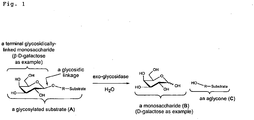
- Figure 1 Release of a terminal monosaccharide from a glycosylated substrate using an exo-glycosidase.
- the exo-glycosidase is a ⁇ -galactosidase that cleaves the terminal ⁇ -galactose residue to release the free monosaccharide (D-galactose) from a substrate leaving the degalactosylated aglycone.
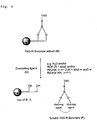
- FIG. 2 Capture of and further optional processing of a monosaccharide on solid supports using two types of capture groups.
- the equilibrium between the closed-ring form and the open-chain carbonyl of the released monsoaccharide B is shown in D.
- the carbonyl form reacts with immobilized -NH 2 groups on E, with loss of water, to give G.
- the initial capture product G can also be reduced directly to K, which can be further capped to give L .
- a second type of solid-support F bearing -YH capture groups can also react directly with the open-chain carbonyl group in D , by addition to give H.
- FIG. 3 Reaction of the detection agent TAG-R-Boronate (M) with the captured monosaccharide (any of G - L, Fig. 2 ) to form a covalent adduct N.
- the abbreviated schematic for any of G - L ( Fig. 2 ) shows that the immobilized monosaccharide contains a diol that is capable of binding to the boron atom.
- Other binding groups such as triols, amino-alcohols or a hydroxy-acids, are also possible.
- the TAG can be detected either directly, or indirectly through a perturbation of the solid support.
- FIG. 4 Release of bound TAG-R-Boronate (P) back into solution from the insoluble complex N using a competing ligand O.
- the structure of P will depend on the structure of the competing ligand, but will incorporate OH, OR or N groups bound to the boron atom.
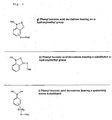
- FIG. 5 Examples of structures a-c of TAG-R-Boronate M.
- Figure 9 Structures of some capping agents.
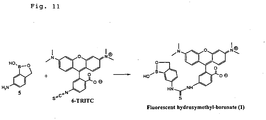
- FIG 13 Staining of treated capture beads with 1, and elution of 1 from stained beads with glycerol .
- Top panel the beads designated AFet+ and Gal-std appear bright red, the others are white.
- Middle panel after washing with glycerol all the beads appear white.
- Bottom panel the glycerol washes of beads designated AFet+ and Gal-std appear bright red, the others are clear.
- Aliphatic groups are non-aromatic organic compounds, in which carbon atoms are joined together in straight or branched chains rather than in rings. Aliphatics include not only the fatty acids and other derivatives of paraffin hydrocarbons (alkanes), but also unsaturated compounds, such as ethylene (the alkenes) and acetylene (the alkynes). The most frequently found non-carbon atoms bound to the carbon chain include hydrogen, oxygen, nitrogen, sulfur, and various halides.
- Alicyclic compounds such as cycloalkanes are aliphatic compounds that have one or more non-aromatic cycles in their chemical structure. Bicycloalkanes have two rings of carbon joined at one or two carbons. Most aliphatic compounds have very exothermic combustion reactions, thus allowing hydrocarbons such as methane to fuel Bunsen burners in the laboratory, for example.
- the aliphatic residue can be an optionally substituted linear aliphatic residue or an optionally substituted branched aliphatic residue.
- the aliphatic residue can also be an optionally substituted cyclic alkyl.
- Cyclic alkyl includes groups such as cyclopropyl, cyclobutyl, cyclopentyl, cyclohexyl, cycloheptyl, and cyclooctyl and such rings substituted with straight and branched chain alkyl groups as defined above.
- unsubstituted alkyl groups includes primary alkyl groups, secondary alkyl groups, and tertiary alkyl groups. Unsubstituted alkyl groups may be bonded to one or more carbon atom(s), oxygen atom(s), nitrogen atom(s), and/or sulfur atom(s) in a ligand.
- the cyclic aliphatic residue can e.g. comprise or consist of a C5-C16 cycloalkyl group.
- Shorter chain lengths can also occur, typically when the cycloalkyl is substituted with an aryl or heteroaryl residue.
- the optionally substituted aliphatic residue comprises or consists of a C5-C20 alkyl group. Shorter chain lengths can also occur, typically when the alkyl is substituted with an aryl or heteroaryl residue.
- alkyl groups substituted with aryl or heteroaryl includes, for example, a linear (C1-C10), branched (C4-C10) or cyclic (C5-C10) group, such as a methyl group, ethyl group, propyl group, such as a n-propyl group and an isopropyl group, butyl group, such as n-butyl group, isobutyl group, t-butyl group, n-amyl group, pentyl group, such as neopentyl group, cyclopentyl group, hexyl group, such as n-hexyl group, cyclohexyl group, heptyl group, octyl group, such as n-octyl group, nonyl group, such as n-nonyl group, decyl group, such as n-decyl group, undecyl group, dodecyl group, such
- Aromatic groups means either a mono- or polycyclic hydrocarbon group, which has a cyclic, delocalized (4n+2) pi-electron system, including arenes and their substitution products.
- suitable aromatic moieties for use in the present invention include, but are not restricted to, benzene, naphthalene, toluene, thiophene and pyridine.
- Carbohydrate The generic term 'carbohydrate' includes monosaccharides, oligosaccharides and polysaccharides as well as substances derived from monosaccharides by reduction of the carbonyl group (alditols), by oxidation of one or more terminal groups to carboxylic acids, or by replacement of one or more hydroxy group(s) by a hydrogen atom, an amino group, a thiol group or similar heteroatomic groups. It also includes derivatives of these compounds.
- Glycose in the present context refers to a monosaccharide, which can for example be either an aldose (a polyhydroxy aldehyde), a ketose (a polyhydroxy ketone), an oxidized derivative thereof including an alduronic acid (e.g. glucuronic acid), ketoaldonic acid (e.g. sialic acid or Kdo) as well as deoxy-derivatives and aminoderivatives thereof.
- alduronic acid e.g. glucuronic acid
- ketoaldonic acid e.g. sialic acid or Kdo
- sugar covers monosaccharides, oligosaccharides, polysaccharides, as well as compounds comprising monosaccharide, oligosaccharide, or polysaccharide.
- carbohydrate and “sugar” are herein used interchangeably.
- Oligo / poly- saccharide Oligosaccharides and polysaccharides are compounds consisting of monosaccharides linked glycosidically. In general polysaccharides comprise at least 10 monosaccharide residues, whereas oligosaccharides in general comprise in the range of 2 to 20 monosaccharides. Oligosaccharides and polysaccharides may be linear or branched.
- TAG The term "TAG" in the present context, and in fig. 1 (vide infra) is meant to indicate any atom, molecule or entity that can become covalently attached to another molecule thereby labelling said another molecule as having undergone the covalent attachment.
- Monosaccharide are polyhydroxy aldehydes H-[CHOH] n -CHO or polyhydroxy ketones H-[CHOH] n -CO-[CHOH] m -H with three or more carbon atoms.
- the generic term 'monosaccharide' denotes a single unit, without glycosidic connection to other such units. It includes aldoses, dialdoses, aldoketoses, ketoses and diketoses, as well as deoxy sugars and amino sugars, and their derivatives, provided that the parent compound has a (potential) carbonyl group.
- monosaccharides comprise in the range of 4 to 9 carbons, for example for polyhydroxy aldehydes n is an integer in the range of 3 to 8 and for polyhydroxyketones n+m is an integer in the range of 3 to 8.
- the term "Monosaccharide” can also include monosaccharide derivatives, such as those obtained by oxidation, deoxygenation, replacement of one or more hydroxyl groups by preferably a hydrogen atom, an amino group or thiol group, as well as alkylation, acylation, sulfation or phosphorylation of hydroxy groups or amino groups.
- monosaccharides all of which are envisaged as identifiable using the methods of the present invention, are described below:-
- Glycosides are mixed acetals formally arising by elimination of water between the hemiacetal or hemiketal hydroxy group of a sugar and a hydroxy group of a second compound. The bond between the two components is called a glycosidic bond.
- a method for analysis of a terminal monosaccharide on a glycosylated substrate comprising the steps of:-
- the above method does not comprise a step of reducing the bond between the capture group and the monosaccharide after immobilisation to the solid support.
- the immobilised monosaccharide is not contacted with a reducing agent before or simultaneously with incubation with the detection agent.
- Stage (i) of the method of the present invention comprises the step of detaching a monosaccharide from a glycosylated substrate A (see e.g. figure 1 )
- the monosaccharide is a naturally occurring monosaccharide or a monosaccharide which has been liberated from a naturally occurring or recombinantly produced compound comprising a carbohydrate, preferably without having been subject to furthermore modifications after liberation.
- the monosaccharide is a glycose, such as selected from the group consisting of: an aldose, a ketose, a deoxy sugar, an amino sugar, and derivatives thereof, such as an oxidized derivative thereof.
- glycoses examples include galactose, fucose, N-acetylglucosamine, galacturonic acid, and sialic acid.
- glycosylated substrate comprising monosaccharides that is known to one skilled in the art can be used in the methods of the present invention.
- said glycosylated substrate can be selected from the group consisting of: a glycosylated antibiotic, a glycoprotein, a glycolipid, a glycosylated steroid, an oligosaccharide, a polysaccharide.
- the glycosylated substrate is a substrate obtainable from a eukaryotic organism.
- the glycosylated substrate can be selected from the group consisting of: a glycoprotein, a glycolipid or a proteoglycan; preferably derived from a eukaryotic organism.
- said glycosylated substrate is selected from the group consisting of: a glycoprotein, a glycolipid or a proteoglycan, preferably obtainable or obtained from the cell membrane of a eukaryotic cell.
- the glycosylated substrate is selected from the group consisting of: a glycoprotein, a glycolipid, a lipo-polysaccharide, or a polysaccharide, obtainable or obtained from a prokaryotic organism.
- the glycosylated substrate is selected from the group consisting of: a glycoprotein, a glycolipid, a lipo-polysaccharide, or a polysaccharide obtainable from or obtained from the cell surface or membrane of a prokaryotic organism.
- the glycosylated substrate is selected from the group consisting of: a glycosylated antibiotic, a glycosylated steroid, a glycosylated natural product or a glycosylated peptide.
- Glycosylated substrates may be derived from a variety of sources.
- the glycosylated substrate may be obtained from a living organism or part of a living organism, such as animals or plants or from one or more specific animal or plant tissues, from organisms such as prokaryotic or eukaryotic cells, from viruses, from in vitro cultivated mammalian cells, insect cells, plant cells, fungi, bacterial cells, yeast, or phages.
- the glycosylated substrate may be isolated from extracts of any of the aforementioned cells, microbial organisms or living organisms. Such extracts may comprise glycosylated substrates, such as free carbohydrates.
- Extracts may also comprise compounds comprising monosaccharide, oligosaccharide, polysaccharide or carbohydrate moieties, notably glycoproteins or glycolipids or small organic molecules to which carbohydrates are attached, which are generally referred to as glycosides.
- Glycoproteins are compounds in which a carbohydrate component is linked to a peptide, polypeptide or protein component.
- glycoprotein also cover proteoglycans and glycosaminoglycans.
- Glycolipids are compounds containing one or more monosaccharide, oligosaccharide, polysaccharide or carbohydrate moieties bound by a glycosidic linkage to a hydrophobic moiety such as an acylglycerol, a sphingoid, a ceramide (N-acylsphingoid) or a prenyl phosphate.
- Glycosides can for example be small (MWt 100 - 5000) organic molecules glycosidically linked to one or more sugars via either O, N or S.
- Glycosylated substrates may also be the products of chemical synthesis, or chemical/enzymatic synthesis, such as oligosaccharides prepared in vitro by chemical synthesis in solution or on the solid phase. These same synthetic oligosaccharides may be further modified by enzymatic reaction, such as for example by the sulfation, phosphorylation or glycosylation. Thus the methods described herein may also be used for identification of monosaccharides of synthetic or semi-synthetic oligosaccharides or oligosaccharide libraries.
- the glycosylated substrate to be analysed can be comprised within a sample - for example, a complex sample, such as a sample comprising non-glycosylated substrates.
- a complex sample such as a sample comprising non-glycosylated substrates.
- the method of the present invention comprises an additional step after step (i), wherein (preferably high molecular weight) components of said sample are removed, such as for removal of macromolecules, such as larger polysaccharides or non-polysacharide components, particularly polypeptides.
- One method of removing said components is by size exclusion, preferably by ultrafiltration or by dialysis.
- Another method of removing the said components involved passing the sample through a membrane that is permeable to the monosaccharide but not to molecules with high molecular weights, such as proteins.
- Said membrane can for example be a Centricon (Millipore) membrane or a dialysis membrane.
- said components of the sample are removed by absorption on hydrophobic phases such as C18 or carbon.
- Detachment step -
- the detachment step of step (i) can be carried out by a range of methods known to one skilled in the art.
- said detachment step is carried out using an exo-glycosidase, such as a bacterial exo-glycosidase, such as for example an exo-glycosidase selected from the group consisting of:
- terminal monosaccharide can be detached using glycosidases acting on bacterial polysaccharides or glycolipids, cleaving deoxy sugars, amino sugars, substituted amino sugars, branched chain sugars, O-methyl sugars and the like.
- glycosidases are further described in the art, for example any of the glycosidases described in US 5,100,778 or WO 92/19974 may be employed with the present invention.
- FIG. 1 An example of the release of a terminal monosaccharide from a glycosylated substrate using an exo-glycosidase is shown in Figure 1 :-
- the soluble substrate monosaccharide-O-R-Substrate ( A ) is incubated with an exo-glycosidase of known specificity in a solution in which the glycosidase is soluble, typically a buffer solution with or without added cations.
- the exo-glycosidase is capable of cleaving a single terminal monosaccharide residue from a glycoside.
- the R group in A is preferably a carbohydrate (such as a monosaccharide or oligosaccharide) unit or an amino acid in glycoproteins or glycopeptides, a glycose unit in polysaccharides or oligosaccharides, a glycose unit or a lipid in glycolipids, or a glycose unit or an organic aglycone in e.g. glycosylated antibiotics or steroids.
- a carbohydrate such as a monosaccharide or oligosaccharide
- the terminal monosaccharide unit has a structure and anomeric configuration (either ⁇ or ⁇ ) that is hydrolysable by the glycosidase, it is cleaved to produce a reducing sugar (monosaccharide, B ) and the aglycone (HO-R-substrate, C ).
- glycosidases The specificities of many glycosidases are known, and such well-characterized glycosidases have been used in the sequencing of oligosaccharides. Thus, these enzymes can be specific for the stereochemistry of the monosaccharide-rings and the ⁇ or ⁇ configuration of the glycosidic linkages. Many of them are also specific with respect to the exact position of attachment of the glycose to the next sugar. For example, some ⁇ -glycosidases cleave only ⁇ 1-3 linkages and others only ⁇ 1-6 linkages. Thus, the entire structure of an an oligosaccharide can sometimes be determined by successive glycosidase digestion.
- the terminal monosaccharide is detached chemically, such as for example using acid hydrolysis, such as mild acid hydrolysis.
- acid hydrolysis such as mild acid hydrolysis.
- mild hydrolysis one can, for example, treat the glycosylated substrate with 0.1 N aq. trifluoroacetic acid at 80 degrees Celsius for 1 h.
- O-linked monosaccharides may be cleaved from glycoproteins by chemical methods, such as alkaline ⁇ -elimination or enzymatically using enzymes such as an O-glycosidase.
- Monosaccharides may also be cleaved from small organic molecules using either acidic or basic reactions.
- Stage (ii) of the method of the present invention comprises the step of allowing said detached monosaccharide to covalently bind to a capture group on a solid support.
- Capture group By “capture” group is meant a reactive chemical group capable of making a covalent bond by nucleophilic attack at the carbonyl group of the liberated monosaccharide (B). Examples of two different versions of this "capture” step are illustrated in Figure 2 :- The equilibrium between the closed-ring form and the open-chain carbonyl of the released monosaccharide B is shown in D. The carbonyl form reacts with immobilized (e.g. NH 2 )-capture groups linked to the solid support (E), to give a captured monosaccharide (G). Unreacted capture groups in G can optionally be capped to yield “capped” capture groups (I), optionally with further reducing and/or capping steps, to give J and L.
- immobilized e.g. NH 2
- the initial capture product G can also be reduced directly to K, which can be further capped to give L.
- a second type of solid-support F bearing -YH capture groups can also react directly with the open-chain carbonyl group form of the monosaccharide in D, by addition to give a monosaccharide captured as H.
- the covalent adduct formed between the monosaccharide bound to the capture group on the solid support comprises at least two OH- groups.
- the capture group comprises or consists of an - NHR group, where R is selected from the group consisting of: an alkyl, aryl, substituted alkyl or substituted aryl group.
- R is selected from the group consisting of: an alkyl, aryl, substituted alkyl or substituted aryl group.
- the capture can comprise or consist of an -NH 2 group.
- the capture group comprises or consists of the structure -M-NH 2 , wherein M is a heteroatom.
- the capture group comprises or consists of a sulphur atom or phosphorous atom.
- the capture group comprises or consists of an acidic -CH- group capable of ionization to a carbanion an subsequent nucleophlic attack at the sugar aldehyde.
- Compounds of this type are known by one skilled in the art and typically include a CH group adjacent to one or more of the follow groups:-
- the linker comprises a capture group, wherein the capture group comprises at least one -NH 2 group.
- the capture group terminates in an -NH 2 group that is attached to the linker through an optional group R.
- R preferably is of the structure R-NH 2 .
- R may be a simple alkyl, aryl or substituted alkyl or aryl group.
- R should contain a heteroatom directly attached to the -NH 2 group, to produce structures of the type linker-M-NH 2 , wherein M is a heteroatom (i.e. not carbon), preferably M is selected from the group consisting of N, O and S.
- M is a heteroatom, such as in the structures linker-O-NH 2 , linker-NH-NH 2 , linker-CO-NH-NH 2 , linker-NH-CO-NH-NH 2 , linker-S(O) 2 NH-NH 2 and linker-S-NH 2 .
- the capture of the monosaccharide is done by reacting the -NH 2 group of the capture group with e.g. the reducing end of said monosaccharide, i.e. with the aldehyde, ketone or hemiacetal group.
- the reaction can occur at any pH values but is most favored in the range of pH 2 - 9.
- the methods may involve the addition of one or more additives, such as additives which may either facilitate or favourably alter the equilibrium between the open chain aldehyde form of the monosaccharide and the hemiacetal form of the monosaccharide, wherein the open chain aldehyde form is preferred.
- the additive may for example be metal ions, boronates or silicates.
- This immobilized monosaccharide may also be in equilibrium with its cyclic ring form, in particular if the monosaccharide was a pyranose, then the immobilised monosaccharide may be in equilibrium with its cyclic 6-membered ring form (see for example compounds B and D of fig. 2 ), but it may also be in equilibrium with its 5-membered ring form if the appropriate OH group on the monosaccharide is unsubstituted.
- the capture group can optionally be attached to the solid support via a linker group.
- Said linker group can be any molecule capable of linking the capture group to the solid support.
- the linker may be any of a large variety of linkers such as those in common use in solid-phase organic synthesis.
- the linker may either be a non-cleavable linker or a cleavable linker.
- Non-cleavable linkers may for example be alkyl, aryl, ethers or amides, wherein any of the aforementioned may optionally be substituted.
- any of the aforementioned may be substituted with heteroatoms or they may contain, O-alkyl,alkyl, aryl or heteroatoms as branches.
- the linker comprises or essentially consists of PEG and/or polyamide.
- the linker may comprise a site where a reaction can be made to occur to sever the part containing the capture group (including the molecules it has captured and which have been optionally further modified) from the solid support.
- Such linkers are referred to as cleavable linkers, and are in wide use in solid phase organic synthesis. Examples of cleavable linkers are known where the cleavage can be effected by electrophiles, nucleophiles, oxidizing agents, reducing agents, free radicals, acid, base, light, heat or enzymes.
- Cleavable linkers may for example be acid labile (for example, the Rink amide as described in Rink, 1987, Tetrahedrom Lett., 28: 387 and traceless silyl linkers as described in Plunkett et al., 1995, J. Org. Chem., 60: 6006-7 ), base labile (for example, HMBA as described in Atherton et al. 1981, J. Chem. Soc. Perkin Trans, 1: 538 ), or photolabile (for example, 2-nitrobenzyl type as described in Homles et al., 1995, J. Org. Chem., 60: 2318-2319 ).
- acid labile for example, the Rink amide as described in Rink, 1987, Tetrahedrom Lett., 28: 387 and traceless silyl linkers as described in Plunkett et al., 1995, J. Org. Chem., 60: 6006-7
- base labile for example, HMBA as described
- the linkers may be more specific and restrictive of the type of chemistry performed, such as silyl linkers (for example, those cleaved with fluoride as described in Boehm et al., 1996, J. Org. Chem., 62: 6498-99 ), allyl linkers (for example, Kunz et al., 1988, Angew. Chem. Int. Ed. Engl., 27: 711-713 ), and the safety catch sulfonamide linker (for example, as described in Kenner et al., 1971, Chem. Commun., 12: 636-7 ).
- silyl linkers for example, those cleaved with fluoride as described in Boehm et al., 1996, J. Org. Chem., 62: 6498-99
- allyl linkers for example, Kunz et al., 1988, Angew. Chem. Int. Ed. Engl., 27: 711-713
- Enzyme cleavable linkers may for example be any of the enzyme cleavable linkers described in Reents et al., 2002, Drug Discov. Today, 7: 71-76 , or any functionalised derivatives of the enzyme-labile protecting groups described in the review by Waldmann et al., 2001, Chem. Rev. 101: 3367-3396 .
- Heat labile linkers may for example be of the type described in Meng et al., 2004, Angew. Chem. Int. Ed., 43: 1255-1260 .
- the capture reaction may be performed in any useful solvent.
- the solvent may for example be selected from the group consisting of water, aqueous buffer, organic solvents and mixed aqueous and organic solvents.
- the solvent may also be any of the aforementioned comprising one or more additives such as acids, bases, organic amines, anilines, salts, divalent metal cations, detergents, complexing agents including inclusion-complex-forming molecules such as cyclodextrins or calixarenes, chelating agents (for example EDTA), borates, boronates or silicates.
- the amount of solid support added to the reaction is adjusted so that a molar excess of capture groups are present in relation to the monosaccharide, preferably said excess is large, such as at least 2 times, preferably at least 5 times, more preferably at least 10 times, such as at least 50 times, for example at least 100 times or more. This excess will ensure a more efficient capture of the monosaccharide.
- the capture reaction may be carried out at any temperature, but preferably at temperatures in the range of 0 to 100°C.
- Solid support Any suitable solid support capable of supporting the capture groups and known to one skilled in the art can be used in the methods of the present invention.
- the solid support can be selected from the group consisting of polymers, solids, insoluble particles and surfaces. Examples include PEGA and SPOCC.
- the solid support is preferably a bead.
- the solid support is a slide, such as a glass slide, a microtiter well, or a metal-coated slide, for example a gold-coated slide.
- the solid support can be a hydroxylamine-modified surface, in which case it is preferably a controlled pore glass (CPG) bead or glass slide.
- CPG controlled pore glass
- solid support covers physical solids as well as insoluble polymers, insoluble particles, surfaces, membranes and resins, preferably the solid support is an insoluble polymer, an insoluble particle, a surface or a resin.
- the "solid support” may be an insoluble inorganic matrix (such as glass), an insoluble polymer (such as a plastic, for example polystyrene), an insoluble matrix consisting of parts of both organic and inorganic components (e.g. some hybrid silicates, such as compounds of the structure R-Si-O-), organic polymers in common use in solid-phase synthesis (polystyrenes, PEGA resins, PEG resins, SPOCC resins and hybrids thereof), polyethylene glycol chains (which can be soluble in certain organic solvents and made insoluble by the addition of other solvents).
- the solid may also be a metal (such as gold), an alloy, or a composite such as for example indium-tin oxide or mica.
- Organic polymers used in solid-phase synthesis include: TentaGel (commercially available from Rapp polymere, Tübingen, Germany), ArgoGel (commercially available from Argonaut Technologies Inc., San Carlos, CA), PEGA (commercially available from Polymer Laboratories, Amherst, MA), POEPOP ( Renil et al., 1996, Tetrahedron Lett., 37: 6185-88 ; available from Versamatrix, Copenhagen, Denmark) and SPOCC ( Rademann et al, 1999, J. Am. Chem. Soc., 121: 5459-66 ; available from Versamatrix, Copenhagen, Denmark).
- the solid support is a sensor, such as a surface acoustic wave sensor (such as any of the sensors described in Samoyolov et al. 2002, J. Molec. Recognit. 15: 197-203 ), a surface plasmon resonance sensor (such as any of the sensors reviewed by Homola et al., 1999, Sensors and Actuators B, 54: 3-15 ), or a nanomechanical cantilever sensor such as described by Mukhopadhyay in Nano Lett. 2005, 5, 2385-88 .
- a surface acoustic wave sensor such as any of the sensors described in Samoyolov et al. 2002, J. Molec. Recognit. 15: 197-203
- a surface plasmon resonance sensor such as any of the sensors reviewed by Homola et al., 1999, Sensors and Actuators B, 54: 3-15
- a nanomechanical cantilever sensor such as described by Mukhopadhyay in Nano Lett. 2005, 5, 23
- Such solid supports may be inorganic materials such as glass, metals such as gold, organic polymeric materials or hybrids thereof and may be covered various coatings such as proteins or polysaccharides, oligomers such as as dendrimers or polymers such as polyacrylamide or polyethylene glycol.
- the solid support is glass.
- the solid supports can optionally be washed to remove non-covalently bound material. Accordingly, if the glycosylated substrate is, for example, provided in a sample comprising other compounds, the reducing sugar may be purified from said sample. It is thus comprised within the present invention that the glycoslated substrate is provided in a non-purified form.
- washing conditions for a given immoblised monosaccharide (e.g. any of compounds G-L in figure 2 ).
- the washing may for example be done with any of the herein-mentioned solvents optionally comprising any of the herein-mentioned additives in addition to detergents and denaturing agents.
- the washing may be performed at any temperature, but preferably at temperatures in the range of 0 -100°C.
- Stage (iii) of the method of the present invention comprises the step of incubating said covalently bound monosaccharide with a detection agent with formula X:
- an excess of said detection agent is used.
- Boonate any suitable chemical moiety comprising a boronic acid moiety, or an ester thereof, preferably the boronate is boronic acid.
- the detection agent can for example comprise aryl boronate or heteroarylboronate.
- the detection agent has a formula selected from the group consisting of:- TAG-R-B(OH) 2 , TAG-R-B(OH)(OR') or TAG-R-B(OR')(OR") wherein R' and R" may be either aliphatic or aromatic and are optionally covalently attached to R, for example resulting in a cyclic boronate structure.
- R' and R" may individually be selected from the group consisting of C 1-6 linear or branched alkyl, C 5-7 aliphatic ring and C 5-7 aromatic ring.
- R' may also form a fused ring with R, and in this embodiment R' may be a 4-7 membered aliphatic heterocycle, which is optionally substituted.
- said heterocycle may be a 5 membered cycle including the B and the O atom to which R' is attached. Said heterocycle may not be substituted or it may be substituted.
- the TAG-R-Boronate comprises a Phenyl boronic acid derivative, such as as exemplified by group a) in figure 5 .
- the TAG-R-Boronate comprises a Phenyl boronic acid derivative with an o-aminomethyl moiety such as as exemplified by group b) in figure 5 .
- the TAG-R-Boronate comprises a Phenyl boronic acid derivative with a substituted o-aminomethyl moiety, such as as exemplified by group c) in figure 5 .
- the TAG-R-Boronate comprises a Phenyl boronic acid derivative bearing an electronegative substituent, such as as exemplified by group d) in figure 6 .
- the TAG-R-Boronate comprises a Phenyl boronic acid derivative with a sulfonamide or a sulfone substituent, such as as exemplified by group e) in figure 6 .
- the TAG-R-Boronate comprises a pyridine boronic acid derivative, such as as exemplified by group f) in figure 6 .
- the TAG-R-Boronate comprises a Phenyl boronic acid derivative bearing an o-hydroxymethyl group, such as as exemplified by group g) in figure 7 .
- the TAG-R-Boronate comprises a Phenyl boronic acid derivative bearing a substituted o-hydroxymethyl group, such as as exemplified by group h) in figure 7 .
- the TAG-R-Boronate comprises a Phenyl boronic acid derivative bearing a quaternary ammonium substituent, such as as exemplified by group i) in figure 7 .
- the TAG-R-Boronate comprises a Multiple aryl boronic acid derivative, such as as exemplified by group j) in figure 8 .
- the TAG-R-Boronate comprises a Boronic acid derivative of an aromatic 5-membered ring heterocycle, such as as exemplified by group k) in figure 8 .
- the TAG-R-Boronate comprises a Phenyl boronic acid derivative with 2 or more fused rings, such as 2, 3, 4, 5 or 6 rings, such as as exemplified by group I) in figure 8 .
- the detection agent has the formula of the tetramethylrhodamine-derived fluorescent hydroxymethyl-boronate 1 shown in Figure 11 .
- the detection agent is according to the formula of the lissamine-derived fluorescent nitro-boronate 2 shown in figure 12 .
- R moiety can be any chemical group, such as an aliphatic or aromatic moiety, as described herein.
- R may for example be an aromatic cycle or heteroaromatic cycle, such as a 5 to 6 membered aromatic or heteroaromatic cycle or a fused ring aromatic ring system, for example 2 fused rings of each 5 to 6 members fused at any two positions (see e.g. figure 8I ).
- the heteroaromatic cycle may be a 5 to 6 membered ring, such as a 5 membered ring comprising in the range of 1 to 3, such as 1, for example 2 heteroatoms selected from the group consisting of N, O and S.
- Said aromatic cycle or heteroaromatic cycle may optionally be substituted, for example substituted with alkyl, such as C 1-6 alkyl, amino alkyl, such as C 1-6 amino alkyl, for example C-NR x 2 , a primary or secondary or tertiary amino group or sulphate, wherein R x may be -H, alkyl, cycloalkyl, aryl, substistuted alkyl, substitued cycloalkyl or substituted aryl, such as -H, C 1-6 alkyl, C 5-7 cycloaryl or C 5-7 aryl.
- alkyl such as C 1-6 alkyl, amino alkyl, such as C 1-6 amino alkyl, for example C-NR x 2 , a primary or secondary or tertiary amino group or sulphate
- R x may be -H, alkyl, cycloalkyl, aryl, substistuted alkyl, substitu
- said aromatic or heteroaromatic cycle is substituted with X-TAG, or one of aforementioned substiuents are covalently attached to X-TAG, wherein X is selected from the group consisting of -NH-, -CO-, alkyl (such as C1-6 alkyl, for example methyl or ethyl), aryl (such as C5 to 7 aryl), heteroaryl (such as a 5 to 7 membered aryl cycle), substituted alkyl, substituted aryl, substituted heteroaryl, fused alkyl or heteroalkyl, heteroaryl ring, -O- and -S-.
- X may be selected from the group consisting of -NH-, -CO-, -CH 2 -, -CH 2 -CH 2 -, phenyl, -O- and -S-.
- the detection agent may be desirable to release the detection agent from the solid support either before or after the detection step, for example to improve quantification of certain types of detection agent.
- the detection agent is not released from the solid support.
- the release step may for example be effected by contacting the solid support with a solution of a soluble compound that competes with the detection agent for binding of the monosaccharide, as shown in figure 4 .
- Said soluble compound can, for example, be a polyalcohol such as glycerol or glucitol, or an amino-alcohol such as diethanolamine.
- TAG moiety -
- the detection agent is preferably provided comprising a TAG moiety.
- Any suitable TAG moiety can be used, such as e.g. selected from the group consisting of: a fluorescent moiety, a luminescent moiety, and a coloured moiety.
- Suitable specific moieties include, inter alia, coumarin, tetramethylrhodamine, lissamine or fluorescein.
- the TAG has beneficial spectroscopic properties.
- beneficial spectroscopic properties is meant that the TAG can easily be visualised, for example by spectrometry.
- the TAG may for example be spectroscopically detectable.
- the TAG is a fluorescent TAG. Examples of such TAGs can be found in the Handbook of Fluorescent Probes and Research Products, by RP Haugland, 9th Ed., Molecular Probes .
- TAG can absorb and re-emit light that can be detected.
- the number of such TAGs present on the solid support will reflect the number of monosaccharides captured on the solid support.
- the number of monosaccharides originally present in a sample can therefore be estimated by the fluorescence of the TAG, provided that the provided solid supports comprise an excess of capture groups.
- TAGs other than fluorescent molecules can also be used.
- TAGs can include radioactive TAGs, phosphorescent TAGs, chemiluminescent TAGs, UV-absorbing TAGs, nanoparticles, quantum dots, coloured compounds, , electrochemically-active TAGs, infrared-active TAGs, TAGs active in Raman spectroscopy or Raman scattering, TAGs detectable by atomic force microscopy or TAGs comprising metal atoms or clusters thereof.
- the solid support is a sensor, such as a surface acoustic wave sensor, a surface plasmon resonance sensor, or a cantilever
- addition of such a species that binds specifically to the TAG can result in the production of a signal that is proportional to the TAG and therefore to the number of sugar molecules.
- TAG is a biotin residue, commonly introduced by reaction with an active ester of biotin.
- Addition of an avidin-protein, when the TAG is a biotin residue can result in signal that is readily detected and reported by the sensor.
- DPI surface plasmon fluorescence spectroscopy sensors
- WIOSs wavelength-interrogated optical sensors
- impedence sensors optical waveguide grating coupler sensors
- acoustic sensors acoustic sensors and calorimetric sensors.
- the monosaccharide has been attached to a TAG with spectroscopic properties
- said spectroscopic properties may be determined.
- the optical properties may be determined for sugars still immobilised on the solid support (such as for compound N of fig. 3 ) or for sugars released to solution by a competing ligand (for example for compound P of fig. 4 ).
- said properties may be determined using conventional methods, such as spectrometry.
- the methods of the invention may comprise the step of detecting the TAG attached to the monosaccharide by spectrometry.
- the TAG is a coloured moiety or a fluorescent moiety, which may even be detectable by visual inspection by eye.
- the TAG may for example be any fluorescent moiety known to the skilled person, for example any of the fluorescent moieties described in The Handbook - A Guide to Fluorescent Probes and Labeling Technologies 10th edition available from Invitrogen - Molecular Probes .
- the TAG may be 6-TRITC or tetramethylrhodamine.
- a capping agent is bound to unbound capture groups before step (iv) of the method.
- unreacted capture groups are capped by a capping agent, under conditions where the bound monosaccharide is preferably not released form the capture group on the solid support.
- capping agent Any suitable capping agent known to one skilled in the art may be used in the present invention.
- said capping agent is a capping group capable of reacting with a -NH 2 group.
- Examples of preferred capping agents are disclosed in Figure 9 .
- N(H)CAP capped nitrogen atoms
- the product of the capping of compound C can for example contain an -R-N(H)CAP group, wherein the (H) may or may not be present depending on
- reagents are well known in the art an include common acylating agents used for amid bond formation, e.g. acetic anhydride, other alkanoic acid anhydrides, aromatic anhydrides (e.g. benzoic anhydride), cyclic anhydrides (e.g. succinic anhydride, phthalic anhydride), other active esters such as N-hydroxysuccinimide esters, pentafluorophenyl esters and a variety of active esters in common use in amide bond formation including in the solid phase synthesis of peptide bonds.
- common acylating agents used for amid bond formation e.g. acetic anhydride, other alkanoic acid anhydrides, aromatic anhydrides (e.g. benzoic anhydride), cyclic anhydrides (e.g. succinic anhydride, phthalic anhydride), other active esters such
- the -NH 2 groups may alternatively be capped by adding the corresponding free acids and an in-situ activating agent such as DCC, in common use in peptide-bond formation thereby creating an active ester in situ.
- an in-situ activating agent such as DCC
- the bond linking the monosaccharide to the linker is reduced using a reducing agent.
- the methods do not comprise such a reduction step.
- boranes or borohydrides comprising a BH bond examples include NaBH 4 , NaCNBH 3 , and BH 3 complexes such as BH 3 -pyridine, BH 3 -dimethylsulfide or the like.
- Silanes with the structures R 3 SiH can also be used, such as silanes comprising SiH bonds, as can hydrogen transfer agents such as diimides, or homogeneous hydrogenation catalysts or hydrogenation catalysts comprising a metal-H bond.
- the reduction results in a reactive monosaccharide sugar containing the structure SugarCH-NH- preferably linked to a solid support via a linker.
- the monosaccharide sugar was an aldehyde, then reduction will result in a compound of the structure SugarCH 2 -NH-. If the monosaccharide sugar was a ketone, then the reduction will result in a compound of the structure SugarCH-NH-.
- the capping step is carried out and the then reduction step is carried out.
- the order of the capping and reduction steps is reversed.
- the reduction may in one embodiment be performed in situ, meaning that a reducing agent (such as NaCNBH 3 ) may be added to the solid support simultaneously with the monosaccharide. It is thus comprised within the present invention that the sample comprising the monosaccharide may be incubated with the solid support and the reducing agent simultaneously.
- a reducing agent such as NaCNBH 3
- Stage (iv) of the method of the present invention comprises the step of allowing the detection agent to bind the monosaccharide.
- TAG-R-Boronate This reaction of the TAG-R-Boronate with the captured monosaccharide is exemplified in figure 3 :-
- the captured monosaccharide bonded to the solid support (any of G-L) is contacted with a solution of a functionalized boronic acid of the general formula TAG-R-Boronate ( M ), where R is preferably aromatic or heteroaromatic.
- the "TAG" can be any moiety that permits the specific detection of the Tagged species, either directly - such as by using a fluorescent TAG - or indirectly - for example by measuring a mass change attributed to a heavy metal TAG.
- TAG-R-Boronate ( M ) After incubation with any of G-L , the TAG-R-Boronate ( M ) will stay covalently attached to the monosaccharide-solid support (such as, for example via at least one OH-group) and optionally, the unbound TAG-R-Boronate can be washed away. This leaves a solid material referred to as TAG-R-Boronate-adduct ( N ). In the absence of attched Glycose, the TAG-R-Boronate will not remain attached to the solid support and will be washed away from the solid support that will then not have any attached TAG.
- the method according to the present invention comprises a further step after step (iv), wherein unbound detecting agent is removed, preferably by washing.
- unbound detecting agent is removed, preferably by washing.
- the tagged immobilised terminal monosaccharide e.g. compound N, fig. 3
- any amount of unbound TAG is removed. Washing may easily be accomplished because the tagged monosaccharide is immobilised on a solid support.
- the amount of TAG will be correlatable to the amount of immobilised sugar. Accordingly, by determining the presence of TAG, the amount of immobilised sugar may be determined. If essentially all monosaccharide in a given sample was immobilised, the methods therefore in one aspect allow determining the amount of monosaccharide present in a sample.
- the washing may for example be done with a solvent selected from the group consisting of water, aqueous buffer, organic solvents and mixed aqueous and organic solvents.
- the solvent may also be any of the aforementioned comprising one or more additives such as salts, divalent metal cations, detergents, complexing agents including inclusion-complex-forming molecules such as cyclodextrins or calixarenes, chelating agents (for example EDTA), borates, boronates or silicates.
- the solvent may optionally comprise detergents and denaturing agents.
- the washing my be performed at any temperature, but preferably at temperatures in the range of 0 - 100°C.
- Stage (v) of the method of the present invention comprises the step of detecting detection agent having bound to the monosaccharide.
- This detection step can allow conclusions to be drawn in relation to the identity of the terminal monosaccharide cleaved from the glycosylated substrate A, for example the detection step may allow allow identification of at least one of the terminal monosaccharide(s) on the glycosylated substrate.
- One preferred identification method is via indirect identification of the monosaccharide according to the specific detachment method used, for example if one uses a specific glycosidase in step (i) of the method, one can then infer the identity of the monosaccharide detached based on the specificity of the glycosidase used.
- the detecting step can be carried out by measuring absorbance or fluorescence.
- the detecting step can be carried out by using spectrometry, such as fluorospectrometry.
- the analysis allows quantification of at least one of the monosaccharide(s) on the glycosylated substrate.
- the amount of TAG present on the TAG-R-Boronate adduct will indicate that amount of monosaccharide present, whose quantity can therefore be estimated using a standard curve of captured reference monosaccharide.
- the quantification may be carried out by comparing the results obtained with standard curve obtained using different concentrations of a known reference sample.
- the TAG molecule is released from the solid support before quantification.
- This release step is exemplified in Figure 4 :- wherein the soluble TAG-R-Boronate (P) is released back into solution from the TAG-R-Boronate adduct (N) by contacting it with a solution of a cleaving agent comprising a competing ligand (O)
- the TAG -R-Boronate (P) released into solution can then be estimated by solution methods that detect the TAG, such as spectroscopy.
- the TAG will no longer be detectable on the residual solid-support which will have the structure according to any of G-L.
- the cleaving agent (O) can for example be a soluble compound that competes with the immobilized monosaccharide and makes covalent bonds to the boronate moiety.
- Such compounds include polyalcohols like glycerol or glucitol, or amino-alcohols like diethanolamine. Under certain conditions, water or alcohols may act as competing ligands.
- a predetermined amount of a reference standard is added to the sample comprising the glycosylated substrate. This may facilitate quantification of any released monosaccharide after immobilisation, and/or validate the efficiency of the capture-beads in a complex sample.
- the reference standard can for example be a compound capable of reacting with -NH 2 .
- the reference standard is an aldehyde or a ketone, more preferably a sugar, such as a monosaccharide.
- the present invention surprisingly discloses a high affinity between boranate and immobilised terminal monosaccharides. Accordingly, the methods of the invention are sufficiently sensitive in order for relatively insensitive methods to be used for detection. Accordingly, surprisingly in one preferred embodiment of the invention the detection may be visual detection by eye. Visual detection by eye may for example be performed as described in Example 1 and disclosed in figure 13 herein.
- the method described herein may advantageously be repeated at least once, such as 1, 2, 3, 4, 5, 6, 7, 8, 9, 10 or more times. This can for example be advantageous should one wish to use the methods described herein for monosaccharide sequencing of a glycosylated molecule, such as a polysaccharide.
- the repetitions of any of the methods disclosed herein may be carried out in parallel on different samples of glycosylated substrates and/or using different methods for detaching the monosaccharide(s) from said glycosylated substrate(s).
- one may repeat the method using one or more different specific glycosidases (optionally on parallel samples), in order to indirectly determine the identity of the relevant monosaccharides through the specificity of the glycosidase used.
- the present invention provides in one aspect a method for oligosaccharide or polysaccharide sequencing, comprising subjecting a polysaccharide or molecule comprising a polysaccharide to any of the methods disclosed herein.
- the methods of the present invention may be used to identify particular glycosylation patterns associated with certain pathological conditions, thus in a further aspect of the present invention is disclosed a method of diagnosis of a disease associated with abnormal glycoprotein glycosylation, comprising subjecting a sample of glycoproteins obtained from a patient to any of the methods as disclosed herein. Identification of one or more of the monosaccharides on the glycosylated substrate of interest can for example allow diagnosis of a specific glycoylation pattern associated with a particular disease class.
- Preferred diseases associated with an abnormal glycosylation patterns include, but are not restricted to, Carbohydrate-Deficient Glycosylation Syndromes (CDGS), CDGS I, CDGS II, CDGS III, CDGS IV, neuronal diseases, diabetes, Tay-Sachs disease and cancers.
- CDGS Carbohydrate-Deficient Glycosylation Syndromes
- CDGS II CDGS II
- CDGS III CDGS IV
- neuronal diseases diabetes, Tay-Sachs disease and cancers.
- the method of the present invention may also be used advantageously to assay for bacterial contamination of products.
- a method for monitoring for bacterial contamination of products comprising subjecting a sample of said product to one of the methods disclosed herein.
- This may be particularly advantageous for e.g. checking the quality of therapeutic glycosylated proteins, as disclosed in e.g. Sinclair et al., "Glycoengineering: the Effect of Glycosylation on the Properties of Therapeutic proteins".
- a method for characterising therapeutic glycosylated proteins comprising carrying out any of the methods describe herein.
- a covalent adduct is formed between the monosaccharide and the detection agent, as disclosed herein.
- a covalent adduct formed between a monosaccharide captured on the solid phase such as any of the monosaccharides disclosed herein, and a detection agent with formula X:
- the covalent adduct is covalently bound to a capture group on a solid support.
- fluorescent compounds are used as the TAG component of the detection agent.
- novel fluorescent compounds useful as TAG compounds which can be used to produce the detection agents used in the present invention.
- Any of the fluorescent compounds disclosed herein may be used: two preferred fluorescent compounds have the following structures: fluorescent hydroxymethyl-boronate 1 (shown in figure 11 ) and fluorescent nitro-boronate 2 (shown in figure 12 )
- kit of parts suitable for using in the methods of the present invention, said kit of parts comprising at least one solid support (such as any of the solid supports disclosed herein), at least one capture group (such as any of the capture groups disclosed herein), and one or more detection agents, such as any of the detection agents disclosed herein.
- Said kit of parts may also further comprise at least one specific glycosidase and/or a sample of glycosylated substrate, preferably for use as a positive control in quantitative or qualitative assays.
- Aminopropyl controlled pore glass (AMP-CPG, Millipore Prod. No. AMP 1400B) (500 mg, loading of amino groups, ca 50 ⁇ mol/g) was washed with DMF (3 x 2 mL), 50% DIPEA in DMF (3 x 2 mL) and DMF (3 x 2 mL). The beads were then treated with a mixture of the hydroxylamine linker 3 (45 mg, 100 ⁇ mol), TBTU (25 mg, 75 ⁇ mol) and DIPEA (13 ⁇ L, 75 ⁇ mol) in DMF (2 mL) for 2 h at rt. The beads were washed with DMF (3 x 2 mL) and DCM (3 x 2 mL).
- Unreacted amino groups were capped by treating the beads with 50% Ac 2 O in pyridine (2 mL) for 15 min at rt.
- Silanol groups (on the glass surface) were capped by treating the beads with 5% dichlorodimethylsilane in toluene (2 mL) for 30 min at rt, followed by 10 min incubation in dry MeOH. The silanol capping was repeated.
- the beads were washed with MeOH, DMF and DCM. A small portion of the beads was removed and the loading was determined to be ca 35 ⁇ mol/g based on the absorbance of the Fmoc group released on treatment with 10% DBU in DMF, by comparison with a standard curve prepared using known concentrations of cleaved Fmoc group.
- 6-TRITC ( 4 , 7.4 mg, 17 ⁇ mol) was added to a solution of 5-amino-2-hydroxymethyl phenyl boronic acid ( 5 , Combi-Blocks Prod. No. BB-2043, 3.1 mg, 17 ⁇ mol) in 0.1 M NaHCO 3 /Na 2 CO 3 buffer pH 9 (1 mL) and DMF (1 mL). The mixture was stirred over night at rt in the dark. The mixture was concentrated under vacuum and the crude product was dissolved in water, adsorbed on a Sep-Pak cartridge (C-18) which was washed with H 2 O. Elution with 30-50% MeCN in H 2 O (containing 10% 0.1 M HCl) gave 1 as a purple solid (6.3 mg, 64%). ES-MS, m / z found 593.2 ([MH] + calcd 593.2).
- Lissamine rhodamine B sulfonylchloride 6 , mixture of 5/6 isomers, 100 mg, 0.17 mmol
- the mixture was stirred over night at rt in the dark.
- the mixture was concentrated under vacuum and the crude product was purified by adsorption on a Sep-Pak cartridge (C-18) which was washed with H 2 O. Elution with 30% MeCN in H 2 O (containing 10 % 0.1 M HCl) gave 7 as a purple solid that was used without further characterisation.
- BSA bovine serum albumin
- BSA (5 x 2 mg/mL ampules, Pierce #23209) was dialyzed twice against water (5L), and concentrated to 20 mg/mL in a centricon-30 ultrafiltration tube.
- a centricon-30 ultrafiltration tube was preconditioned by washing with water (2 mL), then spun for 8 min at rt to clean the membrane.
- ⁇ -galactosidase from bovine testes (Sigma, G4142) was dissolved in buffer (0.1 M citrate/phosphate, pH 5.0) and 2 mL was added to the Centricon tube. The tube was spun at 4000 x g until 50 ⁇ L remained. The filtrate was discarded, and the retentate made up to 2 mL with buffer. This was centrifuged again until 50 ⁇ L remained. The entire process of discarding the filtrate, adding buffer to 2 mL and centrifuging was repeated 4 more times. After discarding the final filtrate, the tube was inverted and spun for 2 min at 1000 x g, yielding a solution of the enzyme in buffer ready for use.
- each of the resulting hydroxylamine Capture Beads ( Figure 10 ) was added 50 ⁇ L of Fet-, Fet+, AFet-, AFet+, BSA-, BSA+, galactose (2 mM) in buffer (referred to as Gal-std), and buffer alone (referred to as Blank). More buffer (50 ⁇ L) was added to each tube. The tubes were stoppered and incubated overnight at 60 °C in a heating block. After cooling to rt, remaining capture groups were capped by adding 50% acetic anhydride in MeOH and shaking gently for 20 min.
- the remaining manipulations were no longer performed under argon.
- the beads from each tube were transferred to a plastic syringe equipped with a Teflon frit, and washed by aspiration with buffer (3 x 0.5 mL), H 2 O (3 x 0.5 mL), MeOH (3 x 0.5 mL), H 2 O (3 x 0.5 mL), 5% DIPEA in DMF (0.5 mL), DMF (3 x 0.5 mL), H 2 O (3 x 0.5 mL) and MeOH (3 x 0.5 mL). A portion of each batch of beads was dried under vacuum.
- the beads were washed with DMF (3 x 0.5 mL), 0.1 M carbonate buffer pH 9 (1 x 0.5 mL), H 2 O (1 x 0.5 mL), DMF (3 x 0.5 mL), DCM (3 x 0.5 mL). Portions of the beads were transferred to small glass vials and photographed with a hand-held digital camera ( Figure 13 , top panel).
Landscapes
- Health & Medical Sciences (AREA)
- Life Sciences & Earth Sciences (AREA)
- Engineering & Computer Science (AREA)
- Chemical & Material Sciences (AREA)
- Immunology (AREA)
- Molecular Biology (AREA)
- Biomedical Technology (AREA)
- Hematology (AREA)
- Urology & Nephrology (AREA)
- Physics & Mathematics (AREA)
- Biochemistry (AREA)
- Organic Chemistry (AREA)
- Microbiology (AREA)
- General Health & Medical Sciences (AREA)
- Biotechnology (AREA)
- Analytical Chemistry (AREA)
- Medicinal Chemistry (AREA)
- Zoology (AREA)
- General Physics & Mathematics (AREA)
- Pathology (AREA)
- Food Science & Technology (AREA)
- Proteomics, Peptides & Aminoacids (AREA)
- Cell Biology (AREA)
- Wood Science & Technology (AREA)
- Biophysics (AREA)
- Bioinformatics & Cheminformatics (AREA)
- General Engineering & Computer Science (AREA)
- Genetics & Genomics (AREA)
- Measuring Or Testing Involving Enzymes Or Micro-Organisms (AREA)
- Investigating Or Analysing Materials By The Use Of Chemical Reactions (AREA)
Abstract
Description
- The present invention relates to the field of carbohydrate analysis. In particular, the invention relates to new methods for identifying the terminal sugar-residues of carbohydrate chains, and for sequencing carbohydrates, such as carbohydrates found in biological samples. Thus, in one aspect the invention relates to the field of carbohydrate detection and structural characterisation.
- Carbohydrates exist in many forms in nature. In animals including man, examples include free reducing sugars in solution (such as the monosaccharide glucose in serum), free oligosaccharides in solution (such as the disaccharide lactose in milk), they can be attached to peptides or proteins through covalent linkages to a variety of amino acids (such as asparagine, serine, threonine and others), covalently attached to lipids such as ceramide (as in gangliosides) or attached to membrane anchors via phosphatidylinositols. Sugars are also found attached to many small molecules including some involved in metabolism, such as glucuronides. In the above examples, the length of the sugar chains can vary from one to over 100 sugar residues.
- In lower organisms, including bacteria and plants, an even wider array of structures exists. The surface of bacterial cells can be covered by sugar polymers that are thousands of residues long, which can act as antigens in the detection of bacteria and as vaccines. Sugars are an integral part of bacterial cell walls. The sugars can themselves be antibiotics (such as the aminoglycoside antibiotics, for example streptomycin), or can be found as essential components of antibiotics (such as erythromycin and vancomycin), as enzyme inhibitors (as in Acarbose) or as anti-cancer agents (such as for example calicheamycin).
- One area of particular interest is the structure of the carbohydrate chains (glycans) found attached to glycoproteins and glycolipids. The glycosylation pattern of glycoproteins has been shown to be important for their biological functions, including their bioavailablity, their targeting, and have even been directly correlated with the metastatic potential of tumor cells. The glycosylation pattern of human serum transferrin, for example, is being used as a diagnostic test for a series of genetic diseases termed Carbohydrate-Deficient Glycosylation Syndromes. Specific glycolipid sequences have been shown to be involved in neuronal development and cell surface signalling, in diabetes, and are accumulated in certain specific metabolic diseases such as Tay-Sachs, for which they are diagnostic.
- The linkages between the sugar residues in the oligosaccharides and polysaccharides described above can have either the alpha or beta configurations, and the glycans can be multiply branched. The diversity of structures possible for glycan chains is therefore enormous and their structural characterization is therefore inherently complex. There is therefore a strong interest in methods for the detection, structural characterization, identification, quantitation, and chemical/enzymatic manipulation of carbohydrate and glycan structures, in research, in diagnostics, in monitoring the glycosylation of recombinant glycoproteins and in the development of new pharmaceutical agents. In this last context, the degree of terminal galactosylation and sialyation of the glycan chains of recombinant glycoprotein drugs such as erythreopoetin is critically important for its effectiveness.
- Several methods are in current use for the analysis for carbohydrate structures, and these have recently been reviewed. Underivatized oligosaccharides and glycolipids can be analyzed by NMR-spectroscopy, by mass-spectrometry, and by chromatography. For the much larger glycoproteins, mass spectrometry provides more limited information but analysis of their proteolytic digests, i.e. glycopeptides, has been extensively used. Indirect structural information about underivatized oligosaccharides can also be deduced from their abilities to interact with carbohydrate-binding proteins such as lectins, antibodies or enzymes.
- Carbohydrates themselves have no characteristic chromophores, only N-acetyl groups, so monitoring their separation by optical or spectroscopic detection is not commonly used. Pulsed amperometric detection of the polyols has however been an important technique for detection in chromatography. This technique has also been applied to the detection and identification of monosaccharides in solution.
- The most widely used method for high-sensitivity detection of carbohydrates has been the labeling of the reducing ends (lactols, tautomers of hydroxyaldehydes and hydroxyketones) with either radioactive or fluorescent TAGs. Both chemical and enzymatic methods have been described that cleave carbohydrates from glycoproteins and glycolipids, permitting the generation of the required reducing sugars from glycoproteins (including monosaccharides released by exo-glycosidases or acid-hydrolysis), glycolipds and other glycoconjugates. Most commonly, such reducing sugars are reacted with amino-containing derivatives of fluorescent molecules under conditions of reductive amination: i.e., where the initially formed imines (C=N) are reduced to amines (CH-NH) to produce a stable linkage. In most cases, the labeling reactions have been performed in solution using a large excess of labeling agent. This requires separation of the excess labeling agent and its by-products prior to or during analysis. Other TAGs of utility in mass-spectrometry have been added in the same manner, by either amination or reductive amination, the detection then being performed by the mass-spectrometer.
- Once the label has been added to permit specific detection, the carbohydrates (including monosaccharides) described above can subsequently be subjected to separation and detection/quantification. If specific glycosidases act on the tagged carbohydrates, they can cleave one or more sugar residues resulting in a change in chromatographic or electrophoretic mobility, as detected by, for example, a fluorescence detector in HPLC, CE or by a change in their mobility in SDS-PAGE, or a change in their mass as detected by a change in m/z value in a mass-spectrometer. Arrays of enzymes have been used to provide a higher throughput analysis.
- Below a short overview of prior art is given:
- Gao et al. 2003 reviews suitable techniques for derivatisation of carbohydrates in solution. In solution carbohydrates may be derivatised by reductive amination. In general, -NH2 groups of amines may react with aldehyde or ketone group of reducing sugars, thereby producing compounds of -C=N structure. Such compounds may further be reduced for example by NaCNBH3. Gao et al., 2003 does not disclose the capture or detection of terminal monosaccharides released from glycosylated substrates.
-
US5,100,778 describes a method for oligosaccharide sequencing comprising placing an identifying label on the reducing terminal residue of an oligosaccharide, dividing into a plurality of separate portions, treating each portion with for example specific glycosidases, pooling product and analysing the pools obtained. The document does not describe immobilised terminal monosaccharides. -
US4,419,444 describes methods for chemically binding organic compounds containing carbohydrate residues to a support bearing reactive -NH2 groups. The methods involve either the periodate oxidation of carbohydrate diols to produce reactive aldehydes by cleaving of C-C bonds in the carbohydrate or oxidation of -CH2OH groups to -CHO groups enzymatically. Both oxidations will result in alteration of the structure of the carbohydrate. The reactive aldehydes can be immobilised by reaction with the -NH2 groups. After immobilisation of the carbohydrate containing compound a reduction step (for example using NaBH4) may be performed to increase stability. The document does not describe the immobilization of a single monosaccharide after cleavage from a carbohydrate-containing compound. Furthermore, the chemical nature of the carbohydrate has been altered and this alteration may impair further modulations, such as specific enzymatic cleavage by glycosidases. The document also does not describe the addition of any chemical reagents to the immobilised carbohydrates that result in the addition of molecular structures to it. -
WO92/719974 - Lohse et al. ("Solid-Phase Oligosaccharide Tagging (SPOT): Validation on Glycolipid-Derived Structures", Angew. Chem. Int. Ed. 2006, 45, 4167-4172) disclose Solid-Phase Oligosaccharide Tagging on glycolipid-derived structures, however this article does not disclose cleavage of terminal monosaccharides from glycosylated substrates before analysis of the immobilised monosaccharides, nor indeed the use of the specific boronate compounds disclosed herein.
- Various boronate compounds have been previously used for labelling and detecting carbohydrates in solution, such as disclosed in e.g. the following references:
- "Boronic Acids: Preparation, Applications in Organic Synthesis and Medicine", ed. Dennis G. Hall, pub. Wiley-VCH, in particular in chapters 12 and 13 ("Boronic Acid-based receptors and sensors for saccharides" and "Biological and medicinal applications of boronic acids").
- Yan et al., "Boronolectins and Fluorescent Boronolectins: An Examination of the Detailed Chemistry Issues Important for the Design", Medicinal Reseach Reviews, Vol. 25, No. 5, 490-520, 2005
- Mulla et al., "3-Methoxycarbonyl-5-nitrophenyl boronic acid: high affinity diol recognition at neutral pH", Bioorganic & Medicinal Chemistry Letter 14 (2004) 25-27
- Dowlut et al., "An Improved Class of Sugar-Binding Boronic Acids, Soluble and Capable of Complexing Glycosides in Neutral Water", J. Am. Chem. Soc. 2006, 128, 4226-7
- Hoeg-Jensen., "Preparation and Screening of Diboronate Arrays for Identification of Carbohydrate Binders", QSAR Comb., Sci. 2004, 23
- Boduroglu et al., "A colorimetric titration method for quantification of millimolar glucose in a pH 7.4 aqueous phosphate buffer", Bioorganic & Medicinal Chemistry Letter 15 (2005) 3974-3977
- Davis et al., "Simple and Rapid Visual Sensing of Saccharides", Organic Letter, 1999 Vol. 1, No. 2, 331-334
- He et al., "Chromophore Formation in Resorcinarene Solutions and the Visual detection of Mono- and Oligosaccharides", J. Am. Chem. Soc. 2003, 124, 5000-5009
- Gray et al., "Specific sensing between inositol epimers by a bis(boronate)", Bioorganic & Medicinal Chemistry Letters 15 (2005) 5416-5418)
- However, none of the above-mentioned compounds have been used to label and detect carbohydrates immobilised to a solid support, nor indeed terminal monosaccharides attached to a solid support.
- The above sections describe the biological importance and complexity of glycans, and summarizes some benefits of attaching TAGs such as boronates to sugars, including monosaccharides, although not to immobilised terminal monosaccharides after cleavage from a carbohydrate-containing molecule. To date, such TAG attachment has only been performed in solution using large excesses of tagging agent (and often additional chemical agents such as reducing agents), and thus require time consuming and frequently difficult separation techniques to be applied before either detection or further manipulation. There is therefore a great need for simple methods that can allow easier carbohydrate sequencing through identification of a terminal monosaccharide, without the need for complex methods for separating reaction starting materials, reagents, by-products and sought after products. We describe herein such simple methods.
- In solution monosaccharides are found primarily in cyclic forms. Thus, in solution aldohexoses are for example primarily present as pyranoses with a smaller fraction being present as furanoses. Only a very minor fraction is present as open chain aldehyde or hydrate (see for example Zhu et al., 2001, J. org. Chem, 66:6244-6251). Interestingly, Dowlut et al., 2006, J. Am. Chem. Soc, 128: 4226-4227 states that "no boronic acid unit has yet been demonstrated to bind to nonreducing sugars and glycosides" (p. 4226, 1st col. I. 8-10). The document furthermore discloses a specific orthosubstituted aryl boronic acid which only binds to glycosides with an extremely low affinity (Ka in the range of 22-34 M-1). Accordingly, in solution in the absence of a reducing agent only a very minor fraction of monosaccharides are capable of interacting with boronates.
- As is apparent from the above, the particular conformational structure of a sugar is very important for the ability to interact with boronic acid or boranates. The prior art does not describe or hint at whether immobilised sugars may adopt a conformation allowing binding of boronic acid or boronates. Interestingly, the present invention discloses that boronates may be useful in the detection of immobilised terminal monosaccharides. In fact the present invention discloses that immobilised terminal monosaccharides may even be visually detected using tagged boronates.
- Thus, the present invention provides a method for analysis of a terminal monosaccharide on a glycosylated substrate, said method comprising the steps of:-
- (i) detaching said monosaccharide from said glycosylated substrate, preferably using an exoglycosidase;
- (ii) allowing said detached monosaccharide to covalently bind to a capture group on a solid support;
- (iii) incubating said covalently bound monosaccharide with a detection agent with formula X:
TAG-R-Boronate
wherein- TAG = a tag moiety capable of being detected
- R = organic moiety
- Boronate = a boronic acid moiety or ester thereof,
- (iv) allowing the detection agent to bind the monosaccharide
- (v) detecting detection agent having bound to the monosaccharide.
- Preferably, said detection agent has formula selected from: TAG-R-B(OH)2, TAG-R-B(OH)(OR') or TAG-R-B(OR')(OR")
wherein R' and R" may be either aliphatic or aromatic and are optionally covalently attached to R. - The steps comprised in said method can be repeated at least once (as described further herein below), such as 1, 2, 3, 4, 5, 6, 7, 8, 9, 10 or more times, in order to allow efficient sequencing of monosaccharide(s) comprised in the glycosylated substrate. The method can also be carried out on different carbohydrate chains on the same glycosylated substrate, and/or repeated more than once.
- The methods of the present invention may be applied to the detection, identification and quantitation of terminal glycosylation pattern of recombinant glycoproteins such as biopharmaceuticals, for example for identifying and quantifying terminal glycose residues that are present on glycosylated substrates such as glycoproteins, glycopeptides, glycolipids, polysaccharides and oligosaccharides. In particular, the method is shown to distinguish between terminally sialyated glycoproteins and terminally galactosylated glycoproteins.
- Thus, the methods of the present invention may in one embodiment be used to identify particular glycosylation patterns associated with certain pathological conditions. Therefore, in a further aspect of the present invention is disclosed a method of diagnosis of a disease associated with abnormal glycoprotein glycosylation, comprising subjecting a sample of glycoproteins obtained from a patient to a method as disclosed herein.
- The methods of the present invention may also be advantageously used to assay for bacterial contamination of products, thus in another aspect of the present invention is provided a method for monitoring for bacterial contamination of products, such as pharmaceutical products, comprising sujecting a sample of said product to one of the methods disclosed herein.
- Further disclosed herein are detection agents suitable for use in the methods of the present invention, as well as covalent adducts formed between a monosaccharide and said detection agent(s). Furthermore, fluorescent compounds suitable for use in the detection agents are disclosed.
- Further disclosed is a kit of parts suitable for using in the methods of the present invention, said kit of parts comprising at least one solid support, at least one capture group, and one or more of the detection agents disclosed herein.
-
Figure 1 . Release of a terminal monosaccharide from a glycosylated substrate using an exo-glycosidase. In the present example, the exo-glycosidase is a β-galactosidase that cleaves the terminal β-galactose residue to release the free monosaccharide (D-galactose) from a substrate leaving the degalactosylated aglycone. -
Figure 2 . Capture of and further optional processing of a monosaccharide on solid supports using two types of capture groups. The equilibrium between the closed-ring form and the open-chain carbonyl of the released monsoaccharide B is shown in D. The carbonyl form reacts with immobilized -NH2 groups on E, with loss of water, to give G. Unreacted -NH2 groups in G can be capped to yield I, the C=N bond in I can be reduced to give J wherein the -NH group can also be capped to give L. The initial capture product G can also be reduced directly to K, which can be further capped to give L. A second type of solid-support F bearing -YH capture groups can also react directly with the open-chain carbonyl group in D, by addition to give H. -
Figure 3 . Reaction of the detection agent TAG-R-Boronate (M) with the captured monosaccharide (any of G - L,Fig. 2 ) to form a covalent adduct N. The abbreviated schematic for any of G - L (Fig. 2 ) shows that the immobilized monosaccharide contains a diol that is capable of binding to the boron atom. Other binding groups, such as triols, amino-alcohols or a hydroxy-acids, are also possible. The TAG can be detected either directly, or indirectly through a perturbation of the solid support. -
Figure 4 . Release of bound TAG-R-Boronate (P) back into solution from the insoluble complex N using a competing ligand O. The structure of P will depend on the structure of the competing ligand, but will incorporate OH, OR or N groups bound to the boron atom. -
Figure 5 . Examples of structures a-c of TAG-R-Boronate M. - a) Phenyl boronic acid derivatives:
- X = alkyl, aryl, heteroaryl, substituted alkyl, substituted aryl, substituted heteroaryl, fused alkyl or heteroaryl ring, NH, O, S, CO,
- X-TAG substituent may be o, m or p to the boron
- Example: X = m-NH, TAG= Tetramethylrhodamine;
- b) Phenyl boronic acid derivatives with an o-aminometyl moiety:
- X = alkyl, aryl, heteroaryl, substituted alkyl, substituted aryl, substituted heteroaryl, fused alkyl or heteroaryl ring, NH, O, S, CO,
- X-TAG substituent may be o, m or p to the boron
- R = H, alkyl, cycloalkyl, aryl, substituted alkyl, substituted cycloalkyl, substituted aryl.
- Example: X = p-NH, TAG = Tetramethylrhodamine, R = Me;
- c) Phenyl boronic acid derivatives with a substituted o-aminomethyl moiety:
- X = alkyl, aryl, heteroaryl, substituted alkyl, substituted aryl, substituted heteroaryl,
- fused alkyl or heteroaryl ring, NH, R = H, alkyl, cycloalkyl, aryl, substituted alkyl, substituted cycloalkyl, substituted aryl.
- Example: X = CH2, TAG = Tetramethylrhodamine, R = H
- The free acid form of the boronate is shown, though esters are also implied.
-
Figure 6 . Examples d-f of structures of TAG-R-Boronate M. - d) Phenyl boronic acid derivatives bearing an electronegative substituent:
- X = alkyl, aryl, heteroaryl, substituted alkyl, substituted aryl, substituted heteroaryl, fused alkyl or heteroaryl ring, NH, O, S, CO,
- X-TAG and Y substituents may be o, m or p to the boron
- Y = electronegative group such as NO2, COOR, CN, COR, SO2OH, SO2R, CF3(R = H, alkyl or aryl)
- Example: Y = m-NO2, X = m-CONHCH2CH2NH-, TAG = Lissamine (2);
- e) Pyridine boronic acid derivatives:
- X = alkyl, aryl, heteroaryl, substituted alkyl, substituted aryl, substituted heteroaryl, fused alkyl or heteroaryl ring, NH, O, S, CO,
- B and X-TAG substituent may be o, m or p to ring Nitrogen
- Example: X = m-NH, m-B(OH)2, TAG= Tetramethylrhodamine;
- f) Phenyl boronic acid derivatives bearing a sulfonamide or a sulfone substituent:
- S may be o, m or p to the boron
- X = alkyl, aryl, heteroaryl, substituted alkyl, substituted aryl, substituted heteroaryl, fused alkyl or heteroaryl ring,
- NR(R=H, alkyl, cycloalkyl, aryl, substituted alkyl, substituted cycloalkyl, substituted aryl)
- Example: X = NHCH2CO, TAG = Tetramethylrhodamine.
- The free acid form of the boronate is shown, though esters are also implied.
-
Figure 7 . Examples g-i of structures of TAG-R-Boronate M. - g) Phenyl boronic acid derivatives bearing an o-hydroxymethyl group:
- X = alkyl, aryl, heteroaryl, substituted alkyl, substituted aryl, substituted heteroaryl, fused alkyl or heteroaryl ring, NH, O, S, CO,
- X-TAG substituent may be o, m or p to the boron
- Example: X = p (to CH2)-NH, TAG = Tetramethylrhodamine (1);
- h) Phenyl boronic acid derivatives bearing a substituted o-hydroxymethyl group:
- X = alkyl, aryl, heteroaryl, substituted alkyl, substituted aryl, substituted heteroaryl, fused alkyl or heteroaryl ring, CO
- Example: X = CH2CO, TAG = Tetramethylrhodamine;
- i) Phenyl boronic acid derivatives bearing a quaternary ammonium substituent:
- X = alkyl, aryl, heteroaryl, substituted alkyl, substituted aryl, substituted heteroaryl, fused alkyl or heteroaryl ring,
- R = H, alkyl cycloalkyl, aryl, substituted alkyl, substituted cycloalkyl, substituted aryl. Example: R = CH2CO, TAG = Tetramethylrhodamine.
- The free acid form of the boronate is shown, though esters are also implied.
-
Figure 8 . Examples j-I of structures of TAG-R-Boronate M. - j) Derivatives with multiple aryl boronic acids;
- X = alkyl, aryl, heteroaryl, substituted alkyl, substituted aryl, substituted heteroaryl, fused alkyl or heteroaryl ring, NH, O, S, CO
- Y = a linking moiety
- X-TAG substituent may be on the aryl groups or the linking moiety
- Example: Ar = phenyl, Y=m,m-CH2 TAG = Tetramethylrhodamine;
- k) Boronic acid derivatives of aromatic 5-membered ring heterocycles:
- X = alkyl, aryl, heteroaryl, substituted alkyl, substituted aryl, substituted heteroaryl, fused alkyl or heteroaryl ring, NH, O, S, CO
- X-TAG and B(OH)2 substituent may be o, m
- M=N,O,S
- Example: X = o (to M)-CO, TAG = Tetramethylrhodamine, m (to M)-B(OH)2.
- I) Phenyl boronic acid derivatives containing fused rings.
- X = alkyl, aryl, heteroaryl, substituted alkyl, substituted aryl, substituted heteroaryl, fused alkyl or heteroaryl ring, NH, O, S, CO
- X-TAG substituent may be o, m or p to the boron
- Rings may be fused at any two adjacent positions
- Rings may be substituted
- Example: of an o-naphtalene derivative: X = m-NH, TAG = Tetramethylrhodamine, fused ring = phenyl.
- The free acid form of the boronate is shown, though esters are also implied.
-
Figure 9 . Structures of some capping agents. -
Figure 10 . Synthesis of Capture Beads -
Figure 11 . Synthesis of fluorescent hydroxymethyl-boronate 1 -
Figure 12 . Synthesis of fluorescent nitro-boronate 2 -
Figure 13 . Staining of treated capture beads with 1, and elution of 1 from stained beads with glycerol. Top panel: the beads designated AFet+ and Gal-std appear bright red, the others are white. Middle panel: after washing with glycerol all the beads appear white. Bottom panel: the glycerol washes of beads designated AFet+ and Gal-std appear bright red, the others are clear. - Aliphatic groups: Aliphatic compounds are non-aromatic organic compounds, in which carbon atoms are joined together in straight or branched chains rather than in rings. Aliphatics include not only the fatty acids and other derivatives of paraffin hydrocarbons (alkanes), but also unsaturated compounds, such as ethylene (the alkenes) and acetylene (the alkynes). The most frequently found non-carbon atoms bound to the carbon chain include hydrogen, oxygen, nitrogen, sulfur, and various halides.
- Alicyclic compounds such as cycloalkanes are aliphatic compounds that have one or more non-aromatic cycles in their chemical structure. Bicycloalkanes have two rings of carbon joined at one or two carbons. Most aliphatic compounds have very exothermic combustion reactions, thus allowing hydrocarbons such as methane to fuel Bunsen burners in the laboratory, for example.
- The aliphatic residue can be an optionally substituted linear aliphatic residue or an optionally substituted branched aliphatic residue. The aliphatic residue can also be an optionally substituted cyclic alkyl. "Cyclic alkyl" includes groups such as cyclopropyl, cyclobutyl, cyclopentyl, cyclohexyl, cycloheptyl, and cyclooctyl and such rings substituted with straight and branched chain alkyl groups as defined above. also includes polycyclic alkyl groups such as, but not limited to, adamantyl norbornyl, and bicyclo[2.2.2]octyl and such rings substituted with straight and branched chain alkyl groups as defined above. Thus, unsubstituted alkyl groups includes primary alkyl groups, secondary alkyl groups, and tertiary alkyl groups. Unsubstituted alkyl groups may be bonded to one or more carbon atom(s), oxygen atom(s), nitrogen atom(s), and/or sulfur atom(s) in a ligand. The cyclic aliphatic residue can e.g. comprise or consist of a C5-C16 cycloalkyl group. Shorter chain lengths can also occur, typically when the cycloalkyl is substituted with an aryl or heteroaryl residue. In one embodiment, the optionally substituted aliphatic residue comprises or consists of a C5-C20 alkyl group. Shorter chain lengths can also occur, typically when the alkyl is substituted with an aryl or heteroaryl residue. Further examples of alkyl groups substituted with aryl or heteroaryl includes, for example, a linear (C1-C10), branched (C4-C10) or cyclic (C5-C10) group, such as a methyl group, ethyl group, propyl group, such as a n-propyl group and an isopropyl group, butyl group, such as n-butyl group, isobutyl group, t-butyl group, n-amyl group, pentyl group, such as neopentyl group, cyclopentyl group, hexyl group, such as n-hexyl group, cyclohexyl group, heptyl group, octyl group, such as n-octyl group, nonyl group, such as n-nonyl group, decyl group, such as n-decyl group, undecyl group, dodecyl group, mentyl group, 2,3,4-trimethyl-3-pentyl group, 2,4-dimethyl-3-pentyl group, and the like.
Two preferred aliphatic groups are an ethyl or a methyl group. - Aromatic groups: The term "aromatic" or "aryl" moiety means either a mono- or polycyclic hydrocarbon group, which has a cyclic, delocalized (4n+2) pi-electron system, including arenes and their substitution products. Examples of suitable aromatic moieties for use in the present invention include, but are not restricted to, benzene, naphthalene, toluene, thiophene and pyridine.
- Carbohydrate: The generic term 'carbohydrate' includes monosaccharides, oligosaccharides and polysaccharides as well as substances derived from monosaccharides by reduction of the carbonyl group (alditols), by oxidation of one or more terminal groups to carboxylic acids, or by replacement of one or more hydroxy group(s) by a hydrogen atom, an amino group, a thiol group or similar heteroatomic groups. It also includes derivatives of these compounds.
- Glycose: "Glycose" in the present context refers to a monosaccharide, which can for example be either an aldose (a polyhydroxy aldehyde), a ketose (a polyhydroxy ketone), an oxidized derivative thereof including an alduronic acid (e.g. glucuronic acid), ketoaldonic acid (e.g. sialic acid or Kdo) as well as deoxy-derivatives and aminoderivatives thereof.
- Sugar: The term "sugar" as used herein covers monosaccharides, oligosaccharides, polysaccharides, as well as compounds comprising monosaccharide, oligosaccharide, or polysaccharide. The terms "carbohydrate" and "sugar" are herein used interchangeably.
- Oligo/poly- saccharide: Oligosaccharides and polysaccharides are compounds consisting of monosaccharides linked glycosidically. In general polysaccharides comprise at least 10 monosaccharide residues, whereas oligosaccharides in general comprise in the range of 2 to 20 monosaccharides. Oligosaccharides and polysaccharides may be linear or branched.
- TAG: The term "TAG" in the present context, and in
fig. 1 (vide infra) is meant to indicate any atom, molecule or entity that can become covalently attached to another molecule thereby labelling said another molecule as having undergone the covalent attachment. - Monosaccharide: Parent monosaccharides are polyhydroxy aldehydes H-[CHOH] n -CHO or polyhydroxy ketones H-[CHOH] n -CO-[CHOH] m -H with three or more carbon atoms. The generic term 'monosaccharide' (as opposed to oligosaccharide or polysaccharide) denotes a single unit, without glycosidic connection to other such units. It includes aldoses, dialdoses, aldoketoses, ketoses and diketoses, as well as deoxy sugars and amino sugars, and their derivatives, provided that the parent compound has a (potential) carbonyl group. Preferred examples of monosaccharides comprise in the range of 4 to 9 carbons, for example for polyhydroxy aldehydes n is an integer in the range of 3 to 8 and for polyhydroxyketones n+m is an integer in the range of 3 to 8. The term "Monosaccharide" can also include monosaccharide derivatives, such as those obtained by oxidation, deoxygenation, replacement of one or more hydroxyl groups by preferably a hydrogen atom, an amino group or thiol group, as well as alkylation, acylation, sulfation or phosphorylation of hydroxy groups or amino groups. Various categories of monosaccharides, all of which are envisaged as identifiable using the methods of the present invention, are described below:-
- Monosaccharides with an aldehydic carbonyl or potential aldehydic carbonyl group are called aldoses; those with a ketonic carbonyl or potential ketonic carbonyl group, ketoses. The term 'potential aldehydic carbonyl group' refers to the hemiacetal group arising from ring closure. Likewise, the term 'potential ketonic carbonyl group' refers to the hemiketal structure.
- Cyclic hemiacetals or hemiketals of sugars with a five-membered (tetrahydrofuran) ring are called furanoses, those with a six-membered (tetrahydropyran) ring pyranoses.
- Monosaccharides containing two (potential) aldehydic carbonyl groups are called dialdoses)
- Monosaccharides containing two (potential) ketonic carbonyl groups are termed diketoses
- Monosaccharides containing a (potential) aldehydic group and a (potential) ketonic group are called ketoaldoses.
- Monosaccharides in which an alcoholic hydroxy group has been replaced by a hydrogen atom are called deoxy sugars
- Monosaccharides in which an alcoholic hydroxy group has been replaced by an amino group are called amino sugars. When the hemiacetal hydroxy group is replaced, the compounds are called glycosylamines.
- The polyhydric alcohols arising formally from the replacement of a carbonyl group in a monosaccharide with a CHOH group are termed alditols.
- Monocarboxylic acids formally derived from aldoses by replacement of the aldehydic group by a carboxy group are termed aldonic acids.
- Oxo carboxylic acids formally derived from aldonic acids by replacement of a secondary CHOH group by a carbonyl group are called ketoaldonic acids.
- Monocarboxylic acids formally derived from aldoses by replacement of the CH2OH group with a carboxy group are termed uronic acids.
- The dicarboxylic acids formed from aldoses by replacement of both terminal groups (CHO and CH2OH) by carboxy groups are called aldaric acids.
- Glycosides: Glycosides are mixed acetals formally arising by elimination of water between the hemiacetal or hemiketal hydroxy group of a sugar and a hydroxy group of a second compound. The bond between the two components is called a glycosidic bond.
- In a first aspect of the present invention is provided a method for analysis of a terminal monosaccharide on a glycosylated substrate, said method comprising the steps of:-
- (i) detaching said monosaccharide from said glycosylated substrate, preferably using an exoglycosidase;
- (ii) allowing said detached monosaccharide to covalently bind to a capture group on a solid support;
- (iii) incubating said covalently bound monosaccharide with a detection agent with formula X:
- TAG-R-Boronate
wherein- TAG = a tag moiety capable of being detected
- R = organic moiety
- Boronate = a boronic acid moiety or ester thereof,
- TAG-R-Boronate
- (iv) allowing the detection agent to bind the monosaccharide
- (v) detecting detection agent having bound to the monosaccharide.
- In one embodiment of the invention it is preferred that the above method does not comprise a step of reducing the bond between the capture group and the monosaccharide after immobilisation to the solid support. Thus, for example it is preferred that if the monosacchride is bond to the solid support via a C=N linkage, then said C=N is not intentionally reduced by contacting the immobilised monosaccharide with a reducing agent such as with a borane or a borohydride.
- In another embodiment it is preferred that the immobilised monosaccharide is not contacted with a reducing agent before or simultaneously with incubation with the detection agent.
- The stages of the method are described in more detail herein below:-
- Stage (i) of the method of the present invention comprises the step of detaching a monosaccharide from a glycosylated substrate A (see e.g.
figure 1 ) - In one embodiment of the invention it is preferred that said glycosylated substrate is not an immobilised sugar of the general structure Sugar-C=N-linker-Spacer-Solid.
- Monosaccharide: In a preferred embodiment, the monosaccharide is a naturally occurring monosaccharide or a monosaccharide which has been liberated from a naturally occurring or recombinantly produced compound comprising a carbohydrate, preferably without having been subject to furthermore modifications after liberation.
- In one preferred embodiment of the present invention, the monosaccharide is a glycose, such as selected from the group consisting of: an aldose, a ketose, a deoxy sugar, an amino sugar,
and derivatives thereof, such as an oxidized derivative thereof. - Examples of suitable glycoses include galactose, fucose, N-acetylglucosamine, galacturonic acid, and sialic acid.
- Any glycosylated substrate comprising monosaccharides that is known to one skilled in the art can be used in the methods of the present invention. For example, said glycosylated substrate can be selected from the group consisting of: a glycosylated antibiotic, a glycoprotein, a glycolipid, a glycosylated steroid, an oligosaccharide, a polysaccharide.
- In one preferred embodiment of the present invention, the glycosylated substrate is a substrate obtainable from a eukaryotic organism. Thus, the glycosylated substrate can be selected from the group consisting of: a glycoprotein, a glycolipid or a proteoglycan; preferably derived from a eukaryotic organism. In another embodiment, said glycosylated substrate is selected from the group consisting of: a glycoprotein, a glycolipid or a proteoglycan, preferably obtainable or obtained from the cell membrane of a eukaryotic cell.
- It can also be desirable to carry out the method of the present invention on a glycosylated substrate obtainable from a prokaryotic organism. Thus, in one embodiment of the present invention, the glycosylated substrate is selected from the group consisting of: a glycoprotein, a glycolipid, a lipo-polysaccharide, or a polysaccharide, obtainable or obtained from a prokaryotic organism. In another embodiment, the glycosylated substrate is selected from the group consisting of: a glycoprotein, a glycolipid, a lipo-polysaccharide, or a polysaccharide obtainable from or obtained from the cell surface or membrane of a prokaryotic organism.
- In another embodiment, the glycosylated substrate is selected from the group consisting of: a glycosylated antibiotic, a glycosylated steroid, a glycosylated natural product or a glycosylated peptide.
- Glycosylated substrates may be derived from a variety of sources. For example the glycosylated substrate may be obtained from a living organism or part of a living organism, such as animals or plants or from one or more specific animal or plant tissues, from organisms such as prokaryotic or eukaryotic cells, from viruses, from in vitro cultivated mammalian cells, insect cells, plant cells, fungi, bacterial cells, yeast, or phages. For example the glycosylated substrate may be isolated from extracts of any of the aforementioned cells, microbial organisms or living organisms. Such extracts may comprise glycosylated substrates, such as free carbohydrates. Extracts may also comprise compounds comprising monosaccharide, oligosaccharide, polysaccharide or carbohydrate moieties, notably glycoproteins or glycolipids or small organic molecules to which carbohydrates are attached, which are generally referred to as glycosides. Glycoproteins are compounds in which a carbohydrate component is linked to a peptide, polypeptide or protein component. Thus as used herein the term glycoprotein also cover proteoglycans and glycosaminoglycans. Glycolipids are compounds containing one or more monosaccharide, oligosaccharide, polysaccharide or carbohydrate moieties bound by a glycosidic linkage to a hydrophobic moiety such as an acylglycerol, a sphingoid, a ceramide (N-acylsphingoid) or a prenyl phosphate. Glycosides can for example be small (MWt 100 - 5000) organic molecules glycosidically linked to one or more sugars via either O, N or S.
- Glycosylated substrates may also be the products of chemical synthesis, or chemical/enzymatic synthesis, such as oligosaccharides prepared in vitro by chemical synthesis in solution or on the solid phase. These same synthetic oligosaccharides may be further modified by enzymatic reaction, such as for example by the sulfation, phosphorylation or glycosylation. Thus the methods described herein may also be used for identification of monosaccharides of synthetic or semi-synthetic oligosaccharides or oligosaccharide libraries.
- Optionally, the glycosylated substrate to be analysed can be comprised within a sample - for example, a complex sample, such as a sample comprising non-glycosylated substrates. It can thus be beneficial in some embodiments that the method of the present invention comprises an additional step after step (i), wherein (preferably high molecular weight) components of said sample are removed, such as for removal of macromolecules, such as larger polysaccharides or non-polysacharide components, particularly polypeptides. One method of removing said components is by size exclusion, preferably by ultrafiltration or by dialysis. Another method of removing the said components involved passing the sample through a membrane that is permeable to the monosaccharide but not to molecules with high molecular weights, such as proteins. Said membrane can for example be a Centricon (Millipore) membrane or a dialysis membrane. In another embodiment, said components of the sample are removed by absorption on hydrophobic phases such as C18 or carbon.
- Detachment step:- The detachment step of step (i) can be carried out by a range of methods known to one skilled in the art. Preferably, said detachment step is carried out using an exo-glycosidase, such as a bacterial exo-glycosidase, such as for example an exo-glycosidase selected from the group consisting of:
- alpha-mannosidase, alpha-glucosidase, alpha-galactosidase, alpha-xylosidase, alpha-fucosidase, alpha-N-acetylglucosaminidase, alpha-N-acetylgalactosaminidase, alpha-glucuronidase, alpha-iduronidase, alpha-sialidase, beta-mannosidase, beta-glucosidase, beta-galactosidase, beta-xylosidase, beta-fucosidase, beta-N-acetylglucosaminidase, beta-N-acetylgalactosaminidase, beta-glucuronidase, beta-iduronidase and beta-sialidase.
- Thus, said terminal monosaccharide can be detached using glycosidases acting on bacterial polysaccharides or glycolipids, cleaving deoxy sugars, amino sugars, substituted amino sugars, branched chain sugars, O-methyl sugars and the like.
- Many useful glycosidases are further described in the art, for example any of the glycosidases described in
US 5,100,778 orWO 92/19974 - An example of the release of a terminal monosaccharide from a glycosylated substrate using an exo-glycosidase is shown in
Figure 1 :-
The soluble substrate monosaccharide-O-R-Substrate (A) is incubated with an exo-glycosidase of known specificity in a solution in which the glycosidase is soluble, typically a buffer solution with or without added cations. The exo-glycosidase is capable of cleaving a single terminal monosaccharide residue from a glycoside. The R group in A is preferably a carbohydrate (such as a monosaccharide or oligosaccharide) unit or an amino acid in glycoproteins or glycopeptides, a glycose unit in polysaccharides or oligosaccharides, a glycose unit or a lipid in glycolipids, or a glycose unit or an organic aglycone in e.g. glycosylated antibiotics or steroids. If the terminal monosaccharide unit has a structure and anomeric configuration (either α or β) that is hydrolysable by the glycosidase, it is cleaved to produce a reducing sugar (monosaccharide, B) and the aglycone (HO-R-substrate, C). - The specificities of many glycosidases are known, and such well-characterized glycosidases have been used in the sequencing of oligosaccharides. Thus, these enzymes can be specific for the stereochemistry of the monosaccharide-rings and the α or β configuration of the glycosidic linkages. Many of them are also specific with respect to the exact position of attachment of the glycose to the next sugar. For example, some α-glycosidases cleave only α1-3 linkages and others only α1-6 linkages. Thus, the entire structure of an an oligosaccharide can sometimes be determined by successive glycosidase digestion.
- In another embodiment, the terminal monosaccharide is detached chemically, such as for example using acid hydrolysis, such as mild acid hydrolysis. For mild hydrolysis one can, for example, treat the glycosylated substrate with 0.1 N aq. trifluoroacetic acid at 80 degrees Celsius for 1 h. O-linked monosaccharides may be cleaved from glycoproteins by chemical methods, such as alkaline β-elimination or enzymatically using enzymes such as an O-glycosidase. Monosaccharides may also be cleaved from small organic molecules using either acidic or basic reactions.
- Stage (ii) of the method of the present invention comprises the step of allowing said detached monosaccharide to covalently bind to a capture group on a solid support.
- Capture group:- By "capture" group is meant a reactive chemical group capable of making a covalent bond by nucleophilic attack at the carbonyl group of the liberated monosaccharide (B). Examples of two different versions of this "capture" step are illustrated in
Figure 2 :- The equilibrium between the closed-ring form and the open-chain carbonyl of the released monosaccharide B is shown in D. The carbonyl form reacts with immobilized (e.g. NH2)-capture groups linked to the solid support (E), to give a captured monosaccharide (G). Unreacted capture groups in G can optionally be capped to yield "capped" capture groups (I), optionally with further reducing and/or capping steps, to give J and L. The initial capture product G can also be reduced directly to K, which can be further capped to give L. In an alternative embodiment, a second type of solid-support F bearing -YH capture groups can also react directly with the open-chain carbonyl group form of the monosaccharide in D, by addition to give a monosaccharide captured as H. Preferably, the covalent adduct formed between the monosaccharide bound to the capture group on the solid support comprises at least two OH- groups. - Many suitable capture groups for use in the method of the present invention are known by one skilled in the art. Preferably, the capture group comprises or consists of an - NHR group, where R is selected from the group consisting of: an alkyl, aryl, substituted alkyl or substituted aryl group. For example, the capture can comprise or consist of an -NH2 group. In one preferred embodiment, the capture group comprises or consists of the structure -M-NH2, wherein M is a heteroatom.
- In one embodiment, the capture group comprises or consists of a sulphur atom or phosphorous atom.
- In another preferred embodiment, the capture group comprises or consists of an acidic -CH- group capable of ionization to a carbanion an subsequent nucleophlic attack at the sugar aldehyde. Compounds of this type are known by one skilled in the art and typically include a CH group adjacent to one or more of the follow groups:-
- one or more carbonyl groups (-CH-CO-),
- a nitrile group (giving e.g. -CH-CN)
- a nitro group (giving e.g. -CH-NO2)
- a sulfone group (giving e.g. -CH-S02-)
- - Capture groups comprising at least one -NH2 group: According to one preferred embodiment of the present invention the linker comprises a capture group, wherein the capture group comprises at least one -NH2 group. In a favourable format, the capture group terminates in an -NH2 group that is attached to the linker through an optional group R. Thus the capture group preferably is of the structure R-NH2. R may be a simple alkyl, aryl or substituted alkyl or aryl group. Preferably, R should contain a heteroatom directly attached to the -NH2 group, to produce structures of the type linker-M-NH2, wherein M is a heteroatom (i.e. not carbon), preferably M is selected from the group consisting of N, O and S. Especially favourable are compounds where M is a heteroatom, such as in the structures linker-O-NH2, linker-NH-NH2, linker-CO-NH-NH2, linker-NH-CO-NH-NH2, linker-S(O)2NH-NH2 and linker-S-NH2.
- In this embodiment, the capture of the monosaccharide is done by reacting the -NH2 group of the capture group with e.g. the reducing end of said monosaccharide, i.e. with the aldehyde, ketone or hemiacetal group. The reaction can occur at any pH values but is most favored in the range of pH 2 - 9. The methods may involve the addition of one or more additives, such as additives which may either facilitate or favourably alter the equilibrium between the open chain aldehyde form of the monosaccharide and the hemiacetal form of the monosaccharide, wherein the open chain aldehyde form is preferred. The additive may for example be metal ions, boronates or silicates. The capture produces a species attached to the solid support through a covalent double bond (shown as C=N) where the C is derived from the monosaccharide moiety and N from the capture group. This immobilized monosaccharide may also be in equilibrium with its cyclic ring form, in particular if the monosaccharide was a pyranose, then the immobilised monosaccharide may be in equilibrium with its cyclic 6-membered ring form (see for example compounds B and D of
fig. 2 ), but it may also be in equilibrium with its 5-membered ring form if the appropriate OH group on the monosaccharide is unsubstituted. - - Linker group: The capture group can optionally be attached to the solid support via a linker group. Said linker group can be any molecule capable of linking the capture group to the solid support. The linker may be any of a large variety of linkers such as those in common use in solid-phase organic synthesis. The linker may either be a non-cleavable linker or a cleavable linker.
- Non-cleavable linkers may for example be alkyl, aryl, ethers or amides, wherein any of the aforementioned may optionally be substituted. For example any of the aforementioned may be substituted with heteroatoms or they may contain, O-alkyl,alkyl, aryl or heteroatoms as branches. In one example the linker comprises or essentially consists of PEG and/or polyamide.
- The linker may comprise a site where a reaction can be made to occur to sever the part containing the capture group (including the molecules it has captured and which have been optionally further modified) from the solid support. Such linkers are referred to as cleavable linkers, and are in wide use in solid phase organic synthesis. Examples of cleavable linkers are known where the cleavage can be effected by electrophiles, nucleophiles, oxidizing agents, reducing agents, free radicals, acid, base, light, heat or enzymes.
- Cleavable linkers may for example be acid labile (for example, the Rink amide as described in Rink, 1987, Tetrahedrom Lett., 28: 387 and traceless silyl linkers as described in Plunkett et al., 1995, J. Org. Chem., 60: 6006-7), base labile (for example, HMBA as described in Atherton et al. 1981, J. Chem. Soc. Perkin Trans, 1: 538), or photolabile (for example, 2-nitrobenzyl type as described in Homles et al., 1995, J. Org. Chem., 60: 2318-2319). The linkers may be more specific and restrictive of the type of chemistry performed, such as silyl linkers (for example, those cleaved with fluoride as described in Boehm et al., 1996, J. Org. Chem., 62: 6498-99), allyl linkers (for example, Kunz et al., 1988, Angew. Chem. Int. Ed. Engl., 27: 711-713), and the safety catch sulfonamide linker (for example, as described in Kenner et al., 1971, Chem. Commun., 12: 636-7). Enzyme cleavable linkers may for example be any of the enzyme cleavable linkers described in Reents et al., 2002, Drug Discov. Today, 7: 71-76, or any functionalised derivatives of the enzyme-labile protecting groups described in the review by Waldmann et al., 2001, Chem. Rev. 101: 3367-3396. Heat labile linkers may for example be of the type described in Meng et al., 2004, Angew. Chem. Int. Ed., 43: 1255-1260.
- - Reaction conditions: The capture reaction may be performed in any useful solvent. A person of ordinary skill in the art will readily be able to identify a useful solvent for any given compound. The solvent may for example be selected from the group consisting of water, aqueous buffer, organic solvents and mixed aqueous and organic solvents. The solvent may also be any of the aforementioned comprising one or more additives such as acids, bases, organic amines, anilines, salts, divalent metal cations, detergents, complexing agents including inclusion-complex-forming molecules such as cyclodextrins or calixarenes, chelating agents (for example EDTA), borates, boronates or silicates.
- In a preferred embodiment the amount of solid support added to the reaction is adjusted so that a molar excess of capture groups are present in relation to the monosaccharide, preferably said excess is large, such as at least 2 times, preferably at least 5 times, more preferably at least 10 times, such as at least 50 times, for example at least 100 times or more. This excess will ensure a more efficient capture of the monosaccharide.
- The capture reaction may be carried out at any temperature, but preferably at temperatures in the range of 0 to 100°C.
- - Solid support: Any suitable solid support capable of supporting the capture groups and known to one skilled in the art can be used in the methods of the present invention. For example, the solid support can be selected from the group consisting of polymers, solids, insoluble particles and surfaces. Examples include PEGA and SPOCC.
- The solid support is preferably a bead. In another preferred embodiment, the solid support is a slide, such as a glass slide, a microtiter well, or a metal-coated slide, for example a gold-coated slide. The solid support can be a hydroxylamine-modified surface, in which case it is preferably a controlled pore glass (CPG) bead or glass slide.
- The term "solid support" as used herein covers physical solids as well as insoluble polymers, insoluble particles, surfaces, membranes and resins, preferably the solid support is an insoluble polymer, an insoluble particle, a surface or a resin.
- Thus the "solid support" may be an insoluble inorganic matrix (such as glass), an insoluble polymer (such as a plastic, for example polystyrene), an insoluble matrix consisting of parts of both organic and inorganic components (e.g. some hybrid silicates, such as compounds of the structure R-Si-O-), organic polymers in common use in solid-phase synthesis (polystyrenes, PEGA resins, PEG resins, SPOCC resins and hybrids thereof), polyethylene glycol chains (which can be soluble in certain organic solvents and made insoluble by the addition of other solvents). The solid may also be a metal (such as gold), an alloy, or a composite such as for example indium-tin oxide or mica.
- Organic polymers used in solid-phase synthesis for example include: TentaGel (commercially available from Rapp polymere, Tübingen, Germany), ArgoGel (commercially available from Argonaut Technologies Inc., San Carlos, CA), PEGA (commercially available from Polymer Laboratories, Amherst, MA), POEPOP (Renil et al., 1996, Tetrahedron Lett., 37: 6185-88; available from Versamatrix, Copenhagen, Denmark) and SPOCC (Rademann et al, 1999, J. Am. Chem. Soc., 121: 5459-66; available from Versamatrix, Copenhagen, Denmark).
- In one embodiment of the invention the solid support is a sensor, such as a surface acoustic wave sensor (such as any of the sensors described in Samoyolov et al. 2002, J. Molec. Recognit. 15: 197-203), a surface plasmon resonance sensor (such as any of the sensors reviewed by Homola et al., 1999, Sensors and Actuators B, 54: 3-15), or a nanomechanical cantilever sensor such as described by Mukhopadhyay in Nano Lett. 2005, 5, 2385-88.
- Such solid supports may be inorganic materials such as glass, metals such as gold, organic polymeric materials or hybrids thereof and may be covered various coatings such as proteins or polysaccharides, oligomers such as as dendrimers or polymers such as polyacrylamide or polyethylene glycol.
- In a preferred embodiment the solid support is glass.
- - Washing: Once the terminal monosaccharide has been immobilised on the solid support through reaction with the capture group (see e.g. steps exemplified in
figure 2 ), the solid supports can optionally be washed to remove non-covalently bound material. Accordingly, if the glycosylated substrate is, for example, provided in a sample comprising other compounds, the reducing sugar may be purified from said sample. It is thus comprised within the present invention that the glycoslated substrate is provided in a non-purified form. - The skilled person will readily be able to identify suitable washing conditions for a given immoblised monosaccharide (e.g. any of compounds G-L in
figure 2 ). The washing may for example be done with any of the herein-mentioned solvents optionally comprising any of the herein-mentioned additives in addition to detergents and denaturing agents. The washing may be performed at any temperature, but preferably at temperatures in the range of 0 -100°C. - Stage (iii) of the method of the present invention comprises the step of incubating said covalently bound monosaccharide with a detection agent with formula X:
- TAG-R-Boronate
wherein- TAG = a tag moiety capable of being detected
- R = organic moiety
- Boronate = a boronic acid moiety or ester thereof,
- said boronate being attached to a carbon atom comprised in said R group.
- Preferably, an excess of said detection agent is used.
- By "Boronate" is meant any suitable chemical moiety comprising a boronic acid moiety, or an ester thereof, preferably the boronate is boronic acid.
- The detection agent can for example comprise aryl boronate or heteroarylboronate.
- The process is shown schematically in
Figure 3 . - It is preferred that the detection agent has a formula selected from the group consisting of:-
TAG-R-B(OH)2, TAG-R-B(OH)(OR') or TAG-R-B(OR')(OR")
wherein R' and R" may be either aliphatic or aromatic and are optionally covalently attached to R, for example resulting in a cyclic boronate structure. For example R' and R" may individually be selected from the group consisting of C1-6 linear or branched alkyl, C5-7 aliphatic ring and C5-7 aromatic ring. In the event R is a ring, R' may also form a fused ring with R, and in this embodiment R' may be a 4-7 membered aliphatic heterocycle, which is optionally substituted. For example, said heterocycle may be a 5 membered cycle including the B and the O atom to which R' is attached. Said heterocycle may not be substituted or it may be substituted. - Thus, in one embodiment of the present invention, the TAG-R-Boronate comprises a Phenyl boronic acid derivative, such as as exemplified by group a) in
figure 5 . - In another embodiment of the present invention, the TAG-R-Boronate comprises a Phenyl boronic acid derivative with an o-aminomethyl moiety such as as exemplified by group b) in
figure 5 . - In another embodiment of the present invention, the TAG-R-Boronate comprises a Phenyl boronic acid derivative with a substituted o-aminomethyl moiety, such as as exemplified by group c) in
figure 5 . - In another embodiment of the present invention, the TAG-R-Boronate comprises a Phenyl boronic acid derivative bearing an electronegative substituent, such as as exemplified by group d) in
figure 6 . - In another embodiment of the present invention, the TAG-R-Boronate comprises a Phenyl boronic acid derivative with a sulfonamide or a sulfone substituent, such as as exemplified by group e) in
figure 6 . - In another embodiment of the present invention, the TAG-R-Boronate comprises a pyridine boronic acid derivative, such as as exemplified by group f) in
figure 6 . - In another embodiment of the present invention, the TAG-R-Boronate comprises a Phenyl boronic acid derivative bearing an o-hydroxymethyl group, such as as exemplified by group g) in
figure 7 . - In another embodiment of the present invention, the TAG-R-Boronate comprises a Phenyl boronic acid derivative bearing a substituted o-hydroxymethyl group, such as as exemplified by group h) in
figure 7 . - In another embodiment of the present invention, the TAG-R-Boronate comprises a Phenyl boronic acid derivative bearing a quaternary ammonium substituent, such as as exemplified by group i) in
figure 7 . - In another embodiment of the present invention, the TAG-R-Boronate comprises a Multiple aryl boronic acid derivative, such as as exemplified by group j) in
figure 8 . - In another embodiment of the present invention, the TAG-R-Boronate comprises a Boronic acid derivative of an aromatic 5-membered ring heterocycle, such as as exemplified by group k) in
figure 8 . - In another embodiment of the present invention, the TAG-R-Boronate comprises a Phenyl boronic acid derivative with 2 or more fused rings, such as 2, 3, 4, 5 or 6 rings, such as as exemplified by group I) in
figure 8 . - In one preferred embodiment, the detection agent has the formula of the tetramethylrhodamine-derived fluorescent hydroxymethyl-
boronate 1 shown inFigure 11 . - In another preferred embodiment, the detection agent is according to the formula of the lissamine-derived fluorescent nitro-
boronate 2 shown infigure 12 . - The R moiety can be any chemical group, such as an aliphatic or aromatic moiety, as described herein. Thus, R may for example be an aromatic cycle or heteroaromatic cycle, such as a 5 to 6 membered aromatic or heteroaromatic cycle or a fused ring aromatic ring system, for example 2 fused rings of each 5 to 6 members fused at any two positions (see e.g.
figure 8I ). For example, the heteroaromatic cycle may be a 5 to 6 membered ring, such as a 5 membered ring comprising in the range of 1 to 3, such as 1, for example 2 heteroatoms selected from the group consisting of N, O and S. Said aromatic cycle or heteroaromatic cycle may optionally be substituted, for example substituted with alkyl, such as C1-6 alkyl, amino alkyl, such as C1-6 amino alkyl, for example C-NRx 2, a primary or secondary or tertiary amino group or sulphate, wherein Rx may be -H, alkyl, cycloalkyl, aryl, substistuted alkyl, substitued cycloalkyl or substituted aryl, such as -H, C1-6 alkyl, C5-7 cycloaryl or C5-7 aryl. - In a preferred embodiment said aromatic or heteroaromatic cycle is substituted with X-TAG, or one of aforementioned substiuents are covalently attached to X-TAG, wherein X is selected from the group consisting of -NH-, -CO-, alkyl (such as C1-6 alkyl, for example methyl or ethyl), aryl (such as C5 to 7 aryl), heteroaryl (such as a 5 to 7 membered aryl cycle), substituted alkyl, substituted aryl, substituted heteroaryl, fused alkyl or heteroalkyl, heteroaryl ring, -O- and -S-. For example, X may be selected from the group consisting of -NH-, -CO-, -CH2-, -CH2-CH2-, phenyl, -O- and -S-.
- It may be desirable to release the detection agent from the solid support either before or after the detection step, for example to improve quantification of certain types of detection agent. However, in some embodiments of the invention the detection agent is not released from the solid support. The release step may for example be effected by contacting the solid support with a solution of a soluble compound that competes with the detection agent for binding of the monosaccharide, as shown in
figure 4 . Said soluble compound can, for example, be a polyalcohol such as glycerol or glucitol, or an amino-alcohol such as diethanolamine. - TAG moiety:- The detection agent is preferably provided comprising a TAG moiety. Any suitable TAG moiety can be used, such as e.g. selected from the group consisting of: a fluorescent moiety, a luminescent moiety, and a coloured moiety. Suitable specific moieties include, inter alia, coumarin, tetramethylrhodamine, lissamine or fluorescein.
- In one preferred embodiment of the invention the TAG has beneficial spectroscopic properties. By beneficial spectroscopic properties is meant that the TAG can easily be visualised, for example by spectrometry. Thus the TAG may for example be spectroscopically detectable. In a preferred embodiment the TAG is a fluorescent TAG. Examples of such TAGs can be found in the Handbook of Fluorescent Probes and Research Products, by RP Haugland, 9th Ed., Molecular Probes.
- The product of addition of such a TAG can absorb and re-emit light that can be detected. The number of such TAGs present on the solid support will reflect the number of monosaccharides captured on the solid support. The number of monosaccharides originally present in a sample can therefore be estimated by the fluorescence of the TAG, provided that the provided solid supports comprise an excess of capture groups. TAGs other than fluorescent molecules can also be used. These can include radioactive TAGs, phosphorescent TAGs, chemiluminescent TAGs, UV-absorbing TAGs, nanoparticles, quantum dots, coloured compounds, , electrochemically-active TAGs, infrared-active TAGs, TAGs active in Raman spectroscopy or Raman scattering, TAGs detectable by atomic force microscopy or TAGs comprising metal atoms or clusters thereof.
- If the solid support is a sensor, such as a surface acoustic wave sensor, a surface plasmon resonance sensor, or a cantilever, then addition of such a species that binds specifically to the TAG can result in the production of a signal that is proportional to the TAG and therefore to the number of sugar molecules. An example is when the TAG is a biotin residue, commonly introduced by reaction with an active ester of biotin. Addition of an avidin-protein, when the TAG is a biotin residue, can result in signal that is readily detected and reported by the sensor. Other examples of sensors that can be used to detect the binding of second binding partners to immobilized TAGs include but are not limited to piezoelectric sensors, amperometric sensors, surface plasmon fluorescence spectroscopy sensors, dual polarization interferometry (DPI) sensors, wavelength-interrogated optical sensors (WIOSs), impedence sensors, optical waveguide grating coupler sensors, acoustic sensors and calorimetric sensors.
- Once the monosaccharide has been attached to a TAG with spectroscopic properties, then said spectroscopic properties may be determined. The optical properties may be determined for sugars still immobilised on the solid support (such as for compound N of
fig. 3 ) or for sugars released to solution by a competing ligand (for example for compound P offig. 4 ). Depending on the nature of the TAG with spectroscopic properties, said properties may be determined using conventional methods, such as spectrometry. Thus the methods of the invention may comprise the step of detecting the TAG attached to the monosaccharide by spectrometry. - In one embodiment of the invention it is preferred that the TAG is a coloured moiety or a fluorescent moiety, which may even be detectable by visual inspection by eye. In this the embodiment the TAG may for example be any fluorescent moiety known to the skilled person, for example any of the fluorescent moieties described in The Handbook - A Guide to Fluorescent Probes and Labeling Technologies 10th edition available from Invitrogen - Molecular Probes. For example the TAG may be 6-TRITC or tetramethylrhodamine.
- Further preferred boronic acid compounds suitable for use in the detection group of the present invention are disclosed in the following references:
- "Boronic Acids: Preparation, Applications in Organic Synthesis and Medicine", ed. Dennis G. Hall, pub. Wiley-VCH, in particular in chapters 12 and 13 ("Boronic Acid-based receptors and sensors for saccharides" and "Biological and medicinal applications of boronic acids").
- Yan et al., "Boronolectins and Fluorescent Boronolectins: An Examination of the Detailed Chemistry Issues Important for the Design", Medicinal Reseach Reviews, Vol. 25, No. 5, 490-520, 2005
- Mulla et al., "3-Methoxycarbonyl-5-nitrophenyl boronic acid: high affinity diol recognition at neutral pH", Bioorganic & Medicinal Chemistry Letter 14 (2004) 25-27
- Dowlut et al., "An Improved Class of Sugar-Binding Boronic Acids, Soluble and Capable of Complexing Glycosides in Neutral Water", J. Am. Chem. Soc. 2006, 128, 4226-7
- Hoeg-Jensen., "Preparation and Screening of Diboronate Arrays for Identification of Carbohydrate Binders", QSAR Comb., Sci. 2004, 23
- Boduroglu et al., "A colorimetric titration method for quantification of millimolar glucose in a pH 7.4 aqueous phosphate buffer", Bioorganic & Medicinal Chemistry Letter 15 (2005) 3974-3977
- Davis et al., "Simple and Rapid Visual Sensing of Saccharides", Organic Letter, 1999 Vol. 1, No. 2, 331-334
- He et al., "Chromophore Formation in Resorcinarene Solutions and the Visual detection of Mono- and Oligosaccharides", J. Am. Chem. Soc. 2003, 124, 5000-5009
- Gray et al., "Specific sensing between inositol epimers by a bis(boronate)", Bioorganic & Medicinal Chemistry Letters 15 (2005) 5416-5418)
- - Capping and reduction: After binding of the terminal monosaccharide(s) to the capture group(s), the solid support coupled to the immobilised monosaccharide (such as compound G-L of
fig. 3 ) may still contain unreacted free capture groups and can be subjected to unique manipulations that increase the scope of its utility.
Thus, in one embodiment, a capping agent is bound to unbound capture groups before step (iv) of the method. For example, in one preferred embodiment of the invention, subsequent to immobilisation of the reducing sugar, unreacted capture groups are capped by a capping agent, under conditions where the bound monosaccharide is preferably not released form the capture group on the solid support. After capping the solid support will no longer comprise any free capture groups, but only capped groups of reduced reactivity towards e.g. electrophiles. - Any suitable capping agent known to one skilled in the art may be used in the present invention. For example, said capping agent is a capping group capable of reacting with a -NH2 group. Examples of preferred capping agents are disclosed in
Figure 9 . - - Capping groups reacting with -NH2 groups: In one preferred embodiment of the invention, subsequent to immobilisation of the monosaccharide, unreacted -NH2 groups are capped by a capping agent, such as an acylating agents (e.g. acetic anhydride) or other nitrogen-reactive agents well known in the art, under conditions where the C=N bond of C does not react. After capping the solid support will no longer comprise any free amine groups, but only capped nitrogen atoms (N(H)CAP) of very low reactivity towards electrophiles. The product of the capping of compound C can for example contain an -R-N(H)CAP group, wherein the (H) may or may not be present depending on the structure of the CAP group.
- For example, in specific embodiments if the C=N bond linking the sugar to the solid support is reduced to an -NH-, it can be a formally SP3-hybridized nitrogen atom in the sequence R-NH-CH2-. Specific reactions may be directed to this group, allowing specific and stoichimetric reactions at the monosaccharide.
- Preferably the capping agent specifically reacts with the remaining -NH2 groups, without substantially reacting with the C=N functionality. Such reagents are well known in the art an include common acylating agents used for amid bond formation, e.g. acetic anhydride, other alkanoic acid anhydrides, aromatic anhydrides (e.g. benzoic anhydride), cyclic anhydrides (e.g. succinic anhydride, phthalic anhydride), other active esters such as N-hydroxysuccinimide esters, pentafluorophenyl esters and a variety of active esters in common use in amide bond formation including in the solid phase synthesis of peptide bonds. The -NH2 groups may alternatively be capped by adding the corresponding free acids and an in-situ activating agent such as DCC, in common use in peptide-bond formation thereby creating an active ester in situ. Other reagents known to be reactive towards -NH2 groups can be used, such as alkyl isothiocyanates (R-NCS), aryl isothiocyantes (Ar-NCS), alkylating agents R-L (where L is a leaving group typically from the series Cl, Br, I, OS(O)2R' where R' can be alkyl or aryl), Michael acceptors such as alpha-beta unsaturated carbonyl compounds (CHR=CH-CO- where R can be H, alkyl or aryl or substituted alkyl or aryl) or alpha-beta unsaturated sulfones (CHR=CHS(O)2R' or Ar where R can be H, alkyl or aryl or substituted alkyl or aryl), sulfonating agents (such as RSO2Cl) and derivatives thereof. In a similar manner, the -NH2 groups can be capped by reaction with active esters of carbonates of the general formual RO-C(O) L, where L is described as above.
- - Reduction: In one preferred embodiment of the invention, the bond linking the monosaccharide to the linker (for example compound G or I of
fig. 1 ) is reduced using a reducing agent. However, in other embodiments of the invention the methods do not comprise such a reduction step. The bond may be reduced by a variety of well known reducing agents, as known by one skilled in the art. If the bond linking the monosaccharide to the linker is a C=N bond, preferably the reducing agent is capable of saturating the double bond while placing a hydrogen atom on the N. Of special value are boranes or borohydrides comprising a BH bond, examples include NaBH4, NaCNBH3, and BH3 complexes such as BH3-pyridine, BH3-dimethylsulfide or the like. Silanes with the structures R3SiH can also be used, such as silanes comprising SiH bonds, as can hydrogen transfer agents such as diimides, or homogeneous hydrogenation catalysts or hydrogenation catalysts comprising a metal-H bond. - The reduction results in a reactive monosaccharide sugar containing the structure SugarCH-NH- preferably linked to a solid support via a linker. In general, if the monosaccharide sugar was an aldehyde, then reduction will result in a compound of the structure SugarCH2-NH-. If the monosaccharide sugar was a ketone, then the reduction will result in a compound of the structure SugarCH-NH-.
- In one embodiment of the invention, the capping step is carried out and the then reduction step is carried out. In another preferred implementation of the method, the order of the capping and reduction steps is reversed.
- The reduction may in one embodiment be performed in situ, meaning that a reducing agent (such as NaCNBH3) may be added to the solid support simultaneously with the monosaccharide. It is thus comprised within the present invention that the sample comprising the monosaccharide may be incubated with the solid support and the reducing agent simultaneously.
- Stage (iv) of the method of the present invention comprises the step of allowing the detection agent to bind the monosaccharide.
- This reaction of the TAG-R-Boronate with the captured monosaccharide is exemplified in
figure 3 :- The captured monosaccharide bonded to the solid support (any of G-L) is contacted with a solution of a functionalized boronic acid of the general formula TAG-R-Boronate (M), where R is preferably aromatic or heteroaromatic. The "TAG" can be any moiety that permits the specific detection of the Tagged species, either directly - such as by using a fluorescent TAG - or indirectly - for example by measuring a mass change attributed to a heavy metal TAG. After incubation with any of G-L, the TAG-R-Boronate (M) will stay covalently attached to the monosaccharide-solid support (such as, for example via at least one OH-group) and optionally, the unbound TAG-R-Boronate can be washed away. This leaves a solid material referred to as TAG-R-Boronate-adduct (N). In the absence of attched Glycose, the TAG-R-Boronate will not remain attached to the solid support and will be washed away from the solid support that will then not have any attached TAG. - Optionally, the method according to the present invention comprises a further step after step (iv), wherein unbound detecting agent is removed, preferably by washing. Thus, in one embodiment the tagged immobilised terminal monosaccharide (e.g. compound N,
fig. 3 ) is washed prior to any further manipulations. Thus any amount of unbound TAG is removed. Washing may easily be accomplished because the tagged monosaccharide is immobilised on a solid support. - After washing, only covalent bound TAG will be present. Thus the amount of TAG will be correlatable to the amount of immobilised sugar. Accordingly, by determining the presence of TAG, the amount of immobilised sugar may be determined. If essentially all monosaccharide in a given sample was immobilised, the methods therefore in one aspect allow determining the amount of monosaccharide present in a sample.
- The skilled person will readily be able to identify suitable washing conditions for a given tagged, monosacchairde (e.g. compound N,
fig. 3 ). The washing may for example be done with a solvent selected from the group consisting of water, aqueous buffer, organic solvents and mixed aqueous and organic solvents. The solvent may also be any of the aforementioned comprising one or more additives such as salts, divalent metal cations, detergents, complexing agents including inclusion-complex-forming molecules such as cyclodextrins or calixarenes, chelating agents (for example EDTA), borates, boronates or silicates. Furthermore, the solvent may optionally comprise detergents and denaturing agents. The washing my be performed at any temperature, but preferably at temperatures in the range of 0 - 100°C. - Stage (v) of the method of the present invention comprises the step of detecting detection agent having bound to the monosaccharide.
- This detection step can allow conclusions to be drawn in relation to the identity of the terminal monosaccharide cleaved from the glycosylated substrate A, for example the detection step may allow allow identification of at least one of the terminal monosaccharide(s) on the glycosylated substrate. One preferred identification method is via indirect identification of the monosaccharide according to the specific detachment method used, for example if one uses a specific glycosidase in step (i) of the method, one can then infer the identity of the monosaccharide detached based on the specificity of the glycosidase used.
- Many methods are known by one skilled in the art as suitable for use in detecting the detection agent. For example, the detecting step can be carried out by measuring absorbance or fluorescence. Thus, the detecting step can be carried out by using spectrometry, such as fluorospectrometry.
- It is preferred that the analysis allows quantification of at least one of the monosaccharide(s) on the glycosylated substrate. Thus, the amount of TAG present on the TAG-R-Boronate adduct will indicate that amount of monosaccharide present, whose quantity can therefore be estimated using a standard curve of captured reference monosaccharide. For example, the quantification may be carried out by comparing the results obtained with standard curve obtained using different concentrations of a known reference sample.
- In one embodiment of the invention, the TAG molecule is released from the solid support before quantification.
- This release step is exemplified in
Figure 4 :- wherein the soluble TAG-R-Boronate (P) is released back into solution from the TAG-R-Boronate adduct (N) by contacting it with a solution of a cleaving agent comprising a competing ligand (O) The TAG -R-Boronate (P) released into solution can then be estimated by solution methods that detect the TAG, such as spectroscopy. The TAG will no longer be detectable on the residual solid-support which will have the structure according to any of G-L. - The cleaving agent (O) can for example be a soluble compound that competes with the immobilized monosaccharide and makes covalent bonds to the boronate moiety. Such compounds include polyalcohols like glycerol or glucitol, or amino-alcohols like diethanolamine. Under certain conditions, water or alcohols may act as competing ligands.
- In one embodiment of the invention a predetermined amount of a reference standard is added to the sample comprising the glycosylated substrate. This may facilitate quantification of any released monosaccharide after immobilisation, and/or validate the efficiency of the capture-beads in a complex sample. The reference standard can for example be a compound capable of reacting with -NH2. Preferably the reference standard is an aldehyde or a ketone, more preferably a sugar, such as a monosaccharide.
- The present invention surprisingly discloses a high affinity between boranate and immobilised terminal monosaccharides. Accordingly, the methods of the invention are sufficiently sensitive in order for relatively insensitive methods to be used for detection. Accordingly, surprisingly in one preferred embodiment of the invention the detection may be visual detection by eye. Visual detection by eye may for example be performed as described in Example 1 and disclosed in
figure 13 herein. - The method described herein may advantageously be repeated at least once, such as 1, 2, 3, 4, 5, 6, 7, 8, 9, 10 or more times. This can for example be advantageous should one wish to use the methods described herein for monosaccharide sequencing of a glycosylated molecule, such as a polysaccharide. The repetitions of any of the methods disclosed herein may be carried out in parallel on different samples of glycosylated substrates and/or using different methods for detaching the monosaccharide(s) from said glycosylated substrate(s). For example, one may repeat the method using one or more different specific glycosidases (optionally on parallel samples), in order to indirectly determine the identity of the relevant monosaccharides through the specificity of the glycosidase used.
- Thus, the present invention provides in one aspect a method for oligosaccharide or polysaccharide sequencing, comprising subjecting a polysaccharide or molecule comprising a polysaccharide to any of the methods disclosed herein.
- The methods of the present invention may be used to identify particular glycosylation patterns associated with certain pathological conditions, thus in a further aspect of the present invention is disclosed a method of diagnosis of a disease associated with abnormal glycoprotein glycosylation, comprising subjecting a sample of glycoproteins obtained from a patient to any of the methods as disclosed herein. Identification of one or more of the monosaccharides on the glycosylated substrate of interest can for example allow diagnosis of a specific glycoylation pattern associated with a particular disease class. Preferred diseases associated with an abnormal glycosylation patterns include, but are not restricted to, Carbohydrate-Deficient Glycosylation Syndromes (CDGS), CDGS I, CDGS II, CDGS III, CDGS IV, neuronal diseases, diabetes, Tay-Sachs disease and cancers.
- The method of the present invention may also be used advantageously to assay for bacterial contamination of products. Thus, in another aspect of the present invention is provided a method for monitoring for bacterial contamination of products, such as food, beverages or pharmaceutical products, comprising subjecting a sample of said product to one of the methods disclosed herein. This may be particularly advantageous for e.g. checking the quality of therapeutic glycosylated proteins, as disclosed in e.g. Sinclair et al., "Glycoengineering: the Effect of Glycosylation on the Properties of Therapeutic proteins". Thus, in one preferred embodiment of the present invention is provided a method for characterising therapeutic glycosylated proteins, comprising carrying out any of the methods describe herein.
- When carrying out the method of the present invention, a covalent adduct is formed between the monosaccharide and the detection agent, as disclosed herein. Thus, in one aspect of the present invention is disclosed a covalent adduct formed between a monosaccharide captured on the solid phase, such as any of the monosaccharides disclosed herein, and a detection agent with formula X:
- TAG-R-Boronate;
- such as any of the detection agents disclosed herein.
- Preferably, the covalent adduct is covalently bound to a capture group on a solid support.
- When carrying out the method of the present invention, it is preferred that fluorescent compounds are used as the TAG component of the detection agent. Thus, in one aspect of the present invention is disclosed novel fluorescent compounds useful as TAG compounds, which can be used to produce the detection agents used in the present invention. Any of the fluorescent compounds disclosed herein may be used: two preferred fluorescent compounds have the following structures: fluorescent hydroxymethyl-boronate 1 (shown in
figure 11 ) and fluorescent nitro-boronate 2 (shown infigure 12 ) - Methods for manufacture of any of the fluorescent compounds disclosed herein are well-known to those skilled in the art, for example as disclosed in e.g. "Boronic Acids: Preparation, Applications in Organic Synthesis and Medicine", edited by Dennis G. Hall, pub. Wiley-VCH Verlag GmbH & Co. KGaA, Weinheim, in particular chapter 1: "Structure, Properties, and Preparation of Boronic Acid Derivatives. Overview of Their Reactions and Applications".
- In another aspect of the present invention is disclosed a kit of parts suitable for using in the methods of the present invention, said kit of parts comprising at least one solid support (such as any of the solid supports disclosed herein), at least one capture group (such as any of the capture groups disclosed herein), and one or more detection agents, such as any of the detection agents disclosed herein. Said kit of parts may also further comprise at least one specific glycosidase and/or a sample of glycosylated substrate, preferably for use as a positive control in quantitative or qualitative assays.
- The following are illustrative examples of the methods of the invention and should not be considered as limiting for the invention.
- Abreviations used:
- AMP-CPG: aminopropyl controlled pore glass
- DMF: dimethylformamide
- DIPEA: diisopropylethylamine
- TBTU: N,N,N',N'-tetramethyl-O-(benzotriazol-1-yl)uronium tetrafluoroborate
- DCM: dichloromethane
- DBU: 1,8-diazabicyclo[5.4.0]undec-7-ene
- 6-TRITC: 6-tetramethylrhodamine isothiocyante
- ES-MS: electrospray mass spectrum
- EDC: N-ethyl-N'-(3-dimethylaminopropyl)carbodiimide
- BSA: bovine serum albumin
- rt: room temperature
- Aminopropyl controlled pore glass (AMP-CPG, Millipore Prod. No. AMP 1400B) (500 mg, loading of amino groups, ca 50 µmol/g) was washed with DMF (3 x 2 mL), 50% DIPEA in DMF (3 x 2 mL) and DMF (3 x 2 mL). The beads were then treated with a mixture of the hydroxylamine linker 3 (45 mg, 100 µmol), TBTU (25 mg, 75 µmol) and DIPEA (13 µL, 75 µmol) in DMF (2 mL) for 2 h at rt. The beads were washed with DMF (3 x 2 mL) and DCM (3 x 2 mL). Unreacted amino groups were capped by treating the beads with 50% Ac2O in pyridine (2 mL) for 15 min at rt. Silanol groups (on the glass surface) were capped by treating the beads with 5% dichlorodimethylsilane in toluene (2 mL) for 30 min at rt, followed by 10 min incubation in dry MeOH. The silanol capping was repeated. The beads were washed with MeOH, DMF and DCM. A small portion of the beads was removed and the loading was determined to be ca 35 µmol/g based on the absorbance of the Fmoc group released on treatment with 10% DBU in DMF, by comparison with a standard curve prepared using known concentrations of cleaved Fmoc group.
- 6-TRITC (4, 7.4 mg, 17 µmol) was added to a solution of 5-amino-2-hydroxymethyl phenyl boronic acid (5, Combi-Blocks Prod. No. BB-2043, 3.1 mg, 17 µmol) in 0.1 M NaHCO3/Na2CO3 buffer pH 9 (1 mL) and DMF (1 mL). The mixture was stirred over night at rt in the dark. The mixture was concentrated under vacuum and the crude product was dissolved in water, adsorbed on a Sep-Pak cartridge (C-18) which was washed with H2O. Elution with 30-50% MeCN in H2O (containing 10% 0.1 M HCl) gave 1 as a purple solid (6.3 mg, 64%). ES-MS, m/z found 593.2 ([MH]+ calcd 593.2).
- To a solution of ethylenediamine (232 µL, 3.47 mmol) in DCM (5 mL) was added Lissamine rhodamine B sulfonylchloride (6, mixture of 5/6 isomers, 100 mg, 0.17 mmol) in one portion. The mixture was stirred over night at rt in the dark. The mixture was concentrated under vacuum and the crude product was purified by adsorption on a Sep-Pak cartridge (C-18) which was washed with H2O. Elution with 30% MeCN in H2O (containing 10 % 0.1 M HCl) gave 7 as a purple solid that was used without further characterisation.
- To a suspension of (3-carboxy-5-nitrophenyl)boronic acid (8, Combi-Blocks Prod. No. BB2476, 1.76 mg, 8.33 µmol), HOBt.H2O (1.13 mg, 8.33 µmol), EDC·HCl (1.60 mg, 8.33 µmol) and DIPEA (1.45 µL, 8.33 µmol) in dry DCM (1 mL) was added 7 (5.00 mg, 8.33 µmol). The mixture was stirred for 2h at rt in the dark. More DCM (5 mL) was added and the mixture was washed with sat. NaHCO3 and 0.1 M HCl. The organic phase was concentrated under vacuum and the crude product was purified by dry column vacuum chromatography using 50% MeOH in CHCl3 (containing 1% 0.1 M HCl). The fractions containing the product were concentrated and redissolved in DCM (5 mL) and washed with half sat. aq. NaHCO3. The organic phase was dried (Na2SO4), filtered and concentrated giving
product 2 as a purple solid (4.7 mg, 70%). ES-MS m/z found 816.3 ([MNa]+, calcd 816.2) - BSA (5 x 2 mg/mL ampules, Pierce #23209) was dialyzed twice against water (5L), and concentrated to 20 mg/mL in a centricon-30 ultrafiltration tube.
- A centricon-30 ultrafiltration tube was preconditioned by washing with water (2 mL), then spun for 8 min at rt to clean the membrane. Commercial. β-galactosidase from bovine testes (Sigma, G4142) was dissolved in buffer (0.1 M citrate/phosphate, pH 5.0) and 2 mL was added to the Centricon tube. The tube was spun at 4000 x g until 50 µL remained. The filtrate was discarded, and the retentate made up to 2 mL with buffer. This was centrifuged again until 50 µL remained. The entire process of discarding the filtrate, adding buffer to 2 mL and centrifuging was repeated 4 more times. After discarding the final filtrate, the tube was inverted and spun for 2 min at 1000 x g, yielding a solution of the enzyme in buffer ready for use.
- Solutions of 10 mg/mL of the proteins (fetuin (Sigma F3004), asialo-fetuin (Sigma A4781) and the dialyzed BSA described above, were incubated in buffer at 37 °C overnight, both with and without added beta-galactosidase (0.23 U/mL). Six YM-10 ultrafiltration tubes were prepared by washing the membranes with pure water (500 µL, centrifuging 30 min at 14,000 x g) to remove any glycerol from the membranes, removing the retentate by shaking, and replacing the receiving tube with a fresh receiving tube. Then 200 µL of each of the six incubation solutions was added to a freshly prepared YM-10 tube which was centrifuged for 45 min at 14,000 x g. The filtrates from each tube were used for the capture experiments, and are referred to as Fet- (for the solution of Fetuin without added galactosidase), Fet+ (for the solution of Fetuin with added galactosidase), AFet- (for the solution of asialo-fetuin without added galactosidase), AFet+ (for the solution of asialo-fetuin with added galactosidase), BSA-(for the solution of BSA without added galactosidase) and BSA+ (for the solution of BSA with added galactosidase).
- All manipulations were performed under a stream of argon. Beads (10 mg, 0.35 µmol of Fmoc-protected capture groups,
Figure 10 ) were placed in each of eight glass test tubes and each was Fmoc-deprotected by treatment with 10 % DBU in DMF (200µL) for 20 min. The cleaving solution was decanted and the beads were washed with DMF - (3 x 2 mL) and 0.1 M citrate/phosphate buffer pH 5 (3 x 1 mL) with decanting of each of the washes.
- To one tube each of the resulting hydroxylamine Capture Beads (
Figure 10 ) was added 50 µL of Fet-, Fet+, AFet-, AFet+, BSA-, BSA+, galactose (2 mM) in buffer (referred to as Gal-std), and buffer alone (referred to as Blank). More buffer (50 µL) was added to each tube. The tubes were stoppered and incubated overnight at 60 °C in a heating block. After cooling to rt, remaining capture groups were capped by adding 50% acetic anhydride in MeOH and shaking gently for 20 min. - The remaining manipulations were no longer performed under argon. The beads from each tube were transferred to a plastic syringe equipped with a Teflon frit, and washed by aspiration with buffer (3 x 0.5 mL), H2O (3 x 0.5 mL), MeOH (3 x 0.5 mL), H2O (3 x 0.5 mL), 5% DIPEA in DMF (0.5 mL), DMF (3 x 0.5 mL), H2O (3 x 0.5 mL) and MeOH (3 x 0.5 mL). A portion of each batch of beads was dried under vacuum.
- The dried capture beads (2 mg) described above that had been exposed to each of Fet-, Fet+, AFet-, AFet+, BSA-, BSA+, Gal-std and Blank solutions, were washed with DMF (1 x 0.5 mL) and treated with a mixture of 0.5 mM 1 (
Figure 11 ) in DMF (100 µL) and 0.1 M carbonate buffer pH 9 (100 µL). The resulting samples were shaken gently for 1 h at rt. The beads were washed with DMF (3 x 0.5 mL), 0.1 M carbonate buffer pH 9 (1 x 0.5 mL), H2O (1 x 0.5 mL), DMF (3 x 0.5 mL), DCM (3 x 0.5 mL). Portions of the beads were transferred to small glass vials and photographed with a hand-held digital camera (Figure 13 , top panel). - A solution of glycerol/MeOH/H2O (1:2:2, v/v/v, 100 µL) was added to the each of the tubes containing beads shown in the top panel of
Figure 13 . The samples were shaken gently for 1 h. The supernatants were removed from each tube and transferred to fresh plastic Eppendorf tubes. The supernatants from the tubes designated AFet+ and Gal-std were bright red while the supernatants from the other beads were clear (Figure 13 , bottom panel). Washing of the residual beads once more with glycerol/MeOH/H2O - (1:2:2, v/v/v, 100 µL) left the beads designated AFet+ and Gal-std white again, indistinguishable from the others (
Figure 13 , middle panel). - (These Examples exemplify use of
compound 1 shown infigure 11 ;Compound 2 shown infigure 12 was found to be equally effective toCompound 1 for the staining and detection of galactose captured on Capture Beads, and was equally efficiently released on treatment with glycerol.)
Claims (8)
- Method for analysis of a terminal monosaccharide on a glycosylated substrate, said method comprising the steps of:(i) detaching said monosaccharide from said glycosylated substrate using an exoglucosidase;(ii) allowing said detached monosaccharide to covalently bind to a capture group on a solid support;(iii) incubating said covalently bound monosaccharide with a detection agent with formula X:TAG-R-Boronate
whereinTAG = a tag moiety capable of being detectedR = organic moietyBoronate = a boronic acid moiety or ester thereof,said boronate being attached to a carbon atom comprised in said R group;(iv) allowing the detection agent to bind the monosaccharide(v) detecting, directly or indirectly, detection agent having bound to the monosaccharide. - The method according to claim 1 comprising a further step after step (iv), wherein unbound detecting agent is removed, preferably by washing.
- The method according to any of the preceding claims, wherein said capture group is attached to the solid support via a linker group.
- The method according to any of the preceding claims, wherein a capping agent is bound to unbound capture groups before step (iv)
- The method according to any of the preceding claims, wherein the glycosylated substrate to be analysed is comprised within a sample, and wherein said method comprises an additional step after step (i), wherein components of said sample are removed, such as by size exclusion, preferably by ultrafiltration or by dialysis.
- Method for polysaccharide sequencing, comprising subjecting a polysaccharide or molecule comprising a polysaccharide to the method according to any of the claims 1 to 5.
- Method of diagnosis of a disease associated with abnormal glycoprotein or glycolipid glycosylation, comprising subjecting a sample of glycoproteins or glycolipids obtained from a patient to the method according to any of the claims 1 to 5.
- Method for monitoring for bacterial contamination of products, such as pharmaceutical products, comprising subjecting a sample of said product to the method according to any of claims 1-5.
Applications Claiming Priority (3)
| Application Number | Priority Date | Filing Date | Title |
|---|---|---|---|
| US80714506P | 2006-07-12 | 2006-07-12 | |
| DKPA200600969 | 2006-07-12 | ||
| PCT/DK2007/000352 WO2008006373A1 (en) | 2006-07-12 | 2007-07-10 | Solid-phase detection of terminal monosaccharides cleaved from glycosylated substrates |
Publications (2)
| Publication Number | Publication Date |
|---|---|
| EP2052250A1 EP2052250A1 (en) | 2009-04-29 |
| EP2052250B1 true EP2052250B1 (en) | 2012-05-16 |
Family
ID=38626756
Family Applications (1)
| Application Number | Title | Priority Date | Filing Date |
|---|---|---|---|
| EP07785724A Not-in-force EP2052250B1 (en) | 2006-07-12 | 2007-07-10 | Solid-phase detection of terminal monosaccharides cleaved from glycosylated substrates |
Country Status (4)
| Country | Link |
|---|---|
| US (1) | US8445288B2 (en) |
| EP (1) | EP2052250B1 (en) |
| JP (1) | JP5215298B2 (en) |
| WO (1) | WO2008006373A1 (en) |
Families Citing this family (28)
| Publication number | Priority date | Publication date | Assignee | Title |
|---|---|---|---|---|
| US7960139B2 (en) | 2007-03-23 | 2011-06-14 | Academia Sinica | Alkynyl sugar analogs for the labeling and visualization of glycoconjugates in cells |
| DK2318832T3 (en) | 2008-07-15 | 2014-01-20 | Academia Sinica | Glycan arrays on PTFE-like aluminum coated slides and related methods |
| DE102008056391B4 (en) * | 2008-09-26 | 2021-04-01 | Osram Oled Gmbh | Organic electronic component and process for its manufacture |
| US11377485B2 (en) | 2009-12-02 | 2022-07-05 | Academia Sinica | Methods for modifying human antibodies by glycan engineering |
| US10087236B2 (en) | 2009-12-02 | 2018-10-02 | Academia Sinica | Methods for modifying human antibodies by glycan engineering |
| WO2011130332A1 (en) | 2010-04-12 | 2011-10-20 | Academia Sinica | Glycan arrays for high throughput screening of viruses |
| US10130714B2 (en) | 2012-04-14 | 2018-11-20 | Academia Sinica | Enhanced anti-influenza agents conjugated with anti-inflammatory activity |
| US9914956B2 (en) | 2012-08-18 | 2018-03-13 | Academia Sinica | Cell-permeable probes for identification and imaging of sialidases |
| WO2014210397A1 (en) | 2013-06-26 | 2014-12-31 | Academia Sinica | Rm2 antigens and use thereof |
| EP3013347B1 (en) | 2013-06-27 | 2019-12-11 | Academia Sinica | Glycan conjugates and use thereof |
| EP3041484B1 (en) | 2013-09-06 | 2021-03-03 | Academia Sinica | Human inkt cell activation using glycolipids with altered glycosyl groups |
| US10150818B2 (en) | 2014-01-16 | 2018-12-11 | Academia Sinica | Compositions and methods for treatment and detection of cancers |
| KR20160104727A (en) | 2014-01-16 | 2016-09-05 | 아카데미아 시니카 | Compositions and methods for treatment and detection of cancers |
| TWI797430B (en) | 2014-03-27 | 2023-04-01 | 中央研究院 | Reactive labelling compounds and uses thereof |
| KR20170010003A (en) | 2014-05-27 | 2017-01-25 | 아카데미아 시니카 | Fucosidase from bacteroides and methods using the same |
| US10118969B2 (en) | 2014-05-27 | 2018-11-06 | Academia Sinica | Compositions and methods relating to universal glycoforms for enhanced antibody efficacy |
| JP2017518989A (en) | 2014-05-27 | 2017-07-13 | アカデミア シニカAcademia Sinica | Anti-CD20 glycoengineered antibody group and use thereof |
| EP4116329A1 (en) | 2014-05-27 | 2023-01-11 | Academia Sinica | Anti-her2 glycoantibodies and uses thereof |
| JP7063538B2 (en) | 2014-05-28 | 2022-05-09 | アカデミア シニカ | Anti-TNFα sugar-manipulated antibody group and its use |
| EP3191500A4 (en) | 2014-09-08 | 2018-04-11 | Academia Sinica | HUMAN iNKT CELL ACTIVATION USING GLYCOLIPIDS |
| US9975965B2 (en) | 2015-01-16 | 2018-05-22 | Academia Sinica | Compositions and methods for treatment and detection of cancers |
| US10495645B2 (en) | 2015-01-16 | 2019-12-03 | Academia Sinica | Cancer markers and methods of use thereof |
| AU2015378564A1 (en) | 2015-01-24 | 2017-07-13 | Academia Sinica | Novel glycan conjugates and methods of use thereof |
| CN109195996A (en) | 2016-03-08 | 2019-01-11 | 中央研究院 | Modular synthesis method of N-glycan and array thereof |
| CA3034057A1 (en) | 2016-08-22 | 2018-03-01 | CHO Pharma Inc. | Antibodies, binding fragments, and methods of use |
| US11543414B2 (en) * | 2017-03-23 | 2023-01-03 | Agilent Technologies, Inc. | Methods to improve reduction or labeling of carbohydrates |
| MY204234A (en) | 2018-08-27 | 2024-08-16 | Regeneron Pharma | Use of raman spectroscopy in downstream purification |
| CN119528955B (en) * | 2024-12-31 | 2025-08-29 | 广州市赛特检测有限公司 | A probe for detecting bacteria in the air and its preparation method and application |
Family Cites Families (8)
| Publication number | Priority date | Publication date | Assignee | Title |
|---|---|---|---|---|
| GB8825290D0 (en) | 1988-10-28 | 1988-11-30 | Hounsell E F | Characterisation of glycoproteins |
| US5468620A (en) * | 1991-03-09 | 1995-11-21 | Fisons Plc | Methods and device for glycosylation analysis |
| WO1992019974A1 (en) | 1991-05-07 | 1992-11-12 | Oxford Glycosystems Limited | Sequencing of oligosaccharides |
| US7045361B2 (en) * | 2001-09-12 | 2006-05-16 | Medtronic Minimed, Inc. | Analyte sensing via acridine-based boronate biosensors |
| WO2004096817A1 (en) | 2003-03-28 | 2004-11-11 | Terumo Corporation Of Japan | Solid-phase saccharide sensing compounds |
| JP4123172B2 (en) * | 2003-04-01 | 2008-07-23 | セイコーエプソン株式会社 | Thin film pattern forming method, device manufacturing method, electro-optical device, and electronic apparatus |
| JP4568551B2 (en) * | 2004-07-28 | 2010-10-27 | 一晃 掛樋 | Method for analyzing glycoprotein sugar chain and method for producing unlabeled sugar chain |
| ATE432471T1 (en) | 2005-02-11 | 2009-06-15 | Merck Patent Gmbh | SOLID PHASE OLIGOSACHARIDE TAGGING: A TECHNIQUE FOR MANIPULATION OF IMMOBILIZED CARBOHYDRATES |
-
2007
- 2007-07-10 US US12/373,331 patent/US8445288B2/en not_active Expired - Fee Related
- 2007-07-10 JP JP2009518720A patent/JP5215298B2/en not_active Expired - Fee Related
- 2007-07-10 EP EP07785724A patent/EP2052250B1/en not_active Not-in-force
- 2007-07-10 WO PCT/DK2007/000352 patent/WO2008006373A1/en not_active Ceased
Also Published As
| Publication number | Publication date |
|---|---|
| US20100047828A1 (en) | 2010-02-25 |
| EP2052250A1 (en) | 2009-04-29 |
| US8445288B2 (en) | 2013-05-21 |
| JP2009542233A (en) | 2009-12-03 |
| JP5215298B2 (en) | 2013-06-19 |
| WO2008006373A1 (en) | 2008-01-17 |
Similar Documents
| Publication | Publication Date | Title |
|---|---|---|
| US8445288B2 (en) | Solid-phase detection of terminal monosaccharides cleaved from glycosylated substrates | |
| KR101270870B1 (en) | SOLID-PHASE OLIGOSACCHARIDE TAGGlNG: A TECHNIQUE FOR MANIPULATION OF IMMOBILIZED CARBOHYDRATES | |
| Park et al. | Carbohydrate chips for studying high-throughput carbohydrate− protein interactions | |
| JP5552421B2 (en) | Characterization of N-glycans using exoglycosidases | |
| EP2774994B1 (en) | Undifferentiated cell detection method and complex carbohydrate detection method | |
| Chang et al. | Glycan array on aluminum oxide-coated glass slides through phosphonate chemistry | |
| Laurent et al. | Glycoarrays—tools for determining protein–carbohydrate interactions and glycoenzyme specificity | |
| EP2135093A1 (en) | Analysis of phosphorylated glycans, glycopeptides or glycoproteins by imac | |
| US8119357B2 (en) | Method for analyzing a glycomolecule | |
| EP1179177A1 (en) | Polysaccharide structure and sequence determination | |
| WO2001040796A2 (en) | Glycoarrays on the surface of biochips | |
| KR101946822B1 (en) | Method of functionalizing surfaces for analyte detection | |
| US5753454A (en) | Sequencing of oligosaccharides: the reagent array-electrochemical detection method | |
| JP4283272B2 (en) | Separation method of sugar in compound containing glycosidic bond, sugar separation system, and evaluation system | |
| US9678072B2 (en) | Synthetic ligands for the differentiation of closely related toxins and pathogens | |
| CA2589195A1 (en) | Particle-based multiplex assay for identifying glycosylation | |
| US7183067B2 (en) | Versatile linker compound, ligand, and producing method thereof | |
| Cai et al. | Glycoconjugate probes containing a core-fucosylated N-glycan trisaccharide for fucose lectin identification and purification | |
| WO2004036216A1 (en) | Method of measuring interactions between sugar chains and sugar chain-binding protein and utilization thereof | |
| CN113403358B (en) | Synthesis method and application of ALG1-CDG and PMM2-CDG biomarkers | |
| CN118184792A (en) | Paucimannose specific antibody preparation and detection kit | |
| KR101020212B1 (en) | Surface treatment technology of sugar chain chips with high sugar chain fixing efficiency | |
| Huang et al. | Immobilization and Detection Strategies for Multifunctional Glycochips |
Legal Events
| Date | Code | Title | Description |
|---|---|---|---|
| PUAI | Public reference made under article 153(3) epc to a published international application that has entered the european phase |
Free format text: ORIGINAL CODE: 0009012 |
|
| 17P | Request for examination filed |
Effective date: 20090127 |
|
| AK | Designated contracting states |
Kind code of ref document: A1 Designated state(s): AT BE BG CH CY CZ DE DK EE ES FI FR GB GR HU IE IS IT LI LT LU LV MC MT NL PL PT RO SE SI SK TR |
|
| AX | Request for extension of the european patent |
Extension state: AL BA HR MK RS |
|
| RIN1 | Information on inventor provided before grant (corrected) |
Inventor name: MARTINS OLOFSSON, RITA Inventor name: SORENSEN, MADS, DETLEF Inventor name: HINDSGAUL, OLE |
|
| 17Q | First examination report despatched |
Effective date: 20110418 |
|
| GRAP | Despatch of communication of intention to grant a patent |
Free format text: ORIGINAL CODE: EPIDOSNIGR1 |
|
| DAX | Request for extension of the european patent (deleted) | ||
| GRAS | Grant fee paid |
Free format text: ORIGINAL CODE: EPIDOSNIGR3 |
|
| GRAA | (expected) grant |
Free format text: ORIGINAL CODE: 0009210 |
|
| AK | Designated contracting states |
Kind code of ref document: B1 Designated state(s): AT BE BG CH CY CZ DE DK EE ES FI FR GB GR HU IE IS IT LI LT LU LV MC MT NL PL PT RO SE SI SK TR |
|
| REG | Reference to a national code |
Ref country code: GB Ref legal event code: FG4D |
|
| REG | Reference to a national code |
Ref country code: CH Ref legal event code: EP |
|
| REG | Reference to a national code |
Ref country code: AT Ref legal event code: REF Ref document number: 558318 Country of ref document: AT Kind code of ref document: T Effective date: 20120615 |
|
| REG | Reference to a national code |
Ref country code: IE Ref legal event code: FG4D |
|
| REG | Reference to a national code |
Ref country code: DE Ref legal event code: R096 Ref document number: 602007022715 Country of ref document: DE Effective date: 20120712 |
|
| REG | Reference to a national code |
Ref country code: DK Ref legal event code: T3 |
|
| REG | Reference to a national code |
Ref country code: SE Ref legal event code: TRGR |
|
| REG | Reference to a national code |
Ref country code: NL Ref legal event code: T3 |
|
| REG | Reference to a national code |
Ref country code: LT Ref legal event code: MG4D Effective date: 20120516 |
|
| PG25 | Lapsed in a contracting state [announced via postgrant information from national office to epo] |
Ref country code: CY Free format text: LAPSE BECAUSE OF FAILURE TO SUBMIT A TRANSLATION OF THE DESCRIPTION OR TO PAY THE FEE WITHIN THE PRESCRIBED TIME-LIMIT Effective date: 20120516 Ref country code: IS Free format text: LAPSE BECAUSE OF FAILURE TO SUBMIT A TRANSLATION OF THE DESCRIPTION OR TO PAY THE FEE WITHIN THE PRESCRIBED TIME-LIMIT Effective date: 20120916 Ref country code: PL Free format text: LAPSE BECAUSE OF FAILURE TO SUBMIT A TRANSLATION OF THE DESCRIPTION OR TO PAY THE FEE WITHIN THE PRESCRIBED TIME-LIMIT Effective date: 20120516 Ref country code: LT Free format text: LAPSE BECAUSE OF FAILURE TO SUBMIT A TRANSLATION OF THE DESCRIPTION OR TO PAY THE FEE WITHIN THE PRESCRIBED TIME-LIMIT Effective date: 20120516 Ref country code: FI Free format text: LAPSE BECAUSE OF FAILURE TO SUBMIT A TRANSLATION OF THE DESCRIPTION OR TO PAY THE FEE WITHIN THE PRESCRIBED TIME-LIMIT Effective date: 20120516 |
|
| REG | Reference to a national code |
Ref country code: AT Ref legal event code: MK05 Ref document number: 558318 Country of ref document: AT Kind code of ref document: T Effective date: 20120516 |
|
| PG25 | Lapsed in a contracting state [announced via postgrant information from national office to epo] |
Ref country code: SI Free format text: LAPSE BECAUSE OF FAILURE TO SUBMIT A TRANSLATION OF THE DESCRIPTION OR TO PAY THE FEE WITHIN THE PRESCRIBED TIME-LIMIT Effective date: 20120516 Ref country code: GR Free format text: LAPSE BECAUSE OF FAILURE TO SUBMIT A TRANSLATION OF THE DESCRIPTION OR TO PAY THE FEE WITHIN THE PRESCRIBED TIME-LIMIT Effective date: 20120817 Ref country code: PT Free format text: LAPSE BECAUSE OF FAILURE TO SUBMIT A TRANSLATION OF THE DESCRIPTION OR TO PAY THE FEE WITHIN THE PRESCRIBED TIME-LIMIT Effective date: 20120917 Ref country code: LV Free format text: LAPSE BECAUSE OF FAILURE TO SUBMIT A TRANSLATION OF THE DESCRIPTION OR TO PAY THE FEE WITHIN THE PRESCRIBED TIME-LIMIT Effective date: 20120516 |
|
| PG25 | Lapsed in a contracting state [announced via postgrant information from national office to epo] |
Ref country code: BE Free format text: LAPSE BECAUSE OF FAILURE TO SUBMIT A TRANSLATION OF THE DESCRIPTION OR TO PAY THE FEE WITHIN THE PRESCRIBED TIME-LIMIT Effective date: 20120516 |
|
| PG25 | Lapsed in a contracting state [announced via postgrant information from national office to epo] |
Ref country code: RO Free format text: LAPSE BECAUSE OF FAILURE TO SUBMIT A TRANSLATION OF THE DESCRIPTION OR TO PAY THE FEE WITHIN THE PRESCRIBED TIME-LIMIT Effective date: 20120516 Ref country code: EE Free format text: LAPSE BECAUSE OF FAILURE TO SUBMIT A TRANSLATION OF THE DESCRIPTION OR TO PAY THE FEE WITHIN THE PRESCRIBED TIME-LIMIT Effective date: 20120516 Ref country code: SK Free format text: LAPSE BECAUSE OF FAILURE TO SUBMIT A TRANSLATION OF THE DESCRIPTION OR TO PAY THE FEE WITHIN THE PRESCRIBED TIME-LIMIT Effective date: 20120516 Ref country code: CZ Free format text: LAPSE BECAUSE OF FAILURE TO SUBMIT A TRANSLATION OF THE DESCRIPTION OR TO PAY THE FEE WITHIN THE PRESCRIBED TIME-LIMIT Effective date: 20120516 Ref country code: AT Free format text: LAPSE BECAUSE OF FAILURE TO SUBMIT A TRANSLATION OF THE DESCRIPTION OR TO PAY THE FEE WITHIN THE PRESCRIBED TIME-LIMIT Effective date: 20120516 |
|
| PG25 | Lapsed in a contracting state [announced via postgrant information from national office to epo] |
Ref country code: MC Free format text: LAPSE BECAUSE OF NON-PAYMENT OF DUE FEES Effective date: 20120731 |
|
| REG | Reference to a national code |
Ref country code: CH Ref legal event code: PL |
|
| PLBE | No opposition filed within time limit |
Free format text: ORIGINAL CODE: 0009261 |
|
| STAA | Information on the status of an ep patent application or granted ep patent |
Free format text: STATUS: NO OPPOSITION FILED WITHIN TIME LIMIT |
|
| 26N | No opposition filed |
Effective date: 20130219 |
|
| PG25 | Lapsed in a contracting state [announced via postgrant information from national office to epo] |
Ref country code: LI Free format text: LAPSE BECAUSE OF NON-PAYMENT OF DUE FEES Effective date: 20120731 Ref country code: ES Free format text: LAPSE BECAUSE OF FAILURE TO SUBMIT A TRANSLATION OF THE DESCRIPTION OR TO PAY THE FEE WITHIN THE PRESCRIBED TIME-LIMIT Effective date: 20120827 Ref country code: CH Free format text: LAPSE BECAUSE OF NON-PAYMENT OF DUE FEES Effective date: 20120731 |
|
| REG | Reference to a national code |
Ref country code: DE Ref legal event code: R097 Ref document number: 602007022715 Country of ref document: DE Effective date: 20130219 |
|
| PG25 | Lapsed in a contracting state [announced via postgrant information from national office to epo] |
Ref country code: BG Free format text: LAPSE BECAUSE OF FAILURE TO SUBMIT A TRANSLATION OF THE DESCRIPTION OR TO PAY THE FEE WITHIN THE PRESCRIBED TIME-LIMIT Effective date: 20120816 Ref country code: MT Free format text: LAPSE BECAUSE OF FAILURE TO SUBMIT A TRANSLATION OF THE DESCRIPTION OR TO PAY THE FEE WITHIN THE PRESCRIBED TIME-LIMIT Effective date: 20120516 |
|
| PGFP | Annual fee paid to national office [announced via postgrant information from national office to epo] |
Ref country code: IT Payment date: 20130620 Year of fee payment: 7 |
|
| PGFP | Annual fee paid to national office [announced via postgrant information from national office to epo] |
Ref country code: DK Payment date: 20130711 Year of fee payment: 7 Ref country code: IE Payment date: 20130711 Year of fee payment: 7 Ref country code: SE Payment date: 20130711 Year of fee payment: 7 Ref country code: DE Payment date: 20130703 Year of fee payment: 7 Ref country code: NL Payment date: 20130716 Year of fee payment: 7 |
|
| PGFP | Annual fee paid to national office [announced via postgrant information from national office to epo] |
Ref country code: GB Payment date: 20130710 Year of fee payment: 7 Ref country code: FR Payment date: 20130724 Year of fee payment: 7 |
|
| PG25 | Lapsed in a contracting state [announced via postgrant information from national office to epo] |
Ref country code: TR Free format text: LAPSE BECAUSE OF FAILURE TO SUBMIT A TRANSLATION OF THE DESCRIPTION OR TO PAY THE FEE WITHIN THE PRESCRIBED TIME-LIMIT Effective date: 20120516 |
|
| PG25 | Lapsed in a contracting state [announced via postgrant information from national office to epo] |
Ref country code: LU Free format text: LAPSE BECAUSE OF NON-PAYMENT OF DUE FEES Effective date: 20120710 |
|
| PG25 | Lapsed in a contracting state [announced via postgrant information from national office to epo] |
Ref country code: HU Free format text: LAPSE BECAUSE OF FAILURE TO SUBMIT A TRANSLATION OF THE DESCRIPTION OR TO PAY THE FEE WITHIN THE PRESCRIBED TIME-LIMIT Effective date: 20070710 |
|
| REG | Reference to a national code |
Ref country code: DE Ref legal event code: R119 Ref document number: 602007022715 Country of ref document: DE |
|
| REG | Reference to a national code |
Ref country code: DK Ref legal event code: EBP Effective date: 20140731 |
|
| REG | Reference to a national code |
Ref country code: NL Ref legal event code: V1 Effective date: 20150201 |
|
| REG | Reference to a national code |
Ref country code: SE Ref legal event code: EUG |
|
| GBPC | Gb: european patent ceased through non-payment of renewal fee |
Effective date: 20140710 |
|
| PG25 | Lapsed in a contracting state [announced via postgrant information from national office to epo] |
Ref country code: NL Free format text: LAPSE BECAUSE OF NON-PAYMENT OF DUE FEES Effective date: 20150201 |
|
| REG | Reference to a national code |
Ref country code: IE Ref legal event code: MM4A |
|
| REG | Reference to a national code |
Ref country code: FR Ref legal event code: ST Effective date: 20150331 |
|
| PG25 | Lapsed in a contracting state [announced via postgrant information from national office to epo] |
Ref country code: DE Free format text: LAPSE BECAUSE OF NON-PAYMENT OF DUE FEES Effective date: 20150203 Ref country code: IT Free format text: LAPSE BECAUSE OF NON-PAYMENT OF DUE FEES Effective date: 20140710 |
|
| REG | Reference to a national code |
Ref country code: DE Ref legal event code: R119 Ref document number: 602007022715 Country of ref document: DE Effective date: 20150203 |
|
| PG25 | Lapsed in a contracting state [announced via postgrant information from national office to epo] |
Ref country code: FR Free format text: LAPSE BECAUSE OF NON-PAYMENT OF DUE FEES Effective date: 20140731 Ref country code: SE Free format text: LAPSE BECAUSE OF NON-PAYMENT OF DUE FEES Effective date: 20140711 Ref country code: GB Free format text: LAPSE BECAUSE OF NON-PAYMENT OF DUE FEES Effective date: 20140710 |
|
| PG25 | Lapsed in a contracting state [announced via postgrant information from national office to epo] |
Ref country code: DK Free format text: LAPSE BECAUSE OF NON-PAYMENT OF DUE FEES Effective date: 20140731 |
|
| PG25 | Lapsed in a contracting state [announced via postgrant information from national office to epo] |
Ref country code: IE Free format text: LAPSE BECAUSE OF NON-PAYMENT OF DUE FEES Effective date: 20140710 |