EP2050935A2 - Blow-by gas processing device for internal combustion engine - Google Patents
Blow-by gas processing device for internal combustion engine Download PDFInfo
- Publication number
- EP2050935A2 EP2050935A2 EP08018245A EP08018245A EP2050935A2 EP 2050935 A2 EP2050935 A2 EP 2050935A2 EP 08018245 A EP08018245 A EP 08018245A EP 08018245 A EP08018245 A EP 08018245A EP 2050935 A2 EP2050935 A2 EP 2050935A2
- Authority
- EP
- European Patent Office
- Prior art keywords
- gas
- blow
- introducing chamber
- gas introducing
- chamber
- Prior art date
- Legal status (The legal status is an assumption and is not a legal conclusion. Google has not performed a legal analysis and makes no representation as to the accuracy of the status listed.)
- Granted
Links
Images





Classifications
-
- F—MECHANICAL ENGINEERING; LIGHTING; HEATING; WEAPONS; BLASTING
- F01—MACHINES OR ENGINES IN GENERAL; ENGINE PLANTS IN GENERAL; STEAM ENGINES
- F01M—LUBRICATING OF MACHINES OR ENGINES IN GENERAL; LUBRICATING INTERNAL COMBUSTION ENGINES; CRANKCASE VENTILATING
- F01M13/00—Crankcase ventilating or breathing
- F01M13/04—Crankcase ventilating or breathing having means for purifying air before leaving crankcase, e.g. removing oil
-
- F—MECHANICAL ENGINEERING; LIGHTING; HEATING; WEAPONS; BLASTING
- F01—MACHINES OR ENGINES IN GENERAL; ENGINE PLANTS IN GENERAL; STEAM ENGINES
- F01M—LUBRICATING OF MACHINES OR ENGINES IN GENERAL; LUBRICATING INTERNAL COMBUSTION ENGINES; CRANKCASE VENTILATING
- F01M13/00—Crankcase ventilating or breathing
- F01M13/02—Crankcase ventilating or breathing by means of additional source of positive or negative pressure
Definitions
- This invention relates to the processing of blow-by gas generated in an internal combustion engine.
- JPS62-085110A published by the Japan Patent Office in 1987, discloses a blow-by gas processing device which collects blow-by gas blown out from cylinders to corresponding crank chambers of a V-shaped internal combustion engine in a gas introducing chamber which is disposed above the crank chambers and applies an oil separation process in an oil separator disposed above the gas introducing chamber. After separating an oil component in the oil separator, the blow-by gas is recirculated into an intake passage of the V-shaped internal combustion engine.
- the gas-introducing chamber is formed in a space between a pair of cylinder banks of the V-shaped internal combustion engine.
- the V-shaped internal combustion engine comprises a plurality of crank chambers which are connected to the gas-introducing chamber via communicating holes.
- the gas-introducing chamber allows gas to flow between the crank chambers via the gas-introducing chamber.
- each cylinder performs expansion and contraction, as a result of which a blow-by gas pressure in the respective crank chambers varies.
- the gas introducing chamber allows blow-by gas to flow between the crank chambers according to the variation in the blow-by gas pressure in the respective crank chambers, thereby reducing pumping loss of the internal combustion engine caused by variation in the blow-by gas pressure in the respective crank chambers.
- the blow-by gas-processing device brings about a favorable effect with regard to separation of the oil component from the blow-by gas as well as a reduction in pumping loss in an internal combustion engine.
- the flow length of the blow-by gas in the oil separator should be set long.
- a blow-by gas inlet of the oil separator is preferably disposed at an end of the internal combustion engine and a blow-by gas outlet of the oil separator is preferably disposed in the vicinity of the opposite end of the internal combustion engine.
- this invention provides a blow-by gas-processing device which collects blow-by gas from a plurality of crank chambers in an internal combustion engine.
- the blow-by gas processing device comprises an oil separator which separates an oil component contained in the blow-by gas.
- the oil separator comprises a blow-by gas inlet in the vicinity of the engine front or the engine rear.
- the blow-by gas processing device also comprises a gas introducing chamber which is disposed between the crank chambers and the blow-by gas inlet and connected to the crank chambers via communicating holes, and a guiding mechanism which guides the blow-by gas from a specific communicating hole which is closest to the blow-by gas inlet, to the blow-by gas inlet in a direction heading away from the blow-by gas inlet and then guides the blow-by gas to the blow-by gas inlet.
- FIG. 1 is a plan view of a cylinder block of a V-shaped internal combustion engine provided with a blow-by gas-processing device according to this invention.
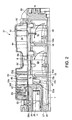
- FIG. 2 is a longitudinal sectional view of the blow-by gas-processing device taken along a line II-II in FIG. 1 .
- FIG. 3 is a cross-sectional view of the blow-by gas-processing device taken along a line III-III in FIG. 1 .
- FIG. 4 is a plan view of the cylinder block viewed from below.
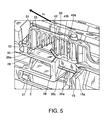
- FIG. 5 is a perspective view of a cross-section of the blow-by gas-processing device cut along the line II-II in FIG. 1 .
- FIG. 6 is a perspective view of another cross-section of the blow-by gas-processing device cut along the line II-II in FIG. 1 .
- FIG. 7 is an enlarged perspective view of a cut surface of an oil separator and a first guide member according to this invention when viewed from an engine front of the internal combustion engine.
- FIG. 8 is a perspective view of a base plate of the oil separator according to this invention when viewed obliquely from below.
- a cylinder block 1 of a six-cylinder V-shaped internal combustion engine comprises a right cylinder bank 2 which encloses three cylinders 5A, 5B, and 5C, and a left cylinder bank 3 which encloses three cylinders 5D, 5E, and 5F.
- a right cylinder bank 2 which encloses three cylinders 5A, 5B, and 5C
- a left cylinder bank 3 which encloses three cylinders 5D, 5E, and 5F.
- Fr in the figure denotes an engine front and Rr in the figure denotes an engine rear. Accordingly, in each cylinder bank, the cylinders are aligned in a row in the front-aft direction of the internal combustion engine.
- the cylinders 5A, 5B, and 5C in the right cylinder bank 2 are shifted slightly towards the engine front with respect to the cylinders 5D, 5E, and 5F in the left cylinder bank 3.
- a water jacket 6A is formed in the right cylinder bank 2 on the inner side of the cylinders 5A, 5B, and 5C.
- a water jacket 6B is formed in the left cylinder bank 3 on the inner side of the cylinders 5D, 5E, and 5F.
- a piston is enclosed in each of the six cylinders 5A-5F and caused to slide therein in an axial direction.
- the cylinders 5A, 5B, and 5C in the right cylinder bank 2 are numbered as # 1, #3, #5 and the cylinders 5D, 5E, and 5F in the left cylinder bank 3 are numbered as #2, #4, #6. These cylinder numbers represent the order of ignition.
- a straight pipe-shaped main oil gallery 7 is formed in the cylinder block 1 at a joint portion of the bases of the two cylinder banks 2 and 3 in the front-aft direction of the internal combustion engine.
- a horizontal partition 8 is formed above the main oil gallery 7 to bridge two walls 61 and 62 of the right cylinder bank 2 and the left cylinder bank 3, which face to each other.
- a first gas introducing chamber 9a, a second gas introducing chamber 9b, and a third gas introducing chamber 9c each having a substantially triangular cross-sectional shape and extending over substantially the entire length of the cylinder block 1 are formed by the horizontal partition 8, the walls 61 and 62, and a cylinder block front wall 25 and a cylinder block rear wall 29 which are shown in FIG. 2 .
- the gas introducing chambers 9a, 9b, and 9c are delimited almost evenly by reinforcing ribs 15 and 16 in the longitudinal direction of the cylinder block 1.
- the first reinforcing rib 15 is located on the engine front side between the first gas introducing chamber 9a and the second gas introducing chamber 9b.
- the second reinforcing rib 16 is located on the engine rear side between the second gas introducing chamber 9b and the third gas introducing chamber 9c.
- the first gas introducing chamber 9a and the second gas introducing chamber 9b communicate with each other via a gap formed between an upper end 15a of the first reinforcing rib 15 and the horizontal partition 8.
- the second gas introducing chamber 9b and the third gas introducing chamber 9c communicate with each other via a gap formed between an upper end 16a of the second reinforcing rib 16 and the horizontal partition 8.
- crank chambers 71-73 are formed under the cylinders 5A-5F.
- the crank chamber 71 faces the cylinders 5A and 5D
- the crank chamber 72 faces the cylinders 5B and 5E
- the crank chamber 7 faces the cylinders 5C and 5F.
- a crank case wall 10 is interposed between the crank chambers 71-73 and the gas introducing chambers 9a, 9b, 9c.
- a first communicating hole 11 connecting the crank chamber 71 and the first gas introducing chamber 9a, a second communicating hole 12 connecting the crank chamber 72 and the second gas introducing chamber 9b, and a third communicating hole 13 connecting the crank chamber 73 and the third gas introducing chamber 9c are formed respectively in the crank case wall 10.
- a fourth communicating hole 14 connecting the crank chamber 71 and the first gas introducing chamber 9a is also formed in the crank case wall 10 in front of the first communicating hole 11.
- the reinforcing ribs 15 and 16 are formed integrally with the cylinder block 1.
- the reinforcing ribs 15 and 16 also have a function to enhance the rigidity of the two cylinder banks 2 and 3. Specifically, the reinforcing ribs 15 and 16 support a force acting on the upper ends of the two cylinder banks 2 and 3 in an approaching direction or a force acting on the cylinder banks 2 and 3 in a twisting direction.
- blow-by gas Combustion gas that flows into the crank chambers 71-73 from the cylinders 5A-5F in this way is known as blow-by gas.
- the blow-by gas is mixed with oil vapor in the crank chambers 71-73.
- the blow-by gas processing device separates an oil component from the blow-by gas into which oil vapor is mixed and then recirculates the blow-by gas to an intake passage of the V-shaped internal combustion engine while returning the separated oil component to the crank chambers 71-73.
- the blow-by gas processing device introduces the blow-by gas in the crank chambers 71-73 to the corresponding gas introducing chambers 9a, 9b, 9c via the communicating holes 11-14.
- the blow-by gas processing device comprises an oil separator 31 formed in a substantially rectangular solid shape above the horizontal partition 8 so as to separate the oil component from the blow-by gas introduced into the gas introducing chambers 9a, 9b, 9c.
- the oil separator 31 is disposed in a space between the two cylinder banks 2 and 3 above the horizontal partition 8, and does not therefore increase the size of the V-shaped internal combustion engine.
- the horizontal partition 8 has a hole part 21 within a substantially rectangular shape which extends from the vicinity of the engine front to the vicinity of the engine rear.
- a fixing seat 22 having a predetermined width is formed around the periphery of the hole part 21.
- Eight bolt holes 23 are formed through the fixing seat 23, four on the right cylinder bank side and four on the left cylinder bank side.
- the cylinder block 1 comprises two parallel transverse walls 26 and 27 projecting from the cylinder block front wall 25 into the first gas introducing chamber 9a and a vertical wall 28 connecting the transverse walls 26 and 27.
- the upper transverse wall 26 is located at a slightly lower level than the horizontal partition 8.
- a depression 26a is formed on the top surface of the transverse wall 26.
- the upper end of the vertical wall 28 projects upward beyond the transverse wall 26 so as to reach the horizontal partition 8.
- the vertical wall 28 has an opening on the upper part thereof.
- the lower transverse wall 27 is located above the main oil gallery 7 at a predetermined distance.
- the hole part 21 is closed by a base plate 32 of the oil separator 31.
- the base plate 32 is constructed from a substantially flat metal plate and has the same number of bolt holes 34 as the bolt holes 23 of the fixing seat 22.
- the base plate 32 is fixed to the horizontal partition 8 by bolts penetrating these bolt holes 23, 34.
- the base plate 32 closes the hole part 21 and functions as a part of the horizontal partition 8.
- FIG. 8 shows the base plate 32 in a state where it is turned upside down. The direction heading towards the lower end in the figure is oriented upward in the internal combustion engine when the base plate 32 is fixed to the horizontal partition 8.
- the oil separator 31 comprises the base plate 32 and a housing 51 made of an aluminum alloy and fixed to the base plate 32.
- a blow-by gas inlet 33 is formed in the base plate 32 in the vicinity of the engine front end.
- the blow-by gas inlet 33 is located immediately above the upper transverse wall 26 when the base plate 32 is fixed to the horizontal partition 8.
- the blow-by gas in the gas introducing chambers 9a, 9b, 9c flows along the under surface of the horizontal partition 8 towards the engine front, temporarily accumulates in the depression 26a on the top surface of the transverse wall 26, and then flows into the housing 51 via the blow-by gas inlet 33.
- the blow-by gas inlet 33 is formed at the front part of the base plate 32 as shown in FIG. 2 .
- a blow-by gas outlet 52 is formed in the rear wall of the housing 51 located in the vicinity of the engine rear.
- a pressure control valve is connected to the blow-by gas outlet 52. After entering the housing 51 through the blow-by gas inlet 33, the blow-by gas flows rearward towards the blow-by gas outlet 52 in a space surrounded by the base plate 32 and the housing 51.
- blow-by gas inlet 33 is disposed in the vicinity of the engine front and the blow-by gas outlet 52 is disposed in the vicinity of the engine rear is that the oil separator 31 requires a sufficient length in the front-aft direction of the internal combustion engine to achieve a high oil separation efficiency.
- a baffle plate 42 is provided integrally with the base plate 32 in the housing 51 so as to intercept the flow of blow-by gas which has entered through the blow-by gas inlet 33 and is flowing towards the blow-by gas outlet 52.
- the baffle plate 42 is formed by bending a part of the base plate 32 upward when the blow-by gas inlet 33 is formed in the base plate 32.
- the blow-by gas which has entered through the blow-by gas inlet 33 and is flowing through the housing 51 towards the blow-by gas outlet 52 is prevented from forming a linear flow towards the blow-by gas outlet 52 by the baffle plate 42 and forced to detour around the baffle plate 42 in order to reach the blow-by gas outlet 52.
- a space in the housing 51 is divided into a front chamber 53 on the engine front side and a rear chamber 54 on the engine rear side by a flow path restricting plate 43A.
- the flow path restricting plate 43 is constituted by a rectangular metal plate bent to 90 degrees so as to form a vertical part 43a and a horizontal part 43b.
- the vertical part 43a is disposed to intersect the blow-by gas flowing through the housing 51 from the blow-by gas inlet 33 to the blow-by gas outlet 52.
- the vertical part 43a has a plurality of circular holes 43c.
- the horizontal part 43b is fixed to the base plate 32 by means of welding or bonding. Each edge of the vertical part 43a contacts the inner surface of the housing 51.
- the flow path restricting plate 43 has a function to increase the flow velocity of the blow-by gas which has entered the housing 51 from the blow-by gas inlet 33 and is flowing towards the blow-by gas outlet 52 by causing the blow-by gas to flow through the circular holes 43c.
- a number of stick-like projections 55 are formed intensively in the front chamber 53 in a position immediately downstream of the front chamber 53. These stick-like projections 55 are constructed to project from the ceiling of the housing 51. The blow-by gas separates the oil component when it comes into contact with these stick-like projection 55.
- a depression 44 is formed in the base plate 32 to collect the oil component that falls onto the base plate 32 in the housing 51. Further, a first oil dropping pipe 45 and a second oil dropping pipe 46 projecting downward are fixed to the base plate 32 so as to return the oil component accumulated in the depression 44 to the crank chambers 72 and 73 via the second gas introducing chamber 9b and the third gas introducing chamber 9c.
- the blow-by gas processing device further comprises a guiding mechanism which guides a flow of blow-by gas from the first gas introducing chamber 9a to the blow-by gas inlet 33 in a direction heading away from the blow-by gas inlet 33.
- the guiding mechanism comprises a first guide member 35 and a second guide member 41.
- the first guide member 35 is constituted by a horizontal box-shaped member which has a tip 35f contacting the upper part of the vertical wall 28 and another tip 35g opening onto a space above the first reinforcing rib 15.
- the upper part of the vertical wall 28 has an opening as described above and the tip 35f of the first guide member 35 contacts the vertical wall 28 so as to cover this opening.
- the blow-by gas inlet 33 is prevented from communicating directly with the first gas introducing chamber 9a and communicates only with an inner space 36 of the first guide member 35.
- a flow of blow-by gas from the first gas introducing chamber 9a to the blow-by gas inlet 33 is first oriented in a direction heading away from the blow-by gas inlet 33 along the outer periphery of the first guide member 35, whereupon the flow direction of the blow-by gas reverses at a point above the first reinforcing rib 15 such that the blow-by gas enters the inner space 36 of the first guide member 35 through the opening at the tip 35g.
- the blow-by gas then flows through the opening of the vertical wall 28 to reach the blow-by gas inlet 33.
- the first guide member 35 is formed by bending a metal strip having a predetermined width.
- the first guide member 35 comprises a horizontal wall 35a which is parallel with the base plate 32 at a predetermined distance, two side walls 35b and 35c which are formed by bending the metal strip upward at both side ends of the horizontal wall 35a by 90 degrees, and the bases 35d and 35e which are formed by bending the metal strip horizontally outward by 90 degrees at upper ends of the side walls 35b and 35c.
- the bases 35d and 35e are fixed to the base plate 32 by means of welding or bonding.
- the inner space 36 having a substantially rectangular solid shape is formed by the horizontal wall 35a, the two side walls 35b and 35c, and the base plate 32.
- predetermined gaps 37 and 38 are formed between the two side wall 35b and 35c and both side walls of the first gas introducing chamber 9a, respectively.
- the shape of the first guide member 35 is not limited to a rectangular solid.
- the tip 35g located on the engine rear side may be shifted further towards the engine rear.
- the cross-section of the inner space 36 of the first guide member 35 is not necessarily limited to a rectangular shape. It can be a circular shape or triangular shape.
- the tip 35g of the engine rear side of the first guide member 35 opens immediately above the upper end 15a of the first reinforcing rib 15.
- the flow of blow-by gas from the first gas introducing chamber 9a to the first guide member 35 can be throttled using the gap between the horizontal wall 35a and the upper end 15a.
- the blow-by gas throttled in this way blows out vigorously from the first gas introducing chamber 9a into the second gas introducing chamber 9b.
- the increased velocity of the blow-by gas enhances the directivity of the flow of blow-by gas in the direction heading away from the blow-by gas inlet 33.
- the flow of blow-by gas from the second gas introducing chamber 9b to the blow-by gas inlet 33 through the inner space 36 of the first guide member 35 exerts a suction force on the blow-by gas in the first gas introducing chamber 9a.
- Blow-by gas entering the first gas introducing chamber 9a through the fourth communicating hole 14 is directed to the engine rear along the transverse wall 27 and converges with the flow of blow-by gas which has entered the first gas introducing chamber 9a through the first communicating hole 11. After converging, the blow-by gas flows towards the engine rear through the gap formed between the under surface of the horizontal wall 35a of the first guide member 35 and the upper end 15a of the first reinforcing rib 15 and the gaps 37 and 38 on both sides of the first guide member 35.
- a second guide member 41 is fixed to the horizontal wall 35a of the first guide member 35 so as to intercept the flow of blow-by gas along the under surface of the horizontal wall 35a towards the engine rear.
- the second guide member 41 is made of metal plate.
- the second guide member 41 comprises an intercepting wall 41a in a rectangular shape projecting downward and a base 41b bent 90 degrees at an upper end of the intercepting wall 41a.
- the base 41b is fixed to the horizontal wall 35a of the first guide member 35 by welding or bonding.
- the second guide member 41 is provided close to the engine front side of the first reinforcing rib 15, as shown in FIG. 2 .
- a lower end 41c of the intercepting wall 41a reaches a point lower than the upper end 15a of the first reinforcing rib 15 such that the intercepting wall 41a overlaps a wall face 15b of the engine front side of the first reinforcing rib 15.
- a narrow flow passage is thereby formed between the intercepting wall 41a and the wall face 15b.
- the blow-by gas in the first gas introducing chamber 9a collides with the intercepting wall 41a before reaching the gap between the under surface of the horizontal wall 35a of the first guide member 35 and the upper end 15a of the first reinforcing rib 15. This collision brings about a favorable effect in terms of separating the oil component from the blow-by gas.
- the blow-by gas which has entered the second gas introducing chamber 9b from the first gas introducing chamber 9a by detouring the intercepting wall 41a converges with the blow-by gas in the second gas introducing chamber 9b.
- the converged blow-by gas flows into the inner space 36 of the first guide member 35 while colliding with the horizontal partition 8 and the base plate 32, which function as a ceiling of the second gas introducing chamber 9b, and then flows towards the engine front through the inner space 36.
- the blow-by gas Having entered the second gas introducing chamber 9b from the first gas introducing chamber 9a, the blow-by gas reverses its flow direction in the second gas introducing chamber 9b towards the engine front, or in other words, as shown by an arrow in FIG.
- blow-by gas in the first gas introducing chamber 9a which is the nearest gas introducing chamber to the blow-by gas inlet 33 is first directed towards the second gas introducing chamber 9b and then caused to reverse its flow direction so as to flow into the inner space 36 of the first guide member 35.
- a centrifugal force accompanying this direction reversal of the flow of blow-by gas acts on the blow-by gas so as to separate the oil component contained therein.
- the blow-by gas flows from the inner space 36 of the first guide member 35 into the housing 51 via the depression 26a formed in the top surface of the transverse wall 26, and then flows through the blow-by gas inlet 33.
- the blow-by gas collides with the baffle plate 42, changes its flow direction upward, and is caused to flow between the plurality of stick-like projections 55. On this route, the oil component in the blow-by gas adheres to the stick-like projections 55 and then drops downward.
- the blow-by gas passes through the circular holes 43c in the flow path restricting plate 43A and flows into the rear chamber 54.
- the blow-by gas increases in velocity by passing through the circular holes 43c, and therefore collides with the stick-like projections 55 in the rear chamber 54, thereby further separating the oil component.
- blow-by gas flows out through the blow-by gas outlet 52 towards the pressure control valve.
- the oil separated from the blow-by gas in the front chamber 53 and the rear chamber 54 in the housing 51 is collected in the depression 44 of the base plate 32.
- the oil separated from the blow-by gas in the front chamber 53 is returned mainly via the first oil dropping pipe 45 to the second gas introducing chamber 9b.
- the oil separated from the blow-by gas in the rear chamber 54 is returned mainly via the second oil dropping pipe 46 to the third gas introducing chamber 9c.
- the oil in the second gas introducing chamber 9b and the third gas introducing chamber 9c drops through the communicating holes 12 and 13 into the crank chambers 72 and 73.
- the blow-by gas inlet 33 is provided on the engine front side of the housing 51 and the blow-by gas outlet 52 is provided on the engine rear side of the housing 51.
- the blow-by gas inlet 33 is provided on the engine rear side of the housing 51 and provide the blow-by gas outlet 52 on the engine front side of the housing 51.
Landscapes
- Engineering & Computer Science (AREA)
- Mechanical Engineering (AREA)
- General Engineering & Computer Science (AREA)
- Lubrication Details And Ventilation Of Internal Combustion Engines (AREA)
Abstract
Description
- This invention relates to the processing of blow-by gas generated in an internal combustion engine.
-
JPS62-085110A - The gas-introducing chamber is formed in a space between a pair of cylinder banks of the V-shaped internal combustion engine. The V-shaped internal combustion engine comprises a plurality of crank chambers which are connected to the gas-introducing chamber via communicating holes.
- The gas-introducing chamber allows gas to flow between the crank chambers via the gas-introducing chamber. Accompanying an operation of the internal combustion engine, each cylinder performs expansion and contraction, as a result of which a blow-by gas pressure in the respective crank chambers varies. The gas introducing chamber allows blow-by gas to flow between the crank chambers according to the variation in the blow-by gas pressure in the respective crank chambers, thereby reducing pumping loss of the internal combustion engine caused by variation in the blow-by gas pressure in the respective crank chambers.
- The blow-by gas-processing device according to the prior art brings about a favorable effect with regard to separation of the oil component from the blow-by gas as well as a reduction in pumping loss in an internal combustion engine.
- In the blow-by gas-processing device according to the prior art, however, a problem may arise when attempting to improve the oil component separation efficiency of the oil separator.
- Specifically, in order to separate the oil component from the blow-by gas sufficiently using the oil separator, the flow length of the blow-by gas in the oil separator should be set long. To ensure a sufficient length in the blow-by gas passage of the oil separator, a blow-by gas inlet of the oil separator is preferably disposed at an end of the internal combustion engine and a blow-by gas outlet of the oil separator is preferably disposed in the vicinity of the opposite end of the internal combustion engine.
- As a result, large difference occurs in the flow path distances from the respective crank chambers to the blow-by gas inlet of the oil separator. In a crank chamber which is closest to the blow-by gas inlet, the blow-by gas flows into the oil separator without flowing into the adjacent crank chamber when the blow-by gas pressure is high. However, differences in the flow path distances of the blow-by gas impair a pumping loss reduction effect brought about by the gas-introducing chamber in the internal combustion engine.
- It is therefore an object of this invention to increase the oil separation efficiency of an oil separator without impairing a pumping loss reduction effect brought about by a gas-introducing chamber in a blow-by gas-processing device.
- To achieve the above object, this invention provides a blow-by gas-processing device which collects blow-by gas from a plurality of crank chambers in an internal combustion engine. The blow-by gas processing device comprises an oil separator which separates an oil component contained in the blow-by gas. The oil separator comprises a blow-by gas inlet in the vicinity of the engine front or the engine rear. The blow-by gas processing device also comprises a gas introducing chamber which is disposed between the crank chambers and the blow-by gas inlet and connected to the crank chambers via communicating holes, and a guiding mechanism which guides the blow-by gas from a specific communicating hole which is closest to the blow-by gas inlet, to the blow-by gas inlet in a direction heading away from the blow-by gas inlet and then guides the blow-by gas to the blow-by gas inlet.
- The details as well as other features and advantages of this invention are set forth in the remainder of the specification and are shown in the accompanying drawings.
-
FIG. 1 is a plan view of a cylinder block of a V-shaped internal combustion engine provided with a blow-by gas-processing device according to this invention. -
FIG. 2 is a longitudinal sectional view of the blow-by gas-processing device taken along a line II-II inFIG. 1 . -
FIG. 3 is a cross-sectional view of the blow-by gas-processing device taken along a line III-III inFIG. 1 . -
FIG. 4 is a plan view of the cylinder block viewed from below. -
FIG. 5 is a perspective view of a cross-section of the blow-by gas-processing device cut along the line II-II inFIG. 1 . -
FIG. 6 is a perspective view of another cross-section of the blow-by gas-processing device cut along the line II-II inFIG. 1 . -
FIG. 7 is an enlarged perspective view of a cut surface of an oil separator and a first guide member according to this invention when viewed from an engine front of the internal combustion engine. -
FIG. 8 is a perspective view of a base plate of the oil separator according to this invention when viewed obliquely from below. - Referring to
FIG. 1 of the drawings, a cylinder block 1 of a six-cylinder V-shaped internal combustion engine comprises aright cylinder bank 2 which encloses threecylinders left cylinder bank 3 which encloses threecylinders cylinders right cylinder bank 2 are shifted slightly towards the engine front with respect to thecylinders left cylinder bank 3. - Referring to
FIG. 3 , awater jacket 6A is formed in theright cylinder bank 2 on the inner side of thecylinders water jacket 6B is formed in theleft cylinder bank 3 on the inner side of thecylinders - A piston is enclosed in each of the six
cylinders 5A-5F and caused to slide therein in an axial direction. For descriptive purposes, thecylinders right cylinder bank 2 are numbered as # 1, #3, #5 and thecylinders left cylinder bank 3 are numbered as #2, #4, #6. These cylinder numbers represent the order of ignition. - A straight pipe-shaped
main oil gallery 7 is formed in the cylinder block 1 at a joint portion of the bases of the twocylinder banks horizontal partition 8 is formed above themain oil gallery 7 to bridge twowalls right cylinder bank 2 and theleft cylinder bank 3, which face to each other. A firstgas introducing chamber 9a, a secondgas introducing chamber 9b, and a thirdgas introducing chamber 9c each having a substantially triangular cross-sectional shape and extending over substantially the entire length of the cylinder block 1 are formed by thehorizontal partition 8, thewalls block front wall 25 and a cylinder blockrear wall 29 which are shown inFIG. 2 . - Referring to
FIG. 2 , thegas introducing chambers ribs rib 15 is located on the engine front side between the firstgas introducing chamber 9a and the secondgas introducing chamber 9b. The second reinforcingrib 16 is located on the engine rear side between the secondgas introducing chamber 9b and the thirdgas introducing chamber 9c. The firstgas introducing chamber 9a and the secondgas introducing chamber 9b communicate with each other via a gap formed between anupper end 15a of the first reinforcingrib 15 and thehorizontal partition 8. The secondgas introducing chamber 9b and the thirdgas introducing chamber 9c communicate with each other via a gap formed between anupper end 16a of the second reinforcingrib 16 and thehorizontal partition 8. - Referring to
FIG. 4 , crank chambers 71-73 are formed under thecylinders 5A-5F. Thecrank chamber 71 faces thecylinders crank chamber 72 faces thecylinders crank chamber 7 faces thecylinders crank case wall 10 is interposed between the crank chambers 71-73 and thegas introducing chambers hole 11 connecting thecrank chamber 71 and the firstgas introducing chamber 9a, a second communicatinghole 12 connecting thecrank chamber 72 and the secondgas introducing chamber 9b, and a third communicatinghole 13 connecting thecrank chamber 73 and the thirdgas introducing chamber 9c are formed respectively in thecrank case wall 10. A fourth communicatinghole 14 connecting thecrank chamber 71 and the firstgas introducing chamber 9a is also formed in thecrank case wall 10 in front of the first communicatinghole 11. - When the piston performs a down stroke in each
cylinder 5A-5F, the capacity of the crank chamber located under the cylinder decreases and the pressure therein increases. When the piston performs an upstroke in the cylinder, the capacity of the crank chamber under the cylinder increases and the pressure therein decreases. As an air-fuel mixture burns in the sixcylinders 5A-5F in the aforesaid ignition order, the pistons reciprocate in the up-down direction in therespective cylinders 5A-5F at a predetermined phase difference. As a result, the pressure in the respective crank chambers 71-73 increases and decreases repeatedly. If the crank chambers 71-73 are tightly closed, the energy used for the increase and decrease in the pressure leads to pumping loss. On the other hand, when gas is allowed to flow from a highpressure crank chamber to a low-pressure crank chamber, the pressure variation in each crank chamber is smoothed out such that the pumping loss is reduced. The gap between theupper end 15a of the first reinforcingrib 15 and thehorizontal partition 8 connecting thegas introducing chambers upper end 16a of the second reinforcingrib 16 and thehorizontal partition 8 connecting thegas introducing chambers - The reinforcing
ribs ribs cylinder banks ribs cylinder banks cylinder banks - When the air-fuel mixture burns in the
cylinders 5A-5F, a part of a high-temperature combustion gas blows out from a combustion chamber above the piston into the crank chambers 71-73 by passing through a minute gap between the piston and a cylinder wall. Combustion gas that flows into the crank chambers 71-73 from thecylinders 5A-5F in this way is known as blow-by gas. - The blow-by gas is mixed with oil vapor in the crank chambers 71-73. The blow-by gas processing device according to this invention separates an oil component from the blow-by gas into which oil vapor is mixed and then recirculates the blow-by gas to an intake passage of the V-shaped internal combustion engine while returning the separated oil component to the crank chambers 71-73.
- Specifically, the blow-by gas processing device introduces the blow-by gas in the crank chambers 71-73 to the corresponding
gas introducing chambers - Referring again to
FIG. 2 , the blow-by gas processing device comprises anoil separator 31 formed in a substantially rectangular solid shape above thehorizontal partition 8 so as to separate the oil component from the blow-by gas introduced into thegas introducing chambers oil separator 31 is disposed in a space between the twocylinder banks horizontal partition 8, and does not therefore increase the size of the V-shaped internal combustion engine. - Referring again to
FIG. 1 , thehorizontal partition 8 has ahole part 21 within a substantially rectangular shape which extends from the vicinity of the engine front to the vicinity of the engine rear. A fixingseat 22 having a predetermined width is formed around the periphery of thehole part 21. Eight bolt holes 23 are formed through the fixingseat 23, four on the right cylinder bank side and four on the left cylinder bank side. - Referring again to
FIG. 2 , the cylinder block 1 comprises two paralleltransverse walls block front wall 25 into the firstgas introducing chamber 9a and avertical wall 28 connecting thetransverse walls transverse wall 26 is located at a slightly lower level than thehorizontal partition 8. Adepression 26a is formed on the top surface of thetransverse wall 26. The upper end of thevertical wall 28 projects upward beyond thetransverse wall 26 so as to reach thehorizontal partition 8. Thevertical wall 28 has an opening on the upper part thereof. The lowertransverse wall 27 is located above themain oil gallery 7 at a predetermined distance. - The
hole part 21 is closed by abase plate 32 of theoil separator 31. - Referring to
FIG. 8 , thebase plate 32 is constructed from a substantially flat metal plate and has the same number of bolt holes 34 as the bolt holes 23 of the fixingseat 22. Thebase plate 32 is fixed to thehorizontal partition 8 by bolts penetrating these bolt holes 23, 34. In a state where thebase plate 32 is fixed to thehorizontal partition 8, thebase plate 32 closes thehole part 21 and functions as a part of thehorizontal partition 8.FIG. 8 shows thebase plate 32 in a state where it is turned upside down. The direction heading towards the lower end in the figure is oriented upward in the internal combustion engine when thebase plate 32 is fixed to thehorizontal partition 8. - Referring again to
FIG. 2 , theoil separator 31 comprises thebase plate 32 and ahousing 51 made of an aluminum alloy and fixed to thebase plate 32. A blow-by gas inlet 33 is formed in thebase plate 32 in the vicinity of the engine front end. The blow-by gas inlet 33 is located immediately above the uppertransverse wall 26 when thebase plate 32 is fixed to thehorizontal partition 8. The blow-by gas in thegas introducing chambers horizontal partition 8 towards the engine front, temporarily accumulates in thedepression 26a on the top surface of thetransverse wall 26, and then flows into thehousing 51 via the blow-by gas inlet 33. To encourage the blow-by gas to flow in this way, the blow-by gas inlet 33 is formed at the front part of thebase plate 32 as shown inFIG. 2 . - A blow-by
gas outlet 52 is formed in the rear wall of thehousing 51 located in the vicinity of the engine rear. A pressure control valve is connected to the blow-bygas outlet 52. After entering thehousing 51 through the blow-by gas inlet 33, the blow-by gas flows rearward towards the blow-bygas outlet 52 in a space surrounded by thebase plate 32 and thehousing 51. - The reason why the blow-
by gas inlet 33 is disposed in the vicinity of the engine front and the blow-bygas outlet 52 is disposed in the vicinity of the engine rear is that theoil separator 31 requires a sufficient length in the front-aft direction of the internal combustion engine to achieve a high oil separation efficiency. - A
baffle plate 42 is provided integrally with thebase plate 32 in thehousing 51 so as to intercept the flow of blow-by gas which has entered through the blow-by gas inlet 33 and is flowing towards the blow-bygas outlet 52. Thebaffle plate 42 is formed by bending a part of thebase plate 32 upward when the blow-by gas inlet 33 is formed in thebase plate 32. The blow-by gas which has entered through the blow-by gas inlet 33 and is flowing through thehousing 51 towards the blow-bygas outlet 52 is prevented from forming a linear flow towards the blow-bygas outlet 52 by thebaffle plate 42 and forced to detour around thebaffle plate 42 in order to reach the blow-bygas outlet 52. - A space in the
housing 51 is divided into afront chamber 53 on the engine front side and arear chamber 54 on the engine rear side by a flow path restricting plate 43A. - Referring to
FIGs. 5 and6 , the flowpath restricting plate 43 is constituted by a rectangular metal plate bent to 90 degrees so as to form avertical part 43a and ahorizontal part 43b. Thevertical part 43a is disposed to intersect the blow-by gas flowing through thehousing 51 from the blow-by gas inlet 33 to the blow-bygas outlet 52. Thevertical part 43a has a plurality ofcircular holes 43c. Thehorizontal part 43b is fixed to thebase plate 32 by means of welding or bonding. Each edge of thevertical part 43a contacts the inner surface of thehousing 51. - The flow
path restricting plate 43 has a function to increase the flow velocity of the blow-by gas which has entered thehousing 51 from the blow-by gas inlet 33 and is flowing towards the blow-bygas outlet 52 by causing the blow-by gas to flow through thecircular holes 43c. - A number of stick-
like projections 55 are formed intensively in thefront chamber 53 in a position immediately downstream of thefront chamber 53. These stick-like projections 55 are constructed to project from the ceiling of thehousing 51. The blow-by gas separates the oil component when it comes into contact with these stick-like projection 55. - Referring again to
FIG. 2 , adepression 44 is formed in thebase plate 32 to collect the oil component that falls onto thebase plate 32 in thehousing 51. Further, a firstoil dropping pipe 45 and a secondoil dropping pipe 46 projecting downward are fixed to thebase plate 32 so as to return the oil component accumulated in thedepression 44 to the crankchambers gas introducing chamber 9b and the thirdgas introducing chamber 9c. - Referring to
FIG. 2 andFIGs. 5-7 , the blow-by gas processing device further comprises a guiding mechanism which guides a flow of blow-by gas from the firstgas introducing chamber 9a to the blow-by gas inlet 33 in a direction heading away from the blow-by gas inlet 33. The guiding mechanism comprises afirst guide member 35 and asecond guide member 41. - The
first guide member 35 is constituted by a horizontal box-shaped member which has atip 35f contacting the upper part of thevertical wall 28 and anothertip 35g opening onto a space above the first reinforcingrib 15. The upper part of thevertical wall 28 has an opening as described above and thetip 35f of thefirst guide member 35 contacts thevertical wall 28 so as to cover this opening. According to this construction of thefirst guide member 35 and thevertical wall 28, the blow-by gas inlet 33 is prevented from communicating directly with the firstgas introducing chamber 9a and communicates only with aninner space 36 of thefirst guide member 35. - According to the above construction, a flow of blow-by gas from the first
gas introducing chamber 9a to the blow-by gas inlet 33 is first oriented in a direction heading away from the blow-by gas inlet 33 along the outer periphery of thefirst guide member 35, whereupon the flow direction of the blow-by gas reverses at a point above the first reinforcingrib 15 such that the blow-by gas enters theinner space 36 of thefirst guide member 35 through the opening at thetip 35g. The blow-by gas then flows through the opening of thevertical wall 28 to reach the blow-by gas inlet 33. - Referring again to
FIG. 8 , thefirst guide member 35 is formed by bending a metal strip having a predetermined width. Thefirst guide member 35 comprises ahorizontal wall 35a which is parallel with thebase plate 32 at a predetermined distance, twoside walls horizontal wall 35a by 90 degrees, and thebases side walls bases base plate 32 by means of welding or bonding. As a result, theinner space 36 having a substantially rectangular solid shape is formed by thehorizontal wall 35a, the twoside walls base plate 32. - Referring again to
FIG. 7 ,predetermined gaps side wall gas introducing chamber 9a, respectively. - By first orienting the flow of blow-by gas which flows from the first
gas introducing chamber 9a to the blow-by gas inlet 33 towards the secondgas introducing chamber 9b via thegaps crank chamber 71 facing thecylinders chambers first guide member 35 is not provided, a gas flow from thefirst crank chamber 71 to the second crankchamber 72 or the third crankchamber 7 is seldom formed since the blow-by gas in the firstgas introducing chamber 9a flows immediately into theoil separator 31 from the blow-by gas inlet 33, and hence the pumping loss in the internal combustion engine cannot be reduced. - The shape of the
first guide member 35 is not limited to a rectangular solid. Thetip 35g located on the engine rear side may be shifted further towards the engine rear. The cross-section of theinner space 36 of thefirst guide member 35 is not necessarily limited to a rectangular shape. It can be a circular shape or triangular shape. - The
tip 35g of the engine rear side of thefirst guide member 35 opens immediately above theupper end 15a of the first reinforcingrib 15. The flow of blow-by gas from the firstgas introducing chamber 9a to thefirst guide member 35 can be throttled using the gap between thehorizontal wall 35a and theupper end 15a. The blow-by gas throttled in this way blows out vigorously from the firstgas introducing chamber 9a into the secondgas introducing chamber 9b. The increased velocity of the blow-by gas enhances the directivity of the flow of blow-by gas in the direction heading away from the blow-by gas inlet 33. Further, the flow of blow-by gas from the secondgas introducing chamber 9b to the blow-by gas inlet 33 through theinner space 36 of thefirst guide member 35 exerts a suction force on the blow-by gas in the firstgas introducing chamber 9a. - Blow-by gas entering the first
gas introducing chamber 9a through the fourth communicatinghole 14 is directed to the engine rear along thetransverse wall 27 and converges with the flow of blow-by gas which has entered the firstgas introducing chamber 9a through the first communicatinghole 11. After converging, the blow-by gas flows towards the engine rear through the gap formed between the under surface of thehorizontal wall 35a of thefirst guide member 35 and theupper end 15a of the first reinforcingrib 15 and thegaps first guide member 35. - A
second guide member 41 is fixed to thehorizontal wall 35a of thefirst guide member 35 so as to intercept the flow of blow-by gas along the under surface of thehorizontal wall 35a towards the engine rear. - Referring again to
FIG. 8 , thesecond guide member 41 is made of metal plate. Thesecond guide member 41 comprises an interceptingwall 41a in a rectangular shape projecting downward and abase 41b bent 90 degrees at an upper end of the interceptingwall 41a. Thebase 41b is fixed to thehorizontal wall 35a of thefirst guide member 35 by welding or bonding. - The
second guide member 41 is provided close to the engine front side of the first reinforcingrib 15, as shown inFIG. 2 . Alower end 41c of the interceptingwall 41a reaches a point lower than theupper end 15a of the first reinforcingrib 15 such that the interceptingwall 41a overlaps awall face 15b of the engine front side of the first reinforcingrib 15. A narrow flow passage is thereby formed between the interceptingwall 41a and thewall face 15b. - According to the above arrangement of the
second guide member 41, the blow-by gas in the firstgas introducing chamber 9a collides with the interceptingwall 41a before reaching the gap between the under surface of thehorizontal wall 35a of thefirst guide member 35 and theupper end 15a of the first reinforcingrib 15. This collision brings about a favorable effect in terms of separating the oil component from the blow-by gas. - The blow-by gas which has entered the second
gas introducing chamber 9b from the firstgas introducing chamber 9a by detouring the interceptingwall 41a converges with the blow-by gas in the secondgas introducing chamber 9b. The converged blow-by gas flows into theinner space 36 of thefirst guide member 35 while colliding with thehorizontal partition 8 and thebase plate 32, which function as a ceiling of the secondgas introducing chamber 9b, and then flows towards the engine front through theinner space 36. Having entered the secondgas introducing chamber 9b from the firstgas introducing chamber 9a, the blow-by gas reverses its flow direction in the secondgas introducing chamber 9b towards the engine front, or in other words, as shown by an arrow inFIG. 6 , reverses its flow direction in the vicinity of theupper end 15a of the first reinforcingrib 15 due to a pushing force exerted by the blow-by gas flowing from the secondgas introducing chamber 9b to theinner space 36 of thefirst guide member 35, and then flows towards the engine front through theinner space 36 of thefirst guide member 35. - As described above, all the blow-by gas in the first
gas introducing chamber 9a which is the nearest gas introducing chamber to the blow-by gas inlet 33 is first directed towards the secondgas introducing chamber 9b and then caused to reverse its flow direction so as to flow into theinner space 36 of thefirst guide member 35. A centrifugal force accompanying this direction reversal of the flow of blow-by gas acts on the blow-by gas so as to separate the oil component contained therein. - The blow-by gas flows from the
inner space 36 of thefirst guide member 35 into thehousing 51 via thedepression 26a formed in the top surface of thetransverse wall 26, and then flows through the blow-by gas inlet 33. - While flowing towards the engine rear in the
housing 51, the blow-by gas collides with thebaffle plate 42, changes its flow direction upward, and is caused to flow between the plurality of stick-like projections 55. On this route, the oil component in the blow-by gas adheres to the stick-like projections 55 and then drops downward. - After almost all of the oil component has been separated in the
front chamber 53 in thehousing 51, the blow-by gas passes through thecircular holes 43c in the flow path restricting plate 43A and flows into therear chamber 54. The blow-by gas increases in velocity by passing through thecircular holes 43c, and therefore collides with the stick-like projections 55 in therear chamber 54, thereby further separating the oil component. - After the oil component is separated completely in this way, the blow-by gas flows out through the blow-by
gas outlet 52 towards the pressure control valve. - The oil separated from the blow-by gas in the
front chamber 53 and therear chamber 54 in thehousing 51 is collected in thedepression 44 of thebase plate 32. The oil separated from the blow-by gas in thefront chamber 53 is returned mainly via the firstoil dropping pipe 45 to the secondgas introducing chamber 9b. The oil separated from the blow-by gas in therear chamber 54 is returned mainly via the secondoil dropping pipe 46 to the thirdgas introducing chamber 9c. The oil in the secondgas introducing chamber 9b and the thirdgas introducing chamber 9c drops through the communicatingholes chambers - The contents of
Tokugan 2007-272534 - Although the invention has been described above with reference to a certain embodiment, the invention is not limited to the embodiment described above. Modifications and variations of the embodiment described above will occur to those skilled in the art, within the scope of the claims.
- For example, in the embodiment described above, the blow-
by gas inlet 33 is provided on the engine front side of thehousing 51 and the blow-bygas outlet 52 is provided on the engine rear side of thehousing 51. However, it is possible to provide the blow-by gas inlet 33 on the engine rear side of thehousing 51 and provide the blow-bygas outlet 52 on the engine front side of thehousing 51. - The embodiments of this invention in which an exclusive property or privilege is claimed are defined as follows:
Claims (7)
- , A blow-by gas processing device which collects blow-by gas from a plurality of crank chambers (71-73) in an internal combustion engine (1), comprising:an oil separator (31) which separates an oil component contained in the blow-by gas, the oil separator (31) comprising a blow-by gas inlet (33) in the vicinity of the engine front or the engine rear;a gas introducing chamber (9a, 9b, 9c) which is disposed between the crank chambers (71-73) and the blow-by gas inlet (33) and connected to the crank chambers (71) via communicating holes (11-14); anda guiding mechanism (35, 41) which guides the blow-by gas from a specific communicating hole (11, 14) which is closest to the blow-by gas inlet (33), to the blow-by gas inlet (33) in a direction heading away from the blow-by gas inlet (33) and then guides the blow-by gas to the blow-by gas inlet (33).
- . The blow-by gas processing device as defined in Claim 1, wherein the gas introducing chamber (9a, 9b, 9c) comprises a specific gas introducing chamber (9a) connected to the specific communicating hole (11, 14) and an adjacent gas introducing chamber (9b) which is adjacent to the specific gas introducing chamber (9a), and the guiding mechanism (35, 41) is configured to guide the blow-by gas through the specific gas introducing chamber (9a) to the adjacent gas introducing chamber (9b) and then guide the blow-by gas to the blow-by gas inlet (33) together with a blow-by gas in the adjacent gas introducing chamber (9b).
- . The blow-by gas processing device as defined in Claim 2, wherein the guiding mechanism (35, 41) comprises a cylindrical member (35) which comprises a passage (36) connecting the adjacent gas introducing chamber (9b) and the blow-by gas inlet (33), the cylindrical member (35) having an opening onto a communicating part between the specific gas introducing chamber (9a) and the adjacent gas introducing chamber (9b) such that the blow-by gas in the specific gas introducing chamber (9a) flows into the opening after flowing on the outside of the cylindrical member (35).
- . The blow-by gas processing device as defined in Claim 3, wherein the guiding mechanism (35, 41) further comprises a baffle plate (41) which intercepts a flow of blow-by gas on the outside of the cylindrical member (35).
- . The blow-by gas processing device as defined in Claim 4, wherein the communicating part is formed by a gap formed by a rib (15) which delimits the specific gas introducing chamber (9a) and the adjacent gas introducing chamber (9b), and the baffle plate (41) projects downward from the cylindrical member (35) to cover the gap and overlap the rib (15) while keeping a distance.
- . The blow-by gas processing device as defined in any one of Claim 1 through Claim 5, wherein the oil separator (31) comprises the blow-by gas inlet (33) in the vicinity of the engine front and the blow-by gas outlet (52) in the vicinity of the engine rear.
- . The blow-by gas processing device as defined in any one of Claim 1 through Claim 6, wherein the internal combustion engine (1) is a V-shaped internal combustion engine provided with two cylinder banks (2, 3), the plurality of crank chambers (71-73) are shared by the two cylinder banks (2, 3), the plurality of gas introducing chambers (9a, 9b, 9c) are formed between the two cylinder banks (2, 3) above the plurality of crank chambers (71-73), and the oil separator (31) is disposed above the plurality of gas introducing chambers (9a, 9b, 9c).
Applications Claiming Priority (1)
| Application Number | Priority Date | Filing Date | Title |
|---|---|---|---|
| JP2007272534A JP5125399B2 (en) | 2007-10-19 | 2007-10-19 | Engine blow-by gas recovery system |
Publications (3)
| Publication Number | Publication Date |
|---|---|
| EP2050935A2 true EP2050935A2 (en) | 2009-04-22 |
| EP2050935A3 EP2050935A3 (en) | 2010-10-27 |
| EP2050935B1 EP2050935B1 (en) | 2013-09-04 |
Family
ID=40139978
Family Applications (1)
| Application Number | Title | Priority Date | Filing Date |
|---|---|---|---|
| EP08018245.4A Active EP2050935B1 (en) | 2007-10-19 | 2008-10-17 | Blow-by gas processing device for internal combustion engine |
Country Status (4)
| Country | Link |
|---|---|
| US (1) | US8161951B2 (en) |
| EP (1) | EP2050935B1 (en) |
| JP (1) | JP5125399B2 (en) |
| CN (1) | CN101413414B (en) |
Cited By (1)
| Publication number | Priority date | Publication date | Assignee | Title |
|---|---|---|---|---|
| EP2299100A1 (en) | 2009-09-04 | 2011-03-23 | Mark IV Systèmes Moteurs | Intake manifold with integrated crankase ventialtion and vehicle comprising such an intake manifold |
Families Citing this family (5)
| Publication number | Priority date | Publication date | Assignee | Title |
|---|---|---|---|---|
| JP6000552B2 (en) * | 2012-01-19 | 2016-09-28 | ヤンマー株式会社 | Engine equipment |
| WO2015015907A1 (en) * | 2013-07-31 | 2015-02-05 | 日産自動車株式会社 | Blow-by gas treatment device for internal combustion engine |
| US9644568B2 (en) * | 2015-01-30 | 2017-05-09 | Ford Global Technologies, Llc | Reinforced composite cylinder block |
| US11047274B2 (en) * | 2018-11-14 | 2021-06-29 | GM Global Technology Operations LLC | Air-oil separator |
| JP7439710B2 (en) * | 2020-09-17 | 2024-02-28 | トヨタ紡織株式会社 | oil mist separator |
Citations (2)
| Publication number | Priority date | Publication date | Assignee | Title |
|---|---|---|---|---|
| JPS6285110A (en) | 1985-10-11 | 1987-04-18 | Yamaha Motor Co Ltd | Blow-by-gas recovery device for v-type engine |
| JP2007272534A (en) | 2006-03-31 | 2007-10-18 | Advanced Telecommunication Research Institute International | Abbreviation completion device, abbreviation completion method, and program |
Family Cites Families (9)
| Publication number | Priority date | Publication date | Assignee | Title |
|---|---|---|---|---|
| JPS5844417U (en) * | 1981-09-19 | 1983-03-25 | 株式会社クボタ | Engine blow-by gas breather device |
| US4541399A (en) * | 1983-03-03 | 1985-09-17 | Mazda Motor Corporation | Breather arrangement for internal combustion engine |
| JPS59188019A (en) * | 1983-03-14 | 1984-10-25 | Mazda Motor Corp | Brether device for v-type engine |
| JPS61277814A (en) * | 1985-06-03 | 1986-12-08 | Honda Motor Co Ltd | Blow-by gas resoluting apparatus |
| JP2724477B2 (en) * | 1988-09-30 | 1998-03-09 | ヤマハ発動機株式会社 | Engine blow-by gas recovery device |
| JPH11200831A (en) * | 1998-01-19 | 1999-07-27 | Isuzu Motors Ltd | V-type engine blow-by gas passage structure |
| JP3819757B2 (en) * | 2001-10-26 | 2006-09-13 | 本田技研工業株式会社 | Engine breather equipment |
| JP4432899B2 (en) * | 2005-12-28 | 2010-03-17 | トヨタ自動車株式会社 | PCV system with V-type engine |
| JP4661733B2 (en) * | 2006-08-22 | 2011-03-30 | マツダ株式会社 | Engine oil separator device |
-
2007
- 2007-10-19 JP JP2007272534A patent/JP5125399B2/en active Active
-
2008
- 2008-09-18 US US12/233,141 patent/US8161951B2/en active Active
- 2008-10-17 CN CN2008101715129A patent/CN101413414B/en active Active
- 2008-10-17 EP EP08018245.4A patent/EP2050935B1/en active Active
Patent Citations (2)
| Publication number | Priority date | Publication date | Assignee | Title |
|---|---|---|---|---|
| JPS6285110A (en) | 1985-10-11 | 1987-04-18 | Yamaha Motor Co Ltd | Blow-by-gas recovery device for v-type engine |
| JP2007272534A (en) | 2006-03-31 | 2007-10-18 | Advanced Telecommunication Research Institute International | Abbreviation completion device, abbreviation completion method, and program |
Cited By (1)
| Publication number | Priority date | Publication date | Assignee | Title |
|---|---|---|---|---|
| EP2299100A1 (en) | 2009-09-04 | 2011-03-23 | Mark IV Systèmes Moteurs | Intake manifold with integrated crankase ventialtion and vehicle comprising such an intake manifold |
Also Published As
| Publication number | Publication date |
|---|---|
| JP5125399B2 (en) | 2013-01-23 |
| CN101413414B (en) | 2012-08-29 |
| US8161951B2 (en) | 2012-04-24 |
| CN101413414A (en) | 2009-04-22 |
| EP2050935B1 (en) | 2013-09-04 |
| JP2009097489A (en) | 2009-05-07 |
| EP2050935A3 (en) | 2010-10-27 |
| US20090101124A1 (en) | 2009-04-23 |
Similar Documents
| Publication | Publication Date | Title |
|---|---|---|
| EP2050935B1 (en) | Blow-by gas processing device for internal combustion engine | |
| US10533470B2 (en) | Oil separation device for internal combustion engine | |
| EP2177726A1 (en) | Vapor-liquid separating structure | |
| US8113185B2 (en) | Device for separating oil from blow-by gas | |
| JP2013113109A (en) | Head cover structure for internal combustion engine | |
| CN102297002A (en) | Oil separation device of engine | |
| JP5553552B2 (en) | 2-cycle engine | |
| JP2003301710A (en) | Oil separator and internal combustion engine | |
| US8844506B2 (en) | Positive crankcase ventilation system | |
| JP5906758B2 (en) | Oil separator for blow-by gas processing equipment | |
| JP5768940B2 (en) | Blow-by processing device for V-type internal combustion engine | |
| JP6706874B2 (en) | Cylinder head cover for internal combustion engine | |
| US9528407B2 (en) | High efficiency cyclone oil separator device | |
| JP4251143B2 (en) | Engine oil separator | |
| US10669905B2 (en) | Internal combustion engine and method for manufacturing internal combustion engine | |
| CN111379609A (en) | Engine | |
| JP4582003B2 (en) | Blowby gas recirculation structure of internal combustion engine | |
| JP7329013B2 (en) | engine | |
| JP2016003620A (en) | engine | |
| JP6970252B1 (en) | Engine with blow-by gas treatment and blow-by gas treatment | |
| JP6136530B2 (en) | Blow-by gas collection system | |
| JP6933761B1 (en) | Engine with blow-by gas treatment and blow-by gas treatment | |
| JP2020084782A (en) | Breather device for internal combustion engine | |
| JP7139753B2 (en) | engine | |
| JP2018076831A (en) | Oil separator |
Legal Events
| Date | Code | Title | Description |
|---|---|---|---|
| PUAI | Public reference made under article 153(3) epc to a published international application that has entered the european phase |
Free format text: ORIGINAL CODE: 0009012 |
|
| 17P | Request for examination filed |
Effective date: 20081017 |
|
| AK | Designated contracting states |
Kind code of ref document: A2 Designated state(s): AT BE BG CH CY CZ DE DK EE ES FI FR GB GR HR HU IE IS IT LI LT LU LV MC MT NL NO PL PT RO SE SI SK TR |
|
| AX | Request for extension of the european patent |
Extension state: AL BA MK RS |
|
| PUAL | Search report despatched |
Free format text: ORIGINAL CODE: 0009013 |
|
| AK | Designated contracting states |
Kind code of ref document: A3 Designated state(s): AT BE BG CH CY CZ DE DK EE ES FI FR GB GR HR HU IE IS IT LI LT LU LV MC MT NL NO PL PT RO SE SI SK TR |
|
| AX | Request for extension of the european patent |
Extension state: AL BA MK RS |
|
| AKX | Designation fees paid |
Designated state(s): DE FR GB |
|
| 17Q | First examination report despatched |
Effective date: 20110801 |
|
| GRAP | Despatch of communication of intention to grant a patent |
Free format text: ORIGINAL CODE: EPIDOSNIGR1 |
|
| GRAJ | Information related to disapproval of communication of intention to grant by the applicant or resumption of examination proceedings by the epo deleted |
Free format text: ORIGINAL CODE: EPIDOSDIGR1 |
|
| GRAP | Despatch of communication of intention to grant a patent |
Free format text: ORIGINAL CODE: EPIDOSNIGR1 |
|
| GRAJ | Information related to disapproval of communication of intention to grant by the applicant or resumption of examination proceedings by the epo deleted |
Free format text: ORIGINAL CODE: EPIDOSDIGR1 |
|
| GRAP | Despatch of communication of intention to grant a patent |
Free format text: ORIGINAL CODE: EPIDOSNIGR1 |
|
| INTG | Intention to grant announced |
Effective date: 20130408 |
|
| GRAS | Grant fee paid |
Free format text: ORIGINAL CODE: EPIDOSNIGR3 |
|
| GRAA | (expected) grant |
Free format text: ORIGINAL CODE: 0009210 |
|
| AK | Designated contracting states |
Kind code of ref document: B1 Designated state(s): DE FR GB |
|
| REG | Reference to a national code |
Ref country code: GB Ref legal event code: FG4D |
|
| REG | Reference to a national code |
Ref country code: DE Ref legal event code: R096 Ref document number: 602008027245 Country of ref document: DE Effective date: 20131031 |
|
| REG | Reference to a national code |
Ref country code: DE Ref legal event code: R097 Ref document number: 602008027245 Country of ref document: DE |
|
| PLBE | No opposition filed within time limit |
Free format text: ORIGINAL CODE: 0009261 |
|
| STAA | Information on the status of an ep patent application or granted ep patent |
Free format text: STATUS: NO OPPOSITION FILED WITHIN TIME LIMIT |
|
| 26N | No opposition filed |
Effective date: 20140605 |
|
| REG | Reference to a national code |
Ref country code: DE Ref legal event code: R097 Ref document number: 602008027245 Country of ref document: DE Effective date: 20140605 |
|
| REG | Reference to a national code |
Ref country code: FR Ref legal event code: PLFP Year of fee payment: 9 |
|
| REG | Reference to a national code |
Ref country code: FR Ref legal event code: PLFP Year of fee payment: 10 |
|
| REG | Reference to a national code |
Ref country code: FR Ref legal event code: PLFP Year of fee payment: 11 |
|
| PGFP | Annual fee paid to national office [announced via postgrant information from national office to epo] |
Ref country code: GB Payment date: 20250923 Year of fee payment: 18 |
|
| PGFP | Annual fee paid to national office [announced via postgrant information from national office to epo] |
Ref country code: FR Payment date: 20250924 Year of fee payment: 18 |
|
| PGFP | Annual fee paid to national office [announced via postgrant information from national office to epo] |
Ref country code: DE Payment date: 20250923 Year of fee payment: 18 |