EP2050789A1 - Polylactic acid resin composition, molded body thereof and polylactic acid compound - Google Patents
Polylactic acid resin composition, molded body thereof and polylactic acid compound Download PDFInfo
- Publication number
- EP2050789A1 EP2050789A1 EP07790648A EP07790648A EP2050789A1 EP 2050789 A1 EP2050789 A1 EP 2050789A1 EP 07790648 A EP07790648 A EP 07790648A EP 07790648 A EP07790648 A EP 07790648A EP 2050789 A1 EP2050789 A1 EP 2050789A1
- Authority
- EP
- European Patent Office
- Prior art keywords
- polylactic acid
- group
- resin composition
- weight
- acid amide
- Prior art date
- Legal status (The legal status is an assumption and is not a legal conclusion. Google has not performed a legal analysis and makes no representation as to the accuracy of the status listed.)
- Granted
Links
- UHOVQNZJYSORNB-UHFFFAOYSA-N c1ccccc1 Chemical compound c1ccccc1 UHOVQNZJYSORNB-UHFFFAOYSA-N 0.000 description 2
- XDTMQSROBMDMFD-UHFFFAOYSA-N C1CCCCC1 Chemical compound C1CCCCC1 XDTMQSROBMDMFD-UHFFFAOYSA-N 0.000 description 1
- KGEWJPRCFWVDSU-UHFFFAOYSA-N OCCOc1ccc(C2(c(cccc3)c3-c3c2cccc3)c(cc2)ccc2OCC=O)cc1 Chemical compound OCCOc1ccc(C2(c(cccc3)c3-c3c2cccc3)c(cc2)ccc2OCC=O)cc1 KGEWJPRCFWVDSU-UHFFFAOYSA-N 0.000 description 1
Classifications
-
- C—CHEMISTRY; METALLURGY
- C08—ORGANIC MACROMOLECULAR COMPOUNDS; THEIR PREPARATION OR CHEMICAL WORKING-UP; COMPOSITIONS BASED THEREON
- C08K—Use of inorganic or non-macromolecular organic substances as compounding ingredients
- C08K5/00—Use of organic ingredients
- C08K5/16—Nitrogen-containing compounds
- C08K5/20—Carboxylic acid amides
-
- C—CHEMISTRY; METALLURGY
- C08—ORGANIC MACROMOLECULAR COMPOUNDS; THEIR PREPARATION OR CHEMICAL WORKING-UP; COMPOSITIONS BASED THEREON
- C08G—MACROMOLECULAR COMPOUNDS OBTAINED OTHERWISE THAN BY REACTIONS ONLY INVOLVING UNSATURATED CARBON-TO-CARBON BONDS
- C08G63/00—Macromolecular compounds obtained by reactions forming a carboxylic ester link in the main chain of the macromolecule
- C08G63/02—Polyesters derived from hydroxycarboxylic acids or from polycarboxylic acids and polyhydroxy compounds
- C08G63/06—Polyesters derived from hydroxycarboxylic acids or from polycarboxylic acids and polyhydroxy compounds derived from hydroxycarboxylic acids
-
- C—CHEMISTRY; METALLURGY
- C08—ORGANIC MACROMOLECULAR COMPOUNDS; THEIR PREPARATION OR CHEMICAL WORKING-UP; COMPOSITIONS BASED THEREON
- C08G—MACROMOLECULAR COMPOUNDS OBTAINED OTHERWISE THAN BY REACTIONS ONLY INVOLVING UNSATURATED CARBON-TO-CARBON BONDS
- C08G63/00—Macromolecular compounds obtained by reactions forming a carboxylic ester link in the main chain of the macromolecule
- C08G63/02—Polyesters derived from hydroxycarboxylic acids or from polycarboxylic acids and polyhydroxy compounds
- C08G63/60—Polyesters derived from hydroxycarboxylic acids or from polycarboxylic acids and polyhydroxy compounds derived from the reaction of a mixture of hydroxy carboxylic acids, polycarboxylic acids and polyhydroxy compounds
-
- C—CHEMISTRY; METALLURGY
- C08—ORGANIC MACROMOLECULAR COMPOUNDS; THEIR PREPARATION OR CHEMICAL WORKING-UP; COMPOSITIONS BASED THEREON
- C08K—Use of inorganic or non-macromolecular organic substances as compounding ingredients
- C08K5/00—Use of organic ingredients
- C08K5/0008—Organic ingredients according to more than one of the "one dot" groups of C08K5/01 - C08K5/59
- C08K5/0083—Nucleating agents promoting the crystallisation of the polymer matrix
-
- C—CHEMISTRY; METALLURGY
- C08—ORGANIC MACROMOLECULAR COMPOUNDS; THEIR PREPARATION OR CHEMICAL WORKING-UP; COMPOSITIONS BASED THEREON
- C08L—COMPOSITIONS OF MACROMOLECULAR COMPOUNDS
- C08L67/00—Compositions of polyesters obtained by reactions forming a carboxylic ester link in the main chain; Compositions of derivatives of such polymers
- C08L67/04—Polyesters derived from hydroxycarboxylic acids, e.g. lactones
-
- C—CHEMISTRY; METALLURGY
- C08—ORGANIC MACROMOLECULAR COMPOUNDS; THEIR PREPARATION OR CHEMICAL WORKING-UP; COMPOSITIONS BASED THEREON
- C08G—MACROMOLECULAR COMPOUNDS OBTAINED OTHERWISE THAN BY REACTIONS ONLY INVOLVING UNSATURATED CARBON-TO-CARBON BONDS
- C08G2261/00—Macromolecular compounds obtained by reactions forming a carbon-to-carbon link in the main chain of the macromolecule
- C08G2261/10—Definition of the polymer structure
- C08G2261/12—Copolymers
- C08G2261/126—Copolymers block
-
- C—CHEMISTRY; METALLURGY
- C08—ORGANIC MACROMOLECULAR COMPOUNDS; THEIR PREPARATION OR CHEMICAL WORKING-UP; COMPOSITIONS BASED THEREON
- C08L—COMPOSITIONS OF MACROMOLECULAR COMPOUNDS
- C08L2205/00—Polymer mixtures characterised by other features
- C08L2205/02—Polymer mixtures characterised by other features containing two or more polymers of the same C08L -group
-
- C—CHEMISTRY; METALLURGY
- C08—ORGANIC MACROMOLECULAR COMPOUNDS; THEIR PREPARATION OR CHEMICAL WORKING-UP; COMPOSITIONS BASED THEREON
- C08L—COMPOSITIONS OF MACROMOLECULAR COMPOUNDS
- C08L2666/00—Composition of polymers characterized by a further compound in the blend, being organic macromolecular compounds, natural resins, waxes or and bituminous materials, non-macromolecular organic substances, inorganic substances or characterized by their function in the composition
- C08L2666/02—Organic macromolecular compounds, natural resins, waxes or and bituminous materials
- C08L2666/14—Macromolecular compounds according to C08L59/00 - C08L87/00; Derivatives thereof
- C08L2666/18—Polyesters or polycarbonates according to C08L67/00 - C08L69/00; Derivatives thereof
-
- C—CHEMISTRY; METALLURGY
- C08—ORGANIC MACROMOLECULAR COMPOUNDS; THEIR PREPARATION OR CHEMICAL WORKING-UP; COMPOSITIONS BASED THEREON
- C08L—COMPOSITIONS OF MACROMOLECULAR COMPOUNDS
- C08L69/00—Compositions of polycarbonates; Compositions of derivatives of polycarbonates
- C08L69/005—Polyester-carbonates
Definitions
- the present invention relates to a polylactic acid resin composition which is increased in transparency, rate of crystallization and heat resistance and a molded article comprising the composition. Further, the present invention also relates to a novel polylactic acid compound used in the composition.
- a biodegradable resin such as an aliphatic polyester and the like and a resin synthesized by using plants as raw materials have been actively conducted.
- a polylactic acid having excellent moldability has especially attracted attention as a resin derived from plant origin which is produced from lactic acid obtained by fermentation of grain resources such as corn and the like.
- polylactic acid has a drawback of being rigid and brittle as well as has a slow rate of crystallization and low heat resistance, the use expansion is limited.
- a polylactic acid amorphous molding article because it has a softening point of less than 60°C, a problem easily causing whitening, deformation and the like in daily use environments was pointed out.
- crystals for example, spherocrystals having sizes almost equal to or larger than the wavelength of light, which cause scattering of light, generally grow rapidly, and the molded article becomes opaque.
- patent document 2 there is described a process of adding as a nucleating agent at least one kind of transparent nucleating agent selected from an aliphatic carboxylic acid amide, an aliphatic carboxylic acid salt, an aliphatic alcohol and an aliphatic carboxylic acid ester.
- a nucleating agent selected from an aliphatic carboxylic acid amide, an aliphatic carboxylic acid salt, an aliphatic alcohol and an aliphatic carboxylic acid ester.
- the molded article had a crystallinity of 33% and a haze of 6.5%, and the result having both sufficient crystallinity and transparency was not obtained.
- An object of the present invention is to provide a resin composition having increased heat resistance (high crystallinity) and transparency without impairing rigidity which a polylactic acid resin inherently has, a molded article composed of the resin composition, and a novel polylactic acid compound used in the resin composition.
- the present inventors have conducted earnest studies to solve the problems and as a result, have found that the problems may be solved by using a polylactic acid compound having a specific moiety.
- the polylactic acid resin composition of the present invention contains a linear polylactic acid compound (A) having a moiety represented by the following formula (1) and having a weight average molecular weight (Mw) of 5,000 to 500, 000 (provided that when R 1 is a group composed of dicarboxylic acid and a diol, the weight ratio of a moiety represented by -CH(CH 3 )C(O)O- derived from lactic acid to a moiety represented by the formula (1) is in the range of 99.9/0.1 to 90.1/9.9 and R 1 has a weight average molecular weight of less than 10,000).
- A linear polylactic acid compound having a moiety represented by the following formula (1) and having a weight average molecular weight (Mw) of 5,000 to 500, 000 (provided that when R 1 is a group composed of dicarboxylic acid and a diol, the weight ratio of a moiety represented by -CH(CH 3 )C(O)O- derived from lactic acid to a moiety represented
- X 1 and X 2 each independently represent an oxygen atom, a sulfur atom or an NH group; and R 1 represents a divalent group containing at least one aromatic ring or aliphatic ring, and the hydrocarbon group may contain an oxygen atom, a nitrogen atom or a sulfur atom.
- the polylactic acid resin composition of the present invention may further contain 5 to 1,900 parts by weight of a polylactic acid compound (B) having a moiety represented by the following formula (7) and having a weight average molecular weight (Mw) of 5,000 to 500,000, based on 100 parts by weight of the linear polylactic acid compound (A).
- X 3 and X 4 each independently represent an oxygen atom, a sulfur atom or an NH group; and R 2 represents an aliphatic hydrocarbon group having a molecular weight of 50 to 50,000 and containing no ring structure, and the aliphatic hydrocarbon group may contain an oxygen atom, a nitrogen atom or a sulfur atom.
- the polylactic acid resin composition of the present invention may further contain 5 to 500 parts by weight of a lactic acid resin (D), based on 100 parts by weight of the linear polylactic acid compound (A)
- the polylactic acid resin composition of the present invention may further contain 0.1 to 10 parts by weight of at least one kind of a transparent nucleating agent (C) selected from carboxylic acid amides, aliphatic alcohols and aliphatic carboxylic acid esters, based on 100 parts by weight of the linear polylactic acid compound (A) or 100 parts by weight of the total of the linear polylactic acid compound (A) and the polylactic acid compound (B) and/or a lactic acid compound (D) which are used when necessary.
- a transparent nucleating agent selected from carboxylic acid amides, aliphatic alcohols and aliphatic carboxylic acid esters
- the isothermal crystallization time is preferably 5 minutes or less.
- the moiety represented by the formula (1) is preferably a segment derived from at least one kind selected from aliphatic ring-containing diols and aromatic ring-containing diols.
- the moiety represented by the formula (7) is preferably a segment derived from at least one kind selected from alkylene glycols, polyesters whose both terminals are hydroxyl groups and polycarbonates whose both terminals are hydroxyl groups.
- the transparent nucleating agent (C) preferably is a carboxylic acid amide, and the carboxylic acid amide is further preferably at least one kind selected from the group consisting of lauric acid amide, palmitic acid amide, stearic acid amide, erucic acid amide, behenic acid amide, ricinoleic acid amide, hydroxystearic acid amide, N-oleylpalmitic acid amide, N-stearylerucic acid amide, ethylene biscapric acid amide, ethylene bislauric acid amide, ethylene bisstearic acid amide, ethylene bisoleic acid amide, ethylene bis-12-hydroxystearic acid amide, hexamethylene biscapric acid amide, hexamethylene bislauric acid amide, hexamethylene bisstearic acid amide, hexamethylene bisoleic acid amide, hexamethylene bis-12-hydroxystearic acid amide, m-xylylene biscapric acid amide,
- the lactic acid resin (D) is preferably a polylactic acid.
- a molded article of the present invention is composed of the polylactic acid resin composition of the present invention, has a haze of 0.1 to 15% as measured at a thickness of 100 ⁇ m and has a crystallinity of 35% or more.
- the linear polylactic acid compound of the present invention has a moiety represented by the following formula (1) and having a weight average molecular weight (Mw) of 5,000 to 500, 000 (provided that when R 1 is a group composed of dicarboxylic acid and a diol, the weight ratio of a moiety represented by -CH(CH 3 )C(O)O- derived from lactic acid to a moiety represented by the formula (1) is in the range of 99.9/0.1 to 90.1/9.9, and R 1 has a weight average molecular weight of less than 10000).
- Mw weight average molecular weight
- X 1 and X 2 each independently represent an oxygen atom, a sulfur atom or an NH group; and R 1 represents a divalent group containing at least one aromatic ring or aliphatic ring, and the hydrocarbon group may contain an oxygen atom, a nitrogen atom or a sulfur atom.
- the present invention may be applied to a product which requires the molding cycle shortening, heat resistance and transparency which are conventionally difficult to be obtained and may give a contribution to the use expansion of green plastics represented by a polylactic acid resin.
- the linear polylactic acid compound (A) of the present invention is a polymer which has a moiety (hereinafter also referred to as a "hard segment") represented by the following formula (1) in a polymer chain of the lactic acid resin (D) described later, has a weight average molecular weight (Mw) of 5,000 to 500,000 and is used as an essential component of the polylactic acid resin composition of the present invention.
- R 1 of the following formula (1) is a group composed of dicarboxylic acid and a diol
- the weight ratio [lactic acid moiety/hard segment] of a moiety represented by -CH(CH 3 )C(O)O-derived from lactic acid hereinafter also referred to as a "lactic acid moiety"
- lactic acid moiety a moiety represented by the formula
- X 1 and X 2 each independently represent an oxygen atom, a sulfur atom or an NH group
- R 1 represents a divalent group containing at least one aromatic group or aliphatic group
- the hydrocarbon group may contain an oxygen atom, a nitrogen atom or a sulfur atom.
- the R 1 is a group other than a group composed of dicarboxylic acid and a diol
- the number of carbon atoms in R 1 is preferably 5 to 50.
- the "hard segment" in the present invention is an aliphatic hydrocarbon group containing a ring structure such as an aliphatic ring, an aromatic ring or the like (provided that it may contain an atom such as oxygen, nitrogen, sulfur and the like) and is a segment derived from a compound containing two or more functional groups derived from a hydroxyl group, a thiol group or an amino group.
- linear polylactic acid compound (A) of the present invention the following linear polylactic acid compounds (A1) to (A5) are preferred.
- X 1 and X 2 each independently represent an oxygen atom, a sulfur atom or an NH group
- R 2 represents a single bond or a hydrocarbon group having 1 to 10 carbon atoms
- the hydrocarbon group may be any of linear, branched and cyclic.
- Y 1 and Y 2 each independently represent a saturated hydrocarbon group having 1 to 10 carbon atoms, an aryl group having 6 to 10 carbon atoms or a hydrogen atom and are not present when R 2 is a single bond.
- L 1 and L 2 each independently represent an alkylene group having 1 to 8 carbon atoms or an oxyalkylene group having 1 to 8 carbon atoms.
- Z 1 and Z 2 each independently represent a hydrocarbon group having 1 to 10 carbon atoms or a hydrogen atom.
- Y 1 and Y 2 , Y 1 and Z 1 , and Y 2 and Z 2 may be mutually bonded to form a ring.
- m is an integer of 0 to 5.
- X 1 and X 2 each independently represent an oxygen atom, a sulfur atom or an NH group
- Y 3 represents a hydrogen atom, a saturated hydrocarbon group having 1 to 8 carbon atoms, an aryl group having 6 to 8 carbon atoms or an aralkyl group having 7 to 8 carbon atoms
- the saturated hydrocarbon group may be any of linear, branched and cyclic.
- r is an integer of 0 to 4.
- L 3 and L 4 each independently represent an alkylene group having 2 to 8 carbon atoms or a cycloalkylene group having 3 to 8 carbon atoms.
- n is an integer of 1 to 100.
- X 1 and X 2 each independently represent an oxygen atom, a sulfur atom or an NH group
- Y 4 represents a hydrogen atom or a hydrocarbon group having 1 to 8 carbon atoms
- the hydrocarbon group may be any of linear, branched and cyclic.
- R 3 , L 5 and L 6 each independently represent a single bond or an alkylene group having 1 to 8 carbon atoms.
- p represents an integer of 0 to 4.
- q represents an integer of 0 to 5.
- X 1 and X 2 each independently represent an oxygen atom, a sulfur atom or an NH group.
- X 1 and X 2 each independently represent an oxygen atom, a sulfur atom or an NH group.
- the moieties represented by the formulas (2), (3), (4), (5) and (6) may be referred to as hard segments (2), (3), (4), (5) and (6), respectively.
- the content of the hard segment in the linear polylactic acid compound (A) is not particularly limited, but is preferably 0.01 to 5 mol% and is more preferably 0.03 to 3 mol%. Additionally, in reality, it is desirable that the content of the hard segment is calculated from the targeted molecular weight or the amount for obtaining the targeted molecular weight is determined by actually performing the reaction.
- the linear polylactic acid compound (A) can be obtained by a well-known and generally used method, and, for example, can be obtained by copolymerizing a compound having the hard segment with a monomer containing lactide or lactic acid as a main component.
- a monomer containing lactide or lactic acid as a main component.
- lactones such as caprolactone, propiolactone, butyrolactone and the like
- hydroxyalkanoic acids such as hydroxybutanoic acid, hydroxypropanoic acid and the like.
- the compound having the hard segment (2) includes a compound having a hydroxyl group, a thiol group or an amino group, which is represented by the following formula (2a).
- X 1 , X 2 , R 2 , Y 1 , Y 2 , L 1 , L 2 , Z 1 , Z 2 and m are the same meaning as X 1 , X 2 , R 2 , Y 1 , Y 2 , L 1 , L 2 , Z 1 , Z 2 and m in the formula (2).
- X 1 and X 2 are preferably an oxygen atom or an NH group
- L 1 and L 2 are preferably a methylene group, an oxymethylene group, an ethylene group, an oxyethylene group, a 1,2-propylene group, an oxy-1,2-propylene group, a trimethylene group, oxytrimethylene group, a 2, 3-butylene group, an oxy-2,3-butylene group, a tetramethylene group, an oxytetramethylene group, a cyclohexylene group and an oxycyclohexylene group;
- Z 1 and Z 2 are preferably a hydrogen atom, a methyl group, an ethyl group, an isopropyl group and a t-butyl group;
- Y 1 and Y 2 are preferably a hydrogen atom, a methyl group, an ethyl group, an isopropyl group, a phenyl group and a cyclohexy
- the compound having the hard segment (3) includes a compound having a hydroxyl group, a thiol group or an amino group, which is represented by the following formula (3a).
- X 1 , X 2 , Y 3 , L 3 , L 4 , r and n are the same meaning as X 1 , X 2 , Y 3 , L 3 , L 4 , r and n in the formula (3).
- X 1 and X 2 are preferably an oxygen atom or an NH group
- L 3 and L 4 are preferably a methylene group, an ethylene group, an 1, 2-propylene group, a trimethylene group, a 2,3-butylene group, a tetramethylene group, a pentamethylene group, a hexamethylene group, a heptamethylene group, an octamethylene group and a cyclohexylene group
- Y 3 is preferably a hydrogen atom, a methyl group, an ethyl group, an isopropyl group, a phenyl group, a benzyl group and a cyclohexyl group.
- the compound having the hard segment (4) includes a compound having a hydroxyl group, a thiol group or an amino group, which is represented by the following formula (4a).
- X 1 , X 2 , Y 4 , R 3 , L 5 , L 6 , p and q are the same meaning as X 1 , X 2 , Y 4 , R 3 , L 5 , L 6 , p and q in the formula (4).
- X 1 and X 2 are preferably an oxygen atom or an NH group
- L 5 and L 6 are preferably a single bond, a methylene group and an ethylene group
- R 3 is preferably a single bond, a methylene group, an ethylene group and an isopropylidene group
- Y 4 is preferably a hydrogen atom, a methyl group, an ethyl group, an isopropyl group and a cyclohexyl group.
- the compound having the hard segment (5) includes a compound having a hydroxyl group, a thiol group or an amino group, which is represented by the following formula (5a).
- X 1 and X 2 each independently represent an oxygen atom, a sulfur atom or an NH group, and is preferably an oxygen atom or an NH group.
- the compound having the hard segment (6) includes a compound having a hydroxyl group, a thiol group or an amino group, which is represented by the following formula (6a).
- X 1 and X 2 each independently represent an oxygen atom, a sulfur atom or an NH group, and is preferably an oxygen atom or an NH group.
- a preferred example of a compound having the hard segment includes aliphatic ring-containing diols, aromatic ring-containing diols and the like.
- the aliphatic ring-containing diols include, for example, 1,4-cyclohexanediol:
- aromatic ring-containing diols include, for example, 4,4'-xylyleneglycol:
- a compound having the hard segment includes polyesters having hydroxyl groups at the both terminals thereof obtained by the polycondensation of an aromatic dicarboxylic acid, esters of an aromatic dicarboxylic acid or acid halides of an aromatic dicarboxylic acid with an alkylene diol having 2 to 8 carbon atoms or cycloalkylene diol.
- aromatic dicarboxylic acids esters of an aromatic dicarboxylic acid or acid halides of an aromatic dicarboxylic acid
- terephthalic acid dimethyl terephthalate, chloride terephthalate, isophthalic acid, dimethyl isophthalate, chloride isophthalate and the like.
- alkylene diol having 2 to 8 carbon atoms or cycloalkylene diol there may be mentioned, for example, ethylene glycol, diethylene glycol, triethylene glycol, 1,3-propanediol, 1,4-butanediol, 1,5-pentanediol, 1,6-hexanediol, 1,7-heptanediol, 1,8-octanediol, 1,4-cyclohexane-di-methanol and the like.
- the polyesters having hydroxyl groups at the both terminals thereof may be obtained by performing condensation using an excess of diols according to an ordinary method and then by removing the excessive amount of the diols.
- the aromatic ring, aliphatic ring, side chain and the like may have a substituent.
- the addition amount of the compound having the hard segment is not particularly limited, but is preferably 0.001 to 10 parts by weight, more preferably 0.01 to 5 parts by weight and still more preferably 0.1 to 3 parts by weight, based on 100 parts by weight of a monomer containing lactide or lactic acid as a main component.
- a solvent may be used in performing the polymerization.
- the solvent includes, for example, an aliphatic hydrocarbon such as hexane, heptane, decane and the like; an aromatic halogenated hydrocarbon such as chlorobenzene, o-dichlorobenzene and the like; an alicyclic hydrocarbon such as cyclopentane, cyclohexane and the like; an aromatic hydrocarbon such as benzene, toluene, xylene, mesitylene, ethylbenzene, diethylbenzene and the like; an ether solvent such as diethyl ether, dioxane, tetrahydrofuran (THF), diglyme and the like; and others.
- THF tetrahydrofuran
- solvents may be used alone or in combination with two or more kinds.
- an aromatic hydrocarbon, an aromatic halogenated hydrocarbon and an ether solvent are preferred, and especially xylene, toluene, chlorobenzene, o-dichlorobenzene and diglyme are preferred.
- the amount used of the solvent is selected in a range from 0.1 to 20 times, preferably from 0.5 to 10 times and more preferably 1.0 to 5 times based on the total weight of lactide or lactic acid.
- a well-known catalyst may be used as a catalyst used in the polymerization.
- a tin catalyst such as tin octanoate (tin 2-ethylhexanoate), tin dibutyl dilaurate, tin chloride and the like; a titanium catalyst such as titanium chloride, titanium tetraisopropoxide and the like; and a zinc catalyst such as zinc chloride, zinc acetate and the like.
- a tin catalyst is preferred and tin octanoate is more preferred.
- the used amount of the catalyst is 0.001 to 5 parts by weight, preferably 0.003 to 1 part by weight and more preferably 0.005 to 0.1 part by weight, based on 100 parts by weight of lactide or a lactic acid.
- the polymerization temperature is 60 to 250°C and preferably 100 to 230°C.
- the reaction temperature is preferably approximately 150 to 200°C.
- the reaction temperature is preferably approximately 110 to 150°C.
- the polymerization time varies depending on the type of a monomer used, polymerization temperature, the amount of the catalyst and the like, and is 0.1 to 24 hours, preferably 0.5 to 12 hours and more preferably 1 to 6 hours.
- the molecular weight is measured by gel permeation chromatography (GPC) and the like in the reaction to determine the point at which a desired molecular weight is achieved as the reaction end point.
- the linear polylactic acid compound (A) obtained in the manner described above has a weight average molecular weight from 5,000 to 500,000, preferably from 10,000 to 400,000 and more preferably from 50, 000 to 300, 000.
- the weight average molecular weight shown in the present invention is a value measured by gel permeation chromatography (GPC) (column temperature: 40°C, solvent: chloroform) in comparison with a polystyrene standard sample.
- the polylactic acid compound (B), which is used in the polylactic acid resin composition of the present invention when necessary, is a polymer which has a moiety (hereinafter also referred to as a "soft segment") represented by the following formula (7) in a polymer chain of a lactic acid resin (D) described later and has a weight average molecular weight (Mw) of 5,000 to 500,000.
- X 3 and X 4 each independently represent an oxygen atom, a sulfur atom or an NH group
- R 2 represents an aliphatic hydrocarbon group having a molecular weight of 50 to 50000 and containing no ring structure, and the aliphatic hydrocarbon group may contain an oxygen atom, a nitrogen atom or a sulfur atom.
- the "soft segment” in the present invention is an aliphatic hydrocarbon group containing no ring structure such as an aliphatic ring, an aromatic ring and the like (provided that it may contain an atom such as oxygen, nitrogen, sulfur and the like) and is a segment derived from a compound containing two or more functional groups derived from a hydroxyl group, thiol group or amino group.
- the content of the soft segment in the polylactic acid compound (B) is not particularly limited, but is preferably 0.01 to 5 mol% and more preferably 0.03 to 3 mol%. As with the hard segment, in reality, it is preferable that the content of the soft segment is calculated from the targeted molecular weight or the amount for obtaining the targeted molecular weight is determined by actually performing the reaction.
- the polylactic acid compound (B) may be obtained by a well-known and generally used method, and, for example, may be obtained by copolymerizing a compound having the soft segment with a monomer containing lactide or lactic acid as a main component.
- a monomer containing lactide or lactic acid as a main component.
- lactones such as caprolactone, propiolactone, butyrolactone and the like
- hydroxyalkanoic acids such as hydroxybutanoic acid, hydroxypropanoic acid and the like.
- the compound having the soft segment preferably includes alkylene glycols, polyesters having two or more hydroxyl groups and polycarbonates having two or more hydroxyl groups and the like, and more preferably includes alkylene glycols, polyesters in which both terminals thereof are hydroxyl groups, polycarbonates in which both terminals thereof are hydroxyl groups, and the like.
- the alkylene glycols preferably include polyethylene glycol (PEG) and polypropylene glycol (PPG), and have a weight average molecular weight from 50 to 50,000, preferably from 50 to 10,000 and more preferably from 100 to 5,000.
- PEG polyethylene glycol
- PPG polypropylene glycol
- polyesters having two or more hydroxyl groups for example, there may be mentioned polyesters in which a diol component is excessively reacted with dicarboxylic acid in polyesters produced from dicarboxylic acids and diols, or polyesters in which cyclic esters such as caprolactone and the like are ring-opening polymerized with water or diols.
- dicarboxylic acid used in the production of the polyesters there may mentioned, for example, an aliphatic or aromatic dicarboxylic acid having 4 to 20 carbon atoms such as maleic acid, fumaric acid, succinic acid, adipic acid and the like.
- diols used in the production of the polyesters there may mentioned, for example, a linear or branched aliphatic diol having 2 to 20 carbon atoms such as ethylene glycol, 1,3-propanediol, propylene glycol, 1,4-butanediol, neopentyl glycol and the like.
- polycarbonates having two or more hydroxyl groups there may be mentioned aliphatic polycarbonates obtained by reacting diols with phosgene, the derivative thereof or carbonic esters.
- diols used in the production of the aliphatic polycarbonates there may be mentioned, for example, ethylene glycol, 1,3-propanediol, 1,4-butanediol, 1,5-pentanediol, 1,6-hexanediol, 1,4-cyclohexanedimethanol, 2,8-octanediol and the like.
- the weight average molecular weight of the soft segment may be calculated from the weight average molecular weight of a compound having the soft segment and is in the range from 50 to 50,000, preferably from 50 to 10,000 and more preferably 100 to 5, 000.
- the polylactic acid compound (B) used in the present invention have to be homogeneous and exhibit transparency.
- a solvent may be used in carrying out the polymerization of lactide, lactic acid or the other monomer. All of the type and amount of the solvent used in the reaction, the type and amount of the polymerization catalyst, polymerization temperature, polymerization time, polymerization method and the like are the same as in the case of the linear polylactic acid compound (A).
- the polylactic acid compound (B) may be used in an amount from 5 to 1, 900 parts by weight, preferably from 10 to 500 parts by weight and more preferably from 15 to 300 parts by weight, based on 100 parts by weight of the linear polylactic acid compound (A). If the content of the polylactic acid compound (B) is within the range, there may be obtained a composition having an excellent rate of crystallization and an excellent heat resistance.
- the polylactic acid resin composition of the present invention may contain a transparent nucleating agent (C) when necessary.
- a transparent nucleating agent becomes a nucleating agent at the time of crystallization and imparts transparency when added to the linear polylactic acid compound (A) having a specific structure.
- a carboxylic acid amide, an aliphatic alcohol and an aliphatic carboxylic acid ester may be mentioned alone or in combination with two or more kinds.
- carboxylic acid amide examples include aliphatic monocarboxylic acid amides such as lauric acid amide, palmitic acid amide, oleic acid amide, stearic acid amide, erucic acid amide, behenic acid amide, ricinoleic acid amide and hydroxystearic acid amide; N-substituted aliphatic monocarboxylic acid amides such as N-oleyl palmitic acid amide, N-oleyl oleic acid amide, N-oleyl stearic acid amide, N-stearyl oleic acid amide, N-stearyl stearic acid amide, N-stearyl erucic acid amide, methylol stearic acid amide and methylol behenic acid amide; aliphatic biscarboxylic acid amides such as methylene bisstearic acid amide, ethylene bisstearic acid amide, ethylene bislauric
- biscarboxylic acid amide is preferably used, and especially ethylene bislauric acid amide, ethylene bisoleic acid amide, ethylene bisstearic acid amide, ethylene bis-12-hydroxystearic acid amide, hexamethylene bislauric acid amide, hexamethylene bisoleic acid amide, hexamethylene bis-12-hydroxystearic acid amide, m-xylylene bislauric acid amide, m-xylylene bisoleic acid amide and m-xylylene bis-12-hydroxystearic acid amide are preferred.
- ethylene bislauric acid amide, ethylene bisoleic acid amide, ethylene bis-12-hydroxystearic acid amide, ethylene bisstearic acid amide, hexamethylene bislauric acid amide, hexamethylene bisoleic acid amide and hexamethylene bis-12-hydroxystearic acid amide which have no aromatic ring in the molecule, are preferred.
- aliphatic alcohol examples include pentadecyl alcohol, cetyl alcohol, heptadecyl alcohol, 1,6-hexanediol, 1,8-octanediol, cyclohexane-1,2-diol, cyclohexane-1,4-diol and the like.
- aliphatic carboxylic acid ester examples include lauric acid cetyl ester, palmitic acid cetyl ester, stearic acid cetyl ester, dilauric acid glycol, dipalmitic acid glycol, monolauric acid glycerin ester, monostearic acid glycerin ester and the like.
- the transparent nucleating agent (C) may be used in a range from 0.1 to 10 parts by weight, preferably from 0.2 to 5 parts by weight and more preferably from 0.3 to 3 parts by weight, based on 100 parts by weight of the linear polylactic acid compound (A) or based on 100 parts by weight of the total of the linear polylactic acid compound (A) and the polylactic acid compound (B) and/or the lactic acid compound (D) which are used when necessary. If the content of the transparent nucleating agent (C) is within the range, the effect as a nucleating agent is significantly exhibited, and a resin composition having both high rate of crystallization and transparency is obtained.
- the polylactic acid resin composition of the present invention may contain a lactic acid resin (D) other than the linear polylactic acid compound (A) and the polylactic acid compound (B) where necessary.
- a lactic acid resin means a polymer composition containing as the main component a polymer having 50% by mole or more, preferably 75% by mole or more of L-lactic acid units and/or D-lactic acid units, and it is synthesized by the polycondensation of lactic acid or by the ring-opening polymerization of lactide which is a cyclic dimer of lactic acid.
- the lactic acid resin (D) may be a copolymer of lactic acid and a copolymerizable other monomer. Preferred is a polylactic acid having 100% by mole of lactic units and more preferred is a polylactic acid having 95% by mole or more, preferably 97% by mole or more of constitutional units derived from L-lactic acid.
- the lactic acid resin (D) may be a composition in which other resins, additives and the like are mixed in addition to a polymer containing 50% by mole or more of lactic acid units, so long as the properties of the polymer are not significantly impaired.
- the lactic acid resin (D) has a weight average molecular weight (Mw) from 5,000 to 500,000, preferably from 10,000 to 400,000 and more preferably 50,000 to 300,000.
- the monomer copolymerizable with lactic acid includes a hydroxycarboxylic acid (for example, glycolic acid, caproic acid and the like), an aliphatic polyhydric alcohol (for example, butanediol, ethylene glycol and the like), an aliphatic polyhydric carboxylic acid (for example, succinic acid, adipic acid and the like), and others.
- a hydroxycarboxylic acid for example, glycolic acid, caproic acid and the like
- an aliphatic polyhydric alcohol for example, butanediol, ethylene glycol and the like
- an aliphatic polyhydric carboxylic acid for example, succinic acid, adipic acid and the like
- a form of arrangement of the copolymer may be any form of a random copolymer, an alternating copolymer, a block copolymer, a graft copolymer and the like.
- a copolymer in which at least part thereof is copolymerized with a polyhydric alcohol of bifunctional or more such as ethylene glycol, diethylene glycol, triethylene glycol, a polyethylene glycol, propylene glycol, dipropylene glycol, an ethylene glycol/propylene glycol copolymer, 1,3-butanediol, 1,4-butanediol, 3-methyl-1,5-pentanediol, 1,6-hexanediol, 1,9-nonanediol, neopentyl glycol, polytetramethylene glycol, glycerin, trimethylol propane and the like; a polyvalent isocyanate such as xylylene diisocyanate, 2,4-tolylene diisocyanate and the like; polysaccharides such as cellulose, acetyl cellulose, ethyl cellulose and the like; and others.
- the lactic acid resin (D) may be used in an amount of 5 to 500 parts by weight, preferably 15 to 300 parts by weight and more preferably 30 to 250 parts by weight, based on 100 parts by weight of the linear polylactic acid compound (A). If the content of the lactic acid resin (D) is within the range, a composition excellent in heat resistance and transparency is obtained.
- polylactic acid resin composition of the present invention other resins or polymers other than the components (A) to (D) and various additives may be added, according to the objective (for example, improvement of moldability, secondary processability, degradation property, tensile strength, heat resistance, storage stability, weather resistance, flame retardancy and the like).
- the other resins or polymers include polycarbonate resin, unmodified polyolefin, vinyl resin, polystyrene, polyamide, acrylic resin, polyphenylene sulfide resin, polyether ether ketone resin, polyester, polysulfone, polyphenylene oxide, polyimide, polyether imide, acrylonitrile-butadiene-styrene copolymer (ABS), ethylene- ⁇ -olefin copolymer rubber, conjugated diene rubber, styrene rubber, phenolic resin, melamine resin, polyester resin, silicone resin, epoxy resin and the like. These may be used alone or in combination with two or more kinds.
- the various additives include, for example, a plasticizer, an antioxidant, an ultraviolet absorber, a heat stabilizer, a flame retardant, an internal release agent, an inorganic additive, an organic additive, an antistatic agent, a surface wetting improver, an incineration auxiliary, a pigment, a dye, a nucleating agent, a lubricant, a natural substance, and the like, and preferably include a plasticizer.
- the plasticizer includes, for example, triacetin, triethylene glycol diacetate, triethyl acetyl citrate, tributyl acetyl citrate and dibutyl sebacate.
- the inorganic additive and lubricant may be used to improve blocking prevention or slipping properties of a film or a sheet.
- Such an inorganic additive includes silica, mica, talc, glass fiber, glass bead, kaolin, kaolinite, barium sulfate, calcium sulfate, magnesium hydroxide, wollastonite, carbon fiber, calcium silicate fiber, magnesium oxysulfate fiber, potassium titanate fiber, calcium sulfite, white carbon, clay, montmorillonite, titanium oxide, zinc oxide and the like. These may be used alone or in combination with two or more kinds. Especially when a glass fiber is used as the inorganic additive, a resin composition may be expected to be increased in heat resistance.
- the organic additive includes starch and the derivative thereof, cellulose and the derivative thereof, pulp and the derivative thereof, paper and the derivative thereof, wheat flour, bean curd refuse, bran, coconut shell, coffee waste, protein, or phthalic acid-, aliphatic polybasic acid-, glycerin-, citric acid-, glycol- and olefin- low molecular weight compounds, or polyethylene terephthalate fiber, polyethylene naphthalate fiber, and aramid fiber, or the like. These may be used alone or in combination with two or more kinds.
- the addition amount of the other resins, polymers or additives is arbitrarily selected depending on the application, so long as the object of the present invention is not impaired.
- a well-known production method may be arbitrarily employed. For example, there may be adopted a method of uniformly premixing each component using a high-speed mixer, a low-speed mixer or the like and then melt-kneading the resulting composition using a single- or multiple-screw extruder having sufficient kneading capacity at the melting point or higher of the resin, a method of mixing and kneading at the time of melting, a method of removing a solvent after mixing in a solution, and the like.
- the production of a polylactic acid composition may be carried out before the molding of a molded article, or the production of the composition and the molding may be carried out simultaneously.
- the shape of the resin composition is preferably a pellet, rod, powder or the like.
- the polylactic acid resin composition of the present invention is excellent in that it has a fast rate of crystallization.
- DSC differential scanning colorimetry
- the "rate of crystallization" in the present invention is determined by the time from when the predetermined temperature is maintained until when the exothermal peak due to the crystallization becomes the maximum value (hereinafter also referred to as a "isothermal crystallization time"). If the time is shorter, the rate of crystallization is faster.
- the predetermined temperature is arbitrarily selected depending on a polymer to be measured.
- the method for the determination of the isothermal crystallization time is specifically as follows.
- a resin is comprised of units derived from lactic acid as with the present invention
- 5 to 6 mg of a polymer in a film state is weighed in a nitrogen-sealed pan and it is inserted into the nitrogen-sealed DSC measuring part preset at 30°C and then heated at a temperature rising rate of 100°C/min to melt the polymer at 220 °C for 3 minutes.
- the isothermal crystallization time is determined by the time from when the polymer is cooled to the predetermined temperature until when the exothermal peak due to the crystallization becomes the maximum value.
- the isothermal crystallization time of the polylactic acid resin composition of the present invention is 5 minutes or less, preferably from 0.1 to 4 minutes and more preferably from 1 to 3 minutes.
- a molded article of the present invention is composed of the polylactic acid resin composition of the present invention described above.
- the molded article of the present invention may be produced by a well-known and generally used method, for example, by the following methods.
- a film or a sheet may be formed by molding the polylactic acid resin composition of the present invention by a typical T die extrusion molding machine.
- blow molding injection blow molding, stretching blow molding or direct blow molding
- a pellet of the polylactic acid resin composition of the present invention is melt by a typical injection blow molding machine, and then the resultant resin composition is filled in a mold to obtain a pre-molded article.
- the resulting pre-molded article is heated again in an oven (heating furnace) and then placed in a mold maintained at a fixed temperature and pressurized air is fed to blow, and thereby a blow bottle may be obtained.
- a film or sheet molded by the same method as in the extrusion molding of the (1) is used as a pre-molded article.
- the resulting pre-molded article is heated to soften once and is vacuum formed or vacuum pressure formed in a mold maintained at a fixed temperature using a typical vacuum forming machine, and thereby a molded article may be obtained.
- a laminate molded article may be obtained by a method of laminating a film or sheet obtained by the extrusion molding method (1) on other substrate by an adhesive or heat; an extrusion lamination method of directly extruding a molten resin from a T die onto a substrate such as papers, metals, plastics and the like in the same manner as in the extrusion molding method (1); a coextrusion method of melting each of the resin composition of the present invention and the like by a separate extruder and then flowing each melted resin together at die heads to simultaneously extrude; a co-extrusion lamination method combining those methods; and the like.
- a film or sheet molded in the same manner as in the extrusion molding (1) is slit into a specific width and is uniaxially hot-stretched in a temperature range from 60 to 140°C, and is further heat fixed in a temperature range from 80 to 160°C when necessary, and thereby a molded article may be obtained.
- a yarn may be obtained by a melt spinning method of melting the polylactic acid resin composition of the present invention at a temperature of from 150 to 240°C using an extruder and then discharging the resulting composition from a spinneret.
- a yarn may be formed by uniaxially hot-stretching the composition in a temperature range from 60 to 100°C, and in some cases, by further heat fixing in a temperature range from 80 to 140°C.
- a molded article may be formed by a span bond method or a melt blown method.
- a span bond method in the same manner as in the yarn molding (7), a web is formed by melt spinning the resin composition using a spinneret having a plurality of holes and then stretching the resulting yarn using an air sucker installed at the lower part of the spinneret, and the web is accumulated on a trapping face and further is press bonded or heat welded by an emboss roll and a smooth roll, and thereby a non-woven fabric may be obtained.
- the molten resin discharged from the spinneret having a plurality of holes is brought into contact with a high speed heated gas blown from a heated gas outlet to form fine fibers and the resulting fibers are accumulated on a moving support, and thereby a non-woven fabric may be obtained.
- the molded article of the present invention which is heat treated at 80 to 120°C for 1 to 300 seconds, has a haze of 0.1 to 15%, preferably 0.1 to 12% and more preferably 0.1 to 11% as measured at a thickness of 100 ⁇ m, and has a crystallinity of 35% or more, preferably 38 to 60% and more preferably 42 to 55%.
- the "crystallinity" in the present invention is determined by differential scanning colorimetry (DSC). Specifically, firstly, a non-oriented film obtained by press molding is heat treated in an oven at 105°C for a predetermined time period. 5 to 6 mg of the film after the heat treatment is weighed in a nitrogen-sealed pan, and it is inserted into the nitrogen-sealed DSC measuring part preset at 30°C and then heated to 220°C at a temperature rising rate of 10°C/min.
- DSC differential scanning colorimetry
- the crystallization enthalpy ( ⁇ Hc) and crystal melting enthalpy ( ⁇ Hm) are measured to determine [[( ⁇ Hm- ⁇ Hc)/( ⁇ H 0 )] ⁇ 100], which is used as a crystallinity.
- ⁇ H 0 represents a completely ideal crystal melting enthalpy, for example, the ⁇ H 0 of polylactic acid is 93 J/g.
- the "haze" in the present invention is a value measured by a hazemeter.
- the polylactic acid resin composition of the present invention may be molded by the various molding and processing methods described above and may be suitably used for various applications without any particular limitation.
- these molded articles may be employed for various applications, such as automobile parts, home electric appliance material parts, electric and electronic components, building members, civil engineering members, agricultural materials, commodities, various films, breathable films or sheets, foamed products suitable for general industrial applications and recreation uses, yarns, textiles, medical or sanitary materials, and the like, and preferably, for automobile material parts, home electric appliance material parts and electric and electronic parts which require heat resistance and impact resistance.
- the development into parts such as front doors, wheel caps and the like, in which resin parts are conventionally used, in the automobile part material uses; the development into package parts of products such as personal computers, headphone stereos and mobile phones in home electric appliance material part uses; and the development into reflective material films and sheets and polarizing films and sheets in the electric and electronic parts.
- the weight average molecular weight was determined by gel permeation chromatography (GPC) ["Shodex GPC-101" manufactured by Showa Denko K.K., column: “PLgel mixd c” manufactured by Polymer Laboratories, Inc., two columns in series, column temperature: 40°C, mobile phase: chloroform, flow rate: 1 mL/min] through the comparison with a polystyrene standard sample.
- GPC gel permeation chromatography
- the Rate of crystallization was determined by DSC ("DSC-60" manufactured by Shimadzu Corporation). 5 to 6 mg of a non-oriented film obtained by press molding was weighed in a nitrogen-sealed pan, and it was inserted into the nitrogen-sealed DSC measuring part preset at 30°C and then heated at a temperature rising rate of 100°C/min to melt at 220°C for 3 minutes. After the melting, it was cooled to 100°C at a cooling rate of 99°C/min. The time taken for the crystallization peak to become maximum was measured using the time when it was cooled to 100°C as the starting time.
- the crystallinity was measured by DSC ("DSC-60" manufactured by Shimadzu Corporation).
- a non-oriented film obtained by press molding was heat treated in an oven at 105°C for a predetermined time period. 5 to 6 mg of the film after the heat treatment was weighed in a nitrogen-sealed pan, and it was inserted into the nitrogen-sealed DSC measuring part preset at 25°C and then heated to 220°C at a temperature rising rate of 10°C/min.
- the crystallization enthalpy ( ⁇ Hc) and crystal melting enthalpy ( ⁇ Hm) were measured to determine [[( ⁇ Hm- ⁇ Hc)/( ⁇ H 0 )] ⁇ 100], which was used as a crystallinity.
- ⁇ H 0 represents a completely ideal crystal melting enthalpy, and a value of 93 J/g of polylactic acid was used.
- the haze was determined by a hazemeter "NDH2000" manufactured by Nippon Denshoku Industries Co., Ltd.) according to JIS K7105.
- a 200 mL glass reaction apparatus equipped with a stirrer, a thermometer and a condenser was charged with 200.0 g (1.389 mol) of L-lactide, 2.43 g (0.017 mol) of D-lactide, 1.58 g (0.00253 mol) of ethylene-bis-12-hydroxystearylamide and 16.2 mg of tin octanoate, and the mixture was heated to 190°C while stirring at a rate of 150 rpm under a nitrogen atmosphere. While continuously stirring, polymerization was carried out at 190 to 200°C for 2 hours. During the polymerization, because as the viscosity of the polymer increased, stirring became difficult, the stirring rate was decreased to 50 rpm while observing the condition. The polymerization was completed by confirming that the viscosity of the resulting polymer was sufficiently increased and the molecular weight (Mw) of the polymer measured by GPC was 200,000.
- Mw molecular weight
- the polymer After the polymerization, after once discharging the polymer to a tray to cool, the polymer was dissolved in 2,000 mL of chloroform. While stirring the chloroform solution, methanol was added by small and small. Since the solution was clouded when approximately 2,000 mL of methanol was added, the addition of methanol was temporarily stopped, and the polymer was gradually precipitated while stirring. After 2 hours, since the polymer was fully precipitated, an approximately 4,000 mL of methanol was further added, and the mixture was sufficiently stirred for one hour to remove the remaining lactide, and then the polymer was suction filtrated and separated.
- the filtered agglomerates were washed by rinsing with a small amount of methanol and then further stirred in 3,000 mL of methanol for one hour, and then the agglomerates were suction filtrated to remove completely the remaining lactide.
- the polymer obtained in this manner was dried at 50°C and 2 kPa for 24 hours to obtain 195.2 g of polylactic acid (B-1) having a partial structure derived from ethylene-bis-12-hydroxystearylamide.
- the resulting polylactic acid (B-1) had a weight average molecular weight (Mw) of 198,000.
- the resulting polylactic acid (B-2) had a weight average molecular weight (Mw) of 214,000.
- the resulting polylactic acid (B-3) had a weight average molecular weight (Mw) of 198,000.
- a 200 mL glass reaction apparatus equipped with a stirrer, a thermometer and a condenser was charged with 142.3 g (0.988 mol) ofL-lactide, 1.7 g (0.122 mol) ofD-lactide, 0. 433 g (0.0018 mol) of 4,4'-isopropylidenedicyclohexanol (hydrogenated bisphenol A) and 11.5 mg of tin octanoate, and the mixture was heated to 190°C while stirring at a rate of 150 rpm under a nitrogen atmosphere. While continuously stirring, polymerization was carried out at 190 to 200°C for 2 hours.
- the polymer After the polymerization, after once discharging the polymer to a tray to cool, the polymer was dissolved in 2,000 mL of chloroform. While stirring the chloroform solution, methanol was added by small and small. Since the solution was clouded when approximately 2,000 mL of methanol was added, the addition of methanol was temporarily stopped, and the polymer was gradually precipitated while stirring. After 2 hours, since the polymer was fully precipitated, an approximately 4,000 mL of methanol was further added, and the mixture was sufficiently stirred for one hour to remove the remaining lactide, and then the polymer was suction filtrated and separated.
- the filtered agglomerates were washed by rinsing with a small amount of methanol and then further stirred in 3,000 mL of methanol for one hour, the agglomerates were suction filtered to remove completely the remaining lactide.
- the polymer obtained in this manner was dried at 50°C and 2 kPa for 24 hours to obtain 134.2 g of polylactic acid (A-1) having a partial structure derived from 4,4'-isopropylidenedicyclohexanol (hydrogenated bisphenol A) .
- the resulting polylactic acid (A-1) had a weight average molecular weight (Mw) of 179,000.
- polylactic acid (A-2) having a partial structure derived from N,N'-(2-hydroxyethyl)pyromellitimide was obtained in the same manner as in Example 1 except for changing 0.433 g (0.0018 mol) of 4,4'-isopropylidenedicyclohexanol (hydrogenated bisphenol A) to 0.548 g (0.0018 mol) of N,N'-(2-hydroxyethyl) pyromellitimide.
- the resulting polylactic acid (A-2) had a weight average molecular weight (Mw) of 157,000.
- polylactic acid (A-3) having a partial structure derived from 6,6'-bis(2-hydroxyethoxy)-3,3,3',3'-tetramethyl-1,1-spirobiindane was obtained in the same manner as in Example 1 except for changing 0.433 g (0.0018 mol) of 4,4'-isopropylidene dicyclohexanol (hydrogenated bisphenol A) to 0.713 g (0.0018 mol) of 6,6'-bis(2-hydroxyethoxy)-3,3,3',3'-tetramethyl-1,1-spirobiindane.
- the resulting polylactic acid (A-3) had a weight average molecular weight (Mw) of 182,000.
- polylactic acid (A-4) having a partial structure derived from p-xylyleneglycol was obtained in the same manner as in Example 1 except for changing 0.433 g (0.0018 mol) of 4,4'-isopropylidenedicyclohexanol (hydrogenated bisphenol A) to 0.248 g (0.0018 mol) of p-xylyleneglycol.
- the resulting polylactic acid (A-4) had a weight average molecular weight (Mw) of 183,000.
- polylactic acid (A-5) having a partial structure derived from 4,4'-bicyclohexanol was obtained in the same manner as in Example 1 except for changing 0.433 g (0.0018 mol) of 4,4'-isopropylidenedicyclohexanol (hydrogenated bisphenol A) to 0.357 g (0.0018 mol) of 4,4'-bicyclohexanol.
- the resulting polylactic acid (A-5) had a weight average molecular weight (Mw) of 164,000.
- polylactic acid (A-6) having a partial structure derived from 4,8-bis(hydroxymethyl)tricyclo(5.2.1.0 2,6)decane was obtained in the same manner as in Example 1 except for changing 0.433 g (0.0018 mol) of 4,4'-isopropylidenedicyclohexanol (hydrogenated bisphenol A) to 0.35 g (0.0018 mol) of 4,8-bis(hydroxymethyl)tricyclo(5.2.1.0 2,6)decane.
- the resulting polylactic acid (A-6) had a weight average molecular weight (Mw) of 182,000.
- polylactic acid (A-7) having a partial structure derived from polybutylene-terephthalate was obtained in the same manner as in Example 1 except for changing 0.433 g (0.0018 mol) of 4,4'-isopropylidenedicyclohexanol (hydrogenated bisphenol A) to 1.52 g (hydroxyl group equivalent: 770 g/eq) of a polyester having hydroxyl groups at both terminals thereof, which was obtained by reacting chloride terephthalate with 1, 4-butanediol.
- the resulting polylactic acid (A-7) had a weight average molecular weight (Mw) of 283,000.
- polylactic acid (A-8) having a partial structure derived from polybutylene-isophthalate was obtained in the same manner as in Example 1 except for changing 0.433 g (0.0018 mol) of 4,4'-isopropylidenedicyclohexanol (hydrogenated bisphenol A) to 3.6 g (hydroxyl group equivalent: 1135 g/eq) of a polyester having hydroxyl groups at both terminals thereof, which was obtained by reacting chloride isophthalate with 1, 4-butanediol.
- the resulting polylactic acid (A-8) had a weight average molecular weight (Mw) of 207,000.
- polylactic acid (A-9) having a partial structure derived from polyhexylene-terephthalate was obtained in the same manner as in Example 1 except for changing 0.433 g (0.0018 mol) of 4,4'-isopropylidenedicyclohexanol (hydrogenated bisphenol A) to 3.7 g (hydroxyl group equivalent: 1062 g/eq) of a polyester having hydroxyl groups at both terminals thereof, which was obtained by reacting chloride terephthalate with 1, 6-hexanediol.
- the resulting polylactic acid (A-9) had a weight average molecular weight (Mw) of 172,000.
- polylactic acid (A-10) having a partial structure derived from polyoctylene-terephthalate was obtained in the same manner as in Example 1 except for changing 0.433 g (0.0018 mol) of 4,4'-isopropylidenedicyclohexanol (hydrogenated bisphenol A) to 2.2 g (hydroxyl group equivalent: 630 g/eq) of a polyester having hydroxyl groups at both terminals thereof, which was obtained by reacting chloride terephthalate with 1,8-octanediol.
- the resulting polylactic acid (A-10) had a weight average molecular weight (Mw) of 183,000.
- polylactic acid (A-11) having a partial structure derived from a chloride terephthalate/1,4-cyclohexanedimethanol-polyester whose both terminals are hydroxyl groups was obtained in the same manner as in Example 1 except for changing 0.433 g (0.0018 mol) of 4,4'-isopropylidenedicyclohexanol (hydrogenated bisphenol A) to 9.0 g (hydroxyl group equivalent: 2620 g/eq) of a polyester having hydroxyl groups at both terminals thereof, which was obtained by reacting chloride terephthalate with 1,4-cyclohexanedimethanol.
- the resulting polylactic acid (A-11) had a weight average molecular weight (Mw) of 167,000.
- the polylactic acids (A-1) to (A-11) synthesized in Examples 1 to 11 and the nucleating agent (C) were kneaded in the parts by weight shown in Table 1 under the conditions at a temperature of 200°C for 5 minutes and at a rotation speed of 50 rpm.
- the kneaded product was pressed for 5 minutes under the conditions of 200°C and 10 MPa to obtain a film having a thickness of 100 ⁇ m.
- the isothermal crystallization time of the resulting film was measured as described above.
- the film was placed in an oven at 105°C for 20 seconds and 60 seconds and was subjected to annealing (heat treatment), and then the crystallinity and transparency (haze) of the film before and after the annealing were measured as described above. The results are shown in Table 1.
- the polylactic acids (A-1) to (A-11) synthesized in Examples 1 to 11, the transparent nucleating agent (C) and a commercially available polylactic acid (D-1) [trademark LACEA, grade H-100, produced by Mitsui Chemicals Inc.] were kneaded in the parts by weight shown in Table 1 under the conditions at a temperature of 200°C for 5 minutes and at a rotation speed of 50 rpm.
- the kneaded product was pressed for 5 minutes under the conditions of 200°C and 10 MPa to obtain a film having a thickness of 100 ⁇ m.
- the isothermal crystallization time of the resulting film was measured as described above.
- the film was placed in an oven at 105°C for 20 seconds and 60 seconds and was subjected to annealing (heat treatment), and then the crystallinity and transparency (haze) of the film before and after the annealing were measured as described above. The results are shown in Table 2.
- the polylactic acid (A) synthesized in Examples 1, 3 and 7 the polylactic acid (B) synthesized in Synthesis Examples 1 to 3 and the transparent nucleating agent (C) were kneaded in the parts by weight shown in Table 1 under the conditions at a temperature of 200°C for 5 minutes and at a rotation speed of 50 rpm.
- the kneaded product was pressed for 5 minutes under the conditions of 200°C and 10 MPa to obtain a film having a thickness of 100 ⁇ m.
- the isothermal crystallization time of the resulting film was measured as described above.
- the film was placed in an oven at 105°C for 20 seconds and 60 seconds and was subjected to annealing (heat treatment), and then the crystallinity and transparency (haze) of the film before and after the annealing were measured as described above.
- the results are shown in Table 3.
- a film was prepared in the same manner as in Example 12 except for kneading a commercially available polylactic acid (D-1) [trademark LACEA, grade H-100, manufactured by Mitsui Chemicals Inc.] and the transparent nucleating agent (C) in the parts by weight shown in Table 1.
- D-1 commercially available polylactic acid
- C transparent nucleating agent
Landscapes
- Chemical & Material Sciences (AREA)
- Health & Medical Sciences (AREA)
- Chemical Kinetics & Catalysis (AREA)
- Medicinal Chemistry (AREA)
- Polymers & Plastics (AREA)
- Organic Chemistry (AREA)
- Crystallography & Structural Chemistry (AREA)
- Compositions Of Macromolecular Compounds (AREA)
- Biological Depolymerization Polymers (AREA)
- Manufacture Of Macromolecular Shaped Articles (AREA)
- Polyesters Or Polycarbonates (AREA)
Abstract
Description
- The present invention relates to a polylactic acid resin composition which is increased in transparency, rate of crystallization and heat resistance and a molded article comprising the composition. Further, the present invention also relates to a novel polylactic acid compound used in the composition.
- With increasing awareness of global environment issues, the depletion of fossil materials and oil resources and the increase in carbon dioxide have posed a problem. For this reason, the research and development of a biodegradable resin such as an aliphatic polyester and the like and a resin synthesized by using plants as raw materials have been actively conducted. Among the aliphatic polyesters, a polylactic acid having excellent moldability has especially attracted attention as a resin derived from plant origin which is produced from lactic acid obtained by fermentation of grain resources such as corn and the like.
- However, since polylactic acid has a drawback of being rigid and brittle as well as has a slow rate of crystallization and low heat resistance, the use expansion is limited. Particularly, in the case of a polylactic acid amorphous molding article, because it has a softening point of less than 60°C, a problem easily causing whitening, deformation and the like in daily use environments was pointed out.
- In addition, if attempts are made to improve the heat resistance of polylactic acid by increasing the crystallinity by heat-treating (annealing), crystals (for example, spherocrystals) having sizes almost equal to or larger than the wavelength of light, which cause scattering of light, generally grow rapidly, and the molded article becomes opaque.
- In order to solve these problems, a lot of attempts have been made to improve heat resistance and transparency by adding various additives to polylactic acid.
In patent document 1, it is described that the addition of a phosphate ester metal salt, hydrous magnesium silicate and the like as a nucleating agent is effective. However, when such a nucleating agent is used, polylactic acid has a drawback in that the transparency is impaired. In addition, talc commonly used is practically usable only from the viewpoint of the rate of crystallization. However, to achieve this, the addition amount of talc is often required to be 1% or more, and talc has a drawback of impairing transparency which is an inherent characteristic of polylactic acid. - In patent document 2, there is described a process of adding as a nucleating agent at least one kind of transparent nucleating agent selected from an aliphatic carboxylic acid amide, an aliphatic carboxylic acid salt, an aliphatic alcohol and an aliphatic carboxylic acid ester. However, in this case, the molded article had a crystallinity of 33% and a haze of 6.5%, and the result having both sufficient crystallinity and transparency was not obtained.
- In patent document 3, there is described a process of using polylactic acid and an inorganic filler in which a compound having a specific functional group is used as an initiator.
However, although the slip properties were improved by this process, the transparency was not maintained because an inorganic filler was added. - Patent document 1: Japanese Patent Laid-Open Publication No.
192884/2003 - Patent document 2: Japanese Patent Laid-Open Publication No.
278991/1997 - Patent document 3: Japanese Patent Laid-Open Publication No.
285121/2004 - An object of the present invention is to provide a resin composition having increased heat resistance (high crystallinity) and transparency without impairing rigidity which a polylactic acid resin inherently has, a molded article composed of the resin composition, and a novel polylactic acid compound used in the resin composition.
- The present inventors have conducted earnest studies to solve the problems and as a result, have found that the problems may be solved by using a polylactic acid compound having a specific moiety.
- That is, the polylactic acid resin composition of the present invention contains a linear polylactic acid compound (A) having a moiety represented by the following formula (1) and having a weight average molecular weight (Mw) of 5,000 to 500, 000 (provided that when R1 is a group composed of dicarboxylic acid and a diol, the weight ratio of a moiety represented by -CH(CH3)C(O)O- derived from lactic acid to a moiety represented by the formula (1) is in the range of 99.9/0.1 to 90.1/9.9 and R1 has a weight average molecular weight of less than 10,000).
-
-X1-R1-X2- (1)
In the formula (1), X1 and X2 each independently represent an oxygen atom, a sulfur atom or an NH group; and R1 represents a divalent group containing at least one aromatic ring or aliphatic ring, and the hydrocarbon group may contain an oxygen atom, a nitrogen atom or a sulfur atom. - The polylactic acid resin composition of the present invention may further contain 5 to 1,900 parts by weight of a polylactic acid compound (B) having a moiety represented by the following formula (7) and having a weight average molecular weight (Mw) of 5,000 to 500,000, based on 100 parts by weight of the linear polylactic acid compound (A).
- -X3-R2-X4- (7)
In the formula (7), X3 and X4 each independently represent an oxygen atom, a sulfur atom or an NH group; and R2 represents an aliphatic hydrocarbon group having a molecular weight of 50 to 50,000 and containing no ring structure, and the aliphatic hydrocarbon group may contain an oxygen atom, a nitrogen atom or a sulfur atom. - The polylactic acid resin composition of the present invention may further contain 5 to 500 parts by weight of a lactic acid resin (D), based on 100 parts by weight of the linear polylactic acid compound (A)
- The polylactic acid resin composition of the present invention may further contain 0.1 to 10 parts by weight of at least one kind of a transparent nucleating agent (C) selected from carboxylic acid amides, aliphatic alcohols and aliphatic carboxylic acid esters, based on 100 parts by weight of the linear polylactic acid compound (A) or 100 parts by weight of the total of the linear polylactic acid compound (A) and the polylactic acid compound (B) and/or a lactic acid compound (D) which are used when necessary.
- In the polylactic acid resin composition of the present invention, when the composition is melted at 220°C for 3 minutes and then cooled to 100°C at a cooling rate of 99°C/min and maintained at 100°C, the isothermal crystallization time is preferably 5 minutes or less.
- The moiety represented by the formula (1) is preferably a segment derived from at least one kind selected from aliphatic ring-containing diols and aromatic ring-containing diols.
- The moiety represented by the formula (7) is preferably a segment derived from at least one kind selected from alkylene glycols, polyesters whose both terminals are hydroxyl groups and polycarbonates whose both terminals are hydroxyl groups.
- The transparent nucleating agent (C) preferably is a carboxylic acid amide, and the carboxylic acid amide is further preferably at least one kind selected from the group consisting of lauric acid amide, palmitic acid amide, stearic acid amide, erucic acid amide, behenic acid amide, ricinoleic acid amide, hydroxystearic acid amide, N-oleylpalmitic acid amide, N-stearylerucic acid amide, ethylene biscapric acid amide, ethylene bislauric acid amide, ethylene bisstearic acid amide, ethylene bisoleic acid amide, ethylene bis-12-hydroxystearic acid amide, hexamethylene biscapric acid amide, hexamethylene bislauric acid amide, hexamethylene bisstearic acid amide, hexamethylene bisoleic acid amide, hexamethylene bis-12-hydroxystearic acid amide, m-xylylene biscapric acid amide, m-xylylene bislauric acid amide, m-xylylene bisstearic acid amide, m-xylylene bisoleic acid amide and m-xylylene bis-12-hydroxystearic acid amide.
- The lactic acid resin (D) is preferably a polylactic acid.
- A molded article of the present invention is composed of the polylactic acid resin composition of the present invention, has a haze of 0.1 to 15% as measured at a thickness of 100 µm and has a crystallinity of 35% or more.
- The linear polylactic acid compound of the present invention has a moiety represented by the following formula (1) and having a weight average molecular weight (Mw) of 5,000 to 500, 000 (provided that when R1 is a group composed of dicarboxylic acid and a diol, the weight ratio of a moiety represented by -CH(CH3)C(O)O- derived from lactic acid to a moiety represented by the formula (1) is in the range of 99.9/0.1 to 90.1/9.9, and R1 has a weight average molecular weight of less than 10000).
-
-X1-R1-X2- (1)
In the formula (1), X1 and X2 each independently represent an oxygen atom, a sulfur atom or an NH group; and R1 represents a divalent group containing at least one aromatic ring or aliphatic ring, and the hydrocarbon group may contain an oxygen atom, a nitrogen atom or a sulfur atom. - Since the rate of crystallization and transparency are increased according to the present invention, the present invention may be applied to a product which requires the molding cycle shortening, heat resistance and transparency which are conventionally difficult to be obtained and may give a contribution to the use expansion of green plastics represented by a polylactic acid resin.
- Hereinafter, there will be explained in detail a polylactic acid resin composition of the present invention, a molded article thereof and a linear polylactic acid compound. First, there will be explained each component which can be used in the polylactic acid resin composition of the present invention.
- The linear polylactic acid compound (A) of the present invention is a polymer which has a moiety (hereinafter also referred to as a "hard segment") represented by the following formula (1) in a polymer chain of the lactic acid resin (D) described later, has a weight average molecular weight (Mw) of 5,000 to 500,000 and is used as an essential component of the polylactic acid resin composition of the present invention. However, when R1 of the following formula (1) is a group composed of dicarboxylic acid and a diol, the weight ratio [lactic acid moiety/hard segment] of a moiety represented by -CH(CH3)C(O)O-derived from lactic acid (hereinafter also referred to as a "lactic acid moiety") to a moiety represented by the formula
- (1) (hard segment) is in the range of 99.9/0.1 to 90.1/9.9 and R1 has a weight average molecular weight of less than 10000.
-
-X1-R1-X2- (1)
In the formula (1), X1 and X2 each independently represent an oxygen atom, a sulfur atom or an NH group, R1 represents a divalent group containing at least one aromatic group or aliphatic group, and the hydrocarbon group may contain an oxygen atom, a nitrogen atom or a sulfur atom. In addition, when the R1 is a group other than a group composed of dicarboxylic acid and a diol, the number of carbon atoms in R1 is preferably 5 to 50. - As described above, the "hard segment" in the present invention is an aliphatic hydrocarbon group containing a ring structure such as an aliphatic ring, an aromatic ring or the like (provided that it may contain an atom such as oxygen, nitrogen, sulfur and the like) and is a segment derived from a compound containing two or more functional groups derived from a hydroxyl group, a thiol group or an amino group.
- As the linear polylactic acid compound (A) of the present invention, the following linear polylactic acid compounds (A1) to (A5) are preferred.
- [1] Linear polylactic acid compound (A1) in which a moiety represented by the formula (1) is represented by the following formula (2)
-

- In the formula (2), X1 and X2 each independently represent an oxygen atom, a sulfur atom or an NH group, R2 represents a single bond or a hydrocarbon group having 1 to 10 carbon atoms, and the hydrocarbon group may be any of linear, branched and cyclic. Y1 and Y2 each independently represent a saturated hydrocarbon group having 1 to 10 carbon atoms, an aryl group having 6 to 10 carbon atoms or a hydrogen atom and are not present when R2 is a single bond. L1 and L2 each independently represent an alkylene group having 1 to 8 carbon atoms or an oxyalkylene group having 1 to 8 carbon atoms. Z1 and Z2 each independently represent a hydrocarbon group having 1 to 10 carbon atoms or a hydrogen atom. Y1 and Y2, Y1 and Z1, and Y2 and Z2 may be mutually bonded to form a ring. m is an integer of 0 to 5.
- [2] Linear polylactic acid compound (A2) in which a moiety represented by the formula (1) is represented by the following formula (3) and the weight ratio [lactic acid moiety/moiety represented by the formula (3)] of the moiety represented by -CH(CH3)C(O)O- derived from lactic acid to the moiety represented by the formula (3) is in the range of 99.7/0.3 to 90.5/9.5
-

- In the formula (3), X1 and X2 each independently represent an oxygen atom, a sulfur atom or an NH group, Y3 represents a hydrogen atom, a saturated hydrocarbon group having 1 to 8 carbon atoms, an aryl group having 6 to 8 carbon atoms or an aralkyl group having 7 to 8 carbon atoms, and the saturated hydrocarbon group may be any of linear, branched and cyclic. r is an integer of 0 to 4. L3 and L4 each independently represent an alkylene group having 2 to 8 carbon atoms or a cycloalkylene group having 3 to 8 carbon atoms. n is an integer of 1 to 100.
- [3] Linear polylactic acid compound (A3) in which a moiety represented by the formula (1) is represented by the following formula (4)
-

- In the formula (4), X1 and X2 each independently represent an oxygen atom, a sulfur atom or an NH group, Y4 represents a hydrogen atom or a hydrocarbon group having 1 to 8 carbon atoms, and the hydrocarbon group may be any of linear, branched and cyclic. R3, L5 and L6 each independently represent a single bond or an alkylene group having 1 to 8 carbon atoms. p represents an integer of 0 to 4. q represents an integer of 0 to 5.
- [4] Linear polylactic acid compound (A4) in which a moiety represented by the formula (1) is represented by the following formula (5)
-

- In the formula (5), X1 and X2 each independently represent an oxygen atom, a sulfur atom or an NH group.
- [5] Linear polylactic acid compound (A5) in which a moiety represented by the formula (1) is represented by the following formula (6)
-

- In the formula (6), X1 and X2 each independently represent an oxygen atom, a sulfur atom or an NH group.
- In the following, the moieties represented by the formulas (2), (3), (4), (5) and (6) may be referred to as hard segments (2), (3), (4), (5) and (6), respectively.
- The content of the hard segment in the linear polylactic acid compound (A) is not particularly limited, but is preferably 0.01 to 5 mol% and is more preferably 0.03 to 3 mol%. Additionally, in reality, it is desirable that the content of the hard segment is calculated from the targeted molecular weight or the amount for obtaining the targeted molecular weight is determined by actually performing the reaction.
- The linear polylactic acid compound (A) can be obtained by a well-known and generally used method, and, for example, can be obtained by copolymerizing a compound having the hard segment with a monomer containing lactide or lactic acid as a main component. As another monomer other than the lactide and lactic acid, there may be used cyclic esters (lactones) such as caprolactone, propiolactone, butyrolactone and the like, and hydroxyalkanoic acids such as hydroxybutanoic acid, hydroxypropanoic acid and the like.
- The compound having the hard segment (2) includes a compound having a hydroxyl group, a thiol group or an amino group, which is represented by the following formula (2a).
-

- In the formula (2a), X1, X2, R2, Y1, Y2, L1, L2, Z1, Z2 and m are the same meaning as X1, X2, R2, Y1, Y2, L1, L2, Z1, Z2 and m in the formula (2).
- In the formula (2a), X1 and X2 are preferably an oxygen atom or an NH group; L1 and L2 are preferably a methylene group, an oxymethylene group, an ethylene group, an oxyethylene group, a 1,2-propylene group, an oxy-1,2-propylene group, a trimethylene group, oxytrimethylene group, a 2, 3-butylene group, an oxy-2,3-butylene group, a tetramethylene group, an oxytetramethylene group, a cyclohexylene group and an oxycyclohexylene group; Z1 and Z2 are preferably a hydrogen atom, a methyl group, an ethyl group, an isopropyl group and a t-butyl group; Y1 and Y2 are preferably a hydrogen atom, a methyl group, an ethyl group, an isopropyl group, a phenyl group and a cyclohexyl group; R2 is preferably a single bond, a methyl group, a methylene group and a methine group.
- The compound having the hard segment (3) includes a compound having a hydroxyl group, a thiol group or an amino group, which is represented by the following formula (3a).
-

- In the formula (3a), X1, X2, Y3, L3, L4, r and n are the same meaning as X1, X2, Y3, L3, L4, r and n in the formula (3).
- In the formula (3a), X1 and X2 are preferably an oxygen atom or an NH group; L3 and L4 are preferably a methylene group, an ethylene group, an 1, 2-propylene group, a trimethylene group, a 2,3-butylene group, a tetramethylene group, a pentamethylene group, a hexamethylene group, a heptamethylene group, an octamethylene group and a cyclohexylene group; Y3 is preferably a hydrogen atom, a methyl group, an ethyl group, an isopropyl group, a phenyl group, a benzyl group and a cyclohexyl group.
- The compound having the hard segment (4) includes a compound having a hydroxyl group, a thiol group or an amino group, which is represented by the following formula (4a).
-

- In the formula (4a), X1, X2, Y4, R3, L5, L6, p and q are the same meaning as X1, X2, Y4, R3, L5, L6, p and q in the formula (4).
- In the formula (4a), X1 and X2 are preferably an oxygen atom or an NH group; L5 and L6 are preferably a single bond, a methylene group and an ethylene group; R3 is preferably a single bond, a methylene group, an ethylene group and an isopropylidene group; Y4 is preferably a hydrogen atom, a methyl group, an ethyl group, an isopropyl group and a cyclohexyl group.
- The compound having the hard segment (5) includes a compound having a hydroxyl group, a thiol group or an amino group, which is represented by the following formula (5a).
-

- In the formula (5a), X1 and X2 each independently represent an oxygen atom, a sulfur atom or an NH group, and is preferably an oxygen atom or an NH group.
- The compound having the hard segment (6) includes a compound having a hydroxyl group, a thiol group or an amino group, which is represented by the following formula (6a).
-
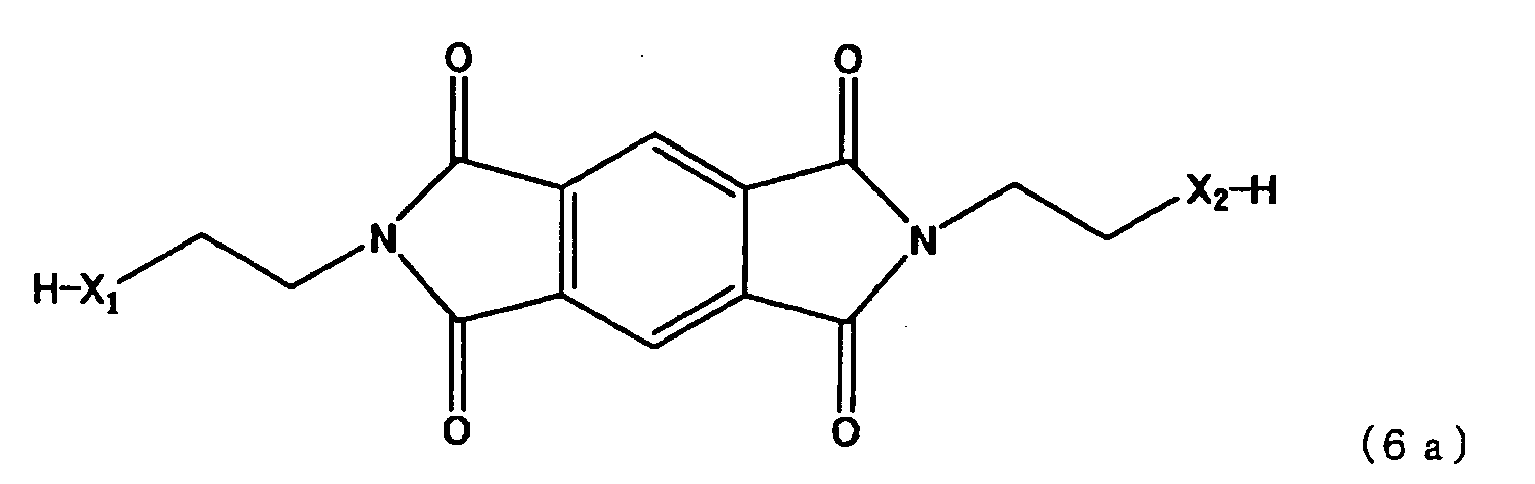
- In the formula (6a), X1 and X2 each independently represent an oxygen atom, a sulfur atom or an NH group, and is preferably an oxygen atom or an NH group.
- A preferred example of a compound having the hard segment includes aliphatic ring-containing diols, aromatic ring-containing diols and the like.
- The aliphatic ring-containing diols include, for example, 1,4-cyclohexanediol:
-

- 1,3-cyclohexanediol:
-

- 4,4'-bicyclohexanol:
-

- 4,4'-isopropylidenedicyclohexanol(2,2-bis(4-hydroxycyclohexyl)propane):
-

- 4,4'-methylenedicyclohexanol:
-

- 4,8-bis(hydroxymethyl)tricyclo(5.2.1.0 2,6)decane:
-

- and the like.
- In addition, the aromatic ring-containing diols include, for example, 4,4'-xylyleneglycol:
-

- 4,4'-biphenyleneglycol:
-

- 6,6'-bis(2-hydroxyethoxy)-3,3,3',3'-tetramethyl-1,1-spirobi indane:
-

- 4,4'-(fluoronylidene)bis(2-phenoxyethanol):
-

- N,N'-bis(2-hydroxyethyl)-pyromellitimide:
-

- 2,2-bis(4-(2-hydroxyethoxy)phenyl)propane:
-

- and the like.
- In addition, a compound having the hard segment includes polyesters having hydroxyl groups at the both terminals thereof obtained by the polycondensation of an aromatic dicarboxylic acid, esters of an aromatic dicarboxylic acid or acid halides of an aromatic dicarboxylic acid with an alkylene diol having 2 to 8 carbon atoms or cycloalkylene diol.
- As the aromatic dicarboxylic acids, esters of an aromatic dicarboxylic acid or acid halides of an aromatic dicarboxylic acid, there may be mentioned, for example, terephthalic acid, dimethyl terephthalate, chloride terephthalate, isophthalic acid, dimethyl isophthalate, chloride isophthalate and the like.
- As the alkylene diol having 2 to 8 carbon atoms or cycloalkylene diol, there may be mentioned, for example, ethylene glycol, diethylene glycol, triethylene glycol, 1,3-propanediol, 1,4-butanediol, 1,5-pentanediol, 1,6-hexanediol, 1,7-heptanediol, 1,8-octanediol, 1,4-cyclohexane-di-methanol and the like.
- The polyesters having hydroxyl groups at the both terminals thereof may be obtained by performing condensation using an excess of diols according to an ordinary method and then by removing the excessive amount of the diols.
- In the compound having the hard segment, the aromatic ring, aliphatic ring, side chain and the like may have a substituent.
- The addition amount of the compound having the hard segment is not particularly limited, but is preferably 0.001 to 10 parts by weight, more preferably 0.01 to 5 parts by weight and still more preferably 0.1 to 3 parts by weight, based on 100 parts by weight of a monomer containing lactide or lactic acid as a main component.
- In the present invention, a solvent may be used in performing the polymerization. The solvent includes, for example, an aliphatic hydrocarbon such as hexane, heptane, decane and the like; an aromatic halogenated hydrocarbon such as chlorobenzene, o-dichlorobenzene and the like; an alicyclic hydrocarbon such as cyclopentane, cyclohexane and the like; an aromatic hydrocarbon such as benzene, toluene, xylene, mesitylene, ethylbenzene, diethylbenzene and the like; an ether solvent such as diethyl ether, dioxane, tetrahydrofuran (THF), diglyme and the like; and others. However, all the solvents which are substantially inert to the reaction may be used.
- These solvents may be used alone or in combination with two or more kinds. From the viewpoints of the solubility of lactide or lactic acid, reaction temperature, reaction rate, easiness of solvent removal after the completion of reaction, and the like, an aromatic hydrocarbon, an aromatic halogenated hydrocarbon and an ether solvent are preferred, and especially xylene, toluene, chlorobenzene, o-dichlorobenzene and diglyme are preferred. The amount used of the solvent is selected in a range from 0.1 to 20 times, preferably from 0.5 to 10 times and more preferably 1.0 to 5 times based on the total weight of lactide or lactic acid.
- In addition, as a catalyst used in the polymerization, a well-known catalyst may be used. For example, there may be mentioned a tin catalyst such as tin octanoate (tin 2-ethylhexanoate), tin dibutyl dilaurate, tin chloride and the like; a titanium catalyst such as titanium chloride, titanium tetraisopropoxide and the like; and a zinc catalyst such as zinc chloride, zinc acetate and the like. Among these, a tin catalyst is preferred and tin octanoate is more preferred. The used amount of the catalyst is 0.001 to 5 parts by weight, preferably 0.003 to 1 part by weight and more preferably 0.005 to 0.1 part by weight, based on 100 parts by weight of lactide or a lactic acid.
- The polymerization temperature is 60 to 250°C and preferably 100 to 230°C. For example, when a solvent is not used, the reaction temperature is preferably approximately 150 to 200°C. In addition, when lactide is reacted with a polymerization initiator using xylene as a solvent and tin octanoate as a catalyst, the reaction temperature is preferably approximately 110 to 150°C.
- The polymerization time varies depending on the type of a monomer used, polymerization temperature, the amount of the catalyst and the like, and is 0.1 to 24 hours, preferably 0.5 to 12 hours and more preferably 1 to 6 hours. In reality, the molecular weight is measured by gel permeation chromatography (GPC) and the like in the reaction to determine the point at which a desired molecular weight is achieved as the reaction end point.
- The linear polylactic acid compound (A) obtained in the manner described above has a weight average molecular weight from 5,000 to 500,000, preferably from 10,000 to 400,000 and more preferably from 50, 000 to 300, 000. In addition, the weight average molecular weight shown in the present invention is a value measured by gel permeation chromatography (GPC) (column temperature: 40°C, solvent: chloroform) in comparison with a polystyrene standard sample.
- The polylactic acid compound (B), which is used in the polylactic acid resin composition of the present invention when necessary, is a polymer which has a moiety (hereinafter also referred to as a "soft segment") represented by the following formula (7) in a polymer chain of a lactic acid resin (D) described later and has a weight average molecular weight (Mw) of 5,000 to 500,000.
-
-X3-R2-X4- (7)
In the formula (7), X3 and X4 each independently represent an oxygen atom, a sulfur atom or an NH group, R2 represents an aliphatic hydrocarbon group having a molecular weight of 50 to 50000 and containing no ring structure, and the aliphatic hydrocarbon group may contain an oxygen atom, a nitrogen atom or a sulfur atom. - As described above, the "soft segment" in the present invention is an aliphatic hydrocarbon group containing no ring structure such as an aliphatic ring, an aromatic ring and the like (provided that it may contain an atom such as oxygen, nitrogen, sulfur and the like) and is a segment derived from a compound containing two or more functional groups derived from a hydroxyl group, thiol group or amino group.
- The content of the soft segment in the polylactic acid compound (B) is not particularly limited, but is preferably 0.01 to 5 mol% and more preferably 0.03 to 3 mol%. As with the hard segment, in reality, it is preferable that the content of the soft segment is calculated from the targeted molecular weight or the amount for obtaining the targeted molecular weight is determined by actually performing the reaction.
- The polylactic acid compound (B) may be obtained by a well-known and generally used method, and, for example, may be obtained by copolymerizing a compound having the soft segment with a monomer containing lactide or lactic acid as a main component. As another monomer other than lactide and lactic acid, there may be used cyclic esters (lactones) such as caprolactone, propiolactone, butyrolactone and the like, and hydroxyalkanoic acids such as hydroxybutanoic acid, hydroxypropanoic acid and the like.
- The compound having the soft segment preferably includes alkylene glycols, polyesters having two or more hydroxyl groups and polycarbonates having two or more hydroxyl groups and the like, and more preferably includes alkylene glycols, polyesters in which both terminals thereof are hydroxyl groups, polycarbonates in which both terminals thereof are hydroxyl groups, and the like.
- The alkylene glycols preferably include polyethylene glycol (PEG) and polypropylene glycol (PPG), and have a weight average molecular weight from 50 to 50,000, preferably from 50 to 10,000 and more preferably from 100 to 5,000.
- As the polyesters having two or more hydroxyl groups, for example, there may be mentioned polyesters in which a diol component is excessively reacted with dicarboxylic acid in polyesters produced from dicarboxylic acids and diols, or polyesters in which cyclic esters such as caprolactone and the like are ring-opening polymerized with water or diols.
- As the dicarboxylic acid used in the production of the polyesters, there may mentioned, for example, an aliphatic or aromatic dicarboxylic acid having 4 to 20 carbon atoms such as maleic acid, fumaric acid, succinic acid, adipic acid and the like.
- As the diols used in the production of the polyesters, there may mentioned, for example, a linear or branched aliphatic diol having 2 to 20 carbon atoms such as ethylene glycol, 1,3-propanediol, propylene glycol, 1,4-butanediol, neopentyl glycol and the like.
- As the polycarbonates having two or more hydroxyl groups, there may be mentioned aliphatic polycarbonates obtained by reacting diols with phosgene, the derivative thereof or carbonic esters.
- As the diols used in the production of the aliphatic polycarbonates, there may be mentioned, for example, ethylene glycol, 1,3-propanediol, 1,4-butanediol, 1,5-pentanediol, 1,6-hexanediol, 1,4-cyclohexanedimethanol, 2,8-octanediol and the like.
- The weight average molecular weight of the soft segment may be calculated from the weight average molecular weight of a compound having the soft segment and is in the range from 50 to 50,000, preferably from 50 to 10,000 and more preferably 100 to 5, 000.
- Although there may be no compatibility between the alkylene glycols, polyalkylene glycols, polyesters, polycarbonates or the like and lactic acid or lactide, after the completion of the reaction, the polylactic acid compound (B) used in the present invention have to be homogeneous and exhibit transparency.
- In the production of the polylactic acid compound (B), as with the linear polylactic acid compound (A), a solvent may be used in carrying out the polymerization of lactide, lactic acid or the other monomer. All of the type and amount of the solvent used in the reaction, the type and amount of the polymerization catalyst, polymerization temperature, polymerization time, polymerization method and the like are the same as in the case of the linear polylactic acid compound (A).
- The polylactic acid compound (B) may be used in an amount from 5 to 1, 900 parts by weight, preferably from 10 to 500 parts by weight and more preferably from 15 to 300 parts by weight, based on 100 parts by weight of the linear polylactic acid compound (A). If the content of the polylactic acid compound (B) is within the range, there may be obtained a composition having an excellent rate of crystallization and an excellent heat resistance.
- The polylactic acid resin composition of the present invention may contain a transparent nucleating agent (C) when necessary. Here, "a transparent nucleating agent" becomes a nucleating agent at the time of crystallization and imparts transparency when added to the linear polylactic acid compound (A) having a specific structure. Specifically, there may be mentioned a carboxylic acid amide, an aliphatic alcohol and an aliphatic carboxylic acid ester. These may be used alone or in combination with two or more kinds.
- The specific examples of the carboxylic acid amide include aliphatic monocarboxylic acid amides such as lauric acid amide, palmitic acid amide, oleic acid amide, stearic acid amide, erucic acid amide, behenic acid amide, ricinoleic acid amide and hydroxystearic acid amide; N-substituted aliphatic monocarboxylic acid amides such as N-oleyl palmitic acid amide, N-oleyl oleic acid amide, N-oleyl stearic acid amide, N-stearyl oleic acid amide, N-stearyl stearic acid amide, N-stearyl erucic acid amide, methylol stearic acid amide and methylol behenic acid amide; aliphatic biscarboxylic acid amides such as methylene bisstearic acid amide, ethylene bisstearic acid amide, ethylene bislauric acid amide, ethylene biscapric acid amide, ethylene biserucic acid amide, ethylene bisbehenic acid amide, ethylene bisisostearic acid amide, ethylene bishydroxystearic acid amide, butylene bisstearic acid amide, hexamethylene bisoleic acid amide, hexamethylene bisstearic acid amide, hexamethylene bisbehenic acid amide, hexamethylene bishydroxystearic acid amide, m-xylylene bisoleic acid amide, m-xylylene bisstearic acid amide, m-xylylene bisbehenic acid amide and m-xylylene bishydroxystearic acid amide; N-substituted aliphatic carboxylic acid bisamides such as N,N' -dioleyl sebacic acid amide, N,N'-dioleyl adipic acid amide, N,N'-distearyl adipic acid amide, N,N'-distearyl sebacic acid amide, N, N' -distearyl isophthalic acid amide and N,N'-distearyl terephthalic acid amide; and N-substituted ureas such as N-butyl-N'-stearyl urea, N-propyl-N'-stearyl urea, N-stearyl-N'-stearyl urea, N-phenyl-N'-stearyl urea, xylylene bisstearyl urea, xylylene bisstearyl urea, toluylene bisstearyl urea, hexamethylene bisstearyl urea, diphenylmethane bisstearyl urea and diphenylmethane bislauryl urea.
- Among these, biscarboxylic acid amide is preferably used, and especially ethylene bislauric acid amide, ethylene bisoleic acid amide, ethylene bisstearic acid amide, ethylene bis-12-hydroxystearic acid amide, hexamethylene bislauric acid amide, hexamethylene bisoleic acid amide, hexamethylene bis-12-hydroxystearic acid amide, m-xylylene bislauric acid amide, m-xylylene bisoleic acid amide and m-xylylene bis-12-hydroxystearic acid amide are preferred. Further, from the viewpoint of having an excellent rate of crystallization, ethylene bislauric acid amide, ethylene bisoleic acid amide, ethylene bis-12-hydroxystearic acid amide, ethylene bisstearic acid amide, hexamethylene bislauric acid amide, hexamethylene bisoleic acid amide and hexamethylene bis-12-hydroxystearic acid amide, which have no aromatic ring in the molecule, are preferred.
- The specific examples of the aliphatic alcohol include pentadecyl alcohol, cetyl alcohol, heptadecyl alcohol, 1,6-hexanediol, 1,8-octanediol, cyclohexane-1,2-diol, cyclohexane-1,4-diol and the like.
- The specific examples of the aliphatic carboxylic acid ester include lauric acid cetyl ester, palmitic acid cetyl ester, stearic acid cetyl ester, dilauric acid glycol, dipalmitic acid glycol, monolauric acid glycerin ester, monostearic acid glycerin ester and the like.
- The transparent nucleating agent (C) may be used in a range from 0.1 to 10 parts by weight, preferably from 0.2 to 5 parts by weight and more preferably from 0.3 to 3 parts by weight, based on 100 parts by weight of the linear polylactic acid compound (A) or based on 100 parts by weight of the total of the linear polylactic acid compound (A) and the polylactic acid compound (B) and/or the lactic acid compound (D) which are used when necessary. If the content of the transparent nucleating agent (C) is within the range, the effect as a nucleating agent is significantly exhibited, and a resin composition having both high rate of crystallization and transparency is obtained.
- The polylactic acid resin composition of the present invention may contain a lactic acid resin (D) other than the linear polylactic acid compound (A) and the polylactic acid compound (B) where necessary. The "a lactic acid resin" means a polymer composition containing as the main component a polymer having 50% by mole or more, preferably 75% by mole or more of L-lactic acid units and/or D-lactic acid units, and it is synthesized by the polycondensation of lactic acid or by the ring-opening polymerization of lactide which is a cyclic dimer of lactic acid.
- The lactic acid resin (D) may be a copolymer of lactic acid and a copolymerizable other monomer. Preferred is a polylactic acid having 100% by mole of lactic units and more preferred is a polylactic acid having 95% by mole or more, preferably 97% by mole or more of constitutional units derived from L-lactic acid. In addition, the lactic acid resin (D) may be a composition in which other resins, additives and the like are mixed in addition to a polymer containing 50% by mole or more of lactic acid units, so long as the properties of the polymer are not significantly impaired.
- The lactic acid resin (D) has a weight average molecular weight (Mw) from 5,000 to 500,000, preferably from 10,000 to 400,000 and more preferably 50,000 to 300,000.
- The monomer copolymerizable with lactic acid includes a hydroxycarboxylic acid (for example, glycolic acid, caproic acid and the like), an aliphatic polyhydric alcohol (for example, butanediol, ethylene glycol and the like), an aliphatic polyhydric carboxylic acid (for example, succinic acid, adipic acid and the like), and others.
- When the lactic acid resin (D) is a copolymer, a form of arrangement of the copolymer may be any form of a random copolymer, an alternating copolymer, a block copolymer, a graft copolymer and the like. These may be a copolymer in which at least part thereof is copolymerized with a polyhydric alcohol of bifunctional or more such as ethylene glycol, diethylene glycol, triethylene glycol, a polyethylene glycol, propylene glycol, dipropylene glycol, an ethylene glycol/propylene glycol copolymer, 1,3-butanediol, 1,4-butanediol, 3-methyl-1,5-pentanediol, 1,6-hexanediol, 1,9-nonanediol, neopentyl glycol, polytetramethylene glycol, glycerin, trimethylol propane and the like; a polyvalent isocyanate such as xylylene diisocyanate, 2,4-tolylene diisocyanate and the like; polysaccharides such as cellulose, acetyl cellulose, ethyl cellulose and the like; and others. In addition, at least part thereof may have any structure of a linear, cyclic, branched, star, three-dimensional net structure or the like.
- The lactic acid resin (D) may be used in an amount of 5 to 500 parts by weight, preferably 15 to 300 parts by weight and more preferably 30 to 250 parts by weight, based on 100 parts by weight of the linear polylactic acid compound (A). If the content of the lactic acid resin (D) is within the range, a composition excellent in heat resistance and transparency is obtained.
- To the polylactic acid resin composition of the present invention, other resins or polymers other than the components (A) to (D) and various additives may be added, according to the objective (for example, improvement of moldability, secondary processability, degradation property, tensile strength, heat resistance, storage stability, weather resistance, flame retardancy and the like).
- The other resins or polymers include polycarbonate resin, unmodified polyolefin, vinyl resin, polystyrene, polyamide, acrylic resin, polyphenylene sulfide resin, polyether ether ketone resin, polyester, polysulfone, polyphenylene oxide, polyimide, polyether imide, acrylonitrile-butadiene-styrene copolymer (ABS), ethylene-α-olefin copolymer rubber, conjugated diene rubber, styrene rubber, phenolic resin, melamine resin, polyester resin, silicone resin, epoxy resin and the like. These may be used alone or in combination with two or more kinds.
- The various additives include, for example, a plasticizer, an antioxidant, an ultraviolet absorber, a heat stabilizer, a flame retardant, an internal release agent, an inorganic additive, an organic additive, an antistatic agent, a surface wetting improver, an incineration auxiliary, a pigment, a dye, a nucleating agent, a lubricant, a natural substance, and the like, and preferably include a plasticizer.
- The plasticizer includes, for example, triacetin, triethylene glycol diacetate, triethyl acetyl citrate, tributyl acetyl citrate and dibutyl sebacate.
- The inorganic additive and lubricant may be used to improve blocking prevention or slipping properties of a film or a sheet. Such an inorganic additive includes silica, mica, talc, glass fiber, glass bead, kaolin, kaolinite, barium sulfate, calcium sulfate, magnesium hydroxide, wollastonite, carbon fiber, calcium silicate fiber, magnesium oxysulfate fiber, potassium titanate fiber, calcium sulfite, white carbon, clay, montmorillonite, titanium oxide, zinc oxide and the like. These may be used alone or in combination with two or more kinds. Especially when a glass fiber is used as the inorganic additive, a resin composition may be expected to be increased in heat resistance.
- The organic additive includes starch and the derivative thereof, cellulose and the derivative thereof, pulp and the derivative thereof, paper and the derivative thereof, wheat flour, bean curd refuse, bran, coconut shell, coffee waste, protein, or phthalic acid-, aliphatic polybasic acid-, glycerin-, citric acid-, glycol- and olefin- low molecular weight compounds, or polyethylene terephthalate fiber, polyethylene naphthalate fiber, and aramid fiber, or the like. These may be used alone or in combination with two or more kinds.
- The addition amount of the other resins, polymers or additives is arbitrarily selected depending on the application, so long as the object of the present invention is not impaired.
- As a method for producing the polylactic acid resin composition of the present invention, a well-known production method may be arbitrarily employed. For example, there may be adopted a method of uniformly premixing each component using a high-speed mixer, a low-speed mixer or the like and then melt-kneading the resulting composition using a single- or multiple-screw extruder having sufficient kneading capacity at the melting point or higher of the resin, a method of mixing and kneading at the time of melting, a method of removing a solvent after mixing in a solution, and the like.
- The production of a polylactic acid composition may be carried out before the molding of a molded article, or the production of the composition and the molding may be carried out simultaneously. When the composition is produced before the molding, the shape of the resin composition is preferably a pellet, rod, powder or the like.
- The polylactic acid resin composition of the present invention is excellent in that it has a fast rate of crystallization. Here, in the differential scanning colorimetry (DSC) analysis, when a polymer is heated to be melt and then cooled to a predetermined temperature at a fixed rate and maintained at the predetermined temperature, the "rate of crystallization" in the present invention is determined by the time from when the predetermined temperature is maintained until when the exothermal peak due to the crystallization becomes the maximum value (hereinafter also referred to as a "isothermal crystallization time"). If the time is shorter, the rate of crystallization is faster. In addition, the predetermined temperature is arbitrarily selected depending on a polymer to be measured.
- The method for the determination of the isothermal crystallization time is specifically as follows. When a resin is comprised of units derived from lactic acid as with the present invention, 5 to 6 mg of a polymer in a film state is weighed in a nitrogen-sealed pan and it is inserted into the nitrogen-sealed DSC measuring part preset at 30°C and then heated at a temperature rising rate of 100°C/min to melt the polymer at 220 °C for 3 minutes. Subsequently, when the polymer is cooled to a predetermined crystallization temperature (for example 100°C) at a cooling rate of 99°C/min and maintained at the same temperature, the isothermal crystallization time is determined by the time from when the polymer is cooled to the predetermined temperature until when the exothermal peak due to the crystallization becomes the maximum value.
- The isothermal crystallization time of the polylactic acid resin composition of the present invention is 5 minutes or less, preferably from 0.1 to 4 minutes and more preferably from 1 to 3 minutes.
- A molded article of the present invention is composed of the polylactic acid resin composition of the present invention described above. The molded article of the present invention may be produced by a well-known and generally used method, for example, by the following methods.
- (1) In extrusion molding, a film or a sheet may be formed by molding the polylactic acid resin composition of the present invention by a typical T die extrusion molding machine.
- (2) In injection molding, a pellet of the polylactic acid resin composition of the present invention is melt and softened, and then the resultant resin composition is filled in a mold to obtain a molded article in a molding cycle of 20 to 300 seconds.
- (3) In blow molding (injection blow molding, stretching blow molding or direct blow molding), for example, in case of injection blow molding, a pellet of the polylactic acid resin composition of the present invention is melt by a typical injection blow molding machine, and then the resultant resin composition is filled in a mold to obtain a pre-molded article. The resulting pre-molded article is heated again in an oven (heating furnace) and then placed in a mold maintained at a fixed temperature and pressurized air is fed to blow, and thereby a blow bottle may be obtained.
- (4) In vacuum forming and vacuum pressure forming, a film or sheet molded by the same method as in the extrusion molding of the (1) is used as a pre-molded article. The resulting pre-molded article is heated to soften once and is vacuum formed or vacuum pressure formed in a mold maintained at a fixed temperature using a typical vacuum forming machine, and thereby a molded article may be obtained.
- (5) In laminate molding, a laminate molded article may be obtained by a method of laminating a film or sheet obtained by the extrusion molding method (1) on other substrate by an adhesive or heat; an extrusion lamination method of directly extruding a molten resin from a T die onto a substrate such as papers, metals, plastics and the like in the same manner as in the extrusion molding method (1); a coextrusion method of melting each of the resin composition of the present invention and the like by a separate extruder and then flowing each melted resin together at die heads to simultaneously extrude; a co-extrusion lamination method combining those methods; and the like.
- (6) In tape yarn molding, a film or sheet molded in the same manner as in the extrusion molding (1) is slit into a specific width and is uniaxially hot-stretched in a temperature range from 60 to 140°C, and is further heat fixed in a temperature range from 80 to 160°C when necessary, and thereby a molded article may be obtained.
- (7) In yarn molding, a yarn may be obtained by a melt spinning method of melting the polylactic acid resin composition of the present invention at a temperature of from 150 to 240°C using an extruder and then discharging the resulting composition from a spinneret. When needed, a yarn may be formed by uniaxially hot-stretching the composition in a temperature range from 60 to 100°C, and in some cases, by further heat fixing in a temperature range from 80 to 140°C.
- (8) In non-woven molding, a molded article may be formed by a span bond method or a melt blown method. In the span bond method, in the same manner as in the yarn molding (7), a web is formed by melt spinning the resin composition using a spinneret having a plurality of holes and then stretching the resulting yarn using an air sucker installed at the lower part of the spinneret, and the web is accumulated on a trapping face and further is press bonded or heat welded by an emboss roll and a smooth roll, and thereby a non-woven fabric may be obtained. In the melt blown method, the molten resin discharged from the spinneret having a plurality of holes is brought into contact with a high speed heated gas blown from a heated gas outlet to form fine fibers and the resulting fibers are accumulated on a moving support, and thereby a non-woven fabric may be obtained.
- The molded article of the present invention, which is heat treated at 80 to 120°C for 1 to 300 seconds, has a haze of 0.1 to 15%, preferably 0.1 to 12% and more preferably 0.1 to 11% as measured at a thickness of 100 µm, and has a crystallinity of 35% or more, preferably 38 to 60% and more preferably 42 to 55%.
- The "crystallinity" in the present invention is determined by differential scanning colorimetry (DSC). Specifically, firstly, a non-oriented film obtained by press molding is heat treated in an oven at 105°C for a predetermined time period. 5 to 6 mg of the film after the heat treatment is weighed in a nitrogen-sealed pan, and it is inserted into the nitrogen-sealed DSC measuring part preset at 30°C and then heated to 220°C at a temperature rising rate of 10°C/min. The crystallization enthalpy (ΔHc) and crystal melting enthalpy (ΔHm) are measured to determine [[(ΔHm-ΔHc)/(ΔH0)]×100], which is used as a crystallinity. Here, ΔH0 represents a completely ideal crystal melting enthalpy, for example, the ΔH0 of polylactic acid is 93 J/g. In addition, the "haze" in the present invention is a value measured by a hazemeter.
- The polylactic acid resin composition of the present invention may be molded by the various molding and processing methods described above and may be suitably used for various applications without any particular limitation. In addition, these molded articles may be employed for various applications, such as automobile parts, home electric appliance material parts, electric and electronic components, building members, civil engineering members, agricultural materials, commodities, various films, breathable films or sheets, foamed products suitable for general industrial applications and recreation uses, yarns, textiles, medical or sanitary materials, and the like, and preferably, for automobile material parts, home electric appliance material parts and electric and electronic parts which require heat resistance and impact resistance.
- Specifically, there may be mentioned the development into parts such as front doors, wheel caps and the like, in which resin parts are conventionally used, in the automobile part material uses; the development into package parts of products such as personal computers, headphone stereos and mobile phones in home electric appliance material part uses; and the development into reflective material films and sheets and polarizing films and sheets in the electric and electronic parts.
- Hereinafter, the present invention will be specifically explained based on Examples, but the present invention is not limited by these Examples.
- The weight average molecular weight was determined by gel permeation chromatography (GPC) ["Shodex GPC-101" manufactured by Showa Denko K.K., column: "PLgel mixd c" manufactured by Polymer Laboratories, Inc., two columns in series, column temperature: 40°C, mobile phase: chloroform, flow rate: 1 mL/min] through the comparison with a polystyrene standard sample.
- The Rate of crystallization was determined by DSC ("DSC-60" manufactured by Shimadzu Corporation). 5 to 6 mg of a non-oriented film obtained by press molding was weighed in a nitrogen-sealed pan, and it was inserted into the nitrogen-sealed DSC measuring part preset at 30°C and then heated at a temperature rising rate of 100°C/min to melt at 220°C for 3 minutes. After the melting, it was cooled to 100°C at a cooling rate of 99°C/min. The time taken for the crystallization peak to become maximum was measured using the time when it was cooled to 100°C as the starting time.
- The crystallinity was measured by DSC ("DSC-60" manufactured by Shimadzu Corporation). A non-oriented film obtained by press molding was heat treated in an oven at 105°C for a predetermined time period. 5 to 6 mg of the film after the heat treatment was weighed in a nitrogen-sealed pan, and it was inserted into the nitrogen-sealed DSC measuring part preset at 25°C and then heated to 220°C at a temperature rising rate of 10°C/min. The crystallization enthalpy (ΔHc) and crystal melting enthalpy (ΔHm) were measured to determine [[(ΔHm-ΔHc)/(ΔH0)]×100], which was used as a crystallinity. Here, ΔH0 represents a completely ideal crystal melting enthalpy, and a value of 93 J/g of polylactic acid was used.
- The haze was determined by a hazemeter "NDH2000" manufactured by Nippon Denshoku Industries Co., Ltd.) according to JIS K7105.
- A 200 mL glass reaction apparatus equipped with a stirrer, a thermometer and a condenser was charged with 200.0 g (1.389 mol) of L-lactide, 2.43 g (0.017 mol) of D-lactide, 1.58 g (0.00253 mol) of ethylene-bis-12-hydroxystearylamide and 16.2 mg of tin octanoate, and the mixture was heated to 190°C while stirring at a rate of 150 rpm under a nitrogen atmosphere. While continuously stirring, polymerization was carried out at 190 to 200°C for 2 hours. During the polymerization, because as the viscosity of the polymer increased, stirring became difficult, the stirring rate was decreased to 50 rpm while observing the condition. The polymerization was completed by confirming that the viscosity of the resulting polymer was sufficiently increased and the molecular weight (Mw) of the polymer measured by GPC was 200,000.
- After the polymerization, after once discharging the polymer to a tray to cool, the polymer was dissolved in 2,000 mL of chloroform. While stirring the chloroform solution, methanol was added by small and small. Since the solution was clouded when approximately 2,000 mL of methanol was added, the addition of methanol was temporarily stopped, and the polymer was gradually precipitated while stirring. After 2 hours, since the polymer was fully precipitated, an approximately 4,000 mL of methanol was further added, and the mixture was sufficiently stirred for one hour to remove the remaining lactide, and then the polymer was suction filtrated and separated. The filtered agglomerates were washed by rinsing with a small amount of methanol and then further stirred in 3,000 mL of methanol for one hour, and then the agglomerates were suction filtrated to remove completely the remaining lactide. The polymer obtained in this manner was dried at 50°C and 2 kPa for 24 hours to obtain 195.2 g of polylactic acid (B-1) having a partial structure derived from ethylene-bis-12-hydroxystearylamide. The resulting polylactic acid (B-1) had a weight average molecular weight (Mw) of 198,000.
- Using the same reaction apparatus as in Synthesis Example 1, 190.0 g of polylactic acid (B-2) having a partial structure derived from PEG#200 was obtained in the same manner as in Synthesis Example 1 except for changing 1.58 g (0.00253 mol) of ethylene-bis-12-hydroxystearylamide to 0.36 g (Mw=200, 0.0036 mol as a hydroxyl group) of PEG#200 (reagent special grade, manufactured by Kanto Chemical Co., Inc.). The resulting polylactic acid (B-2) had a weight average molecular weight (Mw) of 214,000.
- Using the same reaction apparatus as in Synthesis Example 1, 190.2 g of polylactic acid (B-3) having a partial structure derived from PPG#2000 was obtained in the same manner as in Synthesis Example 1 except for changing 1.58 g (0.00253 mol) of ethylene-bis-12-hydroxystearylamide to 4.75 g (0.00432 mol as a hydroxyl group) of PPG#2000 (Mw=2200, reagent special grade, manufactured by Kanto Chemical Co., Inc.). The resulting polylactic acid (B-3) had a weight average molecular weight (Mw) of 198,000.
- A 200 mL glass reaction apparatus equipped with a stirrer, a thermometer and a condenser was charged with 142.3 g (0.988 mol) ofL-lactide, 1.7 g (0.122 mol) ofD-lactide, 0. 433 g (0.0018 mol) of 4,4'-isopropylidenedicyclohexanol (hydrogenated bisphenol A) and 11.5 mg of tin octanoate, and the mixture was heated to 190°C while stirring at a rate of 150 rpm under a nitrogen atmosphere. While continuously stirring, polymerization was carried out at 190 to 200°C for 2 hours. During the polymerization, because as the viscosity of the polymer increased, stirring became difficult, the stirring rate was decreased to 50 rpm while observing the condition. The polymerization was completed by confirming that the viscosity of the resulting polymer was sufficiently increased and the molecular weight (Mw) of the polymer measured by GPC was 178, 000.
- After the polymerization, after once discharging the polymer to a tray to cool, the polymer was dissolved in 2,000 mL of chloroform. While stirring the chloroform solution, methanol was added by small and small. Since the solution was clouded when approximately 2,000 mL of methanol was added, the addition of methanol was temporarily stopped, and the polymer was gradually precipitated while stirring. After 2 hours, since the polymer was fully precipitated, an approximately 4,000 mL of methanol was further added, and the mixture was sufficiently stirred for one hour to remove the remaining lactide, and then the polymer was suction filtrated and separated. The filtered agglomerates were washed by rinsing with a small amount of methanol and then further stirred in 3,000 mL of methanol for one hour, the agglomerates were suction filtered to remove completely the remaining lactide. The polymer obtained in this manner was dried at 50°C and 2 kPa for 24 hours to obtain 134.2 g of polylactic acid (A-1) having a partial structure derived from 4,4'-isopropylidenedicyclohexanol (hydrogenated bisphenol A) . The resulting polylactic acid (A-1) had a weight average molecular weight (Mw) of 179,000.
- Using the same reaction apparatus as in Example 1, 130.5 g of polylactic acid (A-2) having a partial structure derived from N,N'-(2-hydroxyethyl)pyromellitimide was obtained in the same manner as in Example 1 except for changing 0.433 g (0.0018 mol) of 4,4'-isopropylidenedicyclohexanol (hydrogenated bisphenol A) to 0.548 g (0.0018 mol) of N,N'-(2-hydroxyethyl) pyromellitimide. The resulting polylactic acid (A-2) had a weight average molecular weight (Mw) of 157,000.
- Using the same reaction apparatus as in Example 1, 129.8 g of polylactic acid (A-3) having a partial structure derived from 6,6'-bis(2-hydroxyethoxy)-3,3,3',3'-tetramethyl-1,1-spirobiindane was obtained in the same manner as in Example 1 except for changing 0.433 g (0.0018 mol) of 4,4'-isopropylidene dicyclohexanol (hydrogenated bisphenol A) to 0.713 g (0.0018 mol) of 6,6'-bis(2-hydroxyethoxy)-3,3,3',3'-tetramethyl-1,1-spirobiindane. The resulting polylactic acid (A-3) had a weight average molecular weight (Mw) of 182,000.
- Using the same reaction apparatus as in Example 1, 137.2 g of polylactic acid (A-4) having a partial structure derived from p-xylyleneglycol was obtained in the same manner as in Example 1 except for changing 0.433 g (0.0018 mol) of 4,4'-isopropylidenedicyclohexanol (hydrogenated bisphenol A) to 0.248 g (0.0018 mol) of p-xylyleneglycol. The resulting polylactic acid (A-4) had a weight average molecular weight (Mw) of 183,000.
- Using the same reaction apparatus as in Example 1, 133.5 g of polylactic acid (A-5) having a partial structure derived from 4,4'-bicyclohexanol was obtained in the same manner as in Example 1 except for changing 0.433 g (0.0018 mol) of 4,4'-isopropylidenedicyclohexanol (hydrogenated bisphenol A) to 0.357 g (0.0018 mol) of 4,4'-bicyclohexanol. The resulting polylactic acid (A-5) had a weight average molecular weight (Mw) of 164,000.
- Using the same reaction apparatus as in Example 1, 135.0 g of polylactic acid (A-6) having a partial structure derived from 4,8-bis(hydroxymethyl)tricyclo(5.2.1.0 2,6)decane was obtained in the same manner as in Example 1 except for changing 0.433 g (0.0018 mol) of 4,4'-isopropylidenedicyclohexanol (hydrogenated bisphenol A) to 0.35 g (0.0018 mol) of 4,8-bis(hydroxymethyl)tricyclo(5.2.1.0 2,6)decane. The resulting polylactic acid (A-6) had a weight average molecular weight (Mw) of 182,000.
- Using the same reaction apparatus as in Example 1, 128.6 g of polylactic acid (A-7) having a partial structure derived from polybutylene-terephthalate was obtained in the same manner as in Example 1 except for changing 0.433 g (0.0018 mol) of 4,4'-isopropylidenedicyclohexanol (hydrogenated bisphenol A) to 1.52 g (hydroxyl group equivalent: 770 g/eq) of a polyester having hydroxyl groups at both terminals thereof, which was obtained by reacting chloride terephthalate with 1, 4-butanediol. The resulting polylactic acid (A-7) had a weight average molecular weight (Mw) of 283,000.
- Using the same reaction apparatus as in Example 1, 129.2 g of polylactic acid (A-8) having a partial structure derived from polybutylene-isophthalate was obtained in the same manner as in Example 1 except for changing 0.433 g (0.0018 mol) of 4,4'-isopropylidenedicyclohexanol (hydrogenated bisphenol A) to 3.6 g (hydroxyl group equivalent: 1135 g/eq) of a polyester having hydroxyl groups at both terminals thereof, which was obtained by reacting chloride isophthalate with 1, 4-butanediol. The resulting polylactic acid (A-8) had a weight average molecular weight (Mw) of 207,000.
- Using the same reaction apparatus as in Example 1, 125.8 g of polylactic acid (A-9) having a partial structure derived from polyhexylene-terephthalate was obtained in the same manner as in Example 1 except for changing 0.433 g (0.0018 mol) of 4,4'-isopropylidenedicyclohexanol (hydrogenated bisphenol A) to 3.7 g (hydroxyl group equivalent: 1062 g/eq) of a polyester having hydroxyl groups at both terminals thereof, which was obtained by reacting chloride terephthalate with 1, 6-hexanediol. The resulting polylactic acid (A-9) had a weight average molecular weight (Mw) of 172,000.
- Using the same reaction apparatus as in Example 1, 127.5 g of polylactic acid (A-10) having a partial structure derived from polyoctylene-terephthalate was obtained in the same manner as in Example 1 except for changing 0.433 g (0.0018 mol) of 4,4'-isopropylidenedicyclohexanol (hydrogenated bisphenol A) to 2.2 g (hydroxyl group equivalent: 630 g/eq) of a polyester having hydroxyl groups at both terminals thereof, which was obtained by reacting chloride terephthalate with 1,8-octanediol. The resulting polylactic acid (A-10) had a weight average molecular weight (Mw) of 183,000.
- Using the same reaction apparatus as in Example 1, 133.8 g of polylactic acid (A-11) having a partial structure derived from a chloride terephthalate/1,4-cyclohexanedimethanol-polyester whose both terminals are hydroxyl groups was obtained in the same manner as in Example 1 except for changing 0.433 g (0.0018 mol) of 4,4'-isopropylidenedicyclohexanol (hydrogenated bisphenol A) to 9.0 g (hydroxyl group equivalent: 2620 g/eq) of a polyester having hydroxyl groups at both terminals thereof, which was obtained by reacting chloride terephthalate with 1,4-cyclohexanedimethanol. The resulting polylactic acid (A-11) had a weight average molecular weight (Mw) of 167,000.
- Using a laboplast mill, the polylactic acids (A-1) to (A-11) synthesized in Examples 1 to 11 and the nucleating agent (C) were kneaded in the parts by weight shown in Table 1 under the conditions at a temperature of 200°C for 5 minutes and at a rotation speed of 50 rpm. The kneaded product was pressed for 5 minutes under the conditions of 200°C and 10 MPa to obtain a film having a thickness of 100 µm. The isothermal crystallization time of the resulting film was measured as described above. Further, the film was placed in an oven at 105°C for 20 seconds and 60 seconds and was subjected to annealing (heat treatment), and then the crystallinity and transparency (haze) of the film before and after the annealing were measured as described above. The results are shown in Table 1.
- Using a laboplast mill, the polylactic acids (A-1) to (A-11) synthesized in Examples 1 to 11, the transparent nucleating agent (C) and a commercially available polylactic acid (D-1) [trademark LACEA, grade H-100, produced by Mitsui Chemicals Inc.] were kneaded in the parts by weight shown in Table 1 under the conditions at a temperature of 200°C for 5 minutes and at a rotation speed of 50 rpm. The kneaded product was pressed for 5 minutes under the conditions of 200°C and 10 MPa to obtain a film having a thickness of 100 µm. The isothermal crystallization time of the resulting film was measured as described above. Further, the film was placed in an oven at 105°C for 20 seconds and 60 seconds and was subjected to annealing (heat treatment), and then the crystallinity and transparency (haze) of the film before and after the annealing were measured as described above. The results are shown in Table 2.
- Using a laboplast mill, the polylactic acid (A) synthesized in Examples 1, 3 and 7, the polylactic acid (B) synthesized in Synthesis Examples 1 to 3 and the transparent nucleating agent (C) were kneaded in the parts by weight shown in Table 1 under the conditions at a temperature of 200°C for 5 minutes and at a rotation speed of 50 rpm. The kneaded product was pressed for 5 minutes under the conditions of 200°C and 10 MPa to obtain a film having a thickness of 100 µm. The isothermal crystallization time of the resulting film was measured as described above. Further, the film was placed in an oven at 105°C for 20 seconds and 60 seconds and was subjected to annealing (heat treatment), and then the crystallinity and transparency (haze) of the film before and after the annealing were measured as described above. The results are shown in Table 3.
- A film was prepared in the same manner as in Example 12 except for kneading a commercially available polylactic acid (D-1) [trademark LACEA, grade H-100, manufactured by Mitsui Chemicals Inc.] and the transparent nucleating agent (C) in the parts by weight shown in Table 1. The isothermal crystallization time, crystallinity and transparency of the film were measured. The results are shown in Table 1 and Table 2.
-
[Table 1] Composition Isothermal Crystallization Time (Min) Crystallinity (%) Haze (%) Polylactic acid (A) Polylactic acid (B) Transparent nucleating agent (c) Lactic Acid Resin (D) Annealing Time (Sec) Annealing Time (Sec) Type Parts by Weight Type Parts by Weight Type Parts by Weight Type Parts by Weight 0 20 60 0 20 60 Example 12 A-1 100 - - EBL 0.5 - - 1.1 21.2 29.0 45.8 0.85 1.3 6.58 Example 13 A-2 100 - - EBL 0.5 - - 1.2 21.8 29.8 46.0 1.02 1.36 6.82 Example 14 A-3 100 - - EBL 0.5 - - 0.9 16.0 31.1 45.9 0.94 1.21 6.20 Example 15 A-4 100 - - EBL 0.5 - - 0.9 18.5 32.1 46.2 0.87 1.33 5.80 Example 16 A-5 100 - - EBL 0.5 - - 0.9 19.3 30.9 44.7 0.89 1.25 6.97 Example 17 A-6 100 - - EBL 0.5 - - 1.0 20.7 30.3 45.2 0.91 1.29 6.25 Example 18 A-7 100 - - EBL 0.5 - - 0.9 14.8 25.8 45.8 0.45 1.36 5.75 Example 19 A-8 100 - - EBL 0.5 - - 1.7 16.8 28.6 43.2 0.54 1.63 6.22 Example 20 A-9 100 - - EBL 0.5 - - 0.8 18.3 28.1 44.1 0.77 1.21 4.78 Example 21 A-10 100 - - EBL 0.5 - - 0.9 19.9 23.8 41.7 0.69 1.18 4.97 Example 22 A-11 100 - - EBL 0.5 - - 1.0 20.0 23.4 40.6 0.65 1.18 4.20 Comparative Example 1 - - - - EBL 0.5 D-1 100 1.5 0 5.11 28.6 0.7 4.01 57.7 EBL: ethylene bislauric acid amide -
[Table 2] Composition Isothermal Crystallization Time (Min) Crystallinity (%) Haze (%) Polylactic acid (A) Polylactic acid (B) Transparent Nucleating Agent (C) Lactic Acid Resin (D) Annealing Time (Sec) Annealing Time (Sec) Type Parts by Weight Type Parts by Weight Type Parts by Weight Type Parts by Weight 0 20 60 0 20 60 Example 23 A-1 50 - - EBL 0.5 D-1 50 1.2 20.1 28.7 44.2 0.75 1.24 5.27 Example 24 A-2 50 - - EBL 0.5 D-1 50 1.2 20.8 27.4 44.9 0.80 1.16 6.08 Example 25 A-3 50 - - EBL 0.5 D-1 50 1.0 17.8 30.2 45.5 1.09 1.36 6.77 Example 26 A-4 50 - - EBL 0.5 D-1 50 1.0 18.6 31.5 44.8 0.98 1.30 5.49 Example 27 A-5 50 - - EBL 0.5 D-1 50 0.9 19.8 30.1 46.0 1.00 1.32 6.05 Example 28 A-6 50 - - EBL 0.5 D-1 50 1.0 22.1 29.9 45.8 0.91 1.24 5.27 Example 29 A-7 50 - - EBL 0.5 D-1 50 0.7 14.8 27.7 42.0 0.82 1.25 4.86 Example 30 A-8 20 - - EBL 0.5 D-1 80 1.0 17.9 29.1 44.5 0.89 1.36 5.12 Example 31 A-9 50 - - EBL 0.5 D-1 50 0.8 14.8 28.8 44.0 0.42 1.36 2.75 Example 32 A-10 80 - - EBL 0.5 D-1 20 0.9 20.8 31.0 41.7 0.51 1.32 3.85 Example 33 A-11 50 - - EBL 0.5 D-1 50 1.0 22.5 29.3 42.4 0.91 1.34 5.03 Comparative Example 1 - - - - EBL 0.5 D-1 100 1.5 0 5.11 28.6 0.7 4.01 57.7 EBL: ethylene bislauric acid amide -
[Table 3] Composition Isothermal Crystallization Time (Min) Crystallinity (%) Haze (%) Polylactic Acid (A) Polylactic acid (B) Transparent Nucleating Agent (C) Lactic Acid Resin (D) Annealing Time (Sec) Annealing Time (Sec) Type Parts by Weight Type Parts by Weight Type Parts by Weight Type Parts by Weight 0 20 60 0 20 60 Example 34 A-1 50 B-1 50 EBL 0.5 - - 0.8 21.3 28.7 45.7 1.05 2.01 6.44 Example 35 A-3 50 B-1 50 EBL 0.5 - - 0.6 22.0 30.4 47.9 1.00 1.95 5.82 Example 36 A-7 50 B-1 50 EBL 0.5 - - 1.0 16.9 26.9 39.8 0.88 2.21 6.03 Example 37 A-1 50 B-2 50 EBL 0.5 - - 1.1 22.7 28.7 45.3 0.56 1.05 5.89 Example 38 A-3 50 B-2 50 EBL 0.5 - - 1.1 18.5 30.0 43.7 0.79 1.26 5.70 Example 39 A-7 50 B-2 50 EBL 0.5 - - 1.2 19.0 31.1 42.8 0.44 1.34 4.17 Example 40 A-1 50 B-3 50 EBL 0.5 - - 1.2 15.9 30.9 43.9 1.21 1.90 5.90 Example 41 A-3 50 B-3 50 EBL 0.5 - - 1.1 18.5 28.5 41.0 0.78 1.97 6.34 Example 42 A-7 50 B-3 50 EBL 0.5 - - 1.2 19.8 27.0 42.6 0.75 1.49 4.11 EBL: ethylene bislauric acid amide
Claims (21)
- A polylactic acid resin composition, comprising a linear polylactic acid compound (A) having a moiety represented by the following formula (1) and having a weight average molecular weight (Mw) of 5, 000 to 500,000 (provided that when R1 is a group composed of dicarboxylic acid and a diol, the weight ratio of a moiety represented by -CH(CH3)C(O)O- derived from lactic acid to a moiety represented by the formula (1) is in the range of 99.9/0.1 to 90.1/9. 9 and R1 has a weight average molecular weight of less than 10,000):
-X1-R1-X2- (1)
wherein X1 and X2 each independently represent an oxygen atom, a sulfur atom or an NH group; and R1 represents a divalent group containing at least one aromatic ring or aliphatic ring, and the hydrocarbon group may contain an oxygen atom, a nitrogen atom or a sulfur atom. - The polylactic acid resin composition according to claim 1, wherein the polylactic acid resin composition further contains 5 to 1, 900 parts by weight of a polylactic acid compound (B) having a moiety represented by the following formula (7) and having a weight average molecular weight (Mw) of 5,000 to 500,000, based on 100 parts by weight of the linear polylactic acid compound (A):
-X3-R2-X4- (7)
wherein X3 and X4 each independently represent an oxygen atom, a sulfur atom or an NH group; and R2 represents an aliphatic hydrocarbon group having a molecular weight of 50 to 50,000 and containing no ring structure, and the aliphatic hydrocarbon group may contain an oxygen atom, a nitrogen atom or a sulfur atom. - The polylactic acid resin composition according to claim 1, wherein the polylactic acid resin composition further contains 5 to 500 parts by weight of a lactic acid resin (D) based on 100 parts by weight of the linear polylactic acid compound (A).
- The polylactic acid resin composition according to claim 2, wherein the polylactic acid resin composition further contains 5 to 500 parts by weight of a lactic acid resin (D) based on 100 parts by weight of the linear polylactic acid compound (A).
- The polylactic acid resin composition according to claim 1, wherein the polylactic acid resin composition further contains 0.1 to 10 parts by weight of at least one kind of a transparent nucleating agent (C) selected from carboxylic acid amides, aliphatic alcohols and aliphatic carboxylic acid esters, based on 100 parts by weight of the linear polylactic acid compound (A).
- The polylactic acid resin composition according to claim 2, wherein the polylactic acid resin composition further contains 0.1 to 10 parts by weight of at least one kind of a transparent nucleating agent (C) selected from carboxylic acid amides, aliphatic alcohols and aliphatic carboxylic acid esters, based on 100 parts by weight of the total of the linear polylactic acid compound (A) and the polylactic acid compound (B).
- The polylactic acid resin composition according to claim 3, wherein the polylactic acid resin composition further contains 0.1 to 10 parts by weight of at least one kind of a transparent nucleating agent (C) selected from carboxylic acid amides, aliphatic alcohols and aliphatic carboxylic acid esters, based on 100 parts by weight of the total of the linear polylactic acid compound (A) and the lactic acid resin (D).
- The polylactic acid resin composition according to claim 4, wherein the polylactic acid resin composition further contains 0.1 to 10 parts by weight of at least one kind of a transparent nucleating agent (C) selected from carboxylic acid amides, aliphatic alcohols and aliphatic carboxylic acid esters, based on 100 parts by weight of the total of the linear polylactic acid compound (A), the polylactic acid compound (B) and the lactic acid resin (D).
- The polylactic acid resin composition according to any of claims 1 to 8, wherein when the polylactic acid resin composition is melted at 220°C for 3 minutes and then cooled to 100°C at a cooling rate of 99°C/min and maintained at 100°C, the isothermal crystallization time is 5 minutes or less.
- The polylactic acid resin composition according to any of claims 1 to 8, wherein the moiety represented by the formula (1) is a segment derived from at least one kind selected from aliphatic ring-containing diols and aromatic ring-containing diols.
- The polylactic acid resin composition according to claim 2, wherein the moiety represented by the formula (7) is a segment derived from at least one kind selected from alkylene glycols, polyesters whose both terminals are hydroxyl groups and polycarbonates whose both terminals are hydroxyl groups.
- The polylactic acid resin composition according to any of claims 5 to 8, wherein the transparent nucleating agent (C) is a carboxylic acid amide.
- The polylactic acid resin composition according to claim 12, wherein the carboxylic acid amide is at least one kind selected from the group consisting of lauric acid amide, palmitic acid amide, stearic acid amide, erucic acid amide, behenic acid amide, ricinoleic acid amide, hydroxystearic acid amide, N-oleyl palmitic acid amide, N-stearyl erucic acid amide, ethylene biscapric acid amide, ethylene bislauric acid amide, ethylene bisstearic acid amide, ethylene bisoleic acid amide, ethylene bis-12-hydroxystearic acid amide, hexamethylene biscapric acid amide, hexamethylene bislauric acid amide, hexamethylene bisstearic acid amide, hexamethylene bisoleic acid amide, hexamethylene bis-12-hydroxystearic acid amide, m-xylylene biscapric acid amide, m-xylylene bislauric acid amide, m-xylylene bisstearic acid amide, m-xylylene bisoleic acid amide and m-xylylene bis-12-hydroxystearic acid amide.
- The polylactic acid resin composition according to claim 3 or 4, wherein the lactic acid resin (D) is a polylactic acid.
- A molded article, comprising the polylactic acid resin composition of any of claims 1 to 14, having a haze of 0.1 to 15% as measured at a thickness of 100 µm and having a crystallinity of 35% or more.
- A linear polylactic acid compound, comprising a moiety represented by the following formula (1) and a weight average molecular weight (Mw) of 5,000 to 500,000 (provided that when R1 is a group composed of dicarboxylic acid and a diol, the weight ratio of a moiety represented by -CH(CH3)C(O)O- derived from lactic acid to a moiety represented by the formula (1) is in the range of 99.9/0.1 to 90.1/9.9, and R1 has a weight average molecular weight of less than 10,000):
-X1-R1-X2- (1)
wherein X1 and X2 each independently represent an oxygen atom, a sulfur atom or an NH group; and R1 represents a divalent group containing at least one aromatic group or aliphatic group, and the hydrocarbon group may contain an oxygen atom, a nitrogen atom or a sulfur atom. - The linear polylactic acid compound according to claim 16, wherein the moiety represented by the formula (1) is represented by the following formula (2):
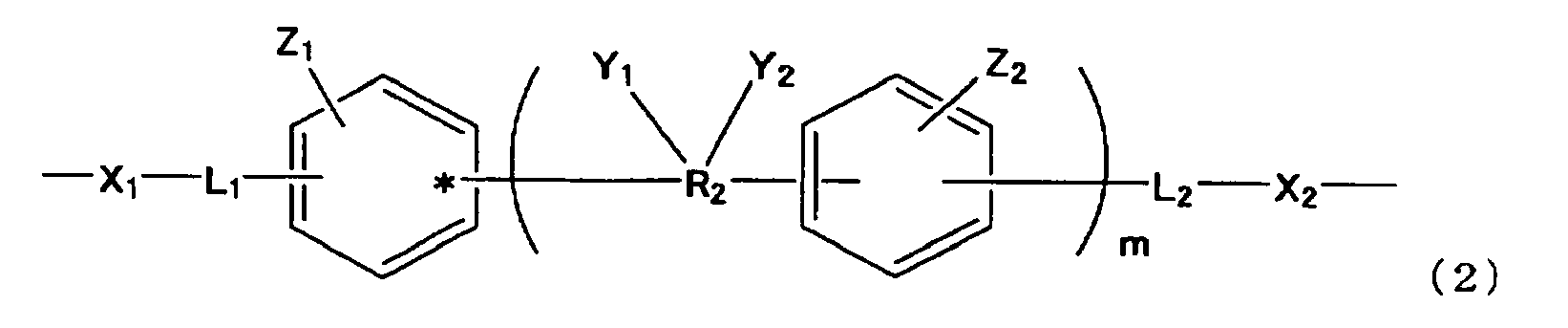
- The linear polylactic acid compound according to claim 16, wherein the moiety represented by the formula (1) is represented by the following formula (3) and the weight ratio of the moiety represented by -CH(CH3)C(O)O- derived from lactic acid to the moiety represented by the formula (3) is in the range of 99.7/0.3 to 90.5/9.5:

- The linear polylactic acid compound according to claim 16, wherein the moiety represented by the formula (1) is represented by the following formula (4):

- The linear polylactic acid compound according to claim 16, wherein the moiety represented by the formula (1) is represented by the following formula (5):

- The linear polylactic acid compound according to claim 16, wherein the moiety represented by the formula (1) is represented by the following formula (6):

Applications Claiming Priority (2)
| Application Number | Priority Date | Filing Date | Title |
|---|---|---|---|
| JP2006203876 | 2006-07-26 | ||
| PCT/JP2007/063844 WO2008013059A1 (en) | 2006-07-26 | 2007-07-11 | Polylactic acid resin composition, molded body thereof and polylactic acid compound |
Publications (3)
| Publication Number | Publication Date |
|---|---|
| EP2050789A1 true EP2050789A1 (en) | 2009-04-22 |
| EP2050789A4 EP2050789A4 (en) | 2011-01-26 |
| EP2050789B1 EP2050789B1 (en) | 2013-06-19 |
Family
ID=38981372
Family Applications (1)
| Application Number | Title | Priority Date | Filing Date |
|---|---|---|---|
| EP07790648.5A Not-in-force EP2050789B1 (en) | 2006-07-26 | 2007-07-11 | Polylactic acid resin composition, molded body thereof and polylactic acid compound |
Country Status (7)
| Country | Link |
|---|---|
| US (1) | US20090259000A1 (en) |
| EP (1) | EP2050789B1 (en) |
| JP (1) | JP5139982B2 (en) |
| KR (1) | KR20090042820A (en) |
| CN (1) | CN101495570B (en) |
| TW (1) | TWI426105B (en) |
| WO (1) | WO2008013059A1 (en) |
Cited By (5)
| Publication number | Priority date | Publication date | Assignee | Title |
|---|---|---|---|---|
| EP2256144A4 (en) * | 2008-02-27 | 2013-09-11 | Mitsui Chemicals Inc | Polylactic acid resin, polylactic acid resin composition, molded body of polylactic acid resin or polylactic acid resin composition, and method for producing polylactic acid resin |
| WO2014195714A1 (en) * | 2013-06-07 | 2014-12-11 | Dupont Teijin Films U.S. Limited Partnership | Copolyesterimides derived from n.n'-bis-(hydroxyalkyl)-pyromellitic diimide and films made therefrom |
| US9422399B2 (en) | 2013-06-18 | 2016-08-23 | Dupont Teijin Films U.S. Limited Partnership | Copolyesterimides derived from N,N′-bis-(hydroxyalkyl)-3,3′,4,4′-diphenylsulfonetetracarboxylic diimide and films made therefrom |
| US9637588B2 (en) | 2013-10-07 | 2017-05-02 | Dupont Teijin Films U.S. Limited Partnership | Copolyesterimides derived from aromatic dicarboxylic acids and aliphatic glycols and films made therefrom |
| US10450411B2 (en) | 2014-06-20 | 2019-10-22 | Dupont Teijin Films U.S. Limited Partnership | Copolyesterimides comprising bis(2-hydroxyalkyl)-2,2′-(1,4-phenylene)bis(1,3-dioxoisoindoline-5-carboxylate) and articles made therefrom |
Families Citing this family (13)
| Publication number | Priority date | Publication date | Assignee | Title |
|---|---|---|---|---|
| CN101857715A (en) * | 2010-05-26 | 2010-10-13 | 上海大学 | Method for quickly crystallizing polylactic acid |
| CN102827362B (en) * | 2011-05-12 | 2014-04-09 | 中国科学院宁波材料技术与工程研究所 | Polylactic acid block copolymer |
| ITMI20120250A1 (en) * | 2012-02-20 | 2013-08-21 | Novamont Spa | BIODEGRADABLE POLYMER COMPOSITION FOR THE MANUFACTURE OF ARTICLES WITH HIGH INFLESSION TEMPERATURE UNDER LOAD. |
| US8691915B2 (en) | 2012-04-23 | 2014-04-08 | Sabic Innovative Plastics Ip B.V. | Copolymers and polymer blends having improved refractive indices |
| KR101548314B1 (en) * | 2012-12-17 | 2015-08-28 | 주식회사 엘지화학 | Preparation Method of Polylactide Resin |
| KR20150026368A (en) | 2013-09-02 | 2015-03-11 | 삼성정밀화학 주식회사 | Method of preparing biodegradable polyester resin |
| US9764242B2 (en) | 2013-10-16 | 2017-09-19 | Tencent Technology (Shenzhen) Company Limited | Method and system for providing game ranking information |
| US10202489B2 (en) | 2017-03-08 | 2019-02-12 | International Business Machines Corporation | Lactide copolymers and ring-opened lactide copolymers |
| US10072121B1 (en) | 2017-03-08 | 2018-09-11 | International Business Machines Corporation | Bottlebrush polymers derived from poly(methylidenelactide) |
| US10035877B1 (en) | 2017-03-08 | 2018-07-31 | International Business Machines Corporation | Matrix-bondable lactide monomors for polylactide synthesis |
| US10570252B2 (en) | 2017-03-08 | 2020-02-25 | International Business Machines Corporation | Flame retardant lactide monomors for polylactide synthesis |
| CN109867638B (en) * | 2017-12-01 | 2021-06-15 | 宁波家联科技股份有限公司 | Heat-resistant polylactic acid continuous extrusion foaming material and preparation method thereof |
| US10787590B2 (en) | 2018-12-26 | 2020-09-29 | Industrial Technology Research Institute | Polymer and coating material |
Family Cites Families (23)
| Publication number | Priority date | Publication date | Assignee | Title |
|---|---|---|---|---|
| JP3307748B2 (en) * | 1993-03-31 | 2002-07-24 | 大日本インキ化学工業株式会社 | Method for producing lactic acid-based copolyester |
| DE69433340T2 (en) * | 1993-09-09 | 2004-08-12 | Kanebo, Ltd. | BIODEGRADABLE COPOLYESTER, MOLDED PART MADE THEREOF AND METHOD FOR PRODUCING THE MOLDED PART |
| JP3399130B2 (en) * | 1995-01-27 | 2003-04-21 | 株式会社島津製作所 | Plasticized polylactic acid and its molded product |
| JPH09158021A (en) * | 1995-12-13 | 1997-06-17 | Dainippon Ink & Chem Inc | Nonwoven fabric made of lactic acid type copolyester |
| JP3411168B2 (en) | 1995-12-21 | 2003-05-26 | 三井化学株式会社 | Method for producing aliphatic polyester molded article and molded article produced thereby |
| US6417294B1 (en) * | 1995-12-21 | 2002-07-09 | Mitsui Chemicals, Inc. | Films and molded articles formed from aliphatic polyester compositions containing nucleating agents |
| JP3487703B2 (en) * | 1995-12-26 | 2004-01-19 | 三井化学株式会社 | Bioabsorbable polyester and method for producing the same |
| JP3622386B2 (en) * | 1996-12-25 | 2005-02-23 | トヨタ自動車株式会社 | Process for producing biodegradable block copolymer |
| JPH11116788A (en) * | 1997-10-09 | 1999-04-27 | Mitsui Chem Inc | Polylactic acid resin composition |
| US6235825B1 (en) * | 1998-03-05 | 2001-05-22 | Mitsui Chemicals, Inc. | Polylactic acid resin composition and film therefrom |
| JP2000344877A (en) * | 1999-03-30 | 2000-12-12 | Dainippon Ink & Chem Inc | Lactic acid-based copolyester with excellent bleed-out resistance |
| US6756331B2 (en) * | 2000-07-17 | 2004-06-29 | Mitsui Chemicals, Inc. | Lactic-acid base resin composition and molded articles made therefor |
| US20050001349A1 (en) * | 2001-11-15 | 2005-01-06 | Masahumi Yosimura | Lactic acid polymer composition and molded object thereof |
| JP3960797B2 (en) | 2001-12-28 | 2007-08-15 | 株式会社Adeka | Polylactic acid-based polymer composition, molded article and method for producing the same |
| KR100898443B1 (en) * | 2002-04-02 | 2009-05-21 | 미쓰비시 쥬시 가부시끼가이샤 | Heat shrinkable polylactic acid based film |
| DE60327525D1 (en) * | 2002-06-20 | 2009-06-18 | Toray Industries | POLYMERIC SUBSTANCE BASED ON POLYMIC ACID, MOLDED BASE AND FOIL |
| TWI297698B (en) * | 2002-08-21 | 2008-06-11 | Dainippon Ink & Chemicals | Resin for molding and production method thereof |
| JP2004285121A (en) | 2003-03-19 | 2004-10-14 | Toyota Central Res & Dev Lab Inc | Polylactic acid compound and method for producing the same, polylactic acid compound composite material, and molded article |
| JP2006016605A (en) * | 2004-06-04 | 2006-01-19 | Mitsubishi Plastics Ind Ltd | Lactic acid-based soft film |
| EP1780234A4 (en) * | 2004-07-22 | 2009-07-08 | Teijin Ltd | POLYLACTIC ACID AND PROCESS FOR PRODUCING THE SAME |
| JP2006335904A (en) * | 2005-06-02 | 2006-12-14 | Tohcello Co Ltd | Polylactic acid-based oriented film |
| JP5076287B2 (en) * | 2005-07-06 | 2012-11-21 | 東レ株式会社 | Polylactic acid film |
| JP5219333B2 (en) * | 2005-09-27 | 2013-06-26 | 三菱樹脂株式会社 | Heat shrinkable film |
-
2007
- 2007-07-11 CN CN2007800282097A patent/CN101495570B/en not_active Expired - Fee Related
- 2007-07-11 WO PCT/JP2007/063844 patent/WO2008013059A1/en not_active Ceased
- 2007-07-11 US US12/374,983 patent/US20090259000A1/en not_active Abandoned
- 2007-07-11 KR KR1020097003951A patent/KR20090042820A/en not_active Ceased
- 2007-07-11 JP JP2008526725A patent/JP5139982B2/en not_active Expired - Fee Related
- 2007-07-11 EP EP07790648.5A patent/EP2050789B1/en not_active Not-in-force
- 2007-07-26 TW TW096127250A patent/TWI426105B/en not_active IP Right Cessation
Cited By (7)
| Publication number | Priority date | Publication date | Assignee | Title |
|---|---|---|---|---|
| EP2256144A4 (en) * | 2008-02-27 | 2013-09-11 | Mitsui Chemicals Inc | Polylactic acid resin, polylactic acid resin composition, molded body of polylactic acid resin or polylactic acid resin composition, and method for producing polylactic acid resin |
| WO2014195714A1 (en) * | 2013-06-07 | 2014-12-11 | Dupont Teijin Films U.S. Limited Partnership | Copolyesterimides derived from n.n'-bis-(hydroxyalkyl)-pyromellitic diimide and films made therefrom |
| US9422399B2 (en) | 2013-06-18 | 2016-08-23 | Dupont Teijin Films U.S. Limited Partnership | Copolyesterimides derived from N,N′-bis-(hydroxyalkyl)-3,3′,4,4′-diphenylsulfonetetracarboxylic diimide and films made therefrom |
| US9840590B2 (en) | 2013-06-18 | 2017-12-12 | Dupont Teijin Films U.S. Limited Partnership | Copolyesterimides derived from N,N′-bis-(hydroxyalkyl)-benzophenone-3,3′,4,4′-tetracarboxylic diimide and films made therefrom |
| US10377862B2 (en) | 2013-06-18 | 2019-08-13 | Dupont Teijin Films U.S. Limited Partnership | Copolyesterimides derived from N,N′-bis-(hydroxyalkyl)-benzophenone-3,3′,4,4′-tetracarboxylic diimide and films made therefrom |
| US9637588B2 (en) | 2013-10-07 | 2017-05-02 | Dupont Teijin Films U.S. Limited Partnership | Copolyesterimides derived from aromatic dicarboxylic acids and aliphatic glycols and films made therefrom |
| US10450411B2 (en) | 2014-06-20 | 2019-10-22 | Dupont Teijin Films U.S. Limited Partnership | Copolyesterimides comprising bis(2-hydroxyalkyl)-2,2′-(1,4-phenylene)bis(1,3-dioxoisoindoline-5-carboxylate) and articles made therefrom |
Also Published As
| Publication number | Publication date |
|---|---|
| WO2008013059A1 (en) | 2008-01-31 |
| EP2050789A4 (en) | 2011-01-26 |
| CN101495570A (en) | 2009-07-29 |
| TW200815523A (en) | 2008-04-01 |
| CN101495570B (en) | 2012-07-04 |
| EP2050789B1 (en) | 2013-06-19 |
| JP5139982B2 (en) | 2013-02-06 |
| TWI426105B (en) | 2014-02-11 |
| KR20090042820A (en) | 2009-04-30 |
| US20090259000A1 (en) | 2009-10-15 |
| JPWO2008013059A1 (en) | 2009-12-17 |
Similar Documents
| Publication | Publication Date | Title |
|---|---|---|
| EP2050789B1 (en) | Polylactic acid resin composition, molded body thereof and polylactic acid compound | |
| EP2045293B1 (en) | Polylactic acid resin composition and molded body thereof | |
| US7902281B2 (en) | Thermoplastic resin composition and molded article thereof | |
| EP2256144B1 (en) | Polylactic acid resin, polylactic acid resin composition, molded body of polylactic acid resin or polylactic acid resin composition, and method for producing polylactic acid resin | |
| JP7106936B2 (en) | Molded body, sheet and container | |
| KR20050083981A (en) | Biodegradable resin composition | |
| JP5199636B2 (en) | Thermoplastic resin composition and molded article thereof | |
| KR101508612B1 (en) | Resin composition comprising polyalkylene carbonate | |
| JP5155643B2 (en) | Polylactic acid resin, polylactic acid resin composition, and molded article thereof | |
| JP3726401B2 (en) | Method for producing polylactic acid copolymer and polylactic acid copolymer | |
| KR20160088133A (en) | Polyalkylene carbonate resin molded article comprising cellulose particles | |
| JP2007332343A (en) | Polylactic acid-based resin composition and molded article of the same |
Legal Events
| Date | Code | Title | Description |
|---|---|---|---|
| PUAI | Public reference made under article 153(3) epc to a published international application that has entered the european phase |
Free format text: ORIGINAL CODE: 0009012 |
|
| 17P | Request for examination filed |
Effective date: 20090220 |
|
| AK | Designated contracting states |
Kind code of ref document: A1 Designated state(s): AT BE BG CH CY CZ DE DK EE ES FI FR GB GR HU IE IS IT LI LT LU LV MC MT NL PL PT RO SE SI SK TR |
|
| AX | Request for extension of the european patent |
Extension state: AL BA HR MK RS |
|
| RBV | Designated contracting states (corrected) |
Designated state(s): DE FR GB |
|
| DAX | Request for extension of the european patent (deleted) | ||
| RBV | Designated contracting states (corrected) |
Designated state(s): DE FR GB |
|
| A4 | Supplementary search report drawn up and despatched |
Effective date: 20101230 |
|
| 17Q | First examination report despatched |
Effective date: 20110705 |
|
| REG | Reference to a national code |
Ref country code: DE Ref legal event code: R079 Ref document number: 602007031153 Country of ref document: DE Free format text: PREVIOUS MAIN CLASS: C08L0067040000 Ipc: C08G0063600000 |
|
| RIC1 | Information provided on ipc code assigned before grant |
Ipc: C08K 5/00 20060101ALI20121206BHEP Ipc: C08L 67/04 20060101ALI20121206BHEP Ipc: C08G 63/06 20060101ALI20121206BHEP Ipc: C08G 63/60 20060101AFI20121206BHEP |
|
| GRAP | Despatch of communication of intention to grant a patent |
Free format text: ORIGINAL CODE: EPIDOSNIGR1 |
|
| GRAS | Grant fee paid |
Free format text: ORIGINAL CODE: EPIDOSNIGR3 |
|
| GRAA | (expected) grant |
Free format text: ORIGINAL CODE: 0009210 |
|
| AK | Designated contracting states |
Kind code of ref document: B1 Designated state(s): DE FR GB |
|
| REG | Reference to a national code |
Ref country code: GB Ref legal event code: FG4D |
|
| REG | Reference to a national code |
Ref country code: DE Ref legal event code: R096 Ref document number: 602007031153 Country of ref document: DE Effective date: 20130814 |
|
| PLBE | No opposition filed within time limit |
Free format text: ORIGINAL CODE: 0009261 |
|
| STAA | Information on the status of an ep patent application or granted ep patent |
Free format text: STATUS: NO OPPOSITION FILED WITHIN TIME LIMIT |
|
| 26N | No opposition filed |
Effective date: 20140320 |
|
| REG | Reference to a national code |
Ref country code: DE Ref legal event code: R097 Ref document number: 602007031153 Country of ref document: DE Effective date: 20140320 |
|
| REG | Reference to a national code |
Ref country code: FR Ref legal event code: PLFP Year of fee payment: 9 |
|
| PGFP | Annual fee paid to national office [announced via postgrant information from national office to epo] |
Ref country code: FR Payment date: 20150626 Year of fee payment: 9 |
|
| PGFP | Annual fee paid to national office [announced via postgrant information from national office to epo] |
Ref country code: GB Payment date: 20150721 Year of fee payment: 9 Ref country code: DE Payment date: 20150721 Year of fee payment: 9 |
|
| REG | Reference to a national code |
Ref country code: DE Ref legal event code: R119 Ref document number: 602007031153 Country of ref document: DE |
|
| GBPC | Gb: european patent ceased through non-payment of renewal fee |
Effective date: 20160711 |
|
| PG25 | Lapsed in a contracting state [announced via postgrant information from national office to epo] |
Ref country code: FR Free format text: LAPSE BECAUSE OF NON-PAYMENT OF DUE FEES Effective date: 20160801 Ref country code: DE Free format text: LAPSE BECAUSE OF NON-PAYMENT OF DUE FEES Effective date: 20170201 |
|
| REG | Reference to a national code |
Ref country code: FR Ref legal event code: ST Effective date: 20170331 |
|
| PG25 | Lapsed in a contracting state [announced via postgrant information from national office to epo] |
Ref country code: GB Free format text: LAPSE BECAUSE OF NON-PAYMENT OF DUE FEES Effective date: 20160711 |